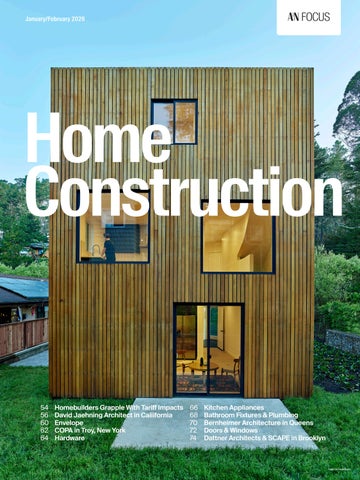
January/February 2026 Focus Section: Home Construction

Page 1


Home Construction

SUPERIOR HEAT RESISTANCE A RECYCLED CORE

ĒCLOS is a next-generation mineral surface developed with advanced layered design technology.

INLAYER 3D DESIGN

ZERO SILICA

Cost to Rebuild

Homebuilders face uncertainty as Trump’s tariffs compound rising costs and financing challenges.

When real estate veterans Dylan Hart and Conor O’Donovan started Village Rebuild in Los Angeles’s Pacific Palisades neighborhood after last year’s fires, they knew their mission to help rebuild the neighborhood would be a challenging one. Insurance payouts, permitting, finding labor—the list of obstacles in the way of building new homes for those displaced by the Los Angeles wildfires was already long enough before tariffs became an issue.

While many of the group’s projects—it has five homes in process, with one framed and two in permitting—still remain under construction, Hart and O’Donovan are trying to figure out how to time their purchases of appliances, fixtures, and unfinished goods. The consistent back and forth of tariff threats has become another challenge for them to navigate in an already difficult economic environment.

“You have a dynamic-priced thing you’re trying to build with a fixed set of proceeds from insurance,” said Hart. “That hurts.”

Not all homes being built today face these challenges. But tariff uncertainty remains a constant, especially for smaller, custom singlefamily homes. While larger homebuilders like D.R. Horton and Lennar have supply chain specialists on staff and greater means for raising capital, regional, local, and custom homebuilders simply don’t have the resources to be as nimble. Hart said the models he and O’Donovan used in the Palisades included hefty contingencies, which have helped absorb some of the impacts of rising prices. They haven’t had to make any material changes yet, but still haven’t gotten to the decorating and finishing phases.

Many economists and industry analysts agree that tariffs only exacerbate the larger challenge homebuilders face around financing and capital. Stubbornly high mortgage rates and a softening labor market mean weak buyer demand for existing and new homes. There are also persistent labor shortages in the construction industry, made worse by the government deportation

agenda, driving up construction costs

“Tariffs right now are real, and they’ve changed significantly in the last year or so,” said Rob Nixon, senior vice president at Walton Global, which among other things sells land to largescale homebuilders and developers. “But it’s still premature to understand how things will shake out [and] how it would look if we didn’t have tariffs. Over the last four and a half years, total building material cost is up about 42 percent. So there are a lot of factors influencing the cost of construction, but tariffs are a smaller component than you’re hearing about.”

Data shows a relatively small increase in prices for materials and services in 2025; according to Homes.com, residential construction costs have only gone up 2.8 percent, a relatively slim bump considering the fear that hit during the early days of President Trump’s trade wars last spring. At the time, the National Association of Home Builders predicted a $10,900 tariff cost per new home.

Since the tariff rates and their impact have been a bit of an enigma—some announced levies never went into effect, and in other cases substitutions were used to skirt tariffs—they’re not having as appreciable an impact as many expected, said Brad Case, chief residential economist at CoStar. Looking at the Producer Price Index of Construction Materials data from the Federal Reserve, there isn’t yet a significant post-tariff spike

But that relatively moderate impact is spread across the entirety of the supply chain. Nearly every item in homebuilding has the potential to be impacted by tariffs. Tariffs on Canadian lumber, which constitutes a majority of the wood used to build American homes, have hit 45 percent, and a recent tariff on cabinets and upholstered furniture makes furnishing a new home more expensive.

Walton said for high-end homes, which may be looking to use European marble or top-shelf imported appliances, there’s a potential for rising costs, though there’s also room for substitutions. (He has seen a sharp rise in the use of synthetic materials, which can be made in factories in the U.S.) Buyer behavior has quickly changed, he said, and large homebuilders aren’t canceling any plans to build this year—they’re simply not expanding their plans to build more.

Architect Allegra Kochman, whose firm, AKA Insight, specializes in renovating classic New York City structures, said she focuses on transparency and does budgets ahead of time based on forecast prices. Tariff announcements made that process challenging this year, but the end result, especially when it came to final costs, wasn’t very impactful. There were plenty of local substitutions and changes she was able to make, and the 20 percent contingency she added to projects over the last year helped clients not to feel unmoored by the uncertainty.

She said she hasn’t seen any decline in the volume of business she’s done this year, either. But she’s also worried that continued uncertainty isn’t going to make things easier. “Uncertainty is inflationary,” she said.

The pace with which tariffs were announced and instituted in early 2025 meant that much of the economy had a chance to front-run them, said Elena Patel, a senior fellow at the Brookings Institution, stockpiling foreign goods and starting to adjust their supply chains to lower future costs. This dynamic favors larger players in homebuilding; developers with the means and scale to adjust supply chains have a much easier path to mitigating these costs than a smaller, custom homebuilder.

Sadly, homebuilders may need to factor in uncertainty for a much longer period of time, says Patel. The business community, unmoored by a relatively unsettled tax policy environment, suggests that a wait-and-see attitude is prudent. Even if the Supreme Court decides the president overstepped his bounds by unilaterally establishing emergency tariffs, Patel believes the administration will simply use other means to levy tariffs, creating additional uncertainty.

“We’re still in a ‘What do we expect to happen when we see the full impacts of the tariffs?’ moment,” said Patel.

Patrick Sisson is an L.A.-based writer and reporter focused on the trends, tech, and design behind cities today.

QIAN WEIZHONG/VCG/AP IMAGES
In Los Angeles, homebuilders like Village Rebuild must anticipate the impact of President Trump’s tariffs on material costs as they look to the future of rebuilding their city.

Redefine contemporary architectural design

Creativity ConstraintUnder

David Jaehning Architect completed a home with an ADU in California after seven years of work. What took so long?

In a photo of the final model of this house in Sunshine Valley, California, a wooden rectangle sits atop two bricks in the middle of a sloping field. A stand of trees along the ridgeline behind is cast in the Central California coast’s signature marine fog. The rectangle is vertically bisected: thick boards on the left, thinner boards on the right, each alternating with bands of black. Square windows hover on either side of the midline.

The real house would take seven years to build. The rectangle of alternating board sizes is delineated by bands of black echoing the wintry underside of willows—built up and stretched out at angles, it unfolds as you move around its perimeter and is punctuated by those floating square windows.

Clad in a cedar rainscreen, the house rises with a verticality you would expect in a denser setting. Architect David Jaehning understood early that his design would require vertical proportions. The folding planes and four- and eight-degree angles make visible the extreme setbacks and regulations that shaped this project. Constructed in one of the most regulated counties in the most regulated state in the nation, this building embodies an ecological, bureaucratic, and architectural response.

A Site of Many Constraints

The 5,000-square-foot lot runs along a riparian woodland and Dean Creek, which cuts diagonally through the north side of the property and required a 30-foot setback from the bank. And a stand of three arroyo willows to the east carved out another 30 feet. A diseased tree, later removed, cut in with an additional 30. Then midway through the project, a dusky-footed wood rat nest was found, triggering yet another 30-foot buffer.

Including the standard 20 feet setbacks for front and rear yards and combined 15-foot sideyard setbacks and a daylight plane, Jaehning was left with 800 square feet of buildable area out of 5,000. Because this fell under the allotted 53 percent of the total lot, which for this site totaled 2,500 square feet, a height variance allowed them to build up rather than out.

These overlapping site conditions and setbacks warped the rectangular form into a series of folding planes and angled walls that step back from each boundary. “The house’s massing exaggerates the faceted quality of the site’s remaining buildable area,” said Jaehning.

(Not) Another ADU Battle

The main residence is located on the upper floor of the building and consists of two bedrooms and two baths, with large windows overlooking the riparian corridor. A junior ADU occupies the ground floor, sharing a split entrance with the main residence. The client initially wanted a two-car garage. To accommodate, the architect proposed cantilevering over the creek’s setback area, which was denied to preserve air rights. That meant that the garage, also a zoning requirement, would occupy the entire ground floor, already planned for an ADU. So Jaehning sought a variance for uncovered parking to accommodate the accessory dwelling unit instead.

TIMOTHY HURSLEY

Creativity Under Constraint continued

When the county denied it, Jaehning appealed to the Board of Supervisors. After the board tried to table the issue, Jaehning reminded its members of the governor’s mandate: Counties must allow ADUs to address California’s housing crisis. “I asked them to go on record: Would you rather have two cars enclosed than house another family?” After the six-month battle, the board ruled in his favor—a significant legal precedent.

Material and Perception

According to Jaehning, the cedar facade references Sea Ranch’s weathered wood and learns from Sol LeWitt’s rule-based wall drawings and Sigurd Lewerentz’s masonry work. “I lean into material detail and matters of perception,” said Jaehning. These influences show up in elements like the rainscreen boards. Inspired by Lewerentz’s rule (to never cut a brick but stretch the mortar instead), Jaehning exaggerated the gaps between each board (½ to ¾ inch) and painted the top and bottom edges black. In the end, the cladding consisted of 544 handpainted boards in alternating widths—1 by 1, 1 by 4, 1 by 8—arranged to create an undulating visual effect across various planes.

Jaehning pointed to Rosalind Krauss’s essay “The Grid, the /cloud/, and the detail,” which discusses Mies van der Rohe and Agnes Martin’s work across three scales of perception: the distant view (overall form), the close view (material detail), and the intermediate view—what Krauss calls “the atmosphere” or “the cloud.” “This is where form, detail, and material effects become present,” said Jaehning. “Your eyes oscillate between scales—between form and detail as you move towards and around the house.” Square windows puncture the rainscreen at regular intervals. “I’m in a square stage,” Jaehning noted. “Our lives are full and chaotic. I feel that especially for a home, architecture should create a place of refuge, quiet. The square sets up a static, equal view—it creates a stillness and allows the eye to wander more.” It is through those apertures that the cloud enters.

Place Is Landscape

In response to the property’s failing retaining wall, Jaehning built a perimeter gabion wall, providing structural support while being porous enough to allow water to flow through. For the wall, the architects designed a soil and seed mixture to be packed into the caged wall with burlap netting. “The idea was to form a soft hard line wrapped in the native riparian species that grow all around,” explained Jaehning. The gabion wall was designed to become part of the riparian corridor over time, to settle the house into place. Eventually, continued Jaehning, “it would be like visiting an unexcavated archaeological site.”

From a distance, the house’s form appears strange and interesting. Like the artworks Jaenhing referenced, you want to walk around it, see how it unfolds from different angles. Knowledge of what shaped it also makes the strangeness legible and compelling. The building doesn’t hide its constraints or origins in seven years of administrative process. It amplifies the intersection of environmental protections and local zoning requirements into thoughtful, regionally relevant architecture, minimalist for its own moment.

ARCHITECT: David Jaehning Architect

GENERAL CONTRACTOR: Jack Chen

STRUCTURAL ENGINEER: Dimas

MEP ENGINEER: Design/build by contractor

CIVIL ENGINEER: Sigma Prime

FACADE SYSTEM: Custom cedar rainscreen built on site

CLADDING: Custom cedar rainscreen built on site

GLASS: Milgard clear insulated glass unit with argon fill

WINDOWS: Milgard

DOORS: Milgard

ROOFING: Rheinzink standing seam

WATERPROOFING: WR Meadows air-shield LMP

EXTERIOR: Rockwool

INTERIOR: Owens Corning batt

FIXTURES: Delta

LANDSCAPE PRODUCTS: Zeo-Lock permeable concrete paver

The

is a

Elizabeth Snowden is a writer and editorial strategist based in the San Francisco Bay Area.
Above: Overlapping site conditions and site setbacks warped the original rectangular mass into a series of folding planes and angled walls.
Top Right: The cladding consisted of 544 boards of alternating widths that were used to create an undulating visual effect across the building’s various planes.
Right: The ground floor features a junior ADU that shares a split-entrance with the main residence
Previous page:
building’s distinct verticality
result of the height variance that allowed the architects to build up rather than out.
TIMOTHY HURSLEY
TIMOTHY HURSLEY
COURTESY DAVID JAEHNING ARCHITECT

Envelope

The following residential envelope offerings not only excel in design or performance but also pay attention to the ease of installation— from below-grade applications to adaptable walls and efficient assemblies. KP

Kooltherm K100 | Kingspan Insulation North America kingspan.com
DuPont ArmorWall System | DuPont Performance Building Solutions dupont.com
Cool Roof Tiles | Brava Roof Tile bravarooftile.com
Brava’s Cool Roof Tiles are
JOHN DICKINSON
Ambra Shingles | Eco Outdoor eco-outdoor.com
eFacade
TYPAR Clear Acrylic Flashing typar.com

Quick, Cheap, and Handsome

COPA used prefabrication to develop a below-market-rate row house that still makes a profit.

On a historic block in Troy, New York, a bracing wood building stands head and shoulders above the squat brownstones. Horizontal exposed boards clad the 4-story structure, adding some solidity to a stack that might otherwise look perilously skinny.

The Swift Street Residences, designed by COPA and completed in 2024, isn’t just aesthetically unique; it’s also the product of novel prefabricated construction techniques and a vertically integrated development process. The firm hopes the combination can become a replicable model for creating affordable housing quickly and cheaply on urban infill sites, all while adding a little pizzazz to the cityscape.

“This project was unique in the sense that we also acted as the general contractor and the owner,” said Manuel Cordero, a principal at COPA. “It was much easier as an owner to say we’re going to experiment with these materials.”

In 2021, Cordero and his wife were looking for opportunities to invest in real estate when they learned about the Troy Community Land Bank. Through the land bank they were able to purchase a 24-foot-wide vacant lot for just $3,000, so long as they pledged to develop it as income-restricted housing. “It just seemed like a great, very-low-cost-to-entry experiment,” Cordero said.

With its prefabricated, kit-of-parts design, there was a great deal of logistical work to be done on the front end. But that also meant fewer surprises at the building site. For the architects, this method is “a nice way of seizing control back,” said COPA principal Galen Pardee.

The flat-pack parts included the concrete foundation, which was trucked to the site as a series of prefabricated panels. It took a crew of four workers, with help from a crane, just one workday to install the foundation’s 11 pieces. After that, the rest of the exterior, composed of 184 structural insulated panels, rose in about a month and a half. Building out the interiors took longer, but workers were able to complete that labor sheltered from the elements.

All told, construction took about ten months and cost $685,000, Cordero said. At about $118

per square foot, that’s lower than the $150 to $200 per square foot typical of similar projects in the Albany area.

Each of the four stories contains a two-bedroom apartment, and there’s a shared deck on the roof. The units are fully occupied and rent for $1,500 apiece, a rate considered affordable to households earning 80 percent of the area median income. The low construction costs ensure that the building will generate a positive cash flow despite the relatively low rents, Cordero said.

Though its design is unique, the building is in conversation with its surroundings. It marks a transition between the masonry buildings along River Street and the wooden houses up the hill, Pardee said. “It’s got the massing that’s coming from the main street, but the materiality is speaking a bit more to the stuff behind us.”

The exposed wood and clean lines lend the building a beachy look, like a vertical boardwalk. It’s an urban spin on the Sea Ranch style, bringing some Northern California cool to upstate New York.

Like its beachfront brethren, this building will weather. Its yellow facade is already beginning to gray. But the open joint cladding system that supports the external beams ensures durability by keeping the wood dry, Cordero explained.

The project has become something of a calling card for the young firm, which was founded in 2023. Already, two other developers in the Albany region have hired COPA to design small, prefabricated, affordable apartment buildings. Cordero has also purchased a couple of additional lots from the City of Troy with an eye toward developing similar projects. But he insists he doesn’t want to do a copy-and-paste design.

“The aesthetic quality of the building has drawn people in and has made it stand out,” Cordero said. “I think there’s a tangible financial benefit to trying to make something really respond, on a micro level, to its environment.”

Benjamin Schneider is a freelance journalist and the author of The Unfinished Metropolis.

ARCHITECT: COPA

STRUCTURAL ENGINEER: Cigano Engineering

INSULATED PANEL SYSTEM: Green Build SIPS

WINDOWS: Joyce Windows

WATERPROOFING: Benjamin Obdyke

FRAMING: Hell’s Angels Motorcycle Club

FOUNDATION PANELS: Superior Walls

Above: The Swift Street Residence’s exterior was composed of 184 prefabricated, structural insulated panels that took about a month and a half to install.
Below Left: The architects purchased the 24-footwide vacant lot from Troy Community Land Bank, pledging to develop it as affordable housing.
Below Right: The project employs an open joint cladding system to support the durability of the external beams by keeping the wood dry.
MICHAEL VAHRENWALD
MICHAEL VAHRENWALD MICHAEL VAHRENWALD

Hardware

MASTER DISTRIBUTOR FOR

ONE SIZE. INFINITE APPLICATIONS.

ACHIEVE EFFICIENCY AND QUALITY WITH EXTRA-LARGE PREMIUM PORCELAIN SLABS DESIGNED TO SAVE TIME, EFFORT, AND MATERIAL.

ALL 28 COLORS IN STOCK!

Shown in Calacatta Venere

Kitchen Appliances

Series Induction Range | BlueStar bluestarcooking.com
15-inch Series
Cooktop | Fisher & Paykel fisherpaykel.com

Bathroom Fixtures & Plumbing

By the Seashore

Bernheimer Architecture reenvisions the future of Far Rockaway with Beach Green Dunes III.

In Far Rockaway, Queens lies a bouillabaisse of Cape Cod bungalows, Victorians, resort hotels, and Mitchell-Lama towers, whose slablike masses rise out of the sandy peninsula like the monolith in Stanley Kubrick’s 2001: A Space Odyssey . In downtown Far Rockaway, Beach Green Dunes III, a new residential building by Bernheimer Architecture, shimmers in the sun next to an elevated subway track that connects the historic beach community with the rest of New York City. The fully electric building delivers 146 affordable units and denotes the third phase in a masterplan led by L+M Development Partners, Bluestone Group, and Triangle Equities to build a net-zero neighborhood in Far Rockaway. Local Office Landscape and Urban Design, a Brooklyn firm cofounded by Walter Meyer and Jennifer Bolstad, was the landscape architect and Steven Winter Associates the sustainability consultant.

In 2012, downtown Far Rockaway was decimated by Superstorm Sandy. The next year, AIA New York hosted “For a Resilient Rockaway,” a competition to reimagine Arverne East, a section of the area that had been particularly hard hit. City officials were scratching their heads over what to do, asking: Was new construction in a flood-prone area a good investment? If so, how could rising sea levels be mitigated architecturally?

Will Sheridan, a principal at Bernheimer Architecture, told AN: “Everyone was faced with the question of what is resiliency in this context? Is this a place where we should be building at all?” Planners opted to leverage the peninsula, and downtown Far Rockaway was rezoned in 2017, allowing for higher-density buildings like Beach Green Dunes III, which would be located near the Beach 36th Street MTA Station.

Bernheimer Architecture joined the Beach Green Dunes III project team in 2018, after Curtis + Ginsberg Architects designed the two other projects in the masterplan. “We were given this sort of rhombus-shaped site underneath a subway line that included a transit plaza set aside for public space, a no-go zone for development,” said Andrew Bernheimer, founding principal. “The

development team’s goal was to build a building that was much less burdensome on public infrastructure. So, it has a significant array of PV panels, and the building runs on geothermal heating and cooling. It takes advantage of the local subsurface conditions to help run the building on a lot less energy than a typical building. It’s going to be Passive House certified.”

In anticipation of another natural disaster, Bernheimer Architecture and Local Office also implemented flood-proof designs like storm swales, porous paving, rain gardens, and green roofs. The first floor is lifted 6 feet above street level, and mechanical equipment and other

essential services areraised above the flood elevation, Bernheimer elaborated. Every facade is public facing, a rarity in New York City. Bernheimer Architecture took this into account and conceived a well-insulated, tightly sealed thermal envelope with high-performance windows, doors, and storefronts. The wings are expressed in stucco that ranges from dark charcoal to light gray. Two distinct rainscreen systems were employed: Corrugated, perforated anodized aluminum paneling shields the parking garage and service spaces, and fiber-cement panels cling to the first floor.

Sheridan called the parti a “jackknife plan” that responds to the irregular, triangular plot. Two

angled wings meet at the site’s northeast corner, where the main core and lobby are located. “Once this general plan configuration was set,” Sheridan continued, “we calibrated the massing and designed a double-loaded corridor wing that rises 8 stories. This bulk of the massing has views south of Jamaica Bay. The wing on Beach Channel Drive is lower, at 4 stories. This wing addresses and relates to the adjacent one- and two-family buildings across the street, connecting it to the neighborhood.” DJR

DESIGN ARCHITECT: Bernheimer Architecture

LANDSCAPE ARCHITECT: Local Office Landscape & Urban Design

INTERIOR DESIGN: Bernheimer Architecture

STRUCTURAL ENGINEER: GACE Consulting Engineers

MEP/FP ENGINEER: Skyline Engineering (AMA Group)

CIVIL ENGINEER: VHB

LIGHTING DESIGN: Flux Studio

ENVELOPE CONSULTANT: Socotec

SUSTAINABILITY/PH CONSULTANT: Steven Winter Associates

ACCESSIBILITY CONSULTANT: Accessibility Services

GENERAL CONTRACTOR: L+M Builders Group

EXPEDITER: William Vitacco Associates

DEVELOPER (PRIME): L+M Development Partners

DEVELOPER (SECONDARY): The Bluestone Organization

DEVELOPER (SECONDARY): Triangle Equities

FACADE SYSTEM: STO

CLADDING: Equitone, ATAS International

STOREFRONTS: Kawneer

WINDOWS: Intus

DOORS: Freedom Doors

ROOFING: American Hydrotech

VERTICAL CIRCULATION: Schlinder

Above: To accommodate for the irregular, triangular site, the building’s design follows a jackknife plan, with two angled wings that meet at the site’s northeast corner.

Doors & Windows

Collection
Marvin marvin.com
features Marvin’s

Just StartedGetting

The first phase of Alafia, a wellness-focused affordable housing campus designed by Dattner Architects and SCAPE, opens in Brooklyn.

The ribbon-cutting for the first phase of Alafia, a 27-acre, 2,400-unit affordable housing complex in East New York, took place last December But residents of the newly completed buildings designed by Dattner Architects are already settled in. The complex, nearly 390,000 square feet in size and comprising 576 units, was built at a cost of $387 million.

Together with their clients, Dattner Architects and SCAPE were awarded the project in 2018 Phase one’s three buildings consist of two tall structures that share a lobby and form a large C in plan, plus a shorter building that caps the open side of the C. The latter building’s ground floor features maisonette units that open to what will eventually be Alafia’s central green space.

The interior of the C is an elevated terrace that is accessible from all three buildings and opens to the south for maximum sun. SCAPE’s landscape planting and outdoor furniture selection creates comfortable places for gathering. Interior amenities like laundry rooms and meeting suites look out onto the fenced courtyard, allowing parents to complete tasks while keeping an eye on kids playing outside.

As explained on-site by Dattner partner Daniel Heuberger, this C shape is repeated across the project’s six phases. While the outer taller buildings vary more in their architecture, the inner shorter ones create a consistent armature that frames the six acres of open space, which are designed to range from thickly planted to more open, agricultural scenes, Gena Wirth, a design principal and partner with SCAPE, told AN

The outer facades of the buildings are clad in a variable brick mix, while the interior ones are lined in with solid cream-colored brick. The window patterns vary between a single punched opening and two separated vertical apertures. The courtyard-facing windows are ganged together into 2-story bands, which reinforces the terrace as a shared space.

Heuberger said Alafia has three scales of identification: that of the building, through which residents can identify their individual apartments by the window patterns; that of the complex, where the courtyard constitutes a haven; and that of the overall development, in which complexes ring the main open area.

The first phase also included the campus’s maintenance hub, two translucent infrastructural buildings where trash, recycling, and compost are collected. As additional zones are built, the compost will be put to work on adjacent plots. A nearby corner parcel is slated to have a school.

Because Alafia is near Jamaica Bay, it is susceptible to climate change–induced flooding, so the buildings are elevated by almost 3 feet. SCAPE’s native plantings are also specified to handle the salt spray and coastal winds. The developers constructed new streets that will be turned over to the city; one, Vital Avenue, is lined with tree-pit bioswales that slow runoff. The project complies with the EPA’s Strengthening Water Infrastructure for Tomorrow initiative known as SWIFT, and the buildings’ runoff irrigates the courtyard planting. Dattner associate Deniz Secilmis shared that the complex has geothermal loops, wastewater heat recovery, and rooftop solar.

The buildings are open to residents who make 80 percent of AMI or lower, and 132 units are reserved for people with mental illness or

developmental disabilities. Beyond the lobby and mail room, the ground floor includes tobe-leased retail spaces and a forthcoming 15,000-square-foot One Brooklyn Health outpatient clinic, designed by Dattner Architects.

The building’s units are accessed from doubleloaded corridors. Inside, the apartments are quiet thanks to the Passive House standard, which includes triple-glazed windows and ample insulation. The latter is felt in the deeply recessed windows, whose returns are faced in brick.

The project is funded by a mix of state financing, federal Low-Income Housing Tax Credits, and New York State Homes and Community Renewal’s New Construction Program and Community Investment Fund. Phase two, with a building designed by Marvel, is under construction, and other parts are moving along: Dattner Architects will design Phase four. L+M aims to complete the entire project by 2031.

If progress continues in the same way as its impressive first phase, Alafia will soon be an important example of how to design housing that stands ready to handle the challenges of the 21st century. JM

ARCHITECT: Dattner Architects

LANDSCAPE ARCHITECT: SCAPE Landscape Architecture

INTERIOR DESIGN: Dattner Architects

CLIENT: L+M Development Partners, Services for the UnderServed, Apex Building Group, RiseBoro

STRUCTURAL ENGINEER: GACE

ELECTRICAL ENGINEER: Cosentini

CIVIL ENGINEERING: VHB

LIGHTING DESIGN: Dattner Architects, SCAPE

AV/ACOUSTICS: Longman Lindsey

FACADE CONSULTANT: SOCOTEC

GENERAL CONTRACTOR: L&M, Apex Building Group

GLAZING CONTRACTOR: Adler

ENVIRONMENTAL ENGINEER: Langan

PASSIVE HOUSE CONSULTANT: Steven Winter Associates

FACADE SYSTEM: Belden

CLADDING: Longboard

GLASS: Guardian, Walker, Viracon

WINDOWS: Intus

DOORS: Kawneer, LIF

ROOFING: Siplast, Hydrotech

INSULATION: Hunter, Rockwool

VERTICAL CIRCULATION: Otis

INTERIOR FINISHES: Garrison, Shaw, Ecore, Genrose, Resilience Quartz, Tiger, Cuisine Ideale

PAINT: Sherwin Williams

FIXTURES: Peerless, American Standard

APPLIANCES: Frigidaire, Broan

LIGHTING: DMF, Modern Forms, Kuzco, RAB

LANDSCAPE: Structura, Landscape Forms, Kettler International, Tournesol, Wasau Tile, SynLawn, Sempergreen, Vestre, Landscape Structures, mmcité, Champlain Stone, Playsites + Surfaces

Above: Each of Alafia’s six C-shaped buildings feature a central green space that serves as a dynamic communal gathering place.

The apartment buildings meet Passive House standards and feature triple-glazed windows and ample insulation.

Right:

Presented by

The premier conference on high-performance building enclosures

Bringing together the world’s most productive building professionals where you can network, learn, and earn CEUs. Our presentations and panels examine the fast-paced evolution of facade technology, address new perspectives on building skins, and explore innovative, sustainable design practices. Spec your projects at the Methods + Materials Expo with leading building product manufacturers.

Facades+ 2026

Atlanta - February 25

Dallas - March 10

New York City - March 26+27

New York City - March 26+27

Las Vegas - March 31

Las Vegas - March 31

Monterrey, MX - April 22+23

Monterrey, MX - April 22+23

Washington, DC - May 15

Toronto - June 4

Boston - July 23

Chicago - September 17

Denver - October 1

Vancouver - October 27

Los Angeles - November 5+6

Nashville - November 19

Seattle - December 3

Seattle - December 3

DOORS & WINDOWS

Alpen High Performance Products thinkalpen.com

Doma domahome.com

Guardian Glass guardianglass.com

Hope’s Windows hopeswindows.com

INTUS Windows intuswindows.com

Joyce Manufacturing joycemfg.com

Marvin marvin.com

Milgard Windows and Doors milgard.com

NanaWall nanawall.com

Panda Windows & Doors panda-windows.com

Pella pella.com

ENVELOPE

ATAS International atas.com

Benjamin Obdyke benjaminobdyke.com

Brava Roof Tile bravarooftile.com

DuPont Performance Building Solutions dupont.com

Eco Outdoor eco-outdoor.com

EQUITONE equitone.com

Henry henry.com

Hunter Panels hunterpanels.com

Issaquah Lumber issaquahlumber.com

James Hardie Building Products jameshardie.com

Johns Manville jm.com

Kawneer kawneer.com

Kingspan Insulation North America kingspan.com/us/ en/business-groups/ kingspan-insulation/

Longboard Architectural Products longboardproducts.com

Lowe’s lowes.com

Mitrex mitrex.com

Owens Corning owenscorning.com

OX Engineered Products oxengineeredproducts.com

reSAWN Timber resawntimberco.com

Rmax rmax.com

RHEINZINK rheinzink.us

ROCKWOOL rockwool.com

Siplast siplast.com

Sto Corp stocorp.com

Superior Walls superiorwalls.com

The Belden Brick Company beldenbrick.com

TYPAR typar.com

Viracon viracon.com

W. R. MEADOWS wrmeadows.com

HARDWARE

Accurate Lock & Hardware accuratelockandhardware.com

Amerock amerock.com

Ellis Works ellis-works.com

JNF Architectural Hardware jnfhardware.com

Pin & Tumbler A Studio by Schlage schlage.com

Viefe viefe.us

KITCHEN & BATH

American Standard americanstandard-us.com

BlueStar bluestarcooking.com

Broan-NuTone broan-nutone.com

Dacor dacor.com

Delta Faucet deltafaucet.com

Duravit duravit.us

Frigidaire frigidaire.com

GROHE grohe.us

Infinity Drain infinitydrain.com

Kohler kohler.com

LAUFEN us.laufen.com

Peerless Faucet peerlessfaucet.com

QM Drain qmdrain.com

SKS sksappliances.com/en-us/ TOTO totousa.com

AG Millworks agmillworks.com

Turn static files into dynamic content formats.

Create a flipbook