AN January/February 2026

Page 1


The Architect's Newspaper

Regenerating a Black community in Portland, Holl on Dallas City Hall, and more page 6

Visit an angular green residential tower in Buenos Aires by adamo-faiden page 12

Remembering Frank Gehry (1929–2025) with a look at his trials and tribulations page 14

AN heads to Houston to tour Cobalt Office’s portfolio of multifamily housing projects page 16

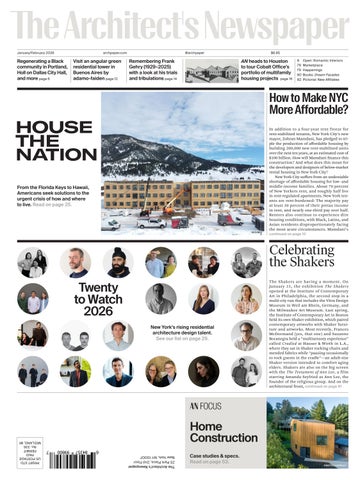
HOUSE THE NATION

From the Florida Keys to Hawaii, Americans seek solutions to the urgent crisis of how and where to live. Read on page 25.

Twenty to Watch 2026

In addition to a four-year rent freeze for rent-stabilized tenants, New York City’s new mayor, Zohran Mamdani, has pledged to triple the production of affordable housing by building 200,000 new rent-stabilized units over the next ten years, at an estimated cost of $100 billion. How will Mamdani finance this construction? And what does this mean for the developers and designers of below-market rental housing in New York City? New York City suffers from an undeniable shortage of affordable housing for low- and middle-income families. About 70 percent of New Yorkers rent, and roughly half live in rent-regulated apartments. New York tenants are rent-burdened: The majority pay at least 30 percent of their pretax income in rent, and nearly one-third pay over half. Renters also continue to experience dire housing conditions, with Black, Latinx, and Asian residents disproportionately facing the most acute circumstances. Mamdani’s continued on page 10

Celebrating the Shakers How to Make NYC More Affordable?

The Shakers are having a moment. On January 31, the exhibition The Shakers opened at the Institute of Contemporary Art in Philadelphia, the second stop in a multi-city run that includes the Vitra Design Museum in Weil am Rhein, Germany, and the Milwaukee Art Museum. Last spring, the Institute of Contemporary Art in Boston held its own Shaker exhibition, which paired contemporary artworks with Shaker furniture and artworks. Most recently, Frances McDormand (yes, that one) and Suzanne Bocanegra held a “multisensory experience” called Cradled at Hauser & Wirth in L.A., where they sat in Shaker rocking chairs and mended fabrics while “pausing occasionally to rock guests in the cradle”—an adult-size Shaker version intended to comfort aging elders. Shakers are also on the big screen with the The Testament of Ann Lee , a film starring Amanda Seyfried as Ann Lee, the founder of the religious group. And on the architectural front, continued on page 81

With over a century of manufacturing heritage, BauTeam blends German craftsmanship with contemporary design and advanced technology The BT45 high-end kitchen line features clean architectural forms, premium materials, and seamlessly integrated innovations creating kitchens that function as ref ined design statements for modern living

BT45 PH by BauTeam

JOHAN DEHLIN

Frank Gehry’s Spiller House.

The Sticks Themselves

In Palaver, Bryan Washington’s new novel, a mother estranged from her son surprises him by showing up at his apartment in Tokyo. They haven’t seen each other for a decade. The son, escaping a difficult family situation in Houston, has found work as an English tutor. His search for a new life parallels the life arc of his mother, who grew up in Jamaica before landing in Houston by way of Toronto. The pair slowly reconnect, as chronicled through mumblecore scenes and Sebaldian interludes of Washington’s own photos of Tokyo. At one point, the mother finally asks, “Haven’t you been gone long enough?” “I live here now. This is home,” the son replies.

Washington’s novel dwells on the difficulties of domestic intimacy. Our homes, and our cities, are not always safe. In early 2026, we’ve seen this happen in Minnesota where ICE operatives have been on patrol and attacking citizens. On January 7, an agent shot and killed Renée Good, and on January 24, a Border Patrol officer shot and killed Alex Pretti. (Strangely, both were 37, the same age I am now, when their lives were ended.) Civic life in Minneapolis has been disrupted: Good’s neighbors banded together to protect themselves, kids were kept home from school out of fear , and protesters and businesses went on strike to peacefully make their opposition known. “The occupation of Minnesota by ICE cannot stand,” the editorial board of the Minnesota Star Tribune declared on January 15 A later headline on January 24 was more direct: “An ICE pause is the only path to peace.” This violence, and much else, shakes the foundation of our country as we enter its semiquincentennial year.

Across this issue, we take an in-depth look at housing and homes through a variety of stories, from our features that survey housing across the United States to news of policy under New York’s Mayor Mamdani to an interview with Cobalt Office, a Houston-based studio that focuses on multiunit

buildings and a review of a forthcoming book from Jack Balderrama Morley, a former AN managing editor, about the architecture of reality TV. (This edition’s icy colorway is also a seasonally appropriate riff on the Pantone Color of the Year 2026, Cloud Dancer.) Plus: Our Focus section on home construction delivers illuminating case studies and useful products.

And don’t miss our annual Twenty to Watch list, which rounds up rising residential architecture design talent in New York. See the designers reshaping the future of design on page 29, and mark your calendar to join us at the A&D Building on the night of Thursday, March 5, to party with these architects.

At the end of 2025, we lost two giants of American architecture, Robert A. M. Stern and Frank Gehry. While Stern had a deep influence on the pedagogy and practice of architecture in the U.S., it’s fair to say that he wasn’t as radical or popular as Gehry. Many architects prize Gehry’s early work, which crumpled the stick-frame into funky forms in an approach he called “ cheapskate architecture .” This was before projects like the Guggenheim in Bilbao catapulted him into the cultural spotlight in the 1990s. See page 14 for an assessment of Gehry’s difficulties along the way.

With the publication of Five Buildings by Frank Gehry , Swedish architect and photographer Johan Dehlin shares his 2015 documentation of a quintet of projects finished between 1979 and 1984. In the Spiller House, completed in 1980 and seen above, a stair runs upward into the light with exposed framing that creates layers of pattern. (Meanwhile, a duct takes a left turn in the background.) Gehry, an immigrant from Canada, somehow figured out how to wrangle America’s preferred building system into something strange and beautiful. As Cameron Winters pleads in Geese’s heartwrenching “Au Pays du Cocaine,” “You can be free and still come home.”

Jack Murphy

CEO/Creative Director

Diana Darling

Editor-in-Chief

Jack Murphy

Art Director

Ian Searcy

Managing Editor

Isabel Ling

Web Editor

Kristine Klein

Design Editor

Kelly Pau

News Editor

Daniel Jonas Roche

Associate Editor

Paige Davidson

Copy Editor

Don Armstrong

Proofreader

Joanne Camas

Vice President of Brand Partnerships (Southwest, West, Europe)

Dionne Darling

Director of Brand Partnerships (East, Mid-Atlantic, Southeast, Asia)

Tara Newton

Sales Manager

Heather Peters

Audience Development Manager

Samuel Granato

Vice President of Events Marketing and Programming

Marty Wood

Senior Program Associate

Steven Sculco

Events Marketing Manager

Andrea Parsons

Business Office Manager

Katherine Ross

Design Manager

Dennis Rose

Graphic Designer

Carissa Tsien

Associate Marketing Manager

Sultan Mashriqi

Marketing Assistant

Eazhel Breeden

General Information info@archpaper.com

Editorial editors@archpaper.com

Advertising sales@archpaper.com

Subscription subscribe@archpaper.com

Vol. 24, Issue 1 January/February 2026

The Architect’s Newspaper (ISSN 1552-8081) is published 7 times per year by The Architect’s Newspaper, LLC, 25 Park Place, 2nd Floor, New York, NY 10007.

Presort-standard postage paid in New York, NY. Postmaster, send address changes to: 25 Park Place, 2nd Floor, New York, NY 10007.

For subscriber service, email subscribe@archpaper.com.

$6.95/copy, $50/year; institutional $189/year.

Entire contents copyright 2026 by The Architect’s Newspaper, LLC. All rights reserved.

Please notify us if you are receiving duplicate copies.

The views of our writers do not necessarily reflect those of the staff or advertisers of The Architect’s Newspaper

Corrections

In the October/November 2025 issue of AN, the credit for the photograph on page 38 was omitted. It is: Etienne Girardet/Unsplash.

The name of CetraRuddy’s founding principal is Nancy J. Ruddy, not Nancy V. Ruddy.

In the Best of 2025 awards issue, the wrong photograph was included with the LAMILUX Flat Roof Exit Comfort Swing, which was selected as an Editors’ Pick for the Openings: Windows category in AN’s Best of Products awards. The correct image appears in our digital issue: archpaper.com/digital-issue/ best-of-2025.

HKS shares conceptual renderings of Washington Commanders stadium

In January, HKS shared conceptual, exterior renderings of a $3.7 billion stadium in Washington, D.C., for the Washington Commanders—at the former RFK Memorial Stadium site on the Anacostia River waterfront. Renderings show a roofed stadium that can host 70,000 people with white lamellas on the exterior that perhaps mimic Greco-Roman colonnades. The release came days after National Capital Planning Commission chairman Will Scharf said President Trump wants the stadium to have “classical, neoclassical elements” and “architectural features in keeping with the capital more generally.”

Brooks + Scarpa is now Brooks Scarpa Huber, after rebranding

After the firm rebranded to include partner Jeffrey Huber in its title, Brooks + Scarpa is now Brooks Scarpa Huber. The change goes into effect immediately. Huber earned architecture degrees from the University of Florida and a landscape architecture degree from Florida Atlantic University. He joined the firm in 2015 and has served as a principal and director of the Fort Lauderdale office. DJR

AIA unveils renovated headquarters in Washington, D.C., designed by EHDD with Hartman-Cox and Hood Design Studio

The AIA reopened its headquarters (re-inaugurated as the Global Campus for Architecture and Design) with a celebration in December. Led by EHDD with Hartman-Cox and featuring a landscape by Hood Design Studio, the renovation brings the AIA’s 1973 building by The Architects’ Collaborative (TAC) into the current millennium, retaining key elements of the original Brutalist structure while serving as a model for the AIA’s 2030 Commitment—five years ahead of that deadline. DEANE MADSEN

The California College of the Arts is closing

On January 13, in a statement, California College of the Arts president David Howse said the 120-year-old San Francisco institution will conclude operations by the end of the 2026–27 academic year. “After nearly two years of working to resolve the college’s underlying financial challenges, we know this is the necessary step to take,” Howse noted.

CCA has entered an agreement with Vanderbilt University, which will “become the owner of the campus and will establish undergraduate and graduate programming, including art and design programs, at the campus.” DJR

The New Museum will reopen March 21, after an expansion by OMA to the flagship by SANAA

The original SANAA-designed flagship New Museum builing has been closed since March 2024 to accommodate the construction of a 60,000-square-foot addition by OMA and Cooper Robertson. The addition will feature the New Museum’s first full-service restaurant, designed by OMA, operated by Henry Rich of the Oberon Group. The New Museum will reopen to the public on March 21, the New York City institution shared this January. It was originally slated to reopen fall 2025, as reported by AN last February, but the reopening was delayed by several months. DJR

NV5 and Fred Basch Architect infuse midcentury flare back into the The Egg in Albany

A $20 million interior renovation at The Egg Performing Arts Center in Albany, New York’s Empire State Plaza is now complete. NV5 steered the project’s technical

components and lighting upgrades. Fred Basch Architect, a New York City office, served as historical preservation consultant. Seats and carpeting were replaced throughout the building’s theatrical and common spaces. Public restrooms were made more accessible, and there was light plaster restoration. DJR

Shalom Baranes floats “1-story addition to the West Wing” of White House at National Capital Planning Commission hearing

The National Capital Planning Commission convened on January 8 to discuss President Donald Trump’s plan to build a White House ballroom. Project architect Shalom Baranes revealed design updates, and the presentation largely focused on the elevation and plan drawings for the proposed East Wing replacement. But the architect’s mention of a West Wing addition came as a surprise to many. Baranes said the Trump administration is now considering a “1-story addition to the West Wing” above the colonnade. DJR

Mark Cavagnero Associates completes renovation and expansion of Temple Emanu-El, the Bay Area’s largest synagogue

Mark Cavagnero Associates has thoughtfully renovated and

One year after the Los Angeles fires, a recent survey from Department of Angels, a nonprofit advocacy group, reports that the average net loss for survivors is $1,070,005. In the fire’s aftermath, 7 in 10 survivors have yet to return to their homes due to obstacles in the rebuilding process.

expanded the Bay Area’s largest synagogue, Temple Emanu-El. The temple, built in the Byzantine Revival style in 1925, stands out against an urban backdrop with its domed terra-cotta roof, arches, and ornate decoration. The recent renovation and expansion reopened the temple’s main entrance, made seismic upgrades, and inserted a 2-story glass structure within the existing structure.

New York City Department of City Planning “dismantled” its Urban Design Division,

sparking pushback

The New York City Department of City Planning (DCP) Urban Design Division (UDD) was reestablished in 2007. Since then, it has steered major developments like the Gowanus, Long Island City, and Jamaica Neighborhood Rezonings. But the UDD may not be around for much longer, at least not in its current form.

On December 17, 2025, DCP executive director Edith Hsu-Chen had a conversation with UDD, announcing that employees will be moved into different departments. Then, on December 18, an email was

The 1803 Fund, a capital fund established in 2023 whose mission is regenerating historically Black neighborhoods in Portland, Oregon, recently bought the site of a former grain terminal on the Willamette River. It partnered with AD—WO, MALL, Wayside Studio, Amen, Amen. Studio, and Natanya Jones to transform it into a new public riverside park, dubbed Albina Riverside. Hanif Kara, recent recipient of the John Soane Medal, is the structural engineer and project’s development partner. DJR

sent from DCP commissioner Dan Garodnick to UDD, formally announcing the decision. On January 8, Garodnick said he would leave the city government. DJR

Theaster Gates to design expansive frieze at Obama Presidential Center

The Obama Foundation announced that artist Theaster Gates will design an expansive frieze in the Obama Presidential Center’s Hadiya Pendleton Atrium that draws from archival photography of Black life. Gates is now one of 25 artists invited to contribute to the building, designed by Tod Williams Billie Tsien Architects, and slated to open to the public in June. DJR

Trump threatens the National Center for Atmospheric Research, a historic climate center headquartered in an I. M. Pei building

The Trump administration announced plans to dismantle the National Center for Atmospheric Research (NSF NCAR), a climate center headquartered in Boulder, Colorado, and managed by the National Science Foundation, an independent federal agency. The NSF NCAR was founded in 1960 and is based at Mesa Laboratory, completed in 1966 by I. M. Pei. The lab building is inspired by Anasazi architecture and features a pinkish concrete to meet the context. DJR

New York State Gaming Commission approves licenses for all three casinos by SHoP, Perkins Eastman, HKS, and Gensler

↓ A GRAIN TERMINAL BECOMES A MIXED-USE ARTS SITE AND PUBLIC PARK
↑ THE BIG NUMBER

The New York State Gaming Commission approved licenses for three casino proposals in New York City: a project in the Bronx designed by Gensler and HKS (Bally’s Bronx), one in Queens designed by SHoP Architects and Field Operations, and another in Queens by Perkins Eastman (Resorts World). Governor Kathy Hochul praised the approvals, touting the economic benefits they could have on the local economy, while some residents aren’t so sure about the benefits of the casinos and their accompanying developments. DJR

Lina Ghotmeh to design Mathaf: Arab Museum of Modern Art campus expansion in Qatar

Mathaf: Arab Museum of Modern Art has announced a multiphase campus expansion in Doha, Qatar, with Paris-based Lina Ghotmeh – Architecture leading the design. The project, timed to the institution’s 15th anniversary, aims to shift the museum’s identity from a primarily exhibitions-driven venue into something closer to a production site, a place where artists can work, test materials, and host public programs alongside the collections.

ILANA AMSELEM

New owners plan hotel and residences for Frank Lloyd Wright’s restored Price Tower in Bartlesville, Oklahoma

Tulsa, Oklahoma–based McFarlin Building is beginning to outline a roughly $10 million restoration effort, led by Brickhugger and aimed at stabilizing and reactivating Frank Lloyd Wright’s only built skyscraper, Price Tower. In addition to maintenance and mechanical repairs around the building, the renovation entails reprogramming many of the tower’s floors with a mix of approximately 20 hotel rooms and 20 full-service apartments. IA

A Brutalist plaza by I. M. Pei and M. Paul Friedberg in Crown Heights, Brooklyn, will be reconstructed

A Brutalist public plaza completed in 1969 by I. M. Pei and M. Paul Friedberg in Crown Heights, Brooklyn, will be reconstructed by the New York City Department of Parks & Recreation (NYC Parks). The project entails replacing “fencing, walls, and pavers.” Pei was the urban designer and Friedberg conceived the play equipment. Many of the original features were lost over time.

NYC Parks says the renovation is essential for increasing children’s amenities, better integrating the park into the streetscape, enhancing sightlines, and improving public safety. DJR

Former HUD headquarters, Cohen Building, and two other historic federal buildings may be demolished

Four historic Washington, D.C., buildings may be demolished by the Trump administration, per a court declaration filed December 9 by Mydelle Wright, founding director of the Eisenhower Executive Office Building Preservation Office. The four buildings are the Robert C. Weaver Federal Building (designed by Marcel Breuer), where HUD has historically been headquartered; the Wilbur J. Cohen Federal Building (by Charles Z. Klauder), known for its Ben Shahn mural; the General Services Administration Regional Office Building (by Charles Butler); and the Liberty Loan Building (by Cass Gilbert). DJR

Schiller Projects is designing a horticultural complex and mass timber pavilion for Bartlett Arboretum & Gardens in Connecticut

Schiller Projects is designing a new low-carbon horticultural complex, classrooms,

2025 was the year of Glut. AN’s architecture word of the year was selected for its ability to encapsulate a year of doing the most. It conjures up images of hubristic excess that we’ve seen reflected in everything from the AI-driven data center land grab to the overbearing hulk that is 270 Park Avenue. Although the word represents the antithesis of “scarcity” and “dearth,” it also points to what lies in abundance’s shadows: waste. IL

In a November vote, Dallas City Council passed the resolution to explore alternatives for Dallas’s aging city hall, a historic I. M. Pei building. Architect Steven Holl responded with a letter illustrated with this drawing, writing: “Save Dallas City Hall—a public horizontal architecture and public landscape in a city of commerce.” IL

and a mass timber event pavilion for the Bartlett Arboretum & Gardens in Stamford, Connecticut. The 90-acre site nurtures 3,500 plant specimens. Renderings show an openair pavilion with a distinctive, angular profile that faces a glass-enclosed conservatory, topped by solar panels. Both structures have mass timber frames. Slated between the two structures is a donor garden marked by pavers and plants. DJR

Cooper Union names

Michael Young dean of Irwin S. Chanin School of Architecture

Michael Young has been

named the new dean of the Cooper Union Irwin S. Chanin School of Architecture. Young will assume the position from Ben Aranda, who took the reins from Hayley Eber as interim dean last summer. He was ultimately selected over Michael Meredith and Ana Miljacki. DJR

Peter MacKeith to step down as University of Arkansas Fay Jones School of Architecture and Design dean in summer 2026

The Fay Jones School of Architecture and Design at the University of Arkansas announced this week that Peter MacKeith will step down from his role as dean in June 2026. MacKeith will continue working with the school as faculty on its expanding timber and wood design innovation initiatives, spurred by the new Grafton Architects–designed Anthony Timberlands Center, which opened under his tutelage. DJR

Illya Azaroff assumes role as AIA 2026 president

Illya Azaroff was inaugurated as AIA 2026 president. The founder of +LAB Architect and New York City College of Technology professor was elected in June 2024 and succeeds Evelyn Lee as the AIA’s 102nd

president. DJR

Weiss/Manfredi to redesign New York Botanical Garden’s museum complex, Mosholu entrance, and welcome center

Weiss/Manfredi has been selected by the New York Botanical Garden to redesign swaths of its historic campus in The Bronx. Today, the Mosholu entrance handles almost 500,000 visitors annually. Weiss/Manfredi has been tasked with redesigning the entry point to enhance orientation and overall accessibility. The firm will also be responsible for redesigning the Museum Complex, which encompasses the LuEsther T. Mertz Library and the William and Lynda Steere Herbarium. DJR

Influential architect Frank Gehry, whose “work goes to the heart of the art of our time,” dies at 96

Canadian American architect Frank O. Gehry died on December 5 in his home in Santa Monica, California, at the age of 96. Gehry Partners— the late architect’s eponymous firm—designed the Guggenheim Museum Bilbao in Spain, Walt Disney Concert Hall in Los Angeles, Fondation Louis

Vuitton in Paris, and 8 Spruce in Manhattan, among many other notable projects. Gehry earned numerous accolades over the span of his career: Most notably, in 1989 he was awarded the Pritzker Architecture Prize. DJR Read a remembrance about Gehry’s architectural hardships on page 14.

Shigeru Ban receives AIA 2026 Gold Medal, and Duvall Decker Architects wins AIA Architecture Firm Award

The AIA Board of Directors and Strategic Council announced the 2026 Gold Medal and Architecture Firm Award winners. Shigeru Ban won the 2026 AIA Gold Medal, and Duvall Decker Architects the 2026 Architecture Firm Award. DJR

Get the full stories and daily news updates at archpaper.com.

↑ STEVEN HOLL WRITES IN SUPPORT OF DALLAS CITY HALL
COURTESY STEVEN HOLL

8 Open

In the Mood

Romance suffuses the following bars and restaurants, from sensual lighting and sensorial textures to sinfully precise millwork.

A giraffe-patterned silk brocade pads out the interior of Obvio, a new cocktail bar and supper club in New York by design and hospitality firm Santa Cruz Co and hospitality group JF Restaurants. The space was shaped entirely by designer and founder of Santa Cruz Co, Juan Santa Cruz. He looked to the cinematography of Blade Runner and The Cook, the Thief, His Wife & Her Lover as well as places like Sirikoi Lodge in Kenya to create a new interpretation of neo-noir glamour. The space curves around, heightened by banquettes snaking through the interior’s perimeter, to face the central bar. This structures the flow of the space, while columns of wall lights create continuity and rhythm. Cruz designed everything in the space, from the giraffe brocade, woven in Italy, and the carpet made in England to the orb-like table lamps, tweaked to get the illumination perfectly sensual.

Super Peach by INC Architecture & Design

10250 Santa Monica Boulevard, Los Angeles, California 90067

Restaurant group Momofuku’s latest venture, Super Peach, is an eatery for playful and Asian-inspired takes on American fare. The outpost is structured like a theater-in-the-round. INC Architecture & Design, one of AN Interior ’s Top 50 Interior Architecture and Design firms, was inspired by culinary performance. Horizontally, booths line the perimeter surrounding the central circulation. The eye is drawn to the bar, where prep stations and bartenders are framed by theatrical, backlit “drops” or canopies. The color palette reinforces this arrangement using hues of the titular fruit. Everything below bar height is green, including the flooring, booths, and tile work. Above it, orange creates demarcation. The space is aglow in a warm cast thanks to a softly reflective stainless steel wrap that tops the space like a proscenium. Overhead, custom metal mesh canopies conceal lighting, acoustic treatments, and storage.

With NUMÉRO’s clandestine lighting and refined edges, it’s easy to feel as swanky as James Bond when bellying up to this bar. Studio Kiff and Kevin Botchar Architect collaborated on the design, which opts for rectilinearity to create a sense of immersion. The compact site centers around a stainless steel bar. It’s topped by a lowered, bulky soffit housing an orange light installation, bolstering the bar’s commanding presence. Glossy brown coats the walls, accented with handblown glass sconces from Verre d’Onge. The sensuous shapes found in the lighting form a warm contrast to the linear design, while the illumination is reflected against the many sleek surfaces of the bar. Lining the perimeter, suede banquettes and granite tables look toward the center, emphasizing the design’s intimate and voyeuristic sensibilities.

4919 West Adams Boulevard, Los Angeles, California 90016

To dine at Cento Raw Bar is to go spelunking through its cavelike interior. Helmed by chef Avner Levi and designed by creative director Brandon Miradi, the restaurant conjures an ethereal underwater cavern. Plaster and clay cover the walls, ceilings, tables, sconces, and workstations with textured brushstrokes. Miradi himself designed the technique, experimenting with the mixture to achieve the space’s distinct seafoam texture. With it, he’s sculpted undulating soffits, columns, shelving for glassware, and tables that extend from the wall. Every detail has been choreographed to match this underwater fairy tale—from the plates curated to serve each dish to the organically shaped stools and the barstools whose backrests swirl like seashells. A seafoam-green counter lies at the heart of the restaurant, serving up tiered seafood towers and caviarfilled burgers on chunky ceramics.

Le Specialità by Rockwell Group 40 Northeast 41st Street, Miami, Florida 33137

Milan meets Miami in Le Specialità’s first outpost in the U.S. The restaurant, whose first branch opened in Milan in 1977, has a new home in Miami’s Design District that marries the graphic, radical design era of Milan in the ’60s and ’70s with Miami’s bold and playful culture. Rockwell Group worked with Artemest, the destination gallery for Italian design and decor, to bring the vision to life. In the main dining room, patterns elegantly integrate into the moody atmosphere. Wooden beams on the ceilings create a striped pattern that is mirrored by the terrazzo floor, which is embedded with a metal stripe inlay, and Artemest’s Calypso Martinique pendant lamps, which feature vertical stripes. Striations collide with a wall of art, including works by KAWS, Takashi Murakami, and Rashid Johnson. A green lava-stone bar and red leather barstools add luxurious layers to the space’s maximalist clubhouse feel.

Vulture by Home Studios

4608 Park Boulevard, San Diego, California 92116

Hidden within the bright and airy Dreamboat Diner lies the dark and dramatic Vulture. The restaurant, helmed by Kory Stetina and Arsalun Tafazoli (who also lead Dreamboat), puts a vegan spin on American continental-style dining. Stetina and Tafazoli tapped Home Studios to outfit both entities. For Vulture, the studio looked to Neoclassical forms. Grecian-like busts dot the interior underneath a flamboyant floral ceiling. Checkered flooring, detailed millwork, textiles by Jessi Highet, mythological motifs, and intimate booths continue the theatrical flair. Even the bathrooms are seductive, textured with plaster and clad in moody tiles. Look closer, and there’s a sense of sin in the sensorial: Demons and other fantastical creatures are scattered and hidden throughout the space. Skylights set within red boxes and lighting by Home Studios illuminate the interior in a red, devilish glow. Kelly Pau

Cento Raw Bar by Brandon Miradi
NUMÉRO by Studio Kiff and Kevin Botchar Architect
6382 Boulevard Saint-Laurent, Montréal, Quebec City H2S 3C4
CARLY HIILDEBRANT
JASON VARNEY
JULIETTE BUSCH
JAMES TRAN
YE RIN MOK
Obvio by Santa Cruz Co 3 East 28th Street, New York, New York 10016
JASON VARNEY

Money Talks

In New York, Mayor Zohran Mamdani has pledged to triple the production of rent-stabilized housing.

continued from cover historic campaign reshaped rent-stabilized tenants as a powerful political bloc and centered housing in the city’s economic justice movement. But as his term begins, how can this ambitious agenda become a reality? Or as urban planner and writer Samuel Stein asked last month, how can a socialist housing program run in a capitalist political economy?

The Existing Affordable Housing Stock and Its Finances

Cea Weaver, Mamdani’s newly appointed director of the Office to Protect Tenants and the director of NYC Tenant Bloc, wrote in October that “rent regulations should be understood not as an affordable-housing program but as consumer protection.”

Rent-stabilized apartments in New York City are concentrated in two broad categories: legacy buildings, which account for roughly 65 percent of all rent-stabilized units, and programmatic buildings, which make up the remaining 35 percent. NYC’s stabilized stock relies on a layered and fragile financing structure that combines rental income, tax exemptions, federal and local subsidies, and municipal bonds.

For architects, these structures directly shape design constraints from building type to unit mix, since projects meet underwriting assumptions set out in initial contracts that have little margin for change. Legacy rent-stabilized buildings are not governed by building-level regulatory agreements and receive no ongoing public subsidy except for limited or temporary tax relief (such as J-51, an abatement for renovation). They are financed almost entirely through rental income and private mortgage debt. Programmatic buildings are typically capitalized through public subsidies; private financing; federal low-income housing tax credits (LIHTC); city and state capital subsidies administered by NYC’s Housing Preservation and Development (HPD) and Housing Development Corporation (HDC); tax-exempt bonding financing; and longterm property tax exemptions, such as Article 421-a and its successor, 485-x. These

public financing programs impose rent stabilization and, often, income restrictions on tenants. In exchange for reduced up-front development costs or ongoing tax burdens, programmatic building owners have limited revenue growth and are issued debt that projects a tight net operating income, with limited flexibility for adjustments.

Historically, loopholes in New York’s rent laws sometimes allowed landlords to raise rents above the rent-stabilized guidelines or deregulate buildings. The major capital improvements and individual apartment improvements programs allowed landlords to apply for rent increases after renovations. “Rent bonuses” also allowed landlords to raise rent up to 20 percent when tenants turned over, regardless of improvements. Weak enforcement by Homes and Community Renewal made these programs rife with fraud and incentivized tenant harassment and turnover. In the meantime, they did not meaningfully offset costs for owners. Collectively, they caused NYC to lose about a quarter of its stock (or 291,000 registered rent stabilized units) from 1994 to 2019. In 2019, tenant groups fought for the passage of the Housing Stability and Tenant Protection Act (HSTPA), which drastically reduced these loopholes. Many landlords with unsustainable financial models who were reliant on these programs to stay afloat were driven to bankruptcy.

As a result, both legacy and programmatic buildings operate with thin margins and fixed debt obligations. Since the passage of HSTPA, refinancing and debt restructuring have become more difficult. Lenders have begun pulling back, insurance premiums have risen, property values have declined, and many owners are now operating at a near-zero or net-negative income. These financial pressures have translated into deteriorating housing conditions for tenants and also incentivized owners to leave units vacant (approximately 5 percent of rent-stabilized apartments are currently empty) or sell properties to institutional investors.

This is true for Pinnacle Group, a real estate management firm that placed more than 5,000 of its rent-stabilized units up

for auction after declaring bankruptcy. The group’s business strategy was to exploit deregulation loopholes, and it has faced extensive criticism for prolonged disinvestment and widespread housing code violations, leading to unsafe and unlivable conditions for tenants across Upper Manhattan, the Bronx, Brooklyn, and Queens. In response, residents organized the Union of Pinnacle Tenants, a citywide portfolio-based union demanding a formal role in the disposition process. The union was concerned that a rapid auction could transfer the portfolio to owners unwilling to finance necessary repairs. On the day of his inauguration, Mamdani visited a Pinnacle building in Flatbush, and announced that he would ask the bankruptcy court for a 30-day delay to explore alternatives, saying that his intervention was motivated both by tenant consumer protections and the longrun sustainability of rent-stabilized housing in the city. This includes addressing the unresolved role of maintenance costs in the provision of genuinely affordable housing that is financially sustainable.

Despite these efforts, the bankruptcy court ultimately approved the sale of the portfolio to Summit Properties for $451.3 million, rejecting attempts by the Mamdani administration to delay or restructure the transaction. Summit has committed to spending $10 million on maintenance in the first year—$3 million of which will immediately address existing code violations—and an additional $30 million over five years for broader capital improvements. While city officials were unable to prevent the sale, they secured remediation commitments and emphasized ongoing oversight.

Expanding Affordable Housing

Outside of this emblematic campaign, the new Mamdani administration faces overlapping and compounding pressures for its affordable housing production agenda: rising rents amid stagnant wages, severe inequality, high interest rates, drastic cuts to federal assistance (President Donald Trump’s FY2026 budget cut rental assistance by 40 percent), and a rent-stabilized stock strained by decades of underinvestment. While funding new affordable housing construction under these conditions will be challenging, it’s more critical than ever and not unprecedented. The De Blasio administration financed roughly 200,000 subsidized units over ten years, relying on historically high levels of municipal capital spending, private debt, and tax-based incentives including LIHTC and Article 421a. Meanwhile, the Adams administration focused on private housing production and zoning reforms to fast-track construction. By the end of his term, his administration argued that it was on schedule to build over 500,000 new homes in the next decade or more, but many of those units are far from being built. Some are expected to come indirectly from land-use reforms.

Prior to the primary, Mamdani said his administration would pay for the plan through three mechanisms: expanding municipal bond financing, activating cityowned land and buildings as a source of subsidy, and pooling existing rental assistance into project-based operating support. Of the needed $100 billion, approximately $30 billion is already embedded in the city’s Ten-Year Capital Strategy, and the remaining $70 billion will be raised on the municipal bond market. To do this, he has proposed removing NYC’s affordable housing bond volume cap and its public debt ceiling, which, Mamdani argues, are legacies of post-1970s fiscal austerity. While this could

work, reliance on the bond market exposes the city to long-term debt-service obligations and the disciplining power of credit rating agencies. Mamdani’s administration will also need to carefully assess how the current interest rate environment can raise costs for developers and must be paired with other subsidies. Mamdani’s proposal prioritizes public-sector leadership but relies on a diverse financing ecosystem that includes private capital, nonprofit developers, and state resources. Central to this vision is a proposed Social Housing Development Authority, which would use state capital to finance affordable housing.

If successful, Mamdani’s plan could create a building boom in subsidized housing, which architects stand to profit from. Many local firms specialize in delivering thoughtful design at affordable-housing price points. This sector has long provided steady work during downturns in luxury construction.

Newly appointed deputy mayor for housing and planning Leila Bozorg will oversee two executive-order task forces aimed at accelerating this pipeline. The first, the Land Inventory Fast Track (LIFT) Task Force, will spend the next six months conducting a comprehensive review of city-owned properties to identify sites suitable for housing development, including parcels contracted for other public uses. The second, the Streamlining Procedures to Expedite Equitable Development (SPEED) Task Force, is charged with identifying and removing bureaucratic and permitting barriers that raise costs and delay construction. If effective, this could shorten project timelines, reduce costs, and bring architects into the production process earlier.

If public housing pipelines are reshaped, it may also be an opportunity to restructure design commissions. Some advocates within the profession believe this is an opportunity to embed unionized design requirements into procurement and early design stages so that architects’ working conditions align with the administration’s broader commitment to using protected labor for housing construction.

Rent-regulated housing is one of the most direct and effective interventions to combat rising rents and advance economic justice. As reported in The Nation, economists have called Mamdani’s housing plan a “commonsense policy that pairs immediate relief with structural problem-solving.” Yet, hurdles remain. In spite of its unprecedented investment, the De Blasio administration consistently underproduced housing affordable to extremely low-income New Yorkers with the highest need because his team prioritized quantity instead of deep affordability.

With these new units there is also the question of how affordable housing might reshape the city itself. Recent economic research shows that the location choice for affordable housing is critical and can generate varying economic returns and distributional effects, depending on neighborhood contexts, and condition access to the units in the first place. The Mamdani administration must be careful not to conflate unit counts with success, to make deliberate choices on neighborhood placement, and to engage in a sustained way with tenant-led organizations, such as the Tenant Bloc or the Citywide Tenant Assembly, whose demands are expected to push the city to align housing investment with the deepest need.

Sophie Bandarkar is a PhD student in economics and a tenant organizer. Her research focuses on the financing and production of below-market rental housing.

On his first day in office Zohran Mamdani headed to a Pinnacle Group-owned building, where he signed three executive orders addressing the city’s housing crisis.
MICHAEL APPLETON/MAYORAL PHOTOGRAPHY OFFICE

NANAWALL MULTIFAMILY FOLDING GLASS WALLS

Thermally Broken System Engineered to Meet Higher Windload Requirements of Taller Buildings

Mid-Rise Buildings:

DP of +/- 70 psf and CW-PG 35 rating

High-Rise Buildings:

Easy Operation: Smoothest and easiest operation of any folding glass wall.

Increased Transparency: Clean aesthetics with the slimmest profiles available and minimal exposed hardware.

Flexible Stacking: Floating panel sets can stack to the left or right with panels inward or outward opening.

Uninterrupted Transitions: Only ADA-compliant sill with a water rating and a high heel resistant feature.

Taller Heights: Floor supported panels capable of heights up to 11' 6"

Proven Durability: Air, water, structural, and forced entry tested. Swing door tested to 500,000 and bi-fold panels to 20,000 open/close cycles.

DP of +/- 85 psf and CW-PG 35 rating Visit NanaWall.com | 800 873 5673 | contact@nanawall.com

Green House

An EDGE-certified tower from adamo-faiden bridges new and old in Buenos Aires.

In Buenos Aires, Argentina, architecture studio adamo-faiden has created an impressive green high-rise that manages to both stand out and assimilate with its surroundings. Strategically located, the project straddles new and old in the city’s downtown area. On one side, the tower is flanked by Puerto Madero, the redeveloped quayside area with its luxury high-rises, and on the other, by Huergo Avenue and the city’s historic civic quarter.

Huergo 475 Tower, a project in collaboration with Consultatio, accommodates 507 residential units and communal spaces across 39 floors, with a total built area of 479,639 square feet (44,560 square meters). The tower reaches 395.7 feet (120.6 meters) in height. Three basements hold parking facilities and technical areas, above which a 27,717.07 - square-foot (2,575-square-meter) public plaza has been created, which is accessible during office hours. A public access walkway doubles as an atrium with a soon-to-be-inaugurated cafe and

restaurant, intended to encourage both footfall and public engagement with the building.

Argentine architects Sebastián Adamo and Marcelo Faiden were adamant about designing a more inclusive and democratic project that would encourage residents to interact with neighbors both within the tower and in the local community. Throughout the building, multiple communal spaces allow residents to gather. Outside, the architects prioritized establishing a dialogue with surrounding architecture as well as local flora and fauna. It was their intention to embrace rather than alienate the wider community, a radical approach for an area otherwise characterized by exclusive and insular skyscrapers with high perimeter fences and hostile security. The EDGE-certified tower also maintains a connection with the natural environment—its moss-green facade mimics the hues of the surrounding trees and parkland while also maintaining the water-repellent properties of the building material.

Structurally, the building is constituted around a central core with a perforated perimeter partition and partially lightened beamless slabs. A 37-foot (11.30-meter) overhang was incorporated from the 13th floor upward, using a specially designed bracing structure that distributes the load toward the central core at 5-floor intervals, together with the two lateral facades that act as Vierendeel beams.

The exposed-concrete facade not only acts as a structural element but is integral to defining the project. The monolithic appearance was achieved using a textured formwork that visually softens the concrete-pouring sequence thanks to its ribbed design. The balcony railings, fixed panels, and windows were all designed to match this palette.

This is the studio’s first project of this scale. For the building, it drew on more than 20 years of experience, accrued on smaller-scale dwellings. Adamo explained that it was an adaptation for the studio: “It required a deployment of construction techniques that are very different from those at a smaller scale—that is, a scale below 15 stories. It has to do with the wind pressures on buildings over 100 meters tall and with the complexity of the systems that must be managed with a project of this type. But it also has to do with domestic techniques, with ways of inhabiting.”

The building’s programming challenges the idea that housing should be developed solely to address the private realms of domestic life. With Huergo 475, all common spaces were designed as if they were an expansion or extension of one’s own home. These are places where one can share part of domestic life with others, such as collective kitchens, shared laundries, game rooms, study rooms, gyms, and spaces for cultural activities. These public spaces are distributed evenly and fairly throughout the tower and are meant to incentivize communal exchange.

The architects envisioned the building as a living, dynamic thing, which is reflected in their decisions around the project’s distinctive facade and volume.

“We understood that the finishing details of the facade needed to have varying scales and distances. On one hand, there’s the urban scale. The tower can be seen from over 10 to 15 blocks away, so decisions were made with this in mind. The movements on the long facade, which is the broken facade, are part of a kinetic play where the facade catches different light reflections and shines due to these breaks,” explained Adamo. “This creates an effect where the tower is never seen in the same way. As one moves, these planes generate reflections and flashes of light. We found this interesting because it creates a connection with the person viewing the building, offering a

JAVIER AGUSTÍN ROJAS

synesthetic experience. We designed the facade breaks in plan, and the paint color has a sheen that picks up light reflections in different ways.”

The architects also emphasized the neighborhood and pedestrian scales of interaction, taking into consideration how the project would integrate with the surrounding built environment, as well as shape the human-scale experience. The studio wanted to demonstrate how aesthetic, visual, and formal decisions can be integrated harmoniously with technical and constructive choices in the execution of the project.

With this huge project under its belt, the firm remains reluctant to define or pigeonhole itself, even after 20 years in the trade. “We are deliberately evasive to the point that, unlike many studios we know of, we don’t have a description of our profile,” said Adamo. “Our biographies are the things we’ve done and not so much a description of what we do, because we reserve the freedom to describe ourselves or, on the contrary, that difficulty of describing ourselves, which could limit us in the future from doing something different.”

Vanessa Bell is an Anglo-Argentine freelance writer and curator, specializing in Argentine architecture and interior design, art, food, and fashion. She also creates bespoke tours of Buenos Aires, where she has been based since 2010.

Top: The 39-floor building’s silhouette is marked by a 37-foot overhang that was achieved using a specially designed bracing structure.

Opposite Left: Huergo 475 straddles the old and new parts of downtown Buenos Aires, flanked by the high-rises of the Puerto Madero neighborhood on one side and the historic Huergo Avenue on the other.

Opposite Right Above: Shared amenities like gyms, study rooms, kitchens, and laundry were designed to extend domestic life to the shared public realm.

Opposite Right Below: The building features a moss-green, textured concrete facade.

JAVIER AGUSTÍN ROJAS
Mark Herboth Photography | Zelle™ Wall Panels
Mark Herboth Photography Zelle™ Wall Panels
Flo™ Acoustic Wall Panels

He Persisted

Frank Gehry’s impressive career contained disappointments and frustrations alongside triumphs.

Frank Gehry died on December 5, 2025 , at the age of 96. Some of his buildings, the New York Times’s architecture critic Nicolai Ouroussoff has written, “are evocative of the messiness of human life.” Gehry knew about that messiness firsthand.

His career has been portrayed, in obituaries and reminiscences, as a series of triumphs: the Pritzker Prize (1989), the Guggenheim Bilbao (1997), the Walt Disney Concert Hall (2003), the Louis Vuitton Foundation (2014), and others. Yet there were as many setbacks as successes. Gehry’s real life, in fact, is a study in overcoming disappointments by going back to work and trying harder. Neither a “temperamental artist” nor the mad genius seen on The Simpsons, Gehry was endlessly industrious and, for an architect of his stature, surprisingly willing to compromise to bring worthwhile projects to fruition.

Some of the biggest setbacks occurred in the city he called home and to which he gave so much. In 1988, Gehry was chosen to design the Walt Disney Concert Hall, meant to be a symbol of Los Angeles’s cultural coming of age. But Gehry, nearly 60 at the time, was offered the job on the condition that he let another firm translate his intricate designs into construction drawings. He believed that the arrangment would diminish the quality of the finished building, but nonetheless spent years trying to make it work. But in 1994, with construction of its underground garage already underway, the project was halted for lack of funds, amid talk that it was unbuildable. Gehry’s first

impulse, Paul Goldberger wrote in Building Art, his 2015 biography of Gehry, “was to leave town.” He stayed in L.A., but for years he was known there as an architect whose most important building might begin and end with a basement.

Around the same time, he designed a house for the philanthropist Eli Broad. Impatient with Gehry’s tendency to fiddle before finalizing his designs, Broad had another architect complete the house “in the style of Gehry.” Appropriately, Gehry refused to visit the house and considered his design unbuilt.

Then insult piled atop injury: In the late 1990s, in an effort to get the Disney Concert Hall back on track, Los Angeles Mayor Richard Riordan ordered Gehry to work alongside the same Eli Broad who had betrayed him. Gehry consented, but within months Broad was circumventing him again. Gehry walked away from the project in protest, telling Joseph Giovannini of The New York Times, “They don’t want to listen to me because I’m the creative type. They dismiss me because I’m the ‘great genius.’” He added: “I’ve been geniused to death.”

To restart the project, Diane Disney Miller, insisting that the Disney family wanted a real Gehry building, not a knockoff, brokered a compromise, using the Disney name and wealth as leverage. For his part, Gehry changed the main exterior material from stone to steel, which saved millions of dollars but also, according to his longtime partner, Edwin Chan, actually improved the building. One reason Gehry was willing to

compromise, Chan says, “was that he had an ability to transform challenges and constraints into opportunities.”

The concert hall opened to thunderous applause when Gehry was nearing 80, 15 years after he started working on it.

How did he fare on the other coast?

In 2001, he was asked by a board member to sketch some ideas for revitalizing Lincoln Center, the performing arts complex on New York’s Upper West Side. One of his sketches showed a glass dome over the center’s famous plaza. Gehry hadn’t even endorsed the idea, but when the sketch was circulated in 2002, so many board members disliked it that, Goldberger wrote, they “ended up not only rejecting the plan but deciding that [they] no longer wanted to work with Frank at all.”

Meanwhile, Thomas Krens, the ambitious director of the Guggenheim Museum, had Gehry design a vast Guggenheim outpost for lower Manhattan. His drawings and a room-size model of the twisted metal structure were shown publicly in 2000. Thrilled with what the building would do for the city, Herbert Muschamp, then the architecture critic for The Times, declared: “Here comes architecture .” But the Guggenheim never found the money to build it.

In 2003, the developer Bruce Ratner hired Gehry to design an arena and a cluster of apartment buildings over the Atlantic Yards in Brooklyn. After six years of work on what would have been the biggest project of his career, Gehry was fired. The developer, who had used Gehry’s name and reputation to

gain support for the 22-building project, gave the commissions to less-seasoned architects, leaving the impression that Gehry’s buildings (and perhaps his services) were overpriced.

Then came an even more embarrassing dismissal. At the behest of the Lower Manhattan Development Corporation, Gehry spent ten years designing—and redesigning—a performing arts center at the World Trade Center site, his contribution to the post-9/11 reconstruction. But in 2012, the arts center hired a new director. Two years later, she fired the architect, without even bothering to tell him. Gehry learned of his dismissal from a New York Times reporter seeking comment. Gehry told the reporter, “I don’t want to go where I’m not wanted.” The center then hired an architect 40 years his junior.

But Gehry ended up giving New York three superb, and very different, structures. His rippling aluminum apartment tower near the Brooklyn Bridge; his cloudlike white-glass IAC Building, across the street from Chelsea Piers; and his ingenious, mostly plywood interior of The Pershing Square Signature Center, a theater complex on West 42nd Street, are all spectacular successes.

His bad luck continued in Washington, D.C. In 1999, after two years of design work, the Corcoran Gallery approved plans for Gehry’s swoopy addition to its Neoclassical building. It publicized the project widely, creating the impression that Gehry would soon have an important building in the capital. Six years later, the museum, citing lack of funds, put the plan on hold. (It later ceased operating altogether.) Then, in 2009, Gehry was commissioned to design a memorial to Dwight D. Eisenhower, which he conceived as a series of murals made of metal mesh and raised on pylons in a parklike setting. Gehry knew there would be criticism. But Susan Eisenhower, the president’s granddaughter, compared Gehry’s design to missile silos, ugly roadside billboards, and the Iron Curtain. Most devastating to Gehry, who was Jewish, were suggestions by Eisenhower family allies that it resembled the fences surrounding Nazi concentration camps. Sympathetic members of Congress blocked funding for the project. Gehry’s design was pronounced dead.

But Gehry kept going, redesigning every aspect of the memorial several times and regularly taking red-eye flights to Washington for meetings. Eventually he had a design that satisfied the Eisenhower family without sacrificing his initial concept. The memorial opened in 2020, when he was 91. As I wrote in a review that year: “Gehry’s design should win over even his most hardened critics.”

For more than half a century, Gehry lived with disappointments but carried on. His formally complex work was saved by technology (particularly software that made it easier for a small firm like his to produce construction drawings for buildings of almost baroque complexity), but it was Gehry who understood the system’s potential and embraced it.

Even with his once-in-a-century talent, it was determination, as much as inspiration, that gave the world Frank Gehry.

Fred A. Bernstein is the winner of a 2023 award from the American Academy of Arts and Letters for exploring ideas in architecture and the 2009 Oculus Award from the New York chapter of AIA for excellence in architecture writing.

Gehry looks over a model of the Walt Disney Concert Hall on Thursday, December 10, 1992, during groundbreaking ceremonies in Los Angeles. The building was originally proposed to be clad in stone, not steel.
MICHAEL TWEED/AP PHOTO

16 Studio Visit

MultiFamily Matters

Cobalt Office experiments with new models for living.

The founders of Houston-based Cobalt Office, Andrew Colopy and Robert Booth, first met as graduate students at Columbia GSAPP. Before deciding to open the firm, Colopy spent years at Diller Scofidio + Renfro, where he collaborated with Benjamin Gilmartin. Booth was a senior designer and project manager at Marble Fairbanks Architects. Both eventually ended up planting roots in Texas: Colopy was offered a teaching position at Rice University School of Architecture, and in Houston, Booth worked for HLR Architects, where he familiarized himself with the ubiquitous “5 over 1” apartment building typology, before going on to found Cobalt with Colopy. It is this breadth of foundational experience, in civic, institutional, and multifamily residential projects, that Cobalt Office’s cofounders draw from.

Today, Cobalt has found a niche designing multifamily residential projects in exurban areas. The office’s work stands out against a backdrop speckled with single-family housing and podium buildings. Colopy told AN that Cobalt is responsible for roughly 650,000 square feet of residential construction in Texas right now, despite its small staff size. Hycohen Residency, its latest built multifamily housing project in Houston, came in at just $135 per square foot. “People are blown away when they hear that number,” Colopy noted. In its projects, the firm relishes working within parameters set by developers and Texas zoning codes. “We want to be doing things that are complex. That’s the goal,” Colopy affirmed. “We want to continue doing housing, but we’re also trying to move into the space of development, to try opening up more opportunities for us. I think we need more stake at the table to influence decision-making.”

Hycohen Residency, 2024

Motoring along the 288 Expressway in Houston, a driver might see pitched roofs with irregular ridges peek up from the horizon. For Cobalt, Hycohen Residency’s unique profile was a way to grab attention from afar, a more dynamic way to attract renters who might be used to a standard billboard at the complex. This is just one of many ways that Cobalt Office was able to push up against the status quo with the project, creating something novel within

its context. The 210-unit complex has a range of 1- and 2-bedroom apartments and a community center. Detention ponds serve as crucial flood-control infrastructure during heavy rains, which happen frequently in Houston. “It was a battle with our civil engineer not to have a fence around one of the detention ponds, which we wanted to become a dog park when it’s not flooded,” Colopy said.

Small Lots, Big Impact Competition Entry, 2025

Last year, the City of Los Angeles, LA4LA, and cityLAB-UCLA launched the Small Lots, Big Impact competition to expedite affordablehousing construction in Southern California. Cobalt Office entered the competition and designed a 5-story residential tower that employs what Colopy called a “Tokyo-style stack of units” supported by a single spiral stair. It didn’t win, but the unbuilt project serves as a marker of sorts for the trajectory in which

Cobalt Office is perhaps heading. With their eye to the future, Colopy and Booth want to build residential towers around the country and push boundaries in regard to what’s possible in the multifamily residential sector. “We definitely want to keep doing housing in Houston,” Colopy said, “but we also understand all of the constraints on the typology here and the way in which capital operates, making it hard to do small-scale infill projects.”

Indigo, Ongoing

The Heights Clocktower was built in 1894, making it one of Houston’s oldest buildings. Cobalt Office is designing a new high-density residential project adjacent to the Heights Clocktower Building, aptly called the Clock Tower Residences. The architects say the Clock Tower Residences employ a mixed philosophy of classical and modular development models. “A classical approach would be scaled to the city block, which would be too monumental,”

he said, “and a modern, modular approach would have too much repetition. We really tried to find a middle ground.” The result? A handsome 214-unit brick building that is both sensitive to the site and also packed with homes. Meanwhile, a commercial space on the ground plane is expressed in masonry, as opposed to the more-standard glazing, another simple gesture that makes the project stand out from the status quo in Houston.

Farmland outside Richmond, Texas, is often gobbled up by developers and leveraged for single-family housing and cookie cutter apartment buildings. Meristem Communities’ cofounders, Clayton Garrett and Scott Snodgrass, own a large tract of farmland in Richmond and are aiming to be “way more experimental,” Colopy said. Naturally, Cobalt Office was a good fit as a partner. With Meristem, Cobalt is helping deliver a new

mixed-use community called Indigo, which is supported in part by a sustainably managed farm off the site. “The developers are missiondriven,” Colopy elaborated. “They know a mix of housing types makes for a more resilient suburban community.” Cobalt has designed point-loaded buildings that don’t have internal corridors, reducing costs and making for a more architecturally interesting contribution to the development.

Clock Tower Residences, Ongoing
LEONID FURMANSKY

From sea to shining sea, housing has become a pressing issue—from the demand for more affordable options, to the drive to reduce its carbon footprint, to the need for speed when responding to disasters.

HOUSING U.S.A.

Anjulie Rao reports on architects delivering workforce units in the Mountain West’s destination towns.
James Russell tours a remarkably biophilic, high-end suburban development in Texas.
Isabel Ling chronicles efforts to rebuild after—and prepare for—climate change–induced weather events across the country.
KRAFTY PHOTOS
FRAN PARENTE

Workforce housing projects expand affordable options in the Mountain West’s vacation towns.

Ruben Caldwell, a Jackson resident and partner at architecture firm Post Company, described this housing situation as dire: “Something that needs to be clear is that the housing values we’re talking about within these towns are astronomical,” he said, pointing out that even someone making 300 percent of the inflated area median income (AMI) wouldn’t be able to afford a home. Zillow reports that the average listing in Jackson is approaching $2 million, meaning that healthcare workers, teachers, public servants, and others are excluded from homeownership. On the rental side, real estate sites like Zillow and RentCafe cite average monthly rents of $5,000 and $3,453, respectively. In his book Billionaire Wilderness, Yale Professor Justin Farrell notes that the majority of wealth in Teton County comes from outside investment income, and this ever-growing wealth has had little impact on salaries in ordinary jobs. From 1970 to 2015, wages grew from $39,943 to $41,052, “making it difficult to survive amid inflation and now untouchable home prices,” he writes.

LAST RESORT

hile most might imagine that demand for affordable housing comes largely from working-class populations, Caldwell says that interest extends well into the professional class because of current home values. “Workforce housing” then takes on an expanded meaning in the Mountain West; in resort areas it’s not just cooks, servers, or lift operators who lack access to housing; here, doctors and lawyers struggle, too. To meet these needs, architects and developers are building homes to meet diverse incomes and worker statuses. Elizabeth Whittaker, a partner at Boston-based Merge Architects, previously worked with a Jackson developer on a singlefamily home, and the developer later brought Whittaker’s team a big idea: Transform three conjoined land parcels in a modest single-family neighborhood into a dense, multi-family building affordable to workers who want to rent.

The developer, said Whittaker, “realized that there was such a need for workforce housing… All those people that work there, so many of them in the restaurants and a lot of the industry, can’t afford to live there.” Located at the base of the popular Snow King Mountain resort, the 20-unit development, completed in 2023, boasts lightfilled one- and two-bedroom apartments with private balconies and shared courtyards. Rents aren’t subsidized, requiring construction to adhere to a very tight budget to achieve affordability. “We maxed out every square inch that we were allowed to build per floor area ratio (FAR).” she added.

the ultra-wealthy influx didn’t just inflate costs but also contributed to a type of NIMBYism rooted in ecological conservation. As such, the key to building affordable housing often comes down to public buy-in.

s the population hub of Teton County, Jackson, Wyoming’s picturesque downtown anchors a community of residents, tourists, and outdoor enthusiasts. Despite its modest size and charming rustic feel, Teton County is consistently ranked as one of the country’s wealthiest places. But not every resident is tucked behind a fat bank account. According to the Economic Policy Institute, this county is the most economically unequal in the country, with its top 1 percent making 142 times more than the average income of the rest of the population.

Housing in the Mountain West is a study in disparities. The ultra-wealthy have flocked to these mountain towns because of the pristine wildernesses—and generous tax haven—resulting in skyrocketing rents and home prices. COVID-19 brought waves of remote workers, which strained the existing housing supply, while new construction in the region is restricted by zoning, land use, and NIMBYism. From Montana to Colorado, the working class is grappling with a major housing crunch. But some towns are punching back, prioritizing workforce housing through a combination of novel construction technologies, zoning reforms, and public partnerships, bringing much-needed new housing to the region’s 99 percent.

imilarly, in Big Sky, Montana, Peter Rose + Partners (PRP) saw an opportunity to increase the area’s affordable housing supply without using subsidies. As Big Sky has grown from a mountain town to a ski resort and destination for the wealthy, the need for temporary workers, especially in construction and service, has grown, says founding principal Peter Rose. The town’s population is less than 3,000, and most of these workers commute from Bozeman, 40 miles away.

To meet the needs of Big Sky’s evolving labor landscape, PRP worked with developer Lone Mountain Land Company to construct the nation’s first modular mass-timber structure, a 32,000-square-foot building for temporary workers. The architects at PRP had spent years studying modular, cross-laminated timber construction in places like Germany and Austria. In collaboration with designers, fabricators, and contractors, they formed IDCUBED to bring this technology to North America. Big Sky became an opportunity to execute. The project was completed in only 11 months and houses 96 people in a dormitory-style arrangement that provides a private bedroom for each resident, with shared kitchens, living rooms, and bathrooms.

While ideal in their ability to meet residents’ budgets and idyllic in their designs, the developments did not happen without their own share of hiccups. In mountain towns where the need for affordable housing is a priority, construction is restricted due to difficult terrain and protected land. Billionaire Wilderness points out that

n Telluride, Colorado, a town boxed in by steep canyons, where local workers have been priced out by an influx of pandemic-era remote workers, Colorado-based CCY Architects worked with the town to construct VooDoo Lounge, a 27-unit mixed-use rental housing development targeted to those making 110 to 170 percent of AMI. The property is located in the town’s historic district, which required that they work diligently to gain public approval, said CCY partner Maura Trumble. It wasn’t easy.

“There’s a very engaged community within Telluride that tends to lean more antidevelopment,” said Trumble. “In this part of town, there’s a lot of high-value, freemarket condos with people who enjoy their views and are of the mindset of ‘We love affordable housing, but don’t build it by me.’” This is a common attitude that CCY has encountered in its work across small mountain towns, where it has built its niche over 50 years; as such, the firm is accustomed to working closely with civic volunteers and city officials to tailor developments to town desires.

Named after the artist studios that once inhabited the site, VooDoo avoids the extruded box typical of multifamily developments. Instead, the designers prioritized adhering to the neighborhood’s existing lowrise character by spreading units across three floors. Frontal units have individual entries via walk-ups or an exterior circulation path; units in the rear have elevator access and interior entryways and include extra bedrooms inserted into an oversize dormer. CCY employed repetitive roof gables as a nod to surrounding historic buildings, creating “playful relationships to help break down the streetscape facade so that it didn’t feel big,” said Trumble. Merge was also conscious of avoiding hulking residential boxes that might make neighbors nervous. Its Jackson project fit units in three volumes connected by a central plinth, ensuring that the final structure wouldn’t tower over the surrounding single-family homes. Rooflines are sloped to address the snowpack and speak to the mountain behind it. Residents who attended town hall meetings appreciated “the simplicity of it,” Whittaker said.

But it’s not just aesthetics that made these homes possible—some municipalities have also taken the wheel in creating policy to protect their community members. In Telluride, the town proactively land-banks developable parcels for housing, explained Trumble; for the firm’s VooDoo homes, the local housing authority was the developer. In Teton County, a zoning reform with new mitigation requirements was implemented in 2018. It included allowances to encourage workforce housing to be developed in town. Post Company was able to construct a 12-unit condominium project in Jackson under these changes, but Caldwell said it was scaled back from its original proposed 16 units “to make this a little bit more politically tenable...to the people who were loudly objecting to this change in density that had occurred a few years previously.”

Still, Post Company was able to provide 12 deedrestricted one- and two-bedroom condos that sold starting around $400,000—affordable to the professional class that has been affected by the housing crunch. “The point here is not to create housing so that somebody can come in and build a giant hotel and have workers for it. It’s to sustain what we have,” said Caldwell. As a Jackson resident, he understands the importance of providing housing at all levels. Mobile home communities, dormitories, multifamily rentals, owner-occupied condos, and more help maintain what is most desirable about living in a mountain town.

“The pressures that are being put on the community are challenging what we value, which is a closeness and accessibility [to] each other and the outdoors,” said Caldwell. “All of that stuff is in some ways being directly attacked by the market conditions that are driving the housing crisis.”

Anjulie Rao is a Chicago-based journalist and critic covering the built environment. She is a lecturer at the School of the Art Institute of Chicago and a columnist at ARCHITECT magazine.

A 20-unit development of workforce housing by Merge Architects in Jackson boasts light-filled one- and two-bedroom apartments with private balconies and shared courtyards.
At VooDoo by CCY Architects, designers prioritized adhering to the neighborhood’s existing low-rise character by spreading units across three floors.
In Big Sky, Montana, Peter Rose + Partners designed the nation’s first modular mass-timber structure, a 32,000-square-foot building for temporary workers.
The number of units in 440 West Kelly, designed by Post Company, was scaled back because of objections over density in Jackson.
KRAFTY PHOTOS
DRAPER WHITE
CHUCK CHOI LEIGH SALEM

The Bangalore-based firm brings ecologically minded housing to Frisco.

TOTAL ENVIRONMENT TAKES TEXAS

t wasn’t clear whether it was the untouched land full of native trees, the surrounding four creeks, or the cows roaming along the 56 acres—or perhaps it was a combination of all three—but Kamal Sagar was sold.

The Bangalore, India–based architect knew the land in the far east part of Frisco, Texas, a booming city north of Dallas, would be the site for his first international development. Tapestry, as it would be called, would reflect the values instilled in more than 40 years of work across India.

Sagar, with his wife, Shibanee Sagar, have run the architecture firm Shibanee and Kamal Architects and the construction development firm Total Environment since 1996. Their developments include single-family homes, tall apartment complexes, large residential communities, and occasionally commercial developments across India. Throughout these projects, the Sagars developed a distinctive, ecologically informed design language that emphasized harmony and integration with the natural landscape.

To understand Total Environment’s decision to enter the U.S. market through this development in Frisco requires understanding a fast-growth city where land and low taxes have accelerated its development akin to the Gold Rush in California in the mid-19th century.

Friends recommended Frisco after the duo abandoned plans for a site in San Francisco, citing high building costs and an inability to add gardens. According to data from the U.S. Census and the American Community Survey, Frisco’s population grew from 117,000 people to nearly 235,000 people between 2010 and 2024. The growth can be credited to multiple corporate relocations, including the Professional Golfers’ Association of America. Universal Studios will open a theme park later this year. The average income is $146,000, with 36 percent of households making $200,000 or more.

This influx of people attracted residential developers eager to build massive lick-and-stick residential and mixed-use communities with names like Fields, Panther Creek, and Tapestry’s neighbor, the 735-acre The Grove Frisco. The Grove was first acquired in 2018 and already has 1,000 houses.

The funny part is, initially no one else wanted the property purchased by Total Environment. “There was too much landscape,” joked Aadi Sagar, the couple’s son, who is CEO of Total Environment USA, the American affiliate. However, the land was perfect for the firm, which has always valued site-responsive development.

“We wanted to make sure that everything feels congruent and not like a lot of communities, where you have different types of homes and builders. One is in the Mission and Spanish architecture, you’ve got another home right next to it that’s Italian, and it’s all a little bit mismatched. And we wanted to make sure that this feels seamless,” Aadi said.

Tapestry is meant to grow at a slower pace. As of this printing, fewer than five homes have been sold or occupied.

That’s fine by the Sagars. They argue that they provide something different. They wanted to break into the United States market for the opportunities to expand. But it was also important to them to retain their principles around sustainability.

Throughout their careers, the couple have always leaned into two specialties: intentionally and environmentally conscious design. As Shibanee described to Inc. India magazine in 2011, “Design has always been the priority. Commerce comes in second.”

Potential Tapestry buyers choose from one of three different plans, all of which are customizable and designed in India. The prices range from $1.9 million to $2.3 million.

Buyers can choose from three plans. The sizes range from 2,795 square feet, which is the smallest and only one story, to 4,394 square feet and the largest at 5,472 square feet, both of which have two floors. Rooms can be modified, too; one couple didn’t need the large garage as proposed in one design, so they turned it into a second kitchen. Another family turned theirs into a media room. And the Total Environment USA team gets it: Some people may want to stick to tradition and move the master bedroom to the first floor.

But there are some musts: namely, whatever is greenfriendly, or green. That means the interior garden, the grass-topped round roof, geothermal energy, and a huge plant in the second-floor bathroom. (At the model

Tapestry buyers choose from one of three different plans, all of which are customizable and designed in India.
PARENTE

house, it’s a big bonsai tree next to the bathtub on the second floor, but people interested in something less time-consuming to care for have other options.) Total Environment’s commitment to green doesn’t stop at the surface, however. Each unit is heated and cooled by a geothermal system, which is powered by a tankless water heater about 300 feet belowground.

Standing outside the model residence, with handsome clay brick set back with native plants, Aadi points to the most obvious feature: the round grass-covered roof.

“It’s shaped to welcome you into the home. And it’s also meant to feel more intimate as opposed to a large, huge ceiling and huge roof,” he said. As well as lending the buildings their lush, verdant look, it’s also practical and financially smart—not because they’re penny-pinchers, but because this feature will shield residents from the worst impacts of climate change. Green roofs vary in impact and are expensive to install, but the long-term benefits show the initial cost is worth it. A grass roof insulates the residence from extreme heat and stabilizes the temperature. And in a state with skyrocketing insurance costs, the homeowner saves money: Even after the most damaging storms, the roof doesn’t need to be replaced.

If the exterior is eye-popping, it’s the details that make it more human. Replacing metal vents are discrete slits cut at the top of the wall that circulate the air. Doorstops aren’t metal and rubber but wood and mobile. The stairs to the second floor, Aadi pointed out, are 6 inches by 12 inches as opposed to 7 inches by 11 inches. The one-inch adjustment is about tread and height. But it also reflects their commitment to creating a residence where one could live a lifetime, because, as Aadi said, “It feels a little more comfortable on the knees and easier for people as they age.”

The design process takes between three to six months and construction takes around a year. “Patience is key. These are pieces of art, not commodities,” said Christy Hansen, Total Environment USA’s marketing director. “And that really holds true for the entire community. We could build homes quickly and then force people to live in whatever’s built, but we do things with very specific care. We want the homes to be designed entirely around the people living in them, and doing entirely custom at this scale takes time.”

The first two homes sold in 2022, and construction on them was completed in 2024, with the first homeowner moving in during March of that year. It will develop in two phases: The first phase has 62 houses and a clubhouse, and the future phase will include another 59, for a total of 121 houses.

Each of the Sagars’ projects has been named for a song or album—Kamal’s a music lover. In this case, Tapestry was named for singer-songwriter Carole King’s second album. Nearby, in The Colony, Texas, another burgeoning city, the firm has developed Windmills Craftworks, a restaurant and craft brewery that also serves as a music venue. The project, which services Berkshire Hathaway’s Grandscape development, is named for the song “The Windmills of Your Mind,” sung originally by Noel Harrison.

“For us it’s design on a human lens. What’s going to work for the people living here, and what’s going to give them the best living experience?” Aadi said.

Tapestry is still a risk on a new concept for the area, but one that will pay off, the development’s evangelists argue. Aadi called the approach “forced principles thinking.” He continued, “It requires people to not just think that they’re buying a kind of commodity that unfortunately homes have become but actually a space that they’re going to live in for the rest of their lives...You’re looking at the impact that this could have at a larger scale. But to get them past that hurdle and to get them to think more about themselves and how they’re going to live takes some time.”

James Russell is a freelance writer in Fort Worth, Texas, who writes about art, the built environment, and politics for multiple outlets, including Arts and Culture Texas, Texas Architect, and Landscape Architecture Magazine
Top: A grass roof insulates the residence from extreme heat and stabilizes the temperature.
Above Left: The design process takes between three to six months and construction takes around a year.
Above Right: Buyers have a choice
FRAN PARENTE
FRAN PARENTE
FRAN PARENTE
PARENTE

Across the country, architects, designers, and organizers deliver affordable housing in response to climate change–induced natural disasters.

WHAT HAPPENS NEXT?

ast November, a vacant lot in Los Angeles County’s Altadena neighborhood was transformed into a “prefab village” for the month with the installation of six prefabricated and modular model housing units. Visitors were able to peruse a selection that ranged from a compact, 185-square-foot mobile unit with robotically printed siding from Gardena, California–based modular homebuilder Azure to a more traditional 1,200-square-foot, three-bedroom house from Villa Homes. Organized by cityLAB-UCLA’s housing and urban-design research center, the Altadena Prefab Showcase was an opportunity for Los Angeles wildfire survivors to learn how prefabricated construction might offer an expedited and cost-effective pathway to recovery.

In the wake of last year’s wildfires, the question of rebuilding has spurred discussions about the future of the city’s residents and, in particular, how to construct more resilient housing in a place where the threats of our rapidly changing climate will intensify. CityLAB quickly mobilized to assist. In the weeks following the fire, its team facilitated a series of meetings and workshops to gauge the community’s rebuilding priorities.

“Immediately after the fire, people’s reactions were one: ‘What do I do, and how much is it going to cost?’ because everybody’s underinsured. But then also ‘What does my new neighborhood look like, and how do we stop this from happening again?’” Ryan Conroy, associate director of architecture at cityLAB, told AN

With community outreach, cityLAB also sought to destigmatize prefabricated construction, which, despite its gains, still battles a reputation for cheap construction made with flimsy materials and standardized, cookiecutter designs. “It was all about educating folks who have never sort of been on the commissioning or client side of a building project about how this might stabilize their process,” explained Conroy, “without overselling that it will take half the time and half the cost.”

The new models on show are a definite step up. Beyond finished kitchens and bathrooms with modern fixtures, they also feature elements like wildfire-urban interface-compliant siding for enhanced fire resilience.

Choosing prefab also gives Angelenos and Altadenans a more affordable pathway to quickly reoccupy their property while rebuilding continues on their permanent homes: Thanks to a recent change, Los Angeles County now allows stand-alone ADUs on the property without a primary residence.

or many, prefabrication is one of the few affordable avenues for postdisaster reconstruction. The devastation from the wildfires has compounded pressures from Los Angeles’s existing housing crisis as well as rising costs for traditional home construction, which have been exacerbated by tariffs on materials and a scarce labor pool. For Los Angeles wildfire survivors—as well as for other communities across the country picking up the pieces after climate catastrophe—affordability can be its own private disaster.

One year out from the fires, fewer than a dozen houses have been rebuilt across Altadena and the Pacific Palisades. According to a report compiled by Department of Angels, a nonprofit advocacy group for those affected by the Los Angeles wildfires, 70 percent of those who were displaced still have not returned to their homes. And, as survivors continue to wait on insurance checks, 48 percent have reported depleting a significant portion of their savings, while 43 percent have reported taking on debt in their recovery efforts. Community members have also raised alarms about “climate gentrifiers,” or speculators who swoop in to purchase and redevelop ruined lots, pricing out existing residents. Their concerns are not unfounded: Recent reports have found that roughly 40 percent of lots sold in the Altadena and Pacific Palisades neighborhoods were sold to real estate investors. With the current economic conditions, middle- and working-class families who were already at the margins in terms of housing are the most vulnerable.

o combat displacement, organizers have begun exploring community land trust models, forming the Altadena Earthseed Community Land Trust, which is named after the Earthseed community from Octavia Butler’s Parable of the Sower series. Community land trusts have been used as a postdisaster recovery strategy for preserving affordable housing in places like Lahaina, Hawaii, where the Lahaina Community Land Trust was formed following the 2023 wildfires to protect land from investors. In addition to reserving land for affordable housing, the organization constructs affordable housing and provides grants to fill insurance gaps for community members constructing their homes. The community land trust has since purchased nearly 20 properties, which are zoned to provide up to 40 units of affordable housing, in addition to providing financial support to eight families to rebuild their homes on their existing properties.

“It’s not simply about building affordable housing, but creating affordable housing—sometimes that means looking at your existing housing stock and finding new avenues for affordability,” said Autumn Ness, executive director of Lahaina Community Trust, who pointed out that much new development on the island is limited by scarce water resources.

“A land trust can mean different things to different people,” said Steve Kirk, president of Rural Neighborhoods, a nonprofit affordable housing developer that manages the Florida Keys Community Land Trust (FKCLT). “But it is essential, postdisaster, because it tells people what you are doing, which is banking

land. And creating that land bank for affordable housing is key, otherwise by the time FEMA and congressional appropriations arrive 36 months after, the land will already be gone.”

In 2017, Hurricane Irma swept through the Florida Keys, destroying more than 7 percent of the housing stock. FKCLT was created with the express purpose of building workforce housing in a region already dealing with affordability issues. Prior to the storm, high rents meant much of the affordable housing on the islands consisted of trailer homes and older, nonweatherproofed buildings that were unable to stand up to the storm’s gale-force winds. For FKCLT, a key to solving the affordable housing problem was to create a resilient housing stock that could stand up to future storms. By the summer of 2018, the land trust had finished construction on four single-family cottages on Big Pine Key. Today, the land trust has completed construction on 31 units across two more developments on the same island; one of these, Seahorse Cottages, replaced a former RV park that was destroyed during Hurricane Irma.

“We chose to build modular units because of cost, but I’m not sure if we would choose to do that again,” reflected Kirk. “But design was important to us. We wanted the units to be unique, so we hired an architect to design within the constraints of our modular framework.”

The resulting two-bedroom units, priced at $1,000 per month, are distinctive with their playful colors and large porches, which were implemented to accommodate the indoor/outdoor lifestyle many Keys residents enjoy. Set atop concrete columns, each house is also designed to meet hurricane safety standards, with corrugated metal roofs and impact glass and doors to withstand 180-mile-per-hour winds.

For communities building out their own disasterrecovery contingency plans, Ness recommended creating community land trusts now: “My biggest regret is not having the community land trust ten years ago.” She argued that land trusts are a proactive, generalized strategy for cultivating systems of resiliency against the manifold crises communities are anticipating. “[Lahaina] was not a climate disaster, it was a disaster that resulted from inequitable water distribution on the island. And there’s a second type of incoming disaster: the predicted increase in private-equity ownership of our housing stock. Once they get a hold of that, we’re screwed. And so there’s an urgency—making our communities resilient means that we have to get control of as much land and [as many] units of housing as possible.”

from the temporary mindset that previously defined the disaster-recovery housing deployed by FEMA. “Our mission has always been to provide permanent housing, because whether or not that’s the mandate for the program, that’s what ends up happening,” said Norbeck.

As Ness reflected, “Keeping a community intact long term and making sure there is a continuity of [placebased] understanding from generation to generation, that in itself is a form of community resiliency.” Our collective climate future seems full of uncertainty. Still, through proper planning and innovative approaches, designers, developers, and organizers around the country are working toward postdisaster scenarios in which no one gets left behind. Isabel Ling

Opposite page: In the aftermath of the 2023 fires that devastated Lahaina, Hawaii FEMA contracted Liv-Connected to construct 167 prefabricated homes to house displaced community members.

Top: For cityLAB’s Altadena Prefab Showcase, the housing and urban-design research center installed six prefabricated model homes so that those looking to rebuild after the Los Angeles wildfires could become acquainted with prefab options.

Middle: The Florida Keys Community Land Trust has created over 30 units of affordable, weather-proofed housing built to withstand future hurricanes.

Below: Liv-Connected was able to build and ship all contracted homes in four months thanks to a well-established manufacturing pipeline.

s climate change accelerates, weather and climate disasters are becoming regular occurrences. With the frequency of storms, fire, and flooding on the rise, some are also encouraging the government to incorporate housing into its postdisaster recovery plans to anticipate the strains on demand for affordable housing that natural disasters can create. “The question is, why don’t we build an inventory of these houses that are ready to go in case of disaster?” said Jordan Rogrove, founder and chief operating officer of Liv-Connected, a manufacturedhome spin-off of DXA Studio, a New York–based architecture firm.

After the Lahaina wildfires in 2023, Liv-Connected was awarded a contract from FEMA to build 167 homes to house members of the community who had been displaced by the fire’s destruction. The total timeline to build and ship the homes was only four months. Rogrove and his cofounder, Wayne Norbeck, explained that this was only achievable because they already had an established supply chain at the ready. Working with their Colorado-based manufacturer, Fading West, the company was able to commission two factories to meet the deadline. The units were transported to Seattle and then shipped by barge to Hawaii.

The resulting Kilohana development uses a variation of Liv-Connected’s Conexus model. With their pitched roofs and colorfully painted exteriors—which, despite resembling wood, consist of flame-resistant cement—the units are reminiscent of small farmhouses. Consisting of one to three bedrooms, each unit features finished bathrooms and a kitchen too. “We also insisted on adding a porch,” said Rogrove. “It was important to us that people felt that they had this small space where they could be in community with one another.”

Designed to last 30 years, Liv-Connected’s Conexus development at Kilohana signals a necessary shift away

RURAL NEIGHBORHOODS, INCORPORATED
DAVID ESQUIVEL/UCLA

·

The Architect’s Newspaper brings a special edition of Facades+ to Coverings 2026 in Las Vegas. Taking place on Tuesday, March 31, this half-day program features design case studies and educational sessions led by leading architects, engineers, and contractors, with a focus on the latest advancements in facade technology, materials, and best practices.

Attendees can earn 3.5 AIA HSW credits, learn directly from AEC experts, and enjoy full access to the Coverings show floor.

Coverings is the largest and most significant ceramic tile and natural stone conference and exhibition in North America. Taking place in Las Vegas, Coverings 2026 will feature nearly 1,000 global exhibitors from 40 countries and will set the stage for introducing some of the world’s most innovative tile and stone products. Attending Facades+ includes access to all four days of Coverings.

Featured speakers include: TOP TO BOTTOM

ALENA CAPRA

Interior Designer

Alena Capra Design

CRAIG COPELAND

Principal Designer

Pelli Clarke & Partners

JEFFREY DREESMAN

Principal Perkins&Will

MATTHEW C. FARMER

Senior Principal WJE

LEAH M. RUTHER

Senior Associate WJE

And more to be announced!

A WORLD OF INSPIRATION IN ONE ICONIC SETTING

The Global Stage for Tile and Stone.

Coverings 2026 is where design vision takes shape. In the vibrant energy of Las Vegas, discover the artistry, innovation, and global influence defining the next era of tile and stone. Immerse yourself in inspired materials, captivating textures, and forward-thinking design that reimagines what’s possible in architecture and interior design.

• Gain insights from leading minds and visionary trend forecasters

• Experience installations that push the boundaries of form, function, and sustainability

• Connect with peers and global brands shaping the future of design

• And much more!

Las Vegas, Nevada March 30 – April 2, 2026

REGISTER NOW AT

DESIGN A N E XCITING

Join us at the A&D Building to celebrate AN’s 2026 Twenty to Watch list, which recognizes rising residential architecture design talent in New York!

Thursday, March 5 6:00–8:00 p.m.

The A&D Building 150 East 58th Street New York, NY 10155

Participating showrooms

Bakes & Kropp Fine Cabinetry

BAU Team NY

Bilotta Kitchen & Home

Carlisle Wide Plank Floors

Cosentino Surfaces

Cuzine Design & Fine Cabinetry

Dacor Kitchen Theater

eggersmann Kitchens

Fisher & Paykel

Miele

Scavolini USA

Studium

True Residential

CHADHA RANCH

CO ADAPTIVE

DAVIES TOEWS ARCHITECTURE

FORMA

GROUP PROJECTS

KEITH BURNS ARCHITECT

LEA ARCHITECTURE

SHAKESPEARE GORDON STUDIO

STUDIO GIA WOLFF

AN’s second edition of our Twenty to Watch list once again recognizes rising residential architecture design talent in New York. From emerging firms to longer-standing ones that deserve some extra recognition, these designer-led practices all share the trait of delivering impressive domestic spaces—from tight apartment tweaks to freestanding homes outside the city. A round of applause for these architects and designers!

Davies Toews Architecture is committed to the continuous exploration of ideas through built work and academic practice. The office consists of designers who practice thoughtful collaboration with communities and individuals.

daviestoews.com

Founded by Miroslava Brooks and Daniel Markiewicz, the full-service architecture studio explores new forms of collectivity through civic spaces (“commons”) and rethinks domesticity through residential projects (“homes”), from single-family houses to multifamily housing. formany.net

Group Projects is a Brooklyn-based architecture practice founded in 2018 by Jonathan Man, Andrew Feuerstein, and Bret Quagliara. Its collaborative approach enables it to execute innovative design solutions for a variety of environments and scales.

group-projects.net

Keith Burns leads his eponymous Brooklynbased firm through a collaborative, clientdriven process that integrates spatial strategy, materials, and color on a limited selection of projects.

keithburns.info

Founded by Jane Lea, Lea Architecture is a Brooklyn-based team of designers who believe in architecture as a tool for creating spatial and social confidence. This requires reaching beyond architecture to provide both longevity of structure and community.

lea-architecture.com

LEA ARCHITECTURE

MATTAFORMA

Mattaforma was founded on the principle of cultivating new relationships with nature through architecture and design. Led by Lindsey Wikstrom, its approach brings together plant life, plant-based materials, and found materials to create environments big and small that grow and adapt.

mattaforma.com

New Affiliates is an award-winning New York–based architecture firm that focuses on reuse, sustainability, and adaptive design. Its residential work follows its experience collaborating with artists and cultural institutions.

new-affiliates.us

in 2017, New Body is a creative partnership between Henry Lucien Barrett and Charles Dorrance-King,

Of Possible is a creative practice led by Vincent Appel that works across spheres of architecture, design, interiors, urbanism, furniture, sculpture, and large-scale public art. Founded in 2008, the Brooklyn-based studio pursues architecture as a marriage of spatial poetry and building science. ofpossible.com

planplan.nyc Ravi

ravirajarchitect.com

SCHILLERPROJE C

Schiller Projects operates at the intersection of strategy and craft. Its approach is driven by a consistent curiosity about the elements, activities, and ecosystems that shape and sustain us. In today’s resource-depleted world, we believe that effective architecture must achieve a delicate balance between beauty, rigor, and resilience while also addressing broader societal objectives.

schillerprojects.com

Shakespeare Gordon Studio is a Brooklynbased architectural practice led by principals Amy Shakespeare and Mark Gordon. Its designs are noted for their spirited use of color and materiality alongside spatial inventiveness and rigorous detailing.

sg.studio

Studio Gia Wolff is an interdisciplinary design practice, creating through the frameworks of architecture, environments, and installations. The studio’s multiscale projects have ranged from residential and commercial interiors to ground-up masterplans, ambitious site-specific urban interventions, gallery installations, and curatorial collaborations.

giawolff.com

TBo is a New York–based design studio established by Thom Dalmas and Bretaigne Walliser. The studio is committed to the delivery of buildings and landscapes with a nuanced material presence and sense of place, resulting in work that is uncomplicated and resourceful. tboffice.co

↑ Artistic Tile

FLOOR 9 artistictile.com

Artistic Tile offers a global selection of imported stone and artisan tile to assist design professionals in creating elegant residential and commercial environments. Artistic Tile supports the professional design community and homeowners with specification assistance, product sampling, and in-stock selections to simplify projects.

↓ Bakes and Kropp Fine Cabinetry

FLOOR 4 bakesandkropp.com

Defining fine cabinetry across the United States, from classic through transitional to soft modern, Bakes and Kropp’s handcrafted cabinetry and exclusive designs depict style, sophistication, and a relaxed sense of luxury. This team of world-renowned designers and master craftsmen work to create superior, customized spaces.

↓ BauTeam German Kitchen Tailors

FLOOR 9 bauteamnewyork.com

FLOOR 1 & 2 bebitalia.com

Contemporary design and timeless elegance. B&B Italia interprets contemporary culture and the evolution of living trends with premium quality furniture designed to enhance indoor and outdoor areas. Founded in 1966 by Piero Ambrogio Busnelli, B&B Italia is a leading company in the international world of designer furniture.

BauTeam is a lifestyle group of companies characterized by an impeccable sense of style, a boundless love for design and architecture, incorporating the most innovative and sophisticated German technologies. The BauTeam brands are made in Germany from components sourced from the finest European suppliers.

Kitchen & Home

FLOOR 9 bilotta.com

Bilotta is a family-owned company specializing in custom cabinetry for kitchens, bathrooms, libraries—and more. Founded in 1985, this USA-based company has executed thousands of projects worldwide with designs ranging from traditional to contemporary and all styles in between.

Design Center

FLOOR 7 bosch-home.com

Bosch makes kitchen appliances that are invented for life. With an enduring commitment to quality and design, Bosch makes products that leave its customers free to savor life’s joyous moments.

↓ Carlisle Wide Plank Floors

FLOOR 5 wideplankflooring.com

For over 50 years, Carlisle Wide Plank Floors has handcrafted the finest wood floors in America—each one reflecting the natural beauty of the highest quality raw materials available. Carlisle takes pride in its time-honored processes, from sourcing sound and reliable timber grown in America’s forests to embracing craftsmanship.

↓ Cosentino Surfaces

FLOOR 3 cosentino.com

The Cosentino Group is a global, family-owned Spanish company that produces and distributes innovative, sustainable, and high-value surfaces for the world of architecture and design. Working with customers and partners, Cosentino delivers inspiring solutions while acting responsibly and transparently.

↑ Cuzine Design & Fine Cabinetry

FLOOR 4 cuzine.com

Guided by architectural expertise and Italian precision, Cuzine Design & Fine Cabinetry shape spaces that blend innovation, artistry, and timeless elegance. Constructed by mastercrafstmen, Cuzine products combine old-world artistry with modern innovation for elevated living.

Kitchen Theater

↓ Drummonds Bathrooms

FLOOR 8 drummonds-uk.com

Drummonds was founded in 1988 by Drummond Shaw, who was restoring his period house and finding it difficult to source authentic architectural antiques. Today, the company operates three factories that manufacture cast iron baths, brass fittings, and china sanitary ware, all incomparable in quality and design.

← Edward Fields Carpet Makers | Tai Ping Carpets

FLOOR 11 edwardfields.com | taipingcarpets.com

Edward Fields Carpet Makers is a vanguard of American design and has been creating bespoke luxury carpets and rugs for eight decades. In 2005, Edward Fields joined the House of Tai Ping, continuing the brand’s legacy and modernist aesthetic and collaborating with design giants.

FLOOR 6 dacor.com

Since its founding in California in 1965, Dacor has had an aim that is clear: to create distinctive appliances rooted in style and driven by innovation. Today, that mission still powers everything Dacor does. Designed with exceptional materials, Dacor products deliver heightened experiences to make homes truly unique.

FLOOR 10 eggersmannusa.com

Founded in 1908 by a carpenter turned cabinetmaker, eggersmann provides innovative solutions executed with precision German engineering that offers functionality and a modern aesthetic. Its designs are timeless, drawing from key Bauhaus architectural elements—smooth surfaces, cubic shapes, and open floorplans.

Fantini USA

Founded in 1946, Fantini has always been a force of creative intensity that combines hand craftsmanship with industrial technology. Fantini produces innovative kitchen and bathroom products with a deep concern for ethics in manufacturing and production methods, inspired by the form, qualities, and applications of water.

↓ Ferguson Home

FLOOR 11 & 12 ferguson.com

With friendly, knowledgeable product experts and the latest selection of bath, kitchen, appliance, and lighting products, Ferguson helps make dream homes a reality. This showroom provides the largest offering of quality brands, a symphony of ideas, and dedicated consultants to coordinate kitchen and bath projects.

↓ Fisher & Paykel | DCS Experience Center

FLOOR 3 fisherpaykel.com

The Experience Center was conceived as a social space, allowing for the exploration of a full range of premium kitchen appliances by both Fisher & Paykel and DCS brands. The space incorporates New Zealand–designed kitchens that showcase new ways of integrating appliances and interactive design tools.

FLOOR 3 florenseusa.com

This Brazilian company is positioned among the best cabinetry and furniture manufacturers in the world, offering a wide range of products and services for residential, commercial, and hospitality. Florense’s extensive product line includes kitchens, closets, sofas, dining rooms, home offices, and more.

FLOOR 8 fantini.it

↓ Gaggenau

FLOOR 7 gaggenau.com

At every stage of Gaggenau’s appliances’ production, a craftsperson examines their work using hand and eye, seeking imperfections. This constant quality control protects an exceptional reputation built by hand. Gaggenau appliances are designed to perform exceptionally, inspiring the private chef to create masterpieces.

↓ GRAFF

FLOOR 3 graff-designs.com

GRAFF is internationally recognized as an avant-garde manufacturer of exciting, trendsetting kitchen and bathroom fixtures and products. Since 1922, GRAFF has positioned itself at the forefront of design, creating designer-based collections for the luxury market.

Hans Krug Fine European Cabinetry

FLOOR 9 hanskrug.com

Hans Krug brings the latest in style, functionality, and design through a comprehensive solution for home interiors. The company offers a wide variety of cabinet options with a multitude of finishes and material combinations to provide flexibility in home design, for bathroom vanities to kitchen designs and more.

Hunt NY

FLOOR 1 hollyhunt.com

Known for a look that is consistently at the forefront of style and quality, Holly Hunt’s showroom and collections lead the industry in luxury home furnishings. The company designs, produces, and showcases custom-made products, including indoor and outdoor furniture, lighting, rugs, textiles, and leathers.

Luxury Appliances

Residential | Viking | La Cornue

FLOOR 10 middlebyresidential.com

Middleby Residential has a passion for taste. A taste for creative ingenuity, innovation, and most of all, a taste for an authentic culinary story. The growing portfolio of global indoor and outdoor brands is so much more than a collection of legends. It is a gathering of people, their tastes, and their stories.

FLOOR 4 jennair.com

JennAir is focused on defying the status quo. The showroom serves as a destination for designers to witness the new era of luxury come to life through beautiful design and the deeply integrated digital backbone of JennAir products, which includes cooktops, dishwashers, refrigeration, ovens and ranges, and more.

FLOOR 9 mieleusa.com

Miele's design represents innovation, value, and timeless elegance. It shapes the user experience—meeting expectations, facilitating handling, and creating trust. Miele appliances, whether used for laundry care, vacuuming, or in the kitchen, are subjected to the strictest stress and endurance tests before their market launch.

↓ Nolte Küchen

FLOOR 10 noltenyc.com

Nolte believes that the kitchen is at the heart of every home. With each project, the brand seeks to create spaces that inspire and elevate everyday living. Functional and beautiful, Nolte incorporates elegance into the ordinary.

FLOOR 4 ornare.com

One of the most prestigious brands in high-end furniture, Ornare has constantly evolved since its inception in 1986 in São Paulo. The brand develops wall panels designed for the whole house: closets, kitchens, bathrooms, and home offices. Recognized for impeccable quality, Ornare is a leader in its field.

↑ Poggenpohl

FLOOR 1 poggenpohl.com

Poggenpohl has been designing and producing luxury kitchens at its factory in Herford, Germany, for over 120 years, making it the world’s longest-established and most renowned kitchen brand. Highly skilled designers create customized, high-end kitchens delivered to more than 70 countries.

↓ Poliform

FLOOR 6 poliform.it

Poliform is an Italian cabinetry, furniture, and interior design firm located near Lake Como. Since the 1970s, it has produced handcrafted products in which unparalleled quality meets attention to detail. Poliform provides systems and furnishings for any interior space, including closets, kitchens, tables, chairs, sofas, and beds.

FLOOR 3 parisceramicsusa.com

Established in 1982, Paris Ceramics emerged as the luxury supplier of European handmade painted ceramic tiles and a pioneer for the reclamation of European antique stone and terra-cotta. The company has also developed a reputation for rare collections of stone, tile, mosaic and wood surfaces, as well as bespoke design services.

↓ Scavolini USA

FLOOR 5 scavolini.com

The Italian company Scavolini has been making kitchens for more than 60 years and has evolved into a manufacturer of exquisite furniture, cabinetry, countertops, and faucets for kitchen, bath, and dining rooms. This legendary brand has expanded into storage and its “walk-in” wardrobe, continuing a tradition of innovation.

↓ SieMatic

FLOOR 8 siematic.com

Since it was established in 1929, SieMatic has been making kitchens that fit into creative living, wherever it is happening. SieMatic is synonymous with production quality, planning competency, and innovation. This is how individual and extraordinary designs are created, effortlessly combining color and form.

↑ SMEG

FLOOR 7 smeg.com

SMEG is an Italian domestic appliances brand, producing distinctive, beautiful products that combine technology and style for consumers who follow design and its evolution. SMEG expresses “Made in Italy” style by flawlessly combining design, performance, and attention to detail.

↑ STUDIUM

FLOOR 7 studiumnyc.com

STUDIUM offers an extensive, curated collection of mosaic, water-jet, tile, and stone. Its showroom is best known for a hands-on approach, ensuring beautiful home surfaces tailored to any space.

↑ Sub-Zero, Wolf, and Cove

FLOOR 5 subzero-wolf.com

Icons of design and paragons of performance, Sub-Zero, Wolf, and Cove are the refrigeration, cooking, and dishwashing specialists found in the world’s most luxurious homes. The brands are dedicated to creating functional, flexible, and beautiful dream kitchens.

↓ Thermador Design Center

FLOOR 7 thermador.com

From groundbreaking technological advancements to setting must-have kitchen trends to creating completely new appliance categories, Thermador continues to challenge the norms of the time and set the standard for superior craftsmanship, innovation, and design, with cooktops, dishwashers, ovens, ranges, refrigeration, and more.

True Residential

FLOOR 6 true-residential.com

Recognized worldwide as the leading manufacturer of commercial refrigerators and freezers for the food service and soft drink industries, True makes products that are featured in the world’s most prestigious hotels and restaurants. Since 2008, True Residential has brought the performance and quality of commercial refrigeration to the home.

FLOOR 9 taniab.com

Tania Bulhões began painting porcelain as a young girl in the Brazilian countryside. Today, her name is synonymous with inspirational design. Her dinnerware collections are inspired by art, nature, stories, and places, bringing beauty and joy. Her designs allow one to create tablescapes that surprise and delight.

FLOOR 7 westflooring.com

West | Wood creates hardwood wide plank flooring, wall finishes, tables, moldings, and other architectural surfaces. The company sources the most exceptional raw materials from points around the world and finishes them in a Long Island facility, controlling every aspect of creation, from first draft to final production to installation

STUDIUM SURFACE MATERIALS

SUPERIOR HEAT RESISTANCE A RECYCLED CORE

ĒCLOS is a next-generation mineral surface developed with advanced layered design technology.

INLAYER 3D DESIGN

ZERO SILICA

Home Construction

Cost to Rebuild

Homebuilders face uncertainty as Trump’s tariffs compound rising costs and financing challenges.

When real estate veterans Dylan Hart and Conor O’Donovan started Village Rebuild in Los Angeles’s Pacific Palisades neighborhood after last year’s fires, they knew their mission to help rebuild the neighborhood would be a challenging one. Insurance payouts, permitting, finding labor—the list of obstacles in the way of building new homes for those displaced by the Los Angeles wildfires was already long enough before tariffs became an issue.

While many of the group’s projects—it has five homes in process, with one framed and two in permitting—still remain under construction, Hart and O’Donovan are trying to figure out how to time their purchases of appliances, fixtures, and unfinished goods. The consistent back and forth of tariff threats has become another challenge for them to navigate in an already difficult economic environment.

“You have a dynamic-priced thing you’re trying to build with a fixed set of proceeds from insurance,” said Hart. “That hurts.”

Not all homes being built today face these challenges. But tariff uncertainty remains a constant, especially for smaller, custom singlefamily homes. While larger homebuilders like D.R. Horton and Lennar have supply chain specialists on staff and greater means for raising capital, regional, local, and custom homebuilders simply don’t have the resources to be as nimble. Hart said the models he and O’Donovan used in the Palisades included hefty contingencies, which have helped absorb some of the impacts of rising prices. They haven’t had to make any material changes yet, but still haven’t gotten to the decorating and finishing phases.

Many economists and industry analysts agree that tariffs only exacerbate the larger challenge homebuilders face around financing and capital. Stubbornly high mortgage rates and a softening labor market mean weak buyer demand for existing and new homes. There are also persistent labor shortages in the construction industry, made worse by the government deportation

agenda, driving up construction costs

“Tariffs right now are real, and they’ve changed significantly in the last year or so,” said Rob Nixon, senior vice president at Walton Global, which among other things sells land to largescale homebuilders and developers. “But it’s still premature to understand how things will shake out [and] how it would look if we didn’t have tariffs. Over the last four and a half years, total building material cost is up about 42 percent. So there are a lot of factors influencing the cost of construction, but tariffs are a smaller component than you’re hearing about.”

Data shows a relatively small increase in prices for materials and services in 2025; according to Homes.com, residential construction costs have only gone up 2.8 percent, a relatively slim bump considering the fear that hit during the early days of President Trump’s trade wars last spring. At the time, the National Association of Home Builders predicted a $10,900 tariff cost per new home.

Since the tariff rates and their impact have been a bit of an enigma—some announced levies never went into effect, and in other cases substitutions were used to skirt tariffs—they’re not having as appreciable an impact as many expected, said Brad Case, chief residential economist at CoStar. Looking at the Producer Price Index of Construction Materials data from the Federal Reserve, there isn’t yet a significant post-tariff spike

But that relatively moderate impact is spread across the entirety of the supply chain. Nearly every item in homebuilding has the potential to be impacted by tariffs. Tariffs on Canadian lumber, which constitutes a majority of the wood used to build American homes, have hit 45 percent, and a recent tariff on cabinets and upholstered furniture makes furnishing a new home more expensive.

Walton said for high-end homes, which may be looking to use European marble or top-shelf imported appliances, there’s a potential for rising costs, though there’s also room for substitutions. (He has seen a sharp rise in the use of synthetic materials, which can be made in factories in the U.S.) Buyer behavior has quickly changed, he said, and large homebuilders aren’t canceling any plans to build this year—they’re simply not expanding their plans to build more.

Architect Allegra Kochman, whose firm, AKA Insight, specializes in renovating classic New York City structures, said she focuses on transparency and does budgets ahead of time based on forecast prices. Tariff announcements made that process challenging this year, but the end result, especially when it came to final costs, wasn’t very impactful. There were plenty of local substitutions and changes she was able to make, and the 20 percent contingency she added to projects over the last year helped clients not to feel unmoored by the uncertainty.

She said she hasn’t seen any decline in the volume of business she’s done this year, either. But she’s also worried that continued uncertainty isn’t going to make things easier. “Uncertainty is inflationary,” she said.

The pace with which tariffs were announced and instituted in early 2025 meant that much of the economy had a chance to front-run them, said Elena Patel, a senior fellow at the Brookings Institution, stockpiling foreign goods and starting to adjust their supply chains to lower future costs. This dynamic favors larger players in homebuilding; developers with the means and scale to adjust supply chains have a much easier path to mitigating these costs than a smaller, custom homebuilder.

Sadly, homebuilders may need to factor in uncertainty for a much longer period of time, says Patel. The business community, unmoored by a relatively unsettled tax policy environment, suggests that a wait-and-see attitude is prudent. Even if the Supreme Court decides the president overstepped his bounds by unilaterally establishing emergency tariffs, Patel believes the administration will simply use other means to levy tariffs, creating additional uncertainty.

“We’re still in a ‘What do we expect to happen when we see the full impacts of the tariffs?’ moment,” said Patel.

Patrick Sisson is an L.A.-based writer and reporter focused on the trends, tech, and design behind cities today.

QIAN WEIZHONG/VCG/AP IMAGES
In Los Angeles, homebuilders like Village Rebuild must anticipate the impact of President Trump’s tariffs on material costs as they look to the future of rebuilding their city.

Redefine contemporary architectural design

Creativity ConstraintUnder

David Jaehning Architect completed a home with an ADU in California after seven years of work. What took so long?

In a photo of the final model of this house in Sunshine Valley, California, a wooden rectangle sits atop two bricks in the middle of a sloping field. A stand of trees along the ridgeline behind is cast in the Central California coast’s signature marine fog. The rectangle is vertically bisected: thick boards on the left, thinner boards on the right, each alternating with bands of black. Square windows hover on either side of the midline.

The real house would take seven years to build. The rectangle of alternating board sizes is delineated by bands of black echoing the wintry underside of willows—built up and stretched out at angles, it unfolds as you move around its perimeter and is punctuated by those floating square windows.

Clad in a cedar rainscreen, the house rises with a verticality you would expect in a denser setting. Architect David Jaehning understood early that his design would require vertical proportions. The folding planes and four- and eight-degree angles make visible the extreme setbacks and regulations that shaped this project. Constructed in one of the most regulated counties in the most regulated state in the nation, this building embodies an ecological, bureaucratic, and architectural response.

A Site of Many Constraints

The 5,000-square-foot lot runs along a riparian woodland and Dean Creek, which cuts diagonally through the north side of the property and required a 30-foot setback from the bank. And a stand of three arroyo willows to the east carved out another 30 feet. A diseased tree, later removed, cut in with an additional 30. Then midway through the project, a dusky-footed wood rat nest was found, triggering yet another 30-foot buffer.

Including the standard 20 feet setbacks for front and rear yards and combined 15-foot sideyard setbacks and a daylight plane, Jaehning was left with 800 square feet of buildable area out of 5,000. Because this fell under the allotted 53 percent of the total lot, which for this site totaled 2,500 square feet, a height variance allowed them to build up rather than out.

These overlapping site conditions and setbacks warped the rectangular form into a series of folding planes and angled walls that step back from each boundary. “The house’s massing exaggerates the faceted quality of the site’s remaining buildable area,” said Jaehning.

(Not) Another ADU Battle

The main residence is located on the upper floor of the building and consists of two bedrooms and two baths, with large windows overlooking the riparian corridor. A junior ADU occupies the ground floor, sharing a split entrance with the main residence. The client initially wanted a two-car garage. To accommodate, the architect proposed cantilevering over the creek’s setback area, which was denied to preserve air rights. That meant that the garage, also a zoning requirement, would occupy the entire ground floor, already planned for an ADU. So Jaehning sought a variance for uncovered parking to accommodate the accessory dwelling unit instead.

TIMOTHY HURSLEY

Creativity Under Constraint continued

When the county denied it, Jaehning appealed to the Board of Supervisors. After the board tried to table the issue, Jaehning reminded its members of the governor’s mandate: Counties must allow ADUs to address California’s housing crisis. “I asked them to go on record: Would you rather have two cars enclosed than house another family?” After the six-month battle, the board ruled in his favor—a significant legal precedent.

Material and Perception

According to Jaehning, the cedar facade references Sea Ranch’s weathered wood and learns from Sol LeWitt’s rule-based wall drawings and Sigurd Lewerentz’s masonry work. “I lean into material detail and matters of perception,” said Jaehning. These influences show up in elements like the rainscreen boards. Inspired by Lewerentz’s rule (to never cut a brick but stretch the mortar instead), Jaehning exaggerated the gaps between each board (½ to ¾ inch) and painted the top and bottom edges black. In the end, the cladding consisted of 544 handpainted boards in alternating widths—1 by 1, 1 by 4, 1 by 8—arranged to create an undulating visual effect across various planes.

Jaehning pointed to Rosalind Krauss’s essay “The Grid, the /cloud/, and the detail,” which discusses Mies van der Rohe and Agnes Martin’s work across three scales of perception: the distant view (overall form), the close view (material detail), and the intermediate view—what Krauss calls “the atmosphere” or “the cloud.” “This is where form, detail, and material effects become present,” said Jaehning. “Your eyes oscillate between scales—between form and detail as you move towards and around the house.” Square windows puncture the rainscreen at regular intervals. “I’m in a square stage,” Jaehning noted. “Our lives are full and chaotic. I feel that especially for a home, architecture should create a place of refuge, quiet. The square sets up a static, equal view—it creates a stillness and allows the eye to wander more.” It is through those apertures that the cloud enters.

Place Is Landscape

In response to the property’s failing retaining wall, Jaehning built a perimeter gabion wall, providing structural support while being porous enough to allow water to flow through. For the wall, the architects designed a soil and seed mixture to be packed into the caged wall with burlap netting. “The idea was to form a soft hard line wrapped in the native riparian species that grow all around,” explained Jaehning. The gabion wall was designed to become part of the riparian corridor over time, to settle the house into place. Eventually, continued Jaehning, “it would be like visiting an unexcavated archaeological site.”

From a distance, the house’s form appears strange and interesting. Like the artworks Jaenhing referenced, you want to walk around it, see how it unfolds from different angles. Knowledge of what shaped it also makes the strangeness legible and compelling. The building doesn’t hide its constraints or origins in seven years of administrative process. It amplifies the intersection of environmental protections and local zoning requirements into thoughtful, regionally relevant architecture, minimalist for its own moment.

ARCHITECT: David Jaehning Architect

GENERAL CONTRACTOR: Jack Chen

STRUCTURAL ENGINEER: Dimas

MEP ENGINEER: Design/build by contractor

CIVIL ENGINEER: Sigma Prime

FACADE SYSTEM: Custom cedar rainscreen built on site

CLADDING: Custom cedar rainscreen built on site

GLASS: Milgard clear insulated glass unit with argon fill

WINDOWS: Milgard

DOORS: Milgard

ROOFING: Rheinzink standing seam

WATERPROOFING: WR Meadows air-shield LMP

EXTERIOR: Rockwool

INTERIOR: Owens Corning batt

FIXTURES: Delta

LANDSCAPE PRODUCTS: Zeo-Lock permeable concrete paver

The

is a

Elizabeth Snowden is a writer and editorial strategist based in the San Francisco Bay Area.
Above: Overlapping site conditions and site setbacks warped the original rectangular mass into a series of folding planes and angled walls.
Top Right: The cladding consisted of 544 boards of alternating widths that were used to create an undulating visual effect across the building’s various planes.
Right: The ground floor features a junior ADU that shares a split-entrance with the main residence
Previous page:
building’s distinct verticality
result of the height variance that allowed the architects to build up rather than out.
TIMOTHY HURSLEY
TIMOTHY HURSLEY
COURTESY DAVID JAEHNING ARCHITECT

Envelope

The following residential envelope offerings not only excel in design or performance but also pay attention to the ease of installation— from below-grade applications to adaptable walls and efficient assemblies. KP

Kooltherm K100 | Kingspan Insulation North America kingspan.com
DuPont ArmorWall System | DuPont Performance Building Solutions dupont.com
Cool Roof Tiles | Brava Roof Tile bravarooftile.com
Brava’s Cool Roof Tiles are
JOHN DICKINSON
Ambra Shingles | Eco Outdoor eco-outdoor.com
eFacade
TYPAR Clear Acrylic Flashing typar.com

Quick, Cheap, and Handsome

COPA used prefabrication to develop a below-market-rate row house that still makes a profit.

On a historic block in Troy, New York, a bracing wood building stands head and shoulders above the squat brownstones. Horizontal exposed boards clad the 4-story structure, adding some solidity to a stack that might otherwise look perilously skinny.

The Swift Street Residences, designed by COPA and completed in 2024, isn’t just aesthetically unique; it’s also the product of novel prefabricated construction techniques and a vertically integrated development process. The firm hopes the combination can become a replicable model for creating affordable housing quickly and cheaply on urban infill sites, all while adding a little pizzazz to the cityscape.

“This project was unique in the sense that we also acted as the general contractor and the owner,” said Manuel Cordero, a principal at COPA. “It was much easier as an owner to say we’re going to experiment with these materials.”

In 2021, Cordero and his wife were looking for opportunities to invest in real estate when they learned about the Troy Community Land Bank. Through the land bank they were able to purchase a 24-foot-wide vacant lot for just $3,000, so long as they pledged to develop it as income-restricted housing. “It just seemed like a great, very-low-cost-to-entry experiment,” Cordero said.

With its prefabricated, kit-of-parts design, there was a great deal of logistical work to be done on the front end. But that also meant fewer surprises at the building site. For the architects, this method is “a nice way of seizing control back,” said COPA principal Galen Pardee.

The flat-pack parts included the concrete foundation, which was trucked to the site as a series of prefabricated panels. It took a crew of four workers, with help from a crane, just one workday to install the foundation’s 11 pieces. After that, the rest of the exterior, composed of 184 structural insulated panels, rose in about a month and a half. Building out the interiors took longer, but workers were able to complete that labor sheltered from the elements.

All told, construction took about ten months and cost $685,000, Cordero said. At about $118

per square foot, that’s lower than the $150 to $200 per square foot typical of similar projects in the Albany area.

Each of the four stories contains a two-bedroom apartment, and there’s a shared deck on the roof. The units are fully occupied and rent for $1,500 apiece, a rate considered affordable to households earning 80 percent of the area median income. The low construction costs ensure that the building will generate a positive cash flow despite the relatively low rents, Cordero said.

Though its design is unique, the building is in conversation with its surroundings. It marks a transition between the masonry buildings along River Street and the wooden houses up the hill, Pardee said. “It’s got the massing that’s coming from the main street, but the materiality is speaking a bit more to the stuff behind us.”

The exposed wood and clean lines lend the building a beachy look, like a vertical boardwalk. It’s an urban spin on the Sea Ranch style, bringing some Northern California cool to upstate New York.

Like its beachfront brethren, this building will weather. Its yellow facade is already beginning to gray. But the open joint cladding system that supports the external beams ensures durability by keeping the wood dry, Cordero explained.

The project has become something of a calling card for the young firm, which was founded in 2023. Already, two other developers in the Albany region have hired COPA to design small, prefabricated, affordable apartment buildings. Cordero has also purchased a couple of additional lots from the City of Troy with an eye toward developing similar projects. But he insists he doesn’t want to do a copy-and-paste design.

“The aesthetic quality of the building has drawn people in and has made it stand out,” Cordero said. “I think there’s a tangible financial benefit to trying to make something really respond, on a micro level, to its environment.”

Benjamin Schneider is a freelance journalist and the author of The Unfinished Metropolis.

ARCHITECT: COPA

STRUCTURAL ENGINEER: Cigano Engineering

INSULATED PANEL SYSTEM: Green Build SIPS

WINDOWS: Joyce Windows

WATERPROOFING: Benjamin Obdyke

FRAMING: Hell’s Angels Motorcycle Club

FOUNDATION PANELS: Superior Walls

Above: The Swift Street Residence’s exterior was composed of 184 prefabricated, structural insulated panels that took about a month and a half to install.
Below Left: The architects purchased the 24-footwide vacant lot from Troy Community Land Bank, pledging to develop it as affordable housing.
Below Right: The project employs an open joint cladding system to support the durability of the external beams by keeping the wood dry.
MICHAEL VAHRENWALD
MICHAEL VAHRENWALD MICHAEL VAHRENWALD

Hardware

MASTER DISTRIBUTOR FOR

ONE SIZE. INFINITE APPLICATIONS.

ACHIEVE EFFICIENCY AND QUALITY WITH EXTRA-LARGE PREMIUM PORCELAIN SLABS DESIGNED TO SAVE TIME, EFFORT, AND MATERIAL.

ALL 28 COLORS IN STOCK!

Shown in Calacatta Venere

Kitchen Appliances

Series Induction Range | BlueStar bluestarcooking.com
15-inch Series
Cooktop | Fisher & Paykel fisherpaykel.com

Bathroom Fixtures & Plumbing

By the Seashore

Bernheimer Architecture reenvisions the future of Far Rockaway with Beach Green Dunes III.

In Far Rockaway, Queens lies a bouillabaisse of Cape Cod bungalows, Victorians, resort hotels, and Mitchell-Lama towers, whose slablike masses rise out of the sandy peninsula like the monolith in Stanley Kubrick’s 2001: A Space Odyssey . In downtown Far Rockaway, Beach Green Dunes III, a new residential building by Bernheimer Architecture, shimmers in the sun next to an elevated subway track that connects the historic beach community with the rest of New York City. The fully electric building delivers 146 affordable units and denotes the third phase in a masterplan led by L+M Development Partners, Bluestone Group, and Triangle Equities to build a net-zero neighborhood in Far Rockaway. Local Office Landscape and Urban Design, a Brooklyn firm cofounded by Walter Meyer and Jennifer Bolstad, was the landscape architect and Steven Winter Associates the sustainability consultant.

In 2012, downtown Far Rockaway was decimated by Superstorm Sandy. The next year, AIA New York hosted “For a Resilient Rockaway,” a competition to reimagine Arverne East, a section of the area that had been particularly hard hit. City officials were scratching their heads over what to do, asking: Was new construction in a flood-prone area a good investment? If so, how could rising sea levels be mitigated architecturally?

Will Sheridan, a principal at Bernheimer Architecture, told AN: “Everyone was faced with the question of what is resiliency in this context? Is this a place where we should be building at all?” Planners opted to leverage the peninsula, and downtown Far Rockaway was rezoned in 2017, allowing for higher-density buildings like Beach Green Dunes III, which would be located near the Beach 36th Street MTA Station.

Bernheimer Architecture joined the Beach Green Dunes III project team in 2018, after Curtis + Ginsberg Architects designed the two other projects in the masterplan. “We were given this sort of rhombus-shaped site underneath a subway line that included a transit plaza set aside for public space, a no-go zone for development,” said Andrew Bernheimer, founding principal. “The

development team’s goal was to build a building that was much less burdensome on public infrastructure. So, it has a significant array of PV panels, and the building runs on geothermal heating and cooling. It takes advantage of the local subsurface conditions to help run the building on a lot less energy than a typical building. It’s going to be Passive House certified.”

In anticipation of another natural disaster, Bernheimer Architecture and Local Office also implemented flood-proof designs like storm swales, porous paving, rain gardens, and green roofs. The first floor is lifted 6 feet above street level, and mechanical equipment and other

essential services areraised above the flood elevation, Bernheimer elaborated. Every facade is public facing, a rarity in New York City. Bernheimer Architecture took this into account and conceived a well-insulated, tightly sealed thermal envelope with high-performance windows, doors, and storefronts. The wings are expressed in stucco that ranges from dark charcoal to light gray. Two distinct rainscreen systems were employed: Corrugated, perforated anodized aluminum paneling shields the parking garage and service spaces, and fiber-cement panels cling to the first floor.

Sheridan called the parti a “jackknife plan” that responds to the irregular, triangular plot. Two

angled wings meet at the site’s northeast corner, where the main core and lobby are located. “Once this general plan configuration was set,” Sheridan continued, “we calibrated the massing and designed a double-loaded corridor wing that rises 8 stories. This bulk of the massing has views south of Jamaica Bay. The wing on Beach Channel Drive is lower, at 4 stories. This wing addresses and relates to the adjacent one- and two-family buildings across the street, connecting it to the neighborhood.” DJR

DESIGN ARCHITECT: Bernheimer Architecture

LANDSCAPE ARCHITECT: Local Office Landscape & Urban Design

INTERIOR DESIGN: Bernheimer Architecture

STRUCTURAL ENGINEER: GACE Consulting Engineers

MEP/FP ENGINEER: Skyline Engineering (AMA Group)

CIVIL ENGINEER: VHB

LIGHTING DESIGN: Flux Studio

ENVELOPE CONSULTANT: Socotec

SUSTAINABILITY/PH CONSULTANT: Steven Winter Associates

ACCESSIBILITY CONSULTANT: Accessibility Services

GENERAL CONTRACTOR: L+M Builders Group

EXPEDITER: William Vitacco Associates

DEVELOPER (PRIME): L+M Development Partners

DEVELOPER (SECONDARY): The Bluestone Organization

DEVELOPER (SECONDARY): Triangle Equities

FACADE SYSTEM: STO

CLADDING: Equitone, ATAS International

STOREFRONTS: Kawneer

WINDOWS: Intus

DOORS: Freedom Doors

ROOFING: American Hydrotech

VERTICAL CIRCULATION: Schlinder

Above: To accommodate for the irregular, triangular site, the building’s design follows a jackknife plan, with two angled wings that meet at the site’s northeast corner.

Doors & Windows

Collection
Marvin marvin.com
features Marvin’s

Just StartedGetting

The first phase of Alafia, a wellness-focused affordable housing campus designed by Dattner Architects and SCAPE, opens in Brooklyn.

The ribbon-cutting for the first phase of Alafia, a 27-acre, 2,400-unit affordable housing complex in East New York, took place last December But residents of the newly completed buildings designed by Dattner Architects are already settled in. The complex, nearly 390,000 square feet in size and comprising 576 units, was built at a cost of $387 million.

Together with their clients, Dattner Architects and SCAPE were awarded the project in 2018 Phase one’s three buildings consist of two tall structures that share a lobby and form a large C in plan, plus a shorter building that caps the open side of the C. The latter building’s ground floor features maisonette units that open to what will eventually be Alafia’s central green space.

The interior of the C is an elevated terrace that is accessible from all three buildings and opens to the south for maximum sun. SCAPE’s landscape planting and outdoor furniture selection creates comfortable places for gathering. Interior amenities like laundry rooms and meeting suites look out onto the fenced courtyard, allowing parents to complete tasks while keeping an eye on kids playing outside.

As explained on-site by Dattner partner Daniel Heuberger, this C shape is repeated across the project’s six phases. While the outer taller buildings vary more in their architecture, the inner shorter ones create a consistent armature that frames the six acres of open space, which are designed to range from thickly planted to more open, agricultural scenes, Gena Wirth, a design principal and partner with SCAPE, told AN

The outer facades of the buildings are clad in a variable brick mix, while the interior ones are lined in with solid cream-colored brick. The window patterns vary between a single punched opening and two separated vertical apertures. The courtyard-facing windows are ganged together into 2-story bands, which reinforces the terrace as a shared space.

Heuberger said Alafia has three scales of identification: that of the building, through which residents can identify their individual apartments by the window patterns; that of the complex, where the courtyard constitutes a haven; and that of the overall development, in which complexes ring the main open area.

The first phase also included the campus’s maintenance hub, two translucent infrastructural buildings where trash, recycling, and compost are collected. As additional zones are built, the compost will be put to work on adjacent plots. A nearby corner parcel is slated to have a school.

Because Alafia is near Jamaica Bay, it is susceptible to climate change–induced flooding, so the buildings are elevated by almost 3 feet. SCAPE’s native plantings are also specified to handle the salt spray and coastal winds. The developers constructed new streets that will be turned over to the city; one, Vital Avenue, is lined with tree-pit bioswales that slow runoff. The project complies with the EPA’s Strengthening Water Infrastructure for Tomorrow initiative known as SWIFT, and the buildings’ runoff irrigates the courtyard planting. Dattner associate Deniz Secilmis shared that the complex has geothermal loops, wastewater heat recovery, and rooftop solar.

The buildings are open to residents who make 80 percent of AMI or lower, and 132 units are reserved for people with mental illness or

developmental disabilities. Beyond the lobby and mail room, the ground floor includes tobe-leased retail spaces and a forthcoming 15,000-square-foot One Brooklyn Health outpatient clinic, designed by Dattner Architects.

The building’s units are accessed from doubleloaded corridors. Inside, the apartments are quiet thanks to the Passive House standard, which includes triple-glazed windows and ample insulation. The latter is felt in the deeply recessed windows, whose returns are faced in brick.

The project is funded by a mix of state financing, federal Low-Income Housing Tax Credits, and New York State Homes and Community Renewal’s New Construction Program and Community Investment Fund. Phase two, with a building designed by Marvel, is under construction, and other parts are moving along: Dattner Architects will design Phase four. L+M aims to complete the entire project by 2031.

If progress continues in the same way as its impressive first phase, Alafia will soon be an important example of how to design housing that stands ready to handle the challenges of the 21st century. JM

ARCHITECT: Dattner Architects

LANDSCAPE ARCHITECT: SCAPE Landscape Architecture

INTERIOR DESIGN: Dattner Architects

CLIENT: L+M Development Partners, Services for the UnderServed, Apex Building Group, RiseBoro

STRUCTURAL ENGINEER: GACE

ELECTRICAL ENGINEER: Cosentini

CIVIL ENGINEERING: VHB

LIGHTING DESIGN: Dattner Architects, SCAPE

AV/ACOUSTICS: Longman Lindsey

FACADE CONSULTANT: SOCOTEC

GENERAL CONTRACTOR: L&M, Apex Building Group

GLAZING CONTRACTOR: Adler

ENVIRONMENTAL ENGINEER: Langan

PASSIVE HOUSE CONSULTANT: Steven Winter Associates

FACADE SYSTEM: Belden

CLADDING: Longboard

GLASS: Guardian, Walker, Viracon

WINDOWS: Intus

DOORS: Kawneer, LIF

ROOFING: Siplast, Hydrotech

INSULATION: Hunter, Rockwool

VERTICAL CIRCULATION: Otis

INTERIOR FINISHES: Garrison, Shaw, Ecore, Genrose, Resilience Quartz, Tiger, Cuisine Ideale

PAINT: Sherwin Williams

FIXTURES: Peerless, American Standard

APPLIANCES: Frigidaire, Broan

LIGHTING: DMF, Modern Forms, Kuzco, RAB

LANDSCAPE: Structura, Landscape Forms, Kettler International, Tournesol, Wasau Tile, SynLawn, Sempergreen, Vestre, Landscape Structures, mmcité, Champlain Stone, Playsites + Surfaces

Above: Each of Alafia’s six C-shaped buildings feature a central green space that serves as a dynamic communal gathering place.

The apartment buildings meet Passive House standards and feature triple-glazed windows and ample insulation.

Right:

Presented by

The premier conference on high-performance building enclosures

Bringing together the world’s most productive building professionals where you can network, learn, and earn CEUs. Our presentations and panels examine the fast-paced evolution of facade technology, address new perspectives on building skins, and explore innovative, sustainable design practices. Spec your projects at the Methods + Materials Expo with leading building product manufacturers.

Facades+ 2026

Atlanta - February 25

Dallas - March 10

New York City - March 26+27

New York City - March 26+27

Las Vegas - March 31

Las Vegas - March 31

Monterrey, MX - April 22+23

Monterrey, MX - April 22+23

Washington, DC - May 15

Toronto - June 4

Boston - July 23

Chicago - September 17

Denver - October 1

Vancouver - October 27

Los Angeles - November 5+6

Nashville - November 19

Seattle - December 3

Seattle - December 3

DOORS & WINDOWS

Alpen High Performance Products thinkalpen.com

Doma domahome.com

Guardian Glass guardianglass.com

Hope’s Windows hopeswindows.com

INTUS Windows intuswindows.com

Joyce Manufacturing joycemfg.com

Marvin marvin.com

Milgard Windows and Doors milgard.com

NanaWall nanawall.com

Panda Windows & Doors panda-windows.com

Pella pella.com

ENVELOPE

ATAS International atas.com

Benjamin Obdyke benjaminobdyke.com

Brava Roof Tile bravarooftile.com

DuPont Performance Building Solutions dupont.com

Eco Outdoor eco-outdoor.com

EQUITONE equitone.com

Henry henry.com

Hunter Panels hunterpanels.com

Issaquah Lumber issaquahlumber.com

James Hardie Building Products jameshardie.com

Johns Manville jm.com

Kawneer kawneer.com

Kingspan Insulation North America kingspan.com/us/ en/business-groups/ kingspan-insulation/

Longboard Architectural Products longboardproducts.com

Lowe’s lowes.com

Mitrex mitrex.com

Owens Corning owenscorning.com

OX Engineered Products oxengineeredproducts.com

reSAWN Timber resawntimberco.com

Rmax rmax.com

RHEINZINK rheinzink.us

ROCKWOOL rockwool.com

Siplast siplast.com

Sto Corp stocorp.com

Superior Walls superiorwalls.com

The Belden Brick Company beldenbrick.com

TYPAR typar.com

Viracon viracon.com

W. R. MEADOWS wrmeadows.com

HARDWARE

Accurate Lock & Hardware accuratelockandhardware.com

Amerock amerock.com

Ellis Works ellis-works.com

JNF Architectural Hardware jnfhardware.com

Pin & Tumbler A Studio by Schlage schlage.com

Viefe viefe.us

KITCHEN & BATH

American Standard americanstandard-us.com

BlueStar bluestarcooking.com

Broan-NuTone broan-nutone.com

Dacor dacor.com

Delta Faucet deltafaucet.com

Duravit duravit.us

Frigidaire frigidaire.com

GROHE grohe.us

Infinity Drain infinitydrain.com

Kohler kohler.com

LAUFEN us.laufen.com

Peerless Faucet peerlessfaucet.com

QM Drain qmdrain.com

SKS sksappliances.com/en-us/ TOTO totousa.com

AG Millworks agmillworks.com

78 Marketplace

Airport by Jeff Goldberg /Esto Skyscraper by David Sundberg /Esto Library by Lara Swimmer/Esto University by Albert Vecerka /Esto Home by Michael Vahrenwald /Esto Factory by Christopher Payne /Esto Landscape by Sahar Coston-Hardy/Esto

Established 1939 by Ezra Stoller/Esto Esto.com

FEATURING THREE EXCEPTIONAL KEYNOTES: Thom Mayne in Conversation with Frances Anderton

March 17–22, 2026 | Los Angeles

Innovation, architecture, and advocacy converge this March in Los Angeles.

Hubert-Jan Henket What Is the Meaning of the Words ‘Modern Movement’ Today?

Frida Escobedo Underlying Futures

79 Happenings

Exhibitions Events

Chicago Architecture Biennial

The sixth edition of the Chicago Architecture Biennial , Shift: Architecture in Times of Radical Change , features over 100 projects from architects, artists, and designers exploring architecture’s role in shaping our collective future. In exhibitions and public programs held across the city, showcased works engage with topics that range from housing and ecology to material innovation.

Chicago, Illinois chicagoarchitecturebiennial.org

Through February 28

Managers & Monkeys: CAD and the Computerization of Architectural Labor 1982–1995 at TU Eindhoven

Managers & Monkeys dissects the impact of CAD on architecture and design, tracing the evolution of architectural labor through the rise of graphics technology. Curated by Galo Canizares of office ca, the exhibition highlights the decades when studios began incorporating digital tools into design, redefining architectural process and practice.

Plaza Vertigo, 5612 Avenue Eindhoven, Netherlands

www.architectuurcentrumeindhoven.nl

Through March 6

Liam Young: Planetary Imaginaries at SCI-Arc Gallery

Planetary Imaginaries dares visitors to use that which is fictional to materialize the near future. Understanding science fiction as a rehearsal space for our collective dreams, designer, director, and futurist Liam Young draws together a collection of speculative narratives that illustrate alternative infrastructures for an era unfolding on the precipice of catastrophe.

333 South Santa Fe Avenue, Los Angeles, California 90012

www.sciarc.edu

Through March 8

Designing

Motherhood: Things that Make and Break Our Births at the Museum of Art and Design

Designing Motherhood reframes the miracle of life (and all that comes with it) through a design lens. Presenting over 250 manufactured products, speculative design projects, medical devices and tools, graphic materials, contemporary artworks, and video, the exhibition aims to bring awareness to design’s role across reproductive health and well-being.

2 Columbus Circle, New York, New York 10019 madmuseum.org

Through March 15

Architectural

Drawing 4 at A83

In the fourth installment of A83’s ongoing series, architectural drawings get their moment in the limelight. Though technical in nature, architectural representation offers unique insight into the stylistic and artistic proclivities of the designer. This exhibition will feature works from practitioners, including Smout Allen, Office Jonathan Tate, Sofia Mercado, and Productora. Special print editions will be available for sale.

83 Grand Street, New York, New York 10013 a83.site

Through March 21

Tom Lloyd at the Studio Museum

In the inaugural exhibition at the Studio Museum’s new, expanded building, Tom Lloyd’s legacy returns to the institution with a showcase of his pioneering light-bulb sculptures. This show is a poignant marker of the Studio Museum’s new chapter, an homage to Lloyd’s Electronic Refractions II, which was the museum’s inaugural presentation in 1968.

144 West 125th Street, New York, New York 10027 studiomuseum.org

Through March 21

Making Energy Visible at the Center for Architecture

Making Energy Visible demystifies energy’s role in architecture, unearthing its hidden currents with a presentation of architectural, infrastructural, and environmental projects. Through a combination of historical trajectories and contemporary works, the exhibition repositions energy within a cultural, political, and spatial dialogue.

536 LaGuardia Place, New York, New York 10012 centerforarchitecture.org

Through March 28

Bruce Goff: Material Worlds at the Art Institute of Chicago

In the first major show of American architect

Bruce Goff’s work in over 30 years, Material Worlds brings together more than 200 of his architectural drawings, architectural models, and abstract paintings in celebration of his influential oeuvre. Once dubbed the “Michelangelo of kitsch,” Goff embraced the fantastical through his otherworldly designs, which emphasized individuality and material experimentation.

111 South Michigan Avenue, Chicago, Illinois 60603 artic.edu

Through March 29

Art Deco: The Golden Age of Illustration at Sarasota Art Museum of Ringling College of Art and Design

On art deco’s centennial anniversary, Sarasota Art Museum celebrates the striking graphic design that emerged from the era through a showcase of 100 rare posters from the museum’s Crouse Collection. Used to advertise the luxuries of modern life, these iconic posters demonstrate art deco’s immense impact on the disciplines of illustration and typography.

1001 South Tamiami Trail, Sarasota, Florida 34236 sarasotaartmuseum.org

Through March 29

How Modern: Biographies of Architecture in China 1949–1979 at Canadian Centre for Architecture

How Modern presents a nuanced examination of architecture’s role in building the country’s vision for socialist modernity between the founding of the People’s Republic of China in 1949 and the implementation of Reform and Opening policies in 1979.

1920, rue Baile, Montreal, Quebec H3H 2S6, Canada cca.qc.ca

Through April 5

MONUMENTS at the Museum of Contemporary Art

Since 2015, 200 monuments have been decommissioned across the United States. MONUMENTS examines these removals and their significance in a larger national reckoning with the country’s history of slavery and racial oppression. Featuring a selection of these monuments, many of which honor Confederate figures, the exhibition considers how public monuments have shaped national identity, historical memory, and current events.

Geffen Contemporary, 152 North Central Avenue, Los Angeles, California 90012 moca.org

Through May 3

Check archpaper.com/calendar for updated listings and other exhibitions and events.

Full Circle 2026: Texas Circular Economy Summit

Full Circle 2026 brings together stakeholders in an inaugural summit dedicated to jump-start circular economy solutions. The two-day conference will feature presenters, workshops, and immersive experiences that showcase scalable, circular initiatives from across the region.

1 Trinity Place, San Antonio, Texas 78212 circularsanantonio.org

February 12–13

19th International Docomomo Conference

Docomomo returns stateside to Los Angeles with the latest edition of its biennial. Under this year’s theme “Multiple Moderns: Climate, Community, and Creativity” the organization brings the global design community together in conversation about innovative new ideas that will shape the future built environment, as it relates to modernism. Attendees are invited to attend exciting sessions, networking events, and tours. Los Angeles, California ww.docomomo2026.com

March 17–March 22

Coverings

Coverings returns with North America’s preeminent event in ceramic tile and natural stone. Hosted in Las Vegas, the exposition and conference convenes industry professionals for a series of workshops and exhibitions to exhibit the latest products and innovations in the field. 3150 Paradise Road, Las Vegas, Nevada 89109 coverings.com

March 30–April 2

Mass Timber Conference

Mass Timber Conference kicks off its 10th iteration with a packed agenda for mass timber professionals from across the forest manufacturing, design, development, and construction industries. Featuring a keynote speech from Kengo Kuma, the conference offers a packed agenda of workshops and building tours, on topics that range from design to supply chain, for professionals looking to shape the future of mass timber.

777 Northeast Martin Luther King Jr Boulevard, Portland, Oregon 97232 masstimberconference.com

March 31–April 2

For over 22 years, The Architect’s Newspaper has delivered the news, features, case studies, and reviews that have powered architecture culture in North America.

Consider a paid subscription to help support independent journalism about the built environment, or claim your free subscription today if you’re a registered architect, engineer, or landscape architect.

Subscribe today and join the conversation.

An exhibition at Art Institute of Chicago showcases the idiosyncratic designs of American architect Bruce Goff, who constructed otherworldly projects like the Glen and Luetta Harder house, pictured here.
JULIUS SHULMAN

Dream Facades Heavy Images

Jack Balderrama Morley

Astra

$28

At the end of the final episode of The Hills, the popular 2006–10 reality show, Kristin Cavallari says farewell to Brody Jenner, her on-again-offagain love interest, on a sloping street in Los Angeles. She needs to go to Europe, she says, to find herself. They haven’t been able to make it work in Los Angeles, the two of them, and now, what with this Europe thing, they really won’t. They hug goodbye. They have a moment. And then the camera pans out, revealing that they’re not actually on a sloping street in Los Angeles, but rather a soundstage on the Paramount lot. The reveal is meant to be both revelatory and confirmatory; we never thought reality TV was real, did we? And yet, maybe we didn’t quite realize it was this unreal.

That scene is described in Jack Balderrama Morley’s incisive, heavily researched new book, Dream Facades: The Cruel Architecture of Reality TV . That productive tension, the quality of being at once revelatory and confirmatory, appears throughout the book, which careers from rigorous analyses of the spatial backdrops behind shows like Real Housewives of Atlanta, The Bachelor, and Drag Race to the subtle, not-so-subtle, and bold-faced messaging embedded within the shows on topics such as homeownership, colonialism, gender roles, and more. Reality television is a rich genre, one that has reshaped spatial relationships and domestic conceptions since at least the 1992 launch of the MTV series The Real World, the first reality television show to become a cultural phenomenon and the blueprint for so many other shows.

Dream Facades is structured as one long, winding narrative; in lieu of chapters, there are occasional subheads, which nod to paradigm-shifting moments in the canon. “Get Your Ass Up and Work” quotes Kim Kardashian and introduces an analysis of the Kardashian family’s role in bringing, among other perils, the modern farmhouse to the masses in both Keeping Up With the Kardashians and the newer Hulu show The Kardashians; “Let Your Freak Flag Fly” opens up an analysis of a few shows set at the beach, notably Jersey Shore, Fire Island, and The Real World, and offers the concept of the beach as an ultimate American escape valve, tied to pioneer-era fantasies of freedom through infinite expansion and relocation. “What do people think they’ll find on distant beaches in the world that would so magically make things better?” Morley asks. Bachelor in Paradise could answer. Throughout Morley’s examples is the understanding that aspirational architecture, though often pushed to the background, serves as essential scaffolding for the fantasies constructed by this show.

In the book’s strongest chapter, about The Real Housewives of Salt Lake City and Mormon Wives, Morley opens with a description of their own particular love for Salt Lake City—“I have spent the day there once,” they write. They tie the popularity of the two shows to the rise in Mormon influencers and provide an acerbic analysis of not only Mormon portrayals but the Mormon-adjacent lifestyle sold on social media by influencers like Nara Smith, who famously recreates easily purchased, highly processed grocery store items like bubblegum and Capri-Sun in the “generic gray space” of her Dallas (now Connecticut) kitchen; or Hannah Neeleman, aka Ballerina Farm, whose faux-farmhouse and

trad life have come under public scrutiny by those who question whether she’s just a happy mother of nine making absolute bank off the rustic domestic bliss she portrays or if she’s a trapped housewife subject to her husband’s (an heir to JetBlue) verging-on-cruel control. As Morley writes, these social media content creators, who have curated their entire personae around their homes and homemaking, may soon replace reality TV.

At first, I will confess, the lack of clear signposting caught me off guard. The reader is thrown right into the action, from an opening scene that details Morley’s first encounter with The Hills —watching Lauren Conrad move into her West Hollywood apartment while physically in “frigid Poughkeepsie” on winter break—right through a description of the Polish sociologist Zygmunt Bauman’s analysis of power, written in the late 1990s, which segues to a discussion on the homes in Selling Sunset. This topical whiplash, however, quickly establishes a rhythm as Morley traces how flows of power shape and inform each of these shows.

Morley’s text articulates how reality television is not isolated from politics. In a section putatively about Heidi Montag, erstwhile star of The Hills who became one of reality TV’s biggest villains, Morley accurately ties Donald Trump’s popularity to his success as a reality television star. “Voters want to feel real,” Morley writes. “They’re tired of a world run by hidden forces too complex to fully understand. Trump’s informality, his rambling speeches, filled with jokes and bad dancing, make him seem more real than rival politicians who might make eloquent promises to serve the country all while handing it out to the spectral wraiths of private equity. Make America Great Again has a catchier ring than Make America Feel Real Again, but the same sentiment underlies both.”

An analysis of The Real Housewives of Atlanta opens up a long-running exploration of the cultural value placed upon homeownership in the United States. “Some of the show’s deepest beefs and longest feuds start with the suggestion that one housewife rents her home or is still paying it off,” Morley writes. This, they argue, is an extension of the conservative individualism that the U.S.’s obsession with homeownership has fostered, an idea explored by thinkers like Dolores Hayden in The Grand Domestic Revolution and Jack Self in a 2022 essay for AN: “Homeowners, many businesspeople have theorized, are easier to control. Homeowners are too worried about making mortgage payments to go on strike. Homeowners can’t pick up and move to look for a better job. Homeowners aren’t going to rally together against a landlord or whoever else because they’re too focused on themselves.”

Morley, who was educated and worked as a designer before becoming a writer, is well suited for the subject matter: They were previously the managing editor of The Architect’s Newspaper and are currently the managing editor of Dwell. They ground the ephemerality of virality with sharp historical and cultural analysis, steadily building their argument that what American culture really needs is a complete rethinking. Not only is the book pleasurable to read, it also demonstrates the depth of Morley’s interests and their intellectual approach, while building toward an argument that what American culture really needs is a complete rethinking. Morley’s singular voice guides us through this underworld: Who else could link the renovation show Love It or List It! to Saint Augustine’s memoirs or, across a few dizzying pages, take us from midcentury architecture to a rousingly thorough history of the aesthetic motifs and political realities behind the Bachelor villa? They perfectly encapsulate the absurdity of the content machine that drives so much of what reality television and social media are in a single quote from Heidi Montag on a particularly striking bout of fame: “My implants did really well.”

It seems like the architecture community has been complaining about the death of criticism since forever; what Morley’s book shows us is the value of someone deeply thinking through a series of issues related not only to the built environment but its representations. This book invites us to think not only about what we see on screen—which I was expecting—but how we relate to what we see off. The title may be Dream Facades, but the subject matter—how we live, how we look, and the spaces in which we do it—is anything but dreamy and anything but superficial. Finally, it all feels real.

Dream Facades will be published March 3.

Eva Hagberg is an architectural historian and consultant living in Los Angeles.

A selection of new releases, both photo books and documentary titles about architecture, centers the work of photographers.

Kashef Chowdhury Quart Verlag

Foundations

Naho Kubota Dog Years

The House That Kahn Built: The National Assembly Building in Dhaka by Louis Kahn
Distribution Daniel Shea MACK
Five Buildings by Frank Gehry Johan Dehlin Verlag der Buchhandlung Walther und Franz König
KA ME RA: Modern Japanese Architecture Through the Photographer’s Lens Ari Seligmann Thames & Hudson Available March 31
At Home in London: The Mews House Ellis Woodman MACK

continued from cover Annabelle Selldorf is designing a new building for the Shaker Museum in Chatham, New York.

In the exhibition catalogue accompanying The Shakers, curator Mea Hoffmann asks the question on all of our minds: “What do the Shakers have to offer us today?” Hoffman and her cocurators go on to point out the relevance of the alternative worlds the Shakers were attempting to build. “Amidst today’s multiple challenges and crises, a value-based, yet deeply pragmatic worldview like that of the Shakers can offer valuable inspiration by demonstrating: a better world is possible.” Because of our experiences with contemporary horrors, we look to the Shakers with the expectation that they can provide a better model. McDormand and Bocanegra, too, invoked current events, placing their work against the backdrop of wildfires, ICE raids, and the suppression of free speech. “It might be a good time to consider how we can all care for each other,” said Bocanegra.

So who were the Shakers? The United Society of Believers in Christ’s Second Appearing was a radical religious group who split off from the Quakers in Manchester, England, in 1747. The young textile worker Ann Lee joined the group and, after she experienced a series of visions, was accepted as their leader in 1772. As the Shakers catalogue lays out, Lee’s visions “formed the foundation of the Shaker doctrine and what would later become the ‘three Cs’ of Shaker faith: confession of sin, communal living, and celibacy.”

After fleeing religious persecution and winding up in New York City in 1774, the Shakers established communities of followers across the United States. The leading community was in Mount Lebanon, New York, and most communities were in New York or New England, though they extended to Florida and Indiana. These communities formed the foundation of Shaker life, and their members considered themselves “The Society,” distinct from “The World” outside. Community members were assigned to “families,” who lived in large houses and were separated according to gender. Despite this separation, the Shakers believed in the equality of men and women; they had eldresses as well as elders, and joining the Shakers may have been particularly appealing for women eager to avoid 19th-century expectations of childbirth and domesticity.

’Tis

a Gift to Be Basic

How much can we learn from the Shakers today? Many artists and designers are trying to find out.

The Shakers farmed but also made many objects, both for themselves and for sale outside in The World. Best known for their furniture, Shakers also made oval boxes, the first flat broom (a Shaker patent), and clothing, and they also sold seeds—they were the first to sell them in labeled packets, thus transforming U.S. agriculture. They also sold “gift rugs” that recorded visions during the spiritual revival known as the Era of Manifestations (1830–50).

In The Shakers, Sarah Margolis-Pineo cites Shaker eldress Anna White, writing, “Shakers regard all life and activity animated by Christian love as worship.” In many ways, this challenge to the division between “sacred” and “profane” is one of the most radical aspects of Shaker belief and is why the group’s spiritual beliefs and material production were so tightly entwined. Elder George Albert Lomas wrote in 1873 that “if we have any theology, hand-labor forms part of it as being good for body and soul.” Labor and laboring with, or collaboration, were essential to Shaker life.

At their mid-19th-century peak, the Shakers numbered about 6,000. However, most Shaker communities closed in the first half of the 20th century, and today, only three individual members remain. The population is up from two after sister April Baxter joined last year, and all surviving members live in the community of Sabbathday Lake, Maine. Since the Shakers were (and are) celibate, they have had to rely on the continuous recruitment of outsiders. Notably, every Shaker exhibition and event this year has framed the group as inspirations or models—whether for community,

gender equality, a return to the land, or something else—but none of them actually call for visitors to become Shakers. If the Shakers had been founded today, they would likely be called a cult, their belief in the imminence of the Second Coming mocked alongside the “Rapture” that was supposed to take place in September 2025.

It was through exhibitions of their material works, starting with the 1935 Whitney show Shaker Handicrafts, that the Shakers were made palatable to secular society and reduced to a “style.” For many architects and designers, Shaker design is an inspiration or at least a parallel for modern design. In 1935, Freda Diamond designed a Shakerinfluenced line for Herman Miller, and the Shakers were a touchpoint for modern Danish designers from Kaare Klint to Hans Wegner. People who might have looked askance at other 19th-century millenarian Christian groups like the Seventh-Day Adventists, the Christadelphians, or indeed the Mormons have long viewed the Shakers positively. Architectural historian William D. Moore has described the Shakers’ 20th-century popularity as “Shaker Fever.” A century ago, just like today, a popular and aesthetic embrace of the Shakers ran parallel to the decrease in actual Shakers. One might hypothesize that the less present the actual Shakers are the more popular they become.

But this shouldn’t diminish the power of the Shakers or of the various new exhibitions, of which the Philadelphia show is the largest and most prominent. It is divided into

four sections: “The Place Just Right,” “When We Find a Good Thing, We Stick to It,” “Every Force Evolves a Form,” and “I Don’t Want to be Remembered as a Chair.” Each section includes Shaker objects and “the works of seven contemporary artists and designers.” The catalogue The Shakers offers a thorough yet highly engaging exploration of the Shakers from many different perspectives. It contains three sets of essays or conversations, punctuated by Alex Lesage’s gorgeous full-bleed photos of Hancock Shaker Village and Mount Lebanon; a photographic and textual series on Shaker objects; and projects of contemporary artists juxtaposed with Shaker works.

Among the essays, Aaron Betsky writes well on Shaker architecture, highlighting its roots in rural buildings of the 18th- and 19th-century U.S. What sets Shaker buildings apart, according to Betsky, is that “they were not just dwellings or farm buildings but representations of these types in an idealized form.” Since the dwellings housed families that could number in the hundreds, they not only idealized but also monumentalized barns and farmhouses. In another essay, Vitra curator at large Glenn Adamson nimbly analyzes the Shakers’ core spirituality, their rigorous but flexible worldview, and the eventual borders of that flexibility.

Among the contemporary artists, two works stand out. Dutch designer Christien Meindertsma’s A World in the Making follows the pollarding of a Dutch willow tree and then uses its branches to make baskets, connecting environmental practice to material production. Choreographer Reggie Wilson’s dance piece POWER combines Shaker dance and song with the shout traditions of Black churches, asking particularly intriguing questions about the worship of the Black Shakers in Philadelphia. Wilson’s accompanying guidelines—which he connects to the Shakers’ “Millennial Laws” for living—emphasize dancers’ observations in a manner reminiscent of the “Experiments in Environment,” which dancer–landscape architect couple Anna and Lawrence Halprin held in San Francisco and at the Sea Ranch from 1966 and 1971.

The catalogue’s last section contains the conversations with the show’s curators. German Protestant theologian Johann Hinrich Claussen situates the Shakers within broader histories of Protestant groups and the modern persistence of religion. Artist Cauleen Smith and architectural historians Irene Cheng and Mabel O. Wilson discuss the Shakers and their relevance to Smith’s work—which connects the vision-inspired gift drawings with Alice Coltrane’s visions—and the sensuality and pleasure they all see in Shaker architecture and craft. This catalogue does a real scholarly service by counteracting the simplified aestheticization of the “Shaker Style,” which often fails to attend to the religious and social dimension of the Shakers. To quote Sister Mildred R. Barker, “I almost expect to be remembered as a chair or a table.” Instead, this curatorial scholarship builds on the work of art and architectural historians like Sally Promey and Dolores Hayden, who took the Shakers’ faith and way of life seriously in their aesthetic analysis.

While no precedent can teach us how to live or act in this moment, the Shakers offer a real example of a more equal society. Most powerfully, they rejected the individualism that has come to define the United States, in favor of working together for the common good, a kind of rugged collectivism. But at the same time, the Shakers did not create a self-sustaining structure, and withdrawing from society at large hardly seems like a productive strategy to deal with today’s polycrisis. The question now is how much it is possible for us to learn from their experiment.

Alexander Luckmann is a PhD student in architectural history at UC Santa Barbara. He writes about the built environment.

For Shakers, who made objects like these oval boxes, spiritual beliefs and material production were intertwined.
© VITRA DESIGN MUSEUM / ALEX LESAGE, COURTESY SHAKER MUSEUM

82 Pictorial

Goff Is in the Details

New Affiliates reimagines houses by the eccentric midcentury American architect.

Material Worlds, at the Art Institute of Chicago through March 29, is a romp through the work of Bruce Goff, architecture’s “Michelangelo of kitsch.” The exhibition was assembled by curators Alison Fisher and Craig Lee and designed by New Affiliates. (The New York–based firm is on AN ’s Twenty to Watch list this year.) A spin-off show, New Affiliates on Goff’s Domestic Matter, also curated by Lee, showcases three architectural drawings by the office that reimagine homes by Goff. Originally made in 2024 for the Beta Architecture Biennial, while it was also designing the

Goff exhibition, the cartoon-inspired scenes explode the buildings’ geometry to investigate its origins and relationships. Goff’s make-do attitude meant his works “repurposed everyday materials from consumer, industrial, and military uses.” In the above drawing Shin’enKan, Revisited, the cellophane used in a skylight sculpture within a residence in Bartlesville, Oklahoma, is linked to its origins in petrochemical manufacturing and its everyday use as supermarket wrapping. New Affiliates’s pieces were recently acquired by the museum and are on view in Chicago through May 18. JM

Turn static files into dynamic content formats.

Create a flipbook