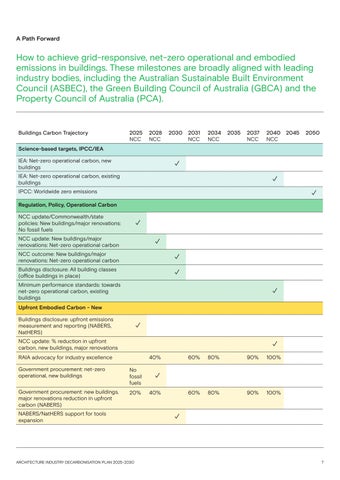
How to achieve grid-responsive, net-zero operational and embodied emissions in buildings. These milestones are broadly aligned with leading industry bodies, including the Australian Sustainable Built Environment Council (ASBEC), the Green Building Council of Australia (GBCA) and the Property Council of Australia (PCA).
Science-based targets, IPCC/IEA
IEA: Net-zero operational carbon, new buildings
IEA: Net-zero operational carbon, existing buildings
IPCC: Worldwide zero emissions
Regulation, Policy, Operational Carbon
NCC update/Commonwealth/state policies: New buildings/major renovations: No fossil fuels
NCC update: New buildings/major renovations: Net-zero operational carbon
NCC outcome: New buildings/major renovations: Net-zero operational carbon
Buildings disclosure: All building classes (office buildings in place)
Minimum performance standards: towards net-zero operational carbon, existing buildings
Upfront Embodied Carbon - New
Buildings disclosure: upfront emissions measurement and reporting (NABERS, NatHERS)
NCC update: % reduction in upfront carbon, new buildings, major renovations
RAIA advocacy for industry excellence
Government procurement: net-zero operational, new buildings
Government procurement: new buildings, major renovations reduction in upfront carbon (NABERS)
NABERS/NatHERS support for tools expansion