

The Bishop’s 150 wives
How a missionary bishop in the Northern Territory acted to protect the dignity of women and girls - Pages 10-11


Apostles on Board
Cruise ship chaplains have complex jobs - to say the least ... Page 12

Good, bad, news for British Christians after Euro Court discrimination cases
Flight attendant wins case
THE EUROPEAN Court of Human Rights has ruled that the British government violated the rights of an airline flight attendant by failing to protect her right to conscience and religion.
It found that Nadia Eweida, 60, a Coptic Christian, suffered discrimination when she was told by British Airways, her employer, to stop wearing a cross on her uniform.
Her case was one of four claims of religious discrimination against English Christians heard by the court, but the only one to succeed.
A January 15 ruling dismissed the cases brought by Gary McFarlane, a relationships counsellor fired after he said he had a moral objection to offering therapy to same-sex couples; Lillian Ladele, a registrar who objected to presiding over civil partnership ceremonies for same-sex couples; and Shirley Chaplin, 57, a nurse who said she was forced from her job for wearing a cross in breach of uniform policy.
McFarlane and Chaplin said they would appeal the judgement.
The court decided that in the case of Eweida there had been a violation of Articles 9 and 14 of the European Convention on Human Rights, which protect freedom of thought, conscience and religion and prohibit unjust discrimination.
It awarded her US$2,670 in
Continued on Page 7

Annual statements keep leprosy scourge in mind
WHILE THE global rate of new infections of Hansen’s disease, or leprosy, continues to decline, the stigma associated with the disease has not, and that often is the focus of annual Church statements marking World Leprosy Day.
For the past 60 years, Christians around the world have marked the last Sunday of January as a day to pray for those with Hansen’s disease, to raise awareness about it and to thank ministers and health care workers – many of them Catholic – who offer treatment, therapy and support to patients.
Pope Benedict XVI and the president of the Pontifical Council for Health Care Ministry traditionally both issue messages for World Leprosy Day, which is January 27 this year.
According to the World Health Organisation, which provides free
medication for Hansen’s disease patients around the world, since 1985 there has been a “dramatic decrease in the global disease burden”.
WHO reported the number of Hansen’s cases went “from 5.2 million in 1985 to 805,000 in 1995 to 753,000 at the end of 1999 to 181,941 cases at the end of 2011”.
While great strides have been made in eradicating the disease, WHO said, “pockets of high endemicity” remain in some areas of Brazil, Indonesia, the Philippines, Congo, India, Madagascar, Mozambique, Nepal and Tanzania.
World Leprosy Day was begun by Raoul Follereau, a French writer and poet, who first encountered people with Hansen’s disease in North Africa in the late 1930s and began speaking tours and raising money for treatment facilities. In

on Molokai. He soon gained a reputation as a pastor, medic, adviser and guardian to the 800 members of the colony.
He campaigned vigorously for improvements in the colony and for greater respect for the dignity of people with the disease, who were treated as social outcasts at the time.
Fr Damien contracted the disease in 1884 but continued working in the colony until a month before his death in 1889, at age 49.
Fr Damien was beatified in 1995 by Blessed John Paul II and canonised by Pope Benedict in 2009.
In October, Pope Benedict canonised St Damien’s successor, Mother Marianne Cope of Molokai, a Sister of St Francis who travelled from the US to Hawaii to take over the ministry. - CNS
Wednesday, January 23, 2013 atio N the W orld therecord com au the R ecoRd WESTERN AUSTRALIA’S AWARD-WINNING CATHOLIC NEWSPAPER SINCE 1874 $2.00
Nadia Eweida, 60, a Christian, poses for a photograph in a church in London on January 15. Eweida, an employee who was asked by British Airways to remove a cross from around her neck, has won a religious discrimination case at Europe’s human rights court, but three other claimants lost similar cases. PHOTO: LUKE MCGREGAOR, REUTERS
1964, he met Pope Paul VI at the Vatican and asked the Pope to beatify Father Damien de Veuster of Molokai, Hawaii. In 1873, Fr Damien was assigned to work at what was then called a leper colony
Saint Damien de Veuster in bed shortly before he died in 1889 at the Kalawao settlement on the Hawaiian island of Molokai. PHOTO: CNS

Even mummies get endoscopy
EXPERTS have just concluded a two-year study on the seven adult mummies in the Vatican Museums’ collections.
The mummies underwent a full battery of X-rays, CT scans, endoscopic explorations, histological exams and a whole spectrum of genetic testing, leading one researcher to joke: “These mummies have gotten more medical attention now than when they were alive.”
In fact, scientists can now make the kind of diagnoses ancient Egyptian doctors were probably unable to divine.
The scientific advancements in genetics, imaging technology and nano research also have brought new and unexpected discoveries with minimally invasive techniques – a far cry from the “unwrapping” autopsies of the 19th century.
For one thing, the mummy Ny-Maat-Re, “who we always referred to as ‘she,’ is in fact actually a man,” said Alessia Amenta, Egyptologist and curator of the Vatican Museums’ Department for the Antiquities of Egypt and the Near East.
The hieroglyphics on the mummy’s three-dimensional painted coverings made of plaster and linen bandages – called cartonnage –had identified it as “the daughter of Sema-Tawi”. But 3-D CT scan results from early January showed the never-unwrapped mummy is clearly male, Amenta said.
“This discovery is very recent and opens a whole host of questions we hope we will be able to answer,” she said. The Vatican Museums used its

own diagnostic laboratory for the first phase of tests, which included the X-rays and endoscopies.
But Amenta then turned to the EURAC-Institute for Mummies and the Iceman – in the northern Italian city of Bolzano – which specialises in gathering and analysing ancient genetic and other data from mummies.
Albert Zink, scientific director of the institute, presented the results to the Vatican and the public on January 17.
The studies were a major milestone in the Vatican’s Mummy Project, begun in 2007 to analyse and better preserve its mummy collection.
Mummies are unlike any other museum treasure – be it a price -

Editor
Peter Rosengren editor@therecord.com.au
Accounts accounts@therecord.com.au
Journalists
Mark Reidy m.reidy@therecord.com.au
Robert Hiini r.hiini@therecord.com.au
Sarah Motherwell s.motherwell@therecord.com.au
Juanita Shepherd j.shepherd@therecord.com.au
Advertising/Production
Mat De Sousa production@therecord.com.au
Classifieds/Panoramas/Subscriptions
Helen Crosby office@therecord.com.au
Record Bookshop
Bibiana Kwaramba bookshop@therecord.com.au
Proofreaders
Eugen Mattes Chris Jaques
Contributors
Debbie Warrier Mariette Ulrich
Barbara Harris Fr John Flader
Bernard Toutounji Glynnis Grainger
The Record PO Box 3075
Adelaide Terrace
PERTH WA 6832
21 Victoria Square, Perth 6000
Tel: (08) 9220 5900 Fax: (08) 9325 4580
Website: www.therecord.com.au
less pottery shard or prehistoric arrowhead – because a mummy is a human being, Zink and Amenta agreed.
A mummy must be studied, moved and displayed in a dignified and respectful manner, Amenta said. “These are people who had a life, who loved, who lived, had kids, suffered from diseases and mourned like each one of us,” she said.
From a conservation standpoint, it also means a mummy has special needs for storage and exhibition, especially with a climate control system to inhibit its decay and best maintain its mummified state, Zink said.
As far as research goes, mummies are a treasure trove of valuable

information because everything about them – how their teeth have worn down, the contents of their stomachs, how they were dressed and buried, what diseases or ailments they suffered from – all provide numerous clues to the lives, customs and religious beliefs of ancient peoples, Amenta said.
Even more importantly, discovering the different forms of cancers or other illnesses in the ancient individuals provides valuable insight into today’s diseases and how they evolved genetically over time.
“We can reconstruct the evolutionary pathways of important diseases such as tuberculosis or malaria that are still present today and are still a major health problem,” Zink said. The tiniest bit of genetic
material can provide astonishing details, he said, like when they discovered that the 5,000-year-old Iceman in EURAC’s care was lactose intolerant and had Lyme disease.
“These mummies are important resources for all kinds of research and, if they aren’t conserved in a good way, we lose a lot of information because their protein and DNA degrades,” he said.
As the Vatican Museums continues their conservation efforts, the next step will be examining the two child-size mummies which, Amenta said, might actually be mummified animals or falcons, which would not be unusual.
Examinations also began in January on the many layers of linen wrappings on a second mummy, she said.
The wrappings around the face and neck had been ripped or cut open by someone long ago – probably looking for the precious jewels and gold often positioned under the wrappings or around the face of mummies, she said.
The woven wrappings display “splendid craftsmanship” and, since they’re cut rather cleanly open, experts can look for clues in the different layers, much like a geologist would.
In June, together with the Louvre in Paris and the Dutch National Museum of Antiquities in Leiden, the Vatican will host the “First Vatican Coffin Conference”.
The Vatican is spearheading the initiative to study the construction and painting techniques of sarcophagi during Egypt’s so-called Third Intermediate Period, which was 3,000 years ago.
It will be the first time internationally renowned scholars from a variety of disciplines will compare their research on the period’s coffins, which reflect the clerical culture of the increasingly powerful Theban high priests, she said. - CNS
READINGS OF THE WEEK
Sunday 27th - Green 3RD SUNDAY IN ORDINARY TIME
1st Reading: Neh 8:2-6.8-10 A sacred day
Responsorial Ps 18:8-10.15
Psalm: Spirit and life
2nd Reading: 1 Cor 12:12-30
One body, one Spirit
Gospel Reading: Lk 1:1-4; 4:14-21 Ordered account
Monday 28th - White ST THOMAS AQUINAS, PRIEST, DOCTOR OF THE CHURCH (M)
1st Reading: Heb 9:15.24-28
Christ’s one sacrifice
Responsorial Ps 97:1-6
Psalm: Acclaim the Lord Gospel Reading: Mk 3:22-30 Kingdom divided
Tuesday 29th - Green 1st Reading: Heb 10:1-10 I come to do your will
Responsorial Ps 39:2,4,7-8,10-11


Psalm: An open ear Gospel Reading: Mk 3:31-35 The will of God
Wednesday 30th - Green 1st Reading: Heb 10:11-18 Eternal perfection
Responsorial Ps 109:1-4
Psalm: A priest for ever Gospel Reading: Mk 4:1-20
Sowing the word
Thursday 31st - White
ST JOHN BOSCO, PRIEST (M)
1st Reading: Heb 10:19-25
Filled with Faith
Responsorial Ps 23:1-6
Psalms: Seek the face of God
Gospel Reading: Mk 4:21-25
Lamps on a stand
Friday 1st - Green
1st Reading: Heb 10:32-39
Live by faith
Responsorial Ps 36:3-6,23-24,39-40
Psalm: Trust in the Lord
Gospel Reading: Mk 4:26-34
The seed grows
Saturday 2nd - White THE PRESENTATION OF THE LORD (FEAST)
1st Reading: Mal 3:1-4
Sudden entrance
Responsorial Ps 23:7-10
Psalm: King of glory
2nd Reading: Heb 2:14-18
Slaves set free
Gospel Reading: Lk 2:22-40
This child a sign

John Bosco 1815–1888 January 31 Born to a poor family in Italy, this patron saint of editors and laborers is considered one of the great social saints. Ordained a priest in 1841, he was sent to study theology in Turin, where he became a magnet for neglected youths during a turbulent period of rapid industrialization and revolutionary politics. Don Bosco, who once hoped to become a foreign missionary, founded the Salesians in 1854. The order sheltered more than 800 orphan boys, then opened workshops for shoemakers, tailors, bookbinders and other trades. Don Bosco was also a prolific writer, and co-founded a women’s congregation to work among girls. When he died, more than 40,000 people in Turin filed past his coffin to show their love and respect. Saints CNS © 2013 Catholic News Service January 23, 2013 200 St. George’s Terrace, Perth WA 6000 Tel: 9322 2914 Fax: 9322 2915 Michael Deering 9322 2914 AdivisionofInterworldTravelPtyLtdLicNo.9TA796A division of Interworld Travel Pty Ltd ABN 21 061 625 027 Lic. No 9TA 796 michael@flightworld.com.au www.flightworld.com.au • CRUISING • FLIGHTS • TOURS • FW OO2 12/07 Thinking of that HOLIDAY ? • Flights • Cruises • Harvest Pilgrimages • Holiday Tours • Car Hire • Travel Insurance Personal Service will target your dream. SAINT OF THE WEEK Correction Last week, The Record Bookshop had advertised the St Paul’s Weekday Missal for $39.95. This price was in fact for the Sunday Missal and the actual price of the Weekday Missal is $79.95. The Record apologises for this error.
The Record is a weekly publication distributed throughout the parishes of the dioceses of Western Australia and by subscription. The Record is printed by Rural Press Printing Mandurah and distributed via Australia Post and CTI Couriers. LOCAL 2 therecord.com.au
Send your Year of Grace stories to parishes@therecord.com.au VATICAN
WORLD SNAPSHOT
Cinzia Oliva, a textile restorer from Turin, Italy, who specialises in mummy wrappings, puts the finishing touches on restoring the mummy Ny-Maat-Re in the Vatican Museums’ collections.
PHOTO: VATICAN MUSEUMS
WA Catholic schools bring more to the table
By Sarah MotherwellACADEMIC league tables are a poor reflection of a holistic education, Western Australia’s Catholic Education Director Tim McDonald said this week after Catholic schools missed out on placing in the state’s top 10 of best performing schools.
The list, which ranked schools based on the number of students who achieved a WA Certificate of Education Stage 3 course score of 75 or higher, was topped last year by prestigious public school Perth Modern.
John XXIII College in Mount Claremont was the highest-rank-
ing Catholic school in last year’s results, coming in at 15th, followed by Sacred Heart College in Sorrento at 18th.
Mr McDonald said students should not be defined by their Australian Tertiary Admission Rank (ATAR) as it is only one indicator of success.
“We don’t hold much faith or store in the league tables because they measure one aspect of a holistic education – there is more to schooling than an ATAR,” he said.
“What distinguishes Catholic education is we cater for bright kids and a whole range of individual needs.”
Mr McDonald said Kolbe Catholic College in Rockingham was a great example of a school catering to the needs of all its kids, ranking highly on both the academic and vocation league tables.
While every year about a dozen Catholic schools place in the top 50 of the academic table – any appearance of a Catholic school in the top 10 has been far and few between.
Over the past six years, the only Catholic schools to rank in the top 10 have been Mercedes College in Perth, which ranked 8th in 2011, Santa Maria College in Attadale at 9th in 2008 and St Joseph’s College in Albany at 6th in 2006.
Catholic Agricultural College Bindoon topped the 2012 vocation education and training (VET) league table, accompanied by fellow Catholic school Clontarf Aboriginal College in Waterford, which ranked 9th. Bindoon College’s acting coprincipal for 2012, Martin Tobin, said the school’s excellent teachers and training staff, as well as the development of the trade centre, were keys factor in making it the best VET school in the state.
“One of the things we talk about with our students is about the concept of practical excellence in their work - in the classroom or the pride they take in their work on
the farm,” he said.
“I think the key thing overall is it is a good caring environment for students”.
Mr Tobin said students who completed VET courses were encouraged to do the highest level of mathematics and English.
“We’re not trying to dumb down their courses, we’re trying to challenge them in other areas as well.”
Mr Tobin said the school was drawing enrolments from all across WA and more kids from the metropolitan area who have not grown up on farms were increasingly attracted to the school’s agricultural studies.
Sydney visit a blast for youth leaders
Maddington parishioner Sheldon Burke reports on what it was like to participate in a youth leadership camp run by the Archdiocese of Sydney ...
NINETEEN youth leaders from across Australia, accompanied by four full time staff plus a chaplain, embarked on an opportunity of a lifetime as they participated in a Youth Leaders Formation Course (YLFC) from November 27 to December 22, 2012 at Campion College, Toongabbie, hosted by the Archdiocese of Sydney.
While most participants were local, there were also representatives from various dioceses around Australia including Darwin, Parramatta, Toowoomba, Brisbane, Broken Bay, Wollongong, Melbourne and two from Perth, Sheldon Burke and Georgia Naughton–Watt from Ballajura Parish.
We were blessed to learn more about our faith and undergo formation in the area of Christian leadership, plus deepen our understanding of the Catholic Church.
The month-long journey involved daily Masses, Divine Office prayers and two lectures per

day, by inspiring local and national speakers who covered relevant topics such as ‘Why Mary Matters’, Apologetics, The Scripture and Leadership EQ, just to name a few.
A highlight was the Parish Mission that was held at Sacred Heart Catholic Church, Cabramatta.
This involved catechesis with primary school kids, evangelisation programs and a moving ‘Mercy Night’.
Other notable activities included a silent retreat, shrine time at the Schoenstatt Shrine, a social out-

reach program and the final Mass and commissioning celebrated by Cardinal George Pell. We were all blessed to be engaged in so many fun and empowering activities where we grew in discipleship, and which allowed us to form lifelong friendships. YLFC was cer-
tainly one of the best ways to have a personal encounter with Christ, and it also equipped us to become new apostles of the 21st century. This life changing course is to be recommended to young adults who are searching for a deeper understanding of their faith, and
I strongly encourage those in need to take up the challenge, and apply for future Youth Leaders Formation Courses, as it’s an experience that will remain in their hearts forever.
Perth delegates thanked the Catenian Association for supporting them to attend the YLFC.

January 23, 2013 LOCAL 3 therecord.com.au
Sheldon Burke and Georgia Naughton-Watt from Ballajura Parish, above, travelled to Sydney to immerse themselves in the world of youth leadership. Participants, at right, enjoy the experience.
PHOTO: SUPPLIED
Emily steps up to serve in heartland
EMILY Hunter’s significant contribution to Aboriginal healthcare in the Kimberley has made the Notre Dame Nursing graduate a well respected community member in the eyes of her patients.
Ms Hunter said she was “very proud” of being recognised as an Aboriginal Registered Nurse in her local community and would like to encourage more nurses and healthcare professionals to consider working in rural and remote Western Australia. After graduating from The University of Notre Dame Australia’s Broome Campus in 2004, Ms Hunter completed her graduate program at Broome Hospital where she is currently employed as a Registered Nurse.
She divides her time between the emergency department and triage which puts her in close contact with nearly all of Broome’s inbound and outbound patients.
Over the past eight years at Broome Hospital, Ms Hunter has applied her clinical knowledge to many areas including the general ward, theatre, day surgery, paediatric ward, outpatients, infection control and the medical imaging department. Despite the challenges of working in a regional location, Ms Hunter says she thoroughly enjoys her role and takes pride in delivering quality healthcare.

Having witnessed the lack of quality healthcare present in many Aboriginal communities ... I felt compelled to enter into a career where I could assist in providing these essential services to Aboriginal people.”
- Emily Hunter, Notre Dame Nursing graduate

“I think the best part about working in country health is the initial help you give someone as well as the hands-on nature of the job,” Ms Hunter said.
“Being an Aboriginal woman and having lived in the Kimberley my whole life, I’m known to many of our patients who can relate to me and place their trust in me to look after them.
“Having witnessed the lack of quality healthcare present in many Aboriginal communities throughout my childhood, I felt compelled


Designed to help you keep the Word of God close to your heart in your daily life. Pray with it, share it and make your life a daily celebration with the word of God. Grow in God’s love, being nourished daily by his word, the bread of life.

to enter into a career where I could assist in providing these essential services to Aboriginal people.”
Ms Hunter, a mother of three, first enrolled in a Bachelor of Education at Notre Dame’s Broome Campus to seek a career in primary school teaching after working as a bookkeeper for several years. However, she said something inside her told her to follow in her father’s footsteps and enter the field of Aboriginal healthcare.
Ms Hunter’s father, Dr Arnold ‘Puggy’ Hunter, was the Chair
of the National Aboriginal Community Controlled Health Organisation and an adviser to the House of Representatives Standing Committee on Family and Community Affairs and its inquiry into Indigenous health. For his significant contribution to Aboriginal and Torres Strait Islander health, he received an honorary doctorate from James Cook University and has an Australian Governmentfunded scholarship, the Puggy Hunter Memorial Scholarship, named in his honour which assists
Indigenous undergraduate students studying health-related disciplines.
Ms Hunter said the support she received from her family gave her the values of compassion, respect and tolerance. She also acquired extensive local knowledge and vital communication skills from her family, which are important in her role.
“My parents always expressed to us the value of education and they were extremely supportive of me and my career goals,” Ms Hunter said.
“As with anything in life, to achieve success you need to put in the hard work. With Notre Dame offering the Bachelor of Nursing program on its Broome Campus, there’s more opportunity for students in the Kimberley to study this course and work in an extremely rewarding area.
“The support I had from the Broome community and people from the Kimberley region was priceless and really enhanced my learning experience at Notre Dame.”
- Thinking of studying Nursing at Notre Dame’s Broome Campus? For course information and contact details, please visit http://www.nd.edu. au/broome/courses or call the Prospective Students Office on (08) 9433 0555.
Parish priest surveys damage after storm hits Karlgarin
 By RoBeRt Hiini
A FREAK storm has torn the roof of Our Lady Help of Christians, Karlgarin asunder, leaving a gaping hole and the remaining portion of roof severely damaged by rain.
No building in the 120-person town was left untouched when the storm ripped through the remote locale on Tuesday, January 15 at around 4.30pm.
Parish Priest Fr Sebastian Fernando, who celebrates Mass twice a month at Karlgarin as one of the five Mass centres in his Corrigin/Kulin parish, said he was shocked by the extent of the damage done to the town.
“One of our parishioners called me on Wednesday morning and told me of the havoc caused by the storm,” Fr Fernando told The Record
“I went to Karlgarin almost immediately to assess the damages. The whole township looked like a war zone.”
Fr Fernando advised Archbishop Timothy Costelloe SDB of the damage done to the church on Thursday.
“The western side of the roof

was stripped of its clips and laid scattered like squashed aluminium foils. The other side of the roof is severely damaged by rain.
“By the look of it, the whole roof section needs replacement,” Fr Fernando said.
The Blessed Sacrament was not reserved in the church but Fr Fernando secured the sacred vessels and the sacramentary.
Fr Fernando praised the efforts of the State Emergency Service Team who covered the exposed roof with a tarpaulin to safeguard
the church’s contents from rain. The church was built as a nondenominational place of worship in the late 1960s, largely by nonCatholic Christians, Fr Fernando said. Steady migration out of the town since then has meant that only the Catholic Church continues to use the building for worship.
The four families who frequent the church for monthly Mass haven’t got far to travel to worship, with the next Mass centre in the parish, Our Lady of Sorrows, Hyden, being less than 15km away.
January 23, 2013 LOCAL 4 therecord.com.au
2013
Top and above, the extent of destruction to Our Lady of Help Christians, Karlgarin was evident inside and out after a freak storm. PHOTO: SUPPLIED
GOD’S WORD


Better days ahead for the voiceless
By Sarah MotherwellFOR the first time, thousands of people in the southeastern Nigerian village of Amurri have access to clean drinking water thanks to a small Perth-based ministry.
After a year of construction, Voice of the Voiceless (VOV) turned the taps on the “Barry Hickey Clearwater Project” - a 380ft deep water bore which will provide about 5,000 people in nine villages with clean water.
Before the bore was built, the only clean water in the area was five kilometers away and villagers would either have to boil the polluted water from the local stream or buy expensive bottled water.
VOV chairperson, Frank Mallard, said the trip to Nigeria to open the bore was “life changing” and could not believe people were living without water in the 21st century.
“They live day to day with the expectation that tomorrow is going to be better - and it’s not better - but they live for the next day because
the next day may be better.”
The ministry’s financial administrator, Freddie Lowe, said he was moved by how happy the people in Amurri were, despite living in such abstract poverty.
“I couldn’t imagine life that is so backwards that they don’t have things we’ve taken for granted like running water to the house, sanitation, electricity – they are so poor, there is nothing,” he said.
VOV began in 2006 and currently has 50 active members who help provide aid to remote international areas and communities.
Fr Nicholas Nweke said the ministry began planning the bore’s construction in 2011 after thenArchbishop Hickey entrusted them with helping the village, which had made a plea to him for help during his visit to Africa in 2005.
He said the project, which cost more than $50,000, was named after Archbishop Emeritus Hickey to thank him for supporting the ministry from the beginning and for ordaining three young men from Nigeria.

January 23, 2013 LOCAL 5 therecord.com.au
Above and right, Archbishop Emeritus Barry Hickey samples water from the water project bearing his name. The bore, funded by Perth’s Voice of the Voiceless ministry, will provide nine impoverished Nigerian villages with water.
PHOTO: VOV MINISTRY
Left, Archbishop Barry Hickey, VOV founder Fr Nicholas Nweke, and Perth VOV members in the village of Amurri, Nigeria. Above, newly installed taps await the opening honours of Archbishop Hickey. PHOTO: VOV MINISTRY
First UK Ukrainian eparch

POPE Benedict XVI has raised the Church jurisdiction for Ukrainian Catholics in Great Britain to the level of an eparchy, or diocese, and named the bishop who had been its exarch to be the eparchial bishop.
The new diocese will be known as the Eparchy of the Holy Family of London, the Vatican announced on January 18.
Bishop Hlib Lonchyna, who had served as apostolic exarch for Ukrainian Catholics in Great
Britain since 2011, continues but with a new title, the Vatican said.
According to Vatican statistics, there are just over 10,000 Ukrainian Catholics in Great Britain, and they are served by 12 diocesan priests. The elevation of the jurisdiction to an eparchy or diocese usually indicates a growth in the stability of a Catholic population and of priests and religious to serve them.
In an email response to questions, Bishop Lonchyna said, “An exarchate is a temporary structure and may be suppressed if there is no need for it”, for example, if most of the people have died or moved away.
“But an eparchy, like a diocese,
is permanent; it may not be suppressed. If, however, there no longer are any faithful, it becomes a titular see,” which are the dioceses assigned to auxiliary bishops.
As for the name of the new eparchy, the bishop said it is taken from the name of the Ukrainians’ cathedral church in London, Holy Family.
After serving as the spiritual director of the major seminary in Lviv, Ukraine, and teaching at the theological academy there, he was consecrated an auxiliary bishop of Lviv in 2002. He moved to London in 2009 as apostolic administrator. - CNS
Pilgrims walk in the footsteps of Christ

Future homilists - learn from the Fathers
IN LEARNING to preach, seminarians should look to the homilies of the fathers of the Church, where they will discover how eloquence and humility lead to “beauty and delight,” said Cardinal Daniel DiNardo of GalvestonHouston.
“If we could get at least part of this demeanour in our preaching and homiletic activity,” the cardinal said, referring to a homily by St Augustine, “the very energy of
It is ‘God-talk’ and always leads to spiritual and moral discernment, bringing people closer to God.
the Word of God will find a place in our lives of ministry and make our ministry a harmony of doxology and wisdom.”
The cardinal delivered the annual Carl Peter Lecture on Preaching on January 13 at the Pontifical North American College, the US bishops’ seminary in Rome. Earlier in the day, he

instituted 55 NAC seminarians into the ministry of lector, a step on their way toward ordination to the diaconate and priesthood. In the lecture, Cardinal DiNardo said he wanted to offer practical, pastoral observations as a preacher and one who loves the great early church theologians.
Almost all of the theologians recognised as fathers of the Church were bishops who preached regularly, the cardinal said, and scholars continue to study their sermons today.
“There is great vitality in their homilies,” he said. “The only exception I can think is St Cyril
VATICAN
Vatican seeks Tebow’s help for new sport ethic
In an effort to flex its moral muscle in the professional sports arena, the Vatican has invited top-tier Christian athletes Tim Tebow and Jeremy Lin to help bring ethical values back to a scandal-ridden world of sports. The Pontifical Council for Culture is planning to host an international conference on re-instilling values in sports this spring, inviting representatives from top world governing bodies like FIFA (the International Federation of Association Football), the International Cycling Union and the Italian National Olympic Committee. Mgr Melchor Sanchez de Toca Alameda, head of the council’s “Culture and Sport” section, told Catholic News Service on January 16 that pro sports “have become a commodity that is subordinate to the free market and, therefore, to profit”. Instead of sports being an activity that builds important values, respects human dignity and helps shape the whole human person, “it has reduced people to merchandise”, he said. - CNS
MALI
Christian fear increases in wartorn Mali
A Catholic bishop in war-torn Mali whose diocese lies in the path of Islamic insurgents said “people are hiding in their homes, unable to venture out”. Bishop Augustin Traore of Segou, Mali, told Catholic News Service by telephone: “Although our churches are still intact, people are becoming afraid to enter them. Our entire Catholic culture will clearly be in danger if this conflict drags on. “Until the havoc caused by the French bombing ends and the hostilities cease, no one will be in a position to know what has happened,” he said after noting that the country’s churches could face destruction if conflict continues. Bishop Traore spoke to Catholic News Service on January 16 as French combat troops prepared to engage government rebels at Diabaly, 90 miles north of Segou. Meanwhile, Helen Blakesley, regional information officer for Catholic Relief Services, said more than 200,000 Malians had migrated to the south since a March 2012 military coup, while a similar number had fled to Niger, Burkina Faso, Morocco and Algeria. - CNS
TURKEY
of Alexandria who is very repetitious, a practice that is wearing.
“There is a droll comment from St Augustine about the need to avoid being boring even to oneself in preaching, the sure sign that one is boring the congregation,” he said.
The patristic homilies, like the best homilies given today, “seize the hour and time, the place and the tenor of a congregation, and bring the ever new Word of God to the situation at hand,” Cardinal DiNardo told the seminarians.
While the fathers of the Church were accomplished theologians, preachers and orators, he said, readers can see how often they simplified “their style and vocabulary to fit the artless but beautiful form that the expression of Christian faith demanded,” especially when preaching to catechumens and to the uneducated.
Modern Catholic preachers also are called to ensure, like the fathers of the Church, that their preaching is biblical, theological and sacramental, the cardinal said.
“It is God-talk,” he said, and “always leads to spiritual and moral discernment” and is concerned about bringing people into closer union with God. - CNS
Refugees languish in Turkey as they wait
Hafiz Karim fled with his family to Turkey after extremists in Iraq threatened to kill them all if they didn’t sell their Baghdad restaurant and move out of the neighbourhood. That was two years ago. The Catholic family of six now lives in a threeroom basement apartment in an immigrant neighbourhood of Istanbul, waiting for relocation to the US or Australia. The couple and their four daughters are among tens of thousands of refugees in Turkey facing longer waits for asylum to third countries and decreasing services from aid organisations, churches and charities. Several such refugee aid groups reported in early January to CNS that they were struggling to contend with the rapidly growing numbers of refugees in Turkey seeking help due to war, political tension and other instabilities in their home countries. Worsening the situation, said these organisations, is the war in Syria, which has sent more than 200,000 Syrians into Turkey. Though many of them are being sheltered in Turkish government-run relief camps on the Turkish-Syrian border, an estimated 60,000 to 70,000 of them are not, estimated aid groups. - CNS
WORLD January 23, 2013 therecord.com.au 6
Franciscan priests walk before the start of a baptism ceremony at the baptismal site known as Qasr el-Yahud near the West Bank city of Jericho on January 13. Hundreds of Christians gathered on the banks of the Jordan River at the traditional site where it is believed John the Baptist baptised Jesus. PHOTO: RONEN ZVULEN,
Seminarians pray. An American cardinal has urged future priests to model their homilies on the early fathers of the Church in order to learn eloquence. CNS
Bishop Hlib Lonchyna, 58, the new eparch for Ukrainian Catholics in Great Britain PHOTO: CNS
Even nonbelievers seek God
THE DESIRE to see and know God is innate in everyone, even nonbelievers, Pope Benedict XVI said.
But it’s especially important that people don’t just seek God when they need him but make room for him throughout their busy lives, he said during his weekly general audience in the Vatican’s Paul VI hall on January 16.
At the end of the audience, the Pope also greeted US Defence Secretary Leon Panetta, a Catholic.
The brief encounter came during the so-called “baciamano”, the moment when the Pope offers a select group of prelates and special guests a brief handshake one-byone rather than a private audience.
Justice and kindness the ecumenical path: BXVI
LIKE THE individual path to holiness, the ecumenical path to Christian unity requires justice, kindness and humility, Pope Benedict XVI told members of a pilgrimage from the Evangelical Lutheran Church of Finland.
On the path of Christian discipleship, he said, “we are called to advance together along the narrow road of fidelity to God’s sovereign will in facing whatever difficulties or obstacles we may eventually encounter.”
The more Christians walk together, they will become beacons of joy.
Pope Benedict met the Finnish delegation on January 17, the eve of the annual Week of Prayer for Christian Unity. The theme chosen for the 2013 observance was: “What does God require of us?”
Progress in the ecumenical journey, he said, “demands that we become ever more united in prayer, ever more committed to the pursuit of holiness and ever more engaged in the areas of theological research and cooperation in the service of a just and fraternal society.”
The Pope told his 12 Finnish guests that the closer Christians walk together along the path of justice, mercy and righteousness, the more they will be “beacons of joy and hope to all those who are looking for a sure point of reference in our rapidly changing world.”
The Pope spoke at length with the former CIA director, who was smiling and gently holding both of the Pope’s hands, and gave him one of the medallions reserved for special guests.
Panetta said later that the Pope told him, “Thank you for helping to protect the world.” Panetta said he replied, “Pray for me.”
Panetta, stepping down as Pentagon chief, was in Rome to meet with European defence ministers to discuss the conflicts in Afghanistan and Mali.
During his catechesis dedicated to the Year of Faith, the Pope said, “The desire to really know God, that is, to see the face of God, exists
in everyone, even atheists.” It can even be an unconscious desire simply to know “who is he, what is he for us?” the Pope said.
That yearning finds fulfilment in Christ, he said; as Jesus told his disciples, “Whoever has seen me has seen the Father.”
The Pope said it was important to follow Christ “not just in those moments when we need him” but to “find room for him in our daily tasks” and throughout one’s life.
“The splendour of the divine countenance is the source of life, it’s what lets one see reality” and its light is a sure guide in life, he said.
At the end of his catechesis, the Pope made an appeal for people to
join the observance of the Week of Prayer for Christian Unity from January 18-25. The theme for this year’s week is “What does God require of us?”
“I invite everyone to pray, ceaselessly asking God for the great gift of unity among the disciples of the Lord. May the inexhaustible power of the Holy Spirit encourage us in a sincere commitment to the search for unity, so that together we may all profess that Jesus is the Saviour of the world,” he said. - CNS

Meeting world’s bishops a 7-year task
IT TOOK more than seven years, but Pope Benedict XVI has hosted the formal visits of bishops from every country in the world and will begin the cycle all over again by meeting the heads of Italy’s 227 dioceses in 2013.
The Code of Canon Law calls for the heads of every diocese in the world to make their formal visit ad limina apostolorum (“to the threshold of the apostles”) every five years, but there are now almost 2,900 dioceses in the world and the 85-year-old Pope also has other obligations as well.
Archbishop Lorenzo Baldisseri, secretary of the Congregation for Bishops, which coordinates the visits, told CNS “the firm principle is that the Pope must meet the bishops of the whole world regularly”.
The five-year rhythm set by canon law provides concrete guidance but is not always possible to follow because of the number of bishops in the world, the Pope’s schedule and the schedules of the bishops.
In an interview published by the Vatican newspaper on January 5, Archbishop Baldisseri said that when the bishops of France finished their ad limina visits in November, members of every bishops’ conference in the world had met Pope Benedict.
The order in which bishops’ conferences make the visits is not strictly set, which means that although the French bishops had never had an ad limina with Pope Benedict, the bishops of Papua New Guinea had two: one in June 2005 and the second in June 2012. Government
restrictions prevent the bishops of communist-controlled mainland China from making their ad limina visits, although the bishops of Hong Kong and Macau had their meet-
When French bishops visited the Pope in November it meant all the world’s bishops had met met him.
ings with Pope Benedict in 2008. He told L’Osservatore Romano, the Vatican newspaper, that the importance of visiting and consulting with the Pope, the successor of St Peter, goes back to St Paul’s description in
the Letter to the Galatians of returning to Jerusalem for consultations with St Peter.
However, he said, it wasn’t until 743 that Pope Zachary made it a universal rule. The rule was reconfirmed by Pope Sixtus V in 1585.
“The bishops are invited periodically to come to Rome to see Peter, make a pilgrimage to the tombs of the apostles Peter and Paul – founders of the Church of Rome – and to express and reinforce the unity and collegiality of the Church,” he said.
The visits are not just “a simple juridical-administrative exercise”, he said, but “an experience of pastoral communion, participating in the concerns and hopes” of the Church on the local and universal levels. - CNS
UK Airline attendant wins case
Continued from Page 1 compensation and a further $40,000 in costs. The four took their fight to Europe after the highest British courts defended their former employers.
Speaking after the January 15 judgement, McFarlane said, “I simply wanted to do my job in light of my Christian identity, but I was policed and punished for my thoughts, for my beliefs.”
McFarlane added: “Recent equality legislation has not led to greater respect for difference but to the punishment of difference of opinion.” - CNS
January 23, 2013 WORLD 7 therecord.com.au
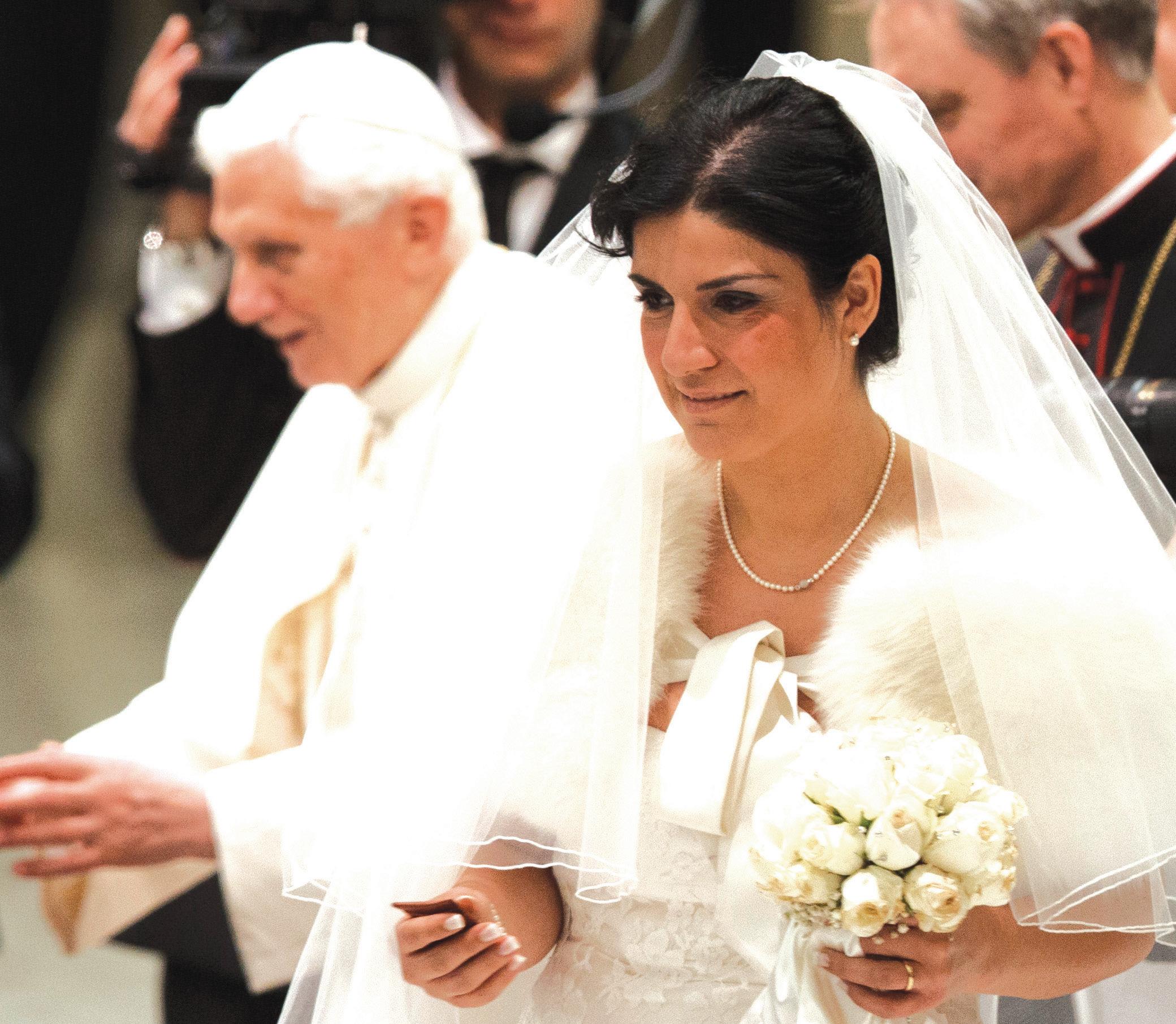
A recently married bride walks away after meeting Pope Benedict XVI during his general audience in Paul VI hall at the Vatican on January 16. Newly married couples meeting the Pope at general audiences has become a tradition at the Vatican.
PHOTO: PAUL HARING
US Defence Secretary Leon Panetta smiles after meeting Pope Benedict XVI on January 16. PHOTO: PAUL HARING
‘Visions’ a possible threat say bishops
FIVE Catholic bishops cautioned Nigerian government leaders about a series of statements from Pentecostal and indigenous religious leaders portending tragedy.
The bishops of the Ibadan province said in a statement released on January 14 that the warnings, or visions as described by the religious leaders, may be a tactic to control the actions of political and government officials.
“We feel a sense of duty to call for caution in this regard and warn that, while prophetic gifts, private revelations and visions may have a religious basis, care must be taken not to see them as substitutes for
personal and corporate responsibility,” the bishops said.
The statement was signed by Archbishop Felix Alaba Job of Ibadan and Bishop Felix Ajakaye of Ekiti on behalf of the bishops of Ilorin, Ondo and Osogbo.
Saying they have experienced a series of visions or prophesies, the Pentecostal and indigenous religious leaders have published and distributed warnings that certain government leaders would die or be impeached in the new year.
The warnings have sent jitters through government offices, especially because several provincial leaders were being treated for vari-
ous ailments outside of Nigeria in mid-January.
A country that fails to adhere to its constitution and the rule of law in its decision-making risks being overrun by false prophecies and visions based on self-interest and greed, the bishops said.
They called on Nigerians and government leaders to develop new attitudes and revitalised hope to overcome the numerous challenges facing the country in the new year.
“The seemingly intractable challenges of insecurity and violence through bombings and mindless killings, kidnapping, armed rob-
bery and ethnic clashes still persist amid repeated assurance by government and security agencies to be on top of the situation and have largely remained unrealized,” the statement said.
The bishops also warned about pervasive corruption in the government that limits efforts to address the challenges.
At the same time, the bishops commended those in government and in other settings who have attempted to improve conditions in the country.
They called for continued prayer for guidance to improve the overall lives of Nigerians. - CNS
Sportsmen get strong-armed by money: Vatican

Love is the answer to forty-year killing
THE US Catholic bishops launched “Nine Days of Prayer, Penance and Pilgrimage” to take place from January 19-27 as part of events marking the 40th anniversary of the Roe v Wade decision legalising abortion virtually on demand in the US.
January 22 is the actual anniversary of the US Supreme Court’s 1973 decision, but because this year it is the day after public ceremonies for the presidential inauguration, the annual March for Life in Washington will take place on January 25.
Materials about the “Nine Days” program posted on the website of the US Conference of Catholic Bishops suggests prayers, activities and other ways US Catholics can mark the Roe anniversary, whether they planned to come to Washington or to attend local or regional pro-life rallies, events and liturgies.
A signature event of the program is a novena, which participants can receive via a daily email by signing up at www.usccb.org/9days.
Described as “youth-friendly,” the daily message will include: an intercession; simple prayers; a
brief reflection on the saint of the day or a lesson from the daily readings; suggestions for concrete acts of prayer, penance and charity; and “a powerful myth/reality comment related to abortion”.
The novena of prayer and fasting will “spark a renewal of love and commitment to the true good of others,” Cardinal Sean P O’Malley of Boston said in a statement. He urged all Catholics to participate.
“Only a love that seeks to serve
“The scope of this loss is staggering, yet the court and many in our society relegate it to a matter of choice.”
those most in need ... is strong enough to overcome a culture of death,” he said.
The daily prayer intentions are for the “healing and conversion of our nation, for elected officials who support abortion and for all people whose lives have forever been
changed by an abortion,” he said. The cardinal noted that in the 40 years since Roe and its companion decision, Doe v. Bolton, “55 million children have never had the chance to be born.
“The scope of this loss is staggering, yet the court and many in our society relegate it to a matter of personal choice,” Cardinal O’Malley said.
Jesus offers healing, he said, and “came not to condemn us, but to free us from the burden of the wrongs we have done so that all might be saved.”
In other “Nine Days” suggestions: On the weekend of of January 19-20, diocesan pro-life and youth ministry directors are invited to assemble local students/pilgrims who will be making a pilgrimage to Masses, rallies, marches and other events marking the Roe anniversary.
Bishops are encouraged to preside at Mass or a holy hour for the pilgrims, and to formally bless them before their journey.
Parishes are encouraged to hold a “40 Hours Devotion,” or a holy hour for Life, including a “Prayer Service for Forgiveness and Healing.”
Good trumps evil in theatre re-opening: Archbishop
THE path to peace requires rejecting violence and giving to God the desire for vengeance, hatred, bitterness and anger, Archbishop Samuel J Aquila of Denver said during a ceremony marking the reopening of a movie theater, the site of a chaotic mass shooting in July.
Archbishop Aquila recalled the 70 victims of a gunman, including the 12 who died and 58 who were injured in the July 20 incident, quoting Blessed John Paul II after he was shot in 1981:
“’The redemption of the world,’ he said, ‘is rooted in suffering’,” the archbishop said.
The archbishop was one of several clergy and public officials to speak during what organisers called a “special evening of remembrance and reopening” on January 17 at the Century Aurora 16 theater.
Archbishop Aquila closed the ceremony with a reflection and a prayer that called for healing and for the community to unify to prevent violence and live in peace.
“In suffering, and in the love of God, dawn breaks before us. We are here tonight with one another to remember, to celebrate the lives of those we’ve lost and to support those who were wounded and continue to heal.
“We are here to stand together in mourning, in suffering, and we stand together in redemption,” he said. “Walking in the way of peace means knowing we are connected to one another, that in the family of humanity, each of our lives has worth and dignity and meaning and purpose. God calls us to pursue together what is beautiful. The way of peace means coming together in love,” the archbishop told the
“We pray that we might overcome evil by love. Help us to know truth, and goodness, and beauty ... to know you”.
audience during the 40-minute ceremony.
In his closing prayer, Archbishop Aquila recalled the people who died, entrusting them to God.
Pro-life and youth ministry directors are encouraged to sponsor a video contest for high schoolage pilgrims, with 30- to 60-second video footage to be shot at pro-life events that take place during the “Nine Days” observance. For example, the videos could illustrate what it means personally to take part in a pro-life pilgrimage or in the pro-life movement generally.
A blessing of pilgrims may also be offered on their return from various events. To conclude “Nine Days,” parishes are asked to offer a holy hour for Reparation and Healing on January 27 for all those impacted by abortion.
“May we respond to 40 years of the culture of death with great confidence and hope,” Tom Grenchik, executive director of the US bishops’ pro-life secretariat, said in a in a January 4 statement. “In addition to our current everyday pro-life efforts, a nationwide commitment to prayer and penance is essential to ushering in a culture of life.”
The National Prayer Vigil for Life at the Basilica of the National Shrine of the Immaculate Conception, which opens with an evening Mass on January 24. - CNS
“We pray that they might enjoy the perpetual light of your eternal love. We pray that we who remain might trust in their happiness with you. Our hope is your victory over death. Our hope is the redemption of your suffering,” Bishop Aquila prayed.
He also asked God to be present to those who are still healing from their wounds as well as to the emergency workers who arrived on the scene to treat the victims.
“Help us to turn peace,” the archbishop continued. “We pray, O Lord, that we might honor the dead by serving one another and loving one another. We pray that we might overcome evil by love. Help us to know truth, and goodness, and beauty. Help us to know you.”
The ceremony was boycotted by the families of some victims who said the theater’s owner, Cinemark, had never reached out to them or offered condolences.
The Denver Post reported that Cinemark officials decided to reopen the theater at the request of Aurora Mayor Steve Hogan. His request came after the city surveyed residents and found that a large majority wanted the theater to reopen. - CNS
WORLD January 23, 2013 8 therecord.com.au
U.S. cyclist Lance Armstrong’s admission to doping is just the tip of the iceberg, since high-stakes commercial interests pressure almost every professional cyclist into the illegal practice, said a Vatican official. Armstrong is pictured in a 2010 file photo in South Africa.
PHOTO: MIKE HUTCHINGS, REUTERS
People afraid to enter our churches: Mali prelate
A CATHOLIC bishop in war-torn Mali whose diocese lies in the path of Islamic insurgents said “people are hiding in their homes, unable to venture out.”
Bishop Augustin Traore of Segou, Mali, told Catholic News Service by telephone: “Although our churches are still intact, people are becoming afraid to enter them. Our entire Catholic culture will clearly be in danger if this conflict drags on.
“Until the havoc caused by the French bombing ends and the hostilities cease, no one will be in a position to know what has happened,” he said after noting that the country’s churches could face destruction if conflict continues.
Bishop Traore spoke to Catholic News Service on January 16 as French combat troops prepared to engage government rebels at Diabaly, 90 miles north of Segou.
Meanwhile, Helen Blakesley, regional information officer for Catholic Relief Services, said more
than 200,000 Malians had migrated to the south since a March 2012 military coup, while a similar number had fled to Niger, Burkina Faso, Morocco and Algeria.
Blakesley said a tradesman from the rebel-held town of Tombouctou, or Timbuktu, a world heritage site, was renting rooms with 40 members of his extended family in Mali’s capital, Bamako, helped by CRS cash donations. She said the man told her more family members were arriving weekly.
She added that the tradesman, Ibrahima Diallo, had been robbed by armed rebels during the five-day truck drive to the capital, which he had made with his blind sister and five small children.
Blakesley said two women, Fanta Poudiougou and Mariam Dembele, had described fleeing their hometown of Gao, 200 miles southeast of Tombouctou, without their husbands to avoid the threatened rape of their young daughters.
She added that both women were “praying negotiations will work,” fearing military intervention could place civilians in the crossfire.
Bishop Traore said relations between Christians and Mali’s Muslim majority remained “good at local level” and had not been damaged by the Islamist insurgency, adding that people of all faiths were “vigorously committed” to maintaining the country’s secular character.
“People are deeply anxious and longing for this turbulence to end,” Bishop Traore said.
“The needs are great everywhere, and they include securing places of worship,” he said.
Ethnic Tuareg rebels seeking to establish a separate state overran most of northern Mali during 2012, operating alongside the Islamist group Ansar Eddine, which is believed linked to al-Qaida.
African forces were expected to join French troops Jan. 16 in an
attempt to drive insurgents back from central parts of the landlocked country, after French jets began bombing rebel-held towns on January 11. Sean Gallagher, CRS country representative in Mali, said the US bishops’ international development agency was providing help to people fleeing from rebel-occu-
Until the havoc caused by French bombing ends and hostilities cease, no one will know what is happening.
pied parts of Mopti Diocese. He added that many northern inhabitants had fled to Segou but were now moving south to Bamako as the insurgent threat to Mopti and Segou increased.
“Conditions aren’t so bad in the rural towns, where the autumn harvests were good and there’s food available,” Gallagher told CNS. “Since most of the displaced are women and children, it’s much harder in urban areas like Bamako, where the priority is to ensure they have enough to eat and can maintain their dignity.”
The Catholic Church has six dioceses and makes up less than 2 per cent of Mali’s predominantly Muslim population of 15.8 million.
In a July statement, the country’s Catholic bishops’ conference and the Association of Protestant Churches deplored the robbing of Christian families and occupation of churches in Tombouctou, Gao and other northern towns.
In mid-January, Archbishop Jean Zerbo of Bamako asked that a humanitarian corridor be opened in his country, and he appealed to aid agencies and foreign governments to help those displaced. - CNS
Violent games might not kill people

A scene from best selling first person shooter game Call of Duty 3. Some have blamed such games for real world killings
By AdAm ShAwEVEN AS people across the nation continue to mourn the children and teachers who were killed in the Sandy Hook Elementary School shooting, the question of what drove killer Adam Lanza to commit such a horrific crime is already being debated.
Violent video games were cited as an aggravating factor by some even before it was discovered that Lanza was an avid fan of the Call of Duty franchise - a brand of enormously popular first-person war shooters.
This should come as no surprise; in the wake of many earlier atrocities, video games have shared in the blame. In the case of the 1999 Columbine High School shooting, for example, perpetrators Eric Harris and Dylan Klebold were found to have been obsessed with Id Software’s classic shooters Doom and Wolfenstein 3D. This led to a host of accusations that those titles played a role in encouraging mass
murder. Yet research on the subject appears inconclusive.
Some maintain that video games exert a deeper psychological effect than a passive medium like film or television because the gamer takes an active role in the violence at hand. Those who disagree point out that, despite study after study, no tangible link has ever been established between bloody video games and real-life violence. In fact, it’s been argued that just the opposite is true - that “play” violence actually provides an outlet for destructive urges that might otherwise be acted on in reality.
Certainly video games by themselves do not a killer make, given that millions who play them don’t end up slaughtering children - or harming anyone, for that matter.
Still, it seems quite likely that Harris and Klebold’s constant playing of Doom or Lanza’s hours put into Call of Duty may have brought previously latent tendencies to the fore.
How should gamers of faith view this issue? The teaching of the
Church has always emphasised the personal nature of sin. While collective factors or social trends may contribute to shaping misguided values, each offence against God is first and foremost the chosen act of an individual.
Video games do not, by themselves, a killer make but constant playing may awaken latent tendencies.
To say that violent video games can have negative effects on the personality of the player is not to say that all gamers will go on to be rampaging sociopaths. Still, interactive entertainment can affect real world behaviour to a greater or lesser extent, depending on the individual’s personality.
To look at what may be an analogous situation, a connection
between pornography and rape has been shown to exist.
Not everyone who engages with pornographic images becomes a rapist, of course. But, given the consequences of original sin - the burden of concupiscence that all human beings bear - the harmful effects of obscene material may take their toll on otherwise wellbalanced people in far subtler ways.
Such repercussions may range from an addiction that causes responsibilities to be cast aside to an inability to form relationships or a disposition to flout marital vows. The damage wrought by mayhemfilled games may be equally insidious.
There is, obviously, a qualitative difference between the two activities; unlike the use of pornography, playing video games is not inherently sinful. But morally minded gamers should evaluate the kind of influence to which they may be subject from the games they choose to play.
Will some offering enflame negative emotions or have a desensitising effect, inuring the player to actual violence?
Perhaps another useful comparison can be made with the art of cinema. There is all the difference in the world, after all, between movies nicknamed “torture porn” and films which necessarily include violence as part of the story they have to tell; Steven Spielberg’s “Saving Private Ryan,” for example.
A similar gulf separates games that invite players to relish opportunities for bloodletting - the recently released Hitman: Absolution would be a case in point - and those in which violence is merely incidental.
The Newtown tragedy should prompt more than just a discussion about how violent games may affect the mentally disturbed. Rather, it should inspire healthy players to take a step back and ask what the games they play are doing to their minds and, by extension, to their hearts and souls. - CNS
WORLD January 23, 2013 9 therecord.com.au
involving firearms.
PHOTO: CNS
OThe Bishop with 150 Treasure is patrimony, not lucre
WIVES
The Record's Mark Reidy spent time on the Tiwi Islands, 80km north of Darwin in December. There, he discovered the legacy of one courageous priest who, over 100 years ago, saved many, many girls from a cruel fate.
ne of the challenges of journalism is to create an opening line that will grab the attention of the reader; however, when you are writing about a Catholic priest who became known as the “Bishop with 150 wives”, your work is done for you.
Born in France in 1872, Francis Xavier Gsell became the founding stone on what some consider to be one of the most successful and enduring Aboriginal Missions in Australian history. He studied in Rome alongside Eugene Pacelli, the future Pope Pius XII, but on his ordination in 1896, their paths took them to very different destinations on the Catholic tapestry.
At the age of 20, Father Gsell had already joined the Missionaries of the Sacred Heart, with a desire to spread the Good News of Christ to the far corners of the earth.
However, his missionary zeal was put on hold in those first years when he was sent to Sydney in 1897 to teach future missionaries at the Order's mother-house. It was not until 1900 that his own active missionary work began in Papua New Guinea.
In 1906, he was appointed Apostolic Administrator of the Northern Territory but his heart yearned to continue missionary work among the Aboriginal people and he applied to the Government Administrator in Adelaide to establish a mission on the Tiwi Islands, north of Darwin. Fr Gsell was granted 10,000 acres of land on the south eastern corner of Bathurst Island. With a history of passionately protecting themselves from outside influences, Fr Gsell was well aware of the difficulties he would encounter as he entered this new territory in 1911.
Since Tiwi Islanders had first clashed with Dutch explorers in 1705, they had defiantly guarded their isolated existence from any
established settlements. In the early 19th century, several efforts had been repelled before an English contingent of 86 soldiers and 45 convicts was set up on Melville Island in 1824.
Reports during this time described relations with the locals as “extremely troublesome” and, by 1829, the settlement was abandoned.
The Tiwis saw this as a victory, confirming their sense of purity from the outside world and reinforcing their desire for selfdetermination. The word “Tiwi” is literally interpreted as “we people” and their isolation had cemented a nationalistic sense of uniqueness, distinct even from mainland Aboriginals.
Throughout their history there have been up to twenty tribes living on the islands, but they had always lived in co-operation, sharing a common language and cultural inheritance.
However, during the 1890s, more than a decade before Fr Gsell arrived, a small number of buffalo hunters, along with Japanese pearl traders, had established contact with the islanders, introducing both detrimental and advantageous influences from the outside world.
into their minds without hurt or shock,” he was to later write.
Fr Gsell was true to his words. He patiently learnt the Tiwi culture and way of life and came to understand their spiritual values and rituals.
“Our attitude must always try to be of friendly co-operation ... above all one must be just”, he stated: “Thus, one must never promise anything which cannot be guaranteed, as one's word must always be honoured.”
Fr Gsell's attitude of understanding and respecting the local culture formed a solid foundation for a Mission that began slowly but gradually melded together the Catholic and Tiwi cultures – an influence that can still be seen today.
From the moment this longbearded cleric was first observed by locals pacing the Bathurst foreshore reading his Bible, Fr Gsell became known as “Whiskers”.
He describes the first ten years on the island as “spade work”getting to know the Tiwi people and allowing them to observe and


riage to older men, sometimes even before they were born. Men were able to have as many wives as they could support. Girls were usually handed over at the age of 14. Fr Gsell had always accepted this tradition and never challenged it. Even when Martina desperately pleaded with him to save her from marriage to an elder, he knew he could not intervene.
“When Martina returned with a spear through her leg and an angry mob not far behind, he knew he couldn't be a bystander.
Fr Gsell's arrival in 1911 was to prove timely as both the hunters and pearl traders had already begun to trade items such as tobacco, knives and axes for local “commodities”, including young Tiwi women. Armed with an a historical understanding of European/ Aboriginal contact on the mainland, Fr Gsell was very delicate and sensitive in his attitude and relating. “I had to establish contact with the natives, alone, slowly, prudently; I had to ... learn gradually their habits and customs so as to penetrate

gradually build up a trust with him.
It was a period of harmony but he knew he would only the discover strength of this relationship when the inevitable clash of cultures came to the surface.
It came in the form of Martina, a young teenage girl who approached the priest with a dilemma that would determine the future of the entire mission. It was Tiwi custom for girls to be promised in mar-
However, when Martina returned to him the following week with a spear through her leg and an angry mob close behind, he knew that he could no longer be a cultural bystander –Martina's life depended on what happened next.
In a moment of inspiration, Fr Gsell approached the angry mob, including the husband, and began long deliberations that would change the Tiwis' marriage traditions and the way they related to Fr Gsell from that day on. Eventually, the appeased mob dispersed with a treasure trove including blankets, flour, a knife, an axe, tobacco and tins of meat and Fr Gsell was left with a vulnerable, relieved young woman whom he had promised to look after.
Martina was to become Fr Gsell's first “wife” and, once the news spread, many families approached the priest to accept more young women into his custody, including a four-day-old baby.
The girls were placed into the care of Sisters who now lived in the Mission and his “wives” numbered 150 by the time Fr Gsell left in 1938.
The girls were free to choose their own husbands once they turned 18, although the custom of only marrying into traditional family lines was maintained.
After negotiating this cultural hurdle, the Mission expanded as the local people realised the caring and protective heart of this missionary man. They also observed that girls taken into care were not deprived of their traditional ways.
The Mission continued to draw more locals from their nomadic existence and into the understanding of paid work (with commodities such as flour and tobacco) as agriculture, forestry and dairy cattle were introduced. Simultaneously, many aspects of the Tiwi culture became blended into this new lifestyle.
In the first 15 years of the Mission, only 113 babies were baptised and during Fr Gsell's 27 years

on the islands he did not claim a single adult convert. He did, however, till the soil and plant the seeds that would be harvested by the equally courageous and dedicated members of the Missionaries of the Sacred Heart who were to follow.
Fr Gsell was awarded an OBE in 1936 for his dedication to the Tiwi people. In 1938, he was made the Bishop of Darwin and departed from the islands that he had grown to love.
From l938 until 1948, Bishop Gsell dedicated his life to the 800,000 square kilometres of the Darwin Diocese before retiring in
Sydney where he wrote his autobiography, The Bishop with 150 Wives Bishop Gsell had contended with an unexplored culture, a harsh climate, crocodiles, snakes, insects, cyclones, loneliness and isolation but had persevered for almost three decades in his desire to take the spirit of his Order - “May the Sacred Heart of Jesus be everywhere loved” - to one of the most hidden corners of the world.
In his retirement speech, he summed up his four decades of service to the inhabitants of the
Top End:
Recently, a friend said she was ashamed by the great value of many of the artefacts and treasures in the Vatican Museum and in churches around the world. She said if the Church is the Church of the poor, it should sell these items and help the poor.
AS WE all know, this idea has a long history. When Mary, the sister of Martha and Lazarus, anointed Jesus’ feet with costly ointment of pure nard, Judas Iscariot asked, “Why was this ointment not sold for three hundred denarii and given to the poor?” (Jn 12:3-5).
Taking into account that a denarius was a day’s wage for a labourer, the cost of the ointment represented a whole year’s wages, truly a considerable sum of money.
St John comments that Judas did not really have concern for the poor: “This he said, not that he cared for the poor but because he was a thief, and as he had the money box he used to take what was put into it” (Jn 12:6).
But Jesus himself in some way answered your question with what follows: “Jesus said, ‘Let her alone, let her keep it for the day of my burial. The poor you always have with you, but you do not always have me” (Jn 12:7-8).
If anyone had concern for the poor, it was Jesus. In a real sense, he was one of the poor himself, having been born in a stable of a poor family, and often going hungry and having no place to lay his head.
And it is true that three hundred denarii would have gone a long way to help the poor, or even to help him and his disciples to eat and support themselves for a while. Yet he did not object to Mary lavishing this great expenditure on him. “The poor you always have with you, but you do not always have me.” What are we to make of these comments?
Q & A
FR JOHN FLADER
the building to the vessels and vestments used for the celebration of the Eucharist, again we see that the Church has always been generous. Tabernacles, chalices and monstrances are often made of gold and silver, with no expense spared. After all, no material or craftsmanship could ever be sufficient to honour adequately the Creator of the universe.
St John Vianney, the Curé of Ars, who spent practically nothing on himself, made sure that the vestments and vessels he used for the celebration of Mass were of the finest quality.
Really, it is a matter of love. Just as young people, moved by love, give their fiancé a diamond engagement ring or a gold wedding ring, so the
Whatever pertains to the worship of God, we should be generous like Mary as we have always done.
Church is generous with the “Love of Loves”.
“Something has been done during these 40 years ... I scattered the seeds in tears, but I gathered the fruits in joy. "I look back with sadness because I am leaving the place, to which I am much endeared, and as a father is sad when he is separated from his child, I am very sad indeed to be separated from my child – the Northern Territory. Although the distance will be great - for the heart and mind there is no distance.”
He passed away in 1960 at the age of 88, with these words, one hopes, echoing in the deepest recesses of his soul.
Firstly, that in whatever pertains to the worship of God, we should be generous like Mary. Indeed, the Church has always done this. When we consider the great cathedrals of the world and the great basilicas, among them St Peter’s in Rome, we see that the Church has not spared anything in the construction of buildings that are truly the “house of God”. This spirit goes back to the Old Testament where King David instructed his son Solomon to build a Temple in Jerusalem that would be made of the finest materials (cf 1 Chr 22:6-16; 1 Kings 6-8). If an Old Testament Temple for the worship of God was so richly endowed, it is only right that a Catholic church which has a tabernacle where God actually dwells should be no less richly adorned.
Going from the fabric of
Secondly, we should consider that the “treasures” of the Vatican and of the Church throughout the world are the common patrimony of the people of God, including the poor. They do not belong to the Pope or the hierarchy, but to the whole Church.
Indeed, they were often paid for in large part by donations from the people, including the poor. This is what happens today when new churches are built and furnished, and it has been going on since the beginning. When they are completed, the whole parish or diocese can take pride in what they have done for the worship and glory of God.
Moreover, it is a source of great joy for all the people of God, including the poor, to visit the Vatican and the Vatican Museum, and the great cathedrals of the world, and see what they and their forbears have done to honour God.
A great part of the history and patrimony of the Church is contained in these “treasures” and they could not be sold without losing an important part of our heritage.
VISTA 10 therecord.com.au VISTA 11 therecord.com.au January 23, 2013 January 23, 2013
Clockwise from left, French-born Bishop Xavier Gsell was around 28 years old when he first stepped foot on the Tiwi Islands, gradually gaining the trust of a people then notoriously weary of strangers; far left and above, some of the girls and young women Bishop Gsell saved from unwanted, arranged marriages. PHOTOS: ONLINE SOURCE

Sea shepherds who save souls
Their mission-ground floats on the heady waterways of the world, a powerhouse of global tourism and trade, but the pastors at Florida’s ports are more concerned for the long-serving and often lonely souls within, writes Tom
TracyFLORIDA is home to some of the nation’s busiest seaports, including two in south Florida that collectively play a major regional role in container and cruise ship terminal activity.
As cruise liners and ocean-going ships get bigger and bigger, Catholic maritime ministry and chaplaincy programs are under pressure to keep pace with those growing passenger and staff needs - sometimes sharing resources in an interfaith or ecumenical framework.
It means local clergy and parish volunteers are uniquely positioned to take part in a long and global tradition of Catholic outreach to mariners formally referred to as the Apostleship of the Sea.
That takes the form of seaside chapels and Catholic welcome centres as well as on-ship clergy and Catholic chaplaincy programs which bring clergy and the Sacraments - and other facets of Church life - to travellers at sea.
Nationally, there are 50 dioceses with maritime ports and a total of 62 programs or chapels, according to Scalabrinian Sister Myrna Tordillo, national director of the Apostleship of the Sea. Sr Tordillo was in Miami recently to visit the newly renovated and reopened Stella Maris Catholic Centre and chapel at the Port of Miami.
“The majority of seafarers are Catholic,” Sr Tordillo told The Florida Catholic, newspaper of the Miami Archdiocese. She said that many of the 1.2 million maritime workers worldwide today come from Asian, East European and
Latin American countries, and she estimates that the Philippines is probably the largest country of origin for maritime crewmen.
“These are people on the move, and so if you want to talk about the new evangelisation, finding ways of inviting the faithful to participate in the life of the local church, then this is the maritime centres,” she said. “They are really parishes without borders, and we can bring the good news to the maritime community regardless of race, colour or religion (as well as) offer the Sacraments (to Catholic mariners).”
“They are really parishes without borders, and we can bring the good news regardless of race, colour.

The three big cruise ship ports in Florida are Port Canaveral on the eastern coast of central Florida, Port Everglades in Fort Lauderdale and the Port of Miami.
Port Everglades, with its modern Cruise Terminal 18, has been described in recent years as one of the busiest cruise ship terminals in the world; it serves as a base for Royal Caribbean’s Oasis of the Seas, considered the world’s largest cruise ship and capable of holding some 6,000 passengers.
“The crews are so desperately in need for some sense of spiritual-
ity as they are working constantly - their faith must be challenged by being constantly at sea,” said Fr Luis Rivera, pastor of St Pius X Parish in Fort Lauderdale, who has occasionally offered Sacraments and served as a substitute priest-chaplain at Port Everglades.
Although cruises offer a time of vacation and pleasure-seeking for more and more travellers, Fr Rivera said, it is important to remember that the ships’ crews have family and other concerns and that passengers must treat them as they would want to be treated.
“We take for granted these people are supplying a service, so a gentle ‘thank you’ or tip are in order - the same things we would expect for ourselves,” he said. “And, yes, sometimes they make mistakes just like any of us.”
Fr John McLaughlin, a retired Miami archdiocesan priest with a long affiliation with Port Everglades - specifically the Holland America Line - could be called the dean of cruise ship priest-chaplains in south Florida.
He has literally sailed around the world and accompanied passengers in their moments of joy, family celebrations and anniversaries as well as, at times, sudden tragedy or loss, including the untimely death of a loved one - typically an elderly person taking a long journey. Eleven people, he said, died on a 115-day cruise he was working on.
Over a period of 24 years, the cruises typically brought Fr McLaughlin in contact with some Catholic passengers or crew who have been away from the Church

and Sacraments for a time but who may wish to reach out to a ship chaplain in the relaxed setting at sea: “I say to them, ‘If you have been away from Church a long time and you want to talk, I will be sitting on the deck,’” Fr McLaughlin said. “A lot of people haven’t been to confession in a long time and I tell them you will never see me again. They can achieve something there that they maybe wouldn’t at home.” He has gone on to tell passengers who might want counselling or to make a confession: “God is a very forgiving and compassionate God, so whatever you have done in your life it is a great time to talk it out.”
Fr McLaughlin also rubbed shoulders with clergy from other faiths, including rabbis providing Jewish services at Port Everglades and on the ships. Often, they attended each other’s services and offered encouragement.
The ministry to seafarers at Port Everglades, in fact, is an interdenominational one, Seafarers House, with priests such as Fr McLaughlin and volunteer deacons providing services to Catholic seamen.
“It is almost like a church at sea, a floating church with a pastor,” Fr McLaughin said. “I loved the experience and I encourage other priests to do that.” - CNS
January 23, 2013 VISTA 12 therecord.com.au
From left, Deacon Jose “Pepe” Chirinos, Father Roberto Cid, and Father Jose Paz minister to seamen and tourists alike.
PHOTO: CNS
Fr Roberto Cid, right, pastor of St Patrick Parish in Miami Beach and newly appointed director of the Stella Maris Catholic Centre at the Port of Miami.
PHOTO: CNS/TOM TRACY
Women religious take to flight
Discerning a vocation can be an experience fraught with worry. But the Sisters at the Visitation Monastery in Tyringham, Delaware say seekers should worry less. God knows where you are meant to be, they tell Peggy Weber
THEY come from California, Delaware, Pennsylvania and India.
One is a nurse; another was an assistant manager at a Walgreen’s. They have different life experiences and span several decades in age.
However, the four newest members of the Visitation Monastery in Tyringham have one thing in common: they all feel drawn to the life of a cloistered nun.
Their calling - and response - to this vocation highlights National Vocation Awareness Week from January 13-19. The week has been celebrated in the US Catholic Church since 1976. Starting next year, the annual observance to promote vocations will be held during the first full week of November.
The newest members of the Sisters of the Visitation of Holy Mary acknowledge they are choosing a life that is definitely different.
Nestled in the Berkshire Hills, the Monastery of Deux Coeurs (Two Hearts), as it is also called, is a place of quiet. There is no cellphone service and life is guided by the ringing of the tower bell as the community of 18 Sisters is called to prayer.
Sr Joanna Armstrong, 28, is a novice who entered last February. She holds a degree in environmental science and chemistry, with a minor in theology, from De Sales University in Allentown, Pa. She grew up in Pittsburgh and made her first retreat in Tyringham 10 years ago. She said it took her a while to figure out where she belonged.
She did a year of service at a home for homeless, pregnant women in Arizona.
She then worked with the Little Sisters of the Poor and entered the Carmelite Order until she considered returning to the Sisters she had known for 10 years and who have been like a family to her.
Sr Joanna said that many people don’t understand or support a vocation to the religious life - especially the cloistered life - but she feels this lifestyle enables her to do so much through prayer which is her favourite part of her newfound life.
“I like the ebb and flow,” Sr Joanna said. “There is continual movement and yet you’re continually still. You are present always in

the chapel and always moving to and from the chapel at all times. So, no matter what you are doing you know you’re always headed to the chapel, even when you are walking out of the chapel.”
She said her biggest adjustment is learning to go to bed early, since she has always been a night person. She said she does not miss her cellphone or the Internet and “just feels free from it all”.
Their monastery can only house 24, so they have to figure out how they could expand the novitiate if necessary.
“And we do have an age limit. Right now it is 18-43 because we are trying to look toward the future of our community,” she said.
1960s in the Felician community.
“Many people don’t understand or support a vocation to the religious life, she said, especially the cloistered life, but it enables her to do so much.
Sister Mary Emmanuel Dominguez, directress of novices for the community, said she gets an email inquiry about the Visitation Order almost every day and the community is currently connecting with four more women who want to enter.
However, they will make some exceptions, and an example of that is Sr Bernadette Heffernan of Wilmington, Del, who has been at the monastery for six months. The 68-year-old is a nurse and widow who was an active religious in the
“We’re looking for someone with enthusiasm, someone who’s very interested in the religious life, someone who is a deep, faithful Catholic,” said Sr Mary Emmanuel. She said that anyone considering religious life has to be open, willing to take a risk, and someone who dares to be different. Sr Anna Thannical, a 48-year-old native of India, said she had wanted to be a cloistered nun since she was a little girl. Her path didn’t directly lead her to the monastery. She came to America in 1989 after graduating from college. She was married and started a career. She became an assistant manager at a Walgreen’s in Norwalk, Connecticut.
“In my heart, I knew something was missing. I found the missing piece here,” she said.
Sr Jennifer Mendenhall, 21, was living in Hanford, Calif, working in a preschool and attending community college, when she found the Visitation Monastery online and said she felt that “God drew me here”.
Sr Mary Emmanuel said women are looking for “Sisters who are going to live what they say they are living” and they also “want a deep prayer life”.
Sr Joanna advised anyone considering a vocation to relax about their decision.
“The Lord wants to make it known so don’t try too hard. I know I always thought that I had to figure it out by myself - when the answer was right in front of me ... Don’t overthink it,” she said. - CNS
Chief reflects, fresh from fending off half-naked protest
The Italian police force’s Vatican special unit head, Enrico Avola, had a special meeting with Pope Benedict last week.
SPIRIT and prayer come in handy for the “delicate” and unique mission of helping protect the Pope and maintain law and order on the Vatican’s perimeter, said the head of an Italian police force’s special unit.
Performing police and security duties “in the heart of Christianity” is a one-of-a-kind operation, Enrico Avola, general director of the Inspectorate for Public Security at the Vatican, told Pope Benedict XVI during a special papal audience with the police force on January 14.
It’s like following the Rule of Benedict where work and prayer merge in perfect harmony, which is not easy given that police work means having to face “evil in its
most varied expressions: from crime to the violence of terrorism, to desperation or even simply the folly of insane and fanatical people”, he said. The chief inspector’s comments
It is not easy to face evil in its varied expressions, from crime and terrorism to the folly of fanatics.
came one day after his officers had to restrain and forcibly carry away four young women who had stripped down to bare torsos to protest the Church’s stance against
same-sex marriage. Avola did not mention the incident in his speech to the Pope. The Italian police officers are in charge of providing security and law enforcement in St Peter’s Square and the entrance area of the Vatican Museums.
The special Italian police unit also guarantees and coordinates all armed escort for the Pope, some top Vatican officials and important heads of state every time they leave or head to the Vatican.
The Pope told them in his speech, “May your presence always be a more effective guarantee of that good order and tranquility, which are crucial for building a peaceful social life, and that, in addition to being taught by the Gospel, are a sign of authentic civility”.

January 23, 2013 VISTA 13 therecord.com.au
Visitation Sisters Anna Thannical, Jennifer Mendenhall, Bernadette Heffernan and Joanna Armstrong at the Visitation Monastery, Massachusetts.
PHOTO: CNS
Pope Benedict XVI greets Domenico Giani, the Vatican police chief, during a private audience at the Vatican on January 11. PHOTO: CNS/L’OSSERVATORE ROMANO
FUN FAITHWith
JANUARY 27, 2013

• 3RD SUNDAY IN ORDINARY TIME

Across
1. Jesus came to Nazareth, where he had been brought up, and went into the synagogue on the ____ day as he usually did.
3. Jesus, with the power of the ____ in him, returned to Galilee; and his reputation spread throughout the countryside.
5. Jesus taught in their synagogues and everyone ____ him.
GOSPEL READING
Luke 1: 1-4; 4: 14-21
Seeing that many others have written about the events that had taken place, and handed them down to us by those who were eyewitnesses and ministers of the word, I will carefully go over the whole story from the beginning, and write an ordered account for you, Theophilus, so that you may learn how well founded is the teaching that you have received. Jesus, with the power of the Spirit in him, returned to Galilee; and his reputation spread throughout the countryside. He taught in their synagogues and everyone glorified him. He came to Nazareth, where he had been brought up, and went into the synagogue on the Sabbath day as he usually did. He stood up to read, and they handed him the scroll of the prophet Isaiah. Unrolling the scroll he found the place where it is written: The spirit of the Lord is on me, for he has anointed me to bring the good news to the afflicted. He has sent me to proclaim liberty to captives, sight to the blind, to let the oppressed go free, to proclaim a year of favour from the Lord. He then rolled up the scroll, gave it back to the assistant and sat down. And all eyes in the synagogue were fixed on him. Then he began to speak to them, ‘This text is being fulfilled today even while you are listening.’

WINNER GRACE MONISSE, AGED 10
WORD SEARCH
GLORIFIED FULFILLED SPIRIT ISAIAH SABBATH ANOINTED

Down
2. Unrolling the scroll he found the place where it is written: The spirit of the Lord is on me, for he has ____ me to bring the good news to the afflicted.
4. Then he began to speak to them, ‘This text is being ____ today even while you are listening.’
6. He stood up to read, and they handed him the scroll of the prophet ____.


Unrolling the scroll he found the place where it is written: The spirit of the Lord is on me, for he has anointed me to bring the good news to the afflicted.
- Luke 4: 14-21
14-21
• LUKE 1: 1-4; 4:
SEND YOUR COLOURED IN PICTURE TO THE RECORD AT PO BOX 3075, ADELAIDE TERRACE, PERTH WA 6832 TO BE IN THE RUNNNG TO WIN THIS WEEK’S PRIZE.
GLORIFIED FULFILLED SPIRIT ISAIAH SABBATH ANOINTED
CROSSWORD
APERTURE
Moments of Faith in the trajectory of life



January 23, 2013 VISTA therecord.com.au 15
Left: A man rides a horse as he leaves an event called the “farm under heaven” for the blessing of animals outside St Peter’s Square on January 17 in Rome. Below: Nadia Eweida, 60, a Coptic Christian and employee asked by British Airways to remove a cross from around her neck, won a religious discrimination case at Europe’s human rights court.
PHOTO: CNS/ PAUL HARING/ LUKE MACGREGOR
Right: A cover of Italy’s Vanity Fair magazine shows Archbishop Georg Ganswein, dubbed “Gorgeous George” by the Italian media, in this handout picture released on January 15 by the Vanity Fair press office. Bottom Left: New York Cardinal Timothy M Dolan, right, concelebrates Mass with Bishop Larry Silva of Honolulu, left, and other members of the clergy in honor of St Marianne Cope in Kalaupapa, Molokai. Bottom Right: President Barack Obama signs executive orders on ways to address gun violence on January 16 at the White House in Washington. PHOTO: CNS/ VANITY FAIR PRESS/ DARLENE DELA CRUZ, HAWAII CATHOLIC HERALD/ JASON REED, REED
Above: A father escorts his son and other children as they evacuate a flooded Indonesia’s capital, which triggered the evacuation of at least 20,000 residents. Left: Twins Hawa and Adama Keita, 15, warm a pot of tea in late November outside an area to which 15 other family members have migrated since a March 2012 military coup in Mali. PHOTO: CNS/ ENNY NURAHENI/ HELEN BLAKESLEY, CRS
EDITORIAL
Promoting vocations is always important
It’s right that the people of God have adjusted to having fewer priests and religious. Bravo to us for stepping up to join councils, to work in parishes, to serve as permanent deacons. We should be in the front lines of the Church’s evangelising mission, witnessing to the Gospel at home, in our neighbourhoods and even at work.
But make no mistake. Our eucharistic faith cannot survive without priests. Similarly, our mission in the world is weakened when it lacks the authentic witness of people who dedicate everything to God and Church life.
We laity have an urgent mission: encouraging good young people to consider priesthood and consecrated life.
Our youth are not naive. They know it will be difficult to be chaste, simple and obedient. Based on our experience as married or single, we must remind them that no way of life is all joy and no sorrow. We need to put forward priests and religious who can assure our youth that life of service to the Church is a radical but viable option that is fulfilling. Most of all, we need to alert young people among us to the need. Those with the call will step forward.
God will provide vocations. But we need to be there to listen. Parents should make sure their children have moments of quiet in their lives so the “still, small voice” of God can penetrate. We laud initiatives like one at Jesuit High School in Portland, where five minutes of each day is given to silent reflection.
Adults have several options to help promote and support vocations.
The Serra Club of Portland, named after a Franciscan missionary to the American West, exists solely for this purpose. The club holds events for seminarians, sisters and priests. They sponsor speakers for young people. Most of all, Serrans openly value and esteem men and women who have answered their call.
Second, more parishes should form vocation committees. In some places, a vocations cross is passed from household to household, where families spend a week praying that more people will respond to God’s call.
We now have an urgent mission: encouraging good young people to consider their vocation.
RECORD
PO Box 3075
Adelaide Terrace PERTH WA 6832
office@therecord.com.au
Tel: (08) 9220 5900
Fax: (08) 9325 4580
Third, parents cannot stand in the way if God is calling their children to serve. Alarmingly, we often hear of those who push for marriage and grandchildren but don’t give ample emphasis on priesthood and consecrated life.
The new year is a good time to get on track for vocations.
From time to time The Record samples editorial opinion form around the Catholic press. The above editorial appeared in the December 21 issue of the Catholic Sentinel archdiocesan newspaper of Portland, Oregon.
Snapshot

Rebellious punk who turned to love of God in adoration
Tragedy and a sense of being unloved in early life gave way to God’s loving presence, Br Gilbert Bloomer tells Debbie Warrier.
Why I became Catholic

AS A TEENAGER I was a rebellious punk, a Gothic and an eccentric. Now 49, I am a non-religious consecrated brother for the Apostles of Perpetual Adoration, with a Graduate Diploma in Education and have been Catholic for 25 years. Both my parents were of AngloJewish ancestry.
My mother converted to Evangelical Anglicanism and my dad was an atheist. He was against my brothers and I being baptised in the Church of England, as my mother wanted. Dad decided to buy a Bible and read it so he could prove my mother’s beliefs wrong. By the time he got to the end he believed and converted to Anglicanism along with the rest of us.
My family always loved me but growing up I didn’t feel it. I was traumatised by my brother’s death in a car accident when I was 9. I remember my mother being hysterical and I thought ‘if it was me they wouldn’t miss me so much.’ I wished I’d died.
All my family were terrific sports people, especially my brothers’ at football. I played too but I was mediocre and remember thinking that was why my family didn’t love me.
During my adolescence I believed in reincarnation and read Edgar Cayce’s writings on “life readings”. I was also influenced by my grandmother who kept books on every religion and we studied them together.
I started looking into Occult religions and the New Age. I thought I was becoming broader in my outlook but now I see that I was becoming more narrow-minded. I wasn’t very tolerant of people who didn’t share my beliefs.
From the age of 14 I got really interested in the Bible and I thought I knew all about God. But I never knew Him in an experiential way. That changed when I was 18. I remember sitting alone in my bedroom and suddenly became aware of my sinfulness and started crying. For the first time I felt the physical presence of the Lord and it was love. It was transforming.
I spoke what I thought was gibberish and later learned I had the gift of speaking in tongues. I had been brought up to see Catholics very negatively and believed they were idol-worshippers. Suddenly, overnight, I lost all my animosity towards Catholicism and Rabbinic Jewish beliefs.
I started getting into my Orthodox Jewish side. For the next three years I became observant of that faith. I wore the yarmulke and kept strict Sabbath. I was living in Melbourne in the heart of a Jewish area and studying with several rabbis. Across the road from us was St Columbus Church.
I thought that I would go and see what it was like because I love history and architecture. Every other place of worship was just an empty building when no one was there but here I was alone and I felt the divine living presence of God. I thought ‘what was it about these Catholics that their churches have this feeling?’
I decided to go to St Francis Church in the city and there were

people inside praying the Novena to Our Lady of Perpetual Succour. They sang hymns to Mary which I thought were songs to a mothergoddess and at the end there was Benediction.
I saw the gold monstrance and thought they were worshipping the Sun God because it was like a sun disk. When the priest held it up I again felt a presence, only much stronger. I realised it was God. So I started going there and praying for hours during Eucharistic Adoration.
One day I rang up St Patrick’s Cathedral and began meeting with a priest for private instruction in the Catholic faith. I found him fantastic. I read widely about Catholicism and then went away because I wasn’t sure about one or two of beliefs. When I returned he asked, “When do you want to become Catholic?”
For the first time I felt the physical presence of the Lord and it was love. It was transforming.
I became Catholic in 1987, the Marian year. An acquaintance told me about some Hebrew Catholics who met once a month to pray. She told me they were very Catholic and read a lot of Edith Stein (St Teresa Benedicta of the Cross). I joined them and immediately had a support network.
My conversion was complete when I read a book by a Russian Orthodox priest called Communion and the Messiah . It was about a Jewish form of Christianity. I thought ‘there is room now for Jews in the Catholic Church.’ I realised my Jewish Orthodox beliefs complemented and deepened my understanding of Catholicism.
Some years later I went to the Philippines to promote Perpetual Adoration and that was where I met Father Doug Harris. I returned to Australia, then to Thailand to teach. I still had strong ties to Perpetual
Adoration and prayed for it to come there. As well as teaching, I did missionary work. I became friends with a local priest and bishop and through them became involved in promoting Perpetual Adoration, the Charismatic Renewal and the Marian Movement.
I went on to promote Perpetual Adoration in Israel and Jerusalem. For the four months we were doing Perpetual Adoration with Exposition in a chapel in Israel there were no bomb explosions. Even the local media were commenting on how unusual it was. It was experiences like these that led to my vocation.
The Apostles of Perpetual Adoration were founded by Archbishop Barry James Hickey of Perth and Fr Douglas Harris in 2006 as an Association of Christ’s Faithful in order to fulfill Mary’s mission of having her Son adored perpetually.
In 2010, the Apostles were renewed as an Association of Christ’s Faithful on a permanent basis by the Archbishop.
As a non-religious consecrated brother, I live on Divine Providence. My main activities are doing Late Night Adoration at St Bernadette’s Church, Glendalough and Sacred Heart Church, Highgate and being on call if an adorer doesn’t turn up. I do a lot of study, writing and reflection on Jewish and Eucharistic Adoration themes. I share this on my two blogs.
Currently, I reside in the Presbytery at St Bernadette’s where Fr Doug Harris is parish priest and there is 24 hour Adoration.
My 83-year-old great aunt, her daughter, granddaughter and four great grandchildren recently became Catholics at the same time. My brother’s family became Catholic and, although he didn’t, he sometimes attends Mass with them and is keen to read the Bible. My cousin, who was a Jehovah Witness, converted and had her six children baptised. It is amazing how the Holy Spirit works.
I haven’t done much, just Perpetual Adoration. I try to be little and let Him increase as I decrease.
January 23, 2013 OPINION 16 therecord.com.au
THE
Br Gilbert Bloomer is a non-religious member of the Perth-born association, the Apostles of Perpetual Adoration.
PHOTO: DEBBIE WARRIER
DEBBIE WARRIER
Worshippers stand near candles in the Church of the Nativity in Bethlehem, West Bank, on January 18. In the grotto of the church, a silver star marks the site of Christ’s birth. PHOTO: AMMAR AWAD, REUTERS
Care Bears gospel makes for misery
The contrived and empty religious experience of her youth makes Mariette Ulrich yearn for a sincere and true faith.
HAVING grown up in the catechetically-challenged 1970s, I’ve experienced my share of silly gimmicks at youth retreats. I remember one ice-breaker where we were given yarn necklaces with a pompom on one end. These, we were told, were “warm fuzzies” (ie good feelings). We had to go around pulling out bits of yarn and tying them onto other people’s necklaces while introducing ourselves.
Then came the 80s and university-age retreats. At one agonising introductory session (the ‘circle of affirmation’), each participant had to state his name, followed by three nice things about himself which everyone else had to repeat - aloud. More warm fuzzies, but of a more abstract and embarrassing nature.
Ultimately, the trouble with many of these retreats and programs was not the mode of introduction, but the fruits of the instruction which were also invariably warm and fuzzy. Warm as in “lukewarm,” fuzzy as in, “don’t have a clue what

the Faith teaches; couldn’t care less”. Much of it was about exploring our feelings, boosting self-esteem, feeling good, and (perhaps) finding out who Jesus was “for me.” The end result was that many of my generation came away from the collective experience thinking we were almost divine, while Jesus was probably not – although admittedly he was a Very Good Teacher, like Buddha, Mohammed, Confucius et al. Old-style catechesis was out, free-wheeling was in. I still remember American folk singer Joe Wise’s song A Creed, wherein he announced, in a soft, sensitive voice: “I believe in Special K (a type of flaky breakfast cereal) and Volkswagens”. Well, he certainly can if he wants to, but they won’t save his soul, (the 1998 resurrection of the VW Beetle notwithstanding).
Warm, fuzzy faith is long on inclusion and affirmation, but short on unpleasant truths about ourselves. It’s an “I’m OK, you’re OK” sort of religion: the Gospel according to the Care Bears.
We once had the Theological Virtues of Faith, Hope and Charitynow they’ve been replaced by vague notions of caring and sharing. In catechism class, children used to memorise the Cardinal Virtues: Justice, Fortitude, Prudence and
ter what our age or state in life, we encounter burdens: material, physical and spiritual. Warm, fuzzy theology does not adequately prepare us to suffer. On the contrary, it disposes us to fear it and flee at the first sign of discomfort. No one appears willing to die for what my sister-in-law calls “the Innocuous Gospel”. I suspect this is why so many of my generation (Boomer) and younger have abandoned the Faith and sought salvation in the
Warm, fuzzy theology does not adequately prepare us to suffer but disposes us to fear it.
Temperance. If you ask kids to name them today, most will give you a blank look. The brave ones might make a guess, based on what they learn nowadays in ethics class: Reduce, Reuse, Recycle, and Don’t Smoke.
I’m not advocating a wholesale return to fire and brimstone catechesis but we have to strike a balance somewhere. No mat-
other warm fuzzies of life: career advancement, material comforts, neo-pagan spirituality and numerous other obsessions.
Contrary to what some may think, Christianity isn’t meant to make you feel warm and fuzzy: it is intended to set you on fire with passion for Christ. While it’s true that sometimes passion makes you “feel good”, at other times it nails you to
a cross. Christians must be able to handle both with equal grace.
God loves us unconditionally, and yes, he meets us “where we’re at”. But he is also a jealous God and loves us too much to leave us mired in our sin and confusion. Furthermore, he will demand an accounting of our lives, and that’s not a warm and fuzzy idea. If our faith/Church is warm and fuzzy to the exclusion of all else, we have an unpleasant end in store. The Lord tells us in Revelation that he will “spew” (vomit) the lukewarm out of his mouth. Jesus did not say to Simon Peter: “Thou art Warm and Fuzzy, and upon this feeling of indiscriminate affirmation I will build my Church.” He said, “Thou art Petrus (Rock) ...” Sometimes truth is warm and fuzzy; sometimes it is hard and painful, but it’s the only thing that sets you free.
Truth is eternal, immutable, and the only sure foundation on which to build a lasting faith. The voices of dissent are correct: the Church truly is “rigid” and unyielding. I thank God for it every day.
Rights in want of true justice
People have a natural sense of justice. Forty years after Roe v Wade, it’s time to correct its distortion says Bishop Edward Burns.
IRECOGNISE that many Americans view the Roe v Wade Supreme Court decision that legalised abortion as a victory oriented toward justice for women. However, from my perspective, it has led to, and continues to be, a modern day holocaust.
It is important to say that we should respect in all people the thirst for justice and recognise the presence of that thirst in the hearts and minds of all who seek the truth. A unique aspect of human nature is this thirst for justice and, as a man of faith, I am grateful to God for endowing us with such a sense. As a Catholic Bishop, I desire to stand in solidarity with the poor, the weak and the marginalised. And who could be weaker, more vulnerable or poorer than a human being developing in the womb of her mother?
This coming Tuesday, on January 22, we remember the 40th anniversary of the tragic Supreme Court decision. This decision started the horrific scenario whereby abortion on demand has become the rule and in many sectors has been reduced to a lifestyle choice and a convenience. I join a people in serious mourning and prayer for the untold number (estimated at 55 million) of brothers and sisters who were rejected by their human family, rather than welcomed in love.
I am unequivocally pro-life, which means I view abortion as a serious and troubling evil. I believe it has become a horrific type of genocide, the most significant offence of social justice in our time.
The pro-life position is ultimately a more coherent and loving response to the demands of justice in a way that is logically consistent. What is most just for women, the poor, and our brothers and sisters in the womb? Justice cannot contradict itself, so what is just for one must also be just for the other.
Abortion advocates assume justice demands that the health of women depends upon unrestricted access to abortion. By using an argument for women’s health, abortion supporters have effectively promoted their position as being pro-woman and see
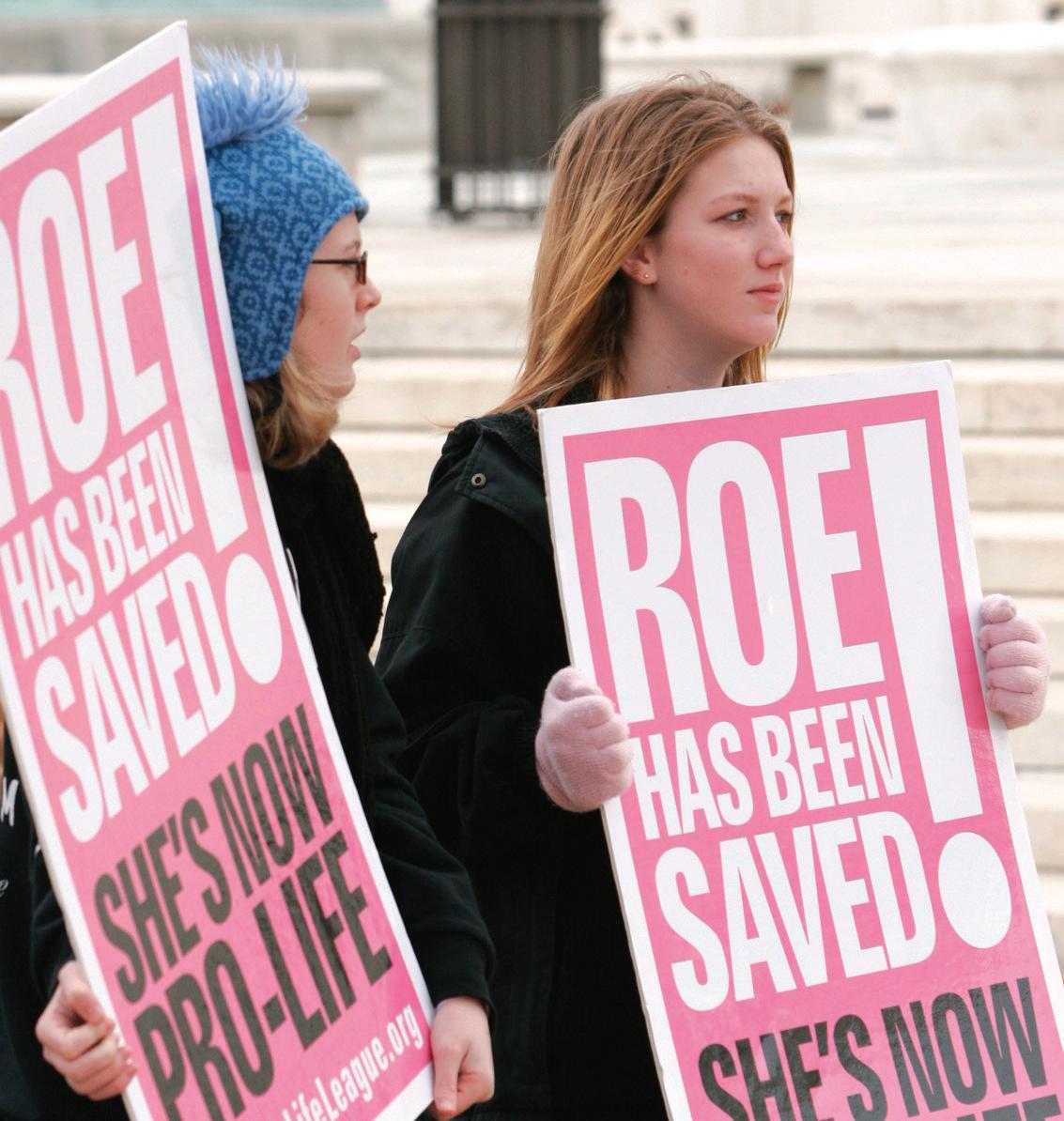
being pro-abortion as intrinsic to women’s rights. By appealing to our good desire for justice, they have been able to influence millions of caring Americans to believe that abortion is a just response to women’s health needs. However, I argue (along with millions of other prolife Americans, including pro-life feminists) that abortion acts against the integral health of women, individually and socially. Pregnancy is
never a disease to be eradicated, even when unintended. This does not mean there is no place for prudence in family planning; of course there is. But, as a people, we must support women who are in situations of unplanned pregnancy, not with the quick, awful and irreversible solution of abortion, but with solidarity that emphasises mutual support, love and acceptance of mother and child. As a commu-
nity, we must consider the integral health of the mother and the child together. We must have an open posture of acceptance toward new life and the mothers who often bear it alone, rather than a posture of objectification and violence. Ultimately, pro-abortion arguments put mother and child at odds with one another. This is unacceptable for a just and compassionate civil society.
Within the Catholic Church we have a ministry called Project Rachel and, here in the Diocese of Juneau, we have Rachel Vineyard retreats which exist to help mothers who have chosen to abort their children. The stories that come from these women are a powerful testimony to the deep wounds they carry from abortion, but also to the ever present compassion, love and mercy of God. These women are often the sole voice of testimony for a child who has died a tragic death and needs to be grieved.
In writing this article, I asked a woman who has had an abortion if she would review a draft and I presented her with the content written above. She said that I failed to mention the side effects of abortion. She told me of the high suicide rate of teenage girls who struggle to keep their personal wounds secret after having abortions. She spoke of the problems with drugs and alcohol that consume young women after an abortion. In addition, she identified sterility and breast cancer as sad byproducts of abortion. In my conversation with her, she said that women who have had abortions are not talking to their children about their abortion and, as a result, the tragedy becomes generational — that is, daughters go through the same pain, many times alone, when their mothers could have helped had there been open, honest and loving discussions about abortion. She told me, “I told my kids about my abortion, and when my daughter got pregnant at the age of 18, she went to the clinic to consider an abortion but she didn’t do it. She told me, ‘I decided not to because of what happened to you’.”
Tuesday is going to be a sad day - the 40th anniversary of the tragic decision by the Supreme Court of the United States legalising abortion. Here, in Juneau, there will be a public Rally for Life on the steps of our Capitol Building at 12 o’clock noon on that day to keep this issue alive and uphold the truth that life is sacred from the moment of conception until natural death.
• Bishop Burns is the Roman Catholic Bishop of the Diocese of Juneau and Southeast Alaska.
January 23, 2013 OPINION 17 therecord.com.au
Lisa Twigg and Karie Garafola protest in front of the US Supreme Court in 2006.
Home MARIETTE
PHOTO: CNS
@
ULRICH
FRIDAY, JANUARY 25
Holy Hour Adoration
7pm at St Benedict Catholic Church, 115 Ardross St, Ardross. Conducted by Holy Trinity Community. Enq: Bryan 0406 671 388 or Yunita 0412 677 568.
Medjugorje - Evening Prayer
7-9pm at Our Lady of Mercy Parish, cnr Girrawheen Ave/Patrick Crt, Girrawheen. An evening of prayer with Our Lady of Peace in thanksgiving for reported daily apparitions of Our Lady at Medjugorje. Begins with Eucharistic Adoration, Holy Rosary, Benediction and Holy Mass. Free DVDs and medals on the night. Enq: 9402 2480 or 0407 471 256. For pilgrimages phone or email: medjugorje@y7mail.com.
SATURDAY, JANUARY 26
Australia Day Ecumenical Annual Service of Thanksgiving for this Land
10am at St Patrick’s Catholic Basilica, 47 Adelaide St, Fremantle. Fr Anthony Maher OMI will be joined by ministers of mainstream churches in a service of readings, hymns and a keynote address. A procession of representative items of the Irish contribution to Australia will open and close the service. Complimentary refreshments. Enq: Denis 9345 3530.
SATURDAY, JANUARY 26 TO MONDAY, JANUARY 28
Youth Inner Healing Retreat (live-in)
7.30am at St Thomas More College, 48 Mounts Bay Rd, Crawley. Led by the Vincentian Fathers. Registration and Enq: Sonia 0410 596 520 or Sheldon 0415 841 737 or dmymau@gmail.com.
SUNDAY, JANUARY 27 AND FEBRUARY 10
Latin Mass
2pm at Good Shepherd Parish, Streich Ave, Kelmscott. Enq: John 9390 6646.
UPCOMING
TUESDAY, JANUARY 29
Spirituality and The Sunday Gospels
7-8pm at St Benedict’s School Hall, Alness St, Applecross. Presenter Norma Woodcock. Everyone is welcome. Cost: collection. Accreditation: recognition by CEO. Enq: 9487 1772 or www. normawoodcock.com.
SATURDAY, FEBRUARY 2
Day with Mary 9am-5pm at St Bernadette Parish, 49 Jugan St, Glendalough. Day of prayer and instruction based on the Fatima message. 9am Video; 10.10 holy Mass; Reconciliation, Procession of the Blessed Sacrament, Eucharistic Adoration, Sermons on Eucharist and Our Lady, Rosary, Divine Mercy Chaplet and Stations of the Cross. BYO lunch. Finish approx 5pm. Enq: Franciscan Sisters of the Immaculate 9250 8286.
SUNDAY, FEBRUARY 3
Divine Mercy, an Afternoon with Jesus and Mary 1.30pm at St Francis Xavier Church, 25 Windsor St, East Perth. Main celebrant Fr Johnson Malayil CRS. Homily will be on St Jerome Emiliani. Exposition of the Blessed Sacrament followed by the holy Rosary and Chaplet of Divine Mercy. Refreshments afterwards. Enq: John 9457 7771.
St Brigid’s Day Celebration – to Honour Ireland’s Female Patron Saint 3pm at Irish Club Theatre, 61 Townshend Rd, Subiaco. The Australian Irish Heritage Association presents a discourse on Caroline Chisholm (18081877) looking at her life and legacy as a visionary of the 19th century. Illustrated narrative with music and dance, scripted by Anne McAnearney. Cost $10 at the door, includes Irish afternoon tea, or for bookings phone Cecilia on 9367 6026.
First Mass in Honour of Santo Nino, organised by Filipino Community 11.30am at St Jerome’s Church, 36 Troode St, Munster. Everyone welcome. Please bring Santo Nino (Infant Jesus) statues for a blessing. Lunch will follow at hall, please bring a plate to share. Enq: Edita 9418 3728 or Susan 9434 3969.
TUESDAY, FEBRUARY 5
Catholic Charismatic Renewal Opening Year Mass
7.30pm at Holy Family Church, 45 Thelma St, Como. Evening includes Prayer and Praise, Mass and Prayer Team Ministry. Main celebrant is Archbishop Emeritus Barry Hickey preaching on theme of Lay Empowerment. Evening concludes with light supper; a plate to share would be most welcome. So come along and help us to start the year with enthusiasm and zeal. Enq: Dan 9398 4973.
MMP Cenacle
10.30am at St Paul’s, 106 Rookwood St, Mt Lawley. Begins with Rosary Cenacle, followed by Holy Mass. Celebrant Is Rev Fr Timothy Deeter. Bring lunch to share. Tea/coffee supplied. Enq: 9341 8082.
FRIDAY, FEBRUARY 8
Annual Torchlight Rosary Procession for Our Lady of Lourdes around Lake Monger 7pm departing from Dodd St carpark, Wembley. There will be an altar area set up for those unable to walk. Enq: 0421 580 783.
SATURDAY, FEBRUARY 9
Divine Mercy – Healing Mass
2.30pm at St Francis Xavier Church, Windsor St,
East Perth. Main celebrant will be Fr Marcellinus Meilak OFM. Reconciliation in English and Italian will be offered. Divine Mercy prayers followed by veneration of first class relic of St Faustina Kowalska. Refreshments afterwards. Enq: John 9457 7771.
St Padre Pio Prayer Day
8.30am at Our Lady of Mt Carmel, 82 Collick St, Hilton. DVD in parish centre followed by Exposition of the Blessed Sacrament, Rosary, Divine Mercy, Adoration and Benediction. Holy Mass, St Padre Pio Litugy, Reconciliation available. Bring a plate for a shared lunch. Tea and coffee supplied. Enq: Des 6278 1540.
SUNDAY, FEBRUARY 10
Our Lady of Lourdes 70th Anniversary Mass with Archbishop Costelloe
9.30am at Our Lady of Lourdes Parish, 207 Lesmurdie Rd, Lesmurdie. Enq: Fr Kenneth 9291 6282 or 9291 8952 or 0434 934 286.
St Louis Parish, Boyanup – Mass Celebrating 100th Year Anniversary
10am at St Louis Parish, cnr Bridge and Thomas Sts, Boyanup. Begins with Mass followed by lunch at Hugh Kilpatrick Hall. RSVP for catering purposes. RSVP and Enq: Frances 9731 5058.
SUNDAY, FEBRUARY 10 TO MARCH 24
Life in the Spirit Seminar
3–5pm at 67 Howe St, Osborne Park. Every Sunday for 8 weeks. Designed to set hearts aflame for God in an environment of faith and acceptance. You’ll be guided in your spiritual journey as you form a stronger, deeper relationship with Christ. Enq: Reg 0429 777 007 or reg@disciplesofjesus.org.
WEDNESDAY, FEBRUARY 20
Alan Ames: Healing Service
7pm at Our Lady of the Mission, 270 Camberwarra Dr, Craigie. Holy Mass followed by talk and healing service. Enq: Loretta 0400 809 833.
SUNDAY, MARCH 17
St Joseph’s School Waroona70th Anniversary Celebration Mass
10am-3pm at St Joseph’s School, Millar St, Waroona is inviting all past students, staff and families to help celebrate its 70th anniversary at the school. Begins with Mass celebrated by Fr Chiera, Vicar General of Bunbury Diocese, and will be followed by a day of fun, food and festivities. Please pass on this information to anyone you know from the school in the last 70 years. Enq: Admin 9782 6500 or www.stjoeswaroona.wa.edu. au.
FRIDAY, APRIL 5 – SUNDAY, APRIL 7
Jesus For All
7.30-9.30pm, 67 Howe St, Osborne Park. Catholic Charismatic Conference, “I will give you a new heart, and breathe a new spirit into you”. Organised by CCR Perth and MSCCA. Enq: daniel.hewitt5@ bigpond.com or stephen.subramaniam@gmail. com.
REGULAR EVENTS
EVERY SUNDAY
Gate of Heaven Catholic Radio
Join the Franciscans of the Immaculate from 7.309pm on Radio Fremantle 107.9FM for Catholic radio broadcast of EWTN and our own live shows. Enq: radio@ausmaria.com.
Cathedral Cafe
Cathedral Cafe is now open every Sunday 9.30am1pm at St Mary’s Cathedral Parish Centre, downstairs after Mass. Coffee, tea, cakes, sweets, friendship with Cathedral parishioners. Further info: Tammy on smcperthwyd@yahoo.com.au or 0415 370 357.
Pilgrim Mass - Shrine of the Virgin of the Revelation
2pm at Shrine, 36 Chittering Rd, Bullsbrook. Commencing with Rosary followed by Benediction. Reconciliation available before every celebration. Anointing of the sick administered during Mass every second Sunday of the month. Pilgrimage in honour of the Virgin of the Revelation last Sunday of the month. Side entrance to church and shrine open daily between 9am-5pm. Enq Sacri 9447 3292.
Praise and Worship
5.30pm at St Denis Parish, cnr Osborne St and Roberts Rd, Joondanna. Followed by 6pm Mass. Enq: Admin admin@stdenis.com.au.
EVERY FIRST SUNDAY
Singles Prayer and Social Group 7pm at All Saints Chapel, Allendale Sq, 77 St Georges Tce, Perth. Begins with Holy Hour (Eucharistic Adoration, Rosary and teaching) followed by dinner at local restaurant. Meet new people, pray and socialise with other single men and women. Enq: Veronica 0403 841 202.
EVERY SECOND SUNDAY
Healing Hour 7-8pm at St Lawrence Parish, Balcatta. Songs of praise and worship, exposition of Blessed Sacrament and prayers for sick. Enq: Fr Irek Czech SDS or office Tue-Thu, 9am-2.30pm 9344 7066.
EVERY FOURTH SUNDAY
Shrine Time for Young Adults 18-35 Years
7.30-8.30pm in Schoenstatt Shrine, 9 Talus Dr, Mt Richon; Holy Hour with prayer, reflection, meditation, praise and worship; followed by a social
gathering. Come and pray at a place of grace. Enq: Schoenstatt Sisters 9399 2349.
Holy Hour for Vocations to the Priesthood, Religious Life
2-3pm at Infant Jesus Parish, Wellington St, Morley. Includes exposition of Blessed Eucharist, silent prayer, Scripture, prayers of intercession. Come and pray those discerning vocations can hear clearly God’s call.
EVERY LAST SUNDAY OF THE MONTH
Filipino Mass 3pm at Notre Dame Church, cnr Daley and Wright Sts, Cloverdale. Please bring a plate to share for socialisation after Mass. Enq: Fr Nelson Po 0410 843 412, Elsa 0404 038 483.
LAST MONDAY OF THE MONTH
Be Still in His Presence –Ecumenical Christian Program
7.30-8.45pm at St Swithun Anglican Church, 195 Lesmurdie St, Lesmurdie (hall behind church). Begins with songs of praise and worship, silent time, lectio divina, small group sharing and cuppa. Enq: Lynne 9293 3848 or 0435 252 941.
EVERY TUESDAY
Novena to Our Lady of the Miraculous Medal
6pm at Pater Noster Church, Marmion and Evershed Sts, Myaree. Mass at 5.30pm followed by Benediction. Enq: John 0408 952 194.
Novena to God the Father
7.30pm at St Joachim’s parish hall, Vic Park. Novena followed by reflection and discussions on forthcoming Sunday Gospel. Enq: Jan 9284 1662.
EVERY FIRST TUESDAY
Short MMP Cenacle for Priests
2pm at Edel Quinn Centre, 36 Windsor St, East Perth. Enq: Fr Watt 9376 1734.
EVERY WEDNESDAY
Holy Spirit of Freedom Community
7.30pm at Church of Christ, 111 Stirling St, Perth. We welcome everyone to attend our praise meeting. Enq: 0423 907 869 or hsofperth@gmail.com.
Bible Study at Cathedral
6.15pm at St Mary’s Cathedral, 17 Victoria Sq, Perth. Deepen your faith through reading and reflecting on holy Scripture by Fr Jean-Noel Marie. Meeting room beneath Cathedral. Enq: 9223 1372.
Holy Hour - Catholic Youth Ministry Mass at 5.30pm and Holy Hour (Adoration) at 6.30pm at Catholic Pastoral Centre, 40A Mary St, Highgate. Enq: www.cym.com or 9422 7912.
EVERY FIRST WEDNESDAY
Novena to St Mary of the Cross MacKillop 7-7.45pm at Blessed Mary MacKillop Parish, cnr Cassowary Dr and Pelican Pde, Ballajura. Begins with Mass, novena prayers and Benediction. Followed by healing prayers and anointing of the sick. Enq: Madi 9249 9093 or Gerry 0417 187 240.
EVERY SECOND WEDNESDAY
Chaplets of Divine Mercy 7.30pm St Thomas More Parish, Dean Rd, Bateman. Accompanied by Exposition, then Benediction. Enq: George 9310 9493 or 6242 0702 (w).
EVERY THURSDAY
Divine Mercy
11am at Sts John and Paul Church, Pinetree Gully Rd, Willetton. Pray the Rosary and Chaplet of Divine Mercy and for consecrated life, especially in our parish. Concludes with veneration of the first class relic of St Faustina. Enq: John 9457 7771.
St Mary’s Cathedral Praise Meeting
7.45pm every Thursday at the Legion of Mary’s Edel Quinn Centre, 36 Windsor St, East Perth. Includes praise, song and healing ministry. Enq: Kay 9382 3668 or fmi@flameministries.org.
Group Fifty - Charismatic Renewal Group 7.30pm at Redemptorist Monastery, 150 Vincent St, North Perth. Includes prayer, praise and Mass. Enq: Elaine 9440 3661.
EVERY FIRST THURSDAY OF THE MONTH
Prayer in Style of Taizé
7.30-8.30pm at Our Lady of Grace Parish, 3 Kitchener St, North Beach. Includes prayer, song and silence in candlelight – symbol of Christ the light of the world. Taizé info: www.taize.fr. Enq: secretary 9448 4888 or 9448 4457.
Holy Hour Prayer for Priests 7-8pm at Holy Spirit Parish, 2 Keaney Pl, City Beach. All welcome. Enq: Linda 9341 3079.
FIRST AND THIRD THURSDAY
Young Adults (18-35) Dinner and Rosary Cenacle 6.30pm St Bernadette Parish, 49 Jugan St, Mt Hawthorn. Begins with dinner at a local restaurant. 8pm - Rosary Cenacle, short talk and refreshments at the parish. Enq: st.bernadettesyouth@gmail. com or 9444 6131.
EVERY THIRD THURSDAY
Auslan Café – Sign Language Workshop 12.30pm at St Francis Xavier Emmanuel Centre, 25 Windsor St, Perth. Its Australian Sign Language - Auslan Café is a social setting for anybody who would like to learn or practise Auslan in a relaxing and fun atmosphere. Light lunch provided. Enq: Emma emmanuelcentre@westnet.com.au.
EVERY FRIDAY
Eucharistic Adoration at Schoenstatt Shrine 10am at Schoenstatt Shrine, 9 Talus Drive, Mt
Richon. Includes holy Mass, exposition of Blessed Sacrament, silent adoration till 8.15pm. In this Year of Grace, join us in prayer at a place of grace. Enq: Sisters of Schoenstatt 9399 2349.
Healing Mass
6pm at Holy Family Parish, Lot 375, Alcock St, Maddington. Begins with Exposition of the Blessed Sacrament, Rosary, Stations of the Cross, Healing Mass followed by Adoration of the Blessed Sacrament. Enq: admin 9493 1703 or www.vpcp. org.au.
EVERY FIRST FRIDAY
Mass and Exposition of the Blessed Sacrament
11am-4pm at Little Sisters of the Poor Chapel, 2 Rawlins St, Glendalough. Exposition of Blessed Sacrament after Mass until 4pm, finishing with Rosary. Enq: Sr Marie MS.Perth@lsp.org.au.
Healing and Anointing Mass
8.45am Pater Noster Church, Evershed St, Myaree. Begins with Reconciliation, then 9am Mass of the Sacred Heart of Jesus, anointing of the sick and prayers to St Peregrine. Enq: Joy 9337 7189.
Catholic Faith Renewal Evening
7.30pm at Sts John and Paul Parish, Pinetree Gully Rd, Willetton. Songs of Praise and Prayer, sharing by a priest, then thanksgiving Mass and light refreshments. Enq: Kathy 9295 0913 or Ann 0412
166 164 or catholicfaithrenewal@gmail.com.
Communion of Reparation All Night Vigils
7pm-1.30am at Corpus Christi Church, Lochee St, Mosman Park or St Gerard Majella Church, cnr Ravenswood Dr/Majella Rd, Westminster (Mirrabooka). Vigils are two Masses, Adoration, Benediction, prayers, Confession in reparation for outrages committed against the United Hearts of Jesus and Mary. Enq: Vicky 0400 282 357; Fr Giosue 9349 2315; John/Joy 9344 2609.
Pro-life Witness – Mass and Procession
9.30am at St Brigid’s Parish, cnr Great Northern Hwy and Morrison Rd, Midland. Begins with Mass followed by Rosary procession and prayer vigil at nearby abortion clinic, led by the Franciscan Friars of the Immaculate. Please join us to pray for an end to abortion and the conversion of hearts. Enq: Helen 9402 0349.
EVERY SECOND FRIDAY OF THE MONTH
Discover Spirituality of St Francis of Assisi
12pm at St Brigid’s parish centre. The Secular Franciscans of Midland Fraternity have lunch, then 1-3pm meeting. Enq: Antoinette 9297 2314.
EVERY FIRST SATURDAY OF THE MONTH
Healing Mass
12.35pm at St Thomas Parish, cnr Melville St and College Rd, Claremont. Spiritual leader Fr Waddell. Enq: Kim 9384 0598, claremont@perthcatholic.org.
Vigil for Life – Mass and Procession
8.30am at St Augustine Parish, Gladstone St, Rivervale. Begins with Mass celebrated by Fr Carey, followed by Rosary procession and prayer vigil at nearby abortion clinic. Please join us to pray for the conversion of hearts and an end to abortion. Enq. Helen 9402 0349.
EVERY FOURTH SATURDAY OF THE MONTH
Voice of the Voiceless Healing Mass
12pm at St Brigid Parish, 211 Aberdeen St, Northbridge. Bring a plate to share after Mass. Enq: Frank 9296 7591 or 0408 183 325.
EVERY LAST SATURDAY
Novena Devotions – Our Lady Vailankanni of Good Health
5pm at Holy Trinity Parish, 8 Burnett St, Embleton. Followed by Mass at 6pm. Enq: George 9272 1379.
GENERAL
Free Divine Mercy Image for Parishes
High quality oil painting and glossy print – Divine
Mercy Promotions. Images of very high quality. For any parish willing to accept and place inside the church. Oil paintings: 160 x 90cm; glossy print - 100 x 60cm. Enq: Irene 9417 3267 (w).
Sacred Heart Pioneers
Would anyone like to know about the Sacred Heart pioneers? If so, please contact Spiritual Director Fr Doug Harris 9444 6131 or John 9457 7771.
St Philomena’s Chapel
3/24 Juna Dr, Malaga. Mass of the day: Mon 6.45am. Vigil Masses: Mon-Fri 4.45pm. Enq: Fr David 9376 1734.
Mary MacKillop Merchandise
Available for sale from Mary MacKillop Centre. Enq: Sr Maree 041 4683 926 or 08 9334 0933.
Financially Disadvantaged People Requiring
Low Care Aged Care Placement
The Little Sisters of the Poor community is set in beautiful gardens in the suburb of Glendalough. “Making the elderly happy, that is everything!” St Jeanne Jugan (foundress). Registration and enq: Sr Marie 9443 3155.
Is your son or daughter unsure of what to do this year?
Suggest a Cert IV course to discern God’s purpose. They will also learn more about the Catholic faith and develop skills in communication and leadership. Acts 2 College of Mission and Evangelisation (National Code 51452).Enq: Jane 9202 6859.
AA Alcoholics Anonymous Is alcohol costing you more than just money? Enq: AA 9523 3566.
Saints and Sacred Relics Apostolate Invite
SSRA Perth invites interested parties, parish priests, leaders of religious communities, lay associations to organise relic visitations to parishes, communities, etc. We have available authenticated relics, mostly first-class, of Catholic saints and blesseds including Sts Mary MacKillop, Padre Pio, Anthony of Padua, Therese of Lisieux, Maximilian Kolbe, Simon Stock and Blessed Pope John Paul II. Free of charge and all welcome. Enq: Giovanny 0478 201 092 or ssra-perth@catholic.org.
Enrolments, Year 7, 2014
La Salle College now accepting enrolments for Year 7, 2014. For prospectus and enrolment please contact college reception 9274 6266 or email lasalle@lasalle.wa.edu.au.
Acts 2 College, Perth’s Catholic Bible College Is now pleased to be able to offer tax deductibility for donations to the college. If you are looking for an opportunity to help grow the faith of young people and evangelise the next generation of apostles, please contact Jane Borg, Principal at Acts 2 College on 0401 692 690 or principal@ acts2come.wa.edu.au
Divine Mercy Church Pews
Would you like to assist, at the same time becoming part of the history of the new Divine Mercy Church in Lower Chittering, by donating a beautifully handcrafted jarrah pew currently under construction, costing only $1,000 each. A beautiful brass plaque with your inscription will be placed at the end of the pew. Please make cheques payable to Divine Mercy Church Building fund and send with inscription to PO Box 8, Bullsbrook WA 6084. Enq: Fr Paul 0427 085 093.
Abortion Grief Association Inc
A not-for-profit association is looking for premises to establish a Trauma Recovery Centre (pref SOR) in response to increasing demand for our services (ref.www.abortiongrief.asn.au). Enq: Julie (08) 9313 1784.
RESOURCE CENTRE FOR PERSONAL DEVELOPMENT - 2013 COURSES
Resource Centre for Personal Development Holistic Health Seminar The Instinct to Heal Tue 3-4.30pm; RCPD2 Internalise Principles of Successful Relationships and Use Emotional Intelligence and Communication Skills Tue 4.30-6.30pm, 197 High St, Fremantle - Tuesdays 3-4.30pm. Enq: Eva 0409 405 585. Bookings essential.
1) RCPD6 ‘The Cost of Discipleship’
This course combines theology with relationship education and personal/spiritual awareness by teaching self-analysis.
2) ‘The Wounded Heart’
Healing for emotional and sexual abuse promotes healing and understanding for the victim and the offender. Holistic counselling available - http:// www.members.dodo.com.au/~evalenz/.
Religious item donations for Thailand Church
Fr Ferdinando Ronconi is the parish priest at the Church of Our Lady of the Assumption in Phuket, Thailand. He is in need of religious items such as rosaries and holy medals for his local congregation and visitors. If you are able to help, please post items to: PO Box 35, Phuket 83000, Thailand or, if you are on holiday in Phuket, bring your donated items with you to church and stay for Mass! Fr Ferdinando can be contacted on tel: 076 212 266 or 089 912 899 or ronconi.css@gmail.com.
Good Shepherd Parish History
I am compiling the history of the Good Shepherd Parish and everyone who has been a part of building the Good Shepherd community is invited to write their story and include photos. An editor has been engaged and the deadline to receive your story is January 30, 2013. Please forward on email: goodshepherdparishhistory@gmail.com. Any enquiries ring Nick De Luca on 9378 2684 or 0419 938 481.
January 23, 2013 PANORAMA 18 therecord.com.au
_ _ _ _ _ _ Panorama The deadline for Panorama is Friday 5pm the week before the edition is published. _ _ _ _ _ _
RELIGIOUS PRODUCTS
CATHOLICS CORNER Retailer of Catholic products specialising in gifts, cards and apparel for Baptism, Communion and Confirmation. Ph 9456 1777. Shop 12, 64-66 Bannister Rd, Canning Vale. Open Mon-Sat.
RICH HARVEST - YOUR
CHRISTIAN SHOP Looking for Bibles, CDs, books, cards, gifts, statues, Baptism/Communion apparel, religious vestments, etc. Visit us at 39 Hulme Ct (off McCoy St), Myaree. Ph 9329 9889 (after 10.30am Mon to Sat). We are here to serve.
KINLAR VESTMENTS
www.kinlarvestments.com.au
Quality handmade and decorated vestments: albs, stoles, chasubles, altar linen, banners. Ph Vickii on 9402 1318, 0409 114 093 or kinlar.vestments@ gmail.com.
MEMENTO CANDLES
Personalised candles for Baptism, Wedding, Year 12 Graduations and Absence. Photo and design embedded into candle, creating a great keepsake!
Please call Anna: 0402 961 901 or anna77luca@hotmail.com to order a candle or Facebook: Memento Candles.
ACCOMMODATION
HOLIDAY ACCOMMODATION
Esperance holiday accommodation, 3-bedroom house, fully furnished. Phone 08 9076 5083.
TAX SERVICE
QUALITY TAX RETURNS PRE-
PARED by registered tax agent with over 35 years’ experience. Call Tony Marchei 0412 055 184 for appt. AXXO Accounting & Management, Unit 20/222 Walter Rd, Morley. Trade services.
HEALTH
LOSE WEIGHT SAFELY with good nutrition Free samples. Call or SMS Michael 0412 518 318.
CROHNS DISEASE. I have had major surgery to remove parts of my small and large intestines as I have Crohns Disease. Since using Herbalife’s Nutritional Program, my symptoms have gone and I lead a normal life. If you wish to try these wonderful products, please call Mark Norman 0448 443 348 or email wfhbusiness@bigpond.com.
BUSINESS OPPORTUNITY
Home-based business. Wellness industry. Call 02 8230 0290 or www.dreamlife1.com.
BOOKBINDING
RESTORATION BOOKBINDING and Conservation; General Book Repairs, Bibles, Brevaries and Liturgical. Tel: 0401 941 577. Now servicing the South-West @ Myalup.
PILGRIMAGES
EXODUS PILGRIMAGE TO THE HOLY LAND November 5-20, 2013. Are you interested in being part of our 16 DAYS OF EXODUS PILGRIMAGE (following the footstep of Moses) to the HOLY LAND (Egypt, Jordan and Holy Land) for just $4,100 from November 5-20, 2013? If interested, please contact for early reservation/booking and other enquiries: Fr Emmanuel (Spiritual Director) on: 0417 999 553, fremmanueltv@hotmail. com. Trinidad on: 0420 643 949, dax_gatchi@yahoo.com. Nancy on: 0430 025 774, rncarfrost@ hotmail.com.
PILGRIMAGE OF MERCY - Departs May 11, 2013. Fatima/Poland/Czestochowa/ Auschwitz/Divine Mercy/Vilnius Lithuania/Rome/Gennazzano Fra Elia (Stigmatist) Civitavecchia (miraculous Madonna shrine) Subiaco/Medju-gorje five countries. Exceptional value all inclusive $6,890. Fr Bogoni (Spiritual Director) Yolanda 0413 707 707/Harvest toll free 1800 819 156 23 days.
POSITION VACANT
WANTED: Caretaker couple, for Church in Lower Chittering. Suit active retirees. Accommodation provided. Tel: 0427 085 093.
SETTLEMENTS
ARE YOU BUYING OR SELLING real estate or a business? Why not ask Excel Settlements for a quote for your settlement. We offer reasonable fees, excellent service, no hidden costs. Ring 9481 4499 for a quote. Check our website on www. excelsettlements.com.au.
FURNITURE REMOVAL
ALL AREAS. Competitive rates. Mike Murphy Ph 0416 226 434.
SERVICES
RURI STUDIO FOR HAIR
Vincent and Miki welcome you to their newly opened, international, award-winning salon. Shop 2, 401 Oxford St, Leederville. 9444 3113. Ruri-studio-for-hair@ hotmail.com.
BRENDAN HANDYMAN
SERVICES
Home, building maintenance, repairs and renovations. NOR.
Ph 0427 539 588.
WRR LAWN MOWING AND WEED SPRAYING Garden clean ups and rubbish removal. Get rid of bindii, jojo and other unsightly weeds. Based in Tuart Hill. Enq: 6161 3264 or 0402 326 637.
BRICK RE-POINTING
Ph Nigel 9242 2952.
PERROTT PAINTING Pty Ltd
For all your residential, commercial painting requirements. Ph Tom Perrott 9444 1200.
BRICKLAYING From letterboxes to houses. Ph Paddy 040 929 6598.
PILGRIMAGES
19 DAYS - Petra, Amman, Holy Land, Dubai, Fatima and Medjugorje. Cost: A$6,000:00
Monday 13 May 2013. Spiritual Director: Fr. Francis Huy Thanh Nguyen. Tel: 9296 7088. 24 days - Italy, Fatima, Lourdes, Paris & Poland. Cost: A$6,300:00 .
Sunday 1 September 2013.
Spiritual Directors: Fr. Dariusz Basiaga SDS & Fr. Sabu (Sebastian) Kalapurackal VC.
Tel: 9398 2331 or Tel: 9381 5383.
22 days - Petra, Amman, Holy Land, Poland & Dubai . Cost:
A$6,000:00. Monday 7 October
2013. Spiritual Director: Fr. Ireneusz Czech SDS. Tel.: 9344 7066.

8 One of two names in a Catholic book publishing company
13 Commandment that tells us to worship only God
15 He called to Adam, “Where are you?” (Gen 3:9)
17 Communion host
19 Father of Rachel
21 Prayer of repentance
23 She tied a scarlet cord in her window
24 Tree under which Jesus saw Nathanael (Jn 1:47–48)
25 First word of a Latin hymn
26 Hometown of Simon
28 By the end of the 20th century there had been 265 of these
29 Place of the (Mt 27: 33)
31 Killed by Cain
33 Job owned five hundred yoke of these
LAST WEEK’S SOLUTION


January 23, 2013 CLASSIFIEDS 19 therecord.com.au Deadline: 11am Monday CLASSIFIEDS C R O S S W O R D ACROSS 3 The 12 ___ of Israel 9 Biblical garden 10 ___ to Emmaus 11 In 13:23, Jeremiah asked if this animal could change its spots 12 Aaron made a golden one 14 Jesuits’ motto (abbreviation) 16 Temple tree 17 The form of a sacrament 18 Patron saint of beer brewers 20 Our Lady of ___ 22 An angel 24 ___ Minor (Franciscan Order) 26 Catholic singer and songwriter George M 27 “… and the rich he has sent ___ away” (Lk 1:53) 30 We should enter by the narrow one 32 Bible section 34 Church spire 35 Friday in Lent no-no food 36 Where Jesus met the Samaritan woman 37 Liturgical season DOWN 1 Prince of ____ 2 The Mass is both a sacrifice and a ___ 4 Articles of clothing or bones of saints 5 “You of vipers!” (Lk 3:7) 6 Companion of Daniel 7 Make a father of
W O R D S L E U T H
Subscribe!!! Name: Address: Suburb: Postcode: Telephone: I enclose cheque/money order for $85 For $85 you can receive a year’s worth of The Record delivered to your house Please debit my Bankcard Mastercard Visa Card No Expiry Date: ____/____ Signature: _____________ Name on card: I wish to be invoiced Send to: The Record, PO Box 3075, Adelaide Terrace WA 6832 Classifieds Short Sharp Cheap Got something to say? Send your letter to editor@therecord.com.au


LETTERS TO AN UNKNOWN DAUGHTER
Only $48.00
In the summer of 1974, 17-year-old Anita Keagy discovered that she was pregnant by her boyfriend. Having grown up in a loving but strict Christian home, Anita feared disgracing her family and considered abortion. Instead, with much prayer and courage, she gave her child up for adoption. Years later, married and raising four children, Anita felt compelled to communicate with her unknown daughter through a file of letters. This is a program for anyone who is suffering through painful circumstances and struggling to see God’s purpose in their lives.
THE CENSUS AND THE STAR
Only $28.00
Explore the mysterious circumstances of Christ’s birth in this captivating look at the first Christmas. Joseph and Mary travelled to Bethlehem by order of the Emperor, Augustus Caesar. This census has long confounded historians seeking to reconcile the Bible with recorded history. The evidence to address that is both intriguing and insightful. The mysteries continue when a star appears to announce the birth of the King of the Jews. What was the star? What did it look like? When did it appear? Explore the star like the Magi, to better know Christmas.


OCTOBER BABY
Only $30.00
When Hannah collapses during a college play, she’s rushed to the hospital, where medical tests reveal the underlying cause - trauma suffered at birth. Soon afterward, she discovers another shocking fact: she was adopted after a failed abortion attempt. Bewildered and angry, Hannah goes in search of her birth mother. Will the truth set her free?

THE WAY
Only $46.00
A powerful and inspirational story about family, friends, faith and the challenges we face navigating this complicated world. Martin Sheen plays Tom, an American doctor who comes to France to collect the remains of his adult son (Emilio Estevez), killed in a storm in the Pyrenees while walking the famous Camino de Santiago, “The Way of St James”. Tom decides to embark on the historical pilgrimage to honour his son’s desire to finish the journey, unprepared for the profound impact the journey will have on him. This is a film and story that stays with you.
RECORD IN JANUARY Telephone: 9220 5912 Email: bookshop@therecord.com.au Address: 21 Victoria Square, Perth 6000 BIBIANA KWARAMBA Bookshop Manager Hurry into the Record Bookshop before stock runs out!!! Check out our entire selection of DVDs in store.
NEW TO THE