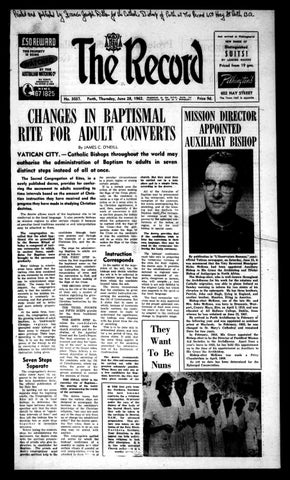
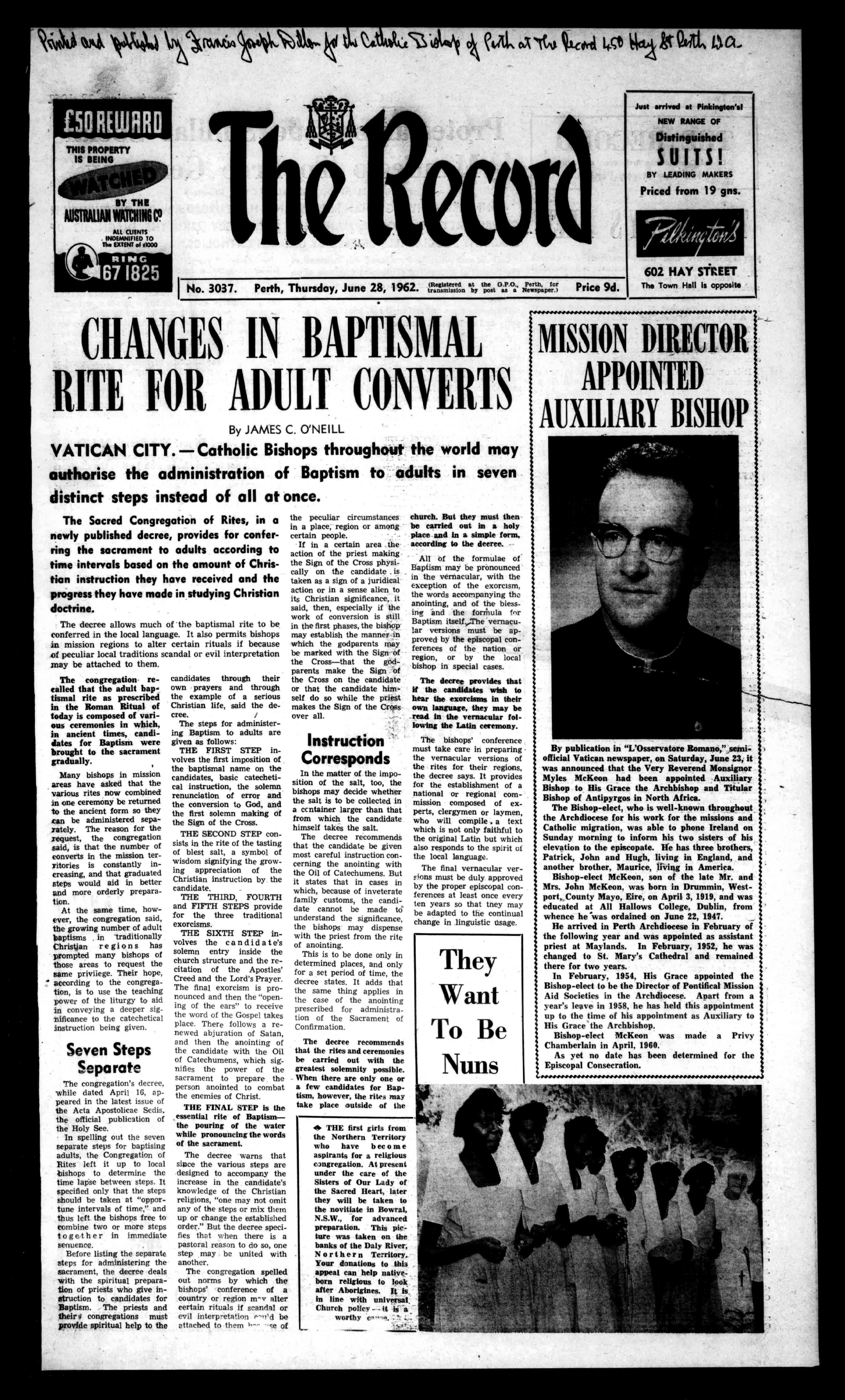
CHANGESINBAPTISMAL RITEFORADULTCONVERTS
ByJAMESC.O'NEILL
VATICANCITY.-CatholicBishopsthroughouttheworldmay authorisetheadministrationofBaptismtoadultsinseven distinctstepsinsteadofallatonce.
TheSacredCongregationofRites,ina ringthesacramenttoadultsaccordingto timeintervalsbasedontheamountofChristianinstructiontheyhavereceivedandthe progresstheyhavemadeinstudyingChristian
thepeculiarcircumstances inaplace,regionoramong newlypublisheddecree,providesforconfer-certainpeople. Ifinacertainareathe actionofthepriestmaking theSignoftheCrossphysicallyonthecandidateis takenasasignofajuridical actionorinasensealiento itsChristiansignificance,it doctrine. said,then,especiallyifthe workofconversionisstill
Thedecreeallowsmuchofthebaptismalritetobe conferredinthelocallanguage.Italsopermitsbishops inmissionregionstoaltercertainritualsifbecause ofpeculiarlocaltraditionsscandalorevilinterpretation maybeattachedtothem.
Thecongregationrecalledthattheadultbaptismalriteasprescribed intheRomanRitualof todayiscomposedofvariousceremoniesinwhich, inancienttimes,candidatesforBaptismwere broughttothesacrament gradually.
Manybishopsinmission areashaveaskedthatthe variousritesnowcombined inoneceremonybereturned totheancientformsothey canbeadministeredseparately.Thereasonforthe request,thecongregation said,isthatthenumberof convertsinthemissionterritoriesisconstantlyincreasing,andthatgraduated stepswouldaidinbetter andmoreorderlypreparation.
Atthesametime,however,thecongregationsaid, thegrowingnumberofadult baptismsintraditionally Christianregionshas promptedmanybishopsof thoseareastorequestthe sameprivilege.Theirhope, accordingtothecongregation,istousetheteaching poweroftheliturgytoaid inconveyingadeepersignificancetothecatechetical instructionbeinggiven.
SevenSteps
Separate
Thecongregation'sdecree, whiledatedApril16,appearedinthelatestissueof theActaApostolicaeSedis, theofficialpublicationof theHolySee.
Inspellingouttheseven separatestepsforbaptising adults,theCongregationof Ritesleftituptolocal bishopstodeterminethe timelapsebetweensteps.It specifiedonlythatthesteps shouldbetakenat"oppor tuneintervalsoftime,"and thusleftthebishopsfreeto combinetwoormoresteps togetherinimmediate senuence.
Beforelistingtheseparate stepsforadministeringthe sacrament,thedecreedeals withthespiritualpreparationofpriestswhogiveinstructiontocandidatesfor Baptism.Thepriestsand theircongregationsmust providespiritualhelptothe
candidatesthroughtheir ownprayersandthrough theexampleofaserious Christianlife,saidthedecree.
ThestepsforadministeringBaptismtoadultsare givenasfollows:
THEFIRSTSTEPinvolvesthefirstimpositionof thebaptismalnameonthe candidates,basiccatecheticalinstruction,thesolemn renunciationoferrorand theconversiontoGod,and thefirstsolemnmakingof theSignoftheCross.
THESECONDSTEPconsistsintheriteofthetasting ofblestsalt,asymbolof wisdomsignifyingthegrowingappreciationofthe Christianinstructionbythe candidate.
THETHIRD,FOURTH andFIFTHSTEPSprovide forthethreetraditional exorcisms.
THESIXTHSTEPinvolvesthecandidate's solemnentryinsidethe churchstructureandtherecitationoftheApostles' CreedandtheLord'sPrayer. Thefinalexorcismispronouncedandthenthe"openingoftheears"toreceive thewordoftheGospeltakes place.TherefollowsarenewedabjurationofSatan, andthentheanointingof thecandidatewiththeOil ofCatechumens,whichsignifiesthepowerofthe sacramenttopreparethe personanointedtocombat theenemiesofChrist.
THEFINALSTEPisthe essentialriteofBaptismthepouringofthewater whilepronouncingthewords ofthesacrament.
Thedecreewarnsthat sincethevariousstepsare designedtoaccompanythe increaseinthecandidate's knowledgeoftheChristian religions,"onemaynotomit anyofthestepsormixthem uporchangetheestablished order."Butthedecreespecifiesthatwhenthereisa pastoralreasontodoso,one stepmaybeunitedwith another.
Thecongregationspelled outnormsbywhichthe bishops'conferenceofa countryorregionm-valter certainritualsifscandalor evilinterpretationr",,,1be attachedtothem 'eof
inthefirstphases,thebishop mayestablishthemannerin whichthegodparentsmay bemarkedwiththeSignof theCross-thatthegodparentsmaketheSignof theCrossonthecandidate orthatthecandidatehimselfdosowhilethepriest makestheSignoftheCross overall.
Instruction
Corresponds
Inthematteroftheimpositionofthesalt,too,the bishopsmaydecidewhether thesaltistobecollectedin accntainerlargerthanthat fromwhichthecandidate himselftakesthesalt.
Thedecreerecommends thatthecandidatebegiven mostcarefulinstructionconcerningtheanointingwith theOilofCatechumens.But itstatesthatincasesin which,becauseofinveterate familycustoms,thecandidatecannotbemadeto understandthesignificance, thebishopsmaydispense withthepriestfromtherite ofanointing.
Thisistobedoneonlyin determinedplaces,andonly forasetperiodoftime,the decreestates.Itaddsthat thesamethingappliesin thecaseoftheanointing prescribedforadministrationoftheSacramentof Confirmation.
Thedecreerecommends thattheritesandceremonies becarriedoutwiththe greatestsolemnitypossible. Whenthereareonlyoneor afewcandidatesforBaptism,however,theritesmay takeplaceoutsideofthe
WTHEfirstgirlsfrom theNorthernTerritory whohavebecome aspirantsforareligious congregation,Atpresent underthecareofthe SistersofOurLadyof theSacredHeart,later theywillbetakento thenovitiateinBowral, N.S.W.,foradvanced preparation.Thispicturewastakenonthe banksoftheDalyRiver,NorthernTerritory, Yourdonationstothis appealcanhelpnative-. bornreligioustolook afterAborigines.It inlinewithuniversal. Churchpolicy--itis-a worthyc-". '-'
church.Buttheymustthen becarriedoutinaholy placeandinasimpleform, accordingtothedecree.
Alloftheformulaeof Baptismmaybepronounced inthevernacular,withthe exceptionoftheexorcism, thewordsaccompanyingthe anointing,andoftheblessinsandtheformulafor Baptismitself,Thevernacularversionsmustbeapprovedbytheepiscopalconferencesofthenationor region,orbythelocal bishopinspecialcases.
Thedecreeprovidesthat ifthecandidateswishto heartheexorcismsintheir ownlanguage,theymaybe readinthevernacularfollowingtheLatinceremony.
Thebishops'conference musttakecareinpreparing thevernacularversionsof theritesfortheirregions, thedecreesays.Itprovides fortheestablishmentofa nationalorregionalcommissioncomposedofexperts,clergymenorlaymen, whowillcompileatext whichisnotonlyfaithfulto theoriginalLatinbutwhich alsorespondstothespiritsit thelocallanguage.
Thefinalvernacularversionsmustbedulyapproved bytheproperepiscopalconferencesatleastonceevery tenyearssothattneymay beadaptedtothecontinual changeinlinguisticusage.
They Want ToBe Nuns
MISSIONDIRECTOR APPOINTED AUXILIARYBISHOP
Bypublicationin"L'OsservatoreRomano,"semiofficialVaticannewspaper,onSaturday,June23,it wasannouncedthattheVeryReverendMonsignor MylesMcKeonhadbeenappointedAuxiliary BishoptoHisGracetheArchbishopandTitular BishopofAntipyrgosinNorthAfrica.
TheBishop-elect,whoiswell-knownthroughout theArchdioceseforhisworkforthemissionsand Catholicmigration,wasabletophoneIrelandon Sundaymorningtoinformhistwosistersofhis elevationtotheepiscopate.Hehasthreebrothers, Patrick,JohnandHugh,livinginEngland,and anotherbrother,Maurice,livinginAmerica.
Bishop-electMcKeon,sonofthelateMr.and Mrs.JohnMcKeon,wasborninDrummin,Westport.CountyMayo,Eire,onApril3,1919,andwas educatedatAllHallowsCollege,Dublin,from whencehe'wasordainedonJune22,1947.
HearrivedinPerthArchdioceseinFebruaryof thefollowingyearandwasappointedasassistant priestatMaylands.InFebruary,1952,hewas changedtoSt.Mary'sCathedralandremained therefortwoyears.
InFebruary,1954,HisGraceappointedthe Bishop-electtobetheDirectorofPontificalMission AidSocietiesintheArchdiocese.Apartfroma year'sleavein1958,hehasheldthisappointment uptothetimeofhisappointmentasAuxiliaryto HisGracetheArchbishop.
Bishop-electMcKeonwasmadeaPrivy ChamberlaininApril,1960.
Asyetnodatehasbeendeterminedforthe EpiscopalConsecration.
sc`\41,%14.10tV44004*.6,1?i,\\:4. cZ:014/1cVat411441011 Mt,oc4, ALLCLIENTS INDEMNIFIEDTO TheEXTENTof11000 ike,1?ecot No.3037.Perth,Thursday,June28,1962.gllstrgiL N744,:`,Price9d. JustarrivedatPinkington's! NEWRANGEOF Distinguished SUITS! BYLEADINGMAKERS Pricedfrom19gns. 602HAYSTREET TheTownHallIsopposite
THERECORD
OfficialOrganoftheArchdiocesaofPerth 450HoyStreet,Perth
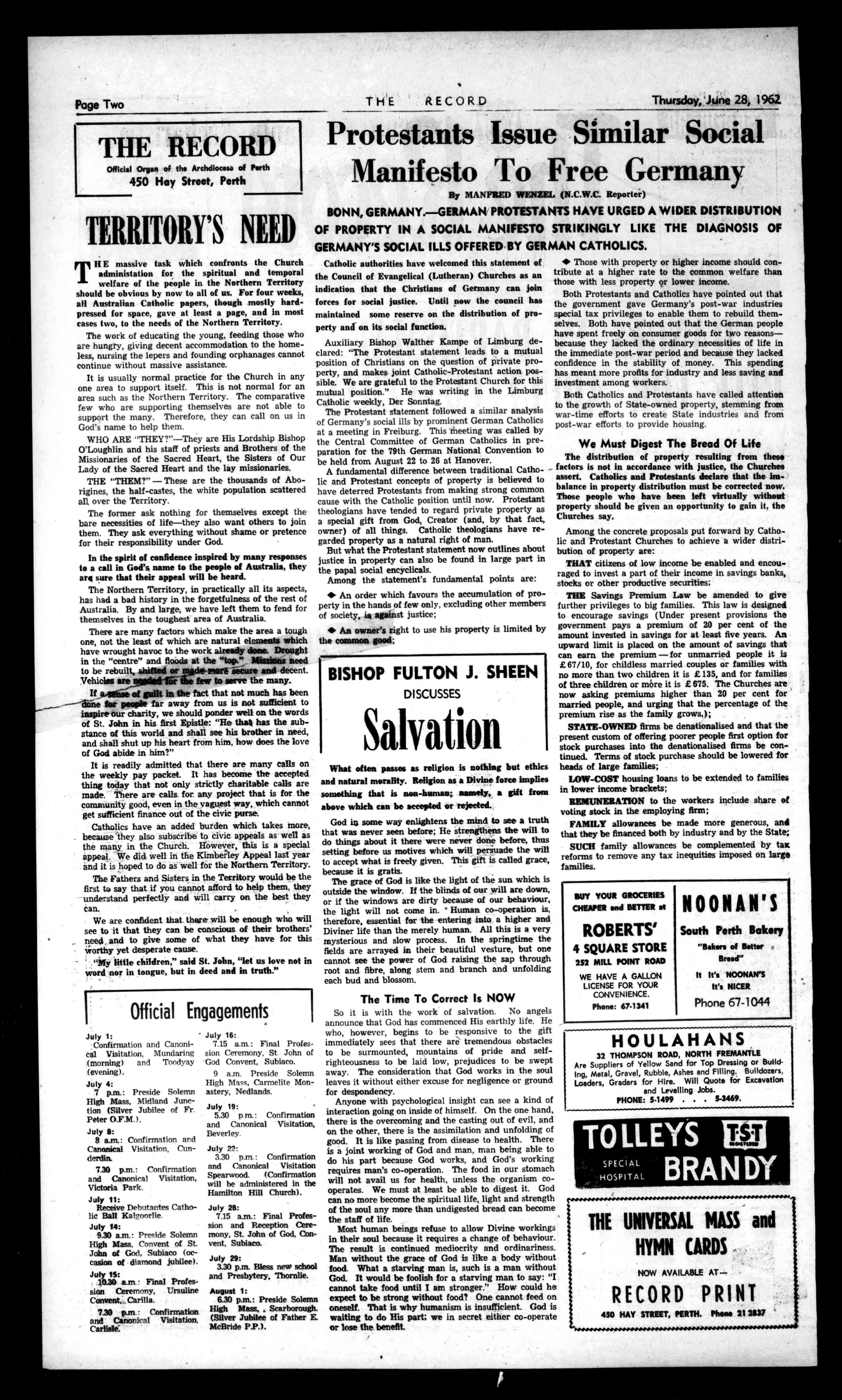
TERRITORY'SNEED
THEmassivetaskwhichconfrontstheChurch administationforthespiritualandtemporal welfareofthepeopleintheNorthernTerritory shouldbeobviousbynowtoallofus.Forfourweeks, allAustralianCatholicpapers,thoughmostlyhardpressedforspace,gaveatleastapage,andinmost casestwo,totheneedsoftheNorthernTerritory.
Theworkofeducatingtheyoung,feedingthosewho arehungry,givingdecentaccommodationtothehomeless,nursingthelepersandfoundingorphanagescannot continuewithoutmassiveassistance.
ItisusuallynormalpracticefortheChurchinany oneareatosupportitself.Thisisnotnormalforan areasuchastheNorthernTerritory.Thecomparative fewwhoaresupportingthemselvesarenotableto supportthemany.Therefore,theycancallonusin God'snametohelpthem.
WHOARETHEY?"-TheyareHisLordshipBishop O'LoughlinandhisstaffofpriestsandBrothersofthe MissionariesoftheSacredHeart,theSistersofOur LadyoftheSacredHeartandthelaymissionaries.
THE"THEM?"-ThesearethethousandsofAborigines,thehalf-castes,thewhitepopulationscattered allovertheTerritory.
Theformerasknothingforthemselvesexceptthe barenecessitiesoflife-theyalsowantotherstojoin them.Theyaskeverythingwithoutshameorpretence fortheirresponsibilityunderGod.
Inthespiritofconfidenceinspiredbymanyresponses toacallinGod'snametothepeopleofAustralia,they aresurethattheirappealwillbeheard.
TheNorthernTerritory,inpracticallyallitsaspects, hashadabadhistoryintheforgetfulnessoftherestof Australia.Byandlarge,wehaveleftthemtofendfor themselvesinthetoughestareaofAustralia.
Therearemanyfactorswhichmaketheareaatough one,nottheleastofwhicharenaturalelementswhich havewroughthavoctotheworkalreadydone.Drought inthe"centre"andfloodsatthe"top."MiSSiOnsneed toberebuilt,abidedor moresecureanddecent. Vehiclesare fewtoservethemany.
Ifapseelgoatinthefactthatnotmuchhasbeen -"doneforposplefarawayfromusisnotsufficientto inspireourcharity,weshouldponderwellonthewords ofSt.JohninhisfirstEpistle:"Hethathasthesubstanceofthisworldandshallseehisbrotherinneed, andshallshutuphisheartfromhim,howdoesthelove ofGodabideinhim?"
Itisreadilyadmittedthattherearemanycallson theweeklypaypacket.Ithasbecometheaccepted thingtodaythatnotonlystrictlycharitablecallsare made.Therearecallsforanyprojectthatisforthe communitygood,eveninthevaguestway,whichcannot getsufficientfinanceoutofthecivicpurse.
Catholicshaveanaddedburdenwhichtakesmore, becausetheyalsosubscribetocivicappealsaswellas themanyintheChurch.However,thisisaspecial appeal.WedidwellintheKimbei:leyAppeallastyear anditishopedtodoaswellfortheNorthernTerritory.
TheFathersandSistersintheTerritorywouldbethe firsttosaythatifyoucannotaffordtohelpthem,they understandperfectlyandwillcarryonthebestthey can.
Weareconfidentthattherewillbeenoughwhowill seetoitthattheycanbeconsciousoftheirbrothers' needandtogivesomeofwhattheyhaveforthis worthyyetdesperatecause.
"Mylittlechildren,"saidSt.John,"letuslovenotin wordnorintongue,butindeedandintruth."
OfficialEngagements I
July1: ConfirmationandCanonicalVisitation,Mundaring (morning)andToodyay (evening).
July4: 7p.m.:PresideSolemn HighMass,MidlandJunction(SilverJubileeofFr. PeterO.F.M.).
JulyB: 8a.m.:Confirmationand CanonicalVisitation,Conderdin. 7.30p Confirmation andCanonicalVisitation, VictoriaPark.
July11: ReceiveDehotantesCatholicBallKaleoorlie
July14: 9.30a.m.:PresideSolemn HighMass,ConventofSt. JohnofGod.Subiaco(occasionofdiamondjubilee).
July15: 10.30a.mFinalProfessionCerermey,1:rsuline Convent,Carilla.
7.30p.mConfirmation andCanonicalVisitation, Carlisle
ProtestantsIssueSimilarSocial ManifestoToFreeGermany
ByMANFREDWENZEL(N.C.W.C.Reporter)
BONN,GERMANY.-GERMANPROTESTANTSHAVEURGEDAWIDERDISTRIBUTION OFPROPERTYINASOCIALMANIFESTOSTRIKINGLYLIKETHEDIAGNOSISOF GERMANY'SSOCIALILLSOFFEREDBYGERMANCATHOLICS.
Catholicauthoritieshavewelcomedthisstatementof theCouncilofEvangelical(Lutheran)Churchesasan indicationthattheChristiansofGermanycanjoin forcesforsocialjustice.Untilnowthecouncilhas maintainedsomereserveonthedistributionofpropertyandonitssocialfunction.
AuxiliaryBishopWaltherKampeofLimburgdeclared:"TheProtestantstatementleadstoamutual positionofChristiansonthequestionofprivateproperty,andmakesjointCatholic-Protestantactionpossible.WearegratefultotheProtestantChurchforthis mutualposition."HewaswritingintheLimburg Catholicweekly,DerSonntag.
TheProtestantstatementfollowedasimilaranalysis ofGermany'ssocialillsbyprominentGermanCatholics atameetinginFreiburg.Thismeetingwascalledby theCentralCommitteeofGermanCatholicsinpreparationforthe79thGermanNationalConventionto beheldfromAugust22to26atHanover.
AfundamentaldifferencebetweentraditionalCatholicandProtestantconceptsofpropertyisbelievedto havedeterredProtestantsfrommakingstrongcommon causewiththeCatholicpositionuntilnow.Protestant theologianshavetendedtoregardprivatepropertyas aspecialgiftfromGod,Creator(and,bythatfact, owner)ofallthings.Catholictheologianshaveregardedpropertyasanaturalrightofman.
ButwhattheProtestantstatementnowoutlinesabout justiceinpropertycanalsobefoundinlargepartin thepapalsocialencyclicals.
Amongthestatement'sfundamentalpointsare:
Anorderwhichfavourstheaccumulationofpropertyinthehandsoffewonly,excludingothermembers ofsociety,isagainstjustice;
Anowner'srighttousehispropertyislimitedby thecommongood;
BISHOPFULTONJ.SHEEN DISCUSSES
Salvation
Whatoftenpassesasreligionisnothingbutethics andnaturalmorality.ReligionasaDivineforceimplies somethingthatisnon-human;namely,agiftfrom abovewhichcanbeacceptedorrejected.
Godiosomewayenlightensthemindtoseeatruth thatwasneverseenbefore;Hestrengthensthewillto dothingsaboutittherewereneverdonebefore,thus settingbeforeusmotiveswhichwillpersuadethewill toacceptwhatisfreelygiven.Thisgiftiscalledgrace, becauseitisgratis.
ThegraceofGodislikethelightofthesunwhichis outsidethewindow.Iftheblindsofourwillaredown, orifthewindowsaredirtybecauseofourbehaviour, thelightwillnotcomein.'Humanco-operationis, therefore,essentialfortheenteringintoahigherand Divinerlifethanthemerelyhuman.Allthisisavery mysteriousandslowprocess.Inthespringtimethe fieldsarearrayedintheirbeautifulvesture,butone cannotseethepowerofGodraisingthesapthrough rootandfibre,alongstemandbranchandunfolding eachbudandblossom.
TheTimeToCorrectIsNOW
July16: 7.15a.m.:FinalProfessionCeremony,StJohnof GodConvent,Subiaco. 9am.PresideSolemn HighMass,CarmeliteMonastery,Nedlands.
July19: 5.30pm.:Confirmation andCanonicalVisitation, Beverley.
July22: 3.30p.mConfirmation andCanonicalVisitation Spearwood.(Confirmation willheadministeredinthe HamiltonHillChurch).
July28: 7.15a.m.:FinalProfessionandReceptionCeremony,St.JohnofGod,Convent,Subiaco.
July29: 3.30p.m.Blessnewschool andPresbytery,Thornlie.
August1: 6.30p.m.:PresideSolemn HighMass.Scarborough. (SilverJubileeofFatherE. McBridePP.).
Soitiswiththeworkofsalvation.Noangels announcethatGodhascommencedHisearthlylife.He who,however,beginstoberesponsivetothegift immediatelyseesthattherearetremendousobstacles tobesurmounted,mountainsofprideandselfrighteousnesstobelaidlow,prejudicestobeswept away.TheconsiderationthatGodworksinthesoul leavesitwithouteitherexcusefornegligenceorground fordespondency.
Anyonewithpsychologicalinsightcanseeakindof interactiongoingoninsideofhimself.Ontheonehand, thereistheovercomingandthecastingoutofevil,and ontheother,thereistheassimilationandunfoldingof good.Itislikepassingfromdiseasetohealth.There isajointworkingofGodandman,manbeingableto dohispartbecauseGodworks,andGod'sworking requiresman'sco-operation.Thefoodinourstomach willnotavailusforhealth,unlesstheorganismcooperates.Wemustatleastbeabletodigestit.God cannomorebecomethespirituallife,lightandstrength ofthesoulanymorethanundigestedbreadcanbecome thestaffoflife.
MosthumanbeingsrefusetoallowDivineworkings intheirsoulbecauseitrequiresachangeofbehaviour. Theresultiscontinuedmediocrityandordinariness. ManwithoutthegraceofGodislikeabodywithout foodWhatastarvingmanis,suchisamanwithout God.Itwouldbefoolishforastarvingmantosay:"I cannottakefooduntilIamstronger."Howcouldhe expecttobestrongwithoutfood?Onecannotfeedon oneself.Thatiswhyhumanismisinsufficient.Godis waitingtodoHispart;weinsecreteitherco-operate orlosethebenefit.
Thosewithpropertyorhigherincomeshouldcontributeatahigherratetothecommonwelfarethan thosewithlesspropertyorlowerincome.
BothProtestantsandCatholicshavepointedoutthat thegovernmentgaveGermany'spost-warindustries specialtaxprivilegestoenablethemtorebuildthemselves.BothhavepointedoutthattheGermanpeople havespentfreelyonconsumergoodsfortworeasonsbecausetheylackedtheordinarynecessitiesoflifein theimmediatepost-warperiodandbecausetheylacked confidenceinthestabilityofmoney.Thisspending hasmeantmoreprofitsforindustryandlesssavingand investmentamongworkers.
BothCatholicsandProtestantshavecalledattention tothegrowthofState-ownedproperty,stemmingfrom war-timeeffortstocreateStateindustriesandfrom post-wareffortstoprovidehousing.
WeMustDigestTheBreadOfLife
Thedistributionofpropertyresultingfromthese factorsisnotinaccordancewithjustice,theChurches assert.CatholicsandProtestantsdeclarethattheimbalanceinpropertydistributionmustbecorrectednow. Thosepeoplewhohavebeenleftvirtuallywithout propertyshouldbegivenanopportunitytogainit,the Churchessay.
AmongtheconcreteproposalsputforwardbyCatholicandProtestantChurchestoachieveawiderdistributionofpropertyare:
THATcitizensoflowincomebeenabledandencouragedtoinvestapartoftheirincomeinsavingsbanks, stocksorotherproductivesecurities;
THESavingsPremiumLawbeamendedtogive furtherprivilegestobigfamilies.Thislawisdesigned toencouragesavings(Underpresentprovisionsthe governmentpaysapremiumof20percentofthe amountinvestedinsavingsforatleastfiveyears.An upwardlimitisplacedontheamountofsavingsthat canearnthepremium-forunmarriedpeopleitis £67/10,forchildlessmarriedcouplesorfamilieswith nomorethantwochildrenitis£135,andforfamilies ofthreechildrenormereitis£.675.TheChurchesare nowaskingpremiumshigherthan20percentfor marriedpeople,andurgingthatthepercentageofthe premiumriseasthefamilygrows,);
STATE-OWNEDfirmsbedenationalisedandthatthe presentcustomofofferingpoorerpeoplefirstoptionfor stockpurchasesintothedenationalisedfirmsbecontinued.Termsofstockpurchaseshouldbeloweredfor headsoflargefamilies;
LOW-COSThousingloanstobeextendedtofamilies inlowerincomebrackets;
REMUNERATIONtotheworkersincludeshareof votingstockintheemployingfirm;
FAMILYallowancesbemademoregenerous,and thattheybefinancedbothbyindustryandbytheState; SUCHfamilyallowancesbecomplementedbytax reformstoremoveanytaxinequitiesimposedonlarge families.
PageTwo
THE RECORD Thursday,June28,1962
BUYYOURGROCERIES CHEAPERandBETTERat ROBERTS' 4SQUARESTORE 252MILLPOINTROAD WEHAVEAGALLON LICENSEFORYOUR CONVENIENCE. Phone:67.1341 NOONAN'S SouthPerthBakery "BakersofBetter Bread" ItIt'sNOONAN'S It'sNICER Phone67-1044 HOULAHANS 32THOMPSONROAD,NORTHFREMANTLE AreSuppliersofYellowSandforTopDressingorBuilding,Metal,Gravel,Rubble,AshesandFilling.Bulldozers Loaders,GradersforHire.WillQuoteforExcavation andLevellingJobs. PHONE:5.1499 5.3469. TOLLEYS BRANDY SPECIAL HOSPITAL THEUNIVERSALMASSand HYMNCARDS NOWAVAILABLEATRECORDPRINT 450HAYSTREET,PERTH.Phone212837
THERECORD
Official
TERRITORY'SNEED
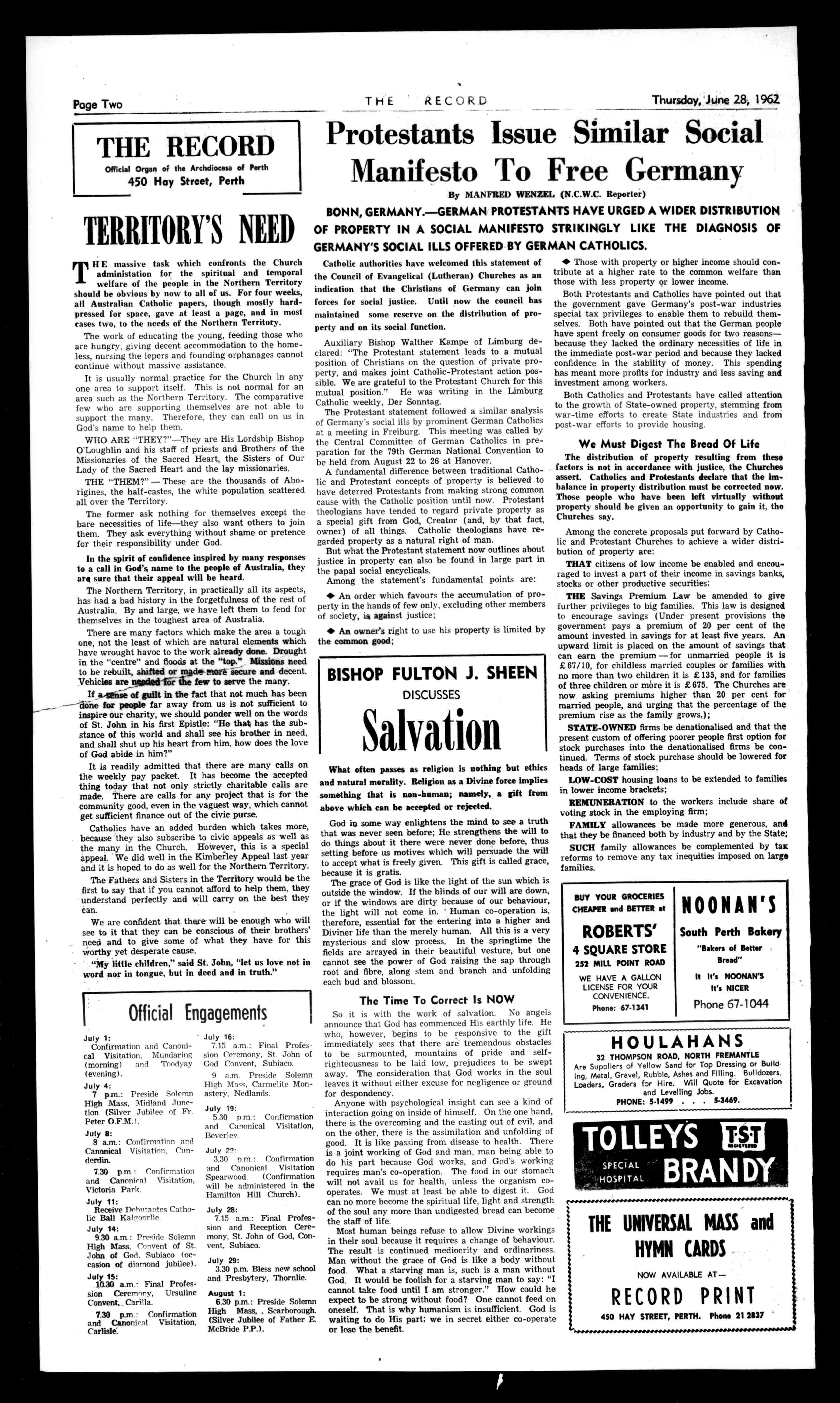
THEmassivetaskwhichconfrontstheChurch administationforthespiritualandtemporal welfareofthepeopleintheNorthernTerritory shouldbeobviousbynowtoallofus.Forfourweeks, allAustralianCatholicpapers,thoughmostlyhardpressedforspace,gaveatleastapage,andinmost casestwo,totheneedsoftheNorthernTerritory.
Theworkofeducatingtheyoung,feedingthosewho arehungry,givingdecentaccommodationtothehomeless,nursingthelepersandfoundingorphanagescannot continuewithoutmassiveassistance.
ItisusuallynormalpracticefortheChurchinany oneareatosupportitself.Thisisnotnormalforan areasuchastheNorthernTerritory.Thecomparative fewwhoaresupportingthemselvesarenotableto supportthemany.Therefore,theycancallonusin God'snametohelpthem.
WHOARE"THEY?"-TheyareHisLordshipBishop O'LoughlinandhisstaffofpriestsandBrothersofthe MissionariesoftheSacredHeart,theSistersofOur LadyoftheSacredHeartandthelaymissionaries.
THE"THEM?"-ThesearethethousandsofAborigines,thehalf-castes,thewhitepopulationscattered allovertheTerritory.
Theformerasknothingforthemselvesexceptthe barenecessitiesoflife-theyalsowantotherstojoin them.Theyaskeverythingwithoutshameorpretence fortheirresponsibilityunderGod,
Inthespiritofconfidenceinspiredbymanyresponses toacallinGod'snametothepeopleofAustralia,they andsurethattheirappealwillbeheard.
TheNorthernTerritory,inpracticallyallitsaspects, hashadabadhistoryintheforgetfulnessoftherestof Australia.Byandlarge,wehaveleftthemtofendfor themselvesinthetoughestareaofAustralia.
Therearemanyfactorswhichmaketheareaatough one,nottheleastofwhicharenaturalelementswhich havewroughthavoctotheworkalreadydone.Drought inthe"centre"andfloodsatthe"top."Missionsneed toberebuilt,shiftedorreiciomoresecureanddecent. Vehiclesarerutedadiiiithefewtoservethemany.
Ifa-Stnseofguiltinthefactthatnotmuchhasbeen forpeoplefarawayfromusisnotsufficientto inspireourcharity,weshouldponderwellonthewords ofSt.JohninhisfirstEpistle:"Hethanhasthesubstanceofthisworldandshallseehisbrotherinneed, andshallshutuphisheartfromhim,howdoesthelove ofGodabideinhim?"
Itisreadilyadmittedthattherearemanycallson theweeklypaypacket.Ithasbecometheaccepted thingtodaythatnotonlystrictlycharitablecallsare made.Therearecallsforanyprojectthatisforthe communitygood,eveninthevaguestway,whichcannot getsufficientfinanceoutofthecivicpurse.
Catholicshaveanaddedburdenwhichtakesmore, becausetheyalsosubscribetocivicappealsaswellas themanyintheChurch.However,thisisaspecial appeal.WedidwellintheKirnbeileyAppeallastyear anditishopedtodoaswellfortheNorthernTerritory.
TheFathersandSistersintheTerritorywouldbethe firsttosaythatifyoucannotaffordtohelpthem,they understandperfectlyandwillcarryonthebestthey can.
Weareconfidentthattherewillbeenoughwhowill seetoitthattheycanbeconsciousoftheirbrothers' needandtogivesomeofwhattheyhaveforthis worthyyetdesperatecause.
"Mylittlechildren,"saidSt.John,"letuslovenotin wordnorintongue,butindeedandintruth."
OfficialEngagements I
July1:
ConfirmationandCanonicalVisitation,Mundaring (morning)andToodyay (evening).
July4: 7p.m.:PresideSolemn HighMass,MidlandJunction(SilverJubileeofFr Peter0.F.M.).
July8: 8a.m.:Confirmationand CanonicalVisitation,Cenderdin. 7.30p.m.:Confirmation andCanonicalVisitation, Victoria Park.
July11: ReceiveDebetantesCatholicBallKai7oorlie
July14: 9.30a.m.:PresideSolemn
HighMass.ConventofSt. JohnofGod,Subiaco(occasionofdiamondjubilee).
JulyIS: 10.30a.m.:FinalProfessionCeremony,Ursuline Convent,Carilla.
7.30p.m.:Confirmation andCanonicalVisitation, Carlisle.
ProtestantsIssueSimilarSocial ManifestoToFreeGermany
ByMANFREDWENZEL(N.C.W.C.Reporter)
BONN,GERMANY.-GERMANPROTESTANTSHAVEURGEDAWIDERDISTRIBUTION OFPROPERTYINASOCIALMANIFESTOSTRIKINGLYLIKETHEDIAGNOSISOF GERMANY'SSOCIALILLSOFFEREDBYGERMANCATHOLICS.
Catholicauthoritieshavewelcomedthisstatementof theCouncilofEvangelical(Lutheran)Churchesasan indicationthattheChristiansofGermanycanjoin forcesforsocialjustice.Untilnowthecouncilhas maintainedsomereserveonthedistributionofpropertyandonitssocialfunction.
AuxiliaryBishopWaltherKampeofLimburgdeclared:"TheProtestantstatementleadstoamutual positionofChristiansonthequestionofprivateproperty,andmakesjointCatholic-Protestantactionpossible.WearegratefultotheProtestantChurchforthis mutualposition."HewaswritingintheLimburg Catholicweekly,DerSonntag.
TheProtestantstatementfollowedasimilaranalysis ofGermany'ssocialillsbyprominentGermanCatholics atameetinginFreiburg.Thismeetingwascalledby theCentralCommitteeofGermanCatholicsinpreparationforthe79thGermanNationalConventionto beheldfromAugust22to26atHanover.
AfundamentaldifferencebetweentraditionalCatholicandProtestantconceptsofpropertyisbelievedto havedeterredProtestantsfrommakingstrongcommon causewiththeCatholicpositionuntilnow.Protestant theologianshavetendedtoregardprivatepropertyas aspecialgiftfromGod,Creator(and,bythatfact, owner)ofallthings.Catholictheologianshaveregardedpropertyasanaturalrightofman.
ButwhattheProtestantstatementnowoutlinesabout justiceinpropertycanalsobefoundinlargepartin thepapalsocialencyclicals.
Amongthestatement'sfundamentalpointsare:
Anorderwhichfavourstheaccumulationofpropertyinthehandsoffewonly,excludingothermembers ofsociety,iagainstjustice;
Anowner'srighttousehispropertyislimitedby thecommongood:
BISHOPFULTONJ.SHEEN DISCUSSES
Salvation
Whatoftenpassesasreligionisnothingbutethics andnaturalmorality.ReligionasaDivineforceimplies somethingthatisnon-human;namely,agiftfrom abovewhichcanbeacceptedorrejected.
Godinsomewayenlightensthemindtoseeatruth thatwasneverseenbefore;Hestrengthensthewillto dothingsaboutittherewereneverdonebefore,thus settingbeforeusmotiveswhichwillpersuadethewill toacceptwhatisfreelygiven.Thisgiftiscalledgrace, becauseitisgratis.
ThegraceofGodislikethelightofthesunwhichis outsidethewindow.Iftheblindsofourwillaredown, orifthewindowsaredirtybecauseofourbehaviour, thelightwillnotcomein.Humanco-operationis, therefore,essentialfortheenteringintoahigherand Divinerlifethanthemerelyhuman.Allthisisavery mysteriousandslowprocess.Inthespringtimethe fieldsarearrayedintheirbeautifulvesture,butone cannotseethepowerofGodraisingthesapthrough rootandfibre,alongstemandbranchandunfolding eachbudandblossom.
TheTimeToCorrectIsNOW
July16: 7.15a.m.:FinalProfessionCeremony,StJohnof GodConvent,Subiaco. 9a.m.PresideSolemn HighMass,CarmeliteMonastery,Nedlands.
July19: 5.30nm.:Confirmation andCanonicalVisitation, Beverley
July 3.30nmConfirmation andCanonicalVisitation Spearwood.(Confirmation willheadministeredinthe HamiltonHillChurch).
July28: 7.15a.m.:FinalProfessionandReceptionCeremony,St.JohnofGod,Convent,Subiaco.
July29: 3.30p.m.Blessnewschool andPresbytery,Thornlie.
August1: 6.30p.m.:PresideSolemn HighMass,Scarborough. (SilverJubileeofFatherE. McBridePP.).
Soitiswiththeworkofsalvation.Noangels announcethatGodhascommencedHisearthlylife.He who,however,beginstoberesponsivetothegift immediatelyseesthattherearetremendousobstacles tobesurmounted,mountainsofprideandselfrighteousnesstobelaidlow,prejudicestobeswept away.TheconsiderationthatGodworksinthesoul leavesitwithouteitherexcusefornegligenceorground fordespondency. Anyonewithpsychologicalinsightcanseeakindof interactiongoingoninsideofhimself.Ontheonehand, thereistheovercomingandthecastingoutofevil,and ontheother,thereistheassimilationandunfoldingof good.Itislikepassingfromdiseasetohealth.There isajointworkingofGodandman,manbeingableto dohispartbecauseGodworks,andGod'sworking requiresman'sco-operation.Thefoodinourstomach willnotavailusforhealth,unlesstheorganismcooperates.Wemustatleastbeabletodigestit.God cannomorebecomethespirituallife,lightandstrength ofthesoulanymorethanundigestedbreadcanbecome thestaffoflife. MosthumanbeingsrefusetoallowDivineworkings intheirsoulbecauseitrequiresachangeofbehaviour. Theresultiscontinuedmediocrityandordinariness. ManwithoutthegraceofGodislikeabodywithout food.Whatastarvingmanis,suchisamanwithout God.Itwouldbefoolishforastarvingmantosay:"I cannottakefooduntilIamstronger."Howcouldhe expecttobestrongwithoutfood?Onecannotfeedon oneself.Thatiswhyhumanismisinsufficient.Godis waitingtodoHispart;weinsecreteitherco-operate orlosethebenefit.
Thosewithpropertyorhigherincomeshouldcontributeatahigherratetothecommonwelfarethan thosewithlesspropertyorlowerincome.
BothProtestantsandCatholicshavepointedoutthat thegovernmentgaveGermany'spost-warindustries specialtaxprivilegestoenablethemtorebuildthemselves.BothhavepointedoutthattheGermanpeople havespentfreelyonconsumergoodsfortworeasonsbecausetheylackedtheordinarynecessitiesoflifein theimmediatepost-warperiodandbecausetheylacked confidenceinthestabilityofmoney.Thisspending hasmeantmoreprofitsforindustryandlesssavingand investmentamongworkers.
BothCatholicsandProtestantshavecalledattention tothegrowthofState-ownedproperty,stemmingfrom war-timeeffortstocreateStateindustriesandfrom post-wareffortstoprovidehousing.
WeMustDigestTheBreadOfLife
Thedistributionofpropertyresultingfromthese factorsisnotinaccordancewithjustice,theChurches assert.CatholicsandProtestantsdeclarethattheimbalanceinpropertydistributionmustbecorrectednow. Thosepeoplewhohavebeenleftvirtuallywithout propertyshouldbegivenanopportunitytogainit,the Churchessay.
AmongtheconcreteproposalsputforwardbyCatholicandProtestantChurchestoachieveawiderdistributionofpropertyare:
THATcitizensoflowincomebeenabledandencouragedtoinvestapartoftheirincomeinsavingsbanks, stocksorotherproductivesecurities;
THESavingsPremiumLawbeamendedtogive furtherprivilegestobigfamilies.Thislawisdesigned toencouragesavings(Underpresentprovisionsthe governmentpaysapremiumof20percentofthe amountinvestedinsavingsforatleastfiveyears.An upwardlimitisplacedontheamountofsavingsthat canearnthepremium-forunmarriedpeopleitis £67/10,forchildlessmarriedcouplesorfamilieswith nomorethantwochildrenitisL135,andforfamilies ofthreechildrenormoreitisL675.TheChurchesare nowaskingpremiumshigherthan20percentfor marriedpeople,andurgingthatthepercentageofthe premiumriseasthefamilygrows.);
STATE-OWNEDfirmsbedenationalisedandthatthe presentcustomofofferingpoorerpeoplefirstoptionfor stockpurchasesintothedenationalisedfirmsbecontinued.Termsofstockpurchaseshouldbeloweredfor headsoflargefamilies;
LOW-COSThousingloanstobeextendedtofamilies inlowerincomebrackets;
REMUNERATIONtotheworkersincludeshareof votingstockintheemployingfirm;
FAMILYallowancesbemademoregenerous,and thattheybefinancedbothbyindustryandbytheState;
SUCHfamilyallowancesbecomplementedbytat[ reformstoremoveanytaxinequitiesimposedonlarge families. BUYYOURGROCERIES
PageTwo
OrganoftheArchdioceseofPerth 450HayStreet,Perth
TH rZEL k Thursday,June28,1962
CHEAPERandBETTERat ROBERTS' 4SQUARESTORE 252MILLPOINTROAD WEHAVEAGALLON LICENSEFORYOUR CONVENIENCE. Phone:67.1341 NOONAN'S SouthPerthBakery "BakersofBetter Bread" ItIt'sNOONAN'S It'sNICER Phone67-1044 HOULAHANS 32THOMPSONROAD,NORTHFREMANTLE AreSuppliersofYellowSandforTopDressingorBuilding,Metal,Gravel,Rubble,AshesandFilling.Bulldozers Loaders,GradersforHire.WillQuoteforExcavation andLevellingJobs. PHONE:5.1499 54469. TOLLEYS BRANDY SPECIAL HOSPITAL THEUNIVERSALMASSand HYMNCARDS NOWAVAILABLEATRECORDPRINT 450HAYSTREET,PERTH.Phone212837
StudentArtisanCompletesCrucifixProject
30,000AtManlyEucharistic
SYDNEY.-TheEucharisticChristjoinedmorethan thirtythousandofHisdisciplesinthegroundsofSt. Patrick'sCollege,Manly,recently,whenthebiggest processioninrecentyearshonouredHimunderthe generalthemeof"TheGoodShepherd."
Thisthemewaslinkedin prayec,psalmandhymn whenthevastconcourse offeredprayersfortheEcumenicalCouncil,theChurch ofSilenceandChristian Unity.
Thethemeoftheprocessionwasalsoproclaimedin twopanelsbesidethefestivalaltarbearing,thewords: "Therewillbeonefold,one shepherd"and"TheLord feedsme,Ishallnotwant."
TherewasaPentecostal touchtotheprocession proper.Manynationswere representedandmanylanpaagescouldbeheard amongtheworshippersas theyknelttoadoretheir
EucharisticLord. Theprocession,which wouldroundthemaindrive ofthecollege,tookanhour topassagivenpoint. TheSacredHostwascarriedbyHisEminenceCardinalGilroyunderahuge silkandgold-embossed canopy. Thefestivalaltarwasa blazeofred,goldandsilver drapery.Palmbranchesand colourfulbannersadorned thestructure,whichwas raisedhighoverthecongregation.
Theprocessionwasa deeplymovingspectacle comprisinggroupsfromall Catholiclayorganisations,
NOTEDU.S.AUTHORSTOSPEAKON LITURGYANDBIBLE
SYDNEY.-InAugust,twoofAmerica'sbest-known authorsandlecturers,FathersFrederickMcManusand BruceVawter,C.M.,willspeakontwosubjects intimatelyrelatedinthedailylifeoftheChurchLiturgyandtheHolyScriptures.
Theyhavebeeninvited togivethelecturesbythe ConfraternityofChristian DoctrineunderBishopFreeman. HisEminenceCardinal Gilroyisthepatrontothe conference,whichhasbeen entitled"Liturgyandthe WordofGod."
H.A.C.B.S.Commended ByAustralianBishops
ADELAIDE:TheBishops ofAustraliahaveexpressed theirfavourfortheworkof theHibernian-Australasian CatholicBenefitSociety, andtheirdesirethatmore andmoreCatholicsbecame members.'
ThiswasstatedbyHis GraceArchbishopBeovich inanaddressofwelcometo theSociety's17thFederal
Youareinvitedtocallat ourShowrooms, 506HAYSTREET, whereMr.Cochrane,inperson,willbepleasedto demonstratethe
TheseinstrumentsaresuitableforChurch,Hallor Home,andcostonlyfrom £425,includingSalesTax.
TriennialConvention,which metinAdelaiderecently.
TheArchbishopalsodescribedtheworkofthe Societyas"aneffective apostolate."Delegatescame fromalldistictsinAustralia andNewZealand.
"Forthebestpartofa centuryyoursocietyhas carriedonaneffectiveapostolateinAustraliaandNew Zealand.TheH.A.C.B.S.is aco-operativesociety,a mutualbenefitsocietyto helponeanotherinthose casualitiesoflifetowhich allareliableandencourage oneanotherontheroadto heaven,"saidtheArchbishop.
"Yoursociety,initslong history,hasalwaysthought withtheChurch,andthe Bishops,withoutexception, favouryourwork.Indeed, atthegeneralmeetingofthe HierarchyinJanuarylast, Iwasaskedontheirbehalf towishthesocietywelland tosaythattheBishopsare desirousthatmoreandmore Catholicswouldbecome members.
"Inthatregarditwas suggestedthatthroughthe respectiveBishopsyou mightapproachtheparish priests,whowouldmention thematterfromthe
"Your17thTriennialConventionisheldintheyear oftheGeneralCouncilof theChurch.Iamsurethat youandallyourmembers willbeferventinyour prayersforGod'sguidance fortheHolyFatherand thoseattendingtheGeneral Council.
"Perhapsaftertheopen-
ingprayeratyourbranch meetingsyoumightsaythe Pope'sprayerfortheCouncil,atleastduringthese preparatorymonthsand duringthesessionsofthe Council."
Enquiriesregardingthe localH.A.C.B.S.canbemade totheGrandSecretary,60 GranthamStreet,Wembley. Telephone87-2371.
Threedayshavebeenset asidefortalkswithpriests whoaretobeinvitedfrom everyparishinNewSouth Wales.
Thesewillbeabletolive inatSt.John'sCollege withintheUniversity,where thesessionsaretobeheld morningandafternoon, TuesdaytoThursday,August7to9.
OnTuesdayandWednesdayeveningsFatherMcManuswillgivetwospecial lecturestowhichnotonly priestsbutalsothearchitectsofSydneywillbeinvited.
Hewillspeakon"The Church-theHolyPlacesf theAssemblyofGoi"and "ArchitectureandthePresentLiturgicalRevival."
CENTENARYOF ARCHDIOCESE
CANBERRA:Centenary celebrationsofthefoundationoftheArchdioceseof Canberra-Goulburnwillbe heldearlierthanexpected, saysthe"Sanctuary,"the Canberraparishmagazine.
Announcingthis,His GraceArchbishopO'Brien saidthatuntilrecentlyit hadbeenbelievedthatthe diocesewasestablishedby decreeonMarch10,1864. Instead,ithadbeendiscoveredthatthediocese was,infact,createdbya decreeoftheSacredCollege ofPropagandaFideonNovember17,1862.
HisGracesaidthatowing totheEcumenicalCouncil, itwouldnotbepossibleto celebratetheeventthis year.
"However,becausethe eventismuchtoosignificant topermitignoringit,we shallcelebrateasthecentenaryyeartheperiodof12 monthscommencingonthe actualdateofthecentenary, November17,1962,"hesaid.
ArchbishopO'Briensaid anhistoricalrecordofthe Archdiocesewouldbepublishedtomarkthecentenary andheaskedthepriestsand Religiousofeachparishto gathermaterialforthe work.
Goulburnwasestablished
asadiocesein1862,and CanberraandGoulburnas anarchdiocesein1948.
Procession
manyofthemiIdistinctive dressandregalia. Thevariousnational groupswiththeirimpressive bannersweremainlyheaded bytheirchaplains.
BishopsCarrollandMuldoonwalkedimmediately behindthecanopy. Theywerefollowedby DomesticPrelatesandPrivy ChamberlainsoftheSydney Archdioceseandagroupof PapalKnights.
Duringtheprocessionthe marchersandonlookersrecitedtheRosary,whichwas interspersedwithreadingon theBlessedSacramentand withEucharisticandMarian hymns.
KELLY&RODOREDA Pty.Ltd.
CHINA,GLASSandPLATED WAREIMPORTERS
39KINGSTREET,PERTH Convents,CollegesInstitutionsandschoolsspecially cateredfor. Pricelistandcatalogueson application.
PHONE:23.2055
Thepainwasterrible BEXgavemerelief
Recentphotograph ofMr.R.El:JIM:WC
Mr.R.ElLtmore, 10CormackStreet, BALGOWLAH, N.S.W.,writes:
"I
Thursday,June2419E4. THE RECORD PageThree
hundredcrucifixesforthenewdormitorynowunderconstructionatBarry College,Miami,arebeingcompletedbyChineseAmericanstudent,IreneLuegofFt. Pierce,Fla.,ajuniorattheAdrianDominicanSistersschool.Sheisshownpolishing oneofthecopperetchingswhichwillbemountedinplasticandthenplacedona woodencross.
One
American"CONN,"English "BIRD"andJapan's* "YAMAHA"-ELECTRONIC ORGANS
PHONE fiS.1368 C.A.industries GATEandFENCEMANUFACTURERS 59ROBINSONAVENUE, BELMONT. QUALITYLENAMESHFENCESSUPPLIEDandERECTED
hadabadtooth(anupperone,itwasahem easesthroughwithdecay).Thepainwasterrible, asfriendtoldmetocrush BevTabletup intoit,untilIcouldgetenoughcouragetogoto thedentist.Ifinallygottohim,butyourBet Tabletsgavemerelief.Thankingyouforyour product." REXISTHOROUGHLYPROVEN Manyletterssimilartotheoneabovehavebees senttothemakersofBEXinappreciationofthe wonderfulreliefBEXhasgiventhewriterseven thoughthepainhasbeenverysevere.Whetherit istoothache,earache,headache,neuralgiaorpain arisingfromanyothercause,BEXisasure,truly effectivemeansofobtainingswift,safe,soothing relief. BEXISBETTER exEit Theaboveung...sa lonloolaalAtAwl0$,.of DoomPty.Limited,CrownoldCamerbillan".Yal.7. PSC BEGENEROUS! THISISAHOMELANDMISSION Sendyourdonationtothe DarwinNativeMissionFund C/o.CATHOLICMISSIONSOFFICE CATHOLICCENTRE, VICTORIASQUARE, PERTH.
AfterAssassination-What?
Dominica'sProblemsReviewed
THEDOMINICANREPUBLIC,thefirstChristianlandofthe Americas,todayrelishesthesweetandbittertasteoffreedom, filledwithdangersanddifficulties,butshininginhopeatthe sametime.
ATYRANNYOFOVERTHIRTYYEARSTHAT REACHEDINCONCEIVABLEEXTREMESLEFTTHE _COUNTRYIMPOVERISHEDANDTHEDOMINICANS BEWILDERED,THOUGHSTILLWITHENOUGH STRENGTHTOLIFTTHEMSELVESINASUPREME EFFORTTOREBUILDTHEBESTOFTHEDOMINICANNATIONALITY.
Forsuchaneffortatreconstructiontheycounton theirChristianheritage.TheinfluenceoftheChurch intheformationandpreservationoftheDominican nationalityhasbeensuchthatBishopJuanF.Pepenof Higuey,thedioceseofthebasilicaofthenational patron,OurLadyofAltagracia,neededonlyfivewords tosummariseit-"TheCrosspointedtheway."
ThepresentisatimeofrevolutionintheDominican Republic.Thesituationiscritical.Itcouldbecome desperate.Politicalpartiesareproliferating-nearly allofthemrevolutionaryinnameandinfact.-Fronts" and"movements"ofallsortshavesprungupandthe studentsarerestive.Publicorderisindanger.The nationlivesunderaconditionofpovertywhichresults inveryseriousmoralproblems.Itclamoursforurgent measuresanddemandstheoverallestablishmentof socialjustice.
TodaythebestDominicansbothinruralareasand citiesbearthebanneroftheChristianrevolution. Amidsttheprevailingconfusion,theywanttoclearthe waybecause,asoneoftheirleadersstates,"thepeople awaitedit,knewitwastheirown"andacknowledgeit amongall"revolutions"seekingtheirallegiance.
Alittlemorethanayearago-May30,1961-the manwhochangedthenobleandChristianlandof SantoDomingointoaprivatefeudalestate,wasshot todeath.RafaelL.TrujilloMolinabroughtintoplay everyweapon,includingterrorism,tomaintainapersonal"empire"thatwasbothtragicandridiculous.
Thesixmenwhocarriedouttheassassinationpaid withtheirlivesforanactionwhichtheDominican peoplehailasliberatingandheroic.Beforeaman judgedbyGod,Christiansfeelmovedtopityandsay: "Perhapshewasamadman,mentallyill.Godmay haveforgivenhim."IheardthissideinSantoDomingo bythosewhosufferedundertyranny,fromthosewho forgiveasChristians,butwhodonotforget.
Todaythebattleisbeingfoughtinthesocialand ideologicalfields.Therearegoodandbadbanners. Thereisfreedom.afreedombornjustafewmonthsago
W.H.BRANCH&SON
STONEHAMSTREET,JOONDANNA
Phone:8-2406-24-1157
AllTypes,ofElectricalWorkUndertaken
MANUELMIRA,
AssistantEditorofNoticiasCatolicas,SpanishlanguageeditionoftheN.C.W.C.NewsService, recordshisimpressionsofafirst-handsurvey inthetroubledDominicianRepublic.Thisis thefirstofsixrevealingarticles.
atthebeginningoftheyear,becauseitwasalreadythe middleofJanuarywhenthelastrepresentativesof Trujillismleftthegovernment.Butitisarestrained freedom,weak,fearfulofthepresentandoftomorrow.
Nevertheless,itisfreedom.TheDominicans,atleast allthosewhoareworthyofthename,preferittothe disgracefulpast."Allofthisisalmostamiracle,"a high-rankingchurchmantoldme.
MeanwhileTrujillism-itsexternalmanifestation blottedoutbythousandsofinscriptions,postersand monuments-whipsupitslastblowsinthedark.The communiststoo,lieinambush,plotandawaittheir hour,believingthatitiscloseathand."Liberals"and anti-clericalsplayintothehandsofcommunism, dreamingofa"democratic"dictatorshipbysomerich andegotisticalfamilies.
Theforcesofgoodarenotasleep,thoughtheylack time,leaders,materialmeansandhavetomaketheir wayalmostbyforce.Butastrongwill,personalsacrificesandenthusiasmmakeupforalllacks.Theyare optimisticinspiteofthedarkhorizonsandthedangers ofthepresent."Weshallgetthere,"theyaffirmwith trueChristianconviction.
Theyfeeltheyarecapableandgivetheimpression thattheyare,thoughtheysurelydeserveandneed selflessaid.
IspokeinSantoDomingowithitsbishops,itspriests. Theyshowgreatloveforthepeoplewho,inturn,show greattrust.intheirpriests.Italked,too,withCatholic youthleaders,employers,intellectuals,workersand farmersandwiththeDominicanman-in-the-streetwho nowspeakswithoutfear.Fivemembersofthepresent governmentexplainedtheirpoliciestome.Monsignor EliseoPerezSanchez,amemberoftheCouncilofState, spoketomeasapastorwhoatacriticaltimeinhis country'shistoryserveshispeopleinapostofpolitical responsibility.
COUNCIL'SDEMOCRATICINTENTION
TheCouncilofState,madeupofahandfulofmenlawyers,doctors,engineersandapriest-intendsto movetowardsdemocraticgovernmentassoonaspossible.Itplansanelection'onanewconstitutionin AugustandgeneralelectionsinDecember.Thispace isnotinaccordwiththegradualevolutionwhichtwo yearsagothepresentsecretaryforforeignaffairs,Jose AntonioBonillaAtiles,proposedfromexile.Bonilla, inhis"EssayontheEstablishmentofDemocracyinthe DominicanRepublic,"wasinfavourofsuccessiveelections,beginningwithmunicipalones.
Thesituationdemandsrapidandfar-reachingaction bygovernment.ButtheCouncilofState,awareofits temporarynature,canscarcelygovern.Willthe Dominicansandtheirpoliticalleadersgivetoita marginofguardedtrust?Aretherenot,perhaps. amongthemembersofthecouncilmenofgoodwill, apparentlydeservingofsuchatrust?
Thesearethequestionswhichmustbeansweredby theDominicansthemselves.Irecallthecourageofa labourleaderwhoservedasamediatorinalabour disputeattheportofSantoDomingowhenitwas necessarytoloadashipmentforCaritas,theCatholic charitiesorganisation.Irecalltheeffortsofthe presidentoftheYoungCatholicWorkersorganisation andoftheleadersoftheChristianlabourunions,the RevolutionarySocialChristianPartyandtheSocial ActionCentre,aswellastheworkofmembersofthe sodalitiesandMonsignorPerezSanchez.Irecallall thosewhostriveandfightinSantoDomingo.
"Cuba,sisterCuba,issoclose!TheCubantestserves ustoo,"theytoldme.
Uponleaving,Isawfromtheplane,withseaandsky formingasinglevistaofblue,theDominicanland favouredbyChristopherColumbusandIaskedmyself whatwillbethelotofthislandanditspeopleayear fromnow?Aprayerarosefrommylipsandmyheart: "OurFather,Whoartinheaven ."
"SantoDomingodeGuzmanprayforyourcountry. OurLadyofAltagracia,intercedeforthem Lord, grantthatinthelandofAmericawhereyournamewas firstspoken,theremayshinegloriously,onceandfor always,themottoofitscoat-of-arms:'God,Country, Freedom!"
THESECONDARTICLEofthisserieswillcentre ontheconciliatoryrolebeingplayedinthe DominicanRepublicbyMONSIGNORELISEO PEREZSANCHEZ,memberoftherulingCouncil ofStateandformanyyearsVicar-Generalof theSantoDomingoArchdiocese.
CAUGHT
INA CROSSFIRE
BEIRUT,Lebanon:CatholicsinnorthernIraqhave beencaughtinthecrossfire of tribalrevolt, itisreportedhere. AbombingraidbyIraqi AirForceplanesonthecity of'Amadiyadamagedthe Catholicbishop'sresidence andthechurch. Kurdishtribesmenloyal tothegovernmentonthe marchagainsttherebelsin themountainousnorthare alsoreportedtohavelooted thebishop'sresidenceand destroyedmanybooksand manuscripts. Therebelguerrillasare believedtobemembersof theBarazanitribeandto numberaboutthreethousand.Theyareledbythe MullaMustaphaAl-Barazani,whohaslivedinexile intheSovietUnion,butwas broughtbacktoIraqbythe presentgovernmentin Baghdadaftertheoverthrowofthemonarchyin 1958.Thetroublesbroke outtowardstheendoflast year.
BishopRaphaelBidawid of'Amadiyareturnedfrom alecturetourintheUnited Stateswhenheheardofthe dangerousturntherevolt hadtaken.Heisreportedto havefoundstolenChurch propertyupforsalein Mosul,thechiefcityofthe north.
Itisalsoreportedthat Catholicnunshavebeen withdrawnfromtheturbulentarea.
Amajorfearisthatsome fanaticallyanti-Christian Moslemshaveusedthedisordersasacloak whichtoventcenturies-old animosity.Lessthanthirty yearsago600Christiansof thenorthweremassacred andtheirvillagesdestroyed. AttheendofWorldWarI theregion'sTurkishmasters undertookanindiscriminate slaughterofChristians.
ItisreportedthatChristianshavefledsouthtothe vicinityofMosulorwest intoSyria. Therearemorethantwo hundredthousandCatholics inIraq,withroughlyhalf ofthemlivinginthenorth. Thetotalpopulationofthe countrystandsnearsixmillion.MostoftheCatholics areoftheChaldeanRite.
InWashington,aspokesmanfortheIraqiEmbassy saidthatpressreportsofa revoltamongtheKurdsof northernIraqare"grossly exaggerated."
HesaidthatonlymembersoftheBarazanitribe oftheKurdsareinrevolt, andthattheentiretribeincludingwomenandchildren probablynumbersnomore than3,000,outofthearea's totalKurdishpopulationof atleast1,800.000. BishopBidawid,during hisvisittotheUnitedStates, describedtheBaghdadgovernmerit'srelationswiththe Christiansofthenorthas "excellent."TheBishopis aKurd.
PageFour -- THE RECORD Thursday,June28,1962
SECTIONOF Sandovers NEWand E-X-T-E-N-S-I-V-E Floorcoverings andOccasionalFunritureDept. SpecialBargains NowOffering TakeLifttoFirstFloor
Dr.FrancisJ.Braceland(right),chiefpsychiatristat theInstituteforLiving,Hartford,Conn.,receivesthe UniversityofNotreDame'sLaetareMedalfor1962from FatherTheodoreM.Hesburgh,C.S.C.,NotreDamepresi. dent.Theaward,madeannuallysince1883toanoutstandingAmericanCatholiclayman,waspresentedduringtheschool's117thannualcommencement.Dr.Bracelandisthefirstpsychiatristtoreceivethehonour.PresidentKennedyreceivedthemedallastyear.
WHITETOPTAXIS CJnfro1led PROMPTTAXISERVICE CARS Ser,ice. Depot, 011Tremor. ALWAYSHAILAWHITETOPT GETTHEBESTDEALONBEALE HeartheLowryElectronicOrganinYourChurch AkilllISINS GOODPEOPLETODEALWITH SARRACKSTREETandBRANCHES
EvidenceOfCriticism
MountingAgainst
BONN,Germany.-FederalChancellorKonradAdenauer's re-electionaschairmanofGermany'srulingChristianDemocraticAdenauer partyhasnotgivenhimundisputedleadershipoftheparty.
TheCatholicstatesman, Germany's"grandoldman," facesrisingcriticismand evenrebellioninhisown ranks.
Clearly,theyounger generationisdemandinga greatervoiceintheformationofnationalpolicies.It isdisplayingimpatience overthecontinuedleadershipofthe86-year-old statesmanwhosinceWorld WarIIhasguidedhiscountry'sdestinies.
AnindexofAdenauer's weakeninggrasponthe partyreinsistobefoundin 1,0414Phrh14.0.4.4.4.44.4,441,41hehr.
ByFATHERPLACID JORDAN,O.S.B. (N.C.W.C.Reporter)
thevotingatthe11th nationalconventionofthe ChristianDemocratsat Dortmund.WhenAdenauer wasre-electedchairmanof theparty,hereceivedonly 391votes.Therewere530 delegatesattheconvention, and461voteswerecast.
Bycontrast,theconventionelectedanexceutive partymanagerbyavoteof 426.Thispostwenttoa memberoftheNorthRhine WestphaliaStategovernmentnamedJosefDufhues.
LikeAdenauer,Dufhuesisa Catholic.
Vice-ChancellorLudwig Erhard,aBavarianProtestant,whoenjoyswide popularityasrebuilderof thenation'sonce-shattered economy,got424votesto becomepartyvice-chairman. HeisregardedasAdenauer's mostprobableheir.
Theconventionmetinthe ironandsteelproducingcity earlyinJune.
Astronggroupwithinthe ChristianDemocraticparty, oftencalledits"leftwing," wantstheparty'spresent coalitionwiththerightwingFreeDemocraticparty replacedbyacoalitionwith thesocialists.
Germany'ssocialistparty istheSocialDemocratic partyofErich011enhauer.It istheprincipalopposition party,andalthoughitderivesfromKarlMarxithas repudiatedmuchofhis teachingandissometimes comparedtotheLabour partyofBritishsocialism.
GermanCatholics,who makeupasubstantialpart oftheinterdenominational ChristianDemocraticparty, havefrequentlysharedjoint governmentresponsibilities withsocialists.Twooutstandingspokesmenforthe party's"leftwing"are Catholiclabourleaders, HansKatzerandJohanneS Albers.Bothhaveattracted aconsiderablefollowing amongthevoters.They favoursociallegislationof asortadvocatedbyCatholic socialthinkersinGermany beforetheriseofAdolf Hitler.
SecretaryofLabourTheo-
dorBlankbelongstothis group,whichadvocatesa greatershareforlabourin themanagementofindustry aswellasinitsprofits.It furtheradvocatesanextensionofGermany'spresent socialsecuritybenefits.
Intheserespects,the"left wing"oftheChristianDemocratsoftenseemstosee eye-to-eyewiththesocialistsratherthanwiththe moreconservativemajority ofitsownparty.
Ontheotherhand,the socialistshaverecentlymade strongbidstoestablish closercontactswiththeir ChristianDemocraticopponents.Theirapparentwillingnesstocompromise Marxistviewswithtruly democraticideals,asshown intheircurrentpartyplatform,goessofarasto promisegreatertolerance towards thechurches. Whethertheseoverturesare sincereormerelymotivated bypoliticalexpediencyremainsdebatable.
However,suchsocialist overturestowardsChristian democracyhavereceived littlesympathyfromtrade unionsofthepowerfuland socialist-dominatedGerman FederationofLabour.Many ofthesocialistswhohold keypostsintheunionsare farthertotheleftthanthe socialistpartyheads.These leadershaveconsistentlyrefusedtograntafairshare ofresponsibilitytomemberssubscribingtoChristian ideasinthefieldsofpolitics andeconomics.
Thisledin1955tothe establishmentoftheGerman ChristianTradeUnion Movement.Unwillingnesson thepartofotherlabour organisationstoacceptleftistleadershipofthefedera-
tionhasalsoresultedinthe establishmentofsuchgroups astheEmployees'Trade UnionsandtheCivilService TradeUnions.
Theseconflictingdevelopmentsareexpectedtomove
40Years
tothecentreofthepolitical stageonceAdenauerretires andtheleadershipofthe ChristianDemocraticparty isassumedbymenseeking newapproachestotheir country'sproblems.
DroppingInForMass
WatchinganimpressiveairdropatFt.Bragg,N.C.,is AuxiliaryBishopPhilipM.HannanofWashington,acombatveteranasachaplainattachedtothe82ndAirborne duringWorldWarII,BishopHannan,whoservedwith the82ndinBelgium,FranceandGermanyin1944.45, offeredMassatthedropzoneforover3,000troopersand theirfamilies.Over800CatholicairbornesoldiersatFt. BraggaremembersofSt.Michael'sSocietyforCatholic Paratroopers.
COULDBEDIFFICULT
VIENTIANE,Laos.--TheCatholicsof Laos,asloyalcitizens,willrespectthe proposednew"nationalunity"government, CatholicsourcestoldtheN.C.W.C.News Servicehere.
Theywillco-operatewith theauthoritiesandhope thatthegovernmentwill succeedinsafeguardingreligiousfreedom.
Christiansfeeltheyhave gravereasonsforanxiety, however.Thecommunist PathetLaoholdtwoof12 ministries,twoofseven
ByFATHERPATRICK
O'CONNOR,S.S.C. statesecretariatsandaveto poweroverthemostimportantdecisions.
NeutralistPrinceSouvanna PhoumaisPremierand MinisterofDefence,and twoofhisgroupareMinisterofInteriorandMinister ofForeignAffairs.Butall
AUSTRALIAN BLUEMETAL LIMITED
Phones:68-2531-69-1251 FOR
decisionsofthesethree ministriesaresubjecttoa PathetLaovetoasin Khrushchev's"troika."Decisionsmusthave"the unanimousagreementofthe threepartyleaders."
ThePathetLaowasresponsibleforthekillingof twopriests-oneatChristmas,1959,andtheotherin May,1961-andthecapturingoffiveotherswhoare stillmissingaftermorethan ayear.PathetLaopropagandahasattackedthe Churchbitterly.Nowthe secretarygeneraloftheNeo LaoHakSat,whichisthe PathetLao'spoliticalparty, hasbeennamedMinisterof Information.
PrinceSouphanouvong, chairmanoftheNeoLao HakSat,isVice-Premier andMinisterofEconomics andPlanning.Thusthe communistleaderholdsa powerfulpostwhichdominatesinpra,ticetheMinistryofFinancegivento anti-communistGeneral PhoumiNosavan.
Theproposedgovernment includednobodyfromthe ethnic'groupsofmountaineerswhocomprisemore thanone-thirdofthecitizensofLaos.
PremierSouvannaPhouma isregardedashavingtruly neutralistintentions,butit isobviousthatthecommunistscanparalysehisadministrationwheneverthey like.
ThePremier'swifeisa Catholic,partFrenchand partLao.Hehasfaithfully fulfilledhismarriagepromiseregardingtheCatholic upbringingofhisfourchildren.Asboys,hissons servedMassinthecathgdral inVientiane.Hiselder daughterisbeingmarried
shortlyinaCatholicchurch inParis.Theyoungerhas enteredtheSistersof CharityinParis.
Nosafeguardsagainstreprisalsorvictimisationappearinthedraftagreement thatdelegatesfrom 14 countriesdrewupinGeneva lastDecemberandmaynow ratify.Thedraft,tobediscussedatareconvened Genevaconference,contains noprovisionswhateverfor thesafetyandwelfareofthe sufferersfromthecivilwar, thousandsofwhohavebeen keptfromstarvationforthe past14monthsonlyby Americanplanesdropping food.
Mostofthoseinjeopardy arecitizensofLaoswhobelongtotheethnicgroupsof mountainpeople.Thereare hundredsofChristians amongthem.Theyalsoincludethefamiliesofthe anti-communistmountaineer soldierswhoarenowexposedtoreprisals.
Thesefamilieshadff) leavetheirhomevillagesto liveasrefugeesinremote placesunreachablebyroads wheretheycouldplantno ricethisyear.
ThedraftagreementpreparedinGenevadealsonly withthecease-fireandpossibleforeigninterference withLaotianneutralityand givestheInternationalControlCommissioncompetence onlyinthesematters.The GenevaAgreementof1954 concerningVietnamincludedprovisionsagainstinternalabusessuchasreprisals andgavetheinternational commissiontheauthorityto investigatecomplaintsof thisnature.
Anestimated63,000refugeesareinLaosnow. Thoseintheisolatedupland arelikelytostarveunless theGenevapowersinsist thattheinternationalcommissionorotherinternationalbodymayensure deliveryofreliefsupplies untilnextyear'sharvest.
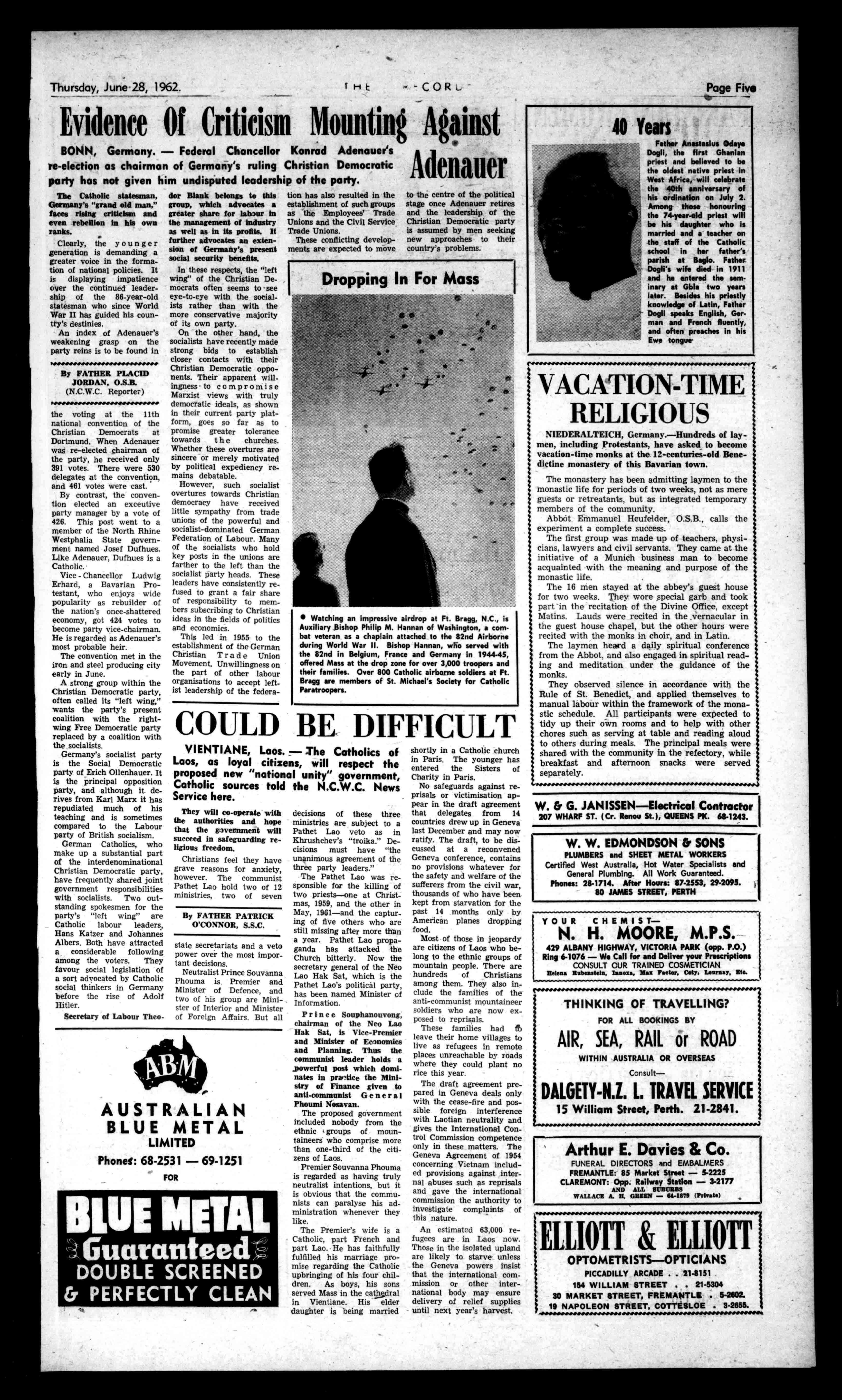
FatherAnestesiusOdaye Dogli,thefirstGhanian priestandbelievedtobe theoldestnativepriestin WestAfrica,willcelebrate the40thanniversaryof hisordinationonJuly2. Amongthosehonouring the74-year-oldpriestwill behisdaughterwhois marriedandateacheron thestaffoftheCatholic schoolinherfather's parishatBaglo.Father Dogli'swifediedin1911 andheenteredtheseminaryatGblatwoyears later.Besideshispriestly knowledgeofLatin,Father DoglispeaksEnglish,GermanandFrenchfluently, andoftenpreachesinhis Ewetongue
VACATION-TIME
RELIGIOUS
NIEDERALTEICH,Germany.-Hundredsoflaymen,includingProtestants,haveaskedtobecome vacation-timemonksatthe12-centuries-oldBenedictinemonasteryofthisBavariantown.
Themonasteryhasbeenadmittinglaymentothe monasticlifeforperiodsoftwoweeks,notasmere guestsorretreatants,butasintegratedtemporary membersofthecommunity.
Abb6tEmmanuelHeufelder,O.S.B.,callsthe experimentacompletesuccess.
Thefirstgroupwasmadeupofteachers,physicians,lawyersandcivilservants.Theycameatthe initiativeofaMunichbusinessmantobecome acquaintedwiththemeaningandpurposeofthe monasticlife.
The16menstayedattheabbey'sguesthouse fortwoweeks.Theyworespecialgarbandtook partintherecitationoftheDivineOffice,except Matins.Laudswererecitedinthe.vernacularin theguesthousechapel,buttheotherhourswere recitedwiththemonksinchoir,andinLatin.
Thelaymenheardadailyspiritualconference fromtheAbbot,andalsoengagedinspiritualreadingandmeditationundertheguidanceofthe monks.
Theyobservedsilenceinaccordancewiththe RuleofSt.Benedict,andappliedthemselvesto manuallabourwithintheframeworkofthemonasticschedule.Allparticipantswereexpectedto tidyuptheirownroomsandtohelpwithother choressuchasservingattableandreadingaloud toothersduringmeals.Theprincipalmealswere sharedwiththecommunityintherefectory,while breakfastandafternoonsnackswereserved separately.
Thursday,June28,1962. H -CUR PageFive
4 en en e
DOUBLESCREENED &PERFECTLYCLEAN
BLUEMETAL '`Guaratitteed
W.&G.JANISSEN-ElectricalContractor 207WHARFST.(Cr.RenouSt.),QUEENSPK.68-1243. W.W.EDMONDSON&SONS PLUMBERSandSHEETMETALWORKERS CertifiedWestAustralia,HotWaterSpecialistsand GeneralPlumbing.AllWorkGuaranteed. Phones:28-1714.AfterHours:87-2553,29.2095. 80JAMESSTREET,PERTH YOURCHEMISTN.H.MOORE,M.P.S. 429ALBANYHIGHWAY,VICTORIAPARK(opp.P.O.) Ring6-1076-WeCallforandDeliveryourPrescriptions CONSULTOURTRAINEDCOSMETICIAN HelenaRubenstein,Intro.,wasranter,City.Loamy,Eta THINKINGOFTRAVELLING? FORALLBOOKINGSBY AIR,SEA,RAILorROAD WITHINAUSTRALIAOROVERSEAS Corsult_ DALGETY-N.Z.L.TRAVELSERVICE 15WilliamStreet,Perth.21-2841. ArthurE.Davies&Co. FUNERALDIRECTORSandEMBALMERS FREMANTLE:85MarketStreet-5-2225 CLAREMONT:Opp.RailwayStation-3-2177 ANDALL81:713DRES WALLACEA.H.GREEN-64-1879(Private) ELLIOTT&ELLIOTT OPTOMETRISTS-OPTICIANS 30MARKETSTREET,FREMANTLE 5-2802. PICCADILLYARCADE 21-8151 154WILLIAMSTREET 21.5304 19NAPOLEONSTREET,COTTESLOE 3-2855. hilhheelhehhe4Ph..4.04,4144hheIhINehrhhedele.hehrhreh.,
PAKISTANIWOMEN FIGHT
MISSIONARYMERCY
KARACHI,Pakistan.-Awoman'sorganisationherehasallegedthatforeign missionariesore"breedingaspiritofdisloyaltyanddissatisfaction."
Allfundsfromabroadfor thesupportofmissionaries shouldbecutoff,the KarachibranchoftheAll PakistanWomen'sAssociationdeclaredinaresolution senttoallmembersofthe national andprovinlal legislatures.
Theresolutionsaidthat missionaries"createafeelingthattheyprovidemore helpandsupportthanthe government."
Iturgedthegovernment totakeoverdistributionof allforeignaidinPakistan. Pakistan'snewconstitution, promulgatedonMarch1and madeeffectiveonJune8, guaranteestherightof minorityreligionstopropagatetheirteachingsand conductreligiousinstitutions.Althoughitfosters thepracticeandteachings oftheMoslemreligion,forbidspassageofanylawre-
MEADSON&CO. FUNERALDIRECTORS
ALLSUBURBS and VICTORIAPARK 6-1158 6-1158
pugnanttoIslamandstipulatesthatonlyaMoslem maybePresident,itdoes notdeclarePakistanan IslamicState.About85per centofthepopulationis Moslem.
TheresolutionoftheAll PakistanWomen'sAssociationdrewthegovernment's attentiontoattemptsby missionariestopropagate Christianteachingsthrough playsandmoviesinmission schools.ItsaidtheBibleis taughtinmissionschools andhospitals.
Itfurtherassertedthat missionariesmisusetheir personalcontactswithgovernmentofficers.Itasked thegovernmenttorulethat allapproachestogovernmentofficersbythemissionariesbemadethrough theAuqafDepartment,a non-ministerialdepartment dealingwithendowments andreligiousgroups.
ChristiansinPakistan havegrownalarmedby criticisms,inthepressand elsewhere,oftheiractivities. IndignantletterstotheeditorintheKarachidaily "Dawn"havecitedpassages inmissionschooltextbooks whichtheletter-writers claimedputIslaminabad light. Thenewspaperitselfhas accusedmissionariesofusing"aggressiveandquestionablemethods"toturn Moslemsinto"renegades."
SEVENHILLSALTARWINES
AsSevenHillsSacramentalWineismadebyJesuits, itcomplieswiththerequirementsofChurchLaw.
WESTRALWINEandSPIRITAGENCY
167HAYSTREET,SUBIACO.Phone8.1410.
FLAGSandPENNANTS,ALUMINIUMandCANVAS AWNINGS,HOLLANDandVENETIANBLINDSand SELF-ASSEMBLYKITS. LETUSMEASUREANDQUOTE TUDORHOUSE
286ALBANYHIGHWAY,VICTORIAPARK.6-1620.
Wood,Coal andCoke
BRYANT&WATERS-Now ADAMS&KIVISALU 5EDWARDSTREET,EASTPERTH PHONE69.1350
LawnMowersandShearsSharpenedandSet HarryArmstrongPly.
BishopGivesUp PossessionsAndHis
MEDELLIN,Coombia: ArchbishopTulioBolero Salazar.C.M.,ofMedellin hasturnedhisnewlybuilt £.25,000residenceintoa schooltotrainlabour leadersandgivenallhis personalpossessionstoa foundationtoaidworkers.
The'Archbishopsaidhe haddonesoasan"emergencymeasure"tolauncha crusadeofChristianrenewal andtostemtheadvanceof communisminthisSouth Americancountry.
ArchbishopBotero, a memberofawealthyfamily fromAntioquia,madehis actionsknownattheclose ofanovenaduringwhich sermonsoncharitywere preachedbyFatherRiccardo Lombardi,S.J.,anItalian priestwhofoundedthe MovementforaBetter World.FatherLombardi stressedthatChristiansmust practisecharitytocorrect theeconomicimbalance amongsocialclasses.
TheactionsofArchbishop Botero,whohasmovedinto asmallerhouseherein Medellin,haveledanum-
Home
berofwealthyColombian Catholicstogivemoneyto hisnewfoundation. InasermonataMasson Pentecost,theprelatesaid ColombianeedsaChristian revolutionbasedonthree things:
THREETHINGS
ASTUDYoftheenvironmentandoftherevolutionarymeasuresthatneedto betaken; APPLICATIONoftherevolutionarydoctrineof Christtothesolutionofthe country'sproblems,with emphasisoncharityto overcomethehatredbeing preachedbyterroristicsystems;
REVOLUTIONARYaction bypriests,Religiousand Catholiclaymen,including trainedlabourleadersand workers,industrialists,parentsandeducatCrs.
"Here,"hesaid,"wehave alltheelementsforarevolutionoftheCross."
StudyAlone NotEnough
VATICANCITY.-IIisHolinessPopeJohnXXIII haswarnedagroupofGermansecondaryschool studentsthatbrilliancewithoutsoundreligious trainingleavesaman"inaforestwithnowayout."
ThePopereceivedstudentsandalumniofthe GermanLenderInstitute,aboys'preparatory schoollocatedatSasbach,Baden,whichiscelebratingits100thanniversary.
ThegroupwasintroducedbyGerman-born CardinalBea,S.J.,PresidentofthePreparatory SecretariatforPromotingChristianUnity,who attendedtheinstitutefrom1893to1897.
ThePopetoldthestudentsthat"therecanbe littlebenefitforastudentwho,havingconcluded hiscurriculumofstudies,doesnothavetheessentialfoundationforlife,eventhoughhemayhave beenabrilliantstudentandiswellversedinthe humanitiesandscience."
ThePopedefinedthisfoundationas"faithin God,interiorandexteriorCatholicreligiouspractice,thedisciplineofcharacterandloveofhis neighbour."
Summinguphisobservations,PopeJohnconchided:"Dearsons,experienceteachesthatwhere thefervourofChristianlifeiswanting,thatisalso lackingallthatisvaluable,comfortingandbeautifulforfifeonearth.WithoutthisChristianlife, manwandersinaforestwithnowayout."
EVERYMAN'S FAMILY
By FatherJOHNC.KNOTT
DECISIONS
ItwasafoundlinghomeinSouthAmericathathad beenestablishedbysomewealthypeopletocarefor abandonedinfants.Thephysicalfeatureswereexcellent,thenurseryequipmentmodern,andthedoctors andnursescompetentprofessionals.Everythingper- sonnelandmaterial-wiseforthedevelopmentof healthychildrenwasapparentlypresent.
Aftersomeexperience,theauthoritiesdiscovereda veryhighmortalityrateamongtheirinfantcharges. Despitetheexcellenttreatment,theyfailedtorespond asexpected.Infact,manyofthemjustseemedtofade awayanddie.
TheAnswer
Theusualmedicalresearchwasconductedwithout revealinganyoftheusualphysicalcauses.Finally,the highmortalityratewastracedtothefactthat,while anaverageoffiftyinfantswerepresentatagiventime, therewereonlyfivenursestocareforthemWithall theotherdutiesthesenurseshad,itwasn'tpossiblefor themtogivepersonalattentiontoeachbaby.Each childendedupwithlessthanone-tenthofamother, notsufficienttoanswerhisneedforpersonallove.
Theysolvedtheproblem,inpartatleast,byhiring neighbouringwomentocomeinforafewhourseach dayandpaypersonalattentiontoeachbaby.The infantwasheldinthearmsofthesubstitutemother whilebeingfed.Itwascooedoverandsungtoand fondledbythesamewoman.Thediaperswerechanged personallyinsteadofinanassemblyline.
Infact,thenurseryceasedtohavetheappearanceof aninfantservicestationintowhichthebabieswere broughtforfuelling,talcumingandoiling,andbecame anextensionofthemother'swombwherewarmthand peaceandsecurityweretobehad.
Theinfantsweren'tcaredformorefrequentlyorfed anybetter,butanewelementwasadded.Therewas establishedaloverelationshipbetweenthesubstitute motherandchildwhichhadpreviouslybeenmissing. andbecauseofwhichlacksomanydied.Thesubstitute motherfulfilledtheminimumrequirementsforlife.
Thalgiftofaparentisnotonlyagiftoflifethata childmighthaveexistence,itisalsoagiftoflovethat thelifepossessedmightgrowanddevelop.Itisa parent'srolenotonlytoinitiatecreation,butalsoto perfectit.
Whateverthevaryingneedsofthechildmaybe, accordingtohischangingage,thereisalwaysthecontinuingneedforlove.Thisistheconstantelementin thegrowthofachild.Aninfantneedslove,atoddler demandsit,theschoolchildthrivesonit,andthe adolescentseeksitelsewhereifhedoesn'tgetitat home.
Society'sDemands
Tothetraditional,obviousdutiesoftheparentfeeding,clothing,nursing,andonceinawhilespoiling thechild-modernsocietyhasaddedacomplexityof otherrequirements,whichhavebredacomplexityof newguilts.Achildmustnotonlybeeducated,hemust alsobeguaranteedacollegeeducation.Ifhedoesn't getit,itisthefaultofparentsaccordingtopresent culture. Achildshouldgrowstraightandstrongand,atthe sametime,besociallyadjustedandpopular.Hisleisure timeshouldbeorganisedtothenthdegree,his recreationsponsored,hispoisedeveloped,histeeth straightened,andaboveallheshouldbetaughtto conformjustbecauseeveryoneelseisdoingit.If parentsfailinanyofthesecapacities,theyfeelcondemnedbysocietyandhaveaguiltyfeelingatthesad lookontheforlornfacesoftheiroffspring.
Parentscannotpossiblydbeverythingfortheir childrenthatmodernsocietydemandsofthem.With fathersandmothers,everydayisadayofdecisionas towhatismostimportant,whatisoflesserimportance, andwhatisofnoimportance.Howtodrawthe distinctioninahierarchyofvaluesissometimesthe difficultthing.
ThewordsofChrist(John10:10):"Icamethatthey mayhavelife,andhaveitmoreabundantly,"mayoffer aclue.WithGod,parentshavegivenlife.WithHim, theygiveitmoreabundantlywhentheygivelove, whichisthestuffoflife. *
PageSix THE RECORD Thuhdoy,June28,1962
Ltd.
-21-4390.
andSAFESOVERHAULEDandSERVICED. CARandALLTYPESOFKEYSCUT. ImmediateService.
F.HAYDON-Chemist 167SCARBOROUGHBEACHRD.,MT,HAWTHORN. Phone:24-1423. CompleterangeofPatentMedicines,Toiletries, Cosmetics,PhotographicSupplies. DispensingServiceEveryEveninguntil9p.m. AgentHospitalBenefitFund. WILLISandELLIOTT OPTOMETRISTS 172aScarboroughBeachRoad.Phone24-3543. 230HannanStreet,Kalgoorlie.PhoneK.795. R.F.WILLIS,W.A.O.A.,Optometrist Suppliesc!FISH,VEGETABLESandPOULTRYat: ROSSINTERNATIONALFISHERIES HeadOffice:7CLEAVERSTREET,WESTPERTH PHONE28-4511 SPECIALQUOTESFORCATHOLICSCHOOLS, HOSPITALSandINSTITUTIONS. FreshFishandShellFishAvailableDeily P.D.LALLY LICENSEDPLUMBER 23FulhamStreet,Kewdale.Phone63682 HOTWATERSPECIALIST.SHEETMETALWORK. SEPTICTANKINSTALLATIONS. ALLWORK'GUARANTEED KingOpensHospital TakinganinauguraltourofMuashirMemorialHospital inAmman,Jordan,isKingHusseinofJordan,whoopened the100-bedhospitaltobestaffedbytheMedicalMission Sisters.AccompanyingtheKingwereMotherElenore Leipitz,RomeassistanttoMotherAnnaDengel,foundress andsuperiorgeneraloftheMedicalMissionSisters,and Dr.Sa'atlMuashir,headofthehospital.Thehospital wasbuiltbythefamilyofDr.Muashir,analumnusofthe medicalschooloftheAmericanUniversityofBeirut, Lebanon.
CITYCOUNCILAVENUE
LOCKS,DOORCLOSERS
D.
TheaddressofthelocalCatholicMarriage GuidanceCentreis85HILL.ST..PERTH. Telephone23-4548. C.MORRIS-Plumber SHEETandMETALWORKER 6CLEAVERSTREET,WESTPERTH.Phone28-7096. BOWRA&O'DEA'S MODERNFUNERALHOME IsSituatedat68STIRLINGSTREET-ClosetoCity SERVICEALLHOURS. ALLSUBURBS-21.4308.
PreparatoryCommission's WorkWoundUp
VATICANCITY-CARDINALSHEADINGTHESECONDVATICAN COUNCIL'SPREPARATORYCOMMISSIONSHAVEWOUNDUP THEWORKOFTHEIRCOMMISSIONSBYPRESENTINGPROPOSALSTOBEHANDLEDBYTHECOUNCILITSELF.
Theproposals,submitted totheseventhandfinalsessionoftheCentralPreparatoryCommission,toucheda widerangeofsubjects. Amongthemweretheordi=tiesofconvertswhohad beenministersoftheirpreviousreligionandthe preparationsnecessaryfor worthyreceptionofMatrimonyandHolyOrders.
Bytheendofthefirst weekofitsfinalsession (June12-20),thecentral commissionhadreceived proposalsforthecouncil agendafromsixpreparatory commissions.
Thefirstandseconddays weregiventothestudyof proposalsfromtheCommissionforSeminariesand Universities.Theseconcernedgeneralrulesofstudy andreligiousformation, seminarydisciplineandpastoralinstructioninseminaries.AsecondsetofproposalsdealtwithCatholic schoolsandtheteachingsof theChurchinrelationto instructioninthesacred sciences.
ConvertMinisters
Onthethirdday,the CommissiononBishopsand theGovernmentofDioceses combinedtomakeajoint presentationontherelation betweenbishopsandtheReligiouspresentintheir dioceses.
Onthesameday,Cardinal Ciriaciofferedproposals fromtheCommissionon DisciplineoftheClergyand ChristianPeopleconcerning associationsorganisedfor thefaithful,collections takenupduringMass,and legaciesinfavourofpious societies.Anothersubject toucheduponwastheadmissiontosacredordersof formernon-CatholicministersconvertedtotheCatholicFaith.
Thefourthdaywasdevotedexclusivelytomaterial submittedfromtheCommissiononReligious.This wasaproposedconstitution (authoritativedeclarationof belief)dealingwiththe Church'steachingonthe threestatesofperfectionreligiousordersandcongregations,societieswithout vows,andsecularinstitutes.
TwocommissionssubmittedmaterialonSaturday,June16.Cardinal AloisiMasella,fortheCommissiononSacraments,presentedtwoprojectsconcerningthepreparation
TheELSIEKELLY CORSETSALON FashionCorsets.
Ladies'Surgicaland ExclusiveLingerie andHosiery. "Salon,"Room109,First Floor,SheffieldHouse 713HAYSTREET (OverLevinson's) dOIONO.0404.044N144PININO.O.4.4.44.4N
Vatican New[
necessaryforreceivingworthilytheSacramentsofHoly OrdersandMatrimony.
Duringthesecondpartof
thismeeting,thecentral commissionheardareport fromCardinalCicognani, PresidentoftheCommission onOrientalChurches,ona projectdealingwiththe unityoftheChurahin relationtotheOriental Churches. CardinalTisserantpresidedatthemeetingsofall fivedays,intheabsenceof HisHolinessthePope,who isPresidentoftheCentral PreparatoryCommission.
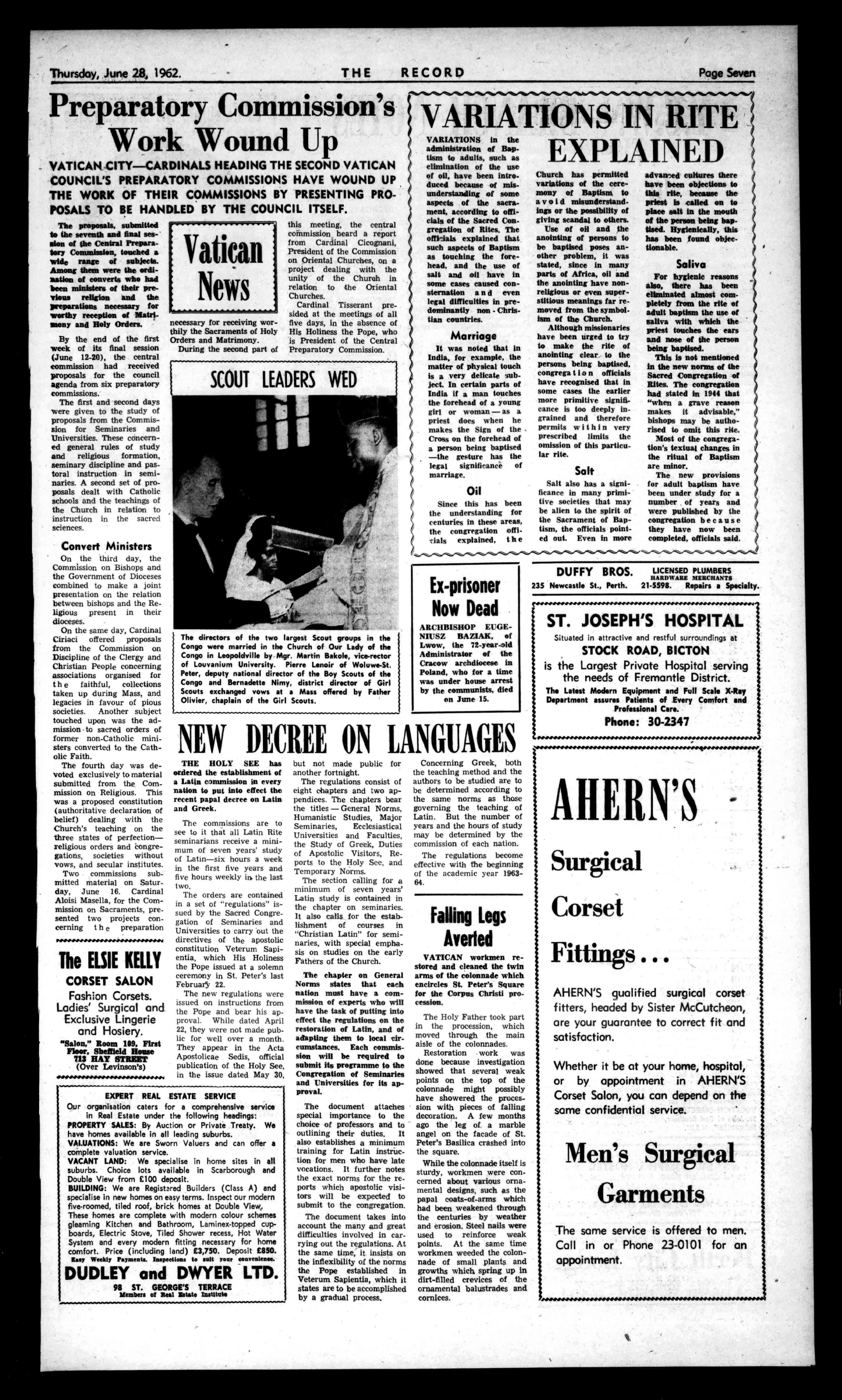
SCOUTLEADERSWED
VARIATIONSINRITE
VARIATIONSinthe administrationofBaptismtoadults,suchas eliminationoftheuse ofoil,havebeenintroducedbecauseofmisunderstandingofsome aspectsofthesacrament,accordingtoofficialsoftheSacredCongregationofRites.The offs-iaLsexplainedthat suchaspectsofBaptism astouchingtheforehead,andtheuseof saltandoilhavein somecasescausedconsternationandeven legaldifficultiesinpredominantlynon-Christiancountries.
Marriage
Itwasnotedthatin India,forexample,the matterofphysicaltouch isaverydelicatesubject.Incertainpartsof Indiaifamantouches theforeheadofayoung girlorwoman-asa priestdoeswhenhe makestheSignofthe Crossontheforeheadof apersonbeingbaptised-thegesturehasthe legalsignificanceof marriage.
Oil
Sincethishasbeen theunderstandingfor centuriesintheseareas, thecongregationofficialsexplained,the
Ex-prisoner
.4111.111bauSt.
ThedirectorsofthetwolargestScoutgroupsinthe CongoweremarriedintheChurchofOurLadyofthe CongoinLeopoldvillebyMgr.MartinBakole,vice-rector ofLouvaniumUniversity.PierreLenoirofWoluwe-St. Peter,deputynationaldirectoroftheBoyScoutsofthe CongoandBernadetteNimy,districtdirectorofGirl ScoutsexchangedvowsataMassofferedbyFather Olivier,chaplainoftheGirlScouts.
EXPLAINED
Churchhaspermitted variationsoftheceremonyofBaptismto avoidmisunderstandingsorthepossibilityof givingscandaltoothers.
Useofoilandthe anointingofpersonsto bebaptisedposesanotherproblem,itwas stated,sinceinmany partsofAfrica,oiland theanointinghavenonreligiousorevensuperstitiousmeaningsfarremovedfromthesymbolismoftheChurch.
Althoughmissionaries havebeenurgedtotry tomaketheriteof anointingcleartothe personsbeingbaptised, congregaLionofficials haverecognisedthatin somecasestheearlier moreprimitivesignificanceistoodeeplyingrainedandtherefore permitswithinvery prescribedlimitsthe omissionofthisparticularrite.
Salt
Saltalsohasasignificanceinmanyprimitivesocietiesthatmay bealientothespiritof theSacramentofBaptism,theofficialspointedout.Evenhimore bd
NowDead ARCHBISHOPEUGENIUSZBAZIAK,of Lwow,the72-year-old Administratorofthe Cracowarchdiocesein Poland,whoforatime wasunderhousearrest bythecommunists,died onJune15.
NEWDECREEONLANGUAGES
THEHOLYSEEhas orderedtheestablishmentof aLatincsrrunissioninevery nationtoputintoeffectthe recentpapaldecreeonLatin andGreek.
Thecommissionsareto seetoitthatallLatinRite seminariansreceiveaminimumofsevenyears'study ofLatin-sixhoursaweek inthefirstfiveyearsand fivehoursweeklyin.thelast two.
Theordersarecontained inasetof"regulations"issuedbytheSacredCongregationofSeminariesand Universitiestocarryoutthe directivesoftheapostolic constitutionVeterumSapientia,whichHisHoliness thePopeissuedatasolemn ceremonyinSt.Peter'slast Februara,22.
Thenewregulationswere issuedoninstructionsfrom thePopeandbearhisapproval.WhiledatedApril 22,theywerenotmadepublicforwelloveramonth. TheyappearintheActa ApostolicaeSedis,officio publicationoftheHolySee intheissuedatedMay30
EXPERTREALESTATESERVICE Ourorganisationcatersforacomprehensiveservice inRealEstateunderthefollowingheadings:
PROPERTYSALES:ByAuctionorPrivateTreaty.We havehomesavailableinallleadingsuburbs.
VALUATIONS:WeareSwornValuersandcanoffera completevaluationservice.
VACANTLAND:Wespecialiseinhomesitesinall suburbs.ChoicelotsavailableinScarboroughand DoubleViewfrom£100deposit.
BUILDING:WeareRegisteredBuilders(ClassA)and specialiseinnewhomesoneasyterms.Inspectourmodern five-roomed,tiledroof,brickhomesatDoubleView. Thesehomesarecompletewithmoderncolourschemes gleamingKitchenandBathroom,Laminex-toppedcupboards,ElectricStove,TiledShowerrecess,HotWater Systemandeverymodernfittingnecessaryforhome comfort.Price(includingland)£3,750.Deposit£850. EasyWeeklyPayment..Inspectionstosaltsoareenvealenee. DUDLEYandDWYERLTD. 98ST.GEORGE'STERRACE MembersofRealTatateInatitoW
butnotmadepublicfor anotherfortnight.
Theregulationsconsistof eightchaptersandtwoappendices.Thechaptersbear thetitles-GeneralNorms, HumanisticStudies,Major Seminaries,Ecclesiastical UniversitiesandFaculties, theStudyofGreek,Duties ofApostolicVisitors,ReportstotheHolySee,and TemporaryNorms.
Thesectioncallingfora minimumofsevenyears' Latinstudyiscontainedin thechapteronseminaries. Italsocallsfortheestablishmentofcoursesin "ChristianLatin"forseminaries,withspecialemphasisonstudiesontheearly FathersoftheChurch.
ThechapteronGeneral Normsstatesthateach nationmusthaveacommissionofexpertswhowill havethetaskofputtinginto effecttheregulationsonthe restorationofLatin,andof adaptingthemtolocalcircumstances.Eachcommissionwillberequiredto submititsprogrammetothe CongregationofSeminaries andUniversitiesforitsapproval.
Thedocumentattaches specialimportancetothe choiceofprofessorsandto outliningtheirduties.It alsoestablishesaminimum trainingforLatininstructionformenwhohavelate vocations.Itfurthernotes theexactnormsforthereportswhichapostolicvisitorswillbeexpectedto submittothecongregation.
Thedocumenttakesinto accountthemanyandgreat difficultiesinvolvedincarryingouttheregulations.At thesametime,itinsistson theinflexibilityofthenorms thePopeestablishedin VeterumSapientia,whichit statesaretobeaccomplished byagradualprocess.
ConcerningGreek,both theteachingmethodandthe authorstobestudiedareto bedeterminedaccordingto thesamenormsasthose governingtheteachingof Latin.Butthenumberof yearsandthehoursofstudy maybedeterminedbythe commissionofeachnation.
Theregulationsbecome effectivewiththebeginning oftheacademicyear196364.
FallingLegs
Averted
VATICANworkmenrestoredandcleanedthetwin armsofthecolonnadewhich encirclesSt.Peter'sSquare fortheCorpusChristiprocession.
TheHolyFathertookpart intheprocession,which movedthroughthemain aisleofthecolonnades.
Restorationworkwas donebecauseinvestigation showedthatseveralweak pointsonthetopofthe colonnademightpossibly haveshoweredtheprocessionwithpiecesoffalling decoration.Afewmonths agothelegofamarble angelonthefacadeofSt. Peter'sBasilicacrashedinto thesquare.
Whilethecolonnadeitselfis sturdy,workmenwereconcernedaboutvariousornamentaldesigns,suchasthe papalcoats-of-armswhich hadbeenweakenedthrough thecenturiesbyweather anderosion.Steelnailswere usedtoreinforceweak points.Atthesametime workmenweededthecolonnadeofsmallplantsand growthswhichspringupin dirt-filledcrevicesofthe ornamentalbalustradesand cornices.
advan^_cdculturesthere havebeenobjectionsto thisrite,becausethe priestiscalledonto placesaltinthemouth ofthepersonbeingbap. Used.Hygienically,this hasbeenfoundobjectionable.
Saliva
Forhygienicreasons also,therehasbeen eliminatedalmostcompletelyfromtheriteof adultbaptismtheuseof salivawithwhichthe priesttouchestheears andnoseoftheperson beingbaptised. ThisIsnotmentioned inthenewnormsofthe SacredCongregationof Rites.Thecongregation hadstatedin1944that "whenagravereason makesitadvisable," bishopsmaybeauthorisedtoomitthisrite.
Mostofthecongregation'stextualchangesin theritualofBaptism areminor.
Thenewprovisions foradultbaptismhave beenunderstudyfora numberofyearsand werepublishedbythe congregationbecause theyhavenowbeen completed,officialssaid.
DUFFYBROS. LICENSEDPLUMBERS HARDWAREMERCHANTS 235NewcastleSt.,Perth.21-5598.RepairsaSpecialty.
ST.JOSEPH'SHOSPITAL
Situatedinattractiveandrestfulsurroundingsat STOCKROAD,BICTON istheLargestPrivateHospitalserving theneedsofFremantleDistrict. TheLatestModernEquipmentandFullScaleX-Ray DepartmentassuresPatientsofEveryComfortand ProfessionalCare. Phone:30-2347
AHERN'S Surgical Corset
Fittings...
AHERN'Squalifiedsurgicalcorset fitters,headedbySisterMcCutcheon, areyourguaranteetocorrectfitand satisfaction.
Whetheritbeatyourhome,hospital, orbyappointmentinAHERN'S CorsetSolon,youcandependonthe sameconfidentialservice.
Men'sSurgical Garments
Thesameserviceisofferedtomen. CallinorPhone23-0101foran appointment.
Thursday,June28,1962. THE RECORD PageSeven
*-,-+r-.
ToCelebrateHisSliverJubilee
Y.C.W.
KENSINGTON
Alargemixedcrowd heardPeterBrophygivea knowledgeabletalkonsport andbehaviouratsport.Now wouldbeanexcellenttime tothankVeraPapazonnifor doingsuch1finejobwriting theminutesforthegeneral group. Ifyouarelookingfora goodtimeonJuly6,you couldnotdobetterthan cometotheKensington dance-itisfrom8to12.30 andthereissupperprovided.
SOUTHPERTH
Allthegirlsintheparish areassuredofaninterestingeveningonSunday,July 1,intheparishhallafter eveningdevotions.Christine Antoinewillbeshowing colouredslidestakenduring hertriptoSingaporelast Christmas.
MOSMANPARK
Someofthegroupspent anenjoyableweekendat MarianLodgewithleaders fromScarborough,Palmyra, EastFremantleandSouth Perth.RepresentingMosmanswereMaureenExley, Veronica,Arthur,Teresa Elias,RoslynHayesand ChristineAntoine.Executivemember,JanLeitchwas inchargeoftheweekend andthevariousdiscussions wereveryinterestingand helpful.
PALMYRA
Sevengirlsfromourleadersgroupandteamsattendedthetrainingweekend atMarianLodgelastweek. ForKerryBaguleyand AnneHughesitwasthefirst timeattheLodgeandboth saidtheyenjoyedthemselvesandlearntalotfrom thediscussionsheld.
Wewouldliketocongratulateourbasketballteams forwinningtheirmatches lastSaturday.Margaretand PatCarrareatpresent workingonformingtwo newteams,sothatwemay soonhavealargerleaders group.
SHENTONPARK
Theapostles'hadtheimportantworkbestowedupon thembyChristoffounding HisChurchandspreading HisWordtoallpeople. ChristleftbehindHimthe
SOCIETYOF
St.VincentdePaul WELFARESTORE
Doyoufeelcoldand miserableinwinter?Many hundredsofpoorfamiliesdo. Helpusrelievedistressby donatingclothing,ragsand allsurplusarticles.
Kindlydeliverto15Bronte St.,EastPerth,orPhone 23-4201forcollection.
YOUNGMANWillYouServe ChristintheSick?
THEHOSPITALLERBROTHER OFST.JOHNOFGODundertakesthenobleworkof nursingandconsecrateshimselftoitbyreasonofhis fourthVowofHospitality; hislaboursforthesickare therebyimmeasurablyennobledandhisworkbecomes aprayer,anactofthevirtue ofReligion,anactofworship. Forparticularswriteto:
VOCATIONDIRECTOR, St.JohnofGodBrothers, MORRISSET,N.S.W.
BRANCHNOTES
ByY.C.W.BranchCorrespondents
HolySacramentsandthe apostleshavehandedthem ontousduetotheirgood efforts.We,asmembersof Y.C.W.,shoulddoourpart forChristinmakingfull useoftheeffortsofthe apostles.Wecancarrythe Gospelintoallourplacesof workandinourleisuretime byourgoodexampleand Works.Weshouldalsomake fulluseoftheSacraments thathavebeenhandeddown tousbyreceivingthe BlessedEucharistatHoly Massasoftenaspossibleso thattherewardofthe apostles'effortswillbe great.
ThecombinedCommunion ofboys'andgirls'sporting teamswaswellattendedat 9o'clockMasslastSunday andallmemberswhoattendedarethankedanditis hopedthatthismonthly Communionwillbeaswell attendedinfuture.
Onherretirementaspresidentof.thegirls'Y.C.W., wewishtothankverysincerelyIreneBartleyforall hergrandwork-shewas trulyaworkerofChrist.
HIGHGATE
AnumberofgirlsattendedaweekendatMarian Lodgerecently,amongthem beingJoanManns,Yvonne Lynch,MargaretWatt,Val Motteram andMaxine O'Reilly.
LastTuesdaynightwe heldamostinterestingdebatewiththeWestPerth branch.Ourcongratulations mustgotothisteamfor theirsuccessinwinningthe debate.Wealsowishto thankthemforcomingand hopetoseemoreofthemin thefuture.Ourthanksgoto FatherCunninghamforattendingourmeetingand alsoforgivinghismostinterestingtalk.Congratulationsandbestwishesare extendedtoourretiring leader,MaureenCherry. whohasannouncedherengagementtoBobAnderson. Wewishthemeveryhappinessforthefuture.
AlsoourthanksareconveyedtoMargaretMoore forherpresenceattwoof ourteammeetings.
OSBORNEPARK
ThedancelastWednesday nightwasawonderfulsuccess.Itishopedthatwewill seeevenmoreboysandgirls attheJulyAnniversary Dance. Allboysandgirlswho haveleftschoolareinvited toattendthecombined generalmeetingatSt. Kieran'sSchoolonSunday, July8.Afterthediscussion filmswillbeshown.
WESTPERTH Atourlastleaders'meeting,thegroupwasvisited byMissMargaretMoore (NationalSecretary)and wewishtothankherforthe keeninterestandencouragementgiventous.Plansfor thegeneralmeeting,tobe heldonWednesday,June27, weremadeandcontactwork iswellunderway.
LastSundaysawtenenthusiasticleadersandgeneralmembersengageinthe B.C.&E.G.DoorknockAppeal,who,althoughfootsore, agreeditprovedquitefruitful. TheItalianGroup(boys andgirls)heldabadgepresentationceremonyafterthe 10.30MasslastSundayduringwhichapproximately fiftycandidatesdedicated themselvestothecauseof
6-1097. NearRivervaleR.S.andHighway,busstop. Beautifulriverview. Tariff:PerWeek,£5;perDay,£1;B.&B.,17/6day: Bed(only),15/-day.Boarders,£4110/-perweek.
CatholicAction,andlater intheafternoon,together withtheY.C.W.'s,tookpart intheCorpusChristiprocession.Durinethesocialheld thateveningoftheoccasion, MonsignorE.Sullivangave aninspiringtalktothenew membersontheimportance oftheirroleasleadersand theneedofanapostolic laity.
COTTESLOE
Amotionwasmovedat thelastgeneralmeetingthat becauseofthelargenumberofMosmanParkmembers,thebranchwastobe renamedCottesloe-Mosman Park.
Thiswouldcomeinto effectifapprovedbythe Y.C.W.councilanddiocesan chaplain.
Allgeneralmembersat themeetingwereinfavour ofasuggestionthatthe branchholdacartrialsome timenextmonth.
Itwassuggestedthat neighbouringbranchesbe invitedtoenterthetrial.
Arrangementstoinvitea Redemptoristpriesttolectureatthenextgeneral meetingoncommunismand howthelayapostolatecould combatit,weretobefinalisedduringtheweek.
EASTFREMANTLE
Wearehappytoannounce thatwehaveonceagain startedupagroupwith eightleaders.NellieSchaper, AnnyVanWees,Pauline O'LoughlinandDelysiaColquhounattendedatraining weekendatMarianLodge onJune23-24.Thisexplain'.10...114114141.4...0.0,0
edmoreclearlytheneedfor truefriendshipamong parishcontactsandthe availabilityof"NewYouth," theY.C.W.'sownpaper.
HIGHGATE
Alhoughourleaders' group iscomparatively stronginnumbers,thereare stillseveralboyswantingto join.ForthispurposePeter Gray,VernScanlanand HugIErmacoraareforming teams. Apointofdiscussionrecentlyhasbeenthedeterioratingstandardofthe Y.C.W.footballcompetition. Thegroup_feelsthatthe situationdemandsimmediateactionandeveryeffort ontheirpartwillbemade torectifythematter.The veryfactthatthecompetitionisaY.C.W.service seemstohavebeenoverlookedbythemajorityof theclubs.Thegroupproposedthatinourownclub aprayershouldbesaidbeforethegameandplayers responsibleforunfairor undueroughplayshouldbe -dealtwithbytheselectors inawaytheythinkfit.
OnFriday,June29,the groupistoparticipateinan All-Night.VigilattheHighgatechurch.TheVigilisto beheldinhonourofthe FeastoftheSacredHeart.
SOCIALCALENDAR
July6:KENSINGTON DANCE,8p.m.to12.30a.m.
July7:HIGHGATE (Fortnightly)DANCE,8-12.
July13:CENTRAL DANCE,AnzacHouse.
GIRLS'BASKETBALL
RESULTSofmatches playedonSaturday,June23:
AGRADE:St.Michael'sd WestPerth29-23;Shenton ParkdKensington47-20; HiltonParkdBeaconsfield 34-17;SouthPerthdScarboroughRed49-21.
Best:F.Barron,L.Quigley,B.Anning,P.Ensor.
ARESERVE:St.Clare'sd EastVictoriaPark46-17; FremantledScarborough White44-15;ManningPark dSouthPerth30-25.
Best:G.Tickle,L.Fossilo, P.Ramsay.
B1GRADE:VictoriaPark dFloreatPark19-17;ShentonParkdKensington3332;NorthDoubleviewd Leederville25-21;Osborne ParkdScartoroughBrown 32-23.
Murray,M.Munden,K: O'Hanlon.
B2GRADE:PalmyraGold dClaremont35-12;Highgate dHiltonPark44-14. Best:J.Horrocks,N. Quelch.
B3GRADE:Leedervilled Glendalough23-17;ScarboroughGreendManning Park33-21;BedfordParkd Applecross36-20:Palmyra dMosmanPark30-16.
Best:M.Hicks,A.Marsh, V.Rive,J.Atherden.
ClGRADE:ShentonPark dOsbornePark43-14;VictoriaParkdCarlisle23-13.
Best:R.Dods,S.North.
C2GRADE:NorthDoubleviewdManningPark39-15; HiltonParkdKensington 36-19.
Best:L.Halliday,J.
Best:W.Ryckaert,M.Barker.
CatholicWomen'sLeagueMeetings
Executivemembers
BRENTWOOD;Meeting totakeplaceatthepresbytery,MarmionStreet,Alfred Cove,onJuly4.
LEEDERVILLE:Meeting inthepresbyteryonTuesday,July3,at8p.m.
of ChristianswasmadetoMrs. Hartigan,theretiringpresident,asamarkofappreciationforheruntiringefforts overthepreviousfiveyears. AstatueofOurLadyof Lourdeswasalsopresented VICTORIAPARK:Sun-toMrs.Hallinappreciation day,July1,afterDevotionsofherworkassecretaryforthisbranchtomeet. treasurer.
SHENTONPARK:The monthlymeetingwasheld onJune13atthehomeof Mrs.Bowden,Tenmembers werepresentandMonsignor
CarmelFete
Meeting
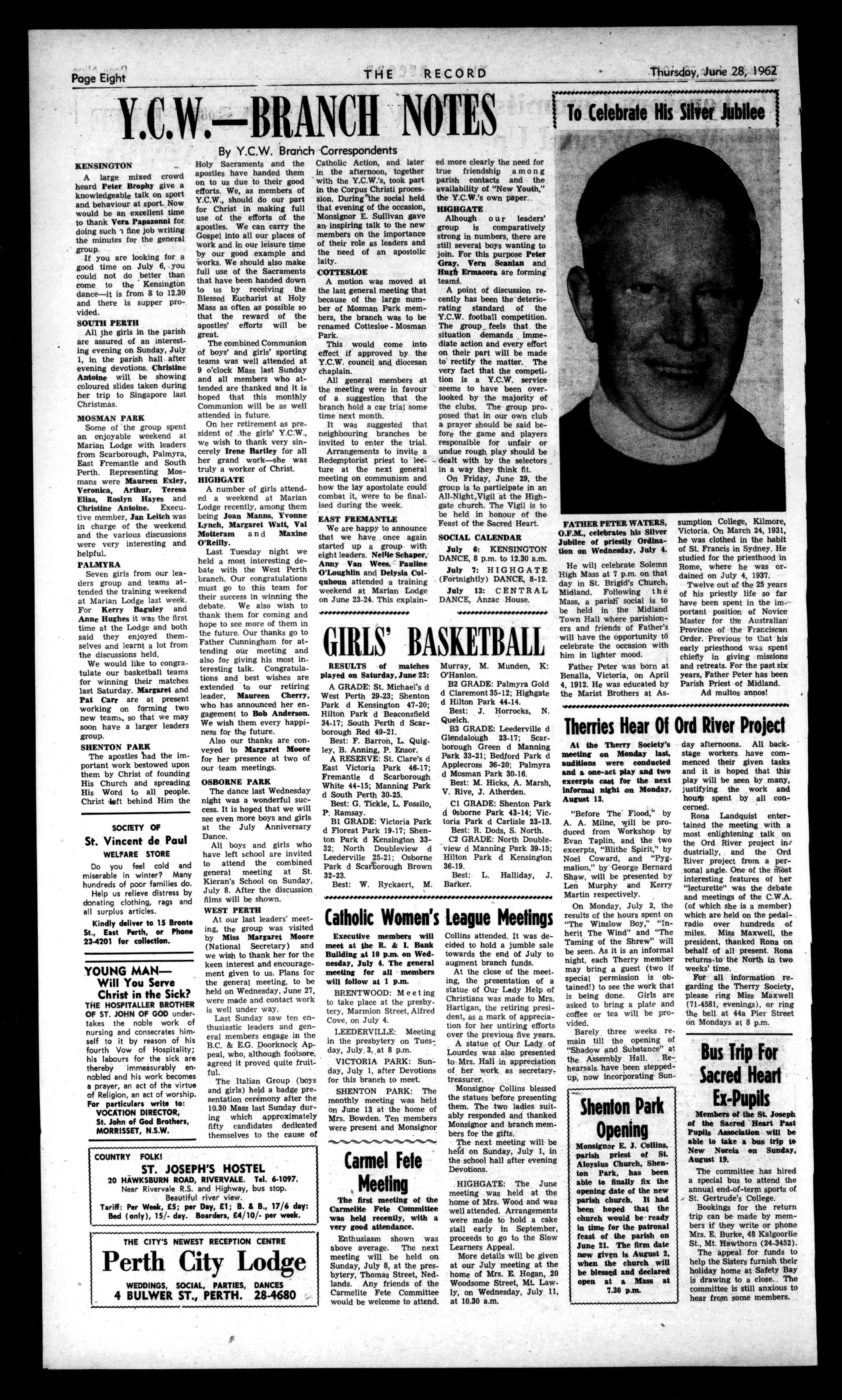
MonsignorCollinsblessed thestatuesbeforepresenting them.Thetwoladiessuitablyrespondedandthanked Monsignorandbranchmembersforthegifts. Thenextmeetingwillbe herdonSunday,July1,in theschoolhallafterevening Devotions.
HIGHGATE:TheJune meetingwasheldatthe ThefirstmeetingofthehomeofMrs.Woodandwas CarmeliteFeteCommitteewellattended.Arrangements washeldrecently,withaweremadetoholdacake verygoodattendance. stallearlyinSeptember, EnthusiasmshownwasproceedstogototheSlow aboveaverage.ThenextLearnersAppeal. meetingwillbeheldon Moredetailswillbegiven Sunday,July8,atthepres-atourJulymeetingatthe bytery,ThomasStreet,Ned-homeofMrs.E.Hogan,20 lands.AnyfriendsoftheWoodsomeStreet,Mt.LawCarmeliteFeteCommitteely,onWednesday,July11, wouldbewelcometoattend.at10.30a.m.
FATHERPETERWATERS, O.F.M.,celebrateshisSilver JubileeofpriestlyOrdinationonWednesday,July4. HewillcelebrateSolemn HighMassat7p.m.onthat dayinSt.Brigid'sChurch, Midland.Followingthe Mass,aparishsocialisto beheldintheMidland TownHallwhereparishionersandfriendsofFather's willhavetheopportunitytO celebratetheoccasionwith himinlightermood.
FatherPeterwasbornat Benalla,Victoria,onApril 4,1912.Hewaseducatedby theMaristBrothersatAs-
sumptionCollege,Kilmore, Victoria.OnMarch24,1931, hewasclothedinthehabit ofSt.FrancisinSydney.He studiedforthepriesthoodin Rome,wherehewasordainedonJuly4,1937. Twelveoutofthe25years ofhispriestlylifesofar havebeenspentintheimportantpositionofNovice MasterfortheAustralian ProvinceoftheFranciscan Order.Previoustothathis earlypriesthoodwasspent chieflyingivingmissions andretreats.Forthepastsix years,FatherPeterhasbeen ParishPriestofMidland. Admultosannos!
TherriesHearOfOrdRiverProject
AttheTherrySociety's meetingonMondaylast, auditionswereconducted andaone-actplayandtwo excerptscastforthenext informalnightonMonday, August13.
"BeforeTheFlood,"by A.A.Milne,willbeproducedfromWorkshopby EvanTaplin,andthetwo excerpts,"BlitheSpirit,"by NoelCoward,and"Pygmalion,"byGeorgeBernard Shaw,willbepresentedby LenMurphyandKerry Martinrespectively.
OnMonday,July2,the resultsofthehoursspenton "TheWinslowBoy,""InheritTheWind"and"The TamingoftheShrew"will beseen.Asitisaninformal night,eachTherrymember maybringaguest(twoif specialpermissionisobtained!)toseetheworkthat isbeingdone.Girlsare askedtobringaplateand coffeeorteawillbeprovided.
Barelythreeweeksremaintilltheopeningof "ShadowandSubstance"at theAssemblyHall.Rehearsalshavebeensteppedup,nowincorporatingSun-
ShentonPark
Opening
MonsignorE.J.Collins, parishpriestofSt. AloysiusChurch,ShentonPark,hasbeen abletofinallyfixthe openingdateofthenew parishchurch.Ithad beenhopedthatthe churchwouldbeready intimeforthepatronal feastoftheparishon June21.Thefirmdate nowgivenisAugust2, whenthechurchwill beblessedanddeclared openataMassat 7.30p.m.
dayafternoons.Allbackstageworkershavecommencedtheirgiventasks anditishopedthatthis playwillbeseenbymany, justifyingtheworkand houitsspentbyallconcerned. RonaLandquistentertainedthemeetingwitha mostenlighteningtalkon theOrdRiverprojectin, dustrially,andtheOrd Riverprojectfromapersonalangle.Oneofthemost interestingfeaturesofher "lecturette"wasthedebate andmeetingsoftheC.W.A. (ofwhichsheisamember) whichareheldonthepedalradiooverhundredsof miles.MissMaxwell,the president,thankedRonaon behalfofallpresent.Rona returns-totheNorthintwo weeks'time.
Forallinformationregardingthe'MerrySociety, pleaseringMissMaxwell (71-4581,evenings),orring thebellat44aPierStreet onMondaysat8p.m.
BusTripFor SacredHeart
Ex-Pupils
MembersoftheSt.Joseph oftheSacredHeartPast PupilsAssociationwillbe abletotakeabustripto NewNorrisonSunday, August19.
Thecommitteehashired aspecialbustoattendthe annualend-of-termsportsof St.Gertrude'sCollege. Bookingsforthereturn tripcanbemadebymembersiftheywriteorphone Mrs.E.Burke,48Kalgoorlie St.,Mt.Hawthorn(24-3452).
Theappealforfundsto helptheSistersfurnishtheir holidayhomeatSafetyBay isdrawingtoaclose.The committeeisstillanxiousto hearfromsomemembers.
PageEight THE RECORD Thursday,June28,1962
COUNTRYFOLK! ST.JOSEPH'SHOSTEL 20HAWKSBURNROAD,RIVERVALE.Tel.
Lodge WEDDINGS,SOCIAL,PARTIES,DANCES 4BULWERST.,PERTH.28-4680
THECITY'SNEWESTRECEPTIONCENTRE PerthCity
meet
Building
onWed-towardsthe
nesday,July
Thegeneralaugmentbranch
meetingforallmembers
themeet
willfollowat
ing,thepresentation
statueof
willCollinsattended.Itwasde-
attheR.&I.Bankcidedtoholdajumblesale
at10p.m.
endofJulyto
4.
funds.
Atthecloseof
-
1p.m.
ofa
OurLadyHelp
Mrs.
Miss
Mrs.Cuffe
Anonymous
Miss
Miss
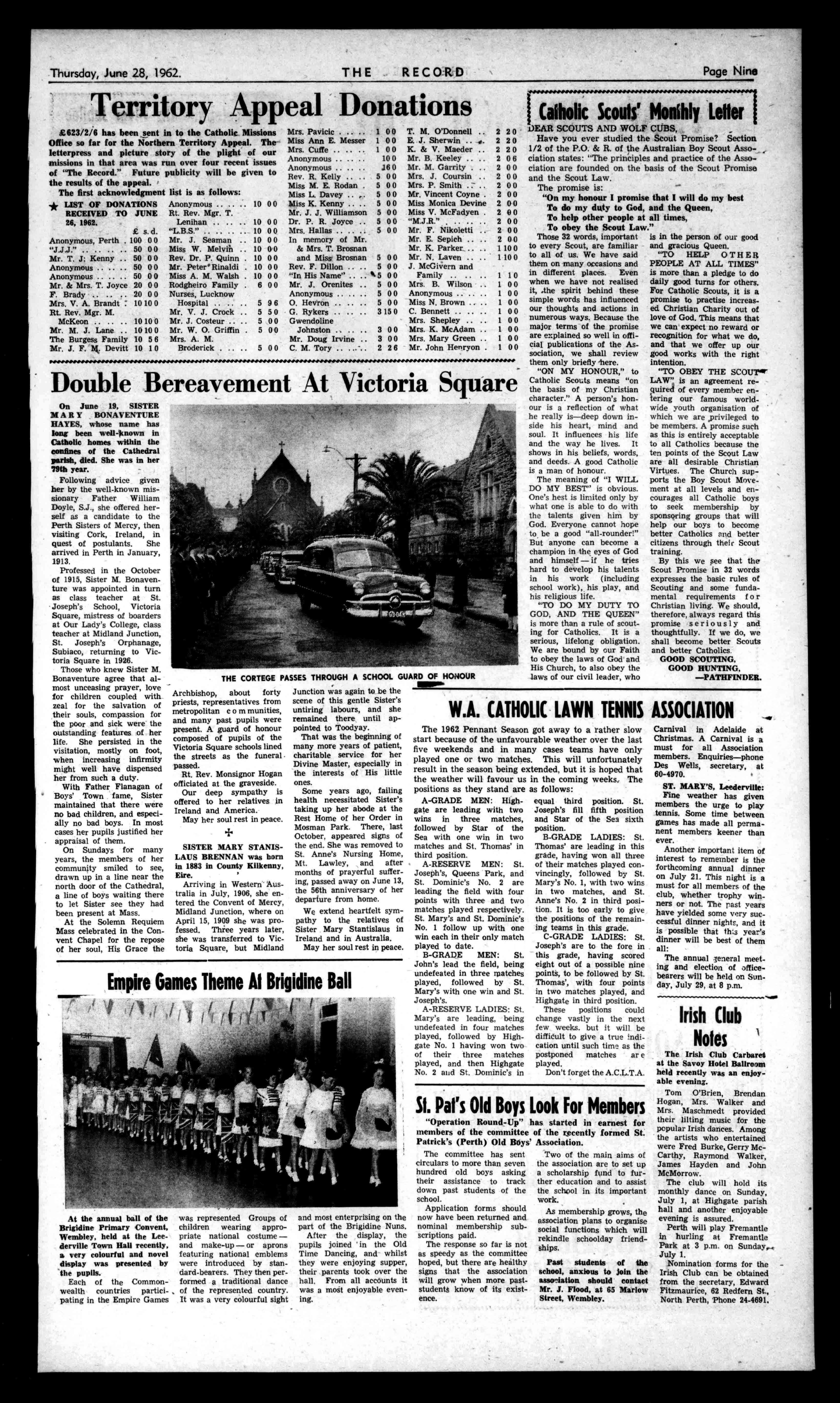
Anonymous
DoubleBereavement
OnJune19,SISTER MARYBONAVENTURE HAYES,whosenamehas longbeenwell-knownin Catholichomeswithinthe confinesoftheCathedral parish,died.Shewasinher 79thyear.
Followingadvicegiven herbythewell-knownmissionaryFatherWilliam Doyle,S.J.,sheofferedherselfasacandidatetothe PerthSistersofMercy,then visitingCork,Ireland,in questofpostulants.She arrivedinPerthinJanuary, 1913.
ProfessedintheOctober of1915,SisterM.Bonaventurewasappointedinturn asclassteacheratSt. Joseph'sSchool,Victoria Square,mistressofboarders atOurLady'sCollege,class teacheratMidlandJunction, St.Joseph'sOrphanage, Subiaco,returningtoVictoriaSquarein1926.
ThosewhoknewSisterM. Bonaventureagreethatalmostunceasingprayer,love forchildrencoupledwith zealforthesalvationof theirsouls,compassionfor thepoorandsickwerethe outstandingfeaturesofher life.Shepersistedinthe visitation,mostlyonfoot, whenincreasinginfirmity mightwellhavedispensed herfromsuchaduty.
WithFatherFlanaganof Boys'Townfame,Sister maintainedthattherewere nobadchildren,andespeciallynobadboys.Inmost casesherpupilsjustifiedher appraisalofthem.
OnSundaysformany years,themembersofher communitysmiledtosee, drawnupinalinenearthe northdooroftheCathedral, alineofboyswaitingthere toletSisterseetheyhad beenpresentatMass.
AttheSolemnRequiem MasscelebratedintheConventChapelfortherepose ofhersoul,HisGracethe
AtVictoriaSquare
CatholicScouts'MonthlyLeifer DEARSCOUTSANDWOLFCUBS,
HaveyoueverstudiedtheScoutPromise?Section
1/2oftheP.O.&R.ofpieAustralianBoyScoutAssociationstates:"TheprinciplesandpracticeoftheAssociationarefoundedonthebasisoftheScoutPromise andtheScoutLaw.
Thepromiseis:
"OnmyhonourIpromisethatIwilldomybest TodomydutytoGod,andtheQueen, Tohelpotherpeopleatalltimes, ToobeytheScoutLaw." isinthepersonofourgood andgraciousQueen.
Those32words,important toeveryScout,arefamiliar toallofus.Wehavesaid themonmanyoccasionsand indifferentplaces.Even whenwehavenotrealised it,thespiritbehindthese simplewordshasinfluenced ourthoughtsandactionsin numerousways.Becausethe majortermsofthepromise areexplainedsowellinofficialpublicationsoftheAssociation,weshallreview themonlybrieflythere. "ONMYHONOUR,"to CatholicScoutsmeans"on thebasisofmyChristian character."Aperson'shonourisareflectionofwhat hereallyis-deepdowninsidehisheart,mindand soul.Itinfluenceshislife andthewayhelives.It showsinhisbeliefs,words, anddeeds.AgoodCatholic isamanofhonour.
Themeaningof"IWILL DOMYBEST"isobvious. One'shestislimitedonlyby whatoneisabletodowith thetalentsgivenhimby God.Everyonecannothope tobeagood"all-rounder!" Butanyonecanbecomea championintheeyesofGod andhimself-ifhetries hardtodevelophistalents inhiswork(including schoolwork),hisplay,and hisreligiouslife.
"TODOMYDUTYTO
GOD,ANDTHEQUEEN" ismorethanaruleofscoutingforCatholics.Itisa serious,lifelongobligation. WeareboundbyourFaith toobeythelawsofGodand HisChurch,toalsoobeythe lawsofourcivilleader,who
THECORTEGEPASSESTHROUGHASCHOOLGUARD
Archbishop,aboutforty priests,representativesfrom metropolitancommunities, andmanypastpupilswere present.Aguardofhonour composedofpupilsofthe VictoriaSquareschoolslined thestreetsasthefuneral passed.
Rt.Rev.MonsignorHogan officiatedatthegraveside. Ourdeepsympathyis offeredtoherrelativesin IrelandandAmerica. Mayhersoulrestinpeace.
SISTERMARYSTANISLAVSBRENNANwasbarn in1883inCountyKilkenny, Eire.
ArrivinginWesternAustraliainJuly,1906,sheenteredtheConventofMercy, MidlandJunction,whereon April15,1909shewasprofessed.Threeyearslater, shewastransferredtoVictoriaSquare,butMidland
Junctionwasagaintobethe sceneofthisgentleSister's untiringlabours,andshe remainedthereuntilappointedtoToodyay.
Thatwasthebeginningof manymoreyearsofpatient, charitableserviceforher DivineMaster,especiallyin theinterestsofHislittle ones.
Someyearsago,failing healthnecessitatedSister's takingupherabodeatthe RestHomeofherOrderin MosmanPark.There,last October,appearedsignsof theend.Shewasremovedto St.Anne'sNursingHome, Mt.Lawley,andafter monthsofprayerfulsuffering,passedawayonJune13, the56thanniversaryofher departurefromhome.
Weextendheartfeltsympathytotherelativesof SisterMaryStantislausin IrelandandinAustralia.
Mayhersoulrestinpeace.
EmpireGamesThemeAlBrigidineBall
"TOHELP0THER PEOPLEATALLTIMES" ismorethanapledgetodo dailygoodturnsforothers. ForCatholicScouts,itisa promisetopractiseincreasedChristianCharityoutof loveofGod.Thismeansthat wecanexpectnorewardor recognitionforwhatwedo, andthatweofferupour goodworkswiththeright intention.
"TOOBEYTHESCOUT4r LAW"isanagreementrequiredofeverymemberenteringourfamousworldwideyouthorganisationof whichweare_privilegedto bemembers.Apromisesuch asthisisentirelyacceptable toallCatholicsbecausethe tenpointsoftheScoutLaw arealldesirableChristian Virtues.TheChurchsupportstheBoyScoutMovementatalllevelsandencouragesallCatholicboys toseekmembershipby sponsoringgroupsthatwill helpourboystobecome betterCatholicsandbetter citizensthroughtheirScout training.
Bythisweseethatthe ScoutPromisein32words expressesthebasicrulesof Scoutingandsomefundamentalrequirements for Christianliving.Weshould, therefore,alwaysregardthis promiseseriouslyand thoughtfully.Ifwedo,we shallbecomebetterScouts andbetterCatholics.
GOODSCOUTING, GOODHUNTING, -PATHFINDER.
W.A.CATHOLICLAWNTENNISASSOCIATION
The1962PennantSeasongotawaytoaratherslow startbecauseoftheunfavourableweatheroverthelast fiveweekendsandinmanycasesteamshaveonly playedoneortwomatches.Thiswillunfortunately resultintheseasonbeingextended,butitishopedthat theweatherwillfavourusinthecomingweeks.The positionsastheystandareasfollows:
A-GRADEMEN:Highgateareleadingwithtwo winsinthreematches, followedbyStarofthe Seawithonewinintwo matchesandSt.Thomas'in thirdposition.
A-RESERVEMEN:St. Joseph's,QueensPark,and St.Dominic'sNo.2are leadingthefieldwithfour pointswiththreeandtwo matchesplayedrespectively. St.Mary'sandSt.Dominic's No.1followupwithone wineachintheironlymatch playedtodate.
B-GRADEMEN:St. John'sleadthefield,being undefeatedinthreematches played,followedbySt. Mary'swithonewinandSt. Joseph's.
A-RESERVELADIES:St. Mary'sareleading,being undefeatedinfourmatches played,followedbyHighgateNo.1havingwontwo oftheirthreematches played,andthenHighgate No.2andSt.Dominic'sin
equalthirdposition.St. Joseph'sfillfifthposition andStaroftheSeasixth position.
B-GRADELADIES:St. Thomas'areleadinginthis grade,havingwonallthree oftheirmatchesplayedconvincingly,followedbySt. Mary'sNo.1,withtwowins intwomatches,andSt. Anne'sNo.2inthirdposition.Itistooearlytogive thepositionsoftheremainingteamsinthisgrade.
C-GRADELADIES:St. Joseph'saretotheforein thisgrade,havingscored eightoutofaPossiblenine points,tobefollowedbySt. Thomas',withfourpoints intwomatchesplayed,and Highgateinthirdposition. Thesepositionscould changevastlyinthenext fewweeks.butitwillbe difficulttogiveatruendicationuntilsuchtimeasthe postponedmatchesare played.
Don'tforgettheA.C.L.T.A.
SI.Pat'sOldBoysLookForMembers
CarnivalinAdelaideat Christmas.ACarnivalisa mustforallAssociation members.Enquiries-phone DesWells,secretary,at 60-4970.
ST.MARY'S,Leederville: membersFineweatherhasgiven theurgetoplay tennis.Sometimebetween gameshasmadeallpermanentmemberskeenerthan ever. Anotherimportantitemof interesttorememberisthe forthcomingannualdinner onJuly21.Thisnightisa mustforallmembersofthe club,whethertrophywinnersornot.Thepastyears haveyieldedsomeverysuccessfuldinnernights,andit ispossiblethatthisyear's dinnerwillbebestofthem all: TheannualTeneralmeetingandelectionofofficebearerswillbeheldonSunday,July29,at8p.m.
IrishClub
Notes
TheIrishClubCarbaret attheSavoyHotelBallroom heldrecentlywasanenjoyableevening.
Attheannualballofthe BrigidinePrimaryConvent, Wembley,heldattheLeedervilleTownHallrecently, averycolourfulandnovel displaywaspresentedby thepupils.
EachoftheCommonwealthcountriespartici-, patingintheEmpireGames
wasrepresentedGroupsof childrenwearingappropriatenationalcostumeandmake-up-oraprons featuringnationalemblems wereintroducedbystandard-bearers.Theythenperformedatraditionaldance oftherepresentedcountry. Itwasaverycolourfulsight
andmostenterprisingonthe partoftheBrigidineNuns. Afterthedisplay,the pupilsjoined'intheOld TimeDancing,andwhilst theywereenjoyingsupper, theirparentstookoverthe hall.Fromallaccountsit wasamostenjoyableevening.
"OperationRound-Up"hasstartedinearnestfor membersofthecommitteeoftherecentlyformedSt. Patrick's(Perth)OldBoys'Association. Thecommitteehassent circularstomorethanseven hundredoldboysasking theirassistancetotrack downpaststudentsofthe school.
Applicationformsshould nowhavebeenreturnedand nominalmembershipsubscriptionspaid.
Theresponsesofarisnot asspeedyasthecommittee hoped,buttherearehealthy signsthattheassociation willgrowwhenmorepaststudentsknowofitsexistence.
Twoofthemainaimsof theassociationaretosetup ascholarshipfundtofurthereducationandtoassist theschoolinitsimportant work.
Asmembershipgrows,the associationplanstoorganise socialfunctionswhichwill rekindleschooldayfriendships.
Paststudentsofthe school,anxioustojointhe associationshouldcontact Mr.J.Flood,at65Marlow Street,Wembley.
TomO'Brien,Brendan Hogan,Mrs.Walkerand Mrs.Maschmedtprovided theirliltingmusicforthe popularIrishdances.Among theartistswhoentertained wereFredBurke,GerryMcCarthy,RaymondWalker, JamesHaydenandJohn McMorrow.
Theclubwillholdits monthlydanceonSunday, July1,atHighgateparish hallandanotherenjoyable eveningisassured.
PerthwillplayFremantle inhurlingatFremantle Parkat3p.m.onSunday JulyI.
Nominationformsforthe IrishClubcanbeobtained fromthesecretary,Edward Fitzmaurice,62RedfernSt., NorthPerth,Phone24-4691,
Thursday,June28,1962. THE RECORD PageNine TerritoryAppealDonations £623/2/6hasbeensentintotheCatholicMissions OfficesofarfortheNorthernTerritoryAppeal.The letterpressandpicturestoryoftheplightofour missionsinthatareawasrunoverfourrecentissues of"TheRecord."Futurepublicitywillbegivento theresultsoftheappeal. Thefirstacknowledgmentlistisasfollows: *LISTOFDONATIONS RECEIVEDTOJUNE 26,1962. Anonymous 1000 Rt.Rev.Mgr.T. Lenihan 1000 s.d. 1000 Anonymous,Perth10000 Mr.J.Seaman 1000 "J.J.J." 5000MissW.Melvin 1000 Mr.T.J:Kenny 5000Rev.Dr.P.Quinn 1000 Anonymous 5000 Mr.Peter'Rinaldi 1000 Anonymous 5000MissA.M.Walsh 1000 Mr.&Mrs.T.Joyce2000RodgheiroFamily 600 F.Brady 2000 Nurses,Lucknow Mrs.V.A.Brandt 10100 Hospital 5 Rt.Rev.Mgr.M. Mr.V.J.Crock 5 McKeon 10100Mr.J.Costeur 5 Mr.M.J.Lane 10100 Mr.W.0.Griffin 5 TheBurgessFamily1056 Mrs.A.M. Mr.J.F.Pit.Devitt10 10 Broderick 5 96 50 00 00 00
Pavicic
AnnE.Messer
Anonymous Rev.R.Kelly
M.E.Rodan
Miss
L.Davey
K.Kenny
J.J.Williamson Dr.P.R.Joyce
Hellas
ofMr. &Mrs.T.Brosnan andMissBrosnan
F.Dillon
HisName" Mr.J.Orenites
Mr.
Mrs.
Inmemory
Rev.
"In
0.Hevron G.Rykers
Johnston
DougIrvine C.M.Tory
Gwendoline
Mr.
100 100 100 100 160 500 500 500 500 500 500 500 T.M.O'Donnell E.J.Sherwin . K.&V.Maeder Mr.B.Keeley Mr.M.Garrity Mrs.J.Coursin Mrs.P.Smith.: Mr.VincentCoyne MissMonicaDevine MissV.McFadyen Mr.F.Nikoletti Mr.E.Sepich Mr.K.Parker 500Mr.N.Laven 500J.McGivernand 500 Family 500Mrs.B.Wilson 500Anonymous 500 MissN.Brown 3150C.Bennett Mrs.Shepley 300 Mrs.K.McAdam 300Mrs.MaryGreen 226 Mr.JohnHenryon 220 220 220 206 200 200 200 200 200 200 200 200 200 1100 1100 1 10 100 100 00 1 00 1 00 1 00 1 00 00
OFHONOUR
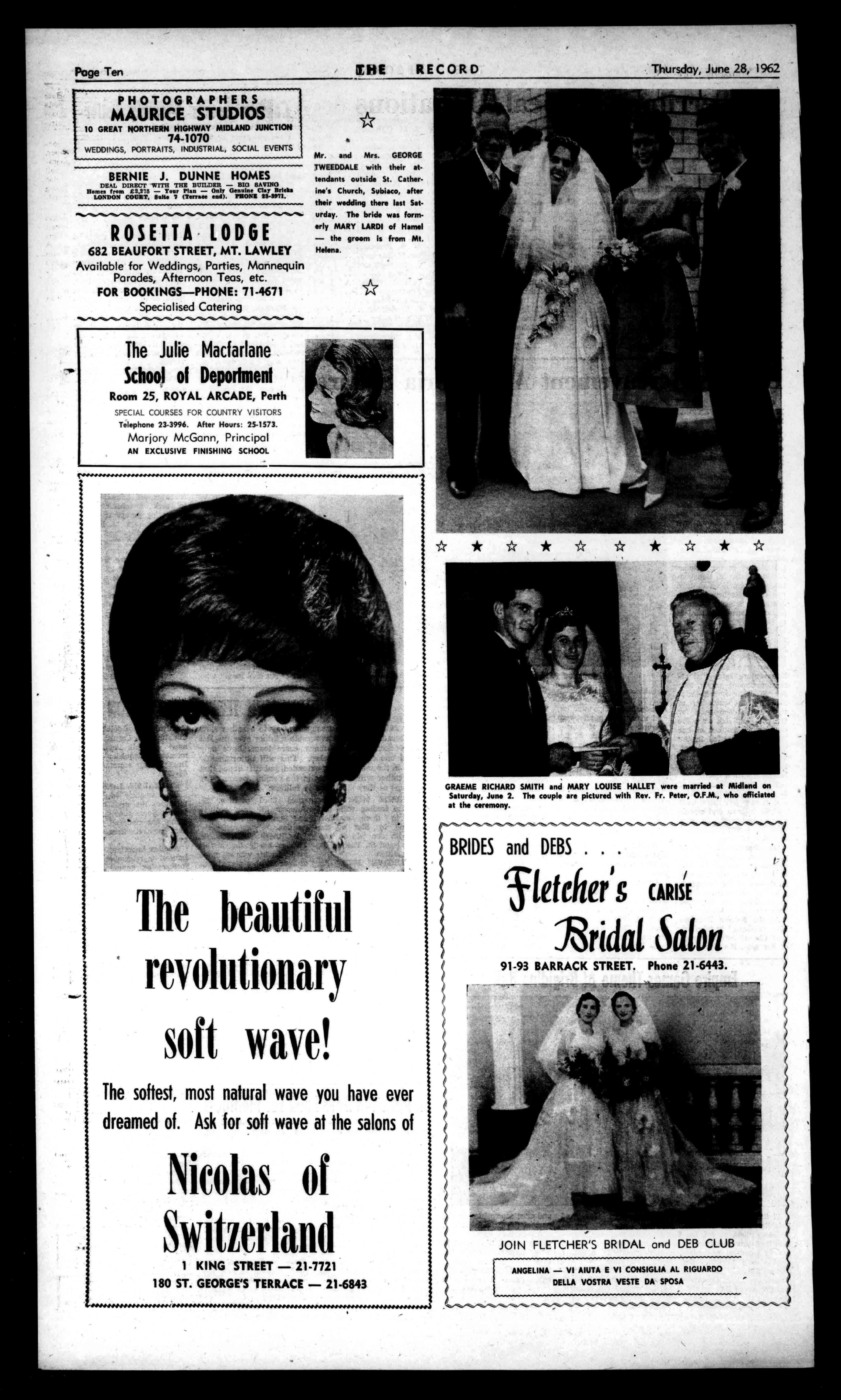
PageTen THE RECORD Thursday,June28,1%2 PHOTOGRAPHERS MAURICESTUDIOS 10GREATNORTHERNHIGHWAYMIDLANDJUNCTION 74-1070 WEDDINGS,PORTRAITS,INDUSTRIAL,SOCIALEVENTS BERNIEJ.DUNNEHOMES DEALDIRECTWITHTHEBUILDER-BIGSAVING Horne.from£2.278-YourPlan-OnlyGenuineClayBricks LONDON:COURT,dolga7(Terrsoeend).PHONE55-5571. ROSETTALODGE 682BEAUFORTSTREET,MT.LAWLEY AvailableforWeddings,Parties,Mannequin Parades,AfternoonTeas,etc. FORBOOKINGS-PHONE:71-4671 SpecialisedCatering Mr.andMrs. GEORGE TWEEDDALEwiththeirattendantsoutsideSt.Catherine'sChurch,Subiaco,after theirweddingtherelastSaturday.ThebridewasformerlyMARYLARDIofHamel -thegroomisfromMt. Helena. TheJulieMacfarlane SchoolofDeportment Room25,ROYALARCADE,Perth SPECIALCOURSESFORCOUNTRYVISITORS Telephone23-3996.AfterHours:25-1573. MarjoryMcGann,Principal ANEXCLUSIVEFINISHINGSCHOOL Thebeautiful revolutionary softwave! Thesoftest,mostnaturalwaveyouhaveever dreamedof.Askforsoftwaveatthesalonsof Nicolasof Switzerland 1 KINGSTREET-21-7721 180ST.GEORGE'STERRACE-21-6843 ********** GRAEMERICHARDSMITHandMARYLOUISEHALLETweremarriedatMidlandon Saturday,June2.ThecouplearepicturedwithRev.Fr.Peter,O.F.M.,whoofficiated attheceremony. BRIDESandDEBS letcher's(ARISE /Spada!Salon 91-93BARRACKSTREET.Phone21-6/43. =trzn-rst-rtrPERlYn-` JOINFLETCHER'SBRIDALandDEBCLUB ANGELINA-VIAIUTAEVICONSIGLIAALRIGUARDO DELLAVOSTRAVESTEDASPOSA 111,
"IronMan's"'Son
CallsForShare
MonsignorPaulAdenauer hascalledforbasictaxreforminGermanytohelp bringaboutamorejust distributionofthenation's wealth.
Themonsignoralsourged thatworkersbeencouraged toacquirestockinthecompaniestheyworkfor.
ThesonofGermany's ChancellorKonradAdenauerspokeatameetingof theFriendsofHolyCross CollegeinCologne.Heemphasisedthatindividualsin modernsocietyareincreasinglycaughtupinaweb,of socialentanglementsthat robthemofopportunities forpersonalinitiativeand responsibility.
(SeePageTwoStory)
Desecration
BringsGaol
"Iwillnotrepent,"was theresponseofaYugoslav immigrantafterhissentenc-
Phone:
3741
ingtothreeandahalfyears ingaolforaseriesofchurch desecrationsinBremen.
BolzoGavrilovik(22), rearedandschooledincommunistYugoslavia,was chargedwith13offences againstCatholicandProtestantchurchesinBremen. Hetoldthecourtthathe actedoutofdeephatredand inprotestagainstwhathe saidwasfalsificationofthe lifeofChrist.Courtpsychiatristsdeclaredthathecould notbejudgedinsane.
SurpriseIn
Procession
Soviettroopsstationedin ErfurtinRed-ruledEast Germanytookpartinfull uniforminErfurt'sannual Catholicyouthpilgrimage, accordingtoreportsfrom Berlin.
Reportssaidthatthe 6,000boysandgirlsinthe pilgrimagegaveacordial welcometotheunexpected participantsfromtheSoviet Union.
Ithasalsobeenreported herethat20.000Catholic menmarchedinanAscensionDayprocessionto theEastGermansanctuary ofHagisintheEichsfeldregion,atwhichAuxiliary BishopJosephFt'eusbergof Fuldadeliveredasermon onthecomingecumenical council.
Switzerland
SundayWork
BringsFine
TheSwissSupremeCourt hasfinedaworkerfrom Valaiscantonforcutting stonetobuildhischaleton aSunday.A1936lawof ValaisMantonprovidesthat anyworkonaSundayis illegalunlesstheworker obtainsaspecialpermit.
Malta
Stiffer
Penalties
Malta'slegislativeassemblyisstudyinganew proposaltoincreasethe legalpenaltyforpublicattacksontheclergyofthis BritishMediterraneanisland colony,where95percentof thepeopleareCatholics. Presentlawscallfora maximumofonemonthin gaolforsuchoffences.The newproposalwasmadefollowingnumerousattackson priestsbytheanti-clerical Labourpartypriortolast February'selections.
LastApril,DomMintoff, leaderoftheLabourparty whichlosttheelections,was finedforslanderingaCapuchinpriest,FatherLeopold,atapublicmeeting. Mintoffhasalsobeenplaced underinterdictbytheMalteseBishopsforpublishing anattackagainstthemin thenameofhisparty.
CampRented
ForThePoor
TheBritishgovernment hasrentedalargerestcamp toMalta'sCatholicAction organisationattherequest ofArchbishopMichael GonziofMalta.Thepropertywillbeusedasa summercampbypoorfamiliesontheisland.
Iraq
QuieterRole
ForPremier
PremierAbdulKarim KassemofIraqpresidedfor thethirdyearinaroveat graduationexercisesatthe Jesuit-operatedAlHikma UniversityinBaghdad.
FatherRichardJ.McCarthy,S.J.,directorof ArabicstudiesatthisMiddle Easterncountry'sonly Catholicuniversity,welcomedthePremierand spokeofhisencouragement ofeducation.
PremierKassemdelivered acommencementaddressin whichheurgedgraduates toworkforthewelfareof allmankindandthendistributeddiplomasand prizes.
Spain
Parachutist's LastJump
FatherAquilinoLopezTurienzo(41),wasoneof fivechaplainsintheparachutesectionoftheSpanish AirForce.
Hewasaveteranofnearlytwohundredjumps,but inrecentmanoeuvressomethingwentwrongandhe waskilled.
Monastery Restored
Theprovincialparliament ofNavarrehasvotedtorestoretheancientSantoDomingomonasteryinEstella.
Whenrestorationiscompleted,theDominicanfriars willmovebacktothemonasterytheyoccupiedatthe timeitwasestablishedby theKingsofNavarre.
arenowlivingseparately intownsoverawidearea oftheSouthofEngland, wheretheywillremain untilAuglust1.
Onhandtoblessthegroup asitdepartedwasCardinal Castaldo,Archbishopof Naples.
Congo
LabourLeader
StillShooting
LabourleaderAndreBoBolikoleftforahigh-level labourmeetinginGeneva withafewpartingantigovernmentshotsofthesort thatlandedhimingaollast spring.
Thenationalpresidentof theUnionofCongoleseWorkersrenewedhisdemands forcutsinpoliticians' salariesandnationalpolicy ofeconomicausterity.The Catholic-orientedU.C.W.is successortotheConfederationofCongoleseChristian TradeUnionsandthelargest unioninthecountry.
Bo-Bolikowasarrested earlyinAprilforordering ageneralstriketoforce thegovernmenttoputan austerityprogrammeinto action.OnegovernmentofficialsaidBo-Boliko,inrevealingsalarybooststhe nationallegislatorshad giventhemselves,hadinjuredthenationalinterest.
Bo-Bolikowasreleasedby courtorderlaterinApril.
Hecalledapressconferencetorenewhiscriticism ofthegovernmentbefore leavingfortheGeneralAssemblyinGenevaoftheInternationalLabourBureau, administrativeorganofthe InternationalLabourOrganisation.
TheU.C.W.'sprogramme, asdelineatedinaWhite Paper,includesanupward limitonministerialsalaries andalowerlimitonworkers'wages.
ItcallsforsternpunishmentforgraftandEncouragementoftheLeopoldville courts'attemptstostampit out. Anotherdemandisthat thepoliticaladministration intheCongobefreedof tribalfavouritism.
Austria
KidnapPlan WasVetoed
HolidayIn England
Forty-fivechildrenfrom poorrefugeefamiliesliving inItalyhavebeengivenan eight-weekvacationinEnglandthisyear.
Thevacationprogramme wasmadepossiblebythe co-operationofthePontificalReliefOrganisationand theBritishAssociationfor theInternationalHelpfor Children.
Thechildrencamefrom familiesthathaveleftYugoslavia,Greece,Syriaand Tunisiaandwhoarecurrentlylivinginrefugee centresnearNaples.
Thegroup,accompanied byMonsignorPieroAnglade leftNaplesonJune13and
Areportcirculatingin ViennarevealsthatJanos Kadar,Hungary'scommunistboss,vetoedasecret policeplantokidnapCardinalMindszenty,Primate ofHungary,fromtheU.S. Legationseveralyearsago.
Thereportwasmadeby aformermemberofthe Hungariansecretpolice, BelaLapusnik,whoescaped toAustriainearlyJuneand diedinViennaundermysteriouscircumstances.
TheCardinalhasbeen livingintheU.S.Legation inBudapestsinceSoviet troopscrushedtheanticommunistuprisinginHungaryin1956.
Thesecretpolicekidnap planswerecalledoffin1958 or1959because,saysthe report,Kadarwantedto waitforamoreopportune momenttoseizethePrimate.
Peru Organiser GetsCredit
AveteranU.S.missionary, FatherDanielMcLellan, M.M..directorof275credit unionsthroughoutPeru,has beenawardedtheOrderof MeritbythePeruviangovernment.
Thepresentation was madebyForeignMinister LuisAlvaradoGarridoata gatheringofleadingAmericanandPeruvianbusiness menandpoliticalfigures. FormerPrimeMinister PedroBeltran,whohelped theco-operativestogain nationalstaturealso,attended.
TheForeignMinistersaid thatfewtimesinhislife "haveIfeltaspleasedand privilegedtopinadecorationonafriendofPeru."
HeaddedthatFatherMcLellanisasplendidexample
ofapriestwhoseapostolate reachesouttothewhole humanpersontoencompass bothhisphysicalandspiritualneeds.
Onthedayofthepresentation,thecommunistpaper, FrenteNacionaldeLiberation,attackedtheMaryknolt Fathersandinparticular FatherMcLellanforbeing "toolsofYankeeimperialism."
The46-year-oldpriesthas helpedextendlow-interest loanstothousandsofIndians intheAndesMountains.A UnitedNationssurveyteam describedFatherMcLellan's creditunionprojectas"a movementthatwilluplift thewholeeconomicwellbeingofthePeruvian people."
PLASTERING
Hardwall,SandFinish, CementRendering.
AllTypesofPlastersod CementWork. SpecialPricer,forerding Contractors. RONCHANDLER,45BertSt., Gosnells.PhoneGos.238.
Thursday,June28,1962. THE REORD PageEleven =INTERNATIONAL =NEWS1
EASYw TheGoodrid "Modern"ensurescompletede-structionofall combustible matter. E18/17/6 ECa STATEDISTRIBUTORS 105FITZGERALDST.28-2733. 'WUITE AtITS r'rnr Contact MAXWELL ROBINSON &PHELPS
Bumyour RUBBISH the
599Newcastle Street,Perth
28
*
ofTEDTAYLOR.Phone34924. HOTELCIVIC OFFERSEXCELLENT ACCOMMODATION-EVERY CONVENIENCE BEAUFORTSTREET, INGLEWOOD 71.1115 DICKREILLY,Prop. CITYHOTEL Cnr.KingandMurraySts., Perth COUNTERLUNCH,12-7.20p.m. Friday;Saturday12-111p.m. ARCHIETHOMPSON Offersyouonly''TheBest" Phone:21-4094 FRIENDLYSERVICE REXHOTEL Cnr.KING&HAYSTREETS PrivateBarforconvenienceof GuestssodFriends Phone:21-8634. Props,R.J.&B.B.REILLY. BAYSWATERHotel OPP.STATION FrequentTrainService 4MilesfromCity-Large Parking Area. ExcellentAccommodatioa BedandBreakfast ReasonableTarriff LESBARTLETT,Prop.Tel.:71-1224 SUBIACOHOTEL SUBIACO FirstClassAccommodation andService Phone:8-1028 D.N.YOUNG.Proprietor. WEMBLEYHOTEL ExcellentLoungeand Accommodation SpaciousParking Phone87-2418 Cnr.Cambridge.46/1 AlexanderStreets,Wembley WAVERLEYHOTEL NextBoansWaverleyStores ALBANYHIGHWAY, CANNINGTON ModernandConvenient HomelyAccommodation UseOurDrive-laBottleService A.R.CONNELL Phone68-2419 HOTELAUSTRALIA MURRAYST.,PERTH CITY'SMOSTCEJtTRALLY SITUATEDHOTEL ExcellentAccommodations, Sunk,Supreme, Phone23-1541 CRITERIONHOTEL CENTRALHAYSTREET, PERTH 24-HOURSERVICE FreeParkinsforCountryResidents Iminutes'walkfromCathedral. THECOUNTRYMAN'SHOTEL PHONE23-17115(5lines) EnjoytheBest ACCOMMODATIONand SERVICEat HOTELCOTTESLOE ReducedWintertarriff Phone3-2155 R.M.Dymock,Licensee WILLAGEEPARK HOTEL TheState'sMostModern TOMKENNY,Licensee. Cnr,StockandHighRoads, MELVILLE Phone:30-3428 HOTEL ESPLANADE PERTH'SLEADING HOTELFORALL VISITORS. Phone:23-1531 COMMERCIAL HOTEL NORTHAM PhoneNortham49 T.E.MURPHY,Proprietor NATIONALHOTEL Cnr.HighandMarketSts., FREMANTLE Offersexcellenthcawly accommodation Phone:5-1786 PhillipP.Kearins,Licensee O'BRIEN'SHOTEL NORTHOFTHELINE CarrieO'Brien,Licensee StanO'Brien,Manager 21.4261 THESHAFTESBURY HOTEL INSTIRLINGSTREET 15minutesfromG.P.0.1 OffersExcellentAccommodatloa PlentyofParkingSpace. NowunjerthePersonalManagementoftheOwners. NELSONandNELSON. PHONESIS1951ForSUPERIORACCOMMODATION IMPERIALHOTEL PERTH (OppositeRailwaystation)Tel,23-2921 RotandColdWater.Telephone Ineverybedroom.BedandBreakfast35/-.Tourist27/6.24Hour RoomService ReducedTariff forChildren. SHENTONPARK HOTEL NICHOLSONROAD, SHENTONPARK ExcellentAccommodation.Moderate Tariff.SpaciousCarPark. BeerGarden.OpenAirRoe, Phone8-2170 JACKSHEEDY,Prop. VICTORIAPARK-6-1063. BROKENHILL HOTEL ATLASTANKS CONCRETE 2,800GALLONSto 50,000GALLONS PHONE6841865feeQUOTATION CONCRETESERVICECO:" 227WHARFSTREET,QUEEN'SPARE "SPORTSLINE99JERRY BROWN, SELF OPEN:9 SERVICECAFETERIA a.m.TILL7p.m-EXCELLENTWEALS Prop. 15$MURRAYSTREET-TAXATIONDEPT.ISOPPOSITE
YOUR HOTEL GUIDE* BRIGHTONHOTEL STIRLINGHIGHWAY, COTTESLOE leMinutes'WalkfromReach. UNLIMITEDPARKINGAREA. ExcellentAccommodationat ModerateTariff. NowunderPersonalManagement
DUBLIN,JUNE,1962.
Forthefirstcoupleof weeksofthismonth,the "RantingIrishJune"of DonnByrne'sandother romanticnovelshasbeena reality-theyellowgorse, thetreesoverburdenedwith green,allbirdssinging, Placidsilverrivers,andthe cattleimmobileonmeadows ofgreenvelvet.
WhenthisweatherreturnstoIreland,andthe DonnByrnemoodhascome downoverthescenery,there arefewifanymorebeautifulplacesanditwasnot surprisingthatthesubpostmastersoftheRepublic, sonatsligusandsofthemwho runthesmallerpostoffices, manyoftheseasidelineto agroceryorotherstore, maintainedtheirstrike againsttheGovernmentfor onlyafewdays.
Theywantbetterterms.
TheGovernmenttakesa seriousviewofstrikeaction withinaStateservice,arguingthatthereareconsultativechannelsforsuchdisputes,andShesub-postmastersarguedthatthey werenotsatisfiedwiththe rateofconsultation.
Soouttheycameon strike,withadirecteffect onyourcousininIreland, whoperhapscouldn'tpop aroundthecornertobuya stamp,buthadtoheadfora
mainpostofficewithfulltimeCivilServicestaff.
Itbroughtbackamemory offortyyearsago,whenthe newStatehadjustbee', foundedandtherewasa strikeof12,500postoffice staffwhorejectedcutsof salarybecausethenewState was"cuttingitssuitaccordingtoitscloth."
Onthatoccasion,inless thanthreeweeks,workresumed,withanagreement tospreadoutthecutswhich wouldstillkeepthewages abovethoseinBritain.Was yourgrandfatherinMullingarthattime?Thenhemay remembertheenterpriseof somemenwhostarteda pigeonpostfortheMidlands andWestCork.
Beforethepigeonsreally gotorganised,in1922-and in1962-thepostwasback tonormal.Thismonth,an unnamedintermediaryhelpedbringthemenand womenbacktoworkpendingnegotiations.
*
ChurchAnd Industry
AnindependentCatholic journalherehascomeout againsttheinterventionof priestsinindustrialdisputes,buttheweightof experienceisagainstthis view. LAUBMAN&PANKLTD. OPTICIANS
77BARRACKSTREET,PERTH-Phone23.4831
12ASTEPHENSTREET,BUNBURY-Phone3022
FITZGERALDSTREET,NORTHAM-Phone7
256WALTERROAD,MORLEY-Phone76-1592
HaveContinuous Credit useBOANS 5StoreCurrency
Issued-Re-issuedand
Usableat:
Morley
HLINNMacGLYNN
FromLOC
Recently,whenDublin busmentookinstantunofficialstrikeaction,refusingtheiruniondirection thattheywouldhavetogive sevendaysnotice,Dublin wasputbackonitsfeet.
Justasseriouswerethe underlyingsocialissues, especiallythoseinvolvedin thebreakawayofthousands ofmenfromtheirunions, clamouringaroundunion headquartersinprotest.
TwopriestsoftheDublin Archdiocesewithaspecial interestinsocialproblems reunitedtheofficialandthe unofficial,indirectlyputthe busesbackonthestreets, andnormalnegotiationwas resumedthroughtheLabour Court,aState-sponsored fact-findingbodywhich makesrecommendations whichneednotbeaccepted.
Strikenoticewaspending forprovincialservicesas well,andallIrelandthankedthesepriestsfortheir contributiontostableemployer-workersrelations. Theway'manyseeit,and theyfeeltheyareseeingit thatwayinthecompanyof HisHolinessthePope,is thattheChurchcannotbe indifferenttowardssocial chaos.
TheBishopofCork,Most Rev.Dr.Lucey,isIreland's mostoutspokenclerical criticofsocialconditions. Hepointstothedepopulationofhisdiocesebyemigration,andrecentlywhen hesuggestedthatGovernmenthand-outsfromMerrionSquarewerenosolution,hewastakenmildlyto taskbyanableyoungCorkman,Mr.JackLynch,MinisterforIndustryandCommerce.
TheGovernment;inMr. Lynch'sview,wasgoing aheadasfastasitcouldon itsplansforeconomicreconstruction,andwhileHis Lordshipwasfreetocommentonanyissue,.heshould notunderminepeople'sconfidenceintheirelectedGovernment.
Itwasarefreshing"brush" betweenMinisterand Bishop,conductedinopen freedom,andafewdays laterbothwerephotographedinamicableproximityat apublicfunction.Certainly noreligiousissueswereinvolved.
Dr.Luceyisanadvocate ofthefamilyfarm,ofthe nativeindustrybasedon agricultureandlocatedin agriculturalareas,andhis ideasthroughtheyearshave beenstimulatingandin plainlanguage.Muchof hisdioceseisanareafrom whichemigrantsgotoBritain,America,Australiaand othercountries.
Hisideasonsocialproblemsgoalloverthecountry from,inmanycases,small andremotechurches,and hisaddressesatConfirmationsarewidelyreported. Hisviewsaretreatedwith respectbyallwhomthey mayormaynotconcern.
Onthecreditsideisthat inrecentyearsfactories, airports,touristdrivesand otherformsofprogresshave cometotheSouth.There are,forinstance,several thousandemployedinthe FreeAirportareaatShannonAirport,nowanareaof factorieswheretherewere formerlygreenfields.
Irishstatisticsshoe'that thepopulationisatlastbeginningtostaymuchthe same,asemigrationdeclines toaroundwhatshouldbe thenaturalriseinthepopulation.Inwhatprogress therehasbeen,Dr.Lucey hasashare;hekeepsuson ourtoes,especiallyatthe
timewhenwordispassed roundthatConfirmations havebegunagaininWest Cork. Oneofhisclosefriends andadmirersisCardinal CushingofBoston,equally frankandoutspoken.Wishingtointerviewhimforthe "BostonGlobe"whenhe washere,IrangtheMedical MissionariesofMary,where hewasresting,andasked forapriestorothermember ofhispartywhomighttell meofhistour.ThenwhatI canonlydescribeas3large, friendlyvoicecameonto theline,andIrealisedit wastheCardinalhimself. "YoucantelltheminBoston,"saidtheCardinal,"that Isendthemallmylove," and,althoughhewasthen underdoctor'sorders,he talkedoninthemannerof anoldIrishcountryman backfromtheUnitedStates -hewasoneoftheworld's mostfamouschurchmen, butwasinstantlyathome, withoutformality,appointment,orpriorenquiry.
HewentSouthtospend afewdayswithDr.Lucey; hewasinsuchdemand,and overtaxinghimselfsomuch byspeakinginmany churches,thattheytoldme fromBishop'sHouse:"We can'tevengethimbaIcto havesomethingtocat;we hearnowheisatmentioningsomeoutlying parish.
*American Embassy
Dublinisatlasttohave thenewAmericanEmbassy, forwhichasitewasanairedabout.three.miles fromthecitycentreonthe roadtowardsBlackrockand thesea.
thelateScottMcLeodwastheAmerican Ambassador,hetoldmehe thoughttheplans,which envisagedsomethingreminiscentofthedomesand roundtowersofDublinand history,wouldproducea buildingapproachablefrom severaldirectionsand,like Ireland,"extendingawelcomeinalldirections."
Buttherewassomedifferenceabouttheplansin Washington,where:heyran intotroublewithsomeof theCongressionalCommittees;theywere,ofcourse, Americanplans,andasthe delayswentonforyears, thesitetookontheappearanceofawilderness.
ThencameGrantStockdaleasAmbassador;he promisedtospeedthingsup, saidthatPresidentKennedy wasanxioustogoahead, andhehopedworkwould beginwithinayearorso.
GrantStockdale,aftera shortstay,hasretiredand enrouteisMr.McCloskey tobecomethenewAmericanAmbassador.Andwork istobeginonthenewEmbassyalmostimmediately. Mr.McCloskey,unlikeall hisimmediatepredecessors, isaCatholic,andhe'salready,beforearriving,inan Irishcontroversy-which ensuresheisoneofourselves!
Withthedelightandgood spiritsofanAmericancomingtoIreland,hedeclared hewouldcry"FagaBallagh,"whichmeanssomethinglike"Cleartheway," whenhearrived.Possibly someoneadvisedhimthat thiswasthethingtosay, althoughnobodynowsays itinIreland. Moreover,itturnsoutto bethemottoofaregiment orsimilarformationofthe BritishArmy!
*RecentDeaths
MR.JOHNDiNNE,of IndependentNewspapers Ltd.,Dublin. VERYREV.WALTER McGRATH,P.P.,Killinagh, Blacklion,Co.Cavan. CAPT.PEADARpOWAN, stormypetrelofIrishpolitics.
-THREECONCERTS INTHREEDAYS TWOIMPRESS
TheSaturdayevening subscriptionconcertbegan withalargesectionofthe orchestraleavingtheplatform.
ForMozart's"Haffner" Symphony,thevisitingconductor,JaschaHorenstein, evenreducedthestrings, particularlythebassline. Thusheachievedabalance andsomethingliketheoriginalforcesforwhichMozartwrote.Theresultwasa clarityor,evenmore,a luciditywhichthethicker textureofalargerorchestra couldnotgive.Whilethe localorchestraresponded well,thefirstmovementwas notquitehappyandthe paceofthefinaleproveda littletoofastforsomeinstrumentalists.
TheAndante,however, wasperfectionwithstrings andwindsinbeautifully balancedconversation.
TheSchumannAminor concertofollowedwiththe youngIsraelipianist,Daniel Barenboim,givinganintenselypassionateperform. ance.Theorchestraseemed illatease,particularlynear thebeginningofthethird movement,butHorenstein pulledittogetherandthe restofthemovementwas excellent.
Aftertheinterval,wehad SamuelBarber's"FirstEssayforOrchestra,"apleasantpiecedistinguishedby cleverorchestration.
Thegloryoftheevening wasasuperbperformance ofBrahmsThirdSymphony; asinthe.Mozart,thewind instrumentsrespondedto Horensteininamostremarkableway,notablyin theAndante.Itappearsthat Horenstein'sgeniusliesparticularlyintherealmof profounder,reflectivemusic.
Tohavethreeworldfamousmusicianswithin fourdaysisalittleoverwhelminganditwasunfortunatethatLeonidRogan. thegreatSovietviolinist, hadtobesqueezedinona Mondayevening.
Hecertainlywasasgood ashisreputation,provingto beaviolinistofgreatpower andintensity,capableof poetry,too.
ThemajorworkwasBeethoven's"Kreutzer"sonata.
Asinmostclassicalviolin sonatas,thepianistishere asimportantastheviolinist andKogan'spartner,Naum Walter,wasfartooheavyhandedandthetwoplayers seemedalmosttobeplaying
asindividUalsattimes.The sameworkwasplayedby theMenuhinsafewmonths ago.Theygavetheimpressionthateverynotewas lovinglyengravedintheir hearts;pianoandviolin intermingled,eachreflecting,eachdeepeningthe other'sbeauty.WithKogan andWalter,theinstruments viedforattentionand,howeverbrillianttheplaying, thatwasmostdecidedlynot whatBeethovenintended.
Thesecondhalfofthe programmewasKogan's with14ShostakovichPreludes,arrangedforthe violin,Saint-Saens'"Havanaise"andRavel's"Tzigane."Alltheseprovedvery easytolistentoandgave ampledemonstrationof Kogpn'svirtuosity.Thesecondencoretotheenthusiasticaudiencewasagraceful bowto.Australia-Kogan playedArthurBenjamin's "JamaicanRumba."
TheTuesdayYouthConcertbroughtBarenhoim again,thistimegivinga mostpowerfulperformance ofthe"Emperor"Piano Concerto.
Thefactthathewasoverprojectedwasnothisfault, forheplayeddelicately enoughintheslowmovementinthosepassages wherethepianoaccompaniesthewoodwinds,but VaughanHanleyatall timescuttheorchestraback fartoomuchand,apart fromtheverysolidlineof firstviolinsandthebasson theoppositeside,theplayers seemedtohavesomethingof thesameuncertaintywhich afflictedthemintheSchumannconcertonSaturday.
AsonSaturday,too,the departureofthesoloist broughtanimmediaterecovery,againwithBrahms, thistimeaverygoodperformanceoftheVarions ontheSt.AnthonyChorale, aworkwhichweusedto knowasVariationsona ThemebyHayden. Asensuouslybeautiful performanceofDebussy's "L'Apres-midid'unFaune" followed,withexcellent playingbyflautistOwen Fisenden.TheconcertconcludedwithKodaly's "DancesofGalanta"which, despiteVaughanHanley's eulogies,didseemtobe somewhatrepetitious;a musicalidea,howeverbrilliantandrhythmic,losesits forceifitlacksvariety.
*IgoTwelve THE RECORD Thursday,June28,1962
OFPERTH
BOANS""
Waverley Medina Banbury
&C
ROYGALVIN
O PLUMBINGMATERIALS SEPTICTANK-DRYWELLS 229-233WilliamSt.,Perth BATHROOMFIXTURES 28-1541. The"PlumbingSupplySpecialists'
-Amadeus. AT DO TIMM =KERCTET OGUES DrawnThisWeek ACHEN LOTTERYNos.1402and1403alsoNo.109(88,000) PERTH ARCADE sad [9 BARRACK STREET, PERTH JOHNHOGANDip.Opt.W.A. OptometristandDispensingOptician ZIMPEL'SARCADE(NearFoys) ForAppointment-Telephone21-4089 CONTACTB.A.BARNARDBldg.Co. ofPERTHandGERALDTON FreeQuotationsandAdvicegiveninyour BuildingProblems. WecanhelpfromtheDesigningtotheFinancing ofYourHome. BUILDERSOFECONOMICALHOMESInsistonW.A.made HAMSCookedMEATS SAUSAGESBACON SMALLGOODS with that REAL Flavour andofcourse Continental :
3silsord"WORLDofSPORT
TURF TOPICS
ByTHEHAWK es,emoe.eseseeJ
IthasbeenstatedthatHelenaValewillbeusedonly inacaseofemergency,andrace-goerswillnotsheda teariftheoccasionneverarises.WhileSaturday's meetingwasheldinfineweather,thetrackwasvery heavyandagainresultswereagainstbackers.
IMPRESSIVE
ThefieldfortheLyndhurstHandicapcouldnotbe calledstrong,buttheway
COUNTORLaccountedfor theoppositiononSaturday suggestsfurtherwins.Itwas thoughtbyhisconnections thatsixfurlongsmighttoo shortforhimandfromnow onethatcouldprovecorrect. Remember,heranfourthin thelastRailwayStakes.
SPEEDY
Theeasymannerinwhich
BOLDSTORYranaway withthe2-y-oraceonSaturdaystampshimasa sprinteroutoftheordinary. Goingtothefrontandstayingtherewashisprevious Saturday'swinoveragain. HavingracedeachSaturday overthelastfourweeks, whichisunusualfora youngster,hasnotharmed him.
SMOKESIGNS
butitmightbewelltorememberthatmanyhave been"booked"forlooking aroundinthestraight.
WORTHWHILEHINT
Theonlywaytodealwith systemsistodividethem intotwocategories,namely:
(a)SelectionofWinners; (b)MethodofBetting. Sincetheycoverawide field,(a)willbedealtwith thisweekand(b)atalater date.
Nowlet'scomerightto thepoint-Thereareno knownsystemsofselecting winnersthatwillconsistentlybeatthebookmaker. Thecompleteansweristhat bookmakershavesteadthe testoftime.
Somesayawealthyman mustwinbybackingthe favouriteineveryeventand doublingupuntilhestrikes awinner.Firstly,sucha mancaninvesthismoney (gilt-edged)andobtain7 percentorbetter,and, Inrunningthirdinthesecondly,afteralongrunof finaleventofonemile,outshecouldfinditimposNAUGHTYSTORYdrewsibleto"getset"forenough attentiontoherfuturepros-torecouphislosses.Therepects.Shewillenterthewin-fore,itisunlikelyhewould ninglistagainsoon.ULA-beinterestedinsucha RINEwasscratchedinthisscheme.
race,doubtlessduetohis Itmightbeaskedhowa badbarrierdraw,buthewritercanbesodogmatic won'talwaysdrawwideandaboutthesubject.Overa whenthathappenskeephimlongperiodofyearsaclose onyour.side. friendwascompilerofan officialpublicationwhich showedindetailtheresult ofeveryraceinAustralia andNewZealand.Available atahighprice,itwasalwaysrunataloss,butwas subsidisedbytheleading TurfandJockeyClubsin everyStateinAustralia.
ABOUTJOCKEYS
InwinningtheH.V.Cup onSHADOWPRINCE,experiencedGEORGEWOODS appearedtoout-general apprenticeMIFFLINonthe secondhorseELSEMARI. Itishardtounderstandhow indistanceraceswhenthere isnopaceonandhaveonly alightweighttocarry, ridersrestraintheirmounts insteadofgoingtothefront. HadMifflin,whoisagood youngrider,donethaton Saturday,theresultcould havebeendifferent.
Whenitwasknownon FridaythatFRANKTREEN couldnottaketherideon VILLAGEIMAGE,the mountwasofferedtoNORM COOMBE,butatthatlate stagehecouldnottakeoff enoughweight.Theridewas giventoFRANKMOORE, whohandledthewinnerin copy-bookstyle.
Theconstantnumberof requestsreceivedtocheck thisorthatsystemisunbelievable.Thenecessary researchwastedious(but profitabletous)andnotin onecasewasthesuggested methodprofitableoverany lengthoftime.
Yearsofdelvingintothis subjectdidrevealsomething -andthisispassedon.Remember,itisnotasystem butcanbegainfullyusedas anaidwhenevaluatinga race.
Forthesmall:umber.of horsesthatqualify,itis amazingthehighpercentage thatwinagainWITHIN SEVENDAYSofhaving wonarace(donotconfuse thiswitklast-startwinners). Forexample,lastweekat AscotBOLDSTORY,at CaulfieldCHESTILLION. Regardlessofweight,distance,etc.,alwaysrespect thesmallnumberofhorses, sometimesnone,thatqualify eachweek.
J.J.MILLERdoesnot takemanymounts,butheis buildingupahighpercentageofwinners.*As shownrecently,heisboth strongandheadyandinhis presentformmorewins seemsuretocomehisway. Mostridersdon'tliketowin racesbytoobigamugin, WATCHTHESE DECADRON BURNEWIN ULAKINE
PETERPIANTO-ForNewHoldens OfYOUNGSW.A.PTY.LTD.,529AlbanyHighway,Vic.Park. Phone6.3665.Private87-9330.
Slazenger Trophy Winners
WINNERSofthe1962
SlazengerTrophy,Sacred HeartSchoolHighgate,have establisedarecord.They havebeenwinners1928to 1940,1943to1946,1948and 1962, Playersinthisyear'steam are(lefttoright):AnnMacKenzie,BrioniBest,Maxine PeterkinandLomaJowett. TheywerecoachedbyMr. A.Marshall.
Threeofthegirlshave beenselectedamongthe StateSquadfortrainingby theW.A.LawnTennisAssociation.TheyareAnn MacKenzieintheNo. 1 SquadandMaxinePeterkin andLomaJowettintheNo. 2Squad.
Y.C.W.FootballCompetition
HIGHGATE 12-18
PALMYRA 6-5
Inthegameofthedayat MelvillelastSunday,Highgateshowedtheywillbethe teamtobeatthisyear.First tostart,HighgatebewilderedPalmyrawiththeir machine-likefootballand establishedanearlylead. Palmyragotgoalswith patchesofgoodfootball,but Highgatecouldalwaysanswer.Thegamewasfast andthefootballgoadin verygoodconditions.Interestwasmaintained throughoutthematchby somefineindividualclashes', thoughtheresultwasnever reallyindoubt.
Best:(H)-T.Scally,J. Horgan,P.Quinn;(P)-P. Clery,R.Richmond,F.Ellis.
FREMANTLE 25-28
SCAR./DOUBLEVIEW1-1
Scarboroughcouldnot matchFremantleintheruck andwiththeirroversgetting anarmchairride,Fremantle dominatedthegame.Scarboroughdidnotwatchtheir menandthusgaveFremantleaneasypathtogoals. Theplaywasfastand rugged,butFremantleran outtheeasiestofwinners.
Best:(F)-J.Deceglie,A. Brigulio,D.McLeod;(S-D) -K.Anthony,T.Power,W. Dalmeido.
LEEDERVILLEvOEBORNE
PARK.-ResultpendingdecisionofProtestsandDisputesCommittee. Heavymudinthecentre
ofthegroundmadeplay veryscramblyinaneven game.Somegood,high markingbybothsideswas afeatureofthegame, thoughthemaininterest layinthescores,which wereclosethroughout.In thelastminuteashotbyJ. Martinowhichwouldhave levelledthescoreswasruled outofboundsbythegoal umpire,thusallowingOsborneParkawinbyone point.Leederville,however, havelodgedaprotest.
Best:(L)-R.Hebbard,A. Bock,J.Martino,(OP)-L. Johns,L.Garnett,K.Healy.
BEDFORDPARK 7-11
EASTPERTH 6-5
Afteranevenfirstquarter inwhichBedfordPark playedwell,butdidnot converttheirmanyopportunities,EastPerthbeganto functionasateam.Making theballtheirobject,they outclassedBedfordParkand lookedthebetterteam.BedfordParksteadied,however, andmanagedtohold-onto win.
Best:(BP)-J.Stanavicius,J.Steffan,K.McEncroe;(EP)-Z.Kovacs,B. Jennings,B.DeLuca. 4
EASTERNSUBURBS17-8
SUBL-SHENTONPK.3-5
AsmallSubiacosidedid everythingrightbutkick goalswhentheyweredefeatedbyEasternSuburbs onSunday.However,with adistinctruckadvantage,
A.C.C.FOOTBALL
RESULTS
FIRSTXVIII
Trinity12-13dFremantle
4-2.Best:(T)-J.Allanson, A.Baker,T.Conning;(F)G.Friday,D.Regan,K. Shortill.
Highgate20-14dSubiaco
4-4.Best(H)-N.Catania, J.Armstrong,K.Fanrowios; (S)-G.Vincent,P.Arthur, S.McCaskie:
Leederville9-11dNew
Norcia9-7.Best:(L)-R. Horrigan,D.Oliphant,R. McCarthy;(NN)-G,West-
Saturday,June30andJuly6
BELMONTRACES
ENJOYTHEFRIENDLYATMOSPHEREOFHUNTCLUBDAY
ern,C.Perejmibida,C. Bertelli.
P.W.Pts. 5 520 5 416
28
2-3.Best:(F)-F.Siocco,P. Tarinto,S.Maher,B.Siccotosto;(T)-M.Vincigurra, P.McPartland,G.Fitzgerald.
Riordan. Leederville12-5dNew Norcia6-5.Best(L)-S. Markham,L.Hicks,L. Jones;(NN)-G.White,L. Harrington,R.Ness. P.W.Pts. Fremantle 5 416 Subiaco 5 416 Leederville 5 416 Highgate 5 2 8 NewNorcia 5 1 4 Trinity 5 00
long,penetratingkicksand goodhighmarking,Eastern SuburbsforcedSubiacoout ofthegametowincomfortably.
Best:(ES)-J.Hegney,T. Farrell,R.Dunstan;(S-SP) -R.Dodds,G.Sullivan,J. Dunne.
APPLECROSS-COMO12-3 EASTVIC.PARK 3-8 Despitethedifferencein
thescores,thiswasquitea goodgame.Inaccuracycost EastVictoriaParkany chancetheyhadofwinning. AgoodexhibitionofumpiringbyumpireSedgmanin whichhekepttheplay moving,enabledahigh standardoffootballtobe attained.
Best:(A-C)-J.Henryon, D.Skinner,A.Pontoit; (EVP)-J.Carney,R.Elgurr,J.Broomhall.
NEXTWEEK'SGAMES
PalmyravFremantle:MelvilleOval-1p.m.
Applecross-ComovEastPerth:MelvilleOval-3 E.Vic.ParkvScarboro-D/view:RaphaelPark-1
BedfordParkvEasternSuburbs:RaphaelPark-3
Subiaco-ShentonPk.vLeederville:GillStreet-1
OsborneParkvHighgate:GillStreet-3p.m. JUNIORTENNISRACQUETS SLAZENGERCHALLENGEJUNIOR 99)rea. DUNLOPMAXPLYJUNIOR 99/6each. SPALDINGSTARMAKERJUNIOR 99/6ea. SCHOOLSPECIALS BLUEBIRDJUNIOR.Reducedto g//: SCHOOLRESTRING-GoodQualityGut SCHOOLRESTRING-BraidedNylon 27/6 WIMBLEDONSPORTSDEPOT (N.D.Keaut,J.V.EKemal) 14DAVIDJONESARCADE,PERTH.Tel..23-4219. OfficialDepotforW.A.CatholicLawnTennisAssociation SchoolPools HomePools CommunityPools SuppliedtoAmericanHealthStudios CONSULTTHEEXPERTS FRANKO'NEILLSWIMMINGPOOLS (W.A.)PTY.LTD. 837HAYSTREET-21-7593 forapleasantstay bookinatthe I111110.1111.11111 HIGHWAYHOTEL StirlingHighway CLAREMONTTelephone:3-1566 EASYPARKING 6MilestoCity-TrolleyorBusatthedoor. WalkingdistancefromChurch. *** YouWillFindUsKeen tomakeyoucomfortable, toserveyouwell, toofferenjoyablemeals. YouWillBeProud toinviteyourfamilyorfriends, tobehostatpartiesarrangedthrough us-luncheon-dinner-teaorspecial parties-tobeHomefromHome. Besureof AFRIENDLYWELCOME TheStaffandProprietors, M.A.andE.M.McDonnell -4 N.
Thursday,June28,1962. THE RECORD PageThirteen
5
5 2 8 5 2 8 5
Trinity Highgate Leederville NewNorciZ Fremantle Subiaco Fremantle
00 UNDER-I4
9-15dTrinity
Subiaco6-5dHighgate 5-7.Best:(S)-J.Martino, J.Maslin,M.Moriarty;(H) -F.Rose,A.Beard,P.
p.m. p.m. p.m. p.m.
WillPopePiusXII
BeCanonised
"QUAERE,"MAROUBRA,NEWSOUTHWALES, writes:IhaveheardthelatePopePiusXII eulogisedasapersonworthyofcanonisation.
R.:Itisthegeneralimpressionofallwhoknew himinanintimateandpersonalwaythathewasa saintlyman.
Q;Haveanymovesbeenradeyetforhiscanonisation?
R.:AsfarasIknow,onlybywayofremote preparationinviewofthepossibiltythathemay onedaybecanonisedasasaint.Byremotepreparation,Imeanthegatheringofallavailable evidenceconcerninghislifeandwork,hispractice ofChristianvirtue,andanymanifestationsof extraordinaryfavoursgrantedbyGodthroughhis miniafrywhilehewasalive,orthroughhisintercessiononbehalfofthosewhohavesincecontinued toinvokehisaid.
Q.:Ishiscauselikelytobeintroduced?
R.:Ipersonallythinkso;butthatdoesnotmean thatitisinfactlikely.Wemustbecontentto awaitevents.
PRAYERSTOTHOSENOTCANONISED
Q.:IsItpermissibletoseektheintercessionofthose whoaredeadbuthaveriotbeenbeatifiedor canonised,justasiftheywereactuallysaints?
R.:Inhisownpersonalandprivateprayersany Catholicmayasktheintercessionofanydeceased personwhomhehasreasontobelieveworthyof esteemforhisorherholinessoflife.TheCatholic Churchisquitepreparedtoadmitthatthereare farmoresaintsinheavenwhohaveneverbeen canonisedthanthoseshehasofficiallyproclaimed tobesaints.ButtheChurchdoesnotpermitpublic ritesordevotions,northeuseofthetitle"Saint," withoutanauthoritativedecreesanctioningsuch usages.Asregardsprivateprayers,wemustrememberthatinitswidestapplicationthedeclarationintheApostles'Creed:"Ibelieveinthecommunionofsaints,'includesthecommonunionofall who.throughthegraceofChrist,constitutethe greatfamilyofthechildrenofGod;andthat, whethertheybelongtotheChurchmilitanton earth,ortheChurchsufferinginpurgator7.orthe Churchtriumphantinheaven.Andallarehound togetherbyprayerandamutualcommunicationof spiritualbenefits.Iwouldcertainlynotblameany sonordaughterwho,whileprayingfortherepose ofthesoulsofdeceasedgoodparents,wouldpray also`tothoseparentsforthecontinuedinterest, intercessionandprotectionnowthattheyhave gonefromthisworldtoGod.
CATHOLIC,GOULBURN,NEWSOUTHWALES writes:SometimeagoIbegantakingHerbertW. Armstrong's"BibleCorrespondenceCourse,"advertisedinhisradiosession"TheWorldTomorrow;"but Igaveitawaywhen1heardyousayitwasunreliable andnotforCatholics.
R.:HerbertW.ArmstrongisanAmericanevangelist wholefttheProtestantsecttowhichhebelongedbecausehedisagreedwithitsteachings,andsetupasa freelanceBibleexponent.Whatheoffersarehisown ideas,oftengrotesquelyerroneousaboutwhathethinks theBiblemeans.Inotherwords,hiscouldwouldprovideyouwithaknowledgeofthereligionofMr. HerbertW.Armstrong,notofthereligionoftheBible.
"CLEARANDSINIPLE"
Q.:Imustsay,however,thathiscourseissoplainand easytounderstand.
R.:Wnatistheuseofthat,ifwhathesaysisworthless?IfIsaid:"Themoonismadeofgreencheese,"the sentencewouldbeinitselfquite:plainandeasyto understand,butmyassertonwouldIRAbetrue.So, when:kn.HerbertW.Armstrongsaystl'atthesoulof manismadeoutuldustfromtheground-ashedoes inthe:amplelessonyouhavesentme--hiswo:dsare allsimpleandelem.':butheissayingwhatisnottrue. AndtheBibletextshequotestqsupporthisideaare usedinasensewhichisnotthatoftheBibleatall. Itisasheertravestytisaythatwhatheoffersisa "BibleCorrespondenceCourse."
NOCATHOLICEQUIVALENT
Q.:IsthereaCalliolicBibleCorre,pondenceCourseon thesanelinesatthatofMr.HerbertW.Armstrong?
R.:N...ThereisanEnquiryCentreprovidingacorresponciencecoursefornon-Catholic'sontheCatholic religion.AlsointhecityareaofSydneytherearetwo separateCatholicInformationCentres.Andmyown radiosessionisdcvotedtoansweringanyquestions listenersliketoputtomeconcerningreligiousmatters ofanykind. Biblicalstudy,however,wouldconstituteonlyone 1.0
RELIGIOUS INSPAIN
"NEWPORT,"SYDNEY, writes:Itwasrecentlyremarkedthatinsome placesthereisnofreedom ofworship,asinSpain.
R.:Sucharemarkmerely reflectsProtestantpropagandaintheanti-Spanish internationalpress.Thefact isthatArticle6ofthe1945 SpanishConstitutionrepeats ArticleIIofthe1876Constitution,declaring:"Nobodyshallbemolestedfor hisreligiousbeliefs,norin theprivatepracticeofhis formofworship."Itisa strangethingthatthereare moreJewsandMoslemsin SpainthanProtestantswho havenocomplaintsabout theirlegalandpractical freedomofreligion.Yetan imaginaryProtestantproblemiscreatedabroad,althoughProtestantsinSpain areequallyfree.Outofa, populationofoverthirty millions,thereareabout twentythousandProtestants
"THERECORD,"bycourtesyofStation25M,Sydney,publishessomeofDr. Rumble'sradioanswers eachweek.
Queriesfromourreaders(whichmustbeaccompaniedbynameand addressofsender)are answeredovertheradioIn theirdueturn,whichInvolvesadelayofsome weeks.
Repliestothemmayor maynotthenbeamong thosechosenforpublicationinthesecolumns.
FREEDOM
ofvariousdenominations. Theyhavebetweenthem 120churchesandresident ministers-practicallyone forevery200adherents,a proportionofclergytolaity muchhigherthanamong Catholics.Andnohindrance isplacedinthewayofProtestantministersattending tothereligiousneedsof theirownpeople.
AFALSECHARGE
Q.:Adefinitecasewascited ofaProtestantinSpain whowassickandwho wasnotallowedbythe Governmenttobevisited byhisownminister.
R.:Itisimpossibletodeal withassertionsdeclaredto befactualunlessthename ofthepersoninvolvedin theincident,andthedate andplaceofitsoccurrence aregiven.Eventhentime wouldbenecessaryforairmailedinquiriestoSpain, researchthere,andeventual reply.Peopleknowthey canmakesuchstatements andgetawaywiththem becauseitisnotworthgoing tosomuchtroubletoverify them.Inanycase,people makingsuchchargeshave theobligationtoproduce evidenceforthem;and untiltheydoso,theprincipleholds:"Whatisgratuitouslyassertedcanbegratuitouslydenied."Nosensiblepersonwouldmaintain thatthereisnoroomfor criticismofvariousaspects ofpoliticalandsocialconditionsinSpain:butthe attitudeoftheSpanishGovernmenttowardsreligious ministrationsbyProtestant clergymentotheirown peoplewhohappentobe sickisnotoneofthem.
aspectofCatholicism,whereasthewholeMr.Herbert W.Armstrong'sreligiousinterestconsists,withthe financialhelpofAmericanfriendsandsupporters,in propagatinghisownpeculiarinterpretationsofScripture.Evenapartfkomthevalueorworthlessnessof hisinterpretations,there'smuchmoretotheChristian religionthanBiblestudy.
BIBLICALDIFFICULTIES
Q.:InreadingtheBibleonmyownIsometimesfindit itverydifficulttounderstandandgettheright meaning.
R.:Thatshouldneithersurprisenorworryyou.It shouldnotsurpriseyou,forwhilesomepassagesin Scripturearequiteclear,thereareotherswhichare obscureanddifficultintheextreme.Fortheunderstandingoftheseoneneedsallthehelpswhichthe knowledgeofancienttimesandlanguagesandthe findingsofmodernscholarishipcangive.AndMr. HerbertW.Armstrongwillheofnoassistancetoyou inthat.Heisnotatrainedbiblicalscholar. Ontheotherhand,thedifficultiesyoufindinbiblical interpretationshouldnotworryyou.ForaCatholic, theauthenticsourceofinformationabouttheChristian religionistheauthoritativeteachingoftheCatholic Church.TheCatholicwhoiswell-groundedinhis religionhasthat,whetherhereadshisBibleornot. Itisgood,ofcourse,thatheshouldreadtheBible,for suchedificationasheisabletoderivefromit.Butitis hisconsolationthattheBibleisnothisonlysourcebookofknowledgeandthat,howeverbaffledhemay bebythisorthatparticularbiblicalpassage,hewill lacknothingessentialtotheChristianreligionsolong asheisfaithfultotheteachingsandpracticesofthe CatholicChurch.
KEYTOTHEIPROBLEM
Q.:Iamsuretheremustbeotherpeoplewhohavethe samedifficultyinunderstandingtherightmeaning oftheBible.
R.:Thatiscertainlytrue.Therehavebeenthosewho heldthattheBiblemustbecleartoallsincerereaders ofit.Butexperienceitselfdisprovesthattheory.The confusionsandcontradictionswhichhaveresulted amongeventhemostsincereBible-readersshowthe necessityofsomereliableteachingauthorityexternal totheBible.
TheBiblecannotpreachitself;andChristafterall establishedandcommissionedHisChurchtopreachthe gospel.Hewhograspsandmakeshisowntheteachings oftheCatholicreligionwillhaveakeytotheunderstandingoftheBiblenottobefoundelsewhere.Itmay noteliminatealldifficulties;butitwillguaranteeone's possessionofthesubstanceofbiblical:teaching,and givetherealisationthatitisnotofvitalimportance thatoneshouldbeabletosolvesuchproblemsasstill remain.
PageFourteen THE RECORD Thursday,June28,1%2
*RENALTARWINE J.NoonanPty.Ltd. 17BURTSTREET,MOUNTLAWLEY MOBILECRANEFORHIRE Liftsupto6tons JIBLENGTHSUPTO64FT. G.T.ROBINSON,PTY.LTD. Cnr.KEWandSTARSTREETS,WELSHPOOL Phones,6.1605-6-6361. AfterHours:26-1841. THECOLONIALMUTUALFIRE INSURANCECOMPANYLIMITED CLANMEETYOURREQUIREMENTSIN INSURANCEPROTECTION 236ST.GEORGE'STERRACE,PERTH Ptlone,21.9066 A.DeCAUX,Manager. GetBetterMeatforLessat CLEMPAULLS 234HAYSTREET,EASTPERTH-23-4927 63CANNINGHIGHWAY,SOUTHPERTH.67-1708. HATCHTHEWINDOWSFOROURSPECIALS MUI,I MOVING! - 5-1171 FUR,,4:`l nA::KERS 611L5TRANSPORTSERVICE Pty.Ltd. PERTHandFREMANTLE MEMORIALS G.C.SMITH&Co. 75QUEENVICTORIASTREET,FREMANTLE SpecialisinginAltarsandMemorialWork,Erected anywhereinWA.ClrirrhAltarsplannedandexecuted. DesignsandQuotes'withoutobligation. HaveOver60Years'Experience."Phone5-1661 RADIO REPLIES... Rev.Dr.Rumble
COURSE"
AMERICAN"BIBLE
H.J.LILLEYMAN W.A.O.A. OPTICIANandOPTOMETRIST 453ALBANYHIGHWAY,VICTORIAPARK.6-1880. And156ROKEBYRD.,SUBIACO.8-3983.Res.:67-1685. NIMPONININPVINI41.04.11.1,41.04.4.41.1.1.104141114.1fro Geo.Boucher&Co. ForFirstClassPlumbingServices SteamandHotWaterInstallations 211NEWCASTLESTREET.PERTH PHONES:21-2204,21-2205. F.LIST&SON PTY.LTD. 91CentralAvenue,Maylands W.A.'sLeadingPavingantrartors ForBetterPavingContactUs WespecialiseinGravelandBituminousPavingof Roads,TennisCourts,Playgrounds,etc. WehaveamostmodernplantincludingPowerRollers, GradersandMechanicalLoaders,etc. EstimatesSubmittedFree. ,CountryClients,pleasenotethatwehaveaState-wide Service,andwillgladlyquoteonanyrequirements. WealsosupplyatrulingratesGravel,Metal,Sand andLoam.PromptDelivery. PHONE:71-1578.
fillPopetinsXII
BeCanonised
"QUAEEE,"MAROUBEA,NEWSOUTHWALES, writes:IhaveheardthelatePopePinsXII eulogisedasapersonworthyofcanonisation.
R.:Itisthegeneralinipeessionofallwhoknew himinanintimateandpersonalwaythathewasa saintlyman.
Q.;Haveanymovesbeentradeyetforhiscanonisation?
R.:AsfarasIknow,onlybywayofremote preparationinviewofthepossibiltythathemay onedaybecanonisedasasaint.Byremotepreparation,Imeanthegatheringofallavailable evidenceconcerninghislifeandwork,hispractice ofChristianvirtue,andanymanifestationsof extraordinaryfavoursgrantedbyGodthroughhis ministrywhilehewasalive,orthroughhisintercessiononbehalfofthosewhohavesincecontinued toinvokehisaid.
Q.:Ishiscauselikelytobeintroduced?
R.:Ipersonallythinkso;butthatdoesnotmean thatitisinfactlikely.Wemustbecontentto awaitevents.
PRAYERSTOTHOSENOTCANONISED
Q.:Isttpermissibletoseektheintercessionofthose whoaredealhothaveriotbeenbeatifiedor canonised,justasiftheywereactuallysaints?
R.:Inhisownpersonalandprivateprayersany Catholicmayasktheintercessionofanydeceased personwhomhehasreasontobelieveworthyof esteemforhisorherholinessoflife.TheCatholic Churchisquitepreparedtoadmitthatthereare farmoresaintsinheavenwhohaveneverbeen canonisedthanthoseshehasofficiallyproclaimed tobesaints.-ButtheChurchdoesnotpermitpublic 'ritesordevotions,northeuseofthetitle"Saint," withoutanauthoritativedecreesanctioningsuch usages.Asregardsprivateprayers,wemustrememberthatinitswidestapplicationthedeclarationintheApostles'Creed:"Ibelieveinthecotnmunionofsaints,'includesthecommonunionofall who,throughthegraceofChrist,constitutethe greatfamilyofthechildrenofGod:andthat, WhethertheybelongtotheChurchmilitanton earth,ortheChurchsufferinginpurgatory,orthe e'Churchtriumphantinheaven.Andallarebound togetherbyprayerandamutualcommunicationof spiritualbenefits.Iwouldcertainlynotblameany ordaughterwho,whileprayingfortherepose cifthesoulsofdeceasedgoodparents,wouldpray also''bsthoseparentsforthecontinuedinterest, intercessionandprotectionnowthattheyhave gonefromthisworldtoGod.
AMERICAN"BIBLECOURSE"
CATHOLIC,GOULBURN,NEWSOUTHWALES writes:SometimeageIbegantakingHerbertW. Armstrong's"BibleCorrespondenceCourse,"advertisedinhisradiosession"TheWorldTomorrow;"but IgaveitawaywhenIheardyousayitwasunreliable andnotforCatholics.
R.:HerbertW.ArmstrongisanAmericanevangelist wholefttheProtestantsecttowhichhebelongedbecausehedisagreedwithitsteachings,andsetupasa freelanceBibleexponent.Whatheoffersarehisown ideas,oftengrotesquelyerroneousaboutwhathethinks theBiblemeans.Inotherwords,hiscouldwouldprovideyouwithaknowledgeofthereligionofMr. HerbertW.Armstrong,netofthereligionoftheBible.
"CLEARANDSIIIPLE"
Q.:Imustsay,however,thathiscourseissoplainand easytounderstand.
R.:Whatistheuseofthat,ifwhathesaysisworthless?If1-said:Themoonismadeofgreencheese,"the sentencewoundbeinitselfquite,plainandeasyto understand,butmyassertonwouldnotbetrue.So, whenMr.HerbertW.Armstrongsaysthatthesoulof manismadeoutofdustfromtheground--ashedoes inthesamplelessonyouhavesentme-hiswordsare allsimpleandclena;butheissayingwhatisnuttrue. AndtheBibletextshequotestrysupporthisideaare usedinasensewhichisnotthatoftheBibleatall. Itisasheertravestylasaythatwhattieoffersisa "BibleCorrespondenceCourse."
NOCATHOLICEQUIVALENT
Q.:IsthereaCatholicBibleCorre'pondenceCourseon thesamelinesatthatofMr.HerbertW.Armstrong?
R.:Nei.ThereisanEnquiryCentreprovidingacorrespondencecoursefornon-CatholicsontheCatholic religion.AlsointhecityareaofSydneytherearetwo separateCatholicInformationCentres.Andmyown radiosessionisdevotedtoansweringanyquestions listenersliketoputtomeconcerningreligiousmatters ofanykind.Biblicalstudy,liowever,wouldconstituteonlyone
.RELIGIOUS INSPAIN "NEWPORT,"
SYDNEY, writes:ItwasrecentlyremarkedthatInsome placesthereisnofreedom ofwordily,asinSpain. R.:Sucharemarkmerely reflectsProtestantpropagandaintheanti-Spanish internationalpress.Thefact isthatArticle6ofthe1945 SpanishConstitutionrepeats ArticleIIofthe1876Constitution,declaring:"Nobodyshallbemolestedfor hisreligiousbeliefs,norin theprivatepracticeofhis formofworship."Itisa strangethingthatthereare moreJewsandMoalemsin SpainthanProtestantswho havenocomptaintsabout theirlegalandpractical freedomofreligion.Yetan imaginaryProtestantproblemiscreatedabroad,althoughProtestantsinSpain areequallyfree.Outofa, populationofoverthirty millions,thereareabout twentythousandProtestants
"THERECORD,"bycourtesyofStation2SM,Sydney,publishessomeofDr. Rumble'sradioanswers MAweek.
Queriesfromourreaders(whichmustbeas bynameand addressofsender)are .11MwersdovertheradioIn theirdueturn,whichIswavesadilaYofsome Repliestothemmayor maynotthenbeamong thosechosenforpublicationinthesecolumns.
FREEDOM
ofvariousdenominations. Theyhavebetweenthem 120churchesandresident ministers-practicallyone forevery200adherents,a proportionofclergytolaity muchhigherthanamong Catholics.Andnohindrance isplacedinthewayofProtestantministersattending tothereligiousneedsof theirownpeople.
AFALSECHARGE
Q.:Adefinitecasewascited ofaProtestantinSpain whowassickandwho wasratallowedbythe Governmenttobevisited byelsownminister.
R.:Itisimpossibletodeal withassertionsdeclaredto befactualunlessthename ofthepersoninvolvedin theincident,andthedate andplaceofitsoccurrence aregiven.Eventhentime wouldbenecessaryforairmailedinquiriestoSpain, researchthere,andeventual reply.Peopleknowthey canmakesuchstatements andgetawaywiththem becauseitisnotworthgoing tosomuchtroubletoverify them.Inanycase,people makingsuchchargeshave theobligationtoproduce evidenceforthem;and untiltheydoso,theprincipleholds:"Whatisgratuitouslyassertedcanbegratuitouslydenied."Nosensiblepersonwouldmaintain thatthereisnoroomfor criticismofvariousaspects ofpoliticalandsocialconditionsinSpain:butthe attitudeoftheSpanishGovernmenttowardsreligious ministrationsbyProtestant clergymentotheirown peoplewhohappentobe sickisnotoneofthem.
aspectofCatholicisni,whereasthewholeMr.Herbert W.Armstrong'sreligiousinterestconsists,withthe financialhelpofAmericanfriendsandsupporters,in propagatinghisownpeculiarinterpretationsofScripture.Evenapartfeomthevalueorworthlessnessof hisinterpretations,there'smuchmoretotheChristian religionthanBiblestudy.
BIBLICALDIFFICULTIES
Q.:InreadingtheBibleonmyownIsometimesfindit itverydifficulttounderstandandgettheright meaning.
R.:Thatshouldneithersurprisenorworryyou.It shouldnotsurpriseyou,forwhilesomepassagesin Scripturearequiteclear,thereareotherswhichare obscureanddifficultintheextreme.Fortheunderstandingoftheseoneneedsallthehelpswhichthe knowledgeofancienttimesandlanguagesandthe findingsofmodernscholarishipcangive.AndMr. HerbertW.Armstrongwillbeofnoassistancetoyou inthat.Heisnotatrainedbiblicalscholar. Ontheotherhand,thedifficultiesyoufindinbiblical interpretationshouldnotworryyou.ForaCatholic, theauthenticsourceofinformationabouttheChristian religionistheauthoritativeteachingoftheCatholic Church.TheCatholicwhoiswell-groundedinhis religionhasthat,whetherhereadshisBibleorhot. Itisgood,ofcourse,thatheshouldreadtheBible,for suchedificationasheisabletoderivefromit.Butitis hisconsolationthattheBibleisnothisonlysourcebookofknowledgeandthat,howeverbaffledhemay bebythisorthatparticularbiblicalpassage,hewill lacknothingessentialtotheChristianreligionsolong asheisfaithfultotheteachingsandpracticesofthe CatholicChurch.
KEYTOTHEPROBLEM
Q.:IamsunstheremustbeotherpeoplewhohaveOw samedifficultyinunderstandingtherightmeaning oftheBible.
R.:Thatiscertainlytrue.Therehavebeenthosewho heldthattheBiblemustbecleartoallsincerereaders ofit.Butexperienceitselfdisprovesthattheory.The confusionsandcontradictionswhichhaveresulted' amongeventhemostsincereBible-readersshowthe necessityofsomereliableteachingauthorityexterrbil totheBible. TheBiblecannotpreachitself;andChristafterall establishedandcommissionedHisChurchtopreaChthe gospel.Hewhograspsandmakeshisowntheteachings oftheCatholicreligionwillhaveakeytotheunderstandingoftheBiblenottobefoundelsewhere.Itmay noteliminatealldifficulties;butitwillguaranteeone's possessionofthesubstanceofbiblical.teaching,and givetherealisationthatitisnotofvitalimportance thatoneshouldbeabletosolvesuchproblemsasstill remain.
PopeFourteen THE RECORD
RENMANO ALTARWINE j.NoonanPty.Ltd. 17BURTSTREET,MOUNTLAWLEY MOBILECRANEFORHIRE - Liftsupto6tons ' ABLENGTHSUPTO64FT. aT.ROBINSON,PTY.LTD. Cot.KEWandSTARSTREETS,WELSHPOOL Phones:6-1605-6-6361. AfterHours:26-1841. THECOLONIALMUTUALFIRE INSURANCECOMPANYLIMITED CLANMEETYOURREQUIREMENTSDI INSURANCEPROTECTION 236ST.GEORGE'STERRACE,PERTH More:21.9066 A.DsCAUX,Manager. GetBetterMeatforLessat CLEMPAULLS 234HAYSTREET,EASTPERTH-23-4927 63CANNINGHIGHWAY,SOUTHPERTH.67-1708. WATCHTHEWINDOWSFOROURSPECIALS MOVIN63 - 5-1111 61115TRANSPORTSERVICE Pty.Ltd. FeriiifindI-RENAAN4ftE +-.MEMORIALS G.C.SMITH&Co. FSOREE'NVICTORIASTRUT,FREMANTLE SpecialisinginAltarsandMemorialWork,Erected anywhereinW.A.ChurchAltarsplannedandexecuted. DesignsandQuotatwithoutobligation. isNiloKayeOver60Years'Experience."Phone51661
Thursday,Ju240962
RADIO REPLIES...
Bythe
Rev.Dr.Rumble M.S.C.
H.J.LILLEYMAN WA.0A. OPTICIANandOPTOMETRIST 453ALBANYHIGHWAY,VICTORIAPARK.6.1810. And156ROKEBYRD.,SUBIACO.8-3983.Res.:67-1685. Geo.Boucher&Co. EllNEWCASTLESTREET,PERTH ForFirstClassPlumbingServices SteamandHotWaterInstallations PHONES:214204,21-2205. 4.44.4.ei F.LIST&SON PTY.LTD. 91CentralAvenue,Maylands W.A.'sLeadingPavingCOntrortors ForBetterPavingContactUs WespecialiseInGravelandBituminousPavingof Roads,TennisCourts,Playgrounds,etc. WehaveamostmodernplantincludingPowerRollers, GradersandMechanicalLoaders,etc. EstIniatesSabstelttedFree. ,CountryClients,pleasenotethatwehaveaState-wide Service,andwillgladlyquoteonanyreqtdrements. WeelsesupplyatMingratesGravel,Metal,Rand andLoam.PromptDelivery. PHONE:71-1576.
Thursday,June28,1962.
DEARBOYS ANDGIRLS,
RECORD
Conductedby BROTHER JUNIPER
RECOR
Itcertainlyprovesthepointofthecommentmadea coupleofweeksagothotIttakesacompetitiontoliven thingsthingsup.Entriesarerollinginfromoldmembers andnewones.Ataquickglance,mostoftheentriesarein the11andundergroup.Itriedthefirstsectionoutona coupleofoldergirlsandtheygotstumpeduntiltheyput ontheirthinkingcaps.Socomeon,12'sandover-tryyour hand.
LetterswerereceivedthisweekfromPATRICIA GODFREY,CECILIADEERINGand(ashortone)from CATHERINEO'ROURKE.Patricia,CeciliaandCatherine havejoinedupthisweek.Thanksforyourletters,girls. Thebiroturnedoutalrightafterall,Catherine.Iamglad youlikereadingtheJ.R.PageCecilia-Ihopeyouwill enjoyitmoreandmore.Thatisgoodworkonthemission collectingforyourclass,Patricia.-BROTHERJUNIPER.
ANEWWORDCOMPETITION
Supplythemissingletters aclueis givenalongside.
TWELVEandOVER
ShecouldbeAustralia'sfirst saint.FoundedanOrderof Sisters.
2ndV---C-N C--C-L
BI--0-S
ME-Z-E-
ME-I-H
G-D-O-H-R
B-EV--
R-
NO-E
G-M-
P-1-E-
ELEVEN
S-HP-R-N--
A-S-L-T--N
M--S
H-W-R-
J-N-P-R
HO-I-A--
ItwillbeginonOctober11.
Theywillattendtheanswer toQuestion2. AustralianPrimeMinister.
NamefrequentlyusedinreferringtoJesusChrist.
Allofusshouldhaveone whenwereceiveacertain sacrament.
Aprayerbookusedby Priests-whichtheymust useeveryday.
AnofficialPapaldocument.
Adisturbingthingina house,particularlywhen thereisababysleeping.
andUNDER
Thisiswhatweareplaying.
Threeofyouwillreceive oneofthese.
Wherewecanlearnthings.
Yourfirstteachers.
Youreceivethisfromthe PriestinConfession.
Youweretherethis(Sunday)morning.
ThesurnameofPerth'sLord Mayor.
Myname.
Dayswhichwenearlyall like.
WhatIamalwaysaskingfor fromJuniorReaders.
EntriesshouldbeaddressedtoBrother Juniper,c/o."TheRecord,"450HaySt., Perth.CompetitionclosesTuesday,July10. Ifnotalreadyamember,themembership formmustbeenclosed. Name Address Age
BIRTHDAYS
JOHNBEARDMAN,of12 MarquisSt.,SouthBentley, willheeightonJuly3.John goestoSantaClaraSchool, Bentley,andlikescollecting projectcards.
HELENLESNIAK,of16 SimmsSt.,Marbellup,Albany',willbetenonWednesday,July4.Helengoes toSt.Jospeh'sConvent,Albany,andlikesballet.
MARGARETBARNEWALL,of4FletcherStreet, Applecross,willalsobeten onFriday,July6.Margaret isapupilatLoretoClaremontandhascard-collectingasherhobby.
MARYCYGLER,of95 HaroldSt.,Highgatewillbe 11onSaturday,July7.Mary goestoSacredHeartSchool andlikesdancing.
$9MANYHAPPYRETURNS,John,Helen, MargaretandMary.Ipray thatGodwillblessyouon yourbirthdaysandalways.
NEWMEMBERS...
MICHAELRUSSELL(11), 62RileyRd.,ClaremontTrinityCollege-Saving stamps.
RICHARDGLOWACKI (8),26AlbertSt.,Bellevue -St.Anthony's-Savings stamps,too.
CECILIADEERING(8), 551CharlesSt.,NorthPerth -St.Joseph's,Vic.SquareSwimmingandsewing.
CATHERINEO'ROURKE (11),65ElsieSt.,Watermans Bay-OurLadyofGrace School-Basketball.
MARYANNEHASTIE (10),146SouthWestHighway,Waroona-St.Joseph's -Ballet,reading,swimming.
JOHNWILLIAMS(12), 91HuttStreet,NorthamMaristBrother's,.NorthamWoodworkandpets.
PATRICIAG0DFREY (10),17MaySt.,NarroginSt.Philomena's-Stamps andanimals.
MARYNULSEN(10),8 WelwynAve.,ManningSt.PiusX-Tennis,reading.
JEFFREYKOZAK(11) 153KnutsfordAve.,Rivervale-St.Augustine's-Sport.
PATRICIAANNEWALSH (11),45PeeblesRd.,Floreat Park-BrigidineConventSewingandbasketball, NOELBUTLER(11), KingStreet,Albany-C.B.C. Albany-Gymnastics,sport.
THENOODLEKING OFHONGKONG
WHENJohnnyRomaniellowasbornofanItaloAmericanparentagesome fiftyyearsago,hegrewup withaverydistinctliking forspaghetti.Laterwesee himentertheMaryknoll missionaryOrder,andwhen hewasordainedhewassent toChina.
SorrowTurnedToJoy.TheyoungFatherJohnsufferedaminortwingewhen helearnedthattherewould benospaghettionthemenu inhismissioninKwanski, China.Butsoonafterhis arrivalin1928,hiscook-boy onedayservedhimasteamingdishofsomethingthat lookedfamiliar."Wheredid youteamtocookspaghetti, AhWan?"heenquired.
"Whatdoyoumean?"answeredtheboy."Theseare Chinesenoodles.Youhave yourspaghetti,butitwas MarcoPolowhotookthe secretofcookingspaghetti fromChinabacktoEurope.VictimOfCommunism.FatherRomaniellostayedin Chinauntil1951,becoming PrefectApostolicwiththe titleofMonsignor.After longmonthsofstarvation underthecommunists,he wasexpelledfromChina. AfterastayinAmericaand Rome,hiswishtoreturnto HongKongwasgranted, andin1957hewasappoint. edDirectorofCatholicReliefServicestothatcity. Thisagencyisresponsible forthedistributionofrelief goodsonbehalfoftheAmericangovernmenttopeople ofalldenominations.Every yeartheagencydistributes 200,000worthofmilk powder,cornmealand wholemealflourtoHong Kong'smillionrefugees. NoodlesInThePicture Again.-Oneday,asMonsignorwaswatchingthe distributionoffood,hedecidedtofollowalittlegirl towhomhehadgivena51b. bagofflour.Hewatched whileshewentintoabakery andexchangedtheflourfor 21b.ofnoodles.Thissethim thinking."Why,"thought he,"can'twemakenoodles ourselves?"Hecontactedhis friendsinAmericaandthe JuniorChamberofCorn-
MISSION NOTES
By VeryRev.Mgr. M.McKeon.
merceputupthemoneyfor thefirstofMonsignorRomaniello'sunits.Afew monthslaterthefirstunit wasinoperationandtoday thereare14suchunitsin operation,turningout 450,000lb.ofnoodlesa monthandfeeding187,000 refugees.Unitshavealso beenstartedinthePhilippines,Macao,Koreaand FormosaandnowMonsignorRomanielloisknown astheNoodleKingofHong Kong,andfriendsfromall partsoftheworldhelpto keeptheprojectgoing.
EvenHorsesHelp.-A Californianracehorseowner regularlygivestenpercent ofhishorse'swinningsto thenoodleproject.Someof theyoungpeopleinHong KongformedaNoodleChoir andtheirsongis: "Noodlesinthemorning, Noodlesintheevening, Noodlesatsuppertime; JusttryRomy'snoodles, You'llchoosethemallthe time."
MIRACLE-CUREBOY SEESCANONISATION
ELEVEN-YEAR-OLD AnthonyParerCabrera, fromtheCanaryIslandssat inatribuneinSt.Peter's inRomeduringtheceremoniesfortheCanonisation ofBlessedMartindePorres.
Anthonyhadtheplaceof honour,forsixyearsagohe wascuredthroughtheinter. cessionofSt.Martinaftera relicwasappliedtohisgangrenousleg,whichsurgeons saidmustbeamputated.The curewasoneofthetwo miraclesnecessaryincanonisationcauses.
Theotherwasthatofan 87-year-oldwidow,DorotheaCaballeroEscalantein Paraguayin1948. St.Martin,thecoloured boybornoutofwedlockin 1579toaSpanishknightand anegromother,isnowacclaimedbynegroesand colouredpeopleastheirown saintandchampion.
TWO-THIRDSUNDERFED!
TRUEORFALSE?
FORTYtimesthepresent worldpopulationcouldbe fedifthepotentialresources
I
ofagriculturai"landthrough. outtheworldwerecultivatedasin-Japan,withthe helpofchemicalfertilisers, plantbreedingandnook.. education.ProfessorColin Clark,ofEdinburgh,said recently:"Theworldis usingconsiderablylessthan one-thirdofitspotentialresources.Largeareasare lyingunusedinSouth,America,Africa,Australiaand thenorthernregionsof Canada,RussiaandSouthEastAsia.Theworldpossesses19billionacresof agriculturalland.Ifwecultivatethislandasthe Japanesedo,wecouldprovidefor110billionpeople, orfortytimesthepresent worldpopulation."Professor Clarkdisagreeswiththe statementthattwo-thirdsof thepeopleoftheworldare hungry.Recentcarefully preparedandinvestigated statisticsplacethetrue figuresatbetween10and15.'" percentoftheworldpopulation.
FARMER-ARTISTDENTIST-ROADBUILDER -NUN
ST.MARY'SMulti-Racial Girls'BoardingSchoolin Tanganyika,oneofthefirst ofitskind,owesitsoriginto thelateSisterAncela-who wasatonceanun,afarmer, anartistandadentist. In1932SisterAncelatook overanoldderelictbuilding whichsheusedasahome forunwantedbabiesof mixedblood.
Withthehelpofafew labourersshebuiltasmall church,whichistodaybeing extended.
Sheherselfpaintedpicturesonthewalls,laidout thegrounds,modelledstatuesofthesaintsinclay, casttheminconcreteand finallyerectedthemaround theproperty.
Atthishomenowaifwas everrefusedadmission.She wasalsoaqualifieddentist andworkedlateintothe nightmakingdenturesfor
Sheplahtedthecropsfor homeconsumptionandfor sale,sothatthroughher laboursshewasable-to maintaintheSistersandthe waifs.
Tolinktheconventwith theMgamba-Mkusimain road,shebuiltafour-mile secondaryroad.
Hermottowas"Allfor Thee,0Lord,0myJesus. allforThee."Letthatbe yourmottoalsowhenyou prayandmakesacrificesfor theMissions.
SendyourofferingsleVeryRev.mgr.M.McKeon,CatholicMissionOffix,CatholicCentre, VictoriaSquare,Perth.
SCHOOLPUPILS'
For
TourchildrenneedtheprotectionofaC.G.A.School Pupils'andChildren'sAccidentInsurancePlan.
THEREARE
THE
School Bobby,
Iamnow Name Address
yearsofage
PageFifteen
LYNNEHANRAHAN(8),of5Mt.HenryRoad, Manning,whowasawinnerofoneofthesections inthecolouring-incompetition.Lynneisastudent atSt.PiusXSchool,Manniiv
only£1peryearyoucaninsureyourchildagainst accidentexpensesforarefundoffees(notexceeding £100)paidtodoctor,hospital,optician,chemist, ambulanceorfuneralexpenses.
10/-peryearyoucaninsurefor
fees
For
arefundof
(asabove)notexceeding£50. For3ormorechildrenthemaximumfamilypremium isonly£3or30/-forthehalfrefundpolicy.
Coverbeginsfromthe
receivedbytheCompany. ThisplanisrecommendedbyTheParents
Friends FederationofWesternAustralia. INSUREYOURCHILDTODAYWITH FIRE&ACCIDENT INSURANCECO.LTD. Phoeeorwriteforonoorolmootterm. 202AdelaideTerrace,Perth.Telephone234411
NODEDUCTIONSfromyourclaimforany benefitsreceivedfrommembershipofHospital,Lodge, FriendlySocietiesMedicalBenefitFund.
veryhourthepremiumis
6
MASSESOFTHEWEEK
July1(Red):FeastoftheMostPreciousBlood; ThirdSundayafterPentecost(1stClass).Creed. PrefaceoftheCross.
July2(White):VisitationoftheBlessedVirgin Mary(2ndClass).SecondPrayerSts.Processus andMartinian,Martyrs.Creed.Prefaceofthe BlessedVirgin.
July3(Red):St.Irenaeus,BishopandMartyr(3rd Class).CommonPreface.
July4(Green):MassoftheSunday(4thClass).
CommonPreface.
July5(White):St.AnthonyMaryZaccaria,Confessor(3rdClass).CommonPreface.
July6(Green):MassoftheSunday(4thClass). CommonPreface.
July7(White):Sts.CyrilandMethodius,Bishops andConfessors(3rdClass).CommonPreface.
July8(Green):FourthSundayafterPentecost (2ndClass).Creed.PrefaceoftheTrinity.
MichaelG.O'Brien
KIRBY'SJewellers
MAYLANDS
ComfortableFamily
THERECORD,450HAYSTREET, BoxR1279,G.P.O.,PERTH. Telephone21-2837. SubscriptionRates: AMcorrespondenceshould AZ2/5/6peryear beaddressedtoThe L1/2/9perhalf-year Manager. Engagements,Births,Marriages,Deaths,InMemoriam, Accommodation,Wanted,ForSale,andallclassesof ClassifiedAdvertisements:4/-forthefirst10words, then1/6foreveryfivewordsorpartthereof.
PLEASENOTE.-Classifiedadvertisementssentby mailcannotbeinsertedunlessaccompaniedbya coveringremittanceinaccordancewiththerates listedabove. DISPLAYADVERTISING:15/-persinglecolumninch, orbycontractrates.-ApplyAdvertisingDepartment, CLASSIFIEDADVERTISEMENTS
Deaths InMemoriam
BREWER:OnJune15,1962, atMerredin,MaryOlive (Betty),belovedwifeof TheodoreBrewer,of6Mill Street,Merredin,loving motherofEdward(decd.), Theo,Mary,Veronica,Lucy, Margaret,Teresa,David (decd.),PatriciaandWilliam;aged44years. Requiescatinpace.
HEALY(Edward):OnJune 15,dearlybelovedhusband ofAnnie,lovedfatherof Norah(decd.),Molly,Anne, KathleenandPhilomena (decd.).
Requiescatinpace.
FLORALTRIBUTES
ITTALESFLOWERSTOEX-
Two
SAFETYBAY
furnished; £6,200.
WANTEDHOUSEStobuyor rentneartheChurch.
CONTACT
CheviotAgency
42ST.GEORGE'STERRACE.
Phone21-4675.
AfterHours:714167
THISISIT! SUBSCRIBERSare warnedthatsubscriptionsdueonJune30 mustbepaidbymidday on
CatholicMen'sLeagueToMeet
The
Theconferencewillbe heldthisyearattheCatholicCentre,VictoriaSquare, Perth.Thecommencingtime willbe10a.m.andevery endeavourwillbemadeto bringbusinesstoaconclusionby4.45p.m.forthe convenienceofcountry memberswhomayhaveto returntotheirhomeson thesameday.
Inadditointodelegates, allmembersandassociates shouldendeavourtoattend conferencetomeetmembers fromotherbranchesandto obtainafirst-handknowledgeofactivitiesofthe
PrintedandpublishedbyFrancis JosephDillon,TheRecord"office, 450Hay-stPerth.
Leagueoutsidetheirown district. Asocialformembersis beingarrangedfortheeveningpriortotheconference, atwhichoneofthemetropolitanbrancheswillbe hosts.Detailsastothelocale ofthesocialwillbeadvised immediatelytheyarefinalised.
McVITTIE(Robert):Please rememberaprayerforthe reposeofhissoul;anniversary,July6. MayPerpetualLightshine uponhim.
MILLER:Pleaseprayfor thereposeofthesoulof EllenMiller,whodiedatSt. Anne'sNursingHome,Mt. Lawley,June28,1952. SweetHeartofJesusbe Thoumylove.
O'NEILL:Ofyourcharity pleaseprayforthereposeof thesoulofJohn,whodied June29,1955,dearhusband ofAnnandfatherofDes andPam(Mrs.McTaggart, Canberra).
QUAIN:Ofyourcharity prayforthehappyreposeof thesoulofWilliamO'Brien, ourdearlylovedhusband andfather;anniversary July7. Whereveryoumaybe,will youremembermebefore theAltarofGod?
McDONNELL,Eileen (MotherFrancisRegis, LoretoConvent):Pleaserememberourbelovedsister inyourprayers;firstanniversary,June29.
BoardWanted GENTrequiresFullBoard, singleroom,privatehouse; phoneifpossible;ownbed andsomefurniture;Victoria Park,SouthPerth,Rivervale area.-Phone6-3465.
WANTED,GoodCatholic hometoboard,working girlof154years,preferably witholdergirlsinfamily; kindlysupervisionrequired. -Telephone23-1921:
Personal
CATHOLICMan,35,small build,soberhabits,wants LadyFriend,from25-34; outings.-ApplyBox9530, thisoffice.
CLASSIFIEDADSMADEEASY
Arrangementshavebeenmadeforadvertisements tobelodgedatthefollowingcitydepots:
ALBERTS'BOOKSHOPPty.Ltd.,16Forrest Place,City; PELLEGRINI&CO.(W.A.)Pty.Ltd.,820Hay Street,City; CATHOLICLIBRARYANDBOOKSHOP,36 PierStreet,City; ALBERTS'BOOKSHOPPty.Ltd.,London Court. Advertisementsappearinginthesecolumnsare sectsandreallybringresults.Theycanproveboth interestingandprofitable.
SituationVacant
LADYcapableofconducting schoolandsupervisingstaff; goodreferences;
PageSixteen THE RECORD Thursday,June28;1962 PractitionersInAll BranchesofDentistry 790-794HAYSTREET, PERTH Phones:21-7484,21-71187 Emergency:71-2601,86-16119. Principals:JosephL.Rogers; AlfredL.Rogers,Dip.D.B. ConvenientCarParkingConSi ArrangedbyPhone THE CHEVIOT 3 AGENCY
PAINTINGCONTRACTOR 20MabelStreet, SouthPerth 67-2716.
PLAZAARCADE
Watches
PHONE:
TheWatchShop
Precision
DiamondJewellery
21-7388.
I Service-Satisfaction-Economy LEAHY'SSHOESTORE 409FITZGERALDSTREET,NORTHPERTH Phone28-2175 EUROPEANNIGHTCLUBRESTAURANT FULLYAM-CONDITIONED DancingandEntertainmentNightly 27LAKESTREET,PERTH-23-1589 PRIVATEROOMFORPARTIES-WESPECIALISEEN"MEALS TOTAKEAWAY,"RingandOrder. WEDDINGSandPARTIESONSUNDAYS. ECONOMICALMOTORS 226OXFORDST.,LEEDERVILLE B.(Peter)COLLINS,Manager.Phone24-4760allHours YouMustSeeOurDisplayof Sound,CleanVehicles SPECIALSTHISWEEK: 1961EKHOLDENHYDRA. 1955STANDARD8SEDAN£175 MATIC £10451948ROVERSEDAN,best 2958HOLDENivSPECIAL valueInPerth £225 , SEDAN £685 1961HOLDENFBUTE £685 2956AUSTINA50 £3951959AUSTINVAN £575 HOLLYWOOD Choicesituation,nearUniversity-KingsPark,wellkeptTimberHome,3bedrooms,lounge,kitchen;nice gardens;£3,250. YOKINE NearSt.Denis',3-year-old Brick/TileHousewith26ft. lounge,2bedrooms,kitchen, sleepout;anicehouse, £4,250.
Mr.L.HARTY,Manager.
Home, 4sleepunits,lounge,kitchen;3-acreblock,nice grounds;closeriver,schools, church;£500dep.;fully furnished. CITY LargeDouble-StoreyBuilding;suitofficesandflats; situationtobecentralGovernmentofficesite;large income;fullyfurnished; -£20,000,on£6,000deposit;veryhighpotential value.
Flatsnearwaterfront; makeforhomeandincome; verynice;fully
PRESSyourfeelingstoyour bereavedones.Forpersonalattentionandpromptdeliveryphone 23-3048(3liner);afterhours 5-2410.Telegrams "WILSONJOHNS."Perth.WILSON&JOHNS PTY.LTD.,74BarrackStreet, Perth. r1441#04`.....1,04.11,04,04411.04.11,1,
Wednesday,July4. Nofurtherissueswill bepostedtothosewho default.Sixweeksadvancenoticewasgiven. .)
SORRY
hasannounced
theannualStateConferencedate
StatePresidlentof theCatholicMen'sLeague
that
hasbeensetforSunday, July15.
owncar helpful.-ApplyBox9533, thisoffice. ForSale DESK,student's,asnew.60-4969,after10.15a.m. LandForSale BLOCK,3-acreLalor Scarborough.-Apply28 KingGeorgeStreet,Victoria Park. Employment SHEFFIELDEmployment Agency,713HayStreet (aboveLevinsons)for prontpt,courteousservice. Employers,letusselectyour staff.-Pleasephone23-3537; afterhours,64-1295. PrivateTuition FORcareful,individual instructioninmathematics phone67-4166. GuestHouses CARR'SScarboroughGuest House,211WestCoastHwy., Scarborough.Countrypeople speciallycateredfor.Temporaryorpermanent.Just likehome;T.V.Tel.25-1030. GERALDTON:St.Francis GuestHouse,telephone683. Bedandbreakfast17/6 night:othermealsoptional. ADELAIDEVisitors.-Bed andbreakfast;central,quiet homelysurroundings;motel room351-,guestroom25/adults;childrenreduced rates.-WriteJasperMotel andGuestHouse,17Jasper Street,HydePark,S.A. HASSELLSAMAZINGBARGAINS Upto£30trade-inonwoodor anytypestoveallowed.Beauto tocompareour-pricesforallmakes wood,gas,electricstoves,fridge, washingmachines.1stQuality ColouredAcidResistingLifetime BATHSonly£19.Imported6aS WallTheofrom29/-yd.Largest stocksofBaths,Stoves,Sinks, CupboardsinW.A.Steinke.Steel Sinks,3ft.tolft.shimfilialnlesi WashTroughs,£12/151,Iron grillebronzewireDoorsonly95/-. StovesrefinedInhalfadayor tradedinonMetter.EVERHOT andallmakesWood,.Gas,Electric Stoves.BuildingandIffusalling supplies£.'sleas. HA/1MM 553WellingtonSt..11-131/7. WANTED Weareinurgentneedof BlocksfromCottesloeto NorthBeach-allSuburbs. ALSO HousesWembley,Floreat, CityBeach,Leedervilleareas. URGENT! PleaseRing87-1820allhours. LEEDERVILLEESTATE AGENCY 14MARLOWSTREET, WEMBLEY TUCKERanti AURISCH t. n 1.1 PHONE212107 1017HAYST,PERTH 4 CLAY'SFORHOLDEN JAMESCLAYMOTORS,TheProgressiveMetropolitanHoldenDealers,85StirlingHwy.,Nedlands(opp.CaptainStirlingHotel).86-6262. HOLDENEKSTATIONSEDAN. Amagnificentvehicle,ducoed2/ Sone,showroomcondition.Take Upandtestthisoneyourself. Weforthenewcarbuyer.Price 51091. 3957PACKARD,fullyautomatic, powerbrakes,absolutelyimmaculatecondition,oneowner,white/ coral,£1995. 1961TRIUMPHHERALDCOUPE. Asnew,5000gen.miles.Seat covers.Suitnewcarbuyer.£765. HOLDENFBSPECIALSEDANS. Oneownervehicles,withour mightyOKWarranty.Alllow mileage.SeveralMagicMirror wolourcombinations.Goodtyres. Prisedfrom£795. HOLDENFBSPECIALSTATION 1.-SEDANS.Severaltochoosefrom. Lowmileagewithextras. New typeMagicMirrorDuco.Mechanicallyfaultless.Allareoneownerunitsinannewcondition. Pricedfrom£943, Seeusforyour HOLDENFESPECIALSEDANSin perfectconditionthroughout. Theseunitsyoumustseetoap- preciate.Twotochoosefrom. Pricedfrom£650. HOLDENFCSPECIALSEDAN. WhiteandMaroon,withmatching trim.FullhistoryavBale,extras.andtyreslikenew.Backed byourOKwarranty.Specialprice £765. 1951-1952HOLDENSEDANS.One isaoneownercar.5tochoose from.ThereIsnoneedtolook elsewhere.Theseareallmechanicallysoundandsafetytested. Pricedfromaslowas£265. 1955FORDZEPHYRSEDAN. Greyduco,mechanicallysound, wellshod,visor;agoodcleancar. £465 1954VAUXHALLVELOXSEDAN. Oneowner,drivesextremely well.Only 335. 1956VAUXHALLVELOX.Beautifullykeptoneownercar,local chemist,goodtyresandinperfectmechanicalcondition,You oweyourselfandinspectionof thiscar.Abargain£625. 1953/54MORRISMINORTOURER. Amechanicallysoundunit,suitableassecondcar.Itwon'tlast long.Tradedprice£295, FCSPECIALSEDAN.Maroon/ White,areallywellkeptcar, genuine26,000miles,oneowner, wellshod,mechanicallyperfect thisearyoumustsee.Abargain at£765. 1959VOLKSWAGENSEDAN.with radio, immaculatethroughout. Thesmallcarbuyermustseethis unit.It'sagem.£695. Thecareyouseeadvertisedareonlysomeoftheused vehicleswehavetoshowyou.CallInanddiscussyour needsInstrictprivacywithourfullytrainedsalesstaff, TheywillofferTermsandDepositstosuitSourneeds. RankfinanceIsavailabletoallourellontowith repaymentperiodsopto5years. ®@@EADek@xx), UsedCar-(LAY'ivunqlPHONE 626' 1957 VOLKSWAGEN SEDAN, creamduco,well-shod,mechani- callysound,acarforthemost fastidiousbuyer.Tradedprice £525 1951HUMBERHAWK.Lightgreen, wellshod.Bargain.£195, HOLDENFCSPECIALSEDAN,in spotlesscondition.Gleamingblack duco.Lowgenuinemileage,one owner,lusttradedcnanew Holden.ThisoneYoumustsee. Priced£765. 1952/3VAUXHALLSEDAN.Genuine38,000miles,citymiles,one owner.Cream,alovelycar. Priced£.125, FCHOLDENSEDANextaxi,very goodcondition.wellkept,good tyres,sellingastraded.£595, 1955FYHOLDENSEDAN.new shortmotor,creamwithredupholstery.Oneofthebest.£525. 87.2476714577234210 Jim " Doug Ferris,ArcoyNeil I95GVAUXHALLUTILITY,new conditionthroughout,goodtyres, greyduct,averycleanunit,399: F,1HOLDENUTILITYwithcanopy,ownerreplacedthiswellkept utilitywithastationsedan.Mechanicallysound,goodtyres.4 otherstochoosefrom.Priced from£325. VESPASCOOTER,Model150. blue;suitableforstadent.Abargain,£95. PANELVANS MORRISVANMESSENGER)J2 type,15-18cwt.,goodcondition, lowmilea,,e,£595, HOLDENPANELVAN,ERmodel, lowmileage,creamdues,in reallyfirstcisssmechanicalcondition.OKwarranty.£825. FBHOLDENPANELVAN.sun visor,beigeduco,lowmileage, goodtyres,oneowner.Readyto startwork.£795, AFTERHOURSPHONE 2916523-2626 24-2647 Kevin John Brian Syar. Peterson Nikich 865012 Stan Morgan 86-6399 Tim' Burt