PopeJohnWarnsThePress BewareOfCausingMoralHarm
(ByMgr.JamesI.Tucek)
VaticanCity:HisHolinessPopeJohn XXIIIhascalledforlawstocurbtheabuseof freedomofthepress.ThePopehasalsotold Catholicsthattheyhaveadutytoshunpublicationsthatharmthereligiousandmoral .well-beingofacommunity.
PopeJohnspoketoItalianCatholicjuriststaking partintheirnationalcongress,whosethemewas"FreedomofthePressintheJuridicalOrder."
Itwasoneofthemostfranklywordedandseverely criticalstatementsaPopehasevermadeonthepress.
Catholics,PopeJohndeclared,"shouldnotbuyor givecredittoorfavourorevennametheerrantpress."
QuotingPopePiusXII,hecontinued:
"Theprotectionofpersonalfreedomistheaimof everyjuridicalorderworthyofthename.Onewould legaliselicentiousnessifoneallowedthePresstounderminethereligiousandmoralfoundationofthelifeof thepeople."
PopeJohnthentoldthejuriststhatasenseofresponsibilityshoudbeanincentive"toactquicklyand toactwell."
Hesaidthat"itisbettertobeexplicitinthismatter, withoutregardforhumanrespect."Whenhefinished hisaddresshetoldthejuriststhattheexpressionof deepconcernregardingPressabuseshad"givenUs somerelief,likeapersonwhohasridhimselfofa greatburdenweighingonhissoul."
ThePopesubmittedthreepointsfortheattentionof parents,educators,statesmen,legislators,publishersand industrialists"trustinginthegoodwillandrectitude ofeachofthem."Hesaid:
"First,eachindividualmustaboveallkeephisown conscienceclear.Hemustbeinspiredbyajust balancewithoutbeinginsensitiveorlax.
"Second,thisclearconsciencebyitselfcallsforand assumesthoseduelimitationswhichmustrestrain therightsofthePressinregardtorespect,order andlegality.
"Finallytheremustbeclear-cutpositionsanda positiveprogramme."
ThePoperevealedthatheisanavidreaderofnewspapersandmadeitclearthathehaddrawntheimpressionsexpressedinhisspeechfromthatfact, PopeJohnbeganhisaddressbysayingthattheprob- lemoffreedomofthePress"isoneofthetrulycrucial pointsoftoday'ssociallife."Headdedthatitisamatter towhichhehasgivenmuchthoughtformanyyears, butespeciallysincehiselectiontothepapacy.
Herecalledhisyouthandhowhehadbeenreared inatraditionthatwasalwaysopentoaknowledgeof thetrueandbeautiful.Hesaidhecouldnotremember everhavingbeenoffendedinhisyouthby"disconcertingvisions,wordsoraccounts."This,hewenton,he considersatributetothefortrightness,honestyand delicacyoftheconscienceofhispeople.Henoted, moreover,thatthedaysofhisyouthwerethose"tempestuousandpolemicaltimes"followingtheItalian seizureofthePapalStateswhenconditionsformany Catholicswerelessfavourablethantheyaretoday.
UnrestrainedDetailHurtsYoung
Withthismemoryofhisyouthinmind,heasked: "HowcanthePoperemainindifferentwhenconfrontedwiththespreadofnews,advertisingandhistoricalfic- tionwhichhavenothingtodowithinstructionor honestinformation?Doeshisheartnotsufferatthe thoughtofthepoisonthatisadminiseredwithuncon- straineddetailtosomanyinnocentpeopleandtoyouth intheirinexperienceandtheconfusionoftheiradolescentyearswithaccounts,exposesand.illustrations whichhavenothingtodowiththeknowledgeoftruth andtheloveofwhatisgoodandthevisionofwhatis beautiful,butwhichindeedareclearlyexcludedfrom them?"
HerepeatedthewordsofChristasaclearwarning topurveyorsofsuchaPress:
"Whoevercausesoneoftheselittleoneswhobelieve inmetosin,itwerebetterforhimtohaveagreat millstonehungaroundhisneck,andtobedrownedin thedepthsofthesea.
"Woetotheworldbecauseofscandals!Foritmust needsbethatscandalscome,butwoetotheman throughwhomscandaldoescome."(18Matt.6,7).
HesaidthatafreePressmustdisciplineitselfand conformtothedivinelawswhicharereflectedin humanlawsinthesamewaythatafreemanmust disciplinehimselfandconformtopositiveprecepts
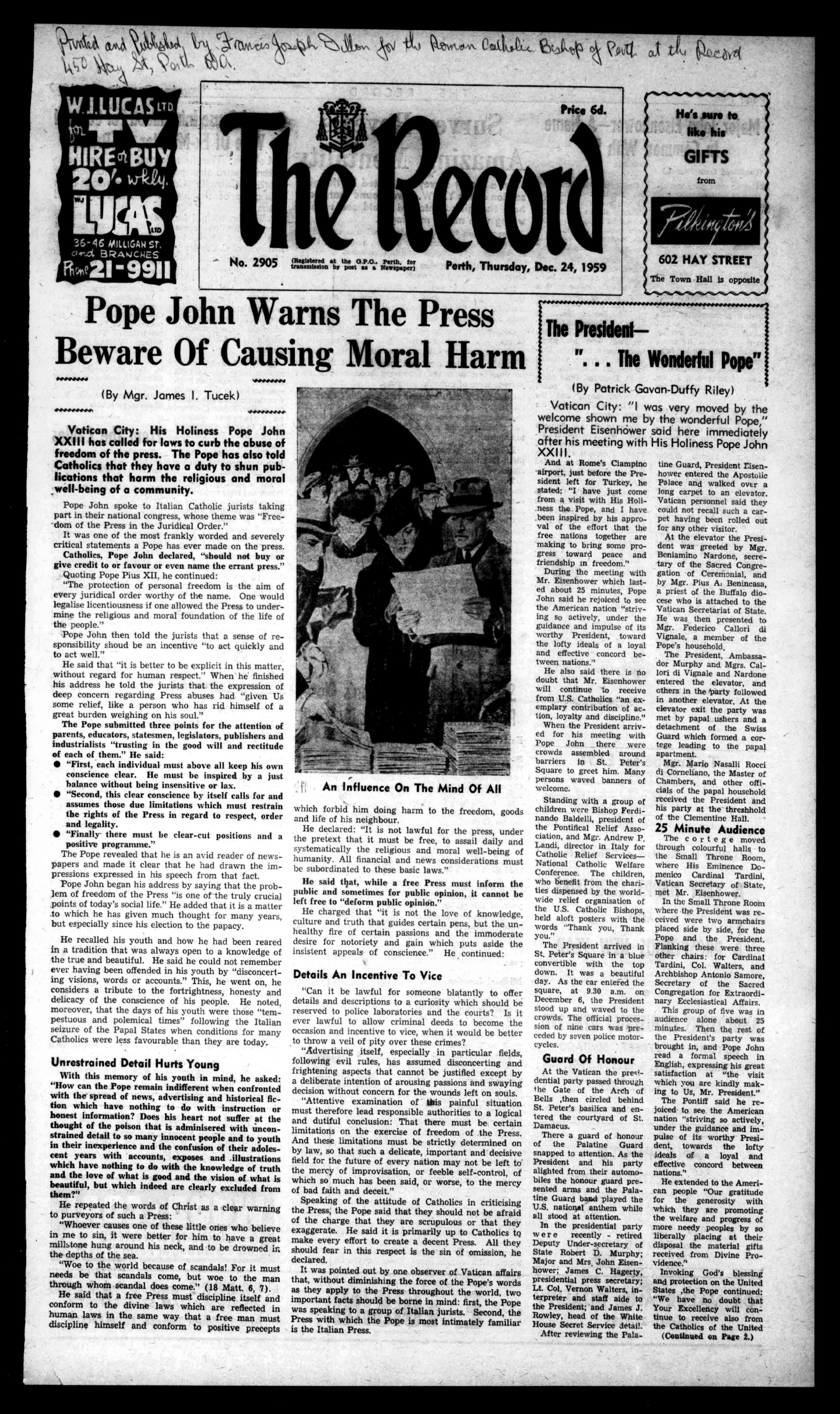
AnInfluence
OnTheMindOf
All whichforbidhimdoingharmtothefreedom,goods andlifeofhisneighbour.
Hedeclared:"Itisnotlawfulforthepress,under thepretextthatitmustbefree,toassaildailyandsystematicallythereligiousandmoralwell-beingof humanity.Allfinancialandnewsconsiderationsmust besubordinatedtothesebasiclaws."
Hesaidtlytt,whileafreePressmustinformthe publicandsometimesforpublicopinion,itcannotbe leftfreeto"deformpublicopinion."
Hechargedthat"itisnottheloveofknowledge, cultureandtruththatguidescertainpens,buttheunhealthyfireofcertainpassionsandtheimmoderate desirefornotorietyandgainwhichputsasidethe insistentappealsofconscience."Hecontinued:
DetailsAnIncentiveToVice
"Canitbelawfulforsomeoneblatantlytooffer detailsanddescriptionstoacuriositywhichshouldbe reservedtopolicelaboratoriesandthecourts?Isit everlawfultoallowcriminaldeedstobecomethe occasionandincentivetovice,whenitwouldbebetter tothrowaveilofpityoverthesecrimes?
"Advertisingitself,especiallyinparticularfields, followingevilrules,hasassumeddisconcertingand frighteningaspectsthatcannotbejustifiedexceptby adeliberateintentionofarousingpassionsandswaying decisionwithoutconcernforthewoundsleftonsouls.
"Attentiveexaminationof*ispainfulsituation mustthereforeleadresponsibleauthoritiestoalogical anddutifulconclusion:Thattheremustbecertain limitationsontheexerciseoffreedomofthePress. Andtheselimitationsmustbestrictlydeterminedon bylaw,sothatsuchadelicate,importantanddecisive fieldforthefutureofeverynationmaynotbeleftto. themercyofimprovisation,orfeebleself-control,of whichsomuchhasbeensaid,orworse,tothemercy ofbadfaithanddeceit."
SpeakingoftheattitudeofCatholicsincriticising thePress,thePopesaidthattheyshouldnotbeafraid ofthechargethattheyarescrupulousorthatthey exaggerate.HesaiditisprimarilyuptoCatholicsto makeeveryefforttocreateadecentPress.Allthey shouldfearinthisrespectisthesinofomission,he declared.
ItwaspointedoutbyoneobserverofVaticanaffairs that,withoutdiminishingtheforceofthePope'swords astheyapplytothePressthroughouttheworld,two importantfactsshouldbeborneinmind:first,thePope wasspeakingtoagroupofItalianjurists.Second,the PresswithwhichthePopeismostintimatelyfamiliar istheItalianPress.
ThePresident". TheWonderfulPope"
(ByPatrickGavan-DuffyRiley)
VaticanCity:"Iwasverymovedbythe welcomeshownmebythewonderfulPope," PresidentEisenhowersaidhereimmediately afterhismeetingwithHisHolinessPopeJohn XXIII.
AndatRome'sCiampino airport,justbeforethePresidentleftforTurkey,he stated:"Ihavejustcome fromavisitwithHisHolinessthePope,andIhave beeninspiredbyhisappro- valoftheeffortthatthe freenationstogetherare makingtobringsomeprogresstowardpeaceand friendshipinfreedom."
Duringthemeetingwith Mr.Eisenhowerwhichlastedabout25minutes,Pope Johnsaidherejoicedtosee theAmericannation"strivingsoactively,underthe guidanceandimpulseofits worthyPresident,toward theloftyidealsofaloyal andeffectiveconcordbetweennations."
Healsosaidthereisno doubtthatMr.Eisenhower willcontinuetoreceive fromU.S.Catholics"anexemplarycontributionofaction,loyaltyanddiscipline."
WhenthePresidentarrivedforhismeetingwith PopeJohntherewere crowdsassembledaround barriersinSt.Peter's Squaretogreethim.Many personswavedbannersof welcome.
Standingwithagroupof childrenwereBishopFerdinand()Baldelli,presidentof thePontificalReliefAssociation,andMgr.AndrewP. Landi,directorinItalyfor CatholicReliefServicesNationalCatholicWelfare Conference.Thechildren. whobenefitfromthecharitiesdispensedbytheworldwiderelieforganisationof theU.S.CatholicBishops, heldaloftposterswiththe words"Thankyou,Thank you."
ThePresidentarrivedin St,Peter'sSquareinablue convertiblewiththetop down.Itwasabeautiful day.Asthecarenteredthe square,at9.30a.m.on December6,thePresident stoodupandwavedtothe crowds.Theofficialprocessionofninecarswaspre- cededbysevenpolicemotorcycles.
GuardOfHonour
AttheVaticanthepres4dentialpartypassedthrough +heGateoftheArchof Bells,thencircledbehind St.Peter'sbasilicaandenteredthecourtyardofSt. Damacus.
Thereaguardofhonour ofthePalatineGuard snappedtoattention.Asthe Presidentandhisparty alightedfromtheirautomobilesthehonourguardpresentedarmsandthePalatineGuardbaudplayedthe U.S.nationalanthemwhile allstoodatattention.
Inthepresidentialparty wererecently-retired DeputyUnder-secretaryof StateRobertD.Murphy; MajorandMrsJohnEisenhower;JamesC.Hagerty, presidentialpresssecretary; Lt.Col,VernonWalters,interpreterandstaffaideto thePresident;andJamesJ. Rowley,headoftheWhite HouseSecretServicedetail.
AfterreviewingthePala-
tineGuard,PresidentEisenhowerenteredtheApostolic Palaceandwalkedovera longcarpettoanelevator. Vaticanpersonnelsaidthey couldnotrecallsuchacarpethavingbeenrolledout foranyothervisitor.
AttheelevatorthePresidentwasgreetedbyMgr. BeniaminoNardone,secretaryof gationtheSacredCongreofCeremonial,and byMgr.PiusA:Benincasa, apriestoftheBuffalodiocesewhoisattachedtothe VaticanSecretariatofState. Hewasthenpresentedto Mgr.FedericoCalloridi Violate,amemberofthe Pope'shousehold. ThePresident,AmbassadorMurphyandMgrs.CalloridiVignaleandNardone enteredtheelevator,and othersinthe'partyfollowed inanotherelevator.Atthe elevatorexitthepartywas metbypapalushersanda detachmentoftheSwiss Guardwhichformedacortegeleadingtothepapal apartment.
Mgr.MarioNasalliRocci diCorneliano,theMasterof Chambers,andotherofficialsofthepapalhousehold receivedthePresidentand hispartyatthethreshhold oftheClementineHall.
25MinuteAudience
Thecortegemoved throughcolourfulhallsto theSmallThroneRoom, whereHisEminenceDomenico VaticanCardinalTardini, SecretaryofState, metMr.Eisenhower, IntheSmallThroneRoom wherethePresidentwasreceivedweretwoarmchairs placedsidebyside,forthe PopeandthePresident. Flankingthesewerethree otherchairs:forCardinal Tardini,Col.Walters,and ArchbishopAntonioSamore, SecretaryoftheSacred CongregationforExtraordinaryEcclesiasticalAffairs. Thisgroupoffivewasin audiencealoneabout25 minutes.Thentherestof thePresident'spartywas broughtin,andPopeJohn readaformalspeechin English,expressinghisgreat satisfactionat"thevisit whichyouarekindlymakingtoUs,Mr.President."
ThePontiffsaidherejoicedtoseetheAmerican nation"strivingsoactively, undertheguidanceandimpulseofitsworthyPresident,towardsthelofty idealsofaloyaland effectiveconcordbetween nations."
HeextendedtotheAmericanpeople"Ourgratitude forthegenerositywith whichtheyarepromoting thewelfareandprogressof moreneedypeoplesbyso liberallyplacingattheir disposalthematerialgifts receivedfromDivineProvidence."
InvokingGod'sblessingandprotectionontheUnited States,thePopecontinued: "Wehavenodoubtthat YourExcellencywillcontinuetoreceivealsofrom theCatholicsoftheUnited (ContinuedonPage2.)
NNAviv, Q34-ekat?satat. WILUCASLTD .31-111T1111 HIREABUY 20'urvAl. LiI 36-46MILLIGANST 04^,d.BRANCHCS 30021-9911 Pries6d. 1 1?cot No.2905 (Registeredetthe0O. P..Perth.for transmissionbypostasaNewspaper) Perth,Thursday,Dec.24,1959
P441.04.4404
.04.1.004,4
MajorJohnEisenhower-AName InCommonWithUs
(ContinuedfromPage1.) Statesanexemplarycontributionofaction,loyaltyand discipline."
ThePopenotedwith pleasurethepresenceofthe President'sson,Maj.John Eisenhower,"becauseofthe happyandencouragingcoincidenceofthename "John"thathebearsin commonwithUs."
PresidentEisenhowercongratulatedthePopeonhis Englishpronunciation.The Poperespondedthathehad masteredhisspeechonlyby doggedrepetition.Headded thatheislearninghisEnglishfromMgr.Thomas Ryan,whomhedescribedas agoodteacherwithapoor pupilwhohaslittletimefor study.
Duringthemeetingthe Presidentemphasisedthe spiritualvaluesonwhichhe baseshisactionforpeace, declaringthatthesevalues safeguardhumandignity andliberty.
Mr.Eisenhowertoldthe Popethathewouldsoon visitMoslemcountriesthat alsobelieveinGod.Pope Johnaskedhimtoconvey hisgreetingstoPresident CelalBayarofTurkey.The Popealsorecalledthat whenhewasApostolic NuncioinParis,hehadmet GeneralEisenhower.
ThePopeandthePresidentexchangedphotographs,andPopeJohnalso gaveMr.Eisenhoweragold medalcommemoratingthe firstyearofhispontifiicate, andabookofreproductions ofthefrescoesinthe RaphaelroomsintheVatican.
WhileMr.Eisenhower talkedtothePope,AmbassadorMurphyconversedin thepapalante-chamber withHisEminenceAmleto CardinalCicognani,whofor 26yearsservedasApostolic
DelegateinWashington, D.C.
Onleavingtheaudience, thePresidentcommented, "'Iwasverymovedbythe welcomeshownmebythe wonderfulPope.Ihavealso beengreatlyimpressedby thebenevolenceshownto ournationbytheVatican."
Prelatesofthepapal householdmetPresident Eisenhowerashewasleaving,andthePresidenttook timeouttogreetsome Americannuns-religious oftheSacredHeartof MaryandSistersofCharity ofCincinnati.Thenthe Presidentandhisparty, accompaniedbyMgrs.CalloriandNardone,returned byelevatortothecourtyard ofSt.Damasus.Onceagain thePalatinehonorguard presentedarms,andthe Palatinebandplayedthe papalanthem.
Priortohisvisitwiththe Pope,Mr.Eisenhowerattended8a.m.servicesatSt. Paul'sEpiscopalchurchin Rome.Hewasaccompanied byhissonanddaughter-inlaw. ThePresident'svisitto ItalyandtheVaticanwas applaudedbyItaliannewspapersofalmosteverypoliticalhue.
EvenbeforethePresident arrivedattheVatican, "L'Osservatore Romano," VaticanCitydaily,paidtributetothemeetingby carryingafront-pageeditorialofwelcomesignedby itseditor,CountGuiseppe DallaTorre.
Theeditorialcompared Mr.Eisenhower'svisitwith thatofPresidentWoodrow WilsontoPopeBenedict XVin1919,which,itsaid, "occuredinthesamespirit" ofeffortsforpeaceina troubledworld.
Messagesofwelcomewere carriedevenin nistorganinRome,"Unita" andintheSocialistpaper, "Avanti."
ToEuropeforLA94 (ONSEASON)
Wesupplyallparticulars,anddocuments.Willvisityou athome,ifrequired.Noextracharges.
C.H.VANGELDER,14DisneyStreet,Brentwood. Centropa,B.A.Phone64-2723,allhours.
1303:810.000000.1:0:)..00:0P:6:0"0C9XE03:0:FCECPC3
WeWishtheReadersof"TheRecord"
AVERYHAPPYCHRISTMAS AND APROSPEROUSNEWYEAR
ANDERSONSINDUSTRIESPTY.LTD.
ROYDHOUSESTREET,SUBIACO
Phones:8-1121,8-1513,8-2141.
AfterHours:6-2681.
Cg:MIX5703:0:0:8103:Kata:0XECKtl:ECKKEIXECKFCKKECEKKE03:8:13:EC03
THERECORD
SurveyReveals AmazingMentality
Inarecentsurveyconductedbythegirls' sectionoftheY.C.W.itwasfoundthatnearly halfthegirlscontactedcouldseenothing wrongwithmixedmarriages.
Asurveyon"FaithandMarriage"wascarriedout by39groupsinAdelaide,Melbourne,Sandhurst,Perth, Rockhampton,TownsvilleandinGunnedah.
Ofthe521girlscontacted,233thoughttherewasno objectiontomixedmarriage.
Becauseofthisappallingsituation,leadersdecided thatitwasoftheutmostimportancetoimpresson Catholicgirlsthattheyshouldnotevenkeepcompany withanon-Catholicboy.
Generallyitwasagreedthatonceagirlhadstarted toplanmarriagetoanon-Catholicitwastoolateto explaintohimtheChurch'steachingonthesubject.
Amongthegirlscontactedsomethoughttherewas noobjectiontomixedmarriagesbecausetheirown parentswereofdifferentreligions.
Otherstooktheviewthatreligiondidn'tenterinto marriage,onlylovewasimportant.Stillothershad thestrangeviewthatagirl'slifewasplannedbyGod andifshemarriedanon-Catholic,Godhadmeantit tohappen.
Leadersindiscussingthatmatteracknowledgedthe plainfactthattheChurchhasforbiddenmixedmarriages.
Theyfelttoothatgirlsmarriedtonon-Catholics wouldbeinsecureabouttheirreligionandshouldfeel concernaboutthefutureoftheirchildrenwhowere subjectedtotheinfluencesofanon-Catholicparent.
OnthesubjectofmarriageoutsidetheChurchthe leaderswhotookpartinthesurveylistedtheeffectof suchamarriage-"Agirlwhomarriesoutofthe Church(a)isnotmarried;(b)breaksaseriousCommandmentoftheChurch;and(c)couldberesponsible forthelosstotheChurchnotonlyofherselfbutofall herdescendants,perhapshundreds."
Themainreasonsfoundformarriageoutofthe Churchwereeitherthattheboywasanon-Catholic whowouldnotmarryintheChurchorthatthegirl hadgivenupherreligionafterleavingsch.00l.
Theimportanceofthismatterwashighlightedby thefiguresbroughttolightinthesurvery.Between themthe184girlsdoingtheenquiryknew246girls whoweremarriedoutoftheChurch.
SocialRoundForSeason'sClose:
PresentationsAndCarolsByYouth
EastVictoriaPark
AtaChristmassociallast Sundayevening,presentationsweremadetoourtwo retiringpresidents,Dan CarneyandFrancesKingston.
Mr.Carneywillbegoing overseasonaworkingholidayfor12months,andMiss Kingstonwillbemarried earlyinthenewyear.
Bothwerefounds6011 membersoftheEastVictoriaParkYouthMovement andhavebeenmostgenerouswiththeirtimeand energyinthecauseofthe youthofthisparish.
Otherpresentationswet*: madetoWarrenShepherd andRichardRandall,afittingrewardfortheirefTorts atgymnasticsduringthe year.
NolandJunction
Aboutseventyyoung peoplehadanenjoyable timeattheChristmasparty heldintheparishhalllast Sunday. DuringtheeveningapresentationwasmadetoRay Russellthankinghimforhis servicesthroughoutthe year.Alsoawelcometo FatherTerence,O.F.M.,the Franciscanvisitorfrom California.
Specialthanksgotdthe ladiesforaverynice supper.
ColinChinewillbeleavingforthekeyleaders' courseinMelbourneon Wednesday,December30. ThetrainwillbeatMidland stationat7p.m.Allthe youngpeopleareinvited alongtoseehimoff.
Leederville
LastSunday'sChristmas socialwasafittingfinaleto amostsuccessfulyear. About160youngpeopleattendedandamongtheeven-
ing'sentertainmentwasa visitfromFatherChristmas whogavepresentstoboth girlsandboys. Christmascarolswere sungandtheannualreport wasgiven.Thereportoutlinedtheyear'sactivities andwhattheboysandgirls hadachieved.Membershad beenwellcateredforin spiritual,socialandsporting services.
Sincerethanksgotoall thosewhohelpedmakeit suchamemorablenight. Duringtheeveningapresentationwasmadetothe Rev.D.Foleyandtheretiringpresident,LenWallace,fortheiruntiringwork overthepastyear.
Generalbranchofficers wereannouncedforthe comingYear.Theywere: G.Edmondson,president;B. Keane,vice-president;D. Eley,secretary;J.Harris, treasurer;B.Regan,branch wardenandK.Green.publicityofficer.
CubanTextbook NotLiked
Santiago,Cuba:Cuban MinisterofEducationAr mandoHartsaidthat Catholicscholswillnothave tousethestandardtext bookswhichhavebeen adoptedforpublicschools.
However,inaspeechat Santiago,herecommended thatthetextbooksusedby Catholicschoolsberevised inaccordancewiththehistoryandneedsofCuba.
Theministersaidthathe didnotlikethestandard publicschooltextbooks,but thathewouldhavetokeep themforthetimebeing.
Thursday,December24,ir
FormalCauseIntroducedfor -WifeOfEx-Minister,Ex-Priest
eightAmericanarchdioceses aswellasinmanypartsof Europe.
Evidenceconcerning MotherConnelly'slifewas firstcollectedthrougha historicalcommissionappointedin1953.Itpresented apreliminaryreportin19:::S.
London:Thefirstformalstephasbeen takentowardthepossiblebeatificationof MotherCorneliaConnelly,American-born foundressoftheSistersoftheHolyChild Jesus. Adiocesantribunalfor thebeatificationcause wasopenedhereby BishopCyrilC.Cowderoy ofSouthwark.Mother Connelly,whilebornin Philadelphia in1809, spentmostofherreligiouslifeinEngland,and isburiedattheprovincial houseofhersocietyin Mayfield,Sussex,whichis withintheSouthwark diocese.
MotherConnelly,whose maidennamewasCornelia Peacock,wasraisedanEpiscopalianandattheageof22 wasmarriedinPhiladelphia totheRev.PierceConnelly. anEpiscopalminister. MovedtostudyCatholicism in1935whileMr.Connelly wasservingasrectorofa churchinNatchhez,Miss., bothwerereceivedintothe CatholicChurch.
TheConnellyswentto Rome,andaftermakingprovisionfortheupbringingof theirfourchildren,received Papalpermissionfora maritalseparationsothat Piercecouldstudyforthe priesthoodandCornelia enteraconvent.
Mrs.Connellyfirsttried hervocationwiththeReligiousoftheSacredHeart, andherhusbandhiswith theJesuits.Helaterdecided tobecomeadiocesanpriest, however,andwasordained in1845.Heofferedhisfirst MassattheRomeconvent wherehisseparatedwife wasstaying.
CorneliaConnellyshortly afterwardsgotapprovalofa projecttobeginanew teachingorder,foundingher societyinEnglandin1846.
Inopeningthediocesan courtinthecase,Bishop Cowderoyconfirmedtheappointmentoftheofficersof thetribunal.Theseinclude FatherWilliamSewell, judgedelegate;FatherDesmondMcCarthy,promoter oftheFaith-theoffice commonlyknownasthatof "devil'sadvocate"-and FatherJamesWalsh,S.J., diocesanpostulator.
FromTheCables
Sufferingfromcomplete physicalandnervousexIlaultionArchbishopJ. Dooley,S.S.C.,Apostolic DelegatetoIndo-Chinahas beenflownoutofCommunist-heldNorthVietnam.He leftHanoithecapitalafter beingbed-riddenforthree months.HewasaccompaniedbyFatherTerence O'Driscollwhenhearrived atDublin.FatherO'Driscoll wastheArchbishop'ssecretaryandwasexpelledby theRedsshortlyafterthe ApostolicDelegatewas evacuated, Thismarkstheclosureof thelastApostolicDelegationintheCommunist world.
Freiberg:AChristmas fundappealhasbeen launchedheretoassistthe Germanpoorbehindthe IronCurtain.
Itusesthemotto"S.O.S. East."Initsappealtothe PierceConnellysoughttoGermanpeople,theCatholic directthenewsociety,butCharitiesorganisationstated MotherConnellyrejectedthatitreceives3,000letters hisclaim.Withinashortofappealpermonth. timehebegantoattackthe CatholicChurch,andin 1849institutedacivil:wiltto compelhiswifetoreturnto him.Thecase-atrialwhich wasasensationinboth EuropeandAmerica-was ruledinConnelly'sfavour ongroundsthatthePapal separationdecreewasinvalidinEngland.
MotherConnellyappealed tothePrivyCouncil,which ineffectorderedanew trial.Piercehadbynow runoutoffunds,anddid notproceedwiththecase. Eventuallyhetookupthe Anglicanministryagain, anddiedinFlorence.Italy, unreconciledtotheCatholic Church.Hisdeathpreceded hiswife'sbyfouryears.
Beforeherdeath80 yearsago,MotherConnelly sawhercongregationspread tohernativeUnitedStates. Itnowhasfoundail41;in
FortHall,Kenya:Father OctaviusSantoro,I.M.C., hasacatechismclassstory. TheConsolatamissionary, arecentgraduateofthe CatholicUniversity of America,Washington,D.C., wasexplainingthemeaningofconsciencetoagroup ofnativeboysandgirls. Heaskedoneyoungster: "Ifyoustealsomebananas fromsomebodyelse'sfield, howdoyoufeelinside?"
AccordingtoFatherSantoro,thereplycamewithouthesitation:"Ifeelbetter."
Emixisorizomme:81353:13:ex09:13:1
GUNNELL'S
.01
PageTwo
PHOTO Appearingin"THERECORD" maybeobtainedbyapplying orcontactingthisOffice 450HAYSTREET. Box
G.P.O.
ANY
R1279,
SAMEDAY DryCleaners
HAYSTREET(near
St.),WESTPERTH AlsoatKALGOORLIE
5-3053.
CHALWELLCARWRECKERSandDEALERS ForallyourSparePartsRequirements PARTSFORALLMAKES ConRodExchange-TyresNewandSecondhand TrailerandCaravanAssembliestoorder, 146HIGHSTREET,FREMANTLE -W.H.BRANCH&SON STONEHAMSTREET,OSBORNEPARK Phones:8-2406;24-1157 AllTypesofElectricalWork Undertaken WOOD&COAL BRYANT&WATERS 8090StirlingStPerth213938 FORVALUEANDQUALITY Phone:21-5393 E.LUISINI MERCERSandDRAPERS 215-219WILLIAMSTREET,PERTH Also14SouthTerrace,FREMANTLE
1224
Colin
9103:810303213020:03:011:83,C91
5-3053.
THERECORD
ThePress-FreedomOrLicence
TheHolyFatherhasspokenverystronglyonthe subjectoftheFreedomofthePress.Hehasvery succinctlymadethedifferencebetweenfreedom ofthePressandlicenceofthePress. ThislatterincountrieswherethePress isfreefromtheinterference,ofthegovern- ingbodyofthecountryisalwaysapttobetheinterpretationgiventofreedomofthePressbyitsowners andthosewhoargueforit.Inacountrywherethere isadictatorialformofGovernment,sayasinCuba, China,LatinAmericancountries,Russia,thetruesense offreedomofthePressisapparentandthatisfot whatmenfight.
Wheneveradictatortakesoveracountry,hecannot abidebyotheropinions.Thereforeoneofthefirstfreedomsofhissubjectstogoisfreedomofexpression. Sincethepressisthemostpowerfulofthesemedia thereisastrictcensorshiplaiddown.Theresult,nor- mally,isthatthisparticularmeansofman'sexpression goesunderground.Theideaisthedisseminationof thetruth.Greatdifficultieswillbegonethroughto getthetruthouttothepublic.
Yetwhenthecountry,likeourown,America,Great Britain,CanadaandothershasfreedomofthePress, thisfreedomisabusedintolicence.ThePresscan publishanythingaslongasithas"newsvalter "readerappeal"andothersuchtagsarethestandard answerstoquestionsofwhyfactsaredistorted,sex isbelabouredtoanauseatingdegree,privateconcerns ofpeopleandtheirmoralhabitsareflamboyantly spreadoverpagesofnewspapersandperiodicals. Wherethereisnofact,fictionissuppliedwiththe sameluriddetails.
ThislatterispreciselywhatPopeJohnhasspoken sostronglyagainst.Hisrealisationofthepowerofthe Press,newspaperandothermeans,forgoodorfor evil,isstrong.Therearemoralsforthenewspaper andprintedwordjustasmuchastherearemoralsfor theindividual.
WhoistobetheconscienceofthePress?Obviously theownersandpublishersinthefirstinstance.They haveanobligationtotheirreaders.Inthesecond placetheparents.Theirseriousobligationistovet allreadingmatterthancomesintotheirhomes,using awisdombornoftheirownexperience.Inthethird place,thelegislatorsofthecountryhavetheobligation toenactlawswhichwillprotecttheirpeople.Whenindividualsandfamiliesfalldownontheirbounden duty,theStatemuststepinandmaketheirdecisions forthem.Whenthesameindividualsforreasonsof profittradeonmattersadversetotheircallingof truthinreportingandmaintainingintegrityanddig- nityintheirprofessionthenlegislationistheonlyway tostopthem.
ThehowlswouldbethatthePressisbeingtrodden on,theirlibertysuppressed,butiftheaboveisthe casethentheywoulddeserveit.
ThePopehascalledforaclean-upoftheworldPress notonlyinitssubjectmatteranditspresentation,its invasionofprivacyandthesensationalreportingofthe morallapsesofcitizens,butalsoinadvertisingwhich itaccepts.Thesphereofinfluenceislimitlessandit isapublicshamethatitistendingto,panderingto thelowertastesofmanratherthanwhatcouldbe nobleandupliftingandforthegoodofall.
TussleInFranceOnEducation
Poris,Dec.12.-Withpublicationofthe conclusionsofthegovernmentcommission setuptorecommendasolutiontoFrance's educotionproblem,thequestionofStateaid toCatholicschoolsherereachedaturning point.
ACabinetmeetingwasscheduledtodecidethe Government'sstandonthematter.TheGovernment's decisionwasthentobepresentedtoParliamentfor enactmentintolaw.Parliament,whichhasamajority infavourofaidingChurchschools,isexpectedtoact onthequestionbeforetheendoftheyear.
EarlierCabinetmeetingsontheissuehavebeeninconclusive.TheCabinetwassplitonthequestionand MinisterofEducationAndreBoulloche,aformer Socialistthreatenedtoresignff"tioncessions''to Catholicschoolsweremade.
PremierMichelDebre,however,hadstatedearlier thattheGovernmentrecognisestheneedforrevising schoollaws.Whenemergencyfinancialaidwasgiven toCatholicschoolsearlierthisyearthePremierde- claredthattheGovernmenthadgivenittopreserve nationalunity.
But,reflectingthesplitintheCabinet,thecountry isdeeplydividedonthequestion.Massmeetingsin manyFrenchcitieshavebeenheldbybothCatholics andopponentsofStateaid.Theopponents,withCom- munistsplayingaprominentrole,aredemandingthe nationalisationofallschoolsandhavecollecteda milliondollarstofinanceapropagandacampaignto- wardthisend.
TheRedsarealsotryingtotakeadvantageofthe issuetowinpoliticalpowerastheheadofacoalition ofSocialistsandotherleftistpartiesopposedtoaidfor Catholiceducation.
ThroughoutthecontroversyonStateaidChurch authoritieshavemadeitclearthattheyareinnowayopposedtopubliceducation.Theiraim,theyhave stated,istoseekjusticeforCatholicschools.
HisEminencePierreCardinalGerlier,Archbishop ofLyons,saidtheChurchhasnointentionsofsetting FrenchmanagainstFrenchmanontheschoolquestion. Allitwants,hesaid,isrecognitionoftherightof parentstoatrulyfreechoiceastowhowilleducate theirchildren.
EmergencyAidIn1951
AtpresentCatholicschoolsinFrancereceiveno directStateaid.ButundertheBarange-Barrachin lawpassedin1951parentsofCatholicschoolstudents receive1,300francs(lessthan£1)fromtheGovern- mentthreetimesayearforeachschoolchild.The parentsthenpaythissumtoaCatholicschool.Parents ofpublicschoolchildrenreceivethesameamountand turnitovertoapublicschool.
TheemergencyaidgiventoCatholicschoolsearlier intheyearwasgrantedunderthislaw.Itdidnotgive theschools eventually,anymoneytheywouldnothavereceived butprovidedtheywouldgetthemoney earlierthanusual.Theyweregivenmoneyatthe openingratherthanattheendoftheschooltermso that enableditcouldbeusedforoperatingexpenses.Theaid someCatholicschoolstoopenwhichearlier fearedtheywouldhavetoshutdown.
ThefinancialdifficultiesofCatholicschoolshere, whicheducateabout15percent.ofthenation'selemen- taryschoolchildren,arecausedbysharplyrising enrolmentscoupledwithasteepriseincosts.Teachers arepoorlypaid,buildingsareovercrowdedandlack maintenanceasaresult.
TheGovernmentCommissionappointedtodealwith theeducationquestionhasrecommendedasolution whichgivesCatholicandotherprivateschoolsfour choices.These,choicesrangefrombecomingpartof thepublicschoolsystemwiththeStatepayingall theirexpens,toremainingcompletelyoutsidethe StatesystemwithoutanyGovernmentaid.
PopeJohnGivesUsAReminder
OfTheTrueValueOfSport
PopeJohnrecentlygaveatimelyreminderto anumberofathletes,whogatheredunderhis windowinSt.Peter'sSquare,oftherealsignifi- canceofsport.
Hesaid:"Sportseventsofphysicalresistance mustbe spirituallinkedharmoniouslywiththehighest ideals,soastobeagentlereminderto alloftheneedforinteriorandsocialorder,for courtesyandbrotherlylove,forjoyandfor commonprayer."
Onetakingpartincompetitivesportneedsa certainself-controlanddiscipline-nodoubtthat iswhattheHolyFathermeanswhenhesaysthat sportshouldremindusoftheneedforinterior order.
Gamescan'tbeplayedwithoutrules-thatis, wethink,thesignificanceofhisreferencetothe linkbetweengamesandsocialorder.
Being"agoodsport"involvescourtesyand brotherlylove,aswellasacertaincheerfulness. Sport,inprovidingacommongroundforjoy, alsoprovidesacommongroundforthankingGod.
HowfaristhePope'sidealofsportseparated fromthewin-at-all-costsmentality!Howin- finitelyfinerandmorerationalishisviewthan thepaganviewofsport!
And,incidentally,howmuchmoreenjoyable aregamesplayedhiswaythanwhenplayedthe paganway!
Inbetweenthetwoextremes,thecommitteesug- gestedthatCatholicschoolscomepartiallyunderthe controloftheMinistryofEducationinreturnforhe Government'sassumingapartoftheircosts.Itrecommendedthatthisbedoneonthebasisofacontract orasimpleagreement.
UnderthetypeofcontractssuggestedbytheCom- mission,Catholicschoolteacherswouldbepaidbythe Statebutpupilswouldhavetobeaccepted"regardless ofcreedandwithcompleterespectfortheirfreedom ofconscience."Theschools,however,wouldhavethe right-tomaintainoneclass-whichwouldprovidefor religiousinstruction-onaprivatebasis.
TheagreementsystemwouldprovideforlessGovernmentcontrolandlessGovernmentaid.
TheCommission,headedbySocialistleaderPierreOlivierLapie,whowasexpelledfromhispartyfor servingonit,appealedtothenationforcalmonthe schoolissue.
Solution,EfficientAndLasting
"WhateversolutionisfinallyreachedbytheGovernment,"ttdeclared,"thesystemadoptedwillbeefficientandlastingonlyifitisadoptedinaspiritof calm.''
TheCommissionaddedthatitisawarethatitsrecommendationswillnotpleasethoseoneithersidewho regardtheissueasabattleinwhichtheymustwin avictory.
LimitedaidtoCatholicschoolswhichalsoinvolves greaterStatecontroloverthem,theCommissionsaid,"isobviouslynotinconformitywithacertaindoctrine offamilyrightsnorwithacertainconceptionof secularism."
MeanwhiletheParliamentaryAssociationforFreedomofEducation,towhichamajorityofthemembers oftheNationalAssemblybelong,hasissuedastatement sayingthatitacceptstheLapieCommission'sreport asabasisfordiscussioninsolvingtheschoolissue.
Itstated,howeverthatitrejectedanysolution whichinvolvesdisguisedeffortstointegrateCatholic schoolsintothepublicschoolsystem.
Theassociationsaidithasfivegoals:
*Tovoteontheschoolissueassoonaspossible.
*CatholicschoolssigningacontractwiththeState mustnotbeforcedtogiveneutral,non-religious instruction.
*Allprivateschoolsofallcategorieswhichfulfillcer- tainconditionsdefinedbylawmusthavetheright tosignacontractwiththeStae.
*Thesystemofagreementsmustnothaveatimelimit.
*Schoolswhicharenotintegratedinthepublic schoolsystemorarenotsignersofanagreement mustinnocasebeallowedtofallintoaworsecon- ditionthantheyareinatpresent.Theymustnot sufferacutintheamountofmoneytheyreceive frompublicauhorities.
Thursday,December24,1959 THE RECORID PageThree
OfficialOrganoftheArchdioceseofPerth. 450HayStreet,Perth eeeeeeeeee.::;.:::::.;:..:::
MEMORIALS ErectedanywhereintheStateby WESTRALIACASTSTONECo. 154ROKEBYROAD,SUBIACO. Phone8-1482. CataloguesonRequest. P.BOYCEandL.J.DODD,Props. .:.::::: sj..;. SYDNEYH.FROST OPTOMETRIST 4LONDONCOURT(TerraceEnd/ W.A.O.A.(Dip.) GetBetterMeatforLessat CLEMPAULLS 234HAYSTREET.EASTPERTH-21-3869 63CANNLNGHIGHWAY,SOUTHPERTH.67-1708. WATCHTHEWINDOWSFOROURSPECIALS Phone28-1888 '1l'.1 PiI;III ForallYourElectricalRepairs Prompt,EfficientService Quotation,forNewIn,tnllotion ciouuri,iLight.furallOur.t..io...t,.rtier,
THECOLONIALMUTUALFIRE INSURANCECOMPANYLIMITED CANMEETYOURINSURANCEREQUIREMENTSIN PROTECTION 236Sr.GEORGE'STERRACE,PERTH. Phone:21-9066. J.G.CANNY,Manager. £50,000inPrizes AtDOOGUE'SLOTTERYAGENCIES PerthArcadeandBarrackStreet,Perth The man tosee foryoup ALLMAKES Admiral,AWA,Pope, Philips,HMV,STC,Pye, Kriesler,etc. From119gns. RENTORBUY RonShawsspecialrental planoffersLowestRentalsinW.A. AFTERSALESSERVICE LifetimeAfterSalesServicebyourownservice division. DAYORNIGHTHOME DEMONSTRATIONS PHONE28-1525 RAYST.(NexttoTheatreRoyal),MIIRRATST.,KINGST.,MT. LAWLET,LUDIRYILLE,SURIACO,V1CTORLAPARK. PHONE184525ALLSTORES
Haggard,Haunting
UnitedNations,N.Y.:ToHisHoliness PopeJohnXXIII,theplightofrefugeesis "noabstractpoliticalorsocialproblem"but rather"thehaggardandhauntingmemory ofdaysandnights,ofyearsofthepersonal workofbindingupthewoundsofuprooted humanity,"aUnitedNationsmeetingwas told.
ThePope'spersonal concernforrefugeeswas recalledbyAuxiliary BishopJamesH.Griffiths,ofNewYork,inhis capacityofrepresentativeoftheHolySeeat the1959U.N.Pledging Conferenceforrefugee aidfunds.
TheBishoptoldtheconferencethat"rarelyhas therebeenanyprojectso readilyandwholeheartedly giventhemoralsupportand encouragement"whichPope JohnhasgiventotheU.N's WorldRefugeeYear.
Healsoremindedthe delegatesofthePontiff's intimateworkonbehalfof refugeesduringhisyearsas theHolySee'srepresentativeinIstanbul,Athensand Paris.
BishopGriffithsconfirmed theHolySee'sspecial WorldWorldRefugeeYear contributionmadeinAugust
DEVINE'S PRAMSHOP Specialisingin LIFT-OUTPRAMS from£17110/903HAYST..St'BIACO
totheU.N.HighommissionerforRefugees.
ThegiftofLA1,800was doubletheHolyFather's usualannualcontribution becauseoftheRefugee Year.PopeJohnaskedthat thegiftbeusedtoassist European,Chinese,North AfricanandPalestineArab refugees.
ThePope'srepresentative remindeddelegatestothe conferenceofPopeJohn's June28radio.address, openingtheobservanceof theWorldRefugeeYear.
Theprelatealsonoted theworkofCatholicorganisationsinpromotionand supportofWRYinall partsoftheworldincooperationwiththeInternationalCatholicMigration Commission.
Theprimaryobjectof WRYistoaidallrefugees, mostofwhomarenotundermandateofthe.United Nationsoranintergovernmentalorganisation.
Of30millionswhoare refugeesatleast15milstillneedmaterialand legalassistanceofwhich only21millionscomeunder mandateoftheUnited
GUARDIANASSURANCECO.LTD.
(Established1821) Fire,LossofProfits,MarineandAccidentInsurances. AssetsExceed£20,000,000. 8-10THEESPLANADE,PERTH,W.A.
320,000Helped
Since1945CatholicAgenciesalonehavehelpedresettle320,000refugeesand integratedalmostthesame number,thedemandson theCatholicAgenciesBudgetbeingenormous. AspecialVaticanCity commemorative postage stampseriestobeissued inobservanceoftheRefugeeYearwasalsonoted bytheBishop.Proceeds fromthesaleofthestamps willbeaddedtotheHoly See'scontributiontothe HighCommissioner'sprogramme. ThePledgingConference receivedcontributionsfor boththeHighCommissioner'sprogrammeandthe U.N.ReliefandWorks AgencyforPalestineRefugees.
MeetingOfTOSF
Themonthlymeetingof theThirdOrderofSt.FranciswillbeheldonSunday, December27at3p.m,inthe ChildrenofMaryChapel, VictoriaSquare. "Becausehis(St.Francis') spirit,thoroughlyandeminentlyChristianmeetsthe requirementsofalltimes, withoutdoubttheFranciscanmovementwillbenefit ourageasthecircumstances ofourdayresemblethose ofhis.Asinthetwelfth centurysonowdivine charityisonthedeclineand nolesssadistheperversion oftheChristiansenseof duty.
Genuinecharitytowards theneedyandhelplessis vanishingdaily,moreand more. Boundtogether(bythe RuleofSt.Francis)people wouldloveoneanotherand manifesttowardstheneedy andafflictedthereverence duetothemasrepresentativesofChrist."(LeoXIII Auspicato,September, 1882.)
FraternitiesoftheThird Orderareestablishedat Perth,VictoriaParkand MidlandJunction.Enquiries maybeaddressedtoRev. FatherBerard,O.F.M.,53 GreatNorthernHighway, MidlandJunction.
ElevenIrishTraineesArriveTo
AugmentSt.JohnOfGodStrength
ElevenNovicesandthreePostulants arrivedonSundaylastbytheS.S.Oronsay fortheSt.JohnofGodNovitiate,Subiaco.In chargeofthepartywasMotherMaryMartina,whowillbethenewMistressofNovices atSt.John's,replacing Motile,-M.Martinawas 25yearsatSubiacobefore goingtoIrelandwhereshe heldtheofficeofNovice MistressatBallinamore, CountyMayo,Ireland. BallinamorewasaJuniorateunti]thewarand travelwasrestricted.Itwas
Official Engagements
December24: 12midnight:Presideand preachMidnightMassXmas Eve,St.Mary'sCathedral.
Dec.29,8.30a.m.:Ceremony ofFinalProfession,St. Joseph's,Fremantle. Jan.7,8a.m.:Ceremonyof Profession,"Iona"Convent,MosmanPark.
Jan.9,9a.m.:Ordinationto thePriesthood,St.Mary's Cathedral. Feb.7:BlessExtensions,Our LadyofLourdesParish, Nollamara.
MotherMaryLionard. turnedintoaNovitiatetill recentlyandhasnowrevertedtoitsformerroleofa Junioratewhereyounggirls desirousofenteringthereligiousordercarryontheir seculareducation.Having conpletedthetimeofthe novitiatetheprospectiveaspirantsoftheorderthen cometoSubiacofdrtheir Novitiate.HeretheSisters willdosixmonthsaspostulants.Aspiritualyear followsthenafinalyearof Novitiatebeforetakingfirst temporaryVowsforthree years.
Thosewhocameoutwith MotherMartina vte.re NovicesSisterHelenaLavalle,CountyMayo,Sister MarcusBryce,Mayo;Sister ThaddeusSalmon,County Mayo(oneofeightSisters inthesameorder);Sister ThomasinoQuinn,Galway; SisterPhillipsJoyce,Mayo; SisterEugenioBrennan, Mayo;SisterAlbertoHughes Mayo.; esterThomas O'Reilly,Mayo;SisterZeta McMahon,Clare;SisterPaul Fleming,Mayo;SisterAnne Cullinan,Mayo.Postulants SisterBridleQuinn,Mayo; SisterLetitiaPower,KilkennyandSisterTeresa Duffy,Mayo. "TheRecord"welcomes theSisterstoAustralia.
SevenNunsAre SentToJail
AndrewPubben
ExtendstotheClergy andReadersof "TheRecord"
AMERRYXMAS andBestWishesfora HAPPYNEWYEAR Specialistin CLERICAL TAILORING withfittingsatyour ownhomeatyour convenience.
Businessaddress: 90KINGST.,PERTH Phone21-8108
HomeAddress: 209BatemanRd.,Brentwood (OppositeChurch)
Senator'sDaughterIsAmong
ThreeNunsMakingFirstVows
Threeyoungwomendirectlyfromconvent collegesreceivedthehabitoftheSistersofSt. JohnofGodatthechapeloftheMotherhouse,Subiaco,onDecember8.
TheRt.Rev.Mgr.A.T. Langmeadreceivedthevows assistedbytheV.Rev. IraqFreedom Cronan Sherry,O.C.S.O. (PrioroftheCisterciansin Victoria,whowasonhis waytoIreland)andthe Rev.T.Tomich.
TheRev.K.Middleton, C.Ss.R.,preachedtheoccasionalsermon.Present onthesanctuarywerethe V.Rev.P.Waters,O.F.M. (whohadgiventhenew Sistersaneight-dayRetreat)andtheRev.M.McKeon.
Thosereceivedwere SistersM.Judith(WilleseeI,M.Joanna(Safe)and M.Sophie(Wilmink).
SisterJudith,daughterof SenatorD.R.andMrs. WilleseeofOsbornePark andCanberrawaseducated bytheDominicanSistersat Dongara.
Herfatherflewfrom Canberratoattendthe ceremony.
EducatedbythePresentationSistersat"Iona," SisterJoannaisthedaughterofMr.andMrs.J.M. SafeofBeverley.
SisterSophieisthe daughterofMr.andMrs. J.WilminkofNedlands. formerlyofHolland.She hasbeensixyearsinAustraliaandwaseducatedat
Baghdad,Iraq:Iraq's PremierAbdulKarimHassemhasstatedthatallreligionsrepresentedinthe countryenjoy"fullfreedom"andhavehis"full protection,"thoughIraqis officiallyMoslem.
Therevolutionaryleader madethestatementata Pressconferenceshortly beforeleavingDarasSalamHospitalhere,where hewasconvalescingafter anattemptonhislife.
Whatevertheirclass,religionornationality,he said,thepeopleofIraq, "areallbrothersinside Iraqenjoyingfullfreedom andbrotherhoodandhaving thesamerightsandobligations."
"Thiscountryhasbeen liberatedandtheregimein itisanationalist,strong andnobleregimeserving theinterestsofthepeople, themajorityofthepeople, withitsdifferentclasses andreligions.Theofficial religionoftheStateis Islam.Theotherreligions inthiscountryenjoyfull freedom.Theyareallfree andenjoypeaceandsafety. Theyalsoenjoymyfull protection.Theyaremy brothers.Allofthemare brothers."
SixNovicesReceiveReligious HabitOfMercyNunsAtlesmurdie
InthesylvansettingofLesmurdie,six novicesoftheSistersofMercyrecently receivedthereligioushabit.
Theywere:Sr.MargaretwerealsotobecongratuMary(MargaretMace),Sr.latedontheinestimable M.Christopher(BeverleyfavourGodhadconferred Scott),-Sr.M.Luke(Pamontheminselectingoneof Vadanovich),Sr.M.Michaeltheirchildrentocontinue (RosemarySmith),Sr.M.Hisquestforsouls.
Vienna:Sevennunshave beensentencedtojailterms incommunistCzechoslovakia,ithasbeenlearned here. AccordingtothePrague newspaperSvobodneSlovo, receivedhere,thenunswere inagroupof11women givenprisontermsoffrom onetofiveyearsfor"activitieshostiletothe state."
Thenuns,whosecommunitieshadbeenbroken upbytheReds,wereaccusedbyaPraguepeople's courtofspreadingsubversiveliteratureandleaflets onreligioustopics. Ithasalsobeenlearned herethatFatherVojtech ZabranskyofRohateshas beensentencedtothree yearsinjailforaccusing Czechoslovakia'sRedregimeofspreadingliesand urgingfarmersinSlovakia nottojoincollectivefarms.
Assumpta (Kathleen Burke),andSr.M.Christina(RoseBumbacI. Preachingtheoccasional sermontheRev.T.W.PurcellO.M.I.,congratulated Theceremonyconcluded theSistersasprivilegedwithBenedictionofthe soulswhohadturnedtheirBlessedSacrament,after backsonthegarish,emptywhichtheSistersentertainjoysoftheworld. edparentsandfriendsof Hesaidtheirparentsthenewnuns.
Godhadgiventheir daughtersaspiritualapos, tolate,limitlessinits fruitfulness.
Masses,ConfessionsWillBe AvailableOnHolidays
Masswillbeofferedatbeachresorts duringtheapproachingholidayseason asfollows:
ROTTNESTISLAND
MassesbeginonChristmasDayandwillcontinuetillthelastSundayinJanuary.Fromthen onitwilldependontheavailabilityofapriest. MasstimesatRottnest:7a.m.and9a.m.in thepicturehall.
MASSES:
CONFESSIONS:
MANDURAH
EverySunday:7and8a.m.
EverySaturdayfrom7.30-8.30p.m.
EVENINGDEVOTIONS: 1st,2ndand3rdSundaysat7p.m.
ROCKINGHAM
SundaysandHolyDays,7,9a.m.and5.30p.m.
SAFETYBAY
SundaysandHolidays:7a.m.and8a.m.
NAVALBASE
MASS:
NewYear'sDay:8a.m.
Sundays,1st,3rdand5th,8a.m.
2ndand4th,9.30a.m.
CONFESSION: BeforeMass.
YANCHEP
MASS: 7.30p.m.(Sundays)
CONFESSION: BeforeMass.
NORTHBEACH
Sundays,7and10.30a.m.
Confessions:Saturday,4.30-5.30p.m.;7.30-8.30 p.m.
GWELUP
Sundays,8.30a.m.
Confessions:BeforeMass.
PageFour THERECORD Thursday,December24,1959
'MAZDA! LAMPS stay brighter longer W.A.PISTAS.ATKINSIW.A.),I.TD$94HAYST.PERTH ALLSEATRAVEL Overseas,Interstate,Cruises,etc., canbearrangedat DALGETYSTRAVELSERVICE 15WilliamStreet,Perth.21-2841 ORANYBRANCHORAGENCY InquirealsoaboutAirTravel,MotorCoachTours andRailBookings Makethe Pe6*8000.5 LOWLEVELCISTERN BeforedecidingonaLow LevelCisternmakethe -PushButtonTest"compare LESMRDIEli actionwithothers.you'll findonlyLESIMURDIEIs COMPLETELYsilent. AvailableatLeadingStores MadeinW.A.by S.W.HART 105FITZGERALDST.,PERTH
NationsReliefandWorks Agency. WRYIsintendedasa two-prongedventure,i.e., governmentalandprivate, in whichGovernments mightdoubletheircontributionswhilstprivateorganisationswouldalertand informpublicopinionand procurefundsforchannellingtonon-governmental refugeeundertakings.
Memory
WhenThePopeSpeaks
..,1t-XXXXXX2414.1CXIMICID=0=030=016:10===sAf,11=0
NewsmenToldToFaithfully
ServeTheCauseOfTruth
VaticanCity:HisHolinessPopeJohn XXIIItoldagroupofjournalistswhoaccompaniedPresidentEisenhowerfromtheUnited Statesthathisfinestwishforthemwas"that atyourlife'sendyoumaysayyouhavefaithfullyservedthecauseoftruth."
This,hesaid,washishisparty. prayerandhisblessing.
Thegroupofabout100 newsmenwasreceivedby thePopeinanaudiencein theConsistorialHallon Sundaymorning,December 6,beforethePresident's visit.PepeJohnspokein Italianandhisremarks weretranslatedbyMgr. ThomasRyan,headofthe EnglishdeskoftheVatican SecretariatofState.
"AllmylifeIhaveencounteredthegentlemenof thepress,andIhavealways beenawareoftheirlofty mission,"thePontiffsaid. Hespokeinarelaxedmanner,andpunctuatedhis talkwithanimatedgestures.
PopeJohnrecalledthat whenhereceivedreporters inaudienceshortlyafterhis electiontothepapacyhe hadcounselledthem:"Never betraythetruth."The quotationwasfromtheItaliannovelistandpoetAlessandroManzoni.
HoldingthattheChurch needsherownpress,the PopesaidthatifSt.Paul wereonearthtodayhe wouldbeajournalist,and agoodone.
TheChurchpossessesthe depositoftruth,hecontinued,addingthatshemust thereforepropagatethe truth.
"Ifyoulikewisepropagatepeaceandgoodwill, youwillbethehonourof yourprofessionandserve mankind,"hesaid.
PointingtoMgr.Ryan, thePopesaid:"Thisismy Englishteacher-anunhappyteacherbecausehe hasapoorpupil."He apologisedtothenewsmen fornotbeingabletospeak tothemintheirownlanguage,andsaidhehopes somedaytospeakalittle English.Heneverstops studyingit,hesaid.
Inthesamevein,Pope Johnrecalledthatonthe firstPentecostmanylanguagesweregiventothe Churchsothatshecould fulfillhermission.Hesaid theChurchstillhasneed formanylanguagestoday, andthatherecognisesthat apopeshouldasmuchas possiblespeaktopeoplein theirownlanguage. Heconcludedbysaying:
"NowIleaveyouandI blessyou,thatyoumay possessthepeaceofChrist inyoursouls."
Thejournalistsapplauded asthePopelefttogoto hisprivatelibrary,wherehe awaitedMr.Eisenhowerand
Thejournalistsreceived bythePopeatthisaudience didnotawaittheAmerican PresidentbutwentimmediatelytoCiampinoAirportfortheflighttothe TurkishcapitalatAnkara, thenextstopontheEisenhowertrip.
ColdTemporarily
DisposesPope
VaticanCity:Theday followingPresidentEisenhower'svisit.HisHoliness PopeJohnXXIIIpersonally hadconfirmedreportshe beenslightlyindisposedforseveraldays.
ThePontifftoldthoseattendingageneralaudience thathewouldspeakonly brieflytothem''becauseof acoldthathasalreadypass- edbutpersistsincoming back."
Theeveningbeforethe meetingwithMr.Eisenhower,PopeJohnhadpostponedafunctionscheduled tocommemoratethe40th anniversaryofBenedict XV'smissionencyclical, MaximumIllud.Thepostponementwasmadeasa "precautionarymeasure"so thatthePontiffwouldbe wellforhisimportantaudienceonSunday. Despitethecold,however, PopeJohnmaintainedhis ordinaryworkschedule.
VocationPrayer
RequestOnRadio
Manila:FilipinoCatholicshavebeenaskedbyHis HolinessPopeJohnXXIII tosharetheirFaithwith othersandtoprayforan increaseinreligiousvocations.
ThePope'srequestwas madeinaradioaddressto thefirstNationalMission CongressofthePhilippines.
ThePontiffspokeofhis happinessinaddressingthe faithfulonsuchanoccasion, "sincetheCatholicreligion mustbelongtoall peopleandmustbringall men,wherevertheyliveon earth,thesalvationofthe CrossofChrist."
HeaskedFilipinostopray thatthosewhosharethe giftoftheChristianFaith may"deemitjustandholy topropagatethelightofthe Gospelsintheworldthrough theirlives,theirexample, theirprayersandofferings."
OLIVERSTRANGMOTORS
WANTEDTOBUYCARS ThousandsofPoundsofDisposalstoClear. WONDERFULBARGAINS 161ALBANYROAD,VICTORIAPARK.6-1018.
CATHOLICPAPER IN EVERYHOME
00M01,304,1024102=4Dt
IkeToldOfPeaceYearnings
VaticanCity:Thefollowingisthetextof theformaladdressgivenbyHisHolinessPope JohnXXIIIinEnglishonreceivingPresident DwightD.Eisenhower: ThevisitwhichyouarekindlymakingtoUs,Mr. President,asthisyeardrawstoaclose,isforUsa
FourSalientsOfImmaculate ConceptionToldAtNovena
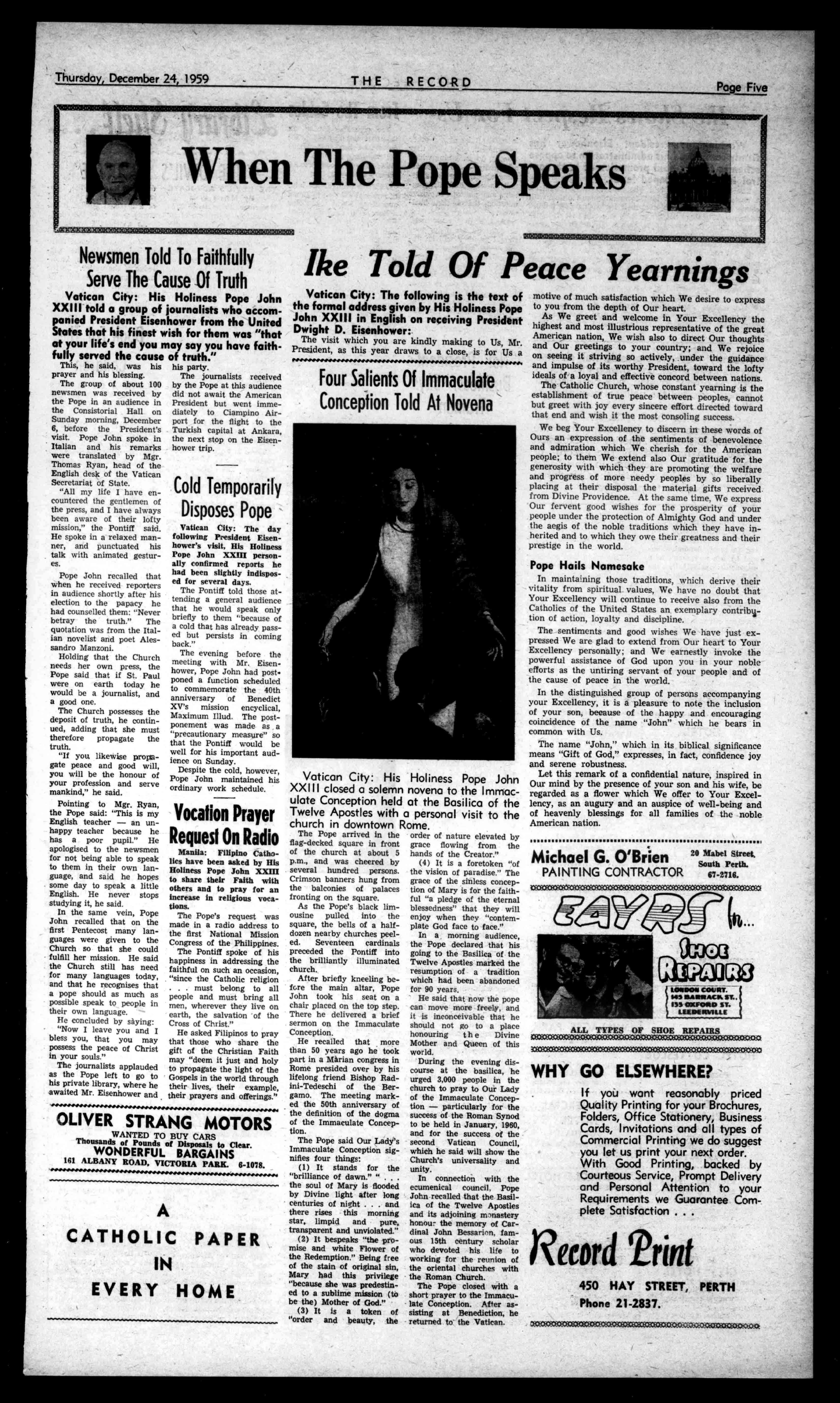
VaticanCity:His XXIIIclosedasolemn ulateConceptionheld TwelveApostleswitha churchindowntownRo
ThePopearrivedinthe flag-deckedsquareinfront ofthechurchatabout5 p.m.,andwascheeredby severalhundredpersons. Crimsonbannershungfrom thebalconiesofpalaces frontingonthesquare.
AsthePope'sblacklimousinepulledintothe square,thebellsofahalfdozennearbychurchespeeled.Seventeencardinals precededthePontiffinto thebrilliantlyilluminated church.
Afterbrieflykneelingbeforethemainaltar,Pope Johntookhisseatona chairplacedonthetopstep. Therehedeliveredabrief sermonontheImmaculate Conception.
Herecalledthatmore than50yearsagohetook partinaMariancongressin Romepresidedoverbyhis lifelongfriendBishopRadini-TedeschioftheBergamo.Themeetingmarkedthe50thanniversaryof thedefinitionofthedogma oftheImmaculateConception.
ThePopesaidOurLady's ImmaculateConceptionsignifiesfourthings:
(1)Itstandsforthe "brillianceofdawn."" thesoulofMaryisflooded byDivinelightafterlong centuriesofnight and thererisesthismorning star,limpidandpure, transparentandunviolated."
(2)Itbespeaks"thepromiseandwhiteFlowerof theRedemption."Beingfree ofthestainoforiginalsin, Maryhadthisprivilege "becauseshewaspredestinedtoasublimemission(to bethe)MotherofGod."
(3)Itisatokenof "orderandbeauty,the
HolinessPopeJohn novenatothemmacattheBasilicaofthe personalvisittothe me, orderofnatureelevatedby graceflowingfromthe handsoftheCreator."
(4)Itisaforetoken"of thevisionofparadise."The graceofthesinlessconceptionofMaryisforthefaithful"apledgeoftheeternal blessedness"thattheywill enjoywhenthey"contemplateGodfacetoface."
Inamorningaudience, thePopedeclaredthathis goingtotheBasilicaofthe TwelveApostlesmarkedthe resumptionofatradition whichhadbeenabandoned for90years. Hesaidthatnowthepope canmovemorefreely,and itisinconceivablethathe shouldnotgotoaplace honouringtheDivine MotherandQueenofthis world.
Duringtheeveningdiscourseatthebasilica,he urged3,000peopleinthe churchtopraytoOurLady oftheImmaculateConception-particularlyforthe successoftheRomanSynod tobeheldinJanuary,1960, andforthesuccessofthe secondVaticanCouncil, whichhesaidwillshowthe Church'suniversalityand unity.
Inconnectionwiththe ecumenicalcouncil,Pope JohnrecalledthattheBasilicaoftheTwelveApostles anditsadjoiningm-mastery honou-thememoryofCardinalJohnBessari'n.famous15thcenturyscholar whodevotedhislifeto workingforthereunionof theorientalchurcheswith theRomanChurch.
ThePopeclosedwitha shortprayertotheImmaculateConception.AfterassistingatBenediction,he returnedtotheVatican.
motiveofmuchsatisfactionwhichWedesiretoexpress toyoufromthedepthofOurheart.
AsWegreetandwelcomeinYourExcellencythe highestandmostillustriousrepresentativeofthegreat Americannation,WewishalsotodirectOurthoughts andOurgreetingstoyourcountry;andWerejoice onseeingitstrivingsoactively,undertheguidance andimpulseofitsworthyPresident,towardthelofty idealsofaloyalandeffectiveconcordbetweennations.
TheCatholicChurch,whoseconstantyearningisthe establishmentoftruepeacebetweenpeoples,cannot butgreetwithjoyeverysincereeffortdirectedtoward thatendandwishitthemostconsolingsuccess.
WebegYourExcellencytodiscerninthesewordsof Oursanexpressionofthesentimentsofbenevolence andadmirationwhichWecherishfortheAmerican people;tothemWeextendalsoOurgratitudeforthe generositywithwhichtheyarepromotingthewelfare andprogressofmoreneedypeoplesbysoliberally placingattheirdisposalthematerialgiftsreceived fromDivineProvidence.Atthesametime.Weexpress Ourferventgoodwishesfortheprosperityofyour peopleundertheprotectionofAlmightyGodandunder theaegisofthenobletraditionswhichtheyhavein- heritedandtowhichtheyowetheirgreatnessandtheir prestigeintheworld.
PopeHailsNamesake
Inmaintainingthosetraditions,whichderivetheir vitalityfromspiritualvalues,Wehavenodoubtthat YourExcellencywillcontinuetoreceivealsofromthe CatholicsoftheUnitedStatesanexemplarycontribi lionofaction,loyaltyanddiscipline.
ThesentimentsandgoodwishesWehavejustexpressedWearegladtoextendfromOurhearttoYour Excellencypersonally;andWeearnestlyinvokethe powerfulassistanceofGoduponyouinyournoble effortsastheuntiringservantofyourpeopleandof thecauseofpeaceintheworld.
Inthedistinguishedgroupofpersonsaccompanying yourExcellency,itisapleasuretonotetheinclusion ofyourson,becauseofthehappyandencouraging coincidenceofthename"John"whichliebearsin commonwithUs.
Thename"John,"whichinitsbiblicalsignificance means"GiftofGod,"expresses,infact,confidencejoy andserenerobustness.
Letthisremarkofaconfidentialnature,inspiredin Ourmindbythepresenceofyoursonandhiswife,be regardedasaflowerwhichWeoffertoYourExcellency,asanauguryandanauspiceofwell-beingand ofheavenlyblessingsforallfamiliesofthenoble Americannation.
Thursday,December24,1959 THERECORD PageFive
A
.4.11
MichaelG.O'Brien 20MabelStreet, PAINTINGCONTRACTOR Sou6t7h-2776r.th. :,::''':::::::::::::. ALLTYPESOF iiille011COMM SAIMNACKST.. ISS=rompST. LEJESMEIWILLE SHOEREPAIRS:::;,.:;:..:e...::::,:::a... :::::::::::::::::''::;::::: WHYGOELSEWHERE? Ifyouwantreasonablypriced QualityPrintingforyourBrochures, Folders,OfficeStationery,Business Cards,Invitationsandalltypesof CommercialPrintingwedosuggest youletusprintyournextorder. WithGoodPrinting,backedby CourteousService,PromptDelivery andPersonalAttentiontoyour RequirementsweGuaranteeCompleteSatisfaction RecordPrint 450HAYSTREET,PERTH Phone21-2837. .,::. o .:
IkeShowsRespectForUs
Washington:PresidentEisenhowerhas firmlycommittedhisadministrationtooppose schemesfortax-paidpromotionofbirthcontrolinunderdevelopedlands.
TheChiefExecutivetold anewsconferencethathe cannotimagineasubject moreemphaticallynot a properpoliticalactivityor governmentalresponsibility thanbirthcontrol. Hemadetheseother points: Promotingbirthcontrol inothernationswouldbe interferenceininternalaffairs.
Ifcountrieswanttoget helptodealwithincreasing birthratestheycangetit
beusedtohelpcountries formulate,planstodealwith theirincreasingpopulations. HewastoldthatthissuggestionbytheDrapercommittee-so-calledbecause itschairmanisWilliamH. Draper,Jr.-waswidely interpretedasacallthat theU.S.governmentshould distributebirthcontrolinformationonrequest. Askedforhisreaction,the Presidentresponded: "Icannotimagineanythingmoreemphaticallya
Recentlyinthepre-presidentialelection foraysinAmerica,one,BishopPike,formerlyaCatholiclayman,nowanEpiscopal bishop,dropped'thepoliticalbombshellof thebirthcontrolissueatMr.J.Kennedy, acandidateforthePresidency.Thecontroversyarosefromthestatementofthe CatholicBishopsofAmericaonExplosion Populationreprintedin"TheRecord"of December10.Elsewhereinthisissue Page9)isasolutionwhichtheChurchhas beenfosteringforyears.
fromprofessionalagencies.
Thebirthcontrolsubjecthasareligiousmeaningtogreatdenominations andhehasnoquarrelwith opponents,principallythe CatholicChurchwhichhe admiresandrespects.
ThePresidentwasasked aboutthereportofoneof hisadvisorycommitteeson overseasaidwhichlastJuly suggestedforeignaidfunds
FORREALGOODMEAT See"PINKY"HAYES
OppositeWembleyHotel
Barbecuescateredfor Phone87-1001
subjectthatisnotaproper political,orgovernmental activityorfunctionorresponsibility.
"Thisthinghas,forverygreatdenominations,areligiousmeaning,adefinite religioustenetintheirown doctrine.
"Ihavenoquarrelwith them,asamatteroffact thisbeinglargelytheCatholicChurch,theyareoneof thegroupsthatIadmire andrespect,butthishas nothingtodowahgovernmentalcontactwithother governments. "Wedonotintendtointerferewithanyother,the
internalaffairsofanyother government,andifthey wanttodosomethingwhich admittedly-todosomethingaboutwhatisadmittedlyaverydifficultquestion,analmostexplosive question,thatistheirbusiness.
"And,iftheywanttogo tosomeoneforhelp,they shouldgo,theywillgounquestionablytoprofessionalgroups,nottogovernments.
"Thisgovernmenthasno, andwillnotmake,asfaras I,aslongasIamhere,have apositivepoliticaldoctrine initsprogrammethathas todowiththisprplalemof birthcontrol.That'snotour business."
"NotPresident's Business,"Says Truman
NewYork:FormerPresidentHarryS.Trumanhas describedbirthcontrolas "afalseissue sofaras thepresidencyisconcerned."
Hemadetheremarkto newsmenwhilecommenting onthecontroversywhich hasarisenasaresultofattacksmadeonarecent statementonbirthcontrol issuedbytheU.S.Bishops.
TheBishopssaidintheir statementthatCatholics wouldnotsupporttheuseof publicfundstofosterbirth controlprogrammesinthis countryorabroad.
FreibergPaxChristi,an internationalCatholicpeace movementhassent41,500 dollarsnorthofrelieffoodstuffstotyphoon-stricken NagoyainJapan. Thishasbroughtthetotal ofmaterialaidsenttoJapan andHongKongto225,000 dollars.Throughoutthelast twoyearstheorganisation hasspentmorethantwo milliondollarsinreliefto starvingpeopleofthe world.
NewYork:HisEminence FrancisCardinalSpellman willspendhisninthsuccessiveChristmaswithU.S. militarypersonnelserving inforeignlands.
AfterattendingtheConsistoryforthecreationof eightnewcardinalsin Rome,hewillvisitservicemeninGermany,Spain, Morocco,NorthAfricaand Turkey.
CardinalSpellmanisMilitaryVicarofCatholicsinall U.S.armedforces.
Rome:PresidentEisenhowerpaidavisittothe NorthAmericanCollege hereimmediatelyafterhis audiencewithPopeJohn XXIII.
Thecollegeeducatesstudentsofthevariousdioceses oftheUnitedStates,andits RectorisArchbishopMartin J.O'Connor.Thereare280 studentsandabout75 priestgraduatesatthecollege.
PsychologicalApproachToCrime
HasFailedStare'sCardinal
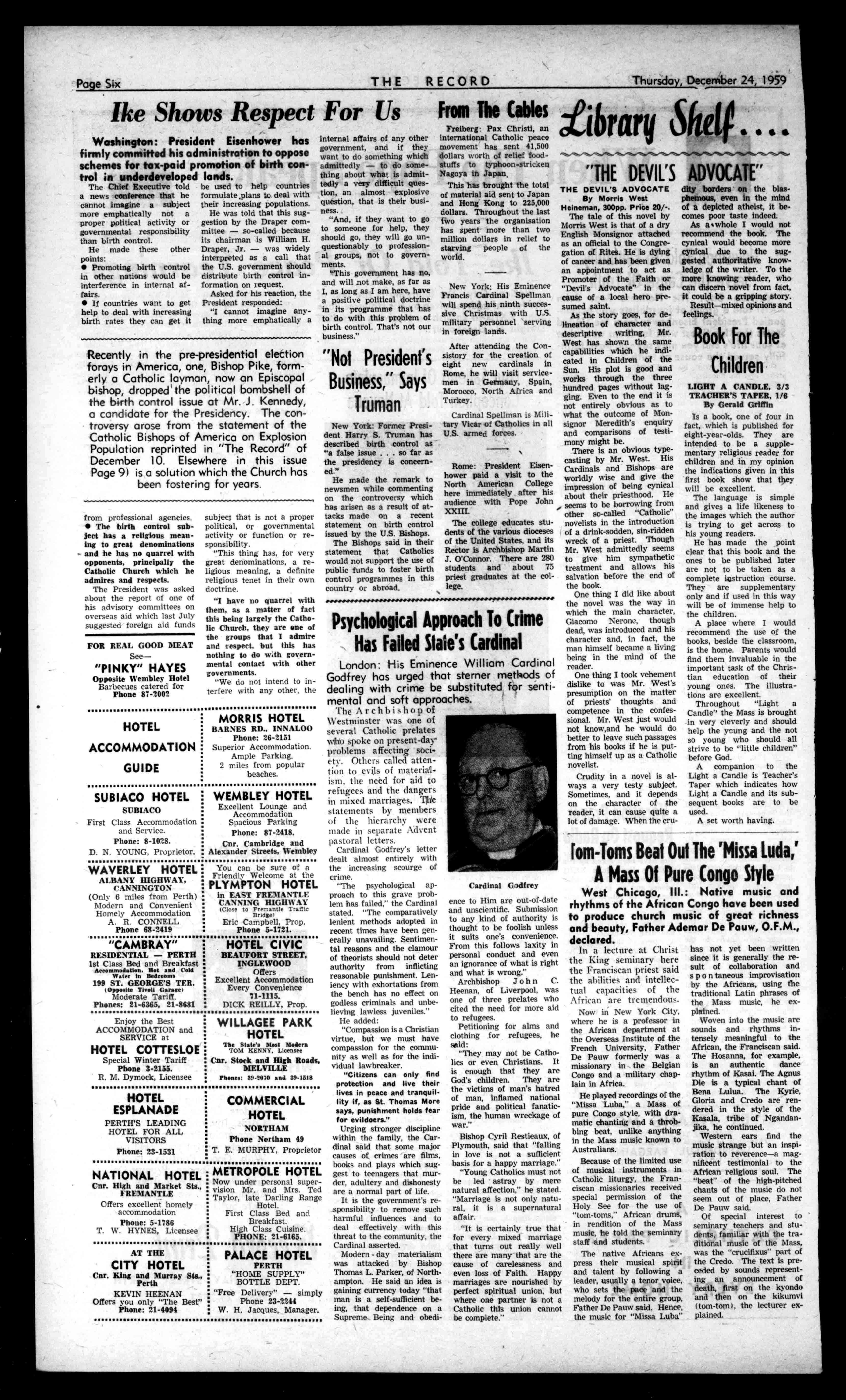
London:HisEminenceWilliamCardinal Godfreyhasurgedthatsternermethodsof dealingwithcrimebesubstitutedforsentimentalandsoftapproaches.
TheArchbishopof NVestminsterwasoneof severalCatholicprelates Whospokeonpresent-day' problemsaffectingsociety.Otherscalledattentiontoevilsofmaterialism,theneedforaidto refugee,andthedangers inmixedmarriages.'at statementsliymembers ofthehierarchywere madeinseparateAdvent pastoralletters.
CardinalGodfrey'sletter dealtalmostentirelywith theincreasingscourgeof crime.
"Thepsychologicalapproachtothisgraveproblemhasfailed,"theCardinal stated."Thecomparatively lenientmethodsadoptedin recenttimeshavebeengenerallyunavailing.Sentimentalreasonsandtheclamour oftheoristsshouldnotdeter authorityfrominflicting reasonablepunishment.Leniencywithexhortationsfrom thebenchhasnoeffecton godlesscriminalsandunbelievinglawlessjuveniles."
Headded:
"CompassionisaChristian virtue,butwemusthave compassionforthecommunityaswellasfortheindividuallawbreaker.
"Citizenscanonlyfind protectionandlivetheir livesinpeaceandtranquillityif,asSt.ThomasMore says,punishmentholdsfear forevildoers."
Urgingstrongerdiscipline withinthefamily,theCardinalsaidthatsomemajor causesofcrimesarefilms, booksandplayswhichsuggesttoteenagersthatmurder,adulteryanddishonesty areanormalpartoflife.
Itisthegovernment'sresponsibilitytoremovesuch harmfulinfluencesandto dealeffectivelywiththis threattothecommunity,the Cardinalasserted.
Modern-daymaterialism wasattackedbyBishop ThomasL.Parker,ofNorthampton.Hesaidanideais gainingcurrencytoday"that manisaself-sufficientbeing,thatdependenceona SupremeBeingandobedi-
"THEDEVIL'S THEDEVIL'SADVOCATE
ByMorrisWest
Heineman,300pp.Price20/,
Thetaleofthisnovelby MorrisWestisthatofadry EnglishMonsignorattached asanofficialtotheCongregationofRites.Heisdying ofcancerandhasbeengiven anappointmenttoactas PromoteroftheFaithor "Devil'sAdvocate"inthe causeofalocalheropresumedsaint.
Asthestorygoes,fordelineationofcharacterand descriptivewriting,Mr. Westhasshownthesame capabilitieswhichheindicatedinChildrenofthe Sun.Hisplotisgoodand worksthroughthethree hundredpageswithoutlagging.Eventotheenditis notentirelyobviousasto whattheoutcomeofMonsignorMeredith'senquiry andcomparisonsoftestimonymightbe. ThereisanobvioustypecastingbyMr.West.His CardinalsandBishopsare worldlywiseandgivethe impressionofbeingcynical abouttheirpriesthood.He seemstobeborrowingfrom otherso-called"Catholic" novelistsintheintroduction ofadrink-sodden,sin-ridden wreckofapriest.Though Mr.Westadmittedlyseems togivehimsympathetic treatmentandallowshis salvationbeforetheendof thebook.
OnethingIdidlikeabout thenovelwasthewayin whichthemaincharacter, GiacomoNerone,though dead,wasintroducedandhis characterand,infact,the manhimselfbecamealiving beinginthemindofthe reader.
OnethingItookvehement disliketowasMr.West's presumptiononthematter ofpriests'thoughtsand competenceintheconfessional.Mr.Westjustwould notknow,andhewoulddo bettertoleavesuchpassages fromhisbooksifheisputtinghimselfupasaCatholic novelist.
Crudityinanovelisalwaysaverytestysubject. Sometimes,anditdepends onthecharacterofthe reader,itcancausequitea lotofdamage.Whenthecru-
CardinalGodfrey encetoHimareout-of-date andunscientific.Submission toanykindofauthorityis thoughttobefoolishunless itsuitsone'sconvenience, Fromthisfollowslaxityin personalconductandeven anignoranceofwhatisright andwhatiswrong."
ArchbishopJohn C. Heenan,ofLiverpool,was oneofthreeprelateswho citedtheneedformoreaid torefugees.
Petitioningforalmsand clothingforrefugees,he
"TheymaynotbeCatholicsorevenChristians.It isenoughthattheyare God'schildren.Theyare thevictimsofman'shatred ofman,inflamednational prideandpoliticalfanaticism,thehumanwreckageof war."
BishopCyrilRestieaux,of Plymouth,saidthat"falling inloveisnotasufficient basisforahappymarriage."
"YoungCatholicsmustnot be ledastraybymere naturalaffection,"hestated. "Marriageisnotonlynatural,itisasupernatural affair.
"Itiscertainlytruethat foreverymixedmarriage thatturnsoutreallywell therearemanythatarethe causeofcarelessnessand evenlossofFaith.Happy marriagesarenourishedby perfectspiritualunion,but whereonepartnerisnota Catholicthisunioncannot becomplete."
ADVOCATE"
ditybordersontheblasphemous,eveninthemind ofadepictedatheist,itbecomespoortasteindeed.
AsawholeIwouldnot recommendthebook.The cynicalwouldbecomemore cynicalduetothesuggestedauthoritativeknowledgeofthewriter.Tothe moreknowingreader,who candiscernnovelfromfact, itcouldbeagrippingstory. Result-mixedopinionsand feelings.
BookForThe Children
LIGHTACANDLE,7/7
TEACHER'STAPER.1/6
ByGeraldGriffin
Isabook,oneoffourin fact,whichispublishedfor eight-year-olds.Theyare intendedtobeasupplementaryreligiousreaderfor childrenandinmyopinion theindicationsgiveninthis firstbookshowthatthey willbeexcellent.
Thelanguageissimple andgivesalifelikenessto theimageswhichtheauthor istryingtogetacrossto hisyoungreaders.
Hehasmadethepoint clearthatthisbookandthe onestobepublishedlater arenottobetakenasa completeinstructioncourse. Theyaresupplementary onlyandifusedinthisway willbeofimmensehelpto thechildren.
AplacewhereIwould recommendtheuseofthe books,besidetheclassroom, isthehome.Parentswould findtheminvaluableinthe importanttaskoftheChristianeducationoftheir youngones.Theillustrationsareexcellent.
Throughout "Light a Candle"theMassisbrought inverycleverlyandshould helptheyoungandthenot soyoungwhoshouldall strivetobe"littlechildren" beforeGod.
Acompaniontothe LightaCandleisTeacher's Taperwhichindicateshow LightaCandleanditssubsequentbooksaretobe used. Asetworthhaving,
fom-TomsBeatOutThe'MissaLuda,' AMassOfPureCongoStyle
WestChicago,III.:Nativemusicand rhythmsoftheAfricanCongohavebeenused toproducechurchmusicofgreatrichness andbeauty,FatherAdemarDePauw,O.F.M., declared.
InalectureatChrist theKingseminaryhere theFranciscanpriestsaid theabilitiesandintellectualcapacitiesofthe Africanaretremendous.
NowinNewYorkCity, whereheisaprofessorin theAfricandepartmentat theOverseasInstituteofthe FrenchUniversity,Father DePauwformerlywasa missionaryintheBelgian CongoandamilitarychaplaininAfrica.
Heplayedrecordingsofthe "MissaLuba,"aMassof pureCongostyle,withdramaticchantingandathrobbingbeat,unlikeanything intheMassmusicknownto Australians.
Becauseofthelimiteduse ofmusicalinstrumentsin Catholicliturgy,theFranciscanmissionariesreceived specialpermissionofthe HolySeefortheuseof "tom-toms,"Africandrums, inrenditionoftheMass music,hetoldtheseminary staffandstudents.
ThenativeAfricansexpresstheirmusicalspirit andtalentbyfollowinga leader,usuallyatenorvoice, whosetsthepaceandthe melodyfortheentiregroup, FatherDePauwsaid.Hence, themusicfor"MissaLuba"
hasnotyetbeenwritten sinceitisgenerallytheresultofcollaborationand spontaneousimprovisation bytheAfricans,usingthe traditionalLatinphrasesof theMassmusic,heexplained. Wovenintothemusicare soundsandrhythmsintenselymeaningfultothe African,theFranciscansaid. TheHosanna,forexample. isanauthentic dance rhythmofKasai.TheAgnus Dieisatypicalchantof BenaLulua.TheKyrie, GloriaandCredoarerenderedinthestyleofthe Kasala,tribeofNgandaniika,hecontinued. Westernearsfindthe musicstrangebutaninspirationtoreverence-amagnificenttestimonialtothe Africanreligioussoul.The "beat"ofthehigh-pitched chantsofthemusicdonot seemoutofplace,Father DePauwsaid. Ofspecialinterestto seminaryteachersandstudents,familiarwiththetraditionalmusicoftheMass, wasthe"crucifixus"partof theCredo.Thetextisprecededbysoundsrepresentinganannouncementof death,firstonthekyondo andthenonthekikumvi (tom-tom1,thelecturerexplained.
PageSix THERECORD Thursday,December24,1959
FromTheCables rare .e D Shlf
GUIDE MORRISHOTEL BARNESRD.,INNALOO Phone:26-2131 SuperiorAccommodation. AmpleParking. 2milesfrompopular beaches. SUBIACOHOTEL SUBIACO FirstClassAccommodation andService. Phone:8-1028. D.N.YOUNG,Proprietor. WEMBLEYHOTEL ExcellentLoungeand Accommodation SpaciousParking Phone:87-2418. Cnr.Cambridgeand AlexanderStreets,Wembley WAVERLEYHOTEL ALBANYHIGHWAY, cANNINGTON (Only6milesfromPerth) ModernandConvenient HomelyAccommodation A.R.CONNELL Phone68-2419 Youcanbesureofa FriendlyWelcomeatthe PLYMPTONHOTEL inEASTFREMANTLE CANNINGHIGHWAY (ClosetoFremantleTraffic Bridge, EricCampbell.Prop. Phone5-1721. "CAMBRAY" RESIDENTIAL-PERTH 1stClassBedandBreakfast Accommodation.HotandCold WaterInBedrooms 199ST.GEORGE'STER. OppositeTivoliG ModerateTariff. Phones:21-6365,21-8681 HOTELCIVIC BEAUFORTSTREET, INGLEWOOD Offers ExcellentAccommodation EveryConvenience 71-1115. DICKREILLY,Prop. EnjoytheBest ACCOMMODATIONand SERVICEat HOTELCOTTESLOE SpecialWinterTariff Phone3-2135. R.M.Dymock,Licensee WILLAGEEPARK HOTEL TheState'sMostModern TOMKENNY,Licensee C'nr.StockandHighRoads, MELVILLE Phones:39-,:onoand39-15Ift HOTEL ESPLANADE PERTH'SLEADING HOTELFORALL VISITORS Phone:23-1531 COMMERCIAL HOTEL NORTHAM PhoneNortham49 T.E.MURPHY,Proprietor NATIONALHOTEL Cnr.HighandMarketSts., FREMANTLE Offersexcellenthomely accommodation Phone:5-1786 T.W.HYNES,Licensee METROPOLEHOTEL NowunderpersonalsupervisionMr.andMrs.Ted Taylor,lateDarlingRange Hotel. FirstClassBedand Breakfast. HighClassCuisine. PHONE:21-6165. ATTHE CITYHOTEL Cnr.KingandMurraySts., Perth KEVINHEENAN Offersyouonly"TheBest" Phone:21-4094 PALACEHOTEL PERTH "HOMESUPPLY" BOTTLEDEPT. "FreeDelivery"-simply Phone23-2244 W.H.Jacques,Manager.
HOTEL ACCOMMODATION
WhereCharityRekindlesHope
WhatSisterVeronicaisdoingwithhersoupkitchen atWestPerthillustratesveryvividlythedifference betweenChristiancharityandmerephilanthropy.
Itisimportanttokeepinmindpreciselywhatwe meanbycharity.Thatqueenofthevirtuesistheone bywhichweloveGodaboveallforHisownsakeand ourfellowmenfortheloveofGod.
ItistheMOTIVEthatmatters.Twopeoplemay standsidebysideinagroupkitchenhandingout identicalbowlsofidenticalsouptothedestitute.
Oneishandingoverthesoupbecausesheisgenuinely sorryforthepoormanwhomsherecognisesasa fellowhuman;shemaybedoingitforthesakeof recognitionbytheStateorherfellowmen;shemaybe doingitbecauseshefeelsthepoorwillbegrateful,or becausetheyare"deserving";shemaybedoingitbecauseitmakesher"feelgood."
Theotherwomaninhandingoverthesoupmayfeel actualrepugnancetowardsthepoorbecausetheyare dirtyorungraciousorungrateful.Hersolemotivein doingwhatshedoesisfortheloveofGod;because ChristactedinthiswayandtoldHisfollowerstodo likewise.
Thefirstwomanisexercisingphilanthropy-the loveofmanforhumanreasons.Thesecondwomanis practisingChristiancharityoutofsupernatural motives.
Forthosewhodon'tknowanybetterphilanthropy isagoodthingifitcanriditselfoftheairofpatronage andisnotdoneasakindofreparationforsinsofinjustice.
Whenitisdonefromhighnaturalmotivesitisa naturalvirtueandwillreceiveitsrewardfromGod. ButcharityisadivinethingtowhichChristhas attachedthemostwonderfulpromises.
SoitisthattheloverofChristdoesnotwastetime inferrettingoutwhetherthepoorare"deserving."She doesnotenquireabouttheirbankbalance,theircolour, theirpolitics,oreventheirreligion.Sheseeksonefact only-aretheypoor?
Itmaywellbethatadestitutemanisinasorry conditionthroughhisownmule
Hemayhavebeencarelessintimesofprosperity; improvident,evenvicious.Thatdoesnotdetractfrom hispresentneedofhelpnorfromthegloryoftheact ofcharity.
Indeed,itaddstothemeritoftheactbecausethe motiveispurerforbeingstrippedofhumanconsiderations.
PrincesTreadingTheMud
Ofcourse,thereisalwaystheimposterandwithhim prudencetemperscharity.Becausehisdepredations uponthecoffersofcharitywillultimatelycausethe genuinepoortosuffer.Butevenwhentheimposter isunknowinglyaided,charityremainsundimmedbe, causeallisdoneoutofloveofChrist.
SoitisthatSisterVeronica'sministrationscentre mainlyaboutthe"deadbeat"-themenandwomen whoarenotonlydestitutebuthaveceasedtocare abouttheirdestitution.
Theyhavelostself-respect,aproperprideinthemselvesassonsofGodredeemedatagreatcost.Theirs isafalsehumilityfortheyhaveceasedtovaluethemselvesasGoddoes.Theyareinperilofthesinof despair,theyfeelcutofffromGodandmanalike.
Itisverydifficulttokindlethesparkofhopewhich isnearlyquenched.Nothingshortoftruecharity (whichislove)canattemptit.
Thephilanthropistcanonlymakethemfeeltheyare wantedbymen;andthedestitutemayverywellfeel thattheloveofmenishardlyworthhaving.
Butcharitycanstartlethedestitutewiththetidings thattheyarelovedbyGodandbymenwhoare alreadysharinginthatdivinelife.Christcomestothe poorthroughChristophers(themenandwomenwho carryChristintheirheartsandtheirdailyliving).
Justasthereisnoimpertinenceintruecharity,so 11,4`44,
I By F,4111.11Cabert
thereisnopatronage.Onedoesnotbendtothepoor. CharityseesthepersonofChristintheleastofHis brethren.Despitedirtandwhiskersandwornshoes hereisonemadebyGodinHisownimage;lovedby HimeventothedeathontheCross;apersonofeternal worthwithadestinybeyondthestars.Theincongruity ofsuchaprincetreadingthemudiswhathurtsthe heartofcharity.
WithFreedomOfReligion,Speech
WritingontheBeazleycaseonDecember3Isaid thatthewholebusinesswaspretextual,thattheinner natureoftheplaintsbeforetheStateA.L.P.-executive werenotstated.Noweventhoughtherearenoprizes forprophecy,Mr.F.E.Chamberlainhaspaidmethe complimentofpredictionsfulfilledtotheletter.Isaid thattwoelementslaybehindtheLeftWing McCarthyistwitch-hunt-(1)Theywereobjectingto Mr.Beazley'sassociationwiththeMoralRearmament movement;(2)thecomplaintoverhiscriticismofMY. J.B.Priestleywasanattempttomuzzlecriticismof Communism.
SofaiasthePresscontroversyisconcerned,Mr. Beazleyhashadbyfarthebestendofthestick.He hasshownbeyondfurtherargumentthatthecharges onwhichhewasarraignedhavenosubstanceatall. UntiltheEvatttake-over(andevenafterit)Labour washighlysuspiciousofPeaceCongresses,goingsofar astodescribethemas"instrumentsofSovietimperial- ism"andsubsidiariesoftheCommunistParty.But, ofcourse,asintheunityticketissue,Dr.Evattand Mr.ChamberlainhavebeenwhittlingawayLabour's resistancetoCommunismuntil"democraticsocialism" hasbeensubstitutedfor"co-existence."Mr.Chamberlainnolongerbotherseventoconcealhisterminology. HisdescriptionoftheCommonwealthSecurityService isderiveddirectlyfromthe"Tribune."
TherecommendationsoftheA.L.P.Stateexecutive includedthefollowing:"Asamemberofthe-A.L.P. his(Mr.Beazley's)firstloyaltiesaretohispartyand absolutehonestyrequiredarecognitionofthisprinciple."ToaChristian,ofcourse,andeventoagood pagan,thereareadozenorsoloyaltieswhichprecede devotiontotheA.L.P.oranyotherpoliticalparty.A man'sloyaltytohiscountry,hiswife,hisfamilynottomentionGodandhisconscience-wouldhave aclearprecedenceoverhisloyalty,totheEvatt-ChamberlaindespotismwhichcallsitselftheLabourParty.
WhatbrandsthewholebaseprocedureasaMoscow trialisthatMr.Beazleyisbeingwarnedandbounced andmuzzledonissueswhichwerenevermentioned whenhefacedhisaccusers.Mr.Chamberlain,who recentlydefiedarulingoftheA.C.T.U.,hashadthe temerityto"explain"thefindingsoftheStateA.L.P. executiveinafashionwhichMr.Beazleyhasdescribed as"atechniquebeneathcontempt."Thisisto"charge youwithonethingandthentoreturnfindingson whollyextraneousmatterswithwhichyouhavenever beenconfronted,andgrosslyuntruthfulfindingsat that."
Perth:
CanterburyCourtBallroom
ToPerth's
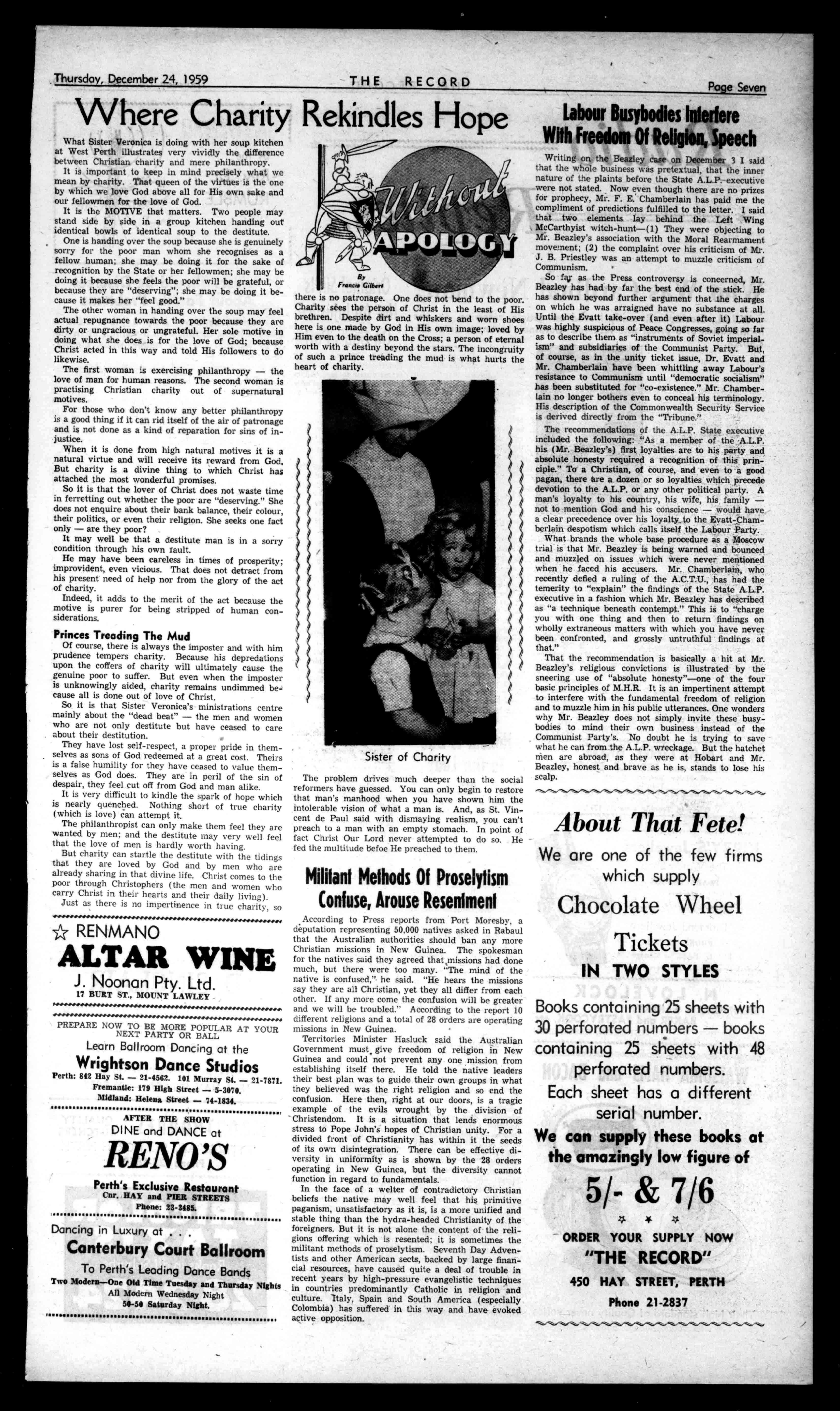
SisterofCharity
Theproblemdrivesmuchdeeperthanthesocial reformershaveguessed.Youcanonlybegintorestore thatman'smanhoodwhenyouhaveshownhimthe intolerablevisionofwhatamanis.And,asSt.VincentdePaulsaidwithdismayingrealism,youcan't preachtoamanwithanemptystomach.Inpointof factChristOurLordneverattemptedtodoso.He fedthemultitudebefoeHepreachedtothem.
MilitantMethodsOfProselytism
Confuse,ArouseResentment
AccordingtoPressreportsfromPortMoresby,a deputationrepresenting50,000nativesaskedinRabaul thattheAustralianauthoritiesshouldbananymore ChristianmissionsinNewGuinea.Thespokesman forthenativessaidtheyagreedthatmissionshaddone much,butthereweretoomany."Themindofthe nativeisconfused,"hesaid."Hehearsthemissions saytheyareallChristian,yettheyalldifferfromeach other.Ifanymorecometheconfusionwillbegreater andwewillbetroubled."Accordingtothereport10 differentreligionsandatotalof28ordersareoperating missionsinNewGuinea.
TerritoriesMinisterHaslucksaidtheAustralian Governmentmust,givefreedomofreligioninNew Guineaandcouldnotpreventanyonemissionfrom establishingitselfthere.Hetoldthenativeleaders theirbestplanwastoguidetheirowngroupsinwhat theybelievedwastherightreligionandsoendthe confusion.Herethen,rightatourdoors,isatragic exampleoftheevilswroughtbythedivisionof Christendom.Itisasituationthatlendsenormous stresstoPopeJohn'shopesofChristianunity.Fora dividedfrontofChristianityhaswithinittheseeds ofitsowndisintegration.Therecanbeeffectivediversityinuniformityasisshownbythe28orders operatinginNewGuinea,butthediversitycannot functioninregardtofundamentals.
InthefaceofawelterofcontradictoryChristian beliefsthenativemaywellfeelthathisprimitive paganism,unsatisfactoryasitis,isamoreunifiedand stablethingthanthehydra-headedChristianityofthe foreigners.Butitisnotalonethecontentofthereligionsofferingwhichisresented;itissometimesthe militantmethodsofproselytism.SeventhDayAdventistsandotherAmericansects,backedbylargefinancialresources,havecausedquiteadealoftroublein recentyearsbyhigh-pressureevangelistictechniques incountriespredominantlyCatholicinreligionand culture.Italy,SpainandSouthAmerica(especiallyColombia)hassufferedinthiswayandhaveevoked activeopposition.
ThattherecommendationisbasicallyahitatMr. Beazley'sreligiousconvictionsisillustratedbythe sneeringuseof"absolutehonesty"-oneofthefour basicprinciplesofM.H.R.Itisanimpertinentattempt tointerferewiththefundamentalfreedomofreligion andtomuzzlehiminhispublicutterances.Onewonders whyMr.Beazleydoesnotsimplyinvitethesebusybodiestomindtheirownbusinessinsteadofthe CommunistParty's.Nodoubtheistryingtosave whathecanfromtheA.L.P.wreckage.Butthehatchet menareabroad,astheywereatHobartandMr. Beazley,honestandbraveasheis,standstolosehis scalp.
Thursday,December24,1959 THERECORD PageSeven
LabourBusybodiesInterfere
*RENMANO ALTARWINE J.NoonanPty.Ltd. 17BURTST.,MOUNTLAWLEY PREPARENOWTOBEMOREPOPULARATYOUR NEXTPARTYORBALL LearnBallroomDancingatthe WrightsonDanceStudios
842HaySt.-21-4562.101MurraySt.-21-7871. Fremantle:179HighStreet-5-3070. Midland:HelenaStreet-74-1834. AFTERTHESHOW DINEandDANCEat RENO'S Perth'sExclusiveRestaurant Car,HAYandPIERSTREETS Phone:23-3485.
inLuxuryat
Dancing
AllModernWednesday
SaturdayNight.
LeadingDanceBands TwoModern-OneOldTimeTuesdayandThursdayNights
Night 50-50
AboutThatFete! Weareoneofthefewfirms whichsupply ChocolateWheel Tickets INTWOSTYLES Bookscontaining25sheetswith 30perforatednumbers-books containing25sheetswith48 perforatednumbers. Eachsheethasadifferent serialnumber. Wecansupplythesebooksat theamazinglylowfigureof 5/-&7/6 ORDERYOURSUPPLYNOW "THERECORD" 450HAYSTREET,PERTH Phone21-2837
WhoWasCardinalNewman?
W.J.M.,Stockton:RecentlyIread beatificationofapriestwhoreceived Church.
R.:Thepriestwasa FatherDominicBarbari, C.P.,anItalianmemberof thePassionistOrder,avery holyandzealousman,who feltinspiredbyGodtogo toEnglandandlabourfor theconversionofthatcountrytothet-atholicFaith. Hewasfirmlyconvinced thathehadaveryspecial worktodothere,littlerealisingashesetoutonhis missionthathewouldbe theonetowhomJohn HenryNewmanwouldcome, askingtobereceivedinto theCatholicChurch.
Q.:IhavebeenaCatholic foronlyaboutayear, havingbeenaPresbyterian,andIwishyouwould tellmewhoCardinal Newmanwasandwhathe wasnotedfor.
R.:JohnHenryNewman wasborninEnglandin 1801,anddiedin1890.
Hewasbroughtupwith averyProtestantoutlook asamemberoftheChurch ofEngland. HestudiedatOxford University,wasordainedas anAnglicanclergymanin 1824,andbecameAnglican VicarofSt.Mary's,Oxford, in1828.
Hewasaprofound scholaraswellasbeinga literarygenius;andin keepingwithhisvocation wasalsoadeeplyreligious
onarticlereferringtothe CardinalNewmanintothe tryingtodotheimpossible andthatonecouldnot reallybeaCatholicwithin theChurchofEngland.So, in1845,heleftthatChurch andwasreceivedintothe CatholicChurchbyFather DominicBarbari,C.P. OrdainedasaCatholic priesthelaboured,chiefly byhiswritings,todefend andpromotethecauseof theCatholicChurchinEngland,andhundredsofconvertsowedtheirconversion, directlyorindirectlyto him.
CardinalNewman andholyman. Convincedbyhisstudies oftheearlyChristianFathersthattheProtestantreformationwasamistake, hetriedtomaintainthatthe Anglican"Thirty-NineArticlesofReligion"couldand oughttobeinterpretedin aCatholicsense, Heandhisfollowersthus startedwhatisknownas the"OxfordMovement,"an efforttointroduceCatholic ideasintotheChurchof England.Thiscausedviolentcontroversies,andDr. Bagot,theAnglicanBishop ofOxford,condemnedNewman'steachings. Newmansawthathewas
MARTINOBROS.
GARAGEandSERVICESTATION AllClassesMotorRepairs,PanelBeatingand Painting. Cnr.JAMESandFITZGERALDSTREETS GIVESPROMPT.EFFICIENTSERVICEALWAYS WheninTroubleRing28-1373. 041,
KIRBY'SJewellers
TheWatchShop PLAZAARCADE P041141.0.44
PrecisionWatches DiamondJewellery PHONE:21-7388.
Mr.L.HARTY,Manager.
N.LOVELOCK
BASSENDEANBAKERY, BAKERandPASTRYCOOK,etc. TEL.79-1128. WESTROAD,BASSENDEAN. ::a:j
WATSONIAHAMSandBACON
Hismostfamousworkis his"ApologiaProVita Sua,"anaccountofhisown conversionwrittenin1864 asananswertoanattack uponhimbyCharles Kingsley,anAnglican clergyman. In1879,PopeLeoXIII madehimaCardinal.He diedin1890.
TheOxford"Dictionary oftheChristianChurch" says:"Hisgeniushascome tobemoreandmorerecognisedsincehisdeath,and hisinfluence canhardly beexaggerated." IntheCatholicChurch hispersonalholinessisbecomingmoreandmoreappreciated,andeffortsare beingmadetohavehim canonisedasaSaint,should thatbeGod'swill.
HonourIsDue ToOurLady
P.J.M.,Ashfield:Just whyistheCatholicChurch sosurethatChristmeant ustohonourHismotherin thespecialwaywedo? R.:TheCatholicChurch isquitesure,ofcourse,that Christwillseveryprophecy inspiredbytheHolySpirit tobefulfilled,including thatutteredbyMaryherself:"Henceforthallgenerationsshallcallme blessed."(Lk.1:48.)
AndtheCatholicChurch issurealso,thatsheherself isundertheguidanceand protectionoftheHolySpirit insafeguardingtheChristianreligioninprinciple andinpractice.
Inotherwords,sheis consciousofherowninfallibilityinmattersoffaith andmorals,invirtueof Christ'spromisethatthe gatesofhellwillneverprevailagainsther(Matt. 16:18)andthattheSpirit oftruthwilleverremain withher(Jn.14:16).St. Paul,therefore,describes heras"theChurchofthe LivingGod,thepillarand groundoftruth"(1Tim. 3:15).
Catholics, of course, whenevertheyrecitethe Apostles'Creed,includein theiractoffaitheveryone ofitspropositions;notonly "IbelieveinGodtheFather Almighty,"in"JesusChrist HisSon,bornoftheVirgin Mary,"andinthe"Holy Ghost,"butalso"Ibelieve intheHolyCatholic Church."
OriginalSinIs NotAnInjustice OnGod'sPart
"LeadKindlyLight," Newcastle:Originalsin seemsunfairtome.Adam andEvesinned,yetnotonly they,butalltheirdescendantsarepunished.
R.:Youcanbequitesure thatGodbeinginfinitely just,nodecreeofHiscan beaviolationofjustice.
You'llsay,that'sallvery well;butIdon'tseeit.It isnotreallynecessarythat youshould.Thedifficulty aboutdisagreeingwithGod isthatHeisnotanswerable toyou,whereyouareanswerabletoHim.TheimportantthingisforHimto seethatyouarejust.
ThatyoufindHisways mysteriousisnotofany greatconsequence,providedyoudon'tmakeyour lackofconscienceanexcuse forsettingyourselfupas thesupremejudge,putting GodHimselfinthedock, findingHimguiltyofinjustice,andsentencingHim todeathasfarasyouare concerned.
Q.:Youmaysaythatman lostnothingtowhichhe wasentitled,butonly extragiftstowhichhe wasnotentitled.
R.:Iwouldmentionthat consideration,althoughI wouldnotexpressitin quitethesameway;alsoI wouldsaymuchmorethan that.
Allyourthoughtsonthe subjectarebasedonthe ideaofjusticeasarelationshipbetweenhumancreatures,forgettingthatthe CreatorandHiscreatures arenotonthesamelevel.
Thesamecategories whichapplytorelationships betweencreaturesamong themselvesdonotapplyto thosebetweentheCreator andthethingsHehasmade.
Manreallyhasnorights againstGod.Manisnot evenentitledtoexistence. GrantedthatGodwilledto createman,Heowesitto Himselftoendowman's naturewithnaturalgifts requiredforthekindof beingHewantsmantobe.
Thefallofourfirstparentsdidnotdeprivemankindofthosenaturalgifts.
Goddid,gratuitously, elevatemanaboveamerely naturaldestinytoasupernaturaldestinyandbestow onhimthegiftofsanctifyinggracenecessaryforits attainment,theretentionof thisextraprivilegebothfor ourfirstparentsandtheir childrenbeingdependent upontheirobservanceof Hislaws.
Ihavementionedthree importantconsiderationsin thisexplanation,thetranscendentalcharacterand prerogativesofGod;the gratuitousnessoftheprivilegesforfeitedbyoriginal sin;andthesolidarityof thehumanraceconstituted asafamilyofwhichAdam wastheresponsiblehead.
Thesubjectisaprofound one,towhichbriefreplies inasessionlikethiscannothopetodofulljustice.
Bythe Rev.Dr. RUMBLE, M.S.C.
PriestsShouldBeDiscreet AboutFamilyProblems
Inquirer,Sydney:Mayapriestentera privatehometotalkwithawomanwhenshe isbyherself?Ifso,underwhatcircumstances?
R.:Oneofthedutiesofapriestistheregularvisitationofallconfidedtohiscarewithintheboundariesof hisparish.
Thatworkisneverfinished,sincehehastocompile accuratestatistics,andnewfamiliesareeverlikelyto moveintohisdistrict,whilstothersdepartfromit. Duringsuchofficialvisitation,itisthepriest'sduty towincarelessCatholicsbacktothepracticeoftheir religion.
Wheretherearechildren,toenquireintotheprovisionmadefortheirreligiousinstruction,alsotoencouragegoodcatholicsintheircontinuedfidelityand toadvisehispeopleonanyparishmattersorpersonal problemstheymaywishtoputonhim.
Ifhearrivesatahouseinwhichtheonlypersonat homeatthetimeisthewomanwhoopensthedoor,it isamatterforhisowndiscretionastowhetherhe enterstodiscussthingswithher,grantedaninvitation todoso.
Hecertainlywouldnotdosoifhesawthathewas notwelcometodoso,noriftherewereanyreasonsof proprietywhyheshouldnotdoso.
Butifanordinary,sensibleandwell-respected womansaid,"Father,you'retheveryoneIwantedto see.WouldyoustepinforamomentwhileIexplain thingstoyou?"therewouldbenothingagainsthis doingsoifheknewtherewasnottheslightestpossibilityofsuchavisitbeingmisunderstoodbyanybody.
Itwouldnotmatterinsuchacasewhetherthe womanwasaCatholicorthenon-Catholicwifeofa Catholichusband.
Inthesethingsthepriest,whoiseverconsciousof hisdutynottobringreligionintodiscreditevenapart fromtheneedofsafeguardinghisownpersonalreputation,canactprudentlyandalwayswithduereserve.
Q.:Mayapriestinterfereinfamilyaffairs?Ifso,in whatcircumstances?
Ft,:Nopriestmay"interfere"infamilyaffairs.Domesticaffairsareamatterforhusband,wifeandchildren themselves.
Apriest"intervenes"infamilyaffairs,iftheparties themselvesappealtohimforadviceandhelpinsolving domesticdifficulties.
Shouldapriest,inthecourseofparishvisitation, meetwithaCatholicwhohasmarriedoutsidethe Church,heisobligedtoascertainwhetherthatmarriagecanbeputrightreligiously,andwhetherthe Catholicpartyiswillingtohaveitrectified.
Thepriestknowsquitewellthattheonlyapproach thatwillbehelpfulinsuchamatterisoneofsympatheticunderstandingandcharity,andthatnothingis tobegainedbytryingtoforcetheissue.
Andherestrictshimselfsolelytothequestionof thespiritualwelfareof.theCatholicconcerned-and ofthechildren,ifany-withoutattemptingtointerfere withdomesticarrangementsorfamilyaffairsassuch.
Therunningofthehomeisamatterforthefamily itself,andthepriestisnotinterestedinthataspect, exceptinsofarashisadviceissoughtconcerningit.
TheirhighstandardofQualitynevervaries 410DV:itl:£4502004:020302C9:8:8:8:9103:8:00E03:COW:8:91^0110-00,03:9)3:1
ThatincludestheinfallibilityoftheChurch,by whichtheChurchisquite surethatChristmeantusto believeanddowhateverthe ChurchteachesandprescribesinHisname. Amongotherthings,that coversallthespecialways ofhonouringtheMotherof Christwhichhavebeen officiallysanctionedbythe Church.
PrintedandpublishedbyFrancis
Dillon."TheRecord"office.
450Hay-st..Perth.
rPageEight THERECORD Thursday,December24,1959 Radio
Joseph
F.R.BEECROFT BUTCHER 181RokebdyRoad,Sublaco OnlyPrimeFreshKilled MeatSold. Phone:8-1373.
.:::::.::::::000:: D.SINCLAIR Watch,ClockandJewellery Repairs GIFTSFORALLOCCASIONS PersonalAttentionGiven 877HAYSTREET-21-7627 WOODTHORPESBUTCH P1-ERS 365FITZGERALDST.,NORTHPERTH Phone28-1860 TRICOLOR TAXIS RanksinallSuburbs 282424
Cuba'sRevolutionistsUrgedTo AvoidViolence,StudyInitiative
Havana:TherectoroftheCatholicUniversityofVillanuevahasurgedCuba'srevolutionaryregimetoabstainfromviolence, fosterprivateinitiativeandprotectprivate property.
FatherEduardoBoza Masvidal,whoisalsopastor ofLaGaridadparishhere, spokeoutinhisparishbulletin.
Hiswordsechoedthe CatholicSocialCreedrecitedbythousandsofCatholicsatthefinalsessionof therecentNationalCatholic Convention.
Thecreedcondemned anythingthattendstodeny humanrights,includingthe rightsoffreeassociation andfreeexpression.
Itassertedbeliefinprivateownership,sayingthat whentheStatebecomesthe soleownerofthemeansof production,humanrights disappear.
Butitalsodeclaredthat privateownersmustfulfill theirsocialdutiesandrespecttherightsofothers,and saidthattheStatehasthe righttochannelprivateactivitiesonbehalfofthe commongood.Itstatedthat wealthshouldnotbeconcentratedinthehandsof thefewbutshouldbedistributedjustlyamongall classes.
Thecreedsaidthatparentshavetherighttosend theirchildrentoCatholic schoolsandthattheChurch hastherighttooperate schools.
Inhiswarningagainstthe useofviolence,FatherBoza remindedthegovernment headedbyPremierFidel Castrothatviolencealways reactsagainsttheperson whousesit.Hesaidthe regimeofFulgencioBatista,oustedatthebeginning oftheyearbyPremier Castro,fellbecauseof"the crimes,torturesandoutragesusedbyhimagainst therevolutionaries."
Theuniversityrectorsaid
thattherevolutionarygovernmenthas"manypoints toitscredit."
Theregime,hestated, "hasgivenarebirthtopatriotism."Ithasalsocreatedconcernfortheplightof thepoorandpromotedhonestyingovernment.
NotingthattheCastro regimeisnotcommunistic, hewarneditagainststirringupclassconflict.
"Therevolutionmustbe awareofthefact,"Father Bozasaid,"thatCubais madeupofallCubans,not onlythelowerclasses, whosestatuswemusttry toraise.Cubaalsoincludes thewealthyandthosewho produce.Thoughwemust cutdownabuses,wemust alsorespectlegitimateinterests.'Propertymustbe defendedwheneveritfulfillsitssocialfunction. Capitalmustreceiveguaranteessothatitmaycirculateandgiveworkand wealthtothecountry.Privateinitiativemustbefavouredinallitsaspects."
Thepriestalsocalledon thegovernmentnottouse thecommunistsystemof defamingorbringinginto publicdisreputeanyonewho criticisesit.Theregime,he said,mustnotreadintoall criticismsecretanddevious counter-revolutionaryintentions.
FatherBozasaidheregrettedthecurrent"purge fever"andsaidthatthose whohavecommittedno crimeshavetherightto jobseventhoughtheyservedthepreviousgovernment aspolicemenorsoldiers.He saidthattherearecasesof suchmenwho,alongwith theirwivesandchildren,are nowfacing"adeathpen-
Ultra-Modern,CircularFiji ChurchFeaturesEconomy
Mba,Fiji:Anewtypeoflow-costmissionchurch,the firstofitskindintheSouthPacific,hasbeenerected nearherebyFatherDermotHurley,S.S.C.
Thenewchurch,builtinsuresjust30feetby16.But theso-calledCtesiphonCtesiphonscanbebuiltto methodofconstruction,costanyspecification,fromthat aboutone-thirdthepriceofofatinycottagetothatof aconventionalchurchoftheanairporthangar.And samesize.ItisanalmostFatherHurleyispresently semi-circular corrugatedengagedinbuildingalargar concreteshell,oneandoneCtesiphonchurch,75feetby halfinchesthick.Itwas22,toaccommodatemore erectedunderFatherHur-than200Catholicsatamisley'ssupervisionbyafewsionstation. semi-skilledFijianbuilders Thistypeofbuildingreaidedbylocalvillagers. ceivesitsnamefromthe
FourStepsOnOvercrowding
ThefollowingarticlewaswrittenbyaSulpicianpriestwhohasbeenassistantdirector since1946oftheSocialActionDepartmentoftheNationalCatholicWelfareConference, Washington,D.C.Thearticleisasummaryoftheauthor'sdiscussionofpopulationprob- lemsinhisbook,"SocialPrinciplesandEconomicIdife."
ThisbookwaswidelyadoptedasatextbookinCatholiccollegesandseminarieslongbeforetheextensivepublicitynowbeinggiventheworld'spopulationchallengeandthisisone indicationthatCatholicshavenotbeenindifferenttotheproblem.
Catholicsdonotclaimtohaveanyeasysolutionfor thechallengeofworldpopulationgrowththatisnow beingsowidelydiscussed.
Butwedofeelthatsolutionsotherthancontraceptionhavenotbeenfullyexplored.Thisone-sidedapproachisoffensivetohundredsofmillionsthroughout theworldsinceitproposesamethodtheyfindmorally unacceptableasthemainsolutiontotheproblem.
Inadheringtoamorallybasedposition,inspiteof thepracticaldifficultiesthatmayberaised,Catholics ineffectproclaimthatsuchanapproachultimatelywill provetobethemostpractical.
Wecanseeaparallelinmedicalethics.Catholic objectionstotherapueticabortionforceddoctorsto seekothermethodstotreatproblems,withtheresult thattodaymanynon-Catholicdoctorssaythatabortion canbeavoidedbypropertreatment.
Accordingly,oneimportantstepCatholicscantake tohelpmeetthechallengeofunderdevelopedcountries andtheirincreasingpopulationistoredoubletheir effortstoremoveobstaclestomorallyacceptable methodsfordealingwiththissituation.
Inparicular,thismeansacontinuinginterestin bringingsurplusproductstoneedypeople.Catholics nowcarryonthelargesteffortofthiskindinthe worldthroughCatholicReliefServices-theNational CatholicWelfareConference.
Inaddition,othereffortsincludesupportfortechnicalassistanceprogrammesandeffortstosecureland reform.Theseandothermethodscanallhelpjn raisingtheeconomiclevelofpeasantsnowconfronted withthegrimthreatofundernourishmentoreven starvation.
Awidevarietyofeconomicproblemsconfrontthe worldtodayandtheexplosivepressureofpopulation uponresourcesisoneofthemostdifficult.
Suchaproblemexiststodaybecauseworld-wide healthmeasureshaveloweredthedeathratefarmore rapidlythaneconomicmeasureshaveincreasedthe productionoffoodandfibres.Theproblemasall mustnowknow,ismostacuteinAsia.
PracticalSolutions
Thechallengeofincreasingpopulationcanbemet byanyofacombinationoffourmeasures,thoughthe authorisquicktoexplainthatheisnotaspecialistin populationproblemsandhisrecommendationsarenot presentedasfinalanswers.
Thefourmeasuresare:(1)Bringingfoodandfibres topeoplefromsurpluseselsewhere;(2)movingpeople toidlelandareassotheycancultivatetheirownfood; (3)Increasingproductivityofthesepeopleintheir presenthomeareas;and(4)usingmorallyacceptable measurestoadjustthebirthratesothatpopulation growthwillremainwithlimitssetbyresources.
Asforshippingfoodandfibrestopeopleinneed, therearemanyproblemstosuchaprogrammeandwe mustrealisethatsuchcontributionsmaynotsolvethe long-rangechallenge.
Forexample,anationwouldhavetobewillingto giveitsproducts.Transportationandprocessingwould beaproblem.Sometimestoo,thesurplusmaterialis notacceptablebecauseoflocalcustom,forinstance, gettingAsianpeopletousewheatinsteadofrice.
SalaryIncreaseForRome'sClergy
TheexternalappearanceancientPersiantownwhere oftheCtesiphonchurchisitisfirstbelievedtohave ratherultra-modern,butin-beenusedsome5,000years sideitgivestheimpressionago,buttheconstruction ofthetraditionalRoman-hasbeenadaptedonlyin esquearch.Thecurveoftherecenttimesformodern structurewithisbuildingmaterialsbyMaj. srengtheningcorrugationsJ.H.deW.Waller,ofthe makesthebuildingdurableRoyalEngineers. againsttheusualSouthTheColumbanpriesthas Pacifichurricanes.ThealreadybuiltamodelCtesichurchiscomparativelyphoncottagefortheFiji cooleveninthetropicalGovernment.Fromhisex- Fijiclimate,andtheonlyperimentsthusfar,Father maintenancecostisanoc-Hurleyisconvincedthatthe easionalcoatoflimewashCtesiphonmaywellbethe whichhelpsreflectthesun'ssolutionofmanymissionaryvoteof23tofour. rays. headachesinproviding
Thechurch,builtatacostfunctionalandeconomical
Rome:A50percent governmentsubsidyfor salarieshasbeenappro
Thenewlawwillgointo effectassoonasitispublishedinthegovernment's "OfficialGazette"andwill beretroactivetoJuly1, 1958. Thelawwaspassedin ParliamentlastJulysubject totheapprovalofcommissionsofbothhousesofParliament.Itwasfinallypa'Ssed whenitwasapprovedbythe InternalCommissionofthe ChamberofDeputiesbya
Theincreasedsubsidywill of700dollars,wasdesignedbuildingsfoschools,halls,notapplyequallytoall tomeettheneedsofasmallrectoriesandconventsasbishopsandpastors. missionvillage,andmea-wellaschurches.
EXPERTREALESTATESERVICE
Ourorganisationcatersforacomprehensiveservice inReal PROPERTYEstateunderthefollowingheadings: SALES:ByAuctionorPrivateTreaty. Wehavehomesavailableinallleadingsuburbs.
VALUATIONS:WeareSwornValuersandcanoffer acompletevaluationservice.
VACANTLAND:Wespecialiseinhomesitesinall suburbs.ChoicelotsavailableinScarboroughand DoubleViewfrom£100deposit.
BUILDING:WeareRegisteredBuilders(ClassA) andspecialiseinnewhomesoneasyterms.Inspect ourmodernfive-roomed,tiledroof,brickhomesat DoubleView. Thesehomesarecompletewithmoderncolour schemesgleamingKitchenandBathroom,Laminextoppedcupboards,ElectricStove,TiledShowerrecess,HotWaterSystemandeverymodernfitting necessaryforhomecomfort.Price(includingland) £3,750.Deposit£975.Easyweeklypayments.
Thenewlawestablishesa levelofincomeforbishops andpastorsthatis50per centhigherthanthatin effectpreviously.Underit thegovernmentwillconsider theincomeaclergymanreceivesfromhisbeneficeand supplywhatevermoneyis necessarytobringhissalary uptothenewlyestablished level.Thusabishopofa dioceseorapastorofa parishwithalowincome willreceivealargersubsidy thanabishoporapastor withabeneficethathasa highincome.
Thereareabout31,500 clergymeninItalywhoare Inspectionstosuityourconvenience, entitledtothegovernment DUDLEY&DWYERLIMITEDsubsidy,including25,000 pastors.
98ST.GEORGE'STERRACE MembersofRealEstateInstitute
AttheendoftheInternal Commission'smeeting,Un-
increaseintheItalian bishops'andpastors' ved. der-secretaryOscarScalfaro oftheItalianInteriorMinistryissuedastatementsayingthat"thegovernment andParliamenthasperformedanofficialandessentialactofjusticetowards theItalianclergy."
"Moreover,"headded, "therecouldbenodoubt thatthissettlementispart ofaspecificobligationassumedbytheItalianstate undertheConcordatof1929. Article30ofthisagreement establishesthestate'sobligationtomakeupforthedeficienciesoftherevenuesderivedfrombeneficesbythe grantingofallowancesina measurenotinferiortothe realvaluesestablishedby thelawsinforceatthetime oftheConcordat.
"Butthisisanactofessentialjusticealso.Thepoor conditionsofagreatpartof theclergyandthemiseryof manyparishpriestsinthe mountainsandpoorerareas isauniversallyrecognised fact.Butthespiritinwhich wehaveperformeditisone ofgratitudeforthe (clergy's)irreplacablespiritualmission,highlymeritoriousinitsworkofhuman solidarity,andforsomany outstandingproofsofpatriotismgivenalwayswithfaith andsacrificebytheItalian clergyforthegoodofour country.
Yetthefulleststudyshouldbegiventohismethod, includingperhapssomeinternationalformofthefoodstampplan,sothatdonatedsurpluseswillnotdisrupt existingmarkets.
Asforemigration,thisishardlyasolution:orAsian populationpressures.Thistypeofsolutionisunderstandablewhenrelativelysmallnumbersofpersons areinvolved,butwhensurpluspopulationiscalculated intensorhundredsofmillions,emigrationishardlya feasiblesolution.
Anothersolution,thatofsteppingupproductivity inunder-developednations,seemsverysimpleatfirst glance,butcarriesitsownshareofproblems.
Thisisbeingdone,tosomedegree,bytechnical assistanceprogrammes,butoften,however,theobstacle toincreasedproductionisnotsomuchtechnicalas economic. Forexample,landmaybeownedbyawealthyfew whomaynotbewillingtohaveitcultivated.Also, usuriousratesforloansmaybeaneffectiveobstacle tothepurchaseoflandoroftools.
Yet,startlingresultscouldbeobtainedbyuseofnew andmuchmoreproductivestrainsof.seeds,particularly wheat.
Thesepracticaldifficultiesincarryingoutthefour solutionsexplainwhymanyfavourmeasurestocontrolthebirthratesothatchildrenwillnotbebrought intotheworldonlytofacemiseryandstarvation.
Catholicshaveaninstincttoopposesuchpropositions sincetheyaresooftenconjoinedwithproposalsfor theuseofcontraceptivemeanswhichareperseforbiddenbynaturallaw.
Yet,adistinctionshouldbemadebetweentheprincipleoffamilylimitationandthemeansusedtoachieve thisend.
PopePiusXIIexplicitlyacceptedtheprinciplethat economic,socialoreugenicindicationsmightcouncil morallyacceptablefamilyplanningorpopulationcontrol. Itisnothingmorethanusingreasontocontrolinstinctinaveryimportantphaseoflife.Onlytheuse ofwrongmethods,suchascontraception,isperseforbidden.
Inviewofthedogmaticallynecessarystandoncontraceptionandthedifficultiesthisraises,Catholics shouldredoubletheireffortstoremovedifficultiesto othermethodsformeetingthisproblem.
AVONElectricalService
(Proprietor:J.WERDLER)
33CaledonianAvenue,Maylands
WeareInstallation,RepairandMaintenanceSpecialist, WeareAvailableatAllHours. Telephone:71-3672. raacCaltYCKIIMIYOXFCRY01:0:CrtOIXFOIXFOOXtraOra:Mtn110,CO
Thursday,December24,1959 THERECORD PageNine
THEUNIONSTORES
HIGHSTREET,FREMANTLE
CANNINGROAD,KALAMUNDA ForallHardware,Kitchenware,Paint,Gal.
Asbestos,SanitaryandSewerageWale. QualityTools,etc. Customers'CarParkandDeliveryProvided. FremantleCashOrdersandTerms. WeHire-Glasses,Cutlery,Crockery,Jugs, TablesandForms. Phone: Phone: 5-3381(5lines) Kal.2397 4:8:8:8>tRatalraCECROCKFOOOOCA>OCFC8Ciaa SEVENHILLSALTARWINES AsSevenHills'SacramentalWineismadebyJesuits itcomplieswiththerequirementsofChurchLaw. WESTRALWINEandSPIRITAGENCY 167HAYSTREET,SUBIACO.Phone8-1410. SAVEMONEY IN CharlieCaptepAi SELFSERVICESECTION SELFSERVICEISTHEBESTSERVICE NOIRRITATINGCROWDSTOWORRYABOUT NOTIMEWASTEDWAITINGFORSERVICE SERVEYOURSELFTODAILYSPECIALS INTHESELFSERVICESECTION of CharlieCarter,s WESTRALIA'SLEADINGGROCERS .0044.44100.4.4.......4.44.0.44,1.4.44100.11,4s1.4.44.41,0414. tt,
(W.A.)Ltd. 41-47
Also5
Iron,
OfInterestToWomen
HospitalsOfferGirlsFineCareers
"YouARElatehomefromschooltoday, Jenny,"saidMrs.Kennedyasherdaughter cameintothekitchen.
Jennysmiledather herschoolhat.
"I'msorry,Mummy,but 1thoughtyouwouldrememberthatItoldyouIwould bealittlelatethisevening."
"Well,itISfiveo'clock, dear,andSuehasbeen waitingforyouforoveran *hour.Sheexpectedyouto gotothelibrarywithher. It'stoolatenowI'mafraid, butjustcallSue sheis inthelounge,reading andI'llfixasnackforboth ofyou.Thenyoucantell uswhatkeptyou."
Jenny,withaswifthug forhermother,wentto fetchSueandpresentlythe twogirlswereenjoying theirfavouritepeanutbuttersandwichesandglasses ofcoldmilk.
Mrs.Kennedyglanced fondlyatherdaughterand reflectedhowfastJenny wasgrowingup.Jennywas 14nowandsoonmustbe
MaryBucksentinthese jollyjokes:
Acoupleweretravelling onatrainwhenthewife said:"Iforgottoturnthe ironoff."
Herhusbandanswered: "Nevermind,thehouse won'tburndown.Iforgotto turnthebathroomtapoff."
CARRADIOS
Youwantthebest wehavethem
Youwantthebest wegiveit
TELEVISOR
SERVICECO.
Cert..Rod.Engonerrs 15OXFORDST., leederville82886 Scro.rstation
motherandpulledoff thinkingaboutacareer.She hopedJennywouldchoose somethinginterestingand worthwhileandnotjust driftuintoanunsuitable job.
"Now,Jenny,Youwere goingtotellmewhatmade yousolategettinghometonight.I'msorryifyoutold mealready,dear,andifI haveforgotten."
Jenny'ssweet,forgiving smileflashedout.Swallowingthelastofhersandwichandmilk,shesaid, "I'vebeenonatourofthe hospital.Thewholeclass went.MissMartin,our teacher,tookus."
"Thehospital?Whatever didyougotothehospital for?"Suebrushedthetumblinghairoutofhereyes sothatshecouldseeif Jennywasjokingornot.
"ThisisHospitalWeek," Jennyexplained.Butas Suestilllookedbewildered Jennywenton,"TheRoyal PerthHospitalholdswhatis calledHospitalWeekevery year.Duringthatweekthe publicareallowedtotour thehospitalandseeallthe departments.Schoolgroups areconductedroundby someonewhocananswer anyquestionsaskedandwho canalsoexplainthhework doneinthedifferentdepartments."
"Whatdoyou partments?Didyougoall roundthewardsandtalkto thepatients?"
Suewasreallyinterested nowandwishedshecould havebeenthere,too.Seems agirlalwayshadtobeaway frontschoolwhenanythingunusualhappened,she
TCE.
TheSpecialistDispensing Optician PHONE:71-4750
grumbledtoherself.Bother thisoldsprainedwristanyway. "Yes,Jenny,"Mrs.Kennedybrokein,"I'mvery interested,too.Wheredid yougoandwhatdidyou see?"
"Wesaiveverything, Mummy.Oh,notthewards, Sue.Thatwouldn'thave beenverynice,wouldit? Notniceforthesickpeople tohavealotofstrangers lookingatthem.Butwe wenttotheX-Rayplace andthemaninchargethere showedusX-Rayplates. Thesewerefascinating,Sue.
"Thenwewenttothe OccupationalTherapyDepartment-that'swherethe patientsgotolearnhandicraftstohelpthemtoget well-andtothePhysiotherapyDepartment I thinkI'vegotthewordright and,well,tosomeother placesallendingwith'ology' hut,Mummy,thedepartmentIlikedbestwas theDietaryone."
-What'sthat,"demanded Sue.
"It'sthedepartmentthat looksafterthepatients' food."
"Youmeanthekitchen,do you?"Suelookedroundthe cosykitchenwheretheysat andatMrs.Kennedyironing asshelistenedtoJenny.
tendtomissawordofthis.
"Yes,Sue.Butfirstshe explainedwhatallthediets thattheyhadondisplay meant.Thensheanswered themanyquestionswe askedher.Iaskedabout thetrainingandshegaveus ashortsummaryofthesyllabusfortheirtraining year.."
"Bettheycancookafter ayearinthekitchen,"said Sue.
"Silly!Theydon'tspend thewholeyearinthekitchen,thoughtheydospend someofitthere.Theyhave toknowthewholeprocess frombeginningtoend.
"Thisdietitiansaiditwas fun,andsointeresting, workingwiththecooksand alsowiththecaterer,who teacheshowtoorderfoodGosh!Youshouldseethe stacksofeverythingthat havetobeorderedatone time."
TrainingCourse
"Eggs!Iseemountainsof eggs,"giggledSue.
"LiftUpYourHearts"CouldBe VitalResolutionForNewYear
DearReaders:Haveyoueverconsideredhowoddit isthatintheChristiancalendartheNewYearopens withacryofpain-inthefeastoftheCircumcision ofourDivineLord?Fullofwell-beingandgoodintentionswewisheachotherahappyNewYear,butitisby Hisbruiseswearehealed.Ourhappinesshasbeen wonbyChrist'smostbitteragony.
ForallthatOurLord'slifewasshadowedfrom cradletocrosswiththerealityorprospectofgrief,the religionHeleftusisparadoxicallymarkedwithjoy.
Hewilleditso,"thatMyjoymaybeinyouandyour joybefull."
ItstrikesmethatalotofCatholicshaveoverlooked thegaietythatshouldcharacterisetheirfaith.Wehave fartoomanysad-sacks,toomanywhosufferfromreligiousmelancholia. Itisquiteoftenmerelyamatterofemphasis.Sin, forexample,isagreatandterriblereality.Butitisa negativething-theabsenceofGracewhichisastill greaterreality.
Sin,afterall,stopswithdeath.Butgraceendures, expandingintothefullvisionandpossessionofGod foreternity.Christ'sPassion,likewise,isinherently adolefulsubjectofmeditation.ButthePassionisnot thewholestory.TheclimaxofChrist'searthlylifeis theResurrection.
PopeIgnoresProphetsOfDoom
Notalittleofthisneuroticapproachtoreligionhas beengeneratedbycertainprophetsofdoomwhoare notcontentwithprophesyingbloodandthunderbut arealmostpreparedtoquoteadatefordoomsday.
Thatweneednottreatthemortheirpredictions withtoomuchgravityissupportedbythefactthatthe HolyFatherisplanninggreatthingsfor1961.That wouldseemtoindicatethatheisnotanticipatingany particulartragedypriortothatdate.
Dietitians'Duty
"Thedietitiansthenwork outwhatfoodsthepatient canhaveandhowmuchof eachfoodisnecessaryand thesedietshelptocurethe patient-alongwithmedicinesandothermedical 1ids." "Thatsoundsreallywonderful,clear.Onedoesn't alwaysrememberthatthese otherscienceshelpthesick andinjured,too."Mrs.Kennedythoughtfullysmoothed thecollaroftheshirtshe wasironing.
"Thatiswhatthedietitiansaid,Mummy.The onewespoketodowninthe roomwheretheDietaryExhibitionwas.Thisdietitian wasanewgraduate.She woreawhiteuniformand hadherbadgeonthelapel toshowshewasfully trained.Shedidlook smart."
"Thekitchenisonlyapart ofit,"Jennyanswered."We wereshownoverthekitchens.Theyarehuge.Also thereistheDietKitchen. Thatiswherethefoodis cookedforthepatientson specialdiets.Theladyin chargetheretoldushow thedoctorsorderthese specialdietsforpatients whoaresufferingkorncertaindiseases. 1stFloor,McDonald
"Whatelsedidshesay? Didshetellyouabouther training?"Suehitchedher chairclosertoJenny'sas shespoke.Shedidn'tin-
"Thestudentspendssome weeksinthedining-rooms tolearnabouttheserving offood.Thentherearevisits tootherhospitalsandclinics sothatthedietsnecessary forcertaindiseasescanbe learned,andtheylearn,too, howtoprepareandcalculatetheamountoffood necessaryforbabies.
"Oh,look,Mummy,Sue,I havesomepamphletsinmy easeandtheywilltellyou, muchbetterthanIcan,all abouttheDietaryDepartmentandthedietitian's work.Anyonecangetthese pamphletsfromthehospital.I'llgoandgetthem."
"Justaminute,dear." Mrs.Kennedyhadlaiddown herironandwassittingin herfavouritechair.
"Yes,Mummy?" "Didthedietitiantellyou ivhatqualificationsare necessarytoheacceptedas astudent?Surelyjustone year'straininkisn'tsufficient-forsuchimportant work?"
"Oh,didIforgetthat part?No,Mummy,thestudenthasoneyearofhospitaltraining,but,beforebeingacceptedasastudent dietitian,she-orhe,you knowtheyhavemaledietitiansaswell-mustcompleteacourseinwhatis calledHomeEconomics. Thatcoursecanbedoneat
Orthestudentmusthavea degreeofBachelorof Science.ThatisaUniversity course."
Itseemstomenotalittlepresumptioustosaythat theworldatlargehasnotmadeenoughofprayerand mortification.GodaloneseesintoheartsandHealone hastheprerogativeofjudgment.Whynotleaveitto Him?
ThegreatG.K.Chestertonspokeofthosewhodo nothavethefaithandwillnothavethefun.Butisn't itevenworsetohavetheFaith-theonethingthat oughttomakelifepurposefulanddynamic-andyet topivotspirituallyaboutthewoesoftheworldand themeannessofman?
NoactsofourHolyFatherthePopehavesofired theimaginationofthecommonmanashisoptimism andkindlyjudgments,hisbuoyancyandhishumour.
ItistruethattheChurchinherliturgyhasprayers "forthegiftoftears"butcertainlyweepinessisnotthe standardofahealthyreligiousdisposition.Sorrow forsinisanchoredtothebuoyantvirtueofhope; apostolicityisnotamatterforvainrepiningsthatthe worldisnotasgoodasitoughttobe;humiliy saddensuswiththesharpvisionofourmanydefects, alsobrightensuswithavistaofsmallvirtuesweare bletopreservewiththehelpofGod.
Convertsaremorelikelytobewonbygrinsrather thangroans.IfCatholicismisahardreligionthereis atthesametime,alotoffungettingoverthesticky patches.
SpicingFaithWithJoy
Thosewhoseenothingaheadbutcosmiccatastrophes, failuresandpunishmentshaveforgottenwhatOur Lordsaid:"Intheworldyoushallhavedistress.But haveconfidence.Ihaveovercometheworld."The samesharpmessageofconfidence,courageandhence ofcheerfulnessandjoyunderlieChrist'spromiseto HisChurchthatthegatesofhellshallneverprevail againstit.
"Liftupyourhearts!"saysthepriestatMass.Can wetruthfullyanswer:"WeHAVEliftedthemup!Or areourheartssochokedupwiththecaresandwor- thePerthTechnicalCollege.riesoflifethatwehaveforgottenhowtolaughat ourselvesandtrustinGo?Ifwetookthemessage literallythatOurLordgavetoHisdisciplesafterthe LastSupperwehavecauseformightyrejoicing,forcourageandpeaceofheart.
Mrs.Kennedysmiledat herdaughter."Whichisit tobedarling?"Jenny stoppedinheradvanceto thedoor.
HardWork
414.41.0441,941414,44,1441.04,00.4.00.#.11,04......0.00.04.41.441410,Mal,P41414
YOUR SALON for 'odern hair styling
byMastiffs cri*aart Ropmemative HAUTECOIFFURE FRANCAISE INTERNATIONALE OECOIFFURE POURDAMES
"Oh,Mummy!Howdid youknow?Yes.Thatis whatIwanttodo.I'dlike tobecomeadietitian.Means alotofwork,though.But itwillbeworthit."
AsJennydisappearedinto thehall,Mrs.Kennedy smiledtoherself.Howdid Iknow,indeed!withthat shininglookofenthusiasm onherfaceallthetimeshe wastalking?"
Mrs.Kennedy!"
"Oh,I'msorry,Sue.I wasdreamingforamoment. Whatisit,dear?"
Thosewereawfulbig wordsJennywasusing.DO yousupposesheknowsherselfwhattheymean?"
"Yes,theyAREbigwords, Sue.Buttheyarethenames ofverybigthings.Perhaps Jennydoesn'tknowwhat theymeanrightnow,but somedayshewill.You,too, Sue.Runalonghomenow, dear and,Sue!"
"Yes,Mrs.Kennedy?" "TellyourmotherI'llbe aroundtomorrowafternoon. I'dlikehertoreadthese pamphletsJennyhas broughthome."
NewYearisatimeforresolutionsandwhileevery- onemustjudgeherownneedsthereisanoverallde- terminationfromwhichwecouldallbenefitmightily- letusmake1961amorecheerfulyearforourselves andothers.Letusspiceourfaithwithajoythatwill brimoverwithexcessforthesad.
Asceticalwritersalmostunanimouslyagreethatthe devilisservedbythedumps.Pessimismisthepartner ofpride.Nobodycanhopetoescapesuffering,but thereissuchathingasacheerfulsufferer.Itispos- sibletogrinandbearit.
OurLadywhoistheCauseofOurJoy,theAmiable Mother,theLadyofLastAssurancewillhelpusinthis necessaryandsavingupliftingofheart,
21-7042
LINDAPAUL (Undermanagementof Mrs.LindaKing) 1270HAYSTREET, WESTPERTH
Ladies Hairdressing
HOWISYOURTOOTHBRUSH?
DANWHITE
CHEMIST-PLAZAARCADE HAS "NADA"TOOTHBRUSHES (RecommendedbyDentists) HARD-EXTRAHARD-MEDIUM allat2/-each.
"Agoodtoothbrushmeanshealthygums"
NyeTen THERECORD Thursday,December24,1959
SERVICE
FB.0..A.,F.S.M.C. 181ST.GEORGE'S
HUMPHRY
NEWADDRESS
E.TROTTER
LondonandMelb.
NOTE
RepairsChina Glass C.
Late
DIdgs"CRYSTAL,POTTERY, Cr.MURRAY&BARRA('KMARBLE,VENETIAN STREETS
Phone:23-2835 Watches&Clocks
1KINGSTPERTH217721 'BOStGEORGE'SICE216843 AIR.CONOITIONEDSALONS
FourMore'Bishops'InChina
HongKong:Fourmoreschismaticbishops havebeenconsecratedincommunistChina, itwaslearnedhere.
Theillicitconsecrations, allforseesinKiangsu province,onthenorth coast,bringto31the numberofknownschistnaticbisillopsconsecrated inviolationoftheexpress prohibitionoftheHoly See,
AccordingtotheNanking Redpaper,ShinJihPao,the consecrationswereperformedintheCatholiccathedralinNankingonNovember15,followingtheclosingsessionofthesecond congressoftheso-called PatrioticAssociationof ChineseCatholics.
ArchbishopIgnaciusP'i Shu-shih,ofMukden,was identifiedastheconsecrator andBishopFrancisChao Cheng-seng,ofSienhsien, wasco-consecrator.
ThecommunistpressidentifiedthefournewschismaticbishopsasFathers YuCheng-tsai,forthe Diocese of Haimen; LiWei-kwang,fortheArchdioceseofNanking;Shen Chu-meng,fortheDiocese ofSoochow,andChienYuyung,fortheDioceseof sSuchow.
Thenewmoveswereseen hereasonemoreRedattack ontheauthorityofBishop IgnatiusKong.ofShanghai, whohasbeenimprisoned sinceSeptember,1955.
BishopKungisthelegally appointedApostolicAdminstratoroftheArchdioceseof Nanking,whoseOrdinary, ArchbishopPaulYuPin,is inexileandhasbeenliving intheUnitedStates.Bishop KungisalsoApostolicAdministratorofthevacant DioceseofSoochow.
Alsohitbytheactionis 91-year-oldBishopSimon Chu,S.J.,ofHaimen. BishopChu,whowasconsecratedbyPopePiusXI inSt.Peter'sin1926with fiveotherChinese-the firstnativebishopsinChina inmoderntimes-haslong beenunderfilefromthe Redsandhasbeenunable tocarryouthisepiscopal duties.
ThefourthSeeinvolved, Suchow,hasasitslegitimateOrdinaryMassachusetts-bornBishopPhilip Cote.S.J..whowasgaoled andthenexpelledbythe communistsandisnow'doingmissionaryworkon Formosa.Haimen,Suchow andSoochowareallsuffraganSeesoftheecclesiastical province of Nanking. BishopKung'sowndiocese ofShanghai-theonly aticanCityMr.Edward T.Folliard,aPulitzerPrize winnerandadevoutCatholic,actedas"poolman"for allthecorrespondentscoveringthemeetingbetween PresidentEisenhowerand HisHoliness.
A"poolman"ischosen byagroupofreporterson occasionswhencircumstancespreventtheentire groupfromattendingthe event.
Mr.Folliard,anativeof Washingtonhasbeenin newspaperworkfor40 years.
BlocksinallAreaswanted byJohnBradley, LEEDERVILLEESTATE AGENCY Tel,:28-1375.
otherSeeintheNanking province-wasapparently unaffectedbytheNovember15action.
Inreportingtheconsecrations,theRedpapersaid thatLiWe-kwangwould nowreplaceArchbishop PaulYuPin,whomitcalled "awarcriminal"and "bishop."Thepapersaid thatShenChu-mengwould replaceinSoochowBishop Kung-a"counter-revolutionaiy."
TheReds'newbishopfor theNankingSee,FatherLi Wei-kwang,wasexplicitly excommunicatedbythe HolySeein1952foractingbywordsanddeed againstthelegitimateauthorityoftheHolyFather's legateinChinaandforhav-
ingrecoursetolayauthority todirectlyorindirectlyimpedetheexerciseofecclesiasticaljurisdiction."
Inaddition,allbishops consecratedwithouttheexpresspermissionoftheHoly Seeareautomaticallyexcommunicated,asaretheir consecratory.Theexcommunicationwasexplicitly statedbytheSacredCongregationoftheHolyOffice inadecreeissuedin1951.
Archbishop ofMukden,listedbytheRedpaper astheconsecratorofthe fournewbishops,issaidto haveofficiatedatearlierillicitconsecrations, The firstsuchconsecrations tookplaceinWuhan, onApril13,1958.Bishop Chao,ofSienhsien,listedas theco-consecratoratNanking,isalsosaidtohave takenpartinpreviousillicit consecrations.
BrightShowWasStagedByGirls,
SmallLadsOfSt.Joseph's
Inanopen-airsetting,againstabackgroundofflag-bedeckedfoliage,brightry flood-lit,thegirlsandsmallboysofSt. Joseph'sOrphanagestagedtheirannualentertainmentlastweek.
Amongtheappreciative audienceoffriendsand well-tvisherswereSenator andMrs.J.Cooke,Mr. Young(representingthe ChildWelfareDepartment) andMr.Triatt(Lotteries Commission)and Mrs. Triatt.
Theprogrammeopened withtheGrandMarch,in whichthegirlsshowed militaryprecision,andfinallycameforwardeight abreast,andhaltedasa preludetotheplayingofthe NationalAnthem.
Folkdancingwasnext withitscoverageofvarious nationalitiesandmelodious nationalairs.
"BeanBags"wasarhythmicitemwhichshouldbea greathelpintrainingthe girlsindeportment.
Anexcellentballetshow edusthattherearemany buddingPavlovasinSt. Joseph'sandgaveevidence ofmuchpractice, ASwedishdance,cleverly incorporatingthemusicof "WaltzingMatilda"and "TheGocdOldSummer Time,"waswellencored. Abevyofsmallmaidens. inoldworldcostume,with bellsontheirfingersand bellsontheirtoes,thenperformedtheeverpopularand colourfulMaypole.
Theseniorgirls,infolk dances,incorporated"A CountryDance,""WaltzSt. Bernard"and"AHuntsman'sChorus."
Theballet"Tyrolean,"by GradesIVandVreally broughtabreathofthe mountainsoftheTyrolto theonlookers.
Someofthegirlsthen showedhowthe"Alberts" wasreallydanced,10,20,30 yearsago,andbroughtback memoriestotheoldersectionoftheaudience.
"HoopMovements"wasa spectaculariteminwhich thebrightlightswerereflectedfrontcolouredhoops asthemovementprogressed.
Inthenextitemtwelve appropriatelyattired nymphskeptrhythmical timewiththeuseofballs,
HOULAHANS
andthisitemwasnodoublt inspiredbythelegendof the"GoldenBall."
Atableauofthevarious artists,broughttheconcert toanappropriateclose.
SenatorCookeandMr. Young,onbehalfofthe audience,suitablythanked theRev.Mother,Sisters andperformers,andallwho assistedinthepresentation ofanenjoyableentertainment.
theTheassemblagethen,at invitationoftheEP.. Motheradjournedtothe refectory,whereanexcellentsupperwasserved.
Honourswerealsodueto pianist,Mrs.McMahon; dancinginstructor,Miss PeggyEster;balletinstructor,MissEricson;andphy- sicalinstructor,Mrs.Christie.
MotherCatherineandthe Sisters extendseason's greetingstoallfriends,and thankthosewhohavetaken childrenintotheirhomes fortheholidays.
RiotHonour
London:QueenElizabeth hasawardedtheGeorge Medal,civilianhonourfor exceptionalcourage,toa missionaryWhiteFather whoalonequelledanangry mobofnativeriotersin northernRhodesia.
Thepriest,FatherAugustineLouisBoumier,W.F., 52-year-oldFrenchmissionary,isstationedatSanta MariaonChilubi northernRhodesia.
LastMarcharioting crowdintheEastAfrican territoryattackedtheBritishdistrictcommissioner andmembersofhisparty. TwoEuropeanofficersand fourrioterswerekilledbeforetheofficialswithdrew toawaitreinforcements. Whenthenewsreached FatherBoumierathismission10milesawayhehurriedtothesceneonhis motorcycle.Aloneandunarmedhewenttomeetthe rioterswhowerethenlootingandburninggovernment 32THOMPSONROAD,NORTHFREMANTLE buildings.Theywereabout tomoveofftokillthelocal AreSuppliersofYellowSandforTopDressingorBuild-chieftainforco-operating ing.Metal, Loaders,Gravel,Rubble,AshesandFilling.Bulldozers, Gradersfordire.WillQuoteforExcavationwiththeauthoritiesandto andLevellingJobs. burndownhiscourt. PHONE5-1499 5-3469.
BrakeServiceCo.
!oatIItYsTRFET,PERTH cdGees.
BRAKES,ANDBRAKESONLY,IS OURJOB
REMEMBER!IT'SYOURNECK!
WETEST,EXAMINE,QUOTE WITHOUTOBLIGATION
Ring21-3284
ALLWORKGUARANTEED
FatherBoumierquieted
theriotersandpersuaded themtosendthreerepresentativestospeakwiththe districtcommissioner.
ThecitationforFather Boumiersaid: "Bythesustainedexerciseofmoralandphysical courageofthehighestorder hesavednotonlythenative authoritycourtandchiefs, butprobablythemission staffandbuildingsaswell, andpreventedthemob fromfurtheractsofviolence throughouttheisland."
IReadAndLiked *"^"'"""~".~"ByRONSARD
Sothisweekall1have forthecolumnaresome suggestions"Forthe YoungerReader."
THECATINTHEHAT
ByDr.Seuss.
Ifyouhavenotyetmet Dr.Seuss'books,andyou haveachildwhoisstill strugglingwiththenew mysteriesofreading,you shoulddosomethingabout it. Inhislatesteffortthe worthydoctorhasmadeup astoryinrhymingverse whichusesonly223words! Ifyouthinkthisiseasy, justtryitforyourselves, andseehowexcitingyour storywillbe.
Bythetimemyreadersseethiscolumnitwillprobablybejustin timeforthelateChristmasshopping,soamnotworryingabout booksforadults.Agooddealofbookbuying,however,isdonefor theyoungerfryovertheChristmasholidays,andstillhavethree speciallygoodbooksforchildrenthatIwouldliketopasson. juresupforthemfromTheingofisbetween12and15 DreamingTime. thisisgoodbuying.At12, Thestorieshetellstheofcourse,therearethree childrenarethelegendsofyearsofdippingaheadofit; theirownpeople,andtheyifthechildisalready15'1 haveadignityandabeautythinkitistoolatetogive whichismostappealing. himabookwhichhewill Thisisabookwhichanyhaveprobablygrownoutof. childofnineto11will Thetitleisgooddescripthoroughlyenjoy. tionofitscontents.There MycopyfromFranceskaseemstobesomethingabout Bookshop.Thepriceis16/-.everything,and,though THEILLUSTRATED superficialonthehistory ENCYCLOPAEDIAOF side,thearticlesonscience, GENERALKNOWLEDGEnatureandtheeveryday Thereisagreatvarietythingsaboutusareexcelofencyclopaediasforyounglent. peoplethesedays;thebig Nomatterwhatthe problemliesinsortingoutchild'sinterestsare,youcan whichismostappropriateguaranteethathewillfind fortheparticularageoftheplentytointeresthimin childforwhomitisin-thisencyclopaedia. tended.
Thebigthing`aboutit fromthesixorsevenyear old'spointofview'isthat morethanhalfthewords areinthecategoryofthe title,andtheotherhalfare simpleenoughforhimto makeoutwithalittleeffort.
Thestoryisfantastic, amusingandexcitingtoa smallchild,andthedelight ofbeingabletoreada wholebookpracticallywithoutassistancewillmakethis hisfavouriteChristmaspresent.Theillustrationsby theauthoraremagnificently ludicrous. MycopyfrontAlberts' Bookshop.Thepriceis10/9.
TALESFROMARNHEM LAND
ByAnnE.Wells.
Ihaveoftendeploredthe lackofbooksdealingwith thelegendsoftheaboriginalssuitableforchildren. Withoneortwonotableexceptions,mostwritershave failedlamentablyintheir presentationofthematerial.
Thisbookgoesalongway toremedythefault,althoughIfeelitstitlemay bealittleunfortunate,asit givesnoindicationofthe mannerinwhichthetales arepresented,andthatis itsbestfeature.
Thebookactuallydeals withtheeverydaylifeof twoyoungaboriginalchildren,andtheirnormalad venturesarecleverlylinked withaphantasycharacter calledWajara,whomthe OldManofthetribecon-
FromTheCables
Belfast:AWorldRefugeeYearcollectionin Catholic-churchesinthe Belfastareatotalled11,284 dollars.Thisisthelargest singlecontributiontofat, BelfastWorldRefugeeYear appealandthechequewas presentedtotheLord MayorofBelfastbyHis LordshipBishopDanielMageeanofDownandConnor.
Rome:AnAmerican Benedictinemonkhasbeen honouredbytheSpanish Government.TheSpanish AmbassadortoItalyconferredthedecorationof KnightCommanderofthe OrderofIsabellatheCatholicontheRev.RegisN. Barwig,O.S.B.
Thecitationpraisedthe youngAmericanBenedictine"formeritinpromotingunderstandingbetween nationsandthedefenseof theChristianwayoflife."
BuenosAires:Amission plannedbythelateArchbishopFerminEmilioLafitte,ofBuenosAires,will takeplaceasscheduled.
DirectedbyaJesuit priest,FatherEnrique Huelin,themissionissupportedby2,500native priestsandforeigntiltssioners.Thereare2,000 missionarycentrestocare forapopulationofcloseon eightmillionpersons.
MycopyfromCarrollsof Ifthechildyouarethink-HaySt.Thepriceis25/-.
OldestPaperInCubaChallenges
CastroRegime
Havana:PrimeMinisterFidelCairohasbeenchallengedbyCuba'soldestnewspapertoshowCommunismdoesnotexistinhisCubanregime.
Thechallengewasafront-pageopenletterpublished bytheconservative"DairiodelaMarina,"signedby thepaper'sdirector,JoseI.Rivero.
Theopenletterstatedthatthegreatestenemyof CubaandthefreeworldisCommunism."notonlyas apoliticalpartybutalsoasasubtleideologywhich isbeingdistilledpoisonouslyandinorganisedfashion throughthepress,radio,books,pamphlets,conferences, speeches,aggressionsagainstproperty,deformationsof justice,spoiliationsoflegitimatelyownedgods,collectivisation,Statemeddlingandsuppressionoffreeexpression."
Theopenletterstatedflatly"thereisCommunism" andaddedthatCastrohassaid"thereisnoCommunism"inCuba.Thepapercontinued:"Thataloneisnot enoughtoshowthereisnoCommunism.Whatthere isorwhatthereisnotisshown,notwithwordsoT negationoraffirmation,butwithproofsanddeeds,"
The128-year-oldnewspaperhasbeenunderattack byMr.Castroandmembersofhisregime.
laceEC0:8)328affrIefja;e:a o::O. : :
Thursday,December24,1959 THERECORD PageEleven
OFPERTH BOOTANDSHOE REPAIRSERVICE ForTownand CountryClientsBOANSHAVEALARGEREPAIRING PLANTWHEREALLBOOTANDSHOE REPAIRSWILLBESPEEDILYEXECUTED ASatisfactoryJobor YourMoneyBack Send AllYour BootandShoe RepairsNOWto BOANSOFPERTH :.::::61. ..1%, ::;:vg,
Posly'sWhistle
DearGIRLSandBOYS, Firstly,Iwanttowishyou allaveryHappyNewYear. Thatwishincludesyourdear parentsandyourteachers. Thankyouallsomuchfor yourinterestintheCorner duringtheyear.Remember, Iexpectoneletterfromeach ofyouduringtheholidays.
ThewinnersofJumbled WordsNo.4are:Maxine AnneMartin,4Lever-street, Willagee;CathyWood,22 Bateman-road,Mt.Pleasant. CORRECTSOLUTIONOF JUMBLEDWORDSCOMPETITIONNO.4. CRIB,BETHLEHEM,MANGER,HEROD,ANGELS, DONKEY,MAGI,SHEPHERDS,STAR,SNOW.
Ofcourse,therewere manyothercorrectentries sentin,but,onlytwocanbe awardedprizes.Thatshould notdiscourageanyofyou fromtryingagaininfuture Competitions.Inlifeitisas importanttotryastowin.
Twochildrenmissedgettingaprizebecausethey spelt"angels"as"angles."
Thatlittleerrorrecalls thestoryofSaintPope GregorytheGreat.Seeing Englishslavesforsalein Rome,heaskedwhothey were.Whentoldtheywere Angles,thePopeissaidto haveremarked:"NotAngles butAngels."
Thesearethefeastsofthe week:Sunday,St.John, ApostleandEvangelist; Monday,TheHolyInnocents;Tuesday,St.Thomas (BishopandMartyr); Thursday,PopeSt.Sylvester;Friday,TheCircumcisionofOurLord.
TheHolyInnocentswere thefirstmartyrs,andthey wereallchildrenunderthe ageoftwoyears.Askthem ontheirfeastdayforthe couragetolivefaithfullyby theChurchallyourlives.
Withthisissuewestart anewJumbledWordsCompetition-No.5.Eventhough youareonholidays,havea tryatit.Rememberto checkthespellingsofthe words,writeininkonone sideofthepaperonly,and beasneatasyoucan.
1".Lovetoyouall, UNCLEMICK.
A.N.Z.Bank, Albany. DearUncleMick,Iam sendinginmyentryfor JumbledWordsCompetition No.3. Ilookedinmycatechism tospellthreewordsfrom thecompetition.Ihopeyou areallowedtodothat.
IgotoSt.Joseph'sConvent,Almany,andIamin GradeVandamtenyears old.Yourlovingniece, MARGARETGILLETT.
DearMarget,Iamso sorryyoudidn'twinaprize afterallthetroubleyou wentto.Itisquiteinorder tolookuptherightspelling ofwords.Iwishallthe Corneriteswoulddoso. Don'tforgetusduringthe holidays.
UNCLEMICK
hildOn'sCornet
BATTLING,O'REILLYS
SisterImeldasentoutasummonsforhelpto buildtheCribandgetsmorethanshebargained for).
NowwiththeHolySeasonuponthemandtheholidaysthatgotherewith,theO'Reillyshadforacouple ofweekstoforgetaboutsuchmundanemattersasthe hewingandcartingofgranite.
Seamus,KevinandBillBeaumonthadahecticfour nights.ThesummonstohelperecttheCribinthe churchcamefromSisterImeldaviaFatherGlaubeon theMondaynight.
"Sister,shevantmanywillingworkers,"hesaidwith aself-conscioussmileforthelibertieshetookwiththe Englishlanguage.
i.nast*s.. ARewardingAdventure
ByDaleGreen
Itwasanicesunnyday whenSandraandIdecided togoonapicnic. Aftercyclingforabout halfamilewerodeintoa cloudburst,andasneither ofushadraincoatswedecidedtoshelterinadeserted oldcottage.
Jumpingoffourbikes,we ranintothetumbledownold shack.
Asweopenedthesqueaky olddoorandwalkedinI feltashivercreepoverme.
"Gee,it'sspooky,"whisperedSandra. "Comeon,"Isaid,"we mightfindatablewherewe caneatour*pielunch." AlthoughIfeltscaredItried tobebrave.
Afterhuntingaroundfor afewminutes,tooursurprisewecameacrossatrapdoor. Weopenedittodiscover asmallflightofstairs. "Doyouthingweshould followthem?"askedSandra.
"Yes,comeon!Let'smake thisintoarealadventure!" Ianswered.
Afterfollowingthestairs forawhilewecametoa passage.
"Gee!Thisisafunny placeforsomeonetolive," remarkedSandra."Eeeee!" sheshoutedasshefellfiat onherface.
LesleyLikesPoetry Victoria-road, Wanneroo.
DearUncleMick,Iam tenyearsoldandapupilof St.Denis'School,TuartHill.
IamenclosingapoemI wrotemyself.Ihopeyou likeit.
Drawingandwriting poetryarewhatIlikebest. Yourstruly, LESLEYPYKE.
DearLesley,Yourlittle poemwasreallycharming. Ifyoudrawaswellasyou youwrite,youmightbecome famoussomeday.
Ihopeyouaredoingwell atschoolandthatyouenjoy yourholidays.
UNCLEMICK. 04PINO44.441.0.
"Iscarcelyknewyour father,"saidavisitortothe littlegirl."He'sshavedhis beardoff.That'sthreetimes inthelastyear." "Itisn'tthatfatherwanted itdone,"thegirlexplained, "butmum'sstuffin'thesofa."
eo.Boucher
"Whatdidyoufallover?" Iasked.
"Idon'tknow!Ihavemy fingerinaholeofsome kind,"repliedSandra. Shepulledupherfinger, andtheredanglingonitwas askull.
Quicklywerantotellthe policewhatwehaddiscovered.
Theheadofthepolicetold usthattheskeletonwas thatofamanforwhom theyhadbeensearchingfor tenyearsorso. SandraandIreceiveda rewardofagoldwatch each.
Dale'sLetter
St.MariaGoretti'sSchool, Redcliffe.
DearUncleMick,Last weekwehadaretreatfor twodays.Wearehaving ourschoolpicinicatMosmansBay.
FatherMaloneyispresentingprizestothechildren whocamefirst,secondand third.
OursoftballteamisplayingtheStateSchool,andI hopewewin.
Ihopetobegoingaway fortheChristmasholidays. Iwillbedoingagreatdeal ofswimmingbecauseIam goingtomygirlfriend's placeinScarborough.
Ihavetenshillingssaved upformyChristmasshoping,whichIhopetodoin town.
Iwillhavetoendthis shortletternow.Yourssincerely,DALEGREEN.
DearDale,Thankyoufor yourniceletterandforthe composition,whichisvery welldone.
ThegirlsandboysofRedcliffeareveryloyaltothe Corner.Youmusthavehad agreattimeatthepicinic.
Ihopeyouenjoyyour swimmingandthatyouwill writeagainsoon. UNCLEMICK.
Maureen'sJokes
41Snook-crescent, HiltonPark.
DearUncleMick,Thisis thefirsttimeIhavewritten toyou.Iam11yearsold andgotoSt.Joseph'sCollegeinFremantle.
OnDecember8wehad ourconcert.Wealsobroke upthatafternoon-which wasverygood.
Herearesomejokes:
Mother:No.Johnny,one pieceofpieisquiteenough foryou.
Johnny:It'sfunny,you sayyouareanxiousthatI shouldlearntoeatproperly,andyetyouwon'tgive meachancetopractise.
Bill:Whatwouldyoudoif youwereinmyshoes?
Bill:Polishthem.
Teacher:DidIhearyou laughjustnow,Tony?
Tony:Y-yes,Teacher,but Iwasonlysmilingandthe smileburst.
FirstBoy:Keepyoureyes openwhenyou'regoing downthestreet.
SecondBoy:Why?
FirstBoy:Youwon'tbe abletoseeifyoudon't! Yourlovingniece, MAUREENBARKER.
DearMaureen,Iliked yourjokesverymuchand I'msureallthechildrenof ourCornerwillenjoythem, too.
Whatpartdidyouplayin theconcert?TheSistersof St.Joseph'sareverygoodat suchentertainments. UNCLEMICK.
AnAltarBoy 155Orrong-road, Rivervale.
DearUncleMick,Ihave beenworkingouttheJumbledWordsCompetitionall themorning,andIthinkI havetherightanswers.
IgotoSt.Augustine's School,Rivervale,andIwill begoingtoC.B.C.nextyear. Iamanaltarboyatour church,andIamlooking forwardtoourholidays. Yourstruly, RAYFINLAYSON.
DearRay,Thanksfor yourletter.Itisagreat privilegetobeanaltarboy. Ihopeyourealisehowlucky youare.Alwaysbevery reverentasyoumoveabout thealtar. St.Augustine'sisagreat school.Ihaveanarmyof niecesandnephewsthere.
UNCLEMICK
CathyJoinsUp 23Jinda-road, Koongamia.
DearUncleMick,Thisis myfirstlettertoyou.I havewrittentoAuntieJoan twice.Iamtenyearsold andIgotoSt.Anthony's School,Bellevue.IampassingintoGradeV.
NextSaturdaywearegoingtoNationalPark.Iwish youaHappyChristmasand aHappyNewYear. Wearehavingnineweeks holidayfromschool.Iam goingtosendapoem,and Ihopeyouwilllikeit.
Manygreetingsfromyour niece, CATHERINEHENSKENS.
DearCatherine,Hownice tohaveanewniecefrom Bellevue!Youareluckyto liveinthefoothillsinanice newtownshiplikeKoongamia.Itisanaboriginal name.Doyouknowwhatit means?
Ihopeyouhaveareally goodholiday.Yourpoemis excellent.
UNCLEMICK.
SYSTEM ByCatherineHenskens
EverynightmyprayersI say, Andgetmydinnerevery day; AndeverydaythatI've beengood, Igetanorangeafterfood. Thechildthatisnotclean andneat, Withoutlotsoftoysand thingstoeat, Heisanaughtychild,I'm sure, Orelsehisdearpapaispoor.
Catherine'sFirst 22Bateman-road, Mt.Pleasant. DearUncleMick,Thisis myfirstlettertoyourChildren'sCorner.Iamten yearsoldandIgotoSt. Benedict'sSchool,Applecross.IaminGradeVand willbegoinguptoGradeVI nextyear. Therearefivechildrenin ourfamily-threegirlsand twoboys.
Iamtheeldestand Timothyistheyoungest; thencomesMartin,then NolaandthenHelen.Yours sincerely,CATHYWOOD.
DearCathy,Youarevery welcometoourCornerand Ihopeyouwillwriteagain duringtheholidays. Yourletterwasveryneat foraten-year-old.Ihope Tim,MartinandNolawill joinupwhentheygetolder. UNCLEMICK.
Soitwasthatthethreemen,armedwithsaws,hammers,bundlesofbrownpaper,paintandgluepresentedthemselvesattheporchofSt.Thomas'church whereSisterImeldawithrolled-upsleevesandacheck apron,wasscrubbingthetessellatedfloor.
ShenoddedtotherackholdingtheC.T.S.pamphlets. "Youcanmovethatoutofthecorner,"shesaid,'"but beforeyoudoyouwillfindtheplanontheframework nexttoFatherWillieDoyle."
Whenthethreemenhadspreadouttheplanitwas plainthattheythoughtitamerewoman'sidea.
"Youcouldn'thangaspiderwebonaframelikethat, Sister,"saidSeamus.
AgleamenteredSisterImelda'seyeThatshedidnot turnaroundfromthebucket.
"Andwhat'swrongwithit,mightIask?"sheenquired.
"Well,forastart,"saidKevin,"youhaven'tenough uprightsandforanotheryouhaven'tallowedforany strutting."
BillPutsHisFootInIt!
"Fiddle-di-di,"repliedSisterImeldawithsomething remarkablylikeagrunt,"anyonewouldthingyouwerebuildingtheNarrowsBridge.Getalongwiththejob andstopholdingSummitconferences."
TheworkstartedandtheCribbegantotakeshape. SisterImeldahadremovedbucketandmopandwas busytackingonthebrownpapertolooklikerocks.
"LendahandhereBill,"shesaid,butasBeaumont steppedaroundthecorneroftheCribhetrodonthe barofsoapwhichSisterImeldahadforgottenandcame toearthwithaterrificwallop.
"Godsaveus,"criedSisterImeldainalarm,running tohisaid,"areyouhurt,man?Lendahandhere," shecalledtotheothers
ButneitherSeamusnorKevinarrivedandlooking overhershoulderforthecauseofthedelayshesaw thetwoofthemdoubledupwithlaughter.
Shewasabouttoberatethemforbeingcallouswhen shenoticedthatBillBeaumont,nowsittingup,had tearsrunningfromhiseyes.Theywerenottearsof pain. TheinfectioncaughtSisterImeldaandpresentlythe fourwerechortlinginunison.Suddenlythenun stoppedandputherfingertohermouth.
"Hush,now,"shesaid,"rememberweareinthe church."
"O.K.,Sister,"saidSeamus,withawheeze,"butwe won'tbeshortofanassfortheCrib."Hepointedat Billandthethreemenburstintoanotherroundof laughter.
Thestarwaspaintedwithglueanddustedwith silver;theheraldangelwashungup;Mother,Child andSt.Josephwereputinpositionandeverythingwas readyforMidnightMass.
(Tobecontinued)
%NM-1/114010101111011101/1010111110101a0
JUMBLEDWORDSCOMPETITIONNo.5
Hereare10newwordsforyoutoworkout,words youhaveprobablyheardinyourreligiousclass.
Resultsandwinnerswillbeannouncedinourissue ofJanuary7,1960.
EPOP,NACENEP,TIPYE,DALESC,NESIENC, BULAHSEC,TANSAUYER,LUTOSIBONA,GINTAFS, DEVANT.
role0101~01401~~§0
AnotherCorneritefromAlbany
Lower-road, Gledhow,viaAlbany.
DearUncleMick,Ihope youarewell.Thisisthe firsttimeIhavewrittento "TheRecord." IgotoSt.Joseph'sSchool andIamin7thGrade.
Weusedtoliveat33 Parker-street,Lockyer.Now weliveoutinthebushwe havemuchmorefunbecause wehavesixandahalfacres. Wehadourannualschool sportslastWednesday.Green camefirstwith251,Blue secondwith228,Goldthird with198,Redfourthwith 176.
Imustclosenow.Yours sincerely,ANNEBENSON.
DearAnne,It'slovelyto haveaniecewholivesinthe beautifulbushnearAlbany. Doesthebrownboronia growoutyourway? Iwouldhavelikedtohave beenatyoursportsday.You musthavehadalotoffun. UNCLEMICK.
Angels'Message
THEANGELS'MESSAGE ByLesleyPyke
Hark,theheraldangelssing, Thegreatgoldstarisbright, Comeletusadorethe Whoisbornthisnight. Fearnotyeshepherdspoor. Peacetomenofgood Blessedishewhoshalladore TheBabeinthemangernear thehill.
IfyewishtoseekHimnow, AndpraiseHiminthenight, Listen,Iwilltellyouhow, Beneaththestarsobright. Oh,noblekingsofdistant lands, Yefollowedthestarso bright, Andcamealongwithladen hands ToadoreHiminthenight.
tlis.:CPZA:fatft561:PR:RtA3ITCP01:11101100,MMOOCwiti WATTERSINDUSTRIES PTY.LTD. SCARBOROUGHBEACHRD.,OSBORNEPARK 24-3986. Plumbers,HotWaterEngineers,SheetMetalWorkers ALLBUILDERS'REQUIREMENTS ar.,,,atart00)arttafaCFCSCPCMAXIMOINICFCRYCKA11003:823:90303X/CR3
Page
Thursday,December241959
Twelve THERECORD
l'illaiXIAXMAXIXFOrKaCtalatSCFCR:KFCi eeee eeeee:e.
ForFirstClassPlumbingServices SteamandHotWaterInstallations 211NEWCASTLESTREET,PERTH PHONES:21-2204,21-2205. o00000120000 F.List&Son PTY.LTD. 91CentralAvenue,Maylands W.A.'sLeadingPavingContractors ForBetterPavingContactUs WespecialiseinGravelandBituminousPavingof Roads,TennisCourts,Playgrounds,etc. WehaveamostmodernplantincludingPowerRollers, GradersandMechanicalLoaders,etc. EstimatesSubmittedFree. CountryClients,pleasenotethatwehaveaState-wide Service,andwillgladlyquoteonanyrequirements. WealsosupplyatrulingratesGravel,Metal,Sandand Loam.PromptDelivery. PHONE:71-1578. ..8,80,60 41.61.0.8:,.. 41. : P.,
FIRSTPOLISHBISHOPSTOMAKE ADMINAFORAYEAR
VaticanCity.-Thefirstmembersofthe PolishepiscopatetocometoVaticanCity sincetheirCardinal-Primatevisitedherea yearagohavebeenreceivedinaudienceby HisHolinessPopeJohnXXIII.
ThreePolishprelatesHolySeeadetailedreport madetheir"adlimina"onthespiritualstateofhis visitsreportingtothePopediocese. onconditionsintheirrespectiveSees.Receivedin audiencewereArchbishop EugeniuszBaziak,ofLwow, ApostolicAdministratorof theArchdioceseofKrakow, andBishopsFranciszek Barda,ofPrzemysl,andTadeuszZakrzewski,of Plock.
ItwasreportedinWarsawlastwinterthatHis EminenceDomenicoCardinalTardini,VaticanSecretaryofState,hadrecommendedinpersonalletters toallPolishOrdinaries thattheyshouldmaketheir adliminavisitstotheHoly Seeduring1959.
Adliminavisitsarenormallyrequiredofallheads ofdioceseseveryfiveyears. Canonlawcallsforabishop dininghisadliminavisitto reportpersonallytothe Pope,andtosubmittothe
DuringPoland's"Stalinist"period,Polishbishops werenotfreetotravel.But HisEminenceStefanCardinalWyszynski,Archbishop ofGnieznoandWarsawand PrimateofPoland,received co-operationfromthecommunistregimeinWarsaw forhisvisittoRomeinthe latespringof1957.Cardinal WysznynskiwasaccompaniedbythreePolish bishopsonthatsix-week visit.
TheCardinalreturnedto RomeinOctober,1958,to takepartinthepapalelection.Heextendedhisstay toattendtheconsistoriesat whichPopeJohncreated23 cardinals.Afterthefinal consistory,onDecember18, 1958,theCardinalleftfor Warsawandarrivedthere beforeChristmas.
Y.C.W.OBTAINSHUTS-WORK
STILLTOBEDONE
Twobuildingsboughtrecentlyinthecity havebeentransportedtoPointPeronwhere theyarenowbeingerectedforaY.C.W. week-endcamp.
Thebuildingsconsistofa low;fullylinedbuilding 80ft.by18ft.whichwas usedasacafeteriaatthe LeedervilleTechnicalCollege,andasmallerbuilding whichisintendedtoprovide accommodationforcooking staffatthecamp.
Theinitialcostforthese was£250whichwasless thanexpected.Thecostof removalanderectionatPt. Peronisestimatedat roughly£500.
EarlythisweekY.C.W. publicityofficerKenParkersaidthatalthoughthe hutswillbeupbyChristmasthereisplentyofwork tobedoneatthePeron camp.Painting,planning andbuildinganablution block,clearingmoreland
104,A.
AntiqueAltarSet London,Dec.10:A27pieceporcelainaltarsetthat wasonceinthechapelof PopePiusVI,wasboughtat auctionhereforabout 8,000.
Thealtarset,madein 1772,wasgivenbyPopeVI totheDukeofBridgewater. TheEarlofEllesmere,a successoroftheduke,put upthealtarsetforauction.
PopePiusVI,whoreigned from1775to1779,was exiledtoFrancebyNapoleon. Wh44.0.
MenOutvoted
Mattampilly,India:The ChiefMinisterofAndhra Pradeshstateinaugurated thenewvillagecouncilhere -whose15membersareall Catholicwomen.
ApredominantlyCatholicvillage,Mattampillygot itsall-female,all-Catholic governingbodyinarecent election.
Whileherefortheinauguration,AndhraChief MinisterN.SanivaReddy laidthecornerstonefornew buildingsofalocalCatholicschoolconductedbythe CatechistSistersofSt. Anne.
andbringinginelectricity. Allthisworkistobedone byvoluntarylabour. AmeetinghasbeencalledforMonday,January4. ofallthosewillingtogive theirtimetothecampproject.Thismeetingwilltake placeintheCatholicCentre at8p.m.andallY.C.W. whocanbeavailableaswell asfriendsoftheY.C.W. withsomespareTimeare askedtoattend.
PriestDetained, ThenReleased
BuenosAires:AParaguayanpriest,detainedhere bypoliceafterhiscountry's embassyaccusedhimof plottingagainstParaguay's government,isnowfreeto leaveArgentina.
Policehadearliertaken FatherRamonTalaveraoff aplaneboundforAsuncion, Paraguay'scapital,atthe embassy'srequest.Hewas toldhewouldhavetoremaininthiscountryduring aninvestigationoftheembassy'schargethathisreturntoAsuncionwastobe asignalforarevoltagainst theregimeofPresidentAlfredoStroessner.
FatherTalaverasaidhe wasreturningonlytoresumehispastoralwork.
Afterthepriesttookhis casetocourt,theArgentine MinistryofForeignAffairs announcedhewasfreeto leavethecountry.Italso rejectedtheParaguayan government'srequestthat hebeinterned.
Paraguayhasbeenthe sceneofmuchrecentunrest. InJunethenation'sCatholicActionorganisationprotestedagainst"uncontrolled andinexplicablyviolent" policerepressionofastudentstrike.LastyearArchbishopJuanMenaPorta,of Asuncion,calledonthe Stroessnergovernment, whichrulesunderastateof siege,torestorefreedimto thepeople.
CommercialandIndustrialBuilders. QuotationswithPleasure. - PHONE:21-9776.
BolivianBishops'Protest
LaPaz,Bolivia,Dec.12-Bolivia'sBishops haveaccusedthisnation'srulingpartyof favouringcommunismwhilecallingitself anti-Red.
Theyalsocriticisedthegovernmentfor mishandlinglandreformandpermittinga militiaheadedbyextremeleftiststoexist outsideitscontrol.
AtthesametimetheBishopsurgedtheGovernment togiveoppositionpartiesachanceinthe1960electionsbygrantinganamnestytopoliticalexilesand prisoners.
Theysaidtheyhadnotauthourisedanypartytocall itselfCatholicandpointedoutthepoliciesaCatholic partywouldhavetopursue.
TheBishopsspokeinalettersignedintheirname byArchbishopAbelAnteanayRojasofLaPazand addressedtoPresidentHernanSitesZuazo.Sentto thePresidentinOctoberattheendofameetingto commemoratethe350thanniversaryofthefounding oftheLaPazarchdiocese,theletterhasonlynowbeen madepublic.
Theletterfollowsearlierwarningsofasimilar naturebyChurchauthorities.InJuly,BishopJuan T.Senner,O.F.M.,ofCochabambasaidtherewasa gravedangerofCommunistinfiltrationinthecountry becauseofpoliticalunrestandtheeconomiccrisis.He alsoprotestedagainsttheatackofBishopLuisRodriguezrardoofSantaCruzbyamilitiamanwhostruck theprelatewithagunbutt.
IntheirlettertoPresidentSitestheBishopsexpressedtheirregretthatthemilitiamanhasnotyet beenpunished. Bolivia-nowundergoingseveresocialandeconomicdifficultiesmarkedbyinflation,highpricesand continuallabourconflicts-hasbeenruledbythe NationalRevolutionaryMovementsince1952.The MNRhasadoptedaprogeammeoflandandsocial reform,soughttoincorporateBolivia'slargeIndian populationintothecountry'spoliticallifeand nationalisedthetinmines,thenation'smainsourceof wealth.Thedeclineinworldtinpricesisamajor factorinthenation'scurrentcrisis.
Theunsettledconditionshaveledtofrequentoutburstsofviolence.InMarchtherewereanti-U.S. riotsinLaPaz,thenation'slargestcityandtheseat oftheGovernment.OnApril19theright-wing BolivianSocialistFalangestagedanunsuccessfulonedayrebellioninLaPazinwhichmorethan20people werekilled.
Followingtherebellion,thenewApostolicNuncio toBolivia,Mgr.CarmineRocco,askedtheGovernment nottomakereprisalsfortheuprising.
InsultsOfferedFreely
DuringMayunidentifiedmilitiamenusingmachine gunsfiredattheofficesofPresencia,CatholicorienteddailyinLaPaz.AfewdaysearlieraGovernmentplatoonhadenteredtheconventofthecloistered Conceptio'nistSistersthereaftertiringatthetowerof theconvent'schapel.Militarymenalsoenteredthe residenceofDr.BenjaminMiguel,correspondentof NoticiasCatolicas.theSpanishandPortugueselanguageeditionoftheN.C.W.C..NewsService.
Anotherflare-upofviolencestartedonJune26in SantaCruz,capitaloftheoil-richandagriculturally fertileprovinceofthesamenameineasternBolivia.
TheGovernmentclaimedtheuprisingtherewasinstigatedbyanoligarchyoflandownersandbusinessmen whohavebeenusingdeceitfulmethodstothwartthe Government'ssocialandlandreformefforts.
ItwasduringtheuprisingthatBishopRodriquez wasstruckbyamemberofthemilitia.
PointingoutthattherulingM.H.R.callsitselfantiCommunist,theBishopsdeclaredintheirletterto PresidentSitesthat"therearesituationsthatcontradictsuchastatement."
"Catholicshavefrequentlybeenarrested,"theletter noted,while"personswithnotoriousCommunistaffiliationsarerarelydetained."
"Studentsareallowedtoacceptscholarshipsfor studyinCzechoslovakiaandothercountriesbehindthe
TwoRadioStationsOpened:
BishopsOfficiateAndBless
GuatemalaCity,Guatemala:TwonewCatholicradiostationsarenowbroadcastinginCentralAmerica.
One,RadioMetropolitana, isinGuatemalaCity.Itwas dedicatedbyArchbishop MarianoRossellyArellano, ofGuatemalaCity,andMgr. AmbrogioMarchioni,ApostolicNunciotoGuatemala.
Thesecondstation,LaVoz
SPORTING Equipment
SEE-
GeoffO'Neill
(LateofTambellup) at
Bolivia ISBOLIVIATOBENEXT?
IronCurtain,"theletteradded,"fromwhichouryouths willreturnwithaprofessionaldegree,ofcourse.but alsosaturatedwithCommunismandmastersofthat nefariousdoctrine."
"Recently,"theBishopscontinued,"Communist bookshopshavebeenauthorised,whichmaymore properlybecalledagenciesforCommunistpropaganda thanbookshops."
"TheBolivianhierarchyseesintheseagenciesa veryseriousdangertoreligionandthemotherland,''"' theletterdeclared.
TheBishopsthencondemned"armedorganisations outsideStatecontrol,whicharesourcesofanarchy, strikesandotherevils."
Inregardtolandreformtheletterstated:
"TheChurch,whoisthemotherofbothrichand poor,ofthegreatandlowly,faithfullyrecognisesthat agrarianreformwasurgentlyneededinthecountry becauseoftheeconomic,socialandmoraldepressionourfarmpopulationwasexperiencing."
But,theBishopssaid,theycannotcondonethemannerinwhichthereformisbeingadministered.They saidtheGovernmentisloweringagriculturalproduc- tionbyconfiscatinglandandredistributingitwithout aplan.Theyalsodenounced"theunpunishedinter- ferenceofunscrupulousagitatorswithCommunist sympathieswhohavetakenpropertiesawayfromtheir ownersandintimidatedthem."
Inregardtothe1960elections,theBishopssaidthat "itisthedutyoftheStatetoguaranteefullythefreedomtocarryoutthisimportantdemocraticfunction."
Withtheapproachoftheelection,therulingMNR hassplit.Agroupcalledthe"Autenticas"(Autrentics) hasbrokenawayfromtheMNRundertheleadership ofthosewhoopposetheparty'sCommunisttendencies.
TheBishopspointedoutthattheyhavenotauthourisedanypartytocallitselfCatholic.Weresucha partytoexist,theysaid,itwouldhavetoincludethe followingplanksinitsplatform: Suppressionofthe"patronato,"aninstitutionwhich datesfromcolonialdaysandgivestheStatethe powertointerfereinChurchaffairs, NegotiationofaconcordatwiththeHolySee. Abolitionofdivorcelaws. Freedomofeducation.
Respectforhumandignity.
ApplicationofthesocialteachingsoftheChurch. 3:0)
'.:.s.0.41: m.e.e.
deSuyapa,islocatedsix milesfromTegucigalpa, Honduras.Officiatingatits openingceremonieswas AuxiliaryBishopEvelioDominguezRecinos,ofTegucigalpa.
Thursday,December24,1959 THERECORD PageThirteen
HEATH&MACKAYPTY.LTD. ACLASSREGISTEREDBUILDERS 196ADELAIDETERRACE.PERTH
TERMINUSDRAPERY Prop.:N.RECHICHI MEN'SW6MEN'SandCHILDREN'SWEAR AgentsforSteelCraftPrams 1032ALBANYHIGHWAY WELSHPOOLROADTURN-OFF
Reece'sStore 74OXFORDSTREET,LEEDERVILLE Phone28-1089 * WILLHIREYOU ThePlantyourequireforany SocialOccasion CROCKERY CUTLERY GLASSWARE STEMMEDGLASSES VASES CAKECOMPORTS SALADBOWLS PLATTERS BEERJUGS BARBECUEPLATES CURRYBOWLS TABLECLOTHS dal COLOUREDLIGHTS GASURNS ELECTRICURNS PIEHEATERS HOTPLATES STOCKPOTS TRAYS TEAPOTS ENAMELJUGS PUNCHBOWLS CHAMPAGNEBUCKET ASHTRAYS ..e:elp80:80:. IPIAINIIIVAPHOI4.4.114114414'.4414,4441. Electric and;...WATER 1Groundi 141bilk Level iely PUMP&MOTORiti,ith.,., E is---4--,0Nore opto2511.e;71 E5011511WATERFORSIXSPRINKLERS WRIGHT'S
pasternStatesRound4
"EducationForFreedom" VICTORIA
Melbourne:Adedicatedreligiousteacher "isthebestexponentoftruefreedom,"accordingtoaleadingAustralianchurchman. something.Freedomofthe pressisfreedomfromcensorship;freedomofthought isfreedomfromthinking; freedomofworshipisfreedomfromreligion'."
Coadjutor Archbishop JustinD.SimondsofMelbourneindicatedthatthe greatestoffreedomsis "freedomfromthosethings thathinderourcomplete serviceofGodandourfel..lowmen."
Archbishop Simonds spokeafterblessinganew wingatKilbredaCollegein nearbyMentone.Speaking firstonthevalueofCatholiceducation,healsotook noteinhistalkofwhathe calledanewline"dyed-inthe-woolsecularists"are takinginthefieldofeducation.This,hesaid,isthe claimthattheremedyfor theproblemsofyouthtoday restsinthefieldofpsychology,notreligion.
Theprelatenotedthat somehostilecriticsofCatholiceducationhaveclaimed thatitconflictswiththe democraticidealof'educationforfreedom'."Buthe saidthephrase"education forfreedom"is"acatchcrythatenshrinesagreat dealofdeception"and shouldfirstofallbedefined.
CallingRobertM.Hutchins-presidentofthe FundfortheRepublicand formerpresidentofthe UniversityofChicago"probablythesanesteducationalistinAmericainour time,"theArchbishopcitedthefollowingfromDr. Hutchins'book,"Education forFreedom": "'Ourgreatpreoccupation todayisfreedom.When wetalkaboutfreedom,we usuallymeanfreedomfrom
TheArchbishopthenwent ontosay:
"Thereisalotofwisdom intheseremarks.Freedom isnotfoundinescapefrom serviceofothers.True freedomiswonwhenwe giveourselvesindevoted servicetosomethinggreater thanourselves.Inthis respectthereligiousteacher isthebestexponentoftrue freedom.
PsychiatristsWrong
"Theadvocateofhuman self-sufficiencycannotfail tobeboundbythechainsof hisownselfishness.But selfishnessisquiteincapable offosteringthatgenerous personaldevelopmentexperiencedbyanunselfish serviceinlove.Human staturegrowstofuller staturebygiving,notby takingforitself:'
AtthispointtheArchbishopsaidthat"noonecan laybetterclaimtopursue theideaof'educationfor freedom'thanthededicated religiousteacher."
ArchbishopSimondsnotedthattheprincipleof secularisationwasaccepted byAustralia'sStategovernmentsnearlyacenturyago, andsaidthat"thereisa growingdismayattheeffectsithashadonour youngnation."Hecontinued:
"Nevertheless,thedyedin-the-woolsecularistsare plugginganotherandnewer line.Anumberofcommentatorsoncontemporary educationalproblems,who admitthewidespreadtensionsinmodernyouthand theirgeneralsenseoffrustration,areclaimingthat theremedyliesnotinreligiousidealsbutinthe fieldofpsychology.
"Iamnotoneofthose whoscoffatalltheclaims ofmodernpsychology,forI hadtheprivilegeofstudyingitforthreeyearsunder twooftheforemostpsychologistsinEurope.ButIam appalledbysomeofthe Glaringclaimsmadebya sectionofanti-religious psychiatrists.
"Thepsychiatristwhoexpectstoabolishfromman's mindtheconsciousnessof sinisjustenjoyinga'pipedream.'Nowishfulthinkingwillchangetheradical characteroffallenman, whoisessentiallyacreatureatoddswithhimself, needinganatonement,or, asthewordimplies,'at-onement'withGod.Thishas beenofferedtohimbythe PerfectMan,JesusChrist.
"Thepsychiatristsseemto haveconfusedthe'senseof sin'withthe'senseofguilt' whichisacommonpsychologicalburden.The'guilt complex'isindeedamorbid conditionthatpsychology canhelptocure.Butman willalwaysbe"insin"in spiteoftheexpressedaim ofthepsychiatriststoreinterprettheconceptsof andwrong.
New South Wales
FirstPrioroftheSylvestrineBenedictineMonastery atRydalmere,DomCorneliusCornelli,O.S.B.,last weekreturnedtoSydney afterattendingtheGeneral ChapterinRome,which electedhisbrother,Abbot LeoCornelli,OS.B.,GeneraloftheOrder.Dom CorneliusattendedtheblessingofhisbrotherinU.S.A. beforereturningtoAustralia..DomMaurusMichelin], O.S.B.,whohasspentnine yearsinSydney-firstin Smithfieldparishandlater attheOrder'sschoolat RydalmereMonastery-has beenrecalledtoRomeand leftlastSaturdayweek.
Tasmania
Teachers'Mass
Thirtyteacherswere presentatthefirstannual MassandCommunionof theAssistantGuildof CatholicTeachersinHobartlastSundayweek.
TheArchbishop,Most Rev.G.Young,D.D.,offered theMassatSacreCoeur Institute,SandyBay. Afterabuffetteaserved byladymembersofthe ontheChristianviewof guild,theArchbishopspoke education.
Hestressedtheimportanceofthemessageof Christiancharitywhichwas fundamentaltothisview, andtheroleoftheteacher intransmittingthismessage tothepupils. Theaddresswasfollowed byquestionsdealingwith thepresentconditionsof educationinTasmanian.
£1,000,000InSchoolFundThisYear
During1960apanelofpriestswillappeal toallparishesforcontinuedsupportforthe SchoolsProvidentFund.Morethan £1,000,000hasbeendepositedinthefund thisyearand£111.,000hasbeenpaidininteresttoinvestors.Thefundhasenabled57 parishestobeaidedduring
Thefundisanexcellent investment,yetitisnot wellknown,evenamong Catholics,whobydepositingtheirmoneyin thiswayare,atthesame time,aidingCatholic schools.
ApplicationsalreadyreceivedfromparishesandreligiousteachingOrdersgive aclearindicationthatdemandsontheProvident Fundfor1960willbevery heavy.Thiswassaidbythe secretary,theRev.Fr.J. Wall,(luringtheweek.
"Uptothepresentwe
1959. havebeenabletomeetthe callsfromparishesforprimaryeducation,"hecontinued."However,evenin suchcasestheSchoolsProvidentFundBoardmust takeintoconsiderationthe abilityoftheparishtomeet interestandcapitalrepaymentsbeforemakinganyallocation.Inthismatteritis verypleasingtofindthat,on thewhole,parishesarewell aheadinrepaymetofcapital totheFund.Thisisanindicationofthemagnificent supportbeinggivenbythe Catholicpeopleinall parishes."
Non-CatholicsHelpRebuildChurch
"Raisedabovethetownanddistrictof Crookwell,theCrossonthistowerhasbeen erectedbytheCatholicpeopleasanenduring symbolofgratitudetotheirneighboursfor thegeneroushelpreceivedfromtheminthe restorationofthisChurchofOurLadyof Mercy."
Thisisthetextofa plaqueinSt.Mary's Church,Crookwell,to commemoratethehelp givenbynon-Catholicsin restoringitaftertheoriginalstructurewasguttedbyfireearlylastyear.
Thesolemnblessingand re-openingwasperformed recentlybyHisGraceArchbishopO'Brien,ofCanberra andGoulhurn.
QUEENSLAND
SENATOR'SVIEWSONDIVORCE
ErroneousideasontheCatholicattitude todivorcewererebuttedbySenatorNeil O'SullivanintheFederalSenaterecently. ofthepartiesandtheirobligationsanddutiestowards eachotherandtowardstheir children,andsoon.
SenatorO'Sullivanwas speakingontheMatrimonialCausesBill,which waslaterpassedbyboth HousesofParliament.
"Itwouldbeappropriate tocorrecttheview,widely butquiteerroneouslyheld, thattheRomanRotafrom timetotimegrantsdivorce," SenatorO'Sullivansaid.
"Thisviewisgenerally accompaniedbytheinsinuationthatdivorceinthose circumstancesisaprivilege extendedonlytothewealthy andtheinfluential.
"Thefact,ofcourse,is thattheChurchcannotdissolveavalidconsummated Christianmarriage.
"Theindissolubilityof suchamarriageisnotalaw oftheChurch:itisalaw proclaimedbyChristHimself,".SenatorO'Sullivan wenton.
"Whathashappenedis that,afterdueprocessof law,theRomanCourthas found,inthecaseofanapparentmarriage,thatthere hasbeenanabsenceoftrue consent.orthepresenceof someinvalidatingimpediment,ortheabsenceof someotherelementnecessarytoconstituteavalid marriage.
"Inviewofthatfindingof facts,themarriagehasbeen annulled,onthebasisthat itwasonlyanapparent marriageandhadnever,in fact,beenamarriageatall.
SenatorO'Sullivansaid thatnobodycandenythe rightoftheStatetolegislateinthefieldofmarriage, "becauseinanorderedsocietysuchlawsarenecessarytoprovidefortheregistrationofmarriagesandto regulatetheantecedentrequirementsandthecivil consequencessotarasmacriageaffectsthecivilstatus
MissionCrosses
HisGraceArchbishop Duhigpresentedmission crossestotwoQueenslandDivineWordMissionarieslastSunday.
Theceremonytookplace inSt.James'Church,Coorparoo. ThemissionariesareRev. FathersClemGodwin, S.V.D.,andEdgarBlain, S.V.D.
Theyleaveshortlyto workintheDivineWord MissioninIndia.
EightyearsagoArchbishopDuhigpresented FathersGodwinandBlain withthehabitoftheDivine WordOrder.
BrisbaneDominican
Thefirststudentfrom BrisbanetoentertheDominicanFathers,Rev.Edmond (JohnFrancis)Crane,O.P., wasordainedpriesttherein St.Stephen'sCathedralby HisGraceArchbishop O'DonnellonDecember7.
Anex-studentoftheChristianBrothers,heenteredthe Orderin1953andcompleted hisstudiesatitsHouseof Studies,Wahroonga,N.S.W.
"ButfortheStatto claimthatinrelationto marriageithasthesole authorityistodenythe Christiantradition,"Senator O'Sullivanwenton.
"Holding,asIdotheconvictionthatavalidconsummatedChristianmarriageis indissoluble,Iconsiderthat divorceisnotonlyagreat socialevil,butalsoaviolationoftheDivineLaw," SenatorO'Sullivansaid.
"Divorceisnotevilbecauseitisforbidden.Itis forbiddenbecauseitisevil.
"IfthiswereabillintroducingdivorceintoAustralia forthefirsttme,Iwould opposeitinitsentirety,' SenatorO'Sullivancontinued.
"Butdivorcehasbeenthe lawintheAustralianStates forahundredyearsormore.
"Uponthosewhoholdthe sameviewsonmarriageas Ido,thisbill,ifitbecomes law,willhavenopersonal impactatall.
"Iholdtheconvictionthat theState,regardlessof whateverotherauthorityit mayjustlyclaiminregard tomatrimoniallegislation, hasnomoreauthorityor jurisdictiontodissolvethe bond-Istressthatword-of Christianmarriagethanit hastounbaptiseabaptised person.
"Iamnotwillingtosupportthatclauseor,indeed. anyprovisiointhateither expeditesorbroadensthe approachestothedivorce court."
SenatorO'Sullivansaidit mustbeborneinmindthat divorceisnottheonlyevil. Itistheend,asitwere.
"Thebeginningoftheevil istheattitudetowardsmarriagethatpermitsabreakdownofitandleadstothe divorcecourt,"Senator O'Sullivansaid.
"Iamconfidentthatwith theaidoftheChurchand themarriageguidancecouncils,ahealthierandmore enlightenedapproachtothe importaatstateofmatrimonywillbecomemore widespread,withacorrespondingdecreaseinthe numberofdivorcesand brokenhomes.
"IfeelobligedtopaytributetoChurchleadersand spokesmenwhohavemade availabletohonourablesenatorsforcefulandhelpful viewsonthismatter,which issoessentiallywithintheir province,"SenatorO'Sullivansaid.
SenatorO'Sullivanacknowledgedthat"thebill hasmanyadmirableprovisionsabsentfromthecurrentStatelaws."
CEC8:8:0:031C9:8:e030-:.
InhisaddressArchbishop O'Briensaidthatinthe openingofachurchonesaw thehumanracerecognising Godandco-operatingwith Godastheyspenthardearnedmoneyandmuch goodwillindoingbigdeeds thatwouldpay
PageFourteen THERECORD Thursday,December24,1959
BlackorGrey Alpaca Coats £5110/UnlinedBack LinedSleeves AllSizes
AHERN'S
SUPPORTOUR ADVERTISERS
honourto Godandfacilitatetheir worshipofHim.
JUDITHANN FASHIONS NewSeason'sFrocksnow openforinspection. 1240HAYSTREET. WESTPERTH Opp.GrahamFlats. MEMORIALS G.C.SMITH&Co. 175QUEENVICTORIASTREET,FREMANTLE. SpecialisinginAltarsandMemorialWork. ErectedanywhereinW.A. ChurchAltarsplannedandexecuted. DesignsandQuoteswithoutobligation. Weifaveover60Years'Experience. PHONE5-1661. ONLYtheBESTMEATat McWHINNEYS 1.4.04.4 182GUILDFORDROAD,MAYLANDS.Phone71-2090. CALEDONIANMEATSUPPLY-CALEDONIANAVE.. MAYLANDS.Phone71-4077. FrozenFishaSpeciality. SicknessisAlwaysanEmergency-AnEmergencyServiceisAlwaysAvailz.ble.t PHONE: 28-2074 Cnr.FITZGERALDandFORRESTSTS.,NORTHPERTH. OPENFORDISPENSINGFROM7P.M.UNTILMIDNIGHTEVERYNIGHT. O'Hara'sDay&NightPharmacy
BishopsPraiseEducationExtension, WarnAgainstStateMonopoly
Lima,Peru:TheBishopsofPeruhave praisedthegovernment'sgoalofextending education,butwarnedthatastatemonopoly intheeducationalfieldisthemarkof"systemsoftotalitarianpoliticalpower."
ticalpower."
Thenation'sHierarchy,systemsoftotalitarianpoliledbyArchbishopJuan LandazuriRickettsofLima, issuedajointpastoralletter ontheeveofaCatholicEducaldonDay-thesecond SundayinDecember.They saidthataschoolsystem wlicheliminatesreligious instructionwouldgoagainst theverygrainofthecountry.
TheBishopspinpointed theirattentiononthePeruvianGovernment'ssteppedupcampaigntoprovideeducationforall,whichinthe pastLiveyearshaslowered theilliteracyrateto43per cent.Withatotalpopulationofclosetotenmillion, Perunowhasabout 1,500,000studentsinher schoolsandcolleges.This includesover100,000attendingCatholicinstitutions.
Commendingtheeducationexpansion,theBishops said:
"TheChurchandherpastorscannotbutbepleased bythisprogressivedevelopmentinthefieldofeducation,sincenothingcontributestowardtheestablishmentofpeace,thecommon welfareandordersomuch asprovidingasolid,effectiveeducationforall."
Itiseducationwhichmust serveasthe"mostpowerful tool"fortheeconomicand socialtransformationneededbyPeru,theBishopssaid. Theyalsopointedoutthat providingeducationforthe farmingpopulationandfor thepoorwascitedasavital needintheresolutionsof Peru'sfirstSocialWeek herelastAugust.
Atthesametime,however,theBishopsindicated concernwiththesecularisticslantoftheGovernment'sschoolingdrive.
Theystated:
"Itisnotrighttoseparateeducationfromthe socialbody,entrustingit solelytotheStateorto Governmenteducatorsand excludingotherautonomous organisations,suchasthe toeLIcommunity,thefamily, ormoreespeciallythe Qvirch.
"Thisattemptatexclusion,besidesbeingunjust andaviolationofrights, servestoweakentheeducationaleffortandharmsthe catseofnationaleducation.
"Theso-calledsingleschoolset-upexistsonlyin
HaveyourRacquetRestrungor RepairedbyNORM'MIST,eapert stringer,IIDonMarcheAromas, INN.INP.40.4,11,14,1.4140.8.04,04.1.4INN
RON'SHAWTHORN
MEATSTORE
"PleasedtoMeatYouwith MeattoPleaseYou."
SCARBOROUGHBEACH RD.,MT.HAWTHORN
Opp.CommonwealthBank PHONE::24-3477
Thepastoralcalledon parentstodefendtheir rightsinthefieldofeducation,andwarnedagainst those"whotrytorestrict educationtothesphereof secularlearning,andwho wishtoexcludeGod,religion,ChristandHisChurch fromschoolrooms,study programmesandtextbooks."
"Peruwillnotbecome greatbychangingitsChristiancharacter,butbyremainingfaithfultoit,"the pastoralsaid."Secularism, makingforaschoolsystem inwhichreligiousinstructionhasnoplace,notonly isacontradictionofthe juridicalframeworkofthe Peruviannation,butalso thedeepestaspirationsof itsfamiliesandtherights ofitsyouthandchildren."
IrishDoctor Volunteers ForKorea
Kwangju,Korea:The firstlaymanfromIrelandto cometoKoreaformission workhasarrivedhere.
Dr.JamesC.Carr,a nativeofDublin,willundertakemedicalworkatthe St.JohnofGodClinicin thiscity, Hewillspendatleastone yearworkingwiththeHospittalerBrothersofSt. JohnofGodintheir22roomclinic,builtsincethe BrothersarrivedinKorea inNovember,1958.
Anoldtextilemillgiven totheBrothersbyBishop HaroldHenry,S.S.C.,Vicar ApostolicofKwangju,was rebuiltintothemodern 28,000-dollarclinic.
Dr.CarrqualifiedinmedicineatUniversityCollege ofMedicine,Dublin,in June,1957.Hethenspent oneyearasanintern,then servedascasualtyofficerin theMaterMisericordiae HospitalinDublin.
HollywoodStarNowTeachingAt
AfricanMissionSchool
Nyeri,Kenya:FromaHollywoodsound stagetoaKenyamissionschoolwouldbean impossiblestepformostpeople-butnot forNoraO'Mahony.
MissO'Mahony,formerly amemberofDublin'sAbbey Theatreplayers,hasinrecentyearsappearedon stage,screenandtelevision intheU.S.Shehadroles intheHollywoodfilms"The RemarkableMr.Pennypacker"and"DarbyO'Gill andtheLittlePeople."
TodaysheteachesEnglishtoAfricangirlsina Nyerimissionschool.
MissO'Mahonybecame interestedinthelaymissionaryapostolateafter readinganarticleinthe Tidings,LosAngelesarchdiocesannewspaper.
Thearticledescribedthe workoftheLayMission Helpers'Association.Last yearshetooktrainingcoursesattheorganisation'sLos Angeles-Thenheadquarters.
abruptlyshewas offeredfivejobsatoncetwomovieroles,partsin twoBroadwayplays,anda positioninaKenyaschool operatedbytheConsolata Fathers.
Shechosethemission post.
Thoughprimarilyateachernow,MissO'Mahonyhas notlosttouchaltogether withtheworldofthestage. Asasideproject,sheis directinganoperettatohe producedbyseminariansat St.Paul'sSeminaryhere. Theformeractressthinks moreCatholicsshouldtry thewayoflifeshehas chosen.
"IfeveryCatholicwhois freeofobligationswould giveafewyearstoGodin
LawnMowersSharpenedandSet
HarryArmstrongPty.1.1d.
CITYCOUNCILAVENUE-21-4390. PICKEDUPandDELIVERED
INTERNATIONALFISHERIES
7CLEAVERST.,WESTPERTH(HeadOffice).28-2249. 131BARRACKST.,PERTH.23-4974.
FRESHFISHDAILY-DELIVERIESANYWHERE. Suppliers
Arthur
FUNERALDIRECTORS
FREMANTLE:
CLAREMONT:Opp.
themissions,thewaymany youngmenmustgiveyears tomilitaryservice-what abenefititwouldbeinthe missionfield."shedeclared.
RosaryCrusade's GrandFinale
Manila,Dec.12.-Anestimatedmillionpersonstook Partinthefinalrallyofthe FamilyRosaryCrusadeat Manila'sLunetaPark.
FatherPatrickPeyton, C.S.C.,whoconductedthe crusade,saiditwasthe largestturnouthehadin suchrallies,whichhehas beenconductingthroughout theworld.Itwasattended bytopgovernmentofficials andthediplomaticcorps. Mrs.LeonilaGarciarepresentedPresidentCarlos Garciawhowashospitalised.
Inspeakingattherally, FatherPeytonsaid:"The familyisthebasicunitof society.Anythreattoits unitywouldbeathreatto worldpeace.Itshouldbe treasuredastheworld's mostpreciousPossession."
TheRosary,FatherPeytoncontinued,isachain thatbindsthefamilytogether.Hewentontosay thatthepeacewhichpervadesthehomeliesinthe strengthofthebondsof loveamongthemembersof thefamily.
"Disregardforspiritual values,"FatherPeytondeclared,"isthemostpotent invitationforcommunist threatstoworldpeace. Whereverwemaybeand whoeverweare,letusnot hesitatetoresignourselves totheAlmighty." ...1...11,01,044114.04,01.404.044,41,1.4s
GoldRosary
ForShrine
Fatima,Portugal:Padre Pio,Italy'sfamedstigmatic Capuchinpriest,hassent documentsherestatingthat thecureofhisillnesslast summerwasduetotheintercessionofOurLadyof Fatima. Mgr.JosephBorges,rectoroftheshrinehere,said thatPadrePiosentagold rosarytothesanctuaryfor thestatueofOurLadyof Fatima.
Browning,AStarToStay
JohnBrowning,piano:Debut.Capitol12in.,57/6. WandaLandowska,harpsichord:TreasuryofHarpsichordMusic.R.C.A.12in., 57/6.
Ihavegroupedthesetwo totallydifferentdiscsasa kindofanAveandValeof thekeyboard.Thenew youngAmericanpianistruns throughtheusualnumbers byChopin,LisztandDebussy;thattakessomecouragebecauseheinvitescomparisonwiththeestablished stars.Hisstyleisfullof thought,incisive,mature; despitethefiercecompetitioninthisfield,Browning isheretostay.
Landrowska.theGrand OldLadyoftheharpsichord. alsorunsthroughtheusual numbers,thistimebyBach, Vivaldi,Couperin,Scarlatti and,daringlymodern, Mozart.Butshehasnocompetitors;forthelastten yearsofherlife(shedied thisyearshehasbeenheld inaffectionateveneration. Theharpsichord,overseas, hasbecometheglamourinstrument,thelistofrecordingsisformidable.InEurope,Gerlinhasmadea completesetofCouperin worksforOiseau-Lyre(all 213ofthem!inAmerica. Valentihasissuedhis26th discofScarlattisonatasand isoveroverhalfwaythrough the450thatScarlattiwrote. ButthisLandowskarecord willbequiteenoughforthe generalcollectorandshe, thepioneeroftheharpsichord'sreturnthroughlong. hungryyears.iswithouta peer.
HollywoodBowlSymphony OrchestraDragon:Fiesta, Italia,ChopinbySharlight. HollywoodBowl1Slatkin: StraussWaltzes.Allfour areCapitolstereo.57/6ea.
Thefirsttwoarelight classicswithaSpanishand anItalianflavour.The Chopinisorchestralarrangements,withtwiddleybitsfromapiano;allthe piecesarewellknown,even hackneyed,andoriginally writtenforthepiano,on whichinstrumenttheysound infinitelybetter.Ofthefour records,theStraussisbyfar thebest,playedwithgreat zestandvigour.Allthefour arewellperformedandrecorded,butnoneisasoutstandingasGaiteParisienne. reviewlastweek.
Delibes:CoppeliaBallet Suite.SuisseRomande/Ansermet.TwoDecca12in. Stereodiscs(inboxwith leaflet),115/-. Themonauralversionis alreadydeservedlypopular.
MOO,4.0.0.41.0.114P.44,0,41.0.4.
ChurchAheadIn MixedSchooling
Mba,Fiji:"TheChurchis awayaheadininter-racial educationhere,"Father MichaelCryan,S.S.C.,said. Hewascommentingona recentstatementbySir KennethMaddox,Governor ofFiji,whostatedthat inter-racialeducationinthis BritishcolonyinthePacificisdesirableandshould beencouragedbythegovernment.
AlthoughallStateschools inFijiandalmostallindependentschoolsareorganisedonaracialbasis,Catholicschoolsareopento studentsofallraces.Main reasonforracialschoolsis thelanguagedifficulty. Fijians,IndiansandEuropeansallhavetheirown mothertongue.Catholic schoolsmeetthisproblem byfirstteachingEnglishto allchildren.
Inarecentradiopanel discussion,theRev.D.fullertonoftheMethodistMissionherepaidtributetothe "finetraditionininterracialeducation"ofthe CatholicChurchinthe Colony.
thehowler,thisisquitea pleasantlittlediscofprogrammemusic;Mackerras isoneoftheminorBritish conductorswithplentyof gutsandcharacteranddoes quitewellhere. Grieg:IncidentalMusicto PeerGynt.LondonSymphony/Fjeltstad.12in.Decca Stereo,57/6. TheGriegloverswhoare stillmutteringintheir beardswillbemorethan mollifiedbythisbeautiful performanceandrecording.
ChorusandOrchestra/Sera fin.ThreeDeccadiscsinbox. withlibretto.Stereo-Mona, 172/6.
OnefinedayImightlearn tolikeMadamButterfly, givenaversionofJapanese delicacyinsteadofItalianate emotionandforthefirst sideofthisset,Ithought thatdayhaddawned. Butterflyandherfriends climbingthehillhadthat samemagicqualityoftransfixedeternityasthegarden inCosiFanTutte;Tebaldi
Stereoaddsagreatdealto allkindsoftheatremusic, andherethedepth,spaciousnessandinstrumental lifeisparticularlynoteworthy.Abeautifulset.
TheMagicIslands:Alfred Newman'sOrchestra,Ken DarbySingers.12inFestival Stereo/Mono,55/-.
VerypleasantHawaiian music,recordedinHawaii withnaturalbackground noises.Thestereoversionis reallyoutstanding. JimmyDuranteatthe Piano.Festival12in.Stereo/ Mono,55/-.
AsmuchasIadoreDurante(andwhodoesn't?1, Iwasdisappointedbythis. becauseofthelackof varietyinthematerialand thestyle.Thereisfartoo muchpianoandtoofewof thosegorgeousasideswhich aresoshattering.Durante asapianistispathetically old-fashioned;asaperson, heisanimmortal.
Finlandia(sub-titlesThe MusicofGrieg(sic)and Sibelius):LondonProms Orchestra/Mackerras. R.C.A.,57/6.
Beforemymanythousands ofNorwegianreadersrush offtolaunchthelongboats andharrymewithfireand sword,letmedisclaimall responsibilityforthetitle ofthisrecord.Inspiteof TheNorwegianconductor ensuresthattheessentially nationalcharacterofGrieg isbroughtouttothefull, andthismightgiveita slightedgeontheBeecham version,whichistheonly alternativeworthconsidering.
PeerGyntsuitesshould beapproachedwithsome caution,withaneyetoshort weight.Griegwrotetwo suitesandtwoorthreeextras.Thereisthereforeno cut-and-driedscore;both FjeltstadandBeechamgive muchmorethantheothers. butdifferfromeachother.
Puccini:MadamButterfly. Complete(inItalian).Tebaldi/Bergonzi/SantaCecilia
reallywasaninnocentlittle Japanesegirl.Alas,bythe timeshecametothelove duet,shehadchangedby degreestoanItalianprima donnaandbyActIIhad becomeevenheavier.Her manyadmirersmightprefer herthatway,butIdidn't.
Bergonziisagood,run-ofthe-millPinkerton. PerhapsIhadbettermake itclearthatthisisanew performance,replacingthe previousDeccaset,alsowith Tebaldi.Theorchestraland chorusworkisofavery highorder,thestereoversiongivesagreatdealof lifetotheinstrument,butI thoughttherecordingin placesbelowtheusualhigh Deccastandard.
Thursday,December24,1959 THERECORD PageFifteen
to OldestHospitals,Educational,ReligiousInstitutions. andLargestFishDistributorsinW.A.
E.Davies&Co.
ANDEMBALMERS
MarketStreet
5-2225
85
-
RailwayStation
ANDALI SUBURBS WALLACEA.H.GREEN
(Private)
-3-2177.
-64-1879
SERVICEPRINTINCCO,PTY.LTD. MODERNPACKAGING CATONS LABELSLETTERPRES3-OFFSET 21
$1/14/1 A.D.SCOTT
9931
Contact MAXWELL ROBINSON &PHELPS 599Newcastle Street,Perth Phone 283741 via TOLLEYS BRANDY SPECIAL HOSPITAL ELLIOTT&ELLIOTT OPTOMETRISTSandOPTICIANS 30MARKETST.,FREMANTLE,52602 ANDATPERTH 154WILLIAMST. 215304 PICCADILLYARCADE- --217988 MN PIANOS SpecialAttention CONVENTSandINSTITUTIONS RISME c1i1'itir0(4; 1. 86BARRACKSTREET.PERTH BranchesthroughouttheState elk 41
RealEstateNews
Anti-ReligiousLawsOnBooks:
CountryDeclaredFree
CayetanoRubio,Mexico,Dec10.-Absolutefreedomofreligionnowexistsin Mexico,PresidentAdolfoLopezMateos declaredhere.
Butanti-religiouslawsarestillonthebooksin thisoverwhelminglyCatholicnation.
FordecadesreligionhassufferedfromdiscriminatorylawsinMexico.Persecutionofthe Church,begunduringtheearlystagesofMexico's revolution,waslegalisedbyprovisionsofthe1917 constitution.Vigorouslycarriedoutaspersecutioncontinuedintothe1920's,thelawsareno longerstrictlyenforced.
InrecentyearsMexicanPresidentshaverarely spokenonreligiousmatters,exceptforformer PresidentManuelAvilaCamacho(1940-46)who stated:"Iamabeliever."
PresidentLopezmadehisstatementhereduring atourofstronglyCatholicQueretaroStatein answertoaquestionbyaLabourleader,Fermin Nieto.Mr.Nietoclaimedhisunionwasavictim ofdiscriminationbecauseheandmostofits membersareCatholics.Hethenaskedifreligious beliefsexcludedapersonfromtakingpartinthe socialand'labouraspectsoftherevolution.
ThePresident,whobelongstotheInstitutional Revolutionaryparty,replied:
"1wishtotellyouhereinQueretarowherethe constitutionwasformulatedthatabsolutefreedom ofbeliefexistsinMexicoandthatinthevast constructiveworkoftherevolutionthereisa placeforallmenofgoodwill.
"Thereisaplaceforallthosewhohaveengravedintheirheartstheconvictionthatonly undertheruleofsocialjusticecanmeninMexico reachhappiness,thattherevolutionarystruggle isaredemptiveoneandthatineveryfieldwhich itentersitdoessoonlytosatisfybettertheaspirationsofeveryhumanbeing.
"Ineducation,inlabourandtherightsoflabour. inthedistributionofland,ingrantingcreditto communallandworkers,ineveryactivitywhich therevolutionundertakes,itactsonlytosatisfy amplythatdesireforjusticewhichrestsinthe heartofeveryMexican.
"Imakethisclearagainsothatinyourconvictionsyoumayholdontothisunchangingprinciplewhichneithertimenorintrigue,noropinions norvestedinterests,canerase:thefactthatthe Mexicanrevolutionisaredemptiverevolution."
...4,,... ....0.111.....
dio
004111004141041000osseetipe H.C.
forT.V.
WilsonGray
8;CO.PTY.LTD. 215NEWCASTLEST., PERTH.
21-4335--23-1008
MarbleandGraniteAltars andFonts,Sand,Marble Figures,Memorials, 6-1158 6-115$
MEADSON&CO. FUNERALDIRECTORS
HENRYCOCHRAN
SellsandRecommends theFamous WEKCO
Backedbythemakersof theFamous HotpointAppliances 506HAYSTREET (NearIrwinStreet)
ALLSUBURBS and VICTORIAPARK
TROTTING
59/60XMASTROTTINGCARNIVAL
SATURDAY,DECEMBER26th
XMASHANDICAPFINAL-FREE-FOR-ALL RESTRICTEDAGESTAKES ATSCENIC
GLOUCESTERPARK
XMASHANDICAPDIVISIONS
GATESOPEN5O'CLOCK.FIRSTRACE7O'CLOCK.
THEWESTERNAUSTRALJANTROTTING ASSOCIATION
E.W.Perry,Secretary.
Thru'
Andersons
Atthistimeoftheyearit ismostopportuneforour agencytorecordappreciationandgoodwillto "Record"readers.Theyear hasbeenadifficultperiodin RealEstate,butahappy onefromourpointofview becauseofthesomanyfine associationsandfriendships made.Wherewehavebeen abletobeofassistancewe aresincerelygratefulfor theopportunitiesextended tousbyour"Record"readers-wherewehavenot beenabletoachievewhat wewouldhaveliked,we havehopeandfaithinthe futurethatwecan.
TheRealEstateyearhag beenverydifficult-.oneof fallingpropertyprices,shortageofhomefinance,rising costsinsellingandbuilding homesandagenerally pinchedeconomyinbusiness.Therehavebeendislocatingforcesintradeand
aperiodofre-adjustment andkeencompetition. Butthefutureisbrighter theeraofdifficultyfollowingthecollapseofthepostwarboomisnearlycomplete.Asinpersonallifeso inbusinesslife-timesof excesseaseandwealth createtheirfalsevalues. Thenareturntosanityand realprogress. 1960holdsthepromiseof thethingstocome-steadier timesandabetterlife.
Inwishingourreaders andfriendsaveryHappy Xmasandabrightand betterNewYearKeithJohn Anderson,SidneyPatrick SmithandJ.A.Hunt,our directorsandexecutivesjoin thestaff,andwekeeptoour faiththatallthingsturnto good.Thedisturbed1950's shallreapinthe1960'sa richrewardforagoodand steadypurpose.
ANDERSONS
ESTATEAGENCY
42ST.GEORGE'STER. 21-4675.
ColumbanFathersHave101InKorea
Seoul,Korea:TheSocietyofSt.Columbanisthe firstmissionarycongregationtohavemorethan100 membersservinginKorea atonetime.
Withthearrivalof10 Columbanpriests,the societynowhas101membershere,includingtwo bishops. TheColumban,whohave moremembersinKorea thananyothermission society,havechargeofthe ApostolicVicariates of Kwangju. headed by BishopHaroldHenryof Northfield,Minn.,and ChunchonheadedbyBishop ThomasQuinlan,formerregentoftheApostolicDelegationinSeoulandsurvivor ofthreeyearsinaRed prisoncampinNorthKorea.
Thesocietyservesin54 parisheswithmorethan 84,000Catholicsand25,000 catechumensunderinstructionforbaptism.
Amongthenewarrivals werethreefromtheUnitedStates:FatherPaulJ. White,FrancisA.Holecek andWilliamV.Green. Sevennewpriestsarefrom Ireland.
London,Dec.10:Four hundredofthepoorestand loneliestpriestsinEngland willreceivebasketsoffood atChristmas,thankstoan appealbyaCatholicnewspaperhere. TheUniverse,national CatholicnewspaperofBritain,appealedtoitsreaders toaidtheclergyinrural parishes.
.01.114,0414114,11441
BudgetVoteInSicilyDefeats
Communist
-SupportedGovernment
Palermo,Sicily.-Defeatonakeybudget votehasbroughtaboutthecollapseofthe communist-supportedSicilianregionalgovernmentofSilvioMilazzo.
Voteintheregionalassemblywas45to44against Mr.Milazzo.Theassemblywasadjournedandnegotiationsbegunforformationofanewgovernment.
Mr.MilazzohadjoinedtheChristianSocialparty lastwinterafterbreakingwiththeCatholic-oriented ChristianDemocraticparty.
InaregionalelectioninJune,theChristianDemocratslostgroundtoMr.Milazzo'sChristianSocial partydespitetheHolySee'swarningtothefaithful nottovoteforcandidatesofnon-Communistparties whocollaboratewiththeReds.
ItalsowasbeforetheseelectionsthatHisEminence ErnestoCardinalRuffini,ArchbishopofPalermo, warnedthatpoliticalco-operationwiththeCommunistswouldbring"aCommunistGovernmenteven beforewerealiseit."
Then,inAugust,Mr.Milazzo'sChristianSocial party,withthehelpofCommunistsandSocialists, woncompletecontroloftheGovernmentofSicily.
However,atthattime,twoofthenewly-elected assessors(Ministers)refusedtotakeofficebecauseof Mr.Milazzo'ssupportbyCommunists.Onestatedupon hisrefusaltotakeoffice:
"Idon'tknowifIshouldthankthosewhohave votedformeandwhoworkforthecreationofasituationinSicilycontrolledbyCommunists.Iamunable toacceptparticipationinaGovernmentpresidedover byMilazzzoandsubjecttothewilloftheleft."
FLORALTRIBUTES
W11-ON JOHNSPTYLTD.,74B, Street,Perth
SituationVacant
WANTEDDRIVERfor funeraldirector,perm. position,goodconditions andopportunityforovertime.Applyinwriting Box7389thisoffice.
GuestHouse
ADELAIDEvisitorsstay at"JasperHouse,"17Jasper St.,HydePark,S.A.Two milesfromG.P.O.andclose tobusstop.Carparkon premises.Childrenwelcome.Adults£1,5/children 12/8,for
PageSixteen THERECORD Thursday,December24,1959
"AP
DelegateToAttendCelebrations Vatican(tyArgentine InteriorMinisterCarlosR. VitolosaidhereHisHoliProgressive EmploymentBureau willresumebusiness 11thJANUARY.1960. Meantime,BestWishes. 41,114141,11,11414,04/1WO414,1110.0.04141141.0.11 PractitionersinAll BranchesofDentistry 790-794HAYSTREET, PERTH Phoney51-7484.11-1157 Emergescy:71-2601,114-1639. PrincipalsJosephL.Rogers; AlfredLRogers,Dip.D.S. C01111e11IentCarParkingCalBs -,ncedbyPhone CLASSIFIEDADVERTISEMENTS Dressmaking DRESSMAKING,28-1650, Mrs.McEntee,55MarySt., Perth. nessPopeJohnXY. revealedhewillsendhighrankingdelegatetotheminrryirkingthe150th anniversaryofArentine's independence. Mr.Vitolosaidaftera papalaudiencethatthePontiffhaddeclinedaninvitationto7nnersonroltothe celebrationnextMay1.Mr. Vitolowasaccomp,niedto theaudiencebyhiswife. W.W.EDMONDSON&SONS PLUMBERSandSHEETMETALWORKERS'ertilcatedWestAustralia,CityandGuildLondon, WorshipfulCompanyofPlumbers,London Phones28-1714.AfterHours:87-2553.8-1065 78-80JAMESSTREET,PERTH ALLWORKGUARANTEED. BoardWanted GENT,25,requiresboard fromapprox.January7. Box7386thisoffice. 14,41104.4.404.4411.111/41.414/1.11.41.1141.414.041 HASSELLSSAVE YOUVs 1stqualityBATHS.allcolours, £17.were£32.iWetradein.) GoodusedBaths,Ea.Allmakes ofBathsE'sless. Oft.0.8. Sinks, 13, 4'G",£14;5', £15.AnsizeCupboards,lamInesunits.Ironbronzewire Doors,92;6.ColourTiles,45/yd.AllStoves,MettersR.C. EnamelStoves.£14.Everhot, Rayburn.Carmichael,Braemar, Royal,Speed-Heathotwaterand septicsystem.Stovesrelinedin '4-dayortradedIn.Wequoteto Install.SaveE'sonallbuildins suppliesat -HASSELLS 21-3017. S53-561WELLINGTONST. EDWARDS SIGNS 28-2322 Professional ,004141.11.4411. PIANOS NewandReconditioned. TuningandRefelting Specialists. Phone:21-4586. STANSPIERSPIANOS 1255HaySt.,WestPerth INNI0441`4111.41.0.1141401.1,11,0.41.441.0414 ToLet ATTRACTIVEFrontFlatette,Broadway,Nedlands. Furn.Tworooms,kitchen, verandahs.86-2744, InMemoriam ABBOTT:Ofyourcharity pleaseprayfortherepose ofthesoulofMaryPatriciawhodiedDecember 13,1957. Insertedbyherhusband JosephAbbot,nieceMary Nixonandstep-daughter MarieBorg. CLINCH(CatherineAnn): Treasuredmemoriesofour darlingbabygirlleftus suddenlyDecember24,1955. Idiesosoonandyet Idietowinthecrownof Life Andmine-how
victory, Howbriefmyhourof strife!
sweet,
soonthe
Mysoulaflow'retdewy
Shallblossomatthe Saviour'sfeet! Dearlylovedandsadly missedbyMummie,Daddy, Nannie,Margaret,Veronica andMichael.
ITTARESFLOWERSTOIMPRESSyewfeelingstoour bereavedones.Forpersonalop- tionandpromptdelivery une 23_304813lines';after',Uri 68-2748or5-2410.Teter-arse"wtiBONJOHNS."Perth.
bedandbreakfast. CONTACTB.A.BARNARDBldg.Co. ofPERTHandGERALDTON FreeQuotationsandAdvicegiveninyour BuildingProblems. WecanhelpfromtheDesigningtotheFinancing ofYourHome. BUILDERSOFECONOMICALHOMES "Thepainwas terrible Recentphotograph 01Mrs.total'. Mrs.S.Latent, .5MoranStreet, BOULDER,W.A. writes: "Ihavehadabrokenwtist,abrokenhipanda brokenelbow,andthepainwasterrible.Ihardlyhad anysleepwiththepain.Ididnotwantanyadvice abouttakingBexpowdersasIhavebeentakingthem foryearsandhavealwaysgotanextrapacket handy." SEXISTHEBESTAID Fewinjuriescouldbemorepainfulthanthesimultaneousbreakageofwrist,hipandelbow,yethere isanotherinstanceinwhichBEXhasbroughteffective relief.YoucanbecertainwhenyoubuyBEXthat itisthebestaidyoucanhaveifpainstrikes.BEX isequallygoodforalltypesofpain,rangingfroma headachecausedby"everyday"nervoustensionto themuchmoreseverepainresultingfromphysical injury. ApacketofBEXinyourhomegivesyoutheabsolute assurancethatshouldyouoranymemberofyour familysufferpainfromanycause,youhaveaquick, certainandcompletelysafemeansofbringingrestful relief. BEXISBETTER! PRICEX14 Theabovetestimonial"naybeInspectedattheHeadOfike al!PeckersPly.Limited il111111111111111111111111lllllllllll llllllll1111111llllllllllllW1111111llllllllllllllllll not