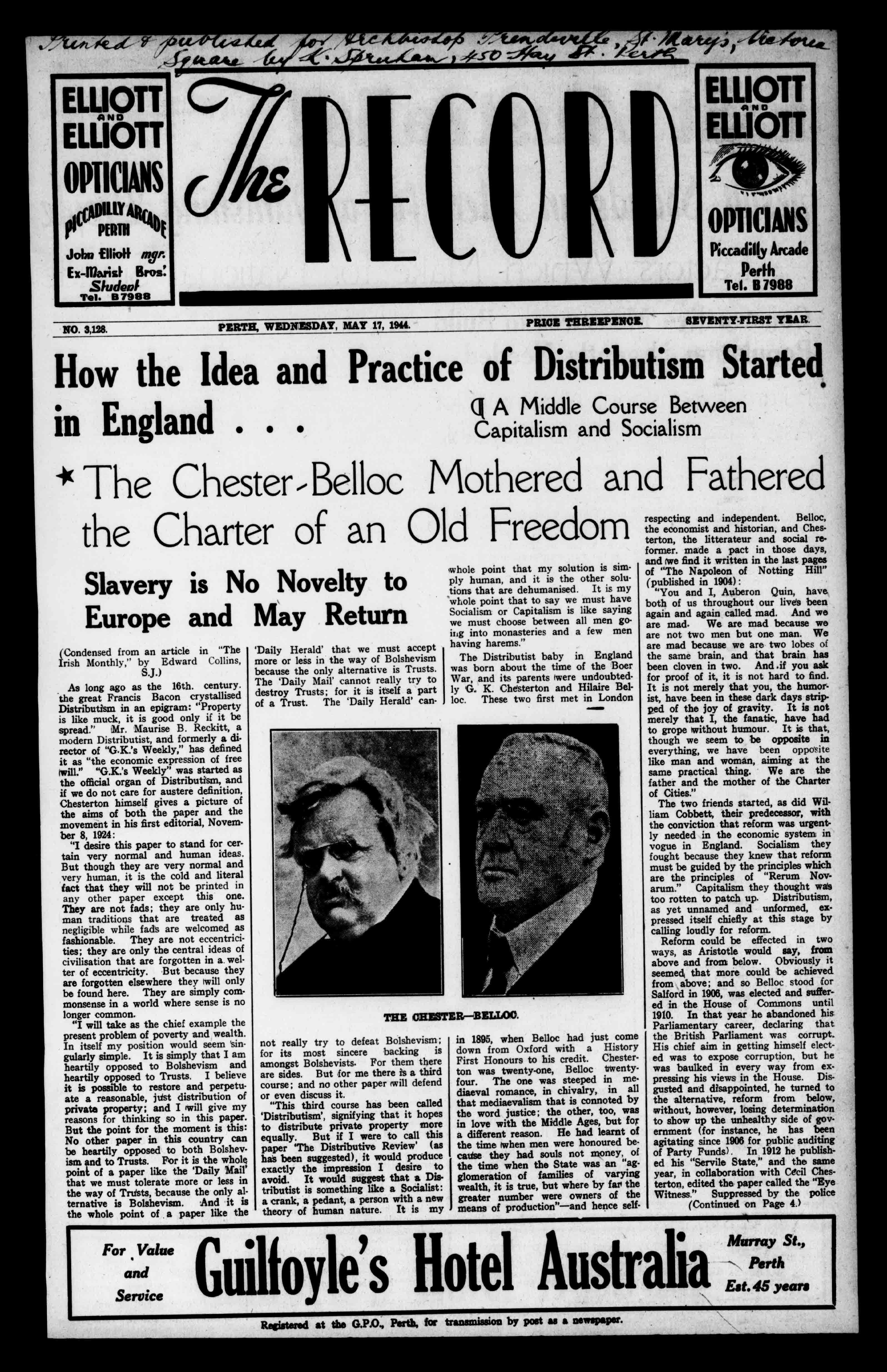
TheChester-BellocMotheredandFathered theCharterofanOldFreedom SlaveryisNoNoveltyto EuropeandMayReturn
(Condensedfromanarticlein"The IrishMonthly,"byEdwardCollins, S.J.)
Aslongago 16th.century. thegreatFrancisBaconcrystallised Distributisminanepigram:"Property islikemuck,itisgoodonlyifitbe spread."Mr.NlauriseB.Reckitt,a modernDistributist,andformerlyadirectorof"Ga.'sWeekly,"hasdefined itas"theeconomicexpressionoffree will.""G.K.'sWeekly"wasstartedas theofficialorganofDistributism,and ifwedonotcareforausteredefinition, Chestertonhimselfgivesapictureof theaimsofboththepaperandthe movementinhisfirsteditorial,November8,1924: "Idesirethispapertostandforcertainverynormalandhumanideas. Butthoughtheyareverynormaland veryhuman,itisthecoldandliteral factthattheywillnotbeprintedin anyotherpaperexceptthisone. Theyarenotfads;theyareonlyhumantraditionsthataretreatedas negligiblewhilefadsarewelcomedas fashionable.Theyarenoteccentricities;theyareonlythecentralideasof civilisationthatareforgotteninawelterofeccentricity.Butbecausethey areforgottenelsewheretheywillonly befoundhere.Theyaresimplycommonsenseinaworldwheresenseisno longercommon.
"Iwilltakeasthechiefexamplethe presentproblemofpovertyandwealth. Initselfmypositionwouldseemsingularlysimple.ItissimplythatIam heartilyopposedtoBolshevismand heartilyopposedtoTrusts.Ibelieve itispossibletorestoreandperpetuateareasonable,justdistributionof privateproperty;andIwillgivemy reasonsforthinkingsointhispaper. Butthepointforthemomentisthis: Nootherpaperinthiscountrycan beheartilyopposedtobothBolshevismandtoTrusts.Foritisthewhole pointofapaperlikethe'DailyMail' thatwemusttoleratemoreorlessin thewayofTritsts,becausetheonlyalternativeisBolshevism.Anditis thewholepointofapaperlikethe
'DailyHerald'thatwemustaccept moreorlessinthewayofBolshevism becausetheonlyalternativeisTrusts. The'DailyMail'cannotreallytryto destroyTrusts;foritisitselfapart ofaTrust.The'DailyHerald'can-
wholepointthatmysolutionissimplyhuman,anditistheothersolutionsthataredehumanised.Itismy wholepointthattosaywemusthave SocialismorCapitalismislikesaying wemustchoosebetweenallmengoingintomonasteriesandafewmen havingharems."
TheDistributistbabyinEngland wasbornaboutthetimeoftheBoer War,anditsparents!wereundoubtedly0.K.ChestertonandHilaireBelloc.ThesetwofirstmetinLondon
respectingandindependent.Belloc, theeconomistandhistorian,andChesterton,thelitterateurandsocialreformer.madeapactinthosedays, andwefinditwritteninthelastpages of"TheNapoleonofNottingHill" (publishedin1904):
"YouandI,AuberonQuin,have bothofusthroughoutourlivesbeen againandagaincalledmad.Andwe aremad.Wearemadbecausewe arenottwomenbutoneman.We aremadbecausewearetwolobesof thesamebrain,andthatbrainhas beenclovenintwo.And.ifyouask forproofofit,itisnothardtofind. Itisnotmerelythatyou,thehumorist,havebeeninthesedarkdaysstrippedofthejoyofgravity.Itisnot merelythatI,thefanatic,havehad togropewithouthumour.Itisthat, thoughweseemtobeoppositein everything,wehavebeenopposite likemanandwoman,aimingatthe samepracticalthing.Wearethe fatherandthemotheroftheCharter ofCities."
Thetwofriendsstarted,asdidWilliamCobbett,theirpredecessor,with theconvictionthatreformwasurgentlyneededintheeconomicsystemin vogueinEngland.Socialismthey foughtbecausetheyknewthatreform mustbeguidedbytheprincipleswhich aretheprinciplesof"RerumNovarum."Capitalismtheythoughtwas toorottentopatchup.Distributism, asyetunnamedandunformed,expresseditselfchieflyatthisstageby callingloudlyforreform.
THECHESTER--BELLOO. notreallytrytodefeatBolshevism; foritsmostsincerebackingis amongstBolshevists.Forthemthere aresides.Butformethereisathird course;andnootherpaperwilldefend orevendiscussit.
"Thisthirdcoursehasbeencalled 'Distributism',signifyingthatithopes todistributeprivatepropertymore equally.ButifIweretocallthis paper'TheDistributiveReview'(as hasbeensuggested),itwouldproduce exactlytheimpressionIdesireto avoid.ItwouldsuggestthataDistributistissomethinglikeaSocialist: acrank,apedant,apersonwithanew theoryofhumannature.Itismy
in1895,whenBellochadjustcome downfromOxfordwithaHistory FirstHonourstohiscredit.Chestertonwastwenty-one,Belloctwentyfour.Theonewassteepedinmediaevalromance,inchivalry,inall thatmediaevalismthatisconnotedby thewordjustice;theother,too,was inlovewiththeMiddleAges,butfor adifferentreason.Hehadlearntof thetime!whenmenwerehonouredbecattsetheyhadsoulsnotmoney,of thetimewhentheStatewasan"agglomerationoffamiliesofvarying wealth,itistrue,butwherebyfarthe greaternumberwereownersofthe meansofproduction"-andhenceself-
Reformcouldbeeffectedintwo ways,asAristotlewouldsay,from aboveandfrombelow.Obviouslyit seemedthatmorecouldbeachieved fromabove;andsoBellocstoodfor Salfordin1906,waselectedandsufferedintheHouseofCommonsuntil 1910.Inthatyearbeabandonedhis Parliamentarycareer,declaringthat theBritishParliamentwascorrupt. Hischiefaimingettinghimselfelectedwastoexposecorruption,buthe wasbaulkedineverywayfromexpressinghisviewsintheHouse.Disgustedanddisappointed,heturnedto thealternative,reformfrombelow, without,however,losingdetermination toshowuptheunhealthysideofgovernment(forinstance,hehasbeen agitatingsince1906forpublicauditing ofPartyFunds)In1912hepublishedhis"ServileState,"andthesame year,incollaborationwithCecilChesterton,editedthepapercalledthe"Eye Witness."Suppressedbythepolice
(ContinuedonPage4.)
a trAPIrPrIrr: ELLIOTT ELLIOTT OPTICIANS APILLYARf, pr--PERTH44 JohnfllioRmar. Ex-Maris"Bros: Skidoo' 1e1.B7989 I ELLIOTT ELLIOTT OPTICIANS PiccadillyArcade Perth Tel.87988 NO.3,128. PERTH,WEDNESDAY,MAY17,1944. PRICETHREEPENCE. SEVENTY-FIRSTYEAR.
ofDistributismStarted
qAMiddleCourseBetween CapitalismandSocialism
HowtheIdeaandPractice
inEngland...
For.Value and Service Guilloyle'sHotelAustraliamEsuEtie7 RegisteredattheG.PA.,Perth,fortransmissionbypostasanewspaper.
JesuitSoundsanAlertfora'VanishingPeople
FactorsWhichwakeforNationalSuicide
ConstructiveMeasurestoBuild PopulationUrgentlyNeeded FutureExpansionistMovementof Asia'sTeemingMillionsInevitable
Javahasapopulationwhichhasincreasedfrom4to48millionsinacentury,andanarealessthantwicethe areaofTasmania.Withinaweek's sailofAustraliathereare500million Asiatics,andwithintendays'sail thereare1,000millionAsiatics,but ofwhiteAustraliansthereareonly 7millions.Differencesinpressurelike thisbreedcyclones.MillionsofChinesearestarvingtodeathasIwrite, yet,toquotefrom"Cobbers,"byDr.
ThomasWood,"IhaveseentheChineseandmarvel.Isthereanything thatracecannotdo?Theyhavefilled theirowncountryspreadoverMalayaandtheEastIndies;established themselvesinEurope,AfricaandAmerica;floodedtheSouthSeas they knownothingaboutthe8-hourday,a standardofliving,orbirthcontrol.
Andtheykeeptheirowncounsel."For thelastdecadeAustraliahasnotbeen reproducingitselfatarateequalto unity.Itspopulationinthe1960's mayreach8.5millionsifthereissubstantialimmigration,andthereafterit mustdecline.
Theseandotherfactsarecontained inFatherMayne'sbooklet,"ExitAustralia,"justpublishedbytheNational SecretariatofCatholicAction.AsMr. AldousHuxleyhassaid,"therulersof anindustrialcommunitythathasstop- pedbreedingwillhavetothinkasno rulershaveeverhadtothinkbefore."
IfAustraliaistobepreserveditis obviousthereforethatsomethingwill havetobedoneaboutit.Forthis reasonthereviewerispreparedtouse thehackneyedphrasethatnoonewho isinterestedinthequestion(andwho isn't?)canaffordtoletthisbookpass by.Itiseasytoreadandofahandy pamphletsize,whileatthesametime itwillnotdisappointtheexperts.To saythatitisindispensablefordiscussiongroupswouldberedundant.
Itistobehopedthatitfindsitsway intoasmanyhandsaspossible.Publicopinionisstillbutdimlyawareof theproblemjustasbeforethewar itwasdimlyawareoftheexistenceof theNearNorth.AsIhavesaid,anyoneevenremotelyinterestedinthe causes,effects,andremediesforAustralia'sdecliningpopulationwillfind muchinthebooklettosustaintheir conversationonthesubject.Somay ArchbishopMannix'swishbefulfilled whenhewroteofFatherMayneinthe
foreword:"Ihopethathiswarning willbewidelyread,andIpraythat theresultsmayjustifyhislabourand hishopes."
FurtherPointsfromtheBook.
Afteroutliningtheproblem,theauthorgoesontoanalysethecauses, andheconcludesthatbirthprevention isthemajorexplanationofthedecline offertility.
probably6,000abortionsinthatcountry.
ACollinsStreetspecialistestimates thatthereisaboutoneabortionto everythreeandahalfbirthsinVictoria,orabout8,000annually.
Abortionisresortedtoasmuchby themarriedastheunmarried.
InBerlin,accordingtothatworld authorityonpopulationproblems.ProfessorCarrSaunders,thereweremore abortionsthanlivebirthsin1929.Two yearsafterHitlercametopowerabortionshaddeclinedtoonlyonefor eachsevenbirths.Thiswasdueto stringentlawsandmarriageloans.
MotivesforBirth-Prevention.
Whatarethemainmotivesforsuch widespreadbirthprevention,andthe reasonswhichhaveledFatherMartindaletodescriberesistancetobirth controlasthe"modernmartyrdom"?
Inhefirstplace,FatherMaynetreats ofsucheconomicfactorsastheinadequacyofthebasicwage:standard foreventhenecessariesofalargefamily.Healsodealswiththehousing andslumproblems,pointingoutthat oneslumdistrictinSydneyhas90 housestotheacre.
SocialFactors.
Manyalternativewaysofspending wagesratherthanonchildrenare available.Amongotherthings,Father Maynepointsouttheeffectsofadvertising:
"Sayitwithflowers."
"Getoffthattram,itwillneverbe yours.Buyamotorbicycle."
Sofarasabortionisconcerned,the authorbelievesthatitshouldnotbe difficulttomobilisepublicopinionbehindmeasuresagainstabort:on:1the situationand ey'lsresultingfrom itwererealised.Fromanational pointofview,hebelievesthatpropa- gandaagainstcontraceptivesshouldbe carriedon.Hebelievesthattheyare notonlyharmfulintheirsocialeffects onthenationandonthefamily,but alsoareinjurioustohealth.Headducesauthorities,includingFreud,to showthattheiruseinducessterility andneurasthenia.TheFederalGovernmenthasrecentlybannedtheadvertisementofcontraceptives,wht,:h theFederalMinisterforHealthhasdeclaredtobeanationalevil.Yet,asks FatherMayne,isnotthemanufacture andsaleofcontraceptivesamuch greaterone?
Theauthorrealisesthltnegative measuresarenotenough.Unless somethingisdonetomakeitp.issibIa toensurecond'tionsoflifeth-,tmake itpossibletorearlargefamilieswithoutimposingverygreatburdens,what issaidincondemnationofbirthpre- ventionandrace-suicidewillseem ratherhollowtoharassedparents.
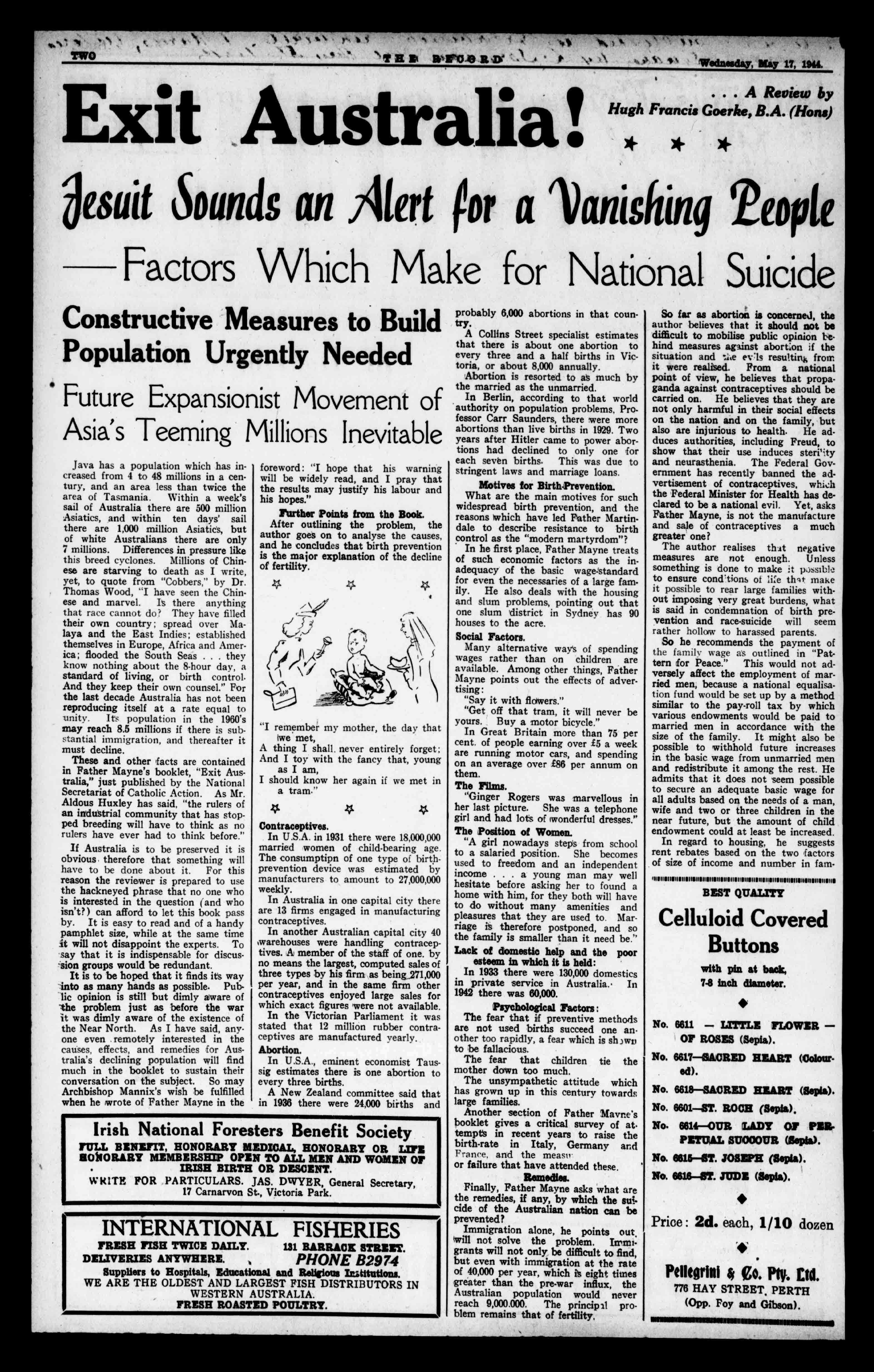
"Iremembermymother,thedaythat Ewemet, AthingIshallneverentirelyforget: AndItoywiththefancythat,young asIam, Ishouldknowheragainifwemetin atram."
Contraceptives.
InU.S.A.in1931therewere18,000,000 marriedwomenofchild-bearingage. Theconsumptipnofonetypeofbirthpreventiondevicewasestimatedby manufacturerstoamountto27,000,000 weekly.
InAustraliainonecapitalcitythere are13firmsengagedinmanufacturing contraceptives.
InanotherAustraliancapitalcity40 warehouseswerehandlingcontracep- tives.Amemberofthestaffofone.by nomeansthelargest,computedsalesof threetypesbyhisfirmasbeing271,000 peryear,andinthesamefirmother contraceptivesenjoyedlargesalesfor whichexactfigureswerenotavailable.
IntheVictorianParliamentitwas statedthat12millionrubbercontraceptivesaremanufacturedyearly. Abortion.
InU.S.A.,eminenteconomistTaussigestimatesthereisoneabortionto everythreebirths.
ANewZealandcommitteesaidthat in1936therewere24,000birthsand IrishNationalForestersBenefitSociety FULLBENEFIT,HONORARYMEDICAL,HONORARYORLIFE ROZORARYMEMBERSHIPOPENTOALLMENANDWOMENOF IRISHBIRTHORDESCENT.
W141TEFORPARTICULARS.JAS.DWYER,GeneralSecretary, 17CarnarvonSt.,VictoriaPark.
INTERNATIONALFISHERIES FRESHFISHTWICEDAILY. 131BARRACKSTREET. DELIVERIESANYWHERE. PHONEB2974 SupplierstoHospitals,EducationalandReligiousIr.:Muttons. WEARETHEOLDESTANDLARGESTFISHDISTRIBUTORSIN WESTERNAUSTRALIA. FRESHROASTEDPOULTRY.
InGreatBritainmorethan75per cent.ofpeopleearningoverf5aweek arerunningmotorcars,andspending onanaverageover86perannumon them.
TheFilms.
"GingerRogerswasmarvellousin herlastpicture.Shewasatelephone girlandhadlotsofwonderfuldresses." ThePositionofWomen.
"Agirlnowadaysstepsfromschool toasalariedposition.Shebecomes usedtofreedomandanindependent income ayoungmanmaywell hesitatebeforeaskinghertofounda homewithhim,fortheybothwillhave todowithoutmanyamenitiesand pleasuresthattheyareusedtoMarriageisthereforepostponed,andso thefamilyissmallerthanitneedbe." Lackofdomestichelpandthepoor esteeminwhichitisheld:
In1933therewere130,000domestics inprivateserviceinAustralia..In 1942therewas60,000.
PsychologicalFactors:
Thefearthatifpreventivemethods arenotusedbirthssucceedonean- othertoorapidly,afearwhichissh.iwil tobefallacious.
Thefearthatchildrentiethe motherdowntoomuch.
Theunsympatheticattitudewhich hasgrownupinthiscenturytowardslargefamilies.
AnothersectionofFatherItifavne's bookletgivesacriticalsurveyofat. temptsinrecentyearstoraisethe birth-rateinItaly,Germanyand andthemea,i, orfailurethathaveattendedthese.
Remedial'.
Finally,FatherMayneaskswhatare theremedies,ifany,bywhichthesuicideoftheAustraliannationcanbe prevented?
Immigrationalone,hepointsout, willnotsolvetheproblem.Dramgrantswillnotonlybedifficulttofind, butevenwithimmigrationattherate of40,000peryear,whichiteighttimes greaterthanthepre-warinflux,theAustralianpopulationwouldnever reach9,000.000.Theprincipalpro blemremainsthatoffertility,
Soherecommendsthepaymentof thefamilywageasoutlinedin"PatternforPeace."Thiswouldnotadverselyaffecttheemploymentofmarriedmen,becauseanationalequalisa- tionfundwouldbesetupbyamethod similartothepay-rolltaxbywhich variousendowmentswouldbepaidto marriedmeninaccordancewiththe sizeofthefamily.Itmightalsobe possibletowithholdfutureincreases inthebasicwagefromunmarriedmen andredistributeitamongtherest.He admitsthatitdoesnotseempossible tosecureanadequatebasicwagefor alladultsbasedontheneedsofaman, wifeandtwoorthreechildreninthe nearfuture,buttheamountofchild endowmentcouldatleastbeincreased.
Inregardtohousing,hesuggests rentrebatesbasedonthetwofactors ofsizeofincomeandnumberinfam-
BESTQtrALITY
CelluloidCovered Buttons
No.6811-LITTLEFLOWEROFROSES(Sepia).
No.6617-SACREDHEART(Coloured).
No.6618-SACREDHEART(Sepia).
No.6601-ST.ROCH(Sepia).
No.6814-OURLADYOFPERPETUAL81700017R(Sepia).
No.6315-ST.JOSEPH(Sepia).
No.6616-8?.JUDE(Sepia).
TWO r vi)40% rsb4 v.,t 4 411 40,4 " 8 'NV8Itwiroesze A 4. '0% 'Wednesday,May17,1944. AReviewby Exit,Austra.lia!HughFrancisGoerke,B.A.(Hone)
withpinatback 7.8
inchdiameter.
Price2d.each,1/10dozen Pelltgrini4Co.Pty.Etd. 776HAYSTREET.PERTH (Opp.FoyandGibson). =1111111111111111111111111.11111M111011011111
SpaciousHousing,MarriageLoans, MaternalWelfareandDomesticHelp
CitiesareDrainingReservoirofCountryManpower
"Ifbabiesarenottobehadforlove, theyarenotlikelytobehadformoney"
WhatCouldGovernmentSpend onPopulationPolicy?
ily.Healsopointstothedangers thatthesmallmodernhousebeing builtnowasastandardwillserveasa deterrenttothenextgenerationtrying tomakeupforthedeficienciesofthis oneinthematteroffertility.
Earlymarriagemightbeencouraged bymarriageloansonthelinessuggestedbytheDeputyLeaderoftheLabourPartyinVictoriatoreducethe averageageofbridegroomandbride inAustraliafromthepresent29years and24years,respectively.towhatDr. LetitiaFairfield,inthe"CatholicMedicalGuardian"describedastheoptimumperiodofmarriage-onphysical grounds-asbeingabout20forthe motherand25forthefather.Portion oftheseloanswouldbewrittenoff withthebirthofeachchild,thewhole loantobewrittenoffwiththebirth ofseveralchildren.
Othersuggestionsconcernmedical assistanceforthemother,pre-nataland post-natalclinics,andtheprovisionof domestichelp.FatherMaynedescribestheworkofthe"temporary help"organisationsofHolland,and thinksthepresentAustralianwar-time schemeforsupplyingemergencyhousekeeperscouldbeextended.
TownandCountry.
Forevery1,000womenofchild-bearingage,365childrenunder5yearsof ageareneededifthepopulationisto remainstationary.Theruralareasof Australiaaverage520.thelargercountrytowns420,andthecityofSydney290.Thistendencyofthecities todependontheruralareasfortheir populationisaworld-widephenomen.Stepsmustbetakenthereforetohelpmenstayontheland,and iftheirnumberscannotbeincreased toassistatleastthedecentralisationof industryincountrycentresandto encouragepart-timefarmingassociated withsuchdecentralisedindustry.
Othermaterialmeasurescommended areequalpayformenandwomen,the revisionoftheeducationaltrainingof girls,andgivingtheopportunitiesafter theyleaveschooltodeveloptheirskill indomesticmatters,theencouragementofspecialclassesandwomen's clubsfortheyoungmarriedwoman.
Thereisalsotheimportanttaskof mouldingpublicopinion.Threethings havetobedone-tomakeknownthe facts,tobuildasuitableenvironment andasympatheticatmosphereforthe largefamily,andtopointoutconstructiveremedies.Todothiseveryavenue shouldbeexploited.Teachers,nurses anddoctorshavemuchtodowiththe familyandshouldbemadeaiwareof thepopulationproblem.
Finally,FatherMaynerealisesthat thesemeasuresmaymeetwithbut partialsuccess."Ifbabiesarenotto
DEAF?
hehadforlove,theyarenotlikelyto hehadformoney."Thebirthrateis oftenhigheramongthepoorersection ofthecommunity."Itismyown bet,"saysMr.PaulMaguire,"thatthe workersarelessobsessedwiththesickeningambitiontoliveuptothe Joneses,withthelustforstupidluxuriesandwithsheerselfishness.The workersareclosertotheknuckleof lifeanditsrealities,andtheyprefer therealjoysoflife."
Theproblemisultimatelyaspiritual one,anditssolutionisdifficultinan agewhichhaslostfaith.Itwillbe bettertoinauguratea"family"rather thana"population"policy.The steadypropagandaofadiffusedsensualitymustbeovercome.Divorce,the employmentofmarriedwomen,too muchStateinterferencewithandsupervisionoverchildren,alltendtominimisetheinfluenceofthehome.
Theforegoinghasbeenbutaninadequatesummaryofsomeonlyofthe pointsmadeinFatherMaine'sbook, whichisinsomewaysanamplification ofthesectiononpopulationin"PatternforPeace."Theproblemwould seemtohavetwoaspects,firstly,the moraloneofensuringthatpeoplewho wantchildrenwillbeabletohave them;secondly,thenationalproblem ofincreasingtheAustralianpopulation atasrapidarateaspossible.
Itisnotgenerallyrealisedthatthe averagefamilyrequiredtoreplacethe existingpopulationmustconsistof threetofourchildren.Toincreasethe populationanhigheraverageisneeded.Thismeansthattheremustbea considerableproportionofsix-child families.
Theremovalofeconomicdisabilitiesmaygoalongwaytoassistmarriedcoupleswhowouldnormallyhave children.Itwouldtaketherestorationofthelargefamilyasasocialfashiontoinducethosewhonormally wouldhaveoneortwochildrento havefiveorsixormore.Vigorous governmentandotherformsofpublic propagandamayassisttosomeextent here.Thepublicareresponsiveto fashions,anditispossiblethatabelief inlargerfamiliesmaycatchon,especiiallyinthelightofexperience.
Ultimately,however,therestoration ofthefamilyordermustmeantherecastingofmuchnotonlyofoursocial customsbutalsoofoursocialstructure. Buthalf-a-loafisbetterthannobread, anditisusefultoconsiderwhether FatherMayne'ssuggestionsarepracthsableinthenearfutureifthewillto implementthemisthere.Obviously manyoftheminvolvegovernmentexpenditure.BeforethewarCommonwealthGovernmentexpenditurewas about100millionpoundsoralittle morethan10percent.ofthenation's annualincome.To-dayitstandsat morethan600millions,andisgreater than50percent.ofthenationalincome.Thisrateofexpenditure,involvingasitdoeshightaxation,frequentloans,theuseofTreasuryBills, andrestrictionsonspending,canscarcelybekeptupafterthewar.
ifthepost-warBudgetwasoftheorder of250to300millionpounds,which mightseemasumwhichcouldbe reachedwithouttoogreatastrainon Australia'sresources,itshouldbepossibletodevoteatleast50million poundstoavigorouspopulationprogramme.
Thisamountwouldbesufficientto putintoeffectsomeatleastofFather Mayne'ssuggestions.ItisimmaterialwhethertheStateGovernmentor someotherbodylowerdowninthe socialstructuredoesthis,solongas themoneyisavailable.Childendowmentatthemomentcosts£11,000,000 perannum.Iftheamountwereincreasedto10s.perweek,anextra £11,000,000wouldbeinvolved.Althoughitcouldhemuchsimpler,it wouldprobablybearetrogressivestep financiallytomakeendowmentpayable onALLchildrenundertheageof16, astheFederalGovernmentapparently hasinmind.Tomakea£150freeof interestloantoeachnewly-married couplewouldcost£13,000.000perannum Atotalof£15,000,000would thereforebeavailableforexpenditure inotherdirections,suchasimmigrationandincreasedmaternityallowances.Maternityallowancesin1943 costAustraliaonequarterofamillion pound's.
Theideaofthefamilywageisalso gainingapprovalamongexperts.It shouldbepossibletointroduceinto industrythepaymentofwagesgraduatedaccordingtofamilyneeds....andso furtherrelievetheeconomicburdenof alargefamily.ThiswouldnotinvolveanyexpensetotheGovernment, becauseitshouldberealisedthatchild endowmentandthefamilyWageare twodistinctthings.Ideallytheformerisasupplementoutofpublicrevenuetothelatterwhensuchisneeded. Thesemeasureswillnotpersuadeupper ,ocomefamiliestohavemorechildren. Theywillindeedbesomewhatworse offbecauseofthem.Stillthebulkof theAustralianpopulationisinthe lowerincomeclasses.Toachievesuccesswiththeothersitwouldbenecessarytopersuadethemtochangetheir socialstandardsandtoreducetheir financialcommitments.Atleastone couldprobablyensurethattheirchildrenwouldnothavethesameideas.
Aneducationalandculturalprogramme,whichisperhapsthemostimportantofall,shouldnotinvolvegovernmentsinmuchexpenditure.Unfortunatelyitwouldappearthatin manydirectionswewillhavetoaccept thepalliativeofStateinterferencein manywaysinwhichitisnotsocially desirable.Theurgencyofthenational peril,however,makesitnecessarythat aconsiderableamountofinitiativebe undertakenbytheState.Stateinterventionwiththefamily,however, shouldbekeptdowntotheabsolute minimum,andshouldbewithdrawnin manyinstancesinwhichithasalready
beengiven.Itispleasingtonote thatthisisrealisedinFatherMayne's book.Theauthorsuggestsmeansby whichthedifferentorganicclassesin societycanbepersuadedtohelpthemselves.Itwouldbebetter,too,to havetheStatetakemeanstoincrease thefamilyincomethantoprovidefree dinnersatschool,becauseithasbecomeevidentthatmostmothersare spendingtheendowmentmoneywisely evenfromanutritionalpointofview.
Bywayofconclusion,itisnotinappropriatetoaskwhyanyoneshould beconcernedaboutthepopulation questionatall.Theargumentthat Australianeedsincreasedpopulation, andneedstobebuiltupasanation, hasinitselfastrongemotionalappeal, andwouldnotbegainsaidbymostAustralians.Butthereareotherargumentsabroad.Therearethosewho sayweoughttolettheAsiaticsin,and therearethosewhosaytheAsiatics won'twanttocomein.Thefirstgroup saythatthepopulationproblemisinsoluble,thesecondthatthereisnoproblematall.TeachtheAsiaticsindustrialismandbirth-prevention(and,as anafterthought,disarmthemand keeponfriendlytermswiththeAmericanFleet),andAustraliamaytrundlealonghappilywithitssevenmillionpeopleforanindefiniteperiod.It isquitepossible,ofcourse,thatthe Asiaticsmaynottaketookindlytothe ideathattheymightpractisebirthpreventionforthebenefitoftheAustraliansorevenofthemselves,and eventhebestAmericansalespresure willnotcheckAsia'spopulationgrowth toanyconsiderableextentformany generationstocome.Inthemeantime1,000millionsto7millionsremainsaprettypoorshow,andpovertywillremainamarkofAsia. Industrialismwillcertainlyenable thecountriesoftheEasttosupporta greaterpopulation,butitwillalso makethemmorepowerfulasnations, andsoonerorlaterthethoughtofexpansionmustagainoccurtothem,as ithasalreadyoccurredtotheJapanese.Onthewholethelogicinthetwo groupsofprotagonistsrestsrather withthosewhowouldabandonthe WhiteAustraliapolicy.Topreserve themoralrightofthewhiteraceto possessAustralia,anincreaseinpopulationmustcomeabout.FortheChristian,ofcourse,theargumentgoesa stepfurther.Australiarepresentsthe ChristiancivilisationoftheWestin theseaoftheEastIndies.Animportantcontributiontothespreadnot onlyoftheChristianfaithbutofChristiansocialstandardstothoseregions istohaveapopulousChristianAustralia.Thisisbecomingmoreevident astheWestdeclinesinnumbersand influence.Itcouldbesaidtobethe majorpartofAustralia'smission.The stirringsofthenationalconsciousness arealreadythere.Itistobehoped thatthey'donotdiestill-born.
AustralasianCatholicAssurance Co.Ltd.
Butitiscertainthatthepost-war Budgetswillbesubstantiallyhigher thanthepre-warBudget.Thegovernmentisalreadycommittedtoincreasedexpenditureinregardtosocialservices,housingandpublicworks,and thepost-twarmilitaryestablishment,as wellrisservicingtheincreasedpublic debtduetowarloans.Nevertheless,
Wednesday,Nay17,1944. THERECORD TRIM
.
HIM&CLIARLY WesternElectric AUDIPHONE Owls&Without
SAME=&SAINIEN. HAYSTREET, Next
Obligation.
AmbassadorsTheatre.
THE"A.C.A." A.C.A.BUILDINGS,KINGST.,SYDNEY. ASSETSEXCEED£1,750,000. ALLCLASSESOFLIFEANDENDOWMENT ASSURANCEPOLICIESTRANSACTED. SAFEGUARDTHEFUTURE BRANCHOFFICESINALLSTATES. W.A.Office: "WARWICKHOUSE,"ST.GEORGE'STERRACE,PERTH P.ENGELBRECHT,ResidentSecretary.
ServileStateAlreadyBeguninEngland
'BacktotheLand'
Anarchyinthe
(ContinuedfromFrontCover.) forbeingtoooutspoken,the"EyeWitnets"gracefullyretiredtogiveplace tothe"NewWitness,"which,inits turn,wassuppressed.
TheopeningoftheGreatWarin 1914sawDistributismstillinembyro.Itwasnotuntilsixyearsafter thewar,until"G.K.'sWeekly"was publishedin1924,thattheideasofBel. loc,Chesterton,andsomeotherswere broadcastandbecameaccessibleto thepublic.Since1924themovement hasgrown,theideascrystallisedsoas toformadefinitesocial,economic,and politicalprogramme.
UptoSeptember,1926,themovementwaspurelyonaliterarybasis;an effortwasbeingmadetoconvincea largenumber01peoplethat,inorder torestoreliberty,propertymustbe distributed.InthatmonththefoundationoftheDistributistLeagueput themovementonadefinitelysocial basis.Nowtwofurtheraimswere added:first,tofindouthowproperty canbedistributed;secondly,todistributeit.ChestertonandBellocsufficedtostartthepaper,thepaper sufficedtostarttheLeague,andthe League,inDecember,1926,three monthsalterinauguration,hadbranchesinLondon,Birmingham,Liverpool,Manchester,Chatham,Oxford, Glasgow,andEdinburgh.
Wecomenowtotheideasbehind Distributism,andnaturallywefind thembestexpressedinBelloc'swritings.The"credo"ofDistributistsis tobefoundinBelloc's"ServileStmt. firstpublishedin1912.Theterm,DistributistState,isfirstusedinthis book,andBellochassincepartlyregrettedhavinginventedit.Forthe wordDistributistisnow,whereaswhat itstandsforisold.
WhatdoesBellocmeanbytheDistributistState?Whatdoeshehope. toprovebyhisbook?Wecanbest answerthesequestionsbyattemptingtodescribethethesisofthebook. BytheServileState,theauthormeans 'thatarrangementofsocietyinwhich
IndustrialWorld
soconsiderableanumberofthefamiliesandinflividualsareconstrained bypositivelawtolabourfortheadvantageofotherfamiliesandindividualsastostampthewholecommunitywiththemarkofsuchlabour" (page16)."Letallthisbeclearly grasped,"hesayslater,"itisfundamentaltoanunderstandingoftheproblembeforeus.Slaveryisnonovel experienceinthehistoryofEurope, norisonesufferingfromanodddream %whenonetalksofslaveryasacceptabletoEuropeanmen.Slaverywas oftheverystuffofEuropeforthousandsuponthousandsofyears,until Europeengageduponthatconsiderablemoralexperimentcalled'The Faith',whichmanybelievetobenow accomplishedanddiscarded,andin thefailureofwhichitwouldseemthat theoldandprimaryinstitutionofslaverymustreturn. Amongthebyproductsofthisexperiment,very slowlyemergingfromtheoldPagan World,andnotlongcompletedbefore Christendomitselfsufferedashipwreck,wastheexceedinglygradual transformationoftheServileState intosomethingother:asocietyofowners"(page37etseq.).Hegoesonto describethegradualestablishmentof whathecallstheDistributistState,in theMiddleAges.Aftertencenturies ofChristianitytheStatewastransformedintoonewhich"wasanagglomerationoffamiliesofvarying wealthbutbyfarthegreaternumber ownersofthemeansofproduction" page50)."Slaveryhadgone,andin itsplacehadcomethatestablishment offreepossessionwhichseemedsonormaltomen,andsoconsonanttoa happyhumanlife. Noparticular namewasthenfoundforit.Today, andnowthatithasdisappeared,we mustconstructanawkwardone,and saythattheMiddle.NgeshadinstinctivelyconceivedandbroughtintoexistencetheDistributiveState.
"Thatexcellentconsummationofhumansocietypassed,asweknow,and ,wasincertainProvincesofEurope, butmoreparticularlyinBritain,destroyed
FRANKJ.BOSWELL
SPECIALISTSINHospitalEquipmentandSteamInstallations,HotWaterHeating, Ventilating,SewerageWork,andGeneralPlumbing.
CornerRUTH&WILLIAMSTREETS,PERTH. Tel.B2777. SuppliersofHospitalEquipmentandStainlessHospitalUtensils.
She'llchangealotinanother year,butshe'llneverbesweeter thansheisto-day.Keepthat sweetnessfortheyearstocome. HaveanewPortraitmadenow. RingB8833fortheappointment.
LANGHAMSTUDIOSLTD.
CENTRALARCADE
HAYSTREET,PERTH
"Forasocietyinwhichthedeterminantmassoffamilieswereowners ohcapitalandofland;foroneinwhich productionwasregulatedbyself-governingcorporationsofsmallowners; andforoneinwhichthemiseryand insecurityofaproletariatwasunknown,therecametobesubstituted thedreadfulmoralanarchyagainst whichallmoraleffortisnowturned andwhichgoesbythenameofCapitalism.
"Howdidsuchacatastrophecome about?Whywasitpermittedand uponwhathistoricalprocessdidthe evilbatten?WhatturnedanEnglandeconomicallyfreeintotheEnglandweknowto-day,ofwhichatleast one-thirdisindigent,ofwhichnineteen-Wwentiethsaredispossessedof capitalandofland,andofwhichthe wholeindustryandnationallifeiscontrolleduponitseconomicsidebya fewchancedirectorsofmillions,afew mastersofunsocialandirresponsible monopolies?"(pages51,52.)
BellocdeniesthatCapitalismwas thegrowthoftheindustrialmovement,andgivestheanswerwithwhich wearealreadyfanailiar."HadCapitalismnotbeenpresentbeforetheindustrialrevolution,thatrevolution mighthaveprovedasbeneficentto Englishmenasithasprovedmaleficent. ButCapjtalism,thatis,theownership byafewofthespringsoflife,was presentlongbeforethegreatdiscoveriescame.Itwarpedtheeffectof thesediscoveriesandnewinventions andturnedthemfromagoodintoan evilthing.Itwasnotmachinerythat uostusourfreedom;itwasthelossof afreemind."(p.53.)
Havingestablishedthetruehistorical background,Bellocgoesontoshow thattheCapitalistStateisessentially unstable.Onereasonisthatwhile thecitizensarepoliticallyfree,they areeconomicallyunfree.Astateof stressandstraingraduallyincreasing results,duetotheincreasingwealth ofthefewandtheinsufficiencyandin. securityoftheproletariat.Another reasonwhysociety'soconstitutedcannotendureisbecauseofthestrain arisingfromthedivergenceofthe moraltheoriesonwhichtheStatereposes(Christianmorals)andthesocialfactswhichthosemoraltheories attempttogovern.Ourlegalmachinery,forinstance,ha)'becomelittle morethananengineforprotectingthe fewownersagainstthenecessities,the demands,orthehatredoftheirdispossessedfellow-citizens.
GiventheCapitalistState,itwill tendofitselftostabilitybysomemethodorother.Therearebutthree socialarrangementswhichcanreplace Capitalism:Slavery,Socialism,Property.BecauseofChristiantradition, thefirstarrangementwillnotfindacceptance,thethirdbecauseoftheadvancedstageofdiseaseinwhichthe patientfindshimselfisconsideredimpracticable.HenceSocialismorCollectivismofsomesort,Bellocsaysin 1912willbethearrangementmostadvocated.Andsoithashappenedin Russia,inGermany,inItaly.But theargumentgoesfurtherinthebook. Itis'shownthattheSocialistsinaimingtoestablishaSocialistStatewill eventuallyestablishslavery.This maysoundpreposterous,butletanyonereadthebookforhimselfandhe willfeeltheforceandconvictionof theargument.Bellocdefinesevery termusedinaveryconcretemanner.
Thefinalsectionofthebookisgiven overtoshowingthattheServileState hasactuallybeguninEngland."All thisorthebeginningsofitcanbe seeninahundredmodernchanges, fromsuchthingsasInsuranceActs whichdividecitizensbylawintotwo classesofmastersandservants,toall sortsofproposalsforpreventing strikesandlock-outsbycompulsoryarbitration.Anylawthatsendsaman backtohisworkwhenhewantsto leaveitis,inplainfact,aFugitive SlaveLaw."
Bellocdoesnotdrawamoralinhis book,buttheconclusiononemust drawisobvious.IfmencannotaccepttheServileState,theymustwork mightandmainfortherestorationof propertytotheworkingclasses,and thesettingupoftheDistributistState. TheestablishmentofaStatesuchas
Disributistsenvisageinthemodern world,isconsideredbymany'animpossibledream.Whetherthisistrue ornotisnotthepointIwishtomake here.AllIdowanttosayisthat theyhaveverydefiniteviewsonwhat theywant.Firstlytheywanttorestoreagriculturetoaplaceofprime importanceinEngland."Theyproposetogobacktofundamentals,and torebuildsocietyfromitsbasisinagriculture."This,isintheteethofthe finalreportoftheBalfourCommittee onIndustryandTrade(1931):"It mustberegardedasaxiomaticthat GreatBritainis,andapartfrom wholesaleemigrationmustremain,a countrynecessarilydependentonoverseassuppliesforthemeansoffeeding andemployingitspopulation.Fora communitythussituatedtheideaof self-sufficiencyiswhollyinappropriate.""Backtotheland"isundoubtedlytheDistributistcry.butthisis nottantamounttowagingwaragainst industry.TheprobleminEnglandis twofold:(1)Theabsenceofapeasant eats,theonlytraditionaloneinany country;(2)anarchyintheindustrial world.Thisleadsustothesecond plankoftheDistributistprogramme. TheyadvocateGuildorganisation,not toorganise,buttoregulateindustry. Theproposalistosuperimposeover eachindustryanorganisationtoregulateit;affairsmuchinthesameway thataprofessionalsocietyenforcesdisciplineamongmembers;withthisdifference,thatinadditiontoupholding astandardofprofessionalconduct, theywouldbeconcernedtopromotea certainmeasureofeconomicequality amongtheirmembers.
WehaveventuredtosaythatDistributismisbasedontheprinciples laiddownin"RerumNovarum,"and henceamovementwhichistrulyCatholicinspirit.G.K.commentson thefactthatthecriticismsofDistributismarecriticismswhichhavebeen levelledagainsttheChurchherself:"If wecandisputewithMr.Montague overtheterm'reactionary'wemight dispute(stillmoreabouttheterm'medieval' Ofcourse,weknowvery wellwhathereallymeans,whetherhe knmvsitornot,byourbeingmedieval. Hemeanssomethingthathassurvived medievalism,thoughitmademedievalism,justasitsurvivedfeudalism thoughitmitigatedfeudalism,juStas issurvivedslaverythoughitdissolve slavery.Weknowitsnameifhedoes not,andwebegtoinformhimthat thisalsoisanexceedinglymoderninstitution.Ifhewillsailaroundthe worldinhislittleboat,hewillfindout howmodern.Butnobodyexpects himtoargleontheassumptionofCatholicChristianityand,therefore,itis irrelevanttodealwiththatmatter here.Wewillonlysaythatifhe caresforahintaboutthenatureof thethinginitsvariedeffects,hewill finditinthenotionofthewillwhich isattherootofallliberty."("G.K.'s Weekly,"April11,1925:leadingarticle.)Perhapswecouldconcludeby sayingthat,astheChurchisapotentialfromwhichallforcesforgoodin thislifecanbederived,Distributismis aparticularexampleofthisinEngland.Itisaforceforgoodwhichhas sprungdirectlyfromCatholicsocial ideas,andeventhoughitshouldcome tonothing,itsideals,themotives whiChanimateditsfounders,will helptoarouseorkeepalivein succeedinggenerationsoneaspectofthe spiritofCatholicisminEngland.
WANTEDTOBUY:Stoves,Wood, Gas;PlainandOldRoofIron,COPPeri, Heaters.BestPrices.WagB6$07.
HomeofGoodShepherd
YOUR TEl1,100RD 4Psdnesday,Kay17,UM.
Laundry,Leederville UnderDirectionoftheSistersof theGoodShepherd. DRYCLEANINGANDART NEEDLEWORKASPECIALTY, VESTMENTS,HANDLACE, FANCYGOODSSUPPLIED. BRIDALVEILSCANBEHAD ONHIRE. CountryOrdersPromptly Despatched. 'Phone:W1185.
NewDistinctionforMiss NormaParker
W.A.PioneersinSocialScienceand AlmonerWork
Itissomethingtorememberthatthe social'sciencesandalmonerworkin thislandwaspioneeredbythreeW.A. graduates,twoofthem,MissParkerand MissEileenDavidson,M.A.,Dip.Ed., arepastpupilsofSacredHeartHigh School,andthethird,MissConnie Moffat,M.A.,Dip.Ed.,apastpupilof LoretoConvent,Swanbourne.TofolloWintheirfootstepswehopeother localgraduateswillbefortunateenough tosecurescholarshipsatWashington afterthewar.
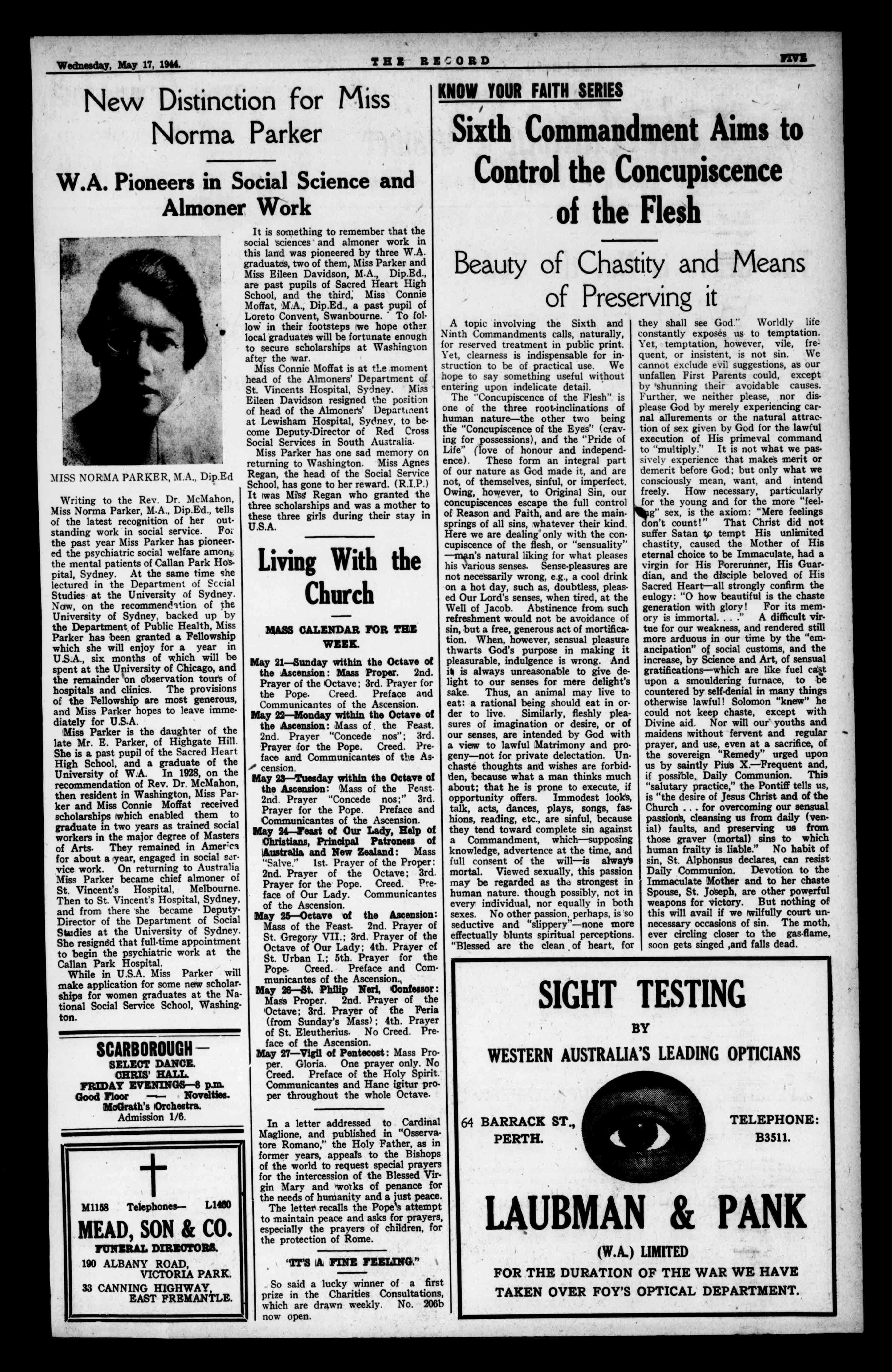
MISSNORMAPARKER,M.A.,Dip.Ed
WritingtotheRev.Dr.McMahon, MissNormaParker,M.A..Dip.Ed.,tells ofthelatestrecognitionofheroutstandingworkinsocialservice.Fo. thepastyearMissParkerhaspioneeredthepsychiatricsocialwelfareamone. thementalpatientsofCallanParkHospital,Sydney.Atthesametimeshe lecturedintheDepartmentofSceial StudiesattheUniversityofSydney. Now,ontherecommendationofthe UniversityofSydney,backedupby theDepartmentofPublicHealth,Miss ParkerhasbeengrantedaFellowship whichshewillenjoyforayearin U.S.A.,sixmonthsofwhichwillbe spentattheUniversityofChicago,and theremainderonobservationtoursof hospitalsandclinics.Theprovisions oftheFellowshiparemostgenerous, andMissParkerhopestoleaveimmediatelyforU.S.A.
MissParkeristhedaughterofthe lateMr.E.Parker,ofHighgateHill. SheisapastpupiloftheSacredHeart HighSchool,andagraduateofthe UniversityofW.A.In1928,onthe recommendationofRev.Dr.McMahon, thenresidentinWashington,MissParkerandMissConnieMoffatreceived scholarshipswhichenabledthemto graduateintwoyearsastrainedsocial workersinthemajordegreeofMasters ofArts.TheyremainedinAmer'ci foraboutayear,engagedinsocial vicework.OnreturningtoAustralia MissParkerbecamechiefalmonerof St.Vincent'sHospital.Melbourne. ThentoSt.Vincent'sHospital,Sydney, andfromthereshebecameDeputyDirectoroftheDepartmentofSocial StudiesattheUniversityofSydney. Sheresignedthatfull-timeappointment tobeginthepsychiatricworkatthe CallanParkHospital.
WhileinU.S.A.MissParkerwill makeapplicationforsomenewscholar. shipsforwomengraduatesattheNationalSocialServiceSchool,Washington.
SCARBOROUGHSELECTDANCE. CHIOS'HALL. FRIDAYEVENINGS-8p.m. GoodFloor-Novelties. MoGmth'sOrchestra. Admission1/8.
MissConnieMoffatisattl.emoment headoftheAlmoners'Departmentof St.VincentsHospital,Sydney.Miss EileenDavidsonresignedtheposition ofheadoftheAlmoners'Depart,nent atLewishamHospital,Sydney,tobecomeDeputy-DirectorofRedCross SocialServicesinSouthAustralia. MissParkerhasonesadmemoryon returningtoWashington.MissAgnes Regan,theheadoftheSocialService School,hasgonetoherreward.(R.I,P.)
ItwasMissReganwhograntedthe threescholarshipsandwasamotherto thesethreegirlsduringtheirstayin U.S.A.
LivingWiththe Church
MASSCALENDARFORTHE WEEK.
May21-SundaywithintheOctaveof theAscension:MassProper.2nd. Prayerfor thePope.Creed.Prefaceand CommunicantesoftheAscension.
May22-MondaywithintheOctaveof theAscension:MassoftheFeast. 2nd.Prayer"Concedenos";3rd. PrayerforthePope.Creed.PrefaceandCommunicantesoftheAscension.
May23-TuesdaywithintheOctaveof theAscension:MassoftheFeast 2nd.Prayer"Concedenos;"3rd. PrayerforthePope.Prefaceand CommunicantesoftheAscension.
May24-FeastofOurLady,Helpof Christians,PrincipalPatronessof AustraliaandNewZealand:Mass "Salve."1st.PrayeroftheProper: 2nd.PrayeroftheOctave;3rd. PrayerforthePope.Creed.PrefaceofOurLady.Communicantes oftheAscension.
May25-OctaveoftheAscension: MassoftheFeast2nd.Prayerof St.GregoryVII.;3rd.Prayerofthe OctaveofOurLady:4th.Prayerof St.UrbanI.;5th.Prayerforthe Pope.Creed.PrefaceandCornmunicantesoftheAscension.,
May26-St.PhilipNeri,Confessor: MassProper.2nd.Prayerofthe Octave;3rd.PrayeroftheFeria (fromSunday'sMass); 4th.Prayer ofSt.Eleutherius.NoCreed.PrefaceoftheAscension.
May27-VigilofPentecoet:MassProper.Gloria.Oneprayeronly.No Creed.PrefaceoftheHolySpirit. CommunicantesandHancigiturproperthroughoutthewholeOctave.
KNOWYOURFAITHSERIES
SixthCommandmentAimsto ControltheConcupiscence oftheFlesh
BeautyofChastityandMeans ofPreservingit
AtopicinvolvingtheSixthand NinthCommandmentscalls,naturally, forreservedtreatmentinpublicprint. Yet,clearnessisindispensableforinstructiontobeofpracticaluse.We hopetosaysomethingusefulwithout enteringuponindelicatedetail.
The"ConcupiscenceoftheFlesh"is oneofthethreeroot-inclinationsof humannature-theothertwobeing the"ConcupiscenceoftheEyes"(cravingforpossessions),andthe"Prideof Life"(loveofhonourandindependence).Theseformanintegralpart ofournatureasGodmadeit,andare not,ofthemselves,sinful,orimperfect. Owing,however,toOriginalSin,our concupiscencesescapethefullcontrol ofReasonandFaith,andarethemainspringsofallsins,whatevertheirkind. Herewearedealing'onlywiththeconcupiscenceoftheflesh,or"sensuality" -m4n'snaturallikingfurwhatpleases hisvarioussenses.Sense-pleasuresare notnecessarilywrong,e.g.,acooldrink onahotday,suchas,doubtless,pleasedOurLord'ssenses,whentired,atthe WellofJacob.Abstinencefromsuch refreshmentwouldnotbeavoidanceof sin,butafree,generousactofmortification.When,however,sensualpleasure thwartsGod'spurposeinmakingit pleasurable,indulgenceiswrong.And itisalwaysunreasonabletogivedelighttooursensesfor sake.Thus,ananimalmayliveto eat:arationalbeingshouldeatinordertolive.Similarly,fleshlypleasuresofimaginationordesire,orof oursenses,areintendedbyGodwith aviewtolawfulMatrimonyandprogeny-notforprivatedelectation.Unchastethoughtsandwishesareforbidden,becausewhatamanthinksmuch about;thatheispronetoexecute,if opportunityoffers.Immodestlooks, talk,acts,dances,plays,songs,fashions,reading,etc.,aresinful,because theytendtowardcompletesinagainst aCommandment,which-supposing knowledge,advertenceatthetime,and fullconsentofthewill-isalways mortal.Viewedsexually,thispassion mayberegardedasthestrongestin humannature.thoughpossibly,notin everyindividual,norequallyinboth sexes.Nootherpassion,perhaps,isso seductiveand"slippery"-nonemore effectuallybluntsspiritualperceptions. "Blessedarethecleanofheart,for
theyshallseeGod."Worldlylite constantlyexposesustotemptation. Yet,temptation,however,vile,frequent,orinsistent,isnotsin.We cannotexcludeevilsuggestions,asour unfallenFirstParentscould,except by'shunningtheiravoidablecauses. Further,weneitherplease,nordispleaseGodbymerelyexperiencingcarnalallurementsorthenaturalattractionofsexgivenbyGodforthelawful executionofHisprimevalcommand to"multiply."Itisnotwhatwepassivelyexperiencethatmakesmeritor demeritbeforeGod;butonlywhatwe consciouslymean,want,andintend freely.Hownecessary,particularly fortheyoungandforthemore"feelg"sex,istheaxiom:"Merefeelings on'tcount!"ThatChristdidnot sufferSatantotemptHisunlimited chastity,causedtheMotherofHis eternalchoicetobeImmaculate,hada virginforHisForerunner,HisGuardian,andthedisciplebelovedofHis SacredHeart-allstronglyconfirmthe eulogy:"0howbeautifulisthechaste generationwithglory!Foritsmemoryisimmortal. ."Adifficultvirtueforourweakness,andrenderedstill morearduousinourtimebythe"emancipation"ofsocialcustoms,andthe increase,byScienceandArt,ofsensual gratifications-whicharelikefuelcat furnace,tobe counteredbyself-denialinmanythings otherwiselawful!Solomon"knew"he couldnotkeepchaste,exceptwith Divineaid.Norwillouryouthsand maidenswithoutferventandregular prayer,anduse,evenatasacrifice,of thesovereign"Remedy"urgedupon usbysaintlyPittsX.-Frequentand, ifpossible,DailyCommunion.This "salutarypractice,"thePontifftellsus, is"thedesireofJesusChristandofthe Church forovercomingoursensual passion,cleansingusfromdaily(venial)faults,andpreservingusfrom thosegraver(mortal)sinstowhich humanfrailtyisliable."Nohabitof sin,St.Alphonsusdeclares,canresist DailyCommunion.Devotiontothe ImmaculateMotherandtoherchaste Spouse,St.Joseph,areotherpowerful weaponsforvictory.Butnothingof thiswillavailifwewilfullycourtunnecessaryoccasionsofsin.Themoth, evercirclingclosertothegas-flame, soongetssinged,andfallsdead.
M1158 Telephones-L1480 MEAD,SON&CO.
FUNERALDIRE:MOE& 190ALBANYROAD, VICTORIAPARK.
33CANNINGHIGHWAY, EASTFREMANTLE.
InaletteraddressedtoCardinal Maglione,andpublishedin"OsservatoreRomano,"theHolyFather,asin formeryears,appealstotheBishops oftheworldtorequestspecialprayers fortheintercessionoftheBlessedVirginMaryandworksofpenancefor theneedsofhumanityandajustpeace. TheletterrecallsthePope'sattempt tomaintainpeaceandasksforprayers, especiallytheprayersofchildren,for theprotectionofRome.
"IT'SAFINE;TEMPO."
Sosaidaluckywinnerofafirst prizeintheCharitiesConsultations, whicharedrawnweekly.No.206b nowopen.
Wednesday,May17,1944. THERECORD FIVE
SIGHTTESTING BY WESTERNAUSTRALIA'SLEADINGOPTICIANS 64BARRACKST., PERTH. TELEPHONE: B3511. LAUBMAN&PANK (WA)LIMITED FORTHEDURATIONOFTHEWARWEHAVE TAKENOVERFOY'SOPTICALDEPARTMENT.
TheGraveisNottheEnd
. WhatHappenstotheSoulAfterDeath?
CatholicTeachingontheParticularandGeneralJudgments
CouldaGoodGodReally CondemnMen
SomeObjectionstptheBeveridgePlan
ItisrelatedintheArtsoftheApostleshowSt.Paul,havingbeenaccused andstandinghistrialbeforetheJewishHighCouncil,threwaspannerinto theschemesofthosewhoweretrying todiscredithimbeforethepeople.He knewthattherewerebothPharisees andSaduceesamongsthisjudges,sohe broughtupthequestionoftheresurrectionofthedead.ThePharisees wereorthodoxJews,whiletheSaducees wereasortoftoleratedhereticalsect whodeniedtheexistenceofanimmortalsoulinman,deniedtheexistenceof spiritsandangels,andconsequently deniedthepdssibilityofafuturelife. LetuslistentothewordsoftheHoly Scripture:'Paul,knowingthattheone partwerePhariseesandtheotherSaducees,criedoutintheCouncil:Men, brethren,IamaPharisee,thesonof Pharisees:concerningthehopeand theresurrectionofthedeadIamcalledinquestion.Andwhenhehadso saidtherearoseadissentionbetween thePhariseesandtheSaduceesand themultitudewasdivided.Forthe Saduceessaythatthereisnoresurrectionnorangelnorspirit;butthe Phariseesconfessboth.Andthere aroseagreatcry,andsomeofthe Phariseesrisingup,strovesaying:We findnoevilinthisman.Whatifa spirithathspokentohimoranangel? Andwhentherearoseagreatdissention,theTribune.fearinglestPaul shouldbepulledinpiecesbythem, commandedthesoldierstogodown, andtotakehimbyforcefromamong them,andtobringhimintothecastle."
Itwas,then,theopinionofthemajorityofJewsfromtheveryearliest oftimesthatman'ssoulwillneverdie andthatwhentheendoftheworld 'comesthedeadbodywillalsoberaisedagain,willhereunitedtothesoul, andtheywillgoonlivingtogetherfor alleternity.Thisisverydefinitely theteachingoftheCatholicChurch also.IntheApostles'Creed,dating
fromthefirstcenturyafterChristand attributedtotheApostlesthemselves, wesay: ''"yeintheresurrection thebodyandlifeeverlasting.Inthe NiceneCreed,datingfromthefourth century,wealsohave:AndIawaitthe resurrectionofthedeadandthelife oftheworldtocome.Boththese creedsarerecitedwithrespect,ifnot withrwholeheartedbelief,intheservicesofthemajorityofnon-Catholic churches.
ThefactthatnextThursdayisthe dayuponwhichwecelebratetheanniversaryofChrist'sAscensioninto heaven,mademethinkofthissubject,andasitisnotmentionedoften itdidnotseemabadideathatalittleshouldbesaidaboutitto-night.
ChristwascalledbySt.Paul"The First-bornofthe'dead,"becausebyHis ResurrectionHeconqueredthecurse ofeternaldeathwhichwasuponus, risingwiththatimmortalityofbody andsoulwhichwouldhavebeenthe prerogativeofeverymanbutforthe ruinbroughtupontheworldbysin. ChrististheFirst-bornofthedeadbecausebyHisAscensionintoHeaven Hehasfirstenteredbodyandsoulinto thatinheritancewhichhehadalsopurchasedforallofusupontheCross.
What,then,isgoingtohappento USafter'death?Whenwedieour bodywillbeplacedinthegraveand willquicklybecomecorrupt;oursouls willimmediatelyappearbeforeChrist fortheparticularjudgment.Therentencecangoinbutoneofthreeways: ifwedieindeliberate,openandunre pentanthatredofGodandHislaw,we shallimmediatelybecondemnedtothe miseriesofHellforalleternity;ifwe shoulddieinperfectconformitywith God'swillandwithalloursinscompletelyatonedfor,weshouldbere wardedimmediatelywiththevision ofGodfacetofaceinHeaven;ifwe shouldqualifyneitherforimmediate rewardnorforcompletereprobation (whichseemsthemostthatthema
jorityofuscanatthemomentexpect, judgingfromappearances)thenwe shouldberequiredtobalanceupour accountswithGoduntilwehadpaid thelastfarthinginPurgatory.
(Itisstrangehowmanypeople, whilenotexplicitlydenyingthep?.-fcctionofGod,atthesametimeseemto considerHimasaratherweak-minded oldgentlemanwhowillnothavethe hearttocarryoutHisthreatsagainst wrong-doersandwillalwaysallowHis senseofjusticetobeoverridden.)Well, togetbacktothesequenceofhappeningsintheafterlife.TheCatholicChurchteachesthatthesou',in Heaven,HellorPurgatory,willremainseparatedfromthebodyuntil dayoftheworld.Thenwill takeplacethegeneraljudgment,when thebodiesofthedeadwillriseagain bereunitedtotheirsouls,andparticipateinthatfinalandirrevocablerectificationofthemanyunsatisfiedinjusticesofthislife.
Therearenotafew,Ithink,whoare morethaninclinedtodoubttherealityoftheParticularJudgmentimmediatelyafterdeath,andeventodeny theexistenceofthesoulatallinthe periodbetweenthedeathofthebody andtheendoftheworld,butthey oughttobewarnedthattheyare swimmingagainstavery'strongcurrent.Iamperfectlypreparedtoadmit(andnotabitdauntedincidentally)thattherearenoexplicitreferences,insomanywords,intheBible totheParticularJudgment,butthere areverynumerousplaceswherethe wordswillonlyadmitofthisinterpretation:forexample,inEcclesiasticus XI.,28:"ForitiseasybeforeGod, inthedayofdeathtorewardevery oneaccordingtohisways,'andthen OurLord'sownwordsintheparable oftherichmanandLazarus:"Andit cametopassthatthebeggardiedand wascarriedbytheAngelsintoAbraham'sbosom.Andtherichmanalso diedandhewasburiedinhell."And St.John,inhisApocalypseorRevelations(XIV.):"Blessedarethedeal whodieintheLord.FromhenceforthnowsaiththeSpirit,thatthey mayrestfromtheirlabour's,fortheir worksfollowthem."
AsIremarkedamomentortwoago aCatholicisneverintheleastworried whenapartoftheexplicitteachingof theChurchmaynotbefoundequally explicitlyinHolyScripture.What everiscontainedinHolyScriptureis inspiredandconsequentlymostcertanlytrue,butitisnottheonlysource ofChrist'steaching-itisnoteventhe mostimportantsource.Christsenthis Apostlestoteach,nottowrite,andHe toldthemthatHewouldeverbeat theirside.Christtoldthefaithfulto listenandtobelieve,nottoreadand thenbeincredulous,"andhewhowill notheartheChurch,lethimbetothee astheheathenandthepublican,"said Christ.TheChurch-teachestheParticularJudgment:itisChristwhois teaching.
atruecriterionofthetrueChristian faiththeunanimousconfessionofsuch men,thanheswayedbytheindividualisticpreferencesandtheprejudiced predilectionsofmodernbibliolaters whoprofesstosubmitthemselvesto theBiblewhentheywillnotadmit theauthorityofHerunderwhoseroof theScriptureswerewritten,under whoseprotectiontheyhavebeensaved forus,andbywhosezealfortheirpuritytheyhaveeverproved,whenrightlyinterpreted,asourceofconfirmationinfaithandinstructioninevery degreeofholiness.
InterestedListener,Albany
Q.:HowwasitthatCain,afterhehad murderedAbel,wentintothelandof Nodandtookuntohimselfawife?
WhenCainandAbelweretheonly childrenofAdamandEve,howdid Cain'swifecomeonearth?
A.:That'sahoaryone.Naturally whenCainandAbelweretheonly childrenofAdamandEve,Cain'swife hadnotcomeupontheearth.However,chapterfiveofthebookofGenesissaysthatAdamlivedninehundred andthirtyyearsandbegot'sonsand daughters;soifCainexercisedalittle patiencethereshouldnothavebeen anyacutedearthofmarriageablefemalesfromwhomtomakehischoice, SinceGodhadgivenAdamthecommandtoincreaseandmultiplyandto peopletheearth,probablyquitealot happenedduringnearlyathousand years.
MountLawley(noname)
Pleasesayifitiscorrectforapriest ofthe'CatholicChurchtohaveacup ofteaandeatsbeforesayingMass.
Manythanksinanticipation,tosettleanargument.
A.:Withmoreseriousnessthanthe levityofyourquestionwouldseemto demand,Ireplythatitwouldnotbe correctforapriesttotakeanyrefreshmentsbeforeMassunlesshehad adispensation.ForallthoseintendingtoreceiveHolyCommunion, priestsincluded,thereisastrictlaw oftheChurchcommandingthatno foodordrinkbetakenfromthepreviousmidnight.Adispensationisoccasionallygivenforthosepriestswho havetotravelunusuallylongdistances inhotclimatesand,forexample,to militarychaplainswhenactuallyonactiveservice.
ConvertedListener,Pinjarra
YourquestionsaboutCatholicsnot readingtheBibleandservicesbeing inLatin,havebeenansweredbefore.
Q.:Ipersonallybelievethatthereis noHell.Christdiedsothatallsinnersmightbesaved.Whatisyour opinion?
THIRDPARTY.
NO.33BARRACKSTREET,PERTH.
W.L.CARTER,Manager.
Ignatius,Polycarp,Clement,Tertullian,Ambrose,Augustine,Gregory, Chrysostom,BasilandCyril,andin.numerableothersofthefirst,second, thirdandfourthcenturiestaughtthe doctrineof immediatelytheParticularJudgment afterdeath,andinthem Christwasspeaking-hewhohears youhearsMe.Ihadratherfollowas
A.:Myopinion,forwhatitIsworth, isthatyouareverymistaken,andthat thereisaHell.Whatismoretothe point,Christtaughtmostexplicitly thatthereisaHell.Speakingofthe GOOD271W3.:-Latestinansdlas andWoodStoves,newand W.A.Stove0o.,Wsillserksiek
SIX ?8ERECORD Wednesday,May17,JUL.
EVERYSUNDAYEVENINGFROM9P.M.
*TheCatholicAnswer
ByV.Rev.Dr.L.J.Goody, D.D.,D.Ph. STATIONS 6PR-6TZ HISTORY-TOPICALQUESTIONS-PHILOSOPHY-SOCIALJUSTICE APOLOBETICI-THECHURCHINTHEMODERNWORLD-TROMP
toHel1
PEERLESSBREADMANUFACTURERS 145FITZGERALDSTREET,PERTH. OurMotto:"QUALITYandSERVICE." Specialties-VIENNABREADandROLLS. 'Phone:B1041. TheColonialMutualFireInsurance COMPANYLIMITED. FORALLCLASSESOFINSURANCE,INCLUDINGFIRE,HOUSEOWNER,andHOUSEHOLDER'SCOMPREHENSIVE,BURGLARY, PLATEGLASS,MOTORVEHICLE,CROPS,FIDELITY,GUARANTEE,WORKMEN'SCOMPENSATION,
WhyCertainBooksarePlacedontheIndex
.
CatholicsarenotforbiddentovisitProtestantchurches
HowHeresy&SchismRuined theChurchinNorthAfrica
SteadfastnessofCopticand AbyssinianChristians
LastDayandtheGeneralJudgment, ChristsaidthattheJudgewouldturn tothewickedandsay:"Departfrom Meyecursedintoeverlastingfire, whichwaspreparedforthedeviland hisangels."SincetheCatholicChurch teachesallofChrist'steachingsand nothingbutChrist'steachings,shealso hasalways,doesnowandalwayswill, believeandteachthatthereisaHell andthatsinnerswillfindinthisdoctrineaveryefficientdeterrentfromsin iftheywillonlykeepitbeforethen; minds.
Q.:WhyisitthatwhenaProtestant marriesaR.CatholicinaCatholic Church,musicisnotplayed?
A.:Thereasonwhymusicisnot playedisthattheChurchdisapproves verystronglyofmixedmarriages,is anxioustoreducetheirnumbertoa minimum,andshowsherdisapproval bydenying,atamixedmarriage,many ofthesolemnitieswhichareotherwise customary.
Jacques,Havelock-street, West Perth:
WillyoukindlyanswerthefollowingquestionsintheCatholicAnsweras soonasconvenient?
Q.:WhydoestheCatholicChurchopposetheBeveridgePlanforSocial Reconstruction?
A.:Idon'tknowthatyoucouldsay thattheCatholicChurchdoesoppose it.Noofficialpronouncementhas beenmade,andwhileIhaveseen manycondemnatoryremarksfrom variousquarters,Ihavealsoseenquite alotofapprobationexpressedinsome oftheEnglishCatholicpapers.The chiefCatholiccomplaintagainstthe BeveridgePlanisnotbecauseofthe assistance'andsecuritywhichitofferstothelessfinancialclasses,but becauseofthetotalitariantoneofthe wholeplan.TheStateiscompulsorilytocollectitsdues,italonewillrun notonlyschoolsandpensions,butalso controlsickbenefits,unemploymentrelief,insuranceandsuperannuation funds.TheStatewillholdeveryin. dividualworkerinthepalmofits hand.TheStatewouldhavethe powertomakethelifeofanyoneopposingitsschemesabsolutelyintoler ableandmoreeffectivelythanbyany lawsorStatutebookswouldtheState orratherthesmallinnergroupof civilservants)regulatethebirths,marriages,deaths,occupationsandrecreationsofeverywage-slaveinthekingdom.
Q.:WouldtheChurchrecognisethe divorceofvalidlymarriedCatholics obtainedbecauseoftheinfidelityof oneoftheparties?
A.:No,ofcoursenot.
Q,:knowafewCatholicswhofranklyadmithavingread'TheCountof MonteCristo"andothersofDumas' books.Arenotthisauthor'sworks ontheIndex?Ifso,theseCatholics'wouldbecommittingasinin readingsame,wouldtheynot?
Wouldthesinbeaveryseriousone?
A.:IdonotdoubtthatmanyCatho lieshavereadmanyofthebookswhich havebeenplacedontheIndexofprohibitedbooks.Whethermanywould doso'willinglyanddeliberately,Iam notsosure.Objectively,thatisfrom thepointofviewofthelaw,theprohibitionisagraveone,anditsviolation wouldbeserious.Subjectively,that STOVES-Wood,Gas;newandmed. Goodstockspaints,enamels,sprinklers, andtaps.Hassell's,669WellingtonSt.
averagelistener.Youremarkthatin yourreading,youhave,withoutdifficulty,beenabletofindfullaccounts ofthecausesleadingtotheGreekand Protestantschisms,butyouhavenot beenabletofindmuchabouttheruin ofChristianityinAfrica.Iwilldo whatIcanasbrieflyaspossible.
isfromthepointofviewoftheperson concerned,thecontraventionofthe lawwouldbeasinofdisobedience, moreorlessseriousaccordingastheindividualhadknowledgeofthelawand ofitsseriousness.ConsequentlyIam unabletotellyouwhetherthepersons youhaveinmindcommittedagrave sinornot.
Awordortwoonthe"Index"might notbeoutofplace.TheSupreme CongregationoftheHolyOfficeisthe departmentinRomewhosedutyand scopeitistokeepavigilantwatchon publicfaithandmorals.Oneofthe mostinsidiousmeansofcorruptinga person'sfaithormoralsishiseyes. Whatonelooksuponmayoftenbethe directoccasionforsin,andwhatone reads,frequently.hasthegreatestinfluenceofall.Knowingthis,theHoly Officehaspreparedalistofhooks which,ontheopinionofthemostcapablemenatitsdisposal,wouldprove dangeroustotheaveragereader. A personwhoneverthelessreadsthese books,knowingoftheopinionofthe HolyOffice,isdeliberatelyexposing himselftothesedangers,whichisa'sin initself,apartaltogetherfromthefact ofdisobedience.Thegreatmajority ofevilbooks,mostlymorallyevil,have notattainedsufficientnotorietyto warrantforthemselvestheverydoubtfulhonourofanexplicitmentionin theIndexLibrorumProhibitorum,but suchstandself-condemnedintheeves ofapersonofevenaveragemoralcriticalfaculties.
WonderingPerth:
Q.:WheredoesitsayintheBiblethat Christ,theCouncilofEphesus,GabrielandMaryusedRosarybeads?
A.:I'msureIdon'tknow;youtell me.Bytheway,Buddhistsandother Orientalsusedbeadsforkeepingtally ontheirprayerslongbeforeCatholics did.Seeifyoucanmakeaquestion outofthatandsenditinsometime.
Q.:WhyisitamortalsinforaCatholictogotoaProtestantChurch? IstheCatholicChurchbetterthan theProtestantChurch?
A.:Ihavespentmanyent,ancing hourswanderingthroughWestminster Abbey,Canterbury,Salisbury,Rochester,ElyandotherCathedralsinEngland,andIcertainlyhopeIwasnot committingamortalsininsodoing. IhavealsobeeninsomeofPerth'snonCatholicchurches,forthebuildingof which,however,Catholicswerenotresponsible,andIfoundthemmuchless interesting.
Asregardsthesecondhalfofyour stoondquestion,namely,istheCatholicChurchbetterthantheProtestant Church?Whichofthefourhundred oddProtestantsectsareyoureferring to-butIsupposeitdoesnotmuch matter,forweclaimverydefinitely thattheCatholicChurchisVERY muchbetterthananyofthem,because SheisthetrueChurch,whilenoneof thefourhundredcanadequatelysupportasimilarclaim.OfcourseI readilyadmitthanmanyCatholicsare thoroughlyundeservingoftheirgood fortune,whilemany,verymany,nonCatholicsdesersvetobebetter off.
OldStudent,Cottesloe:
A.:Iamverysorrythatananswer toyourletterhasbeendelayedsolong. Itsansweringwillneedafairamount oftime,butIdonotthinkthatit shouldbeatalluninterestingtothe
TheAfricanChurch,withitscentre andPatriarchatAlexandria,inEgypt, was,duringthefirstfourcenturies amongthemostflourishingandprogressiveofalltheprovincesoftheCatholicChurch.Thecausesofitsruin werefirstofallheresy,whichcutitoff fromthecentreofunityandvigour, andthenthecomingofthehorde:if Mahommet,whocompletedthedestructionofwhathadalreadybeenwealnenedanddemoralisedbyheresyand schism.
Inpassing,awordofadmirationand praiseisduetothesmallminorityif Christianswho,throughfourteencenturiesofdisunity,persecutionandoppression,havekepttheirbeliefin Christandtheirorganisationasa Church.IamreferringtotheCoptic Church,whichnotwithstandingits lapseintoerroranditsmanysignsof degradation,willnodoubt,whenthe 'timeofJudgmentcomes,findthat theirloyaltytoChristandtheirheroic perseverancewilloutweighmanyof ,thechargesagainstthem.Theheresywhichbeganthebreak-upofthe Egyptianchurchwastheheresyof Monophysitism,whichdeniedthat therewasahumannatureinChristas WellastheDivinenature.Thiserror wascondemnedatageneralcouncil butagreatnumberofAfricans,outof extremenationalismanddislikeof theirByzantine-Greekoverlords,refusedtoacceptthecondemnationand wereexcommunicatedorcutofffrom therestoftheCatholicChurch.A Patriarchprofessingthetruefaithwas appointedtoAlexandria,buttheMonophyisiteonewouldnotresign,sothere aroseinEgypttwofactions,theOrthodoxGreek-speakingChristians,andthe hereticalEgyptians,whochangedtheir officialchurchlanguagefromthe hithertousedGreektothenative Egyptiantongue,whichbecameknown asCoptic.Thistermisderivedfrom theArabpronunciationoftheGreek forEgyptian,Aegyptos,whichbecame guptosandcoptos.Thisdisunited stateofreligionbroughtaboutgreat declineinspiritanddiscipline,andleft Christianityasaneasypreyforthe Mohammedansintheseventhand eighthcenturies.Sogreatwasthe persecutionofChristiansinEgypt aftertheArabinvasion,thateventhe growingofgrapeswasforbidden,so thattherewouldbenowineforMass. ForathousandyearstheEgyptian Christianssmuggledraisinsintothe countryandmadetheirsacramental wineoutofthem,often.I'mafraid,resultingindoubtfulvalidity,fortheir Masses.
WiththevicissitudesofEgypt,the fateofEthiopiaorAbyssiniawasintimatelyconnected.TheEthiopians hadbeenconvertedtoChristianityin thefourthcenturybyPrumentiusand Edesius,youngmenfromAlexandria. Frumentiuswasconsecratedthefirst BishoporAbuna(whichmeansfather) bySt.Athanasius,thePatriarchof Alexandriaatthetime,andthegreatestluminaryoftheEgyptianChurch. EversincethattimetheAbunawasa monkofAlexandria,consecratedbythe Bishopofthatcity.Atthetimeofthe MonophyisiteSchism,whichImentionedabove,theAbunadiedandthe EthiopianssenttheirrequesttoAlexandriaforanother.Unfortunately therewasnoOrthodoxPatriarchat thetime,sotheAbunawasconsecratedbythehereticalone.Sothe Abyssiniansweredrawnintoheresy
andschismalmostwithoutthemknowingitthemselves.ForoverathousandyearstheEthiopianChurchstruggledonincompleteisolation,apart fromtheperiodicarrivalofanew Abuna.Educationbecamealmostextinct,thepriesthoodbecamehereditary,beingpassedonfromfatherto son,andreligionasawayoflifewas almostnon-existent-ThattheEthiopiansshouldhaveremainedChristians atallistotheirlastingcredit.The onlycontactofimportancewhichthe AbyssinianshadwiththeWestern Christianitywasinthe16th.century, whenCristoforodeGama,sonofthe famousVasco,}yelpedtheNegusto quellarebellion.Inreturnforthis help,oneofCristoforo'screw,John Bermudez,wasmadeAbuna,andthey promisedtobere-unitedwiththe ChurchofRome.Incidentallythe delegatesoftheEthiopianChurchhad agreedtothisattheCouncilofFlorencealso,inthepreviouscentury,but whenthedelegatesreturnedtheirsubmissionwasrepudiatedbytheAbyssinianChurchasawhole,especially bythenativepriests.
This,then,ismoreorlessthehistoryoftheEgyptianandAbyssinian ChurchesuptothetimeoftheItalian invasion.
Fervent,Subiaco:
Q.:Ilistentoallthebroadcastsonreligion.Oneministersays"Catholics bowtoimages.'Isthatcor.ect?
Ihopenot,asIhavetwoboysgoing toCatholicschools,andIdon'twant tothinktheystoopsolowastobow toimages.
A.:Asyouhold,Godabsolutelyforbidsustoadoreandservegraven images,andIcanassureyounoCatholiceverdoes.ButCatholicsdohonour,theimagesorrepresentationsof GodandoftheAngelsandofthe Saints.Isupposealmosteverybody hasapictureoftheirmotherthatthey cherishwithrespectandlove.Noone wouldaccusethemofidolatryifthey weretokissthatphotographorpicture;noonewouldbecrazyenoughto accusethemofshowingaffectionfora pieceofcardboard.Ratheritiswhoeverthepicturerepresentsthatisthe objectoftheirgestureoflove.
So,too,whenCatholicskneelbefore animage,whetherastatue,pictureor crucifix,itdoesn'tmeanthattheyare worshippingaplaster-model,apieceof cardboard,ortwocrossedsticks.They aremerelyshowingtheirdevotionor adorationforthepersonsrepresented bythesethings.Ifitislawfulto honourtheimageofmymother,surely itislawfultohonourtheimageof myGod?Ifitisunderstandablethat Ishouldreveretheimagesofmy friendsonearth,surelyitisunderstandablethatIshouldreveretheimages ofmyfriendsinheaven.
Andyouneedhavenomisgivings, 'Fervent,"aboutyourtwoboys. Whentheykneelbeforeanimageto praytotheirGodorbowtoanimage outofrespectfortheAngelorSaint thatitrepresents,theyaredoingsomethingworthyofthemselvesandworthyofyou,theirmother.Iwouldalso liketothankyouforyourkindremarksaboutthesession.IfImay, too,Iwouldliketoencourageyouin yourinquiriesintotheCatholicFaith. Yourevidentsinceritywillbringits ownrewardinGod'sgoodtime-just don'tgiveuptryingtofindtheTruth, foryourememberChrist'spromise: "Seekandyoushallfind!"
ForSaucepans,Dishes,Babies'Baths, FluePipesforStoves,BathHeaters, tryHassell's,569WellingtonStreet.
"THESTOREOFQUALITY." 'Phone:F2195. STIRLINGHIGHWAY,MOSMANPARK.
RHODESatSONS
GROCERS,IMPORTERS,warsANDSPIRITMERCHANT. Goodsdeliveredtoanypartofthedistrict.
Wednesday,May17,1M4 THE2209RD MEN
Come,HolySpirit.
InpreparationfortheFeastofPentecost,anovenatotheHoly SpiritwillcommencethisweekinallthechurchesoftheArchdiocese.ThispracticewasmadeobligatorythroughouttheCommonwealthbyadecreeoftheFourthPlenaryCouncilheldin Sydneyin1937.Itwilla:ddgreatlytothesolemnityoftheFeast andwillimpressuponthefaithfulthattheFeastofPentecostisa holydayoftremendousimporttotheCatholicChurch.Forthe descentoftheHolyGhostupontheApostlesmeansinfinitelymore thanamerecuriousspiritualphenomenon.Catholicsareaptto forgetitsrealsignificanceandtoregardthewonderofPentecost merelyinthelightofthegiftsofwisdomandprophecywhichwere bestowedupontheApostlesonthatoccasion.Actuallythesewere ofleastmoment;theyconstitutedthecharismata,thosepreternaturalaidswhichGodlenttotheinfancyoftheChurch,and whichweretakenawayinitsmaturity.Theirrealsignificance wastheirillustrativeforceofthepowerandbeneficenceofthe SpiritofGodwhenHefirstcametoabideforalltimewithHis mysticalSpouse.theCatholicChurch.
ThefruitionofChrist'searthlylaboursisnotfoundonMount Golgotha,norevenontheResurrectionDay.Hehadcometo strikefrommankindtheshacklesofsin,todestroythedominion ofLucifer,andtorestoretohumanityitshighestprivilege,lostin Adam-thesupernaturallifeofgrace,whichwasnothinglessthan theindwellingoftheHolyGhostinhumansouls.Thiswas potentiallymadepossiblebytheSacrificeofCalvary,butnotactuallyuntilPentecostmorning,whentheHolyGhost,shutoutfrom theworldsolongbyAdam'ssin,wasoncemoresent,asinthe beginning,tomoveoverthefaceoftheearth.Andasinthat primalchaosdescribedinGenesis,Hehadbroughtlight,andlife, andmovementandjoy,soagainHisPentecostalreturnrestoredto theworldpeaceandjoyofspirit,andallthosegoodandperfect giftswhichcomefromabove,descendingfromtheFatheroflights throughtheSpiritoftincreatedLove.
ItiscommonlysaidthattheBlessedEucharistwasthepartingGiftofOurLordJesusChristtothesonsofmen.Notlessa legacysurelywasthepromiseoftheParaclete.HiS"comingwas theuppermostthoughtinthemindofChristinthediscourseafter theLastSupper.AndwhenonOlivet,Hisdiscipleswereabout toseeHisvisiblepresenceforthelasttime,Heconsoledthemby thepromise"YoushallreceivethePoweroftheHolyGhostcominguponyou."ItmightbesaidthatatthetimeoftheAscenion, Peter'sBarque-theChurch-wasfinishedtothelastdetail,completelyriggedandwithafullcrew.Yetitdriftedlanguidlyby theshoreuntilPentecostmorning,whentheHolySpiritbillowed itssailsandgavetoitthattremendousimpetuswhichwastoset itscuddingacrosstheseasofthewholeearth.Itscrewwasanimatedbyanewandindomitableenergyandenterprisewhich wouldfadeoutneitherfromthemnorfromtheirsuccessors.
FewCatholicsrealise,evenpartially,theastonishingpart whichtheHolyGhostplaysinthecorporatelifeoftheChurchand inthesanctificationofitsindividualmembers.Actuallyallthree PersonsoftheBlessedTrinityareengaged,butforourbetter understandingoftheactivityofGod,specialfunctionsareassigned toeachPerson.TotheFather,theworkofCreation,RedemptiontotheSon,andtotheHolyGhosttheworkofSanctifica,ion.
Firstintheorderofimportance,theHolySpirit'smissionisto guidetheChurchineveryage,preservingHerintegrityofdoctrinalandmoralteaching.ToHiscareiscommittedtheHoliness oftheChurch,andHehasnotfailedtoworkmostefficaciously throughtheMats,theSacraments,andprayerinprovidingshining specimensofsanctityineverycenturyandindistinguishingthe livesofordinaryChristianswithHisseven-foldgifts.YetdevotiontotheHolyGhostisnotaswidespreadasrevelation,reason andgratitudeshouldtendtomakeit.LeteachPentecostatleast beadayofwholeheartedrecognitionandthanksgivingforthe SpiritofGod.
NOVENA OF THE HOLY GHOST INPREPARATIONFORTHE FEASTOFPENTECOST.
ObservanceThroughouttheArchdiocese.
InaccordancewithDecree539of theFourthPlenaryCouncil,aNovena totheHolyGhostwillbeconducted inallparishchurches,commencingon May19.Thefollowingprayerwillbe foundsuitableforrecitationduringthe Novena:
Prayer.
OHolySpirit,Paraclete,Advocate, Comforter,hearkentoourprayersas weprepareourselvesfortheFeastof ThyComing.
Thouartthelifeandthestrength oftheChurch.RememberThyguidanceofold,whenThoudidstenable hertoconquerJudaismandPaganism,falseteaching,theoppositionof princesandpeoples,andthedeceit ofcunningcombinationsagainsther. LetThyhelpandinspirationbewith herinherpresentfearfuldifficultiesin
THELATEARCHBISHOP CLONE.
NinthAnniversarytobeobserved onMay26.
TheNinthAnniversaryofthe deathofthelateArchbishopClune occursorrMay26.Theoccasion willbeobservedintheCathedral bythechantingoftheSolemn OfficeoftheDeadandthecelebrationofSolemnRequiem whichHisGrace,MostRev.R. Prendiville,D.D.,willpreside.The functionwillcommenceat9.30 a.m.
everyland.Givelightandcourageto allparticularduties-theHolyFather, Bishops,PriestsandReligious.Do notabandonherchildrentothemercilessmachinationsofherenemies. Givehervictorywhereheraltarsare erectedandhervoiceisheard.Let ourownlandbetherecipientofThy choicefavours.Blessourdiocese, ourparish,ourhomes.
0HolySpirit,thelifeandstrength ofsouls,bewithusinourdailystruggles.WithoutTheewecando nothing;withTheewearepowerful. QuickenusinourserviceofThee;put fromusslothandindifferenceand everyobstacletoprayerandfidelity toourduties.GiveusaloveofMass andtheSacraments,andwillingearsto Thyinspirations.Convinceusthat sinisthegreatestevil.Maywedare tohopefromTheeforthegraceswhen loveofGodmademenandwomenface ahostileandunsympatheticworld withconfidenceandjoy.WeaskThee alsofortemporalfavours.Through Theetheearthwasbroughtintoits presentstateandmadeahabitationfor man.Renewit.Letasaultaryrainfallgivelifeandvigourtoitsparched hillsandvalleys,andcausethemto adornthemselveswithacarpetof luxuriantvegetationofeverykind.May itallbeforThygloryandthatofthe FatherandtheSon,OneGodinThree DivinePersons!Amen.
QUARANT' ORE
MAY.
Sunday:Srd-EASTVICTORIAPARE: OneDayofExposition. 4th.--CLAREMONT:FortyHours' Prayer(266.-28th.). JUNE.
1st.-OSBORNEPAREandMT. BARKER:OneDayofExposition. 2nd.--CATHEDRAL:fortyHours' Prayer(9th.--11th.).
3rd.-HIGHOATE Forty Hours'Prayer(16th.-18th.).
tOeclircObioceoe
AE90E:BISHOP'SENGAGEMENTS.
May21:
Afternoon:ConfirmationandCanonicalVisitation,ChurchoftheImmaculateConception,Dardanup.
Evening:ConfirmationandCanonicalVisitation,St.Patrick'sChurch, Bunbury.
May26:
9.30a.m.:St.Mary'sCathedral-Pres'ideatSolemnRequiemMassfor lateArchbishop.
May28(PentecostSunday):
11a.m.:PontificalHighMass,St. Mary'sCathedral.
3pm.:Confirmationofadults,St. Mary'sCathedral.
June2: 10a.m.:PresideatQuarterlyConferenceofPriestsoftheMetropolitan Area,ChapterHall,VictoriaSquare. June4: 4p.m.:ConfirmationandCanonical VisitationatSt.Aidan'sMosman Park.
June7:
3.15p.m.:AttendAnnualMeetingof theCatholicWomen'sLeague,atthe C.W.L.Rooms,NestleHouse.
June9: 8.30a.m.:St.Mary'sCathedralPresideatSolemnHighMassonthe occasionoftheopeningoftheForty Hours'Prayer.
June11:
7.30p.m.,St.Mary'sCathedral-AttendclosingceremoniesofForty Hours'Prayer.
June16: 7.30pmSt.Mary'sCa,thedral-Consecrationofnewmembersofthe SacredHeartSodality.
June18: 4p.m.:ConfirmationandCanonical VisitationatSt.Anne's,Palmyra.
June24: 8a.m.:PresideatceremonyofProfessionatSt.Joseph'sConvent,Fremantle.
June26: 9.30a.m.:PresideatSolemnHigh MassatSt.Columba's,SouthPerth, ontheoccasionofthecelebrationof theSacerdotalSilverJubileeofVery Rev.J.T.McMahon,M.A.,Ph.D., H.Dip.Ed.
3p.m.:AttendAnnualRallyofthe CatholicGirls'Movement,atSt. Mary'sCathedral.
7.30p.m.:ConfirmationandCanonicalVisitationatStaroftheSea. Cottesloe.
CONFIRMATIONOFADULTS. HisGracetheArchbishopwilladministertheSacramentofConfirmation inSt.Mary'sCathedralonPentecost Sunday(May28),at3p.m.
Intendingcandidatesarerequested toinformtheAdministrator(Very Rev.E.Kennedy,D.D.)onorbefore Friday,May26.CandidatesfromoutsidetheCathedralparishwillberequiredtofurnishlettersfromtheir ownparishpriests.
Eachcandidatewillarrangetohave hisorherownsponsor.
QUARTERLYCONFERENCEOF THECLERGY.
TheQuarterlyConferenceforPriests ofthemetropolitanareawillbeheld intheChapterHall,VictoriaSquare, onFriday,June2,at10a.m.
Rev.E.Sullivan,D.D.,D.PF,who. recentlyretiredfromtheArmy,hasresumeddutyasParishPriestofhis formerparish,Bayswater-Bedford Park
Abridgeevening,inaidofSt.Charles'Seminarybursary,isbeingorganisedbyMrs.Goody,andwilltake placeatNestleHouseonThursday, May25,at8p.m.
TheOldBoys'Associationofthe ChristianBrothers'HighSchool,HighgateHill,willholdtheirannualdance intheParishHallonFriday,May26.
EIGHT THERECORD Wednesday,May17,1944. Established1874. OfficialOrganoftheArchdioceseofPerth. PERTH,
WEDNESDAY,MAY17,1944.
..
*
* * *
AModerator'sImmoderation
HowtoSecure"Scoops"Against theChurch
"WestAustralian's"DecliningSense ofNewsValue
Inreplytomanyenquiriesastowhatofficialactionwastaken regardingtheattackonCatholicismmadebythePresbyterianModerator,andpublishedby"TheWestAustralian"onTuesdaylast,we areabletoadvisethatHisGracetheArchbishophasmadesuitable representationstotheEditorof"TheWestAustralian."
TheCatholicChurchveryrarelyentersthelistofnewspapercontroversy,sincetimeisinvariablyonthe Church'sside,dissipatingprejudiceand destroyingfalsehood.Butinthepresentinstancewefeelindutyboundto voicethedismayandprotestofthe Catholiccommunityagainsttheprominenceaccordedthediatribeofthe Rev.G.Tulloch(duringhisinduction addresstotheannualGetbralAsternblyofthePresbyterianChurch)by "TheWestAustralian"onWednesday last.
OftheRev.Tulloch'sremarkswedo notdesiretosaymuchmorethanthat irehavecometoexpe-ttheseeffusionsfromthatquarrThathis chargesarecompletelyimpervi-5115to theknownorascertainabletruth,and thatheisutterlyincapableof:ridersiandingeventheobject;ofhisscorn millbepatenttoclargenumber,if nottoamajorityofsincerenon-Cathz,lics.
InthusstigmatisingtheF!eY.Tulloch'swildandwideallegations,Catholicshavenottheslightestintentio, ofbrandingthers:1',pozissect h heistheleader,nor(ifcastif:gape sionsonthenon-Catholicbodyat lerge.Weareaswellawareashis ownpeoplethatheisnotintheleast arepresentativeodinion WefLlly re;isethatmanyofhispublicutterancesareasmuchasourceofembarrassmenttohisownflockastheyareofregretandhumourtoCatholics. Fortherest,arbitrarydeclarationsare sufficientlyansweredbyarbitrarydenials,andwearestillhopefulthatthe Rev.Tullochwillsoonerorlaterturn torationalpolemicsfoundedonevidenceandafactualknowledgeofthe opposingcase.
Itisnot,however,thebaitingofthe Rev.Tullochwhichcausesusconcern anddismay,butthespaceandthe treatmentwhich"TheWestAustralian"thoughtfittingtoaccordit.A newspaperhas,nodoubt,abettersense of"newsvalue"thanthemerelayman, butmanyCatholicsarewondering whythisparticularmatterwastreated assuchsensational"copy."Ifthis typeofmatterisreallyinthenature ofa"scoop,""TheWestAustralian" willbeabletofillitscolumnsindefinitelybyassigningareporterpermanently totheLoyalOrangeLodgeandthe WitnessesofJehovah.Theywillalso Indthe"AwfulDisclosuresofMaria Monk"andtheworksofJosephMcCabeandHockingveritablehappy huntinggrounds.Inbrief,thiselementalkindofbigotry,borderingon fanaticism,maybepickedupfromany stumporatororsoap-boxMessiah.It isratherstrangetofinditdisplayed inthecolumnsofourdignifiedcontemporaryatgreaterlengthandwith heartieremphasisthantheVictory LoanoreventheCensorshipissue!It wasonlyin"TheWestAustralian"of the22nd.ult.thatthepublicreadof theapplicationtothisStateofacode ofprofessionalethicsforjournalists, whichincludedtheresolves:"Notto distortthetruthby wrongfulem-
ST.JOSEPH'S(HALL,MIMI FETE.
phasis,"and"alwaystomaintain, throughtheirconduct,fullpublicconfidenceintheintegrityanddignityof theircalling."Thehonestjournalist wouldconfessthatthisbusinessconstitutesasorrystartforthenewsethics.
Itcanhardlybeclaimedthatamatterofthiskindisinthepublicinterest,foritssoleoutcomecanbutbe thestirringofthatuglysectarian hatred,ofwhichourcommunityhas, happily,beencomparativelyfree.In thesedaysofwarwhenCatholicsare doingmorethantheirshareinthewar effort(weareabout20percent.ofthe population,but25percent.oftheArmedForces),thepublicationofsuch mattercanonlyhelpthecauseofdisunity,bothnationalandreligious.
Thisfactshouldhavebeenbrought hometotheModeratorbythestatementmadeintheAssemblyHalltwo nightslaterbyaPresbyterianChaplain,theRev.F.M.Pierce."Ifthere isonethingthatisverycleartome," saidtheChaplain,"itisthatthereis nomarketintheArmyforsectarianism.Theboy'swilllistentoChristianity,butnottosectarianism."
And,again,whenthegreatstruggle forthefreedomofthepressisbeing resolved,itisdifficulttoseehow mountingproofsofjournalisticirresponsibilityservetostrengthenthecase forthePressNosaneCatholicwould desiretoseeatotalsuppressionofall attacksonCatholicismoraninanepretencethatallreligionsarebrothers undertheskin;butthereissucha thingasproportion,andinthisinstance"TheWestAustralianrailed badlyinkeepingthescalesfairlybaianced.
Thisdisproportionwasevidenteven totheinstigatoroftheunsavourytrouble.ForMr.Tullochwasconstrained onthedayfollowinghisprettyspeech toprotestthatthepublishedportion wasnotthewhole,oreventhemain note.Whetherhewassomovedby criticismsfromhisownflockorbythe proddingsofhisownconscienceorby Christiancharitywecannotsay,butit doesseemtobedawninggraduallyon theModeratorthatonecanhavetoo muchfreedomofexpression,especially whentheenvenomedbarbsareexposedforpublicexhibition.Inanycase. thefactthat"TheWestAustralian" chosethatparticulareleventhofMr. Tulloch'saddressforpublicationis ratherilluminating.Itissomewhat likeamanseekinghintsontechnical journalismfromaninfanthealthcentre.
TotheEditor.
Sir,-Intheshelterofthebuilding whichcarriesthenameofSt.Andrew's, theCatholiccommunitywasslandered duringtheweekfromthelipsofa gentlemanbythenameofTulloch.
rungonlyinRomanCatholicchurches?Doesheimplythattheywere notrunginProtestantchurchesaswell inGermany-Germany,thefatherland ofProtestantismofwhichMr.Tulloch issuchawarmadvocate?
HeseekstoconnectHitlerwithCatholicism.Hitlerisanex-Catholic whoassailedtheChurch,justasdid thatotherex-Catholic,MartinLuther, also,likeHitler,aTeuton,whoseteachingsMr.Tullochfollows.Hemightas wellholdtheCatholicChurchasbeing responsibleforwhatMartinLutherdid afterhisbreakwiththeChurchofhis fathers.
"Hitler'sconquestofAustriawaspreparedbyaRomanCatholicminister." hesays.
Hedoesn'tsaythatthecrewwhich broughtglorytoSydneywastrained foritstaskbyCaptainCollins,aRoman Catholic.Hedoesn'tsaythatthe firstEnglishsoldiertowintheV.C.in theGreatWarwasaRomanCatholic, andJesuittrainedatthat,Nordoes hespeakoftheleadwhichCardinal HinsleygavetoEnglandinherresistancetotheNazisandtheFascists. Thatwouldn'tsuithisbook.
HesaysthattheChurchhasblessed armiessupportingpolicieswithwhich Mr.Tullochdoesn'tagree.Hedoesn't saythattheChurchhasblessedhundredsofthousandsofCatholicsabout tofightanddietodotheirpartto preservethecountryinwhichMr.Tullochenjoyslibertyandsecurity.
OfcoursetheChurchhasblessedthe activitiesofmanyof.itssons.Th: LordsSpiritualofEnglandblessedthe HouseofCommonsandtheHouseof Lords.Doesthatmeanthatbytheir blessingtheybecomeresponsiblefor everyinjustice,everyindiscreetactfor whichtheParliamentisresponsible?
AnotherchargeisthattheRoman CatholicChurchisnofriendofDemocracyoroftrueliberty.
IfDemocracymeanstherecognition ofthehumblesttoreachthehighest eminenceinanorganisationorcommunity,thentheChurchhaseloquentlyexpressedthespiritofDemocracy, forhistoryshowscountlesscasesof menfromthehumblestoriginrising tothehighestpositionintheChurch, eventothatofascendancytothePapal chair.OfthistherearemanyexamplesinAustralia.TheArchbishopof Sydneywasapostalemployeeincivil life,anordinaryprivatesoldierinthe GreatWar.Withothersofequally humbleoriginheholdshisplaceinthe HierarchyoftheCommonwealth.
TheChurchisCatholicinthefull senseoftheword,meaningitisunivercal.ItisaChurchforallmen,and itschaplainsaretobefoundheroically takingtheirplaceswiththetroopsof theUnitedNationsoneverybattlefrontoftheworld.
AmongfellowcitizensofCatholics throughoutAustraliatherearemany noblePresbyterianswho,Ifeel,will recoilfromthevenomoustiradeof whichMr.Tullochdeliveredhimself. Thosewhorememberitwillrecallit withshamejustastolerantPresbyteriansrecallwithshamethebigoted clericofanearlieragewhodefamed FatherDamien,theMartyrofMolakai.. inwhosedefenceagainsttheslanderousattacksoneofthemostdistinguishedProtestantsofhistime,Robert LouisStevenson,cameoutineloquent vindication.
Mr.Tullochspokeinacknowledging hiselevationtothepositionofModeratorofagreatchurch.Manywill beinterestedintherealmeaningof theword'Moderator."Doesitmean thatitishistasktousehisinfluence tomoderatewrongtendencies?Ifso, thebeginningdoesn'tpromisethathe willbeamoderatingfactorinthereligionslifeofthiscountry.
Summedup,hestepsuptohisnew positionasModeratortotheaccompanimentofridiculouslyimmoderateoutpourings.-Yours,etc., PLAINAUSTRALIAN.
BroadcastsfromSt. Mary'sCathedral
OnSunday,May28.Benedictionof theBlessedSacramentwillbebroadcastfromSt.Mary'sCathedral.The preacherwillbeVeryRev.Dr.J.T. McMahon.Themusicwillbesung bySt.Mary'sCathedralChoir,conductedbyRev.FatherLynch,withDr. EdgarFordattheorgan.
OnthefirstSundayofJunethe MissaCantatafromSt.Mary'sCathedralwillbebroadcast,thepreache beingRev.FatherH.Lalor.The musicoftheMasswillbesungbySt. Mary'sCathedralChoir,conductedby Rev.FatherLynch,withDr.Edgar Fordasorganist.
BONDSBACKOURBOYSMakeanadvancesubscriptiontotho FirstVictoryLoan.
Candlewick Bedspreads
RangeofDoubleBedCandlewickBedspreads,inthelatestshade anddesigns.Theseareidealforwinterbedcovering,beingheavy weightforwarmth.Fastwashingcolours,whichmeanstheycan beusedinplaceofblankets,makingthemidealforthedualpurpose.
GROUP1:Showinginblue,rose,greenandmaroon.Largesize is90x108inch.£4/17/7each.22Coupons.
GROUP2:Showinginlemon,blue,roseandbeigeandgreen. Wovenonstrongfoundation,withall-overstripe,theyhavecloselywovencheckborders.Fullsize,90x108inch,L5/214 each.22Coupons.
FRIDAY,2nd.JUNE,1944. At8p.m. Infants'andChildren'sClothing(coupontree). Gifts. Novelties. OrganisedbytheParents'andFriends' Association,Subiaco.
"Itwasbadgrace,"hecomplained thatatatimewhenthegreatmajorityofthepeople,whenourleaders arecallingforunity,Catholicsshould alsserttheirdoctrines.
Thisgentlemanwouldhavedonea distinctservicetothecauseofthe unityheadmiresifhehaddenounced thosewhoafewmonthsagopushed intoletter-boxesinPerthsuburbsmost slanderousattacksonCatholicism.
"Hitler'stroopsenteredViennato thepealingofchurchbells,"hegoeson tosay."WhentheRhinelandwasoccupiedbyNazitroops,servicesof thanksgivingwereheldinallRoman CatholicchurchesthroughoutGermany."
Doesheimplythatthebellswere
GROUP3:Ingreen,roseandblue.Fullsize,90x108inch,in afairlyclosediagonaldesigncentrewithstripeddesignborder. i4/11/2each. 22Coupons.
GROUP4:Abeautifultwo-toneSpread.Whiteground,with coloured2-tonefloraldesign.Heavyclose-wovenCandlewicking.Fullsizeis90x108inch.£511816.22Coupons.
Wednesday,May17,1944. THERECORD "DM
AlIERN'S HAYANDMURRAYSTREETS
AQUINASCOLLEGE
TELEPHONE:M171510.
FORBOARDERSANDDAYSTUDENTS. BOYSADMITTEDFROM7UPWARDS.
BeautifullySituated,overlookingtheriver,nearthenewCanningBridge. ForParticularsapplyto-ThePrincipal,AquinasCollege,CanningParade,Mt.Henry
SACREDHEARTHIGHSCHOOL
HIGHGATE-PERTH.
(CONDUCTEDBYTHESISTERSNOTREDAMEDESMISSIONS). BOARDINGANDDAYSCHOOLFORGIRLS. PUPILSPREPAREDALLEXAMINATIONS.
MONTESSORISCHOOLFORYOUNGCHILDREN. ForProspectusapplyREV.MOTHERPRIORESS.
LoretoConvent"Osborne'-Claremont BOARDINGANDDAYCOLLEGE.
TheSchoolprovidesasoundeducationonmodernlinesinallbranches ofstudy.Thepupilsarepreparedforallexaminations.TheSchoolis beautifullysituatedbetweenOceanandRiver,inextensivegrounds, withfineplayingfieldsandprivateSwimmingPoolinRiver. Telephone:F2135. Apply- MOTHERSUPERIOR.
ST.ILDEPHONSUS'COLLEGE
NEWNORCIA
CONDUCTEDBYTHEMARISTBROTHERS.
CatholicboysrecommendedonthescoreofcharacterbytheirParish Priest,andreadytocommenceatleastSixthStandardorarrival,can benowenrolledforcommencementinFebruary,1946.Application shouldbemadeatonce.Acceptanceduring1944or1945isnolongei possible.
ForParticularsApplyto-THEBROTHERDIRECTOR.
PrintingHousesofA.D.SCOTT
FORFINEPRINTING
CITYANDSURBURBANPKINTINGCO. LINOCRAFTPOSTERSTUDIOS.
RAINBOWHOUSE,$111-7HAYST.(EAST)PIRTIL
ServingAllColleges'PrintingRequirements. TelephoneB9901(3lines) Res.U2389
P.J.McCABE
PharmaceuticalChemist
PrescriptionsCarefullyandAccurately DispensedandDelivered.
CompleteStocksofPatentMedicines alwaysonhand.
'Phone:B5442.
SEETHISMODERNPHARMACY FORYOURSELF.
RelaxSoapwilltakethehard workoutofwashdaysfor YOU.Relay.isgentleonthe fabricandyourhands;washes clothesasnowywhite;and NOhardrubbingisnecessary.AlwaysuseRELAXin YOURwashtub.(Obtainableinthreesizes.)
CatholicTennisClub.
Amostsuccessfulsocialfunction wasenjoyedbytennisenthusiastson thecourtsofthelocalCatholicClub recently.KalgoorlieClubwereat hometoBoulderonthisoccasion.The clubisdoinggreatworkunderdifficulties,andistobecongratulated.
Thefollowingladiesandgentlemen werepresent:Rev.FatherMcCarthy MesdamesLarsen,Holmes,Chinnery, Devine,SkipworthandDunne;Misses GreyM.Cahill,P.Dillon,Rosser,B. Kelly,D.Kelly,M.Robottom,N.Carroll,B.Dolan,M.Hill,andMessrs. Holmes,Skipworth,Pauley,T.Doogut,McGuiness,Henneker,Moran,C. andJ.Donnelly,andChalker.
PersonaL
TheMissesJoyandRonaRyanlookedinatthecourtsforagamewhile onavisittotheGoldfieldsrecently.
MissL.Mitchellisontransferto KalgoorlieDistrictHOspitalfrom PerthWaterSupplyDepartment.
Mrs.LewisleftforMelbourneafter spendingsomeweeksinKalgoorlie.She enjoyedthepleasureofseeingherbrother,Mr.EricHeenanreturnedto theLegislativeCouncilduringhervisit.
TheNovenaforourHolyFatherthe PopeandtheprotectionofHoly Placescommencedyesterday.Holy Masswascelebratedat7oclock,and willbecontinuedeachmorningduring thenovena,withRosaryandBenedictioneacheevningat7.30p.m.
OurHolyFatherhasparticularly askedfortheprayersofthefaithful, anditishopedthatthenovenawill beagreatsuccess.
Manytimesduringthecourseofthe warwhenourfortuneswereatalow ebbandourhopeswasallbutgone, wecalleduponGodforstrengthand guidance.WeaskedHisaidatDunkirkwhen,itseemsthatnotevena miraclecouldsavehundredsofthousandsofoursoldiers,andagaininthe darkdayswhichfollowedwhenthe militarystrengthstandingbetween HitlerandtheconquestofBritainwas negligible.Weprayedforhelpwhen thepitifulhandfulofmenandmachinesoftheR.A.F.foughtvaliantly againstthesuperiormightoftheLuftwaffeintheBattleofBritainandwhen ourshipswerebeingsunkintheAtlanticfasterthanwecouldreplacethem. WeknelthumblybeforeGodfollowing PearlHarbourandthefallofSingaporewhentheJapanesetidalwave bweptdownthePacifictotheshoresof Australia,andagainwhenRommel's AfricaCorpswasaday'smarchfrom Cairo.Inourdarkesthourswhenit seemedthathumanstrengthalonewas notenough,wecalleduponGodand thereisnonewhocansaythatHefailedus. Withthetidesofwarnowdefinitely andinexorablysetinourfavourand theeventualdefeatofourenemiesinevitable,itiswellthatwedonotforget God,lestHeforgetus.Man'stendencyistorelyuponhisownstrength ingoodtimesandgotoGodforaid intimeoftrial.Thistime,morethan everbefore,theendofthefighting willnotmeantheendofourtroubles. Theproblemsofpeacewill,inmanyrespects,equalorevenexceedtheproblemsofwar.Itiswell,therefore, thatwelookforwardtothewar'send, wheneverthatdaymaybe,withameasureofhumilityandareadinesstoask God'sguidanceinsolvingthemany difficultieswith(whichweshallbe faced.IfHecanhelpusinthedarkesthoursofbattle,Hecangrantus wisdomtodealwiththeproblemsof peace.Letusrememberthatthe seedsofanotherwarcanbesownata peaceconferenceandletusaccording. lyresolvenottoforgetGodatthe PeaceTable.
--Aneditorialinthe"OttawaJournal,"February3,1944.
ParishRegisters andCertificate
PROCURABLEFROM"THE RECORD."
FortyHours'Adoration.
TheFortyHours'Adorationtook placeinSt.Joseph'sChurchonFriday, SaturdayandSundayweeklast,and waswellattendedthroughout.On FridaymorningandonSundayasung MasswascelebratedbyRev.Father Brennan.TheGregorianChantby theschoolchildrenwasverydevotionallyrendered.Duringthedaysand eveningstherewasaconstantpilgrimagetothechurch,andforfortyhours prayersofadoration,thanksgivingand intercessionrosetothethroneofthe MostHigh.TheFortyHourswere broughttoacloseonSundayevening withaHolyHour,consistingofRosary,SpiritualReading,Litanyofthe Saints,andprocessionoftheBlessed Sacrament.
TheSistersofSt.Joseph,witha wealthofrosesandchrysanthemums, andwithlightedtapers,providedasettingofexquisitebeautyfortheBlessedSacramentexposedonthealtar.
SolemnRequiemMass.
OnTuesday,May2,aSolemnRequiemMasswascelebratedinSt.Joseph'sChurchforthereposeofthesoul ofthefatherofRev.FatherLinane, ofCunderdinTheMasswascelebratedbyRev.FatherLinane,with Rev.FatherWallace(Highgate)and Rev.FatherLenihan(Northam)as deaconandsub-deacon.Rev.Father Lynewasmasterofceremonies.In theSanctuarywereRev.Fathers Lynch(MidlandJunction),Regan tYork),Murray(Toodyay),Henneberry(Kellerberrin),Brennan(Nbrtham),andKelly,C.SS.R.(military chaplain).ThemusicoftheMags wasrenderedveryimpressivelybythe schoolchoir.
ThefollowingsuppliesofParish RegistersandCertificatesandother goodsofuseinparishandschool,are availablefrom"TheRecord":
RegisterofBaptism.
RegisterofConfirmation.
NotificationofMa.iage(100pages).
NotificationofMarriage(50pages),
CertificateofConfirmation(100pages)
CertificateofConfirmation(50pages).
NotificationofBaptism(100pages).
NotificationofBaptism(50pages).
LetterofFreedom(100pages).
LetterofFreedom(50pages).
CertificateofBaptism(50pages).
ParochialCashBook.
Pay-inBook.
SummaryBook.
BookofInstructions.
DiocesanHymnCadrs.
GregorianMelodyBooks, GregorianOrganAccompaniments. ActaetSLatutaSynodiArchdioecesancePerthensisprimae.
NewStocksPaintsandVarnish. Kettles,2/9.Cupswithhandles.Lawn Rakes.Hassell's,559WellingtonStreet.
NEILSON,Optician S.DANNELL,F.S.M.C.(London), WA.O.A.
Tel.:B2014. 16PLAZAARCADE,PERTH.
BEECROFT-Butcher
RokobyRoad,Subiaoo. OnlyPrimeFreshKilledMeatSold. 'PhoneW1373.
J.
OPTOMETRIST.
S.
181
Wednesday,Slay17,1944.
Catholic Girls'Movement
HEADQUARTERSANDCLUB
ROOMS:
BankofN.S.W.Chambers,66St. George'sTerrace(nearSherwood Court)-Rooms7-10FirstFloor.
CALENDAROFACTIVITIES.
MASS:8am.Exposition,Benediction,5.45p.m.,Thursday.
SHORTHAND:MondayandFriday, 5.15-6.20p.m.;Friday,7--8p.m.
E.S.C.:8pm.,Monday.
NURSES'PRAESIDIUM:8p.m.,
Tuesday.
CHOIR:8p.m.,Thursday.
ORCHESTRA:Friday,8pm.
BRAILLE:Wednesday,8p.m.
LITURGY:Monday,8pm.
DRESSMAKING:Wednesdays,7-9.30 p.m.
Weareonlygivingyouthenotesin briefthisissue,girls,asyouwillbe receivingacircularnextweekwhichis fullofsurprises.
DANCINGCLASSS123.
Girlsattendingthisactivityarenotifiedthatwehavehadtodisbandthe classesforatime,untilweareable tofindanothersuitablehall.
CANTEENLADIES'AUXILIL1RY.
Lads'helpersareurgentlyneeZedto attendthePhyllisDeanHostelapproximatelyonceamonth,forseveralhours duringtheday.Asourgirlsareunabletoattendduringworkinghours, wewouldheverygratefulifanyladies interestedwouldringtheoffice,B4836, forfurtherparticulars.
FOURTHCONCERTSEASON.
Theboxplanisnowopenforour nextConcertSeason-Saturday,July1, andMonday,July3-intheAssembly Hall,Pier-street.Seatsmaybebooked,freeofcharge,attheC.G.M.Office anydaybetween9.30a.m.and5.30 p.m.Tickets2/6
CANTEENSERVICE.
C.G.M.Group.
PhyllisDean:Friday,May19.
TownHall:Saturday,May27.
L.B.A.Group.
PhyllisDean:Tuesday,May30. Important. Undernocircumstanceswillagirlbe admittedtocanteenwithoutherbadge.
BASKETBALL.
There'willbeanotherpractiseatthe HighgateCourtsonSaturday,May20. Allthosewhowereunabletoattend thelastpractiseareaskedtotryand makethisdate.
MissionariesRescuedinHollandia
Onehundredmissionaries,including II)nuns,havebeenrescuedbyAmericanForcesintheHollandia(Dutd NewGuinea)area.
Thishearteningnewswasreported bywarcorrespondentsofAustralian newspapersrecently.
AccordingtotheRev.FatherW.A. Ross,S.V.D.,aformerNewGuinea rnissioiar,iiinSydney,30nunsand 80priestsarestilltobeaccountedfor.
TwoofthoserescuedwereAustralianmembersoftheSocietyofthe DivineWord,AugustBertelsmeier,of Temora,andRaymondBarber,of WallaWalla.
Themissionarieswhowerecaptured bytheJapanese16monthsago,were allsufferingfrommalnutrition.
Reportsbyvariouscorrespondents saythateve'thenunswereforcedto dohardwork,andonafewoccasions wereslappedandevenkickedbyJapaneseofficers.
German-misisonariesweregivenno preferentialtreatment.Ifanything itwasstated,theyweretreatedmore harshly.
TN!RECORD
CATHOLIC
ASSOCIATIONBy"L"
ThenextRobertsonParkafternoon willbeheldonSunday,May28,and itisanticipatedthatalargenumber !willattend.Associationmembersare askedtobringtheirfriendsandso makethedayagreatersuccess.
ST.J011,0E061'3CLUB.
Itiswithdeepregretthatwerecord thepastingofMasterRonaldEldredge, sonofourex-members,Mr.andMrs. RoyEldredge.Thesympathiesofall clubmembersareextendedtothem.
HIGHGATECLUB.
Onefinalreminderofourclub dance,tobeheldintheParishHall otiFriday19th.inst.Thiswillbethe bestdancewehaveheldyet,sokeep thedateinmind:May19,ParishHall, IIighgAte.
SCHOOLS'REDCROSS,CARNIVAL.
Inordertoaugmentthefundsof thePerthbranchoftheRedCrossSociety,atennistournament,opento alltheschoolsofthemetropolitanarea, washeldrecentlyatKitchenerPark, undertheauspicesoftheWestAustralianLawnTennisAssociation.Over 300entries!werereceived,andaconsiderablesumwasraisedforthisworthyobject.Pupilsfromthefollowing Catholicinstitutionstookpartwith considerablesuccessinthecarnival: C.B.C.,Highgate,PerthandFremantle;LoretoConvent,Swanbourneand Nedlands;ConventsofMercy,Victoria SquareandWestPerth;BrigidineConvent,Subiaco;St.Joseph'sConvent, Fremantle,andSacredHeartConvent, Highgate.Owingtoweatherconditions,somefinalshavehadtobepostponed.untilMay27.Sofartwotitles havebeenwonbyC.B.C.,Highgate: Under13singles(I.Skipworthl,and under12singles(L.Finnegan/.
THEPIN-UPCRAZE-THE CHAPLAINHADAPICTURE
Relativetomuchthathasappeared inthepressonthequestionoftheliteraturesenttomembersoftheFightingForcesandonthecurrent"pinup" aberration,thefollowingparagraph fromarecentissueof"TheAustralian Women'sMirror"(kindlyforwardedby areader)willproveinteresting.A correspondenttothe"Mirror"writes: "Hearingsuchalotaboutpin-up girls,Iaskedafriendreturnedfrom NewGuineahadhethecrazewhile inthejunglecountry.Hetoldme hehad,butinhisremoteareaphotos wereatapremium.Hehadasked avisitingpadrejokinglyifhehad apin-upgirltogiveaway.Thereply wasyes,andtheDiggerwasatonce handedapicturewrappedinbrown paper.Returningtohisquarters,the soldierreceivedashock:thepicture wasoftheVirginMary.Feeling challenged,hepinneduptheengraving.Itseffect,hesaid,wasremark able;notaDiggerusedprofanityor vulgartalkinitspresence;thatpadre seemedtoknowthe.heartsofgaunt mencutofffromcivilisationandChristianity."
CentralCatholicLibrary
36PIERSTREET,PERTH
TheCentralCatholicLibraryinvites membersoftheFightingForcestouse theLoungeoftheLibraryforrestand readingatanytime'theymightdesire todosobetweenthehoursof10a.m, and8p.m.weekdays,and10a.m.to 1p.m.onSaturdays.
Visitorsfromoverseasandfromthe EasternStatesareespeciallywelcome, andthereisaspecialmembershiprate availableforServicemenwhomaybe remaininghereforanylengthoftime.
ANINNOVATION.
Delightfultalking-pictureprogramme atCentralCatholicLibrary,36Pierstreet,Thursday,May25,at8p.m. Anenjoyableeveningisassured.Please beearly.Watchforfurtherannouncements.
JUVENILELIBRARY.
Encourageyourchildrentoreadgood books!
Annualsubscriptionforchildren,5s. Excellentselectionofbooks.
TheLibraryasksyourco-operation inmaintainingitsstockofbooks.All suitablereadingmatterforchildren willbegratefullyreceived.
REVIEW. "WheretheAppleReddens."By IsabelC.Clarke.
WarehamPlace,usuallyknownas "Place,"isthehistorichomeofaCatholicfamily,theRoyles.Stephen Royle,thepresentowner,isawidowerwithtwogrown-upsons.Ona visittoRome-theRomeofpre-war days-hemeetsCarlaEliot,thecharmingyoungdaughterofanEnglishdiplomat,wholivestherewithherwidowedmotherandsisters.Aftermuch oppositionthemarriagetakesplace, andthereafterthestoryunfoldsat "Place,"whereStephen,hiselderson Cyril,andhisyoungwifeCarla,are thechiefcharacters.Avividnovel whichwillhavegreatappealtoallIsabelClarke'swidecircleofreaders.
"LISTENINGTOMUSIC."
FatherAlbertLynchisdeliveri histalksonWednesdayeveningsat theLibraryRooms.Thesubjectnext weekwillbetheOrchestra.FollowingthisFatherLynchwilldealwith theComposers.Watchforweekly notes.
FluePipeforStovesBathHeaters. StocksofPaints,Varnish,Calcomine. Hassell'sStores,Perth,..B6307.
F.HUFNER
29MABELST.,NORTHPERTH.
TUNESANDREPAIRSPIANOS ANDORGANS.
'PhoneB5824.
TheSuperior.GeneraloftheOblate Fathers,VeryRev.TheodoreLaboure, 0:MI.,diedrecentlyinFranceatthe ageof61.AsaFrenchmanhehad toleaveRomewhenItalyenteredthe war.Hehadbeeninfailinghealth forsometime.
T E N N I S
WALSH'S TheBIG STORE FOR MEN BOYS MAIL ORDERS Pleasewritefor quotationsbefore forwardingmoney orcoupons,to avoiddisappointment. CENTRALHAYSTREET. CatholicFunerals BY PerthFuneral DirectorsLtd. ComplystrictlywitheveryrequirementofCatholicRitual. ThequietdignityandreverenceofservicesundercompetentCatholicsupervisionaffordconsolationinthehourofsorrow. NightandDayService. ModerateFees. 379HaySt.,Perth(nearSt.Mary'sCathedral). Phones*:Business,B8616;Private,B8623,B5496. Hibernian-AustralasianCatholicBenefitSociety BRSTEINIFITSFORLOWEST001111111131711,01111 DEATHBENELIT.-£50,age18andunder20,4/10quarterly;4100,7/2,quarterly.20yearsandunder23, 5/3qr.;£100,8/-qr.23yearsandunder25,5/5qr.;£100,8/4qr.25yearsandunder30,5/10qr.;f100, 9/2qr.Membersupto51accepted.AlsoSickness,MedicalandHospitalBenefits. J.EDWARDS,GlIT 3tcretary,WestAustralianChambers,St.George'sTerrace,Perth. Tel.:B7804.
Cted11M11.a
THELATECONSTANCEGER, TRUDEMcDONALD.
OnMay4,1944.afteralongandpatientillness,atCambridge-street,Leederville,thedeathtookplaceofConstanceGertrudeMcDonald,beloved eldestdaughterofPoliceSergeantand Mrs.J.H.McDonald,lovedsisterof Lieut.EuniceMary,oftheA.W.A.S., andCorporalReubenJoseph,ofthe AI.F.;fondnieceofMrs.V.Coppin, MissJ.Cosgrove,Miss,M.A.McDonald,andMrandMrs.J.Cosgrove,senr.
ARequiemMasswascelebratedat St.Mary'sCathedralbytheRev. FatherDonnellyat10a.m.onMay5, 1944,afterwhichthecortegeproceeded totheCatholicportionoftheKarrakattaCemetery,wheretheremains werelaidtorest,inthepresenceofa largenumberofrelativesandfriends.
Theserviceatthegravesidewas conductedbytheRev.FatherMcCormack,assistedbyRev.FatherRyan, O.M.I.,ofFremantle.
Thechiefmournerswere:Mr.and Mrs.J.H.McDonald,MissE.M.McDonald,Mr.R.J.McDonald(absent), Mrs.M.Coppin,MissJ.Cosgrove,and Mr.andMrs.J.Cosgrove,senr.
Thepall-bearerswere:Messrs.P. Leen,J.Healy,E.Porter,R.B.Hills,
Nowmore
H.J.Townsend,G.Dick,R.Evans, -andM.Fitzgerald. Amongthosepresentwere:MesdamesE.J.Vine,C.Pearson,F.Kelly, K.Newnham,J.Gibson,T.Potts,Mr. D.Williams(CelticClub),Lieut.Julian,Mrs.T.Mulcahy,Mr.E.Mulcahy, Capt.Lucchinelli,Mrs.J.Mair,Miss EileenHogan,Mr.TomHogan,Capt. E.Adelstein,Mr.$yd.Cohen,Mr.A.G. Napier,Mr.andMrs.W.Baumgarten, Mr.G.Mortimer,Mr.andMrs.F.J. HackettMrs.R.Evans,Mr.andMrs. T.Thompson,Mrs.C.Mitchell-Anderson,Mr.J.Butler,Mr.MalcolmVine, Mrs.M.McLachlan,Mrs.H.Beasy,SisterK.Wilkes,Mrs.J.Cosgrove,MissL. Fairbanks,Mr.R.E.Saunders,Mrs. Turner,Mr.P.McSweeney,Mr.Dunning,Mrs.Aubrey,Mr.W.J.McDonald,andMr.T.Potts.
Floraltributeswerereceivedfrom thefollowing:Mr,.and:Mrs.Aubrey; Mr.andMrs.Morris;Mr.andMrs.F. Porter;Jim,Cherry,JulieandDorothy;Mr.andMrs.W.Heaton:Mr. andMrs.T.Thompson;Mrs.F.J. Weer:Ion;Mr.andMrs.L.Menzeland Mrs.B.Menzel;MajorandMrs.C. Pearsonandfamily;FremantlePolice: CommitteeFremantlePoliceBoys' Club:Mr,.andMrs.FrankKelly;Mr. andMrs.W.Baumgarten;Mr.and Mrs.JerryHiggins;Mr.andMrs.E.J. Vine;L.,K,andB.Wilkes;Mr.and Mrs.C.Wright;Officersofthe3rd Coy,15th.Aust.L.ofC.Signallers, Leederville;Membersofthe3rd.Coy. 15th.Aust.L.ofC.Signallers,Leederville.
ThefuneralarrangementswerecarriedoutbyBowraandO'Dea.
BEREAVEMENTNOTICE.
PoliceSergeantJamesHenryMcDon aidandfamily,of52Cavensham-street, EastPerth,desiretoexpresstheirsin.
cereTHANKStoallkindrelativesand friendsfortelegrams,cards,letters, floraltributesandpersonalexpressions ofsympathyintherecentsadlossof theirbeloveddaughterandsister,ConstanceGertrude,especiallythanking Mrs.C.PearsonandMrs.F.Kelly. Willallpleaseacceptthisasapersonal expressionofsinceregratitude.
THELATEP/0CHARLESAIPHONTTS(LEON)RAMPANT.
Itiswithprofoundregretthatwe recordthedeathofP/OCharlesAlphonsus(Leon)Rampant,whowas killedinanaircraftaccidentinW.A. onApril25.
P/ORampantwasedutatedatthe C.B.C.,Perth,wherehewasakeen athlete.Hissportingenthusiasmled himtolaterbecomeamemberofthe OldAquiniansHockeyTeam,inwhich heacquittedhimselfcreditably.Prior tohisenlistmentabouttwoyearsago. hewasemployedasanofficerinthe CommonwealthBank.Hewasborn atRavensthorpe33yearsago,andwas theyoungersonofMr.andMrs.C.A. Rampant,of219Roberts-road,Subiaco.
Thepoignancyofhisdeathwas sharpenedbythefactthat,justa monthpreviously,hewasmarriedto MissJoanMegaw,elder'daughterof Mr.andMrs.S.B.Megaw,of59Labouchere-road,SouthPerth.
RequiemMasswascelebratedon April27atSt.Columba'sChurch, SouthPerth,byVeryRev.Dr.McMahon.AttheAirForcefuneralin theWarGravesCemetery,Smyth-road, thelastprayer'satthegravesidewere recitedbyRev.FatherFarrelly,assistedbyVeryRev.Dr.McMahonand Rev.FatherReidy.
Theothermemberofthecrew, Flight-SergeantR.FrankBadman, wastheeldestchildofMr.andMrs.R. Badman,ofWaterview-street,Balmain, main,NewSouthWales.Requiem MasswascelebratedforhimatSt. Columba'sonMay2.
Maytheyrestinpeace.
SenatorTangneyto LectureatCentral CatholicLibrary
SenatorDorothyTangneyhaskindly consentedtohaltonherEast-West journeyinordertoaddressherPerth friendsattheCentralCatholicLibrary onMondaynight,May29.
Withsuchafundofinformationas SenatorTangneyhasatherdisposal thislectureshouldhaveageneralappeal.Mattersoftopicalinterestand, nodoubt,someentertaininganecdotes, willbeintroducedintothediscourse.
WefeelsurethatWestralia'slady Senatorwillbeonlytoowillingto willingtoansweranyjuestionson vitalissueswhichtheaudiencemay wishtoaskher.
ACTIONWANTED-Youcanmake anadvancesubscriptiontotheThat VictoryLoanNOW!
ODDFELLOWS'HOTEL SOUTHTERRACE,FREMANTLE. BESTBRANDSSTOCKED. NewlyPtunishedThroughout. ALLWELCOME. J.G.MULCAHY,Proprietor.
44 DEATHS
44
O'SULLIVAN,GeorgeJoseph(FlightLieutanant,R.A.AF.).-Killedinaircraftaccident,NewSouthWales, May11,dearlylovedsonofJennie andthelateLieut.JohnLeonard O'Sullivan.R.I.P.
SacredHeartofJesus,havemercy onhissoul.
O'SULLIVAN,GeorgeJoseph(FlightLieutenant,R.A.A.F.)-Killedinaircraftaccident,N.S.W.,May11,loving brotherofJean(Mrs.R.Crommelinl, Clem,Bernard(A.I.F.,prisonerof war,Malaya).
Eternalrestgranttohim,0Lord.
MeGEOUGH.-OnMay9,atPerth, JamesJoseph,ofQueen'sPark,and formerlyofBrookton,dearlybeloved husbandofMargaretandloving fatherofMary(Mrs.Coglan)and Therese(A.W.A.S.),fondfather-in-law ofJohnny,andlovinggranddadof GabrielleandMaureen.R.I.P.
44 INMEMORIAM
44
GEE.-InlovingmemoryofAnnie Gee,whopassedawayonMay13, 1941,dearlylovedmotherofConnieEternalrestgranttoher,0Lord, andletThyperpetuallightshine uponher.
McCORMACK(CorporalBrianEdward Joseph).-AtokenofloveandremembranceofBrian,onlybeloved childofEdwardJohnandMaryIsobelMcCormack,ofWinthropAvenue, Crtwley,accidentallykilledatGaza, Palestine,whileondutywiththe A.I.F.,onMay17,1941.
SacredHeartofJesus,havemercyon hissoul.
-Insertedbyhissorrowingparents. RYAN.-Inlovingmemoryofmydear husband,JohnThomas,whopassed awayonMay20,1938.
MostSacredHeartofJesus,have mercyonhissoul. -Insertedbyhislovingwifeand family.
WANTED.
Wantedurgently,FLAT,Furnished orUnfurnished.ApplyMrs.C.Treacy, c/othis,office.
PATERSON'SSUPPLYSTORES
123CLAREMONTCRESCENT, SWANBOURNE.'Phone:F2.571. GROCERANDGREENGROCER.
W1639.
BadWaterPressure,BrokenPedestal Pans,BlockedSewerDrains,Cistern andRoofRepairs,T.V.Headlight MaskstoAppiovedDesign.
TWELVE TEERECORD Wednesday,May17,1944. Vi('///// \*-
004&IRatattittiEll
Of
WholesaleBUTCHER andRetail TORREALPRINZ,TENDERMEAT.TRY E.MARCH EstablishedMTears. 110GROSVENORROAD,MT.LAWLEY. GOODSERVICEANDDAILYDELIVERY. 'Phone:B7453. AreinDemand!
thaneverbeforeinthehistoryoftheBusinegsWorldis thestenographerandqualifiedclericalworkerindemand. Parents!Enrolyourdaughterswithusnow,andinayear'stime theywillbesworking. OurJUNIORSECRETARIALCOURSEprovidestuitioninShort hand,Typewriting,Bookkeeping,BusinessEnglishandLetterWriting, BusinessArithmetic,BusinessPrinciples,andtheoperationoftheLedger andComptometermachines. Anyofthesesubjectsmaybetaken'separatelyatoureveningsessionsbythosealreadyinemployment,anddesiringtoimprovetheir qualifications. ForfurtherdetailsofanytypeofCommercialtuition,call,write, or'phoneB6010,B6561.Noobligation. CITYCOMMERCIALCOLLEGE 5WEFFIELOPOU5E7I3-7?IWAY5T.PEPTN
DeliveriesfromNedlandato MosmanPark. 41.0.04.11.0.041NINPANIP4.4.41.0004411.4.4411.44.44, T.VIVIAN,
FORSEWERAGECONNECTIONS,
14$lickkeby-road,Subisoo. WOK
WeeklySweeps NOWOPEN 206b CHARITIES Consultation f20001stPRIZE TicketsTMonsale everywhereordirect fromtheLotteriesCommissions,BoxC106, G.P.O.,Perth.
TheWonderfulPerennityof theChurch
TributefromNon-Catholic Historian
TheTeachingofScripture
ByEUGENEDERWENT.
ApassagefromMacaulay'sfamous essayonvonRanke's"Historyofthe Popes"wasquotedbythePopein thecourseofhisaddressontheconclusionoftheSpiritualExercisesin theVatican."TheCatholicChurch," saidHisHoliness,"isthegreatvisible mystery,foritisvisibleinitsHead uponearth,theVicarofChrist.Its ministersarevisible;visible,too,its life,itscult,itsworkandactivityfor thesalvationandperfectionofmen. Ititvisible,too,initsindefectibility, whichishistoricallydemonstrable, whileitsprogressinthepastisthe earnestofitsfuture.Hence,agreat non-Catholichistorianofthepastcentury,havingrealiseddespitehimself thattheCatholicChurchhasremained, asitwas,fulloflifeandyouthfulvigour,commented,'Ifrweconsiderthe tremendousassaultsithassurvived, wefinditdifficulttoimaginehowit couldperish.Buteventhoughthat indefectibilitycanbeshownfromexperience,itremainsamysteryandadmitsofnonaturalexplanation.Rather isittobeexplainedsolelybythefact, divinelyrevealedtous,thatChrist WhofoundedtheChurchabideswith herineverytrialtotheendofthe eget.
ThefamouspassagefromMacaulay's Essayreads:
"Thereisnot,andthereneverwas onthisearth,aworkofhumanpolicy sowelldeservingofexaminationas theRomanCatholicChurch.ThehistoryofthatChurchjoinstogetherthe twogreatagesofhumancivilisation Nootherinstitutionisleftstanding whichcarriesthemindbacktothe timeswhenthesmokeofsacrificerose fromthePantheon,andwhen cameleopardsandtigersboundedinthe Flavianamphitheatre.Theproudest Royalhousesarebutofyesterday whencomparedwiththelineofthesupremepontiffs.Thatlinewetrace backinanunbrokenseriesfromthe PopewhocrownedNapoleoninthe eighteenthcentury,tothePopewho crownedPepintheEighth;andfarbeyondthetimeofPepintheaugustdynastyextends,untilitislostinthe twilightoffable.TherepublicofVenicecamenextinantiquity,buttherepublicofVeniceisgone,andthePapacvremains.ThePapacyremains, notindecay,notamereantique,but fulloflifeandyouthfulvigour. Nor doweseeanysignthatindicatesthat thetermofherlongdominionisapproaching.Shesawthecommencementofallgovernments,andofallthe ecclesiasticalestablishmentsthatnow existintheworld,andwefeelnoassurancethatsheisnotdestinedtosee theendofthemall.Shewasgreat andrespectedwhentheSaxonsetfoot onBritain,beforetheFrankhadcrossedtheRhine,whenGrecianeloquence stillflourishedinAntioch,whenidols werestillworshippedinthetempleof Mecca.Andshemaystillexistinundiminishedvigour,whensometravellerfromNewZealandshall,inthe midstofavastsolitude,takehisstand onabrokenarchofLondonBridge tosketchtheruinsofSaintPaul's."
Thusinoneofthefinestrhetorical passagesinliterature,LordMacaulay paystributetotheyouthfulperennity oftheCatholicChurch.Itisatributethatisfamiliartomost,yethow
fewtherearewhorealisethatthistributeoccursinanessaywhici-isone ofthefiercestdiatribeseverwritten againsttheChurch,whichisinspired bydisbeliefand"superstitions."
Andyetwejustlyquotethispassage asagenuinetributetoourChurch. Forinitthewriterisonlyconcerned withhistory,orthenarrationofthe hardfactsofthecase.Andasanhistorian,hesincerelyandunstintedlyrecognisestheChurchasthegreatest andtheoldestinstitutiononearth,
HistorianTurnsPhilosopher.
Butwhenthehistorianturnsphilosopherandtheologian,ashedoes whenheseekstointerpretthosefacts, weonlypayhimtheregardthathis logic,superficiallybrilliantasitis,is blindedbyhisfundamentalprejudice.
Macaulayrecognisesthewonderful perennityoftheCatholicChurch.He admiresitandwondersatit,butin thisheseesnomotiveforbelievingin it.Ratherhetriestoexplainaway thiswonderfulattribute.
Hepresupposes(withoutgivingany reasonsfordoingso)thatscienceand enlightenmentshouldhelptheProtestantChurch.Yetinthetwohundred andfiftyyearsprecedinghistime"Potestantismmadenoconquestsworth speakingof."Howexpainthisfact?
ExcludesRevelation.
Hedoessobypositingthatreligion isascienceinwhichnoprogresscan bemade.Thenaturalphilosopherof to-dayhasnoadvantageworthspeakingofoverThalesorSimonides.But inthisargumentMacaulaydeliberatelyexcludesthepossibilityofrevelation,"revelationbeingforthepresent altogetheroutofthequestion."After all,inbothCatholicismandProtestantismrevelationentersinasafirst principletoexplainawayonpurely humangroundsaninstitutionthatis notonlyhumanbutdivine.While thesubjectheconsidersisobviously oneforanapproachthroughrevel:t tion,heexpresslyexcludesrevelation fromhisargument.Andwhen,forthe moment,throughanobviousslip,he arbitrarilypositsScriptureassupportingProtestantism,heforgetsthemost obviouslessonofScripture,thatshould bemostreadilysuggestedbythefacet ofthesubjectunderconsideration.
Theapostolicityandthecatholicity oftheChurcharethequalitieswhich thisessayrecognisesandpaystribute to.Judgingthosequalitiesfromthe purelyhistoricalstandpointheisfore edtoconcedethattheydoexistand theyshoweverylikelihoodofrernliningwiththeChurchforever.And yetthosequalitiesarethemarksby whichthetrueChurchwasalwaysto berecognisedaccordingtoScripture andtheguaranteeofitsFounder.How theauthoravoidsdrawingtheobvious inference,wirecannotunderstand.
TheTeachingofScripture.
Youcannotexcludetheteachingof Scripturefromtheconsiderationof anorganisationwhichobviouslyhasits rootsinScriptureandrevelation.You cannotexplainthewonderfulfactof theChurchscatholicityandsurvival onpurelyhumangrounds,andMacaulaycertainlydoesnotdoso,andis obviouslybewildered-Youcanonly explainitbyreferencetoScripture andtoChrist'sguaranteetobealways
(ContinuedonBackCover)
CHURCHMETALFURNISHINGS
MADEOR=PAIRED.
Flynn&FlynnGENERALENGINEERS.
TEL.:B70.8.
OntheRoad
'Phone:
COUNTRY.
DUKEOFYORKHOTEL, NARROGIN. ReconditionedandRefurnished. NewLounge,DiningRooms, andCommercialRooms. ARTHURBOYLAN,Proprietor. (LateGeorgeHotel,Perth).
GOLDFIELDS.
RodBeaton's HANNAN'SHOTEL, HANNANSTREET, KALGOORLIE.
STAR&GARTERHOTEL, Cnr.HANNAN&NETHERCOTTSTS.,KALGOORLIE. BERTSTARR Proprietor.
'Phone13. Box124. AUSTRALIAHOTEL, NALGO°EMIL
C.T.A.andRA.C.HOUSE. OneMinutefromSt.Mary's Church.
HotandColdWaterinHotel Bathrooms. RefrigerationThroughout. OnlyLock-UpGaragesinthe CentreofTown. M.J.DILLON,licensee.
KEOUGH'SforCATERING AnyNumber,Place,orTime. ThreeReceptionRoomsforHire. OnHire:Crockery,Cutleryand
FREEMASONSHOTEL, TOODYAY. ExcellentCuisine. AmaticeRefrigeratorInstalled. OldandNewFriendsare CordiallyWelcomed. MRS.E.WING,Proprietress.
HOTEL PERTH. JACKEDDINGTON, Proprietor.
EXCELLENT ACCOMMODATION.
STAN.O'BRIEN, COURTHOTEL PERT,H. 'PhoneB4261.
HOTELBEACONSFIELD, FREMANTLE. OverlookingtheOcean. SuperiorAccommodatien. ModerateCharges. M.BYRNE (LateofGrandandShamrock Hotels,Boulder).
SUBIACOHOTEL.
FIRST-CLASS ACCOMMODATION. 'Phone:W1028. A.J.McHENRY,Proprietor.
VICTORIAHOTEL, HAYSTREET,SUBIACO. RenovatedThroughout. ill1411104)atComfort. W.F.ARTTS,Proprietor. (LateofBalmoralHotel,Vic.Park)
Wedneadery,May17,1964. THERECORD TEIRTEIN
440MURRAYSTREET,PERTS. WEREYOUONEOFTHELUCKYONESTHISTIME IFNOT,GETYOURTICKETFROMCHARLESWATSON&CO. 76BARRACKSTREET(NextWilsonandJohn's). £1,000FOR2/6.OtherPrizesbytheThousand.
SAVEFREIGHT! ImprovetheValueoPYourWoolbyhavingitSCOURED The
SCOURING
of
Fremantle theoldestbusinessofitskindinthisState,withitsmostefficientmodernplant,employstheverylatestmethodstosecureforclientsbetter returnsfortheirwool. ConsigntoNORTHFREMANTLEandobtainrebatesof40percent. ofthefreightforallquantitiesoveroneton. Address:BOX2,PCSTOFFICE,FREMANTLE. 'PHONES:L1031-2. HotelandAccommodationGuide
SAVECHARGES!
SWANWOOL
CO.
W.A.Ltd.
FirstClass CityBeach.WembleyHotel Accornmdationo-
B3418. M.CRANLEY,Proprietor.
GLAD
NEWCASTLE
Glasswareetc.'PhoneB17'24.
K111017011.
ST.,PERTH.
I'MeetyouattheSavoy'
SMILEaWHILE
Thetravellerwasregalinghisfriends withtalesofhisadventures.
rFootComfortGuaranteed
If
PatroniseOurAdvertisers
ANew Homecraft
Makeyourownaccessories frommaterialsofferinginFoy's newHomecraftSection.Here youmaypurchasespeciallyselectedskinsinsuitablelengthsfor bags,belts,dresstrimmings.cushions,tablecentres,etc.,atvery reasonableprices.Youwillfind thesematerialsdelightfullyeasy tomakeupandtheresultswill thrillyou.
Feltisanotherexcitingmedium thatoffersunlimitedscopefor youringenuity.Itisonsalein Foy'sHomecraftSectioninmany lovelycolours.Hereisagrand opportunityforyoutosave moneybymakingyourown Christmasgiftsthisyear.
"Ononeoccasion,"hesaid,"I'was onaranchinArgentina,andquiteunarmed,whentomyhorrorawildsteer chargedme.Therewasatreeabout thirtyyardsaway;Idashedtowards it,andjumpedforitslowestbranch, aboutfifteenfeetfromtheground."
"Didyoureachit?"askedalistener, asthetravellerpausedforbreath.
"Imisseditgoingup,"hesaid,"but caughtitcomingdown!"
* * * *
Tworevellersapproachedarailway bookingofficewindow.Onewascarryinghisfriendinhisarms.The weightcausedhimtostagger.
"TwoticketstoManchester,"he said.
Theclerkstudiedthemoneythat washandedtohim.
"Waitaminute,"hesaid."You onlygavemethepriceofoneticket. Howaboutyourfriend?"
Thefirstmanlookedfondlyatthe fellowhewascarryinginhisarms.
"He'sonlyababy,mister,"heexplained"Onlyfouryearsold."
Theastonishedclerktookasecond look.
"Fouryearsold,myeye!"hecried. "Why,thisfellowyou'recarryingis over'sixfeettall,weighsaboutfourteenstone-andhasabeardasthick asamattress!"
Theticketbuyerdroppedhisburden unceremoniously.
"Youidiot!"hehowledathispal. "Itoldyoutoshave!"
Althoughitwasgettinglate,the loversstilllingeredintheshadowy hallofherancestralmansion.Itwas obviousshewaspleadingwithhim aboutsomething,butinvain.
"It'snouse,darling,"hesaidina brokenvoice;"Isimplycan'tface yourfathertoaskhimforyourhand."
"Youneedn'tbefrightenedoffacinghim,dear,"repliedthegirl ingly;"thegreatdangeriswhenyou turnyourback."
Aftercloselyinspectingthearrayof silvercupsdisplayedinthejeweller's shop,theseedystrangerasked:
"Whatarethesebigcupsfor?"
"Those,sir,"wasthereply,"arethe cupstobecompetedforatourCivil DefenceSportsMeetingonSaturday."
"Arethey?"saidthestranger thoughtfully.Thenhepickedupone andedgedtowardsthedoor."Well, supposeyouracemeforthisone?"
Mrs.Smithwasparticularlyfondof remindingherhusbandthatthesilver washers,thepianowashers,andthe furniturewashers,andSmithwasgettingtiredofit.
OnenightMrs.Smithwasawakened bynoisesdownstairs.Sheshookher husband.
"Henry,"shesaid,hoarsely,"getup. Thereareburglarsdownstairs."
"Burglars!"echoedSmith,wearily. "Well,let'emburgle.There'snothing ofminedownthere." * * *
Binkssteppedfromtheautomatic weighingmachineandregardeditperplexedly.
"Now,that'sstrange,"heremarked tohisfriends.
"Why?"
"Well,ittellsone'sfortuneaswell asone'sweight.Withmyovercoator. I'mnearlytenstones,hastytempered, anddestinedtomarry.Withouttry overcoatI'mjustninestones,very steadyofdisposition,anddoomedto lifelongbachelordom.Itbeatsme."
Ranter:"Ithoughtthispaperwas friendlytome."
Editor:"Soitis.What'sthematternow" "Imadeaspeechatthebanquet lastnight,andyoudidn'tprintaline ofit."
"Well?Whatfurtherproofdidyou wantofourfriendship?"
"Thatfellowmustliveinavery smallflat."
"Howcanyoutell?"
"Why,haven'tyounoticedthathis dogrwagshistailupanddowninstead of'sideways."
Adearoldlady.visitedtheBetter BusinessBureautocomplainabout lackofpromiseddividendsorasecurityshehadbought.Up-)-1investigationitturnedoutthattheschemein whichshehadinvestedwasafraud.
"Whydidn'tyouconsultusfirst?" theBBBofficialasked."Wemight havesavedyourmoneyforyou."
"Iknow,"saidtheoldlady,"butit stuindedsogood-Iwasafraidyou wouldn'tletmebuyit."
*
Crash!Aballcamesailingthrough thekitchenwindowandlandedatthe feetofthemistressofthehouse.
Sherushedtothedoor,onlytofind thestreetdeserted.
Abouthalfanhourlatertherewas atimidknock,andthescaredvoiceof asmallboysaid:"Please,missus,here comesfathertomendyourwindow." Shelookeduptheroadandsawa manwithapieceofglassapproaching, sowithoutfurtheradoreturnedthe ballandpraisedtheboyforbeingso honest. itdidnottakethemanlong,herebeturn3eldct,othewomanandsaid:"That'll "What!"sheexclaimed."Wasn't thatboyyourson?"
"Oh,no,mum,"saidtheman. "aren'tyouhismother?"
Theyounghusbandeyedthegreyishconcoction.Bravelyheduga spoonintothemystery.andbeganto eat.
Afterafewmomentshestraightened himself,fingeredhiscollartoeasehis throat,andasked:"Whatdoyoucall this,darling?"
"It'sdatepudding,Harold,"beamed hiswife.
"Oh,yes."hebreathed,"but-er-whatdate?"
a a
Attheendofthefirstweekaway fromhomeonanewjob,theyoung husbandwrotetohiswife:"Made foreman-featherinmycap."
Afterthesecondweekhewrote: "Mademanager-anotherfeatherin mycap."
Afterthethirdweekhewired: "Sacked-sendmoney."
Hiswifetelegraphedback:"Usefeathers.Flyhome."
Thedistinguishedforeignvisitorhad beeninvitedtothegoldenwedding celebrationsofhisEnglishhost's friends."But,tellme,"hesaid,"zis goldenwedding,whatishe?"
.\guesttriedtoexplain.
"Well,themanandthewoman havelivedtogetherforfiftyyears..."
"Ah,"saidthevisitor,"andnowhe isgoingtomarryher!Bravo!"
The'sergeantwasaskingrecruits whywalnutwasusedforthebuttof arifle.
"Becauseithasmoreresistance." volunteeredoneman.
BWecroanugse!''ititmoreelastic."
"Wrong."
"Perhapsitlooksnicerthanany otherkind,"volunteeredanother,timidly.
"Don'tbeanass,"snappedthesergeant."Simplybecauseitwaslaid downinRegulations."
a
FarmerBrownhadcomeuptoLondonforafewdays.Beforehestartedhehadpromisedtobringhis daughterapresent,sohewentintoa jewelleryshop,andsaidtotheassistant,"Iwantapairofear-rings,cheap, butpretty.Theyareforapresent."
"Yes,sir,"saidtheassistant."You wantsomethingatrifleloud,Isuppose?"
"Well,Idon'tmindifoneofthem isatrifleloud,"repliedthefarmer. "Mygirlisdeafinoneear." a a a a
Ayoungmanorderedtwodozen rosestobesenttohisfiancee,sod wroteonthecardthatwastogowith them:"Aroseforeachyearofyour preciouslife."
"Throwinanextradozen,"saidthe florist,"he'sagoodcustomer." Theassistantdidashewastold. Sofarthemarriagehasn'ttaken place.
TElEZOORD Wednesday,May17,mi. W.H.BRANCH S'PONEHAMSTREET, OSBORNEPARK. ESTIMATESGIVENFORALLKINDSOFELECTRICALWORKBREAKDOWNSPROMPTLYATTENDED1U. Tel.B9681
eSOVI BootsandShoes InHalfSizes. e GOelr 667HayStreet,Perth
necessarywe
'Phone:B1381. ForExquisiteMildnessandTenderness andFineFlavour
Smallgoods TWOBIGBARRACKSTREETSTORES, ForYourConvenienceonEitherSide.
maketoorder.
Always. BehnsLimited QualityMeatsand
at
DearCornerites,-Ithinktheholidayswillbeendingformostofyou,so it'sbacktoschoolandreadyfora secondterm'shardwork.Thereis nothinglikehardwork,children,to makeyoureallycontented,andatthe endoftheyearyou'llfeelmorethan repaidwhenyoupassyourtestswith flyingcolours.
IgotaletterfromSandytheother day.AtleastIgottheenvelope,for thecensorhadcutoutalltheletter except"DearAuntBessy"and"From Sandy."Anyway,itsavedmefrom havingtotaxmycredulitytoomuch, didn'tit?
Now,Cornerites,asMayisthe monthofspecialdevotiontoOur Lady,I'llaskyoualltosayadecade oftheRosaryeveryday. Perhaps youmightevenmanagethewholeRosarysomedays.
AUNTBESSY.
DearAuntBessy,-Pleasefindenclosedtenshillingpostalnote,five shillingsisforaMassasanoffering. MyintentionforofferingtheMassis inthanksgivingtoOurLadyforfavoursreceived,andyoucanhavethe otherfiveshillingsfortheLemonade Bottle.Hopingyouwillreceiveit. `Iamsendingthelittlehelptothe LemonadeBottleinhonourofOur Lady.Bestwishes K.D.
DearK.D.,-Ihavepassedonyour fiveshillingsMassoffering,andthe LemonadeBottlehasappropriatedthe remainingfiveshillings.Thankyou foryourhelpandgoodwishes. AUNTBESSY.
DearAuntBessy,-Pleasefindenclosed£5fortheBushies,inhonour ofJesus,MaryandJoseph,inthanksgiving.
GRANDMA.
DearGrandma,-Whatagigantic sum!Icli kmWhowtothank youenoughforit.Butthethought thatyouaredoingsomuchtohelp ourlittlebushchildrenwillrepayyou somewhat.MaytheHolyFamily continuetohelpyouinthefuture. AUNTBESSY
* * * * 14Tuart-street,Bunbury.
DearAuntBessy.-Enclosedyou willfind5s.andthetwoprickcards, whichIpromisedIwouldfill.Please sendtwomorecardsandIwillfill themassoonasIcan.Wishingthe Bushieseverysuccess.-Yourloving niece, THELMAFRAYNE.
P.S.:Ihopeyoureceivedthebox ofstampsIsentlasttime.
DearThelma,-Twomorecardshave beenpostedofftoyou,andImust saythankyouforfillingthelasttwo Isentyou.Theboxofstampsarrivedquitesafely,andIamsoftyI forgottoacknowledgethembefore.I
hopeyouwillwriteagainsoon. AUNTBESSY.
363Cambridge-street,Wembley.
DearAuntBessy,-Iamsending backmyprickcard,togetherwith postalnotefor2/6.Wearestarting
LemonadeBottle
ACKNOWLEDGEDWITHTHANKS £'s.d.
Grandma 500
Anonymous 100
AParishionerofQueen'sPark 100
ThelmaFfayne 50
MargaretDonovan 26
DeniseMiller 26
E.Brown 26
IIMM.111.1144MMMENO,.....1.611MON11.411.010111M141=14 .0.4.404.04.44.44.044.04,00.1.1.1.11~
PERTHFISHERIES
489WELLINGTONST.,PERTH
FISHANDPOULTRYSUPPLIED. WholesaleandRetail.
Phone:B5992. CityDeliveries. CountryOrdersCateredFor.
*04.1.4.4.4,041PONNNP04,04.4.11.4.......
ourholidaysfromto-day,andIam spendingtheweekatmygrandma's. IshallbesevenonSundayandwould liketheBushiestosayaprayerfor me.ThisyearIshallbemakingmy firstCommunion,pleaseGod.You know,Isuppose,thatmotherwrites thisforme,becausethewritingisso terrible.LotsoflovetoSandy, yourselfandtheBushies.-Yourlovingniece,
DENISEMILLER.
DearDenise,-Ilikedyourletter eversomuch,andpleasetellMummy frommethatherwritingisn'tterribleatall.Ithinkit'sverynice writingasamatteroffact.Isn'tit nicetohaveyourbirthdayonaSunday.Therestofthefamilywillfeel quite"outinthecold,"won'tthey. IwillasktheBusbiestosayalittle prayerforyou,Denise,andweall hopeyouhaveaniceholidaywith Grandma.
AUNTBTSSY.
* * *
Forrest-street,Kellerberrin.
DearAuntBessy,-Iamenclosing myprickcard,withapostalnotefor twoandsixpence. Willyouplease sendmeanotherprickcard?Our Daddydramspicturesforusinour letters.MysisterVeronicawillbe writingtoyousoon.Jamesis4i, andAnthonyis3,andtheybringin thewoodformother.Lotsoflove.
MARGARET DONOVAN.
DearMargaret,-Thisisacaseof "newprickcardsforold,"soI'vepostedyouaniceblueoneinreturn.I'm sogladVeronicawillbewritingtome soon.I'llbelookingforwardtohearingfromJamesandAnthonyalsoina fewyears'time.Theymustbegood littleboysiftheybringinthewood everyday.Thankyouforthepostal note.
AUNTBESSY
* * * *
363Cambridge-street,Wembley-
DearAuntBessy,-Iamfiveyears ofage,somotheriswritingformethatiswhyyouhavebeenwaitingso longfOraletterfromme,eventhough itismyfirstone.Ihavebeengoing toschoolsinceIwas4,andbynow Iamaprettygoodscholar.Yesterday Igottheholypictureforgoodreading. DoyouthinkSandywaseverasgood asthatwhenhewasyoung.Please sendmeaprickcard-agreenoneif youcan.Lovefromyourniece,
ROBERTAMILLER.
DearRoberta,--Ihavebeenwaiting towelcomeyoutotheCornersince Denisefirsttoldmeaboutyou.And Ishallnotfeelabsolutelysatisfied untilIhavethetwobabyMillers writingtomeaswell.I'mgladto hearthatyouaresogoodatreading. Sandyisn'thereatpresent,orI'msure he'dtellyouhowgoodhewasatreading. (He'dprobablytrytoputit overthathecouldreadbeforelie couldtalk.)But,thetellthetruth, Roberta,I'mafraidSandycan'tcompetewithyou.Yousee,hedidn'tgo toschooluntilhewassix,buthewas agoodscholarwhenhedidstart.I hopeyoucontinuetoworkhard,and thenperhapsImightgetaletterwrittenallbyyourself.
AUNTBESSY.
DearAuntBessy,-Enclosedis10s., inhonourofOurBlessedLady,St. JosephandtheSacredHeart.
APARISHIONEROFQUEEN'S PARK.
DearParishioner,-Youareasregularastheproverbialclock-work,and Ithankyousincerelyforyourhelpto ourfund.
AUNTBESSY.
* * * *
DearAnonymous.-Iseemtohave heardthatnamesomewherebefore PerhapsIammistaken,butitstrikes achorddeepdowninmymemory. However,manythanksforyourkind gift.
AUNTBESS',
* * *
DearE.Brown,-Thanksforthe halfa-crownfortheBushies.Iwill asktheBushiestoprayforyourintention.
AUNTBESSY.
BULLYFORDOTTY
Thisisthestoryofagirlcalled Dotty.VihyshewascalledDotty,I don'tknow,butherparentschristened. herDorothy,andpossiblyherschoolmateshadsomethingtodowiththe Dottypart.
Dottytoldmethisherself,andI haveneverhadanyoccasiontodoubt herword,soitmustbetrue.
Dotty,wholivesinthecountry(the countryisaplacewhereit'salltrees andnohouses,andtherabbitswear theirskins),possessesaveryfine bicycle,and,asistheusualwontof ownersofveryfinebicycles,shesometimesridesit. Well,onedayshewasridingalong onthisbicycleononeofthosecorwtt4
"Facedthemwithequanimity." rugatedroadstheyspecialiseininthe country,whenshesawacloudofdust directlyahead.Now,acloudofdust isacommonoccurrenceonthattype ofcountry'road,soDottywasn'tundulyworried. Shepedalledon,her thoughtsveryfarawayfromthatapproachingcloudofdust.Butsoonit forceditselfonhernotice.Shewas envelopedinthevanguardandnearly suffocated.
Jerkedthusrudelyfromherreverie, shepeeredcrosslybeforeher,anddiscernedaferociouslookingbullockmaterialisingrapidly.Oneithersideof thisferociouslookingBullockother ferociouslookingbullocksweredoing thesamething.
Actingonasuddenimpulse,Dotty appliedthebrake.Hadshenotdone so,itisquitepossiblethatshewould havecollidedwithtwentyoddtonsof beef,hooves,andhornscomplete.Now, althoughDottylivedinthecountry, andhadseenthissortofanimalmore orlessregularly,shehadmadeahabit ofseeingthemontheothersideofa prettysubstantialfence.
ForamomentsheconSidered!Perhapsitwould.beadvisabletolook aroundforcover.(Dottyassuresme shedidallthiswiththeutmostcalm!)
Unfortunately,theonlycoverimmediatelyavailablewasawhitepost, verysmallvariety.Butbeggarscan't bechoosers,soDottymadedowith thissmallwhitepost.
Theherd,approximatelyamillion bullocksaccordingtoDotty'scalculations,filedslowlypast-Sometimes theystoppedtoexchangethetime-o'day,ortonoseenquiringlyatthebare. Dottyfacedthemwithequanimity(or soSHEsaid).
Ontofthem,anunattractivespecimenwithextremelylonghorns,pausedbeforeher."N-n-niceBull,"she stuteredmiserably,tryinghardto meettheanimal'sblearygaze.The bullmadeafewtentativeerwipesat thepost,andthenpassedon.
Fortenminutes,whichseemedlike tenhours,thistorturecontinued.Then atlastitceased.Dotty'sbreathing recommenced,andshenolongerstood inneedofthesmallwhitepost's. scantyprotection.
Shepickedupthebike,founditsufferingfromshockandaliberalcoating ofdust,butotherwisequiteunharmed,soshemounteditandcontinued onherway.
Bitbybitherconfidencereturned. "There'snothinginit,"shethought. "Just'look'emstraightintheeye!"
Sherodeanotherhundredyards. "Bulls!"shesaidaloud."I'mnot scaredof'em.Why,anybodycould handleafewbulls"
Ahundredyardsfurther!
Dottywasconsideringtherespective meritsoftheprofessionsinwhich matadorsandcowboysplayimportant parts.
Ahundredyardsfurther!
Anothercloudofdust!
Dottywithdrewherremarks. In factsheseemedtohavedevelopedan opinionontotallydifferentlines.But thenathoughthaltedher.They lookedlikecows.They'werecows! Ah,thiswasdifferent!
Dottyrodeblithelyon.Cowswere quiteadifferentpropositiontobulls! Rightintothemiddleofthemrode thatbraveyounglady.
Twocows,asifbyapre-arranged signal,closedinmethodically.The right-handoneveeredovertillDotty swervedintotheleft-handone.The bikeandDottylandedinanuncomfortablepositionintheroad,andthe left-handcowobliginglyputitshoof throughthreespokes,andbentthe wheel.Theright-handcowfollowed upwithapassatthesaddle,foundit resistant,andretired,alookofpained injusticeinitsmildbrowneye,after theremainderofitscud-chewingcolleagues.
Dottysatintheroadandreviewed thedamage.Thenshegotupand wheeledthebikefourmileshome.
Wednesday,May17,1944. THERECORD TUTU& NTBCSSISNI.EC andES NEpneArsvtL " w
BRYANT&WATERS, 80to90STIRLINGST.,PERTH. WOOD&COALMERCHANTS. OrdersPromptlyAttendedTo. 'Phone:B3938. BUNBURT. LANDandESTATEMONT, G.H.TEEDE. 'Phone31 Private267 SMITH'SBUILDINGS, WELLINGTONST.,B1TICBIIRT. Businesses,Farms,Hoses,Land ForSale. KALCKIORLIE. J.W.SHEEHAN, PRIMEBEEFBUTCHER. HANNANST.,KALGOORLIE. MARITANASTREET. Tel.438. Tel.438 PatroniseOurAdvertisers. ALEXRODOREDA TurfCommissionAgent 802HAYSTREET. AGENTFORW.A.CHARITIES. RingB5841andB5236. RandolphKnapp (W.A.0A.). SIGHT-TESTINGOPTICIAN. 12ATWELLARCADE, PRIMANTLIL1582. ALBANY. H,C.PriorFuneralDirector ALBANY(Established1921). PrivateMortuary.MotorVehicles, ChargesModerate. 'Phone215. Albany,Mt.Barker,Denmarkand Districts.
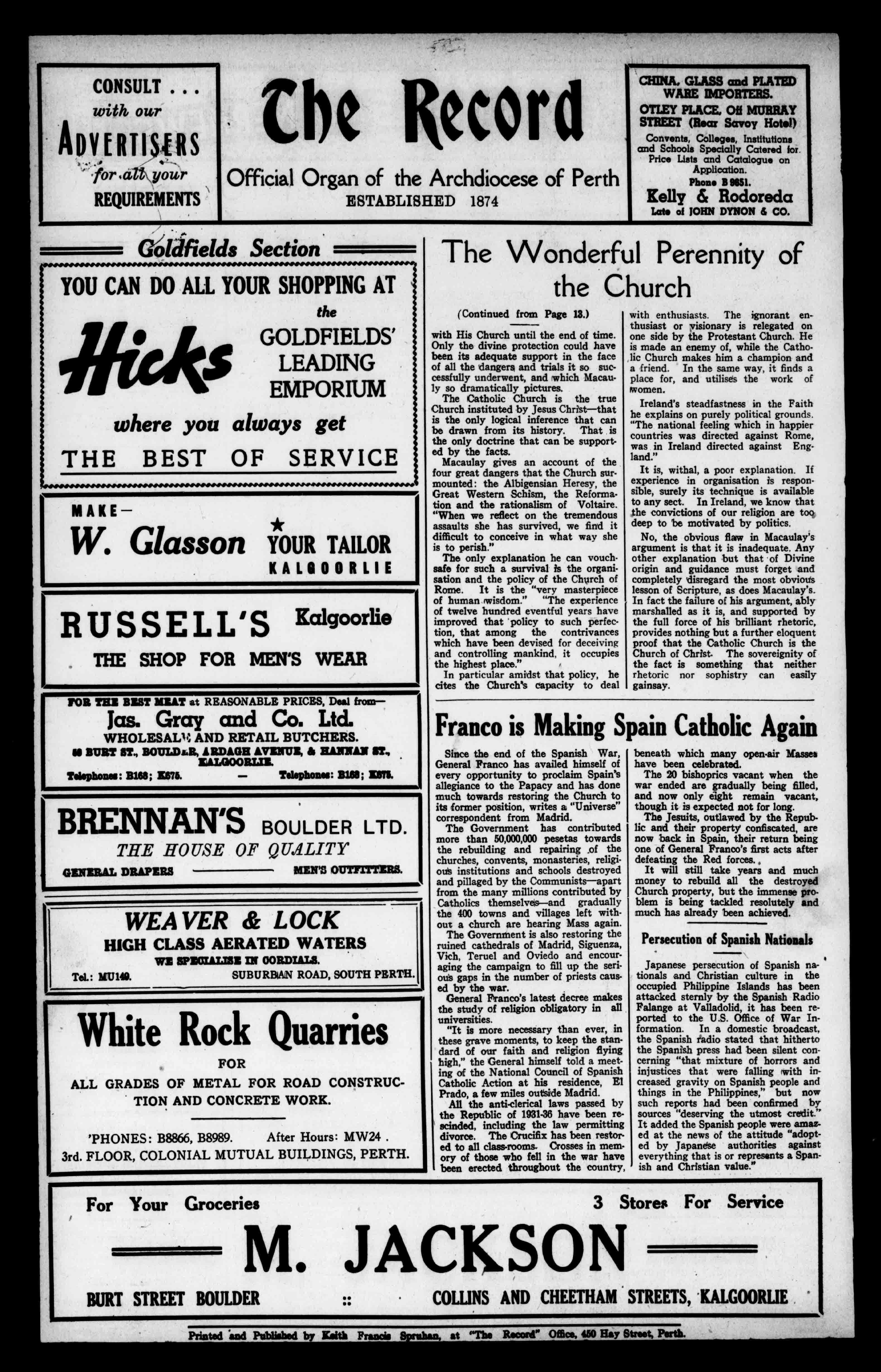
WESPECIAL=INCORDIALS. SUBURBANROAD,SOUTHPERTH.
WhiteRock
Quarries FOR ALLGRADESOFMETALFORROADCONSTRUCTIONANDCONCRETEWORK.
'PHONES:B8866,B8989. AfterHours:MW24 3rd.FLOOR,COLONIALMUTUALBUILDINGS,PERTH.
TheWonderfulPerennityof theChurch
(ContinuedfromPage13.)
withHisChurchuntiltheendoftime. Onlythedivineprotectioncouldhave beenitsadequatesupportintheface ofallthedangersandtrialsitsosuccessfullyunderwent,andwhichMacaulysodramaticallypictures.
TheCatholicChurchisthetrue ChurchinstitutedbyJesusChrist-that istheonlylogicalinferencethatcan bedrawnfromitshistory.Thatis theonlydoctrinethatcanbesupportedbythefacts.
Macaulaygivesanaccountofthe fourgreatdangersthattheChurchsurmounted:theAlbigensianHeresy,the GreatWesternSchism,theReformationandtherationalismofVoltaire. "Whenwereflectonthetremendous assaultsshehassurvived,wefindit difficulttoconceiveinwhatwayshe istoperish."
TheonlyexplanationhecanvouchsafeforsuchasurvivalistheorganisationandthepolicyoftheChurchof Rome.Itisthe"verymasterpiece ofhumanwisdom.""Theexperience oftwelvehundredeventfulyearshave improvedthatpolicytosuchperfection,thatamongthecontrivances whichhavebeendevisedfordeceiving andcontrollingmankind,itoccupies thehighestplace."
Inparticularamidstthatpolicy,he citestheChurch'scapacitytodeal
withenthusiasts.Theignorantenthusiastorvisionaryisrelegatedon onesidebytheProtestantChurch.He ismadeanenemyof,whiletheCatholicChurchmakeshimachampionand afriend.Inthesameway,itfindsa placefor,andutilisestheworkof women.
Ireland'ssteadfastnessintheFaith heexplainsonpurelypoliticalgrounds. "Thenationalfeelingwhichinhappier countrieswasdirectedagainstRome, wasinIrelanddirectedagainstEngland."
Itis,withal,apoorexplanation.If experienceinorganisationisresponsible,surelyitstechniqueisavailable toanysect.InIreland,weknowthat theconvictionsofourreligionaretoo deeptobemotivatedbypolitics.
No,theobviousflawinMacaulay's argumentisthatitisinadequate.Any otherexplanationbutthatofDivine originandguidancemustforgetand completelydisregardthemostobvious lessonofScripture,asdoesMacaulay's. Infactthefailureofhisargument,ably marshalledasitis,andsupportedby thefullforceofhisbrilliantrhetoric, providesnothingbutafurthereloquent proofthattheCatholicChurchisthe ChurchofChrist.Thesovereignityof thefactissomethingthatneither rhetoricnorsophistrycaneasily gainsay.
FrancoisMakingSpainCatholicAgain
SincetheendoftheSpanishWar, GeneralFrancohasavailedhimselfof everyopportunitytoproclaimSpain's allegiancetothePapacyandhasdone muchtowardsrestoringtheChurchto itsformerposition,writesa"Universe" correspondentfromMadrid.
TheGovernmenthascontributed morethan50,000,000pesetastowards therebuildingandrepairing.ofthe churches,convents,monasteries,religioutinstitutionsandschoolsdestroyed andpillagedbytheCommunists-apart fromthemanymillionscontributedby Catholicsthemselves-andgradually the400townsandvillagesleftwithoutachurcharehearingMassagain.
TheGovernmentisalsorestoringthe ruinedcathedralsofMadrid,Siguenza, Vich,TeruelandOviedoandencouragingthecampaigntofilluptheseriousgapsinthenumberofpriestscausedbythewar.
GeneralFranco'slatestdecreemakes thestudyofreligionobligatoryinall universities.
"Itismorenecessarythanever,in thesegravemoments,tokeepthestandardofourfaithandreligionflying high,"theGeneralhimselftoldameetingoftheNationalCouncilofSpanish CatholicActionathisresidence,El Prado,afewmilesoutsideMadrid.
Alltheanti-clericallawspassedby theRepublicof1931-36havebeenrescinded,includingthelawpermitting divorce.TheCrucifixhasbeenrestoredtoallclass-rooms.Crossesinmemoryofthosewhofellinthewarhave beenerectedthroughoutthecountry,
beneathwhichmanyopen-airMasses havebeencelebrated.
The20bishopricsvacantwhenthe warendedaregraduallybeingfilled, andnowonlyeightremainvacant, thoughitisexpectednotforlong.
TheJesuits,outlawedbytheRepublicandtheirpropertyconfiscated,are nowbackinSpain,theirreturnbeing oneofGeneralFranco'sfirstactsafter defeatingtheRedforces.
Itwillstilltakeyearsandmuch moneytorebuildallthedestroyed Churchproperty,buttheimmenseproblemisbeingtackledresolutelyand muchhasalreadybeenachieved.
PersecutionofSpanishNationals
JapanesepersecutionofSpanishnationalsandChristiancultureinthe occupiedPhilippineIslandshasbeen attackedsternlybytheSpanishRadio FalangeatValladolid,ithasbeenreportedtotheU.S.OfficeofWarInformation.Inadomesticbroadcast, theSpanishradiostatedthathitherto theSpanishpresshadbeensilentconcerning"thatmixtureofhorrorsand injusticesthatwerefallingwithincreasedgravityonSpanishpeopleand thingsinthePhilippines,"butnow suchreportshadbeenconfirmedby sources"deservingtheutmostcredit." ItaddedtheSpanishpeoplewereamazedatthenewsoftheattitude"adoptedbyJapaneseauthoritiesagainst everythingthatisorrepresentsaSpanishandChristianvalue."
Tel:MU149. CONSULT withour ADVERTISERS for.ali\your REQUIREMENTS CbeRecord OfficialOrganoftheArchdioceseofPerth ESTABLISHED1874 CHINA.GLASSandPLATED WAREIMPORTERS. OTLEYPLACE,OffMURRAY STREET(RoarSavoyHato') Convents,Colleges,Institutions OrdSchoolsSpeciallyCateredfor. PriceListsandCatalogueon Application. PhoneB9851. Kelly&Rodoreda LateofJOHNDYNON&CO. GoldfieldsSection YOUCANDOALLYOURSHOPPINGAT the . GOLDFIELDS'S LEADING EMPORIUM whereyoualwaysget THEBESTOFSERVICE MAKEW.GlassonYOURTAILOR KALGOORLIE RUSSELL'SKalgoorlie THESHOPFORMEN'SWEAR TORTEERESTMEATatREASONABLEPRICES,DealfromJas.GrayandCo.Ltd. WHOLESAL'ANDRETAILBUTCHERS. IISUETST.,BOITLDLR,LRDAGRAVENUE,&HANNANST., =LOOM= Telephones:3168;E676. - Telephones:RIM;KOTA BRENNAN'SBOULDERLTD. THEHOUSEOFQUJLITY GENERALDRAPERS MEN'SOUTFITTERS. WEAVER&LOCK HIGHCLASSAERATEDWATERS
ForYourGroceries 3StoresForService M.JACKSON BURTSTREETBOULDER COLLINSANDCHEETHAMSTREETS,KALGOORUE PrintedandPublishedbyKeithFrancis at"TheRecord"Office,460HayStreet,Perth.