ELLIOTT ELLIOTT
OPTICIANS
,feADILLY44f, 0MTH40t
Johnflliolfmsr.
Ex-WarislBros: Siudeni Tel.B7988
OPTICIANS
PiccadillyArcade
Perth Tel.B7488
WhyWeUseSacramentalsandHow TheyDifferfromSacraments.
*WhatisMeantby"Blessing"
CreatedThingsareMeanttoHelp UsSaveOurSouls
ByF.L.FILAS,S.J.
Youprobablyhaveheardofthe blessingofautomobilesandoffishingboats,butdidyouknowthatthe Churchalsoprovidesblessingsfora widevarietyofobjects,sodiverseas radios,blast-furnaces,typewriters,firefightingapparatus,andsilkworms?If anon-Catholicfriendweretoaskyou atthisverymomenttoexplainina generalwaytheeffectsoftheseand otherblessingsoftheChurch,could youdoso?Orcouldyoushowhim whytheuseofblessedarticlesisnot asuperttition?
Theanswerstoallthesequestionslie inacorrectunderstandingofthesacramentals.ThesacramentalsareactionsorobjectswhichtheChurchuses inimitationofthesacramentsinorder toobtainbyitsintercessioncertain specialfavoursfromGod.Originally theword"sacramentals"referredto alltheceremoniesconnectedwiththe administrationofthesacraments,but nowitalsodenotesotherceremonies whichtheChurchhasinstitutedforthe sakeofthepublicandtheprivatedevotionofthefaithful.
Asacramentalisnotasacrament. Thereareseveraldifferences.The sevensacramentswereinstitutedby Christ,butthesacramentalshaveall beeninstitutedbytheChurch.The sacramentsinfalliblyconferbothsanctifyingandspecialgraces,provided thattherecipientplacesnoobstaclein theirway:moreover,thesegracesare giveninvirtueoftheexternalriteof thesacrament.Butthegracesofthe sacramentals,ontheotherhand,dependonourownfaith,ontheperfectionofthegoodintentionswithwhich weusethem,andontheprayerof eChurch.
Howmanysacramentalsexist?The listseemsalmostendless.Thereare thingssetasideexclusivelyforthe serviceofGod,'suchasaconsecrated churchbuilding,analtar,orachalice; andthereareactionsbywhichthe
hurchasksGodtoblessobjectswe useineverydaylifeorinthereligious serviceweoweHim,suchasourautomobilesandourhomes,ourrosaries andholywater.Alltheceremonies oftheMass(excepttheConsecration itself)aresacramentals;soarethe MinorOrderswhichtheChurchconfersonherministersbeforetheyare ordaineddeaconsandpriestsinthe sacramentofHolyOrders;soisthe nuptialblessingofthesacramentof Matrimony.
Oneofthemostnoteworthyofthe effectsofthesacramentalsistheir powertodriveawayevilspirits.Thus, notinfrequentlythesprinklingofholy wateronadyingpertongiveshim peacefrompainfuldoubtsandtemp. tationsandrestlessness.Thisisnot amerepiousbelief;itisafactwell confirmedbyexperience,Anothereffectofthesacramentalsistheindirectremissionofvenialsinsandthe forgivenessofthetemporalpunishment duetosuchsins.Finally,asweshall see,later,thesacramentalsareused inordertoobtaintemporalfavours, suchasprotectionfromfires,floods, andotherdisasters:forthepreservationofcrops,therestorationofhealth, thesuccessfuloperationofmachinery, andahostofotherpurposes.
Thesacramentalswhichusually arousethemostcuriosityamongnonCatholicsarethevariousblessingsand theuseofblessedarticleswhichareapprovedbytheChurch.Thereisadangerherethatbecauseweusetheword "bless"sooften,wemaylosesightof itsmeaning.AskanyCatholicthe differencebetweenholywaterand plainwater,andhewilltellyou,"Well, holywaterisblessed."Butaskhim whathemeansbyblessedwaterand ablessing,andinmostcaseshewill atbestbeabletogiveyouonlyavery vagueexplanation.Heknowsthat theSignoftheCrossismadeoveran objectandmakesithOly,buthecannot.describewhatreallyhappens.
"Whyseekyouthelivingwiththe Briefly,then,ablessinginvokes-thatit,itofficiallycallsdown-God's favouruponapersonorthing.Itcan begivenonlybyasacredministerwho hasbeengrantedthispowerbythe Church,TheChurchinitsturn grantsthispowerbyreasonofthe authorityithasreceivedfromGod. Therearetwokindsofblessings. One"setsaside"orconsecratesapersonorthingtotheserviceofGad.It makesitsrecipientholy.inthesenseof beingdedicatedexclusivelytothewor-
dead?Heisnothere,butisrisen." shipofGod.Clerics(thatis,those destinedforthepriesthood),members ofReligiousOrdersandCongregations, churches,Massvestments,andaltar cloths,allareblessedinthismanner.
Thesecondtypeofblessinginstead ofconsecratingitsrecipienttodivine serviceisasolemnprayerofthe ChurchthatcallsonGodtoconfer somespiritualoftemporalfavouron thepersonwhoisblessed.But,you ask,isn'tthiskindofblessinggiven
(ContinuedonBackCover.)
ReristftredattheG.P.O.,Perth,fortransmissionbypostasanewspaper.
Variousavocationsinlifehave beenhallowedbySaints
WhoisYourPatron?
OrphansandAbandonedChildrenST.JEROMEEMILIANI (July20,(A-D.1.537).
Borntowardsthecloseofthe15th. century,*St.Jeromebecameasoldier oftheVenetianRepublicandfellinto thelooselifeofthecamps.AsaprisonerofwarhewasturnedtoGodand sanctifiedhissufferingsbyprayer. Afteranapparentlymiraculousescape, hestudiedforthePriesthoodandwas ordained.Henceforthhegavehimselfuptocharitableworks,notablythe reliefoffamiliesstrickenbyfamine andplague,andtothecareoforphans, incurablesandpenitentprostitutes. Laterhebecamefounderofareligious congregationformen,calledtheSom.aschi,whichlwastodevotedtothe instructionofyouthandofyoung clerics.St.Jeromediedin1537,was canonisedin1767,andnamedpatron saintoforphansandabandonedchildrenby'PopePiusXI.in1928.
Sailors-ST.ZRASKUS (June2,A.D.303).
St.Erasmus(orSt.Elmo)isthe patronsaintofsailors.Helivedsomewhereaboutthethirdcentury,and wasmartyredbytheEmperorinthe RomanprovinceofIllyricum.Subjectedtofearfultortures,hewasrescuedandbroughttoFormiae(where hewasBishop)byanangel,andthere hediedofhiSwounds.
ByNeopolitansailorsthebluelight sometimesseenatmastheadsbefore andafterstormsiscalled"St,Elmo's Fire,"andisreckonedasasignof theirpatron'sprotection.
HisfeastdayoccursonJune2nd.
SailorsandChlldren-ST.NICHOLAS OFMYRA (December6,aboutA.D.342),
St.NicholaswasBishopofMyrain thefourthcentury,andhisrelics, stolenbyItalianmerchantsin1087, nowrestatBari.Therearemany legendsconnectedwithSt.Nicholas, andfromthesehasarisenthecustom ofgivingpresentsunderhisnameof SantaClaus.
Heispatronofchildren,becausehe isreputedtohavebeenveryfondof themduringhislifetime,andalsoof sailors,whousedtoinvokehisaidduringdangerousstorms.
St.Nicholas'feastdayiscelebrated onDecember6th.
BlacksmithsinvokeST.GILES (September1st.,aboutAD.712).
ProbablyaProvincialandAbbotof amonasteryontheRhone,thisSaint wasverypopularintheMiddleAges, andmanylegendsgrewuparoundhis life.Over160churcheswerededicatedinhishonourinEnglandbefore theReformation,andhewasinvoked alsoaspatronofcripplesandbeggars.
BakersandMillersinvokeST.MEINGOLD
(February8th.,aboutA.D.892).
Agreatdealofdoubtsurroundsthe lifeanddeathofthismartyr,buthe appearstohavebeenaCountofHuy inBelgiumwho,aftermanyyearsof feudsandquarrels,didsevenyearsof penanceandpilgrimageinreparation, Intheendhewaskilledbysomeof hisold-timeenemies.HeisalsoinvokedaspatronofMillers.
Bell-FoundersinvokeST.AGATHA (February5th,,aboutA.D.251).
Thisvirginmartyr'suffereddeathin Sicilyaftershehadtriumphedover manyassaultsagainstherpurity.She issaidtohaveenduredterribletorturesandshewaswidelyvenerated intheearlyChurch.
ConfectionsandBakersST.HONORATUS (May16,600).
HegivesthenamestotheFaubourg andRueSt.Honori,inParis,butlittle isknownofhimexceptthathewas BishopofAmiens,InFranceheis regardedasthepatronofalltrades thatdealinflour.
CabDrivers-ST.FIACRE (August90,670).
HewasahermitinIrelandwho wentovertoFrance,wherehelived, greatlyreveredbythepeople,forthe restofhislife.St.Fiacre'sshrineat Seine-et-Marneisstillresortedto,and heisinvokedagainstallsortsofphysicalills.Inadditionheisthepatron ofgardenersandcab-drivers.The Frenchwordforcab,"fiacre,"isderivedfromhisname.
ClothPullers-ST.MAURA (September21,850), Shewasamaidenwhopassedher lifeinprayerandgoodworks,living inherownhomeatTroyes,whereshe diedwhilestillyoung.
BrughThakers-ST.ANTHONY (January17,A.D.356).
Hewasthepatriarchofallmonks, andestablishedcommunitiesofhermitsinthedesert.Hediedatthe ageof105,and,inspiteoftheausterityofhislife,neversufferedsickness. Ileenjoyedagreatpopularityinthe East.
Comedians-ST.VITUS (June15,300AZ).
St.Vitusisalsoinvokedagainst epilepsy,storms,snake-bite,andallin-* juriescausedbyanimals,soheenjoys awidepopularity.Hewastheonly sonofarichpaganofSicily,andbecameconvertedtoChristianityatan earlyage.Heperformednumerous miracles,accordingtolegend,andfinallymethisdeathatthehandsofthe EmperorDiocletian.
TheColonialMutualFireInsurance COMPANYLIMITED.
FORALLCLASSESOFINSURANCE,INCLUDINGFIRE,HOUSEOWNER,andHOUSEHOLDER'SCOMPREHENSIVE,BURGLARY, PLATEGLASS,MOTORVEHICLE,CROPS,FIDELITY,GUARANTEE,WORKMEN'SCOMPENSATION,THIRDPARTY. NO.33BARRACKSTREET,PERTH. W.L.CARTER,ManagerPrintingHousesofA.D.
ServingAllColleges'PrintingRequirements. TelephoneB9901(3lines) Res.U2389
"HEISRISENASHESAID."
KALGOORLIE
DeathofMrs.J.L.Sullivan.
Thesympathyofallparishionersis extendedtoMr.ThomasJ.Sullivan (husband),Rev.Dr.Sullivan(sonI, andMrs.C.McCarthy(daughter,in thesadIdestheysustainedwhenMrs JohannahL.Sullivanpassedawayrecently, St.Mary'sChurchwascrowdedon FridaymorningwhenSolemnRequieni Masswasofferedforthereposeofthe soulofthedeceasedlady.Rev. FatherByrnewasthecelebrant,with Rev,FatherCunninghamasdeacon andRev.FatherRussel'sub-deacon. Rev.FatherCarolanwasmasterof ceremonies.Alsopresentinthe sanctuarywereRev.FathersCarmody, Philbin,Nolan,andMcCarthy,The Masswassungbyacombinedchil dren'schoir.AtthegravesideRevFatherCarolanofficiated,assistedby theotherpriests.
RequiemMasses.
RequiemMasseswerecelebratedalmostdailylastweek.Amongthose ofthedistictcalledtotheireternal rewardwere:Messrs.Kierse,Scott,J. LongandMeade,allwellandfavourablyknownatSt.Mary's. Personal JosephineandPatricia,thedaughtersofMr.andMrs.L,A.Ryan,are lookingwellafterspendingamostenjoyablemonthastheguestsofthe BantingfamilyatBunbury.
H.A.C.B.S.
St.Anthony'sBranch,Midland Junction.
Averysuccessfulandwellattended meetingoftheabovehratichwasheld intheSchoolRoomonWednesday, March22,1944. Rev.FatherLynch paidhisfirstvisittothebranchand waswarmlywelcomedbyourworthy president.Wehopewewilloftenhave thepleasureofthecompanyofFather LynchorFatherLeechatfuturemeetings,Otherverywelcomevisitors wereformersecretary,JohnnyWale, andhiswife.Johnisonleavefrom thestrenuouslifeofthearmy,which apArentlyagreeswithhimverywell. Heenjoyedmeetingallhis(rendsand thankedthemverymuchforhisXmas parcel.Healsobroughtmessagesof greetingfromothermembersofthe
North. Averypleasingfeatureof theeveningwastheinitiationoftiwelve newmembers.Thisaugurswellfor thefutureofthebranch,andallnewcomersweremadeverywelcome.
Attheconclusionofthebusinessof themeetingthefirstroundofthecard competitionwasplayed,whileother membersenteredheartilyintothe manygamesandamusementsprovided fortheirentertainment.
St.Malachi'sBranch,Highgate.
AtthemeetingonWednesday,22nd. inst.,Mrs.I.M.RyanandMr.L.R. ONeillwereadmittedandwelcomed. ThequarterlyCommunionwillbeheld onSunday,April23,atthe8o'clock Mass.Afterthemeetingthemembershadanenjoyablenightatbadmintonandtabiletennis.
O. 1111..1.1.
BESTQUALITY CelluloidCovered Buttons
withpinatback, 7-8inchdiameter.
No.6611-LITTLEFLOWEROFROSES(Sepia).
No.6617-SACREDHEART(Coloured).
No.6618-SACREDHEART(Sepia).
No.6601-ST.ROCH(Sepia).
No.6614-OURLADYOFPERPETUALSl7OCOUR(Sepia).
No.6615-ST.JOSEPH(Sepia).
No.6616-ST.JUDE(Sepia).
Price2d.each,1/10dozen
Pellegrini4CO.Pty.Ltd.
776HAYSTREET,PERTH (Opp.FoyandGibson).
ammulummomminuouveutwimmummilmitift
TWO THERECORD Wednesday,April5,Mt
ServicePrintingCo. CITYANDSURBURBANPKINTINGCO LINOCRAFTPOSTERSTUDIOS.
SCOTT FORFINEPRINTING
RAINBOWHOUSE.183-7HAYST.(EAST)FIRM
'Vat6iernaresiandRhapsodies...
AdvantagesofConvictismtoPublicWorks
AdventurousReturnTrip RoundtheTopofAustralia
Anativetribewhichfavouredsilverplate
ByREV.J.W.DOYLE,S.J.
TheWanstedsetoutforHobart TownonMarch19,afteraseven-week stay,"ourpartyconsistingofthose settlersfromVanDieman'sLand, whosecuriosityhidledthemtoseethe firstformationofthecolony some oftheSwanRiversettlers(likethe Hentybrothers),whosemeansallowed themtogetaway,andthosepassengersfromEnglandwhowereanxious tofinishtheirtediousvoyage."The firstpaintedarosypictureofVanDieman'sLand:"theydweltonthebeauty herscenery,andthecharmsofher climate,tillsheappearedlikeafabled elysium.Herewerethemountains, whosetopscouldpasturetenthousand sheep,kwhilst"hervalleysstoodso thickwithcorn,thattheylaughedand sang.'Herswastheriverteeming withlife,andonwhosebosomthe monsterofthedeepcouldsportand play:hersummerwasnotoppressive. lyhot,andyetherwintrygarbwas green.Herswasinshortaspot,on whichNatureinsportivemoodhad lavishedherbest,herchoicest,her mostappdsitegifts.Butmanwas there,thecultivatorofhersoil,debasedandshackledbyhiscrimes,aninvoluntaryservanttohisfellow-man: foritwasapenalcolony!"
"Thatgreatadvantagemustariseto acommunitywherethereareservants forpublicworksissoclear,thatit needsnotamoment'sreflection;and hadtheGovernoroftheSwanRiver Settlement,immediatelyonhisarrival, hadsomehundredsofthesemento makeroads,erectbuildings,andgo onexploringparties,theywouldhave beenfoundofincalculableutility.Indeeditisdifficulttoimaginehowa Governoristoactintheformationof anewcolonywithoutsomesuchaid.
Butsuchpersonsbeingallowedadmissionintoeveryprivatefamily,as inVanDieman'sLand,appearsanevil ofthemostextensivemagnitude.
"Thestateofthecolony,fromthe practicesoftheseconvictservants,was notIthinkfullyknowninEngland,or itneverwouldhavebeencontemplatedtosendoutyoungwomen(there calledfreewomen)asservants. Theconvictsmakeitaruletoannoy thefreeservantsineverywayintheir power,unless,indeed,theywillconniveatorleaguewiththeminthedestructionoftheirmasters'property...
**Theonlyway,therefore,appearsto betohaveeitherallbond,orallfree: lettheconvictsheconfinedtothepublicworks,andfreesentoutinsufi. cientnumberstosupplyfamilieswith alltheyrequire.Thegreatobjection sothis,Iknow,istheheavyexpense; butthepoorwhohavenotcommitted crimearemoredeservingofthatexpense,heavythoughitbe,thanthose whohave;and.werethisarrangement fullyestablished,numberswouldbe foundtoembraceit,whowouldbe thankfulfortheopportunitythisaffordedthemofgainingtheirlivingin sofineacountryandclimate."
Andindeeditwasafinecountryand climate."TheislandofVanDieman's Land.anditscapital,HobartTown.
("Itisconsideredmorefashionable towriteandpronouncethenameof itscapitalHobarton!"),itsbeautiful riverDerwentanditsverdantbanks, hadbeentoomuchcanvassedduring thevoyageforanyofthepartytofeel theleastsurprisedatwhattheysaw: therewas,therefore,noexclamation ofdelightaswesaileduptheriver, thoughtherewouldhavebeenofdisappointmenthadnottheirexpecta-
tionsbeenfullyanswered."Thefabled elysiumwasnofableafterall!"Enjoying,aswedid,abrightclearatmosphereandwarmclimate,andseeingon theshoreverdantfieldsandtreesin fullleaf,itwasimpossiblenottoexclaim,'This-thisiswinter!'"
TheyanchoredonApril11,three weeksoutfromFremantleandeight monthsfromPortsmouth;andas "therewasnorespectablelodgingor boarding-houseinHobartTown,"the captaindecided,"assoonashisship wasclearofpassengers,tomakeitas comfortableaspossible,forthepermanentabodeofhiswifeandhimself duringtheirstayintheriver"-two months-andMissRoberts,obliged (shedoesnotsaywhy)toreturnto England,stavedwiththem,dreading thevoyageback.
"Thechargeforlivingatthehotelis somuchahead,aboutthesameas inEngland;butthesupplywasso over-abundantthat,hadweremained anytimeonshore,weshouldhavereducedtheexpensebyorderinghalf thequantity,whichwouldthenhave beenanampleprovision.Fishisexceedinglygoodandplentiful.(But letusforgetthat,asDr.Rossrelates: "Somefishwhichhadbeencarelessly exposedtothemoonlightrenderseveraloftheinhabitantsofHobartTown illforseveraldays.Fishshouldnever beexposedtothemoon'srays."-Jan., 1835.)Meatandvegetablesaswith us(inFremantletherehadbeenno vegetables,andmeat,bothfreshand salt,wasalmostaluxury);winecan behadatallprices;andporterfrom England,nottheworseforthevoyage.Theyalsomakeaporterthemselves,ofaverypleasanttaste,but withoutthestrengthofthatfromEngland(apparentlypopular,too;forin 1836therewere10breweriesinHobart TownandtwoinLaunceston-notto mentionadistilleryandasnufffactoryinthecapital!)
"Fruitisinverygreatabundance, consideringthelittlecareandattentionthatispaidtoitsrearing.They boastofthebeauty,goodness,and great-varietyoftheirapples(which theyusedtoexchangeforNewSouth Welshoranges-thefirstAppleTrips!) Fruitandflowersweresenttousdaily onboard,allproducedintheopenair. andwithbutlittlecareincultivation."
ThissoundsalmostlikeMadieraagain: nowonderthatMissRobertsfound theprospectofthevoyagesotrulyappallingthatattimesshe"completely sankunderthedreadofit."Andit wastoheatryingvoyage4thoughwe canbutsketchithere.
HomewardSound.
TheymadeforTorresStraits,withouttouchingatSydney,TheyanchoredintheStraits,buttheWansteadbrokelooseinthenight:"The captain'swifeandmyselfimmediately arose,and,scarcelyexchangingaword, placedourselvesclosetotheopen cuddywindows,andheldfastbythe window-frames:inthissituationwe wereenabledtoyieldtotheship'smotion,and,atthesametime,hadafirm graspagainsttheexpectedshock." Buttherewashappilynoshock,and nextdaytheyanchoredsafelyatHalfwayIsland;whichMissRobertssketchesanddescribesindetail.Onagain, andtheymetaconvoyoutfromSydney,whoconsideredtheircaptain"the boldestmanalive"forattemptingthe passageoftheStraitsalone,"andnot onlyaboldbutaluckyman"forcomingthroughsafe.Copangnext;where theywereentertainedbytheminister. Fromnowonthejournaldealsmore withtheconversionofthepagan;
thoughthereisthisnaiveapology."I hadeverconsideredtheconversionof theheathenasubjectofthedeepest interest,but,Imustconfess,Inever foundthegratificationexperiencedby manyinthedetailofit'sproceedings; thestyleandlanguageofsuchbooks asImetwithgenerallyleadingmeto abandonthem,althoughIwishedwell tothecauseofwhichtheytreated, Thisacknowledgment,Iamaware,, willbethoughtfastidious,anditis certainlyalittlelikepassingone's friendoracquaintance,onaccountof hisdressorappearance,aweakness ofwhichmanyareguilty,butfewlike toavow."
Thentheymetawhalerindifficulties.andgavethemasterachronometer:"hewasold,andhiswhitehair plainlysaiditwastimecalmdomestic easeshouldbehis,ratherthanthecontentionoftheboisterousdeep. Thisoldman'ssituationwasrendered stillmoredistressingbytheinsubordinationofhiscrew,who,becausethey hadbeenunsuccessfulintheirfishing, grewdiscontentedandalmostmutinous.. Whenthechronometerwas reallyplacedinhishands,Ithought hewouldhavedropped,completely overpoweredbyfeelingsofgratitude forsounexpectedadeliverance."
OnthentoSingapore,where,asthere wasnocargotobegot,theystayed butadayortwo.Stormsdrovethem ontoPuloPetiang:"Thewind,the powerful,mightywind,hadshakenall myfanciedcourage,andmyalmost onlyprayerhadbeen:'Oh,comenot injudgment!'"Still,/nocargo:so callsatthePediercoaskandtheCar Nicobarisilands-iyheretheymeta tribethatusedsilverforksandspoons, andtradedcocoanutsforplate:or rather,astheyinsisted,theymadethe captainapresentofcocoanuts,and hemadethemapresentofthesilver!
Rangoonnext;wheretheywentto seeMr.Tudson,"sowellknownforhis zealandgoodnessintheconversionof theheathentotheProtestantfaith, andhisgreatnessinextensivebiblical researchandtranslation. ." The glimmerofthelampinthesombre apartmenttoldusthatitwastimeto takeourleave,whichwedid;butthe captainexpressedahopethatwe shouldmeetagain,sayingsomething aboutitbeingnecessaryforustobe onshoreafewdayswhilsttheship 'dischargedhercargoofcocoanuts,and wasbeingcleansed.Iheardthiswith fear,amountingalmosttohorror.for tobearthosefrightfulhatsinthe roomatnightseemedimpossible;and theannoyanceofthemosquitoesquite vanishedbeforemeasathingofminor importanceincomparison-somuch doestheapproachofagreatevillessenasmalleroneinourimagination." However,thingsturnedoutwell;for theBritishResidentofferedthemthe shelterof"thelargestandbesthouse inRangoon."
Sailingfor.Calcutta,theWanstead ranaground:sothatshehadtoundergoextensiverepairs,Thecaptain, by"constantpersonalattendanceat thedocks,'managedtoreducethecost fromtheestimated£1,000tof800.The CathedralMissRobertsfound"ingeneralveryfullyattended:butwewere assuredthatthereweremanyEnglish residentswhoneverenteredachurch atall;indeed,thattilllatterly,itwas notconsideredfashionable;butthat LadeWrn.Rentinckhadgivenabettertonetosociety. ."
Manyotherthingsshetells;butwe mustseeherhomeassoonaswemay. "Theshipwasnowinreadinessfor ourdepartureforEngland:afewpas-
sengersandahundredinvalidsoldiers werereceivedintothesteeragepart, andaladyandherchildintothe cabin.Inadditiontothestrangelookingadjutant(bird),wehadanelephantonboard,whichhugeanimal, andthewaterrequiredforitsconsumption,Igreatlyfearedwouldpreventoursailingaswellaswehad donebefore;butanxietyanddread werealikeunavailing:wewenton hoard,andinafewdaysafterwards proceededonourpassage."
Therewasa terrifyinglanding throughthesurfatMadras;when"I fortifiedmymindwiththereflection thatIhadnothingtoregret;thatif itpleasedtheGreatGiverofmylife thentotakeit,Iknow'inwhomI trusted,'andhowmomentary,how slight,wouldbemysufferings,incomparisonwiththoseIhadalreadyexperienced,"Shewasthinking,too,I amsure,ofawidowtheyhadmetat SwanRiver,whosehusbandand daughterhadperishedinsuchasurf attheCape;andperhaps,afterall,she hadeversolittletoregret."Iwas sorrytohearthatourvesselhadconcealedagreatportionoftheprohibited (Burmese)silver,asIfearedsomeunfortunatediscoverymightleadtoannos'anceanddetention."Andthere wasanotherpieceofsmuggling-also fromBurma-inwhichshewasmore deeplyimplicated:thecaptainhad securedthreebeautifulengravedcups whichwere'forbiddentobecarried outofthecountry;butcaptainsof vesselsknowhowtomanagethese things.'Even,itseems,captainswho weremostattentivetothebodilyand ,spiritualcareofpassenger's'andcrew, andreadthechurchserviceeverySunday.
Theyweretotakeonwateratthe Cape;andlandoneoftheirpassengerstoseehersister,whomshehad notseensincetheyhadleftEngland fourteenyearsbefore.Butitwastoo rough.Theybeataboutthreedays, withoutbeingabletogetin;andto easetheshipinthestorm,someofthe waterkegshadtobethrownoverboard,sotheywereonshortallowance untiltheyreachedSt.Helena.Two menwerelost:oneofthesicksoldiers felloverboard,wasrescued,butdied oftheshock;andafewdaysafter. whetherfromgrieforshock,hisfriend diedtoo,and,likehim,wasburiedat sea-AtSt,Helenatheysaw"the roomtohavebeenpacedbyNapoleon convertedintoashopforthe saleofafewpin-cushions!"
AfterSt.Helena,Ascension,where theytookinturtle-andwhereMiss Robertsdidnotgoonshore,asshe heard"therewasadifficultyasto landingconveniently."
Andthen,withoutfurtherstoppage ordelay,England.
Whatanexcitingvoyageithadbeen. Whatplacestheyhadvisited-places ofpromiseandplacesofdespair.And whataninterestingaccountshehas leftusofhertwoyearsatsea,this braveandadventurouslady,She goessketch-bookinhandfromPortsmouthtotheCape,fromtheCapeto thenewcoloniesintheEast,from HobartTowntothemysteriousorient, hackdownaroundtheCape,andso home.
Andifheurgedthatthisisbuta garblingofheraccount,ahotch-potch fromoddplaces,Icannotevenplead herplea,"that,ifmyreadersexperienceasdeepaninterestinitsperusal asIhavedoneinitsarrangement,I mayanticipatethepleasureofseeing myworkpaosthroughfutureeditions."
Wednesday,April5,1944. THERECORD THUI
YellowCabs RepairsAllMake! ofCars or HydraulicGreasingLift DucoExperts AGOODJOBATAFAIRPRICE ALLREPAIRSUNDERFOREMAN'SPERSONALSUPERVISION. LENHOPE,Foreman. W.R.MADDEFORD,Manwit.
GoldenJubileeatSt.Brigid's
SolemnHighMass
PAPALBLESSING.
OnSt.Patrick'sDaywascelebrated theGoldenJubileeofMotherAquin, SuperiorofSt.Brigid'sConvent,West Perth.Thecelebrationswereimposing,asltwastheoccasionthatcalled themforth.
HighMass-a.VotiveMassinhonour ofSt.ThomasAquinas-wasanticipatedbyoneday,thus.Thursday,March 16,witnessedalargeassemblyofthe clergyinSt.Brigid'sChurch.His GracetheArchbishoppresidedinthe sanctuary;BishopRaibleandMonsignoriFagan,V.G.,andMoloney,V.F., werealsopresent.Rev.FatherP. kcltihe;-wascelebrant,withRev. FathersO'ConnorandDonnellyas deaconandsub-deacon.TheMass wasdevotionallysungbythecombinedschools'choir,accompaniedunthe organbyMissT.O'Connor.The preacherwasRev.FatherW.Fergusson,U.SS.R.,aformerpupilofSt. Brigid's.
FatherFergussontookashistext: "Beholdwehaveleftallthingsand followedThee."Hebroughttheminds ofhisaudiencebacktoSt.Patrick's Day,fiftyyearsago,tovisualisea sceneintheConventChapel,Victoria Square,whenMotherAquinpronouncedhertriplevow'sandpledgedherself tolabour,untildeath,asaSisterof Mercy,intheserviceofthepoor,sick andignorant.Thepreacherlaidstress onthehardshipsofthoseearly,pioneeringdaysinWestPerth,where MotherAquinwasplacedshortlyafter herProfession.Theworkofthevisitation.overlongstretchesofsand, couldbedoneonlyonfoot,asvehicularmeansoftransportwerenottobe hadfiftyyearsago.ThatMother Aquinkeptfaithfullythecompact madewithherDivineMasteristestifiedbytherichharvestofsoulsshe reaped,throughagentlenessofmannerandsteadfastnessofpurposeallher own.HecongratulatedReverend Motheronthegracesbestowedonher byGod,andontheprivilege=accorded toonlyfew-offulfillingafiftyyears' spanofserviceinthevineyardofthe Lord.Hewishedheryearsoflifeto continuetheworkoftheApostolate, andasafittingconclusion,hereadthe Pope'sBlessing,towhichaugustmessagetheApostolicDelegateaddedhis ownpersonalfelicitations.
ThejuvenilechoirrenderedtheTe Deum,andasHisGraceandtheclergy moveddawnthenaveinprocession, "GodBlessthePope"rangoutinjubilant,exultantnotes.
HisGraceandtheclergywereentertainedatadinnergiveninhonourof theJubilee,atthecloseofwhichthe Archbishoppropcisedavoteofthanks toReverendMotherforherhospitality,andexpressedonhisownbehalf andonthatofthepriestspresent, heartycongratulationsontheattainmentofaGoldenJubilee,andonthe goodworkdonebytheSistersofWest Perth,callingatentiontothefactthat amongtheguestspresentwerethree priestswhowereformerpupilsofSt. Brigid'sSchool.
Themainpartsoftheconventbuildingwereelaboratelydecoratedwith appropriateornateness,andgaveacolourfulandjoyousappearancetoexpressintangibleformwhattheSisters inwardlyfelt.Thechapelwasindeed athingofbeauty,madeattractiveby clustersofpinkamaryllis,arranged withadeftnessofartistryandflawless execution.SolemnBenedictionwas givenintheevening.
5. Booksandmagazinesforthetroop. maybeleftat"TheRecord"Office, 450Hay-street,Perth,fordistribution bytheC.W.O.
RepresentativesofmostoftheReligioushousesofthemetropolitanarea paidpersonalvisitstoextendcongratulationsandgoodwishestotheJubilarian.Musicalprogrammeswerepresentedbythevariousschoolsunder theSisters'care,andaverylarge bodyoftheEx-Students'Association assembledtodohonourtoMother Aquinonthefiftiethanniversaryof herReligiousProfession.TheremarkablefeatureauouttheJubileeisthe tactthatReverendMotherisoneofa
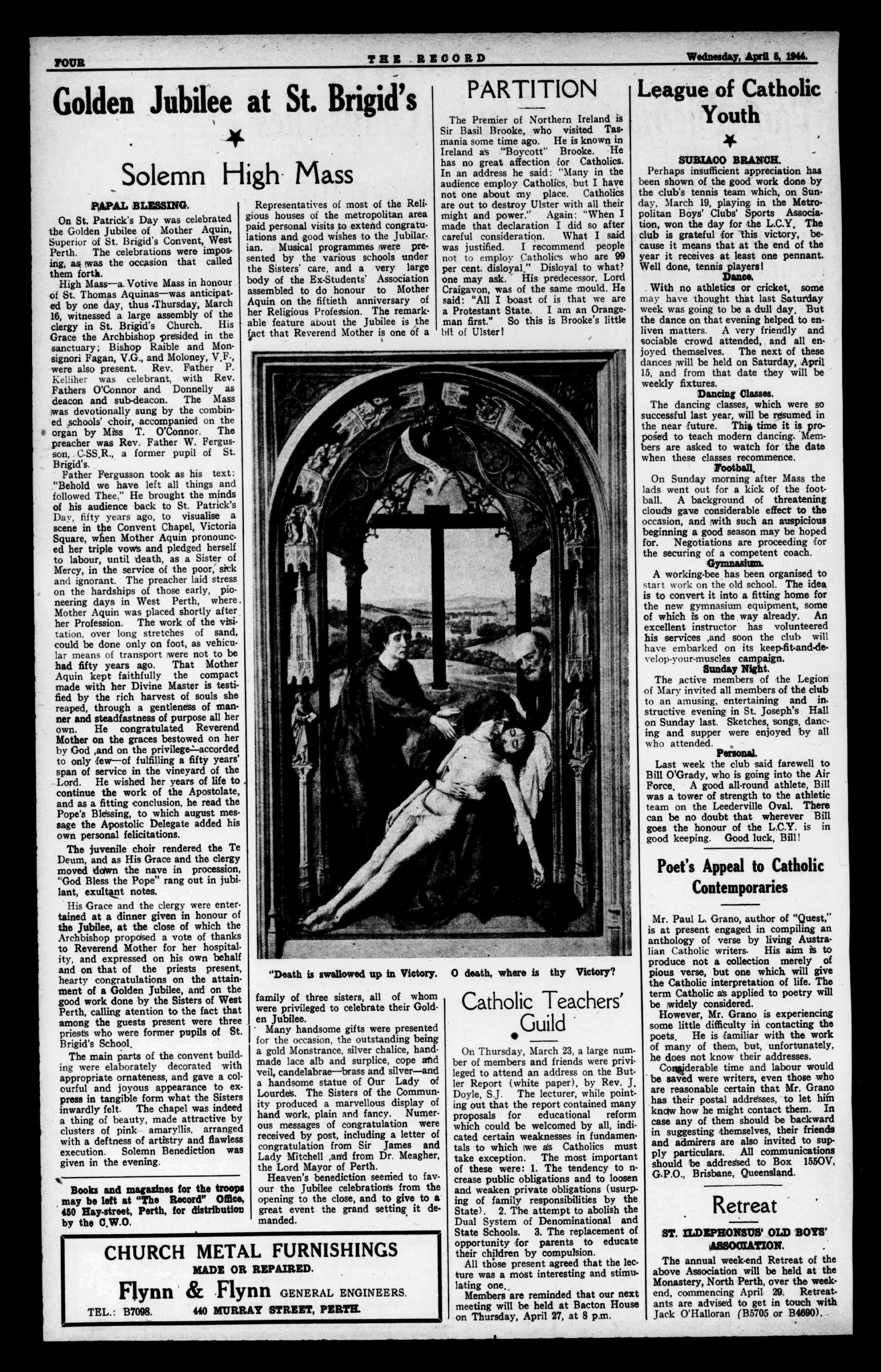
"DeathisswallowedupinVictory. familyofthreesisters,allofwhom wereprivilegedtocelebratetheirGoldenJubilee.
Manyhandsomegiftswerepresented fortheoccasion,theoutstandingbeing agoldMonstrance,silverchalice,handmadelacealbandsurplice,copeand veil,candelabrae--brassandsilver-and ahandsomestatueofOurLadyof Lourdes.TheSistersoftheCommunityproducedamarvellousdisplayof handwork,plainandfancy.Numerousmessagesofcongratulationwere receivedbypost,includingaletterof congratulationfromSirJamesand LadyMitchell,andfromDr.Meagher, theLordMayorofPerth.
Heaven'sbenedictionseemedtofavourtheJubileecelebrationsfromthe openingtotheclose,andtogivetoa greateventthegrandsettingitdemanded.
CHURCHMETALFURNISHINGS
MADEORREPAIRED.
Flynn&FlynnGENERALENGINEERS.
TEL.:B7098. 440MURRAYSTREET,PERTH.
PARTITION
ThePremierofNorthernIrelandis SirI3asilBrooke,whovisitedTasmaniasometimeago.Heisknownin Irelandas"'Boycott"Brooke.He hasnogreataffectionforCatholics. Inanaddresshesaid:"Manyinthe audienceemployCatholics,butIhave notoneaboutmyplace.Catholics areouttodestroyUlsterwithalltheir mightandpower."Again:"WhenI madethatdeclarationIdidsoafter carefulconsideration.WhatIsaid wasjustified.Irecommendpeople nottoemployCatholicswhoare99 percent.disloyal."Disloyaltowhat? onemayask.Hispredecessor,Lord Craigavon,wasofthesamemould,He said:"AllIboastofisthatweare aProtestantState.IamanOrangemanfirst."SothisisBrooke'slittle itofUlster!
LeagueofCatholic Youth
SUBIACOBRANCH.
Perhapsinsufficientappreciationhas beenshownofthegoodworkdoneby theclub'stennisteamwhich,onSunday,March19,playingintheMetropolitanBoys'Clubs'SportsAssociation,wonthedayfortheL.C.Y.The clubisgratefulforthisvictory,becauseitmeansthatattheendofthe yearitreceivesatleastonepennant. Welldone,tennisplayers!
Dance.
Withnoathleticsorcricket,some mayhavethoughtthatlastSaturday weekwasgoingtobeadullday,But thedanceonthateveninghelpedtoenlivenmatters.Averyfriendlyand sociablecrowdattended,andallenjoyedthemselves.Thenextofthese danceswillbeheldonSaturday,April 15,andfromthatdatetheywillbe weeklyfixtures.
DancingClasses.
Thedancingclasses,whichwereso successfullastyear,willberesumedin thenearfuture.Thietimeitispropoedtoteachmoderndancing.Membersareaskedtowatchforthedate whentheseclassesrecommence.
Football,
OnSundaymorningafterMassthe ladswentoutforakickofthefootball.Abackgroundofthreatening cloudsgaveconsiderableeffecttothe occasion,andwithsuchanauspicious beginningagoodseasonmaybehoped for.Negotiationsareproceedingfor thesecuringofacompetentcoach. Gymnasium.
Aworking-beehasbeenorganisedto tart,corkontheoldschool.Theidea istoconvertitintoafittinghomefor thenewgymnasiumequipment,some ofwhichisonthewayalready.An excellentinstructorhasvolunteered hisservicesAndsoontheclubwill haveembarkedonitskeep-fit-and-develop-your-musclescampaign.
SundayNight.
Theactivemembersof ofMaryinvitedallmembersoftheclub toanamusing,entertainingandinstructiveeveninginSt.Joseph'sHall onSundaylast.Sketches,songs,dancingandsupperwereenjoyedbyall whoattended.
Personal.
Lastweektheclubsaidfarewellto BillO'Grady,whoisgoingintotheAir Force. Agoodall-roundathlete,Bill wasatowerofstrengthtotheathletic teamontheLeedervilleOval.There canbenodoubtthatwhereverBill goesthehonouroftheL.C.Y.isin goodkeeping.Goodluck,Bill!
Poet'sAppealtoCatholic Contemporaries
0death,whereisthyVictory?
CatholicTeachers' Guild
OnThursday,March23,alargenumberofmembersandfriendswereprivilegedtoattendanaddressontheButlerReport(whitepaper),byRev.J, Doyle,S.J.Thelecturer,whilepointingoutthatthereportcontainedmany proposalsforeducationalreform whichcouldbewelcomedbyall,indicatedcertainweaknessesinfundamentalstowhichweSsCatholicsmust takeexception.Themostimportant ofthesewere:1.Thetendencytoncreasepublicobligationsandtoloosen andweakenprivateobligations(usurpingoffamilyresponsibilitiesbythe State).2.Theattempttoabolishthe DualSystemofDenominationaland StateSchools.3.Thereplacementof opportunityforparentstoeducate theirchildrenbycompulsion.
Allth.osepresentagreedthatthelecturewasamostinterestingandstimulatingone, Membersareremindedthatournext meetingwillbeheldatBactonHouse onThursday,April27,at8p.m.
Mr.PaulL.Grano,authorof"Quest," isatpresentengagedincompilingan anthologyofversebylivingAustralianCatholicwriters.Hisaimitto producenotacollectionmerelyof piousverse,butonewhichwillgive theCatholicinterpretationoflife.The termCatholicatappliedtopoetrywill bewidelyconsidered.
However,Mr.Granoisexperiencing somelittledifficultyincontactingthe poets,Heisfamiliarwiththework ofmanyofthem,but,unfortunately, hedoesnotknowtheiraddresses.
Cor*derabletimeandlabourwould besavedwerewriters,eventhosewho arereasonablecertainthatMr.Grano hastheirpostaladdresses,tolethifn kndwhowhemightcontactthem.In caseanyofthemshouldbebackward insuggestingthemselves,theirfriends andadmirersarealsoinvitedtosupplyparticulars.Allcommunications shouldbeaddressedtoBox1550V, G.P.O.,Brisbane,Queensland.
Retreat
ST.ILDEPITANS178'OLDBOYS' ASSOC:CATION.
Theannualweek-endRetreatofthe aboveAssociationwillbeheldatthe Monastery,NorthPerth,overtheweekend,commencingApril29. Retreatantsareadvisedtogetintouchwith JackO'Halloran(B5705orB4690).
POUR THERECORD Wednesday,AprilS,
TrueHappinessDependsonVirtueHereand thePossessionofGodHereafter
ModernPagansareLivingonChristianCapital
MiddleAgesIllustrateHow Religion&GoodTemporalLife GoHandinHand
DenialoftheGodSystemLeads InevitablytotheMoneySystem
"NowthisiseternalWe,thattheymay knowTheetheonlytrueGodand JesusChristWhomthouhastsent." (John,XVII,,3.)
WecanneverbetrulyhappywithoutGod.Hehasmadeuslikethat. AsSt.Augustinesaidmanyyearsago, "Thouhastmadeds,forThyself,0 God,andourheartsarerestlessuntil theyrestinThee."Thatholdsgood notonlyforeternitybutevenfor time.Peopleintheworldto-daycannotstiflethatcravingforGod,that cravingforhappinessthatHehasimplantedintheirhearts.But,unfortunately,theyignoretheOnewho alonecansatisfythemandseek'for happinestsinsomecreatedthing.They arelikechildrenchasingbutterflies; attractedbythegaudy-huedinsect thatflitspasttheirlineofvision,forgetfulofthedeeperthingsinlife.Or likethefoolishmeninanariddesert nacholeaveanoasiswherethereisa springofcoolwaterandgooutover thetracklesssandsluredbyamirage thathasnorealexistence.Sometry tosatisfythemselveswithsensualpleasure"withthehusksthatswineeat," butalltonopurpose.Vicesoonsheds herappealingglancesandstandsrevealedinalltheghastlyrealism,ofa degradingandexactingtyrant.
Menwillfindtruehappinesseven herebelowonlyinlovingandserving God.AndsinceJesusisGod;inthe serviceandloveofJesusChrist.How oftenmustitberepeatedthatmanredeemedbyChristmustbeachild.of GodandaccepttheKingshipofChrist withallthatthatentailsorbeunhappy bothhereandhereafter.Godwill notforceustocometoHim,buthe willnotallowustobeperfectlyhappy withoutHim.WecaneitherbeobedientchildrenofGodorslaves;notonly theslavesoftheDevilbutalsothe slavesofanearthlytyrant.AState slave,wellhousedandwellfed-may be-butstill,aslave.Orelseawage slave.Amerecoginthemachineof production. Awellgreasedcogbut onlyacog.
Virtuealonecanmakeustruly happy.Thepossessionofapeaceful consciencealonematters.Butwe can'tbevirtuouswithoutGod'shelp. Rememberthegoodnesswesometimes seeinthenon-Catholicswholive aroundusisaninheritancefromthe Catholicpast.Whatisknownasthe decentpaganisoneinwhomthe -Christiantrainingofhisancestorsstill Holdsgood.Heislivingonthe Christiantraditionofthepastandgivingcredittosomethingelseforit.Its influenceisboundtoweakenmoreand moreastimegoeson,andsowehave theincreasingpaganismofourday.
Thebranchcutofffromthevineretainsitsfreshnessforaavhile,butbecauseitiscutofffromthesourceof itslifeitisinevitablethatitwither anddie.Ourmodernpaganscannot continuetospongeonChristianityindefinitely.
EvenotherwisewellinstructedCatholicsneedtoberemindedwhythe worldissounhappy.Inaprevious sermonwesawthereasonforit.The CatholicChurch,theMysticalBodyof Christ,isthesolutionfortheworld's problem.Theso-calledReformation splitChristianunity.Itresultedin Liberalism,whichinturnhasdestroyedChristianityoutsidetheCatholic Church.It'substitutedrespectability forChristianityandhopedtoretain theiruitsofCatholicismwithoutits roots:Childdelinquency,recorddivorcelists,blatantpaagnismprove thatfruitsnotgrownonthevinethat isChristareartificial,turningtodust andashesinthemouth.
Ofcourse,thestockobjectionofthe uneducated,andjudgingbytheletters thatgracetheReadersopinioncolumn ofthedailypress,theirnameislegion, isthattheMiddleAgeswhentheCatholicChurchhadthefirstsayineverything,wasatimeoftyranny,hunger andoppression.Thedirectoppositeis true.Theso-calledDarkAgesareso onlytothdsewhoareinthedark aboutthem.Irefertotheperiodbetweenthetwelfthandsixteenthcenturies.Anon-Catholicofrareability andexpertknowledgehaswritten: "TheFeudalSystem,letitberepeated,wasbaseduponthebeliefthat'the earthistheLord'sandthefulness thereof.'EventheKing'sownership ofthelandoverwhichhereignedwas atenacyunderGod,therealOwner. Themeanestvassal,therefore,wasassociatedinthatuniversalserviceof GodwhichwasthesoleofficeofKings andnoblesandprinces,
"Thereisnoplaceinsuchasystem forownershipwithoutresponsibility. Thereis,equally,noplaceforthesocialisticconceptionofthe'State'as amutual-benefittrust.Mutualbenefitimpliesthepossessionofrights; FeudalismrecognisedonlydutiestowardsGod,andunderGod,towards men.
"Alittleconsiderationwillshowthat theGodSystemis,infact,theonly substitutefortheMoneysystem.Any othersystemisboundsoonerorlater, fromitsnaturetoleadbacktoMoney. Itfollowsthatthedistressesofthe
worldcannotbecuredbyanydevice, howeversubtle,butonlybyareturn tothefaithuponwhichinthebeginning,Europeancivilisationwasbuilt. Ifmenhavereallyceasedtobelievein God,theywillremainthevictimsof Mammon,andnomethodofcurrency controlorStateeconomywillsave them.Napoleondidnoterrwhenhe declaredthatreligionisthebasisof Society."Andbyreligionismeant theCatholicreligion.ItwastheProtestantrevoltthatlogicallyandinevitablyledtoLiberalism.AsaprominentCatholicwriterhasremarked, "Themediaevalguildshadsecuredfor theworkmensomethingjustasimportantaspay-status.Theguilds encouragedthecommonworkmanto workinhisownhomewithhisown toolsforhisownprofit.Protestant industrialismtransformedtheguildsmanintothewageslave.Theguild expressedineconomicstheChristian dogmaoftheinfiniteworthofevery humansoul.Theconscientiouschoice ofgoodcraftsmanshipandbeauty ratherthanquickprofitswastheideal ofthemediaevalguild.Ourso-called
democracyhasheightenedthebarriers betweentheclasses."Notwithstandingthearistocraticorganisationofmediaevallife,"*ritesLordConway,"the stronglineofdivisionbetweenrich andpoordidnotthenexist.Thathas beenoneofthemostconspicuousproductsoftheinsanecryfor'Liberty, Equality,andFraternity,'underthe echoesofwhichtherevolutionistsof Parisbanishedtherealityofallthree fromthesoilofEurope.
Catholicismgraduallytransformed theserfintothepeasant,thepegsant intothepeasantproprietor,butthis processwascheckedattheRenaissance.Industrialismhasbeenbusy eversincetransformingthepeasant proprietorintothewageslave.In partsthewheelhascomefullcircle, andslaveryisreappearing.Peasant proprietorshipisstrongwhereCatholiccultureisstrong,anddeclineswith thedeclineofCatholicism.
Again,anon-Catholichistorian, ThoroldRogers,inhis"Historyof WorkandWages,"proveconclusively thattheEnglishagriculturallabourer
(ContinuedonPage9.)
Wednesday,April5,1944. THERECORD Sys SPECIALCOURSEOFLENTENSERMONS-VI
Rev.Fr.D.Breslin,0.41.1.
By
WeeklySweeps NOWOPEN 201b CHARITIES Consultation £2000lit PRIV Tickets2/6onsale everywhereordirect fromtheLotteriesCommissions,BoxC106, G.P.O.,Perth.
SIGHTTESTING BY WESTERNAUSTRALIA'SLEADINGOPTICIANS 64BARRACKST., PERTH. TELEPHONE: B3511. LAUBMAN&PANK (W.A.)LIMITED FORTHEDURATIONOFTHEWARWEHAVE TAKENOVERFOY'SOPTICALDEPARTMENT. WALSH'S CENTRALHAYSTREET. TheBIGSTORE tot MENandBOYS MAILORDERS. Pleasewriteforquotationsbeforeforwarding moneyorcouponstoavoiddisappointment.

*TheCatholicAnswer
EasterisEssentialBecause theResurrectionistheCentralFactofChristianity
AChristianCountrythatExcludes Christ'sTeachingfromPlanned Education!
IfChristDidNotRisefromtheDead, ChristianityisaColossalFraud
AreCatholicChildrenAllowedto ReadtheBible?
Permitmetocommencethissession thiseveningwithafewquestionsof myown.Notthattherearenota lotofbackletterstobeanswered,but itseemedtomethatasregardsHoly Week,whichwearestartingto-day, theremightquiteeasilybealotofunspokenquestions.
To-dayisPalmSunday,anditcommemoratestheoccasion,fivelaysbeloreHisdeath,whenOurLordenteredJerusalemtotheapplauseandacclamationofthecrowd-thesame crowdwhichonlyfivedayslaterwas toshout,"CrucifyHim,crucifyHim." ThewritersoftheGospelsrecordthat thepeopleintheirexcitementtook offtheiroutergarmentsandstrewed themontheroad,andclimbingthe surroundingoliveandpalmtreestore offthebranchestoformacarpetover nickourLordcouldpass.The Churchcommemoratesallthisby blessinganddistributingbranchesof palmandolive,whichthepeoplehold intheirhandsduringMass.
NextThursdayisHolyThursday. Catholicsthroughouttheworldonthis daysolemnlyrecalltheLastSupper ofChrist,when,surroundedbyHis Apostlesandfriends,Heinstituted theBlessedSacramentoftheEuchari-T We.readintheXXII,chapter oftheGospelaccordingtoSt.Luke: "AndwhenthehourhadcomeHesat downandthetwelveApostleswith !lintAndliesaidtothem:Withdesire 1 havedesiredtoeatthisPasch withyoubeforeIsuffer andtakingbread,Hegavethanksandbroke, andgaveittothemsaying:ThisisMy bodywhichisgivenforyou.Dothis foracommemorationofme.Andin likemannerthechalicealsoafterHe hadsupped,saying:Thisisthechalice, thenewtestamentinmyblood,which shallbeshedforyou."Becausethese wordsaresoclearandbecauseChrist wasnotgiventospeakingambiguouslyortodeceiving,allCatholicsand manyotherChristianstoobelievethat ChristbyHisomnipotence-changed thebreadandtwineintoHisBodyand Blood.andtoldHisApostlestogoon doingthesameinmemoryofHim. HenceitisthatweworshiptheBlessedEucharist,becausewebelievethat OurLordisreallypresenttherein thoseelementswhichstilllooklike breadandwine.Atnotimeduring theyeardoesthisworshiptakeon moresolemnitythanonHolyThursday.
NextFridayisGoodFriday,remarkabletomanypeopleforbeingaday homefromworkratherthantheanniversaryofthedayuponwhichChrist diedontheCrossforthesalvationof theworld.Itisascandalousreflec-
tiunuponthestateofChristianityin ourso-calledChristiancountry,that manychildrenintheelementary schoolsofAustraliaactuallydonot knowwhathappeneduponthehillof CalvaryonthatfirstGoodFriday afternoon.Wedeploretheincreaseof juveniledelinquency,weshedcrocodiletearsoverthefallingbirth-rateand theincreasingincidenceofdivorce,we askwhytheChurchisnotdoingthis orthat,whythePopedoesnotusehis influencetostopthewar,.andatthe sametimewepermittobeexcluded fromtheplannededucationofourchildrentheteachingwhichmadethe worldChristian.Wecontinuetobe indifferentorweevenapproveofa systemwhichhas,coverymanyof thepeopleofAustralia,madeChristmasDaythedaybeforetheracesand GoodFridaythedayuponwhichthe pictureshowsdonotopenuntilthe afternoon.ThePassionofChristwas andisthesalvationoftheworldanda returntoitbytheindividualwillbe hissavingtoo.
NextSaturdayisHolySaturday,or theVigilofEaster,Duringthewhole ofthisdaytheBodyofChristwasin therocktombinthegardenofJoseph ofArimathaea.AsOurLordrose fromthedeadveryearlyonEaster Sundaymorning,itwasthecustomin theearlyChurchto,spendthewholeof Saturdaynightinprayerandwatching,andthensoonaftermid-nightto celebratethefirstEasterMassinhonouroftheResurrectionofJesusChrist. Formanycenturiesnowthisnight longvigilservicehasbeenanticipated, andtheEasterceremoniesofthenew fire,thepreparationofthebaptismal font,andthereadingoftheprophecies fromtheOldTestamentarenowwitnessedbyCatholicsonEasterSaturdaymorning.
AllthesolemndaysofHolyWeek aredirectedtowardsEasterSundayas arollofdrumsisdrectedtothefanfarethatistofollow.Themelancholy dramaofOurLord'sPassionisgiven reasonandcompletionbytheResurrectionwhichistofollow,justassurelyasthedawnofdaycompletesand justifiesthelonghoursofdarkness whichprecededit.Thecentralfact ofChristianityistheResurrectionof ChristonEasterSundaymorningwithoutit,itwouldbeameaningless philosophicalsystem:withit,itisthe mostdynamicreligioussystemwhich theworldhaseverseenorwillever witness.Easterisessential.IfChrist didnotrisefromthedead,Christianityisafraud,ChristHimselfwasa liarandanimposter.andthemillions ofmillionswhohavebelievedinHis Resurrectionduringthelasttwothou-
"ItbehovedChristtosufferandsotoenterintoHisglory." sandyearshavebeenthemostcompletelyandtragicallydeceivedmassof peoplewhichhaseverinhabitedthis earth.St.Paulrealisedthisagood dealmoredearlythandomanyrather illogicalpeopleto-day:"Butifthere benoresurrectionfromthedead,then Christisnotrisenagain.Andif Christbenotrisenagain,thenisour preachingvain,andyourfaithisalso vain,"SomepeoplepretendtohonourJesusChristandyetdonotbelieve inHisResurrection.Somepeople professanadmirationfortheteachings ofChrist,callHimthegreatestman theworldhaseverseen,andyetdenyHisclaimthatHewasGod-aclaim whichHeHimselfbaseduponHisResurrection.Thehonourwhichsuch peoplegivesmacksmoreofdishonour ifthey'denyHisclaims:theiradmirationwoulddothemlittlecredit,since theywouldpretendtohonouraman whocouldnotkeepHispromises,was unabletomakegoodHisclaims,and Who,ifHebenottrulyrisenfromthe dead,hasbeenthemostsuccessfulimposterthehistoryoftheworldrecords.
Thosepeoplewholivedatthetime ofOurLord'sDeathandResurrection,andwerethedirectwitnessesof themboth.werenotafraidtostandor fallbythetruthoftheEastertriumph: indeed,theythrewtheirchallengeinto
theveryteethofthehostileJews,who hadbeenwitnessesasmuchashadthe ApostlesoftheeventsofChrist'sdeath andResurrection.Listentothewords ofPeter'sfirstsermontotheJews afterPentecost:'YemenofIsrael,hear thesewords:JesusofNazareth,aman approvedofGodamongyou,bymiraclesandwondersandsigns,which Goddidbyhiminthemidstofyou, asyoualsoknow:Thesamebeingdeliveredup,bythedeterminatecounsel andforeknowledgeofGod,youbythe handsofwickedmenhavecrucified andslain.WhomGodhasraisedup, havingloosedthesorrowsofhell,asit wasimpossiblethatheshouldbeholdenbyit. Neitherwasheleftin 1-II,neitherdidhisfleshseecorruption.ThatJesushathGodraised again,whereofallwearewitnesses."
OnEasterSunday,then,every Christianshouldrejoiceinthepower thatthevictoryofChristoverdeath hasgivenhimoverhisownpassions andweakness-ifhewishestouse thatpower.EveryChristianshould begladthat,amidstallourmiseries andfailures,wehavethisdayupon whichtoraiseourheadstoour MakerandsaywithtileChurch:"Thii daywhichtheLordhathmade,letus rejoiceandbegladuponit."
TElRECORD Wednesday,April5,1W..
SUNDAYEVENINGFROM9P.M.
EVERY
ByV.Rev.Dr.L.J.Goody, D.D.,D.Ph. STATIONS 6PR-6TZ HISTORY = TOPICALQUESTIONS PHILOSOPHY-SOCIALJUSTICE "APOLOGETICS THECHURCHINTHEMODERNWORLD THEOLOSY
WhyistheChurchDesperatelyandUnreasonablyHated?
ThePopeHasthePowertoRemitthe PunishmentDuetoSin *Joseph
HockingVersustheCatholicChurch
TheHolyFatherconfessestoasimplepriest
TheCurtainFalls,2nd.Avenue,Mt. Lawley:
Youfirsttwoquestionshavebeen answeredquitefullyinrecentsessions.
Q.:Whyisitsuchacommonbelief thatRomanCatholicchildrenaredeniedthepossessionandfrpeaccess totheBible?Ihaveheardyouanswerthispartlyfromanothersource.
A.:Itisoftenratherdifficulttoaccountforanerroneousbelief.Isupposethatanimperfectknowledgeof thefactsandawillingnesstoaccept adamaginginterpretationofthem 'wouldgofartoexplainit.Itis,of course,untruethatthereisanyrestrictiononaCatholicchild'spossessingor freelyreadingtheBible.Andin fact,aCatholicchildinthecourseof hisreligiouseducationcomesintocontactwithagreatdealoftheScriptures, especiallythroughthereadingscontainedintheMissal,whicheverychildis introducedtoandencouragedtouseat Mass.
However,theBibleplaysasomewhatdifferentroleintheCatholic schemeofthingsthaninthatofother Christianreligions.ForProtestants itisthewholesource-bookofbelief. ForaCatholicitisreverencedasthe inspiredwordofGod,anditwouldbe hardtoover-estimatethevalueofthe NewTestamentasalovingrecordof ChristandHisrevelation,butthefacts remainthatwecould avery fullChristianityonthepartofapersonwhohasnevercomeintodirect contactwiththeBibleatall.For manycenturieseforeprintingwasinvented,theeiligrmousmajorityof ChristiansneverreadtheBible.They managedratherwell,Ithink,atleast theycomparerathermorethanfavourablywithmanycriticsofto-day, whohavelearnedtoreadbuthaveforgottenhowtothink.Andthereason isthatChristgavetoHisChurcha commissiontobealivingteaching voice.Healwaysspokeofacommissiontoteach,notacommissionto writeortohandonabook.And withouttheChurch,theBiblelacksa surefoundationforitsinspirationor itsinterpretation.Andthoughwe maydeplorethefactthatBiblereadingisdecliningasahabit,bothwithin andwithouttheCatholicChurch,itis welltoholdabalancedviewastoits necessityandefficacy.Itisnotabsolutelynecessary,and,asSt.Peteronce remarkedofSt.Paulsepistles,without guidanceitcanbeharmful.
Q.:Whyaresomanynon-RomanCatholicsdesperatelyandunreasonably againstyourChurch?Allkindsof unsubstantiatedrumoursarebelievedin,andIgetintoterribletrouble formydefenceofRomanCatholicism,andtryingtoseebothpointsof view.
A.:Thankyouforyourdefence. Againthereisthedifficultquestionof explainingavolumeofprejudicethat completelyshutssomemindsto Christ'smessagewhichtheCatholic Churchpresents.Suchacomplex thinghasnosingleexplanation.Perhapsinmanythecauseisthat'thedisciplineonmindandwillthatthe Churchentailshasbeentriedand foundtoohard.Therearefewmore b.tteropponentsoftheChurchthan lapsedCatholics,Othershavebuilt uporinheritedanattitudetothe Churchthatincludeseveryvarietyof suspicionandcontemptandhatred. But,whentiecometothinkofit, ,uchaviewisunlywhat'wemight havebeenleadtoexpect.Christforetoldsuchhatred-therewouldcomea time,Hesaid,whentheextermination ofaCatholicwouldberegardedasa religiousduty.Thehatredofthe worldisaphenomenonthatconfirms thedivinityoftheCatholicChurch,a
Q.:Couldyoutellmewhatthethree LatinwordsmeanontheTiaraworn bythePopeathisCoronation?
'tenomenonthatChristrepeatedly -foretold.Anditwouldbestrangeif itdidnotcome.FortheChurchIs anextensionthroughspaceandtimeof ChristandHiswork.Justashe tookaBodyfromtheVirgintobethe instrumentofHisredemptivework andHisrevelation,soHehasjoinedto Himselfbyavitalunion,themillions ofcellsthatformtheCatholicChurch, theMysticalBodyofChrist.Andif ChristHimself,theHead,provoked certaindefinitereactionsofloveand hatred,ofmeasurelesslove,andimplacablehatred,soshouldthatlivingsocietythatrulesandteachesandsancti fiesinHisname.provokethesamere actions.
Q.:WhatareIndulgences?
A.:ACatholicseessinfirstofallas adeliberateviolation.ofthelawof God.Heseesitsecondlyasapermanentstateofsoul,astateofaversionfromGod,followingasaconsequenceofanactofsin.Thatstate ofaversionfromGodiswhatwecall theguiltofsin.Aswellasguilt,there isthenecessityofsubmittingtopunishment,Thatpunishmentisoftwo kinds-eternal,forthosewhodied-with unforgivenmortalsinontheirsouls; andtemporal,oflimitedduration,for thosewhosesoulsarenotentirelypurified,butstillbeartracesofpastsin-
Wehavetherefore:
Guiltofsin.
Eternalpunishmentasaconsequence ofunforgivensin.
Temporalpunishment,ortemporary punishmentasaconsequenceofremainingtracesofforgivensin,
Theresultoffoegivenessofsin, whetherbysacramentalconfessionand absolution,orbyanactofperfectcontrition,istoremittheguiltofsin,and thenecessityofundergoingtheeternal punishmentofhell.Theredoesremain,however,sometracesofthesin inthesoul,whichmustberemovedbeforethesoulisadmittedtothevision ofGod.Anindulgenceisapartialor totalremissionofthisdebt,madeby thepoweroftheChurch.Itisgenerallygrantedontheperformanceof someprescribedsetofprayersorsome prescribedgoodwork.Don'tforget thatChristsaidtoHisnew-born Church:"Whateveryoushallloose uponearthshallbeloosedalsoinheaven."Andalso,"Hewhohearsyou, hearsMe."
Q.:DoestheCatholicChurchstill practisethem?
Yes!Indulgencesare'stillgranted bytheChurchontheperformanceof certainworks.TherearePlenaryor totalindulgences,forexample,attachedtothemakingofcertainpilgrimages,totheStationsoftheCross,etc, Partialindulgencesaregrantedforthe performanceofmanylesserworksof charityandpiety.
Q.:'I'mstillhopingtohearofagood bookonRomanCatholicdoctrines andpractice.
"PlainTalksontheCatholicReligion":
H.A.Johnston,S.J.
"TheBeliefofCatholics":R.A.Knox.
"AMapofLife":F.J.Sheed.
"ChatsWithConverts":M.Forrest.
"TheInnerLifeofaCatholic":Alban Goodier.
"TheSpiritofCatholicism":Karl Adam.
"Christ,theLifeoftheSour:ColumbaMarmion,
Interested,Wyalcatchem:
Thefirstpartofyourletterasking whySundayandnotSaturdayiskept asthe,Lord'sdayhasbeenanswered onmanypreviousoccasions.Perhaps youheardoneofthem.
A,:Duringthecourseofmyseven yearsstudyinginRomeIsawandexaminedtheTiaraseveraltimes,butI donotremembereverhavingseenthe threewordstowhichyourefer.. UponthereceiptofyourletterIexaminedcloselyenlargementsofphotographstakenofthePopewearingthe TiaraonthedayofhisCoronation, butagainIwasunabletofindany traceofthem.Evidentlyyouhave beenmisinformed.
ThomasEwen,HaroldStreet,Gornelbs:
Q.:IftheprieststaketheCatholics' confession,whoconfessesthePope?
A.:Anypriesthasthepowerto hearthePope'sconfession,becausebeforeAlmightyGodallmenareequal, allmenaresinners,andthePopemay anddoeskneelhumblyatthefeetof anordinarypriesttoconfesshissins; heis,hciwever,free,asweallare,to choosewhomsoeverhewishestobehis confessorandspiritualdirector.IbelievethepresentconfessorofHisHoliness'isasimpleCapuchinfriar.
Q.:BywhatguidanceisthePope elected?
A.:ThePopeiselectedbysecret ballotbytheCardinalsassembledfor thepurposeundertheguidanceand inspirationoftheHolyGhost.The CardinalsandtheCardinalsalonemay takeanactivepartintheelectionof thePope,andtheyareunderoathto voteforwhomthe--considerthemost fittingandworthymantooccupythe SeeofPeter.Nationalandpersonal feelingsareforgottenwhenitcomes tochoosingthepersonwhoistorepresentChristasHeadoftheChurch. ThesittingsareprecededbytheMass oftheHolyGhost,andspecialprayers aresaidthroughouttheworldtoimploreHishelpandguidance.Christ promisedtheassistanceoftheHoly GhostfortheChurchtokeepitfree fromerror,evenuntotheconsummationoftheworld,and,naturally,the electionofanewPopebeingamatter ofthegreatestimportance,wemaybe surethattheHolyGhosttakesan activepartinit. Yourquestioncoveringthenecessity ofCatholicschoolshasbeendealtwith exhaustivelyonvariousoccasions.
Q.:Isitpossibleforapersonwhohas beenexcommunicatedtohavehis childrenadopttheCatholicFaith?
A.:NotonlyisitpoJssible,butitis hisdutytoseetheydo.Excommunicationisapersonalpenalty,andhasno relationtoanyoneelsebesidestheexcommunicatedpersonhimself.Ifhe reallyloveshischildren,hewillwant thembroughtupintheonlytruereligion.Hewouldwanttoseethatthey enjoytothefullthespiritualheritage whichhe,possiblythroughweakness, hasrejected.
RuleBrittania,EastPerth:
Q.:Couldyoupleaseexplainwhy R.C.'sarenotallowedtoreadany booksofJosephHocking,
A.JosephHockingwasaMethodist minister,whoabout1891turnedtoliterature,ifthat'snottoostronga word.Forthenextfortyyearshe producedaseriesofnovelsandmaga sineserials.Thecontentofthemwas largelyauseoffictionasameansof attackingtheCatholicChurch,which presumablyhesincerelyheldtobe theScarletWoman,asink-ofcorruption,andsoon.Theconvenienceof fictionforsuchaself-appointedmissionisobvious.Onedoesnothaveto searchcontemporaryand.ancientre cordsforscandals,nordoesonehave tosubstantiatethem;onecanuseone's creativefacultytoproduceanimpressiveseriesofimmoralandlazypriests andcowedanddominatedCatholics andtherestofthebigot'sparaphernalia.
Incidentally,Icanfindnoevidence ofanyspecitlandlfficialprohibition ofJosephHocking. Ihavenodoubt
Temporal
thatwhenhewasaburningtopic,Catholicswereadvisednottoreadhim, becausesustainedattackevenofsuch ashallowsortasthatofHocking,can endangerthefaithoftheuneducatedForwewouldconsiderit;inportant thataCatholicshouldnothavehis faithdishonestlyundermined-his faithinChrist'sChurchwhichbears God'srevelation-evenattheexpense ofmissingtheratherdoubtfulexperienceofJosephHocking'sliteraryhackwork.
Q.:YousaidthatCommunismledto Revolutionandbloodshed,butplease explainthetimeoftheReformation inEnglandandtheIrishRebellionin thelastwar.
A.:FatherLalorsaidthatCommunismis,atitis,adeliberateattemptto. produceRevolutionandallthatthat entails.Hedidnotsaythatitwas theonlycauseofRevolutionandof bloodshed.ConsequentlytheReformationisnotamongthetriumphsof Marx,nor,unfortunately,wastheIrish kel,ellionPost-Reformationbloodshed wasduetofanaticism(onboth'sides), whichregardedenforcedreligionasa desirablething,especiallyifitwere thetruereligion.Therewaspersecutionby132thsides,excessesonboth sides,butthewholepositionwas causedbythefactthatafewcared passionatelyaboutChrist'sreligion, andalotofpoliticiansusedreligious enthusiasmsasarampforoppressionDisraeli,whoinadetachedandhalfforeignsortofway,wasoneoflastcentury'sgreatestEnglishmen,saidthat theIrishquestionwassimply"anabsenteearistocracy,analienChurch, and theweakestadministrationin theworld."Allthatmakingforthe compulsorydegradationofthepeople'sstandardoflivingandofeducationresultedinoccasionalattemptsto escapetyranny.Onesuchattempt wasin1916.Andithadnothingto dowiththeclasswaratall.
IverymuchenjoyyourSunday nightsession.Ihavebeenbroughtup toHighChurchofEngland-butthey allseemdifferenthere,andIdonot enjoygoing.CouldIbelongtoyour Church,asIdo.thinkitistheright one,
A.:Youarenotthefirstpersonto noticethediversityoftheoryandpracticeinAnglicanism.IthasbeenacknowledgedbymanyAnglicans,and Anglicanleaders.ToCatholicswho havereceivedthegraceoffaith,such alackofuniformitywouldseem.adisturbingthing,andwouldalsocast doubtsonclaimsofAnglicanism.You mostcertainlycouldbelongto'theCatholicChurch.Foronewhofeelsthat theCatholicChurchistherightone,it becomesaquestionofobligationreally, notofchoice.YouOUGHTtobelongtotheCatholicChurch.For,if Godgaveusarevelationcomingtoa climaxintheteachingofChrist,andif Christsetupapermanentmachinery toensurethatthatmessageshouldbe deliveredtosuccessivegenerationsof Hisfollowers,oncethatmachineryhas beenidentified,itisnotaqudstionof freedom.Onecannotbeindifferent totherevelationofGod-tohavereceiveditisnotonlyamarkoffavour, butitimpliesobligations. Apriestwouldbeonlytoogladto helpyoutojointheChurch.Itwould involvesomeinstructiontocomplete yourknowledgeofCitholiclife.And ifyouarediffidentaboutapproaching apriest,I'msurethatanyCatholic friendwouldintroduceyoutoapriest whowouldhelpyou.
Wednesday,April5,1914. THERECORD IMMIX
*
CENTRALCATHOLICLIBRARY 36PIERSTRUT,PERTH. SUBSCRIPTIONRATES, Metropolitan. 12Months:Onebook,10s.twobooks, 12s6d;threebooks,il;fourbooks,fl 7s8d. Country, 12Months:Threebooks,fl15s;four hooks,f25s.;fivebooks,f210s. Wepayfreightonbookstothesubscriber.
Christ'sTriumph
TheFeastofEasteristhecentreofthegreaterpartoftheliturgicalyear.TheorderoftheSundaysfromSeptuagesimato thelastSundayafterPentecost,andmostoftheimportantmoveablefeastsdependupontheEasterdate.Initscommemoration oftheResurrectionofChrist,itisthecornerstoneuponwhich Faithisbuilt."ForifChristbenotrisenagain,thenisourreligionvainandyourfaithisalsovain."Inaddition,itistheoldest feastoftheChristianChurchandtheconnectinglinkbetweenthe OldandNewTestaments.Thisconnectionisbothrealand ideal;real,sinceChristdiedonthefirstJewishEasterDay,and idealinthatitcorrelatestypeandreality,sinceChrist'sDeathand ResurrectionhadtheirfiguresandtypesintheOldLaw,especially inthepaschallamb.*Henceitisnotsurprisingtofindthatthe ChurchincorporatedtheJewishfeastintheliturgyoftheChristian Eastercelebration.Inthiswaytheentirehistoryofmankindin itsspiritualsignificanceiscoveredbytheFeastoftheResurrection. *
Amongthemany-sidedaspectsofthePaschalFeast,noneis inureimportantthanthepracticalandpersonalonethatappliesto theindividual.FromthisangletheResurrectiontypifiesapersonalspiritualresurrection,arisingfromthebondageofsintoa lifeofgrace.TheperiodofLentreallyrepresentsahugecorporateretreat, UniversalChurchparticipates, atingonEasterSunday.VeryappropriatelyhastheChurchplacedtheminimumobligationofapproachingtheSacramentswithin thePaschalseason.Eastershouldmeanformanythefavourable annualopportunityofbeginningthespirituallifeafresh.Even tothemostlaxandlukewarmoftheChurch'schildrenthereis somethingveryspecialaboutEaster.Itisthefeastofincredible hope.PreciselybecauseOurLordconquereddeathanddespair, istherehopeofspiritualregenerationevenforthemostabandoned, throughthemeritsofthatvictoryconsummatedonCalvaryand foreverconfirmedontheEastermorn.
Corporately,Easteristheseasonofjoythroughoutthewhole Church,whichis"exceedingglad"inthetriumphofHerLord. Primarilythisspiritcentresaroundthepersonalvindicationof ChristoverHisenemies.Butitisaspiritverydifferentfront thatoftheshallow,emphemeraljoyofthehedonist.Foritsprings notfromthegratificationofthesensesoranyselfishpleasure. ItisChristocentric,havingitssourceinHimWhoistheAuthor ofeverygoodandperfectgift.Moreover,itiseternalasGod Himself.Amazinglyenough,itcananddoesco-existwiththe trialsanddifficultiesofevery-daylife.AndthisisasChrist meantittobe.HeconceivedHisChurchasareligionofjoyanaspectofCatholicismwhichis-notsufficientlyemphasised,and onewhichinanageofalternatingphilosophicdespairandartificiallybolsteredpleasure,cannotbetooconstantlyreiterated. And,indeed,onpurelyrationalgrounds,theworldwilthavelittle hopeandlessrealhappinessuntilitrealisesthatChristisindeed risenandestablishedontherighthandofHisFather,asKingof menandnations.
AfinalstrikingconsiderationoftheResurrectionofJesusis thatitsuppliestheonlyreallyadequateexplanationofwhathas beencalled"theproblemofevil."Whythegoodsufferandthe evilflourish,haslongbeenastumbling-blocktothemoralist.seeming,insomewaysderogatoryaliketotheWisdomandGoodness ofGod.Nodoubttheexplanationsofthephilosophersaresound enough,butfewhavetalentortimeenoughtodigestthem.But Christ,inHisrisingfromthedead,standsfortheultimatetriumph ofgoodoverevilandtruthoverfalsehood.Andthisfinalvictory, moreover,isgiveneternalfixity.Sothattemporalmiseries,great astheycanbe,areyetnotworthy,asSt.Paulobserved,tobecomparedwiththeglorytocome.Andlastly,intheResurrectionof OurLord.isthepromiseandthe'pledgeofourownresurrection, whereby-weshallshareinthatultimateVictoryoftheKingshipof ChristinthemeasureinwhichNyehavestrivenfortheattainment thatKingdomonearth
LivingWiththe Church
MASSCALENDARFORTHE WEEK.
April9,EasterSunday:
MassProper. Sequence.Creed. PrefaceofEaster.Communicantes andHancigiturproperuntilnext Saturday(inclusive).
April10,EasterMonday: MassProperandasonSunday.2nd. PrayerforthePope.
April11,EasterTuesday
MassProper,andasonSunday.2nd. PrayerforthePope.
April1ZWednesday:
MassProperandasonSunday.2nd. PrayerforthePope.
April13,Thursday
MassProper,andasonSunday.2nd. PrayerofSt.Hermenegild:3rd.Prayerforthe Pope.
April14,Friday: MassProper,andasonSunday.2nd. PrayeroftheHolyMartyrs.3rd. PrayerforthePope.
April16,Saturday:
MassProper,andasontheSunday. 2nd.PrayerforthePope.
(I,)
AnnualAdes.
TheannualconsecrationanddedicationofallactiveandauxiliarymembersoftheLegiontookplaceonSunday,March26.atStMary's.Kalgoorlie.TheideaofpriyingandworkingwithandthroughMary,ourHeavenlyQueen,forthesanctirEationof souls,firstly,ourown,andthenour neighbours,hasfiredtheimagination ofagreatmanytheworldover.KalFrorlienowhasaroundfivehundred members,thegreatmajorityauxiliary, andalargenumberofthesewereable tobepresentonthesecondoccasionof theAcies.
Inhisaddresspriortotheindividual actsofconsecration,thespiritualdirectorofCuriaimpressedtheimportance oftheactiontheywereundertakingon allmembersandremindedthemofthe tremendousgraceMaryhadconferred inchoosingthemasherLegionaries. Theyshouldbefilledwithfearlest theyfallshortofwhatwasrequiredof themassoldiersofMary'sarmy.
Attheconclusionoftheceremony theLegionariesassembledinSt. Mary'sHallforareunion.'Afterpopularartistshadcontributedsongs,musicalitems,etc.,activeLegionariesservedsupper,andamostsuccessfuleveningwasbroughttoaclose.
Extension.
SincetheestablishmentofCuriaa monthago,threenewPraesidiahave beenformedinthedistrict.Boulder nowhasaseniorandCoolgardieaseniorandajuniorPraesidium.This meansatotalofninePraesidiaattachedto"OurLadyofPerpetualSuccour" Curia.
LECTURESONMUSICATTHE CENTRALCATHOLICLIBRARY
BYREV.FATHERA.LYNCH.
Rev.FatherAlbertLynchwillresumehisWednesdaynighttalkson Music,Withrecordedillustrations,on Wednesday,April12(Wednesdayafter EasterSundayI.
FirstLecturefortheYearnextWednesdayNight,at8p.m.,intheCentral CatholicLibrary.
FatherLynchwillresumethelec tureswhichhegavelastyear,recommencingnextWednesdaynightatthe CentralCatholicLibrary,Pier-street. Thefirstlectureswillbedevotedtoa briefrevisionoftheinstrumentsof theorchestral,particularlythewoodwind.Thefirstpartoftheevening willbedevotedtothesubjectinhand, andtheremainderofthetimedevoted tosomemajorwork,suchasasymphony,aconcerto,achoralwork,or somesuchsimilarrecording.AcollectionwillbemadefortheLibrary funds.
tOe
clircObiocese
ARCHBISHOP'SENGAGEMENTS.
April9(EasterSunday): St.Mary'sCathedral-11am.:Pontificate.
April18: 8am.-St.Mary'sCathedral:CelebrateMassontheoccasionoftheAnnualCommunionoftheNewmanSociety.
7.30p.m.:ConfirmationandCanonicalVisitationatSt.Columba's,South Perth.
DAILYEXPOSITIONOFTHE BLESSEDSACRAMENT.
ExpositionoftheMostBlessed SacramentwillbeheldinEt. Mary'sCathedraleachday(until furthernotice),betweenthehours of12.30p.m.and1.48p.m.
BroadcastsfromSt. Mary'sCathedral
EasterSunday-willbebroadcastby Station6WF.(insteadoftheusualfirst Sunday).HisGracetheArchbishop willPontificate,andthepreacherwill betheRev.T.Perrott,S.J.TheCathedralchoir(conductedbyPather Lynch)willsingtheMassinDMinor, byDr.C.EdgarFord,whowillbethe organist.
Benedictionwillbebroadcastfrom theCathedralonSunday,April30. ThechoirwillbefromSantaMaria College,Attadale.
PontificalMass:"EcceSacerdos" (Dr,Ford);Mass(Dr.Ford);Motet, "ReginaCoeli"(LottiieSequence,GregorianChant.
Benediction:"EcceSacerdos"(Dr. Ford);"0Salutaris"(Byrd);"TanturnErgo"(Murray);"NoneDimittis" (Dr.Ford);"ReginaCoeli"(Lotti).
CoirdOrderofU.Vac's
OnApril2,theusual1st.Sunday meetingwasheld,whentheRev.E. McBride,theDirectorofthePerthFraternity,gaveaveryearnestexhortationtoagood-sizedattendanceofmembersonthemakingofrealsacrifices duringthepenitentialtime,mostespeciallyinHoly-Week.NextfollowedBenedictionoftheBlessedSacrament,
AveryinterestingletterfromFather AlanJohnston,nowRectorofthe MinorSeminary,StradbrokePark, SouthAustralia,wasread.AftersendingEastergreetings,hementionedthat hisseminarianshadgivenapresentationof"BrotherSun,"whichhadso pleasedtheArchbishopthathehad askedforarepetitionofthework.
FatherJohnstonaskedforsomeFranciscanplayswhich,throughthekindnessofSisterMonica(Groom)have nowbeensent.
SisterAngela(Carmody),President oftheFranciscanClub,announcedtwo forthcominglecturettesofacertaininteresttobegiven,onebytheV.A.D. membersonApril13,andtheother byaChineseladyonApril20.
Incidentallyitmayberemarked thatthereare500Franciscanpriestsin China,manyofwhomarenative Chinese.Onevicariateisentirely staffedbynativeFranciscansundera nativeChineseBishop,RightRev.SylvesterWang,O.F.M.
TheCatholicpopulationofChinais aboutthreemillions.
EST THERECORD Wednesday,Aprili,1864. Established1874. OfficialOrganoftheArchdioceseofPerth. PERTH,WEDNESDAY,APRIL5,1944.
WitheringBlightofContraceptionintheHomesoftheNation
*A
DegradingViceWhichRanksNext
PerversionofMarriageOpens Flood-GatesofSocialEvils
PretextsofInsecurityandPoverty DenytheProvidenceofGod
(ContinuedfromPage5.)
hasneverbeenaswelloffashewas beforetheReformation.Hesaysa labourerwasthenabletolivecomfortablyforayearonfifteenweeks'wages. Nowadaysaworkmanthinksheisin cloveriihehasaforty-hourweekfor fifty-twoweeks,andheissureofemploymentonlybecausethereisawar on.
Asanotherlearnednon-Catholichas written:"IntheMiddleAgestheindividualvalueofeverysoulwasrecognisedand(workmenhadafreedomof thoughtandrankinthescaleofbeing, suchasnolaws,nocharters,nocharitiescansecure,butwhichitmustbe thefirstaimofallEuropeatthisday toregainforherchildren."TheeducatedinsistthattheProtestantrevolt meantretrogression;theignorant scribblerscallitprogress!Yes;if thereweresuchathingasprogress backwards!
Tobedeeplyreadinhistoryisto knowthatevenapartfromreligionthe CatholicChurchisthebestfriendand thegreatestch-ampionofhisrightsthat theworkmaneverhad.Hergreatest theologian,St.ThomasAquinas,taught that"twothingsarerequiredfora goodlifeonthepartofthepeopledThe chiefrequisiteisvirtuousactions,the otherrequisite,whichissecondaryand quasi-instrumentalincharacter,isa sufficiencyofmaterialgoods,theuse ofwhichisnecessaryforvirtuousaction."WeReg.Princip.)ThesocalledReformationhasbeentrulycalledarisingoftherichagainstthepoor: aEuropeantragedybywhichtherich becamericherandthepoorpoorer.On theotherhandourcriticswhoareonly consistentintheirinconsistency,sneer attheChurchbecauseshetalkstoo muchofHeaven;toomuchoftherewardweshallgethereafter,"thepiein the'skywhenyoudie"objection.They havenotgettheintelligencetosee thatman'simmortalityistheprecise thingthatennobleshim,thatgives himhisrights,hisdignity,thatmakes himindependentofallearthlytyrants. ThattheChurchinconstantlyremindinghimofhissublimedignityasan immortalbeingmakeshimrebelagainst earthlyslavery.
Thereisnodoubtthatwhenmen abandonedtheBrideofChristthey threwawayallchanceoftruehappinessevenherebelow.Jesushad saidtothatChurch,"Whohearsyou hearsMe,andwhodespisesyoudespisesMe."Thoseerringonesmust returntothatOneTrueChurchand allowhercompletethegoodworkshe wasdoingintheMiddleAges.
Imustspeakto-nightonaveryimportantmatter.Itconcernsacertain sinthatiseatinglikeacancerous growthintotheveryvitalsofthenation;and,infinitelyworsestill,militatingprofoundlyagainsttheinterests ofJesusinsouls,andconsequentlydestroyingallchanceofearthlyandeternalhappiness.
Catholicmenandwomen,thereare manysinsthatdebasetheholystateof matrimony,therearemanypitfallsto heavoidedintheworldofto-dayif youwantGod'sgraceandblessingon yourhome.Butthereisoneunspeakablyvilesinwhichdrawsdownonmarried.couplestheblightingcurseofGod. Onediaboliccrimethatwreckshomes anddamnsimmortalsouls.Itis knownas"BirthControl.'Thatisa wrongnameforthishideouspractice. Itreallymeans"nobirthsandnocontrol."Thepropernameforitis"preventionofconception."Itisacrime
ofitseternaldestiny.ThegreatCathedrals;theworksoftheworldfamousartistsandsculptors;thevery starsintheskywillreturnintonothingnessandceasetoexist,butyour childwillliveonwiththeimmortality ofGodHimself.
Somedon'twantchildrenbecause theyhavetoomany.Thatis'your ownaffair.Noonewilleverdictate andtellyouhowmanyyoumusthave.
againstGod,acrimeagainstnature, andacrimeagainsthumanity.
JesusChristteachesemphatically thatdeliberatepreventionoftheconceptionofchildrenisagravemortal sin,cryingtoGodforvengeance,and isjustifiedbynocircumstanceswhatsoever.Theuseofcontraceptives,mechanicalinstruments,orbydeliberate andintentionalinterruptionofthe marriageactoranyothermannerby whichthenaturalandsacredactbetweenhusbandandwifeismadefruitlessisafoulandshamefulcrime,and isagrievousmortalsinpunishableby theeternalflamesofHelleverytime itiscommitted.
Itisagrossperversion,adegrading abuseofholymatrimony,because thereisdeliberatefrustrationofthe principlereason.forit.Themarriage actisperformedsolelyforthesakeof thesensualpleasureattachedtoit.By thissensualitypassionisindulgedin andallchanceoftheconsequencesare excludedwhichmakethatpleasurelawful.AlmightyGodissetatdefiance, thesacredpowerofparenthoodgrossly abused.NowonderHiswithering angrybreathfallsuponit.Hehas aspecialhatredforit.Hehaspun. isheditwithterrifyingseverityinthe past.Hehasalwayshatedit.Itis anoldsin,eventhoughithasanew name.IntheSacredScripture,in theBookofGenesis,wearetoldthat HeslewOnanforthissinandcalledit "adetestablething."OnancommittedthesinofBirthControl,andimmediatelyGodstruckhimdeadonthe spot, St.ThomasAquinas,thegreatest theologianoftheChurch,says,"next tomurderbywhichanactuallyexistenthumanbeingisdestroyed,werank thissinbywhichthegenerationofa humanbeingisprevented."Ourlate HolyFather,PopePiusXI.,speaking infallblyastheVicarofJesusChriston earth,denouncedBirthControlinhis encyclicalletteronMarriage,andcalled it"ahorriblecrime,""shamefuland intrinsicallyvicious,"andsolemnly warnedthosewhoindulgeinitthat theyarebrandedwiththeguiltofa gravesin."
Itisnotsurprisingthatafalling birthrategoessidebysidewithcrowdedDivorceCourts.Whenamandebaseshiswife,treatsherbodynotas thesacredtempleoflife,buttheobjectmerelyandsolelyofhisanimal appetites,degradinghertothelevelof themiserablecreatureswholivelives ofshame,howcantrueloveandreverenceendureinthathome,Whena wifeexcludtsdeliberatelyfromsex theonethingthatdignifiesandennoblesit,whensheWantspleasure withoutchildren,shefreelyreducesher. selftothelevelofanoutcast,because she,too,givesuptheidealofmotherhood.Itistheintentionthatmakes thedifference.Inthathomelustwill besubstitutedforlove;animalpassionwilltakecommandandkilltrue love,engenderinitsplacehatredand aversion,andthensoonfollowmarital infidelityandillicitlove-affairs.
Nature,too,hasherpunishmentfor thosewhooutrageandabuseherlaws. NowonderwidespreadBirthControl isaccompaniedbymentaldisease, sickness,moralandphysicalruin,and thatdoctorssaythatlunacyandneuroticdiseasesamongwomenareincreasingandthatanalarminglyincreasingnumberofchildrenarephysicallydefective.
Theadvocatesofthisdiabolicpracticeregardachildasananimal,abyproductofmarriage;tbeyneverthink
Butifyoudon'twantchildrenthenby thelawofGodyoumustabstainfrom intercourseforaperiod.Christian restraintforaperiod-bymutualconsent-isallowable.ThegraceofGod andprudencewillmakeiteasy.If youareactingonmedicaladvice,ask thePriestinConfession.Putallyour troublesbeforehim.Hewilladvise you.Butdonottakethelawinto yourownhands.ThePriestshave beenappointedbyGodtodirectyou inmoralmatters.
Othersputforwardthepleaofinsecurityandpoverty.Answerthis question:HasGodeverfailedyou yet'Haveyourchildreneverbeen hungry?WilltheGodwhofeedsthe fishesoftheseaandthebirdsofthe airfailyouifyouobeyHimandtrust Him.?Youhaven'tgotthemeans nowbecauseyoudon'tneedthemyet. YouaredemandingthatGodshowyou thecolourofHismoneyfirst,before youworkforHim.Supposingyou askedashopkeepertoletyoulookat someshoeshehadforsale,andhedemandedtoseeyourmoneyfirst;you wouldwalkoutoftheshopof'thatimpertinentmerchant.Andyetthisis exactlyhowyouaretreatingtheOmnipotentGoodGod.NowonderHe walksoutonyou!
Ihavenoticedthatthosewhopersist incommittingthisvilesinlosethe Faith.Andnotonlythat,buttheir childrenloseitalso.Thefewthey had.Itisimpurityin,themarried life.Asinespeciallyhatefulinthe sightofGod.Hepunishesiteven in'thisworldveryoften.Cardinal Hinsleysaidthat80percent,ofthe R.A.F.deadwerechildrenofone-child families.
toMurder
Catholicparents,realisethedignity ofmarriage;realisethevocationthat Godhasgivenyouofbeingpartners withHiminpeoplingHeaven;ofextendingtheKingdomofHisPrecious Blood.Withoutyourconsentthose immortalsoulsforwhomHediedin suchagonywouldneverbeHis.Love yourchildren'ssouls.Hearthecry oftheSacredHeart,"Sufferthelittle childrentocome'toMe."Youmay notbeabletoreartheminthelapof luxury.Youmaynotbeinaposition tosendthemtotheUniversity,orto givethemthebenefitofaCollegeeducation.Thatisnosin.Almighty Godwillneverblameyouforthat.He wasnotborninthelapofluxury.All thatGodwillexpectofyouisthatyou doyourbestwithinyourmeansto rearyourchildrendecently.Tofeed andclothethemandteachthemthe pennyCatechism,andaboveallto bringthemtoHimbyyourowngood example.
Live,then,anaturalmarriedlife. TakethechildrenthatGodwillsend you.Theywillbeyourjoyhereand yourcrownhereafter.Youwillbe sparedthelonelyoldageandthesting ofconscienceofmanywho,whenthey could,selfishlywouldnotdowhat Godgavethemthesupremeprivilege ofdoing.
CATHOLIC WOMEN'SLEAGUE
HIGHGATEHILLBRANOH.
Themonthlymeetingwillbeheldin theParishHallonThursdayevening, April13,at8p.m.Allmembersinterestedinthebridgeeveningtobe heldlaterinthemonthareaskedto attend.
QUARANT'ORE
Sunday. APR= 2nd.-EASTERSUNDAY:Vacant. 3rd.-KILLEREZRAIN:OneDay ofExposition.
PREVIEW
PRESENTEDBY
MURRAYSTREETENTRANCE. AEROPLANEENGINEINCONJUNCTIONWITH
Wednesday,April5,1944. THERECORD ffiE
AHERN'S
THEBLITZ 0BRITAIN BYCOURTESYOff' SIRRONALDCROSS.
St.Columba'sSchool, Bayswater
CantonSmiles.
PhyllisDeanHall:April12;May7. Buffet,BarrackStreet:April28.
TownHall:April21.
PatrioticSewingCircle.
EveryWednesdayfrom2to4p.m. KnittingforMerchantSeamen.
WoolcanbeobtainedeachFriday from4to5,30p.m.Knittersareurgentlyneededforthisgoodwork. Meetings.
GeneralmonthlymeetingonTuesday,April11,at8p.m.Thechange isduetocanteenserviceandholidaysS.O.S.:Readingmatterforoutback campsearnestlyrequested
NOVITIATEOFTHELITTLE=TEMOFTHEPOORBOMBED.
NewshasreachedAustraliathat duringtherecentbombingoftheCastelGondolforegion,adirecthitdemolishedonewingoftheNovitiateof theLittleSistersofthePoor.Nine. teennovceswerekilledandseveninjured.TheNovitiate,whichissituatedquite-closetothePapalPalaceat CastelGondolfo,usuallyhousesabout ahundrednovices.
-.54xech. MIITHE5Orl LIMITED FORCHEAPERGROCERIES
PATERSON'SSUPPLYSTORES
123CLAREMONTCRESCENT, SWANBOURNE.'Phone:F2571 GROCERANDGREENGROCER.
DeliveriesfromNedlandsto MosmanPark. 111004.1.1P0.11.11.4.0.1.44.4.4.00004.4.4.4.M.
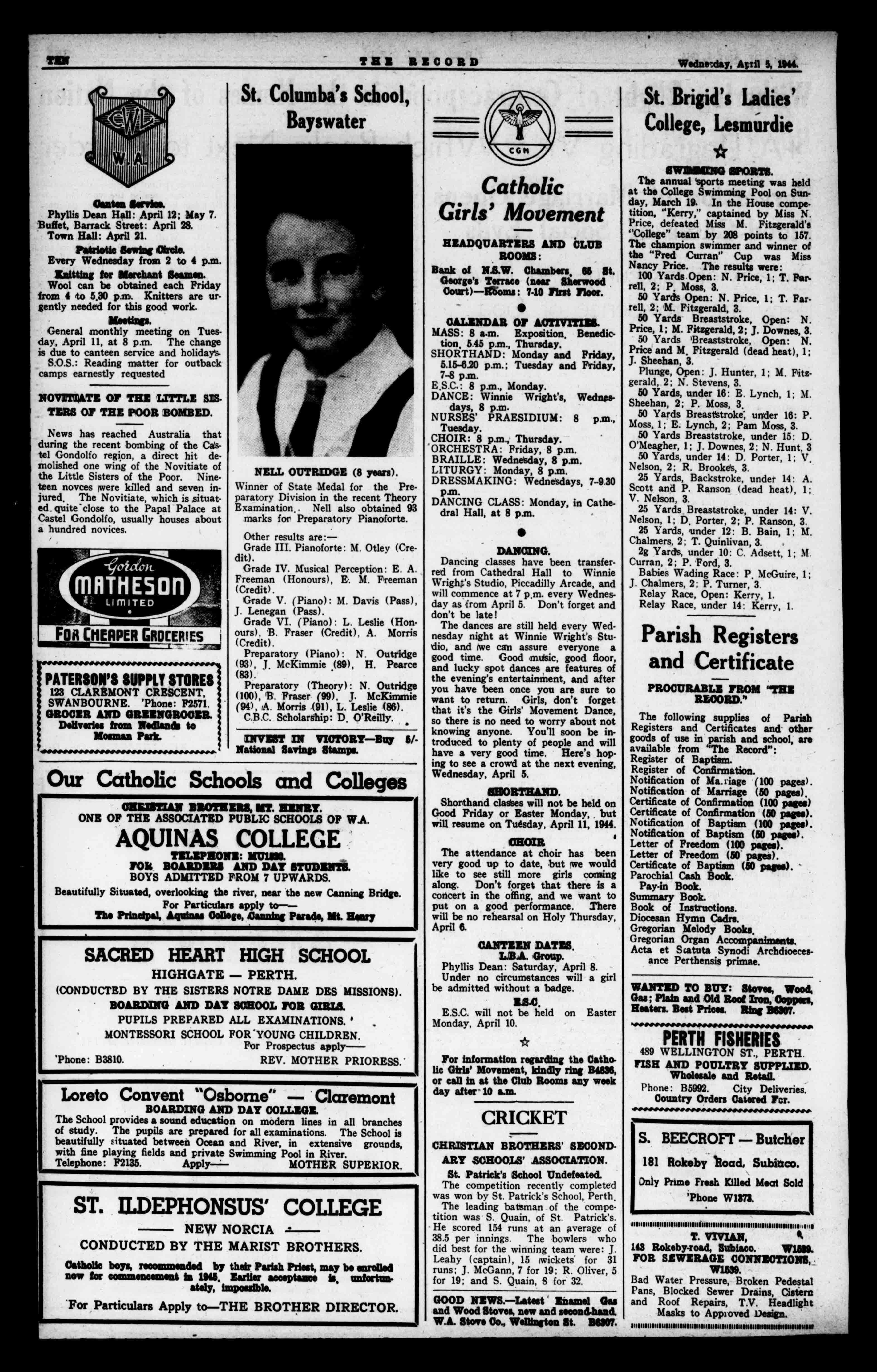
NELLOUTRIDGE(8years). WinnerofStateMedalforthePreparatoryDivisionintherecentTheory Examination,.Nellalsoobtained93 marksforPreparatoryPianoforte.
Otherresultsare:-
GradeIII.Pianoforte:M.Otley(Credit). GradeIV.MusicalPerception:E.A. Freeman(Honours),EM.Freeman (Credit).
GradeV.(Piano):M.Davis(Pass), J.Lenegan(Pass).
GradeVI.(Piano):L.Leslie(Honours),B.Fraser(Credit).A.Morris (Credit).
Preparatory(Piano):N.Outridge (93),J.McKimmie(89),H.Pearce (83).
Preparatory(Theory):N.Outridge (100),B.Fraser(99),J.McKimmie (94),A.Morris(91),L.Leslie(86). C.B.C.Scholarship:D.O'Reilly.
INVESTINVICTORY-Buy6/NationalSavingsStamp,.
OurCatholicSchoolsandColleges
0111.111TIANBROTHERS,MT.HENRY.
ONEOFTHEASSOCIATEDPUBLICSCHOOLSOFW.A.
AQUINASCOLLEGE
TELEPHONE:MUM FOkBOARDERSANDDAYSTUDENTS. BOYSADMITTEDFROM7UPWARDS. BeautifullySituated,overlookingtheriver,nearthenewCanningBridge. ForParticularsapplyto-ThePrincipal,AgtdnasCollege,CanningParade,Mt.Henry
SACREDHEARTHIGHSCHOOL
HIGHGATE-PERTH.
(CONDUCTEDBYTHESISTERSNOTREDAMEDESMISSIONS). BOARDINGANDDAYSCHOOLFORGIRLS. PUPILSPREPAREDALLEXAMINATIONS.' MONTESSORISCHOOLFORYOUNGCHILDREN. ForProspectusapply'Phone:B3810. REV.MOTHERPRIORESS.
LoretoConvent"Osborne"-Claremont
BOARDINGANDDAYCOLLEGE.
TheSchoolprovidesasoundeducationonmodernlinesinallbranches ofstudy.Thepupilsarepreparedforallexaminations.TheSchoolis beautifullysituatedbetweenOceanandRiver,inextensivegrounds, withfineplayingfieldsandprivateSwimmingPoolinRiver. Telephone:F2135. Apply- MOTHERSUPERIOR.
ST.ILDEPHONSUS'COLLEGE
NEWNORCIA
CONDUCTEDBYTHEMARISTBROTHERS. Catholicboys,recommendedbytheirPariahPriest,maybeenrolled nowforcommencementin1945.EarlieracceptanceM,tmforkmately,impossible. ForParticularsApplyto-THEBROTHERDIRECTOR.
Catholic Girls'Movement
HEADQUARTERSANDbLIIII ROOMS
BankofNS.W.Chambers,65It. George'sTerrace(nearSherwood Court)-Hboms:7-10FirstFloor.
CALENDAROFACTIVITIES.
MASS:8a.m.Exposition,Benediction.5.45p.m.,Thursday.
SHORTHAND:MondayandFriday, 5.15-6.20p.m.;TuesdayandFriday, 7-8p.m.
ESC.:8p.m.,Monday.
DANCE:WinnieWright's,Wednesdays,8p.m.
NURSES'PRAESIDIUM 8 p.m., Tuesday.
CHOIR:8p.m.,Thursday.
ORCHESTRA:Friday,8p.m.
BRAILLE:Wednesday,8p.m.
LITURGY:Monday,8p.m.
DRESSMAKING:Wednesdays,7-9.30 p.m.
DANCINGCLASS:Monday,inCathedralHall,at8p.m.
DANCING.
DancingclasseshavebeentransferredfromCathedralHalltoWinnie Wright'sStudio,PiccadillyArcade,and willcommenceat7p.m.everyWednesdayasfromApril5.Don'tforgetand don'tbelate!
ThedancesarestillheldeveryWednesdaynightatWinnieWright'sStudio,andtwecanassureeveryonea goodtime.Goodmtisic,goodfloor, andluckyspotdancesarefeaturesof theevening'sentertainment,andafter youhavebeenonceyouaresureto wanttoreturn.Girls,don'tforget thatit'stheGirls'MovementDance, sothereisnoneedtoworryaboutnot knowinganyone.You'llsoonbeintroducedtoplentyofpeopleandwill haveaverygoodtime.Here'shopingtoseeacrowdatthenextevening, Wednesday,April5.
SHORTHAND.
ShorthandclasSeswillnotbeheldon GoodFridayorEasterMonday,but willresumeonTuesday,April11,1944.;
CHOIR
Theattendanceatchoirhasbeen verygooduptodate,butwewould liketoseestillmoregirlscoming along.Don'tforgetthatthereisa concertintheoffing,andwewantto putonagoodperformance.There willbenorehearsalonHolyThursday, April6.
CANTEENDATES.
L.BA.Group.
PhyllisDean:Saturday,April8. Undernocircumstanceswillagirl beadmittedwithoutabadge. 324.
E.S.C.willnotbeheldonEaster Monday,April10.
ForinformationregardingtheCatholicGirls'Movement,kindlyringB4836, orcallinattheClubRoomsanyweek dayafter10a.m.
CRICKET
CHRISTIANBROTHERS'SECONDARYSCHOOLS'ASSOCIATION.
St.Patrick'sSchoolUndefeated. Thecompetitionrecentlycompleted waswonbySt.Patrick'sSchool,Perth, TheleadingbatsmanofthecompetitionwasSQuain,ofSt.Patrick's. Hescored154runsatanaverageof 38.5perinnings.Thebowlerswho didbestforthewinningteamwere:J. Leahy(captain),15wicketsfor31 runs;J.McGann,7for19:R.Oliver,5 for19;andS.Quain,8for32.
GOODNEWS.-LatestEnamelGas andWoodStoves,newandsecond-hand W.A.StoveCo.,WellingtonSt.86107.
St.Brigid'sLadies' College,Lesmurdie
SWIMMINGWORTS.
Theannual'sportsmeetingwasheld attheCollegeSwimmingPoolonSunday,March19. IntheHousecompe- tition,"Kerry,"captainedbyMissN. Price,defeatedMissM.Fitzgerald's "College"teamby208pointsto157. Thechampionswimmerandwinnerof the"FredCurran"CupwasMiss NancyPrice.Theresultswere: 100YardsOpen:N.Price,1;T.Par. rell,2;P.Moss,3. 50YardsOpen:N.Price,1;T.Farrell,2;M.Fitzgerald,3. 50YardsBreaststroke,Open:N. Price,1;M.Fitzgerald,2;J.Downes,3. 50YardsBreaststroke,Open:N. PriceandM.Fitzgerald(deadheat),1; J.Sheehan,3. Plunge,Open.J.Hunter.1 M.Fitzgerald,2;N.Stevens,3. 50Yards,under16:E.Lynch,1;M. Sheehan,2;P.Moss,3, 50YardsBreaststroke;under16:P. Moss,1;E.Lynch,2;PamMoss,3. 50YardsBreaststroke,under15:D. O'Meagher,1;J.Downes,2;N.Hunt,3 50Yards,under14:D.Porter,1;V, Nelson,2:R.Brookes,3. 25Yards,Backstroke,under14:A. ScottandP.Ranson(deadheat),1; V.Nelson,3. 25YardsBreaststroke,under14:V. Nelson,1;D.Porter,2;P.Ranson,3. 25Yards,-under12:B.Bain,1:M. Chalmers,2;T.Quinlivan,3. 2gYards,under10:C.Adsett,1;M Curran,2;P.Ford,3. BabiesWadingRace:P.McGuire,1; J.Chalmers,2;P.Turner,3 RelayRace,Open:Kerry,1. RelayRace,under14:Kerry,1.
ParishRegisters andCertificate
PROCURABLEFROM'THE RLOORD."
ThefollowingsuppliesofParish RegistersandCertificatesandother goodsofuseinparishandschool,are availablefrom"TheRecord": RegisterofBaptism.
RegisterofConfirmation.
NotificationofMa.,iage(100pages).
NotificationofMarriage(50pages).
CertificateofConfirmation(100pages)
CertificateofConfirmation(50pages).
NotificationofBaptism(100pages).
NotificationofBaptism(50pages).
LetterofFreedom(100pages).
LetterofFreedom(50pages).
CertificateofBaptism(50pages).
ParochialCashBook.
Pay-inBook.
SummaryBook.
BookofInstructions.
DiocesanHymnCadre.
GregorianMelodyBooks, GregorianOrganAccompaniments. ActaetScatutaSynodiArchdtoecesancePerthensisprimae.
WANTEDTOBUY:Stoves,Wood, Gas;PlainandOldRoofIron,Coppers, Heaters.BestPrices.RingB5$07. Npo4PIWIP.4.4.4.41.4.4.1NNPININP
PERTHFISHERIES
489WELLINGTONST.,PERTH FISHANDPOULTRYSUPPLIED.
WholesaleandRetail.
PhoneB5992. CityDeliveries.
CountryOrdersCateredFor.
S.BEECROFT-Butcher
181Rokebytoad,Subicico.
OnlyPrimeFreshKilledMeatSold 'PhoneWan.
31.1.$11111111161.11111111111111HIM1111H111111H1111111.111114.1,1
T.VIVIAN, 143Rokeby-road,Subiaco. W15119. FORSEWERAGECONNECTIONS, W1539.
BadWaterPressure,BrokenPedestal Pans,BlockedSewerDrains,Cistern andRoofRepairs,T.V.Headlight MaskstoApprovedDesign.
TIN TILERECORD Wednr:day,April5,1944.
WillCommunismSucceedits Blood-Brother,Fascism,inItaly?
AlternativesBristlingwith Difficulties
ThefateofItalyhangsinthebalanceandthedecisionthatwilltiltthe scalesonewayortheotherrestswith Italians.Butthatisnottosaythat theAlliedNationswillplaynopartin theforgingofitsdestiny.Implicationsofthepresentpositionarehere discussedbyFatherJohnLaFarge,in "America."
HowseriousisthethreatofaCommunistrevolutioninItaly?
TheCommuniststhemselvesnaturallyassumetherevolutionmustsoon takeplace.Forthemthereisno otheralternativetoFascism.Their definitionofFascismincludesanythingandeverythingwhichisopposed toCommunism.IntheCommunist ideaofFascism,therearenomodalitiesordistinctions.FascismisnonCommunism,"toutcourt,"andthereis needofnofurtherdistinction.
WhentheHolyFatherspoketothe ItalianworkmenatPentecostoflast year,heexpressedhisdisturbanceof mindoverthepossibilityofareignof chaosasaconsequenceoftheevents thatwasoccurring.Wecanassume hehadgoodreason,atthatdate,toanticipatetheimpendingfalloftheDuce, andthepossibilityofarevoltwhich wouldgofarbeyondthelimitsofa revoltagainsttheFascistregimeand wouldbedirectedagainsteverysemb;anceoflawandorder.
Nothing,however,wasspecified,and thePope'swordsofdenunciationwere soclearlydirectedagainstHitler-controlledFascism,itsideasanditsworks, thatCommunism,inhispresentation, wouldseemtobemerelyFascism's naturalworkingout,asFascism springsfromCommunism.
Soplainishistory'slessonastothe secondpartofthispropositionthat Youwonderhowanyone,Communist orotherwise,canfailtorecogniseit. liIwereplanningnowforanother Mussolini,Icouldthinkofnosurer recipethanthepreparationofagenuineCommunistrevolution.Eachtype ofexasperationleadstoitssupposed opposite.FascismandCommunism generateoneanother,sincetheyarise ultimatelyfromacommonsource:the spirituallyandsociallyuprootedindividualstrugglingwiththetormentof economicexploitationandthemight ofacompletelysecularisedState.
ButdisillusionmentastotheCommunistproposalshouldnotexcusethe illusionsentertainedbythosewhosee inthethreatofCommunismareason fordemandingasortofCatholictotalitarianismasalegitimate"Ersatz"for dismantledFascismandasupreme protectionagainsttherecurrenceof Communism.
IslothinewouldpleasetheCommunistbetterthanforCatholicthought, inthiscountryandabroadtobegenerallymovedintosuchaposition. Nothingwouldpleasethembetter,for justasCommunismnaturallygeneratesFascism,sosuchareligiouslygarbedtotalitarianismwouldbethevery bestentranceintheworldforCommunism:thetextforitssermons,the breedinggroundforitsagitations,and innumberlessdeviouswaysitsmost effectiveandsubtleally.
NomatterhowloudlyandimpressivelyaregimemayprofessitsCatholicism,aslongasitleavesthetemporal problemunhealed,itisimpotentto copewiththepaganideologiesofour time.
BRYANT&WATERS,
80to90STIRLINGST.,PERTH.
WOOD&COALMERCHANTS.
OrdersPromptlyAttendedTo. 'Phone:B39$8.
Thereisapreciseproblemtobesettledintherelationsoftheindividual tothesocia,.group,theadjustmentof hisinherentandinalienableliberties tothesuperiorauthorityoftheState andtothesuperiordemandsofthe commongood,Thisproblemcannot beevaded.Itcannotbesolvedmerelyinabstractterms.Itmustbesolvedintheconditionsofthemodern world,withitsintercommunications, withitsworld-widecontactsandworldwideinterdependenceanditsreligious pluralism.
Andaslongasitisnotsolved,it leavestheindividualfacetofacewith. theState.Thisisacharacteristicof ourmodernexistence:thesocially atomisedindividual.NeitherHitler norMussolini,withalltheireffortsto incorporatetheindividualintothesocialbody,wereable,anymorethan Lenin,withhisinternational,andStalinwithhisnationalCommunism,to bridgethisfatalgap.
Butthebridgemustbecrossed,and thegapmustbefilled.Itcannotbe filledbyanygovernmentalfiat,but onlybytheestablishmentinsociety andtheStateofcertainessentialguarantees,therecognitionofcertaingreat naturaltruths,asseeninthelightof Christianteachings.These,whether wecallthemChristiandemocracyor somethingelse,aretheonlywayout ofthefatalviciouscirclethatbegins andends,alternatively,withFascism orNazismandtheirnumerouspotentials,andCommunismoranarchyand theirkindreddevelopments.
TheHolyFather,itwillbenoticed, hassaidnothingabouttheformof governmentthathethinksnecessary forthecomingpeace-fortheworldor, forthatmatter,forItaly.Hisutteranceshavebeenconcentratedupon thesegreatessentialsofthenatural law,oneofwhich,ofcourse,istherecognitionofreligionitself.Yetin thiscountrythecontroversyand speculation,forthegreaterpart,centreaboutthequestionofthetypeof governmentwithwhichweshould makethepeace.
FewseemtoreflectuponwhatSir NormanAngellsopointedlyexpoundedintheNewYork"Times"magazine forAugust8:thatthegovernment whichmakesthepeaceandenforcesit willbeplacedintheworstpossible positionforitsownfuturestability. Insteadofthisbeingthedesirablepost ofhonour,itismuchmoreapttobe thetheatreoffutureoverthrowandrepudiation. Abasicerrorinthisthinkingisour apparentinabilitytodistinguishbetweennon-essentialdifferencesinthe formofgovernmentandtheessenceof democracy,inthesenseofrecognition offullhumanrights.Obviously,certainformsofgovernmentareoftheir natureincompatiblewithanyexercise ofhumanrights,suchascompleteautocracy.Butbetweensuchextremeis andacompleteadoptionofthe.democraticprocessasweknowitinthe UnitedStates,withitsuniversalsuffrage,systemofchecksand-balances andofrepresentation,innumerablemodalitiesarepossible.Wecannotforgetthatthereareaspectsofourown democracywhichtooneofanother country,e.g.,anItalian,donotlookso whollydemocraticastheydotous. Ourpoll-tax,ourvariousmethodsof politicaldisfranchisement,oursystem ofpatronage-withitsironhandbeneathabenevolentexterior-andmany otheringredientsofourdailypolitical bread,donotlooksodemocratictoa supposedlynon-democraticforeigneras theymayappeartousathorne.
Allofthiscalls,therefore,foramore thoroughfranknessinfacingthisquestionofwhatwemeanwhenwetalk aboutthetypeofregimewithwhich wecanmakepeace,inItalyorelsewhere.
"THESTOREOFQUALITY." 'Phone:P21903. STIRLINGHIGHWAY,MOSMANPARK. RHODESISONS
GROCERS,IMPORTERS,WINEANDSPIRIT=RONAN?.
Goodsdeliveredtoanypartofthedistrict.
PEERLESSBREADMANUFACTURERS
145FITZGERALDSTREET,PERTH.
OurMotto:"QUALITYandSERVICE."
Specialties-VIENNABREADandROLLS.
'Phone:B1041.
-Washdaysare Easier
RelaxSoapwilltakethehard workoutofwashdaysfor YOU.Relayisgentleonthe fabricandyourhands;washes clothesasnowywhite;and NOhardrubbingisnecessary.AlwaysuseRELAXin YOURwashtub.(Obtainableinthreesizes.)
WESTRALIANSOAPSLTD.
MADEINW.A.BY
WhiteRock
FOR
Quarries
ALLGRADESOFMETALFORICOADCONSTRUCTIONANDCONCRETEWORK.
'PHONES:B8866,B8989! AfterHours:MW24
3rd.FLOOR,COLONIALMUTUALBUILDINGS.PERTH.
AustralasianCatholicAssurance Co.Ltd.
THE"A.C.A."
A.C.A.BUILDINGS,KINGST.,SYDNEY. ASSETSEXCEED£1,750,000.
ALLCLASSESOFLIFEANDENDOWMENT POLICIESTRANSACTED.
SAFEGUARDTHEFUTURE
BRANCHOFFICESINALLSTATES.
W.A.Office: "WARWICKHOUSE,"ST.GEORGE'STERRACE,PERTH P.ENGELBRECHT,ResidentSecretary.
CatholicFunerals
BY PerthFuneral DirectorsLtd.
ComplystrictlywitheveryrequirementofCatholicRitual. ThequietdignityandreverenceofservicesundercompetentCatholicsupervisionaffordconsolationinthehourofsorrow. NightandDayService. ModerateFees.
379HaySt.,Perth(nearSt.Mary'sCathedral).
Phones:Business,B8616;Privat- B8623,B5496.
Wednesday,April6,1944. TN!11,11100111) SLIP/110F
COLLEGE, SHEFFIELDHOUSE,713.21HAYSTREET,PERTH.
C.G.M.
DRESSMILEINO.
AsthefirstdressmakingcoursefinishedlastWednesday,April5,girls whohavetheirnamesdownforthe nextcourse,commencingonAprilla, areaskedtoattendonthatnight.We havebeenforcedtomaketherulethat nogirltwillbeabletomissmorethan twoclasses,becauseofourhugewaitinglist,sobefairtoyourselvesand toyourfellowmembers.
Shouldanygirlwhohadputher namedownpreviouslynowfindthat sheisunabletoattend,pleasehand hernameintoMargaretKenny,c/othe ClubRooms,beforeWednesday,April 12,sothatherplacemaybefilled.
Thenamesofthoseonthelistare: B.O'Hare,P.Gralton,H.Pitts,M.De Gruchy,N.Donovan,M.Woufle,N. O'Dwyer.W.Sharp,S.Marshall,S.Nor. rish,O.Pryce,M.Shepherd,M.Trainer, M.Della-Vedova,M.andB.Gwynne.
MARIANARTSGUILD.
Thismonth'smeetingwillagainbe heldintheMcNessHall,Pier-street,at 8p.m.Allmembersarecordiallyin. vitedtoattendthisGuildevening,as theprogrammeisbeingspeciallyan rangedbytheTherrySociety.
DistrictBoardVisitstoBranches.
Thefollowingvisitswillbemade duringAprilandMayHelpofChristians'Branch,EastVictoriaPark,18th. inst.;St.Brigid's,WestPerth,May1; St.Joachim's,VictoriaPark,May15; St.Malachi's,Highgate,May19. St.Gary'sBranch,Leederville, DeathofLateBro.TomBerry, AtthemeetingonMarch29,itwas announcedthatonthatdayBro.Tom Berryhadpassedaway.Thisnews castagloomoverthemeetingas, apartfromhismembershipofthisSoqy,thedeecasedmemberwasan idealCatholicgentleman,highlyrespectedandreveredbyallwhoknew him.Hewasoneofthefoundation membersofthisbranch,andinitsinitialstagesgaveveryvaluablehelpin placingitonasoundandlastingfoundation.Tohissorrowingwidowand relativestheofficersandmembersextendtheirmostsinceresymathy.R.I.P. Membersarerequestedtoattendin fullforcethemeetingonWednesday next.
STOVES-Wood,Gas;newandused. Goodstockspaints,enamels,sprinklers, andtaps.Hassell's,559WellingtonSt.
ODDFELLOWS'HOTEL SOUTHTERRACE,FREMANTLE. BESTBRANDSSTOCKED. NewlyFurnishedThroughout. ALLWELCOME. T.G.MULCAHY,Proprietor.
PIANOTUNING
G.E.Dined,16Duncanthreat,Victoria Park.
J.NEILSON,Optician
S.DANNELL,F.S.M.C.(London), W.A.O.A. OPTOMETRIST. Tel.:B2014. 16PLAZAARCADE,PERTH.
014 INMEMORIAM
44
.JAMES.-InlovingmemoryofNora, whodiedApril9,1942,motherof UrsulaandPat,anddarlingNanna of,Neville,MichaelandPat,of Wembley.R.I.P.
KINSELLA,John.-Inlovingmemory ofourdearbrotheranduncle,who diedonApril8,1941. OurLadyofPerpetualSuccour,pray forhim, -Insertedbyhissorrowingbrother. sister-in-law,andfamily.
KINSELLA,John.-Inlovingmemory ofourdearhusbandandfather,who diedApril8,1941.
MostSacredHeartofJesus,have mercyonhissoul.
-Insertedbyhislovingwifeand family.
McCAFFERTY.-Inlovingmemoryof ourdearAuntandNannie,Susan McCafferty,whodiedonApril11, 1939.R.I.P.
MostSacredHeartofJesus,have mercyonhersoul.
-Insertedbyherniece,nephewand grandchildren,'MaryandMargaret Leen.
MONAGHAN.-Insadandloving memoryofmydarlingwifeandour mother,whomGodcalledtoreston April14,1940.
MostSacredHeartofJesus,have mercyonhersoul, Alwayslovinglyrememberedbyher husband,girlsandBill.
NOONAN.-Ofyourcharity,prayfor thereposeofthesoulofDavidDanielNoonan,whodiedMarch30,1934 (GoodFriday), MostSacredHeartofJesus,have mercyonhissoul.
PENTONY.-Ofyourcharity,prayfor thereposeofthesoulofCaptain PhilipPentony,whopassedawayat St.Joseph'sMorisset,onApril8, 1943.
SacredHeartofJesus,havemercyon hissoul.
-InsertedbyKathleenM.Beavitt.
WANTED.
Farm:Capablewoman(over45) wanted,tocookonlyforadultfamily, 8,7men;modernhome;allconveniences.ReplyBox57,Kuhn.
TOLET.
FurnishedRoom,useofkitchen; closetochurch,transportandshoppingarea;businessgirlpreferred. ApplyA.B.,thisoffice.
BIRTH.
TAYLOR.(neeFlint).-'OnMarch15, 1944,atSt.JohnofGodHospital,Subiaco,toEdnaandLaurie(A.I.F.)ason(RichardLaurence).
MISSINGYOURTURN.
Itmightbeyourturntowinthefirst prizeintheNo.201BCharitiesConsultation,Ifyoudon'tbuyaticket,you willmissyourturn.Thefirstprize is£2,000.
11"4A"\YOUR 47k
receivequalifiedattention.Glasseswillbeadvis. edonlyifnecessary.Theywill beglazedwithhighestquality lensinattractiveframes.Visit
id3.tcretary,WestAustralianChambers,St.George'sTerrace,Perth. Tel.:B7804.
TWELVE THERECORD Wednesday,April5,1944. MAKE VICTORY ACERTAINTYBYSUPPORTING THEVICTORYLOAN YOUCANOBTAINREADYMONEYBYUSING Zimpel'sTrade-In Plan YOUWILLRECEIVESOUNDVALUEPROMPTPAYMENT. ZIMPEL'S HayStreet B8177. PatroniseOurAdvertisers *Knowledge Attracts MoneyThenaturalconclusiontoarrive atfromthisfactisthattoimprove yourearningpower,youmustincreaseyourknowledge. WehavemanyCoursesofinstructionforbothmanualandclerical workers,whichmaybestudiedbypersonalattendanceandCorrespondencelessons.Belowwelistafew: BUSINESS FullBusinessCourseforgirlsand boys. Shorthand. Typewriting. Bookkeeping. Accountancy. FarmBookkeeping. StationBookkeeping. BusinessOrganisation ageerrint Salesmanship. TEOHNIOALSTUDY 00kTURSIS: Wireless. WirelessTransmitting. Refrigeration. SteamEngineering. GasandpieselEngines. ElectricalEngineering. ElectricalWiring. andMan- DutiesofRoadBoardSecretaries. HealthInspectors'Course. JournalismandShortStoryWriting. PreparationforALLEXAMSheldinW.A. Forfurtherdetails,write,call,or'phoneB6010,B6561.Theywillbe suppliedfreeandwithoutobligation. CityCommercialCollege OOMMEROIALCORRESPONDENCE
Hibernian-AustralasianCatholicBenefitSociety BESTBENEFITSFORLOWESTOONTRINITIIONS. DEATHBENE.'IT.-450,age16andunder20,4/10quarterly;1100,7/2quarterly.20yearsandunder23, 5/3qr.;£100,8/-qt.23yearsandunder25,5/5qr.;£100,8/4qr.25yearsandunder30,5/10qr.;£100, 9/2qr.Membersupto51accepted.AlsoSickness,MedicalandHospitalBenefits. J.EDWARDS,.Gre
E S
andS.
will
SAINKEN&SAINKEN aVAIIIIIIP0.1.41AaS NATItPUNTAPIIIMISA001111MIMS( * a M1158 Telephones- L1400 MEAD,SON&CO. FUNERALMamma 190ALBANYROAD, VICTORIAPARK. 33CANNINGHIGHWAY, EASTFREMANTLE.
DESERVETHEBEST.It youconsultS.
your eyes
CommunistsandDeGaullistsin NorthAfrica
SupplementingreportsthatsubsequenttotheAlliedoccupationof NorthAfrica,AlgierswasfastbecomingthecentreofCommunistactivity inEurope,theLondon"Tablet"summarisesreportsreachingLondontothe effectthattheCommunistsunderthe aegisofVyshinsky(exOgpuProsecutor)aremovingtosupplantthede Gaulleadministration.
ThelatestdevelopmentatAlgiers isthattheCommunistshavebegunto attackGeneraldeGaulle,Theissue hasnotbeenthatofCommunistrepresentationontheCommitteeofNationalLiberation.ItistruethatGeneraldeGaullesaidthatthetwoObmmunistmembersofitmustbeMM. AndreMercierandFernandGrenier; andtheCommunistssaythatthese Areneededforpartywork,andtheir representativesmustheMM.Lucien MidolandEtienneFajon.Butthisis onlytheimmediatepretextforwhat isclearlyachangeintheprescribed party-line.TheCommunistshavebeguntosaythatGeneraldeGaulleis weakeninginhisattitudetothe Vychssois:thattheCommitteeisevadingitsdutyinthematterofpurging andpunishing,andthatclearlyplutocraticFrenchinterestsaresuccessfully applyingpressure.Theyalsosaythat GeneraldeGaulleistakingcaretosee thatallthereallyrevolutionaryrepresentativesoftheRenaissanceinthe newProvisionalAssemblyarebeing preventedfromcomingtoAlgiersat all,
Allthiswasputforwardtheother dayatapressconferenceheldbythe Communists:andafterwardsAndre Marty.whoisnowtheirleader,went furtherandtoldthedispersingcorrespondentsthattheNationalCommittee fears"thepeople'andhastherefore beenrefusingtosendarmstothe Frenchpatriots,andthatitwasonly becauseofGeneralGiraudthatanyaid -wassenttotheMaquisinCorsicawhen theyrevolted.Martywentonto paytributetoGeneralGiraud,asasoldierwhoseonlydesirewastofight -theGermansandeschewpolitics.
(MartydesertedFrancein1939;GermanyandRussiawerefriends!)
TheCommunistsaresayingthat GeneraldeGaullehascarriedthe Fuhrer-PrinzipintohisProvisionalAssembly,andthatitisinfactlittle morethana"packed"Reichstag,On theNationalCommitteethevarious politicalpartiesareindeednowrepresented,butbymenofGeneralde Gaulle'sarbitrarychoosing,andnotof theirownchoosing.TheCommunists complain,furthermore,thatGeneralde Gaullehassetuphisownstandard, theCroixdeLorraine,incompetition withtheTricoleurofFrance,withthe resultthattherearetwoarmiesand flags,ofteninrealrivalry
Itisironicthatthesecomplaints shouldbevoicedbytheCommunistsof allpeople;andithashappenedthat waysimplybecausetheyarebyfar themostcoherentandarticulatepoliticalelementapartfromthepeople filledwiththeGaullistemystique.It isalsocuriousthattheyshouldhave startedthuschallengingwherehitherto-until,indted,aboutthetimeof thearrivalofM.VyshinskyinAlgiers -theyhavecordiallysupported.But itisthefaultofnobodyexceptGeneral deGaulleandhisadvisersifthiskind ofchallengeisbeginning,orifMarshal Petainisapparentlybeginningto thinkthat,afterall,hemayyetlead FrancewhentheBochehasbeenexpelled,andisseekingtomovetothe positionofaprisonerofwar.
AndreMartysaidrecently,withsupremeeffrontery,"GeneraldeGaulleis apparentlynotyetacquaintedwith thedemocraticusagesofFrance."
ThisisastrangedisguiseforanyCommunistParty,ifoneveryoften adopted.Butinpointoffactoneof thelastclearlyauthenticactsofrepublicandemocracyinFrancewatsthe "DecretDaladier"ofSeptember28, 1930.whichsuppressedtheCommunist Partyanditsassociateorganisations throughoutFrenchterritory:andthe Communistsnowowetheirfreedomto anarbitraryrepudiationofthatdecree forwhichtherecanbelittleOrnoconstitutionaljustification.
AnglicanArchbishopUrgesUnited NationstoAvoidDamageto EternalCity
LordLangofLambeth,formerArchbishopofCanterbury,hadthisletter in"TheTimes"lastmonth:
"TheapproachoftheArmies,and especiallytheAirForces,oftheUnited NationstoRomelaysuponthema verygraveandanxiousresponsibility. Citiesandtownseverywheremustsufferthehavocwhichmodernwarfare inevitablycauses.
"ButHomeisnotlikeanyother city.Itbelongsnottoonecountry onlybuttotheworld.Initsancient monumentsanditschurchesitrepresentsasnoothercitycanthewhole historyofEuropeancivilisationand religion.
Forlimgcenturiesithasinspired thevenerationofmultitudesofChristianpeoplethroughouttheworld.Preservedasithasbeenthroughthevicissitudesofthousandsofyears,itmay trulybecalledtheEternalCity.
"Itwouldindeedbelamentableif bytheactionofourArmiesandAir Forcesanyofitsincomparabletreasuresofhistory,ofart,andofreligion weredestroyedorevenseriouslydamaged.
"Iunderstandthatanexpertauthor ityhasbeenappointedtoadvisethe
armiesinItalyonmattersofarchaeologyandart,andthatsometimeago informationandinstructionweregiven totheAirForcestoguardagainstthe possibilityofdamagingbuildingsof specialinterestandimportancein Rome.
"NowwhenageneralattackonGerman-occupiedRomeseemstobeimminent,itisgreatlytobehopedthat suchinformationwillbemadeasfull andsuchinstructionasexplicitaspossible,sothatbombs(orshells)maynot bedroppedinthenearneighbour oftheVaticanorofanyortheprincipalancientsitesandchurcheswithin thecity,
"Evenifthisweretoinvolvethe lossofsometemporarymilitaryadvantage,suchalosscouldnotbecomparedwithalosstocivilisationandreligionwhichwouldbeforalltimeand irreparable.
"ItispossiblethattheGermans aftertheirmannermaydomuchwilfuldamagebeforetheyaredrivenout andtrytoattachtheblametoour forces.Ifso,lettheguiltbeupon theirheads.Butletourownconsciencebeclear."
JournalistsandCriticsVote BernadetteBestFilm
"TheSongofBernadette,"20th.Century-Fox'sfilmversionofFranzWerfel'sbeautifulanddramaticstoryof St.BernadetteandLourdes,hasbeen voted,thebestfilmof1943-4bythe ForeignCorrespondents'Associationof HollywoodandJenniferJones'portrayalofBernadetteSoubirousisconsideredthebestactressperformanceof theyear.
Thisjudgmentisavariationofthe MotionPictureAcademyAward,publishedinthepressrecentlywhichgave firstplaceto"Casablanca,"thoughthe awardalsoplacedJenniferJonesas the.bestactressforherworkin:'The SongofBernadette."TheAcademy Award,too,gavefirsttoGeorgeSeaton'sscriptof"TheSongofBernadette"asthebest-writtenscreenplay.
JudgmentofSpecialists.
TheAssociationofForeignCorresporrdents,whichhaschosentheBernadettefilmasthebest,comprisesover 40journalistsandcritics,manyof whorrihavespecialisedinmotionpic-
turesforyears,andwhocoverHollywoodfornewspapersandmagazines withacirculationofhundredsofmillions,accordingtotheLosAngeles "Tidings."Countriesrepresentedby membersoftheForeignCorrespondents'AssociationofHollywoodinclude GreatBritain,Canada,Australia,Mexico,Brazil,Cuba,Argentina,Free France,Switzerland,Sweden,Spain, NorthAfrica,SouthAfrica,India, Eire,China,NewZealand,Chile,Peru, andColombia.
Both"TheSongofBernadette"and JenniferJonesledallcompetitorsby awidemarginofvotesoverallcontendersmentionedintheballot.
BywinningtheAcademyAward, JenniferJonesisthefirstscreenstar inHollywoodhistorytowinthecovetedGolden"Oscar"withafirstfilm performance.
FluePipeforStovesBathHeaters. StocksofPaints,Varnish,Calcomine. Hassell'sStores,Perth,..B6307.
HotelandAccommodationGuide
OntheRoad
FirstClass to CityBeach.
'Phone:B3418.
WembleyHotelAccomonmodati.
M.CRANLE,Proprietor. COUNTRY.
DUKEOFYORKHOTEL, NARROGIN. ReconditionedandRefurnished. NewLounge,DiningRooms, andCommercialRooms.
ARTHURBOYLAN, (LateGeorgeHotel,Perth). GOLDFIELDS.
RodBeaton's HANNAN'SHOTEL, HANNANSTREET, KALGOORLIE.
STAR&GARTERHOTEL,
Cnr.HANNAN&NETHERCOTTSTS.,KALGOORLIE. BERTSTARR Proprietor.
'Phone19. Box124. AUSTRALIAHOTEL, KALGOORLIE.
C.T.A.andR.A.C.HOUSE. OneMinutefromSt.Mary's Church.
HotandColdWaterinHotel Bathrooms. RefrigerationThroughout. OnlyLock-UpGaragesinthe CentreofTown. M.J.DILLON,licensee.
KEOUGH'S.forCATERING AnyNumber,Place,orTime. ThreeReceptionRoomsforHire. OnHire:Crockery,Cutleryand Glassware,etc.'PhoneB1724. GLADKEOUGH. NEWCASTLEST.,PERTH.
FREEMASONSHOTEL, TOODYAY. ExcellentCuisine. AmaticeRefrigeratorInstalled. OldandNewFriendsare CordiallyWelcomed. MRS.E.WING,Proprietress.
HOTEL PERTH.
JACKEDDINGTON, Proprietor.
EXCELLENT ACCOMMODATION,
STAN.O'BRIEN, COURTHOTEL PERTH.
'Phone:B4261.
HOTELBEACONSFIELD, ritzmunss. OverlookingtheOcean. SuperiorAccorfimodation. ModerateCharges. M.BTRAM (LateofGrandandShamrock Hotels,Boulder).
SUBIACOHOTEL.
FIRST-CLASS ACOOMMODATION. 'Phone:W1028. A.J.McHENRY,Proprietor.
VICTORIAHOTEL, HAYSTREET,SUBIACO. RenovatedThroughout. EssenceofComfort. W.F.ARTIE,Proprietor. (LateofBalmoralHotel,Vic.Park)
Wednesday,April5,1944. THERECORD THIRTEEN
I`MeetyouattheSavoy'
Tel.B9681
FootComfortGuaranteed
BootsandShoes InHalfSizes.

Ifnecessarywe maketoorder.
667HayStreet,Perth
Thuile:B1381.
ForExquisite
Tenderness andFineFlavourAlways.
BehnsLimited
QualityMeatsandSmallgoods
PatronicieOurAdvertisers
ANew Homecraft
Makeyourownaccessories frommaterialsofferinginFoy's newHomecraftSection.Here youmaypurchasespeciallyselectedskinsinsuitablelengthsfor bags,belts,dresstrimmings,cushions,tablecentres,etc.,atvery reasonableprices.Youwillfind thesematerialsdelightfullyeasy tomakeupandtheresultsWill thrillyou.
Feltisanotherexcitingmedium thatoffersunlimitedscopefor youringenuity.Itisonsalein Foy'sHomecraftSectioninmany lovelycolours.Hereisagrand opportunityforyoutosave moneybymakingyourown Christmasgiftsthisyear.
Asenseofhumourisahelpanda blessingthroughlife.Still,evena senseofhumourmayexistinexcess. Take,forinstance,thecaseofaBritishsoldierwhowassentencedtobe flogged.Duringtheflogginghelaughedcontinually.Theharderthelash waslaidon,theharderthesoldier laughed.
"Wot'sfunnyaboutbeingflogged?" demandedthesergeant.
"Why,"thesoldierchuckled,"I'm thewrongman."
"DidyouusethatpoemIsentyou?" askedtheself-importantpoet.
"No,"saidtheeditor."Thefactis wehardlythoughtitwasworthwhat y.0askedforit."
"ButIdidn'tputapriceonit."
"No,"theeditoragreed;"butyou askedustogiveitourcarefulconsideration."
* * *
FirstOfficeCat:"ThatcatVioletis alwaysborrowingmypencil.Shesays herswantssharpeningandshehasn't gotaknife."
SecondDitto:"Hasn'tshegotatongueinherbead?"
FirstDitto:"Well,dear,Ishouldn't thinkit'squitesharpenoughforthat!"
* Thelittlemanintherailwaycarriage leanedforwardandtappedthebigman oppositeontheknee.
"Yourb-b-b----,"hebegan,andit wasobvioushewasmakingatremendousefforttoovercomehisstammer.
Theothermansmiledgently.
"Now,takeitslowly,"headpised. "Don'thurry."
"Yes,b-b-butyour the littlemangulped,
"Nohurry,oldchap,"saidthebig man,winkingattheothersinthecarriage:"justtakeadeepbreath and-"
Hiswordsendedinayelpofalarm ashisbagupontherackoverbalanced andlandedonhishead.
* * * *
"Well,UncleJoe,"theRealEstate mansaidtoanoldNegrowhohad justpaidthelastinstalmentonasmall farm,"I'llmakeyouoverthedeedfor thefarmnowithasbeenpaidfor"
"Boss,"theNegroreplied,"ifit'sall desametoyou,Iwishyou'dgiveme demortgagefordeplace."
Thesurprisedrealestatemanpro- testedthatUncleJoedidn'tseemto knowthedifferencebetweenadeed andamortgage,
"Well,mebbenot,"saidtheNegro. "ButIownedafarmoncean'Ihad thedeed,anddebankhadthemortgage.an'debankgotdefarm!"
* * * *
Inthecourseofoneofhislecture trips,Mark.Twainarrivedatasmall town.Beforedinnerhewenttoa barbershiptobeshaved.
"Youareastranger?"askedthe barber.
"Yes."MarkTwainreplied."This isthefirsttimeI'vebeenhere."
"Youchoseagoodtimetocome," thebarbercontinued."Mark'Dwain isgoingtoreadandlectureto-night You'llgoIsuppose."
"Oh,Iguessso."
"Haveyouboughtyourticket?"
"Notyet."
"Buteverythingissoldout.You'll havetostand."
"Ilowveryannoying!"MarkTwain saidwithasigh."Ineversawsuch luck!Ialwayshavetostandwhen thatfellowlectures."
* * Banker:"Iamsorry,butinviewof yourfinancialpositionIcannotallow youtomarrymydaughter."
Suitor:"Thenwouldyoumindmy retiringbythebackdoor-mycreditorsarewaitingatthefront."
* * * * Twogolfers,slicingtheirdrivesinto therough,wentinsearchoftheballs. Theysearchedforalongtimewithout success,adearoldladywatchingthem withkindandsympatheticeyes. Atlast,afterthesearchhadpro. ceededforhalfanhour,shespoketo them.
"IhopeI'mnotinterrupting,gentlemen,"shesaidsweetly,"butwouldit becheatingifItoldyouwherethey are?"
HALE
Natureiswonderful! Amillion yearsagoshedidn'tknowwewere goingtowearspectacles,yetlookat thewaysheplacedourears.
* * * *
Steppingoutbetweentheactsatthe fiatproductionofoneofhisplays, BernardShawsaidtotheaudience:
"Whatdoyouthinkofit?"
Thisstartledeverybodyforthetime being,butpresentlyamaninthepit assembledhisscatteredwitsandcried: "Rotten!"
Shawmadeacurtseyandmeltedthe housewithoneofhisIrishsmiles.
"Myfriend,"hesaid,shrugginghis shouldersandindicatingthecrowdin front,"Iquiteagreewithyou,but wha4arewetwoagainstsomany?"
AladywhohademployedaChinamanascook,askedhimhisname.
"MenameSanFoyLee,"hesaid.
"Ah,yournameistoolong,"the* ladyreplied-"IwillcallyouJohn."
"Alllight."respondedJohn."What's yourname?"
"Mrs.CharlotteAnneHeminway," shetoldhim.
"Yournametoolong,"remarked John."IcallyouCholly."
* * * *
ThemotherofaDiggerwasinteam whenshe
"Whatmettheparishpriest. isthetrouble,Mrs.O'Reilly?"
"Faith,yourreverence,Mick'sbeen killed,"shesaid.
"Oh.Tamverysorrytohearthat." hesaid."Didvoureceivetheword fromtheWarOffice?"
"IndeedandIdidn't,"shesaid."I gotwordfromMickhimself."
Thepriestlookedpuzzled."But howcouldthatbe?"heasked.
"Well,here'shisletter,youcanread ityourself."
Theletterran:
"DearMother,IamnowinHoly Landandit'sdarnedhot!"
* * * *
AbusinessmanupNorthhadsatisfiedalifelongambitionbybuyingan expensivebarometerwhichhadbeen sentallthewayfromSydney.Eagerlyheunwrappeditandwasdisgusted tofindtheneedlestuckfirmat"Hurricane."Aftershakingitvigorously inavainattempttostartitworking right,hesatdownandwroteavery stuffylettertoSydneyandwent straightoutandpostedit.Whenhe returned.hishousewasgone,andthe barometerwithit.
* * *
Visitor(ininsaneasylum):"Whois thatfinelookingmanmakingstars, crossesandthingsoutofletter's?"
Attendant:"Oh,hewasaneditorof achildren'spaper.Oneweekhelost theanswerstothepuzzles,andtried tosolvethemhimself"
AsMcTivylaysun-bathingonthe beachhisrovingeyeslightedonapcistagestamp,whichhadpresumablyflutteredfromthehandofapassingholiday-maker.
"Well,well!"mutteredMcTivy,as heretrievedthestampfromitssandy bed."Amonwouldliketoseehow cheeredtheauldfolkathamewillbe twhentheygetmylettertellingthem howitpleasedmesomuchtoreceive theirwonderfulChristmaspresents."
* * Theyoungwomaninchargeofthe mirrordepartmentinthebigstorewas frowningwhenthegeneralmanager camealong.
"What'sthematter?"hedemanded.
"Somecustomersaresotrying,sir," shereplied."Awomanbroughtback amirrorthreetimes,insistingthat therewasamarkontheglass.It wasashavingmirror,sir."
"Well,thecustomerisalwaysright," pointedouttheboss.
"Iknow,sir,"sighedtheassistant, "butthreeminutesagoshecameinto apologise.Herhusbandfoundthat themarkwasonhisface,notthe glass!"
* *
Judge:"Youareaccusedoffollowing theplaintiffintothewoodsandgiving himafearfulthrashing-isn'tthat goingtoofar?"
Accused:"Yes,yourhonour,Imight justaswellhavedoneitinthetown park."
POUR?" ?SERECORD Wednesday,April6,1964. W.H.BRANCH STONEHAMSTREET, - OSBORNEPARK. ESTIMATESGIVENDORALLKINDSOFELECTRICALWORK. BREAKDOWNSPROMPTLYATTENDED'10.
Ge
Mildnessand
TWOBIGBARRACKSTREETSTORES, ForYourConvenienceonEitherSide.
at
LEa
letterSo,dearAuntBessy,onclosingthis,Iwanttoaskyou,please,to forwardmeaprickcardtohelpfill thatLemonadeBottle.Thankyou. Lovpfrom
DENISEMILLER.
DearDenise,-Itisveryniceofyou towanttohelpfilltheL.B.Hesays youarethekindoffriendhelikes, HesendshislovetoRoberta'andthe twosmallergirls.(Ithinkhe'sthinkingaboutthetimewhenthey'llgrow upandwanttohelphim.)What doesyourbabysisterdowhenyouare writing?Shesoundsnearlyashad astheWetBlanket,whojustlovesto upsetmyinkandgetintheway.He willleanovermyshoulder,andtellme whattowrite,yousee,andyoujust can'tbecrosswhenyouknowhe's reallytryingtohelp,canyou?Baby mustbejustlikethat.
AUNTBESSY.
80Tate-street,W.Leederville.
THE Bushies'Corner
DearCornerites,-ThereisgreatrejoicinginourmidstOurmailquota fortheweekisfilledtooverflowing. TheLemonadeBottleisoncemorehis perkyself,andeventheWetBlanket isflappingaroundwithanexpectant lookonhisface.
Andnow,children,Ihaveagreat surpriseforyou.Doanyofyourememberouroldfriend,SandyMcDougall?Well,Ihavejustreceiveda telegramsayingthatSandyis"arrivingPerthSaturday."Now,Cornerites, I'venevermetthisredoubtableScotchman(helefttheCornertojointhe
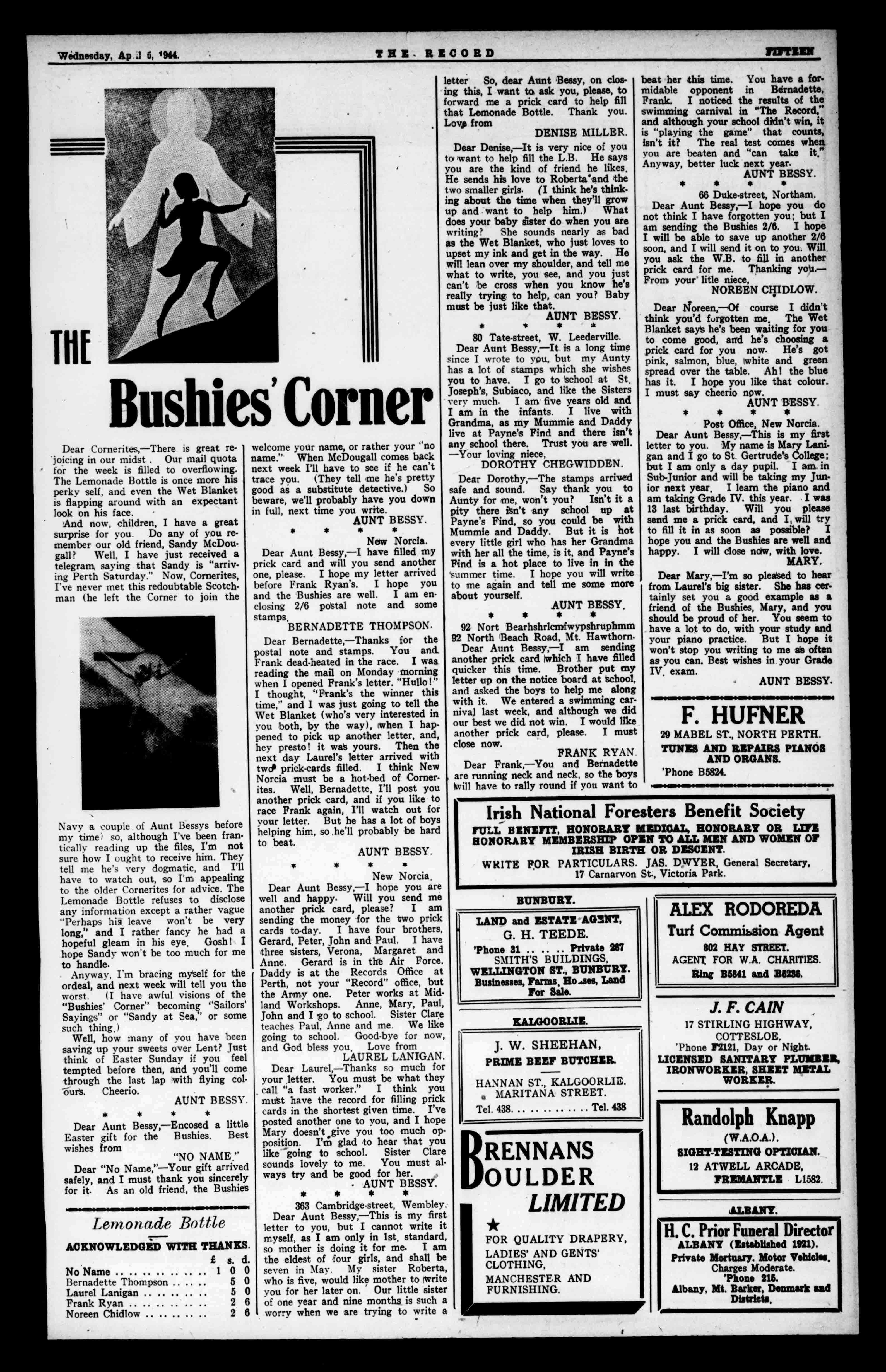
NavyacoupleofAuntBessysbefore mytime)so,althoughI'vebeenfranticallyreadingupthefiles,I'mnot surehowIoughttoreceivehim.They tellmehe'sverydogmatic,andI'll havetowatchout,soI'mappealing totheolderCorneritesforadvice.The LemonadeBottlerefusestodisclose anyinformationexceptarathervague "Perhapshialeavewon'tbevery long,"andIratherfancyhehada hopefulgleaminhiseye,Gosh!I hopeSandywon'tbetoomuchforme tohandle.
Anyway,I'mbracingmyselfforthe ordeal,andnextweekwilltellyouthe worst. Ihaveawfulvisionsofthe "Busbies'Corner"becoming"Sailors' Sayings"or"SandyatSea,"orsome suchthing.
Well,howmanyofyouhavebeen savingupYoursweetsoverLent?Just thinkofEasterSundayifyoufeel temptedbeforethen,andyou'llcome throughthelastlapwithflyingcol. ours.Cheerio.
AUNTBESSY.
DearAuntBessy,-Encosedalittle EastergiftfortheBushies.Best wishesfrom "NONAME."
Dear"NoName,"-Yourgiftarrived safely,andImustthankyousincerely forit.Asanoldfriend,theBushies
AINE111011MNMI
LemonadeBottie
ACKNOWLEDGEDWITHTHANKS. s.d.
NoName 1 00
BernadetteThompson 50
LaurelLanigan 50
FrankRyan 26
NoreenChidlow
26
welcomeyourname,orratheryour"no name."WhenMcDougallcomesback nextweekI'llhavetoseeifhecan't traceyou.(Theytellmehe'spretty goodasasubstitutedetective.)So beware,we'llprobablyhaveyoudown infull,nexttimeyouwrite.
*
AUNTBESSY.
* * *
NewNorcia.
DearAuntBessy,-Ihavefilledmy prickcardandwillyousendanother one,please.Ihopemyletterarrived beforeFrankRyan's.Ihopeyou andtheBushiesarewell.Iamen closing2/6postalnoteandsome stamps, BERNADETTETHOMPSON.
DearBernadette,-Thanksforthe postalnoteandstamps.Youand. Frankdead-heatedintherace.Iwas readingthemailonMondaymorning whenIopenedFrank'sletter."Hullo!"
Ithought,"Frank'sthewinnerthis time,"andIwasjustgoingtotellthe WetBlanket(who'sveryinterestedin youboth,bytheway),whenIhappenedtopickupanotherletter,and, heypresto!itwasyours.Thenthe nextdayLaurel'sletterarrivedwith twcprick-cardsfilled.IthinkNew Norciamustbeahot-bedofCornerites.Well,Bernadette,I'llpostyou anotherprickcard,andifyouliketo raceFrankagain,I'llwatchoutfor yourletter.Buthehasalotofboys helpinghim,sohe'llprobablybehard tobeat.
AUNTBESSY.
NewNorcia,
DearAuntBessy,-Ihopeyouare wellandhappy-Willyousendme anotherprickcard,please?Iam sendingthemoneyforthetwoprick cardsto-day.Ihavefourbrothers, Gerard,Peter,JohnandPaul.Ihave threesisters,Verona,Margaretand Anne.GerardisintheAirForce. DaddyisattheRecordsOfficeat Perth,notyour"Record"office,but theArmyone.PeterworksatMidlandWorkshops.Anne,Mary,Paul, JohnandIgotoschool.SisterClare teachesPaul,Anneandme.Welike goingtoschool.Good-byefornow, andGodblessyou,Lovefrom LAURELLANIGAN.
DearLaurel,-Thankssomuchfor yourletter.Youmustbewhatthey call"afastworker."Ithinkyou mutthavetherecordforfillingprick cardsintheshortestgiventime.I've postedanotheronetoyou,andIhope Marydoesn'tgiveyoutoomuchopposition.I'mgladtohearthatyou likegoingtoschool.SisterClare soundslovelytome.Youmustalwaystryandbegoodforher. AUNTBESSY.
* * * 363Cambridge-street,Wembley.
DearAuntBessy,-Thisismyfirst lettertoyou,butIcannotwriteit myself,asIamonlyin1st,standard, somotherisdoingitforme.Iam theeldestoffourgirls,andshallbe seveninMay.MysisterRoberta, whoisfive,wouldlikemothertowrite youforherlateron.Ourlittlesister ofoneyearandninemonthsissucha worrywhenwearetryingtowritea
beatherthistime.YouhaveaformidableopponentinBernadette, Frank.Inoticedtheresultsofthe swimmingcarnivalin"TheRecord," andalthoughyourschooldidn'twin,it is"playingthegame"thatcounts, isn'tit?Therealtestcomeswhen Youarebeatenand"cantakeit," Anyway,betterlucknextyear.
AUNTBESSY.
66Duke-street,Northam.
DearAuntBessy,-Ihopeyoudo notthinkIhaveforgottenyou;butI amsendingtheBushies2/6.Ihope Iwillbeabletosaveupanother2/6 soon,andIwillsenditontoyou.Will youasktheW.B.tofillinanother prickcardforme.Thankingyou.Fromyourlitleniece, NOREENCHIDLOW.
DearAuntBessy,-Itisalongtime =inceTwrotetoyou,butmyAunty hasalotofstampswhichshewishes youtohave.IgotoSchoolatSt. Joseph's,Subiaco,andliketheSisters verymuch.Iamfiveyearsoldand Iamintheinfants.Ilivewith Grandma,asmyMummieandDaddy liveatPayne'sFindandthereisn't anyschoolthere.Trustyouarewell.
-Yourlovingniece, DOROTHYCHEGWIDDEN.
DearDorothy,-Thestampsarrived safeandsound.Saythankyouto Auntyforme,won'tyou?Isn'tita pitythereisn'tanyschoolupat Payne'sFind,soyoucouldbewith MummieandDaddy.Butitishot everylittlegirlwhohasherGrandma withherallthetime,isit,andPayne's Findisahotplacetoliveininthe ,flinmertime.Ihopeyouwillwrite tomeagainandtellmesomemore aboutyourself.
AUNTBESSY.
92NortBearhshrlcmfwypshruphmm
92NorthBeachRoad,Mt.Hawthorn.
DearAuntBessy,-Iamsending anotherprickcardwhichIhavefilled quickerthistime.Brotherputmy letteruponthenoticeboardatschool, andaskedtheboystohelpmealong withit.Weenteredaswimmingcarnivallastweek,andalthoughwedid ourbestwedidnotwin.Iwouldlike anotherprickcard,please.Imust closenow.
FRANKRYAN
DearFrank,-YouandBernadette arerunningneckandneck,sotheboys Avillhavetorallyroundifyouwantto
DearDoreen,--0fcourseIdidn't thinkyou'dforgottenme,TheWet Blanketsayshe'sbeenwaitingforyou tocomegood,andhe'schoosinga prickcardforyounow.He'sgot pink,salmon,blue,whiteandgreen spreadoverthetable.Ah!theblue hasit.Ihopeyoulikethatcolour. Imustsaycheerionow.
AUNTBESSY.
PostOffice,NewNorcia.
DearAuntBessy,-Thisismyfirst lettertoyou.MynameisMaryLaniganandIgotoSt.Gertrude'sCollege; butIamonlyadaypupil.Iamin Sub-JuniorandwillbetakingmyJuniornextyear.Ilearnthepianoand amtakingGradeIV.thisyear.Iwas 13lastbirthday.Willyouplease sendmeaprickcard,andI,willtry tofillitinassoonaspossible?I hopeyouandtheBushiesarewelland happy.Iwillclosendw,withlove. MARY.
DearMary,-I'msopleasedtohear fromLaurel'sbigsister.Shehascertainlysetyouagoodexampleasa friendoftheBushies,Mary,andyou shouldbeproudofher.Youseemto havealottodo,withyourstudyand yourpianopractice.ButIhopeit won'tstopyouwritingtomeatoften asyoucan.BestwishesinyourGrade IV,exam. AUNTBESSY.
Wednesday,Ap.16,1944. THZ.RECORD /Trams
F.HUFNER 29MABELST.,NORTHPERTH. TUNESANDREPAIRSPIANOS ANDORGANS. 'PhoneB5824. IrishNationalForestersBenefitSociety FULLBENEFIT,HONORARYMEDICAL,HONORARYORLIFE HONORARYMEMBERSHIPOPENTOALLMINANDWOMENOF IRISHBIRTHORDESCENT. WRITEFORPARTICULARS.JAS.DWYER,GeneralSecretary, 17CarnarvonSt.,VictoriaPark. BUNBURY. LANDandESTATEAG3NT, G.H.TEEDE. 'Phone31 Private267 SMITH'SBUILDINGS, WELLINGTONST.,BUNBURY. Businesses,Farms,Hoses,Land ForSale. KALGOORLIE. J.W.SHEEHAN, PRIMEBEEFBUTCHER. HANNANST.,KALGOORLIE. MARITANASTREET. Tel.438. Tel.438 B RENNANS OULDER LIMITED FORQUALITYDRAPERY, LADIES'ANDGENTS' CLOTHING, MANCHESTERAND FURNISHING. ALEXRODOREDA TurfCommibsionAgent 802HAYSTREET. AGENTFORW.A.CHARITIES. RingB5841andB5235. J.F.CAIN 17STIRLINGHIGHWAY, COTTESLOE. 'PhoneF2121,DayorNight. LICENSEDSANITARYPLUMBER, IRONWORKER,SHEETMETAL WORKER. RandolphKnapp (W.A.0A.). SIGHT-TESTINGOPTICIAN. 12ATWELLARCADE, FREMANTLEL1582. ALBANY. H.C.PriorFuneralDirector ALBANY(Established11121). PrivateMortuary.MotorVehicles, ChargesModerate. 'Phone216. Albany,Mt.Barker,Denmarkand Districts,
CONSULT with,our ADVERTISERS forallyour REQUIREMENTS
OfficialOrganoftheArchdioceseofPerth ESTABLISHED1874
WEREYOUONEOFTHELUCKYONESTHISTIME IFNOT,GETYOURTICKETFROMCHARLESWATSON&CO.
76BARRACKSTREET(NextWilsonandJohn's). f1,000FOR2/6.OtherPrizesbytheThousand.
FRESHTISTWICEDAILY. 131BARRACKSTREET. DELIVERIESANYWHERE. PHONEB2974
SupplierstoHospitals,EducationalandReligiousIr.:Aitutions. WEARETHEOLDESTANDLARGESTFISHDISTRIBUTORSIN WESTERNAUSTRALIA. FRESHROASTEDPOULTRY.
INTERNATIONALFISHERIES
FRANKJ.BOSWELL
SPECIALISTSINHospitalEquipmentandSteamInstallations,HotWaterHeating, Ventilating,SewerageWork,andGeneralPlumbing. CornerRUTH&WILLIAMSTREETS,PERTH. Tel.B2777. W.A.AgentforK.G.LUKEPTY.,LTD.,MELBOURNE. SuppliersofHospitalEquipmentandStainlessHospitalUtensils.
SAVECHARGES!
SAVEFREIGHT!
ImprovetheValueofYourWoolbyhavingitSCOURED
TheSWANWOOLSCOURINGCO. ofW.A.Ltd.Fremantle theoldestbusinessofitskindinthisState,withitsmostefficientmodernplant,employstheverylatestmethodstosecureforclientsbetter returnsfortheirwool. ConsigntoNORTHFREMANTLEandobtainrebatesof40percent. ofthefreightforallquantitiesoveroneton.
Address:BOX2,POSTOFFICE,FREMANTLE.
'PHONES:L1031-2.
GoldfieldsSection
YOUCANDOALLYOURSHOPPINGAT the GOLDFIELDS'
LEADING EMPORIUM whereyoualwaysget
BESTOFSERVICE NMIJN MAKE-
GlassonYOURTAILOR KALGOORLIE RUSSELL'SKalgoorlie
THESHOPFORMEN'SWEAR
Telephones:
CHINA,GLASSandPLATED WAREIMPORTER&
OTLEYPLACE,OffMURRAY STREET(RearSavoyHotel) Convents,Colleges,Institutions andSchoolsSpecieyCateredIca PriceListsandCatalogueon Application.
PhoneB9851.
Kelly&ROdoreda
LateofJOHNDYNON&CO.
WhyitisNotSuperstitioustoUse BlessedObjects
PiousObjectsDeriveEfficacyfrom Church'sPrayertoGod
(ContinuedfromFrontCover.) toanimals,plants,andinanimateobjectsaswellastopeople?Yes,it is,butwiththisdifference:intheblessingofasickchild,forinstance,God isdirectlypetitionedtograntrecoveryandsoundhealthifitbeforthe greatergoodoftheailingyoungster; butintheblessingsgiventoaircraft, farmanimals,food,homes,andthe like,theChurchrequeststhatintheir useallmenwillbeprotectedfrom spiritualandtemporaldangersand willbebetterablesotoliveonearth astoserveGodmorefaithfully.In otherwords,theemphasisisplaced unthetactthatcreatedthingsareto helpustosaveoursouls.
Fromthisyoucanperhapsalready seewhytheuseofblessedarticlesis notasuperstition.Superstitionattachesmorethannaturalpowersto lifelessobjects;outofthemitmakes, asitwere,littlegods,Butamedal orotherblessedarticlederivesitsefficacynotfromitselfbutbecauseof theChurch'sprayertoAlmightyGod. Themedalismerelyasymbolofthat prayer;itisabadgeofbeliefindivine providenceandinthemeritsofChrist's redemptionofmankind.InGod's sightitsweareroruserhasconnected himselfinaspecialwaywiththeprayersoftheChurchforhiswelfare,and hetakesthismeanstoshowexternally hisinternalsentimentsofstrongfaith inthelovinggenerosityandcareofbur FatherinHeaven. Concreteexamplesarealwaysgood proofsofanyassertion.Ifweturnto the150ormoreblessingslistedinthe "RomanRitual,"thesublimespiritof trustinGodwhichtheseprayers breathe,easilyrefutesthechargeof superstition.Herewefindblessings offieldsandpastures,ofseedsandharvest,ofbirds,bees,cattle,horses,and sickanimals;ofvehicles,railroadcars, andaircraft;ofseismographs,radios, thetelegraph,dynamos,lime-kilns, typewriters,printingshops,blast-furnaces,andfire-fightingequipment;of foods,suchascheese,butter,lard, grapes,wine,beer,andbread;ofbandages,medicines,andbedsofthesick; ofshipsandfishingboats;offlourmillsandbridgesandlibraries-all theseandmanymoreobjects,besides medals,scapulars,androsariesfor
pioususe,aretakenbytheChurchand sanctifiedinthespiritoftheiremploymentbymaninorderthathe mightthebetterserveGod.
Intheselectedlistjustcited,anAmericaneyewouldprobablynoteimmediatelytheblessingforaircraft.Who wouldconsideratransportoradirigibleorahelicopterasameansofsalvation'ThisiswhattheChurch saysinoneofitsprayers:"0God, Whobastmadeallthingsbecauseof Thyselfandhastdestinedalltheelementsofthisworldforhumanuse, bless,webeseechThee,thisaircraft,in orderthatitmayservetofacilitate themorespeedytransactionofhuman affairswithperfectsafety,andalso thatitmayfosterheavenlyaspirationsinthesoulsofthosewhouseit, allfortheincreaseofthepraiseand gloryofThyName.ThroughChrist ourLord.Amen."
IstheChurch"behindthetimes"?
Theanswerisreadilyfoundinthis prayerfortheblessingofaradioor tedegraph:"0God,Whowalkeston thewingsofthewindsandalonedost performwonderfulworks,grantthat asbythe,powerinstilledintothisinstrument,Thoudosttransmithither whatisdistantanddostbroadcast whatispretentmoreswiftlythanthe lightning-flash,sowe,taughtbynew inventionsandsupportedbyThy grace,maybeabletocometoThee morequicklyandeasily,Through ChristourLordAmen."Thegreat ruleoflifeisalwaysthesame,andthe Churchnevertiresofpointingitout: allcreationinitselfisgood,andwe shoulduseitinsofarasithelpsusto serveGodandtosaveoursouls.
Finally,onemoreblessingcanbe notedhere.Itisthecomprehensive generalinvocationforallthingswhich donothaveaspecialprayerassigned tothem."0God.byWhoteword allthingsaremadeholy,pourforth ThyblessinguponthisThycreature, andgrantthatwhoeverusesitgratefullyandaccordingtoThylawand will,mayobtainhealthofbodyand protectionofsoulbytheinvocation ofThyholyNameandbyThypower. ThroughChristourLord.Amen."
Yes,thebeautyandtheefficacyof thesacramentalsspeakfortliemsele
"DivineTip"toPriesttoPrepare forDeath
Hecalledit"atiptogetprepared" fromOurLordandHisBlessedMother. SojustbeforeanArmyoperationin Sicily,theRev.JamesP.Flynn,priest oftheDioceseofCrooltstonandan Armychaplain,actedonthe"tip''and wrotealettertohisparents,tobedeliveredincastofhisdeath.Thenhe twentintotheaction-andtheletter wasdelivered.
"DearestDadandMother:Funny thingaboutthisletter,"FatherFlynn wrote,"ifI'malivetwoweeksfrom now-you'won'treceiveit.Inother words,ifyougetthisletter,itwill meanthatAlmightyGodhasdecided I'vebeenonearthlongenoughandHe wantsmetocomeupandtaketheexaminationforpermanentservicewith Him.
"It'safunnythingaboutthisoperation-butIreallydon'tbelieveI'll comeoutalive,CallitanIrishman's bunch,orapresentiment,orwhatever vonwill,"theletter-aid''Ibelieve it'sOurLordandHisblessedMother givingmeatiptogetprepared.Naturails',I'llgotoConfessionbeforewe sailandgetabsolutionandwhatever myfriend,FatherDennyMoore,can giveme.Furthermore,intheevent Igetkilled,youcanhavethescant consolationofknowingthatitwas'in thelineofduty,'not.onlyformycountry,butespeciallyfortheworkofAlmightyGod."
BONDSBACKOURBOYSMakeanadvancesubscriptiontothe FirstVictoryLoan.
"....,111010MINIMMIAIIMMIIINIMONIIIMOIM111111.111MI
S
THE
W.
FORTHEBESTMEAT
WHOLESALV.ANDRETAILBUTCHERS. BURTST.,BOULDa.R,ARDAGHAVENUE.,&HANNAHST., III&LOOORL13. TelephonicBUS;KW& -
atREASONABLEPRICES,DealfromJas.GrayandCo.Ltd.
BIBS;111711.
PrintedandPublishedbyKeithFrancisSpruhan,at"TheRecord"Office,450HayStreet,Perth.