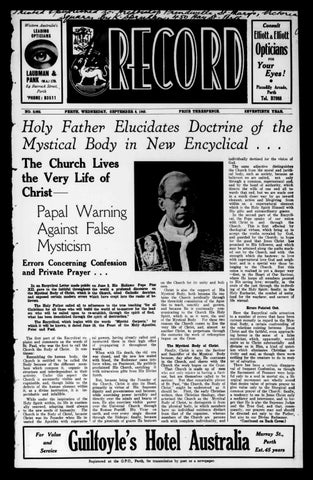

HolyFatherElucidatesDoctrineofthe MysticalBodyinNewEncyclical TheChurchLives theVeryLifeof Christ
PapalWarning AgainstFalse Mysticism
ErrorsConcerningConfession andPrivatePrayer
InanEncyclicalLettermadepubliconJune3,HisHolinessPopePius XII.gavetothefaithfulthroughouttheworldaprofounddiscourseon theMysticalBodyofChrist,whichistheChurch,citedCatholicdoctrine, andexposedcertainmodernerrorswhichhavecreptintotheranksofbelievers.
TheHolyFathercalledalltoadherencetothetrueteaching"forall Christiansforallthosewhowillbuildtheworldofto-morrowfortheleaderswhowillbecalledupontore-establish,throughthespiritofGod, whathasbeendemolishedthroughthespiritofdestruction."
TheEncyclical,whichbeginswiththewords"MysticiCorporis,"by whichitwillbeknown,isdatedJune29,theFeastoftheHolyApostles, PeterandPaul.
ThefirstpartoftheEncyclicalLxplainsandcommentsonthewordsof St.Paul,whowasthefirsttocallthe ChurchtheBodyofChrist.Itcontinues:
Resemblingthehumanbody,the Churchisentitledtobecelledthe Bodybecauseofthedifferentmemberswhichcomposeit,organicin structureandinterdependentintheir activity.Underthisaspectthe Churchisnecessarilyvisibleandrecognisable,and,thoughliabletothe defectsofthehumanelementwithin it,asadivineinstitution,itis perishableandinfallible.
Whileundertheinspirationofthe HolySpiritwithin,itslifeiscontinuallyrenewed,adaptingitselfalways tothenewneedsofhumanity.The ChurchistheBodyofChrist,because ChristwasitsFounderwhenHeinvestedtheApostleswithsupernatu-
ralpowers,havingalreadycalledand instructedthemintheirhighoffice ofpropagatingitthroughoutthe world.
WhenwithHisdeath,theoldera wasclosed,andthenewlawsealed withblood,theRedeemercameinto forcewhen,onPentecost,Hepublicly proclaimedHisChurch,enrichingit withmiraculousgiftsfromHisDivine Spirit.
But,becausebeingtheFounderof theChurch,ChristisalsoitsHead, primarilyinvirtueofHisSupreme dignityandpre-eminenceandbecause, whileexercisingpowerinvisiblyand directlyoverthemindsandheartsof men,Healsoexercisesvisiblepower overtheUniversalChurchthrough theRomanPontiff,HisVicaron earth,andovereverysinglediocese throughtheBishops;finally,because oftheplenitudeofgracesHebestows
ontheChurchforitsunityandholiness.
ChristisalsothesupportofHis MysticalBody,bothbecauseHesustainstheChurchjuridicallythrough thethree-foldcommissionoftheApostlestoteach,sanctifyandgovern. andbecauseHeiscontinuallycommunicatingtotheChurchHisHoly Spirit,whichis,asitwere,thesoul oftheMysticalBody.Forthesetwo reasonstheChurchcomestolivethe verylifeofChrist,and,almostas anotherChrist,toperpetuatethrough thecenturiestheworkofredemption begunontheCross.
TheMysticalBodyofChrist.
Finally,ChristisalsotheSaviour andSanctifieroftheMysticalBody because,dayafterday,Hecontinues intheChurch,andshareswiththe ChurchtheworkbegunontheCross.
ThatChurchismadeupofmen whonotonlyrejoiceinhavingaSaviour,butarethemselvescalledtobe saviour.Butthatremarkablephrase ofSt.Paul,"theChurch,theBodyof Christ,"mightbeunderstoodasit shouldbe.First,theearlyChristian writers,thenChristiantheology,characterisedtheChurchastheMystical BodyofChrist,todistinguishitfrom thephysicalbody,inwhichmembers havenoindividualexistencedistinct fromthatoftheorganism,whereas membersoftheChurcharepersons eachwithcompleteindividuality,and
individuallydestinedforthevisionof God.
Thesameadjectivedistinguishes theChurchfromthemoralandjuridicalbody,suchassociety,becauseas believersweareunited,notonly throughacommon,supernaturalend, andbythebondofauthority,which directsthewillsofoneandalltowardsthatend,butwearemadeone inamuchcloserwaybyaninward element,activeandlife-givingfrom withinus,asupernaturalelement whichistheHolySpiritHimselfwith Hisgiftsandextraordinarygraces.
InthesecondpartoftheEncyclical,thePopespeaksofourunion withChristinandthroughthe Church.Thisisfirsteffectedby theologicalvirtues,whichbringusto acceptthetruthsrevealedbyGod, andguardedbytheChurch;tohope forthegoodthatJesusChristhas promisedtoHisfollowers,andwhich mayheattainedalongthepathsmarkedoutbytheChurch,andwiththe strengthwhichshebestows;tolove withsupernaturalloveGodandneighbour,andinaspecialwaythosebelongingtotheChurch.Butthis unionisrealisedinyetadeeperway -first,intheHeartofOurSaviour, whereHekeepsallmemberspresent toHissavinglove;secondly,inthe soulsofthejustthroughthein-dwellingoftheHolySpirit;finally,inthe HolyEucharist,thesymbolofunity, foodforthewayfarer,andearnestof lifeeternal.
ErrorsPointedOut.
HeretheEncyclicalcallsattention toanumberoferrorsthathavebeen currentrecentlyinregardtotheMysticalBody,acertainconfoundingof therelationsexistingbetweenJesus Christandthefaithful,evenapproachingheresyinthesenseofafalse mysticism,which,apparently,would uniteustoChristsubstantiallyand diviniseusinHim,akindofquietismwhicheliminatesChristianactivityandzeal,asthoughtherewere nothingforthecreaturetodoinmatterofsalvation.
TherehasbeenacertaindisapprovaloffrequentConfession,asthough theSacramentofPenancewerehelpfulonlytoasoulinmortalsin,aliturgicalmovementnotwhollysound thatdeniesvalueofprivateprayerto givevalueonlytotheliturgicaland commonprayeroftheChurch;finally, atendencytoseeinJesusChristonly amediatorandintercessor,andtoforgetthatHeisalsotheSupremeJudge andtheTrueGod,andthat,consequently,ourprayersmayandshould bedirectednotonlytotheFather, butalsotoourDivineRedeemer.
(Cont3nuedonBackCover.)
WOW! 1171P^' "-rjr/I.7wr A.. KAlliggri; 4csr) WesternAustralia's LEADING OPTICIANS LAUBMANIt, PANK(W.A.)LTD. 64BarrackStreet, Perth 'PHONE:B3511 k 11111=IIM NO.3,092. PERTH,WEDNESDAY,SEPTEMBER8,1943. PRICETHREEPENCE. Consult [Ili&&Elliott Opticians FOR Your Eyes! PiccadillyArcade, Perth Tel.B7988 SEVENTIETHYEAR.
ForValue and Service MurraySt., Guilfoyle'sHotelAustralia Perth Est.45years RegisteredattheG.P.O.,Perth,fortransmissionbypostasanewspaper.
ByMr.K.Somers
JFRetigiortVeers...
HeresyisExtremelyImportant
ItInvolvesAcceptingNearlyAllReligiousTruth
OnFriday,August20,theninthin thisseason'sseriesoflectureswasdeliveredintheCatholicCentralLibrary byMr.KevinSomers.Hissubject was"TheGreatHeresies,"thosedealt 'withbeingtheArian,Mohammedan, Albigensian,Protestant,andtheModernAttack.
Whatisheresy?Itisfrequently takentomeanopinioncontraryto thedoctrineoftheChurch.TonightweshalltakeBelloesdefinition thatheresyistoacceptmostofacompleteandcoherentsystem,buttodenysomeessentialpartofit.Itistoac cept,buttoalsoexcept-aperversion, anadaptation,amisuse.TheCatholicChurchisacompleteandcoherent religioussystem;thereforeanyperson 'whoacceptsmostofthatsystembut deniesanessentialpartisaheretic.
Hereticsmaycomefrominsideor outsidetheChurch;usuallyfromthe inside,forexample,Arius,Calvinand Luther;fromoutside,Mohammed.
Havingdefinedheresy,wenowask: Isitoflivinginterestto-day?There isatendencytoregarditasbelongingonlytooldquarrels,tothinkita remoteacademic,fossilisedthing,associatedonlywiththetheoretical.disputationsoflearnedtheologians.
Well,sinceheresyisaperversionof religiousdoctrine,isthatdoctrineimportant?Ifsothenheresybecomes importantalso.Andifreligionaffects everymanandwoman-whichitdoes '-thensodoesheresy.
Wehearmanypeoplesayto-day, "Whatdoesitmatteraboutreligion?" ortowhatreligiononebelongs'Well, whatdoesitmatter?Religionisthe mostimportantandmostinteresting thinginlife.Onreligionisbasedour morals,socialdoctrines,politics,economics,philosophy,education,literature,artculture,allthatgoestomake upour'dailylot.

Takethelifeofagoodandsincere Catholic.Hestrivesforhappiness hereandresistsinjusticetohimself andothers,butheregardsthislife primarilyasameanstotheonething necessary,salvation.HelooksforwardtoeternalhappinesswithGodin !leaven.
Takethelifeofanatheistic,materialistic,Communist.HedoesnotbelieveinGodorthehereafter,with "pieinthesky'asheputsit.Heregardsthislifeasanendinitself;he musthavehisHeavenhereandnow.
Heisthereforeinadesperatehurry togainthatHeavenonearth.So desperatethathelosesallscruplesand rightprinciples;hewilllie,promote class-hatred,civilwar,revolution,violence,andterror.
ACatholicnationbasesitslawand thelivesofitspeopleonthelawof GodandtheprinciplesofHisChurch. Anexampleofsuchanationisthe present-dayPortugalofDr.Salazar, basedonCatholicismandthePapal Encyclicals,andshowingtheworldthe waytothetrueneworder.
Irreligiousoranti-religiousnations havetheirownreligions,falsereligions. Theysetupfalsegods,therace,the State,thenation(aformofself-worship),orwealth,power,materialism, force,andbasetheirlivesonthese.
Religion, matter,isabsolutelyall-importanttousall.And heresy,beingadenialorperversionof religiousdoctrine,isall-importantalso. Itresultsintheperversionofthelife ofthenationinwhichitgainscontrol.
Historymaybedividedintofour greatperiods.Thepre-Christian world;theworldintowhichChrist wasborn,andinwhichHefounded HisChurch,A.D.1to33:theworld theChurchanditsdoctrinesfounded, whichitraisedfrompaganismand
FRANKJ.BOSWELL
SPECIALISTSINHospitalEquipmentandSteamInstallations,HotWaterHeating, Ventilating,SewerageWork,andGeneralPlumbing. CornerRUTH&WILLIAMSTREETS,PERTH. Tel,B2777. W.A.AgentforK.G.LUKEPTY.,LTD.,MELBOURNE. SuppliersofHospitalEquipmentandStainlessHospitalUtensils.
PROPERTYMANAGEMENT
Over30years'experienceinpropertymanagementandrentcollectionenableusto offeryouexpertserviceinthisdirection.
Wealsohaveextensivelistsofprivate homesavailableforpurchaseinallsuburbs. Reasonabletermsarrangedifrequired. Wecanofferyouspecialisedserviceinall branchesofRealEstate.
DUDLEY&DWYERLIMITED
SWORNVALUATORS. 98ST.GEORGE'STERRACE.
*InfluenceofArianismonthe ChurchintheRomanEmpire VictoryofAthanasiusOver theFirstGreatHeresy
slaverytoCatholicism,freedomand justice-totheendofthefifteenthcentury;theworldsincetheReformation,whichhasturnedfromthe Churchandrevertedtopaganismand servility.
TheJewswereforcenturiesanoasis oforthodoxy,ofworshipoftheone trueGod,inadesertofpaganism, nature-worship,andsoon.God's chosenpeople,theyconsciouslylooked forwardtothecomingoftheSaviour, but,unfortunately,theyhopedfora politicalandnationalSaviour.Ile cameuntoHisownandHisownreceivedHimnot.
TheglorythatwasGreecewasone oftheworld'sgreatestcivilisations, butstrangelyweakinitsreligion,the mythologicalgods.Wefindinthe writingsofsomeofthegreatGreeks theknowledgeoftheirinsufficiency. They,too,lookedforwardtoChrist, utunccnsciouslv.
OurBlessedLordwasbornintoa worlddominatedmilitarilyandpoliticallybythegreatRomanEmpire, butculturallyHellenistic,orGreek. TheChurchwasfoundedandgiven Christ'sauthorityandpromisethatHe willhewithittotheendof,time.St. PeterestablishedhisSeeatRome, thecapitaloftheworld.St.Paul, thegreatmissionaryhero,founded churchesoverthewholeofthethen knownworld.Thereweremany othersaintsandmartyrs.
TheChurchsufferedpersecutions duringtheearlycenturies;itwasforcedtodescendtothecatacombs.But thenasnowthebloodofthemartyrs wastheseedoftheChurch,andsteady progresswasmade,despiteseveral heresies.Mostoftheseconcernedthe natureofChrist,suchastheMonophysite,Monothelite,andNestorian. TherewasalsotheManicheanheresy, relatedtothelaterAlbigensianand Puritanheresies.
However,thecommonpeoplewere beingsteadilyconverted.Therewas ahostilereactionagainsttheChurch amongtheatthattimeall-important Army,thepatricianaristocracy,the intellectuals.Thesegroupsthought themselvesabovethepeople,andwhat wasbecomingthereligionofthepeople.Theyreactedtowardsthedying paganisminwhichtheyhadsolong lived.Catholicismwaspreachingthe essentialequalityofall,fromtheEmperortotheslave;itwouldhumble theexaltedandexaltthehumble.
TheEmperor,worshippedasagod, absoluterulerofatotalitarianState, tendedtohateandfeartheChurchas arivaltohispower.Hewantedthe thingswhichareCaesar'sandthe
to51accepted.AlsoSickness,MedicalandHospitalBenefits.
J.EDWARDS,Grrrd.3tcretary,WestAustralianChambers,St.George'sTerrace,Perth. Tel.:B7804.
thingswhichareGod's,asthetotalitarianStatesdoto-day.
OursecondperiodendsasConstantineissuesthedecreeoftoleration,the EdictofMilan,in313.Inthewords ofChestertonhenailed'upthatpro- clamationwhichallsubsequentgen- erationshavestriventoteardown orprotect.ThenConstantinebecameaCatholicandmadeCatholicism theofficialreligionoftheEmpire.
WhenAriusbegantopreachhisher. esy,hewassupportedbytheArmy andupperclasses.Itbecamesmart tobeArian.Theprincipalheresyof AriuswasthedenialofthefullDivinityofChrist.Itsummedupand wastheclimaxofearlierheresiesof thesametype.InattackingtheDiv inityofChrist,italsonecessarilyattackedtheBlessedTrinity,thedoe. trineofthreedivinePersonsinone God.Tianwasfindingithardtoacceptmystery;rationalismwasat workhere;theattempttoreduce everythingwithinthecompassofthe humanmind.Therationalistwould knowasmuchasGodHimself,orreduceGodtohisownlevel,thatof oneofHiscreatures.
Thechurchwasdividedonthis issue,andtheCouncilofNicaeawas heldtodecidethequestion.The Arianswereoverwhelminglydefeated, andthedoctrinesofthefullDivinity ofChristaffirmed.TheNiceneCreed, nowrecitedduringeveryMass,was drawnup;itissometimescalledthe AthanasianCreed,inhonourofSt. Athanasius,whosatattheCouncilas ayoungmanandwhowastobecome theleaderoftheChurch,thepeople, againsttheheretics.
Theterm"consubstantialwiththe Father,"includedintheCreed,and meaning"ofthesamesubstance,"was takenasthetestoforthodoxy.After theCouncilArianbegantoacceptthe term,butinadifferentsense;they againcompromisedChrist'sfullDivinity.Constantinetookthesideofthe heretics,thinkingthedisagreementa quarrelaboutmeretechnicalities.He orderedAthanasius,nowArchbishop ofAlexandria,toremovetheexcommunicationwhichhadbeenimposed onArius.Athanasiusrefused,taking hislifeinhishandsbydoingso.He wasexiled,thefirstoffivesimilar sentences.Forfiftyyearshefought Arianism,andathisdeathitsdoctrineswerepracticallydead,although itsspiritwastoliveonforafurther twocenturies.Athanasiusdiedwith thevictorywon,thegreatestRoman ofhisday. ThegreatAugustinewasbaptised in387.Arianismwaspracticallydead intheWestbysay550.
S.BEECROFT-Butcher
181RokebyRoad,Subiaco.
DnlyPrimeFreshKilledMeatSold 'PhoneW1873.
TWO THERECORD. Wednesday,September8,1943. LIBRARYLECTURESIX
Hibernian-AustralasianCatholicBenefitSociety BESTBENEFITSFORLOWESTCONTRIBUT11NS, DEATHBENEFIT.-£50,age16andunder20,4/10quarterly;f100.7/2quarterly.20yearsandunder23, 5/3qr.;£100,8/-qr.23yearsandunder25,5/5qr.;f100,8/4qr.25yearsandunder30,5/10qr.;£100, 9/2qr.Membersup
MohammedanismThreatenedtheCatholic CultureforAlmostOneThousandYears
AHeresyfromWithouttheChurch Popular'AppealofOver-Simplification
St.DominicandSimondeMontfort CrushtheEvilofAlbigensianism
Constantinehadmovedtheseatof theEmpiretoByzantium,re-named Constantinople.Theredevelopedthe twohalvesoftheEmpire,theGreekspeakingEast,theRomanLatinspeakingWest.
BynowtheRomanEmpire,particularlyintheWest,wasdecayingfrom within,beingattackedbythebarbariansfromwithout.ThelastEmperor oftheWestwasdeposedbythebarbariansin976.Fromabouttheyear 500toabouttheyear1,000runsthe periodknownastheDarkAges.The PaxRomana,thePeaceofRome,its lawandorder,hadended.
ThemightyEmpirewasdying,but theChurchwasgainingstrength.Feudalismarosethroughmenseekingthe protectionofstrongermen;theintermediatestepbetweenslaveryand thefreedomoftheHighMiddleAges. TheChurchsetaboutconvertingand civilisingthebarbarians.Thegreat monasteriesofSt.Benedictarose; townsandschoolsgrewaboutthem, tokeepreligion,civilisationandculturealive.TheprospectsforCatholicismseemedgood.
Suddenlyfromoutoftheburning desertlandscamespurringthegreat cavalrychargesofthefanaticalMohammedans.Thiswasinthe630's.
Anewmenacehadarisen,tobefor almostathousandyearsthegreatest enemyofCatholiccivilisation.The Crescenthadjoinedissuewiththe Cross.
WithinacenturytheMohammedans hadconqueredArabia,Palestine,Syria, Mesopotamia.TheyraidedintoAsia Minor,andreachedtothebordersof China.TheytookEgypt,allofNorth Africa,crossedtheMediterraneanat Gibraltar,floodedthroughSpain,over thePyrenees,andintotheheartof France.Theywerestoppedand flungbackonlywhenCharlesMartel, thegrandfatherofCharlemagne,won agreatvictoryofTours,inNorthern France,intheyear732.TheydominatedtheMediterranean,keptbatteringawayatConstantinople,setupan hereticalcounterreligion,agreatrival culture,richinscience,literature,philosophyandarchitecture.
ButCatholicstrengthwasgrowing. Charlemagne'sEmpirehadbeenfounded;intheyear800hewascrownedby thePopeasEmperoroftheHolyRomanEmpire.Thiswasanattemptto foundanewRomanEmpireonthe idealoftheMysticalBodyofChrist, underthespiritualandmoralauthorityofthePopeandthesecularauthorityoftheEmperorcrownedbyhim.
ThebarbariansfromtheNorthand North-Eastwerebeingdefeatedorabsorbedandconverted.TheMohammedanswerebeingbeatenbackin Spain.TheChurch,itsMonasteries, theirschools,haddonemuch;bythe year1,000weleavebehindtheDark AgesandentertheearlyMiddleAges.
TheChurchhadgivenfighting-men theidealsandchivalryofknighthood. Thesewerenowtobeusedinamovementuniqueinhistory-theCrusades torecovertheHolyLandfromthe Mahommedans,bynowknownasthe Turks.Jerusalemwastakenin1099. Itwasheldforalmostacentury,when itwasrecapturedbySalah-ed-din,or Saladin.TheCrusadersweredriven fromtheHolyLand,butthereaction hadsavedChristendom.
TheMohammedanskeptatConstantinople,whichwaseventuallytaken in1453.Theysweptupthroughthe
Balkans,werestoppedonlynear Vienna.TheirmenaceseriouslyembarrassedtheEmperorinthecampaigningoftheCounter-Reformation. Themilitaryandmaterialpowerof Mohammedanismbegantodeclinesuddenlyandlargelyinexplicably.Their navalstrengthwasbrokenatthegreat battleofLepanto.
Whatwasthesecretoftherise2nd powerofMohammedanism?Itisa heresyfromoutsidetheChurch.Mohammedwasacamel-driver,whomarriedarichwidow,acquiredleisure,and becameagreatheresiarch.Hecame intocontactwithCatholicdoctrinein andaboutArabia,chosethoseheliked andrejectedtherest.Thereisbut uneGod,Allah,andMohammedishis prophet.God'somnipotenceandmajestyareaccepted,asarethesouland itsimmortality,eternity,theessential equalityofallmen.ButMohammed wentfurtherthantheAriansbybluntlyrejectingtheDivinityofChrist,also inrejectingallmysteries,sacraments, aspecialpriesthood.Itisanoversimplification,whichappealedtopeopleaversethenasnowtohardthinking,tounderstandsubtletruths.
TheRomanEmpire,likeourown civilisation,hadbeengroaningunder debt;itdecayedlargelythroughthe effectsofcompoundinterest.The Mohammedansliberatedtheslaveand thedebtorwhoacceptedtheircreed; theyprovidedfreeaccesstothelaw courts.Theirmilitarypowerwas constantlyreinforcedbywavesofsavageMongolsfromAsiawhomthey wereabletoconverttotheirsimple creed.Itstillretainsitsdoctrinal hold:thereareovertwohundred millionMohammedansintheworldtoday.Itfurnishesanexampleofthe accuracyofthesayingthatheresies survivebythetruthstheyretain.
TherearesignsinTurkey,Arabia,Syriaandelsewhereofapossiblerevival.Thisisagenerationwhichhas notknownorhasforgottentheMohammedanmenace;pleaseGoditwill notriseagain.
Weturnbacktothebeginningof theeleventhcentury,approachingthe GreatnessoftheAgesofFaith.But beforegoingontothatconsummation wemustdealwithourthirdgreatheresy,theAlbigensian.Itwasfirst noticedearlyinthe11th.century, movingoverEuropelikeamiasma,an evilmist.ItsettledintheSouthof France,andhadtobefoughtthere witharmsearlyinthe13th.century.
Wefaceheretheever-presentproblemofevil,particularlyimportant tousto-day,engagedasweareina terriblewar.Theproblemofsufferinganddeath:whymustwesuffer, whymustwedie?Itcanbedealt withinseveralway;,Thereisthe ignoblemethodogevasion,ofturning away;thealsoignoblematerialistic attitudethatsufferinganddeathare meaninglesspartsofameaninglessexistence;thealienanddespairingway ofAsia,theself-annihilatingmethod ofBuddhism;thestoicismofthe nobleGreeksandRomans-"thephilosophyofgrinandbearit."
TheChurchteachesthatGodcreated manforeternal,mablightedhappiness.ButGodgavemanfreewill;he turnedtosinandsobroughtdeathand sufferingintotheworld.Nowwe mustwinourHeaven,throughChrist's RedemptionandGrace,intheordeal andtestandbattleoflife.Butwho wishestobeapuppet;dowenotde-
ThefightingLeganearlyinthe13th. century.Theleaderofthehertics wasRaymond,CountofToulouse.His brother-in-law,KingPeterofAragon, broughtahostofahundredthousand menacrossthePyreneestohisassistance.Theonlyforceavailableto meetthemwasathousandmenunder SimondeMontfort.Theywere,however,allarmed,trainedandmounted.

siretobeabletosaywithSt.Paul, "Ihavefoughtthegoodfight,Ihave finishedthecourse."
Peoplesay,intimesofsuffering,that "iftherewereagoodGodHewould notallowsuchthingstohappen."The Albigensiata,liketheManicheanbeforehim,conceivedagreatdualityin theuniverse,agoodGodwhocreates everythingspiritual,allofwhichis good,anevilGod,equalinpower, whocreateseverythingmaterial,all ofwhichisevil.Ourbodiesarematerial,thereforeevil,marriageisevil, alsowine,joy,beautyandmanyother things.Puritanismlaterrevealedthis samespirit;ithascomedowntoour owndayintheformof"wowserism."
TheAlbigensianheresytaughtthat man'spropagationofhimselfwasevil; itwouldhavedestroyedcivilisation; ithadtobedestroyed.ThefirstInquisitionwassetuptorootoutthe evil;St.BernardandSt.Dominic preachedagainstit.
ItisthemorningofSeptember13, 1213,theplaceMuret.Thethousand menontheCatholicside,allinthe saddle,drawnupin-rankswithSimon attheirhead,assistedataMasssung bySt.Dominic.Theythenrodeout, tookafetchroundtotheWest,and suddenlychargedatthehostofthe AragoneseKing,ill-preparedforthe shock.Despitetheoddsofahundred toone,theroutwascomplete.Peter waskilledandhisarmydestroyedas afightingforce.Muretpreparedthe wayforthegreatdecisivevictorof theKingofFranceatBouvines,in theNorth,duringthenextyear;it thusmadeatremendouscontribution Sithedefeatofthehereticsandthe layingofthefoundationsofthegreat FrenchMonarchyofthehighMiddle Ages.Itranksasoneofthemost significantbattlesofalltime.
(Tobecontinuednextweek.)
OurCatholicSchoolsandColleges
CHRISTIANBROTHERS,MT.HENRY.
ONEOFTHEASSOCIATEDPUBLICSCHOOLSOFW.A.
AQUINASCOLLEGE
TELEPHONE:MUM°.
FORBOARDERSANDDAYSTUDENTS. BOYSADMITTEDFROM7UPWARDS.
BeautifullySituated,overlookingtheriver,nearthenewCanningBridge. ForParticularsapplyto-ThePrincipal,AquinasCollege,CanningParade,Mt.Henry
SACREDHEARTHIGHSCHOOL HIGHGATE-
PERTH.
(CONDUCTEDBYTHESISTERSNOTREDAMEDESMISSIONS). BOARDINGANDDAYSCHOOLFORGIRLS.
PUPILSPREPAREDALLEXAMINATIONS. MONTESSORISCHOOLFORYOUNGCHILDREN. ForProspectusapply'Phone:B3810. REV.MOTHERPRIORESS.
LoretoConvent"Osborne"-Claremont BOARDINGANDDAYCOLLEGE.
TheSchoolprovidesasoundeducationonmodernlinesinallbranches ofstudy.Thepupilsarepreparedforallexaminations.TheSchoolis beautifullysituatedbetweenOceanandRiver,inextensivegrounds, withfineplayingfieldsandprivateSwimmingPoolinRiver. Telephone:F2135. Apply- MOTHERSUPERIOR.
ST.ILDEPHONSUS'COLLEGE
NEWNORCIA
CONDUCTEDBYTHEMARISTBROTHERS.
TheSchoolisfullfor1944.Boyscanbeacceptedforcommencementin1945,orforacceptanceduring1944subjecttovacanciesoccurring. AcharacterreferencefromtheParishPriestisrequired.
ForParticularsApplyto-THEBROTHERDIRECTOR.
SAVECHARGES! SAVEFREIGHT!
ImprovetheValueofYourWoolbyhavingitSCOURED TheSWANWOOLSCOURINGCO. ofW.A.Ltd.Fremantle theoldestbusinessofitskindinthisState,withitsmostefficientmodernplant,employstheverylatestmethodstosecureforclientsbetter returnsfortheirwool.
ConsigntoNORTHFREMANTLE,andobtainrebatesof40percent. ofthefreightforallquantitiesoveroneton.
Address:BOX2,POSTOFFICE,FREMANTLE.
'PHONES:L1031-2.
Wednesday,September8,1943. THERECORD. THREE
CostaRicanSocialReformsPraisedByPope
Nobleandhistoricworkofwisegoverning PresidentGuardia'sjoyandaspirations
banJose,k.,osIanica.
The''mostgratifyingnews"ofthe approbationgivenbytheHolyFather, PopePiusXII,tothearticlesand amendmentsforinclusionintheCon. stitutionofCostaRicahasaroused profotmdinteresthere.Thearticles andamendmentswhichformthenew 'SocialGuarantees"arenowbefore Congress.
"TheHolyFather,who,inhislast Thristmasmessage,gavetothewhole worldclearandadmirabledirectives fortheChristiansocialorder,has manifestedhisaugustsatisfactionwith thesteptakenbyHisExcellency thePresident,withstrictlyChristian andCatholicspirit,toestablishin thatnationthefoundationsofthetrue andsolidsocialpeacewhichonly Christianprinciplescanbring."
ThisisthemessagewhichHisEm inenceLuigiCardinalMaglione,Papal SecretaryofState,hasaddressedto PresidentRafaelAngelCalderonGuardia,whohadforwardedfortheinfor-
=nonninisnolinessroperius2,...... textsofthearticlesandamendments whicharebeforetheCongressforin. corporationintheConstitutionof CostaRicaas"SocialGuarantees." Thecommunicationwassentthrough theVeryRev.MonsignorAntonio Taffi,Charged'AffairesofthePapal Nunciatureinthiscity.InforwardingthemessagetoPresidentCalderon Guardia,MonsignorTaffisaid:"The messageregardingtheHolyFather's satisfaction,whileitconstitutesthe highestandmostauthorisedapprobalionofyournobleandhistoricwork ofwisegoverning,willcometoyour sincerelyCatholicheartasavoiceof supremeencouragementinthemidst ofdissatisfactionsandoppositions whichhavehadtobeconfrontedand mayyetbeexpected."
ThemessagefromtheCardinalSecretaryofState,whichwasaccompaniedbyastudyoftheseSocialGuaranteesbytheRev.A.Brocouleri,S.J., publishedintheRomefortnightly, "LaCiviltaCattolica,"said:"AfterexaminationofthetextoftheamendmentsandthePresidentialMessageto
A.E.HANSENFamilyButcher
654ALBANYROADNICTORTAPARK.
OrdersCalledforandDeliveredDaily ATrialSolicited.
Terms:CashWeekly.
'PHONEM1184ANDLETYOURPAYENVELOPELIVELONGER.
White
ALLGRADES TION
Rock FOR OFMETAL ANDCONCRETE
'PHONES: 3rd.FLOOR.COLONIAL
Quarries
FORROADCONSTRUCWORK.
B8866,B8989. AfterHours:M\V24 MUTUALBUILDINGS,PERTH.
-Washdays are ,A"'r. -,---:,------ 7h,e," - Easier if
RelaxSoapwilltakethehard workoutofwashdaysfor YOU,Relayisgentleonthe fabricandyourhands;washes clothesasnowywhite;and NOhardrubbingisnecesEASY cary.AlwaysuseRELAXin
YOURwashtub.(Obtainableinthreesizes.)
MADEINW.A.BYWLSTRALIANSOAPSLTD.
Australasian
Catholic Co. Ltd.
THE "A.C.A."
BUILDINGS,KING ASSETSEXCEED OFLIFE POLICIES
Assurance ST.,SYDNEY. £1,750,003.
theCongreas,withtheattentionwhich theimportanceoftheargumentdemanded,Ididnotfailtopresentthe wholefortheconsiderationofHis oliness."
ApreviouscablegramhadannouncedthattheHolyFatherhadimparted hePapalBenedictionandconferred heGrandCrossofPiusIXonthe PresidentofCostaRica.
Wheninterviewedbythepressof hecapital,PresidentCalderonGuardiaexpressedhispleasureuponreceiv. ngthe"mostgratifying"newsofthe iolyFather'ssatisfaction.Hesaid thathisheartwasfilledwithjoy, 'bothasasincereCatholicanda ostaRican."Inurgingthisimport- antreform,"headded,"Ihavehad nmindnoaspirationotherthanservingtheneediestofmyfellow-countryen."
TheMostRev.VictorM.Sanabria tartinez,ArchbishopofSanJose,and noldclassmateofthePresident,has beenoneofthemostactivesupporters ftheproposedsociallegislation.In hiscommentuponthemessagefrom thePapalSecretaryofState,ArchbishopSanatoriaMartinezsaid:"The highestauthorityoftheChurchhas manifestedaugustsatisfactionwith theSocialGuarantees,andthishas beenofficiallycommunicatedtothe President.Thoseofuswhoare -anifestingoursinceresympathyfor thistranscendentconstitutionalreformcanfeelimmensesatisfaction uponreceivingthisconfirmationthat wearedefendingagoodcause."
OnMay16,1942,PresidentCalderon GuardiasenttotheCongressadocumentwhichcalledfortheamendment oftheConstitutionof1871toinclude achapterof"SocialGuarantees."
TheBillestablishestherightofownership,andrecognisesthesocialcharacterofprivateproperty;proclaims thesocialfunctionoftheState,that is,therightandthedutyoftheState tointerveneintheprocessesofpro- ductionandthedistributionandconsumptionofwealthforthebenefitof thecommongood;thesocialdutyof labour,therighttoadecentexistence,and,consequently,aminimum wagesufficientforthepropermaintenanceoftheworkerandhisfamily.
Article54wouldestablishtheeighthourdayandsix-dayworkingweek, andoneweek'svacationwithpayannually.Article55safeguardstherespectiveorganisationrightsofemployersandemployees,aswellas strikeandlock-outrights,withthe Stateguaranteeingcollectivebargain- ing,andprotectionandaidtocooperatives.Thisarticlealsocontemplatesvocationaltraininginsucha waythattheStatewouldassureto thegreatestpossiblenumberofworkerstraininginkeepingwiththeirvocation.Article62requiresequalpay forequalwork,andrightsforrural workersonaparwiththoseofcity workers.TheBillalsocontainsSocialSecurityandPublicWelfarepro- visions.AlltheguaranteesformulatedinthePresidentialBillaredeclared"inalienablerights.'
FurtherNewsofArchbishop SanbriaandHisViewson Communism RedPartywentintoVoluntary Liquidation *
AnExamplethatMightbeFollowedinAustralia
Readerswillrememberthatlate lastmonth"TheRecord"exposedas falseaCommunistreportthat ArchbishopSanbria,ofSanJose (CostaRica),hadnotonlygivenapprovalforCatholicworkerstojoina partywithCommunistaffiliations,but hadactuallypraisedCommunism.
Now,bymail,comesafullstatementofthepresentpoliticalset-up inCostaRica.
OnJune13,theCommunistParty oftheRepublicgaveanexample whichmightwellbefollowedbysimilarorganisationshereandinother partsoftheworld.
Itwentintovoluntaryliquidation.
Anewparty-theVanguardiaPop- ular-wasformedunderDr.Manuel MoraValverde,whohadbeengeneral secretaryoftheCommunists.
mymissiontopromoteorcombat politicalpartiesassuch."
AdmittingthattheCommunist Partyinhiscountryhadhadaprogrammewhichdidnotcontainanything"whichinrelationtoreligion wouldbeopposedtotheconscienceof aCatholic,"theArchbishopwenton: "Yet,thepartyhadanamewhich everywheretheChurchhadtointerpretasasynthesisofideascondemned bytheChurch."
Thenewparty,havingdroppedthe name,anditsprogramme"safeguardingthefundamentaldoctrinesgov- erningCatholicconscience,"Catholics arefreetojoinitastheyareany otherpurelypoliticalparty,particularlysinceit"favoursthepolicyof PresidentCalderonGuardia,based uponthePapalEncyclicals."
W.A. Office: "WARWICK
CLASSES ASSURANCE BRANCH P.ENGELBRECHT,
AND IN Resident
ENDOWMENT TRANSACTED.
ALLSTATES.
HOUSE,"ST.GEGRGE'S
TERRACE,PERTH Secretary.
Dr.MoraValverdewrotetoArchbishopSanbria,askingwhetherCatholicsmightjointhenewparty.
TheArchbishop'sreplygaveaclear pictureofhisstand:
"IhavefoughtCommunismwithout fear,andIshallcontinuetofightits principlesanddoctrineswhereverI meetthem,beitundertheformofa popularparty,beitundersomeother form,withoutbearingthename.However,astotheVanguardiaPopular, asitsprogrammeandleadersdeclare ittobe,Icannotfightit,asitisnot
ThisactioninCostaRicaisaclear challengetotheCommunistPartyin Australia.
CostaRicaCommunistshadenough patriotismtosolvetheproblemof nationalunitybydissolving.
ItisreasonabletoaskhaveAustralianCommuniststhatmuchpatriotism oranyatall.
AsanAmericanCatholiccommentatorpointedout,itmaybetoomuch toexpecttheCommuniststoadopt theEncyclicals,buttheyshouldnot baulkatwhatis,afterall,athoroughlyCommunisticidea-liquidation.
FOUR THERECORD. Wednesday,September8,1843. ..
*
t t 1 t : ( I i
_---._-'---:.=-
SUMP
A.C.A. ALL SAFEGUARD
THE
OFFICES
FUTURE
*theCatholicAnswer
Christwas CrucifiedonaChargeofSectarianism
Churchsufferssimilarchargeofstirring-upthepeople BaptismisaConditionofSalvationforAllMankind
DidtheChurchBack FrancointheCivilWar?
Ican'thelpwonderingsometimesit Christweretocomeamongstusonce again,nowinourownday,andifHe weretoteachusonceagainthetruths thatHefirstrevealedtomenlong yearsago,whetherHewouldbeaccusedofstirringupsectarianismandof pervertingthepeople.Onewould hardlythinkitpossible,andyetthat waspreciselythechargelevelledagain stHimbytheclergymen,thepoliticians,andbythepeopleofHisown day.TheyaccusedHimbeforethe RomanGovernorof"stirringupthe people andofpervertingthem."
(LukeC.23.)Theself-righteouspriestlycastandthepoliticianswereincensedagainstHimbecausetheysawsectarianismrearingitsuglyheadin theirmidst,andthefactthatChrist happenedtobeGodandthatHewas merelytellingmenthetruthofthings, meantnothingtothereligiousleaders ofHis'dayandtotheunthinking crowdswhoblindlyfollowedtheirlead andtookuptheircry.Strange,isn'tit, thatGodHimselfshouldbeaccusedof sectarianism.Strangethatmen shouldhavebecomesoinfuriated withChrist'sunanswerablelogicand withHiscalminsistenceonthedoctrinestheyrefusedtoacceptthatin theendtheirexasperationreacheda frenzywhichdrovethemtoshriekat Pilate:CrucifyHim,crucifyHim!
Andsincethatdaythroughoutthe centuriesthathavepassedtillnow thosewhohavecarriedontheworkfor whichChristwascrucifiedhavethemselvesbeentauntedwiththatsame chargeofstirringupthepeopleandof fanningtheuglyfiresofsectarianism. Isn'titstrangethatnow,asinChrist's ownday,mennotonlywillnotlisten tothetruth,butwillstopatnothing tosilencethevoicewhichspeaksit tothem.Isupposeitisonlytobe expectedwhenoneteachestheselfsamedoctrinesthatChristHimselfrevealed.Menhavenotchangedwith theyears,norhasthetruth,andmen areaspronetopillorythetruthtodayastheyweretwothousandyears ago.ButtheCatholicChurch,which alonehaspreservedtheteachingof Christinallitsfulnessdowntheages, haseverfoundherintrepidcourage andherconsolationinthepromiseof Christthateventhegatesofhellshall notprevailagainsther.
Notthatanyoneisforcedtolisten totheChurchto-day,anymorethan menwereforcedtolistentoChrist whenHespoketomen.Butthere seemstobesomeuncannyfascination aboutthetruththatmencannotresist.Theymaynotliketohearit, theymayresenttheattitudethatwill notcompromise,butbecauseitisthe truth,theycannotletitpassasofno importance.
.Andsomenlistento-day,andsometimesresentthetruth,astheylistenedtoChristandresentedHim.For theservantisnotgreaterthanhisMaster,andineachandeverycaseIthink itislessthepersonmenresentthan thetruthhespeaks.Butthereis romethingstrangelyfamiliaraboutthe old,oldchargeofsectarianism.It wasstillringingintheearsofChrist asHehungthereonthecross,and ChristwasGodHimself.SmallwonderthatitechoesstillaroundChrist's Churchto-day...
Anti-Humbug,Claremont
Q.:"WhydidtheCatholicChurchback Francoagainstthecommonmasses ofSpain,whowereonlyseekingto raisetheirstandards?"
A.:TheCatholicChurchdidNOT backFrancoagainstthecommon massesinSpain.Evidentlyyouronly knowledgeofthetragedyoftheSpanishCivilWarhasbeengleanedfrom thegarbledversiongiveninthePress, orfromthefloodoflyingpropaganda thatsucceededinconfusingthewhole issueinthemindsofAustraliansgenerally.
Q.:"InfallibleRomeapprovedthe thugsfromItalyandGermanyto burdenthecommonpeople."
A.:Firstofall,theinfallibilityofthe Popeislimitedtomattersofdoctrine. notinternationalpolitics.
Secondly,Romeneveraprovedthe "murderofthecommonpeople,"as youputit,byAxisforcesinSpain.
Thirdly,youcannotsubstantiate yoursillyaccusation.
And,fourthly,ifyouhadlivedas closetoSpainduringtheCivilWar, andknewasmuchabouttherevolutionasIdo,you'wouldn'tbearthe maliceyoudoagainstFranco.
InjusticetotheSpanishnation,I mustatleastsaythis,thatifitwere notfortherevoltoftheCatholicmassesofSpainunderFrancoagainstan attemptedCommunistdictatorship,the orgyofoutragesandsacrilegewouldin allprobabilityhavespreadthrough WesternEurope.But,asIsaid,a sinisterconspiracyofthePresssodistortedtheissueinthemindsofour ownpeoplethatevenyettheydonot knowthetruth,andourdailypapers hereinPerthstillthrowup,onoccasion,forexample,theallegedbombing ofGuernica-aliewhichhasbeencompletelyandauthoritativelyexploded timeandagain.
Q.:"/amagoodlivingman,Iam notbaptisedinanyChurch,IendeavourtolivetheChristianethic."
A.:TheChristianethicimpliesacceptanceoftheteachingofChrist,and
ChristtaughtthatBaptismwasnecessaryforsalvation.Hesaidtothe Apostles:"Goyetherefore,teachall nations,baptisingtheminthenameof theFatherandoftheSonandofthe HolyGhost.Teachthemtoobserve allthingswhatsoeverIhavecommandedyou.Hethatbelievethand isbaptisedshallbesaved;buthethat believethnotshallbecondemned."You mightalsorememberthewordsof ChristtoNicodemus:"Isaytothee, unlessamanbebornagainofwater andtheHolyGhost,hecannotenter theKingdomofGod."I'mafraidit willprofitamanlittleatdeathto havetriedtolivetheChristianethic duringlifeyetatthesametimeto havedeliberatelyspurnedtheSacramentofBaptismwhichChristhas clearlymadeaconditionofsalvation forallmankind.
Q.:"DoIgotohellwhenIdie,because I'mnotbaptised?
A.:Christisyourjudge,notI.But themostelementaryknowledgeofHis teachingandofthewholeChristiantra-

ditionshouldbringhometoyouhow muchHeinsistedonthenecessityof Baptism.
Todieunbaptisedthroughnofault ofone'sownisnotnecessarilyabar toHeaven,exceptinthecaseofinfants,buttodieunbaptisedindefiance ofChrist'scommandistodamnone's self.
Q.:"Iaskthatlastquestionbecause Ithinkyourpreviousanswerconfwedandself-righteous."
A.:Well,Ihopeyouarenolonger confusedastoCatholicteachingon thisall-importantmatter.Andasfor beingself-righteous-whatcouldbe moresothantheattitudeyouadopt towardstheteachingofChrist.He didn'tintendthatweshouldjustpick andchoosewhatappealstousfrom thedifferentdoctrinesHetaughtus. TheChristianethicisnotthetattered versionoftheGospelsthatremains afterwehavetornoutvariouspages hereandtherebeeausetheydon'tappealtous.
(ContinuedonPage6.)
Wednesday,September8,1943. THERECORD. FIVE CEVERYSUNDAYEVENINGAT7.15P.M.
*ByFatherLalor STATIONS 6PR-6TZ -* HISTORY - TOPICALQUESTIONS -PHILOSOPHY -SOCIALJUSTICE APOLOGETICS-THECHURCHINTHEMODERNWORLD -THEOLOGY
PrintingHousesofA.D.SCOTT FORFINEPRINTING ServicePrintingCo. CITYANDSURBURIAANPRINTINGCO. LINOCRAFTPOSTERSTUDIOS. RAINBOWHOME.183-7HAYST.(EAST,PERTH. ServingAllColleges'PrintingRequirements. TelephoneB9901(3lines) Res.U2389 She'llchangealotinanother year,butshe'llneverbesweeter thansheisto-day.Keepthat sweetnessfortheyearstocome. HaveanewPortraitmadenow. RingB8833fortheappointment. LANGHAMSTUDIOSLTD. CENTRALARCADE HAYSTREET,PERTH
WHATOFTHECATHOLICISMOF Hitler,Mussolini,Petain,etc.
PriestsDifferOvertheStressonFreemasonry
Church'sAttitudetothe ChristianBurialofSuicides
JustAnotherProtestant,Perth:
Q.:"Iheardyouspeakingofthemany millionsofRomanCatholicsinthe world.Someofthoseyouforgotto mentionwereHitler,Mussolini, Stalin,Petain,etc.,etc.
A,:Youquoteaformidablelistof namesofso-calledCatholicswhomyou cordiallydislike,includingStalin. Well,Icouldquoteanotherlistwhich mightprovealmostasimpressive.But wherewouldthatgetus?Ithas neverbeenclaimedthatallprofessing Catholicsaregoodmen,muchless thosewhohaveopenlyrenouncedthe Church,suchasflitter,orthosewho haveneverbelongedtoit,suchas Stalin.OneoutoftheTwelveApostleswasatraitor-oneoutofthosefew trainedbyChristHimself.Andin anycase,thefailingsofindividualCatholicsdonotintheleastaffectthe truthofCatholicism.MendidnotrejecttheteachingofChristinthebeginningmerelybecauseJudashadfailedtoliveuptoit.
Q.:"Anotherthingyougotabitmixed upaboutwastheProtestantBible, whichyousaywegotfromtheCatholicChurch.MyBiblesaysthat itistheGreekversion,sohowdo youaccountforthat?"
A.:Itcertainlyisinterestingtohear Youknow,soFEWpeoplenowadays areabletoreadGreekwithanydegree offacility. *
"NuncDimittisDomine,"Perth;
"Ihavelistenedveryintentlyto yourcommentssinceyou'cameonthe Iappreciatethecomplimentimplied inthatremark.Isometimesregret thatpeopledonotlistenjustalittle morecarefullytotheanswersinthis session.Perhapsiftheydidmyremarkswouldnotbesooftenmisconstrued.
Iagreewithyourindignationof thosemisguidedindividualswho,althoughignorantconcerningthedoctrinesandpracticesoftheHolyRoman CatholicChurch,speakdisparagingly ofit.
Yes,andI'mafraidtherearestill manygoodpeoplewhomisunderstand theCatholicChurchandherteaching. Scurrilousthingsarestillbeingsaid andprintedabouther-evenbyrepresentativecitizenswhoshouldknowbetter.Ifthereweremorecharityand understandingamongstallofusin thiscomunitytherewouldbelesstalk ofsectarianism,lesssuspicion,and morerespectforthesincerityofanotherman'sbeliefwithoutanynecessityarisingtocompromiseinourown.
Inyouropeningsessionyoumentionedthattheopinionsyouwould giveduring"TheCatholicAnswer" wouldnotonlybethesacredopinions ofFatherLalor,butthesacredopinionsofallCatholicPriestsinallcountriesintheworld."
A.:Ineversaidthatmyopinions werethoseofallCatholicpriests.I rarelyifevergiveaprivateopinion inthissession.WhatIdidsaywas thatmyteachinginthissessionwas theteachingoftheCatholicChurch, which,incidentally,allotherpriestsbelieveandteach.
Q.:"Bythesametoken,mayIaskif asacredopinionexpressedbyaCatholicPriestinDublin,Ireland, wouldbethesacredopinionof FatherLalor,ofPerth,WesternAustralia?"
A.:Notnecessarily.Youreferto FatherClune'spublicationonFreemasonry,andtohisviewsexpressedinthe
book.Well,apartfromtheofficial teachingoftheChurch,wepriestsalso haveourprivateopinionsinmatters notimmediatelyconcernedwithdoctrine.IfFatherClune,ofDublin,has expressedhisopinionofFreemasonry somewhatmoreforciblythanI,thatis hisaffair.TheChurchhascondemnedMasonryformanyreasons,givenin aprevioussession.IfFatherClune's experiencehasledhimtocondemnit insuchstrongtermsthatisprobably duetolocalcircumstances.
Bytheway,wouldyouDENYthat Freemasonryisabitinclinedtobe lessratherthanmorefriendlytowards theCatholicChurch?
Q.:"DoyouagreethatPontiusPilate, accordingtothecustomofhiscountry,theRomanEmpire,wasan Idolater;thatinthedaysofChrist thethenPontifexMaximusofRome, whowassupremejudgeandarbiter onallreligiousmatters,wasnota Christianbutaworshipperofthe godsofMajorumandMinorusnGentium?"
A.:Yes,sofarasIknowPilatewas anidolater,andtheRomanEmperor didcallhimselfPontifexMaximus. WhenpaganismdiedoutinRome,the Pope,becauseofhisuniversalauthority,assumedthetitlewhichmeans, cryappropriately,ChiefPriest.
Q.:"DoyouagreethatSt.Peter,after beingfilledwiththeHolyGhoston theDayofPentecost,foundedthe firstChristiancommunityatJerusalem,whichcomprisedsolely3,000 Jews,whowereinthoseancientdays, aswellasinthesemoderndays,despisedbytheRomans?"
A.:IcertainlydoagreethatSt. Peterconvertedandbaptisedthefirst ChristiansinJerusalemafterPentecost Incidentally,justwhomyoumeanfly theRomansofmoderndays,Idon't know.IfyoumeanCatholics,Ipresumeyouaremerelybeingfacetious.
Q.:"AndisitnottruethattheChurch ofRomewasfoundedbyJewsfrom Jerusalem,whohadbeenconverted bySt.PeterontheDayofPentecost, andonreturningtoRomebecame thenucleusofaChristiancongregationinRome?"
A.:ThatsomeoftheseseveralthousandJewsafterwardsreturnedtoRome isquiteprobable.Thatconverted groupsofJewsformedthenucleusof ChristianbodiesthroughouttheRe. manEmpireisequallyundoubted. ThemiracleoftheChurch'sdiffusion ispreciselythis:thatbuiltuponafew ignorantJewishfishermen,itshould havespreadsoquicklyoverthewhole civilisedworld,andsoquicklyabsorbedeventheproudRomanswhoso heartilydespisedthehumbleJews.
Q.:"CanyoutellmewhereinSt.Matthew'sGospelIcanfindreferenceto theHolyRomanCatholicChurch?"
A.:IntheScriptureyouwillfindreferencetoonlyoneChurch;ithasonly beennecessarytodistinguishthat ChurchastheHolyCatholicChurch, sincetheotherchurcheshavecome intoexistence-lestthereshouldbe someconfusion.
Finally,Iagreewithyouthatifa manloveGod,honouringHimasHe saidHedesiredtobehonoured,and loveshisneighbour,hehasdonealot. Heshouldnot,however,spoileverythingbyrefusingtoacceptsomeof Christ'steachings.Thatwouldbe ratherasignofdistrust.
JudgeNot,SouthPerth:
Q.:"Ithankyoufortheanswerand clearexplanationgivenbyyouon Sundayeveninglasttomyquestion.
Iwanttotellyou,too,thatIwas verypleasedwiththeexplanation givenbyyousomeweeksbackasto theoriginandauthenticityofthe Bible.ItwasthebestIhaveheard andIappreciateditverymuch.If Imaybepermittedtohaveanother shot,Iwouldliketoask:Whatis thepresentruleintheCatholic Churchwithregardtotheburialof suicides?AretheygivenfullChristianburial?"
A.:Thanks,firstofall,foryour kindwordsofappreciation.Asregardsyourquestionconcerningthe burialofsuicides.Itisthelawofthe CatholicChurchthatasuicidemaynot begivenChristianburial-butforthis lawtobeenforcedthedeceasedwould havetobeatruesuicide,thatis,one whointhefullpossessionofhisfacultiestakeshisownlife.Ifthere wereanyrealreasontosupposethat thesuicidehadnotbeeninhisright mindwhenthe'deedwasdone,he wouldgetthebenefitofthedoubtand Christianburialwouldnotberefused.
SimpleSimon,Belmont:
Q.:"Godisomniscient,thereforeHe knowswhetheryouandIwillbelost orsaved."
AThatisquitetrite
Q.:"AsHeisinfallible,thennomatter whatwemightdowecannotalter whatHealreadyknows."
.1.:Thatalsoisquitetrue.
Q.:"Thatistosay,if-Gcdnowswe aretobelost,thenallourgooddeeds andworkswillbeofnoavailtowards oursalvation.Ontheotherhand, ifHeknowswearetobesaved,then, nomatterwhatsinswecommit,we stillmustbesaved."
A.:Youareaskingaboutthemysteryofpredestination.Aproblem whichhasandwillbafflementillthe endoftime.Ourgraspofthisquestionisratherlikeachainwhichpasses underthesea.Wecanseebothends clearly,butjustwhatthelinksinbetweenarelikewedon'tknow.We realisethatGodisall-knowing, andconsequentlyknowsbeforehand whetherweshallbesavedorlost.On theotherhand,wealsoknowthatwe havefree-will,andcandogoodorevil inagivensetofcircumstancesaswe choose.Buthowthesetruthscanbe reconciled,wedonotknow.Perhaps itisbestputthisway:Godforesees whetherweshallbesavedornot,becauseHecanalsoforeseehowweare goingtoactwhencircumstancesgive usthechoice.ConsequentlyHecan seewhetherwearegoingtoactevilly orwell,andwhetherweshallbeworthyofpunishmentorreward. ItisCatholicteaching,incidentaly, thatnomanispredestinedtohell.Our destinydependsonourownfreechoice, andthefactthatGodknowswhatthat choicewillbedoesnotmeanthatwe arepredeterminedtomakeit.AsI saiditisourownFREEchoice.To droptheologicaldistinctionsforamoment,onemightsay:Doyourbest throughlifeandyouneedhavenofear. Godasksnomoreofusthanthatthatwedoourbest.Therestwecan leavewitheveryconfidencetoHim. Buttheproblemofpredestinationitselfisamysteryandwemustjustacceptit. *
ALoverofTruth,Perth:
Q.:"WhydidtheCatholicChurchdeletetheSecondCommandmentfrom theDecalogue?"
A.:TheCatholicChurchhasnotdeletedtheSecondCommandmentfrom theDecalogue.TherearetwoversionsoftheTenCommandments:one usedbyCatholicBibles(thisisalso favouredbythefollowersofLuther); theother,usedinEnglishBibles,was favouredbyCalvinandallhisdirect andindirectfollowers.TheCatholic
formseemstobederivedfromSt.Augustine,thatoftheEnglishProtestants fromtheAlexandrianschoolofPhilo andOrigen.
Thereisreallynodifferencebetween thetwoforms.OnedividestheTenth Commandmentintotwo-impurelust andlustformaterialpossessions;the otherdividestheFirst,whichcorn. mandstheworshipofGodandforbids theworship,notthemaking,ofimages,andturnstheexplanationofthis FirstCommandmentintotheSecond.
Q.:"Doyoubelievethatanysanepersonbelievesfromthedepthsofthe heartinthathorribledoctrineof Transubstantiation?"
A,:ThedoctrineofTransubstantiationisbelievedbyallCatholics,by someProtestants,andbyallEastern Christians.Itisabigword,butthe doctrinesimplyaffirmsthatthesubstanceofbreadandwine,afterthe wordsofconsecrationsaidoverthem bythepriestatMass,becomesthesubstanceoftheBodyandBloodof Christ.Inotherwords,allthosemillionsbelievethatChristHimselfis actuallypresentagainonearthunder theappearancesofawaferofbread orachaliceofwine.
Q.:"WhydotheCatholicclergymake suchawelterofcelibacy,whenPeter wasamarriedman?"
A.:Theydon't.Theymerelyhonourthestateofcelibacyandbelieveit tobemoreperfectthanthemarried state.St.Paulsaiditwasanyhow. Ihavealreadyansweredyourother twoquestions.
TwoletterstonightaproposofChrist foundingHisChurchonSt.Peterand hissuccessors,theBishopsofRome, reallycovergroundthatIhavebeen overseveraltimesalready.F.T. Evans,NorthPerth,maintainsthat ChristaloneistheFounderandfoundationoftheChurch,thatHedraws soulstoHimself,toHimtheyare united,onHimtheyrestandhavea constantdependence.
A.:Yes,noonewilldisputewithyou thefactthatChrististheFounderand foundationoftheChurch.Thatis whattheSonofGodbecamemanfor; butthisstilldoesnotcontradictthe otherfactthatChristchosetheTwelve Apostlestobethehumanfoundation ofHisChurchformen,andSt.Peter tobechiefamongthem.Itissimply amatterofhistorythatuntilthe16th. centuryallChristendomrecognisedthe BishopsofRometohavethosesame sovereignspiritualpowersandjurisdic tionfirstconferredonSt.Peterby ChristHimself.
SeekingTruth,FlaxMill.Yarloop: Q.:"IstheChurch,inyourinterpretationoftheScriptureswhichIhave quoted,builtonPeteroronthe SpiritofTruth?"
A.:TheChurchwasfoundedby Christandbuiltup,sustained,and sanctifiedbytheHolyGhost,theSpirit ofTruth.Butthisonlymakesitmore likelythatChristwouldhavesetupan adequateorganisationforthegovernmentofHisChurch,bytheHoly Ghost,andtopreservethroughoutthe worldthatsamedoctrine,whichHe Himselftaughtwhenonearth.This Hedidthroughtheinstitutionofthe Papacy,whichhascontinuedinunbrokensuccessionfromPeterhimself toPiusXII,nowreigning.TheHoly FatheristhemouthpieceoftheHoly Ghostwhenhespeaksonmattersof faithormorals,andwhatsoeverhe bindsthefollowersofChristtodo,on loosensforthem,isratifiedinHeaven. Inotherwords,ChristdelegatedtoSt. PeterandhissuccessorsHisownauthorityinthesematters:andifthe foundationoftheChurchuponSt. PeterandtheApostleswasaccomplish. edbyChrist,sonowisitsgrowthand governmentaccomplishedthrough theirsuccessorsbytheHolyGhost.
4
SIX THERECORD. Wednesday,September8,1943.
IPROMISEDMr.Tullochlastweek thatIwouldfaceuptohischarges aboutPapalInfallibilityandthetemporalclaimsofthePapacy.Now,Mr. Tullochrestshiswholecaseinthismatterontwoquotationsfrom"RomanCatholicauthorities."TheseareFerreras' EcclesiasticalDictionaryandGerhard's Ecclesia."Theformerwork,Mr. Tullochassuresus,is"astandardwork forRomanCatholicDivinity."Now, Ihaveransackedlibrariesandfound nomentionwhateveroffriendFerreras.HedoesnotappearintheCatholicEncyclopaediaortheBrittanica. Ihaveconsultedpriestswhohave studiedinseminariesinvariousparts oftheworld,andtheyhavenotso muchasheardofhim.Surelythisis
FRANCIS GILBERT
verystrangeifFerrerasisastandard work."
Moreover,thereiscertaininternal evi....cnceintheallegedqfotatiorf:om Ferrerasthatin,:lintsonetothinkthat thereissomethingfishyaboutthe wholeaffair.Bellarmineisinvokedas quotingSt.Thomasinaworkcalled, "DePontiff."Now,Istandsubjectto correction,butifMr.Tullochwerea bettingmanIwouldlayhimgenerous oddsthatBellarminehadnotwrittena workonthePopeentitled,"DePontiff." Theword"pontifex"doesnotcarrya double"f"eveninabbreviation.Bellarmine'sworkwasentitled,"DeRomanoPontifice.'
ButthecaseofGerhardisevenmore interesting.AgainheisnotmentionedinanybiographyofCatholictheologians,norinanyencyclopaediathat
Ihavebeenabletolayhandson.The onlytheologiancfthatnameIhave foundisJohannGerhard,andhewasa Lutherantheologianwhoflourishedin Germanyfrom1582-1637.Onemay, therefore,claimwithconfidencethat Mr.Tullochisquotingattenthhand
GASFIRESarecheapestformof heating.NowobtainableatW.A. StoveCo.,561WellingtonSt. B6307.
fromsomerabidtractofthelastcenturyorearlier,andthatnothaving checkeduphisreferenceshehasbeen caughtonthehop.Thenextmoveis forhimtoestablishhispositionregardingthetwoauthorsquotedortoconfesshiserror.
Itisbarelyconceivablethatsomeof theallegedquotationfromFerreras mighthavebeenmadebysomeperfervidnoviceintheheatofcontroversy. ButthatsuchaworkcouldhavecoaxedanImprimaturfromaBishopor wouldhavebeenusedinCatholicseminariesisjusttooimprobable.IfMr. Tullochcan'tdobetterthanthat,he woulddowelltomakeanearlyand gracefulretirementfrompolemics.
Butsupposingthatallthequotations Mr.Tullochciteswereontheleveland reallyrepresentedauthoritativeCatholicdoctrineonthepowerofthePapacy,theycouldscarcelysurpassin exaggeration,andevenblasphemy,the ProtestantdoctrineoftheDivineRight ofKings,whichwasabroadinStuart times.Listentotheexpositionwhich
JamesImadetoParliamentin1611:
"Thestateofmonarchyisthesupremestthinguponearth,forkingsarenot onlyGodslieutenantsuponearthand situponGod'sthrone,butevenby GodHimselftheyarecalledGods:as todisputewhatGodmaydoisblasphemy,soitisseditioninsubjectsto disputewhatakingmaydointhe heightofhispower."AndJameshad beenbroughtupinPresbyterianScotland,thoughhehatedthatformofreligion.
IfMr.Tullochissincereinhisdesire tofindoutthe"TruthAboutRoman Catholicism,"whydoeshenotreallygo totheauthoritativesourcesforhisinformation?PapalInfallibilitywas definedattheVaticanCouncil,andin theActaofthatCouncilMr.Tulloch willfindallhewantsaboutthepower ofthePope.Itmakesbetterevidence thatthetwosuchfictionalcharacters hehasproducedtodate.Nextweek1 shallgiveabriefexpositionofwhat Catholicsactuallydobelieveinthis matter,andthenseehowMr.Tulloch's historicalexamplesmeasureupagainst thedefinition.
AFLYINGSTART.
Getaflyingstarttowardspost-war securitybywinningf1,000Itmight beyourlucktobuythewinningticketintheNo.174aCharitiesConsultation.Thefirstprizeis£1,000.
LibraryLectures
THEREFORMATIONIN EUROPE ATTACKANDDEFENCE.
"TheReformationandCounter-ReformationontheContinent"willbe thesubjectofanaddressbyRev. FatherKelly,S.J.,attheCentralCatholicLibraryonFridayeveningnext, September17.
WhilemostAustralianCatholicshave someideaoftheworkingsoftheReformationinEngland,manyarenot awareoftheverydifferenthavoc 'wroughtbythemovementontheContinent.Besidesspeakingofthis, FatherKellywillconsiderthewonderful,thoughslowandpainful,recovery whichtheChurchmade,thankstothe prayersandhardworkofmanyremarkablesaintsoftheperiod,madeto reachitspresentposition.

ThesecondspeakerwillbeMr.VernonCrock,oftheSocietyofSt.VincentdePaul.
FORREMAINDEROFSEASON.
September17:Rev.FatherKelly,S.J.
"TheReformationandCounterReformationontheContinent."
October1:Lieut.Batten,R.A.N.-
"CatholicisminEnglandSincethe Reformation."
October15:Tobearranged-
"TheCatholicRevivaloftheNine teenthCentury."
October29:Rev.NoelRyan,S.J.-
"TheCatholicLiteraryRevival"
November5:Mr.H.Goerke"CatholicSocialTeaching."
November19:Rev.FatherLalor"TheFightTo-day-Iveryone'sDuty -CatholicAction."
(ContinuedfromPage11.:
thistlesinthefairlandsofi_hristCommunism,NationalSociaLsniand Fascism.
Theworldwasmostatpeaceinthe 12th.and13th.centuries,whenthe worldwasmostChristian.Theorganicationthatweldedmentogether,banishedwarandbroughtpeace,still exists.Thereisnow,astherewas then,onlyoneroadtounityofhearts andminds,onlyoneworld-wideculture,onlyonebindingforceforthenations,itiswhatChristreferredtoas "onefoldandoneshepherd"-theCatholicChurch.
Becausewewanttoliveaccordingto Christianideals-andarewillingto dieforthem-wemustbepreparedto defendthemoneveryfront,againstall enemies,fromwithinaswellasfrom without.ButinAustraliawefacea nationalcontradictionthathasinitthe seedsoftragedy.Whilewearejustly proudoftheheroicdeedsofourfightingmeninthedeserts,junglesand swamps,ontheseasandintheskies, andcheertheirvictoriesoverourenemiesfromwithout,wecalmlyaccept movementsfromwithinthatareasdestructiveofournationhoodasthe bombs,tanks,andtorpedoesofHitler, TojoandMussolini.Thestrengthof ournationliesinthefamilyandinthe religiousspiritthatdominatesmarried lifeandfamilylife,yettheadvocates ofdivorce,birth-control,andgodless educationaredeliberatelyundermining it.
WecannotbuildupournationexceptthroughthefamilyinwhichGod fearingparentsremainintheirhomes andrearGod-fearingchildren.While ourarmedforcesarewinningthewar
abroad,weareindangeroflosingitat home.
"Itisnotfromthesword,"saysPius XII,thegreatPopeofPeace,"thatdeliverancemustcometothenations;the swordcannotbreedpeace;itcanonly imposetermsofpeace.Theforces, theinfluencesthataretorenewtheface oftheearth,mustspringfrom,men's hearts."Butto-day,asneverbefore, theheartsofmenandwomenareunsatisfiedandillatease,because,as LordHalifaxsays,intheirhourof greatestneedtheyhavelostthatwhich wasindeedtheirbirthright-theknowledgeofhowtoopentheirheartsto Godinprayer.AndthisgreatAmbassadorandChancellorofOxfordUniversityexplainswhathemeansinthese beautifulwords:"Prayer,bywhichat alltimesandinallplacesmenmay speaktoGod,withcompleteassurance ofperfectunderstanding.Prayer,by whichmenmayfeeltheirownweaknessmadestrongbythesupportof God'ssovereignpower.Prayer,by whichmenmaylearntodistinguish goodfromevilandtochoosethegood ratherthantheevil.Prayer,bywhich allhumanfears,failures,anxietiesand sorrowscanbebroughttothefootof theCross,andmadeonewiththegreat redemptiveactthattheCrosscommemorates.Prayer,bywhichmen'sfondesthopesforthefutureofatormented worldmaybejoinedtoGod'sperfect wisdom.Prayer,bywhichthoseat homemayfeelneartothosefaraway, withwhomtheyknowtheyareknit closeintheallembracingloveofGod." "And,"concludesthisnon-Catholic statesman."prayerinwhichdaybyday wecommendthesoulsofbravemen whohavediedfortheircountryinto thehandsofanall-knowingandmercifulGod.'Amen.
PAINTINGFORPERROTT--PERROTTFORPAINTING. D.C.PERROTT10Mint!'jOSTEA5414T8E1
Wednesday,September8,1943. THERECORD. SEVEN
PESTS PAINTINGCONTRACTOR CONTRACTORTOTHELEADINGCONVENTS,COLLEGES,AND SCHOOLS. "THESTOREOFQUALITY." 'Phone:F2198. STIRLINGHIGHWAY,MOSMANPARK. RHODES&.SONS GROCERS,IMPORTERS,WINEANDSPIRITMERCHANT. Goodsdeliveredtoanypartofthedistrict. Ahern's FeatureSleepComfortwith ))))))))))
crossbredlambs'
wear
bere-made
Rolledge
6in.,£5/7/6;Mt.,£6/7/6d;4ft.6in.,£9%6%-,
sidestyle.
6in.,
4ft.61st-,
WoolPillows,12/6.Lambs'
NOCOUPONS. AHERN'S HAYANDMURRAYSTREETS
Lambs'Wool IA ESS TheseSureRestMattressesarecoveredinheavy qualityduckandfilledwith
wool, whichwillneverdustlikeKapok,andafteryears of
can
asnew.
style, 2ft.
Box
2ft.
85/-;3ft.,£5/76;
£713/6.
Wool,3/4lb.
LegionofMaryProgress inEastFremantle
AnnualCuriaFunctionDiscloses VarietyofActivities
everyWednesdayandjointheConfraternityoftheBlessedSacrament.Especiallyaretheboysdoinggreatwork intheparishbythedistributionofCatholicliterature.Thefiguresforthis workare216''Records"eachweek,180 "CatholicWorkers,"8dozencopiesof the"Messenger,""Madonna,"and"Monstrance-eachmonth,andover200Far EastCalendarseachyear.

Between120and130peoplewere presentattheannualpraesidiafunctionoftheLegionofMarywhichwas heldonSunday,August29,inthe SchooloftheImmaculateConception. Thefunctionitselfwasheldwithinthe frameworkoftheLegionprayers,and aftertheopeningprayers,Rosaryand ashortspiritualreadingonthe"Spirit oftheLegion"fromFatherLeonard's pamphletontheLegionofMary,BrotherO'Brien,oftheImmaculateConceptionPraesidium,explainedthework inpracticeofthemen'sandboys'praesiclia.Thesepraesidiaareformen andboys,respectively,andareworkingespeciallyforthespiritualgoodof theactivemembers'themselves,but alsoforallmenandboysintheparish. Ingettingdowntopractical,concrete work,theLegionarieshavetolookto theworkandmethodsofthepriestas theirownguideandnorminwhatto do.Howthendoesthepriestinthe parishwork?Whatparticularthings doeshedo,andhowmanyofthese thingscanwedowithhimandforhim? Thepriesthasreceivedhissacred priesthoodfromChristHimselfforthe benefitofallthepeople,andweareall dependingonthatpriesthoodtogetus toheaven.Howcanwemakethat priesthoodmorefruitfulinourown souls,andfruitfuleveninthesoulsof manywhowouldneverbeinfluenced byorcomeundertheinfluenceofthe priest'sunaidedefforts.
TheLegionofMary,underthebannerandleadershipofOurLadyherself, MediatrixofallGrace,bythesystemof regularprayer,regularwork,andregularmeetings,providesthelaymanwith anidealwas'offurtheringhisown sanctificationandofincreasingtheefficacyofthepriest'sownministry.And hereinEastFremantlethemenand Women,girls,juniorboysandjunior girls,areeachdividedintotheirown sectionorpraesidium,andworkmostlyandprimarilyfortheirownsection oftheparish.
Themen'spraesidium,underthe titleoftheImmaculateConception, meetseveryMondaynightandworks forthemenoftheparish-gettingthem toMassandtheSacramentsandtosay theirprayersandreadCatholicliterature.AndwhentheLegionhasdisentangledsomesoulfromthetoilsof thedevil,itlookstotheSodality-in thiscasetheHolyNameSociety-to pre,ervethatsoulforGod.TheLegionisnotasodality,andactually lookstothesodalitytoensurethepermanencyofsomeofitswork.
Auxiliarymemberswillrealisetheir Ownimportancewhentheyseethe worktheyareprayingfor.Theymay thinktheyarenotdoingmuchgood justbypraying,butitisreallythrough theirprayersthattheLegionisable todotheworkthatitisdoing.
Thejuniorboys'praesidiumofOur LadyofPerpetualSuccourisdoing goodworkamongtheboysoftheparish,encouragingthemtomorefrequentattendanceatHolyMassand HolyCommunion,recruitingthemfor auxiliarymembershipoftheLegion, andgettingthemtomakeaHolyHour
Sisterl'aseythenoutlinedthework ofthepraesidiumofOurLadyofthe SacredHeart.ActiveLegionarywork is.gettingatothersfortheirownspiritualgood.Itisreallysharinginthe workofapriestasmuchasalaypersoncan.Therearecertainthingsin thepriest'slifeandworkwhichhealone cando,andwhichhecanonlydoby thepowersofhisordination.Tomake thosepowersofhissacredpriesthood moreeffectiveinthesoulsofotherseffectiveeveninmanysoulswith whomthepriestwouldneverbeableto getincontactiflefttohisownunaided efforts-thatistheaimandpurposeof Legionarywork.
Thewomen'spraesidiumofOur LadyoftheSacredHeartisengagedon generalhousetohousecensusworkin preparationforthemissionnextyear, andrecentlywhileengagedonthis workonepersonwasbroughtbackto thepracticeoftheFaithjustbyone visitfromtheLegionaries.
Butitisnotenoughjusttobring peoplebacktoMassandtheSacramentsonce.Somethinghastobe donetoensuretheirperseverancein thepracticeoftheirFaith,andsoeveryeffortismadetohavethemenrolledin theirappropriatesodality.Under Godthesodalitiesmustpreservefor GodthatsoulthattheLegionmay havegainedforGod.
TheWednesdayAdorationofthe BlessedSacramentffromMasstimein themorningtillBenedictioninthe evening,wasalreadyestablishedwhen theLegionofMarywasstartedin EastFremantle.AndoneofthespecialworksoftheLegionistowatch overtheadorationlistandseethatthe adorationofOurLord,exposedforour veneration,isadequatelyprovidedfor rightthroughtheday.Theintention ofthisdayofadorationwithExposi- tionoftheBlessedSacramentisforthe childrenoftheparish,andthefruits ofthisdayofprayercanbebetter explainedbythosewhohavecharge oftheLegion'sworkforchildren.
TheLegion'sworkhereisessentiallyparochial,co-operatingwiththepriest forthespiritualgoodofourselvesand thepeoplegenerally.Itisreallythe peopleoftheparishworkingwiththe priestforourowngoodwiththedisciplineandspiritualityoftheLegion ofMary.InmanywaysLegionaries canhelpthepriestinhisworkfor soulsbypreparingaltarsforthepriest whenheistakingHolyCommunionto sickpeople.bycaringforlittlechildren whilethemothersgotoMassandthe Sacraments,byspreadingthehabitof prayeramongstthepeople,bygetting themtoprayforusasauxiliarymembersoftheLegion,andtheprayersof theauxiliarymembersarenecessary fortheactivememberstoguidethem ontheirwayandhelpthemtocarryon.
SisterMurphy,oftheImmaculate HeartofMaryPraesidium,explained howLegionworkisforone'sowngood andthespiritualgoodofothers.Itrequiredthebackingofone'sownprayers andthoseoftheauxiliarymembers. Twothingsaredeliberatelyexcluded fromtheLegionapostolate-thedirect collectingofmoneyandthegivingof materialrelief.Apartfromthesetwo things,theLegionisheretohelpthe priestinanythingandeverythingalay organisationcanthatconcernshisown sacredministry.Theseniorgirls' praesidiumoftheImmaculateHeartof Mary,andthejuniorgirls'Queenof
AngelsPraesidium,arecomposedof girlsoverandunder18yearsofage,respectively,andeachpraesidiumworks especiallyforgirlsofitsownage groupby:
(1)GettinggirlsandchildrentoMass andtheSacraments.
(2)Recruitingthemasmembersofthe ChildrenofMarySodality.Pope PiusXIdescribedthesodalitiesas thereceptaclesinwhichsomeofthe preciousfruitsofCatholicActionare preserved,andtheLegionlooksto thesodalitiestopreserveforGod whatitmayhavewonforGod.
(3)Developingthehabitofprayer amongthegirls,gettingthemtosay theRosary,andbecomingauxiliary membersoftheLegion;gettingthem totakepartinthe"DayofAdoration"eachWednesday.
Thegirlsalsoassistinthecareof thesacristyandsanctuaryinthe church,andcollectflowersforthealtar frommanyhomesintheparish.
Therearemanymoreworkspossible, andwiththeincreaseofactiveand auxiliarymembershiptheseworkswill comeintoexistence.Wefaceaharvestgreatindeed,andwehavecomparativelyfewlabourerstoreapthat harvest.Morelabourersarerequired, moreactive,andstillmoreauxiliary members,tocopewiththeharvestof soulsthatistobereapedhere.
AftertherecitationoftheCatena, FatherO'Mahonyexplained(1)the rapidandnaturallyinexplicablespread oftheLegionofMarythroughoutthe world;(2),theeminentlypractical natureoftheworksinhandinEast Fremantleforthegoadofsouls,and(3) theall-importanceoftheprayersofthe auxiliarymembers.ForaLegionary's worktobesuccessful,Godhasto strikeattheheartofapersonwhilethe wordsoftheLegionaryarestrikingon hisear.WehavetoaskGodtodo Hispartofthestriking,andthatis prayer-askingGodforsomething.
Theremainderoftheaftern000nwas devotedtodiscussion,afternoontea, andentertainment.Thechildrenof theschooloftheImmaculateConcepand tleTownintheOldCountyDown." "DannyBoy"and"RoseofmyHeart" weresungbyMrs.McGillivray,and thenthreeofthechildrensang"Mother McCree"and"BlueBirdsoverthe WhiteCliffsofDover."Theafternoon concludedwiththeclosingprayersof theLegion.
AUSTRALIANJOURNEY
AnewandrevisededitionofPaul McGuire'sentertainingbook,which coversthewholeAustralianScene. Writtenwithallthestrongfeelingof anAustralianforhisnativeplace,it isoneofthemostsuccessfulofrecent Australianworks.Ithas33finehalftoneplates,andanewmap.
Price,13/6;postage51d. ReadyShortly.
INSOFTGARMENTS.
AcollectionofOxfordConferences, bytheRightReverendMgr.Ronald Knox.Afinerefreshercourseinthe fundamentalsoftheFaith.
Price,10/-;postage,31d.
LOUISEDEMARILLAC.
ByM.V.Woodgate.Thisdelightfulbiographyofagreatlady,whowith St.VincentdePaul,foundedtheOrder oftheFrenchSistersofCharity,is trulyafinebook.
Price,I0/-;postage,3id.
THEEUCHARISTIC RENAISSANCE.
AstudyofInternationalEucharistic Movement.ByT.M.Schwertner,O.P. Formerly,10/-;now5/-;postage,51d.
Owingtostaffshortage,onandafter September1st.,ourestablishmentwill beclosedbetween12and1forluncheonhour.
Peilegrini&CO.Pty.Ltd.
776HAYSTREET,PERT!, AndatBrisbane,Adelaide,Sydney,Melbourne
STOVES:Wood,Gas,newandused. Enamelsheetsforbackofstoves,sinks, etc.Hassell,559WellingtonStreet.
HelpusbuildupagreatChildren's Library.Don'tletthesilverfisheat uppagesofthatcharmingstorybook youhavefinishedwith.Senditin totheCentralCatholicLibrary,36 Pier-street,Perth.
PEERLESSBREADMANUFACTURERS
145FITZGERALDSTREET,PERTH.
OurMotto:"QUALITY
EIGHT THERECORD. Wednesday,September8,1943.
1111.1.111.1110.11111101H1.111111111111.1111.111101111111110011111
andSERVICE." Specialties-VIENNABREADandROLLS. 'Phone:B1041. PRESCRIPTIONSPECIALIST. COLINF.CAMPBELL (LateMcWhinney'sPharmacy). CORNERSTIRLINGHIGHWAYANDSTUARTSTREET, 'PHONE:F2219 MOSMANPARK. 'PHONE:F2219 PRESCRIPTIONSCALLEDFORANDDELIVERED. Ourunderstandingoftheneedsofthosebereavedisbornofourwide experienceasFamilyConsultantsandFuneralDirectors. ProsserScott&Co.Ltd. FUNERALDIRECTORSdiCERTIFIEDEMBALMERS 351-357HayStreet,Subiaco MODERATECHARGES AlsoatCOTTESLOE FREMANTLE LEEDERYILLE 21-23StirlingTer 37ADELAIDESTREET, MOIL Telephone1.2682. TelephoneF1008. DAYANDNIGHTSERVICE. 828Newcastle Street. TelephoneB3399.
opqeneratInterest
Senafor)orodayTangney Entertainet_
AlmaMaterHonours Australia'sFirstLady
SenatorDorothyTangneywasentertainedonSundayafternoonather AlmaMater,St.Joseph'sConvent,Fremantle,wherethemembersoftheExStudents'AssociationandBallCommitteemettocongratulateheronher signalsuccessintherecentelections.
Averyrepresentativegatheringwas present,andDorothywastherecipient ofamultitudeofgoodwishesandprayersthatGodmayblessherinallher futurework,whichwefeelsurewillresultinnothingbutbenefitto"Our LovelyMorningLand."
OnbehalfoftheAssociation,Very Rev.FatherHaugh,O.M.I.,presented herwithapendantandchainasasmall mementoofhercordialandhappyrelationswithallconnectedwithSt.Joseph's.Healsopresentedherwitha giftfromRev.MotherandCommunity,andsaidthatthislittlegathering wasatestimonyofesteemfromtheexstudentsandballcommitteetoDorothyontheauspiciousoccasionofher electiontotheSenateforW.A.He saidtheyappreciatedallthatDorothy haddonefortheSistersofSt.Joseph, andthattheywouldcontinuetohope forherkindattention.HecongratulatedheronbehalfoftheAssociation andonhisownbehalfonhervictory, andsaidhehadmuchpleasureinmakingthepresentation.
InherreplytoRev.FatherHaugh's kindaddress,Dorothysaidthatthis wastheveryfirstoccasiononwhich shefeltnervousatSt.Joseph's.On otheroccasionsitgavehermuch pleasuretospeakonbehalfoftheSisters,inhercapacityofpresident.Now, however,shefeltratherembarrassed. Nevertheless,shewasextremelygratefulforthegoodwishesandprayersof theSisters,whohaddonesomuchfor herduringherschooldays.
BenedictionoftheMostHolySacrament,intheConventChapel,appropriatelyconcludedthehappylittle function.
Thefollowingisarecordofher scholasticattainmentswhileapupilat St.Joseph's:
DuringthefiveyearsthatMissTangneywasaresidentstudentatSt.Joseph'sConvent,Fremantle,shegained manyschoollaurelsintheexaminationsinconnectionwithSt.Joseph's Convent.
Afterfourmonths'studyatSt.Joseph'sGirls'School,Parry-street,she gainedaSecondarySchoolScholarship, valuedat£250,comingfourthinthe StateandfirstinFremantleDistrict, whichscholarshipshetookoutatSt. Joseph'sHighSchool.Attheageof thirteensheobtainedherJuniorUniversityCertificate,inEnglish,Arithmetic,Algebra,Geometry,Historyand Geography,aswellaspassingDivision FouroftheAllianceFrancaise,and gaininghonoursinJuniorTheory(97 marks),TrinityCollege,London.
Owingtoeyetrouble,shewasforced todiscontinueherstudies;nevertheless shewassuccessfulinwinningthegold medal,AdvancedJuniorDivision,Thew ory(100marks),TrinityCollege.She alsopassedIntermediateHonours(95 marks),AllianceFrancaise,Division II,andaftersixmonths'studymatriculatedintheFacultyofArts,gaining adistinctioninEnglishandapassin FrenchandHistoryattheLeaving CertificateExaminations.Atthistime shewasfifteenyearsofage.During herlastyearatschoolshewassingularlysuccessfulinobtainingherLeavingCertificateinEnglish,French,Algebra,Geometry,Trigonometry,and Geography.ShealsopassedAlliance
PriestPoet Honoured
Fr.JolinHartigan's Ministry
Senator

MISSDOROTHYTANGNEY.
Francaise,DivisionI,andSeniorElocution,TrinityCollege,London. DuringherresidenceatSt.Joseph's HighSchool,MissTangneywasduxof theschoolbothinChristianDoctrine andgeneralknowledgeonthreeoccasions.
HolyShroud Movedto Safety
Tocommemoratehistwenty-six years'ministryintheparishofNarrandera,N.S.W.,parishionersrecentlymadeapresentationtoVeryRev.P. J.Hartigan,P.P.whoisbetterknown totheworldatlargeas"JohnO'Brien," authorofthewell-knownbookofAustralianpoems,"AroundtheBoree Log."FatherHartigan,inthanking theparishioners,saidthathewentto NarranderaonMarch7,1917,from Berrigan,andmadethejourneyina "TinLizzy."Hewasgivenawelcomeafterhearrived,andallpresent atthesocialhadjoinedinsinging"For He'saJollyGoodFellow,"notknowingwhetherhewasornot.However, hesoonsettleddown,andquicklygot tolikethetownanditspeople.Touchingonthespiritualsideofhiswork, FatherHartigansaidhehadcelebrated MassatthealtarofSt.Mel's8,500 times,hadmarried320couples,baptised1,380children,andon485occasionshehadledtheslowprocession whenyoudrovetothelastrestingplacebeyondthehill.Onasimilar numberofoccasionshehadbeencalledtothedyingbed,andneveronce hadhefailedtogo.Itwashisproud boastthatnooneintheparishofSt. Mel,forthepast26years.haddied withoutbeinganointed.Personally, hehadlatelyfelthewasgettingstale. Hehadreachedthestagewhere,if priestsretired,hewouldhavereached theretiringage."Thehillisgetting steepandI'vebeen40yearsonthe track,andtheswagasIgetoldergets
heavier.Iwouldnotliketostayhere ifIshouldbeaburden;therefore,this giftofyoursisgoingtobevery,very handytome.I'mgoingtoputit awayforarainyday;andmayGod blessandkeepyouall,"concluded FatherHartigan.
SanctuaryOil
Advicehasbeenreceivedatthe ChurchOfficetotheeffectthatnofurtherdeliveriesofsanctuaryoilcanbe madewithoutaspecialreleasefromthe ControllerofMaterialsSupply,MinistryofMunitions,532Bourke-street, Melbourne.Thisisbroughtaboutbecausecastoroil,whichisthebasisof sanctuaryoil,hasbeenbroughtunder control.Forthetimebeing,untila uniformprocedureisadopted,itwillbe necessarytomakeapplicationtoMelbournetoobtainarelease,statingthe nameofthefirmtheoilistobepurchasedfrom.
NEWSNewshipmentofGas andWoodStoves,GasFiresandPaints. W.A.StoveCo.,WellingtonSt.Tel: B6307.
DispatchesfromItalytellofanarticleinthe"Giornale'd'Italia,"which statesthat,owingtothedangerofair raids,theHolyShroudofOurLord hasbeenremovedfromtheCathedral ofTurinandtakentoaplaceofsafety knownonlytoKingVictorEmmanuel, CrownPrinceHumbert,andHisEminenceMaurilioCardinalFossati,ArchbishopofTurin.
Wednesday,September8,1943. THERECORD. NINE ...
GOOD
PHONEF2396-ONEQUALITY-THEBEST JAS.KIELY&SONS BEACHBAKERY FAIRLIGHTSTREETMOSMANPARK MaltandWholemealBreadaSpeciality. J.C.HAMILTON,M.P.S.,PH.C. CONSULTINGCHEMIST. 197BRISBANESTREET PERTH. PrescriptionsCarefullyandAccuratelyDispensed.CompleteStocksof PatentMedicines.CountryOrdersatCityPrices. 'PhoneB7923. -StateSawmillsSPECIALISEIN LOCALTIMBERS STATEPRESSEDBRICKS AND OtherBuilders'Requisites 306MURRAYST.,PERTH AlsoatCountryandMetropolitanYards. BartlettoStudio ViceRegalPhotographers. NOTENEWADDRESS: TRINITYBUILDINGS,HAYSTREET(Centre) (TakeLiftfromTrinityArcade). FORHIGHSTANDARDPORTRAITURE. NIGHTORDAYWEDDINGSASPECIALTY. MakeYourAppointment. 'Phone:B3851.
PERTH,WEDNESDAY,SEPTEMBER8,1943.
TheNewCommandment
TheobservanceofOzanamSunday,onthe19th.inst.,focuses attentionuponanaspectoftheChurch'sactivitywhichistoolittle knownandappreciated.Foronething,theSt.VincentdePaul SocietyrepresentsamovementthatwastheprecursorofthemoderncalloftheHolyFathertoCatholicAction.Thismeantprim- arilytheadmissionofthelaymantoashareoftheapostolicwork oftheChurch,andhencethecloseco-operationofthelaitywiththe Hierarchy.SincethelifeofOurLordJesusChristismirrored inthelifeoftheChurch,onerightlyandnaturallyexpectsthose worksofmercywhichsoliberallydotthepagesoftheNewTestamenttobeintheforefrontoftheChurch'sactivities.Norisone disappointed.Throughthe2,000yearsofHerhistorytheChurch hasbeenforthegreaterparttheonly,andtheincomparable,dispenserofthespiritualandmaterialgiftsofcharity.Butwithin thelastcentury,thelaymanbegantoassumeashareinthiswork andintheSocietyofSt.VincentdePaulhasachieveda gloriousrecord.
Thisfine,wideanddeepinterpretationhasmotivatedthe Churchintheuniqueannalsofherworksofmercy.Likewiseit isthelineofsharpdemarcation,whichdividestheSocietyofSt. VincentdePaulfromallmerelyhumanitariansocieties.Itscharityisnotconfinedtothenarrowsenseofalms-giving.Ithelps thepoorandtheoutcast,becauseitwasChrist'swishandbecause itwaswhatHedid.OurLord'smiraclesofmercyhaddivine "ulterior"motives.HefeedsthemultitudebothbecauseHeis humanlyconcernedabouttheirneedsandalsothemorereadilyto disposethemtoreceive"thebreadthatcomethdownfromheaven." SpecificallydoesHewarnthemagainstallowingtheirthoughts andtheirambitionstoendinthematerial."Labournotforthe meatthatperishes."Andthisbringsustothatotherimportant aspectoftheworkoftheSt.VincentdePaulSocietyasaformof CatholicAction.Byitscloseco-operationwiththehierarchyit successfullyavoidsthepitfallsofhumanitarianism.And,lastly, butnotleastinimportance,ithaspreservedthesecrecyofitsgood worksevenasOurLordcommandeddifferentonesthatthey shouldtellnomanwhatHehaddonetothem.Preciselybecause theyasknothingforthemselves,itisincreasinglyincumbentupon theCatholiclaitytokeepinmindandtoassistasfarastheycan thissplendidworld-wideworkofChristianmercyandcharity.
Charity,inthegeneralsenseinwhichitisunderstoodinmoderntimes,meansnothinghigherthanalms-givingtodeserving cases.Inthisoneaspectonly,humanitarianismisatotallyinferiorandinadequatesubstituteforthesupernaturalvirtueofcharity. Thehumanitariangives,butdiscriminatelyandfrompurelynatu- ralmotives.HeismovedbypityandnotbytheloveofGodand thevisionofChristintheseHisleastones.Hisalmsisregulated bytheconsiderationoftheindividual'smerits,usuallyonexternal indicationsofcleanliness,civility,etc.,andsometimesbythe prospectofpublicrecognitionandofindividualgratitude.Now thesearepreciselythethingswhichthecharityofChrist,abundantlyillustratedinHislife,deniesandshuns.OurDivineLord dispensedHisgifts,spiritualandmaterial,lavishlyandwithout discrimination.TheSyro-Phoenicianwomanisheard,though sheisnot"ofthehouseofIsrael."becausetheFatherraineth uponthejustandunjust.ThetenlepersarehealedandJudas chosentoheanApostle,thoughthereisfullprescienceofingratitudeandrejection.Hehascompassiononthemultitude,not fortheirownmerits,hutbecausethey.thechildrenofHisFather, areassheepwithoutashepherd.
Innoonepointmorethanintheword"charity"canthedeleteriouseffectsoftheReformationbebetterillustrated.Atthe historicalmomentwhentheroyalEnglishlibertinebrokeawayfromtheChurch,perhapstheveryfirstinfringementofHer teachingandpracticewastheattackoncharity.Withthetheftof themonasteriesthey"tookawaythehomesoftheshavenmenthat weretheinnsofthepoor."Butthisorganisednationaltheftwas onlyasynibolofsomethinginfinitelymorehorriblewhichwasto follow.TheReformerssoeffectively"reformed"theChristian religionthattheybrokeitsspirit,andafteralltheimportantpoint aboutChristianityisthatitisareligionofmotives.Socharity, outsidetheChurch,dwindledawayintothehollowshamthatis calledhumanitarianismingeneralandphilanthropyinparticular. Nowtheveryword"philanthropy"givestheliedirecttoitsclaims onChristianorigin.Charityneverwasmotivatedbythelove ofman,norwasthisitsultimateaim.Charityinitsfullestextensionmeanslove,loveofGodandofmaninandforGod. Thereisnoreasonforaman'slovinghisneighbourunlessthey hethesonsofa.orrit.noiiFather.
OzanamSunday, September19 Celebrationsat St.Mary's
ThroughoutAustralia,wheretheSocietyofSt.VincentdePaulhasbeen established,celebrationsarebeingheld inanefforttofurthertheCauseof BeatificationofFredericOzanam,their principalfounder,whichhasbeenproceedingsinceJune,1925.Thus,follow. ingthecustomadoptedinrecentyears bytheirVincentianconfreresinthe UnitedStatesofAmerica,Ireland, EnglandandScotland.
Theformthatthecelebrationswill takeinWesternAustraliaareasfollows:-
CelebrationsatSt.Mary'sCathedral.
Pridium-Wednesday,Thursday,and Fridaynights,September15,16,and 17,at7.30p.m.(Rosary,Benediction, anddiscourseonOzanamasanexampletoCatholiclaymen).
GeneralMeeting-OzanamSunday, September19,at3p.m.(Rosary,Benediction,andaddresson"The LifeandWorkofOzanamandthe CauseofBeatification.)
Ageneralinvitationisextendedto alladmirersofOzanamtobepresent atthesefunctions.
Thosewhohavebenefitedfrom Ozanam'sexamplemaybedividedinto threecategories:
(1)MembersoftheSocietyofSt.VincentdePaulwhohavereapedspirit- ualbenefitsfromworksofcorporal andspiritualcharityperformedas membersoftheirconferences.
(2)UniversitystudentswhohavefollowedhisexamplebyfearlesslydefendingtheFaithagainstanti-Christianinfluences.
(3)Amuchsmallergroupwhichis unfortunatelypracticallyrestricted toItaly,whohaveattemptedtofollowinthefootstepsofOzanamas Universityprofessors.
tOe
clircObioceoe
ARCHBISHOP'SENGAGEMENTS.
September12:CanonicalVisitationand ConfirmationatSt.Brigid'sChurch, MidlandJunction.
September15-10.30a.m.:Presideat SolemnHighMassatSt.Mary'sCathedral,ontheoccasionoftheannual PlainChantFestival.
September16-10.30a.m.:Presideat SolemnHighMassatSt.Patrick's Church,Fremantle,ontheoccasion oftheannualPlainChantFestival.
September17-10a.m.:Presideat QuarterlyConferenceofthePriests oftheMetropolitanArea,atthe ChapterHall,VictoriaSquare.
7p.m.:AdministertheSacramentof ConfirmationtoadultsinSt.Mary's Cathedral.
September19:CanonicalVisitation andConfirmationatSt.Mary's Church,Leederville.
September21-24:AttendSenior Priests'RetreatattheRedemptorist Monastery,NorthPerth.
CONFIRMATIONOFADULTS.
HisGracetheArchbishopwilladministertheSacramentofConfirmationtoadultsinSt.Mary'sCathedral onFriday,September17,at7p.m.Intendingcandidatesarerequestedto notifytheAdministrator,VeryRev. E.Kennedy,D.D.,notlaterthan Thursday,September16.
PRIESTS'CONFERENCE.
TheQuarterlyConferenceforthe PriestsoftheMetropolitanAreawill beheldintheChapterHall,Victoria Square,onFriday,September17,at 10a.m.
PlainChantFestival,1943
ChildrentoObserveCentenaryof HolyChildhoodSociety
MARY'SCATHEDRAL,PERTH,WEDNESDAY,SEPTEMBER15, at10.30a.m.
ST.PATRICK'SCHURCH,FREMANTLE,THURSDAY,SEPTEMBER 16,at10.30a.m.
HISGRACETHEARCHBISHOPTOPRESIDE.
BythekindpermissionoftheDiocesanDirectorofSacredMusic,oppor- tunityisbeingtakentoobservethe centenaryoftheHolyChildhoodSociety,ontheoccasionofthe1943Plain ChantFestival.Thechildrengather-edforthecombinedMassesatPerth andFremantlewillbeaskedtooffer theHolySacrificeinthanksgivingfor thesuccessthathasattendedthework ofthechildren'smissionarysociety duringthehundredyearsofitsexistence,andtoprayforthecontinued successofthiswork.
OnWednesday,September15(the FeastoftheSevenSorrowsofOur Lady),HisGracewillpresideatthe SolemnMasstobesangby2,500childrenfromthemetropolitanarea. Thefollowingschoolswillattendthe Cathedral:Perth,Highgate,Leederville, Subiaco,ShentonPark,OsbornePark, Wanneroo,Nedlands,MidlandJunction,Guildford,Bassendean,Bayswater, Maylands,BedfordPark,WestPerth, SouthPerth,VictoriaPark,Victoria ParkEast,Carlisle,Queen'sPark,Belmont,Aquinas.
AlthoughtheMassbeginsat10.30,all thechildrenmustbeseatedby9.65,to enableageneralpracticetobeheldbeforetheMassbegins.ThesameinstructionholdsgoodforFremantle, TheSolemnHighMassatSt.Patrick's,Fremantle,willbecelebrated
onThursday,September16,andwillbe attendedbythefollowingschools: St.Louis,Loreto,Swanbourne,Claremont,Cottesloe,MosmanPark,North Fremantle,Fremantle,EastFremantle, Palmyra,Attadale,Beaconsfield,Spearwood.
Important.
AttheSolemnHighMassforthe childrenonWednesday,andalsoatFremantleonThursday,itwillbenecessarytosingthesequenceStabat Mater."Itwouldbeahelpifthe teacherswouldtrytohavethechildrenpreparedtosingtheevenverses. TheCathedralChoirwillsingthe1st., 3rd.,etc.,andtherestoftheProper. ThemusicisfoundinDomMoreno's GregorianChantManual.
QUARANT'ORE
Sunday.
4
SEPTEMBER.
2nd.--OOTTESLOE:FortyHours' Prayer(10th:-12th.).
3rd.-BOULDER:FortyHours'I. Prayer(17th--19th).
4th.-000DSHEPHERDCONVENT, LS>QD=RVILLE: FortyHours'PrayerandEucharisticProcession.
TEN THERECORD. Wednesday,September8,180.
SOLEMNHIGHMASSINST.
CATHOLICBALL-BrilliantSocialevent
OverNineHundredAttendPatrioticFuncition
ArchbishopReceives82DebutantesinSpectacularPresentation
OrganisedbyCatholicGirls' Movement-ProceedsBring £200toC.W.O.Funds
ItisalongtimesincePerthhasseenanythingsocharmingasthepresentationofeighty-twodebutantestoHisGracetheArchbishoponMonday eveninglastattheCatholicBallintheEmbassyBallroom.
Allthemoretobecommendedwasthegracefulprecisionwithwhichthe debutantes,partneredbyAirForcepersonnel,werepresentedtoHisGracein somethinglessthanhalfanhour.
Thelargecrowd,whichincludedmanyAlliedServicemen,weremostenthusiasticaboutthesuccessoftheevening,andtheexecutiveofthe C.Q.M. aretobecongratulatedonthislatestsuccess,proceedsofwhicharebeing devotedtotheCatholicWelfareOrganisation.
TheLordMayor,Dr.Meagher,andtheLadyMayoress,wereamongst thosepresent,andaccompaniedHisGraceatthereceptionofthedebutantes, togetherwiththematronofhonour,Mrs.J.Noonan,thePresidentofthe C.G.M.,MissRath.Frawley,andRev.FatherRafferty.
Alloftheyoungladiespresented weremembersoftheC.G.M.,withthe exceptionoftwo,andtheirpartners wereAirForcepersonnelandmembers oftheAirTrainingCorps.HisGrace enteredtheballroomat8.45p.m.,and immediatelyafterwardstheAirForce partnersformedupintwolinesinthe centreofthefloorina"VforVictory" figure.Thedebutantesthencamein andtookuptheirplacesoneitherside ofthe"V"pattern,andwerepresented toHisGracebyMrs.J.Noonan.The girlsweretrainedbyMissIslaGrant, andwerebeautifullyfrockedinwhite, eachcarryingasmallposy.
Thedebutanteswere:MissesKath. Twomey,MaureenDonohue,Nora Daly,JoyWatson,IreneSmith,BernadetteHanley,Kath.Smith,AnneKent, MaryAlderman,GayLawson,Maureen McCann,SoniaSmellie,RitaFarrell. Pat.Whiteley,MarieWatts,Jeanne Booth,HelenFarrell,BettyLewis, MaryConnor,IreneStokes,JoySanderson,Wyn.Devine,DorothyBarron, Pat.Asphar,DorothyBaker,Hilary Brady,GloriaCampbell,BessieEvans, MoyraFrost,HeatherHarper,Pat. Walsh,BernadetteDillon,LauraDob,on,MellyMolloy,NormaHoulahan, DulcieWhite,BettyHowsonPatPrendiville,JanetHebbard,JoanMarsland, MoiraBradley,Pat.Slattery,Elizabeth Mawer,Pat.Davenport,DianaRootes, Pat.Dobson,LeslieMarsh,Rosemary McDonald,FayeSmith,WinnieBradley,JoyMcGovern,MarionMoate, GloriaVooles,CeciliaChesson,Audrey Meagher,VeronicaAlbrecht,Bernice Choyce,JeanGaunt,PeggyAnderson, ElaineGaunt,Pat.Fornero,Thelma Crotty,Dot.Horgan,MargaretMcDonald,Pat.Peachey,NormaJackson, KathleenRawlings,EileenCarey, SheilaDella,MonicaGordon,Roma Moate,Pat.Daly,VernaNiland,ThereseGallagher,NoreenO'Brien,Althea Parker,Peg.Galante,JeanHunt,Nomi Foster,MaryRay,ChantaldeCromhrugghe,ConstanceDoherty.
Thefrockingofthedebutantes,in spiteofthecouponrestrictions,was veryeffective,andmostofthegirls favouredorgandie,lace,taffeta,satin andcrepe.Eachgirlcarriedacharmingposyofherownchoiceinpastelcol'ouring.Withlongwhitegloves,andin manycasesflowersinthehair,they formedapicturesquecircleroundthe ballroomwiththeirpartnersimmediatelyafterthepresentation.Theorchestrathenbrokeintothestrainsof aViennesenumberandthecouplesfilledthefloorintheCircularWaltz.
Itmusthavebeenamemorablesight forthehundredswhowitnessedthe "comingout"ofsomanyinonefunction,andwascertainlysomethingPerth hadnotwitnessedbefore.
From9.15p.m.to1.30a.m.theBall wenton.Alaughing,happycrowd

MISSISLAGRANT.
whowasresponsibleforthepresentationoftheDebutantes. enjoyedoneofthebestconductedsocialeventsoftheseason.Adainty supperwaslaterservedinthehallbeneaththeballroom.
Twoyearshadelapsedsincethelast CatholicPatrioticBall,andmanywere lookingforwardtothispremierevent intheCatholicsocialcalendar.The annualBallhasgrowntobecomeone ofthebigfunctionsoftheseason,and sincethewarbegantheproceedshave beendevotedtotheCatholicWelfare Organisationtoassistthatbodyin maintainingthemanyservices,huts, canteens,andotherfacilitiestheysupplytoAlliedServicemen.
GranVarieiy concert
Agrandvarietyconcert,toassist CastledareJuniorOrphanage,hasbeen arrangedforSeptember26.Itwillbe heldintheCapitolTheatre,commencingat8.30p.m.
Theorganisershavebeenfortunate inenlistingthehelpoftheU.S.A. NavyBandandofleadingartistsfrom othermembersofthesNavy.These gentlemenhavebeenextremelygenerousingivingtheirtimeandtalentsto thecauseofcharity.
ThecompereoftheshowisMr.John O'Sullivan,andheisconfidentofprovidingararetreatofmusicandsong forpatrons.Thedemandfortickets isalreadystrong,andintendingpatrons areadvisedtobookearlyatNicholson's,wheretheboxplanisnowopenTicketsare2s.and3d.
CrowdsThrongCathedralfor DayofPrayer
AllArmedServicesRepresented
SeniorChaplainO'Byrne'sInspiringSermon
InaccordancewiththewishesofHisMajestytheKing,Friday,3rd.inst., wasobservedasaspecialDayofPrayer.Theoccasionwasmarkedinthe CatholiccommunitybythecelebrationofSolemnHighMassinSt.Mary's Cathedralat11a.m.
OneofthelargestcongregationseverwitnessedintheCathedralgatheredfortheoccasion,anditwasestimatedthatnotlessthan1,200ofthosepresentwereinuniform.TheywerefilinginforhalfanhourbeforeMassbegan. PeoplestoodintheaislesduringtheMassandhundredswereunabletogain admission.
HisGracetheArchbishop,assistedbySeniorChaplainG.O'Byrneand Rev.FatherDonnelly,presidedattheThrone.ThecelebrantoftheMass wasSeniorChaplainG.O'Callaghan,withRev.FatherMcGillicuddyasdeacon,andChaplainA.Sobassub-deacon.Thedutiesofmasterofceremonies werecarriedoutbyRev.FatherRafferty.ThemusicoftheMasswasrenderedbytheCathedralBoys'Choir,underthebatonofRev.FatherAlbert Lynch,withDr.EdgarFordattheorgan.
TheCommonwealthGovernmentwasrepresentedbyMr.H.V.Johnson, M.H.R.,whiletheStateGovernmentwasrepresentedbytheHon.E.Nulsen, MinisterforJusticeandRailways.TheNavy,Army,and AirForcewerealsorepresented,aswellasthevariousWomen'sServices,and theArmyandAirForcecadetsfromtheCatholicColleges.
HisGrace,wearingthecappamagna,enteredtheSanctuaryinprocessiontothestrainsofthe'EcceSacerdosMagnus."
TheSermon.
`Ourwrestlingisnotagainstfleshand blood,butagainstprincipalitiesand powers,againsttherulersofthe worldofdarkness,againstthespirits ofwickednessinhighplaces."-St. PaultoEphes.,6,11. AttherequestofHisMajestythe KingandofthePrimeMinisterofthe ComonwealthofAustralia,youhaveall gatheredto-dayaroundthealtarofGod inthisbeautifulCathedral,dedicated toMaryeverVirginandQueenof Peace.Tomarkthefourthanniversaryoftheoutbreakofwaryouhave comefromyourhomes,camps,andstationstothankAlmightyGodforpast merciesandfavours,andtoaskfor strengthandguidanceinthedarkdays thatlieahead.Youhavecomehere todedicateyourselvesanewtothetask ofwinningthewarandofsecuringa peacebasedonjusticeandcharity.
OnthisaltarofourSacrificeJesus OurSaviourisabouttorenewtheofferingofHimselfastheVictimofour Peace,astrulyandasreallyasHe gaveHimselfforusintheUpperRoom onSionandontheCrossofCalvary. InunionwithHimweofferourselves thisdayforthesalvationofourcountryandofourChristianheritage. ThroughHimwepraythatAlmighty Godmayguideourrulers,spiritual andtemporal,inthewaysofpeace, andmayhelpourdefenderstooverthrowtheenemieswhowoulddestroy ourfaith,trampleonourliberties,and makeusslaves.
Ateleveno'clockonSunday,September3,1939,theBritishPrimeMinister sadlyannouncedthatthehopeofpeace byreasonablenegotiationhadvanished,because"Hitlerwouldnothaveit." Forthesecondtimeinthelivesof mostofuswarbrokeoutbecausea Germanrulerfailedtokeephisword. Itisunnecessaryheretoretellthe guiltycareerofHitlerandhispartners incrime-theirbruteforce,theirbrokenpromises,theirrepeatedactsofaggressionandoppression,and,aboveall, theirsystematicattemptstoextermin.
atetheChristianReligionandtosubstituteanewworshipofthePagan StatebasedonBlood,RaceandSoil. Butitcannotbetoooftenemphasised thatinthiswarwearefightingfor nothinglessthanthedefenceofthe principlesofTruth,JusticeandFreedom,uponwhichourwayoflifeis founded,andwhicharedeeplyrooted in,andultimatelydependentupon, Christianbeliefandpractice.ForcenturyaftercenturyChristianitygrew andbecamethemasterspiritofmen's lives.Itsetthemfreeinthisworld andgavethemthepromiseofeternal lifeinthenext.Ittookgreedand selfishnessoutoftheheartofmanand taughthimtosharethegoodthingsof lifewithall.Bythesweetyokeof Christmenweredrawntoimposeupon themselvesdisciplineandself-restraint, eveninthethingsthatwerelawfulin orderthattheymightavoidthethings thatwereunlawful.Christianitytaught mankindthesanctityofmarriedlife andoffamilylife.Itbuiltupabrotherhoodinwhichmenofallnations, colours,races,faithsandtonguescould choosetheirwaysoflifeandlivewithoutfearandinpeace.Ittaughtmen toacknowledgetheFatherhoodofGod, inWhosesightallmenareequaland withWhomthereismercyandplentifulRedemption.Socameourwaysof life,andnomatterhowmuchthey wereabusedbyindividuals,thesehigh Christianidealswerecherishedbymen andacceptedasthebasisofourcivilisation.Whendisputesarose,asthey did,menmetaroundthecounciltable likebrothersinacommonhumanfamily,assonsofthesameheavenly FatherandMotherChurch.
ButoncetheFaiththatcamethrough theCatholicChurchwaslost,theChristianworldwashopelesslyandforever splitintowarringnations,creeds,and classes."Thattheenemyhathdone this"isobvioustotheChristianwho contemplatesourdisorderedandwarstrickenworld.Healsoseesandfeels thechokingeffectofrecenttaresand (ContinuedonPage7.)
Wednesday,September8,1943. THERECORD. ELEVEN
SubiacoYoung Men'sClub
By"ACE."Dance.
TheParishHall,Subiaco,presented agaysceneinblueandwhiteonthe occasionofthedancelastSaturday night.Ourthanksareduetothe youngladieswhosotastefullydecoratedthehall.Prominentamongthe dancerswasalargecrowdofboysfrom HighgateHillWewereverypleased towelcomethem.
Ournextdancepromisestobean evengreatersuccess.Itwilltakethe formofacarnival,andmusicwillbe suppliedbytheCrescendo'sfour-piece band.Duringtheeveninganexcellentsupperwillbeserved.Sorememberthedate,Saturday,September18, inSt.Joseph'sHall,Subiaco.
SpecialItem.
AspecialitemofinteresttotheCatholicsofthemetropolitanareaisthe visitoftheAmericanSwingBandto St.Joseph'sOrphanage,Subiaco,on Sunday,September12.Thispromisestobeaveryenjoyableafternoon, andwehopetheyoungmenwillbe thereandbytheirpresencehelpthe orphanstoenjoythemselves.
Tournaments.
Thescoresattheendofthethird roundofthetournamentsareasfollows:St.Roger's,100:St.Thomas',93; St.John's,88:St.Gerard's,84.Sobe thereandhelpyourteam.Attendancemeanspointsforyourteam.
Personal.
Wewerepleasedtoseeoneofourold friends,JackPeterkin,steppingoutin thegayfantasticatourdanceon Saturdaylast.WehopetoseeJack andallouroldfriendsatournext dance.
(Continuedfootofnextcolumn
Wm.A.YOUNG
FAMILYBUTCHER.
CornerJOHN&FITZGERALD STREETS, PERTH.
FORQUALITYMEATYOU'LLLOVETOEAT. 'PhoneB1416

CATHOLICHOSTEL.
Membersareaskedtoreturnallbutts oftheraffleticketsbeforeSeptember 13.Owingtocanteenduty,theraffle willnotbedrawnuntilSeptember14.
Meetings.
Theexecutivemeetingwillbeheld onMonday,September6,intheLeague Rooms.Onaccountofmembers beingonCanteendutyonMonday, September13,thegeneralmeetingwill nottakeplacetillTuesday,September14.
KnittingandSewingActivities.
Thereiswoolinhandforthemaking ofgarmentsformembersoftheMerchantServices.MissFurseispresent intheLeagueRoomseveryFriday from2p.m.to4p.m.todistributethe wooltowould-beknitters.
ForCastledareOrphanageandfor CampComfortsthereissewingtohe done.Garmentstobemadeupare alreadyprepared,andMrs.McCannwill givethesetothosevolunteeringtocompletethem.Sheisinattendanceat theLeagueRoomseveryWednesday from2p.m.to4p.m.
Twoofourmembers,LeoHickeyand VincePownall,havedonnedAirForce blue.Wewishthem,perarduaad astra.Wealsonoticedlastweekthat FrankSweeneyhadbeenwelcomedat theBoomerangClub,London.
Threeoldfriends,BobWorner,Bill AndrewsandCecilGuilfoyle,graced ourdancingflooronSaturdaylastwith theglamouroftheirnavaluniforms.
DancingLessons.
Dancinglessonshavecommencedin St.Joseph'sHallonWednesdayevenings.Thatcapableteacher,MissBradley,guaranteessuccess.Brushup yourknowledgeofold-timeandmoderndancing.Beginnersandalldancerswelcome.
Catholic Girls'Movement
HEADQUARTERSANDCLUB ROOMS:
BankofNS.W.Chambers,65St. George'sTerrace(nearSherwood Court)-Rooms:
CALENDAROFACTIVITIES.
SHORTHAND-5-6.30p.m.,Monday, Tuesday,Friday.
DRAMATICS-8p.m.,Tuesdayand Friday.
IIOMECRAFTS-Monday,8p.m. E.S.C.-Monday,8p.m.
DANCE-CecilBuildings8p.m., Tuesday.
NURSES'PRAESIDIUM-8p.m., Tuesday. DRESSMAKING-7--9.30p.m.,Wednesday. MASS,8a.m.Exposition,Benediction, 5.45p.m.;Choir,8p.m.,Thursday. ORCHESTRAANDSWINGBAND, 8p.m.,Friday.
MILITANTS'MEETING,Friday,September17,8p.m.
CanteenService
L.B.A.Group.
TownHall:September17.
PhyllisDean:'October4. TownHall:October14. C.G.M.Group. TownHall:September20. PhyllisDean:October7.
TownHall:October17.
DEBATINGGROUP
Here'sachancetofloutyouropinionsbeforetheworld!Takeit,and joinournewly-formedbutrapidlyprogressingdebatingclub.Younever knowwhattalentsyoumaybehiding underabushel,ortowhatzenithyou maysoar!Astoundeveryonewith yourremarkableversatilepowers,and incidentallyhaveplentyoffun!
Dstandsfordebutanteinthisparticularart, Eistheeasewithwhichyoutake part.
Bisthebaloneywhicheveryone putso'er, Aisthealtitudetowhichyoumay soar.
Tstandsfor"tain'tahardthingto do,"
Estandsforeveryone-inotherwords
Meeting:Room7,Fridaynight,8 p.m.
TTEX1'ION!
Don'tforgetthattheCastledare FieldDaywillbeheldonOctober10, andwearerelyingonyourfullsupport fortheannualappeal.TheC.G.M.is havingafancygoodsstallandthebest wayyoucanhelpusfillitwithgood thingstosellistocomealongtoHomecraftsonMondaynights,whereyou willbeinitiatedintotheintricaciesof felt-flowermaking,etc.
Magazine
Don'tforgetthefirsteditionhas beenpublished,andcopiesmaybehad 'for3d.each,onapplicationtothe ClubRooms.
Militants'Meeting
Theattentionofmilitantsisdrawn tothedateofthenextmilitants'meeting,Friday,September17,at8p.m.
Wanted
Wantedforafewmonthsbyayoung girl,accommodationinagoodCatholic home.Forfurtherparticularsplease replytotheSecretary,C.G.M.,orring B4836.
C.GM.BaehetBall Fixtures
ForNextTwoWeeks.
Saturday,September11,1943:
Cathedral1v.Cathedral2,atHighgate,3.30p.m.Umpire:PatPhillips. Cathedral3v.Highgate3,atHighgate,2.15p.m.Umpire:AnneHiggins. Nedlands1v.Highgate2,atNedlands, 3.30p.m.Umpire:PatDonohue. Nedlands2v.Highgate1,atHighgate,2.15p.m.Umpire:RomaAtkinson.
Leederville1v.Leederville2,atHighgate,3.30p.m.Umpire:PatMcGrade. Maylands1v.WestPerth,atWest Perth,2.15p.m.Umpire:Mur.Thompson.
Maylands2v.Subiaco2,atWest Perth,3.30p.m.Umpire:BettyRyan. Leederville3v.Subiaco1,atNedlands,2.15p.m.Umpire:PatHalligan.
Saturday,September18: Cathedral1vLeederville1,atHighgate,3.30p.m.:Umpire:M.Thompson. cathedral2v.Highgate3,atHighgate,3.30p.m.Umpire:M.Connor. Cathedral3v.Highgate2,atWest Perth,3.30p.m.Umpire:R.Atkinson. Nedlands2v.Leederville3,atNedlands,3.30p.m.Umpire:P.Donohue. Nedlands1v.Highgate1,atHighgate,2.15p.m.Umpire:A.Higgins. Leederville2v.WestPerth,atWest Perth,2.15p.m.Umpire:P.Halligan. Maylands1v.Subiaco2,atHighgate, 2.15p.m.Umpire:P.Phillips. Maylands2v.Subiaco1,atNedlands, 2.15p.m.Umpire:R.Vincent.
E.S.C.
Girlsareadvisedthattheywillbe requiredtoactasusherettesattheconcertonbothSaturday,September11, andMonday,September13.Uniforms andveilsaretobewornintheconcert hall.PleasebeattheAssemblyHall by7.30p.m.sharp.
Owingtotheconcert,thelecture, whichwastotakeplaceonMonday, September13,hasbeenpostponeduntil thefollowingMonday,September20.
DancingClasses
Thisactivityisstillbeingheldat theCathedralHalleveryTuesday eveningat8p.m.Modernballroom dancingistaughtandanygirlwishing toattendtheseclassesmayhandin hernameattheClubRooms.
ThirdConcertSeason
Thisthirdconcertpromisestobe evenbetterthanourtwopreviousefforts,andyouareaskedtobringalong allyourfriendstoenjoyagood night'sentertainment.TheimportantdatesareSaturdayandMonday, September11and13.Bookingsareat Nicholson's.
TWELVE THERECORD. Wednesday,September8,194.3.
GOOD LUCK \Sk.4
WEREYOUONEOFTHELUCKYONESTHISTIME IFNOT,GETYOURTICKETFROMCHARLESWATSON&CO. 76BARRACKSTREET(NextWilsonandJohn's). 4000FOR2/6.OtherPrizesbytheThousand. INTERNATIONALFISHERIES FRESHFISHTWICEDAILY. 131BARRACKSTREET. DELIVERIESANYWHERE. PHONEB2974 SupplierstoHospitals,EducationalandReligiousk:Aitutions. WEARETHEOLDESTANDLARGESTFISHDISTRIBUTORSIN WESTERNAUSTRALIA. FRESHROASTEDPOULTRY. ForExquisiteMildnessandTenderness andFineFlavourAlways. BehnsLimited QualityMeatsandSmallgoods TWOBIGBARRACKSTREETSTORES. ForYourConvenienceonEitherSide. FootComfortGuaranteed BootsandShoes InHalfSizes. 1114 GeOV 667HayStreet,Perth Ifnecessarywe maketoorder. 'Phone:E1381.
7-10
Floor.
First
F.HUFNER 29MABELST.,NORTHPERTH. TUNESANDREPAIRSPIANOS ANDORGANS. 'Phone115824. AINIMPImm .44141.14,041.4141....4.4104.41414.4.040041NNININNI. PERTHFISHERIES 489WELLINGTONST.,PERTH. FISHANDPOULTRYSUPPLIED. WholesaleandRetail. ('hone:B5992. CityDeliveries. CountryOrdersCateredFar. DEAF? HEARCLEARLY -WithWesternElectric AUDIPHONE ConsultWithoutObligation. SAINKEN&SAINKEN. HAYSTREET, NextAmbassadorsTheatre.
ANNUALCONCERT.
ThepupilsoftheSacredHeartPrimarySchool,attheirannualconcertin theParishHallonAugust21,presentedamostattractiveandwell-balanced programmefortheentertainmentofan unusuallylargeandappreciativeaudience.Asaresultoftheirfineeffort thedebtonthehallwillbeconsiderablyreduced.
Thehigh-lightoftheprogrammewas theplay,"Fanchette."Thosetaking partwere:Fanchette,MargaretFlanagan;CorporalTim,KathleenWhite; Snowflake,PatriciaHughes;Sarah Jane,BillyHerring;TeddyBear,JudithLangley;Golliwog,BettyGoerke; Chinaman,ChingChing,FayMcNamara.Theartistryandgraceful actingofthelittlepeoplewouldhave donecredittomucholderandmore experiencedplayers.
Anotherpleasingitemwasahumoroussketchentitled,"ASceneinthe GalleryofaTheatre."Itwashighly amusing,andtheseniorpupilsareto becomplimentedforaparticularly finepieceofwork.Theinfantsalso stagedalittleplayletcalled"Keeping Shop."JohnWattmadeadelight. fulshopkeeper,andcharmedtheaudiencewithhisskilfulhandlingofcustomersandcoupons.
Thedancingwasselectiveandrangedfromthemodern"Tap"(seniors), throughtheBallet(juniors),tothe statelyMinuet(intermediate).
Theroddrillbytheseniorswasan attractiveitem,asalsowastheinfants' percussionband,whichgaveavery creditableperformance.
The"boys"cameintotheirown when,dressedastheguardiansofthe law,theyreceivedagrandburstofapplausefortheiractionsong"ThePoliceman'sHoliday."Tworecitations, "TheLegendBeautiful"(intermediate),and"TooGenerous"(Standard III),werefaultlesslyspokenanddeservedthegenerousapprobationthey received.Thebabies,too,hadalittle part.Theywereverysweetand charmingintheirlittlesongabout RobinRedBreast.StandardsIandII borrowedalittlebitofFairylandfor theiritem,"TheFairy'sChoice,"and JillLangleysanganddancedlikethe fairyshewas.
Thesingingwasofaparticularly highstandardandinthebesttraditions oftheschool.Themusicpupilsalso contributedtotheprogramme,G. StaricoffplayingasoloandB.andM. Atkinsongivingaduet.Theschool orchestraofsixviolinsandpianoplayedtheoverturesandseveralinterludes. TheirplayingoftheNationalAnthem broughttheprogrammetoaclose.
TheSisters,togetherwiththevisitingteachers,MissesL.Kavanagh(Elocution)andP.Esler(dancing),areto becomplimentedontheexcellentwork shownbytheirpupils,whichreflected carefulandthoroughteaching.Mrs. Bevan(pianist)andMrs.Thomasalso deserveawordofthanksfortheirhelp invariousways.
DERBY'S MURRAYSTREET,PERTH.
'Phone:B7777
REGISTEREDW.A.T.A
J.NEILSON,Optician
S.DANNELL,F.S.M.C.(London), W.A.O.A.
OPTOMETRIST. Tel,:B2014. 18PLAZAARCADE,PERTH.

C.B.C.HouseParty.
Theorganisersareverysatisfiedwith theresultoftheireffortsonThursday, September2.Theweatherwasgood andthecrowdgenerousandgayas theypatronisedthevariousattractions. TheBrothersareverygratefultoall whohelpedsokindly.
St.Michael's.
Thenextsocialeventwillbethe FeteatButler-street,ontheafternoon andeveningofSeptember24.
HA,BA.
ThequarterlyCommuniontookplace onSunday,August28,agoodnumber attending.Thequarterlymeetingon thefollowingeveningwasalsowellattended,MissM.Hillactingassecretary duringtheabsenceofMissM.Daly. The1943Mission.
Nowinfullswing,theMissionpromisestobemostfruitfultoagreat number.Rev.FathersMcLoughlin andWallacecommencedtheirstrenuousfortnightonSundaylast,andare usingeveryendeavourintheirpower toreacheveryparishionerwiththe marvellousgracesAlmightyGodsends throughtheiragency.
Personal.
Enjoyingtheschoolvacationinother partsoftheStateareMissesM.Daly, A.Jones,andHowieson,oftheEducationDepartment.
FOURTHLIBERTYLOAN
SuggestedLeaderetteforCountry Papers.
ThePrimeMinister'sannouncement ofanotherWarLoanisafurtherchallengetotheAustralianpeopletocome forwardwiththeirmoneyto"quicken theoffensiveagainsttheenemy."
AsthePrimeMinisterhassaid,the Loanisabigone,butwellwithinthe resourcesof7,000,000determinedAustralians.
ThisisthetenthLoanofthepresent warandexceedsallotherLoans,both intheamountandthenumberofsubscriberssought.
NinepreviousLoansproduced£407,495,110newmoneyand£91,989,685conversion.Onthisoccasionthegoalis £125,000,000and750,000subscribers£25,000,000and250,000morethanthe previousLoanlastApril.
SinceAprilSavingsBankdeposits havegreatlyincreased.ThemoneyrequiredbytheGovernmentfortheoffensiveactionsagainsttheenemyshould readilybemadeavailablebythepeople.
Itishopedthatonthisoccasion theBankswillbesparedthelast-minuterushofpreviousLoansandthat peoplewillcomeforwardimmediately andmaketheirinvestments.Advance subscriptionsareacceptedatall BanksandSavingsBanks,andinterestispaidfromthedateofinvestment. Thereisnoneedtowaituntiltheofficialopeningdate,October5.
Reasonsforinvestmentinthisrecord Loanarethesameasinallprevious Loans.Thewarmustbewonas quicklyaspossible,andtodothatwe mustrefrainfromspendingmoneyin avenueswhichwasteman-poweronthe productionofunessentialgoods.Both goodsandservicesmustbedevotedas faraspossibletowarproduction.
ALEXRODOREDA
TurfCommissionAgent
802HAYSTREET. AGENTFORW.A.CHARITIES
RingB5841andB5236.
CATHOLICTENNIS ASSOCIATION
TennisDay.
Theusualmonthlytennisdaywas heldonSunday,August29,andweatherconditionsprovedidealforthe largenumberthatcamealongtoenjoythemselves.Amongstthosepresentwere:Rev.FathersDunn,Slowey, O'Farrell,Kelleher,andHenebry; MesdamesHeagney,Waltho,Gurry, Lynch,Elliott,Ardagh,Knox,Somers, Slight,Graham,Wigemore,Prenderville;MissesPyke,Maher,O'Connor, Kelly,Austin,Watts,McCaul,Slattery, Arnold,McGrade,N.Dunne,Jacques, Orel!,S.Daly,M.Daly,Kinsella,Webb, D.Tangney,P.Tangney,K.Dunn,K. O'Hara,Z.Kehoe,Brady,McGuinness; Messrs.Eastcott,P.Knox,Hanlon,Costello,Ardagh,Elliott,Heagney,Oliver, Fetzer,Prenderville,P.Somers,Gibbons,McEncroe,Woodings,Hales, White,Sherridan,Barry,Lynch,Collopy,Fanoris,Colreavy,Dwyer,Stock, McGinnity,Furlong,McNamara,McGuinness,Pusey,J.Knox,Thornton, Patterson,Tomlin,K.Somers,Slight, Waltho,Glennon,G.Lynch,Wall, Reilly,Medlar.
GeneralCommunion.
Sunday,September26,isfastapproaching,andIhopebynowthat everyonehasallarrangementsmade'to bepresentattheCathedralat9a.m. forthegeneralCommunion,whichwill befollowedbyabreakfastintheCathedralHallandthenall-daytennisat RobertsonPark.Youallknowthis before,butstillthereisnoharmin keepingonremindingyou,becauseperhapstherearestillsomewhohave notseenthepreviousreportsin"The Record."Aninvitationisextended toanyInterstatememberswhomay bestationedhereintheForcestocome alongonSeptember26andjoinwith ourmembers.Thefinalarrangements retransportwillbepublishedinnext week'sissueof"TheRecord."
CouncilMeeting.
Themonthlycouncilmeetingwillbe heldonFridaynext,September17,in theAssociationRooms,andalldelegatesarerequestedtobepresent.
Personal.
RonMorrisreceivedaslightsetback duringtheweek,butwesincerelyhope thatitwillnotbeserious,andthat hewillsoonbeenjoyingbetterhealth. Keepyourchinup,Ron.
CatholicTeachers' Guild
Averyenjoyablesocialafternoon washeldbytheGuildatBactonHouse onWednesday,September1. Anumberofcountryteacherswerepresent. Oldfriendshipswererenewed,anda pleasanttimewasspentchattingover thetea-cups.Thegatheringwasa largeone,andrepresentativeofmany partsoftheState.Allthosepresent weredelightedtobeabletocongratulateMissDorothyTangneyonherelectiontotheSenate.MissTangneyhas beenaloyalmemberoftheGuildsince itsinception,andallitsmemberswish hereverysuccessinhernewsphere.
Rev.FatherMurphyandRev.Mr. Doyle,S.J.,brieflyaddressedthe gathering.
Nextmeetingwillbeheldat11a.m. onSaturdaymorning,atBactonHouse.
St.Mary'sBranch,Leederville.
AtthemeetingheldonAugust30,the DistrictBoard,whichwasrepresented byBros.Baker,G.P.,J.Edwards,G.S., T.R.Walker,G.T.,D.Felton,G.G.,T. J.Hynes,R.G.T.,andL.M.Goerke, D.B.M.,madeitsofficialvisittothe branchandthegrandofficerswere givenaveryhearty-welcome.The membersweredelightedtohearofthe satisfactoryconditionofthesociety, notwithstandingthedifficultiesofthe times.MissTeresaDalywaselected asabenefitmember.Theresponse bymemberstotheinvitationtoparticipateintheannualRetreatswasvery goodindeed,andtheyaretobesincerelycongratulatedonthat.Atthe meetingonMondaynext,membersare requestedtoattendinfullforce.The membersofSt.Mary'sBrancharedelightedtoknowthatthegrandvicepresident,JohnFinnegan,hasfullyrecoveredfromhisrecentsickness.
Wednesday,September8,1943. THERECORD. THIRTEEN
ROSENSTAMMPTY.LTD. 61,63and1)=)KINGST.,PERTH TheLeadingLeatherMerchant WESUPPLYANYTHINGINLEATHER SaddleryandHarness,SuitCases,Etc.SuedeSkinsforFancyWork SOLEAGENTSFORDr.Scholl'sFootAppliances."Salvitis"StockRemedies,forHorses,Cattle Sheep,Pigs,Poultry,Dogs.FreeBookletonApplication WERESTRINGTENNISRACQUETS CatholicFunerals BY PerthFuneral DirectorsLtd. ComplystrictlywitheveryrequirementofCatholicRitual. ThequietdignityandreverenceofservicesundercompetentCatholicsupervisionaffordconsolationinthehourofsorrow. NightandDayService. ModerateFees. 379HaySt.,Perth(nearSt.Mary'sCathedral). Phones:Business,B8616;Private,B8623,B5496.
`MenwhoseonlyChurchistheCinema'
InarecentInstruction,PopePius XIIreferredto"thatgrowingmultitudeofmodernmenofwhomithas beensaidthattheironlychurchisthe cinema.-Thisisastrikingphrase, renderedallthemoreworthyofourattentionbyitshavingbeenusedbythe HolyFatherhimself.
Doesitnotexpressveryaptlyatendencywhichisincreasinglynoticeable evenamongourselves?Listentothe conversationofmanyoftheyounger generation,andyoucannotbutbe struckbythefrequencywithwhich themeritsanddemeritsofparticular films,ortheadventuresanddressesof individualfilm-stars,formthesoletopic ofdiscussion.Contrastthiswiththe infrequencywithwhichonehearsreligioussubjectsdiscussed;contrast,too, theindifference-tooutwardappearancesatanyrate-withwhichreligious functions,eventhoseofobligation,are attended,'withtheeagernessandanxi-
etyshownwhenthereisquestionof beingpresentatafilm.Andinhow manyofourhomeshavenotpictures offilm-starssupersededonthewallsthe traditionalrepresentationsoftheHolyFamilyorofoneorotherofthesaints?
Finally,therearethosewhoneverhesitateaboutspendingmoneyonthe"pictures,'butwhogrudgethemerest trifletothechurchcollection.
Inamoresinisterfashionstillhas thecinemacometotaketheplaceof thechurchinthelivesofmany.These basetheirattitudetowardsseveralimportantmoralquestionsonwhatthey seeinthecinemaratherthanonwhat theyhearinthechurch.Itisthus thatthebarriersofChristianmorality arebrokendown,themoralfabricof themassesisundermined. Especiallyinthecaseoftheyoung isthetraining-anditiscertainlya training,vivid,constantandalltooeffective-ofthecinemaboundtolead toanunbalancedviewoflife.

Tel.:MU149.
'TEL
Tel.118Midland.
arecognisedInstituteofAccountants,youaresuretoreceivepromotion andmuchE.gherpay.Youwillalsobeinapositiontosetupina BUSINESSOFYOUROWN.
TheC.0CourseguaranteestuitionuntiltheFinalDiplomahasbeen secured,irrespectiveoftimetaken-Underourguidance,however,the averagestudenteasilyqualifiesintwoorthreeyears.Thetaskisnot difficult,itmerelyrequiressystematicapplicationtoyourstudies.
OurCoursehasbeenespeciallypreparedtohelpallyoungmenand womeninbusinesswhodesiretoreachthetopoftheladder.Thesuccessfulcareersofourformerstudentsareadequateproofofitsworth.
Ifyouareinterested,whynotgetintouchwithusatonce?Our 'phonenumbersareB6010,B6561-ouraddressisasbelow.Alldetails, willbesuppliedwithoutobligation.Weareanxioustohelpyou.
DEATHOFSISTERMARY SCHOLASTICABUTLER
BythedeathofSisterMaryScholasticaButler,onFriday,August27,the VictoriaSquareCommunitysustained thelossofavenerableandvaluedmember.
Althoughshehadbeeninfailing healthforsometime,theendcame withtragicsuddenness.Onlytheday beforeherdeath,forgetfulofherown suffering,shewalkedalongdistanceto cheeraninvalidlady.
Onhearingthenewsofherdeath, manywereheardtoremarkhowwell preparedshehadbeen.Theyalsorecalledhowoftenshehadbravedinclementweathertohearanadditional MassandtoreceiveHolyCommunion.
Ifitwerenecessarytocondenseinto onewordthelifehistoryofSister MaryScholastics,thatwordmightwell beFidelity,fidelitythatfoundexpressioninherlifeofprayer,inherexact observanceofrule,andinherunswervingloyaltytohersuperiors.
ThechildofIrishparents,pioneers intheVictoriaPlainsDistrict,herearly lifewasspentatthehomesteadnear Mogumber.
OnDecember12,1889,attheageof 22,shejoinedtheVictoriaSquareCom. munity.AfterherprofessiononJuly 16,1892,shewastransferredtoSt. Joseph'sOrphanage,Subiaco,where shewhole-heartedlyco-operatedwith thelateMotherMaryUrsulainher laboursforthechildren.
HersuperiorsmanifestedtheirconfidencebygivingherchargeinsuccessionoftheConventsatMidlandJunction,YorkandSubiaco.
Nineyearsago,Sisterwastransferred totheConventatMosmanPark, whereshewaseverreadytowelcome andtoministertothecomfortofthose Sisterswhocamefromthevariouscommunitiesforshortperiodsofrest.With scantconsiderationforherself,sheput herselfattheserviceofall.
ASolemnRequiemMass,atwhich HisGracetheArchbishoppresided, wasofferedintheConventChapel, Broome-street,MosmanPark.Rev.J. P.McGillicuddyofficiated,assistedby Rev.J.J.O'Mahonyasdeacon,and Rev.P.J.Donnellyassub-deacon,and Rev.J.J.Raffertyasmasterofceremonies.
TheclergypresentincludedRt.Rev. MonsignorB.Fagan,R.I.,V.G.,Rt. Rev.MonsignorJ.Moloney,R.I.,V.F., VeryRev.FathersJ.Fahey,R.I D.S.O.E.Moss,I.Haugh,0.M.I.,J. Wallace,Adm.,Rev.FathersT.Crowley,J.McCormack,F.Kearnan,M.McArdle,E.McLoughlin,C.SS.R.,E.Collins,F.O'Connor,J.Lynch,J.Brennan,D.J.Garcia,,O.SB.,P.O'Sullivan, I.O'Kane,C.Nolan,M.Delahunty,S. Hawe,J.Depiazzi.
AmongthosewhoattendedtheRequiemMassandfuneralwerenoticed: Mr.Butler(brother),Mrs.Fahey,Mrs. Reilly,Mrs.Burke,Mrs.Byrne,Mrs. L.Kelly,Mrs.B.Dix,Mrs.E.G.Flanagan,Mrs.M.L.Troy,Mr.andMrs.J. Butler,Mr.andMrs.M.Troy,Mr.Leo Butler,MissesMargaretandBernadette Troy(greatnieces),LukeFlanagan, Mr.M.Clune,Mr.MatthewClune,Mrs. KielyandMonica,MissKathleen Reilly,MissLucas,M.Carter,L.Colgan,J.Colgan,MissR.Flynn,Mr.J. Lanigan,Mr.DanBegley.
AssistedbytheRev.FathersWallace,Moss,Fahey,CollinsandO'Connor,FatherJ.J.O'Mahonyofficiated atthegraveside.
RequiescatinPace.
CATHOLICWELFARE ORGANISATION
FRurrFORCANTEEN.
TheC.W.O.appealstoorchardists fordonationsoffruitforitscanteen attachedtotheDepotatFremantle. Thecanteenisopendailyandused byAlliedServicemen,bothsoldiers andsailors.BreakfastisalsoprovidedformenwhoreceiveHolyCommunionatSt.Patrick'sChurchonSundays. TheAppleandPearBoardwillgive formalpermissionforthedonation offruit.OrchardistsshouldcommunicatewiththeHon.Secretary,Catholic WelfareOrganisation,BoxA35,G.P.O., Perth.
DEATHS
DAVIS.-Inlovingmemoryofmy dearbrother,WilliamDavis,lateof York,diedonAugust19,1943. Onwhosesoul,SweetJesus,have mercy. -Insertedbyhislovingsister,Mrs. Galley.
÷ INMEMORIAM
OnService.
44
McDONALD.-Inlovingandproud memoryofPatrickGerard(Pat),who paidthesupremesacrificeonthe OwenStanley,NewGuinea(returnedSyria),September8.1942,belovedsonofMr.andMrs.J.P.McDonald,MountPalmer:lovingbrother ofPeter(R.A.A.F.),Mary(Mrs.A. Masters),Ronnie(Mrs.L.McCarthy, Victoria),Therese(A.W.A.S.),Cyril andBernadette.
Sadlymissed.RequiescatinPace.
KINSELLA.-Ofyourcharity,prayfor thesoulofourdearbrother,Thomas Kinsella,whodiedSeptember4, 1936.
MostSacredHeartofJesus,have mercyonhissoul.
LINTO.-Deepinourheartsliesasad butlovingmemoryofourdearson andbrother,"Edward,'whopassed awayonSeptember4,1942.atNew Guinea.
Eternalrestgrantuntohim,0Lord, andmayThyperpetuallightshine uponhim. -Insertedbyhislovingfather, mother,sistersandbrothers.
O'CONNOR-PleaseprayforthereposeofthesoulsofM.H.,John,Margaret,Annastasia,PatrickandMargaretDurack.
ImmaculateHeartofMary,your prayersforthemextol. 0,SacredHeartofJesus,havemercy ontheirsouls.
-InsertedbyJoe,John,SisterM. Ethna,Agnes,I3ebe.
O'REILLY.-Ofyourcharity,prayfor thereposeofthesoulofFrank O'Reilly,who August26,1915. Soloved,somourned.
-Insertedbyhissorrowingwife, EllenMarieO'Reilly.
TOOHEY.-Ofyourcharity,prayfor thereposeofthesoulofEllenToohey, whopassedawayatMeekatharra, September7,1941. MercifulJesus,havemercyonher soul.
-Insertedbyherlovinghusband, John,anddaughters,Mary,Kit,Alice, NellandDella.
CENTRALCATHO. LICLIBRARY
36PIERSTREET,PERTH.
SUBSCRIPTIONRATES.
Metropolitan.
12Months:Onebook,10s;twobooks, 12s6d;threebooks,11;fourbooks,£1 7s.6d.
Country.
12Months:Threebooks,£1Ms.;four books,j25s.:fivebooks,£210s. Wepayfreightonbookstothesubscriber.
WANTEDTOBUY:Stoves,Wood, GasPlainandOldRoofIron,Coppers, Heaters.BestPrices.RingB6307.
FOURTEEN THERECORD. Wednesday,September8,1943.
i WEAVER&LOCK IGHCLASSAERATEDWA1ERS WESPECIALISEINCORDIALS.
SUBURBAN
BASSENDEANBAKERY
ROAD,SOUTHPERTH.
LOVELOCK BAKERANDPASTRYCOOK,ETC.
C1.128. N.
WESTROAD,BASSENDEAN.
WHOLESALEANDRETAILBUTCHER. NEWCASTLEROAD,MIDLANDJUNCTION.
D.HILL
TRUSSEDPOULTRY. FREE! FREE!-I,VA!CED ctilMN ThislibraryofbooksisfreetoallstudentsofourAccountancy Course. Thetextbooksarevaluedat£215s.Od. Inadditionacompletesetoflessons,asillustrated,becomesthe propertyofallCorrespondencestudents.Thesemethodsofinstruction areinterchangeable. AnAccountancyDiplomaistheKEYTOSUCCESS.Ifyoucan say,"IamsqualifiedAccountant"andwriteafteryournametheletters of
City Commercial College Commercial Correspondence College SheffieldHouse,713-21HayStreet,Perth
WeeklySweeps NOWOPEN 174a CHARITIES Consultation L1000let PRIZE ickets2/6onsale everywhereordirect fromtheLotteriesCommission, Box C106, G.P.O.,Perth.
OscarWilde'sLife-LongAttractionfortheChurch
"OneisHealedatRomeofEveryTrouble"
TragicandBrokenGenius ReceivedintoFaithonDay PrecedingDeath
Thepersonalityandprivatemisfortunesofthattragicandbrokengenius, OscarWilde,haveceasedtobesubjectsofprejudicedcontroversy.Rather arecriticsnowengagedevaluinghis workinanicespiritofdetachment, whichI,forone,heartilywelcome, says"Mica.el,writingin"TheIrish Weekly."Butthereisoneaspectof hissadhistorywhichhasreceivedlittleattention,naturally,andthatishis finalrepentanceandreconciliationwith GodandtheCatholicChurch.
Mr.He,kethPearson,whohaswrittenlargelyaboutOscarWilde,declaresthathediedashelived,a pagan:whereas,inBorisBrasol'sbiography,"OscarWilde-TheManTheArtist-TheMartyr,"anote aboutwhichIhavejustreceived fromabroad,thereisproofthaton thedaybeforehediedhewasbaptisedandreceivedintotheChurch.
HisGreatestTragedy.
Theauthorprovesconclusivelythat thegreatesttragedyinWilde'slife wasthatfromhisyouthhedesired mostardentlytobecomeaCatholic, butwasdeflectedfromhiscourseby hisloveofpleasure,familyopposition, andnot,unnaturally,materialreasons.AsBrasolappropriatelysays ofWilde'svisittoItaly:"ItalyconveyedtoWildesomethingintheorderofaChristianexperience,butas betweenOlympusandGolgothahe wasreallyunabletomakeanyfinal choice.Helentookprecedenceof MaterDolorosa;theworshipofsorrowgaveplacetotheworshipof beauty."
Wilde'sCatholicsympathiesappear tohavebeenever-present,andthe denialofthisurgehastenedhislife's tragedy.
"AnErainMyLife."
Attheageof23,hewenttoGreece, viaGenoa."Atfirstinspiredbythe grandiosevisionofCatholicismtriumphant,andhisheartyearningfor aspiritualcommunionwiththeApostolicChurch,Wildehadplannedto gofromGenoastraighttoRome."
Writingatthetimetoafriendin Oxford,Wildesaid:"Thisisanera inmylife,acrisis-IwishIcould lookintotheseedsofTimeandsee whatiscoining-Ishallnotforget
ONFELLOWS'HOTEL SOUTHTERRACE,FREMANTLE. BESTBRANDSSTOCKED. NewlyFurnishedThroughout. ALLWELCOME.
J.G.MULCAHY,Proprietor
OntheRoad

you,andwillburnacandle,foryou attheShrineofOurLady."Had Wildebeengrantedthisvision;had heburnedaCandleatOurLady's Shrine,howdifferentmighthavebeen hislife'shistory?
ItwasMehalleyofTrinityCollege, Dublin("aministeroftheEvangelicaldenomination,andpossiblybecauseofthis,astaunchanti-Catholic")whodeflectedhimfromhis coursewiththewords:"Stopthis nonsense.ComewithmetoGreece, Iamgoingtomakeanhonestpagan outofyou!"Heveryevidentlysucceeded.
AftervisitingGreece,however, WildereturnedtoItaly,where"he recognisedmorevividlythaneverbeforethefactthat,despitehisProtestantism,thefrigidphilosophyof whichneverdidappealtohisartistic sense,thereslumberedwithinhim,in thedepthsofhisIrishsoul,anineradicablelongingforthegrandeurof theWesternChurch."
Life-LongUrge.
Thislife-longurgeofWildetowards Catholicismhasbeenside-steppedby mostofhisbiographers.Hemanifesteditagainwhenhewasleftby oneofhisunclesthesumof£100on conditionthatWilderemainedaProtcstantThemoneyandother thingshewastoloseifheembraced theCatholicFaith,which,asWilde observed,"wasveryinfamous,"adding:"FancyamangoingbeforeGod andtheEternalSilence'withthe wretchedProtestantprejudicesand bigotrystillclingingtohim."
EvenasanundergraduateatOx fordandfollowinghisvisittoRome, Wildehadinterviewswithpriestsin BromptonOratory,London,buthe wasnofurthertowardsthelightof Faith.
Someyearslaterwhenhewasagain onavisittotheEternalCity,he wrotetoafriend:"Iwishyoucould comeouthere:oneishealedatRome ofeverytrouble..Idonothingbut seethePope:Ihavealreadybeen blessedmanytimes-onceintheprivatechapeloftheVatican. My positioniscurious:IamnotaCatholic.IamsimplyaviolentPapist. Noonecouldbemore'black'thanI am."
Evenundertheashesofhistwardy travestiesandpretentioussophistication,Wildecouldpenreverentlines likeThesilvertrumpetsrangacrossthe
Dome: Thepeoplekneltupontheground withawe;
First mClass AccomoCityBeach. dation.
'Phone:B3418.
WEMBLEY
M.CRANLEY,Proprietor.
GAYNOR'SHISMAJESTY'SHOTEL HAYSTREET
EXCELLENTCUISINE PERTH. MODERATETARIFF.
AndborneuponthenecksofmenI saw, LikesomegreatGodtheHolyLord ofRome.
And,finally,hispatheticcry: Comedown,0Christ,andhelpme! ReachThyhand
ForIamdrowninginastormiersea ThanSimononThyLakeofGalilee. ShodawsofPaganRome.
AsBrasolsays,allthiswascertainlymorethanmerecoquetting withCatholicism.Wildewentto Italypreparedtoembracethatsimplefaithwhichpersistedinshining throughtheshadowsofhislife.
"Andyettheimmortalshadowsof PaganRomeandthesubtleartistry oftheRenaissancearrestedthe growthofasentimentthatmight havepreventedhimfromenteringthe forbiddenrealmsofsensualism." Thereneedbeno"might"aboutit;
hadWildeembracedtheFaithinhis youth,onefeelsthathisvirtuewould havebeenasdeepashisart.The greattragedyisthathedalliedtoo longinself-indulgence.
Inthespringoftheyearinwhich hedied,Wildepaidyetanothervisit toRome,which,ashesayshimself, "kindledasparkoffaithinmyempty heart."HesawthePopeagain: "AndwhenIsawtheoldwhitePontiff,successoroftheApostlesand FatherofChristendompass,carried highabovethethrong,andinpassing blessingmewhereIknelt,Ifeltmy sicknessofbodyandsoulfallfrom melikeaworngarment,andIwas madewhole."
Thatindeedmayhavebeenthe truth.Thistragicandbrokengenius mustthenhavecommencedhispreparationforhisfinalabsolutionwhich wastocomethedaybeforehedied.
HotelandAccommodationGuide
HOTEL PERTH.
JACKEDDINGTON, Proprietor.
EXCELLENT ACCOMMODATION.
STAN.O'BRIEN, COURTHOTEL PERTH.
Phone:B4261.
HOTELBEACONSFIELD, FREMANTLE.
OverlookingtheOcean. SuperiorAccommodation. ModerateCharges. M.BYRNE (LateofGrandandShamrock Hotels,Boulder).
SUBIACOHOTEL.
FIRST-CLASS ACCOMMODATION. 'Phone:W1028. A.J.McHENRY,Proprietor.
VICTORIAHOTEL, HAYSTREET,SUBIACO. RenovatedThroughout. EssenceofComfort. W.F.ARTIS,Proprietor. (LateofBalmoralHotel,Vic.Park)
COUNTRY.
DUKEOFYORKHOTEL, NARROGIN. ReconditionedandRefurnished. NewLounge,DiningRooms, andCommercialRooms. ARTHURBOYLAN,Proprietor. (LateGeorgeHotel,Perth).
FREEMASONSHOTEL, TOODYAY. ExcellentCuisine. AmaticeRefrigeratorInstalled. OldandNewFriendsare CordiallyWelcomed. MRS.E.WING,Proprietress.
GOLDFIELDS.
RodBeaton's HANNAN'SHOTEL, HANNANSTREET, KALGOORLIE.
STAR&GARTERHOTEL, Cnr.HANNAN&NETHERCOTTSTS.,KALGOORLIE.
BERTSTARR Proprietor.
'Phone13. Box124. AUSTRALIAHOTEL, KALGOORLIE.
CTA.andR.A.C.HOUSE. OneMinutefromSt.Mary's Church.
HotandColdWaterinHotel Bathrooms.
RefrigerationThroughout. OnlyLock-UpGaragesinthe CentreofTown.
MjDILLON,Iicencee.
KEOUGH'SforCATERING
AnyNumber,Place,orTime. ThreeReceptionRoomsforHire. OnHire:Crockery,Cutleryand
Wednesday,September8,1943. THERECORD. FIFTEEN
Glassware,etc.'PhoneB1724. GLADKEOUGH. NEWCASTLEST.,PERTH. BRYANT&WATERS, 80to90STIRLINGST.,PERTH. WOOD&COALMERCHANTS. OrdersPromptlyAttendedTo. 'Phone:B3938. IiIH.1.1011181115.11.1.111HIHIARIHIMIHIR111.111DIHI.O, T.VIVIAN, 143Rokeby-road,Subiaco. W1539. FORSEWERAGECONNECTIONS, W1539. BadWaterPressure,BrokenPedestal Pans,BlockedSewerDrains,Cistern andRoofRepairs,T.V.Headlight MaskstoApprovedDesign. V.1111.11.11.10,111USUIHOHIHIHOMIUMW111111101HIIIIMO I'MeetyouattheSavoy'
Awomanwasmakingchocolatepudding.Suddenlysheputonherhatto goout.Askedherhusband:"Why areyougoingoutandleavingthepuddingboiling?"Saidhiswife:"Itsays inthecookbook whenitcomesto aboil beatit!"
YearsagoanIrishmantookhisfirst rideinaNewYorkCitystreetcar. Findingnoseat,hestoodintheaisle. Onhisshouldersheheldalargesack ofpotatoes."Whydon'tyousetthe bagonthefloor?"askedoneofthe passengers.
"Divvilabit,"repliedtheIrishman. "Thepoormulesalreadyhaveenough tocarry!"
*
Judge:"Areyouthedefendant?"
Darkey:"No,sir,yourhonour,I'se gotalawyertodomydefendin'.I'se degent'manwhatstoledechickens."
* * *
Dinahhadbeenhavingtroublewith anulceratedtoothforsometimebeforeshegotupenoughcouragetogo toadentist.Themomenthetouchedhertoothshescreamedbluemurder.
"Whatareyoumakingsuchanoise for?"demandedthedoctor."Don't youknowthatI'ma'painlessdentist'?"
"Well,sah,"retortedDinah,"mebbe yo'ispainless,butAhisn't."
Biggs:"Whenevermywifeneeds somemoneyshecallsmehandsome.
Diggs:"Handsome?"
Biggs:"Yes.Shesays:'Comeon Bill,handsomemoneyover.'"
aTwogirlsaretalking.
FirstGirl:"Ascrazyashealways 'wasaboutaviation,wouldn'tyouthink he'dhavebeentheveryfirsttohead forarecruitingstation?Healways wantedwings,youknow."
SecondGirl:"Yes,hewantedwings allright,toflyhimintheoppositedirection."
Teacher:"Cananyonetellmewhat abridegroomis?"
SmallBoy:"Please,miss,athing theyuseatweddings." *
Mike(openinghispayenvelope): "Faith,that'sthestingiestmonI've iverworkedfor."
Pat:"Phwatisthematterwidye? Didn'tyegitasmuchasyeexpicted?"
Mike:"Yis,butIwascountin'on gittin'morethanIexpicted."
* * *
ArcticExplorer:"Itwassocold wherewewerethatthecandlefroze andwecouldn'tblowitout."
SecondExplorer:"That'snothing! Wherewewere,thewordscameoutof ourmouthsinpiecesoficeandwe hadtofrythemtoseewhatwewere talkingabout."
* * *
Teacher:"Namethreecollective nouns."
Tommy:"Flypaper,wastepaper-basket,andvacuumcleaner."
Tel.B9681
ForLongWear UseOnly "Gibsonia" Wools...
11H
.Scotchmancalledafriendonthe telephone."Areyoubusyto-morrow night?"
"No."
"AreyoubusyFridaynight?"
"No."
"AreyoubusySaturdaynight?"
"Why,yes,I'mbusythatnight."
"That'stoobad.Iwantedyouto havedinnerwithmethatnight."
Bobbysatathisdeskandstared intospace.Thestudyroomteacher cameupandasked:"Can'tyoufind someworktodo,Bobby?"
"Geewhiz,MissJones,"grumbled Bobby,"doIhavetofindthework anddoit,too?"
* * *
TwoIrishmenstoodinfrontofa drugstore.Inthewindowwasadisplayofrubbergloves.
"Now,Iwonderwhatthemthingsis for?"askedoneoftheIrishmen.
"Oh,"repliedtheother,"youcan putthemthingsonandwashyer handswithoutgittin'yerhandswet."
* Thegrocer'sboywaslumberingup thekitchenstairwaywithhisarms fullofpackages.
"Boy,"saidthemistressofthe house,somewhatsharply,"areyourfeet clean?"
"Yes,'m,"heanswered,stillclimbingthestairs."It'sonlymeboots that'redirty."
*
FirstHobo(surveyingstreamof pleasureseekers)"I'ates'olidays."
SecondHobo:"Yes,makesyerfeel commonwhennobodyain'tworkin'."
* Amotoriststoppedatalonely countrystoreandwasastonishedto finditstuffedtooverflowingwith plainsalt-bags,boxesandbarrelsof it,andstacksofitintheyardoutside.
"Goodgracious,"saidthemotorist, "youmustsellalotofsalt."
"No,Idon'tsellmuch,"repliedthe storekeeper,"butyoushouldhaveseen thefellowthatcalledherelastweek. Now,hereallycouldsellsalt!"
* *
TheSundayschoollessonhadbeen abouttheparableoftheProdigalSon. Theteacherwishedtoimpressupon thechildrenthemeandispositionof theelderbrother.
"Now,"hesaid,"inthemidstofall thisrejoicingatthereturnoftheprodigaltherewasonewhowasunhappy.Whiletheotherswerebright andgladhewassad,andwhowashe?"
"Thefattedcalf!"calledouta smallboy.
* *
Itwashiswife'sbirthday,buthe hadrushedtobusinessinagreathurry andshefearedthathehadforgotten allaboutit.
Whenhowever,hereturnedhome beforehisusualtime,kissedher,and putasmallpacketonthetable,she knewthatshehaddonehimaninjustice.
"AndIthoughtyouhadforgotten allaboutme,"shesaid,asshecarefullyunwrappedthepackage.Then shelookedblank.
"Pipecleaners!"shegasped.
* * *
LittleBillywatchedhisbigsister makinguseofhairbrushandcomb, nailfileandpolish,powderandcream.
Goingdownstairs,hesaidtohis father:"Eh,isn'tourMaryalotof troubletoherself?"
* * *
"Ifyouplease,ma'am,"beganthe newmaid,"there'sastrangewoman downstairs.Shedon'tgivehername, butshe'stakenoffherhatandcoat, openedtwocupboards,rubbedherfingersoverthepiano,andcomplained aboutthedust,andwhenIlefther shewas-----"
Hermistressgasped.
Atrampapproachedagroupof churchmenandaskedforaid.
"No!"oneofthemtoldhim,"I'm afraidwecan'thelpyou,butyousee thatbigmanoverthere?"-pointing tothebishop-"he'saverygenerous man;youmighttryhim."
Thetrampapproachedthebishop confidently.
Theotherswatchedwithinterest.
Theysawasurprisedlookcomeover thetramp'sface.Thebishopwas talkingeagerly.Thetramplooked troubled.Thensomethingpassedfrom handtohand,andthetrampslunk away.Oneofthechurchmencalled tohimandasked:
"Well,didyougetsomethingfrom ourbishop?"
Thetrampgaveasicklygrin.
"No,"headmitted."Igavehim halfacrownforhisnewcathedral!"
* * * Donovanhaddonesomeworkfor thelocalsquire,whowassopleased thatheaskedhimifhewouldlikea dropofwhisky.
"Yens,sorr,"saidDonovan.
"Hotorcold?"askedthesquire.
"Cold,sir,"wastheanswer."I'll neverhaveanymorehotwhiskyas longasIlive."
"That'sfunny,"repliedthesquire.
"Whatmakesyousaythat?"
"Well,yousee,sorr,it'slikethis," answeredDonovan."Theothernight Thadadream,andinthedreamamast askedmetohaveadropofwhisky,and heaskedwhetherI'dhaveithotfor cold.Isaid'hot'and,believeitor not,sir,whilethekettlewasboilingI wokeup."
* * *
Thelittlemanwhowasthemeek escortofthebigwomanintheramble throughtheshoppingestablishment hadfainted.
"Ishesubjecttothissortofthing?" askedtheshopwalker,asherendered first-aidandmotionedthecrowdto standback.
"Notexactly,"repliedthewoman. "He'salittlenervoussometimes.I triedtobuyitwithouthimseeingme, butheheardmegivetheorder." what?"askedtheshopwalker, somewhatsuspiciously.
"Arolling-pin,"saidthewoman.
* * * Parson'sWife(visiting):"Soyour motherisnotin.Bytheway,is yourfatherworking?"
SmallGirl:"Yes."
P.W.:"Splendid.Andhawlong hashebeenworking?"
S.G.:"Fourmonths."
P.W.:''Andwhatishedoing?"
S.G.:"Sixmonths."
* Therewasanewattendantatthe Spiritualistcircle,andhehadformerly beenemployedinabigdraperyshop. Thefactcametolightwhenaclient requestedhimtotellthemediumshe wishedtospeakwithMr.Green.
"Certainly,madam,"saidtheattendant."CanyougivemehisChristian name?"
"I'mafraidI'veforgottenit,buthe diedquiteashorttimeago."
Theattendantclearedhisthroatand approachedthemedium.
"Pleaseshowtheladysomeofthe latestshadesofGreen,"hesaid.
Mike:"Haveyouseenmyhatanywherearound?"
Pat:"No,Ihaven't.Areyousure youhaditwhenyoutookitoff?" * * *
Theboywasobviouslynotsuited tothejob.
"YoutoldmewhenIengagedyou thatyouwereveryhandy,"hisemployersaid.
"SoIam,sir,"repliedtheboy."I livejustopposite."
* *
AyoungLancashirecouplehadmovedfromtheircountrycottageintoa modernCouncilhouseAlltheirgoods andchattelsarrivedsafely-withthe exceptionoftherain-waterbutt.
Afterthewifehadpleadedwithher husbandthatthiswasanassettoher household,hesaidhewouldgoand getitthatevening.
myhusband'smotherthis
"Oh,dear,"sheexclaimed,"Ididn't Ne:eekpe
She:"Doyoulikemycake?Igot therecipeoverthewireless-it'saYankeeidea."
He:"Yes,itmusthavebeenbroadcastthroughtheRockyMountains!"
Ashehadnotarrivedhomeat12.30 a.m.,hiswifebecameworried.At115 a.m.thehackgateslammedandthere wasadullthud.Inafewsecondsthe dooropenedtorevealadishevelledand perspiringman,whoremarked: "Ee,lass,'A'ye'adlobwit'toob. Theedidn'ttellmeitwerefullo' watter."
THERECORD. Wednesday,September8,1843.
SIXTEEN
W.H.BRANCH STONEHAMSTREET, OSBORNEPARK. ESTIMATESGIVENFORALLKINDSOFELLCTRICALWORK BREAKDOWNSPROMPTLYATTENDEDTO.
1 1
Obtainable onlyat 1T
Bushies'Corner
DearCornerites,-DuringthecomingweekthreedaysofQuarterTense occur.Theseoccurfourtimesinthe year,andtheWednesday,Fridayand Saturdayaredaysoffast.ThispenitentialpracticewasobservedinRome inSt.Augustine'stimeandisthought bysometohaveexistedinApostolic times.SothatitisveryancientindeedandshowswhatstresstheChurch placesuponpenance.
Intimesofwarsomeofthereligious practicestowhichweareordinarilyaccustomedarerelaxed, as,forexample,theabstinenceonFridaysinourownArchdiocese.That doesnotmean,however,thatweare relievedofthenecessityofdoingpenance.Indeed,duringthewarthe MajestyofGodis,Ifear,greatlyoutragedinvariouswaysandourneedof makingreparationforourownsins andforthoseoftheworldisgreatindeed.
Prayerandpenancearethetwo greatmeansofstavingoffGod'swrath fromtheworld.Mostofuskeepto ourprayersfaithfully,Ihope,butdo werealisetheneedofdoingpenance?
I'mafraidmostofusareveryeasy withourselvesandareinclinedtopamperourinclinations.Well,theEmberDaysgiveustheoccasionforpractisingalittleself-denial,andweshould trytotakeadvantageofthem.There isnoneedtodoheroicthings,because Godismoreconcernedwithourintentionsthanwiththeactualpenance. Buthoweversmallthe"act,"itshows humilityofheart-avirtuewhichGod lovesandblessesabundantly. AUNTBESSY.
Highgate.
DearAuntRessy,-MysisterMaxine sndIhelpedtogetpenniesonthe prickcardfortheBusbies.Ihav?two babysisters,andIliveinStirlingstreet.Iaminfirststandard.We willhaveourholidayssoon,butIlike schoolbest.Willyoucometothe concertonSaturdaybeforetheholidays?Iaminthelanterndanceand Maxineisafairy.Weliketohear abouttheblackbabies,andwesaveup ourpenniesandgivethemtoSister forthem.Mydaddyisasoldierover seas.Iprayforhimeverynight. Lotsoflovefrom
LESLEYANDMAXINEEXELL.
DearLesleyandMaxine,-Weall thankyouforsendinginyourpennies. IhopeyourtwobabysisterswillbecomeCorneriteswhentheyareold enough.Iwouldhavelikedtohave seenyoudressedasafairy,Maxine. Wewillallpraythatyourdaddywill returnsoon,too. AUNTBESSY.
VINO4M1101111
LemonadeBottle
ACKNOWLEDGEDWITHTHANKS. s.d.
PattyJackson 26
MaureenFitzpatrick 26
PrimaryInfants 26
HeatherandGloriaBlair 26
BettyLynch 26
GloriaCarr 26
JeanHoult 26
Mrs.Skuthorp,Merredin 410
DearRonnie,-Wewereallvery pleasedtoreceiveyourfirstletterand hopeyouwillwriteagainsoon.Isupposeyourlanterndancewas'ver31 pretty.Weallhopeyouenjoyyour holidays,Ronnie.Lotsoflovefromus all. MINTBESSY.
69Lincoln-street,HighgateHill.
DearAuntBessy,-Justalinetotell youthatIhavefinishedaprickcard andIamsendingyou2/6.Iamin fourthstandardatschool,andIgoto theSacredHeartHighSchool.Ihope youandtheBushiesarewell.We havetwenty-fourchildreninourclass andSisterM.St.Bernadetteteachesus. Well,Imustclosenow,butIwillfill anothercardfortheBusbies.
GLORIACARR.DearGloria,-Yourwelcomepennies arrivedheresafely,andIamvery pleasedtoknowthatyouwilltryto fillanotherprickcard.TheBusbies areallverywell,andsendyoutheir love. AUNTBESSY.
* * * *

Highgate.
DearAuntBessy,-Willyoucometo ourconcertonAugust21;itwillbe lovely.Iaminthebandandplaythe bellsfortheIrishsongs.Fortychildren inourclassplayinthehand.Iam inStandardI,andthisismyfirstlettertoyou.Welovetogivepennies fortheBusbies,andSistertellsusall abouttheboysandgirlsinthebush.I hopeIwillseeyouattheconcert.Sistersaysyoumightcome.Lotsof love,from
VALCOWLEY.
Dear amsorryIcouldn'tbe atyourconcert,butIwasverybusy thatweek,nexttime,maybe,Val.I mustthankyouandallyourlittle friendswhohavebeensogenerous totheBushies. AUNTBESSY.
* *201Beaufort-street.
DearAuntBessv,-MynameisHeatherBlairandIwanttowriteyoua littleletter.EveryweekMummy givesSisterpenniesfortheblack babiesandtheBusbies.Iamseven andGloriaismybabysister.Welike goingtoschool,andIaminthefirst standard.MydaddyisinFremantle; heisbuildingboatsforthesoldiers. Hecomeshometomummyevety night.Iamintheconcertinthe tambourinedance,andGloriaisa fairy.IhopeIwillseeyousoon. Good-bye,from HEATHERBLAIR.
DearHeather,-Youandyoursister areverygenerouslittlegirlsforsending yourpenniesfortheBushies,andwe allthankyoueversomuch.Iam gladyoulikeschoolsomuch.You musthavelookedlovelyintheconcert. IdowishIcouldhavebeenthereto seeyouall. AUNTBESSY.
B6View-street.
DearAuntBessy,-Thisismyfirst lettertoyou.Ihopeyouwilllikeit. Mummygavemethemoneyforthe prickcardandIfilleduptheholesall bymyself.IlikehelpingtheBushies. HilaryandBarryarebignow;they usedtogatherpenniesfortheBushies. OurconcertwillbeonSaturday,August21.Iaminthebandandplay thetriangles.Iloveit.Wewill haveourholidayssoon.Good-byeand lotsofkissesfrom MAUREENFITZPATRICK.
DearMaureen,-Yes,Ididlikeyour firstletter,Maureen,andIwouldlove tohearfromyouagainsoon.Your mummywasverykindtogiveyou thepenniesfortheprickcard,andwe willallprayforherfordoingso.Lots oflovefromusall.
AUNTBESSY.
DearAuntBessy,-IhavejustfinishedaprickcardfortheBusbies.I gotoSacredHeartHighSchooland likeitverymuch.Webreakupto haveourtermholidaysto-morrow week;wehavetwoweeksandthree days.Iwillnotbegoingaway.We startedourtermtestslastWednesday. IaminStandardIVatschool.We have24inourclassandSisterMary St.Bernadetteteachesus.
BETTYLYNCH.
DearBetty,-Thankyouforfilling intheprickcard,Betty.Ihopeyou hadaveryenjoyableholidayandam gladyoulikeschoolsomuch.IsupposeSisterMarySt.Bernadetteiskept verybusywithher24pupils.
AUNTBESSY.
* * *
DearAuntBessy,-Wearehavinga concertnextSaturday,August21.I supposeitwillbegood.Willyou comeandhearussing?Iaminthe Policeman'ssongandweallhavehelmets.Iaminfirststandard,andmy sisterAnnisinupperinfants.We camefromWilunaandliveinMarystreet.IhopeIwillseeyousoon, thoughIdon'tknowwhereyouare living.Iamgettingonatschool.I aminthefirstCommunionclass,and IhopetomakemyfirstCommunion ontheFeastofChristtheKing.I thinkIhadbettergotobednow.We aregettingonwithourlessonsandwe getalotofpenniesfortheblack babiesandtheBusbies.
MICHAELLIPSETT.DearMichael,-YoumusthavelookedveryniceinyourPoliceman'suniform,Michael.IamverysorrythatI couldn'tseeyou.Youcamealong wayinliveinMary-street,didn'tyou? Ihopeyoulikelivingdownhere.What alovelydaytheFeastofChristthe Kingwillbeforyou,Michael.Thank youforsavingyourpenniesforthe Busbies. AUNTBESSY.
TheColonialMutualFireInsurance COMPANYLIMITED.
FORALLCLASSESOFINSURANCE,INCLUDINGFIRE,HOUSEOWNER,andHOUSEHOLDER'SCOMPREHENSIVE,BURGLARY, PLATEGLASS,MOTORVEHICLE,CROPS,FIDELITY,GUARANTEE,WORKMEN'SCOMPENSATION,THIRDPARTY. NO.33BARRACKSTREET,PERTH.
W.L.CARTER,Manager.
RandolphKnapp
W.A.O.A.)
SIGHT-TESTINGOPTICIAN, 12ATWELLARCADE,
* *
* 100Broome-street.
DearAuntBessy,-Iamsogladto writeyoualittleletter.Mybrother Lauriewentinfortheboxing,buthe didn'twin.Isavedupsomepennies fortheBushieboysandgirls.Iam intheconcertonSaturday.Iamin thelanterndance;itisnice.Miss EsterteachesusdancingandMrs. Bevanplaysforus.Wewillhave ourholidayssoon.Good-bye,from RONNIERYAN.
Wednesday,September8,1943. THERECORD. SEVENTEEN
'PHONE:L1582-Fremantle. ALBANY. H.C.PriorFuneralDirector ALBANY(Established1921). PrivateMortuary.MotorVehicles, ChargesModerate. 'Phone215. Albany,Mt.Barker,Denmarkand Districts, J.F.CAIN 17STIRLINGHIGHWAY, COTTESLOE. 'PhoneF2121.DayorNight. LICENSEDSANITARYPLUMBER, IRONWORKER,SHEETMETAL WORKER. PATRONISEOURADVERTISERS. SIGHTTESTING BYREGISTERED Opticians Laubman&Pank (WA),LIMITED. FORTHEDURATIONOFTHE WARWEHAVETAKENOVER FOY'SOPTICALDEPARTMENT. 64BARRACKSTREET,PERTH 'Phone:B3511. BUNBURY. LANDandESTATEAGENT, G.H.TEEDE. 'Phone31 Private267 SMITH'SBUILDINGS, WELLINGTONST.,BUNBURY. Businesses,Farms,Hoses,Land ForSale. KALGOORLIE. J.W.SHEEHAN, PRIMEBEEFBUTCHER. HANNANST.,KALGOORLIE. MARITANASTREET. Tel.438. Tel.438 B RENNANS OULDER LIMITED FORQUALITYDRAPERY, LADIES'ANDGENTS' CLOTHING, MANCHESTERAND FURNISHING.
theRecord
OfficialOrganoftheArchdioceseofPerth ESTABLISHED1874
PopeUrgesLoveFortheChurch
UnityNeededtoavertWorldDestruction
ContinuedfromFrontCover.)
TheconcludingpartoftheEncyclicalaffirmsthedutytolovethe Church,notinitsprimarydivineelementsalone,butinitsmembers,and withalovethatfindsexpressionin deeds,thatexcludesnoone,neither theerringnorthoseoutsidethe Church,norourenemiesandpersecutors.
TheSupremePontiffmakesanearnestappealthatallbeunitedwithin thetrueChurchofJesusChrist,withoutdistinctionastorace,rejecting theidolatryofnationalism,witha keensenseofthatresponsibilitywhich everyoneshouldhavebeforethetribunalofJesusChrist,OurSaviour andtheSupremeJudge.
Withspecialemphasis,then,the SupremePontiffinculcatesthatlove soscornedinourdayforenfeebled littleones,thesickpoor,theoutcast.
TheEncyclical,goingbacktothe lettersofLeoXIII.,"SatisCognitum" and"DivinumIllud,"anddeveloping

theirteachingaccordingtotheneeds ofto-day,drawsastrikingpictureof theMysticalBodyofChrist,whichis theChurch,inwhichallmenaresummoned,notonlytoattaineternalsalvation,butmorethanthattocooperatewithChristinthesalvationof theworld.
IfrefusaltorecogniseRevelation andGod'slawhasledtothepresent pass,wherethewholeworldseems threatenedwithdestruction,theinspiringteachingoftheEncyclical callsmanbacktotheinviolablelaw ofChristianlifeandprogressinthe faceofthehostilityandcalmunies thatstrikeattheChurch,resembling alwaysmoreandmorethepersecutioncarriedonagainstJesusChrist.
Hereisthesound,irrefutableteachingforallChristians,forallthose whowillbuildtheworldofto-morrow, foralltheleaderswhowillbecalled upontore-establish,throughtheSpirit ofGod,whathasbeendemolished throughthespiritofdestruction.
GoldfieldsSection
buildingsorasextensionsofexistingstructures.
Itisintendedthathenceforthno Portuguesechildshallhavetojourney morethantwomilestoschool,and thatnoschoolteachershallbecalled upontoteachmorethanfortypupils inanyoneclass.Noschoolcontainingmorethanfourschoolroomsisto bebuiltunderthenewscheme,exceptwhere,asinsomecities,thedensityofpopulationrendersthisprovisionimpossible.Co-educationofthe sexesisnottobeallowed,evenin ruralareas.
Thereistobenostandarddesign forthenewbuildings.Fullaccount istobetakenofthevariousregional stylesofarchitecture,anditisintendedthateachschoolshallserveasan exampleofgoodtastetothedistrict whichitserves.Aestheticconsiderationsaretobefullyregardedinsofar asiscompatiblewiththedegreeof uniformityrequiredforefficiencyand precludingextravagantexpense.
Ofthe£25millionwhichitisplannedtoexpendontheprovisionofthe newschoolrooms,fiftypercent.isto bebornebytheStateandfiftyper cent.bythelocalcorporativebodies. Privatehelpisalsoexpectedtobe forthcoming,especiallyinfurnishing workandbuildingmaterials.
TheProblemofIlliteracy.
Illiteracyhasrepresentedamajor problemforPortuguesestatesmenfor years.Thehighpercentageoftheinhabitants,especiallyinruralareas, whowereunableeventoreador write,gavePortugalanunenviable distinctionamongtheEuropeannations.Attherootofthisgreatdeficiencylaythewidespreadlackofschool accommodationanditsinadequacy evenwhenprovided.
Itisnotthatthisdeficiencywasnot realisedbypreviousadministrations.
Onthecontrary,frequenteffortswere madethroughtheyearstoremedy thechaoticconditionswhichhaddeveloped.Unfortunately,suchplans aswereenvisagedprovedatbest spasmodic:theynevercametomuch becauseoflocaljealousies,butparticularlytheywerehandicappedbya chroniclackoffundswhichpreventedthecourageousformulationofa reallycomprehensivenationalsolution. Salazar'sMethod.
ThepresentregimeinPortugalis nothamperedeitherbywantorunannimityofthoughtorbyunsound finance.Onceitdecidedthatacertainlineofactionisnationallyexpedientandinthetrueinterestsof thecommunity.,expertsareputto worktodrawupasuitableplanof action.Thewholefieldissurveyed
inageneralwayfirstandapreliminaryreportprepared;thenfollowsa moredetailedexaminationofwhat isrequired,withspecialreferenceto thefinancialobligationstobeincurred.Thisisfinallyputbeforethe CouncilofMinisters,presidedoverby Dr.Salazarhimself;induecoursean implementingDecreeLawisissued andtheworkisputinhandatonce. Thisprocedure,simple,directandeffective,isinstrikingcontrasttothe lumberingmethodsofregimeswhich aremoreconcernedthanPortugalis tomaintaintheoutwardtrappingsof democracy.
The"PlanoDosCentenarios."
Theplanwhichisatthebasisof thegreatattackonPortugueseilliteracyisfittinglycalledthe"Planodos Centenarios."Ingeneraloutlineit wasapprovedinDecember,1940,and wastheresultoftwoyearsofinvestigationbyacommitteofeducational experts.Allaspectsofthesubject werecarefullyexamined,rangingfromfundamentalconsiderations,suchas thetruefunctionoftheprimaryschool andtheadvisabilityofsanctioningcoeducationtothenumberofchildren tapableofbeingtaughtinoneschoolroomandthemaximumnumberof -oomstoeachschoolbuilding.The Ten-YearPlannowadoptedistheresultofthiscommittee'sfindings.
Indeterminingwherenewschools aretobebuilt-aconstantsourceof frictioninpreviousyearsowingto theexistenceofstronglocaljealousies -theprinciplehasbeenadoptedthat thelocationofeachschoolistobe determinedbythemaximumdistance whichachildcanreasonablybeexpectedtotraveltoattendit.Asit isintendedthatnochildshallhave totravelmorethantwomilesforthis purpose,itwillbeseenthatthenumberofnewschoolroomstobeprovidedislarge.Infact,provisionisbeing madefor12,500newrooms,including thosetobebuiltfromthefoundationsandthosetobeaddedtoexisting buildings.
NoCo-Education.
Co-educationhasbeenruledout, thoughthissolutiontothefinancial probleminvolvedmusthavebeen tempting.Moreover,everycare;s tobetakenthatnewbuildingswillbe inharmonywiththedistrictsthey serve;therewillbenoattemptto imposeastandardtypeofstructure everywhere,butaccountwillbetaken ofthearchitecturalstyleprevalentin theregion,withoutprejudicetothe degreeofuniformityrequiredbyefficiency.
CONSULT withour ADVERTISERS forallyour REQUIREMENTS
CHINA.GLASSandPLATED WAREIMPORTERS. OTLEYPLACE,OHMURRAY STREET(RearSavoyHotel) Convents,Colleges,Institutions andSchoolsSpeciallyCateredfox. PriceListsandCatalogueon Application. PhoneB9651. Kelly&Rodoreda LateofJOHNDYNON&CO.
YOUCANDOALLYOURSHOPPINGAT the GOLDFIELDS'S LEADING EMPORIUM whereyoualwaysget THEBESTOFSERVICE MAKE- * W.GlassonYOURTAILOR KALGOORLIE RUSSELL'SKalgoorlie THESHOPFORMEN'SWEAR FORTHEBESTMEATatREASONABLEPRICES,DealfromJas.GrayandCo.Ltd. WHOLESAL"ANDRETAILBUTCHERS. UBURTST.,BOULD.R,ARDAGHAVENUE,&HANNANST., KALGOORLIE. Telephones:B166;E.675. Telephones:B1611;L575.
Illiteracy
PortugalMobilisesagainst
FinalarrangementshavebeenmadefortheimplementingofthePortugese"PlanodosGentenarioe,"whichisdesignedtocombatilliteracybytheprovisionofthousandsofnewprimaryschoolrooms.The Plan,thegeneraltermsofwhichwereapprovedinDecember,1940,pro- videsfortheerectionbefore19510112,500schoolroomseitherasnew
HowtheCorporateSystemAvoids RedTape
ForYourGroceries
StoresForService M.JACKSON BURTSTREETBOULDER COLLINSANDCHEETHAMSTREETS,KALGOORLIE PrintedandPublishedbyKeithFrancisSpruhan,at"TheRecord"Office,450HayStreet,Perth.
3