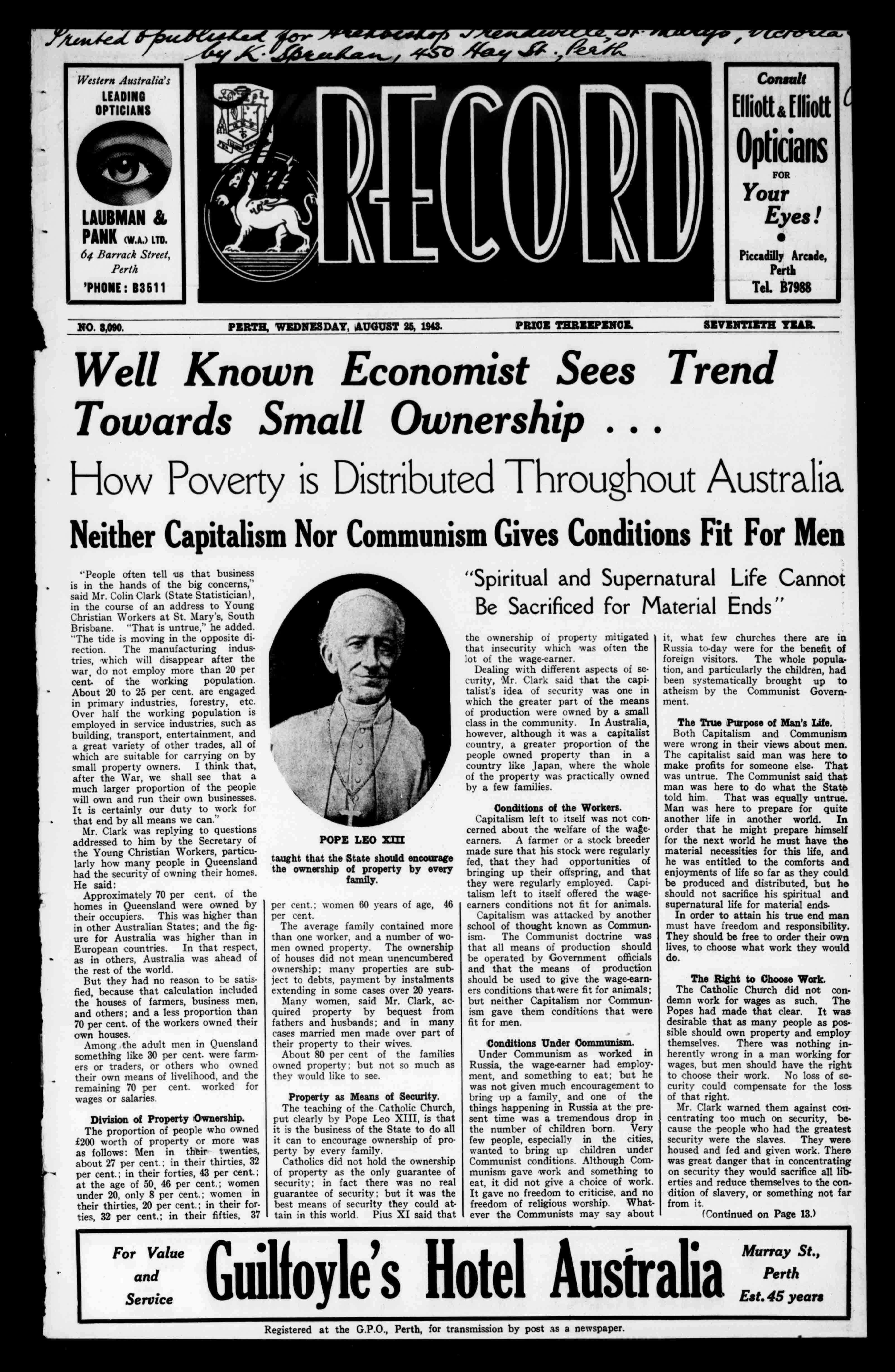
NeitherCapitalismNorCommunismGivesConditionsFitForMen
"Peopleoftentellusthatbusiness isinthehandsofthebigconcerns," saidMr.ColinClark(StateStatistician), inthecourseofanaddresstoYoung ChristianWorkersatSt.Mary's,South Brisbane."Thatisuntrue,"headded. "Thetideismovingintheoppositedirection.Themanufacturingindustries,whichwilldisappearafterthe war,donotemploymorethan20per cent.
workingpopulation. About20to
cent.areengaged inprimaryindustries,forestry,etc. Overhalftheworkingpopulationis employedinserviceindustries,suchas building,transport,entertainment,and agreatvarietyofothertrades,allof whicharesuitableforcarryingonby smallpropertyowners. Ithinkthat, aftertheWar,weshallseethata muchlargerproportionofthepeople willownandruntheirownbusinesses. Itiscertainlyourdutytoworkfor thatendbyallmeanswecan."
Mr.Clarkwasreplyingtoquestions addressedtohimbytheSecretaryof theYoungChristianWorkers,particularlyhowmanypeopleinQueensland hadthesecurityofowningtheirhomes.
Hesaid:
Approximately70percent.ofthe homesinQueenslandwereownedby theiroccupiers.Thiswashigherthan inotherAustralianStates;andthefigureforAustraliawashigherthanin Europeancountries.Inthatrespect, asinothers,Australiawasaheadof therestoftheworld.
Buttheyhadnoreasontobesatisfied,becausethatcalculationincluded thehousesoffarmers,businessmen, andothers;andalessproportionthan 70percent.oftheworkersownedtheir ownhouses.
AmongtheadultmeninQuensland somethinglike30percent.werefarmersortraders,orotherswhoowned theirownmeansoflivelihood,andthe remaining70percent.workedfor wagesorsalaries.
DivisionofPropertyOwnership.
Theproportionofpeoplewhoowned £200worthofpropertyormorewas asfollows:Menintheirtwenties, about27percent.:intheirthirties,32 percent.;intheirforties,43percent.; attheageof50,46percent.;women under20,only8percent.;womenin theirthirties,20percent.;intheirforties,32percent.;intheirfifties,37
POPELEOXIII taughtthattheStateshouldencourage theownershipofpropertybyevery family.
percent.;women60yearsofage,46 percent.
Theaveragefamilycontainedmore thanoneworker,andanumberofwomenownedproperty.Theownership ofhousesdidnotmeanunencumbered ownership;manypropertiesaresubjecttodebts,paymentbyinstalments extendinginsomecasesover20years.
Manywomen,saidMr.Clark,acquiredpropertybybequestfrom fathersandhusbands;andinmany casesmarriedmenmadeoverpartof theirpropertytotheirwives.
About80percentofthefamilies ownedproperty;butnotsomuchas theywouldliketosee.
PropertyasMeansofSecurity.
TheteachingoftheCatholicChurch, putclearlybyPopeLeoXIII,isthat itisthebusinessoftheStatetodoall itcantoencourageownershipofpropertybyeveryfamily.
Catholicsdidnotholdtheownership ofpropertyastheonlyguaranteeof security;infacttherewasnoreal guaranteeofsecurity;butitwasthe bestmeansofsecuritytheycouldattaininthisworld.PiusXIsaidthat
"SpiritualandSupernaturalLifeCannot BeSacrificedforMaterialEnds"
theownershipofpropertymitigated thatinsecuritywhichwasoftenthe lotofthewage-earner. Dealingwithdifferentaspectsofsecurity,Mr.Clarksaidthatthecapitalist'sideaofsecuritywasonein whichthegreaterpartofthemeans ofproductionwereownedbyasmall classinthecommunity.InAustralia, however,althoughitwasacapitalist country,agreaterproportionofthe peopleownedpropertythanina countrylikejapan,wherethewhole ofthepropertywaspracticallyowned byafewfamilies.
ConditionsoftheWorkers.
Capitalismlefttoitselfwasnotconcernedaboutthewelfareofthewaneearners.Afarmerorastockbreeder madesurethathisstockwereregularly fed,thattheyhadopportunitiesof bringinguptheiroffspring,andthat theywereregularlyemployed.Capitalismlefttoitselfofferedthewageearnersconditionsnotfitforanimals.
Capitalismwasattackedbyanother schoolofthoughtknownasCommunism.TheCommunistdoctrinewas thatallmeansofproductionshould beoperatedbyGovernmentofficials andthatthemeansofproduction shouldbeusedtogivethewage-earnersconditionsthatwerefitforanimals; butneitherCapitalismnorCommunismgavethemconditionsthatwere fitformen.
ConditionsUnderCommunism.
UnderCommunismasworkedin Russia,thewage-earnerhademployment,andsomethingtoeat;buthe wasnotgivenmuchencouragementto bringupafamily,andoneofthe thingshappeninginRussiaatthepresenttimewasatremendousdropin thenumberofchildrenborn.Very fewpeople,especiallyinthecities, wantedtobringupchildrenunder Communistconditions.AlthoughCommunismgaveworkandsomethingto eat,itdidnotgiveachoiceofwork. Itgavenofreedomtocriticise,andno freedomofreligiousworship.WhatevertheCommunistsmaysayabout
it,whatfewchurchestherearein Russiato-daywereforthebenefitof foreignvisitors.Thewholepopulation,andparticularlythechildren,had beensystematicallybroughtup atheismbytheCommunistGovernment.
TheTruePurposeofMan'sLife.
BothCapitalismandCommunism werewrongintheirviewsaboutmen. Thecapitalistsaidmanwashereto makeprofitsforsomeoneelse.That wasuntrue.TheCommunistsaidthat manwasheretodowhattheState toldhim.Thatwasequallyuntrue. Manwasheretoprepareforquite anotherlifeinanotherworld.In orderthathemightpreparehimself forthenextworldhemusthavethe materialnecessitiesforthislife,and hewasentitledtothecomfortsand enjoymentsoflifesofarastheycould beproducedanddistributed,buthe shouldnotsacrificehisspiritualand supernaturallifeformaterialends. Inordertoattainhistrueendman musthavefreedomandresponsibility. Theyshouldbefreetoordertheirown lives,tochoosewhatworktheywould do.
TheRighttoChooseWork.
TheCatholicChurchdidnotcondemnworkforwagesassuch.The Popeshadmadethatclear.Itwas desirablethatasmanypeopleaspossibleshouldownpropertyandemploy themselves.Therewasnothinginherentlywronginamanworkingfor wages,butmenshouldhavetheright tochoosetheirwork.Nolossofsecuritycouldcompensatefortheloss ofthatright.
Mr.Clarkwarnedthemagainstconcentratingtoomuchonsecurity,becausethepeoplewhohadthegreatest securityweretheslaves.Theywere housedandfedandgivenwork.There wasgreatdangerthatinconcentrating onsecuritytheywouldsacrificealllibertiesandreducethemselvestotheconditionofslavery,orsomethingnotfar fromit.
(continuedonPage13.)
FA,w"").7Ow. WesternAustralia's LEADING OPTICIANS LAUBMAN&, PANK(W.A.)LTD. 64BarrackStreet, Perth 'PHONE:B3511 e77.v...,7-.rap I Consult Elliott&Elliott Opticians FOR Your Eyes! PiccadillyArcade, Perth Tel.B7988 NO.3,090. PERTH,WEDNESDAY,AUGUST25,MA. PRICETHRZEPENOL SEVENTIETHYEAR.
KnownEconomistSeesTrend
...
DistributedThroughout
Well
TowardsSmallOwnership
HowPovertyis
Australia
ofthe
25per
ForValue MurraySt., and GuiltoylesHotelAustralia Perth Service Est.45years RegisteredattheG.P.O.,Perth,fortransmissionbypost:usanewspaper.
WhatWeretheCrusades?
MohammedanThreattoEuropewasTheir ImmediateCause
WhatweretheCrusades?TheCrusadesweremilitaryexpeditionsundertaken,infulfilmentofasolemnvow, todelivertheHolyPlacesfromthe tyrannyofIslam.SincetheMiddle Ages,themeaningoftheword"crusade"hasbeenextendedtoinclude allwarsundertakeninpursuanceofa vowanddirectedagainstinfidels,i.e., againstMohammedans,pagans,heretics,orthoseunderthebanofexcommunication.Inthissense,thewars wagedbytheSpaniardsagainstthe Moorsconstitutedacontinualcrusade fromthe11th.tothe16th.centuries. TheexterminationoftheAlbigensian heresywasduetoacrusade,andin the13th.CenturythePopespreached crusadesagainstJohnLacklandand FrederickII.
Theideaofthecrusadecorresponds toapoliticalconceptionwhichwas realisedinChristendomonlyfromthe 11th.tothe15th.century.Itsupposes aunionofallpeoplesandsovereigns underthedirectionofthePopes.All crusadeswereannouncedbypreaching. Afterpronouncingasolemnvow,each warriorreceivedacrossfromthe handsofthePopeorhislegates,and wasthenceforthconsideredasoldierof theChurch.Crusaderswere,therefore,grantedIndulgencesandtemporalprivileges,suchasexemption
fromciviljurisdiction,inviolabilityof personsorlands,etc:Ofallthese warsundertakeninthenameofChristendom,themostimportantwerethe EasternCrusades,andofthese,the periodoftheFirstorgreatCrusadeto theThirdCrusadewilloccupyourattentionalmostexclusively.Itwas essentiallyonecontinuouscampaign, abattleofninetyyearswithapolitical objective-theHolyPlaces-whichbeganwithavictoriousoffensiveand endedinfulldefeatwiththelossof theHolySepulchre.
Beforewecommencetodescribethe natureofthatissueofarmsbetween ChristendomandIslam,wemustpause tosurveythegeneralhistoricalbackgroundagainstwhichtheCrusadesare set.ForhadtheGreatCrusadeachieveditsobjective,theremighthave beenapoliticalresultwhichwould havechangedtheworld.
SomesixhundredyearsafterChristianitysprangupintheEast,and spreadwestwards,anothergreatfaith aroseinthesameeasternlandsand followeditlikeitsgiganticshadow.
Likeashadow,itwasatonceacopy andacontrary.WecallitIslamor thecreedoftheMohammedans.It wasthefinalflamingupoftheaccumulatedOrientalismsgraduallyrejected astheChurchgrewmoreEuropean
-Washdaysare Easier
RelaxSoapwilltakethehard workoutofwashdaysfor YOU,Relaxisgentleonthe fabricandyourhands;washes clothesasnowywhite;and NOhardrubbingisnecessary.AlwaysuseRELAXin YOURwashtub.(Obtainableinthreesizes.)
MADEINW.A.BYWESTRALIANSOAPSLTD.
SHEEPSKINS
A.V.RHODESandCO.are CashBuyersofSheepskinsfor FELLMONGERING(theLargestPlantinW.A.).Highest Prices,PromptReturns;No CommissionCharged.ConsignmentLabelsPostedFreeonApplication.
WeareauthorisedbytheCentral WoolCommittee,Melbourne,to handlewoolonaccountofgrowers.Consignallproducetothe addressbelow.
FORSATISFACTIONCONSIGNTO-
A.V.R11011S&CO.
15MOUATTSTREET, FREMANTLE.
HowtheChristianArmies
wereRecruitedandFinanced WhenSoldierswerealsoPilgrims totheHolySepulchre
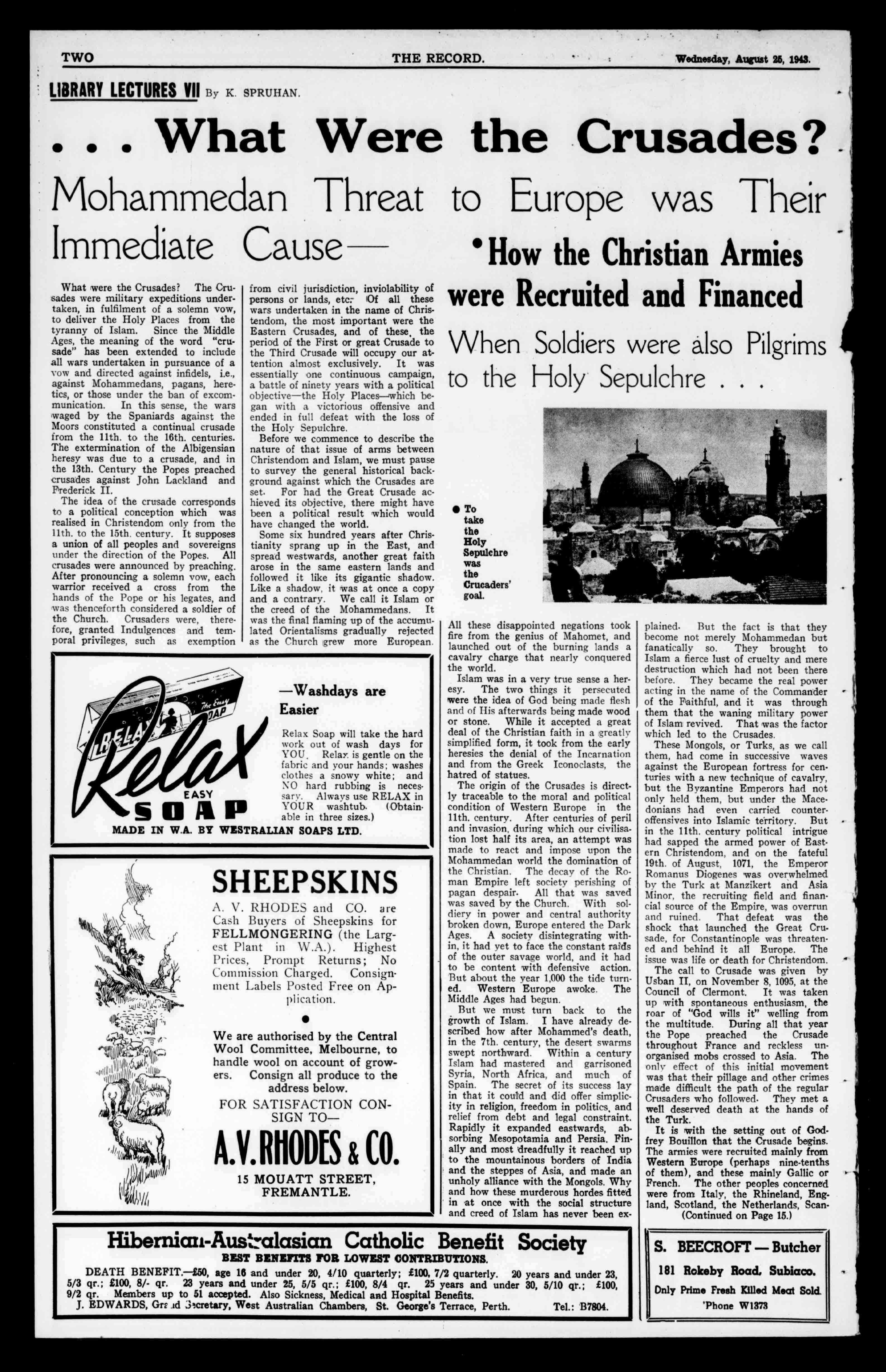
To take the Holy Sepulchre was the Crucaders' goal.
Allthesedisappointednegationstook firefromthegeniusofMahomet,and launchedoutoftheburninglandsa cavalrychargethatnearlyconquered theworld.
Islamwasinaverytruesenseaheresy.Thetwothingsitpersecuted weretheideaofGodbeingmadeflesh andofIlisafterwardsbeingmadewood orstone.Whileitacceptedagreat dealoftheChristianfaithinagreatly simplifiedform,ittookfromtheearly heresiesthedenialoftheIncarnation andfromtheGreekIconoclasts,the hatredofstatues.
TheoriginoftheCrusadesisdirectlytraceabletothemoralandpolitical conditionofWesternEuropeinthe 11th.century.Aftercenturiesofperil andinvasion,duringwhichourcivilisationlosthalfitsarea,anattemptwas madetoreactandimposeuponthe Mohammedanworldthedominationof theChristian.ThedecayoftheRomanEmpireleftsocietyperishingof pagandespair.Allthatwassaved wassavedbytheChurch.Withsoldieryinpowerandcentralauthority brokendown,EuropeenteredtheDark Ages. Asocietydisintegratingwithin,ithadyettofacetheconstantraids oftheoutersavageworld,andithad tobecontentwithdefensiveaction. Butabouttheyear1,000thetideturned.WesternEuropeawoke.The MiddleAgeshadbegun.
Butwemustturnhacktothe growthofIslam.IhavealreadydescribedhowafterMohammed'sdeath, inthe7th.century,thedesertswarms sweptnorthward.Withinacentury Islamhadmasteredandgarrisoned Syria,NorthAfrica,andmuchof Spain.Thesecretofitssuccesslay inthatitcouldanddidoffersimplicityinreligion,freedominpolitics,and relieffromdebtandlegalconstraint. Rapidlyitexpandedeastwards,absorbingMesopotamiaandPersia.Finallyandmostdreadfullyitreachedup tothemountainousbordersofIndia andthesteppesofAsia,andmadean unholyalliancewiththeMongols.Why andhowthesemurderoushordesfitted inatoncewiththesocialstructure andcreedofIslamhasneverbeenex-
Hibernian-AustralasianCatholicBenefitSociety
plained.Butthefactisthatthey becomenotmerelyMohammedanbut fanaticallyso. Theybroughtto Islamafiercelustofcrueltyandmere destructionwhichhadnotbeenthere before.Theybecametherealpower actinginthenameoftheCommander oftheFaithful,anditwasthrough themthatthewaningmilitarypower ofIslamrevived.Thatwasthefactor whichledtotheCrusades.
TheseMongols,orTurks,aswecall them,hadcomeinsuccessivewaves againsttheEuropeanfortressforcenturieswithanewtechniqueofcavalry, buttheByzantineEmperorshadnot onlyheldthem,butundertheMacedonianshadevencarriedcounteroffensivesintoIslamicterritory.But inthe11th.centurypoliticalintrigue hadsappedthearmedpowerofEasternChristendom,andonthefateful 19th.ofAugust,1071,theEmperor RomanusDiogeneswasoverwhelmed bytheTurkatManzikertandAsia Minor,therecruitingfieldandfinancialsourceoftheEmpire,wasoverrun andruined.Thatdefeatwasthe shockthatlaunchedtheGreatCrusade,forConstantinoplewasthreatenedandbehinditallEurope.The issuewaslifeordeathforChristendom.
ThecalltoCrusadewasgivenby UsbanII,onNovember8,1095,atthe CouncilofClermont.Itwastaken upwithspontaneousenthusiasm,the roarof"Godwillsit"wellingfrom themultitude.Duringallthatyear thePopepreachedtheCrusade throughoutFranceandrecklessunorganisedmobscrossedtoAsia.The onlyeffectofthisinitialmovement wasthattheirpillageandothercrimes madedifficultthepathoftheregular Crusaderswhofollowed.Theymeta welldeserveddeathatthehandsof theTurk.
ItiswiththesettingoutofGodfreyBouillonthattheCrusadebegins. Thearmieswererecruitedmainlyfrom WesternEurope(perhapsnine-tenths ofthem),andthesemainlyGallicor French.Theotherpeoplesconcerned werefromItaly,theRhineland,England,Scotland,theNetherlands,Scan(ContinuedonPage15.)
S.BEECROFT-Butcher
181RokebyRoad,Subiaco.
OnlyPrimeFreshKilledMeatSold 'PhoneW1373
TWO THERECORD. Wednesday,August26,1943. LIBRARYLECTURESYU1i,.KSPRUIIAN ...
BESTBENEFITSFORLOWESTCONTRIBUTIONS, DEATHBENEFIT.-£50,age16andunder20,4/10quarterly;£100,7/2quarterly.20yearsandunder23, 5/3qr.;£100,8/-qr.23yearsandunder25,5/5qr.;£100,8/4qr.25yearsandunder30,5/10qr.;£100, 9/2qr.Membersupto51accepted.AlsoSickness,MedicalandHospitalBenefits. J.EDWARDS,Grriditcretary,WestAustralianChambers,St.George'sTerrace,Perth. Tel.:B7804.
q"THEGOOD I COULDHAVEDONEANDDIDNOTDO"
LegionofMaryshowswhatextraordinary thiilAsordinary
peoplecando
FatherMcBride'sStirringAppeal
ForaFullerCatholicLife ActionUndertheLeadershipofMary andwiththeWeaponofPrayer
OnSundayafternoon,July24,the LegionofMaryconductedaRallyin theChurchoftheHolyRosary.
Thefunctiontookontheformofa Legionmeeting,openingwiththe prayersonthe''Tessera,"whichwere recitedbyVeryRev.E.Moss,Parish Priest,followedbyaspecialsermon ontheideasandaimsoftheLegion byRev.FatherMcBride,andconcludingwithBenediction.Afterwards theLegionariesentertainedallthe membersofthecongregationtoafternoonteaintheSchoolHall.Theafternoonwasindeedmostsuccessful,both spirituallyandsocially.
Thefollowingistheaddressgiven byRev.FatherMcBride:-
Iwouldliketotakeasthesubject ofmysermonthisafternoonsome wordswhichIreadrecentlyinanarticle.TheywerethewordsofafamousFrenchman,wholosthisfaithbut eventually,bythegraceofGod,came backtoit.Themoststrikingwords heusedwere:"Youmayseemeweep tears;theyarebittertears,butnot tearsofrepentanceformysins,which arefearfulindeed;theworstthingsI havedoneinlifearenotthesinswhich Ihavecommitted,butthegoodI couldhavedonebutdidnotdo-the goodIcouldhavedonebutdidnot do."ThosearethewordsIwould askyoutothinkover-tothinkover inthelightofyourfaith.Iwantto usethemasanargumenttointerest youfirstofallinbecomingbetter membersoftheLegionofMaryifyou arealreadymembers,orperhapsto influenceyoutobecomemembersif youarenotalreadyso.Thereason beingthatIknowfrompersonalexperiencethattheLegionisonemethod ofdoingsomethingtoachieveinyour lifethegoodwhichyoucandobut arenotyetdoing.Bearwithmefor amomentifIgooveroneortwo pointsveryquicklyofthehistoryand achievementoftheLegion.Itwasbegunsome21yearsagoinDublinbya numberoflaypeoplewhobanded themselvestogetherwithoneintention-topromotethegloryofGodand thesalvationofsoulsinanywaypossible.ThatwastheirsolemotivetopromotethegloryofGodandthe salvationofsouls.Thosepeople bandedthemselvestogetherunderthe patronageofMary,theImmaculate MotherofGod-thatMother,that womanofwhomitwasspokeninSacredScripturethatshewouldcrushthe serpent-Satan,thespiritofevil.
Verybriefly,thatishowtheLegion began-anassociationoflaypeople whodeterminedunderthebannerof Marytoworkforthesalvationof souls.Now,theweaponwhichthey used,whichtheyintendedtouse,and havecontinuedtouse-theironlyweapon-wasPrayer.Prayer,simply andsolely.Therefore,theiraimsare spiritual,theirweaponisspiritual,and theirleaderisMary.Thosepeople haveachievedwonderfulresultsinthe fewshortyearsthattheLegionhas beeninexistence,andithasspread acrosstheworld-intoallpartsofthe world.Ithasalsometwiththegreatestpossiblesuccess,andthosetwo thingsareaproofthattheLegionhas foundfavourintheeyesofGod.And howcoulditfailtofindfavour,because itistryingtodothesameworkfor whichJesusChristwascrucified-itistryingtoleadordinarypeoplelike yourselvestoloveGodalittlemore andtoworkalittlehardertomake morepeoplefeelthebenefitofthe BloodwhichJesusChristshedforus.
Thatistheoneandonlypurposeof theLegion.Itisapurposewhich shouldcommenditselftoeachand everyoneofyou.Itisthereason whyIaskyoutotakeaninterestin theLegion-toseeinitsomemeans, somemethodofdoingsomethingto bebetterCatholics.Ithasbeenin Australiaforabout10yearsandin W.A.forscarcelythree,andlookat thewonderfulresultsithasachieved duringthatshorttime.Tosay nothingoftheunnoticedbutastoundingworkbeingdone,lookattheCatholicGirls'Movement,theMen's Movement,andthevariousother movements.Andallofthesehave hadoneresult.Theyhavelivenedup acertainnumberofpeople,anextra fewwhowerelivingjustlikeyourselvestwoyearsago,andwhoarenow doingsomuchmoretomakeJesus ChristbetterlovedandtobringsalvationtoGodknowshowmanysouls. InMelbournelastyeartheyopeneda placecalledthe"ReginaCoeli"Hostel,todealwithandofferarefuge andahometofallenwomen,andduringthefirsttwelvemonthsofitsexistenceitdealtwith10,000cases.How clearthatworkmustbetoJesusChrist, becauseifthereisanyclassofpeople onGod'searthtowhomthemercyof Godwasstretchedout,itwastofallen women.Yetthatworkisbeingdone bypeoplelikeyou-notbysaints,not bypeoplespeciallytrained,butbyordinarylaypeople.Andthatreminds me,too,ofawork-thecleaningupof oneofthemostterribleplaguespots intheworld-itisevenmentioned specificallyintheEncyclopediaBritannicaasoneoftheworstdensofvice intheworld-BentleyPlace,inDublin.Inafewshortyears-barelythat -throughtheeffortsoftheLegion, thatplacewascleanedup.Thatwork hasbeenspokenofbymenwhoarenot Catholicsasamiracleofsocialreform. YetitwasdoneinDublin,andwhodid it?Peoplelikeyou.Nobodyelse.You willsaytomeImpossible,andIwill tellyouNo.Howdidordinarypeoplelikeyouperformsuchanextraordinary,miraculousthing?Thereis onlyoneanswer--prayer.Anyten ofyoucouldcleanupthebiggest plaguespotinPerthin12monthsif somethinghappened-ifyoucouldget enoughpeopletopraythatyoureffortswouldbesuccessful.Don'ttell meitisimpossibleorthatIamtalkingstupidity.Iamtalkingfacts andyoucannotescapefacts.What hasbeendonecanbedoneagain.It wasprayerthatenabledthoseordinarypeopletoperformamiracleofsocialreform.
Thosearejustoneortwopointsdropsinanoceanofgoodthathas beendonerightthroughouttheworld bytheLegionofMary,andtheLegion ofMaryiscomposedofordinarypeoplelikeyou.Thoseordinarypeople arestrengthenedandcarriedthrough tosuccessundertheleadershipof Marybyprayer,andthatbringsme backtowhereIstarted.Everysingleoneofyoucouldputtenminutes' moreprayer-anhour'smoreprayerintoyourdailylives.Youaregood people,younevermissMass.Godwill blessyouforthat,butdon'tyourealisehowmuchgoodyoucoulddoif youwerejusttwiceasgood?Don't yourealisethatif50ofyouwentto onedailyMassaweektherewould be50moreMassesgoingupbeforethe throneofGodtobringsalvationto souls.WhyamImakingthisaddresstoyou?Iammakingitforthe
soulsofthehundreds,thethousandsmillionsofpeopleintheworldwhodo notknowJesusChrist.Iammaking itforthenumberofCatholicsinthis parishwhodonotdarkenthechurch door.Thereisnonecessitytogo outsideyourownparish.Iwillguaranteesuccess-Iwillguaranteethat10 or50orperhaps100peopleinthis parishofNedlandswouldbebrought backtothefaithortoaknowledgeof JesusChrist.Youaskme,whybecomeanAuxiliaryMember?Idon't wantyoutobecomeAuxiliarymembersforyourselves-Iwantyoutobecomemembersforthesoulsofthose whoareoutsidethefaith,whohave lostthefaith.Thinkofthegoodyou coulddoandarenotdoing.How manyofyougotodailyMass?Very fewperhaps.Howmanyofyoucould gotodailyMass?Whatiskeeping youaway?ThinkwhatwouldhappenifthisChurchwerepackedevery morningfordailyMass.Youwould havetobuildaBasilica,anditwould bebecauseofyourprayers.Itwas PiusXI,thePopeofCatholicAction, whobroughttheworldtoitspresent campaignoflaypeopleworkingand prayingforthegoodofothers.InDe-
cember,1925,headdressedanEncyclicaltotheCatholicworld,andhewarneditthatiftheworlddidnotliveaccordingtoChristianprinciples,itwould bedestroyed,laidtoruins.Scarcely halfagenerationhaspassed,andthe worldisinruins.WhenthePope wrotethatEncyclicaltherewere400,000,000Catholicsintheworld.Ifthose 400,000,000hadlistenedtothePope andhaddeterminedtosayoneRosary everyday,theywouldhavechanged thecourseofhistory.Thewarwould nothavebeenonnow.Thesame Popegaveareasonforhisexhortation tolaypeopletoworkandlabourfor ,,thersbysaying"theworldatthe presentdayisprobablyinaworse statethanitwasatthetimeofthedeluge."Ifitwasbadthen,itisworse now,andyetyoucansithereinthis church,withyourcomfortablehomes andyourrelaxations Youareliving good,clean,decentlives,butthereis anawfullotyoucoulddo.Iwish, andIhopeandIpraythatperhaps duringBenedictiontheremaycometo themindsofsomeofyoutherealisationofhowmuchgoodyoucoulddo andarenotdoing.Inthenameof 'Cont'nuedonBackCover.)
OurCatholicSchoolsandColleges
CHRISTIANBROTHERS,MT.HENRY. ONEOFTHEASSOCIATEDPUBLICSCHOOLSOFW.A.
AQUINASCOLLEGE
TELEPHONE:MU1520. FORBOARDERSANDDAYSTUDENTS. BOYSADMITTEDFROM7UPWARDS.
BeautifullySituated,overlookingtheriver,nearthenewCanningBridge. ForParticularsapplyto-ThePrincipal,AquinasCollege,CanningParade,Mt.Henry
SACREDHEARTHIGHSCHOOL HIGHGATE
-PERTH.
(CONDUCTEDBYTHESISTERSNOTREDAMEDESMISSIONS). BOARDINGANDDAYSCHOOLFORGIRLS. PUPILSPREPAREDALLEXAMINATIONS. MONTESSORISCHOOLFORYOUNGCHILDREN. ForProspectusapply'Phone:B3810. REV.MOTHERPRIORESS.
LoretoConvent-Osborne"-Claremont
BOARDINGANDDAYCOLLEGE.
TheSchoolprovidesasoundeducationonmodernlinesinallbranches ofstudy.Thepupilsarepreparedforallexaminations.TheSchoolis beautifullysituatedbetweenOceanandRiver,inextensivegrounds, withfineplayingfieldsandprivateSwimmingPoolinRiver. Telephone:F2135. Apply- MOTHERSUPERIOR.
ST.ILDEPHONSUS'COLLEGE
NEWNORCIA
CONDUCTEDBYTHEMARISTBROTHERS.
TheSchoolisfullfor1944.Boyscanbeacceptedforcommencementin1945,orforacceptanceduring1944subjecttovacanciesoccurring. AcharacterreferencefromtheParishPriestisrequired.
ForParticularsApplyto-THEBROTHERDIRECTOR.
SAVECHARGES! SAVEFREIGHT!
ImprovetheValueofYourWoolbyhavingitSCOURED TheSWANWOOLSCOURINGCO. ofW.A.Ltd.Fremantle theoldestbusinessofitskindinthisState,withitsmostefficientmodernplant,employstheverylatestmethodstosecureforclientsbetter returnsfortheirwool.
ConsigntoNORTHFREMANTLE,andobtainrebatesof40percent. ofthefreightforallquantitiesoveroneton.
Address:BOX2,POSTOFFICE_FREMANTLE.
'PHONES:L1031-2.
Wednesday,August25,1943. THERECORD. THREE
"TheCatholicAnswer
TheSocialQuestion isAboveAlla
MoralandReligious
Matter
*Dr.LeFanu'sAttackon"TheCatholicAnswer"
BishopKnoxontheInvalidity ofAnglicanOrders
ChristianityinBritainBefore St.Augustine
Goodevening,listeners!
ReferencesthatIhavemadefrom timetotimeinthissessiontovarious topicsandproblemslinkedwiththe socialquestionhavepromptedtheremarkthatthesocialquestionismerely aneconomicmatterwithwhichthe Churchhasreallynothingtodo.And Iwouldliketoexplainthatthesocial question,asitiscalled,isbynomeans purelyandsimplyamatterofeconomics.AsPopeLeoXIIIdeclaredin hisencyclicalon"ChristianDemocracy":"Thesocialquestionisabove allamoralandreligiousmatter,and forthatreasonmustbesettledbythe principlesofmoralityandaccordingto thedictatesofreligion."
TheclaimforSocialJusticeisrooted intheFourthandSeventhCommandments,whichinsistoncharityandjusticeinallourrelationswithourfellow men.Thedenialofa"familywage" totheworker,forexample,whenindustrycanaffordtopay,isavery grievoussinagainstthetheSeventh Commandment.
Asamatteroffact,thedefrauding amanofhisjustwage,whichiswhat Catholicscallthefamilywage,isstigmatisedbySt.James,"asinthatcries toheavenforvengeance."Itisthe teachingoftheChurchinthismatter, that'whileasarule,employerand employeemayagreeastowages;nevertheless,thereunderliesadictateof naturaljusticemoreimperiousand moreancientthananybargainbetweenmanandman,namely,thatremunerationoughttobesufficientto supportthewage-earnerinreasonable andfrugalcomfort.Ifthroughnecessity,orfearofaworseevil,theworkmanacceptsharderconditions,because anemployerorcontractorwillafford himnobetter,heismadethevictimof forceandinjustice."Andthatis whytheChurchto-daychampions thecauseoftheworkerinthisregard.
AndIamremindedbylistenersthat Christdidnotdenouncethesocialevils ofHisday,thatHegavenoeconomic lecturesonthequestionofajustwage, thatthecontrolofcredit,theproblem ofnationalsuicide,theprosandcons ofSocialismwereneversomuchasdiscussedbyChrist.Itissuggestedthat, likeHim,sotheChurchto-daymight dobettertoconfineHerattentionsand Herdenunciationstothingsspiritual
oniy.Itissuggestedthatreligionis theprivateconcernofeachindividual, andshouldbemaintainedassuch.In otherwords,thatquestionsofright andwrongdonotenterintothemodernracketofcommerceandindustry, orintotheconductofpublicaffairs, politicalorcivic.
Well,whileitisperfectlytruethat Christwhenonearthdidnotdenounce suchsocialevilsofHisdayasslavery, forexample,norplaythepartofa politicianorsocialreformerinthe modernsense,neverthelessHetaught theprinciplesofjusticeandcharity, which,iffollowedoutandpractised byso-calledChristians,wouldachieve thesocialreformationoftheworld.
Hisdivinemissionwaspre-eminently aspiritualone.Heinsistedonthe supremevalueoftheindividual,the primarydutyoflovingGodandone's neighbour,and,aboveall,thatwe trytolivethedivinelifeofgrace, whichHewonforusbytheCrucifixion.ButHeknewatthesametime thattheultimatesolutionofthesocial questiondependedupontheuniversal recognitionofthemoralandreligious teachingwhichHegavetheworld. Thatisthepointinmaintainingas bestwecanaChristiancivilisation,at leastinthenationsofourownEmpire, ifwecannotextenditfurtherafield.
TheChurch,then,likeHerDivine Founder,hasthesamemission-preeminentlyspiritual,tosavemenfrom aneternityoffrustrationandtohelp themsotolivetheirlivesthatChrist willwelcomethematdeathintothe KingdomofHisFather.
Sheholdsherselfalooffromallparticularformsofgovernmentorparties,andfromallspecialtheoriesof economicandsocialreform.ButShe doesemphaticallyreiteratetheprinciplesannouncedbyChrist,andwill neverceasetoopposethosematerialisticandatheistictheoriesandmethods whichruncountertotheChristianway oflife,whetherprivateorsocial.EverywhereandatalltimesShehasraised Hervoiceindefenceofjusticefor allsectionsofthecommunity,andin theinterestsofthespirituallifeofall men.
And,finally,Iwouldliketosaythis, thatyoucannotdivorcereligionfrom economicsorfromsocialconduct.Religionisawayoflife,andthatmeans itpermeatesever'aspectofaman's lifeandconductThelawsofChrist
FRANKJ.BOSWELL
mustgoverneverythinginlife,and justasmuchtherelationsbetweenemployerandworkerastherelationsbetweentheStateandChristianmarriage.Anditiswithsuchsentiments inmindthatHerMajestytheQueen saidinherrecentbroadcast:
"Iwouldliketoadd,withmy fullestconviction,thatitisonthe strengthofourspirituallifethatthe rightrebuildingofournationallife depends..
"Itisthecreativeanddynamic powerofChristianitythatcanhelp ustocarrythemoralresponsibilities whichhistoryisplacinguponour shoulders.Ifourhomescanbe trulyChristian,thentheinfluence ofthatspiritwillassuredlyspread likeleaventhroughallaspectsofour commonlife-industrial,socialand political."
Itmightbeaswellatthisjuncture torefer,inpassing,totheattackon thissessionmadebytheAnglicanPrimate,Dr.LeFanu,inhisaddressto Synodduringtheweek.
Wereitnotfortheratherflattering prominencegiventhePrimate'sremarksinthemorningpress.Iwould neverhavedreamedthatmyaudience includedsuchdistinguishedlisteners.
Ihaveconsistentlytreatedwiththe charityofsilenceanymerepersonal abusefromlisteners,andIpreferto maintainthatsamecharitytowards HisGrace'schargeofdishonesty.For therest,theonusisonthePrimateto mentionexplicitlywhatstatementsof minearemadewithouthistoricalfoundation,andtoprovehisgratuitousaccusation.
Astotheimpliedadvicethatthis sessionshouldbelimitedtosocialquestionsandexplanationsofPapalEncyclicals,leavingdogmaconveniently outofthequestion,Imightsuggest firstofall,thatitisnotI,but,inthe main,membersofthePrimate'sown communionwhoseekinformationon Catholicdoctrinethroughthissession. They,notI,determinethesubjectmatter;andinanycase,themainpurpose ofthissessionispreciselytoexplain Catholicdogma,sinceitissimplythe truthrevealedbyChristHimselfto HisChurch,andtheverybasisofher moralandsocialteaching.
Ourious,ThreeSprings
Q.:"IfArchbishopCranmerordained priestsandbishops,wouldAnglican bishopsandpriestsofto-daybe trulyordained,asthepoweris givenfromonebishoptoanother?"
A:TherehavebeenAnglicanbishopscontinuouslysincethetimeof theReformation,butvalidOrdershave notbeencontinuouslyhandedon. HenryVIIIbegantheChurchof Englandin1534.TheBishopswho submittedtohimwerevalidlyconsecrated,andvaliditylasteduntil1550. Butinthatyear,underEdwardVI, andthroughArchbishopCranmer,a greateffortwasmadetoprotestantisestillmoretheChurchofEngland bothindoctrineandinpractice.The formofOrdinationwasdeliberately changedbyCranmer,allreferenceto PriesthoodinthetrueChristiansense
ofthewordbeingeliminated.This defectiveform,throughwhichpriests werenolongervalidlyordained,remainedunchangeduntil1662-112 yearslater.Thenthemistakewas realisedandtheformwascorrected. Butthecorrectionwasmadetoolate, forbythattimethosewithvalid Ordershad'died,andonlythosewho hadbeeninvalidlyconsecratedremainedtohandontheirowninvalid Orders.TheAnglicanBishopKnox, writinginthe"NationalReview"for September,1925,saidcorrectly:"The Poperefusedabsolutelytorecognise ourAnglicanOrdersonthegroundthat ourChurchdoesnotordainprieststo offertheSacrificeoftheMass.In spiteofattemptsmadebyourArchbishoptoconcealthisdefect,thePope tramhispointofviewwasunquestionablyright.Itistruethatcertain priestsoftheChurchofEnglandoffer so-calledMasses,butastheywerenot ordainedbytheChurchwiththeintentionthattheyshouldoffertheBody andBloodofChristtotheFather,the SacramentoftheirOrdinationisfor thispurposeafailure.ThePrayer BookandOrdinalaresimplyun-Catholic,sincetheyshownosignoffulfilling themostimportantofallCatholic functions."
Imightaddthatthisdecisionof Romeisirrevocable.Thequestionwas submittedtoathoroughandeven sympatheticconsideration,thePope knowingthatifAnglicanOrderscould headmittedasvalidtheroadtoreunionwouldbemucheasier.Butthe evidencecompelledLeoXIIItodeclaretheminvalid,whichhedidin 1896
ABaptist,ShentonPark:
Thisisalongletterofthreefoolscappages,andthewriterisconcerned principallywithanhistoricaltheory whichhasbecomeknownastheGlastonburyLegend.Accordingtothe writer'sversion,ChristianitywasintroducedintoBritainabouttheyear 36A.D.byJosephofArimathea,Simon Zelotes,andAristobulus-whowasthe firstBishoptotheBritons-andfinally bySt.Paulhimself.
A.:WhethertheChristianChurch wasfoundedinBritainasearlyas 36A.D.,andbyJosephofArimathea, Aristobulus,etc.Idon'tknow.The besthistoriansdon'tseemtosuggest thattheyhavemuchinformationon thesubject.Itis,however,anundoubtedfactthatChristianitywas prettysolidlyestablishedinBritainin Romantimesandsurvivedinthe WestandSouth-West,notwithstandingthepaganSaxoninvasions,until thearrivalofSt.AugustineinKentin the6th.century.St.Augustinewas sentfromRometoconverttheSaxons -ataskwhichtheBritishChristians didnotseemanxioustoundertake. Thereweresomepointsofdifference betweentheBritishandthenewlyarrivedRomans,oneofthechiefbeing whetherEastershouldbecelebrated onafixedSundayeachyearorbya moveablefeast.
YourquestionaboutthePrimacyof St.PeterIansweredinlastweek's session.
FOUR THERECORD. Wednesday,August26,19A3. CEVERYSUNDAYEVENINGAT715P.M.
*ByFatherLalor STATIONS 6PR-6TZ T. HISTORY TOPICALQUESTIONS-PHILOSOPHY SOCIALJUSTICE APOLOGETICS THECHURCHINTHEMODERNWORLD THEOLOGY
SPECIALISTSINHospitalEquipmentandSteamInstallations,HotWaterHeating, Ventilating,SewerageWork,andGeneralPlumbing. CornerRUTH&WILLIAMSTREETS,PERTH. Tel.B2777. W.A.AgentforK.G.LUKEPTY.,LTD.,MELBOURNE. SuppliersofHospitalEquipmentandStainlessHospitalUtensils.
SinceSt.PeterwasMarried WhyCelibacyfortheClergy?
*TheChurchisatOnceTooLiteral andTooFreewithChrist'sTeaching!
WhataretheSourcesof OurLord'sDoctrine?
St.JohntheBaptistand BaptismbyImmersion
Staff-SergeantL.Marks,Somewhere inAustralia:
Q.:''AsPeter,whomyouclaimwas thefistPope,wasmarried,whyisit thatthepresentPopeandpriests arenotallowedtomarry?"
A.:Peterwasmarriedbeforeever hemetChrist.Celibacyoftheclergy, ontheotherhand,wasnotenforcedin theWesternChurchuntilearlyinthe MiddleAges.Yetfromtheverybeginningitwaslookeduponandencouragedastheideal.IntheEasternChurch,too,fromApostolictimes, ithasneverbeenpermittedforbishopstobemarriedmen.Inrecognisingcelibacyastheidealforbishops andpriests,theChurchisbutfollowing theteachingofSt.Paul,whowrote:"I wouldthatallmenwereevenasmyself;buteverymanhashisproper giftfromGod ButIsaytotheunmarried:itisgoodforthemifthey socontinue,evenasI."Andin anotherpassagehesays;"Now,concerningvirgins,Ithinkthatthisis goodforthepresentnecessity,thatit iswellforamansotobe.Hethat iswithoutawifeissolicitousforthe thingsthatbelongtotheLord,how hemaypleaseGod.Buthethatis wifeissolicitousforthethingsofthe world,howhemaypleasehiswife:and heisdivided."
Thatpriestsshouldleadsinglelives wasnotexplicitlycommandedby Christ,butitisadisciplinarylawof theChurch,voluntarilyaccepted,and .whicheventhoughimposingagreat sacrificeontheclergy,nevertheless hastheunanimousapprovalofboth clergyandlaityintheCatholic Church.Perhapsthewholecruxof thequestionisexpressedinthosetwo words,"voluntarilyaccepted."There is,ofcourse,adeepersacredsignificanceinthecelibacyofthepriesthood, butIhesitatetospeakofitinthissession,baldlyandtosuchamixedau dience;itisbecausethepriesthas consecratedhisvirginitytotheSonof God.
Q.:"OnwhatauthoritydoestheCatholicChurchalterChrist'steachings?"
A.:Haveyoueverstoppedtoconsiderthatthecommonchargelevelled againsttheCatholicChurchto-dayis notthatShealtersChrist'steachings, but,onthecontrary,thatShetakes themtooliterally.Christsaid:"What Godbathjoinedtogether,letnoman putasunder,"andbecauseofthatthe Churchwillnottoleratedivorce. Christsaid:"Thoushaltnotkill,"and becauseofthattheChurchabhorsthe takingofunbornlife,andregardsitas murder;Christ,takingbreadandwine, ;tidtotheApostles:"ThisisMy Body thisisMyBlood dothis incommemorationofMe,"andbecause ofthattheChurchbelievesthat Christ'sBodyandBloodareactually presentinthebreadandwineconsecratedbythepriestatMass;Christ saidtoHisapostles:"Whosesinsyou shallforgivetheyareforgiven,and whosesinsyoushallretaintheyare retained,"andbecauseofthatthe ChurchhasalwaysinsistedthatHer Priestshavepowertoforgivesininthe SacramentofPenance;oh,andso manyotherthingsthatChristsaidare stilltakenliterallybytheCatholic
Church,yetbecauseofthat,Sheis ridiculedassomemedievalthingbya freakofhistorylingeringinthemodernworld.No,myfriend,theCatholicChurchdoesnotalterChrist'steachings,ratherShealonehaspreserved theminalltheirfulness,without apology,withoutcompromise,and knowingthatthroughaninfallible Papacyshecannoterrintheirinterpretation.
Q.:'RegardingtheLastSupper,your ChurchcombinestheBreadand Wineinoneacct. Christtaught twoseparateacts."
A.ChristinstitutedtheSacrament oftheEucharistundertheformof breadandwine,andcommandedHis apostlesandtheirsuccessorstodo likewise.Thistheyhavealwaysdone. AteachandeveryMassthepriest consecratesseparatelybothbreadand wine.Forvariousreasons,mentioned inaprevioussession,thelaitycommunicateunderonekindonly;the priest,however,communicatesunder bothkinds.
Q.:'RegardingBaptism,Christtaught completeimmersion-forexample, theBaptismofJohntheBaptist. YourChurchdoesn't."
A.:ThatChristtaughtcompleteimmersioncertainlycannotbedemonstratedfromthefactthatJohnthe Baptistpractisedimmersionwithhis ownpenitents.However,didheimmersethem?Thegospeldoesnot sayso,andthetraditionalrepresentationofJohnbaptising,datingfroma veryearlyage,alwaysshowsChrist standinginthestreamoftheJordan withJohnpouringwateronHishead. Inanycase,John'sbaptismwasnot theSacramentofBaptism,ashehimselfadmittedwhenhesaid,"Iindeed baptiseyouinwateruntopenance,but Hethatshallcomeafterme,is mightierthanI. Heshallbaptise youintheHolyGhostandfire."Christ institutedtheSacramentofBaptismat alaterdate.NowtheSacramentsare sevenritesorceremonieswhichaccomplishspirituallywhateverissignifiedbytheactionperformedinconferringtheSacrament.Forexample, tobaptisemeanstowash,andthe washingatBaptismisbuttheexternal andvisiblesignofthespiritualcleansingofthesoulfromsinthroughthe meritsofChrist'sredemption.Surely totalimmersionisnotnecessaryto keepthetruesignificanceofwashing? Imean,whenwegoforawashwe don'tnecessarilyplungeintoabath fullofwater.
Incidentally,theCatholicChurch teachesthateitherimmersionorinfusion(thatis,pouringalittlewater overaperson'shead)arevalidandlicit methodsofbaptising.Infusionis thecommonlyacceptedmethodnowadays.
Q.:"PleasequotetheBibleifpossible."
A.:AproposofyouraskingforBiblicalauthorityforallIsay-arequest, bytheway,whichhascomefrommany quarters-Ithinkitmightbeaswell atthisjuncturetostatetheCatholic doctrineregardingthesourcesor fountsoftheteachingofChrist.
Thewholebodyoftruthswhich Christrevealedtousmaybetraced
backthroughthecenturiestotwo sources:TraditionandHolyScripture -andinthatorderofimportance.In otherwordstheBible'doesnotcontain,andwasneverintendedtobe,a fullandcompleteexpositionofall Christ'steachings.AsSt.Johnhimselfsays,manythingswhichChrist didandtaughtwerenotrecorded.The Scriptures,asamatteroffact,areactuallysecondinimportancetotheperennialteachingoftheChurch,and Traditionisthatbodyoftruthswhich havebeenbelievedbythefaithfuland taughtbytheChurchsincethevery beginning.
ChristdidnottellHisapostlesto goandwrite,buttogoandteach. Theywentandtaught,allofthem. Twoofthem,lateron,satdownand wroteagospel.Soforsomeyears afterChristfoundedtheChurchthere werenoChristianScripturesatall,and for1,500yearstheywerenotaccessible tothevastmajorityofpeople-thatis, untilprintingmadetheirwidediffusion possible.
So,ChristsentHisapostlestoteach, nottowrite.Hesaidmostexplicitly thatpeopleweretolistentotheir teaching,orelsebeguiltyofshutting theirearstoHim:Hewhohearsyou, hearsMe,andhewhodespisesyou despisesMe.Healsotoldthemthat Histeachingthroughthemwould neverbechangedorfallintoerror, whenHesaid:"Go,teachallnations andbeholdIamwithyoualldays eventotheendoftheworld."And whatdoesthatimply,ifnotthat ChristgaveHisapostlesauthorityto speakHiswordswithHisvoiceuntil theendoftheworld?Thatis,the apostlesandtheirsuccessors,forHe hadprophesiedveryclearlythatthey wouldbeforelongsufferpersecution andmartyrdomforthatveryteaching. Itisthisperennialteachingofthe Church,guaranteedbyChristneverto lapseintoerror,handeddownfrom bishoptobishopintheChurch,and containingallthetruthsthatChrist
Himselfrevealedwhilstonearth,that constituteswhatisknownasTradition. NowtheScriptures,too,arethe WordofGod.Theyaredivinelyinspired,everythinginthemistrue. Theyexplicitlycontainmanyofthe teachingsofChristandimplicitlycontainthemall.Buttheteachingsof theScripturesfrequentlyneedinterpretation.Thisinterpretationthe averageman-in-the-streetisdefinitely incapableofgiving.Maybeyoudidn knowthatsincetheReformationthere havebeenmorethan200interpretationsofthosesimplewordsofChrist: "ThisisMyBody,thisisMyBlood." YetChristcouldhavemeantone thing.WhatdidHemean?The Churchtellus-Hewhohearsyou, hearsMe,saidChrist.
Oneofthetruthstaughtbythe ChurchfromthetimeoftheApostles isthedivineauthorityandauthentic. ityoftheScriptures.Withoutthe Churchtheywouldnothavecome downtousatall.Wearedependent ontheChurchnotonlyfortheunalteredpreservationoftheBible,butalso fortheselectionofthebookswhich itcontains.ItwasShewhoexcluded someandincludedothers.ItwasShe whoformedtheBookwhichwenow handleandread.HasShenow nothingmoretodoaboutit?Why, theveryBibleitselfisamonument andaproofofthefactthattheteachingofChristisunderthecareofthe Church,andthatHiswordsareupon Herlips.
Well,Ihopethisexplanationhas notbeentoolongandinvolved.One mightboilitalldownbysayingthat thefullsynthesisoftruthstaughtby Christishandeddownthroughthe ages,notintheScripturesalone,but inwhatisknownasTraditionorthe perennialteachingoftheChurch.The guaranteethatthisteachingwillnot alterwitheachsucceedinggeneration istheinfallibleauthorityofthePapacy.
Q.:"Regardingprayer,Christtaught thatHewastheonlyintermediary, yetyourChurclioftenpraysto Mary,theMotherofChrist,tointercedewithChrist."
A.:Itisnowhereexplicitlystatedin theScripturesthatMaryisanintermediaryforuswithherSon,although itisimplicitlysuggestedinseveral places,e.g.,Apos.XII.ButtheChurch hastaughtthefactfromApostolic times,asisevidencedfromthewrit. ingsoftheFathers,andthediscoveriesofarcheologists,forexample,the representationsonthewallsofthe Catacombs.WhattheChurchteaches explicitlyisasdivinelyinspiredas anypageoftheBible.
Finally,Mary,bytheveryfactthat shefreelyacceptedtheessentialrole ofgivingGod-incarnateHishumanity, isconsequentlyanessentiallinkinthe chainofourredemption.Andif ChristchoseherasameanstoHissu. premeend,maynotwe?
ForinformationregardingtheCatholicGirls'Movement,kindlyringB4836, orcallinattheClubRoomsanyweek dayafter10a.m.
Wednesday,August25,1943. THERECORD. FIVE
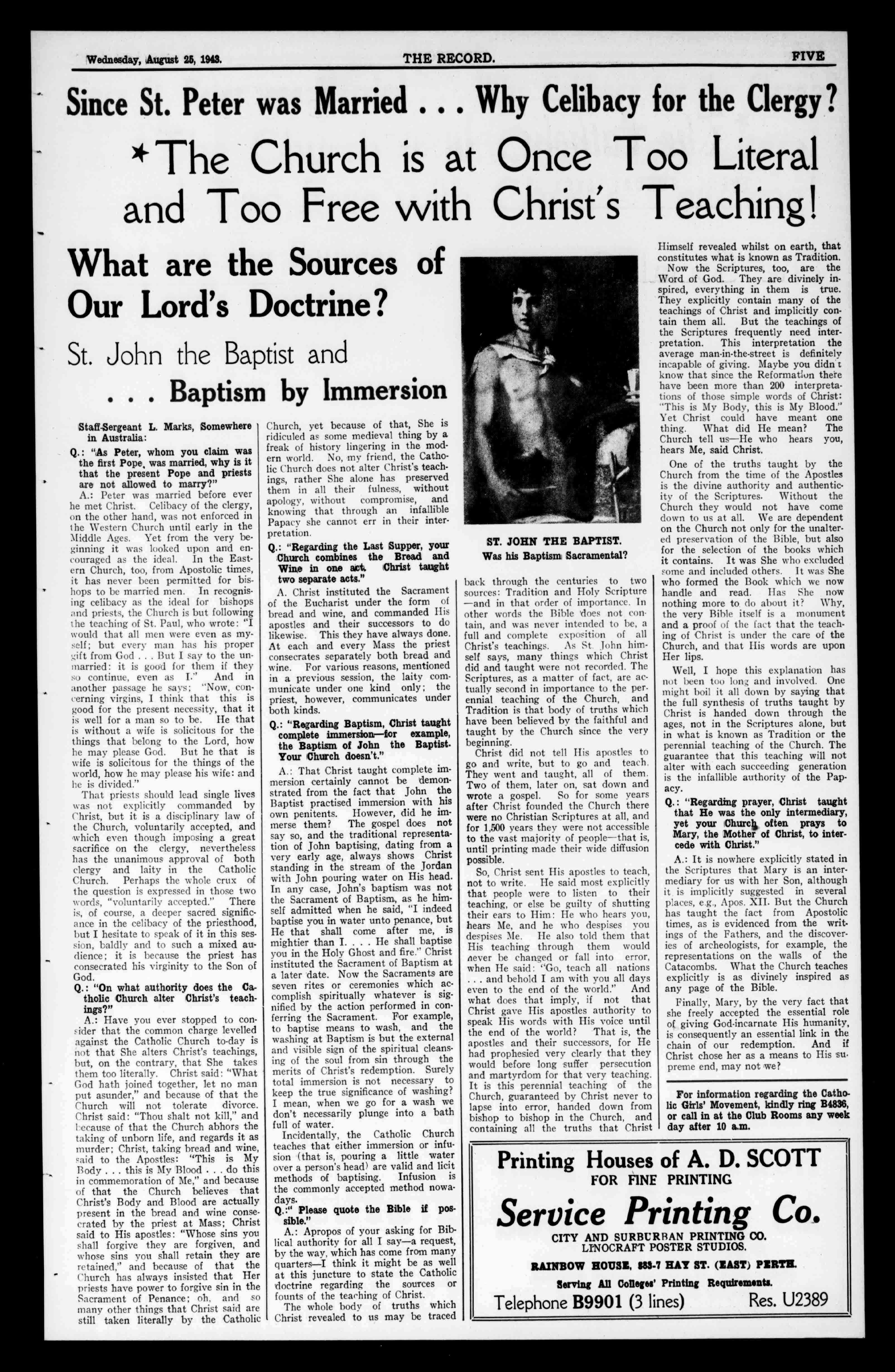
ST.JOHNTHEBAPTIST. WashisBaptismSacramental?
PrintingHousesofA.D.SCOTT FORFINEPRINTING ServicePrintingCo. CITYANDSURBURRANPRINTINGCO. LINOCRAFTPOSTERSTUDIOS. RAINBOWBOOM,183-7HAYST.(EAST)FIRTH. ServingAllColleges'PrintingRequirements. TelephoneB9901(3lines) Res.U2389
Clan,theFamilyandtheGoodEarth areVassalstoMoney'
WillWarBringtheBeginningsofAgriculturalWisdom?
By"CREDO,"oftheCatholicSocialGuild,Wellington.
Therearetwoformsofwealthinourmodernworld,arealwealthandtokenwealth.Thatwhichisrealislandanditsfruits-thegoodearth-God's gifttoallmankind.Thattokenorartificialwealthismoney.Atoken isbutasymbolofsomereality.Itcanneverbetherealityitself.Land istheever-present,self-evidentreality.
Thefirstofallrealitiesinthisworld is,ofcourse,manhimself.Whenour thoughtsarcfunctioninginasane manner,manandhisinherentvalues comefirst,theearthanditsfruitsnext, andmoney,whichisbutthetoken representingsomeofthesenatural values,comeslastintheorderof earthlythings.
Tothinkofvaluesinanyotherway isatonceillogical,unnatural,andproductiveonlyofchaosinthoughtand inaction.Foritisagreattruth,that menactastheythink.Thoughtis themotherofaction.Iftheright andthegoodthingistobedone,men mustfirstthinkwhatisrightandgood. Otherwise,thewrongandthebad thingwillbedone.
Now,factsarealwaystrue,Itis insanetothinkoffactsasbeingfalse. Yettheforegoingfactsaboutman, theearthandmoneyarefloutedby ourmodernindustrialismasthough theywereuntrue.Therefore,insofar, ismodernindustrialismwrong.Money isking;andman,thefamilyandthe goodearthareitsvassals.
Theresultsaredisastrous.Theyare
fastbecomingchaotic.ButCatholics membersofChrist'sMysticalBody. havethewisdomoftheirDivineHead attheirdisposal.Andthiswisdom Loversnotonlythespecificbusiness ofgettingtoheavenbutitcoversalso ourtemporalactivities:suchthingsas familyhappinessandthewholegamut ofpoliticaleconomywhich,ofcourse, includesintelligentfarming.Surelyit mustbeevidentthatGodWhosent Adamto"tilltheearth,"andthereby earnhisdailybread,understoodall aboutthebusinesshesetAdamto workat?Yetmenactasthough GodwasanincompoopWhoknew nothingaboutsuchmundanematters. Christ,HisSon,wasnosentimentalisteither.LikeuntoHisFather,He iseminentlyhard-headedandpractical."IfyouloveMe,keepMyCommandments,"hasnosentimentalnonsenseinit.liealsotoldusthatifwe despiseHisChurchwedespiseHim also.Christ'sVicarsonearthhave, duringthepastfiftyyears,giventhe worldacompletesetofpracticalprinciplesofsocialorder,which,whenever understoodandapplied,completely
ROASTEDPOULTRY.
ForExquisiteMildnessandTenderness andFineFlavourAlways.
BehnsLimited
QualityMeatsandSmallgoods
TWOBIGBARRACKSTREETSTORES,
ForYourConvenienceonEitherSide.
BartlettoStudio
ViceRegalPhotographers.
NOTENEWADDRESS:
TRINITYBUILDINGS,HAYSTREET(Centre) (TakeLiftfromTrinityArcade).
FORHIGHSTANDARDPORTRAITURE.
NIGHTORDAYWEDDINGSASPECIALTY.
MakeYourAppointment. 'Phone:B3851.
FateofCommercialFarming OrganisedCompletelyfor Markets
remedywhatwecall"socialandeconomicproblems."Theycouldnot-fail todothis,becausetheyarefounded onthewisdomthatisGod's.
ButhowmanyCatholics,towhom Christ'sVicaraddressedtheencyclicalscontainingthestatementofthese vitalprinciplesofaction,stillignore thevoiceappointedbyChristtobe heardbyall?Fartoomany.Butit isstillnottoolate,thoughweareat theeleventhhour,toapplyChristian principlestoourproblems.So,in theirlight,letusexamineourpresent situation.
IntheLondon"DailyMail"ofFebruary2,1941,thefollowingbriefparagraphappeared:
"Theonlyanswertothesubmarine andthebombsistogrowmorefood athome,"Mr.TomWilliams,ParliamentarySecretarytotheMinisterof Agriculture,toldfarmersatWinchester."Thesimplefactisthatourshippingpositionismoreorlessdesperate,"hesaid."Idonotthinkwe canexaggerateitsgravity."
Everywordinthisbriefstatement shouldgowithbullet-likeprecisioninto everyindustrialisedfarmer'smindin Australia.(Whatismeantbyindustrialisedfarmingwillbeexplained later.)Britain'sinsanepolicyofkeepingmillionsoffertileacresidlewhile sheimportedfood,isnowbeingradicallychanged.Imperativenecessity hasbroughttoBritainthebeginning ofagriculturalwisdom.Industrialisedfarmingisdoomedforthepresent,andmostlikelyforalltime.
Britaincannolongerhopetodominatetheworld'smanufacturingindustries,andsoevenafterthebattleof theAtlanticiswonshemustemploy manymoreofherpeopleinthemore fundamentalandnecessaryworkof providingthemselveswithfood.TurningtoAmericaweseethatthereare similarforcesatworkthere.Ifasa lastresortwefindamarketinthe Eastbyteachingthepeoplethere"to cultivateataste"forourproduce, thenwemustbepreparedtotake whatwecangetandadjustourstandardsaccordingly.
However,itisnotarealtragedy thatoursystemofindustrialisedfarmingshouldbeinsuchdanger.Industrialisedfarmingismuchthesame kindofevilasindustrialisminthe cities.BothworshipMammon.It isgoodthatMammonworshipshould bedestroyedphysically.Itwillbe essentiallytothegoodifweCatholics herewilldestroyitmentally.Catholicfarmersandtheirfamiliescanlead totheresurgenceofmanandtothe truecultureofthesoil,andtothe keepingofmoneyinitstruesphereas theservantofboth.
"How?"willprobablybeaskedat oncebymanywhoreadthis.First ofallbylearninghowtoChristianise ourthoughtaboutthesefundamental things,and,next,bytranslatingthis ChristianthinkingintoChristianAction.Thisrecallstoourmindsome wordsofsolidCatholicwisdomwrittenmorethantwentyyearsago.In FatherVincentMcNabb's"Nazareth orSocialChaos"weread: "Ibelievethatorganisingourland workforamarketandnotforhome andhomesteadconsumptioninevitably putsthelandworkeratthemercyof themarketandthetransportservice whichcarriesproducetothemarket."
Thegreattruthofthishasbeenforibly tosmallfarmers
morethanonceinthelastdecade. Organisedcompletelyformarketsthatis,organisedonatoken(money) basis,thesmallfarmersalmosttoa man,werelefthelplesswhenthat tokenblizzardcalled"theDepression" struckthisfairland.Helpless,becausethebottomhadfallenoutofthe market.Letusthinkofthisclearly. Thecontrollersofthetokens(money), bywithdrawingthesupplyofalarge amountofthetokensfrommillions whodependeduponthisartificial wealth,hadtherebywithdrawnpurchasersfromthemarket.Theimmediateresultwasthecompletedislocationoftheeconomicandsociallifeof allwhoweredependentuponsupplyingthemarket.Weneednottraverse theinnumerableevileffectsofthis. Nofarmerneedsremindingofthe ghastlyeffectsuponhiswholeeconomy.
Nowwehavemadepointnumber oneinthemodernfarmingproblems. Farmingorganiseduponabasisof makingmoneyisdependentupona market,andthereforedependentupon thecontrollersofthemarket.Weare notsayingherethatmoneyhasno placeinfarminglife.Ithas.Butit hasaservant'splace.Asaservant, moneycanbeusedtoexcellenthuman andgodlypurpose.
Toapproachourproblemswith Christianintelligencewemustalways bearinmindthatmoneyisnotafirst thing,norevenasecondarything,but ismerelythetokenofathing.The firstthingsintrueChristianeconomy are:man,thefamilyandtheland. ThisGod-madetrinitymustcrownall trueeconomicsandsocialthoughtand action.Anyotherbasisforpoliticoeconomic-socialreasoningisfalse,unchristianandthecertainbegetterof destruction.Itisbecauseideasother thanthistrueChristianconcepthave governedmodernfarmingthatthelure ofthecities(functioningonatoken wealthbasis)isdenudingthecountrysideofitsyoungmenandwomen,disruptingthefamilyunitandseriously weakeningCatholiclifeupontheland.
Thefactthatlandlifeshouldbedull andunattractivetoyoungpeopleisa monstrousthing.Thereisnogood Catholicreasonwhythisshouldbeso. TrueCatholiclivinginthecountrysideisanythingbutdull.Itis,instead,theveryopposite.Itisthe lifeinwhichmenandwomengrowold slowly.Humanfellowshipreplaces modernindividualism.Co-operation andChristiancharitytransformthe entireatmosphereofrurallife,work andplay.
Thisisnofancifulassertion.Itis justastatementofplain,straight-forwardfact.Christianculturewas,as itshouldbe,formedandmaintained bymenofthesoil-notbythoseof thecities.Webelievethatitisnot toomuchtosaythatonlyfromthis sourcewillastrife-tornworldre-establishthatculture.Therefore,consequentuponthis,itisclearthatCatholicfarmersoughttobetheleaders, bothinthoughtandaction,inthis returntojusticeandsanity.Beset withhauntingfearsofafuturecontainingonlypromisesoftroubleand yetmoretrouble,Catholicfarmersat leastshouldtakeheednowandset aboutdiscoveringhowtomouldthat futureforthemselvesbysettingup thetrueprinciplesofChristianagriculturallife.-"Zealandia."
SIX THERECORD. Wednesday,Augit25,1943.
FRESHFISHTWICEDAILY. 131BARRACKSTREET. DELIVERIESANYWHERE. PHONEB2974
WEARETHEOLDESTANDLARGESTFISHDISTRIBUTORSIN WESTERNAUSTRALIA. FRESH
INTERNATIONALFISHERIES
SupplierstoHospitals,EducationalandReligiousInstitutions.
Quarries FOR ALLGRADESOFMETALFORROADCONSTRUCTIONANDCONCRETEWORK.
AfterHours:MW24 3rd.FLOOR,COLONIALMUTUALBUILDINGS,PERTH.
WhiteRock
'PHONES:B8866,B8989.
COMMUNISTLIEABOUTCATHOLICCO-OPERATION
REV.GEORGETULLOCHONCATHOLICISM
ARECENTissueofthe"Worker's Star,"Communistorganinthis State,carriedthefollowingstory:
"SAYSCATHOLICSCANJOIN WITHCOMMUNISTS.
"TheCatholicArchbishop,Victor Sanbria,ofCostaRica,CentralAmerica,hasruledthatCatholicsmay jointheCommunistsinthefightfor progress.
-lilyNewYorkTimescorrespondentatSanJose,thecapital,cabled thattheCatholicArchbishophad giventhisrulingtoSenorManuel NI,,ra,CommunistPartymemberof theCostaRicanCongress.
"Catholicsarenowallowedtojoin theVanguardiaPopular,formerlythe CommunistParty.
-TheArchbishopsaid,'WhileCommunismseeksworldhappinessaryl economicwellbeingandrespectspoli-
4y FRANCIS GILBERT
tical,social,andreligiousinstitutions,Catholicworkerscanbelong toVanguardiaPopular,butaChristiancannotsympathisewithNazism:
"AustralianCatholics,unlikesome membersoftheirhierarchy,have longsupportedthesameviewsas theCath,licArchbishopofCosta Rica.
"ManyCatholics,whoseenoconflictbetweenChristianethicsandSocialistco-operation,aremembersof theAustralianCommunistParty." Thestoryfromthe"NewYork Times"CostaRicancorrespondentwas IMIMM
M1158
33
transmittedtothiscountrybythe .AustralianAssociatedPress,andwas publishedintheSydney"Morning Herald"andthe"DailyTelegraph."
ImmediatelythestorywaspublishedinSydney,"TheCatholicWeekly" cableditsWashingtoncorrespondent fordetails.
Aradiotelephonecallwasput throughtoSanJose,capitalofCosta Rica,andanofficialstatementobtainedfromHisGraceArchbishopVictor Sanbria.
TheArchbishop'sstatementpermits anabsoluteandcategoricaldenialof thereportthatCatholicsweregivenecclesiasticalpermissiontojoineithera CommunistPartyorapartywitha Communistprogramme.
TextofArchbishop'sStatement.
FollowingistheArchbishop'sstatement:
"TheCommunistPartywasdissolvedonJune13:
"Anewparty,VanguardiaPopular, wascreated,withitsownconstitution andrules,whichweresubmittedtothe costaRicanHiearachyforstudy.
"Theywerefoundtocontainnothing ofaCommunistorSocialistnature.
"ItistoleratedthatCatholicsjoin thenewpartyonthesamegroundas otherparties."
Inthemessageaspublishedinthe Worker'smorningpapers,therewas aninescapableinferencethatVanguardiaPopularwasmerelyanewname fortheCommunistParty.
Evenwithoutthisofficialcheck-up, thestorywasobviouslylie.Forno CatholicBishopinhisrightmind wouldeverthinkofmakingastatementindirectconflicttopronouncementsfromthePope.
Moreover,notevenaCommunist wouldpretendthatCommunismhas anyrespectforpolitical,socialandreligiousinstitutionsnotdirectlytinder itscontrol.
THERev.GeorgeTullochhasrecentlyissuedapamphletentitled, "TheTruthAboutRomanCatholicism:'Iproposetoreplytoitparagraphbyparagraphinthesecolumns. ThenumbersindicateMr-Tulloch's handicraft,whileR.representsthe reply.
(1)ThequestionwhichIamattemptingtoanswerinthispamphlet is"WhyareweProtestants?"AndI believethatthemostdirectwayof answeringthisquestionistotellthe truthabouttheChurchofRome-for Truthisoneoftheunalterablefundamentalswhichcannotbemoved.A thingiseithertrueoritisnottrue. Therecanbenocompromisewith Truth.
DressedPoultry
READYFORTHEOVEN,ALWAYSAVAILABLEAT-
'PHONES:B3777;B1438.
HOTELS-CAFES-TEAROOMSSUPPLIEDBY SPECIALSERVICE.
-MILK-HONEY-BUTTER-BACONALLDAIRYPRODUCESUPPLIED.
R.Truthiscertainly'unalterable," butourknowledgeisnotabsolute.In mostmattersitispitifullyrelativeastheremainderofthispamphletwill prove.
(2)Becausethispamphlettellsthe truthaboutRomanCatholicism,itis fairandreasoned.Itisalsoemphatic.
R.:Onedoesnotdoubtthebonafidesoftheauthor,buttocallthepamphlet"fairandreasoned"hardlyaccmrcl,withthefacts,whiletosetout totellthetruth(i.e.,thewholetruth) aboutanythinginan8-pagepamphlet ismoreambitiousthanprobable.
(3)WeprotestagainsttheRoman systembecausethatChurchimposes articlesoffaithwhichareunscriptural, articleswhichnullifytheglorioustruths oftheGospel-involvetheworshipper inawfulidolatryandthesoul,ifimpenitent,inperdition.
R.:Tocommencewithaseriesof protestsinthisparagraphandtodeny thatoneisprotestinginparagraph4, isinterestingbutinconsistent.Before Presbyterianismexistedtherecurring _protestsagainsttheCatholicChurch Werecalledheresies.Protestantism inthecourseof400yearshascollected mostofthese,andto-daydeniesalmost everyfundamentalofChristianbelief. Itisonthevergeevenofdoubtingits doubts.
(4)PROTESTANTISMisnota merenegationasisoftenasserted,but avitalprinciple.Thenewworldhas comeoutofit.
R.:Ifaprocesswhichbeganwitha protestandistodayhopelesslysplit intohundredsofcontradictoryfactions,givingclearevidenceofdisintegration,canreasonablybecalled"a vitalprinciple,"thereseemsnoreason whyadeadhorseshouldnotbecalled afriskyquadruped.
Ifthe"newworld"istheevidenceof thevitalityofProtestantism,itscreator,alas,forboth!Everyoneisclamouringforanewordertoreplacethe monstercreatedby"thevitalprin-
ciple."Mr.Tulloch'sold-fashioned adherencetothetheoryofprogressand to"thegrand,beneficent,and,nduringachievementswhichhavemadethe pastfourcenturiesinmanyrespects themostwonderfulinhistory,"seems tobesharedbynoneapartfromhimself,Everyoneknowsthatreligionis aspentforce,seekingbydesperate anticstofilltheProtestantplacesof worship.Godisdenied.Materialism andimmoralityarerampant.Likethe Dutchman'sdog,where,oh!whereis the"purerfaith,"and"thegovernmentofahigherlaw"whichProtestantismissaidtohavebroughttothe world.
WhatonearththepercentageofCatholicsinthegeneralpopulationof Australiahastodowiththeclaimsof Catholicism,remainsaprofoundmystery.ButmostastoundinglyMr.Tullochisnowanxioustoclaimforhis sectthetitle"Catholic."Onewould wonderwhatallthefussisabout,after all.
DarknessandLight.
Mr.Tulloch,assistedbyLordMacaulay,setouttoshowthatwhiletheCatholicChurchwasagoodinfluence fromthebarbarianinvasiontotheReformation,afterthatperiodshebecameamonster,anogre,andatyrant. TheCatholiccountriesbecamedegradedandbackward,whilethoseofthe Protestantcultureflourishedlikethe cedarofLebanon.
Unhappilythereismorewishful thinkingthansoundhistoryinthis contention.Why,intheveryyears thatMacaulaywaswriting,England wasplungedintothemostwretched miseryanddebasement.TheLiberalswerepreachingprogress,whilethe peoplestankandstarvedinhovels, minesandsub-humanfactories.And itwouldbeinterestingtoknowsomethingoftheeconomic,socialandculturallevelofMr.Tulloch'sgrandfather inScotlandatthesametime.
BOANS
SINGLEBEDSHEETS, SINGLEBEDSHEETS,25/6;others, 27/6;32/6;37/6pair.18coupons.
25/6Paw
DOUBLEBEDSHEETS, DOUBLEBEDSHEETS,80x90;
391Pair 39/11; 39/11;42/6;47/6;55/-pair.25coupons.
COLOUREDFELTBLANKETS, COLOUREDPELTBLANKETS,37/6 each;60x80,37/6;70x90.45'-.each.
37/6Each
LINENFINISHPILLOWSLIPS, LINENFINISHPILLOWSLIPS, 1/11each. 2coupons. 1/11Each
COLOUREDBORDEREDT.TOWELS, COLOURED BORDERED T. TOWELS,27x36,3/6each.3coupons.
316Each
Wednesday,August25,1943. THERECORD. SEVEN
Telephones-
MEAD,SON&CO. FUNERALDIRECTORS.
ALBANYROAD, VICTORIAPARK.
L1460
190
CANNINGHIGHWAY, EASTFREMANTLE.
MACFARLANE
CO.
&
LTD. 48MURRAYSTREET.
...
orService
GROUNDFLOOR-WELLINGTONSTREETEND
BOANS
TheCloisterSpellsaMoreExcellent
ReligiousLifeisNotaKnowledgeofChrist FormofEscapism
OntheFeastofSt.Alphonsus,August2,aClothingCeremonytookplace atSt.Mary'sConventofMercy,Leederville.ThereligioushabitwasreceivedbySisterMaryRose(MissMargaretSmullen),ofOsbornePark.His GraseMostRev.Dr.Prendivilleofficiated.HewasassistedintheSanctuarybyRev.FathersRaffertyand O'Farrell.Otherpriestspresent weretheRightRev.Monsignor Moloney,Rev.FathersRegan,C.SS.R., Reidy,Brennan,andDelahunty.A numberofrelationsandfriendsofthe newly-receivedSisterwerealsopresent.
Thepreacher,Rev.FatherRegan, C.SS.R.,deliveredthefollowingaddress:
"Icountallthingstobebutlossfor theexcellentknowledgeofJesus ('hrist,myLord."(Phillip,3,8.)
Theyoungladywhoonthatday changedthedressoftheworldforthe habitofReligionechoed,nodoubt, thosewordsofSt.Paulinherheart. Andthosewhoassistedattheglad andimpressiveceremonyofherReceptionsawinitanotherproofofthe immortalpowerofJesusChristtodraw soulswhollytoHimself.OurLord hadtheattractivenessofeternalwisdom:asallwhohadimbibedthepure watersoftruthwhichHedistilledcould testify,Hispromisesneverdeceived. FrometernityJesusistheImageof theInvisibleGod,theBrightnessof HisFather'sGlory,andtheFigure ofHisSubstance.HenceHeisDivine WisdomandInfiniteTruthitself.
AstheWordmadeFleshHeremains theWisdomofGod.Thereinliesthe secretofHispoweroverthehearts andsoulsofmen.Wearetoldthat
J.C.HAMILTON,M.P.S.,PH.C. CONSULTINGCHEMIST.
197BRISBANESTREET PERTH.
PrescriptionsCarefullyandAccuratelyDispensed.CompleteStocksof PatentMedicines.CountryOrdersatCityPrices. 'PhoneB7929.
PHONEF2396-ONEQUALITY-THEBEST JAS.
KIELY&SONS
BEACHBAKERY FAIRLIGHTSTREET,MOSMANPARK
MaltandWholemealBreadaSpeciality.
A.E.HANSEN
FamilyButcher
654ALBANYROAD,VICTORIAPARK. OrdersCalledforandDeliveredDaily ATrialSolicited. Terms:CashWeekly.
'PHONEM1184ANDLETYOURPAYENVELOPELIVELONGER.
WEREYOUONEOFTHELUCKYONESTHISTIME IFNOT,GETYOURTICKETFROMCHARLESWATSON&CO.
76BARRACKSTREET(NextWilsonandJohn's) £1,000FOR2/6.OtherPrizesbytheThousand.
WhatConstitutesaTrueVocation
ClothingCeremonyat . St.Mary'sLeederville
Hiswordswerethewordsofonehavingpower,andnotasthoseofthe ScribesandPharisees.AtHiscall theApostlesleftallthingsandfollowed Him.InthepresenceoftheFulness ofTruththeylearnedthatother things,andthatearthlywisdomwere triflestobetroddenunderfootforthe excellentknowledgeofChrist.Most noteworthyofall,Jesuscouldboast: "AndI,ifIbeliftedupfromtheearth, willdrawallthingstoMyself."(Im., 12,32.)ChristCrucifiedisthesupremerevelationoftheWisdomofGod. Therefore,especiallyfromtheCross, doesEternalWisdomcallmento Himself.HencetheexcellentknowledgeofJesusChristdemandedof themaCrucifixiontotheworld.That Crucifixionwasmoreperfectandmore completeinthecloister,andsothe cloisterspeltamoreexcellentknowledgeofChrist.
Thatmoreexcellentknowledgeof Christwasthepurposeandthemotive ofeverytrueReligiousVocation.The Religiouslifewasnot,andwasnever meanttobe,anescapeandnothing more.ItwastruesomecametoReligionfilledwithfearoftheworld's dangers:somecamedisgustedatthe world'sfrivolity,folly,andwickedness, yetsuchsentimentsweretheconcomitantsratherthantheingredientsofa Vocation;theymightoccasionit,but wereneveritscause. AVocation wasalwaysthecallofJesusChrist: "Come,followMe,"andthereforeto obeyaVocationwasnotsomuchto leavetheworldastocometoJesus. Theworldisleft,theworldisdespised: but-why?Becausethechosensoul countedallthingsaslosstogainthe excellentknowledgeofJesusChrist.
ToknowOurDivineLordtheApostlesleftallthingstofollowHim;to knowthatsameJesusChristanchoritesofoldfie,intothedesert,andto knowHimcountlessmenandwomen ineveryageoftheChurch'shistory haveretiredtothecloisterandembracedthetoilandsacrificeofReligiouslife.
Surelyitwas,then,anoccasionof rejoicingthatvetanotherhadheard thecallofChrist,theIncarnateWisdom,thatvetanothergaveupherall toknowHiminWhomareallthetreasuresofKnowledge.
fromherardentdesirethatherchildrenshouldknowChrist,sprangthe religiousstate.
OurLordtellsuswecanknowgood fromevilbytheeffectsproduced:"By theirfruitsyoushallknowthem."
Fromthattestthereligiousstateemergedtriumphant,notsomuchinthe externalactivitiesofvariousreligious institutes-theirworkofChristianeducation,corporalworksofmercyorenterpriseofapostoliczeal-asinthe morehiddenfruitsofholyandinterior lives.Suchliveswereconcealedfrom menbehindconventwalls,butthey werealwayspresenttothemindof God.SometimesinHismercifulProvidenceHeallowedthestoryofsome chosensoultobecomeknowntothe world,thattheworlditselfmight knowandloveChrist.Yet,whether theworldheardofthemornot, whethertheworldhadinterestornot, theirpreciousliveswereneverlost andforEternitytheywerefragrant withthe"goododourofChrist."Amen.
Thesermonwasfollowedbythe clothingofthePostulant,who,atthe commencementoftheceremonyhad appearedinbridaldress.TheceremonywasthenconcludedbyBenedictionoftheMostBlessedSacrament.
ofShorthandTypistesandclerical workersareengagedbytheCommonwealthService.Butinordertoraise thestandardofefficiencytoamaximum,specialcompetitiveExamina- tionsareheldeveryyearandappointmentsaremadeinorderofmerit.
GIRLSwouldyoulikeaCOMMONWEALTHGOVERNMENTAPPOINTMENT?Ifso,trainnowwiththeC.C.C.
ThenextExaminationistobeheldonNovember13th.;agelimit 15i--25years.Specialeveningclassesarebeingorganisedtocoverall theExaminationrequirements.
Lastyear9outofthefirst20passeswereC.C..C.students,includingFIRSTINTHECOMMONWEALTH.
Ifyouareinterested,call,writeor'phoneB6010,P6561,forfurther details.
Wewillwelcomeyourenquiry.
CityCommercialCollege
W.A.'sBusinessUniversity
SheffieldHouse,713-21HayStreet,Perth
ThecloisterwastheschoolofDivine Wisdombecauseitwastheschoolof DivineLove.TheexcellentknowledgeofChrist,soimpellingastolure menfromtheworld,wasnotthekind ofknowledgetobegainedfrombooks. Yearsofintensivehumanstudyofthe LifeofChristdescribedintheHoly Gospelswouldnotmakeonereally knowChrist.ThathighestWisdom washiddenfromthewiseandprudent ofthisworldandrevealedtolittle ones.
St.Paulreferredtothe"charityof Christwhichsurpassethallknowledge"(Eph.3,19.1 Infact,tolove JesuswastheonewaytoknowHim perfectlyandcompletely;andHis lovemadeinnocentchildren,illiterate peasantsanduneducatedoldwomen wiser,infinitelywiserthanthosewhose wisdomwasbutthewisdomofmen.
Thefirstandgreatestcommandment istoloveGodwithallourheartsand souls.Initsfulfilmentconsisted Christianperfection.Whenaperson lefttheworldandenteredReligion,she gaveherselfaguaranteeandAlmighty Godapromisethatthefulfilmentof thatCommandmentwouldhehenceforththeexplicitandreallytheonly businessofherlife.
FromthezealofHolyChurchininculcatingthepreceptofcharity,and
AUSTRALIANJOURNEY
AnewandrevisededitionofPaul McGuire'sentertainingbook,which coversthewholeAustralianScene. Writtenwithallthestrongfeelingof anAustralianforhisnativeplace,it isoneofthemostsuccessfulofrecent Australianworks.Ithas33finehalftoneplates,andanewmap.
Price,13/6;postage5id.
ReadyShortly.
INSOFTGARMENTS.
AcollectionofOxfordConferences, bytheRightReverendMgr.Ronald Knox.Afinerefreshercourseinthe fundamentalsoftheFaith.
Price,10/-;postage,314.
LOUISEDEMARILLAC.
ByM.V.Woodgate.Thisdelightfulbiographyofagreatlady,whowith St.VincentdePaul,foundedtheOrder oftheFrenchSistersofCharity,is trulyafinebook.
Price,10/-;postage,Md.
THEEUCHARISTIC RENAISSANCE.
AstudyofInternationalEucharistic Movement.ByT.M.Schwertner,O.P. Formerly,10/-;now5/-;postage,ad.
Owingtostaffshortage,onandafter September1st.,ourestablishmentwill beclosedbetween1.2and1forluncheonhour.
Pellegrini4CO.Pty.Dd.
776HAYSTREET,PERTH
AndatBrisbane,Adelaide,Sydney,Melbourne
SIGHT THERECORD. Wednesday,August26,1943.
JOHN&FITZGERALD STREETS,PERTH. FORQUALITYMEATYOU'LLLOVETOEAT. 'PhoneB1416. 111111111,111111111,11111111111HISISIHIMBHISIIIIIIHIHINVIIIIHIHD
Wm.A.YOUNG FAMILYBUTCHER. Corner
opqeneratInterest
DeathofFatherVincent McNabb,O.P.
WIDELYKNOWNANDWELLLOVEDPRIEST.
Thoseinterestedincontemporary Catholicliterature,socialstudyand action,andCatholicthoughtgenerally, learnedwithregretinarecentissue thatthedeathofFatherVincentMc.Nabb,O.P.,wasimminent.OnJune 17,thisfamousandwell-lovedDominicanpriestpassedaway.Death resultedfromcancerofthethroat.
Despitehispainfulthroatailment,
FatherMcNabbwithinthelasttwo monthspriortohisdeathspokeon severaloccasionstolargeaudiencesin HydePark,andwastheprincipal speakeratameetingontheeducationalphaseofparentalrights.
"Eleven,ThankGod."
ThesonofanUlsterseacaptain, FatherMcNabbwasthetenthof elevenchildren.Oneofhismany
NORRISH-YATESWEDDING
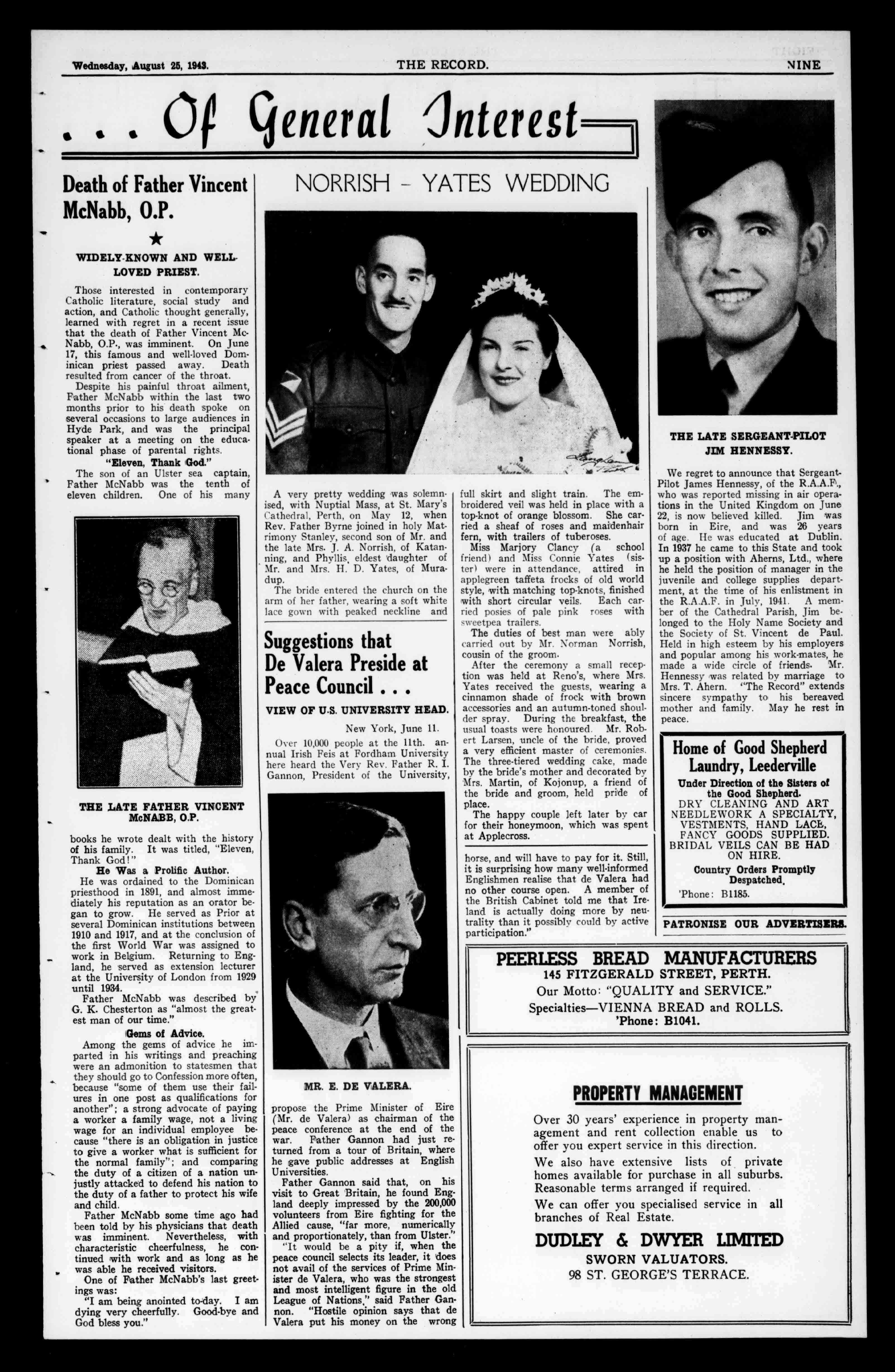
THELATEFATHERVINCENT McNABB,O.P.
bookshewrotedealtwiththehistory ofhisfamily.Itwastitled,"Eleven, ThankGod!"
HeWasaProlificAuthor.
HewasordainedtotheDominican priesthoodin1891,andalmostimmediatelyhisreputationasanoratorbegantogrow.HeservedasPriorat severalDominicaninstitutionsbetween 1910and1917,andattheconclusionof thefirstWorldWarwasassignedto workinBelgium.ReturningtoEngland,heservedasextensionlecturer attheUniversityofLondonfrom1929 until1934.
FatherMcNabbwasdescribedby G.K.Chestertonas"almostthegreatestmanofourtime."
iGemsofAdvice.
Amongthegemsofadviceheimpartedinhiswritingsandpreaching wereanadmonitiontostatesmenthat theyshouldgotoConfessionmoreoften, because"someofthemusetheirfailuresinonepostasqualificationsfor another";astrongadvocateofpaying aworkerafamilywage,notaliving wageforanindividualemployeebecause"thereisanobligationinjustice togiveaworkerwhatissufficientfor thenormalfamily";andcomparing thedutyofacitizenofanationunjustlyattackedtodefendhisnationto thedutyofafathertoprotecthiswife andchild.
FatherMcNabbsometimeagohad beentoldbyhisphysiciansthatdeath wasimminent.Nevertheless,with characteristiccheerfulness,hecontinuedwithworkandaslongashe wasablehereceivedvisitors.
OneofFatherMcNabb'slastgreetingswas:
"Iambeinganointedto-day.Iam dyingverycheerfully.Good-byeand Godblessyou."
Averyprettyweddingwassolemnised,withNuptialMass,atSt.Mary's cathedral,Perth,onMav12,when Rev.FatherByrnejoinedinholyMatrimonyStanley,secondsonofMr.and thelateMrs.J.A.Norrish,ofKatanning,andPhyllis,eldestdaughterof Mr.andMrs.H.D.Yates,ofMyradup.
Thebrideenteredthechurchonthe armofherfather,wearingasoftwhite lacegownwithpeakednecklineand
Suggestionsthat DeValeraPresideat PeaceCouncil
VIEWOFU.S.UNIVERSITYHEAD.
NewYork,June11.
Over10,000peopleatthe11th.annualIrishFeisatFordhamUniversity hereheardtheVeryRev.FatherR.I. Gannon,PresidentoftheUniversity,
fullskirtandslighttrain.Theembroideredveilwasheldinplacewitha top-knotoforangeblossom.Shecarriedasheafofrosesandmaidenhair fern,withtrailersoftuberoses.
MissMarjoryClancy(aschool friend)andMissConnieYates(sister)wereinattendance,attiredin applegreentaffetafrocksofoldworld style,withmatchingtop-knots,finished withshortcircularveils.Eachcarriedposiesofpalepinkroseswith weetpeatrailers.
Thedutiesofbestmanwereably arriednutbyMr.NormanNorrish, cousinofthegroom.
AftertheceremonyasmallreceptionwasheldatReno's,whereMrs. Yatesreceivedtheguests,wearinga cinnamonshadeoffrockwithbrown accessoriesandanautumn-tonedshoulderspray.Duringthebreakfast,the usualtoastswerehonoured.Mr.RobertLarsen,uncleofthebride,proved averyefficientmasterofceremonies. Thethree-tieredweddingcake.made bythebride'smotheranddecoratedby Mrs.Martin,ofKojonup,afriendof thebrideandgroom,heldprideof place.
Thehappycoupleleftlaterbycar fortheirhoneymoon,whichwasspent atApplecross. horse,andwillhavetopayforit.Still, itissurprisinghowmanywell-informed EnglishmenrealisethatdeValerahad noothercourseopen.Amemberof theBritishCabinettoldmethatIrelandisactuallydoingmorebyneutralitythanitpossiblycouldbyactive participation."
THELATESERGEANT-PILOT JIMHENNESSY.
WeregrettoannouncethatSergeant. PilotJamesHennessy,oftheR.A.A.F.., whowasreportedmissinginairoperationsintheUnitedKingdomonJune 22,isnowbelievedkilled.Jimwas borninEire,andwas26years ofage.IlewaseducatedatDublin. In1937hecametothisStateandtook upapositionwithAherns,Ltd.,where heheldthepositionofmanagerinthe juvenileandcollegesuppliesdepartment,atthetimeofhisenlistmentin theR.A.A.F.inJuly,1941. AmemberoftheCathedralParish,JimbelongedtotheHolyNameSocietyand theSocietyofSt.VincentdePaul. Heldinhighesteembyhisemployers andpopularamonghiswork-mates,he madeawidecircleoffriends-Mr. Hennessywasrelatedbymarriageto Mrs.T.Ahern."TheRecord"extends sinceresympathytohisbereaved motherandfamily.Mayherestin peace.
HomeofGoodShepherd Laundry,Leederville UnderDirectionofthe
MR.E.DEVALERA.
proposethePrimeMinisterofEire (Mr.deValera)aschairmanofthe peaceconferenceattheendofthe war.FatherGannonhadjustreturnedfromatourofBritain,where hegavepublicaddressesatEnglish Universities.
FatherGannonsaidthat,onhis visittoGreatBritain,hefoundEnglanddeeplyimpressedbythe200,000 volunteersfromEirefightingforthe Alliedcause,"farmore,numerically andproportionately,thanfromUlster."
"Itwouldbeapityif,whenthe peacecouncilselectsitsleader,itdoes notavailoftheservicesofPrimeMinisterdeValera,whowasthestrongest andmostintelligentfigureintheold LeagueofNations,"saidFatherGannon."Hostileopinionsaysthatde Valeraputhismoneyonthewrong
Over30years'experienceinpropertymanagementandrentcollectionenableusto offeryouexpertserviceinthisdirection. Wealsohaveextensivelistsofprivate homesavailableforpurchaseinallsuburbs. Reasonabletermsarrangedifrequired. Wecanofferyouspecialisedserviceinall branchesofRealEstate.
&
Wednesday,August26,1949. THERECORD. NINE
Sisters
theGoodShepherd. DRYCLEANINGANDART EEDLEWORKASPECIALTY, VESTMENTS,HANDLACE, FANCYGOODSSUPPLIED. BRIDALVEILSCANBEHAD ONHIRE.
Despatched, 'Phone:
PEERLESSBREADMANUFACTURERS 145FITZGERALDSTREET,PERTH. OurMotto:"QUALITYandSERVICE." Specialties-VIENNA
ROLLS. 'Phone:
of
CountryOrdersPromptly
B118.5. PATRONISEOURADVERTIIIIRII.
BREADand
B1041.
PROPERTYMANAGEMENT
DUDLEY
DWYERLIMITED SWORNVALUATORS. 98ST.GEORGE'STERRACE.
Established1874.
OfficialOrganoftheArchdioceseofPerth.
450HAYSTREET,PERTH.
TELEPHONE:B6950.
PERTH,WEDNESDAY,AUGUST25.1943.
Sectarianism
Mr.H.S.W.Parkersaid,duringtheweek,intheLegislative Council,thatsectarianismwasbeginningtoshowitselfinthecommunity,andshouldbequickly"nippedinthebud."Withthis wecanreadilyagree,asCatholicshavebeenthevictimsofthe recentcampaignofslanderandmisrepresentation.Theaffair commencedwiththecowardlychain-letterwhichpurportedtoexposeaconcertedCatholicattempttogainpoliticalcontrolofthe country.ThisridiculousdocumentinvaryingformshasappearedatElectiontimeoveranumberofyears,anddespitethefact thatithasbeenconclusivelyprovedaclumsyforgery,persists. Thiswasfollowedbyapamphletentitled"TheTruthAbout RomanCatholicism,"bytheRev.GeorgeTulloch.E.D.,ontheeve oftheElections.
Theapparenthonestyofthiseffusioniinnutbeinganonymous) wasutterlydestroyedinthatitrepeatedthesubstantialallegations ofthechain-letter,despitethefactthattheRev.GeorgeTulloch, inaletterpublishedinthesecolumnsonthe11th.inst.,disclaimedresponsibilityfortheChainLetter.TheRev.Tullochwrote: "Wedonotbelieveinthe'ChainLetter'racket,asitonlycauses strifeinthecommunity."Yet,ontheveryeveoftheElections, herepeatstheclaimsofthedisgustingforgerywhichhehasjust disclaimed.Oh,Inconsistency,thynameisPresbyterianism! It was,however,gratifyingtonotethatanIndependentcandidate forthePerthseattookthereverendgentlemantotaskonthe groundsof"introducingsectarianismintothepoliticalissue."When askedonthetelephonewasthisadecent,honourableactionat thistime,thereverendgentlemanhungupthereceiver,indicating presumablytheconsentofsilenceoraspeechlesssenseofshame.
* *
WefeelitisamatterofconsiderableconcernfortheChurches asawholethatthismeddlinginpolitics.andespeciallytheovert andanonymousemploymentofthesectarianweapon,shouldbe permittedwithoutprotest.AnAnglicanclergymanopenlyespousedthecauseofaparticularcandidate,andofaparticularparty, onthewireless.TheRev.GeorgeTullochdistributeshisfantasiesonElectioneve.Otherdocumentsofasimilarnature,especiallya"HowtoVote"card,indicatingwhichcandidatesare CatholicsormarriedtoCatholics,werefreelycirculated.One couldimaginethestormhadaCatholicpriestbeeninvolvedin anyofthissorrybusiness.Butfromwhateveranglethematter isviewed,itbringsreligiondowntoacheaplevelandexposesit toopencontempt.Wedonotthinkitunreasonablethatthepublicshouldexpecttheresponsibleleadersofthedenominationsconcernedtobeabletomaintainalittledisciplineovertheirweaker subjects.
11111.11F.se inan
CATHOLICPATRIOTICBALL
EMBASSYCABARET, MONDAY,SEPTEMBER6,1943. 8.30p.m.to1.30am. TICKETS.8/6SINGLE. (ObtainableatDoor).
BookingsopenatEmbassyfor Logues,Tables,etc.,on MONDAY,AUGUST16,1943.
PROCEEDSINAIDOFC.W.O.
NATIONALDAYOFPRAYER. FRIDAY,SEPTEMBER3rd.
Inaccordancewiththewishes ofHisMajestytheKing,Friday, September3,willbeobservedas aNationalDayofPrayer.There willbeSolemnHithMassinSt. Mary'sCathedralat11am.,at whichHisGracetheArchbishop willpreside.SeniorChaplianG. O'Byrnewillpreachtheoccasionalsermon.
LETTERSTOTHEEDITOR-
Sit-AsavisitortothisState,I shouldliketoexpressmyadmiration forthefineliturgicalsingingoftheCathedralBoys'Choir.Infewplacesin Australiaistheliturgysomusically andproperlyinterpreted.
Itisregrettable,however,thatthe excellenceoftheirsingingandtheatmosphereoftrueliturgicalrestraintis oftenmarredbyatooliberalandindiscreetuseoftheorgan.Particularly inappropriateistheplayingofsweet, "devotional"airsduringthesublime dramaticmomentsoftheConsecration, whenreverenceandliturgicalpropriety surelydemandsilence.Theincidental useoftheorganatothertimesduring Massisquiteoftenandobviouslya distractiontothecelebrant,andiforganistsinCatholicchurchescouldbe convincedthattherearetimeswhen silenceisreallygolden,thenboth aestheticandliturgicalexcellence wouldbenearerattainment-Yours, etc., G.S.
Sit-ArtiolesexemplifyingtheCatholicviewpointinthematterofAustralia'sneedsinsocialreconstruction containfromtimetotimereferences tothenecessityofaruralcommunity of"peasant"farmers.
Itappearstomethatthedesignationisanunfortunateone,inthat,to anotinconsiderableextent,ithas givenrisetoamisconceptionofCatholicidealsinthemindsofmanyfolk. SpeaktotheaverageAustralianof peasants,andalmostinvariablyhewill immediatelyenvisagesuchfolkas,for instance,Chinesepeasants,who,toacquireameagreexistence,areunderthe necessityofexertingthemselvestostupendousefforts.
Further,inconsultationwiththe OxfordDictionary,Ifind"peasant" definedas,"Onewholivesinthecountryandworksontheland serf."
Thesameauthoritystatesa"serf" tobea"slaveorbondsman;aperson inaconditionofservitudeormodified slavery."ThisIbelievetobethe antithesisofCatholicaims.
HappieruseIbelievecouldbemade oftheword"Yeoman."OxfordDictionarydescribeshimas,"Amanowningandcultivatingasmallestate;a freeholderundertherankofgentle. man-looselyacountrymanofrespectablestanding,afarmer,andcapsthe definitiondelightfullywithaquotation fromCorbett,"Thosewhotilltheir ownlandareyeomen."
IfIhavedrawnanyfalsedeductions,pleasecorrectme,asmyaimis whollyoneofconstructivecriticism.yours,etc.,
LEWISM.LIPSETT.
FOOTBALL
ChristianBrothers'SecondarySchools' Association.
ThisAssociationhasjustconcluded averysuccessfulseason,fourteams havingtakenpartineachofthetwo divisions:Fremantle,Highgate,LeeiervilleandPerth.
Intheunder13section,Perth,with onlyonedefeat,cameoutaspremiers, whileintheSeniordivision,aftertwo rounds,twoteamswerelevelinpoints: FremantleandHighgate.Thisnecessitatedaplay-off,whichtookplaceon theSubiacoOvallastThursday,with Mr.A.Evansasumpire.Afterakeen tussleHighgatewonby5.8to1.7,and becamepremiersfor1943.
ThenextfunctionoftheAssociation bethecombinedsports,atthe W.A.C.A.,onSaturday,October16, whentheabovefourteamswillcome,petsforthecovetedArchbishop'sCup.
"Boys'Town" StreetAppeal
£810Raised
Brothers'Thanks
Thecommitteeof"Boys'Town StreetAppeal"wishestoplaceonrecordthesinceregratitudeofthe350 youthfulinhabitantsofourW.A.Boys' TownOrphanages,ofCastledare,Bindoon,andClontarf,toallwhoinany waycontributedtothehighlysatisfactoryresultofthefirstpubliccontributiontowardssonobleacause.
Thankstothezealouslaboursofthe devotedmembersoftheladiesofthe C.W.L.,theT.O.S.F.,theC.G.M.,the H.A.C.B.S.,andofmanyotherdevotedcollectorsoftheW.A.Sportsmen'susualworkers,thesumof4810 wasinthebanktohelptolessenthe interestontheheavyoverdrafts,now duetobepaidbyourthreeorphanages.TotheW.A.Sportsmen'sCouncilandstaff,whosokindlyco-operated intheorganisingoftheStreetAppeal, ourappreciationisgreatindeed.Mr. A.PownallandMr.W.Dwyer,ofthe St.VincentdePaulOrphanageCornmittee;Mrs.Glenn,ofW.A.S.C.;'Mr. WroblewskiMrs.Pownall,andMrs. Keilorgaveconsiderablehelpinthe organisingworkoftheAppeal.Mr. F.Andersonwasthechairmanofthe committeeforBoys'Town.,Inthe Fremantlearea,Mrs.Munyard,ofEast Fremantle,andherdevotedbandof ladiesrealisedarecordresultfortheir area.MayGodblessandrewardall thosewhohaveinanywayhelpedthe causeoftheorphans."Aslongas youdidittooneoftheseMyleast brethren;youdidituntoMe."
J.NEILSON,Optician
S.DANNELL,F.S.M.C.(London), W.A.O.A.
OPTOMETRIST, Tel,:B2014. 16PLAZAARCADE,PERTH.
PatroniseOurAdvertisers.
TEN THERECORD. Wednesday,August25,1943.
TheDemandfor GirlsTrained forBusinessHas NeverBeenSo Heavy ITWILLPAYYOUTOENROL NOWATSTOTT'S. AGOODPOSITIONIS ASSURED, STOTT'S BUSINESS COLLEGES 89St.George'sTerrace.Perth. 10AdelaideStreet,Fremantle.
tOe
citrcObioceoe
HisGracetheArchbishophasmade thefollowingclericalappointments:Rev.J.Henebry,toKellerberrin-in charge.
Rev.P.J.Woods,B.A.,toBedford Park-Bayswater-locumtenens.
Rev.J.Murphy,B.A.,L.Ph.,toNedlands-InspectorofSchools.
Rev.G.O'Leary,toSouthPerthassistant.
ARCHBISHOP'SENGAGEMENTS.
September6:Receivedebutantesat theAnnualCatholicBall.
September12:CanonicalVisitationand ConfirmationatSt.Brigid'sChurch, MidlandJunction.
September16-10.30a.m.:Presideat SolemnHighMassatSt.Patrick's Church,Fremantle,ontheoccasion oftheannualPlainChantFestival.
September15-10.30a.m.:Presideat SolemnHighMassatSt.Mary'sCathedral,ontheoccasionoftheannual PlainChantFestival.
September17-10a.m.:Presideat QuarterlyConferenceofthePriests oftheMetropolitanArea,atthe ChapterHall,VictoriaSquare. 7p.m.:AdministertheSacramentof ConfirmationtoadultsinSt.Mary's Cathedral.
September19.CanonicalVisitation andConfirmationatSt.Mary's Church,Leederville.
September21-24:AttendSenior Priests'RetreatattheRedemptorist Monastery.NorthP-rth.
EnclosedI\ctreats
("TheRecord.'willbepleasedto publishinthiscolumnnoticesofRetreatstobeconductedformembersof ourvariousCatholicorganisations throughoutthecomingyear.Wesuggestthatadvicebesenttousassoon asarrangementshavebeencompleted ineachcase.)
ThecombinedRetreatformembers oftheNewmanSocietyandPastPupils ofLoretowilltakeplaceatLoretoConvent,Swanbourne,commencingSaturday,September11,at7.30p.m.Graduateswishingtoattendareaskedto ringWM19'28MissFarrell).
Ex-studentsofSacredHeart"'onvent,Highgate,areinvitedtoenclosed week-endRetreat,commencingSatin-.day,September4,at2.30p.m.Those intendingtoparticipateringConvent asearlyaspossible.
TheH.A.C.B.S.annualRetreatfor ladieswillbeheldatSacredHeart Convent,Highgate,onSeptember4, commencingat2.30p.m.,andconcludingonMondaymorning.Intending participantsnotifybranchsecretaryor ringB2857(MissJoyce),orW1822.
TheH.A.C.B.S.Retreatformen,at -theRedemptoristMonastery,commencingat3p-m.onSaturday,September11,andconcludingafterearly breakfastonMonday,September13.
Sunday.
QUARANT'ORE
AUGUST.
5th.-FREMANTLE:FortyHours' Prayer(27th.--29th.).
SEPTEMBER.
lst-KALGOORLIE:FortyHours' Prayer(3rd.--5th.)
2nd.--OOTTESLOE:FortyHours' Prayer(10th.--12th.).
3rd.-BOULDER:FortyHours' Prayer(17th.--19th.).
4th.-GOODSHEPHERDCONVENT, LEEDERVILLE: FortyHours'PrayerandEucharisticProcession.
TwoNovicesProfessedat
DominicanConvent,Dongarra
FeastofSt.DominicCelebrated
HowtheRosaryStemmedtheAlbigensianHeresy
OnTuesday,July20,HisLordship, Dr.A.J.Gummer,Rev.FathersHogan, Cosgrief,Meyers(MilitaryChaplains' andFatherKelly(AirForce),motored toDongarratoperformtheProfession ceremonyfortwonoviceswhomade temporaryvowsinthehandsofMother PrioressGeneral.Oneofthenovices, SisterMarydeRicci,wasKathleen Levitzke,anex-pupiloftheCollege, andtheother,SisterMarydeSales,was formerlyMissMaryPatterson,ofWemblv,Perth.Themotherandsisterof theformer,andthefatherofthelatter, travelledfromKatanningandPerth,respectively.tohepresentattheceremony.
HolyMasswascelebratedat7.30a.m. byRev.FatherRegan,C.SS.R.,who hadjustconcludedathree-days'Retreatfortheboarders,andlaterconductedonefortheNuns.Atabout9.30 HisLordshipandthepriestsarrived, andthesecondMassbegan.Thepupils oftheCollegesangtheMass,"Cum Jubilo,"andattheOffertorythe "PanisAngelicus"wassweetlyrendered.
Theceremonytookplaceimmediately afterMass,andwasfollowedbyBenedictionoftheBlessedSacrament.
Theoccasionalsermonwaspreached byRev.FatherRegan.C.SS.R.,who spokeofthecourageandself-sacrifice requiredtofollowthecalltothereligiouslife,andtoliveuptoitshigh standardsandmakeprofessionofthe vowsofPoverty,ChastityandObedience.Richesinthemselveswerenot evil.Iftheywerespentforagood purposetheyweregood,butitwas perfecttogivethemupforthelove ofGod.Theworldlookeddownon poverty,butreligiousembracedpovertyfortheloveofChristandgaveup thepleasuresoftheworldforthelove ofGod.Theyhadweighedwellwhat theworldhadtooffer,andconsidered itbettertogiveupallthisforthelove ofChrist.Somemightconsiderit weakandcowardlytofleefromthe dangersandpitfallsoftheworldand takerefugeinthecloister.itwasnot selfishandunworthy,foritrequired greatcouragetoturnone'sbackonall thatonehelddearandthatnature foundattractive,toembracethe austereandmortifiedlifeofareligious. TnreturnGodgavegreatgraceandhappinesstothosewholeftalltofollow Him.
Thenoviceswerecongratulatedon thesteptheyhadtaken,andreminded ofthehighidealsbeforethem.
Wednesday,August4,thefeastof theHolyFatherandFounderofthe DominicanOrder,wasanotherdayof greatrejoicingatthePriory.Rev. FathersGallagher,O'Byrne,Meyer, Kirby,Hogan(MilitaryChaplains), Kelly(AirForce),Lynch,Williamand O'Flahertywerepresent.TheHigh MasswascelebratedbyRev.Father O'Byrne,assistedbyRev.Fathers HoganandKelly(DeaconandSubDeacon),whileRev.FatherGallagher performedtheofficeofMC..
Rev.FatherKirby,preachingforthe occasion,saidthatfromtimetotime menpausedinthestressofdailylifeto payhonourtosomegreatmemberof ourrace,whosecharacterandworkfor othersstoodoutpre-eminentlyamong thegreatpersonagesofhistory.There weremanywaysofshowinghonourto thegreatbenefactorsofmankind. Monumentswereraised,statueswere erected,andtributewaspaidtotheir memory.
DuringthepastweektheyhadcelebratedthefeastofSt.Ignatius,founderoftheSocietyofJesus:SaintAlphonsus,founderoftheRedemptorists,andnowtheywereunitedtocelebratethefeastofSt.Dominic-founderoftheOrderwhichbearshisname.
Timewastooshorttogivemorethan abriefresumeofhislifeandcharacter.BornatCalarogainoldCastile, intheyear1170,St.Dominic'searly lifewasspentinthesanctuaryofa trulyChristianhome,andlaterunder thecareofhisuncle,theparishpriest ofGumielD'Ijan.Afterhisordinationtothepriesthood,mostofhislife wasspentinpreachingagainstthe Albigensianheresywhichatthattime devastatedpartsofEurope,andespeciallySouthernFrance.Thechief weaponSt.Dominicusedagainstthis heresy(whichdeniedthedivinityof Christ,andthedivinematernity)was theRosarywhich,inanswertohisferventprayers,OurLadyherselfhad giventotheSaint.Afterlabouring assiduouslytocombatthisheresy,St. Dominiclivedtoseepeacerestoredin France.Fallingillwithfever,hewas forewarnedofhisapproachingdeath. Hisbrethrenweregatheredabouthis bedandhediedintheodourofsanctity.Hiscausewasapprovedby PopeGregoryIX.
ItwasthroughSt.Dominicthatwe hadreceivedtheRosary,thatdevotionsodeartoAustralianCatholics, foritwasrecitedbythepioneersof thislandwhentherewasnopriestin thecountrytoministertotheirneeds
St.DominicfoundedthreeOrders, oneformen,oneforwomen,andone forthelaity.Universitieswere foundedinEuropeandotherlands, andthesonsofSt.Dominicbecame renownedasteachersofCatholicphilosophy.AmongthegreatestSaints oftheOrderareSt.AlberttheGreat andhisstillmorefamouspupil,St. ThomasofAquin.RoththePriests andtheNunsoftheOrderaretohe
ST.(CHARLES'SEMINARY
**Ant* MK
ApplicationsforAdmission
ApplicationsforadmissiontoSt. Charles'Seminary,Guildford,for1944 areherebyinvited.
Anumberofrequestsforadmission havealreadybeenreceivedfromthe metropolitanarea,sothisnoticeis directedespeciallytothoseresidentin countryparishes.
Therequirementsforanapplicant areasfollows:-
1.Adesiretobecomeapriestand abeliefinthepresenceofavoca. tion.
2.Theconsentofparentsandthe approvaloftheparishpriest.
3.Completionof7th.standardor let.yearSub-JuniorbyDecember, 1943.
4.Anelementaryknowledgeof Latin.(Uptoandincludingtheactiveregularverbs.)
5.Goodhealth,confirmedbya medicalcertificate.
Ageneralapplicationshouldbesent immediatelytotheRectorofSt. 'harles'Seminary,Guildford,WA., whenthenecessarypapersforformal applicationwillbesenttothestudent concerned.Theabovementioned generalapplicationshouldbemadein theapplicant'sownwriting.
foundineveryland,wheretheyhold chairsintheuniversities,conductcolleges,schools,hospitalsandcarryon manyothercharitableworks.
"Together,"concludedthepreacher, "ourmindsturntothegreatSaint whofoundedtheOrder.Werejoice withtheSistersincelebratinghisfeast andpraythatGodmayblessthemand increasetheirnumbersthattheymay carryontheworkofCatholiceducaII.,nwithzealandenergy.
Inconclucion,wepraythatthrough themeritsandteachingofSaintDominic,theChurchmaynotbedeprived oftemporalhelpandmayeveradvanceinspiritualgood."
Wednesday,August25,1949. THERECORD. ELEVEN
AFierris CanNowOffer90inchFine BRITISH MosquitoNet inWhiteOnly THISISAFINEMESH,SUITABLEFOR COTS,BASSINETTES,ETC. 4/11 AYARD.NOCOUPONS. COUNTRYCUSTOMERS,PLEASESENDYOUR ORDERSASSOONASPOSSIBLETOAHERN'S HAYANDMURRAYSTREETS
CatholicTeachers' Guild
FromtherepliesreceivedfromCatholicteachersinthecountry,the GuildfeelsthatitissupplyingaCatholicatmosphereamongtherural aeaswheretheordinaryreligiousamenitiesareunfortunatelysoinfrequent.
Inthesedaysofpetrolrationingour countryfriendsfeelmoreisolatedthan ever.Letterafterletterhasspoken appreciativelyofwhathasbeendone sofar,andtheGuildfeelsencouraged tomakeevengreaterefforts.Ithas inmind,amongotherthings,aretreat forcountryteachers.
Inthemeantimewearelookingforwardtowelcomingourcountryfriends onWednesday,September1,at2.30 p.m.,atBactonHouse,toasocialafternoon.
CENTRALCATHOLICLIBRARY
36PIERSTREET,PERTH.
SUBSCRIPTIONRATES.
Metropolitan.
12Months:Onebook,10s;twobooks, 12s6d;threebooks,£1;fourbooks, 7s.6d. Country.
12Months:Threebooks,£115s.;foubooks,£25s.:fivebooks,£210s.
Wepayfreightonbookstothesubscriber.
BASSENDEANBAKERY
AnnualRetreats.
TheRetreatforladieswillcommenceattheSacredHeartConvent, Highgate,onSaturday,September4, at3p.m.,andtheRetreatformenat theRedemptoristMonasteryonSaturday,September11,at3p.m.Both RetreatswillfinishafterearlybreakfastontheMondaymorning.Those whohavetostartworkearlyonMondaymayleaveontheSundaynight. Intendingretreatantsshouldgivein theirnames,inthecaseoftheladies' RetreattoSisterNoraJoyce,andfor themen'sRetreattotheGrandSecretary,notlaterthantheMondayprecedingthecommencementoftheRetreat.
St.Mary'sBranch,Leederville.
ThemeetingonMondaynextwillbe theoccasionoftheofficialvisitofthe DistrictBoard,andeverymemberwho canpossiblydosoisaskedtoattend.
PLEASENJTE!
TheTelephoneNumberof"The Record"hasbeenalteredfrom B9141toB6950.
N.LOVELOCK
BAKERANDPASTRYCOOK,ETC. 'TEL.:UI.125. WESTROAD,BASSENDEAN.
WEAVER LOCK
HIGHCLASSAERATEDWATERS
Tel.:MU149.
WESPECIALISEINCORDIALS.
SUBURBANROAD,SOUTHPERTH.
JAMES
QUALITYBUTCHER,50HamptonRoad,Beaconsfield 'PHONEL2492. FORPRIMESTQUALITYMEAT.. YOURRECOMMENDATIONAPPRECIATED.
PAINTINGFORPERROTT PERROTTFORPAINTING.
D.C.PERROTT 'PHONE B5548 10 CAMELIA ST., NORTHPERTH, PAINTING CONTRACTOR
CONTRACTORTOTHELEADINGCONVENTS,COLLEGES,AND SCHOOLS.
"THESTOREOFQUALITY." STIRLINGHIGHWAY,MOSMANPARK.
'Phone:F2198.
RHODES&SONS GROCERS,IMPORTERS, WINEANDSPIRITMERCHANT. Goodsdeliveredtoanypartofthedistrict.
AustralasianCatholicAssurance Co.Ltd. THE"A.C.A."
A.C.A.BUILDINGS,KINGST.,SYDNEY. ASSETSEXCEED£1,750,000. ALLCLASSESOFLIFEANDENDOWMENT ASSURANCEPOLICIESTRANSACTED.
BRANCHOFFICESINALLSTATES.
W.A.Office: "WARWICKHOUSE,"ST.GEGRGE'STERRACE,PERTH P.ENGELBRECHT,ResidentSecretary.
Catholic Girls'Movement
HEADQUARTERSANDCLUB ROOMS:
BankofNZ.W.Chambers,65St. George'sTerrace(nearSherwood Court)-Rooms:7-10FirstFloor.
CALENDAROFACTIVITIES.
SHORTIIAND.-5-6.30p.m.,Monday, Tuesday,Friday.
DRAMATICS-8p.m.,Tuesdayand Friday.
HOMECRAFTS-Monday,8p.m. E.S.C.-Monday,8p.m.
DANCE-CecilBuildings8 pm
Tuesday.
NURSES'PRAESIDIUM-8p.m., Tuesday. DRESSMAKING-7--9.30p.m.,Wednesday.
MASS,8a.m.Exposition,Benediction, 5.45p.m.,Thursday. ORCHESTRAANDSWINGBAND, 8p.m.,Friday.
Thursday,September9:DressRehearsal,AssemblyHall,7.15p.m.
Saturday,September11:CONCERT, AssemblyHall,8p.m.
Monday,September13:CONCERT, AssemblyHall.
Homecrafts
Everymemberisaskedtocomealong onMondayeveningsandhelptomake somearticleortoytofillourstallat Castledare,onSunday,October10. WiththeassistanceofMrs.Harper, whoisanexpertatnoveltymaking, thegirlsareturningoutmanyfascinatingtoys,andRoom7isabee-hiveof activity.Socomealongwithanyodds andendsofmaterialandwool,andbe inthefun.
ExtraOrchestra Rehearsal
Allmembersareaskedtomakea specialefforttoattendanextrapractice.OnSundayafternoon,August29, at3.30p.m.sharp,inRoom9,Club Rooms.
ConcertBookings
TheboxplanforournextConcert Season,onSeptember11and13,opens atNicholson'sLtd.,onMondaymorning,August30.Toavoiddisappoint. ment,bookearly.
Magazine
Thefirsteditionhasbeenpublished, andcopiesmaybehadfor3d.eachon applicationtotheClubRooms.
DebutantePractice
Pleasenote,practiceisat2.30p.m. sharponSundaynext,August29.Girls :lustdefinitelyattendthissecond-last rehearsal.
DEBATINGGROUP
LastFridayevening'sdebatewasa tremendoussuccess,andifyouareinterested,comealongtotheClubRooms onFridayeveningsat8p.m.
CatholicPatrioticBall
Membersareremindedthatthebookingsforlogues,tables,etc.,openedat theEmbassyBallroomonMonday, August16. Forreservationsring 133040
Canteen Service
Thefollowingdateshavebeenarranged: LB.A,Group.
September7:PhyllisDean. 0.02LGroup.
September10:PhyllisDean.
CATHOLIC T E N N I S
ASSOCIATIONBy"Run"
TennisDay.
Owingtothewetweatherwhichprevailedthroughoutthemetropolitan areaonSundayafternoon,alltennis enthusiastswereforcedtocontent themselvesbystoppingindoors,so givingeveryoneachancetostudythe electionresults(perhaps),butwehope thatnextSunday,August29,willbe fine,andifitiswewillbelookingforwardtoseeingyoualloveratRobertsonParkintheafternoon.Sodon't forgetnow.
GeneralCommunion.
Arrangementsarewellinhandfor Sunday,September26,whentheGeneralCommunionwillbeheld,andwill befollowedbyabreakfast,andthen all-daytennisatRobertsonPork.The courtswillbeavailablefrom11a.m., andmemberswishingtomakeapicnic dayofitcanbringtheirpicnicbasketsandsospendanenjoyableday. Soallstartmakingyourarrangements now,anddon'tforgettowatchthese columns.
SocialCommittee.
Followingthecouncilmeetinglast Fridayevening,anumbe,ofactive juniorsoftheAssociationmettodiscussthesocialsideoftheAssociation. Theysoon"gotintoahuddle,"and fromthesuggestionsthatwereputforarditisquiteevidentthatthey meanbusiness.ApicnictoDarlington?Yes.That'soneoftheitems onthelist,butIwon'ttellyouanythingfurtherjustnow.I'llbetyou're curious!
Personal.
IampleasedtoreportthatRonMor. risisprogressingfavourablyandis nowwellontheroadtorecovery.We areverypleasedtohearit,Ron.
CanteenService.
August27:TownHall.
September13:PhyllisDeanHall.
September18:Buffet.
September23:TownHoll.
SewingCircle.
Cut-outflannellshirtsforCastledare, willbereadyfordistributiononWednesday,August25,from2to4p.m., attheLeagueRooms,10Nestle's House,St.George'sTerrace.
KnittingCircle. Knittersarerequiredtomakewarm garmentsfortheMerchantSeamen. Donationsofwoolarealsorequested. AmemberattendseveryFridayfrom 2to4p.m.attheLeagueRooms.
.4TTEXTION!
MembersoftheChoir,Orchestra, SwingBand,andDramaticGroupare remindedthatfromnowonattendance atrehearsalsisessential.
ADressRehearsalforDramaticsonly willtakeplaceonSeptember8,anda FullDressRehearsalforallperformers onSeptember9.
"Peg o'MyHeart"Tickets
Membersarerequestedtohandinto theClubRoomsassoonaspossiblethe moneyforticketssoldorthetickets notdisposedof.
ThirdConcertSeason
AssemblyHall,8p.m.,Saturdayand Monday,September11and13.
TWELVE THERECORD. Wednesday,August25,1943.
SAFEGUARDTHEFUTURE
Wednesday,August25,1943.
TheForthcomingMission.
Theprincipaleventinthelifeofthe parishduringthenextfewweekswill betheMission,whichcommenceson Sunday,September5.
TheMissionwillbeconductedby twoRedemptoristFathers,andbeof twoweeks'duration.Everyeffort shouldbemadetoattendallofthe exercises,andtherebybenefitspirituallytothefullestextent.ArrangementshavebeenmadeforHolyMass tobeofferedatconvenienttimes,so thatallwillbeaffordedtheopportunityofattendingdaily.Eveningdevotionsandsermonwillcommenceat 7.30nightly.
HolyHourforVocations.
OnSundayeveninglastanhour's prayerforvocationsfortheReligious lifewasconductedbyRev.Father Nolan,inthepresenceoftheBlessed Sacramentexposed.
Carnival.
HisGraceArchbishopPrendiville openedtheCarnivalinSt.Mary'sHall onWednesdayeveninglast.Arranged tomarktheclosingoftheprizepacketanddistributionofprizes,the eveningprovedahighlysuccessfulfunction,bothsociallyandfinancially.
HisGracespokeofthegreatpleasureitgavehimtomeettheparishionersatsuchafunction. Althoughhehadperformedeverykind ofceremonyforthemduringthepast tenyears,thiswasthefirstopportunityaffordedhimofattendingasocial functionofthisnature.
TheAdministrator,Rev.Father Carolan,whohadpreviouslyintroducedHisGrace,spokeinappreciationof allthoseparishionerswhodonatedso generouslytotheprizepacket,andespeciallythecollectorsandorganisers, andallwhootherwiseassistedtomake theeveningthesuccessitwas.
AmongthosepresentwereRev. FatherCarmody(Boulder),Rev. FatherMcCarthy,Mr.andMrs.Vic Johnson,Mr.andMrs.E.Heenan,and severalwell-knownvisitorsfromPerth, aswellasamostrepresentativegatheringofGoldfieldspeople.
ResultofSt.Mary'sPrizePacketand Raffles.
1st.prize,468,Mr.T.Sullivan,£60: 2nd.,440,Mr.F.Bennett,£20;3rd.,724, Mr.E.Bumback,£10.Weeklyprizes:
Mrs.Choppin,Mrs.Holly,Mr.F.Byrne, MissWillcock,Mr.D.Canning,Mrs. Judd,Mr.J.Hannigan,L.Harrington, E.McMahon,andMrs.Millea,£1each. Mr.C.Whiteleywonthespecialcollector'sprize,£10,havingraisedover£200. HisGracewonarainbowcakeand boxofgroceries.Rev.FatherMcCarthywonacakeandadoll.TheShirleyTempledollwenttoAnita,118 Brookrnan-streettablecloth,Mr. Jones;steelengraving,MissCarmel Ryalls;ham,Mrs.Skipworth;loadof wood,MissE.Duggan;doyleys,Mrs. Markotich,andgolliwog,Rinty,27 Brookman-street.
,C.B.C.HouseParty.
TheHousePartywillbeheldon Thursday,September2. Soplease keepthisdateinmindandrollupto theCollegeonthatevening.Thecause isamostdeservingone.
Personal.
Rev.FatherNolanhasreturnedafter spendingaweekinPerthconsulting aneyespecialist.
Mr.Cawleyisatpresentrelievingat theBankofAustralasia.
TuesdayNightDance.
Theweeklylearners'dance,soably conductedbyMrs.Rogers,Mr.and Mrs.Henneker,andMissRyan,has provedextremelypopularthisyear, andislookedforwardtoeagerlyby severalhundredyoungpeople.
OwingtotheMission,thedancewill notbeheldonTuesday,September7, andTuesday,September14.However, itwillbeinfullswingagainthereafter.
H.A.C.B.S.QuarterlyCommunion.
ThemembersofSt.Mary'sBranch areremindedthatthequarterlyCommunionwillheheldonnextSunday, August29,at7o'clockMass.Regalia willbeavailableatthechurchdoorbe. foreMass.Thefortnightlymeeting takesplaceonMonday,August30,at 745p.minSt.Mary'sHall.
ofLife,inthanksgivingtoOurBlessedLady,forherhelpduringthe troubleddaysthroughwhichweare living.AsOurLady,HelpofChristians,isPatronessofAustralia,itis throughherhelpwehavebeenspared thehorrorsofwar.
Welcome.
WearegladtowelcometotheparishMr.Coffeeandfamily,whohave recentlycomefromBeverley,where theyhadbusinessinterests.
Wagin
MASSTIMETABLE.
Valedictory.
Averypleasanteveningwasspent recentlyintheStaroftheSeaHall, whenalargeandrepresentative gatheringassembledtobidfarewellto Mr.andMrs.Stainthorpe,ontheeve oftheirdepartureforMelbourne, wheretheyintendmakingtheirhome forthepresent.Ashortprogramme waspresented,andeachitemwasmuch appreciated.Songswererenderedby Mrs.VaughanParker,MissesB.BradleyandK.Dunne,andMr.Frank Briggs.Aviolinsolo,IIandel's"Largo," byMr.Rooney,withperfectpianoaccompanimentbyMissV.Kenniwell, willbeIonzrf..n.-r.itteredbythose privilegedtohearit.Mr.Taurin(Bunbury)wasveryamusinginhismusical monologues.MissJeanBelldanced anIrishreelingoodstyle.MissKenniwellwasaccompanistthroughoutthe evening.
Inmakingpresentationsonbehalfof theparishionerstotheguestsofthe evening,Rev.FatherFaheyspokeof theirsterlingqualitiesthroughoutthe fortyyearstheyhavelivedatCottesloc.Theyare"foundationmembers," andhavealwaysbeenverystaunch supportersoftheChurchinallitsactivitiessincetheinfantdaysofthe parish.Aschurchsecretary,inthe choir,andtennisclub,Mr.Stainthorpe hassetonexampletoall.Mrs.Stainthorpealsohasalwaysbeentothe forewhenanythingwastobedoneon thesocialsideofaffairs.
Mr.AhernheartilyendorsedtheremarksofFatherFahey.Mr.Hegney, Mr.J.Edwards,andMr.J.Tully(CatholicTennisAssociation),andMr. Barlow(St.Canice'sBranchofthe H.A.C.B.S.),allspokeinveryeulogistictermsofMr.Stainthorpe'sexcellentworkintheirorganisations.
Mr.Stainthorpefeelinglyresponded onbehalfofhiswifeandhimself,and thankedeveryoneforthekindness showntothem,inwordsanddeeds, thatevening.HehopedatsomefuturedatetorenewthegoodfriendshipsleftbehindinCottesloe.
Afteradaintysupper,servedbythe ladies,hadbeenpartakenof,andthe guestsofhonourdeclaredinsongby thecompany"jollygoodfellows,"goodbyesweresaid.
FirstCommunion.
Sunday,August15,FeastoftheAssumption,wasared-letterdayfora numberofsmallpeopleofStarofthe SeaSchool,foronthatdaytheyhad thegreathappinessofmakingtheir firstHolyCommunion,andreceiving forthefirsttimeourdearLordinto theirhearts.Asthechildrenreturnedtotheirseatsfromthealtar,one couldnothelpnoticingthelookof completehappinessontheirfaces, whichleftnodoubtastotheirfull knowledgeofthegreatGifttheyhad justreceived.ThePlainChantand hymnssungbythechildrenduring Masswasquiteatreat,andonewould liketohearmoreofit.
GeneralCommunion.
AdayofGeneralCommunionwas observedonAugust15bytheparish also,when,atfirstMass,practically everypersoninthefilledchurchap. proachedthealtartoreceivetheBread
TrendTowardsSmallOwnership
ContinuedfromFrontCover.)
Anyattempttogivethemsecurity orguaranteethemtheirjobsisbringingthemperilouslyclosetoslavery. DangerofGuaranteedEmployment.
TheCommunistStatecouldanddid employmeninsomekindofwork thatitchoseforthem.InthenonCommunistStateitmightbepossible toguaranteemenintheiremployment. InEnglandatthepresenttimethere 'wastalkaboutsomebigcapitalistic companiesguaranteeingmenworkfor yearsahead.Anyonewhoaccepted suchaguaranteewasgivingawayhis freedom,andtherighttochangehis work.Nopoweronearthcouldguaranteeemploymentinsuchworkasone mightchoose.Thepositionofmany wage-earnerswassodesperatethat manywouldbequitewillingtoaccept anofferthatwouldcompelthemto workassomeoneelsecompelledthem towork.
MasswillhecelebratedinWaginon Sunday,August29,at10a.m.,byRev. FatherByrne,ofKatanning. NoMassatLakeGraceorKukerin untilfurthernotice.
ThestateofaffairsthattheCatholic Churchwantedtosee,andthat,please God,theywouldseeintheirlifetime,wasthatinwhicheveryone ownedenoughpropertytogivehim somefreedomandthelibertytochoose theworkheliked.
-
THERECORD. THIRTEEN
KALGOORLIE
D.HILL WHOLESALEANDRETAILBUTCHER. NEWCASTLEROAD,MIDLANDJUNCTION. Tel.118Midland. TRUSSEDPOULTRY. -StateSawmillsSPECIAJ.ISEIN LOCALTIMBERS STATEPRESSEDBRICKS AND OtherBuilders'Requisites 306MURRAYST.,PERTH AlsoatCountryandMetropolitanYards. FootComfortGuaranteed BootsandShoes InHalfSizes. e Ifnecessarywe maketoorder. 667HayStreet,Perth 'Phone:B1381. CatholicFunerals BY PerthFuneral DirectorsLtd. ComplystrictlywitheveryrequirementofCatholicRitual. ThequietdignityandreverenceofservicesundercompetentCatholicsupervisionaffordconsolationinthehourofsorrow. NightandDayService. ModerateFees. 379HaySt.,Perth(nearSt.Mary'sCathedral). Phones:Business,B8616Private,B8623,B5496.
THEDEATHOFMrs.MARYCULLEN
Mrs.MaryCullendiedatSt.John ofGodHospital,Subiaco,onAugust 9,afterashortillness.Thedeceased wasanativeofKanturk,Co.Cork,Ireland.Shereceivedherearlyeducation atthePresentationConvent,andafterwardscompletedacourseindairying subjectsandlecturedattheMunster AgriculturalInstitute.
ShecametothisStatein1898,and marriedatSt.Mary'sCathedralthe lateGeorgeCullen,ofNewport,Tipperary.Theirmarriedlifewasspent atCottesloe,andafterthedeathof herhusbandsheresidedatWestPerth, whereshewaswidelyknownandrespected.
Heronlyson,Rev.FatherJohn Cullen,herdaughters,SisterM.Mechtilde,ofSt.Brigid's,WestPerth, EileenandMolly,werepresentather death.Maysherestinpeace.
ARequiemMasswasofferedinSt. Brigid'sChurch,inthepresenceofHis GracetheArchbishop.Rev.Father Cullenofficiated,assistedbyFather
O'ConnorasDeaconandFatherGallagher(Adm.,Geraldton)asSub-Deacon.Theclergypresentincluded DeanReidy,Rev.FathersDuffy, C.SS.R.,Bernard,O.S.B.,Dunne,Fanning,Pace,Wallace,Dr.Kearnan,Dr. Goody,Dr.Collins,O'FlahertyKelliher,Rafferty,O'FarrellandMcGillicuddy.Alargecongregationfilled thechurch,includingmembersofvariousReligiousOrders-ChristianBrothers,LittleSistersofthePoor,SistersofSt.JohnofGodSistersof Mercy.
ThechildrenofSt.Brigid'sSchools sangtheSolemnRequiem.
Thecortegemovedfromthechurch, whilethepupilsoftheHighandPrimarySchoolsformedaguardofhonour.Thefuneralwaswellattended. FatherCullen,assistedbyRev. FathersMoss,O'MahoneyandRegan, officiatedatthegraveside.ThepallbearerswereMessrs.J.Colgan,Perrott, Kelly,Allum,LuntandTracey. Requiescatinpace.
WholesaleBUTCHER andRetail
E.J.MARCH
Established26Years.
110GROSVENORROAD,MT.LAWLEY. GOODSERVICE
'Phone:B7453.
DEATHS 014 OnService.
HENNESSY.-Ofyourcharity,pray forthereposeofthesoulofSergeant PilotJamesHennessy,whowasreportedmissinginairoperationson June22,nowpresumedkilled. Eternalrestgrantuntohim,0Lord, andmayperpetuallightshineupon him.
-InsertedbyMr.andMrs.T. Ahernandfamily.
GAFFNEY.-OnAugust13,1943,atSt. JohnofGodHospital,AnnGaffney, of7Fairlight-street,MosmanPark, widowofthelateFrancisBernard Gaffney,anddearlybelovedmother ofMary(Mrs.Goodwin)andthelate JohnGaffney,fondsisterofMaria (Mrs.Forrester)andJamesHarman, ofBassendean,andfondcousinof Mr.W.Scott,ofPerth. Shewasafaithfulmemberofthe SacredHeartSodality.R.I.P. Sadlymissedbyrelativesandfriends.
÷ INMEMORIAM ÷
OnService.
WALSH.-Inlovingmemoryofmy dearlybelovedhusband,Sergeant BernardWilliam,killedinNew Guinea,August30,1942.
MostSacredHeartofJesus,have mercyonhissoul. Insertedbyhissorrowingwife, Grace(Boulder).
WALSH.-Inlovingmemoryofour dearlybelovedsonandbrother,SergeantBernardWilliam,killedinNew Guinea,August30,1942,dearlyloved sonofMr.andMrs.M.Walsh,brother ofGreg.,Bonnie,Carmel,Joan,and Terence.RestinPeace.
HARVEY.-Ofyourcharity,prayfor thereposeofthesoulofMrs.Alice CeciliaHarvey,whopassedpeacefullyawayAugust24,1940,atKalgoorlie.
-Insertedbyherlovinghusband andson,R.andR.
HARVEY.-Ofyour prayfor thereposeofthesoulofMrs.Alice CeciliaHarvey,whopassedawayat Kalgoorlie,August24,1940.
-InsertedbyMr.andMrs.J.E. Plastoandfamily.
NIcCARTHY.-Sacredtothememory ofourbelovedhusbandanddaddy, JustinFrancis,whodiedAugust24, 1938.
MercifulJesus,havemercyonhis soul.
-InsertedbyMargaret,andlittle son,JustinAnthony.
McGRADE.-Treasuredmemoriesof ourdearhusbandandfather,Ernest PatrickMcGradewhopassedaway atGrassValley,August27,1938.
SacredHeartofJesus,havemercy onhissoul.
-Insertedbyhiswifeandfamily.
NIcNAMARA.-Inlovingmemoryof mydearhusband,JohnMcNamara, whopassedpeacefullyawayatEast Fremantle,August20,1942. R.I.P. Alwaysremembered.
-Insertedbyhislovingwife. O'MEARA.-Sacredtothememoryof ourclearKath.R.I.P. Eternalrestgrantuntoher,0Lord.
-Insertedbyherlovingfather, mother,brothers,BillandPeter,and sister,Eileen.
RYAN.-Inlovingmemoryofourdear mother,BridgetRyan,whodeparted thislifeAugust25,1938.R.I.P.
-InsertedbyGladys,Leah,Kath., andGerald.
WAYNE.-InlovingmemoryofMrs. JosephineMaryFrancesWayne,who diedonAugust26,1935. SacredHeartofJesusbehersalvation.ImmaculateHeartofMary, prayforher.
WANTED.
Wantedbyelderlylady,TwoUnfurnishedRooms;nearRomanCatholicChurch,Perthorsuburbs.Apply L.C.T.,thisoffice.
Wantedbyyoungmarriedcouple, fromSeptember20,s/cFlat;convenienttorailwayline,betweenPerthand MidlandJunction.Applyc/oP.C., thisoffice.
Wantedforyounggirl,Boardand LodgingintheHillsDistrict,fortwo weeks,fromSeptember6.Apply "M.K,"thisoffice.
BEREAVEMENTNOTICES-,
Mrs.J.Forrestal,Mrs.C.McCarthy, andSisterMaryMercy(St.Johnof GodConvent,Subiaco),wishto THANKsincerelyallkindrelatives andfriendsfortelegrams,letters,cards,andpersonalexpressionsofsympathy intheirrecentsadlossoftheirdearly lovedfather,Mr.J.S.Casey.Willall pleaseacceptthisasapersonalexpressionofgratitude.
Mrs.J.S.Caseyandfamilyand Mr.LesCaseywishtoTHANKallkind relativesandfriendsfortelegrams,letters,cards,floraltributes,andper- sonalexpressionsofsympathy,inthe recentsadlossoftheirdearlyloved husbandandfather.EspeciallythankingtheSistersofSt.JohnofGodHospital,Subiaco,andDoctorsO'Neill, RyanandClarke,fortheirkindattention.Wouldallfriends,ofwhomthe addressesareunknown,pleaseaccept thisasapersonalexpressionofgrati- tude.
FOURTEEN THERECORD. Wednesday,MrUllt26,1943.
FORREALPRIME,TENDERMEAT,TRY
ANDDAILYDELIVERY.
SERVE IT HOT/ *Rich *Creamy 'DeliciousCustard FL'LCREEMCOY'SCUSTARDisthe mostdeliciouscustard,andcanbeservedinadozendelightfulways. Askyourgrocertogetitforyou. For Consistent Baking Success UseOnlythe Reliable CHARLIECARTER'S Self-RaisingFlour 7lb.Bag1/6
PIANOTUNING G.E.Dines,16DuncanStreet,Victoria Park. ALEXRODOREDA TurfCommissionAgent 802HAYSTREET. 4GENTFORW.A.CHARITIES. RingB5841andB5236. DERBY'S MURRAYSTREET,PERTH. 'Phone:B7777 REGISTEREDW.A.T.A. F.HUFNER 29MABELST.,NORTHPERTH. TUNESANDREPAIRSPIANOS ANDORGANS. 'Phone135824. PERTHFISHERIES 489WELLINGTONST.,PERTH. FISHANDPOULTRYSUPPLIED. WholesaleandRetail. Phone:B5992. CityDeliveries. CountryOrdersCatered?cr.#04,0404.4.4.00~0.11 la\YOUR \.vwf,EYES DESERVETHEBEST.If youconsultS.andS.your eyeswillreceivequalifiedattention.Glasseswillbeadvisedonlyifnecessary.Theywill beglazedwithhighestquality lensinattractiveframes.Visit SAINKENerSAINMEN OVALi111111PtIlltANI MU?AniISAIII1111$$$$$C Cs WeeklySweeps NOWOPEN 172a CHARITIES Consultation £10001st PRIZE Tlcketa2/6onsale everywhereordirect fromtheLotteriesCommission, Box C106, G.P.O..Perth.
FactorsWhichMadefortheUltimateFailureoftheCrusaders
LackofDiscipline,Strategic PlanningandUnitedCommand
(ContinuedfromPage2.)
danavia,andNorthernSpain.Yetit isamistake(whichitisextremely difficulttorootoutofthemodern mind)tothinkoftheCrusadesin termsofnationalities.Nationaldifferenceswerealreadyinexistenceand wererecorded,buttheancientunity oftheRomanEmpireandofChristendom,itssuccessor,werestilltoostrong forprovincialdifferentiation.The worldwhichUrbansostirredhadfor patriotismanenthusiasmforreligion. andforenemy,notanopposingrealm butthepaganandtheMohammedan. Thegreatlineofcleavage,over-riding allwas,asIhavesaid,betweenChristianandnon-Christian.Yetitis vitaltorealisethattheCrusadewas Gallicandfeudaltoexplainhowits armieswereatfirstsoeffectiveand latesosuddenlyineffective.
TheresetofffortheHolyLanda greathost.Itwasessentiallyahost ofpilgrims,botharmedandunarmed, Theproportionswedoknow,butthe numberofciviliansmusthavebeen I,ge,includingevenwomenandchildren.Yettheymadeamarchof manymonthsoveradistanceof2,000 miles,supported,wecanonlysuppose, byalms-giving.Astheyadvancedin thedog-daysoverthedreadfulsalt tablelanddesertsofcentralAsia Minor,theirrankswerepainfullythinned.BythetimethemainhostreachedAntiochtheciviliansweredepletedtolessthanathird,andperhapsto afifthoftheiroriginalnumbers.But thesoldieryhadmaderecruitments andwasmuchlargerinnumber.So thatofthe100,000menbeforeAntioch,thegreaterpartwasarmed.But itisfalsetothinkoftheCrusadersas ahighlydisciplinedarmylikemodern armies.Theirleaderswerewealthy chieftainsandfeudalnobleswithvaryingnumbersofdependants,somefixed inservice,somevagrant.Aman mightmovefromoneleaderto another,orgohomealtogether,orprotestagainsttheirleader'sactionwithoutbeingchargedwithdesertionor mutiny.Moralpenaltiesaloneattachedtosuchdecisions.
Howwastheexpeditionfinanced? Failingtheinstrumentsofcreditwe nowpossess(toourgrief),theCrusaderscarriedbullioninseparateparcels,alsostoresofcoins.Thismight seemridiculousuntilwerecallthat weightforweight,moneywasworth anythingfrom25to50timeswhatit isworthto-day.Twosovereignswere theannualwagesofasailoraboarda
OODFELLOWS'HOTEL
SOUTHTERRACE,FREMANTLE.
BESTBRANDSSTOCKED.
NewlyFurnishedThroughout. ALLWELCOME.
J.G.MULCAHY,Proprietor.
Crusadingship.Aserviceablehorse couldbeboughtforapound.Hence itwasnotgreateffortforamanto carrywithhimthewherewithalfora yearortwo.
Butrememberingtheperiodover whichtheCrusadeswerespread,we canunderstandthepurposeofthe CrusadeleadersinseizingnewStates andcitiesforthemselves.Eachof theseconquestswasafieldoftaxation fortheprosecutionoftheirpurpose.
Thereisonepointmorebeforewe considerthecampaignsthemselves. Cavalrynotlongerplaysapartin modernwar,butinthetimesofthe Crusadesthemountedmancounted foreverything.Infantrywasthere too-thevastbulkofthearmies-but itwasauxiliary.TheCrusaders, moreover,foughtinfullarmour,and itneededbigandheavyhorsesto carrysuchaweightofarmourand equipment.
TheMohammedans,onthecontrary, werenearlyallmounted.Theyemployedfasthorsesandcameonwave afterwave,dischargingarrowsfrom thesaddle.Theyalsoextendedtheir linecontinuallywiththeideaofenvelopment.Ifthistacticsucceeded, theywouldcloseinusingtheshort, light,curvedscimitar.Itwasthus theydefeatedtheGreeksatManzikert, andthus,too,theCrusadersatthe finalbatleoftheHornsofflatten.
FromvisitorstheCrusadersbecame colonists,andtheEastundidthem. Theirinfantrydeteriorated,theyintermarriedwiththeOrientals,theywere enervatedbytheclimate.Theywere lessandlessabletorecruitreinforcements.
Thelecturerthendescribedhowthe CrusadingarmiesconvergedonCon stantinopleandtheirquarrelswiththe GreekEmperor.AtlengththeyarrivedinAsiaMinor,andafterasixweeks'seigereducedAntioch.But theTurkishravageshadmadeAsia Minorawilderness,andafterthetakingofDorvlaeum(wheretheywere nearlyoverwhelmedbyIslam),they begantosufferandtoloseterriblyin numbersfromheathunger,anddisease.Thetrialsofthatsouthward marchwereenduredatalesserrate than8milesaday.TheTurksfought adelayingactionatHeraclea,butunsuccessfully.
TheCrusadersdidnotwrecktheir owneffort-Feudalismwasalways moresolidthanIslam.Itwasdistance,climateandreinforcementthat heatthem.Evensotheyheldthe HolyPlacesforacentury.ThehesitationoftheGreekEmperorcaused theformationofthegreatCrusading ChristianStateintheEastTheCrusaderslackedageneralstrategicplan, exactdiscipline,andaunitedcommand.
ThenfollowedtheseigeofAntioch ayearafterNicaea.EventuallyBohemondnegotiatedwithaTurkishchief whosurrenderedoneofthe450towers
OntheRoad FirstClass to AccommoCityBeach. dation.
'Phone:B3418.
M.CRANLEY,Proprietor.
GAYNOR'SHISMAJESTY'SHOTEL
HAYSTREET
EXCELLENTCUISINE PERTH. MODERATETARIFF.
defendingthecity.Onthenightof June2,1098,theCrusaderstookitby storm,justintimetoforestallthe longoverdueMohemmedanrelief.
FromthatdayIslamdidnotliftits headforhalfalifetime.Thedefeat wascompleteandforthemoment final.
Butnow,insteadofpressingonto Damascus,theCrusaderstarriedfor sixmonthsowingtoBohemond'sdeterminationtobeindependentlordof Antiochanditsdistricts,andtothe jealousyoftheCountofToulouse.The GreekEmperorwassatisfiedwith NicaeaandDorylaeum-westernAsia Minor.HelefttheCrusadersto theirowndevices.
TheseconderroroftheCrusaders wasthedecisiontomarchonJerusaleminsteadofDamascus.Hadthey donethelattertheywouldhavecontrolledeverythingbetweentheMediterraneananddesert.
TheflaggingmoraleoftheCrusaders wasrousedfromthemiseryofplague andfaminebythediscovereyofthe HolyLance,andfinally,afteramutiny,theytooktheroadtoJerusalem,
BohemondremaininginAntiochand RaymondinTripoli.Theobjectof theCrusadewasatlastbeforethem aftertwoyearsofmarching,ofcontinualcombat,famine,desertionand wasteofeverykind.Theirpredicamentwouldhavebeenseriousindeed butforthearrivalofaGenoesefleet whichprovidedthemwithengineers forthedestructionofthecity,which wasaccomplishedinaweek.Theviolentresistanceendedinageneralmassacre.Thiscarnagewasathingofuncalculatedfuryandpoliticalerrorof greatmagnitude.Theirformerpolicy hadbeenoneofconciliationandtolerance.Themassacremadethefuture moredifficult.Notoneintwenty,however,oftheCrusaderssawthatbesmirchedvictory.
AfterthecaptureofJerusalemthe swarmsettled;thewesternwarriors, twothousandmilesfromhome,struck rootandpossiblyfeltthattheyhad permanentlygraspedthevitalbeltof theOrient.AllseaboundSyriawas theirs,andnearlyallthatbridgeof fertilelandwhichunitestheriversof
(ContinuedonBackCover.)
HotelandAccommodationGuide
HOTEL PERTH. JACKEDDINGTON, Proprietor.
EXCELLENT ACCOMMODATION.
STAN.O'BRIEN. COURTHOTEL PERTH.
'Phone:B4261.
HOTELBEACONSFIELD, FREMANTLE. OverlookingtheOcean. SuperiorAccommodation. ModerateCharges. M.BYRNE LateofGrandandShamrock Hotels,Boulder).
SUBIACOHOTEL.
FIRST-CLASS ACCOMMODATION. 'Phone:W1028. A.J.McHENRY,Proprietor.
VICTORIAHOTEL, HAYSTREET,SUBIACO. RenovatedThroughout. EssenceofComfort. W.F.ARTIS,Proprietor. (LateofBalmoralHotel,Vic.Park)
COUNTRY.
DUKEOFYORKHOTEL, NARROGIN. ReconditionedandRefurnished. NewLounge,DiningRooms, andCommercialRooms. ARTHURBOYLAN,Proprietor. (LateGeorgeHotel,Perth).
FREEMASONSHOTEL, TOODYAY. ExcellentCuisine. AmaticeRefrigeratorInstalled. OldandNewFriendsare CordiallyWelcomed. MRS.E.WING,Proprietress.
GOLDFIELDS.
RodBeaton's HANNAN'SHOTEL, HANNANSTREET, KALGOORLIE.
STAR&GARTERHOTEL,
Cnr.HANNAN&NETHERCOTTSTS.,KALGOORLIE. BERTSTARR Proprietor.
'Phone13. Box124.
AUSTRALIAHOTEL, KALGOORLIE.
C.T.A.andR.A.C.HOUSE. OneMinutefromSt.Mary's Church.
HotandColdWaterinHotel Bathrooms.
RefrigerationThroughout. OnlyLock-Up'Garagesinthe CentreofTown. M.J.DILLON,'licensee
KEOUGH'SforCATERING
AnyNumber,Place,orTime.
Wednesday,August25,1552THERECORD. FIFTEEN
ThreeReceptionRoomsforHire. OnHire:Crockery,Cutleryand Glasswareetc.'PhoneB1724. GLADKEOUGH. NEWCASTLEST.,PERTH. BRYANT&WATERS, 80to90STIRLINGST.,PERTH. WOOD&COALMERCHANTS. OrdersPromptlyAttendedTo. 'Phone:B3938. WINCII1111111181111111111111111111111.11111113111H1111111111.1.111 T.VIVIAN, 143Rokeby-road,Subiaco. W1539. FORSEWERAGECONNECTIONS, W1639. BadWaterPressure,BrokenPedestal Pans,BlockedSewerDrains,Cistern andRoofRepairs,T.V.Headlight MaskstoApprovedDesign. 1111.211.111.1.11.1.111.11.111H114.1s1.1.010.111.0...i. 1'MeetyouattheSavoy'
"Dad,"saidthecountryyouth,who hadjustleftthevillageschool,"Ihave longcherishedadesiretogoonthe stage,andhaveatlastdecided,with yourpermission,to-"
"Myboy,"interruptedtheoldman, "alltheworldisastage.Youhitch thehorsestothebigredplough,and transfertheoutfittothefieldbehind thebarn,whereyoucanenactthestar roleinthatbeautifuldramaentitled 'Downonthefarm'!"
Teacher:"Correctthesentence,'Beforeanydamagecouldbedonethefire wasputoutbythevolunteerfirebrigade.'"
Boy:"Thefirewasputoutbefore anydamagecouldbedonebythevolunteerfirebrigade." * * *
Counselwascross-examiningawitnessinanimportantcase.Heasked: "Andonthe11th.Juneyousayyou calleduponMrs.Murphy.Now,what didshesay-"
"Iobjecttothatquestion,mylord," interruptedopposingcounsel.
Thenensuedanhour'sfierceargumentbetweencounsel,andintheend thejudgeallowedthequestion.
"And,asIwassaying,"continued counsel,"youcalleduponMrs.Murphy.Now,whatdidshesay?"
"Nothing-shewasout,"wasthe reply. * * *
Mother:"Billy,yourhandsaredirty. Ihopeyouwon'tcometodinnerwith thosehands."
Billy:"But,mummy,Ihaven'tany others."
W.H.BRANCH
Thepolice-inspectorwasinterrogatingthewomanwhohadlostavaluable dog.
"Canyoudescribethismanyou noticedhangingabouttheneighbourhood?"heasked,notebookinhand.
"Oh,yes!"shereplied,excitedly. "Hewasayoungishman,aboutthirty, withbrown,curlyhair,andjustasign ofamoustacheonhistoplip,andhis eyesweredarkandpiercing,andhe hadahabitoftappingwithhisfirst fingeronhiswidechin;hisearswere ratherprominent,andwhenhewalked heshruggedhisbroadshouldersfrequently!"
"That'saveryhelpfuldescription," saidtheinspector,closinghisnotebookandturningtogo.
"Oh,anotherthingInoticed,"the womancalledafterhim."Hehad onlyoneleg!"
"Thetimewillcome,"shoutedthe speaker,"whenwomenwillgetmen's wages."
"Yes,"interjectedthelittlemanin thecorner,"nextFridaynight." * * *
Bobby:"Mother,dear,whatareyou goingtogivemeforNewYear?"
Mother:"Oh,anythingtokeepyou quiet,Bobby."
Bobby:"Well,nothingwillkeepme quietbutadrum."
STONEHAMSTREET, OSBORNEPARK.
ESTIMATESGIVENFORALLKINDSOFELLCTRICALWORK BREAKDOWNSPROMPTLYATTENDEDTO.
Tel.B9681
ForLongWear UseOnly
"Gibsonia" Wools...
Athlete:"What,11.1.1Iwearforthe tug-of-war?" "Apull-over."
* *
Judge,sentencingmantotenyears: "Haveyouanythingtosay?"
"No,exceptthatitstrikesmeyou areprettyliberalwithotherpeople's time."
Wife:"Isn'titwonderfultothink ofthethousandsofturkeysbeing eatento-day,andinNoah'stimethere wereonlytwo."
Husband(indifficultywiththecarving):"Yes;Iwonderwhatbecameof theotherone."
* NewLodger:"Isthisallthesoap thereisintheroom?"
Landlady:"Yes;that'sallIallow foroneroom."
Lodger:"Well,I'lltaketworooms. Imaywanttowashmyfaceinthe morning."
* * *
Teacher:"Supposeyouwantedto gotoAmerica.Wouldyoutakea train?"
Bertie:"No,sir."
Teacher:"Goodboy!Andwhy not?"
Bertie:"Becausetheyhaveplentyof theirown,sir!"
* * * Adeputationvisitedajeweller's shop. "Wewanttobuyasolidsilvercoffee-potforpresentationtoourmember ofParliament,"saidthespokesman.
"Inthatcase,sir,"suggestedthe jeweller,"youwillwantsomething withalongspout."
* * *
Aladoffourteenwenttothemanagerofawell-knownfootballteam, requestingatrial.Hewasrefused, themanagertellinghimtocomeback whenhewasolder.
Aweeklatertheladturnedupagain.
"ButItoldyoutotryagainwhen youwereolder,"saidthemanager.
"Iknow,sir,"theboyreplied."But seeingtheteamplayonSaturdayput yearsonme."
* * *
Welkworth:"Greyhoundsoftenhave togowithoutfoodforsometimebeforearace."
Bockleson:"Yesandsomeofthose whohackthemoftenhavetodothe samethingforsometimeafterit."
* * * *
Mrs.Brown(goingthroughherfirst housekeepingaccounts):"Howarewe tomeetthehighcostofliving?"
Mr.Brown(submissively):"You don'thaveto,mydear;itovertakes you."
* * *
"Well,well,"exclaimedNagget,over hispaper,"that'saqueerheadingfor thisdepartment.Itsays:'Woman's Talk.'"
"What'ssoqueeraboutthat?"demandedhiswife.
"Why,there'sonlyabouthalfacolumnofit."
* * *
Themathematicsmasternoticed thatoneofhispupilswasday-dreamingandnotfollowinghisworkonthe blackboard.Torecallhisattention hesaid,sharply,"Board,Jeffries, board!"
Theboy,startled,lookedup."Yes, sir,very!"camethereply.
* *
OnceuponatimetherewasaMinistryofInformationcarrierpigeon. Andasitwasflyingleisurelytoitsdestinationitwasjostledbyasecond pigeon,whichbawled:
"Getamoveon.I'vegotthe denial."
* *
"Youmustn'tusethatword!"said mother.
"ShawandMasefielduseit,"said thegrowingson.
"Thenyoumustn'tplaywithsuch boys,"saidmother.
*
Wife:"I'mafraidthedoughnuts aren'tasuccess."
Husband:"Nevermind:youhang ontothatrecipe,dear.You'vegot theanswertotherubbershortage."
Plumber:"Ishallwantachair, please."
Householder:"Butwouldn'taladder bebetter?"
"Well,madam,Ihavetothinkthe joboutfirst."
*
*
Magistrate:"Whatstartedthetroublebetweenyouandtheplaintiff?"
Defendant:"Well,yourhonour,it waslikethis.'Ethrew'isbeerover me-I'its'imacrostthefacewivmy bagoftools-then'ecutsmy'ead openwivabottle-an'thenextthing weknowswefindourselvesguar- rellin'!" * * *
Hewasindeepdisgrace,and,try ashewould,hecouldnotgetasmile outofhiswifeatbreakfast.
"AreyoucrosswithmebecauseI camehomewithablackeyelast night?"heaskedindesperation.
"No,"repliedhiswife,tersely,"you hadn'tgotitwhenyoucamehome."
"Youknow,"saidGeorgetothecinemamanager,"yoursisafunnybusiness;whenthepeoplecomeinthe lightsgoout."
"Quite,"answeredthemanager,"andwhat'sfunnierstill,astheseatsgo downthereceiptsgoup."
*
"Well,whendoesthefunstart?" saidtheprisoner,afterhehadspenta dayingaol.
"Whatfun?"askedthewarder. "There'snofunhere."
''Well,I'mblowed!"gaspedtheprisoner."Andthejudgedistinctlytold methatIwascominghereforthe timeofmylife."
* *
Thevicar'ssermonwassoexcep-tionallyshort,havingoccupiedless thantwominutes,thatthevergerfelt justified,inthevestryafterwards,in remarkingonitsextremebrevity.
"Yes,itwasshort,"saidthevicar. "Asamateroffact,Iamwithoutmy teethto-day,andfinditdifficultto speakplainly."
OnthefollowigSundaythesermon rantoagreatlength,occupyingatleast tenminuteslongerthanusual.The vergerfeltpromptedtocommentonce again,andadded:"Iexpectyou'vegot yourteethback,sir?"
"No,"saidthevicar,"Ihaven't,but Iborrowedmywife's,andIwonder I'mnotstillpreaching.IhadaterriblejobtostopwhenIdid!"
Mrs.Hattstoppedtotalktoher friend,andherhusbandwaitedata shortdistance.
Presentlysherejoinedhimagain.
"H'm,"hecommenced,"andwhat wasthatwomantalkingabout?"
"Business,"sherepliedoff-handedly. "Yes,Iknow,"murmuredhubby sternly;"butwhose?"
* * * *
"Whatareyoustudyingnow?"askedthenew-richmotherofheryoungest son. "Wehavejustbegunthestudyof molecules,"heanswered.
Foramomentshelookedblank; thenagleamofinterestshowedin hereyes.
"Ihopeyouwillbeattentiveand practiseconstantly,"sheexclaimed eagerly."Itriedtogetyourfather towearone,buthecouldn'tkeepit inhiseye."
* * *
Thescenewasacrowdedthoroughfare.
ImpatientMotorist:"Comeon,my man.Getoutoftheway."
Costermonger(indonkeycart): "Righto,Guv'nor!Where'llIgo?Up thelamppostordahnthedrain?"
"Howdidyourarticleonperpetual motionturnout?"
"Oh,agreatsuccess.Everytime Isenditoutitcomesback."
Master:"John,inmywardrobethere are-"
Servant:"Cigars,sir."
Master:"Howdidyoufindthem?" Servant:"Excellent,sir."
TheWife:"Whatabeautifulcoat, dear!ButIdofeelanoccasional pangforthepooranimalskinnedto getit!"
TheHusband:"Thanks;that'svery kindofyou,dear."
RECORD. Wednesday,LAMA25,190.
SIXTEEN THE
Obtainable onlyat
ofChristtheKingcomes.Michaelis mycousin,andheismakinghisfirst Communion,too.Iamintheconcert.Willyoucomeandseeus dance.WegiveSistersomepennies fortheBushies.Lovefrom
BETTYANNWYNDHAM..
DearBettyAnne,-Yourfirstletter wassonicethatweareallhopingto hearfromyouagainsoon.TheFeast ofChristtheKingshouldbethehappiestdayofyourlife,Betty,andI hopeyouwillsayaweeprayerforall theBushies,especiallythosewhohave neverhadthechanceofreceivingtheir God,whenyoureceiveHolyCommunionforthefirsttime.Ihopeyour concertisagreatsuccess,andthanks forsavingyourpenniesfortheLemonadeBottle.
AUNTBESSY.
* 125Hanbury-street,Kalgoorlie.
Bushies'Corner
DearCornerites,-OnSundaylasta specialappealwasmadethroughout allthechurchesoftheArchdiocesefor St.Charles'Seminary.Thisisan objectwhichshouldbeespeciallydear totheheartsoftheBushiesandtheir friends.ForwhydoestheBushies' Schemeexist?Becauseowingtothe greatdistancesofourfar-flungState, manyCatholicsaresoisolatedthat theyseldomorneverseeapriest,a nunorreligiousbrother.AndalthoughtheBushies'Schemedoesits besttokeepthemintouchwiththe Faith,neitheritnoranyotherscheme cansupplyforthelackoftheMass andtheSacraments,orfortheCatholic school.Ourgreatestandmostfundamentalneedisformorepriests,nuns andbrothers,drawn,ifpossible,from theranksofourownpeople.Tomeet thisneed,toencouragevocationsto thepriesthood,andtotrainyouthsfor theserviceoftheChurchsothatthey havespecialknowledgeofthepeopleandofthepartofthecountry wheretheywillserveisthereasonwhy St.Charles'Seminaryexists.
Thebestservice,therefore,thatthe Busbiesandtheirfriendscanrender theChurchis,firstly,toprayevery daythatGodwillincreasethenumberofvocationsamongAustralian boysandgirls,and,secondly,thatthey -willcontributegenerouslytoSt.Charles'Seminary,sothatnostudentwill beforced,throughpoverty,toforego hisvocation.
AUNTBESSY.
* * * *
225Loftus-street,Leederville.
DearAuntBessy,-PleasefindenclosedasmalldonationfortheBusbies.
THEWISHARTFAMILY.
DearWishartFamily,-Thanksa thousandforyourmostgenerousdonationtowardstheScheme.Evenin thesedayswheneveryonehastobe socarefulofeverypenny,wewillfind thesegenerousoneswhowillalways andeverthinkoftheirneedyfriends inthemoreorlessisolatedparts.May Godblessyouall.
AUNTBESSY.
Bunbury.
DearAuntBessy,-Itisalongtime sinceIwrotetoyou,butIhavenot forgottenyou,andreadyourpagein "TheRecord"withinterest.Ilive nearthebeach,andwhenlyinginbed Icanhearthewavesdashingup againsttherocks.Iamhopingfor thesummertocomesoon,soIcango foradipinthesea.Enclosedpostal noteforfiveshillingsfortheBushies' Scheme,from PADDLEANDSPLASH.
LemonadeBottle
ACKNOWLEDGEDWITHTHANKS. s.d.
Forget-me-not 26
V.H. 100
JeanHoult 26
Grateful 50
PaddleandSplash 50
DearPaddleandSplash,-Ihadno doubtthatyouwouldwriteagain sometime.Itmustbelovelytolive neartheseaeitherinsummerorwinter.Itisgreattohearthatyoutake suchaninterestintheCorner.Thanks alotforyourverywelcome5s.
AUNTBESSY.
* * *
DearAuntBessy,-Enclosedyouwill find2/6fortheLemonadeBottle. Pleasesayaprayerforaspecialintention.
FORGET-ME-NOT.
DearForget-me-not,-Yourgenerous littlegiftfortheLemonadeBottle wasverywelcome.Youcanrelyon heconstantprayersofyourlittle Bushiefriendsforanyintentionyou wishgrantedyou.
*
DearAuntBessy,-Didyousendme aprickcard?Ifyoudid,rdidnot receiveit.Iwasdisappointedwhen Ididnotgetit.Dadsaidthatyou mightnothavesentit.OnAugust4 itwasmylittlebrother'sbirthday,and hewasfour.Iammakinganovena ofRosaries,CommunionsandMasses. IstartedlastFriday.Someofmy friendsaremakingnovenas,too.SistersaidtheArchbishopiscomingto examineusinCatechismforourConfirmatinn.Allthirdandfourtharc beingConfirmedexcepttwogirls.
DORAMAGUIRE.
DearDora,-Ididsendyouaprick cardandamsorryyouneverreceivedit.Weallwishyourlittlebrother "Manyhappyreturns"forhisbirthday. Youareaverygoodlittlegirltobe makinganovena.Lookatallthe gracestheInfantJesusandHisBlessedMotherwillshoweruponyouand yourfriends,too.Iamsureyouwill passyourCatechismexam.whenthe Archbishopvisitsyourparishtomake youall"strongandperfectChristians." AUNTBESSY.
*
*
2Glebe-street,NorthPerth.
DearAuntBessy,-Iamapupilof theSacredHeartHighSchool,andI filledoneofyourcards.Iamin fourthstandard,andIamtenyears old.Wehavetwenty-fourchildren inourclass,andourteacherisSister MarySt.Bernadette.Wearestartingourtermtestto-dayandweare breakinguponAugust20forourAugustholidays;wearehavingtwoweeks. Imustclosenow.
JEANHOULT.
DearJean,-Itwasveryniceofyou tofillinaprickcardfortheBushies, andthankyouverymuch.Whata numberyouhaveinyourclass.IsupposeSisterMarySt.Bernadetteiskept verybusywithsuchacrowdofgirls toteach.Ihopeyouhaveavery enjoyableholiday,Jean.AUNTBESSY.
TheColonialMutualFireInsurance COMPANYLIMITED.
FORALLCLASSESOFINSURANCE,INCLUDINGFIRE,HOUSEOWNER,andHOUSEHOLDER'SCOMPREHENSIVE,BURGLARY, PLATEGLASS,MOTORVEHICLE,CROPS,FIDELITY,GUARANTEE,WORKMEN'SCOMPENSATION,
AUNTBESSY.
"Brockmeyer,"Namban.
DearAuntBessy,-Thankyoufor yourletterthatIreadin'TheRecord."Didyoureceivethestamps thatIsenttoyouwhenIsentmy firstletter?Ihavefivebrothersand foursisters.Ihadsixbrothers,but mybrotherLeodiedlastMarch.We wereallverysadtolosehim.MybrotherDickisinEnglandandhehas beenflyingoverGermanyalot.Hehas beeninEnglandovertwelvemonths. HeisaFlight-Lieutenant.MybrotherRoywastwoyearsoverseas,but hasbeenhackabouttwelvemonths. HeisatBallaratnow.SisterCyprian isattheCunderdinConvent,andshe ismysister.SheusedtobeatFremantle.VeraandMavis,mytwosisters,arenursing,andanothersister, Joan,worksinanofficeatFremantle. BrianandPaularestillgoingto school,andPathelpsDadonthe farm.Willyoupleasesendmea prickcardandIwilltrytofillit?I mustclosenow.Withlovefrom BERYLFITZGERALD.
DearBeryl,-Yourbrightlittleletterwasasurprise,aswewerebeginningtothinkyouhadforgottenus. Whatalovelylotofsistersandbrothemyouhave.I'llbetyouarevery proudofthemall,too,especiallyyour sisterinCunderdin.Ididreceive thestampsyousentme,andthey provedveryhelpfultoo.Theprick cardisonitswaytoyou,Beryl. AUNTBESSY.
Bridgetown.
DearAuntBessy,-Pleasefindenclosed10s.P.O.fortheBusbies'fund. Hopingyoureachthe£100markbeforetheendoftheyear.Withbest wishes.From V.H.
DearV.H.,-Thanksindeedforyour assistancetotheBushies.Iamquite confidentthatwewillreachthe£100 mark.Howcouldwefailwithsuch anoblenumberofgenerousCornerites. AUNTBESSY.
25Mary-street.
DearAuntBessy,-Iamlivingin Mary-street.MynameisBettyAnn. Iamgladtowriteyoualittleletter. IaminthefirstHolyCommunion Class,andFathercametohearusour prayersandcatechism,andIknewall mine.IwillbegladwhentheFeast
Wednesday,August25,1943. THERECORD. SEVENTEEN
**
PARTY. NO.33BARRACKSTREET,PERTH.
CARTER,Manager. RandolphKnapp (W.A.0,A) SIGHT-TESTINGOPTICIAN. 12ATWELLARCADE, 'PHONE:L1582-Fremantle. ALBANY. H.C.PriorFuneralDirector ALBANY(Established1921). PrivateMortuary.MotorVehicles, ChargesModerate. 'Phone215. Albany,Mt.Barker,Denmarkand Districts, J.F.CAIN 17STIRLINGHIGHWAY, COTTESLOE. 'PhoneF2121,DayorNight. LICENSEDSANITARYPLUMBER, IRONWORKER,SHEETMETAL WORKER. PATRONISEOURADVERTISERS. SIGHTTESTING BYREGISTERED Opticians Laubman&Pad (W.A),LIMITED. FORTHEDURATIONOFTHE WARWEHAVETAKENOVER FOY'SOPTICALDEPARTMENT, 64BARRACKSTREET,PERTH 'Phone:B3511. BUNBURY. LANDandESTATEAGENT, G.H.TEEDE. 'Phone31 Private267 [TB'SBUILDINGS, WELLINGTONST.,BUNBURY. Businesses,Farms,Horses,Land ForSale. KALGOORLIE. J.W.SHEEHAN, PRIMEBEEFBUTCHER. HANNANST.,KALGOORLIE. MARITANASTREET. Tel.438... Tel.438 B RENNANS OULDER LIMITED FORQUALITYDRAPERY, LADIES'ANDGENTS' CLOTHING, MANCHESTERAND FURNISHING.
THIRD
W.L.
(ContinuedfromPage15.)
theNorth,thefieldsofCilecia,the pasturesoftheArmenianvalleys,with thegreenwealthofEgypt,theDelta andtheNile.
Mr.Bellocveryvividlydescribesthe effectsofthattacticalblunder.That "bridge,"anarrowbandpressedin betweentheDesertandthesea,was theall-importantcentrallinkjoining theMoslemEasttotheMoslemWest; givingMesopotomia,Persia,andthe Mohammedanmountaineersbeyond, theiraccesstothewealthofCairo,of Tunis,ofallBarbary,andtothe wealthalsoofhalf-conqueredSpain.
Shouldthelinkbegrokenforgood byChristianmasteryofSyria,allIslam wascutintwoandwouldbleedto deathofthewound.
ButthoughtheCrasadershadnearly occupiedallthenarrowband,itwas "nearly"andnot"quite."Thereran downtheedgesofthedesertastring ofcitiesandtheirconnectingroadAleppo,Horns,Damascus-whichremainedwhollyinMoslemhands,and stillthreatenedtheseacoastbeltand itsChristiangarrisons.
Theirinabilitythroughlackofnumberstoholdallthecorridorbetween thesandandthewavesleftallthe effortoftheCrusadesincomplete;and tothismustbeaddedtheeffectsof blood.
TheChristian,westernhostwhich hadseizedthe"link,"the"Bridge,"in theFirstorGreatCrusade,wasmainly
TheCrusades
French.Itsfightingcorpsofarmed knightsandtheirfollowerswasmainly Gallic;Norman,Provencal,Angevin, Lorrainers,andPicards,withFlemingsandsomefewRhinelandersas well.
Nationaldivisionshadhardlyyet arisenamongChristianmen,whowere allofonestrictreligion,andtherefore ofonehabitofmind.Buttheblood told,andthe"Franci" (whomthe CourtofConstantinoplecalledthe "Gauls")hadtheweaknessaswellas thestrengthoftheirraceasithasbeen knownthroughouthistory.Theyhad itsintenseenergy,itsaptitudefor arms,itssuddenenthusiasms,and(in suchmoods)exaltedunityofaim; theyhadalsoitsaptitudeforinterpenetratingthesocietyoftheconquered.Buttheyhadalsoitsviolent conflicts,itsviceoffactionandrecurrentcivilwar:theprivateambitions andgreedofindividualleaders:the suddendistractionsandthefollowing ofsomenewthing.
Allhiswouldweakenthem;but morestillthelackofreinforcementin sodistantandisolatedanadvanceguard.Merchantsandpilgrimscame innumbers;theItaliangalleysenlargingeasterntrade.Armedadventurers
singlyandbybandsreachedthe "FrancsofOversea"-themenof "Ctutre-mer"Butnotenough.The harvestgarneredbytheGreatCrusade remainedinsufficientandprecarious: itsresultswerealreadyshakenwhen, withinfiftyyears,therecamealoss ofcriticalterritory,thenorthernbulwarkoftherealmtheCrusadershad founded:Edessa.Thespasmodicattempttorecoverfromthatcheckwas whatwecalltheSecondCrusade-a briefandinsufficienteffortatreinforce. mentwhichfilledthemiddleofthe twelfthcentury,1147-48.
Therefollowedanother,somewhat briefer,periodoflessthanhalfacentury,inwhichallrunsdowntoruin. Theattempttoholdwhathadbeen wongrewmoreandmoredifficult, andtheimmediatemilitaryobjective oftheCrusaderswaslostthroughthe fallofJerusalemaftertheoverwhelming,in1187,ofthelastChristianrally atHattin.
Hattinwastheend.Thatdisaster didindeedrousethemenofourrace andreligiontoafinaleffort,whichfills thelatteryearsofthetwelfthcentury, astheFirstMainCrusadehadfilled thelatteryearsoftheeleventhcentury;butitwasofnoavail.ThedefeatofHattinhadbeenfinal.This belatedeffort,inwhichallthestrength ofWesternChristendomralliedtothe sayingofalostcause,isknownasthe ThirdCrusade.
Lebioio
(ContinuedfromPage3.)
JesusChristandinthenameofMary Immaculate,HisMother,andofall thosewhohavelabouredandlived anddiedthattheCrossofJesusChrist mightbringsalvationtotheworld,I askyoutotakeanhonestandsincere interestintheLegionofMary.Doit foryourowngood,firstofall.Place yourparishunderMaryImmaculate, andyouwillsaveit.Youhaveall heardoftheCureofArs.Hewassent tooneoftheworstparishesinFrance, andthefirstthinghedidwastogo aroundandcollectfourorfiveold peopleinthatparishwhoweregood, andhegotthemtopromisetheywould cometothechurcheverydayand spendalittletimeinprayer,andhe himselfspenthoursinprayer.And in10yearseveryCatholicinArswas agoodCatholic;in15yearseveryCatholicinFrancehadkneltinthe churchatArs;andin25yearsCatholicsfromthefourcornersoftheworld werevisitingArs-Prayerdidthat, Andprayerwilldoitforyouandfor thisparish.
LetusgobacktothewordsIstartedwith.Oursinsarenottheworst thingswehavedone-JesusChristhas takenthoseandforgiventhem-butit isthegoodwecouldhavedoneand didnotdo.Itisthelittlebitoftime givengenerously-thefewmomentsof prayer.Whatwouldourhomesbe iftheRosaryweresaideverynight? Didyoureadin"TheRecord"lastSundayabouttheC.W.O.canteeninFremantle?Beforetheirdancecommences,theylightcandlesandsaya prayer.Whatamanifestationof faith-whataprotectionisoverthat hallandthoseinit.
IhopeIhaveatleastinterested Youtothisextent-thatyouwillsee
Itsexpeditions,ledbythethree greatsovereignsoftheWest,the FrenchKing,thePlantagenet,theGermanEmperor,setoutfromacivilisationwhichhadgrowngreatlyinstature sincetheOrientalwarbegan,andso grewthroughthenewlifearousedby theCrusades.Europeinthecentury oftheCrusadeshadbecomefarmore learnedandmorebrilliant-alsomore wealthy.
Thereforethis"ThirdCrusade"is mostfullyrelatedandstandsoutmost vividlyinourhistoryandfiction.It isSaladinandCoeurdeLion-Butthe pictureisoutofperspective.The battlewaslostbeforetheselastCrusaderslanded.Theirbelatedandunsuccessfuleffortisbutanepilogueof nogreatinteresttotheprimequestion,"WhydidtheCrusadingeffort fail?"Ithadalreadyfailed.When themainforcesofthenewcomershad withdrawn,by1192,allwasover.
Pointsuponthesea-boardoftheLevantweremaintainedwithdifficulty forahundredyearsmore;sundryeffortsagainstthisandthatpointof Mohammedanterritorywerecontinued fitfully,generationaftergeneration, rightontilltheendoftheMiddle Agesandthebeginningofmodern times.
TheystillborethenameofCrusades, buttheyweretrueCrusadesnolonger. Theinitialclearattempttobreakand masterMohammedanpressureupon ourcivilisationwasinruins.ThereforeitistheFirstorGreatCrusade whichisessentialtoanunderstanding ofthestruggle;italonewasvictorious; itssuccessadvancedforlessthanfifty years.Whateverfollowedwasbut therear-guardactionofadefeat.
ar.
andrealisethatthereisanimmense amountofgoodthatyoucoulddoin yourlifeandarenotdoing-goodthat youcandoeasily-andIknowfrom personalexperienceandfromthewonderfulblessingsthatGodhasshowereduponit,thattheLegionofMary istheidealmethodofdoinggoodeitherasactivemembersorauxiliary members.Theactivemembersarethosewhofight-theauxiliarymembersarelikethewarworkers-they providetheammunition,whichis prayer.Ifyouhave100auxiliary members,youractivememberswilldo abitofgood.Ifyouhave500auxiliaries,youwillconvertyourparishif thoseauxiliarymembersareworth while.Whatis'winningthepresent warfortheAllies?Itisthevast resourcesofAmerica-notnecessarily thebraveryoftheAustralianandAmericantroops.Inthesameway,this parishwillbeconverted,thiscountry willbeconverted-notbythebrillianceofpriests,notbythebrilliance ofmissionaries,butbyyouwhoare sittingthere.YouaregoingtoconvertAustraliaifyouwantto,andit isbecauseIwantyoutowanttodo thatthatIamaskingyouinthe nameofMaryandherDivineSonto doit.LetChristHimselfduring Benedictionpreachthelastofthissermon.Youmayaskmewhyshould Itakethisinterestinprayer,why shouldIbelongtothisAssociation, whyshouldIworkforothers?Christ lovedussomuchthattherewasnot oneiotaofpainthatHewoulddo withoutattheCrucifixionforloveof youandofme.TheystrippedHim ofHisgarmentsandleftHimthere. ThereissomethingpeculiarlyhumiliatingthatHeshouldbestrippedbefore amixedandgapingcrowd.Hedied foryouandforme,andyetwecannotgiveHimwhatHeasksfor-afew momentsofprayer,afewmomentsat Massonaweekday,afewmoments tobebetterCatholicsthanweare.Let JesusChristpreachthelastofthissermon.PutChristintoyourhearts, andprayandworkactivelyandconstantlyforthesalvationofhuman soulsandthegloryofGod.Amen.
Telephones:B168;1.675. CONSULT withour ADVERTISERS forallyour REQUIREMENTS theRecord OfficialOrganoftheArchdioceseofPerth ESTABLISHED1874 CHMA.GLASSandPLATED WAREIMPORTERS. OTLEYPLACE,OffMURRAY STREET(RocaSavoyHotel) Convents,Colleges,Institutions andSchoolsSpeciallyCateredfor. PriceListsandCatalogueon Application. PhoneB9651. Kelly&Rodoreda LateofJOHNDYNON&CO.
YOUCANDOALLYOURSHOPPINGAT the GOLDFIELDS' IS LEADING EMPORIUM whereyoualwaysget THEBESTOFSERVICE MAKEW.GlassonYOURTAILOR KALGOORLIE RUSSELL'SKalgoorlie THESHOPFORMEN'SWEAR TORTHZBISTMLLTatREASONABLEPRICES,DealfromJas.GrayandCo.Ltd. WHOLESAL'ANDRETAILBUTCHERS. MBURTST.,BOULD.R,ARDAGHAVINUB,&HANNANST., ZALGOORLIZ. Telephones:B166;log, RequiescatIIIinPace W.STROTHER FUNERALDIRECTOR. 18HANNANST.,KALGOORLIE;COOLGARD1E; MENZIES. AtYourCommandatanytime,DayandNight.Telephone:16627,
PrintedandPublishedbyKeithFrancisSpruhan,at"TheRecord"Office,450HayStreet,Perth.