."7,7/1/,
-07 Consult
1Vestern Australia's LEADING OPTICIANS
7,.!AP7:12,
Elliott & Elliott
Opticians FOR
Your Eyes !
LAUBMAN a, PANK (W.A.) LTD. 61 Barrack Street,
Piccadilly Arcade,
Perth
Perth Tel. B7988
'PHONE : B3511
PERTH, WEDNESD AY, AUGUST 4, 1943.
NO. 3,087.
PRICE THREEPENCE.
SEVENTIETH YEAR.
Our Soldier Dead: Are they Maps? Three authoritative tests applied by the Church Weight of theological opinion agrees with St. Thomas Men give up their lives for Christian Patriotism By J. JOSEPH BLUETT, S.J., in "America."
We do not pray
FOR the martyrs, like St. Cecelia, but TO them. 1 feel that if Dick dies in this war, he will be truly a martyr and go
4
There's much straight to heaven. comfort in that. The rest is in God's hands." The priest who made the remark has just received word that his brother had arrived, with his dying comrades, in a particularly dangerous theatre of war. 1 thought of the millions of other relatives for whom the present or the near future holds an anxiety similar to his-and of the many for whom that anxiety has already become the sad knowledge that some dear one will not return. Perhaps they, too, will find a greater strength and comfort-and a holy pride-in the thoughts which inspired that priest's words.
The certainty that a true martyr goes straight from death to heaven is as old as the Church herself. The red waters of martyrdom, the Church has always taught, are as utterly cleansing as the Sacramental waters of Baptism. They wash away not only the whole guilt of sin but also all of sin's debt of punishment, temporal as well as eternal. There can, therefore, be no Purgatory for one who is truly a martyr; the flight of his soul is straight to the side of God in Heaven. This is why the Church, even from the days before the catacombs, has never prayed for a martyred Agnes or Cecilia or Sebastian. "For all our other dead," as St Augustine wrote, "we pray: but for our martyrs, as the faithful know, we do not pray but give them at once the Pope honours of the altar of God." Innocent III warned that "to pray for a martyr would be a reflection upon the glory of his martyrdom."
This refers, of course, only to those who are martyrs in the true and ageold sense of that glorious word, for it is only these whose souls are made resplendent with the Baptismal effects of real martyrdom and who will wear through all eternity what the Church describes as "the martyr's crown." A martyr, in this true and full meaning of the word, is one who willingly makes the sacrifice of his life in testimony of the truth of Christianity and in defence of Christianity against those who would oppress it. Scholars have written great books on the wealth of meaning which those words imply. But three things emerge as the essential meaning of true martyrdom. It must be death for Christ, at the hands of the enemies of Christ, willingly endured for the love of Christ. Such brief, simple words, yet they describe the zenith of a human heart's love and all
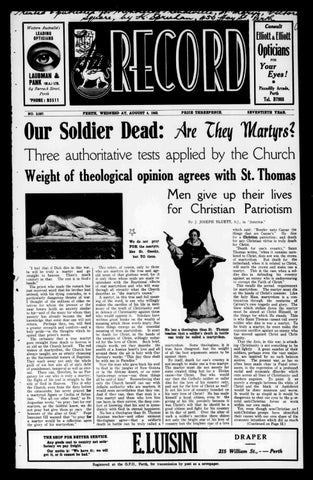
Thomas teaches that a soldier's death in battle can truly be called a martyrdom.
tianity. That the Axis, in this war, is attackmartyrdom. Some theologians, it is ing Christianity is not something to be true, have disagreed: but the weight said lightly. A great number of their around them the air is holy with Our of all the best arguments seems to be soldiers, perhaps even the vast majority, are inspired by no such heinous Saviour's words: "This day thou shalt against them. By itself, death for one's country is motive. The present war, as has so be with me in Paradise." not enough to make one a true martyr. often been made clear in Papal utterNow the man who gave back his soul to God in the jungles of New Guinea The martyr must die not merely for ances, is the expression of a profound or in the African desert, or on some some created thing but for a Divine social and economic disorder which But who would cuts across all lines of Christianity and battle-swept ocean-can these things cause-for Christ. say that the Catholic soldier or sailor modern pagnism. Yo paint it as all be said of him? Remembering that only the Church herself can say with dies for the love of his country only, merely a struggle between the white of as well? of Christ the love for Christ it and not and the black of Antichrist martyrs, who are definite authority would seem nevertheless that they can. Is not his love of country founded on would be sheer nonsense and worse. his very love of Christ? He has made It would be as stupid as it would he And if they can, then that man is a true martyr and those who love him himself a loyal citizen, even to the dangerous to shut our eyes to the p lwgiving of his life, precisely because it erful anti-Christian forces at work can have, in their sorrow, the deep comfort of knowing that his soul is imme- was Christ's will that he should be a within our own ranks. Yet, even though non-Christian an I diately with God in eternal happiness. good citizen and fight for his country No less a theologian than St. Thomas in its day of peril. Over the altar of anti-Christian groups have identified Aquinas teaches-and other eminent such a soldier's sacrifice there shines their causes with our own share of the theologians agree-that a soldier's not only the bright star of his love of economic injustices which did so much (Continued on Page 13.) death in battle can be truly called a country but the brighter star of a love
THE SHOP FOR BETTER SERVICE. Any goods sent to country not satisfactory we pay freight. Our motto is: "We leave it; we will
get it, or it cannot be had."
No less a theologian than St.
which said: "Render unto Caesar the things that are Caesar's." He dies for a Christian patriotism; and death for any Christian virtue is truly death for Christ. "Death for one's country," Saint Thomas writes, "when it remains unrelated to Christ, does not win the crown of martyrdom. But death for the fatherland, when it is related to Christ, will merit the crown and make one a martyr. This is the case when a soldier dies in defending his country against an enemy who is endeavouring to corrupt the Faith of Christ." This recalls the second requirement for martyrdom. The martyr must die at the hands of Christ's enemies. Like the holy Mass, martyrdom is a continuation through the centuries of Calvary's own tragedy and glory. The blow which strikes down the martyr must be aimed at Christ Himself, or the things for which He stands. This is why Saint Thomas cannot call every soldier who dies in war a martyr. To be truly a martyr, he must make the supreme sacrifice against an enemy who has moved against Christ and Chris-
DRAPER
E.LUISINI
215 William St., -
Registered at the G.P.O., Perth, for transmission by post as a newspaper.
-
Perth