"HadHitlerforeseenthathewould turnagainsthimselftheRussianpeople'sspiritualdynamism,hewouldno doubtneverhavedaredtoinvade Russia."
tragedyof'WarRevives Russia'sTraditionalSpirit
''NOLONGERCOMMUNISMBUT THEFATHERLANDATSTAKE
SovietWritersHaveDropped ObsoleteShibbolethsWhattheFuehrerdidnotforesee
RussianresistancetoHitlerhasbeenandstillisofteninterpreted asaproofofCommunistachievements(saysHelenIswolsky,inthe NewYork"Commonweal").Itisthanks.thepublicatlargeistold, totheefficiencyofStalin'ssystem,"unanimouslyrecognisedbythe Sovietpeople'.thattheRussianarmyandtheRussianpeoplehave ralliedaroundStalininordertodefendtheirideals,whichareCommunistideals.
Asthefollowingwillshow,thatisasheermisrepresentation.No mentionofCommunismasanincentivetowinningthewarismade inRussiato-day.ItistheFatherland,andnotCommunism,which isatstake.Itisthenationalidealwhichisdefendedagainstthe invader.ItistheloveofRussiansoil,ofRussianculturalandhistoricaltraditions,whichisbeingcontinuallyexalted.
ThewriteristhedaughterofaformerRussianAmbassadorto France.andisthereforecompetenttospeakwithfirst-handknowledgeofthesubject.
Communistpropagandaabroadhas ofcourse,takenadvantageofRussian resistanceandRussiansuccess;it laudswithrenewedenergytheBolshevikregimeforhavingperformedthe miracleofstemmingHitler'slegions. AndmenwhoarenotCommunistsare easilyimpressedbythisglamorouspicture;theybelievethatitistheCommunistspiritwhichstimulatestheRussianpeopleandleadsthemontovictory. Thisconvictionprovokesvariousreactions:thepublicisinclinedeitherto iustifyCommunisminRussiainsofar asitisprovingefficientinthestruggle againstHitler;ortoregardRussian victorieswithsuspicionandfear,becausetheymarkthetriumphof"Red Imperialism."Itisuselesstopoint outthatbothreactionsareasunfortunateastheyaredetrimental,forthey breeddistrustandmisunderstanding.
Ilitler'sagentsmakeuseofboth tendencies:theysuggestononehand thatthedemocraticcountriesareallied toCommunism.Ontheotherhand theyencourageawhisperingcampaignhintingthat"capitalist"England andAmericaaresecretlyhostiletothe SovietUnion'svictory.
Inordertodispelthesemisunderstandings,itisusefultoturntodirect Sovietsources.NottoBolshevikpropaganda,exportedabroad,buttothe manifestationsofculturallife,ofart, :iterature,music,whichreflecttheSovietUnion'spresentmood.
ANotableChange.
Ifwestudythesesourcesitwillbecomeobviousthatachangehascome overtheU.S.S.R.Nomentionof communismasasystem,doctrineor faith,ismadeinRussiato-day,Itis theFatherland,andnotCommunism,
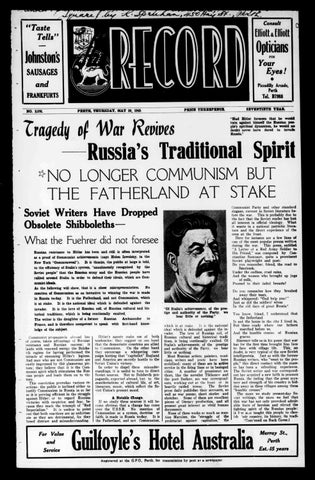
"OfStalin'sachievements.oftheprestigeandauthorityoftheParty,we hearlittleornothing."
ihichisatstakeI:1-thenational idealwhichisdefendedagainsttheinvader.TheloveofRussiansoil,of Russianculturalandhistoricaltraditions,isbeingcontinuallyexalted.Of Stalin'sachievements.oftheprestige andauthorityoftheParty,wehear littleornothing.
MostRussianartists,painters.musicians,writersandpoetshavebeen mobilised;manyofthemareinactive serviceinthefiringlinesorinbesieged cities. Anumberofprominentauthors,likethenovelistTikhonovand thepoetSurkov,arewarcorrespondents,workingoutatthefrontorin heavilyraidedtowns.TheSoviet pressdailypublishestheiraccounts,as wellaswarpoems,shortstoriesand sketches.Someofthemareexcellent piecesofliteraryproduction,andall presentgreatinterestasvividhuman documents.
NoneoftheseworksscmuchasmentionMarxism,the"struggleofthe proletariatagainstcapitalism,"the
communistPartyandotherstandard slogans,currentinSovietliteraturebeforethewar.Thisisprobablydueto thefactthattheSovietreaderhaslost allinterestinofficialideology.What itwantsinanationalpatrioticliters. tureandthedirectexperienceofthe menatthefront.
Hereforinstanceareafewlines oneofthemostpopularpoemswritttn duringthewar.Thispoem,entitled ''ALetterofaRedArmySoldierto HisFriend,"wascomposedbyConstantineSomonov,quiteaprominent Sovietplaywrightandpoet: Doyouremember,friend,theroadto Smolensk, Undertheendless,cruelrains, Andthewomenwhobroughtupjugs ofmilk, Pressedtotheirfadedbreasts?
Doyourememberhowtheybrushed awaytheirtears, Andwhispered:"Godhelpyou justasdidthesoldiers'wives IntheolddaysofgreatRussia' Youknow,friend,Iunderstoodthat thefatherland IsnotthehouseinthecityIlivedin, Buttheseroadswhereourfathers marchedbeforeus, AndthehumblecrossesofRussian graves. Simonovtellsusinhispoemthatwar hasforthefirsttimebroughthimface tofacewithvillagelife.This,no. doubt,isverytypicalofthenewSoviet intelligentsia.Justaswiththeformer Russianwriters,who"wenttothepeople,"thisdirectcontactwiththemasseshasbeenarefreshingexperience. TheSovietwriterandwarcorrespondenthasacquiredanewfaithinpeasant Russia,thefeelingthatthegreatmysteryandstrengthofhiscountryishiddenawayinthesevillagesamongthese "humblecrosses."
Themorewestudypresent-daySovietwritings,themorewefeelthat thiswarhasnotonlyprovokedadmirablefeatsofheroismandstirredthe fightingspiritoftheRussianpeople: itI-isai.,otaughtthispeopletocherish.leircountry,itshistory,itstradi'ConttnuedonBackCover.)
AP, "Taste Tells" Johnston's SAUSAGES and FRANKFURTS NO.3,076. PERTH,THURSDAY,MAY20,1943.
PRIORTHRZIPINOL Consult Elliott&Elliott Opticians FOR Your Eyes! PiccadillyArcade, Perth Tel.B7988 SEVENTIETHTILL
ForValue and Service Guilfoyle'sHotelAustralia MurraySt., Perth Est.45years RegisteredattheG.P0..Perth.fortransmissionbypostasanewspaper
CatholicsareNot
ForcedtoSubscribetoChurchActivities PovertyandtheClergy WouldChristhaveusesiacartoday?
A.M.,WestPerth:
Q.:WhydoestheChurchforceher peopletosubscribemoneytowards variousactivitiesoftheChurch?
A.:TheCatholicChurchhasno powertoFORCECatholicstosub. scribemoneyforanything.Ifthey don'twanttosubscribe,theydon'tsubscribe.WhileitistruethatCatholics areverygenerousaboutsubscribing tovariousgoodworks,theydosoentirelyoftheirownfreewillandbecausetheyareconvincedthattheobjectsforwhichtheyaresubscribingare good.Theyknowtheyareinduty boundtosupporttheirpriests,since OurLordtoldtheApostlesthatthey weretobeprovidedforbythepeople towhosespiritualneedstheyministered;butCatholicsdon'tstopshort offulfillingtheirobligations.Catholic laymenloveChristandwanttohelpin theworkofspreadingHisteaching.
Q.:"Forinstance.moneyforbuilding churches,schools,etc."
A.Catholicsknowthattheyhavethe dutyofworshippingGodnotonlyin privatebutalsobytakingpartinthe SacrificeoftheMass,institutedbyOur Lord.Theyknow,too,thatafitting placeshouldbeprovidedforthispublic actofworship.Again,CatholicsbelievethatChrist'sloveformenhas movedHimtocomeanddwellamong themintheHolyEucharist.Since JesusChristisreallypresentinthis Sacrament,CatholicsfeelboundtoprovideasuitablebuildingforHimto dwellin:theywishtoprovideabuildingthatwillexpressinsomewaytheir loveandreverenceforChrist,and whileCatholicchurchesinPerthare notassumptuouslybuiltasinother partsoftheworld,IthinkIcansafely saythataCatholicalwaysknowsas hegoesintohischurchthatatleastthe buildingisbetterthantheaverage houseintheparish.Catholicshavea greatattachmenttotheirchurches,becausetheirparishchurchisthecentre oftheirreligiouslife. Recently,a committeeofCatholiclaymenwasaskedtoestimatethevalueoftheirparish churchinconnectionwiththeGovernmentschemeofwarinstiran,e.One ofthemensaid,"Well,Ist.ppospit's hardlyworthathousandfromthcontra'sor'spointofview,b.it vorth tous."
ThenormalwayofbuildingaCatholicchurchistogetabanktoadvance themoney,andthenforCatholicswho usethechurchtosubscribeuntilthe debtispaidoff.Ofcourse,muchof thesedebtscouldbesparedbyhaving fewerchurches,butitisobviouslyconvenientforaCatholicfamilytohavea churchinitsownneighbourhood,and theywouldbethefirsttocomplainif anythicklypopulatedareawasleft withoutone.
Q.:"WhytheinsistenceonCatholic childrengoingtoCatholicschools anyway?"
A.:AsIexplainedlastweek,Catholicsconsiderittheirdutyinconscience tosendtheirchildrentoaCatholic school,wheretheywillhavetheCatholicfaith-God'sownexplanationof themeaningoflife-explainedtothem. YoumaywonderwhyCatholicchildren musthavearithmetictaughttothem byCatholicteachers.Well,arithmetic isthesameanywhere;butachild's outlookonlifeislargelyformedat school.AndtheCatholicoutlookon lifeisthis:thateverymanisputon earthtoserveGodandpreparehimself forheaven.FortheCatholicchild, learn;ngarithmeticatthebiddingof hisparents,ispartofhisserviceof God.Theclasswillbeginwitha prayerandthengoonjustthesame asinanyotherschool,butitDOES makeadifferencetothechildifhis classmatesandteacherallhavethe sameoutlookonlife-thatarithmetic, andeverythingelse,istobedoneas partofyourserviceofGod.
Now,Catholicparentsknowthatit isadutyandthelogicalsequenceof theirownprofessionoftheCatholic faithforthemtowanttopassontheir faithandtheirCatholicoutlook,and sotosendtheirchildrentoCatholic schools.Theearnestnessandsincerityoftheirconvictionisevidencedby thetremendousburdentheyhaveundertakeninprovidingCatholicschools rightthroughthisContinent.Ifhere andthereapriestbecomestooinsistentinremindinghiscongregationof theirdutyofpayingoffthedebton theschool,Catholicsarehumanenough tobecomeimpatientwithhim,andfar frombeingcoercedintosubscribing, theytendtogetboredaboutthewhole businessandpossiblytolessenthe amountoftheirsubscriptions:butCa.
'TowhomdoBishopsand PriestsConfesstheirsins?
tholicsareveryfarfromresentinga reminderabouttheneedsoftheschool orsomeotherundertaking.Theyhave theirownloveforChristandtheirown interestinHiswork,andoftenenough theyhaveanaturalinterestinseeing thataworkwhichtheyhavebegunand towhichtheyhavesubscribedisnot allowedtodeclineforlackofmaintenancefunds.
Q.:"Parentsmustfinditanunwarrantedburdenontheirincome?"
A.:Ofcourse,theyfindtheseschools aburdenontheirincome:thatiswhy, asIsaidlastweek,theyfeelthatitis unjustthattheyshouldhavetocontributethroughtaxationtotheState schoolsaswell.AndIthinkanyfairmindednon-Catholicwillagreethatthe Stateoughttoallotsomeportionof theeducationalgranttowardsthemaintenanceofCatholicschools.Afterall theStateissavedthecostofproviding accommodationforthesechildren.In themeantimetheschoolshavetohe maintained,andanybusinessmancan seethattheincomefromchurch-lands isnegligiblebesidethedemandsofthe outlayonschoolsandotherbuildings.
Inpractice,eachschoolhastopayits ownway;andtherewouldbenoquestionofitsbeingabletodosowereit notforthegoodNunsandBrothers whoworkwithoutsalaryonaminimummaintenance.Nowandthen youwillcomeacrossaCatholicwho issodeadtoallsenseofgratitudeas tocomplainNOTabouttheinjustice ofhavingtopaytwiceoverforhis children'seducation,butaboutthe actualamountofmoneyspentonthe school,butCatholicsasabodyare sufficientlyawareoftheirdebttothe selflessdevotionoftheNunsandBrotherstobedeeplygratefultothemfor theirdisinteresteddevotiontothe workofCatholiceducation,andthey areveryanxioustosupportthem.You mustrememberthatmostCatholics havethemselvesbeeneducatedatCatholicschools,andtheybothwishto ownthedebttheyowepersonallyto theCatholicschoolsandtosecurefor theirownchildrenthesameprivilege ofaCatholiceducation.Indeedthere arenon-CatholicsinthisStatewho readilyowntheirdebttoaCatholic school,andIamsurethey,too,donot stopshortatacknowledgingit.
ThePriestandMoney
Q.:"Thepriestalwaysseemstohave plentyofmoney."
A.:Thatremindsmeofthestory aboutthelittleboyandthebusconductor.Whenaskedwhyhewanted tobeatrolley-busconductor,acertain littleboyrepliedthatbusconductors hadlotsofmoney.Hehadobserved, yousee,thattheycouldaffordtospend thedayhavingridesonbuses,whereas Mumwasalwayscomplainingaboutthe costoftravel,andthen,ofcourse,anybodycouldseethattheconductorcarriedaboutabagofmoney.Grownupsoughtnottobesoeasilydeceived byappearances.Catholicpriestsare notwealthymen.Tobeginwith,a
DEATHBENEFIT.-L50,age16andunder20,4/10quarterly;£100,7/2quarterly. 20yearsandunder23, 5/3qr.;ilOf8/-qr.23yrsandunder25,5/5qr.:£100,8/4qr.25yrs.andunder30,5/10qr.;£100,9/2qr. Membersupto51accepted.AlsoSickness,MedicalandHospitalBenefits.
i.EDWARDS,GrandSecretary,WestAustralianChambers,St.George'sTerrace,Perth. Tel.:B7004.
youngpriestsstartsbyworkingona salary;itconsistsofboardandlodging andmuchlessthanhalfthebasicwage, Thevariousofferingshemayreceive willnotusuallyaveragemuchmore thanapoundaweek.Whenheis promotedtoacountryparish,that maymeananythingfromlivingina one-roomcorrugatedironlean-toagainstthewallofhisschool-churchtomoderatecomfortsinweather-boardor brick.Almostinvariablyitmeansa struggletomakeendsmeet.Perhaps, butnotalways,hewilllaterheappointedtoasuburbanparishwherehe willhaveordinarysuburbancomforts. Farfromgrudgingsuchcomfortsto
S.BEECROFT-Butcher
181RokebyRoad,Subiaco.
OnlyPrimeFreshKilledMeatSold. 'PhoneW1373
TWO THERECORD. Thursday,May20,1943. *theCatholicAnswer EVERYSUNDAYEVENINGAT7.15P.M.
*ByFatherLalor STATIONS 6PR-6TZ HISTORY - TOPICALQUESTIONS PHILOSOPHY SOCIALJUSTICE APOLOGETICS - THECHURCHIIITHEMODERNWORLD - THEOLOGY
JesustheCarpenterSanctifiedAllLabour TAUGHTMENDIGNITYOFMANUALWORK
Hibernian-AustralasianCatholicBenefitSociety BESTBENEFITSFORLOWESTCONTRIBUTIONS.
theirpriest,Catholicsliketofindhis houseisfurnishedinsimplegoodtaste, andtheytrytoseetoitthattheman whohastogiveeartoeverybody'sworriesdoesnothavetohavetheworries ofahousewifetoo.Theywouldbe verygrieved,forinstance,tofindthat thepriesthadtogofromstoretostore togetthecheaplines.Catholicsexpecttheirprieststobeunselfishand devotedmen,buttheydon'twish themtoforegoallrecreation.They arepleasedtoseetheirpriestplaya gameoftennisor-golf,andtheydon't feelintheleastinclinedtostealthily deductthetee-feefromthecollectionplateatthenextSunday'sMass.Ifa priestweretobefoundlivingluxuriouslyorspendinganunreasonable amountofmoneyonamusements,Catholicswouldcensurehisextravagance, andnon-Catholicsarefreetodoso,too.
Finally,thepriestislikeabus-conductor,inthathehasalotofmoney passingthroughhishands,Hehasto administerparishfunds,schoolfunds, andcharityfunds,forallofwhichhe rendersaccounttohisreligioussuperiorsandtohisparish.Ifanyonemistakesthefundsforthepriest'sprivate property,heismakingthemistakeof thechildonthetrolley-bus.
Q.:"WhyshouldCatholicshaveto supplythismoney?'
A.:Theyshouldsupplythemoneyfor theupkeepofthepriestbecausehe ministerstotheirspiritualneeds.Our aLordHimselfsaidinthisconnection:
"Thelabourerisworthyofhishire," andSt.Paultellsus,"Theywhopreach theGospelshouldlivebytheGospel.' Incidentally,Catholicsknowthattheir priestshavedonealongercourseof trainingthanmostprofessionalmen, andthatfromtheoutsetapriestcuts himselfofffromanyhopeoftheaffluencethatattendsrealsuccessinthe professions.Theycanseethatsucha manhasnotchosenacareerforthe sakeofthecashthatgoeswithit.Can youimagineaboywhohasjustgotthe LeavingCertificateandwantstomake money,undertakingacourseofsome seventoeightyearsofstudyjustin ordertogetajobthatforsomeyears carrieswithittheremunerationofa privateintheArmyandoffersnothing moreintheendthanadoubtfulpromiseofsuburbancomfort?Ithinknot.
Christthe Worker
JosephPurvis,Perth:
Q.:"Isitnotafactthat'Christwas borninabjectpoverty,livedand diedinpoverty?"
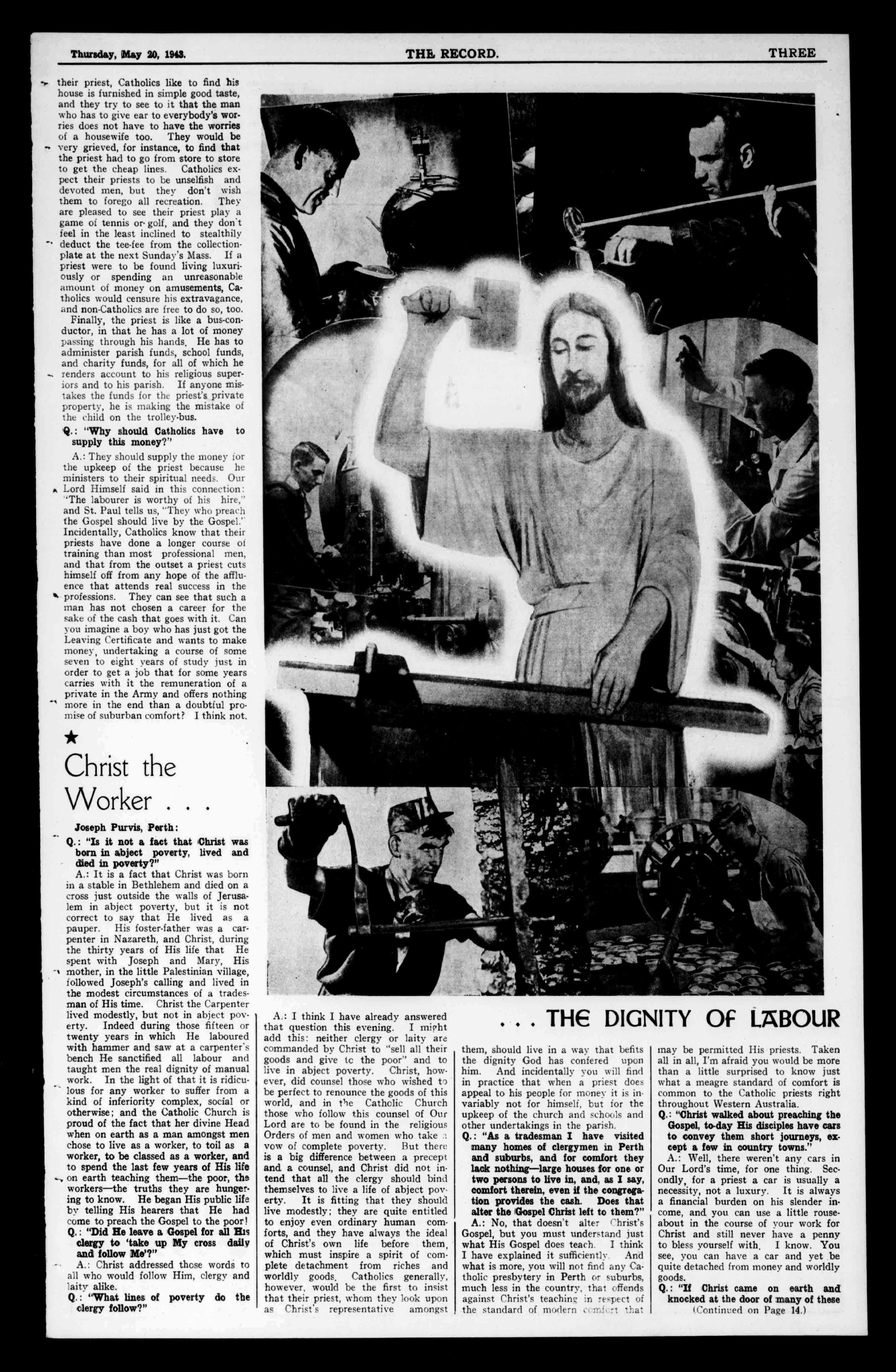
A.:ItisafactthatChristwasborn inastableinBethlehemanddiedona crossjustoutsidethewallsofJerusaleminabjectpoverty,butitisnot correcttosaythatHelivedasa pauper.Hisfoster-fatherwasacarpenterinNazareth,andChrist,during thethirtyyearsofHislifethatHe spentwithJosephandMary,His mother,inthelittlePalestinianvillage, followedJoseph'scallingandlivedin themodestcircumstancesofatradesmanofHistime.ChristtheCarpenter livedmodestly,butnotinabjectpoverty.Indeedduringthosefifteenor twentyyearsinwhichHelaboured withhammerandsawatacarpenter's benchHesanctifiedalllabourand taughtmentherealdignityofmanual work.Inthelightofthatitisridiculousforanyworkertosufferfroma kindofinferioritycomplex,socialor otherwise;andtheCatholicChurchis proudofthefactthatherdivineHead whenonearthasamanamongstmen chosetoliveasaworker,totoilasa worker,tobeclassedasaworker,and tospendthelastfewyearsofHislife .,onearthteachingthem-thepoor,the workers-thetruthstheyarehungeringtoknow.HebeganHispubliclife bytellingHishearersthatHehad cometopreachtheGospeltothepoor!
Q.:"DidHeleaveaGospelforallHis clergyto'takeupMycrossdaily andfollowMe'?"
A.:Christaddressedthosewordsto allwhowouldfollowHim,clergyand laityalike.
Q.:"Whatlinesofpovertydothe clergyfollow?"
A.:IthinkIhavealreadyanswered thatquestionthisevening.Imight addthis:neitherclergyorlaityare commandedbyChristto"sellalltheir goodsandgivetothepoor"andto liveinabjectpoverty.Christ,however,didcounselthosewhowishedto beperfecttorenouncethegoodsofthis world,andintheCatholicChurch thosewhofollowthiscounselofOur Lordaretobefoundinthereligious Ordersofmenandwomenwhotake vowofcompletepoverty.Butthere isabigdifferencebetweenaprecept andacounsel,andChristdidnotin. tendthatalltheclergyshouldbind themselvestolivealifeofabjectpov erty.Itisfittingthattheyshould livemodestly;theyarequiteentitled toenjoyevenordinaryhumancomforts,andtheyhavealwaystheideal ofChrist'sownlifebeforethem, whichmustinspireaspiritofcompletedetachmentfromrichesand worldlygoods.Catholicsgenerally, however,wouldbethefirsttoinsist thattheirpriest,whomtheylookupon asChrist'srepresentativeamongst
THEDIGNITYOFLABOUR
them,shouldliveinawaythatbefits thedignityGodhasconferedupon him.Andincidentallyyouwillfind inpracticethatwhenapriestdoes appealtohispeopleformoneyitisinvariablynotforhimself,butforthe upkeepofthechurchandschoolsand otherundertakingsintheparish.
Q.:"AsatradesmanIhavevisited manyhomesofclergymeninPerth andsuburbs,andforcomfortthey lacknothing-largehousesforoneor twopersonstolivein,and.asIsay, comforttherein,evenifthecongregationprovidesthecash.Doesthat altertheGospelChristlefttothem?"
A.:No,thatdoesn'talterchrist's Gospel,butyoumustunderstandjust whatHisGospeldoesteach.Ithink Ihaveexplaineditsufficiently.And whatismore,youwillnotfindanyCatholicpresbyteryinPerthorsuburbs, muchlessinthecountry,thatoffends againstChrist'steachincinre,pectof thestandardofmodern !.!"., ',ha:
maybepermittedHispriests.Taken allinall,I'mafraidyouwouldbemore thanalittlesurprisedtoknowjust whatameagrestandardofcomfortis commontotheCatholicpriestsright throughoutWesternAustralia.
Q.:"Christwalkedaboutpreachingthe Gospel,to-dayHisdiscipleshavecars toconveythemshortjourneys,exceptafewincountrytowns."
A.:Well,thereweren'tanycarsin OurLord'stime,foronething.Secondly,forapriestacarisusuallya necessity,notaluxury.Itisalways afinancialburdenonhisslenderincome,andyoucanusealittlerouseaboutinthecourseofyourworkfor Christandstillneverhaveapenny toblessyourselfwith.Iknow.You see,youcanhaveacarandyetbe quitedetachedfrommoneyandworldly goods.
Q.:"IfChristcameonearthand knockedatthedoorofmanyofthese continuedonPage14.)
THREE
Thursday,May20,1943. THE,RECORD.
BritishEditorAnalyses
Misuseoftheterm"FASCIST"
SenselessDivisionofBelligerentsintoFascistsandAnti-Fascists
What
AretheFundamentalIssues?
The"NewOrder"anditsShaping
Thereisanincreasinguseinpapers andperiodicalsofthephrase:"War againstFascism."
Recentlythe(London)"NewStatesman"usedthephraseonceagain,addingtoitanunconsciouslyjingoisttag, unless,indeed,itwasspeakingsolely foritself.Itwrote:"Thisisawar againstFascism.WeinEnglandsettleditthatway."
ButisitawaragainstFascism? Ifso,someofourSouthAmericanAllies,notablyBrazil,mustbewonderingwhattheyaredoingonourside, fortheyarenotlikelytomisunderstandthemeaningoftheword"Fascist"asusedinBritishparty-politics. Underthetermareembracedallwho donotswearbysomeformorother ofLeftSocialism.Ifso,Greecemust indeedbewonderingwhyhersonsand daughtershavebeenkilledorstarved andinthenameofwhatshehasrevivedtheheroicgloriesofancientHellas?Ifso,Polandmadeatragicmistakeonbehalfofacausewhichfew Polesindeedwouldhaveunderstoodorappreciatediftheyhadunderstood it.
Andinthis"waragainstFascismweinEnglandsettleditthatway"everyeffortwasmadetomaintainthe neutrality-eventhenon-belligerencyoftheoriginalFascistcountry,Italy. Andthoughto-daytherearesomewho wouldliketogettogripswithFranco -andwhataboutSalazar?-thepainfuleffortsofresponsibleGovernments havebeentomaintainthebestpossiblerelationswiththesecountries andtoguaranteetheirintegrity,ideologicalandterritorial.
RightandLeft.
Thatisthepicture,anditmakesa verypoorshowindeedasaline-up againstFascism,"whatever"wein England"mayhavesettled.Andwe canclarifythepicturestillmoreby studyingthemeaningsofthisblessed word"Fascism."
IftheLeftpapershadtheirway, theywould,nodoubt,alignagainst therestoftheworldtheSovietUnion, theworkersandLeftintellectualsin BritainandtheUnitedStates,and theundergroundrevolutionarymovementsontheContinent,togetherwith theirrepresentativesinLondon.
Whatsortofaworldwouldthese shape,hadtheythepower?Were theytoachievesupremepowerinBritain,itisprobablethattheywould takeadvantageoftheconstitutional sovereigntyofParliamenttopasslaws enablingthemtorulebyOrders-inCouncilandtheywouldgatherinto thehandsoftheExecutivethewhole financial,industrialandcommercial forcesofthecountry.OntheContinent,thesameelementswouldestablishtheirpowerbysomeformof dictatorship,and,indeed,theyhavealreadyeitherproclaimedtheirfaithin aLeftdictatorshiporadheredwithenthusiasmtoRightdictatorships.
Notetheeasewithwhichextreme LeftbecomesextremeRight:Mosley, Beckett.Deat,Doriot,theFalange,
CommunistmassesinGermany.About Russiaweneedhardlyspeak,forthe modelisthereforalltostudy.
Itmaywellbethatsuchdictatorial powerswouldbeusedforenlightened andprogressivepurposes-whatdictatorhasfailedtomakesuchclaims?butthefactremmainsthatitwould hedictatorshipordictatorship'sfirst cousin.
Sothatthisstrangewar-alreadyso compromisedallalongthelinefrom thepointofviewoftheLeft-would revolveitself,ifthedreamcametrue, intoastrugglebetweenLeftandRight Fascism!
The"NewOrder."
Itishightimethiskindofnonsense wereexploded.Thewarcanheinterpretedinmanyways,buttheone waywhichmakesverylittlesenseindeedisthatofdividingthebelligerentsintoFascistsandanti-Fascists.
Ofthedifferentissues,two,wemay say,arefundamental.Thefirstisthe issuebetweenthepossessingandthereforenon-aggressivePowersandthe non-possessingandthereforeaggressivePowers.Germany,Italy,Japan, and,ifweliketoaddthatcountry, Spain,allsharepretensionstowider Empireindefianceofthesettlement afterthelastwar.
Thesecondisadeepsuspicionand fearofthatparticularbrandofdictatorshipwhichhasbeenestablished inanaturallymilitantGermany,as wellasagenuinehorrorattheimmoralbehaviourofthatregime.Opposedtothisisasomewhatsimilar feelinginmanycountriesinregardto BolshevikRussia.
Underlyingtheseissues,butbyno meansrunningparalleltothem,isthe fairlyuniversalsensethata"new order"mustbehammeredoutifman istobeabletocopewiththetechniqueofcontemporarylife.
Theshapewhichthat"neworder" istotakedependsverymuchonthe conditions,traditionsandpresent politicalregimeofeachcountryconcerned,butallareaffectedandall arestrivingtocarrythrougharevolution.Thoughverydifferentideasand verydifferenttemposarediscernable, nothingcouldhemoreoutofdatethan thenotion,socherishedbyourintellectualSocialists,thatitismerelya questionof"reaction"versus"progress."
Thus,eventhoughanymaylegitimatelyholdthattheBolshevikrevolutionismoreenlightenedthantheNazi, itismeaninglesstotalkoftheoneas "progressive."or"democratic"or"popular"andtheotheras"reactionary." Theplanningofthetwoisverymuch thesame,asarethemethodsofenforcingtheplans,andbothstandinglaring contrasttoliberalismordemocracyor parliamentarianismortheChristian tradition.
WarAgainstAggression.
Inatypicalsentencethe(London) "Tribune"hasstatedthatitis"impos
PEERLESSBREADMANUFACTURERS
145FITZGERALDSTREET,PERTH.
OurMotto:"QUALITYandSERVICE."
Specialties-VIENNABREADandROLLS.
'Phone:B1041.
sibletoprepareBeveridgeReportsat home"while"foistinguponthebacks ofthepeopleofEuropetheDarlans, lorizas,IIapsburgsandwhateverthe namesofthestoogesofadeadandbygonepast."
WearenotpreparedtostandsponsorforeveryEuropeanpersonality, nortodenythatrealreactionariesexist bothathomeandabroad,butifthat newspapermeansthattheBeveridge Reportisinconsistentwiththeideas ofHitler,MussoliniorFranco,itis talkingarrantnonsense.Anditisno lessnonsensicaltosuggestthatitis inconsistenttosupporttheBeveridge Planandyetmaintainthatcountries likeItaly,FranceandSpain,and,indeed,manyothers,requireastrongauthoritarianrulewhichcanachievean orderlyandsensiblerevolutiontowards
the''neworder'.andonethatcan satisfypopularaspirations,
Thisnewspaper,forexample,hasconsistentlysupportedeveryprogressive economicorindustrialreformathome, includingtheBeveridgeReport,while pointingouttheabsurdityoffoisting onthepeopleofEuropeideasandactionsandpoliciesthatareperfectly naturalandsatisfactoryinourtotally differentconditionsofestablishedand honouredfreeinstitutions.Weareas keenasourcriticsindesiringsecurity andfreedomfromwantforallFrenchmenandSpaniards,butweknowthat thewaytoobtaintheseblessingsin FranceandSpainisnotthesameway asinBritainorAmerica.
Thiswar,then,wesay,isnotawar tofoistMarxismontheworldbuta wartoenableeachcountrytoshapeits ownpatternofrevolutiontowardsa betterorderwithoutthefearofphysicalorideologicalaggressionfrom anyforeignquarter,howeverpower fulorpersistent.
NewsFromtheFarEast,
SundayMorninginManila
MISSIONARYACTIVITYINWARTIME.
Theexchangeofnationalsbetween Japanandherenemycountriesbrought usfourofourPriestsfromKorea.It alsobroughtusscatteredinformation aboutSt.Columban'sMissionsincountriesotherthanKorea.Fortheexchangeincludeddiplomats,business men,non-Catholicmissionaries,and othersfromCentralChina,Shanghai, andthePhilippines,whotoldofour PriestsandSistersstillallowedto carryonmissionarywork. EnterFatherPat.
InManila,theJapanesehadinterned 3,200BritishandAmericansinthe UniversityofSantoTomas.Amongst theseweremanyCatholicswho,naturally,longedfortheconsolationsofreligiontolightentheirtediousdays. Theywerenotdisappointed,either. HereisanaccountofaSundaymorn inginManila:
ItisSundayintheoccupiedcapital ofthePhilippines.InSantoTomas Universitysome3,200peopleareinterned.To-daytheywillhaveavisitor andaVisitor.
Atruckdrivesuptothegate.A Japanesesentryinspectsit,passesit. Thedrivershiftsgearsandmoveson slowly,intothecampus,andhalts.
.Abig,powerfully-builtmaninhis fiftiesjumpsdown,tobegreetedbya groupofBritishandAmericaninternees.Heiswearingacassock,has greyinghair,andabroad,infectious smile.
HeisFatherPatrickKelly,ofSt. Columban'sSociety,inchargeofMalate ChurchinManila,andawelcomevisitoreverySundayintheinternment camp.
Heturnsbacktowardsthetruck,to seethatitiswellplaced.Thenhe climbsuponitandwillinghelpers followhim.Itdoesnottakethem longtoarrangethealtarforoutdoor Mass.Thetruckisthesanctuary.
Alreadyaqueuehasformed,ofpeoplewhowanttogotoconfession. FatherKellyseatshimselfnearthe truck,slipsthenarrowvioletstole aroundhisneck,andliftsamighty, muscularhandinblessing.Oneafter theotherthepenitentskneelbeside ,iinforafewminutes,receiveabsolution,andgobacktojointhegathering congregation.
Sanctus,Sanctus,Sanctus. Thebigpriestmountsthetruck again,putsonthevestmentsthatsway
inthewarmsunlitbreeze,andthenhe beginsMass.ItisthesameMassat whichtheseinterneesusedtokneelin churchesofotherlands.Thesame Massatwhichtheirrelativesand'friendskneelathome,prayingforthose deartothemandfaraway.Itis theMassthatalwaysmatters.
Ahellrings.Astillnesscomesover thekneelingcongregation.AfewnonCatholicsstandonthefringe,curious yettimid,hungeringandwondering, urgedforwardvetheldback.
Thepriestbowsoverthealtar."This isMyBody,asyeshalldothis. HegenuflectsandraisesthesacramentalChrist.TheDivineVisitorhas come.Friendoftheprisoner,Victim forthesinner,LordandSaviourof mankind.
GoodShepherd.
Fiveminuteslater,someofthepeoplemoveforwardtokneelinaline closetothetruck.Thepriestcomes downthestepsthathavebeenputin positionforhim.Hegoesslowlyaloft,: theline,placingtheSacredHoston thetongueofeachcommunicant.
SoonMassisover,andFatherKelly goesbacktohisparishofMalate.Behindhimintheinternmentcampits leavesheartsthatarehappierandfaces brighterbecauseofhiscoming.
"Heisverypopular,"saidarepatriatednon-Catholic,whohadwatched FatherKellyinactionamongtheManilainternees.
LikeFatherKelly,theotherIrish priestsofSt,Columban'sSocietyand theIrishSistersofSt.rolumbanare allfreeinthePhilippines.
TheAustralian,NewZealand,and AmericanmembersofSt.Columban's arenotinterned,buttheyareapparentyrestrictedtotheirown"convents" orresidences.
ArchbishopO'Doherty,inManila,is freeandactive.HegoesthroughMan ila,carryingouthisepiscopaldutie',-andisviligantovertherightsofthe Church.
PropagationoftheFaithaNecessity.
Nowthattheseislandshavebeen cutofffromtherestoftheworld,AustraliahastokeeptheMissionsinexistence;thiswearedoingthroughthe SocietyforthePropagationoftheFaith.BecomeamemberofthisSocietyandhelptomakethelivesofthe unfortunatepeopleintheseislandsa littlebrighter.
FOUR THERECORD. Thursday,May20,1943.
014 DEATHS 014
SCANLAN.-OnMay8,'1843,atSubiaco,MichaelMcGuinness,dearlylovedfatherofMichael(Fremantle), John(deceased),James(Guildford), Mary(Mrs.Helm,England).and SisterBenedict(St.Joseph'sConvent,Kalgoorlie),father-in-lawof Muriel(Mrs.M.Scanlan),Mary (Mrs.J.Scanlan),Fred,andgrandfatherofMichael(A,I.F.),Frankand Eileen,William(R.A.A.F.),and Kathleen,Ben(A.I.F.),Mary(Mrs.J. Sheppard),Joe(R.AA:P.,missing airoperations),Gem(Mrs.H.Fall), Lee(R.A.A.F.,missingairoperations),andFay,great-grandfatherof Peter,Francis.R.I.P.
SCANLAN.-OnMay8,1943,atSt. John'sHospital,Subiaco,Michael McGuinness,dearlybelovedbrother ofthelateRev.JamesM.Scanlan (Chicago),Rev.JohnB.Scanlan (Chicago),SisterM.St.Alban(St. Louis),andMrs.M.Flannery(Chicago,U.S.A.. R.I.P.
q4 INMEMORIAM + OnService, McCORMACK,Brian
EdwardJoseph.
-Atokenofloveandremembrance ofBrian,onlybelovedchildofEdwardJohnandMaryIsobelMcCormack,ofWinthropAvenue,Crawley, accidentallykilledondutywiththe _VLF.inGaza,Palestine,onMay17, 1941.
-Insertedbyhissorrowingparents.
BILICH.-Inlovingmemoryofmy dearwifeandourlovingmother, whodiedonMay23,1941.
0,SacredHeartofJesus,havemercy onhersoul.ImmaculateHeartof Mary,prayforher.
-Insertedbyherhusband,sonsand daughters.
DONEY.-Inlovingmemoryofour dearmotherandsister,FrancesMargaretDoney,whodepartedthislife onMay26,1941.
SacredHeartofJesus,havemercy onhersoul.
-*-Insertedbyherlovingson,daughter,sisterandbrother.
O'CONNOR.-Ofyourcharity,pray forthereposeofthesoulofMary AnnO'Connor,whodiedMay21, 1942. R.I.P.
-Insertedbyherhusband,children, and grandchildren.
PARKER.-Inlovingmemoryofmy dearwifeKateParker,whopassed awayonMay27,1942.
Mayhersoulrestinpeace,andmay perpetuallightshineuponher.
-Insertedbyhersorrowinghusbud.
RYAN.-Inlovingmemoryofmydear husband,JohnThomas,whopassed awayonMay20,1938.
MostSacredHeartoJesus,have mercyonhissoul.
-Insertedbyhislovingwifeand family.
STOKES.-Inlovingmemoryofmy dearmotherandgrandma,Frances Stokes,whodiedMay18,1942. SweetJesus,havemercyonhersoul andallthesoulsofthefaithfuldeparted.
--Insertedbyherlovingdaughter, Catherine,Mrs.Eddy,andfamily.
MARRIAGE.
HowScienceHasVindicatedTheBible
WA'LSH-DWYER.-OnMarch17, atSt.FrancisXavierCathedral, Adelaide,byRev.FatherM,L. Dunn,withNuptialMass,VeryRev. FatherR.M.ReddenandRev. FatherC.Stinson,Chaplain,A.I.F., assisting,Lieut.KevinGerald Walsh,R.A.N.V.R.,youngestsonof thelateMr,andMrs.P.J.Walsh, formerlyof"TheWattles,"Malvern, SouthAustralia,andMollie,elder daughterofMr.PresidentDwyer andMrs.Dwyer,ofMt.Lawley, Perth,WesternAustralia.
WANTED.
Positionwantedbyrefinedlady (over45),careofinvalid(nursingexperience),orelderlylady;lightduties only;smallsalary;excellentreferences;cityorsuburbs.Replyc/othis office.
*FatherMcBrideDiscussestheOldTestament intheLightofArchaeolgy
WhatAncientWritings PotteryReveal
Thesecondlectureoftheseason tookplaceattheCentralCatholic LibraryonFridaylast,May13,and onthisoccasionalargeaudiencehad theprivilegeofhearingtwoexcellent lectures,onebyRev.FatherMcBride, on"TheOldTestamentintheLightof ModernArchaeologyDiscoveries,"and ashortertalkbyDr.F.McCann,on "TheProgressofModernMedicine?'
Itisasadfactthatmostofushave cometoregardtheBibleassomething, tooweightyanduninterestingtooccupyanyportionofourreadingmoments,butwhenpresentedinlecture form,theGreatBookbecomesamost colourfulandfascinatingsubject.ConfininghisaddresstotheOldTestamentandhighlightsofmodernarchaeology,FatherMcBrideputhi,audienceinahappymoodrightfromthe start,andwithkaleidoscopicswiftness passedfromeventtoeventandmanagedtocramanamazingamountof matterintoabriefwhile.Space, however,permitsofonlythesalient pointsbeingintroducedhere: examinedthecoverofthe Bible,letusnowlookthroughits pages,andwefindthattheOldTestamentcoversabigfieldofhuman historyandtakesusfrom'inthebeginningGodcreatedHeavenand earth'toshortlybeforetheBirthof Christ.Asweturnitspageswefind suchwell-knownfiguresasAdamand Eve,Noah,Abraham,Moses,andso on wemeetthePharoahsofdynastieslongsincedust wemeetthe Assyrians,Syrians,Persiansand Greeks..wemeetNebuchadonozzer, Cyrus,AlexandertheGreat men andnationsleavingtheirmarkonhistory.Wehearthetrampofarmed menandtheclashofarmsinthattiny countryofPalestine,whichBellochas soaptlydescribedas'TheBattlegroundoftheNations'.1ndthrough itallthererunsagoldenthreadof God'slovingcareandmercyforhis peopleandoverithoversthespirit ofeternaltruth.
Itmightbewelltodigressalittle justtogiveafewwordsonhowscience-notablythatofArchaeologyhasvindicatedinthemostremarkable way,thetruthoftheBibleonhistoricalgroundsalone,Thisisdoubly satisfying,firstly,becauseweliketo beabletopointouttounbelieversthe findingsofunimpeachablescientists whohaveconfirmedfromnatural groundsalone,thetruthoftheHoly Scriptureand,secondly,thatatthis pointoftheworld'shistoryhadarisen agroupofrationalistswho,styling themselves"HigherCritics,"setout tobreakdown,systematically,the wholeBiblenarrative.Thevalueof thesediscoveriesisprovenbythefact thatinabattlewagedwiththeirown creations-science-theyhavebeen forcedtoreturntotheobscurityfrom whichtheyshouldneverhavecome, toquotethewordsofsomeunknown cynic.
Archaeology,asyouknow,isthe studyofantiquities,.theremainsleft byancientcivilisations.Nowtheera ofcountry-EuphratesValley,Egypt, Palestine-oftheBiblicaleventsisparticularlyrichinsuchremains.From thepointofviewofscientificandhistoricalaccuracyandimportance,fall intotwoclasses.
1.Writtenrecords,i.e.,onclaytablets,ofcourse,and
2.Potsherdsofbrokenpotterytheseancientpeoplesseemtohave beenindefatigablemakersandbreakersofpots-fortunatelyforusasit happens.
Inthecourseofseveralthousandsof yearsofcivilisation,citieshavebeen
Saul,David,Solomon,1018-967B.C.; FoundingofSolomon'sTemple,967 B.C.
destroyedandrebuiltagainandagain. Thusthemodernexcavatorfindslayer uponlayerofpotteryfragments,one underneaththeother,eachmarking somefreshepoch.Thefashionsin ancientearthenwarewerenotasvariableasladies'hats,.neverthelessthey didchangethr,.ughtheyears..Theyhavebyva6aisineanbeentiassified inrecentyearsprincipal:ybytheuse ofEgyptianScarabs,foundamongthe layersofpottery.Thesescarabsare aspeciesofsealshavinginscribed uponthemthenamesofPharoahs whosedatesareknown.Thuscertaintypesandqualitiesofpotterybelongtocertaindefinedperiods,and thescientistsclaimtheycanobtain accurateestimatestowithinaquarterofacentury.Bythismeansthe followingchronologicaltableofBiblicaleventshasbeenarrivedat,andis inconsonancewiththeBiblenarrative itself:
TheFlood,priorto2500B.C.;Ableham,2160-1986B.C.;TheIsraelites' SojourninEgypt,1870-1440BC.;The ExodusofWanderings,1440-1400B.C.; FallofJericho,1400B.C.;Conquestof Canaan,1400-1360B.C.;ThePeriodof theJudges,1360-1018B.C.;Reignsof
CANIST ROANS
Justasanillustrationofhowthe BiblehasbeentriumphantlyandminutelyvindicatedbyArchaeology,;et ustakethecaseofJericho: YouallknowthestoryofJericho. Nowhereisa"highercritic"writing onthatsectionoftheBiblenarrative: ''Thewallfelldownflatismereliteraryhyperboleintendedtoconveythe completenessofthevictory;andprobablynobodywouldhavebeenmore amazedthantheactualwriterto learnthathiswordswereeverrequiredasapointoffaithtobeunderstood literally,thathadthewallscollapsed ntinuedonPage8.)
........A.1,111112of.011111A111111111,lllll
TrottingSelections
13y'Thehawk.''
GLOUCESTERPARK.
Saturday,May22,1943.
W.A.Breeders'Handicap:Olive's Daughter,1;RiseandShine,2;Linda Antique,3. Way-villeHandicap:PleasantSurprise,1;SmartSally,2;Royal Heather,3. GlenelgHandicap:NiceVin,1; BelleBetel,2;WeeGlobe,3. NorwoodHandicap:BaronAntique, 1;PearlScott,2;WirraRoseitta,3. AdelaideHandicap:;King'sGuide, 1;Tempest,2Queen'sGift,3. GawlerHandicap:BalgayJim,1; Kafeela,2;Kato,3. StrathalbynHandicap:Royal.Sheik, 1;Percy'sLad,2;AdmiralPronto,3.
CANISTERJARS, 1/9EACH.
ASILLUSTRATED SCREWTOP,SQUARE SHAPE CANISTER JARS,oftransparent greenglass,whichenables youtoseethecontentsof thejarwithoutremoving thelid. Allpricedat 1/9each
Thursday,May20,1943. THERECORD. FIVE
-91
and
at
GROUNDFLOOR MURRAYSTREETEND
Catholic grids'Vovernent
*HEADQUARTERSANDCLUB-ROOMS: BankofN.S.W.Chambers,65St.George'sTerrace (nearSherwoodCourt)-Rooms:7-10FirstFloor
CALENDARofACTIVITIES
MAY
Monday,24:Shorthand(Theory),5--630p.m.Room9 Homecrafts,8p.m.Room7. E.S.C.,8p.m.Room9.
Tuesday,25Shorthand(Speed),5-6.30p.m.Room9
Dramatics,8p.m.Room9.
Nurses'Praesidium,8p.m.Room7 DANCE,CECILBUILDINGS,8p.m CANTEENDUTY,C.G.M.GROUP,PHYLLISDEAN.(See below.)
Wednesday,26Dressmaking,7-9,30p.m.Rooms7--9
Thursday,27:EXPOSITIONALLDAY.BENEDICTION.5.45p.m. Choir,8p.m.Room9.
Friday,28:Shorthand(TheoryandSpeed),5-6.30pmRooms7-9. Dramatics,8p.m.Room7. OrchestraandDanceBand.8p.m.Room9.
Saturday,29:SOCIAL,8p.m.
Monday,31:Shorthand(Theory),5-6.30p.m.Room9
Homecrafts,8p.m.Room7. E.S.C.,8p.m.Room9.
JUNE
Tuesday,1:Shorthand(Speed),5-6.30pin.Room9
Dramatics,8p.m.Room9.
DANCE,CECILBUILDINGS,8p.m.
Nurses'Praesidium,8p.m.Room7. CANTEENDUTY,L.B.A.GROUP.TOWNHALL.
Wednesday,2:Dressmaking,7-9.30p.m.Rooms7-9.
Thursday:EXPOSITIONALLDAY.BENEDICTION.5.45p.m. Choir,8p.m.Room9.
Friday,4:Shorthand(TheoryandSpeed),5-6.30p.m.Rooms7--9. OrchestraandDanceBand,8p.m.Room9.
Dramatics,8p.m.Room7. CANTEENDUTY,C.G.M,GROUP.TOWNHALL.
Saturday,5:CURIA,7p.m.Room7.
Sunday,6:GENERALCOMMUNION,9a.m.,ST.MARY'SCATHEDRAL.
TUESDAYNIGHT,atCecilBuildings:That'sourdance,andit'squite asgoodasanyotherintown.Tryit andsee.
Homecrafts
Thereisaclubroominthetown,in thetown, Andtherethememberssitthemdown, sitthemdown, EachMondaynight,likebusybees, Andtheretheymakesuchthingsas these,asthese
GeneralCommunion
ThefirstGeneralCommunionof membersoftheCatholicGirls'MovementwillbeheldatSt.Mary'sCathedralonSunday,June6,at9 o'clock.GirlsarerequestedtoassembleintheCathedralgroundsat 8.50a.m.Abuffetbreakfastwillbe servedinSt.Joseph'sConventafter Mass. 0
Don'tForget-
EXPOSITIONoftheBlessedSacramenteveryThursday.Itdoesn'ttake longtoslipinandmakeavisit,and ifyoucametoBenedictionintheeveningyouwouldn'tbesoverylatefor tea.Don'tyouthinkit'sworthit?
SHORTHANDCLASSES:Girlswho wishtolearnshorthand,ortoimprove theirknowledgeoftheart,areadvised totakeadvantageofthese classes. Thosealreadyattendingshouldnot neglecttheirstudies.
(Wehadsomelittlesketchestoshow youwhatwemake,buttheycouldn't bereproducedproperly:anyhow,come andseeusandwe'llshowyouwhat wecando.)
Chorus. Comealongforyouareneeded, Donotletthisgounheeded, Andyou'llfindthere'slotsoffun foryouonMondaynight. Ohcome,ohcome.myfriends,ohcome, ohcome,ohcome!
AndtogetherwewillmaketheHomecraftshum.
Justleaveyourharp'neaththeweepingwillowtree, AtHomecraftsthereisnoneedfor thee.
Havingreadthistouchingditty, wipethetearsfromyoureyes,powderyournose,andjointheHomecraftsgroup.We'reworkingfora Fetetobeheldlater,sothere'splenty ofroomforyouandyourfriends.
Booksandmagazinesforthetroops maybeleftat"TheRecord"Office, 450Hay-street,Perth,fordistribution bytheC.W.O.
MARIANARTSGUILD
FatherLynchwastheguestspeaker atourmeetingonFriday,May14. HegaveaveryinterestingtalkonArt ingeneral,andremindedusthatwe mustexpectmanyrebuffsinthe courseofourwork.Unfortunately, Fatherhadtoleaveearly,butwehope towelcomehimagainforfurtherlecturesinthefuture.
About60memberswerepresent,nod severalitemsweregiven,NellWall andFrancesMorangavetwopiano solos,andCarmelMoransang.SeveralmembersoftheGuildgavea readingfrom"PrideandPrejudice,' fromthescenebetweenElizabethBen nettandLadyCatherine.Thegirls onlyhadanopportunityoflooking throughtheirpartsoncebeforethe meeting,andtheygaveanexcellent performance.
Thepresident,MaryMoir,inthe courseofherremarks,remindedmembersoftheirannualsubscription,which wastobedevotedtothefundfora theatretteandpropertiesfortheGuild.
Theeveningconcludedwithsupper. ThenextMarianArtsmeetingwillbe heldonFriday,June11,at8p.m.,in theClubRooms.
Chou.
THECHOIRhavestartedontwo snappynumbers,whicharemakinga hitwiththegirls,andshouldgoover wellatournextconcert.Ifyouwant tobeinonthis,youhadbettercome alongrightaway,anddon'tletanythinglessthanablizzardkeepyou awayfrompractises,forthereisalot tobedone,andnotovermuchtimein whichtodoit.We'vestillgotroom forafewmoreforthatmusicalplay we'redoing,too.
URGENT:CananyofyouPIANISTScometohelpusatourchoirpractises?Wewantsomeonewhocan comeeachThursdaynightfrom8to 9.30p.m. Volunteers,pleasegetin touchwithMollieLalororMargaret Hanley,attheClubRooms.
Orchestra ORCHESTRAandDANCEBAND members,pleasebesuretoattendyour weeklyrehearsals,inRoom9,eachFriday,at8p.m.Thenextconcertis tobefortheRedCross,andwewant toputonagoodshow.
SOCIALEVENING
Ourmonthlysocialwillbeheldin theClubRoomsonSaturday,May29, at8p.m.Thismonthlygatheringenablesmembersofthedifferentgroups tobecomebetteracquainted,andis alwaysapopularevent.Don'tforget thedate,girls,themoreweseeofYou thebetterwelikeit.
CanteenSennce
Thefollowingdateshavebeenarranged: L.B.A.Group.
May22:PhyllisDean.
June1:TownHall. C.G.M.Group.
May25:PhyllisDean.
June4:TownHall.
Wewishtoremindallmembersthat attendanceonthenightsallottedto theirGroupisabsolutelyessential.If slacknessisnoticed,therewillbeno alternativebuttoremovetheirnames fromtheroster.Alreadyseveralmembershavereceivednoticestothis effect.Membersarealsoexpectedto stayuntilthecloseofthedancing. GirlsonTeaRoster,May25,Phyllis Dean(5--7p.m.): J.Anderson,I.McAdam,L.McAdam, M.McAdam,I.Boylan,M.Nelligan, M.Foley,C.Foley,M.Gatti,P.Prendiville, Partridge,J.Kahan. Onlythosewhosenamesappear abovearerequiredtoattendondate mentioned,andareaskedtoattend assoonaspossibleafter5p.m.to helpwaitontables,wash-up,etc.
NAIWIlatot1Wolg (float INPREPARATIONFORTHE FEASTOFPENTECOST.
OBSERVANCETHROUGHOUTTHE ARCHDIOCESE
InaccordancewithDecree539ofthe FourthPlenaiyCouncil,aNovenato theHolyGhostwillbeconductedin allparishchurches,conunenlairl;onJune4. Thefollowingprayerwillbe foundsuitableforrecitationduringthe Novena:-
Prayer.
0HolySpirit,Paraclete,Advocate, Comforter,hearkentoourprayersas weprepareourselvesfortheFeastof ThyComing.
Thouartthelifeandthestrengthof theChurch.Remember,ThyguidanceA ofold,whenThoudidstenableherto conquerJudaismandPaganism,false teaching,theoppositionofprinces andpeoples,andthedeceitofcunning combinationsagainsther.LetThy helpandinspirationbewithherinher presentfearfuldifficultiesinevery land.Givelightandcouragetoall thosewhomThouhaltentrustedwith particularduties-theHolyFather, Bishops,PriestsandReligious. Do notabandonherchildrentothemercilessmachinationsofherenemies.Give hervictorywhereheraltarsareerectedandhervoiceisheard.Letour ownlandbetherecipientofThy choicefavours.Blessourdiocese, ourparish,ourhomes,
0HolySpirit,thelifeandstrength ofsouls,bewithusinourdaily struggles.WithoutTheewecando nothing;withTheewearepowerful. QuickenusinourserviceofThee;put fromusslothandindifferenceand everyobstacletoprayerandfidelityto ourduties.GiveusaloveofMass andtheSacraments,andwillingears toThyinspirations.Convinceus thatsinisthegreatestevil.Maywe daretohopefromTheeforthegraces andthefireofthefirstPentecost whenloveofGodmademenand womenfaceahostileandunsympatheticworldwithconfidenceandjoy.We askTheealsofortemporalfavours. ThroughTheetheearthwasbrought intoitspresentstateandmadeahabitationforman.Renewit.Leta salutaryrainfallgivelifeandvigour toitsparchedhillsandvalleys,and causethemtoadornthemselveswith acarpetofluxuriantvegetationof everykind.MayitallbeforThy gloryandthatoftheFatherandthe Son,OneGodinThreeDivinePersons'Amen.
AdolfHitlerReplaces Czestochowa's Madonna
"KrakauerZeitung,"December8,reportsthattheStadthauptmannof Czestochowa,Dr.Frank,inagreement withtheadministrationoftheGeneral Government,hashadthestreetin CzestochowacalledMaryAllee,which leadstotheBlackMadonnaChurch,renamedAdolfHitlerAllee. AGermanresidentialquarterhas beencreatedinCzestochowaasfrom November28.SignboardsandinscriptionsinAdolfHitlerAlleeandinthe Germanquartermustbeexclusively inGerman,andeverychangeinbuildingsinthesestreets,evenhousepainting,mustbepermittedbytheStadthauptmanninorderthatCzestochowa, whichisdefinitelyGermanincharacter, maintainsand,ifpossible,stillincreases thischaracter.
SIX THERECORD. Thursday,May20,1943.
ft,
tGM
1.^
qiitidoftoI
,(11KINLEY-'DELAVALE
CATHOLICNURSES'
Soricdealtati
May25:C.G.M.Dance,CecilBuildings,SherwoodCourt.
HighgateParishDance,attheParishHall,Wednesday,May28, May30:VictoriaSquareOldCollegians'AssociationPicnic.
May30:FifthrallydayW.A.C.L.T.A., atRobertsonPark.
HighgateParishDance
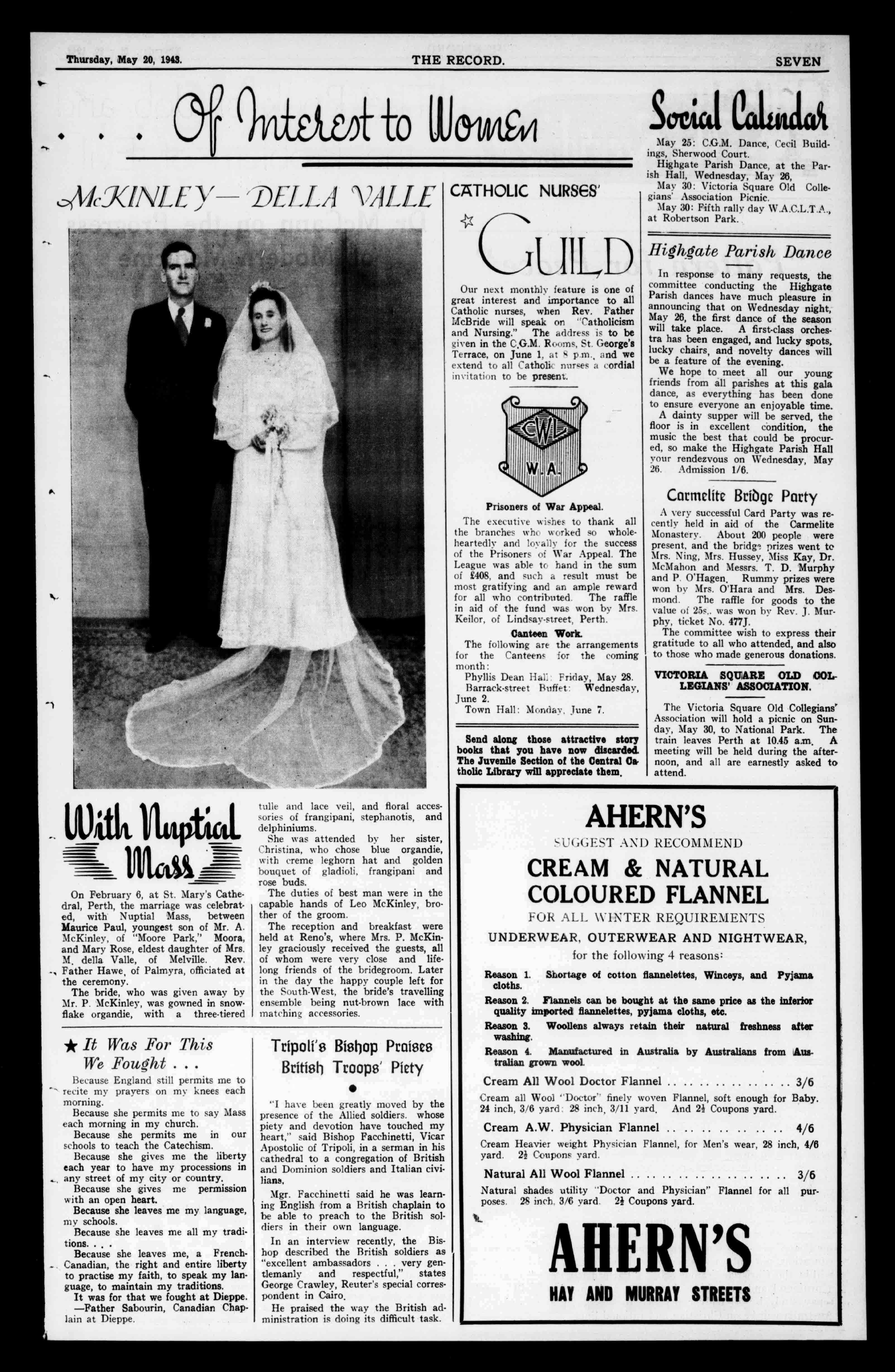
OnFebruary6,atSt.Mary'sCathedral,Perth,themarriagewascelebrated,withNuptialMass,between MauricePaul,youngestsonofMr.A. McKinley,of"MoorePark,"Moora, andMaryRose,eldestdaughterofMrs. M.dellaValle,ofMelville. Rev. -,FatherHawe,ofPalmyra,officiatedat theceremony.
Thebride,whowasgivenawayby Mr.P.McKinley,wasgownedinsnowflakeorgandie,withathreetiered
*ItWasForThis WeFou4ht
BecauseEnglandstillpermitsmeto recitemyprayersonmykneeseach morning.
BecauseshepermitsmetosayMass eachmorninginmychurch.
Becauseshepermitsmeinour schoolstoteachtheCatechism.
Becauseshegivesmetheliberty eachyeartohavemyprocessionsin anystreetofmycityorcountry.
Becauseshegivesmepermission withanopenheart.
Becausesheleavesmemylanguage, vschools.
Becausesheleavesmeallmytraditions.
Becausesheleavesme,aFrenchCanadian,therightandentireliberty topractisemyfaith,tospeakmylanguage,tomaintainmytraditions.
ItwasforthatwefoughtatDieppe.
-FatherSabourin,CanadianChaplamatDieppe.
tulleandlaceveil,andfloralaccessoriesoffrangipani,stephanotis,and delphiniums.
Shewasattendedbyhersister, Christina,whochoseblueorgandie, withcremeleghornhatandgolden bouquetofgladioli,frangipaniand rosebuds.
Thedutiesofbestmanwereinthe capablehandsofLeoMcKinley,brotherofthegroom.
Thereceptionandbreakfastwere heldatReno's,whereMrs.P.McKinleygraciouslyreceivedtheguests,all ofwhomwereverycloseandlifelongfriendsofthebridegroom.Later inthedaythehappycoupleleftfor theSouth-West,thebride'stravelling ensemblebeingnut-brownlacewith matchingaccessories.
Tripoli'sBishopPraises BritishTroops'Piety
"Ihavebeengreatlymovedbythe presenceoftheAlliedsoldiers.whose pietyanddevotionhavetouchedmy heart,"saidBishopFacchinetti,Vicar ApostolicofTripoli,inasermaninhis cathedraltoacongregationofBritish andDominionsoldiersandItaliancivilians.
Mgr.FacchinettisaidhewaslearningEnglishfromaBritishchaplainto beabletopreachtotheBritishsoldiersintheirownlanguage.
Inaninterviewrecently,theBishopdescribedtheBritishsoldiersas "excellentambassadors verygentlemanlyandrespectful,"states GeorgeCrawley,Reuter'sspecialcorrespondentinCairo.
HepraisedthewaytheBritishadministrationisdoingitsdifficulttask.
Ournextmonthlyfeatureisoneof greatinterestandimportancetoall Catholicnurses,whenRev.Father McBridewillspeakon"Catholicism andNursing."Theaddressistobe givenintheC.G.M.Rooms,St.George's Terrace,onJune1,at'4p.m.,andwe extendtoallCatholicnursesaordial invitationtobepresent.
PrisonersofWarAppeal.
Theexecutivewishestothankall thebrancheswh,workedsowholeheartedlyandloyallyforthesuccess ofthePrisonersofWarAppeal.The Leaguewasabletohandinthesum of£408,andsucharesultmustbe mostgratifyingandanamplereward forallwhocontributed.Theraffle inaidofthefundwaswonbyMrs. Keilor,ofLindsay-street,Perth. CanteenWork.
Thefollowingarethearrangements fortheCanteensforthecoming month:
PhyllisDeanHall.Friday,May28.
Barrack-streetBuffet:Wednesday, June2. TownHall:Monday.June7.
Sendalongthoseattractivestory booksthatyouhavenowdiscarded. TheJuvenileSectionoftheCentralCatholicLibrarywillappreciatethem.
Inresponsetomanyrequests,the committeeconductingtheIIighgate Parishdanceshavemuchpleasurein announcingthatonWednesdaynight, May26,thefirstdanceoftheseason willtakeplace.Afirst-classorchestrahas luckybeenengaged,andluckyspots, chairs,andnoveltydanceswill beafeatureoftheevening.
Wehopetomeetallouryoungfriendsfromallparishesatthisgala dance,aseverythinghasbeendone toensureeveryoneanenjoyabletime.
Adaintysupperwillbeserved,the floorisinexcellentcondition,the musicthebestthatcouldbeprocured,somaketheHighgateParishHall yourrendezvousonWednesday,May 26.Admission1/8.
CarmeliteBribgeParty
AverysuccessfulCardPartywasrecentlyheldinaidoftheCarmelite Monastery.About200peoplewere present,andthebridgsprizeswentte Mrs.Ning,Mrs.Hussey,MissKay,Dr. McMahonandMessrs.T.D.Murphy andP.O'Hagen.Rummyprizeswere wonbyMrs.O'HaraandMrs.Desmond.Theraffleforgoodstothe valueof25s,.waswonbyRev.J.Murphy,ticketNo.477J.
Thecommitteewishtoexpresstheir gratitudetoallwhoattended,andalso tothosewhomadegenerousdonations.
VICTORIASQUAREOLDCOLLEGIANS'ASSOCIATION.
TheVictoriaSquareOldCollegians' AssociationwillholdapicniconSunday,May30,toNationalPark.The trainleavesPerthat10.45a.m.A meetingwillbeheldduringtheafternoon,andallareearnestlyaskedto attend.
AHERN'S
ANDRECOMM1,1NI)
CREAM&
NATURAL COLOUREDFLANNEL
FORALLWINTERREQUIREMENTS UNDERWEAR,OUTERWEARANDNIGHTWEAR, forthefollowing4reasons:
Reason1. Shortageofcottonflannelettes,Winceys,andPyjama cloths.
Reason2. Flannelscanbeboughtatthesamepriceastheinferior qualityimportedflannelettes,pyjamacloths,etc.
Reason3. Woollensalwaysretaintheirnaturalfreshnessafter washing.
Reason4. ManufacturedinAustraliabyAustraliansfromAustraliangrownwool.
CreamAllWoolDoctorFlannel 3/6
CreamallWool'Doctor"finelywovenFlannel,softenoughforBaby. 24inch,3/8yard.28inch.3/11yard.And21Couponsyard.
CreamA.W.PhysicianFlannel 4/6
CreamHeavierweightPhysicianFlannel,forMen'swear,28inch,4/6 yard.21Couponsyard.
NaturalAllWoolFlannel 3/6
Naturalshadesutility''DoctorandPhysician"Flannelforallpurposes.28inch.3/6yard.21Couponsyard.
Thursday,May20,1949. THERECORD. SEVEN
01114014
HAYANDMURRAYSTREETS
AHERN'S
PERTH,THURSDAY,MAY20.1943.
"PatternforPeace"
ThefourthSocialJusticeStatement,whichwillbeofficially releasedonSocialJusticeSunday,May30.istohand,bearingthe title"PatternforPeace."Itisaworthyelaborationofitsdistinguishedpredecessors-theBishops'Statement,"fusticeNow," and"ForFreedom."Itrepresentsaprogrammeofpost-warreconstructiongiveninaseriesoftwentypoints,andisanepitome ofthe"StatementonReconstruction"submittedbytheHierarchy totheFederalGovernment.Passingfromthestatementofsocial doctrines,itsetsforthdetailsofsocialpolicy.ThesebeartheapprovaloftheEpiscopalCommitteeonCatholicActioninsofaras theBishopsdeclaretheproposalstocontainnothingcontraryto Faithormorals,buttheydonotbindCatholicstoacompleteacceptance.ItisconceivablethatotherschemesvaryingastodetailsmightequallywintheapprobationoftheHierarchy.
Perhapsthemostnotableandanxiouslyawaitedissueofthe 'PatternforPeace"isitsproposalsfortheOrganisationofthe CreditStructure.Somewillhedisappointedthatitdoesnotadvocatecompletenationalisationofcredit.Thisstepitconsiders unnecessaryifprivateprofitsthroughthedispensationofcredit canbeeliminatedbythestrictestGovernmentcontrolofthecredit activitiesofthetradingbanks,insurancecompanies,etc.,andbythe strengtheningoftheCommonwealthBankinitscharacterasa reserve,trading,nationalandmortgagebank.Perhapsamore valuablecontribution"PatternforPeace"hastomakeforthe reformofthemonetarysystemliesinitsrecommendationthata specialsystemofcreditshouldbedesignedtomeettheneedsof agriculture.Astrongrecommendationismadethatagricultural interestshouldnotbefixedarbitrarilyonthebasisoftherate fixedforindustrialcapital.
Perhapsthemainemphasisof"PatternforPeace"islaidon ruralconstructionasthematterofprimeimportancetothefuture ofAustralia.Ontheadministrativesideasoundlyplannedregionalismisadvocatedenvisagingthedevelopmentofregional townswithindustriesservingtheirownlocalityandsocial,culturalandeducationalamenitiestoreducetheattractionofcity life.Furtherrecommendationsurgethestabilisationofland values,theeliminationofspeculation,thelimitationoftherightof mortgageandsale,andthestabilisationofthepricesofprimary products.Co-operativeinstitutionsamonggroupsofindependent familyfarmsisseenasthebasicprincipleofreconstruction.while thesettingupgraduallyofaNationalRuralCounciltoachieve self-governmentinagricultureisadvocated.Sidebysidewith agriculturegoestheReconstructionofIndustry.Inthismatter theproposaltosetupIndustrialCouncils,consistingofemployers andemployees,isdeveloped,asistheconceptionofwhatconstitutesagraduatedfamilywage.Veryjustlythissystemisclaimedtobeascientificwayofmakingwagesreallymeettheneeds ofthefamily,asagainstthepresentvagueandunsatisfactory "capacityofindustrytopay."Specialmeasuresarecalledforto controlmonopoliesand"bigbusiness"inthecommoninterest. Specialclausesconcentrateontheproblemofwomeninindustry. a.
Thefirstsectionof"PatternforPeace"concernsitselfwith Australia'spopulationaswiththemostimmediatelyurgentproblemconfrontingits.Whilerecognisingthatthechiefcauseof declineisprobablyoneofmoraloutlook,itisconcededthat"in manycasesitisthethreatofeconomicinsecuritywhichrestricts thesizeofthefamily."Fourpositivemeasurestoimprovethe naturalincreaseareputforward,thestabilisationofagriculture beingtothefore,asitisonlyfarmingpopulationswhichhavea sufficientbirth-rate.Populationsimplydoesnotgrowinthegiant metropolis.ButrealisingthatAustraliacannotpopulateitself fromitsownstockinasufficientlyshortspaceoftime,immigrationinverylargenumbersisurged.Twoguidingprinciples shouldgoverntheadmissionofmigrants.Theyshouldaimto introduceruraldwellersratherthanindustrialoverflows,andspecialattentionshouldbepaidtocountrieswithahighbirth-rate. Thiswillnecessitatetheeliminationofracialprejudices,butitis imperativelynecessaryfornationalsurvival.Finally.'Pattern forPeace"seesallitsproposalsdependentuponasoundreformof education,notonlyasregardsrealfundamentalsocialideas,but withintheChristianframework."PatternforPeace"isatonce aprofoundandprovokingdocument,andonethatwillamply repaystudybyalltrulyconcernedtoseethatthereshapingof AustraliawillheonChristianandrationallines.
TheBookofJoband theProblemofEvil
Dr.McCannontheProgress ofModernMedicine
(ContinuedfromPage5.)
entirely,Rahabandherhousehold couldnothaveescaped."
Nownotetheevidenceunearthedin 1933byProfessorGarstang,afamous Archaeologist.Irrefutableevidence thatatadateapproximatingrather accuratelyto1400B.C.,thewallsof Jerichofelldownfiatoutwards,but onesmallsectionofthewallremains upright-presumablyinthevicinityof thehousewhereRahablived.Were thesethingsnotvouchedbyscientists, wecouldhardlyimagineevidence shouldstillstandbeneaththesoilof Palestinetoprovesoconclusivelyto anunbelievingworldthatGodistruth andHisBooktheinspiredutterance oftheSpiritofTruth.
Insuchashortlectureitisimpossibletodealadequatelywithsucha subjectastheOldTestament,butI wouldliketorecommendtoanyoneinterestedinthesubject,oneortwo bookswhichareentertaininglywritten,scientificallyaccurate,andtremendouslyinformative,ontheArchaelogyoftheBible.Mostofthedata hasonlybeengleanedinthelast40 years.Ifeveryoufeeltheurgeto takeupanyintellectualhobbywhich willgrowandincreasewiththeyears, IwouldadvisethestudyoftheBible itcanleadyoutoproblemswhich gaveSt.ThomasAquinasaheadache, butitwillbealwaysinterestingoecauseitisastudyofthescienceof man.
ThebooksoftheOldTestament, sometimesknownasthePoeticBolks, areseveninnumber,Theyuere writtenatvarioustimes'roil:1000 B.C.to180B.C.byinspiredauthors. Theirname,"Didactic,"welldescribes theirmostgeneralcharacteristic,for totheHebrewsofold,asalsotothe Egyptiansatlarge,theyhavealways beenawonderfultreasuryofvaried andusefulinstructions.Aswemight naturallyexpect,thesebooks,being poetry,arecharacterisedbydignity oflanguage,boldnessofmetaphor, andtheuseofArchaicexpressions.
LetustaketheBookofJob,which dealswiththedifficultythathasat alltimesintriguedman-theproblem ofevil,Initself,itisuniversally acknowledgedtobethemostbrilliant literarygemoftheOldTestament,and aprominentauthorityhaswrittenof it:"Beyondanydoubt,theBookof Jobisthehighestproductofthe poets'art;itbringstoafocus,asit were,allthatHebrewpoetrycouldcontribute,andstandsoutasoneofthe noblestpoeticalcompositionsofany ageoranypeople."
Anexampleofthisbeautyisgiven whenGodflashesforthfromthestorm theswift,directanddelicatesarcasm ofhisqueriesregardingtheconstitutionoftheworldandthegovernment oftheuniverse:
"Hastevergivenorderstothemorn? Orshownthedawnofdayitsplace?
Canstthouliftupthyvoicetothe clouds
Thatabundanceofwatersmaycover thee?
Canstthoubindtheclusterofthe Pleiades
OrloosethebandsofOrion?"
Theprimeproblemtreatedisnot directlysolved:themysteryofthe presenceofevilinGod'screationremainsamystery,butthereasonfor thisisindicated:Man'smindcannot graspthecompletenatureofGod,and hencecannotplumbthedepthsofHis Providence.However,thereisthis practicalconclusion:ManhassufficientevidenceevenfromNaturetojustifyhisplacinguttertrustinGod, sinceHecontrolsallthings.Thisis hintedintheverybeginningofthe
book,whereweseethatonlywith DivinepermissioncouldSatanafflict Job.
Theinherentbeautyandsublimity ofalltheinspiredbookshavekept themalivethroughoutthecenturies, toremindpeoplethattheGodwho inspiredsuchpassionatelove,devotion, andconfidenceisstillthesamemercifullovingFather.Ithasoftenbeen saidthatinthepropheticalbookswe haveGodspeakingtoHispeople,in thePsalms,wehavethepeoplespeakingtotheirGod:beingprayers,they areoutstandingexamplesoflyrical poetry,andhavetriumphantlywithstoodthetestoftimeandfrequent translationswithoutlosingtheir beauty.
Thesecondspeaker1,,rtheevening, Dr.FrankMcCann,likenedhimselfto thelastbatsmaninacricketeleven, whoseinstructionsweretohitoutand getout.Inthebrieftimeallotted himhepassedfromhisusualhumorousopeningtoatersesurveyofthe wonderfulstepsmadebyMedicinein thelastcentury-especiallyaround 1850.
TheDoctordiscussedfourofthese' steps,namely,thegreatimprovement innursingandhospitaltreatment;the discoveryofgermsandantiseptics;the discoveryanduseofanaesthetics,and vaccination.
Remarkingthathospitalshadfrom oldentimesprovidedareligiousvocationforafew,yetotherhospitals, about1800,weremostlystaffedbythe worsttypeofperson,thelecturerde-(scribedhospitalconditionsinFrance andEnglandattheturnofthecentury.Theaudiencewonderedhow anypatientsurvived.Showinghow theworkofPasteurandListeremphasisedtheneedofcleanliness,Dr. McCanntracedthequickimprovement inhospitalconditionsuntilto-day, Heconsideredtheimprovedmethods ofhospitaltreatmenttobethegreatestadvanceofmedicalscienceinthe century.
Histreatmentoftheotherfactors mentionedwasmadeasinteresting, and,beingpunctuatedwithhumorous asides,hadthelistenerslaughinghalf thetime.
Finally,Dr.McCannpredictedadvancesjustasgreatforthenextcentury,andsaid,"Inahundredyears' timewemighteasilybeabletocure acommoncold."
Anappreciativeaudiencecarried heartyvotesofthankstobothspeakere.
NEXTLECTURE.
FRIDAY,MAY28.
FatherO'Mahoneywilldiscussthe FirstSpreadofCatholicism.ThelecturewillbearupontheActsofthe Apostles,andwillbemainlycentred inthecolourfulEast,inthemostmomentousperiodofitsexistence.
Mr,FredBurkewillbethesupportingspeaker,andtheeveningwillbe sponsoredbyCaptainCarmody,well knowntothosewholistenedtoLibrarylecturessponsoredbytheChestertonClubinthedayswhenCaptain Carmodywasthatclub'spresident.
ST.PATRICK'S, fREMANTLE
TheannualcrowningofOurLady QueenofMaywilltakeplaceat7.15 p.m.onSunday,May30.Astheoccasionisanidealone,arallyofactiveandauxiliarymembersofthe LegionofMarywillbeheld. Acordialinvitationto.bepresentisextendedtoLegionariesofotherparishes,
EIGHT THERECORD. Thursday,May20,1943.
(Lettersshouldbeasbriefaspossibleand,evenwnereanom-de-plume isemployed,mustbearthewriter's nameandaddress,asatokenofbonafides.Nonoticewillbetakenof anonymouscorrespondence.)
SOCIALAPATHYOFCATHOLICYOUTH.
Sir,-Inreplyto"MatrimonialBureau"4"Record,"May6),itistruethat aCatholicboyishandicappedbythe factthatthemajorityofthegirls aroundhimarenon-Catholics,although Ithinkhisestimate-tentoone-istoo high.But,bethatasitmay,Iamof theopinionthatthereareampleopportunitiesinalmosteveryparishforthe Catholicyoungpeopletomeetone another,ifthesaidyoungpeoplewould onlyavailthemselvesofthem.Many parisheshaveaCatholicTennisClub, forinstance,simplycryingoutformembers,andexperiencehasshownthe CatholicLawnTennisAssociationtobe amosteffective"matrimonialbureau"! Butno!OuryoungpeopleWILLjoin otherclubsorstandidlybywhiletheir ownCatholicclubdiesforlackofmembers.
Again,howoftenhaveweheardour priestsappealtotheyoungpeopleof theparishtosupportthesocialfunctionsorganisedinaidoftheparishdebt orsomeotherworthyobject?Butthe appealusuallyfallsondeafears.Why? Ihaveheardmanyexplanations.some ofthemnotveryflatteringtoour k.youngergeneration,hut,inallhonesty, Ithinkitisjustthoughtlessness-blendedperhapswithacertainlackofloyaltytowardsthingsCatholic.Were theCatholicboysandgirlstoavail themselvesoftheopportunitiesALREADYaffordedthemofmeetingone another,Idonotthinktherewould beagreatdealleftforamatrimonial bureautodo.-Yours,etc., POP.
Perth.
DEFENCEOFPEASANTRY.
Sir,-Evenifthe"GreenRevolution" meansareturntotheoldprovedpeasanttradition,whatofit?Ithinka partialreturntotheoldidealisnecessary.Revolutionmeansdrasticchange, soherewehaveit.Foronething, theoldtraditionoffarmingwastough, andthereisnodenyingit,wehave becomesoft.Onlytoughmencould carveoutahomeandfarmfromthe virginbush;andtheoldpioneerswon through;theywereequaltoit,and thustheybecame"thegiantsofold."
Again,allthegreatreformshavebeen hardanddifficult.Forexample,St. Bernard'sreformoftheBenedictine Order,andSt.Teresa'sofCarmel.Both reformersaskedforstricterobservance. Theydemandedhardthings,andthe hardthingsweredone,withmostsuccessfulresults,forthebenefitofhumanity,
So,ifouryouthtakeupthe"Green Revolution,"fortheloveofClaredon't makeiteasy.Otherwiseyoufail. Youthwillrespondtothehardthings askedfor;mayProvidenceraiseupa leadertoinspirethem.InAmerica, apriesthasledasuccessfulback-tothe-land-movementfromamongstcity folk.Iadmit"Kerry's"proposalsare goodandmostpractical.But,ifwe haveto"spoon-feed"thismovement, willitberobust,willitsurvive?Shades oftheWestAustralianpioneers!Do theysmileatalltheenticementsnow necessarytogetandholdpeopleonthe land? Ifancyoneoldpioneer(a nativeofCountyClare)wouldbemost indignant.Heexpectedhissonsand grandsonstobemen.Nofaultofhis ifhishopeswerenotrealised.One ofhissons,myfather,alongWiththe oldshepherd,shepherdedsheepatthe ageofeight,fortwomonthsoftheyear, 30milesfromthehomestead!Inthose daysthedietwasoftenjustbreadand dripping.Arideonhorsebackfor30 or40milestoacricketmatch,ordance, andbackagain,wasjusttheirform ofamusement.Beforehisninthbirthday,myfatherhadwonhisfirstrace
iiigreenjacket,withwhitesleeves thelattersplashedwithred,froma bleedingnoseI,andhisfirstexperience. too,ofajockey'ssaddle.
Ifnowitisconsiderednecessaryto haveallmannerofcomfortsonthe modernfarm,howisitthatthe"oldtimer,"afteraweekortwointhecity, hashadenough?flacktothebush hemustget,awayfromthecity'sattractions.Heprefersthebush-there mustbesomehappinessinthisrugged lifeclosetonature.Ifthechildrenof to-daydevelopthe"old-timers'"love ofthebush,willitbenecessarytosurroundthemwitheverycomfort?On theotherhand,iftheyfailtoholdthe spiritoftheearlypioneers,Idoubtif allthemoderndevicesbroughttothe farmwouldchecktheirflightto"the bigsmoke."Itseemstometheonly waytolovethelandistogoout,with sleevesrolledup,andsubdueit,May theoldpioneersofWestAustralia, thosegrandoldmen,inspiresomeofIts tomaketheeffort,aswellasgivingis aleadertoenkindleus-Yours,etc., CLARE. MidlandJunction.
SOCIALJUSTICESUNDAY, MAY30
"PATTERNFORPEACE"TOBE AVAILABLE.
SocialJusticeSundaywillbeobservedinallchurchesintheArchdiocese onMay30,whensermonsappropriate totheoccasionwillbepreached.Copies ofthenewSocialJusticeStatement, "PatternforPeace,-willheonsale afterallMasses,pricedat3d.percopy.
Exposition intheCity
ExpositionoftheBlessedSacrament isheldeveryThursdayintheChapel oftheCatholicGirls'Movement,Bank ofN.S.W.Chambers,65St.George's Terrace,nexttoWarwickHouse.A cordialinvitationisextendedtothe Catholicpeoplegenerallytopaya visitduringtheday.ExpositioncommencesafterMassat8o'clock,and concludeswithBenedictionofthe BlessedSacramentat5.45p.m.Those desiringtodosomayplacetheir namesontherosteroutsidetheChapel.
POLAND,WITHOUTSEMINARIES, FACESPRIESTLESSFUTURE.
Alltheologicalseminariesnowbeing shutinPoland,thecountryisfaced withacompletelackofpriests,itis learntinLondon.
Thepeoplearealreadysuffering veryseriouslyinthisrespect,themajorityofthepastoralclergyhaving beenarrested.
Theusualexcuseforarrestingclergy isthattheyurgethefaithfultopray thatGodmaysavePoland.Inthe opinionoftheGermanauthoritiesthe Polishnationisnotlivinginmisfortune.
PRAYERWASMALTA'SSECRET WEAPON.
ThefactthatGod'shelpwasasked for,andreceived,bythepeopleof Malta,isthesecretofthesuccessful defenceoftheisland,saidLt.-Gen.Sir WilliamDobbie,speakinginSt. Helens,recently.
MONETARYREFORM.
Sir,--Inviewoftheimportanceof moneyinourevery-daylife,itisonly reasonablethat:
(1,Thecreditofthenationshould belongtotheshareholdersofthe nation,andNOTtotheshareholders ofthebanks;tothepeopleasawhole (7,000,000),andnottoasectionofthe people171,000).Nobodyhasaright tositbackanddrawa"rake-off"from thebloodandsufferingsofothers,or outofanationalemergency.Wedo notwantaprivilegedclassinour midst,
(2)TheCommonwealthStatistician andhisstaffshoulddeterminehow muchmoneymaybeissued.Moreover,itwillbeissuedinsuchamannerastopreventinflationofprices.
(31Moneymustequalpricesof goodsforsale,andshouldnotbecancelledatagreaterratethangoodsare consumed.
(4)Privateenterprisetostand,with thissafeguard,thatthepriceofanarticleoraserviceshouldbethecost ofproduction,plusareasonablepro. fit,aftermakingallowanceforsinking fund,contingencies,etc.ModernCapitalismisnotbasedonChristianprinciples,andcannotheallowedfree rein.
151Thebasicwagetobefixedfor amanandhiswife,withasubsidyfor eachchild.Thistobepaidbythe nation.Tooff-setthefactthatmachineryisdisplacingman-power,boys andgirlstobeleftatschoolfora longerperiod,andmenandwomenretiredatanearlierage,butallyoung childrentobeprovidedfor.Theretiringagetobeloweredasunemploymentincreases(65to60,60to55,55to 50).Theobjectofanindustrialsystemisnotprimarilytoprovidework, butgoodsandservices.
(6)Apensionequivalentto75per centofthebasicwagetobepaidto manandwifeonretirement.This isonlyjustastheaveragehuman beingattheendofalifetimewillhave spentatleast£6,000ongoodsandservices,andhastherebyencouraged trade,
(7)Moneywillbeissuedforproductionandcancelledwithconsumption, eachpersonpayinghislegitimateshare oftaxation.Inanycontributory scheme,themiddlemanmustbepreventedfrompassinghisshareoftaxationontotheconsumer.Thatloopholemustbeclosed.Undertheexistingsystemtheconsumerpaysalltaxation,butisnotawareofthefact.
Moneywillthenbeamediumofexchange,andnotaninstrumentofGovernmentandPower,asitisatthe presenttime.-Yours,etc., "LOOKINGFORWARD."
CatholicTeachers' Guild
ThemeetingforMay20ispostponed tillThursdayevening,May27,at8 pm.,atBactonHouse, Watchforfullerdetailsofthecountryteachers'meetingheldduringthe theholidays,alsoforlistoftitlesof Australian,EnglishandAmerican pamphletsinourPamphletLibrary.
CENTRALCATHOLICLIBRARY
36PIERSTREET,PERTH.
SUBSCRIPTIONRATES.
Metropolitan.
12Months:Onebook,10s,twobooks Its6d:threebooks, fourbooks, 7s.6d.
Country.
12Months:Threebooks,£115s.;four honks,£25s.:fivebooks,£210s. Wepayfreightonbookstothesub scriber.
tOe
ZrcObtocese
ARCHBISHOP'SENGAGEMENTS.
May23:CanonicalVisitationandConfirmationatSt.Joseph'sChurch, Kellerberrin.
May25.-9.30a.m.:St.Mary'sCathedral:PresideatSolemnOfficeand RequiemMassontheoccasionofthe anniversaryofthedeathofthelate ArchbishopClune.
May30:CanonicalVisitationand ConfirmationatSt.Anne's.Belmont.
June6-9a.m.:St.Mary'sCathedral: celebrateMassontheoccasionofthe AnnualCommunionofmembersof theCatholicGirls'Movement.
June13 (PentecostSunday):St. Mary'sCathedral:
11a.m.:Pontificate.
3p.m.:AdministertheSacramentof ConfirmationtochildrenfromCathedralParishSchoolsandto adults.
June18:10a.m.:PresideatQuarterly ConferenceofPriestsoftheMetropolitanArea,attheChapterHall, VictoriaSquare.
June19.-8a.m.:PresideatceremoniesofReceptionandProfessionat St.Joseph'sConvent,Fremantle.
June20:CanonicalVisitationandConfirmationatSt.Mary's,Guildford.
June27:CanonicalVisitation,LesmurdieandPickeringBrook.
7.30p.m.:St.Mary'sCathedral:AttendclosingceremoniesoftheForty Hours'Devotion.
July4:CanonicalVisitationandConfirmationatSt.Columba's,Bayswater,andSt.Peter's,BedfordPark. AttendAnnualEucharisticProcessionatSacredHeartChurchHighgateHill.
July11:CanonicalVisitationandConfirmationatSt.Aloysius',Shenton Park,
July18:CanonicalVisitationandConfirmationatSt.Patrick's,York.
July25:CanonicalVisitationandConfirmationatSacredHeartChurch. Beverley.
CONFIRMATIONFORADULTS.
HisGracetheArchbishopwilladministertheSacramentofConfirmationtoadultsinStMary'sCathedral at3p.m.onPentecostSunday,June13.
PRIESTS'CONFERENCE.
TheQuarterlyConferenceofPriests ofthemetropolitanareawillbeheld attheChapterHall,VictoriaSquare, at10a.m.onFriday,June18.
TheLateArchbishopClune
EIGHTHANNIVERSARY,MAY25.
Theeightanniversaryofthedeath ofthelateArchbishopCluneoccurs onTuesday,May25.Theoccasion sillbeobservedintheCathedralby thechantingoftheSolemnOfficeof theDeadandthecelebrationofSolemnRequiemMass.HisGrace,Most Rev.R.Prendiville,D.D.,willpreside attheOfficeandMass.Thefunction. willcommenceat9.90a.m.
QUARANTPORE
MAY.
Sunday. 4th.-CLAREMONTFortyHours' Prayer21st..-23rdI. 5th.-OSBORNEPARK:OneDay ofExposition.
JUNE.
lst.-MT.BARKER:OneDayofExposition. 3rd.--0OLLIE:FortyHours'Prayer (18th.--20th.).
4th.-MERREDIN:OneDayofExposition.
Thursday,May20,1943. THERECORD. NINE
LETTERS
&NJ
CatholicPhilosophyoftheFineArts
PromisingFieldforCatholicACtionists
ArchbishopSimondsOpens P.A.G.LectureSeries
AnalysisofBeautyand FuncrtionofArt
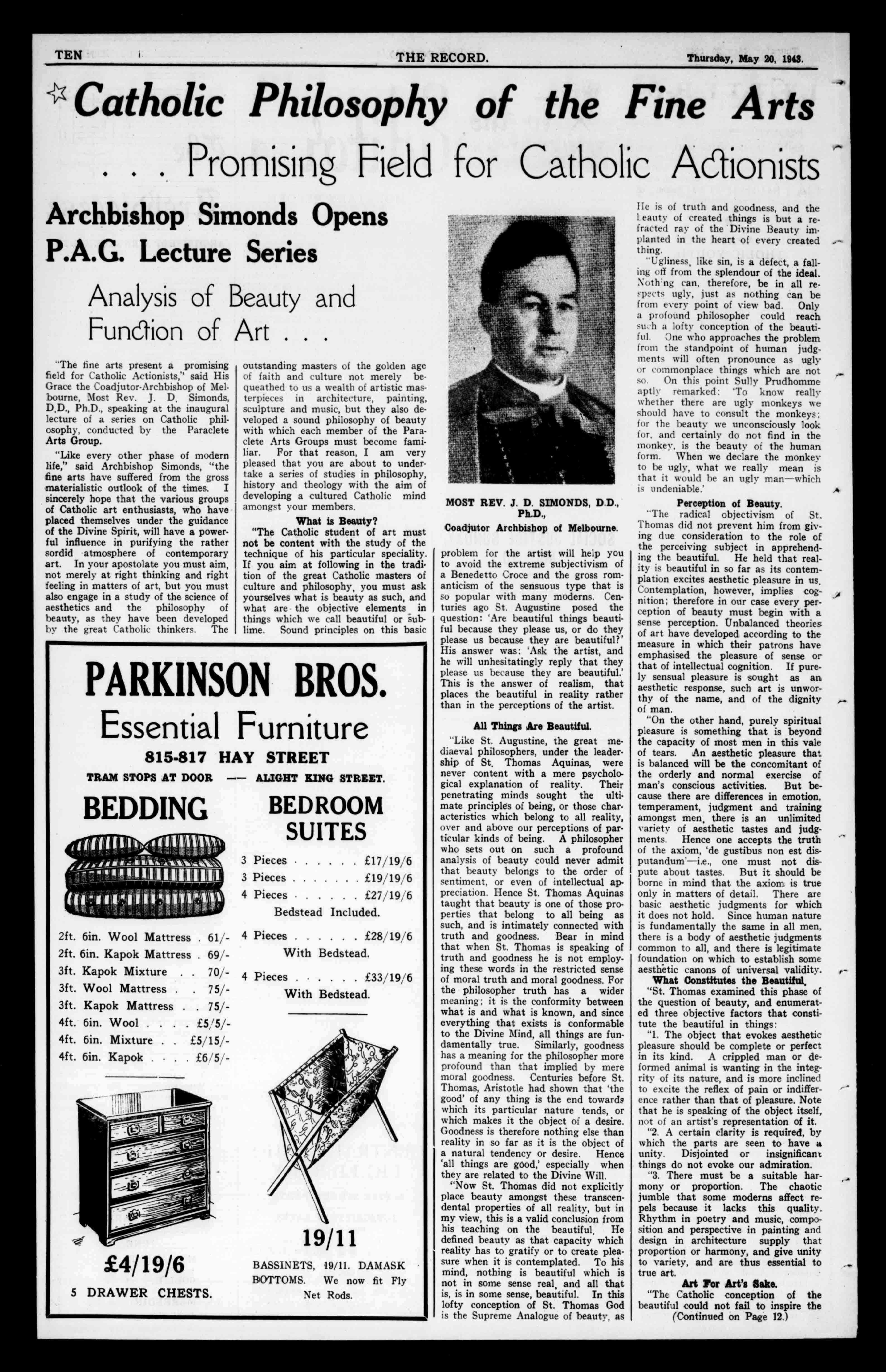
"Thetineartspresentapromising fieldforCatholicActionists,"saidHis GracetheCoadjutor-ArchbishopofMelbourne,MostRev.J.D.Simonds, D.D.,Ph.D.,speakingattheinaugural lectureofaseriesonCatholicphilosophy,conductedbytheParaclete ArtsGroup.
"Likeeveryotherphaseofmodern life,"saidArchbishopSimonds,"the fineartshavesufferedfromthegross materialisticoutlookofthetimes.I sincerelyhopethatthevariousgroups ofCatholicartenthusiasts,whohave placedthemselvesundertheguidance oftheDivineSpirit,willhaveapowerfulinfluenceinpurifyingtherather sordidatmosphereofcontemporary art.Inyourapostolateyoumustaim, notmerelyatrightthinkingandright feelinginmattersofart,butyoumust alsoengageinastudyofthescienceof aestheticsandthephilosophyof beauty,astheyhavebeendeveloped bythegreatCatholicthinkers.The
outstandingmastersofthegoldenage offaithandculturenotmerelybequeathedtousawealthofartisticmasterpiecesinarchitecture,painting, sculptureandmusic,buttheyalsodevelopedasoundphilosophyofbeauty withwhicheachmemberoftheParacleteArtsGroupsmustbecomefamiliar.Forthatreason,Iamvery pleasedthatyouareabouttoundertakeaseriesofstudiesinphilosophy, historyandtheologywiththeaimof developingaculturedCatholicmind amongstyourmembers.
WhatisBeauty?
"TheCatholicstudentofartmust notbecontentwiththestudyofthe techniqueofhisparticularspeciality. IfyouaimatfollowinginthetraditionofthegreatCatholicmastersof cultureandphilosophy,youmustask yourselveswhatisbeautyassuch,and whataretheobjectiveelementsin thingswhichwecallbeautifulorsublime.Soundprinciplesonthisbasic
MOSTREV.J.D.SIMONDS,DD Ph.D., CoadjutorArchbishopofMelbourne. problemfortheartistwillhelpyou toavoidtheextremesubjectivismof aBenedettoCroceandthegrossromanticismofthesensuoustypethatis sopopularwithmanymoderns.CenturiesagoSt.Augustineposedthe question:'Arebeautifulthingsbeautifulbecausetheypleaseus,ordothey pleaseusbecausetheyarebeautiful?' Hisanswerwas:'Asktheartist,and hewillunhesitatinglyreplythatthey pleaseusbecausetheyarebeautiful.' Thisistheanswerofrealism,that placesthebeautifulinrealityrather thanintheperceptionsoftheartist.
AllThingsAreBeautiful.
Heisoftruthandgoodness,andthe IeautyofcreatedthingsisbutarefractedrayoftheDivineBeautyim plantedintheheartofeverycreated thing.
"Ugliness,likesin,isadefect,afallingofffromthesplendouroftheideal. NothOgcan,therefore,beinallrespectsugly,justasnothingcanbe fromeverypointofviewbad.Only aprofoundphilosophercouldreach stis-haloftyconceptionofthebeautiful.Onewhoapproachestheproblem fromthestandpointofhumanjudgmentswilloftenpronounceasugly orcommonplacethingswhicharenot so.OnthispointSullyPrudhomme aptlyremarked:'Toknowreally whetherthereareuglymonkeyswe shouldhavetoconsultthemonkeys: forthebeautyweunconsciouslylook for,andcertainlydonotfindinthe monkey,isthebeautyofthehuman form.Whenwedeclarethemonkey tobeugly,whatwereallymeanis thatitwouldheanuglyman-which isundeniable.'
PerceptionofBeauty.
"TheradicalobjectivismofSt. Thomasdidnotpreventhimfromgivingdueconsiderationtotheroleof theperceivingsubjectinapprehendingthebeautiful.Heheldthatrealityisbeautifulinsofarasitscontemplationexcitesaestheticpleasureinus, Contemplation,however,impliescognition;thereforeinourcaseeveryperceptionofbeautymustbeginwitha senseperception.Unbalancedtheories ofarthavedevelopedaccordingtothe measureinwhichtheirpatronshave emphasisedthepleasureofsenseor thatofintellectualcognition.Ifpurelysensualpleasureissoughtasan aestheticresponse,suchartisunworthyofthename,andofthedignity ofman.
3Pieces £17/19/6
3Pieces £19/19/6
4Pieces £27/19/6 BedsteadIncluded.
4Pieces £28/19/6 WithBedstead.
4Pieces £33/19/6 WithBedstead.
3ft.KapokMattress 75/-
4ft.6in.Wool £5/5/-
19/11.DAMASK BOTTOMS.WenowfitFly NetRods.
"LikeSt.Augustine,thegreatmediaevalphilosophers,undertheleadershipofSt,ThomasAquinas,were nevercontentwithamerepsychologicalexplanationofreality.Their penetratingmindssoughttheultimateprinciplesofbeing,orthosecharacteristicswhichbelongtoallreality, overandaboveourperceptionsofparticularkindsofbeing.Aphilosopher whosetsoutonsuchaprofound analysisofbeautycouldneveradmit thatbeautybelongstotheorderof sentiment,orevenofintellectualappreciation.HenceSt.ThomasAquinas taughtthatbeautyisoneofthosepropertiesthatbelongtoallbeingas such,andisintimatelyconnectedwith truthandgoodness.Bearinmind thatwhenSt.Thomasisspeakingof truthandgoodnessheisnotemployingthesewordsintherestrictedsense ofmoraltruthandmoralgoodness.For thephilosophertruthhasawider meaning:itistheconformitybetween whatisandwhatisknown,andsince everythingthatexistsisconformable totheDivineMind,allthingsarefundamentallytrue.Similarly,goodness hasameaningforthephilosophermore profoundthanthatimpliedbymere moralgoodness.CenturiesbeforeSt. Thomas,Aristotlehadshownthat'the good'ofanythingistheendtowards whichitsparticularnaturetends,or whichmakesittheobjectofadesire. Goodnessisthereforenothingelsethan realityinsofarasitistheobjectof anaturaltendencyordesire.Hence 'allthingsaregood,'especiallywhen theyarerelatedtotheDivineWill.
"NowSt.Thomasdidnotexplicitly placebeautyamongstthesetranscendentalpropertiesofallreality,butin myview,thisisavalidconclusionfrom histeachingonthebeautiful,He definedbeautyasthatcapacitywhich realityhastogratifyortocreatepleasurewhenitiscontemplated.Tohis mind,nothingisbeautifulwhichis notinsomesensereal,andallthat is,isinsomesense,beautiful.Inthis loftyconceptionofSt.ThomasGod istheSupremeAnalogueofbeauty,as
"Ontheotherhand,purelyspiritual pleasureissomethingthatisbeyond thecapacityofmostmeninthisvale oftears.Anaestheticpleasurethat isbalancedwillbetheconcomitantof theorderlyandnormalexerciseof man'sconsciousactivities.Butbecausetherearedifferencesinemotion. temperament,judgmentandtraining amongstmen,thereisanunlimited varietyofaesthetictastesandjudgments.Henceoneacceptsthetruth oftheaxiom,'degustibusnonestdisputandum'-i.e.,onemustnotdisputeabouttastes.Butitshouldbe borneinmindthattheaxiomistrue onlyinmattersofdetail.Thereare basicaestheticjudgmentsforwhich itdoesnothold.Sincehumannature isfundamentallythesameinallmen. thereisabodyofaestheticjudgments commontoall,andthereislegitimate foundationonwhichtoestablishsome aestheticcanonsofuniversalvalidity.
WhatConstitutestheBeautiful.
"St.Thomasexaminedthisphaseof thequestionofbeauty,andenumeratedthreeobjectivefactorsthatconstitutethebeautifulinthings:
"1.Theobjectthatevokesaesthetic pleasureshouldbecompleteorperfect initskind.Acrippledmanordeformedanimaliswantingintheintegrityofitsnature,andismoreinclined toexcitethereflexofpainorindifferenceratherthanthatofpleasure.Note thatheisspeakingoftheobjectitself, notofanartist'srepresentationofit.
"2.Acertainclarityisrequired,by whichthepartsareseentohavea unity.Disjointedorinsignificant thingsdonotevokeouradmiration.
"3.Theremustbeasuitableharmonyorproportion.Thechaotic jumblethatsomemodernsaffectrepelsbecauseitlacksthisquality. Rhythminpoetryandmusic,compositionandperspectiveinpaintingand designinarchitecturesupplythat proportionorharmony,andgiveunity tovariety,andarethusessentialto trueart.
ArtForArt'sSake.
"TheCatholicconceptionofthe beautifulcouldnotfailtoinspirethe (ContinuedonPage12.)
r-
TEN THERECORD. Thursday,May20,1943.
PARKINSONBROS. EssentialFurniture 815-817HAYSTREET TRAMSTOPSATDOOR--ALIGHTKINGSTREET. BEDDING 111111111111rilMilt, el1111111111111 (11711141,114111,111
WoolMattress61/2ft.6in.KapokMattress
3ft.KapokMixture
3ft.WoolMattress 75/-
2ft.6in.
69/-
70/-
4ft.6in.
14119/6 5DRAWERCHESTS. BEDROOM SUITES
4ft.6in.Mixture £5/15/-
Kapok £6/5/-
19/11 BASSINETS,
-
CATHOLICTENNIS ASSOCIATION
By"RON." AssociationTennisDay.Anotherintheseriesofmonthly IcnnisdayswillbeheldbytheAssociationatRobertsonParkonSunday, May30,Thisistobethefifth,and theorganisersonceagainanticipate alargeroll-upofmembersandfriends. Ateachofthepreviousgatherings "old-timers"oftheW.A.C.L.T.A.have comealongandjoinedinwiththe youngergeneration.Itisgreatto seesuchanumberofthesewellknownplayersofformeryearsstill "doingtheirbit"inhelpingalongthe Associationinthesetroublesome ImesTherearestillafewwhohave notyetappeared,butwehopeit won'tbelongbeforetheyturnupand areweildingtheracketaboutagain.
Asusualtwelvecourtswillbeavail ablefrom1p.m.,andthecommittee, comprisingMessrs.J.Wall,R.Morris., andJ.Eastcott,willarrangethemit ches.Thesubscriptionforplayisthe sameaspreviou=17.andthegathering isopentothemembersandfriendsof theW.A.C.L.T.A.
Association'sLou.
DuringthepastfewweekstheAssociationhasmournedthelossoftwo moreofitsmembers.ThesearePilotOfficerJohnBrennan(formerlyof TheresianClub)andSergeantPatrick Looney(formerlyofHighgateClub) Bothoftheseyoungmenaremissing asaresultofairoperationsagainst theenemy.
Pilot-OfficerBrennan,whowashome onleaveashortwhileago,wasafine sportsman by who cameincontactwithhim.Herecentlybecameengagedtoaprominent memberoftheAssociationinMiss CeciliaArnold,andtoherandhissorrowingmother,weofferoursincerest sympathyintheirsadloss.
SergeantPatrickLooneywasposted missinginSeptember,1942,andisnow believedkilledinairoperationsover Germany.Patwasaprominentand veryactivememberoftheHighgate Clubbeforehisenlistmentwiththe R.A.A.F.,andwashighlyregardedand respectedbyallthosewhomethim duringtheinter-clubmatches.His jovialcompanyandfinesportsmanshipwonhimmanyfriends,andall willbesorrytohearofhispassing.
Tohissorrowingparentsandfriends andtothemembersoftheHighgate Club,theAssociationextendsitssympathy.
Pen-PointsofInterest.
NoticedattheraceslastSaturday weremanyofourladymembers.By theexpressionsontheirfacesthey lookedasiftheyhadlosttheircash.
Maybethey'lldobetterattheTrots!
TwomembersofSt.Kevin'sClub, inPatKirbyandKeithNorrish,are holidayingatKojonup.Someone toldmetheirgoingtodofarming.I wonder!
ItwaspleasingtoseeagoodrollupofmembersatStaroftheSeaClub lastSundayontheoccasionofSt. -Kevin'svisit.Itshowswhatgood workthecommitteemusthavedone toorganisesuchanenjoyableday.We hopetheclubwillagain"pickup"a, aresultofthisfunction.
TheAssociationvice-president,Jack Edwards,lookswellinhisofficer's uniform.Heistoleaveforthe EasternStatesshortlytoundergo furthertraining,
IntheAprilissueof"Sidelines"is mentionedtheformingofaspecialso-
E.0.TRESISE, M.P.S.,S.A.andW.A. MANUFACTURINGAND DISPENSINGCHEMIST. ForServiceandQuality. Tel.:61Northam.
cialcommitteetoorganisefunctions fortheV.C.L.T.A.Eachclubisrepresentedbyadelegate,andwiththe hell)oftheexecutive,willbeincompletechargeofallsocialactivitiesfor thecomingyear.Whynotsomething onthesamelinesinPerth?
MissPatDonohoe,ofSt.Kevin's Club,hasnowreturnedhomeaftera fortnight'svacationatKalgoorlie.
St.Kevin'sTennisMb.
ApartyofmemberstooktheopportunityofvisitingStaroftheSea Club,Cottesloe,lastSunday,totake partinasocialafternon.Thefunctionwasverysuccessful,andwefeel certainthattheinitialgatheringof thetwoclubswillbetheforerunner ofseveraltobeheldinthecoming months.Wewouldliketoexpress ourthankstothecommitteand membersoftheStaroftheSeaClub forthehospitalityextendedtous duringourshortstay.
Thiscomingweek-end(Sunday, May23)wearetoentertainthemembersofSt.Joachim'sClub,andwe hopetobeabletogivethemasgood atimeaswehadattheircourtslast month.Therefore,allSt.Kevin's membersaretorememberthisSundayandtobepresentinlargenumbers.
Furthergoodnews!Wehavebeen invitedtovisitSt.Patrick'sClub,Fremantle,nextmonth.Moredetails aboutthisvisitwillbeavailablelater.
SubiacoYoung Men'sClub
ByH..1.Social.
ThedanceheldinSt.Joseph'sHall wasindeedagreatsuccess.This wasthefirstdanceandwecanguaranteeanevenmoreenjoyabletime atournextdance.
ThesocialtobeheldonSaturday, May22,inthesamehall,isinaidof thePrisonersofWarAppeal.Asthe causeisagoodone,alargeattendance isexpected.
GamesEvening.
ThegameseveningheldatFreman tleC.W.O.Hutwasveryenjoyable.The S.C.Y.M.wassuccessfulinwinningby threepoints.Wearelookingforward toanothertriptoFremantleinthe verynearfuture.
Talk.
Thespiritualtalkgivenbyourchaplain,FatherDepiazzia,was,asusual, wellreceived.Thereisagoodmoral inthetalks,andtheyarewellworth liseningto.Sodon'tforgetevery Mondaynight,boys.
Tournaments.
Intheverynearfutureweintend tostartaseriesoftournamentsbetweentheboysoftheclub.Wehave notfinallydecidedonthisyet,but watchthiscolumnforfurtherdetails, boys.
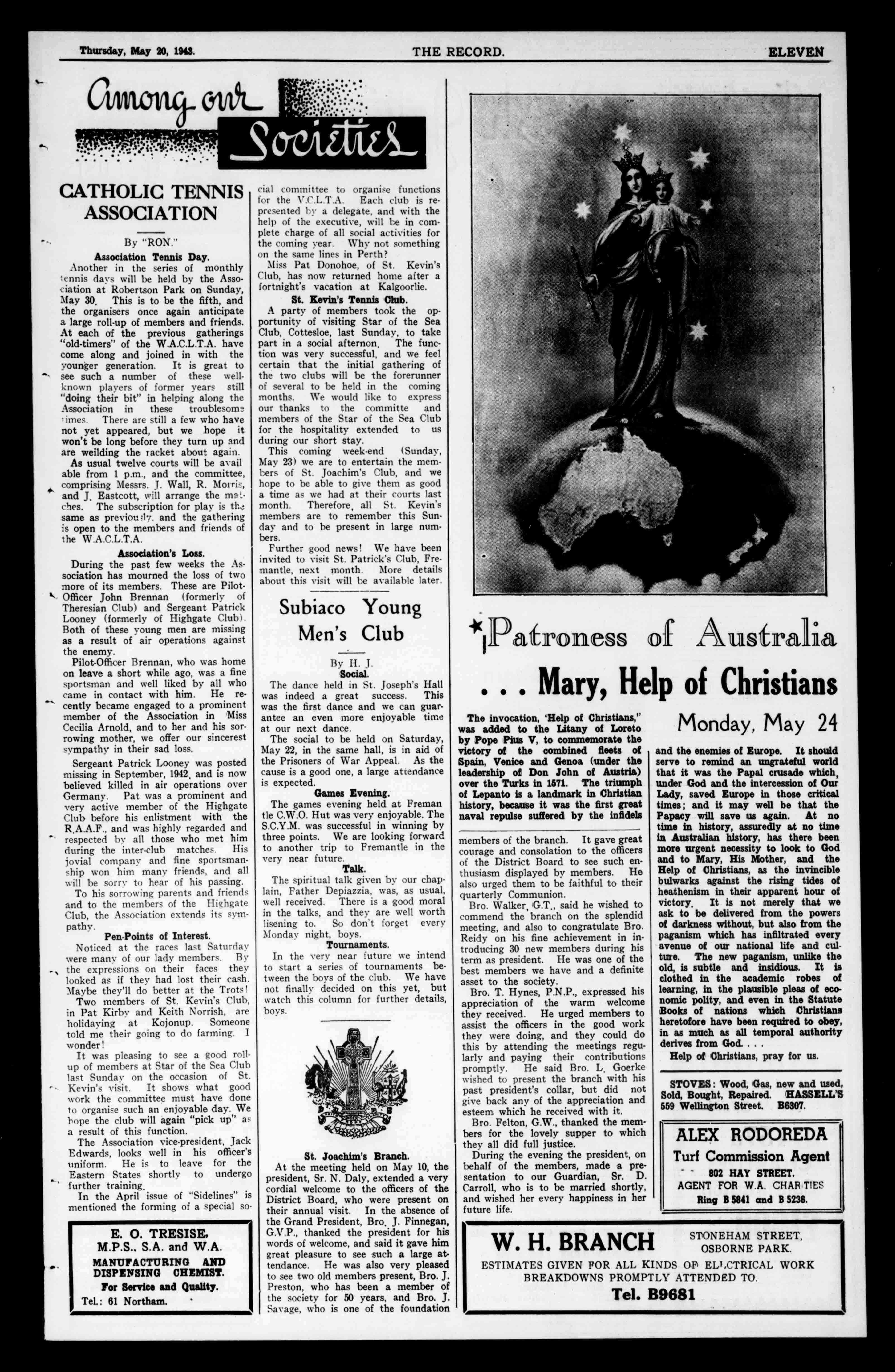
St.Joachim'sBranch.
AtthemeetingheldonMay10,the president,Sr.N.Daly,extendedavery cordialwelcometotheofficersofthe DistrictBoard,whowerepresenton theirannualvisit.Intheabsenceof theGrandPresident,Bro,J.Finnegan, G.V.P.,thankedthepresidentforhis wordsofwelcome,andsaiditgavehim greatpleasuretoseesuchalargeattendance.Hewasalsoverypleased toseetwooldmemberspresent,Bro.J. Preston,whohasbeenamemberof thesocietyfor50years,andBro.J. Savage,whoisoneofthefoundation
VafronessofAustralia
...Mary,HelpofChristians
Theinvocation,'HelpofChristians,' wasaddedtotheLitanyofLoreto byPopePiusV,tocommemoratethe victoryofthecombinedfleetsof Spain,VeniceandGenoa(underthe leadershipofDonJohnofAustria) overtheTurksin1571.Thetriumph ofLepantoisalandmarkinChristian history,becauseitwasthefirstgreat navalrepulsesufferedbytheinfidels membersofthebranch.Itgavegreat courageandconsolationtotheofficers oftheDistrictBoardtoseesuchenthusiasmdisplayedbymembers.He alsourgedthemtobefaithfultotheir quarterlyCommunion.
Bro.Walker,G.T,,saidhewishedto commendthebranchonthesplendid meeting,andalsotocongratulateBro. Reidyonhisfineachievementinintroducing30newmembersduringhis termaspresident.Hewasoneofthe bestmemberswehaveandadefinite assettothesociety.
Bro.T.Hynes,P.N.P.,expressedhis appreciationofthewarmwelcome theyreceived.Heurgedmembersto assisttheofficersinthegoodwork theyweredoing,andtheycoulddo thisbyattendingthemeetingsregularlyandpayingtheircontributions promptly.HesaidBro.L.Goerke wishedtopresentthebranchwithhis pastpresident'scollar,butdidnot givebackanyoftheappreciationand esteemwhichhereceivedwithit.
Bro.Felton,G.W.,thankedthemembersforthelovelysuppertowhich theyalldidfulljustice.
Duringtheeveningthepresident,on behalfofthemembers,madeapresentationtoourGuardian,Sr,D. Carroll,whoistobemarriedshortly, andwishedhereveryhappinessinher futurelife.
W.H.BRANCH
Monday,May24
andtheenemiesofEurope.Itshould servetoremindanungratefulworld thatitwasthePapalcrusadewhich, underGodandtheintercessionofOur Lady,savedEuropeinthosecritical timesanditmaywellbethatthe Papacywillsaveusagain.Atno timeinhistory,assuredlyatnotime inAustralianhistory,hastherebeen moreurgentnecessitytolooktoGod andtoMary,HisMother,andthe HelpofChristians,astheinvincible bulwarksagainsttherisingtidesof heathenismintheirapparenthourof victory.Itisnotmerelythatwe asktobedeliveredfromthepowers ofdarknesswithout,butalsofromthe paganismwhichhasinfiltratedevery avenueofournationallifeandcul ture.Thenewpaganism,unlikethe old,issubtleandinsidious.Itis clothedintheacademicrobesof learning,intheplausiblepleasofeconomicpolity,andevenintheStatute BooksofnationswhichChristians heretoforehavebeenrequiredtoobey, inasmuchasalltemporalauthority derivesfromGod.
HelpofChristians,prayforus.
STOVES:Wood,Gas,newandused, Sold,Bought,Repaired.HASSELL'S 559WellingtonStreet.136307.
ALEXRODOREDA
TurfCommissionAgent -- 802HAYSTREET.
AGENTFORW.ACHAPTT.;' RingB5841andB5236.
STONEHAMSTREET, OSBORNEPARK.
ESTIMATESGIVENFORALLKINDSOPEL',CTRICALWORK BREAKDOWNSPROMPTLYATTENDEDTO.
Tel.B9681
Thursday,May20,1943.
RECORD. ELEVEN
THE
Mrs
NovenaforHolyFather'sIntentions.
Allparishionersareinvitedtotake partintheNovenawhichisbeing madebytheLegionofMaryActiyi andAuxiliary)inhonourofMary, MotherofGod,fortheintentionsof ourHolyFatherthePope.
TheNovenawillcommenceonFriday,May21,andcontinueuntilSunday,May30,andwillconsistofRosaryandBenedictionoftheBlessed Sacramentnightlyat7.30atSt. Mary's.Allareurgedtoattenddaily MassasfrequentlyaspossibleinadditionduringtheNovena.
Thefortnightlymeetingwillbeof greaterinterestthanusual,asnominationofofficersfortheensuingsix monthswillbeheld,theelectionstakingplaceafortnightlater.Allmembersareaskedtoattendonthisoccasion.Keeninterestshouldbeinevidence,astheretiringofficerswillnot heeligibleattheforthcomingelection onaccountofhavingheldofficefor twoterms.
St.Michael'sSchool(Conventof Mercy).
AttherecentChrysanthemumShow heldinBoulder,thepupilsofSt. Michael'sSchool.Kalgoorlie,were successfulintheSingingandElocution Competitions,gainingallfirstprizes.
Under16,SoloSinging,"BlessThis House,"MissBerylMcKenna.Under 16,"Elocution,"WaratahandWattle," MissesFlorenceHughesandPeggy Hendry(tie).Under10,Elocution, "LittleBoyBlue."MissBettyBarclay. Theprizeiseachcasewas10/6.Congratulationstoboth pupilsand teachers.
MembershipDriveforParish Sodalities.
Adrivewillbemadeinthenextfew weekstoinduceparishionersnotin sodalitiestojoinupassoonaspossible.ThemainconditionofmembershipineachisthemonthlyattendanceatHolyCommunion,eveningdevotionsandmeeting.
TheSacredHeartSodalitymeetson thefirstSundayofeverymonth;the HolyNameSocietyonthesecond, andtheChildrenofMaryonthethird Sunday.Allarerichlyendowedwith indulgenceswhentheconditionsof membershiparecarriedoutproperly. Personsdesirousofjoiningshouldcon. tactthesecretariesassoonaspossible, withaviewtobeingincludedwhen thenextconsecrationtakesplace.
WANTEDTOBUY:Stoves,Wood andGas;OldRoofIron,Coppers, Heaters,etc.BestPricesPaid.B630'7.
'Phone:B7777
REGISTEREDW.A.T.A.
(oftesloe
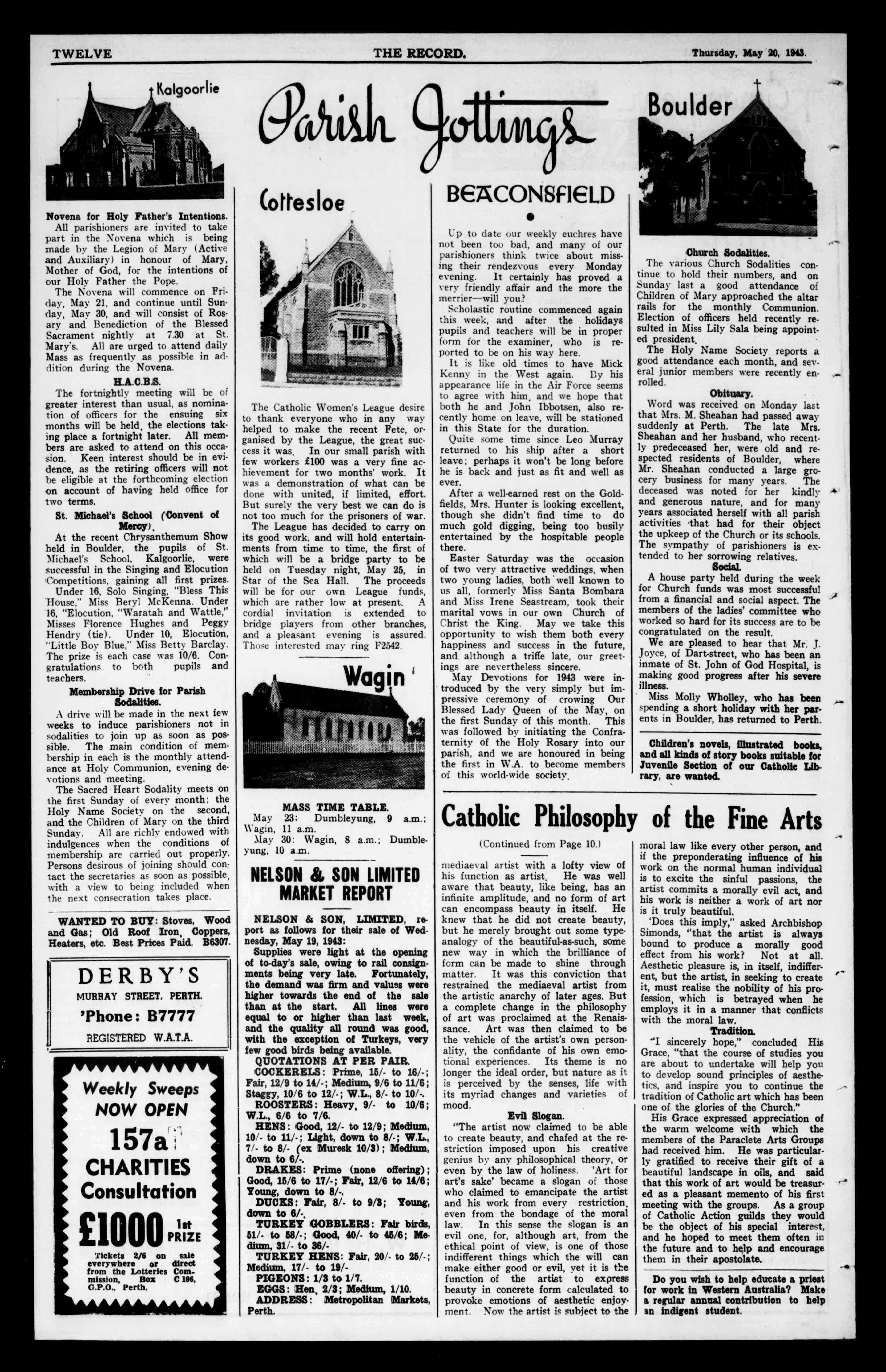
TheCatholicWomen'sLeaguedesire tothankeveryonewhoinanyway helpedtomaketherecentFete,organisedbytheLeague,thegreatsuccessitwas.Inoursmallparishwith fewworkers£100wasaveryfineachievementfortwomonths'work.It wasademonstrationofwhatcanbe donewithunited,iflimited,effort. Butsurelytheverybestwecandois nottoomuchfortheprisonersofwar.
TheLeaguehasdecidedtocarryon itsgoodwork,andwillholdentertain. mentsfromtimetotime,thefirstof whichwillbeabridgepartytobe heldonTuesdaynight,May25,in StaroftheSeaHall.Theproceeds willbeforourownLeaguefunds, whichareratherlowatpresent.A cordialinvitationisextendedto bridgeplayersfromotherbranches, andapleasanteveningisassured. ThoseinterestedmayringF2542.
BEACONSFIELD S
Uptodateourweeklyeuchreshave notbeentoobad,andmanyofour parishionersthinktwiceaboutmissingtheirrendezvouseveryMonday evening.Itcertainlyhasproveda veryfriendlyaffairandthemorethe merrier-willyou?
Scholasticroutinecommencedagain thisweek,andaftertheholidays pupilsandteacherswillbeinproper formfortheexaminer,whoisreportedtobeonhiswayhere.
ItislikeoldtimestohaveMick KennyintheWestagain.Byhis appearancelifeintheAirForceseems toagreewithhim,andwehopethat bothheandJohnIbbotsen,alsorecentlyhomeonleave,willhestationed inthisStatefortheduration.
QuitesometimesinceLeoMurray returnedtohisshipafterashort leave;perhapsitwon'tbelongbefore heisbackandjustasfitandwellas ever.
Afterawell-earnedrestontheGoldfields,Mrs.Hunterislookingexcellent, thoughshedidn'tfindtimetodo muchgolddigging,beingtoobusily entertainedbythehospitablepeople there.
EasterSaturdaywastheoccasion oftwoveryattractiveweddings,when twoyoungladies.both'wellknownto usall,formerlyMissSantaBombara andMissIreneSeastream,tooktheir maritalvowsinourownChurchof ChristtheKing.Maywetakethis opportunitytowishthembothevery happinessandsuccessinthefuture, andalthoughatriflelate,ourgreetingsareneverthelesssincere.
MayDevotionsfor1943wereintroducedbytheverysimplybutimpressiveceremonyofcrowingOur BlessedLadyQueenoftheMay,on thefirstSundayofthismonth.This wasfollowedbyinitiatingtheConfraternityoftheHolyRosaryintoour parish,andwearehonouredinbeing thefirstinW.A.tobecomemembers ofthisworld-widesociety,
MASSTIMETABLE.
May23:Dumbleyung,9a.m.; Wagin,11a.m.
May30:Wagin,8a.m.Dumbleyung,10a.m.
NELSON
diSONLIMITED MARKETREPORT
NELSON&SON,LIMITED,reportasfollowsfortheirsaleofWednesday,May19,1943: Supplieswerelightattheopening ofto-day'ssale,owingtorailconsignmentsbeingverylate.Fortunately, thedemandwasfirmandvalueswere highertowardstheendofthesale thanatthestart.Alllineswere equaltoorhigherthanlastweek, andthequalityallroundwasgood, withtheexceptionofTurkeys,very fewgoodbirdsbeingavailable.
QUOTATIONSATPERPAIR.
COCKERELS:Prime,15/-to16/-; Fair,12/9to14/-;Medium,9/6to11/6; Staggy,10'6to12/-;W.L.,8/-to10/-.
ROOSTERS:Heavy,9/-to10/6; W.L.,6/6to7/6.
HENSGood,12/-to12/9;Medium, 10-to11/-;Light,downto8/-;W.L., 7-to8/-(exMuresk10/3)Medium, downto6/-.
DRAKES:Prime(noneoffering); Good,15/6to17/-;Fair,12/6to14/8; Young,downto13/..
DUCKS:Fair,8/-to9/8;Young, downto6/-.
TURKEYGOBBLERS:Fairbirds, 51/-to58/-;Good,40/-to45/6;Medium,31-to36/-
TURKEYHENS:Fair,20`-to25/-; Medium,17/-to19/-
PIGEONS:1/3to1/7.
EGGS:Hen,2/3;Medium,1/10.
ADDRESS:MetropolitanMarkets, Perth.
ChurchSodalities.
ThevariousChurchSodalitiescontinuetoholdtheirnumbers,andon Sundaylastagoodattendanceof ChildrenofMaryapproachedthealtar railsforthemonthlyCommunion. ElectionofofficersheldrecentlyresultedinMissLilySalabeingappointedpresident.
TheHolyNameSocietyreportsa goodattendanceeachmonth,andseveraljuniormemberswererecentlyenrolled.
Obituary.
WordwasreceivedonMondaylast thatMrs.M.Sheahanhadpassedaway suddenlyatPerth.ThelateMrs. Sheahanandherhusband,whorecentlypredeceasedher,wereoldandrespectedresidentsofBoulder,where Mr.Sheahanconductedalargegrocerybusinessformanyyears.The deceasedwasnotedforherkindly andgenerousnature,andformany yearsassociatedherselfwithallparish activities'thathadfortheirobject theupkeepoftheChurchoritsschools. Thesympathyofparishionersisextendedtohersorrowingrelatives.
Social.
Ahousepartyheldduringtheweek forChurchfundswasmostsuccessful fromafinancialandsocialaspect.The membersoftheladies'committeewho workedsohardforitssuccessaretobe congratulatedontheresult.
WearepleasedtohearthatMr.J. Joyce,ofDart-street,whohasbeenan inmateofSt.JohnofGodHospital,is makinggoodprogressafterhissevere illness.
MissMollyWholley,whohasbeen spendingashortholidaywithherparentsinBoulder,hasreturnedtoPerth.
Children'snovels,illustratedbooks, andallkindsofstorybookssuitablefor JuvenileSectionofourCatholicLibrary,arewanted.
CatholicPhilosophyoftheFineArts
(ContinuedfromPage10.1 mediaevalartistwithaloftyviewof hisfunctionasartist.Hewaswell awarethatbeauty,likebeing,hasan infiniteamplitude,andnoformofart canencompassbeautyinitself.He knewthathedidnotcreatebeauty, buthemerelybroughtoutsometypeanalogyofthebeautiful-as-such,some newwayinwhichthebrillianceof formcanbemadetoshinethrough matter.Itwasthisconvictionthat restrainedthemediaevalartistfrom theartisticanarchyoflaterages.But acompletechangeinthephilosophy ofartwasproclaimedattheRenaissance.Artwasthenclaimedtobe thevehicleoftheartist'sownpersonality,theconfidanteofhisownemotionalexperiences.Itsthemeisno longertheidealorder,butnatureasit isperceivedbythesenses,lifewith itsmyriadchangesandvarietiesof mood.
EvilSlogan.
"Theartistnowclaimedtobeable tocreatebeauty,andchafedattherestrictionimposeduponhiscreative geniusbyanyphilosophicaltheory,or evenbythelawofholiness.'Artfor art'ssake'becameasloganofthose whoclaimedtoemancipatetheartist andhisworkfromeveryrestriction, evenfromthebondageofthemoral law.Inthissensethesloganisan evilone,for,althoughart,fromthe ethicalpointofview,isoneofthose indifferentthingswhichthewillcan makeeithergoodorevil,vetitisthe functionoftheartisttoexpress beautyinconcreteformcalculatedto provokeemotionsofaestheticenjoyment.Nowtheartisti,subjecttothe
morallawlikeeveryotherperson,and ifthepreponderatinginfluenceofhis workonthenormalhumanindividual istoexcitethesinfulpassions,the artistcommitsamorallyevilact,and hisworkisneitheraworkofartnor isittrulybeautiful.
'Doesthisimply,"askedArchbishop Simonds,"thattheartistisalways boundtoproduceamorallygood effectfromhiswork?Notatall. Aestheticpleasureis,initself,indifferent,buttheartist,inseekingtocreate it,mustrealisethenobilityofhisprofession,whichisbetrayedwhenhe employsitinamannerthatconflicts withthemorallaw.
Tradition.
"Isincerelyhope,"concludedHis Grace,"thatthecourseofstudiesyou areabouttoundertakewillhelpyou todevelopsoundprinciplesofaesthetics,andinspireyoutocontinuethe traditionofCatholicartwhichhasbeen oneofthegloriesoftheChurch."
HisGraceexpressedappreciationof thewarmwelcomewithwhichthe membersoftheParacleteArtsGroups hadreceivedhim.Hewasparticularlygratifiedtoreceivetheirgiftofa beautifullandscapeinoils,andsaid thatthisworkofartwouldbetreasuredasapleasantmementoofhisfirst meetingwiththegroups.Asagroup ofCatholicActionguildstheywould betheobjectofhisspecialinterest, andhehopedtomeetthemoftenit: thefutureandtohelpandencourage themintheirapostolate.
Doyouwishtohelpeducateapriest forworkinWesternAustralia?Make aregularannualcontributiontohelp onindigentstudent.
TWELVE THERECORD. Thursday,May20,1943.
DERBY'S MURRAYSTREET,PERTH.
WeeklySweeps NOWOPEN 157a CHARITIES Consultation £10001st PRIZE Pickets2/6onsale everywhereordirect fromtheLotteriesCommission, Box C106, C.P.O.,Perth.
ThePatronSaintofNurses
*FounderofRedCross CamillusofLellis AnotherSoldier,wholikeJohnofGod,
Fromanarticlein"TheCatholic Nurse"(England).CamillusofLellis wasthe truefounderoftheRedCrossandplayedaveryimportantpartinthedevelopmentofthemodernNursing-spirit inhospital,inthehomesofthesick, inprisons,inshipsandonthefieldof battle.
TherewasnothingofthePrelimanaryTraining-schooltopreparehimfor hisnursing.HewasbornnearNaples in1550. Hisparentscameofgood familiesandthenameisanhonourable one.Hisfather,thoughafinesoldier, hadbroughtbothpovertyanddisgrace throughtheviceofgambling,whichhe neverconqueredaslongashelived.
SoldierandGambler.
Camilluslosthisbotherwhenhewas twelveyearsold,buthehadbeen abletoinstilintothisratherdifficult ladasolidFaithandsomehabitof Prayer.TheschoolingofCamillus wasnotverygreatbut,atleast,hehad learnedtoreadandwritebeforethe restlessspiritwhichhehadinherited fomhisfatherasserteditself.No doubthehadbeeninspiredbythe talestoldofhisfather'sadventuresfirst,inonehiredarmy;then,inanother-for,attheageof17,hejoined him.Camillustooktothelifequicklyenoughandsoonwasanexcellent soldier,butsharedwithhisfatherthe reputationforgambling. They joinedoneregimentbecauseofitsreputationforgambling.Excellentsoldiersthoughtheywere,themadcraze forgamblingunderminedthediscipline wherevertheywere.
NursedChristinHisSick
tendtohisleginreturnforhisown servicesintheHospital,Thearrangementworkedwellforatime,until temptationcameandhebegantogamble.Thefeverspreadthroughthe Hospital,withhadeffectsonwo,, andtempers.Camilluswasfoundto heresponsibleanddismissed.There seemednothingforhimbutthearmy and,infiveyears,hesawservicein SpainandNorthAfricauntil,atlast, theforcetowhichhebelongedcame backtoNaplestobedisbandedinrags andwithnoequipment,fortheyhad sufferedmuchandhadbeengivenup aslostatsea.
Hewas25whenhismilitarycareer cametoanend,buthewasinsuch straitsthatheandhiscompanionhad tobeguntilsomethingshouldturnup. Insheerdesperation,heacceptedthe offerofajoboflabouringanddriving apack-muletoanewMonasterywhich wasbeingbuilt. Then,suddenly, Camillusreturnedtohisoddjobson thebuilding..
wardofthosewhodevotedtheirlives tothenursingofthesick.IntheHospitalswhichwerenolongerjoinedto aReligioushouse.Camillussawclearly thatthisspirithadtoberegainedif theworkwastobeticcessi!'ul,forhe foundhimself--asDirectoruitheHospital-thattheslothofthepaidnurses hadprovedagreatobstacletothe workhedesiredtodo.Naturally enough,hetriedtogatherroundhima fewofthemenwithsimilarideals,and hefoundhalfi-a-dozillbuthesaw hisschemewouldnotwork,especially inregardtothecareforthedying,unlesshebecameaPriesthimselftosee totheirspiritualneeds.HehadbeguntolearnsomeLatinwiththeHospitalChaplainandjoinedtheRoman College,runbytheJesuitFathers,to prepareforordination,Wasitsurprisingthatthisex-soldier,oversix foottalland32yearsofage,wascalled "TheLateArrival?"
setupinItalytoprovideforHospitalsforthesickathomeandinthe prisons.Thespecialcareforthedying andthepreparationtheymadefor theirpatientstoreceivetheLastSacramentsearnedfortheCompanythe titleof"BrothersofaHappyDeath.-
..Thispartnershipoffatherand sonwasdissolvedwhenbothfellillthefather,soseriouslythathedied. Camillushadthisconsolationthathe wasabletoobtaintheLastSacramentsforhisfather,whomheprepared toreceivethemwithtruepenitence andresignation.Thiswasthebeginningofthatdevotiontothedying whichhasresultedinhisownname beingincludedasaPatronSaintto beinvokedintheshortLitanyforthe Dying. Hisfather'sdeathmadeadeepimpressionontheyouth.Hevowedhe wouldbecomeaFranciscanandsetout insearchofanunclewhowasamemberofthatOrderandaskedtolieadmittedasalay-brother.Scarcelya likelycandidate,youwouldthink,but theyhadtorefusehim,onaccountof arunningsoreinhisleg-theresultof aslightwoundwhichneverhealed.The monkspromisedtotakehimwhenhis legwasbetter,sooffhewenttoRome totheHospitalfortheIncurable,that ofS.James,andaskedthattheyshould
Steadyworkandamoresettledlife helpedhimtocometoadecisionand heaskedoncemoretobeadmittedas alay-brother.Hisleg,whichhad beenmuchbetter,immediatelygrew worse,andhewascompelledtoask againattheHospitalofS.Jamesfor re-admissionontheformerterms.This time,hisconductgavecompletesatisfactionand,afteratime,hewasappointedDirectoroftheHospitalwhile he,himself.cameundertheinfluence andcareofthatmostgentleandunderstandingdirectorofsouls,S.Philip Neri.
Imaginetheworkingconditionsofa Hospitalin1580andcomparethem withthoseofto-day-whichoftenare considereddifficultenough;thelong hoursofworkandtheendlesstasksof averysmallstaff,recruitedfromany availablesource;nomodernconvenienceswhichhavemadetheNurses' worklighter:nodressingssuchasare usedto-day:patientsbroughtinfrom thestreets,absolutelyfilthyandabandoned,todiefromsheerneglectduring aplague.ThinkofCamillus,himself, carryingonfor46yearswiththat woundinhisleg,arupturefor38 years,andabscessesonthesoleofhis footwhile,forthelasttwoandahalf years,everythingwhichheatemade himsick.Asifthiswasnotenough, heworeahair-shirtandabrassgirdle.
OrdainedatRome.
ThereisnoneedtoremindNurses thatthefirstHospitalssprangfrom theReligioushousesandthatthelove ofGodwasthesolemotiveandre-
SaintPatrick'sCollege,Geraldton
CONDUCTEDBYTHECHRISTIANBROTHERS.
ARESIDENTIALCOLLEGEFORBOYSVACANCIESFORBOARDERS.
SituatedontheheightsofGeraldton,closetothebeach, inanidealclimateforgrowingboys.
TheCourseofStudyembracesallusualsubjectstaught inPrimaryandSecondarySyllabus,frontSecondStandard toLeavingCertificate.
TheCollegeisaRegisteredSecondarySchool.
SECONDTERMCOMMENCESMAY25th.
ProspectusonapplicationtothePrincipal,ChristianBrothers'College,P.O.Box150,Geraldton. 'Phone172.
Onceapriest,hewasgivenachaplaincyandgatheredtogetherhisfollowerswhowouldpooltheirmoneyand, livingacommunitylife,goeveryday totheHospitaloftheHolyGhostto careforthesickor,betterstill,tolive uptotheiridealwhichwasnoneother thanthatornursingChristinHis sick.Hewasabletotakeahouseas theheadquartersofhisServantsofthe Sick,and,fittinglyenough,itwasin theworstquarterofRome-downby theTiber-wherethepestilenceraged mostfuriously.Whatthismeantyou canjudgefromthefactthatatone time,inandaroundRome,60,000peoplediedfromit.Nowonderthat Camillussawthatoftentheworsecases neverreachedhospitalsandthatpeopleneededattentionmoreathome, wheretheywereoftenjustabandoned whenitwasevidentthatnomore couldbedoneforthem.HisCom pangtookthethreevowsoftheReligiouslifeandaddedafourth,ofdevotingthemselvestothesickwherever theycouldfindthemandthespiritof theirOrder,itscharacteristic,wasin theirdevotiontothedying,especially thosesufferingfromtheplague.
ItwasCamillus,himself,whoinsisted onsuchcareforthedying,instructing hisfollowersandhimselfmakingcollectionsofprayersandsuggestions whichwouldbethegreatesthelpin theirlastagony.Hewasfondofteachingthemshortejaculatoryprayersand ofhelpingthemineverywayhecould toprepareforagoodConfessionand theLastSacraments,Therewasnever anyonetooabandonedforCamillus; othersmightthinkhimfoolishbuthe hadlivedatoughlifeandheknewwhatismore,heunderstood-Our Lordsloveforthosepatients.Itwas fittingthatheshouldbecalleduponto helpsoldiersand,in1595to1601,Clementsentsomeofhisfollowerswith thePapaltroopsintobattleinHungaryandCroatia.ThuswastheRed Crossseenonthefieldofbattleandhis menformedthefirstFieldAmbulance. Thiswastwohundredandsixtyyears beforeDunant's"SouvenirofSoiferino"andtheorganisationoftheInternationalRedCross.
NursingChristinHisSick.
BadgeoftheRedCross. Onlytwoyearsafterhisordination, theSocietywhichhehadsetupwas givenofficialapprovalbythePope,on June26,1586,and,threedayslater,he andhiscompanionswenttoSt.Peter's wearingtheRedCrossoncassockand cloakastheapprovedbadgeoftheir Order.Withinanothertwoyears, theywereestablishedatNaples,and here,thefirsttwogavetheirlivesnursingthesickinthegalleyslyinginquarantinethere,fullofmensufferingfrom -eplague.Theirwonderfulworkin theplagueof1591-whenthesixty thousanddiedwasrewardedbythe Popegrantingthemtherankandthe privilegesenjoyedbytheMendicant Orders.BeforetheSaint'sdeath,in 1614.alreadymanyhouseshadbeen
This,then,isCamillusofLellis, whomPopePiusXIproclaimedthe PatronofNursesandNursingAssociations:LeoXIIIhadalreadydeclared him,withSt.JohnofGod,patronof thesickandhehadbeencanonisedby BenedictXIVin1746.Thinkofhim thenasanythingbut"abornsaint"solovable,inthatweaknessforgamblingandtheconstantputtingoffofthe standardoflifeheknewwasexpected ofhim!Thegreatroughsoldierbe camethegentlestofnurses,alikeinhis careforthetiniestbabeorthemost hardenedcriminal.Theinveterate gambler,convertedyetalwaysinwant, stillknowingnolimit,givinghimself andallhepossessedtothesick;equallybraveasasoldierornurse;inthe mostwretchedhealth,withfiveillnessesinadditiontotheconstanttroubleoftheoldwound,theruptureand theabscessesinhisfoot.Heslept solittle:hehadtofindtimeforhis sickandhisprayers.Andpicturehim inthoselastyearsofhislife,amere frameofskinandbone,continually sick,unabletostand,literallycrawling tothebedsofthedying,ifunableto movefromhisownbed,thenwriting tothemandforthem.Howcouldhe manageit,howdidhisworkbeccrme suchasuccessandhisOrderflourish, evenwhenhehaddied?Quitesimply-becausehenursedChristinHis Sick.Ifyouwouldknowtheorigin andthesecret,too,oftheRedCross, youwillfinditintheejaculationthat wasonhislipsafewmomentsbefore hedied:"MostPreciousBlood!""IrishNursingNews."
Thursday,May20,1943. THERECORD. THIRTEEN O.,
PrintingHousesofA.D.SCOTT FORFINEPRINTING ServicePrintingCo. CITYANDSURBURBANPRINTING00. LISTOCRAFTPOSTERSTUDIOS. RAINBOWHOUSZ.183-7HAYST.(BAST)MITE ServingAllColleges'PrintingRequirements. TelephoneB9901(3lines) Res.U2389
heCatholicAnswer
ContinuedI14,111Page3 homesaskingforshelter,IthinkHe wouldberefused.PerhapsIam viewingthewrongangleofavocation,butIwouldcertainlybepleased togetaclearreply."
A.:Idothinkyouhadthewrong angleonavocation,butIhopethat whatIhavesaidhasmadeChrist's teachingclear.Andastowhether
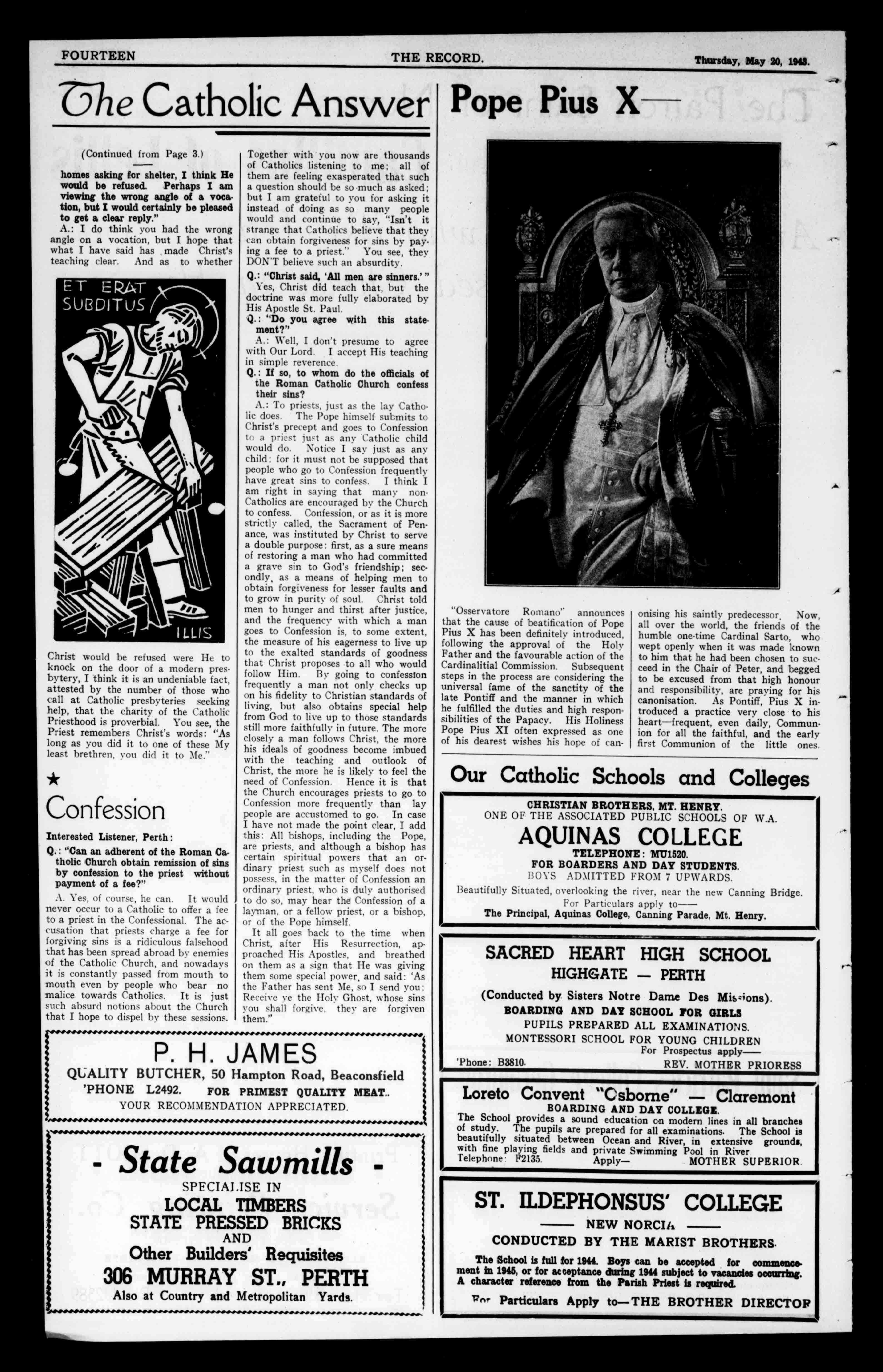
ChristwouldberefusedwereHeto knockonthedoorofamodernpres- bytery,Ithinkitisanundeniablefact, attestedbythenumberofthosewho callatCatholicpresbyteriesseeking help,thatthecharityoftheCatholic Priesthoodisproverbial.Yousee,the PriestremembersChrist'swords:"As longasyoudidittooneoftheseMy leastbrethren,youdidittoMe"
Confession
InterestedListener,Perth
Q.:"CananadherentoftheRomanCatholicChurchobtainremissionofsins byconfessiontothepriestwithout paymentofafee?"
A.Yes,ofcourse,hecan.Itwould neveroccurtoaCatholictoofferafee toapriestintheConfessional.Theaccusationthatpriestschargeafeefor forgivingsinsisaridiculousfalsehood thathasbeenspreadabroadbyenemies oftheCatholicChurch,andnowadays itisconstantlypassedfrommouthto mouthevenbypeoplewhobearno malicetowardsCatholics.Itisjust suchabsurdnotionsabouttheChurch thatIhopetodispelbythesesessions.
Togetherwithyounowarethousands ofCatholicslisteningtome;allof themarefeelingexasperatedthatsuch aquestionshouldbesomuchasasked; butIamgratefultoyouforaskingit insteadofdoingassomanypeople wouldandcontinuetosay,"Isn'tit strangethatCatholicsbelievethatthey canobtainforgivenessforsinsbypayingafeetoapriest."Yousee,they DON'Tbelievesuchanabsurdity.
Q.:"Christsaid,'Allmenaresinners.'" Yes,Christdidteachthat,butthe doctrinewasmorefullyelaboratedby HisApostleSt.Paul.
Q.:"Doyouagreewiththisstate went?"
A.:Well,Idon'tpresumetoagree withOurLord.IacceptHisteaching insimplereverence.
Q.:Ifso,towhomdotheofficialsof theRomanCatholicChurchconfess theirsins?
A.: priests,justasthelayCatholicdoes.ThePopehimselfsubmitsto Christ'spreceptandgoestoConfession toapriestjustasanyCatholicchild woulddo.NoticeIsayjustasany child;foritmustnotbesupposedthat peoplewhogotoConfessionfrequently havegreatsinstoconfess.IthinkI amrightinsayingthatmanynonCatholicsareencouragedbytheChurch toconfess.Confession,orasitismore strictlycalled,theSacramentofPenance,wasinstitutedbyChristtoserve adoublepurpose:first,asasuremeans ofrestoringamanwhohadcommitted agravesintoGod'sfriendship;secondly,asameansofhelpingmento obtainforgivenessforlesserfaultsand togrowinpurityofsoul.Christtold mentohungerandthirstafterjustice, andthefrequencywithwhichaman goestoConfessionis,tosomeextent, shemeasureofhiseagernesstoliveup totheexaltedstandardsofgoodness thatChristproposestoallwhowould followHim.Bygoingtoconfession frequentlyamannotonlychecksup onhisfidelitytoChristianstandardsof living,butalsoobtainsspecialhelp fromGodtoliveuptothosestandards stillmorefaithfullyinfuture.Themore closelyamanfollowsChrist,themore hisidealsofgoodnessbecomeimbued withtheteachingandoutlookof Christ,themoreheislikelytofeelthe needofConfession.Henceitisthat theChurchencouragesprieststogoto Confessionmorefrequentlythanlay peopleareaccustomedtogo.Incase Ihavenotmadethepointclear,Iadd this:Allbishops,includingthePope, arepriests,andalthoughabishophas certainspiritualpowersthatanordinarypriestsuchasmyselfdoesnot possess,inthematterofConfessionan ordinarypriest,whoisdulyauthorised todoso,mayheartheConfessionofa layman,orafellowpriest,orabishop, orofthePopehimself. Itallgoesbacktothetimewhen Christ,afterHisResurrection,approachedHisApostles,andbreathed onthemasasignthatHewasgiving themsomespecialpower,andsaid:'As theFatherhassentMe,soIsendyou; ReceiveyetheHolyGhost,whosesins youshallforgive,theyareforgiven them."
P.H.JAMES
QUALITYBUTCHER,
"OsservatoreRomano".announces thatthecauseofbeatificationofPope PiusXhasbeendefinitelyintroduced, followingtheapprovaloftheHoly Fatherandthefavourableactionofthe CardinalitialCommission.Subsequent stepsintheprocessareconsideringthe universalfameofthesanctityofthe latePontiffandthemannerinwhich hefulfilledthedutiesandhighresponsibilitiesofthePapacy.HisHoliness PopePiusXIoftenexpressedasone ofhisdearestwisheshishopeofcan-
onisinghissaintlypredecessor.Now, allovertheworld,thefriendsofthe humbleone-timeCardinalSarto,who weptopenlywhenitwasmadeknown tohimthathehadbeenchosentosucceedintheChairofPeter,andbegged tobeexcusedfromthathighhonour andresponsibility,areprayingforhis canonisation.AsPontiff,PiusXintroducedapracticeveryclosetohis heart-frequent,evendaily,Communionforallthefaithful,andtheearlyfirstCommunionofthelittleones.
OurCatholicSchoolsandColleges
CHRISTIANBROTHERS,MT.HENRY.
ONEOFTHEASSOCIATEDPUBLICSCHOOLSOF\V.A. AQUINASCOLLEGE
TELEPHONE:MU1520.
FORBOARDERSANDDAYSTUDENTS.
liOVSADMITTEDFROM7UPWARDS. BeautifullySituated,overlookingtheriver,nearthenewCanningBridge. ForParticularsapplytoThePrincipal,AquinasCollege,CanningParade.Mt.Henry.
SACREDHEARTHIGH
SCHOOL
HIGHGATE-PERTH (ConductedbySistersNotreDameDesMis4ions).
BOARDINGANDDAYSCHOOLFORGIRLS
PUPILSPREPAREDALLEXAMINATIONS.
'Phone:B3810.
MONTESSORISCHOOLFORYOUNGCHILDREN ForProspectusapplyREV.MOTHERPRIORESS
LoretoConvent"Osborne"-Claremont BOARDINGANDDAYCOLLEGE.
TheSchoolprovidesasoundeducationonmodernlinesinallbranches ofstudy.Thepupilsarepreparedforallexaminations.TheSchoolis beautifullysituatedbetweenOceanandRiver,inextensivegrounds, withfineplayingfieldsandprivateSwimmingPoolinRiver felephoneF2135. Apply- MOTHERSUPERIOR
ST.ILDEPHONSUS'COLLEGE
NEWNORClis.
CONDUCTEDBYTHEMARISTBROTHERS.
TheSchoolisfullfor1944.Boyscanbeacceptedforcommence- mentin1945,orforacceptanceduring1944subjecttovacanciesoccurring. AcharacterreferencefromtheParishPriestisrequired. ParticularsApplyto-THEBROTHERDIRECTOR
FOURTEEN THERECORD. Thursday,May20,1943.
FORPRIMESTQUALITYMEAT.. YOURRECOMMENDATIONAPPRECIATED. -StateSawmillsSPFCIAJ.ISEIN LOCALTIMBERS STATEPRESSEDBRICKS AND OtherBuilders'Requisites 306MURRAYST.,PERTH AlsoatCountryandMetropolitanYards.
50HamptonRoad,Beaconsfield 'PHONEL2492.
PopePiusX
AA A ono
CatholicHeroes
BlackandWhite
After16monthsontheNewGuineafront,duringwhichhemarched withAustraliansoldiersovertheOwenStanleyRangeandonto Hokoda,BunaandSanananda,the2ev,FatherNorbertEarl, M.S:C.,A.I.F.chaplain,isnowbackisAustralia.Thedominant impressionswhichFatherEarlretainsare:
1.Themagnificentprideintheircli'icnexhibitedbyCatholicsoldiers.
2.Thecomfortandconsolationwhichtheirreligionbroughttomortallywoundedmen.
3.Theheroismofthe"Fuzzy-Wurdes"andtheirintensereligiousde votion.
Themajorityofthenativecarriers,saidFatherEarl,weremissiontrainedCatholics.
FatherEarlwasformerlyattached tothemissionatMilneBay,andwhen orderedtoleavethestationwiththe otherwhiteinhabitants,hevolunteeredforchaplain'sdutywiththeA.I.F.
BacktoPapuawentFatherEarl, andfor16monthsheenduredallthe rigoursofclimateandthehardships towhichthemeninhisspiritualcare weresubjected.
Withthefightingmenhespent monthsinthemalaria-infestedjungles, wadingacrossfast-flowingrivers,plungingthroughgullies,andstrugglingup almostprecipitousmountainsides.
DevotionofSoldiers.
"Duringthelongcampaign,"he said. "ourCatholicmenhadfrequentopportunitiesforassistingatNIass.
ACOMPACT, CONCISE, ACTIVESERVICE PRAYERBOOK
PaperCover 9d. KhakiClothCover 2/BlueClothCover 2/LeatherCover 4/6
CompiledbyRev.G.Butler. M.S.C.,andpublishedbyauthorityoftheC.U.S.A..Queensland,thisnewprayerbookfor CatholicSoldiers,Sailorsand Airmenisthebestyetprinted formenintrainingandonactiveservice.
ItcontainsthefullMass,all essentialprayersanddevotions andlistsspecialprivileges. Itoffers,aswell,manypagesof blunt,helpfulandsympathetic advicethatwillbewelcomed byeveryCatholicyoungman allina96-pagepocketsizebookonly41inchesdeep by3incheswide.
& 776HayStreet,Perth oppFoy&Olbson
"Wheneveritwaspossible,theyalso wenttoConfession,andreceivedHoly Communion.
"Iwillneverforgetthosemen,who, aftertoilingandsweatingandfighting,wouldcometomeduringalull andsay,'Father,Iwouldliketogo toConfession.'
"Itmightbesaidthattheyoffered afineexampletothenativeCatholics, butoftenitwastheotherwayabout.
"Thenativeswereremarkablefor theirdevotionto'MassandtheSacraments.
TheBlacksServeMass.
"Afteraday'sheavyworktheywere luckytosnatchafewhours'sleep. YettheywereupwiththedawnwaitingforMass.
"Itwasagrandexample,"said FatherEarl.
"Inthejungletherewerenofacilitiesformuchceremonial.Weused atreeforanaltar,perhapsa-disused tin,or,maybe,abox:butitwasall thesame.ItwasthesameSacrifice celebratedfromtherisingofthesun toitsgoingdown."
"TheCatholicnativeswerealways readyforMass.Theycarriedtheir rosarybeads,anditwasaprivilege forthemtoservetheMasswhilethe whiteslookedon.
"Sometimesitwaspossibletolook aheadandfixadayforMass.andthen thebushtelegraphwassettowork Wordwasdrummedthroughthejungle,andoverthemountains,thatMass wastobecelebrated,andthenatives cameeagerlyfromallthesurrounding villages. Australia'sDebt.
"Australiaowesatremendousdebt tothefaithful'Fuzzy-Wuzzy,'andI amsurethatdebtwillbepaidafter thewar."
FatherEarlsaidsomeofthestories publishedabouthiminAmericawere nottrue,
"Itisamazinghowquicklyrumours becomefacts,"hesaid.
"Ononeoccasionanativerushed uptotellmethatFatherEarlhad beenkilled.Ittooksomeargument toconvincehimthatIwasFather Earl,andthatIwasverymuchalive." -"Tribune."
GOODNEWS,.-ShipmentofGas FiresandBerger'sPaintsjustarrived. W.A.StoveCo.,WellingtonSt.,Perth.
PERTHFISHERIES
459WELLINGTONST.,PERTH.
FISHANDPOULTRYSUPPLIED
WholesaleandRetail.
Phone:B5992 CityDeliveries. CountryOrdersCateredTar.
ROSENSTAMMPTY.LTD.
61,63and65KINGST.,PERTH
TheLeadingLeatherMerchant WESUPPLYANYTHINGINLEATHER SaddleryandHarness,SuitCases,Etc.SuedeSkinsforFancyWork
SOLEAGENTSFOR-
Dr.Scholl'sFootAppliances."Salvitis"StockRemedies,forHorses,Cattle Sheep,Pigs,Poultry,Dogs.FreeBookletonApplication WERESTRINGTENNISRACQUETS
GermansDethroneOur LadyinPoland
InanotherefforttounderminePolishpatriotism-sointimatelyconnectedwiththeCatholicfaith-Dr.Frank, NaziGovernorofPoland,hasordered thatfromtheLitanyofOurLadyall invocationstoOurLadyunderaPolishtitletogetherwiththeprayersto OurLadyofthePolishCrownshallbe omitted.
Underthesamedecreethenamesof PolishSaintsaretobestruckoutof theLitanyofSaints,andallhymns andprayershavingareferencetothe Polishnationareprohibited.
Thedecreereads:
"IdecreethathenceforthintheLitanyofOurLadyallinvocationstoOur LadyunderPolishtitles,includingthe PrayertoOurLady,Queenofthe PolishCrownandintheLitanyofthe Saints,thenamesofthoseSaintsoften describedas"PatronaeRepublicaePolonae,"aretobeexcluded.
"Furthermore,allprayersandhymns thatalludetothenon-existingPolish StatearetobeabolishedandIdirect youtoensurethatallvicarsandcuratesinyourdiocesecarryoutthis decree."
Thedecreealsoorderedanamendmentoftherubricsabolishingreligious festivalswhichhavepatrioticsignificanceinPoland,amongthemth'efeast dayofOurLadyofPoland,onMay3, andthecelebrationoftheresurrection ofPolandonArmisticeDay,November 11.
TheeffectofthisdecreehassustainedthepeoplethroughcenturiesofoppressionbyoccupyingPowersandduringthepastthreeyearsundertheGermansthepersecutedpopulationhave foundinitstrengthandconsolation, particularlythroughdevotiontoOur Ladytowhomthecountryisofficially consecrated,andtothePolishSaints, somanyofwhomdiedfortheirfaith.
ApartfromthegreatPolishSaints whosenamesarehonouredthroughout theCatholicworld,thereareanum-
berofotherswhosecultismoreorless confinedtoPoland,andespeciallyto thedistrictsassociatedwiththeirlives. Thesedistrictsaboundwithshrines whicharethescenesofpilgrimagesand religiousfestivities.
Celebrationsatsuchshrinesarethe objectofattackinthedecreeandthe Germanpurposeistoabolishthemaltogether.ManyoftheSaintsaremen andwomenwholivedinthe13th.century,aperiodnotableforreligiousfervourinPoland.
TherearetwofamousshrinesofOur LadyofthePolishCrown,atCzestochowaandatOstrabrama,nearVilna. HereOurLadyisrepresentedwearing themassivecrownoftheoldkingsof Poland.Theoriginalroyalcrown wasoncewornbythestatueofCzestochowa,butitwasstolenandanother andslightlydifferentcrownsubstitutedlater.
Dr.Frankhasalsodecreedthatthe streetleadingtoOurLady'sshrineat Czestochowa,hithertoknownas"Mary allee,"istoberenamed"AdolfHitler allee,"aspartoftheGermanisationof thetown.-"CatholicTimes"
F.HUFNER
29MABELST.,NORTHPERTH.
TUNESANDREPAIRSPIANOS ANDORGANS.
'PhoneB5824.
RelaxSoapwilltakethehard workoutofwashdaysfor YOU,Relar.isgentleonthe fabricandyourhands;washes clothesasnowywhite;and NOhardrubbingisnecessary.AlwaysuseRELAX
4. Thursday,May20,1943. THERECORD. FIFTEEN
MIITHE5011 LIMITED FORCHEAPERGROCERIES MADEIN -Washdaysare Easier
in YOURwashtub.(Obtainableinthreesizes.) W.A.BYWESTRALIANSOAPSLTD. Insomommommiannannisoniniuncaniummosiumunsimitimmimmizuzninvirsammussownowscuivismwg Lasernsomassionnuar SAVECHARGES! SAVEFREIGHT! ImprovetheValueofyourWoolbyhavingitSCOURED TheSWANWOOLSCOURINGCO. ofW.A.Ltd.Fremantle theoldestbusinessofitskindinthisState,withitsmostefficientmodernplant,employstheverylatestmethodstosecureforclientsbetter returnsfortheirwool. ConsigntoNORTHFREMANTLE,andobtainrebatesof40percent. ofthefreightforallquantitiesoveroneton. Address:BOX2.POSTOFFICE.FREMANTLE. 'Phones:L1031-2 FootComfortGuaranteed BootsandShoes InHalfSizes. A eO1C44 667HayStreet,Perth Ifnecessarywe maketoorder. 'PhoneB1381
WhatRussiaWants
WalterDurantyhaslongbeen knownasafriendofSovietRussia. ForyearsherepresentedtheNew York"Times"inMoscow,andhisdispatchesindicateheheldStalininesteemandthatRussia'sdictator,in turn,heldMr.Durantyinesteem.
InanarticlewrittenfortheNorth AmericanNewspaperAlliance,Mr. Durantyhadsomeinterestingandsignificantthingstosay.HewaswritingonRussia'swaraims.Mr.Durantyplacessomecreditabilityonhis statementsbyremarkingthatontwo occasionshespokewithStalinformore thananhoureachtime.
Mr.Durantyasks:WillRussia driveintoGermanyandraisetheHammerandSickleoverEurope?Heanswers:"Shemay."Shemaybecause oftheatrocitiescommittedbythe NazisintheUkraineandbloodmust bepaidwithblood.Thiswill,Mr. Durantyadds,dependonwhereand howthewarends.Heexplains:"If GermanybreaksbeforetheAmerican andBritisharmieshavegotdeepinto 1
Wm.A.YOUNG FAMILYBUTCHER.
CornerJOHN&FITZGERALD STREETS,PERTH. FORQUALITYMA1E-YOU'LLLOVETOEAT. 'PhoneB1416.
Europe,theRussiansmaybeunableto resistthetemptationofrushingonto Berlin-whichtheyoncetookin1760, asoncealsotheywenttoParisafter Napoleon'sdownfall-withthepossible temptationtoStalin,discipleofLenin, ofmakingallEuroperedunderone Sovietflag....UnlessIammistaken, whatRussiareallywantsisnotconcernedwithEurope.Isupposethat theRussianswillholdtheBaltic Statestoobtainwarm-waterparts. RussiawillwantPetsamo.Russia willalsowantfullaccessto,butnot ownershipof,IstanbulandthePersian Gulf,Thatisasitmaybe,butthere issomethingelse."
Andthisisnotall.Mr.Duranty assertsStalinwantsindependentSovietRepublicsofManchuriaandof KoreaandevenoftheNorth-Western SovietRepublicofSinkiang,Ningsia, andShensi,andnotethis-"whether ChiangKai-sheklikesthatornot."Finally,Mr.Durantyasserts,Stalinwants theLiotangPeninsula,thelostfortress ofPortArthur,thelargeportof Dairen.Inaword,Russiawantsthe WesternPacific-i.e.,thecoastof ChinaandtoruleNorth-eastAsia.And, ofcourse,alargepartofPolandas wellastheBalticnations.
Remember,Mr.DurantyisnoFascist,pro-Nazi,orQuisling,butisa friendofStalinandhasofteninterpretedthelatter'scourseofaction withaccuracy.
WEREYOUONEOFTHELUCKYONESTHISTIME IFNOT,GETYOURTICKETFROMCHARLESWATSON&CO.
70BARRACKSTREET(NextWilsonandJohn's). £1,000FOR2/6.OtherPrizesbytheThousand.
ForLongWear UseOnly
"Gibsonia Wools...
HarvardProfessorSlates Atheism
LeadstoBetrayalofNationand World,HeWarns
Washington.
Contendingthatthepublicschoolsandcollegesshouldencouragestudents"toseekphilosophicalandreligiousteachingoutsidetheir ownwalls,"ProfessorLouisJ.A.Mercier,ofHarvardUniversity, inanaddressbeforetheHampdenCounty(Massachusetts)Teachers' Association,assertedthatAmericaneducatorswhohavecapitulated toatheisticphilosophiesmustdoa"rightaboutface"unlessthey want"tobetraytheircountryandtheworld."
Couchedinsternlanguage,thespeechofProfessorMercierwaspublishedinthe"CongressionalRecord"aftertheSenateunanimously agreedtoarequestforthepublicationbySenatorDavidI.Walsh, ofMassachusetts.
ProfessorMercier,whoisaCatholic andwidelyknowneducator,declared iftheideaofanadibingGodasthe CreatorandtheUltimateEndofall menisdisowned,itleadstohaving "peoplesinvarioustimesandplaces, eachworkingfortheirownendsin termsoftheirowntimeandplace
LedtoHitlerism.
Hepointedoutthatthepursuitof theatheisticphilosophyoftotalchange ledtoHitlerism,orNazism.Headded:"InsofaraswehavenotdefendedChristianity,oratleastdeism,in England,FranceandtheUnitedStates, insofaraswehavebecomeatheists, monists,immanentists,humanitarian naturalists,wehaveallcontributedto theproductionofHitler."
ProfessorMercierthenposedthis question:"IftheatheisticphilosophyoftotalchangehasbroughtEuropeto itsdownfallandtounprecedented moraldegradation,howcanwehope torescueEuropefromthatdegradation,oreventosaveourselves,ifwe ourselvesarepermeatedbyandpay allegiancetothesamephilosophy?"
ProfessorMerciercontinued:
"Thelogicalconclusionwouldseem tobe:InsofarasAmericaneducators havecapitulatedtoatheisticphilosophies,then,unlesstheywanttobetray theircountryandtheworld,theymust rightaboutface."
TwoAlternatives.
Therearetwo"andonlytwoultimate alternatives,"ProfessorMerciersaid, "theultimatealternativeofthephilosophyoftotalchange,whichdeniesan antecedentGod,andthecontraryalternativewhichbelievesinGodasthe Creatoroftheuniverse.Whileadmittingthatthechoiceofthefirstalternativemaypermitfreedomto'devise ourownmoralityaccordingtowhatwe shallconsidersocialexpediency,'" nevertheless,ProfessorMercierpointed out,"wenowseetoourdismaywhat thefollowingofthatalternativehas ledto;thelowestmoralorratherimmoralstandardsinthehistoryofwesterncivilisation."
ProfessorMerciersaidtheuseof thosetwofamouswordsofAmericanism,"inalienablerights,"shouldremind usthat"faithinGodtheCreatorwas thefoundationstoneofourAmerican democracy"'Hefurtherpointedout thatthespeechesofallourPresidents fromWashingtontoRoosevelt,"have continuedtogiveusthedoctrinethat
RandolphKnapp (W.A.O.A.)
SIGHT-TESTINGOPTICIAN.
hasmadeourstrengthasanationand hassafeguardedourliberties."
ReadjustmentHeldNeeded.
"Wearethusconfronted,"hesaid, "bythecurioussituationalreadyalludedtothat,insofarasourleading educatorsarecommittedtoanatheisticphilosophyoftotalchange,and keepontellingus,astheymuston theirpremises,thattheAmericanpeople'sfaithinapersonalGodandinan abidingrighteousnessinafixednatural anddivinelaw,areoutmodedwaysof thought,theyareworkingdirectlyto underminethefoundationsofourAmericanphilosophiesoflifeandgovernment."
Inconclusion,ProfessorMercier said:
"Well,iffaithinGodisnecessaryas theonlypossiblebasisfortheinalienablerightsofman,ifthatfaithisthe foundationofourinstitutionsandof ourwayoflife,iftheresolutionthat youpassedlastyearinyourconventionthat'thedevelopmentofman canberecognisedasthemajorpurpose ofcivilisation'cannotbeimplemented withouttherecognitionofapersonal God,ifPresidentRooseveltwasright insayingthatthemaintenanceofour democracyandreligionisallthesame fight,andif,ontheotherhand,the neutralpublicschoolandcollegecannotteachreligion,thenagainevidently Americaneducationmustbereadjusted.Notonlymustitinsistmorerigidlythattheteachingofirreligionbe keptoutoftheclassrooms,butitmust looktotheChurchforhelpinsafeguardingournation.
"Theproblemthenisthatthepublic schoolsystemsarenotsetupasopponentsofthechurches,astheyhavebeen invariouscountries,butthatonthe contraryawaybefoundtomake churchandschoolcomplementeach other,whichmeansthat,farfrom weaningourchildrenfromreligion, theschoolandthecollegewillencouragethemtoseekphilosophicalandreligiousteachingoutsideoftheirown walls."--"CatholicWeekly."
SIXTEEN THERECORD. Thursday,May20,1943.
Obtainable onlyat IT!
ALBANY. H.C.PriorFuneralDirector ALBANY(Established1921). PrivateMortuary.MotorVehicles, ChargesModerate. 'Phone216. Albany,Mt.Barker,Denmarkarid Districts,
12ATWELLARCADE, FREMANTLE.
J.NEILSON,Optician S.DANNELL,F.S.M.C.(London), W.A.O.A. OPTOMETRIST, Tel.:B2014. 16PLAZAARCADE,PERTH. PATRONISEOURADVERTISERS. .....HS.10101111111HOWIDIDIU1111.1111HIUMW1.101 THE;BESTVALUEFORYOUR MONEYAT F.J.DUFF'S WINESALOON. CornerARUNDELSTREETand SOUTHTERRACE,FREMANTLE. 'Phone:L1902. J.F.CAIN 17STIRLINGHIGHWAY, COTTESLOE. 'Phone72121,DayorNight. LICENSEDSANITARYPLUMBER, IRONWORKER,SHEETMETAL WORKER.
ViveLaFrance! HeroesandRenegades SinceHerCollapse HopesofFrenchRevivalRest ontheArmy
Illf
Bushies'Corner
DearCornerites,-Yesterdaywas theFeastoftheAscension.Afterthe Resurrection,OurLordstayedon earthforashortperiodtoencourage HisApostlesandtoteachthemmanythingsinpreparationforthecoming oftheHolyGhost.Then,intheir presenceandthatofHisholymother, HeroseintoHeaven.Theplace fromwhenceOurLordascendedisnot definitelyknown,butmanybelieveit wasMountOlivet,andabeautiful Basilicahasbeenerectedoverthespot s knownastheMountoftheAscension.
St.Helenabuiltthefirstmemorial, butthiswasdestroyedbythePersians.Itwasrebuiltagainandagain itwasdestoyed.TheCrusadersbuilt anothermonumentonthespot,but theMohammedansalsodestroyedthis, leavingonlypartofthestructure, whichenclosesthestonesaidtobear theimprintofthefeetofChrist,In oldentimesitwasthedreamofevery mantomakeapilgrimagetotheHoly Land,andmostoftheBasilicasand theirornamentsarethegiftsofgratefulandholyrulerswhowenttothe HolyLandtothankGodforgraces bestowedupontheirpeoples.Palestine,too,hasbeenthecentreofmany wars,andseemslikelytobesoagain. Themostfamous,ofcourse,werethe CrusadesfoughtbynobleChristiansoldierstorecapturetheHolyPlaces fromtheTurks.Butitwasnottill thelastwarthattheTurksweredrivenoutandPalestineagaincame underChristianprotection.
AUNTBESSY.
* * * *
DearG.\V-Thankyoueverso muchforyourlittlegift,whichyou sokindlydroppedintoourCorner yesterday.Iwishmorelittlegifts wouldbegiventoourveryhungry LemonadeBottle.
AUNTBESSY.
* * *
"Rithon,"Balbarrup,viaManiimup, DearAuntBessy,-Iamenclosing thePrickCardyousentme.Iam goingtotheBushies'SchoolonMonday,May10. Iamstayinginthere tortwoweeks,andmybrotherPhilis goingtomakehisfirstCommunion. WouldyousendmeanotherPrick Card?ItmighthelptofilltheLemonadeBottle,whichhasbeenhalffull foralongtimenow.Isawmyletterin"TheRecord,"andIreadthe answeryouwroteunderneathit.Well, asIcan'twriteanymore,Iwillclose. PAULLIDDELOW. May8.1943
LemonadeBottle
ing,andIwillsendyouanotherPrick Cardto-day.Itisahappythought toknowthatyouaregoingtoaBushies'Schoolthisyear,andIdohope youenjoyit.Ithinkyouareavery luckylittleboytobeabletomake yourfirstHolyCommunionataBushies'School,andIhopeyouwillrememberallyourBushiecompanions inyourprayersonthatday. AUNTBESSY.
VictoriaPark.
DearAuntBessy,-MysisterMargaretwrotetoyoufortwoPrick Cards.Shegavemysmallsister Gwenandmyselfonetotill,andnow wehavefilledoursandaresendingit
TheAllies'entryintoNorthAfricabroughtthewholequestionof Francebeforetheworld.InhercollapseFrancehadbecomea puppetintheEuropeanstruggleandabagatelleforpropagandists. Themostdespicableofthesewerethosewho,bytheirpoliticalopportunismanddownrighttreacheryinprecedingyears,hadcorruptedFrancetotheirownpersonalgainbothinpowerandmoney. ThesewerethesamemenwhofledfromFranceinherdaysofhumiliationandagonyandfromsafefunk-holessmearedthemenwho weretryingtorallytheirnation.TheserenegadeFrenchmenare workingnowforaFrancethatwillbetotheirownliking.But Franceintravailhasseenhergenuinelypatrioticsonsplayinga noblepart,andasthefollowingnotesonrecenthappeningsdisclose, FrancewillariseandoncemoretakeherworthyplaceinEuropeanlife.
ThetemperofFrenchCatholicismin thiscardinalmomentinFrenchhistoryiswellshownintheattitudeof theJeunesseOuvrieereChretienne, andinthepagesofthedaily,"La Croix."TheJ.O.C.,whichhasincreasedinstrengthsincetheArmisticeandhaslongbeenafocalpoint ofresistance,makes,accordingtothe Swiss"Weltwoche,""nosecretofthe factthattheyarenotonlynotcollaborationists,butalsoill-disguised"attentistes." Whereverthefight againstpro-Germanelementsistaken up,theJ.O.C.standsinthefrontline withwordanddeed."
Thatiswhyitsfounder,CanonCardijn,hasbeenarrestedinBelgiumby theNazis,togetherwiththepresident oftheFlemishbranch,JefDuschuiffeleer,anditscentraldirectorinBrussels,JacquesMeert.Theoccasionfor theirarrestwastheirrefusalto"ordar" the"voluntarydeparture"ofJocistes forGermany.
InFranceitisthesame,andoneof theNazis'principalchargesagainstthe ArchbishopofToulouseisthatheis prominentlyassociatedwiththeJociste movement."MondeOuvrier,"theorganoftheJ.O.C.,hastakenupthe
(ContinuedonBackCover.)
'Go teachallnations."
toyourofficewithmybigsister,who worksintheofficeatAherns,Haystreet,MargaretandAllanareat WaroonaatGrandma'sfortheholidays,andtheytooktheirPrickCard withthem.Prayforus,AuntBessy, please.
GWENANDSHEIL.,
DearGwenandSheila-Yourwelcomelittleletterarrivedherethis morningandalsoyourPrickCard. TheBushiesareverygratefultoyou foryourpenniesandhopeMargaret andAllenwillnothavemuchtrouble infillingtheirs.Weallhope,too, thatMargaretandAllanenjoytheir holidaysatWaroona.AUNTBESSY.
Palmyra.
ACKNOWLEDGEDWITHTHANKS s.d.
BlueBird 50
DearPaul,-Thanksverymuchfor yourpennies,whicharrivedthismorn411
AFriend 26
GwenandSheila 26
PaulLiddelow 26
WinnieMorris 26 40
DearAuntBessy,-Alittleoffering totheBushies.Pleaseofferupa prayerformyspecialintention.Lots ofgoodwishes.From, THEBLUEBIRD.
DearBlueBird-Your"littleoffering"camesafelytohandthismorning,andyoucanbeassuredofour prayersforyourspecialintention. AUNTBESSY.
Thursday,May20,1943. THERECORD. SEVENTEEN _
YoungManWhatAre YourChancesofSuccess? Unlessyouhavesomespecialisedknowledgetheyarenil. Ifyouareaclericalworkerandyouwishtorise,toreceivepromotionandhigherpay-studyourfullCourseinAccountancy. SomeoftheadvantagesofC.C.C.enrolmentare:1.TuitionfromthemosthighlyqualifiedstaffofTutorsinWA. 2,InterchangeablePostalandPersonalAttendancetuition. 3.FreeTextBooks,valuedat£215s.Od. 4.Feespayablebyeasymonthlyinstalments. 5.GuaranteedTuitionuntiltheFinalDiplomaissecured. Forfurtherdetails,write,call,or'phoneB6010,B6561 Noobligationforinformationsupplied. City Commercial Commercial Correspondence College College SheffieldHouse,713-21HayStreet,Perth
TheSwissSolution
TheDemocracyofthe SmallMan.
Thosewhohavenotwhuilreconciledthemselvestothecomingofthe ServileState.,theadventofwhichwas predictedbyMr.HilaireBellocasfar had;as1912inoneofthemostpropheticbookseverwritten,maydraw comfortfromtheexampleofSwitzerland."ButSwitzerland,'theSocialistwillobject,"isaparasitecountry, whichlivesontourists."Nobodydeniestheimportanceofthetouristindustry,whichranks,ofcourse,asall "invisibleexport,"butifaflourishing exporttradestampsacountryasparasitical,GreatBritainisaparasiteon thosecountriesfromwhichsheexports goodsandservices,Completeautarkyistheonlyalternativeto"parasitism."
Switzerlandisanexampleofacountrywithabalancedeconomy.Her principalindustryisnot,asmostforeignerssuppose,thetouristtrade,but agriculture.Touristsrepresentinvis Rileexports,andclocks,watchesand heavyindustryarethevisibleexports, allofwhichcontributetoSwisspros. perity.
Switzerlandwasregardedasamodel confederationmanyyearsbeforeMr. ThomasCookandSirHenryLunnbegantosellSwissscenerytoBritish touristsandSwisssnowstoBritish ski-era.ThefoundationsofthatSwiss wayoflife,whichpersiststothisday, werelaidasearlyas1294,whentheassembledpeopleofSchyzresolvedin publicassemblythatitshouldinfuture beforbiddentoselllandeithertoecclesiasticalcorporationsortostrangers beyondthebordersoftheircanton. Thisdecree,inwhichtherevoltagainst absenteelandlordsfoundeffectiveexpression,establishedtheprinciplesof peasantproprietorship,andlaidthe foundationsofadistributistsociety-a newnameforaveryoldthing,thewayoflifewhichistheflowerofCatholic philosophy.TheChurchhasalways insistedonthevalueofpropertywidelydistributed,andonthegreatevils whichresultfromtheconcentrationof propertyintothehandsofthefew. Thissameprejudiceagainstabsentee landlordsandagainsttheconcentrationoflandpropertyinthehandsof thefewisasstrongasever.ASwiss whorepresentedinthe"Nationalrat' theNationalAssembly)themountain communityamongwhomhelived,told onethataGermanrefugeeofconsid-
-Mostadvanced becausemostconservative"
,,rablewealthhadbeentryingtobuy upsuchplotsoflandaswereforsale toprivatebidders.Thereactionof thecommunitywasinstinctiveanddecisive.Thewordwentroundthatnobodywastosell,andnobodydidsell. Ontheotherhandnoobstacleswould havebeenplacedinthewayofthis refugeehadhemerelywishedtobuya smallplotofgroundonwhichtobuild ahouse,andtoplantagarden, LandinSwitzerlandispartlyprivate,andpartlycommunal.Inthe mountainvalleyofGrindelwald,forinstance,mostofthegrazinggroundis communal,andeveryburgherof Grindelwaldhastherighttosendup afixedquotaofcowstothecommunal "alps."Fortwelvecenturies,atleast, andperhapsforlonger,thecattlealps aboveGrindelwaldhavebornethe nameswhichtheybearto-day,and havemaintainedunalteredtheirancientfrontiers.Duringthosecenturies themapofEuropehasbeenradically revisedagainandagain,buttheboundariesofBussalp,Itramenalp,ScheideggandWengernalphaveremainedunaltered.
ThestabilityofSwissdemocracyis duetothefactthatnoGovernment darestodisregardtheviewsoftheimmenselypowerfulpeasantparty.The onlydemocracywhichcanresistthat evolutionofdemocracyintotyranny whichPlatodescribesintheeighth bookofthe"Republic"isTorydemocracy,theessenceofwhichwassummedupinBurke'sdefinitionofthe State."TheStateisapartnershipnot onlybetweenthosewhoareliving,but alsobetweenthosewhoaredeadand thosewhoaretobeborn."Manyof Burke'smostfamoussayingsexpand thisconception."Apeoplewillnot lookforwardtoposteritywhonever lookedbacktotheirancestors.Adispositiontopreserveandanabilityto improve,takentogether,wouldbemy standardofastatesman."NowBurke. aloneamonghiscontemporaries,correctlydiagnosedthetruemotiveofthe Jacobins,whichwastotransferthe balanceofpowerfromthecountryto
YellowCabs
HydraulicGreasingLift
RepairsAllMakes ofCars DucoExperts
AGOODJOBATAFAIRPRICE
ALLREPAIRSUNDERFOREMAN'SPERSONALSUPERVISION. LENHOPE,Foreman. W.R.MADDEFORD,Manager.
654ALBANYROAD,VICTORIAPARK.
OrdersCalledforandDeliveredDaily. ATrialSolicited.
Terms:CashWeekly.
'PHONEM1184ANDLETYOURPAYENVELOPELIVELONGER.
INTERNATIONALFISHERIES
FRESHFISHTWICEDAILY. 191BARRACKSTREET
DELIVERIESANYWHERE. PHONEB2974
SupplierstoHospitals,EducationalandReligiousAnstitutions. WEARETHEOLDESTANDLARGESTFISHDISTRIBUTORSIN WESTERNAUSTRALIA. FRESHROASTEDPOULTRY.
thetowns,andtousethecountryas "ameresustenanceforthetowns."The processinitiatedbytheJacobinsisall butcompleteto-day.MostLeftWing intellectualsdetestthepeasant.The peasantdistruststheLeftWingintellectuals."Neuterfalso,'asTacitus remarkedinanotherconnection.The Megalopolis-sceptical,practical,artificial-alonerepresentscivilisationtoday.Thesoil-peasantrybeforeits gatesdoesnotcount."Thepeople" meansthecity-people,aninorganic mass,somethingfluctuating.Thepeasantisnotdemocratic-thisagain beinganotionbelongingtomechanical andurbanexistence-andheisthereforeoverlooked,despised,detested. Withthevanishingoftheold"estates" -gentryandpriesthood-heisthe
ARNOLDLUNN.
onlyorganicman,thesolerelicofthe earlyculture.Thereisnoplacefor himinStoicorSocialistthought. Switzerlandisoneofthefewcountrieswhichhasescapedthecreeping leprosyoftheJacobininfection.In Switzerlandthepeasantisnotsubordinatedtothetowns.Ileisimmenselyinfluential,andconsequentlySwiss politics,bothhomeandforeign,has
ContinuedonPage19.)
11.4......04111..#411.0.4141,41,./...M.INININININ
PATERSON'SSUPPLYSTORES
123CLAREMONTCRESCENT, SWANBOURNE.'Phone:F2571
GROCERANDGREENGROCER.
DeliveriesfromNedlandsto MosmanPark.
FRANKJ.BOSWELL
SPECIALISTSINHospitalEquipment,andSteamInstallations,HotWaterHeating, Ventilating,SewerageWork,andGeneralPlumbing.
CornerRUTHandWILLIAMSTREETS,PERTH.-Tel.B2777. W.A.AgentforK.G.LUKEPTY.,LTD.,MELBOURNE. SuppliersofHospitalEquipmentandStainlessHospitalUtensils.
TheColonialMutualFireInsurance COMPANYLIMITED.
FORALLCLASSESOFINSURANCE,INCLUDINGFIRE,HOUSEOWNER,andHOUSEHOLDER'SCOMPREHENSIVE,BURGLARY, PLATEGLASS,MOTORVEHICLE,CROPS,FIDELITYGUARANTEE,WORKMEN'SCOMPENSATION,THIRDPARTY. NO.33BARRACKSTREET,PERTH.
W.L.CARTER,Manager.
Doyouwishtohelpeducateapriest forworkin
EIGHTEEN THERECORD. Thursday,May20,1943.
.
[
A.E.HANSEN;FamilyButcher
WesternAustralia?Make aregular"annualcontributiontohelp anindigentstudent. S.GHTTESTING BYREGISTERED Opticians Laubman&Pank (W.A.).LIMITED. T.G.SMITH, B.A.S., ManagingDirector. 64BARRACKSTREET,PERTH. 'Phone:B3511. BUNBURY. LANDandESTATEAGENT G.H.TEEDE 'Phone31 Private267. SMITH'SBUILDINGS, WELLINGTONST.,BUNBURY. Businesses,Farms,Houses,Land ForSale. KALGOORLIE, J.W.SHEEHAN PrimeBeefButcher HANNANST.,KALGOORLIE. MARITANASTREET. Tel.438 Tel.438 B RENNANS OULDER LIMITED FORQUALITYDRAPERY, LADIES'ANDGENTS' CLOTHING, MANCHESTERAN FURNISHINGS. 410
RootedinReligion
(ContinuedfromPage18.)
beenuninfectedbytheself-indulgent, self-deceivingUtopianism.Heisalwaysarealist.HeknowsthatVir. gil's"justissimatellus"givesnothing fornothing,thatthe''mostjustearth" rewardsthriftandpenalisesextravagance,thatnomancanreapuntilhe hassowed,andthatmenmustnotonly votefor,butworkfor"themoreabundantlife."Andbecausethepeasant isarealistheknowsthathemustbe readytodefendthethingsworthdefending.Switzerland,theseatofthe LeagueofNations,wasuninfectedby pacifism.TheSwisswerebothastoundedandprofoundlyshockedby thefactthattheLabourParty,aslate asthespringof1939,votedagainst conscription.
Asanexampleofthedistributist philosophyoftheSwiss,letusconsider theirinstinctivereactiontothepro. posaltointroducethechainstoresystemintomountainvillages.AtGrindelwaldorZermattyoucanbuyskis andskatesfromamanwhosegrandfathermayhavesoldiceaxestoLeslie StephenortoWhvmperm,andIfor cuegladlyacquiesceinthefactthat
IYINAYOUR \''WPEYES
DESERVETHEBEST.II youconsultS.andS.your eyeswillreceivequalifiedattention.Glasseswillbeadvisedonlyifnecessary.Theywill beglazedwithhighestquality lensinattractiveframes.Visit
SAINI4EN6-SAINEEN 1111{111111 ptivIT14111Tri.A111111.1111111
ODDFELLOWS'HOTEL
SOUTHTERRACE,FREMANTLE. BESTBRANDSSTOCKED. NewlyFurnishedThroughout. ALLWELCOME.
J.G.MULOAHY,Proprietor
OntheRoad to CityBeach.
'Phone:B3418.
.thereforeitWorks
pay10percentmoretoafreeSwiss whoownsthewintersportsshopthan IshouldtotheemployeeofanabsenteeownerinBerne,Ofcourse,all championsofthetyrantstate,Social. istorNaziasthecasemaybe,inveigh againstthesmallmanas"uneconomic." Andtheyareright,forfreedomisone oftheimponderableswhichthescience ofeconomicsdoesnotrecognise,but whichshouldneverbesacrificedfora messofverybadpottagelabelled "cheapness"or"security."Cheapness isoneofthethingswhichmaycost oneverydear.
Withoutanyfussorcontroversythe Swisspassedthenecessarylegislation topreventthecreepingleprosyofthe chainstorefrominfectingthemountainvalleys.
Distributistssometimeswriteasif therewereaspecialiniquityattached totheownershipofstocksandshares, buttherealtroubleaboutcapitalism isthatthereare,nottoomany,buttoo fewcapitalists.Socialistshatethe rich,notbecausetheylovethepoor, butbecausetheydetesttheindependentcitizenwhocanstanduptothem. andmenareatthemercyoftheiremployers,hetheseGovernmentofficials orprivatepeople,ininverseproportion totheircapitalreserves.Thestrength ofSwitzerlandisduetothefactthat theSwisshavebeenfrugalandthrifty. withtheresultthatmostadultSwiss havetheirlittlenest-eggs.Shortly afterthefirstworld-wartheSocialists, usingthemachineryoftheInitiative. broughtbeforetheSwisspeopleaproposalforacapitallevy.Theywere carefultofixthelevelatwhichcapitalwastohetaxedatafairlyhigh point,huttherealisticpeasantswere notdeceived,fortheyknewthatthe Socialisthasanevengreaterdislikefor thesmallcapitalistthanthebigcapitalist,withwhomhecanusuallydoa deal,andthatoncetheprincipleof thecapitallevywasaccepted,thesmall ownerwouldhedoomed.Thelevy wasthrownoutbyavastmajority.In onesmall"gemeinde"therewerea hundredvotersonthepoll,notoneof whomwouldhavebeendirectlyaffect-
WEMBLEYHOTEL
FirstClass Accommodation.
M.CRANLEY,Proprietor
GAYNOR'SHISMAJESTY'SHOTEL HAYSTREET
EXCELLENTCUISINE PERTH. MODERATETARIFF.
41414.4,INI-410WO41,04,I,P0,04,0,,,I.4.4.0.411,1NPWW.,M,PPOWMONMMIOMPNIP." 198. "THESTOREOFQUALITY." PhoneF2 STIRLINGHIGHWAY,NIOSMANPARK.
RHODES&SONS GROCERS,IMPORTERS,WINEANDSPIRITMERCHANT. Goodsdeliveredtoanypartofthedistrict. #4,"11,04,"..04,1,41.0,41.
ForExquisiteMildnessandTenderness andFineFlavourAlways.
BehnsLimited QualityMeatsandSmallgoods
TWOBIGBARRACKSTREETSTORES. ForYourConvenienceonEitherSide.
CONSULT
PHONE88838
PRIVATEWM2223
edbythelevyOnevoterwasillin bed,andtheremaining99votedagainst thelevy.
Nocountryhasbeenmoresuccessful thanSwitzerlandinsolvingtheproblemsofsocialjustice.InequalityofincomesisgreatestintheU.S.S.R., andintheU.S.A.,buttheSwisshave, ifanything,gonetoofarinthedirectionofequalisingincomes.Beforethis waranenginedriverwouldreceive theequivalentofnearly£400ayear inourmoney,andacantonaljudge rathermorethan£600ayear.Every systemofGovernmenthasitsown characteristicdefects.Thereisthe democracyofthesaintwhichisbased oncompassionandhumility("You're asgoodasIam"),andthedemocracy ofthesinner,whichisbasedonenvy ("I'masgoodasyouare"),andsince sinnersaremoreplentifulthansaints, gooddemocratsarenotalwayspreparedtopaythemarketvalueofbrains, withtheresultthatmanyofthe ablestSwisshaveemigratedtothesurroundingcountries.
Swissdemocracyhasnevershown
anysymptomsofdegeneratinginto Socialism"Itisthebusinessofthe State,"aSwissfriendofmineremarked,"tohelpthepoor.Itisnotthe joboftheStatetorunbusiness."There aremanyEnglishmenwhoseemto thinkthatitisthejoboftheStateto runbusiness,andtohelptheLeft Wingintellectuals.
Swissdemocracyhasitsrootsin Christiandoctrine,andthatiswhyit works.AsMr.EugeneBaggersays inhisadmirablebook,"TheHeathen areWrong,""Inthosefifteenmonths IcametoregardSwitzerlandasthe finestdemocracyintheworld,ademocracybasedontheeffortofhard thinking,andthedignityofhardwork andthebeautyofself-imposeddiscipline,Itwastheonedemocracyin Europethatwasontheonehandtruly democratic,andontheotherhand worked,andthiswasbecauseofallEuropeandemocraciesitremainedmost faithfultotheChristianoriginofour civilisation.ItwasthemostadvancedofEuropeannations,becauseitwas themostconservative."
HotelandAccommodationGuide HOTELPERTH
JACKEDDINGTON, Proprietor.
ExcellentAccommodation
STAN.O'BRIEN COURTHOTEL PERTH.
PhoneB4211
HOTELBEACONSFIELD FREMANTLE. OverlookingtheOcean. SuperiorAccommodation. ModerateCharges. M.BYRNE (LateofGrandandShamrock Hotels,Boulder).
SUBIACOHOTEL
FIRST-CLASSACCOMODATION 'Phone:W1028.
A. I MclIENRY,Proprietor.
VICTORIAHOTEL
HAYSTREET,SUBIACO. RenovatedThroughout. EssenceofComfort. W.F.ARTIS,Proprietor (LateofBalmoralHotel,VicPark COUNTRY.
DukeofYorkHotel \API-0)bl\ ReconditionedandRefurnished NewLounge,DiningRoom,and CommercialRooms.
AEtHURBOYLAN,Proprietor (LateGeorgeHotel,Perth.)
FREEMASON'SHotel TOODYAY. ExcellentCuisine AmaticeRefrigeratorInstalled OldandNewFriendsare cordiallyWelcomed MRS.E.WING,Proprietreri-
GOLDFIELDS.
RodBeaton's HANNAN'SHOTEL
HANNANSTREET. KALGOORLIE.
STAR&GARTERHOTEL
Cnr.HANNANandNETHERCOTT STREETS,XALGOORIJE.
BESTSTARS Proprietor
'Phone13. Box124.
AUSTRALIAHOTEL
EALGOORLIE
C.T.A.andRAC.HOUSE.
OneMinutefromSt.Mary's Church
HotandColdWaterinHotel Bathrooms.
RefrigerationThroughout. OnlyLock-UpGaragesinth centreofTown. MJ.DILLON,Licensee.
KeoughsforCatering
AnyNumber,Place,orTime.
ThreeReceptionRoomsforHire OnHireCrooke-Cutleryand Glassware,etc. PhoneB1724.
GLADKEOUGH, NEWCASTLESTREET.PERTH.
BRYANT&WATERS
80to90STIRLINGST.,PERTH.' WOODandCOALMERCHANTS.
OrdersPrompt,yAttendedto 'Phne:B3938.
T.VIVIAN, 143Rokeby-road,Subiaco.W1539 FORSEWERAGECONNECTIONS W1539.
BadWaterPressure,BrokenPeden talPans,lockedSewerDrains,Cie ternandRoofRepairs,T.V.Headlighl MaskstoApprovedDesigns. 11111M1.11.11ME.11..1M4.1.111.111.,
THEGENERALAGENCYCO. PERTH'SLEADING
29A-30PADBURYBLDGS., HOTEL&BUSINESSBROKERS FORRESTPLACE ESTATEAGENTS
Thursday,May20,1943. THERECORD. NINETEEN
AFatalMistakeWeMust NotMake
GeneralGiraud.
(ContinuedfromPage17.)
challengeofNazismwithcourageand decisiveness.InacalltoallFrench workers,JeanClair,accordingto"La Croix,"hasraisedthefamousslogan ofthelastwar:"Onlesaura":and thiswasrecentlytakenupagain,as ifinreply,byGeneralEisenhowerin hisfirstleafletcallinguponFranceto resumethefight.
AGallantGesture.
Oneofthetragediesofthesituation hasbeentheprematurebutheroicrevoltagainsttheAxisarmiesofoccupationledbyGeneraldeLattrede Tassigny,whocamebravelyforthfrom Montpellierwithhisofficers,somemen andtwofield-guns;onlytorealisetoo latethatthehourhadnotyetcome, andtobecompelledtodisbandhis forceandtosurrendertotheauthorities.Heisprobablybythistimein prison;ifheis,Francehastragically beendeprivedoftheservicesofasoldierwhomightwellhavebeenoneof herprincipalleadersinthehourofrevival.Asitis,Franceowesagreat debttohimfortheworkhehasdone innourishingtheFrenchArmysince thedeathofGeneralHuntziger.
GeneraldeLattredeTassignvlsactionatMontpellierwasnotinvain. Hisprestigeishighthroughout Feance;in1940hefoughtahardrearguardactionrightbacktoClermontFerrand,ascommanderoftheSecond FrenchArmy:andatRethelinparticularhemadeadeterminedstand whichmighthavebeenofgreatvalue ifsuchlocaldeedsofheroismhadnot beenwastedinthegeneralconfusion.
Althoughoneoftheyoungestofthe FrenchGenerals,hehasbecomea heroicfigure,tocapturetheimaginationofallthatisbestinFrance.He wasformerlyWeygand'sChiefofStaff, aheroalsoofLyautey'scampaignsin Morocco.AftertheArmisticehewas madeCommander-in-ChiefinTunisia, butayearagohehadtoberemoved becausehewastoofirmanopponent ofcollaborationism.
Heisoneofthosewhohavenever beeninfectedwiththeprevailingspirit ofdefeat.Whensuchamanbringsout eventwofield-gunsagainsttheGermans,Franceisstirred.Suchgestures musthavethemostprofoundeffectin rekindlingresolve.
Forthesamereason,itisdifficultto exaggeratethevaluetoourcauseof theattitudetakenbyGeneralGiraud, whosepresencebythesideofGeneral Eisenhower,inthephraseoftheSwiss "Weltwoche,""isworthmorethanan armycorpsfortheAllies -
Letthissignificantpointalsobe noted;itsohappensthatbothGeneralGiraudandGeneraldeLattrede Tassignyaresoldierswhosepolitical viewsareamatterofcommonknowledge,andbotharemenoftheRight -somewouldsayoftheextreme Right.
Ahundredtimessincethesummerof 1940ithasbeendemonstratedthatthe FrenchRightcontinuestoproduce menofthedeepestpatriotismandbeliefintherevivalofFrance,TheactionsofGeneralGiraudandGeneral deLattredeTassignyarebutfurther testimonytothistruth.Yetevenat thistimeofdaytheincorrigiblediplomaticcorrespondentofthe"Observer," whotreatedM.Vallinwithsuchscant courtesy,findsitreasonabletowrite of"thepoliticaldangerofflirtingwith orsupportingthepredominantlyreactionaryofficercadreoftheFrench ArmyinAfricaorelsewhere This isfolly.Ifthereistobeanyhopeof Frenchrevival,itmustrestprimarily ontheFrenchArmy,andtoquarrel withthepoliticsoftheFrenchArmy wouldbethemosttragicerror.
Thesamecontributortothe"Observer"alsogivesGeneralEisenhower thefollowingtip:"Itistobehoped thatthepresenceinNorthAfricaof therepresentativesofthetwogreatdemocracieswillhelptoexplainourliberalandinternationalideals,andinfluenceFrenchmenintheirchoicetowardsdemocraticforms."Ifthereis onethingwhichmightrestrainthe FrenchArmyfromgivingustheassistanceforwhichwehope,itisthe ideathatwehavetime,whileweare intheirterritory,togivethemlessons inpolitics.TheimportunateeagernessofEnglishmento"explainourliberalideals"isalargepartoftheexplanationofthatelementofhostility toEnglandwhichalreadyrunsalltoo stronglyinmanyFrenchnationalistic circles.
CatholicFunerals
BYPerthFuneral DirectorsLtd.
NightandDayService.
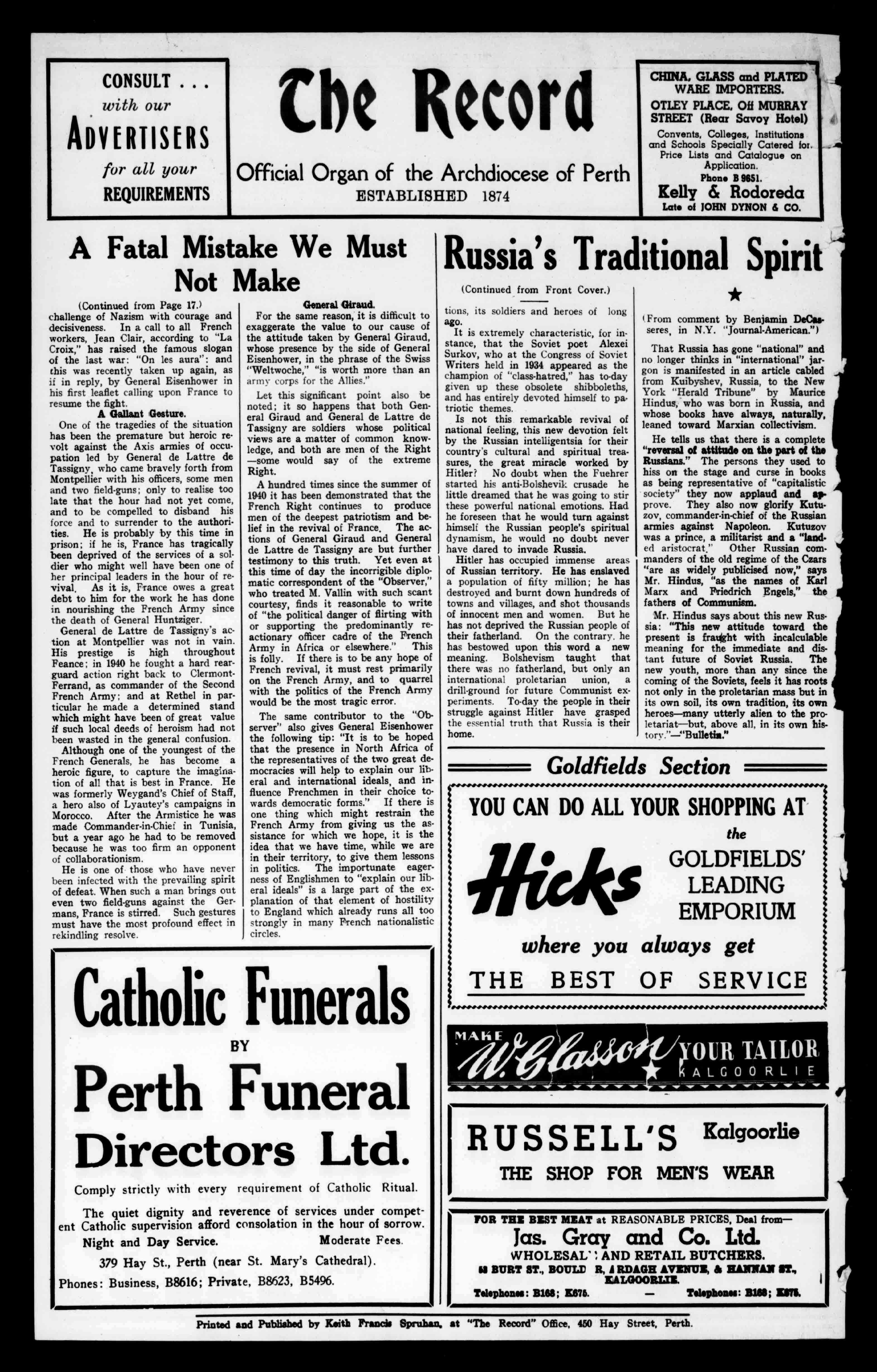
ModerateFees.
379HaySt.,Perth(nearSt.Mary'sCathedral).
Phones:Business,B8616;Private,B8623,B5496.
Russia'sTraditionalSpirit
(ContinuedfromFrontCover.) tions,itssoldiersandheroesoflong ago.
Itisextremelycharacteristic,forinstance,thattheSovietpoetAlexei Surkov,whoattheCongressofSoviet Writersheldin1934appearedasthe championof"class-hatred,"hasto-day givenuptheseobsoleteshibboleths, andhasentirelydevotedhimselftopatrioticthemes.
Isnotthisremarkablerevivalof nationalfeeling,thisnewdevotionfelt bytheRussianintelligentsiafortheir country'sculturalandspiritualtreasures,thegreatmiracleworkedby Hitler?NodoubtwhentheFuehrer startedhisanti-Bolshevikcrusadehe littledreamedthathewasgoingtostir thesepowerfulnationalemotions.Had heforeseenthathewouldturnagainst himselftheRussianpeople'sspiritual dynamism,hewouldnodoubtnever havedaredtoinvadeRussia.
Hitlerhasoccupiedimmensearea, ofRussianterritory.Hehasenslaved apopulationoffiftymillion;hehas destroyedandburntdownhundredsof townsandvillages,andshotthousands ofinnocentmenandwomen.Buthe hasnotdeprivedtheRussianpeopleof theirfatherland.Onthecontrary.he hasbestoweduponthiswordanew meaning.Bolshevismtaughtthat therewasnofatherland,butonlyan internationalproletarianunion,a drill-groundforfutureCommunistexperiments.To-daythepeopleintheir struggleagainstHitlerhavegrasped theessentialtruththatRussiaistheir home.
FromcommentbyBenjaminDegasseres,inN.Y."Journal-American.")
ThatRussiahasgone"national"and nolongerthinksin"international"jargonismanifestedinanarticlecabled fromKuibyshev,Russia,totheNew York"HeraldTribune"byMaurice Hindus,whowasborninRussia,and whosebookshavealways,naturally, leanedtowardMarxiancollectivism.
Hetellsusthatthereisacomplete "reversalofattitudeonthepartofthe Russians.-Thepersonstheyusedto hissonthestageandcurseinbooks asbeingrepresentativeof"capitalistic society"theynowapplaudandap, prove.TheyalsonowglorifyKutuzov,commander-in-chiefoftheRussian armiesagainstNapoleon.Kutuzov wasaprince,amilitaristanda"landedarktocrat,'OtherRussiancommandersoftheoldregimeoftheCzars "areaswidelypublicisednow,"says Mr.Hindus,"asthenamesofKarl MarxandFriedrichEngels,"the fathersofCommunism.
Mr.HindussaysaboutthisnewRussia:"Thisnewattitudetowardthe presentisfraLightwithincalculable meaningfortheimmediateanddistantfutureofSovietRussia.The newyouth,morethananysincethe comingoftheSoviets,feelsithasroots notonlyintheproletarianmassbutin itsownsoil,itsowntradition,itsown heroes-manyutterlyalientothepro- letariat-but,aboveall,initsownhis--"Bulletia."
CONSULT withour
forallyour REQUIREMENTS
Record OfficialOrganoftheArchdioceseofPerth ESTABLISHED1874 CHINA,GLASSandPLATED WAREIMPORTERS. OTLEYPLACE.OffMURRAY STREET(RearSavoyHotel) Convents,Colleges,Institutions andSchoolsSpeciallyCateredlot. PriceListsandCatalogueon Application. PhoneB9851. Kelly&Rodoreda LateoflOILNDYNON6CO.
ADVERTISERS
Cbe
strictlywitheveryrequirementofCatholicRitual.
quietdignityandreverenceofservicesundercompetentCatholicsupervisionaffordconsolationinthehourofsorrow.
Comply
The
GoldfieldsSection YOUCANDOALLYOURSHOPPINGAT the GOLDFIELDS' IS LEADING EMPORIUM whereyoualwaysget THEBESTOFSERVICE ...#4.000.0.0044.04.11.04164, RUSSELL'SKalgoorlie THESHOPFORMEN'SWEAR FORTHEBESTMEATatREASONABLEPRICES,DealfromJas.GrayandCo.Ltd. WHOLESAL'ANDRETAILBUTCHERS. UBURTAT.,BOUM)H,AROAMAITZBUR&BANNAKIT., Telephones:E166;K676. KALGOORLIE. Telephones:MU;MS. PrintedandPublishedbyKeithFrancisSpruhan.at"TheRecord"Office,450HayStreet,Perth.