dr.d-,IroisP777;01P'
41%
"Taste
Yours"
Tells"
Eyes ! Consult
Johnston's
['HOU &Elliott
SAUSAGES
Opticians
and
Piccadilly Arcade, Perth
FRANKFURTS NO. 3,069.
Tel. B7988
PIRTH, THURSDAY, APRIL 1, 1943.
PRIOR THRIRPINOR
SIVINTIZTH TZAR.
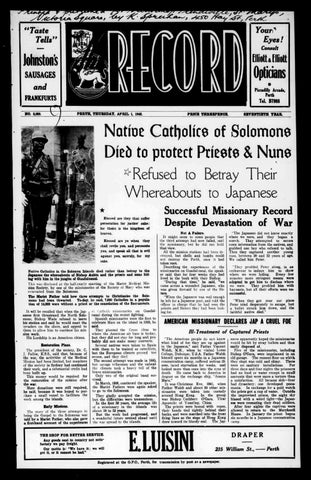
Native Catholics of Solomon Dies to protect Priests & Nuns Refused to Betray Their
Whereabouts to Japanese Blessed are they that suffer persecution for justice' sake: for theirs is the kingdom of heaven.
Blessed are ye when they shall revile you, and persecute you, and speak all that is evil against you, untruly, for my sake.
Native Catholics in the Solomon Islands died rather than betray to the Japanese the whereabouts of Bishop Aubin and the priests and nuns hiding with him in the jungles of Guadalcanal. This was disclosed at the half -yearly meeting of the Marist Medical Mission Society, by one of the missionaries of the Society of Mary who was evacuated from the Solomons. The Marist Father told how three attempts to Christianise the SoloTo -day, he said, 7,000 Catholics in a populamons had been thwarted. tion of 14,000 were without a priest or the consolation of the Sacraments.
It will be recalled that when the Japanese first threatened the North Solomons, Bishop Wade refused to leave his station and said he would meet the nvaders on the shore, and appeal to -.hem to allow him to continue his mission work. His Lordship is an American citizen. Restoration Plans. The president of the society, Dr. C. J. Fallon, K.S.S., said that, because of the war, the activities of the Medical Mission had been limited, but members of the society in Sydney had continued their work, and a substantial credit had been built up. This money would be required for the restoration of the mission after the war. More donations were still required, he said, because it was hoped to purchase a small vessel to facilitate the work among the islands.
lady Missions. The story of the three attempts to bring the Gospel to the Solomons was told by a Marist Father, who also gave a first-hand account of the experiences
Catholic missionaries on Guadalcanal during the recent fighting. Spanish missionaries were the first to celebrate Mass on the island in 1568, he said. They planted the Cross close to ',here the American air base is to -day, but they did not stay for long and probably did not make many converts. Several natives were taken to Spain with them to be trained as catechists, but the European climate proved too severe, and they died. The second attempt was made in 1845, but savage tribesmen and the unhealthy climate took a heavy toll of the brave missionaries. Only two of the original band survived. In March, 1898, continued the speaker, the Marist Fathers were again asked to go to the Solomons. They gladly accepted the mission, but the difficulties were tremendous. In the first 30 years, the average life islands was of a missionary in the about 10 to 12 years. But the work had progressed, and a wonderful future seemed ahead until the war spread to the islands.
Successful Missionary Record Despite Devastation of War the third attempt had now failed, said the missionary, but he did not hold that view. All the mission stations had been de stroyed, but shells and bombs could not destroy the Faith. once it had taken root. Describing the experiences of the missionaries on Guadalcanal. the speaker said that for four weeks they had lived in the bush with their Bishop. "During that time," he said, "we came across a wounded Japanese, who was given first-aid by one of the Sisters. "When the Japanese was well enough he left for a Japanese post, and told the officer in charge that he had seen the priests and Sisters they had been looking for.
AMERICAN MISSIONARY
where we were, and they began a search. They attempted to secure some information from the natives, and grabbed one boy who refused to talk.
Then they captured another young man, between 20 and 22 years of age. We called him Peter. "They prodded Peter along, in an endeavour to induce him to show where we were hiding. Every few minutes more stringent means were adopted to get him to disclose where we were. They prodded him with bayonets, but all their efforts were unsuccessful.
"When they got
near
our
11l-Treatment of
Captured Priests anese apparently hoped the missionaries would be hit by stray bullets and thus easily disposed of. Five of the missionaries, including Bishop O'Gara, were imprisoned in an old garage. The cement floor on which they slept was cold and slimy. There For were no sanitary installations.
three days and four nights the prisoners had no food or water except in small amounts that were more a torture than All became sick-four a satisfaction. had dysentery; one developed pneumonia. In exchange for a gold watch the priets got a cup of water. Outside the improvised prison, the night sky blazed with a weird light-the Japanese were cremating their dead soldiers. After four nights the captives were allowed to return to the Maryknoll House. In January the priest began six months in a Japanese concentration amp
DRAPER
E.LUISINI
215 William St.,
Registered at the G.P.O.. Perth. for transmission by post s a newspaper.
place
Peter tried desperately to escape, but a bullet struck him down, and the faithful native died."
DECLARES JAP A CRUEL FOE
"The American people do not know what kind of foe they are up against in the Japanese," said Father Vincent Walsh, M.M., when he visited Loras College, Dubuque, U.S.A. Father Walsh himself spent six months in a Japanese concentration camp, suffered serious illness, faced starvation for weeks, and looked more than once into the eyes of death. He came back to America in August on the exchange ship, "Asarna Maru." It was Christmas Eve, 1941, when Father Walsh and about 30 other missionaries were taken into custody around Hong Kong. In the group was Bishop Cuthbert O'Gara, Vicar Apostolic of Yuanling. China. The priests were bound with ropes, their hands tied tightly behind their backs, and were marched into the front firing lines as the siege of Hong Kong drew toward its bloody end. The Tap-
THE SHOP FOR BETTER SERVICE. Any goods sent to country not satisfactory we pay freight. Our motto is: "We have it; we will get it, or it cannot be had."
"The Japanese did not know exactly
Not A Failure.
It might seem to some people that
Perth