"Taste Tells"
Johnston's SAUSAGES and FRANKFURTS
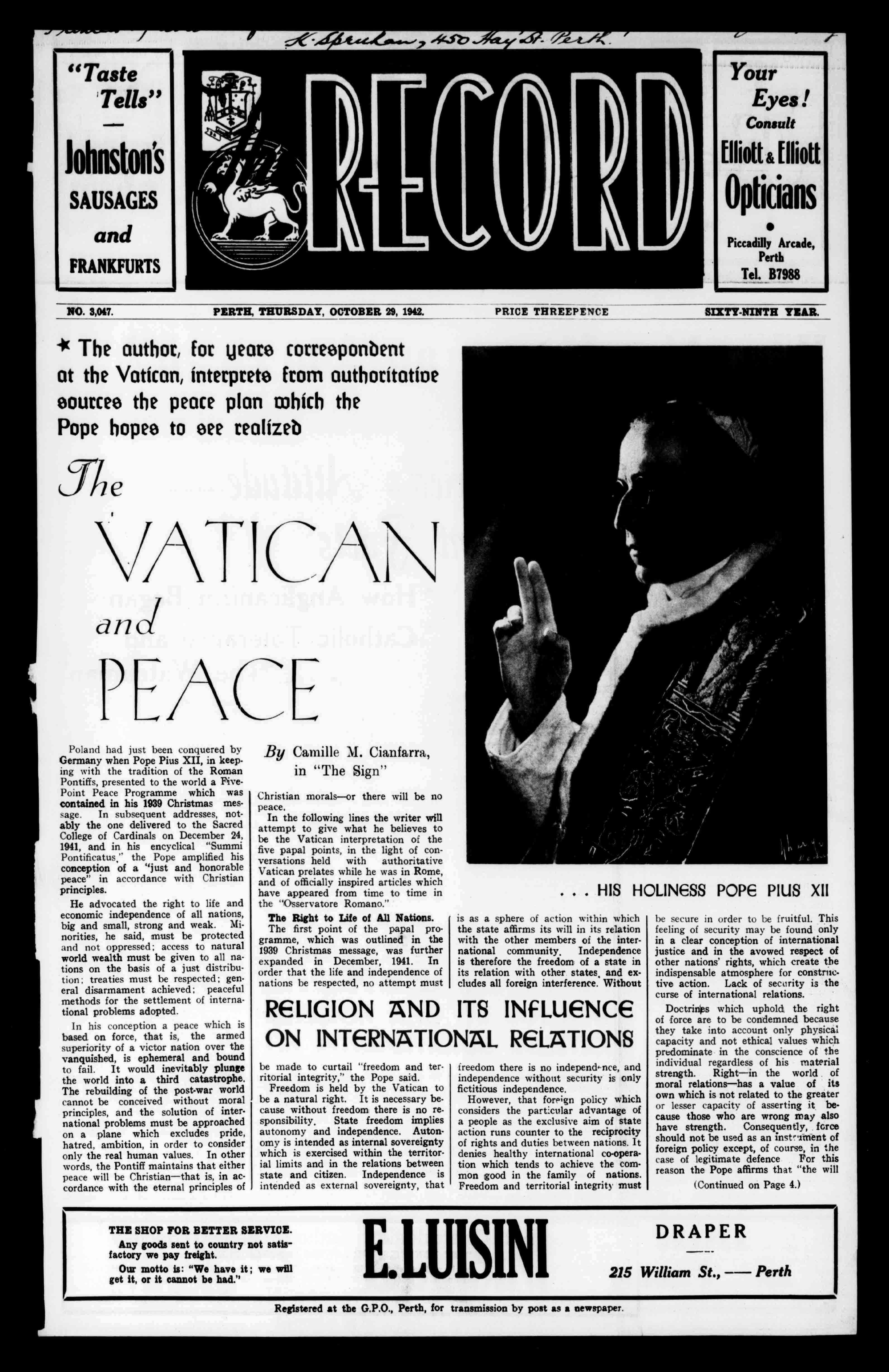
Theauthor,forgearscorrespondent attheVatican,interpretsfromauthoritative sourcesthepeaceplanwhichthe Popehopestoseerealizeb
Polandhadjustbeenconqueredby GermanywhenPopePiusXII,inkeepingwiththetraditionoftheRoman Pontiffs,presentedtotheworldaFivePointPeaceProgrammewhichwas containedinhis1939Christmasmessage.Insubsequentaddresses,notablytheonedeliveredtotheSacred CollegeofCardinalsonDecember24, 1941,andinhisencyclical"Summi Pontificatus,'thePopeamplifiedhis conceptionofa"justandhonorable peace"inaccordancewithChristian principles.
Headvocatedtherighttolifeand economicindependenceofallnations, bigandsmall,strongandweak.Minorities,hesaid,mustbeprotected andnotoppressed:accesstonatural worldwealthmustbegiventoallnationsonthebasisofajustdistribution;treatiesmustherespected;generaldisarmamentachieved;peaceful methodsforthesettlementofinternationalproblemsadopted.
Inhisconceptionapeacewhichis basedonforce,thatis,thearmed superiorityofavictornationoverthe vanquished,isephemeralandbound tofail.Itwouldinevitablyplunge theworldintoathirdcatastrophe. Therebuildingofthepost-warworld cannotbeconceivedwithoutmoral principles,andthesolutionofinternationalproblemsmustbeapproached onaplanewhichexcludespride, hatred,ambition,inordertoconsider onlytherealhumanvalues.Inother words,thePontiffmaintainsthateither peacewillbeChristian-thatis,inaccordancewiththeeternalprinciplesof
Christianmorals-ortherewillbeno peace.
Inthefollowinglinesthewriterwill attempttogivewhathebelievesto betheVaticaninterpretationofthe fivepapalpoints,inthelightofconversationsheldwithauthoritative VaticanprelateswhilehewasinRome, andofofficiallyinspiredarticleswhich haveappearedfromtimetotimein the"OsservatoreRomano."
TheRighttoLifeofAllNations.
Thefirstpointofthepapalprogramme,whichwasoutlinedinthe 1939Christmasmessage,wasfurther expandedinDecember,1941.In orderthatthelifeandindependenceof nationsherespected,noattemptmust
isasasphereofactionwithinwhich thestateaffirmsitswillinitsrelation withtheothermembersoftheinternationalcommunity,Independence isthereforethefreedomofastatein itsrelationwithotherstates,andexcludesallforeigninterference.Without
RELIGIONANDITSINFLUENCE ONINTERNATIONALRELATIONS
bemadetocurtail"freedomandterritorialintegrity,"thePopesaid. FreedomisheldbytheVaticanto beanaturalright.Itisnecessarybecausewithoutfreedomthereisnoresponsibility.Statefreedomimplies autonomyandindependence.Autonomyisintendedasinternalsovereignty whichisexercisedwithintheterritoriallimitsandintherelationsbetween stateandcitizen.Independenceis intendedasexternalsovereignty,that
THESHOPFORBETTERSERVICE. Anygoodssenttocountrynotsatisfactorywepayfreight.
Ourmottois:"Wehaveit;wewill getit,oritcannotbehad."
freedomthereisnoindependrice,and independencewithoutsecurityisonly fictitiousindependence.
However,thatforPignpolicywhich considerstheparticularadvantageof apeopleastheexclusiveaimofstate actionrunscountertothereciprocity ofrightsanddutiesbetweennations.It denieshealthyinternationalco-operationwhichtendstoachievethecommongoodinthefamilyofnations. Freedomandterritorialintegritymust
besecureinordertobefruitful.This feelingofsecuritymaybefoundonly inaclearconceptionofinternational justiceandintheavowedrespectof othernations'rights,whichcreatethe indispensableatmosphereforconstructiveaction.Lackofsecurityisthe curseofinternationalrelations.
DoctrinOswhichupholdtheright offorcearetobecondemnedbecause theytakeintoaccountonlyphysical capacityandnotethicalvalueswhich predominateintheconscienceofthe individualregardlessofhismaterial strength.Right-intheworldof moralrelations-hasavalueofits ownwhichisnotrelatedtothegreater orlessercapacityofassertingitbecausethosewhoarewrongmayalso havestrength.Consequently,force shouldnotbeusedasaninstrumentof foreignpolicyexcept,ofcourse,inthe caseoflegitimatedefenceForthis reasonthePopeaffirmsthat"thewill
ContinuedonPage4.)
Your Eyes! Consult Elliott&Elliott Opticians PiccadillyArcade, Perth Tel.B7988
DRAPER 215WilliamSt.,--Perth RegisteredattheG.P.O.,Perth,fortransmissionbypoetasanewspaper.
DR.RUMBLE,M.S.C.
WhyNotMarryanAmerican?
FRANKDISCUSSIONONVEXEDQUESTION
WhatisAmerica'sAttitude SomeUnpleasantwets
E.H.,Wynyard:
Q.:IamaCatholicgirlengagedtoa Catholicboy,whoisamemberofthe AmericanAirForce.
R.:IcannotsaythatIregardthat asawiseengagement.Itmaybethat youfoundyourselfgreatlyattracted toeachother,buttherewasnoreal needtoallowthatattractiontodevelop.Andwhateveryourpresent feelingsmaysay,youarenotreally necessarytoeachother.Onlyfor thewar,hewouldneverhavebeenin Australia.Hewouldhavelivedhis lifeandfoundhappinessinhisown country,thoughquiteunawareofyour existence.Andthesamewouldhave beentrueofyouheresofarasheis concerned.
AGREATRISK,
Q.:Wearebothover21,andcircumstancespermitting,intendbeingmarriedintheNewYear.
R.:Yourightlysay"circumstances permitting."WhereyourAmerican AirForceboywillbeinthenewyear nomitcansay.Moreover,iiheis stillnearenoughathandtomarry youasyouintend,therearestillmany factorsprejudicialtoyourfuturehappiness.Noonecanforeseethefuture withcertainty,butmostprobablythe unhappinessofrelinquishingyourengagementbymutualconsentwillbe lessthantheunhappinessyourmarriagewillbringuponyouinduecourse. Allagree,civilauthoritiesandreligiousauthorities,bothAmericanand Australian,thatsuchmarriagesare imprudent;andinthemajorityof casesthesourceofmoreultimatedistressthananycompensatingjoysare worth.
AFATHER'SOBJECTION.
Q.:Myfatherisagainstthemarriage onthegroundsthatboththeChurch andStateobjecttomarriagesbetweenAustraliansandAmericans.Is thiscorrect,please?
R.:Yourfatherwouldnothaveyour interestsverydeeplyatheartifhedid notobjecttosuchamarriage.His oppositioniscertainlynotunreasonable,andyouhaveadutytoweigh wellhisadviceinthismatterbefore decidingtorejectit.Eventhough youareover21,youoweittoyourparentstosparethemunnecessarysorrowandanxiety.Yourfatherisnot quitecorrect,ifyouhavecorrectly quotedhim,insayingthatboththe ChurchandStateobjecttomarriages betweenAustraliansandAmericans. NeithertheChurchnortheStatehas anyobjectionsonthemeregroundsof thedifferenceinnationalities.The difficultiesarisefromtwopointsof
view.Firstly,thatitisthepresent warthathasbroughtsomanyAmericanyoungmentoourshores:andtheyweremilitaryreasons,notmaritalprospects,thatbroughtthem.Secondly, greatdifficultiesarisefromthelawsof theUnitedStatesinreferencetowives offoreignnationalitymarriedbyAmericanmenabroad, * * *
AMERICA'SATTITUDE.
Q.:Isthereanylawwhichcanforbid AustraliangirlstomarryAmericans, French,Spanish,oranyothernationality,andtoreturnwiththem totheirhomes?
R.:TheSecretaryofWarofthe UnitedStateshasissuedexpressdirectionsthatnomemberoftheUnited StatesArmyinanyforeigncountry maymarrywithoutwrittenauthority fromhisproperCommandingOfficer. AnyAmericanservicemanwhodoesso willbeliabletoseveredisciplinary penalties.Americanauthoritiesbase theiroppositionontheharmthathas alreadyresultedtoindividuals,tothe armedforces,andtothewareffortby suchmarriages.Thereisscarcelyneed toamplifythosereasons.Manyhastymarriagesbetweencoupleswhodonot knoweachotherwellenough,and nothingofeachother'srelativesand friendsandsocialcircumstances,have proveddisastrous:whilstsoldierswho havecontractedsuchmarriageshave beenabletogiveonlyadividedat tentiontotheirduties,havedemanded impossibleconcessions,andhaveprovedahindrancebothtodisciplineand theefficientprosecutionofthewar. Also,thestrictimmigrationlawsofthe UnitedStatesdonotregardaforeign wifeasonewhohasacquiredthenationalityofherhusband,anditwould helustasdifficultforhertoenterthe UnitedStatesasforanyotherforeigner,TheAmericanauthoritieshave warnedtheirsoldiers,therefore,that thereisnoassurancethatforeign wiveswillbeallowedtoaccompany themontheirreturntotheUnited States.
FOREIGNWIFE'SSTATUS.
Q.:Myfatherstatesthat,ifImarried byfiancee,themarriagewouldnot berecognisedinAmericaasamarriageatall.
*HowAnglicanismBegan
*CatholicToleranceand "TheWatchman"
R.:OnthatpointIamnotableto speakwithanycertainty.Ingeneral,Ibelievethatamarriagethatis validherewouldberecognisedasvalid there.ButIamundertheimpressionthatmarriagelawsvaryin differentindividualStates.Youcould probablygetauthenticinformationon thispointfromtheAmericanConsulate. Q.:HealsosaidthatIwouldhave noclaimonmyhusband,andwould havetoremaininAustraliaif,and when,hereturnedtoAmerica,
R.:Whatclaimuponyourhusband AmericanlawwouldrecogniseIdonot know.Itisquitepossiblethatyou wouldhavetoremaininAustraliafor someyearsatleastafteryourhusband'sreturntoAmerica,untilthe quotasystempermittedyourentrance totheUnitedStatesasanimmigrant.
UNPLEASANTFACTS.
Q.:Iamatalosstounderstandwhy thereareobjections.
R,:IhopeIhavecleardthatup. Americahassentitsarmiesoverseasto differentcountriesforpurposesof war.Sentimentalattachmentsand maritalentanglementsinplaceswhere theyhappentobebuttemporarily, dividetheinterestofthesoldierand hamperthewareffort.Moreover,the ImmigrationLawsoftheUnitedStates aresuch,andhavebeenformany years,thatforeignwivesarenot grantedanyconcessionsasregardsenteringthecountry.Itisonlyfair toeverybodyconcernedthatthis shouldbewidelyknown.
Q.:Idonotknowofanylawwhich cancompelpeopletomarrythose livingintheirowncountry.
R.:NordoI.Andthereisnosuch law.Youcannotbecompelledto marryanybody.Butifyoumarry anAmericansoldier,sailor,orairman,
Americanmilitarydisciplineisnotobligedtomakeanyallowanceforthat, andAmericanImmigrationLawsare notobligedtoallowyoutoenterthe UnitedStates.
FURTHERTHOUGHTNEEDED.
Q.:Ithardlyseemsfairtoforceagirl tomarryanAustralianwhenshe wouldmuchprefertomarryaman ofadifferentnationality.
R.:Whatwouldyouhavedonehad nottheaccidentofwarbroughtyour Americanfriendtotheseshores? Wouldyousaythatitwasunfairthat yourchoiceshouldbelimitedtoAustraliansbecausewarhadnotbroken outandbroughtAmericansoldiers here?Ifyoudecidethattheinconveniencesaretoogreattogoonwith yourpresentengagement,youwillnot be"forced"tomarryanAustralian.If youdomarryanAustralian,itwillbe byyourownchoice.Andyouare youngyet,withmanyopportunitiesof meetingafellowAustralianwhocould makeyouveryhappy.Ontheother hand,ifyoudomarryyourAmerican friend,youmustbepreparedtoface thedifficulties,notonlyofpossible separationforsomeyears,butalsoof aproblematicalreceptionbyhisrelativesandfriendsinAmericawhenyou getthere,andlifeasanalieninstrange surroundings,inwhichyoumaynever learntofeelreallyathome.The wholesubjectisoneforserious thought,andforprayer.And,as yourequest,Iwillprayforyou,that Godmayguideyoutomakethat choicewhichisforthebestinthelong run.
Doyouwishtohelpeducateapriest forworkinWesternAustralia?Make aregularannualcontributiontohelp anindigentstudent.
Hibernian-AustralasianCatholicBenefitSociety
TWO THERECORD. Thursday,October29,1942. adio
THEOLOGY - HISTORY TOPICALQUESTIONS PHILOSOPHY-SOCIALJUSTICE- APOLOGETICS
''Allagree,civil
Mtralian,thatsuchmarriagesareimprudent;andinthemajorityofcasesthe sourceofmoreultimatedistressthananycompensatingjoysareworth."
eplies
BYREV,
(1
authoritiesandreltriouauthorities,bothAmericanandAus
BESTBENEFITSFORLOWESTCONTRIBUTIONS. DEATHBENEFIT.-L50,age16andunder20,4/10quarterly;£100,7/2quarterly.20yearsandunder23, 5/3qr.;£100,8/-qr.23yrsandunder25,5/5qr.;£100,8/4qr.25yrsandunder30,5/10qr.;f100,9/2qr. Membersupto51accepted.AlsoSickness,MedicalandHospitalBenefits. J.EDWARDS,GrandSecretary,WestAustralianChambers,StGeorge'sTerrace,Perth. Te1.1B7801.
Anglicanism
"Anglican,"Sydney:
Q.:Willyou,please,explaininsimple wordswhatreallycausedtheseparationoftheRomanCatholicChurch andtheAnglicanChurch?
R.:Untiltheyear1534therewasno AnglicanChurch.Untilthatyear EnglandwasaCatholiccountry,acknowledgingthePopeastheheadof thewholeChristianChurchthroughout theworld.ItwasHenryVIII.who, in1534,forcedthroughparliamenta Billrepudiatingthespiritualauthority ofthePope,anddeclaringthatthe ChurchinEnglandwouldhenceforth hesubjecttohimself.Henrydidthis becausethePoperefusedtogranthim adivorcefromhislawfulwifeCatherineandallowhimtomarryAnne Boleyn.TheChurchofEngland,as aChurchseparatedfromRome,began, therefore,in1534bythisrejectionof theauthorityofthePope.Lateron, afterHenry'sdeath,andunderEdwardVI.andQueenElizabeth,many Catholicteachings,andCatholicforms ofworshipwerealsorejectedinfavouroftheProtestantismwhichhad ariseninGermanywithMartinLuther. Thiswas,toagreatextent,becausean exaggeratednationalismfoundProtestantismmuchmoreinkeepingwith adistinctivelynationalChurchthan Catholicism.Inanycase,thosewho abandonedtheunityoftheCatholic ChurchsoonlostfaithintheteachingsoftheChurch,andchosesuchof thenewProtestantdoctrinesasappealedtothem.
CHANCESOFREUNION.
Q.:Isthere,inyouropinion,anyreasonablechanceofthetwoChurches comingtogetheragain,andsettling theirdifferences?
R.:No.TheCatholicChurch,of course,cannotunsayherposition.The onlyhopeofunionbetweentheCatholicChurchandtheChurchofEngland,therefore,wouldbeforthe ChurchofEnglandtoretraceitssteps,
renouncingallthosethingsbywhich itdiffersfromtheCatholicChurchat leastinessentialteachingsandpractices,andaskingtoheabsorbedinto theCatholicChurch,subjecttothe Popeoncemore,Icertainlyseeno reasonablechanceoftheChurchof Englandasawholeadoptingthatpro. cedureinanythinglikethenearfuture.ThereturnwillbemadebyindividualAnglicansastheycometosee, withmenlikeCardinalManningand CardinalNewmanandmanyothers, thattheseparationfromtheCatholic Churchwasaltogetherunjustifiedin thefirstplace.
THESTUMBLINGBLOCK.
Q.:Whatisthestumblingblock?
R.:Therearemanystumbhig blocks,andtheyareveryformidable. Inthefirstplace,theChurchofEnglanddiffersradicallyfromtheCatholic Churchinitsdoctrines,initsdiscipline,andinitsworship.Secondly, theChurchofEnglandisnotaunited bodyinitself.Itconsistsofthree divergentsections,LowChurch,Broad Church.andHighChurch-sections whichwillneverarriveatanyagreementsavetodiffer.Thirdly,noAnglicancouldbecomeaCatholicunless hereceivedfromGodthegiftofthe CatholicFaith,agifthemustdesire andbewillingtoaccept.Now"corporatereunion;'orthereturnofthe ChurchofEnglandasawholetothe unityoftheCatholicChurch,would supposethateverymemberoftheAnglicanChurchdesired,waswillingto accept,anddidactuallyreceivefrom GodthegiftoftheCatholicFaith. Thatwouldbeamiracle,andmiracles arenotordinarilytobeexpected.I cannotthereforeentertainanyhope ofthereturnoftheChurchofEngland asawholetounitywiththeCatholic Church,Itwilleverbeamatterof individualconversions,asinmyown case,andthatofotherswhoseethe necessityoftakingsuchastep.
CatholicTolerance
"LodgeListener,"Sydney:
Q.:Acopyof"TheWatchman,"which Isendforcomment,declaresthat,:n yoursession,youagreedwithMr. Menziesinhispleafor"roomandrespectforall,"for"tolerance,"and fortrue"freedomofworship."
R.Correct,
Q.:"But"TheWatchman"adds:"The Doctorknowsverywellthatitis hisconsideredopinion,oftenopenly stated,thatthereisroomonlyfor theRomanCatholicChurch."
R.:Itismyconsideredopinionthat scripture,history,andlogicleaveroom fortheCatholicFaithonlyfromthe viewpointofthefullChristiantruth. WhyonearthwouldIbecomeaCatholic,ifthatwerenotmyconviction? Butthatdoesnotconflictwithmy supportofMr.Menzies.Eventhough Ibelieveallotherformsofreligion mistaken,Iinsistthatgoodandsincere peoplemistakenlyadheringtothose formsofreligionhavetherighttobe treatedwiththerespect,andtolerance,andcharitythatweCatholicsin turnhavetherighttoexpectfrom them.TheCatholicChurch,certainly, standsfor"freedomofworship"accordingtothedictatesofeachman's conscience.OnCatholicprinciples,no onecanbereceivedintotheCatholic Churchagainsthisconscience.She, therefore,tellsProtestantsthat,so 0,,longastheydonotbelieveintheCatholicreligion,theycannotbecome 1Catholics.Ontheotherhand,Catholicprinciplesdeclarethate-tchman isobligedtofollowhisconscience.If, therefore,Protestantsbelievethatthey areboundinconsciencetoworship GodinaProtestantway,theCatholic Churchcouldnot,onherownprin. ciples,denythemfreedomtodoso.
PROTESTANTHERESIES.
Q.:"Dr.RumbledeclaresthattheRomanCatholicChurchistheonlytrue Church,thatProtestantismisnota religionatall,andthatitsadherents are"heretics."
R IcertainlydeclarethattheCatholicChurchistheonlytrueChurch.
SpiritismCondemned
"SeekerAfterTruth,"Chatswood:
Q.:WhydoCatholicpeoplecondemn spiritism?
R,:BecauseGodHimselfforbidsus toseekknowledgeofthedead.The CatholicChurchdoesnotdenytheexistenceofthespiritworld,orofspirits goodandevil.Nordoesshedenythe possibilityofcommunicatingwiththat world.Butsheforbidsattemptsto communicatewiththatworldinspiritisticseances.Shedoesdenythat anyspiritsencounteredintheseance roomaregoodspirits,fornogood spiritwouldco-operatewiththoseviolatingGod'slaw.And,infact,there iseveryevidencethatnogood,but muchharmhasresultedinthosewho trytotamperwiththespiritworld,
"CHRISTWASSPIRITUAL."
Q.:Ican'tunderstandthis,forChrist wasveryspiritual.
R.:Christwasspiritualasopposed toallthatismerelysensual.He insistedthatthewelfareofoursouls ismoreimportantthanthewelfareof ourbodies.Hebadeusliftour thoughtsfromearthtoheaven,and thinkintermsofeternityratherthan oftime.Buttobespiritualinthat sense,livingforGod,forheaven,for graceandforvirtue,forthespirit ratherthanfortheflesh.hasnothing todowith"spiritism."Theseance room,mediumsinanepilepticfit,the superstitionandthethrillandtheselfseekingofcuriousspiritisticaudiences, havenothingtodowithChristianity, andareopposedtothereligionof Christ.Onewhohasthemindof Christisspiritual,butcertainlynota spiritist.
THEWEDDING-GARMENTPARABLE.
Q.:InMatthew'sGospel,wereadofa
AsregardsProtestantism,Ihavedeniedthatthereisanysuchthingas "the"Protestantreligionbecausethere aresomanydifferentandconflicting formsofProtestantismButIhave neverdeniedanyoftheparticular formsofProtestantismtobeareligion.Ihavedeclaredallsuchforms tobeerroneousreligionsinsofaras theydifferfromCatholicism.In technicallanguagetheCatholicChurch cannotbutregardsuchdivergent formsofreligionasunorthodoxor heretical.Butshedeclaresthat thosewhoadheretosuchformssincerelyandinquitegoodfaith,never suspectingtheirpositiontobewrong, arenotguiltyofanysinorheresy. Again,andintechnicallanguage,she refusestoregardthemas"formalheretics."Theyaresimplymistaken.
THEPLEASANTBIGOT,
Q.:"Therefore,Dr.Rumblemusthave beenspeakingwithhistongueinhis cheekwhenextendinghisbenevolent tolerancetoallandsundry."
R.:Thatconclusionfollowsfrom nothingthatIhaveeverheldorsaid, butonlyfromanOrangeman'swillto thinkeviloftheCatholicreligionand ofthosewhobelongtoit.
Q.:"WedonotknowifDr.Rumble wasasinceremanasaProtestant."
R.:Itisapityyourfrienddidnot realisetohowmanyotherthingshis lackofknowledgeextends,forthenhe wouldneverhavewrittenthisabsurd article.
Q.:"Butitiscertainthat,asaRoman Catholic,heissteepedinallthe duplicityandinseritywhicharepart andparcelofthereligionwhichhe nowsostronglyendeavourstojus- tify.II
R.:Well,thatconcludesthepas:age youhavemarkedintheOrangeperiodicalyouhavesentforcomment.I canonlyhopethatmytreatmentof thesectionsthatmatte-hasbeena helptowardsclarifyingyourownideas onthesubject.
kingwhobroughtinpeoplefromthe highwaysandbywaystotakethe placeoftheinvitedguestsatawedding.
R.:Thatstorywasaparabletoldby ChristtotheJewstowarnthemthat, bytheirrejectionofHim,theywould forfeittheirinheritance,andthatit wouldbegiventoothers.
Q.:ButtheKingthencastoutone manbecausehehadnotonaweddinggarment.Whydidhedothis, afterinstructingtheservantsto bringinasmanyastheycouldfind?
R.:Tounderstandthis,itmustbe rememberedthatitwasthecustom,a customprevailingtothisdayinparts ofPersia,forthehostatawedding partytoprovidethefestivegarments fortheirguests.Thegarments,therefore,wereavailabletoallfortheasking:and,asamatteroffact,theman intheparablewasspeechlesswhen challenged.Hehadnoexcuse.In sheercontempthehadenteredinhis filthystreetdress.Theapplication oftheparabletoourselvesshouldbe obvious.ThereligionofChrist,althoughitisofferedtousfreely,carrieswithittheobligationtoavoidsin, andtokeepinthegraceofGod.Christiansthemselveswillbecondemnedif, whentheKingcomes,theyarenotin astateofgrace,havinggotridoftheir sinsbysincererepentanceandbeing clothedintheweddinggarmentof God'sloveandfriendship.Andif, whendeathcarriesustoourjudgment, weareinastateofsin,andnotina stateofgrace,wewillbe"speechless," havingnovalidexcusswhateverfor ourcondition,andnojustcomplaint thatweshouldheexcludedfrom heaven. PATRONISEOURADVERTISERS.
OurCatholicSchoolsandColleges
CHRISTIANBROTHERS,MT.HENRY
OneoftheAssociatedPublic SchoolsofW.A.
AquinasCollege
TELEPHONE:MU1520
ForBoardersandDayStudents Boysadmittedfrom7upwards BeautifullySituated,overlookingMeriver,nearthenewCanningBridge. ForParticularsapplytoThePrincipal,AquinasCollege,CanningParade,Mt.Henry.
SACREDHEARTHIGHSCHOOL HIGHGATE-PERTH (ConductedbySistersNotreDameDesMissions). BOARDINGANDDAYSCHOOLFORGIRLS. PUPILSPREPAREDALLEXAMINATIONS.
'PhoneB3810.
MONTESSORISCHOOLFORYOUNGCHILDREN ForProspectusapplyREV.MOTHERPRIORESS
LoretoConvent"Osborne"-Claremont BOARDINGANDDAYCOLLEGE.
theSchoolprovidesasoundeducationLinmodernlinesinallbranches ofstudy.Thepupilsarepreparedforallexaminations.TheSchoolis beautifullysituatedbetweenOceanandRiver,inextensivegrounds, withfineplayingfieldsandprivateSwimmingPoolinRiver. Telephone:F2135. Apply- MOTHERSUPERIOR.
ST.ILDEPHONSUS'COLLEGE NEWNORCIA CONDUCTEDBYTHEMARISTBROTHERS.
ForParticularsApplyto-THEBROTHERDIRECTOR
Thursday,October29,1942. THERECORD. THREE
theVaticanandPeace Contrastof"NewOrders":
(ContinuedfromFrontCover.)
toliveofanationmustnotrepresent thedeathsentenceforanothei."
Territorialextensionandcapacity fordefencevaryfromnationtonation, buttherighttolifeisidenticalfor everyone.Therefore,eventhesmall nationshavearighttotherespectof theirpoliticalfreedomandtotheefficientsafeguardingoftheirneutrality intheconflictsbetweennations,so thattheymayfreelyco-operatewith othernationswithout1-singsubordinatedtoforce.
ProtectionofMinorities.
Afteroutliningthispointinhis1939 message,thePope,probablybearing inmindthepersecutionsandtheruth. lesspolicyofoppressionandexterminationwhichtheGermansarepursuingagainstthePoles,theCzechs, andtheYugoslaysundertheirdomination,expandeditconsiderablyin December,1941.
"Inaneworderfoundedonmoral principles,"hesaid,"therecanbeno placefor(1)openorsubtleoppression oftheculturalandlanguagecharacteristicsofnationalminorities,(2)contractionoftheireconomiccapacities, (3)limitationorabolitionoftheirnaturalfecundity.Themoreconscientiouslythestaterespectstherightof itsminorities,themoresafelyandeffectivelyitcandemandfromtheir membersloyalobservanceoftheircivil rightswhichareequaltothoseofother citizens."
Thestatesshouldgranttominorities therighttolearnthemotherlanguage,andtheminoritiesshouldloyally learnthelanguageofthestateto whichtheybelonginsteadofusing theirownlanguageandeducationto combatthestateofwhichtheyarean organicpart.Moreover,thefinancial burdensoftheminoritiesshouldbe equaltothoseofthemajorities,as wellastheeconomicbenefitsgranted bythestate.Nopolicytendingto limitordenytherighttolife,incontrastwiththeChristianpreaching"Increaseandmultiply,"shouldbeadopted.
NaturalResourcesandEconomic Co-operation.
ThePopecondemnedinhis1941 Christmasmessagethe"narrow,selfish considerationswhichtendtomonopoliseeconomicwealthandrawmaterials ingeneraluse,totheexclusionofnationslessfavouredbynature."His fundamentalidea,whichisinspiredbythewritingsofSt.Thomas("Summa Theologica"),isthatalthoughownershipofresourcesmaybeprivatetheir usemustbeopentoall.Privatepropertyisnotanendinitself.Itis notmeantforthesterileenrichingof thefewbutofthemany.Property isarightbutatthesametimeaduty. Itembodiesanobligationtowardthe community.Theindividualistdoctrine sacrificesthecommongoodtotheprivategood,whilethepapalcontention isthatprivategoodmustbesubordinatedtothecommongoodasa necessityofsocialjustice.
Theseethicalprinciplescannotbeignoredininternationalrelationswhich areinsubstancerelationsbetween men,orgroupsofmen.Everyindividualisamemberofthehuman family;everystateisamemberofthe collectivityofstates.Butthestates afterallrepresentonlygroupsofindividualswhoseeconomicwelfaremust bepromoted.Accordingtothisconception,frontiersarebarrierswhichdivide,notbridgeswhichunite.Therefore,stateorganisationmustnotlead tothesegregationofagroupofmen
fromtherestoftheworld,butmust, onthecontrary,beastepforwardin theorganicprocessofco-operationbetweennationalgroups.Inother words,theparticularinterestofa state,asmemberofagroupofstates, cannotbutbesubordinatedtothegeneralinterestofthecollectivityof states.
Themainreasonfortheworld-wide economiccrisiswhichreachedaclimax inthepresentwarmustbeascribed totheselfishconsiderationswhich havedeniedthesocialimportanceof resourcesandhavegivenpreferenceto theparticularinterestoftheindividual nationattheexpenseofinternational interestsasawhole.Theconsequencesofthispolicyhavebeeneconomicdefenceonthepartoftheindividualstatesasexpressedinmeasures forbiddingexportationofgoods,lifting ofcustomsbarriers,creationofmonopolies,artificialbarrierstotheinter. nationalmovementofcapital,dumping,closingofcolonialmarkets,and thelike.
Finally.theaimofaselfisheconomicpolicyistheattainmentofthe greatestpossiblemassingofwealth. Thisisanarrowpolicywhichignores farmoreimportantandnobleaimsof humanlife.
Disarmament.
Thesolutionofeconomicproblems, thePopewarns,isstrictlylinkedwith theabolitionofwarandtheprogressivelimitationofarmaments.Arms mentprogrammeshavehadadirect andpowerfulinfluenceonstateeconomyandhavebeenresponsibleforseriouscrises.Expendituresformilitary preparednesshaveconsiderablyincreasedbudgetdeficits.Tooffsetthese deficits,thestateshaveloweredthe standardofliving,raisedcustomsbarriers,adoptedcontrolofcurrency,and othermeasureswhichhavecontracted internationalexchanges.Ontheinternationalplane,wealthierstatesnot onlyhaveabstainedfromaidingthose lesswealthy,forfearthataidwould materiallyincreasethemilitary strengthofapotentialfoe,buthave attemptedtocornerthesupplyofall thosematerialswhichmightbetransformedintowarweapons,
Thusaprogressivelimitationofarmamentsisnecessary.But,toattain thisobjectivetreatiesmustberespectedandinternationalinstitutionscreatedwiththespecifictaskofguaranteeingtherespectoftreaties.
Disarmamentmustbenotonlymaterialbutspiritual.Themereeliminationofweaponsisnotenough.Peoplemustforegothehabitofarming, thewishtoarm,thepassionforarms. Toattainthismoralmaturitythecollectiveconsciencemustbefreedfrom thepsychosisofwar.Obligationsbetweenpeoplesandinternationalguaranteesmustberegardedasasubstituteforstrength,notanadditiontoit.
Ifmoraldisarmamentisnotachieved,therealandefficientlimitationof armamentswillbeonlyachimera,for itisnotsomuchtheweaponwhich makesthewarrior,asthewarrior whichmakestheweapon.Thisisan essentialpremiseofaspiritualnature forgradualandloyaldisarmament. However,nationscannotbeaskedto disarmunlesstheyobtainguarantees fortheirsecuritywhichrenderarmamentssuperfluousandeliminatethe motivesandpretextsforwar.
Experiencehasshownthatwhen treatieslosetheirbindingcharacternationstakerecoursetoarms.Internationalinstitutionsmustthereforebe createdtosafeguardtherespectof treatiesand,whichisequallyimportant,tomodifytheminaccordance
PHONEF2396-ONEQUALITY-THE
FAIRLIGHTSTREET,MOSMANPARK MaltandWholemealBreadaSpeciality.
PapalandAxis
"ThePapalneworderisinstriking advocatedbytheAxisPowers."
contrastwiththeso-calledneworder
"ItisclearthatthePopeseesthe warorderonlythroughavictoryof readyshown-as,forinstance,inthe RooseveltandMr.Churchill-amore internationalproblems."
"TheCatholicChurchistheperfect shouldinspirethefamilyofnations." withchangingconditionsintherelationsbetweenstates.
Thelackofinternationalinstitutions ofthischaracterintheworldto-day hasgivenfreeplaytotheselfishpolicyofindividualpowersattheexpense ofothers.Statesmustacceptthe principleofcollaborationinthefamilyofstates.Fromtheirfreeand loyalacceptanceofthisprincipleanew internationaljuridicalorderwillbe born.Therespectforthepersonality oftheindividualstatesdemandsthat theinternationalinstitutionbebased onaprincipleofequality.Thusthe willwhichshouldregulateinternationalrelationswillnotbehegemonicnorthewillofgroupswhich pursueparticularinterests,but,instead,theexpressionoftheinstitution itself.
Theinstitutionshouldbecomposed exclusivelyofsovereignstates,inasmuchasprotectoratesorvassalstates havenofreedomtoact.ThisFederationofStateswouldberenderedmore
possibilityofrealisinghisidealpostthedemocraticpowerswhichhaveal. AtlanticCharterdrawnupbyPresident humaneandethicalunderstandingof exampleofthatspiritualidealwhich
efficientbytheestablishmentofa CourtofJusticeempoweredtoarbitratebetweennations.TheHague Courtmerelyhandedoutopinionson internationalquestionsanddisputesat therequestoftheLeagueofNations. TheCourtofJusticeshouldhavefar greaterpowersinordertoimposecompulsoryarbitration,whichbesidesmediationorconciliation,meansalsothe obligatorysettlementofproblems.This typeofinstitutionwouldnotaffectthe principleofsovereigntysincetheCourt wouldderiveitsauthorityfromthe willofthememberstates.
ReligionandItsInfluenceonInternationalRelations.
InthelastpointofhispeaceprogrammethePopedefendstherightsof thereligiousconscienceandofthe spirit,whileassertingthatreligious freedomisabasicconditionforthereconstructionofthepost-warworld.
AccordingtothePontiffpersecutions
(ContinuedonPage131
FOUR THERECORD. Thursday,October29,1942.
JAS.KIELY
BEST
&SONS BEACHBAKERY
nXereleenlectrie FLOORLAMPS at A\ Convertibleto Kerosene in anEmergency WHENCHOOSINGYOUR NEWELECTRICFLOOR LAMP,youwillfindit greatlytoyouradvantageto investinoneofthesecombinationmodels.It'sanelectric lampthatcanbechangedoverfromelectricitytokerosene inatwinkling,shouldanemergencymakethisnecessary. Maybeusedaswallbracket,tableorfloorlamp.Various attractivedesignsandcoloursavailable.BoansPrice,£818-: Chromefinish,f8/16/5.ManydesignsinTABLELAMPS also. Opp.SodaFountain::GroundFloor
ContraceptiveAdvice andWell-Known Women'sPaper
Mr.
Barry,M.L.A.,Protests Against"FifthColumn" Doctrine
SpeakingrecentlyintheVictoria:.LegislativeAssembly,Mr.Barry,M.L.A., drewattentiontothe"contraceptiveadvice"whichwasannouncedina well-knownwomen'spaperpublishedinNewSouthWales,butwidely soldinVictoria.HisprotestwassupportedbyMrs.Weber,M.L.A.,who agreedwithhisdesirethatthemattesshouldbebroughttotheattentionoftheCommonwealthauthorities.
Mr.Barrysaid:
Aconsiderableamountofagitation wasmadetoestablishcertainhealth clinicstopromotetheknowledgeof birthcontrol.Itookdecidedaction inconnectionwiththematteratthe time.AsIhaveheardnothingfurtherofthemovementforacoupleof years,Iwassatisfiedthatnoencouragementwasbeinggiventoit,andI desiretocomplimenttheGovernment inthatrespect.ThepeopleofVictoriadonothavetogoveryfartoobtaintheinformationtheydesire,I wishtoreadtothePremieraletter containedinlastweek'sissueofthe journal,"Woman,"whichispublished, Ibelieve,inNewSouthWales"RacialHygieneatWork, "DorothyDix(inanswertoquestionsraisedbyvariouswomenwhoare abouttobemarried)suggeststhatthey shouldwritetotheRacialHygieneAssociationofNewSouthWales,14Martin-place,Sydney,forinformationre birthcontrol.They,andmanymarriedwomen,havedoneso,andwe havebeeninundatedwithcorrespondenceonthismatter.
"Wegivecontraceptiveadviceonly tomarriedpeople,thoughweadvise thoseintendingtobemarriedtoread bookssuchaswehaveinourlibrary, andwhichcanbeprocuredatany bookstall.
"Ourbirth-controlclinichasbeen carriedonfortenyearsandwecan honestlystatethattheworkhasbeen wellandefficientlymanaged,andthat wehavecrowdsofgratefulpatients. Itwillbeacalamityifwecannotsupplyourcountrypatientswithsafecontraceptiveswhichwilldothemno harm.
"(Mrs.)L.E.GOODISSON, "General
Secretary,RacialHygiene AssociationofNewSouthWales,Sydney."
FrenchApologytoKing Leopold
OntheoccasionofthesecondanniversaryofthecapitulationoftheBelgianArmy,theFrenchradiobroadcast asolemndeclarationdisownirtthe attackmadeonKingLeopoldbyM. PaulReynaud.
Accordingtothisdeclaration,the desperateplightoftheBelgiansafter thebreak-throughatSedanmadesurrenderinevitable.Allhomageand respectwereduetoasovereignwho continuedtosharethetribulationsof hispeople.
Thoughthisbroadcasthadapropagandasignificanceinblamingtheold regime,anditsalliancewithBritain, yetitissignificantofachangeofoutlooktowardsBelgium.Itissignificant,too,thatreputablejournalshailedwithgreatsatisfactionthe"amende honorable.,.
Anannouncementlikethatisadisgraceinthiscountry,andItrustthat thePremierwill.bringitunderthe noticeoftheCommonwealthGovernment.ThefactthattheCommonwealthGovernmenthasprohibitedthe advertisingandsaleofcontraceptives inducesmetobelievethatitwillbe willingtotakeactiontoprotectthe futureofthiscountryagainstsuch rabid"FifthColumnists"asarepreachingthiskindofdoctrine.Isaycandidlythatthiscountrycanneverhope tosurvivewhilewehavethistypeof institutionororganisationdoingenemylikework.Ifwepermitthissortof thingtocontinueitwillbeuselessto buildupanarmytodefendAustralia.
ReadbyYoungPeople.
Mrs.Weber:Ihavebroughtanum berofadvertisementsinthatmagazine tothenoticeoftheChiefSecretary, andhehaslookedintoalotofthem. Thepublicationisreadbylargenumbersofoungpeople.Theitemread bythehonourablememberforCarlton ismildcomparedwithsomeoftheadvertisements.
Mr.Barry:Iamnotmakingmy statementincondemnationoftheGovernmentortheChiefSecretary.God knowstheChiefSecretaryhasenough toanswerforinthesedayswithout meblaminghimforwhatappearsin thisjournal.
Mrs.Weber:Ithinkthatyouridea isright.Itisbeyondthescopeof theChiefSecretary.TheCommonwealthGovernmentshouldact. CommonwealthActionNeeded.
Mr.Barry:MyonlyobjectistoinducethePremiertobringthequotationunderthenoticeoftheCommonwealthGovernment.Wearenot goingtogivethiscountryaway,and wearenotgoingtoallowpeopleto comehereandgiveitawayforus,I suggestquiteseriouslythatthedecliningbirthrateinGreatBritainis probablyresponsibleforsappingmuch ofthevitalityoftherace.
Mr.Michaelis:Is"Woman"aninterStatepublication?Wehaveastrong lawinVictoriatodealwithsuch things,butwecannotdealwithpublicationsfromotherStates.
Mr.Barry:Iappreciatethat,and thatiswhyIhaveaskedforthemattertobeplacedbeforetheCommonwealthGovernment.IhavebeenassistedbytheStateGovernmentin thisagitation,andonnooccasionwhen Ibroughtforwardanythingofthis typehasitfailedtodoeverythingpossibletoassistme.Ifeelthatofall thestepswemaywishtotake,this isonethatwemusttake.IappreciatethePremier'spromisethathewill dosomething.
InvestALLyoursavingsinAustralia'swareffort.AdvancesubscriptionsmaybemadeNOWinAustralia's £100,000,000AusterityLoan,through anybankormoneycirclerpostoffice.
J.C.HAMILTON,M.P.S.Ph.C. DAYANDNIGHTCHEMIST.
197BRISBANESTREET PERTH.
PrescriptionsCarefullyandAccuratelyDispensed. CompleteStocksofPatentMedicines. CountryOrdersatCityPrices.'PhoneB7923-AnyHour.
rAnciaves
AswearelivinginAustraliain1942, itissuggestedthatconditionsarefavourablefortheestablishmentofCatholicEnclaves,inorderthatChristian lifecanbemoreeffectivelylivedinthis ourhabitatandage.Thedictionary definesenclaveas"aterritorysurroundedbyforeignland,"andifa group,ofsay,thirtyfamilies,wereto settleonabout20,000acresofmixed farmingcountryanywhereinAustralia anddevelopthereasocietyoftheir ownitwoulddeservethetitleenclave.
Thissortofthinghasbeendonebefore,butthereisnoevidenceofCatholicsattemptingthistypeofenterprise,thoughinNorthAmericathere weremanygroupsettlementsaffected bybreak-awayProtestantsects,the mostsuccessfulbeingtheMormansettlementinUtah.
MostlandsettlementinAustraliahas beenonindividualisticlinesandthe disabilitiescreatedmuchaversionto lifeonthesoil,anaversionthathas helpedtosendthesettlers'children flockingtothecitiesinhundredsof thousands,
Nowweareconfrontedwiththe factthatpeoplemustgobacktothe soilandstaythereifwearetohave socialsanityandstability,andnational survival.HereisastageofsocialdevelopmentwhereCatholicscanplaya leadingpart,andinsodoinggiveademonstrationoftheChristianwayof life.Thosenowlivinginthecitiesor asunitsinrurallifearealmostcompelledtogowiththematerialistictide inordertoexistatall.Iftheycould reinstatethemselvesaspartofaCatholicEnclavetheycouldstandtheir groundandlivetheChristianwayof life,apropositionofconsiderablepossibilities.
Theareaselectedcouldbedivided firstofallintoatownshipofthirty homesteads,thebalanceoftheland beingapportionedforfarmingand grazingactivitiesoncompanyorcooperativelines.Theworktobedone, andtheworkinghours,couldbearrangedonarosterthesameasisdone nowinthousandsofenterpriseswhere theworkerisawage-earner.Insome oftheVictorian"villagesettlement" schemesthesettlerswereputonblocks offivetothirtyacresandasurprising numberofthemmadegoodonthose smallareas.OnsomeRussiancollectivefarmstheworkeriscompelled togive60to100days'labourtothe collectiveenterprise,andcanspendthe
000
-ByJOHNJEFFERS
restoftheyearonhisownlittleholding.Thedifficultiesofworkinggroup enterprisescanbeovercomebythose whoarenotweddedtoindividualistic methods.
Agroupofprimaryproducerscan providethemselveswithpracticallyall essentialsandbyhavingproductionat thepointofconsumption,theythus eliminateallthemaddeningtransfers andexchangesthathelptokeepus poorinalandofplenty.Thecostof livingtotheprimaryproducerinAustraliahasalwaysbeenaminoritem; histroublesstartedwithpropositions apartfromhiscraft,withmarkets, transportandfinance.
Asmenhavelivedonthesoilsince thedaysofAdamandEve,itisreasonabletobelievethereisstillafuture forthatmethodofactivity,andifwe arecalledupontodrasticallyalterour wayoflife,wellwearedoingthatnow inanycase.
Thethirtypioneeringfamilieson the20,000acreswouldbefreefrom mostofthedisabilitiesthatindividualisticsettlersendured,Therewouldbe religious,educationalandsocialactivitiesthatwouldmakelifeworthliving, andtheenterpriseasawholewouldbe ademonstrationoftheChristianway oflife.
ThedaythehonourableairmendroppedbombsonPearlHarbourwasthe startingpointofaneweraforAustralia,andthefutureiswiththosewho arepreparedtoadjustthemselvesto realities.Wearegoingtoadjustourselvestothenewera,wehavenooption,andoneeffectivemethodofadjustmentisthecreationofCatholic Enclaves,ofgroupsoffamiliesonthe soilsupplyingall,ormost,oftheir needsatthepointofconsumption.
Apartfromthematerialisticsideof theenterprisewouldbethespiritual andreligiousdevelopmentspossible wherepeoplewouldnotbecompelled toadjustthemselveseveryhourofthe daytojpaganenvironment.ChristianitytakesabackseatinAustralian citylife;itistoleratedatthebest,and thecity,havingenslavedtheland,sets thestandardforthelandworkerto imitate.Sothereislittleelseleftbut fortheChristianrevolutiontostartall overagain,
Doyouwishtohelpeducateapriest forworkinWesternAustralia?Make aregularannualcontributiontohelp anindigentstudent.
MACFARLANE&CO.LTD.
WHOLESALEDAIRYPRODUCEMERCHANTS, POULTERERSANDSMALLGOODSMEN.
BESTQUALITYBUTTER,BACON,CHEESE,LARD,DRIPPING, TABLEAND°OOHINGMARGARINE,TABLEPOULTRY,AND SAUSAGESALWAYSONHAND.
ATRIALSOLICITED.
Address:48MURRAYSTREET,PERTH.
Telephones:B1438andB,3777.
WhiteRockQuarries
FOR ALLGRADESOFMETALFORROADCONSTRUCTIONANDCONCRETEWORK.
PHONES:138866,B8989.AfterHours:M.W.24.
3rd.FLOOR,COLONIALMUTUALBUILDINGS,PERTH.
Thursday,October29,1942. THERECORD. PTVE
ContraceptiveAdvice andWell-Known Women'sPaper
Mr.Barry,M.L.A.,Protests Against"FifthColumn" Doctrine
F.-peakingrecentlyintheVictorianLeisIativeAssembly,Mr.Barry,M.L.A., drewattentiontothe"contraceptiveadvice"whichwasannouncedina well-knownwomen'spaperpublishedinNewSouthWales,butwidely soldinVictoriaHisprotestwassupportedbyMrs.Weber,M.L.A.,who agreedwithhisdesirethatthemattetshouidbebroughttotheattentionoftheCommon-sicalthauthorities.
Mr.Barrysaid:
Aconsiderableamountofagitation wasmadetoestablishcertainhealth clinicstopromotetheknowledgeof birthcontrol. Itookdecidedaction inconnectionwiththematteratthe time.AsIhaveheardnothingfurtherofthemovementforacoupleof years,Iwassatisfiedthatnoencouragementwasbeinggiventoit,andI desiretocomplimenttheGovernment inthatrespect.ThepeopleofVictoriadonothavetogoveryfartoobtaintheinformationtheydesire, I wishtoreadtothePremieraletter containedinlastweek'sissueofthe journal,"Wonsan."whichispublished, Ibelieve,in S,iuth\Vales"RacialHygieneatWork, "Dorothy1tix (inanswertoquestionsraisedI,yvariouswomenwhoare aLouttobemarried)suggeststhatthey shouldwritetotheRacialHygieneAs,
elationofNewSouthWales,14Martin-place,Sydney,forinformationre birthcontrol.They,andmanymarriedwomen,havedoneso,andwe havebeeninundatedwithcorrespondenceonthismatter.
"\Vegivecontraceptiveadviceonly tomarriedpeople,thoughweadvise thoseintendingtobemarriedtoread bookssuchaswehaveinourlibrary, andwhichcanbeprocuredatany bookstall.
"Ourbirth-controlclinichasbeen carriedonfortenyearsandwecan honestlystatethattheworkhasbeen wellandefficientlymanaged,andthat wehavecrowdsofgratefulpatients. Itwillbeacalamityifwecannotsupplyourcountrypatientswithsafecontraceptiveswhichwilldothemno harm.
"(Mrs.)L.E.GOOD1SSON, "GeneralSecretary,RacialIfygiene AssociationofNewSouthWales,Syd-
FrenchApologytoKing Leopold
OntheoccasionofthesecondanniversaryofthecapitulationoftheBelgianArms',theFrenchradii,broadcast asolemndeclarationdisowninggthe attackmadeonKingLeopoldbyM. PaulReynaud.
Accordingtothisdeclaration,the desperateplightoftheBelgiansafter thebreak-throughatSedanmadesurrenderinevitable.Allhomageand respectwereduetoasovereignwho continuedtosharethetribulationsof hispeople.
Thoughthisbroadcasthadapropagandasignificanceinblamingtheold regime,anditsalliancewithBritain, yetitissignificantofachangeofoutlooktowardsBelgium.Itissignificant,too.thatreputablejournalshailedwithgnatsatisfactionthe"amende honorable."
AnannouncementlikethatisadisWall'inthiscountry,andItrustthat thePremierwill.bringitunderthe noticeoftheCommonwealthGovernment.ThefactthattheCommonwealthGovernmenthasprohibitedthe advertisingandsaleofcontraceptives inducesmetobelievethatitwillbe willingtotakeactiontoprotectthe futureofthiscountryagainstsuch rabid"FifthColumnists"asarepreachingthiskindofdoctrine.Isaycandidlythatthiscountrycanneverhope tosurvivewhilewehavethistypeof institutionororganisationdoingenemylikework.Ifwepermitthissortof thingtocontinueitwillbeuselessto buildupanarmytodefendAustralia.
ReadbyYoungPeople.
Mrs.Welier:Ihavebroughtanumberofadvertisementsinthatmagazine tothenoticeofthe('hiefSecretary, andhehaslookedintoalotofthem, Thepul-lieationisreadbylargenumbersof-mngpeople.Theitemread bythehonourablememberforCarlton ismildcomparedwithsomeoftheadvertisements.
Mr.Barry:Iamnotmakingmy statementincondemnationofthet1overnmentortheChiefSecretary.Ceel knowsthethiefSecretaryhasenough toanswerforinthesedayswithout meblaminghimforwhatappearsin thisjournal.
Mrs.\Veber:Ithinkthatyouridea isright.Itisbeyondthescopeof theChiefSecretary.TheCommonwealthGovernmentshouldact. CommonwealthActionNeeded.
Mr.Barry:MyonlyobjectistoinducethePremiertobringthequotationunderthenoticeoftheCommonwealthGovernment,Wearenot goingtogivethiscountryaway,and wearenotgoingtoallowpeopleto comehereandgiveitawayforus,I suggestquiteseriouslythatthedecliningbirthrateinGreatBritainis probablyresponsibleforsappingmuch ofthevitalityoftherace.
Mr.Michaelis:Is"Woman.'aninter. Statepublication?Wehaveastrong lawinVictoriatodealwithsuch things,butwecannotdealwithpublicationsfromotherStates.
Mr.Barry:Iappreciatethat,and thatiswhyIhaveaskedforthemattertobeplacedbeforetheCommonwealthGovernment.IhavebeenassistedbytheStateGovernmentin thisagitation,andonnooccasionwhen Ibroughtforwardanythingofthis typehasitfailedtodoeverythingpossibletoassistme.Ifeelthatofall thestepswemaywishtotake,this isonethatwemusttake.IappreciatethePremier'spromisethathewill dosomething.
InvestALLyoursavingsinAustralia'swareffort.AdvancesubscriptionsmaybemadeNOWinAustralia's £100,000,000AusterityLoan,through anybankormoneydrderpostoffice.
J.C.HAMILTON,M.P.S.Ph.C. DAYANDNIGHTCHEMIST.
197BRISBANESTREET PERTH.
PrescriptionsCarefullyandAccuratelyDispensed.
CompleteStocksofPatentMedicines.
CountryOrdersatCityPrices.'PhoneB7923-AnyHour. eMIPOMPOMMIPOLNIM04=.1INNI4=1.1.4
Cat110111C ,-ttncaves
AswearelivinginAustraliain1942, itissuggestedthatconditionsarefavourablefortheestablishmentofCatholicEnclaves,inorderthatChristian lifecanbemoreeffectivelylivedinthis ourhabitatandage.Thedictionary definesenclaveas"aterritorysurroundedbyforeignland,"andifa group,ofsay,thirtyfamilies,wereto settleonabout20,000acresofmixed farmingcountryanywhereinAustralia anddevelopthereasocietyoftheir ownitwoulddeservethetitleenclave.
Thissortofthinghasbeendonebefore,butthereisnoevidenceofCatholicsattemptingthistypeofenterprise,thoughinNorthAmericathere weremanygroupsettlementsaffected bybreak-awayProtestantsects,the mostsuccessfulbeingtheMormansettlementinUtah.
MostlandsettlementinAustraliahas beenonindividualisticlinesandthe disabilitiescreatedmuchaversionto lifeonthesoil,anaversionthathas helpedtosendthesettlers'children flockingtothecitiesinhundredsof thousands,
Nowweareconfrontedwiththe factthatpeoplemustgobacktothe soilandstaythereifwearetohave socialsanityandstability,andnational survival.IlereisastageofsocialdevelopmentwhereCatholicscanplaya leadingpart,andinsodoinggiveademonstrationofthe('hristianwayof life.Thosenowlivinginthecitiesor asunitsinrurallifearealmostcompelledtogowiththematerialistictide inordertoexistatall.Ifthey reinstatethemselvesaspartofaCatholicEnclavetheycouldstandtheir groundandlivetheChristianwayof life,apropositionofconsiderablepossibilities.
Theareaselectedcouldbedivided firstofallintoatownshipofthirty homesteads,thebalanceoftheland beingapportionedforfarmingand grazingactivitiesoncompanyorcooperativelines.Theworktobedone, andtheworkinghours,couldbearrangedonarosterthesameasisdone nowinthousandsofenterpriseswhere theworkerisawage-earner.Insome oftheVictorian"villagesettlement" schemesthesettlerswereputonblocks offivetothirtyacresandasurprising numberofthemmadegoodonthose smallareas.OnsomeRussiancollectivefarmstheworkeriscompelled togive60to100days'labourtothe collectiveenterprise,andcanspendthe
000
-ByJOIIXJEFFERS
restoftheyearonhisownlittleholding.Thedifficultiesofworkinggroup enterprisescanbeovercomebythose whoarenotweddedtoindividualistic methods.
Agroupofprimaryproducerscan providethemselveswithpracticallyall essentialsandbyhavingproductionat thepointofconsumption,theythus eliminateallthemaddeningtransfers andexchangesthathelptokeepus poorinalandofplenty.Thecostof livingtotheprimaryproducerinAustraliahasalwaysbeenaminoritem; histroublesstartedwithpropositions apartfromhiscraft,withmarkets, transportandfinance.
Asmenhavelivedonthesoilsince thedaysofAdamandEve,itisreasonabletobelievethereisstillafuture forthatmethodofactivity,andifwe arecalledupontodrasticallyalterour wayoflife,wellwearedoingthatnow inanycase.
Thethirtypioneeringfamilieson the20,000acreswouldbefreefrom mostofthedisabilitiesthatindividualisticsettlersendured,Therewouldbe religious,educationalandsocialactivitiesthatwouldmakelifeworthliving, andtheenterpriseasawholewouldbe ademonstrationoftheChristianway oflife.
ThedaythehonourableairmendroppedbombsonPearlHarbourwasthe startingpointofaneweraforAustralia,andthefuture,iswiththosewho arepreparedtoadjustthemselvesto realities.Wearegoingtoadjustourselvestothenewera,wehavenooption,andoneeffectivemethodofadjustmentisthecreationofCatholic Enclaves,ofgroupsoffamiliesonthe soilsupplyingall,ormost,oftheir needsatthepointofconsumption.
Apartfromthematerialisticsideof theenterprisewouldbethespiritual andreligiousdevelopmentspossible wherepeoplewouldnotbecompelled toadjustthemselveseveryhourofthe daytokpaganenvironment.ChristianitytakesabackseatinAustralian citylife:itistoleratedatthebest,and thecity,havingenslavedtheland,sets thestandardforthelandworkerto imitate.Sothereislittleelseleftbut forthe('hristianrevolutiontostartall overagain,
Doyouwishtohelpeducateapriest forworkinWesternAustralia?Make aregularannualcontributiontohelp anindigentstudent.
MACFARLANE&CO.LTD.
WHOLESALEDAIRYPRODUCEMERCHANTS, POULTERERSANDSMALLGOODSMEN.
BESTQUALITYBUTTER,BACON,CHEESE,LARD,DRIPPING, TABLEANDCOOKINGMARGARINE,TABLEPOULTRY,AND SAUSAGESALWAYSONHAND.
ATRIALSOLICITED.
Address:487"rURRAYSTREET,PERTH.
Telephones:131438andLi.5/77.
WhiteRockQuarries FOR
ALLGRADESOFMETALFORROADCONSTRUCTIONANDCONCRETEWORK.
PHONES:B8866,B8989.AfterHours:M.W.24. 3rd.FLOOR,COLONIALMUTUALBUILDINGS,PERTH.
Thursday,October29,1942. THERECORD. FIVE
(Kiwi*ofChristCommemorated ThroughoutArchdiocese..
ExpositioninallChurchesConsecrationof HumanRacetoSacredHeart
Owingtowar-timedifficultiesoftransport,theannualEucharisticProcession,heldformerlyatAquinasCollege,tocommemoratetheFeastof ChristtheKing,hasbeenabandonedtemporarily,andinitssteadthrough. outtheArchdioceseExpositionoftheBlessedSacramentisheldinallparishchurchesonthedayoftheFeast.
InSt.Mary'sCathedralthisyearHisGracetheArchbishopcelebrated PontificalHighMassat11o'clock,andwasassistedbyVeryRev.Father WallaceandRev.FatherDonnelly,asDeaconsattheThrone;VeryRev.Dr. Kennedy,asAssistantPriestRev.FathersMcGillicuddyandLalorasDeaconandSub-DeaconoftheMass,respectively,andRev.FatherRafferty,as MasterofCeremonies.Rev.P.Donnellypreachedtheoccasionalsermon. TheBlessedSacramentwasexposedimmediatelyafterMass,anduntilPontificalBenedictionintheeveningbroughtthecelebrationstoaclose.
Theclosingceremonieswerebroadcast,andtheCathedralchoirgavea magnificentrenderingofHandel'sHalleln;iaChorusinEnglish.Rev.Father Hollis,S.J,,preachedthefollowingsermonattheeveningdevotions:-
ItwasintheextremityofHisPas sionthatOurDivineLordstatedmost clearlythefactofHisKingship.It wasthehourofHisgreatesthumiliation.YetHestoodbeforetheRoman governor,therepresentativeofthe RomanEmperor,andclaimedkingly power.
Onaccountoftheaccusationbrought againstHim,Pilateasked:"ArtThou theKingoftheJews?"
Jesusanswered:"Mykingdomisnot ofthisworld.IfMykingdomwereof thisworld,MyservantswouldcertainlystrivethatIshouldnotbedelivered totheJews.ButnowMykingdomis notfromhence."
"ArtThouaking,then?"Pilate asked.
"ThousayestthatIamaking," Jesusanswered."ForthiswasI born,andforthisIcameintothe world,thatIshouldgivetestimonyto thetruth.Everyonethatisofthe truthhearethMyvoice,"
ChristtheKing.
ChristOurLordisKing,Kingover thewholeworld,Kingovertheentire humanrace.ButHisKingshipisof aspiritualkind.ItisnotaKingship ofthisworld.
Ineverychapterofthegospels,we seeChrist'soppositiontothespiritof theworld.Hisinterestswerecentred inHisFatherandeternallife,They weredirectlyopposedtotheworld,and worldliness,whichislivingforthis worldalone.AllofHisfollowersare thereforetobearacrossofsuffering. "Callingtogetherthemultitudeswith Hisdisciples,Hesaid:Ifanyonewill comeafterMe,lethimdenyhimself, takeuphiscrossdaily,andfollowMe."
AlthoughOurLord'swordswereaddressedtoall,Hemadethelesson clearertoHisdisciples.Hewarned themagainstthespiritoftheworld. Theydidnotbelongtothisworld,but werechosenoutoftheworld.Thereforetheworldwouldhatethem.Well didtheapostleslearnthelesson."God forbidthatIshouldglory,"wroteSt. Paullateron,"saveinthecrossofOur LordJesusChrist,bywhomtheworld iscrucifiedtomeandItotheworld."
AndSt.Johnwroteinoneofhisepistles:"WhosoeverisbornofGodovercomeththeworld,andthisisthevictorythatovercomeththeworld,our faith."
TheChurchofChristhaswelllearnedthelesson,Allherdecreesand doctrinesarespiritual,andopposedto theworldlyspirit.Itissufficientto recallherlawsanddecreesonmarriage anddivorce,whichshedefendsagainst everyencroachmentoftheworldly spirit.HersociallegislationisfoundedontheeternalprinciplesofSocialism,andallformsofmaterialism.
CausesofConflict.
Itwasin1925thatthelatePopeX1 institutedthefeastthatwecelebrate. InabeautifulEncyclical,publishedon theoccasion,thePopegivestheproofs ofChrist'sKingship,Heshowsthat OurLordhadovertheentireracethe threefoldpowerofkings,legislative, executive,andjudicial.Heshowsthat thiskingshipisexercisedchieflyinthe spiritualdomain,overhumanhearts. Itbestowsthepricelessblessingof peace,loveandunity.
'ButtheHolyFatherknewthatthere couldbenoloveorfriendshipaslong asmen'sthoughtswerecentredonmaterialthings.Forsohewritesinthe Encyclical:"Thiskingdomisspiritual, andconcernedwithspiritualthings.It isopposedonlytotheempireofSatan, andthepowersofdarkness.Itrequiresofitssubjectsaspiritofdetachmentfromwealthandworldlythings. Inallmeeknesstheymusthungerand thirstafterjustice,andcarrytheir cross."
Materialism,whichistheloveof wealthandworldlythingstotheexclusionofspiritualideals,isthecause ofconflict.Itisthebaitusedby SatantoluremenawayfromChrist's kingdom.PopePiusXI,aswehave seen,hasstatedthefactinsomany words.St.IgnatiusofLoyolaalso stateditintheculminatingmeditation oftheSpiritualExercises,Itisthe doctrineofSt.PaulandofChrist.It isalsoamatterofeverydayexperience.
Ifweseekforpeace,theruleofSatan mustbereplacedbytheChurch, Christ'sspiritualkingdom.Thenthere willbethePeaceofChristintheReign ofChrist.
MartyrsofChrist,
InourowndaytherehavebeenmartyrsofChristtheKing.In1926,the nextyearafterthefeastwasinstituted,theChurchinMexicosufferedpersecution.Shewasviolentlyattacked INN..AP PAINTINGFORPERROTT--PERROTTFORPAINTING.
D.C.PERROTT 'PHONEB5548 10CAMELIAST.,NORTHPERTH.
ArchbishopPontificatesat HighMassandBenediction
Rev.FatherHollis,S.J.,PreachesOccasional SermonBroadcastfromCathedral
byanatheist,materialisticGovernment.FatherPro,S.J.,whowasfull ofzealforsouls,wasthesupportand comfortofthepersecutedCatholics.In spiteofthedangerinwhichhelived, hekeptupanintenseinteriorlife,and burnedwiththeloveofChrist.Suddenlyhewasarrestedonafalsecharge, condemned,andexecuted.HediedinvokingChristtheKing.VivaCristo Reyl
WhilenotanticipatingthejudgmentoftheChurch,whoalonecan decidewhetherornotFatherProwas amartyr,itishelpfultorecallthe wordsofCardinalGasparri,Secretary ofStateforPopePiusXI.Itisrecordedthathesaidatthetimethat FatherProsuffered"outofhatredof hiszealfortheDivineKingJesus."
Some10yearslater,theconflictraged inthepresentcountryofSpain.In thefortoftheAlcazar700personswere besiegedfortenweeks,Thegallant defender,GeneralMoscardo,wassummonedbytelephonetosurrender.He wasremindedthathisson,amereboy, wasinthehandsoftheCommunist enemy.
"Ifmysonisthere,"hesaid,"Iwant tohearhisvoice."
"Papa,"saidtheboy,whenhecame tothetelephone,"ifyoudonotsurrender,theywillkillme."
"Myson,"thefatheranswered,"shout withallyourstrength,VivaCristoRey, VivaEspana.LongliveChristthe King,longliveSpain,"
"Papa,"theboyreplied,"Longlive ChristtheKing,longliveSpain!"
"Myownson,"hisfatherrejoined, "tellthoseruffiansthatthetenminutestheyallowmeforreflectionare quiteunnecessary,andthatIdonot surrender."
Sotheheroicsonofanheroiclather wontheCrossandVictory,anddied inthecauseofChristtheKing.
Wecanallimitatethemartyrsin theirdevotiontoChrist.InthePapal Encyclical,publishedfortheinstitution ofthefeastday,wereadthesewords: "Festivalsareinstitutedaccordingto theneedsandadvantagesofthepeople ofChrist.Intheearliestdaysof Christianity,whenthepeopleofChrist weresufferingcruelmartyrdom,the cultofmartyrswasbegun,withthe purpose,asSt.Augustinesays,thatthe feastsofmartyrsmightincitetomartyrdom."Lessisaskedofus.In ourtimeandcountrythereisnopersecution.Butwecanshowdevotion.
Firstandforemost,letthereignof Christbeestablishedinourhearts. ThekingdomofChristisspiritual."The kingdomofGodiswithinyou."By ourspiritualideals,letusopposematerialism,Letusattendasoftenas possibletheHolySacrificeoftheMass, frequenttheSacraments,andgiveourselvestothepracticeofprayerandselfdenial.Aboveall,letusobservethe Commandments.OurLordhassaid: "IfyouloveMe,keepMycommandments."
Welongforthereturnofpeace.We longforpeacebetweennations,incivil relations,andinourhomesandhearts.
"MypeaceIleaveyou;MypeaceI giveuntoyou.Notastheworld givesdoIgiveuntoyou."WhenmankindareanimatedbyChrist'sideals, andHisgracereignsinourhearts,the idealofPopePiusXIwillberealised. TherewillbethePeaceofChristinthe ReignofChrist.
MAGAZINESHOP.
506HAYSTREET.
FewdoorsfromIrwinStreet).
LENDINGLIBRARY,LOTTERY AGENCY,ANDBOOKSOFEVERY DESCRIPTION.
PRICESREASONABLE.
AustralasianCatholicAssurance Co.Ltd.
THE"A.C.A."
A.C.A.BUILDINGS,KINGST.,SYDNEY. ASSETSEXCEED£1,750,003. ALLCLASSESOF
W.A.Office: "WARWICKHOUSE,"ST.GEGRGE'STERRACE,PERTH P.ENGELBRECHT,ResidentSecretary.
SIX THERECORD. 'Thursday,October29,1942. LREX EC/CI
PAINTINGCONTRACTOR CONTRACTORTOTHELEADINGCONVENTS,COLLEGES,AND SCHOOLS.
ENDOWMENT ASSURANCE
SAFEGUARDTHEFUTURE BRANCHOFFICESINALLSTATES.
LIFEAND
POLICIESTRANSACTED.
(KingshipofChristCommemorated ThroughoutArclIbioceoe...
ExpositioninallChurchesConsecrationof HumandacetoSacredHeart
Owingtowar-timedifficultiesoftransport,theannualEucharisticPro ression,heldformerlyatAquinasCollege.tocommemoratetheFeastof ChristtheKing,hasbeenabandonedtemporarily,andinitssteadthrough. outtheArchdioceseExpositionoftheBlessedSacramentisheldinallpar. ;'shchurchesonthedayoftheFeast.
InSt.Mary'sCathedralthisyearhisGracetheArchbishopcelebrated PontificalHighMassat11o'clock,andwasassistedbyVeryRev.Father Wallaceand:rev.FatherDonnelly,asDeaconsattheThrone;VeryRev.Dr. Kennedy,asAssistantPriest;Rev.FathersMcGillicuddyandLalor.asDeaconandSub-DeaconoftheMass,respectively,and2ev.FatherRafferty,as MasterofCeremonies.Rev.P.Donnellypreachedtheoccasionalsermon. TheBlessedSacramentwasexposedimmediatelyafterMass,anduntilPontifi:alBenedictionintheeveningbroughtthecelebrationstoaclose.
Theclosingceremonieswerebroadcast,andtheCathedralchoirgavea magnificentrenderingcfHandersHalleluiaChorusinEnglish.Rev.Father Hollis,3.J.,preachedthefollowingsermonattheeveningdevotions:-
ItwasintheextremityofIlisPas Sinnthat(JurDivineLordstatedMO,t clearlythefactofllisKingship.It wasthehourofIlisgreatesthumiliation.YetIlestoodbeforetheRoman governor,therepresentativeofthe RomanEmperor,andclaimedkingly power.
Onaccountoftheaccusationbrougtt: againstHim,Pilateasked:"ArtThou theKingoftheJews?"
Jesusanswered:"Mykingdomisnot ofthisworld.IfMykingdomwereit thisworld,MyservantswouldcertainlystrivethatIshouldnotbedelivered totheJews.ButnowMykingdomis notfromhence."
"ArtThouaking,then?"Pilate asked.
"ThousayestthatIamaking,' Jesusanswered."Forthiswas born,andforthisIcameintothe world,thatIshouldgivetestimonyt4i thetruth.Everyonethatisofthe truthhearethMyvoice," ChristtheKing.
ChristOurLordisKing,Kingover thewholeworld,Kingovertheentire humanrace.ButIlisKingshipisof aspiritualkind.ItisnotaKingship ofthisworld.
Ineverychapterofthegospels,we seeChrist'soppositiontothespiritof theworld.Ilisinterestswerecentred inHisFatherandeternallife,They weredirectlyopposedtotheworld,and worldliness,whichislivingforthis worldalone.AllofHisfollowersare thereforetobearacrossofsuffering.
"Callingtogetherthemultitudeswith Hisdisciples,Hesaid:Ifanyonewill comeafterMe,lethimdenyhimself, takeuphiscrossdaily,andfollowMe."
AlthoughOurLord'swordswereaddressedtoall,Ilemadethelesson clearertoHisdisciples.Hewarned themagainstthespiritoftheworld. Theydidnotbelongtothisworld,but werechosenoutoftheworld.Thereforetheworldwouldhatethem.Well didtheapostleslearnthelesson."God forbidthatIshouldglory,"wroteSt. Paullateron,"saveinthecrossofOur LordJesusChrist,bywhomtheworld iscrucifiedtomeandItotheworld." AndSt.Johnwroteinoneofhisepistles:"WhosoeverisbornofGodovercomeththeworld,andthisisthevictorythatovercomeththeworld,our faith."
PAINTINGFORPERROTTD.C.PERROTT
TheChurchofChristhaswelllearnedthelesson,Allherdecreesand doctrinesarespiritual,andopposedto theworldlyspirit.Itissufficientto recallherlawsanddecreesonmarriage anddivorce,whichshedefendsagainst everyencroachmentoftheworldly spirit.HersociallegislationisfoundedontheeternalprinciplesofSocialism,andallformsofmaterialism.
CausesofConflict.
It-wasinl925thatthelatePopeX institutedthefeastthatwecelebrate. InabeautifulEncyclical,publishedon theoccasion,thePopegivestheproofs
fChrist'sKingship,Ileshowsthat ourLordhadrivertheentireracethe threefoldpowerofkings,legislative, executive,andjudicial.Ileshowsthat thiskingshipisexercisedchieflyinthe spiritualdomain,overhumanhearts. Itbestowsthepricelessblessingof peace,loveandunity.
ButtheHolyFatherknewthatthere couldbenoloveorfriendshipaslong asmen'sthoughtswerecentredonmaterialthings.Forsohewritesinthe Encyclical:"Thiskingdomisspiritual, andconcernedwithspiritualthings.It isopposedonlytotheempireofSatan, andthepowersofdarkness.Itrequiresofitssubjectsaspiritofdetachmentfromwealthandworldlythings. Inallmeeknesstheymusthungerand thirstafterjustice,andcarrytheir cross."
Materialism,whichistheloveof wealthandworldlythingstotheexclusionofspiritualideals,isthecause ofconflict.Itisthebaitusedby SatantoluremenawayfromChrist's kingdom.PopePiusXI,aswehave seen,hasstatedthefactinsomany words.St.IgnatiusofLoyolaalso stateditintheculminatingmeditation oftheSpiritualExercises,Itisthe doctrineofSt.PaulandofChrist.It isalsoamatterofeverydayexperience. Ifweseekforpeace,theruleofSatan mustbereplacedbytheChurch, Christ'sspiritualkingdom.Thenthere willbethePeaceofChristintheReign ofChrist. MartyrsofChrist.
Inourowndaytherehavebeenmar. torsofChristtheKing.In1926,the nextyearafterthefeastwasinstituted,theChurchinMexicosufferedpersecution.Shewasviolentlyattacked INM
-PERROTTFORPAINTING.
'PHONEB5548
10CAMELIAST.,NORTHPERTH.
ArchbishopPontificatesat HighMassandBenediction
Rev.FatherHollis,S.J.,PreachesOccasional SermonBroadcastfromCathedral
byanatheist,materialisticGovernment.FatherPro,S.J.,whowasfull ofzealforsouls,wasthesupportand comfortofthepersecutedCatholics.In spiteofthedangerinwhichhelived, hekeptupanintenseinteriorlife,and burnedwiththeloveofChrist.Suddenlyhewasarrestedonafalsecharge, condemned,andexecuted.HediedinvokingChristtheKing.VivaCristo Rey!
WhilenotanticipatingthejudgmentoftheChurch,whoalonecan decidewhetherornotFatherProwas amartyr,itishelpfultorecallthe. wordsofCardinalGasparri,Secretary
StateforPopePiusXI.Itis cordedthathesaidatthetimethat FatherProsuffered"outofhatredof hiszealfortheDivineKingJesus."
Some10yearslater,theconflictraged inthepresentcountryofSpain.In thefortoftheAlcazar700personswere besiegedfortenweeks.Thegallant defender,GeneralMoscardo,wassummonedbytelephonetosurrender.He wasremindedthathisson,amereboy, wasinthehandsoftheCommunist enemy.
"Ifmysonisthere,"hesaid,"Iwant tohearhisvoice."
"Papa,"saidtheboy,whenhecame tothetelephone,"ifyoudonotsurrender,theywillkillme."
"Myson,"thefatheranswered,"shout withallyourstrength,VivaCristoRey, VivaEspana.LongliveChristthe King,longliveSpain,"
"Papa,"theboyreplied,"Longlive ChristtheKing,longliveSpain!"
"Myownson,"hisfatherrejoined, "tellthoseruffiansthatthetenminutestheyallowmeforreflectionare quiteunnecessary,andthatIdonot surrender."
Sotheheroicsonofanheroicfather wontheCrossandVictory,anddied inthecauseofChristtheKing.
Wecanallimitatethemartyrsin theirdevotiontoChrist.InthePapal Encyclical,publishedfortheinstitution ofthefeastday,wereadthesewords: "Festivalsareinstitutedaccordingto theneedsandadvantagesofthepeople ofChrist.Intheearliestdaysof Christianity,whenthepeopleofChrist weresufferingcruelmartyrdom,the cultofmartyrswasbegun,withthe purpose,asSt.Augustinesays,thatthe feastsofmartyrsmightincitetomartyrdom."Lessisaskedofus.In ourtimeandcountrythereisnopersecution.Butwecanshowdevotion. Firstandforemost,letthereignof Christbeestablishedinourhearts. Thekingdomof('heistisspiritual."The kingdomofGodiswithinyou."By ourspiritualideals,letusopposematerialism,Letusattendasoftenas possibletheHolySacrificeoftheMass, frequenttheSacraments,andgiveourselvestothepracticeofprayerandselfdenial.Aboveall,letusobservethe Commandments.OurLordhassaid: "IfyouloveMe,keepMycommandments."
Welongforthereturnofpeace.We longforpeacebetweennations,incivil relations,andinourhomesandhearts. "MypeaceIleaveyou;NlypeaceI giveuntoyou,Notastheworld givesdoIgiveuntoyou."WhenmankindareanimatedbyChrist'sideals, andHisgracereignsinourhearts,the idealofPopePiusXIwillberealised. TherewillbethePeaceofChristinthe ReignofChrist.
MAGAZINESHOP.
506IIAVSTREET. FewdoorsfromIrwinStreet)
LENDINGLIBRARY,LOTTERY AGENCY,ANDBOOKSOFEVERY DESCRIPTION.
PRILESREASONABLE.
AustralasianCatholicAssurance Co.Ltd.
THE"A.C.A."
A.C.A.BUILDINGS,KINGST.,SYDNEY. ASSETSEXCEED0,750,003.
ALLCLASSESOFLIFEANDENDOWMENT ASSURANCEPOLICIESTRANSACTED
SAFEGUARDTHEFUTURE
BRANCHOFFICESINALLSTATES.
\V.A.Office: "WARWICKHOUSE,"ST.GEGRGE'STERRACE,PERTH P.ENGELBRECHT,ResidentSecretary.
SIX THERECORD. Thursday,October29,1942. JffiX FCC!
PAINTINGCONTRACTOR CONTRACTORTOTIIELEADINGCONVENTS,COLLEGES,AND SCHOOLS.
SacredHeartSodality.
Intendingmembersareremindedto taketheirplacesintheguildson Sundaymorningandeveningwiththe otherladies, MissionSunday.
ThevisitofRev,Father.JJ.RaffertyinconnectionwithMissionSundayistheeventoftheweekatSt. Mary's.FatherRaffertyistospeak atallMassesonSunday.Theneed forhelpisverygreat,andtheresponsibilityonAustralianCatholicsis greaterthaneverbefore.Envelopes willbeleftoneveryseatinthe churchinreadinessforsubscriptions fortheMissidns.2/2yearlyisthe membershipfee.
CatholicWomen'sLeague.
Themonthlymeetingwillbeheld onMondaynext,November2,after devotions.LadyGowry'sdrivefor Is.fromeverywomanhasmetwitha readyresponseinthisbranch.
AgoodmeetingwasheldonOctober26.ItwasdecidedtosendaletterofthankstoBro.L.McDonaldin appreciationoftheworkhedidfor thebranchduringhisrecentvisitto Kalgoorlie.Bro.Hennekersubmitted fivenamesformembership,andBro. Johnstonone.Asthenumberof membersabsentonmilitarydutiesis veryhigh,aChristmascardwillbe senttoeachone,insteadofthecantechorderassentlastyear.Thenext meetingwilltakeplaceonMonday evening,November9.Alargeattendanceisexpected,asmembersaretakingakeeninterestintheirbranch. Newmembersareespeciallyinvitedto attendregularly.
Personal
Mr.FrankForkinreturnedonTuesdayfromabriefvisittoPerth.
AtpresentonavisittotheGoldfields,theRev,BrothersTevlinand Smith,arestayingattheCollege.
WearepleasedtowelcomeMr,Bill Weatherby,oftheCommonwealth Railways,ontransferfromNewSouth Wales.
Generalregretwasexpressedwhen itbecameknownthatMr.JimHannan wasaninmateofSt.JohnofGod Hospital.
TennisClubHouseParty.
St.Mary'sTennisClubmembers werepresentinforceataparty,at theDolanhomeinBourke-streeton Sundayeveningafterdevotions.Also presentwereMr.andMrs.Newton (SecretaryoftheGoldfieldsTennis Association)andvisitorsfromother clubs.Athoroughlyenjoyableand profitableeveningwaspassedwith games,followedbyadaintysupper. Children'sFete.
Saturdayafternoon'sfetewasa greatsuccess,andtheSistersarevery gratefultotheorganisersandtheir energeticcommittee.Thanksaredue tothemanyladieswhomadeavailablesuppliesofsugarforsweets,jams, etc.,andthedonorsofbreadandmeat forsandwiches,andapplesfortoffeeapples,etc.Theattractionsincluded askippingcontest,tailingthepig,a competitionforbestdresseddolland decoratedpram,dips,cooldrinks, cakes,andtoffeeapplesforthechildren.Therewerestallscontaining basketsofdelicioushome-madesweets, toysandotheroddments,cakesand jams,andafternoonteawasserved foradults.Theladiesresponsiblefor thissuccessfulafternoonaremembers oftheParents'andFriends'ofSt. Joseph'sSchool,andincludedMesdamesMorris,Whiteside,Anderton, Rvalls,Robertson,Rogers,Green, Byrne,Hennegan,Henneker,Salas, Allen,Hickey(Darwin),Clarke,Foskey,Markatich,McLernon,andMisses Ryan,Rogers,andLove,alsoseveral seniorboysfromC.B.C.,ledbyJohn Parris. C.B.C.HouseParty.
Thedateofthisimportanteventis November11.Arrangementsarewell (Continuedfootofnextcolumn.)
Northam
EUCHARISTICPROCESSION.
TocelebratethefeastofChristthe Kingithasnowbecomethecustomin NorthamtoholdaEucharisticProcessionthroughthechurchandschool grounds.ThetwoSaturdayafternoons previoustoOctober25hadbeenspent bysomeofthemenoftheparishwith FatherLynchinpreparingthegrounds andanoutdooraltarwaserected.The feastday,whichwasideallysuited climatically,beganwithlargeattendancesattheMasses,atwhichmanyof theparishionersapproachedthealtar rails.After9.30o'clockMassthere wasExpositionoftheBlessedSacramentuntil3o'clock,whentheprocessionbegan.Longbeforethreeo'clock thechurchwasfilledtooverflowingand manyhadtowaitoutsidetojoinin theprocessionasitleftthechurch.The childrenofourschoolsledthewayand werefollowedbytheChildrenofMary, theSacredHeartSodality,andthe womenoftheparish.TheHolyName Societyledthemen,whowerefollowed byabout60membersofthemilitary forces,withLieut.JohnLavanattheir head,Theflowerstrewersfollowed theSistersofSt.Joseph'sConvent,and thencametheBlessedSacramentborne byRev,FatherDoyle(militarychaplain).Thecanopywascarriedby CaptainCookandLieutenantsMcIntosh,BirdandMangan.Intheschool yardahaltwasmadeatanaltar whichhadbeenbeautifullydecorated bytheSisters,andtherewehadthe privilegeofBenedictionintheopenair. AfterBenedictionareturnwasmade tothechurch,andthosewhocould foundaccommodationwithin,the otherscrowdingtheporchandoverflowingontothesteps.Aneloquent sermonontheKingshipofChristand thegiftoftheBlessedSacramentwas preachedbyVeryRev.FatherHaugh, O.M.I.DuringBenedictioninthe churchRev.FatherDoylereadthe prayer,"TheConsecrationoftheHumanRacetotheSacredHeart,"andrecitedtheLitanyoftheSacredHeart ofJesus.
Amongthecountryvisitorswere Rev.FathersReganandMurray,who wereaccompaniedbyrepresentatives fromYorkandToodyay,respectively.
Thenoticeablefeatureofthecelebrationsthisyearwasthelargerepresentationofuniformedofficersandmen, headedbytheirchaplain,Rev.Father Doyle,whohadacceptedtheinvitation ofRev.FatherLynchtobeofour numbersonthisoccasion.Wehope thatmanyofthesemenwillagainvisit usonSundaynexttoattendourannualCommunionBreakfast.
SportsDay,
TheannualConventSportsDaywas heldintheschoolgroundsonWednesdaylastbeforealargecrowdofparentsandwell-wishersofthestudents ofSt.Joseph'sandSt.Anthony's Schools.Competitionthroughoutthe afternoonwasverykeen,themainin(Continuedfootof'nextcolumn.)
inhandforamostenjoyableevening. Boulderisrepresentedonthecommittee. C.B.C.Appeal.
TheappealopenedonSundaylast, anditishopedthatthenamesofall parishionerswillbefoundonthelist. Makey9urdonationsasgenerousas youpossiblycan,inappreciationof theBrothers'work.
MASSTIMETABLE.
Sunday,November8:Wagin.Sa.m. (openingofMission'Dumbleyung,8 a.m.;Wagin,10a.m.
Sunday,November15:Wagin,7a.m.; Kukerin,9a.m.(sermonbyVeryRev. FatherHaugh); LakeGrace,10am. (openingofMission).
November22:Dumbleyung.9am,: Wagin,11a.m.
November29:Wagin.Sa.m.;Dumbleyung,10a.m.
December27:Dumbleyung,9a.m.; Wagin,11a.m.
January24:Dumbleyung,9a.m.; Wagin,11a.m.
Missions.
WaginMissionopens..ui-M.7yNovember8,at8a.m.Mass,andcloseson Sunday,November15,at7a.m.Mass.
LakeGrace:Missionopensat10 a.m.Mass,andclosesWednesday morningatMass.
NewdegateMissionopensWednesdayeveningat7.30p.m.Masson Thursday.
Dumbleyung:Missionsermonand confessions,Thursdayevening,7.30. MassFridaymorning.
terestcentreingintherivalrybetween thetwoschools.Forthefirsttime victorywenttothestudentsofWest Northam,towhomcongratulationsare extendedontheirwell-meritedsuccess.
TheRetreat.
TheRetreatfortheChildrenofMary andHolyNameSocietywasopenedat 9.30MassbyVeryRev.FatherHaugh, O.M.I.
Doyouwishtohelpeducateapriest forworkinWesternAustralia?Make aregularannualcontributiontohelp anindigentstudent.
MASSTIMETABLE.
St.Brigid's:MasseachSundayat7 and9.30a.m.
Countrydistricts:
Sunday,November1:Wilga,10a.m.
Sunday,November8:Worsley,7.30 a.m.
Sunday,November15:Buckingham, 9.30am.
Sunday,November22:Lyall'sMill, 7.30a.m.
Sunday,November29:Darkan,10 a.m.
ANESSENTIALEFFORT,
Themaintenanceofcharitableinstitutionsisanessentialsocialeffort.You canplayapartbytakingaticketin theNo.127CharitiesConsultation.The firstprizeis£1,000.
TrottingSelections
By"TheHawk."
GLOUCESTERPARK.
Saturday,'October31,1942.
W.A.Breeders'Handicap:Stretta Rose,1;Kato,2JackieDonald,3. Queen'sParkHandicapBalgay Jim1 BaronAntique,2;Little Sheik,3. NationalHandicapDavidDixie,1; LouiseChimes,2;Courageous,3. WembleyParkHandicap:Mythical, 1;AntiquePride,2HuonCloud,3. HighClassHandicap:GoldVale,1; Queen'sGift,2;EarlPronto,3. SwanHandicapRedRunner,1; RoyalSheik,2;PrincessDoral,3. King'sParkHandicap:Master Whips,1;NiceVin,2WeeGlobe,3.
Thursday.October29,1942. THERECORD. SEVEN
KARRIJARRAHWANDOO TIMBER-ALLSIZESANDLENGTHS. TIMBERHAULAGE-MODERNISED. Millers'limber&TradingCompany,Limited FORESTOWNERS,SAWMILLERS,TIMBER MERCHANTS. "EverythingforBuilders" 115ST.GEORGE'STERRACE,PERTH. Telephone(6lines):B4141. Telegrams:"Miltrade."
SacredHeartSodality.
Intendingmembersareremindedto taketheirplacesintheguildson Sundaymorningandeveningwiththe otherladies.
MissionSunday.
The-visitofRev.Father.JJ.Raf. fertyinconnectionwithMissionSundayistheeventoftheweekatSt. Mary's.FatherRaffertyistospeak atallMassesonSunday.Theneed forhelpisverygreat,andtheresponsibilityonAustralianCatholicsis greaterthaneverbefore..Envelopes willbeleftoneveryseatinthe churchinreadinessforsubscriptions fortheMissions.2.2yearlyisthe membershipfee.
CatholicWomen'sLeague.
Themonthlymeetingwillbeheld onMondaynext,November2,after devotions.LadyGowry'sdrivefor ls.fromeverywomanhasmetwitha readyresponseinthisbranch.
H.A,C.B.S.
AgoodmeetingwasheldanOcto13er26.ItwasdecidedtosendaletterofthankstoBru.L.McDonaldin appreciationoftheworkhedidfor thebranchduringhisrecentvisitto Kalgoorlie.Bro.Hennekersubmitted tivcnamesformembership,andBro. Johnstonone.Asthenumberof membersabsentonmilitarydutiesis veryhigh,aChristmascardwillbe senttoeachone,insteadofthecanteenorderassentlastyear.Thenext meetingwilltakeplaceonMonday evening.November9.Alargeattendanceisexpected,asmembersaretakingakeeninterestintheirbranch. Newmembersareespeciallyinvitedto attendregularly.
Personal.
Mr.FrankForkinreturnedonTuesdayfromabriefvisittoPerth.
AtpresentonavisittotheGoldfields,theRev,BrothersTevlinand Smith,arestayingattheCollege.
WearepleasedtowelcomeMr,Bill Weatherby,oftheCommonwealth Railways,ontransferfromNewSouth Wales.
Generalregretwasexpressedwhen itbecameknownthatMr.JimHannan wasaninmateofSt.JohnofGod Hospital.
TennisClubHouseParty.
St.Mary'sTennisClubmembers werepresentinforceatapartyat theDolanhomeinBourke-streeton Sundayeveningafterdevotions.Also presentwereMr.andMrs.Newton (SecretaryoftheGoldfieldsTennis Association)andvisitorsfromother clubs.A'thoroughlyenjoyableand profitableeveningwaspassedwith games,followedbyadaintysupper. Children'sFete.
Saturdayafternoon'sfetewasa greatsuccess,andtheSistersarevery gratefultotheorganisersandtheir energeticcommittee.Thanksaredue tothemanyladieswhomadeavailablesuppliesofsugarforsweets,jams, etc.,andthedonorsofbreadandmeat forsandwiches,andapplesfortoffeeapples,etc.Theattractionsincluded askippingcontest,tailingthepig,a competitionforbestdresseddolland decoratedpram,dips,cooldrinks, cakes,andtoffeeapplesforthechildren.Therewerestallscontaining basketsofdelicioushome-madesweets, toysandotheroddments,cakesand jams,andafternoonteawasserved foradults.Theladiesresponsiblefor thissuccessfulafternoonaremembers oftheParents'andFriends'ofSt. Joseph'sSchool,andincludedMesdamesMorris,Whiteside,Anderton, Ryalls,Robertson,Rogers,Green, Byrne,Hennegan,Henneker,Salas, Allen,Hickey(Darwin),Clarke,Foskey,Markatich,McLernon,andMisses Ryan,Rogers,andLove,alsoseveral seniorboysfromC.B.C.,ledbyJohn Parris. C.B.C.HouseParty.
Thedateofthisimportanteventis November11.Arrangementsarewell (Continuedfootofnextcolumn.)
EUCHARISTICPROCESSION.
Tocelebratethefeastofchristthe Kingithasnowbecomethecustomin NorthamtoholdaEucharisticProcessionthroughthechurchandschool grounds.ThetwoSaturdayafternoons previoustoOctober25hadbeenspent bysomeofthemenoftheparishwith FatherLynchinpreparingthegrounds andanoutdooraltarwaserected.The feastday,whichwasideallysuited climatically,beganwithlargeattendancesattheMasses,atwhichmaneof theparishionersapproachedthealtar rails.After9.30o'clockMassthere wasExpositionoftheBlessedSacramentuntil3o'clock,whentheprocessionbegan.Longbeforethreeo'clock thechurchwasfilledtooverflowingand manyhadtowaitoutsidetojoinin theprocessionasitleftthechurch.The childrenofourschoolsledthewayand werefollowedbytheChildrenofMary, theSacredHeartSociality,andthe womenoftheparish.TheHolyName Societyledthemen,whowerefollowed byabout60membersofthemilitary forces,withLieut.JohnLavanattheir head.Theflowerstrewersfollowed theSistersofSt.Joseph'sConvent,and thencametheBlessedSacramentborne byRev,FatherDoyle(militarychaplain).ThecanopywascarriedbyCaptainCookandLieutenantsMcIntosh,BirdandMangan.intheschool yardahaltwasmadeatanaltar whichhadbeenbeautifullydecorated bytheSisters,andtherewehadthe privilegeofBenedictionintheopenair. AfterBenedictionareturnwasmade tothechurch,andthosewhocould foundaccommodationwithin,the otherscrowdingtheporchandoverflowingontothesteps.Aneloquent sermonontheKingshipofChristand thegiftoftheBlessedSacramentwas preachedbyVeryRev.FatherHaugh, O.M.I.DuringBenedictioninthe churchRev.FatherDoylereadthe prayer,"TheConsecrationoftheHumanRacetotheSacredHeart,"andrecitedtheLitanyoftheSacredHeart ofJesus.
Amongthecountryvisitorswere Rev.FathersReganandMurray,who wereaccompaniedbyrepresentatives fromYorkandToodvay,respectively.
Thenoticeablefeatureofthecelebrationsthisyearwasthelargerepresentationofuniformedofficersandmen, headedbytheirchaplain,Rev.Father Doyle,whohadacceptedtheinvitation ofRev.FatherLynchtobeofour numbersonthisoccasion.Wehope thatmanyofthesemenwillagainvisit usonSundaynexttoattendourannualCommunionBreakfast. sportsDay.
TheannualConventSportsDaywas heldintheschoolgroundsonWednesdaylastbeforealargecrowdofparentsandwell-wishersofthestudents ofSt.Joseph'sandSt,Anthony's Schools.Competitionthroughoutthe afternoonwasverykeen,themainin-
(Continuedfootof'nextcolumn.)
inhandforamostenjoyableevening. Boulderisrepresentedonthecommittee. C.B.C.Appeal.
TheappealopenedonSundaylast, anditishopedthatthenamesofall parishionerswillbefoundonthelist. Makeyourdonationsa.-,generousas youpossiblycan,inappreciationof theBrothers'work.
Collie
MASSTIMETABLE.
Sunday,NovemberS:\\'agin,a.m. openingofMission(DiunbItyung. a.m.:Wagin,10a.m.
Sunday,November15:Wapiti.7a.m.; Kukerin,9a.m.(sermonbyVeryRev. FatherHaugh);LakeGrace.10am. (openingofMission(.
November22:Dumbleyung.9a.m.; Wagin,11a.m.
November29:Wagina.m,:Dambleyung,10a.m.
December27:Deunlileyung.ta.m.; Wagin,11a.m.
January21:Dumbleyung.9a.m.; Wagin,11a.m.
Missions, Wagin: ,.pensSm".Trar.November8,at8a.m.Mass,andcloseson Sunday,November15,at7a.m.Mass.
LakeGrace:Missionopensat10 a.m.Mass,andclosesWednesday morningatMass
Newdegate:MissionopensWednesdayeveningat7.30p.m.Masson Thursday.
Dumbleyung:Missionsermonand confessions,Thursdayevening.7.30. MassFridaymorning.
terestcentreingintherivalrybetween thetwoschools.Forthefirsttime victorywenttothestudentsofWest Northam,towhomcongratulationsare extendedontheirwell-meritedsuccess.
TheRetreat.
TheRetreatfortheChildrenofMary andHolyNameSocietywasopenedat 9.30MassbyVeryRev.FatherHaugh, ().M.1
Doyouwishtohelpeducateapriest forworkinWesternAustralia?Make aregularannualcontributiontohelp anindigentstudent.
MASSTIMETABLE.
St.Brigid's:MasseachSundayat7 and9.30a.m.
t:ountrydistricts:
Sunday,November1:Wilga,10a.m.
Sunday,November\Vorsley,7.30 a.m.
Sunday,November15:Buckingham, 9.30a.m.
Sunday,November22:Lyall'sMill, 7.30a.m.
Sunday,November29:Darkan,10 a.m.
ANESSENTIALEFFORT.
Thi.mains,flan,4charitableinstitutionsisall1,,ntialsocialeffort.You canplayapartbytakingaticketin theNo.127Charities'ot-eailtation.The firstprier £1,000.
04=111
TrottingSelections
B"Thehawk
GLOUCESTERPARK.
Saturday,'October31,1942.
W.A.Breeders'Handicap:Stretta Rose,1;Kato,2;JackieDonald,3. Queen'sParkHandicap:Balgay Jim1;BaronAntique,2;Little Sheik,3. NationalHandicap;DavidDixie,1; Louise'Chimes,2;Courageous,3. WembleyParkHandicap:Mythical, 1;AntiquePride.2;HuonCloud,3. HighClassHandicapGoldVale,1; Queen'sGift,2;EarlPronto,3. SwanHandicap:RedRunner,1; RoyalSheik,2;PrincessDoral,3. King'sParkHandicap:Master Whips,1;NiceVin,2;WeeGlobe,3.
KARRIJARRAHWANDOO
TIMBER-ALLSIZESANDLENGTHS.
TIMBERHAULAGE-MODERNISED.
Millers'Timber&TradingCompany,limited FORESTOWNERS,SAWMILLERS,TIMBER MERCHANTS.
"EverythingforBuilders"
115ST.GEORGE'STERRACE,PERTH.
Telephone(6lines):B4141. Telegrams:"Miltrade."
Thursday,October29,1942. THE'RECORD. SEVEN
Catholic .girls'illovernent
*HEADQUARTERSANDCLUB-ROOMS
BankofN.S.W.Chambers,65St.George'sTerrace (nearSherwoodCourt)-Rooms:7-10FirstFloor
Expositionofthe BLESSEDSACRAMENT
WewouldliketoextendaninvitationtotheCatholicpeoplegenerallyto visitourChapelonThursdays,when theBlessedSacramentisexposed throughouttheday.EveryThursday MassiscelebratedintheChapelat8.15 a.m.,andExpositionfollows,concludingwithBenedictionat6.30inthe evening.
Avisitwouldbemostappreciated duringthemorninghoursbetween9 and12,andintheafternoonbetween 2and5.ArosterisleftattheChapel doorinwhichthosewishingtodoso mayleavetheirnameagainsttheperiodmostconvenientforthemtomake avisiteachweek.
Aswehavesaidbefore,wehopethat

ReportedMissing
FINETRIBUTESFROMCHAPLAIN ANDOFFICERS.
thepermissiongraciouslyconcededby theArchbishopwillbeappreciatedand takenfulladvantageofbythemembersoftheMovementandbytheCatholicpeoplegenerally.Itisourhope thatitwillbebutthebeginningof greaterthings,andthatthedaywill notbefaroffwhenwewillhavethe BlessedSacramentcontinuallyreserv. edinamuchlargerChapelintheheart ofthecity.
Wewishtomakeitquiteclearthat theprivilegeofwatchingbeforethe BlessedSacramentisnotconfinedon thesedaysofExpositiononlytomembersoftheGirls'Movement,butthat acordialinvitationisextendedtoall ourCatholicpeople.
C.G.M.ANDWARWORK
C.W.O.CANTEENAUXILIARY.
Ageneralmeetingwillbeheldin theCathedralHallonNovember10 forgirlsintendingtojointheC.W.O. Canteen,togivesnamesandobtain C.G.M.badges.Nogirlwillbeadmittedunlesssheiswearingone,
ThefirstnightofrosterwillbeMonday,November23.inthePerthTown Hall.Girlsmustbepreparedtocome onnightrequired,nomatterwhatother previousengagementsmayhavebeen arranged.
OurGroupLeaderwillbeatthedoor toissuedutybadgesoftheCitizen'sReceptionCouncil,asgirlsenterthehall. Thesemustbewornwhileonduty,and returnedtotheGroupLeaderbefore goinghome.Alevyofsixpenceis chargedeachnighttocovercostof "extras"forcatering.
ThefollowingrulesoftheCitizen's ReceptionCouncilmustbeobserved:
General
Cultural-
Odctivities
Music:TalkseveryTuesdayevening atClubRooms,8p.m.
DramaticGroup:Meetingevery FridayeveningatClubRooms,7.30 p.m.
Lectures:
IntheClubRoomseveryFriday eveningat8p.m.
Social:
Dances:EveryalternateTuesday evening,atCecilBuilding,Sherwood Court,8p.m.Thenextwillbeheld onNovember3.
DomesticScience:
DressmakingClasses:Wednesday evening,6p.m.to10p.m.
DancingClasses:
Thereisanoldandfamiliarsaying that"everythingiseasywheny6u knowhow"includinglearninghowto dance,Thisproblemhasbeenvery muchsimplifiedsincetheC.G.M.have "cartedtheirdancingclasses,whichare heldeveryTuesdayeveningattheCathedralHall,commencingat720p.m. Bothmodernandold-timedancingis beingtaught,soifyouareinterested comealongandseehoweasyandwhat funlearningtodancecanbe.
(11Nogirlistoleavethehallunless sheisgoinghome,andisexpectedto remainuntiltheCanteencloses.
(2)NomemberoftheAlliedServices istoberefusedadance.
(3)Smokingispermittedinthe dancehallbutisnotencouraged.
Unlessgirlsarewillingtoaccept theserulesandcomeonnightrequired, itwillbeuselessjoiningtheCanteen.
E.S.C.
OurownCompanywillbeformed withinthenextweekorso,andthe currentlecturesonFirstAidandHome NursingwillbepartoftheE.S.C. training,eventhoughgirlsalready holdthesecertificates,buttheywill notsitfortheexamination.
BepreparedtodoyourbitbyjoiningourEmergencyServiceCompany.
LuncheonClub: Girls,wheredoyouhaveyourlunch? Whynotmeetoneanothermoreoften inourlunchroombetween12and2 p.m,Bringyouownlunch,andif yourequireitteawillbeservedfor2d.
.4RTSSECTION:
ChoralClub
MissHodgesisdoinggoodworkwith our eveningschoir,whichmeetsonMonday at8p.m.intheClubRooms. Howeverwestillneedmoremembers, so,girls,remember,youdon'thaveto beaprimadonnaeithertojointhe choir.Aslongasyoucanmakea softnoiseintunewe'llhaveyou.If youareinterested,thencomealongto theClubRoomsnextMondayevening, orringMissHodges,B6545.
MusicGroup
"TheSonata".-Atalkonthe"Sonata"willbegivenonTuesdaynightat 8p.m.,atwhichMissDorisTyler(who iswellknownoverStation6WM)will playSonatasbyGrieg,Eigerand Delius,withtheRevFatherLynch, Thisisthelasttalkofthisseries.
Orchestra
ABridgePartywillbeheldinthe C.G.M.Rooms,BankofNewSouth WalesChambers,St.George'sTerrace (opposite'LondonCourt).onSaturday evening,November7,at8.p.m.Good
SergeantKevinMcAuliffe,sonof Mr.andMrs.T.L.McAuliffe,of127 JoelTerrace,MountLawley,andformerlyofKatanning,hasbeenreported missingintheMiddleEast.Only21 yearsofage,hehasbeenabroadwith theA.I.F.nearlytwoyears.Itwas inthelastGermanpushinLibyathat SergeantMcAuliffewasreportedmissing.Hisfatherhasreceivedtwovery finetributesfromA.I.F.Captains,underwhomhissonserved.Onewrites: "Kevinwasagreatlad,andforthe last12monthsIhavewatchedhim developintoamanthatanyfather wouldbeproudof.Heledaplatoon throughthislastdesertcampaignand didcredittothetrustplacedinhim bymyselfandothers.Thefullstory oftheoperationinwhichKevinand allhismatesvanishedwillonedaybe written,whenitwillbeanepicamong warrecords.Theladsdidasuperhumanjobandareacredittotheir country."Theothercaptainspeaksof hispopularityintheunit,andthekeen
prizesforbothbridgeandrummy.Help isneededtoequiptheorchestrawith severalnecessarythings,sobepresent andpassanenjoyableevening.Others thanmembersofthemovementareinvited.
Thereisalreadyagoodmembership nttheorchestra,butanyCatholicgirl ,whopia,theviolin,viola,or'cello shouldjoin.ForinformationtelephonetheConductress,MissMargaret Hanley,WM2015.
DramaticGroup
Girls!Ssh!Justawhisperabout thedramagroup.Inthenearfuture wearetobetreatedtoaneveningofone-actplays,andfromthe noteofenthusiasmatrehearsalsthis eveningpromisestobesomethingout ofthebag.Butthisisconfidential, mindyou.
'eectures
"CATHOLICISMANDTHEMODERNWORLD
TheChaplaintotheC.G.M.,Rev. FatherLalor,willcommenceaseries oftalksonCatholicismandtheModernWorldonFridayevening,November6,intheClubRooms.Wehope thatasmanyofthemembersascan possiblydosowillattendtheseinterestingtalksbytheChaplainonCatholicismitselfandontheproblemsofthe girlsofto-day.FatherLalorwillcontinuehistalkseveryFridayeveningat 8o'clock,butmembersshouldtryand bepresentparticularlyfortheopeningtalksoftheseries.
SOCIALSERVICE. Boardandlodgingisrequiredbya younggirlfromtheGoldfields,witha CatholicfamilynearPerth.Ring B8972.
C.0.41Dance
Thenextfortnightlydanceorganised bytheC.G.M.willbeheldonTuesday night,Nov.3,atCecilBuildings,SherwoodCourt.Anothergreatcrowdisexpectedatthispopularsocialevening. Prizesaregivenforluckyspotsand noveltydances.MissAliceHeyen's Orchestrawillprovidethemusic,and supperwillbeserved.Catholicyoung peopleareallwelcomeandtheadmissionis1/11.
Girlsseekinginformationaboutthe MovementshouldringthePresident, MissMargaretSanderson(B8972),orif theycallinatHeadquartersduring lunchhouroranyeveningduringthe week,oneoftheCommitteewillbe theretoexplaintheMovementand theconditionsofmembership,etc.,to them,
SERGEANTKEVINMcAULIFFE.
interesthehadalwaystakeninhis duties.
Butthebesttributeofallcomesfrom hisChaplain,FatherT.Gard,who writes:-
DearMr.McAuliffe,-Ithasbeenmy pleasuretohaveknownyourson,Kev,, forthepast18months.Nowthathe isreportedmissing,Iwouldliketo writeanappreciationofhissterling qualities.Key.wasveryhighlyregardedbyallranks;hecommandedthe respectofmenandofficers,andjustly so.Hiscouragewasundoubtedand hisdevotiontodutyoutstanding.As aCatholichewasmyright-handman inthecompany.Ihavebeenattendingthe28th.BattalionasR.C.Chap. lain,andIcametoknowKev.very wellandbecameveryfondofhim.You needhavenodoubtabouthisspiritual life;hewasachampion.Ihave heardhimspeakofyouandgivehis appreciationoftheupbringingyou gavehim.
Heisreportedmissingnow.Ido hopeheisO.K. Ilookforwardto thedayIcanmeethimagain,andin factIwouldgoalongwayforthat pleasure.Inconclusion,Iofferyou mysympathyfortheworrythe"missing"reportmustbecausingyou.Let ushopeandpraythatKey,issafe andsoundandwillsomedayjoinyou again.
EIGHT THERECORD. Thursday,October29,1942.
STOTT'SFREE Scholarship Examination WILLBEHELD 7th,NOVEMBER,1942. FOURFULLBUSINESS SCHOLARSHIPS, FOURHALFANDFOUR QUARTERSCHOLARSHIPS WILLBEAWARDED ENTRYFORMSNOWAVAILABLE. STOTT'S BUSINESS COLLEGES 89St.George'sTerrace,Perth. 11AdelaideStreet,Fremantle.
Catholic .girls'Illovernent
*HEADQUARTERSANDCLUB-ROOMS
BankofN.S.W.Chambers,65St.George'sTerrace (nearSherwoodCourt)-Rooms:7-10FirstFloor
Expositionofthe BLESSEDSACRAMENT
WewouldliketoextendaninvitationtotheCatholicpeoplegenerallyto visitourChapelonThursdays,when theBlessedSacramentisexposed throughouttheday.EveryThursday MassiscelebratedintheChapelat8.15 a.m.,andExpositionfollows,concludingwithBenedictionat6.30inthe evening.
Avisitwouldbemostappreciated duringthemorninghoursbetween9 and12,andintheafternoonbetween 2and5.ArosterisleftattheChapel doorinwhichthosewishingtodoso mayleavetheirnameagainsttheperiodmostconvenientforthemtomake avisiteachweek.
Aswehavesaidbefore,wehopethat
thepermissiongraciouslyconcededby theArchbishopwillheappreciatedand takenfulladvantageofbythemembersoftheMovementandbytheCatholicpeoplegenerally.Itisourhope thatitwillbebutthebeginningof greaterthings,andthatthedaywill notbefaroffwhenwewillhavethe BlessedSacramentcontinuallyreservedinamuchlargerChapelintheheart ofthecity.
Wewishtomakeitquiteclearthat theprivilegeofwatchingbeforethe BlessedSacramentisnotconfinedon thesedaysofExpositiononlytomembersoftheGirls'Movement,butthat acordialinvitationisextendedtoall ourCatholicpeople.
C.G.M.ANDWARWORK
C.W.O.CANTEENAUXILIARY.
Ageneralmeetingwillbeheldin theCathedralHallonNovember10 forgirlsintendingtojointheC.W.O. Canteen,togivesnamesandobtain C.G.M.badges.Nogirlwillbeadmittedunlesssheiswearingone,
ThefirstnightofrosterwillbeMonday,November23.inthePerthTown Hall.Girlsmustbepreparedtocome onnightrequired,nomatterwhatother previousengagementsmayhavebeen arranged.
OurGroupLeaderwillbeatthedoor toissuedutybadgesoftheCitizen'sReceptionCouncil,asgirlsenterthehall. Thesemustbewornwhileonduty,and returnedtotheGroupLeaderbefore goinghome. .1levyofsixpenceis chargedeachnighttocovercostof "extras-forcatering.
ThefollowingrulesoftheCitizen's ReceptionCouncilmust1),observed:
General
Cultural-
Music:TalkseveryTuesdayevening atClubRooms,8p.m.
DramaticGroup:MeetingeveryFridayeveningatClubRooms,7.30 p.m.
Lectures:
IntheClubRoomseveryFriday eveningatSp.m.
Social:
Dances:EveryalternateTuesday evening,atCecilBuilding,Sherwood Court,8p.m,Thenextwillbeheld onNovember3.
DomesticScience:
Dressmaking'lasses:Wednesday evening,(1p.m.to10p.m.
DancingClasses:
Thereisanoldandfamiliarsaying that"everythingiseasywhenyou knowhowincludinglearninghowto dance,Thisproblemhasbeenvery muchsimplifiedsincetheC.G.M,have startedtheirdancingclasses,whichare heldeveryTuesdayeveningattheCathedralHall,commencingat7.30p.m. Bothmodernandold-timedancingis beingtaught,soifyouareinterested comealongandseehoweasyandwhat funlearningtodancecanbe.
ReportedMissing
FINETRIBUTESFROMCHAPLAIN ANDOFFICERS.
SergeantKevinMcAuliffe, 011 of Mr.andMrs.1'.L.McAuliffe,of127 .hielTerrace,MountLawley,andformerlyofKatanning,hasbeenreported missingintheMiddleEast.Only21 yearsofage,hehasbeenabroadwith theA.I.F.nearlytwoyears.Itwas inthelastGermanpushinLibyathat SergeantMcAuliffewasreportedmissing.Hisfatherhasreceivedtwovery tinetributesfromA.I.F.Captains,underwhomhissonserved.Onewrites: "Kevinwasagreatlad,andforthe last12monthsIhavewatchedhim developintoamanthatanyfather wouldbeproudof.Heledaplatoon throughthislastdesertcampaignand didcredittothetrustplacedinhim bymyselfandothers.Thelullstory oftheoperationinwhichKevinand allhismatesvanishedwillonedaybe written,whenitwillbeanepicamong warrecords.Theladsdidasuperhumanjobandareacredittotheir country."Theothercaptainspeaksof hispopularityintheunit,andthekeen
prizesforbothbridgeandrummy.Help isneededtoequiptheorchestrawith severalnecessarythings,sobepresent andpassanenjoyableevening.Others thanmembersofthemovementareinvited.
Thereisalreadyagoodmembership oftheorchestra,butanyCatholicgirl whoplaystheviolin,viola,or'cello shouldjoin.ForinformationtelephonetheConductress,MissMargaret Hanley,WM2015.
DramaticGroup
it,Nogirlistoleavethehallunless she1-goinghome,andisexpectedto remainuntiltheCanteencloses.
2'NomemberoftheAlliedServices istoberefusedadance.
(3(Smokingispermittedinthe dancehallbutisnotencouraged.
Unlessgirlsarewillingtoaccept theserulesandcomeonnightrequired, itwillbeuselessjoiningtheCanteen.
E.S.C.
OurownCompanywillbeformed withinthenextweekorso,andthe currentlecturesonFirstAidandHome NursingwillbepartoftheE.S.C. training,eventhoughgirlsalready holdthesecertificates,buttheywill notsitfortheexamination.
BepreparedtodoyourbitbyjoiningourEmergencyServicecompany.
LuncheonClub: Girls,wheredoyouhaveyourlunch Whynotmeet,,neanothermore:1,11 inourlunchroomlietween12and2 p.m.Bringyouownlunch,and yourequireitteawillbeservedi,2
.IRTSSECTION':
ChoralChili
MissHodgesisdoinggoodworkwith ourchoir,whichmeetsonMonday eveningsatSp.m.intheclubRooms. Howeverwestillneedmoremembers, so,girls,remember,youdon'thaveto beaprimadonnaeithertojointhe choir.Aslongasyoucanmakea softnoiseintunewe'llhaveyou.If youareinterested,thencomealongto theClubRonnienextMondayevening, orringMissHodges,B6545.
M/GSLCGroup
"TheSonata".-Atalkonthe"Sonata"willbegivenonTuesdaynightat Sp.m.,atwhichMissDorisTyler(who iswellknownoverStation6WM)will playSonatasbyGrieg,Elgarand Defius,withtheRevFatherLynch, Thisisthelasttalkofthisseries.
Orchestra
ABridgePartywillbeheldinthe t'.G.M.Rooms,BankofNewSouth WalesChambers,St.George'sTerrace (opposite.LondonCourtI,onSaturday evening,November7,at8p.m.Good
Girls!Ssh!Justawhisperabout thedramagroup.Inthenearfuture wearetobetreatedtoaneveningofone-actplays,andfromthe noteofenthusiasmatrehearsalsthis eveningpromisestobesomethingout ofthehag.Butthisisconfidential, mindyou.
'eectures
"CATHOLICISMANDTHEMODERNWORLD.-
TheChaplaintotheC.G.M..Rev. FatherLalor,willcommenceaseries oftalksonCatholicismandtheModernWorldonFridayevening.November6,intheClubRooms.Wehope thatasmanyofthemembersascan possiblydosowillattendtheseinterestingtalksbytheChaplainonCatholicismitselfandontheproblemsofthe girlsofto-day.FatherLalorwillcontinuehistalkseveryFridayeveningat 8o'clock,butmembersshouldtryand bepresentparticularlyfortheopeningtalksoftheseries.
SOCIALSERVICE.
Boardandlodgingisrequiredbya younggirlfromtheGoldfields,witha CatholicfamilynearPerth.Ring B8972.
C. 'Dcii/Ce
Thenextfortnightlydanceorganised I;vthe willbeheldonTuesday night,Nov.3,atCecilBuildings,SherwoodCourt.Anothergreatcrowdisexpectedatthispopularsocialevening. Prizesaregivenforluckyspotsand noveltydances.MissAliceHeyen's Orchestrawillprovidethemusic,and supperwillbeserved,Catholicyoung peopleareallwelcomeandtheadmissionis1/11.
Girlsseekinginformationaboutthe MovementshouldringthePresident, MissMargaretSanderson(B8972),orif theycallinatHeadquartersduring lunchhouroranyeveningduringthe week,oneoftheCommitteewillbe theretoexplaintheMovementand theconditionsofmembership,etc,,to them,
SERGEANTKEVINMcAULIFFE.
interesthehadalwaystakeninhis duties.
Butthebesttributeofallcomesfrom hisChaplain,FatherT.Gard,who writes:-
DearMr.McAuliffe,-Ithasbeenmy pleasuretohaveknownyourson,Kev,, forthepast18months.Nowthathe isreportedmissing,Iwouldliketo writeanappreciationofhissterling qualities.Kev.wasveryhighlyregardedbyallranks:hecommandedthe respectofmenandofficers,andjustly so.Hiscouragewasundoubtedand hisdevotiontodutyoutstanding.As aCatholichewasmyright-handman inthecompany.Ihavebeenattendingthe28th.BattalionasR.C.Chaplain,andIcametoknowKev.very wellandbecameveryfondofhim.You needhavenodoubtabouthisspiritual life;hewasachampion.Ihave heardhimspeakofyouandgivehis appreciationoftheupbringingyou gavehim.
Heisreportedmissingnow.Ido hopeheisO.K. Ilookforwardto thedayIcanmeethimagain,andin factIwouldgoalongwayforthat pleasure.Inconclusion,Iofferyou mysympathyfortheworrythe"missing"reportmusthecausingyou.Let ushopeandpraythatKey,issafe andsoundandwillsomedayjoinyou again.
EIGHT THERECORD. Thursday,October29,1942.
CGM
*
STOTT'SFREE Scholarship Examination WILLIll?HELD 7th.NOVEMBER,1942. FOURFULLBUSINESS SCHOLARSHIPS, FOURHALFANDFOUR QUARTERSCHOLARSHIPS WILLBEAWARDED ENTRYFORMSNOWAVAILABLE. STOTT'S BUSINESS COLLEGES 89St.George'sTerrace,Perth. 11AdelaideStreet,Fremantle.
ExperiencesinDesert Warfare
PrivateLeoJames,A.I.F.abroad, whohasrecentlyparticipatedinthe desertwarfareinLibyaandEgypt, describeshisexperiencesinaletterto Mr.AlexRodoreda:-
NodoubttheyhavetoldyouthatI amstillaliveandkicking,thoughhonestlyIdidn'tthinkIwouldbe.Things havelookedsostickyattimesthatI hadgivenuphopeofseeingthenext day,butwithabitofluckandthe helpofGodI'vemanagedtoseequite afew.Ofcourse,youwillknowby thepaperswhereIwas-IsaywasbecauseI'minanAussiehospital,and soamtakingthisheaven-sentopportunitytocatchupwithsomeofmy backmail.
It'sgreattogetadecentbedto sleepinandtoeatdecenttuckerafter thedesert,withitsflies,dust,bombs, shells,andlast,butnotleast,bully-
A.R.P. QueenCarnivalin EastWard
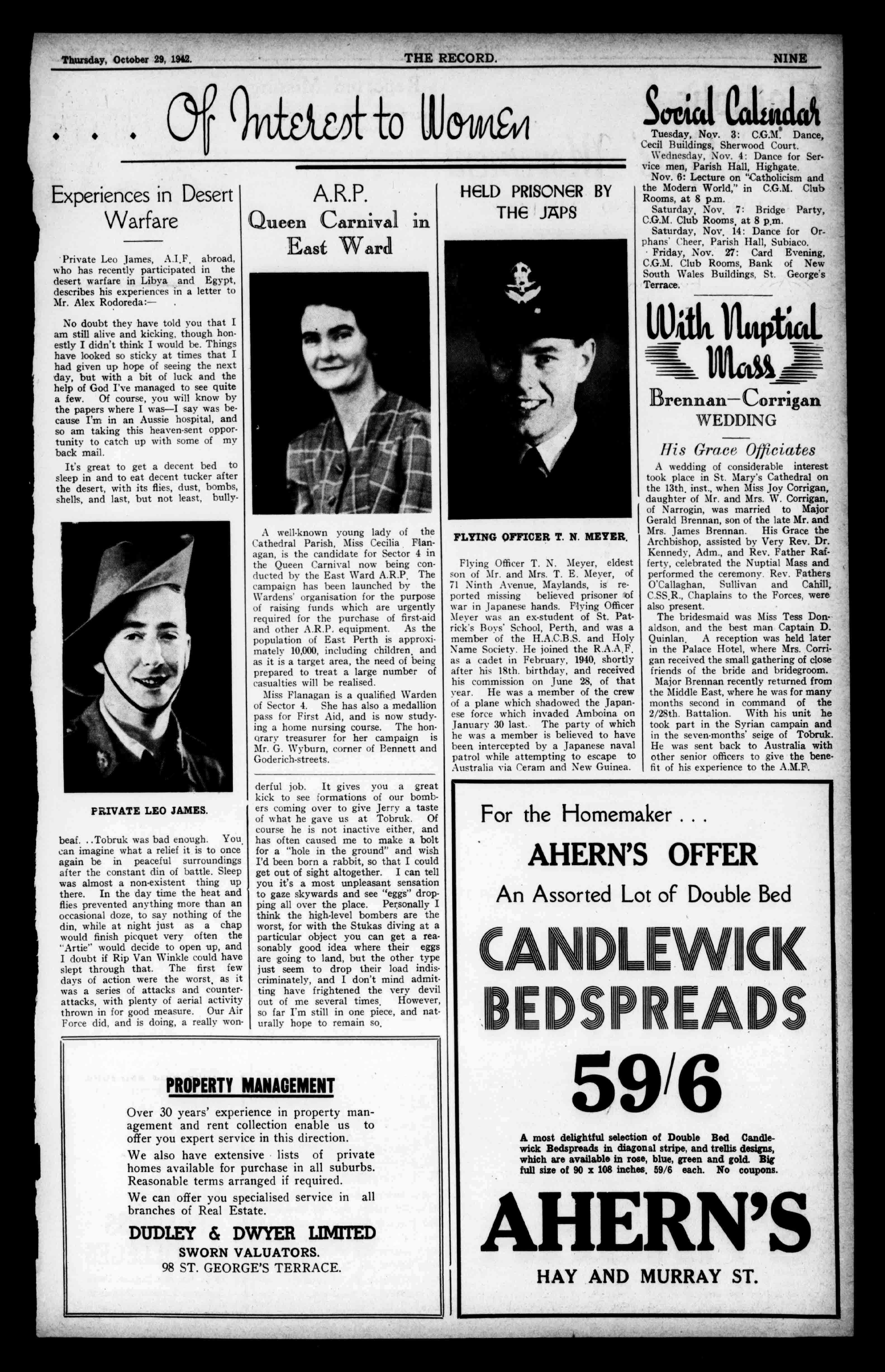 PRIVATELEOJAMES.
beaf...Tobrukwasbadenough.You. canimaginewhatareliefitistoonce againbeinpeacefulsurroundings aftertheconstantdinofbattle.Sleep wasalmostanon-existentthingup there.Inthedaytimetheheatand fliespreventedanythingmorethanan occasionaldoze,tosaynothingofthe din,whileatnightjustasachap wouldfinishpicquetveryoftenthe "Artie"woulddecidetoopenup,and IdoubtifRipVanWinklecouldhave sleptthroughthat.Thefirstfew daysofactionweretheworst,asit wasaseriesofattacksandcounterattacks,withplentyofaerialactivity throwninforgoodmeasure.OurAir Forcedid,andisdoing,areallywon-
Awell-knownyoungladyofthe CathedralParish,MissCeciliaFlanagan,isthecandidateforSector4in theQueenCarnivalnowbeingconductedbytheEastWardA.R.P.The campaignhasbeenlaunchedbythe Wardens'organisationforthepurpose ofraisingfundswhichareurgently requiredforthepurchaseoffirst-aid andotherA.R.P.equipment.Asthe populationofEastPerthisapproximately10,000,includingchildren,and asitisatargetarea,theneedofbeing preparedtotreatalargenumberof willberealised.
MissFlanaganisaqualifiedWarden ofSector4.Shehasalsoamedallion passforFirstAid,andisnowstudyingahomenursingcourse.Thehonorarytreasurerforhercampaignis Mr.G.Wyburn,cornerofBennettand Goderich-streets.
derfuljob.Itgivesyouagreat kicktoseeformationsofourbomberscomingovertogiveJerryataste ofwhathegaveusatTobruk.Of courseheisnotinactiveeither,and hasoftencausedmetomakeabolt fora"holeintheground"andwish I'dbeenbornarabbit,sothatIcould getoutofsightaltogether.Icantell youit'samostunpleasantsensation togazeskywardsandsee"eggs"droppingallovertheplace.PersonallyI thinkthehigh-levelbombersarethe worst,forwiththeStukasdivingata particularobjectyoucangetareasonablygoodideawheretheireggs aregoingtoland,buttheothertype justseemtodroptheirloadindiscriminately,andIdon'tmindadmittinghavefrightenedtheverydevil outofmeseveraltimes.However, sofarI'mstillinonepiece,andnaturallyhopetoremainso,
PROPERTYMANAGEMENT
Over30years'experienceinpropertymanagementandrentcollectionenableusto offeryouexpertserviceinthisdirection. Wealsohaveextensivelistsofprivate homesavailableforpurchaseinallsuburbs. Reasonabletermsarrangedifrequired. Wecanofferyouspecialisedserviceinall branchesofRealEstate.
DUDLEY&DWYERLIMITED
SWORNVALUATORS. 98ST.GEORGE'STERRACE.
HELDPRISONERBY THEJAPS
Social
Tuesday,Nov.3:CG:M!Dance, CecilBuildings,SherwoodCourt.
Wednesday,Nov.4:DanceforServicemen,ParishHall,Highgate. Nov.6:Lectureon"Catholicismand theModernWorld,"inC.G.M.Club Rooms,at8p.m.
Saturday,Nov.7:BridgeParty, C.G.M.ClubRooms,at8p.m.
Saturday,Nov,14:DanceforOrphans'Cheer,ParishHall,Subiaco.
Friday,Nov.27:CardEvening, C.G.M.ClubRooms,BankofNew SmithWalesBuildings,St.George's Terrace.
f.rennan-Corrigan WEDDING
HisGraceOfficiates
FLYINGOFFICERT.N.MEYER.
FlyingOfficerT.N.Meyer,eldest sonofMr.andMrs.T.E.Meyer,of 71NinthAvenue,Maylands,isreportedmissingbelievedprisoner'of warinJapanesehands.FlyingOfficer Meyerwasanex-studentofSt.Patrick'sBoys'School,Perth,andwasa memberoftheH.A.C.B.S.andHoly NameSociety.HejoinedtheR.A.A.F, asacadetinFebruary,1940,shortly afterhis18th.birthday,andreceived hiscommissiononJune28,ofthat year.Hewasamemberofthecrew ofaplanewhichshadowedtheJapaneseforcewhichinvadedAmboinaon January30last.Thepartyofwhich hewasamemberisbelievedtohave beeninterceptedbyaJapanesenaval patrolwhileattemptingtoescapeto AustraliaviaCeramandNewGuinea.
Aweddingofconsiderableinterest tookplaceinSt.Mary'sCathedralon the13th,inst.,whenMissJoyCorrigan, daughterofMr.andMrs.W.Corrigan, ofNarrogin,wasmarriedtoMajor GeraldBrennan,sonofthelateMr.and Mrs.JamesBrennan.HisGracethe Archbishop,assistedbyVeryRev.Dr. Kennedy,Adm.,andRev.FatherRaiferty,celebratedtheNuptialMassand performedtheceremony.Rev.Fathers O'Callaghan,SullivanandCahill, C.SS.R.,ChaplainstotheForces,were alsopresent.
ThebridesmaidwasMissTessDonaldson,andthebestmanCaptainD. Quinlan.Areceptionwasheldlater inthePalaceHotel,whereMrs.Corriganreceivedthesmallgatheringofclose friendsofthebrideandbridegroom. MajorBrennan returnedfrom theMiddleEast,wherehewasformany monthssecondincommandofthe 2/28th.Battalion.Withhisunithe tookpartintheSyriancarnpainand intheseven-months'seigeofTobruk. HewassentbacktoAustraliawith otherseniorofficerstogivethebenefitofhisexperiencetotheA.M.F.
Thursday,October29,1942. THERECORD. NINE
motto
FortheHomemaker AHERN'SOFFER AnAssortedLotofDoubleBed m DisPRE 59/6 Ds AmostdelightfulselectionofDoubleBedCandlewickBedspreadsindiagonalstripe,andtrellisdesigns, whichareavailableinrose,blue,greenandgold.Big fullsizeof90x108inches,59/6each.Nocoupons. AHERN'S HAYANDMURRAYST.
of(600kto VV
ExperiencesinDesert Warfare
PrivateLeoJames,A.1,F,abroad, whohasrecentlyparticipatedinthe desertwarfareinLibyaandEgypt. describeshisexperiencesinaletterto Mr.AlexRodoreda:--
NodoubttheyhavetoldyouthatI amstillaliveandkicking,thoughhonestlyIdidn'tthinkIwouldbe.Things havelookedsostickyattimesthatI hadgivenuphopeofseeingthenext day,butwithabitofluckandthe helpofGodI'vemanagedtoseequite afew.Ofcourse,youwillknowby thepaperswhereIwas-IsaywasbecauseI'minanAussiehospital,and soamtakingthisheaven-sentopportunitytocatchupwithsomeofmy backmail.
It'sgreattogetadecentbedto sleepinandtoeatdecenttuckerafter thedesert,withitsflies,dust,bombs, shells,andlast,hutnotleast.bully-
A.R.P. QueenCarnivalin EastWarcl
HELDPRISONERBY THEJAPS
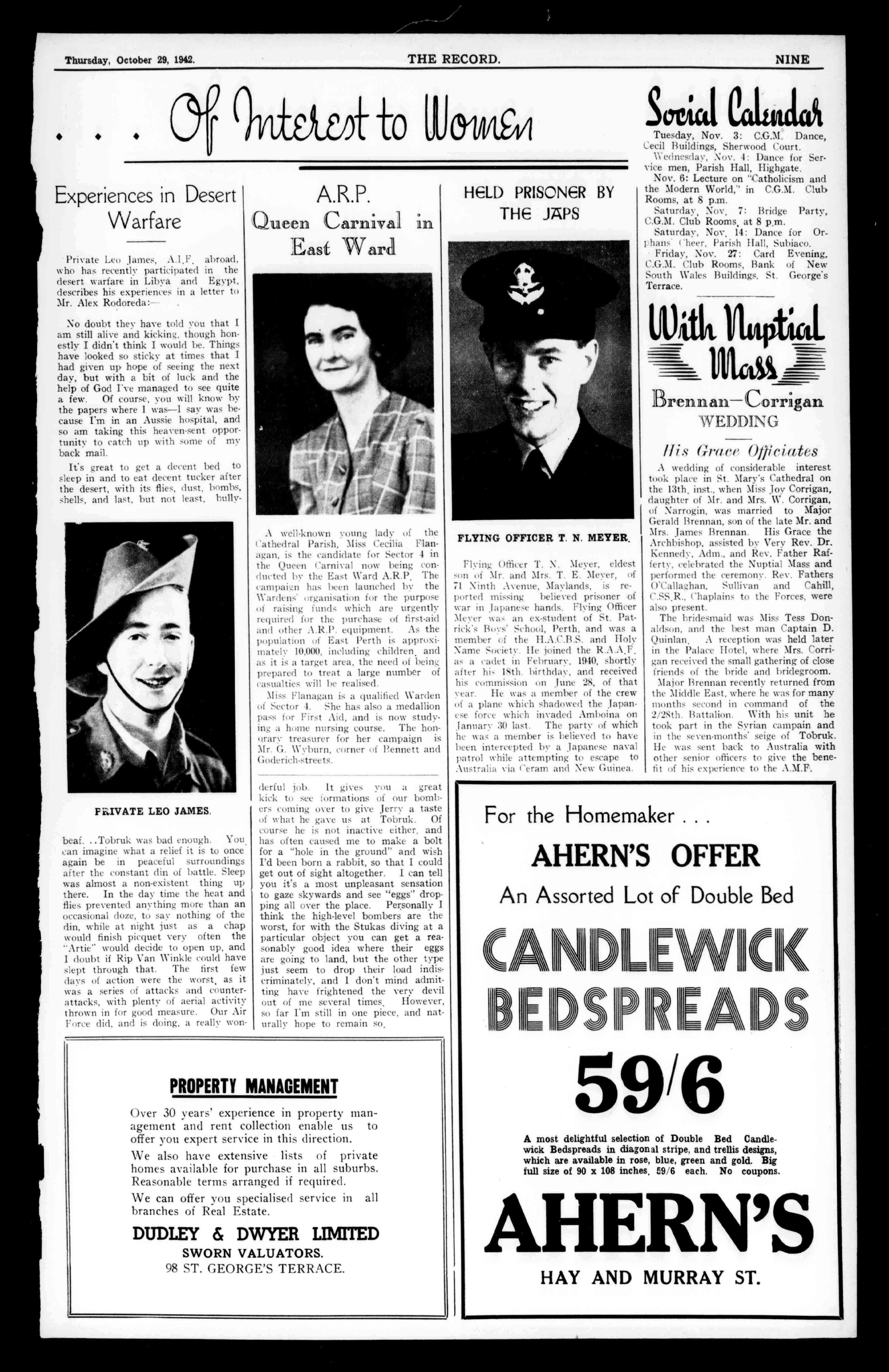 FiJVATELEOJAMES.
beaf...Tobrukwasbadenough.You. canimaginewhatareliefitistoonce againbeinpeacefulsurroundings aftertheconstantdinofbattle.Sleep wasalmostanon-existentthingup there.Inthedaytimetheheatand fliespreventedanythingmorethanan occasionaldoze,tosaynothingofthe din,whileatnightjustasachap wouldfinishpicquetveryoftenthe "Artie"woulddecidetoopenup,and 1doubtifRip\'anWinklecouldhave sleptthroughthat.Thefirstfew daysofactionweretheworst,asit wasaseriesofattacksandcounterattacks,withplentyofaerialactivity throwninforgoodmeasure.OurAir Forcedid,andisdoing,areallywon-
A\yell-knownyoungladyofthe CathedralParish,MissCeciliaFlanagan,isthecandidateforSector4in theQueenCarnivalnowbeingconductedbytheEastWardA.R.P.The campaignhas 1tenlaunchedbythe Wardens'organisationforthepurpose ofraisingfundswhichareurgentlyrequiredforthepurchaseoffirst-aid rnlotherA.R.P.equipment.Asthe populationofEastPerthisapproxi mately10,15K),includingchildren.and asitisatargetarea,theneedofbeing preparedtotreatalargenumberof casualtieswillberealised.
MissFlanaganisaqualifiedWarden ofSector-1. Shehasalsoamedallion passforFirstAid,andisnowstudyingahomenursingcourse.Thehonorarytreasurerforhercampaignis Mr.G.Wyburn,cornerofKennettand Goderich-streets.
derfuljob.ItgivesYouagreat kicktoseeformationsofourbomber,:comingovertogiveJerryataste ofwhathegaveusatTobruk.Of courseheisnotinactiveeither,and hasoftencausedmetomakeabolt fora"holeintheground"andwish I'dbeenbornarabbit,sothatIcould getoutofsightaltogether.Icantell youit'samostunpleasantsensation togazeskywardsandsee"eggs"droppingallovertheplace.Personally1 thinkthehigh-levelbombersarethe worst,forwiththeStukasdivingata particularobjectyoucangetareasonablygoodideawheretheireggs aregoingtoland,buttheothertype justseemtodroptheirloadindiscriminately.and1don'tmindadmittinghavefrightenedtheverydevil outofmeseveraltimes,However, sofarI'mstillinonepiece,andnaturallyhopetoremainso.
PROPERTYMANAGEMENT
Over30years'experienceinpropertymanagementandrentcollectionenableusto offeryouexpertserviceinthisdirection. Wealsohaveextensivelistsofprivate homesavailableforpurchaseinallsuburbs. Reasonabletermsarrangedifrequired. Wecanofferyouspecialisedserviceinall branchesofRealEstate.
DUDLEY&DWYERLIMITED SWORNVALUATORS. 98ST.GEORGE'STERRACE.
FLYINGOFFICERT.N.MEYER.
FlyingOfficer1'.N.Meyer,eldest sonofMr.andMrs.T.E.Meyer,of 71NinthAvenue,Maylands,isreportedmissingbelievedprisonerof warinJapanesehands.FlyingOfficer Meyerwasanex-studentofSt.Patrick'sBoys'School,Perth,andwasa memberoftheH.A.C.I3.S.andHoly NameSociety.liejoinedtheR.A.Ay, asacadetinFebruary,1940,shortly afterhisItith.birthday,andreceived onJune28,ofthat year.Hewasamemberofthecrew ofaplanewhichshadowedtheJapaneseforcewhichinvadedAmboinaon January30last.Thepartyofwhich hewasamemberisbelievedtohave beeninterceptedbyaJapanesenaval patrolwhileattemptingI,escapeto .Australiaviaceramand\,wGuinea.
SocialCaluidai
Tuesday,Nov.3:C.G.M.Dance, CecilBuildings,SherwoodCourt.
Wednesday,Nov.4:DanceforServicemen,ParishHall,Highgate. Nov.6:Lectureon"Catholicismand theModernWorld,"inC.G.M.Club Rooms,at8p.m.
Saturday,Nov,7:BridgeParty, C.G.M.ClubRooms,at8p.m.
Saturday,Nov,14:DanceforOrtitans.cheer,ParishHall,Suhiaco.
Friday,Nov.27:CardEvening, C.G.M.ClubRooms,BankofNew South\ValesBuildings.St.George's Terrace.
Brennan-Corrigan WEDDING
HisGraceOfficiates
Aweddingofconsiderableinterest tookplaceinSt.Mary'sCathedralon the13th,inst.,whenMissJoyCorrigan, daughterofMr.andMrs.\V.Corrigan, ofNarrogin,wasmarriedtoMajor GeraldBrennan,sonofthelateMr.and Mrs.JamesBrennan.HisGracethe Archbishop,assistedbyVeryRev.Dr. Kennedy.Adm.,andRev.FatherRafferty,celebratedtheNuptialMassand performedtheceremony.Rev.Fathers ('Callaghan,SullivanandCahill, C.SS.R.,ChaplainstotheForces,were alsopresent.
ThebridesmaidwasMissTessDonaldson,andthebestmanCaptainD. Quinlan, Areceptionwasheldlater inthePalaceHotel,whereMrs.Corriganreceivedthesmallgatheringofclose friendsofthebrideandbridegroom. returnedfrom theMiddleEast,wherehewasformany monthssecondincommandofthe 2/28th.Battalion.Withhisunithe tookpartintheSyriancampainand intheseven-months'seigeofTobruk. HewassenthacktoAustraliawith otherseniorofficerstogivethebenetit,fhisexperiencetotheA.M.F.
Thursday,October29,1942. THERECORD. NINE
FortheHomemaker AHERN'SOFFER AnAssortedLotofDoubleBed CA DsPD1 59/6 DS AmostdelightfulselectionofDoubleBedCandlewickBedspreadsindiagonalstripe,andtrellisdesigns, whichareavailableinrose,blue,greenandgold.Big fullsizeof90x108inches,596each.Nocoupons. AHERN'S HAYANDMURRAYST.
PERTH.THURSDAY,OCTOBER29.1942.
ThisNationalRot
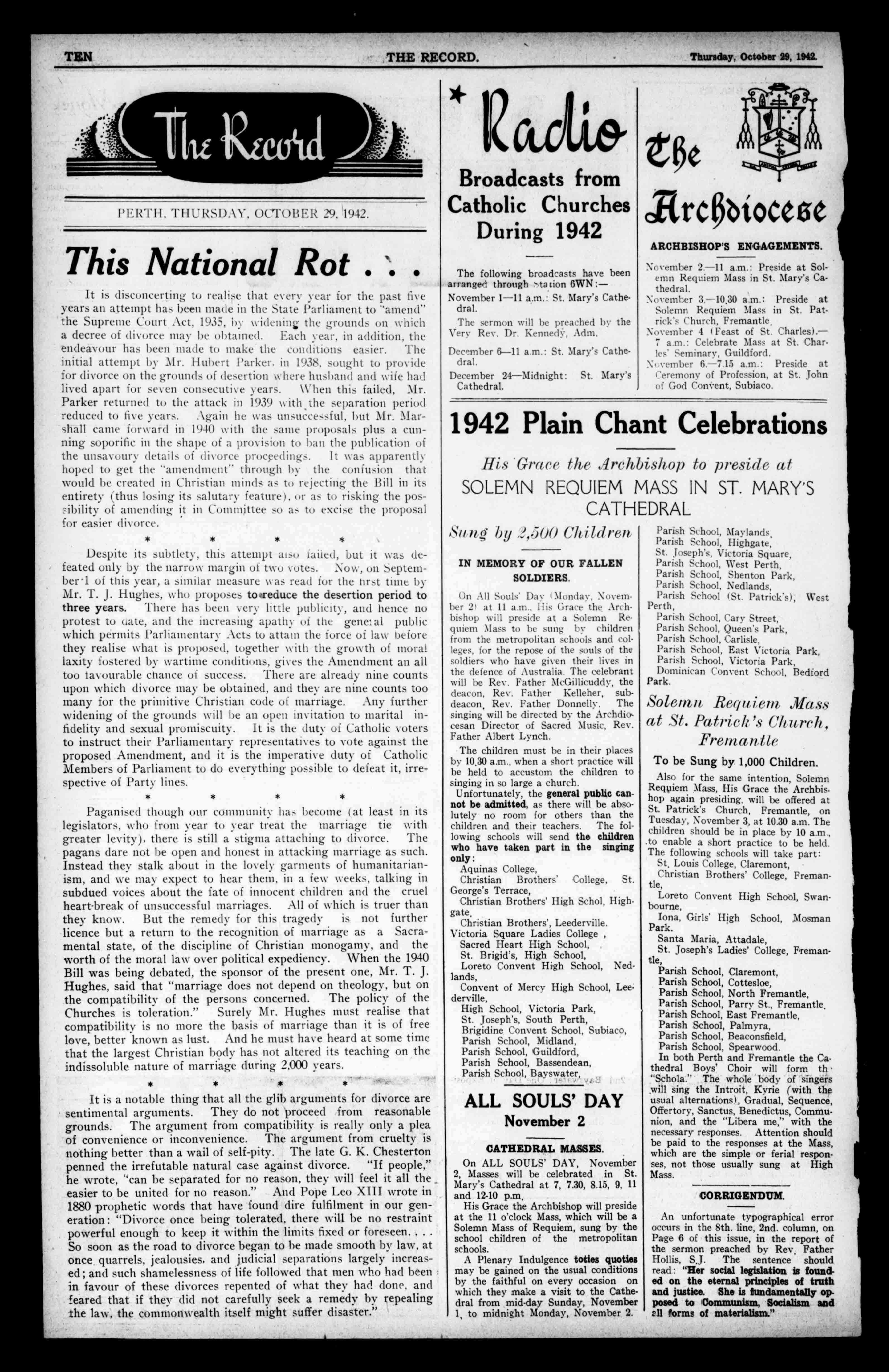
..
Itisdisconcertingtorealisethateveryvearforthepastfive yearsanattempthasbeenmadeintheStateParliamentto"amend" theSupremeCourtAct,1935,bywideningthegroundsonwhich adecreeofdivorcemaybeobtained.Eachyear,inaddition,the endeavourhasbeenmadetomaketheconditionseasier.The initialattemptbyMr.HubertParker.in1938.soughttoprovide fordivorceonthegroundsofdesertionwherehusbandandwifehad livedapartforsevenconsecutiveyears.Whenthisfailed,Mr. Parkerreturnedtotheattackin1939withtheseparationperiod reducedtofiveyears.Againhewasunsuccessful,butMr.Marshallcameforwardin1940withthesameproposalsplusacunningsoporificintheshapeofaprovisiontobanthepublicationof theunsavourydetailsofdivorceproceedings.Itwasapparently hopedtogetthe"amendment"throughbytheconfusionthat wouldbecreatedinChristianmindsastorejectingtheBillinits entirety(thuslosingitssalutaryfeature),orastoriskingthepossibilityofamendingitinCommitteesoastoexcisetheproposal foreasierdivorce.
* * * *
Despiteitssubtlety,thisattemptaisofailed,butitwasdefeatedonlybythenarrowmarginoftwovotes.Now,onSeptember-1ofthisyear,asimilarmeasurewasreadforthelusttimeby Mr.T.J.Hughes,whoproposestoereducethedesertionperiodto threeyears.Therehasbeenverylittlepublicity,andhencenu protesttouate,andtheincreasingapathyofthegene:alpublic whichpermitsParliamentaryActstoattaintheforceoflawbefore theyrealisewhatisproposed,togetherwiththegrowthofmoral laxityfosteredbywartimeconditions,givestheAmendmentanall tootavourablechanceofsuccess.Therearealreadyninecounts uponwhichdivorcemaybeobtained,andtheyareninecountstoo manyfortheprimitiveChristiancodeofmarriage.Anyfurther wideningofthegroundswillbeanopeninvitationtomaritalinfidelityandsexualpromiscuity.ItisthedutyofCatholicvoters toinstructtheirParliamentaryrepresentativestovoteagainstthe proposedAmendment,anditistheimperativedutyofCatholic MembersofParliamenttodoeverythingpossibletodefeatit,irrespectiveofPartylines.
* * *
Paganisedthoughourcommunityhasbecome(atleastinits legislators,whofromyeartoyeartreatthemarriagetiewith greaterlevity),thereisstillastigmaattachingtodivorce.The pagansdarenotbeopenandhonestinattackingmarriageassuch. Insteadtheystalkaboutinthelovelygarmentsofhumanitarianism,andwemayexpecttohearthem,inafewweeks,talkingin subduedvoicesaboutthefateofinnocentchildrenandthecruel heart-breakofunsuccessfulmarriages.Allofwhichistruerthan theyknow.Buttheremedyforthistragedyisnotfurther licencebutareturntotherecognitionofmarriageasaSacramentalstate,ofthedisciplineofChristianmonogamy,andthe worthofthemorallawoverpoliticalexpediency.Whenthe1940 Billwasbeingdebated,thesponsorofthepresentone,Mr.T.J. Hughes,saidthat"marriagedoesnotdependontheology,buton thecompatibilityofthepersonsconcerned.Thepolicyofthe Churchesistoleration."SurelyMr.Hughesmustrealisethat compatibilityisnomorethebasisofmarriagethanitisoffree love,betterknownaslust.Andhemusthaveheardatsometime thatthelargestChristianbodyhasnotaltereditsteachingonthe indissolublenatureofmarriageduring2,000years.
Itisanotablethingthatalltheglibargumentsfordivorceare sentimentalarguments.Theydonot'proceedfromreasonable grounds.Theargumentfromcompatibilityisreallyonlyaplea ofconvenienceorinconvenience.Theargumentfromcrueltyis nothingbetterthanawailofself-pity.ThelateG.K.Chesterton pennedtheirrefutablenaturalcaseagainstdivorce."Ifpeople," hewrote,"canbeseparatedfornoreason,theywillfeelitallthe easiertobeunitedfornoreason."AndPopeLeoXIIIwrotein 1880propheticwordsthathavefounddirefulfilmentinourgeneration"Divorceoncebeingtolerated,therewillbenorestraint powerfulenoughtokeepitwithinthelimitsfixedorforeseen. Sosoonastheroadtodivorcebegantobemadesmoothbylaw,at oncequarrels,jealousies.andjudicialseparationslargelyincreased;andsuchshamelessnessoflifefollowedthatmenwhohadbeen infavourofthesedivorcesrepentedofwhattheyhaddone,and fearedthatiftheydidnotcarefullyseekaremedybyrepealing thelaw,thecommonwealthitselfmightsufferdisaster."
RBroadcastsfrom CatholicChurches During1942
Thefollowingbroadcastshavebeen arrangedthrough,tadonOWN:-
November1-11a.m.:St.Mary'sCathedral.
Thesermonwillbepreachedbythe VeryRev.Dr.KennedY,Adm.
December6-11a.m.:St.Mary'sCathedral.
December24-Midnight:St.Mary's Cathedral.
tOe
ciircObtoCeae
ARCHBISHOP'SENGAGEMENTS.
November2.-11a.m.:PresideatSolemnRequiemMassinSt.Mary'sCathedral.
November3.-10.30a.m.:Presideat SolemnRequiemMassinSt.Patrick'sChurch,Fremantle, November4FeastofSt.Charles).7a.m.:CelebrateMassatSt.Charles'Seminary,Guildford.
November6.-7.15a.m.:Presideat CeremonyofProfession,atSt.John ofGodConVent,Subiaco.
1942PlainChantCelebrations
His'Gracethe..lrchbishoptopresideat SOLEMNREQUIEMMASSINST.MARY'S CATHEDRAL
Sungby,2,500Chi1dren
INMEMORYOFOURFALLEN SOLDIERS.
OnAllSouls'DaMonday,November'2)at11a.m.,IisGracetheArchbishopwillpresideataSolemnRe quiemMasstohesungbychildren fromthemetropolitanschoolsandcolleges,forthereposeofthesoulsofthe soldierswhohavegiventheirlivesin thedefenceofAustralia.Thecelebrant FatherMcGillicuddy,the deacon,Rev.FatherKelleher,subdeaconRev.FatherDonnelly.The singingwillbedirectedbytheArchdia cesanDirectorofSacredMusic,Rev. FatherAlbertLynch.
Thechildrenmustbeintheirplaces by10,30a.m.,whenashortpracticewill beheldtoaccustomthechildrento singinginsolargeachurch. Unfortunately,thegeneralpubliccannotbeadmitted,astherewillbeabsolutelynoroomforothersthanthe childrenandtheirteachers.Thefollowingschoolswillsendthechildren whohavetakenpartinthesinging only:
AquinasCollege, ChristianBrothers'College,St. George'sTerrace, ChristianBrothers'HighSchol,Highgate, ChristianBrothers',Leederville. VictoriaSquareLadiesCollege
SacredHeartHighSchool, St.Brigid's,HighSchool, LoretoConventHighSchool,Nedlands, ConventofMercyHighSchool,Leederville, HighSchool,VictoriaPark, St.Joseph's,SouthPerth, BrigidineConventSchool,Subiaco, ParishSchool,Midland, ParishSchool,Guildford, ParishSchool,Bassendean, ParishSchool,Bayswater,
ALLSOULS'DAY
November2
CATHEDRALMASSES.
OnALLSOULS'DAY,November 2,MasseswillbecelebratedinSt. Mary'sCathedralat7,7.30,8.15,9.11 and12-10p.m.
HisGracetheArchbishopwillpreside atthe11o'clockMass,whichwillbea SolemnMassofRequiem,sungbythe schoolchildrenofthemetropolitan schools.
APlenaryIndulgencetotiesquoties maybegainedontheusualconditions bythefaithfuloneveryoccasionon whichtheymakeavisittotheCathedralfrommid-daySunday,November 1,tomidnightMonday,November2.
ParishSchool,Maylands,ParishSchool,Highgate, St.Joseph's,VictoriaSquare, ParishSchool,WestPerth, ParishSchool,ShentonPark, ParishSchool,Nedlands, ParishSchool(St.Patrick's),West Perth, ParishSchool,CaryStreet, ParishSchool,Queen'sPark, ParishSchool,Carlisle, ParishSchool,EastVictoriaPark, ParishSchool,VictoriaPark, DominicanConventSchool,Bedford Park.
SolemnRequiemMass atSt.Patrick'sChurch, Fremantle
TobeSungby1,000Children.
Alsoforthesameintention,Solemn ReqpiemMass,HisGracetheArchbishopagainpresiding,willbeofferedat St.Patrick'sChurch,Fremantle,on Tuesday,November3,at10.30a.m.The childrenshouldbeinplaceby10a.m., .toenableashortpracticetobeheld. Thefollowingschoolswilltakepart: St.LouisCollege,Claremont, ChristianBrothers'College,Fremantle, LoretoConventHighSchool,Swanbourne,Iona, Girls'HighSchool,Mosman Park.
SantaMaria,Attadale, St.Joseph'sLadies'College,Fremantle, ParishSchool,Claremont, ParishSchool,Cottesloe, ParishSchool,NorthFremantle, ParishSchool,ParrySt.,Fremantle. ParishSchool,EastFremantle, ParishSchool,Palmyra, ParishSchool,Beaconsfield, ParishSchool,Spearwood.
InbothPerthandFremantletheCa. thedralBoys'Choirwillformth "Schola."Thewholebodyofsingers willsingtheIntroit,Kyrie(withthe usualalternations),,Gradual,Sequence, Offertory,Sanctus,Benedictus,Communion,andthe"Liberame,"withthe necessaryresponses.Attentionshould bepaidtotheresponsesattheMass, whicharethesimpleorferialresponses,notthoseusuallysungatHigh Mass.
CORRIGENDUM.
Anunfortunatetypographicalerror occursinthe8th.line,2nd.column,on Page6ofthisissue,inthereportof thesermonpreachedbyRev,Father Hollis,S.J.Thesentenceshould read"Hersociallegislationisfoundedontheeternalprinciplesoftruth andjustice.SheisfundamentallyopposedtoCommunism.Socialismand formsofmaterialism."
TEN THERECORD. Thursday.October29,1942.
itr(,'ksi).\\%()(.ThitEp2')l')12
ThisNationalRot
1Z Broadcastsfrom CatholicChurches
.
Itisdisconcertingtorealisethatovert'yearforthepastlive csanattempthasbeenMadeintheStaleParliamentto"amen,... '.heSlIpreinetonrl.\C1.1033. kidc;I::1,.;'thegi'lit11111,,oil\',a adecree mayheobtained.kachylq1;".inaddition. ,...ndeavourhasbeenmadetomakethecoildltionseasier. Ilie initialattemptbyMr.HuhertParke:..in1'68,soughttoprovide fordivorcemthegroundsof*Icsertionaii,rehusbandandwile!iii livedapartforseenconseentiIc:s.ears. Whenthisfailed,NIL Parkerreturnedtotheattackin193') Llieseparationperiod reducedtofive)ears..\gaiiihe\vasunsitcecs,iitl.hutNIr.Marhallcameforwardin0411withtile-.milep-,-opo,:al,plusacunningsuporilicintheshapeofaprovisionto;Jailthepublieatimof theunsavourydetailsofdivorceplweedli:gs.Itwasapparently hopedtogetthe"amendmentthrough theconti,onlily wouldbecreatediiiChristianmindsa-torejectingtheBillinitentirety(thuslo,ingitssalutaayfeature,...a;1-toriskingthepusofamendingItin!Committeesua-I!,exciseCiein-opus:II foreasierdiv(tree.
Despiteits tillsMU:11T( Litt,It,%;1_,w. icatedonlybythenarrowmarginoftwoIute,Now,oilSeptember1uithisyear.asimilarmeasurewasreadforthetirstClinth\ Mr.T.I.Hughes,whoproposestoreducethedesertionperiodto threeyears.Therehasbeen%crylittle henceut protesttooate,iondtileincreasingapatir.i gene:atpublic whichpermitsParliamentaryActstoattainthetorceoflawheI,,rt theyrealisewhatisproposed,togetherwiththegrowthofiii' laxityfosteredl))wartimeconditions,givestheAmendmentanail tootavourablecnanceoisuccess.Therearealreadyninecounts uponwhichdivorcemaybeobtained.andtheyareninecountstoo manyfortheprimitiveChristiancode marriage,Anyfurther wideningofthegroundswillheanopeninvitationtomaritalinfidelityandsexualpromiscuity.ItistiledutyofCatliiilicvoters toinstructtheirParliamentaryrepresentativestovoteagainstthe proposedAmendment,anditistheimperatiedutyofCatholic MembersofParliamenttodoeverythingpossibletodefeatit,irrespective(Il'arty * * *
Paganisedthoughotircommunityha-becomeIatleastinits legislators.whofrontyeartoyeartreattheMarriage.'tiewith greaterlevity),thereisstillastigmaattachingtodivorce.The pagansdarenotheopenandhonestinattackingmarriageassuch. Insteadtheystalkaboutinthelovelygarmentsofhumanitarianism,andwemayexpecttohearthem,inafewweeks,talkingin subduedvoicesaboutthefateofinnocentchildrenandthecruel heart-breakofunsuccessfulmarriages.Allofwhichistruerthan theyknow.Buttheremedyforthistragedy isnotfurther licencebutareturntotherecognitionofmarriageasaSacramentalstate,ofthedisciplineofChristianmunog-amy,andthe worthofthemorallawoverpoliticalexpediency.Whenthe1940 Billwasbeingdebated,thesponsorofthepresentone.Mr.T.J. Hughes,saidthat"marriagedoesnotdependontheology,buton thecompatibilityofthepersonsconcerned.Thepolicyofthe Churchesistoleration."SurelyMr.Hughesinsistrealisethat compatibilityisnomorethebasisofmarriagethanitisoffree love,betterknownaslust.Andhemusthaveheardatsometime thatthelargestChristianbodyhasnotaltereditsteachingonthe indissolublenatureofmarriageduring2.000years. * *
Itisanotablethingthatalltheglibargumentsfordivorceare sentimentalarguments.Theydonotproceedfromreasonable grounds.Theargumentfrontcompatibilityisreallyonlyaplea ofconvenienceorinconvenience.Theargumentfromcrueltyis nothingbetterthanawailofself-pity.ThelateG.K.Chesterton pennedtheirrefutablenaturalcaseagainstdivorce."Ifpeople." hewrote,"canheseparatedfornoreason,theywillfeelitallthe easiertobeunitedfornoreason."AndPopeLeoXIIIwrotein 1880propheticwordsthathavefounddirefulfilmentinourgeneration:"Divorceoncehieingtolerated,therewillhenorestraint powerfulenoughtokeepitwithinthelimitsfixedorforeseen.... Sosoonastheroadtodivorcebegantobemadesmoothbylaw.at oncequarrels.jealousies,andjudicialseparationslargelyincreased;andsuchshamelessnessoflifefollowedthatmenwhohadbeen infavourofthesedivorcesrepentedofwhattheyhaddone.and fearedthatiftheydidnotcarefullyseekaremedybyrepealing thelaw,thecommonwealthitselfmightstifferdisaster."
ttie
11 oarcObioceae During1942
Thefollowingbroadcastshavebeen arrangedthrough-tationOWN:-
November1-11a.m.:St.Mary'sCathedral.
Theseri-n(11willI,preacher-1bvthe VytyRev.Dr.Kennedy,Adni, Deri,mber6-11a.m.:St.Mary'sCathe. dral.
December24-Midnight:St.Mary's Cathedral.
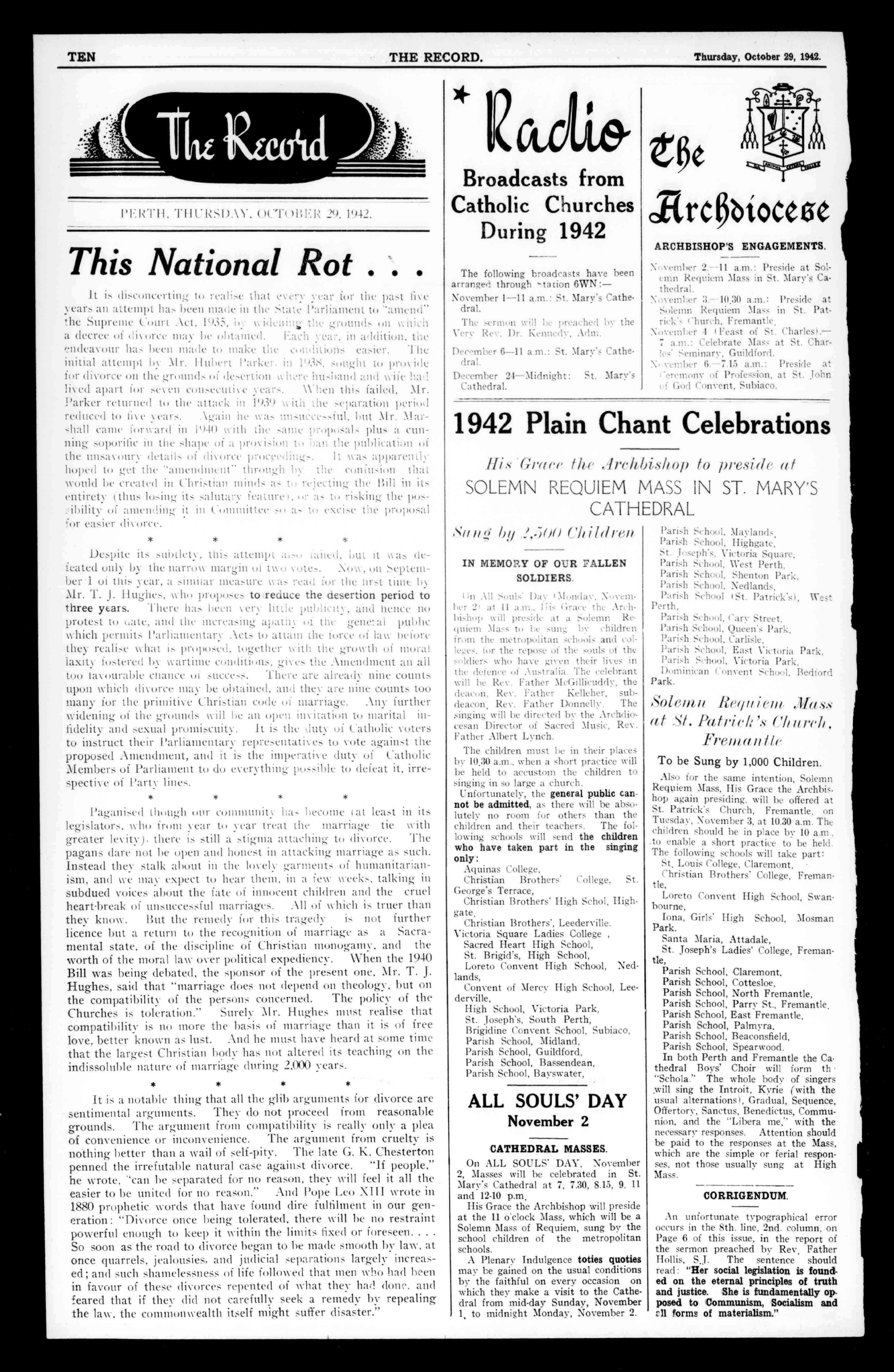
ARCHBISHOP'SENGAGEMENTS.
November2.--11a.m.:PresideatSolemnRequiemMassinSt.Mary'sCa. thedral.
November:3.-11)30a.m.:Presideat SolemnRequiemMassinSt.Patrick',church,Fremantle, Novemlier ofSt.Charles).7a.m.:CelebrateMasi:atSt.Charles'Seminary,Guildford. vemberfi 7.13a.m.:Presideat ',in-ironyofProfession,atSt.John .!'Godconvent,Subiaco.
1942PlainChantCelebrations
HisGracethe.1rehbishoptopresid, SOLEMNREQUIEMMASSINST.MARY'S CATHEDRAL Children
INMEM0717OFOURFALLEN SOLDIERS.
(;itAllSoukDa, her2'at a.m., ;ra).t.th,.1r,iibishu}Iwillpreside;itaSolemnRe. quiemMasstoliestingbychildren themetropolitan,choolsandcol1,,nthereposeofthesouputthe whohavegiventheirlivesin dcictieofAustralia.Thecelebrant willlieRev.Father.McGillictiddy,the deaciai,Rev.FatherKelleher,solideacon,Rey.FatherDonnelly,The singingwillbedirectedbytheAi-chi-Ho, cesanDirectorofSacredMusic,Rev. FatherAlbertLynch.
Thechildrenmust1,eintheirplaces by10,30a.m.,whenashortpracticewill beheldtoaccustomthechildrento singinginsolargeachurch. Unfortunately,thegeneralpubliccannotbeadmitted,astherewillbeabsolutelynoroomforothersthanthe childrenandtheirteachers.Thefollowingschoolswillsendthechildren whohavetakenpartinthesinging only:
AquinasCollege.
ChristianBrothers'College,St. George'sTerrace, ChristianBrothers'HighSchol,Highgate, ChristianBrothers',Leederville. VictoriaSquareLadiesCollege
SacredHeartHighSchool, St.Brigid's,HighSchool, LoretoConventHighSchool,Nedlands, ConventofMercyHighSchool,Leederville, HighSchool,VictoriaPark, St.Joseph's,SouthPerth, BrigidineConventSchool,Subiaco. ParishSchool,Midland, ParishSchool,Guildford, ParishSchool,Bassendean, ParishSchool,Bayswater,
ALLSOULS'DAY
November2
CATHEDRALMASSES.
OnALLSOULS'DAV,November 2,MasseswillhecelebratedinSt. Mary'sCathedralat7,7.30,8.15,9.11 and12.10p.m, HisGracetheArchbishopwillpreside atthe11o'clockMass,whichwillbea SolemnMassofRequiem,sungbythe schoolchildrenofthemetropolitan schools.
APlenaryIndulgencetotiesquoties maybegainedontheusualconditions bythefaithfuloneveryoccasionon whichtheymakeavisittotheCathedralfrommid-daySunday,November 1,tomidnightMonday,November2.
ParishSchool..Mayland,, ParishSchool,Highgatv. St. ParishJi,seph's,VictoriaSquare. WestPerth, ParishSchool,SheratonPark. ParishSchool,Nedlands, ParishSchool'St.Patrick's),W. Perth, ParishSchii,i1,caryStreet, ParishSchool,Queen'sPark, ParishSchool,Carlisle, ParishSchool.EastVictoriaPark, ParishSchool,VictoriaPark, DominicanConventSchool.Bedford Park.
&Zoo',liegaiemMass
atPatri CItreh FreniI!1e
TobeSungby1,000Children. Alsoforthesameintention,Solemn RequiemMass,HisGracetheArchbishopagainpresiding,willbeofferedat St.Patrick'sChurch,Fremantle,on Tuesday,November3,at10.30a.m.The childrenshouldbeinplacebytoam toenableashortpracticetobeheld Thefollowingschoolswilltakepart: St.LouisCollege,Claremont,ChristianBrothers'College,Freman tie, bourne, LoretoConventHighSchool,SwanGirls'HighSchool,Mosman Park.
SantaMaria,Attadale, St.Joseph'sLadies'College,Fremantle, ParishSchool,Claremont, ParishSchool,Cottesloe, ParishSchool,NorthFremantle, ParishSchool,ParrySt.,Fremantle, ParishSchool,EastFremantle, ParishSchool,Palmyra. ParishSchool,Beaconsfield, ParishSchool,Spearwood.
InbothPerthandFremantletheCathedralBoys'Choirwillformth"Schola."Thewholebodyofsingers willsingtheIntroit,Kyrie(withthe usualalternationsI,Gradual,Sequence, Offertory,Sanctus,Benedictus,Communion,andthe"Liberame,"withthe necessaryresponses.Attentionshould bepaidtotheresponsesattheMass, whicharethesimpleorferialresponses,notthoseusuallysungatHigh Mass.
CORRIGENDUM.
Anunfortunatetypographicalerror occursinthe8th.line,2nd.column,on Page6ofthisissue,inthereportof thesermonpreachedbyRev,Father Hollis,Si.Thesentenceshould read"Hersociallegislationisfoundedontheeternalprinciplesoftruth andjustice.Sheisfundamentallyop. posedtoCommunism,Socialismand allformsofmaterialism."
TEN THERECORD. Thursday,October29,1942.
Thursday,October29,1.942.
DEATHS.
DOWNES.-OnOctober25,atSt.John ofGod'sHospital,Geraldton,Kevi? Roy,sincerefriendofMr.andMrs. P.J.Brennan,Yandanooka;aged 20years.R.I.P.
STAI:s1BURY-Ofyourcharitypray forthesoulofCameliaStanbury, whodiedOctober14.
-Insertedbyherlotingdaughters.
WILLIAMS(ClementCecil),A.I.F.Killedinaction,MiddleEast,dearly lovedsonofMrs.M.E.andthelate J.P.Williams,ofLawleyCrescent, fondbrotherofEileen(Mrs.L. Watts,Mt.Lawley),Sheila(Mrs.R. J.Keating,Northam),Harry(Inglewood),John(A.I.F.),andKevin (A.I.F.),
INMEMORIAM.
COEN--HANRAHAN.-Ofyourcharity prayforthereposeofthesoulsof JamesCoen,diedNovember24,1938, andhisbelovedwife,Mary,diedOctober27,1941:alsoherbrotherEdwardHanrahan,diedNovember17, 1940.
Ifyouknewhowsadthatpartingwas, Andwhatthatpartingcost:
ButGodandHisbrightangels
HavegainedwhatIhavelost.
Ontheirsouls,SweetJesus,have mercy.
-Insertedbyhissorrowingsister,M. Marshall,Park-street,Kalgoorlie.
BOYLAN.-Infondandlovingmemoryofourdearwifeandmother, Margaret,whodiedOctober28,1935.
-InsertedbyJack,Josephineand Jackie.
DOWLEY.-Inlovingremembranceof ourdarlingDad,E.P.Dowley,who passedawayNovember1,1934. R.I.P.
SweetHeartofJesus,havemercy onhim.
DUNN.-InlovingmemoryofMark Dunn,whodiedOctober24,1919.
SacredHeartofJesus,havemercyon hissoul.
-Insertedbyhislovingwifeand family.
MILLER.-Ofyourcharity,prayfor thereposeofthesoulofFrancis JosephMiller,whodepartedthislife atKalgoorlieonNovember2,1935.
ImmaculateheartofMary,your prayersforhimextol.
0,SacredHeartofJesus,have mercyonhissoul.
-Insertedbyhislovingwifeand family.
MILLER,-Inlovingmemoryofour dearfather.FrancisJosephMiller, whodepartedthislifeonNovember2,1935. Alwaysremembered.
-Insertedbyhislovingdaughter andson-in-law,H.Muldoon.
WYNDHAM.-Inlovingmemoryof MargaretWyndham,whoseanniversaryoccursonAllSoul&Day,November2.
SacredHeartofJesus,havemercy onhersoul.
-Insertedbyherlovingfamily.
HIGHGATEHILL
TheParents'andFriends*AssociationoftheSacredHeartPrimary Schoolhasbeenfunctioningsatisfactorilyduringthewinterseason,The monthlybridgeafternoonswerewell attended,butwiththelongerandfiner eveningstheever-populareuchrepartieshavebeenstarted.Therehasbeen anurgentdemandtoholdtheseeach week,butsofarthecommitteehasnot beenabletoarrangethat.Thenext willtakeplaceonMonday,November 16,at8.15p.m.Cashprizesaregiven andagoodsupperisservedforthe modestpriceof1/6,
AstheAssociationexistsprimarily forthechildren,ithasbeendecided toholdaFrolicDancefortheminthe ParishHallonSaturday,November7, at2p.m.Alreadythelittleonesare askeenasthebiggergirlsandboys,as theyallanticipatehavingagoodtime. Itwillnotbethefaultofthecommitteeiftheirhopesarenotrealised. Goodmusichasbeenarrangedfor,but itwouldbetellingtoomuchifthe childrenknewjustwhattherefreshmentswillbe.Theymustcomealong andsee.Theair-raidsheltersarenow almostcomplete,andafinefirst-aid equipmenthasbeensecured.
THELATEMISSMARY JOSEPHINERHODES, onlychildofMrs.M.E.Rhodesand thelateJosephRhodes,ofEastCannington,whoseanniversaryoccurson the2nd.November,1942.
Yourgentlefaceandpatientsmile Withsadnesswerecall. Youhadakindlywordforeach Anddiedbelovedbyall.
Thevoiceismuteandstilledtheheart Thatloveduswellandtrue.
Ah,bitterwasthetrialtopart
Fromonesogoodasyou,
Youarenotforgotten,lovedone, Norwillyoueverbe Aslongaslifeandmemorylast Wewillrememberthee.
Wemissyounow,ourheartsaresore, Astimegoesbywemissyoumore.
Yourlovingsmile,yourgentleface Noonecanfillyourvacantplace.
QUARANT'ORE
Sunday.
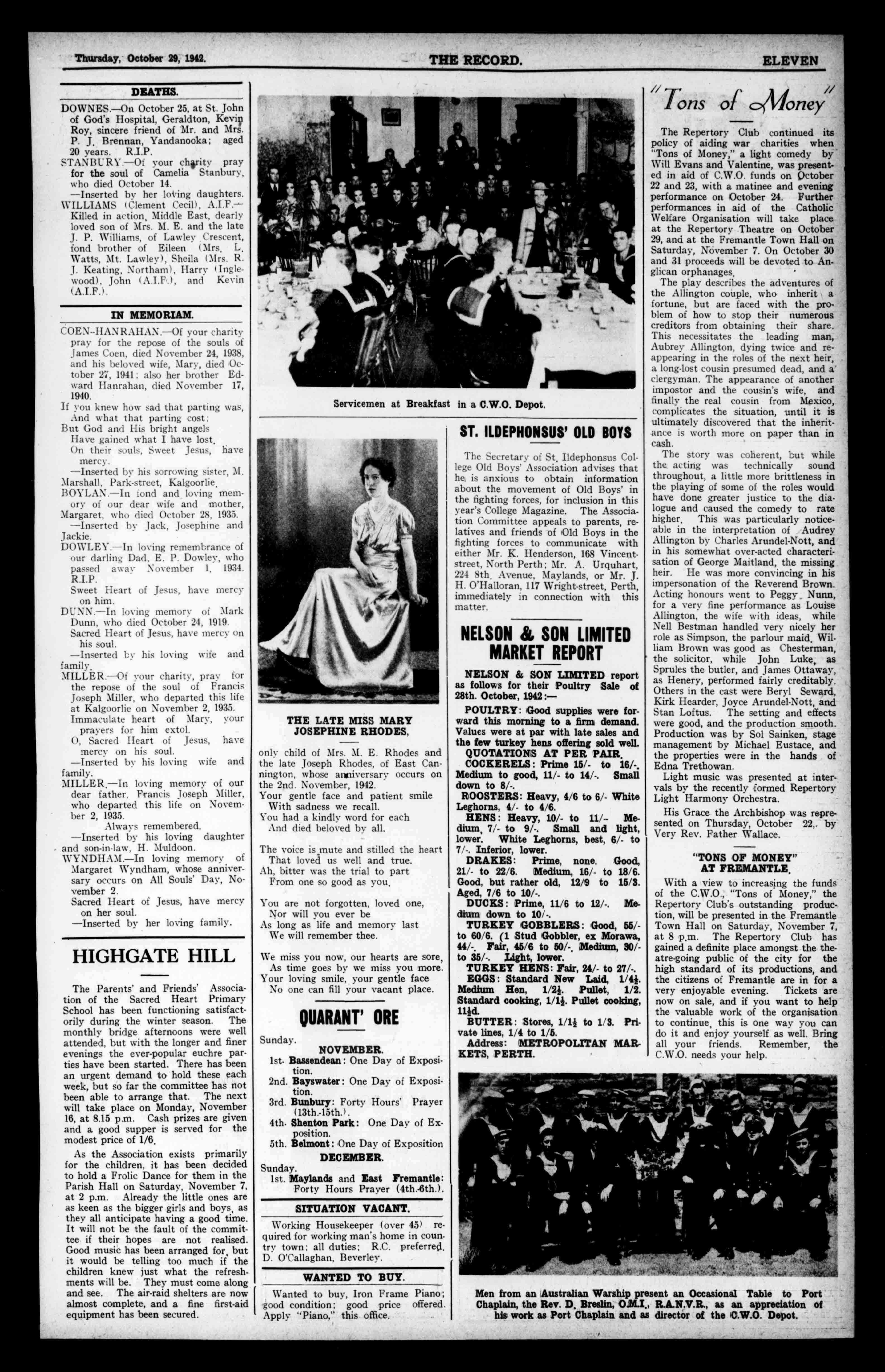
NOVEMBER.
1st.Bassendean:OneDayofExposition.
2nd.Bayswater:OneDayofExposition.
3rd.Bunbury:FortyHours'Prayer (13th.-15th.'
4th.ShentonPark:OneDayofExposition.
5th.Belmont:OneDayofExposition
DECEMBER.
Sunday.
1st.MaylandsandEastFremantle: FortyHoursPrayer(4th-6th).
SITUATIONVACANT.
WorkingHousekeeper(over45)requiredforworkingman'shomeincountrytown:allduties:R.C.preferred. D.O'Callaghan,Beverley.
WANTEDTOBUY.
Wantedtobuy,IronFramePiano; goodcondition;goodpriceoffered. Apply"Piano,"thisoffice.
ST.ILDEPHONSUS'OLDBOYS
TheSecretaryofSt,IldephonsusCollegeOldBoys'Associationadvisesthat he,isanxioustoobtaininformation aboutthemovementofOldBoys'in thefightingforces,forinclusioninthis year'sCollegeMagazine.TheAssociationCommitteeappealstoparents,relativesandfriendsofOldBoysinthe fightingforcestocommunicatewith eitherMr.K.Henderson,168Vincentstreet,NorthPerth;Mr.A.Urquhart, 2248th,Avenue,Maylands,orMr.J. H.O'Halloran,117Wright-street,Perth, immediatelyinconnectionwiththis matter.
NELSONItSONLIMITED MARKETREPORT
NELSON&SONLIMITEDreport asfollowsfortheirPoultrySaleof 28th.October,1942:-
POULTRY:Goodsupplieswereforwardthismorningtoafirmdemand. Valueswereatparwithlatesalesand thefewturkeyhensofferingsoldwell.
QUOTATIONSATPERPAIR, COCKERELS:Prime15:-to16/, Mediumtogood,11/-to14'-.Small downto8/-.
ROOSTERS:Heavy,4/6toWhite Leghorns,4/-to4/6.
HENSHeavy,10/-to11. Medium,7-to9/-.Smallandlight, lower.WhiteLeghorns,best,6/-to 7 Inferior,lower.
DRAKES:Prime,none.Good, 21.-to22/6.Medium,16/.to18/6. Good,butratherold,12/9to15/3. Aged,7/6to10/-.
DUCKS:Prime,11/6to12/-.Medimdownto10'..
TURKEYGOBBLERSGood,55,to60/6.(1StudGobbler,exMorawa, 44/-,Fair,45/6to50/-,Medium,30/to35/-.Light,lower.
TURKEYHENS:Fair,24/-to27/-.
EGGS:StandardNewLaid,1/4 MediumHen,1/24.Pullet,1/2. Standardcooking,1/14.Pulletcooking, llid.
BUTTER:Stores,1/11to13.Privatelines,1/4to1/5.
Address:METROPOLITANMARKETS,PERTH.
IonscMoney
TheRepertoryClubcontinuedits policyofaidingwarcharitieswhen "TonsofMoney,"alightcomedyby WillEvansandValentine,waspresentedinaidofC.W.O.fundsonDctober 22and23,withamatineeandevening performanceonOctober24.Further performancesinaidoftheCatholic WelfareOrganisationwilltakeplace attheRepertoryTheatreonOctober 29,andattheFremantleTownHallon Saturday,November7.OnOctober30 and31proceedswillbedevotedtoAnglicanorphanages,
Theplaydescribestheadventuresof theAllingtoncouple,whoinherita fortune,butarefacedwiththeproblemofhowtostoptheirnumerous creditorsfromobtainingtheirshare. Thisnecessitatestheleadingman, AubreyAllington,dyingtwiceaadreappearingintherolesofthenextheir,; along-lostcousinpresumeddead,anda' clergyman.Theappearanceofanother impostorandthecousin'swife,and finallytherealcousinfromMexico, complicatesthesituation,untilitis ultimatelydiscoveredthattheinheritanceisworthmoreonpaperthanin cash.
Thestorywascoherent,butwhile theactingwastechnicallysound throughout,alittlemorebrittlenessin theplayingofsomeoftheroleswould havedonegreaterjusticetothedia. logueandcausedthecomedytorate higher,ThiswasparticularlynoticeableintheinterpretationofAudrey AllingtonbyCharlesArundel-Nott,and inhissomewhatover-actedcharacterisationofGeorgeMaitland,themissing heir.Hewasmoreconvincinginhis impersonationoftheReverendBrown. ActinghonourswenttoPeggyNnnn, foraveryfineperformanceasLouise Allington,thewifewithideas,while NellBestmanhandledverynicelyher roleasSimpson,theparlourmaid.WilliamBrownwasgoodasChesterman, thesolicitor,whileJohnLuke,as Sprulesthebutler,andJamesOttaway, asHenery,performedfairlycreditably. OthersinthecastwereBerylSeward, KirkHearder,JoyceArundel-Nott,and StanLoftus.Thesettingandeffects weregood,andtheproductionsmooth. ProductionwasbySolSainken,stage managementbyMichaelEustace,and thepropertieswereinthehandsof EdnaTrethowan.
LightmusicwaspresentedatintervalsbytherecentlyformedRepertory LightHarmonyOrchestra.
HisGracetheArchbishopwasrepresentedonThursday,October22,.by VeryRev.FatherWallace.
"TONSOFMONEY" ATFREMANTLE.
Withaviewtoincreasingthefunds oftheC.W.O.,"TonsofMoney,"the RepertoryClub'soutstandingproduction,willbepresentedintheFremantle TownHallonSaturday,November7, at8p.m.TheRepertoryClubhas gainedadefiniteplaceamongstthetheatre-goingpublicofthecityforthe highstandardofitsproductions,and thecitizensofFremantleareinfora veryenjoyableevening.Ticketsare nowonsale,andifyouwanttohelp thevaluableworkoftheorganisation tocontinue,thisisonewayyoucan doitandenjoyyourselfaswell.Bring allyourfriends.Remember,the C.W.O.needsyourhelp.
THERECORD.
ELEVEN
ServicemenatBreakfastinaC.W.O.Depot.
MenfromanAustralianWarshippresentanOccasionalTabletoPort Chaplain,theRev.D.Breslin,0.M.IR.A.N.V.R.,asanappreciationof hisworkasPortChaplainandasdirectoroftheC.W.O.Depot.
Thursday,October29,1942.
DEATHS!.
DOWNES.-OnOctober25,atSt.John ofGod'sHospital,Geraldton,Kevin Roy,sincerefriendofMr.andMrs. P.T,Brennan,Yandanooka:aged 20years.R.I.P.
STANBURY.--Ofyourcharitypray forthesoulofCameliaStanbury, whodiedOctober14.
-Insertedhyherhivingdaughters.
WILLIAMSlementCecil',A Killedinaction,MiddleEast,dearly lovedsonelMrs.M.E.andthelate J.P.Williams,ofLawleyCrescent, hindbrotherofEileenMrs,L. Watts.Mt.LawlerI.Sheila(Mrs.R. J.Keating,Northam',HarryIngle weial),John(A.T.F.I.andKevin
INMEMORIAM.
COEN-HANRAHAN.-Ofyourcharity prayforthereposeofthesoulsof JamesCeen,diedNovember21.193s, andhisbelovedwife,Mary,diedOctober27.1941alsoherlinitherEdwardIlanrahan,diedNovember17, 1940.
It knewhowsadthatparole;wee .oulwhatthatpartingcost ButGialand11isbrightangel. ilaeegainedwhatIhavelost. eltheirsouls,Sweethistiehave merc Insertedbyhissorrowingsister,M. Marshall.Park-street.Kalgoorlie );01'L.1\-:endandlevinememeryofourdearwifeandmother, Margaret,whodiedOctober2t,1935. --InsertedlieJack,jesephineauui Jackie.
D(1WLEY.-1nlovingRimini;raneeof urdarliie.Dad,E.I'.1),,Mey,\vb., passed NovemberI.1931. R.1.1'.
SweetIkartitJei-es,havemercy onhim.
DUNN.Ltto memory Mark Dunn,whodiedOctober24.1910.
SacredHeartofJesus.havemercyen hissoul.
-Inserted1-yhis:ovinewifeand
.MILLER.-ofyourcharity.prayfor thereposeieitheseuiofFran.iJesephMiller.whodepartedthislite atKalgoorlieonNovember2.1035.
ImmaculateheartofMary,yiiur prayersforhimextol.
o.SacredHeartelJesus.have mercyonhissoul.
-InsertedbyhisIivin4triteand family.
MILLER.-Inlovingmemoryofour dearfather.FrancisJosephMiller, whodepartedthislifeonNovember2,1935.
Alwaysremembered.
-Insertedbyhislovingdaughter andson-in-law,H.Muldoon.
WYNDHAM.-Inhivingmemoryof MargaretWyndham,whoseanniven naryoccursonAllSouls'Day,November2.
SacredHeartofJesus,havemercy onhersoul.
-Insertedbyherlovingfamily.
HIGHGATEHILL
TheParents'andFriendsAsoiciationoftheSacredHeartPrimarySchoolhasbeenfunctioningsatisfactorilyduringthewinterseason.The monthlybridgeafternoonswerewell attended,butwiththelongerandfiner eveningstheever-populareuchrepartieshavebeenstarted.Therehasbeen anurgentdemandtoholdtheseeach week,butsofarthecommitteehasnot beenabletoarrangethat.Thenext willtakeplaceonMonday,November 16,at8.15p.m.Cashprizesaregiven andagoodsupperisservedforthe modestpriceof1/6,
AstheAssociationexistsprimarily forthechildren,ithasbeendecided toholdaFrolicDancefortheminthe ParishIlallonSaturday,November7. at2pan.Alreadythelittleonesare askeenasthebiggergirlsandboys,as theyallanticipatehavingagoodtime. Itwillnotbethefaultofthecommitteeiftheirhopesarenotrealised. Goodmusichasbeenarrangedfor,but itwouldbetellingtoomuchifthe childrenknewjustwhattherefresh. mentswillbe.Theymustcomealong andsee.Theair-raidsheltersarenow almostcomplete,andafinefirst-aid equipmenthasbeensecured.
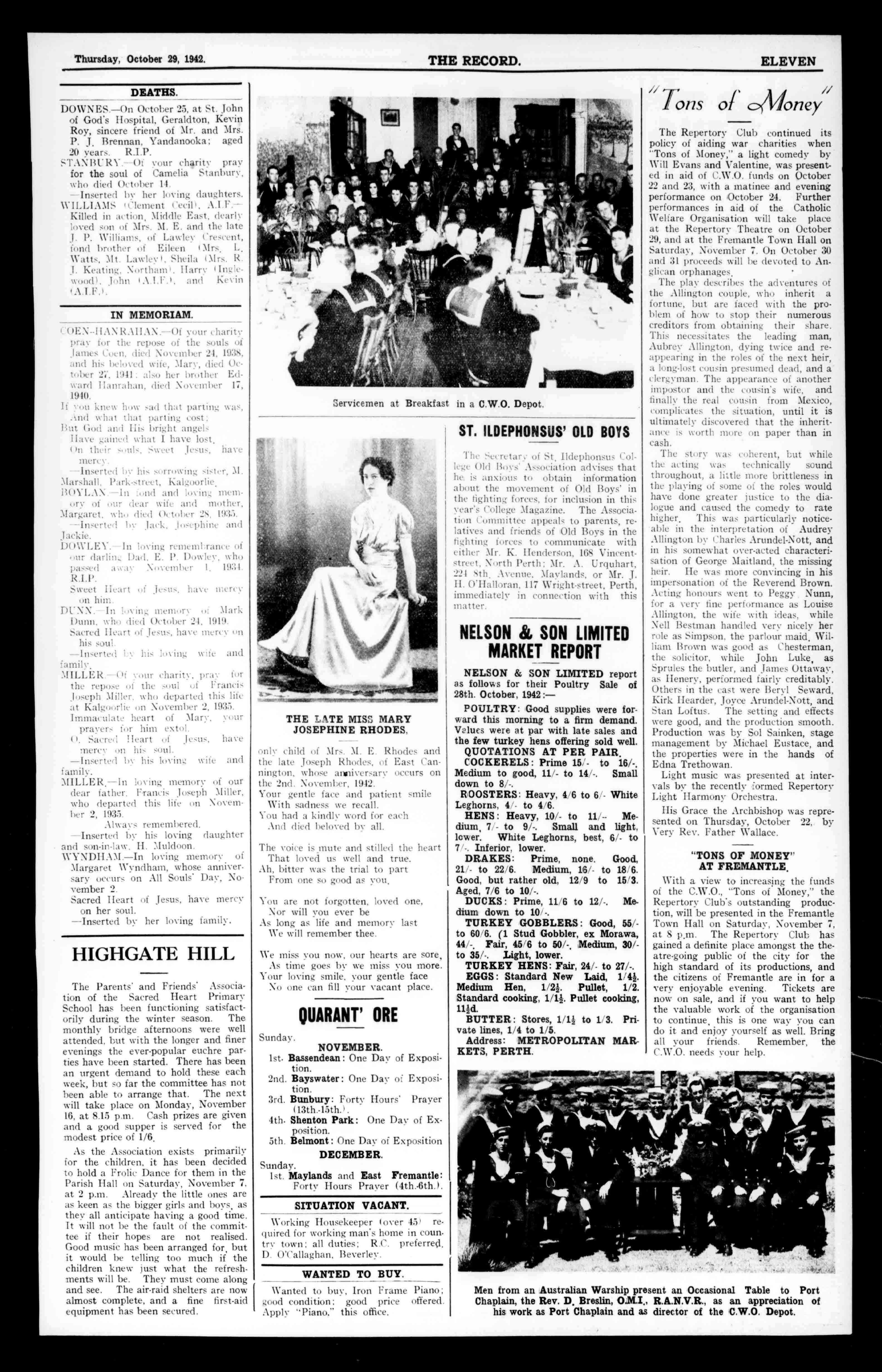
THE!ATEMISF,MARY JOSEPHINERHODES,
onlychildofMNM.E.Rhodesand thelateJosephWhales.ofEastCannington,whoseanniversaryoccurson the2nd.November,19-12.
Yourgentlefaceandpatientsmile Withsadnesswerecall. Youhadakindlywordforeach Anddiedbelovedbyall.
Thevoiceismuteandstilledtheheart Thatloveduswellandtrue.
Ah,bitterwasthetrialtopart Fromonesogoodasyou.
Youarenotforgotten,lovedone, Norwillyoueverbe
Aslongaslifeandmemorylast Wewillrememberthee.
Wemissyounow.ourheartsaresore, Astimegoesbywemissyoumore.
Yourlovingsmile,yourgentleface Noonecanfillyourvacantplace.
QUARANT'ORE
Sunday.
NOVEMBER.
1st.Bassendean:OneDayofExposition.
2nd.Bayswater:OneDayofExposition.
3rd.Bunbury:FortyHours'Prayer 1l3th-15th.
4th.ShentonPark:OneDayofExposition.
5th.Belmont:OneDayofExposition
DECEMBER.
Sunday.
1stMaylandsandEastFremantle: FortyHoursPrayerliecith
SITUATIONVACANT.
WorkingHousekeeperlover455requiredforworkingman'shomeincome trytown:allduties:R.C.preferred. D.O'Callaghan.Beverley.
WANTEDTOBUY.
Wantedtobuy,IronFramePiano: goodcondition:goodpriceoffered. Apply"Piano."thisoffice.
ST.ILDEPHONSUS'OLDBOYS
TheSecretar.ol IldephonsusCollcgeOldBeys.Asseeiationadvisesthat he,isanxioustoobtaininformation aboutthemovementofOldBoys'in thefightingforces,forinclusioninthis year'sCollegeMagazine.TheAssociationCommitteeappealstoparents,relativesandfriendsofOldBoysinthe fightingforcestocommunicatewith eitherMr.K.Henderson,168Vincentstreet,NorthPerth:Mr.A.Urquhart, 221stleAvenue.Maylands,orMr.J. II.O'llalloran,117Wright-street,Perth, immediatelyinconnectionwiththis matter.
NELSON&SONLIMITED MARKETREPORT
NELSON&SONLIMITEDreport
asfollowsfortheirPoultrySaleof 28th.October,1942:-
POULTRY:Goodsupplieswereforwardthismorningtoafirmdemand. Valueswereatparwithlatesalesand thefewturkeyhensofferingsoldwell.
QUOTATIONSATPERPAIR, COCKERELS:Prime15.- to16/-. Mediumtogood,11,-to14,-.Small downto8/-.
ROOSTERS:Heavy,4/6to6-White Leghorns,4-to4'6.
HENS:Heavy,10/-to11, Medium,7-to9/-.Smallandlight, lower.WhiteLeghorns,best,6/-to 7 Inferior,lower.
DRAKES:Prime,none.Good, 21-to22/6.Medium,16/-to1876. Good,butratherold,12/9to151. Aged,7/6to10/-.
DUCKS:Prime,116to12/-.Mediumdownto10
TURKEYGOBBLERSGood,55/to60'6.(1StudGobbler,exMorawa, 44/-,Fair,456to50Medium,30/to35/..Light,lower.
TURKEYHENS:Fair,24to27/-.
EGGS:StandardNewLaid,114 MediumHen,1/21.Pullet,1/2. Standardcooking,111Pulletcooking, 111d.
BUTTER:Stores,1/11to13.Privatelines,14to1/5.
Address:METROPOLITANMARKETS,PERTH.
Ionso1cA4oney/
TheRepertoryClubcontinuedits policyofaidingwarcharitieswhen "TonsofMoney,"alightcomedyby WillEvansandValentine,waspresentedinaidofC.W.O.fundsonOctober 22and23,withamatineeandevening performanceon'October24.Further performancesinaidoftheCatholic WelfareOrganisationwilltakeplace attheRepertoryTheatreonOctober 29,andattheFremantleTownHallon Saturday,November7.OnOctober30 and31proceedswillbedevotedtoAnglicanorphanages.
Theplaydescribestheadventuresof theAllingtoncouple,whoinherita fortune,butarefacedwiththeproblemofhowtostoptheirnumerous creditorsfromobtainingtheirshare. Thisnecessitatestheleadingman, AubreyAllington,dyingtwiceandreappearingintherolesofthenextheir, along-lostcousinpresumeddead,anda clergyman.Theappearanceofanother impostorandthecousin'swife,and finallytherealcousinfromMexico, complicatesthesituation,untilitis ultimatelydiscoveredthattheinheritanceisworthmoreonpaperthanin cash.
Thesterywascoherent,butwhile theactingwastechnicallysound throughout,alittlemorebrittlenessin theplayingofsomeoftheroleswould havedonegreaterjusticetothedialogueandcausedthecomedytorate higher.ThiswasparticularlynoticeableintheinterpretationofAudreyAllingtonbyt:harlesArundel-Nott,and inhissomewhatover-actedcharacterisationofGeorgeMaitland,themissing heir.Hewasmoreconvincinginhis impersonationoftheReverendBrown, ActinghonourswenttoPeggyNunn, foraveryfineperformanceasLouise Allington,thewifewithideas,while NellBestinanhandledverynicelyher rideasSimpson.theparlourmaid,WilliamBrownwasgoodasChesterman, thesolicitor,whileJohnLuke,as Sprulesthebutler,andJamesOttaway, asIIenery,performedfairlycreditably. OthersintheeastwereBerylSeward, KirkHearder,JoyceArundel-Mott,and StanLoftus.Thesettingandeffects weregood,andtheproductionsmooth. ProductionwasbySolSainken,stage managementbyMichaelEustace,and thepropertieswereinthehandsof EdnaTrethowan.
LightmusicwaspresentedatintervalsbytherecentlyformedRepertoryLightHarmonyOrchestra. HisGracetheArchbishopwasrepresentedonThursday,October22,by VeryRev.FatherWallace.
"TONSOFMONEYATFREMANTLE,
Withaviewtoincreasingthefunds oftheC.W.O.,"TonsofMoney,"the RepertoryClub'soutstandingproduction,willbepresentedintheFremantle TownHallonSaturday,November7, atSp-m.TheRepertoryClubhas gainedadefiniteplaceamongstthetheatre-goingpublicofthecityforthe highstandardofitsproductions,and thecitizensofFremantleareinfora veryenjoyableevening.Ticketsare nowonsale,andifyouwanttohelp thevaluableworkoftheorganisation tocontinue,thisisonewayyoucan doitandenjoyyourselfaswell.Bring allyourfriends.Remember,the C.W.O.needsyourhelp.
THERECORD. ELEVEN
ServicemenatBreakfastinaC.W.O.Depot.
as
of
workasPortChaplainandasdirectoroftheC.W.O.Depot.
MenfromanAustralianWarshippresentanOccasionalTabletoPort Chaplain,theRev.D,Breslin,011(1,.R.A.N.V.R.,
anappreciation
his
22TonStatueErected inSt.Peter's
The22-tonsingle-blockmarblestatue ofSt.EuphrasiaPelletier,foundressof theGoodShepherdNuns,hasbeen placedinitsniche80ft.abovethefloor ofSt.Peter's.
Thedifficultanddelicateworkwas performedbythebasilica'sownworkmen,thesampietrini,who,asVatican Radioremarkedinannouncingthe completionofthetask,canturntheir handtoanythingfromthesimplest servicetofeatsofbalancingonthe cross500ft.abovethepiazza.
Theonlymechanicaldeviceusedin raisingtheenormousstatuewasan old-fashionedpulleyandscaffolding.
Theannouncerobservedthatthe nailsusedforscaffoldinginSt.Peter's resemblethenailsusedattheCrucifixion.
Theyare6in.long,taperingtoa finepoint;theheadlookslikeaminiatureofamodernsteelhelmet.
St.Euphrasia'sstatueisadeparture fromthetypehithertoemployedfor Tel.:MU149.
foundersandfoundresses.Thelines aredistinctlymodernandthedesign isstrongalmosttothepointofseverity.
Onthegroundthestatuelooksevery ounceofits22tons,butaboveitlooks justtherightsize:ithaslosttwothirdsoftheheightbyitselevation.
Thesculptor,Pro.Nicolini,toldthe VaticanRadioannouncerthathehas spenttwoyearsonthestatue.The firstmodelwaslife-size;thenhemade alargermodel,andfinallyafacsimile inplaster.Aplasterfacsimilehasto beplacedinitsnicheinSt.Peter's andapprovedbeforethefinalstatueis attempted.
Prof.Nicolinisayshemadeagroup ofstatuesametrehigherthanthat ofSt.EuphrasiawhenhewasinCuba.
Hewasproudtohavehisnameinscribedonthebaseofthenewstatue andthushaveapermanentplacein St.Peter's.
AnenterprisingRomejournalist, VaticanRadiosaid,hasgiventhe sculptorevengreaterhonour.Heevidentlysawthestatueontheground andtookanoteofthename.Thus heannouncedtheraisingofanew statueofSt.JohnNicolini,ofPalermo.
WEAVER&LOCK
HIGHCLASSAERATEDWATERS
WESPECIALISEINCORDIALS. SUBURBANROAD,SOUTHPERTH.
I
SouthDownDairy
402CANNINGHIGHWAY,SOUTHPERTH, Tel,:MU1601. W.J.FERRIDGE&SON DAIRYMEN.
BottledMilkDeliveredifRequired, FreshandScaldedCream.
WEREYOUONEOFTHELUCKYONESTHISTIME IFNOT,GETYOURTICKETFROMCHARLESWATSON&CO.
76BARRACKSTREET(NextWilsonandJohn's) £1,000FOR2/6.OtherPrizesbytheThousand.
INTERNATIONALFISHERIES
FRESHFISHTWICEDAILY. 131BARRACKSTREET. DELIVERIESANYWHERE. PHONEB2974
SupplierstoHospitals,EducationalandReligiousInstitutions. WEARETHEOLDESTANDLARGESTFISHDISTRIBUTORSIN WESTERNAUSTRALIA. OLIVEOILINLARGEORSMALLQUANTITIES.
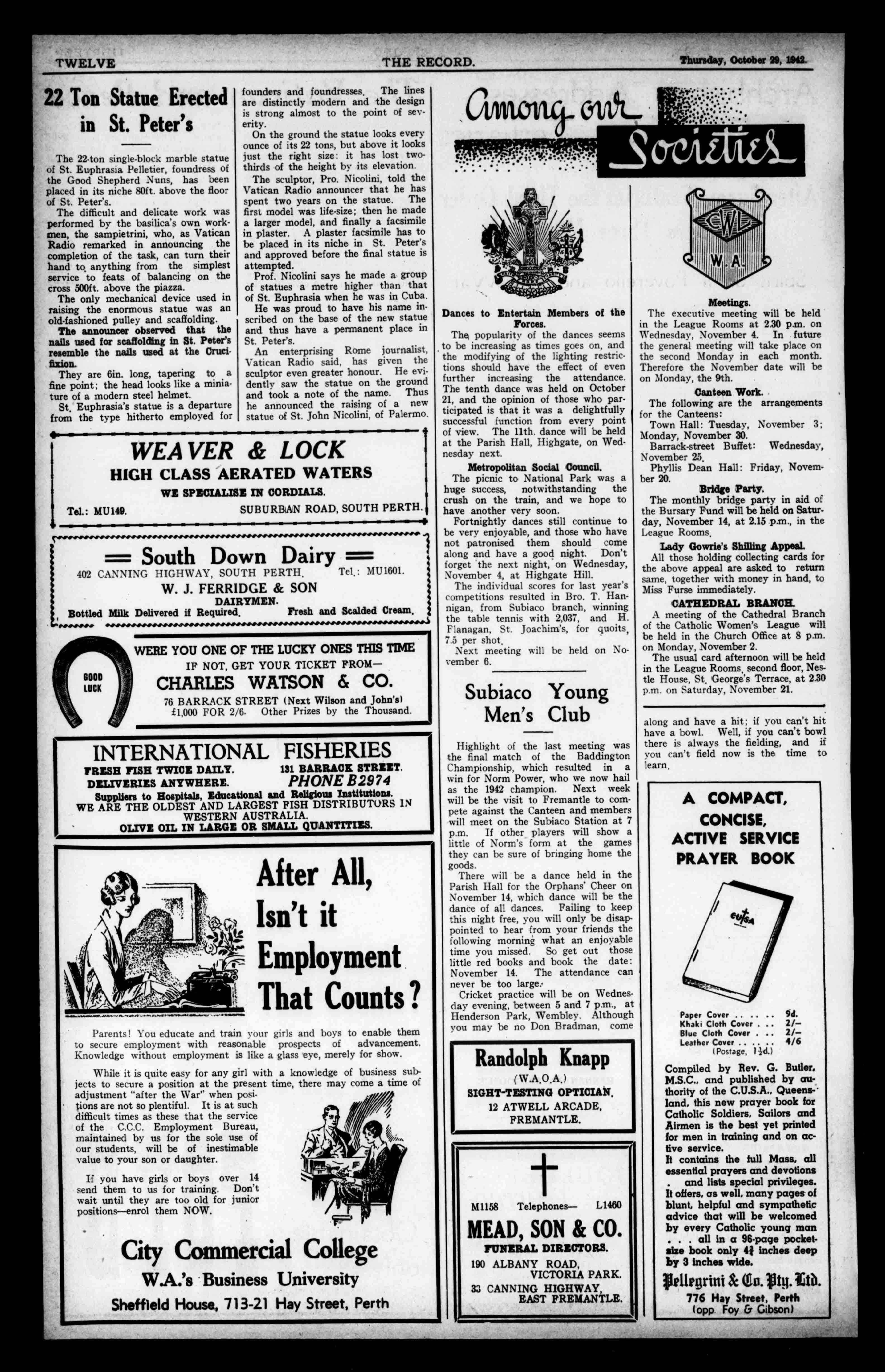
Parents!Youeducateandtrainyourgirlsandboystoenablethem tosecureemploymentwithreasonableprospectsofadvancement. Knowledgewithoutemploymentislikeaglasseye,merelyforshow.
Whileitisquiteeasyforanygirlwith
Ifyouhavegirlsor
DancestoEntertainMembersofthe Forces.
Thepopularityofthedancesseems tobeincreasingastimesgoeson,and themodifyingofthelightingrestrictionsshouldhavetheeffectofeven furtherincreasingtheattendance. ThetenthdancewasheldonOctober 21,andtheopinionofthosewhoparticipatedisthatitwasadelightfully successfulfunctionfromeverypoint ofview.The11th.dancewillbeheld attheParishHall,Highgate,onWednesdaynext.
MetropolitanSocialCouncil.
ThepicnictoNationalParkwasa hugesuccess,notwithstandingthe crushonthetrain,andwehopeto haveanotherverysoon.
Fortnightlydancesstillcontinueto beveryenjoyable,andthosewhohave notpatronisedthemshouldcome alongandhaveagoodnight.Don't forgetthenextnight,onWednesday, November4,atHighgateHill.
Theindividualscoresforlastyear's competitionsresultedinBro.T.Hannigan,fromSubiacobranch,winning thetabletenniswith2,037,andH. Flanagan,St.Joachim's,forquoits, 7.5pershot. NextmeetingwillbeheldonNovember6.
SubiacoYoung Men'sClub
Ilighlightofthelastmeetingwas thefinalmatchoftheBaddington Championship,whichresultedina winforNormPower,whowenowhail asthe1942champion.Nextweek willbethevisittoFremantletocompeteagainsttheCanteenandmembers willmeetontheSubiacoStationat7 p.m.Ifotherplayerswillshowa littleofNorm'sformatthegames theycanhesureofbringinghomethe goods.
Therewillbeadanceheldinthe ParishHallfortheOrphans'Cheeron November14,whichdancewillbethe danceofalldances.Failingtokeep thisnightfree,youwillonlybedisappointedtohearfromyourfriendsthe followingmorningwhatanenjoyable timeyoumissed.Sogetoutthose littleredbooksandbookthedate: November14. Theattendancecan neverbetoolarge.
CricketpracticewillbeonWednesdayevening,between5and7p.m.,at HendersonPark,Wembley.Although youmaybenoDonBradman,come
RandolphKnapp
Meetings.
Theexecutivemeetingwillbeheld intheLeagueRoomsat2.30p.m.on Wednesday,November4.Infuture thegeneralmeetingwilltakeplaceon thesecondMondayineachmonth. ThereforetheNovemberdatewillbe onMonday,the9th.
CanteenWork.
Thefollowingarethearrangements fortheCanteens:
TownHall:Tuesday,November3; Monday,November30.
Barrack-streetBuffet:Wednesday, November25, PhyllisDeanHall:Friday,November20.
BridgeParty.
Themonthlybridgepartyinaidof theBursaryFundwillbeheldonSaturday,November14,at2.15p.m.,inthe LeagueRooms,
LadyGowrie'sShillingAppeal.
Allthoseholdingcollectingcardsfor theaboveappealareaskedtoreturn same,togetherwithmoneyinhand,to MissFurseimmediately.
CATHEDRALBRANCH.
AmeetingoftheCathedralBranch oftheCatholicWomen'sLeaguewill beheldintheChurchOfficeat8p.m. onMonday,November2.
Theusualcardafternoonwillbeheld intheLeagueRooms,secondfloor,NestleHouse,St.George'sTerrace,at2.30 p.m.onSaturday,November21.
alongandhaveahit;ifyoucan'thit haveabowl.Well,ifyoucan'tbowl thereisalwaysthefielding,andif youcan'tfieldnowisthetimeto learn.
CompiledbyRev.G.Butler, M.S.C.,andpublishedbyauthorityoftheC.U.S.A.,Queens-. land,thisnewprayerbookfor CatholicSoldiers,Sailorsand Airmenisthebestyetprinted formenintrainingandonactiveservice. ItcontainsthefullMass,all essentialprayersanddevotions andlistsspecialprivileges. Itoffers,aswell,manypagesof blunt,helpfulandsympathetic advicethatwillbewelcomed byeveryCatholicyoungman allina96-pagepocketsizebookonly4jinchesdeep by3incheswide.
Fellrgrini&Q.v.Pg.kith. 776HayStreet,Perth loppFoyCrGibson)
TWELVE THERECORD. Thursday,October29,19411.
AfterAll, Isn'tit Employment
ThatCounts?
aknowledgeofbusinesssubjectstosecure
positionatthepresenttime,theremaycomeatimeof adjustment"aftertheWar''whenpositionsare
It
at
difficulttimesasthese
theservice of
Employment
maintained
a
notsoplentiful.
is
such
that
theC.C.C.
Bureau,
byusforthesoleuseof ourstudents,willbeofinestimable valuetoyoursonordaughter.
CityCommercialCollege W.A.'sBusinessUniversity SheffieldHouse,713-21HayStreet,Perth
boysover14 sendthemtousfortraining.Don't waituntiltheyaretoooldforjunior positions-enrolthemNOW.
-
SIGHT-TESTINGOPTICIAN, 12ATWELLARCADE, FREMANTLE. M1158 Telephones- L1460 MEAD,SON&CO. FUNERALDIRECTORS. 190ALBANYROAD, VICTORIAPARK. 33CANNINGHIGHWAY, EASTFREMANTLE.
ACOMPACT, CONCISE, ACTIVESERVICE PRAYERBOOK PaperCover 9d. KhakiClothCover 2/BlueClothCover 2/LeatherCover 4/6 ]Postage,Ild.)
22TonStatueErected inSt.Peter's
The22-tonsingle-blockmarblestatue ofSt.EuphrasiaPelletier,foundressof theGoodShepherdNuns,hasbeen placedinitsniche80ft.abovethefloor ofSt.Peter's.
Thedifficultanddelicateworkwas performedbythebasilica'sownworkmen,thesampietrini,who,asVatican Radioremarkedinannouncingthe completionofthetask,canturntheir handtoanythingfromthesimplest servicetofeatsofbalancingonthe cross500ft.abovethepiazza.
Theonlymechanicaldeviceusedin raisingtheenormousstatuewasan old-fashionedpulleyandscaffolding.
Theannouncerobservedthatthe nailsusedforscaffoldinginSt.Peter's resemblethenailsusedattheCrucifixion.
Theyare6in.long,taperingtoa finepoint;theheadlookslikeaminiatureofamodernsteelhelmet.
St.Euphrasia'sstatueisadeparture fromthetypehithertoemployedfor 4 1
foundersandfoundresses,Thelines aredistinctlymodernandthedesign isstrongalmosttothepointofseverity.
Onthegroundthestatuelooksevery ounceofits22tons,butaboveitlooks justtherightsize:ithaslosttwothirdsoftheheightbyitselevation.
Thesculptor,Pro.Nicolini,toldthe VaticanRadioannouncerthatheha, spenttwoyearsonthestatue.The firstmodelwaslife-size;thenhemade alargermodel,andfinallyafacsimile inplaster.Aplasterfacsimilehasto beplacedinitsnicheinSt.Peter's andapprovedbeforethefinalstatueis attempted.
Prof.Nicolinisayshemadeagroup ofstatuesametrehigherthanthat ofSt.EuphrasiawhenhewasinCuba.
Hewasproudtohavehisnameinscribedonthebaseofthenewstatue andthushaveapermanentplacein St.Peter's.
AnenterprisingRomejournalist. VaticanRadiosaid,hasgiventhe sculptorevengreaterhonour.Heevidentlysawthestatueontheground andtookanoteofthename.Thus heannouncedtheraisingofanew statueofSt.JohnNicolini,ofPalermo.
WEAVER&LOCK
HIGHCLASSAERATEDWATERS
Tel.:MU149
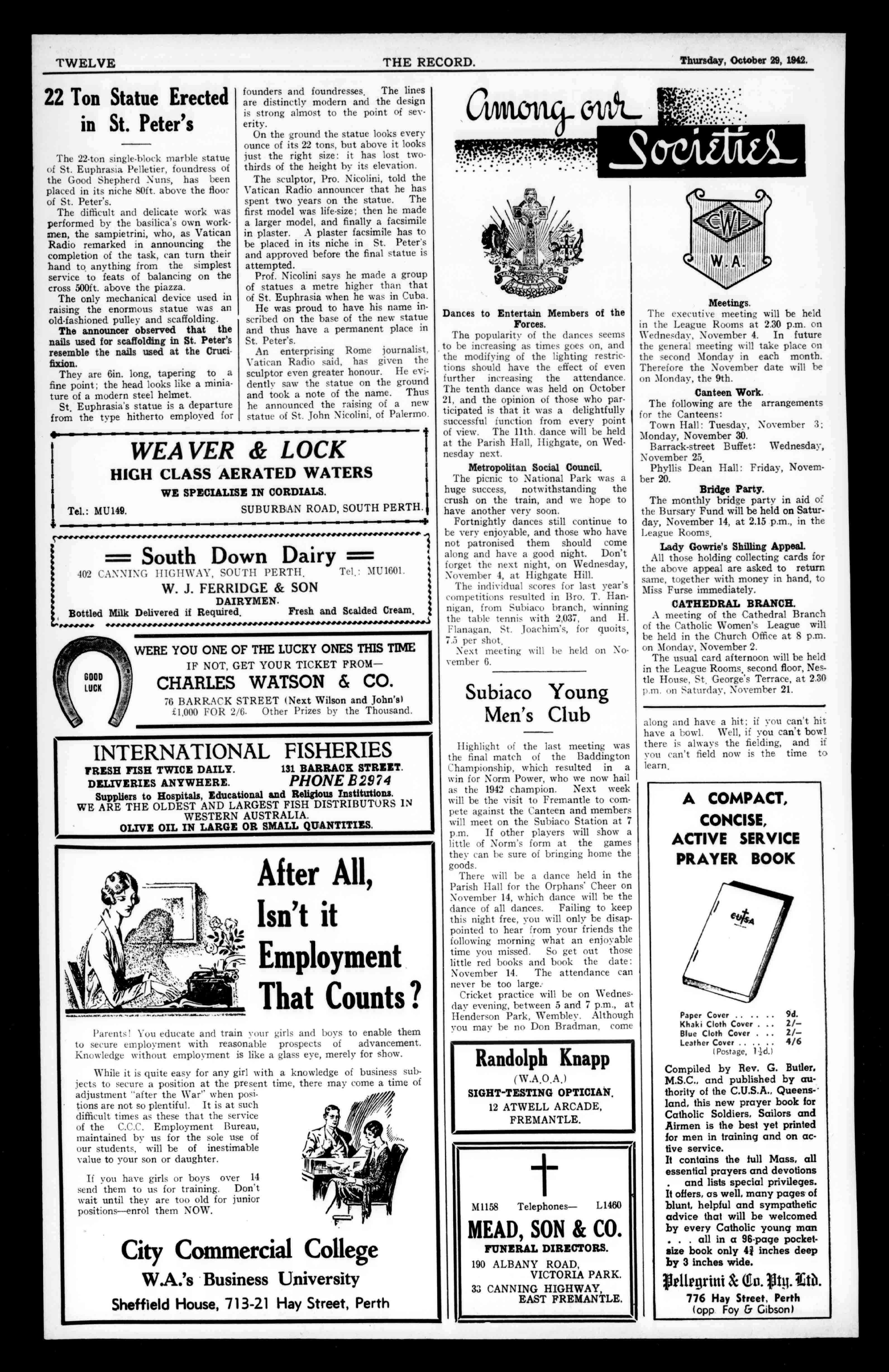
WESPECIALISEINCORDIALS. SUBURBANROAD,SOUTHPERTH INMINN
SouthDownDairy
101ANNINGHIGHWAY,SOUTHPERTH "I, MUloli
W.J.FERRIDGE&SON DAIRYMEN. BottledMilkDeliveredifRequired. FreshandScaldedCream.
WEREYOUONEOFTHELUCKYONESTHISTIME IFNOT,GETYOURTICKETFROMCHARLESWATSON&CO.
76BARRACKSTREET(NextWilsonandJohn's) £1.000FOR2/6.OtherPrizesbytheThousand.
INTERNATIONALFISHERIES
FRESHFISHTWICEDAILY. 131BARRACKSTREET. DELIVERIESANYWHERE. PHONEB2979
SupplierstoHospitals,EducationalandReligiousInstitutions. WEARETHEOLDESTANDLARGESTFISHDISTRIBUTORSIN WESTERNAUSTRALIA. OLIVEOILINLARGEORSMALLQUANTITIES.
AfterAll, Isn'tit
3)),(,--
ThatCounts?
Parents!Youeducateandtrainyourgirlsandboystoenablethem tosecureemploymentwithreasonableprospectsofadvancement. Knowledgewithoutemploymentislikeaglasseye,merelyforshow.
Whileitisquiteeasyforanygirlwithaknowledgeofbusinesssubjectstosecureapositionatthepresenttime,theremaycomeatimeof adjustment"aftertheWar"whenpositionsarenotsoplentiful.Itisatsuch difficulttimesasthesethattheservice oftheC.C.C.EmploymentBureau, maintainedbyusforthesoleuseof ourstudents,willbeofinestimable valuetoyoursonordaughter.
Ifyouhavegirlsorboysover14 sendthemtousfortraining.Don't waituntiltheyaretoooldforjunior positions-enrolthemNOW.
DancestoEntertainMembersofthe Forces.
Thepopularityofthedancesseems tobeincreasingastimesgoeson,and themodifyingofthelightingrestrictionsshouldhavetheeffectofeven furtherincreasingtheattendance. ThetenthdancewasheldonOctober 21,andtheopinionofthosewhoparticipatedisthatitwasadelightfully successfulfunctionfromeverypoint ofview.The11th.dancewillbeheld attheParishHall,Highgate,onWednesdaynext.
MetropolitanSocialCouncil.
ThepicnictoNationalParkwasa hugesuccess,notwithstandingthe crushonthetrain,andwehopeto haveanotherverysoon.
Fortnightlydancesstillcontinueto beveryenjoyable,andthosewhohave notpatronisedthemshouldcome alongandhaveagoodnight.Don't forgetthenextnight,onWednesday, November4,atHighgateHill.
Theindividualscoresforlastyear's competitionsresultedinBro.T.Hannigan,fromSubiacobranch,winning thetabletenniswith2,037,andH. Flanagan.St.Joachim's,forquoits, 7.5pershot, NextmeetingwillbeheldonNovember6.
SubiacoYoung Men'sClub
Highlightofthelastmeetingwas thefinalmatchoftheBaddington Championship,whichresultedina winforNormPower,whowenowhail asthe1942champion.Nextweek willbethevisittoFremantletocompeteagainsttheCanteenandmembers willmeetontheSubiacoStationat7 p.m.Ifotherplayerswillshowa littleofNorm'sformatthegames theycanbesureofbringinghomethe goods.
Therewillbeadanceheldinthe ParishHallfortheOrphansCheeron November14,whichdancewillbethe danceofalldances.Failingtokeep thisnightfree,youwillonlybedisappointedtohearfromyourfriendsthe followingmorningwhatanenjoyable timeyoumissed.Sogetoutthose littleredbooksandbookthedate: N,'-ember14. Theattendancecan neverbetoolarge: CricketpracticewillbeonWednesdayevening,between5and7p.m.,at HendersonPark,Wembley.Although youmaybenoDonBradman,come
Meetings.
Theexecutivemeetingwillbeheld intheLeagueRoomsat2.30p.m.on Wednesday,November4.Infuture thegeneralmeetingwilltakeplaceon thesecondMondayineachmonth. ThereforetheNovemberdatewillbe onMonday,the9th.
CanteenWork.
Thefollowingarethearrangements fortheCanteens:
TownHall:Tuesday,November3; Monday,November30.
Barrack-streetBuffet:Wednesday, November25.
PhyllisDeanHall:Friday,November20.
BridgeParty.
Themonthlybridgepartyinaidof theBursaryFundwillbeheldonSaturday,November14,at2.15p.m.,inthe LeagueRooms, LadyGowrie'sShillingAppeal.
Allthoseholdingcollectingcardsfor theaboveappealareaskedtoreturn same,togetherwithmoneyinhand,to MissFurseimmediately.
CATHEDRALBRANCH.
AmeetingoftheCathedralBranch oftheCatholicWomen'sLeaguewill beheldintheChurchOfficeat8p.m. onMonday,November2.
Theusualcardafternoonwillbeheld intheLeagueRooms,secondfloor,NestleHouse,St,'George'sTerrace,at2.30 p.m.onSaturday.November21.
alongandhaveahit:ifyoucan'thit haveabowl.Well,ifyoucan'tbowl thereisalwaysthefielding,andif youcan'tfieldnowisthetimeto learn,
ACOMPACT, CONCISE, ACTIVESERVICE PRAYERBOOK
PaperCover 9d.
Khali.,ClothCover 2/BlueClothCover 2/LeatherCover 4/6 Postage, 1
CompiledbyRev,G.Butler. M.S.C.,andpublishedbyauthorityoftheC.U.S.A.,Queensland.thisnewprayerbookfor CatholicSoldiers,Sailorsand Airmenisthebestyetprinted formenintrainingandonactiveservice. ItcontainsthefullMass,all essentialprayersanddevotions andlistsspecialprivileges. Itoffers,aswell,manypagesof blunt,helpfulandsympathetic advicethatwillbewelcomed byeveryCatholicyoungman allina96-pagepocketsizebookonly4}inchesdeep by3incheswide.
P1[IIrilli&TV.JIli.ifitb. 776HayStreet,Perth ()paFoy&Gibson)
TWELVE THERECORD. Thursday,October29,1942.
Employment
CityCommercialCollege W.A.'sBusinessUniversity SheffieldHouse,713-21HayStreet,Perth
RandolphKnapp (W.A.0,A) SIGHT-TESTINGOPTICIAN, 12ATWELLARCADE, FREMANTLE.
M1158 Telephones- 1.1460 MEAD,SON&CO. FUNERALDIRECTORS. 190ALBANYROAD, VICTORIAPARK. 33CANNINGHIGHWAY, EASTFREMANTLE.
1111
ArchbishopAddresses FranciscanTertiaries
AfterSevenCenturiestheThirdOrder NumbersThreeMillions
SpiritofIlPoverelloandPost-War Reconstruction
ThefeastdayofSt.FrancisofAssisi wasobservedbyTertiariesoftheArchdioceseattendingaspecialMassinSt. Mary'sCathedral,celebratedbyHis GracetheArchbishop.Duringthe MassHisGracespoketotheassembled TertiariesontheidealsoftheirOrder, andcongratulatedthemontheirinfluenceinthecommunity.
HisGracetheArchbishopcelebrated Massat10o'clock.AftertheGospel hewelcomedthemembersoftheThird OrdertotheCathedral.Theyhad cometocelebratetheFeastoftheir Founder.Timedidnotpermithim, HisGracesaid,tospeakoftherules governingthisancientOrder.Buthe directedtheattentionofthecongregationtotheexcellentsurveyoftheaims andidealsoftheOrderwhichwerepublishedin"TheRecord"thatday.He wasgladtohavetheopportunityof publiclycongratulatingtheTertiaries, Andhethankedthemfortheirbeneficentinfluenceinthecommunity. Theirnumbersweresmall,comparativelyspeaking,buttheyformedaselectbandofmemberswhowerecarry. ingouttheirconstitutionsinazealous andmeticulousmanner.Inthetwelve had donemuchgood.Andtherewasstill muchforthemtodoto-day.Forthe risingtideofneo-paganism,evident beforethewar,andconsiderablyaggravatedbecauseofthewar,withits hostofattendantevils,threatenedto rP4K4NP4P.IsP4.4IsM41r4,I,..fp.....,P4PdrWdFW
STURMERandSON (LateHallion's), BAKERS.
90TOHNSTREET,NORTH
FREMANTLE. (Tel.2739)
PrizeWinnersRoyalShow. DeliveriesThroughoutFremantle.
ti
reduceagreatpartofChristendomto thelamentablestateinwhichtheculturedpaganworldwasatthetimeof thecomingofourRedeemer.Andas inthepast,theThirdOrderofSt. Franciswasapowerfulweaponincombatingandcounteractingbanefulinfluences,sotheThirdOrderto-day wouldfulfilanequallysalutaryrole. Forithadproveditselftotheworld, generationaftergeneration,sinceitsestablishmentsevenhundredyearsago. IthadkeptalivethespiritoftheLittle PoorManofAssisi.Ithadbeenan instrumentofsocialbetterment,In theProvidenceofGodandthrough theintercessionofSt.Francis,itwould playanimportantpartinpost-warreconstruction.Foritbelongedtoevery nationthatcalleditselfChristianand numberedinitsranksthreemillion souls.Ithadtheapprobationand blessingofPopesfromthetimeofits originuntilto-day-aspanofseven centuries.
HisGraceexhortedTertiariesto showtheirappreciationoftheirprivilegeinbelongingtothisOrderby sustainedinterestinallthatconcerned theOrder.Theyshouldbenotmerelymembers,but,practicalandenthusiasticmembers.Thecynicandsneeringunbelievermayquestiontheirmotives,buttheiriOrderwouldbejudged asitwasexemplifiedinthemembers individually.Thusthepoisonedarrowsofcalumnywouldfallattheir feetandthefoulvapoursofdefamation wouldmeltawaybeforetheeffulgent raysoftheirgoodexample."MayGod blessyouindividuallyandcollectively,"HisGraceconcluded:"mayGod blessyoureffortstobefaithfultothe rulesgoverningthisOrdertowhichyou areprivilegedtobelong,andmayyou continuetowieldabeneficentandleavenim,,influenceinthecommunityin whichyoulive."
TheVaticanandPeace
(ContinuedfromPage4.)
againstreligioncannotbecompatible withthecreationofanewworldbecausefaithisthemostefficientfactor inthesafeguardingofanorderbased onmoralprinciples.Faith,insofaras itaffectstheindividual,alsoaffectsindirectlythestate.Faithisregarded asthemostefficientfactorinasmuch asitgivesmoralstrengthtolife, makeshimwhobelievesintheLawof ChristandinHispreachingsoflove andbrotherhoodapowerfuldefender ofthesocialorder,andgivesthespiritualenergiesoftheRomanCatholic Churchtheopportunitytopromoteunderstandingandgoodwillamongpeoples. BecauseofitsuniversalitytheChurch cementsbrotherhoodamongmenand indirectlythesolidarityamongcivilisednationstowhichmenbelong.Becauseofthisuniversalcharacteritopposedthenarrowpolicyofnational egoism,thestruggleamongnations. Ittendstounify,nottodivide.It regardsallmenaschildrenofGodand assuchitisconcernedwiththeirmaterialaswellasspiritualwelfareregardlessofclassorrace.TheCatholic Churchistheperfectexampleofthat spiritualidealwhichshouldinspirea familyofnations.
ItwillbereadilyseenfromtheforegoingthatthePope'sconceptionof peacedoesnotconflictwithdemocraticprinciplesandimpliesindeedthe condemnationoftotalitarianpolicyas representedbyGermany.Thepapal neworderisinstrikingcontrastwith theso-calledneworderadvocatedbytheAxispowers.WhileGermanyhas trampledupontherightsofthesmall EuropeanstatesbyinvadingPoland, Norway,Denmark,Belgium,Holland, Luxembourg,Greece,andYugoslavia,
thePopeaffirmstherighttolifeofall nations.WhileGermanyismethodicallykillinghundredsofthousandsof peopleinthecountriesunderherdominationinpursuanceofapolicywhich hasasitscardinalprinciplethesupremacyoftheGermanmasterrace, thePopeisfavouringequalityofrights ofallethnicgroups.
Withregardeventohisthirdpoint, whichtheAxispowershavefrequently publicisedasadefenceoftheiraspirations,thePontiff,throughlater messagesandspeeches,hasmadeclear thatthepolicyofintensivemilitary preparednessofwhichGermanyisthe outstandingexponenthasbeenoneof themaincausesoftheworld-wideeconomiccrisis,Atthesametime,his suggestionforthecreationofaninternationalinstitutionagainoffersa contrastwiththeforeignpolicyof Japan,Germany,andItaly,which werethefirstamongthebigpowersto resignfromtheLeagueofNations.
TheallusiontoGermany'santi-religiouspolicyinthefifthpointneeds hardlyanexplanation.Forinthat countrymillionsofChristiansarebeing systematicallypersecuted.
Conversely,itisclearthatthePope seesthepossibilityofrealisinghisideal post-warorderonlythroughavictory ofthedemocraticpowerswhichhave alreadyshown-as,forinstance,inthe AtlanticCharterdrawnupbyPresidentRooseveltandMr.Churchill-a morehumaneandethicalunderstandingofinternationalproblems,
Beforeyouspendashillingunnecessarily,think!Aren'ttheneedsof Australia'sfightingforcesgreaterthan yours?Denyyourself,forvictory. InvestinAustralia's£100.000.000AusterityLoan.
Thursday,October29,1942. THERECORD. THIRTEEN
DERBY'S MURRAYSTREET.PERTH. Phones:B9731(threelines) B7777 B9101(twolines) REGISTEREDW.A.T.A. ALEXRODOREDA TurfCommissionAgent 802HAYSTREET. AGENTFORW.A.CHARITIES RingB5841andB5236. NORTHAM. E.0.TRESISE, M.P.S.,S.A.andW.A. MANUFACTURINGAND DISPENSINGCHEMIST. ForServiceandQuality. Tel61Northam. ALBANY. H.C.PriorFuneralDirector ALBANY(Established1921). PrivateMortuary.MotorVehicles, ChargesModerate. 'Phone215. Albany,Mt.Barker,Denmarkand Districts, -4ytelo, MRTHE5011 LIMTED FORCHEAPERGROCERIES KALGOORLIE. ;.W.SHEEHAN PrimeBeefButcher HANNANST.,KALGOORLIE. MARITANASTREET. Tel.438 Tel.438 B RENNANS OULDER LIMITED FORQUALITYDRAPERY, LADIES'ANDGENTS' CLOTHING, MANCHESTERAN FURNISHINGS.
ForLongWear UseOnly "Gibsonia" Wools... Obtainable onlyat
ArchbishopAddresses FranciscanTertiaries
AfterSevenCenturiestheThirdOrder NumbersThreeMillions
SpiritofIIPoverelloandPost-War Reconstruction
ThefeastdayofSt.FrancisofAssisi wasobservedbyTertiariesoftheArchdioceseattendingaspecialMassinSt. Mary'sCathedral,celebratedbyHis GracetheArchbishop.Duringthe MassHisGracespoketotheassembled TertiariesontheidealsoftheirOrder, andcongratulatedthemontheirinfluenceinthecommunity.
HisGracetheArchbishopcelebrated Massat10oclock.AftertheGospel hewelcomedthemembersoftheThird OrdertotheCathedral.Theyhad cometocelebratetheFeastoftheir Founder.Timedidnotpermithim, HisGracesaid,tospeakoftherules governingthisancientOrder.Buthe directedtheattentionofthecongregationtotheexcellentsurveyoftheaims andidealsoftheOrderwhichwerepublishedin"TheRecord"thatday.He wasgladtohavetheopportunityof publiclycongratulatingtheTertiaries. Andhethankedthemfortheirbeneficentinfluenceinthecommunity. Theirnumbersweresmall,comparetivelyspeaking,buttheyformedaselecthandofmemberswhowerecarry. ingouttheirconstitutionsinazealous andmeticulousmanner.Inthetwelve theOrderhad donemuchgood.Andtherewasstill muchforthemtodoto-day.Forthe risingtideofneo-paganism,evident beforethewar,andconsiderablyag_,:ivated--,:oreofthewar,withits ..stof lainevil-,threatenedto iNPNINPAP.04,4`4,10.0,4,44,4,4,0.0 IJNPdhalkendiv STURMERandSON (LateI-Tallinn's). BAKERS.
90JOHNSTREET,NORTH
FREMANTLE. (Tel.2739.) PrizeWinnersRoyalShow. DeliveriesThroughoutFremantle.
DERBY'S
MURRAYSTREET.PERTH.
Phones:B9731(threelines) B7777 B9101(twolines) REGISTEREDW.A.T.A.
ALEXRODOREDA
TurfCornmissionAgent 802HAYSTREET.
AGENTFORW.A.CHARITIES RingB5841andB5236.
NORTHAM.
E.0.TRESISE, M.P.S.,S.A.andW.A MANUFACTURINGAND DISPENSINGCHEMIST ForServiceandQuality
ALBANY.
H.C.PriorFuneralDirector
ALBANY(Established1921).
PrivateMortuary.MotorVehicles, ChargesModerate. 'Phone215.
Albany,Mt.Barker,Denmarkand Districts,
reduceagreatpartofChristendomto thelamentablestateinwhichtheculturedpaganworldwasatthetimeof thecomingofourRedeemer.Andas inthepast,theThirdOrderofSt. Franciswasapowerfulweaponincornbatingandcounteractingbanefulinfluences,sotheThirdOrderto-day wouldfulfilanequallysalutaryrole. Forithadproveditselftotheworld, generationaftergeneration,sinceitsestablishmentsevenhundredyearsago. IthadkeptalivethespiritoftheLittle PoorManofAssisi.Ithadbeenan instrumentofsocialbetterment.In theProvidenceofGodandthrough theintercessionofSt.Francis,itwould playanimportantpartinpost-warreconstruction.Foritbelongedtoevery nationthatcalleditselfChristianand numberedinitsranksthreemillion souls.Ithadtheapprobationand blessingofPopesfromthetimeofits originuntilto-day-aspanofseven centuries.
HisGraceexhortedTertiariesto showtheirappreciationoftheirprivilegeinbelongingtothisOrderbysustainedinterestinallthatconcerned theOrder.Theyshouldbenotmerelymembers,but,practicalandenthusiasticmembers.Thecynicandsneeringunbelievermayquestiontheirmotives,buttheirOrderwouldbejudged asitwasexemplifiedinthemembers individually.Thusthepoisonedarrowsofcalumnywouldfallattheir feetandthefoulvapoursofdefamation wouldmeltawayBeforetheeffulgent raysoftheirgoodexample."MayGod blessyouindividuallyandcollectively.**IlisGraceconcluded:"mayGnd blessyoureffortstobefaithfultothe rulesgoverningthisOrdertowhichYou areprivilegedtobehing,andmayyou continuetowieldalieneficentandleavcnin-4influenceinthecommunityin -e"
TheVatican
(ContinuedfromPage1.,
againstreligioncannotbecompatible withthecreationofanewworldbecausefaithisthemostefficientfactor inthesafeguardingofanorderbased onmoralprinciples.Faith,insofaras itaffectstheindividual,alsoaffectsindirectlythestate.Faithisregarded asthemostefficientfactorinasmuch asitgivesmoralstrengthtolife, makeshimwhobelievesintheLawof ChristandinHispreachingsoflove andbrotherhoodapowerfuldefender ofthesocialorder,andgivesthespir- itualenergiesoftheRomanCatholic Churchtheopportunitytopromoteunderstandingandgoodwillamongpeoples. BecauseofitsuniversalitytheChurch cementsbrotherhoodamongmenand indirectlythesolidarityamongcivilisednationstowhichmenbelong.Becauseofthisuniversalcharacteritopposedthenarrowpolicyofnational egoism,thestruggleamongnations. Ittendstounify,nottodivide.It regardsallmenaschildrenofGodand assuchitisconcernedwiththeirmaterialaswellasspiritualwelfareregardlessofclassorrace.TheCatholic Churchistheperfectexampleofthat spiritualidealwhichshouldinspirea familyofnations.
ItwillbereadilyseenfromtheforegoingthatthePope'sconceptionof peacedoesnotconflictwithdemocraticprinciplesandimpliesindeedthe condemnationoftotalitarianpolicyasrepresentedbyGermany.Thepapal neworderisinstrikingcontrastwith theso-calledneworderadvocatedby theAxispowers.WhileGermanyhas trampledupontherightsofthesmall EuropeanstatesbyinvadingPoland, Norway,Denmark,Belgium,Holland, Luxembourg,Greece,andYugoslavia,
andPeace
thePopeaffirmstherighttolifeofall nations.WhileGermanyismethodicallykillinghundredsofthousandsof peopleinthecountriesunderherdominationinpursuanceofapolicywhich hasasitscardinalprinciplethesupremacyoftheGermanmasterrace, thePopeisfavouringequalityofrights ofallethnicgroups.
Withregardeventohisthirdpoint, whichtheAxispowershavefrequently publicisedasadefenceoftheiraspirations,thePontiff,throughlater messagesandspeeches,hasmadeclear thatthepolicyofintensivemilitary preparednessofwhichGermanyisthe outstandingexponenthasbeenoneof themaincausesoftheworld-wideeconomiccrisis.Atthesametime,his suggestionforthecreationofaninternationalinstitutionagainoffersa contrastwiththeforeignpolicyof Japan,Germany,andItaly,which werethefirstamongthebigpowersto resignfromtheLeagueofNations. TheallusiontoGermany'santi-religiouspolicyinthefifthpointneeds hardlyanexplanation.Forinthat countrymillionsofChristiansarebeing systematicallypersecuted.
Conversely,itisclearthatthePope seesthepossibilityofrealisinghisideal post-warorderonlythroughavictory ofthedemocraticpowerswhichhave alreadyshown-as,forinstance,inthe AtlanticCharterdrawnupbyPresidentRooseveltandMr.Churchill-a morehumaneandethicalunderstandingofinternationalproblems.
Beforeyouspendashillingunnecessarily,think!Aren'ttheneedsof Australia'sfightingforcesgreaterthan yours?Denyyourself,forvictory. InvestinAustralia's£100,000,000AusterityLoan.
Thursday.October29,1942. THERECORD. THIRTEEN
MOTHESOIn LIMITED 11111111111 L FORCHEAPERGROCER!ES KALGOORLIE. J.W.SHEEHAN PrimeBeefButcher HANN;1,1ST.,KALGOORLIE. MARITANASTREET. Tel.438 Tel.438 B RENNANS OULDER LIMITED FORQUALITYDRAPERY, LADIES'ANDGENTS' CLOTHING, MANCHESTERAN) FURNISHINGS.
ForLongWear UseOnly "Gibsonia" Wools... Obtainable onlyat 11!
Donny
brook
Successful inRecent
IrisCrowley:Prep.Theory, MarySpilabury,Prep. larks.
NiaryT.Kidd:Junior Prep.;Elocution,Honours; Pianoforte,highestmarks
AngelaTravia:Prep, Honours;Preparatory estmarksinCentre.
DoreenDesmond:First ours,Centreprize.
PatWoolcott:First FirstSteps,Elocution,
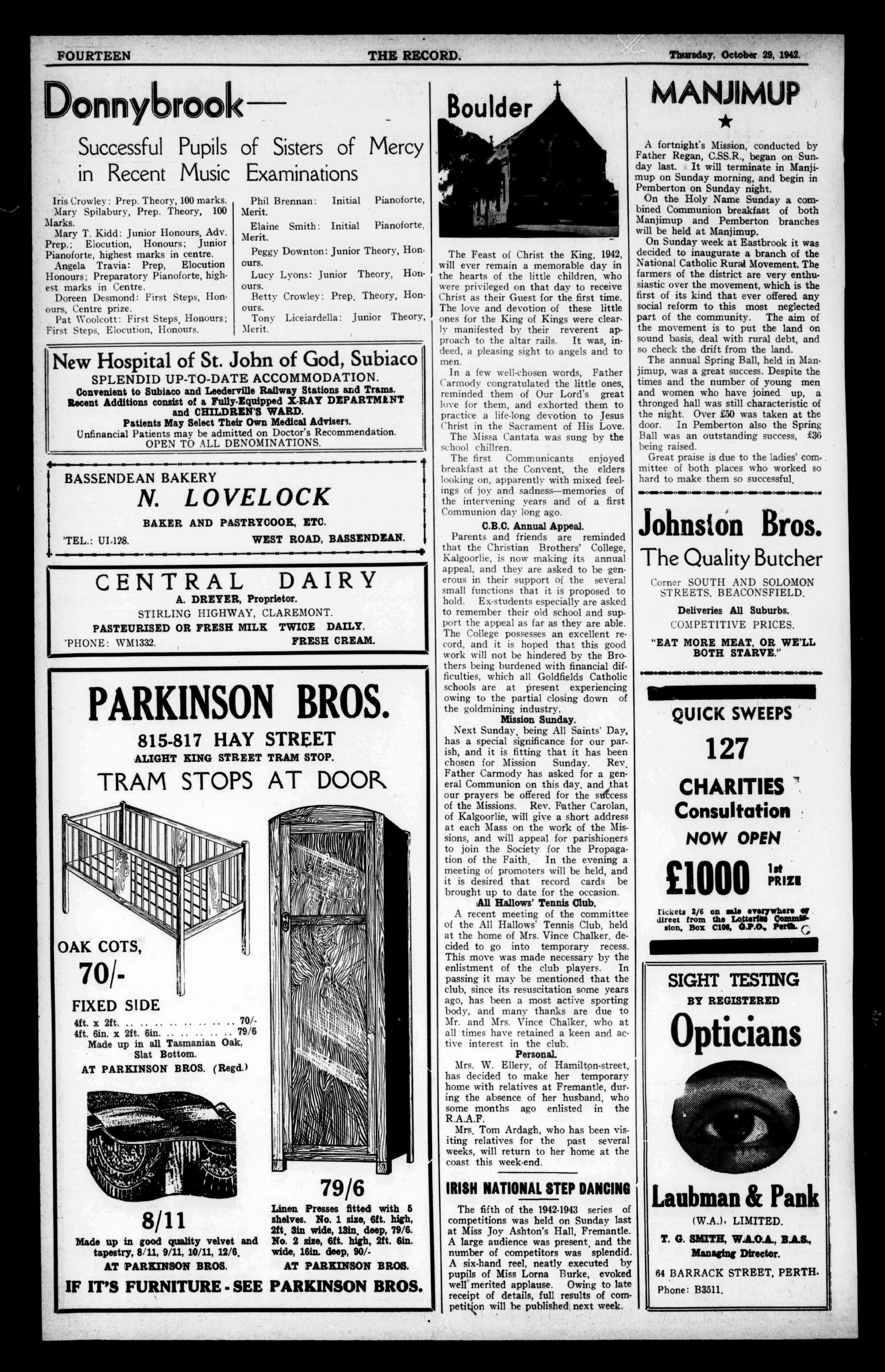
MANJIMUP
Pupils Music
100marks, Theory,100 Honours,Adv, Junior incentre. Elocution Pianoforte,highSteps,HonSteps,Honours; Honours.
of Merit. Merit. ours. ours. ours. Merit.
Sisters Examinations
PhilBrennan: Elaine
PeggyDownton:
LucyLyons:
BettyCrowley: TonyLiceiardella:
ofMercy
InitialPianoforte, Smith:InitialPianoforte, JuniorTheory,HonJuniorTheory,HonPrep.Theory,HonJuniorTheory,
NewHospitalofSt.JohnofGod,Subiaco
SPLENDIDUP-TO-DATEACCOMMODATION.
ConvenienttoSubiacoandLeedervilleRailwayStationsandTrains. RecentAdditionsconsistofaFully-EquippedX-RAYDEPARTMLNT andCHILDREN'SWARD. PatientsMaySelectTheirOwnMedicalAdviseri.
UnfinancialPatientsmaybeadmittedonDoctor'sRecommendation.
OPENTOALLDENOMINATIONS. +.
'TEL.:
A.DREYER,Proprietor. STIRLINGHIGHWAY,CLAREMONT. PASTEURISEDORFRESHMILKTWICEDAILY.
'PHONE:WN11332.
TheFeastofChristtheKing,1942, willeverremainamemorabledayin heheartsofthelittlechildren,who vereprivilegedonthatdaytoreceive 'hristastheirGuestforthefirsttime. Theloveanddevotionoftheselittle alesfortheKingofKingswereclearlymanifestedbytheirreverentapproachtothealtarrails.Itwas,indeed,apleasingsighttoangelsandto men.
Inafewwell-chosenwords,Father Carmodycongratulatedthelittleones, remindedthemofOurLord'sgreat loveforthem,andexhortedthemto practicealife-longdevotiontoJesus ChristintheSacramentofHisLove.
TheMissaCantatawassungbythe schoolchildren.
ThefirstCommunicantsenjoyed breakfastattheConvent,theelders lookingon,apparentlywithmixedfeelingsofjoyandsadness-memoriesof theinterveningyearsandofafirst Communiondaylongago.
C.B.C.AnnualAppeal.
Parentsandfriendsarereminded thattheChristianBrothers'College, Kalgoorlie,isnowmakingitsannual appeal,andtheyareaskedtobegenerousintheirsupportoftheseveral smallfunctionsthatitisproposedto hold.Ex-studentsespeciallyareasked toremembertheiroldschoolandsupporttheappealasfarastheyareable.
TheCollegepossessesanexcellentrecord,anditishopedthatthisgood workwillnotbehinderedbytheBrothersbeingburdenedwithfinancialdifficulties,whichallGoldfieldsCatholic schoolsareatpresentexperiencing owingtothepartialclosingdownof thegoldminingindustry.
MissionSunday.
NextSunday,beingAllSaints'Day, hasaspecialsignificanceforourparish,anditisfittingthatithasbeen chosenforMissionSunday.Rev, FatherCarmodyhasaskedforageneralCommuniononthisday,andthat ourprayersbeofferedforthestftcess oftheMissions.Rev.RatherCarolan, ofKalgoorlie,willgiveashortaddress ateachMassontheworkoftheMissions,andwillappealforparishioners tojointheSocietyforthePropagationoftheFaith.Intheeveninga meetingofpromoterswillbeheld,and itisdesiredthatrecordcardsbe broughtuptodatefortheoccasion.
AllHallows'TennisClub.
Arecentmeetingofthecommittee oftheAllHallows'TennisClub,held atthehomeofMrs.VinceChalker,decidedtogointotemporaryrecess. Thismovewasmadenecessarybythe enlistmentoftheclubplayers.In passingitmaybementionedthatthe club,sinceitsresuscitationsomeyears ago,hasbeenamostactivesporting body,andmanythanksaredueto NIr.andMrs.VinceChalker,whoat alltimeshaveretainedakeenandactiveinterestintheclub.
PersonaL
Mrs.W.Ellery,ofHamilton-street, hasdecidedtomakehertemporary homewithrelativesatFremantle,duringtheabsenceofherhusband,who somemonthsagoenlistedinthe R.A.A.F.
Mrs,TomArdagh,whohasbeenvisitingrelativesforthepastseveral weeks,willreturntoherhomeatthe coastthisweek-end.
IRISHNATIONALSTEPDANCING
Thefifthofthe1942-1943seriesof competitionswasheldonSundaylast atMissJoyAshton'sHall,Fremantle. Alargeaudiencewaspresent,andthe numberofcompetitorswassplendid. Asix-handreel,neatlyexecutedby pupilsofMissLornaBurke,evoked wellmeritedapplause.Owingtolate receiptofdetails,fullresultsofcornpetitionwillhepublishednextweek.
Afortnight'sMission,conductedby FatherRegan,C.SS.R.,beganonSun. daylast.ItwillterminateinManjimuponSundaymorning,andbeginin PembertononSundaynight.
OntheHolyNameSundayacombinedCommunionbreakfastofboth ManjimupandPembertonbranches willbeheldatManjimup.
OnSundayweekatEastbrookitwas decidedtoinaugurateabranchofthe NationalCatholicRuralMovement.The farmersofthedistrictareveryenthusiasticoverthemovement,whichisthe firstofitskindthateverofferedany socialreformtothismostneglected partofthecommunity.Theaimof themovementistoputthelandon soundbasis,dealwithruraldebt,and socheckthedriftfromtheland.
TheannualSpringBall,heldinManjimup,wasagreatsuccess.Despitethe timesandthenumberofyoungmen andwomenwhohavejoinedup,a throngedhallwasstillcharacteristicof thenight.Over£50wastakenatthe door.InPembertonalsotheSpring Ballwasanoutstandingsuccess,f36 beingraised.
Greatpraiseisduetotheladies'committeeofbothplaceswhoworkedso hardtomakethemsosuccessful.
FOURTEEN THERECORD. Thursday,October29,1942.
---
N.LOVELOCK
BASSENDEANBAKERY
PASTRYCOOK,
1 BAKERAND
ETC.
U1.128.
--..-___........ CENTRALDAIRY
WESTROAD,BASSENDEAN.
FRESHCREAM. PARKINSONBROS. ALIGHTKINGSTREETTRAMSTOP. 815-817HAY TRAMSTOPSATDOOR ii,11Ihiki, '111111111 -I IIIT 11 rl,/i fir1442,i Ift ,,,,, OAKCOTS, 411 71-1.''''',,.1iPi" 70/- /A''. FIXEDSIDE i;),\\ \\Nk\ 4ft.x2ft. 70/4ft.6in.x2ft.6in. 79/6 MadeupinallTasmanianOak,.. SlatBottom. 1' I\ q',\ t! ATPARKINSONBROS.(Regd.) VI 1(71 ok lt IFk.2j14 ,,,/ 1 ____,-----,_ '"'"'"' ' 79/6 LinenPressesfittedwith5 8/11 shelves.No.1size,6ft.high, 2ft,Sinwide,13in,deep,79/6. MadeupingoodqualityvelvetandNo.2size,6ft.high,2ft.6in. tapestry,8/11,9/11,10/11,12/6, wide,16in.deep,90/ATPARKINSONBROS. ATPARKINSONBROS. IFIT'SFURNITURE-SEEPARKINSONBROS.
IMoWIM....1M14.4M10.11.1......111=1.011 JohnstonBros. TheQualityButcher CornerSOUTHANDSOLOMON STREETS,BEACONSFIELD. DeliveriesAllSuburbs. ()MPETITI\'EPRICES. "EATMOREMEAT,ORWE'LL BOTHSTARVE." QUICKSWEEPS 127 CHARITIES Consultation NOWOPEN £10001st PRIZI rickets2/6onsaleeverywhere41/ directfromtheLotterteeCorom110. Mon,BoxC101,011.0..Pet*. SIGHTTESTING BYREGISTERED Opticians Laubman&Pank (W.A.),LIMITED. T.G.SMITH,W.A.O.A.,B.A.S., ManagingDirector. 64BARRACKSTREET,PERTH. Phone:B3511.
Donnybroo
SuccessfulPupilsofSistersofMercy inRecentMusicExaminations
IrisCrowleyPrep.Theory.100marks.
MarySpilabury,Prep.Theory,100 Marks,
MaryT.Kidd:JuniorHonours,Adv. Prep.;Elocution,Honours;Junior Pianoforte,highestmarksincentre.
AngelaTravia:Prep,Elocution Honours;PreparatoryPianoforte,highestmarksinCentre.
DoreenDesmond:FirstSteps,Honours,Centreprize.
PatWo,lcott:FirstSteps,Honours: FirstStep-.lYocution,Honours.
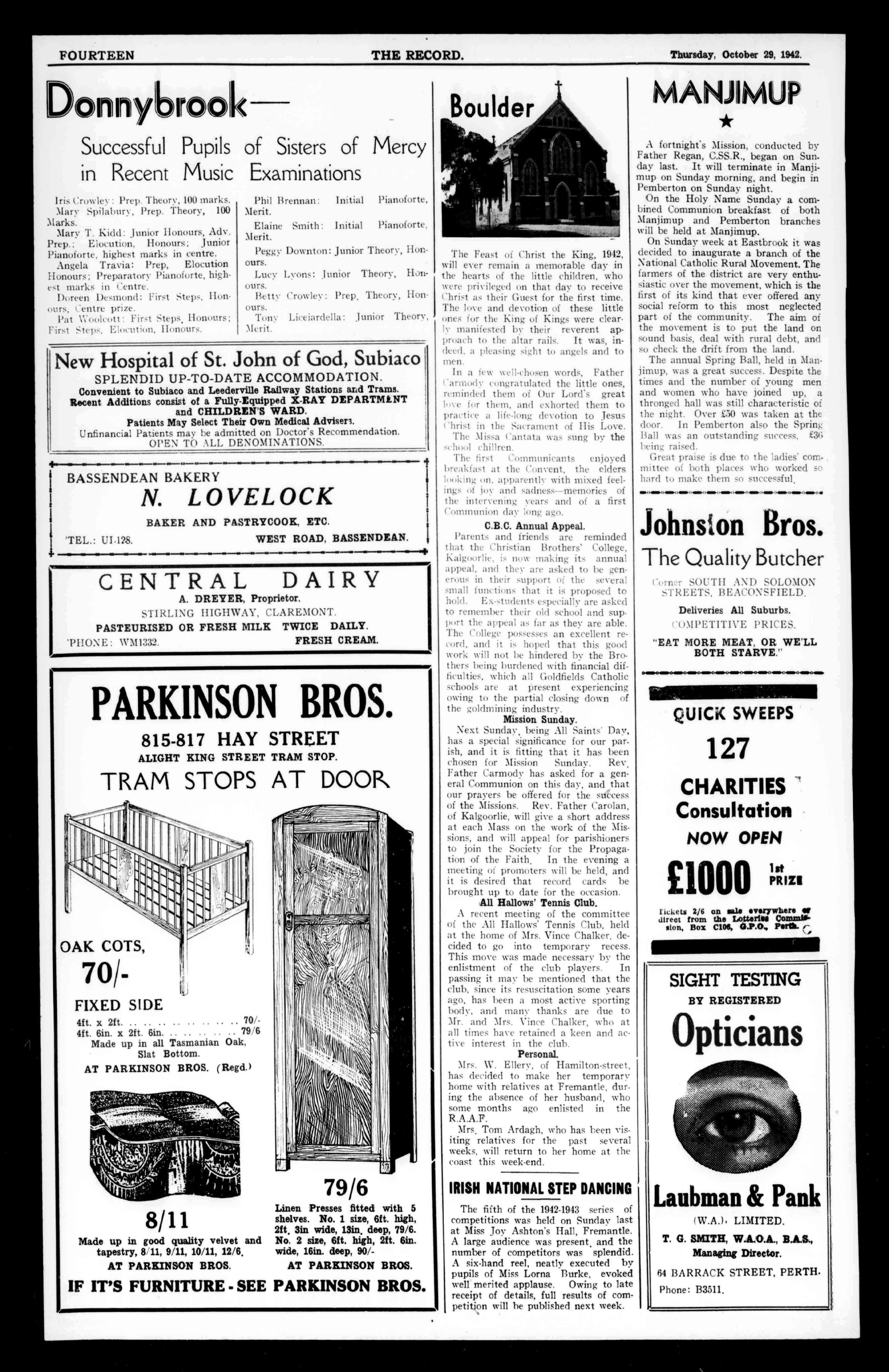
PhilBrennan:InitialPianoforte. Merit.
ElaineSmith:InitialPianoforte. Merit.
PeggyDownton:JuniorTheory,Honours.
LucyLyons:juniorTheory,Honours.
BettyCrowley:Prep.Theory,Honours.
TonyLiceiardella:JuniorTheory, Merit.
NewHospitalofSt.JohnofGod,Subiaco
SPLENDIDUP-TO-DATEACCOMMODATION.
ConvenienttoSubiacoandLeedervilleRailwayStationsandTrams. RecentAdditionsconsistofaFully-EquippedX-RAYDEPARTMINT andCHILDREN'SWARD.
PatientsMaySelectTheirOwnMedicalAdviser3.
UniinancialPatientsmaybeadmittedonDoctor'sReconmiendati,in. OPENTOALLDENOMINATIONS. _ -
BASSENDEANBAKERY N.
TEL.:I.:1,12.S.
LOVELOCK
BAKERANDPASTRYCOOK,ETC. WESTROAD,BASSENDEAN.
CENTRALDAIRY
A.DREYER,Proprietor. STIRLINGHIGHWAY,CLAREMONT, PASTEURISEDORFRESHMILKTWICEDAILY.
'PHONE:WM1332.
FRESHCREAM.
TheFeastofChristtheKing,1942, willeverremainamemorabledayin theheartsofthelittlechildren,who wereprivilegedonthatdaytoreceive ChristastheirGuestforthefirsttime. Theloveanddevotionoftheselittle onesfortheKingofKingswereclearlymanifestedbytheirreverentapproachtothealtarrails.Itwas,indeed,apleasingsighttoangelsandto men.
Inafewwell-chosenwords,Father Carmodycongratulatedthelittleones, remindedthemofOurLord'sgreat cforthem,andexhortedthemto pra,tieealife-longdevotiontoJesus hristintheSacramentofIlisLove.
TheMissaCantatawassungbythe schoolchillren.
ThefirstCommunicantsenjoyed breAfastattheConvent,theelders apparentlywithmixedfeelings ionandsadness-memoriesof theinterveningyearsandofafirst Communiondaylong C.B.C.AnnualAppeal.
Parentsandfriendsarcreminded hattheChristianBrothers'College, Kalgoorlie,isnowmakingitsannual appeal,andtheyareaskedtobegenerousintheirsupportoftheseveral smalltunctionsthatitisproposedto hold.Ex-studentsespeciallyareasked toremembertheiroldschoolandsupporttheappealasfarastheyareable. TheCollegepossessesanexcellentrecord,anditishopedthatthisgood workwillnotbehinderedbytheBrothersbeingburdenedwithfinancialdifficulties,whichallGoldfieldsCatholic Ii,olsareatpresentexperiencing ,wingtothepartialclosingdownof thegoldminingindustry.
MissionSunday.
NextSunday,beingAllSaints'Day, hasaspecialsignificanceforourparish,anditisfittingthatithasbeen chosenforMissionSunday.Rev, FatherCarmodyhasaskedforageneralCommuniononthisday,andthat ourprayersbeofferedforthesuccess oftheMissions.Rev.FatherCarolan, ofKalgoorlie,willgiveashortaddress ateachMassontheworkoftheMissions,andwillappealforparishioners tojointheSocietyforthePropagationoftheFaith,Intheeveninga meetingofpromoterswillbeheld,and itisdesiredthatrecordcardsbe broughtuptodatefortheoccasion.
AllHallows'TennisClub.
Arecentmeetingofthecommittee iftheAllHallows'TennisClub,held atthehomeofMrs.VinceChalker,decidedtogointotemporaryrecess. Thismovewasmadenecessarybythe enlistmentoftheclubplayers.In passingitmaybementionedthatthe club,sinceitsresuscitationsomeyears ago,hasbeenamostactivesporting body,andmanythanksaredueto Mr.andMrs.VinceChalker,whoat alltimeshaveretainedakeenandactiveinterestintheclub.
Personal.
Mrs.W.Ellery,ofHamilton-street, hasdecidedtomakehertemporary homewithrelativesatFremantle,duringtheabsenceofherhusband,who somemonthsagoenlistedinthe R.A.A.F.
Mrs,TomArdagh,whohasbeenvisitingrelativesforthepastseveral weeks,willreturntoherhomeatthe coastthisweek-end.
IRISHNATIONALSTEPDANCING
Thefifthofthe1942-1943seriesof competitionswasheldonSundaylast atMissJoyAshton'sHall,Fremantle. Alargeaudiencewaspresent,andthe numberofcompetitorswassplendid. Asix-handreel,neatlyexecutedby pupilsofMissLornaBurke,evoked wellmeritedapplause.Owingtolate receiptofdetails,fullresultsofcompetitionwillhepublishednextweek.
MANJIMUP
Afortnight'sMission,conductedby FatherRegan,C.SS.R.,beganonSun. daylast.ItwillterminateinManjimuponSundaymorning,andbeginin PembertononSundaynight.
OntheHolyNameSundayacombinedCommunionbreakfastofboth ManjimupandPembertonbranches willbeheldatManjimup.
OnSundayweekatEastbrookitwas decidedtoinaugurateabranchofthe NationalCatholicRuralMovement,The farmersofthedistrictareveryenthusiasticoverthemovement,whichisthe firstofitskindthateverofferedany socialreformtothismostneglected partofthecommunity.Theaimof themovementistoputthelandon soundbasis,dealwithruraldebt,and socheckthedriftfromtheland.
TheannualSpringBall,heldinManjimup,wasagreatsuccess.Despitethe timesandthenumberofyoungmen andwomenwhohavejoinedup,a throngedhallwasstillcharacteristicof thenight.Over£50wastakenatthe door.InPembertonalsotheSpring Ballwasanoutstandingsuccess,£30 beingraised.
Greatpraiseisduetotheladies'committeecifbothplaceswhoworked hardtomakethemsosuccessful.
FOURTEEN THERECORD. Thursday,October29,1942.
PARKINSONBROS.
HAYSTREET ALIGHTKINGSTREETTRAMSTOP. TRAMSTOPSATDOOR OAKCOTS, 70/FIXEDSIDE 4ft.x2ft. 70/4ft.6in.x2ft.6in. 79/6 MadeupinallTasmanianOak, SlatBottom. ATPARKINSONBROS.(Regd.) 8/11 Madeupingoodqualityvelvetand tapestry,811,9/11,10/11,12/6, ATPARKINSONBROS. 79/6 LinenPressesfittedwith5 shelves.No.1size,6ft.high, 2ft,3inwide,13in.deep,79/6. No.2size,6ft.high,2ft.6in. wide,16in.deep,90/ATPARKINSONBROS. IFIT'SFURNITURE-SEEPARKINSONBROS.
815-817
IMOHIMP.,41=11,4M.P011010411M.04=11..=.,414.11MIN=0041r JohnstonBros. TheQualityButcher SOUTHANDSOLOMON STREETS,BEACONSFIELD. DeliveriesAllSuburbs. UmpETITIvEPRICES. "EATMOREMEAT.ORWE'LL BOTHSTARVE." Am1104=.1.13.11=1.04=6-0..: iliMMMI111111.11 QUICKSWEEPS 127 CHARITIES Consultation NOWOPEN £1000 1st PRIZ1 ficLets2/6ongalseverywhereglt directfromtheLotted,'Commie 'ton,BoxC10e,0.P.0,Perth.. SIGHTTESTING BYREGISTERED Opticians Laubman&Pank (W.A./.LIMITED. T.G.SMITH,W.AO.A.,BAAL, ManagingDirector, 64BARRACKSTREET,PERTH. Phone:B3511,
Tut Bushies'Corner
DearCornerites,-
OnSundaythe('hutchcelebratesthe FeastofAllSaints,thatis,ofallthose soulswhooncelivedonearthbutare nowenjoyingtheVisionofGodin Heaven.Ofthese,OurLadyisthe Queen.ThenonMondaythereisthe FeastofAllSouls,thatis,ofthosewho havediedinthestateofgrace,butare yetatoningfortheirsinsintheflames ofPurgatory.Thesetwosectionsof theChurch-theChurchTriumphantin HeavenandtheChurchSufferingin Purgatory,plusourselveswhoconstitutetheChurchMilitant(that,stillto finishourfightandgainourreward) formtheCommunionofSaints.
NowwehaveallknownhowpowerfularetheprayersofOurLady,Queen
rememberus,theirfriends,ineverlastinggratitude.Letusrememberwhat itsaysintheHolyScriptures:"Itisa holyandawholesomethoughttopray forthedead,thattheymaybeloosed fromtheirsins."
AUNTBESSY.
* * * Kalgoorlie.
DearAuntBessy,-Enclosedpostal notefor5s.forBushies,inhonourof ChristourKing.MayHeblessyou andyourgoodwork,alsotheBusbies.
OLDBUSHITE.
DearOldBushite,-Manythanksfor yourletterandenclosure.TheFeast ofChristtheKingisaverysignificant oneforallofuswhoworkforthe Bushies,foritispreciselyouraimthat
longaswehavestauncholdfriends likeyourself,theBusbies'Causewill gotriumphantlyforward.Godbless you.
AUNTBESSY.
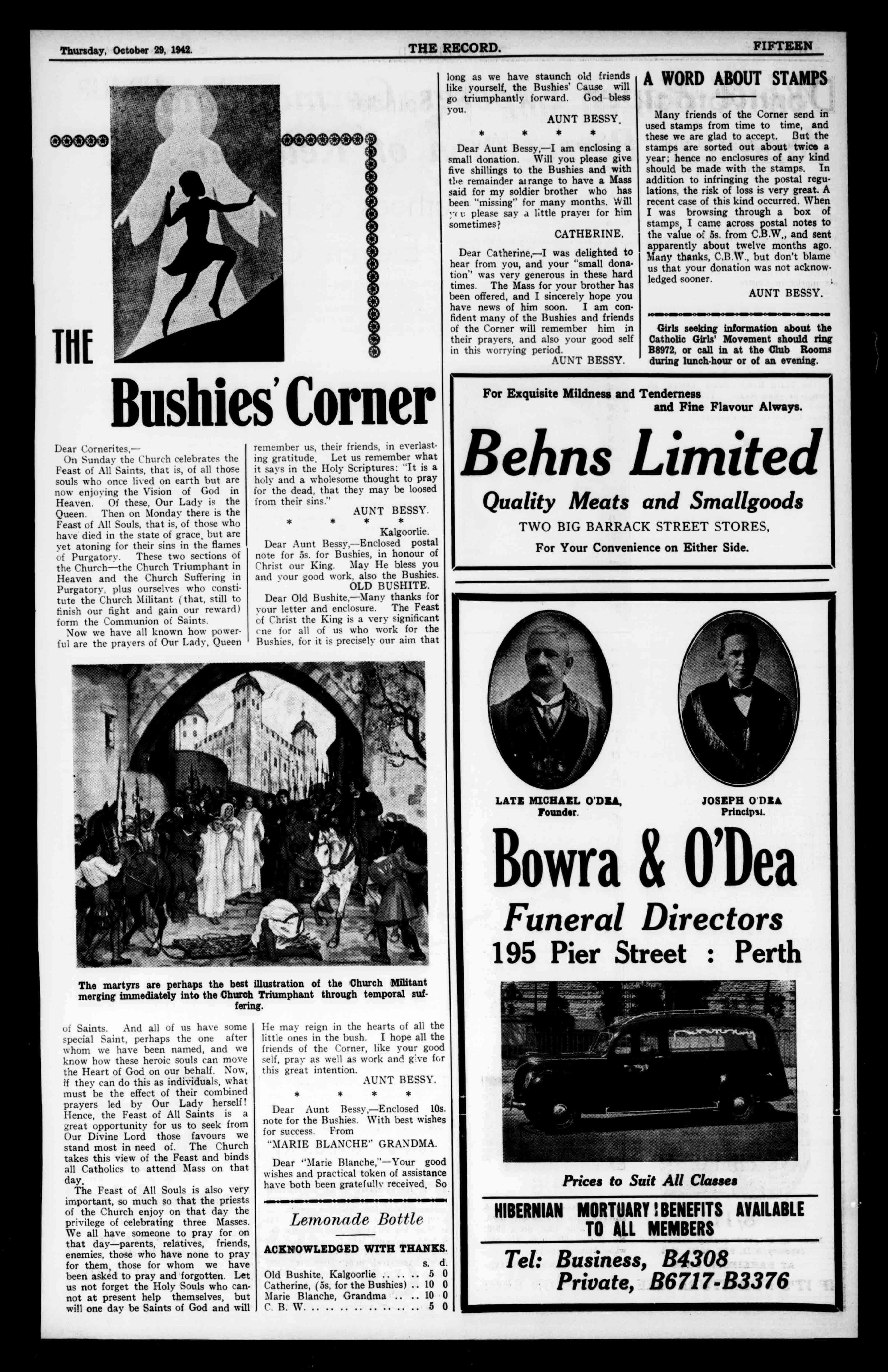
ThemartyrsareperhapsthebestillustrationoftheChurchMilitant mergingimmediatelyintotheChurchTriumphantthroughtemporalsuffering.
ofSaints.Andallofushavesome specialSaint,perhapstheoneafter whomwehavebeennamed,andwe knowhowtheseheroicsoulscanmove theHeartofGodonourbehalf.Now, iftheycandothisasindividuals,what mustbetheeffectoftheircombined prayersledbyOurLadyherself! Hence,theFeastofAllSaintsisa greatopportunityforustoseekfrom OurDivineLordthosefavourswe standmostinneedof.TheChurch takesthisviewoftheFeastandbinds allCatholicstoattendMassonthat day. TheFeastofAllSoulsisalsovery important,somuchsothatthepriests oftheChurchenjoyonthatdaythe privilegeofcelebratingthreeMasses. Weallhavesomeonetoprayforon thatday-parents,relatives,friends, enemies,thosewhohavenonetopray forthem,thoseforwhomwehave beenaskedtoprayandforgotten.Let usnotforgettheHolySoulswhocannotatpresenthelpthemselves,but willonedaybeSaintsofGodandwill
Ilemayreignintheheartsofallthe littleonesinthebush.Ihopeallthe friendsoftheCorner,likeyourgood self,prayaswellasworkandgivefor thisgreatintention. AUNTBESSY.
* * * *
DearAuntBessy.-Enclosed10s. notefortheBushies.Withbestwishes forsuccess.From "MARIEBLANCHE"GRANDMA.
Dear"MarieBlanche,"-Yourgood wishesandpracticaltokenofassistance havebothbeengratefullyreceived,So wmaMIDOIMOMMONMPOMPOIMOIMMIMMININIMOINEMIMMINMINI
LemonadeBottle
ACKNOWLEDGEDWITHTHANKS. s.d.
OldBushite,Kalgoorlie 50 Catherine,(5s,fortheBusbies) 100 MarieBlanche,Grandma 100
*
DearAuntBessy,-Iamenclosinga smalldonation.Willyoupleasegive fiveshillingstotheBushiesandwith theremainderarrangetohaveaMass saidformysoldierbrotherwhohas been"missing"formanymonths.Will "(tpleasesayalittleprayerforhim sometimes? CATHERINE.
DearCatherine,-Iwasdelightedto hearfromyou,andyour"smalldonation"wasverygenerousinthesehard times.TheMassforyourbrotherhas beenoffered,andIsincerelyhopeyou havenewsofhimsoon.IamconfidentmanyoftheBushiesandfriends oftheCornerwillrememberhimin theirprayers,andalsoyourgoodself inthisworryingperiod.
AUNTBESSY
AWORDABOUTSTAMPS
ManyfriendsoftheCornersendin usedstampsfromtimetotime,and thesewearegladtoaccept.Butthe stampsaresortedoutabouttwicea year;hencenoenclosuresofanykind shouldbemadewiththestamps.In additiontoinfringingthepostalregulations,theriskoflossisverygreat.A recentcaseofthiskindoccurred.When Iwasbrowsingthroughaboxof stamps,Icameacrosspostalnotesto thevalueof5s.fromC.B.W.,andsent apparentlyabouttwelvemonthsago. Manythanks,C.B.W.,butdon'tblame usthatyourdonationwasnotacknowledgedsooner.
AUNTBESSY.
Girlsseekinginformationaboutthe CatholicGirls'Movementshouldring B8972,orcallinattheClubRooms duringlunch-hourorofanevening.
FlavourAlways.
Thursday,October29,1942. THERECORD. FIFTEEN
ForExquisiteMildnessandTenderness andFine
Limited QualityMeatsandSmallgoods TWOBIGBARRACKSTREETSTORES, ForYourConvenienceonEitherSide. LATEMICHAELO'DLIL, Founder. JOSEPH0DEA Principst. Bowra&O'Dea FuneralDirectors 195PierStreet:Perth PricestoSuitAllClasses HIBERNIANMORTUARYBENEFITSAVAILABLE TOALLMEMBERS Tel:Business,84308 Private,B6717-B3376
Behns
WhitePaperExposesGermanand JapanesePersecutionofReligion..
VaryingMethodsofExtermination
SystematicwarbytheNazisandJapanesetocrushChristianityandallother religionintheoccupiedcountriesisexposedinaWhitePaperissuedrecentlybytheInter-AlliedInformationCommittee,representingtheAllied GovernmentsinLondon.
Themethodsvaryfromcountrytocountry.Insomethewariswaged bysubtleattemptsatunderminingallformsofbeliefandworship;in othersthereisdeliberateandcalculatedatrocity,Everywhere,however,the objectisthesame.ThetexthasbeengivenbytheNaziCommissar,of Thann:
"AgoodCatholiccannotbeagood NationalSocialist.Buttheofficials oftheThirdReichmustbeforeall thingsbegoodNazis.Thereforethey mustchooseoneortheother:either JesusChristortheFuehrer."
OccupiedFrancecomesintothelist of11countrieswherethewarisbeing wagedunceasingly.
HowmuchtruththereisintheNazi reportsofpersonsputtodeathas CommunistsmaybegaugedfromareportfromBelgium.
OnedayArthurCoene,apublic notary,wasexecuted,andafriend, alsoaso-calledCommunist,wassentencedtodeath.
Onthemorningofthesameday theyhadservedMasstogether.
TheevidenceintheWhitePaperhas beencompiledinthemainfromofficial AxisannouncementsinthePressand byradio,fromarticlesandnewsitems inAxis-controllednewspapers,and frompersonalexperiencesofpeople whohaveescapedfromoccupiedterritory.
Followingaresomeextracts:
BELGIUM
"HighwaymeninCassocks."
TheGermanshavesofarrefrained fromtakingdirectorviolentmeasures againsttheCatholicChurch.The basisoftheGermantacticsistoconfinetheactivitiesoftheChurchtothe administrationofthesacramentsand thuspreventherfrombeingactivein anyothersphere.
Bythesimpleenforcementofthe German''ordinances"theBelgianCatholicPresshasdisappeared;thedemocrat-Christiantradeunions,which hadmorethan350,000memberson theirrolls,havebeencompelledto jointheU.T.M.I.-UnionofWorkers, ManualandIntellectual;thevastorganisationsofCatholicAction,suchas theJ.O.C,(CatholicWorkingYouth), theJ.E.C.(CatholicStudents),the .I.A.C.(CatholicLandYouth)and othershavebeendissolved:thepowerfulpeasantco-operativeunions,BoerebondandAgriculturalAlliance,have beensuppressed;religiouslecturesoutsidetheChurchhavebeenforbidden; noticesofreligiousceremoniescannot beprinted;reunionsofschoolchildren orstudentshavebeenforbidden;sermonshavetobesubmittedtothecensor;bookshavetobesubmittedto theGermanexequatur.
TheepiscopateandtheclergyareattackedinthePressandradio-notas "priests"or"Catholics,"butas"valets ofChurchill,""followersoftheJewish-Britishgospel,""shamelessalliesof
CARDINALKASPAR, "notsparedphysical
tormentand spiritualpressureofthemostsevere character."
Freemasonry,""highwaymenincassocks,"andsoon.
TheattacksarecarriedoutbyFlemishNationalistsandRexists,who maintainthatteachingcannotbeother thanNational-Socialist.
TheimmensemajorityoftheCatholics,guidedbytheclergy,havenotallowedthemselvestobedeceivedby the"anti-Bolshevistcrusade."
Aconsiderablenumberofpriests havebeentakenashostages,sentto concentrationcampsorputinprison.
CHINA: JapaneseViolence.
ReligiousoppressioninJapanese-occupiedChinahasfrequentlytakenviolentforms.
TenCatholicmissionaries,saidto beDutch,havebeenmassacredinS.E. Shensi.AllCatholicchurchesinthe vicariateofChang-chihhavebeen closed,manyFranciscansandnunsbeingdetainedbytheJapanesemilitary, andwomenandchildrenofCatholic familiespubliclyputupforsale.
AgreatnumberofChineseChristians havebeenkilled.
CZECHOSLOVAKIA: NOClergyHeld.
ThepersecutionoftheChurchesaffectsalldenominations.
TheNazisareespeciallyanxiousto preventtheCzechpriestsandpastors fromcreatingcentresofspiritualresistancewithintheircongregations.
IIIIIMINIMINIONMI=K111NW
SAVECHARGES!
SAVEFREIGHT
ImprovetheValueofyourWoolbyhavingitSCOURED.
ElevenCountries
l'ersonaloppressionhasaffected manyhundredsofChristianleaders. Amoderateestimateisthatabout 500priestsandministersareheldin concentrationcamps.
EventhehighdignitariesanddistinguishedlayworkersinChristianChurcheswerenotsparedphysicaltorment andspiritualpressureofthemostseverecharacter.AmongthemwasCardinalKaspar,ArchbishopofPrague, whodiedinJune,1941.Aboutthe sametimetheleadingCatholicintellectual,AlfredFuchs,wastorturedto deathandhiswidowreceivedhisashes.
Thepriestsandministersinconcentrationcampsaredressedinprisoners' garmentsandpreventedfromsaying Massorreadingtheirbreviary.They arecrowdedintoroomswhicharenot providedwithevenprimitivehygienic measures,torturedbyhunger,beaten andhumiliated.Deathseemstobe oftentheonlyrelief.
Becausethetheologicalfacultiesand seminarieshavebeenclosedforupwardsoftwoyears,itisimpossibleto ordainnewpriests.
TheSwastikaisopenlyheldupas thesymbolofanti-Christianpaganism.
OCCUPIEDFRANCE:
ChildrenMayApostatise.
AsregardstheCatholicChurch,the toneofPressandofpublicpronouncementsisvenomousandantagonistic.
AllCatholicorganisationshavebeen suppressed.
Owingtotheretentionofthe1,500,000prisonersofwar,anenormousnumberofparishesarewithoutapriest. Individualpriestshavebeenimprisonedorwarnedtostoppreaching,
InAlsace-Lorrainechildrenatthe ageof14areforcedtojointheHitler YouthortheGermanGirls'Union, whichareradicallyanti-Christianand renderattendanceatreligiousservices orreligiousinstructionpracticallyimpossible.
ByadecreeofApril1,1941,everyone reachingtheageof14mayleavethe Church-theymustsimplynotifythe mayor.Parentsmaymakethisde. clarationonbehalfoftheirchildren whoareunder14.
AllteachersinAlsace-Lorrainemust gotoGermanytobeimpregnatedwith theNaziideologyandattitude.
GREECE:
DoubleOppression.
TheWhitePaperreportisconfined totheGreekOrthodoxChurch,which isoppressedbytheBulgariansaswell astheGermans.
InBulgarian-occupieddistrictsthe Bulgarianlanguagehasbeenmade compulsoryduringreligiousservices, althoughtheGreekpopulationdonot understandawordofit.
Manyoftheclergyhavebeenputto deathorshamefullyill-treated.
TheOrthodoxPrimatewasdeposed andinternedbecauseherefusedto
ItCostsNoMore
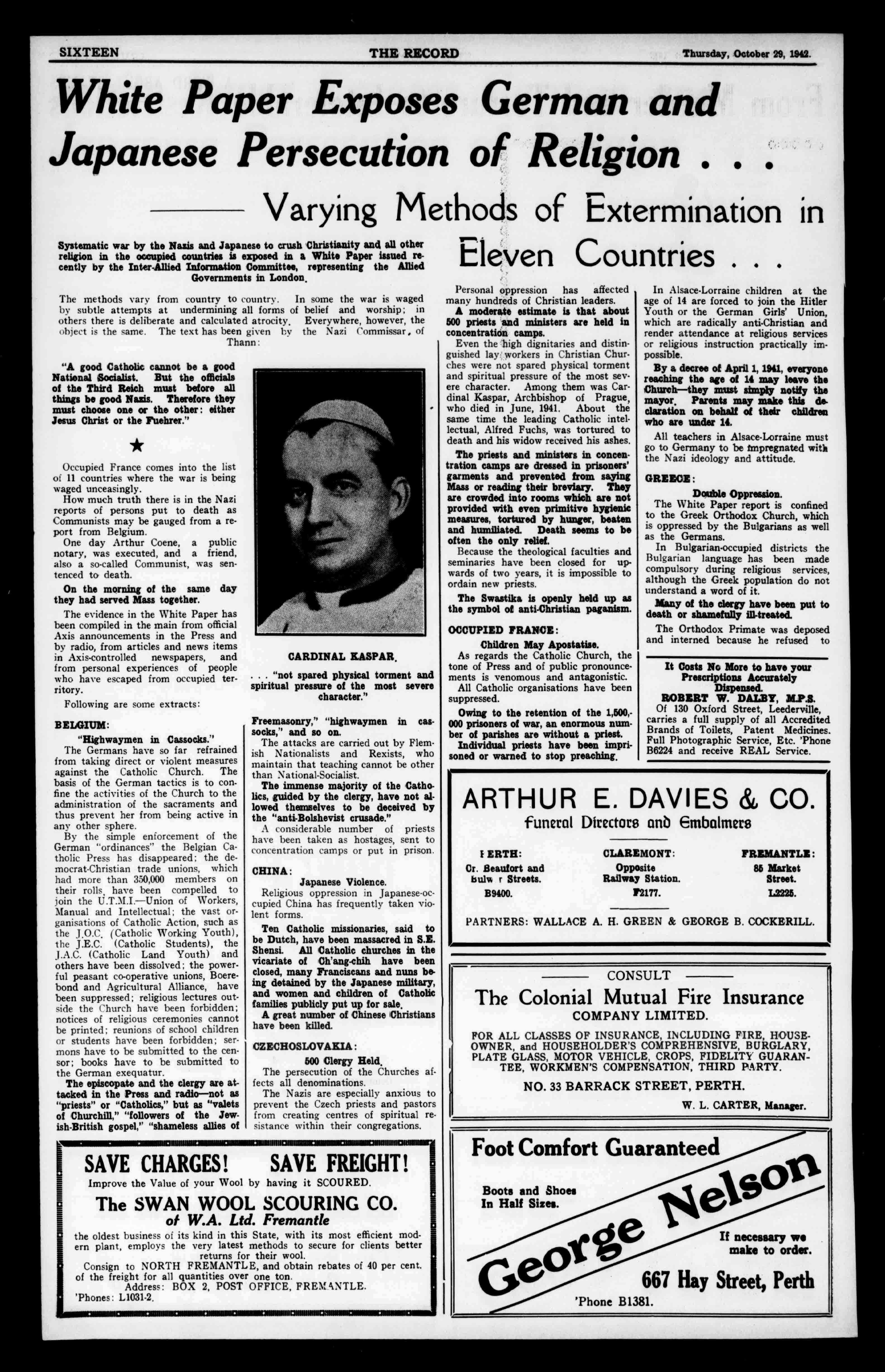
TheSWANWOOLSCOURINGCO. ofW.A.Ltd.Fremantle theoldestbusinessofitskindinthisState,withitsmostefficientmodernplant,employstheverylatestmethodstosecureforclientsbetter returnsfortheirwool. ofthefreightforallquantitiesoveroneton.
0
ConsigntoNORTHFREMANTLE,andobtainrebatesof40percent.
'Phones:
Address:.2BOX2,POSTOFFICE,FREMANTLE.
SIXTEEN THERECORD Thursday,October29,1942.
in
tohaveyour PrescriptionsAccurately Dispensed. ROBERTW.DALBY, Of130OxfordStreet,Leederville, carriesafullsupplyofallAccredited BrandsofToilets,PatentMedicines. FullPhotographicService,Etc.'Phone B8224andreceiveREALService. ARTHURE.DAVIES&CO. funeralDirectorsanbembalmers IERTH: Cr.Beaufortand hulaStreets. B9400. CLAREMONT: Opposite RailwayStation. F2177. FREMANTLE: 85Market Street. L2225. PARTNERS:WALLACEA.H.GREEN&GEORGEB.COCKERILL. CONSULT TheColonialMutualFireInsurance COMPANYLIMITED. FORALLCLASSESOFINSURANCE,INCLUDINGFIRE,HOUSEOWNER,andHOUSEHOLDER'SCOMPREHENSIVE,BURGLARY, PLATEGLASS,MOTORVEHICLE,CROPS,FIDELITYGUARANTEE,WORKMEN'SCOMPENSATION,THIRDPARTY. NO.33BARRACKSTREET,PERTH. W.L.CARTER,Manager. FootComfortGuaranteed BootsandShoes InHalfSizes. 1114 GeOIC 667HayStreet,Perth Ifnecessarywe maketoorder. 'PhoneB1381.
FromMurderandTorturetoIntolerableRestrictions
administertheoathofofficetothe membersofthepuppetgovernment
LUXEMBOURG:
FeastsAbolished.
Severalfestivalshavebeenabolished bytheGermans,includingAscension Day,theAssumption,AllSaints'Day andAllSouls'Day.
ThemajorseminaryhasbeentransferredtoTrier,inReichterritory.
Religioustuitioninelementaryand secondaryscholsnolongerexists:ecclesiasticalteachershavebeendismissedandparishpriestsarenolonger allowedtousetheirauthority;inaddition,teachersareforbiddentolook afterthereligiousandmorallifeof theirpupilsinanyway.
Agreatnumberofsecularpriests havebeendeportedtoUnoccupied France.Allmonksandnunshave beenexpelledfromthecountry,with theexceptionoftheCarmelites.Many ecclesiasticshavebeenputinprisonor intoconcentrationcamps.
Allepiscopalpropertyhasbeenconfiscated.
TheChurchhasbeendeprivedofall herorganisations.
NETHERLANDS:
UndauntedOpposition.
TheChurchesofalldenominations areconstantlymaintainingtheirundauntedoppositiontotheNazis.
PowertoappointteachersandprofessorsatuniversitiesisvestedexclusivelyintheNaziCommissionerfor Education.Thisimpliesthatonly Naziswillbeappointed.
Soonaftertheinvasion,thefirstanti. Jewishregulationswereimposedonthe Dutch.Therewasavigorousprotest onthepartoftheChristianclergy.
NORWAY:
Quisling'sViolence.
TheWhilePapertellsindetailthe storyofthelongandviolentassaultby QuislingupontheNorwegianState Church,ofwhichmorethan96per cent.oftheNorwegianpopulationare registeredmembers.
POLAND: 800Priests/tilled.
FromtheverybeginningoftheiroccupationofPolandtheGermansstart edadeliberate,barbarousexterminationoftheCatholicChurch.
Allthereportsstatethatthepersecutionsareaimednotonlyagainstthe Polesa,anationbutjustasmuch
Patronise
OURADVERTISERS
STOVES,allenamel,newandused, lowestprices;promptrepairs...W.A. StoveCo.,559WellingtonSt.(B6307.)
THEBESTVALUEFORYOUR MONEYAT F.J.DUFF'S WINESALOON.
CornerARUNDELSTREETand SOUTHTERRACE,FREMANTLE.
'Phone:L1902. 1,,111.11111.1111111,11111111111111111111111111i II 1 I BUNBURY.
LANDandESTATEAGENT G.H.TEEDE
'Phone31 Private267. SMITH'SBUILDINGS, WELLINGTONST.,BUNBURY. Businesses,Farms,Houses,Land ForSale.
againstthePolesasareligiouscom triunity.
Thecampaignwasparticularlyferoci. ousinWesternPoland,intheareaincorporatedintotheReich.
Sixdioceseshavebeenincorporated togetherwithpartsofsixothers.
Thetotalnumberofpriestsexecuted bytheGestapoortormentedtodeath inGermanprisonsandconcentration campsisestimatedat800.Thereare about3,000priestsinconcentration camps.
InPomeraniaandPoznaniathere wasawholesalemassacreoftheclergy, duringwhichsomeofthemwereburied whiletheystillgavesignsoflife.
FatherAnthonyDobrzynski,curate ofZnin,wasarrestedinthestreet whilehewascarryingtheBlessedSaclamenttoadyingperson-
Hisvestmentsweretornfromhis back,theBlessedSacramentwasprofaned,andFatherDobrzynskiwas draggedtoprison.
InLublin.BishopFulman,Bishop GoralandanumberofclergyassembledintheresidenceofBishopFulman fortheanniversaryofhisconsecration werearrested.Onatrumped-upcharge thatMgr.Fulmanwasinpossession amachine-gun,allwerecondemnedto death.Thesentencewascommuted tolifeimprisonmentforall.
Seventypriestsweretakenfroma homeforretiredclergyandsenttothe notoriousconcentrationcampatDachau.
IntheArchdioceseofPoznanand Gneiznotherewerebeforethewar828 priestsinparishactivities.Nowonly 34areleftforthePolishpopulationof over2,000,000.
TheseareonlyafewoftheexamplesofGermanmethodsgivenin thereport.
U.S.S.R.
ChurchesDestroyed.
TheWhitePaperquotesM.Molotov's recentNotetotheAlliedGovernment onthesubjectofGermanatrocities,in whichhesaidthattheNaziinvaders "haveburntdown,plundered,blown upandbefouledhundredsofchurches onSovietterritory....In13districts oftheMoscowregiontheydestroyed 42churches....Asarule,beforethey retreatfromthevillageswhichthey haveburneddown,theGermansherd someoftheresidentsintothechurchesandthensetthebuildingsonfire togetherwiththepeoplelockedinside."
YUGOSLAVIA:
Forced"Conversions."
TheWhitePaperquotesCardinal HinsIev:"Nothingcansurpassthe
J.F.CAIN
17STIRLINGHIGHWAY, COTTESLOE.
'PhoneF2121,DayorNight.
LICENSEDSANITARYPLUMBER, IRONWORKER,SHEETMETAL WORKER.
S.BEECROFT-Butcher 181RokebyRoad,Subiaco.
DnlyPrimeFreshKilledMeatSold 'PhoneW1373.
J.NEILSON,Optician
S.DANNELL,F.S.M.C.(London), W.A.O.A. OPTOMETRIST. Tel.:B2014. 16PLAZAARCADE,PERTH.
SAY"ISAWYOURAD.IN'THERECORD."'
thoroughruthlessnessoftheNazipromotersoftheirNewOrder.InSloveniaoutof700priestsoftwodin cesesonly16oldpriestsareleftinfrcc dom.NoMassisallowed;theadministrationoftheSacramentsisforbidden;allmonasteriesareconfiscated,andthereligiousaredrivenout. AllChurchpropertyislikewiseconfiscatedandthevaluableChurchvessels arelooted."
InCroatia,aspartofthecynical campaigntotrytomakealasting breachbetweentheCroats,whoareCatholic,andtheSerbsinCroatia,who areOrthodox,onlytheCatholicand theMoslemreligionsareofficiallyre cognised.TheOrthodoxandJewish
religionshavebeendeliberatelyre fusedrecognition "Suchapolicy,"theWhitePaperdeclares,"is,ofcourse,repugnanttorepresentativesoftheCatholicYugoslays."
ItquotesabroadcasttoYugoslavia inwhichMgr.Kuhar,SloveneCatholic memberoftheYugoslavGovernment inLondon,commentinguponforced "conversions,"said:"ThesupremeCatholicauthoritywillspeakindue courseaboutthiscrimeagainstthe lawsgoverningfreeconscience.But inthemeantimeweCatholicshavethe rightandthedutyopenlytodecline andtocondemnwithallourstrength anyconversiontoourFaithwhichis nottheresultoffreedecision."
HotelandAccommodationGuide
GAYNOR'SHISMAJESTY'SHOTEL
HAYSTREET EXCELLENTCUISINE PERTH. MODERATETARIFF.
HOTELPERTH
JACKEDDINGTON, Proprietor.
ExcellentAccommodation
STAN.O'BRIEN COURTHOTEL PERTH.
'Phone:B4281.
HOTELBEACONSFIELD FREMANTLE. OverlookingtheOcean. SuperiorA000mmodatios. ModerateCharges. M.BYRNE LateofGrandandShamrock Hotels,Boulder).
SUBIACOHOTEL
FIRST-CLASSACCOMODATION 'Phone:W1028. A.J.McHENRY,Proprietor.
VICTORIAHOTEL HAYSTREET,SUBIACO. RenovatedThroughout. EssenceofComfort. W.F.ARTIS,Proprietor. (LateofBalmoralHotel,Vic.Park)
COUNTRY.
DukeofYorkHotel NARROGIN ReconditionedandRefurnished. NewLounge,DiningRoom,and CommercialRooms. ARTHURBOYLAN,Proprietor (LateGeorgeHotel,Perth.)
FREEMASON'SHotel
TOODYAY. ExcellentCuisine. AmaticeRefrigeratorInstalled. OldandNewFriendsare CordiallyWelcomed. MRS.E.WING,Proprietress.
GOLDFIELDS.
RodBeaton's HANNAN'SHOTEL
HANNANSTREET. KALGOORLIE.
STAR&GARTERHOTEL
Cnr.HANNANandNETHERCOTT STREETS.KALGOORLIE.
BERTSTARR Proprietor.
'Phone13. Box124.
AUSTRALIAHOTEL
KALGOORLIE
CT.A.andR.A.C.HOUSE.
OneMinutefromSt.Mary's Church.
HotandColdWaterinHotel Bathrooms.
Thursday,October29,1942. THERECORD. SEVENTEEN
RefrigerationThroughout. OnlyLock-UpGaragesinthe centreofTown. M.IDILLON,Licensee KeoughsforCatering AnyNumber,Place,orTime. ThreeReceptionRoomsforHire. OnHire:Crooke-,Cutleryand Glassware,etc. PhoneB1724. GLADIZEOUGH, NEWCASTLESTREET,PERTH. BRYANT&WATERS 80to90STIRLINGST..PERTH. WOODandCOALMERCHANTS. OrdersPromptlyAttendedto. 'Phnw: B3938. T.VIVIAN, 143Rokeby-road,Subiaco.W1639. FORSEWERAGECONNECTIONS, W1539. BadWaterPressure,BrokenPedes. talPans,BlockedSewerDrains,CisternandRoofRepairs,T.V.Headlight MaskstoApprovedDesigns. .M.6.1041.1111.00.11 `MeetyouattheSavoy'
Record
OfficialOrganoftheArchdioceseofPerth ESTABLISHED1874
ChristianBrothers'College,St.Mary's,Leederville
OnThursday,October22,theChristianBrothers'College,St.Mary's,Leederville,helditsfirstannualsports meetingatLeedervilleOval.Thehon. oursofthedaywereeagerlycontested bythethreeteams-Maroon,Blueand Gold-andsuccesswentfinallytothe Maroons,captainedbyKevinMcGinnity.Thegradesystemadoptedin eachagemadeitpossibleforeveryboy intheCollegetocompetewithhis equals,anditwasgratifyingtoseethe keenspiritofrivalrywhichresulted fromthe100percent,entry.
Thehonourofwiningthesenior championcupwenttoHaroldHolmes, whowassuccessfulinwinningtheMile, 440,220,HighJumpandLongJumpin theUnder16section.KevinNIcGinnitywasrunnerup,havingsecured firstplaceinthe100Yardsand8S0 YardsChampionship,Under16.The championsintheotherdivisionswere' Under15,R.Healy;Under14,A. Yaksich;Under13.K.Maher;Under 12,B.Worner;Under11,F.Hughes, Under10,F.Ryan;Under9,L.Bates. Attheconclusionoftheday'ssport, Rev.FatherBoylan,representingRight Rev.MonsignorMoloney,presentedthe SeniorChampionCuptoH.Holmes, amidsttheapplauseoftheassembled boysandvisitors.Results:
Under16.
100Yards:K.McGinnity,1;H. Holmes,2;P.Townsend,3;J.Wardrop,4.Time,121-5sec.
220Yards:H.Holmes,1;K.McGinnity,2;P.Townsend,3;J.Wardrop,4. Time,264-5sec.
440Yards:H.Holmes,1;K.McGinnity,2;R.Healy,3:P.Rodan,4.Time, 73sec.
880Yards:K.McGinnity,1;R. Mealy,2;H.Holmes,3;J.Sutherland, 4. Time,2min.251-5sec.
Mile:H.Holmes,1;J.Sutherland,2; K.McGinnity,3;R,Healy,4.Time, 5min.40sec.
BroadJump:H.Holmes,1;R. Healy,2;K.McGinnity,3;P.Townsend,4. Distance:16ft.2in.
HighJump:H.Holmes,1;K.McGinnity,2;J.Wardrop,3;P.Townsend,4. Height,4ft.5hin.
Under15.
100Yards:R.Healy,1;P.Rodan,2;
FirstAnnualAthleticMeeting
J.Sutherland,3;R.Bradbury,4.Time, 121.5sec.
220Yards:R.Healy,1;P.Rodan,2; J.Sutherland,3;H.Duncan,4.Time, 27sec.
HighJump:R,Healy,1;R.Bradbury,andA.Phillips,2;J.Sutherland, 4.Height,4ft.7in.
Under14.
100Yards:L.Giralt,1;A.Yaksich, 2;R.Hebbard,3;R.Pooley,4.Time, 132-5sec,
220Yards:L.Giralt,1;R.Hebbard, 2;A.Yaksich,3;M.Chupin,4.Time, 29sec.
440Yards:A,Yaksich,1;R.Hebbard,2;R.Pooley,3;R.Herrod,4. Time,lmin.9sec.
BroadJump:A.Yaksich,1;R.Hebbard,2;R.Pooley,3;D.Kissane,4. Distance,13ft.6hin.
Under13.
100Yards:K.Maher,1;J.Warr,2; B.Williams,3;B.Harris,4.Time, 13sec.
220Yards:K.Maher,1;J.Warr,2: B.Williams3;J.Chilvers,4.Time, 31sec, HighJump:J.Chilvers,1;K.Maher, 2:J.WarrandJ.Hamilton,3.Height, 4ft.2lin.
Hop,StepandJump:JWarr,1;J. Chilyers,2;B.Williams,3;B.Harris, 4. Distance,26ft,10hin.
Under12.
100Yards:B.Worner,1;J.Walsh,2: N.Brownrigg,3;P.Tobin,4.Time, 14sec.
220Yards:B.Worner,1;J.Walsh, 2;P.Tobin,3;J.Hurley,4.Time, 29sec.
BroadJump:B.Worner,1;B.Murdock,2;P.Tobin,3;J.Hurley,4. Distance,12ft,4hin.
Under11.
75Yards:F.Hughes,1;P.Williams, 2:K.Robins,3:J.Stampalia,4.Time, lOsec.
100Yards:F.Hughes,1;P.Williams,2;F.Stampalia,3;A.Beaton,4. Time,14sec.
HighJump:F.Hughes,1;F..Stampalia,2;W.Broderick,3;P.Williams, 4. Height,3ft,llhin.
Hop,StepandJump:F.Hughes,1; F.Kelsall,2;A.Beaton,3;R.Billing,
CONSULT
withour ADVERTISERS forallyour REQUIREMENTS the
CHINA,GLASSandPLATED WAREIMPORTERS. OTLEYPLACE,OffMURRAY STREET(RearSavoyHotel) Convents,Colleges,Institutions andSchoolsSpeciallyCateredlot. PriceListsandCatalogueon Application. PhoneB9651. Kelly&Rodoreda LateofJOHNDYNON&CO.
Immannillsmommassaimmommou DanWhiteI Ph.Ch.,J.P. a The"NYAL"ChemistI PLAZAARCADE--PERTH LARGESTOCKSOF "ELASTOPLAST" FIRSTAIDDRESSINGS AND PLASTERS CSTARRIVED. 4 PATRONISE ANOLDC.B.C.STUDENTI 8111111111111101111111EMBI111111911111111111111111111611916 BROWNS---Fruiterers 127BARRA,KSTREET,PERTH. 'PhoneB3517. 'PhoneB3517. ALLTHEBMFRUITSOFTHESEASON. BESTCOOLDRINKSANDMILKBARTNTOWN.
4. Distance,27ft.4in. Under10. 75Yards:F.Ryan,1:E.\Vishart,2; D.Cain,3;J.Sutherland,4. Time, 103-5sec. 100Yards:F.Ryan,1;D.Cain,2;E. Wishart,3;J,Sutherland,4. Time, 14sec. HighJump:J.Walsh,1;J.Hunter, 2;PJohnston,3;F..RyanandD. Cain,4. Height,3ft.Shin. Under9. 50Yards:L.Bates,
B.Dellaca,
R.
Bancroft,4.Time,81 sec. 75Yards:L.Bates,
B.Dellaca,
R.Good,
M,Boswood,4.Time, 11
Under
Under
Under
Under
Under
Under
Under10:F.Ryan. Under9:L.Bates. GoldfieldsSection YOUCANDOALLYOURSHOPPINGAT the GOLDFIELDS'5 LEADING EMPORIUM whereyoualwaysget THEBESTOFSERVICE RUSSELL'SKalgoorlie THESHOPFORMEN'SWEAR FORTHEBESTMEATatREASONABLEPRICES,DealfromJas.GrayandCoLtd. WHOLESALEANDRETAILBUTCHERS. UBURTST.,BOULDER,IRDAGHAVENUE,&HANNANIT., KALGOORLIE. Telephones:3168;K675. Telephones:MU;KM. RequiescatopinPace W.STROTHER FUNERALDIRECTOR. 18HANNANST.,KALGOORLIE;COOLGARDIE; MENZIES. AtYourCommandatanytime,DayandNight.Telephone:K327. D.HILL WHOLESALEANDRETAILBUTCHER. NEWCASTLEROAD,MIDLANDJUNCTION. Tel.118Midland. TRUSSEDPOULTRY. PrintedandPublishedbyKeithFrancisSpruhan.at"TheRecord"Office,450HayStreet,Perth.
1;
2;
Good,3;R.
1;
2;
3;
2-5sec. ChampionsinAgeDivisions.
16:H.Holmes.
15:R.Healy.
14:A.Yaksich.
13:K.Maher.
12:B.Worner.
11:F.Hughes.