By"IANHAY"(Major-GeneralJohn HayBeith).
Whataretherulesofwarfareto-day? Towhatextentaretheybeingobserved?Doesitpayinthelongrunto breakthem?Firstletuslookback toawartwocenturiesago.
AttheBattleofFontenoy,fought betweentheBritishandFrench,the BritishGuards,drawnupinreadiness forthestruggletobegin,foundthemselvesfacingtheFrenchGuardsalmostatpoint-blankrange.Ourofficers,wearetoldsalutedtheFrenA bytakingofftheirhats,andthesal-ate waspolitelyreturned.
LordCharlesHay,theBritishcommander,thencried:"Gentlemenofthe FrenchGuards,fire!"towhichthe Frenchcommander,nottobeoutdone incourtesy,repliedinaloudvoice: "Gentlemen,weneverfirefirst;fire yourselves!"Afterthatbothsides letflyatoneanotherandthegrim businessofthedaybegan.
Theanswertothefirstquestion posedinparagraphoneisthattheft existsanextensiveanddefinitecedeo; rulesuponthesubject,standardised andapprovedbyrepresentativesofthe civilisednationsassembledinpeaceful councilatGeneva,TheHague,and elsewhere.Previoustothat,therules ofwarhadverylargelyinventedthemselvesasChristianity,andhumanity mightdirect.
Someofthesetookastrangeform. Intheseventeenthandeighteenthcenturies-atFontenoy(1745),forinstance-ourinfantrywereaccustomed tofiretheirmusketsfromthehip; thatistosay,amannevertookdeliberateaimataparticularopponent; thatwouldhavemadehimfeellikea murdererandnotasoldier.Sohe loosedoff"intothebrown,"
Nexttowhatextentaretheserules beingobservedto-day?
Sofarastheactualcombatantsare concernedthereisonlyoneguiding principleforeitherside,andalways hasbeen,andthatistoseekoutthe armedforcesofyourenemyanddestroythem.Thereissomeslightdifferenceofopinion,however,between Hitlerandourselvesastowhatmethodsofdestructionarelegitimateand whatarenot.
Therulethatyoumaynotsinka merchantorpassengersteamerwithout warninghasbeendisregardedbyHitler
fromthestart-fromthemomentin fact,whenhetorpedoedashiploadof evacuees,largelychildren,inthe "Athenia"uponthefirstdayofthe war.
TheBomber'sProblem.
Whenwecometothenon-combatants,weareconfrontedwithanew andpracticallyinsolubleproblem.The latestandmostterribleengineofdestructioninwarfareisthebombing airplane.Itistoovaluableaninstru-
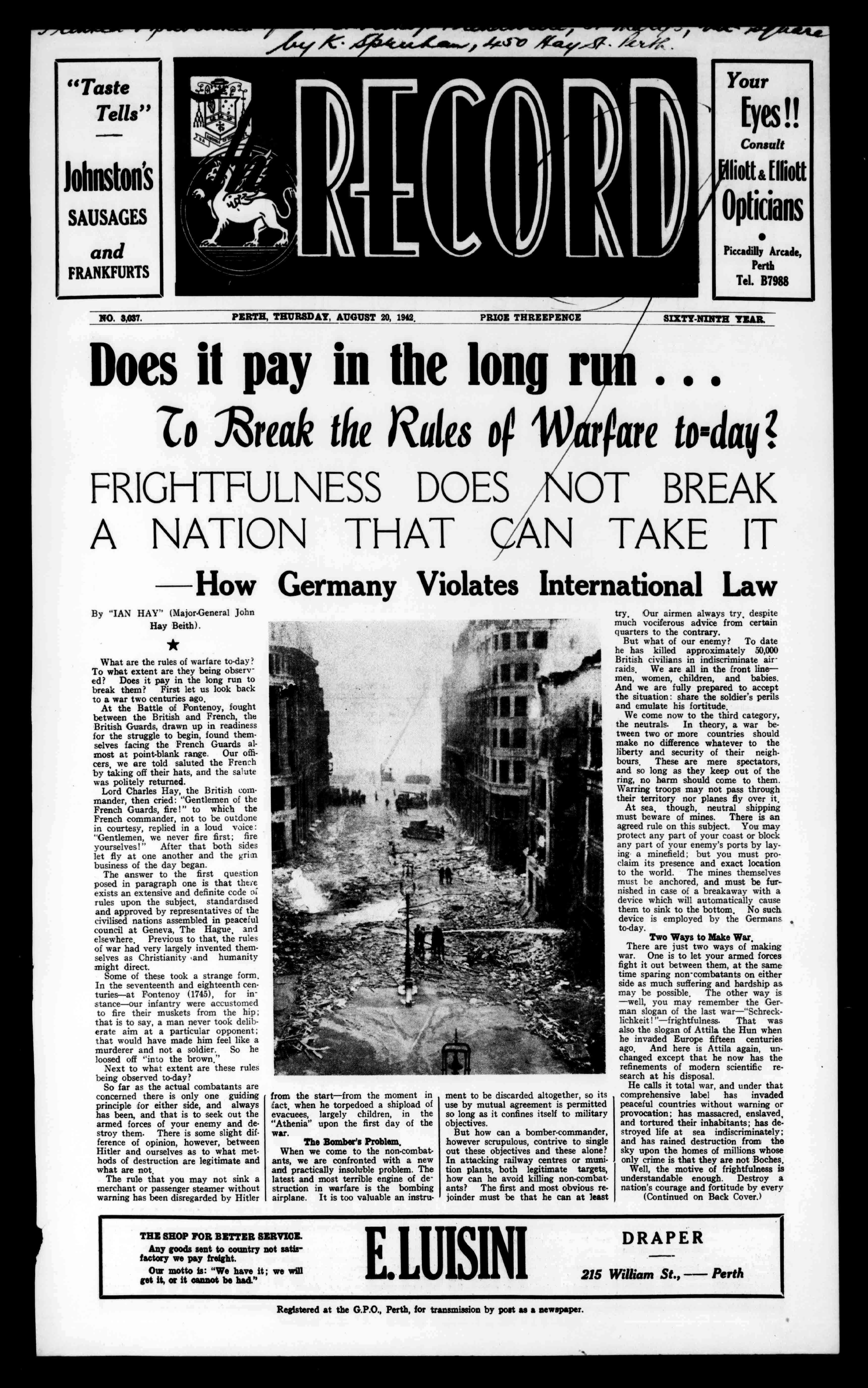
menttobediscardedaltogether,soits usebymutualagreementispermitted solongasitconfinesitselftomilitary objectives.
Buthowcanabomber-commander, howeverscrupulous,contrivetosingle outtheseobjectivesandthesealone? Inattackingrailwaycentresormunitionplants,bothlegitimatetargets, howcanheavoidkillingnon-combatants?Thefirstandmostobviousrejoindermustbethathecanatleast
try.Ourairmenalwaystry,despite muchvociferousadvicefromcertain quarterstothecontrary.
Butwhatofourenemy?Todate hehaskilledapproximately50,000 Britishciviliansinindiscriminateairraids,Weareallinthefrontlinemen,women,children,andbabies. Andwearefullypreparedtoaccept thesituation:sharethesoldier'sperils andemulatehisfortitude.
Wecomenowtothethirdcategory, theneutrals.Intheory,awarbetweentwoormorecountriesshould makenodifferencewhatevertothe libertyandsecurityoftheirneighbours.Thesearemerespectators, andsolongastheykeepoutofthe ring,noharmshouldcometothem. Warringtroopsmaynotpassthrough theirterritorynorplanesflyoverit.
Atsea,though,neutralshipping mustbewareofmines.Thereisan agreedruleonthissubject.Youmay protectanypartofyourcoastorblock anypartofyourenemy'sportsbylayingaminefield;butyoumustproclaimitspresenceandexactlocation totheworld.Theminesthemselves mustbeanchored,andmustbefurnishedincaseofabreakawaywitha devicewhichwillautomaticallycause themtosinktothebottom,Nosuch deviceisemployedbytheGermans to-day.
TwoWaystoMakeWar,
Therearejusttwowaysofmaking war.Oneistoletyourarmedforces fightitoutbetweenthem,atthesame timesparingnon-combatantsoneither sideasmuchsufferingandhardshipas maybepossible,Theotherwayis -well,youmayremembertheGermansloganofthelastwar-"Schrecklichkeit!"-frightfulness.Thatwas alsothesloganofAttilatheHunwhen heinvadedEuropefifteencenturies ago,AndhereisAttilaagain,unchangedexceptthathenowhasthe refinementsofmodernscientificresearchathisdisposal.
Hecallsittotalwar,andunderthat comprehensivelabelhasinvaded peacefulcountrieswithoutwarningor provocation;hasmassacred,enslaved, andtorturedtheirinhabitants;hasdestroyedlifeatseaindiscriminately: andhasraineddestructionfromthe skyuponthehomesofmillionswhose onlycrimeisthattheyarenotBoches.
Well,themotiveoffrightfulnessis understandableenough.Destroya nation'scourageandfortitudebyevery (ContinuedonBackCover.)
OP" "Taste Tells" Johnston's SAUSAGES and FRANKFURTS NO.3,037. PERTH,THURSDAY,Al7OUST20,1942. 4<ay____pr Your Eyes!! Consult liOttElliott& Opticians PiccadillyArcade, Perth Tel.B7988 PRICETHREEPENCE SIXTY-NINTHYEAR. Doesitpayinthelongr toBreaktheRulesof'WOaretoday? FRIGHTFULNESSDOESNOTBREAK ANATIONTHATCANTAKEIT
GermanyViolatesInternationalLaw
How
THESHOPFORBETTERSERVICE. Anygoodssenttocountrynotsatisfactorywepayfreight. Ourmottois:"Wehaveitwewill getit,oritcannotbehad." E.LUISINI DRAPER 215WilliamSt.,-Perth RegisteredattheG.P.O.,Perth,fortransmissionbypostasanewspaper.
Tolerant
ofsinceremenofotherreligions wecannotbetolerantoftheirmistakennotions
Ascepticqueriesthehistoryof AdamandVomitSources ISCHURCH-GOINGESSENTIALTO CHRISTIANITY?
DifferencebetweenChristianand pagansinners
"Peacemaker,"Sydney:
Q.:Whatisyourattitudetowardsthe PrinciplesadvocatedbyMr.Menzies,asstatedintheenclosedreport fromthe"Herald"?
R.:Thereportcontainsremarks maderecentlybyMr.Menziesina radiotalkon"FreedomofWorship.' Iwilltakethem,sentencebysentence, explainingtheCatholicattitudeto eachofhisthoughts.
Q.:"Sectarianstrife,"saidMr,Menzies,"istheenemyoffreedomof wetship,notitsfriend."
R.:Nobodycoulddenythat.
Q.:"ItisthedenialofChristianity, notitsproof,"headdad,
R.:Thatalsoistrue.Thefirstlaw ofChristianityischarity,andsectarian strifeisopposedtocharity.Weare notobligedtobelievethatdifferent sodconflictingreligionsareequally trueandgood.Infactnoreasonable mancouldbelievethat,orbeexpected tobelieveit.Butweareobligedto respectanotherman'sconscience,even thoughitdiffersfromourown:andhe mustbegrantedfreedomtofollowhis conscience,provideditisnotsoabnormalthatitimpelshimtoconduct harmfultothecommunityanddestructiveofpublicorder.Butevenin thislattercase,anyrestraintimposed mustnotbeinspiredbybigotryand hatred,butonlybyaloveofjustice andofthegeneralgood.Bigotryand hatredofpeoplewhodifferfromusin religionaredefinitelyanti-Christian.
RELIGIONSOFOPPOSITION,
Q.:"Itis,indeed,apoorreligion"' saidMr.Menzies,"whichconsists merelyofopposingsomebodyelse's faith,whichproducesnotfaithit selfnorunderstanding,nortole:. ance,norgenerosity,butmaliceand hatredandalluncharitableness,"
R.:Thatisallquitetrue.Aman's religionshouldconsistinpositiveconvictionsabouthisrelationshipwith God,andshouldimpelhimtoapositiveloveofGod,andofhisfellow-men fortheloveofGod.Ifhispositive convictionsexcludebeliefinreligions professedbyotherpeople,thatdoes notjustifyanydislikeofotherpeople becausetheydonotsharehisconvictions,Inthissessionmypurposeis toexplainthepositiveconvictionsof Catholics.AttimesIhavetooppose theoppositionofsomelistenersto thoseconvictions.Butmyopposition totheiroppositioniscertainlynot dictatedbymalicehatred,oruncharitableness.Acalmanddispassionate discussionofdifferencesisalwayshelpful,Ill-feelingisneverhelpful.
ROOMFORALL,
Q,:"Asweputoutuponthisvast territoryofthesoul,istherenot roomforallofus?"
R,:Thereshouldbe,andmustbe roomforallAustralianstodwelltogetherinpeace,howeverdifferenttheir religiousconvictionsmaybe.Atthe sametime,thoughtfulmenwillrealise thatdifferentreligiousconvictionscannotallbeequallytrue;andtheywill trytofindthetruth,renouncingerroneousformsofreligiononcetheyhave foundit.
Q.:"Shallweturnasidefromthe searchtowrangle,toattack,andto defend,orshallwegetwisdomand understanding,andwiththemtoleranceandatruefreedom?"
R.:Iwouldsaythatwemustcon tinueoursearchforagreaterknowledgeofthetruth,notbywrangling, butbydiscussion;notbyattack,but byexplanation;notbydefending blindly,butbyjustifyingreasonablywhenrequestedtodoso.Thatwill meanwisdomandunderstanding,toleranceandtruefreedom.
LIMITSOFTOLERANCE.
Q.:"Tosomegoodpeople,Iknow,tolerancemeansaweakevasionofthe dutytodenounceandfrustrateevil, buttheyarewrong,"
R,:Mr.Menziesrightlyrejectssuch aneglectofdutyinthenameoftolerance.
Q.:"Weareboundtobeenemiesto evilwhenweseeit;butwearenot boundtobeenemiestoourfellowman," R.:Thatistrue.Butloveforour fellow-men,andnotenmitytowards themwillurgeustotrytodetach themfrommistakenideaswhichwe knowtobetotheirharm,orfrom eviltendencieswhichcanbetheir ruinintheend.Prudence,ofcourse, mustalwaysregulatesuchefforts,in orderthatcharitymaybepreserved.
Q:"Thetrulyfreemanistolerant, notofthosecorrodingandcorruptingthings,whichallfreemenwill trytodestroy,butofotherhonest menwho,hatingthesameevil,see adifferentroadbywhichtocome againstit."
R.:Onecommentheremustbemade. Weareobligedtobetoleranttowards allotherhonestmen.Butthatdoes notmeanthatwemustalwaysapprove andblessthedifferentroadsthey choosetofightthesameevilasourselves,Inmerelyhumanaffairsand inmatterslefttohumanjudgment, weshouldmodestlyrespectthewisdomandthedecisionsofothers.But inreligiousmatters,onewhoknows
thatChristisGod,andthatHehas revealedaspecificroadtobefollowed, cannottreatwithequaldeferedifferentroadswhichmenhavetMght outforthemselves.Tolerantofthe menthemselves,hecannotbetolerant oftheirmistakennotions.And,as opportunityoffers,hemustendeavour towinthemtothetruthrevealedby GodthroughChrist,andtaughtinits fullintegrity,asweCatholicsfirmly believe,bytheCatholicChurchalone. Mr,Menzieshimself,ofcourse,isnot
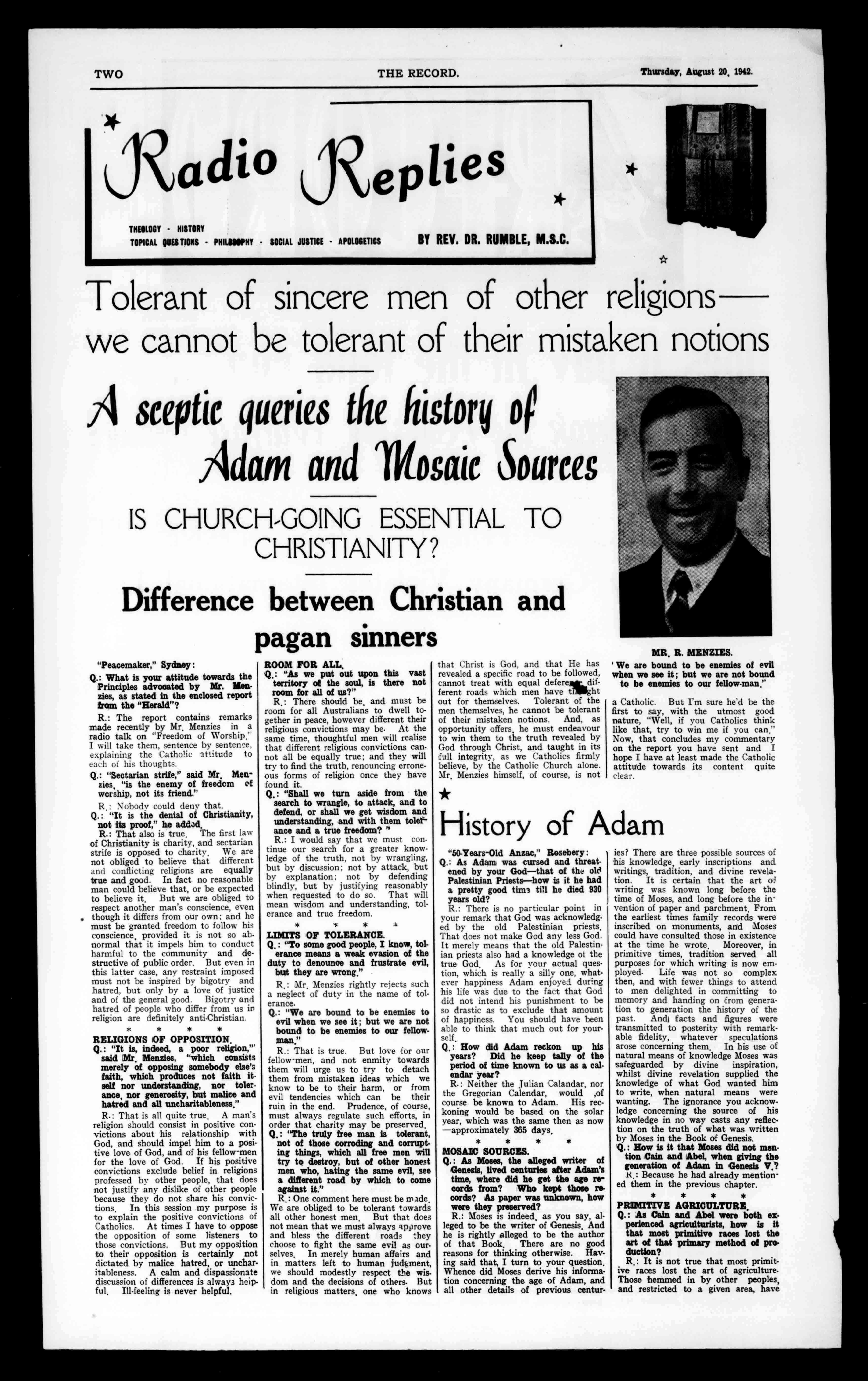
MR.R.MENZIES.
Weareboundtobeenemiesofevil whenweseeit;butwearenotbound tobeenemiestoourfellow-man," aCatholic.ButI'msurehe'dbethe firsttosay,withtheutmostgood nature,"Well,ifyouCatholicsthink likethat,trytowinmeifyoucan," Now,thatconcludesmycommentary onthereportyouhavesentandI hopeIhaveatleastmadetheCatholic attitudetowardsitscontentquite ccaT-
HistoryofAdam
"50-Years-OldAnzac,"R.osebery: Q.:AsAdamwascursedandthreatenedbyyourGod-thatoftb:ale PalestinianPriests-howisithehad aprettygoodtimatillhedied930 yearsold?
R.:Thereisnoparticularpointin yourremarkthatGodwasacknowledgedbytheoldPalestinianpriests. ThatdoesnotmakeGodanylessGod. ItmerelymeansthattheoldPalestinianpriestsalsohadaknowledgeofthe trueGod,Asforyouractualquestion,whichisreallyasillyone,whateverhappinessAdamenjoyedduring hislifewasduetothefactthatGod didnotintendhispunishmenttobe sodrasticastoexcludethatamount ofhappiness.Youshouldhavebeen abletothinkthatmuchoutforyourself.
Q.:HowdidAdamreckonuphis years?Didhekeeptallyofthe periodoftimeknowntousasacalendaryear?
R.:NeithertheJulianCalandar,nor theGregorianCalendar,would,of coursebeknowntoAdam.Hisreckoningwouldbebasedonthesolar year,whichwasthesamethenasnow -approximately365days.
MOSAICSOURCES.
Q.:AsMoses,theallegedwriterof Genesis,livedcenturiesafterAdam's time,wheredidhegettheagerecordsfrom?Whokeptthoserecords?Aspaperwasunknown,how weretheypreserved?
R.:Mosesisindeed,asyousay,allegedtobethewriterofGenesis.And heisrightlyallegedtobetheauthor ofthatBook.Therearenogood reasonsforthinkingotherwise.Havingsaidthat,Iturntoyourquestion. WhencedidMosesderivehisinformationconcerningtheageofAdam,and allotherdetailsofpreviouscentur-
ies?Therearethreepossiblesourcesof hisknowledge,earlyinscriptionsand writings,tradition,anddivinerevelation.Itiscertainthattheartof writingwasknownlongbeforethe timeofMoses,andlongbeforetheinventionofpaperandparchment.From theearliesttimesfamilyrecordswere inscribedonmonuments,andMoses couldhaveconsultedthoseinexistence atthetimehewrote.Moreover,in primitivetimes,traditionservedall purposesforwhichwritingisnowemployed.Lifewasnotsocomplex then,andwithfewerthingstoattend tomendelightedincommittingto memoryandhandingonfromgenerationtogenerationthehistoryofthe past.Anchfactsandfigureswere transmittedtoposteritywithremarkablefidelity,whateverspeculations aroseconcerningthem,Inhisuseof naturalmeansofknowledgeMoseswas safeguardedbydivineinspiration, whilstdivinerevelationsuppliedthe knowledgeofwhatGodwantedhim towrite,whennaturalmeanswere wanting.Theignoranceyouacknowledgeconcerningthesourceofhis knowledgeinnowaycastsanyreflectiononthetruthofwhatwaswritten byMosesintheBookofGenesis. Q.:HowisitthatMosesdidnotmentionCainandAbel,whengivingthe generationofAdaminGenesisV.? R.:Becausehehadalreadymentionedtheminthepreviouschapter.
* PRIMITIVEAGRICULTURE, Q.:AsCainandAbelwerebothexperiencedagriculturists,howisit thatmostprimitiveraceslostthe artofthatprimarymethodofpro. duction?
R.:Itisnottruethatmostprimitiveraceslosttheartofagriculture. Thosehemmedinbyotherpeoples, andrestrictedtoagivenarea,have
TWO THERECORD. Thursday,August2Q1942.
eplies THEOLOGY HISTORY TOPICALQUESTIONS PHILSWilY - SOCIALJUSTICE -APOLOGETICS BYREV.DR.RUMBLE,M.S.C.
adio
everbeencompelledtotillthesoil wherenatureitselfhasnotprovided sufficientfoodwithouteffortonman's part.Thecomparativelyfewnomadictribes,whohavehadspaceto wandercontinuouslylosttheart throughtheirconstanttravellingac cordingtotheseasons,andprospects offoodwithoutlabourontheirpart,
Q.:Howisitourownaboriginesdid notinherittheknowledge?
R.:Wedonotknowwhatknowledgetheiroriginalancestorsbrought
"OurChristian
"Christian,"Homebush:
Q.:Don'tyouthinkyoumixupChristianitywithchurch-going?
R.:Thetwothingscannotbeseparated,Ifthereisonethingcertain, itisthatChristestablishedaChurch inwhichHisfollowersweretobe boundtogetherinacommonallegiance,andaccordingtothelawsof whichtheyweretoworshipGodin spiritandintruth,bothprivatelyand publicly,OnecannotbeaChristian inthetruesenseofthewordwhilstrejectingtheauthorityoftheChurch.
Q.:ThemajorityofpeopleinAustraliaprofesstobeChristians,andtake the'Christianoutlookonmostthings. Weareallshockedbyun-Christian conduct.
R::Themajorityofthepeoplein thiscountrydoprobablyretaina
HowConverts
"OneoftheSinners,"Petersham:
Q,:Ihavelistenedtoyourtalkswith interest,although,asIhavenoreligion,andhaveneverbeenbaptised, Isupposeyouwouldclassmeasa "sinfulsecularist."
R.:Iwould,althoughthatprobably leavesyouquiteundisturbed.
Q.:Doyouimaginethat,ifIrepentedofmyirreligiousways,acquired abeliefinyourCatholicreligion,and receivedbaptism,Iwouldbechangedimmediatelyandcompletelyinto somethingentirely!differeritfrom whatIamnow?
R.:Inaway,yes;inanotherway, no.Youwouldreceivethegraceof Christwithinyoursoul,anewand spiritualprincipleoflife;enablingyou tolivefor,andattainineternity,the heavenlydestinyGodintendsyouto possess.Moreover,youwouldfindthe direction,centre,andbasisofyourlife inthisworldquitechanged.Butyou wouldnotbeimmediatelymadeperfect Youwouldnotatoncesucceedin livingaccordingtothenewprinciple oflifegivenyouinChrist.Yourhuman naturewouldremainwithyou,with alltheingrainedfaultsandfailings builtupovertheyears.Onlygradually,andnevercompletelyinthis world,wouldyoubetransformedinto aperfectChristianinpractice.
AllCan'tBe
Marouba:
Q.:AllChristianChurchesclaimtobe right;yetsomemustbewrong. R.:Itisnotatallcertainthatthey allclaimtoberight.Iremember readingasuggestionmadebytheAnglicanBishopofNewcastlesomeyears agothatallthechurchesshouldadmit themselvestobewrong,andputtheir headstogethertoseehowtheycould getthemselvesright!Ipresumehe waspreparedtocommencewiththe admissionthathisownAnglican Churchiswrong.However,whatever theirclaims,Iagreewithyouthatall can'tberigh Moreover,ifoneis right,allotherssetupindependentlyof thatone,andinoppositiontoit,must bewrong.Theveryprincipleofcontradiction,thatcontradictoriescannot simultaneouslybetrue,demandsthat.
* * * *
THECATHOLIC,CLAIM.
withthemtoAustralia.Wedoknow thatthevastcountryinwhichthey foundthemselvesdidlenditselfto thedevelopmentofnomadictendencies,andthesetedenciesinturnwould leadtotheneglectandlossofsuch agriculturalknowledgeasmayhave beenpossessedbytheearliestarrivals. Ifyouimaginethatthestateofthe AustralianaboriginalisproofthatCain andAbelknewnothingofagriculture, Icanonlyadviseyoutoturnyourattetiontoothersubjects,
Atmosphere rf
vagueChristianoutlook.But,withoutintendinganyirreverence,one couldcallita"hangover"fromaChristianitythatisrapidlydisappearing. Asa"religion"thisdiffusedChristian atmosphereissoindefinite,soinarticu lateandsoincoherent,thatitcan't becalledChristianityatall,Anditis apositivedanger,becauseitencouragestheillusionthatatheartweare nearlyallChristians,wheninfactwe arenothingofthekind.Tobea Christianinthetruesenseoftheword onehastobecomeamemberofthe trueChurch,joinwithallothermembersintheworshipofGodbyassistingattheSacrificeoftheMassatthe appointedtimesandfulfilallother dutiesofreligionandofvirtuein everydepartmentoflife,Thealternativetothatisgradualdriftageto outrightirreligionandpaganism.
Change
"CHRISTIANSINNERS."
Q.:Imaybeasinner,butIknowa goodmanybaptisedChristianswho areprettygoodsinners,too.
R.:Thatmerelymeansthattheyhavenotyetallowedtheirreligionto completeitstransformingworkwithin them.Butthefactstillremainsthat theChristiansinnerisaverydifferent kindofsinnerfromthepagansinner. TheChristiansinnerknowsthathe shouldbelongtoGod.Heknowsthat, asasinner,heisdesperatelyinneed ofGod'sforgiveness,Hedoesnot, likethesecularist,deceivehimselfinto thebeliefthatheiscapableof achieyinghisownidealsbyhisown =aidedefforts.Heknowsthathe needsGod'sgrace,andhowtogetit. TheChurchnumbersbothsaintsand sinnersamongstitsmembers;andthe saintsarerare.ButChristsaidthat Hecametosave,notthejustwhoneed notrepentance,butsinners.Ifyou becameaCatholic,youwouldnotsuddenlyceasetobeasinnerfromevery pointofview.Inmanywaysyou wouldoffendinthefuture,whether throughweaknessoreventhrough malice.Butyouwouldhaveprospects ofultimatesalvationyoudonotnow possess;andwiththehelpofthe Catholicreligionyouwouldbecome lessandlessasinnerastimewenton.
Right
THEROADTOFAITH.
Q.:Butothermen,equallygood,equallycleverandintelligent,disputethe claim.
causeothersrefuse,orbecomingaCatholicbecauseothersdo.Wemust studytheCatholicclaiminitself,and thegroundsforit;wemustprayto Godforguidance,andifHegivesus thegracetobelieveintheCatholicreligionwemustembraceitindependentlyofwhatotherschoosetodo. * * *
THOSEWHOOBJECT.
Q.:ThosewhodisputetheCatholic claimadvanceequallylogicalargumentstoproveitfalse. R.:Idenythat.Whenpeoplecome tocontradictoryconclusions,iftheir premisesarecorrect,theycannothave beenequallylogicalintheirthought processes.If,ontheotherhand,their logicisequallyfaultless,thentheir premisesarenotequallycorrect.
Q.:SomequestiontheDivinityof Christ;otherstheTrinity;othersthe SacramentsofBaptismortheEucharist,etc.Allaredisputingon mattersofcreed,form,ritual,dogma, history,and,worstofall,questions offact.
R.:Thosedisputesexistamongst non-Catholics,andaresubsequentto therejectionoftheinfallibleteaching authorityoftheCatholicChurch.They bearoutwhatIhaverepeatedlysaid,
thattheReformationhasledtouncertainty,endlessdivisions,andthedisintegrationofreligion.
ENDINGINSECULARISM.
Q.:Yetyoublameeducationalauthori, titsandsystemsforsecularism,and thedriftagefrommorality. R.:Ihavesaid,andyouhaveagreed, thatonecan'tabandontheChristian creedandpreservetheChristianmoral code.Ihavealsosaid,andyouhave agreed,thatsecularismhasproveddisastrous,contributinginnosmallway tothebreakdownofmorality.That peoplehaveturnedtosecularism,and apurelymaterialisticandunreligious outlookonlife,isexplainedbytheuncertainty,endlessdivisions,andlossof faithwhichhavedevelopedasthelogicalresultoftheReformation,which manyHighChurchAnglicansinEnglandto-dayinsistoncallingthe"Deformation."Isaythattheadoption ofsecularismisexplainedbythese things.Butitisnotexcusedbythem. Thesightofthetroublestowhichthe Reformationledshouldhaveinspired men,nottoabandonreligionaltogether,buttoreturntotheCatholic Churchourforefathersshouldnever haveleft.
OurCatholicSchoolsandColleges
CHRISTIANBROTHERS,MT.HENRY
Oneofthe.1ssociatedPublic SchoolsofW.J.
AquinasCollege
TELEPHONE:MU1520
ForBoardersandDayStudents
Boysadmittedfrom7upwards BeautifullySituated,overlookingtheriver,nearMenewCanningBrIdge. ForParticularsapplytoThePrincipal,AquinasCollege,CanningParade,Mt.Henry.
SACREDHEARTHIGHSCHOOL HIGHGATE-PERTH (ConductedbySistersNotreDameDesMissions). BOARDINGANDDAYSCHOOLFORMILL PUPILSPREPAREDALLEXAMINATIONS. MONTESSORISCHOOLFORYOUNGCHILDREN 'Phone:B3810. ForProspectusapplyREV.MOTHERPRIORESS
LoretoConvent"Osborne"-Claremont BOARDINGANDDAYCOLLEGE.
TheSchoolprovidesasoundeducationonmodernlinesinallbranches ofstudy.Thepupilsarepreparedkrallexaminations.TheSchoolis beautifullysituatedbetweenOceanandRiver,inextensivegrounds, withfineplayingfieldsandprivateswimmingPoolinRiver. Telephone:F2135. Apply- MOTHERSUPERIOR.
ST.ILDEPHONSUS'COLLEGE
Q.:TheCatholicChurchclaimstobe rightwithacapitalR.
R.:Shedoes.Anditisaremarkablefactthatsheistheonlyonethat claimstoknowwithabsoluteandinfalliblecertaintythatsheisright.Once youputthequestiontoallthechurchesprofessingtobeChristian,"Is thereanyoneofyouwhichisunquestionablyright?"allchurcheswhich denytheirowninfallibilitywithdraw fromthefield,andleaveoneonlycandidate-theCatholicChurch.
Q.:Toestablishherclaim,theCatholic Churchpointstoacommissionfrom GodHimself,andanuninterrupted successionofPopesfromSt.Peter. R.:Theyaretwo,amongstmany otherconsiderations.
R.:Theydonotdomorethandisputeit.DenyingthatanyChurchis infallible,orthattheythemselvesare infallible,theycannotsayabsolutely thattheCatholicclaimiswrong.They canonlysaythatintheiropinionit iswrong,butthat,ofcourse,they maybemistaken.Thattheydojudge itwrong,differingfromthemultitude ofCatholicswhoacceptit,merely showsthecapacityofthehumanmind whenlefttoitsownresourcestogo astray,andthenecessityofthegiftof faithfromGodfortheacceptanceof asupernaturalreligion.YoumustrememberthatreligionisourrelationshipwithGod,andisconcernedwith oureternalsalvation.Intellectualattainmentsalonearenoguaranteethat onewillattaintofullreligioustruth. Christdidnotsay,"CometoMe,all yeintellectuals,andIwillrefreshyou."
Ifknowledgeofreligioustruthdependeduponintellectualabilityandqualifications,we'dhaveaheavenfilledwith theintellectuals,andahellfilledwith thedullwitted.Thatwon'tdo.Salvationintheendmustdependupona goodwill.Christappealedtomenof goodwill,andinsistedthatwecome withthehumilityofchildren.Itis notanimpressiveargumentthatsome cleverandintelligentpeoplefailtosee theCatholicposition.Otherclever andintelligentpeopledo.Wemust, then,abstractfromwhatourfellow menthinkaboutthesubject.We haven'tgottohavefaithintheirverdict,refusingtobecomeaCatholicbe-
NEWNORCIA CONDUCTEDBYTHEMARISTBROTHERS.
ForParticularsApplyto-THEBROTHERDIRECTOR
FRUIT,VEGETABLESWHOLESALE, 'PHONEB1651. T.R.NICHOLASCOY.LTD. METROPOLITANMARKETS,PERTH. Shops,Hotels,InstitutionsSuppliedinTownorCountry. 5/-BAGSVEGS.RAILEDANYWHERE. GoodsCarefullyPackedforShipmenttoNorthWest. 01.1F.01111
WEREYOUONEOFTHELUCKYONESTHIS'TINE IFNOT,GETYOURTICKETFROMCHARLESWATSON&CO. 76BARRACKSTREET(NextWilsonandJohn's). £1,000FOR2/6.OtherPrizesbytheThousand.
INTERNATIONALFISHERIES FRESHFISHTWICEDAILY. 131BARRACKSTREET. DELIVERIESANYWHERE. PHONEB2974 SupplierstoHospitals,EducationalandReligiousInstitutions. WEARETHEOLDESTANDLARGESTFISHDISTRIBUTORSIN WESTERNAUSTRALIA. OLIVEOILINLARGEORMALLQUAINTITIRS.
Thursday,August20,1942. THERECORD. THREE
HistoryisNotShaped ByMenAlone...
ItistheHolyGhostWhorenewsthefaceoftheearth
HistoricalEffectsthatImmeasurablyExceedNaturalCauses
ANEWORDERAWAITSTHEOUTPOURINGOfTHESPIRITOFGOD
ByEDWARDQUINN.
Etrenovabisfaciemterrae.AllrenewalistheworkoftheSpirit.What wasimpliedbythePsalmistwasmade manifestatPentecostandatevery greatturningpointofhistorythereis anewoutpouringofthegiftsofthe SpiritofGodonthesonsanddaughtersofmen.Unlessthisfactisrecognised,thestoryofmansstriving losesallitsgrandeur,historicalevents deprivedoftheirsignificance,andany attempttoestablishaneworderout oftheruinsoftheoldisdoomedto failure.
Notthatweareexpectedtoremain inidleness,waitingforthedescentof theHolyGhost,ortobemerelypassivewhenHispresenceismadeknown tous.Ourresponsemustbeinaccordancewithournature,andthereforeintelligent,graspingtheendtobe attainedandwillingthemeanstoit.
eventsandmovementsintermsof humancausality, BenedettoCroceseeshistoryasthe storyofliberty,ofhumanliberty alone,autonomousandowingnothing tothedirectionofahigherpower.H.
A.L.Fisherrefusedtoseeinhistory such"aplot,arhythm,apredeterminedpattern,"butthisseemsalsotoimplythatthereisnodesigninthemind oftheMakerandshaperofhistory. Hencehis"HistoryofEurope,"grandlyconceivedandsuperblywritten,is repeatedlymarredbyattemptstoassignahumancausetoeffectswhich aremanifestlyduetosomeformofdivineintervention.TheFranciscanrevivalwasoneofthe"profoundand sacrificialmovementsoftheheart;" therapiddiffusionofBenedictinemonasterieswas"soamazingastosuggest thattheremusthavebeensomespecial featureinthecircumstancesofthat age."Thisispureandliteralsecularism.The"heart"andthe"age"
strengthofGermanChristianityinits resistancetopersecutionto-dayispart oftheheritagefromthegracesgiven toitsfirstapostle,Boniface,aswellas theeffectofthevigorousCatholiclife oftheinterveningcenturies.Finally, theChristianneworderwhichemergedfromthewreckageoftheRoman Empireowedvastlymoreofits strengthandgrandeurtotheruleplannedandprayedoverbyBenedictat MonteCassinothantothewarriors whomaintainedtheimperialdefences againstthebarbarians.
Alltheselaterrevivalsarealsoin thelastresorteffectsofthePentecostal renewal,andofthevisibleoutpouring oftheSpiritbywhichtherestoration ofafallenworldtoGodthroughChrist wasbegun,
Hereistheassurance,plainlyannouncedbyRevelationandconfirmed byhistoricalfacts,thatoutofpresent chaosaneworderwilleventually emerge,ofagrandeurcorrespondingto theagonyofourdesolationandtothe poweroftheHolyGhostWhoinitiates it.Butthehumancontributiontoit willonlybeeffectiveifsubordinated tothepoweroftheSpirit, LiketheApostles,wearewaitingfor thecomingoftheHolyGhost.We
Weareconsciousinstrumentsthrough whichGodchoosestomakeallthings newThemistakewhichiscommonlymadeistoassumethat,because thehumancontributiontorenovation isthemostobvious,thereisnosubordinatecausalityinvolvedandthe wholeeffectcanbeattributedtoman astoasingleagent.
Thosewhoaremostactiveinoutliningplansforreconstructionarestill toalargeextentmisledbythisillusionofthesupremacyofman,buta fewrecognisethat"Christianity"or "TheChurches"arenecessaryfora solidandfirm-rootedneworder,They, however,tendtoreversetheordero: causality,tomaketheChurchtheinstrumentwherebytheyhopetorealisetheirfavouriteplans.Having fashionedtheseplansoutofastunted,becausepurelyhuman,visionof history,outofmaterialisteconomics andinadequatepsychologytheyexpecttheChurchtoapproveandcommendthemtoherchildren.Even thosewhohavesucceededinworking outareasonablysoundsocialphilosophystillmakethemistakeofthinking thattheprimarypurposeofreligion isnottobindmantoGod,buttoestablishthenearestpossibleapproach toParadiseonearth.Andnoneof themrealisethatintheirownmild fashiontheyaredoingwhattheyupbraidHitlerfordoing:theyaretrying tosubordinatetheChurchtoadictatorship,adictatorshipnotofoneman only,butofmanyhundredsofpetty Fuhrers.
Thistrendismoreorlessinevitable, sinceplansforthefuturemustlargely bebasedonexperienceofthepast: andthosewhointerpretthepastalmostalwaysneglecttheroleofthe supernaturalinhistory,explainingall
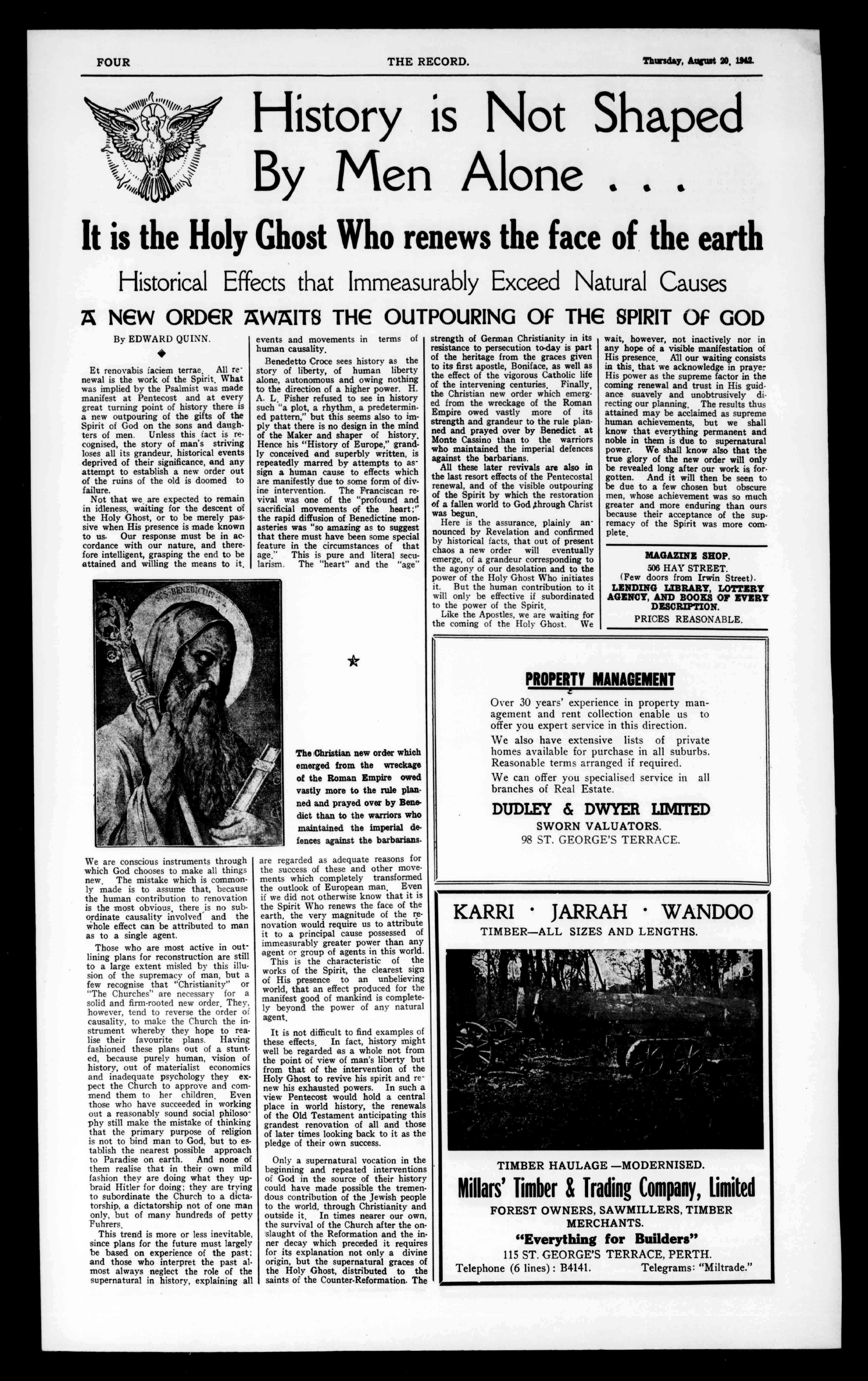
TheChristianneworderwhich emergedfromthewreckage oftheRomanEmpireowed vastlymoretotheruleplannedandprayedoverbyBenedictthantothewarriorswho maintainedtheimperialdefencesagainstthebarbarians.
areregardedasadequatereasonsfor thesuccessoftheseandothermovementswhichcompletelytransformed theoutlookofEuropeanman,Even ifwedidnototherwiseknowthatitis theSpiritWhorenewsthefaceofthe earth,theverymagnitudeoftherenovationwouldrequireustoattribute ittoaprincipalcausepossessedof immeasurablygreaterpowerthanany agentorgroupofagentsinthisworld. Thisisthecharacteristicofthe worksoftheSpirit,theclearestsign ofHispresencetoanunbelieving world,thataneffectproducedforthe manifestgoodofmankindiscompletelybeyondthepowerofanynatural agent.
Itisnotdifficulttofindexamplesof theseeffects,Infact,historymight wellberegardedasawholenotfrom thepointofviewofman'slibertybut fromthatoftheinterventionofthe HolyGhosttorevivehisspiritandrenewhisexhaustedpowers.Insucha viewPentecostwouldholdacentral placeinworldhistory,therenewals oftheOldTestamentanticipatingthis grandestrenovationofallandthose oflatertimeslookingbacktoitasthe pledgeoftheirownsuccess.
Onlyasupernaturalvocationinthe beginningandrepeatedinterventions ofGodinthesourceoftheirhistory couldhavemadepossiblethetremendouscontributionoftheJewishpeople totheworld,throughChristianityand outsideit,Intimesnearerourown. thesurvivaloftheChurchaftertheonslaughtoftheReformationandtheinnerdecaywhichprecededitrequires foritsexplanationnotonlyadivine origin,butthesupernaturalgracesof theHolyGhost,distributedtothe saintsoftheCounter-Reformation.The
wait,however,notinactivelynorin anyhopeofavisiblemanifestationof Hispresence,Allourwaitingconsists inthis,thatweacknowledgeinprayer Hispowerasthesupremefactorinthe comingrenewalandtrustinHisguidancesuavelyandunobtrusivelydirectingourplanning.Theresultsthus attainedmaybeacclaimedassupreme humanachievements,butweshall knowthateverythingpermanentand nobleinthemisduetosupernatural power.Weshallknowalsothatthe truegloryoftheneworderwillonly berevealedlongafterourworkisforgotten.Anditwillthenbeseento beduetoafewchosenbutobscure men,whoseachievementwassomuch greaterandmoreenduringthanours becausetheiracceptanceofthesupremacyoftheSpiritwasmorecomplete,
MAGAZINESHOP.
506HAYSTREET. (FewdoorsfromIrwinStreet).
LENDINGLIBRARY,LOTTZRY AGENCY,ANDBOOKSOFEVERY DESCRIPTION. PRICESREASONABLE.
PROPERTYMANAGEMENT
Over30years'experienceinpropertymanagementandrentcollectionenableusto offeryouexpertserviceinthisdirection.
Wealsohaveextensivelistsofprivate homesavailableforpurchaseinallsuburbs. Reasonabletermsarrangedifrequired. Wecanofferyouspecialisedserviceinall branchesofRealEstate.
DUDLEY&DWYERuivirrED
SWORNVALUATORS.
98ST.GEORGE'STERRACE.
KARRIJARRAHWANDOO
TIMBER-ALLSIZESANDLENGTHS.
TIMBERHAULAGE-MODERNISED.
Millars'Timber&TradingCompany,Limited FORESTOWNERS,SAWMILLERS,TIMBER MERCHANTS. "EverythingforBuilders"
115ST.GEORGE'STERRACE,PERTH. Telephone(6lines)B4141. Telegrams:"Miltrade."
FOUR THERECORD. Thursday,August20,1042.
ChildrenofMary,
TheSodalitywaswellrepresentedat themonthlyHolyCommunionand meetingonSundaylast.Severalof thegirlshavebeenmarriedlately, andthegoodwishesoftheircompanionsareextendedtothem.
C.W.O.
Collectorswerebusyinthechurch groundsatallMassesonSundaylast. andasubstantialamountwasraised tohelpcarryonthisgoodwork.
St.VincentdePaulSociety.
TheannualcollectionfortheSocietywastakenuponSaturday,August 15.Membersmeetweeklytotransact businessofthebranch.
H.A.C.B.S.
TheattendancewasfaironMonday eveningatthefortnightlymeeting.Attentionwasdrawntothequarterly CommuniondaybeingSunday,Auglist30, Allmembersarerequested tosecureregaliaatthedoorofthe churchandtaketheirplacesinthereservedseatsatthe7o'clockMass.
TheinitiationofMissPatSmithto membershiptookplaceduringthe meeting.MissSmithwasalsocongratulatedonwinningthepopulargirl contestrecentlyconductedinthedistrict.
Memberswereagainremindedto keepfinancialandtherebysavedistressintimeofsickness,etc,Those wishingtoseethesecretarywillfind Mr,CarleyatNo.10Balfour-street.
KalgoorlieQuarantOre.
TheFortyHours'Prayerwillbe heldinthisparishduringtheweekend,August28-30,Allareinvitedto takepartinthisgreatDevotion.Donationsofcandlesandflowerswillbe gratefullyaccepted,
Children'sBall.
TheannualChildren'sBallwillbe heldinafewweeks,sotheyoungsters cangetbusyplanningfrocksandcostumesforthegreatnight.Thedate willbeannouncedlater.
TheoryResults.
ExcellentresultswereobtainedbythepupilsofSt,Joseph'sConventat therecentexaminations.Twelveof thefourteenpupilspresentedobtained honours.
Personal.
Dr.Daly-Smithpaidaflyingvisit toKalgoorlieduringtheweek,
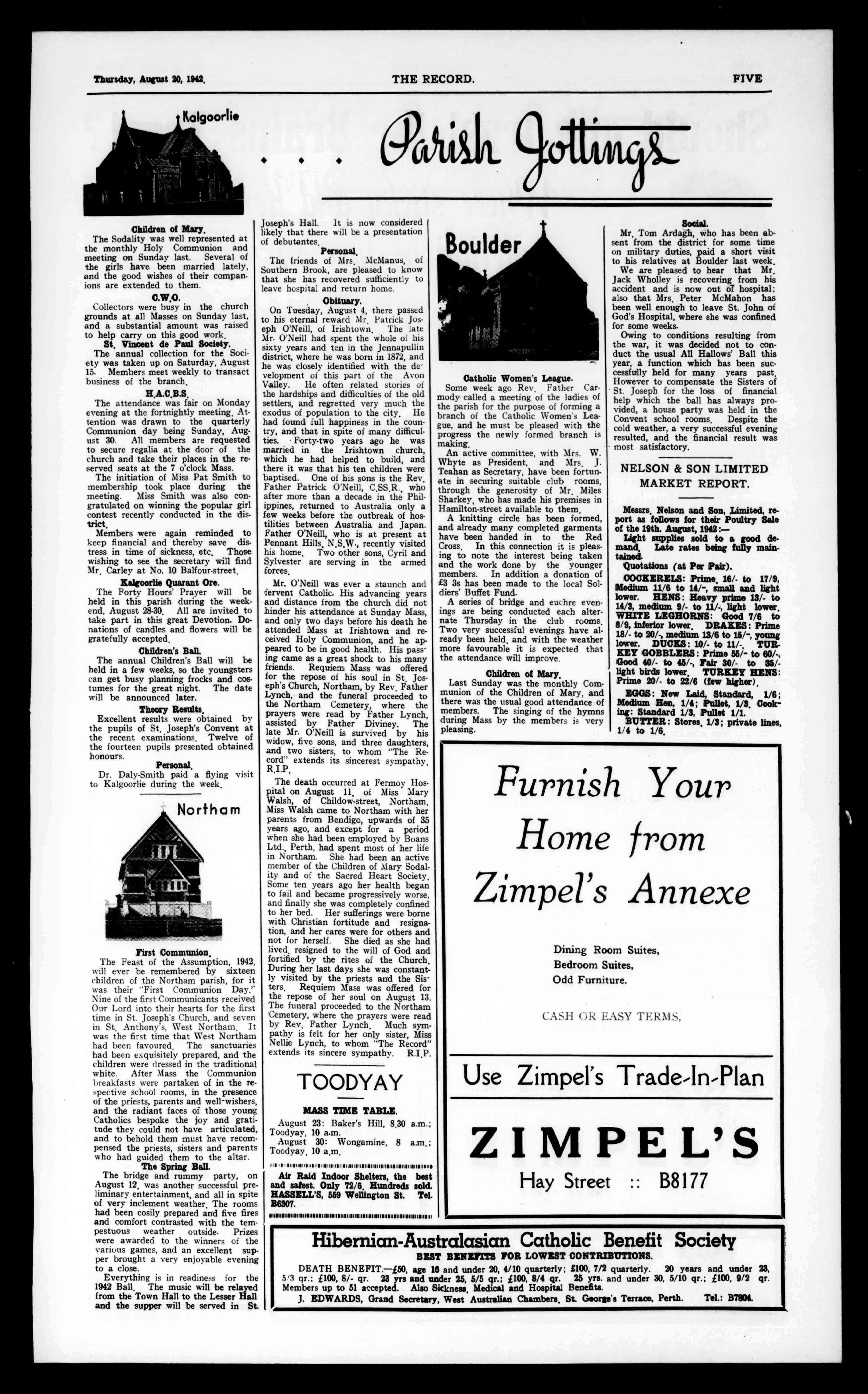
FirstCommunion.
TheFeastoftheAssumption,1942, willeverberememberedbysixteen childrenoftheNorthamparish,forit wastheir"FirstCommunionDay.'
NineofthefirstCommunicantsreceived OurLordintotheirheartsforthefirst timeinSt.Joseph'sChurch,andseven inSt,Anthony's,WestNortham,It wasthefirsttimethatWestNortham hadbeenfavoured,Thesanctuaries hadbeenexquisitelyprepared,andthe childrenweredressedinthetraditional white.AfterMasstheCommunion breakfastswerepartakenofintherespectiveschoolrooms,inthepresence ofthepriests,parentsandwell-wishers, andtheradiantfacesofthoseyoung Catholicsbespokethejoyandgratitudetheycouldnothavearticulated, andtobeholdthemmusthaverecompensedthepriests,sistersandparents whohadguidedthemtothealtar.
TheSpringBall. Thebridgeandrummyparty,on August12,wasanothersuccessfulpreliminaryentertainment,andallinspite ofveryinclementweather,Therooms hadbeencosilypreparedandfivefires andcomfortcontrastedwiththetempestuousweatheroutside.Prizes wereawardedtothewinner,ofthe variousgames,andanexcellentsupperbroughtaveryenjoyableevening toaclose. Everythingisinreadinessforthe 1942Ball.Themusicwillberelayed fromtheTownHalltotheLesserHall andthesupperwillbeservedinSt.
Joseph'sHall.Itisnowconsidered likelythattherewillbeapresentation ofdebutantes, Personal.
ThefriendsofMrs.McManus,of SouthernBrook,arepleasedtoknow thatshehasrecoveredsufficientlyto leavehospitalandreturnhome.
Obituary.
OnTuesday,August4,therepassed tohiseternalrewardMr,PatrickJosephO'Neill,ofIrishtown,Thelate Mr.O'Neillhadspentthewholeofhis sixtyyearsandtenintheJennapullin district,wherehewasbornin1872,and hewascloselyidentifiedwiththedevelopmentuithispartoftheAvon Valley.Heoftenrelatedstoriesof thehardshipsanddifficultiesoftheold settlers,andregrettedverymuchthe exodusofpopulationtothecity,He hadfoundfullhappinessinthecountry,andthatinspiteofmanydifficulties.Forty-twoyearsagohewas marriedintheIrishtownchurch, whichhehadhelpedtobuild,and thereitwasthathistenchildrenwere baptised.OneofhissonsistheRev, FatherPatrickO'Neill,C,SS,R.,who aftermorethanadecadeinthePhilippines,returnedtoAustraliaonlya fewweeksbeforetheoutbreakofhostilitiesbetweenAustraliaandJapan. FatherO'Neill,whoisatpresentat PennantHills,N,S,W.,recentlyvisited hishome,Twoothersons,Cyriland Sylvesterareservinginthearmed forces, Mr.O'Neillwaseverastaunchand ferventCatholic.Hisadvancingyears anddistancefromthechurchdidnot hinderhisattendanceatSundayMass, andonlytwodaysbeforehisdeathhe attendedMassatIrishtownandreceivedHolyCommunion,andheappearedtobeingoodhealth.Hispassingcameasagreatshocktohismany friends.RequiemMasswasoffered forthereposeofhissoulinSt,Joseph'sChurch,Northam,byRev,Father Lynch,andthefuneralproceededto theNorthamCemetery,wherethe prayerswerereadbyFatherLynch, assistedbyFatherDiviney.The lateMr.O'Neillissurvivedbyhis widow,fivesons,andthreedaughters, andtwosisters,towhom"TheRecord"extendsitssincerestsympathy, R.I.P.
ThedeathoccurredatFermoyHospitalonAugust11,ofMissMary Walsh,ofChildow-street,Northam, MissWalshcametoNorthamwithher parentsfromBendigo,upwardsof35 yearsago,andexceptforaperiod whenshehadbeenemployedbyMoans Ltd.Perth,hadspentmostofherlife inNortham.Shehadbeenanactive memberoftheChildrenofMarySodalityandoftheSacredHeartSociety, Sometenyearsagoherhealthbegan tofailandbecameprogressivelyworse, andfinallyshewascompletelyconfined toherbed.Hersufferingswereborne withChristianfortitudeandresignation,andhercareswereforothersand notforherself.Shediedasshehad lived,resignedtothewillofGodand fortifiedbytheritesoftheChurch, DuringherlastdaysshewasconstantlyvisitedbythepriestsandtheSisters.RequiemMasswasofferedfor thereposeofhersoulonAugust13.
ThefuneralproceededtotheNortham Cemetery,wheretheprayerswereread byRev,FatherLynch,Muchsym- pathyisfeltforheronlysister,Miss NellieLynch,towhom"TheRecord" extendsitssinceresympathy.R.I.P.
TOODYAY
MASSTIMETABLE.
August23:Baker'sHill,8,30a.m.;
Toodyay,10a.m.
August30:Wongamine,8am.; Toodyay,10a.m, 1
CatholicWomen'sLeague. SomeweekagoRev,FatherCarmodycalledameetingoftheladiesof theparishforthepurposeofforminga branchoftheCatholicWomen'sLeague,andhemustbepleasedwiththe progressthenewlyformedbranchis making, Anactivecommittee,withMrs.W. WhyteasPresident,andMrs.J. TeahanasSecretary,havebeenfortunateinsecuringsuitableclubrooms, throughthegenerosityofMr,Miles Sharkey,whohasmadehispremisesin Hamilton-streetavailabletothem, Aknittingcirclehasbeenformed, andalreadymanycompletedgarments havebeenhandedintotheRed Cross,Inthisconnectionitispleasingtonotetheinterestbeingtaken andtheworkdonebytheyounger members.Inadditionadonationof £33shasbeenmadetothelocalSoldiers'BuffetFund.
AseriesofbridgeandeuchreeveningsarebeingconductedeachalternateThursdayintheclubrooms, Twoverysuccessfuleveningshavealreadybeenheld,andwiththeweather morefavourableitisexpectedthat theattendancewillimprove.
ChildrenofMary, LastSundaywasthemonthlyCommunionoftheChildrenofMary,and therewastheusualgoodattendanceof members.Thesingingofthehymns duringMassbythemembersFvery pleasing.
Social.
MrTomArdagh,whohasbeenabsentfromthedistrictforsometime onmilitaryduties,paidashortvisit tohisrelativesatBoulderlastweek, WearepleasedtohearthatMr. JackWholleyisrecoveringfromhis accidentandisnowouterhospital: alsothatMrs,PeterMcMahonhas beenwellenoughtoleaveSt.Johnof God'sHospital,whereshewasconfined forsomeweeks.
Owingtoconditionsresultingfrom thewar,itwasdecidednottoconducttheusualAllHallows'Ballthis year,afunctionwhichhasbeensuccessfullyheldformanyyearspast. HowevertocompensatetheSistersof St.Josephforthelossoffinancial helpwhichtheballhasalwaysprovided,ahousepartywasheldinthe Conventschoolrooms.Despitethe coldweather,averysuccessfulevening resulted,andthefinancialresultwas mostsatisfactory.
NELSON&SONLIMITED MARKETREPORT.
Messrs,NelsonandSon,Limited,reportasfollowsfortheirPoultrySale ofthe19th.August,1942:LightsuppliessoldtoagooddemandLateratesbeingfullymaintained.
Quotations(atPerPair). COCKERELS:Prime,
Thursday,August20,1942, THERECORD. FIVE
Air
.1111111111111111.11111111111.1111.101.1H.H.111111111,1111111111111111
14.1.0.4.14141141.101111.1.101.1.111.111.111.11
RaidIndoorShelters,thebest andsafest.Only72/6,Hundredssold. HASSELL'S,559WellingtonSt.Tel. B6307.
16/-
Medium11/6to14/-,smallandlight lower.HENS:Heavyprime13/-to 14/3,medium9/-to11/-,lightlower,WHITELEGHORNS:Good7/6to 8/9,inferiorlower,DRAKES:Prime 18/-to20/-,medium13/6to16/-,young lower.DUCKS:10/-to11/-,TURKEYGOBBLERSPrime55/-to60/-, Good40/-to45/-,Fair30/-to35/lightbirdslower,TURKEYHENS: Prime20/-to22/6(fewhigher), EGGS:NewLaid,Standard,1/6; MediumHen,1/4;Pullet,1/3,Cooking:Standard1/3,Pullet1/1. BUTTERStores,1/3;privatelines, 14to1/6, FurnishYour Homefrom Zimpel'sAnnexe DiningRoomSuites, BedroomSuites, OddFurniture. CASHOREASYTERMS. UseZimpel'sTrade-In-Plan ZIMPEL'S HayStreet::B8177 Hibernian-AustralasianCatholicBenefitSociety BESTBINTJT111FORLOWESTCONTRIBUTIONS. DEATHBENEFIT.-#50,age16andunder20,4/10quarterly:£100,7/2quarterly.20yearsandunder23, 5'3qr.:{100,8/-qr.23yrsandunder25,5/5qr.;/100,8/4qr.25yrs.andunder30,5/10qr.;1100,9/2qr. Membersupto51accepted.AlsoSickness,MedicalandHospitalBenefits. J.EDWARDS,GrandSecretary,WestAustralianChambers,St.George'sTerrace,Perth. Tel.:B7901.
to171,
ShouldonetrusttheBrainsTrust?
'Wherestickyandhopeless materialismhasanopenpia
Mr.Joadfavourssuicideforothers
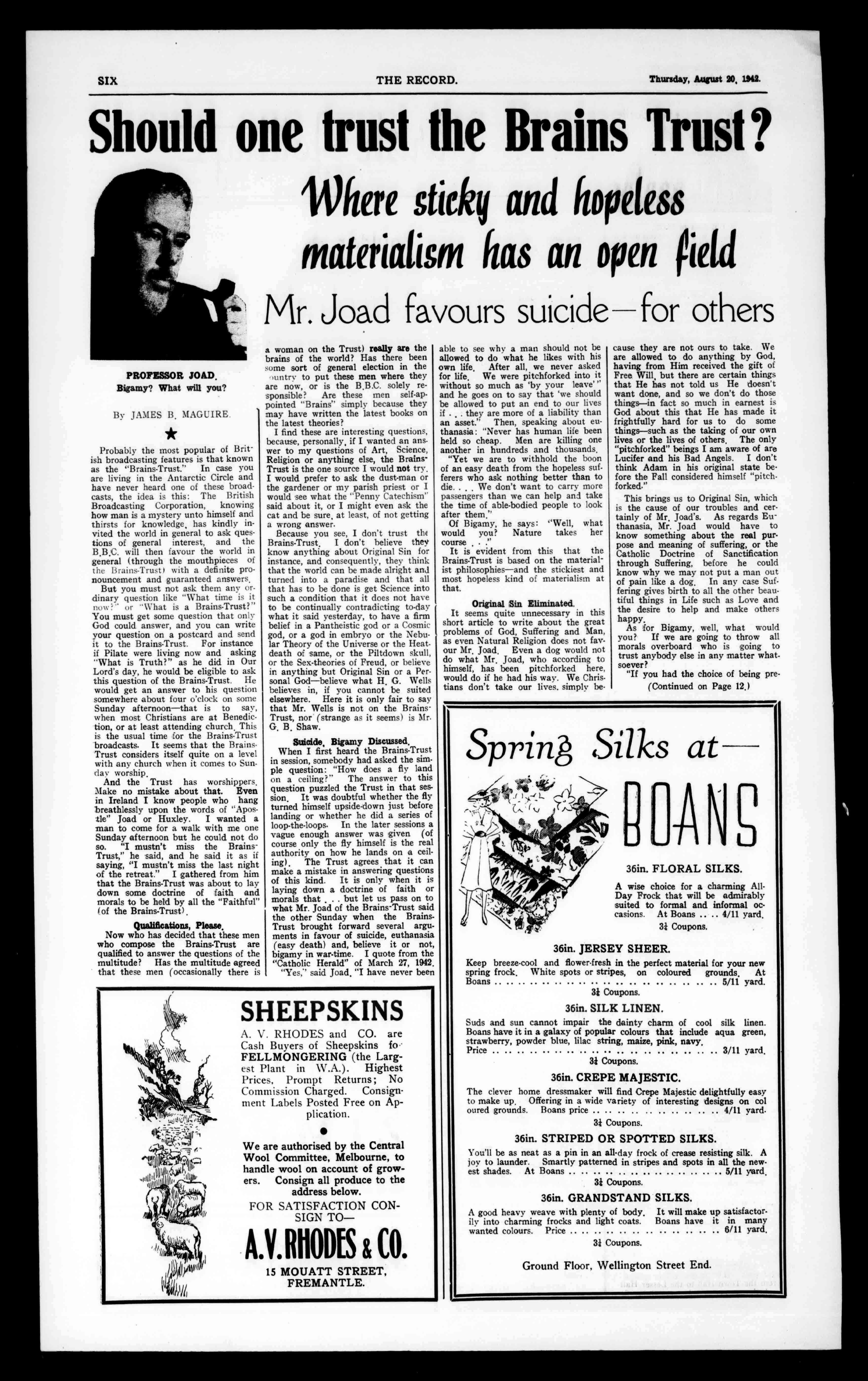 PROFESSORJOAD, Bigamy?Whatwillyou?
ByJAMESB.MAGLIRE
PROFESSORJOAD, Bigamy?Whatwillyou?
ByJAMESB.MAGLIRE
ProbablythemostpopularofBritishbroadcastingfeaturesisthatknown asthe"Brains-Trust."Incaseyou arelivingintheAntarcticCircleand haveneverheardoneofthesebroadcasts,theideaisthis:TheBritish BroadcastingCorporation,knowing howmanisamysteryuntohimselfand thirstsforknowledge,haskindlyinvitedtheworldingeneraltoaskquestionsofgeneralinterest,andthe BBC.willthenfavourtheworldin general(throughthemouthpiecesof tilcDrains-Trust)withadefinitepronouncementandguaranteedanswers.
Butyoumustnotaskthemany(1-dinaryquestionlike"Whattimeisit now?'or"WhatisaBrains-Trust?" Youmustgetsomequestionthatonly Godcouldanswer,andyoucanwrite yourquestiononapostcardandsend ittotheBrains-Trust.Forinstance ifPilatewerelivingnowandasking "WhatisTruth?"ashedidinOur Lord'sday,hewouldbeeligibletoask thisquestionoftheBrains-Trust.He wouldgetananswertohisquestion somewhereaboutfouro'clockonsome Sundayafternoon-thatistosay, whenmostChristiansareatBenediction,oratleastattendingchurch,This istheusualtimefortheBrains-Trust broadcasts.ItseemsthattheBrainsTrustconsidersitselfquiteonalevel withanychurchwhenitcomestoSundayworship,
AndtheTrusthasworshippers, Makenomistakeaboutthat.Even inIrelandIknowpeoplewhohang breathlesslyuponthewordsof"Apostle"JoadorHuxley.Iwanteda mantocomeforawalkwithmeone Sundayafternoonbuthecouldnotdo so. "Imustn'tmisstheBrainsTrust,"hesaid,andhesaiditasif saying,"Imustn'tmissthelastnight oftheretreat."Igatheredfromhim thattheBrains-Trustwasabouttolay downsomedoctrineoffaithand moralstobeheldbyallthe"Faithful" oftheBrains-Trust).
Qualifications,Please. Nowwhohasdecidedthatthesemen whocomposetheBrains-Trustare qualifiedtoanswerthequestionsofthe multitude?Hasthemultitudeagreed thatthesemen(occasionallythereis
awomanontheTrust)reallyarethe brainsoftheworld?Hastherebeen somesortofgeneralelectioninthe -entrytoputthesemenwherethey arenow,oristheB.B.C.solelyresponsible?Arethesemenself-appointed"Brains"simplybecausetheymayhavewrittenthelatestbookson thelatesttheories?
Ifindtheseareinterestingquestions, because,personally,ifIwantedananswertomyquestionsofArt,Science, Religionoranythingelse,theBrainsTrustistheonesourceIwouldnottry. Iwouldprefertoaskthedust-manor thegardenerormyparishpriestorI wouldseewhatthe"PennyCatechism" saidaboutit,orImightevenaskthe catandbesure,atleast,ofnotgetting awronganswer. Becauseyousee,Idon'ttrusttits Brains-Trust, Idon'tbelievethey knowanythingaboutOriginalSinfor instance,andconsequently,theythink thattheworldcanbemadealrightand turnedintoaparadiseandthatall thathastobedoneisgetScienceinto suchaconditionthatitdoesnothave tobecontinuallycontradictingto-day whatitsaidyesterday,tohaveafirm beliefinaPantheisticgodoraCosmic god,oragodinembryoortheNebularTheoryoftheUniverseortheHeat. deathofsame,orthePiltdownskull, ortheSex-theoriesofFreud,orbelieve inanythingbutOriginalSinoraPersonalGod-believewhatH,G.Wells believesin,ifyoucannotbesuited elsewhere.Hereitisonlyfairtosay thatMr.WellsisnotontheBrains Trust,nor(strangeasitseems)isMr. G,B,Shaw.
Suicide,BigamyDiscussed, WhenIfirstheardtheBrains-Trust insession,somebodyhadaskedthesimplequestion:"Howdoesaflyland onaceiling?"Theanswertothis questionpuzzledtheTrustinthatsession,Itwasdoubtfulwhetherthefly turnedhimselfupside-downjustbefore landingorwhetherhedidaseriesof loop-the-loops.Inthelatersessionsa vagueenoughanswerwas-given(of courseonlytheflyhimselfisthereal authorityonhowhelandsonaceiling),TheTrustagreesthatitcan makeamistakeinansweringquestions ofthiskind.Itisonlywhenitis layingdownadoctrineoffaithor moralsthat butletuspassonto whatMr.JoadoftheBrains-Trustsaid theotherSundaywhentheBrainsTrustbroughtforwardseveralargumentsinfavourofsuicide,euthanasia (easydeath)and,believeitornot, bigamyinwar-time.Iquotefromthe "CatholicHerald"ofMarch27,1942.
"Yes,"saidJoad,"Ihaveneverbeen
SHEEPSKINS
A.V.RHODESandCO.are CashBuyersofSheepskinsfo FELLMONGERING(theLargestPlantinW.A.).Highest Prices,PromptReturns;No CommissionCharged.ConsignmentLabelsPostedFreeonApplication.
WeareauthorisedbytheCentral WoolCommittee,Melbourne,to handlewoolonaccountofgrowers.Consignallproducetothe addressbelow.
FORSATISFACTIONCONSIGNTO-
A.V. &CO.
15MOUATTSTREET, FREMANTLE.
abletoseewhyamanshouldnotbe allowedtodowhathelikeswithhis ownlife,Afterall,weneverasked forlife,Wewerepitchforkedintoit withoutsomuchas'byyourleave' andhegoesontosaythat'weshould beallowedtoputanendtoourlives if theyaremoreofaliabilitythan anasset."Then,speakingabouteuthanasia:"Neverhashumanlifebeen heldsocheap.Menarekillingone anotherinhundredsandthousands.
"Yetwearetowithholdtheboon ofaneasydeathfromthehopelesssuffererswhoasknothingbetterthanto die.. Wedon'twanttocarrymore passengersthanwecanhelpandtake thetimeofable-bodiedpeopletolook afterthem,"
OfBigamy,hesays:"Well,what wouldyou?Naturetakesher course ."
Itisevidentfromthisthatthe Brains-Trustisbasedonthematerialistphilosophies-andthestickiestand mosthopelesskindofmaterialismat that.
OriginalSinEliminated. Itseemsquiteunnecessaryinthis shortarticletowriteaboutthegreat problemsofGod,SufferingandMan, asevenNaturalReligiondoesnotfavourMr,Joad.Evenadogwouldnot dowhatMr,Joad,whoaccordingto himself,hasbeenpitchforkedhere, woulddoifhehadhisway.WeChristiansdon'ttakeourlives.simplybe-
causetheyarenotourstotake.We areallowedtodoanythingbyGod, havingfromHimreceivedthegiftof FreeWill,buttherearecertainthings thatHehasnottoldusHedoesn't wantdone,andsowedon'tdothose things-infactsomuchinearnestis GodaboutthisthatHehasmadeit frightfullyhardforustodosome things-suchasthetakingofourown livesorthelivesofothers,Theonly "pitchforked"beingsIamawareofare LuciferandhisBadAngels.Idon't thinkAdaminhisoriginalstatebeforetheFallconsideredhimself"pitch. forked."
ThisbringsustoOriginalSin,which isthecauseofourtroublesandcertainlyofMr,Joad's.AsregardsEuthanasia,Mr.Joadwouldhaveto knowsomethingabouttherealpurposeandmeaningofsuffering,orthe CatholicDoctrineofSanctification throughSuffering,beforehecould knowwhywemaynotputamanout ofpainlikeadog,InanycaseSufferinggivesbirthtoalltheotherbeautifulthingsinLifesuchasLoveand thedesiretohelpandmakeothers happy.
AsforBigamy, you?Ifweare moralsoverboard trustanybodyelse soever?
"Ifyouhadthe
well,whatwould goingtothrowall whoisgoingto inanymatterwhatchoiceofbeingpreon
SpringSilksat
36in.FLORALSILKS.
AwisechoiceforacharmingAllDayFrockthatwillbeadmirably suitedtoformalandinformaloccasions.AtBoans 4/11yard.
31Coupons.
36in.JERSEYSHEER.
Keepbreeze-coolandflower-freshintheperfectmaterialforyournew springfrock,Whitespotsorstripes,oncolouredgrounds.At
31Coupons.
36in.SILKLINEN.
Sudsandsuncannotimpairthedaintycharmofcoolsilklinen. Boanshaveitinagalaxyofpopularcoloursthatincludeaquagreen, strawberry,powderblue,lilacstring,maize,pink,navy, 3/Coupons.
36in.CREPEMAJESTIC.
ThecleverhomedressmakerwillfindCrepeMajesticdelightfullyeasy tomakeup,Offeringinawidevarietyofinterestingdesignsoncol ouredgrounds.Boansprice 4/11yard.
31Coupons.
36in.STRIPEDORSPOTTEDSILKS.
You'llbeasneatasapininanall-dayfrockofcreaseresistingsilk.A joytolaunder.Smartlypatternedinstripesandspotsinallthenewestshades.AtBoans 5/11yard, 3/Coupons.
36in.GRANDSTANDSILKS.
Agoodheavyweavewithplentyofbody,Itwillmakeupsatisfactorilyintocharmingfrocksandlightcoats.Boanshaveitinmany wantedcolours.Price 6/11yard,
31Coupons.
GroundFloor.WellingtonStreetEnd.
SIX THERECORD. Thursday,August20,1.342.
(Continued
ParkinsonBoylanWedding
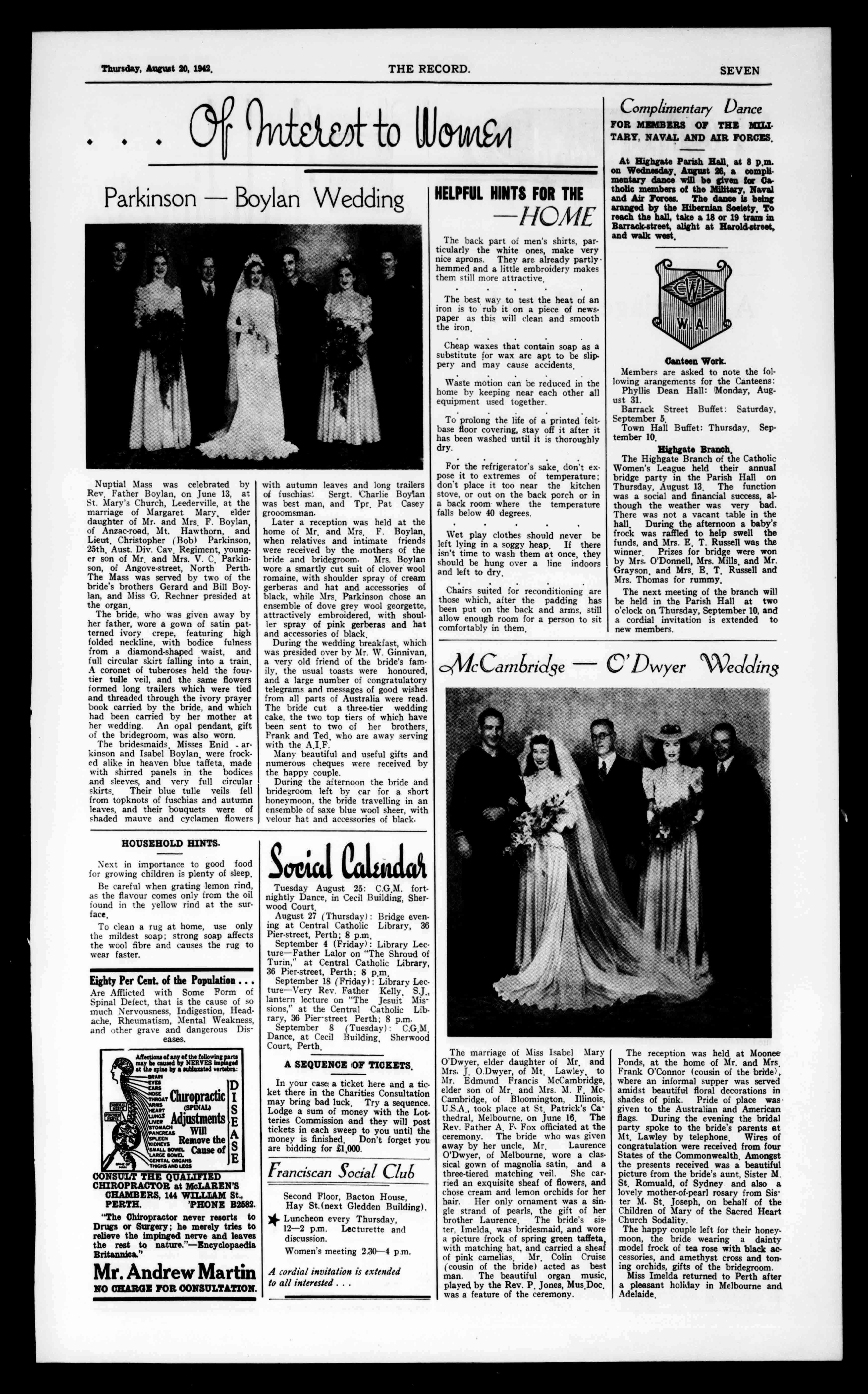
NuptialMasswascelebratedby Rev.FatherBoylan,onJune13,at St.Mary'sChurch,Leederville,atthe marriageofMargaretMary,elder daughterofMr.andMrs.F.Boylan, ofAnzac-road,Mt.Hawthorn,and Lieut.ChristopherBob)Parkinson, 25th,Aust.Div.Cay.Regiment,youngersonofMr.andMrs.V.CParkinson,ofAngove-street,NorthPerth. TheMasswasservedbytwoofthe bride'sbrothersGerardandBillBoylan,andMissG.Rechnerpresidedat theorgan. Thebride,whowasgivenawayby herfather,woreagownofsatinpatternedivorycrepe,featuringhigh foldedneckline,withbodicefulness fromadiamond-shapedwaist,and fullcircularskirtfallingintoatrain. Acoronetoftuberosesheldthefourtiertulleveil,andthesameflowers formedlongtrailerswhichweretied andthreadedthroughtheivoryprayer bookcarriedbythebride,andwhich hadbeencarriedbyhermotherat herwedding.Anopalpendant,gift ofthebridegroom,wasalsoworn.
Thebridesmaids,MissesEnid-arkinsonandIsabelBoylan,werefrock. edalikeinheavenbluetaffeta,made withshirredpanelsinthebodices andsleeves,andveryfullcircular skirts.Theirbluetulleveilsfell fromtopknotsoffuschiasandautumn leaves,andtheirbouquetswereof ,hadedmauveandcyclamenflowers
HOUSEHOLDHINTS
Nextinimportancetogoodfood forgrowingchildrenisplentyofsleep. Becarefulwhengratinglemonrind, astheflavourcomesonlyfromtheoil foundintheyellowrindatthesurface, Tocleanarugathome,useonly themildestsoap;strongsoapaffects thewoolfibreandcausestherugto wearfaster.
EightyPerCent.ofthePopulation
AreAfflictedwithSomeFormof SpinalDefect,thatisthecauseofso muchNervousness,Indigestion,Headache,Rheumatism,MentalWeakness, andothergraveanddangerousDiseases.
Affecuonsofanyofthefollowingparts maybecausedbyNERVESlmpMgeel atthespinabyaeubtaxstedvertebra: aeAn (Ye*
TChiropractic :s Aer (SPINA
D I
Adjustments ,0 T.OrACH Will Removethe AiDSLYS "'"'W.CauseofLAW.SOW. AL°KASSnut.AteLAOS
CONSULTTHEQUALIFIED CHIROPRACTORatMcLAREN'S CHAMBERS,144WILLIAMSt., PERTH. 'PHONEB2582. "TheChiropractorneverresortsto DrugsorSurgery;hemerelytriesto relievetheimpingednerveandleaves theresttonature.--Encyclopaedia Britannica."
withautumnleavesandlongtrailers offuschias:Sergt.CharlieBoylan wasbestman,andTpr,PatCasey gr000msman. Laterareceptionwasheldatthe homeofMr,andMrs.F.Boylan, whenrelativesandintimatefriends werereceivedbythemothersofthe brideandbridegroom.Mrs.Boylan woreasmartlycutsuitofcloverwool romaine,withshouldersprayofcream gerberasandhatandaccessoriesof black,whileMrs.Parkinsonchosean ensembleofdovegreywoolgeorgette, attractivelyembroidered,withshouliersprayofpinkgerberasandhat andaccessoriesofblack,
Duringtheweddingbreakfast,which waspresidedoverbyMr.W.Ginnivan, averyoldfriendofthebride'sfamily,theusualtoastswerehonoured, andalargenumberofcongratulatory telegramsandmessagesofgoodwishes fromallpartsofAustraliawereread. Thebridecutathree-tierwedding cake,thetwotoptiersofwhichhave beensenttotwoofherbrothers, FrankandTed,whoareawayserving withthe&U.
Manybeautifulandusefulgiftsand numerouschequeswerereceivedby thehappycouple.
Duringtheafternoonthebrideand bridegroomleftbycarforashort honeymoon,thebridetravellinginan ensembleofsaxebluewoolsheer,with velourhatandaccessoriesofblack.
CaltalA
TuesdayAugust25:C.G.M.fortnightlyDance,inCecilBuilding,SherwoodCourt, August27(Thursday):Bridgeeven. ingatCentralCatholicLibrary,36 Pier-street,Perth;8p.m.
September4(Friday):LibraryLecture-FatherLaloron"TheShroudof Turin,"atCentralCatholicLibrary, 36Pier-street,Perth;8p.m, September18(Friday):LibraryLecture-VeryRev.FatherKelly,S.J., lanternlectureon"TheJesuitMissions,"attheCentralCatholicLibrary,36Pier-streetPerth;8p.m.
September8(Tuesday):C.G,N1. Dance,atCecilBuilding,Sherwood Court,Perth, ASEQUENCEOFTICKETS,
InyourcaseatickethereandaticketthereintheCharitiesConsultation maybringbadluck.Tryasequence. LodgeasumofmoneywiththeLotteriesCommissionandtheywillpost ticketsineachsweeptoyouuntilthe moneyisfinished.Don'tforgetyou arebiddingfor£1000.
FranciscanSocialClul
SecondFloor,BactonHouse, HaySt.(nextGleddenBuilding).
*LuncheoneveryThursday, 12-2p.m.Lecturetteand discussion.
Women'smeeting2.30-4pm.
Acordialinvitationisextended toallinterested
HELPFULHINTSFORTHE HOME
Thehackpartofmen'sshirts,particularlythewhiteones,makevery niceaprons.Theyarealreadypartlyhemmedandalittleembroiderymakes themstillmoreattractive,
Thebestwaytotesttheheatofan ironistorubitonapieceofnewspaperasthiswillcleanandsmooth theiron,
Cheapwaxesthatcontainsoapasa substituteforwaxareapttobeslipperyandmaycauseaccidents.
Wastemotioncanbereducedinthe homebykeepingneareachotherall equipmentusedtogether.
Toprolongthelifeofaprintedfelt. basefloorcovering,stayoffitafterit hasbeenwasheduntilitisthoroughly dry.
Fortherefrigerator'ssake,don'texposeittoextremesoftemperature; don'tplaceittoonearthekitchen stove,oroutonthebackporchorin abackroomwherethetemperature fallsbelow40degrees.
Wetplayclothesshouldneverbe leftlyinginasoggyheap,Ifthere isn'ttimetowashthematonce,they shouldhehungoveralineindoors andlefttodry,
Chairssuitedforreconditioningare thosewhich,afterthepaddinghas beenputonthebackandarms,still allowenoughroomforapersontosit comfortablyinthem,
ComplimentaryDance FORMEMBERSOFTHE=TART,NAVALANDAIRFORCES.
AtHighgateParishHall,at8p.m. onWednesday,August26,acomplimentarydancewillbegivenforCatholicmembersoftheMilitary,Naval andAirForces.Thedanceisbeing arangedbytheHibernianSoeiety.To reachthehall,takea18or19tramin Barrack-street,alightatHarold-street, andwalkwest,
CanteenWork.
MembersareaskedtonotethefollowingarangementsfortheCanteens:
PhyllisDeanHall:Monday,August31.
BarrackStreetBuffetSaturday. September5,
TownHallBuffet:Thursday,September10,
HighgateBranch,
TheHighgateBranchoftheCatholic Women'sLeagueheldtheirannual bridgepartyintheParishHailon Thursday,August13. Thefunction wasasocialandfinancialsuccess,althoughtheweatherwasverybad. Therewasnotavacanttableinthe hall,Duringtheafternoonababy's frockwasraffledtohelpswellthe funds,andMrs.E.T.Russellwasthe winner,Prizesforbridgewerewon byMrs-O'Donnell,Mrs.Mills,andMr. Grayson,andMrs,E.T,Russelland Mrs.Thomasforrummy,
Thenextmeetingofthebranchwill beheldintheParishHallattwo o'clockonThursday,September10,and acordialinvitationisextendedto newmembers.
'Cambridge-C'Dwyer'Wedding
ThemarriageofMissIsabelMary O'Dwyer,elderdaughterofMr,and Mrs.J,O.Dwyer,ofMt,Lawley,to Mr.EdmundFrancisMcCambridge, eldersonofMr,andMrs.M.F.McCambridge,ofBloomington,Illinois, U.S.A.,tookplaceatSt.Patrick'sCathedral,Melbourne.onJune16.The Rev.FatherA.F.Foxofficiatedatthe ceremony.Thebridewhowasgiven awaybyheruncle,Mr, Laurence O'Dwyer,ofMelbourne,woreaclassicalgownofmagnoliasatin,anda three-tieredmatchingveil.Shecarriedanexquisitesheafofflowers,and chosecreamandlemonorchidsforher hair.Heronlyornamentwasasinglestrandofpearls,thegiftofher brotherLaurence,Thebride'ssister,Imelda.wasbridesmaid,andwore apicturefrockofspringgreentaffeta, withmatchinghat,andcarriedasheaf ofpinkcamelias,Mr,ColinCruise (cousinofthebride)actedasbest man.Thebeautifulorganmusic, playedbytheRev.P.Jones,Mus.Doc, wasafeatureoftheceremony.
ThereceptionwasheldatMoonee Ponds,atthehomeofMr.andMrs. FrankO'Connor(cousinofthebride). whereaninformalsupperwasserved amidstbeautifulfloraldecorationsin shadesofpink.Prideofplacewas giventotheAustralianandAmerican flags.Duringtheeveningthebridal partyspoketothebride'sparentsat Mt.Lawleybytelephone,Wiresof congratulationwerereceivedfromfour StatesoftheCommonwealth.Amongst thepresentsreceivedwasabeautiful picturefromthebride'saunt,SisterM St,Romuald,ofSydneyandalsoa lovelymother-of-pearlrosaryfromSisterM.St.Joseph,onbehalfofthe ChildrenofMary'oftheSacredHeart ChurchSodality. Thehappycoupleleftfortheirhoneymoon,thebridewearingadainty modelfrockoftearosewithblackaccessories,andamethystcrossandtoningorchids,giftsofthebridegroom. MissImeldareturnedtoPerthafter apleasantholidayinMelbourneand Adelaide.
Thursday,August20,1942. THERECORD. SEVEN .
ar}vifrAtho
A E
Mr.AndrewMartin NOMARGEFORCONSULTATION. S
AMarriageMetaphor
Theannual'conferenceoftheWheatandWoolGrowers' Unionisdoubtlessagreataffair.Itisagoodanddesirablething thatthemenengagedinthemostancientandhonourableprofessionofmankindshouldcometogetherfordiscussionoftheirmutualdifficultiesandproblems.Itistobeanticipatedthatgrievanceswillbeaired,fortheprimaryindustrieshavebeenthevictimsofappallingGovernmentalapathyandneglectforyears,with theresultthattheyarelockedinanintolerablestrangleholdby privatefinancialinstitutions,andthattheflightfromthelandhas assumedtheproportionsofamajornationalcalamity.Furthermore,amongmenwhoaredeprivedofthenormalsocialintercourseofthecitiesandtowns,theremustheaveryconsiderable temptationtotalkinterminablyoneverysubjectunderthesun withoutagreatdealofinformation,perhaps,onanyofthem. Thiswouldbeveryunderstandableandwouldgiveoffencetono one.ButitisahorseofanothercolouraltogetherwhenthePresidentoftheUnioninhisannualreportcantalkinthisstrain "Civilisationanddemocracyistheperfectunion.Unfortunately wehavedivorcedthetwoandmarriedtheGoddessofCommerce totheGodofFinance,andcalledtheunion'Democracy.'The mightyChurchorgansblaredforththeirbenediction,andthe devillaughed." * * *
Now.amongthemyriadreparteesthatspringtothemind,the firstisthemostobvious.Whydragthechurchesin?Unlessit happenedthatthePresident,havingcomposedapleasingmetaphor, succumbedtothetemptationofroundingitoffevenatsomeone's expense.ForthereisnoaparentconnectionbetweenTrade. MoneyandReligion.Historically,thePresident'smetaphorrings veryhollow.Ifthemodernworldandthestateofsocietyisto beregardedundertheimageofthe'filliusiniquitatis"ofabroken marriage,itisatonceobviousthattheoriginaldivorcewasnot betweencivilisationanddemocracy,butbetweenreligionandlife. Nordid"we"haveanyhandinengineeringthatrupture,orin subsequentlypontificatingattheapotheosisofCommerceand Finance.Forwe(theCatholicChurch)havesufferedmostfrom thathistoricaldisintegration.Perhapsthematterwouldbe clearerandtheCatholicviewpointbetterexpressedbyavariation ofthePresident'smetaphor.Thus:'Religionandlifeistheperfectunion.UnfortunatelytheReformationdivorcedthetwo,and havingdeifiedCommerceandMoney,presentstheirillicitunionto themodernworldasarespectablemarriage.TheCatholicChurch hasrepeatedlyproclaimedthatthepartiesarelivinginsin,tothe ,extremediscomfitureofthedevilandthosewhoservehim."
* ItisatiresomenecessitytoremindthePresidentthattheCatholicChurchwasthegenuineearlybirdinthecondemnationof LiberalCapitalism.ItwasPopeLeoXIIIwhofirstshowedthe worldclearlywhereproletarianismwasleading.Marxwasworryingtheproblemaboutthesametime.buthewasonlyworried aboutthequestionofpovertyandnotabouttherealissueofeconomicfreedom.Hencethebesthecoulddowastoaspiretohave auniversalproletariat,abee-hive,anant-hill.ButthePopewantedaradicalsolution,whichwouldrecognisethetruecausesofthe debacleandremouldsocietytoconformtothenatureandfundamentalneedsofman.Hisdoctrinewasre-affirmedandelaborated byPopePiusXI.andbythepresentHolyFather.CatholicthinkerslikeChestertonandBellocdrewfrom"RerumNovarum"and "QuadragesimoAnno"afightingalternativebothtoCapitalism andCommunism.ButapparentlyallthiswillbenewstothePresident.AtleastheshouldhaveheardofthesocialmanifestoissuedfromtheofficialCatholicsourcesinthepastthreeyears. "JusticeNow"and"ForFreedom"aretwoclassicdocuments,and theycertainlyofferthemostfar-reachingandconstructiveproposalforsocialreconstructionthatwehaveyetseeninAustralia. * * * *
Butevenifthesemattersoflocalimporthaveescapedthepresidentialeye,itissurelyimpossiblethathecouldhavefailedto hearoftheNationalCatholicRuralMovementanditsexcellent paper."RuralLife."Hereagainisavigour.aclarityandapopularappealwithwhichfew,ifany,farmers'organisationscanvie. And,believeitornot,buttheCatholicRuralMovementhasthe unqualifiedsupportoftheCatholicBishopsofAustralia.How, then.mewayfairlyask,can"themightychurchorgans"besaid tobe"blaringforththeirbenediction"ontheold,evilsocialorder? Mostsectarianattacksrestonasmallelementoftruth,magnified anddistortedoutofperspective.Butinthisthereisnotthe slightestsemblanceoftruthandfailingthepresentationofsome evidence,thePresident(undoubtedlyanhonestman)willadmit hiserroratleastinregardtotheCatholicChurch.Noone,of course,canclaimtohavegiventhefulnessofservice.Weallsin byomission.But,withinreasonableexpectation,Catholicshave nothingwherewithtoreproachthemselvesinth;smatter.Ifthe OldOrdersurvivesitwillLeintheirdespite.
ARCHBISHOP'SENGAGEMENTS.
August22-8a.m.:PresideatCeremonyofReceptionatPresentation Convent,"Iona,"MosmanPark.
August26-8a.m.:PresideatCere. moniesofReceptionandProfession atSistersofMercyNovitiate,VictoriaSquare.
August27-7arn.:ConsecrateAltarof CarmeliteMonasteryChurch,Nedlands.
August30-9a.m.:CanonicalVisitationatHopeValley.
September1-3p.m.:Confirmationof childrenattendingReligiousHoliday School,atKellerberrin.
September7-3p.m.:PresideatCeremonyofReception,atSt.Mary's Convent,Leederville,
September18-10a.m.:Presideat QuarterlyConferenceofPriestsof
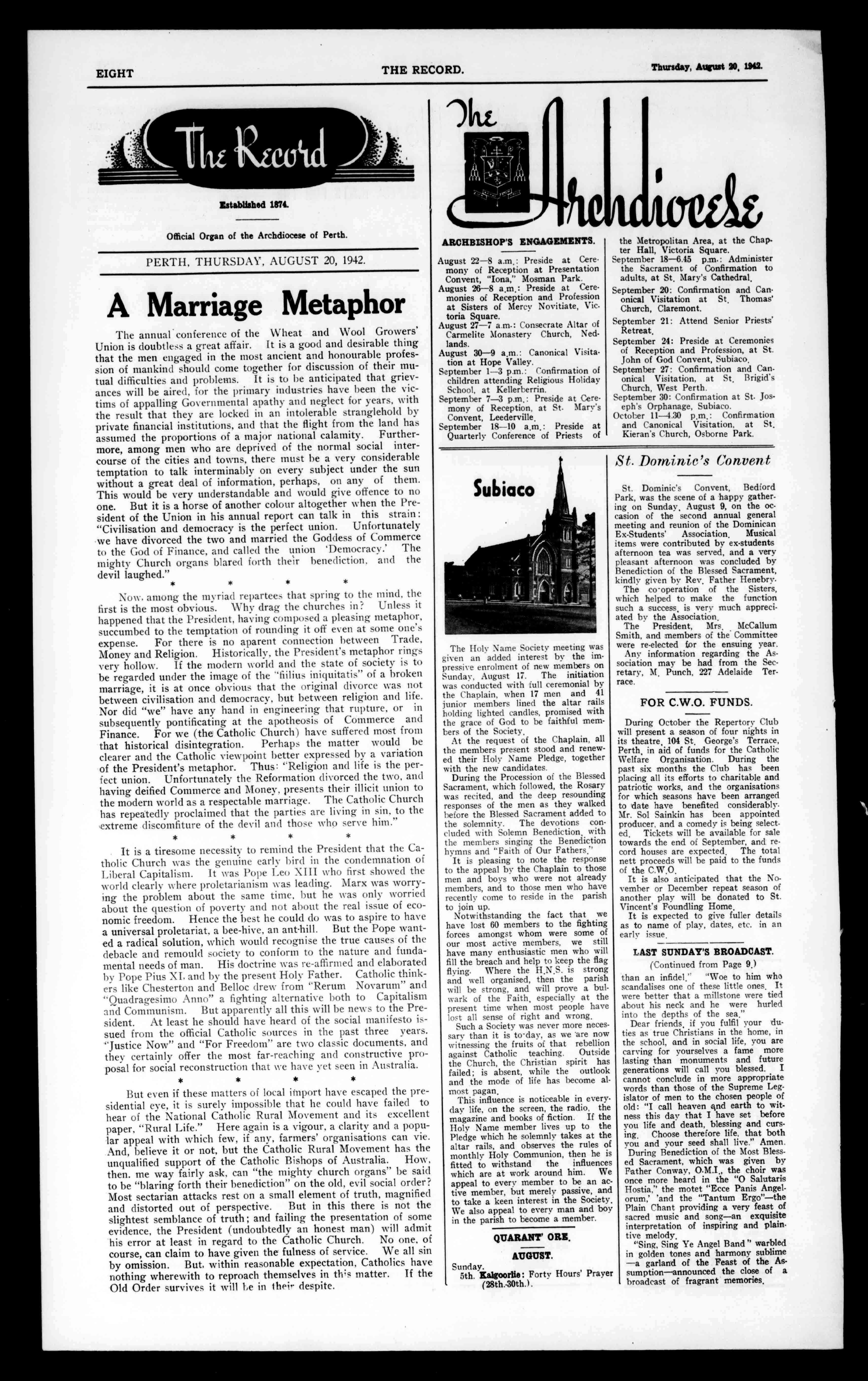
TheHolyNameSocietymeetingwas givenanaddedinterestbytheimpressiveenrolmentofnewmemberson Sunday,August17. Theinitiation wasconductedwithfullceremonialby theChaplain,when17menand41 juniormemberslinedthealtarrails holdinglightedcandles,promisedwith thegraceofGodtobefaithfulmembersoftheSociety.
AttherequestoftheChaplain,all thememberspresentstoodandrenewedtheirHolyNamePledge,together withthenewcandidates.
DuringtheProcessionoftheBlessed Sacrament,whichfollowed,theRosary wasrecited,andthedeepresounding responsesofthemenastheywalked beforetheBlessedSacramentaddedto thesolemnity.ThedevotionsconcludedwithSolemnBenediction,with thememberssingingtheBenediction hymnsand"FaithofOurFathers."
Itispleasingtonotetheresponse totheappealbytheChaplaintothose menandboyswhowerenotalready members,andtothosemenwhohave recentlycometoresideintheparish tojoinup.Notwithstandingthefactthatwe havelost60memberstothefighting forcesamongstwhomweresomeof ourmostactivemembers,westill havemanyenthusiasticmenwhowill fillthebreachandhelptokeeptheflag flying.WheretheH.N.S.isstrong andwellorganised,thentheparish willbestrong,andwillproveabulwarkoftheFaith,especiallyatthe presenttimewhenmostpeoplehave lostallsenseofrightandwrong. SuchaSocietywasnevermorenecessarythanitisto-day,aswe'arenow witnessingthefruitsofthatrebellion againstCatholicteaching.Outside theChurch,theChristianspirithas failed;isabsent,whiletheoutlook andthemodeoflifehasbecomealmostpagan, Thisinfluenceisnoticeableineverydaylife,onthescreen,theradio,the magazineandbooksoffiction.Ifthe HolyNamememberlivesuptothe Pledgewhichhesolemnlytakesatthe altarrails,andobservestherulesof monthlyHolyCommunion,thenheis fittedtowithstandtheinfluences whichareatworkaroundhim.We appealtoeverymembertobeanactivemember,butmerelypassive,and totakeakeeninterestintheSociety, Wealsoappealtoeverymanandboy intheparishtobecomeamember.
QUARANT'ORE.
AUGUST.
Sunday. 5th.Kalgoorlie:FortyHours'Prayer (28th-30th1.
theMetropolitanArea,attheChapterHall,VictoriaSquare. September18-6.45p.m.:Administer theSacramentofConfirmationto adults,atSt.Mary'sCathedral,
September20:ConfirmationandCanonicalVisitationatSt,Thomas' Church,Claremont.
September21:AttendSeniorPriests' Retreat,
September24:PresideatCeremonies ofReceptionandProfession,atSt. JohnofGodConvent,Subiaco,
September27:ConfirmationandCanonicalVisitation,atSt,Brigid's Church,WestPerth.
September30:ConfirmationatSt.Joseph'sOrphanage,Subiaco.
October11-4.30p.m.:Confirmation andCanonicalVisitation,atSt. Kieran'sChurch,OsbornePark.
St.Dominic'sConvent
St.Dominic'sConvent,Bedford Park,wasthesceneofahappygatheringonSunday,August9,ontheoccasionofthesecondannualgeneral meetingandreunionoftheDominican Ex-Students'Association,Musical itemswerecontributedbyex-students afternoonteawasserved,andavery pleasantafternoonwasconcludedby BenedictionoftheBlessedSacrament, kindlygivenbyRev,FatherHenebry.
Theco-operationoftheSisters, whichhelpedtomakethefunction suchasuccess,isverymuchappreciatedbytheAssociation,
ThePresident,MrsMcCallum Smith,andmembersofthe.Committee werere-electedfortheensuingyear. AnyinformationregardingtheAssociationmaybehadfromtheSecretary,M.Punch,227AdelaideTerrace.
FORC.W.O.FUNDS.
DuringOctobertheRepertoryClub willpresentaseasonoffournightsin itstheatre,104St.George'sTerrace, Perth,inaidoffundsfortheCatholic WelfareOrganisation.Duringthe pastsixmonthstheClubhasbeen placingallitseffortstocharitableand patrioticworks,andtheorganisations forwhichseasonshavebeenarranged todatehavebenefitedconsiderably. Mr.SolSainkinhasbeenappointed producer,andacomedyisbeingselected,Ticketswillbeavailableforsale towardstheendofSeptember,andrecordhousesareexpected,Thetotal nettproceedswillbepaidtothefunds oftheC.W,O.
ItisalsoanticipatedthattheNovemberorDecemberrepeatseasonof anotherplaywillbedonatedtoSt. Vincent'sFoundlingHome, Itisexpectedtogivefullerdetails astonameofplay,dates,etc.inan earlissue.
LASTSUNDAY'SBROADCAST.
(ContinuedfromPage9,) thananinfidel,""Woetohimwho scandalisesoneoftheselittleones,It werebetterthatamillstoneweretied abouthisneckandhewerehurled intothedepthsofthesea," Dearfriends,ifyoufulfilyourdutiesastrueChristiansinthehome,in theschool,andinsociallife,youare carvingforyourselvesafamemore lastingthanmonumentsandfuture generationswillcallyoublessed.I cannotconcludeinmoreappropriate wordsthanthoseoftheSupremeLegislatorofmentothechosenpeopleof old:"IcallheavenandearthtowitnessthisdaythatIhavesetbefore youlifeanddeath,blessingandcursing,Choosethereforelife,thatboth youandyourseedshalllive."Amen. DuringBenedictionoftheMostBlessedSacrament,whichwasgivenby FatherConway,0.M.I.,thechoirwas oncemoreheardinthe"0Salutaris Hostia,"themotet"EccePanisAngelorum,"andthe"TantumErgo"-the PlainChantprovidingaveryfeastof sacredmusicandsong-anexquisite interpretationofinspiringandplain. tivemelody.
"Sing,SingYeAngelBand"warbled ingoldentonesandharmonysublime -agarlandoftheFeastoftheAssumption-announcedthecloseofa broadcastoffragrantmemories,
EIGHT THERECORD. Thursday,August20,1942. Established1874. OfficialOrganoftheArchdioceseofPerth. PERTH,THURSDAY,AUGUST20,1942.
LibraryLectures
FatherLalorto repeatlectureon"firSI)roub ofTurin" atthe CentralCatholicLibrary (36PierStreet,Perth)
*FRIDAYEVENING
September4,at8p.m.
ThenextLibraryLecturewillhegivenbyRev.FatherLalor. onFridayevening.September4,attheCentralCatholicLibrary, Pier-street.TherehavebeenmanyrequeststhatFatherLalor shouldrepeatonceagainhisnowfamouslectureon-TheShroud ofTurin."Thisextraordinaryfilm,whichgivesinminutedetail themarkingsonOurLord'sBodyasleftontheshroudinwhich Hewaswrappedforburial,andshowssovividlythewoundsof
thePassion,hasalreadybeenseenbymany.buttheLibraryCommitteefeelconfidentthattherearestillmanyagainwhowiilavail themselvesofthisopportunityofhearingFatherLalor'scommentaryonthepictorialrelicofthePassionthatistheShroudof Turin.
ThelectureontheShroudwillbefollowedonFriday,September18,byanotherlanternlectureonthe"JesuitMissions,"byVery Rev.FatherAustinKelly,S.J.,RectorofSt.Louis.
fastSunday'sBroadcast...
FATHERHAUGHONPRESENT-DAYEVILS
LastSundayafternoon,adevout congregationassembledinSt.Patrick's Church,Fremantle,touniteinthe BroadcastDevotionsarrangedforSt. Patrick'sforAugust16,at4o'clock.
TheChildren'sChoir,comprisingthe pupilsofSt.Joseph'sLadies'College andthoseofParry-streetParochial School,wasunderthedirectionofthe DiocesanDirectorofSacredMusic, Rev.FatherLynch,whileMissKathleenDroney,A.T.C.L.'organistofSt, Patrick's)presidedattheorgan.
Thesacredhymns"MyGodILove Thee,"bywayofpreludetotheoccasionalsermon,and"DearHeartof Jesus,"atitsclose,werebeautifully rendered,luringtobrighterworldsand faraway.
VeryRev,FatherHaugh,O.M.I,, preachedaprofounddiscourseonthe evilsofthepresenthour,anddelineatedtheircausesandtheircure, Takingforhistextthewordsof HolyWrit:"Fortherewillcomea timewhenmenwillnotenduresound doctrine,butfollowingtheirlusts,will heaptothemselvesteachers,totickle theirears:andwhilerefusingtolisten tothetruth,theywillturnuntofables,"(Tim.IV,3).FatherHaughsaid: Theseinspiredandpropheticwords ofthegreatapostleoftheGentiles, havebeenfulfilledinthedaysin whichwelive,"Therewillcomea time,''saystheapostle.Ithasalreadycome-whenmenwillnotenduresounddoctrine."Thevastmajorityofpeopleto-daywillnolonger endurethesounddoctrineofafuture life-thenecessityofmoralrestraint, religioussanctionstheunityandpermanencyofmarriage.Butfollowing theirownlusts,heapuntothemselves teachers-yes,teacherswhodefendand propagatethe"fables"ofunbridled freedomofthesenses-livinglifeto thefull-andwhomakeoutwardappearancesthebadgeandtestand meaningofmoralworth.
Theresultsofthisun-Christianand irreligiousattitudeareapparentonall sides. AfewweeksagoourCivil Authoritieswereforcedtoestablisha "ViceSquad,"totrytocleanupdrunkennessandimmoralityamongthe youngwomenofourcity,Whata sadandtragicreflectionuponthe futuremothersofAustralia!And whilewecommendtheeffortofour civilauthoritiesinthisdirection,I feartheremediesaretoosuperficialto effectaradicalchangeinadisease whichhasreachedtheverycoreof humannatureandisunderminingnationalhealth,Theamputationofan externalmemberwillnothealaninternalsore.
Letus,therefore,tracetheseevils totheirsourcesandcauses,andthen ifwearehonestinourfightforChristiancivilisation,wemustoneandall setourhouseinorder,foruponthe remediesfortheseevilsdependour
Christianheritage,ournationalhealth, andourverysurvivalasarace.
(I.)TheSchool. Forgenerationspastourwould-be intellectualshavebeenproclaiming man'srighttothinkashepleases aboutGodandthehumansoul,withoutanyrestraininginfluence-and man'srighttoconductormisconduct himselfatwillwithoutbeingtrammelledbyamoralcode,whichtheycynicallycalled"convention.'Sucha programmeslammedthedooragainst beliefinimmortalityandresponsibility toaSupremeBeing,deniedthenecessityofreligion,wasacruderejection ofallthenobleraspirationsofthe humanheart,awildassertionthatman ismerelyananimalwithnonobler destinyorbrighterfuturethanthe brutebeast.Youaskhowcouldmen arriveatsuchappalling"fables"?The answeris,thattheyhaverejectedthe fundamentaltruthsofChristianitytheyhaveturnedawayfromHimWho aloneistheLightoftheworld.The consequencesareintellectualandmoral chaosintheschool,inthehome,and insociallife.Asaresultofthismaterialisticoutlook,themajorityofthe childrenarebroughtupinnon-religiousschools,withoutasolidsenseof responsibility.Andduringthecriticalperiodfromboyhoodandgirlhood toadolescenceareleftwithoutreligiousrestraintstosavethemfromsurgingpassions.Suchasystemisafertilefieldforsowingtheseedsofvice, whichsoonerorlaterwillmanifest themselveswithsadconsequencesfor theNation,Youngcitizensareturnedout,whosegoodconductisnobetterthanthesurface,andwhoonly stopatsinandviceaslongasthey arehiddenfromtheeyesofmen, Anyattempt,then,tomakeyoung peoplemoralwithoutreligiousguidanceandhelps,afixedstandardand authoritativeteachertocompelconscience,isaghastlyerror,andisunquestionablyoneofthechiefsources ofmorallaxityto-day.
(2)MarriageLawsViolated. AsecondsourceofevilistheshamelessviolationofthelawsofChristian marriage.TheteachingofJesus Christuponthisall-importantsubject isrecordedinatleasthalfadozen placesintheNewTestament."The PhariseescametoHimtemptingHim andsaid:"Isitlawfulforamantoput awayhiswifeforanycause?'To whichtheDivineFounderofChristianityreplied:'Haveyounotread thatHeWhomademanfromthebeginningmademaleandfemale?For whichcameshallamanleavefather andmotherandcleavetohiswife.And theyshallbetwoinoneflesh.What thereforeGodhathjoinedtogether,let nomanputasunder!'"Inthis answerOurBlessedLordgoesback totheoriginofhumannature,and showsthatfromthelawofnatureand
thelawofGod,marriageisessentially acontractbetweenonemanandone woman-thatitispermanentandlifelong,andnopoweronearthcandissolveit.Thisappliestoalltruemarriageswithoutexception. Whatanopenrevoltagainstthis Divineteachingismanifestinthe worldtoday.ThelawofGod,the moralteachingofJesusChrist,is thrownaside,andopenlyandshamelesslymarriagelawsareviolated.The facilitiesfordivorce,theinfidelitiesof husbandsandwivestheso-calledinconvenienceofchildren,havepaved thewaytowholesaleimmorality. Weekbyweek,yearbyyear,thousandsoftraitorstothirmarriagevows areenteringthedivorcecourtstoask aciviljudgetoliberatethemfroma bondwhichtheGodofHeavendeclares"Letnomanputasunder. DivorceisforbiddenbyDivineand NaturalLaws.Itdesecratesfamilylife,degradesthedignityofwoman, androbsChristianmarriageofits essentialqualities.Thesadhistory ofnationsonlyshowstooclearlythe havocwroughtinsociallifeoncethis practiceisallowed.
(3)Disruption-DesecrationofHome, Anothergiganticsourceofsocial evilsisthedisruptionofhome-life.The homeisthenucleusofthenation,the firstschoolintheworld,uponwhich dependsthevirtueorviceoftheCommonwealth.Fromimmemorialtimes theslogancallofallgreatpeopleshas been"proarisetfocis,""forthealtar andthehome,"becauseuponthese twocivilisationrests.Destroythem andmenarenobetterthansavages. Theblackestcurseonanylandisthe desecrationofhomeandfamilylifeandtragicallywenoteanalarmingincreaseinthisevilinAustraliaModernconditions,demandingnightwork, andSundaywork,movieandtalkie pictures,whichfrequentlypaintvices asvirtues,gangstersasheroes,and bytheirexhibitionsappealtothe baserinstinctsofhumannature.These werethebeginningsofthedisruption. Lackofparentalcontroltheabsence ofreligiousrestraints,fannedtheflame ofenkindledpassions.Unblushing infidelitiesamongmarriedpeopleand thepracticeofbirthcontrolcompleted thedevastation.Birthpreventionis (neoftheworstformsofunnatrualsin. ItisessentiallyopposedtotheDivine reator'sWillintheinstitutionof marriage,Itcrowdsintothehome debasingmorals,leavesnorestraint uponthesexualinstinct,untilNature, likeaboomerang,recoilsuponitsyin. laters,andrevengesherselfuponthem withvariousformsofdisease,forthis crudeinterruptionofitsvitallaws,At theoutbreakofthisWar,therewere nearly200,000marriedcoupliesinAusraliawithonlyonechild,andaneven largernumberwithnochildren,It isestimatedthatifthebirth-ratehad notfallentosuchanalarmingdegree inthepasttwentyIfiveyears,we wouldhaveanadditionalarmyinthe
fieldto-dayofatleasttendivisions, withasmanymorewomenonthe HomeFronttodotheirvitalpart.No savageinvadercouldhavekilledmore Australiansthantheseselfishparents whofortheidolofpleasureshirked theirresponsibilitiestotheircountry andtheirGod,Yes,birthprevention iswellcalledracialsuicide,foronceit becomeswidespreaditunderminesthe Nationallifeatitssourceandfountain-head,andpavesthewaytocollapse.Ifourcivilisationistoendureandifourraceistosurvive, thisblightingpractice-SocialScourge -mustbeabandoned,ItistheugliestFifthColumnistwhichthreatens Australiafromwithinasmenacingly astheenemyfromwithout.
AndnowIhavebrieflytracedthe presentdayimmoralitytoitschief sources.Youhaveheardsomeunpalatabletruths,buttruthsnevertheless,althoughunpalatable.Ifthese aretoberemedied,(11theyouthin ourschoolsmustbeequipedwithreligiousaswellasseculareducation. Theymustbetaughttoguardand guideheartandhandandintellect,to realisethattheyarenotthrownupon thisearthliketheflotsamandjetsam oftheocean,butareheretoworkout theirimmortaldestinyinspiteofwhat othersmaysayorthinkordo,and thattheyareresponsibleforalltheir actionstoanUnseenAlmightyJudge, (2)Home-lifemustberestoredinall itsChristiansplendour,for:tisthe sourceofthecountry'slife,thecome:stoneofthesocialedifice
13)Theunityandpermanencyof marriage,thefidelityofhusbandto wife,mustbeheldassacreddutieson thepartofeverycitizenfromthelowesttothehighestintheland.All naturalremedieswillfail,allpenalties willbeoflittleforceuntiltheerrors whicharecausingsuchmoralhavoc aredispelledbytheeffulgentraysof Christianteaching,andtheevilswhich afflictsociallifearedispelledby Christianpractice.
Iexhortyou,marriedmenand women,listeningtomewithinthis churchoroutsideittostandfastby yoursacredol,lieations.Makeno rashventures,laynoprocanehands onifepermanencyanduniteofyour life-longcontract,Useyourrightsas disciplinedChristians,"Populateor Perish"mustbeyourslogan
Iexhortyou,parents,inthename ofGod,whoserepresentativesyouare andwhoseplaceyouhold.Iaskyou inthenameofthisgreatCommonwealth,whichexpectsyoutorear,not socialscourgesandselfishweaklings, butvirile,law-abidingcitizens.Iexhortyouinthenameofyoureternal salvation,whichisboundupwiththe fateofyourchildren,toprovidefor theminyourhomesathoroughlyvirtuousatmosphere.AssertyourGodgivenauthoritywhennecessary,exerciseyourparentalcontrol,Know whereyourchildrenareandwhose companytheykeep.Aboveall,rememberyoursolemndutytoshow themgoodexampleatalltimes,for"if anymanhathnotcareofhisown,and especiallythoseofhisownhousehold, hehathdeniedthefaithandisworse
(ContinuedonPage8
Thursday,August20,I942. THERECORD. NINE
OurLadyHelpofChristiansBranch, EastVictoriaPark.
Thequarterlymeetingtookplaceon Tuesday,August11,andtheattendance wasverysatisfactory.Twonewmemberswereadmittedduringtheevening.
TheRetreatswillbetakingplace shortly,andasmanyaspossibleare askedtoattend,Thisyeartheladies' RetreatwilltakeplaceatSouthPerth.
ThesocialheldrecentlyattheFire Stationwasmostenjoyableand thereistobeanotheroneonMonday, August24. ThequarterlyCommunionofthebranchtookplaceonSundaylastatthe7.30Mass,anditwas mostedifyingtoseesuchalargenum-
e)311111111
bertakepart.Afterthenextmeeting,whichtakesplaceonTuesday, August25,areportwhichshouldprove mostinterestingtoallmemberswillbe givenbyoursecretary. Alargeattendanceisexpected.
ANIMALRETREATS.
TheRetreatforwomenwillbeheld atSt.Joseph'sConvent,SouthPerth, on29th.and30thinstandthatfor menattheRedemptoristMonastery, onSeptember5and6.Intendingretreatantsshouldhandintheirnames totheirbranchsecretaryortothe GrandSecretary,notlaterthanthe MondayprecedingtherespectiveRetreats,
DANCESTOENTERTAINCATHO.LICMEMBERSOFTHEFORCES..
ThefifthdancewasheldattheParishHall,Highgate,on12th,inst.,and, notwithstandingbadweather,thefunctionwasentirelysuccessfulfromevery pointofview.Thesixthdancewill beheldatthesameplaceonWednesdaynext.
Third Order ofSaint Francis
Lastweek'sspeakerattheFranciscanLuncheonwasBrotherAllen,of Clontarf,whoentertainedtheTertiariesandvisitorswithsomeinteresting reminiscencesofhisFranciscanassociationsinbothIrelandandAustralia.
BrotherAllenmentionedhisfriendshipwiththefamousBrotherJonn, oftheFranciscanPrioryinCo.Wexford,Irelandtowhomhundredswent withtheirinfirmitiestoaskhisblessing.Theuseofholywaterandthe recitationofanovenawerethespiritualexercisesheimposeduponthem, andinnumerableweretheresultsof thissaintlyFriar'sinfluenceani power.BrotherAllentoldthestory oftherestorationofhissister'seve sightafterablessingbyBrotherJohn, andrecalledthemarvellousscenesof thecrowdedchurchesonTueslaysand Fridays,whenMasswassaidforthe public,PerhapsthespiritofSt. Franciswasnowheremorenoti-eable thaninIreland,andthepeoplehave beenforevergratefultothesansof Francisforthewayinwhichthey keptthefaithaliveduringthedaysof persecution.
ThemembershipoftheThirdOrder isverylargeinSydney.ItrepresentshalfthetotalnumberofTertiariesinAustralia.Althoughthe membershipislowerinMelbourne,the ChurchofSt.Francisisavitalinfluenceinthecity'slife.PerpetualAdorationtakesplacethereandthedaily Massat11,50eachmorningattracts hundredsofpeople.
ofPerth-and
713-21HayStreet,Perth
Three Lines From The Manchester at AHERN'S
Smartcolourfulcheck bungalowcloths.Useful size,ingreen/orange, blue/orange.For5/11 each. NOCOUPONS.
Kiddies'woolencrib Blankets,inBlue,Green, andPinkgrounds;nicely embroideredwithnursery designs;36x30,for12/6 each. NOCOUPONS.
Infants'throw-overMosquitoNets.2x21 yards;inbrownonly. Nicefinenet.Limited quantity,for4/11each. NOCOUPONS.
HAYand MURRAY STREETS
SubiacoYoung Men'sClub
Thepresident,13.Ryan,presidedover themeetingheldonMonday,17th, inst.,atwhichwasarecordattendance. Thepresidentextendedawelcometoa newcomer,J,Bell,andalsototwoof ouroldermembersJ,WallandJ.Flanagan. P.BennsandE.Flanaganwere successfulintheweeklyBaddington tournamentaftermanyexcitingheats, FatherBreslinextendedaninvitationtotheSocietytovisitFremantle andhaveaneveningofgameswith thevisitingforcesonAugust24,MemberswillmeetontheSubiacoStation at7p.m.onthatevening.
Memberscanhelptomakethelocal tennisdance,tobeheldonSaturday, 22nd,inst.,asuccessbyhelpingtopreparethehallonSaturdayafternoon andbybringingfriendsandmembers oftheirfamiliestothedance, AstherewllbenomeetngonMonday,August24,owingtotheSociety's visittoFremantle.thenextmeeting willbeonMonday,August31.
CatholicTeachers'Guild
OnWednesday,August12,membersandfriendsoftheGuildmetat theCatholicCentralLibrarytolisten totheeagerlyawaitedlecturerforthe evening,Dr.Prendergast,whocertainlydeliveredaveryenlighteningand interestingaddresstoalargeandappreciativeaudience.
Anaccountofthelecturewillbe reportedinalaterissueof"TheRecord."
Feelingthatonemightwonderwhy hehadnotembracedFranciscanism asaresultofhislife-longadmiration oftheOrder,BrotherAllenexplained thathealwaysfeltattractedtothat statueinFranciscanChurchesofSt. AnthonyholdingtheDivineInfantand abook.Theti-o,,ghtcametoh;m thathe,too,rnishthelpchildrenand thisledhimeventuallyintotheChristianBrothers,wherehisdutyformany yearswastolookafterthedeafand dumbchildreninthespecialinstitutiontheyhavefortheminSydney. AtpresentheisworkingforthebettermentoftheboysatClontarfand Castledare,
STOVES,WoodorGas,newand used,sold,bought,repaired.WA, StoveCoy.,569WellingtonStreet. B6307.
Baths,Enamel,f715s.;Cement,45s. Paints,Hardware,TimberforShelters, cheaperatHASSELL'S,559WellingtonSt.Tel.B6307.
ItCostsNoMoretohaveyour PrescriptionsAccurately
TheGuild,beinganxioustohavea socialmeetingofallitsmembersduringthecomingweek'svacation,have arrangedanafternoonteaforWednesday,September2.WehavedecidedtomeetattheCatholicCentral Libraryat2.30p.m.beforewerepair toourrendezvousfortheafternoon's entertainment.
Wouldallmembersorintending membersespeciallythosefromthe ountry,pleaseavailthemselvesof thisinvitation,aswefearwemaynot beabletoreacheveryonebypost.
Wearelookingforwardtorenewing oldacquaintancesonthisoccasion,as wellasmeetingforthefirsttimethose whom,asyet,weknowonlybyname-
Wouldallthosewhowishtomake theweek-endenclosedretreatatLoretoConvent,Swanbourne,onSeptember5,andwhohavenotyethanded intheirnames,pleasedosobeforeAugust31,Wehavebeenassuredthat theRetreatwillcloseearlyenoughon Mondaymorningtoallowofeveryone reachingtheirworkintime.
TEN THERECORD. Thursday,August20,1942.
EXAMINATION 'EQUATIONS
i 4Pt 1 tif
Thisfactisappreciated
thatiswhyweareableto
atesofourFullBusinessCourse. Thiscourseconsistsof9to10months'trainingintheschoolroom and2to3months'"finishingoff"inourownextensiveofficesIfyour girlsandboyshaveturned14,sendthemtousforpracticaltraining. Callwriteor'phoneB2024orB2063forfulldetails.Noobligation, CityCommercialCollege W.A.'sBusiness
Our Qalifying Standard IsHigh
bythekeenbusinessmen
GUARANTEEAPOSITIONtoallgradu-
University SheffieldHouse,
Dispensed. ROBERTW.DALBY,M.P.S. Of130OxfordStreet,Leederville, carriesafullsupplyofallAccredited BrandsofToilets,PatentMedicines. FullPhotographicService,Etc.'Phone B6224andreceiveREALService. NOTICETOPROPERTYOWNERS! Youcanwithsatisfactionplaceyour BusinessinthehandsofW.F.SAMSON, 5QUEENSTREET,FREMANTLE. ESTATE&FINANCIALAGENT, SWORNVALUATOR. Representing:QueenslandInsurance Co.,Ltd.;TheRoyalAutomobileClub ofW.A.(Inc.);GourleyOilandColour Works,Ltd.;"Titanic"Paintsand Oils,Etc.;"Durotint"Kalsomine. 'Phone:L1316(Office):L2553(Residence). M1158 Telephones- L1460 MEAD,SON&CO. FUNERALDIRECTORS. 190ALBANYROAD, VICTORIAPARK. 33CANNINGHIGHWAY, EASTFREMANTLE. ACOMPACT, CONCISE, ACTIVESERVICE PRAYERBOOK PaperCover 9d. KhakiClothCover 2/BlueClothCover 2/LeatherCover 4/6 (Postage,1'2d.) CompiledbyRev.G.Butler. M.S.C.,andpublishedbyauthorityoftheC.U.S.A.,Queensland,thisnewprayerbookfor CatholicSoldiers,Sailorsand Airmenisthebestyetprinted formenintrainingandonactiveservice. ItcontainsthefullMass,all essentialprayersanddevotions andlistsspecialprivileges. Itoffers,aswell,manypagesof blunt,helpfulandsympathetic advicethatwillbewelcomed byeveryCatholicyoungman allina96-pagepocketsizebookonly41inchesdeep by3incheswide. Felltgrini&0.1o.btu.nth. 776HayStreet,Perth foppFoy&Gibson)
WillTheStateContinueExcessive ControlOverOurlives?
TheApplauseofEverythingRussian ThreatensSocialism
ByS.K.
Therearecallsforpost-warplanning fromallsides-itprovidesemployment fortheplannersanditopensupto certainonestheprospectofcareers
S.Sagar-aneminentCatholicjournalist-writingregularly,said:''There aretimeswhenamancanplota coursewithareasonablehopeofbeing abletofollowit.Butthisisnotone ofthetimes.Inthisshakingofworld existencenomanhasanyexcusefor forgettingthatweneverknowwhata daymaybringforth,Weareliving inaworldwhichfor400yearshasbeen workingunderanincreasingstrainbecauseithasbeensufferingfromspiritualandmentaldisruption.Evenwhen theworldwasworking,anintelligent mancouldnothelpthinkingthatthe materialdisruptionmustcome,asking himself,'Whatwilltheharvestbe?' Andwhentheworldsuddenlystops working-'Isthecrashcoming?''flayingsownthewindisthiswherewe starttoreap?''Whatspiritualforce 1-- theremakingforpoliticalunity amongcivilisedmen?''For1,000 yearsscholarsandthinkersweremore orlessinagreementaboutthenature ofman,hisbusinessonthisearth,his dualdestinyandhopeofheaven.Ali thatisgone;isthereanysignofanythingtakingitsplace:Apartfrom heavenlythings,isthereanyfunda mentalagreementaboutearthlythings? Anyacceptedstandardsofbeautyor conduct,anygeneralagreement,isto whatconstitutestheideallifeformen herebelow,suchagreementasmust haveexistedintheancientworld?"
Butwhilstthistalkisgoingoncertainthingsarehappening,andthere isapossibilitythatmanywillcontinue togoonaftertheoccasion,whichcausedthemtobeinstituted,haspassed, Theoutstandingexampleofthisis thatwearelivingon"forms"-called the"AmmunitionoftheBureaucrats.' Forms,ofcourse,havetheirvalue whenwiselyused.Theyeasilylend themselvestounwiseuse,especially whentheyareinthehandsofthose withfixedobjects.
Everywherearoundusweseean extrememeasureofStatecontrolmade
RandolphKnapp
SIGHT-TESTINGOPTICIAN, 12ATWELLARCADE, FREMANTLE.
necessarybytheexigenciesofwar: Thismightleadtooneoranotherof tworesults:eitherthedesireforacontinuanceofexcessivesupervisionby theStateoverourlives,orelsearevulsionfromtherestrictionsthathave destroyedfreedomofaction, Bothoftheseresultscontainelementsofdanger.Thecontinuanceof Statecontrolonanythinglikethesame linesashasbeenfoundnecessaryduringthewarwillunderminethenationalcharacter.Thelifeofacountry flowsnotfromtheStatewithitslaws butfromthespiritofindependence andresourceofthepeople.Ifthepeoplecannotorwillnotfendforthemselves,butprefertoputtheirresponsibilitiesontoanofficialcontrolling body,thentheyarelost.
Oureffortsaretobedirectedinto twomainchannels.TohelptoarestorationofatrulyChristiansocial orderwithjusticeandcharityforall, andtoendeavourtohelpourfellow membersandCatholicsingeneralto obtaintheirreasonableshareofthe goodsoftheearth.
Theindicationsseemtopointto someformofSocialismorCommunism eventuating.Thattypeofbureaucratic despotismhasinspiredahumanfaith farstrongerthanthecryofdemocracy orlibertyprevalentatthebeginning ofthewar.Thisfaithhasgivenfar moreimpetustothewareffortthan anyotherconvictiononthesideofthe Allies,ThereisapplauseforeverythingRussian-andthisshowsthe spiritoftheage.Thereisnoexplanationofferedforacceptingsoreadilywhatwaspreviouslycondemned outright.Youwillbetoldthatthere isnoobjectiontothepracticeofReligioninRussia,andsoon.
Thiscampaignisbeingwagedonall fronts,anditisnotdissociatedfrom Masonry-thefuturewouldbedesperateiftherewerenoGod.TrueChristianityholdstheonlykeyofescape fromourplight.SirWalterMoberley, writingrecently,said:"Theupshotwill dependonthequalityoftheleadtheyareabletogiveorwhetherthewhole companyofChristianpeoplecanshow adegreeofinsight,courageanddeterminationthatwillbeconvincing.If theyaretodothistheyneedtobe purgedofhalfheartedness,complacency,andfromwishfulthinking."
ThisChristianitycomesfromGod andissupernaturalinitsspirit.This pegging,too,mustcomeeventually fromtheGodwehaveoffendedinthe past.Andwemustbearinmindthat itistheSpiritofGod,notofman,that canbroodcreativelyoverthedark chaosofthepresenthour.
Thursday,August20,1942. THERECORD. ELEVEN
DERBY'S MURRAYSTREET,PERTH. PhonesB9731(threelines) B7777 B3588 B9101(twolines) REGISTEREDW.A.T.A. ALEXRODOREDA TurfCommissionAgent 802HAYSTREET. AGENTFORW.A.CHARITIES RingB5841andB5236. NORTHAM. E.0.TRESISE, M.P.S.,S.A.andW.A. MANUFACTURINGAND DISPENSINGCHEMIST. ForServiceandQuality. Tel.:61Northam. ALBANY. H.C.PriorFuneralDirector ALBANY(Established1921). PrivateMortuary.MotorVehicles, ChargesModerate. 'Phone215. Albany,Mt.Barker,Denmarkand Districts. ti KALGCIORLIE. j.W.SHEEH.AN PrimeBeefButcher HANNANST.,KALGOORLIE. MARITANASTREET. Tel.438 TeL438 B RENNANS OULDER LIMITED FORQUALITYDRAPERY, LADIES'ANDGENTS' CLOTHING, MANCHESTERAND FURNISHINGS. BROWNS---Fruiterers 127BARRAUKSTREET,PERTH. 'PhoneB3517. 'PhoneB3517. ALLTHEBESTFRUIT$OFTHESEASON. BESTCOOLDRINKSAND?SILKBARTNTOWN. PAINTINGFORPERROTT PERROTTFORPAINTING. D.C.PERROTT Ittidgc PERTH. PAINTINGCONTRACTOR CONTRACTORTOTHELEADINGCONVENTS,COLLEGES,AND SCHOOLS. PRESCRIPTIONSPECIALIST. COLINF.CAMPBELL (LateMcWhinney'sPharmacy). CORNERSTIRLINGHIGHWAYANDSTUARTSTREET, 'PHONE:F2219. MOSMANPARK. 'PHONE:F2219 PRESCRIPTIONSCALLEDFORANDDELIVERED. WhiteRockQuarries FOR ALLGRADESOFMETALFORROADCONSTRUCTIONANDCONCRETEWORK. PHONES:B8866,B8989.AfterHours:M.W.24. 3rd.FLOOR,COLONIALMUTUALBUILDINGS,PERTH. ARTHURE.DAVIES&CO. funeralDirectorsanbEmbalmers PERTH: Cr.Beaufortand Bulw.rStreets. B9400. CLAREMONT: Opposite RailwayStation. 12177. FREMANTLE: 85Market Street. L2225. PARTNERS:WALLACEA.H.GREEN&GEORGEB.COCKERILL. ForLongWear UseOnly "Gibsonia" Wools... Obtainable onlyat
THERECORD.
TWELVE
I.C.HAMILTON,M.P.S.Ph.C. DAYANDNIGHTCHEMIST.
197BRISBANESTREET PERTH. PrescriptionsCarefully.andAccuratelyDispensed. CompleteStocksofPatentMedicines. CountryOrdersatCityPrices.'Phone7923 Hour.-Any 4
CENTRALDAIRY
A.DREYER,Proprietor. STIRLINGHIGHWAY,CLAREMONT. PASTEURISEDORFRESHMILKTWICEDAILY.
'PHONE:WM1332. FRESHCREAM.
D.HILL
WHOLESALEANDRETAILBUTCHER. NEWCASTLEROAD,MIDLANDJUNCTION. Tel.118Midland. TRUSSEDPOULTRY.
ROSENSTAMMPTY.LTD.
01,03and65KINGST.,PERTH
TheLeadingLeatherMerchant WESUPPLYANYTHINGINLEATHER SaddleryandHarness,SnitCases,Etc.SuedeSkinsforFancyWork
SOLEAGENTSFORDr.Scholl'sFootAppliances."Salvitis"StockRemedies,forHorses,Cattle Sheep,Pigs,Poultry,Dogs.FreeBookletonApplication WERESTRINGTENNISRACQUETS
BartlettoStudio
ViceRegalPhotographers.
NOTENEWADDRESS:
4Qintkkistaktruntawldu.E
DEATHS.
BULBECK.-Ofyourcharity,pray forthereposeofthesoulsof GeorgeBulbeck,whodiedatLondon onAugust15andofJohnBulbeck, whodiedonMarch16,lovedfather anduncleofRonaldBulbeck,of SwanBarracks,and7McCourtstreetWestLeederville.
God'sWillbedone.
HARROLD(bycable).-AtLimerick, Ireland,Edmond,of8KingGeorgestreetVictoriaPark,dearlyloved husbandofJaneHarrold,andloved fatherofTom,Kathleen(Mrs.L.T. Walsh),Jack(Dublin',Ned,Frank, andStan:aged74, RequiescatinPace
INMEMORIAM.
HARVEY.-Ofyourcharity,prayfor thereposeofthesoulofAlice CeciliaHarvey,whopassedpeacefullyawayAugust24,1940,atKalgoorlie.
-Insertedbyherlovinghusband andson,R.andR.
HARVEY.-Ofyourcharity,prayfor thereposeofthesoulofMrs.Alice CeciliaHarvey,whopassedawayat Kalgoorlie,August24,1940.
-InsertedbyMr-andMrs.J.E. Plastoandfamily.
HIGGINS.-InlovingmemoryofNell, whodiedonAugust22,1940,loved daughterofN.Higgins,andfondsisterofMolly,JimandJackSacredHeartofJesus,havemercy onher, LEITCH.-EllenMaryLeitch.died August23,1936. ImmaculateHeartofMary,prayers forherextol, SacredHeartofJesus,havemercy onhersoul-Insertedbyherdaughters.
WAYNE.-InlovingmemoryofMrs. JosephineMaryFrancesWayne, whodiedonAugust26,1935. SacredHeartofJesus,behersalvation.ImmaculateHeartofMarv, prayforher.
YOUNG.-Treasuredmemoriesofour clearhusbandandfather,Horace Young,whopassedawayAugust23, 1938 R.I.P. -InsertedbyhislovingwifeSusie, andsonKevin,R.A.A.F.,Adelaide.
SITUATIONWANTED, Man,61,wantslightemployment. Apply"B.K.,"thisoffice.
TrottingSelections
By"TheHawk."
GLOUCESTERPARK.
Saturday,August22,1942. W.A.Breeders'Handicap:Kaieela, 1;JackieDonald,2;Olive'sDaughter, 3. OsborneParkHandicap:Flying Daly,1;Adaloma,2;LuluGold,3. VictoriaParkHandicap:Shandon Ribbons,1;AndyWalla,2;Valacare, 3. Queen'sParkHandicap:Admiral Sheik,1;ArabianLass,2;TorrHead,
Thursday,August20,1942.
TRINITYBUILDINGS,HAYSTREET(Centre) (TakeLiftfromTrinityArcade). FORHIGHSTANDARDPORTRAITURE. NIGHTORDAYWEDDINGSASPECIALTY. MakeYourAppointment. 'Phone:B3851. SAY"ISAWYOURAD.IN'THERECORD.'" 0 1 I I 6U1 1 I i I Pionnemanagniiniumainsmisonammi DanWhite Ph.Ch.,J.P. The"NYAL"Chemist PLAZAARCADE---PERTH MYFOURSPECIALS. 1,DanWhite's'FluMixture 2 Adoseintimesavesnine 2.DanWhites"KOFMIST" 2, ForChildren'sCoughs. 3.DanWhite'sEyeLotion 1,6 Fortiredandinflamedeyes. 4.DanWhitesCornCure 1,-WhySuffer? PATRONISE ANOLDC.B.C.STUDENT MIIIIIK1115111111111112111211111111111121111811111011111111111111111111111111I Ourunderstandingoftheneedsofthosebereavedisbornofourwide experienceasFamilyConsultantsandFuneralDirectors. ProsserScott&Co.Ltd. FUNERALDIRECTORS8i,CERTIFIEDEMBALMERS 351-357HayStreet,Subiaco MODERATECHARGES AlsoatCOTTESLOE FREMANTLE LEEDERYILLE 21-23StirlingTer 37ADELAIDESTREET, 628Newcastle MO. TelephoneL2682. Street. TelephoneF10011. TelephoneB3399. DAYANDNIGHTSERVICE.
3. HighClassHandicap:Goloonda,1; LouisAgain,2;EarlPronto,3. NationalParkHandicap:Mountain Flight,1;VonSheik,2;LadyLizzie,3. King'sParkHandicap:MillAdonis, 1;WeeGlobe,2;BrightLad.3, STURMERandSON (LateHallion's), BAILERS. 90JOHNSTREET,NORTH FREMANTLE. (Tel.2739.) PrizeWinnersRoyalShow. DeliveriesThroughoutFremantle.
BRAINS-TRUST. (ContinuedfromPage6,) sentatsomegreateventinHistory, whateventwouldyouchoose?"that wasaquestiononceaskedofthe Brains-Trust,oraquestiontothateffect,TheTrustchoseallsortsof events._load.Ithink,wouldliketohave beenpresentatthedeathofSocrates, butnotonememberoftheTrustappearedevertohaveheardofthe StableatBethlehem,ortheLastSupper,orofanyeventintheLifeofOur Lord.Ithinkitwasaboutthattime IbegantoconsiderthattheBrainsTrustknewnothingworthknowing. QUICKSWEEPS 117a CHARITIES Consultation NOWOPEN £1000wigs r don,90[iklaglere SIGHTTESTING BYREGISTERED Opticians Laubman&Pank (W.A.).LIMITED. T.G.SMITH,W.A.O.A.,B.A.S., ManagingDirector. 6-1BARRACKSTREET,PERTH. 'Phone:B3511. TheDemandfor GirlsTrained forBusinessHas NeverBeenSo Heavy ITWILLPAYYOUTOENROL NOWATSTOTT'S. AGOODPOSITIONIS ASSURED. STOTT'S BUSINESS COLLEGES 89St.George'sTerrace,Perth. 11AdelaideStreet,Fremantle.
THE
Andshesaid:"Youarewarmand warmer, Butnotquiteright,'saidshe.
"Itcan'tbethelittlecupboard, WhereMamma'sthingsusedtobe Soitmustbeintheclothes-press, Gran'ma," Andhefoundherwithhisthree.
Thenshecoveredherfacewithher fingers,
THE Bushies'Corner
DearCornerites,-NextFridayis theFeastofSt.AugustineofHippo, asaintwhoiswell-knowntousbecausehewastheChurch'smightiest championagaistheresy.St.Augustinewasbornin354,atTagaste,in Africa,wherehewasbroughtupinthe Christianfaith,butwithoutreceiving baptism.Hewasanambitiousschool boyofbrillianttalentsandviolentpassions,andhesoonlostbothhisfaith andhisinnocence.Hepersistedin hisirregularlifeuntilhewasthirtytwo.BeingthenatMilanprofessing rhetoric,hetellsusthatthefaithof hischildhoodhadregainednossession ofhisintellect,butthathecouldnot atyetresolvetobreakthechainsof iiillilliiiillillitlillii1111111111111111111i1111111/1111111111111111111111111111411111111
HISFEASTISONFRIDAY.
ST.AUGUSTINE,OFHIPPO.
ThouhastmadeusforThyself,0 Lord,andwecannotrestuntilwerest inThee. Id1111,111111.8111111111.1111111.1H1111111H111111111n1HIMIIIIIIIIB
evilhabit.Oneday,however,stung totheheartbytheaccountofsome suddenconversions,hecriedout,"The unlearnedriseandstormheaven,and we,withallourlearning,forlackof heartliewallowinghere.Hethen withdrewintoagarden,whenalong andterribleconflictensued.Suddenlyayoungfreshvoice(heknowsnot whose)breaksinuponhisstrifewith thewords,"Takeandread:andhe lightsuponthepassagebeginning, "Walkhonestlyasintheday,"The battlewaswon.Hereceivedbaptism,returnedhome,andgaveallto thepoor.AtHipo,wherehesettled, hewasconsecratedBishopin395.For thirty-fiveyearshewasthecentreof ecclesiasticallifeinAfrica,andthe Church'smighitestchampionagainst heresy;whilsthiswritingshavebeen everywhereacceptedasoneoftheprincipalsourcesofdevotionalthoughtand theologicalspeculation.Hediedin 430.
LemonadeBottle
AcknowledgedWithThanks, s,d.
M.Davies 20
Anonymous 100
PresentationConvent, Beverley.
DearAuntBessy,-Iamwriting youthislittlelettertotellyouthat Iamsendingyou115stamps.Would youpleasesendmeoneofthosepenny prickcards?Thisisthesecondtime Ihavewrittentoyou.
MAUREENMcCARTHY,
DearMaureen,-Thankyouvery muchforthestamps,whicharrived safely.Iwasverygladtohearfrom youagain,andIwillcertainlyforwardyouaprick-cardbyfirstpost, andIhopeyouwillbeabletosendit backwiththebrowniesbeforetheappealcloses.Ihavetonsandtonsof prick-cardsonhand,but,ofcourse,all ofthesewerenotmeanttobesent outthisyear,butalotmoreshould havegoneoutthanhave,Howover, ifallmyCorneritesfollowyourexample,IamsurethatourLemonade Bottlewillbefilled.
AUNTBESSY.
DearAuntBessy,-Itrustyouwill notthinkI'veforgottenyou.Iam enclosing2s.fortheLemonadeBottle, WouldyoupleasehaveMassofferedin honouroftheSacredHeartformany blessingsandfavoursreceived;5s.enclosed.Iamsendingsomestamps alsofortheLemonadeBottle.With bestwishes.
HELPER.
DearHelper,-Asyourkindoffering wastheonlyonereceivedthisweek,it wasdoublywelcome.Idoindeed wishthatmanyotherswerelikeyourselfinyourunfailingregularityinrememberingtheLemonadeBottle. Thereissuchalotofhardworktobe donebeforethecloseoftheappeal, andIhopetoseebiggereffortsinthe Bushies'Schemebeforethecloseofthe appeal,However,Imustthankyou verymuchforyourkinddonationand Ihopeotherswillfollowyourgoodexampleinthisway.Ihavearranged tohaveMassofferedinhonourofthe SacredHeartformanyblessingsand favoursreceived.
AUNTBESSY.
One,Two,Three
Itwasanold,old,old,oldlady, Andaboythatwashalf-pastthree, Andthewaythattheyplayedtogether Wasbeautifultosee.
Shecouldn'tgorompingandjumping, Andtheboy,nomorecouldhe; Forhewasathinlittlefellow, Withathinlittletwistedknee.
Theysatintheyellowsunlight, Outunderthemapletree, AndthegamethattheyplayedI'll tellyou, Justasitwastoldtome.
Itwashide-and-go-seektheywere playing, Thoughyou'dneverhaveknownitto beWithanold,old,old,oldlady, Andaboywithatwistedknee.
Theboywouldbendhisfacedown Onhislittlesoundrightknee, Andhe'dguesswhereshewashiding Inguesses,one,two,three, "Youareinthechinacloset!" Hewouldcryandlaughwithglee- Itwasn'tinthechinacloset ButhestillhadTwoandThree.
"YouareupinPapa'sbigbedroom! Inthechestwiththequeeroldkey,"
Thatwerewrinkledandwhiteandwee, Andsheguessedwheretheboywas hiding, WithaOneandaTwoandaThree, Andtheyneverhadstirredfromtheir places, RightunderthemapletreeThis,old,old,oldoldlady AndtheboywiththelamelittlekneeThisdear,dear,dearoldlady, Andtheboywhowashalf-pastthree.
ForExquisiteMildnessandTenderness andFineFlavourAlways.
TWOBIGBARRACKSTREETSTORES, ForYourConvenienceonEitherSide.
AustralasianCatholicAssurance Co.Ltd. THE"A.C.A."
A.C.A.BUILDINGS,KINGST.,SYDNEY. ASSETSEXCEED£1,750,000.
ALLCLASSESOFLIFEANDENDOWMENT ASSURANCEPOLICIESTRANSACTED.
SAFEGUARDTHEFUTURE
BRANCHOFFICESINALLSTATES.
W.A.Office "WARWICKHOUSE,"ST.GEORGE'STERRACE,PERTH P.ENGELBRECHT,ResidentSecretary.
Thursday,August20,1942. THERECORD. THIRTEEN
BensLimited QualityMeatsandSmallgoods
LATEMICHAELO'DZA, Founder. JOSEPHO'DZA Principal. owra&O'Dea FuneralDirectors 195PierStreet:Perth PricestoSuitAllClasses HIBERNIANMORTUARYBENEFITSAVAILABLE TOALLMEMBERS Tel:Business,B4308 Private,B6717-B3376
DecentWorkingConditionsEnsures
Employee'srightsand employer'sdutiesbothspring
fromGod
ReliabilityandBetterWork
JustSocialOrderCanPrevailOnlybytheAcceptanceand
(Publishedbyspecialarrangements Decentconditionsareessentialto goodwork.Justicedemandsthat thosewhohavetoworkfortheirliving shallbetreatedwiththedignityand respectduetothemashumanbeings, andthattheirpayshallbesufficientto maintainthemselves,andthosedependentuponthem,indecentcomfort. Everyman,whateverhisjob,isalso entitledtopropertimeforrestandrecreation-forhisreligiousandsocial duties-andheshouldbeassuredof properlight,airandsanitaryarrange rnentsinhisplaceofemployment.
Undersuchconditionsemployeeswill takeaninterestintheirjobsandput theirheartsintothem.Theywillbe happyandcontented-asGodmeant allmentobe.Theywillalsobean influenceforgoodamongtheirfellow
AREYOUBAMBOOZLED?
Ifyouwanttobamboozletheexpertswhoanswerquestionslearnedly inthequizsessions,youcannotdo betterthanaskthemaboutAntigonish.Infact,youcouldprobably bamboozleeventhosesupremely wiseandlearnedpeoplewhogo aboutsaying,WhathastheChurch donefortheworker?Whatuseare platitudinousPapalEncyclicals?We wantaction,etc.,etc..etc.You yourselfmaynotknowwhatAntigonishis.Well,Antigonishhas beencalledan"experimentin sanity,"anditisthestoryofan amazingsocialrevolutionwhich sweptthroughtheMaritimeProvincesfromNovaScotia,Canada, "likeacleansingflame."Itisactual proofofwhataChristianco-operative movementcando.Thatitisno cock-and-bullstoryisshownbythe factthatthepriestbehindtheamazingexperimentwasrecentlyhonoured bytheProtestantUniversityofHarvardforhissocialachievement. Thestory,toldasonepractical exampleofthesuccessinpractice ofCatholicsocialprinciples,along withotherexamplessuchasthe tributeoftheLondon"Times"to Salazar'sexperimentinPortugal,the successoftheJocistmovementin Canada.andofAgriculturalCooperationinBelgium,makesoneof thelatestA.C.T.S.pamphlets,entitled"ItCanBeDone."Noone interestedinsocialjusticecanafford tomissthislittletreasuryofinformation.
Whatofsoldierswhoarecanonised saints?Thereisquiteavariety.
Fr.HenrySneddon,S.J.,gives examplesfromthedaysofthecatacombstoCamillusdeLellis,the soldierwhobecameasaintandto whomtheRedCrossorganisationof to-dayistraced.AndFr.Eustace Boylan,S.J.,writesinhiseasy. chattyandpracticalwayabout DailyMass.Averyspiritualand helpfulpamphlet,engaginglywritten. ItConBeDone. SoldieringWithSaints.ByHenrySneddon, Si DailyMass. ByEustaceBoylan,S.J. AustralianCatholicTruthSocietypublicsr,onsforJuly
withtheLeagueforGod,England.) workersandothercitizenswithwhom theycomeincontact.Moreover,they willbemorereliableandgiveoftheir best,Sotheywillcontributemore fullytothecommongoodofthecommunitybytheirbetterwork,theirgood example,andbytheircheerfulnessand contentment.
Fromthepointofview,therefore, bothofjusticeandcommonsense,it oughttobetheaimofeachoneofus toseethatdecentsocialconditionsprevail-andweoughttoworktogether toremovefromoursocialsystemevery defectwhichgivesrisetodiscontent.
Todothiswemusthaveinminda clearideaofthekindofsocialorder whichwouldensurejusticeanddecent livingconditionsforall,andweought toknowtherelationshipwhichshould existbetweenmanandman,andman andtheState.Itisthepurposeofthis leaflettodealbrieflywiththesematters.
Withregardtoman'srelationswith hisfellowmenwecannotdobetter, sincemostmenareeitheremployers oremployed,thantodividetheminto thesetwogroups.Andsinceman's relationswithhisfellowmenissointimatelyboundupwithGod,wemust alsodealwiththerelationshipbetween Godandman.
TheDutyoftheEmployer.
Thedutyoftheemployerisplain, Hischiefandparamountdutyistopay hisemployeesajustwage.Hemust alsoseethattheyarenotworkedtoo hardortoolongsothattheyareforcedtoneglecttheirfamilies,ortheirreligiousandsocialduties,throughlack oftimeorover-weariness.Hemust seethattheyarenotexposedtoundue risk,taxedbeyondtheirstrength,or employedinworkunsuitedtotheirage orsex.Hemustseethatconditions theplaceofemployment-light,airand sanitaryarrangements-aregood,and thathisworkpeoplearenotexposedto corruptinginfluences.
Thesearedutieswhichtheemployer owesbothtoGodandtohisemployees. ToGodbecauseHeisthecommon Fatherofbothemployerandworker; tohisemployeesbecauseaschildrenof thesameheavenlyFathertheyarehis brothers.
Itwouldbeintolerable,therefore,for theemployertolookuponhisworkpeopleashisslaves,andinhumanand unjusttoregardthemassomuchphysicalormentalpoweroutofwhichto makemoney.
TheDutyoftheEmployee.
Thedutyofanemployeeisalso plain.Hemusthonestlyfulfilany freeandfairagreementintowhichhe hasenteredwithhisemployer.He mustrespecthisemployer'swishesin everythingwhichislawful,beloyalto hisinterestsandsafeguardpropertyentrustedtohischarge.Hemustgive thelabour,whethermentalormanual, whichhehascontractedtoprovidein returnforajustwage.
HeowesthesedutiesbothtoGod andhisemployerforthesamereason thathisemployermusttreathimwith justice-becauseheandhisemployer arebothchildrenofGodandtherefore brothers.
NewHospitalofSt.JohnofGod,Subiaco
SPLENDIDUP-TO-DATEACCOMMODATION.
ConvenienttoSubiacoandLeedervilleRailwayStationsandTrams.
RecentAdditionsconsistofaFully-EquippedX-RAYDEPARTMINT andCHILDREN'SWARD.
PatientsMaySelectTheirOwnMedicalAdviser'.
UnfinancialPatientsmaybeadmittedonDoctor'sRecommendation. OPENTOALLDENOMINATIONS.
MACFARLANE&CO.LTD.
WHOLESALEDAIRYPRODUCEMERCHANTS, POULTERERSANDSMALLGOODSMEN.
BESTQUALITYBUTTER,BAOON,CHEESE,LARD,DRIPPING, TABLEAND000KINGMARGARINE,TABLEPOULTRY,AND SAUSAGESALWAYSONHAND.
ATRIALSOLICITED.
Address:48MURRAYSTREET,PERTH.
Telephones:B1438andB3777.
racticeofChrist's
TheDutyoftheState.
TheStatealsohasdutiestoGodand thecitizensentrustedtoitscharge.The rulersoftheStatemustseekinall thingsthecommongood.Theymust endeavourtofostergoodrelationsbetweenemployersandemployed,and encouragetheestablishmentofgood conditionsofhousing,hoursoflabour andwages.Theymustseektopreventpoverty,faminesanddiseases,and dotheirutmosttoensurepeacebetween theirsubjectsandbetweenthemand thesubjectsofothercountries.They mustprovidefacilitiesforatrueand thorougheducationofthecitizenscommittedtotheircharge-andthismust include,therefore,thatinstructionin theteachingsofChristwhichisso necessaryintheformationofgood characterandthegoodcitizen.
TheStateowesthesedutiesbothto
GodandtoitscitizensbecauseitsauthoritycomesfromGod,anditmust exercisethatauthorityinaccordance withthewillofGod,whowillsthe welfareandhappinessofallHischildren. TheDutyoftheSubject.
Thesubjectonhispartmustloveand servehiscountry.SincetheStateis partofGod'sorderhemustkeepjust laws,obeylegitimateauthorityandbe readytodefendhiscountryagainst aggressionincaseofneed.
Thesubjectowesthesedutiestothe StatebecausetheStatereceivesits authorityfromGod,andinobeyingthe justlawsoftheState,therefore,the subjectistherebyobeyingGodandfulfillinghisdutytohisfellowmen.
These,verybriefly,shouldbeourrelationswithoneanotherandwiththe State,andwheretheserelationsare properlyestablishedjustconditions willnormallyprevail.
ButWhereistheAuthorityforSuch Teaching?
Itisderivedfundamentallyfromthe teachingsofChristHimself,whoisGod. Itisuptous,therefore,toseethat theyareputintoeffect,foritisonly 1,yobediencetoChrist'steachingsthat justicewillbeestablishedbetween Godandman,and,therefore,between
Teachings
manandman,rulersandsubjects,and betweennationandnation.Anditis onlybeobeyingChrist'steachingsthat weshallfulfilourdutytotheGod whocreatedusandtoourfellowmen,
ACampaignforTrueVictory.
Now,asyouallknow,thereisatthe momentaVforVictorycampaignin operation.Thiscampaignaimsat unitingallwhodesirefreedomandjusticcinagreatbattlefortheoverthrow oftheevilsystemwhichevilmenare tryingtothrustupontheworld.We alldesiretoplayourpartinthisgreat campaignforjustice,freedomanddecentconditionsthroughouttheworld. Thereissomethingeachofuscandoto help.TheLeagueforGodwantsto doitsshare,anditwantstohelpyou todoyourshare.Truevictorywill neverbewonuntiljustsocialconditionsprevail.Theycanonlyprevail throughtheCrossofChrist-bytheacceptanceofChrist'steachingsandby carryingthoseteachingsintoeffect, Youcanhelptobringpeaceandjusticetoaworldrivenbywaranddissension.Youcanhelptoensurethat rightrelationsexistforthefuturebetweencountryandcountrybyhelping intheworkofTheLeagueforGod.
Manymendonotknowtherelationshipthatshouldexistbetweenman andmanthroughthecommonFatherhoodofGod.Theydonotunderstand therelationshipwhichshouldexistbetweenmanandtheStateandbetween onecountryandanother.Theydo notknowhowjustsocialconditions canbeattained.Inthisleafletsome lighthasbeenshedonthesematters.
YoucanhelptheVforVictorycampaignbyspreadingtheknowledgeof GodandHislaws,andofhowjust socialconditionscanbeattained.
FOURTEEN THERECORD Thursday,August20,1942.
SOUTHDOWNDAIRY. 402CANNINGHIGHWAY, SOUTHPERTH. Tel.MU1601 W.J.FERRIDGE&SON, DAIRYMEN. BottledMilkDeliveredifRequired. FreshandScaldedCream. iii...041.11.114,11.4...00044104,041.44si i SAVECHARGES! SAVEFREIGHT! ImprovetheValueofyourWoolbyhavingitSCOURED. TheSWANWOOLSCOURINGCO. ofW.A.Ltd.Fremantle 1 1 theoldestbusinessofitskindinthisState,withitsmostefficientmodernplant,employstheverylatestmethodstosecureforclientsbetter LIC1111111111111111111DMON MIENIINIUMC111111111/ returnsfortheirwool. ConsigntoNORTHFREMANTLE,andobtainrebatesof40percent. ofthefreightforallquantitiesoveroneton. Address:BOX2,POSTOFFICE,FREMANTLE. 'Phones:L1031-2. CONSULT TheColonialMutualFireInsurance COMPANYLIMITED. FORALLCLASSESOFINSURANCE,INCLUDINGFIRE,HOUSEOWNER,andHOUSEHOLDER'SCOMPREHENSIVE,BURGLARY, PLATEGLASS,MOTORVEHICLE,CROPS,FIDELIT1GUARANTEE,WORKMEN'SCOMPENSATION,THIRDPARTY. NO.33BARRACKSTREET,PERTH. W.L.CARTER,Manager. FootComfortGuaranteed BootsandShoes InHalfSizes. GeVte 667HayStreet,Perth Ifnecessarywe maketoorder. 'PhoneB1381.
"EpicGrandeur.. UnequalledBravery
CardinalHinsley'sFineTribute toMalta
"AnUnsinkableRock"-AdmissionbyChiefofAttacking Forces
"When,byGod'sstrength,Christendomhasescapedthestormandwreck whichnowmenacetheworld,thenwe shallknowthatMalta'snamestands foranunsinkablerockamidstthefiercesttempeststhateversweptoversea andland,"saidCardinalHinsley,ArchbishopofWestminster,inhissermon ataMassofIntercessionforMaltaat WestminsterCathedral.
"OnMaltathegazeofthewhole worldisrivetedinwonder.Thespirit ofitspeople,intrepidandunconquerable,surpassesalltherecordsof resolutecourageandenduranceofpast generations.Maltahasbeendeclared 'unsinkable'bytheverychiefofthe atackingforces.Onthatislandare enshrinedundyingmemoriesofthe past,butamongallthetragediesand gloriesofMaltathestoryoftheunbrokensoulofitsinhabitantsinface ofthemostconcentratedassaultever knownintheannalsofwarfarewill neverfadewhilemenstillvaluethe heroismoffaithandloyalty.
HaveMaintainedFaith.
"ThelittleislandsofMalta,Gozo, andCominoformabridgebetweenthe greatcontinentsofAsia,Africa,and Europe,andoverthatbridgethe dramaofEasternandWesternconflictshaspassedcenturyaftercentury. Yetthroughallchangesthepeople haveprovedthemselvessteadfast; theyhavemaintainedthefaith broughttothembySt.Paul,whom theycalltheirfather.InthecatacombsofMalta,whichwereusednot onlyforburial,butalsoasplacesof refugeintimesofpersecution,asthey arenowbeingusedasshelters,were enshrinedtherelicsofmartyrs,witnessestoChrist,assuredoftriumphant resurrection.
"Maltesecourage,patriotismanddevotionhavewonfortheirlandthetitle of'theshieldofChristendom,'Not nowforthefirsttimehaveMalta's peoplefoughtanddiedindefenceof thetraditionsoftheircountry,Valetta,nowlaidwastebyenemyaction wasbuilttocommemoratethesuccessfulresistance,undertheGrand MasteroftheKnightsofSt.John againstthebesiegingforcesofthe Turks.InMaltato-daythefortitude ofmen,womenandchildrenmatches thecourageofthoseheroesoftheSixteenthCentury,butundermorefrightfulterrorism.TheCrossprevailed thenagainsttheCrescent,astheCross willtriumphovertheSwastika.'
TheMalteseClergy.
,OftheheroicclergyofMaltathe Cardinalsaid:"AsthedevotedCapuchinFatherstoodtohispostinthe doomedfortressofSt.Elmoin1565, shrivingthehandfulofsurvivorsof thegarrison,sustainingwiththeBread ofLifethosewhoonthemorrowwould striketheirlastblowforChristendom, Patronise
...OURADVERTISERS
STOVES,allenamel,newandused; lowestprices;promptrepairs...W.A. StoveCo.,559WellingtonSt.(116307.)
THEBESTVALUEFORYOUR MONEYAT F.J.DUFF'S WINESALOON. CornerARUNDELSTREETand SOUTHTERRACE,FREMANTLE.
'Phone:L1902.
BUNBURY.
LANDandESTATEAGENT G.H.itit.DE
'Phone31 Private267. SMITH'SBUILDINGS, WELLINGTONST.,BUNBURY. Businesses,Farms,Houses,Land ForSale.
sonowMaltesePriestsheartenand cheertheirpeopleintheairraidsheltersbyvoiceandexample,and strengthentheirsoulswiththeSacramentsoftheChurch;theyarealso firstonthesceneasthedebrisisdraggedaway,whenthevictimsseekcomfortforthespiritmorethanforthe body."
Speakingdirectlyto"unsinkable Malta,"theCardinaldeclared:"Gatheredhereto-dayinWestminsterCathedral,weofferupoursupplications foryou,thesufferingpeopleofMalta. WeimploretheGreatHighPriestand VictimofourSacrificetoblessandrewardyourfortitudeunderyour sterntrials,toconsolethesorrowing, toassuagethepainsofthewounded, togiverestandeternalpeacetothose whohavefallenvictimsoftheselong monthsofincessantattack.Toyou, bravedefendersofyourislandhomes, wespeakfromthedepthsofour heartswithonevoice;wespeaknot onlyofthepastgreatnessofyour countrybut,mostofall,oftheepic grandeuryouhaveaddedbyyourunequalledbraveryandendurance. LinkofLivingCharity.
"Wemournwithyouforthemen, womenandchildrensacrificedtothe hideousmachine-monsterofmodern war,Wegrieveforthehousesand villagesthathavebeenruined-those homesofyourbright,sturdyfamilies, Thewreckingofyourancientcathedralsandofyourgloriouschurches,of yourconventsandschoolsandhospitals,aswellasofsomanymonuments ofyourmingledgriefandindignation. Yoursorrows,yoursufferings,are ours:weareheartandsoulwithyou atthissupremehour,
''Oursympathyisnoemptysentiment.Weseektoproveouroneness withyouineverypossible,inevery practicable,way.Ourfaithteaches usweareonegreatfamilyboundtogetheraroundthethroneofAlmighty Mercy,notonlybyourcommonbelief,butbytheactivityoflovingprayer,thatgoldenlinkoflivingcharity, Yourchurchesandmonumentswillbe rebuilt,andbecomenolessworthyof you,nolessdeartocivilisedmankind, becauseyouwerescarredandblasted bythefireofabaffledenemy.The undimmedfaithofMaltashallburn withastrongerflameandbeasabeacon,thatpeopleofeveryraceand climemaylooktoforinspiration,
"WeknowthatMaltaoncemore meritsherancientnameofthe'Sacred Island,'setinthemiddleseaofcivilisationandallhistory.MayGod's Providenceprotectyouunderthe shadowofHiswings:mayHeconsolethesorrowingandthesuffering; mayHestrengthenyouall.MayHe granteternalresttothefaithfuldeparted,Soonmaythelast'AllClear' besounded,ThenMaltaerectamid
J.F.CAIN
17STIRLINGHIGHWAY, COTTESLOE. 'PhoneP2121,DayorNight. LICENSEDSANITARYPLUMBER, IRONWORKER,SHEETMETAL WORKER.
S.BEECROFT-Butcher
181RokebyRoad,Subiaco.
OnlyPrimeFreshKilledMeatSold. 'PhoneW1373.
J.NEILSON,Optician
S.DANNELL,F.S.M.C.(London), W.A.O.A.
OPTOMETRIST, Tel,:B2014. 16PLAZAARCADE,PERTH.
andEndurance"
INTERIOROFST.JOHN'SCOVATHEDRAL,VALETTA,MALTA, herruins,shallassemblehersonsand daughterstogivethankstoGodfor thedeliveranceandthegloryoftheir unconquerableland.Thenameof
Maltawillhenceforthbeknowntoall generations;theChristianfortitude andheroicdeedsofMaltaarewritten intheannalsofeternity."
GAYNOR'SHISMAJESTY'SHOTEL
HAYSTREET
EXCELLENTCUISINE -PERTH. MODERATETARIFF.
HOTELPERTH
JACKEDDINGTON, Proprietor.
ExcellentAccommodation
STAN.O'BRIEN COURTHOTEL PERTH.
Phone84281.
HOTELBEACONSFIELD FREMANTLE. OverlookingtheOcean. SuperiorAccommodation. ModerateCharges. M.BYRNE (LateofGrandandShamrock Hotels,Boulder).
SUBIACOHOTEL
FIRST-CLASSACCOMODATION 'Phone:W1028.
A.J.McHENRY,Proprietor.
VICTORIAHOTEL
HAYSTREET,SUBIACO. RenovatedThroughout. EssenceofComfort. W.F.ARTIS,Proprietor. (LateofBalmoralHotel,Vic.Park)
COUNTRY.
DukeofYorkHotel NARROGIN. ReconditionedandRefurnished. NewLounge,DiningRoom,and CommercialRooms. ARTHURBOYLAN,Proprietor. (LateGeorgeHotel,Perth.)
FREEMASON'SHotel TOODYAY. ExcellentCuisine. AmaticeRefrigeratorInstalled. OldandNewFriendsare CordiallyWelcomed. MRS.E.WING,Proprietress.
GOLDFIELDS.
RodBeaton's
HANNAN'SHOTEL
HANNANSTREET. KALGOORLIE.
STAR&GARTERHOTEL
Cnr.HANNAN
Thursday,August20,1942. THERECORD. FIFTEEN
andNETHERCOTT STREETS,RALGOORLIE. BERTSTARR Proprietor. 'Phone13. :: Box124. AUSTRALIAHOTEL KALGOORLIE C.T.A.andR.A.C.HOUSE. OneMinutefromSt.Mary's Church. HotandColdWaterinHotel Bathrooms. RefrigerationThroughout. OnlyLock-UpGaragesinthe centreofTown. M.J.DILLON,Licensee. KeoughsforCatering AnyNumber,Place,orTime. ThreeReceptionRoomsforHire. OnHireCrocker,Cutleryand Glassware,etc. PhoneB1724. GLADKEOUGH, NEWCASTLESTREET.PERTH. BRYANT&WATERS 80to90STIRLINGST.,PERTH. WOODandCOALMERCHANTS. OrdersPromptlyAttendedto. 'PhnoB3938. T.VIVIAN, 143Rokeby-road,Subiaco.W1539. FORSEWERAGECONNECTIONS, W1539. BadWaterPressure,BrokenPedestalPans,BlockedSewerDrains,CisternandRoofRepairs,T.V.Headlight lished;andhewithdrewfromanyoffiMaskstoApprovedDesigns. I'MeetyouattheSavoy'
OfficialOrganoftheArchdioceseofPerth ESTABLISHED1874
TheNewFranceStandsForTrueLiberty Says
Someveryinterestingcommentson thephilosophicalbasesofthenew FrenchState,andthedifferencebetweenitandtheNaziandFascistsystemsontheonehandandthedemoliberalconceptofpowerontheother arecontainedinarecentarticleby ReneGillouin,inthe"Tribunede Geneve."
Underthedemocraticandliberalregimewhichyesterdayflourishedin France,hewrites,powerwasatone andthesametime"relative"and"unlimited";underthetotalitarianregimes,itisatthesametime"absolute"and"unlimited."Underthe newFrenchregime,asatthebestmomentsinthehistoryofFrance,itis "absolute"butatthesametime "limited."
Itisabsolutebecauseitdepends neitheronnamesnoronmoney,nor onanypowerexteriortoitselfobedientonlytoitsownlaw,whichis theobjectivesovereigntyofthe commonweal,
Itislimited,firstofall,onthe spiritualside,becauseitgivesitsfull meaningtothedistinctionbetweenthe temporalandthespiritualinwhich thecharacteristicofChristiancivilisationhasbeensaidtolie,becauseitacknowledgesthespiritualvalveofreligion,andbecauseitrecognisesthedignityofthehumanpersonasanabsolutetruth.ManasLeoXIIIsaid, isolderthantheState.
Itislimited,moreover,onthetemporalsidebecause,inaccordancewith
CatholicWriter
theprinciplethatsocietyisnotmade fortheState,buttheStateforsociety,itacceptstheexistenceandrecognisestherightsofsuchnatural groupingsasthefamily,theregion, theprofessions,thecorporations,companiesandcommunitiesofeverykind whichwereinexistencebeforeitand whichmightbetermedtheimmortal substanceofthenation.
Theideaofequalitywillalwayswakenprofoundechoesinheartsandminds formedintheChristiantradition,For Christianityteachesthatmenareequal beforeGodbyreasonoftheircommon humanquality,theircommonsonship ofGod,Menarelikewiseequalinthe faceofsuffering,trialsanddeath,their commonheritage,It,therefore,falls toacivilisedsocietytomakethem equalbeforethelawandgivethem equalopportunitiesinlife.
Butallthesevariousequalities shouldbebuiltintoarationalhierarchybasedonthediversityoffunctionsandmerits,anddirectedto thecommongood. Isitnot,moreover,theheightof follytoproclaiminthesamebreath libertyandequalityseeingthatthese twoprinciplescutacrosseachother almostatrightangles?Theprincipleoflibertyinaworldruledbythe willtopowerbringsinevitablythe triumphofthestrongandthecrushingoftheweak,whoonlytoooften areleftwithnootherlibertybutfreedomtodieofhunger.
Brotherhood,thirdofthegreat principles,alsoderivesfromtheGos-
GermanyViolates InternationalLaw
(ContinuedfromFrontCover,) formofphysical,mentalandmoral torturethatyoucandevise;goto everyextremeofbrutality,intimidation,anddouble-dealing,andyouwill cometovictorybytheshortestroute. That,atleast,istheidea.Butyou musthavethecourageofyourconvictions,Youmustadmitfrankly andboldlythatyouarcdoingthese thingsbecauseyouthinktheywill helpyoutowin,andfornootherreason.
Yetwitheachsucceedingatrocity andoutrageHitlerandGoebbelsprotesttotheworldthattheyareacting instrictaccordancewithinternational lawandmorality,Theysimplycannotunderstandthatyoucannotclub ahelplessindividualtodeathandat thesamemomentannouncethatyou arepresidentoftheRoyalHumane Society.
Nowcomesthefinalandall-importantquestion,Doescrimepay?Is totalwarfaretheinfalliblerecipe-for -victoryinthefirstplaceandforlastingpeacethereafter?
SomeCan'TakeIt."
Thatdependsentirelyupononething -thecapacityofyouropponentto "takeit,"Thenationsoftheworld mustdifferinphysicalstrength moralcourageandpowerofendurance. Ofcourse,youcanpossessthesecond andthirdofthesewithoutthefirst, Greeceistheoutstandingrecentexample:theGreeksshowedthat,althoughyoumaydestroythebody,the invincibilityofthehumanspiritcan
riseaboveall.Andthereareothers. They,too,arecrushedtoearthforthe moment,buttheircourageisunbrokenandtheirpatienceisinfinite.They arenomoreconqueredthanarethe BritishortheChinese,andwhenthe tideturnsHitler'smenwillknowit, Whatofthecountriesthatcantake it?Ourselvesforinstance?What hasNazidomachievedbytotalwarfare againstBritainandtheBritishEmpire?
Theanswerissimple,Ithasunited usasneverbefore,andhasconfirmed inusasinglepurposeanddetermination-nevertorestuntiltheevilthing isbeatendownanddrivenfromthe world.Everyoneisreadytofaceeven theterrorsofasecond-winteraerial Blitz.Thatiswhathappenswhen frightfulnesscomesupagainstapeople-slowandunreadymaybe,but stubbornandtenacious-whocannot onlytakeitbutgiveit.
No,crimedoesnotpay.Supposing, justsupposing,thatourenemyhad scrupulouslyobservedthoserulesof warfaretowhichhehimselfoncesubscribed,whatwouldbethesituationtoday?
Wewouldhaveadmittedthatwe werefightingagainstabraveandresourcefulopponent,worthyofourrespect.Wemightevenhavefeltdisposedtoconsiderproposalswhich wouldbringpeacetotheworldandat thesametimehavesatisfiedGermany's reasonableambitions.ButtotalwarfarehassignedHitler'sdeath-warrant. Hestandscondemned:hecannotlive: wemustdestroyhim.Andwewill, ifitisthelastthingwedo.
PHONEF2396-ONEQUALITY-THEBEST JAS.KIELY&SONS
BEACHBAKERY FAIRLIGHTSTREET,MOSMANPARK MaltandWholemealBreadaSpeciality.
petmessage.Themodernworldas Chestertononcewrote,isfullof Christiantruthsrunwild,astatementofwhichfraternaluniversalism isperhapsthemoststrikingexample. For,whileChristianityteachesthat weareallbrothers,italsoteachesthat ourfirstdutyistothosenearus, Moreover,wehaveseenatoneperiod inourhistorytheabsurdattemptto imposebrotherhoodbyforce."Brotherhoodordeath"wasthenthecry,
ThenewFrenchState,therefore,says M.Gillouin,understandsthemaxims oftheRevolutioninanentirelydifferentsense.Anditaddstothema fourthprinciple.Itisnationalinas muchasitexcludesfromwithinitor atleastdeprivesofallpowerandinfluenceeverygroupwhichbyreason ofitsoriginoritsteachingsisunable tosubscribetotheprimacyofthe Frenchnationandthenationalinter. est.
CONSULT withour ADVERTISERS forallyour REQUIREMENTS ChiRecord
CHINA,GLASSandPLATED WAREIMPORTERS. OTLEYPLACE,OffMURRAY STREET(RearSavoyHotel) Convents,Colleges,Institutions andSchoolsSpeciallyCateredfor. PriceListsandCatalogueon Application. PhoneB9651. Kelly&Rodoreda Lateof101U4DYNONSCO.
SHOPPINGAT the GOLDFIELDS' LEADING EMPORIUM whereyoualwaysget THEBESTOFSERVICE RUSSELL'SKalgoorlie THESHOPFORMEN'SWEAR FORTHEBESTMEATatREASONABLEPRICES,DealfromJas.GrayandCo.Ltd. WHOLESALEANDRETAILBUTCHERS. UBURTST.,BOULDER,ARDAGHAVENUE,&HANNANST, KALGOORLIE. Telephones:B168;X676. Telephones:B1.88;UM. RequiescateinPace W.STROTHER FUNERALDIRECTOR. 18HANNANST.,KALGOORLIE;COOLGARDIE; MENZIES. AtYourCommandatanytime,DayandNight. Telephone:K327. BASSENDEANBAKERY N.LOVELOCK BAKERANDPASTRYCOOK,ETC. 'TEL.:UI,12S. WESTROAD,BASSENDEAN. WEAVER&LOCK H1GHCLASSAERATEDWATERS WESPECIALISEINCORDIALS. Tel.:MU149. SUBURBANROAD,SOUTHPERTH. ForYourGroceries BURTST.BOULDER M.JACKSO 3StoresForServiceNCOLLINS&CHEETHAMSts. KALGOORLIE PrintedandPublishedbyKeithFrancisSpruhan.at"TheRecord"Office,450HayStreet,Perth.
GoldfieldsSection YOUCANDOALLYOUR