"Taste Tells"
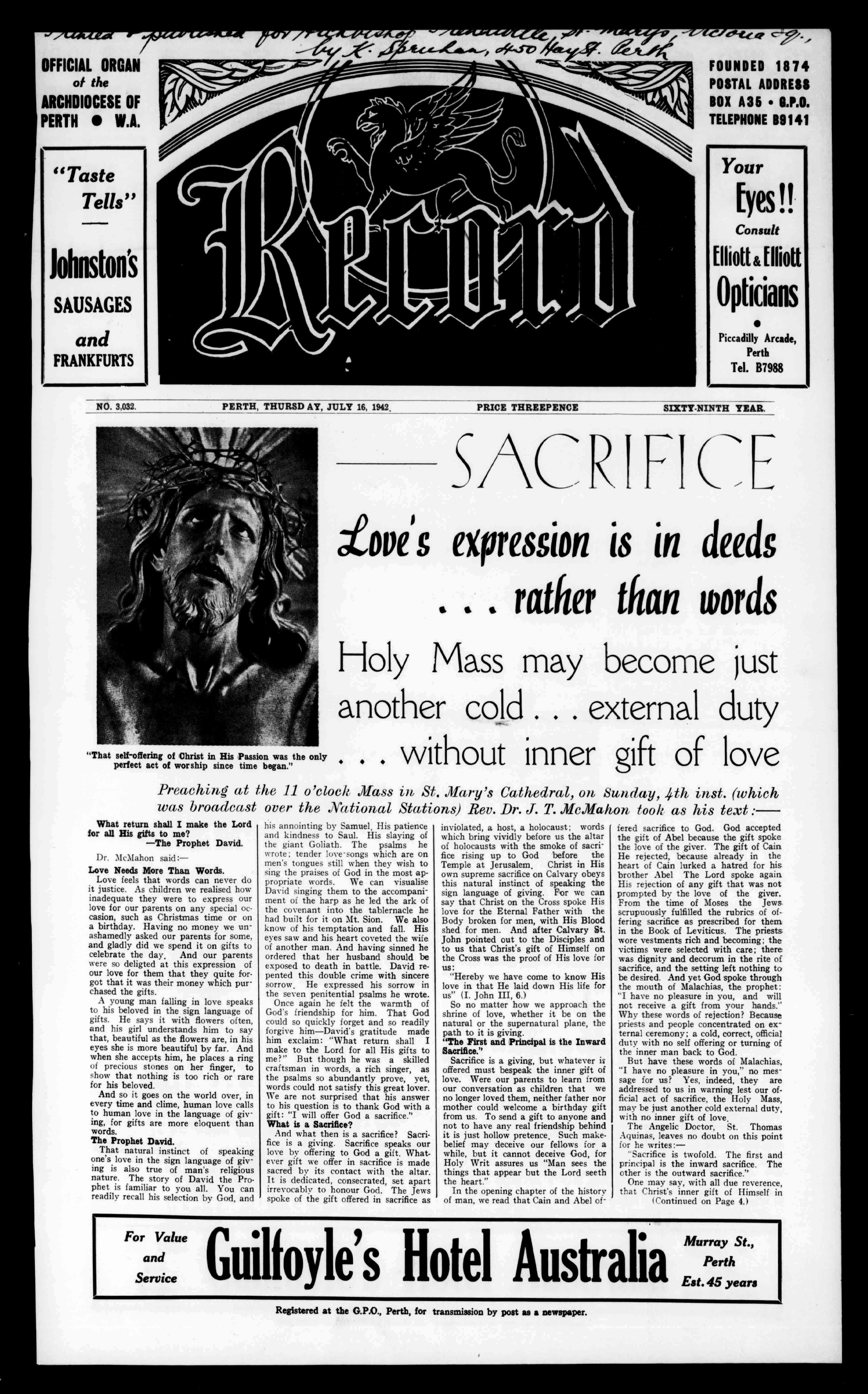
"Thatself-offeringofChristinHisPassionwastheonly perfectactofworshipsincetimebegan."
;Cove'sexpressionisindeeds ...ratherthanwords HolyMassmaybecomejust anothercold externalduty withoutinnergiftoflove
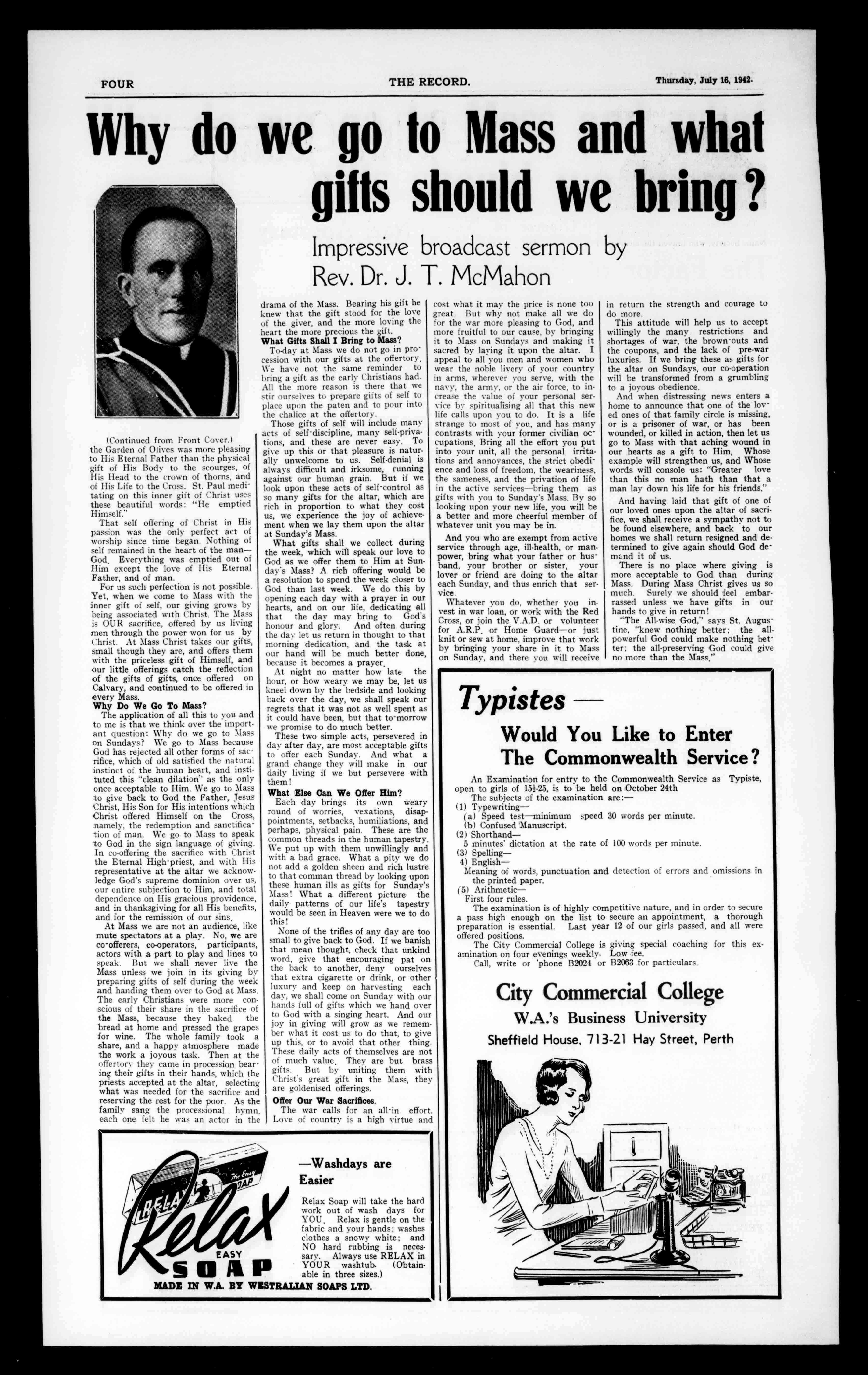
Preachingatthe11o'clockMassinSt.Mary'sCathedral,onSunday,4thinst.(which wasbroadcast WhatreturnshallImaketheLord forallHisgiftstome?
-TheProphetDavid.
Dr.McMahonsaid:LoveNeedsMoreThanWords. Lovefeelsthatwordscanneverdo itjustice.Aschildrenwerealisedhow inadequatetheyweretoexpressour loveforourparentsonanyspecialoccasion,suchasChristmastimeoron abirthday.Havingnomoneyweunashamedlyaskedourparentsforsome, andgladlydidwespenditongiftsto celebratetheday.Andourparents weresodeligtedatthisexpressionof ourloveforthemthattheyquiteforgotthatitwastheirmoneywhichpurchasedthegifts.
Ayoungmanfallinginlovespeaks tohisbelovedinthesignlanguageof gifts.Hesaysitwithflowersoften, andhisgirlunderstandshimtosay that,beautifulastheflowersare,inhis eyessheismorebeautifulbyfar.And whensheacceptshim,heplacesaring ofpreciousstonesonherfinger,to showthatnothingistoorichorrare forhisbeloved.
Andsoitgoesontheworldover,in everytimeandclime,humanlovecalls tohumanloveinthelanguageofgiving,forgiftsaremoreeloquentthan words.
TheProphetDavid. Thatnaturalinstinctofspeaking one'sloveinthesignlanguageofgiv- ingisalsotrueofman'sreligious nature.ThestoryofDavidtheProphetisfamiliartoyouall.Youcan readilyrecallhisselectionbyGod,and
overtheXationalStations)Rev.Dr.J.T.McMahon,tookashistext: hisannointingbySamuel,Hispatience andkindnesstoSaul.Hisslayingof thegiantGoliath.Thepsalmshe wrote;tenderlove-songswhichareon men'stonguesstillwhentheywishto singthepraisesofGodinthemostappropriatewords.Wecanvisualise Davidsingingthemtotheaccompanimentoftheharpasheledthearkof thecovenantintothetablernaclehe hadbuiltforitonMt.Sion.Wealso knowofhistemptationandfall.His eyessawandhisheartcovetedthewife ofanotherman.Andhavingsinnedhe orderedthatherhusbandshouldbe exposedtodeathinbattle.Davidrepentedthisdoublecrimewithsincere sorrow.Heexpressedhissorrowin thesevenpenitentialpsalmshewrote.
Onceagainhefeltthewarmthof God'sfriendshipforhim.ThatGod couldsoquicklyforgetandsoreadily forgivehim-David'sgratitudemade himexclaim:"WhatreturnshallI maketotheLordforallHisgiftsto me?"Butthoughhewasaskilled craftsmaninwords,arichsinger,as thepsalmssoabundantlyprove,yet, wordscouldnotsatisfythisgreatlover. Wearenotsurprisedthathisanswer tohisquestionistothankGodwitha gift:"IwillofferGodasacrifice." WhatisaSacrifice? Andwhatthenisasacrifice?Sacrificeisagiving.Sacrificespeaksour lovebyofferingtoGodagift.Whatevergiftweofferinsacrificeismade sacredbyitscontactwiththealtar. Itisdedicated,consecrated,setapart irrevocablytohonourGod.TheJews spokeofthegiftofferedinsacrificeas
inviolated,ahost,aholocaust;words whichbringvividlybeforeusthealtar ofholocaustswiththesmokeofsacrificerisinguptoGodbeforethe TempleatJerusalem.ChristinHis ownsupremesacrificeonCalvaryobeys thisnaturalinstinctofspeakingthe signlanguageofgiving.Forwecan saythatChristontheCrossspokeHis lovefortheEternalFatherwiththe Bodybrokenformen,withHisBlood shedformen.AndafterCalvarySt. JohnpointedouttotheDisciplesand tousthatChrist'sgiftofHimselfon theCrosswastheproofofHislovefor us:
"HerebywehavecometoknowHis loveinthatHelaiddownHislifefor us"(I.JohnIII,6.)
Sonomatterhowweapproachthe shrineoflove,whetheritbeonthe naturalorthesupernaturalplane,the pathtoitisgiving.
"TheFirstandPrincipalistheInward Sacrifice."
Sacrificeisagiving,butwhateveris offeredmustbespeaktheinnergiftof love.Wereourparentstolearnfrom ourconversationaschildrenthatwe nolongerlovedthem,neitherfathernor mothercouldwelcomeabirthdaygift fromus.Tosendagifttoanyoneand nottohaveanyrealfriendshipbehind itisjusthollowpretence.Suchmake. beliefmaydeceiveourfellowsfora while,butitcannotdeceiveGod,for HolyWritassuresus"Manseesthe thingsthatappearbuttheLordseeth theheart."
Intheopeningchapterofthehistory ofman,wereadthatCainandAbelof-
feredsacrificetoGod.Godaccepted thegiftofAbelbecausethegiftspoke theloveofthegiver.ThegiftofCain Herejected,becausealreadyinthe heartofCainlurkedahatredforhis brotherAbelTheLordspokeagain Hisrejectionofanygiftthatwasnot promptedbytheloveofthegiver. FromthetimeofMosestheJews scrupuouslyfulfilledtherubricsofofferingsacrificeasprescribedforthem intheBookofLeviticus.Thepriests worevestmentsrichandbecoming;the victimswereselectedwithcare;there wasdignityanddecorumintheriteof sacrifice,andthesettingleftnothingto bedesired.AndyetGodspokethrough themouthofMalachias,theprophet: "Ihavenopleasureinyou,andwill notreceiveagiftfromyourhands." Whythesewordsofrejection?Because priestsandpeopleconcentratedonexternalceremony;acold,correct,official dutywithnoselfofferingorturningof theinnermanbacktoGod.
ButhavethesewordsofMalachias, "Ihavenopleasureinyou,"nomessageforus?Yes,indeed,theyare addressedtousinwarninglestourofficialactofsacrifice,theHolyMass, maybejustanothercoldexternalduty, withnoinnergiftoflove.
TheAngelicDoctor,St.Thomas Aquinas,leavesnodoubtonthispoint forhewrites:"Sacrificeistwofold.Thefirstand principalistheinwardsacrifice.The otheristheoutwardsacrifice."
Onemaysay,withallduereverence,thatChrist'sinnergiftofHimselfin (ContinuedonPage4.)
eilor411,/401-7.0 we7//OFFICIALORGAN ofthe ARCHDIOCESEOF PERTH W.A.
3.032. jiFore,Oro,-W or--,e coc(-17 PERTH,THIIRSDAY,JULY16,1942, PRICETHREEPENCE
Johnston's SAUSAGES and FRANKFURTS NO.
/' ettee i FOUNDED1874 POSTALADDRESS BOXA35A.P.O. TELEPHONEB9141 Your Eyes!! Consult LIM&Elliott Opticians PiccadillyArcade, Perth Tel.B7988 SIXTY-NINTHTILE
SACRH
ForValue and Service Guiltoyle'sHotelAustralia MurraySt., Perth Est.45years RegisteredattheG.P.O.,Perth,fortransmissionbypostasanewspaper.
areentitledtominimum wagesupplementedbyfamily endowment.
Churchadmitswage-systeminitselfisJust Australiasetswor1C,exampleon
sectsknown
*CatholicChurchnottobeconfusedwith contradicting
"Awake,"Sydney,N.S.W.
Q.:DoestheChurchadmitthatthe wage-systemisjust?
R.:"chewagesysteminitselfisa justarrangement.Allcan'tbeowners oremployers,anditwouldnotbegood iftheywere.Mostbusinessesarerun profitablyowingtotheexceptional abilityoftheirdirectors;andinsofar asprofitsareduetotheirinvestment oftheirresourceswithconsequent risk,andtotheirunusualeffortsand ability,theyareentitledtosurplusreturnsaboveexpenses.Iftheywere not,fewwouldexertthemselvessufficientlytoproducesuchreturns;labourwouldsufferfromwantofemployment,andofbusinessesableto paydecentwages;andthecommunity wouldlacksuppliesofnecessarygoods. Then,tootherearetypesofemployment,apartfromcommerciallife, whichmakesalaryorwagestheonly feasiblemethodofcompensationfor tieandservices,
AUSTRALIANCONDITIONS.
Q.:Isthewage-systeminAustralia just?
R.:Onthewhole,yes.Theremaybe roomforimprovementshereandthere: and,ofcourse,therewillalwaysbe somediscontentamongstthosewho neverwillbesatisfied,whateverthe provisionmadeforthem.Thefact remains,however,thatAustraliahas setanexampletotheworldonthe subjectofwage-controj.Wewere pioneersintheestablishingofalegal minimumwage,andalleyeswereon Australiatoseehowitworked.In 1912ProfessorM.B.Hammond,an AmericanfromOhio,cametoAustralia tostudyoursysteminordertoreport totheNewYorkFactoryInvestigationCommission.Onhisreturnto Americahereportedthatsweatinghad beenalmosteliminated,strikeshad diminished:theefficiencyofworkers increased;thenumberofworkersunabletoearnthelegalminimumwas notasgreatashadbeenfeared;the legalminimumdidnotbecomethe actualmaximum,manyworkersearningexcesswages;andnoindustry wascrippledthroughbeingobligedto paythelegalminimum.Professor HammondurgedAmericatobaseits factorylegislationontheAustralian -method.
THELIVINGWAGE.
Q.:DoestheChurchinsistonthe wage-earnergettingalivingwage?
R.:Yes.Instrictjustice,thenormalworkerhastherighttoaliving wage.Isaythenormalworker,forallowancemustbemadeforcertainexceptions,whichIwillexplaininafew moments.Inthecaseofthenormal worker,therighttoalivingwage meanstherighttoadecentlivelihood;thatis,notabaresubsistence,
buttherighttoawagethatwillenablehimtolivealifeworthyofa humanbeing.Thereasonforthisis basedonthefactthattheearthis meantforthesupportofthewhole humanrace.Goods,therefore,must besodistributedthatallmembersof thehumanraceranlive,andthosecontrollingthegoodsoftheearthmust
asthe"Churches"
letallgetadecentlivelihood.Those contributingusefullabourintheproductionofgoodsmustbegivensufficientreturninwagestoenablethem topurchaseafairshare.Thewages mustbeadjustedtothis,andnotmade amatterofmerecontract.Economic necessitymightforceworkerstoenter intoanutterlyunjustcontract,work-
Thelegalminimumshouldbesupplement:ibyafamilyendowmentcovering theneedsofalladditionalchildrenundertheschool-leavingage.
AFATALCONFUSION
Q.:HowcanChristianleadersofall Churches,Catholicandnon-Catholic, expecttheaveragepersontoknow whattobelieve,orwhomtobelieve?
R.:Theroot-causeofyourdifficulty herereappears.Youinsistonranking theCatholicChurchwithallthosesects cutofffromher,andsodiversified amongstthemselves;andthenargue fromtheircontradictionsagainstthe truthofChristianity.YoumustrememberthattheCatholicChurch,in itsworldextent,outnumbersallProtestantsectstakentogether.Andthe doctrinalcontradictionsflourishing amongstProtestantseveninthesame countr:-donotexistintheCatholic Churchdespitethefactthathermembersbelongtoallcountries.Moreover, ifyouareshockedbythediversities amongstProtestants,youshouldbe themoreimpressedbytheunityofthe faithamongstCatholics. Butyou won'tletyourselfseetheCatholic
Churchasdistinctfromthehostof non-CatholicChurches,andasdifferNitinkind.Untilyoudoseethis, thereisnowayoutofthetanglein whichyourthoughtsareimprisoned.
TRUTHONE,ERRORSDIVERSE.
Q.:TheSalvationArmywouldtell meonething;Dr.Angusanother theArchbishopofCanterburysomethingelse.andthePopesomething differentagain.
R.:Iftenpeoplesaidtendifferent thingsconcerningthesamesubject, andoneofthetenwasright,theother ninewouldbewrong.Theothernine, therefore,wouldnecessarilydifferfrom theonewhowasright.andyoucould notarguefromthatdifferencethatthe onewhowasrightmustbewrong also!Ifthosewhowerewrongdid notdifferfromhim,hewouldnotbe rightatall.Now,allthevarietiesof Protestantismdifferamongstthemselves,andalldifferfromtheCatho-
ingforwagessoinadequatethatthey sufferrealhardship.Insuchacase theemployerwouldnotbefreefrom rankinjustice.Anemployerisnot merelyareceiverofservicefromemployees;heisadistributorofthe commonheritageofnature.Andhis isnotmerelyacontractualduty;itis asocialduty, Apartfromthenormalworker, specialprovisionmusthemadefor lesscompetentpeoplewhoseservices arenotproportionatetothelegal wage.Ifpermitsaregrantedfortheir employmentatlessthanthelegal wage,otherprovisioneitherbythe Government,orbyvoluntaryorgani sations,mustbemadetosupplement theirinadequatewagesandguarantee tothemalsoadecentlivelihood.
* * * *
THEFAMILYWAGE.
Q.:Doesalivingwagemeanafamily wage?
R.:Yes.Forthenormalprovision foranadultmaleincludesprovision forawifeandchildren.Familylife isessentialtothenormalexistenceof theaverageman.Tomaintaina familyis,then,asnecessaryasto maintainhimself,Iftheadultwage wouldnotenableaworkertosupport awifeandfamily,noworkerdependententirelyonthatwagewouldbe justifiedingettingmarried.Thelegal minimumwageforanadultmale, therefore,shouldcovertheneedsofa man,wifeandtwoorthreechildren. Andthisshouldbesupplementedbya familyendowmentcoveringtheneeds ofalladditionalchildrenunderthe school-leavingage.
licChurch.ButtheCatholicChurch inherselfisunitedandconsistent, thoughsheoutnumbersallthesectsdividedfromher,andconsistsofpeople drawnfromallnations-peoplewho probablydifferonalmosteverything elsesavereligion.AndImightadd thatreligionisoneofthemostdifficultthingsofalluponwhichtoget peopletoagree.YoushouldaskyourselfhowtheCatholicChurchdoesit: andIdon'tthinkyouwillfindthatany merelyhumanandnaturalfactorscan accountforit. * * * *
CATHOLICCONSISTENCY.
Q.:AllwouldtellthisGod'screature adifferentandoppositeversionon howtoworshipHim?
R.:Thatimpressionarisesfromyour confusingtheCatholicandnon-CatholicChurchesasiftheywereallequally accreditedrepresentativesoftheChristianreligion.ThattheCatholic
TWO THERECORD. Thursday,July16,1942. adioeplies THEOLOGY -HISTORY TOPICAL111ESTIONS PHILOSOPHY - SOCIALJUSTICE- APOLOGETICS BYREV.DR.RUMBLE,M.S.C.
11111 11111 11111 1-
AG
Workers
111
Churchdenies,Andifyouconsider herinherself,youwillfindthatthe verythingofwhichyoucomplainis conspicuousbyitsabsence,sofaras sheisconcerned.GotoanyCatholic priestinSydney,NewYork,London, Berlin,Paris,Capetown,Tokio,Madrid,orinanysectionofEuropeAsia, Africa,AmericaorOceania,andevery oneofthosepriestswilltellyouexactlythesamethingastohowyou aretoworshipGod.Abstractingfrcm allotherChurches,studythecreden-
tialsoftheCatholicChurchinherself. Hercharacteristicsarestrkingenough towarrantsuchspecialstudy.Youdo notneedremindingthat,ifsheis, indeed,theOneTrueChurch,itisnot surprisingthatallothersdifferfrom her,anddifferamongstthemselves. Fortruthpreservesunity,buterror leadstodiversity.Now,yourletter broachesanothersubject,soIwill callahaltforthepresent,andresume theanalysisofyourletternextSunday night.
TheFactorofReligion
"Sceptic,"Bexley:
Q.:Doyouattributethepresentdisastrousconditionsoftheworldto religion?
R.:No.Iattributeitingreatpart tothelackofreligion.Andthemen, orthegroups,whoarechieflyresponsibleforpresentdisasters,have felttheneedtoabandonreligion,and eventodoalltheycantodestroyit. Theremedyfortheworldisareturn toGod.
Q.Doyouthinkitpossibletobring wholenationsbacktoreligion?
R.:Notsuddenly,andasnations. NationscanrepentandreturntoGod onlythroughtheirindividualmembers.Thesightofthenationalneed should,however,makeeachmanrealisehisownneed.IfthenationscannotgetonwithoutGod,neithercan theindividuals.TheobligationtoreturntoGodandtothetruereligion fallsprimarily,therefore,uponeachindividual.Thenationswillreturnto GodastheirindividualmembersreturntoGod.
* * * *
THELINETOTAKE.
Q.:What,briefly,isthereligiouspositionyousuggestthatmenshould adopt?
R. 1 suggestthattheyshouldtake uptheChristianreligioninearnest,be-
lievingallthatitteaches,andfulfilling allthedutiesitprescribes.
Godcreatedman,andofferedhima destinyofperfecteternalunionwith Himselfinheaven.ButGodcreated manfree,andthiseternaldestinyhad tobefreelychosen.Becausemanwas free,itwaspossiblenottochooseit, And,asamatteroffact,manrefused tochooseit.HepreferredtobeindependentofGod,andtobehaveasif hewereself-sufficient.Thatmeantsin, aseriousrebellionagainstGod'swill. Theresulthasbeenaseriesofdisastersformanrightthroughhistory,to teachmanthathecannotfindhappinessapartfromGod.
Meantime,torestorethepossibility ofman'seternaldestiny,GodsentHis ownSonintothisworldunderthe nameofJesusChrist.Jesusdiedon Calvary,expiatingoursins,androse fromthedead,offeringtoallwho unitethemselveswithHimbyfaith, loveandobedience,thepowertorise toanewlifeinthisworld,andtoattaineternalhappinessinthenext. ThoseunitedtoHim,Heunites amongstthemselvesintheChurchHe established:andthatChurchisthe CatholicChurch.Thosewhodesire theChristianreligioninitsfullness, therefore,shouldstudytheteachings oftheCatholicChurch,embracethe CatholicFaith,andtrytoliveuptoall itsobligations.
AnAmusedListener
L.M.B.,Bankstown:
Q.:IlistentoyourQuestionBoxsessionwithgreatinterest.
R.:Ihopethatyourinterestwillcontinue,andthatyouwillsomedayattaintobetterdispositionsthanthose manifestedbyyourletter.
Q.:ItamusesmebecauseIfindyour answerssodistortedtosuityourown particularpurpose.
R.:Werethattrue,noright.minded personcouldfinditasourceofamusement.Ifyoulovetruthatall,theimpressionyouhaveformedinyourown mindshouldoccasiononlydeepregret.
CHARGEOFDISTORTION.
Q.:Ilistenedtoonequestioninparticular,whichdealtwiththesubject ofmixedmarriages.
R.:Atleast,youwillnotaccuseme ofdistortingtherepliesIgaveonthat occasion.Iknewquitewellthatthe repliesIgavewouldnotappealto manyofmynon-Catholiclisteners.It ismypurposetoexplaintheCatholic religiontothem,andifatallpossible towintheirsympatheticinterestinit. ButitispreciselybecauseIwillnot attempttowinsuchinterestattheexpenseoftruththatIexplainfrankly andsincerelywhatIknowtobeunpopulardoctrines,whenrequestedtodo so.Andyouyourselfhaveaccepted implicitlytheexplanationtowhich youobject,withoutdreamingthatI wasdistortingthingsonthatoccasion. Thetruthisthatunfriendlylisteners accusemeofdistortingthingswhenever itsuitstheirpurposetodoso.Andit suitstheirpurposetodosowhenever anyofmyrepliesappearstoberight. Theybeginwiththeassumptionthata Catholiccan'tberight.Ifheseems toberight,thenhemustbedistorting things,andisguiltyofduplicity.If heisnotafool,hemustbeaknave. However,letusturntoyourenquiry aboutmixedmarriages.
14141444141414144114414.4141444141.014141.1H140444441
AirRaidIndoorShelters,thebest andsafest.Only72/6.Hundredssold. HASSELL'S,559WellingtonSt.Tel. B6307.
CLAREMONTRADIOAND ELECTRICALSERVICE, 118STIRLINGHIGHWAY, CLAREMONT. PhoneF3068.
INSTALLATIONANDREPAIRSTO ANYTHINGELECTRICAL.
RADIOSALES-GASHORTERMS
TheApocalypse
"Enquirer,"Sydney: Q.:Wouldyou,please,explainbriefly, withwhattheApocalypsehastodo? R.:TheApocalypseisthelastBook intheNewTestament,andintheProtestantBibleisentitled,"Revelation.' ItwaswrittenbySt.JohntheApostle intheIslandofPatmos,aboutthe year96A.D.TheBookisadescriptionofvisionsgrantedbyGodtoSt. John,anditisoneofthemostdifficult ofallBooksintheBibletointerpret. AsSt.Johnwasgivenaspiritualand supernaturalsightofthingswhichcould
notbeadequatelydescribedinhuman language,onewouldalmosthavetobe liftedtothesamelevelinordertounderstandit.ThroughouttheBookmuch useismadeofsymbolism;andmuch ofitisprophetic.Ingeneral,itdeals withthreethings.Itisawarningto theChristiansofSt.John'sowntime againstinfidelityandlaxity.Itdescribestheconstantwarfarewithevil thatwillbethelotoftheChurch,And itpredictstheultimatetriumphof ChristandtheChurchagainstalladverseforces.
OurCatholicSchoolsandColleges
CHRISTIANBROTHERS,MT.HENRY
OneoftheAssociatedPublic SchoolsofW..4.
AquinasCollege
TELEPHONE:MU1520
ForBoardersandDayStudents
Boysadmittedfrom7upwards
BeautifullySituated,overlookingMeriver,nearthenewCanningBridge. ForParticularsapplytoThePrincipal,AquinasCollege,CanningParade,Mt.Henry.
SACREDHEARTHIGHSCHOOL HIGHGATE-PERTH
(ConductedbySistersNotreDameDesMissions). BOARDINGANDDAYSCHOOLFORGIRLS.
PUPILSPREPAREDALLEXAMINATIONS. MONTESSORISCHOOLFORYOUNGCHILDREN ForProspectusapply'Phone:B3810. REV.MOTHERPRIORESS
ECCLESIASTICALLAWS.
Q.:YousaythattheChurchauthorities,whoformulatesuchlaws,will notpermitmixedmarriagestobe celebratedbeforethealtar.
R.:Isaidthatnormallytheyrefuse toallowmixedmarriagestotakeplace insuchaway.
Q.:Yet,repeatedly,nightafternight, yousaythattheCatholicChurch wassetupbyGod. R.:Ido.Iinsistthat,accordingto SacredScripture,JesusChristmustbe acceptedasGod,andthatHeestablished,commissioned,andguaranteed oneChurchasHisown.Ialsoinsist that,accordingtoScripture,history, andlogic,thatChurchistheCatholic Church.TheCatholicChurch,therefore,isthetrueChurchofGod.
THEIRDIVINEAUTHORITY.
Q.:Byyourownadmission,therefore, certainlawsoftheChurcharemanmade.Iwouldbepleasedtohear yourexplanationofthat.
R.:Theexplanationisnotveryprofound.AlthoughtheCatholicChurch isofGod,itdoesnotfollowthatGod mustpersonallyandimmediatelydictateallthelawsoftheChurch throughoutallthecenturiesofexistence.WhenOurLordestablishedthe CatholicChurch,andsentittoteach allnationsuntiltheendoftheworld, Hetookcaretogiveitthepowerto legislateinHisname,accordingtoall futurecircumstancesandneeds.Thus, HesaidtotheApostles,"Iwillbuild MyChurch."Andasthecareofthe Churchwastobeentrustedtothem, Hesaidtothem,"Whatsoeveryoubind onearthisboundinheaven;"and, again,"Hethathearethyouheareth Me;andhethatdespisethyou,despis- ethMe."Inotherwords,HedelegatedHisownauthoritytothem,and throughthemtotheChurch.God, therefore,exercisesHisdivineauthoritythroughtheChurch.Andthose lawsoftheChurchmadebylawfully constitutedecclesiasticalauthoritiesin any.givenage,havenotonlyhuman, butdivine,authority.Surelyyouwill notdenythatGodcanexerciseHisauthorityeitherimmediately,orthrough chosenhumanagents,justasearthly kingscandosoeitherpersonally,or throughchosenambassadors.There isnotraceofcontradictionbetween theassertionsthatcertainlawsareformulatedbytheChurchauthorities,and thatthoselawsareofGod.ForGod sanctionsthelawswhichresultwhen theChurchexercisestheauthorityHe gaveher.
LoretoConvent"Osborne"-Claremont BOARDINGANDDAYCOLLEGE.
TheSchoolprovidesasoundeducationonmodernlinesinallbranches ofstudy.Thepupilsarepreparedforallexaminations.TheSchoolis beautifullysituatedbetweenOceanandRiver,inextensivegrounds, withfineplayingfieldsandprivate'wimmingPoolinRiver. Telephone:F2135. Apply- MOTHERSUPERIOR.
ST.ILDEPHONSUS'COLLEGE
NEWNORCIA
CONDUCTEDBYTHEMARISTBROTHERS.
ForParticularsApplyto-THEBROTHERDIRECTOR
BartlettoStudio
ViceRegalPhotographers. NOTENEWAI,I,RES TRINITYBUILDINGS,HAYSTREET(Centre) (TakeLiftfromTrinityArcade).
FORHIGHSTANDARDPORTRAITURE. NIGHTORDAYWEDDINGSASPECIALTY. MakeYourAppointment. 'Phone:B3851.
ROSENSTAMMPTY.LTD.
61,63and65KINGST.,PERTH
TheLeadingLeatherMerchant
WESUPPLYANYTHINGINLEATHER
SaddleryandHarness,SuitCases,Etc.SuedeSkinsforFancyWork SOLEAGENTSFORDr.Scholl'sFootAppliances."Salvitis"StockRemedies,forHorses,Cattle Sheep,Pigs,Poultry,Dogs.FreeBookletonApplication WERESTRINGTENNISRACQUETS
PatroniseOurAdvertisers
Thursday,July16,1942. THERECORD. THREE
WhydowegotoMassandwhat giftsshouldwebring
Impressivebroadcastsermon
Rev.Dr.J.T.Mcvlahon
dramaoftheMass.Bearinghisgifthe knewthatthegiftstoodforthelove ofthegiver,andthemorelovingthe heartthemorepreciousthegift.
WhatGiftsShallIBringtoMass?
To-dayatMasswedonotgoinprocessionwithourgiftsattheoffertory. Wehavenotthesamereminderto bringagiftastheearlyChristianshad.
Allthemorereasonistherethatwe stirourselvestopreparegiftsofselfto placeuponthepatenandtopourinto thechaliceattheoffertory.
(ContinuedfromFrontCover.) theGardenofOliveswasmorepleasing toHisEternalFatherthanthephysical giftofHisBodytothescourges,of HisHeadtothecrownofthorns,and ofHisLifetotheCross.St.PaulmeditatingonthisinnergiftofChristuses thesebeautifulwords:"Heemptied Himself."
ThatselfofferingofChristinHis passionwastheonlyperfectactof worshipsincetimebegan.Nothingof selfremainedintheheartofthemanGod,Everythingwasemptiedoutof HimexcepttheloveofHisEternal Father,andofman.
Forussuchperfectionisnotpossible. Yet,whenwecometoMasswiththe innergiftofself,ourgivinggrowsby beingassociatedwithChrist.TheMass isOURsacrifice,offeredbyusliving menthroughthepowerwonforusby Christ.AtMassChristtakesourgifts, smallthoughtheyare,andoffersthem withthepricelessgiftofHimself,and ourlittleofferingscatchthereflection ofthegiftsofgifts,onceofferedon Calvary,andcontinuedtobeofferedin everyMass.
WhyDoWeGoToMass?
Theapplicationofallthistoyouand tomeisthatwethinkovertheimport. antquestion:WhydowegotoMass onSundays?WegotoMassbecause Godhasrejectedallotherformsofsacrifice,whichofoldsatisfiedthenatural instinctofthehumanheart,andinstitutedthis"cleandilation"astheonly onceacceptabletoHim.WegotoMass togivebacktoGodtheFather,Jesus Christ,HisSonforHisintentionswhich ChristofferedHimselfontheCross, namely,theredemptionandsanctificationofman.WegotoMasstospeak toGodinthesignlanguageofgiving. Inco-offeringthesacrificewithChrist theEternalHigh-priest,andwithHis representativeatthealtarweacknowledgeGod'ssupremedominionoverus, ourentiresubjectiontoHim,andtotal dependenceonHisgraciousprovidence, andinthanksgivingforallHisbenefits, andfortheremissionofoursins.
AtMasswearenotanaudience,like mutespectatorsataplay.No,weare co-offerers,co-operators,participants, actorswithaparttoplayandlinesto speak.Butweshallneverlivethe Massunlesswejoininitsgivingby preparinggiftsofselfduringtheweek andhandingthemovertoGodatMass. TheearlyChristiansweremoreconsciousoftheirshareinthesacrificeof theMass,becausetheybakedthe breadathomeandpressedthegrapes forwine.Thewholefamilytooka share,andahappyatmospheremade theworkajoyoustask.Thenatthe offertorytheycameinprocessionbearingtheirgiftsintheirhands,whichthe priestsacceptedatthealtar,selecting whatwasneededforthesacrificeand reservingtherestforthepoor.Asthe familysangtheprocessionalhymn, eachonefelthewasanactorinthe
Thosegiftsofselfwillincludemany actsofself-discipline,manyself-privations,andthesearenevereasy.To giveupthisorthatpleasureisnaturallyunwelcometous.Self-denialis alwaysdifficultandirksome,running againstourhumangrain.Butifwe lookupontheseactsofself-controlas somanygiftsforthealtar,whichare richinproportiontowhattheycost us,weexperiencethejoyofachievementwhenwelaythemuponthealtar atSunday'sMass.
Whatgiftsshallwecollectduring theweek,whichwillspeakourloveto GodasweofferthemtoHimatSunday'sMass?Arichofferingwouldbe aresolutiontospendtheweekcloserto Godthanlastweek.Wedothisby openingeachdaywithaprayerinour hearts,andonourlife,dedicatingall thatthedaymaybringtoGod's honourandglory.Andoftenduring thedayletusreturninthoughttothat morningdedication,andthetaskat ourhandwillbemuchbetterdone, becauseitbecomesaprayer,
Atnightnomatterhowlatethe hour,orhowwearywemaybe,letus kneeldownbythebedsideandlooking backovertheday,weshallspeakour regretsthatitwasnotaswellspentas itcouldhavebeen,butthatto-morrow wepromisetodomuchbetter.
Thesetwosimpleacts,perseveredin dayafterday,aremostacceptablegifts tooffereachSunday.Andwhata grandchangetheywillmakeinour dailylivingifwebutperseverewith them!
WhatElseCanWeOfferHim?
Eachdaybringsitsownwearyroundofworries,vexations,disappointments,setbacks,humiliations,and perhaps,physicalpain.Thesearethe commonthreadsinthehumantapestry. Weputupwiththemunwillinglyand withabadgrace.Whatapitywedo notaddagoldensheenandrichlustre tothatcommanthreadbylookingupon thesehumanillsasgiftsforSunday's Mass!Whatadifferentpicturethe dailypatternsofourlife'stapestry wouldbeseeninHeavenwerewetodo this!
Noneofthetriflesofanydayaretoo smalltogivebacktoGod.Ifwebanish thatmeanthought,checkthatunkind word,givethatencouragingpaton thebacktoanother,denyourselves thatextracigaretteordrink,orother luxuryandkeeponharvestingeach day,weshallcomeonSundaywithour handsfullofgiftswhichwehandover toGodwithasingingheart.Andour joyingivingwillgrowaswerememberwhatitcostustodothat,togive upthis,ortoavoidthatotherthing. Thesedailyactsofthemselvesarenot ofmuchvalue.Theyarebutbrass gifts.Butbyunitingthemwith Christ'sgreatgiftintheMass,they aregoldenisedofferings. OfferOurWarSacrifices.
Thewarcallsforanall-ineffort. Loveofcountryisahighvirtueand
-Washdaysare Easier
RelaxSoapwilltakethehard workoutofwashdaysfor YOU,Relaxisgentleonthe fabricandyourhands;washes clothesasnowywhite;and NOhardrubbingisneces EASY sary.AlwaysuseRELAXin YOURwashtub.(Obtainableinthreesizes.)
costwhatitmaythepriceisnonetoo great.Butwhynotmakeallwedo forthewarmorepleasingtoGod,and morefruitfultoourcause,bybringing ittoMassonSundaysandmakingit sacredbylayingituponthealtar.I appealtoallyoumenandwomenwho wearthenobleliveryofyourcountry inarms,whereveryouserve,withthe navy,thearmy,ortheairforce,toincreasethevalueofyourpersonalservicebyspiritualisingallthatthisnew lifecallsuponyoutodo.Itisalife strangetomostofyou,andhasmany contrastswithyourformercivilianoccupations.Bringalltheeffortyouput intoyourunit,allthepersonalirritationsandannoyances,thestrictobedienceandlossoffreedom,theweariness, thesameness,andtheprivationoflife intheactiveservices-bringthemas giftswithyoutoSunday'sMass.Byso lookinguponyournewlife,youwillbe abetterandmorecheerfulmemberof whateverunityoumaybein.
Andyouwhoareexemptfromactive servicethroughage,ill-health,ormanpower,bringwhatyourfatherorhusband,yourbrotherorsister,your loverorfriendaredoingtothealtar eachSunday,andthusenrichthatservice.
Whateveryoudo,whetheryouinvestinwarloan,orworkwiththeRed Cross,orjointheV.A.D.orvolunteer forA.R.P.orHomeGuard-orjust knitorsewathome,improvethatwork bybringingyourshareinittoMass onSunday,andthereYouwillreceive
inreturnthestrengthandcourageto domore.
Thisattitudewillhelpustoaccept willinglythemanyrestrictionsand shortagesofwar,thebrown-outsand thecoupons,andthelackofpre-war luxuries.Ifwebringtheseasgiftsfor thealtaronSundays,ourco-operation willbetransformedfromagrumbling toajoyousobedience.
Andwhendistressingnewsentersa hometoannouncethatoneofthelovedonesofthatfamilycircleismissing, orisaprisonerofwar,orhasbeen wounded,orkilledinaction,thenletus gotoMasswiththatachingwoundin ourheartsasagifttoHim,Whose examplewillstrengthenus,andWhose wordswillconsoleus:"Greaterlove thanthisnomanhaththanthata manlaydownhislifeforhisfriends."
Andhavinglaidthatgiftofoneof ourlovedonesuponthealtarofsacrifice,weshallreceiveasympathynotto befoundelsewhere,andbacktoour homesweshallreturnresignedanddeterminedtogiveagainshouldGoddemenditofus. Thereisnoplacewheregivingis moreacceptabletoGodthanduring Mass.DuringMassChristgivesusso much.Surelyweshouldfeelembarrassedunlesswehavegiftsinour handstogiveinreturn!
"TheAll-wiseGod,"saysSt.Augustine,"knewnothingbetter;theallpowerfulGodcouldmakenothingbetter;theall-preservingGodcouldgive nomorethantheMass,"
Typistes WouldYouLiketoEnter TheCommonwealthService?
(1)Typewriting-
(a)Speedtest-minimumspeed30wordsperminute.
(b)ConfusedManuscript.
(2)Shorthand5minutes'dictationattherateof100wordsperminute.
(3)Spelling4)EnglishMeaningofwords,punctuationanddetectionoferrorsandomissionsin theprintedpaper.
(5)ArithmeticFirstfourrules. Theexaminationisofhighlycompetitivenature,andinordertosecure apasshighenoughonthelisttosecureanappointment,athorough preparationisessential.Lastyear12ofourgirlspassed,andallwere offeredpositions.
TheCityCommercialCollegeisgivingspecialcoachingforthisexaminationonfoureveningsweekly.Lowfee. Call,writeor'phoneB2024orB2063forparticulars.
CityCommercialCollege
W.A.'sBusinessUniversity
SheffieldHouse,713-21HayStreet,Perth
FOUR THERECORD. Thursday,July16,1942.
MADEINW.A.BYWESTRALIAN
SOAPSLTD.
by
AnExaminationforentrytotheCommonwealthServiceasTypiste, opentogirlsof1M-25,istobeheldonOctober24th
oftheexamination
Thesubjects
are:-
Thespiritualdirectorhasreasonto beproudofthemembersoftheHoly NameSociety,whobravedtheelements onSundaylasttobepresentinsuch numbers,morningandevening. Althoughthevirileyoungmembers aremissing,theirfathersandyoung brothersaredoingtheirbesttohold theranksuntilbetterdaysenabletheir returnfromactiveservice.Theusual meetingwasheldintheevening,and Mr.FrankWalshdeliveredareally splendidlectureon"EarlyDaysinthe North-West."Thiswasbasedmostly onincidentsofwhichhehasapersonalknowledge.
CongratulationstoMissElaineFor kin,onbeingchosenQueenofSportsmenandL.V.AssociationintheforthcomingQueenCarnivalinaidofpatrioticfunds.Hercommitteeisalready workinghardforherreturn.
Theinclemencyoftheweatherhas causedthepostponementofserioustennisoflate,buttheenthusiasticpatrons ofthegamearenotlosinginterest,but eagerlyawaitingtheendoftherainy season. ItisgoodtoseesomanyCatholic womentakingtheirplacesinthevariaispatrioticandsocialorganisations ofthedistrict.Theyarerepresented onRedCross,VoluntaryAidDivision, A.R.P.,etc.,andalsotakepartinthe CountryWomen'sAssociationactivities.Allaredoinggoodwork.A pleasingsightoflatemonthshasbeen anumberofladiespresenttogetherin uniformatBenedictiononanoccasionalSundayevening.
ChildrenofMaryareremindedthat theyareexpectedtobepresent,morningandevening,onSunday,July19. Themonthlymeetingwillfolloweveningdevotions.
ThenextmeetingoftheH.A.C.B.S. willbeheldonMonday,July20,atthe ParishHall.
St.Mary'sImprovementFundPrize Packetstartedwithagreatflourish thisweek,buttherearestill ofvacancies'forlate-comers.These cancontactMr.Russellandothercollectorsatthedoorofthechurchevery Sunday.
Mr.OwenHanlonrecentlypaida visittoPerthforthepurposeofseeing hisbrother,whowasseriouslyill. MissCarmelRyallvisitedhermother attheweek-end,Sheisnowabusy Sister,stationedsomewherenearthe coast.
TheTuckShoporganisedbythe ParentsandFriends'Association,under thedirectionofMesdamesWhiteside andAnderton,washeldonWednesday lastandprovedextremelypopular withthechildrenandwasverysuccessfulfinancially.
PRAYERTOTHESACRED HEART.
(WrittenbyEamondeValera,whilein prison.)
0SacredHeart,onrheartsarewholl Thine, AlthoughwecomenotnowbeforeThy Shrine. Underheaven'svaultwekneeland pray, Fromhomeandfriendshipfaraway: OSacredHeart!Thouhasknownthe prisoncell: ThepangsofhungerThouhasknown aswell, Thesoldiers'rudeassaulthastornThy Frame, TheirribaldspeechprofanedThyholy Name. Thedoomofdeathhaspassedupon ThyHeart. Amother'stearswereshedasThou didstpart.
Ah,motherdear!forthesakeofThy dearSon, Bewithustillthedayoflifeisdone, InloveandmercybringustoHis feet, TosingHispraiseandthineinaccentssweet: 0SacredHeart!grantusThypainsto share, Inpenanceforoursinstomakerepair, HelpusinpatiencetoembraceThy will, AndfollowinThyfootstepstothe hill.
Diocese0fNew orcaa
RELIGIOUSPROFESSIONOF BENEDICTINESISTERS.
ThechapeloftheBenedictineSisters atNewNorciawasthesceneofabeau tifulceremonyonthemorningofthe 2nd.inst.-FeastoftheVisitationof OmBlessedLady.
DuringHolyMass,celebratedbyHis LordshiptheAbbot(RightRev.A. Catalan.0.S.B.),fouryoungBenedictineSisterstooktheirFinalVows.
TheirProfessionwasreceivedbyHis LordshiptheAbbot,whowasassisted bythreeBenedictinemonksofhisCommunity, Thenativegirls-inmatesofSt.Joseph'sOrphanage-followedwithkeen interestthisrarefunction,whichwas asimpressiveasitwaslengthy.The ritualobservedwasexactlytheancient MonasticRitual,thoughnotinitsentirety,andprovedmostinspiringand devotional.ItbeganaftertheGraduale,withtheinvitationbytheofficiatingprelatetotheSisterstoapproach thealtar.Theirpromisetokeeptheir virginityforeverwasfollowedbya clearanddecidedreadingoftheformulaofPerpetualProfession.Then cametheblessingandtheimposition ofthecloak,thering,andthecrown ofroses.
Appropriateprayersandinvocations preceded,accompaniedandfollowed eachimposition,andwereinterspersed withopportunechantswhichaddedcolourtotheceremony.
BeforeproceedingwiththeMaas,His Lordshipdeliveredashortaddress highlysuitedtotheoccasion.
AttheOffertorythenewlyprofessed Sistersofferedlightedcandlestothe prelate,andlaterreceivedHolyCommunionfromhishands.
JustbeforethelastGospel,thenewly professedwereimpartedaspecialblessing,andthiswasimmediatelyfollowed bythehandingovertothemofthe Diurnum,orBookoftheSmallHours iftheDivineOffice,accordingtothe MonasticRite,whichtheSistersrecite everydayinadditiontotheirmany otherdailytasks.
AfterthelastGospeltheofficiating PrelateintonedtheTeDeum,which wassungincorrectGregorianbythe nativegirls,Afinalinvocationand prayerclosedthisbeautifulfunction.
Thenamesofthenewly-professedare:
SisterMary,0.S.B.,SisterLiduyina, 0.S.B..SisterMagdalene,0.S.B.,and SisterPlacid,O.S.B. TheseSisterscamefromtheirnative Spainseveralyearsago,todevotetheir livestothenobleworkoftheMissions.
Forthispurposetheyjoinedthe Dio. cesancongregationofRegularBene-dictineOblateSistersofNewNorcia.
TohelptheMissionsintheirmanifoldactivities,especiallyinthecare andeducationofnativechildren,isthe objectofthisCongregation. St.Joseph'sOrphanagefornative girlsatNewNorciaisundertheirvery efficientandsuccessfuldirection,whilst theirworkattheBenedictineMission ofDrysdaleRiver,intheNorthofWest Australia,isaveritableboontothe BenedictineFathers.
BothatNewNorciaandattheDrysdaleMissionthereisamplescopeforthe zealofmoreofthesedevotedSisters.
"Theharvestisgreat,butthelabourersarefew."Themostferventprayer ofthenewly-professedSistersontheir Professiondaywasforthearrivalof morelabourers,notpreciselyfromtheir nativeSpain,butfromtheiradopted country,Australia.
TheportalsoftheirconventatNew NorciaisopentoourAustralianyoung ladieswhofeelanattractionforthis kindandworkandpossessthenecessaryqualifications.
Baths,Enamel.£715s.;Cement,45s. Paints,Hardware,TimberforShelters, cheaperatHASSELL'S,559Welling. tonSt.Tel.B6307.
LEWISandSONSBakers PROCERA,VIENNA,CREMALT,HEALTH,CURRANT. ALLTYPESOFFANCYBRLA1)SANDROLLS. DualCupWinners.RoyalShow,1938. Bakery:McMASTERSTREET,VICTORIAPARK. 'Phone.M1379.
NaziApostasyPlotBaredby GermanPrelate
Washington,April10(NC,
Aconsistenteffortonthepartof Naziauthorities,bymisleadingslogans, byoutrageousoppressionofthe Churchandbythethreatofdischargingindividualsfromtheirpositions,to forceGermanChristians,Catholicand Protestant,torenouncetheirfaith,is revealedinadocumentwhichhasbecomeavailableinthiscountry.
ThedocumentisthetextofasermondeliveredatNewYear'sEveservicesintheMunichCathedralbyHis Eminence,MichaelCardinalvonFaulhaber,ArchbishopofMunichand Freising,onDecember31,1941.In thatsermon,entitled"Leavethe Church?ThriceNo!"CardinalFaulhabergavehispeopleathreefoldanswertothequestion:"Willyouleave theChurch?"reviewedthepersistent oppressivemeasuresofthepreceding year,andpredictedanevenmoreintensecampaignofpressureforapostasyduring1942. NewDemandsForeseen.
"Inthepastyearthewaragainstthe Churchhasculminatedinthedemand toleavetheChurch,"hedeclared. "Clearindicationsgivepromisethatin thenewyearthisdemandwillbemade withrenewedemphasisandthatthe question,'WillyouleavetheChurchor willyouresignyourposition?'willbe raisedagain,louderthanbefore," Drawingasharpcontrastbetween thepeacefulrelationsreigningamong thevariousChristianconfessionsin Germanyandthe"saddestofallwars, thewaragainsttheChurch,"HisEminencesaid,withechoesoflastsummer'sFuldapastoralofalltheGerman Bishops,thattheChristianconfessions "knowthatitisaquestionnowofthe veryexistenceorannihilation"ofCatholicismandProtestantismalike.
WhileCatholicsoldiersatthefront "standshouldertoshoulderwithother Germanmen,"andCatholicsathome shareineverywarsacrifice,"stillthe Churchathomeistreatedwithconstantdistrust,isspiedupon,andop-pressedbyexceptionalrestrictions,and buildingsbelongingtotheChurchand toReligiousareconfiscatedonafar largerscalethanprivateones,"His Eminencedeclared. Afterscoringsomeoftheinsidious and"satanic"slogansandcatch
phrasestossedaboutbyNaziofficialdomtoinduceCatholicstoapostatise, CardinalFaulhaberwentontoreview theoppressivemeasuresthathave beenbroughttobearagainstthe Church.
BarredFromSchools.
Statingthatthefirstofthesemeasuresweredirectedagainstreligiousinstructionintheschools,hetoldhow priestsinsomesectionshadbeenassuredofficiallythatreligiousinstructionwouldbeallowed,buthadthen beenpreventedfromgivingitbybeing personallybarredfromteaching throughspecialinterdicts."Itseems likeareversiontothetimesofNero orDiocletian,"hesaid,"whenwehear thatthereareplaceswhereteachers arespiedupontoseeiftheystillmake theSignoftheCrossorusetheold schoolprayers."
Arecent"outragethatcriestoheaven,"besaid,isthebanontheuseof paperforneweditionsofthecatechismandreligiousbooks.
"TheCentralOfficeoftheGerman hooktradehasdeclaredthattheconservationofpaperisanurgentwar need,"CardinalFaulhabersaid."But controversialpamphletsagainstthe Churcharestillpermittedtoappear ingiganticeditions."Thefundamentalpointofonesuchbooklet,hedeclared,isthedemandthat"our2,000year-oldChristiantraditionbetornout totheveryroots.""Ithasbeencirculatedtotheextentofhalfamillion copies,"theCardinaladded.
Othermeasuresofoppression were citedinthesermon.HisEminence declaredthat:inuppersecondary schoolgradesnoreligiousinstruction atallisanylongerallowed:ablackout regulationagainstyouthful"loitering" isbeingusedtopreventCatholicattendanceateveningreligiousstudyhours,whileotheryoungpeopleareallowedtogotoshowsuntil9p.m.: underoneedicttheChurchisforbidden toacquirelandorrealestateofany kind:churchbellsaretobeconfiscated,onlythesmallestoneintheposses. sionofeachchurchbeingleft.This latter,however,saidCardinalFaulhaber,Catholics"willconsiderapatrioticsacrifice,notanarbitrarymeasureagainsttheChurch,"Themeasuresapplyingtoyouthandreligious training,hesaid,"canhavebutone purpose:toalienatetheyoungsyste- maticallyfromtheChurchandthus preparethewayforapostasy."
£ge.mOldStruggle. IwillnotleavetheChurch,because Iwillnotletmylightbedarkened," wasthethirdanswertheCardinalofferedhispeopletomeettheofficialdemandsofapostasy.Reviewingthe doctrinesoftheChurchthatinaspecialwayhavebeen"alight"tothe world,hesaidthe"ChristWhomthey wanttotakeawayfromtheGerman people"is"theJudgeWhowilltry eventhegreatofthisearth.""The spectaclethatpassesbeforeoureyes onthestageofhistoryto-dayislike achapteroftheApocalypse,"headded. "Itisapartoftheage-oldstrugglebetweenLightandDarkness."
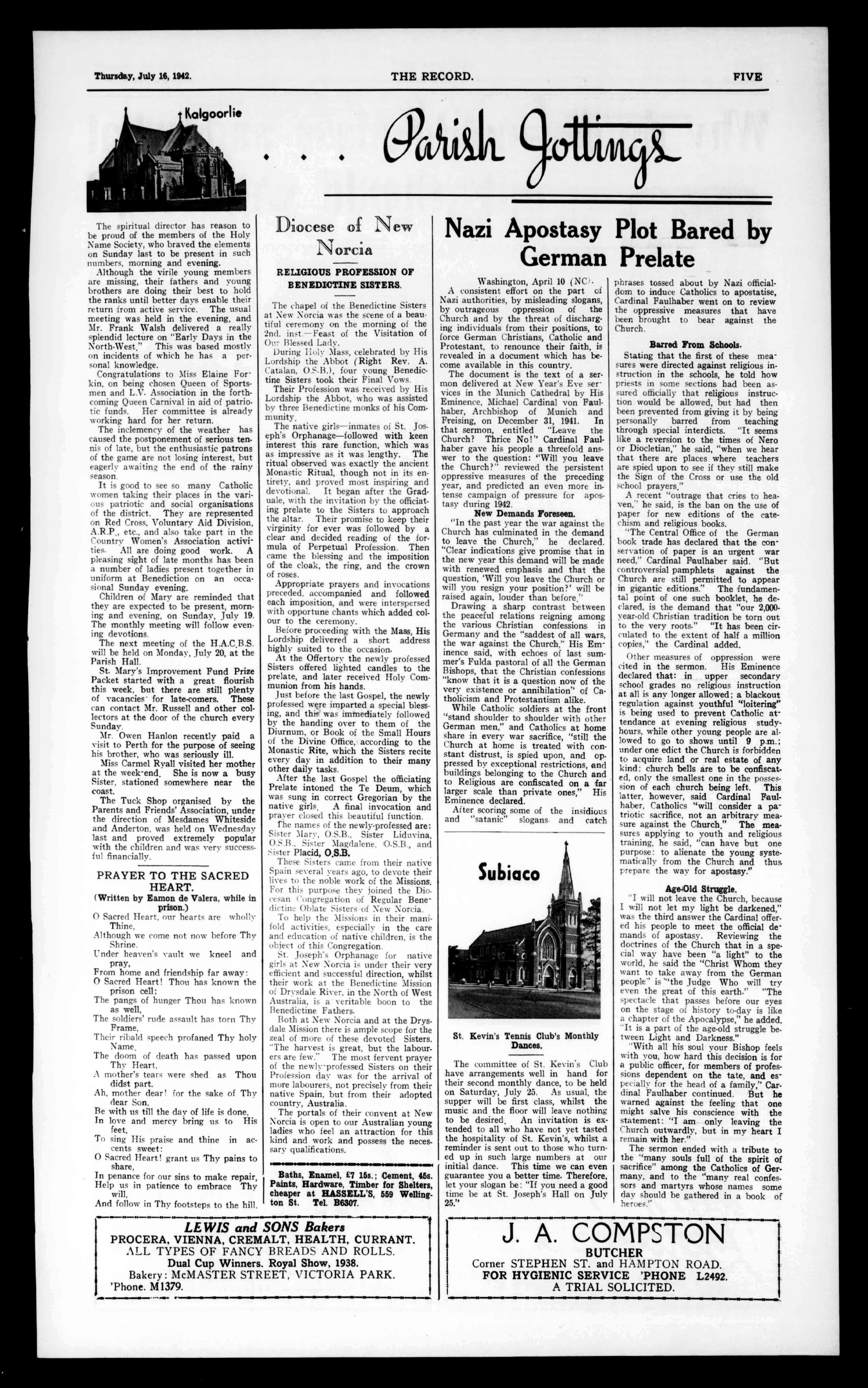
ThecommitteeofSt.Kevin',Club havearrangementswellinhandfor theirsecondmonthlydance,tobeheld onSaturday,July25.Asusual,the supperwillbefirstclass,whilstthe musicandthefloorwillleavenothing tobedesired,Aninvitationisextendedtoallwhohavenotyettasted thehospitalityofSt.Kevin's,whilsta reminderissentouttothosewhoturn edupinsuchlargenumbersatour initialdance.Thistimewecaneven guaranteeyouabettertime.Therefore, letyoursloganbe:"Ifyouneedagood timeheatSt.Joseph'sHallonJuly 25."
"WithallhissoulyourBishopfeels withyou,howhardthisdecisionisfor apublicofficer,formembersofprofessionsdependentonthetate,andespeciallyfortheheadofafamily,"CardinalFaulhabercontinued.Buthe warnedagainstthefeelingthatone mightsalvehisconsciencewiththe statement:"Iamonlyleavingthe Churchoutwardly,butinmyheartI remainwithher."
Thesermonendedwithatributeto the"manysoulsfullofthespiritof sacrifice"amongtheCatholicsofGermany,andtothe"manyrealconfessorsandmartyrswhosenamessome dayshouldbegatheredinabookof hen+,"
Thursday,July16,1942. THERECORD. FIVE
St.Kevin'sTennisClub'sMonthly Dances.
1 J.A.COMPSTON BUTCHER i CornerSTEPHENST.andHAMPTONROAD. FORHYGIENICSERVICE'PHONEL2492. ATRIALSOLICITED.
'Whatarethespecqiccharacteristics ...
ENGLISHSANCTITY?
SpecialinfluenceofBenedictinism loveof order,restraint,serenityandmassivecalm TraditionsofBedeandSt.Wolstan carriedontomoderntimes
ProductsoftheCatholicCultureinEngland
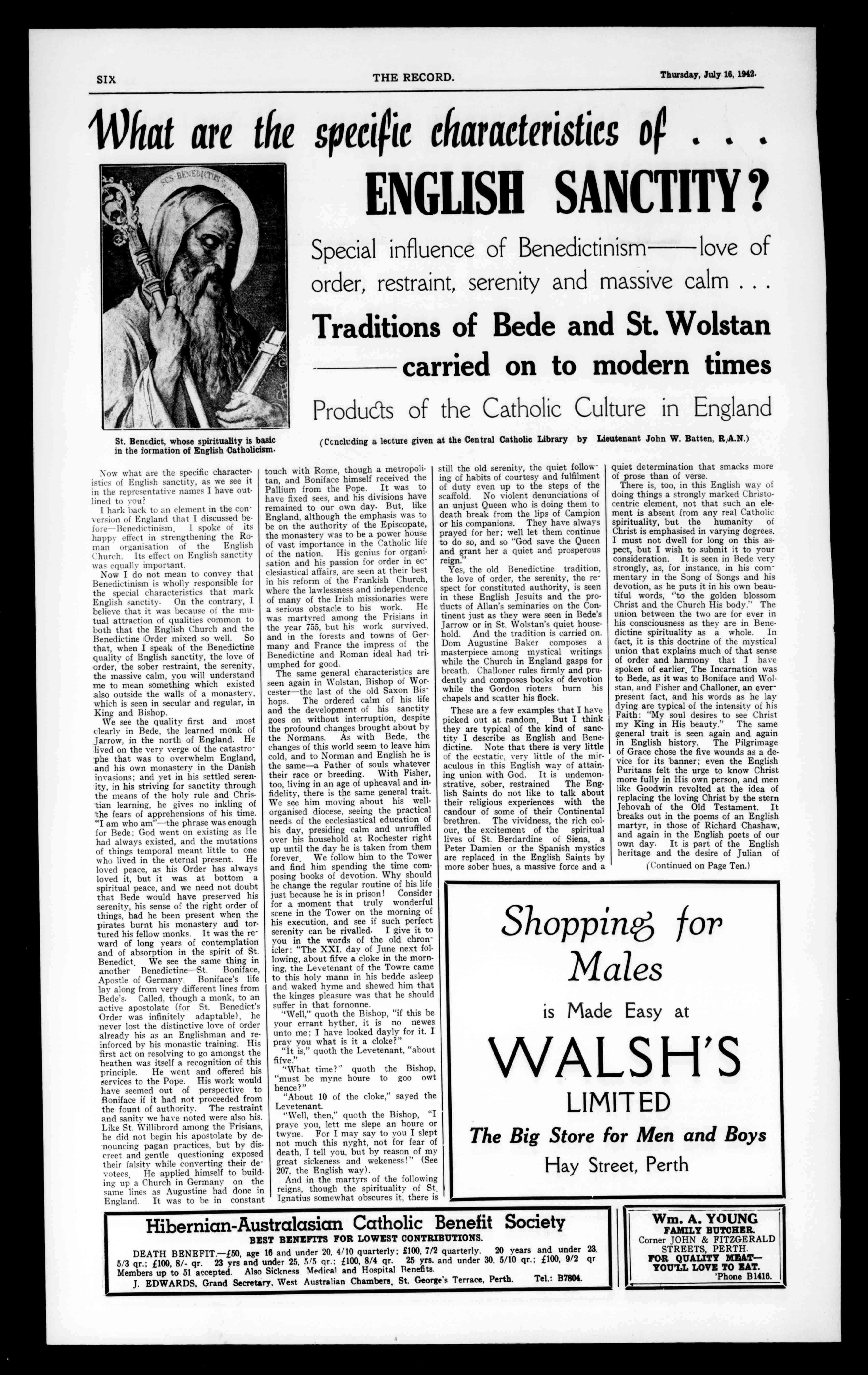
St.Benedict,whosespiritualityisbasic intheformationofEnglishCatholicism
NowwhatarethespecificcharacteristicsofEnglishsanctity,asweseeit intherepresentativenamesIhaveoutlinedtoyou?
IharkbacktoanelementintheconversionofEnglandthatIdiscussedbefore--Benedictinism. Ispokeofits happyeffectinstrengtheningtheRomanorganisationoftheEnglish Church.ItseffectonEnglishsanctity wasequallyimportant.
NowIdonotmeantoconveythat Benedictinismiswhollyresponsiblefor thespecialcharacteristicsthatmark Englishsanctity.Onthecontrary,I believethatitwasbecauseofthemutualattractionofqualitiescommonto boththattheEnglishChurchandthe BenedictineOrdermixedsowell.So that,whenIspeakoftheBenedictine qualityofEnglishsanctity,theloveof order,thesoberrestraint,theserenity, themassivecalm,youwillunderstand metomeansomethingwhichexisted alsooutsidethewallsofamonastery, whichisseeninsecularandregular,in KingandBishop.
Weseethequalityfirstandmost clearlyinBede,thelearnedmonkof Jarrow,inthenorthofEngland.He livedontheveryvergeofthecatastrophethatwastooverwhelmEngland, andhisownmonasteryintheDanish invasions;andyetinhissettledserenity,inhisstrivingforsanctitythrough themeansoftheholyruleandChristianlearning,hegivesnoinklingof thefearsofapprehensionsofhistime.
"Iamwhoam"-thephrasewasenough forBede;GodwentonexistingasHe hadalwaysexisted,andthemutations ofthingstemporalmeantlittletoone wholivedintheeternalpresent.He lovedpeace,ashisOrderhasalways lovedit,butitwasatbottoma spiritualpeace,andweneednotdoubt thatBedewouldhavepreservedhis serenity,hissenseoftherightorderof things,hadhebeenpresentwhenthe piratesburnthismonasteryandtorturedhisfellowmonks.Itwastherewardoflongyearsofcontemplation andofabsorptioninthespiritofSt. Benedict,Weseethesamethingin anotherBenedictine-St.Boniface, ApostleofGermany.Boniface'slife layalongfromverydifferentlinesfrom Bede's.Called,thoughamonk,toan activeapostolate(forSt.Benedict's Orderwasinfinitelyadaptable),he neverlostthedistinctiveloveoforder alreadyhisasanEnglishmanandreinforcedbyhismonastictraining.His firstactonresolvingtogoamongstthe heathenwasitselfarecognitionofthis principle.Hewentandofferedhis servicestothePope.Hisworkwould haveseemedoutofperspectiveto Bonifaceifithadnotproceededfrom thefountofauthority.Therestraint andsanitywehavenotedwerealsohis. LikeSt.WillihrordamongtheFrisians, hedidnotbeginhisapostolatebydenouncingpaganpractices,butbydiscreetandgentlequestioningexposed theirfalsitywhileconvertingtheirdevotees,HeappliedhimselftobuildingupaChurchinGermanyonthe samelinesasAugustinehaddonein England.Itwastobeinconstant
(CcncluclingalecturegivenattheCentralCatholicLibrarybyLieutenantJohnW.Batten,R.A.N.)
touchwithRome,thoughametropolitan,andBonifacehimselfreceivedthe PalliumfromthePope.Itwasto havefixedsees,andhisdivisionshave remainedtoourownday-But,like England,althoughtheemphasiswasto beontheauthorityoftheEpiscopate, themonasterywastobeapowerhouse ofvastimportanceintheCatholiclife ofthenation.Hisgeniusfororganisationandhispassionfororderinecclesiasticalaffairs,areseenattheirbest inhisreformoftheFrankishChurch, wherethelawlessnessandindependence ofmanyoftheIrishmissionarieswere aseriousobstacletohiswork.He wasmartyredamongtheFrisiansin theyear755,buthisworksurvived, andintheforestsandtownsofGermanyandFrancetheimpressofthe BenedictineandRomanidealhadtriumphedforgood.
Thesamegeneralcharacteristicsare seenagaininWolstan,BishopofWorcester-thelastoftheoldSaxonBishops.Theorderedcalmofhislife andthedevelopmentofhissanctity goesonwithoutinterruption,despite theprofoundchangesbroughtaboutby theNormans.AswithBede,the changesofthisworldseemtoleavehim cold,andtoNormanandEnglishheis thesame-aFatherofsoulswhatever theirraceorbreeding.WithFisher, too,livinginanageofupheavalandinfidelity,thereisthesamegeneraltrait. Weseehimmovingabouthiswellorganiseddiocese,seeingthepractical needsoftheecclesiasticaleducationof hisday,presidingcalmandunruffled overhishouseholdatRochesterright upuntilthedayheistakenfromthem forever.WefollowhimtotheTower andfindhimspendingthetimecomposingbooksofdevotion.Whyshould hechangetheregularroutineofhislife justbecauseheisinprison!Consider foramomentthattrulywonderful sceneintheToweronthemorningof hisexecution,andseeifsuchperfect serenitycanberivalled.Igiveitto youinthewordsoftheoldchronicler:"TheXXI.dayofJunenextfollowing,aboutfifveaclokeinthemorning,theLevetenantoftheTowrecame tothisholymanninhisbeddeasleep andwakedhomeandshewedhimthat thekingespleasurewasthatheshould sufferinthatfornonne.
"Well,"quoththeBishop,"ifthisbe yourerranthyther,itisnonewes untome;Ihavelookeddaylyforit.I prayyouwhatisitacloke?"
"Itis,"quoththeLevetenant,"about fifve."
"Whattime?"quoththeBishop, "mustbemynehouretogooowt hence?"
"About10ofthecloke,"sayedthe Levetenant.
"Well,then,"quoththeBishop,"I prayeyou,lettmeslepeanhoureor twyne.ForImaysaytoyouIslept notmuchthisnyght,notforfearof death,Itellyou,butbyreasonofmy greatsickenessandwekeness!"(See 207,theEnglishway).
Andinthemartyrsofthefollowing reigns,thoughthespiritualityofSt. Ignatiussomewhatobscuresit,thereis
stilltheoldserenity,thequietfollowingofhabitsofcourtesyandfulfilment ofdutyevenuptothestepsofthe scaffold.Noviolentdenunciationsof anunjustQueenwhoisdoingthemto deathbreakfromthelipsofCampion orhiscompanions.Theyhavealways prayedforher;wellletthemcontinue todoso,andso"GodsavetheQueen andgrantheraquietandprosperous reign."
Yes,theoldBenedictinetradition, theloveoforder,theserenity,therespectforconstitutedauthority,isseen intheseEnglishJesuitsandtheproductsofAllan'sseminariesontheContinentjustastheywereseeninBede's JarroworinSt.Wolstan'squiethousehold.Andthetraditioniscarriedon. DomAugustineBakercomposesa masterpieceamongmysticalwritings whiletheChurchinEnglandgaspsfor breath.Challonerrulesfirmlyandprudentlyandcomposesbooksofdevotion whiletheGordonriotersburnhis chapelsandscatterhisflock.
TheseareafewexamplesthatIhave pickedoutatrandom.ButIthink theyaretypicalofthekindofsanc tityIdescribeasEnglishandBenedictine.Notethatthereisverylittle oftheecstatic,verylittleofthemiraculousinthisEnglishwayofattain. ingunionwithGod.Itisundemonstrative,sober,restrainedTheEnglishSaintsdonotliketotalkabout theirreligiousexperienceswiththe candourofsomeoftheirContinental brethren.Thevividness,therichcolour,theexcitementofthespiritual livesofSt.BerdardineofSiena,a PeterDamienortheSpanishmystics arereplacedintheEnglishSaintsby moresoberhues,amassiveforceanda
quietdeterminationthatsmacksmore ofprosethanofverse. Thereis,too,inthisEnglishwayof doingthingsastronglymarkedChristocentricelement,notthatsuchanelementisabsentfromanyrealCatholic spirituality,butthehumanityof Christisemphasisedinvaryingdegrees. Imustnotdwellforlongonthisaspect,butIwishtosubmitittoyour consideration.ItisseeninBedevery strongly,as,forinstance,inhiscommentaryintheSongofSongsandhis devotion,asheputsitinhisownbeautifulwords,"tothegoldenblossom ChristandtheChurchHisbody."The unionbetweenthetwoareforeverin hisconsciousnessastheyareinBenedictinespiritualityasawhole.In fact,itisthisdoctrineofthemystical unionthatexplainsmuchofthatsense oforderandharmonythatIhave spokenofearlier,TheIncarnationwas toBede,asitwastoBonifaceandWolstan,andFisherandChailoner,aneverpresentfact,andhiswordsashelay dyingaretypicaloftheintensityofhis Faith:"MysouldesirestoseeChrist myKinginHisbeauty."Thesame generaltraitisseenagainandagain inEnglishhistory.ThePilgrimage ofGracechosethefivewoundsasadeviceforitsbanner;eventheEnglish PuritansfelttheurgetoknowChrist morefullyinHisownperson,andmen likeGoodwinrevoltedattheideaof replacingthelovingChristbythestern JehovahoftheOldTestament.It breaksoutinthepoemsofanEnglish martyr,inthoseofRichardChashaw, andagainintheEnglishpoetsofour ownday.ItispartoftheEnglish heritageandthedesireofJulianof ContinuedonPageTen.)
SIX THERECORD. Thursday,July16,1942-
Shoppingfor Males isMadeEasyat WALSH'S LIMITED TheBigStoreforMenandBoys HayStreet,Perth Hibernian-AustralasianCatholicBenefitSociety BESTBENEFITSFORLOWESTCONTRIBUTIONS. DEATHBENEFIT.-f50,age16andunder20,4/10quarterly:£100,7/2quarterly.20yearsandunder23. 5/3qr.;1100,8/-qr.23yrsandunder25,5'5qr.:f100,8/4qr.25yrs.andunder30,5/10qr.;1100,9/2qr Membersupto51accepted.AlsoSicknessMedicalandHospitalBenefits. J.EDWARDS,GrandSecretary,WestAustralianChambers,St.George'sTerrace,Perth. Tel.:B7804. Wm.A.YOUNG FAMILYBUTCHER. CornerJOHN&FITZGERALD STREETS,PERTH. FORQUALITYMEATYOU'LLLOVETOEAT. 'PhoneB1416.
QiuLEADAtoICI&
THE
HIGHGATE
TheHighgateBranchoftheLeague ofCatholicYouthheldtheirusual fortnightlydanceintheParishHall onWednesday,July8.Theevening provedagrandsuccessandoneofthe happiest.Thereweremanyincidents whichtookplaceduringtheevening, whichcausedeveryonetofeelthatthey wereataparty,asthereweremanyreunionsofoldfriendsandafewgoodbyestoothers.
Wewerepleasedtowelcomeback SergeantAir-GunnerPeterHastie, R.A.A.F.,whohasbeenawayforthe pastfivemonths,andashewashere forafewdays,camealongtomeetall hisoldfriends.Alsooneofthe L.('.Y.foundationmembers,inthepersonofGerardSlattery,whoforthefirst timethisseasonhadthepleasure01 attendingtheboys'dance.Wealso saidgood-byetotwoofouryoung friends,JackEvansandJimGriffin, whohavejoinedtheR.A.A.F.,and CharlieNalan,oneofthefirstL.C.Y. members,whohasalsojoinedthe R.A.A.F.,butwehopetoseeCharlie atintervals.
WeareindebtedtoYvonneand AllanCarrier,twoyoungradioartists, whocamealongdistancetoentertain uswiththeirHawaiianguitars.They sangandplayedseveralduets,for whichtheyweregivenagreatreception,andthelistenerswereloathetolet themgo,eventhoughtheycomplied withmanyencores;butlateroninthe evening,byspecialrequest,theyagain appearedamidstmuchapplause.Allan andYvonneagaindelightedtheaudiencewithaduet,andasanencore Yvonnesangaveryappropriatesong, "KisstheBoysGood-bye,"and"Dolores,-inwhichacttheyoungpeople joinedinthechorus.
Beforethecloseofthedanceapleasantincidenttookplace,whenour Americanfriends,whohavepatronised theL.C.Y.dancessincethecommencement,wereaskedtostepintothecentreofthehallwhilstallthedancers joinedinaringandsang"AuldLang Syne"and"ForTheyAreJollyGood Fellows,"everyoneenteringintothe spiritoftheact.Theorchestraaccompaniedthesingers,
Therewereprizesgivenforalucky chairandspotdances,andBobMartin wastheluckyholderofthefreeticket inahandsomeboxofchocolates. OurnextdanceisonWednesday, July22,whenagaintherewillbefour luckychairsandafreeticketinabox ofchocolatestoallonenteringthe hall.Therewillbeahot-dogsupper byspecialrequest.Theadmissionis only1/6.RememberJuly22.
FranciscanSocialOut
SecondFloor,BactonHouse, HaySt.InextGleddenBuilding).
*LuncheoneveryThursday, 12-2p.m.Lecturetteand discussion.
Women'smeeting2.30-4p.m.
Acordialinvitationisextended toallinterested
WEDDINGREPORTS.
Allreportsofweddingsarechargeableonthefollowingbasis:
Forsinglecolumnreport,withorI withoutblock,10/6.
Twocolumnblock,withreport, ls, Threecolumnblock,withreport, 10s.
Thesechargesincludethecostof blockineachcase.Seeadvertisingrateselsewhereinthisissue. Allreportsmustbesignedbythe ParishPriest.
RDG
FREMANTLEDEPOT
Thehi-weeklydanceinSt.Patrick's Hall,Fremantle,forthemembersofthe AlliedForces,continuestodrawan increasinglyenthusiasticcrowd,Wednesdaynightlastwasanoutstanding success.TheMayorandMayoresswere presentasguestsofhonour.They werereceivedatthedoorbyRev.G. O'Callaghan,SeniorMilitaryChaplain; Rev.D.Breslin,O.M.I.,R.A.N.V.R.; Lieut.-CommanderMcKenzie,R.A.N., andMr,J.M.Farrell,J.P.
Theentranceofthedistinguished visitorswasgreetedbyapplause,the orchestraplayedtheNationalAnthem,thedancersstandingtoattention.Alittleboydressedas"Uncle Sam"andalittlegirlintheuniform ofaRedCrossnurse,presenteda prettybouquettotheMayoress.
Duringthecourseoftheevening,a troupeofyoungladiesperformedballet dancing,andMr.Saunderssang.Mr. BillTalbotgavearecitation,andMiss Pilgrim(Perth)andanAustralian navalpettyofficeralsocontributed items.
Averyinterestingfeatureofthese dances,andoneworthyofimitation,is thesayingofashortprayertoOur Ladybeforethefirstofficialdanceeach evening.Thecouplesformtworows downthecentreofthehall;thecandlesarelightedbeforethestatue,and theM.C.orFatherBreslin,O.M,I.,recitethisprayer,whichisrepeatedby all:"OurLady,ourQueen,andour Mother,inthycustodyIplacemysoul andmybody.Maryconceivedwith outsin,prayforuswhohaverecourse tothee."Thegentlementhensalute andtheladiesbowtothestatue.The orchestra,orgramaphone-wirelessas thecasemaybe,thenplaysawaltz. Thisbeautifulcustom,nowfirmyestablished,isuniqueintheCommonwealth,andinspiteofmanysceptics hastakenwonderfullywell.Indeed oneissurprisedattheutterlackof self-consciousnessduringtheproceedings.
AfterthesupperonWednesday evening,CorporalCohen,oftheU.S. Army,madeaverywittyspeech.On behalfofhiscomrades,hesincerely thankedtheCatholicWelfareOrganisationAuxiliaryofFremantle,who, underthedirectionofFatherBreslin, O.M.I.,haddonesomuchfortheir comfortandentertainment.Father Breslin,O.M.I.,respondedTheMayor alsospoke.HethankedtheC.W.O. alsoonbehalfofthecitizensofFre. mantle.
FatherBreslin,O.M.I.,inthecourse ofhisremarks,mentionedthatrepresentationshadbeenmadetotheFremantleGasandCokeCompany,fora concessionrateforthehall,sincenot evenavoluntarycollectionwastaken up,butwithoutsuccess:theCompany merelyofferedtheloanofagascooker
-anopportunitytousemoregasat theusualrate!
Attheconclusionofthedance,the soldiersandsailorssignedtheirnames onalargepieceofruledvellumasa souveniroftheevening.Itistobe framedandsuitablyinscribedand hungupinthehall.
Averyinterestingfunctiontook placeonSundaymorningatbreakfast, followingthenineo'clockMass.About 430soldiersandsailorswerepresent. ThemenoftheUnitedStatesNavy presentedFatherBreslin,O.M.I., R.A.N,V.R.,withabeautifulgoldwristletwatch,suitablyinscribed,in appreciationofwhathehasdonefor them.FatherBreslinbrieflythanked themforthegift,andassuredthemof aremembranceinhisprayers.
SHOOTINGTHECROW.
Somebodyoncefiredataduckand shotacrow.YoucanfireattheNo. 111aCharitiesConsultation,ifyou buyaticket,andifyoumissthefirst prizeof£1,000youmightgetthesecondprizeof£500.
Doyouwishtohelpeducateapriest forworkinWesternAustralia?Make aregularannualcontributiontohelp anindigentstudent.
ectituacA
July22:L.C.V.Dance,inParishHall, Highgate.
July26:IrishNationalForesters'Step DancingCompetition,MissAshton's Hall,191High-street,Fremantle, Patriotic.
TheSportsmen'sOrganisationhas beenaskedtoarrangetwopatriotic appeals,ThefirstonFriday,July17, willbefortheFreeFrenchForces;the secondonFriday,July24,forthe R.A.A.F.TheSportsmenhaveexpressedthehopethatmembersofthe C.W.L.willhelptheminboththese streetappeals.
Rale.
Allbuttsofraffletickets(alsopatriotic)forthesilversalvermustbe sentinbyJuly27.
TheCatholicWomen'sLeague,HighgateBranch,heldtheircombined monthlymeetingandsewingafternoononThursday,July9,intheParishHall.Therewasquiteabig gatheringofmembers,includingsome newmemberswhocamealongtoassist inthegoodworkofsewingandknittingfordeservingcasesandcharitable institutions.Itwasdecidedatthe meetingtoconductabridgeafternoon onThursday,August13,toraisemoney toassistthebranchincarryingonthe goodworkinprovidingmaterial,etc., tobemadeupfordistribution.
Anyonewishingtojointhisbranch maydoso,bycomingalongtothe meetings,whichareheldintheParish HalleverysecondThursdayofthe month.Therewillbeaspecialmeetingforthebridge,whichwillbeannouncedlater.Afternoonteaisalways provided.
GRANDSONOFGARIBALDI,WHO FOUGHTPOPE,ENTERSCHURCH.
AgrandsonofGaribaldi,whoinvadedthePapalStatesin1868,hasbeenreceivedintotheChurch,VaticanRadio announcedrecently.
HeisGeneralGaribaldi,andCardinalCacciaDominionireceivedhim.
WhenGiuseppeGaribaldivisited Londonin1864CardinalWisemanwhodiedayearlater-publishedan outspokenpastoralletterprotesting againstthewelcomegiventotheItalianatheist.
F.11111.,
AGrandCarnivalDance
WILLBECONDUCTEDBYTHEVICTORIAPARKHOLYNAMEI SOCIETYIN
TheKindergartenHall,SheppertonRd.,VictoriaPark SATURDAY,JULY25,1942
ProceedsinaidofSt.Joachim'sChurchBuildingFund.
GoodMusic. GoodFloor, DaintySupper. PrizesandNovelties. Dancing:8p.m.tillMidnight. P. REIDY.Oro,aniser.
t
1
She'llchangealotinanother year,butshe'llneverbesweeter thansheisto-day.Keepthat sweetnessfortheyearstocome. HaveanewPortraitmadenow. RingB8833fortheappointment.
LANGHAMSTUDIOSLTD.
Thursday,July16,1942. THERECORD. SEVEN
11
o\, Is C' 00 1NWA
ELFABE
ORC.c..
CENTRALARCADE HAYSTREET,PERTH
PERTH,THURSDAY.JULY16,1942.
TitletoProfits StateorWorker?
TheBillnowunderconsiderationbytheFederalGovernment tolimittofourpercent.theprofitsofallbusinesseswithacapital of£25,000ormore,isaveryinterestingproposaltothestudentof thesocialproblem.Ithasmetwithvigorousoppositionlucall) fromtheChamberofAlanufacturers,andthroughoutthe(Commonwealthatlargesomecompaniesaresaidtohaveinducedtheir shareholderstoputpressureontheirpartyrepresentativestoopPosetheBill.MostofthepublishedcriticismsagainsttheBill havebeenadequatelyansweredbymodificationsintheproposals themselves,orbytheirpatentlackofsubstance.Forinstance, theclaimthatonlybusinesseswithbigreserveswouldbeableto standuptotheproposalshasbeenmetbythecapitaldifferentiationclauseandbytheequalisationplan.ThepleathattheBill wasjustanunjustifiedattackoncapitalasrepresentedbyprivate enterprisewouldnotseemvalidinviewoftheFederalGovernment'srefusaltosocialiseindustriesofnationalimportance,such ascoal,steelandbanking.Furthermore,sodenseisthefogof classstrugglethatbusinessmenareunabletoseethatnoGovernmentpurportingtochampiontheworkingclasscouldaffordto"attack"(inthesenseofdestroying)privateenterprisewithoutstrikingvitallyattheworkers'interests.Ontheotherhand,industry mayandshouldbecontrolledinthecommoninterestwhich,be itnoted.ispredominantlybutnotexclusivelythatoftheworkingclass.AsAbrahamLincolnsoaptlysaid:"Godmusthaveloved thecommonpeoplebecauseHemadesomanyofthem."
* * * * Theoldcanardshavenaturallybeenraisedatthesametime. Oneispreparedforsuchastonishingstatementsasthat"nogreatly enhancedprofitsarebeingmadeinAustraliaunderwar-timeconditions."Thisisprobablytrueofindustryasawhole,butthen itisquitefallacioustotakeanaverageinasocietysoludicrously over-balancedasregardsfinancialresources,andthecontrolofproductiveproperty.Theclaimisassuredlyfalseofthosebusinesses towhichtheprofitlimitationof4percent.istoapply.The basiccriticismoftheproposalhasnot,however,yetappearedin printinthisState.Andthatis,thatthecontrolofindustry,and especiallyinthedistributionofprofits,shouldnotnormally,or anyhowdirectly,betotheGovernment'sadvantageevenwhereit isproposedtore-distributetheminsocialservices.Thefundamentalfactis,thatthefirstchargeonindustryshouldmorallybe thepaymentofafamilywagetotheworkers.Inthefirstplace thisresponsibilityrestseitherwiththeindustryconcernedorwith industryasawhole.TheStateentersintothefieldonlywhen industryfailsorbywayofsupplementingitsbestandhonest endeavours. * *
Whatevertheexigenciesofthewarcrisisdemand,anditisprobablyinevitablethatthemajorfruitsofindustryshouldfeedthe warmachine,atleasttheprincipleofresponsibilityoftheemployertopayafamilywage,shouldberecognisednowasafundamentalplankofpost-warreconstruction.Thepaymentofafamilywagetotheworkercomesbeyondtheallotmentofanyprofitstotheemployer.Inthisconnectiontheoldobstructionof "averageconditions"isfrequentlyintroduced.Theanswertothat istheinstitutionofanequalisingfund,notfortheaveragingof profitsasbetweengoodandhadperiods,asinthepresentBill. butfortheinstitutioninparticularindustries,orinindustriesas awholeofafundoutofwhichworkerswouldbepaidthebalancebetweenthebasicwageandthefamilyincome'towhichthey areentitled.TheonlyalternativeisfortheStatetotakeover,and nomatterhowthatcomesaboutorbywhatnameitiscalled,it willheservilitycalledintobeing-bythemoralirresponsibilityof privateenterprise.
DeathofCardinalBaudrillart
HisEminenceHenriCardinalBaudrillart,rectoroftheCatholicInstituteofParis,hasdiedinParisat eighty-threeyearsofage.AlfredBaudrillart,byhisancestry,seemeddestinedtoauniversitycareer.Hisfather, Henri,wasaneconomistofgreatrenown.Hismotherwasthedaughter ofSylvestredeSacy,editorofthe newspaper,"Debates,"andamember oftheFrenchAcademy.Hismaternalgrandfather,SilvestredeSacy,was auniversally-knownOrientalist,the initiatorofArabicstudiesinFrance. AlfredenteredtheEcoleNormaleSuperieure,wherehehadascomradesthe .famousorator,JeanJaures,andthedistinguishedphilosopher,HenriBergson. Hiscareerasateachergaveeveryevidenceofaremarkablesuccess-and then,suddenly,attheageofthirty.
one,heenteredthenovitiateofthe Oratory.BeforelongtheyoungOratorianwascalledasprofessorofhistory totheCatholicInstituteofFranceby itsgreatrector,Monsignord'Hulst. Allhislifewastobespentthereafter inthisancientconventoftheCarmelites,whichbecamethemostbrilliant intellectualcentreofFrance.Professor,canon,rectoroftheinstitute, Vicar-General,SuperioroftheCongregationoftheOratory,Bishop,Archbishop,Cardinal,AlfredBaudrillart receivedallthesechargeswithout leavingthehousethathehad entered.CardinalBaudrillartwas electedtotheFrenchAcademyin1918, wherehetwicewontheGrandPrix Gobert,HewasanofficeroftheLegionofHonourandamemberofmany scientificandhistoricalsocieties.
ARCHBISHOP'SENGAGEMENTS.
July18-7.30a.m.:OfficiateatCeremonyofProfessionatSacredHeart Convent,HighgateHill.
July19-3p.m.:PresideatFestival
MeetingoftheSocietyofSt.Vincent dePaulatSt.Mary'sCathedral. July26:CanonicalVisitationand ConfirmationatSt.Joseph'sChurch, Norseman, August2.-CanonicalVisitationatKalgoorlie,BoulderandCoolgardie.
St.LukeEtna'Mary's Gospel'
TotheEditor
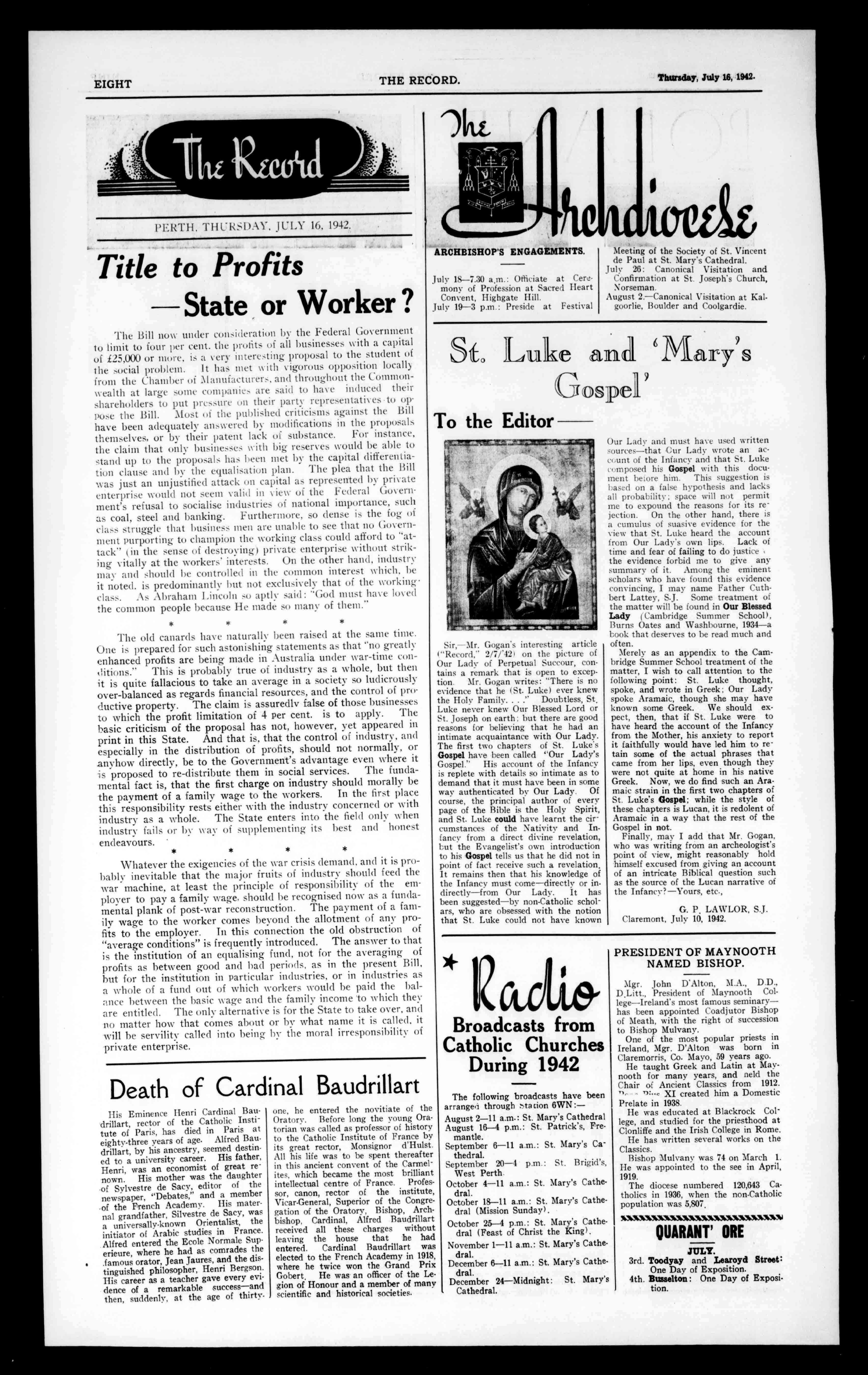
Sir,-Mr.Gogan'sinterestingarticle 1"Record,-217/'421onthepictureof OurLadyofPerpetualSuccour,containsaremarkthatisopentoexception.Mr.Goganwrites:"Thereisno evidencethathe(St.Luke)everknew theHolyFamily. ."Doubtless,St, LukeneverknewOurBlessedLordor St.Josephonearth:buttherearegood reasonsforbelievingthathehadan intimateacquaintancewithOurLady. ThefirsttwochaptersofSt.Luke's Gospelhavebeencalled"OurLady's Gospel."HisaccountoftheInfancy isrepletewithdetailssointimateasto demandthatitmusthavebeeninsome wayauthenticatedbyOurLady.Of course,theprincipalauthorofevery pageoftheBibleistheHolySpirit, andSt.LukecouldhavelearntthecircumstancesoftheNativityandInfancyfromadirectdivinerevelation, buttheEvangelist'sownintroduction tohisGospeltellsusthathedidnotin pointoffactreceivesucharevelation, Itremainsthenthathisknowledgeof theInfancymustcome-directlyorindirectly-fromOurLady.Ithas beensuggested-bynon-Catholicscholars,whoareobsessedwiththenotion thatSt.Lukecouldnothaveknown
1Z Broadcastsfrom CatholicChurches During1942
Thefollowingbroadcastshavebeen arrangedthrough:-tadon6WN:-
August2-11a.m.:St.Mary'sCathedral
August16-4p.m.:St.Patrick's,Fremantle.
September6-11a.m.:St.Mary'sCathedral.
September20-4p.m.:St.Brigid's, WestPerth.
October4-11a.m.:St.Mary'sCathedral.
October18-11a.m.:St.Mary'sCathedral(MissionSunday).
October25-4p.m.:St.Mary'sCathedral(FeastofChristtheKing).
November1-11a.m.:St.Mary'sCathedral.
December6-11am.:St.Mary'sCathedral.
December24-Midnight:St.Mary's Cathedral.
OurLadyandmusthaveusedwritten sources-thatCurLadywroteanaccountoftheInfancyandthatSt.Luke composedhisGospelwiththisdocumenthetorehim.Thissuggestionis basedonafalsehypothesisandlacks allprobability;spacewillnotpermit metoexpoundthereasonsforitsrejectiun.Ontheotherhand,thereis acumulusofsuasiveevidenceforthe viewthatSt.Lukeheardtheaccount fromOurLady'sownlips.Lackof timeandfearoffailingtodojustice theevidenceforbidmetogiveany summaryofit.Amongtheeminent scholarswhohavefoundthisevidence convincing,ImaynameFatherCuthbertLattey,S.J.Sometreatmentof thematterwillbefoundinOurBlessed Lady(CambridgeSummerSchool), I3urnsOatesandWashbourne,1934-a bookthatdeservestobereadmuchand often.
MerelyasanappendixtotheCambridgeSummerSchooltreatmentofthe matter,Iwishtocallattentiontothe followingpoint:St.Lukethought, spoke,andwroteinGreek:OurLady spokeAramaic,thoughshemayhave knownsomeGreek.Weshouldexpect,then,thatifSt.Lukewereto haveheardtheaccountoftheInfancy fromtheMother,hisanxietytoreport itfaithfullywouldhaveledhimtoretainsomeoftheactualphrasesthat camefromherlips,eventhoughthey werenotquiteathomeinhisnative Greek.Now,wedofindsuchanAramaicstraininthefirsttwochaptersof St.Luke'sGospel;whilethestyleof thesechaptersisLucan,itisredolentof Aramaicinawaythattherestofthe Gospelinnot.
Finally,mayIaddthatMr.Gogan, whowaswritingfromanarcheologist's pointofview,mightreasonablyhold himselfexcusedfromgivinganaccount ofanintricateBiblicalquestionsuch asthesourceoftheLucannarrativeof theInfancy?-Yours,etc.,
G.P.LAWLOR,Si. Claremont,July10,1942.
PRESIDENTOFMAYNOOTH NAMEDBISHOP.
Mgr.JohnD'Alton,M.A.,D.D., D.Litt.,PresidentofMaynoothCollege-Ireland'smostfamousseminaryhasbeenappointedCoadjutorBishop ofMeath,withtherightofsuccession toBishopMulvany.
Oneofthemostpopularpriestsin Ireland,Mgr.D'Altonwasbornin Claremorris,Co.Mayo,59yearsago. HetaughtGreekandLatinatMaynoothformanyyears,andneldthe ChairofAncientClassicsfrom1912. "-- XIcreatedhimaDomestic Prelatein1938. HewaseducatedatBlackrockCollege,andstudiedforthepriesthoodat ClonliffeandtheIrishCollegeinRome. Hehaswrittenseveralworksonthe Classics. BishopMulvanywas74onMarch1. HewasappointedtotheseeinApril, 1919. Thediocesenumbered120,643Catholicsin1936,whenthenon-Catholic populationwas5.807,
QUARANT'ORE
JULY.
3rd.ToodyayandLearoydStreet: OneDayofExposition.
4th.Busselton:OneDayofExposition.
EIGHT THERECORD. Thursday,July16,1942.
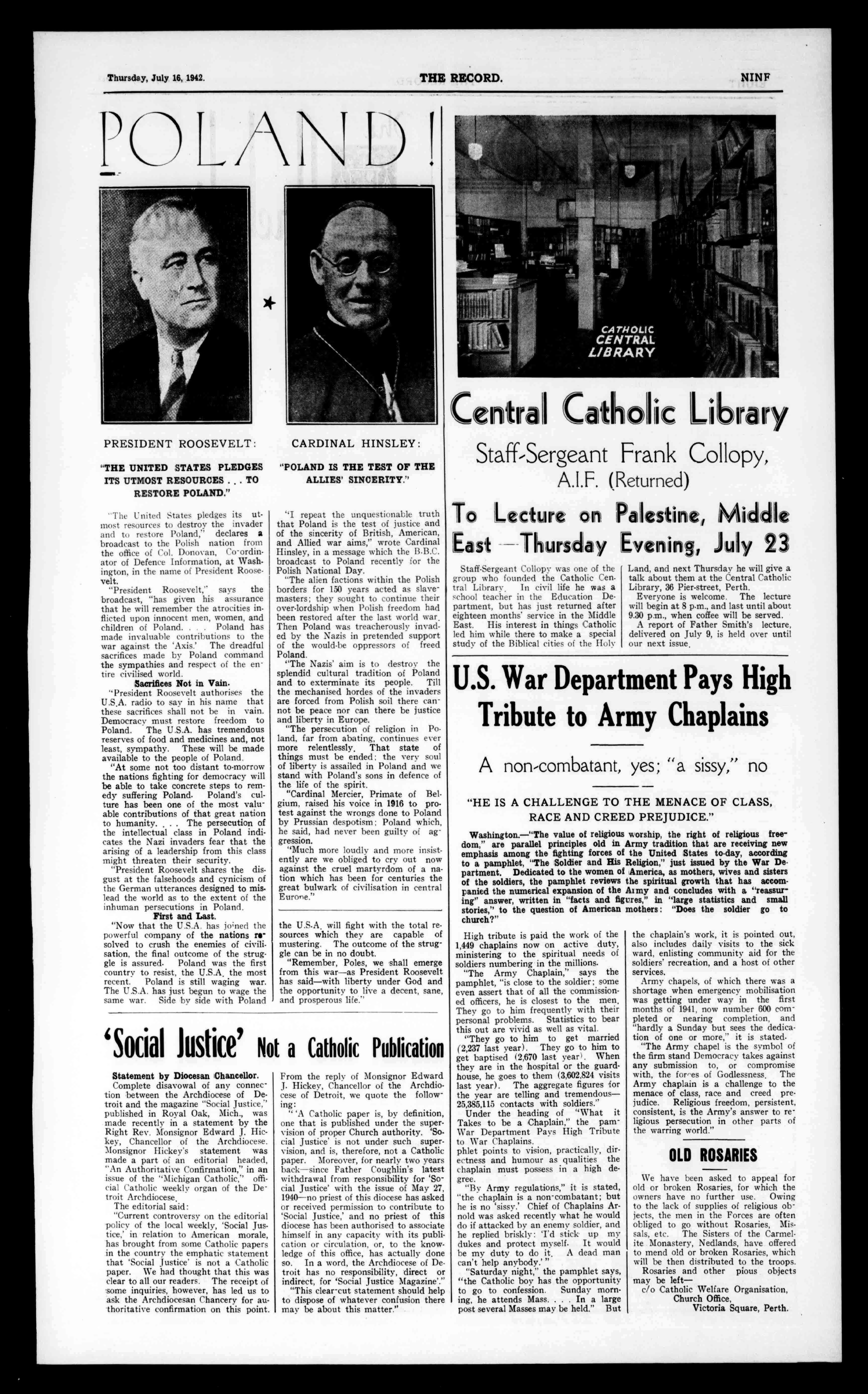
PRESIDENTROOSEVELT:
"THEUNITEDSTATESPLEDGES ITSUTMOSTRESOURCES TO RESTOREPOLAND."
"TheUnitedStatespledgesitsutmostresourcestodestroytheinvader andtorestorePoland,"declaresa broadcasttothePolishnationfrom theofficeofCol.Donovan,Co-ordinatorofDefenceInformation,atWashington,inthenameofPresidentRoosevelt.
"PresidentRoosevelt,"saysthe broadcast,"hasgivenhisassurance thathewillremembertheatrocitiesinflicteduponinnocentmen,women,and childrenofPoland. Polandhas madeinvaluablecontributionstothe waragainstthe'Axis.'Thedreadful sacrificesmadebyPolandcommand thesympathiesandrespectoftheentirecivilisedworld.
SacrificesNotinVain.
"PresidentRooseveltauthorisesthe U.S.A.radiotosayinhisnamethat thesesacrificesshallnotbeinvain. Democracymustrestorefreedomto Poland.TheU.S.A.hastremendous reservesoffoodandmedicinesand,not least,sympathy.Thesewillbemade availabletothepeopleofPoland.
"Atsomenottoodistantto-morrow thenationsfightingfordemocracywill beabletotakeconcretestepstoremedysufferingPoland.Poland'sculturehasbeenoneofthemostvaluablecontributionsofthatgreatnation tohumanity. Thepersecutionof theintellectualclassinPolandindicatestheNaziinvadersfearthatthe arisingofaleadershipfromthisclass mightthreatentheirsecurity.
"PresidentRooseveltsharesthedisgustatthefalsehoodsandcynicismof theGermanutterancesdesignedtomisleadtheworldastotheextentofthe inhumanpersecutionsinPoland.
FirstandLast.
"NowthattheU.S.A.hasjo,nedthe powerfulcompanyofthenationsresolvedtocrushtheenemiesofcivilisation,thefinaloutcomeofthestruggleisassured.Polandwasthefirst countrytoresist,theU.S.A.themost recent.Polandisstillwagingwar. TheU.S.A.hasjustbeguntowagethe samewar.SidebysidewithPoland
CARDINALHINSLEY
'POLANDISTHETESTOFTHE ALLIES'SINCERITY
"Irepeattheunquestionabletruth thatPolandisthetestofjusticeand ofthesincerityofBritish,American, andAlliedwaraims,"wroteCardinal Hinsley,inamessagewhichtheB.B.C. broadcasttoPolandrecentlyforthe PolishNationalDay.
"ThealienfactionswithinthePolish bordersfor150yearsactedasslavemasters;theysoughttocontinuetheir over-lordshipwhenPolishfreedomhad beenrestoredafterthelastworldwar. ThenPolandwastreacherouslyinvadedbytheNazisinpretendedsupport ofthewould-beoppressorsoffreed Poland.
"TheNazis'aimistodestroythe splendidculturaltraditionofPoland andtoexterminateitspeople.Till themechanisedhordesoftheinvaders areforcedfromPolishsoiltherecannotbepeacenorcantherebejustice andlibertyinEurope.
"ThepersecutionofreligioninPo. land,farfromabating,continuesever morerelentlessly.Thatstateof thingsmustbeended;theverysoul oflibertyisassailedinPolandandwe standwithPoland'ssonsindefenceof thelifeofthespirit.
"CardinalMercier,PrimateofBelgium,raisedhisvoicein1916toprotestagainstthewrongsdonetoPoland byPrussiandespotism;Polandwhich, hesaid,hadneverbeenguiltyofaggression.
"Muchmoreloudlyandmoreinsistentlyareweobligedtocryoutnow againstthecruelmartyrdomofanationwhichhasbeenforcenturiesthe greatbulwarkofcivilisationincentral Eurone."
theU.S.A.willfightwiththetotalresourceswhichtheyarecapableof mustering.Theoutcomeofthestrugglecanbeinnodoubt.
"Remember,Poles,weshallemerge fromthiswar-asPresidentRoosevelt hassaid-withlibertyunderGodand theopportunitytoliveadecent,sane, andprosperouslife."
`SocialJustice'NotaCatholicPublication
StatementbyDiocesanChancellor. CompletedisavowalofanyconnectionbetweentheArchdioceseofDetroitandthemagazine"SocialJustice," publishedinRoyalOak,Mich.,was maderecentlyinastatementbythe RightRev.MonsignorEdwardJ.Hickey,ChancelloroftheArchdiocese. MonsignorHickey'sstatementwas madeapartofaneditorialheaded, "AnAuthoritativeConfirmation,"inan issueofthe"MichiganCatholic,"officialCatholicweeklyorganoftheDetroitArchdiocese.
Theeditorialsaid: "Currentcontroversyontheeditorial policyofthelocalweekly,'SocialJustice,'inrelationtoAmericanmorale, hasbroughtfromsomeCatholicpapers inthecountrytheemphaticstatement that'SocialJustice'isnotaCatholic paper.Wehadthoughtthatthiswas cleartoallourreaders.Thereceiptof someinquiries,however,hasledusto asktheArchdiocesanChanceryforauthoritativeconfirmationonthispoint.
FromthereplyofMonsignorEdward J.Hickey,ChancelloroftheArchdioceseofDetroit,wequotethefollowing: "'ACatholicpaperis,bydefinition, onethatispublishedunderthesupervisionofproperChurchauthority.'SocialJustice'isnotundersuchsupervision,andis,therefore,notaCatholic paper.Moreover,fornearlytwoyears back-sinceFatherCoughlin'slatest withdrawalfromresponsibilityfor'SocialJustice'withtheissueofMay27, 1940-nopriestofthisdiocesehasasked orreceivedpermissiontocontributeto 'SocialJustice,'andnopriestofthis diocesehasbeenauthorisedtoassociate himselfinanycapacitywithitspublicationorcirculation,or,totheknowledgeofthisoffice,hasactuallydone so.Inaword,theArchdioceseofDe. troithasnoresponsibility,director indirect,for'SocialJusticeMagazine'."
"Thisclear-cutstatementshouldhelp todisposeofwhateverconfusionthere maybeaboutthismatter."
CentraCathoicLibrary
Staff-SergeantFrankCollopy, A.I.F.(Returned)
ToLectureonPalestine,Midde
East---ThursdayEvening,July23
Staff-SergeantCollopywasoneofthe groupwhofoundedtheCatholicCen. tralLibrary,Incivillifehewasa schoolteacherintheEducationDepartment,buthasjustreturnedafter eighteenmonths'serviceintheMiddle East.HisinterestinthingsCatholic ledhimwhiletheretomakeaspecial studyoftheBiblicalcitiesoftheHoly
Land,andnextThursdayhewillgivea talkaboutthemattheCentralCatholic Library,36Pier-street,Perth. Everyoneiswelcome.Thelecture willbeginat8p.m.,andlastuntilabout 9.30pin.,whencoffeewillbeserved. AreportofFatherSmith'slecture, deliveredonJuly9,isheldoveruntil ournextissue,
U.S.WarDepartmentPaysHigh TributetoArmyChaplains
Anon-combatant,yes;"asissy,"no
"HEISACHALLENGETOTHEMENACEOFCLASS, RACEANDCREEDPREJUDICE."
Washington.-"Thevalueofreligiousworship,therightofreligiousfreedom,-areparallelprinciplesoldinArmytraditionthatarereceivingnew emphasisamongthefightingforcesoftheUnitedStatesto-day,according toapamphlet,"TheSoldierandHisReligion,"justissuedbytheWarDepartment.DedicatedtothewomenofAmerica,asmothers,wivesandsisters ofthesoldiers,thepamphletreviewsthespiritualgrowththathasaccompaniedthenumericalexpansionoftheAimyandconcludeswitha"reassuring"answer,writtenin"factsandfigures,"in"largestatisticsandsmall stories,"tothequestionofAmericanmothers"Doesthesoldiergoto church?"
Hightributeispaidtheworkofthe 1,449chaplainsnowonactiveduty, ministeringtothespiritualneedsof soldiersnumberinginthemillions.
"TheArmyChaplain,"saysthe pamphlet,"isclosetothesoldier;some evenassertthatofallthecommissionedofficers,heisclosesttothemen, Theygotohimfrequentlywiththeir personalproblems.Statisticstobear thisoutarevividaswellasvital.
"Theygotohimtogetmarried (2,237lastyear).Theygotohimto getbaptised(2,670lastyear.When theyareinthehospitalortheguardhouse,hegoestothem(3,602,824visits lastyear).Theaggregatefiguresfor theyeararetellingandtremendous25,385,115contactswithsoldiers."
Undertheheadingof"Whatit TakestobeaChaplain,"thepamWarDepartmentPaysHighTribute toWarChaplains. phletpointstovision,practically,directnessandhumourasqualitiesthe chaplainmustpossessinahighdegree.
"ByArmyregulations,"itisstated, "thechaplainisanon-combatant;but heisno'sissy.'ChiefofChaplainsArnoldwasaskedrecentlywhathewould doifattackedbyanenemysoldier,and herepliedbriskly'I'dstickupmy dukesandprotectmyself.Itwould bemydutytodoit,Adeadman can'thelpanybody.'"
"Saturdaynight,"thepamphletsays, "theCatholicboyhastheopportunity togotoconfession.Sundaymorning,heattendsMass.. Inalarge postseveralMassesmaybeheld."But
thechaplain'swork,itispointedout, alsoincludesdailyvisitstothesick ward,enlistingcommunityaidforthe soldiers'recreation,andahostofother services.
Armychapels,ofwhichtherewasa shortagewhenemergencymobilisation wasgettingunderwayinthefirst monthsof1941,nownumber600completedornearingcompletion,and "hardlyaSundaybutseesthededicationofoneormore,"itisstated.
"TheArmychapelisthesymbolof thefirmstandDemocracytakesagainst anysubmissionto,orcompromise with,thefor'-esofGodlessness,The Armychaplainisachallengetothe menaceofclass,raceandcreedprejudice.Religiousfreedom,persistent, consistent,istheArmy'sanswertoreligiouspersecutioninotherpartsof thewarringworld."
OLDROSARIES
Wehavebeenaskedtoappealfor oldorbrokenRosaries,forwhichthe ownershavenofurtheruse.Owing tothelackofsuppliesofreligiousobjects,themenintheForcesareoften obligedtogowithoutRosaries,Missals,etc.TheSistersoftheCarmeliteMonastery,Nedlands,haveoffered tomendoldorbrokenRosaries,which willbethendistributedtothetroops. Rosariesandotherpiousobjects maybeleftcioCatholic.WelfareOrganisation, ChurchOffice, VictoriaSquare,Perth.
Thursday,July16,1942. THERECORD. NINF -\N
IRISHNATIONAL FORESTERS'BENEFIT SOCIETY
IRISHSTEP-DANCINGCOMPETITIONS.
Thethirdofthe1942-1943IrishStepDancingCompetitionswillbeheldon Sunday,July26,at2.30p.m. ChangeofHall.
ItwasannouncedthroughthesecolumnssometimeagothatthisfunctionwastobeheldinSt.Patrick's Hall,Fremantle,butowingtovariousalterationstosame,tomeetthe requirementsofthepurposesforwhich itisnowused-theentertainmentof theForces-itwasfoundnecessaryto changeovertoMissAshton'sHall,191 High-street,Fremantle(incloseproximitytoTownHall).
MembersoftheForces, andeveryoneinterestedintheartof Irishstepdancingarecordiallyinvited toattend.
Forsomeyearsnowthesecompetitionshavebeenconducted,andakeen desirefortheknowledgeoftraditional Irishstepdancinghasbeendefinitely cultivated,andtheSocietyislosingno opportunityofperpetuatingthisart,
St.Joachim'sBranch.
Thepresident,Bro.P.Reidy,presidedatthemeetingheldonJuly6.One newmemberwasinitiated.Members whoattendedthesocialatHighgateon the1st.inst.reportedhavinganexcellenttime,despitethebadweather.We extendourcongratulationstothecouncilontheirsuccessandareeagerly lookingforwardtothenextoneonthe 15th.inst.Memberswillbepleasedto knowthatSergt.D.J.Fleminghas returnedfromoverseas,andhasspenta well-earnedholidayathome.Thenext meetingisonthe20th.inst. whichhadbecomethetravestyofso many.Quiteanumberhaveexpressedtheirintentionofbeingpresent,and theofficersandmembersofthe II.A.0B.S.haveacceptedaninvitation tobepresent.
EGGSANDPOULTRY
ForHighestPricesandBestResults,ConsignYour EGGS,POULTRY,FARMBUTTERANDHONEY TO
NELSON&SONLIMITED
PoultrySales-WednesdaysandFridays.Eggs,Etc.-Daily. EggCasesandPoultryCratesonApplication. SENDYOURNEXTCONSIGNMENTTONELSON&SONLIMITED METROPOLITANMARKETS.PERTH.
'Phones:B3674.B1779.
Obtainable onlyat
IRISHNATIONALSTEP DANCING,
TheThirdofthe1942.1943Seriesof Competitions (UnderStandardRulesandRegulations) Willbeheldat MISSASHTON'SHALL, 191HIGHSTREET,FREMANTLE (about100yardsfromHoyt'sTheatre), on SUNDAY,JULY26,at2.30p.m. DancingwillbeInterpersedbyItems. MembersofForcesandYou CordiallyInvitedtoAttend. FortheIrishNationalForesters. JAS.DWYER,GeneralSecretary. I.ICI
AquinasCollege
SPORTINGRESULTS
OnJuly10,AquinasFirstXVIII,18 goals,11behinds,defeatedGuildford Grammar,4goals4behinds.Goalkickers:A.Hinkley(3),P.Cullen(3), P.Hanrahan(3),G.Palassis(3),P. Banting(2),B.Rigg,W.Turton,W. GazeandA.Holland.Bestplayers: A.Hinkley,T.Bourke,T.Hales,B. Rigg,P.HanrahanandL.Kirwin.
OnJuly11,AquinasFifthXVIII., 2goals5behinds,losttoScotch,7 goals.Goalkicker:L.Lingard(2). Bestplayers:K.Dyson,B.O'Hara,C. MacNichandB.Reilly.
OnJuly11,AquinasSixthXVIII., 4.8,losttoScotch,8.12.Goalkickers: H.Price(2),C.BantingandV.Aikenhead.Bestplayers:V.Aikenhead,H. Price,W.EvansandW.Taplin.
OnJuly22,AquinasFirstXVIII. playHaleatW.A.C.A.
PHILIPPINESBISHOPSARESAFE.
Manila'sIrish:1rchlishop,Mgr. O'Doherty,andthe14otherBishopsin thePhilippinesaresafe,theApostolic DelegateinJapanhasinformedCardinalMaglione,PapalSecretaryof State.
TheCardinalhastransmittedthe messagetotheApostolicDelegatein Washington.
AlatermessagereceivedinNew Yorkstates,however,thatthebomb. ingandburningofZamboanaga,residenceofoneofthebishops,hasaroused graveconcernforthewelfareofMgr. DelRosarioandanumberofpriests andreligious.
NEWZEALANDMONUMENTTO CAPTAINFEGAN.
Amemorialhasrecentlybeenerected attheSeamen'sInstitute,NewZealand,tothememoryofa.greatCatholic herooftheJervisBay,CaptainFogartyFegen,V.C.Thememorialtakes theformofawreathoflaurelleaves incopperandgold,andisinscribedas follows:"Asignandtributetothe NavyandthemenoftheMercantile Marine.Tothelastingmemoryof CaptainFogartyFegan,V.C.,heroof theJervisBay.Hediedashelived, agallantCatholicgentleman.There wasonethinghelovedmorethanhis service-hisFaith.Greaterloveno manbaththanamanlaydownhis lifeforhisfriends."
EnglishSanctity
(ContinuedfromPageSix.)
NorwichtoseeChristinHisliving bodyhasbeenexpressedagainand again.
RutIhavesaidenoughofEnglish spirituality.ThereismuchmoreI wouldliketosay-ofthenationalde. votiontoMary,forinstance,asseenm thegreatshrineatWalsingham;ofthe religiousexperienceofthethousands ofEnglishmonksandnunsontheContinentthroughoutthepenalera.But Iamnotheologian,andIhesitateto analyseanyfurther,andwhatismore, timeforbidsme.ButIthinkyouwill agreethatthereissomethinginEnglishspiritualitythatdistinguishesit fromthatofotherraces.St.Theresa ofAvilaandSt.JohnoftheCross areSpanishtothecore;St.Bernardis Frenchifeveranyonewas,andFisher isEnglish.Thenearestparallelto EnglishspiritualityIcanfindinother countriesisSt.FrancisdeSales,the "gentlemansaint."ButIamwanderingagain.Letusleaveitatthat.
Inthefieldofintellectualendeavour EnglishCatholicismhasmadeherown characteristiccontribution.Wehave comparedtheEnglishgeniustothe Roman,andintheintellectualsphere thecomparisonisalsojust.TheRoman geniuswasnotprimarilyspeculative aswastheGreek.InintellectualendeavourtheRomanpreferredtoacceptandapply.Hepreferredtoconcentrateonorderratherthanonthe abstractproblemsofjustice.The practicalwaswhatappealedtothe Roman,anditappealedtotheEnglish,too.YouknowthattheEnglish Churchhadagreatreputationfor learning;rememberthatitwastraditionallearning.TheschoolsatYork andJarrow,theschoolsthatAlcuin foundedforCharlemagnejustlydeserve thepraisetheyhavereceived.But theirworkwasprimarilypreservative, notoriginal.Bedewascontentwith theBibleandtheFathers,Alcuinand Challoner,intheirtimesbothbrought outneweditionsoftheBible,andright throughthewholestoryofEnglishecclesiasticallearningtheemphasishas beenonreceivedauthority.TheEnglishgeniuswasnottodisputeabout theTrinity;itwastoacceptitasa mysteryandpropagatebeliefinit.
ThusSt.AldhelmofSherborneexpressedtheAnglo-RomanattitudetoCeltic learningwhenhecomplainedthat "theseIrishgivesuchfromWisdom's udder,butindisputetheysnarltheir syllogismslikeMolossianhounds."In theRenaissanceperiod,too,thesame kindofthingoccurs.Fisher,Colet, More,Ninacreweregreatscholars,but theywerenotoriginalthinkerstoany greatextent.Youseethetwotemperaments,theGreekandtheRoman, arecomplementary,Withoutthe Anglo-Romanideasoforderandstability,andtheirrespectfortheauthor. ityofthepast,itisdifficulttoseehow thelearningoftheearlyChurchcould havebeenpreserved.Theschoolsof Alcuin,indeed,andhismethodssaved learninginEurope.And,too,without thegreatspeculativeintellectsof AquinasandotherstheChurchwould l'simmeasurablypoorer.
STOVES,WoodorGas,newand used,sold,bought,repaired.W.A. StoveCoy.,559WellingtonStreet. B6307.
TEN THERECORD. Thursday,July16,1942.
Use
ForLongWear
Only
"Gibsonia" Wools...
McMullan(a.Brown 65SOUTHTERRACE,FREMANTLE. LICENSEDSANITARYPLUMBERS,DRAINERS,IRONWORKERS. Telephone:L2474. "THESTOREOFQUALITY." 'Phone:F2198. STIRLINGHIGHWAY,MOSMANPARK. RHODES SONS GROCERS,IMPORTERS,WINEANDSPIRITMERCHANT. Goodsdeliveredtoanypartofthedistrict. PrintingHousesofA.D.SCOTT FORFINEPRINTING ServicePrintingCo. CITYANDSURBURHANPRINITING LINOCRAFTPOSTERSTUDIOS. RAINBOWHOUSE.383-7HAYST.(EAST,PERT'S ServingAllColleges'PrintingRequiremenu. TelephoneB9901(3lines) Res.U2389
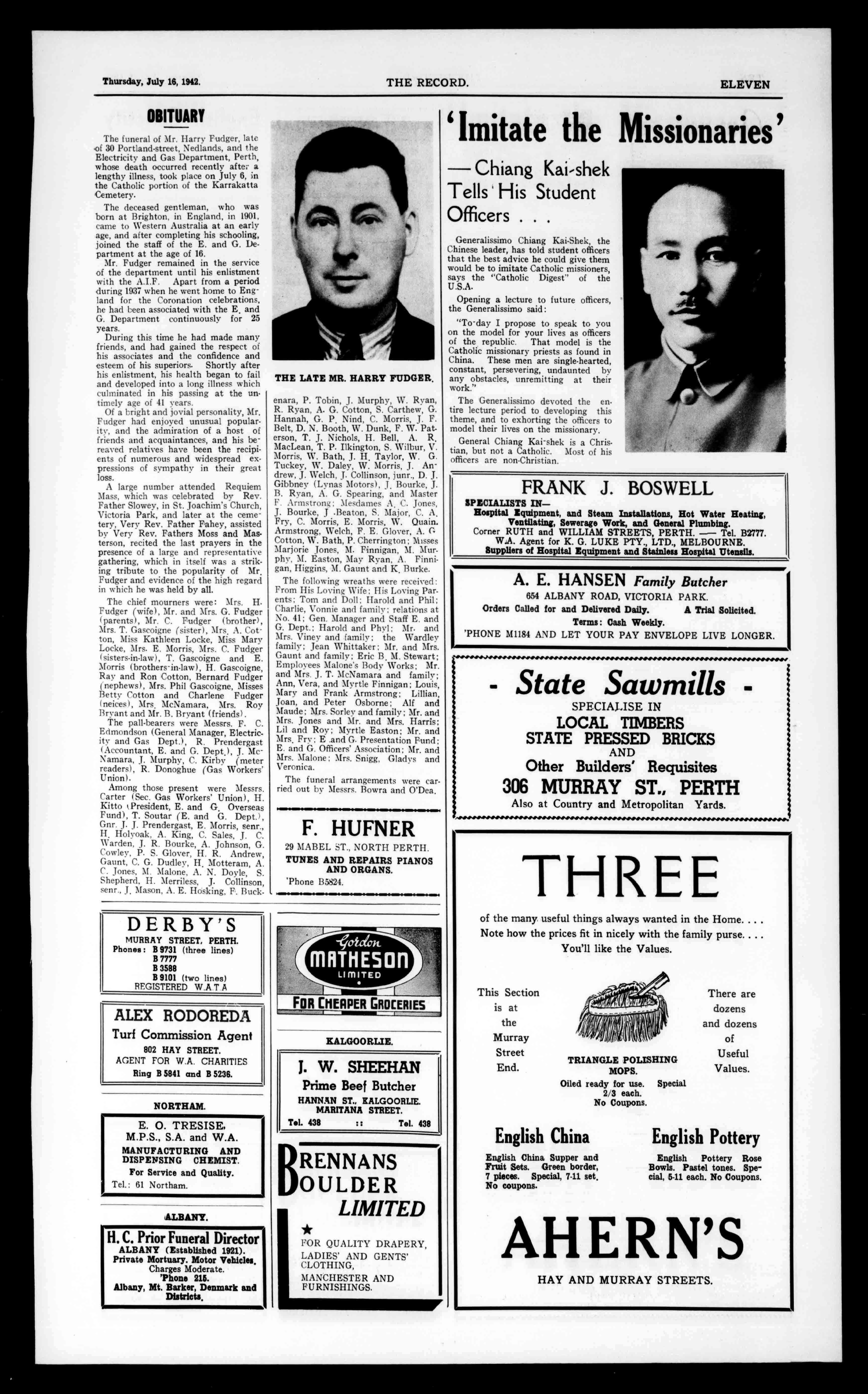
OBITUARY
ThefuneralofMr.HarryFudger,late of30Portland-street,Nedlands,andthe ElectricityandGasDepartment,Perth, whosedeathoccurredrecentlyaftera lengthyillness,tookplaceonJuly6,in theCatholicportionoftheKarrakatta Cemetery.
Thedeceasedgentleman,whowas bornatBrighton.inEngland,in1901. cametoWesternAustraliaatanearly age,andaftercompletinghisschooling, joinedthestaffoftheE.andG.Departmentattheageof16.
Mr.Fudgerremainedintheservice ofthedepartmentuntilhisenlistment withtheA.I.F.Apartfromaperiod during1937whenhewenthometoEnglandfortheCoronationcelebrations, hehadbeenassociatedwiththeE,and G.Departmentcontinuouslyfor25 years. Duringthistimehehadmademany friends,andhadgainedtherespectof hisassociatesandtheconfidenceand esteemofhissuperiors.Shortlyafter hisenlistment,hishealthbegantofail anddevelopedintoalongillnesswhich culminatedinhispassingattheuntimelyageof41years.
Ofabrightandjovialpersonality,Mr. Fudgerhadenjoyedunusualpopularity,andtheadmirationofahostof friendsandacquaintances,andhisbereavedrelativeshavebeentherecipientsofnumerousandwidespreadexpressionsofsympathyintheirgreat loss.
AlargenumberattendedRequiem Mass,whichwascelebratedbyRev. FatherSlowey,inSt.Joachim'sChurch, VictoriaPark,andlateratthecemetery,VeryRev.FatherFahey,assisted byVeryRev.FathersMossandMas terson,recitedthelastprayersinthe presenceofalargeandrepresentative gathering,whichinitselfwasastrikingtributetothepopularityofMr, Fudgerandevidenceofthehighregard inwhichhewasheldbyall.
Thechiefmournerswere:Mrs.H. Fudger(wife),Mr.andMrs.G.Fudger (parents),Mr.C.Fudger(brother), Mrs.T.Gascoigne(sister),Mrs.A.Cotton,MissKathleenLocke,MissMary Locke,Mrs.E.Morris,Mrs.C.Fudger (sisters-in-law),T.GascoigneandE. Morris(brothers-in-law),H.Gascoigne, RayandRonCotton,BernardFudger (nephews),Mrs.PhilGascoigne,Misses BettyCottonandCharleneFudgerneices),Mrs.McNamara.Mrs.Roy BryantandMr.B.Bryant(friends).
Thepall-bearerswereMessrs.F.C. Edmondson(GeneralManager,ElectricityandGasDept.),R.Prendergast (Accountant,E.andG.Dept.),J.McNamara,J.Murphy,C.Kirby(meter readers),R.Donoghue(GasWorkers' Union).
AmongthosepresentwereMessrs. Carter(Sec.GasWorkers'Union),H. KittoiPresident,E.andG.Overseas Fund),T.Soutar(E.andG.Dept.), Gnr.J.J.Prendergast,E.Morris,senr., H.Holyoak,A.King,C.Sales,J.C. Warden,J.R.Bourke,A.Johnson,G. Cowley,P.S.Glover,H.R.Andrew, Gaunt,C.G.Dudley,H,Motteram,A. C.Jones,M.Malone,A.N.Doyle,S. Shepherd.H.Merriless,J.Collinson, senr.,J.Mason,A.E.Hosking,F.Buck-
THELATEMR.HARRYFUDGER.
enara,P.Tobin,J.Murphy,W.Ryan, R.Ryan,A.G.Cotton,S.Carthew,G. Hannah,G.P.Nind,C.Morris,J.F. Belt,D.N.Booth,W.Dunk,F.W.Paterson,T.J.Nichols,H.Bell,A.R. MacLean,T.P.Ilkington,S.Wilbur,V. Morris,W.Bath,J.H.Taylor,W.G. Tuckey,W.Daley,W.Morris,J.Andrew,J.Welch,J.Collinson,junr.,D.J. Gibbney(LynasMotors),J.Bourke,J. B.Ryan,A.G.Spearing,andMaster F.Armstrong;MesdamesA,C.Jones, J.Bourke,J.Beaton,S.Major,C.A. Fry,C.Morris,E.Morris,W.()min. Armstrong,Welch,F.E.Glover,A.11 Cotton,W.Bath,P.Cherrington;Misses MarjorieJones,M.Finnigan,M.Murphy,M.Easton,MayRyan,A.Finnigan,Higgins,M.GauntandK.Burke.
Thefollowingwreathswerereceived:
FromHisLovingWife:HisLovingParents;TomandDoll:HaroldandPhil; Charlie,Vonnieandfamily;relationsat No.41;Gen.ManagerandStaffE.and G.Dept.:HaroldandPhyl;Mr.and Mrs.Vineyandfamily;theWardley family;JeanWhittaker:Mr.andMrs. Gauntandfamily;EricB.M.Stewart; EmployeesMalone'sBodyWorks;Mr. andMrs.J.T.McNamaraandfamily; Ann,Vera,andMyrtleFinnigan;Louis, MaryandFrankArmstrong;Joan,andPeterOsborne:Alfand Maude:Mrs.Sorleyandfamily;Mr.and Mrs.JonesandMr.andMrs.Harris; LilandRoyMyrtleEaston;Mr.and Mrs.Fry:E.andG.PresentationFund; E.andG.Officers'Association;Mr.and Mrs.Malone;Mrs.Snigg,Gladysand Veronica.
ThefuneralarrangementswerecarriedoutbyMessrs.BowraandO'Dea.
`ImitatetheMissionaries'
ChiangKai-shek TellsHisStudent Officers
GeneralissimoChiangKai-Shek,the Chineseleader,hastoldstudentofficers thatthehestadvicehecouldgivethem wouldbetoimitateCatholicmissioners, saysthe"CatholicDigest"ofthe U.S.A.
Openingalecturetofutureofficers, theGeneralissimosaid:
"To-dayIproposetospeaktoyou onthemodelforyourlivesasofficers oftherepublic.Thatmodelisthe Catholicmissionarypriestsasfoundin China.Thesemenaresingle-hearted, constant,persevering,undauntedby anyobstacles,unremittingattheir work."
TheGeneralissimodevotedtheentirelectureperiodtodevelopingthis theme,andtoexhortingtheofficersto modeltheirlivesonthemissionary.
GeneralChiangKai-shekisaChris. tian,butnotaCatholic.Mostofhis officersarenon-Christian.
FRANK
Thursday,July18,an.
ELEVEN
THERECORD.
F.HUFNER 29MARFA. NORTHPERTII TUNESANDREPAIRSPIANOS ANDORGANS. 'Phone135824. DERBY'S MURRAYSTREET,PERTH. Phones B9731(threelines) B7777 B3588 B9101(twolines) REGISTEREDW.ATA ALEXRODOREDA TurfCommissionAgent 802HAYSTREET. AGENTFORWACHARITIES RingB5841andB5236. NORTHAM. E.0.TRESISE, M.P.S.,S.A.andW.A. MANUFACTURINGAND DISPENSINGCHEMIST. ForServiceandQuality. Ttl IIINortham. ALBANY. H.C.PriorFuneralDirector ALBANY(Established1921). PrivateMortuary.MotorVehicles. ChargesModerate. 'Phone215. Albany,Mt.Barker,Denmarkand Districts, Now MRTHE5Orl LIMITED FORCHEAPERGROCERIES 1111111111111 KALGOORLIE. 11,111Ele J.W.SHEEHAN PrimeBeefButcher HANNANST.,KALGOORLIE. MARITANASTREET. Tel.438 Tel.438 B RENNANS OULDER LIMITED FORQUALITYDRAPERY, LADIES'ANDGENTS' CLOTHING, MANCHESTERAND FURNISHINGS.
J.BOSWELL
INHospitalEquipment,andSteamInstallations,HotWaterHeating, Ventilating,
CornerRUTHandWILLIAMSTREETS,PERTH.
Tel.
AgentforK.G.LUKEPTY.,LTD.,MELBOURNE. SuppliersofHospitalEquipmentandStainlessHospitalUtensils. A.E.HANSENFamilyButcher 654ALBANYROAD,VICTORIAPARK. OrdersCalledforandDeliveredDaily. ATrialSolicited. Terms:CashWeekly. 'PHONEM1181ANDLETYOURPAYENVELOPELIVELONGER. -StateSawmillsSPECIALISEIN LOCALTIMBERS STATEPRESSEDBRICKS AND OtherBuilders'Requisites 306MURRAYST.,PERTH AlsoatCountryandMetropolitanYards. THREE ofthemanyusefulthingsalwayswantedintheHome... Notehowthepricesfitinnicelywiththefamilypurse.... You'llliketheValues. ThisSection isat the Murray Street End. TRIANGLEPOLISHING MOPS. Oiledreadyforuse.Special 23each. NoCoupons. Thereare dozens anddozens of Useful Values. EnglishChina EnglishPottery EnglishChinaSupperand FruitSets.Greenborder, 7pieces.Special,7-11set, Nocoupons. EnglishPotteryRose Bowls.Pasteltones.Special,5-11each.NoCoupons. AHERN'S HAYANDMURRAYSTREETS.
SPECIALISTS
SewerageWork,andGeneralPlumbing.
-
B2777. W.A.
II
(URtitzRaattUtrityaaNuitifu ", DEATHS.
McKENNA.-OnJune9,atWyalcatchemHospital,fortifiedbytherites oftheCatholicChurch,JamesPatrick,sonofthelateJamesandNorah McKenna,andlovinghusbandof Julia;aged62years.R.I.P.
O'MEARA.-OnJuly6,afteralongillness,bornwithChristianfortitude, CatherineAgnes,devotedmotherof Mary(Mrs.McCormack),mother-inlawofTom,andfondgrandmaof Bernadette,Gerald,IreneandJohn. R.I.P.
O'MEARA.-OnJuly6,atKununoppinDistrictHospital,Catherine Agnes,lovingwifeof Michael O'Meara,ofTrayning,devoted motherofFrank,Jack,Mary(Mrs. McCormack),JimandKath,motherin-lawofDoreen,MyrtleandTom. grandmotherofthirteengrandchildren;agedseventy-twoyears. SweetHeartofJesus,havemercyon hersoul.
WALL-OnJuly8,atCollieHospital, JosephCharlesWall,brother-in-law ofHannah,andloveduncleofLeo, Norine,NellandVerna. RequiescatinPace.
INmodoramd.
WATERS.-Inlovingmemoryofour deardaughterandsister,Dorothy, whopassedawayJuly16,1939. Eternalrestgrantuntoher,0Lord-
-Insertedbyherlovingfather, mother,sisterandbrother.
WATERS.-Treasuredmemoriesofour dearDorothy,whopassedpeacefully awayonJuly16,1939.
-Insertedbyherlovinguncleand aunt,ofSawyer'sValley.
MUNDAY.-Inlovingmemoryofmy dearhusband,WilliamGeorgeMunday,departedthislifeJuly14,1940. Mayhissoulrestinpeace.Sweet Jesus,havemercy.
-Insertedbyhislovingwife.
BROWDER.-Inlovingmemoryof MaryBrowder.whopassedawayon June29,dearlybelovedneiceof AuntyEve.
Maytheperpetuallightshineupon her.
RYAN.--Inlovingmemoryofmydear husband,Con,whodiedonJuly23, 1939;alsoson,Pat,whodiedonFebruary19,1941. R.I.P.
-Insertedbylovingwifeand mother,Fairfield,Victoria.
LEEK.-Ofyourcharity,prayforthe reposeofthesoulofFrancisJohn Leen,whodiedJuly19,1933.
-InsertedbyHildaFitzgerald.
MITCHELL-Inlovingmemoryof ourdearhusbandandfather,MatthewMitchell,whodepartedthislife onJuly18,1936.
AlwaysRemembered.
-Insertedbyhislovingwifeand family,
AmericanPilotSavedbyMedal
U.S.FLYERFORCEDDOWNNEARISOLATEDISLAND, ISSPAREDBYNATIVESWHOSEE
Auburn,N.Y.,April10(NC).
Backgroundofthestoryinwhichan Americanflyerwassavedfromprobabledeathbyacruciformmedal abouthisneckbeginshere,thousands ofmilesfromthewildandisolated islandintheSouthPacificwherehe faceddeathandenjoyedescape.
NewsthatSecondLieutenantClarenceS.Sanford,Americanpursuit pilotforceddownonBremerIslandin theGulfofCarpentaria,whichindents Australiaonthenorth,wassavedfrom deathatthehandsofnativeswhoidentifiedhimasanon-Japanesebythe medalhewore,wasreceivedherewith specialinterest.Hewasbornin Fleming,asmalltownnearhere,and attendedUnionSpringsCentralHigh School.
The21-year-oldpilotbecamelostin theSouthPacificafterhewasseparatedfromfiveotherAmericanfighter planes.Whenhisfuelranlowhewas forceddownintheGulfofCarpentaria andswamashoretoBremerIsland. Thereheranintotwonativefishermenarmedwithspearswhichthey pointedmenacinglyagainsthischest, TheyaskedhimifhewereaJapanese, andasheutteredahastydenial,the nativessawthemedalhangingfrom histhroat.Onesaid:"Allright,Jesus No.1man."
TAXATIONRETURNS.
Thefinaldatefurlodgingreturnsof salaries,wagesandallotherincome, excepttradingandprofessionalsources,isJuly31,1942,andshouldbe lodgedonFormIA.Fortradingand professionalincome,August31,1942,on Form1.Landtax,August31,1942,on FormsAandGA,andformsCGshould helodgedbyJuly31,1942.
Thepenaltyforfailuretolodgereturnsisnotlessthan£2,normorethan £100.
IncomeTax.
Asingleperson,oramarriedwoman whosehusbandisnotdependentupon her,isliabletolodgereturnsifthe grossincomefromallsourcesforthe yearamountedto£100ormore.
Amarriedman,oramarriedwoman whohasadependenthusband,ora widoworwidowerwithchildrenasdependants,isliabletolodgereturnsif thegrossincomeamountedto£200or more.
HospitalTax.
Everypersonreceiving£52ormore peryear,otherthanfromsalaryor wages,andforwhichanincometax returnhasnotbeenfurnishedisliable tolodgeareturnonForm1A.
Employeesshouldattachtheircertificateofexemptiontotheirincometax returns.
LandTax.
FormCBmustbelodgedforFederal LandTaxifalterationsinholdingsor valueshaveoccurredsincethelastreturn.Ifnoholdingsorvalueshave occurredsincethelastreturn.Ifno changeshavetakenplace,areturnis notrequired.Theseretrunsmustbe lodgedbyallpersonswho,atmidnight June30,1942.beingabsentees,owned landvaluedat£1ormore,orbeing residentsownedlandvaluedat£4,000 ormore.
ReturnsonFormAforStateLand Taxshouldbelodgedbyalllandownerswhohavenotpreviouslyrendered areturn,andonFormGAwheresales orpurchasesorchangesinvalueshave takenplaceduringtheyear.
GeneralDouglasMacArthur,GeneralOfficerCommandingtheSouthWestPacificAlliedForces,calledrecentlyonHisGraceArchbishopMannix,at"Raheen."Inawirelessmessagejustreceived,HisGraceArchbishopSpellman,ofNewYork,andBishopO'Hara,C.S.C.,AuxiliaryBishop ofthesamediocese,haveaskedHis GracetheArchbishopofMelbourneto actastheirdelegateformattersrelatingtoCatholicchaplainsservingwith theUnitedStatesArmyForcesinAustralia.HisGracehasrepliedacceptingthisappointment.
FEDERAL-STATE TAXATIONRETURNS
INCOMETAX: SalariesandWages,FormIA. due31stJuly
LANDTAX:
Business,etc.,FormI. due31stAugust.
31st
PRESCRIPTIONSPECIALIST, COLINF.CAMPBELL (LateMcWhinney'sPharmacy).
CORNERSTIRLINGHIGHWAYANDSTUARTSTREET, 'PHONE:F2219. MOSMANPARK. 'PHONE:F2219
PRESCRIPTIONSCALLEDFORAND
CRUCIFORM.
Thenativestooktheexhaustedflyer toanearbymission,whichitselfis theonlycivilisedspotwithin500miles. Fromtherehereachedthemainland byluggerandultimatelyarrivedin Darwin.
LieutenantSanfordisaconvertto Catholicism.AfterjoiningtheAir CorpsandbeingstationedatGunter Field,heformedafriendshipwithjack Love,aformerseminarian.Oftenhe wenttoMasswithMr.Love,andafter LieutenantSanfordwastransferredto CraigFieldhebegantakinginstructionsfromachaplainthere.Laterhe wastransferredtoMorrisonFieldin Florida, Lastfall,LieutenantSanfordcame hereonfurloughandinthecourseof thatvisit,hisfiancee,MissMargaret Bolger,ofAuburn,presentedhimwith acruciformmedalshehadsecuredat OurLadyofVictoryBasilica,Lackawanna,N.Y.SheaskedLieutenant Sanfordtowearitalwaysandhepromisedtodoso. MissBolgerandLieutenantSanford weremarriedonDecember31inthe chapelatMorrisonFieldataNuptial Mass,celebratedbytheRev.Edward Byrne,chaplainatMorrison.LieutenantSanfordhadbeenbaptisedby FatherByrnetheday1,t.f,,r,.
T.VIVIAN, 143Rokeby.road,Subiaco.W1539 FORSEWERAGECONNECTIONS, W1539. BadWaterPressure,BrokenPedes talPans,LlockedSewerDrains,Cis ternandRoofRepairs,T.V.Headlight lished;andhewithdrewfromanyoffiMaskstoApprovedDesigns. 6.41MKNIMVAINIEKMM..104.41M.
and whoseparentsorguardiansaredesirousthattheyshouldlearntrades, shouldapplytothePrincipal,St.Joseph'sFarmandTradesSchool,Bindoon.Telephonecommunicationis beingestablishedwiththisInstitution andshouldbefunctioningbeforethe endofJune.
TrottingSelections
TheIlaNk
GLOUCESTERPARE.
Saturday,July18,1942. W.A.Breeders'HandicapLadyHil-
FayWinwood,1;Balkis,2PearlScott,3. LesmurdieHandicapHuonCloud, 1;LittlePick,2Adaloma,3. HillsHandicapAndyWalla,1; Lin'sRelic,2;Wilfred'sWonder,3. HighClassHandicap:BlackBertha, 1EarlMavista,2;CavanChief,3. MundaringHandicap:PrincessDoral, 1:MillAdonis,2WeeGlobe,3. CanningHandicapLeeTennessee, 1;LordSheik,2;LadyAraby,3.
THERECORD. Thtusday,July16,1942.
TWELVE
July Federal-StaleFormA StateFormGAdue31stAugust Panaltlesforfailure,upto£100 FarmsanIl-,structlonsatPam(titters M.O.MEARS, CommusionerofTaxationSIIIto DeputyCommissionerofTasution,Federal)
FederalForm,CB due
DELIVERED.
41,04141.411,01 ATTADALEDAIRY. FREMANTLEROAD,MELVILLE. EDWINH.MITCHELL MILKFROMATTADALEDAIRY. MilkDeliveredtoanypartof FremantleandSuburbsDaily. TEL.L1443. PERTHFISHERIES 489WELLINGTONST,PERTH FISHANDPOULTRYSUPPLIED. WholesaleandRetail. Ph,,ne:115992. CityDeliveries. CountryOrdersCateredFor. PATERSON'SSUPPLYSTORES 123CLAREMONTCRESCENT, SWANBOURNE.'Phone:F2571 GROCERANDGREENGROCER. DeliveriesfromNedlandsto MosmanPark. DEAF? HEARCLEARLY -WithWesternElectric AUDIPHONE ConsultWithoutObligation. SAINKEN&SAINKEN. HAYSTREET, NextAmbassadorsTheatre. QUICKSWEEPS 111a CHARITIES Consultation NOWOPEN £1000 1st PRIII Tickets2/6onsawaverywri:a Edon, ectfrom CUMG.P.O. LIMIS IIIIIIIIIIIIIIIIIIIIIIIIIII'II111111111111111111111111111111111111111111111it PATRONISEOURADVERTISERS. CLONTARFBOYS'TOWN Parentsandothersinterestedingettingboyswhoareunder14yearsinto ClontarfBoys'Townshouldapplyfor particularstothePrincipalofClontarf evacuatedtoTardun-telephoneTardun2;ortoCastledareJuniorOrphanage,Queen'sPark-telephoneMW80. Boyswhoareover14years,
KalamundaHandicap
SIGHTTESTING BYREGISTERED Opticians Laubman&Pank (W.A.).LIMITED. T.G.SMITH,W.A.O.A.,B.A.S., ManagingDirector. 64BARRACKSTREET,PERTH. Phone:B3511. ACOMPACT, CONCISE, ACTIVESERVICE PRAYERBOOK PaperCover 9d. KhakiClothCover 2/BlueClothCover 2/LeatherCover 4/6 '2,i CompiledbyRev.G.Butler. M.S.C.,andpublishedbyauthorityoftheC.U.S.A.,Queensland,thisnewprayerbookfor CatholicSoldiers,Sailorsand Airmenisthebestyetprinted formenintrainingandonactiveservice. ItcontainsthefullMass,all essentialprayersanddevotions andlistsspecialprivileges. Itoffers,aswell,manypagesof blunt,helpfulandsympathetic advicethatwillbewelcomed byeveryCatholicyoungman allina96-pagepocketsizebookonly4iinchesdeep by3incheswide. Vit4.CO. 776HayStreet,Perth loppFoyCrGibson
ton,1ArabianLass,2;Vera'sMaid,3.
Tilt
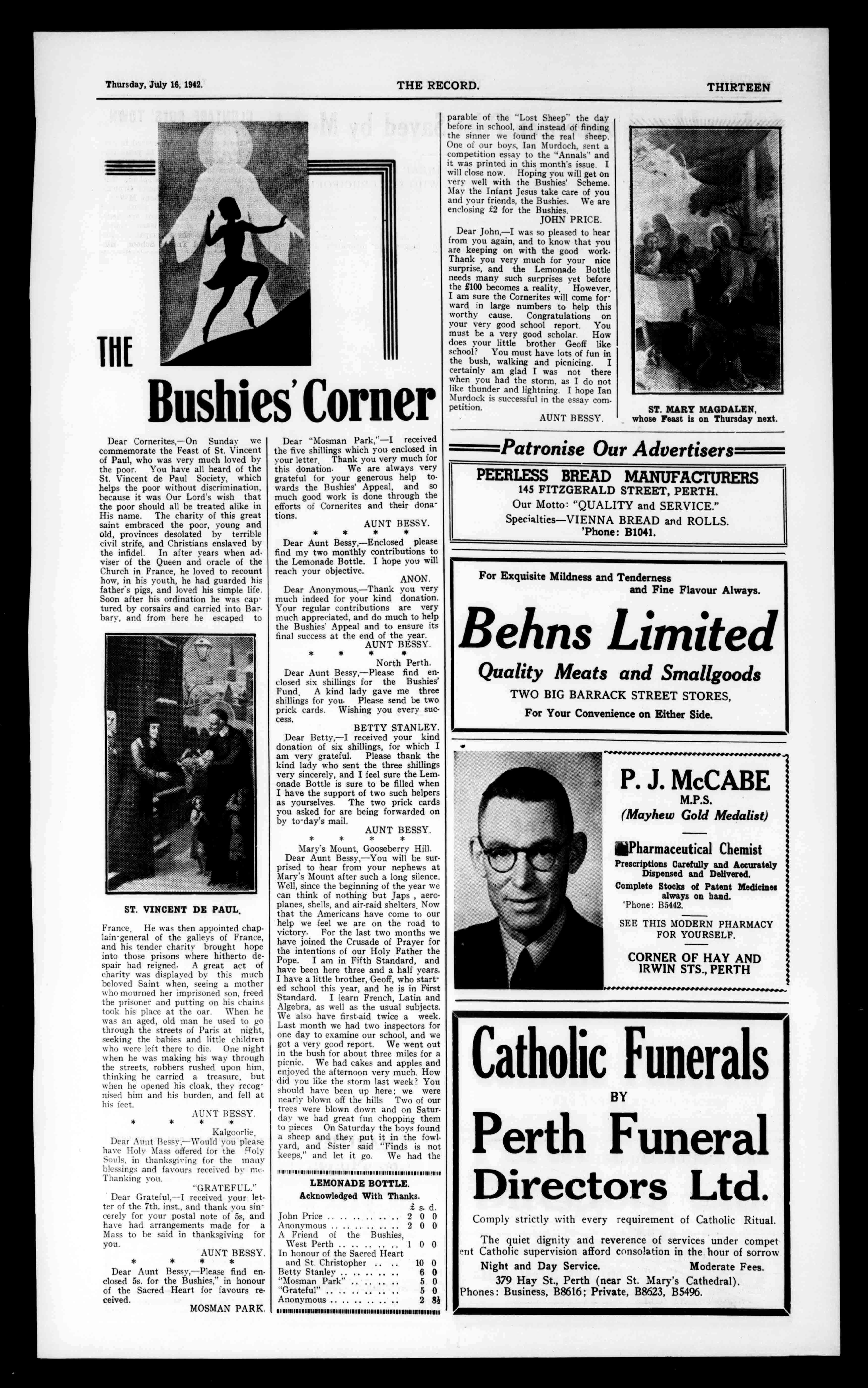
Bushies'Corner
DearCornerites,-OnSundaywe commemoratetheFeastofSt.Vincent ofPaul,whowasverymuchlovedby thepoor.Youhaveallheardofthe St.VincentdePaulSociety,which helpsthepoorwithoutdiscrimination, becauseitwasOurLord'swishthat thepoorshouldallbetreatedalikein Hisname.Thecharityofthisgreat saintembracedthepoor,youngand old,provincesdesolatedbyterrible civilstrife,andChristiansenslavedby theinfidel.InafteryearswhenadviseroftheQueenandoracleofthe ChurchinFrance,helovedtorecount how,inhisyouth,hehadguardedhis father'spigs,andlovedhissimplelife. SoonafterhisordinationhewascapturedbycorsairsandcarriedintoBarbary,andfromhereheescapedto
Dear"MosmanPark,"-Ireceived thefiveshillingswhichyouenclosedin yourletter.Thankyouverymuchfor thisdonation.Wearealwaysvery gratefulforyourgeneroushelptowardstheBushies'Appeal,andso muchgoodworkisdonethroughthe effortsofCorneritesandtheirdonations.
* *
ST.VINCENTDEPAUL.
France,Hewasthenappointedchaplain-generalofthegalleysofFrance, andhistendercharitybroughthope intothoseprisonswherehithertodespairhadreigned.Agreatactof charitywasdisplayedbythismuch belovedSaintwhen,seeingamother whomournedherimprisonedson,freed theprisonerandputtingonhischains tookhisplaceattheoar.Whenhe wasanaged,oldmanheusedtogo throughthestreetsofParisatnight, seekingthebabiesandlittlechildren whowerelefttheretodie.Onenight whenhewasmakinghiswaythrough thestreets,robbersrusheduponhim, thinkinghecarriedatreasure,but whenheopenedhiscloak,theyrecognisedhimandhisburden,andfellat hisfeet.
AUNTBESSY.
* * * *
Kalgoorlie.
DearAuntBessy,-Wouldyouplease haveHolyMassofferedforthef-Toly Souls,inthanksgivingforthemany blessingsandfavoursreceivedbymc. Thankingyou.
"GRATEFUL.'
DearGrateful,-Ireceivedyourletterofthe7th.inst.,andthankyousincerelyforyourpostalnoteof5s,and havehadarrangementsmadefora Masstobesaidinthanksgivingfor you.
AUNTBESSY.
* * *
DearAuntBessy,-Pleasefindenclosed5s.fortheBushies,"inhonour oftheSacredHeartforfavoursreceived.
MOSMANPARK.
parableofthe"LostSheep-theday beforeinschool,andinsteadoffinding thesinnerwefound'therealsheep. Oneofourboys,IanMurdoch,senta competitionessaytothe"Annals"and itwasprintedinthismonth'sissue.I willclosenow.Hopingyouwillgeton verywellwiththeBushies'Scheme. MaytheInfantJesustakecareofyou andyourfriends,theBushies.Weare enclosing£2fortheBushies.
JOHNPRICE.
DearJohn,-Iwassopleasedtohear fromyouagain,andtoknowthatyou arekeepingonwiththegoodwork. Thankyouverymuchforyournice surprise,andtheLemonadeBottle needsmanysuchsurprisesyetbefore the£100becomesareality.However, IamsuretheCorneriteswillcomeforwardinlargenumberstohelpthis worthycause.Congratulationson yourverygoodschoolreport.You mustbeaverygoodscholar.How doesyourlittlebrotherGeofflike school?Youmusthavelotsoffunin thebush,walkingandpicnicing.I certainlyamgladIwasnotthere whenyouhadthestorm,asIdonot likethunderandlightning.IhopeIan Murdockissuccessfulintheessaycompetition.
AUNTBESSY.
DearAuntBessy,-Enclosedplease findmytwomonthlycontributionsto theLemonadeBottle.Ihopeyouwill reachyourobjective.
ANON.
DearAnonymous,-Thankyouvery muchindeedforyourkinddonation. Yourregularcontributionsarevery muchappreciated,anddomuchtohelp theBushies'Appealandtoensureits finalsuccessattheendoftheyear.
AUNTBESSY.
NorthPerth.
DearAuntBessy,-PleasefindenclosedsixshillingsfortheBushies' Fund,Akindladygavemethree shillingsforyou.Pleasesendbetwo prickcards.Wishingyoueverysuccess.
BETTYSTANLEY.
DearBetty,-Ireceivedyourkind donationofsixshillings,forwhichI amverygrateful.Pleasethankthe kindladywhosentthethreeshillings verysincerely,andIfeelsuretheLemonadeBottleissuretobefilledwhen Ihavethesupportoftwosuchhelpers asyourselves.Thetwoprickcards youaskedforarebeingforwardedon byto-day'smail.
AUNTBESSY.
* * Mary'sMount,GooseberryHill.
DearAuntBessy,-Youwillbesurprisedtohearfromyournephewsat Mary'sMountaftersuchalongsilence. Well,sincethebeginningoftheyearwe canthinkofnothingbutJapsaeroplanes,shells,andair-raidshelters,Now thattheAmericanshavecometoour helpwefeelweareontheroadto victory.Forthelasttwomonthswe havejoinedtheCrusadeofPrayerfor theintentionsofourHolyFatherthe Pope.IaminFifthStandard,and havebeenherethreeandahalfyears. Ihavealittlebrother,Geoff,whostartedschoolthisyear,andheisinFirst Standard.IlearnFrench,Latinand Algebra,aswellastheusualsubjects. Wealsohavefirst-aidtwiceaweek. Lastmonthwehadtwoinspectorsfor onedaytoexamineourschool,andwe gotaverygoodreport.Wewentout inthebushforaboutthreemilesfora picnic.Wehadcakesandapplesand enjoyedtheafternoonverymuch.How didyoulikethestormlastweek?You shouldhavebeenuphere:wewere nearlyblownoffthehillsTwoofour treeswereblowndownandonSaturdaywehadgreatfunchoppingthem topiecesOnSaturdaytheboysfound asheepandtheyputitinthefowlyard,andSistersaid"Findsisnot keeps,"andletitgo.Wehadthe
Thursday,July16,1642. THERECORD. THIRTEEN
LEMONADEBOTTLE. AcknowledgedWithThanks. £s.d. JohnPrice 200 Anonymous 200 AFriendoftheBushies, WestPerth 100 InhonouroftheSacredHeart andSt.Christopher 100 BettyStanley 60 ".1.1osmanPark" 50 'Grateful" 50 Anonymous 2Si 11111111111111111111111111111111111111111111111111115111111151111111111111111
AUNTBESSY. ST.MARYMAGDALEN. whoseFeastisonThursdaynext. PatroniseOurAdvertisers PEERLESSBREADMANUFACTURERS 145FITZGERALDSTREET,PERTH. OurMotto:"QUALITYandSERVICE." Specialties-VIENNABREADandROLLS. 'Phone:B1041. ForExquisiteMildnessandTenderness andFineFlavourAlways. BehnsLimited QualityMeatsandSmallgoods TWOBIGBARRACKSTREETSTORES, ForYourConvenienceonEitherSide. P.J.McCABE M.P.S. (MayhewGoldMedalist) OPharmaceutica1 Chemist PrescriptionsCarefullyandAccurately DispensedandDelivered. CompleteStocksofPatentMedicine. alwaysonhand. 'Phone:B5442. SEETHISMODERNPHARMACY FORYOURSELF. CORNEROFHAYAND IRWINSTS.,PERTH CatholicFunerals BY PerthFuneral DirectorsLtd. ComplystrictlywitheveryrequirementofCatholicRitual. Thequietdignityandreverenceofservicesundercompet 'ntCatholicsupervisionaffordconsolationinthehourofsorrow NightandDayService. ModerateFees. 379HaySt.,Perth(nearSt.Mary'sCathedral). Phones:Business,B8616;Private,B8623,B5496.
Challengeof Citeaux TRAPPISTMONKS I\AWORLD GONEMAD
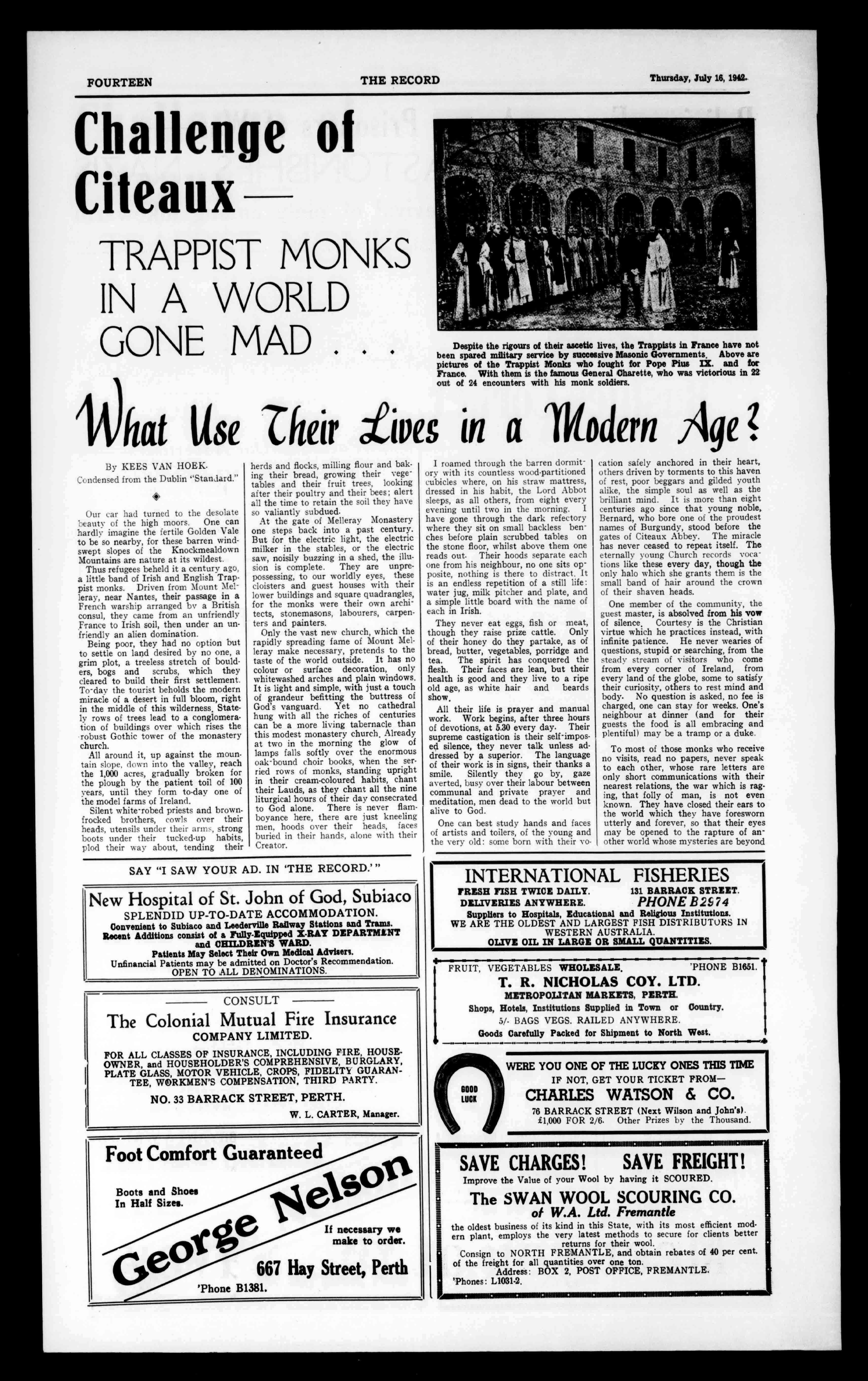
Despite
hatUsetheirLivesinaIllodernAge?
ByKEESVANHOEK.
CondensedfromtheDublin'Standard." 4
Ourcarhadturnedtothedesolate beautyofthehighmoors.Onecan hardlyimaginethefertileGoldenVale tobesonearby,forthesebarrenwindsweptslopesoftheKnockmealdown Mountainsarenatureatitswildest.
Thusrefugeesbehelditacenturyago, alittlebandofIrishandEnglishTrappistmonks.DrivenfromMountMelleray,nearNantes,theirpassageina FrenchwarshiparrangedbyaBritish consul,theycamefromanunfriendly Fi-ancetoIrishsoil,thenunderanunfriendlyanaliendomination.
Beingpoor,theyhadnooptionbut tosettleonlanddesiredbynoone,a grimplot,atreelessstretchofboulders,bogsandscrubs,whichthey clearedtobuildtheirfirstsettlement.
miracleofadesertinfullbloom,right inthemiddleofthiswilderness,Statelyrowsoftreesleadtoaconglomerationofbuildingsoverwhichrisesthe robustGothictowerofthemonastery church.
Allaroundit,upagainstthemountainslope,downintothevalley,reach the1,000acres,graduallybrokenfor theploughbythepatienttoilof100 years,untiltheyformto-dayoneof themodelfarmsofIreland.
Silentwhite-robedpriestsandbrownfrockedbrothers,cowlsovertheir heads,utensilsundertheirarms,strong bootsundertheirtucked-uphabits, plodtheirwayabout,tendingtheir
herdsandflocks,millingflourandbakingtheirbread,growingtheirvegetablesandtheirfruittrees,looking aftertheirpoultryandtheirbees;alert allthetimetoretainthesoiltheyhave sovaliantlysubdued.
AtthegateofMellerayMonastery onestepsbackintoapastcentury.
Butfortheelectriclight,theelectric milkerinthestables,ortheelectric saw,noisilybuzzinginashed,theillusioniscomplete.Theyareunprepossessing,toourworldlyeyes,these cloistersandguesthouseswiththeir lowerbuildingsandsquarequadrangles, forthemonksweretheirownarchitects,stonemasons,labourers,carpentersandpainters.
Onlythevastnewchurch,whichthe rapidlyspreadingfameofMountMelleraymakenecessary,pretendstothe tasteoftheworldoutside.Ithasno colourorsurfacedecoration,onlywhitewashedarchesandplainwindows.
Itislightandsimple,withjustatouch ofgrandeurbefittingthebuttressof God'svanguard.Yetnocathedral hungwithalltherichesofcenturies canbeamorelivingtabernaclethan thismodestmonasterychurch.Already attwointhemorningtheglowof lampsfallssoftlyovertheenormous oak-boundchoirbooks,whentheserriedrowsofmonks,standingupright intheircream-colouredhabits,chant theirLauds,astheychantallthenine liturgicalhoursoftheirdayconsecrated toGodalone.Thereisneverflamboyancehere,therearejustkneeling men,hoodsovertheirheads,faces buriedintheirhands,alonewiththeir Creator.
SAY"ISAWYOURAD.IN'THERECORD."'
NewHospitalofSt.JohnofGod,Subiaco
SPLENDIDUP-TO-DATEACCOMMODATION. ConvenienttoSubiacoandLeedervilleRailwayStationsandTrams. RecentAdditionsconsistofaFully-EquippedX-RAYDEPARTMLNT andCHILDREN'SWARD.
OwnMedicalAdvisers.
MaySelect
PatientsmaybeadmittedonDoctor'sRecommendation. OPENTOALLDENOMINATIONS.
CONSULT
TheColonialMutualFireInsurance COMPANYLIMITED.
FORALLCLASSESOFINSURANCE,INCLUDINGFIRE,HOUSEOWNER,andHOUSEHOLDER'SCOMPREHENSIVE,BURGLARY, PLATEGLASS,MOTORVEHICLE,CROPS,FIDELITYGUARANTEE,WORKMEN'SCOMPENSATION,THIRDPARTY. NO.33BARRACKSTREET,PERTH.
W.L.
Iroamedthroughthebarrendormitorywithitscountlesswood-partitioned cubicleswhere,onhisstrawmattress, dressedinhishabit,theLordAbbot sleeps,asallothers,fromeightevery eveninguntiltwointhemorning. I havegonethroughthedarkrefectory wheretheysitonsmallbacklessbenchesbeforeplainscrubbedtableson thestonefloor,whilstabovethemone readsout.Theirhoodsseparateeach onefromhisneighbour,noonesitsopposite,nothingistheretodistract.It isanendlessrepetitionofastilllife: waterjug,milkpitcherandplate,and asimplelittleboardwiththenameof eachinIrish.
Theynevereateggs,fishormeat, thoughtheyraiseprizecattle.Only oftheirhoneydotheypartake,asof bread,butter,vegetables,porridgeand tea.Thespirithasconqueredthe flesh.Theirfacesarelean,buttheir healthisgoodandtheylivetoaripe oldage,aswhitehairandbeards show,
Alltheirlifeisprayerandmanual work.Workbegins,afterthreehours ofdevotions,at5.30everyday.Their supremecastigationistheirself-imposedsilence,theynevertalkunlessaddressedbyasuperior.Thelanguage oftheirworkisinsigns,theirthanksa smile.Silentlytheygoby,gaze averted,busyovertheirlabourbetween communalandprivateprayerand meditation,mendeadtotheworldbut alivetoGod.
Onecanbeststudyhandsandfaces ofartistsandtoilers,oftheYoungand theveryold:sonicbornwiththeirvo-
cationsafelyanchoredintheirheart, othersdrivenbytormentstothishaven ofrest,poorbeggarsandgildedyouth alike,thesimplesoulaswellasthe brilliantmind.Itismorethaneight centuriesagosincethatyoungnoble, Bernard,whoboreoneoftheproudest namesofBurgundy,stoodbeforethe gatesofCiteauxAbbey.Themiracle hasneverceasedtorepeatitself.The eternallyyoungChurchrecordsvocationsliketheseeveryday,thoughthe onlyhalowhichshegrantsthemisthe smallbandofhairaroundthecrown oftheirshavenheads.
Onememberofthecommunity,the guestmaster,isabsolvedfromhisvow ofsilence,CourtesyistheChristian virtuewhichhepracticesinstead,with infinitepatience.Heneverweariesof questions,stupidorsearching,fromthe steadystreamofvisitorswhocome fromeverycornerofIreland,from everylandoftheglobe,sometosatisfy theircuriosity,otherstorestmindand body.Noquestionisasked,nofeeis charged,onecanstayforweeks.One's neighbouratdinner(andfortheir gueststhefoodisallembracingand plentiful)maybeatramporaduke.
Tomostofthosemonkswhoreceive novisits,readnopapers,neverspeak toeachother,whoserarelettersare onlyshortcommunicationswiththeir nearestrelations,thewarwhichisraging,thatfollyofman,isnoteven known.Theyhaveclosedtheirearsto theworldwhichtheyhaveforesworn utterlyandforever,sothattheireyes maybeopenedtotheraptureofanotherworldwhosemysteriesarebeyond
FOURTEEN THERECORD Thursday,July16,1942.
for
isthe
in22 outof24encounterswithhismonksoldiers.
therigoursoftheirasceticlives,theTrappistsinFrancehavenot beensparedmilitaryservicebysuccessiveMasonicGovernments,Aboveare picturesoftheTrappistMonkswhofoughtforPopePiusIX.and
France.Withthem
famousGeneralCharette,whowasvictorious
Patients
Their
Unfinancial
CARTER,Manager. FootComfortGuaranteed BootsandShoes InHalfSizes. lt%1 Gedt44e 667HayStreet,Perth Ifnecessarywe maketoorder. 'PhoneB1381. ImprovetheValueofyourWoolbyhavingitSCOURED. TheSWANWOOLSCOURINGCO. ofW.A.Ltd.Fremantle
INTERNATIONALFISHERIES FRESHFISHTWICEDAILY. 131BARRACKSTREET. DELIVERIESANYWHERE. PHONEB2574 SupplierstoHospitals,EducationalandReligiousInstitutions. WEARETHEOLDESTANDLARGESTFISHDISTRIBUTORSIN WESTERNAUSTRALIA. OLIVEOILINLARGEORSMALLQUANTITIES. FRUITVEGETABLESWHOLESALE, 'PHONEB1651. T.R.NICHOLASCOY.LTD. METROPOLITANMARKETS,PERTH. Shops,Hotels,InstitutionsSuppliedinTownorCountry. 5/.BAGSVEGS.RAILEDANYWHERE. GoodsCarefullyPackedforShipmenttoNorthWest. WEREYOUONEOFTHELUCKYONESTHISME IFNOT,GETYOURTICKETFROMCHARLESWATSON&CO. 76BARRACKSTREET(NextWilsonandJohn's) £1,000FOR2/6.OtherPrizes1,ytheThousand. SAVECHARGES! SAVEFREIGHT! theoldestbusinessofitskindinthisState,withitsmostefficientmod. gernplant,employstheverylatestmethodstosecureforclientsbetter E.' returnsfortheirwool. ConsigntoNORTHFREMANTLE,andobtainrebatesof40percent. ofthefreightforallquantitiesoveroneton. Address:BOX2,POSTOFFICE,FREMANTLE. 'Phones:L1031-2.
ReligiousFervourAmongPrisonersofWar
4Opportunitiesforintellectual improvementmitigatephysicalhardship
TheGermanswereverymuchsurpricedatfindingsomuchfaithandfervouramongstus:theywereverymuch edifiedbyoursingingofthe('redoat acandleprocessionoftheBlessed Sacrament-itwasheardformiles around.
Thisstatementwasmadebyoneof thethousandsofprisoners-fathersof atleastfourchildren,andveteransof thefirstWorldWar-whoarebeingreturnedtoFrancefromGermanprison camps,andwhoaretellingoftheirexperiencesafterhavingbeenmarched instagesofsixtosevenmilesthrough France,BelgiumandGermanyto campsinEastPrussiaandAustria.
Theygivemostinterestingreports ofthereligiouslifeinthecamps,which oneofthemdescribesassavoringof themonastic,duetothenumberof priestsandintellectualsamongthe prisoners,andthemanywhoattend dailyservicesandlecturesonliturgy, theology,scriptureandcanonlawas well.
"Wewerefifteendaysonthemarch," apoilureports."Whilepassingthrough Belgiumwewereextremelywelltreatedbythepopulation.Therewere 40,000FrenchandasmanyPolesin StallagII-A.
"Ourfarewaspracticallythesame asthatofour'guards,butnotsufficientforus.However,duringthelast fivemonths,mostofushavebeen workingintheforests,inlumber-yards, oronfarms.Wewerewelltreated bythecountrypeople,andlifewas moreagreeableinthefieldsthanbehindthebarbed-wireofthecamps."
thereachofthosewithonlyworldly comprehension.
Theymeetthecheapcriticismof modernpaganismwiththeexampleof theirunremittingtoil.Theunbeliever maybereadywithhiseasysarcasmof darkages,butalltheyhavewithdrawnfromisthegaudyartificiallight ofaworldinanarchyandagony,to liveinsteadinthattriumphanttwilightbetweenlifeanddeath:aman's beliefintheimmortalityofhissoul.
Ihadcomewithoutmuchunderstandingforwhatseemedtomeneedlessausterity.Ihadinwardlypitied themformissingtheinfinitevarietyof thebeautyofourwondrousearth.Then Icamehere,facetofacewiththe movingrealityofthatdoctrineofthe CommunityoftheChurch,theunityof allhermembersinChrist,Thesehere dopenanceandprayforthosewhoare outsideinthehurryingsinningworld.
Aswesteppedbackintotheturmoil ofthedayoutside,thesunwassetting overMountMelleray.Itwasabreathtakingmoment.Itmusthavebeenone ofGod'sownangelswhorentthepatch ofraincloudsasundertoshowthepale greeneveningskyofEire.There,where thesunsankdown,animmenseeider downofyellowandorangerimmedinto thepurestsheetofgold:avisionof heaven.
Patronise
...OURADVERTISERS
STOVES,allenamel,newandused lowestprices;promptrepairs...WA StoveCo.,559WellingtonSt.(B6307.
THIiBESTVALUEFORYOUR MONEYAT F.J.DUFF'S WINESALOON. CornerARUNDELSTREETand SOUTHTERRACE,FREMANTLE.
'Phone:L1902.
BUNBIIRY.
LANDandESTATEAGENT G.H.TEEDE
'Phone31 Private267. SMITH'SBUILDINGS, WELLINGTONST.,BUNBURY. Businesses,Farms,Houses,Land ForSale.
ASTONISHESNAZIS
Noticeablerevivalofpietyamong
Amoredetailedpictureoflifeamong theprisonerofficersisgivenbyone whowasinternedinacampintheInn Valley,Austria.
Onarrival,everyone,includingthe higher-rankingofficers,wasstripped totheskinandallbelongingsconfiscated-weddingringsbeingtheoneexception.Duringthefirstthreemonths someoftheofficerslostfrom40to50 lbs.,andallofthemfelloffinweight. Theylearnedtoeatsunflowerseeds andtosmokecloverleaves.
Thelackofnewsfromhomewas "excruciating."Towardstheendof lastyearthefirstfoodparcelsbeganto arrive,andtheprisonersregainedsome oftheirlostpoundage:alsotheordinaryprisonfarehadimprovedsomewhat.
Amongthisgroupweretenpriests whohadbeenservingasofficers,and onechaplain.Theyhadsufficient equipmentamongthemforthreeportablealtars.
Theygottheuseofahutasachapel and,thereafter,therewasdailyMass andeveningprayers.
Thegeneralstateofhealthandmoralewasquitegood,andtherewerefew attemptsatescape,particularlybecauseitwouldhavebeendifficultto passthebarbed-wirefence.Butthis campwassubsequentlysuppressedand itsinmatesscattered.
"With250officersandthreepriests whomIhadknowninBelfort-1had servedMassforoneofthemforeleven months-Ileftthenextdayforour newcamp,"theofficercontinued."It wascold-20degreesFahrenheit-and thesnowwastwofeetdeep.Wewere withoutshoes,becausetheGermans hadconfiscatedourshoesinreprisal fortwoescapesthedaybefore.We travelledinthird-classcarriageswithouttoilets.
"OflagXVII-Ahad5,600officers andabout800enlistedmen,andwas muchworsethantheothercamp,with foodparcelsonlyonceaweek.
"Butwhatwelostincomfortwe madeupforintheintellectualdomain. Theproportionofscholarsandprofessorswasremarkablyhigh.From8 a.m.top.m.,onemaystudy,forexample,Arabic,Japanese,ormorecurrentlanguagesManyyoungofficers arecontinuingtheirstudiesoflawand sciences,andtheseminariansarenot wastingtime,either.Thereisatheatrewithmagnificentscenery,allmade byfellow-prisoners:aforty-pieceorchestra:football,handball,basketball, bowling. "Thespiritualsideofcamplifeisvery important.Ofcourse,therearestill asetofunbelievers,butthereisalso anoticeablerevivalamongthelukewarm.
"Ahuthasbeenconvertedintoa chapel,andthe97priestssayMass
J.F.CAIN
17STIRLINGHIGHWAY, COTTESLOE. PhoneF2121,DayorNight. LICENSEDSANITARYPLUMBER, IRONWORKER,SHEETMETAL WORKER.
S.BEECROFT-Butcher 181RokebyRoad.Subiaco.
DnlyPrimeFreshKilledMeatSold 'PhoneW1373
J.NEILSON,Optician
S.DANNELL,F.S.M.C.(London), W.A.O.A, OPTOMETRIST. Tel.:B1616 16PLAZAARCADE,PERTH.
dailyon16portablealtarsandthe mainaltar,builtbycomradesclever atcarpentry.ThereareMassesfrom 3.45to9a.m. "OnSundaysadialogueMassat isfollowedbythreeHighMasses.The chapelaccommodates1,500. Vespers at4andcomplineat8,anddailyat 8,eveningprayersandBenediction. Thechapelmaybecrammedfull,but everyonekneelsatBenediction.
lukewarm
"Duringaten-monthperiodthere werenolessthan80,000Communions, severalbaptisms,firstCommunions, conversionsandtwoabjurations. Inadditiontotheverymanywho attendchurchservicesdaily,lifein thisparticularcampresembleslifein amonasterybecauseofthenumberof prisonerswhofollowlecturecourseson liturgy,theology,scripture,canonlaw, andotherspiritualsubjects:*
HotelandAccommodationGuide
OntheRoad to CityBeach. WEMBLEYHOTEL
'Phone:B3418.
FirstClass Accommodation.
M.CRANLEY.Proprietor.
GAYNOR'SHISMAJESTY'SHOTEL HAYSTREET PERTH. EXCELLENTCUISINE MODERATETARIFF.
HOTELPERTH
JACKEDDINGTON, Proprietor.
ExcellentAccommodation
STAN.O'BRIEN COURTHOTEL PERTH.
PhoneB4281
HOTELBEACONSFIELD FREMANTLE. OverlookingtheOcean. SuperiorAccommodation. ModerateCharges. M.BYRNE LateofGrandandShamrock Hotels,Boulder).
SUBIACOHOTEL
FIRST-CLASSACCOMODAT1ON
*Phone:W1028. A. McIIENRY.Proprietor.
VICTORIAHOTEL HAYSTREET,SUBIACO. RenovatedThroughout. EssenceofComfort. W.F.ARTIS,Proprietor. (LateofBalmoralHotel,Vic.Park'
COUNTRY.
DukeofYorkHotel NARROGIN ReconditionedandRefurnished NewLounge,DiningRoom,and CommercialRooms. ARTHURBOYLAN,Proprietor LateGeorgeHotel,Perth.)
FREEMASON'SHotel
TOODYAY. ExcellentCuisine AmaticeRefrigeratorInstalled. OldandNewFriendsare CordiallyWelcomed MRS.E.WING,Proprietress
ODDFELLOWS'HOTEL
SOUTHTERRACE,FREMANTLE. BESTBRANDSSTOCKED. NewlyFurnishedThroughout. ALLWELCOME.
J.G.MULCAHY,Proprietor.
GOLDFIELDS.
RodBeaton's
HANNAN'SHOTEL
HANNANSTREET, KALGOORLIE.
STAR&GARTERHOTEL
Thursday,July16,1942. THERECORD. FIFTEEN
Cnr.HANNANandNETHERCOTT STREETS,'KALGOORLIE. BERTSTARR Proprietor. 'Phone13. Box124. AUSTRALIAHOTEL KALGOORLIE C.T.A.andR.A.C.HOUSE. OneMinutefromSt.Mary's Church. HotandColdWaterinHotel Bathrooms. RefrigerationThroughout. OnlyLock-UpGaragesinthe centreofTown. M.J.DILLON,Licensee. KeoughsforCatering AnyNumber,Place,orTime. ThreeReceptionRoomsforHire. OnHire:Crocke"Cutleryand Glassware,etc. PhoneB1724. GLADKEOUGH. NEWCASTLESTREETPERTH. BRYANT&WATERS 80to90STIRLINGST.,PERTH. WOODandCOALMERCHANTS. OrdersPromptlyAttendedto. 'Phew, B3938. `MeetyouattheSavoy'
ThankstoRussia
QItisalsoatthebottomofthe
world'sgreatestproblems
MarvellousOpportunity
KussianMasses .
Whileitismostdifficulttojudgecorrectlyastowhatimmediatepra:ticalresultsmayfollowthepublicraisingoftheissueofReligious FreedominRussia-whethertheywillprovetolessenortoincrease themanyproblems,alreadysoformidable,inworkingoutapolicyof military,economicandpoliticalaidtoRussiaagainstHitler'sassaultonegreatfactseemsapparent,namely,thatthecontroversyoverreligioninRussiaaffordsourownreligiousleadersandpubliciststheir greatestopportunitytobringthewiderquestionofreligionthroughouttheworldtotheattentionofthepublic.
ThereligiousprobleminRussiahas suddenlyandmoststrikinglybecome "news"towhichthepressandthe radioaredevotingmuchspeaceand time,becauseitistiedupwithother mattersthatcomemoreevidently withinthesphereof"practical,"or "objective:*or"psychological"events andconditionsordinarilydealtwith byandthroughouragenciesofpublicity.
PerceivingaTruth.
Hereandthere,writesMichaelWilliamsintheNewYork"Commonweal,"notsteadilyandconsistently, yetwithincreasingurgency,thepress hasdisplayedsignsofthebeginning atleast,ofthegeneralrecognitionof atruththatinrecenttimeshadbeen losttosight,thetruththatatthebottomofalltheworld'sgreatproblems liestheproblemofreligion.
FewofthevoicesraisedinthepresentdiscussionovertheRussiansituationhavecomefromspeakersorwritersaswellqualifiedasFatherWalsh, ofGeorgetown,anditistobehoped earnestlythatbothsidestotheargumentmayprofitbyhisadviceandhis specialknowledge.
Itwouldbealsomosthelpfulif NicholasBerdyaev,ifstillintheland ofthelivingandnotconfinedina concentrationcampsomewherein FranceorGermany,couldbefound andshouldgivetheworldhisviews asthenewsituationinRussiaunfolds itsmarvellousopportunityfortheregenerationofthemassesoftheRussianpeople.Berdyaevwaslivingin Paris,Ibelieve,uptothetimeofthe fallofFrancetoHitler.
DeprivedofTheirFaith.
Someofthenewspaperreportsfrom Russiahavetendedtostrengthenthe generalimpressionthattheBolshevik
persecutionofallreligion-atragic reality,inspiteofallthehypocritical clausesoftheRussianConstitution, andtheglibreassurancesofBolshevikofficials-hassucceededindeprivingtheRussiansoftheirfaith,except inthecaseofafewoldpeoplestill patheticallyandvainlyclingingtoold habitsofchurchgoing.
Butthesenewspaperreportsareprobablymostsuperficial.Otherreports existemanatingfrommenandwomen betteracquaintedwithRussianrealitieswhichpaintaverydifferentpicture.Amongsuchauthoritieshas beenBerdyaev.
InhisessayontheRussianRevolution,publishedwithotherstudiesin hishook,"TheEndofOurTime,"he testifiedinthestrongesttermsto hisknowledgeofthepersistence,and hisfaithintheindestructibility,ofthe strongestandmostspiritualreligious lifeinRussia.
Hesokeofbeingtoldbyleadersof the"staretz,"orreligiousdirectors,of theRussianChurchthatmanyCommunists,includingofficershighinthe RedArmy,cametoconfession,saying that"theyputtheirhopeintheaction oftheHolySpiritontheheartofthe sinfulRussianpeople."
ThroughSufferingandPatience.
Berdyaevcommenteduponthisas follows:"Therespokenotonlyareligiousvoicebutavoicefarbetter qualifiedtocallitselfnationalthan thatoftheemigreswholookupon themselvesastrueRussianpatriots, buthavenofaith-inthepeopleof Russia.Thewordsofthatmonk cametomelikeamessagefromanotherworld,aworldwherethereis neither'rightwing'nor'leftwing,' warfareneitherbetweenpoliticalpartiesforpowernorbetweenclassesfor materialaggrandisement.
(Late
CONSULT withour ADVERTISERS forallyour REQUIREMENTS theRecord OfficialOrganoftheArchdioceseofPerth ESTABLISHED1874 CHINA,GLASSandPLATED WAREIMPORTERS. OTLEYPLACE,OffMURRAY STREET(RearSavoyHotel) Convents,Colleges,Institutions andSchoolsSpeciallyCateredfor. PriceListsandCatalogueon Application. PhoneB9851.
.. Kelly&Rodoreda LateofJOHNDYNON6CO.$
ligiiN
Keonsews
J.RANCLAUD
Kalgoorlie) BUILDER&CONTRACTOR Residence: 'PHONE Factory: 255LABOUCHEREROAD LOCKHARTSTREET, SOUTHPERTH. MU1603 CANNINGBRIDGE. ALLCLASSESBUILDINGANDJOINING. G.HUNT QUALITY BUTCHER 85MandurahRd.,SouthFremantle THEBIGWHITESHOPOPPOSITEMILLS&WARE'S. WeCaterforHotels,ResidentsandCampers. CHOICESTQUALITYMEATATCOMPETITIVEPRICES. OrdersCalledForandDelivered. 'Phone:L1986. YellowCabs
B163;H675. forRegenerationofthe "Ifwecouldfindtheneededcriterionofourjudgmentsandtheneeded energyforouractionswemustturn ourheartsandmindstowardsthis otherworld.Thedeceitfulidolatry oftheStateandofnationalitymust beovercomebythepowerofreligion." Inthesameilluminatingessay,this Russianexilewhohimselfsuffered boththepre-BolshevikandtheBolsheviktyranniesinworkingforreligiousfreedomamongtheRussianpeople,saysthatfreedomcannotcome fromwithoutbutmustbeearnedby thesufferingsandpatienceofthepeople."Ourfreedomwillcomenotfrom whencewemayexpectitbutwhence Godsendsit."Iftheunitednations canhelpinthatwork,agreatgood willcomeoutoftheeviloftherevotion.-"Zealandia." GoldfieldsSection YOUCANDOALLYOURSHOPPINGAT the GOLDFIELDS' LEADING EMPORIUM whereyoualwaysget THEBESTOFSERVICE ("YOURTAILOR *KALGOOR E RUSSELL'SKalgoorlie THESHOPFORMEN'SWEAR FORTHEBESTMEATatREASONABLEPRICES,DealfromJas.GrayandCo.Ltd. WHOLESALEANDRETAILBUTCHERS. 63BURTST.,BOULDER,ARDAGHAVENUE,&HANNANST., KALGOORLIE. Telephones:B168;1f,675. TRY._ JAMESSHEAHAN 75BURTSTREET,BOULDER, FORYOURNEXTGROCERYORDER. RequiescatIIIinPace W.STROTHER FUNERALDIRECTOR. 18HANNANST.,KALGOORLIE;COOLGARDIE; MENZIES. AtYourCommandatanytime,DayandNight. Telephone:K327. [HydraulicGreasingLift DucoExperts AGOODJOBATAFAIRPRICE ALLREPAIRSUNDERFOREMAN'SPERSONALSUPERVISION. LENHOPE,Foreman. W.R.MADDEFORD,Manager. RepairsAllMakes ofCars AW, PrintedandPublishedbyKeithFrancisSpruban,at"TheRecord"Office,450HayStreet,Perth.
of
Telephones: