"Taste Tells"
inTheTablet."
WARRESOURCESINTHE
EASTWARDSHIFTOFSOVIETINDUSTRY
Inoneoftheearlybroadcastsfrom Moscow,followingtheGermaninvasionofJune22,itwasstatedthatRussiahadbeentakenunawares,andthat theattackhadfoundherunprepared. Eventshavefortunatelyshownthe contrarytobethecase,andthatthis statementbelongedtothesamecategoryasthatissuedontheeveofhostilitiestotheeffectthattheSoviet wasignorantofanyhostileintentions onthepartofGermany. Russiawas,inreality,astonishingly wellprepared,andthemanoeuvres beingcarriedoutinearlyJuneserved asaneffectivepretextfordeploying herArmiesintheregionsinwhichattackwastobeexpected.
ThewarfoundRussianotonlyready, butequippedbeyondallexpectations. Conjecturesineveryquarterregarding herAirForceandthepowerofher mechanicalunitsprovedtobeunderestimated,duetotheextremesecrecy inwhichtheSovietGovernmenthad shroudeditsproductiveachievements inthesedepartments.Theastuteness ofthispolicyhasbeenreflectednot onlyinthesurpriseithaspleasantly provedtoherallies,butunpleasantly provedtotheenemy.
Theveilofsecrecyhasnotbeenlifted sinceoperationscommenced.Ithas notbeeneasy,evennow,toextract fromtheSovietauthoritieswhathiddenresourcestheystillpossess.This attitudemakesitdifficulttospeak withassuranceofRussia'sremaining resources,butitgivesgroundforhope thatsuchknowledgeaswedopossess ofthoseresourcesmayalsoproveto beanunderestimate.
Thebestknownfieldsofproduction, thosehithertopresumedtobethemost valuable,havenoweitherbeenlost oraregravelythreatened.Thisapplies toallregionsupto,andincluding,for thesecondtime,theDonbasin.More importancethaneverattachestothe newlydevelopedfieldsinthecis-and trans-Uralregions,andtheSiberian centresofproduction.
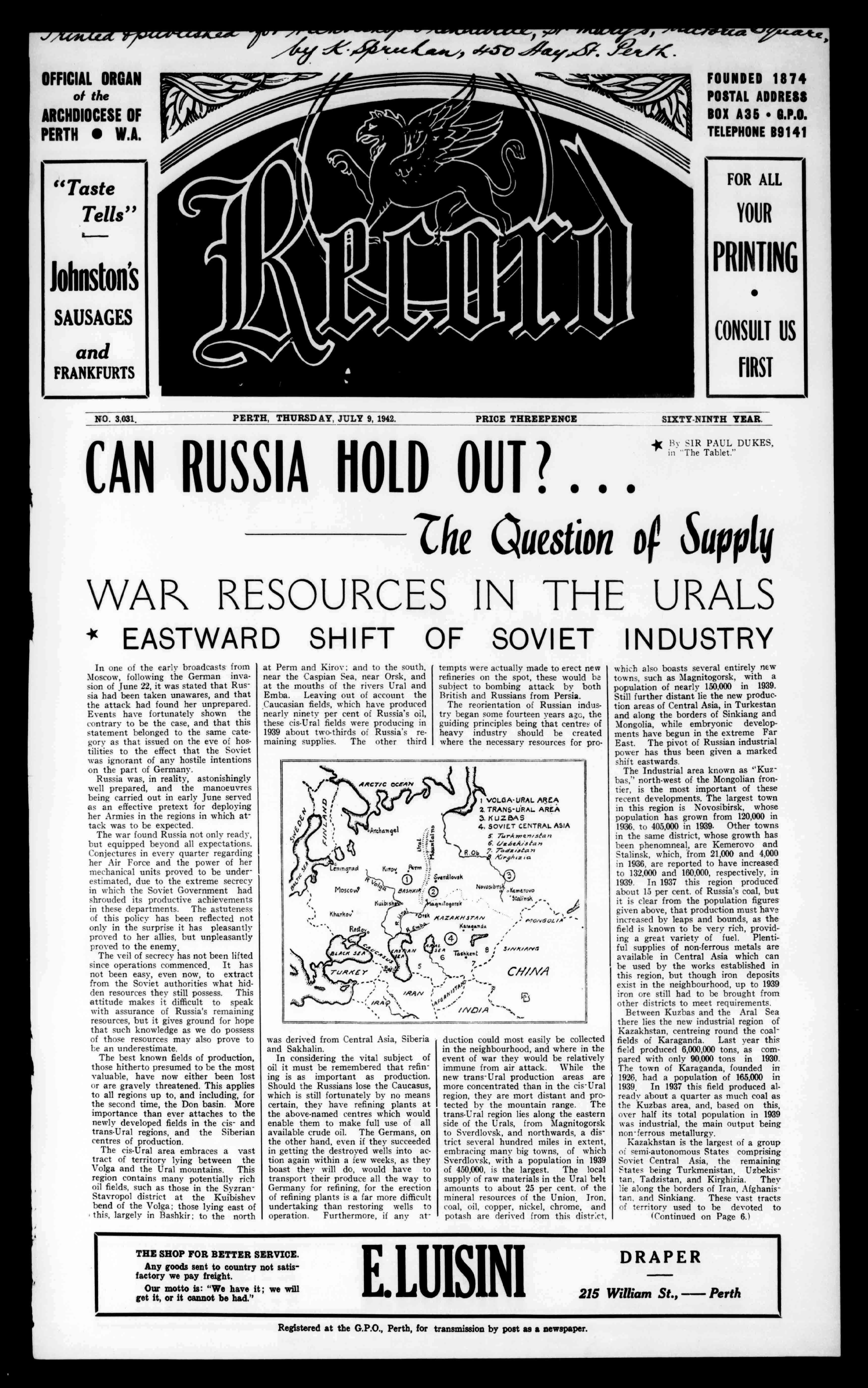
Thecis-Uralareaembracesavast tractofterritorylyingbetweenthe VolgaandtheUralmountains.This regioncontainsmanypotentiallyrich oilfields,suchasthoseintheSyzranStavropoldistrictattheKuibishev bendoftheVolga;thoselyingeastof this,largelyinBashkir;tothenorth
atPermandKirovandtothesouth, neartheCaspianSea,nearOrsk,and atthemouthsoftheriversUraland Emba.Leavingoutofaccountthe Caucasianfields,whichhaveproduced nearlyninetypercentofRussia'soil, thesecis-Uralfieldswereproducingin 1939abouttwo-thirdsofRussia'sremainingsupplies.Theotherthird
temptswereactuallymadetoerectnew refineriesonthespot,thesewouldbe subjecttobombingattackbyboth BritishandRussiansfromPersia. ThereorientationofRussianindustrybegansomefourteenyearsago,the guidingprinciplesbeingthatcentresof heavyindustryshouldbecreated wherethenecessaryresourcesforpro-
whichalsoboastsseveralentirelynew towns,suchasMagnitogorsk,witha populationofnearly150,000in1939. StillfurtherdistantliethenewproductionareasofCentralAsia,inTurkestan andalongthebordersofSinkiangand Mongolia,whileembryonicdevelopmentshavebegunintheextremeFar East.ThepivotofRussianindustrial powerhasthusbeengivenamarked shifteastwards.
TheIndustrialareaknownas"Kuzbas,"north-westoftheMongolianfrontier,isthemostimportantofthese recentdevelopments.Thelargesttown inthisregionisNovosibirsk,whose populationhasgrownfrom120,000in 1936.to405,000in1939.Othertowns inthesamedistrict,whosegrowthhas beenphenomneal,areKemerovoand Stalinsk,which,from21,000and4,000 in1936,arereportedtohaveincreased to132,000and160,000,respectively,in 1939.In1937thisregionproduced about15percent.ofRussia'scoal,but itisclearfromthepopulationfigures givenabove,thatproductionmusthave increasedbyleapsandbounds,asthe fieldisknowntobeveryrich,providingagreatvarietyoffuel.Plentifulsuppliesofnon-ferrousmetalsare availableinCentralAsiawhichcan beusedbytheworksestablishedin thisregion,butthoughirondeposits existintheneighbourhood,upto1939 ironorestillhadtobebroughtfrom otherdistrictstomeetrequirements.
wasderivedfromCentralAsia,Siberia andSakhalin.
Inconsideringthevitalsubjectof oilitmustberememberedthatrefiningisasimportantasproduction. ShouldtheRussianslosetheCaucasus, whichisstillfortunatelybynomeans certain,theyhaverefiningplantsat theabove-namedcentreswhichwould enablethemtomakefulluseofall availablecrudeoil.TheGermans,on theotherhand,eveniftheysucceeded ingettingthedestroyedwellsintoactionagainwithinafewweeks,asthey boasttheywilldo,wouldhaveto transporttheirproduceallthewayto Germanyforrefining,fortheerection ofrefiningplantsisafarmoredifficult undertakingthanrestoringwellsto operation.Furthermore,ifanyat-
THESHOPFORBETTERSERVICE. Anygoodssenttocountrynotsatisfactorywepayfreight.
Ourmottois:"Wehaveitwewill getit,oritcannotbehad."
ductioncouldmosteasilybecollected intheneighbourhood,andwhereinthe eventofwartheywouldberelatively immunefromairattack.Whilethe newtrans-Uralproductionareasare moreconcentratedthaninthecis-Ural region,theyaremortdistantandprotectedbythemountainrange.The trans-Uralregionliesalongtheeastern sideoftheUrals,fromMagnitogorsk toSverdlovsk,andnorthwards,adistrictseveralhundredmilesinextent, embracingmanybigtowns,ofwhich Sverdlovsk,withapopulationin1939 of450,000,isthelargest.Thelocal supplyofrawmaterialsintheUralbelt amountstoabout25percent.ofthe mineralresourcesoftheUnion,Iron, coal,oil,copper,nickel,chrome,and potasharederivedfromthisdistract,
BetweenKuzbasandtheAralSea thereliesthenewindustrialregionof Kazakhstan,centreingroundthecoalfieldsofKaraganda.Lastyearthis fieldproduced6,000,000tons,ascomparedwithonly90,000tonsin1930. ThetownofKaraganda,foundedin 1926,hadapopulationof165,000in 1939,In1937thisfieldproducedalreadyaboutaquarterasmuchcoalas theKuzbasarea,and,basedonthis, overhalfitstotalpopulationin1939 wasindustrial,themainoutputbeing non-ferrousmetallurgy.
Kazakhstanisthelargestofagroup ofsemi-autonomousStatescomprising SovietCentralAsia,theremaining StatesbeingTurkmenistan,Uzbekistan,Tadzistan,andKirghizia.They HealongthebordersofIran,Afghanistan.andSinkiang.Thesevasttracts ofterritoryusedtobedevotedto
(ContinuedonPage6.)
111"7/1F-K: or,rir'e OFFICIALORGAN ofthe ARCHDIOCESEOF PERTH W.A.
Johnston's SAUSAGES
FRANKFURTS NO.3,031. PERTH,THURSDAY,JULY9,1942. -/ora 4, IF iv. .74457, PRICETHREEPENCE FOUNDED1874 POSTALADDRESS BOXA35G.P.O. TELEPHONE89141 FORALL YOUR PRINTING CONSULTUS FIRST SIXTY-NINTHYEAR. CAN
OUT?... theQuestion Supply
and
RUSSIAMOLD
URALS
ti 147 Len,n9-rad Kuib.sh KhArliov.'... s, Rest°, refiRyrt-r"44 mm..v -1/4.49 ARCTICOCEAN Archamiel Kern;0 iyercilovok /943/,.r/.!. .1,,A6,09orek 4-L-7"6"'RAZANHJTA, ®r. ." //VD/A VOLCA-URALAREA 2TRANS-ORALAREA 3KUZBAS 4.50,/1ETCENTRALASIA 7;,rA ob No./ob.!) ,Ktmercvo ltetliesh soh/A. CH/NA cEs
.4BySIRPAULDUKES,
E.LUISINI DRAPER 215WilliamSt.,-Perth a RegisteredattheG.P.O.,Perth,fortransmissionbypostasanewspaper.
*ThereisNoCompromisebetweenChurch andTotalitarianFascismasaSystem
Religion tillRemainsaSocial biseasefurCommunists
"EvensomeofMussolini'sownutter anceshavebeenbrandedasstraithtoutheresy."
"NotaCommunist,"Manly:
Q..TheCatholicChurchcancompromisewithFascism,asithasdonein Spain,FranceandItaly, R.:WithsuchfundamentalprinciplesofFascismasconflictwiththe teachingsofChristtheCatholicChurch cannotcompromise;andshehasnot doneso.Shecondemnsthoseprinciples,forbidsCatholicstoholdthem, andhasnothesitatedtobrandeven someofMussolini'sownutterancesas straight-outheresy.Grantedthata governmentofwhichshedisapprovesis inpower,theChurchwillnaturallydo allitcan,withoutsacrificingessential principles,tosecurebynegotiationa mitigationofrepressivelawsconcerningreligion.Withoutcompromisingthe teachingsoftheGospel,andwithout renouncinghermoralrighttobetter conditions,ifshecan'tsecuretheideal, shewilldoallpossibletogetthenext bestthingintheinterestsofreligion.
* * * *
WHYNOTWITHSOCIALISM?
Q.:ItcannotcompromisewithSo. cialism.
R.:IfyouunderstandSocialismin thesenseofmaterialisticandMarxian Communism,theCatholicChurchcan nomorecompromisewiththat,asa system,thanshecancompromisewith totalitarianFascismasasystem.But herinabilitytocompromisewithCommunismdoesnotmeanthatsheisnot interestedinsocialreform,andwould notwelcomesaneeffortsatreform Moreover,ifStalin,withoutexpecting thePopetosanctionmaterialistic Communismasasystem,wishedto discusswiththePopeconditionsforthe legalexistenceoftheCatholicChurch inRussia,andthemutualrelationshipbetweentheSovietGovernment andtheChurch,thePopewouldgladly receiveevenaSovietrepresentative, andenterintonegotiationsjustas withtheFascistGovernments.But Russiahasofferednoopportunityfor suchnegotiations. * * * *
NATUREOFCOMMUNISM.
Q.:Whyshouldapurelyworldly changeinsystemssoterrifythe CatholicChurch?
R,:IfyouunderstandtheCommunismofSovietRussiaasinvolving apurelyworldlychange,youdonot knowtheCommunismofSovietRussia. AsIpointedoutafewweeksago,Karl Marxdeclaredreligiontobetheopium ofthepeople,adelusion,avice,and adisease.The"A.B.C,ofCommunism,"anofficialSovietpublication, declaresthatafighttothedeath mustbewagedagainstallreligions. SovietRussiaitselfadmitstheseprinciples,andholdsthatCommunismand religioncannotgotogether.Doesasysteminvolveapurelyworldlychange, whichdemandsforitssuccessthede-
DoctrinalDi-TerenceBetweenAnglicans&Catholics IsThereAnyProofofPurgatory?
structionofreligion,andbidspeople ignorealtogethertheclaimsofGodand thesalvationoftheirsouls?
WHYSUCHFEAR?
theCatholic fearthat itwillloseitsgreatwealth?
R.:AreyouadmittingthattheSocialismyouadvocatewouldmeanthe destructionorconfiscationofallthe churches,hospitals,schools,andother propertywhichthegenerosityof generationsofCatholicshavemade possibleforthepurposesofreligionand charity?Ifyoudoadmitthat,areyou astonishedthatthetypeofSocialism youadvocatedoesnotcommenditselftotheCatholicChurch?
Q.:IadmitthatmuchofthepossessionsoftheCatholicChurchis usedforthebenefitofmankindin thewayofschoolsandhospitals.
R.:Youdon'tmentionthechurches themselves,whereinGodisworshipped asHedemands,andmillionsfind spiritualrefreshmentandpeaceof soul.But.possibly,youdonotregard thatasabenefittomankind,limiting yourideastomaterialandearthlyinterestsonly.
* * * *
THESECULARISER.
Q.:ButiftheState,withSocialism, cansupplythesebenefits,whycan't theChurchbecontenttoleavesuch secularthingsalone?
R.:Confiningmyselftoyourreferencetoschoolsandhospitals,since whenwaseducationwhich,tobecomplete,mustincludeachild'sphysical, mental,moral,andspiritualdevelop. ment,perfectingbothbodyandsoul,a merelysecularthing?Ismannomore thanasecularanimal?Andsincewhen wastheChristianvirtueofcharity abolishedinfavourofapurelysecular humanitarianism?'WeChristiansaccepttheverdictofSt.Paul:"IfI giveallmygoodstofeedthepoor,and havenotcharity,"hewrites,"itprofits menothing."Butyouobjecttoour CatholicnunsnursingthesickinCatholichospitalsforthepureloveofGod, andwithoutanypersonalremuneration forthemselves.YouobjecttoCatholicsputtingupthehospitalsinwhich theydoso.Youwanttoconfiscatethe hospitals,turnthemintoStateinstitutions,turnoutthenunswhoareactuatedonlybythehighestreligiousand spiritualideals,putinpaidnurseswith additionalexpensetothecommunity,
PAINTINGFORPERROTT
andrejoicethat,regardlessofexpense andjustice,youhavebanishedthe religiousatmosphereandsecularised ourCatholichospitals.Andyouask: "Whynot?"
CHURCHANDCAPITALISM.
Q.:Althoughyouadmitthatallisnot rightwithCapitalism,yourChurch hasbeentheupholderofit.
R.:TheCatholicChurchhasnever sanctioneditsabuses.Shehasboth foreseenand.denouncedthem,yearin andyearout.PopeLeoXIII.'sEncyclicalsonIndustrialCapitalism,and hisdefenceoftherightsoftheworkers, broughtuponhimonlyabusefrom Capitalists,andwereignoredbythe majorityofworkers,probablybecause theycamefromaCatholicsource.But now,almost50yearslater,theyare beginningtoquotehisteachingsonthe subjectwithbelatedappoval.Your remarksshowthatyouyourselfarenot familiarwithCatholicprinciplesof socialreform, * * * *
GODWITHRUSSIA.
Q.:Mr.ChurchillsaysthatmoreGermanshavebeenkilledinRussia duringthelasttenmonthsthanduringthewholeofthelastwar.
R.:Thatstatementemphasisesthe tragicnatureofthepresentconflict, andshouldurgeustopraythemore ferventlyforpeace,andthecessation ofsuchcostlyhostilities.
Q.:Whydon'tyouthankRussiaon yourbendedkneesforwhatshehas donetohelptosavetheEmpire?
R:Russiaisfightingforherown self-preservation:andwouldnothave enteredthiswarunlessithadbeen forceduponher.Shehasnottheremotestintentionoffightinginorderto savetheBritishEmpire;anddoesnot professsuchintentions.Accidentally, andnotintentionally,shehappensto beengagedagainstadeclaredenemy ofourownnation:andwecanappreciateourgoodfortune,thoughwe areundernodebtofgratitudetoRussiaasthoughsheintendedherefforts tobeonourbehalf.
Q.:Godmustbewiththem.
R.:TheSovietauthorities,afterall theireffortstogetridofGod,would notthankyouforthatremark.And Imustwarnyouagainstthetendency toassociateGodwithanycauseforthe reasonthatthatcausehappensforthe momenttohevictorious.Firstly,such
anotionisdangerouslyclosetothe blasphemousteachingthatmightis right,Secondly,itdoesnotmakesufficientallowancefortheinevitable changesoftime.Onewhotakesthe longviewofhistoryisslowtointerpret currentevents.
BASELESSPREDICTIONS.
Q.:AllyourstrugglesagainstSocialismwillnotprevail.
R.:Timealonewill,ho,that.
Q.:Theworldischanging,andthe CatholicChurchmustchangewithit, ifitistoretainanyofitsfollowing, R.:TheCatholicChurchwillnot,nor canitchangeinsuchawayasto ceasetobeitself.Norwillitevercease tobe.Itwillgoonpreachingthe unchangingGospelofChrist,not
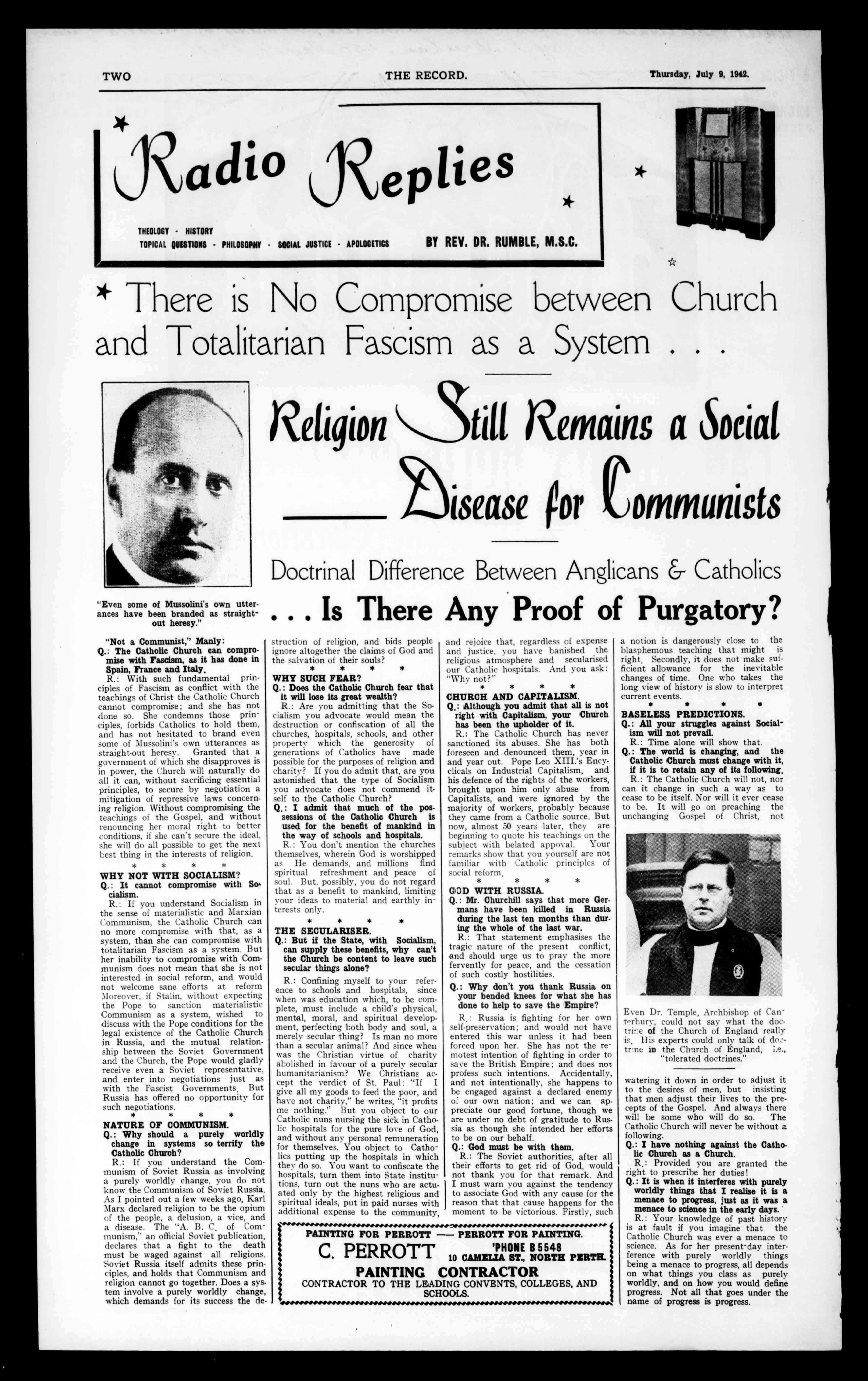
EvenDr.Temple,ArchbishopofCanterbury,couldnotsaywhatthedoctrineoftheChurchofEnglandreally is,11isexpertscouldonlytalkof traitintheChurchofEngland,i.e., "tolerateddoctrines."
wateringitdowninordertoadjustit tothe:desiresofmen,butinsisting thatmenadjusttheirlivestothepreceptsoftheGospel.Andalwaysthere willbesomewhowilldoso.The CatholicChurchwillneverbewithouta following.
Q.:IhavenothingagainsttheCatholicChurchasaChurch.
R.:Providedyouaregrantedthe righttoprescribeherduties!
Q.:Itiswhenitinterfereswithpurely worldlythingsthatIrealiseitisa menacetoprogress,justasitwasa menacetoscienceintheearlydays.
R.:Yourknowledgeofpasthistory isatfaultifyouimaginethatthe CatholicChurchwaseveramenaceto science.Asforherpresent-dayinterferencewithpurelyworldlythings beingamenacetoprogress,alldepends onwhatthingsyouclassaspurely worldly,andonhowyouwoulddefine progress.Notallthatgoesunderthe nameofprogressisprogress.
TWO THERECORD. Thursday,July9,1942.
THEOLOGY-HISTORY TOPICALQUESTIONSeplies PHILOSOPHY SOCIALJUSTICE APOLOGETICS BYREV.DR.RUMBLE,M.S.C.
adio
-- G. PERROTTFORPAINTIN PERTH. C.PERROTT 'PHONE85548 10CAMELIABT.,NORTH PAINTINGCONTRACTOR CONTRACTORTOTHELEADINGCONVENTS,COLLEGES,AND SCHOOLS.
AnglicanDoctrine
"Anglican,"Petersham.
Q..Iamsettingoutalistofquestions youranswerstowhichwouldbeappreciated.
R.:1willtrytogiveasadequatea replytoeachastimewillpermit.
Q.:IclaimthattheAnglicanChurch presentstheworldwithatruerre-r sionoftheCatholicFaiththendoes theRomanCatholicChurch.
R:Thereisnomanonearthable tosaywhatversionoftheChristian FaiththeAnglicanChurchpresentsto theworld.In1922theCommi-:sioncn ChristianDoctrineappoin'.edbythe ArchbishopsofCanterburyandYork publisheditsreporton"Doctrinein theChurchofEngland."Themembers ofthecommissiondidnotentitletheir report"DoctrineoftheChurchof England,"becausetheycouldnotsay whatthedoctrineoftheChurchof Englandreallyis.Theycalledit, "DoctrineintheChurchofEngland," andsetdownastolerateddoctrines themostcontradictorystatementsconcerningnearlyallvitalteachings.If theCommissionofexpertsappointed bytheArchbishopsofCanterburyand Yorkcouldnotsaywhatthedoctrine oftheChurchofEnglandreallyis, howareyouabletosaythatitisa truerversionthananyother?Surely itisnecessarytoknowwhatversion ofChristianteachingtheAnglican Churchpresentstotheworldbefore comparingitwithothers.
INVOCATIONOFSAINTS.
Q.:WhatproofhastheRomanCatholicChurchthattheInvocationof SaintsisaccordingtotheScriptures?
R.:Theprinciplesandteachingsof theScripturethemselves.IntheOld TestamentwefindthefriendsofJob sayingtohim,"Callnowiftherewill beanythatwillanswerthee,andturn tosomeofthesaints."(Job.V.,1). LongafterthedeathofJeremiah, Oniassaidofhim,"Thisishethat prayethmuchforthepeopleandfor alltheholycity;Jeremiah,theprophet ofGod."(II.Mach.XV,14).InRev. VIII.,4,St.Johnspeaksoftheprayersofthesaintsascendingupbefore God.Youapparentlybelievethatthe invocationofsaintsisopposedtoAnglicanteaching.I,too,thoughtthat, whenIwasanold-fashionedAnglican likeyourself.YetthereportonDoctrineintheChurchofEnglanddenies thatitisopposedtoAnglicanteaching. Herearethewordsofthereport:"It isimpossibletodeclarethatdepartedsaintscannothearourprayers,and we,therefore,mustnotcondemnas impossibledirectaccesstothemasa privatepractice,providedthisbeto askfortheirprayerswhetherforourselvesorforothers" * * * *
SEVENSACRAMENTS.
Q.:Iamfirmlyoftheopinionthat therewereonlytwoSacramentsas ordainedbyChristHimself.BaptismandHolyCommunion.The RomanCatholicChurchclaimsthat thereareseven.Canproofofthat statementbesupplied?
R.:Yes.Butitwouldtakemetoo longtogothroughtheScriptural groundsforeachofthesevenSacraments.Imightpointoutthat,accordingtoCatholicteaching,Christalone caninstituteaSacrament.TheCatholicChurchdeniesthatshehasthat power.Inteachingthatthereare sevenSacraments,therefore,shedoes soonlybecausecompelledbytheevidencethatChristHimselfinstituted them.TheGreekOrthodoxChurch teachesthesame.YourAnglican Church,atleasttheHighChurchsectionofit,israpidlyswingingbackto thisCatholicposition.Listentothese wordsoftheRev.VernonStaley,in his"ManualofDoctrineformembers oftheChurchofEngland":"Our Lord'sauthoritycanbetraceddirectlyfortheinstitutionofHolyBaptism, theHolyEucharist,PenanceandHoly Order.MatrimonywasraisedbyOur Lordtoahigherdignity.Theexpression'inthenameoftheLord,'used bySt.JamesofUnction,pointstoHis authorityforthisordinancealso.ConfirmationwaspractisedbytheApostles andinHeb.VI.,1-2,isdeclaredto oneoftheprinciplesofthedoctrine ofChrist.TheChurchofEngland doesnotteachthattherearetwo Sacramentsonly,butthattherearetwo onlyasuniversallynecessaryforsalvation.ThefivelesserSacramentsshe alsoacknowledges,andtheyare,in theirdegree,visiblesignsofinvisible grace,andformpartofthedivine planforoursafetyandperfection." 111111111111181110111111111111101HIMIHONHOMMHOWINItlimi AirRaidIndoorShelters,thebest andsafest.Only72/6.Hundredssold. HASSELL'S,559WellingtonSt.Tel. B6907.
AReligiousOutsider
DRIFTAGEFROMMORALITY.
PURGATORY. Q.:IsthereanyproofintheBible thatthereissuchaplaceasPurgatory?
R.:Yes,Theword''Purgatory"is notmentioned,butwhatthatwordis usedtodescribeisverydefinitely mentioned;thatis,thatthereisanintermediatestatewhichisneither heavennorhell,whereimperfectsouls arepurifiedafterdeath.Imightmentionthat,duringthelastwar,AnglicanauthoritiesinEnglandissuedforms ofprayerforthedepartedsoulsof thosekilledinaction.That,initself,sanctionsthedoctrineofPurgatory,foritsupposessoulsinastate wherethehelpofourprayersisneeded.Asoulinheavendoesnotneed ourprayers,andit'snouseprayingfor asoulinhell.Moreover,theDoctrinal ReportIhavebeenquotingdeclares thattheChurchofEnglanddeliberately leavesroom,bothfortheviewof thosewhodon'tbelieveinPurgatory, andfortheviewofthosewhodo.The commissiononAnglicandoctrinetells youthat,asanAnglican,youarenot obligedtodenyPurgatory.Itwould havebeenbetterifitcouldhavetold youwhatyouareobligedtobelieve aboutit.Thenyouwouldhavebeen inapositiontodiscusswhetherthe versiontheAnglicanChurchgivesto theworldon.Christiandoctrineis truerthanothers.Asitis,theAnglicanChurchequallysanctionsboththe denialofPurgatoryandtheassertion thatthereisaPurgatory.
ENFORCINGTHEFAITH!
Q.:Inarecentbroadcast,youstated thattheRomanCatholicChurch doesnotuseforcefulmeanstoimposeitsbeliefonpeople.How,then, canyouexplaintheInquisition?
R.:Verysimply.TheInquisition wasnotestablishedinordertoimpose theCatholicfaithonanybody.The verynamesuggestsitspurpose.Itwas concernedwiththosewhoalreadyprofessedtheCatholicfaith:and,from theecclesiasticalviewpoint,inquired intothesincerityoftheirdispositions. AtthetimeoftheInquisitionin Spain,manyMoorsandJewshadbecomeCatholicsforpoliticalreasons,in ordertoworktheirwayintopositions wheretheycouldthemoresuccessfullyseektounderminetheState.On thepoliticalsidetheChurchsoughtto weedoutthosewhoinsincerelypretendedtobeCatholics.TheInquisition, therefore,wasnotinordertoforcepeople,whodidnotbelieve,tobecome Catholics;itwasestablishedtodetectthosewhohadforcedtheirway intotheChurchwithoutbelievinginit,
* * * *
PAPALINFALLIBILITY.
Q.:Ithasbeenadmittedevenby membersoftheRomanCatholic Churchthattheinfallibilityofthe Popeiswrong.Why,then,isthis fallacystillbelieved?
R.:ThatthePopeisinfalliblein hisofficialcapacity,andonmattersconnectedwithChristianteachingand moralprinciples,isnotafallacy.Itis believedbyallCatholicsthroughout theworld,becauseitistherevealed truth,andhasbeen-definedassuchby theCatholicChurch.NoCatholiccan denytheinfallibilityofthePopeon mattersoffaithandmorals,andstill continuetobeaCatholic.Icanonly askyoutogivemefurtherdetailsabout themembersoftheCatholicChurch whohaveadmittedthattheinfallibilityofthePopeiswrong.Thatwill givemeanopportunitytodealwith thesubjectmorefully,
DOESTRUTHMATTER?
Q.:IclaimthatanAnglican,ora Protestant,hasjustasmuchchance ofgoingtoheavenashasany RomanCatholic.
R.:SinceyousaythattheAnglican Churchteachesthetrueversionofthe Catholicfaith,youapparentlydonot believetheChurchofEnglandtobea ProtestantChurch.Ipresumeyouhold thataProtestant,too,hasjustas muchchanceofgoingtoheavenasan Anglican.Foryou,therefore,it doesn'tmatterinpracticejustwhat religiononeprofesses.Onereligionis asgoodasanother.Thenwillyou writeandtellmejustwhyyouarea convincedAnglicanratherthananythingelse?Whydoyouthinkitmore pleasingtoGodthatyoushouldbean Anglicanratherthan"aProtestant," orthanaCatholic?IfitismorepleasingtoGodthatyoushouldbewhat youareratherthananythingelse,does that,inyouropinion,increaseyour chancesofheaven,ornot?Iwould begladtohearyourviewsonthis point;andwiththatIconcludeyour letterandcommentaryuponit.
Maroubra:
Q.:Iamanordinaryhumanbeing, withnoreligiousaffiliationswhatever.
R.:Yourlettershowsthatyouare atleastnotdevoidofaninterestin religion;anditismyhopethatmy repliesmayprovehelpfulingiving thatinterestbothastimulusanda specificdirection.
Q.:IamneitherJew,Mohammedan, norChristian.
R.:Youare,nevertheless,influenced inyouroutlookbythelingeringChristianspiritthatpervadesthewholeof ourowncultureandcivilisation,despitethedriftageofsomanyfrombeliefinthereligionresponsibleforit. Unfortunately,thelingeringChristian atmospherecannotlastforeverwithout beingfedbytheChristianreligionitself,anymorethantheperfumefroma scentbottlefromwhichthecontents havebeenpouredout.
Q.:Havingnochildren,itwouldbe difficulttofindanyonemoreunbiassedineducationalmatters.Yet, I,too,deplorethelackofmorality; andIfelljustifiedinblamingChristiansmorethananyoneforit. R.:Youadoptaverystrangeposition.Younoticethatadriftagefrom moralityhasaccompaniedthedriftage frombeliefinChristianity,andthe practiceofthatreligion.Moreover,you seeacausalconnectionbetweenthe twothings,fromwhichsurelyyou oughttoconcludethatareturnto theChristianreligionwouldremedy themoraldriftageyoudeplore.Yet youdonotseefit,whateverothers maydo,toreturntotheChristianreligionyourself.Yourejectit,and evenattackit,blamingChristiansfor contributingtowardsitsdestruction, andjoiningwiththoseguiltyofdoing sointryingtoundermineanddetroy ityourself!
OurCatholicSchoolsandColleges CHRISTIANBROTHERS,MT.HENRY
Oneofthe.1ssociatedPublic Schoolsoffr..4.
AquinasCollege
TELEPHONE:MU1520
ForBoardersandDayStudents
Boysadmittedfrom7upwards BeautifullySituated,overlookingtheriver,wearthenewCanningBridge. ForParticularsapplytoThePrincipal,AquinasCollege,CanningParade,Mt.Henry.
SACREDHEARTHIGHSCHOOL
HIGHGATE-PERTH
'Phone:B3810.
(ConductedbySistersNotreDameDesMissions). BOARDINGANDDAYSCHOOLFORGIRLS. PUPILSPREPAREDALLEXAMINATIONS. MONTESSORISCHOOLFORYOUNGCHILDREN ForProspectusapplyREV.MOTHERPRIORESS
LoretoConvent"Osborne"-Claremont BOARDINGANDDAYCOLLEGE. TheSchoolprovidesasoundeducationonmodernlinesinallbranches ofstudy.Thepupilsarepreparedforallexaminations.TheSchoolis beautifullysituatedbetweenOceanandRiver,inextensivegrounds, withfineplayingfieldsandprivateSwimmingPoolinRiver. Telephone:F2135. Apply- MOTHERSUPERIOR.
ST.ILDEPHONSUS'COLLEGE
NEWNORCIA
CONDUCTEDBYTHEMARISTBROTHERS.
ForParticularsApplyto-THEBROTHERDIRECTOR
.1=1.41.1M....MW111)1M.0.11M011=1.11.4M0.11M.......o. J.C.HAMILTON,M.P.S.Ph.C. DAYANDNIGHTCHEMIST. 197BRISBANESTREET PERTH. PrescriptionsCarefullyandAccuratelyDispensed. CompleteStocksofPatentMedicnes. CountryOrdersatCityPrices.'PhoneB1236-AnyHour.
MACFARLANE&CO.LTD.
WHOLESALEDAIRYPRODUCEMERCHANTS, POULTERERSANDSMALLGOODSMEN.
BESTQUALITYBUTTER,BACON,CHEESE,LARD,DRIPPING, TABLEAND0001aNGMARGARINE,TABLEPOULTRY,AND SAUSAGESALWAYSONHAND. ATRIALSOLICITED.
Address:48MURRAYSTREET,PERTH. Telephones:B1438andB3777.
Thursday,July9,1942. THERECORD. THREE
AUSTRALIANNAVALOFFICER'SBRILLIANTLECTURE
HowtheRomanidealandthe BenedictineSpirit
ShapedEnglish Catholicism .
Episcopalimprintremainson Britishlaws,systemof justiceandequity
Distineivecharacterand
OnThursday,25th.ult.,thespeakerattheLibraryLectureswasLieu tenantJ.A,Batten,R.A.N.,whodeliveredamostinterestingandthoughtprovokinglectureonEnglishCatholicism.Owingtorestrictionsonspace,we printbelowthefirstportionofthelecture,whichwillbeconcludedinour nextissue:-
WhatIwanttogiveyouto-nightis inthenatureofageneralimpression.I feelthatweinAustraliashouldknow somethingaboutEnglishCatholicism andshouldbeabletosympathisewith itsspiritanditscharacteristics. I supposemostofyouhereto-nightareof IrishdescentandtendtoregardEnglishCatholicismassomethingaliento yourexperienceandforeigninits characteristics.
ThestoryofGod'sdealingswiththe Englishpeoplefromthetimewhen AugustinelandedinKenttothetime whenaverydifferentprelateruledat CanterburyandabettedaverydifferentmonarchfromEgbertinrooting outtheancientfaith,andfromthat sadtimetothepresentdaywhena newchurchhasarisenoutoftheruins andthefaithofAugustineandPaulinus againfindswelcomeintheEnglish heart,thatstoryisindeedanobject lessonintheworkingsoftheHoly SpiritwithinHischurchandmustprovideencouragementandprovokeadmirationamongtheleastimaginative ofmen.Again,we,asAustralians, owetheveryfactofourexistenceto theEnglishrace.TrueEnglanddid notcoloniseAustraliawithaviewto extendingthedominionoftheRoman Pontiff,butindirectlythatresulthas beenachieved.Anditisbecauseof thegreatdebtweowetothespiritof freedomandorderthatEnglandgave totheworldandnotleastthroughher coloniesandwhichhassoprospered thechurchinthispresentage,that weshouldbeinterestedinwhatisindeedtheonlyhopeofthatcountry; whatwasonceherverylifeandmust againbeherlifeifsheistosurvive.
NowyouwillnoticethattheBible isachallengeinitself.Itchallengesthe
presentinSt.Paul-CivisRomanus sum"-andthereisringofpridein thewords.ItcameitsnearesttopracticalsolutioninthehighMiddle Ages,andwhenitreasserteditselfin theRenaissanceandtheoldsolution wasrejected,theunityofEuropewas
continuityofholinessillustratedin successionofSaints
1 ItwasdirectlyfromRome;Ur ItwasachievedmainlythroughtheinstrumentalityoftheBenedictineorder. Ihavesaidthatitwasdirectlyfrom Rome.InsayingthisIdonotmean inanywaytobelittlethegreatwork donebytheIrishmissionariesboth beforeandaftertheappearanceof Augustine.Butitwasnottheirwork thatgavetoEnglishCatholicisma permanentimpress.TheIrishchurch wasindeedloyaltoRomebutithad
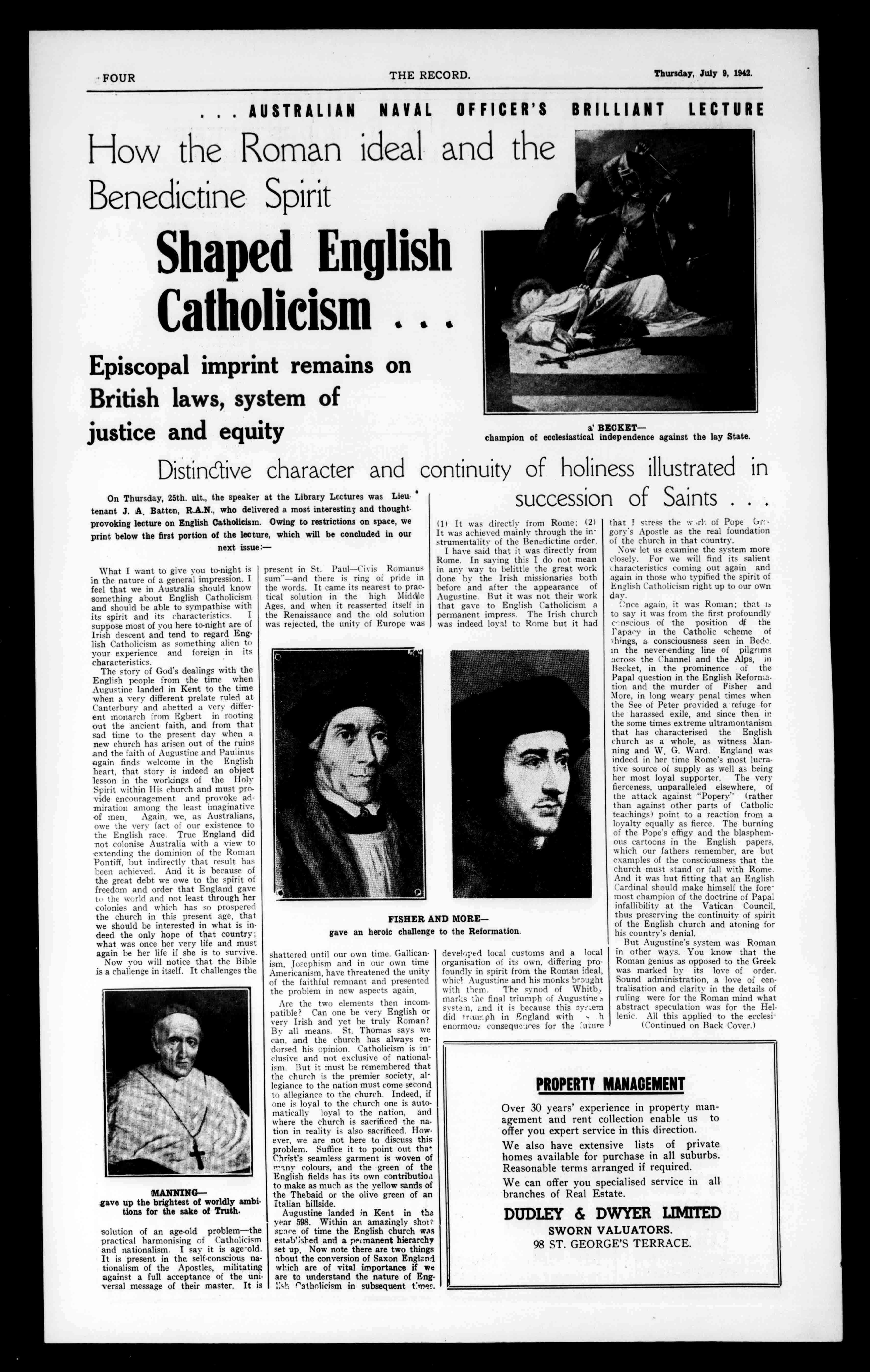
MANNINGgaveupthebrightestofworldlyambitionsforthesakeofTruth. solutionofanage-oldproblem-the -practicalharmonisingofCatholicism andnationalism.Isayitisage-old. Itispresentintheself-consciousnationalismoftheApostles,militating againstafullacceptanceoftheuniversalmessageoftheirmaster.Itis
gaveanheroicchallengeto
shattereduntilourowntime.Gallicanism,JoFephismandinourowntime Americanism,havethreatenedtheunity ofthefaithfulremnantandpresented theprobleminnewaspectsagain. Arethetwoelementsthenincompatible?CanonebeveryEnglishor veryIrishandyetbetrulyRoman? Byallmeans.St.Thomassayswe can,andthechurchhasalwaysendorsedhisopinion.Catholicismisinclusiveandnotexclusiveofnationalism.Butitmustberememberedthat thechurchisthepremiersociety,allegiancetothenationmustcomesecond toallegiancetothechurch.Indeed,if oneisloyaltothechurchoneisautomaticallyloyaltothenation,and wherethechurchissacrificedthenationinrealityisalsosacrificed.However,wearenotheretodiscussthis problem.Sufficeittopointoutthat Christ'sseamlessgarmentiswovenof Tranycolours,andthegreenofthe Englishfieldshasitsowncontributiol tomakeasmuchastheyellowsandsof theThehaidortheolivegreenofan Italianhillside.
Augustinelanded;nKentinthe. year598.Withinanamazinglyshot niceoftimetheEnglishchurchwas e,itdb':,,hedandapermanenthierarchy setup.Nownotetherearetwothings abouttheconversionofSaxonEngland whichareofvitalimportanceifwe aretounderstandthenatureofEngr'athclicisminsubsequentfm,te.
developedlocalcustomsandalocal organisationofitsown,differingprofoundlyinspiritfromtheRomanideal, whiclAugustineandhismonksbrought withthem.ThesynodofWhitb, marksthefinaltriumphofAugustinea syste.n,s.nditisbecausethissyftem didtrain:phinEnglandwith, enormousconsequencesforthefuture
thatIstressthew,r1:ofPopeGr.gory'sApostleastherealfoundation ofthechurchinthatcountry. Nowletusexaminethesystemmore closely.Forwewillfinditssalient (haracteristicscomingoutagainand againinthosewhotypifiedthespiritof EnglishCatholicismrightuptoourown day. Cnceagain,itwasRoman;thatis tosayitwasfromthefirstprofoundly c-osciousofthepositiondithe PapacyintheCatholicschemeof things,aconsciousnessseeninBedo inthenever-endinglineofpilgrims acrosstheChannelandtheAlps,in Becket,intheprominenceofthe PapalquestionintheEnglishReformationandthemurderofFisherand More,inlongwearypenaltimeswhen theSeeofPeterprovidedarefugefor theharassedexile,andsincethenii: thesometimesextremeultramontanism thathascharacterisedtheEnglish churchasawhole,aswitnessManningandW.G.Ward.Englandwas indeedinhertimeRome'smostlucrativesourceofsupplyaswellasbeing hermostloyalsupporter.Thevery fierceness,unparalleledelsewhere,of theattackagainst"Popery.'(rather thanagainstotherpartsofCatholic teachingspointtoareactionfroma loyaltyequallyasfierce.Theburning ofthePope'seffigyandtheblasphemouscartoonsintheEnglishpapers, whichourfathersremember,arebut examplesoftheconsciousnessthatthe churchmuststandorfallwithRome. AnditwasbutfittingthatanEnglish CardinalshouldmakehimselftheforemostchampionofthedoctrineofPapal infallibilityattheVaticanCouncil, thuspreservingthecontinuityofspirit oftheEnglishchurchandatoningfor hiscountry'sdenial. ButAugustine'ssystemwasRoman inotherways.Youknowthatthe RomangeniusasopposedtotheGreek wasmarkedbyitsloveoforder. Soundadministration,aloveofcentralisationandclarityinthedetailsof rulingwerefortheRomanmindwhat abstractspeculationwasfortheHellenic.Allthisappliedtotheecclesi-
(ContinuedonBackCover.(
PROPERTYMANAGEMENT
Over30years'experienceinpropertymanagementandrentcollectionenableusto offeryouexpertserviceinthisdirection.
Wealsohaveextensivelistsofprivate homesavailableforpurchaseinallsuburbs. Reasonabletermsarrangedifrequired.
Wecanofferyouspecialisedserviceinall branchesofRealEstate.
DUDLEY&DWYERLIMITED SWORNVALUATORS.
98ST.GEORGE'STERRACE.
FOUR THERECORD. Thursday,July9,1942.
a'BECKETchampionofecclesiasticalindependenceagainstthelayState.
0
FISHERANDMORE-
theReformation.
AttendanceattheSacredHeartSodalityexerciseswasgoodthismonth. Rev.FatherNolanexpressedhispleasureonSundayeveningwhenfurther workoforganisingguildsforthecomingyearwasproceededwith.Allmembersareespeciallyaskedtoassistby beingpresentintheirownguildsevery firstSundaymorningandevening.
ThemonthlymeetingoftheCatholicWomen'sLeaguewasheldonMondayeveninglast.Rev.FatherMcCarthywaspresent,Variousparcelsof sewingfortheRedCrosswerehanded inafterthemeeting.Thesocialthat followedwasheldinaidoffundsfor thePropogationoftheFaith.
AfullattendanceofHoly1,1ame menisexpectedonnextSunday,which membersareremindedisthesecond SundayofJuly.
TheParentsandFriends'Association metattheConventofSt.Josephon Fridayeveninglast,andagoodattendancereceivedthereportofactivities.Theweeklyclasslearners) bringsinasteadylittleincome,asalso doestheblockcollection.Itwasdecidedtoholdatuckshopattheschool onWednesday,andseveralladiesofferedtheirservicesforseveralhourson thatday.Generousdonationswere forthcoming,sothestockingofthe "shop"shouldbesuccessfullycarried out. MesdamesRogersandDugganreportedthattheirdailysoupsupplywas ingreatdemand.Cocoahasbeendiscontinuedonaccountofashortageof sugar.Bothladieswerethankedfor thegoodworktheyaredoing,The eveningconcludedwithanicesupper, servedaroundalogfire,thoughtfully providedbytheSisters.
Dlocese0fNew Norcia
POPE'SJUBILEEHONOURED.
TheSilverJubileeoftheEpiscopal ConsecrationofHisHolinessPopePius XawasdulyhonouredattheProCathedralofNewNorciaontheFeast ofSS.PeterandPaul.29th,ult.
At8.15a.m.therewasSolemn Tierce,afterwhichHisLordshipthe Abbot(Dr.Catalan,O.S.B.)celebrated PontificalHighMass.HehadasassistantpriesttheRev.FatherGregory, whilsttheRev,FathersPeterandPaul weredeaconsatthethrone,andRev. FathersUbachandTheodoreweredec. conandsub-deaconatMass.Father JosephdischargedthedutiesofM.C.
TheMonasticChoirrendered,with theirusualefficiency,Perosi'sMass"in honeremSanctiCarob,"intwoparts, DomS.Morenopresidingattheorgan.
AftertheGospel,Rev.FatherBede addressedthecongregation.
ThepupilsofSt.Ildephonsus'and St.Gertrude'sColleges,beingawayon themid-wintervacation,thecongregationconsistedoftheirstaffs,theMaristBrothersandtheSistersofSt.Joseph'srespectively,andthenativechildrenofSt.Joseph'sandSt.Mary'sOrphanagesandtheirstaffs,theBenedictineOblateSistersandBenedictine LayBrothers.
TheParentsandFriends'Association isworkinghardtoprovidefirstaid equipmentandthebestofsheltersfor theconventchildrenincaseofanair raid.
Itisencouragingtofindthat amongthemenwehavemanykind benefactors.Onegentlemandonated severaldozenbagsformakingsandmats,aswellasmaterialforastretcher.Anothergaveasetofsplintsand severalrollerbandages;whileyetanothermadeaveryexcellentambulance stretcher.Tothoseandtomanygood friendstheassociationextendsits thanks.
Butwewanteveryparentinthe parishtobecomeanactivemember,as theywillreapthebenefitintheknowledgethateverythingpossibleisbeing doneforthesafetyoftheirchildren, andwhennormaltimesreturn,the associationcandevoteitsenergiesto providingallthelatestnecessariesfor theconventschool.
Thecardpartiesarebeingwellattendedbutthereisroominthehallfor manymoretables,socomealongin yournumbersonWednesdaynext, July15;haveapleasantgameof cardsandenjoyagoodafternoontea. Theprizesareworthwinning,too,but morepleasingstill,istheknowledge thatyouareassistingamostworthy object.Playstartsat2.15p.m.
Subiacon
St.Kevin'sTennisClub'sMonthly Dances.
Personal.
Theninthchildandthirdsonof Mr.andMrs.DanJames.ofSteere. street,wasbaptisedinSt.Brigid's ChurchonSaturday,June27.Here(eivedthenameofPeterDaniel.Other childrenbaptisedatthesametime wereHarold,Dennis,Margaret,Mary Hitchcock,andtheircousin,Janice IleanaOlsen.Theceremonieswere performedbytheRev.FatherDiviney, andthesponserswereMissSheila Bromley,MissWinifredWells,Mrs. MaddenandMr.GusFetzer. MaasTimeTable.
SundayMasses,St.Brigid's,Collie: 7.30am.and10a.m. July12:Worsley,8.30a.m. July19:Buckingham,8a.m.;Dar. kan,10a.m. July20:Shotts,8a.m,;Lyall's Mill,10a.m. August2:Noggerup,8a.m.:Wilga, 10a.m.
EightyPerCent.ofthePopulation AreAfflictedwithSomeFormof SpinalDefect,thatisthecauseofso muchNervousness,Indigestion,Headache,Rheumatism,MentalWeakness, andothergraveanddangerousDiseases.
Affections
aaubkutatedvertebra:
'OnSaturday,June27,theSt. Kevin'sTennisClubconducteditsfirst ofaseriesofmonthlydancesinaid ofclubfunds.Theattendancewas verysatisfactory,andthecommittee werequitepleasedwiththeresponse totheirintitialeffort.MaryMulcahy's orchestrasuppliedthemusic;thesupperwasexcellent,andluckyspotdanceswereheldduringtheevening.
Thesecondoftheseriestakesplace inSt.Joseph'sHall,Subiaco,onSaturday,July25,andonceagainthecommitteecanassurepatronsofanexcellenttime,CarmelBurrow's"Girl Bandits"willthistimesupplythe music,whilstotherattractionswillincludenoveltydances,etc.Anopen invitationisissuedtoalltoattend thisdance,whichistheonlyCatholic Saturdaynightdanceheldinthemetropolitanarea.Theadmissionisonly 2s.;thefloorisperfect,whilstthehall issuitablypreparedforblackoutconditions.Thereforereservethedate, July25,fortheTennisDanceatSubiaco.
NORTHAM
TheparishionersofNorthamare pleasedtowelcomeRev.FatherDivinneyasassastantpriest.FatherDivinneycomestousfrom.Collie,wherehe haslabouredduringthepastthree years.
SpringBaiL
AtameetingheldinSt.Joseph's HallonSundaylastafterdevotions,it wasdecidedtoholdtheAnnualBall onAugust26. ChildrenofMary.
AftertheirlastmonthlyCommunion theChildrenofMaryinaugurated whatitishopedwillbethefirstof anannualCommunionbreakfast.There wasagoodattendanceofmembersat Communionandatthebreakfast,and thearrangementsmacljefortherepastreflectsgreatcreditonthecommitteeofmanagement.Opportunity wastakenduringthebreakfasttobid farewelltoMissMaryMorris,whowas ontheeveofherdeparturetoenter thereligiouslifeintheOrderofthe SistersofSt.JosephoftheApparition. ReligiousProfession.
Twoformermembersoftheparish, MissSheilaKirby,daughterofMr.and Mrs.P.Kirby,andMissPatriciaMcKenzie,daughterofMr.andMrs.J. McKenzie,recentlymadetheirprofessionasSistersofSt.JosephoftheApparition.TheirmanyfriendsinNorthamwishtherecentlyprofessedSisterseveryblessingintheirhighavocation,andextendtotheirfamiliestheir sincerestcongratulations.
SacredHeartSodality.
ThemonthlyCommunionoftheSacredHeartSodalitywaswellattended onSundaylast.AttheeveningdevotionsRev.FatherLynchannounced thatRev.FatherDivinneywouldassumethepositionofspiritualdirector oftheSodality.
Obituary.
Weregrettoannouncethedeathof Mrs.MaryRoseConnaughton,who diedonFridaylastintheNortham Hospital.Tohersorrowinghusband andfamily,"TheRecord"extendsits sincerestsympathy.
MilitaryForces.
Manyex-membersofourparishare inkhaki,andthelatesttoleaveusis Mr.FrankOrell,who,untilthetime ofhisdeparture,wasanactivemember oftheSt.VincentdePaulSociety. Frank beenlongassociatedwith themilitaryforces,andwehopepro- motionwillnothelongdelayed.
"MONS"SUNDAY-AUGUST23.
TheOldContemptibles'Association advisesthat,atitslastmeeting,it wasunanimouslyresolvedtoforego. anyparadethisyearinthecommemorationof"Mons"Sundayon August23.Instead,allmembersof theassociationhavebeenrequestedto attendattheirownchurches.
Years of
Thursday,July9,1942. THERECORD. FIVE
ELLIOTT &ELLIOTT ()44OPT1C111115c. PICCADILLY/o900 ARCADE/AVe6eD/,0151 $(1(11T1F1( MODEan METHODS (QUIPMEnT TheDemandfor GirlsTrained forBusinessHas NeverBeenSo Heavy ITWILLPAYYOUTOENROL NOWATSTOTT'S. AGOODPOSITIONIS ASSURED. STOTT'S BUSINESS COLLEGES B9St.George'sTerrace,Perth. 11AdelaideStreet,Fremantle.
IA
oC6,,1-
BRAIN MS CARS THROATChiropractic\
EAR, (SPINAL) 7;t3Adjustments TAzAgr. Will P"'"Removethe IDNEYS SMALLsown.Causeof LARGEBOWEL GENITALORGANS TNIG.ANDLEGS D S E A S E CONSULTTHEQUALIFIED CHIROPRACTORatMcLAREN'S CHAMBERS,144WILLIAMSt., PERTH. 'PHONEB2582. "TheChiropractorneverresortsto DrugsorSurgeryhemerelytriesto relievetheimpingednerveandleaves theresttonature"-Encyclopaedia Britannica." Mr.AndrewMartin NOCHARGEFORCONSULTATION. ighga. 0
ofanyofthefollowingpare maybecausedbyNERVESimpinged atthespineby
R.
Successful
acentury,PLAISTOWE&CO LTD.havekeen.making
foodspecialties
thePlaistowefactory
100,0000
feetof
the'eret-itiereagingdemand
more
&CO.LTD.-HavelockStreet,WestPerth.
Manufacturing Fornearlyhalf
confec,tjnns,chocplatesand
that.a.re....alwaykingpod.taste..T9-4y,
occupiesover
square
'floorspace,and
forPlaistowe'sProductshasmeantpermanentjobs forthebreadwinnersof
than250WestAustralianhomes. PLAISTOWE
FrenchandGerman EducationalAims
Instudyingthecharacterofa nation,itisinterestingtoseehowthe educationoftheyouthhasproduced thatcharacter.Twocountriesthat arenaturallyinourthoughtsare FranceandGermany,whichpresenta completecontrastinalmosteveryrespect.TheFrenchclaimtobethe spiritualdescendantsoftheGreeks,and tohaveinheritedtheirclear,logical minds,thatis,theyconsiderthatthey aretheintellectualleadersoftheworld, whiletheGermanslookuponthemselvesasthecomingrace.Theysay:
"The16thcenturywasforSpain;the 17thand18thcenturiesweretheheydayofFrance;the19thcenturywas England'speriodofglory,sothe20th centurymustbeforGermany,"This ideaispartoftheeducationalsystem.andisinculcateinchildrenfrom theirearliestyears.
Now,inFrance,educationisState controlled,butthereareplentyofconventschools,andevenintheState schools,themajorityoftheteachers arestronglyCatholic.Theguiding principleinFrencheducationistodo alittle,anddoitwell,ratherthanattempttoomuch.Consequently,teachersstressthevalueofcomposition, bothoralandwritten.Theaverage Frenchmanspeaksandwriteshisown languagebetterthantheaverageAustralian.AFrenchessaymustbea modelofclarityandlogicalsequence ofthought.Everywordmustbecarefullychosen,withattentiontothe soundaswellasthegrammar.
Frenchliteratureandhistoryare verythoroughlystudied,especially the17thcentury,theclassicalageof France.Inmathematics,wecanenvy theEuropeanchildrentheirmetricsystem,whichmakestheircalculationsso mucheasierthanours.Theirstandard ofproblemsisthereforeveryadvanced, astheycanconcentrateonthethought, ratherthanontheworking.
Thechildrenworklonghours,and studyhardfortheirexaminations;the BrevetandtheBachaut.Thislatter countsasmatriculation,butinstandardistheequivalentofourfirstyear University.
AttheUniversitythereislittlecorporatelife.Thestudentsgenerally workhard,Forthestandardishigh andthecompetitionkeen.Atthe finalexaminationthecandidateisgiven fourhoursinwhichtowriteacompositionoffiveorsixpages.Ifhisessay issatisfactory,hegoesbeforeajury ofprofessorsforanoraltest,whichis oftenheldinpublic.
AllthiFconcentrationoflogical thoughtandperfectexpressionhaspro-
ITMr.LyonelLobsteingivesTeachers' Guildfirst-handimpressions ofEuropeanscene.
andIllethodsContrasted
CONQUERED FRANCE IS BUT SO IS THE
ducedanationof"intelligenceworshippers:-whoarethereforecriticalin theirthinkingandindividualisticin theirbehaviour.Onehasthefeeling thateventheyoungpeopleareadults TheFrenchhaveinteriormentaldiscipline,buttheydetestregimentation. TheGermansontheotherhand(and whenIsayGermans,ImeanNazis, whohavebroughtoutalltheworst elementsintheGermancharacter)en
thoroughlytaughtinallschools.Now itisheartrendingtoseethelovable children.fortheyareverylovable, misledbythe.diabolicalNazidoctrines,fortheyhavereplacedtheteachingofChristianityinschools.Eachday beginswithalessoninNazicatechism, tostamptheirdogmasindeliblyonthe children'sminds.Inspiteofaheroic campaign,ledbytheArchbishopof Munich,thechurchschools,oneby
TRAGIC VICTOR
thephysiqueoftheyoungpeoplecomparesmorethanfavourablywithany raceintheworld.Musicaltasteis cultivated,andclassworkisfrequently enlivenedbyasongortwo.During theafternoonthechildrendotheir sportandhomework,andsocangoto bedearly,Theymaynotgotothe cinema,exceptinspecialgroups,beforetheageofsixteenyears.
Allthissoundsveryattractive,and wouldbesoifitwerenotforthep:r: ades,Attheageofeight,childrendon theirfirstuniform,asmembersofthe "Jungvolk'(YoungPeople),asortof Naziscoutmovement.Latertheyjoin the"Hitlerjugend"(HitlerYouth)cr "B.D.M."(UnionofGermanGirls,. Theaimoftheseorganisations,membershipofwhichispracticallycompulsory,istokeepchildrenawayfrom parentalinfluence,andmaketheminto goodNazis.Thencomesthe"Arbeitsdienst"(LabourServiceCamp) andthetwoyears'militaryservice. Afterthis,bothmenandwomenbelongtoNaziorganisations,andmust bepreparedtogiveupseveralnights aweekforparadesorlectures.
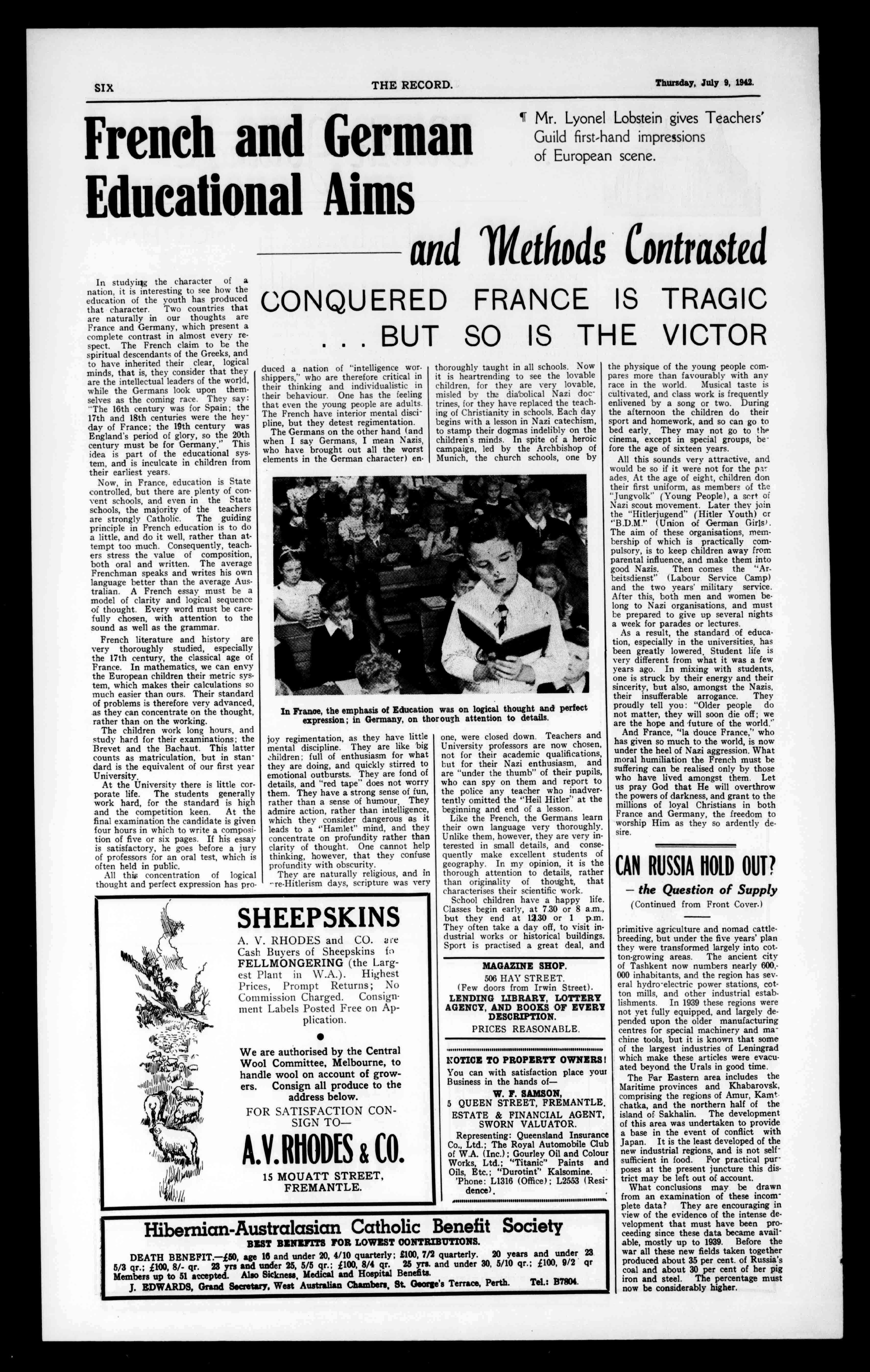
InFrance,theemphasisofEducationwasonlogicalthoughtandperfect expression;inGermany,onthoroughattentiontodetails. joyregimentation,astheyhavelittle mentaldiscipline.Theyarelikebig Aildren:fullofenthusiasmforwhat theyaredoing,andquicklystirredto emotionaloutbursts.Theyarefondof details,and"redtape"doesnotworry them.Theyhaveastrongsenseoffun, ratherthanasenseofhumour,They admireaction,ratherthanintelligence, whichtheyconsiderdangerousasit leadstoa"Hamlet"mind,andthey concentrateonprofundityratherthan clarityofthought.Onecannothelp thinking,however,thattheyconfuse profunditywithobscurity. Theyarenaturallyreligious,andin --re-Hitlerismdays,scripturewasvery
SHEEPSKINS
A.V.RHODESandCO.are CashBuyersofSheepskinsto FELLMONGERING(theLargestPlantin\\'.A.).Highest Prices,PromptReturns;No CommissionCharged.ConsignmentLabelsPostedFreeonApplication.
WeareauthorisedbytheCentral WoolCommittee,Melbourne,to handlewoolonaccountofgrowers.Consignallproducetothe addressbelow.
FORSATISFACTIONCONSIGNTO-
A.V.IMODES&CO.
15MOUATTSTREET, FREMANTLE.
one,werecloseddown.Teachersand Universityprofessorsarenowchosen, notfortheiracademicqualifications, butfortheirNazienthusiasm,and are"underthethumb"oftheirpupils, whocanspyonthemandreportto thepoliceanyteacherwhoinadvertentlyomittedthe"HeilHitler'atthe beginningandendofalesson. LiketheFrench,theGermanslearn theirownlanguageverythoroughly. Unlikethem,however,theyareveryinterestedinsmalldetails,andconsequentlymakeexcellentstudentsof geography.Inmyopinion,itisthe thoroughattentiontodetails,rather thanoriginalityofthought,that characterisestheirscientificwork. Schoolchildrenhaveahappylife. Classesbeginearly,at7.30or8a.m., buttheyendat13.30or 1 pm. Theyoftentakeadayoff,tovisitindustrialworksorhistoricalbuildings. Sportispractisedagreatdeal,and
MAGAZINESHOP.
506HAYSTREET.
(FewdoorsfromIrwinStreet)
LENDINGLIBRARY,LOTTERY
AGENCY,ANDBOORSOFEVERY DESCRIPTION.
PRICESREASONABLE.
&OTICETOPROPERTYOWNERS! Youcanwithsatisfactionplaceyou! BusinessinthehandsofW.F.SAMSON, 5QUEENSTREET,FREMANTLE.
ESTATE&FINANCIALAGENT, SWORNVALUATOR.
Representing:QueenslandInsurance Co.,Ltd.;TheRoyalAutomobileClub ofW.A.(Inc.);GourleyOilandColour Works,Ltd.;"Titanic"Paintsand Oils,Etc.;"Durotint"Kalsomine. 'Phone:L1316(Office)L2553(Residence). Hibernian-Australasian
Asaresult,thestandardofeducation,especiallyintheuniversities,has beengreatlylowered,Studentlifeis verydifferentfromwhatitwasafew yearsago.Inmixingwithstudents, oneisstruckbytheirenergyandtheir sincerity,butalso,amongsttheNazis, theirinsufferablearrogance.They proudlytellyou:"Olderpeopledo notmatter,theywillsoondieoff;we arethehopeandfutureoftheworld."
AndFrance,"ladouceFrance,'who hasgivensomuchtotheworld,isnow undertheheelofNaziaggression.What moralhumiliationtheFrenchmustbe sufferingcanberealisedonlybythose whohavelivedamongstthem.Let usprayGodthatHewilloverthrow thepowersofdarkness,andgranttothe millionsofloyalChristiansinboth FranceandGermany,thefreedomto worshipHimastheysoardentlyde sire.
CANRUSSIAVOIDOUP
-theQuestionofSupply
(ContinuedfromFrontCover.)
primitiveagricultureandnomadcattlebreeding,butunderthefiveyears'plan theyweretransformedlargelyintocotton-growingareas.Theancientcity ofTashkentnownumbersnearly600,000inhabitants,andtheregionhassev eralhydro-electricpowerstations,cottonmills,andotherindustrialestablishments.In1939theseregionswere notyetfullyequipped,andlargelydependedupontheoldermanufacturing centresforspecialmachineryandmachinetools,butitisknownthatsome ofthelargestindustriesofLeningrad whichmakethesearticleswereevacuatedbeyondtheUralsingoodtime.
TheFarEasternareaincludesthe MaritimeprovincesandKhabarovsk, comprisingtheregionsofAmur,Kam' chatka,andthenorthernhalfofthe islandofSakhalin.Thedevelopment ofthisareawasundertakentoprovide abaseintheeventofconflictwith Japan.Itistheleastdevelopedofthe newindustrialregions,andisnotselfsufficientinfood.Forpracticalpurposesatthepresentjuncturethisdistrictmaybeleftoutofaccount.
Whatconclusionsmaybedrawn fromanexaminationoftheseincompletedata?Theyareencouragingin viewoftheevidenceoftheintensedevelopmentthatmusthavebeenproceedingsincethesedatabecameavailable,mostlyupto1939. Beforethe warallthesenewfieldstakentogether producedabout35percent.ofRussia's coalandabout30percentofherpig ironandsteel.Thepercentagemust nowbeconsiderablyhigher.
SIX THERECORD. Thursday,July9,1942.
CatholicBenefitSociety BESTBENEFITSFORLOWESTOONTRIBUTIONS. DEATHBENEFIT.-f50,age15andunder20,4/10quarterly;£100,7/2quarterly.20yearsandunder23 5/3qr.;£100,8/-qr.23yrsandunder25,5/5qr.;j100,8/4qr.25yrs.andunder30,5/10qr.:£100,9/2qr Membersupto51accepted.AlsoSickness,MedicalandHospitalBenefits. J.EDWARDS,GrandSecretary,WestAustralianChambers,St.George'sTerrace,Perth. Tel.:B7804
WEDDINGREPORTS.
Allreportsofweddingsarechargeableonthefollowingbasis:
Forsinglecolumnreport,withor withoutblock,10/6.
Twocolumnblock,withreport,
1is
Threecolumnblock,withreport, 10s.
Thesechargesincludethecostof blockineachcase.Seeadvertisingrateselsewhereinthisissue.
Allreportsmustbesignedbythe ParishPriest.
Britain's6th CatholicV.C. -OFFICIALCITATION
"ABOVEALLPRAISE."
Capt.JamesJ.Jackman,posthumouslyawardedtheVictoriaCross,is thesixthCatholictowinthedecorationinthiswar;hewasanativeof Waterford,Ireland,andapastmanof StonyhurstCollege,notedCatholic schoolinEngland.Hereistheofficialreportofhisdeeds,whichwonfor himthehighestawardforbravery:
"OnNovember25,1941,atEdDuda, south-eastofTobruk,Capt.Jackman showedoutstandinggallantryanddevotiontodutyaboveallpraisewhen hewasincommandofamachine-gun companyoftheRoyalNorthumberland FusiliersinthetankattackontheEd Dudaridge.
"Hismagnificentbearingwascontributoryinalargemeasuretothe successofamostdifficultandhardfoughtaction.
"Asthetanksreachedthecrestof therise,theyweremetbyextremely intensefirefromalargenumberof gunsofalldescriptions:thefirewasso heavythatitwasdoubtfulforamomentwhetherthebrigadecouldmaintainitsholdontheposition.
"Thetankshavingslowedto'hulldown'positions,settledtobeatdown theenemyfire,duringwhichtimeCaptainJackmanrapidlypushedupthe ridge,leadinghismachine-guntrucks, andsawatoncethatanti-tankguns werefiringattheflankofthetanks,as wellastherowsofbatterieswhichthe tankswereengagingontheirfront.
'.Heimmediatelystartedtogethis gunsintoactionascalmlyasthough hewasonmanoeuvres,andsosecured therightflank.Then,standingupin thefrontofhistruck,withcalmdeterminationheledhistrucksacrossthe frontbetweenthetanksandtheguns -therewasnootherroad-togetthem intoactionontheleftflank.
"Mostofthetankcommanderssaw him,andhisexemplarydevotionto duty,regardlessofdanger,notonlyinspiredhisownmen,butclinchedthe determinationofthetankcrewsnever torelinquishthepositionwhichthey hadgained'
"Throughout,hecoollydirectedthe gunstotheirpositions,andindicated targetstothem,andatthattime seemedtobearacharmedlife,but laterhewaskilledwhilestillinspiring everyonewiththegreatestconfidence byhisbearing."
Recipes
Sometimesmorehard-cookedeggs arecookedthancanbeeatenbythe family.Onewaytointroducevariety istostufftheeggswithdicedhamor bacon,withcrabmeatorshrimp,or "devil"themwithmayonnaise,mustardandonionjuice.
SteamedFruitPudding.
4tablespoonsbutter, to1cuppowderedsugar, 1teaspoonvanilla, 1teaspoonpineapplejuice, Creambutterthoroughly.Add sugarandflavouringgradually.Chill.4 servings. Aboveisaninterestingrecipecallingforuseofnatural,unsweetened pineapplejuice.Thepuddingmaybe storedinitsclosedcontainerintherefrigeratorforseveralweeksandreheatedbysteamingforforty-fiveminutes.
SWEEPSAREFASTNOW.
TheCharitiesConsultationsarefast now,Eachweekthereisone.The No.110awillclosethisweek,butifticketsinitareunobtainable,getaticket intheNo.111a.Ticketsare2/6each, andthefirstprizeis£1,000.
of()RaeAttoMCA
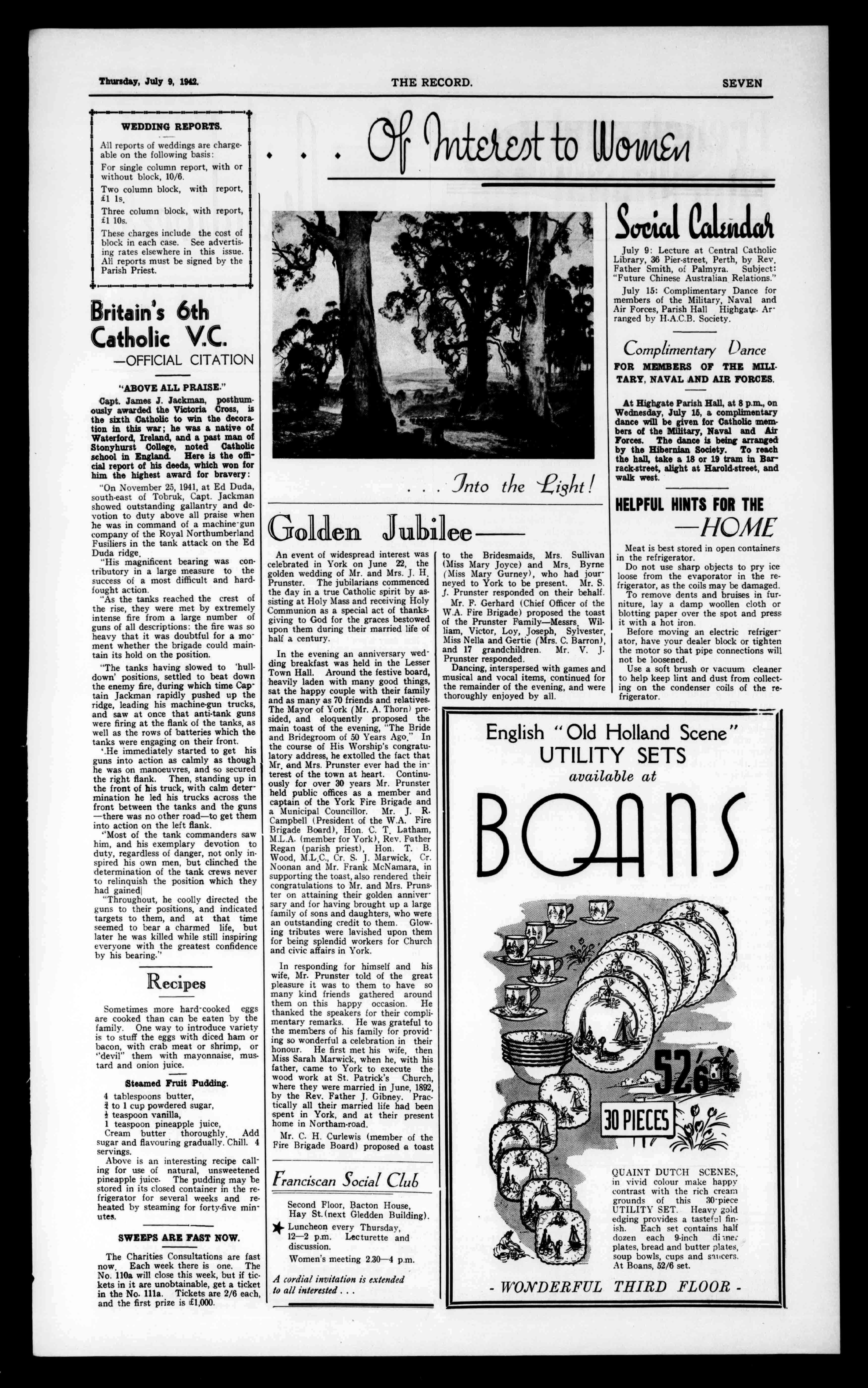
Intotl7e-eight
GoldenJudilee
Aneventofwidespreadinterestwas celebratedinYorkonJune22,the goldenweddingofMr.andMrs.J.H. Prunster.Thejubilarianscommenced thedayinatrueCatholicspiritbyassistingatHolyMassandreceivingHoly CommunionasaspecialactofthanksgivingtoGodforthegracesbestowed uponthemduringtheirmarriedlifeof halfacentury.
IntheeveningananniversaryweddingbreakfastwasheldintheLesser TownHall.Aroundthefestiveboard, heavilyladenwithmanygoodthings, family andasmanyas70friendsandrelatives. TheMayorofYork(Mr.A.Thorn)presided,andeloquentlyproposedthe maintoastoftheevening,"TheBride andBridegroomof50YearsAgo,-In thecourseofHisWorship'scongratulatoryaddress,heextolledthefactthat Mr,andMrs.Prunstereverhadtheinterestofthetownatheart.Continuouslyforover30yearsMr.Prunster heldpublicofficesasamemberand captainoftheYorkFireBrigadeand aMunicipalCouncillor. Mr.J.R. Campbell(PresidentoftheW.A.Fire BrigadeBoard),Hon.C.T,Latham, M.L.A.(memberforYork),Rev.Father Regan(parishpriest),Hon.T.B. Wood,M.L,C.,Cr.S.J.Marwick,Cr. NoonanandMr.FrankMcNamara,in supportingthetoast,alsorenderedtheir congratulationstoMr.andMrs.Prunsteronattainingtheirgoldenanniversaryandforhavingbroughtupalarge familyofsonsanddaughters,whowere anoutstandingcredittothem.Glowingtributeswerelavisheduponthem forbeingsplendidworkersforChurch andcivicaffairsinYork.
Inrespondingforhimselfandhis wife,Mr.Prunstertoldofthegreat pleasureitwastothemtohaveso manykindfriendsgatheredaround themonthishappyoccasion.He thankedthespeakersfortheircomplimentaryremarks.Hewasgratefulto themembersofhisfamilyforprovidingsowonderfulacelebrationintheir honour.Hefirstmethiswife,then MissSarahMarwick,whenhe,withhis father,cametoYorktoexecutethe woodworkatSt.Patrick'sChurch, wheretheyweremarriedinJune,1892, bytheRev.FatherJ.Gibney.Practicallyalltheirmarriedlifehadbeen spentinYork,andattheirpresent homeinNortham-road.
Mr.C.H.Curlewis(memberofthe FireBrigadeBoard)proposedatoast
FranciscanSocialClub
SecondFloor,IJactonHouse, HaySt.nextGleddenBuilding).
*LuncheoneveryThursday, 12-2p.m.Lecturetteand discussion.
Women'smeeting2.30-4p.m.
Acordialinvitationisextended toallinterested
totheBridesmaids,Mrs.Sullivan (MissMaryJoyce)andMrs,Byrne MissMaryGurney),whohadjourneyedtoYorktobepresent.Mr.S. J.Prunsterrespondedontheirbehalf.
Mr.F.Gerhard(ChiefOfficerofthe W.A.FireBrigade(proposedthetoast ofthePrunsterFamily-Messrs,William,Victor,Loy,Joseph,Sylvester, MissNellaandGertie(Mrs.C.Barron), and17grandchildren.Mr.V.J. Prunsterresponded. Dancing,interspersedwithgamesand musicalandvocalitems,continuedfor theremainderoftheevening,andwere thoroughlyenjoyedbyail.
July9:LectureatCentralCatholic Library,36Pier-street,Perth,byRev, FatherSmith,ofPalmyra.Subject: "FutureChineseAustralianRelations."
July15:ComplimentaryDancefor membersoftheMilitary,Navaland AirForces,ParishHallHighgate.ArrangedbyH.A.C.B.Society.
CornpllmentaryI)(ince FORMEMBERSOFTHEMILITARY,NAVALANDAIRFORCES.
AtHighgateParishHall,at8p.m.,on Wednesday,July15,acomplimentary dancewillbegivenforCatholicmembersoftheMilitary,NavalandAir Forces.Thedanceisbeingarranged bytheHibernianSociety.Toreach thehall,takea18or19traminBarrack-street,alightatHarold-street,and walkwest.
HELPFULHINTSFORTHE HOME
Meatisbeststoredinopencontainers intherefrigerator. Donotusesharpobjectstopryice loosefromtheevaporatorintherefrigerator,asthecoilsmaybedamaged. Toremovedentsandbruisesinfurniture,layadampwoollenclothor blottingpaperoverthespotandpress itwithahotiron. Beforemovinganelectricrefrigerator,haveyourdealerblockortighten themotorsothatpipeconnectionswill notbeloosened. Useasoftbrushorvacuumcleaner tohelpkeeplintanddustfromcollectingonthecondensercoilsoftherefrigerator.
English"OldHollandScene" UTILITYSETS availableat QUAINTDUTCHSCENES, invividcolourmakehappy contrastwiththerichcream groundsofthis 30-piece UTILITYSET.Heavygold edgingprovidesatasteiclfinish.Eachsetcontainshalf dozeneach9-inchdione: plates,breadandbutterplates, soupbowls,cupsands-niciers. AtBoans,52/6set.
Thursday,July9,1942. THERECORD. SEVEN .0.*
-WONDERFULTHIRDFLOOR-
PERTH,THURSDAY,JULY9.1942.
AnImpudentSham..
Themildepidemicofchainprayershasjustsubsidedonlyto befollowedimmediatelybyachainletterconcerningCatholicsand thecomingelection,andpoliticsgenerally.Theintentofthe chainprayer.althoughranksuperstition,isusuallygood.Itis originatedandcirculatedoftenenoughbyignorantCatholicsout ofanexaggeratedpiety.Butanyhowitdoesatleastproducethe temporarygoodeffectofmoreprayer.Butthechainletter,reproducedonpagenine,isanothermatteraltogether.Thepurposeinthemindofitsauthormustbeentirelyvicious.Happily thistypeofthingalwaysdefeatsitsPurposesbysheerignoranceof thingsCatholic.Forexample,thephraseaboutplenaryindulgencebeinggainedandPrayersofferedtoall'Saintsbetraysthe clovenhoofatonce.ThatisnotthecurrentCatholicparlance;it isnotevenagoodattemptatforgery.Furthermore,theconstantreiterationabout"heretics"doesnotringtrue.Whatever epithetsoruncharitabledescriptionsonemighthearappliedeither tolapsedCatholicsortonon-Catholics,"heretics"isstrangebeyondbelieving.Itissimplyneveremployed.Henceitcanbe stated,withoutfearofcontradiction,thatthechain-letterdoes nothaveitsoriginsinanyCatholicsource,orindeedinanysource evenvaguelyfamiliarwihCatholicexternals.TheGospelverdictintheParableoftheSowerapplieshere:"Anenemyhath clonethis." * *
Althoughthesubjectmatterofthechain-letterwouldnotdeceivetheleastinstructedCatholic,itispossiblethatitmightgive risetomisunderstandingandcausemischiefamongnon-Catholics. Henceitmayheaswelltomakesomecommentsonthisdisreputabledocument.Thefirstpointtonoticeisthatithasneverbeen thePracticeoftheChurchtoemployanonymityinpropagatingits intentions.WhenthePopewishestomakeapronouncement.he suesanEncyclicaltotheentireworld.TheBishopofadiocesegives outaPastoralletter.Thepulpitsinourchurchesareraised abovethegroundlevelthatallmayhearwhattheChurchhasto say.TheChurchdesiresanonymitylesthananybodyonearth. Hermissionisnottoconcealthings,buttomake"thegoodnews" -theGospel-knownfarandwide.Andfair-mindednon-CatholicswillagreethattheChurchhasnotbeennotedfortimidity. Veryrecenthistory,especiallyinGermany,showsbeyonddoubt thattheChurchinsistsuponbeingheard,eventhoughPersecutionfollows. * * *
NextitmustbeobservedthattheChurchhasnodirectinterestinpolitics.PopeLeoXIIImadeherattitudecrystalclearin thesewords:"Whilebeingtheguardianofherrights,andmostcarefulagainstencroachments,theChurchhasnocarewhatformof governmentexistsinaState,orbywhatcustomthecivilorderof Christiannationsisdirected;ofthevariouskindsofgovernment thereisnoneofwhichShedisapprovessolongasreligionand moraldisciplineliveuntouched."Sothat,asregardstheapproachingelections,thereisanattempttostirupasectarianissue, butitisnotontheCatholicside,forCatholicsasabodyhave nopoliticalallegiance.Individuallytheywillvoteaccordingto adiversityofviews.Thereisnot,andneverhasbeen,anyattemptfromofficialCatholicquarterstoinfluenceCatholicsintheir politicalchoice.PriestsareexPresslyforbiddenbyCanonLawto engageinpoliticalactivitieswithoutspecialpermission.Political actionisexpresslyforbiddentothebodyofCatholicAction.And itcouldbedemonstratedinahundredways,butinnothingmore clearlythantheEducationquestionthatCatholicsasabodycould haveseriouslyembarrassedanyGovernmentinthepast50years. Buttheyhaveforebornetodoso.eventhoughtheywereconsciousofsufferingagraveinjustice.ThechainletterallegesthatCatholicshavebeenveryactiveinsecuringkeypositionsinthe State.Onecouldwishtherewassomemeasureoftruthinthis. For.inpointoffact,experienceshowsthatCatholicshavebeen exasperatinglyslowtotakeaproperinterestandproportionalrepresentationinpubliclife.Finally,itmightbenotedthechainletterincirculationatpresentisalmostidenticalwiththatemployedduringtheFederalElectionsin1937.Itwasexposedin thesecolumnsnofewerthanthreetimesduringthatyear.The presentversionhasundergonesomerevision.butnotsufficientto giveittheringoftruthortodeceiveanybutthemostgulliblz.
September20-4p.m.:St.Bhigid's, WestPerth. October4-11a.m.:St.Mary'sCathedral.
October18-11a.m.:St.Mary'sCathedral(MissionSunday).
ARCHBISHOP'SENGAGEMENTS.
July16-FeastofOurLadyofMount Carmel:CarmeliteMonastery,Nedlands.
7a.m.:CelebrateMass.
3.30p.m.:PresideatoccasionalsermonandgivePontificalBenediction.
July18-7.30am.:OfficiateatCeremonyofProfessionatSacredHeart Convent,HighgateHill.
July19-3p.m.:PresideatFestival MeetingoftheSocietyofSt.Vincent dePaulatSt.Mary'sCathedral.
July12-7.30p.m.:Presideatcloseof FortyHours'Devotions,atSt.Brigid'sChurch,WestPerth.
July26:CanonicalVisitationand ConfirmationatSt.Joseph'sChurch, Norseman.
August2.-CanonicalVisitationatKalgoorlie,BoulderandCoolgardie.
ReligiousProfessionat Leederville
St.Mary'sConvent,Leederville,was thesceneofatouchingceremonyon July2,theFeastoftheVisitation, whenthreeyoungSisters-SisterM. Bernardine(Daly),Leederville;Sister M.Columbanus(O'Farrell),Kerry,and SisterM.Kieran(Hartnett),Kerry, pronouncedtheirFinalVows. 'MasswascelebratedbyHisGrace theArchbishop,MostRev.Dr.Prendiville,whowasassistedbyRev. FatherRafferty.Otherpriestsinattendancewere:RightRev.Monsignor Moloney,Rev,FatherMcLoughlin, C.S.S.R.,Rev.Father Rodden, C.SS.R.,Rev.FatherBoylan,andRev. FatherMcQuin,0.111.I.,whopreached thefollowinginspiringsermon "IfanymanwillbeMydisciple,let himdenyhimself,takeuphiscross daily,andfollowMe."
"Neverdidmanspeaklike'thisman," wastheastonishedcryoftheJewish people,andthatcryhasbeencaught upandechoeddownthroughtheages. Nowhereinliteraturedowefinda paralleltothesimpletruthofOur Saviour'sdescriptions,theuniqueness ofHisparables,thevehemenceofHis denunciation,orthepathosofHis complaints.
BoldlyHeproclaimedHimselfan exampleforallmankindtofollow,and despitetheseverityofHisdoctrines. Hisenemieshadtoconfessindismay: "Beholdthewholeworldgoesafter Him!"EvenHisveryenemiesthemselveswereattimescompelledtoshake offthefascinationlesttheytooshould becaptivatedbythepowerofhisall embracingpersonality.
AlthoughHediedlikeacriminalon Calvary'sTreeofShame,yetHisinfluencedidnotceasewithHisdeath, forevenafteralapseofnineteencenturies,daybyday,webeholdsome newsubjectclaimedbyHim.From theshadowoftheCross,weseeregimentafterregimentofconsecrated Virgins,gladlygoingforthswornto theserviceoftheirThorn-Crowned Leader. Ineveryageandineveryclime, splendidCatholicmaidensinallthe bloomofinnocenceandvigouroftheir youngwomanhood,haverenouncedthe world,thejoysofhome,thecompanionshipoffriends,andleavingall things,joyfullyrespondtoHiscall, "Come,followMe."
freelysacrificedandabandonedatHie invitation.
Hesays,"MyLifewasaLiteof prayer,aLifeofpovertyandobedience.Come,followMe!"
TheReligiousLife,whichyouhave chosen,isessentiallyalifeofprayer, enrichedandennobledbythetriple l'ondsofObedience,Povertyand Chastity.
Theworld,whoseallegedjoysand pleasuresyouhaverenounced,haslittletimeforeitherprayerorchastity, whilepovertyandobedienceareshunnedanddespised.
ThroughPrideSatanconqueredthe worldofold,ThroughPrideand "concupiscenceoftheflesh"heisconqueringtheworldstill,butyou,dear Sisters,bytheexampleandausterity ofyourvirginallivesareconstantly proclaimingthattheKingdomofHeavenistherewardofthosewhodeny themselves,takeuptheCrossandfollowChrist.Dayafterday,asgrey dawnbreakso'ertheearth,orwhen eveningshadowsdarkenintonight, fromyourConventCloister,canticles ofprayerandpraiseascendbeforethe GreatWhiteThroneofGod-thatGod Whoisignoredandabandonedbyso muchofHiscreatures.Feverishly, theyrushhitherandthither;theyare bentonbusiness,onpleasure,andon sin-withneverathoughtfortheGod Whomadethem.But,you,whohave vowedyourlivestotheServiceofthe MostHigh,byyourconstantandunceasingadoration,seektomakeamends foralltheinsultsandblasphemies whicharedailyandhourlybeingflung inOurSaviour'sSacredFace.
Inmakingyourvowsthismorning, youareofferingyourselvesasaholocausttotheGloryofGod,andyouare alsoentrustedbyHimwithaspecial commission-themissionofeducating andtrainingHisinnocentlittlechildren.Youhavethepowertoform andmouldthecharactersofthosewho aresonearanddeartotheSacred HeartofJesus.HeHimselfhassaid, "Sufferthelittlechildrentocomeunto Me,andforbidthemnot,forofsuch istheKingdomofHeaven."Yoursis theprivilegeofleadingthelittleones toOurSaviour'sFeet;yoursisthe privilegeofteachingthemtoloveand serveGod,toobeyHislaws,torespectandrevereHisName.
Thefolowingbroadcastshavebeen srrangt.ithrough:-.taLion6WN:August2-11a.m.:St.Mary'sCathedral August16-4p.m.:St.Patrick's,Fremantle.
September6-11a.m.:St.Mary'sCathedral.
October25-4p.m.:St.Mary'sCathedral(FeastofChristtheKing).
November1-11a.m.:St.Mary'sCathedral.
December6-11a.m.:St.Mary'sCathedral.
December24-Midnight:St.Mary's Cathedral.
Thisself-abnegationandrenunciationofallthathumannatureholds nearanddear,istheresultofplacing theirhearts'affectionsunderthedominionofGod'sLove.WithSt. Therese,theLittleFlower,theyecstatic. allyexclaim:"IhaveaLover,Jesus Christ,andHisLoveismoretome thanthelovesofallthemeninthe worldputtogether."Montalembert, heart-brokenatpartingwithhisonly daughter,whobecameanun,spokein abeautifulpassageofthisall-conqueringlove:"TheInvisibleLoverWho dieduponaCross,andWhothusattractstoHimyouthandbeauty,is God,Thereliesthegreatsecret.God alonecoulddemandsuchsacrificessacrificesthataretheanswerofhuman lovetotheLoveofGodWhowascrucifiedforus.Jesus,dailyinsulted amongstus,provesHisGodheadby thosemiraclesofself-denialthatare calledVocations."
MydearSisters,youareamongstthe gloriousbandofVirgins"Whof theLambwithersoeverHedoes."1he MasterWhomyoufollow,askl.even demands,yourwholelovean-1affectkn;everythingyoupossess.and everyenergyofyourbeingmustbe
Such,mydearSisters,isthesublime andHolyVocationtowhichyouare called-avocationwhichentailssacrifice,privationsandunendingmortification.Griefandsadnessmayenter yourlives,butneverunhappiness,for yourcrossesandtrialswillbeborne inthecompanyofChrist,the"Manof Sorrows,"andMarytheSorrowful Mother.Biddingfarewelltohome andfriendsmaybepainful,butyour rewardwillbeexceedinggreat.The DivineMasterHimselfhasassuredus: "Whosoevershallleavefatheror mother,brothersorsisters,forMy Name'sSake,shallreceiveahundredfoldinthislife,andintheworldto comelife-everlasting."Amen.
QUARANT'ORE
JULY.
2nd.St.Brigid's,WestPerth:Forty Hours'Prayer(10th.-12th.).
3rd.ToodyayandLearoydStreet: OneDayofExposition.
4th.Buuelton:OneDayofExposition.
EIGHT THERECORD. Thursday,July9,1942.
.
POPELEOXIII. MISSE.FURZEADDRESSES TERTIARIES
AtarecentmeetingoftheFranciscanLunchClub,MissE.Furzeaddressedmemberson"St.Francis'attitudetoSocialReform.'
InSt.Francis'timeaveryworldlyspirithadgoneabroad.Thefirstfine brotherlyloveoftheearlyChristians towardseachotherseemedtohave beenswamped,asitwere,incoldness, orindifference.Menthoughtchiefly ofglory,womenofdressandpleasure, whilethevariousStateswereeverat waroneagainsttheother.Although therewasreallymorefaith,than, alas,appearsinourownday,yet manyhadgrowncallousorevenworse andeventheclergywerenottoofervent.Thisspiritoflassitudehad beenagooddealcausedbythe"Black Death,"afearfulepidemicwhichhad ravagedEuropeandleftveryfew priestsalive;sothatunfortunately, menwithlittletrainingorlearning hadenteredthepriesthoodtothedetrmentofthelaity,nottomentionthe well-beingofthechurch.
St.Francis,whothoughofsosimple anature,hadaprofoundpopularinstinct,whichenabledhimmorethan anymansincethemostprimitivedays tofitreligionforpopularuse,saw veryclearly,withhiskeenintellect,all thedanger,andledbytheHolySpirit, heforesookhiswealthandposition, feelingituselesstodothingsbyhalves, andpreached,byword,butaboveall, byexampleandrenunciation,the beautyofHolyPovertyanddutyto thepoorandsuffering.Howmen shouldtreateachotherasequals:that justiceshouldbeextendedtoallalike. richandpoor.Indeed,itwasareal purecommunismthathetaught-not ofcoursetheatheisticcommunism promulgatedatthepresenttime,with itshatredofreligionandauthorityhutonefoundedonChristianFaith, whichstillexistedstronglyinthe MiddleAges,thoughitwasbecoming sosubmergedinmaterialismthatit wasgrowingdimanddull,So.St. Francis,afterhavingformedhistwo SuperiorOrders,the"FriarsMinor" formenand"ThePoorLadies"(since named"ThePoorClares"afterSt. Clare(forthewomen,turnedhis thouhtstowhatmighthelpalllivingintheworld,toformforthema newsocialorder,whichwastocomprehendallmankindinonebigfamily, ofbothsexes,allages,allnationsand ofeverystateinlifeandtwhose slogan(ifImayusethatmodernexpression)-whosemotto,infact,would be:"MyGodandMyAll,"asthe morespiritualidealandineveryday lifewouldbeembodiedintheone word"Moderation."Someweremarried,othershadmanyobligationsto fulfilintheworldandofthesehedid notaskforentirepoverty,ortherenunciationofallgoods;buthedidask ofthemmoderationindress,foodand manneroflife:theirsuperfluous wealthtobegiventoaidthepoorand suffering;wealthdishonestlyacquired wastoberestoredtotheformerowner:quarrelstobesettledandpeaceto reign,bothinfamiliesandabroad. Theseinstructionsstruckatthevery rootoftheluxurioushabitsofthetime infoodanddress,aswellasatthe inordinateloveofpleasure,which drewbothmenandwomentopublic revel,neglectofreligionandtheseriousbusinessoflife. Hischiefthemewascharity.He wasasthegreatItalianpoetDantein the13thcenturysaidofhim"Alive withthefireoftheloveofGod," whileGeorgeGoyan,aFrenchwriter andferventTertiary,wroteinourown day:"ThereignofChristianFellowshipbeganwithSt.Francis.The SaintofAssisiinvokedthereciprocal
"MySocialReform theThirdOrderofSt.Francis." Pope
IIPoverello
TheChristian'Communist'oftheMiddleAges
"GivemetwelveFrancis'ofAssisiandIwouldhavesavedRussia."
aidofmen,appealingtotheverylove ofGodsothattheyshouldloveone another,asGodlovedthemall.'So thattwogreatwriters,insuchdifferentsurroundingsandepochsoftime, sofarapartbothrecognisedthatitwas loveonwhichrevolvedalltheFoyerells'sactions.Certainlythewhole workofoursaintissuedfromasingle source,whichwastheardourofhis charityandtendedtoonesoleaimtomakecharityshineuponearth. Andthisardouroflove,whichlikea fire.neverrested,tillitwasentirely consumed,sufficestoexplainthefoundationofhisThirdOrder,whosemembersweretoaspiretobethesubjects andservantsofalltheirfellows,forthe loveofGod.Sothat,whenallissaid anddone,theThirdOrderwasreally St.Francis'contributiontoSocialReform.Itwasintendedforthemasses andwastheculminationwemightsay ofSt.Francis'attitudetowhatinour dayiscalledSocialReform,soneeded atthepresenttimewhenFaithhas againbecomesodim.Fortunately hisfollowers,hisTertiaries,aretobe foundinbiggerorfewernumbersinall countries;theyareofallnations, racesandcolour,andiftheOrder
CA1
IMpuled Slam
Thefollowingchain-letterisbeing circulatedinvariousquartersinthe City.Needlesstoadd,itisanimpudentsham.Itisfullydiscussedinthe leadingarticle:REMINDER.
HisHolinessthePopehopesfor greaterthingsinAustralia.Wehave aFederalMinistrymostlyCatholics, whynotaStateMinistry?
ManyCatholicsaretakingtheir placesintheforefrontofallpublic servicesinAustralia,andthereisroom formore.
Thehelpofallsectionsisnecessary tosecurevictoryforHisHolinessthe PopeandtheLabourParty,Themotto is "OURSELVESALONE."
TofellowCatholics:Forsometime Catholicleadershavebeenorganising anationalcampaignfortrueobservers oftheTrueFaith. ItisnotexpectedthatalltrueCatholicswillbereachedinthecampaign,buttheCatholicfriendswould beadvisedtomakethisamemorable yearinthehistoryofAustralia.Every CatholicwhoisabletomustparticipatebyhelpingtomakeAustraliapure fortheTrueFaith.
ThoseinAustraliashouldeverrememberthatitistheirdutytocapture allpositionscontrollingtheaffairsof thisfairland,andhelpmakeAustralia thehomeoftheonlyTrueFaith.
ItisthedutyofeveryCatholicto workforthedefeatattheballotboxof anycandidateforanypositionwhoisa hereticfortheirdefeatwouldmean thedefeatofthoseinfamousassociationswhichappealtothemastermind oftheoppressorsoftruereligion.
Plenaryindulgenceswillbegained andprayersofferedtoallSaintsfor thosewhoworkforthedefeatofthese heretics.
Thus,beingaCatholic,youarerequestedtosendacopytothreeCatholicfriends,butcaremustbetaken thattruemenandwomenonlyreceive same. Butletitbeanendlesschainwhich willultimatelyplaceCatholicsinall controllingpositionsinourland,and causethedefeatofthehereticcandidateatthecomingelections.
DONOTBREAKTHISCHAIN.
couldbestillmorespreadFranciscan Tertiariesmightstillhelptosavethis sad,disillusionedworld.
ThegreatPopeLeoXIII.declared:"MySocialReformistheThird OrderofSt,Francis,"andithasbeen saidthathislastdaysweresaddened becausesofew,comparativelyspeaking, hadjoinedit,thoughhiswordsatthe timebroughtmanyintoit.LeoXIII, withhismagnificentintellectandwonderfulforesighthadapresentimentof theterribleinfluxofpaganismlooming theninthedistance,andconsidered thattherulesanddisciplineofthe ThirdOrderandtheidealsofSt. Franciswouldhelpconsiderably'to stemtheavalancheandbringsancity toadistraitworld.
ThelateCardinalVaughanwroteas followsinreferencetoPopeLeo'sannouncementofHisSocialOrder:"Once onlyduringthelongperiodofsome eighteenhundredyearshastheVicar ofChristsingledoutaparticularsaint
--Lenin,dying andhisspiritandsettheonebefore theuniversalchurchasaspecialreformer,forallclasses;andtheother,as acertaincurefortheevilswhichaffectthewholeofsociety.St.Francis andtheFranciscanspirithavebeen seenbyLeoXIII.tobethephysician andthemedicineneededintheseour days.Theybringhometousthose particularfeaturesoftheGospelof JesusChrist,whichtheageisforgetting andtramplingunderfoot,"Cardinal Vaughan,likeLeoXIII,wasafervent TertiaryandnowaftertheItalian poetandtheFrenchauthorwehavean EnglishCardinalsingingthepraises, asaSocialReformer,oftheLittle PoorManofAssisi,showinghowwidespreadwasandstillishisrenown.The recordsoftimespastandthenatureof thissocietyshowitsinfluenceinpromoting,asitsfounderwished,justice, honesty,religionandpeace.Long livetheThirdOrderembodyingthe idealsofourdearSt.Francis.
"Giveevenanonly sontothePriesthood
Pope'smovingappealtoparents
TheHolyFather,athispublicaudiencerecently,appealedtofathersand motherstofostervocationsamong theirchildren,evenifitmeansgiving tothepriesthoodanonlyson.
"Don'tsmotherthebreaththatcomes fromheaven;don'tbeniggardlywith God,"saidHisHolinesstothenewlymarriedcouples.
TheHolyFatherappealedtotheir "Christianpatriotism,"saying:"Your patriotismwouldnotletyouleaveto otherstheburdenofaidingyourcountry:whereistheChristiansenseifyou leavetootherstheexaltationorthe spreadofyourfaith?"
ThePopespokeoftheoldcustom amongChristianfamiliesofprovidinga placeattablefortheneedystranger sothattheymightrepayProvidence forthegoodthingsprovided.The foodsetasidewascalled"God'sportion."
"Somethinganalagousmightonedaybeaskedofyou,"theHolyFathersaid. "OurLordmightcomewhenyour tableismadejoyfulbysonsand daughtersfullofangelichappiness.He mightcalloneofthemtofollowHim."
HisHolinessspokeofpaganlands fullofsoulsforconversionandsaid thatoneofthesorrowsofhisheartis theknowledgethatthenumberofgenerousprieststhatcanbesenttohelp thepagansisinsufficient.
"Whocantellifsomesoulwanderingthroughpaganlandsiswaiting,in theProvidenceofGod,fortheministry ofoneofthechildrendestinedtobe giventoyou?
"WhatwouldyoudoiftheDiVine MastercametoaskyouHis'portion' -thatis,foroneofyoursonsor daughters?"
ThePopebeggedthemintheName ofGodnotbrutallyorpurposelyto turnasidethethoughtsofavocation"Wedon'tknow,"hesaid,"oftherisingandsettingoftheDivinesunina youngheart."
Parentshavearighttomakesure thatitisnotmerelyimaginationthat makesachildseekthereligiouslife andthatitisadeliberateandwellfoundeddecision.
TheHolyFatherspokeofthedanger ofinjuringthechancesofeternalsalvationwhenavocationisweakened. RealChristians,hesaid,appreciatethe privilegebestowedonachildandonits parentswhenGodhasshownthesignal honourofchoosingasoulforHisservice-
"Youhavethehonourofpresenting alivingflowerforthealtarofGod.
"Donotimaginethatchildrenwho followthecallofGodwilllovetheir parentsless.TheloveofGoddoesnot destroynaturalaffectionbutrather exaltsittoahigherplane.Youmust notbeafraidofthisgreatgiftofavocation."
FEASTOFOURLADYOF MOUNTCARMEL
TheFeastofOurLadyofMount CarmelwillhecelebratedattheCarmeliteMonastery,Dalkeith,onThursday,16th.inst.HisGracetheArchbishopwillcelebrateMassat7a.m.and at9a.m.therewillbeaMissaCantata. TheBlessedSacramentwillbeexposedallday,At3.30p.m.theoccasionalsermonwillbepreachedbya JesuitFather.SolemnBenedictionof theBlessedSacramentwillfollow,anti theRelicofSt.SimonStockwillbe veneratedbythefaithful.TheceremonywillconcludewiththeimpartingofthePapalBlessing. FromWednesdaymiddayuntil Thursdayevening,aPlenaryIndulgence,applicabletotheHolySouls, maybegainedontheusualconditions byeachvisitmadetotheCarmelite Monastery.
Thursday,July9,1942. THERECORD. NINE
LeoXIII
raneiscattIdeal Voderatiott INSPIRED37LOVE

MetropolitanSocialCouncil.
Themilitarydance,heldonJuly1, wasadecidedsocialsuccess,andthe Societyhopestoentertainabigger batchofvisitorsatthenextdanceon July15. So,remember,bringyour friendsandissueawarminvitationto membersoftheForces.PatBrophy's orchestrasuppliedenjoyablemusic,and thiswasaugmentedbymembersofthe AirForce,whoalsobroughtalonginstruments.Thebadweatherdidn't spoiltheenjoymentofthosepresentat HighgateHallonthatnight,socome alongagainonthe15th,
Nextcouncilmeetingwillbeheldon August7,anddelegatesareaskedto rememberthisdate. AspecialeveningisbeingarrangedbyVictoriaPark Branchforpresentationofshields,and thisdatewillbeadvertisedinthiscolumnnextweek.
ComplimentarySocialtoMembersof theForces.
Nothwithstandingtheinclemencyof theweather,thesocialtenderedtoCatholicmembersoftheForcesatthe ParishHall,Highgate,on1st.inst., wassosuccessfulthatitwasdecidedto conductaseriesofthem;thenextto beheldatthesameplaceonWednesdaynext,15th.inst.
Themembers(andparticularlythe ladymembers)oftheSocietyarecommendedfortheirco-operation,without whichsuccesscouldnothavebeen achieved.Acontinuanceofthatcooperationisconfidentlyaskedfor.
Afeatureofthefunctionwasthe presenceofanorchestraconsistingof 8pieces,providedbymembersofthe AirForce,Theirsplendidmusicwas verymuchappreciatedanditcertainly enlivenedtheproceedings.Itishoped thattheywillrepeattheirperformance onWednesdaynext.
St.Mary'sBranch,Kalgoorlie. Duringtheabsenceofthepresident, Bro.Hennikerconductedthemeeting heldonJune23.BroHannandrew attentiontothenecessityofattending meetingswheneverpossible.Aletter wasreceivedfromBro.RupertFitzpatrick,nowincamp.ThefirstJuly meetingwasheldonMondaylast,attendancebeingonlyfair.Twonew memberssoughtadmittance,namely, MissEileenHastingsandMr.Bob Hastings.Theyareassuredofa heartywelcometoourranks.Corres-
pondencethisweekincludedletters fromBros.LaurieMcDonaldandT. Doogue.Communicationsfromabsent membersisverymuchappreciated bythebranch.Thenextmeetingwill beheldonJuly20.
AquinasCollege
SPORTINGRESULTS
OnJune24,AquinasXVIII.,12.24, defeatedScotch,911.Goal-kickers: W.Gaze(3),A.Hinkley12),T.Bourke 12),P.Hanahran(2),T.Naughton, P.Cullen,G.Palassis.Bestplayers: B.Rigg,G.Palassis,T,Bourke,T. Naughton.
Aquinas'SecondslosttoScotchby onegoal.
OnJune27,AquinasFifths,6.6,defeatedScotch,5.5.Coal-kickers'L. Lingard(3),D.Calder2)W.0Malley.Bestplayers:C.McNish,H. Price,W.O'Malley.
OnJuly4,AquinasFifths,7.8,defeatedHale,1.1.Goal-kickers:L.Linyard(4),D,Calder,W.O'Malley.Best players:F,Handley,B.O'Hara,L. Lingard.
AquinasSixths,9.19,defeatedHale, 2.1.Goal-kickers:H.Price(5),R. Trim(2),C.Masel,C.Brown.Best players:H.Price,D.Kennedy,C. Grahme.
NextFriday,July10, Aquinas XVIII.playGuildford,ontheCollege Oval.
CLONTARFBOYS'TOWN
Parentsandothersinterestedingettingboyswhoareunder14yearsinto ClontarfBoys'Townshouldapplyfor particularstothePrincipalofClontarf evacuatedtoTardun-telephoneTardun2;ortoCastledareJuniorOrphanage,Queen'sPark-telephoneMW80. Boyswhoareover14years,and whoseparentsorguardiansaredesirousthattheyshouldlearntrades, shouldapplytothePrincipal,St.Joseph'sFarmandTradesSchool,Bindoon.Telephonecommunicationis beingestablishedwiththisInstitution andshould
TEN THERECORD. Thursday,July9,1942. PARENTS!The ResponsibilityisYours! Theresponsibilityofdecidingonyourdaughter'sfutureisYOURS. ByenrollingherfortheC.C.C.JuniorSecretarialCourseyouenablehertoqualifyforthebetterpaidpositionsinbusiness,which meansthatshewillbeabletosupplementthefamilyincomeandbeinsuredforlifeagainstunemployment. TheC.C.C.JuniorSecretarialCoursecoversinstructioninShorthand, typewriting,Bookkeeping,BusinessEnglishandLetterWriting,Business Arithmetic,BusinessPrinciples,OperationsofComptometerandLedger Machine. EverygraduateofthiscourseisGUARANTEEDafirstappointment, andhastheuseforlifeofourEmploymentBureau.ShealsogetsaGold EfficiencyBadgeandpracticalexperienceinourownoffices. Call,writeor'phoneB2024orB2063for"GuidetoBusinessTraining"and"AnnualReportfor1941.-Noobligation. CityCommercialCollege W.A.'sBusinessUniversity SheffieldHouse,713-21HayStreet,Perth ForLongWear UseOnly "Gibsonia" Wools... Obtainable onlyat STOVES,WoodorGas,newand Saveyourmoneytosaveyourfreeused,sold,bought,repaired.W.A.dom-buy£10NationalSavingsBonds StoveCoy.,569Wellington B6307. Street.(orWarSavingsCertificatesineach case).
befunctioningbeforethe endofJune. ItCostsNoMoretohaveyour PrescriptionsAccurately Dispensed. ROBERTW.DAL/3Y,MP.S. Of130OxfordStreet,Leederville, carriesafullsupplyofallAccredited BrandsofToilets,PatentMedicines. FullPhotographicService,Etc.'Phone B6224andreceiveREALService. ARTHURE.DAVIES&CO. funeralDirectorsanbEmbalmers PERTH: Cr.Beaufortand Bulw.rStreets. B9400. CLAREMONT: Opposite RailwayStation. 72177. FREMANTLE 85Market Street. L2225. PARTNERS:WALLACEA.H.GREEN&GEORGEB.COCKERILL. HOMEBUILDERS FORSOUNDCONSTRUCTIONUSE TIMBER PRODUCEDBY MILLAKS'TIMBER TRADING Co., Ltd. PlansandSpecificationsFree. BUNGALOWTYPEBUILDINGSHIGHLYRECOMMENDEDFOR WA. MILLARS'CO.SUPPLYANDSTOOK "EverythingforBuilders" HEADOFFICE:ST.GEORGE'SHOUSE,PERTH. Telegrams:"MILTRADE." 'PHONE:B4141. immodmM414=DOW. MM141.=11101M14 .0.4.4041,4".1
"44cmtlAtRataitutimmadthet
THELATEMR.J.A.1V1cDONALD.
ThefuneralofthelateMr.John ArthurMcDonald,of27Stuart-street, Maylands,whosedeathoccurredrecentlyafterashortillness,tookplacein theCatholicportionoftheKarrakatta CemeteryonJune18.
Thedeceasedgentleman,whowas bornatCavan,Ireland,90Yearsago, cametoAustraliaasayoungman,and firstsettledinSouthAustralia,where hewasemployedwiththeRailwayDe. partmentformanyyears.
Mr.McDonaldwasmarriedinSouth Australia,andcametoWesternAu,traliain1890,wherehejoinedthe WestAustralianGovernmentRailways andremainedintheserviceunTil retirement.
MrMcDonaldhadresidedinthe Maylandsdistrictforsome37years, andhewasheldinhighesteemb.:a widecircleoffriendsandacquaintances. AmemberoftheHolyNameSociety atMaylands,andadevoutandpracticalCatholicineveryway,heactively assistedtheChurchinitsvariousfunctions.
Althoughhewasagreatage,Mr. McDonoldhadenjoyedgoodhealth untilrecently,andhispassing,which occurredafterabriefillness,cameas ashocktohismanyfriend.Heis survivedbythreesonsandtwodaughters,hiswife,thelateLouisaMcD:mald,havingpredeceasedhimduring 1937.
RequiemMasswascelebratedby VeryRev.FatherDunneintheQueen ofMartyrsChurch,Maylands,andthe cortegelaterproceededtothecemetery,whereRev.FatherCyran,assisted byVeryRev.FatherDunne,recitedth lastprayersinthepresenceofalarge andrepresentativegathering.The largeattendanceatMassandlaterat ',hecemetery,whereanumberofbeautifulwreathswerereceived,wasa strikingtributetothedeceased,and evidenceoftherespectandesteemheld forhisfamily,whoarewellknownin businesscirclesatBayswaterandMay
ThechiefmournerswereMissElizabethMcDonaldandMrs.E.Spruce (daughters),Jack,Ted,andPeter (sons),Mrs..j.McDonaldandMrs.011y McDonald(daughters-in-law),Law renceandFrankMcDonaldgrand
sons),Mrs.G.Lotten,Mrs.S.Ford, andMissEileenMcDonald(granddaughters),G.LottenandF.G.Feakes Thepall-bearerswereJ.Hegney, M.L.A.,Messrs.F.B.Day(W.Thomas andCo.),J.Noble,C.J.Riebe,J.Hawkins,J.Hall, AmongthosepresentwereMessrs.F. Rieger(GreatSouthernFlourMills),P. AFox(ManningandCo.),W.Taylor (PeerlessRollerFlourMills),M.P. Cogan,W.Hawkins,JohnHawkins, Warner,Wilson,Faulkner,Giblitts, Krauth,T.Gillingham,McCarthy,J. Campbell,M.J.Franklin,E.O'Reilly, F.J.Tex,E.J.Kenny,A.P.Dalton, J.G.Clark,T.Hinds,A.Stook,J.Kelly, G.J.Kimber,G.Bride,J.Kelly,J. Colgan,S.Dillon,E.E.Bowra;MesdamesC.Spruce,McCarthy,S.Gillingham,Beavis,Riley,W.J.Robinson, McAlinn,S.R.Krauth,L.M.Spencer; MissesL.Colgan,RobinsonandMoira Kelly.
ThefuneralarrangementswerecarriedoutbyMessrs.BowraandO'Dea.
VaticanSpeakersays "Hateis EnemyNo.1
PI
Triumphoverhateisnecessarybeforemencanstartre-buildingthe world,saidaVaticanRadiospeakerrecentlyinatalkbasedontheHoly Father'sdiscourses.Hate,hesaid,is "PublicEnemyNo.1."
"Ifyouwanttoknowtheoffspring ofhate,lookupthedictionaryunder 'vice'andeverythingyouwillfind thereispartofthebrood.
"ARussianwriterputsitwellwhen hesaysthatunnaturalhateisthesurvivalofcannibalismincivilisedtribes.
"Youcannotjustifyhateonthe groundsthatotherpeoplearewrong. Tobeginwith,nogroupwouldbeso foolishastothinkthatithasamonopolyofvirtue,
"Nations,too,shouldsay:'Forgive usourtrespassesasweforgivethem thattrespassagainstus.'
"Thekingdomofhateisthekingdomoftheblind.
"Christianitydoesnotnumberhate amongitsvirtues-notevenhate againstanenemyoragainstthesinner.
"Preachersofhateamongthenationsforgetthegroundofunityamong peoples-thefactthatmanismadein theimageofGod.
"Thefinestcodeoflawsthatever existedbecomesascrapofpaperwithoutthegoodwillofthosewhomustobserveit."
1 STURMERandSON (LateHallion's), 2 BAKERS.
90JOHNSTREET,NORTH FREMANTLE. (Tel.2739.I
PrizeWinnersRoyalShow.
DeliveriesThroughoutFremantle. ..............................m.....,............................
REGISTEREDW.A.TA
ALEXRODOREDA
TurfCommissionAgent 802HAYSTREET. AGENTFORW.A.CHARITIES RingB5841andB5236.
NORTHAM. E.0.TRESISE, M.P.S.,S.A.andW.A. MANUFACTURINGAND DISPENSINGCHEMIST. ForServiceandQuality. Tel81Northam.
ALBANY.
H.C.PriorFuneralDirector ALBANY(Established18211. PrivateMortuary.MotorVehicles, ChargesModerate. 'Phone215.
KALGOORLIE.
J.W.SHEEHAN
P-4meBeefButcher HANNANST..KALGOORLIE. MARITANASTREET.
Tel.
Thursday,July9,1942.
ELEVEN
THERECORD.
DERBY'S MURRAYSTREET,PERTH.
B9731(threelines) B7777 B3588 B9101(twolines)
Phones
Albany,Mt.Barker,Denmarkand Districts.
438 Tel.438 B RENNANS OULDER LIMITED FORQUALITYDRAPERY, LADIES'ANDGENTS' CLOTHING, MANCHESTERAND FURNISHINGS. Tel.:MU149. WEAVER&LOCK HIGHCLASSAERATEDWATERS WESPECIALISEINCORDIALS. SUBURBANROAD,SOUTHPERTH. CENTRALDAIRY A.DREYER,Proprietor. STIRLINGHIGHWAY,CLAREMONT. PASTEURISEDORFRESHMILKTWICEDAILY. 'PHONE:WM1332. FRESHCREAM. BASSENDEANBAKERY N.LOVELOCK 'TEL.:UL128. BAKERANDPASTRYOOOK,ETC. WESTROAD,BASSENDEAN. 111.111111 OnSaturdayVote VictorCourtney1 farMetropolitanSuburban Province Setsof3 FancyJugs DifferentShapesandSizes.AllTonings. Usuallyfrom13/6to17/6d, Alloneprice 13/6SET Ahern's HAYand MURRAY STREETS. PatroniseOurAdvertisers
RacingSelections t(,"TheHawk."
annass.V.&SA...au.
Tartarissometimescausedbycarelesscleansingandsometimesbyeating toorichfood,ortoomanysweets,so GOODWOOD. (BeforeAcceptances.)
GoodwoodPurse(1):Vigilance.1; Marbury,2;PiccadillyLass,3. GoodwoodPurse(2)MaoriLass,1: LordHarvey,2;Sancross,3. RivervaleHandicap:SunVin,1;All Lingo,2Symsolette,3, GoodwoodHandicap:Harford,1; Reynastd,2;Chanteclair,3. Breeders'Handicap:FlameLady,1; Roselian,2StarLad,3.
FlyingWelter:Poilu,1 TwoJokes, 2;Nina,3.
watchyoursweettooth!Although youcleanseregularly,perhapsyouare notdoingitjusttherightway.Usea smallbrushthatwillcomfortablyreach thebackteeth;chooseonewithfairly stiffbristles.Don'tbrushacrossthe teeth,assomanypeopledo,butup anddown,fromthegumstotheedge oftheteeth.Brushthebackofthe teethascarefullyasyoudothefront. Atbedtimeuseaspecialpastethat containsmagnesia,becausethisisgood forremovingandpreventingtartar,To firmthegums,saltisgood,butplain saltisalittledrastic,andnotvery pleasant.However,youcannowget ,..........................................
Baths,Enamel,£715s.;Cement,45s. Paints,Hardware,TimberforShelters, cheaperatHASSELL'S,559WellingtonSt.Tel.B6307.
atoothpowderthatcontainssaltand isagreeablyflavoured.Useitinthe morning.Itwillpreventthebleeding andleavethemouthrefreshed.Don't forgettovisityourdentisttwiceayear -itisalwaysawiseprecaution.
D.HILL
WHOLESALEANDRETAILBUTCHER. NEWCASTLEROAD,MIDLANDJUNCTION. Tel.118Midland. TRUSSEDPOULTRY.
TheQuality ,.. NEVER VARIES .P',A,,,,,,,,,r,b i4-4
, isnofear
Charlie
DAVIDSON.-OnJune24,atDenili quin,N.S.Watresultofaircraft accident,L.A.C.KevinDavidson, R.A.A.F.,dearlybelovedhusbandof May,andfondfatheroflittleKevin John,dearlylovedyoungestsonof Mr.andMrs,R.A.Davidson,of36 Leake-street,NorthPerth,beloved brotherofEileenAdelaide),Vera, Mrs.McGuigan,FrankandVincent; aged25. Letperpetuallightshineuponhim, 0Lord.Mayherestinpeace.
DAVIDSON.-OnJune24,atDeniliquin,N.S.W.,asresultofaircraftaccident,L.A,C.KevinDavidson, R.A.A.F.,belovednephewofMrs. R.KinlochandMrs.E.O'Driscoll, fondcousinofTom(deceased), KevinandBernard,Robertand Marie(GrassValley), SacredHeartofJesus,havemercy onhim.
LEDDIN.-OnJune30,1942,atSubiaco,William,of68TheBoulevarde, Mt.Hawthorn,dearlybelovedhusbandofEllenMary,andloving fatherofImelda(Mrs.W.J.Easton), Laurentia(Mrs.J.McIntyre),Kevin (A.IF.Abroad),GregoryandVincent,andfondfather-in-lawofWilliam,JohnandDoreen;aged67 years.RequiescatinPace.
McKENNA.-OnJune9,atWyalcatchemHospital,fortifiedbythe ritesoftheCatholicChurch,James andNorahMcKennaandlovinghusbandofJulia:aged62years. R.I.P.
INMEtdORIAM.
DOIG,-FragrantmemoriesofKeith LawrenceDoig,whodepartedthis lifeonJuly11,1930. Mayhissoulandthesoulsofallthose departedthroughthemercyofGod, RestinPeace.
DONOHOE.-Inlovingmemoryofmy dearwife,Alice,whopassedawayat PerthonJuly10,1928, Notjustto-day,buteveryday,in silenceIremember.
-Insertedbyherlovinghusband.
Wally.
MULCAHY.-Sacredtothememoryof mydearhusband,ThomasFrancis Mulcahy,whodiedonJuly10,1941. R.I.P. OnwhosesoulsweetJesushavemercy. -Insertedbyhislovingwife.
SMITH.-Inlovingmemoryofmy dearwife,MaryAgnes,whodepart. edthislifeJuly7,1941. JesusandMary,havemercy. -Insertedbyherlovinghusband.
SWEENEY.-Ofyourcharity,pray forthereposeofthesoulsofMargaretandJosephSweeney,whodepartedthislifeonJune24,1939,and July13,1937,respectively. ImmaculateHeartofMary,your prayersforthemextol. 0,SacredHeartofJesus,havemercy ontheirsouls.
THERECORD.
9,1942.
TWELVE
Thursday,July
7
ing Charlie Flour. the ity Cooking is is QUALITY
1
ofabak- f(p/ whenyouuse 4., ploIrA/5iNG ue, SelfRaising .:''".-" newbatchfrom ''',zr,''''c,,,''''t-_ I ctL7..F., testedforuniform- I ,,,,:"1"11 Carter'sHome i.,.-. Departmentbeforeit customers.This guarantee,thatthe NEVERVARIES. 1/67-1b.Bag bagthisweek. Carter'sSelf-raisingFlour SAY"ISAWYOURAD.IN'THERECORD.White Ag Rock GradesofMetal Concrete QuarriesLtd. FOR forRoadConstructionand Work RingLES.O'NEILL,B1166(Business),F2744(Priv.) 7thFloor,ColonialMutualBuildings,Perth. Gloucester SATURDAY, TROTTING Park ...., ..--., 4,,.104.4 __A..., -,... ,_.,....... * JULY18,1942 R.N.PERCIVAL,Secretary
There failure Carter's Each millis inCharlie soldto your Ordera71b.
DEATHS.
PIANOTUNING
E.Dines,16DuncanStreet,Victoria Park. QUICKSWEEPS 110a CHARITIES Consultation NOWOPEN £1000 lit PRIES Tickets2/6onsaleeverywhe=directfromtheLOterles110 Mon,BoxClee,G.P.O. Putanendingtoneedlessspending. £10NationalSavingsBondsistheplace foryourmoney. T.VIVIAN, 143Rokeby-road,Subiaco.W1539 FORSEWERAGECONNECTIONS, W1539. BadWaterPressure,BrokenPedestalPans,lockedSewerDrains,Cis. ternandRoofRepairs,T.V.Headlight lished,andhewithdrewfromanyoffiMaskstoApprovedDesigns. M1158 Telephones- L1460 MEAD,SON&CO. FUNERALnnturroas. 190ALBANYROAD, VICTORIAPARK. 33CANNINGHIGHWAY, EASTFREMANTLE. SIGHTTESTING BYREGISTERED Opticians Laubman&Pank ).LIMITED. T.G.SMITH,W.A.O.A.,B.A.S., ManagingDirector. 61BARRACKSTREET,PERTH. l'hone:B3)11. ACOMPACT, CONCISE, ACTIVESERVICE PRAYERBOOK PaperCover 9d. KhakiClothCover 2/BlueClothCover 2/LeatherCover 4/6 (Postage,Id CompiledbyRev.G.Butler. M.S.C.,andpublishedbyauthorityoftheC.U.S.A.,Queensland,thisnewprayerbookfor CatholicSoldiers,Sailorsand Airmenisthebestyetprinted formenintrainingandonactiveservice. ItcontainsthefullMass,all essentialprayersanddevotions andlistsspecialprivileges. Itoffers,aswell,manypagesof blunt,helpfulandsympathetic advicethatwillbewelcomed byeveryCatholicyoungman allina96-pagepocket: sizebookonly4iinchesdeep by3incheswide. rIlrgrini&(ell.VW.(O. 776HayStreet,Perth (oppFoyCrGibson) I. .111111111111,1.1.1.11.4,111141.111,4111111111111... PATRONISEOURADVERTISERS. ForYourGroceries BURTST.BOULDER .JACKSON 3StoresForService M COLLINS&CHEETHAMSts. KALGOORLIE
G.
THE Bushies'Corner
DearCornerites.-July10isthefeast ofSt.PeterCelestinePope.Here, briefly,ishisstory,anditisindeeda wonderfulone.AsachildPeterhad visionsofourBlessedLadyandofthe angelsandsaints.Theyencouraged himinhisprayer,andchidedhimwhen hefellintoanyfault.Hismother, thoughonlyapoorwidow,puthimto school,feelingsurethathewouldone daybeasaint.Hemadegreatprogressinstudy,butstilllongedforthe, heavenlyfavoursofhischildhood,and attheageoftwentylefthishomein Apuliatoliveinamountainsolitude. Herehepassedthreeyearsassaulted bytheevilspiritsandbesetwithtemptationsoftheflesh,butconsoledby angels'visits.Afterthishisseclusion wasinvadedbydisciples,whorefused tobesentaway;andtheruleoflife whichhegavethemformedthefoundationoftheCelestineOrder.AngelsassistedinthechurchwhichPeter built;unseenbellsrangpealsofsurpassingsweetness,andheavenlymusic filledthesanctuary,whenheofferedthe HolySacrifice.Suddenlyhefoundhimselftornfromhislovedsolitudebyhis electiontothePapalthrone.Resistancewasofnoavail.Hetookthe nameofCelestine,toremindhimof theheavenhewasleavingandfor whichhesighed,andwasconsecrated atAquila.Afterareignoffourmonths Petersummondedthecardinalstohis presence,andsolemnlyresignedhis trust.Sostrangeanactwasregarded withsuspicion;hewasplacedinconfinement,andthusalonewithGodhe joyfullyawaitedhisdeath,whichtook placeA.D.1296.
LemonadeBottleAcknowledgments nextweek.
DearAuntBessy.-Enclosedistwo shillingsinthanksgivingforfavoursreceivedduringtheHolyHourtothe SacredHeart,tohelpmakeachildto lovetheSacredHeart,andbehappy, from BETTYH.
DearBettyH.,-Thankyouforyvor kinddonationformyBushies,andI amgladtothinkthatyoulovethe SacredHeartsomuch,andthatalittle childwilllearntoloveHim,too.He isawonderfulfriendtohave,isn'tHe? AUNTBESSY.
DearAuntBessy.,-PleasefindenclosedfiveshillingsfortheBushies,in honourofSt.Anthonyforfavoursreceived.Wishingyoueverysuccess, R.A.
DearR.A.,-St.Anthonymustbea verygoodfriendofyours,R.A.,and youareshowingyourgratitudetohim intherightway,byhelpingothers. Mayhealwaysbeagoodfriendtoyou. Healsohappenstobeoneofmy favouriteSaints. AUNTBESSY.
DearAuntBessy-Besokindasto forwardanameofaBushiesothatI canforwardonsomebooksthatIhave onhand.PleasefindenclosedPostal Notefortwoandsixpencetohelpyou along. N.ROWLES.
DearN.Rowles,-Iwillcertainly sendyouthenameofa13ushie,sothat youcansupplythemwithreadingmatter,andIamsurethatthiswillbea greatboontothem.Thankyoufor yourkinddonationformyBushies. AUNTBESSY.
I
Wonder hat's Ahead ofMe?
Thebig,browneyesofthisbaby seemtobeaskingthisquestion,don't they?Whataretheproblemsthat willfaceitandwillitbestrong enoughtoovercomethem?Itdepends uponthehelpthatyou,theparents, willgivethechild.Weknowthatthe troublesofthenextgenerationwillbe bigones,fortheworldwilltakesome timetorightitselfafterthepresent
chaoshaspassed.But,wecanequip thesefuturecitizenswithweaponsthat willenablethemtofacelifebravely andfearlessly,andthemostimportant weaponis,ofcourse,afirmfaithin God,andHisMercy.Youknow,too, howyoucanequipyourchildrenwith theseweapons,bygivingthematruly Christianeducation,whichwillenable themtoseeGodastheultimateendof allthings.
Thursday,July9,1942. THERECORD. THIRTEEN
PatroniseOurAdvertisers BROWNS---Fruiterers 127BARRACKSTREET,PERTH. 'PhoneB3517. 'PhoneB3517. ALLTHEBUTFRUITSOFTHESEASON. BESTCOOLDRINKSANDMILKBARTNTOWN. EGGSANDPOULTRY ForHighestPricesandBestResults,ConsignYour EGGS,POULTRY,FARMBUTTERANDHONEY 'I'( NELSON&SONLIMITED PoultrySales-WednesdaysandFridays.Eggs,Etc.-Daily. EggCasesandPoultryCratesonApplication. SENDYOURNEXTCONSIGNMENTTONELSON&SONLIMITED METROPOLITANMARKETS,PERTH. 'Phones:B3674,B1779. LATEMICHAELO'DEA, Founder. 111111111111111111111111111111111111111001111111111111012 DanWhite U Ph.Ch.,J.P. The"NYAL"Chemist PLAZAARCADE -PERTH MYFOURSPECIALS. 1,DanWhite's'FluMixture 26 Adoseintimesavesnine. 2.DanWhite's"KOFMIST" 2'ForChildren'sCoughs. 3.DanWhite'sEyeLotion 1,314 Fortiredandinflamedeyes. 4.DanWhite'sCornCure 1 WhySuffer? PATRONISE ANOLDC.B.C.STUDENTI a 111111111111101111111111111ININIIIIM1111111111111111111111111111111110 JOSEPHO'DEA, Principal. Bowra&O'Dea FuneralDirectors 195PierStreet:Perth S.H.BRIGGS. CHARLESO'DWYER. PricestoSuitAllClasses HIBERNIANMORTUARYBENEFITSAVAILABLE TOALLMEMBERS Tel:Business,B4308 Private,B6717-B3376
*AustraliaNeedsaSimilarVigorousNationalMovement
lamesofCanortCardijn'sJ.O.C.set
YoungChristianWorkersconcerned withtoughcitizensaswellas "goodlittleboys"
FirstBelgium,thenFrance and thenCanadaandColumbia,Hungary, Spain,Mexico,theUnitedStates andnowEngland,Ireland,NewZealandandAustralia.Theflameslitby littleFatherCardinandhistwoyoung workerstwentyyearsago,hasspread itsstrongandlovelyradianceallover theworld.
ToreadtheApril,1942,issueof 'NewYouth,"theofficialpaperofthe youthfulIrishY.C.W.,istofeelin thesewearydaysawarmtideofhope riseinyourheart Allisnotlost whentheancientFaithofIrelandcan onceagainattractsuchalandofgenerous,intelligent,vigorousandself-reliantapostlesandleadersofitsyouth.
Itisonlyinitsfourthyear,butalreadyoneseesinthisattractivelywrittenandeditedfour-pagepaperthe trueandessentialdoctrinesofJocism, notonlypreservedbutalsotransformed intotermsofeverydayIrishliving.
Thereisthesamespiritofenergyand conquest,thesamepassionateloveof ChristtheWorker,thesamesensethat itisinHisNameandunderHisCommandthattheyaregivingthemselves tothiscrusadefortheworkinglads ofIreland.
Here,too,isthesamecleanbreak withtheolder,worn-outmethodsof spoon-feedingorpatronisingyoung workers.Youwillfindnosuggestionof the"clubidea,"ofamusingandentertainingyoungsters"justtokeep themoutoftrouble."Thepriestsand leadersoftheIrishY.C.W.arenot afraidtotrustyouth,togiveitresponsibility,tomakeitthinkforitself,to workoutitsjudgmentsinthelightof Catholicdoctrine,tomakeitsowndecisionsandputthemintoaction.
Hereyouseethevitalpointsof Jocisttechnique-whichhaverevolutionisedCatholicactionandearned suchpraisefromPopesandBishopstheMilitantGroupoftrainedleaders, theGospelDiscussion,theEnquiry, Contact,Services,MassCampaigns,an organisationopentoeveryyoung-Christianworker.
Anotherexcellentandvitalfeature oftheIrishY.C.W.isthatitrealises thatamassmovementforyouthmust beall-embracing.Itmustcaterforall thenormalinterestsoftheyoungmen ....Inthepastwehavehadsocieties whichdidexcellentworkinonefieldor another,whichcateredeitherforreligiousorsocialorsportinginterests, Thesesocietieswillstillhavetheir usesto-day,buttheycannotexpectto attracttheoverwhelmingmassof youngpeople,becauseyouthhasrealisedto-daythatlifeisessentiallya unityandmustbelivedandcoloured ineveryaspectbyone'sfundamental
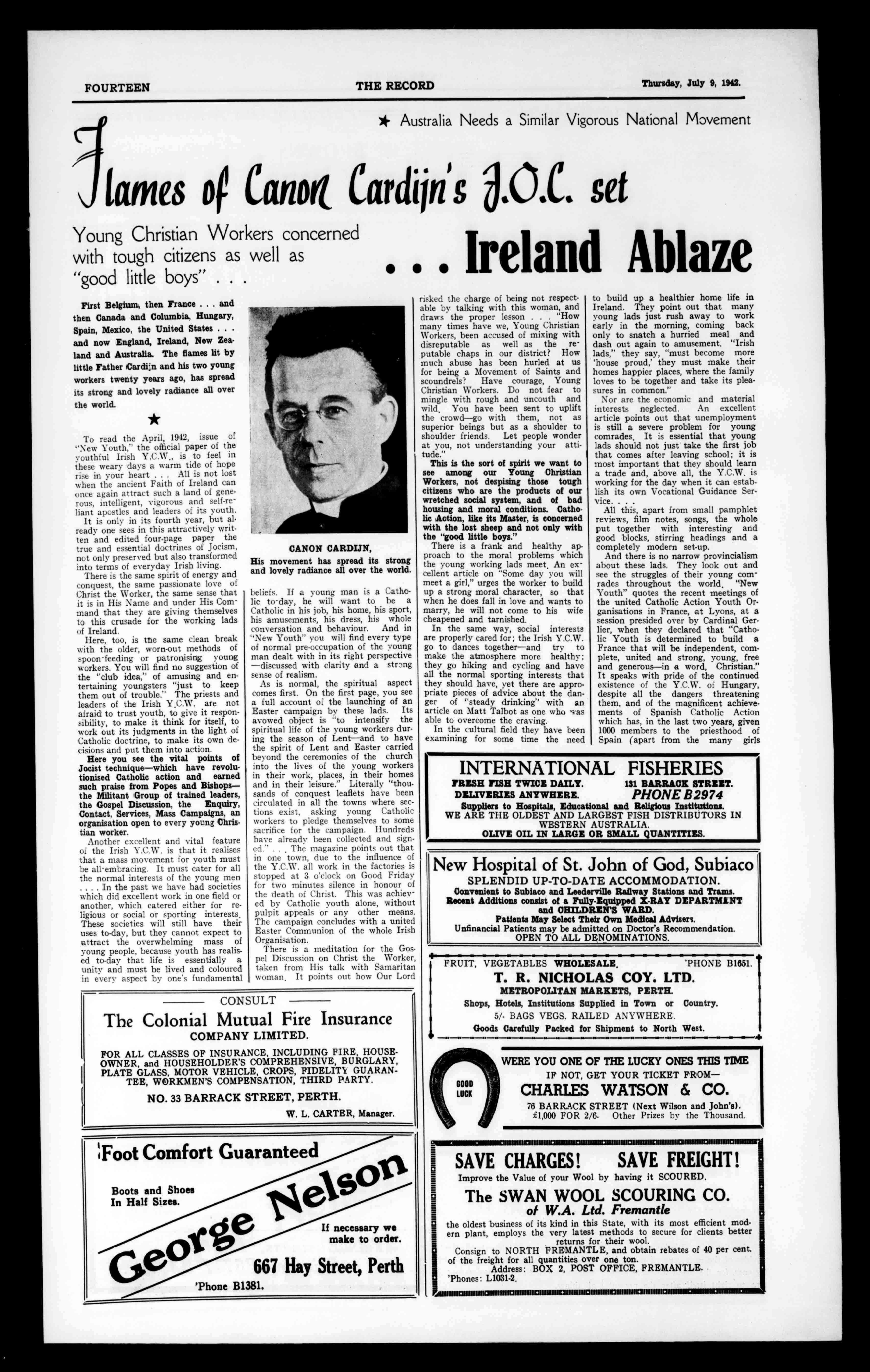
. IrelandAblaze
riskedthechargeofbeingnotrespect. ablebytalkingwiththiswoman,and drawstheproperlesson "How manytimeshavewe,YoungChristian Workers,beenaccusedofmixingwith disreputableaswellasthereputablechapsinourdistrict?How muchabusehasbeenhurledatus forbeingaMovementofSaintsand scoundrels?Havecourage,Young ChristianWorkers.Donotfearto minglewithroughanduncouthand wild,Youhavebeensenttouplift thecrowd-gowiththem,notas superiorbeingsbutasashoulderto shoulderfriends.Letpeoplewonder atyou,notunderstandingyourattitude."
Thisisthesortofspiritwewantto seeamongourYoungChristian Workers,notdespisingthosetough citizenswhoaretheproductsofour wretchedsocialsystem,andofbad housingandmoralconditions.CatholicAction,likeitsMaster,isconcerned withthelostsheepandnotonlywith the"goodlittleboys."
to,buildupahealthierhomelifein Ireland.Theypointoutthatmany youngladsjustrushawaytowork earlyinthemorning,comingback onlytosnatchahurriedmealand dashoutagaintoamusement."Irish lads,"theysay,"mustbecomemore 'houseproud,'theymustmaketheir homeshappierplaces,wherethefamily lovestobetogetherandtakeitspleasuresincommon."
CANONCARDIJN, Hismovementhasspreaditsstrong andlovelyradianceallovertheworld.
beliefs.IfayoungmanisaCatholicto-day,hewillwanttobea Catholicinhisjob,hishome,hissport, hisamusements,hisdress,hiswhole conversationandbehaviour.Andin "NewYouth"youwillfindeverytype ofnormalpre-occupationoftheyoung mandealtwithinitsrightperspective -discussedwithclarityandastrong senseofrealism.
Asisnormal, spiritualaspect comesfirst.Onthefirstpage,yousee afullaccountofthelaunchingofan Eastercampaignbytheselads.Its avowedobjectis"tointensifythe spirituallifeoftheyoungworkersduringtheseasonofLent-andtohave thespiritofLentandEastercarried beyondtheceremoniesofthechurch intothelivesoftheyoungworkers intheirwork,places,intheirhomes andintheirleisure."Literally"thousandsofconquestleafletshavebeen circulatedinallthetownswheresectionsexist,askingyoungCatholic workerstopledgethemselvestosome sacrificeforthecampaign.Hundreds havealreadybeencollectedandsigned." Themagazinepointsoutthat inonetown,duetotheinfluenceof theY.C.W.allworkinthefactoriesis stoppedat3o'clockonGoodFriday fortwominutessilenceinhonourof thedeathofChrist.ThiswasachievedbyCatholicyouthalone,without pulpitappealsoranyothermeans. Thecampaignconcludeswithaunited EasterCommunionofthewholeIrish Organisation. ThereisameditationfortheGospelDiscussiononChristtheWorker, takenfromHistalkwithSamaritan woman,ItpointsouthowOurLord
CONSULT
TheColonialMutualFireInsurance COMPANYLIMITED.
FORALLCLASSESOFINSURANCE,INCLUDINGFIRE,HOUSEOWNER,andHOUSEHOLDER'SCOMPREHENSIVE,BURGLARY, PLATEGLASS,MOTORVEHICLE,CROPS,FIDELITYGUARANTEE,WORKMEN'SCOMPENSATION,THIRDPARTY. NO.33BARRACKSTREET,PERTH.
W.L.CARTER,Manager.
1114
Ifnecessarywe maketoorder.
667HayStreet,Perth
Thereisafrankandhealthyapproachtothemoralproblemswhich theyoungworkingladsmeet,Anexcellentarticleon"Somedayyouwill meetagirl,"urgestheworkertobuild upastrongmoralcharacter,sothat whenhedoesfallinloveandwantsto marry,hewillnotcometohiswife cheapenedandtarnished.
Inthesameway,socialinterests areproperlycaredfor;theIrishY.C.W. gotodancestogether-andtryto maketheatmospheremorehealthy; theygohikingandcyclingandhave allthenormalsportingintereststhat theyshouldhave,yetthereareappropriatepiecesofadviceaboutthedangerof"steadydrinking"withan articleonMattTalbotasonewhowas abletoovercomethecraving.
Intheculturalfieldtheyhavebeen examiningforsometimetheneed
Noraretheeconomicandmaterial interestsneglected. Anexcellent articlepointsoutthatunemployment isstillasevereproblemforyoung comrades,Itisessentialthatyoung ladsshouldnotjusttakethefirstjob thatcomesafterleavingschool;itis mostimportantthattheyshouldlearn atradeand,aboveall,theY.C.W.is workingforthedaywhenitcanestablishitsownVocationalGuidanceService. Allthis,apartfromsmallpamphlet reviews,filmnotes,songs,thewhole puttogetherwithinterestingand goodblocks,stirringheadingsanda completelymodernset-up.
Andthereisnonarrowprovincialism abouttheselads.Theylookoutand seethestrugglesoftheiryoungcomradesthroughouttheworld,"New Youth"quotestherecentmeetingsof theunitedCatholicActionYouthOrganisationsinFrance,atLyons,ata sessionpresidedoverbyCardinalGerlier,whentheydeclaredthat"CatholicYouthisdeterminedtobuilda Francethatwillbeindependent,complete,unitedandstrong,young,free andgenerous-inaword,Christian." Itspeakswithprideofthecontinued existenceoftheY.C.W.ofHungary, despiteallthedangersthreatening them,andofthemagnificentachievementsofSpanishCatholicAction whichhas,inthelasttwoyears,given 1000memberstothepriesthoodof Spain(apartfromthemanygirls
INTERNATIONALFISHERIES
FRESHFISHTWICEDAILY. 131BARRACKSTREET.
DELIVERIESANYWHERE. PHONEB2974
SupplierstoHospitals,EducationalandReligiousInstitutions. WEARETHEOLDESTANDLARGESTFISHDISTRIBUTORSIN WESTERNAUSTRALIA.
OLIVEOILINLARGEORSMALLQUANTITIES.
NewHospitalofSt.JohnofGod,Subiaco
SPLENDIDUP-TO-DATEACCOMMODATION.
ConvenienttoSubiacoandLeedervilleRailwayStationsandTrams.
RecentAdditionsconsistofaFully-EquippedX-RAYDEPARTM&NT andCHILDREN'SWARD.
PatientsMaySelectTheirOwnMedicalAdviser3.
UnfinancialPatientsmaybeadmittedonDoctor'sRecommendation. OPENTOALLDENOMINATIONS. -..-.-..,-.-..-.
FRUIT,VEGETABLESWHOLESALE. 'PHONE T.R.NICHOLASCOY.LTD. METROPOLITANMARKETS,PERTH.
Shops,Hotels,InstitutionsSuppliedinTownorCountry. 5'.HAGSVEGS.RAILEDANYWHERE.
GoodsCarefullyPackedforShipmenttoNorthWest.
WEREYOUONEOFTHELUCKYONESTHISTIME IFNOT,GETYOURTICKETFROMCHARLESWATSON&CO.
76BARRACKSTREET(NextWilsonandJohn's). £1,000FOR2/6.OtherPrizesbytheThousand.
lUICIUMIMUKEMIIIIIMMEMEM,
SAVECHARGES! SAVEFREIGHT!
ImprovetheValueofyourWoolbyhavingitSCOURED.
.g"
TheSWANWOOLSCOURINGCO. ofW.A.Ltd.Fremantle theoldestbusinessofitskindinthisState,withitsmostefficientmodernplant,employstheverylatestmethodstosecureforclientsbetter returnsfortheirwool. ConsigntoNORTHFREMANTLE,andobtainrebatesof40percent. ofthefreightforallquantitiesoveroneton.
Address:BOX2,POSTOFFICE,FREMANTLE.
'Phones:L1031-2.
goossonassimesismatimimimiusuummussummumnionsamairimunsi
FOURTEEN THERECORD Thursday,July9,1942.
Guaranteed BootsandShoes InHalfSizes.
FootComfort
GeOlte
'PhoneB1381.
(I[YouthProblemsApproached
whohavejoinedReligiousOrders). WhatishappeninginCanadaand EnglandandAmericaisallofinteresttothem,andhereonegetsthetrue internationalspirit,thatsenseof unityintheMysticalBody,whichcan dosomuchtoavertfuturewars.
HereinAustralia,theY.C.W.is justbeginning.It,too,hasmanydifficultiestoovercome-theobstaclesin thewayofvigorousCatholicAction foryouth;out-wornmethods,oldfashionedconditions,andafailure-on thepartofmanywhoshouldknow better-tograsptherealistapproach whichmustbemadetotheproblems oftheyoungman,and,particularly,of theyoungworker. Onemayhave confidenceinthefactthatinmany parts,youngpriestsandgroupsof youngworkershavecometogetherand arehelpingoneanothertogetready forthedaywhenagreatandvigorousnationalmovementofYoung ChristianWorkersofAustraliacan beformedundertheapprovalofthe Bishops,aMovementwhichwillrally aroundtheBishopsthewholeworkingclassCatholicyouthofthisland.
Perhapsyou-priestoryoungworker-mayhavedreamedofthisday. Perplexedatthegrowingpaganismof theenvironmentintowhichouryoung ladsareflungwhentheyleaveour Catholicschools.You,too,areseekingthesolutionofthistremendous problem.Ifso,writetotheNational SecretariatofCatholicActionwhich
Patronise
OURADVERTISERS
STOVES,allenamel,newandused, lowestpricespromptrepairs...W-A StoveCo.,559WellingtonSt.(B6307.)
THEBESTVALUEFORYOUR MONEYAT F.J.DUFF'S WINESALOON.
CornerARUNDELSTREETand SOUTHTERRACE,FREMANTLE.
'Phone:L1902.
SUNBURY.
LANDandESTATEAGENT
G.H.TEEDE
'Phone31-Private267. SMITH'SBUILDINGS, WELLINGTONST.,BUNBURY. Businesses,Farms,Houses,Land ForSale.
Conquest!
TheYoungChristian Workersoftheworld marchforwardtobring theworkingmasses backtoChrist.
with
ClarityandStrongSenseofRealism
hasprogrammesandliteratureready foruse.CanonCardijnbeganhisapostolatewithtwoordinaryyoungworkersandhebroughtaboutakindof ChristianrevolutioninBelgium:perhapsyoucoulddothesameinyour ownsmallworldhereinAustralia.
J.F.CAIN
17STIRLINGHIGHWAY, COTTESLOE. 'PhoneF'2121,DayorNight. LICENSEDSANITARYPLUMBER, IRONWORKER,SHEETMETAL WORKER.
S.BEECROFT-Butcher
181RokebyRoad,Subiaco.
OnlyPrimeFreshKilledMeatSold. 'PhoneW1373.
J.NEILSON,Optician
S.DANNELL,F.S.M.C.(London), W.A.O.A.
OPTOMETRIST. Tel.:B1616 16PLAZAARCADE,PERTH.
ForExquisiteMildnessandTenderness andFineFlavourAlways.
HotelandAccommodationGuide
GAYNOR'SHISMAJESTY'SHOTEL HAYSTREET PERTH. EXCELLENTCUISINE MODERATETARIFF.
HOTELPERTH
JACKEDDINGTON, Proprietor.
ExcellentAccommodation
STAN.O'BRIEN COURTHOTEL
PERTH
'Phone:B4261
HOTELBEACONSFIELD FREMANTLE (,N,rlookingtheOcean SuperiorAccommodation. ModerateCharges.
M.BYRNE (LateofGrandandShamrock Hotels,Boulder).
SUBIACOHOTEL
FIRST-CLASSACCOXODATION
'Phone:W1028, A.I.MclIENRY,Proprietor
VICTORIAHOTEL
AustralasianCatholicAssurance Co.Ltd.
THE"A.C.A."
A.C.A.BUILDINGS,KINGST.,SYDNEY. ASSETSEXCEED£1,750,000.
ALLCLASSESOFLIFEANDENDOWMENT ASSURANCEPOLICIESTRANSACTED.
SAFEGUARDTHEFUTURE BRANCHOFFICESINALLSTATES.
W.A.Office "WARWICKHOUSE,"ST.GEORGE'STERRACE,PERTH P.ENGELBRECHT,ResidentSecretary.
HAYSTREET,SUBIACO. RenovatedThroughout. EssenceofComfort. W.F.ARTIS,Proprietor. (LateofBalmoralHotel,Vic.Park' COUNTRY.
DukeofYorkHotel NARROGIN ReconditionedandRefurnished. NewLounge,DiningRoom,and CommercialRooms. AR'lHURBOYLAN,Proprietor. LateGeorgeHotel,Perth.)
FREEMASON'SHotel
TOODYAY. ExcellentCuisine. AmaticeRefrigeratorInstalled. OldandNewFriendsare CordiallyWelcomed MRS.E.WING,Proprietress
GOLDFIELDS.
RodBeaton's HANNAN'SHOTEL
HANNANSTREET,
STAR&GARTERHOTEL
Cnr.HANNANandNETHERCOTT STREETS,KALGOORLIE.
BERTSTARE Proprietor.
'Phone13. Box124.
AUSTRALIAHOTEL
KALGOORLIE
C.T.A.andR.A.C.HOUSE.
OneMinutefromSt.Mary's Church.
Thursday,July9,1942. THERECORD. FIFTEEN
Limited
andSmallgoods
Behns
QualityMeats
STORES.
TWOBIGBARRACKSTREET
ForYourConvenienceonEitherSide.
KALGOORLIE.
OnlyLock-UpGaragesinthe centreofTown. M.1.DILLON,Licensee. KeoughsforCatering AnyNumber,Place,orTime. ThreeReceptionRoomsforHire. OnHire:Crock,-Cutleryand Glassware,etc. PhoneB1724. GLADKEOUGH, NEWCASTLESTREETPERTH. BRYANT&WATERS 80to90STIRLINGST.,PERTH. WOODandCOALMERCHANTS. OrdersPromptlyAttendedto. 'PhoneB3938. ,....1.04,00,14141.1. SOUTHDOWNDAIRY. 402CANNINGHIGHWAY, SOUTHPERTH. Tel.MU1801 W.J.FERRIDGE&SON, DAIRYMEN. BottledMilkDeliveredifRequired. FreshandScaldedCream. 0/67pHoNt81338 PRIVATEWM2223 THEGENERALAGENCYCO. PERTH'SLEADING 29A-30PADBURYBLDGS., HOTEL&BUSINESSBROKERS FORRESTPLACE ESTATEAGENTS
HotandColdWaterinHotel Bathrooms. RefrigerationThroughout.
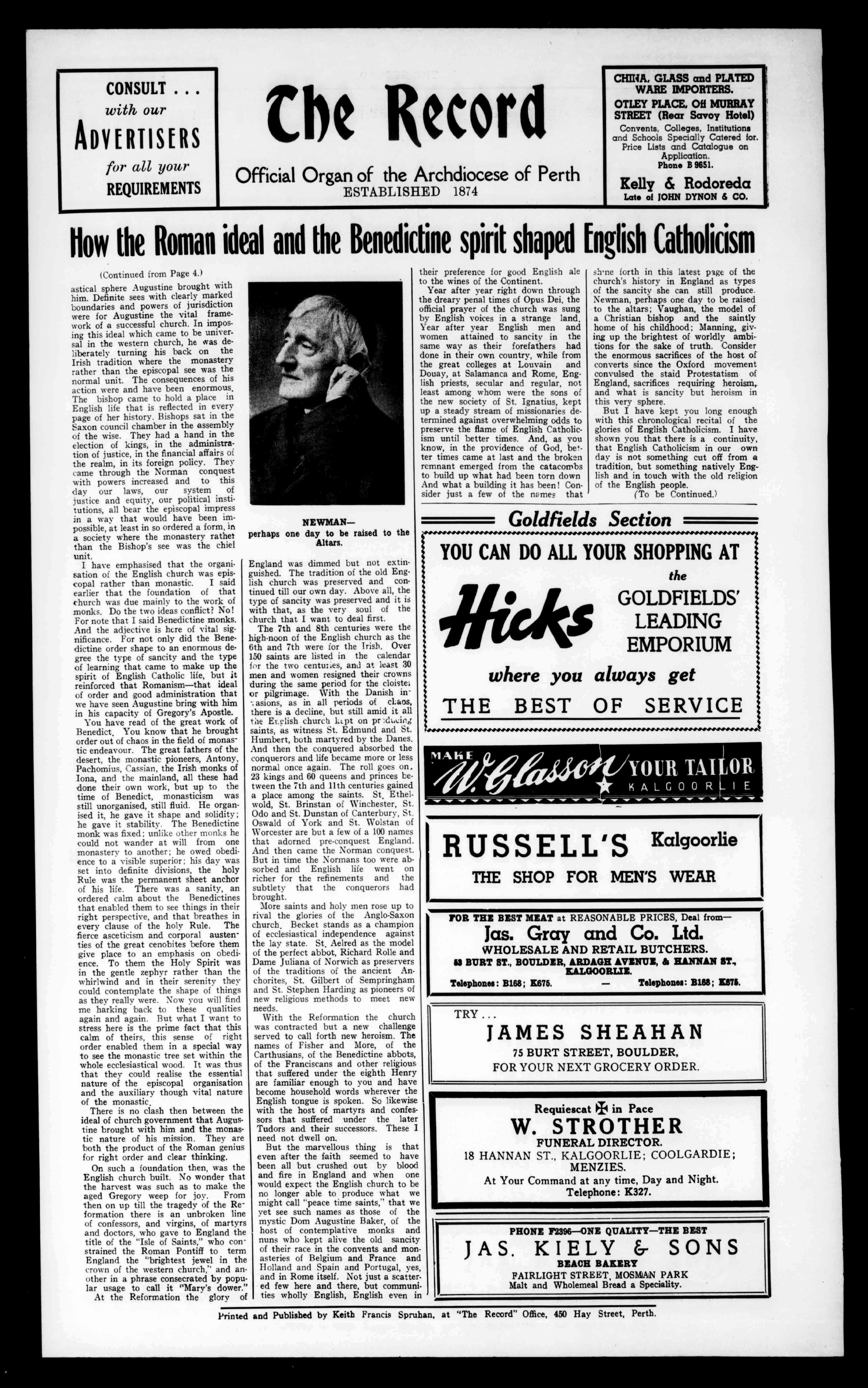
HowtheRomanidealandtheBenedictinespiritshapedEnglishCatholicism
(ContinuedfromPage4.1
asticalsphereAugustinebroughtwith him.Definiteseeswithclearlymarked boundariesandpowersofjurisdiction wereforAugustinethevitalframeworkofasuccessfulchurch.Inimposingthisidealwhichcametobeuniversalinthewesternchurch,hewasdeliberatelyturninghisbackonthe Irishtraditionwherethemonastery ratherthantheepiscopalseewasthe normalunit.Theconsequencesofhis actionwereandhavebeenenormous.
Thebishopcametoholdaplacein Englishlifethatisreflectedinevery pageofherhistory.Bishopssatinthe Saxoncouncilchamberintheassembly ofthewise.Theyhadahandinthe electionofkings,intheadministrationofjustice,inthefinancialaffairsof therealm,initsforeignpolicy.They camethroughtheNormanconquest withpowersincreasedandtothis dayourlaws,oursystemof justiceandequity,ourpoliticalinstitutions,allbeartheepiscopalimpress inawaythatwouldhavebeenimpossible,atleastinsoorderedaform,in asocietywherethemonasteryrather thantheBishop'sseewasthechief unit.
IhaveemphasisedthattheorganisationoftheEnglishchurchwasepiscopalratherthanmonastic.Isaid earlierthatthefoundationofthat churchwasduemainlytotheworkof monks.Dothetwoideasconflict?No!
FornotethatIsaidBenedictinemonks. Andtheadjectiveishereofvitalsignificance.FornotonlydidtheBenedictineordershapetoanenormousdegreethetypeofsancityandthetype oflearningthatcametomakeupthe spiritofEnglishCatholiclife,butit reinforcedthatRomanism-thatideal oforderandgoodadministrationthat wehaveseenAugustinebringwithhim inhiscapacityofGregory'sApostle.
Youhavereadofthegreatworkof Benedict,Youknowthathebrought orderoutofchaosinthefieldofmonasticendeavour.Thegreatfathersofthe desert,themonasticpioneers,Antony, Pachomius,Cassian,theIrishmonksof Iona,andthemainland,allthesehad donetheirownwork,butuptothe timeofBenedict,monasticismwas stillunorganised,stillfluid.Heorganisedit,hegaveitshapeandsolidity; hegaveitstability.TheBenedictine monkwasfixed;unlikeothermonkshe couldnotwanderatwillfromone monasterytoanother;heowedobediencetoavisiblesuperior;hisdaywas setintodefinitedivisions,theholy Rulewasthepermanentsheetanchor ofhislife.Therewasasanity,an orderedcalmabouttheBenedictines thatenabledthemtoseethingsintheir rightperspective,andthatbreathesin everyclauseoftheholyRule.The fierceasceticismandcorporalaustentiesofthegreatcenobitesbeforethem giveplacetoanemphasisonobedience.TothemtheHolySpiritwas inthegentlezephyrratherthanthe whirlwindandintheirserenitythey couldcontemplatetheshapeofthings astheyreallywere.Nowyouwillfind meharkingbacktothesequalities againandagain.ButwhatIwantto stresshereistheprimefactthatthis calmoftheirs,thissenseofright orderenabledtheminaspecialway toseethemonastictreesetwithinthe wholeecclesiasticalwood.Itwasthus thattheycouldrealisetheessential natureoftheepiscopalorganisation andtheauxiliarythoughvitalnature ofthemonastic. Thereisnoclashthenbetweenthe idealofchurchgovernmentthatAugustinebroughtwithhimandthemonasticnatureofhismission.Theyare boththeproductoftheRomangenius forrightorderandclearthinking.
Onsuchafoundationthen,wasthe Englishchurchbuilt.Nowonderthat theharvestwassuchastomakethe agedGregoryweepforjoy.From thenonuptillthetragedyoftheReformationthereisanunbrokenline ofconfessors,andvirgins,ofmartyrs anddoctors,whogavetoEnglandthe titleofthe"IsleofSaints,"whoconstrainedtheRomanPontifftoterm Englandthe"brightestjewelinthe crownofthewesternchurch,"andanotherinaphraseconsecratedbypopularusagetocallit"Mary'sdower." AttheReformationthegloryof
NEWMANperhapsonedaytoberaisedtothe Altars.
Englandwasdimmedbutnotextinguished.ThetraditionoftheoldEnglishchurchwaspreservedandcontinuedtillourownday.Aboveall,the typeofsancitywaspreservedanditis withthat,astheverysoulofthe churchthatIwanttodealfirst.
The7thand8thcenturieswerethe high-noonoftheEnglishchurchasthe 6thand7thwerefortheIrish.Over 150saintsarelistedinthecalendar forthetwocenttn.es,andatleast30 menandwomenresignedtheircrowns duringthesameperiodforthecloister orpilgrimage.WiththeDanishin-.asions,asinallperiodsofchaos, thereisadecline,butstillamiditall theEr.clishchurchkeptonpis:di...ring saints,aswitnessSt.EdmundandSt. Humbert,bothmartyredbytheDanes. Andthentheconqueredabsorbedthe conquerorsandlifebecamemoreorless normalonceagain.Therollgoeson. 23kingsand60queensandprincesbetweenthe7thand11thcenturiesgained aplaceamongthesaints.St,Ethelwold,St.BrinstanofWinchester,St. OdoandSt.DunstanofCanterbury,St. OswaldofYorkandSt.Wolstanof Worcesterarebutafewofa100names thatadornedpre-conquestEngland. AndthencametheNormanconquest. ButintimetheNormanstoowereabsorbedandEnglishlifewenton richerfortherefinementsandthe subtletythattheconquerorshad brought.
Moresaintsandholymenroseupto rivalthegloriesoftheAnglo-Saxon church.Becketstandsasachampion ofecclesiasticalindependenceagainst thelaystate.St,Aelredasthemodel oftheperfectabbot,RichardRolleand DameJulianaofNorwichaspreservers ofthetraditionsoftheancientAn. chorites,St.GilbertofSempringham andSt.StephenHardingaspioneersof newreligiousmethodstomeetnew needs.
WiththeReformationthechurch wascontractedbutanewchallenge servedtocallforthnewheroism.The namesofFisherandMore,ofthe Carthusians,oftheBenedictineabbots, oftheFranciscansandotherreligious thatsufferedundertheeighthHenry arefamiliarenoughtoyouandhave becomehouseholdwordswhereverthe Englishtongueisspoken.Solikewise withthehostofmartyrsandconfessorsthatsufferedunderthelater Tudorsandtheirsuccessors.TheseI neednotdwellon.
Butthemarvellousthingisthat evenafterthefaithseemedtohave beenallbutcrushedoutbyblood andfireinEnglandandwhenone wouldexpecttheEnglishchurchtobe nolongerabletoproducewhatwe mightcall"peacetimesaints,"thatwe vetseesuchnamesasthoseofthe mysticDomAugustineBaker,ofthe hostofcontemplativemonksand nunswhokeptalivetheoldsancity oftheirraceintheconventsandmonasteriesofBelgiumandFranceand HollandandSpainandPortugal,yes, andinRomeitself.Notjustascatter. edfewhereandthere,butcommunitieswhollyEnglish,Englishevenin
theirpreferenceforgoodEnglishale tothewinesoftheContinent.
Yearafteryearrightdownthrough thedrearypenaltimesofOpusDei,the officialprayerofthechurchwassung byEnglishvoicesinastrangeland, YearafteryearEnglishmenand womenattainedtosancityinthe samewayastheirforefathershad doneintheirowncountry,whilefrom thegreatcollegesatLouvainand Douay,atSalamancaandRome,Englishpriests,secularandregular,not leastamongwhomwerethesonsof thenewsocietyofSt.Ignatius,kept upasteadystreamofmissionariesdeterminedagainstoverwhelmingoddsto preservetheflameofEnglishCatholicismuntilbettertimes.And,asyou know,intheprovidenceofGod,be'tertimescameatlastandthebroken remnantemergedfromthecatacombs tobuildupwhathadbeentorndown Andwhatabuildingithasbeen!Considerjustafewofthenamesthat
,hneforthinthislatestpageofthe church'shistoryinEnglandastypes ofthesancityshecanstillproduce. Newman,perhapsonedaytoberaised tothealtars;Vaughan,themodelof aChristianbishopandthesaintly homeofhischildhood;Manning,givingupthebrightestofworldlyambitionsforthesakeoftruth.Consider theenormoussacrificesofthehostof convertssincetheOxfordmovement convulsedthestaidProtestatismof England,sacrificesrequiringheroism, andwhatissancitybutheroismin thisverysphere. ButIhavekeptyoulongenough withthischronologicalrecitalofthe gloriesofEnglishCatholicism.Ihave shownyouthatthereisacontinuity, thatEnglishCatholicisminourown dayisnotsomethingcutofffroma tradition,butsomethingnativelyEnglishandintouchwiththeoldreligion oftheEnglishpeople.
(TobeContinued.)
GoldfieldsSection
YOUCANDOALL
CONSULT withour
forallyour REQUIREMENTS theRecord OfficialOrganoftheArchdioceseofPerth ESTABLISHED1874 CHINA,GLASSandPLATED WAREIMPORTERS. OTLEYPLACE,OffMURRAY STREET(RearSavoyHotel) Convents,Colleges,Institutions andSchoolsSpeciallyCateredfor. PriceListsandCatalogueon Application. PhoneB9651. Kelly&Rodoreda LateofJOHNDYNON&CO.
ADVERTISERS
YOURSHOPPINGAT the GOLDFIELDS'S LEADING EMPORIUM whereyoualwaysget THEBESTOFSERVICE YOURTAI1011 KALGOORL E NI "V" RUSSELL'SKalgoorlie THESHOPFORMEN'SWEAR TORTHEBESTMEATatREASONABLEPRICES,DealfromJas.GrayandCo.Ltd. WHOLESALEANDRETAILBUTCHERS. UBURTST.,BOULDER,ARDAGHAVENUE,&HANNANST., KALGOORLIE. Telephones:B168;K675. Telephones:B168;K676. TRY JAMESSHEAHAN 75BURTSTREET,BOULDER, FORYOURNEXTGROCERYORDER. RequiescatIIIinPace W.STROTHER FUNERALDIRECTOR. 18HANNANST.,KALGOORLIE;COOLGARDIE; MENZIES. AtYourCommandatanytime,DayandNight. Telephone:K327. PHONEP2396-ONEQUALITY-THEBEST JAS.KIELY&SONS BEACHBAKERY FAIRLIGHTSTREET,MOSMIANPARK MaltandWholemealBreadaSpeciality. PrintedandPublishedbyKeithFrancisSpruhan,at"TheRecord"Office,450HayStreet,Perth.