"Taste Tells" Johnston's
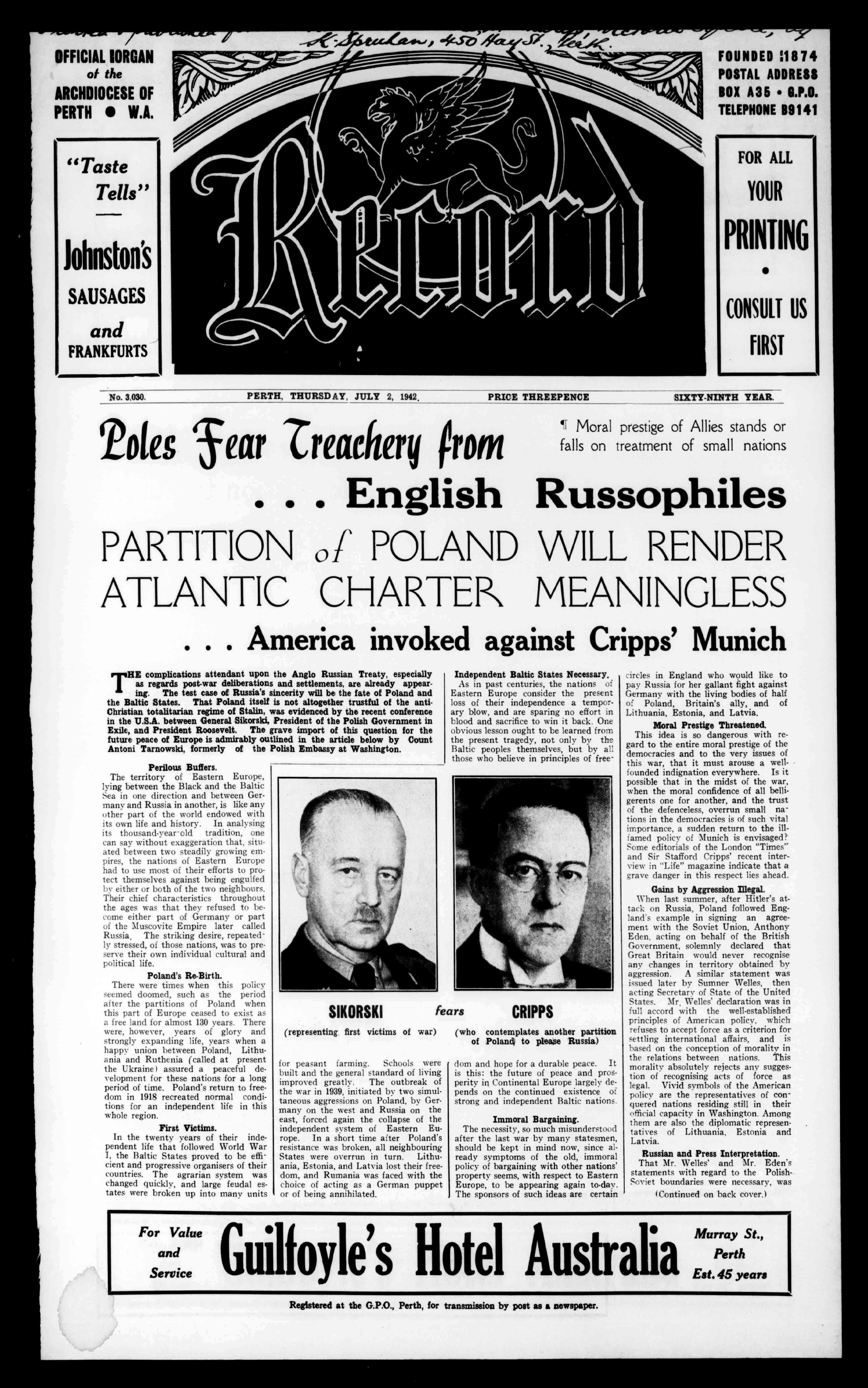
THEcomplicationsattendantupontheAngloRussianTreaty,especially asregardspost-wardeliberationsandsettlements,arealreadyappearing.ThetestcaseofRussia'ssinceritywillbethefateofPolandand theBalticStates.ThatPolanditselfisnotaltogethertrustfuloftheantiChristiantotalitarianregimeofStalin,wasevidencedbytherecentconference intheU.S.A.betweenGeneralSikorski,PresidentofthePolishGovernmentin Exile,andPresidentRoosevelt.Thegraveimportofthisquestionforthe futurepeaceofEuropeisadmirablyoutlinedinthearticlebelowbyCount AntoniTarnowski,formerlyofthePolishEmbassyatWashington.
PerilousBuffers.
TheterritoryofEasternEurope, lyingbetweentheBlackandtheBaltic SeainonedirectionandbetweenGermanyandRussiainanother,islikeany otherpartoftheworldendowedwith itsownlifeandhistory.Inanalysing itsthousand-year-oldtradition,one cansaywithoutexaggerationthat,situatedbetweentwosteadilygrowingempires,thenationsofEasternEurope hadtousemostoftheireffortstoprotectthemselvesagainstbeingengulfed byeitherorbothofthetwoneighbours. Theirchiefcharacteristicsthroughout theageswasthattheyrefusedtobecomeeitherpartofGermanyorpart oftheMuscoviteEmpirelatercalled Russia.Thestrikingdesire,repeatedlystressed,ofthosenations,wastopreservetheirownindividualculturaland politicallife.
Poland'sRe-Birth.
Thereweretimeswhenthispolicy seemeddoomed,suchastheperiod afterthepartitionsofPolandwhen thispartofEuropeceasedtoexistas afreelandforalmost130years.There were,however,yearsofgloryand stronglyexpandinglife,yearswhena happyunionbetweenPoland,LithuaniaandRuthenia(calledatpresent theUkraineassuredapeacefuldevelopmentforthesenationsforalong periodoftime.Poland'sreturntofreedomin1918recreatednormalconditionsforanindependentlifeinthis wholeregion.
FirstVictims. InthetwentyyearsoftheirindependentlifethatfollowedWorldWar I,theBalticStatesprovedtobeefficientandprogressiveorganisersoftheir countries.Theagrariansystemwas changedquickly,andlargefeudalestateswerebrokenupintomanyunits
SIKORSKI
IndependentBalticStatesNecessary. Asinpastcenturies,thenationsof EasternEuropeconsiderthepresent lossoftheirindependenceatemporaryblow,andaresparingnoeffortin bloodandsacrificetowinitback.One obviouslessonoughttobelearnedfrom thepresenttragedy,notonlybythe Balticpeoplesthemselves,butbyall thosewhobelieveinprinciplesoffree-
circlesinEnglandwhowouldliketo payRussiaforhergallantfightagainst Germanywiththelivingbodiesofhalf ofPoland,Britain'sally,andof Lithuania,Estonia,andLatvia.
MoralPrestigeThreatened.
Thisideaissodangerouswithregardtotheentiremoralprestigeofthe democraciesandtotheveryissuesof thiswar,thatitmustarouseawellfoundedindignationeverywhere.Isit possiblethatinthemidstofthewar, whenthemoralconfidenceofallbelligerentsoneforanother,andthetrust ofthedefenceless,overrunsmallnationsinthedemocraciesisofsuchvital importance,asuddenreturntotheillfamedpolicyofMunichisenvisaged?
SomeeditorialsoftheLondon"Times" andSirStaffordCripps'recentinterviewin"Life"magazineindicatethata gravedangerinthisrespectliesahead.
GainsbyAggressionHiegel.
fears
(representingfirstvictimsofwar) forpeasantfarming.Schoolswere builtandthegeneralstandardofliving improvedgreatly.Theoutbreakof thewarin1939,initiatedbytwosimultaneousaggressionsonPoland,byGermanyonthewestandRussiaonthe east,forcedagainthecollapseofthe independentsystemofEasternEurope.InashorttimeafterPoland's resistancewasbroken,allneighbouring Stateswereoverruninturn.Lithuania,Estonia,andLatvialosttheirfreedom,andRumaniawasfacedwiththe choiceofactingasaGermanpuppet orofbeingannihilated.
CRIPPS
(whocontemplatesanotherpartition ofPoland)topleaseRussia) don,andhopeforadurablepeace.It isthis:thefutureofpeaceandprosperityinContinentalEuropelargelydependsonthecontinuedexistenceof strongandindependentBalticnations.
ImmoralBargaining. Thenecessity,somuchmisunderstood afterthelastwarbymanystatesmen, shouldbekeptinmindnow,sincealreadysymptomsoftheold,immoral policyofbargainingwithothernations' propertyseems,withrespecttoEastern Europe,tobeappearingagainto-day. Thesponsorsofsuchideasarecertain
Whenlastsummer,afterHitler'sattackonRussia,PolandfollowedEngland'sexampleinsigninganagreementwiththeSovietUnion,Anthony Eden,actingonbehalfoftheBritish Government,solemnlydeclaredthat GreatBritainwouldneverrecognise anychangesinterritoryobtainedby aggression.Asimilarstatementwas issuedlaterbySumnerWelles,then actingSecretaryofStateoftheUnited States.Mr.Welles'declarationwasin fullaccordwiththewell-established principlesofAmericanpolicy,which refusestoacceptforceasacriterionfor settlinginternationalaffairs,andis basedontheconceptionofmoralityin therelationsbetweennations.This moralityabsolutelyrejectsanysuggestionofrecognisingactsofforceas legal.VividsymbolsoftheAmerican policyaretherepresentativesofconquerednationsresidingstillintheir officialcapacityinWashington.Among themarealsothediplomaticrepresentativesofLithuania,Estoniaand Latvia.
RussianandPressInterpretation. ThatMr.Welles'andMr.Eden's statementswithregardtothePolishSovietboundarieswerenecessary,was (Continuedonbackcover.)
OFFICIALIOROAN ofthe ARCHDIOCESEOF PERTH W.A.
SAUSAGES
No.3,030. PERTH,THURSDAY,JULY2,1942. PRICETHREEPENCE FOUNDED:1874 POSTALADDRESS BOXA350.P.0. TELEPHONE119141 FORALL YOUR PRINTING CONSULTUS FIRST SIXTY-NINTHYEAR. T.olesearTreacheryprom iflall\siloor:ltreea:rt:IngeentofoUsi:alsltairliad.tio EnglishRussophiles
CHARTERMEANINGLESS
and FRANKFURTS
PARTITIONofPOLANDWILLRENDER ATLANTIC
...AmericainvokedagainstCripps'Munich
ForValue and Service Guilfoyle'sHotelAustralia MurraySt., Perth Est.45years RegisteredattheG.P.O.,Perth,fortransmissionbypostasanewspaper.
DoesDiplomaticRepresentationwithAxisPartners MeantheVaticanhasShakenHandswiththeDevil?
TopeReceivesJapaneseEmbassyin EarlySeventeenthCentury
RealpurposeofHasakura'shistoricmissiontoEurope
ThetruereasonwhyRussiahasnorepresentativeatthe Vaticanisnotpolitical butreligious
"NotaCommunist,"Manly:
Q.:WouldyousaytheVaticanhas shakenhandswiththedevil,byhavingrelationswitheveryAxispartner, includingJapan?
R.:Certainlynot.Toenterinto conversationswithasinnerwhosesins youdonotapprove,andwhilsttelling himclearlythatyoudonotapprovehis sins,isnotto"shakehandswiththe devil.'Thereisnotanationinthe worldthatisabovereproach,and thePoperefusedtohaveanythingto dowithanynationunlessitwereperfect,hewouldreceiverepresentatives romnoneofthem.Asitis,heispreparedtotalktoallofthem,forwhatevergoodhecanaccomplish.Ithink yourdifficultyarisesfromavagueidea thatthemomentthePopeagreestoreceiveanambassadorfromsomegiven nation,hehas,bytheveryfact,enteredintoapoliticalalliancewiththat nation.Nothingofthekind.The alliednationswhohaverepresentativesattheVaticanknowverywell thattheVaticanisundernopolitical obligationtothem,evenastheAxis partnersrealisethesame.
* * * *
THESUPERNATURALMISSION.
Q.:It'snousesayingthattheVatican representsthesupernatural.
R.:Imust,nevertheless,sayit.The onlythingtoberememberedisthat theChurchrepresentsthesupernatural inthisworldwithwhichshemust, therefore,beincontact,andwhichshe musttrytoinfluenceforthebetter byalllawfulmeans.
Q.:TherecouldbenosupernaturalrelationsbetweentheVaticanand Japan,whichisn'tevenaso-called Christiancountry.
R.:Thatisnottrue.ChristcommissionedHisChurchtogoandto teachallnations,Thatatonceestablishesasupernaturalrelationshipof theChurchtowardsallnations.Until anationisconverted,Iadmitthatthe supernaturalrelationshipisunilateral. Afteranationisconverted,thesupernaturalrelationshipbecomesbilateral ormutual.TheChurch,therefore,has asupernaturalrelationshiptoallnations,whatevertheirattitudetowards her.Hersupernaturalrelationshipis eithertowardsconvertednations,ortowardsnationstobeconverted.So ChristHimselfhasasupernaturalrelationshipwithboththejust,whoacceptHim,andsinners,whorejectHim.
* * * *
CATHOLICINTERESTS.
Q.:It'snousesayingthatthePopeis merelylookingafterCatholicinterests.
R.:Idon'tsaythat.Primarily,he mustdothat,andIincludenotonly existentCatholicinterests,butpotentialCatholicintereststoberealisedin thefuture.But,apartfromspecificallyCatholicinterests,thePopewilluse hisinfluenceforeverygoodandhumanitarianpurposethatcancontribute tothepeaceandhappinessofmankind, whateverthereligionorirreligionof anygivensectionsofhumanity.
Q,:IfheislookingafterCatholicinterests,thenitmeansthatCatholics aretobespeciallyfavouredbythe enemy. R.:Idon'tthinkyourealisewhatyou aresaying,for,ifyoudid,youcertainlywouldnotsayit.Whenyouspeak oftheenemy,youmeanourownpoliticalenemy.Now,doyoureallythink thattheCatholicChurchmustregard asherpoliticalenemyanynationthat happenstobeourpoliticalenemy?
MusttheCatholicChurchidentifyherselfpoliticallywithourcause?Itisyou whowanttodragtheCatholicChurch downintothearenaofpolitics.And allyourdifficultiesareduetothefact thatyouarereallythinkingonlyin termsofpoliticsallthetime.Again, grantedthattheCatholicChurch existstopromatethecauseofChrist, areyougoingtoobjecttoherefforts togetthatcausespeciallyfavoured withinsomeothernationmerelybecausethatnationhappenstobepoliticallyopposedtoourowncountry?
SincewhenwasitthelawthattheCatholicChurchmustexercisehermission inthisworldsubjecttothepolitical approvalofanygivennationorgroup ofnations?
VIEWOFGOODCATHOLICS.
Q.:IknowmanygoodCatholics,andI knowtheideaisrepulsivetothem.
R.:NogoodCatholiccouldfindthe idearepulsivethattheCatholicreligionshouldheesteemed,andgranted libertytogrowandextenditsinfluence,inanycountryintheworld, whateveritspoliticalrelationshiptowardsourownnation.Afterall,the sacrificestheyhavemadeonbehalfof theforeignmissions,goodCatholics havenodesiretoseethosemissionsdestroyed,andtheirworkcrippled.And ifthePopecansecureanyspecialprotectionforthosemissions,andeventhe expansionoftheCatholicreligionin foreignlands,theyaregratefultoGod, eventhoughthoseforeignlandshappentobeinvolvedinwarwithusat thepresenttime.
VATICANANDTHEWORLD.
Q.:IftheVaticanhasnoworldlyrelationswithenemycountries,whydoes ithavetheirrepresentativesatthe Vatican?
R.:TheVaticanhasnoenemycountries,andconsequentlyhasnorepresentativesfromenemycountrieswithin itswalls.TheVaticanisstrictlyneutral.Ithasnopoliticalallianceswith anynation,anddoesnotregardany nationasapoliticalenemy.The Vaticanregardsitselfasnotonthe politicalplaneatall.Atthesame
time,IhaveneversaidthattheVaticanhasnoworldlyrelations.Shehas manynon-politicalworldlyrelations, forthesimplereasonthat,thoughshe isnotoftheworld,sheisintheworld. Sheconsistsofhumanbeings,and everyoneofhersubjectshappensalso tobe,inthecivilorder,asubjectof oneorotherofthenationsinthis world.TheveryrelationshipofCatholicstothecountriestowhichthey belongwillbringthosecountriesinto relationshipwiththeVaticanasthe centreofthereligionthoseCatholics profess.Variouscountrieswillwant toknowhowfartheirlegislationcan meetwiththeapprovaloftheCatholic conscience,andtounderstandthemind ofthePopeintheexerciseofhis spiritualauthorityovertheirsubjects.
RUSSIAUNREPRESENTED.
Q.:Russiaistheonlycountrythathas norepresentative.Itdoesnotwish tositonthefencewiththeVatican. R.:Youarereallyspeakingfoolishly.
Firstly,youarethinkingoftheVatican assittingonthepoliticalfence,and refusingtotakepoliticalsides.Yet youhavebeenaccusingtheVaticanof sidingpoliticallywithJapan!Asa matteroffact,theVaticanisanonstartedinthepoliticalrace.Secondly,yousaythatRussiahasnorepresentativebecauseshedoesnotwishto sitonthefence.DoyoumeantosuggestthatallwhohavesentrepresentativestotheVaticanare"sittingon thefence,"includingEngland,withits ambassador,andPresidentRoosevelt, withhispersonalrepresentative?The realreasonwhyRussiahasnorepresentativeattheVaticanisnotpolitical, butreligious.Theofficialpolicyof theCommunistregimeisthedestructionofreligion.BylawinRussia atheismmustbetaughtintheschools. AndStalinhasnotyetgottothestage ofinconsistencywhichwillenablehim toaskofficiallyforanexchangeofre presentativeswiththeSupremeBishop inChristendom.
AnEarlyJapaneseEmbassy
"Interested,"Bovrraville
Q.:Wouldyou,please,commenton thefollowingstatementmadeby Dr.W.G.Goddard,inalecturebeforetheRoundTableClubinBrisbane,onApril14last.
R.:Iwilldoso,becausetheincident isaveryinterestingoneinitself,and hasadditionalinterestatthispresent time.ButIwillhavetodisagreewith Dr.Goddard'sinterpretationofthe event;granted,ofcourse,thatyou havecorrectlyquotedhiswords.
Q.:Dr.Goddardsaidthat,inthe17th century,aJapaneseambassador namedHasakuraRokuyemontravelledtoRomeforthepurposeoffindingoutthemilitarystrengthof Europe.
R.:Thatisnotcorrectasitstands. Herearethefacts:Bytheyear1613, Spanishmissionaries,whohadlong beenworkinginJapan,hadsucceeded inconvertingtotheCatholicFaith overamillionJapanese.Now,atthat time,therulingEmperor,Ieyasu,was anoldman,andaneighbouringdependentprincenamedDateMasamune, ofSendai,alsoapagan,gottheideaof deposingIeyasu,andsnakinghimself masterofthewholeofJapan.ToaccomplishthisrevolutioninJapanhe soughttheassistanceoftheJapanese ChristiansandoftheKingofSpain, Healsothoughtitwouldbegoodto
Hibernian-Australasian
getthePope,thenPaulV.,toadvise theChristianstosupporthim.Sohe sentanembassytoMadrid,with HasakuraRokuyemonincharge,to treatfirstwiththeKingofSpainconcerningmilitaryhelp;andafterthat togoontoRometoaskthePopefor letterscommendingthecausetoJapaneseCatholics.Youcanseehowinadequateandmisleadingitistodescribethevisitasonetofindoutthe militarystrengthofEurope!That seemstosuggestthatJapanwascontemplatinganattackonEurope.In reality,anambitiousJapaneseprince, DateMasamune,wasseekinghelpfrom SpainforarevoltwithinJapanagainst theEmperorIeyasu. * * * VISITTOPHILLIPIII.,OFSPAIN.
Q.:HasakuraRokuyemonwasfeted bytheKingofSpain,PhillipIll., whoattendedhisbaptism.
R.:Itistruethattheembassywas receivedwithhonoursbytheKingof Spain.Itisalsotruethatseveralmembersoftheembassy,includingHasakura,becameCatholicswhilstinSpain, thoughnotalldidso.Thatisnot surprising,fortheywereclosefriends withtheJapaneseChristians,andalreadyknewagooddealofChristian doctrine.Buttheirconversionwas theirownpersonalaffair.Whenit cametoapoliticalandmilitaryalli-
TWO THERECORD. Thursday,July2,1942.
eplies THEOLOGY-HISTORY TOPICALQUESTIONS -PHILOSOPHY SOCIALJUSTICE - APOLOGETICS BYREV.DR.RUMBLE,M.S.C.
adio
CatholicBenefitSociety BESTBENEFITSFORLOWESTCONTRIBUTIONS. DEATHBENEFIT.-L50,age16andunder20,4/10quarterly;£100,7/2quarterly. 20yearsandunder23 5/3qr.;£100,8/-qr.23yrsandunder25,5/5qr.;£100,8/4qr.25yrs.andunder30,5/10qr.;£100,9/2qr. Membersupto51accepted.AlsoSickness,MedicalandHospitalBenefits. J.EDWARDS,GrandSecretary,WestAustralianChambers,St,George'sTerrace,Perth. Tel.:BM.
antewithHasakura'soverlord,Masamune,forthepurposesofinsurrection, thatwasanothermatteraltogether. AndPhillipIII.refusedtoinvolve Spaininsoadventurousaproposal. Fromthatpointofviewtheembassy wasacompletefailure. * * * *
WASTHEPOPEDECEIVED?
Q.:HasakuraactuallydeceivedPope PaulV.
R.:Dr.Goddarddoesnotsayin whatway.Possiblyhethinksthat Hasakuraonlypretendedconversion, andreceivedbaptisminsincerelyasa politicalmeanstoanend,thusdeceivingthePope.Butthereareno groundstosuspectHasakuraofinsincerityinthismatter.Meantimethe Popewasnotdeceived,concerningthe politicalnatureoftheembassy.He receivedthememberswithcourtesy, heardtheirpetitionformoralsupport, anddelayedhisreplyuntilhehad goneintothewholematter.Inthe endhesaidhecouldnotrecognise Masamuneasasovereignprince,since hewasnot;andthathewouldnotrecommendCatholicsinJapantosupport Masamune'sambitions. SotheembassycertainlydidnotsucceedindeceivingPopePaulV.
Q.:HonourswerepaidtoHasakurain Venice.
R.:Hewasreceivedwiththecourtesyduetoanambassadorwherever hewent.Butthatdidnotcontribute tothesuccessofhisdiplomaticmission.
PERSECUTIONINJAPAN.
Q.:WhenHasakurareturnedtoJapan, hesetouttoexterminateallthe Christiansofthatcountry.
R.:Thatisnotcorrect.WhenHasakurareturnedtoJapanhehadonly failuretoreporttohispaganlord, Masamune.Meantime,theoldEmperor,leyasu,haddiscoveredtheplot. Todivertsuspicionfromhimself,MasamunebegantopersecutetheChristians, andjoinedwithleyasuinexterminatingthem.
Q.:Dr.Goddarddeclaredthatthe Japanesehistorian,ShujiroWatanabe,admitsthatthepurposeof Hasakura'svisittoEuropewas military,andthatitsreligiousaspect wassimplyacleverguise.
R.:Ihaveexplainedthepurposeof thevisittoEurope.Thereareno groundstosuspectthemotivesofsuch oftheembassyasbecameCatholics. NordidtheirconversionhaveanyinfluenceoneitherPhillipIII.orthe Popeasregardstheirdiplomaticrepresentations.Thebestaccountofthis particularembassyisthatbytheJapanesehistorian,G.Mitsukuri,andpublishedin1901.HehadaccesstodocumentsinJapaneseArchiveswhichwere unknowntoprevioushistorians,and wasabletopointouttheiromissions anderrors.Additionalmatter,supportingMitsukuri,waspublishedin 1909bytheInstituteofHistoricalCompilationattheImperialUniversityof Tokyo.
HaveAllMenEqualRights?
"Awake,"Sydney,N.S.W.
Q.:Areallmenequal?
R.:Allmenareequallyhuman beings.equallycreaturesofGod,and equallyintendedbyGodtosavetheir soulsandattainheavenlyhappinessin eternity.Butallmenareobviously notequalinthisworld.Thereare tremendousinequalitiesinhealth,mentalability,forceofcharacter,wealth andpower.Andthesedifferenceswill alwaysresultinunequalgradesinsociety.Menwillneverarriveatcompletesocialandeconomicequality.
Q.:Haveallmenequalrightsand duties?
R.:No.Therecanonlybearelativeandproportionateequalitywhere rightsanddutiesareconcerned.Rights anddutiesgotogether.Now,itis clearthatdutiesdiffer.Thedutiesof rulersandsubjects,ofparentsand children,ofteachersandpupils,ofemployersandemployees,ofsoldiersand civilians,arenotthesame.And rightsvaryaccordingly. * * *
LIBERTYLIMITED.
Q.:WhatdoestheChurchteachregardingtherightoftheindividual totheenjoymentofliberty?
R.TheChurchteachesthatthereis nosuchthingasabsoluteliberty,asif menshouldbeexemptfromallrestrictions.Libertywouldthenbecome simplylicence.Amoderateliberty canbeassuredtoindividualslivingin societyonlyprovidedallarewillingto submittocertainrestraints.Forexample,yourfreedomcanbepreserved onlyifIamrestrainedfromtrespassingonyourrights.Andmylegitimate freedomdependsonyourbeingcompelledtorespectit.Man'srealliberty isfreedomtobetruetohisrealnature anddignity,tostandinarightrelationwithGodandhisfellowmen,tobe freefromerrorandvice.Nowadays peopletendtospeakoflibertyasif itshouldmeanabsoluteindependence ofallauthority,divineorhuman;and asifmenshouldbefreetothinkwhat theylike,saywhattheylike,anddo whattheylike.Butinthoughtman's realfreedomistobeliberatedfrom error-nottopossesstherighttohold anyopinionwhetheritberightor wrong;inspeechmanmustbefettered bythelimitsoftruth,foronlythen willhebeliberatedfromlies;inconducthemustberestrainedbythedemandsofjusticeandtherightsof others.
RIGHTTOPRIVATEPROPERTY.
Q.:Whatismeantbyprivateproperty?
R.:Therightofprivatepropertyis therighttosecure,own,use,anddisposeofthingsaccordingtoone'sown willandwithouthindrancefrom others.
Q.:Whencearisestherighttoprivate Property?
R.:Ingeneral,thenaturalmorallaw itselfgivesmentherighttoown things,providedtheyarelegitimately obtained.Thatnatureitselfestablishestherighttoprivatepropertyis evidentfromtheindividualman'sright tobothhisexistenceandfittingdevelopment;fromtherequirementsof familywelfare;andfromconsiderations ofthesocialgood.Manhasthenaturalrighttoownthemeansofhisown
Q.:Asthevictimleftnodependents, thequestionofreparationdoesnot arise.
kIfdependentswereinwant throughthedeathofthevictim,compensationwould,ofcourse,havetobe made.Howeveryouexcludethat factor.
*
TELLINGTHEPOLICE.
Q.:If"X"laterbecomestrulyrepentant,andgoestoConfession,can thepriestabsolvehimunconditionally,ormusttheconditionbemade that"X"confesshiscrimetothe civilauthorities,andsurrenderto them?
R.:Grantedthat"X"wastrulyrepentant,hewouldbeabsolvedabsolutely.Noobligationwouldbeimposeduponhimtodenouncehimselfto thepolice.Theconfessionalisnota
tribunalofcivillaw.Itisconcerned withconsciences,andtherelationship ofsoulstoGod.Incivillaw,every manispresumedinnocentuntilheis provedguilty.Anditisthedutyof theStatetoprovecrimesagainstcivil law,andarrestthoseguiltyofthem. EventheStateitselfdoesnotexpect criminalstoincriminatethemselves, andappointsnoextrapenaltiesfor thosewhohavewaitedforthelawto overtakethem,insteadofvoluntarily confessingtheircrimesanddelivering themselvesuptothepolice.Asthere isnoobligationtodothis,therefore, nopriestwouldobligeapenitenttodo it.Providedheweretrulysorryfor havingviolatedGod'slaw,hewould receiveabsolutionunconditionally; save,ofcourse,forthesacramental penanceimposed,andtohefulfilled privately.
OurCatholicSchoolsandColleges
CHRISTIANBROTHERS,MT.HENRY
OneoftheeissociutedPublic SchoolsofWA.
AquinasCollege
TELEPHONE:MU1520
subsistenseandthatofhisfamily,as wellastoprovideforthefuture.And thewelfareofthecommunityisbetter securedwhenmenhaveapersonalinterestinwhatbelongstothemseles. PopeLeoXIII.wroteasfollowsinhis Encyclical,"RerumNovarum":"With reasonthen,thecommonopinionof mankind,littleaffectedbythefewdissentientswhohavecontendedforthe oppositeview,hasfoundinthecarefulstudyofnature,andinthelawsof nature,thefoundationsforthedivisionofpropertyandthepracticeofall ageshasconsecratedtheprincipleof privateownershipasbeingpre-eminentlyinconformitywithhumannature, andasconlucinginthemostunmistakablemannertothepeaceandtranquillityofhumanexistence.Theauthorityofthedivinelawaddsitssanction,forbiddingintheseverestterms tocovetthatwhichisanother's."
Q.:CouldtheStateabolishallprivate propertyintheinterestofthecommongood?
R.:Itcouldhavenorightwhatever, divineorhuman,toadoptsuchameasure.Norwoulditbeforthecommongood. * * * *
USEOFPROPERTYRESTRICTED.
Q.:Isman'srighttoprivateproperty limitedinanyway?
R.:Yes.EventhoughCatholic teachingvindicatestheradicalrightof mentoprivateownership,ithasnever maintainedthattherearenorestrictionsontheuseofhispossessions. Where,inparticularcases,thecommon goodrequiresit,theStatecanresume aman'sprivateproperty,offeringdue compensation.Thatisreallyacompulsoryexchangeofproperty.Again, inrelationtotheirfellowmenthose whoownprivatepropertyaresubject tothelawsofjusticeandcharity.In thefaceoftheselawsprivateowners arestewardsoftheirgoodsforthe benefitofall,ratherthanabsoluteproprietors.Thus,inextremenecessity justiceitselfdemandsthataprivate ownermustsharehisgoodswithothers indangerofdeathfromstarvationor anyotherdisastrousconditionhecould avert.Outsideextremenecessity, charitydemandsthatthepossessorrelievetheneedsofothersaccordingto thegravityoftheirdistressandhisown resources.TheCatholicChurch,therefore,doesnotadmittherighttoprivatepropertywithoutanyrestrictions atall.Absolutelibertytodoasone pleaseswithone'spossessionscannot besustained.
Confessionof Murder
"Justitia,"Haberfield:
Q.:Tosettleadiscussion,wouldyou kindlysolvethefollowingcaseconcerningConfession?
R.:Gladly.
Q.:Imagineacaseinwhich"X"commitsamurderinsuchawaythatthe victim'sdeathisacceptedasanaccident,andnosuspicioncanfallon himselforanybodyelse, R.:I'veimaginedthecase.
ForBoardersandDayStudents
Boysadmittedfrom7upwards
Beau/dullySituated,overlookingMeriver,nearthenewCanningBridge. ForParticularsapplytoThePrincipal,AquinasCollege,CanningParade,Mt.Henry.
SACREDHEARTHIGHSCHOOL
HIGHGATE-PERTH
(ConductedbySistersNotreDameDesMissions). BOARDINGANDDAYSCHOOLFORGIRLS. PUPILSPREPAREDALLEXAMINATIONS.
MONTESSORISCHOOLFORYOUNGCHILDREN ForProspectusapplyREV.MOTHERPRIORESS
LoretoConvent"Osborne"-Claremont BOARDINGANDDAYCOLLEGE.
TheSchoolprovidesasoundeducationonmodernlinesinallbranches ofstudy.Thepupilsarepreparedforallexaminations.TheSchoolis beautifullysituatedbetweenOceanandRiver,inextensivegrounds, withfineplayingfieldsandprivateSwimmingPoolinRiver. Telephone:F2I35. Apply- MOTHERSUPERIOR.
ST.ILDEPHONSUS'COLLEGE NEWNORCIi, CONDUCTEDBYTHEMARISTBROTHERS.
ForParticularsApplyto-THEBROTHERDIRECTOR
GHUNTQUALITY G. BUTCHER
85MandurahRd.,SouthFremantle
THEBIGWHITESHOPOPPOSITEMILLS&WARE'S. WeCaterforHotels,ResidentsandCampers.
CHOICESTQUALITYMEATATCOMPETITIVEPRICES.
'Phone:L1986.
OrdersCalledForandDelivered.
-Washdaysare Easier
RelaxSoapwilltakethehard workoutofwashdaysfor YOU,Relaxisgentleonthe fabricandyourhands;washes clothesasnowywhite;and NOhardrubbingisnecessary.AlwaysuseRELAXin YOURwashtub.(Obtainableinthreesizes.) MADEINW.A.BYWESTRALIANSOAPSLTD.
Thursday,July2,1942.
THREE
THERECORD.
* * * *
'Phone:B3810.
CanPolitiesalonesolve India'sGreatest Problem?
SocialSalvationMustCometoIndianPoor FromWithin ButitMustbeInstilled FromWithout
HOWUSURERSBATTENONTHEPEASANTS Theirglary
Solehopeof"depressed"classeslies intheChurchthroughtheMissionSchools
Therecentendeavoursonthepartof BritaintosettlethequestionofIndia's statushaveturnedtheeyesofthe worldtowardsthatcountry.Allkinds ofpoliticaltheorieshavebeen,and willbe,advanced,butasthelateRev. T.GavanDuffyshowsinthefollowing article,itistheutmostfollytoassert thatuponthepoliticalissuealonedependsthehappinessofthepeopleof thatPeninsula.
TheproblemswhichconfrontIndia, anduponthesolutionofwhichdependsthehappinessofherchildren,are notpolitical,butsocial.Itmatters notaparticleifthehundredsofmillionsofilliteratesinIndiabedragoonedbytheMughals,orgoverned
thatthelocalitymayoffer,andthey eat,atnight,thewagesoftheday. Thencomestheseasonabletimefor plantingground-nuts;thismeansmany adayofunremunerativetoil,during whichtheymustborrowgrainforfood, andborrowalsothegraintheyareto sow;andtheground-nutcrop,whenit isharvested,hardlyeverasmuchas paysthedebts.Meanwhilethework beginsinthericefields;thepeasant isouteachmorningbeforesunrise,irrigating;usuallyittakesthreemento dothiswork,sothat,iftherearenot threeadultsinthefamily,helpmust beobtainedatthesacrificeofapercentageoftheharvest.Duringthis timethepeasantcomeshomehungry, sitsdowntosomemiserablemessconcoctedbyhishousewifefromunnourishingkickshaws,pickedupGod
The"backward"classessuffersocial tyranny,butnot,likethe"depressed," thephysicaldisabilitiesofostracism. Theyareoppressedratherthandepressed;and,aboveall,theyhave whattheotherslack,ambitionand thewilltorise.
Themoney-lendinglandedclasses abusethedepressedclassesshamefully. Duringthedepressionwhichfollowed thelastwar,itwasimpossibleforany Pariahtorefusetowork,sothelandlord,insteadofpayinghislabourers theusualfourannasfortheirdaily labour,paidthemoneanna;theyhad eithertoacceptordie.
Youmightsay:"Whydonotthedepressedclassesemigrate?"Theydo, toomanyofthem.ButtheIndianis aconservativeandlovesthespot wherehewasborn.Andemigration is,atbest,asurgicaloperationandnot aremedy;itisnotanachievement, socially,butatearingoutofhearts.
Itisthishand-to-mouthdependenceoftheIndianslavethatmakes thehopelessnessofhiscondition.All thelandlord'slabourers,onemight imagine,shouldstriketogetherandlet hisfieldsliefallow.Butthelandlordcouldholdoutforayearatleast, withlastseason'scropsafeinhis granary,whilsteveryPariahcouldbe deadwithinamonth.Howcanthey learnthestrengthofunionunder suchconditions?
derstand,nortoacceptuntrueteczipi.s. Alittlearithmeticwillputhimonnis guardagainstapparentlyharmless andactuallymurderousratesofinterest.Co-operativebanl'smayflourish,ifmannedbymoreeducatedofficialsinbetterinstructedvillages.And also,ingeneral,alittlelearningwill betheparentofthatnecessarymodicumofambitionwithoutwhichthe "depressed"classesarewell-nighirredeemable.
Schools,then,aretheMissioner's bestcontributiontothesolvingof India'sproblem(astheyarethebasis ofallapostolicefforteverywhere).In India,asinalltheMissioncountries, thedevelopmentofthisworkofthe schoolsiswaitingonthecharityof thehomefolk,whoaretooaptto leavetheirrepresentativesinheathen landsunsupported,andtobecontent withabstracttheoriesonthegovernmentofIndia,whentheymightbe substantiallyassistingtheIndianpeopletowardsatleastthatminimumof socialfreedomwithoutwhichnogovernmentispossibleandnolifeworth living.
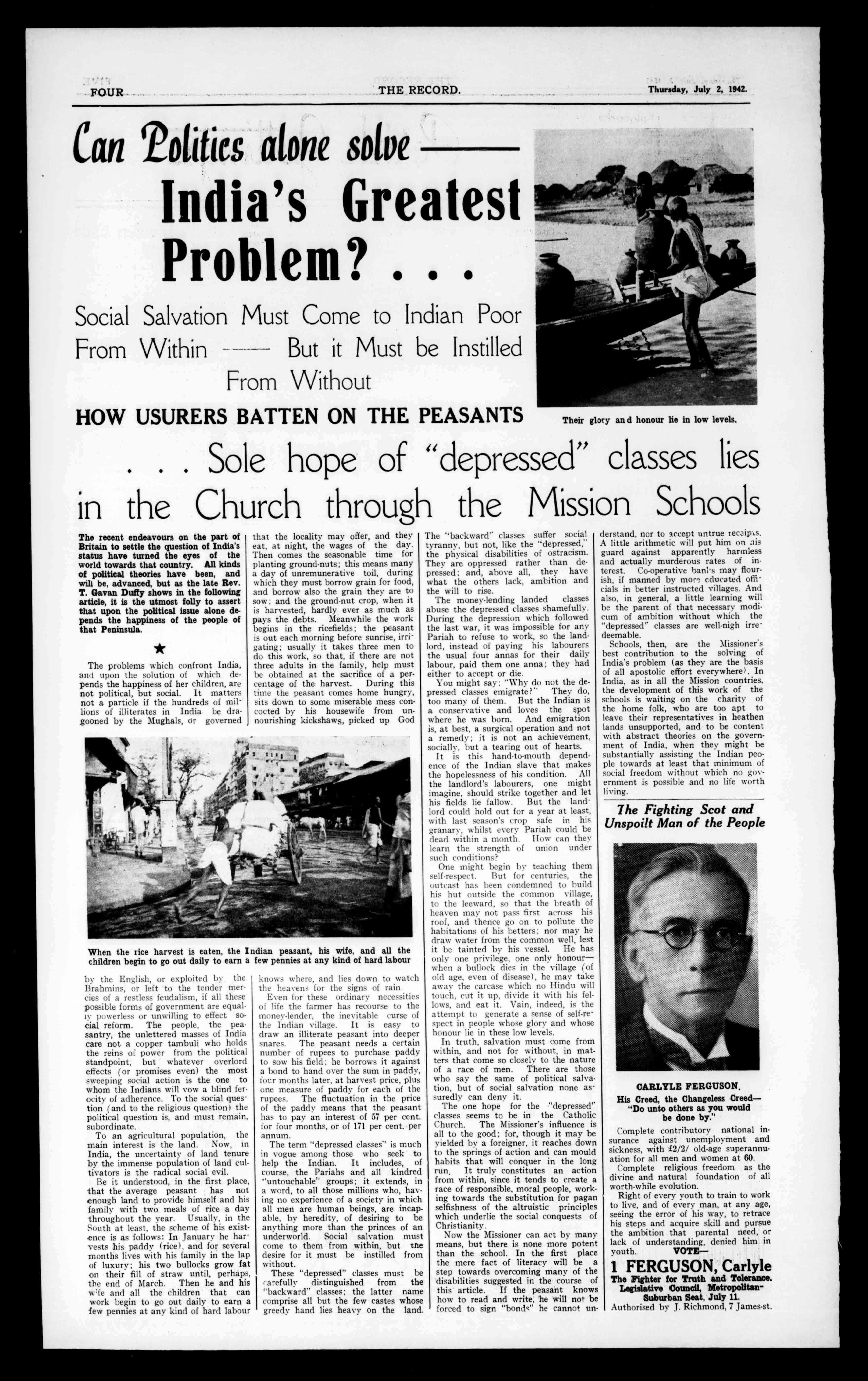
TheFightingScotand UnspoiltManofthePeople
bytheEnglish,orexploitedbythe Brahmins,orlefttothetendermerciesofarestlessfeudalism,ifallthese possibleformsofgovernmentareequallypowerlessorunwillingtoeffectsocialreform.Thepeople,thepeasantry,theunletteredmassesofIndia carenotacoppertambuliwhoholds thereinsofpowerfromthepolitical standpoint,butwhateveroverlord effects(orpromiseseven)themost sweepingsocialactionistheoneto whomtheIndianswillvowablindferocityofadherence.Tothesocialquestion(andtothereligiousquestion)the politicalquestionis,andmustremain. subordinate.
Toanagriculturalpopulation,the maininterestistheland.Now,in India,theuncertaintyoflandtenure bytheimmensepopulationoflandcultivatorsistheradicalsocialevil.
Beitunderstood,inthefirstplace, thattheaveragepeasanthasnot enoughlandtoprovidehimselfandhis familywithtwomealsofriceaday -throughouttheyear.Usually,inthe Southatleast,theschemeofhisexistenceisasfollows:InJanuaryhehar-vestshispaddy(rice),andforseveral monthsliveswithhisfamilyinthelap ofluxury;histwobullocksgrowfat ontheirfillofstrawuntil,perhaps, theendofMarch.Thenheandhis wifeandallthechildrenthatcan workbegintogooutdailytoearna fewpenniesatanykindofhardlabour
knowswhere,andliesdowntowatch theheavensforthesignsofrain.
Evenfortheseordinarynecessities oflifethefarmerhasrecoursetothe money-lender,theinevitablecurseof theIndianvillage.Itiseasyto drawanilliteratepeasantintodeeper snares.Thepeasantneedsacertain numberofrupeestopurchasepaddy tosowhisfield:heborrowsitagainst abondtohandoverthesuminpaddy, fourmonthslater,atharvestprice,plus onemeasureofpaddyforeachofthe rupees.Thefluctuationintheprice ofthepaddymeansthatthepeasant hastopayaninterestof57percent. forfourmonths,orof171percent.per annum.
Theterm"depressedclasses"ismuch invogueamongthosewhoseekto helptheIndian.Itincludes,of course,thePariahsandallkindred "untouchable"groups;itextends,in aword,toallthosemillionswho,havingnoexperienceofasocietyinwhich allmenarehumanbeings,areincapable,byheredity,ofdesiringtobe anythingmorethantheprincesofan underworld.Socialsalvationmust cometothemfromwithin,buttne desireforitmustbeinstilledfrom without.
These"depressed"classesmustbe arefullydistinguishedfromthe "backward"classes;thelattername compriseallbutthefewcasteswhose greedyhandliesheavyontheland.
Onemightbeginbyteachingthem self-respect.Butforcenturies,the outcasthasbeencondemnedtobuild hishutoutsidethecommonvillage, totheleeward,sothatthebreathof heavenmaynotpassfirstacrosshis roof,andthencegoontopollutethe habitationsofhisbetters;normayhe drawwaterfromthecommonwell,lest itbetaintedbyhisvessel.Hehas onlyoneprivilege,oneonlyhonourwhenabullockdiesinthevillage(of oldage,evenofdisease),hemaytake awaythecarcasewhichnoHinduwill touch,cutitup,divideitwithhisfellows,andeatit.Vain,indeed,isthe attempttogenerateasenseofself-respectinpeoplewhosegloryandwhose honourlieintheselowlevels.
Intruth,salvationmustcomefrom within,andnotforwithout,inmattersthatcomesocloselytothenature ofaraceofmen.Therearethose whosaythesameofpoliticalsalvation,butofsocialsalvationnoneassuredlycandenyit.
Theonehopeforthe"depressed" classesseemstobeintheCatholic Church.TheMissioner'sinfluenceis alltothegood;for,thoughitmaybe yieldedbyaforeigner,itreachesdown tothespringsofactionandcanmould habitsthatwillconquerinthelong run,Ittrulyconstitutesanaction fromwithin,sinceittendstocreatea raceofresponsible,moralpeople,workingtowardsthesubstitutionforpagan selfishnessofthealtruisticprinciples whichunderliethesocialconquestsof Christianity.
NowtheMissionercanactbymany means,butthereisnonemorepotent thantheschool.Inthefirstplace themerefactofliteracywillbea steptowardsovercomingmanyofthe disabilitiessuggestedinthecourseof thisarticle.Ifthepeasantknows howtoreadandwrite,hewillnotbe forcedtosign"bonds"hecannotun-
CARLYLEFERGUSON.
HisCreed,theChangelessCreed"Dountoothersasyouwould bedoneby."
Completecontributorynationalinsuranceagainstunemploymentand sickness,with12/2/old-agesuperannuationforallmenandwomenat60. Completereligiousfreedomasthe divineandnaturalfoundationofall worth-whileevolution.
Rightofeveryyouthtotraintowork tolive,andofeveryman,atanyage, seeingtheerrorofhisway,toretrace hisstepsandacquireskillandpursue theambitionthatparentalneed,or lackofunderstanding,deniedhimin youth. VOTE1FERGUSON,Carlyle
TheFighterforTruthandTolerance.
LegislativeCouncil,MetropolitanSuburban'Seat,July11, AuthorisedbyTRiclon,n,17lain,-,t
FOUR THERECORD. Thursday,July2,1942.
...
honourliein
and
lowlevels.
Whenthericeharvestiseaten,theIndianpeasant,hiswife,andallthe childrenbegintogooutdailytoearnafewpenniesatanykindofhardlabour
Mr.Telford,inspectorofschools, visitedSt.Mary'sandButler-street ConventSchoolsrecentlyfortheyearly examinations.Hisreportswerevery satisfactoryforallconcerned,teaching beingofthehighestquality,andthe toneoftheschoolsgenerallyexcellent. TheSistersofbothschoolsaretobe congratulatedontheresultstheyhave obtained.
Thesesamechildrenandthepupils oftheC.B.CollegehavebeenresponsibleforthefinerenderingoftheMissa CantataonrecentSundaymornings.
Theparishprizepacketisnowready, andcardsmaybeobtainedfromthe secretary,Mr.P.J.Russell,St.Mary's improvementfundistheworthycause, andthesubscriptionswillbepayable weekly(1/1fromJuly12-September13, orinonepaymentof10/;£1prizeswill bedrawnforeachweekfortenweeks, £60forhighestnumberofpointsinthe 10weeks'drawings,£20forsecond highest,and£10forlowestnumberof points.Thedrawingofprizeswillbe prorata,ifthecompetitionisundersubscribed.
Rev.FatherWeldon,0.M.I.,isreturningtoFremantlethisweek,after conductingRetreatsinthedistrictfor thepastthreeweeks.
AhappyeveningwasspentonSundaylastattheHoranhome,whena partyinhonourofMissCarmelArdagh andMr.JackJohnsonwasheld.Friends weregiventheopportunityofwishing themeveryhappinessintheirapproachingmarriage.Theyoungcouple areverywellknowninthedistrict,and havealwaystakenagreatinterestin parishaffairs.
ThemembersoftheSacredHeart SodalityareremindedthatnextSundayisJuly5,"FirstSunday."Holy Communionat7o'clock,Mass,and eveningdevotions,follwedbythe monthlymeeting.
TheCatholicWomen'sLeaguemeetingwillbeheldonMondayevening afterRosaryandBenediction,aswill alsobetheH.A.C.B.S.meeting.
MissMaryDillon,daughterofMr. andMrs.MackDillon,oftheAustralia Hotel,paidabriefvisitbyplanetoher homeonSaturdaylast,theoccasion beinghertwenty-firstbirthday.A cheery,informaldinnerpartywasheld inherhonour,andshereturnedtoher studiesattheUniversitybearing happymemoriesandthefront-door key.
489
PERTHFISHERIES
AND
WholesaleandRetail. Phone:B5992. CityDeliveries. CountryOrdersCateredFor.
F.HUFNER
29MABELST.,NORTHPERTH. TUNESANDREPAIRSPIANOS ANDORGANS. Phone115824.
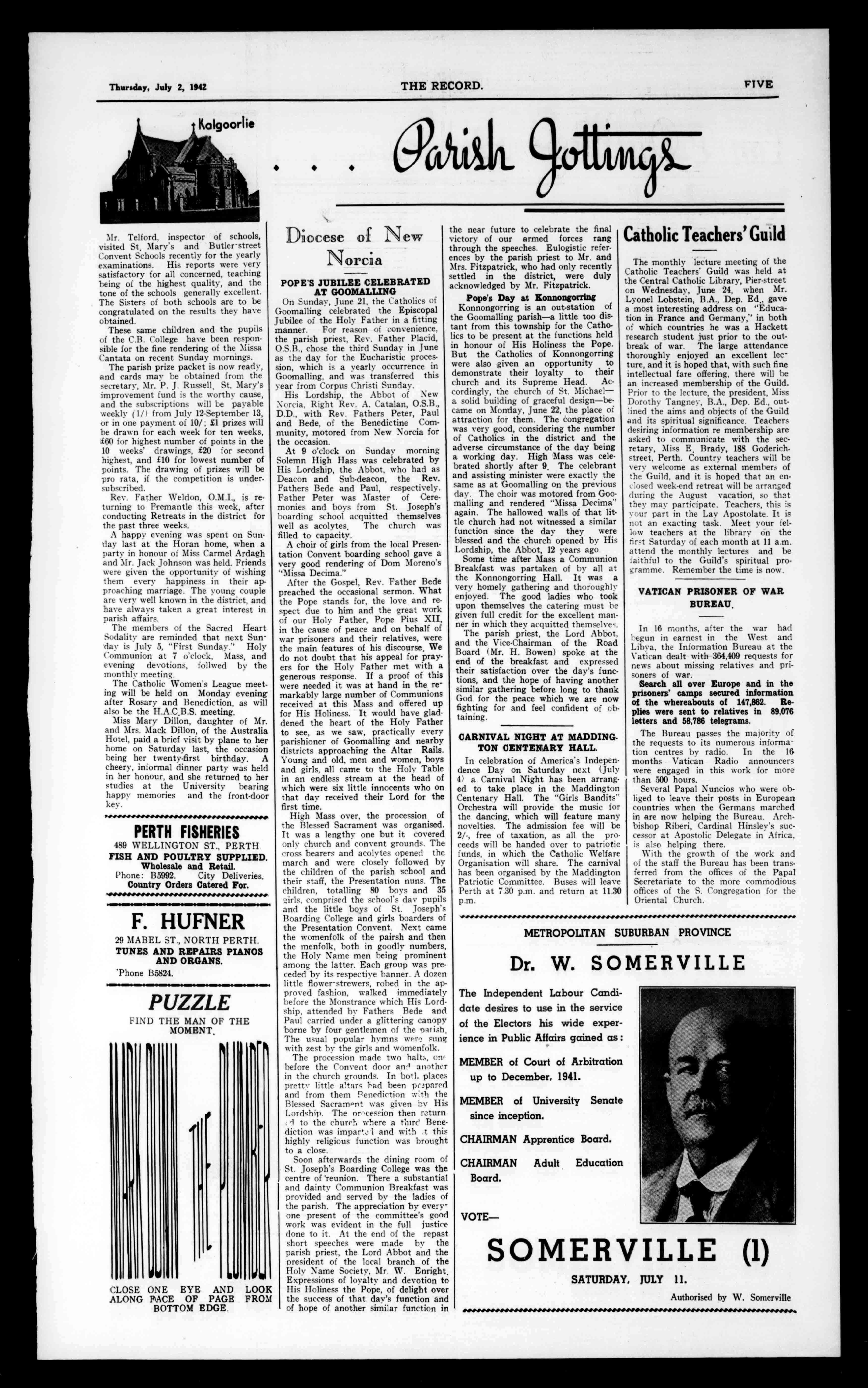
PUZZLE
Diocese0fNew Norma
POPE'SJUBILEECELEBRATED ATGOOMALLING
OnSunday,June21,theCatholicsof GoomallingcelebratedtheEpiscopal JubileeoftheHolyFatherinafitting manner.Forreasonofconvenience, theparishpriest,Rev.FatherPlacid, 0.S.B.,chosethethirdSundayinJune asthedayfortheEucharisticprocession,whichisayearlyoccurrencein Goomalling,andwastransferredthis yearfromCorpusChristiSunday.
HisLordship,theAbbotofNew Norcia,RightRev.A.Catalan,0.S.B., D.D.,withRev.FathersPeter,Paul andBede,oftheBenedictineCommunity,motoredfromNewNorciafor theoccasion.
At9o'clockonSundaymorning SolemnHighHasswascelebratedby HisLordship,theAbbot,whohadas DeaconandSub-deacon,theRev. FathersBedeandPaul,respectively. FatherPeterwasMasterofCeremoniesandboysfromSt.Joseph's boardingschoolacquittedthemselves wellasacolytes,Thechurchwas filledtocapacity.
AchoirofgirlsfromthelocalPresentationConventboardingschoolgavea verygoodrenderingofDomMoreno's "MissaDecima."
AftertheGospel,Rev.FatherBede preachedtheoccasionalsermon.What thePopestandsfor,theloveandrespectduetohimandthegreatwork ofourHolyFather,PopePiusXII, inthecauseofpeaceandonbehalfof warprisonersandtheirrelatives,were themainfeaturesofhisdiscourse.We donotdoubtthathisappealforprayersfortheHolyFathermetwitha generousresponse.Ifaproofofthis wereneededitwasathandintheremarkablylargenumberofCommunions receivedatthisMassandofferedup forHisHoliness.ItwouldhavegladdenedtheheartoftheHolyFather tosee,aswesaw,practicallyevery parishionerofGoomallingandnearby districtsapproachingtheAltarRails. Youngandold,menandwomen,boys andgirls,allcametotheHolyTable inanendlessstreamattheheadof whichweresixlittleinnocentswhoon thatdayreceivedtheirLordforthe firsttime. HighMassover,theprocessionof theBlessedSacramentwasorganised. Itwasalengthyonebutitcovered onlychurchandconventgrounds.The crossbearersandacolytesopenedthe marchandwerecloselyfollowedby thechildrenoftheparishschooland theirstaff,thePresentationnuns.The children,totalling80boysand35 girls,comprisedtheschool'sdaypupils andthelittleboysofSt.Joseph's BoardingCollegeandgirlsboardersof thePresentationConvent.Nextcame thewomenfolkofthepairshandthen themenfolk,bothingoodlynumbers, theHolyNamemenbeingprominent amongthelatter.Eachgroupwasprecededbyitsrespectiyebanner.Adozen littleflowerstrewers,robedintheapprovedfashion,walkedimmediately beforetheMonstrancewhichHisLordship,attendedbyFathersBedeand Paulcarriedunderaglitteringcanopy bornebyfourgentlemenoftheparish. Theusualpopularhymnsweresung withzestbythegirlsandwomenfolk. Theprocessionmadetwohalt,on, beforetheConventdoorair,another inthechurchgrounds.Inbothplaces prettylittlealtarsbadbeenprimed andfromthemBenedictionwiththe BlessedSacramentwasgivenbyHis Lordship.Theor'cessionthenreturn tothechurn!',whereat'aireBenedictionwasimpart.!1andwith.tthis highlyreligiousfunctionwasbrought toaclose. Soonafterwardsthediningroomof St.Joseph'sBoardingCollegewasthe centreof'reunion.Thereasubstantial anddaintyCommunionBreakfastwas providedandservedbytheladiesof theparish.Theappreciationbyeveryonepresentofthecommittee'sgood workwasevidentinthefulljustire donetoit.Attheendoftherepast shortspeechesweremadebythe parishpriest,theLordAbbotandthe presidentofthelocalbranchofthe HolyNameSociety,Mr.W.Enright, Expressionsofloyaltyanddevotionto HisHolinessthePope,ofdelightover thesuccessofthatday'sfunctionand ofhopeofanothersimilarfunctionin
thenearfuturetocelebratethefinal victoryofourarmedforcesrang throughthespeechesEulogisticreferencesbytheparishpriesttoMr.and Mrs.Fitzpatrick,whohadonlyrecently settledinthedistrict,wereduly acknowledgedbyMr.Fitzpatrick.
Pope'sDayatHonnongorrbst Konnongorringisanout-stationof theGoomallingparish-alittletoodistantfromthistownshipfortheCatholicstobepresentatthefunctionsheld inhonourofHisHolinessthePope. ButtheCatholicsofKonnongorring werealsogivenanopportunityto demonstratetheirloyaltytotheir churchanditsSupremeHead.Accordingly,thechurchofSt.Michaelasolidbuildingofgracefuldesign-becameonMonday,June22,theplaceof attractionforthem.Thecongregation wasverygood,consideringthenumber ofCatholicsinthedistrictandthe adversecircumstanceofthedaybeing aworkingday.HighMasswascelebratedshortlyafter9,Thecelebrant andassistingministerwereexactlythe sameasatGoomallingontheprevious day.ThechoirwasmotoredfromGoomailingandrendered"MissaDecima" again.Thehallowedwallsofthatlittlechurchhadnotwitnessedasimilar functionsincethedaytheywere blessedandthechurchopenedbyHis Lordship,theAbbot,12yearsago.
SometimeafterMassaCommunion Breakfastwaspartakenofbyallat theKonnongorringHall.Itwasa veryhomelygatheringandthoroughly enjoyed.Thegoodladieswhotook uponthemselvesthecateringmustbe givenfullcreditfortheexcellentmannerinwhichtheyacquittedthemselve4.
Theparishpriest,theLordAbbot, andtheVice-ChairmanoftheRoad Board(Mr.H.Bowen)spokeatthe endofthebreakfastandexpressed theirsatisfactionovertheday'sfunctions,andthehopeofhavinganother similargatheringbeforelongtothank Godforthepeacewhichwearenow fightingforandfeelconfidentofobtaining.
CARNIVALNIGHTATMADDINGTONCENTENARYHALL.
IncelebrationofAmerica'sIndependenceDayonSaturdaynext(July 41aCarnivalNighthasbeenarrangedtotakeplaceintheMaddington CentenaryHall.The"GirlsBandits" Orchestrawillprovidethemusicfor thedancing,whichwillfeaturemany novelties.Theadmissionfeewillbe 2/-,freeoftaxation,asalltheproceedswillbehandedovertopatriotic funds,inwhichtheCatholicWelfare Organisationwillshare.Thecarnival hasbeenorganisedbytheMaddington PatrioticCommittee.Buseswillleave Perthat7.30p.m.andreturnat11.30 p.m.
CatholicTeachers'Guild
Themonthlylecturemeetingofthe CatholicTeachers'Guildwasheldat theCentralCatholicLibrary,Pier-street onWednesday,June24,whenMr. LyonelLobstein,B.A.,Dep.Ed,,gave amostinterestingaddresson"EducationinFranceandGermany,"inboth ofwhichcountrieshewasaHackett researchstudentjustpriortotheoutbreakofwar.Thelargeattendance thoroughlyenjoyedanexcellentlecture,anditishopedthat,withsuchfine intellectualfareoffering,therewillbe anincreasedmembershipoftheGuild. Priortothelecture,thepresident,Miss DorothyTangney,B.A.,Dep.Ed.,outlinedtheaimsandobjectsoftheGuild anditsspiritualsignificance.Teachers desiringinformationremembershipare askedtocommunicatewiththesecretary,MissE.Brady,188Goderichstreet,Perth.Countryteacherswillbe verywelcomeasexternalmembersof theGuild,anditishopedthatanendosedweek-endretreatwillbearranged duringtheAugustvacation,sothat theymayparticipate.Teachers,thisis yourpartintheLayApostolate.Itis notanexactingtask.Meetyourfellowteachersatthelibraryonthe firstSaturdayofeachmonthat11a.m. attendthemonthlylecturesandbe faithfultotheGuild'sspiritualprogramme.Rememberthetimeisnow.
VATICANPRISONEROFWAR BUREAU.
In16months,afterthewarhad beguninearnestinthe%Vestand Libya,theInformationBureauatthe Vaticandealtwith364,409requestsfor newsaboutmissingrelativesandpriQonersofwar. SearchalloverEuropeandinthe prisoners'campssecuredinformation ofthewhereaboutsof147,862.Repliesweresenttorelativesin89,076 lettersand58,786telegrams.
TheBureaupassesthemajorityof therequeststoitsnumerousinformationcentresbyradio.Inthe16 monthsVaticanRadioannouncers wereengagedinthisworkformore than500hours.
SeveralPapalNuncioswhowereobligedtoleavetheirpostsinEuropean countrieswhentheGermansmarched inarenowhelpingtheBureau.ArchbishopRiberi,CardinalHinsley'ssuccessoratApostolicDelegateinAfrica, isalsohelpingthere.
Withthegrowthoftheworkand ofthestafftheBureauhasbeentransferredfromtheofficesofthePapal Secretariatetothemorecommodious officesoftheS.Congregationforthe OrientalChurch.
METROPOLITANSUBURBANPROVINCE Dr.
W.SOMERVILLE
TheIndependentLabourCandidatedesirestouseintheservice oftheElectorshiswideexperienceinPublicAffairsgainedas
MEMBERofCourtofArbitration uptoDecember,1941.
MEMBERofUniversitySenate sinceinception.
CHAIRMANApprenticeBoard.
CHAIRMANAdultEducation Board.
VOTE-
Thursday,July2,1942
FIVE
THERECORD.
WELLINGTON
FISH
ST.,PERTH
POULTRYSUPPLIED.
THE MOMENT. 0 SO
Pi% UI CLOSEONEEYEANDLOOK ALONGPACEOFPAGEFROM BOTTOMEDGE
1\I)11 EMANOF
4
SOMERVILLE(1) SATURDAY.JULY11. AuthorisedbyW.Somerville
0/111,11.111111 1.1141
WEDDINGREPORTS.
Allreportsofweddingsarechargeableonthefollowingbasis:
Forsinglecolumnreport,withor withoutblock,10/6.
SheridanLeunigWedding
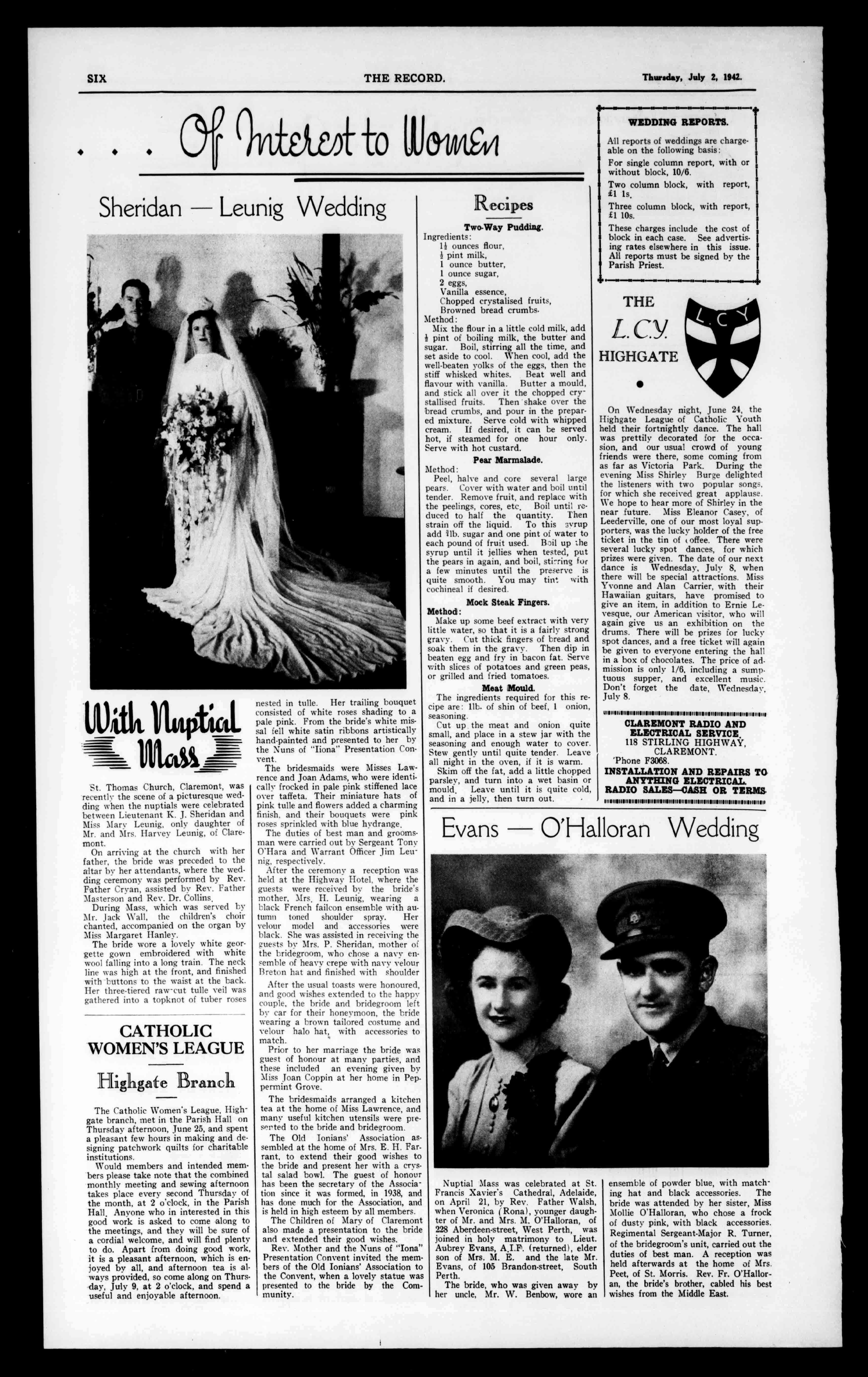
'St.ThomasChurch,Claremont,was recentlythesceneofapicturesqueweddingwhenthenuptialswerecelebrated betweenLieutenantK.J.Sheridanand Miss.MaryLeunig,onlydaughterof Mr.andMrs.HarveyLeunig,ofClaremont.
Onarrivingatthechurchwithher father,thebridewasprecededtothe altarbyherattendants,wheretheweddingceremonywasperformedbyRev. FatherCryan,assistedbyRev.Father MastersonandRev.Dr.Collins.
DuringMass,whichwasservedby Mr.JackWall,thechildren'schoir chanted,accompaniedontheorganby MissMargaretHanley.
Thebrideworealovelywhitegeorgettegownembroideredwithwhite woolfallingintoalongtrain.Theneck linewashighatthefront,andfinished withbuttonstothewaistattheback. Herthree-tieredraw-cuttulleveilwas gatheredintoatopknotoftuberroses
CATHOLIC WOMEN'SLEAGUE
HighgateItranch
TheCatholicWomen'sLeague,Highgatebranch,metintheParishHallon Thursdayafternoon,June25,andspent apleasantfewhoursinmakinganddesigningpatchworkquiltsforcharitable institutions.
Wouldmembersandintendedmemberspleasetakenotethatthecombined monthlymeetingandsewingafternoon takesplaceeverysecondThursdayof themonth,at2o'clock,intheParish Hall.Anyonewhoininterestedinthis goodworkisaskedtocomealongto themeetings,andtheywillbesureof acordialwelcome,andwillfindplenty todo.Apartfromdoinggoodwork, itisapleasantafternoon,whichisenjoyedbyall,andafternoonteaisalwaysprovided,socomealongonThursday,July9,at2o'clock,andspenda usefulandenjoyableafternoon.
nestedintulle.Hertrailingbouquet consistedofwhiterosesshadingtoa palepink.Fromthebride'swhitemissalfellwhitesatinribbonsartistically hand-paintedandpresentedtoherby theNunsof"Bona"PresentationConvent.
ThebridesmaidswereMissesLawrenceandJoanAdams,whowereidenticallyfrockedinpalepinkstiffenedlace overtaffeta.Theirminiaturehatsof pinktulleandflowersaddedacharming finish,andtheirbouquetswerepink rosessprinkledwithbluehydrange.
ThedutiesofbestmanandgroomsmanwerecarriedoutbySergeantTony O'HaraandWarrantOfficerJimLeunig,respectively.
Aftertheceremonyareceptionwas heldattheHighwayHotel,wherethe guestswerereceivedbythebride's mother,MrsH.Leunig,wearinga blackFrenchfailconensemblewithautumntonedshoulderspray.Her velourmodelandaccessorieswere black.Shewasassistedinreceivingthe guestsbyMrs.P.Sheridan,motherof thebridegroom,whochoseanavyensembleofheavycrepewithnavyvelour Bretonhatandfinishedwithshoulder
Aftertheusualtoastswerehonoured, andgoodwishesextendedtothehappy couple,thebrideandbridegroomleft bycarfortheirhoneymoon,thebride wearingabrowntailoredcostumeand velourhalohat,withaccessoriesto match.
Priortohermarriagethebridewas guestofhonouratmanyparties,and theseincludedaneveninggivenby MissJoanCoppinatherhomeinPeppermintGrove.
Thebridesmaidsarrangedakitchen teaatthehomeofMissLawrence,and manyusefulkitchenutensilswereprest-rtedtothebrideandbridegroom.
TheOldIonians'AssociationassembledatthehomeofMrs.E.H.Farrant,toextendtheirgoodwishesto thebrideandpresentherwithacrystalsaladbowl.Theguestofhonour hasbeenthesecretaryoftheAssociationsinceitwasformed,in1938,and hasdonemuchfortheAssociation,and isheldinhighesteembyallmembers.
TheChildrenofMaryofClaremont alsomadeapresentationtothebride andextendedtheirgoodwishes.
Rev.MotherandtheNunsof"Iona" PresentationConventinvitedthemembersoftheOldIonians'Associationto theConvent,whenalovelystatuewas presentedtothebridebytheCommunity.
Recipes
Two-WayPudding.
Ingredients:
11ouncesflour, 1pintmilk, 1ouncebutter, 1ouncesugar, 2eggs, Vanillaessence, Choppedcrystalisedfruits, Brownedbreadcrumbs.
Method: Mixtheflourinalittlecoldmilk,add pintofboilingmilk,thebutterand sugar.Boil,stirringallthetime,and setasidetocool.Whencool,addthe well-beatenyolksoftheeggs,thenthe stiffwhiskedwhites.Beatwelland flavourwithvanilla.Butteramould, andstickalloveritthechoppedcrystallisedfruits.Thenshakeoverthe breadcrumbs,andpourinthepreparedmixture.Servecoldwithwhipped cream.Ifdesired,itcanbeserved hot,ifsteamedforonehouronly. Servewithhotcustard.
PearMarmalade.
Method:
Peel,halveandcoreseverallarge pears.Coverwithwaterandboiluntil tender.Removefruit,andreplacewith thepeelings,cores,etc.Boiluntilreducedtohalfthequantity.Then strainofftheliquid.Tothistvrup add11b.sugarandonepintofwaterto eachpoundoffruitused.Boilupthe syrupuntilitjellieswhentested,put thepearsinagain,andboil,stirringfor afewminutesuntilthepreserveis quitesmooth.Youmaytintwith cochinealifdesired. MockSteakFingers.
Method:
Makeupsomebeefextractwithvery littlewater,sothatitisafairlystrong gravy.Cutthickfingersofbreadand soaktheminthegravy.Thendipin beateneggandfryinbaconfat.Serve withslicesofpotatoesandgreenpeas, orgrilledandfriedtomatoes.
MeatMould.
Theingredientsrequiredforthisrecipeare:11b.ofshinofbeef,1 onion, seasoning. Cutupthemeatandonionquite small,andplaceinastewjarwiththe seasoningandenoughwatertocover. Stewgentlyuntilquitetender.Leave allnightintheoven,ifitiswarm. Skimoffthefat,addalittlechopped parsley,andturnintoawetbasinor mould,Leaveuntilitisquitecold, andinajelly,thenturnout.
Twocolumnblock,withreport, flIs, Threecolumnblock,withreport. £110s.
Thesechargesincludethecostof blockineachcase.Seeadvertisingrateselsewhereinthisissue. Allreportsmustbesignedbythe ParishPriest.
THE L.CY HIGHGATE
OnWednesdaynight,June24,the HighgateLeagueofCatholicYouth heldtheirfortnightlydance.Thehall wasprettilydecoratedfortheoccasion,andourusualcrowdofyoung friendswerethere,somecomingfrom asfarasVictoriaPark.Duringthe eveningMissShirleyBurgedelighted thelistenerswithtwopopularsongs. forwhichshereceivedgreatapplause. WehopetohearmoreofShirleyinthe nearfuture.MissEleanorCasey,of Leederville,oneofourmostloyalsupporters,wastheluckyholderofthefree ticketinthetinoftoffee.Therewere severalluckyspotdances,forwhich prizesweregiven.Thedateofournext danceisWednesday,July8,when therewillbespecialattractions.Miss YvonneandAlanCarrier,withtheir Hawaiianguitars,havepromisedto giveanitem,inadditiontoErnieLevesque,ourAmericanvisitor,whowill againgiveusanexhibitiononthe drums.Therewillbeprizesforlucky spotdances,andafreeticketwillagain begiventoeveryoneenteringthehall inaboxofchocolates.Thepriceofadmissionisonly1/6,includingasumptuoussupper,andexcellentmusic. Don'tforgetthedate,Wednesday, July8.
EvansO'HalloranWedding
NuptialMasswascelebratedatSt. FrancisXavier'sCathedral,Adelaide, onApril21,byRev.FatherWalsh, whenVeronica(Rona),youngerdaughterofMr.andMrs.M.O'Halloran,of 228Aberdeen-street,WestPerth,was joinedinholymatrimonytoLieut. AubreyEvans,A,I.P.(returned),elder sonofMrs.M.E.andthelateMr. Evans,of105Brandon-street,South Perth.
Thebride,whowasgivenawayby heruncle,Mr.W.Benbow,worean
ensembleofpowderblue,withmatchinghatandblackaccessories.The bridewasattendedbyhersister,Miss MollieO'Halloran,whochoseafrock ofdustypink,withblackaccessories. RegimentalSergeant-MajorR.Turner, ofthebridegroom'sunit,carriedoutthe dutiesofbestman.Areceptionwas heldafterwardsatthehomeofMrs. Peet,ofSt.Morris.Rev.Fr.O'Halloran,thebride'sbrother,cabledhisbest wishesfromtheMiddleEast.
SIX THERECORD. Thursday,July2,1942.
ariliatho 0/144.014
MIONVONIMIU111101MOHIVIDIHIHOWIHIUlfilvinlOM CLAREMONTRADIOAND ELECTRICALSERVICE 118STIRLINGHIGHWAY, CLAREMONT. 'PhoneF3068. INSTALLATIONANDREPAIRSTO ANYTHINGELECTRICAL. RADIOSALES-CASHORTERMS 10111111.H1H1.1.101.1flIROUlh.1111Htfilllin10111.01.111HOU
Mr.
Camp-SwarbrickWedding
ic,.(14y,410THER'SLIKENESS
Mother,yourvirginbeautyhascompelled
Thehandsofmastersfamedadownthe years;
Thegreatestnamesinartarelinked withyours nsomeMadonnapraisedonevery tongue.
And1haveseenthem,Mother,and havesought Mymother'seyes,herlook,hervery soul; Butne'erthosesoftcreationstouched achord
Withinmyheart;
For,Mother,theywerenot Yourgraciousimage;alltooearthly was
Thebeautyofthewomanwhoinspired
Theartimmortalisedonchapelwalls; Tometoohumanwastheirloveliness; Intruth,Icanbutsay,Ilikedthem not.
Oneimage,Mother,istherethatI think Bearsfaintresemblancetoyou.Your sadeyes Looktenderlyuponmefromitsframe: Reproach-sogentle,love,forgiveness, care, Ireadinyourdearface.Andthen Isee Thatyouhavesufferedforme,Mother, and Ilookawayinshame.
Animageold-
OurLadyofPerpetualHelp-itseers.
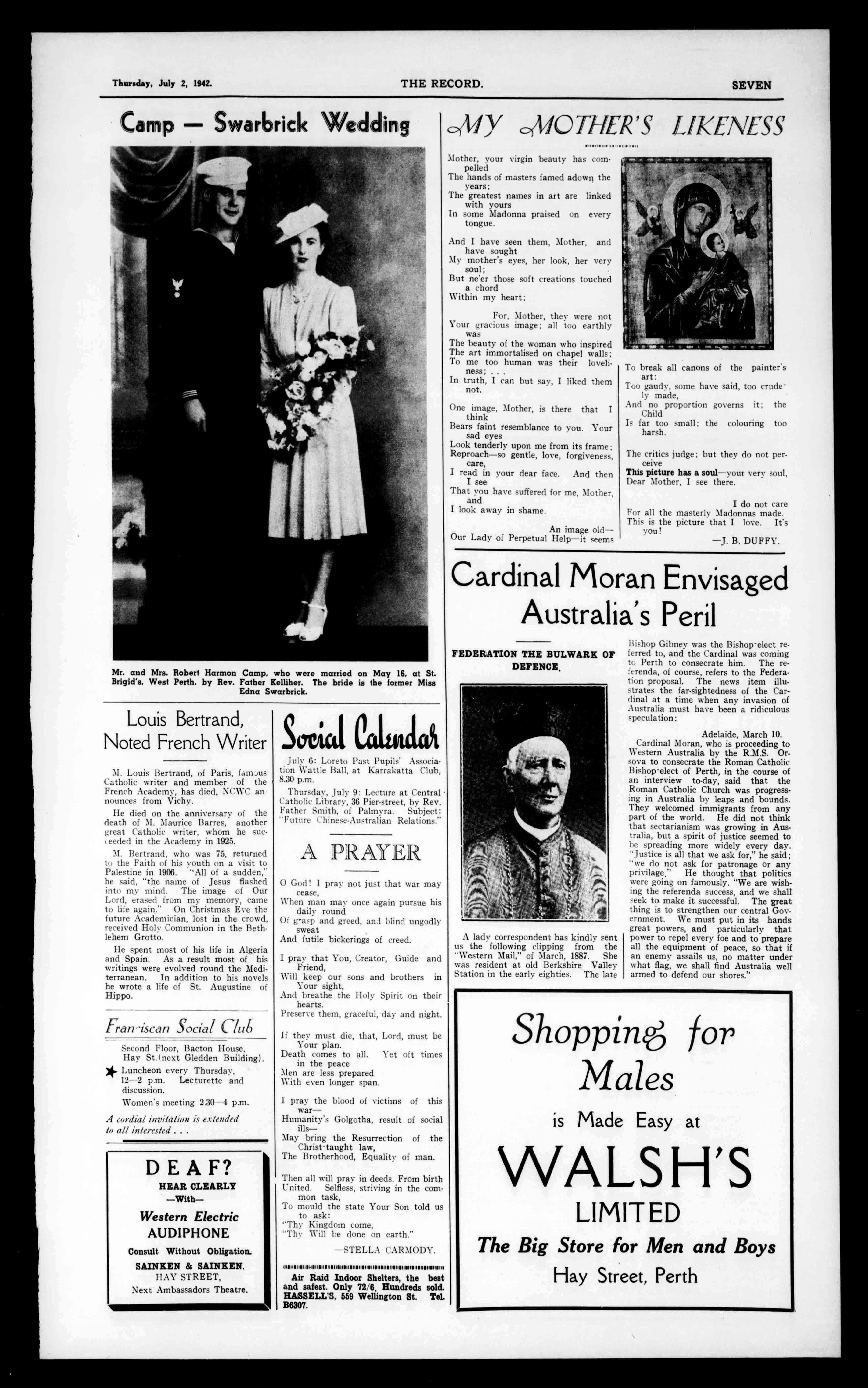
Tobreakallcanonsofthepainter's art:
Toogaudy,somehavesaid,toocrudely.made, Andnoproportiongovernsit;the Child Isfartoosmall;thecolouringtoo harsh.
Thecriticsjudge;buttheydonotperceive
Thispicturehasasoul-yourverysoul, DearMother,Iseethere.
Idonotcare
ForallthemasterlyMadonnasmade. ThisisthepicturethatIlove.It's you! -J.B.DUFFY.
CardinalMoranEnvisaged Australia'sPeril
LouisBertrand, NotedFrenchWriter
M.LouisBertrand,ofParis,fam..ius Catholicwriterandmemberofthe FrenchAcademy,hasdied,NCWCan nouncesfromVichy.
Hediedontheanniversaryofthe deathofM.MauriceBarres,another greatCatholicwriter,whomhesuceededintheAcademyin1925.
M.Bertrand,whowas75,returned totheFaithofhisyouthonavisitto Palestinein1906."Allofasudden," hesaid,"thenameofJesusflashed intomymind.TheimageofOur Lord,erasedfrommymemory,came tolifeagain."OnChristmasEvethe futureAcademician,lostinthecrowd, receivedHolyCommunionintheBethlehemGrotto.
HespentmostofhislifeinAlgeria andSpain.Asaresultmostofhis writingswereevolvedroundtheMediterranean.Inadditiontohisnovels hewrotealifeofSt.Augustineof Hippo.
Fran-iscanSocialClub
SecondFloor,BactonHouse, HaySt.(nextGleddenBuilding). *LuncheoneveryThursday, 12-2p.m.Lecturetteand discussion.
Women'smeeting2.30-4p.m. Acordialinvitationise.vtended toallinterested
DEAF?
HEARCLEARLY -WithWesternElectric AUDIPHONE
ConsultWithoutObligation. SAINKEN&SAINKEN. HAYSTREET, NextAmbassadorsTheatre.
aS I
Calttutaft
July6:Lorett,PastPupils'AssociationWattleBall,atKarrakattaClub, 8.30p.m.
Thursday,July9:LectureatCentral CatholicLibrary,36Pier-street,byRev. FatherSmith,ofPalmyra.Subject: "FutureChinese-AustralianRelations."
APRYIER
OGod!Ipraynotjustthatwarmay cease, Whenmanmayonceagainpursuehis dailyround Ofgaspandgreed,andblindungodly sweat Andfutilebickeringsofcreed.
IpraythatYou,Creator,Guideand Friend, Willkeepoursonsandbrothersin Yoursight, AndbreathetheHolySpiritontheir hearts. Preservethem,graceful,dayandnight.
Iftheymustdie,that,Lord,mustbe Yourplan. Deathcomestoall.Yetofttimes inthepeace Menarelessprepared Withevenlongerspan.
Ipraythebloodofvictimsofthis warHumanity'sGolgotha,resultofsocial illsMaybringtheResurrectionofthe Christ-taughtlaw, TheBrotherhood,Equalityofman.
Thenallwillprayindeeds.Frombirth United.Selfless,strivinginthecommontask, TomouldthestateYourSontoldus toask:
"ThyKingdomcome, -ThyWillbedoneonearth."
-STELLACARMODY
Illiiti11111w11,111111111111111.11.11.111111111111111111.11.11111.11111111.11111
AirRaidIndoorShelters,thebest andsafest.Only726,Hundredssold. HA.SSELL'S,559WellingtonSt.Tel. B6307.
FEDERATIONTHEBULWARKOF DEFENCE, A
BishopGibneywastheBishop-electreferredto,andtheCardinalwascoming toPerthtoconsecratehim.Thereferenda,ofcourse,referstotheFederationproposal.Thenewsitemillustratesthefar-sightednessoftheCardinalatatimewhenanyinvasionof Australiamusthavebeenaridiculous speculation:
Adelaide,March10.
CardinalMoran,whoisproceedingto WesternAustraliabytheR.M.S.OrsoyatoconsecratetheRomanCatholic Bishop-electofPerth,inthecourseof aninterviewto-day,saidthatthe RomanCatholicChurchwasprogressinginAustraliabyleapsandbounds. Theywelcomedimmigrantsfromany partoftheworld.Hedidnotthink thatsectarianismwasgrowinginAustralia,butaspiritofjusticeseemedto bespreadingmorewidelyeveryday. "Justiceisallthatweaskfor,"hesaid; "wedonotaskforpatronageorany privilage,"Hethoughtthatpolitics weregoingonfamously."Wearewishingthereferendasuccess,andweshall seektomakeitsuccessful.Thegreat thingistostrengthenourcentralGovernment.Wemustputinitshands greatpowers,andparticularlythat powertorepeleveryfoeandtoprepare alltheequipmentofpeace,sothatif anenemyassailsus,nomatterunder whatflag,weshallfindAustraliawell armedtodefendourshores."
Thursday,July2,1942. THERECORD. SEVEN
andMrs.RobertHarmonCamp.whoweremarriedonMay16.atSt. Brigid's,WestPerth,byRev.FatherKelliher.ThebrideistheformerMiss EdnaSwarbrick.
ladycorrespondenthaskindlysent usthefollowingclippingfromthe "WesternMail,"ofMarch,1887.She wasresidentatoldBerkshireValley Stationintheearlyeighties.Thelate
Shopping Males for isMadeEasyat WALSH'S LIMITED TheBigStoreforMenandBoys HayStreet,Perth
THERECORD
PERTH,HLRSDAJLI.1-2,1942.
Menaceof .
STATECONTROL
ThattheHolyFatherleanstowardstheTotalitarianStates istheabsurdinnuendorecentlymadeandrepeatedagainstthe Vaticaninthedailypress.AnyonewhohastheslightestacquaintancewithPapalpronouncementsonthesocialquestion,xvith thepastorallettersoftheBishopsofGermany,Belgiumand Spain,knowthisimmediatelyforamaliciouslie.Tosaythatthe CatholicPressover-ridesthedirectionsofitsspiritualsuperiorsis evenmoreridiculous,particularlyinregardtothosepublications Nvhicharetheofficialorgansofdioceses.Sofarasthenegative sideofCatholicsociologicalthoughtisconcerned,noeffectof modernsocialchaoshasbeenmoreroundlycondemnedthanthe growthoftheAlmightyState.ThisinevitableresultofMarxian theoryisoneofthechiefCatholicobjectionstoCommunism.It islikewisethecentraldifficultywhichfacesCatholicsinthe LabourMovement.Thedrastic"socialisation"platformspells innouncertaintermsthecoiningoftheTotalitarianStatewhich willmeanthatourpresentcorruptdemocracywillbereplaced byatyrannicalserfdomunderbureaucracy.Thisisespecially thedangeragainstwhich'ForFreedom"thisyearwarnedthe Australianpeople.
* OppositiontotheencroachmentsoftheStatearisebothfrom thenaturallaw,andfromtheChristianconceptofthenature anddignityofman.ThemodernStatetendsmoreandmoreto ignorethefactthatmenasindividualshaveintrinsicworth,and certainirrefragablerightswhichcannotbeabrogatedorarrogated bytheState.ItmayquitebluntlybesaidthatthemodernState isanintolerablebusybody,inertferingunwarrantablyinathousandthingsinwhichithasnoconceivablebusinesstomeddle,and neglectingamultitudeofaffairsinwhichitshouldveryproperly beengaged.Stateinterferenceineducation,inkeepingitonthe basisofbeingfree,secularandcompulsory,meddlingaboutwith marriage.andcondoningamerelycivilcontractbetweenChristianparties;tinkeringwithvalidmarriages,andpanderingto pagansoftnesswithabsurdandimmoraldivorcelaws;theimpertinenceofthecensusquestionnaires-thesewerebutafew indicationsofanalarmingtendencyinpeacetime.Thenecessities ofwarhavegreatlyacceleratedthetrend.InRussia,theState attemptstosupplyforthefamilyandforthepersonalownership ofproperty;inGermany,ithasinterferedwiththeprocreative rightsofindividualsbysterilisation.andbyasystemofobligatory medicalcertificatesformarriage,withtherightofreligiousfreedomandwithgeneralpoliticalliberties.Thereis,atthishistoricalmoment,aratherdesperateneedforsomeclearthinking andsomestraighttalkingabouttherespective*rightsofthe Stateandtheindividual.TheStatehasnosupremecontrolover thelivesofitssubjects.TheStatederivesitscivilauthorityindirectlyfromGod,throughthewillofthepeople.Hence,insofar asStateenactmentsharmonisewiththenaturalandrevealed law,theyarejust,andhaveabindingmoralclaimontheobedienceofcitizens.Buttheindividualalsohasrightswhicharenot derivedfromtheState.butwhichariseoutofhisnatureasa personpossessingintrinsicworth.Inpointbothoftimeand authority,theserights,whicharenecessaryforthewell-beingof theindividual,arepriortothoseoftheState.SincetheState didnotconferthem,itcannotlawfullytakethemawaynorseriouslyimpedetheirexercise.ButthemodernState.propped upasitisbythedecayingprinciplesofLiberalism,istending moretowardsentimentalityandlesstowardsphilosophy.And sentimentality.whichisakindoffalseandflabbylove,changes rapidlyundersevereinternalorexternalstrain,toakindof highlystrungtyranny,whichisknownundertheeuphemismof "strictinternalcontrol."Butnoshufflingsystemofnomenclaturecanconcealthefactthatouralreadydiminishedlibertyisin dangerofdisappearingcompletely.Forwehavenotdestroyed tyrannywehavemerelychangeditsname.
* * * *
Theimmediateproblemofbalancingtherespectiverights anddutiesoftheStateandtheindividualliesinthefactthatthe restoritionofhumanlibertythroughthedistributionofpropertywouldseemtopostulateapreliminary,transitionalmeasure ofsocialism.Thisistheenigma;wemusttemporariystrengthen thealreadystrongarmoftheStateinorderthatwemayfinally breakit.Socialismasapermanentfutureregime,isrepugnant tothewholeCatholicsocialconcept,yetitwouldseem,atthe moment,theonlywayofremedyingtheundisciplinedfreedom whichindustryhasenjoyedinthepast.andwhichitconfidently aspirestointhefuture.Areadjustmenttosomedegreeofthe 'balanceofpowermightbeachievedifthecentralgovernment lidnotexhibitsuchdesirefortotalpower.Thegeneralprinciple isthattheStateshouldminditsownbusiness.TherearenumerousconcernsinWhichitatpresentmeddles,butinwhichithas actuallyno,orverylittle,rightfuljurisdiction,whileinitsow'n propersphere.itoftenseemsincapableofefficientmanagement. Catholics,sofarfromsupportingtheTotalitarianState.will fighttothelastditchtopreventitsusurpationoftherightsand libertiesof.theindividual,thefain*.andthesmallerunits.both ofproductionandgovernment.Therewillneverbeatimewhen CatholicswillyieldtoCaesarthethingsthatarehumanity's,and stillless,thethingsthatareGod's.
ARCHBISHOP'SENGAGEMENTS.
--
July16-FeastofOurLadyofMount Carmel:CarmeliteMonastery,Nedlands.
7a.m.:CelebrateMass.
3.30p.m.:PresideatoccasionalsermonandgivePontificalBenedic. tion.
July18-7.30a.m.:OfficiateatCeremonyofProfessionatSacredHeart Convent,HighgateHill.
July28:CanonicalVisitationand ConfirmationatSt.Joseph'sChurch, Norseman.
HisGracetheArchbishopannounces thefollowingappointments:-Rev.C. Casey,assistantatNortham,tobeassistantatCollie.Rev.M.Diviney,assistantatCollie,tobeassistantat Northam.
AciM,_,utiLtosAnnosaz/
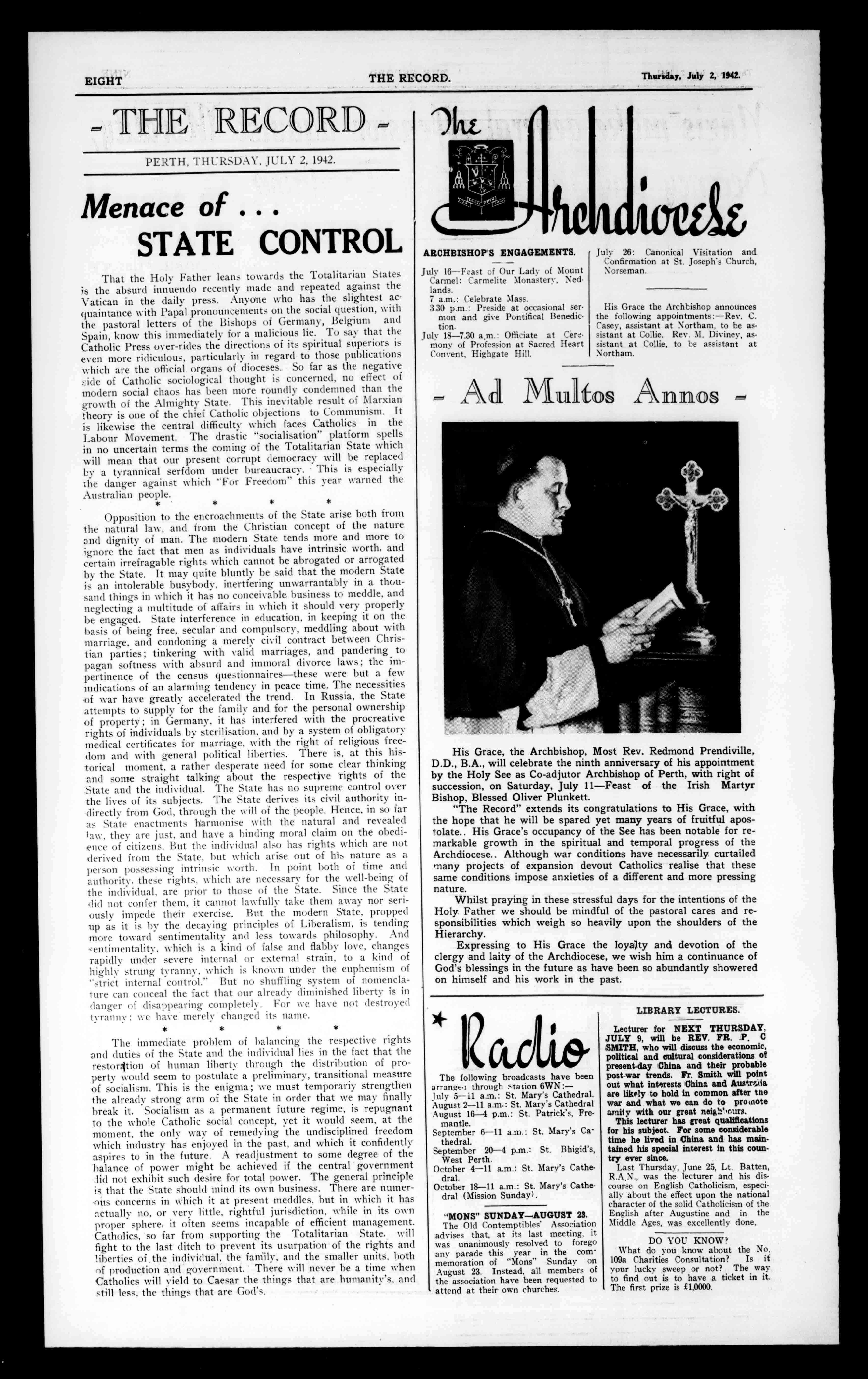
HisGrace,theArchbishop,MostRev.RedmondPrendiville, D.D.,B.A.,willcelebratetheninthanniversaryofhisappointment bytheHolySeeasCo-adjutorArchbishopofPerth,withrightof succession,onSaturday,July11-FeastoftheIrishMartyr Bishop,BlessedOliverPlunkett.
"TheRecord"extendsitscongratulationstoHisGrace,with thehopethathewillbesparedyetmanyyearsoffruitfulapostolate..HisGrace'soccupancyoftheSeehasbeennotableforremarkablegrowthinthespiritualandtemporalprogressofthe Archdiocese..Althoughwarconditionshavenecessarilycurtailed manyprojectsofexpansiondevoutCatholicsrealisethatthese sameconditionsimposeanxietiesofadifferentandmorepressing nature.
Whilstprayinginthesestressfuldaysfortheintentionsofthe HolyFatherweshouldbemindfulofthepastoralcaresandresponsibilitieswhichweighsoheavilyupontheshouldersofthe Hierarchy.
ExpressingtoHisGracetheloyaltyanddevotionofthe clergyandlaityoftheArchdiocese,wewishhimacontinuanceof God'sblessingsinthefutureashavebeensoabundantlyshowered onhimselfandhisworkinthepast.
LIBRARYLECTURES.
*1Z
Thefollowingbroadcastshavebeen arrange.1throughmaLion6WN:-
July5-ilam.:St.Mary'sCathedral.
August2-11a.m.:St.Mary'sCathedral
August16-4p.m.:St.Patrick's,Fremantle.
September6-11a.m.:St.Mary'sCathedral.
September20-4p.m.:St.Bhigid's, WestPerth.
October4-11a.m.:St.Mary'sCathedral.
October18-11a.m.:St.Mary'sCathedral(MissionSunday).
"MONS"SUNDAY-AUGUST23.
TheOldContemptibles'Association advisesthat,atitslastmeeting,it wasunanimouslyresolvedtoforego anyparadethisyearinthecommemorationof"Mons"Sundayon August23.Instead,allmembersof theassociationhavebeenrequestedto attendattheirownchurches.
LecturerforNEXTTHURSDAY, JULY9,willbeREV.FR..P. C SMITH,whowilldiscusstheeconomic, politicalandculturalconsiderationsof present-dayChinaandtheirprobable post-wartrends.Fr.Smithwillpoint outwhatinterestsChinaandAu.stre.tia arelikelytoholdincommonaftertne warandwhatwecandotopro,note amitywithourgreatneikh'r,tirs. Thislecturerhasgreatqualifications forhissubject.Forsomeconsiderable timehelivedinChinaandhasmaintainedhisspecialinterestinthiscountryeversince.
LastThursday,June25,Lt.Batten, R.A.N.,wasthelecturerandhisdiscourseonEnglishCatholicism,especiallyabouttheeffectuponthenational characterofthesolidCatholicismofthe EnglishafterAugustineandinthe MiddleAges,wasexcellentlydone.
DOYOUKNOW?
WhatdoyouknowabouttheNo. 109aCharitiesConsultation?Isit yourluckysweepornot?Theway tofindoutistohaveaticketinit. Thefirstprizeis£1,0000.
EIGHT THERECORD. Thursday,July2,1142.
nazismakegeneralo0ensiveagainstVorality, eceneyandtheChristiantraditiort.
S-YSTF-i\Ai\TIC
qModernAttacksonMarriage HaveRootsinGermanHistory
PERVERSIONorYOUTI
ByJ.0.Reichenheim,formerlycorrespondentinRomeandLondonof theSwiss"NeueZurcherZeitung.i
ThenewNaziPartyChancellor,MartinBormann,who,representingthe extremistelementintheS.S.,hasbeen givengreaterpowerthanRudolfHess everhad,hasproclaimedtheirreconcilablecharacteroftheconflictbetweenthePartyandtheGerman Churches,CatholicorProtestant.11.;w completelythePartyhasallGermans initsgrip,howimpossibleitisfor anyGermantoescapeinanyaspect ofhislifefromthepressureofits radicalpaganism,waswellexpressed theotherdayinanarticlebyDr.Ley inthe"Angriff.""ThePartystretches itstentaclesoverGaue,Kreise,local Groups,CellsandBlocks,toeverycitizen.Andthemultiplicityofformationsandassociations enablesthe Partytoreachevery-yes,literally every-citizen.Noneescapesus,and nonecanescapetheirresistibleinfluenceoftheParty."
ThereisnodoubtthatHimmler dayafterHitlerthemostpowerf maninGermanyhasstartedinrecent monthsageneraloffensiveonmorality.decencyandtheChristiantraditioninGermany.Foryearshispaper, Korps,"hasbeendemandingthatintheNationalSocialist Statethe"old-fashioned"formofmatrimonyandsexmoralitymustcease. ThegreatestaimoftheGermanpeople, sosaysthe"SchwarzeKorps,"should betoproduceasmanychildrenofpure Germanbloodaspossible.Onlyin thiswaywillitbepossibletosecure theconquered"Lebensraum"forthe "Herrenvolk,"andtocoloniseit.This taskisnowespeciallyurgentowing totheheavylossessufferedonthe EasternFront.
This,however,isonlyonesideof theNaziproblem.Himmleris:esponsibletoHitlerforseeingthatany attemptatcivilwariscrushedinits verybeginning.Hehastoprevent anycollapseofthehomefront.The NazileadersknowthatthisaimcannotbeensuredexclusivelybyGestapo terror.Therefore,Himmlerisnotonly "ReichsfuhreroftheS.S."andchief oftheGestapo,but"Reichskommissar zurFestigungdesdeutschenVolkstums"-commissionerfortheconsolidationoftheGermanrace.Thisoffice involveslong-termmeasuresforsecuringtheNaziregime,which,inHitler's words,willlastathousandyears.By thesemeasureseveryGerman,hischildrenandgrandchildren,aretobe educatedastrueNazis.Everything whichremindsthepeopleof"outof date"moralityhastobeeliminated. itmustbereplacedentirelyby the"nationalsozialistischeWeltanschauung." Raciallaws,pogroms, thepersecutionofreligionandchurch, educationintheHitlerYouth,andthe "BunddeutscherMadchen,"werepreparatorysteps;nowthesystematicdenialofChristianmoralityistobethe culminationofthisdoctrine. ForthisreasonHimmlerhaslately publishedtwonewdecrees.OnereferstotheS.S.ThecontrolofmarriagefortheS.S.hasbeentightened. Infuture,itwillnotbesufficientfor theintendingS.S.bridegroomtoprovidetheS.S.authoritieswiththe genealogicaltreesofhisbridetoprove herpureAryandescent.Thenew decreeinsistsontheexaminationof thefuturewivesbyS.S.doctorsbefore grantingamarriagepermit.Only "thoroughbredspecies"areallowedto marrymembersoftheBlackGuards. IfanS.S.manmarrieswithoutthis medicalcertificatehewillbeexpelled fromtheBlackGuardsandtheParty. IntheGermanyofto-daythatisa kindofcivildeath.Themeaningof thisdecreeistocreatean"elite" basedonphysicalandracialselection.
Thispassageoccurredrecentlyin a"MessagefromHimmlertotheS.S. andtheGermanwomanhood:"A younggirlwhoshirksherhighestduty isatraitressandlikeasoldierwho abandonstheflag.Forpureblooded Germangirlsthereisawardutybeyondmarriage-tobecomemothersoy soldiersgoingtothefront.S.S.men: Notonlyshowthatyouareprepared todieforyourcountry,butgiveita newlifebeforeyougotoyourdeath."
Thismessagegivestheessenceofthe seconddecree.Letterstotheeditor andeditorialcommentsinthe "SchwarzeKorps"provethattheappealisnotonlydirectedtotheunmarried."Theresponsibilityandthe dutyoftheGermanpeopleto-dayis soimmense"-accordingtothe "SchwarzeKorps"-"thatallthe scruplesofyesterdaymustbeswept away.Inthebeginningandinthe endstandstheGermanrace."
Theresultofthispolicyisalready apparent.Alreadyadvertisements, suchasthefollowing,begintoappear inGermanpapers:"Iamasoldier, aged22,largelybuilt,blond,blueeyed. BeforegivingmylifefortheFureher andfatherlandIwishtomeetaGermanwomantowhomIcanleavean heirtomyGermanhonour."("SuddeutscheSonntagspost").Orinthe samepaper:"AGermangirlwishesto becomethemotherofachildwhose fatherisaGermansoldierandafighterforNationalSocialism."Public HealthInsuranceincollaborationwith theParty'swomenorganisationhas establishedmaternityhomeswhere womencanbetreatedintheutmost secrecy,thefamilysimplybeingtold thatsomeslighttreatmentwasnecessary.Thechildrenarebroughtup andeducatedbytheParty.They are,whateversex,"futuresoldiersof theFuehrer."Hitler'sandHimmler'stask,thedestructionoffamilylife andofChristianity,hastakenabig stepforwardduringthelastmonths.
Thissystemofmoraldissolution, however,isnotaNaziinvention.Like manyotherNazidoctrinesthisone alsohasitsrootsinhistory.Sexual discretionintheinterestoftheunrestrictedpropagationoftheGermanic raceisapostulatealreadyformulated bycertain"deutsch-volkischeKreise" inthesecondhalfofthelastcentury. Itissignificantthatthesethoughts werealwaysunitedwithanti-semitismandananti-Christianattitude.It must,however,bestressedthatthen onlysmallgroupsofindividualsand notthewholepeoplewereconcerned.
Atypicalrepresentativeofsexual immoralityisthewriterJuliusLangbehn,whoseanonymousbook"RembrandtalsErzieher"waswidelydiscussedinthenineteenthcentury.In thisbookandinthe-pornographic"FortySongsofaGerman"wefindalreadytheunbridledsexuality.Nietzsche'ssisterandherhusbandDr.BernardFoersterbelongedtothesame group.Theyfoundedthecolony, "NeuGermanien,"inParaguay,where theywantedtoputtheseprinciples intonractice.Theexperimentproved afailureandthecolonywentbankrupt.Wefindthesexual-patriotic motivealsointhepaintingsofaman calledFidus,whoseeroticpictures fiftyyearsagodecoratedthedrawingroomsofGermanschoolteachersand lowercivilservants.InthesepictureshewantedtoglorifytheprimitivebeautyoftheoldTeutonsstill untouchedbyChristianmoralsand "degenerate"civilisation.
Themostimportant,however,for thewholedevelopmentwaswithout anydoubtRichardWagner.His
"RingdesNibelungen,"thebackbone ofhiswholework,standsfromthebeginningtotheendasachallengeto Christianethics.Thefirstactofthe "Valkyrie"startswithanactofincest towhichSiegfriedoweshisbirth.The otherpartsofthe"Ring"tellthestory ofSiegfried'srapeofBrunhildeand thelicentiousnessoftheGermanic gods.Hisopera,"TristanandIsolde," isfilledwithunveilederoticism.In "Parsifal,"Wagnerendeavourstocom-inetheChristianconceptionofsal. vationwiththelasciviouslivesledby AmfortasandKundry.Wagner'spopularityintheThirdReichisnotonly duetohismusic.
Lateronwefindsimilarthoughtsin the"Jugend-Bewegung,"especiallyin somegroupsofthe"Wandervogel."
Thebasicideaofalltheseteachings is:bloodisstrongerthanspirit.It wasonlynecessaryforHitlerand Himmlertorefurbishthissentence andtopresentittothebroadpublic atastilllowerlevel.Forthispurposetheyhadwillingassistance.The Reichs-Youth-Leader,Baldurvon Schirach,asacoveragainstthesuspicionsofperversioninthemovement, fosteredtheotherextremeintheHitlerYouthorganisation.TheReichsMedical-Leaders,ContiandWagner, triedtotransfertheirbiologicalresearchesfromrabbitstotheGerman people.Inpre-NazidaysStreicher,the Jewbaiter,wastwicesentencedbecauseofsexualcrimes.EvenGoebbelsenthusiasticallyintroducedthe orderedimmoralityintohisproperdepartments,especiallythefilmindustry. Thepoisonwasquicklyspread throughthesechannels. "High Schools"wereestablished,where HimmlerandFrauScholz-Klink,the Reichswomen'sleader,experimented onspeciallyselectedyoungpeople. Thesearethe"S.S.Ordensburgen"and theReichs-women-Schoolsof"Faith andBeauty."The"Ordensjunker" andthefutureWomenLeaderslivein luxuryandwithoutanymaterialcares. Theyareeducatedas"Herren"and "GrandDame"oftheNational-Socialistsociety.Theyhavetobeaccustomedtoalltherefinementsofcivilisation."BabylontheGreat,theMother ofthefornicationsandtheabominationsoftheearth"(Apocalypsexvii.. 5)istheevilgoddessoftheseplaces. HeretheyoungNazisdrinkdeeply fromthe"cupofabominationsand filthiness"whichhasbeenofferedto themfilleduptothebrim.Onleav: ingtheschoolsthe"students"regard themselvesexclusivelyas"bodilycells oftheNational-SocialistState,"and its"bloodcarriers."
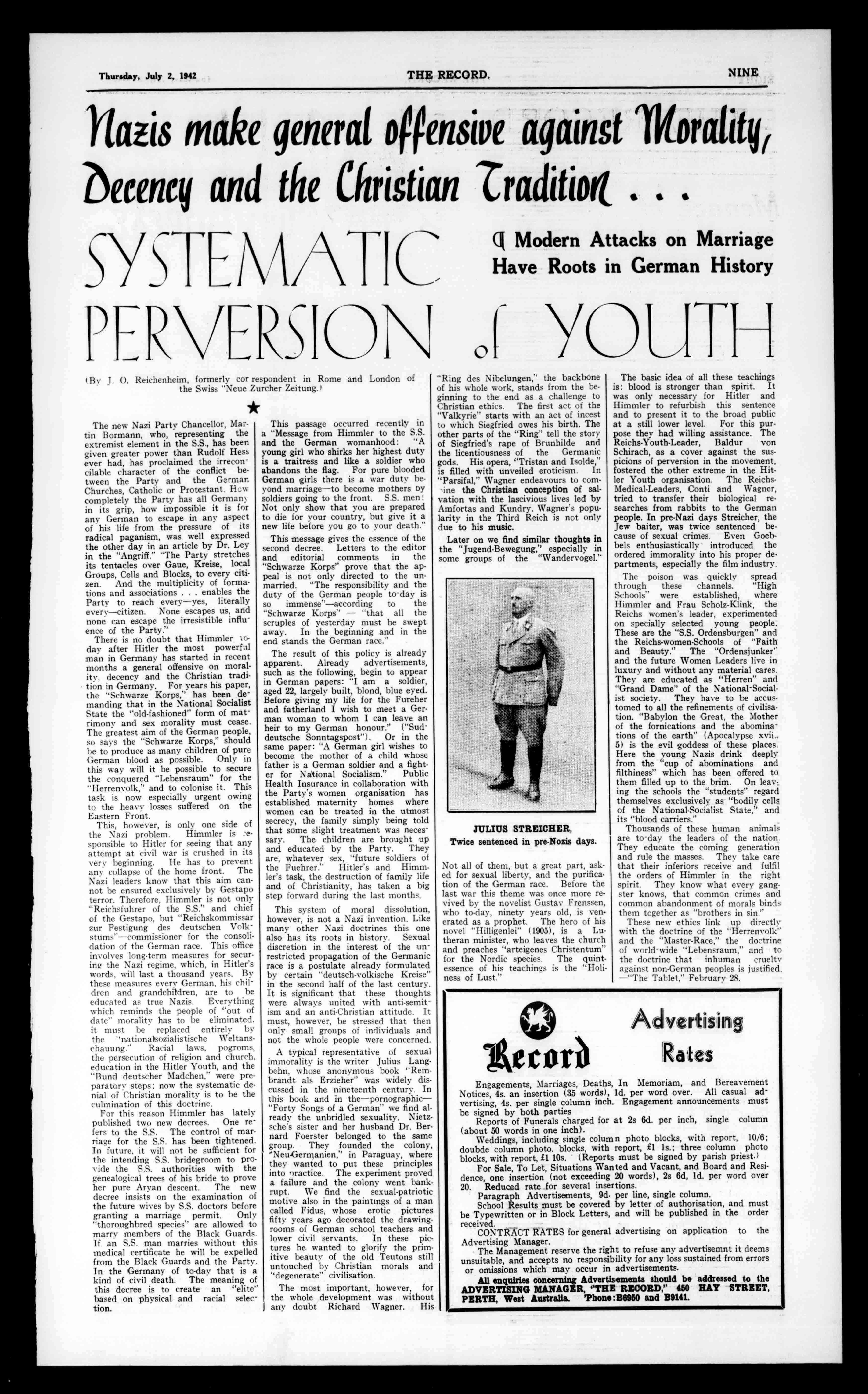
JULIUSSTREICHER, Twicesentencedinpre-Nozisdays. Notallofthem,butagreatpart,askedforsexualliberty,andthepurificationoftheGermanrace.Beforethe lastwarthisthemewasoncemorerevivedbythenovelistGustavFrenssen, whoto-day,ninetyyearsold,isveneratedasaprophet.Theheroofhis novel"Hilligenlei"11905),isaLutheranminister,wholeavesthechurch andpreaches"arteigenesChristentum" fortheNordicspecies.Thequintessenceofhisteachingsisthe"HolinessofLust."
Thousandsofthesehumananimals areto-daytheleadersofthenation. Theyeducatethecominggeneration andrulethemasses.Theytakecare thattheirinferiorsreceiveandfulfil theordersofHimmlerintheright spirit.Theyknowwhateverygangsterknows,thatcommoncrimesand commonabandonmentofmoralsbinds themtogetheras"brothersinsin."
Thesenewethicslinkupdirectly withthedoctrineofthe"Herrenvolk" andthe"Master-Race,"thedoctrine ofworld-wide"Lebensraum,"andto thedoctrinethatinhumancruelty againstnon-Germanpeoplesisjustified. -"TheTablet,"February28.
Advertising
Attior Rates
Engagements,Marriages,Deaths,InMemoriam,andBereavement Notices,4s.aninsertion(35words),ld.perwordover.Allcasualadvertising,4s.persinglecolumninch.Engagementannouncementsmust besignedbybothparties
ReportsofFuneralschargedforat2s6d.perinch,singlecolumn (about50wordsinoneinch).
Weddings,includingsinglecolumnphotoblocks,withreport,10/6; doubdecolumnphoto.blocks,withreport,£1ls.;threecolumnphoto blocks,withreport,£110s.(Reportsmustbesignedbyparishpriest.)
ForSale,ToLet,SituationsWantedandVacant,andBoardandResidence,oneinsertion(notexceeding20words),2s8d,Id.perwordover 20.Reducedrateforseveralinsertions. ParagraphAdvertisements,9d.perline,singlecolumn. SchoolResultsmustbecoveredbyletterofauthorisation,andmust beTypewrittenorinBlockLetters,andwillbepublishedintheorder received. CONTRACTRATESforgeneraladvertisingonapplicationtothe AdvertisingManager. TheManagementreservetherighttorefuseanyadvertisemntitdeems unsuitable,andacceptsnoresponsibilityforanylosssustainedfromerrors oromissionswhichmayoccurinadvertisements.
AllenquiriesconcerningAdvertisementsshouldbeaddressedtothe ADVERTISINGMANAGER,"THERECORD,"450HAYSTREET, PERTH,WestAustralia.'Phone:136950andB9141.
Thursday,July2,1942 THERECORD. NINE
on"Scienceand theModernWorld."Thesemeetings areopentothepublic,andwewould especiallyliketoseealargeroll-upof graduates.Theroomwillholdseveral hundredpeople,andnoonewillbe turnedaway. Theannualdinneranddancewas heldonSaturday,June20,andwasa success,Thedampenedfeelingsofall whoattendedweresoonwarmedby thehotmusicplayedbytheorchestra. Let'shopenextyear'seventwillbean evengreatersuccess. Membersandfriendswillbepleased tohearthatourpresident(JohnCullityIisnowintheR.A.A.F.undergoing hisinitialtraining.Iamsureeveryone willjoinwithusinwishinghimmany happylandings.
MEETINGS.-Owingtoheillnessof ourPresident(Mrs.Maxwell,theexecutivemeeting,alsothegeneralmeeting,willnotbeheldonMondaynext, July6.Thedateofmeetingswillbe advertisedlater.
CANTEENWORK.-Thefollowing arethedaysonwhichmemberswillbe requiredforcanteenwork:-Wednesday,July8,atPhyllisDeanHall;Saturday,July11,attheBarrack-street Hall.Buffet; Saturday,July8,attheTown
CATHEDRALBRANCH
Theusualmonthlymeetingwillbe heldintheChurchOfficeonMonday, July6,at8p.m
Prayersofmembersarerequested forthereposeofthesoulofourlate member,MissJuliaDeasey. Theusualcardafternoonwillbeheld atNestle'sHouseonSaturday,July18, at2.15p.m.
CLONTARFBOYS'TOWN
Parentsandothersinterestedingettingboyswhoareunder14yearsinto ClontarfBoys'Townshouldapplyfor particularstothePrincipalofClontarf evacuatedtoTardun-telephoneTardun2;ortoCastledareJuniorOrphan. age,Queen'sPark-telephoneMV180. Boyswhoareover14years,and whoseparentsorguardiansaredesirousthattheyshouldlearntrades, shouldapplytothePrincipal,St.Joseph'sFarmandTradesSchool,Bindoon.Telephonecommunicationis beingestablishedwiththisInstitution andshouldbefunctioningbeforethe endofJune.
OLDROSARIES
Wehavebeenaskedtoappealfor oldorbrokenRosaries,forwhichthe ownershavenofurtheruse.Owing tothelackofsuppliesofreligiousobiects,themenintheForcesareoften obligedtogowithoutRosaries,Missals,etc.TheSistersoftheCarmeliteMonastery,Nedlands,haveoffered tomendoldorbrokenRosaries,which willbethendistributedtothetroops. Rosariesandotherpiousobjects maybeleftc/oCatholicWelfareOrganisation, ChurchOffice, VictoriaSquare,Perth.
Putanendingtoneedlessspending. EloNationalSavingsBondsistheplace foryourmoney.
ST.JOACHIM'SBRANCH,H,A.C.B.S.
AtthemeetingheldonJune22the president(Bro.P.Reidy)presidedover agoodattendance.Sixnewmembers wereinitiatedbythepresident,who, sincecommencinghisspringoffensive, hasbroughtin20newmembers.We extendhimourheartycongratulations. Helookslikebreakingallprevious records. Weextendourverybestwishesto SrDotCarrollandBro.PatPrieston theirengagement. Bro.T,P.MurphyhasreceivedaletterfromBro.G.Keogh,whoisstill abroad.Hesendshisbestwishestoall members.
ThenextmeetingisonJuly6.
TelephoneB4757.
MARTINP.RYAN
Optometristand Optician
SonofLateM.P.Ryan,lateof Fremantle.
ORIENTLINEBUILDINGS, WILLIAMSTREET,PERTH
TEN THERECORD. Thursday,July2,1S42. WESOMPELY1HATE BLOWINGCUIR ITYWN1TRUMPET: BUT!!! OurCarpetRangeisPertk'sBest AtrulymagnificentrangeofCarpets,inallsizes,colourings,anddesign, Variousgradesareoffering,eachcorrectlylowpriced.Youcanpaycash,or useZimpel'sFamousEasy-paymentP1an.butwedomostcordiallyinvite yourearlyinspection. W.ZimpelLtd.,HayStreet FRANKJ.BOSWELL SPLCIALISTSINHospitalEquipment,andSteamInstallations,HotWaterHeating, Ventilating,SewerageWork,andGeneralPlumbing. CornerRUTHandWILLIAMSTREETS,PERTH.-Tel.B2777. W.A.AgentforK.G.LUKEPTY.,LTD.,MELBOURNE. SuppliersofHospitalEquipmentandStainlessHospitalUtensils. ForLongWear UseOnly "Gibsonia" Wools... Obtainable onlyat PatroniseOurAdvertisers rr4 UnmanSatithl ScienceandtheModernWorld. ThenextmeetingoftheUniversity NewmanSocietywillbeheldinthe Men'sCommonRoomattheUniversity GuildBuildingsonTuesday,July7,at 8p.m.Mr.J.W.Doyle,oftheSt.Louis JesuitSchool,willtalk
orInvestment?
ofabusiness trainingforyourgirlsandboysis NOTanEXPENSE-itisaGILTEDGEDINVESTMENT. Youinvestasmallsumof moneymonthlyforelevenmonths, andyourchildrenget 11)Agoodbusinesstraining. (2)Practicalexperienceinour ownoffices. 3)Aguaranteedfirstappointment. 4)FreeEmploymentService FORLIFE, Formonthspastwehavebeen abletofillonlyabout20percent ofthepositionsofferedtous, owingtothelackoftrainedgirls andboysavailable.YOURgirls andboyscanbeearningbythis timenextyearIFYOUENROL THEMNOW. Call,write,orphoneB2024,or 132063,foryourfreecopyof 'GuidetoBusinessTraining."No obligation. CityCommercial College, "W.A.'sBusinessUniversity," SHEFFIELDHOUSE, 713-21HAYSTREET,PERTH.
Expense-
Theproviding
AquinasCollegeSporting Results
AquinasCollegehashadafinerunof successesthisyearininter-collegiate sports.Attheinterschoolswimming carnival,heldinMarch,Aquinasscored itsfifthsuccessivevictory.Thecollege eightwasheadoftheriver,andthe foursecondtoHaleinthepublic schools'regatta.IntheDarlotCup matchesthecollegeelevennoblymaintainedthetraditionsofpreviousyears. Resultsinthefirstroundwere:-
Aquinas(onefor254)drewwith Guildford(fivefor20).
Aquinas(allout183)defeatedScotch (allout168).
Aquinas (twofor106)drewwith Hale(sixfor249).
Attheconclusionofthefirstround Aquinaswasleadinginthecompetition.
Thesecondroundisplayedinthe thirdterm.
Thecollege18,too,givespromiseof beingamostsuccessfulcombination.
OnJune6thefirst18journeyedtoPinjarrah,toplayGuildfordGrammar School.Theweatherwasunfavourable, but,afterakeentussle,Aquinaswon byfourpoints.Finalscores:Aquinas, 8.9;GuildfordGrammar,8.5.
OnJune10,onthecollegeoval,the first18defeatedanAirForce18.Final scores:Aquinas,12.10;AirForce,8.15.
OnJune14,atAquinas,thefirstsdefeatedEastFremantle.Finalscores: Aquinas,14.10;EastFremantle,7.6.
OnWednesavlast,atSubiacoOval, underidealconditions,afeastoffootballwasprovidedforanenthusiastic groupofsupportersfromAquinasand HaleSchool.Inthesecondsaftera hardmatch,Hale(6.6)defeatedAquinas(4.5).Thefirstscontestedoneof themostmemorablematchesseenin recentyearsinAlcockCupfixtures, Bothteamsplayedrugged,butclean, football,andbothgaveanexhibitionof grimdetermination,whichspeakswell fortheirschoolspirit.Athalf-time Haleledbyonepoint,andexcitement ranhighattheprospectofaclose finish.ThethirdquarterendedHale15 pointsinfront.Inthefourthquarter Aquinasmadeadeterminedeffort,and sixminutesbeforetheend,hadrunup aleadofsixpoints.Haleralliedbravely,and,inanamazingburst,added threegoals,togivethematwo-goaladvantagewithinthreeminutesofthe hell.Then,byoneofthosepeculiar swingsofthependulum,Aquinastook charge.Inthefaceofwhatlooked likecertaindefeat,theysweptforward, andafinemarkandatruebootby full--forwardHinkley,putthemwithin agoaloftheirrivals.Onthebounce theywereontheoffensiveagain,and aFrilliantseriesofmovesenabledPalBaths,Enamel,£715s.;Cement,45s.
lassietomark30yardsout.Beforehe couldtakehiskick,thebellrang.His kickalonecouldstaveoffdefeat,but theyoungAquinian,withtheself-possessionofaveteran,calmlytookhis time.Hislongtorpedopuntsailedtrue, andamatchwhich,formanylong years,willremainavividmemoryto playersandspectatorsalike,ended mostfittinglyinadraw.Thefinal scoreswere:Aquinas,13.13;Hale,11.25.
Aquinas'thirdsandfourthsareundefeatedsofar.
OnJune13,ontheScotchCollege Oval,Aquinasthirds,1928,defeated Scotch,2points.Aquinasfourth,5.10, defeatedScotch,3.17.
OnJune20,atAquinas,Aquinas thirds,2.9,defeatedHale,2.2;Aquinas fourths,9.8,defeatedHale,2.1.
MESAINTWHOFINDSTHINGS
EverybodyknowsSt.Anthony whosefeasttheChurchcelebrateson June13. St.AnthonyofPaduais hisfulltitre,though,tobesure,his baptismalnamewasnotreallyAnthony,nor,indeed,didhecomefrom Padua.MostpeopleknowSt.Anthonyforaverypracticalreason:he isthesaintwhofindsthings.NeverEndingarethenarrativesofSt.Anthony'ssuccessasanindagator.Ali thesethingsyoumayreadinanadmirablelittle"Life"ofSt.Anthonyby Fr.MariusMcAuliffe,O.F.M. You canlearnwhataremarkablepreacher St.Anthonywas;howthechurches weretoosmallforthecrowds;howSt. Anthonyhadtosetupaplatformin thestreetsandinthepaddocks.People usedtogatherroundtheplatform thenightbeforetobesureofaplace. Youcouldseethemmakingtheirway atnightcarryinglanternstoguide themselves. Truly.St.Anthonyis oneofthemostlovedsaints.Itis remarkablehowmuchFr.Mariushas packedintohislittlepamphlet,which ought,byalltherules,beabestselleramongpamphlets.
Whydomanypeople.finditdifficult topray? Because,frequently,they donotunderstandwhatprayer.is Yetweareallobligedtopray.Furthermore,thereisnoonewhocannotlearnsomethingmoreaboutthe methodofprayer.Therefore,"Talks OnPrayer,"aseriesbroadcastthrough the"CatholicHour,"Melbourne,makes apracticalandacceptablepamphlet.
Thewriterdealslucidlyandsimplywith WhatisPrayer?TheFourEndsof Prayer,WaysofPrayerandItsQualities,ThePrayerofChrist,Liturgical Prayer,and.finally,Sanctityand MentalPrayer.Suchabookletisindispensableinanycourseofspiritual reading.
TheWorld'sFavourite,St.AnthonyofPadua ByRev.MariusMcAuliffe,O.F.M. TalksOnPrayer. AustralianCatholicTruthSocietypomphle'i -rMay
MURRAYSTREET,PERTH.
PhonesB9731(threelines) B7777 B3588 B9101(twolines)
REGISTEREDW.A.T.A
ALEXRODOREDA
TurfCommissionAgent 802HAYSTREET.
AGENTFORW.A.CHARITIES. RingB5841andB5236.
NORTHAM.
E.0.TRESISE, M.P.S.,S.A.andW.A. MANUFACTURINGAND DISPENSINGCHEMIST. ForServiceandQuality. Tel.:61Northam. ALBANY.
KALGOORLIE.
J.W.SHEEHAN
PrimeBeefButcher HAN/IttNST.,KALGOORLIE. MARITANASTREET.
Tel.438 Tel.438
FOR
METROPOLITANSUBURBANBY-ELECTION, Saturday,July11,1942.
RecordyourSickorPostalVotenow.
VOTEBRADY,
Thursday,July2,1342. THERECORD. ELEVEN
DERBY'S
Paints,Hardware,TimberforShelters, cheaperatHASSELL'S,559WellingtonSt.Tel.B6307.
Private
N.C.PriorFuneralDirector ALBANY(Established1921).
Mortuary.MotorVehicles, ChargesModerate. 'Phone215. Albany,Mt.Barker,Denmarkand Districts.
MITED -r FORCHEAPERGROCERIES
MRTHE5Orl LI
B RENNANS OULDER LIMITED
QUALITYDRAPERY, LADIES'ANDGENTS' CLOTHING, MANCHESTERAND FURNISHINGS.
J.J.[1] BradyistheyoungestCandidate,andwillstriveforreform. AuthorisedbyJ.Brady,No.9,Second-avenue,WestMidland. A.E.HANSENFamilyButcher 654ALBANYROAD,VICTORIAPARK. OrdersCalledforandDeliveredDaily. TrialSolicited. Terms:CashWeekly. 'PHONEM1184ANDLETYOURPAYENVELOPELIVELONGER. "THESTOREOFQUALITY." 'Phone:F2198. STIRLINGHIGHWAY,MOSMANPARK. RHODESISONS GROCERS,IMPORTERS,WINEANDSPIRITMERCHANT. Goodsdeliveredtoanypartofthedistrict. LEWISandSONSBakers PROCERA,VIENNA,CREMALT,HEALTH,CURRANT. ALLTYPESOFFANCYBREADSANDROLLS. DualCupWinners,RoyalShow,1938. Bakery:McMASTERSTREET,VICTORIAPARK. 'Phone.M1379. STATESAWMILLS SPECIALISEIN LOCALTIMBERS STATEPRESSEDBRICKS AND OtherBuilders'Requisites 306MURRAYST.,PERTH AlsoatCountryandMetropolitanYards. PrintingHousesofA.D.SCOTT FORFINEPRINTING ServicePrintingCo. CITYANDSURBURBANPRINTINGCO LINOCRAFTPOSTERSTUDIOS. RAINBOWHOUSE,353-7HAYST.(EAST,PERTH. ServingAllColleges'PrintingRequirements TelephoneB9901(3lines) Res.U2389 Setsof3 FancyJugs DifferentShapesandSizes.AllTonings. Usuallyfrom136to17/6d, Alloneprice 13/6SET Ahern's HAYand MURRAY STREETS.
GRATITUDEOFU.S.CATHOLICSAILORS
DearEditor,-
Itisonlyfittingandrightthatwe (theCatholicsoftheU.S.Navy) shouldthankyousincerely,andwith Christianfaith,fortheunendingcooperationthatyouhavegivenusduringtheshorttimethatwehavebeen here Irefertothelistyoupublishedin askingforvolunteerstobilletmenof thearmedforces.Somehow,tome, suchanappealismoreformenofthe navalforcesthananyoneelse. Believeme,wedeeplyappreciatesuch kindness. Allthegoodpeoplewho
T.VIVIAN, 143Rokeby-road,Subiaco.W1539 FORSEWERAGECONNECTIONS, W1639.
BadWaterPressure,BrokenPedes talPans,BlockedSewerDrains,Cis ternandRoofRepairs,T.V.Headlight lished;andhewithdrewfromanyoffiMaskstoApprovedDesigns
haveofferedtheirservices,canbeassuredofbeingrememberedmour prayers. HisGracetheArchbishoprendered usanhonourfewareprivilegedto partakeof,thatofsayingMassforus. Thathonourcanbeattributedtoan unsunghero,whoisanofficerinArmy oftheChurch.IrefertotheRev. FatherBreslin, ofSt.Patrick's Church. Eversincehisappearance onthesceneofguidingtheArmyand NavalforcesinandaroundSt.Patrick's,hehasworkeduntiringlytowardsthegoalofhavingaplacesuitableineveryrespectforthemenof thearmedforcestofindrecreationin. SpeakingfortheNavy,letmesay"we havefounditfillsallrequirements, andthankhimsincerely."
Iwouldappreciateyourprintingthis letter,inthehopethatitwill,ina smallway,showourappreciation. Thankingyouinadvance.-Yours,etc., PHILIP
6,1941.
MostsacredheartofJesus, Havemercyonhissoul.
OTTAWAY.-Inlovingmemoryofmy onlysonandbrother,Pte.Leslie Francis,2/16th,killedinactionin Syria,July6,1941.
-Insertedbyhislovingmother,sisterandbrother-in-law,nephewsDonaldandNeil.
MostsacredheartofJesus, Havemercyonhissoul.
011ENRY.-Ofcharityprayforthe soulsofWilliamJosephandAnnie CeceliaO'Henrywhopassedawayon July9,1941,andJuly2,1940. Eternalrestgrantuntothem,0Lord.
O'LOUGHLIN.-Infondmemoryof CecilEdwardLieut.2/16thBtn.), killedinactionatDamour,Syria,on July6,1941(previouslyreported 10th)alsoLeonardPatrick,died March,1930,belovedsonsofMr.and Mrs.T.S.O'Loughlin,65Dundas road,Inglewood;brothersofFrank (Banbury),Steve(A.I.F.),Con (A.I.F.),John(A,I.F.),andDorothy, andbrother-in-lawofNorahand Dorothy.
PARKINSON.-Ofyourcharitypray forthereposeofthesoulofEllena Parkinson,whodiedonJuly4,1941, DarlinggrandmaofJamesJohnand EllenaHynes. 0sacredheartofJesus, Havemercyonhersoul. -Insertedbyherlovinghusband, daughter,son-in-lawandsister,Mrs. Gallagher.
ROGERS.-Inlovingmemoryofmy dearhusband,MarkRogers,whodied July5,1939. R.I.P.
-Insertedbyhislovingwife.
RYAN.-Lovingmemoriesofourdear husbandandfather,Leo,whopased awayonJuly2,1941. Eternalrestgrantuntohim,0Lord. Insertedbyhislovingwifeand family.
WADE.-Inlovingmemoryofmy dearwifeandourdearmother,who passedawayonJuly1,1941. -Everrememberedbyherlovinghusbandandfamily. SacredheartofJesus, Havemercyonhersoul.
WALL.-Inlovingmemoryofmydear husbandandourlovedfather, ThomasA.L.Wall,whopased awayonJuly3,1940. Requieseatin
RECORD.
TWELVE THE
Thursday,July2,1942
SIC
U.S.NavalForces. June14,1942. 4.0 LEGISLATIVECOUNCILELECTION METROPOLITANSUBURBANPROVINCE PollingNextSaturday. F.E.GIBSON,J.P. (NationalistCandidate) GIVINGGREATSERVICETOTHESTATEANDAFRIENDTOALL. .\uthorisedbyA.Weir,N.Z.Chamber,. WeSolicitaTrial fromallReligiousInstitutions NoOrderisTooBigorToo Small. WeAreAbletoSupplyYour EveryNeed. GiveYourNextOrdertoSARA&COOKLtd. WholesaleGrocersand ProvisionMerchants MurrayStreet - Perth INMEMORIAM. CULHANE.-TomemoryofJohnuihane,diedJuly8,1937. SacredheartofJesus, Havemercyonhissoul. -Insertedbyhislovingwifeandsons, JohnPatrickandMichael,Margaret River. IIATISON.-Inlovingmemoryofour dearsonandbrother,Harry,2/16th Btn.,killedinactioninSyria,on July
JAMESSTERCULA,
3/c,
pace. 111M11.1.11.1111111 QUICKSWEEPS 109a CHARITIES Consultation NOWOPEN £1000 lit PRIII Tickets2/6on &rootfrom don,lIoxAL, c W.4.004.4~...114.104.1441NPNIPW.P# ATTADALEDAIRY. FREMANTLEROAD,MELVILLE EDWINH.MITCHELL MILKFROMATTADALEDAIRY. MilkDeliveredtoanypartof FremantleandSuburbsDaily. TEL.LI443. Wm.A.YOUNG FAMILYBUTCHER. CornerJOHN&FITZGERALD STREETS,PERTH. FORQUALITYMELTYOU'LLLOVETOEAT. 'PhoneB1416. HomeofGoodShepherd Laundry,Leederville UnderDirectionoftheSistersof theGoodShepherd. DRYCLEANINGANDART NEEDLEWORKASPECIALTY, VESTMENTS,HANDLACE, FANCYGOODSSUPPLIED. BRIDALVEILSCANBEHAD ONHIRE. CountryOrdersPromptly Despatched. 'Phone:B1185. SIGHTTESTING BYREGISTERED Opticians 1.LIMITED. T.G.SMITH,W.A.O.A., B.A.S., ManagingDirector. 6-IBARRACKSTREET,PERTH. Phone:133511. ACOMPACT, CONCISE, ACTIVESERVICE PRAYERBOOK PaperCover 9d. KhakiClothCover 2/BlueClothCover 2/LeatherCover 4/6 Postage,1:d. CompiledbyRev.G.Butler, M.S.C.,andpublishedbyauthorityoftheC.U.S.A..Queensland,thisnewprayerbookfor CatholicSoldiers,Sailorsand Airmenisthebestyetprinted formenintrainingandonactiveservice. ItcontainstheLullMass,all essentialprayersanddevotions andlistsspecialprivileges. Itoffers,aswell,manypagesof blunt,helpfulandsympathetic advicethatwillbewelcomed byeveryCatholicyoungman allina96-pagepocketsizebookonly41inchesdeep by3incheswide. ScLit,IN.O. 776HayStreet,Perth (oppFoyC.7Gibson) WE'VEgotthefightingspirit-WE MUSTGETTHE SAVING SPIRIT. Saveandbuy£10NationalSavings Bonds.
THE Bushies'Corner
DearCornerites,-Wehavetwolovelyfeastdaysthisweek,thatofthePreciousBlood,andtheVisitation.Letus considerthefirstone,thatofthePreciousBlood,Doyouknots,thedevotiontothePreciousBloodofJesusisa wonderfulthing,andmanyfavoursere grantedthroughit.Thisisnobnatural, isn'tit,whenwestoptothink?Our Lorddiedforus,andshedHisBlood thatwemightlive,soHewillsurely grantourrequestswhenwemakethem inthenameofHisMostPrecious Blood.ThefeastoftheVisitationis veryimportantalso,forwecommunicatethedaywhenOurLadyvisited hercousinElizabeth,andtoldherthat
TheSacredHeart,whichshedIts PrecicusBloodforus shewastobethemotherofthe Saviour,andprophesiedherfuture greatness.AllofOurLady'sFeast Daysarelovely,becausetheyrepresentsomethingthatisbeautifulinthe lifeofMary.Ihopethatyouareall veryfaithfulinyourdevotiontoOur Lady,andthatyoudonotforgettosay yourthreeHailMary'severydayto her.HerinfluenceinHeavenis nothingshortofmarvellous,andshe canobtainmanyfavoursforuswhen allelsefails.Soremembertokeepup yourdevotiontoher,andshewill neverfailyou. AUNTBESSY.
* * *
DearAuntBessy,-SometimeagoI promisedSt.Anthonyaweegiftin thanksgivingforsomethinghefound forme,and,nowthatIhaveneglected himbadly,Ihavesentalittlemore, andIknowthathewillunderstand. PleasegiveittotheBushies'Corner. BUSIIIES'FRIEND,
DearBushies' agreat admirerofSt.Anthonymyself,andI knowthatheisaveryunderstanding Saint,andIamsurethathewillapproveofyourdonationtotheBushies' Scheme. AUNTBESSY.
*
DearAuntBessv,-justafewlines trustingyouarewell.Don'tgeta
STOVES,WoodorGas,newand used,sold,bought,repaired.W.A. StoveCoy.,659WellingtonStreet. 136307.
shockwhenyoureadthesefewlines fromme.Willyousendmefourpinkies,andIwilldomybest.Ihavea lotofstampswhichIamputtinginto theRecordOffice.Isentalotlastyear, butdidnotseewhetheryougotthem ornot.IstillsaymythreeHail Mary'stotheLittleFlowerforthe Bushies'Scheme,andallmycousins. Isn'tthewarbad?OnceagainIwish youandtheCornereverysuccess.
Yourlovingniece, BUSHIEBESSY.
DearBushieBessy,-Ididgeta shockwhenIopenedyourletter,butit wasaverypleasantone,andIwasglad tohearfromyouagain.Keepupyour prayersfortheBushies'Scheme,forI willcertainlyneedthemifIwantto reachthehundred-poundmark,Iwill sendyoufourpinkiesatonce.Bushie Bessy.
AUNTBESSY
* * *
DearAuntBessy,-Iamenclosing postalnotefortenshillingsasasmall contributionfortheBusbies'Fund. Isincerelyhopethatyouwillgetthe desired£100beforetheendoftheyear. Godblessyouandyourgrandwork M.T.B.
DearM.T.B.,-Thankyouindeedfor yourgenerosity,andyourgoodwishes, becauseIamsurethatIwillneed everyoneofthem,ifIamtoreachthe hundredpoundsthisyear.Still,Iam anincurableoptimist,andIthinkthat everythingwillturnoutallright. AUNTBESSY.
*
DearAuntBessy,-Pleasefindenclosedanothersmalldonationoftwo andsixpencefortheBushies'Scheme. Ihopethatyouwillreachthehundredpoundsagainthisyear.
SOMEONE.
DearSomeone,-Your"smalldonations."asyoucallthem,areveryhelpful,andverywelcome,totheBushies' Scheme.Infact,IdonotknowwhatI woulddowithoutyouandyourgeneroushelp.Ihopethatthehundred poundswillsoonmaterialise,too. AUNTBESSY.
DearAuntBessy,-Pleasefindenclosedpostalnoteforfiveshillings WillyoupleasehaveaMasssaidin honouroftheLittleFlowerforaspecialintention.-Yoursverysincerely, WORRIEDMOTHER.
DearWorriedMother,-IwillarrangetohaveanotherMastsaidfor you,andIearnestlyhopethattheLittleFlowerwillgrantyourrequest. Youmustnotloseconfi4en,7e.inher. butputallyourfaithandtrustinher, andIamsurethatshew;11seeyou through. AUNTBESSY.
* * * *
DearAuntBessy,-Ihonethatyou willacceptmeasoneofyournieces. ThisisthefirsttimeIhavewritten.I am2iyearsold.Ihavealargebagof stamps,andamsendingthemtoyou. andIhopethattheywillbeofsame usetoyou.WishingyourBusbies' Schemeeverysuccess. ANNRODAN.
DearAnn,-WelcometotheBushies' Corner,andIamsurethatyouar' verywelcome.Ireceivedthestamps andwasverypleasedtohavethem.I hopethatIwillhearfromyousoon AUNTBESSY.
I
IllI
Thursday,July2,1942. THERECORD. THIRTEEN
**
Parishioner,Queen'sPark 10/
2,16
Lewis 5/ PEERLESSBREADMANUFACTURERS 145FITZGERALDSTREET,PERTH. OurMotto:"QUALITYandSERVICE." Specialties-VIENNABREADandROLLS. 'Phone:B1041. McMullan0,Brown 65SOUTHTERRACE,FREMANTLE. LICENSEDSANITARYPLUMBERS,DRAINERS,IRONWORKERS. Telephone:L2474. J.A.COMPSTON BUTCHER CornerSTEPHENST.andHAMPTONROAD. FORHYGIENICSERVICE'PHONEL2492. ATRIALSOLICITED. YellowCabs RepairsAllMakes ofCars HydraulicGreasingLift DucoExperts AGOODJOBATAFAIRPRICE ALLREPAIRSUNDERFOREMAN'SPERSONALSUPERVISION. LENHOPE,Foreman. W.R.MADDEFORD,Manager. EGGSANDPOULTRY ForHighestPricesandBestResults,ConsignYour EGGS,POULTRY,FARMBUTTERANDHONEY TO NELSON&SONLIMITED PoultrySales-WednesdaysandFridays.Eggs,Etc.-Daily. EggCasesandPoultryCratesonApplication. SENDYOURNEXTCONSIGNMENTTONELSON&SONLIMITED METROPOLITANMARKETS.PERTH. 'Phones:B3674,B1779. LATEMICHAELO'DLA Founder JOSEPHO'DEA Bowra&O'Dea FuneralDirectors 195PierStreet:Perth S.H.BRIGGS. CHARLESO'DWYER. PricestoSuitAllClasses HIBERNIANMORTUARYBENEFITSAVAILABLE TOALLMEMBERS Tel:Business,B4308 Private,B6717-B3376
UtIt111111111111111111111It111111111111SISUIBS II11111111Sill
LEMONADEBOTTLE. s.d.
Someone
Irene
*DidSt.LukePaintthePictureofOurladyofPerpetualSuccour?
Exquisiteportraitveneratedall overtheworldforcenturies
IrishExpertfindscredibilityinEvangelist'sclaim
ByL.GOGAN,M.A.,Keeper,ArtDivision,NationalMuseumDublin).
OnMay30,1453,followingthecaptureofConstantinoplebytheforcesof MahometII.,someofhisJanissaries enteredthemonasteryinwhichwas preservedtherichly-jewelledportrait oftheBlessedVirginandtheDivine Child,andbreakingitintofoursections carrieditoffwiththem.Itwas,perhaps,themostveneratedrelicinthe newRomebythePhosphorus,andits losswaslookedupon,perhapsnotunnaturally,asapunishmentforquarrels whichdividedthereligiouscommunity ofthatcityoversomanyyears.The deepregardinwhichitwasheldis perhapsbestillustratedbythesuperstitiousbeliefofcertainofthe Greeks,astheByzantineswerecalled, thattheHolySpirit,oreventhatof OurLadyherself,wasimmanenttherein.Thisparticularpicture,convenientlyidentifiedbythename"Hodegetria:fromitsprevioushome,asmall chapelcalledtheHodegon,wasreputedtohavebeenoriginallypaintedby St.LuketheEvangelist,fromthelife.
CopiesoftheFamousConstantinople Picture.
Longbeforethepicturewasdestroyedmanyconscientiouscopieshad beenmade.Thepictureitselfhad beenprobablyover-paintedseveral timesinthe1,400yearsofitssupposed existence;variousdetailshadcertainly beenadded,suchasthecrown,haloes, inscriptions,possiblythegolddetails andtheangels:thelastmentioned, whichbearthesymbolsofthePassion, were,accordingtoAnthonyofNovgorod(1200AD.),insertedbySt.LazarustheMonk,adistinguishedpainter oftheninthcentury.
Copiesmusthaveexistedalloverthe ByzantineEmpire,inSyria,Creteand Cyprus,aswellasintheAthosmonasteriesinGreece,whencetheyspread intoRussia,wheretheyfurnishedthe basisforthethousandsoficonsofthe Virginoflatertimes.Ontheother hand,theyspreadintoItaly,andthe pictureofOurLadyofPerpetualSuccourwhichweknowsowellisoneof these;copiesevenspreadtoIreland, whereacrudeversionfiguresinthe BookofKells.IntheBookofKells, thedateofwhichhasbeengreatlydisputed,angelsfigure,four,nottwoin number;theyhold,nottheinstrumentsofthePassion,butthreeflabella orritualfansandatintinabulumor branchofbells,asmarl:sofhonour.
InthislatterconnectionitisintereAtingtorefertowhatAnthonyhassaid aboutthedateoftheintroductionof theangelsintothepicture,asalready mentioned.Itisnotatallunlikely thattheoriginalobjectsheldbythe angelsinthepicturewereinfactsuch objectsasthose,representingasthey doaveryOrientalmotive,andnot theinstrumentsofthePassion.While theangelsmaybeabsentortheymay beemptyhanded,theseornaments existinnootherversion.
ThepictureofOurLadyofPerpetual Succour,preservedintheChurchofSt. AlphonsusinRome,isinthefullByzantinestyle,andfairlyadvancedat that.Thepainter,supposedtobe Andreas,istraditionallyknowntohave beenaCretan,issurnamedRico,and issupposedtobeidenticalwithAndreasRicio,painterofanotherVirgin preservedatParma.Muchdifficulty hasbeenfoundindatingthispicture ofOurLadyofPerpetualSuccour,the datemostusuallyassigned,seemsto suittheconditionsbest.Thepainter hasclearlyendeavouredtoretainthe mainfeaturesoftheearlyByzantine paintingwhileusinghismoremodern materialstogoodpurposeandembodyingasanintegralpart,thevariousdetailswhichhadbeensuperaddedtotheoriginal,includingtheornatecrown,probablyoriginallyar"al detail.ThehieraticcharacterofByzantineportrayalsofsacredpersonsis preservedandthewomanrepresented showsarefinedandaristocraticand,at thesametime,reservedandstillintensepersonality.Theinfantisalert andis,asistypicalfortheage,shown withsomewhatadultlineaments.The humanisticqualitieswhichfromthe 13th.centuryonwards,showthemselvesinItalianpainting,arewhollyabsent.TheVirginsoftheSienese Schoolexhibitthistransitionmore clearlythanany.
WastheOriginalPaintedbySt.Luke?
TheoriginalHodegetriais,ofcourse, lost,thoughperhapshiddenundersuccessiverepaintingsitmaystillexist somewhere,andeventuallybecome availableforscientificstudy.Wasit reallyatruelifestudybyLuke?It isverydoubtful.ThereisnoevidencethatheeverknewtheHolyFamilyorthatheevermetOurLord;he wasaGreek,wasborninAntioch,and hisprincipalassociationswerewithSt. Paul.Accordingtothetradition, whichcannotbedocumentedbefore 500A.D.,thepicturewasgivenbyhim withtheGospel,ofwhichhewasthe author,andtheActsoftheApostles, tohisfriendTheophilus;otherdetails arerecordedtoexplainitsarrivalat Constantinople.Whetherhecould havebeentheauthorofthisexquisitelyconceivedportraitisthereforea mootpoint.Thepresenceofthe Childisaspecialobstacletohisauthorship.PossiblysomeotherLukewas atsomestageorotherassociatedwith theportrayal,andpietydidtherest.
IsItPossibleThatBt.Luke PaintedthePicture?
Wemayaskifthereisanypossibilityoftheascriptionbeingcorrect?
Firstofallportraiturewasknownto bothGreeksandRomansoftheage, andsinceJewishculturewas,atthe timeofOurLord,interfusedwith Greek,Romanandmanyotherelements,thereisnothingagainsttheas-
CONSULT
TheColonialMutualFireInsurance COMPANYLIMITED.
FORALLCLASSESOFINSURANCE,INCLUDINGFIRE,HOUSEOWNER,andHOUSEHOLDER'SCOMPREHENSIVE,BURGLARY, PLATEGLASS,MOTORVEHICLE,CROPS,FIDELITYGUARANTEE,WORKMEN'SCOMPENSATION,THIRDPARTY.
NO.33BARRACKSTREET,PERTH.
W.L.CARTER,Manager.
FootComfortGuaranteed
BootsandShoes
InHalfSizes.
suitiptionteatnomtneirginanuher Childhadbeenpaintedduringtheir livesattheinstanceoffriendswhode siredtohanddowntheirportraitsto posterity.Thepaintingtechniqueof theageiswell-knownfromfindsin EgyptofthePtolemaisandRoman agegenerally.Portraitswerepainted inwaxmixedwithsuitablecolours,and theresultsweregenerallyexcellent,a veryhighstandardofexpressionbeing reached.Theywerepaintedonpanels roughlysquared(13or14ins.by15). Aftertheembalmingprocesshadbeen completed,suchportraitswereoften roughlycutandinsertedattheheadin theso-calledrhombicwrappingwhich enclosedthebody.Suchpiecescan beseenintheNationalMuseum,Dublin.ThattheHodegetria,andthe wholerangeofsucceedingByzantine andRusso-Byzantineicons,beganin thiswayisclearfromthecontrasting treatmentoftheface(idealistic)and thegarbandornaments(realistic). Muchoftheworkofembalmingwas inthehandsofphysiciansandtheacquaintanceofSt.Luke,whowasadoctorbyprofession,withtheartofembalming,andwiththeartofwaxor encausticpainting,assignedhimby
Patronise
OURADVERTISERS
STOVES,allenamel,newandused; lowestprices;promptrepairs...W.A. StoveCo.,559WellingtonSt.(B6307.)
tradition,mayverywellhaveasolid basisoffact.AsaGreekandaculturedmanafterthemannerofAlexandria,whichspreaditscultureinto Syria(Antioch,etc.),aswellasto CreteandByzantium,wemaycredit himwiththenecessaryartistic"background."GivenaccesstoalreadyexistingportraitsoftheVirginandChild, hemaywellhavepreparedthebasisat leastoftheHodegetriaandconsequentlyofthestillmorefamouspictureof OurLadyofPerpetualSuccour.As theexcavationaldiscoveriesatDura Europosmakeclearhewaslivingata momentandinanareawhereavery intensepictorialartwasbeingdevelopedbyJewandChristianalike.If motivewerenecessary,itwillbeobviousthatenergeticevangelistslikeSt. PaulandSt.Lukewouldfindthe imageoftheVirginandChildofimmensevalueincombatingexisting pagancultswhichwerenumerousand confusedintheextremeandincluded rathersimilarmotives,suchasthatof IsisandOsiris.Ifthetraditionis merepietisticinvention,itisapecularplausibleandsubtleone.Inthe forminwhichIhavesetitoutabove ithasalargeclaimtocredibility.
J.F.CAIN
17STIRLINGHIGHWAY, COTTESLOE.
'Phone
F2121,DayorNight. LICENSEDSANITARYPLUMBER, IRONWORKER,SHEETMETAL WORKER. ,H.,..,,,,,,,,piiii...11.1.11..ficiciimi.......,.,,,,,, THEBESTVALUEFORYOUR MONEYAT F.J.DUFF'S WINESALOON.
CornerARUNDELSTREETand SOUTHTERRACE,FREMANTLE. 'Phone:L1902. Itimiiiiiiimmoniummisitosiousimiamobell1. 1 1
BUNBURY.
LANDandESTATEAGENT
G.H.TEEDE
Phone31 Private267.
S.BEECROFT-Butcher
181RokebyRoad,Subiaco.
DnlyPrimeFreshKilledMeatSold. PhoneW1373.
W.A.O.A.
OPTOMETRIST. Tel.:B1616 16PLAZAARCADE,PERTH.
J.NEILSON,Optician S.DANNELL,F.S.M.C.(London), SMITH'SBUILDINGS, WELLINGTONST.,BUNBURY. businesses,Farms,Houses,Land ForSale.
INTERNATIONALFISHERIES
667HayStreet,Perth
Ifnecessarywe maketoorder. 'PhoneB1381.
FOURTEEN THERECORD Thursday,July2,1942.
Geolr
FRESHFISHTWICEDAILY. 131BARRACKSTREET. DELIVERIESANYWHERE. PHONEB2974 SupplierstoHospitals,EducationalandReligiousInstitutions. WEARETHEOLDESTANDLARGESTFISHDISTRIBUTORSIN WESTERNAUSTRALIA. OLIVEOILINLARGEORSMALLQUANTITIES. NewHospitalofSt.JohnofGod,Subiaco SPLENDIDUP-TO-DATEACCOMMODATION. ConvenienttoSubiacoandLeedervilleRailwayStationsandTrams. RecentAdditionsconsistofaFully-EquippedX-RAYDEPARTMLNT andCHILDREN'SWARD. PatientsMaySelectTheirOwnMedicalAdviser3. UnfinancialPatientsmaybeadmittedonDoctor'sRecommendation. OPENTOALLDENOMINATIONS. FRUIT,VEGETABLESWHOLESALE. 'PHONEBI651. T.R.NICHOLASCOY.LTD. METROPOL1IANMARKETS,PERTH. Shops,Hotels,InstitutionsSuppliedinTownorCountry. 5/-BAGSVEGS.RAILEDANYWHERE. GoodsCarefullyPackedforShipmenttoNorthWest. 4 61300 LUCK WEREYOUONEOFTHELUCKYONESTHISTIME IFNOT,GETYOURTICKETFROMCHARLESWATSON&CO. 76BARRACKSTREET(NextWilsonandJohn's) £1,000FOR2/6.OtherPrizesbytheThousand. L diessomumunuommommommoutunsmossmcmossinunsmuinusumrSAVECHARGES! SAVEFREIGHT! ImprovetheValueofyourWoolbyhavingitSCOURED. i TheSWANWOOLSCOURINGCO.i 1 ofW.A.Ltd.Fremantle g EtheoldestbusinessofitskindinthisState,withitsmostefficientmod-B ernplant,employstheverylatestmethodstosecureforclientsbetter returnsfortheirwool. 11 ConsigntoNORTHFREMANTLE,andobtainrebatesof40percent. 1ofthefreightforallquantitiesoveroneton. Address:BOX2,POSTOFFICE,FREMANTLE. 'Phones:L1031-2.
'ChestertonforesawtheendoftheArmistice "ThePrussianandtheRussianwillagree abouteverything,especiallyaboutPoland"
*Eyrecamethroughthewaste-land100yearsagotoAlbany
EndoftheArmistice.G.K.Chesterton.
Thislittleworkisposthumous.It isaselectionofpapersandessaysfrom thepenofthegreatEnglishCatholic whodiedin1936.Thecompiler,Mr. F.J.Sheed,noticed,whileexamining hisworks,thathismindwasdominatedbyonemainthoughtofanew worldwarthatwascertaintocome, andcomequickly.Asfarbackas April,1933,whentheHitlerregime wasonlybeginning,hewrotetothe "Times"apropheticalletterentitled the"ReturnofPrussianism."Helped byhisdeepknowledgeofhistoryand closeobservationofthecourseof events,heatonceprophesiedadisastrousoutcome."Therearesomewho wonderhowIcametopickupthe strangefancythatHitlerandhiscolleaguesareaswarlikeastheysay theyare,andasproudofthegreat periodofPrussianvictoriesaseveryoneknowsthemtobe....Ifandwhen thenewGermanymovesaninchtowardsinfringingtheancientfrontiers ofPoland,IshallknowthatIwas right."
ThechaptersonPolandmakeinspiringreading.Againandagain theauthorshowshimselfthechivalrousdefenderofthisCatholicstronghold.Heregardsitasasortoflong sword-bladeofCatholicculturethrust betweenthePrussianmaterialistsand theBolshevikRussians.Inconsequence,heforesawnotonlytheGerman attackbuttheRussianalliance."Prussiahasprovedherpaganismoncemore intheNazimovement,aboveallinthe vitalorverydeadlyfactthattheNazi isreadytodailywiththeCommunists.
TheNazimaybeNationalistandthe BolshiemaybeInternationalist,but thesearewords. ThePrussianand theRussianwillagreeabouteverything,especiallyaboutPoland.They maydifferinmanythings,butin hatredoftheChristiancivilisation, theyaretrulyinternational."There wasafterwardsafallingoutamong thieves.Doubtlesstheauthorcould explainthereason,butMr.Sheedmade hiscompilationbeforetheGermanattackonRussia.Thereareother chaptersinwhichPolandisdefended againstinsidiousenemiesathome.The unpopularityofPolandwasduetothe religiousissue.
InthemindofChesterton,Prussianismwasthegreatmenacetothepeace ofEurope.Itwasthecauseofthe GreatWar,andwasleadingtoanew one."Weneverdeniedthatwehated Prussia,not,ofcourse,inthesenseof hatingeverythingPrussian,butinthe senseofhatingapositive,politicalinstitution,andwantingitweakened.
"Theworldwasforlongatpeace, underthesuccessiveadvanceofthe Prussianarmy,whichstepbystepestablishedthePrussianpower--andthe Prussianproblem.Warwentso smoothlythatitseemedalmostlike peace.Aggressionandannexation proceededsomechanically,onoiled andsilentwheels,thattheyseemed quitenaturalandnormal,forthose
whodidnotsuffer..ThePrussians weresoverytidyindealingwith t,ilesia,Poland,Denmark."Inthe lettertothe"Times,"alreadyreferred to,hedeclares:"Iamdefendingahistoricfactforwhichthousandsofthe mostthoughtfulEnglishandFrench. men,aswellasthebravest,died,the factthatPrussiahasdistortedthe. wholedestinyofGermanyandEnrope."Thereferencetothoughtful FrenchmensentustoaFrenchwriter ofpost-waryears,VictorTissot,"Au paysdesmilliards."
"NowweareinPrussia.Itwas herethattheHohenzollernstransplantedtheirgenealogicaltree.At firstapunysapling,itgrewintoa mightyoakwhosebranchescovered thewholeofGermany.Sigismondof Saxonymortgageditfor400A00 florinstooneofhisrelationsofNurembergwhosenamewasHohenzollern.Thehumbleandpainfulbeginningsoftheseupstartsarewellknown, butbydintofgeniusanddetermination,theybuiltupthefuturegreatnessoftheirdynasty.Theirsuccessorsinheritedanexcellentarmy,an overflowingtreasury,andawellorganisedstate.Fromtheirambushes intheswampsoftheSpree,these piratekingswereonthewatchforan opportunity,nordidtheyevermake afalsestep.TheyseizedSilesiaand Poland.Theirgraspinghandswere neverempty.Theybalancedthe budgetbymeansofextraordinary taxes.Theylivedpoorly.Themoney savedwasspentincreatingnewarmies,makingroads,drainingswamps, diggingcanals,andforcingapoorand barrensoiltosupportthemilitarycolonythusfirmlyestablished."
"WaterlessHorizons"ByMalcolm
UrenandRobertStephens.
Tothegeneralreader,aswellasto thestudentofAustralianhistory,this bookisrecommended.Itisnotonly astudyofthepartplayedintheexplorationofAustraliabyEdwardJohn Eyre,butalsoasympatheticportrayal ofthemanhimself.Eyrehasbeen describedbywritersofAustralianhistorybooksasanexplorerwho"did notfindthings,"asareckless,foolhardyyoungman-thougheventhey haveneverquestionedhiscourage.The authorsofthisbookhavebroughtforwardhisoutstandingachievementsin thefieldofexploration,notindiscoveringaninlandsea,orthewell-watered bverlandstockroutes,whichwerethe dreamsoftheearlyexplorers,butin provingbyhisarduousjourneysthat thesewerebutdreams.
ThestoryofEyreisthatofaman ofindomitablecourage,andhisthousandmiles'journeyfromFowlerBay. SouthAustralia,toAlbany,inWestern Australia,isanepicofgrimendurance inthefaceofhungerandthirst,physicalandmentalweariness,andghastly tragedy.Nosmallmancouldhave bornesuchdisastersandkepthishead "bloodybutunbowed."
Itisfittingthatthisbookshould havebeenpublishedin1941,onehun-
ForExquisiteMildnessandTenderness andFineFlavourAlways.
BehnsLimited
QualityMeatsandSmallgoods
TWOBIGBARRACKSTREETSTORES, ForYourConvenienceonEitherSide.
dredyearsaftertheendofthisdreadfuljourney. OnefeelsthatthoughEyrewasalwaysmockedby"waterlesshorizons," stillhecouldhavesaid,ifhewould permithimselftobepoetical,"Ihave knownthegloryofvictory,andthe grandeurofdefeat."Notmaterial victorywashis,butsomethinginfinitelygreater,andmoresublime.
TheauthorssuggestthattheEastWestHighway,whichfollowswhere Eyrewalked,onthatmemorablejourneyonehundredyearsago,mightwell berenamedEyreHighway,andthus thenameofthistrulyheroicmanbe perpetuated.
Averygoodsuggestionitis,for, afterall,whatacommonplacenameis East-WestHighway-R.R.
GAYNOR'SHISMAJESTY'SHOTEL HAYSTREET EXCELLENTCUISINE PERTH. MODERATETARIFF.
OntheRoad WEMBLEY
FiccommorstClass A CityBeach. dation.
'Phone:B3418.
ODDFELLOWS'HOTEL
SOUTHTERRACE,FREMANTLE. BESTBRANDSSTOCKED. NewlyFurnishedThroughout. ALLWELCOME. J.G.MULCAHY,Proprietor.
STAN.O'BRIEN COURTHOTEL PERTH.
PhoneB4261
HOTELBEACONSFIELD FREMANTLE. OverlookingtheOcean. SuperiorAccommodation. ModereeCharges. M.BYRNE (LateofGrandandShamrock Hotels,Boulder).
SUBIACOHOTEL
FIRST-CLASSACCOMODATION 'Phone:W1028, A.J.McHENRY,Proprietor.
VICTORIAHOTEL
HAYSTREET,SUBIACO. RenovatedThroughout. EssenceofComfort.
W.F.ARTIS,Proprietor. (LateofBalmoralHotel,Vic.Park)
COUNTRY.
DukeofYorkHotel NARROGIN. ReconditionedandRefurnished. NewLounge,DiningRoom,and CommercialRooms. ARTHURBOYLAN,Proprietor (LateGeorgeHotel,Perth.)
FREEMASON'SHotel
TOODYAY. ExcellentCuisine. AmaticeRefrigeratorInstalled. OldandNewFriendsare CordiallyWelcomed. MRS.E.WING,Proprietress.
M.CRANLEY,Proprietor.
HOTELPERTH
JACKEDDINGTON, Proprietor.
ExcellentAccommodation
GOLDFIELDS.
RodBeaton's
HANNAN'SHOTEL
HANNANSTREET. KALGOORLIE.
STAR&GARTERHOTEL
Thursday,July2,1942. THERECORD. FIFTEEN ...TWOBOOKSWORTHREADING
Cnr.HANNANandNETHERCOTT STREETS,KALGOORLIE. BERTSTARR Proprietor. 'Phone13. Box124. AUSTRALIAHOTEL KALGOORLIE C.T.A.andR.A.C.HOUSE. OneMinutefromSt.Mary's Church. HotandColdWaterinHotel Bathrooms. RefrigerationThroughout. OnlyLock-UpGaragesinthe centreofTown. M.J.DILLON,Licensee. KeoughsforCatering AnyNumber,Place,orTime. ThreeReceptionRoomsforHire. OnHireCrock.e-Cutleryand Glassware,etc. PhoneB1724. GLADKEOUGH. NEWCASTLESTREET.PERTH. BRYANT&WATERS 80to90STIRLINGST.,PERTH. WOODandCOALMERCHANTS. OrdersPromptlyAttendedto. 'Phone B3938. `MeetyouattheSavoy'
ADVERTISERS forallyour REQUIREMENTS
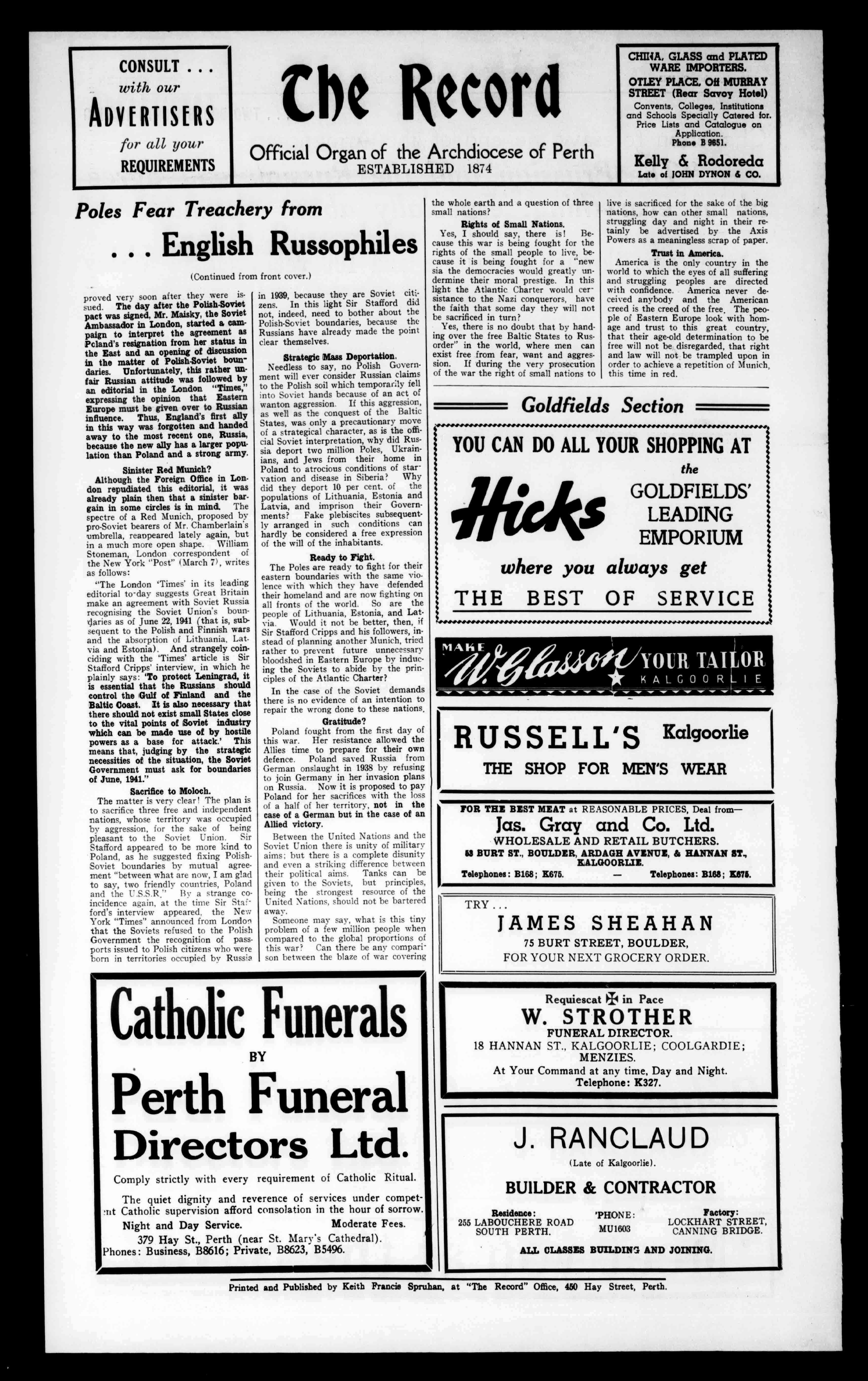
theRecord
OfficialOrganoftheArchdioceseofPerth ESTABLISHED1874
PolesFearTreacheryfrom . EnglishRussophiles
(Continuedfromfrontcover.)
provedverysoonaftertheywereissued.ThedayafterthePolish-Soviet pactwassigned.Mr.Maisky,theSoviet AmbassadorinLondon,startedacampaigntointerprettheagreementas Pcland'sresignationfromherstatusin theEastandanopeningofdiscussion inthematterofPolish-Sovietboundaries.Unfortunately,thisrathertmfairRussianattitudewasfollowedby aneditorialintheLondon"Times," expressingtheopinionthatEastern EuropemustbegivenovertoRussian influence.Thus,England'sfirstally inthiswaywasforgottenandhanded awaytothemostrecentone,Russia, becausethenewallyhasalargerpopulationthanPolandandastrongarmy. SinisterRedMunich? AlthoughtheForeignOfficeinLondonrepudiatedthiseditorial,itwas alreadyplainthenthatasinisterbargaininsomecirclesisinmind.The spectreofaRedMunich,proposedby pro-SovietbearersofMr.Chamberlain's umbrella,reappearedlatelyagain,but inamuchmoreopenshape.William Stoneman,Londoncorrespondentof theNewYork"Post"(March7),writes asfollows:
"TheLondon`Times'initsleading editorialto-daysuggestsGreatBritain makeanagreementwithSovietRussia recognisingtheSovietUnion'sbounfriariesasofJune22,1941(thatis,subsequenttothePolishandFinnishwars andtheabsorptionofLithuania,LatviaandEstonia).Andstrangelycoincidingwiththe'Times'articleisSir StaffordCripps'interview,inwhichhe plainlysays:'ToprotectLeningrad,it isessentialthattheRussiansshould controltheGulfofFinlandandthe BalticCoast.Itisalsonecessarythat thereshouldnotexistsmallStatesclose tothevitalpointsofSovietindustry whichcanbemadeuseofbyhostile powersasabasefcrattack.'This meansthat,judgingbythestrategic necessitiesofthesituation,theSoviet Governmentmustaskforboundaries ofJune,1941."
SacrificetoMoloch.
Thematterisveryclear!Theplanis tosacrificethreefreeandindependent nations,whoseterritorywasoccupied byaggression,forthesakeofbeing pleasanttotheSovietUnion.Sir Staffordappearedtobemorekindto Poland,ashesuggestedfixingPolishSovietboundariesbymutualagreement"betweenwhatarenow,Iamglad tosay,twofriendlycountries,Poland andtheU.S.S.R..'Byastrangecoincidenceagain,atthetimeSirStafford'sinterviewappeared,theNew York"Times"announcedfromLondo,, thattheSovietsrefusedtothePolish GovernmenttherecognitionofpassportsissuedtoPolishcitizenswhowere borninterritoriesoccupiedbyRussia
in1939,becausetheyareSovietcitizens.InthislightSirStafforddid not,indeed,needtobotheraboutthe Polish-Sovietboundaries,becausethe Russianshavealreadymadethepoint clearthemselves.
StrategicMassDeportation.
Needlesstosay,noPolishGovernmentwilleverconsiderRussianclaims tothePolishsoilwhichtemporarilyfell intoSoviethandsbecauseofanactof wantonaggression.Ifthisaggression, aswellastheconquestoftheBaltic States,wasonlyaprecautionarymove ofastrategicalcharacter,asistheofficialSovietinterpretation,whydidRussiadeporttwomillionPoles,Ukrainians,andJewsfromtheirhomein PolandtoatrociousconditionsofstarvationanddiseaseinSiberia?Why didtheydeport10percent.ofthe populationsofLithuania,Estoniaand Latvia,andimprisontheirGovernments?Fakeplebiscitessubsequentlyarrangedinsuchconditionscan hardlybeconsideredafreeexpression ofthewilloftheinhabitants.
ReadytoFight.
ThePolesarereadytofightfortheir easternboundarieswiththesameviolencewithwhichtheyhavedefended theirhomelandandarenowfightingon allfrontsoftheworld.Soarethe peopleofLithuania,Estonia,andLatvia,Woulditnotbebetter,then,if SirStaffordCrippsandhisfollowers,insteadofplanninganotherMunich,tried rathertopreventfutureunnecessary bloodshedinEasternEuropebyinducingtheSovietstoabidebytheprinciplesoftheAtlanticCharter?
InthecaseoftheSovietdemands thereisnoevidenceofanintentionto repairthewrongdonetothesenations.
Gratitude?
Polandfoughtfromthefirstdayof thiswar.Herresistanceallowedthe Alliestimetopreparefortheirown defence.PolandsavedRussiafrom Germanonslaughtin1938byrefusing tojoinGermanyinherinvasionplans onRussia.Nowitisproposedtopay Polandforhersacrificeswiththeloss ofahalfofherterritory,notinthe caseofaGermanbutinthecaseofan Alliedvictory.
BetweentheUnitedNationsandthe SovietUnionthereisunityofmilitary aims;butthereisacompletedisunity andevenastrikingdifferencebetween theirpoliticalaims.Tankscanbe giventotheSoviets,butprinciples, beingthestrongestresourceofthe UnitedNations,shouldnotbebartered away.
Someonemaysay,whatisthistiny problemofafewmillionpeoplewhen comparedtotheglobalproportionsof thiswar?Cantherebeanycomparisonbetweentheblazeofwarcovering
CatholicFunerals
PerthFuneral DirectorsLtd.
Moderate
thewholeearthandaquestionofthree smallnations?
RightsolSmallNations.
Yes,Ishouldsay,thereis!Becausethiswarisbeingfoughtforthe rightsofthesmallpeopletolive,becauseitisbeingfoughtfora"new siathedemocracieswouldgreatlyunderminetheirmoralprestige.Inthis lighttheAtlanticCharterwouldcersistancetotheNaziconquerors,have thefaiththatsomedaytheywillnot besacrificedinturn?
Yes,thereisnodoubtthatbyhandingoverthefreeBalticStatestoRusorder"intheworld,wheremencan existfreefromfear,wantandaggression.Ifduringtheveryprosecution ofthewartherightofsmallnationsto
liveissacrificedforthesakeofthebig nations,howcanothersmallnations, strugglingdayandnightintheirretainlybeadvertisedbytheAxis Powersasameaninglessscrapofpaper.
TrustinAmerica. Americaistheonlycountryinthe worldtowhichtheeyesofallsuffering andstrugglingpeoplesaredirected withconfidence.AmericaneverdeceivedanybodyandtheAmerican creedisthecreedofthefree.ThepeopleofEasternEuropelookwithhomageandtrusttothisgreatcountry, thattheirage-olddeterminationtobe freewillnotbedisregarded,thatright andlawwillnotbetrampleduponin ordertoachievearepetitionofMunich, thistimeinred.
CONSULT withour
CHINA,GLASSandPLATED WAREIMPORTERS. OTLEYPLACE,OffMURRAY STREET(RearSavoyHotel) Convents,Colleges,Institutions andSchoolsSpeciallyCateredfor. PriceListsandCatalogueon Application. PhoneB9651. Kelly&Rodoreda LateofJOHNDYNON&CO.
BY
strictlywitheveryrequirementofCatholicRitual. ThequietdignityandreverenceofservicesundercompetTitCatholicsupervisionaffordconsolationinthehourofsorrow. NightandDayService.
Comply
Fees.
HaySt.,Perth(nearSt.Mary'sCathedral). Phones:Business,B8616;Private,B8623,B5496.
379
GoldfieldsSection YOUCANDOALLYOURSHOPPINGAT the GOLDFIELDS' LEADING EMPORIUM whereyoualwaysget THEBESTOFSERVICE YOURTAIOR KALGOOR E RUSSELL'SKalgoorlie THESHOPFORMEN'SWEAR FORTHEBESTMEATatREASONABLEPRICES,DealfromJas.GrayandCo.Ltd. WHOLESALEANDRETAILBUTCHERS. UBURTST.,BOULDER,ARDAGHAVENUE,&HANNANST., KALGOORLIE. TelephonesB168;K675. Telephones:B168;KUL TRY JAMESSHEAHAN 75BURTSTREET,BOULDER, FORYOURNEXTGROCERYORDER. Requiescat114inPace W.STROTHER FUNERALDIRECTOR. 18HANNANST.,KALGOORLIE;COOLGARDIE; MENZIES. AtYourCommandatanytime,DayandNight. Telephone:K327. J.RANCLAUD LateofKalgoorlie). BUILDER&CONTRACTOR Residence: 255LABOUCHEREROAD SOUTHPERTH. 'PHONE MU1603 Factory: LOCKHARTSTREET, CANNINGBRIDGE. ALLCLASSESBUILDINGANDJOINING. PrintedandPublishedbyKeithFrancisSpruhan,at"TheRecord"Office,450HayStreet,Perth.