"Taste Tells"
Johnston's
and
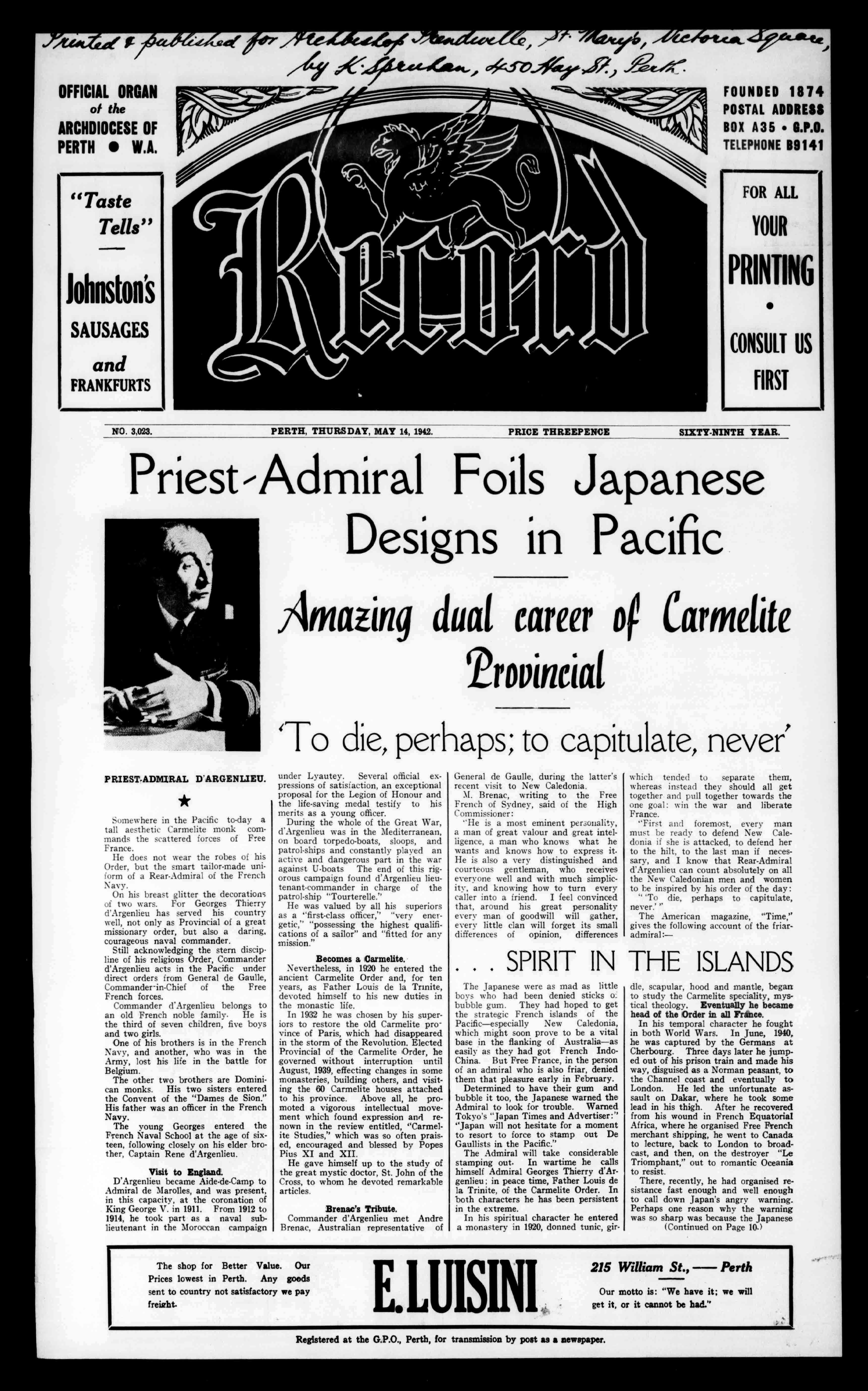
Amazingdualcareer Carmelite 'Provincial
`Todie,perhaps;tocapitulate,never'
underLyautey.Severalofficialexpressionsofsatisfaction,anexceptional proposalfortheLegionofHonourand thelife-savingmedaltestifytohis meritsasayoungofficer.
SomewhereinthePacificto-daya tallaestheticCarmelitemonkcommandsthescatteredforcesofFree France.
Hedoesnotweartherobesofhis Order,butthesmarttailor-madeuniformofaRear-AdmiraloftheFrench Navy.
Onhisbreastglitterthedecorations oftwowars.ForGeorgesThierry d'Argenlieuhasservedhiscountry well,notonlyasProvincialofagreat missionaryorder,butalsoadaring, courageousnavalcommander.
Stillacknowledgingthesterndiscip lineofhisreligiousOrder,Commander d'ArgenlieuactsinthePacificunder directordersfromGeneraldeGaulle, Commander-in-ChiefoftheFree Frenchforces. Commanderd'Argenlieubelongsto anoldFrenchnoblefamily.Heis thethirdofsevenchildren,fiveboys andtwogirls.
OneofhisbrothersisintheFrench Navy,andanother,whowasinthe Army,losthislifeinthebattlefor Belgium.
TheothertwobrothersareDominicanmonks.Histwosistersentered theConventofthe"DamesdeSion." HisfatherwasanofficerintheFrench Navy. TheyoungGeorgesenteredthe FrenchNavalSchoolattheageofsixteen,followingcloselyonhiselderbrother,CaptainRened'Argenlieu.
VisittoEngland. D'ArgenlieubecameAide-de-Campto AdmiraldeMarolles,andwaspresent, inthiscapacity,atthecoronationof KingGeorgeV.in1911.From1912to 1914,hetookpartasanavalsublieutenantintheMoroccancampaign
DuringthewholeoftheGreatWar, d'ArgenlieuwasintheMediterranean, onboardtorpedo-boats,sloops,and patrol-shipsandconstantlyplayedan activeanddangerouspartinthewar againstU-boatsTheendofthisrigorouscampaignfoundd'Argenlieulieutenant-commanderinchargeofthe patrol-ship"Tourterelle." Hewasvaluedbyallhissuperiors asa"first-classofficer,""veryenergetic,""possessingthehighestqualificationsofasailor"and"fittedforany mission."
BecomesaCarmelite.
Nevertheless,in1920heenteredthe ancientCarmeliteOrderand,forten years,asFatherLouisdelaTrinite, devotedhimselftohisnewdutiesin themonasticlife.
In1932hewaschosenbyhissuperiorstorestoretheoldCarmeliteprovinceofParis,whichhaddisappeared inthestormoftheRevolution.Elected ProvincialoftheCarmeliteOrder,he governedwithoutinterruptionuntil August,1939,effectingchangesinsome monasteries,buildingothers,andvisitingthe60Carmelitehousesattached tohisprovince.Aboveall,hepromotedavigorousintellectualmovementwhichfoundexpressionandrenowninthereviewentitled,"CarmeliteStudies,"whichwassooftenpraised,encouragedandblessedbyPopes PiusXIandXII. Hegavehimselfuptothestudyof thegreatmysticdoctor,St.Johnofthe Cross,towhomhedevotedremarkable articles.
Brenac'sTribute.
Commanderd'ArgenlieumetAndre Brenac,Australianrepresentativeof
GeneraldeGaulle,duringthelatter's recentvisittoNewCaledonia.
M.Brenac,writingtotheFree FrenchofSydney,saidoftheHigh Commissioner:
"Heisamosteminentpersonality, amanofgreatvalourandgreatintelligence,amanwhoknowswhathe wantsandknowshowtoexpressit. Heisalsoaverydistinguishedand courteousgentleman,whoreceives everyonewellandwithmuchsimplicity,andknowinghowtoturnevery callerintoafriend.Ifeelconvinced that,aroundhisgreatpersonality everymanofgoodwillwillgather, everylittleclanwillforgetitssmall differencesofopinion,differences
whichtendedtoseparatethem, whereasinsteadtheyshouldallget togetherandpulltogethertowardsthe onegoal:winthewarandliberate France.
"Firstandforemost,everyman mustbereadytodefendNewCaledoniaifsheisattacked,todefendher tothehilt,tothelastmanifnecessary,andIknowthatRear-Admiral d'Argenlieucancountabsolutelyonall theNewCaledonianmenandwomen tobeinspiredbyhisorderoftheday: "`Todie,perhapstocapitulate, never.'
TheAmericanmagazine,"Time," givesthefollowingaccountofthefriaradmiral:-
TheJapanesewereasmadaslittle boyswhohadbeendeniedstickso_ bubblegum.Theyhadhopedtoget thestrategicFrenchislandsofthe Pacific-especiallyNewCaledonia, whichmightsoonprovetobeavital baseintheflankingofAustralia-as easilyastheyhadgotFrenchIndoChina.ButFreeFrance,intheperson ofanadmiralwhoisalsofriar,denied themthatpleasureearlyinFebruary.
Determinedtohavetheirgumand bubbleittoo,theJapanesewarnedthe Admiraltolookfortrouble.Warned Tokyo's"JapanTimesandAdvertiser:" "Japanwillnothesitateforamoment toresorttoforcetostampoutDe GaullistsinthePacific."
TheAdmiralwilltakeconsiderable stampingout.Inwartimehecalls himselfAdmiralGeorgesThierryd'Argenlieu:inpeacetime,FatherLouisde laTrinite,oftheCarmeliteOrder.In bothcharactershehasbeenpersistent intheextreme.
Inhisspiritualcharacterheentered amonasteryin1920,donnedtunic,gir-
dle,scapular,hoodandmantle,began tostudytheCarmelitespeciality,mysticaltheology.Eventuallyhebecame headoftheOrderinallFrance. Inhistemporalcharacterhefought inbothWorldWars.InJune,1940, hewascapturedbytheGermansat Cherbourg.Threedayslaterhejumpedoutofhisprisontrainandmadehis way,disguisedasaNormanpeasant,to theChannelcoastandeventuallyto London.HeledtheunfortunateassaultonDakar,wherehetooksome leadinhisthigh.Afterherecovered fromhiswoundinFrenchEquatorial Africa,whereheorganisedFreeFrench merchantshipping,hewenttoCanada tolecture,backtoLondontobroadcast,andthen,onthedestroyer"Le Triomphant,"outtoromanticOceania toresist.
There,recently,hehadorganisedresistancefastenoughandwellenough tocalldownJapan'sangrywarning. Perhapsonereasonwhythewarning wassosharpwasbecausetheJapanese (ContinuedonPage10.)
"ProtestantLoyalist.'Sydney
Q.:IsnotRomanCatholicisman alienreligion?
R.:Itisnotanationalreligion,if thatiswhatyouhaveinmind.Itis theuniversalreligionofChrist,above andbeyondallnationallimitations andpolitics.Itsmembershavedifferentnationalallegiances,andare loyaltothoseallegiancesascitizensof thevariouscountriestowhichthey belong.Buttheirreligionconcerns theirallegiancetoChrist,andinthat allCatholicsareunited,howeverdifferentmayhetheirnationalloyalties.
Q.:AsCatholicsareobligedtoadopt thepoliticsoftheVatican,noCatholic canbeloyaltoanycountry
R.:TheVaticanhasnopoliticalambitions,andhasconsistentlyrefusedto takepoliticalsidesinthiswar.The CatholicChurchisoutsideandabove politics,thoughitisquitepreparedto declarethemorallawevent.)politicians.Catholicsthroughouttbeworld owenopoliticalallegiancetotheVatican.Theyowepoliticalallegianceto therespectivecountriestowhichthey belong.YousaythatCatholicscannotbeloyaltoanycountry;yettheir religionteachesthemthattheyareobligedinconsciencetofulfilloyallyall thedutiesofcitizenshippropertotheir ownnation.
ANTI-BRITISHCHARGES.
Q.:WeProtestantsstandsforGod, KingandEmpire.
R:YouhavenotamonopolyofloyaltytoGod,KingandEmpire.Iam aCatholic,and,withmillionsofother Catholics,IstandforGod,Kingand Empire.AndthepresentKinghas spokenmostappreciativelyofthemillionsofhisloyalCatholicsubjects. AsaProtestant,whilstyouclaimto standforGod,KingandEmpire,vou alsostandforanintolerantprotest againstCatholics:andthisprejudice hashopelesslyupsetyourjudgment.
Q.:EveryVatican-dominatedcountry isimplacablyanti-British-Empire.
R.:Thereisnocountryinthisworld underthepoliticaldominationofthe Vatican.Therearecountriesinwhich themajorityofthepeopleareCatholics,acknowledgingthePopeastheir supremespiritualguide.Butnoteven allthesecountriesareanti-British. Poland,Czechoslovakia,Belgium,Ireland,evenFrance,arenotanti-British.AndthoseCatholiccountries thatarestillanti-Britishowethefact totheirpoliticalleaders,andnotto theirreligion.
THE"ROMANFIFTHCOLUMN."
Q.:Mr.CurtintoldAmericathatthere isno"FifthColumn"inAustralia. HeforgetstheRomanCatholic Church.
R.:Thereseemstobenoextravagance -ofwhichblind'bigotryisincapable.Catholicsarefulfillingtheirdutiesjustas othercitizens,inthehighestpositions aswellasintheleast.Throughout everybranchofserviceyouwillfind Catholicsdevotingthemselvestothe welfareofourcountryanditswar effort. Moreover,morethanonethirdoftheAmericansoldierswho havecometoAustraliaareCatholics. Havetheycomeatthebiddingatthe Vatican,nottohelpdefendthiscountry,buttoreinforceRome's"FifthColumn"foritsruin?Doyounotsee bowfoolishyourstatementsreallyare?
Q.:InviewofthefactthatIrelandis assistingtheAxisPowers,itisevidentthattheRomanpriesthoodin Australiaisapotential"FifthColumn." R..Youaretalkingnonsense.IrelandisnotassistingtheAxisPowers;
ions,havingitsownPresident,andfull righttoself-determination.England maytrytowinthesupportofthe IrishFreeState,butshehasrenounced thepolicyofdominationbyforcewhich sheformerlyemployed,atleastasregardsSouthern Ireland.
Q.:Herpeoplearemany,andalarge numberen!,oytheprivilegesandfreedomoftheDominions.
R.:ThoseintheDominionsfulfil theircivicdutiestotheDominionsin whichtheydwell.Thedestiniesof EiremustbelefttothoseactuallyresidingintheFreeState.Itisbeside thepointtorefertothoseliving abroadwhoarenotactuallysubjects ofEire,andhavenovoteinthatcountry.
Q.:YetEirerefusestheuseofher navalbasestoBritain.Whydoes sheadoptthispro-AxisandantiBritishstand?
R.:Ofonethingyoucanbesure. Herattitudehasnothingwhateverto dowiththeCatholicreligion.Andit indicatesneitherpro-AxisnorantiBritishsympathies.IfEirewasantiBritish,shewoulddiscourageherIrish subjectsfromenlistingasindividualsin theBritishArmyandAirForce.She hasnotdoneso.Therearemore Irish-bornsoldiers,sailors,andairmen fightingintheBritishforcesthanAus-
PROBLEMOFPARTITION.
Q.:Eireevenobjectstothelandingof AmericantroopsinNorthernIreland.
R.:Herrealobjectionisthatthere shouldbeanyindependentNorthern IrelandinwhichAmericanoranyother troopscanbelandedwithoutherconsent.EireinsiststhatIrelandisa geographicalunit.Sheobjectstothe unnaturalpartitionofthecountry,and thecontinuedretentionbyEnglandof theNorthernCountiessolelyindeferencetomoneyedinterestsMr.De ValerasaystoEngland:"Youwill notgiveusaccesstoourownterritory intheNorth;whyshouldwegiveyou accesstoourterritoryintheSouth).* Thesituationisascomplicatedasthe positioninIndia,wheresomanyIndiansobjecttothepromiseofindependencetosmallsectionsofthecountry, andthepartition,or,astheIndians callit,the"vivisection,"oftheirnation. Englandistryingtofindasolutionof thatproblem,whilstretainingthegoodwillofallIndia.AnditisforEngland tosolvethethornyIrishproblemin thesameway.Allthis,ofcourse,ha. nothingtodowiththeCatholicreligion.IfIamdealingwithyourquestionsatall,itisbecauseyouthinkit has.Andthatisagreatpity,forit preventsyourstudyingtheCatholic
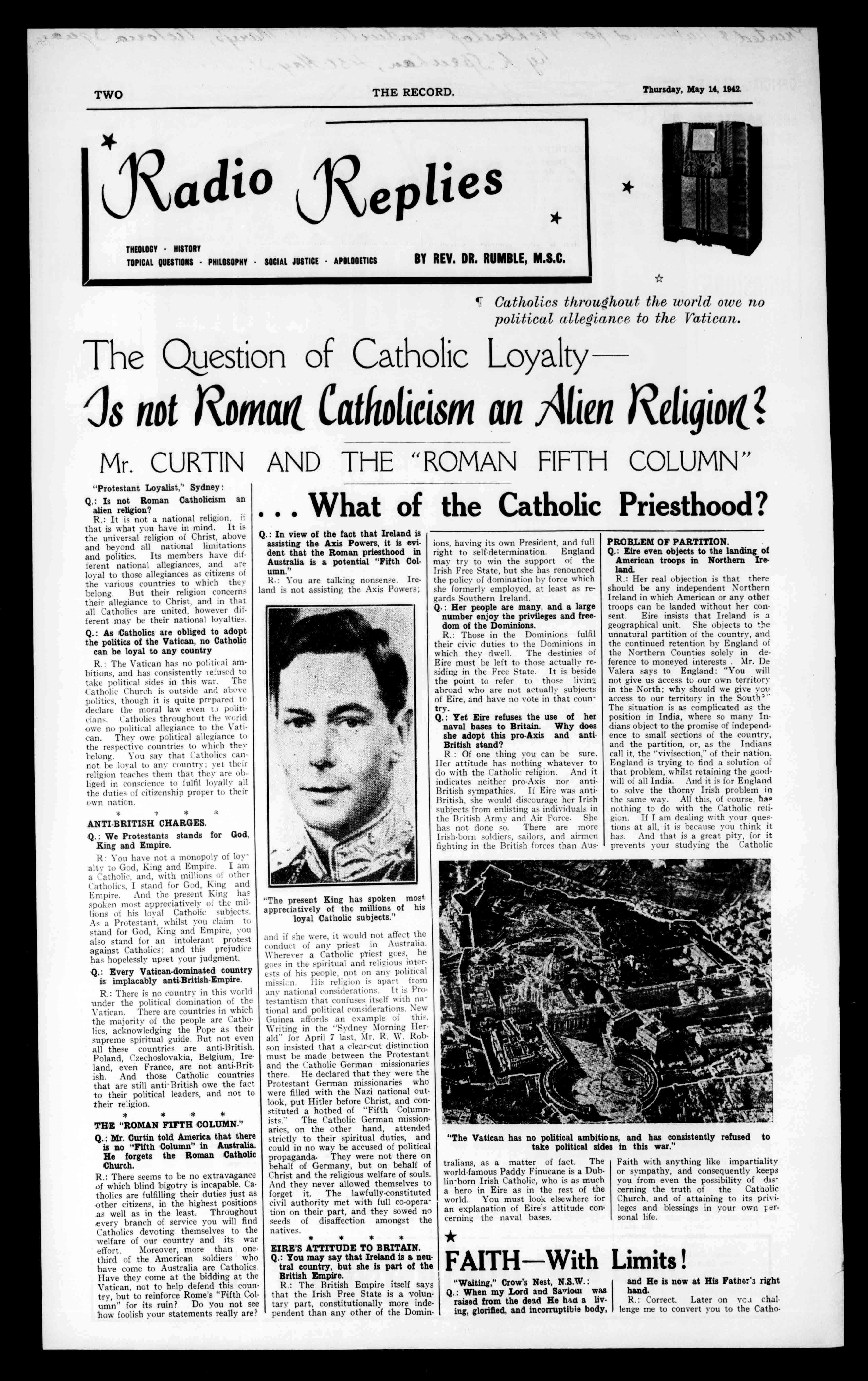
"ThepresentKinghasspokenmos.* appreciativelyofthemillionsofhis loyalCatholicsubjects.''
andifshewere,itwouldnotaffectthe conductofanypriestinAustralia. WhereveraCatholicpriestgoes,he goesinthespiritualandreligiousinterestsofhispeople,notonanypolitical missi,:n.Hisreligionisapartfrom anynationalconsiderations,ItisProtestantismthatconfusesitselfwithnationalandpoliticalconsiderations.New Guineaaffordsanexampleofthis.
Writinginthe"SydneyMorningHerald"forApril7last,Mr.R.W.Robsoninsistedthataclear-cutdistinction mustbemadebetweentheProtestant andtheCatholicGermanmissionaries there.Hedeclaredthattheywerethe ProtestantGermanmissionarieswho werefilledwiththeNazinationaloutlook,putHitlerbeforeChrist,andconstitutedahotbedof"FifthColumnists:'TheCatholicGermanmissionaries,ontheotherhand,attended strictlytotheirspiritualduties,and couldinnowaybeaccusedofpolitical propaganda.Theywerenotthereon behalfofGermany,butonbehalfof Christandthereligiouswelfareofsouls. Andtheyneverallowedthemselvesto forgetit.Thelawfully-constituted civilauthoritymetwithfullco-operationontheirpart,andtheysowedno seedsofdisaffectionamongstthe natives.
EIRE'SATTITUDETOBRITAIN.
Q.:YoumaysaythatIrelandisaneutralcountry,butsheispartofthe BritishEmpire.
R.:TheBritishEmpireitselfsays thattheIrishFreeStateisavoluntarypart,constitutionallymoreindependentthananyotheroftheDomin-
"TheVaticanhasnopoliticalambitions,andhasconsistentlyrefused takepoliticalsidesinthiswar." tralians,asamatteroffact.The world-famousPaddyFinucaneisaDublin-bornIrishCatholic,whoisasmuch aheroinEireasintherestofthe world.Youmustlookelsewherefor anexplanationofEire'sattitudeconcerningthenavalbases.
to Faithwithanythinglikeimpartiality orsympathy,andconsequentlykeeps youfromeventhepossibilityofdiscerningthetruthoftheCatholic Church,andofattainingtoitsprivilegesandblessingsinyourownrersonallife.
"Waiting,"Crow'sNest,N.S.W.: Q.:WhenmyLordandSaviourwas raisedfromthedeadHehadaliving,glorified,andincorruptiblebody,
andHeisnowatHisFather'sright hand. R.:Correct.LateronV,:.1challengemetoconvertyoutotheCatho-
Thursday,May14,1942.
licFaith.OfthatIwillspeakmore fullywhenIconcludemytreatment ofyourletter.Hereletmesaythat IamhappytoknowyoualreadyacceptChristasyourLordandSaviour. That,ofcourse,youwillhavetocontinuetodoifyoubecomeaCatholic. Allweaskyoutodo,besidesacceptingChristasyourLordandSaviour, istoacceptallthatHetaught;and allthemeansofgraceHeintended youtopossess;aboveall,themagnificentgiftofHimselfintheHoly Eucharist.
ALESSONINLOGIC.
Q.:Oneoftheinfalliblerulesofthe syllcgismis-ifoneofthepremisesbe negative,thentheconclusionwillbe negative.
R.:Correct.Butitisalsoalaw ofavalidsyllogismthatyoudonot havemorethanthreeterms.Asyllogismisthecomparisonoftwoterms withathird.Butyouhavefour termsinyoursyllogism,anditsuffers fromthenondistributionofthemiddle termusedforthepurposesofcomparison.ThisisduetoyournothavingacorrectideaofwhattheCatholic doctrineconcerningtheHolyEucharistreallyis.Iwillexplaintheright doctrineinamoment,andalsoshow youjustwhereyoursyllogismgoes astray.
THOUGHTLESSIRREVERENCE.
Q.:ThebiscuitsthatareusedtocommemoratetheSacramentofthe Lord'sSupperhavenotaliving,not aglorified,notanincorruptiblebody, andtheyhavenotascendedinto heaven.
R.:Thatistheminorpremiseof yoursyllogism.ButbeforeIdiscuss it,Imustlodgeaprotestagainstyour language.Youruseoftheword"biscuits"showsalackofrespect,ifnot positiveirreverence,whichonemight expectfromanunbelieverbenton ridiculingtheChristianreligion.But youprofesstoacceptChristasyour LordandSaviour.Now,Heused theword"bread"ofHimself,saying: "Iamthebreadthatcamedownfrom heaven:"and,again,"Thebreadthat IwillgiveisMyfleshforthelifeof theworld."You,yourself,wouldsurelyresentasneeringreferencetoOur Lordas"thebiscuitthatcamedown fromheaven."Howevermuchwe maydifferastothemeaningofOur Lord'swords,atleastletusleaveitto theenemiesofOurLordtomock them.YouandIareHisfriends,and talkingoverHisteachingsbetween ourselves,letusdosoaspeoplewho loveandreverenceeverywordthat
fellfromHislips.Now,letusturn totheconclusionofyoursyllogism. * * * * DOCTRINEOFTHEEUCHARIST.
Q.:Therefore,thebiscuitsusedto celebratetheaboveSacramentare notthebodyofmyLord.
R.:Apartfromyourrepeatedirreverence,thatconclusionfollowslogicallyfromyourminorpremise,butbecauseyourminorpremiseiswrong, yourconclusionsuffersfromthesame defects.
Hereisyourcompletesyllogism putconcisely: "OurLordhasaliving,glorified,incorruptiblebodyinheaven. ButtheEucharisticBreadhasnota living,glorified,incorruptiblebody inheaven. Therefore,theEucharisticBreadisnot theBodyofOurLord."
Now.Isaythatitisyourminor premisethatisatfault.Whenyou say,"ButtheEucharisticBreadhas notaliving,glorified,incorruptible bodyinheaven,-youarearguingfrom thefactthattheEucharisticBread stillappearstobebreadafterthe wordsofconsecration.Butthat provesnothingagainsttheCatholic doctrine.Catholicswouldbesurprisedifitdidnotstillappearlikebread. FortheCatholicChurchteachesthat, attheconsecration,alltheappearancesorqualitiesofbreadremainas theywere,whilsttheunderlyingrealityorsubstanceofthebreadisconvertedintothesubstanceofChrist's living,glorified,incorruptibleBody.
Todisprovethis,it'snousearguing fromappearances,denyingwhatwe donotclaim.Christsaid:"Thisis MyBody."Withsupremefaithin Christ,Catholicsreply:"Lord,thatis yourBody;butitisnotyourBody accordingtoappearancesandqualities;therefore,itisyourBodyaccordingtoitssubstance."Inother words,theliving,glorified,incorrupt ibleBodyandChrist,whichisnot subjecttospace-timeconditions,becomespresentintheEucharistbya conversionofthesubstanceofthe breadintothesubstanceofthatBodyofChrist.Thisdoctrinecannotbe disprovedeitherbyscienceorphilosophy.Theonlywayinwhichitcould bedisprovedwouldbebydemonstratingthatOurLord'swords,"Thisis MyBody,'arenottobetakenliterally.Andthatyouattemptintherest ofyourletter.Withthevariousconsiderationsyouurge,Iwilldealin futuresessions.To-night,itmustbe enoughtohavedealtwithyouropeningsyllogism,pointingoutitsfallacy, andshowingthatitissimplywithout applicationtothesubjectunderdiscussion.
"Anglo-Catholic,"Queensland:
Q.:IamasincereandhonestAngloCatholic.
R.:Yoursincerityandhonestydo notalterthefactthatyourpositionis amistakenone,andlogicallyindefensible.
Q.:IfirmlybelievethatAnglo-Catholicsareright,andthatallothers, RomanCatholicsandProtestants, arewrong. R.:It'sgoodtomeetsomeonewho knowsdefinitelywhereshestands.But yourdifficultywillbetojustifyyour firmbelief.Moreover,sinceAngloCatholicsareonlyaminoritysection oftheAnglicanChurch,youdeclare thatthemajorityeveninChurchto whichyoubelongareinerror.Yet yourAnglicanChurchofficiallyrecognisesthemasmembersequallywith yourself.YourownChurchrefusesto admitthatyouareexclusivelyright, andonecannotbutwonderwhyyou stillprofessconfidenceinAnglicanism.
THEONETRUECHURCH.
Q.:Iadmitthattherecanbeonly onetrueChurch.
R.:Inthatcase,youthinkthatall Christiansthroughouttheworldshould becomeAnglo-Catholics.ButChrist diedforallmenwithoutanyconsiderationofnationality.Frenchmen,Germans,Italians,Belgians,theDutch, Spaniards,Japanese,Indians,Chinese, andpeopleofallothernationalities havetheright,andareobligedtojoin theonetrueChurch.Butwhyshould theybecomeAnglo-Catholics,acknowledgingsubjectiontotheKingofEnglandandtheBritishParliamentinreligiousmatters?Thetruereligionof Christisnotboundupwithnationalism,norisitsubjecttoanymerely earthlykingsorrulers.
Q.:TheRomanCatholicChurchwas theonetrueChurchtilltheProtestantReformation.
R.:SinceyoubelievethatallProtestantsarewrong,Idon'tseehow youcanhaveanyconfidenceinthe ProtestantReformation.
Q.:Youappealtohistory.Buthistoryisnotreliablealways,andcannotbeproved.
R.:Youhadnodoubtsabouthistorywhenyouquotedittosaythat theCatholicChurchhadbecomecot.ruptpriortotheProtestantReformation.Apparently,youareprepared toadmitonlywhatyoudolike,and todenywhateveryoudon'tlike.It istrue,ofcourse,thatmanythings havebeenregardedashistoricalwhich arenothistorical.Butthatdoesn't castdoubtonallrecordedhistory.Historycanbecheckedbyrecourseto originaldocumentsandacomparative studyoftheindependentauthors.And genuinehistoryvindicatesabsolutely theCatholicposition.CardinalNewman,whoasanAnglicanclergyman, wasthepioneeroftheOxfordMovementandtheAnglo-Catholicrevivalin theChurchofEngland,foundhimself compelledbyhisstudyofhistoryto abandontheAnglicanChurchand"go overtoRome."Andhedeclared that"tobedeeplyreadinhistoryis toceasetobeaProtestant."But apartfromallthis,youmustfacethe factthatChristpromisedsolemnly thatthegatesofhell,orforcesofevil, wouldnotprevailagainstHisChurch. Areyoupreparedtosaythatthey didprevailagainsttheChurchChrist established,thatHecouldnotdowhat
HesaidHewoulddo,andthatHenry VIII.hadtoabandontheCatholic Churchandpreservetheonetrue ChristianreligionforEnglish-speaking peopleonly,undertheformofAngloCatholicism?Doesthatevensound likeareasonableposition?
CLAIMSOFCONSCIENCE.
Q.:IhavetodothewillofGoduI seeit. R.:Thatistrue.Butitispossible forpeople,withthebestofintentions, tobemistakenastowhatthewillof Godreallyis.Theclassicexample ofthatisSt.Paul,whoreallythought hewasdoingtheWillofGodintryingtosuppressChristianity.When enlightenedbyChrist,onthewayto Damascus,hedidnothesitateto abandonhispreviouspositionandgive himselfentirelytothecauseoftruth. Soitmustbewithyou.Youmust remainasyouaresolongasyouconscientiouslybelieveittoberight.I wouldnotaskyoutotakeasingle stepforwarduntilyouseeyourway cleartodoso.ButIdoaskyouto reconsideryourposition;andIhave saidmorethanenoughtojustifyyour doingthat.Sendmeanyfurtherdifficultiesthatoccurtoyou,ifyouwish. Thenactinaccordancewithsincerityandhonestyonlyifthefurtherinformationyouhavereceivedinresponse toyourenquiriesimpelsyoutodoso.
OneoftheAssociatedPublic SchoolsofW:A.
THEREFORMATIONPROBLEM.
Q.:Bythen,however,theRoman Churchhadbecomecorrupt,soAnglo-Catholicsbrokeawayfromit.
R.:Yourargumentwillleadyou intogreatdifficulties.Christsaid:"I willbuild.flyChurch,andthegatesof hellshallnotprevailagainstit."If youadmitthattheCatholicChurch wastheonetrueChurchbeforethe Reformation,youadmitthatitwasof that said:ChurchChristspokewhenHe "Thegatesofhellshallnotpre- vailagainstit,"Yetyousay,"Oh, buttheydidprevailagainstit!"How, then,canyoucontinuetobelievein Christatall,ifHecouldnotdowhat HesaidHewoulddo-preserveHis Churchagainsttheforcesofevil?
Anotherpointtonoticeisthis: UnderEdwardVI.andQueenElizabeth,theChurchofEnglandwasdefinitelyprotestantised.TheKing,at hiscoronation,stillhastoswearthat heisafaithfulProtestant,andthat hewillsafeguardtheProtestantsuccessiontothethrone.Yetyousay thatallProtestantsarewrong!The Anglo-Catholicsarereallyamodern developmentintheChurchofEng-land,reallyalientoitswholeoutlook andspirit.Andiftheyhavemade anyprogressatall,ithasbeenindefianceoftheirBishops,andbyrebellingagainstauthority.TheAnglican ChurchmaytolerateAnglo-Catholics to-day;butitisonlybyanunwelcome compromise.
Q.:IfyoucouldprovetheRoman CatholicChurchtobetheonetrue Church,itwouldbemydutytobecomeamemberofit.
R.:Thetroubleisthatyouwilldeny withoutweighingitatallanythingI offerasproof.Youdonotofferany realreasonsforyourposition.You offeronlyexcusestocoveryourunwillingnesstobecomeanactualCatholic.Andyoualonecanchangeyour will.Icannotchangeitforyou.
TELEPHONE:MU1520
ForBoardersandDayStudents Boysadmittedfrom7upwards BeautifullySituated,overlookingtheriver,nearthenewCanningBridge. ForParticularsapplytoThePrincipal,AquinasCollege,CanningParade,Mt.Henry.
(ConductedbySistersNotreDameDesMissions). BOARDINGANDDAYSCHOOLFORGIRLS. PUPILSPREPAREDALLEXAMINATIONS. MONTESSORISCHOOLFORYOUNGCHILDREN FcrProspectusapply'Phone:B3810. REV.MOTHERPRIORESS LoretoConvent"Osborne"-Claremont BOARDINGANDDAYCOLLEGE. TheSchoolprovidesasoundeducationonmodernlinesinallbranches ofstudy.Thepupilsarepreparedforal!examinations.TheSchoolis beautifullysituatedbetweenOceanandRiver,inextensivegrounds, withfineplayingfieldsandprivateswimmingPoolinRiver. Telephone:F2135. Apply- MOTHERSUPERIOR.
ST.ILDEPHONSUS'COLLEGE
NEWNORCIh
CONDUCTEDBYTHEMARISTBROTHERSForParticularsApplyto-THEBROTHERDIRECTOR
HOMEBUILDERS FORSOUNDCONSTRUCTIONUSE TIMBER PRODUCEDBY MILLARS'TIMBER &
THERECORD.HEREappearselsewhereinthis issuetheimpressiveannual eportfromtheChristian Brothers'FarmSchoolat Tardun.ThisexperimentrepresentsaCatholicapproachtothe solutionoftheruralproblemandthe flightfromtheland.TheBrothers seetheissueinarealisticlight.They arenotimpracticableidealists.They aimtomakeboyscountry-minded,to fosterinthemarealloveoftheland, totraintheminintensivemixedfarmingmethods,tosetthemupasindependentfarmers,withsufficientculturetowithstandthelonelinessand socialisolationinseparablefromthe ruraldevelopmentofthiscountry. Whatisprimarilywrongwiththe farmingcommunityisthepopular philosophyofsociallifeanditspracticalrepercussionsinlocalgovernment. Solongaspeoplecontinuetothink andtalkofagricultureasanindustry, solongwillthetroublepersist.So longasthelandisregardedasanopportunityforgettingrichingoodseasons,forlargescalesuperficialexploitationforoverseasmarketsorgain,as aninvestmentinperpetuityformoney lendersandasystemofdebtcapitalisation,solongwilltheagricultural crisescontinuetooccur.Anduntil thereistruestabilityfortheland andthefarmer,itwillbenonsenseto talkaboutnationalprosperityoreven aboutnationalperpetuation.Each actualcrisis,bothintheyearsthat heralditandtheyearsthatfollowit, seesagradualbuteverincreasing exodus,andthecontinuationofthe presentmethodsoffarmingtendcontinuallytowardsthesterilityofthe land,sothatwithsoilerosion,appearanceofsalt,andthelackofproper waterconservation,thedesertseverywherearemarchingandtheirtermis theseacoast. Forallthis,outsideofCatholiccircles,thereisnottheslightestindicationthatthemassofAustralia'sfarmersorpoliticianshavelearntanything fromexperience.Oncethecrisisis overthesameoldtragedyofspecialisationonhugeareasandabankoverdraftforforeignmarketsisbegunall overagain.Buttheadvocacyofintensivefarmingonmuchsmallerholdings,financedbyco-operativecredit -unionsandundertakenprimarilyasa wayoflife,undertherationalconceptionthatthechiefpurposeofproduc. tionisconsumption,maysoonreceive ahearing.Forifonethingisplain
aboveothers,itisthatdependenceon overseas'marketsisfollyandthatproductionforprofitexclusively,inpoint offact,doesnotpay.Inruinsthenationalheritageoftheland,andthe peoplewhogettheprofitsarenotthe farmersbutthehordesofparasitic middlemenwhobattenonagriculture fromacityarm-chair.Whenitwas suggestedinthepastthatAustralia shouldendeavourtosetupapeasantry, derisivecriticsofbothatheoretical andpracticaltypecouldheheardin
concertedduets.Wewereconstantly tolditwasimpracticable.Bynow, however,theyshouldhavebeenforced torecognisethatwhenonecomesto talkofpracticeitisveryobviousthat thecapitalistsystemofagriculturehas finallybrokendownandcanneverbe madetoworkagain,andtheonlypossiblealternativeissubsistencefarming.Oneofthemanythingstobe saidinitsfavouristhatitwasthe basisofstabilityandsecurityforEuropeancivilisationforathousandyears andmore.Thecitieshavegonedown intothedust.Thesophisticatesand
Over30years'experienceinpropertymanagementandrentcollectionenableusto offeryouexpertserviceinthisdirection.
Wealsohaveextensivelistsofprivate homesavailableforpurchaseinallsuburbs. Reasonabletermsarrangedifrequired.
Wecanofferyouspecialisedserviceinall branchesofRealEstate.
DUDLEY&DWYERLIMITED SWORNVALUATORS.
08ST.GEORGE'STERRACF.
A.V.RHODESandCO.are CashBuyersofSheepskinsfo FELLMONGERING(theLargestPlantinW.A.).Highest Prices,PromptReturns;No CommissionCharged.ConsignmentLabelsPostedFreeonApplication.
WeareauthorisedbytheCentral WoolCommittee,Melbourne,to handlewoolonaccountofgrowers.Consignallproducetothe addressbelow.
FORSATISFACTIONCONSIGNTO-
A.V.RtIODES&CO.
15MOUATTSTREET, FREMANTLE.
thecriticsaredead,butthepeasant liveson,anditisinterestinginthis connectiontoremarkthathadnotthe plansofAustralia'struefounder,CaptainArthurPhillip,beenthwartedby themilitaryjunta,Australianagriculturewouldprobablyhavedeveloped onasubsistencebasis.Wemustturn backtoourorigins,andifweare reluctanttodothis,itisnotbecause asanationwearetoooldandsettled inourways,butonlybecauseofa wrongandsillypride.
Wehavehadquiteanearfulofpromisesregardingthepost-warOrder. OurownMr.Menziesspokeofhowthe oldregimehadgoneforgoodandhow theinequalitiesbetweenrichandpoor wouldbeironedout.PresidentRooseveltandSirStaffordCrippshave spokeninthesametones,butwith varyingshadesofmeaning.Thecommondenominatorofallthesehopes andpromisesdoes,however,indicate theuniversalwillofthinkingmento endasocialsystemwhereinpeople starveinthemidstofplenty.
TheChurch,alwaysinthevanguard ofprogressasthefounder,forinstance, ofmodernjurisprudenceandofthesocialservicesofhospitals,lazerets, homesfortheagedandorphan,etc., hasalsobeenthepioneerprotagonist againsttheinhumanitiesofthecapitalisticsystem,aswitnessthecelebratedencyclicalsofLeoXIII.andPius XI.Theworldhasbeenalongtime attainingtoaproperconsciousnessof theseevils,yetdespiteanoccasional anachronismwhensomeoneaskswhy theChurchdoesn'tdosomething,Catholicswillwelcomewithopenarms anysaneandjustattempttoreorganisethesocialandeconomicsystem.At thesametimethereisadictumofMr. Chesterton'swhichenquiresratherpertinentlywhetheritisofmuchuse botheringaboutourhistoryandeconomicsifourphilosophyisallwrong. Withoutanydesiretoofferdiscouragementtosocialreform,itmaybeas welltobesurethatthephilosophyof thechangesproposedisacceptableto reasonandtoChristianprinciples.
Ontheonehanditistruethatthe povertyimposedonlargenumbers underindustrialismhasbeenapestilentsourceofviceanddepravity.It isalsopsychologicallysoundthata contentedstomachisthefoundation forawell-disposedmindandheart.The NewTestamentbearswitnessto thiswhenitdescribesOurLordfeedingthemultitudebeforepreachingto them.Sofar,sogood.Butthepropositionsthatpovertyisacrimeand thatpovertynecessarilyengenders moralturpitude,arenotsoclear;indeed,theyhavetheringofapositive doubt.Wemightexpressitbysayingthat,whilenobodyshouldbe hungry,nobodyshouldbefat (supposingobesitytobetheresult ofasurfeitofmaterialthings). Itseems,inthelightofChristianhistory,thatGodhasbeenverygoodto thepoor,andthat,whilemenreverencedGod,theywereabletosupport asocialstructure,elasticenough tomakeprovisionforitslessfortunatemembers.Ontheotherhand,the poorwouldappeartohavebeenvery faithfultoGod,untiltheadventof thesecularstatebrokedowntheir faithinmen,madeintheimageof God,andultimatelyintheProvidence ofGod,Whonormallyprovidesic menthroughhumanandnotmiraculouschannels.
Itshouldbeclearthat,whiletheabsolutewantofnecessariesshouldnot exist,andindeedwasadequatelyprovidedagainstinthedaysofChristian civilisation,povertymayitselfbe,in anotherlight,averygreatspiritual boon.Thepoorwerecalledblessed byChrist,becausetheywereenabled bytheirverypovertythemoreclosely tofollowHim.Itwasthefirstdemand
byHimofHisintimatedisciples: hencetherewillalwaysbe,pleaseGod, acertainamountofpoverty.Butwe commencedbydiscussingthephilosophyofsocialreform.Anditisquite certainthatjustasthecollapseof thepresentsystemhaditsrootsin moralratherthaneconomicreasons, soitsreconstructionmustbepreceded byarenewalofthemoraloutlook. Thoughsomecenturiesold,itIstrue thatmenmustseektheKingdomof Godfirst,then"allthesethings."It isnotcertainthatprosperitywilldienosementhemorereadilytoperform theirhighestdutiestoGod,butitis onDivineAssurancecertainthatfidelitytoGodwillensurehappinessand prosperity.Theeconomicallycomfortablemanmighteasilytaketosayinghisprayersinbedifherememberedbeforefallingasleep.,Themoderatelypoormanmightbedisposedto thankGodfortheday'ssufficiency.
Semitic-11T
ENROLMENTOFSTUDENTSFOR NEXTYEAR.
Alargenumberofboysexpressed theirdesiretobecomestudentsinSt. Charles'duringthecampaignforthe establishmentoftheSeminarylast year.Someofthesearenownearly halfwaythroughthefirstyearoftheir coursesomefellbythewayside,and manyweretooyoungtobecomeSeminariansin1942.
Thosewhoarestillperseveringin theirdesiretocommencetheirtraining forthepriesthoodshouldcommunicate withtheRector,theVeryRev.Dr. Goody,immediately,eitherbyletteror bypersonalinterview.Dr.Goodywill beavailableatanytimebyappointment,eitherattheSeminaryinGuildford,orattheArchbishop'sPalace, inPerth.Thetelephonenumberof theSeminaryisUL310.
NecessaryRequirementsinProspective Students.
1.Theapplicantshouldbereadyin February,1943,toenterhissecond sub-junioryear.Moreadvancedstudentswillbeadmittedalso,ifotherwiseacceptable.
AnelementaryknowledgeofLatin isessentialinanyapplicant.Even theyoungestmusthavecompleted thestudyofthedeclensionsandthe activeregularverbsbeforecomingto theSeminary.Noexceptionwillbe madeinthismatter,foreven.those boyswhomaybeattendingschools whereLatinisnottaughtasaregular subject,shouldhavenodifficultyin acquiringprivatelythiselementary knowledgeofLatin.
2.Theapplicantshouldfeelareal desiretobecomeapriest.TheSeminaryisfornoothers.
3.Theapplicantmustbeofaverage intelligenceatleast,forwhich,aswell asforhismoralcharacter,hemustbe abletoobtainsatisfactorytestimonials fromhisparishpriestandhisschoolteachers.
4.Theapplicantmustenjoynormal goodhealth.
Applicationsshouldbemadetothe Rectorimmediately,whowillsendthe necessaryformsandgiveanyfurther detailswhichmayberequired.
AIRRAIDTABLES,speciallyconstructedforsafetyandcomfort.72/6, plusdelivery.HASSELL'SSTORES, 559WellingtonStreet,Perth.
WewereallverypleasedtoseeI11, GracetheArchbishoponWednesday' afternoonlast.OnThursdaymorn. ingthechildrenreceivedabigsur. prisewhenHisGrace,accompanied byFatherBriody,enteredthesaw'. andafterashortandpleasantaddres, toeachclass,impartedhisblessing. TheMayorofCollie(Mr.Morrison) andcitizensextendedamosthearty welcometoMr.LenFetzer,ofRiver Avenue,Collie,whenhearrivedhome fromTobruk.Mr.Fetzer,apopular memberoftheHolyNameSociety, andaHibernian,isthefirstofour CollieboystoreturnfromTobruk.He hashadmanythrillingexperiencesand narrowescapesinthefieldofbattle. Hismanyfriendswishhimaspeedy returntohisformerhealthandspirits.
SergeantandMrs.Herrick,whohad residedinCollieformanyyears,left fortheirnewhomeinFremantleon Saturdaylast.Theirmanyfriends wishedthem"aurevoir"andgood luckpriortotheirdeparture. ThemonthlymeetingoftheCatholicWomen'sLeaguetookplaceonthe 16th.ult.Itwasalsotheannual meeting,andtherewaspresentavery fineandrepresentativegathering.Rev. FatherDivineyattended.Aresume oftheyear'sactivitieswaspresented fordiscussionbytheSecretary,Miss LornaBranley.Thenextmeeting willbeonMay21,andasanumberof popularitemsareontheagendafor discussion,afullhouseisexpected.
"Thiswillbecomeoneofthediocese'sbestchoirs,"statedtheRev. AlbertE.Lynch,inareportmade recentlyonthesingingofPresentationConventpupils.FatherLynch, aformerCollieresident,isDiocesan DirectorofSinging,andheconducted theannualexaminationinGregorian Chant.Acelebratedviolinist,Father LynchentertainedthepupilsonFridayafternoonwithanumberofselections.MissJosephineGiraltandMiss MercyDellaaccompaniedhimonthe piano. TheRev.FatherJ.Murphy,B.A., Lp.h.,theDiocesanInspectorof Schools,examinedtheConventSchool pupilsinChristianDoctrinelast month.AlthoughFatherMurphyexpressedhisentiresatisfactionwiththe children'sresponses,hiswrittenreport iseagerlyawaited. OnSaturday,May2,overa1,000 childrenparticipatedintheannual schoolsports.Childrenfromtheoutlyingdistrictsweretransportedfreeof chargetotheOvalbyspecialtrains andbuses.ThecarnivalwasconductedbytheCombinedUnions' SportsandScholarshipCommittee, whichwilldevotetheproceedstoa localscholarshipfund.Manyvoluntaryworkersassistedthecommitteeto runtheevents,whilealadies'committeeconductedaluncheonandafternoonteabuffetonthegrounds.
W.A.T.C.
AtBelmontPark,SaturdayMay16. (BeforeAcceptances.)
RoebourneHandicap:Hillian,1; Pcintlette,2;Skyro,3. CarnacHandicap:Rags,1;Marbury, 2;Chelham,3. RottnestHandicap:Nina,1;Trikeshot,2;Novasan,3. FlindersHandicap:Ragtime,1;Harford,2;Smithie,3. RockinghamHandicap:Aku,1;Amalion,2;Rags,3. AustralindHandicap:IslandMonarch,1;Portillo,2;Bravillo,3. SWINGALONGTOHAPPYTIMES ATTHE AIRMEN'SSPIT-FIRECLUB MODERNANDOLD-TIMESOCIAL
EVERYFRIDAYNIGHT, CATHEDRALHALL,MURRAYST. HenryCochran's6PR.RadioShow BoatOrchestra. WithSheliaRiddettandAurther Murray. Subscription,2s.(notax).
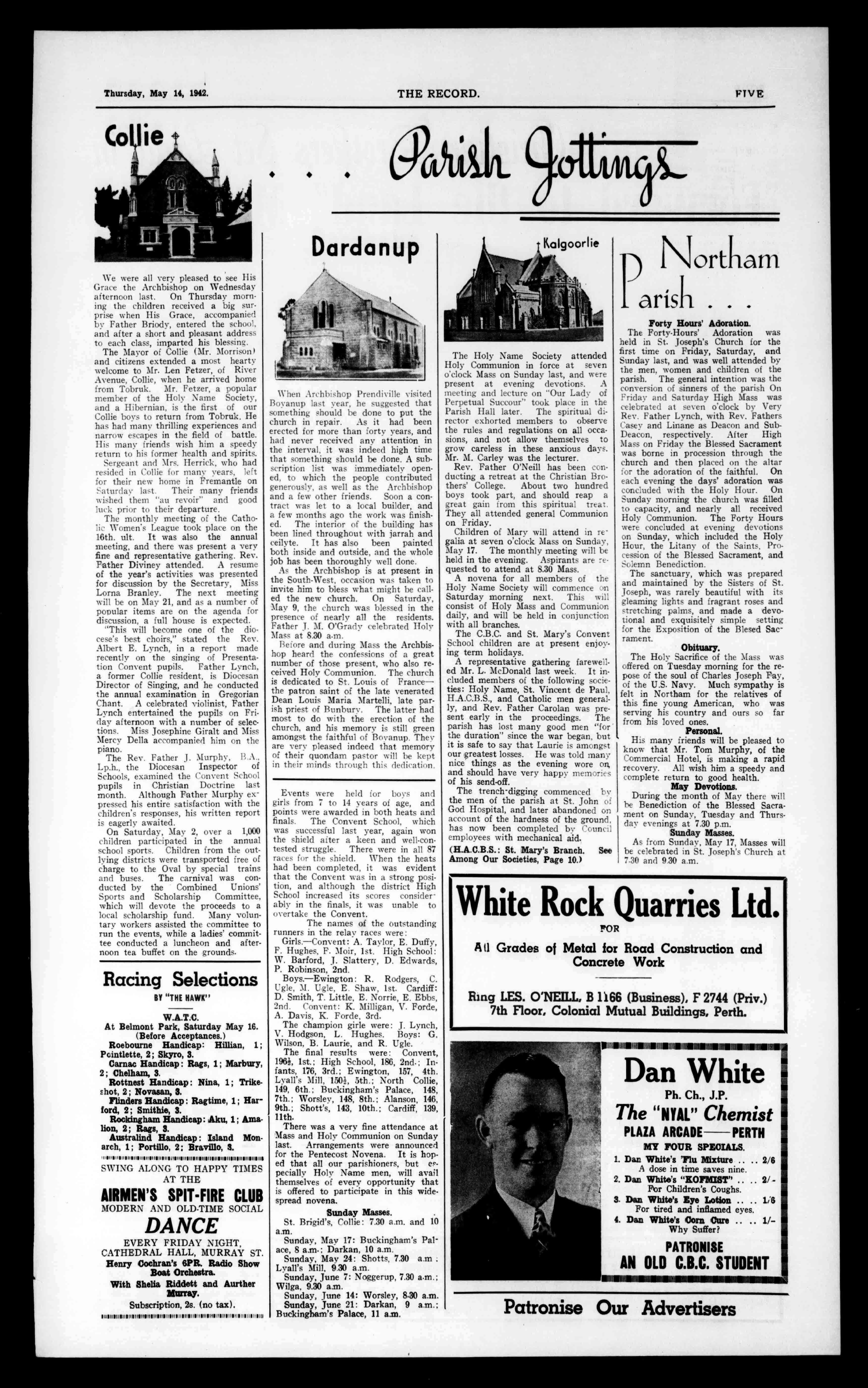
WhenArchbishopPrendivillevisited Boyanuplastyear,hesuggestedthat somethingshouldbedonetoputthe churchinrepair.Asithadbeen erectedformorethanfortyyears,and hadneverreceivedanyattentionin theinterval,itwasindeedhightime thatsomethingshouldbedone.Asubscriptionlistwasimmediatelyopened,towhichthepeoplecontributed generously,aswellastheArchbishop andafewotherfriends.Soonacontractwaslettoalocalbuilder,and afewmonthsagotheworkwasfinished.Theinteriorofthebuildinghas beenlinedthroughoutwithjarrahand ceilyte.Ithasalsobeenpainted bothinsideandoutside,andthewhole jobhasbeenthoroughlywelldone.
AstheArchbishopisatpresentin theSouth-West,occasionwastakento invitehimtoblesswhatmightbecalledthenewchurch.OnSaturday, May9,thechurchwasblessedinthe presenceofnearlyalltheresidents.
FatherJ.M.O'GradycelebratedHoly Massat8.30a.m.
BeforeandduringMasstheArchbishopheardtheconfessionsofagreat numberofthosepresent,whoalsoreceivedHolyCommunion.Thechurch isdedicatedtoSt.LouisofFrancethepatronsaintofthelatevenerated DeanLouisMariaMartelli,lateparishpriestofBanbury.Thelatterhad mosttodowiththeerectionofthe church,andhismemoryisstillgreen amongstthefaithfulofBoyanup.They areverypleasedindeedthatmemory oftheirquondampastorwillhekept intheirmindsthroughthisdedication.
Eventswereheldforboysand girlsfrom7to14yearsofage,and pointswereawardedinbothheatsand finals.TheConventSchool,which wassuccessfullastyear,againwon theshieldafterakeenandwell-contestedstruggle.Therewereinall87 racesfortheshield.Whentheheats hadbeencompleted,itwasevident thattheConventwasinastrongposition,andalthoughthedistrictHigh Schoolincreaseditsscoresconsiderablyinthefinals,itwasunableto overtaketheConvent.
Thenamesoftheoutstanding runnersintherelayraceswere:
Girls.-Convent:.A.Taylor,E.Duffy, F.Hughes.F.Moir,1st.HighSchool: W.Barford,J.Slattery,D.Edwards, P.Robinson,2nd. Boys.-Ewington:R.Rodgers,C. Ugle,M.Ugle,E.Shaw,1st.Cardiff: D.Smith,T.Little,E.Norrie,E.Ebbs, 2nd.Convent:K.Milligan,V.Forde, A.Davis,K.Forde,3rd.
Thechampiongirlewere:J.Lynch, V.Hodgson,L.Hughes.Boys:G. Wilson,B.Laurie,andR.Ugle.
Thefinalresultswere:Convent, 196i,1st.;HighSchool,186,2nd.:Infants,176,3rd.:Ewington,157,4th. Lyall'sMill,150i,5th.:NorthCollie, 149,6th.;Buckingham'sPalace,148, 7th.:Worsley,148,8th.;Alanson,146, 9th.;Shott's,143,10th.;Cardiff,139, 11th. Therewasaveryfineattendanceat MassandHolyCommuniononSunday last.Arrangementswereannounced forthePentecostNovena.Itishopedthatallourparishioners,butespeciallyHolyNamemen,willavail themselvesofeveryopportunitythat isofferedtoparticipateinthiswidespreadnovena.
Sundaybiasses.
St.Brigid's,Collie:7.30a.m.and10 am.
Sunday,May17:Buckingham'sPalace,8am.:Darken,10a.m.
Sunday,May24:Shotts,7.30a.m Lyall'sMill,9.30a.m.
Sunday,June7:Noggerup,7.30a.m.; Wilga,9.30a.m.
Sunday,June14:Worsley,8.30a.m.
Sunday,June21:Darkan,9a.m.: Buckingham'sPalace,11a.m.
TheHolyNagleSocietyattended HolyCommunioninforceatseven o'clockMassonSundaylast,andwere presentateveningdevotions.A meetingandlectureon"OurLadyof PerpetualSuccour"tookplaceinthe ParishHalllater.Thespiritualdirectorexhortedmemberstoobserve therulesandregulationsonalloccasions,andnotallowthemselvesto growcarelessintheseanxiousdays. Mr.M.Carleywasthelecturer. Rev.FatherO'NeillhasbeenconductingaretreatattheChristianBrothers'College.Abouttwohundred boystookpart,andshouldreapa greatgainfromthisspiritualtreat. TheyallattendedgeneralCommunion onFriday. ChildrenofMarywillattendinregaliaatseveno'clockMassonSunday, May17.Themonthlymeetingwillbe heldintheevening.Aspirantsarerequestedtoattendat8.30Mass.
Anovenaforallmembersofthe HolyNameSocietywillcommenceon Saturdaymorningnext.Thiswill consistofHolyMassandCommunion daily,andwillbeheldinconjunction withallbranches.
TheC.B.C.andSt.Mary'sConvent Schoolchildrenareatpresentenjoyingtermholidays. ArepresentativegatheringfarewelledMr.L.McDonaldlastweek.Itincludedmembersofthefollowingsocieties:HolyName,St.VincentdePaul, H.A.C.B.S.,andCatholicmengenerally,andRev.FatherCarolanwaspresentearlyintheproceedings.The parishhaslostmanygoodmen"for" theduration"sincethewarbegan,but itissafetosaythatLaurieisamongst ourgreatestlosses.Hewastoldmany nicethingsastheeveningworeon, andshouldhaveveryhappymemories ofhissend-off. Thetrench-diggingcommencedby themenoftheparishatSt.Johnof GodHospital,andlaterabandonedon accountofthehardnessoftheground, hasnowbeencompletedbyCouncil employeeswithmechanicalaid. (H.A.C.B.S.:St.Mary'sBranch.See AmongOurSocieties,Page10.)
FortyHours'Adoration. TheForty-Hours'Adorationwas heldinSt.Joseph'sChurchforthe firsttimeonFriday,Saturday,and Sundaylast,andwaswellattendedby themen,womenandchildrenofthe parish.Thegeneralintentionwasthe conversionofsinnersoftheparishOn FridayandSaturdayHighMasswas celebratedatseveno'clockbyVery Rev.FatherLynch,withRev.Fathers CaseyandLinaneasDeaconandSubDeacon,respectively.AfterHigh MassonFridaytheBlessedSacrament wasborneinprocessionthroughthe churchandthenplacedonthealtar fortheadorationofthefaithful.On eacheveningthedays'adorationwas concludedwiththeHolyHour.On Sundaymorningthechurchwasfilled tocapacity,andnearlyallreceived HolyCommunion.TheFortyHours wereconcludedateveningdevotions onSunday,whichincludedtheHoly Hour,theLitanyoftheSaints,ProcessionoftheBlessedSacrament,and SolemnBenediction. Thesanctuary,whichwasprepared andmaintainedbytheSistersofSt. Joseph,wasrarelybeautifulwithits gleaminglightsandfragrantrosesand stretchingpalms,andmadeadevotionalandexquisitelysimplesetting fortheExpositionoftheBlesedSacrament.
Obituary.
TheHolySacrificeoftheMasswas offeredonTuesdaymorningforthereposeofthesoulofCharlesJosephFay, oftheU.S.Navy.Muchsympathyis feltinNorthamfortherelativesof thisfineyoungAmerican,whowas servinghiscountryandourssofar fromhislovedones.
Personal.
Hismanyfriendswillbepleasedto knowthatMr.TomMurphy,ofthe CommercialHotel,ismakingarapid recovery.Allwishhimaspeedyand completereturntogoodhealth.
MayDevotions.
DuringthemonthofMaytherewill beBenedictionoftheBlessedSacramentonSunday,TuesdayandThursdayeveningsat7.30p.m. SundayMasses.
AsfromSunday,May17,Masseswill becelebratedinSt.Joseph'sChurchat 7.30and9.30a.m.
"TheBrothers'chief concernistomakethe Christian
theyfrequentlysentthemtobetrainedbytheChristianBrothers,andthey wererarelydisappointed.
Inconclusion,HisLordshiptoldthe boysthattheirsuccessinlifewould largelydependontheirownefforts, thattheyweresurroundedwithallurementsenticingthemtofollowtheline ofleastresistanceandtoaimafter falsepleasureswhich,whentriedout, werealwaysfoundtobedisappointing andunreal,andthattheonlyroadto truehappinessandsuccessinlifelay indoingone'sduty,evenintheface ofmanydifficulties.
Thefollowingisthereport,submittedtoMostRev.Dr.Gummer,Bishop ofGeraldton,bythePrincipalofthe TardunAgriculturalSchool,Rev.BrotherE.H.Sandys:-
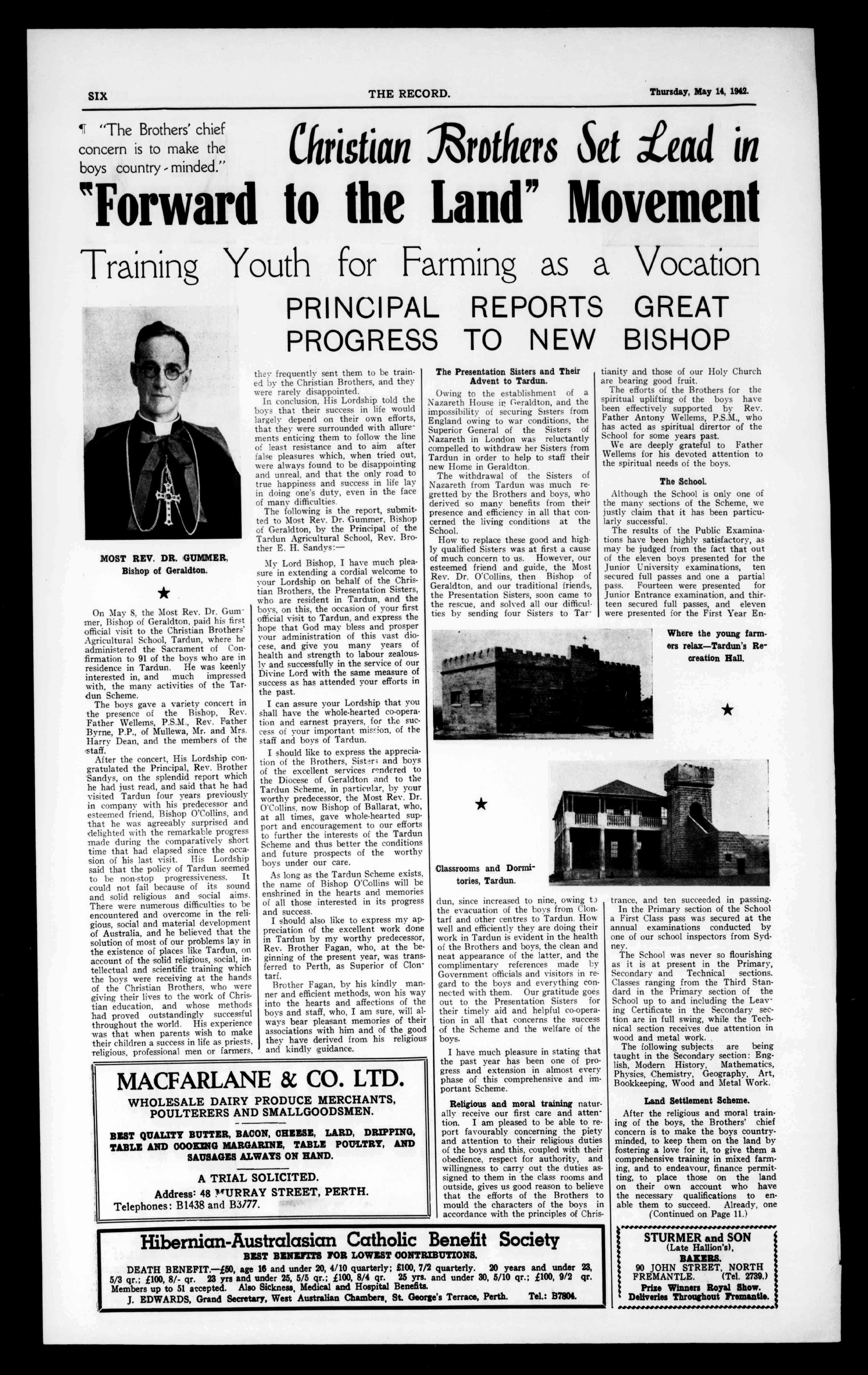
MOSTREV.DR.GUNNER. BishopofGeraldton.OnMay8,theMostRev.Dr.Gummer,BishopofGeraldton,paidhisfirst officialvisittotheChristianBrothers' AgriculturalSchool,Tardun,wherehe administeredtheSacramentofConfirmationto91oftheboyswhoarein residenceinTardun.Hewaskeenly interestedin,andmuchimpressed with,themanyactivitiesoftheTardunScheme. Theboysgaveavarietyconcertin thepresenceoftheBishop,Rev. FatherWellems,P.S.M.,Rev.Father Byrne,P.P.,ofMullewa,Mr.andMrs. HarryDean,andthemembersofthe 'staff. Aftertheconcert,HisLordshipcongratulatedthePrincipal,Rev.Brother Sandys,onthesplendidreportwhich hehadjustread,andsaidthathehad visitedTardunfouryearspreviously incompanywithhispredecessorand esteemedfriend,BishopO'Collins,and thathewasagreeablysurprisedand delightedwiththeremarkableprogress madeduringthecomparativelyshort timethathadelapsedsincetheoccasionofhislastvisit.HisLordship saidthatthepolicyofTardunseemed tobenon-stopprogressiveness.It couldnotfailbecauseofitssound andsolidreligiousandsocialaims. Therewerenumerousdifficultiestobe encounteredandovercomeinthereligious,socialandmaterialdevelopment ofAustralia,andhebelievedthatthe solutionofmostofourproblemslayin theexistenceofplaceslikeTardun,on accountofthesolidreligious,social,intellectualandscientifictrainingwhich theboyswerereceivingatthehands oftheChristianBrothers,whowere givingtheirlivestotheworkofChristianeducation,andwhosemethods hadprovedoutstandinglysuccessful throughouttheworld.Hisexperience wasthatwhenparentswishtomake theirchildrenasuccessinlifeaspriests. religious,professionalmenorfarmers,
MyLordBishop,Ihavemuchpleasureinextendingacordialwelcometo yourLordshiponbehalfoftheChristianBrothers,thePresentationSisters, whoareresidentinTardun,andthe boys,onthis,theoccasionofyourfirst officialvisittoTardun,andexpressthe hopethatGodmayblessandprosper youradministrationofthisvastdiocese,andgiveyoumanyyearsof healthandstrengthtolabourzealouslyandsuccessfullyintheserviceofour DivineLordwiththesamemeasureof successashasattendedyoureffortsin thepast.
IcanassureyourLordshipthatyou shallhavethewhole-heartedco-operationandearnestprayers,forthesuccessofyourimportantmission,ofthe staffandboysofTardun.
IshouldliketoexpresstheappreciationoftheBrothers,Sist-m,andboys oftheexcellentservicesr'nderedto theDioceseofGeraldtonandtothe TardunScheme,inparticular,byyour worthypredecessor,theMostRev.Dr. O'Collins.nowBishopofBallarat,who, atalltimes,gavewhole-heartedsupportandencouragementtoourefforts tofurthertheinterestsoftheTardun Schemeandthusbettertheconditions andfutureprospectsoftheworthy boysunderourcare.
AslongastheTardunSchemeexists, thenameofBishopO'Collinswillbe enshrinedintheheartsandmemories ofallthoseinterestedinitsprogress andsuccess.
Ishouldalsoliketoexpressmyappreciationoftheexcellentworkdone inTardunbymyworthypredecessor, Rev.BrotherFagan,who,atthebeginningofthepresentyear,wastransferredtoPerth,asSuperiorofClontarf. BrotherFagan,byhiskindlymannerandefficientmethods,wonhisway intotheheartsandaffectionsofthe boysandstaff,who,Iamsure,willalwaysbearpleasantmemoriesoftheir associationswithhimandofthegood theyhavederivedfromhisreligious andkindlyguidance.
WHOLESALEDAIRYPRODUCEMERCHANTS, POULTERERSANDSMALLGOODSMEN.
BESTQUALITYBUTTER,BACON,CHEESE,LARD,DRIPPING, TABLEANDGOOSENGMARGARINE,TABLEPOULTRY,AND SAUSAGESALWAYSONHAND.
ATRIALSOLICITED.
Address:48URRAYSTREET,PERTH.
Telephones:B1438andB3177.
ThePresentationSistersandTheir AdventtoTardun.
Owingtotheestablishmentofa NazarethHouseinGeraldton,andthe impossibilityofsecuringSistersfrom Englandowingtowarconditions,the SuperiorGeneraloftheSistersof NazarethinLondonwasreluctantly compelledtowithdrawherSistersfrom Tarduninordertohelptostafftheir newHomeinGeraldton.
ThewithdrawaloftheSistersof NazarethfromTardunwasmuchregrettedbytheBrothersandboys,who derivedsomanybenefitsfromtheir presenceandefficiencyinallthatconcernedthelivingconditionsatthe School.
HowtoreplacethesegoodandhighlyqualifiedSisterswasatfirstacause ofmuchconcerntous.However,our esteemedfriendandguide,theMost Rev.Dr.O'Collins,thenBishopof Geraldton,andourtraditionalfriends, thePresentationSisters,sooncameto therescue,andsolvedallourdifficultiesbysendingfourSisterstoTar-
tianityandthoseofourHolyChurch arebearinggoodfruit,
TheeffortsoftheBrothersforthe spiritualupliftingoftheboyshave beeneffectivelysupportedbyRev. FatherAntonyWellems,P.S.M.,who hasactedasspiritualdirectorofthe Schoolforsomeyearspast.
WearedeeplygratefultoFather Wellemsforhisdevotedattentionto thespiritualneedsoftheboys.
TheSchool.
AlthoughtheSchoolisonlyoneof themanysectionsoftheScheme,we justlyclaimthatithasbeenparticularlysuccessful.
TheresultsofthePublicExaminationshavebeenhighlysatisfactory,as maybejudgedfromthefactthatout oftheelevenboyspresentedforthe JuniorUniversityexaminations,ten securedfullpassesandoneapartial pass.Fourteenwerepresentedfor JuniorEntranceexamination,andthirteensecuredfullpasses,andeleven werepresentedfortheFirstYearEnWheretheyoungfarmersrelax-Tardun'sRecreationHall.
ClassroomsandDormitories,Tardun.
dun,sinceincreasedtonine,owingt.) theevacuationoftheboysfromClontarfandothercentrestoTardun.How wellandefficientlytheyaredoingtheir workinTardunisevidentinthehealth oftheBrothersandboys,thecleanand neatappearanceofthelatter,andthe complimentaryreferencesmadeby Governmentofficialsandvisitorsinregardtotheboysandeverythingconnectedwiththem,Ourgratitudegoes outtothePresentationSistersfor theirtimelyaidandhelpfulco-operationinallthatconcernsthesuccess oftheSchemeandthewelfareofthe boys.
Ihavemuchpleasureinstatingthat thepastyearhasbeenoneofprogressandextensioninalmostevery phaseofthiscomprehensiveandimportantScheme.
Religiousandmoraltrainingnaturallyreceiveourfirstcareandattention.Iampleasedtobeabletoreportfavourablyconcerningthepiety andattentiontotheirreligiousduties oftheboysandthis,coupledwiththeir obedience,respectforauthority,and willingnesstocarryoutthedutiesassignedtothemintheclassroomsand outside,givesusgoodreasontobelieve thattheeffortsoftheBrothersto mouldthecharactersoftheboysin accordancewiththeprinciplesofChris-
trance,andtensucceededinpassing.
InthePrimarysectionoftheSchool aFirstClasspasswassecuredatthe annualexaminationsconductedby oneofourschoolinspectorsfromSydney. TheSchoolwasneversoflourishing asitisatpresentinthePrimary, SecondaryandTechnicalsections.
ClassesrangingfromtheThirdStandardinthePrimarysectionofthe SchooluptoandincludingtheLeavingCertificateintheSecondarysectionareinfullswing,whiletheTechnicalsectionreceivesdueattentionin woodandmetalwork.
Thefollowingsubjectsarebeing taughtintheSecondarysection:English,ModernHistory,Mathematics, Physics,Chemistry,Geography,Art, Bookkeeping,WoodandMetalWork.
LandSettlementScheme.
Afterthereligiousandmoraltrainingoftheboys,theBrothers'chief concernistomaketheboyscountryminded,tokeepthemonthelandby fosteringaloveforit,togivethema comprehensivetraininginmixedfarming,andtoendeavour,financepermitting,toplacethoseontheland ontheirownaccountwhohave thenecessaryqualificationstoenablethemtosucceed.Already,one
(ContinuedonPage11.1
STURMERandS077.. (LateHallion's), BAKERS.
90JOHNSTREET,NORTH FREMANTLE. (Tel.2739.)
PriseWinnersRoyalShow. DeliveriesThroughoutFremantle.
1942.
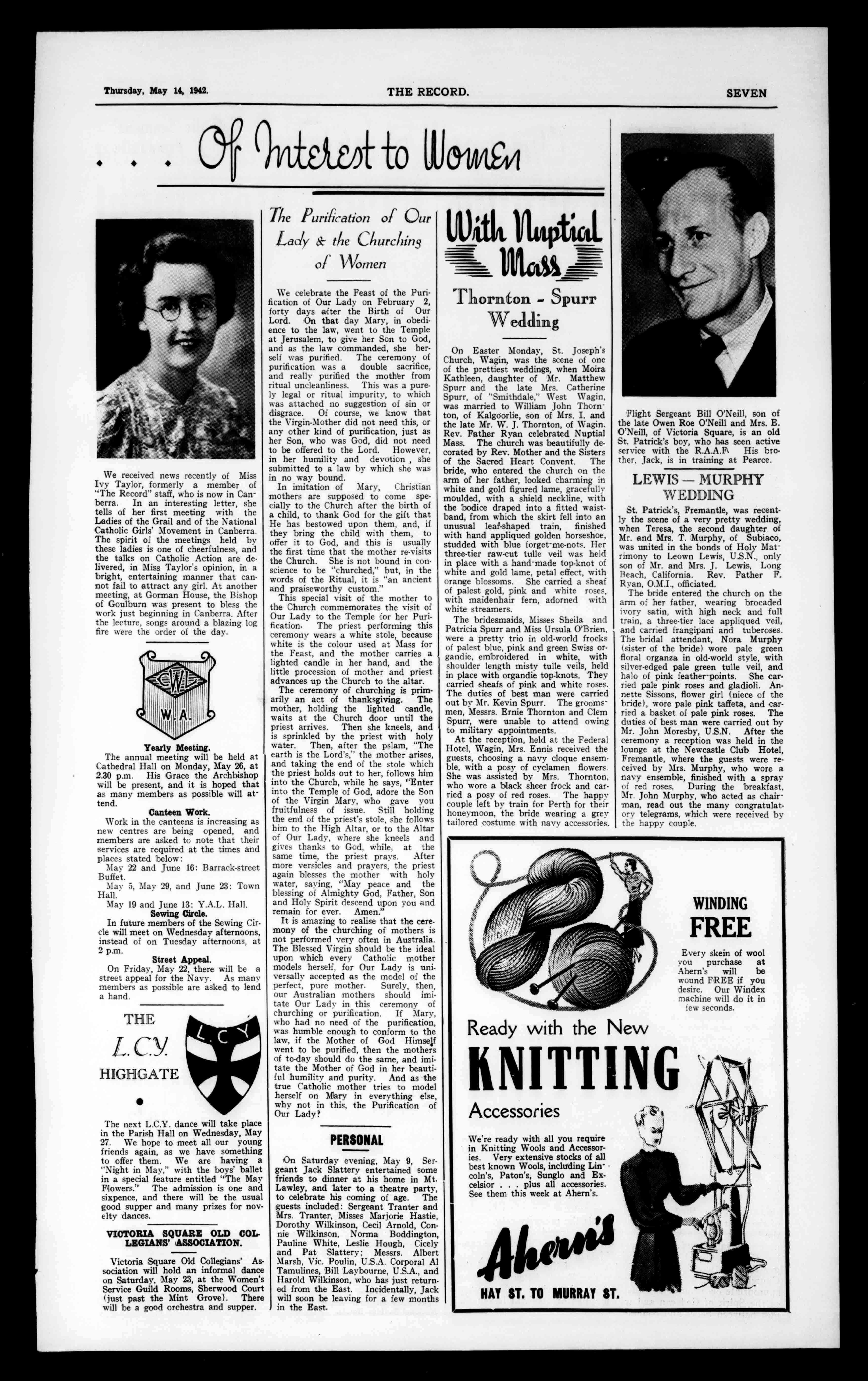
WereceivednewsrecentlyofMiss IvyTaylor,formerlyamemberof "TheRecord"staff,whoisnowinCanberra.Inaninterestingletter,she tellsofherfirstmeetingwiththe LadiesoftheGrailandoftheNational CatholicGirls'MovementinCanberra.
Thespiritofthemeetingsheldby theseladiesisoneofcheerfulness,and thetalksonCatholicActionaredelivered,inMissTaylor'sopinion,ina bright,entertainingmannerthatcannotfailtoattractanygirl.Atanother meeting,atGormanHouse,theBishop ofGoulburnwaspresenttoblessthe workjustbeginninginCanberra.After thelecture,songsaroundablazinglog fireweretheorderoftheday.
YearlyMeeting.
Theannualmeetingwillbeheldat CathedralHallonMonday,May26,at 2.30p.m.HisGracetheArchbishop willbepresent,anditishopedthat asmanymembersaspossiblewillattend.
CanteenWork.
Workinthecanteensisincreasingas newcentresarebeingopened,and membersareaskedtonotethattheir servicesarerequiredatthetimesand placesstatedbelow:
May22andJune16:Barrack-street Buffet.
May5,May29,andJune23:Town Hall.
May19andJune13:Y.A.L.Hall.
SewingCircle.
InfuturemembersoftheSewingCirclewillmeetonWednesdayafternoons, insteadofonTuesdayafternoons,at 2p.m. StreetAppeal.
OnFriday,May22,therewillbea streetappealfortheNavy.Asmany membersaspossibleareaskedtolend ahand.
ThenextL.C.Y.dancewilltakeplace intheParishHallonWednesday,May 27.Wehopetomeetallouryoung friendsagain,aswehavesomething toofferthem.Wearehavinga "NightinMay,"withtheboys'ballet inaspecialfeatureentitled"TheMay Flowers."Theadmissionisoneand sixpence,andtherewillbetheusual goodsupperandmanyprizesfornoveltydances.
VICTORIASQUAREOLDCOLLEGIANS'ASSOCIATION.
VictoriaSquareOldCollegians'Associationwillholdaninformaldance onSaturday,May23,attheWomen's ServiceGuildRooms,SherwoodCourt justpasttheMintGrove).There sillbeagoodorchestraandsupper.
WecelebratetheFeastofthePurificationofOurLadyonFebruary2, fortydaysaftertheBirthofOur Lord.OnthatdayMary,inobediencetothelaw,wenttotheTemple atJerusalem,togiveherSontoGod, andasthelawcommanded,sheherselfwaspurified.Theceremonyof purificationwasadoublesacrifice, andreallypurifiedthemotherfrom ritualuncleanliness.Thiswasapurelylegalorritualimpurity,towhich wasattachednosuggestionofsinor disgrace.Ofcourse,weknowthat theVirgin-Motherdidnotneedthis,or anyotherkindofpurification,justas herSon,whowasGod,didnotneed tobeofferedtotheLord.However, inherhumilityanddevotionshe submittedtoalawbywhichshewas innowaybound.
InimitationofMary,Christian mothersaresupposedtocomespeciallytotheChurchafterthebirthof achild,tothankGodforthegiftthat Hehasbestoweduponthem,and,if theybringthechildwiththem,to offerittoGod,andthisisusually thefirsttimethatthemotherre-visits theChurch.Sheisnotboundinconsciencetobe"churched,"but,inthe wordsoftheRitual,itis"anancient andpraiseworthycustom."
Thisspecialvisitofthemotherto theChurchcommemoratesthevisitof OurLadytotheTempleforherPurification-Thepriestperformingthis ceremonywearsawhitestole,because whiteisthecolourusedatMassfor theFeast,andthemothercarriesa lightedcandleinherhand,andthe littleprocessionofmotherandpriest advancesuptheChurchtothealtar.
Theceremonyofchurchingisprimarilyanactofthanksgiving.The mother,holdingthelightedcandle, waitsattheChurchdooruntilthe priestarrives.Thenshekneels,and issprinkledbythepriestwithholy water.Then,afterthepslam,"The earthistheLord's,"themotherarises, andtakingtheendofthestolewhich thepriestholdsouttoher,followshim intotheChurch,whilehesays,"Enter intotheTempleofGod,adoretheSon oftheVirginMary,whogaveyou fruitfulnessofissue.Stillholding theendofthepriest'sstole,shefollows himtotheHighAltar,ortotheAltar ofOurLady,whereshekneelsand givesthankstoGod,while,atthe sametime,thepriestprays.After moreversiclesandprayers,thepriest againblessesthemotherwithholy water,saying,"Maypeaceandthe blessingofAlmightyGod,Father,Son andHolySpiritdescenduponyouand remainforever.Amen."
Itisamazingtorealisethattheceremonyofthechurchingofmothersis notperformedveryofteninAustralia. TheBlessedVirginshouldbetheideal uponwhicheveryCatholicmother modelsherself,forOurLadyisuniversallyacceptedasthemodelofthe perfect,puremother.Surely,then, ourAustralianmothersshouldimitateOurLadyinthisceremonyof churchingorpurification.IfMary, whohadnoneedofthepurification, washumbleenoughtoconformtothe law,iftheMotherofGodHimself wenttobepurified,thenthemothers ofto-dayshoulddothesame,andimitatetheMotherofGodinherbeautifulhumilityandpurity.Andasthe trueCatholicmothertriestomodel herselfonMaryineverythingelse, whynotinthis,thePurificationof OurLady?
OnSaturdayevening,May9,SergeantJackSlatteryentertainedsome friendstodinnerathishomeinMt. Lawley,andlatertoatheatreparty, tocelebratehiscomingofage.The guestsincluded:SergeantTranterand Mrs.Tranter,MissesMarjorieHastie, DorothyWilkinson,CecilArnold,ConnieWilkinson,NormaBoddington, PaulineWhite,LeslieHough,Cicely andPatSlattery:Messrs.Albert Marsh,Vic.Poulin,U.S.A.CorporalAl Tamulines,BillLaybourne,U.S.A.,and HaroldWilkinson,whohasjustreturnedfromtheEast.Incidentally,Jack willsoonbeleavingforafewmonths intheEast.
OnEasterMonday,St.Joseph's Church,Wagin,wasthesceneofone oftheprettiestweddings,whenMoira Kathleen,daughterofMr.Matthew SpurrandthelateMrs.Catherine Spurr,of"Smithdale,"WestWagin, wasmarriedtoWilliamJohnThornton,ofKalgoorlie,sonofMrs.I.and thelateMr.W.J.Thornton,ofWagin. Rev.FatherRyancelebratedNuptial Mass.ThechurchwasbeautifullydecoratedbyRev.MotherandtheSisters oftheSacredHeartConvent.The bride,whoenteredthechurchonthe armofherfather,lookedcharmingin whiteandgoldfiguredlame,gracefully moulded,withashieldneckline,with thebodicedrapedintoafittedwaistband,fromwhichtheskirtfellintoan unusualleaf-shapedtrain,finished withhandappliquedgoldenhorseshoe, studdedwithblueforget-me-nots.Her three-tierraw-cuttulleveilwasheld inplacewithahand-madetop-knotof whiteandgoldlame,petaleffect,with orangeblossoms.Shecarriedasheaf ofpalestgold,pinkandwhiteroses, withmaidenhairfern,adornedwith whitestreamers.
Thebridesmaids,MissesSheilaand PatriciaSpurrandMissUrsulaO'Brien, wereaprettytrioinold-worldfrocks ofpalestblue,pinkandgreenSwissorgandie,embroideredinwhite,with shoulderlengthmistytulleveils,held inplacewithorgandietop-knots.They carriedsheafsofpinkandwhiteroses. Thedutiesofbestmanwerecarried outbyMr.KevinSpurr.Thegrooms men,-Messrs.ErnieThorntonandClem Spurr,wereunabletoattendowing tomilitaryappointments.
Atthereception,heldattheFederal Hotel,Wagin,Mrs.Ennisreceivedthe guests,choosinganavyclaqueensemble,withaposyofcyclamenflowers. ShewasassistedbyMrs.Thornton, whoworeablacksheerfrockandcarriedaposyofredroses.Thehappy coupleleftbytrainforPerthfortheir honeymoon,thebridewearingagrey tailoredcostumewithnavyaccessories.
FlightSergeantBillO'Neill,sonof thelateOwenRoeO'NeillandMrs.E. O'Neill,ofVictoriaSquare,isanold St.Patrick'sboy,whohasseenactive servicewiththeR.A.A.F.Hisbrother.Jack,isintrainingatPearce.
St.Patrick's,Fremantle,wasrecentlythesceneofaveryprettywedding, whenTeresa,theseconddaughterof Mr.andMrs.T.Murphy,ofSubiaco, wasunitedinthebondsofHolyMatrimonytoLeownLewis,U.S.N.,only sonofMr.andMrs.J.Lewis,Long Beach,California.Rev.FatherF. Ryan,O.M.I.,officiated. Thebrideenteredthechurchonthe armofherfather,wearingbrocaded ivorysatin,withhighneckandfull train,athree-tierlaceappliquedveil, andcarriedfrangipaniandtuberoses. Thebridalattendant,NoraMurphy (sisterofthebride)worepalegreen floralorganzainold-worldstyle,with silver-edgedpalegreentulleveil,and haloofpinkfeather-points.Shecarriedpalepinkrosesandgladioli.AnnetteSissons,flowergirl(nieceofthe bride),worepalepinktaffeta,andcarriedabasketofpalepinkroses.The dutiesofbestmanwerecarriedoutby Mr.JohnMoresby,U.S.N.Afterthe ceremonyareceptionwasheldinthe loungeattheNewcastleClubHotel, Fremantle,wheretheguestswerereceivedbyMrs.Murphy,whoworea navyensemble,finishedwithaspray ofredroses.Duringthebreakfast, Mr.JohnMurphy,whoactedaschairman,readoutthemanycongratulatorytelegrams,whichwerereceivedby thehappycouple.
ThenewModeratorofthe,GeneralAssemblyofthePresbyterianChurchinW.A.,inanaddressduringtheweek,characterisedas"knock-kneed"thatpietywhichgrowsecstaticinsinging hymnsonSunday.andxvhichconvenientlygrowsblindtoinjusticesandinhumanitiesfromMondaytoSaturday.Hefeared thatwithmany.religiononlyexpresseditselfinaroundofpious observanceswithnovitalrelationshiptotheevery-daylifeof thecommunityornation.Ourproblemcouldbesolvedifthe teachingsofJesusChristwereincorporatedandpractisedinour social.industrial,commercialandeconomicsystems.Withthese viewsCatholicswillfindthemselvesinsubstantialagreement.The `Inock-kneed"pietyiswhatSt.ThomasAquinashasdescribedas thelackof"substantialdevotion."andthewidegapthatsofrequentlyyawnsbetweenbeliefandconductisafailuretointegrate theChristianlifeoftheindividual,arisingmoreperhapsoutofthe taintoforiginalsinthanfromdirectmalice.
TheproblemoftheChristianwhosays,"Lord,Lord,"andyet doesnottheWilloftheFather,isanever-presentonetoevery Christiansect.ButinthisconnectionthefailureofCatholics, howeverregrettable.is,wefancy,morereadilyexplainedthan thedelinquenciesofothers.Everythinglayingclaimtothetitle of"Christian,'outsideofCatholicism.isasimplificationofthereal religionrevealedbyChrist.Thisappliesequallytodoctrinalcontent(whichbyomissionandman-madeemendations,tendseverto suitthemerelynaturalendeavoursofmen),andtomoralconduct,wherethelogicalimplicationsofChristian are neverpressedveryfarorveryhard.Thisprocessofsimplificationmanifestsitselfinmanysectsasaformofmono-mania.For ournon-Conformistbrethren,forexample,theChristianplanof thingsseemstorevolveexclusivelyaboutthevirtueoftemperance(thoughevenhereitstopsshortofsuchvitalissuesasbirthprevention).Iftemperanceisthemainthing.orindeedtheonly thing,fidelityandevenperfectionshouldbegreatlysimplified. Thefewerthingstherearetowatchshouldgiveguaranteethat theywillbewatchedthemorecarefully.
*
TheCatholicdoesnotagreethattheChristianlifecanbereducedtosuchsimpleterms.Preciselybecausehisreligionis"catholic,"itmustembracenotmerelyamultitudeofthings,butall things.Yetthereisnoconfusionbecauseallthesethingsare focussedinChrist.andclearlyrelatedandappliedbytheChurch. Ontheotherhand,itisobviousthatitwillbeeasierforhimto failinsomethings,andpreciselybecausesomuchbindshim,he willthemorereadilybecomethebuttofcommentandofcriticism. Again,theCatholic,whilehestrivestoachievetheChristiansynthesis,thefulfilmentofwhichissofarabovethepowersofhuman nature.isawarethathedoesnotstrivealone."TheFather ,vorksandIworkevenuntilnow."Inaword,fidelitytotiecompleteChristianplanofthingsispossibleonlywhenthehonest andperseveringeffortsofthehumanwillarereinforcedbythe GraceofGod.Anditistheneglectofthisdoctrinewhichleads tothedisharmonybetweenthebeliefsandpracticesofsomeCatholics,farmorethanadeliberateturningofthehackuponGod. ThisisbestillustratedbythestartlingphenomenonthataCatholicdoesnotceasebelievingbecausehehasceasedbehaving. SinnersgotoMass. *
Therootsoftheproblemamongourpeoplearetohefound primarilyintheneglectofprayerandoftheSacramentallife.The eff,ctsofOriginalSinaremosttragicallyevidentinsloth,which arisesfromlackofvividFaith.Itistruealsothatthespiritof worldliness(apartfromactualsin)sapsthespiritofChristinCatholicsouls.Butitisalsotruethattheworldcouldberesisted inthesamewayasthedevil,bytheapplicationofthestrengthof Chr:st'sPassion,whichistobehadforthetakingintheMassand theSacraments.Thereis,ofcourse,theproblemofhabitual sin,whichclosestheCatholicoffasanoutcastfromthewholelife oftheChurch.Butthis,pleaseGod,istheminoritycase.None theless,inthesedaysofcrisiswhentheworldsodesperately needsthesanityandtheholinessoftheCatholicChurch,thecarelessCatholicshouldstrivetoexerthimselfandtoremovethedangerthattheworldwillidentifyhiswayoflifewiththatofthe Churchasawhole.IntheapproachingFeastofPentecostisan appropriateoccasionofspiritualregenerationwhereinthepowers oftheSpiritofGodcanandwillformenofgoodwilllessenthe gulfbetweenbeliefandconduct.
May22-9.30a.m.:PresideatSolemn OfficeandcelebratePontificalRequiemMassontheoccasiorofthe seventhanniversaryofthelateArchbishopClune.
May24(PentecostSunday).-11ain.: PontificateinSt.Mary'sCathedral. 3p.m.:AdministertheSacrarhtntof Confirmationtoadults.
May25.-3p.m.:AttendAr.-.uilGeneralMeetingoftheCatho,cWomen'sLeague.
May29.-10a.m.:PresidertQuarterlyConferenceofthePriestsofthe MetropolitanArea.
May31:CanonicalVisitationandConfirmationatSt.Jerome'sChurch, Spearwood.
May31.-3p.m.:AttendW.A.CatholicLawnTennisAssociation'sAnnualPresentationofTrophies,at St.Joachim'sClub,VictoriaPark.
June14.-3.30p.m.:AttendAnnual EucharisticProcessionatSacred HeartChurch,HighgateHill.
June21.-9.30a.m.:CanonicalVisitationandConfirmation,atChurchof theHolyRosary,Nedlands.
QUARTERLYCONFERENCE.
TheQuarterlyConferenceforPriests oftheMetropolitanAreawillbeheld attheChapterHall,VictoriaSquare, onMay29,at10a.m.
CONFIRMATIONOFADULTS.
HisGracetheArchbishopwilladministertheSacramentofConfirma tiontoadultsinSt.Mary'sCathedral onPentecostSunday,May24,at3 p.m.IntendingcandidatesarerequestedtonotifytheAdministrator, VeryRev.E.Kennedy,D.D.,notlater thanFriday,May22.
Ontheoccasionoftheseventhanniversaryofthedeathofthelate ArchbishopClime,HisGrace,Dr.Prendiville,willpresideatSolemnOffice andwillafterwardscelebratePontificalRequiemMassonFriday,May22, inSt.Mary'sCathedral.Thefunctionwillcommenceat9.30a.m. RequiescatinPace.
DEATH. -
RILEY.-OnSaturday,April9,1942, WilliamMichael,accidentallykilled atMaylands,lovinggrandsonofMr. andMrs.W.Riley;aged7years. DeeplyMourned.
INMEMORIAM.
GEE.-InlovingmemoryofAnnie Gee,whopassedawayonMay13, 1941,dearlylovedmotherofWill, Alf,andConnie. Eternalrestgranttoher,0Lord.
HANRAHAN.-Inlovingmemoryof ourdearwifeandmother,whopassedawayMay13,1941. Awonderfulmotherlaidtorest; Forallofusshedidherbest. Alwaysunselfish,thoughtfulandkind, Whatabeautifulmemorytoleave behind.
-Insertedbyherlovinghusband, daughter,Mary,sons,TomandBill 1R.A.A.F.,Mallala,SouthAustralia).
OnService.
McCORMACK (BrianEdwardJoseph).-AtokenofloveandremembranceofBrian,onlybelovedchild ofEdwardJohnandMaryIsobel McCormack,accidentallykilledin PalestineonMay17,1941. -Insertedbyhisparents.
RYAN.-Inlovingmemoryofmydear husband,JohnThomas,whopassed awayonMay20,1938. MostSacredHeartofJesus,have mercyonhissoul. -Insertedbyhislovingwifeand family.
Rev.FatherBreslin,0.M.I.,Port ('haplain,hasnowsucceededinsetting upaDepotatFremantlefortheuse ofCatholicseamen.Thefurnishing is,however,causingsomeconcern,and assistanceisbeingsoughtfortheacquisitionofthefollowingarticles: Billiardcues, Completekitchenequipment, Atypewriter, Ping-pongtables, Abilliardtablepossiblyonloan), Agascooker, Arefrigerator(alsoonloan).
TheDepotwillbeofficiallyopened byHisGracetheArchbishoponJune 7. TheceremonywillfollowMassat 9a.m.inSt.Patrick'sChurch,atwhich therewillbeageneralCommunionof theArmedServices.ACommunion breakfastwillbeservedafterwardsin theDepot.Whilethegeneralpublic arewelcometoattendthe9o'clock Mass.thebreakfastwillbeconfined tomeninuniformowingtolackof space. Noappealwhateverwillbemadeat theofficialopening.
rairaminnans
E.FORAMERICANSAILORSON'I LEAVE.
a
P: TheexecutiveoftheCatholicN. WelfareOrganisation,co-operatingwithRev.FatherBreslin,ti :=1 O.M.I.,PortChaplain,areanxious tosecuresuitableaccommodationE inCatholichomesforAmerican gsailorsontheironenightofleave.
Itisproposedtosecurealistof homeswhichwouldbewillingto offerthissmallmeasureofhospitality.AnyCatholicdesirousof helpinginthismatterisrequestedtosendnameandaddress toMr.P.R.Jackson, Hon.Secretary,C.W.O., St.Mary'sChurchOffice, VictoriaSquare,Perth. Thesailorswillbepersonally recommendedbyFatherBreslin.
F4.
O
Afoolishspenderisatraitor.The rightplaceforyourmoneyisinflO NationalSavingsBonds.
iIIINNXKmllllllllllr]IIIIIIIIIIIIp1I11111111IIt1111IIllllllir,iii111111161=
TheEpiscopalCommitteeonCatholicActionwishesthatSocialJustice Sundaybeobservedthroughoutthe AustraliandiocesesthisyearonSunday,May31.
Inconformitywiththesuggestionof theCommittee,SocialJusticeSunday willbeobservedintheArchdioceseon thatday,insteadofontheSundayimmediatelyprecedingLabourDay.
Afurtherstatementisbeingissued thisyear,entitled"ForFreedom,"and dealingwithmanyquestionsofreal publicinterestin1942. Ithasbeen feltnecessarytomakeaneffective protestagainstcertaintotalitariantendencieswhichareclearlyevidentinrecentlegislation.Itdoesnot,of course,questionthewisdomofsuch legislationinwar-time,orthedutyof citizenstoobeyloyally;butitdoes showthethreattoChristianfreedom impliedincertaindirections.
1he,liiw:nbrnar.castshavebeen arrangedthroughStation6WN:May24-4p.m.:St.Mary'sCathedral (Pentecost).
June7-11a.m.:St.Mary'sCathedralJune21-4p.m:St.Brigid'sChurch, WestPerth.
July5-11am.:St.Mary'sCathedral.
August2-11a.m.:St.Mary'sCathedral
August16-4p.m.:St.Patrick's,Fremantle.
September6-11a.m.:St.Mary'sCathedral.
September20-4p.m.:St.Bhigid's, WestPerth.
October4-11a.m.:St.Mary'sCathedral.
October18-11a.m.:St.Mary'sCathedral(MissionSunday).
OVERtheRedNetworkofthe NBC,MonsignorSheentold Americatheotherday:"The greatesttragedyofthepresenttimeis thatwehavenosaints."MillionslistenedthroughouttheStates,astheyalwaysdowhenhespeaks,andheardthe famousradio-prieston'Revolutionand Counter-Revolution.'Warninglyhis wordscametothemNowwhenweare inthepresenteraofrevolution,we havenocounterrevolution.
Atatimewhenrevolutionismostassertive,counter-revolutionismostobscured.Never,perhaps,wastherea comparablemomentinhistorywhen therewasmoreevilwithlesssaints.It isanhourofdarknesswithoutprecedent.Vetweknowthatsaintswill comeinGod'sgoodtime,andwhen theydotheywillrestoretheworldas theyhavedonesooftenbefore.But ifthereisoneprayerthatshouldbe onourlipsto-dayitisthatGodwill sendussaints.
AsMonsignorSheenremarked,we arelivingattheendofaneraofrevolutions.Communism,Nazism,and Fascismarebutthedyinggaspsofan oldorder:notsomuchrevolutionsin themselves,astheresultsofrevolutions -andnotonlyinthecountrieswhere theyareentrenched,butthroughout theworldaswell.Notthatrevolutionseversavedtheworld.Grounded onprotests,violent,theysucceed,perhaps,inemptyingthehouseofbadtenants.Whichisgood,butnegative.It isthe succeeds, preciselybecauseitavoidstyranny andchaos.Acounter-revolutionis basednotonprotestbutreform,and itsviolenceisdirectedagainstself ratherthanagainstone'sneighbours. Inrevolutionstheotherfellowisalwayswrong;incounterrevolutionswe arewrong,thereformstartswithourselves.Theviolenceofcounter-revolutionwarsagainsttheselfishnessand lustofone'sindividualself,which would,ifunleashed,makerevolutionistsofusall.Itisjustthisweapon thatallgreatreformersinthepast haveused-IgnatiusofLoyola,who benttheintellecttotheserviceof truth;CharlesBorromeo,whojoined theCardinalatewithsaintlinessand governedthelargestdioceseinthe world:PhillipNeri,whointheparish revivedaloveforthepoorandthe down-trodden;TeresaofAvila,whorestoredthecontemplativelifeaway fromtheglamoroftheworldandunder theshadowofthecrosswheresaints aremade;FrancisdeSales,thegentleman-saint,whoenteredthelion'sdenof Geneva,andconvertedwhereBossuet onlythrilled:andFrancisXavier,who taughtblackandyellowhandstolift upwhiteHoststotheTrinity.These werethecounter-revolutionists-the saints-whospentthemselvesinfreeingthoseaboutthemfromthepride oflifeandlustforpower.
LaterwhentheFrenchandIndustrialRevolutionsswepttheworld, goodmenandsaintscameforwardonce againtosaveanothergeneration. TherewasLeoXIIIwho,likeavoice cryinginthewilderness,proclaimed thatthereisnoequalbargainingpower whencapitalhasallandlabour nothing-hencetherighttoorganise. TherewasDonBosco,whowasthe epiphanyofthesocialworkergenerationsbeforemodernsocietyrecognised theirneed:aCureofArs,whowasthe epiphanyofsaintlinessintheparish Driest,provingtotheworldthatasoul canheaparishifwehavezeal:aThereseMartin.whowastheepiphanyof thechildofthebourgeoisiewhenMarx wasmarkingthemfordeath.andshe wasmarkingherselfforLife:anda flernadetteofLourdes,whowasthe
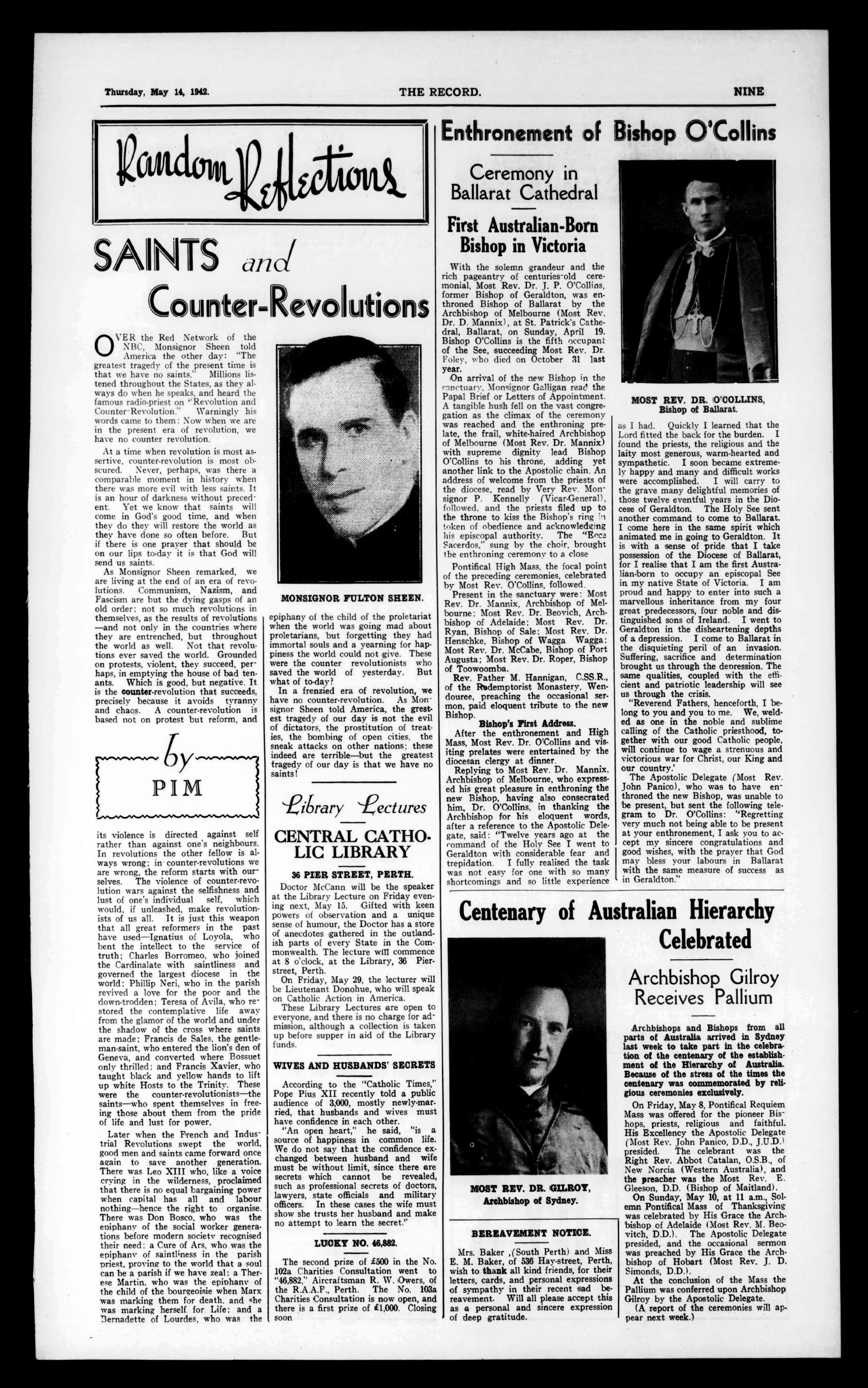
MONSIGNORFULTONSHEEN.
epiphanyofthechildoftheproletariat whentheworldwasgoingmadabout proletarians,butforgettingtheyhad immortalsoulsandayearningforhappinesstheworldcouldnotgive.These werethecounterrevolutionistswho savedtheworldofyesterday.But whatofto-day?
Inafrenziederaofrevolution,we havenocounter-revolution.AsMon signorSheentoldAmerica,thegrestesttragedyofourdayisnottheevil ofdictators,theprostitutionoftreaties,thebombingofopencities,the sneakattacksonothernations;these indeedareterrible-butthegreatest tragedyofourdayisthatwehaveno saints!
36PIERSTREET,PERTH.
DoctorMcCannwillbethespeaker attheLibraryLectureonFridayeveningnext,May15.Giftedwithkeen powersofobservationandaunique senseofhumour,theDoctorhasastore ofanecdotesgatheredintheoutlandishpartsofeveryStateintheCommonwealth.Thelecturewillcommence at8o'clock,attheLibrary,36Pierstreet,Perth.
OnFriday,May29,thelecturerwill beLieutenantDonohue,whowillspeak onCatholicActioninAmerica. TheseLibraryLecturesareopento everyone,andthereisnochargeforadmission,althoughacollectionistaken upbeforesupperinaidoftheLibrary funds.
Accordingtothe"CatholicTimes," PopePiusXIIrecentlytoldapublic audienceof3,000,mostlynewly-married,thathusbandsandwivesmust haveconfidenceineachother.
"Anopenheart,"hesaid,"isa sourceofhappinessincommonlife. Wedonotsaythattheconfidenceexchangedbetweenhusbandandwife mustbewithoutlimit,sincethereare secretswhichcannotberevealed, suchasprofessionalsecretsofdoctors, lawyers,stateofficialsandmilitary officers.Inthesecasesthewifemust showshetrustsherhusbandandmake noattempttolearnthesecret
LUCKYNO.46,882, Thesecondprizeof£500intheNo. 102aCharitiesConsultationwentto "46,882,"AircraftsmanR.W.Owers,of theR.AA.F.,Perth.TheNo.103a CharitiesConsultationisnowopen,and thereisafirstprizeof£1,000.Closing soon
Withthesolemngrandeurandthe richpageantryofcenturies-oldcere monial,MostRev.Dr.J.P.O'Collins, formerBishopofGeraldton,wasenthronedBishopofBallaratbythe ArchbishopofMelbourne(MostRev. Dr.D.Mannix),atSt.Patrick'sCathedral,Ballarat,onSunday,April19. BishopO'CollinsisthefifthoccupanzoftheSee,succeedingMostRev.Dr Foley,whodiedonOctober31last year. OnarrivalofthenewBishopinthe -iinctuary.MonsignorGalliganreac'the PapalBrieforLettersofAppointment. Atangiblehushfellonthevastcongregationastheclimaxoftheceremony wasreachedandtheenthroningprelate,thefrail,white-hairedArchbishop ofMelbourne(MostRev.Dr.Mannix) withsupremedignityleadBishop O'Collinstohisthrone,addingyet anotherlinktotheApostolicchain.An addressofwelcomefromthepriestsof thediocese,readbyVeryRev.Moir signorP.Kennelly(Vicar-General', inllowed.andthepriestsfiledupto thethronetokisstheBishop'sring tokenofobedienceandacknowledging hisepiscopalauthority.The"Ecic..,. Sacerdos,"sungbythechoir,brought theenthroningceremonytoaclose PontificalHighMass,thefocalpoint oftheprecedingceremonies,celebrated byMostRev.O'Collins,followed.
Presentinthesanctuarywere:Most Rev.Dr.Mannix,ArchbishopofMelbourne;MostRev.Dr.Beovich,ArchbishopofAdelaide:MostRev.Dr. Ryan,BishopofSale:MostRev.Dr. Henschke,BishopofWaggaWagga: MostRev.Dr.McCabe,BishopofPort Augusta;MostRev.Dr.Roper,Bishop ofToowoomba. Rev.FatherM.Hannigan,C.SS.R., oftheRodemptoristMonastery,Wendouree,preachingtheoccasionalsermon,paideloquenttributetothenew Bishop. Bishop'sFirstAddress.
AftertheenthronementandHigh Mass,MostRev.Dr.O'Collinsandvisitingprelateswereentertainedhythe diocesanclergyatdinner. ReplyingtoMostRev.Dr.Mannix. ArchbishopofMelbourne,whoexpressedhisgreatpleasureinenthroningthe newBishop,havingalsoconsecrated him,Dr.O'Collins,inthankingthe Archbishopforhiseloquentwords, afterareferencetotheApostolicDelegate,said:"Twelveyearsagoatthe commandoftheHolySeeIwentto Geraldtonwithconsiderablefearand trepidation.Ifullyrealisedthetask wasnoteasyforonewithsomany shortcomingsandsolittleexperience
BishopofBallarat.
asIhad.QuicklyIlearnedthatthe Lordfittedthebackfortheburden.I foundthepriests,thereligiousandthe laitymostgenerous,warm-heartedand sympathetic.Isoonbecameextremelyhappyandmanyanddifficultworks wereaccomplished.Iwillcarryto thegravemanydelightfulmemoriesof thosetwelveeventfulyearsintheDioceseofGeraldton.TheHolySeesent anothercommandtocometoBallarat. Icomehereinthesamespiritwhich animatedmeingoingtoGeraldton.It iswithasenseofpridethatItake possessionoftheDioceseofBallarat, forIrealisethatIamthefirstAustralian-borntooccupyanepiscopalSee inmynativeStateofVictoria.Iam proudandhappytoenterintosucha marvellousinheritancefrommyfour greatpredecessors,fournobleanddistinguishedsonsofIreland.Iwentto Geraldtoninthedishearteningdepths ofadepression.IcometoBallaratin thedisquietingperilofaninvasion. Suffering,sacrificeanddetermination broughtusthroughthedenression.The samequalities,coupledwiththeefficientandpatrioticleadershipwillsee usthroughthecrisis.
"ReverendFathers,henceforth,Ibelongtoyouandyoutome.We,weldedasoneinthenobleandsublime callingoftheCatholicpriesthood,togetherwithourgoodCatholicpeople, willcontinuetowageastrenuousand victoriouswarforChrist,ourKingand ourcountry.'
TheApostolicDelegate(MostRev. JohnPanico),whowastohaveenthronedthenewBishop,wasunableto bepresent,butsentthefollowingtelegramtoDr.O'Collins:"Regretting verymuchnotbeingabletobepresent atyourenthronement,Iaskyoutoacceptmysincerecongratulationsand goodwishes,withtheprayerthatGod mayblessyourlaboursinBallarat withthesamemeasureofsuccessas inGeraldton."
ArchbishopsandBishopsfromall partsofAustraliaarrivedinSydney lastweektotakepartinthecelebrationofthecentenaryoftheestablishmentoftheHierarchyofAustralia. Becauseofthestressofthetimesthe centenarywascommemoratedbyreligiousceremoniesexclusively.
MOSTREV.DR.LGILROY, ArchbishopofSydney.
BEREAVEMENTNOTICE.
Mrs.Baker,(SouthPerth'andMiss E.M.Baker,of536Hay-street,Perth, wishtothankallkindfriends,fortheir letters,cards,andpersonalexpressions ofsympathyintheirrecentsadbereavement.Willallpleaseacceptthis asapersonalandsincereexpression ofdeepgratitude.
OnFriday,May8,PontificalRequiem MasswasofferedforthepioneerBishops.priests,religiousandfaithful. HisExcellencytheApostolicDelegate (MostRev.JohnPanico,D.D., presided.Thecelebrantwasthe RightRev.AbbotCatalan,O.S.B.,of NewNorcia(WesternAustralia),and thepreacherwastheMostRev.E. Gleeson,D.D.(BishopofMaitland).
OnSunday,May10,at11a.m.,SolemnPontificalMassofThanksgiving wascelebratedbyHisGracetheArchbishopofAdelaide(MostRev.M.Beovitch,D.D.).TheApostolicDelegate presided,andtheoccasionalsermon waspreachedbyHisGracetheArchbishopofHobart(MostRev.J.D. Simonds,D.D.I.
AttheconclusionoftheMassthe PalliumwasconferreduponArchbishop GilroybytheApostolicDelegate. (Areportoftheceremonieswillappearnextweek.)
IRISHNATIONALSTEPDANCING COMPETITIONS.
InSt.Patrick'sHall,Fremantle,on Sunday,May3,thefirstofthe19421943seriesofIrishStepDancingCompetitions,interspersedwithitems,was held,thedanceforthecompetition beingtheIrishJig.Theattendance wasthebiggestyetseenatacompetition,andincludedmembersofthe Forces,parentsandfriendsofthecompetitors,membersoftheSociety,and theassemblywasgracedbythepresenceofsomeoftheOblateFathersand ChristianBrothers.TheartistsincludedMr.WillGinivan,avocalistwell knowntoIrishaudiencesasonewho cansingIrishmelodiesjustasthey shouldbesung,andwhoneverfailsto receivewellmeritedapplauseforhis numbers;MissKath.McCorry,Mr.Ern Mulcahy,andthechampionIrishnationalstepdancerofW.A.for1942, MissFlorenceSchofield,eachofwhom gaveexhibitiondances.Mr.D.J. McGerr,oftheI.N.F.IrishPipeBand, gaveselectionsonIrishpipes,andthe OsborneParkJuniorTeamverycredit-
ablyexecutedanexhibitionFour-Hand IrishReel,neatlyattiredandwithcorrectdeportment. ResultsoftheIrishJigCompetition wereasfollows(pleasereadthefigures givenaspointsfortime,steps,deportmentandtotal):-
Under10Years:
J.Harrison:14,21,25;60(first).B.
Kelly:14,18,15;47(second).C.Higgins:11,18,17;46.J.Douglas:10, 17,16;43.F.Lang:14,17,12;43.K.
Daley:12,16,10;38.K.Craig:11,15, 15;41.N.Brennan:12,16,14;42.J.
Aldridge:13,17,12;42.J.Rogers:11, 14,18;43.S.Jarvis:10,15,17;42.
Under13Years:
E.Carr:13,19,22;54(first).A.
Lawrence:14,18,20;52(second).R.
McLernon:12,16,20;48.N.Marsh: 12,17,19;48.K.Paizes:14,18,12;44.
JimCraig:11,15,18;44.B.Pontague:13,16,20;49.M.Perryman:12, 17,20;49.A.Jackson:12,19,18;49.
B.McKenzie:13,17,19;49.B.Johnson:12,18,20;50.I.Cowan:12,15, 16;43.B.Bice:14,16,18;48.
Under16Years:
F.Schofield:16,21,25;62(first).P.
Quinlan:14,19,24;57.S.Smith:15, 17,25;57.K.Hawkins:14,17,25;56.
T.Liddell:12,19,20;51.G.Lowick: 14,18,18;50.J.Davis:14,20,20;54.
E.Pattendon:13,18,25;56.B.Haw-
ForExquisiteMildnessandTenderness andFineFlavourAlways.
QualityMeatsandSmallgoods
TWOBIGBARRACKSTREETSTORES, ForYourConvenienceonEitherSide.
Forthemost satisfactoryresults, use "Gibsonia" Wools...
kins:15,16,25;56.S.Love,14,16,18;
48:A.Harris:15,15,22;52.
MissSmithwonsecondplacefrom MissQuinlanindance-off.
16YearsandOver
G.Hernan:16,16,19;51.N.Ratcliffe:17,17,20;54.M.Buzzacott:17, 18,20;55.E.Mulcahy:17,24,22; 63(winner).
TheHighChiefRanger(Mr.E. Groessler),inclosingthefunction, thankedthemusicians(Mrs.S.E. Urquhart;Messrs.JimHealyand O'Leary),judges(Messrs.Ryan,KinsellaandCondren),theartists,theRev. FathersandBrothers,whogracedthe gatheringwiththeirpresence,thecompetitors,theirparents,andteachersfor thesplendidsupportgiventhecompetition,andannouncedthatthenextof theserieswouldbeheldinPerthata placeandtimetobefixed.
Asstatedinlastweek'snotes,a seriesoforganisedsocialmatcheswill commenceonSunday,May24.These arebeingheldinplaceoftheusual ShieldCompetition,anditishoped thatclubswillenterwhole-heartedly intothefixtures.Matcheswilltake plaseatleasteverythreeweeks.
Theentertainingofthevisitingclubs willbetheresponsibilityofthehome club,whomayarrangeamerry-chain tournament,aninter-clubmatch,or whatevermaybesuitable.Following isthelistforthefirstround(home teamtosupplyballs):Sunday,May24, St.Thomas'sandStaroftheSeato meetSt.Kevin's,atSubiaco:St.Joachim'stomeetSt.Columba,atVictoria ParkNedlandstomeetSt.Patrick's, atFremantle;St.Anthony'sandTheresianstomeetHighgate,atHighgate; St.Brigid'stomeetSt.Mary's,atLeederville. PresentationofPrizes.
Theannualpresentationofprizes willthisyeartakeplaceatSt. Joachim'sClub,VictoriaPark,on Sunday,May31,at3p.m.HisGrace theArchbishopwillattendandmake thevariouspresentationstotherespectivewinners.Duringtheafternoon,exhibitionmatchesbetween leadingmembersoftheAssociationwill beplayed.Iftheweatherisunfavourable,thepresentationsaretobe madeintheKindergartenHall,VictoriaPark.
SocialEveningandGamesNight.
Tuesday,May26,isthedatesetby thesocialcommitteeforthesecondof aseriesofnoveltynights,inaidofthe WelfareFund.Onthisoccasionthere willbeplentyofgamesandamusements,whilstaddedfeaturesareto includevocalandmusicalitems.
ST.KEVIN'SCLUB.
BusyBee:OnthisSaturdaytMay 16),theclubwillholda"busybee"at 2.30p.m.Allavailablemalemembers arerequestedtoattend,asurgent workistobedone.
SocialMatch:Achallengehasbeen receivedfromtheRosalieClubforan inter-clubmatch.Thiswilltakeplace onSunday,May17,atRosalie,commencingat1.30p.m.sharp.Ateam oftwelve(sixmenandsixwomen) hasbeenchosen,andtheyarerequestedtomeetattheRegalTheatreat1.15 p.m.
Visitors:OnSunday,May24,the clubwillentertainvisitorsfromSt. Thomas'sandStaroftheSeaClubs,in thefirstofthenewAssociationsocial engagements.Allmembersareurged tobepresent,andafternoonteamust beprovided.
PictureNight:Theclubwillhold anotherofitspicturenightsatthe PiccadillyTheatreshortly. 4
BASSENDEANBAKERY
onlyat
411 r---
16MMASDLitH
SeniorChaplainO'Callaghanwill lecturetotheNewmanSocietyatits nextmonthlymeeting,Tuesday,June 2,intheRefectoryoftheUniversity. Acordialinvitationisextendedtoall. Thelecturewillbeasubjectofintense interest,hisexperienceswiththeA.I.F. abroad.Supperwillbeservedafter thelecture.
Personal.
MissEileenDavidson,M.A.,hasresignedfromchiefalmonerofLewishamHospital,Sydney,toacceptthe importantwarpostofDirectorof HabilitationfortheRedCrossin SouthAustralia.MissDavidsonisa pastpupilofSacredHeartConvent, HighgateHill,andagraduateofour localUniversity,whereforsomeyears shewasanofficialoftheNewmanSociety.Onascholarshipsecuredfor herbytheRev.Dr.McMahon,shedid postgraduateworkattheCatholic University,Washington,D.C.,andon thecompletionofhercoursedidsocial serviceworkinU.S.A.forsomeyears. TheparentsofMissDavidsonresideat NorthPerth.
H.A.C.B.S.:St.Mary'sBranch. Thefortnightlymeetingtookplace onMay11,afterRosaryandBenediction.Attendancewasfair.Bro.M. Carleywasinthesecretary'schairand willbethebranchsecretaryinfuture, inplaceofBro.L.McDonald,onmilitaryduties.Weareveryfortunate inbeingabletoreplacesuchahighly efficientmanasBro.L.McDonaldso effectivelyonsuchshortnotice.
Bro.Carleyisextremelywellknown inthedistrictandverypopular,and membersgenerallyareverypleasedat hisdecisiontoacceptthesecretaryship. Duringtheeveningthereweremany expressionsofregretatthelossofBro. McDonald.Hehadbecomeapersonal friendofallthemembers,andhiskindlyservicewillbegreatlymissed.
Bro.M.Kenny,wellknowninChurch circles,leftthisweektoentercamp.
ContinuedfromFrontCover.'
knowtheyopposenotjustafighter,but amanofspirit.TheAdmiralwhois alsoafriarsaystohisislandcolleagues:
"Wemusthavethesimplicityofthe confessor.Weallhaveneedofitin differentdegrees-oftentoshakeoffour deep-seatedegoism andtoconsecrateourselvestoatrulyfreespirit andallourenergiestothegreatestof duties.
"Theliberationofourcountryand therestorationofitsproudandhonourablegrandeur.
"Theliberationofourpeopleheldin bondagebybrutalforce.
"Theliberationofthecivilisedworld, overwhichhangsthemostfrightful menace."
MAGAZINESHOP.
506HAYSTREET.
FewdoorsfromIrwinStreet).
LENDINGLIBRARY,LOTTERY AGENCY,ANDBOOKSOFEVERY
DESCRIPTION.
PRICESREASONABLE.
BAKERANDPASTRYCOOK,ETC.
I'TEL.:UL128. WESTROAD,BASSENDIAN. it
STIRLINGHIGHWAY,
PASTEURISED
'PHONE:WM1332.
PHONEF2396
FAIRLIGHTSTREET,
CREAM.
Thursday,May14,1942.
THERECORD.
STOVES,WoodorGas,newand"FORWARDTOTHELAND" wed,sold,bought,repaired.W.A. StoveCoy.,559WellingtonStreet. (ContinuedfromPage6.1 B6307.
MURRAYSTREET,PERTH.
PhonesB9731(threelines)
B7777
B3588 B9101(twolines) REGISTEREDW.A.T.A
ALEXRODOREDA
TurfCommissionAgent 802HAYSTREET.
AGENTFORW.A.CHARITIES. RingB5841andB5236.
NORTHAM.
E.0.TRESISE, M.P.S.,S.A.andW.A. MANUFACTURINGAND DISPENSINGCHEMIST. ForServiceandQuality. Tel.:61Northam.
ALBANY.
H.C.PriorFuneralDirector ALBANY(Established1921). PrivateMortuary.MotorVehicles, ChargesModerate. 'Phone215. Albany,Mt.Barker,Denmarkand Districts.
D'ARCY'SSELECTDANCES
EVERYTHURSDAYEVENING.
NOWATCATHEDRALHALL.
ModernandOldTime. D'Arcy'sEver-PopularOrchestra, withMissBettyFry,Vocalist. 1/6.
T.VIVIAN, 143Rokeby-road,Subiaco.W1539.
FORSEWERAGECONNECTIONS, W1539.
BadWaterPressure,BrokenPedes talPans,BlockedSewerDrains,Cis ternandRoofRepairs,T.V.Headlight lished;andhewithdrewfromanyoff,MaskstoApprovedDesigns.
.....4.00.4.41.04.......4,........~0.4,41,44NNO.
PATERSON'SSUPPLYSTORES
123CLAREMONTCRESCENT, SWANBOURNE.'Phone:F2571.
GROCERANDGREENGROCER. DeliveriesfromNedlandsto MosmanPark.
1
114.1111,1=111
PIANOTUNING
G.B.Dines,16DuncanStreet,Victoria Park.
NOTICETOPROPERTYOWNERS!
Youcanwithsatisfactionplaceyour BusinessinthehandsofW.F.SAMSON, 5QUEENSTREET,FREMANTLE.
ESTATE&FINANCIALAGENT, SWORNVALUATOR.
Representing:QueenslandInsurance Co.,Ltd.;TheRoyalAutomobileClub ofW.A.(Inc.);GourleyOilandColour Works,Ltd.;"Titanic"Paintsand Oils,Etc.;"Durotint"Kalsomine. 'Phone:L1016(Office);L2553(Resi dence).
hasbeensuccessfullysettledinacomfortablehomeonhisownproperty,and hissuccessasafarmerisnowassured.
Fouradditionalfarmshavebeenacquiredinthedistrictwithaviewto placingsuitableboysonthemontheir ownaccount.
Alreadyextensiveclearinghasbeen doneonsomeofthesefarmsandcrops putin,andwehope,withinthenext fewmonths,toerectanothercottage ononeofthem,withotherstofollow, inordertogivecomfortableaccommodationtotraineeswhowillbeonprobationbeforebeinghandedoverthe propertiespermanently.
TheVariousActivitiesCarriedonin ConnectionwiththeScheme.
AsuccessfulSchoolwithPrimary, SecondaryandTechnicalsetions,is beingconductedinconnectionwiththe Schemeinordertogivethetrainees anall-roundeducationthatshouldenablethemtogetaproperperspective oflifeandtoimpressonthemtheir civicandfamilyobligations.
Woodandmetalworkisbeing taughtinordertotraintheboysto dotheirownrepairstomachinery andtosupplytheirownsimpleneeds inandaroundtheirhomes.
Wheatandoatfarmingisbeingcarriedoninacomprehensivewayby meansofhorseteamsandtractors.
Alargeherdofdairycowsprovides sufficientmilkandbutterforthe250 personsnowinresidenceinTardun, whileabeefherddoesmuchtosupply thenecessarymeatforlocalconsump. tion.
Alargeflockofsheepgivesthe traineespracticaltraininginallthat appertainstothewoolindustry.
Pigandpoultryraisingonalarge scalesuppliesvaluablefoodforthose inresidence,and,inaddition,givesthe boysagoodinsightintotheseimport. antbranchesofmixedfarming.
Threelargevegetablegardensdo muchtosupplythenecessaryvegetablesinseason,andalsoprovidesa goodopportunityfortraininginthis essentialbranch.
Apartfromthepracticaltrainingin theforegoing,theboysarealsoengagedinwell-sinking,fencing,repairsto machinery,clearing,andinpractically allbranchesofbuilding.
TheCompletionoftheCentralPortion oftheMainBuilding.
Manyimportantimprovementshave beeneffectedduringtheyear,butby farthemostimportantisthework donetowardsthecompletionofthe secondstoreyofthemaincentral building,which,whencompleted,will giveextensivesleepingandotheraccommodationwhichissoessentialat thepresenttime,owingtothearrival ofmanyevacueesfromClontarfand elsewhere.Thebuildingis120feet long,28feetwide,with9ft.balconies onthenorthandsouthsides.Itis constructedofconcreteblocksand willhaveaconcreteroof.Thebuildingisbeingerectedbythestaffand trainees,andallgoingwell,itshould bereadyforoccupationbeforetheend ofJune.Itakethisopportunityto thankthemembersoftheCharities Commissionforprovidingfundsto helptoenableustomaketheliving conditionsoftheboysinTarduncomfortableandhealthy.
NinetyOneBoysConfirmedatTardun bytheMostRev.Dr.Gummer.
Inconclusion,Iwishtocongratulate the91littleboyswhoto-dayhavehad theprivilegeofbeingConfirmedbythe BishopoftheDiocese.Letushope andpraythattheHolySpiritmay guidethemthroughlifetoaglorious eternityofhappiness.
KALGOORLIE.
Prime
MARITANASTREET. Tel.438
M1158 Telephones- L1460
MEAD,SON&CO. FUNERALDIRECTORS.
190ALBANYROAD, VICTORIAPARK.
33CANNINGHIGHWAY, EASTFREMANTLE.
ELEVEN
Thesubscription,which isexceptionallylow,entitlesyoutofirsteditioncopiesofthe latestinfiction,travel,biography,currenthistory.Newbooks areaddedtotheshelvesaftereachmail.
COUNTRYSUBSCRIBERS.
Specialconsiderationisgiventoyourneeds.BOANSpayfreight oneway,andthesubscriptioniswithinreachofall.Writefor BoansLibraryCatalogue.ItwillbesentPOSTFREE.
SUBSCRIPTIONRATES.
COUNTRYSUBSCRIBERS. OursubscriptionisVERY SMALL,andwepayfreight oneway.Subscriptions:2 Books,8/6quarterly;39/yearly.4Booksweekly,14/6 quarter.;52/yearly..Our CataloguePOSTFREE.
LIBRARYFORBOYSAND GIRLS. Subscriptionsfrom4/6quarterly,1Book.Ahostofinteresting,illuminatingendentertainingbooksforallages fromfourtosixteenyears. Letyourboysandgirlslearn tochoosetheirownreading: Fiction,Travel,Biography, RomanticHistory,Applied Science,Adventure.These bookshavebeenselectedwith careandareconfidentlyrecommended.Callinand delveonthebookshelveswith yourchildren.
SECONDFLOOR
CITYANDSUBURBAN
SUBSCRIBERS.
1Book,5/6quarterly(which entitlesyoutofirstedition copies),17/6yearly.
2Books,8/6quarterly;27/6 yearly. 3Books,11/6quarterly;35/yearly.
Thesebooksmaybechanged asoftenasdesired.
BOOKCLUBFORBOYS ANDGIRLS.
BoysandGirlsofallages, fromfourtosixteen,willwant tojoinBOANSBookClub, Ifyourchildrenarenotalreadymembers,surprisethem withasubscription.They willlearnself-relianceby choosingtheirownreading fromthewell-stockedshelves ofFiction,Adventureand EducationalSubjects.All bookshavepeencarefullyselectedbyexperts,andare thoroughlyrecommended.
MURRAYST.END.
BELIGHTAROUNDYOU.
(ByRobertFallen./
Belightaroundyou.
Betheredawning-light, Beglowofstarsandpourofnoon, heglimmer-eve.
Andbeyourheart andbeyourquietheartlight-sanctified, betapersthere, bepeace.
Belightwithinyou, becelestially allgraceoflightandlightofGrace, befaithunflawed.
Beloveoflight, lovemakeyouasamotha-winground light, deathshowthelight ofGod.
CONFIDENCE.
TO
AndafterOurLordhadtoldHisApostlestogointotheworldandpreach theGospel,HeascendedintoHeaven.
DearCornerites,-I'vefoundalovely storytotellyouthisweek,thestoryof Tarcisius,theRomanboymartyr,ani I'msurethatyouwillenjoyread.ngit. Youknow,youshouldmakea'special pointofprayingtothemanybo:,and girlsaints,fortheyknowjusthowyou feel,andperhapsthey.,ftengotintothe samescrapesthatyoudo.There arealotofoldfriendswhohavenot writtenforsometime,andIwould verymuchliketohearfromthem,and somenewmembersfortheCorner wouldbeverywelcome.
AUNTBESSY.
ManyofourPlaymates,nodoubt, ArefamiliarwiththestoryofTarcisius, theRomanladwho,farawayinthe thirdcentury,laiddownhisyounglife withoutamurmurorregretindefence oftheLordheguardeduponhisfaithfulboy'sheart.
Hewasonlyayouthfulacolyte,aboy withloveofaboy'sfreshlifeandsports, withanticipationsofthemanyyears tocomewhenalltheworldshouldbe spreadbeforehim,whenthedarkdays ofpersecutionshouldhavepassed,when heandtheboyswhowouldbemen withhimshouldmakeadifferentplace ofpaganRome,andliveanddieinthe loveoftheirfellow-men.Thereality wastobeverydifferent.
ThetimesinwhichTarcisiuslived werecruelandhardtothemaligned andtormentedfollowersofJesusChrist, andneitheragenorsexwasabarto therack,thetorch,theswordofthe executioner.Andyetitwastheeasiestthingintheworldtoavoidall thesebythedenialoftheonetrueGod.
Some,unfortunately,diddenyHim, butthevastmajorityoftheChristians utterlyrefusedtheactofapostacy.And amongthegreatandhallowednames ofthosewhoshedtheirbloodforChrist, shinesmanyandmanyachildnameboysandgirlssoyoungthattheirvery judgesandexecutionerswouldgladly havesparedthesacrificeofthem.
Tarcisiusknewallthesethings.He wasonlyaboy-wouldnotthegood Godholdhimexcusedforthenatural shrinkingofhistenderagefromviolenceanddeath?ButTarcisiushad nosuchthoughts.Thatiswhy,to thisveryday,hisnameisheldinvenerationandwillneverbeforgotten.His storyisashortone,bothsadandglorious.
ManyChristianslayintheprisonsof RomeatthetimeatwhichTarcisius wasanaltar-boyoftheunderground chapelofSt.Calixtus,hewnintherock oftheCatacombs,wheretheChristians usedtoflyintimeofpersecution.He wasonlyoneofthenumber,buthe wasagreatfavouritewiththeclergy andtheotheracolytes.Fulloflivelinessandgoodspirits,hewasyetalwaysoneinwhomitwasinstinctively feltthatconfidencecouldbeput.So itwasthatonedayhewascalledtoSt. Calixtus,andtherewasputinhishand asilkencoveringbeneathwhich,in linencloths,laywrappedtheBlessed Sacrament,thathewastoconvey,boy toanumberofChristians inaprisonofthecityofRome.This hadsometimestobedone,asthere wasscarcelyanyfearofalad'sbeing discoveredwhenemployedinsuchan office,wherasthedeacons,whoseoffice itreallywas,wouldatoncebedetected.
SoTarcisius,hisyoungheartfilled withjoyandreverence,receivedhis preciousburdenandplaceditoverhis beatingheart,insidethefoldsofhis tunic.Above,outside,heclaspedhis handstightly,keepingguardoverthe treasurecommittedtohischarge.He wentalongtheroadtotheprisonquietlyandgravely,thinkingonlyofwhat laybeneathhisprisoninghands:but suddenly,ataturnintheroad,atroop ofRomansoldiersburstuponhim.
Inamoment,theirleadersawfrom hismannerandhistightlyclasped handsthathewasthebearerofsomethingworthtakingfromhim,andthe bandwasatonceuponhim.Tarcisiusresistedthembravely,withall hispunystrength,notonceloosinghold oftheSacredHost:onthecontrary,it seemedasifangelswerekeepinghis claspfrombeingbroken,fortryasthey would,thesoldierscouldnotsucceed intearinghishandsawayfromtheir positiononhisbreast.
Enraged,theythoughtitwitchcraft, andfellupontheboyhimselfwith blowsandkicks.Itwasofnouse: theslimyounghandsneverchangedin theirposition.Theybeatandbruised himsoseverelythatatlasthisboyishframecouldnolongerresisttheir theirattacks.Hefellanddiedinthe road,withnosuccourorfriendlyheart nearhim.AndstilltheangryRomans, evenindeath,couldnotunlockhis graspofthathiddenSomethingonhis breast!
Finaly,withcursesandblasphemies, theyturnedandlefthimlyinginhis blood.Andtherehelay,rigidin death,untilsomeChristianshappened topassby.Oneofthemknewwho hewas,andwithtearsandprayers theyallkneltbesidehimandtenderly examinedhisbodyforsignsoflife.But: therewerenone.Yetstill,intensified asitwere,thatresoluteclasprema:ned. Liftingthebodyandtakinghimtothe nearestspot:ntheunderlyingCatacombs,hissecretwasdiscovered TheSacredHostwasliftedwithno troublefromhispulselessbreast,and theboymartyroftheBlessedSacramentlaidtorestinatombuntilsome centurieslater,whenChristianitywas thereligionofRome,hisbodywasdepositedwhereitstillremains,inthe churchnowknownbythenameofSt. Susanna,whichiscaredforbythe PaulistFathersofAmerica.
THEBOYWHOWHISTLES.
Iliketheboywhowhistles, \Vhenthingsareallawry, Whobolstersuphiscourage, Andneverstopstocry. Whoimprovisesditties, Ascheerfulastheday, Andbyhismerrypiping, Drivesallhiscaresaway.
Godblesstheboywhowhistles, Theworldhasneedofhim, Fromgreyofearlymorning, Tilltwilight'sduskyrim. \\'eneedhimatourlabours, Weneedhimwhenatrest; Ofallthehappyyoungsters, Ilikethewhistlerbest!
THELOVELYMONTHOFMAY.
Thebirdsaresinginggaily, Thetreesareclothedingreen, Thebeauteousbloomofflowers Oneverysideisseen.
Bowdowninpeaceandpraiseand pray,
Andevenwhileyousigh
Rememberthis-eachsorrowisa shadowsweet, ThattellshownearChrist'snakedfeet Arewalkingbythyside.
'TisGodWhopassesby!
Thenletthysoulconfide!
Everwhentempted,letmesee, Beneaththeolives'moon-pierced shade
MyGod,alone,outstretched,and bruised, AndbleedingontheearthHemade. Andmakemefeelitwasmysin, Asthoughnoothersinwerethere, ThatwastoHim,Whoboretheworld, \Vhenshadowsfallathwartthypath .1loadthatHecouldscarcelybear. -FatherFaber.
Whilewewithheartsrejoicing, Withjoywesingto-day, For'tisthemonthofMary, ThelovelymonthofMay.
Mary,dearmother, Withjoywesingtothee, ThouarttheQueenofHeaven, Thou,too,ourQueenshaltbe. 0,ruleusandguideus, Untoeternity.
SOUTHDOWNDAIRY.
402CANNINGHIGHWAY, SOUTHPERTH. Tel.MU1601
W.J.FERRIDGE&SON, DAIRYMEN.
BottledMilkDeliveredifRequired. FreshandScaldedCream.
J.C.HAkILTON,M.P.S.Ph.C. DAYANDNIGHTCHEMIST. 197BRISBANESTREET PERTH. PrescriptionsCarefully.andAccuratelyDispensed. CompleteStocksofPatentMedicnes. CountryOrdersatCityPrices.'PhoneB1236-AnyHour.
THEBESTVALUEFORYOUR MONEYAT F.J.DUFF'S WINESALOON. CornerARUNDELSTREETand SOUTHTERRACE,FREMANTLE.
'Phone:L1902.
10111.81114MNPWW.M4WIHMIHMUMMRIMMOMUMV
L.CHARLESWORTH, Dip.D.S. DENTALSURGEON.
CLAREMONT-17BROWNST. Tel.F1717.
SUBIACO-133ROKEBYROAD Tel.W1191.
BUNBURY.
LANDandESTATEAGENT G.H.TEEDE
'Phone31 Private267. SMITH'SBUILDINGS, WELLINGTONST..BUNBURY. Businesses,Farms,Houses,Land ForSale.
J.F.CAIN
17STIRLINGHIGHWAY, COTTESLOE. 'PhoneF2121,DayorNight. LICENSEDSANITARYPLUMBER, IRONWORKER,SHEETMETAL WORKER.
S.BEECROFT-Butcher
181RokebyRoad,Subiaco.
DnlyPrimeFreshKilledMeatSold 'PhoneW1373.
J.NEILSON,Optician
S.DANNELL,F.S.M.C.(London), W.A.O.A.
OPTOMETRIST. Tel131616 16PLAZAARCADE,PERTH.
FRESHFISHTWICEDAILY. 131BARRACKSTREET. DELIVERIESANYWHERE. PHONEB2974 SupplierstoHospitals,EducationalandReligiousInstitutions. WEARETHEOLDESTANDLARGESTFISHDISTRIBUTORSIN WESTERNAUSTRALIA. OLIVEOILINLARGEORSMALLQUANTITIES.
NewHospitalofSt.JohnofGod,Subiaco SPLENDIDUP-TO-DATEACCOMMODATION. ConvenienttoSubiacoandLeedervilleRailwayStationsandTrams. RecentAdditionsconsistofaFully-EquippedX-RAYDEPARTMENT andCHILDREN'SWARD. PatientsMaySelectTheirOwnMedicalAdvisers.
UnfinancialPatientsmaybeadmittedonDoctor'sRecommendation. OPENTOALLDENOMINATIONS.
4 FRUIT,VEGETABLESWHOLESALE. 'PHONE T.R.NICHOLASCOY.LTD. METROPOLITANMARKETS,PERTH. Shops,Hotels,
WEREYOU
AllthefourweeklyCatholicpapers publishedinLondonincreasedtheir circulationsduringthewar,although theyallappearindiminishedformbecauseoftherationingofpaper.After nearlytwoandahalfyearsofwar,it isreasonabletosupposethatifthe situationshouldnotchangematerially fortheworse,theywillallweatherthe warstormandrideoutofitwithmore readersandgreaterprestige.
ThequestionswhichCatholicpublishersaskedthemselvesatthebeginningwere:Willtheadvertisementrevenuefallrightoff?Willthecostof newsprintskyrocketsohighastomake itvirtuallyoutofreachwithoutincreasingthesellingcostofpapers? Willthepeople,facedbythecaresof war,dropinterestintheCatholic papers?Willpeopletroubletobuy papersgreatlyreducedinsize?
Quiteearlythestartingofnewperiodicalswasforbidden,andexisting paperswerepermittedtouseonlya statedproportionoftheirconsumption duringaformerstatedperiod.
AlltheCatholicpapershavebeenreducedinsize.The"CatholicHerald"runsnormallyeightlargepages againstitssixteenpagesofpre-war days.The"Universe"andthe"CatholicTimes"havetwelvesmallerpages, whereastheyrantotwenty-fouror twenty-eightbeforethewar.The "Tablet,"whichsellsforsixpence,is downtotwelvemagazine-sizedpagesabouthalfitsnormalpeace-timeoffering. Advertisementrevenuehaskeptup inasurprisingway.Butmuchofit comesfromfirmswhichsimplyannouncethattheyhavenothingtosell.
Itis"prestigeadvertising,"paidforto keepestablishednamesbeforethepublic.Almosttheonlypeoplewhoad_
vertisetostimulatesalesarethereg isteredmedicineadvertisersandthe bookpublishers.Mostotherthings sellthemselves.
AlltheCatholicpapersareshyof printingtheircirculationfigures, perhapsbecausetheyregardthepresentsituationasfictitious.Butitis certainthattheyareallsellingmore copies,andinsomecasessubstantially more.Aroughcalculationgivesthe impressionthatbetweenthemthefour Catholicweekliessellabout250,000, copiesaweek.Iftherewerenooverlappingthiswouldshowthat,counting fourtoafamily,1,000,000Catholicsare readingaCatholicpaper-aboutonein threeoftheestimatednumberofCatholicsinEngland,Scotland,and Wales.
(OfficesBombed.
TwooftheCatholicnewspaperswere bombed.The"Tablet"haddecided onawar-timemovetoReading,Berkshire,beforefirebombsburnedits Paternoster-rowofficestotheground.
Allthematerialforthecontinuanceof thepaperwasthussaved,butthefiles whichwentbackonehundredyears, weredestroyed,togetherwithmuch valuablematteraccumulatedbysuccessiveeditors.
Beforetheblazethe"Tablet"had celebrateditscentenarywithasixtypageissue.
Ofthepersonnel,theeditor,Douglas Woodruff,spendshisoff-dutytimeas afirewardeninthePaddingtondistrictandbroadcaststoSpaintwicea week,themanagerisLieut.-QuartermasteroftheHomeGuardinReading; twoofthefourdirectorsarewholetimeinthewar-T.F.BurnsasPress AttacheinMadrid,andChristopher HollisinR.A.F.Intelligence.
The"Universe,"whichdeclareda circulationof"over125,000"beforethe war,hasaddedmaterially
AfternineyearsinaMexicangaol, FatherJoseAurelioJimenezhasbeen releasedfollowingaSupremeCourtdecisionthattherewasinsufficientevidencetoconvicthim.
FatherJimenezwassentencedtoim,,risonmentfor20yearsasan"intellectualco-author"oftheassassination ofPresident-electObregon.Itwas assertedthatheblessedthepistolthat firedtheshot.
TheSupremeCourttooktheview that,astheblessingofarmsiscustomaryinMexico,thepriestwhoperformedtheceremonywouldnotnecessarily knowwhatusewastobemadeofthe arms.
Variousappealshavebeenmadefor thereleaseofFatherJimenez.The onewhichhasnowsucceededhasbeen pendingforsixyears.
Oneofthegreatestheroesofthe Mexicanpersecution,ArchbishopLeopoldRuizyForeshasdiedinMexico City,announcesNCWC.
ArchbishopRuizwas76.Recently hehadbecomeblind.Byhisbedside ashelaydyingstoodArchbishopMartinez,ofMexico,colleagueoftheold daysofterror. Hisdeathsentawaveofsorrow acrossMexico,whoseCatholicpeople hadalwayslookeduponhimastheir chiefchampion.Churcheswerecrowdedwithprayingpeopleduringthelast hours.HundredsofmessagesofsympathypouredintoArchbishop'sPalace.
ExiledThreeTimes.
ArchbishopRuizwasexiledthree times,acrosstheborderintotheUnitedStates,asaresultofhisstaunchdefenceofCatholicrightsundervarious
anti-clericalgovernmentsfrom1913to 1937.
Governmentagentswerealwayson histrackwatchinghismovements,scrutinisinghissermons.Heworelay dresstoescapenoticeashetravelled aboutthecountry,fortifyingthepeople'sresistancetotheevermoreoppressiveStatelaws.
Hewasgivenagreatwelcomeonhis finalreturnin1937asArchbishopof Morelia,towhichposthewasfirstappointed25yearsbefore.Inbetween, from1929-1932,heactedasApostolic DelegateinMexico.
ArchbishopRuizwasthetenthson ofafamilyof15inQueretaroState.He completedhisstudiesinRome,being ordainedthere53yearsago.Forsome timehehadchargeofMexico'sNational ShrineofOurLadyofGuadalupebeforehisconsecrationasBishopofLeon in1900.-R.I.P.
"Well,youngSlicerhasmadehis markalready,hasn'the?"
"Yes-diditonhisfirstcase."
"Greatwork!Whatdidhedo?"
"Vaccinatedhim."
"Didyouevergetbackthathatof yoursthatblewaway?"
"No.ButIgotbackthevisiting cardwhichwasinsideit,withthe words:'Thanks,itfits.' * *
SmallVoice(fromnextrocm): "Mamma,Idon'tlikethisegg."
"Youmusteatitup,sonny,it'sgood foryou.-
Apause.
"IwishIdidn'thavetoeateggs."
"Now,eatthatallup.Idon'twant tohearanythingfurther."
Alongerpause. say,Mamma,mustIeatthebeak too?"
CharliecameinlateforteaoneSundayafternoon.Hissweetblueeyes weremoreinnocentthanusual;helookedacherub,unspottedbytheworld.
"DidyougotoSunday-school?-askedmother.
"Yes,mother."
Motherwassuspicious.
"Howisityourhandssmellfishy?" sheaskedwhenheheldouthispawfor cake.
Charliethoughtforamoment.
"Well,yousee,mother,Icarried hometheSunday-schoolpaperandon theoutsideofitwasallaboutJonah andthewhale!"
* * * *
Atravellerrusheduptoastranger onarailwaystationasthetrainwas abouttostart,andasked:
"Areyougoingonthistrain?"
"Iam,"wasthereply.
"Well,myfriend,"saidthetraveller, "youmightdomeafavour.Ihave twobigtrunks,andtheyalwaysmake mepayextraforoneofthem.Would youmindtakingone?Itwillcostyou nothing."
"ButIhaven'taticket,"saidthe stranger.
"Ithoughtyouweregoingbythis train?"repliedthetraveller.
"Yes,Iam,"wastheanswer."I'm oneofthecompany'sinspectors."
* *
ALondonfopwentintoaWestEnd restaurant,andwasfarfrompleased withhisluncheon.
"Doyoucallthatavealcutlet?"he demandedofthewaiter."Why,such acutletasthatisaninsulttoevery self-respectingcalfintheBritishEmpire." Thewaiterhunghisheadforamoment,butrecoveredhimselfandsaid inatoneofapology:"Ireallydidn't intendtoinsultyou,sir."
*
RineyandShortyhadstartedaliars competition,withashillingentrance fee,andtheonewhocouldtellthe biggestliewastotakethelotofthe money.ShortyapproachedthePadre.
Shorty:"Hey,Padre,we'vestarted aliarscompetition,adeenerentrance fee,andthebiggestliartakesthelot. Whatabouthayingacrackatit?"
Padre:"Urn,ah,yes,boys,I'lldomy best,butyouknowI'mratherhandicapped.
Shorty:"Why,Padre?"
Padre:"I'venevertoldalieinmy life.'
Bluey(disgustedly):"Shorty,hand himovertheprize;hewins." * * * *
Awell-knownlawyerwaschidinga legalfriendforpassinghiminamotorcarwithoutrecognition.
"SorryIdidn'tseeyou,"saidhis friend."WasSo-and-Sodriving?"
"Yes,"saidthelawyer.
"Well,"rejoinedhisfriend,"whenSoandSoisdrivingyouthinkonlyof yourMakerandnotofyourearthly friends!" * * * *
Theletterwas,undoubtedly,composedverybadly,andthemanagerreprovedtheclerkwhohadwrittenit.
"Amanwhodoesnotmakehimself understoodisafool,"hesaid."Do youunderstandme?"
"No,sir,"theclerkreplied.
AScotsmanboughthismothera barometerasapresent,andexplained howshewouldbeabletotellifitwas goingtobewetorfinebyexamining thepositionofthehands, "Ay,"saidhismother,"it'safine thing;butyekenye'vebeenwasting Yourmoney.WhatdoyouthinkProvidencegaveyourfathertherheumaticsfor?"
Thenightwasparticularlydark.The Diggerswerecampednearafowlrun.Thetemptationwastoogreat. SlimandBluestoleouttoreturnhalf anhourlaterarmedwithafathen.
"Good-eh!Let'swringitsnecknow," saidahungryDigger.ButSandyMcTavish,thecarefulone,helduparestraininghand."Dinnayebefoolish, boys.Leavethebirdtillthemorning.Bythattimeshemighthave laidanegg."
* * *
Saidthewaitertoanoisycardparty inanhotelbedroom:"lyebeensentto askyoutomakelessnoise,gentlemen. Thegentlemaninthenextroomsays hecan'tread."
"Tellhim,"wasthereplyofthehost. "thatheoughttobeashamedofhimself.Why,IcouldreadwhenIwas fiveyearsold,"
OldSandy,theshepherd,wasvery proudwhenhissonwonascholarship attheagriculturalcollege,andtoldthe newstoallhisfriendsandneighbours.
Walkingdownalaneonedayhewas accostedbyanothershepherd,who stoppedforachat.
"How'syourladgettingonatthe agriculturalcollege?"inquiredhis friend.
"Oh,fine!"wasSandy'sreply."He's justlearntaquicknewwaytocount sheep.Wondervouandmedidnot thinkofitbefore."
"Andwhatwayisthat,Sandy?"askedtheothershepherd.
"Hesimplycountstheirlegsand dividesbyfour."
"WhydidMargaretinsistonbeing marriedinanaeroplane?"
"Idon'tknow,unlessitwasbecause shethoughtnomanonearthwasgood enoughforher."
Mrs.Much:"Whatdreadfullanguage yourparrotuses!"
Mrs.Nothing:"Yes,myhusband boughtthebirdonedayandbrought ithomeinhiscar,andIhavealways supectedthathehadenginetrouble duringthejourney."
* *
AnAmericansoldierwasbeingshown abouttheAustralianbush,whena herdofbullocksmadeitsappearance.
"Say,whatarethese?"theYank askedoftheDiggerescort.
"Bullocks,ofcourse,"repliedthe Digger.
"InAmericatheyarethreetimesas big."wasthecomment.
Amobofsheepfollowed,andthe Americanaskedwhattheywere.
"Thoughttheywererabbits,"he said,whenhewastold.
Atlastthreekangarooshoppedby.
"Whatarethey?"askedtheYank.
"Grasshoppers,ofcourse!Canyou heatthat?"theDiggerretorted.
* * * *
Mistress:"Heavens,girl!Whyare youtryingtoforcethecattoeathirdseed?'
NewMaid:"Well,mum,youtoldme tofeedthecanaryandthat'swhereit is."
* * * *
TheParson:"Iintendtopraythat youmayforgiveCaseyforthrowing thatbrickatyou." ThePatient:"Maybeyourreverence wouldbesayingtimeifyouwould waittillIgetwell,andthenprayfor Casey."
* * * *
OneofourDiggershadhadhishands badlyinjured,buttheywerenicely patchedup.Whenthedoctorwas surveyinghiswork,Diggersaid:
"Say,Doc,willIbeabletoplaythe pianowhenthesemitsofmineheal up?"
"Certainly,certainly." "Hippip,it'sabloomingmiracle.I nevercouldbefore."
Visitortovillage(speakingtogar- dener)"Someonetoldmethatthe soilroundhereisexceptionallyfertile."
"Thatjustshowsyouhowthere'salwayssomeonereadytorunaplace down.That'sanout-and-outlie.I haveprovedformyselfthatthesoil herewillgrowanything."
HotelandAccommodationGuide
REDLIONINN
84 ABERDEEN STREET,PERTH.
A.J.HESFORD'Phone: B1056. UnderNewManagement. (lateofKoorda),Proprietor.
GAYNOR'SHISMAJESTY'SHOTEL
HAYSTREET
EXCELLENTCUISINE
ONFELLOWS'HOTEL
SOUTHTERRACE,FREMANTLE.
BESTBRANDSSTOCKED. NewlyFurnishedThroughout. ALLWELCOME.
J.G.MULCAHY,Proprietor.
STAN.O'BRIEN COURTHOTEL
PERTH.
'Phone:B4261
HOTELBEACONSFIELD FREMANTLE. OverlookingtheOcean SuperiorAccommodation.. ModerateCharges. M.BYRNE (LateofGrandandShamrock Hotels,Boulder).
SUBIACOHOTEL
FIRST-CLASSACCOMODATION
Phone 1028, A MotIENRY.Proprietor.
VICTORIAHOTEL HAYSTREET,SUBIACO. RenovatedThroughout. EssenceofComfort.
W.F.ARTIS,Proprietor. (LateofBalmoralHotel,Vic.Park)
COUNTRY.
DukeofYorkHotel NARROGIN. ReconditionedandRefurnished. NewLounge,DiningRoom,and CommercialRooms. ARTHURBOYLAN,Proprietor (LateGeorgeHotel,Perth.)
FREEMASON'SHotel
TOODYAY. ExcellentCuisine. AmaticeRefrigeratorInstalled. OldandNewFriendsare CordiallyWelcomed MRS.E.WING,Proprietress.
Australasian
PERTH. MODERATETARIFF.
HOTELPERTH
JACKEDDINGTON, Proprietor.
ExcellentAccommodation
GOLDFIELDS.
RodBeaton's HANNAN'SHOTEL
HANNANSTREET, KALGOORLIE.
STAR&GARTERHOTEL
Cnr.HANNANandNETHERCOTT STREETS,KALGOORLIE.
BERTSTARE Proprietor.
'Phone13. Box124.
AUSTRALIAHOTEL
KALGOORLIE
C.T.A.andR.A.C.HOUSE.
OneMinutefromSt.Mary's Church.
HotandColdWaterinHotel Bathrooms.
RefrigerationThroughout.
OnlyLock-UpGaragesinthe centreofTown, M.J.DILLON,Licensee.
KeoughsforCatering
AnyNumber,Place,orTime.
ThreeReceptionRoomsforHire.
OnHire:Crocle-Cutleryand Glassware,etc. PhoneB1724. GLADKEOUGH, NEWCASTLESTREET.PERTH.
BRYANT&WATERS
80to90STIRLING
W.A.Office:
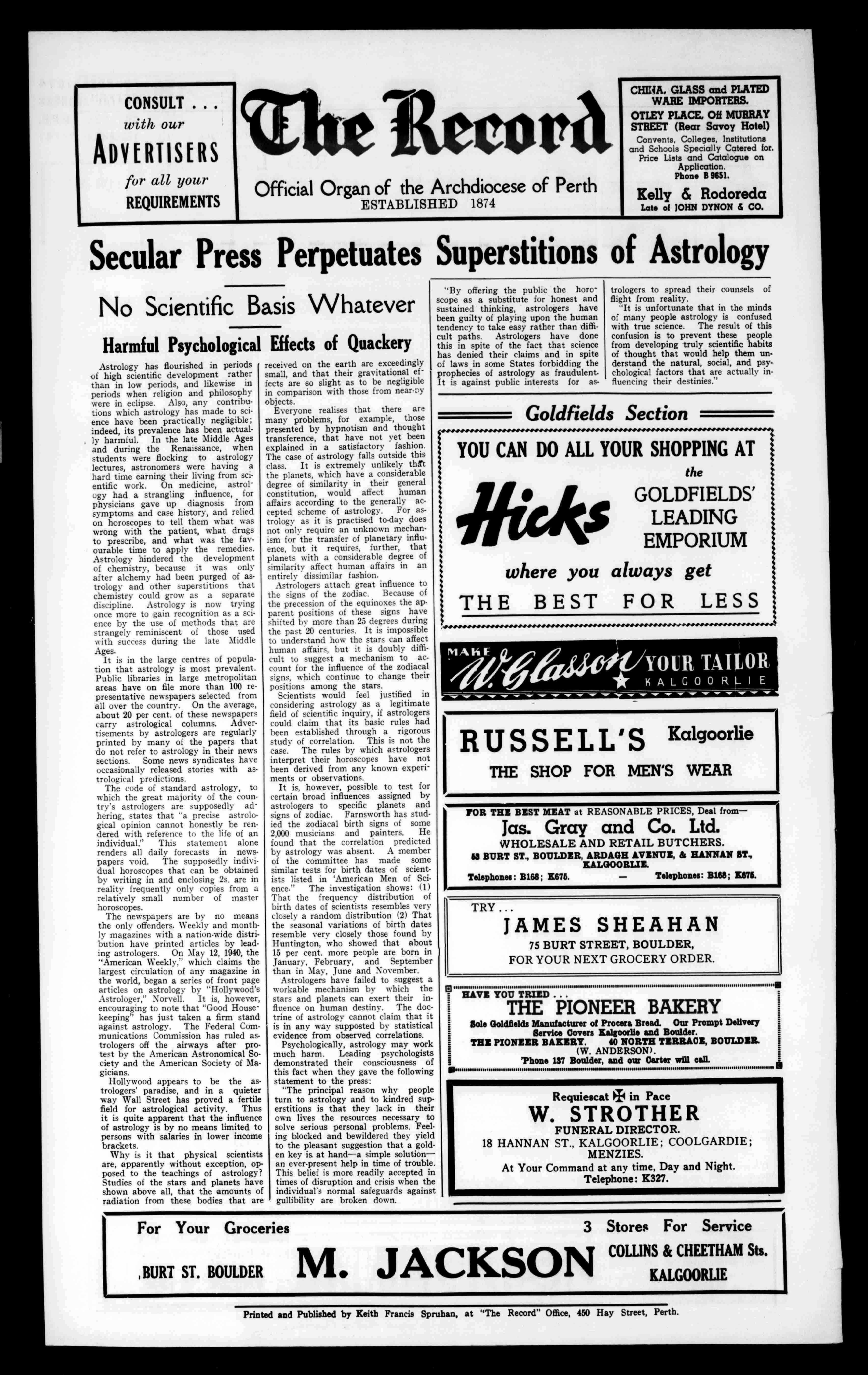
Astrologyhasflourishedinperiods ofhighscientificdevelopmentrather thaninlowperiods,andlikewisein periodswhenreligionandphilosophy wereineclipse.Also,anycontributionswhichastrologyhasmadetosciencehavebeenpracticallynegligible; indeed,itsprevalencehasbeenactuallyharmful.InthelateMiddleAges andduringtheRenaissance,when studentswereflockingtoastrology lectures,astronomerswerehavinga hardtimeearningtheirlivingfromscientificwork.Onmedicine,astrologyhadastranglinginfluence,for physiciansgaveupdiagnosisfrom symptomsandcasehistory,andrelied onhoroscopestotellthemwhatwas wrongwiththepatient,whatdrugs toprescribe,andwhatwasthefayourabletimetoapplytheremedies. Astrologyhinderedthedevelopment ofchemistry,becauseitwasonly afteralchemyhadbeenpurgedofastrologyandothersuperstitionsthat chemistrycouldgrowasaseparate discipline.Astrologyisnowtrying oncemoretogainrecognitionasasciencebytheuseofmethodsthatare strangelyreminiscentofthoseused withsuccessduringthelateMiddle Ages. Itisinthelargecentresofpopulationthatastrologyismostprevalent. Publiclibrariesinlargemetropolitan areashaveonfilemorethan100representativenewspapersselectedfrom alloverthecountry.Ontheaverage, about20percent.ofthesenewspapers carryastrologicalcolumns.Advertisementsbyastrologersareregularly printedbymanyofthepapersthat donotrefertoastrologyintheirnews sections.Somenewssyndicateshave occasionallyreleasedstorieswithastrologicalpredictions.
Thecodeofstandardastrology,to whichthegreatmajorityofthecountry'sastrologersaresupposedlyadhering,statesthat"apreciseastrologicalopinioncannothonestlyberenderedwithreferencetothelifeofan individual."Thisstatementalone rendersalldailyforecastsinnewspapersvoid.Thesupposedlyindividualhoroscopesthatcanbeobtained bywritinginandenclosing2s.arein realityfrequentlyonlycopiesfroma relativelysmallnumberofmaster horoscopes.
Thenewspapersarebynomeans theonlyoffenders.Weeklyandmonthlymagazineswithanation-widedistributionhaveprintedarticlesbyleadingastrologers.OnMay12,1940,the "AmericanWeekly,"whichclaimsthe largestcirculationofanymagazinein theworld,beganaseriesoffrontpage articlesonastrologyby"Hollywood's Astrologer,"Norvell.Itis,however, encouragingtonotethat"GoodHousekeeping"hasjusttakenafirmstand againstastrology.TheFederalCommunicationsCommissionhasruledastrologersofftheairwaysafterprotestbytheAmericanAstronomicalSocietyandtheAmericanSocietyofMagicians.
Hollywoodappearstobetheastrologers'paradise,andinaquieter wayWallStreethasprovedafertile fieldforastrologicalactivity.Thus itisquiteapparentthattheinfluence ofastrologyisbynomeanslimitedto personswithsalariesinlowerincome brackets.
Whyisitthatphysicalscientists are,apparentlywithoutexception,opposedtotheteachingsofastrology?
Studiesofthestarsandplanetshave shownaboveall,thattheamountsof radiationfromthesebodiesthatare
receivedontheearthareexceedingly small,andthattheirgravitationaleffectsaresoslightastobenegligible incomparisonwiththosefromnear-ry objects.
Everyonerealisesthatthereare manyproblems,forexample,those presentedbyhypnotismandthought transference,thathavenotyetbeen explainedinasatisfactoryfashion. Thecaseofastrologyfallsoutsidethis class.Itisextremelyunlikelythtt theplanets,whichhaveaconsiderable degreeofsimilarityintheirgeneral constitution,wouldaffecthuman affairsaccordingtothegenerallyacceptedschemeofastrology.Forastrologyasitispractisedto-daydoes notonlyrequireanunknownmechanismforthetransferofplanetaryinfluence,butitrequires,further,that planetswithaconsiderabledegreeof similarityaffecthumanaffairsinan entirelydissimilarfashion.
Astrologersattachgreatinfluenceto thesignsofthezodiac.Becauseof theprecessionoftheequinoxestheapparentpositionsofthesesignshave shiftedbymorethan25degreesduring thepast20centuries.Itisimpossible tounderstandhowthestarscanaffect humanaffairs,butitisdoublydifficulttosuggestamechanismtoaccountfortheinfluenceofthezodiacal signs,whichcontinuetochangetheir positionsamongthestars.
Scientistswouldfeeljustifiedin consideringastrologyasalegitimate fieldofscientificinquiry,ifastrologers couldclaimthatitsbasicruleshad beenestablishedthrougharigorous studyofcorrelation.Thisisnotthe case.Therulesbywhichastrologers interprettheirhoroscopeshavenot beenderivedfromanyknownexperimentsorobservations.
Itis,however,possibletotestfor certainbroadinfluencesassignedby astrologerstospecificplanetsand signsofzodiac.Farnsworthhasstudiedthezodiacalbirthsignsofsome 2,000musiciansandpainters.He foundthatthecorrelationpredicted byastrologywasabsent.Amember ofthecommitteehasmadesome similartestsforbirthdatesofscientistslistedin'AmericanMenofScience."Theinvestigationshows:(1) Thatthefrequencydistributionof birthdatesofscientistsresemblesverycloselyarandomdistribution(2)That theseasonalvariationsofbirthdates resembleverycloselythosefoundby Huntington,whoshowedthatabout 15percent.morepeoplearebornin January,February,andSeptember thaninMay,JuneandNovember.
Astrologershavefailedtosuggesta workablemechanismbywhichthe starsandplanetscanexerttheirinfluenceonhumandestiny.Thedoctrineofastrologycannotclaimthatit isinanywaysuppostedbystatistical evidencefromobservedcorrelations.
Psychologically,astrologymaywork muchharm.Leadingpsychologists demonstratedtheirconsciousnessof thisfactwhentheygavethefollowing statementtothepress:
"Theprincipalreasonwhypeople turntoastrologyandtokindredsuperstitionsisthattheylackintheir ownlivestheresourcesnecessaryto solveseriouspersonalproblems.Feelingblockedandbewilderedtheyyield tothepleasantsuggestionthatagoldenkeyisathand-asimplesolutionanever-presenthelpintimeoftrouble. Thisbeliefismorereadilyacceptedin timesofdisruptionandcrisiswhenthe individual'snormalsafeguardsagainst gullibilityarebrokendown.
"Byofferingthepublicthehoroscopeasasubstituteforhonestand sustainedthinking,astrologershave beenguiltyofplayinguponthehuman tendencytotakeeasyratherthandifficultpaths.Astrologershavedone thisinspiteofthefactthatscience hasdeniedtheirclaimsandinspite oflawsinsomeStatesforbiddingthe propheciesofastrologyasfraudulent. Itisagainstpublicinterestsforas-
of flightfromreality. "Itisunfortunatethatintheminds ofmanypeopleastrologyisconfused withtruescience.Theresultofthis confusionistopreventthesepeople fromdevelopingtrulyscientifichabits ofthoughtthatwouldhelpthemunderstandthenatural,social,andpsychologicalfactorsthatareactuallyinfluencingtheirdestinies."