or.,
"IF-Air r;wo
,feAted.-
1.7).
dir
0., Perth, for transmission by post as a newspaper.
"Taste Tells"
SELFRIDGES SWEETS
Johnston's FRESHEST
SAUSAGES
and
BinST !
FRANKFURTS
3d. NO. 3,017.
PERTH, THURSDAY, APRIL 2, 1942.
What s a Fad Rook
SIXTY-NINTH YEAR.
CATI101.
t
;
How Catholic
".41"&
tn.0...1r14
Pr"
Eramin, '
a/4
44, roi
law ni*t,i i,fI If
4
iii°--
,
4
0#
etl " 3*.
other-instead of occurring naturally in
IA
-
literature as it does in life. But when the matter of sex is relevant, then the writing is clean, even though it 'deals with sex frequently and in full detail." He also quoted Canon Law to indicate the quantity and quality of indecency which brings a book under the Church's general ban: "When does a book lin the words of Canon Law) ex professo treat, narrate, or teach lascivious or obscene things? Here is the answer from a standard Catholic authority: 'The author must, at least in a considerable portion of his book, and .
RO I N>d`
-tic Iloo
)1111.11011Wea
JResponsi4ility of Parents .
1'%7,
R().M.\NO ,.... : ()SSP R \ -.Vn )Kt.
- tilt --_,,----:
:
1,1
- i
.'ii
'-'1'''-'-'-T7E.: '1BE TABLET_
11k,
1
vt, 1
,
aitatrtv ---01,,A J4 ,
.
,-
itv
`
.-
-..
"In vain you will build churches, give missions, found schools. All your works, all your efforts will be destroyed, if you are not able to wield the defensive weapon of a loyal and sincere Catholic Press."
-Pope Pius X.
111111111111111111111111111111111111111111111111111111111111111111111111111814111111
By GEAROID MAC EOIN. 111111111111111111111SHINO1111111111111181111111111111111111111111111111111111111S111111
describe, narrate, or teach grievously shameful matters.' Genicot-Salsmans, S.J., vol. 1, par. of set purpose,
452)."
Should a Decent Book Ever Be Banned? Let us now take the case of a book such as C. B. Murphy rightly would consider decent, "even though it deals with sex frequently and in full detail" because the matter of sex is relevant to its literary or scientific purpose. Let us suppose that its purpose demands the treatment of sex too frequently and in too great detail for the average reader's self-control, as may be said of the books of some great writers, of parts of Shakespeare, for instance, and even of parts of the Bible. Ought such books be banned? A study of the practice and general teaching of the Church makes it clear that in certain circumstances such books may rightly be banned, but not banned absolutely. Thus the preface to the latest edition of the "Index Librorum Prohibitorum" lays it down that "literary or scientific merits, even though they are genuine, certainly cannot justify the
The shop for Better Value. Our Prices lowest in Perth. Any goods sent to country not satisfactory we pay freiaht.
NICHOLSON'S PIANOS FOR THE MODERN HOME Select your piano from the most comprehensive range in the Southern
Hemisphere
tuditt
EAIHOP;i11°T--
-
;
4br
t
').\\ *..is <clat, IESTIC4=, The
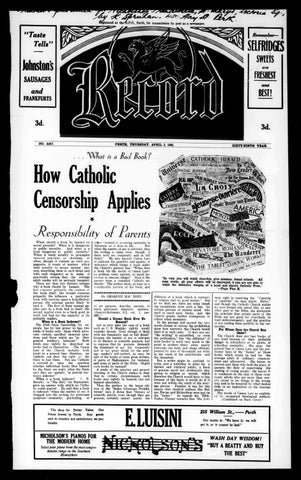
Censorship Applies When should a book be banned on moral grounds? When it is dangerous to public morality. And when is a book dangerous to public morality? When it tends notably to propagate immoral practices or doctrines, or when, though it contain no such propaganda, it treats of matters which tend notably to arouse sensual passion, describing them in such detail and with such frequency as to make it practically certain that the average adult reader will be seriously tempted. There are thus two distinct reasons why a book should be banned. The first concerns primarily the content of the book itself the second concerns primarily the influence a particular book with exercise upon a hypothetical person, the average person likely to read it. The first of these reasons applies only to a book bad in itself; the second applies even to a book good in itself, but bad for the majority of its probable readers. When is a Book Indecent? The Irish State Censorship, for example, has by law power to ban two kinds of books only: those which advocate certain, specified immoral practices, and those which are "in their general tendency indecent." Both kinds may rightly be described as books bad in themselves. The Canon Law of the Church includes both kinds in a general ban; therefore, no Catholic can deny the right of the State to ban them. But any Catholic is entitled to raise the question whether individual books thus banned by the State are really what the State says they are, namely, "in general tendency indecent." C. B. When is a book indecent? Murphy, in "The Bell," for September, gave an answer with which no Catholic could quarrel. He said that a book is indecent "when the matter of sex is dragged into the writing for irrelevant purposes-sensuality, pot-boiling, or
HER Al_D
VERY wreta.1,
diffusion of a hook which is contrary to religion and to good morals." But as we shall see, there are some standing exemptions from such a ban for certain persons of mature mind who need to reach such books, and the Church grants further exemptions to others when necessary. In the passage just quoted the very words chosen to convey the prohibition show how narrowly the Church would limit it in such cases. It does not say "the writing" is unjustified, or even the publication," but "the diffusion" of such books-a word very much to the point in modern times when nearly everyone can read, and cheap editions, printed by tens of thousands, are within the reach of the semi-literate and the immature. But a writer might be entitled to write, and a publisher to print for a limited and cultured public, a book of genuine merit but incidentally dangerous to religion or morals, which therefore the Church would have to ban because of the harm it would do if it were put within the reach of the average person. Possibly it was for this reason that classical authors like Balzac, Sterne and Richardson were put on the "Index." As regards the Bible, Father Dimnet remarks that "the Jew(
were right in reserving the "Canticle of Canticles" for men above thirty," and though the Catholic Church makes no such formal rule about this, or any other part of the Bible, she maintains the principle that certain parts of the Bible are not good for everybody to
read indiscriminately, and the practice of not reading them publicly in the vernacular. For Whom Does the Church Ban Cater? The Church does not ban books of any kind because of their probable danger to schoolboys or to adults of schoolboy mentality. She aims the general ban of Canon Law and the particular bans of the "Index" at those books which would be bad for the average adult of ordinary commonsense and self-control. She leaves to parents and those who hold the place of parents the duty of supervising the reading of young people; she leaves it to confessors in the case of those occasional adults who are more than usually prone to see things in the wrong way and to be tempted by what makes little or no impression on the average person. The words of Canon Law as explain. rd by recognised theological authori(Continued on Back Coyer.)
215 William St.,
E.LUISINI \ As mu
UM ell M
Ul
ift..am
mom
a Mai.
.
& a
ma -wet vs ummompifth. IMO Ala IMP
MEV. "Air AK
-
Perth
Our motto is: "We have it; we will get it, or it cannot be had."
' EMI\
WASH DAY WISDOM! "BUY A BEATTY AND BUY THE BEST"