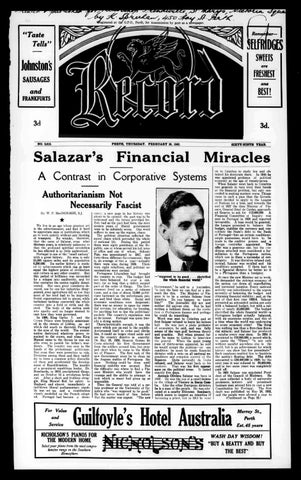

Salazar'sFinancialMiracles
AContrastinCorporativeSystems
AuthoritarianismNot NecessarilyFascist
ByW.P.MacDONAGH,S.J.Weliveinanagewhosegreatestart istheadvertisement,andfindithard toappreciatemenorinstitutionswhich gotoworkquietlywithoutanyblowing oftrumpets.Nowonder,therefore, thatthesameofSalazar,evenafter thirteenyears,isrelativelyunknownor thattheprofoundspiritualrevolution hehaseffectedissolittleunderstood.
Portugalisoneofthe"smallnations" withagreathistory.Itsareaisonly 35,500squaremilesanditspopulation 6,200,000.Itsearlierhistoryismarkedbyachievementswhichcanatleast equalthehighestpointsofcivilisation andcultureinanyothercountry.But thisperiodofbrilliancewassucceeded byarelapseintomediocrity,andfor fourcenturiesthenationrapidlydeteriorated.Heroncegreatcommercedecayed,onebyoneherindustriesdisappeared,evenagriculturefellsolowthat mostofherfoodhadtobeimported. Socialorganisationsfelltopieces,while turbulentfactionsconvertedthewhole countryintoafieldofstrifeanddiscord.Thebodyofthenationsank intoapathyandnolongerseemedto carehowtheyweregoverned.
In1908,KingCarlosI.andthe CrownPrincewere'brutallyassassinatedinthestreetsofLisbon,anact whichdidmuchtodiscreditPortugal intheeyesoftheworld.Theassassinationdestroyedwhateverpowerremainedtothecrown,andwhenKing Manoelcametothethronehewasunableeventopunishhisfather'smurderers.Thecountrywasnowinthe handsoftheprofessionalpoliticians. Buteventheywerepowerlesstorule. Divisionsamongthemandtheirinabilitytoformacommonpolicydiscreditedthemandacceleratedthedevelop. mentofRepublicanism.Themurder ofaprominentrepublicanleader,Dr. Bombarda,in1910,precipitatedthings, andonOctdber14arevolutionbroke out.Afterashortandfruitlessstruggle,KingManoelfledforsafetyto England,andalmostimmediatelya full-blownliberalparliamentaryrepublicwassetup,andaconstitution closelymodelledontheFrenchadopted.Portugalhadbecomeademo-
cracy;anewpageinherhistorywa, abouttobeopened;thepastwastobe redeemedandthefutureprovidedfor. But,badasthepasthadbeen,thenext sixteenyearsofliberalgovernment weretobeinfinitelyworse.Oneword sufficestosumuptheregime,chaos.
Thepoliticalsituationreflectedthe moralchaoswhichpervaded whole ofnationallife.Duringthisperiod therewereeightpresidentsoftheRepublic,oneofwhomservedhisfullterm ofofficeandoneofwhom,Sidonio Pais,wasassassinatedin1917,and forty-threedifferentGovernments;that is,anaverageoftwoayear-actually therewerenineduring1920.There wereeightrebellions,andpoliticalassassinationswerenormal.
PortugueseLiberalismhadbrought thecountrytoruin.Thebudgethad notbeenbalancedforoveracentury,forsolongthatadeficitseemed partoftheorderofthings.TheGovernmentlivedonaseriesofruinous loans,andaclanofabout12,000politi- ciansbattenedontheunfortunatepeopleandbledthemwhite.Socialand economicconditionsweredesperate; therewasnomoneytospareforessentialservices,foreducation,forhousing, foranythingbuttolinethepoliticians' pockets.Thecountry'sreputationwas atitslowest.Portugalwasquiteliterallyadyingnation. Characteristicallyenough,itwasthe armywhichputanendtothemuddle. Accustomeditselftoorderanddiscipline,itcouldnolongerstandasideand seethecountrydissolveinanarchy.
OnMay28,1926,GeneralGomesda CostaselectedhisfirstGovernment fromthesoldiersaroundhim,butstoppedshortwhenhecametotheMinisterofFinance.Thefirsttaskofthe newGovernmentmustbetocleanup theAugeanstablesofPortuguesefinance.Nothingcould'bedoneuntil financialstabilitywassecured.But thedifficultywaswheretofindaFinanceMinisterwhowouldhavethe courageandtheabilitytoattempta taskwhichsomanyhadgivenupas impossible. ThentheGeneralwastoldofacertainprofessorattheUniversityofCoimbrawho"wassupposedtobegood." Hehadneverheardofhimbefore. Butthematterwasurgent."Thenew
-"supposedtobegood electrified thewholefinancialworld." Government,"hesaidtoajournalist, "isjustthebestwecanfindatamomentlikethis.TheMinisterofFinanceistobeacertainSalazarfrom Coimbra.Doyouhappentoknow him?"Thejournalistdidnotand neitherdidanyoneelse.Buthehad writtenabrilliantthesisontheevolutionofPortuguesefinanceandperhaps hecoulddosomething.
WordwassenttoCoimbraandat firstSalazarrefusedtoleavehislecture hall.Hewasjustaplainprofessor ofeconomics,besaid,andwasfully awareofthevastgulfbetweentheory andpractice.ButwhenpressedfurtherhecametoLisbontointerview thegeneral.Whenthequietyoung manofthirty-sevenappeared,hesaid hewouldaccepttheposition-onone condition:hemust'bemadefinancial dictatorwithavetoonallnationalexpenditureandcompletecontrolofthe finances.QuitenaturallydaCosta refused,andSalazarwentbacktohis students.Thatwashisfirstappearanceonthepoliticalscene.Itlasted exactlyfivedays.
AntonioOlivieraSalazarwasbornin 1889.Hewasthesonofasmallfarmer inthevillageofVimieroinSantaComba.LiketheotherEuropeandictators heisamanofthepeople.HewaseducatedatanearbyDiocesanSeminary, whichseemstosuggestanintentionof becomingapriest,butin1911hewent
ontoCoimbratostudylawandobtainedhisdoctoratethere.In1916he wasappointedprofessorofpolitical economyattheageoftwenty-seven. WhenSalazarwentbacktoCoimbra twogeneralsinturntriedtheirhands atthefinancialproblem,butonlysucceededinmakingmattersworse.Things cametosuchapassthattheGovernmentdecidedtoapplytotheLeague ofNationsforaloan,andtowardsthe endof1927thethenMinisterofFinance,GeneralSineldeCordes,approach. edGenevatoaskfor£12,000,000.A FinancialCommitteeofInquirywas senttoPortugalin1928andreported favourably.Aloanwouldbegranted; theLeaguepromisedtobalancethe budget,stabilisethecurrencyandconsolidatetheState'sdebttotheBank ofPortugal-butoncertainconditions: ampleguaranteeswouldhavetobe madetothecreditorpowersanda foreigncontrollerappointed.The offerwasagenerousone,buttheconditionsattachedwereconsideredahumiliationtothePortuguesenation, whichsawinthemasurrenderofsovereignty.Itwasthereforerefusedand, instead,Salazarwasrecalledandhis conditionsaccepted.Iftherehadto beafinancialdictatorfarbetterletit beaPbrtuguesethanaforeigner.
AtoncethenewMinistersettowork. Hedemandedthestrictesteconomyof thenation,cutdownallsuperfluities, andincreasedtaxation.Everynational activitywassubordinatedtotheurgent necessityofbalancingthebudgetand obtainingfinancialstability;and,atthe endofthatfirstyear1928-9,Salazar presentedanastoundednationnotonly withabalancedbudget,butwithasurplusofnearly£3,000,000.Thebudget electrifiedthewholefinancialworld-a Portuguesebudgetactuallybalanced, withanenormoussurplus,andthisat atimewhentheworldwasundergoing anacuteeconomiccrisis!Thething wasnothinglessthanafirst-classfinancialmiracle;andSalazarhasproduced asurpluseveryyearsince.In1934it amountedto£18,000,000,arecordwhich, toquotethe"Times,""isnotonly withoutparallelanywhereelseinthe world,butisanachievementforwhich historycanshowbutfewprecedents." Suchsurplusesenabledhimtoliquidate thenation'sfloatingdebt.Thedebt amountedto£20,400,000in1929;bythe nextyearitwasreducedto£9,400,000, andintwomoreyearswascompletely paidoff.
In1931SalazarwasappointedPresidentoftheCouncilofMinisters.He atoncecollectedabodyofuniversity professors,lawyersandprominent businessmenaroundhimtocastanew ConstitutionforPortugal.Thefirst draftwaspublishedonMay28,1932, andthepeoplewereallowedayearto (ContinuedonPage12.)
oar '411"' "Taste Tells" Johnston's SAUSAGES and FRANKFURTS 3d NO.3,013. 41,IA'dr Air.iVwX.or 40P7 egisteredattG.P.O.,Perth,fortransmissionbypostasanewspaper. PERTH,THURSDAY,FEBRUARY26,1942. DGES SWEEIS flitaSIIST BEST! 3d. SIXTY-NINTHYEAR.
ForValue and Service MurraySt., GuilfoylesHotelAustraliaEst.P4e5rtyhears NICHOLSON'SPIANOSFOR THEMODERNHOME SelectyourpianofromthemostcomprehensiverangeintheSouthern Hemisphere WASHDAYWISDOM! "BUYABEATTYANDBUY THEBEST"
Thebluesmokefromhispipecurled uptotheceilingashesatinacomfy armchairscanningthe"deaths"column ofhispaper.
WHYTHEKOOKABURRA Laughs
Amanwalkingalongacountryroad foundanIrishmanpercheduponasignpost,whichpointednorth,withtheinscription,"ThiswilltakeyoutoMalvern:'
"Whatareyouuptherefor?"asked theman.
"Faith!"saidtheother."I'vebeen sittingupherefortwohours,andI'm wonderingwhattimeitstarts."
Wife:"John,whatisthedifference betweendirecttaxationandindirect taxation?"
Husband:"Why,thedifferencebetweenyouraskingmeformoneyand goingthroughmytrouserspockets whileI'masleep,"
X.:"SevenyearsagoIarrivedin thistownwithonlyoneshilling;but thatshillinggavememystart."
Y.:"Youmusthaveinvestedit veryprofitably."
"Idid.Itelegraphedhomefor money."*
"No,"saidtheoldgentlemansternly, "Iwillnotdoit.NeverhaveIsold anythingbyfalserepresentations,and Iwillnotbeginnow."
Foramomenthewassilent,andthe shopmanwhostoodbeforehimcould seethatthebetternatureofhisemployerwasfightingstronglyforthe right.
"No,"saidtheoldmanagain,"Iwill notdoit.Itisaninferiormadeof shoe,andIwillneverpassitoffasanythingbetter.Markit'AShoeFitfora King,'andputitinthewindow.A kingdoesnothavetodomuchwalking,
* * *
"ImetJiggstheotherday,andthe ,Admisertreatedmewithindifference."
"Yes,Isupposethatwasthecheapestthinghecouldthinkof."
* * *
Thecandidatesinthecountryconweregatheredroundthepollingbooth,whenoldFarmerJones'wellknowndonkeywasseenapproaching. Hewasa"doubtful"elector,buton hisnearerapproach,itwasseenthat hisdonkeywasgailydeckedoutin Liberalcolours.
TheLiberalcandidate,overjoyed,advancedtocomplimenttheoldfarmer, butwasmetwiththeunexpectedretort,"WhosaysI'mtovoteLiteral."
"Well,"repliedthecandidatein amazement,"lookatthecolourson yourdonkey."
"Oh,him!"FarmerJonessmiled contemptuously."Hewasalwaysan ass!" * *
PoliceSergeant:"Well,Mr.MacPherson,we'verecoveredthepocketbook youlostlastweek,withthe£1,000all intact."
Mr.MacPherson:"Aye,an'noowhat aboottheinterest?" * * * *
Maid(tomother,whohasjustreturnedfromadance)"Babywas verysickwhileyouwereaway,butI foundhismedicineinthechest,and gavehimadose,andhe'sbetternow."
Mother:"Goodgracious!Therewas nomedicineinthatchest!"
Maid:"Oh,yestherewas."
Shedepartedtogetthemedicine,and returnedshortlyaftertriumphantly holdingupabottlebearingthelabel, "Kidreviver." * * * *
ForemanMechanic:"Wehaveto worktoveryfinelimitsinourworkshops.Haveyouhadanyexperience inthisdirection?"
NewEmployer:"Oh,yes.Before thewarIusedtocutthehamforrestaurantsandwiches." * * *
"Doyouthinkthenewcookisgoing tosettledownwithus?"askedMr. Jones. "I'mabitdoubtful,"repliedhiswife. "Alettercameforherthismorning, andtheenvelopewasre-addressedfive times!"
"Itsays'ere,'anyinsanityinthe family?'"
"Well,put'No.'"
"'OwaboutUncle'Erbertwhat keepssaying'e's'Itler?"
"Lumme,youdon'ttakenonotice of'im:'e'spotty!"
"John,"saidhiswife,"there'sawhole lotofpeoplenowadaysgivingupsmoking." "Iknow,dear,"saidJohn."I'm justreadingtheirnames," * * * * Theyoungchapwastryingtododge theArmyservice,andwasbeforethe doctortobeclassified.
Assumingapainedexpression,he saidtotheM.O.:"Doctor,I'mjust'all topieces'!" "Ah!"saidthedoctor."Thenit's timeyoujoinedup."
* * * * Thelittlemannnthesoapboxatthe streetcornera-asholdingforthwith somevehemence.Theoccasionalbarks ofdisagreementfrommembersofthe crowdatonesidemadehimglarewith fury,andheexclaimed:
"Now,lookhere,Ican'tbearfools!"
Promptwastheretortfromtheback ofthecrowd:
"No,Iexpectyoucouldn't,butapparentlyyourmothercould."
Thecrowdroared,andthelittleman slippeddownfromhisperchandshuffledaway.
Teacher:"Whenwaterbecomesice, whatisthegreatestchangethattakes place?"
LittleTommy(eagerly):"Theprice, sir."
* * * *
Twoperfectladieswerediscussing eachother,andtheirremarkswereany thingbutcomplimentary.
Atlengthoneofthemsaid."You don'tconsideryourselfaprizebeauty, Ihope?"
"No,"repliedtheother,"Idon'tand Imustsayyourmothermusthavebeen veryfondofchildrentohavebrought you Up."
Adrillsergeantwasdrillingtherecruitsquadintheuseoftherifle. Everythingwentsmoothlyuntilblank cartridgesweredistributed.Therecruitswereinstructedtoloadtheir piecesandstandatthe"ready,"and thenthesergeantgavethecommand: "Fireatwill!"PrivateLunnwas puzzled.Heloweredhisgun,"Which oneisWill?"heasked. *
Threeminerseachenteredadogfor thelocalcanineshow.Nextmorning, ontheirwaytowork,theywerecomparingresults.
-Mydog."saidone,"washighlycommended."
"Ah,butminewasveryhighlycommended."saidthesecond.
"Well,mine'sgotnoticket,"admittedthethird,"buthegotoutofhis pen,andamongthedogbiscuits,and wasveryhighlydelighted!"
"Iwant,"saidthehousehunter,"a houseinanisolatedposition-atleast fivemilesfromanyotherhouse."
see,"saidthehouse-agent,with anunderstandingsortofsmile."You wanttopracticethesimplelife?"
"No,"answeredthehouse-hunter, 'grimly."Iwanttopracticethecornet."
-Guy'nor,"saidthedustytraveller, "howfarisittoGloucester?"
"'Boutamileandahalf,"replied thefarmer.
"CanIridewithyou?"
"Certainly.Climbin!"
Attheendofthree-quartersofan hourthetravellerbegantogetuneasy.
"Guy'nur."heasked,"howfarare wefromGloucesternow?"
'
'Boutfourmilesandahalf."
"Greathaystacks!Whydidn'tyou tellmeweweregoingawayfromGloucester?"
"Whydidn'tyoutellmeyouwanted togothere?"
OnedayfarmerSkinner,thechampionmeanman,hiredacountryyouth tohelphimwithhiswork,andasthe boyturnedupatsixo'clock,theyat oncesatdowntobreakfast.Afterthe boyhadeatenhisfill,thefarmersuggestedthatwhiletheywereatitthey shouldeatdinner.Theladagreed, andmanagedtogetdownalittlemore. Seeingthathisnewhelperwasbythis timequitereplete,thefoxySkinner suggestedeatingsupper,andthusget themealsdonewith.
-Rights),"murmuredtheboy,and swallowedhalfacrustofbread.
"Andnow,"saidthehappyfarmer, thinkingofhissavinginfood,"let's gettowork."
"Notlikely."answeredtheboy,"Igo to'bedaftersupper."
GAYNOR'SHISMAJESTY'SHOTEL
HAYSTREET
EXCFLLENTCUISINE PERTH. MODERATETARIFF.
HOTELPERTH
JACKEDDINGTON, Proprietor.
ExcellentAccommodation
STAN.O'BRIEN COURTHOTEL PERTH.
'Phone:B4261
HOTELBEACONSFIELD FREMANTLE. OverlookingtheOcean SuperiorAccommodation. Modera'eCharges. M.BYRNE (LateofGrandandShamrock Hotels,Boulder).
SUBIACOHOTEL
FIRST-CLASSACCOMODATION
'Phone:W1028, A.J.McITENRY,Proprietor
VICTORIAHOTEL
HAYSTREET,SUBIACO. RenovatedThroughout. EssenceofComfort. W.F.ARTIS,Proprietor. (LateofBalmoralHotel,Vic.Park) COUNTRY.
DukeofYorkHotel NARROGIN. ReconditionedandRefurnished. NewLounge,DiningRoom,and CommercialRooms. ARTHURBOYLAN,Proprietor (LateGeorgeHotel,Perth.)
FREEMASON'SHotel TOODYAY. ExcellentCuisine. AmaticeRefrigeratorInstalled OldandNewFriendsare CordiallyWelcomed MRS.E.WING,Proprietres,

GOLDFIELDS.
TRYHANNAN'SLAGERatRodBeaton's HANNAN'SHOTEL HANNANSTREET, KALGOORLIE.
STAR&GARTERHOTEL
Cnr.HANNANandNETHERCOTT STREETS,RALGOORLIE. KalgoorlieBeer,AlwaysCold,onTap AlsoallLeadingBrandsofWines andSpirits.
BERTSTARR Proprietor.
SFEYOUATTHEPALACEHOTEL KALGOORLIE
"TheHeartoftheCity."
'Phone13. Box124.
AUSTRALIAHOTEL
KALGOORLIE
C.T.A.andR.A.C.HOUSE.
OneMinutefromSt.Mary's Church.
HotandColdWaterinHotel Bathrooms.
RefrigerationThroughout.
OnlyLock-UpGaragesinthe centreofTown.
TWO THERECORD. Thursday,February26,1942.
HotelandAccommodationGuide CORNERKINGANDMURRAYSTREETS. CITYHOTEL-:-Perth NOWUNDERPERSONALSUPERVISIONOF K.D.HEENAN,PROPRIETOR. Telephone:114094, OntheRoad, WEMBLEY HOTELCityBeach. FirstClass Accommodation. ALLLEADINGLINESOFLIQUORSTOCKED. 'Phone:B3418. M.CRANLEY,Proprietor.
M.I.DILLON,Licensee. KeoughsforCatering AnyNumber,Place,orTime. ThreeReceptionRoomsforHim. OnHire:Crooke-Cutleryand Glassware,etc. PhoneB1724. GLADKEOUGH. NEWCASTLESTREETPERTH. BRYANT&WATERS 80to90STIRLINGST.,PERTH. WOODandCOALMERCHANTS. OrdersPromptlyAttendedto. 'PhoneB3938, PrintingHousesofA.D.SCOTT FORFINEPRINTING ServicePrintingCo. CITYANDSURBURBANPRINTINGCO. LI'NOCRAFTPOSTERSTUDIOS. RAINBOWHOUSE.983-7HAYST.(EAST)PERTH. ServingAllColleges'PrintingRequirements. TelephoneB9901(3lines) Res.U2389 I'MeetyouattheSavoy'
AnglicanBishops
Catholic,Bondi.
WouldyoukindlycommentontheenclosedarticlegivenmebyanonCatholic?
ThearticleiswrittenbyRev.FredericGreville,anAnglicanclergyman,in anattempttoprovetheapostolicsuccessionofAnglicanBishops,andthe continuedmembershipoftheCatholic ChurchbytheChurchofEngland.1 willbrieflycommentonhismain points.
Mr.Grevillesays,"Theconsecrationof Parkerwastheconnectinglinkby whichtheApostolicSuccessionin theEnglishChurchwascontinued afterthefinalbreachwithRome."
ThebreachwithRomerulesoutany possibilityofcontinuedjurisdictionderivedfromtheApostles,sofarasthe newChurchofEnglandwasconcerned. Butthequestionarisesastowhether, apartfromapostolicjurisdiction,validlyconsecratedBishopswereretained bytheChurchofEngland.TherepudiationoftheauthorityofRome meantschism.ButaschismaticChurch couldretainvalidOrders,asisthecase withtheGreekOrthodoxChurch.But theAnglicanChurchhasnotevenretainedvalidOrders.Andif,asMr. Grevillesays,alldependsontheconsecrationofParker,thenthecaseis ended.ForParkerwasneveravalidlyconsecratedBishop. * * * *
"SUCCESSION."TOCANTERBURY-
TheRomanCatholicChurchhastried hardtoprovethatParker'sconsecrationwasinvalid.
Theproofthathisconsecrationwas invaliddidnotrequiremucheffort.
Whatarethefacts?Firstly,Parker wasthesuccessorofCardinalPole. ArchbishopofCanterbury,during thelatteryearsofQueenMarys reign.TheQueenandtheCardinaldiedonthesameday,andon November17,1558,Elizabethsucceededtothethrone.
TheKingofItalyhas"succeeded.. HaileSelassieas"EmperorofAbyssinia."ButthereisasmuchcontinuitybetweentheKingofItalyand HaileSelassieastherewasbetween ParkerandCardinalPole;andthat wasnoneatall.AfterCardinalPole's death,ParkerwasintrudedintotheSee ofCanterburyafteranineffectiveattempttoconsecratehimaBishop.
Secondly,theDeanandChapterof CanterburyelectedMatthewParker,alearnedpriest,tobeArchbishopinPole'splace.
MatthewParkerwasapriestwho hadbeensuspendedduringthereign ofMaryforhavingtakenawife.ElizabethchosehimtobeherfirstAnglican ArchbishopofCanterbury,tellingthe DeanandChapterofCanterburyto holdanelection,buttobesuretoelect hernominee.Hewasdulyelected,in accordancewithElizabeth'sinstructions,onAugust1,1559.
OnDecember17,1559,ParkerwasconsecratedbyfourrightlyconsecratedBishopsinLambethPalace chapel
Theceremonywasafarce,andParkerwasaslittleaBishopattheend ofitashewaswhenitbegan.And theAnglicanChurch,beingcommitted toParkerasitsfirstArchbishopof Canterbury,isfightingalostcause.
TwooftheseBishops,Barlow(chief consecrator)andHodgkins,had beenconsecratedaccordingtothe oldCatholicPontifical;andtwo, ScoryandCoverdale,accordingto theEnglish(EdwardVI.)Ordinal. ScoryandCoverdale,havingbeen consecratedaccordingtothemutilated
STOVES,allenamel,newandused; lowestpricespromptrepairs...W.A. StoveCo.,559WellingtonSt.(B6307.)
DERBY'S MURRAYSTREET,PERTH.
PhonesB9731(threelines)
B7777 B3588
B9101(twolines)
REGISTEREDW.A.T.A.
ALEXRODOREDA
TurfCommissionAgent
802HAYSTREET.
AGENTFORW.A.CHARITIES.
RingB5841andB5236.
andinefficaciousEdwardineOrdinal, werenotBishopsatall.Theyhadthe titlewithoutthereality.Barlowand Hodgkinswererenegade,thoughvalidlyconsecratedCatholicBishops(Barlowmustprobably,Hodgkinscertainly).ButintryingtoconsecrateParkertheyusedtheEdwardineOrdinal, whichwasentirelyuselessforthepurpose.AndParkerremainedwithout validconsecrationafterall.
Asamatteroffact,Parker'sconsecrationceremonywascompletelyirregular,bothinecclesiasticalandcivil law.Notoneofthefourconsecrating''Bishops-wasa"Bishopofthe realm,"asrequiredbytheActofHenry VIII.,fornotonehadadiocese.And theriteemployed,accordingtothe EdwardineOrdinal,hadnotyetbeen ratifiedbyParliament.Elizabethhad tostepinaftertheevent,andgivea comprehensivedispensationfromallthe defectsoftheceremony,relyingon herabilityto-dosoasSupremeGovernoroftheChurchofEngland,whateverthatmightbeworth.Isitany wonderthattheCatholicChurchrejectsParker'sconsecrationasinvalid, anddeclaresthatheneverhadany rightfulecclesiasticalstatus?
WASTHEFAITHRETAINED?
Atthetimeofthebreachbetweenthe
ChurchofEnglandandtheChurch ofRome,theChurchofEngland retainedherprofessionoftheCatholicfaith.
Ifthatbeso,somethinghasgone verywrongsince.FortheChurchof EnglandnowprofessestheProtestant Faith.WhencrownedbytheArchbishopofCanterbury,theKinghadto say,"InthepresenceofGodIprofess, testify,anddeclarethatIamafaithfulProtestant."
Yetinacertainsenseitistrutthat, atthetimeofthebreakwithRome, theChurchofEnglanddidretaina professionoftheCatholicFaith.For althoughHenryVIIIsetupaschismaticalChurchunderhisownjurisdictionin1534,hewouldnotallowthe introductionofProtestantteachings. Itwasafterhisdeath,andduringthe reignofEdwardVI,thatCranmerwas abletoProtestaniseAnglicanteaching andformsofworship.Andafter Mary'sdeath,Elizabethrevivedthe Protestantoutlook.
* CONTINUITY-LEGALAND SPIRITUAL! TheChurchofEnglandalsoretaineda validlyordainedhierarchy.
Mr.GrevillebasesthisonParker's consecration,whichitselfwasinvalid. Thereforeitfollowsthatshekeptupa legalcontinuitywithheroldself,as shewasbeforethebreachwith Rome. She,asMr.GrevilletermstheChurch ofEngland,didnotexistasaChurch beforethebreachwithRome.Her newselfwasbornthen,andshehadno oldself,ofwhomtocherishfondmemories.FortheChurchinEngland priortotheReformationwasRoman Catholic,andnothingelse.Meantimetheprofessorofthehistoryof EnglishLawatOxfordUniversityhas recentlysaidthatwhateverAnglican clergymightwishtomaintain,there wasnolegalcontinuitybetweenAnglicanismandthepre-Reformation ChurchinEngland.Fromtheviewpointoflaw,thediscontinuityisevident Shealsokeptupaspiritualcontinuitywithheroldself. Shehadnooldself.Andher spiritualcontinuitywiththepre-ReformationCatholicismofEnglandwasas non-existentasherspiritualaffinity withthatsameCatholicChurchto-day.
ActingontheideasputforwardbyMr. Greville,someHighChurchclergymen inSydneyhavetriedtomanifesta spiritualaffinitywithCatholicism.But theirownAnglicanArchbishoprejects theireffortstointroduceCatholic teachingsandformsofworship.They arerightinbelievingthatthetruth lieswithCatholicism.Heisrightin believingthatCatholicismisopposed tothegeniusandspiritofAnglicanism. * * * *
THE'LIVINGBRANCH."
Sheisatrueandlivingbranchofthe oneHolyCatholicandApostolic Churchfoundedontherockofthe Apostles. Unfortunately,theOneHolyCatholicandApostolicChurchfoundedon therockoftheApostlesdeclaresthat theAnglicanChurchisnotoneofher trueandlivingbranches.IfaCoun-
ciloftheCatholicBishopsoftheworld wereconvokedto-morrow,theCatholic BishopsofFranceandGermany,Italy andSpain,England,Ireland,Scotland, Canada,Australia,NorthandSouth America,India,andChina,andJapan,
wouldattend.ButnotoneAnglican Bishopwouldbeinvited.IfAnglicanismwereatrueandlivingbranchof theChurch,AnglicanBishopsinEnglandwouldbeinfullcommunionwith theFrenchBishopsacrosstheChannel. Buttheyarenot.AndifoneofMr. Greville'sAnglicanparishionerswantedtobecomeaCatholic-aRomanCatholic,ifyouwish-wouldhesay,"By allmeans.Youareonlyhopping fromonelivingbranchtoanotherlivingbranchofthesametree."Iam afraid,insuchacase,hewouldsuddenlydiscoverthathistheorywasuntrue. WiththatIleavethemattertoyour ownreflections.
ShouldLayPeopleStudy Theology?
Doyouthinklaypeopleshouldstudy theology?
SacredTheologyisthescientificand systematicstudyofrevealedTruth. Andtherearemanybranche.oftheologicalscience:dogmatic,mora:.ascetical,andsoforth.
Whileveryfewofthelaityhavethe timeoropportunityornecessarypreliminarytrainingrequisitefortheproperstudyofTheologyinanyorallof itsbranches,itismostdesirablethat thelaityshouldtakeadvantageof everyopportunitytolearnalltheycan oftheTheologyoftheChurch.
FarfromobscuringChrist,asmany ill-informedpeopleimagine,genuine Theologywillhelpthemtoadeeper understanding,appreciationandloveof theteachingandthePersonofChrist. Itisastudywhichisnotmerelyabstractandtheoretical,buthasthe greatestpracticalvalueineveryday life;-fortheDivineRevelationwhich isthesubjectmatterofTheologywas giventousforourguidancethrough lifetooureternaldestinyinthepossessionofGod.
* * *
ANOBJECTION. AfriendofminewithwhomIoften discussreligiousquestionsmaintainedthatwe(thelaity)ought nottomeddleinsuchmatters. WhilethesystematicstudyofTheologybypeoplewhohavehadtheneces-
sarypreliminarytraininginPhilosophy andApologeticsisanexcellentthing, thefactremainsthatTheologyisafield whichisfullofpitfallsfortheamateur;especiallyfortheamateurwho modestlythinksheisanexpertand actsaccordingly.
C.E.M.Joad,therationalistphilo. sopher,thusgivesexpressiontohis pent-upfeelingsonamateurphilosophers.(Iquotehiswordsherebecausetheymaybeappliedwithequal accuracytoamateurtheologians).
"Herearemenofprovedbusiness ability.Notonlyinenterpriseand initiative,butinsagacityandjudgment,theystandheadandFhOLIY:C7=
RENNANS OULDER LIMITED
FORQUALITYDRAPERY, LADIES'ANDGENTS' CLOTHING MANCHESTERAND FURNISHINGS
OurCatholicSchoolsandColleges
CHRISTIANBROTHERS,MT.HENRY
Oneofthe.issociutedPublic SchoolsofW.J.
AquinasCollege
TELEPHONE:MU1520
ForBoardersandDayStudents
Boysadmittedfrom7upwards
BeatulduilySituated,overlookingtheriver,NearthenewCanningBridge. ForParticularsapplytonePrincipal,AquinasCollege,CanningParade,Mt.Henry.
SACREDHEARTHIGHSCHOOL HIGHGATE-PERTH (ConductedbySistersNotreDameDesMis>ions). BOARDINGANDDAYSCHOOLFORGIRLS.
PUPILSPREPAREDALLEXAMINATIONS. MONTESSORISCHOOLFORYOUNGCHILDREN ForProspectusapplyREV.MOTHERPRIORESS
LoretoConvent"Osborne-Claremont BOARDINGANDDAYCOLLEGE.
TheSchoolprovidesasoundeducationonmodernlinesinallbranches ofstudy.Thepupilsarepreparedfirallexaminations.TheSchoolis beautifullysituatedbetweenOceanandRiver,inextensivegrounds, withfineplayingfieldsandprivateSwinimingPoolinRiver Telephone:F2135. Apply- MOTHERSUPERIOR.
ST.ILDEPHONSUS'COLLEGE
NEWNORCIA CONDUCTEDBYTHEMARISTBROTHERS
ForParticularsApplyto-THEBROTHERDIRECTOR
Thursday,February28,1942. THERECORD THREE
1
ZA
'PhoneB3810.
atREASONABLEPRICES,DealfromJas.GrayandCo.Ltd. WHOLESALEANDRETAILBUTCHERS.
63BURTST.,BOULDER,ARDAGHAVENUE,&HANNANST., KALGOORLIE. Telephones:B168;K675. Telephones:B168;1675.
TRY
75BURTSTREET,BOULDER, FORYOURNEXTGROCERYORDER.
HAVEYOU
BoleGoldfieldsManufacturerofProceraBread.OurPromptDelivery ServiceCoversKalgoorlieandBoulder. THEPIONEERBAKERY. 40NORTHTERRACE,BOULDER. (W.ANDERSON). 'Phone137Boulder,andourCarterwillcall. IJ
Requiescat44inPace W.STROTHER FUNERALDIRECTOR. 18HANNANST.,KALGOORLIE;COOLGARDIE; MENZIES.
AtYourCommandatanytime,DayandNight. TelephoneK327.
4 FRUIT,VEGETABLESWHOLESALE, 'PHONEB1651. T.R.NICHOLASCOY.LTD. METROPOLITANMARKETS,PERTH. Shops,Hotels,InstitutionsSuppliedinTownorCountry. 5/.BAGSVEGS.RAILEDANYWHERE.
GoodsCarefullyPackedforShipmenttoNorthWest. 11.111.0. s
-Washdaysare Easier
RelaxSoapwilltakethehard workoutofwashdaysfor YOU.Relaxisgentleonthe fabricandyourhands;washes clothesasnowywhite;and NOhardrubbingisnecessary.AlwaysuseRELAXin YOURwashtub.(Obtainableinthreesizes.)
MADEINW.A.BYWESTRALIANSOAPSLTD.
abovetheaverageoftheirfellows. Suchmenaredifficulttoimposeupon. Theyare:notthesortwhoare'taken in.'Theyarenot,forexample,likely tomistakepretentiousadvertisement fursolidworth.Norintheirown spheredo.ohey.ButdirectlytheyexchangetilefutureofatheatricalventureforthatoftheCosmosandbegin tospeculatenotuponstocksand shares,butuponBeing,theirsimplicityisthatofthemostbesottedrevival. ist,ofthecallowestundergraduate. Theirclearheadednessismuddled; theyareincapableofrecognising'balderdashwhenitistheirown,while theirpracticaljudgmentdoesnotpreventthemfrombeingtakeninby whateverfarragoofpretentiousobscuritiesandcosmicflapdoodlemayhappen tohavecaughttheirears.
"Toacquityourselfcreditablyinscienceormathematics,youneedakeen andalertintelligence.Youalsoneed trainingandpractice;yourequire,in fact,educationinthesubject.In philosophytherequirementsarenot different.Butthereisadifference andanimportantone.Lackingthe qualificationsyousimplycannotdo mathematicsandscience,andthefact thatyoucannotisimmediatelyapparent.
"Inphilosophyitisnotso.Theline thatseparatestheprofoundestmetaphysicalspeculationfromnonsense pureandsimpleisnevereasytodraw, andthelattermayandoftendoesmasqueradeastheformer.Itisthiscircumstancewhichconstitutesoneofthe attractionsofphilosophyfortheuntrainedmind.Evenafoolcanputup somephilosophicalshow,andinno departmentofhumanactivityisit hardertodetectthefactthattheper-
formanceisworthless. Themain reasonforthepopularityandprosperityofphilosophicalidiotsisthedifficultyofdistinguishingthefruitsof profoundspeculationfromthefrothof undisciplinedimagination.'("Returnto Philosophy,"ch.I.)
Whatistrueofthe"after-dinner" philosopherisperhapsevenmoreemphaticallytrueoftheamateurtheologian;especiallythenewspapervariety.
Itmust'beadmittedthattheprincipleofprivatejudgment,unchecked byanyauthoritativeteachingauthority,hasenabledthemostextravagant nonsensetomasqueradeastheology,for ithasmadeeverymanhisowntheologian.Thenaturalresulthasbeenthat non-CatholicTheologyhasdegenerated toalargeextentintoajumbleofconflictinguncertaintiesleadingnowhere. ThusTheologyhasfallenintodisreputeamongstnon-Catholicsgenerally. Therewas,therefore,alargeelement oftruthinyourfriend'scontention. Nevertheless,itistruetosaythat,in thepropercircumstancesandunder trainedteachers,thestudyofCatholic Theologywouldbeagoodthingfor theCatholiclaity.
CatholicTheologyisanexactand highlydevelopedscience.Itembodies theaccumulatedwisdomoftwothousandyearsofintensestudyofthe truthsrevealed'byGodandtheirapplication.
Itmaybeadded,however,thatthe properstudyoftheologybythelaity isscarcelypracticableexceptinaCatholicUniversity,or,atleast,inaCatholicTheologicalFaculty.IntheabsenceofaCatholicUniversityortheologicalfaculty,thelaitycouldderive greatbenefitfromastudyoftheworks ofrecognisedtheologians.
ReligionandCrime
"Inquirer."Sydney
Iwouldbegratefulifyouwouldcommentuponthefollowingstatements.
Itthosetowhomyouattributethe statementsreallymadethem,theyare extraordinaryutterancestocomefrom suchpeopleinsuchaplace.Nota wordofexcusecouldbeofferedfor them. OneofourlecturersattheTeachers' CollegeIattendtoldusthat"statisticsprovethat,wherereligion ismoststronglypractised,there crimeismostprevalent." Thatstatementisuntrue,andmost injurioustobothreligionandmorality.Ifthelecturerindeedsaidsuch athing,heshouldbecalleduponto provehisstatistics,andtoprovethat theyprovehiscontention.Ifheis quotingsomequackrationalist,blind faithinacheap-jackwriter,whohappenstosuithisownprejudicesisnot enough.Theverdictis,ofcourse,absurdonthefaceofit.Forifreligion isstronglypractised,thelawsofGod areobserved,andtheyexcludecrime. Ifcrimeisprevalent,thoseguiltyof crimearenotpracticingtheirreligion. TheCommissionerofPolice,Mr.McKay,inhisreportonjuvenilecrime, readbeforeaselectcommitteeofthe LegislativeAssembly,attributedthe growthofjuvenilecrimetoalackof soundreligiousinstruction.Andhe madeapleaforsuchinstructionas "themostimportantthingrequiredto rectifyasituationwhichallmustdeplore."YetattheTeachers'College religionisridiculed,andasmany teachersaresentouttotheschoolsas possiblewithsneersatreligionon theirlips.ThelecturersarenotemployedbytheState,eveninthename ofseculareducation,toteachapositivecontemptforreligion.Surely theStateexpectsthemtoabstract fromreligion,andteachsecularnibjects.Toinculcateirreligion,and takeeveryopportunitytobelittlereligion,isanabuseofaprivilegedpositionwhichisintolerable. * *
"VIRGINBIRTHS."
Thelecturerclaimedthat,ifwestudy theancientreligionswewillfind inthemmanyVirginBirthsand 25th.ofDecember.Isthistrue? Itisnottrue.Amanwhowould makesuchastatementmerelyex hibitshisignorance,andprovesthat hehasneverstudiedcloselytheancient religions.Heisbutrepeatingthe superficialguessworkofaVictorian rationalism,whichneverdidbother muchaboutevidence,andisnowthoroughlydiscredited.Whethertheybelieveitornot,allrealscholarswho havetakenthetroubletounderstand theChristiandoctrineoftheVirgin BirthofChrist,admitthatithasno parallelwhatsoever,eveninpagan legend.Ifchallenged,yourlecturer couldnotproduceoneinstancefrom anyancientreligionwhichwouldbe inanywayaparalleltotheChristiandoctrine.Butagainthequestionreturns.DoestheStateemploy theselecturerstoinculcatetheirown
anti-Christianideas,andtomakeuse oftheteacherstheytraintocarryon theirapostolateofirreligioninthe schools?
"BOOKSFORBIDDENTO CATHOLICS.'
Thesamelecturersaidthat"theCatholicChurchadvocatesfreetIcrm ofthoughtforclearingupthepresentsocialsystem,butshepreventsfreedomofthoughtbyplacingbooksontheIndex,andforbiddingpeopletoreadthem."
IfalecturerintheTeachers'College, oranywhereelse,wantstoattackthe CatholicChurch,heshouldatleastabstainfrommisrepresentingherposition.ItisuntruetosaythattheCatholicChurchpreventsfreedomof thoughtbyplacingbooksontheIndex. "Some"booksareplacedontheIndex, andforbiddentoCatholics.Those booksarebookswrittenexpressly againstreligionoragainstmorals.And freedomofthoughtisnotaffected. Catholicsareasfreeasanyoneelseoutsidethefieldofreligionormorals. Withinthatfieldtheyarefreetoread whatisright,andtothinkasmuch astheylikealongcorrectlines-and themorethinkingtheydothebetter.
TheCatholicChurchexiststokeep themonrightlinesinmattersofreligionandmorality.Willthelecturers objecttoparentsregulatingthereadingoftheirchildren?ThenwhyobjecttotheCatholicChurch,their spiritualMother,regulatingthereligiousandmoralreadingofherchildren?
TheStaterightlyforbidsthesaleof dangerousdrugstounauthorisedpersons.Buttherearementalpoisons aswellasphysicalpoisons.Tosuggestthatpeopledonotneedpreservingfromdangerouserrorsbyregulatingtheirreadinginmattersofreligion andmorals,istosuggesteitherthat thesethingsdonotmatter,andthat seriousmistakesinthesesubjectsare buttrifles;orelsethatpeoplecanbe trustednottofallintoanymistakes.
Inthislattercaseisitsuggestedthat allmenareinfallible,orthatallhave therequisiteknowledgeandtherequisitelogictoarriveatcorrectconclusions?Inthisparticularattack ontheCatholicChurchthelecturernot onlydistortedtheCatholicposition.He abandonedevenelementarycommon sense.But,oncemore,istheTeachers'CollegetheplacetoairtheseantiCatholicprejudices?
1111,111111111111111111111111111,111111,11,11111111111111111111111111111111,9
GasStoves,New,Enamel,£8/11/.. Onlyafewleft.Acceptoldstovepart payment.W.A.StoveCo.,559Wellington-street.
J.W.SHEEHAN
PrimeBeefButcher
RANNANST..KALGOORLIE.
MARITANASTREET.
Tel.438 Tel.438
FOUR GOLDFIELDSSECTION. THERECORD Thursday,February26,1942. YOUCANDOALLYOURSHOPPINGAT TheGoldfields'Leading EmporiumWhereYou AlwaysGet TheBestforLess RUSSELL'SKalgoorlie
SHOPFORMEN'SWEAR
BESTMEAT
THE
FORTHE
JAMESSHEAHAN
THEPIONEERBAKERY
TRIED
HE ri statementbytheBelgian Primate,CardinalVanRoey, whichappearselsewherein thisissue,deservesthemost carefulstudy.ForHisEminencehasmadestrongerandmore lucidexpositionsoftheconfusedrelationshipoftheChurchtopolitics thanperhapsanychurchmanofhisday. BeforeexaminingtheCardinal'sstatement,itmightbeaswelltonotethat thecryof''politicalCatholicism.'has neverbeenraisedfrompressorplatformwherethepoliticscondemned wereFascist.Therewasnooutcry overtheencyclical,"Mitsorgebrennender,"whereas"DiviniRedemptoris" wasahorseofanothercolouraltogether.Similarly,whenCardinalVan Roeyopenlyexpressedsuspicionofthe BrusselsPeaceCongressin1936,hewas brandedbythePressasharbouring Fascistsympathies,butwhenhecondemnedtheResistPartyin1937,and causedtheirdefeatintheelections,the PressfailedtohailhimasthechampionofdemocracyorSovietism.Ina word,thereisnoobjectiontothe Church'sinterventioninpoliticssolong asthepracticedoesnotimpingeupon theRedrealms.
Itwaswithintwelvemonthsofthe BelgianelectionswhenDegrelle,the Rexistleader,complainedthathehad beendefeatedby"theBishop'scross," thatCardinalVanRoeywrotetohis clergythatBishopswereboundtomake knowntothoseundertheirauthority theirjudgmentonpoliticalideals,and tofavourorcondemnindividualpoliticalparties.Healsostatedthat"the hierarchicauthorityisperfectlyentitled topronounceonanypartyormovementinsofarasitopposesreligious well-beingorthepreceptsofChristian morals."HeinstancedtheRexistsof BelgiumandtheBasquesinSpainas examplesofCatholicsnotfollowing theirBishops'directions,whichinthis matter,asinthingspurelyreligious,are bindinginconscienceandnotmerely "directional."Thisdirectionaroused greatoppositionontheContinent.Some saidtheCardinalhadoversteppedthe limitsofhisauthority,whileothers spokeof"thedictatorshipofBishops." Yetothersstatedorinsinuatedthatthe Vaticantacitlydisapproved;theymade reservationsandtalkedofanappealto thesupremeauthorityoftheChurch.
ButtheCardinalforestalledhis critics,submittinghisdeclarationfor comment,ifsuchwasthoughtopportune.TheresultwasaformalapprovalfromthePopethroughhisSecretary ofState(thepresentHolyFather),who wrote:"HisHolinessisgladtofindin thedeclarationafaithfulechoofhis ownmind."Theimportanceofthis documenthasbeengreatlyintensified bytheCardinal'sattitudesincethe NazisubjugationofBelgium.Inperfectconsistencywithhisdeclaration, theCardinallastyearforbadetheSacramentstoBelgianswearingpro-Nazi uniformsorattendingasmembersof pro-Naziorganisations.Stillmorerecently,HisEminence,inasermonto theJocists,statedthatitwasunlawful tocollaboratewithanoppressiveregime,andthattherewasevenanobligationtoworkwiththosewhotryto resistsucharegime.Suchanattitudetakessomecourageinthefaceof anArmyofOccupation.Butithas beenfollowedintheReichitselfbythe amazinglyoutspokencondemnationof theGestapomade1wBishopVonGalen.
POPESPEAKS
SevenLaT131.1c18CS
TheHolyFather's"Pentecostaleloquence."asithasbeencalled,hasbeen puttogooduse,saysOnlookerin"The CatholicTimes."Duringthefirsttwo yearsofhispontificatehehasgiven84 addressesinItalian,18inLatin,the samenumberinFrench,16inSpanish, fiveinGerman,fiveinEnglish,andone inPortuguese.Ononefamousoccasion,beforehebecamePope,hegave anaddresstoCatholicpressmenwhich hestartedinonelanguageandcontinuedatdifferentstagesinaboutsix others.Iheardthispolyglotaddress andwasimpressedbytheexcellent Englishhesopke,withonlyaslightaccent.Suchadisplayoflearningwas given,appropriatelyenough,inthe AulaMaximaoftheAngelico,thefamousDominicanUniversityinRome.
ALBANY.
H.C.PriorFuneralDirector ALBANY(Established1921). PrivateMortuary.MotorVehicles. ChargesModerate. 'Phone215.
Albany,Mt.Barker,Denmarkand Districts,
AcuriouscourtcaseoccurredinDsiblinlastmonth.AnIrishwomanhad letfurnishedroomstoadentist,but objectedwhenaJewishdentistnamed NathanielGrosboughtthepractice. Sherefusedtoacceptthetransfer.The casewenttoCourtandtheladywas upheldintheCircuitCourt.UponappealtheEireianHighCourtconfirmed theoriginaldecision.Givingjudgment,Mr.JusticGavanDuffysaid: "Mrs.SchlegelisIrishandCatholic. AntagonismagainsttheChristianJew hasitsrootsinhistorynearly2,000 yearsago.Itcannotbedismissedas aneccentricextravaganceofbigotryin acountrywherereligionmatters."I realiseIamtrampingoverminedcountryinthismatter,butthemineshave beensetbytheJews.Everyslightestefforttodiscusstheproblemwhich theirpresencecreatesineverynation isfrustratedbythecryof"Anti-Semitism."Yetthispolicyofsecrecy,as Mr.Bellochaspointedout,ismistaken andcanbeproductiveonlyoftragedy. EverywhereandalltimestheJews
by FRANCISGILBERT
havebeenthevictimsofhostilityand activehatred.Intheirowninterest suchauniversalphenomenoncannot beignored.Iftheycanbutbring themselvestofaceit,asolutionmay atleastbeattempted.
TheIrishCourtcaseillustratestomy mindtherealismandappreciationof historicalrealitieswhichobtaininCatholicIreland.WhenJusticeGavan Duffyspokeofthe"antagonismagainst theChristianJew,"heundoubtedlyhad inmindthecaseofSpain.Forthe primaryfactofthereconquestofthat countrybyFerdinandandIsabellais theantecedentfactthattheJews, eitherdirectlyorthroughtheircoreligionistsinAfrica,encouragedthe MohammedanstoconquerSpain.WherevertheIlerbenswentinthe8th.centurytheJewsthrewopentothemthe gatesoftheprincipalcities,sothatin anincrediblyshorttime,theAfricans weremastersofallSpain-savethe Asturias.After800yearsitfelltoa woman-Isabella-todeliverSpain frombondage.Andjustasherfirst taskwastoachievenationalunity,so thegreatestobstacleinherpathwas the"Christian"Jew.Therewereonly about200,000SynagogueJewsin1450 (whowereallowedcompletefreedom ofworship),buttheremusthavebeen atleast2,000,000`Conversos,"i.e.,Jews whoobservedtheritesandcustomsof theOldLawinsecret,whileoutwardly pretendingtobeChristians.Theyconsitutedapowerfulminority,whoresistedallattemptsatassimilation(exceptinasuperficialsense).Manyhad marriedintotheoldestfamiliesof Spain,enjoyedalltheprivilegesof Christians,andhadgraduallygathered intotheirhandsmostofthewealth, thepoliticalpower,andeventhecontrol oftaxation.Butitwasgenerallyfelt thatinacrisistheywouldbeenemies atheartofthefaithandallies,asinthe past,oftheMoors.Thesituationhad deterioratedsoseriouslythatafterhonestattemptsatsegregationandpartial exile,theJewswerefinallyexpelled fromtheKingdomofSpainbyanedict ofFerdinandandIsabelladatedMarch 31,1492.
This,then,iswhattheIrishJudge meantwhenhespokeofthe"antagonismagainsttheChristianJew"having "itsrootsinhistorynearly2,000years ago-"Andtheproblemisstillwith everynation,especiallywiththose wheretheCatholicFaithpredominates.
Butexileandpersecution,asinthe Reich,arenosolution,noristhe"NationalHome"inPalestine.TheJews mustbegivenalegalstatusinour midstandtheiractivitiescontrolled.
Thelastwar,obscurelycalled"the GreatWar,-broughtwoman,forthe firsttimeinChristianhistory,into activeandlarge-scaleco-operationin thewareffort.Thisunhappyconditionwasbroughtaboutchieflybythe lackofmanpower,whichitselfresulted from"advanced"notionsaboutnatural morality.However,whenthewarended,womenwerenotdisplacedfromindustry,andtheyhavebecomeprogressivelyentrenchedinjobsformerlydone bymen.Indeed,thesubsequentsocialdislocationwassogreat,thatthe securityofnationswasmenacedby terrificmaleunemployment,thegrowth oflatemarriages,andinmanycases, theimpractibilityofmarriageatall. Spiritually,allthisreactedmostunfavourably,andwasregisteredpracticallyinafallingbirth-rateandanalarmingspiritofirresponsibilityinallsectionsofsociety.Inthiswarthesame processhasbeenwilly-nillyadoptedwiththisdifference,that,thanksto feminism,themasculinityofwomenis nolongerregardedastragic. Thisisindicativeofthecompletely alteredoutlookofthemodernworld towardsthestatusofwomen,whichis expressedinthecurrentphrasesabout "theemancipationofwomen"andthe "sexconflict."Itisofinterest,inthe lightofcertainprinciplesexplainedby St.Paul,toinquirefromwhatwomankindisbeingemancipated,whatrights theyareseeking,andwhethertheyare rightsinthesenseofantidotestoinjustice,orrightsinthesenseofprerogativesattachedtocorrespondingduties?Forthemostpart,thecatchwordabout"emancipation'seemsin
itsmodernsensetoimplyescapefrom, orevasionof,home-lifeandthecareof children.Inthisusagetheword "emancipation'conveysapproximately thesamesenseastalkingofafishbeing emancipatedfromthesea. Inthe naturalsocialorder,setupandgovernedbytheCreator,thewoman'sfirst rightistobethemotherofchildren, themistressofahome,andthehelpmateofahusband.Whenawoman istakenfromhernaturalsphere,she isnotemancipated;sheischeated. Thisisindicativeofthecompletely alteredoutlookofthemodernworld towardsthestatusofwomen,whichis expressedinthecurrentphrasesabout "theemancipationofwomen"andthe "sexconflict."Themoderntendency hasbeentermed"thedriftfromdomesticity."Now,despitethedeclamationsofthemodern,thefamilyyetremainstheunityofsociety.Inthe familythereisnogrimstruggleabout rights.Themanastheguardianand mainstayofthefamilynaturallyassumesthelead,whilethewomanhas herhonourablepositionnexttohim. Itisnotaquestionofsuperiorrights, butofdifferentduties.
WiththelossoftheChristianconcept ofSociety,theidealofliberty,too,was obscured.So,menimaginedthatthey werefree,whentheyresignedtheresponsibilityofindependentshopkeeperstobecomeservantsinthebig departmentalstores,orfromcraftsmencametobecogsintheindustrial factories.Womenhavefollowedthe erroneouslead.Frombeingthehonourablefreewomenofthehome,they wishtobecomethebond-womenof commerce,cladintheregulationcostumeofservility.Itwasfromanadvancedstageofthisservitudethat Christianityraisedwomenkind.If themodernsprevail,womanwillagain becomenotalonethechattelofman, butofthepitilessmachineoftheCapitalisticregime.
St.Joseph'sConvent, NORTHAM
JUNIORUNIVERSITY.
MARGARETBOLAND:English, Maths.A,Maths.B,History,Geography,French,Biology,Drawing. MUSICRESULTS,1941.
W.A.UNIVESITY-PRACTICAL. GradeII.Violin-Credit:Ronald Nash. GradeIII.Violin-Credit:ValmaFerguson. GradeIV.Piano-Credit:Peggie Brown,MavisDaily. GradeVI.Violin-HonoursHedley Thyer.
GradeVI.Piano-Credit:Pauline Goyder. MUSICALPERCEPTION.
GradeIII.-Credit:RonaldNash. Pass:PeggieBrown. GradeIV.-Pass:JoyceFoulds. TRINITYCOLLEGE-THEORY. Intermediate-Honours:Georgina Singleton(87marks).
Junior-Honours:VelmaFerguson (92marks).Credit:GwenthWalters (81marks).
Preparatory-Honours:AinsleyChester(96marks)UrsulaMcKenzie(89 marks).
FirstSteps-Honours:KathleenSavage(100marks);MaryGrant(99): KathleenSilverstone(98)Donald Creedon(94)MollieCrittle(93).Shelia Creedon(92)JudithFitzmaurice(89); WilliamSilverstone(89).Credit:DorothyBenett(75). PRACTICAL.
Intermediate:A.Chester,U.McKenzie. Junior-Credit:B.Dawson,K.Savage. Preparatory-Credit:D.Creedon,W. Silverstone,M.Crittle.DBennett.

FirstSteps:S.Creedon.
Initial:J.Fitzmaurice.
Thefollowingisthereportofthe CommercialexaminationheldatSt. Joseph'sSchool,Northam,November andDecember,1941:NEWTONRAPIDCOLLEGE, SYDNEY.
Typewriting-JuniorGrade:
Honours:S.James(96percent.)A. Lavelle(96);B.Bennett(95):B.Gordon(95);E.Beard(94);B.Wolfenden (soC.Ralph(94)J.Robertson(93); S.Hoddy(92):D.Hoddy(92).
Typewriting-SeniorGrade:
Honours:D.Kurtin190percent.); M.Beard(90'G.Wolfenden(90).
Merit:B.Jones188percent.);F. Henning(88).
Bookkeeping-JuniorGrade
Honours:B.Wolfenden(95percent.) G.Hughes(93):B.Bennett(93)B. Gordon(90).
Merit:J.McShane(83percent.);D. Delf(78).
Bookkeeping-IntermediateGrade:
Honours:S.James(94percent.);E. Beard(92).
Merit:A.Lavelle(84percent.)
NATIONALBUSINESSCOLLEGE, SYDNEY.
Bookkeeping-IntermediateGrade
Honours:M.Beard(100percent.) C.Ralph(100)F.Henning(96);S. 'toddy(94);B.Jones(90).
Merit:J.Robertson(86percent.)G. Wolfenden(85)D.Kurtin(80).
Bookkeeping-DiplomaGrade: MaryMorris(60percent.)Georgina Singleton(60).
Typewriting-DiplomaGrade: M.Morris(79percent.);G.Singleton(75).
Thursday,February26,1942. THERECORD. FIVE
4
Cvn
CATHOLICTENNISmetropolitanand4country),andthe combinedmembershipamountedto440. ASSOCIATION
Thiswaslowerthanlastyear,being mainlyduetothelargenumberofour Tennis By"RON." DayatZoo. membersservinginthevariousforces. ThefinancialpositionoftheAssociaFinalarrangementshavenowbeentonwasoutlinedbythetreasurer(Mr. completedretheAssociation'sTennisP.Reilly),whosaiditwaspleasingto DayattheZoologicalGardensand indicationsarethattheattendancewill reportthat,aftertwoyearsofwartime conditions,wewereabletobalanceour heabumpyone.Twelvegrasscourtsbudget,andalsokeepalittleinreserve. havebeenhired,andwillbeavailable Duringtheevening,theretiringoffice from1020a.m.onwards.Playinthe merry-chaintournamentwillbeginat 2p.m.Thechargewillamountto1/6
bearerswereelectedtotheirpositions unopposed,namely:President,Mr.A. u E.Heagney;vice-presidents,Messrs. E each,plustheadmissionfeetotheZoo Allproceedsreceivedaretobedevoted D.A.McGillivrayandJackEdwards; hon.secretary,Mr.J.W.Wall;hon. totheCatholicWelfareOrganisation.treasurer,Mr.P.Reilly;hon.auditors, Therefore,asafinalreminder,cometoMessrs.T.JacksonandJ.McNamara. theZooonSundaenext,March1,'bring yourfriends,takepartinthecompeti
Beforethecloseofthemeeting,Rev. FatherHussey(Chaplain)spokeofthe tion,andtherebydoyourshareinhelp ingtheC.W.O.
necessityofobtainingjuniorsduring thecomingyear.HeexhortedmemAnnualGeneralMeeting. herstoinducetheirCatholicfriendsto Thefifteenthannualgeneralmeetingjoin,andhelpintheadvancementof oftheW.A.C.L.T.A.tookplaceatBac-CatholictennisinW.A. tonHouseonlastFridayevening.The president(Mr.A.E.Heagney)presided Mr.A.E.Heagney,whoisnowcommencinghissixthterminthepresidenoverasmallattendanceofmembers. tialchair,alsourgedeveryonetosupThehon.secretary(Mr.J.W.Wall,porttheW.A.C.L.T.A.inthesetroubleinaveryexcellentreport,outlinedthesometimes,andtodoeverythingin activitiesoftheAssociationduringthetheirpowertokeepthevariousclubs pasttwelvemonths.Hestatedthat,activedespitethestroublesometimes,itwas ST.KEVINS'CLUB. pleasingtorecordthatthesolidarityof MeMbersareremindedthatentries theAssociationwasasstrongasever.fortheclub'sannualhandicaptournaThenumberofclubstotalled16112 merit.-loseonSundaynext,March1.
McMullanO.Brown
65SOUTHTERRACE.FREMANTLE. LICENSEDSANITARYPLUMBERS,DRAINERS,IRONWORKERS. Telephone:L2474.
L.&F.WHITE
GENERALSTOREANDNEWSAGENCY. ALLCLASSESSMALLGOODS, ATRIALAPPRECIATED. CORNERADELAIDEANDPOINTSTREETS,FREMANTLE. L2110.
HAVEYOUTRIEDOURWHOLEMEALBREAD?IT'SDELICIOUS ANDNUTRITIOUS. GUILDFORDROAD,MT.LAWLEY J.SEXTON&SONS(LateA.I.F.)
RoyalShowAwards:FirstPrizes,19241926and1936;ThirdPrizes, 1925,1927,and1928;HighlyCommended,1932. FORPROMPTDELIVERY'PHONEU2261.
FORALLMAKESOFBREADATITSBEST, DARLINGRANGEBAKERY
R.H.r*ORTWINE. KALAMUNDA'SBESTBAKER. III1)1IPTDELIVERYTOALLPARTSOFTHEDISTRICT. CANNINGROAD. 'PHONE:Kal.32.
THERE'SALOAFOFQUALITYINEVERYSLICEOF LANCASTER&CO's.
HYGIENICPREPAREDWHITE,BROWN,ANDWHOLEMEAL BREAD. 'PhoneNo.ofthePHOENXBAKERYisL2283.
3CRANDONST.,FREMANTLE. DeliveriesEverywhere.
HAPPYWEARSHOES
HALFSIZESINALLLASTS SATINFINISHCALFUPPERS GENUINEWELTEDSOLES DAMPROOFINSOLES CUSHIONHEELRESTS o
Allareexpectedtoenterforthiscompetition,whichcommencesonSaturday,March7. Theannualgeneralmeetingwillbe heldintheParishHallonWednesday, March11,at8p.m.Variousdiscussionsconcerningtheactivitiesofthe clubwillbeopened,soalargeattend. anceisdesired.
CATHOLIC WOMEN'SLEAGUE
NoticeofRegistration. Allmember,whohavenotregistered undertheWomen'sVoluntaryNational Register,areaskedtodosoimmediate. ly.Formsmaybehadat98St. George'sTerrace,Perth.Allcanteen workersareobligedtoregister. SewingCircle. Beadsandnetareurgentlyneeded forthemakingofcoversforfoodinthe militarycamps.Allassistanceinthis waywillbemostacceptable.
MissFurzeisinattendanceatthe LeagueRoomseveryFridayfrom2till 4p.m.Shewilldistributewoolto thosewhoarewillingtoknit.Atpresenttherearebutfewvolunteersfor thiswork,andmanymorehelpersare needed. Meetings.
Theexecutivewillholditsmonthly meetingonMondaynext,March2,at2 p.m.,andthismeetingwillbefollowed bythegeneralmeetingat3p.m.Both meetingswillbeheldintheLeague rooms. BarrackStreetBuffet.
TheLeaguewillbeinchargeofthe Soldiers'BuffetinBarrack-streeton March11.
SubiacoYoung Men'sClub
ByW.J.Therewasahappylittlereunionof ourmethberslastweek,asawind-upto averysuccessfulathleticseason.
Ourpresident,Mr.BrianRyan,ina fewchosenwords,congratulatedthe membersoftheAthleticClubontheir splendidperformances,andalsooffered awordofappreciationtothemembers whohadturnedupweekafterweekto encourageandsupportourteamsat LeedervilleOval.
Heappealedtothosememberswho weresoontogointocamptorememberthatthecampatmospheremaybe verydifferentfromthatwhichthey wereleaving,buthehopedthatthey wouldcontinuetoliveuptothatstandardwhichhadbeensetthemathome.
Aspecialwordofappreciationwasexpressedtothosememberswholiveoutsidetheparish,andwhohaveattended
regularlytocompeteinthevarious events,andwhohavebeenresponsible foragoodpartofoursuccessduring theseason.
WewerepleasedtoseeMr.O'Brien present,asheisoneofthosereliableenthusiastswhohavetakenakeeninterestinthedoingsoftheboys.Heofferedhiscongratulationstotheteams, andexpressedthehopethattheywill, pleaseGod,'beabletocompetenext year. Whilemanyofourstalwarts,suchas Geoff.Warner,BertMcPartland,and thebrothersO'Mahoneyandothers, werenotabletobepresentowingto militaryduties,wewerepleasedtosee twoofourboysinuniform-Des. O'BrienandBillPatterson-whomanagedtogetleavefortheevening,both ofwhom,withothers,havemadethemselvesavailableoneveryoccasionwhen itwaspossibleforthemtogetleave. Thatisthespiritwhichhasbeenresponsibleforthesuccesswhichhas beenachieved.
Ourmembersarenowengagedatthe week-endsdiggingairraidsheltersat thevariousinstitutions:TheLittleSisters,theOrphanage,andHomeofthe GoodShepherd.Therearealsoa numberofoldermenwhogivetheir timeandlabourforthisgoodcause. Toseethesquadmakingtheirway equippedwithspades,axes,andsaws, youwouldthinkitwastheMainRoads Boardgang.Afternoonteatimeremindsoneofapicnic,asthegoodSistersappreciatethewholesomeappetite ofourgang,'byprovidinganoutsizetea. potofteaandsufficientsconesand cakestosatisfyanarmy.
Ifthereareanymenorladswho areunemployedonSaturdayafternoons,wecouldgivethemsomething todoiftheycometotheOrphanage. Bringyourshovel,orsaw,orhammer, andleaveyourgoodclotheshome.I canrecommendthistreatmentforany personsufferingfrominsomnia.
H.A.C.B.S.
St.Mary'sBranch,Kalgoorlie.
Thequarterlymeetingwasheldin thepresenceofagoodattendance,and afterattendingtobusiness,variousinterestingmatterswerediscussed.These includedthedebatetotakeplacelater onagainstmembersoftheL.C.Yand itwasdecidedthatnoarrangements wouldbemadeforSt.Patrick'sDay celebrationsthisyear.
OnSundaylastthequarterlyCommunionwaswellattended,althougha fewladiesseemedtobemissing.
Throughtheweekacontestwasheld againtstheA.O.F.Thisresultedina winforouroponentsinbothshooting andbowling.However,theteams spentaverypleasantevening.
THE
Busbies'Corner
DearCornerite,,-ThisweekIshould liketodrawyourattentiontotwo greatfeastswhichoccurredduringthe pastfewdays.
St.Matthias,oneofthedisciplesof Jesus,whowaschosentotaketheplace ofJudas.HepreachedtheGospel formorethanthirtyyearsinJudea, Cappadocia,Egypt,andEthiopia.St, Matthiaswasstonedtodeathbythe Jews.
St.Brigid,PatronessofIreland, foundedthefirstIrishNunnery.She modelledherselfonOurLady.From herearlychildhood,shegaveallshe couldlayhandsontothepoor.Her father,whofoundallhisgoodsdisposedof,resolvedtobestowherinmatrimony.Herbeautyfoundhermany suitors,butBrigidwasdeterminedto consecrateherselftoChrist.Shewas strickenwithaverydisfiguringdisease, andatlastfoundherselffreetoserve God.Onthedayofherconsecration, asshelayprostratebeforethealtar, herscarsvanished.
DuringthisholyseasonofLent,try tomodelyourselvesonOurLadyasSt. 13rigiddid,givinguplittlepleasuresand mortifyingyourselves,makingyour soulsmorebeautifulinthesightof GodasSt.Brigid'searthlybeautywas inIreland.
AUNTBESSY.
* *
DearAuntBessy,-Enclosedplease findpostalnotetothevalueoffiveshillings.WishingtheCorneramost successfulyear.
ANONYMOUS.
DearAnonymous,-Iamverygratefulforyourdonation,whichwillhelp toswelltheLemonadeBottlethisweek. NowthatLentishere,therewillbe manycontributionscomingthisway fromCorneriteswhohavemadeLenten resolutionsofdoingwithoutsweets, etc.
AUNTBESSY.
ST.THOMAS
hadagreatdevotiontotheBlessed Sacrament.Trytocultivatealovefor theBlessedSacramentduringLent. HisfeastfallsonMarch7.
IHOH1.1111111.19101112000,131111.1HUM1111111111111111,1111,AnD
LEMONADEBOTTLE.
AcknowledgedWithThanks.
s.d.
D.Culliney,Kalgoorlie
36 Anonymous 50
111111.111111111111111111111111111111111111111111111111111111IIIIIIIIIIINI111118111
SIX THERECORD Thursday,February26,1942.
0 .:*-4.:.
I -:,,' \ ,.... ) .., , ,..4, , ......0, .,.. _........,..,... ..,.... ,....,,,, INALsirs THE BIGSTOREFORMENANDBOYS-HAYSTREET,PERTH
r
-
-
AQUINAS
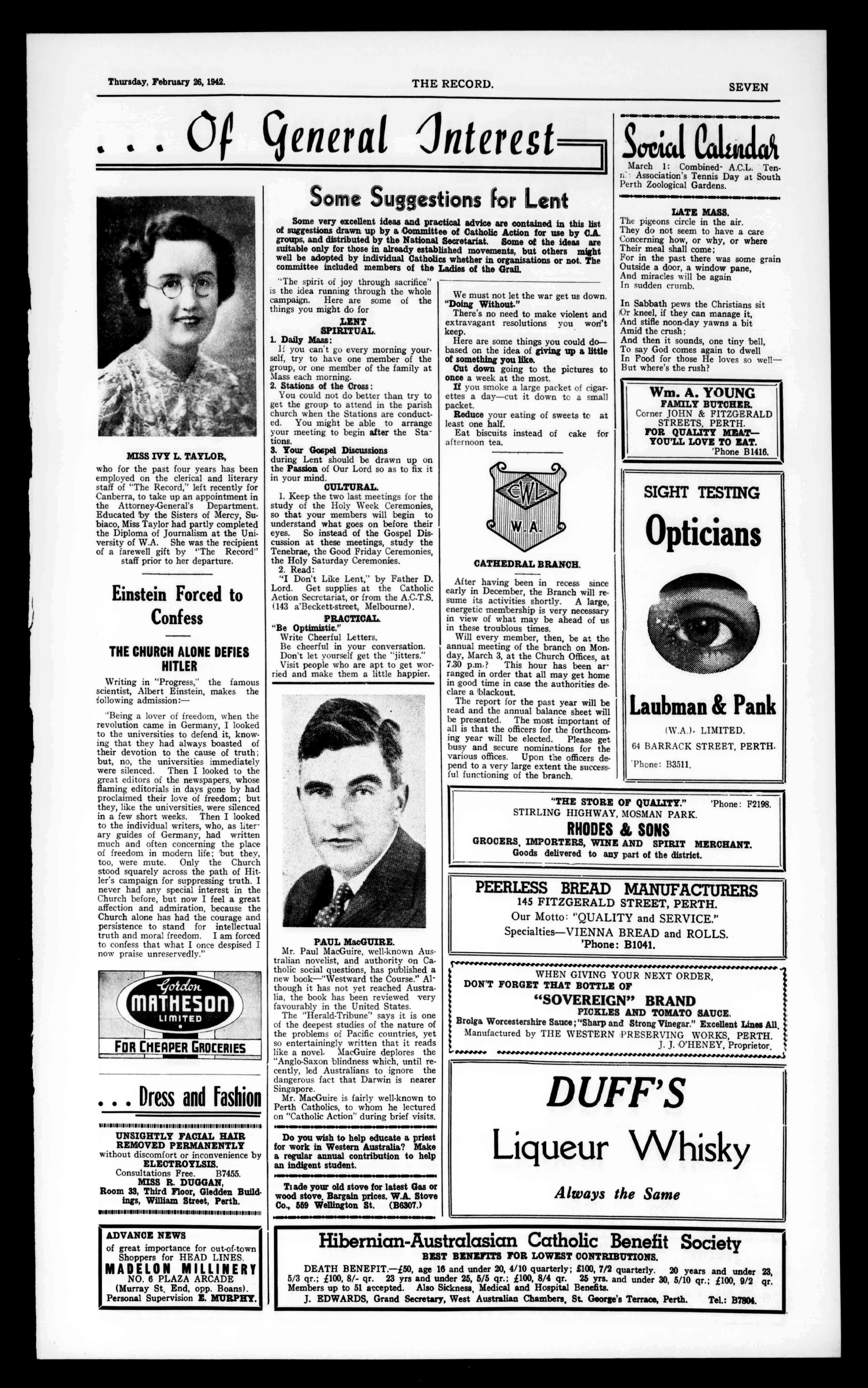
IdISSIVYLTAYLOR, whoforthepastfouryearshasbeen employedontheclericalandliterary staffof''TheRecord,"leftrecentlyfor Canberra,totakeupanappointmentin theAttorney-General'sDepartment. Educated'bytheSistersofMercy,Subiaco,MissTaylorhadpartlycompleted theDiplomaofJournalismattheUniversityofW.A.Shewastherecipient ofafarewellgiftby"TheRecord' staffpriortoherdeparture.
EinsteinForcedto Confess
THECHURCHALONEDEFIES
HITLER
Writingin"Progress,thefamous scientist,AlbertEinstein,makesthe followingadmission:-
'Beingaloveroffreedom,whenthe revolutioncameinGermany,Ilooked totheuniversitiestodefendit,knowingthattheyhadalwaysboastedof theirdevotiontothecauseoftruth; but,no,theuniversitiesimmediately weresilenced.ThenIlookedtothe greateditorsofthenewspapers,whose flamingeditorialsindaysgonebyhad proclaimedtheirloveoffreedom;but they,liketheuniversities,weresilenced inafewshortweeks.ThenIlooked totheindividualwriters,who,as1.teraryguidesofGermany,hadwritten muchandoftenconcerningtheplace offreedominmodernlife:butthey, too,weremute.OnlytheChurch stoodsquarelyacrossthepathofHitler'scampaignforsuppressingtruth.I neverhadanyspecialinterestinthe Churchbefore,butnowIfeelagreat affectionandadmiration,becausethe Churchalonehashadthecourageand persistencetostandforintellectual truthandmoralfreedom.Iamforced toconfessthatwhatIoncedespisedI nowpraiseunreservedly."
SomeSuggestionsforLent
Someveryexcellentideasandpracticaladvicearecontainedinthislist ofsuggestionsdrawnupbyaCommitteeofCatholicActionforusebyC.A. groups,anddistributedbytheNationalSecretariat.Someoftheideasare suitableonlyforthoseinalreadyestablishedmovements,butothersmight wellbeadoptedbyindividualCatholicswhetherinorganisationsornot.The committeeincludedmembersoftheLadiesoftheGrail.
"Thespiritofjoythroughsacrifice" istheidearunningthroughthewhole campaign.Herearesomeofthe thingsyoumightdofor LENT SPIRITUAL.
1.DailyMass: youcantgoeverymorningyourself,trytohaveonememberofthe group,uronememberofthefamilyat Masseachmorning.
2.StationsoftheCross: Youcouldnotdobetterthantryto getthegrouptoattendintheparish churchwhentheStationsareconducted.Youmightbeabletoarrange yourmeetingtobeginaftertheStations.
3.YourGospelDiscussions duringLentshouldbedrawnupon thePassionofOurLordsoastofixit inyourmind. CULTURAL.
1.Keepthetwolastmeetingsforthe studyoftheHolyWeekCeremonies, sothatyourmemberswillbeginto understandwhatgoesonbeforetheir eyes.SoinsteadoftheGospelDiscussionatthesemeetings,studythe Tenebrae,theGoodFridayCeremonies, theHolySaturdayCeremonies.
2.Read: "IDon'tLikeLent;'byFatherD. Lord.GetsuppliesattheCatholic ActionSecretariat,orfromtheA.C.TS. 1143a'Beckett-street,Melbourne).
PRACTICAL.
"BeOptimistic." WriteCheerfulLetters. Becheerfulinyourconversation. Don'tletyourselfgetthe"jitters." Visitpeoplewhoareapttogetworriedandmakethemalittlehappier.
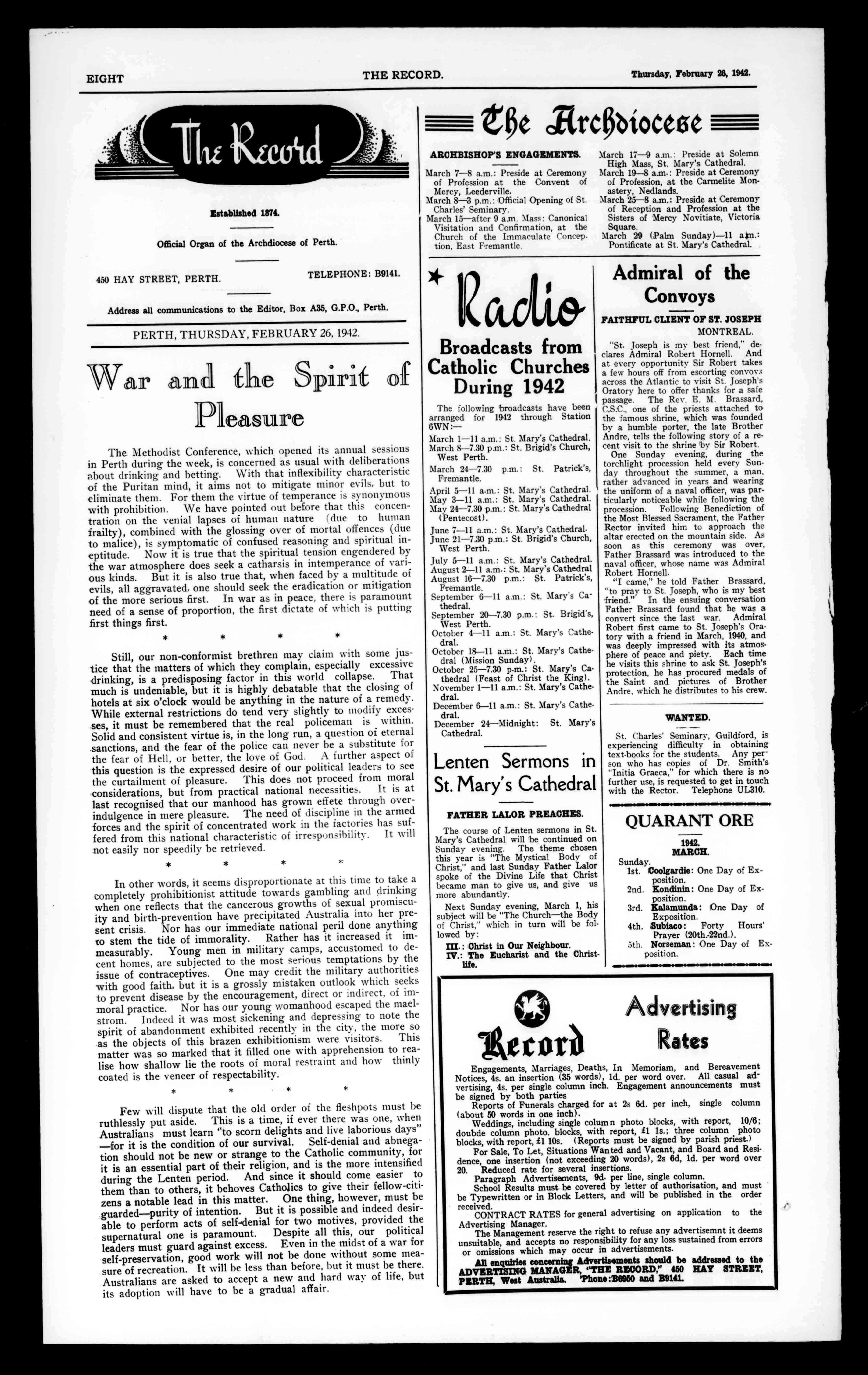
PAULMacGUIRE.
Mr.PaulMacGuire,well-knownAustraliannovelist,andauthorityonCatholicsocialquestions,haspublisheda newbook-"WestwardtheCourse."AlthoughithasnotyetreachedAustralia,thebookhasbeenreviewedvery favourablyintheUnitedStates.
The"Herald-Tribune"saysitisone ofthedeepeststudiesofthenatureof theproblemsofPacificcountries,yet soentertaininglywrittenthatitreads likeanovel.MacGuiredeploresthe "Anglo-Saxonblindnesswhich,untilrecently,ledAustralianstoignorethe dangerousfactthatDarwinisnearer Singapore.
Mr.MacGuireisfairlywell-knownto PerthCatholics,towhomhelectured on"CatholicAction"duringbriefvisits.
VM104141
Doyouwishtohelpeducateapriest forworkinWesternAustralia?Make aregularannualcontributiontohelp anindigentstudent.
TiadeyouroldstoveforlatestGasor woodstove.Bargainprices.W.A.Stove Co.,559WellingtonSt.(B6307.)
Wemustnotletthewargetusdown. "DoingWithout." There'snoneedtomakeviolentand extravagantresolutionsyouwon't keep. Herearesomethingsyoucoulddobasedontheideaofgivingupalittle ofsomethingyoulike.
Cutdowngoingtothepicturesto onceaweekatthemost.
Ifyousmokealargepacketofcigarettesaday-cutitdowntoasmall packet. Reduceyoureatingofsweetstoat leastonehalf.
Eatbiscuitsinsteadofcakefor aftnoontea.
SaidCaltadai
March1:Combined-A.C.L.TenAssociation'sTennisDayatSouth PerthZoologicalGardens.
LATEMASS.
Thepigeonscircleintheair.
Theydonotseemtohaveacare Concerninghow,orwhy,orwhere Theirmealshallcome; Forinthepasttherewassomegrain Outsideadoor,awindowpane, Andmiracleswillbeagain Insuddencrumb.
InSabbathpewstheChristianssit Orkneel,iftheycanmanageit, Andstiflenoon-dayyawnsabit Amidthecrush; Andthenitsounds,onetinybell, TosayGodcomesagaintodwell InFoodforthoseHelovessowellButwhere'stherush?
Wm.A.YOUNG
FAMILYBUTCHER.
CornerJOHN&FITZGERALD STREETS,PERTH.
FORQUALITYMIDSTYOU'LLLOVETOEAT. 'PhoneB1416.
SIGHTTESTING Opticians
CATHEDRALBRANCH.
Afterhavingbeeninrecesssince earlyinDecember,theBranchwillresumeitsactivitiesshortly.Alarge, energeticmembershipisverynecessary inviewofwhatmaybeaheadofus inthesetroubloustimes.
Willeverymember,then,beatthe annualmeetingofthebranchonMonday,March3,attheChurchOffices,at 7.30p.m.?Thishourhasbeenarrangedinorderthatallmaygethome ingoodtimeincasetheauthoritiesdeclarea'blackout.
Thereportforthepastyearwillbe readandtheannualbalancesheetwill bepresented.Themostimportantof allisthattheofficersfortheforthcomingyearwillbeelected.Pleaseget busyandsecurenominationsforthe variousoffices.Upontieofficersdependtoaverylargeextentthesuccessfulfunctioningofthebranch.
Laubman&Pank
(W.A.).LIMITED.
64BARRACKSTREET,PERTH.
'Phone:133511.
"THESTOREOFQUALITY."
STIRLINGHIGHWAY,MOSMANPARK. RHODES&SONS
'Phone:F2198.
GROCERSIMPORTERS,WINEANDSPIRITMERCHANT.
Goodsdeliveredtoanypartofthedistrict. --
PEERLESSBREADMANUFACTURERS
145FITZGERALDSTREET,PERTH. OurMotto:"QUALITYandSERVICE."
Specialties-VIENNABREADandROLLS.
'Phone:B1041.
WHENGIVINGYOURNEXTORDER, DON'TFORGETTHATBOTTLEOF "SOVEREIGN"BRAND PICKLESANDTOMATOSAUCE.
BrolgaWorcestershireSauce;"SharpandStrongVinegar."ExcellentLinesAll. ManufacturedbyTHEWESTERNPRESERVINGWORKS,PERTH. J.J.O'HENEY,Proprietor,
Thursday,February26,1942. THERECORD. SEVEN . .
generalInterest
FORCHEAPERGROCERIES Dressandfashion V1011.01HOUIHOO1111.11101HIHIDIRIHINIPUIHIWIHIHIfilm. UNSIGHTLYFACIALHAIR REMOVEDPERMANENTLY withoutdiscomfortorinconvenienceby ELECTROYLSIS. ConsultationsFree. 137455. MISSR.DUGGAN, Room
ThirdFloor,GleddenBuildings,WilliamStreet,Perth. 1141.11.10.141.1W111141.1111H111111111.111.141111111111.111uum ADVANCENEWS ofgreatimportance
out-of-town ShoppersforHEADLINES. MADELONMILLINERY NO.6PLAZAARCADE (MurraySt,End,opp.Boans). PersonalSupervisionB.MURPHY.
33,
for
DUFF'S LiqueurWhisky AlwaystheSame Hibernian-AustralasianCatholicBenefitSociety BESTBENEFITSFORLOWESTCONTRIBUTIONS. DEATHBENEFIT.-L50,age16andunder20,4/10quarterly;£100,7/2quarterly.20yearsandunder23, 5/3qr.;£100,8/-qr.23yrsandunder25,5/5qr.;f100,8/4qr.25yrs.andunder30,5/10qr.;£100,9/2qr. Membersupto51accepted.AlsoSickness,MedicalandHospitalBenefits. J.EDWARDS,GrandSecretary,WestAustralianChambers,St.George'sTerrace,Perth. Tel.:B7804.
Established1874.
450 HAY STREET,PERTH.
TELEPHONE: B9141.
AddressallcommunicationstotheEditor, BoxA35,G.P.O.,Perth.
PERTH,THURSDAY,FEBRUARY26,1942.
WarandieSpiritof Pieasure
TheMethodistConference,whichopeneditsannualsessions inPerthduringtheweek,isconcernedasusualwithdeliberations aboutdrinkingandbetting.Withthatinflexibilitycharacteristic ofthePuritanmind,itaimsnottomitigateminorevils,butto eliminatethem.Forthemthevirtueoftemperanceissynonymous withprohibition.Wehavepointedoutbeforethatthisconcentrationontheveniallapsesofhumannature(duetohuman frailty),combinedwiththeglossingoverofmortaloffences(due tomalice),issymptomaticofconfusedreasoningandspiritualineptitude.Nowitistruethatthespiritualtensionengenderedby thewaratmospheredoesseekacatharsisinintemperanceofvariouskinds.Butitisalsotruethat,whenfacedbyamultitudeof evils,allaggravated,oneshouldseektheeradicationormitigation ofthemoreseriousfirst.Inwarasinpeace,thereisparamount needofasenseofproportion,thefirstdictateofwhichisputting firstthingsfirst.
* *
*
Still,ournon-conformistbrethrenmayclaimwithsomejusticethatthemattersofwhichtheycomplain,especiallyexcessive drinking,isapredisposingfactorinthisworldcollapse.That muchisundeniable,butitishighlydebatablethattheclosingof hotelsatsixo'clockwouldbeanythinginthenatureofaremedy. Whileexternalrestrictionsdotendveryslightlytomodifyexcesses,itmustberememberedthattherealpolicemaniswithin. Solidandconsistentvirtueis,inthelongrun,aquestionofeternal sanctions,andthefearofthepolicecanneverbeasubstitutefor thefearofHell,orbetter,theloveofGod.Afurtheraspectof thisquestionistheexpresseddesireofourpoliticalleaderstosee thecurtailmentofpleasure.Thisdoesnotproceedfrommoral considerations,butfrompracticalnationalnecessities.Itisat lastrecognisedthatourmanhoodhasgrowneffetethroughoverindulgenceinmerepleasure.Theneedofdisciplineinthearmed forcesandthespiritofconcentratedworkinthefactorieshassufferedfromthisnationalcharacteristicofirresponsibility.Itwill noteasilynorspeedilyberetrieved.
* * *
Inotherwords,itseemsdisproportionateatthistimetotakea completelyprohibitionistattitudetowardsgamblinganddrinking whenonereflectsthatthecancerousgrowthsofsexualpromiscuityandbirth-preventionhaveprecipitatedAustraliaintoherpresentcrisis.Norhasourimmediatenationalperildoneanything tostemthetideofimmorality.Ratherhasitincreaseditimmeasurably.Youngmeninmilitarycamps,accustomedtodecenthomes,aresubjectedtothemostserioustemptationsbythe issueofcontraceptives.Onemaycreditthemilitaryauthorities withgoodfaith.butitisagrosslymistakenoutlookwhichseeks topreventdiseasebytheencouragement,directorindirect,ofimmoralpractice.Norhasouryoungwomanhoodescapedthemaelstrom.Indeeditwasmostsickeninganddepressingtonotethe spiritofabandonmentexhibitedrecentlyinthecity,themoreso astheobjectsofthisbrazenexhibitionismwerevisitors.This matterwassomarkedthatitfilledonewithapprehensiontorealisehowshallowlietherootsofmoralrestraintandhowthinly coatedistheveneerofrespectability. * * *
Fewwilldisputethattheoldorderofthefleshpotsmustbe ruthlesslyputaside.Thisisatime,ifevertherewasone,when Australiansmustlearn"toscorndelightsandlivelaboriousdays" -foritistheconditionofoursurvival.Self-denialandabnegationshouldnotbeneworstrangetotheCatholiccommunity,for itisanessentialpartoftheirreligion,andisthemoreintensified duringtheLentenperiod.Andsinceitshouldcomeeasierto themthantoothers,itbehovesCatholicstogivetheirfellow-citizensanotableleadinthismatter.Onething,however,mustbe guarded-purityofintention.Butitispossibleandindeeddesirabletoperformactsofself-denialfortwomotives,providedthe supernaturaloneisparamount.Despiteallthis,ourpolitical leadersmustguardagainstexcess.Eveninthemidstofawarfor self-preservation,goodworkwillnotbedonewithoutsomemeasureofrecreation.Itwillbelessthanbefore,butitmustbethere. Australiansareaskedtoacceptanewandhardwayoflife,but itsadoptionwillhavetobeagradualaffair.
tOeclircObiocese
ARCHB/SHOP'SENGAGEMENTS.
March7-8a.m.:PresideatCeremony ofProfessionattheConventof Mercy,Leederville.
March8-3p.m.:OfficialOpeningofSt. Charles'Seminary.
March15-after9a.m.Mass:Canonical VisitationandConfirmation,atthe ChurchoftheImmaculateConception,EastFremantle.
1Z
Broadcastsfrom CatholicChurches
During1942
Thefollowingbroadcastshavebeen arrangedfor1942throughStation 6WN:-
March1-11a.m.:St.Mary'sCathedral.
March8-7.30p.m.:St.Brigid'sChurch, WestPerth.
March24-7.30p.m.:St.Patrick's, Fremantle.
April5-11a.m.:St.Mary'sCathedral.
May3-11a.m.:St.Mary'sCathedral.
May24-7.30p.m.:St.Mary'sCathedral (Pentecost).
June7-11a.m.:St.Mary'sCathedral.
June21-7.30p.m.:St.Brigid'sChurch, WestPerth.
July5-11a.m.:St.Mary'sCathedral.
August2-11a.m.:St.Mary'sCathedral
August16-7.30p.m.:St.Patrick's, Fremantle.
September6-11a.m.:St.Mary'sCathedral.
September20-7.30p.m.:St.Brigid's, WestPerth.
October4-11a.m.:St.Mary'sCathedral.
October18-11a.m.:St.Mary'sCathedral(MissionSunday).
October25-7.30p.m.:St.Mary'sCathedral(FeastofChristtheKing).
November1-11a.m.:St.Mary'sCathedral.
December6-11a.m.:St.Mary'sCathedral.
December24-Midnight:St.Mary's Cathedral.
LentenSermonsin St.Mary'sCathedral
FATHERLALORPREACHES.
ThecourseofLentensermonsinSt. Mary'sCathedralwill'becontinuedon Sundayevening.Thethemechosen thisyearis"TheMysticalBodyof Christ,"andlastSundayFatherLalor spokeoftheDivineLifethatChrist becamemantogiveus,andgiveus moreabundantly.
NextSundayevening,March1,his subjectwillbe"TheChurch-theBody ofChrist,"whichinturnwillbefollowedby:
III.:ChristinOurNeighbour.
IV.:TheEucharistandtheChristine.
March17-9a.m.PresideatSolemn HighMass,St.Mary'sCathedral.
March19-8a.m.:PresideatCeremony ofProfession,attheCarmeliteMonastery,Nedlands.
March25-8a.m.:PresideatCeremony ofReceptionandProfessionatthe SistersofMercyNovitiate,Victoria Square.
March29(PalmSunday)-11a.M.: PontificateatSt.Mary'sCathedral.
Admiralofthe Convoys
FAITHFULCLIENTOFST.JOSEPH
MONTREAL.
"St.Josephismybestfriend,"declaresAdmiralRobertHornell.And ateveryopportunitySirRoberttakes afewhoursofffromescortingconvoy.; acrosstheAtlantictovisitSt.Joseph's Oratoryheretoofferthanksforasafe passage.TheRev.E.M.Brassard, C.S.C.,oneofthepriestsattachedto thefamousshrine,whichwasfounded byahumbleporter,thelateBrother Andre,tellsthefollowingstoryofarecentvisittotheshrinebySirRobert. OneSundayevening,duringthe torchlightprocessionheldeverySundaythroughoutthesummer,aman. ratheradvancedinyearsandwearing theuniformofanavalofficer,wasparticularlynoticeablewhilefollowingthe procession.FollowingBenedictionof theMostBlessedSacrament,theFather Rectorinvitedhimtoapproachthe altarerectedonthemountainside.As soonasthisceremonywasover, FatherBrassardwasintroducedtothe navalofficer,whosenamewasAdmiral RobertHornell. "Icame,"hetoldFatherBrassard, "topraytoSt.Joseph,whoismybest friend."Intheensuingconversation FatherBrassardfoundthathewasa convertsincethelastwar.Admiral RobertfirstcametoSt.Joseph'sOratorywithafriendinMarch,1940,and wasdeeplyimpressedwithitsatmosphereofpeaceandpiety.Eachtime hevisitsthisshrinetoaskSt.Joseph's protection,hehasprocuredmedalsof SaintandpicturesofBrother Andre,whichhedistributestohiscrew.
WANTED.
--St.Charles'Seminary,Guildford,is experiencingdifficultyinobtaining text-booksforthestudents.AnypersonwhohascopiesofDr.Smith's "InitiaGraeca,"forwhichthereisno furtheruse,isrequestedtogetintouch withtheRector.TelephoneUL310.
QUARANTORE
1942. MARCH.
Sunday.
1st.Coolgardie:OneDayofExposition. 2nd.Kondinin:OneDayofExposition. 3rd.Kalamunda:OneDayof Exposition. 4th.Subiaeo:FortyHours' Prayer(20th.-22nd.). 5th.Norseman:OneDayofExposition. MoIMMINDIP.
dvertising Rates
Engagements,Marriages,Deaths,InMemoriam,andBereavement Notices,4s.aninsertion(35words),Id.perwordover.Allcasualadvertising,4s.persinglecolumninch.Engagementannouncementsmust besignedbybothparties
ReportsofFuneralschargedforat2s6d.perinch,singlecolumn (about50wordsinoneinch).
Weddings,includingsinglecolumnphotoblocks,withreport,10/6; doubdecolumnphoto.blocks,withreport,flls.;threecolumnphoto blocks,withreport,fl10s.(Reportsmustbesignedbyparishpriest.)
ForSale,ToLet,SituationsWantedandVacant,andBoardandResidence,oneinsertion(notexceeding20words),2s6d,Id.perwordover 20.Reducedrateforseveralinsertions.
ParagraphAdvertisements,9d-perline,singlecolumn. SchoolResultsmustbecoveredbyletterofauthorisation,andmust beTypewrittenorinBlockLetters,andwillbepublishedintheorder received.
CONTRACTRATESforgeneraladvertisingonapplicationtothe AdvertisingManager. TheManagementreservetherighttorefuseanyadvertisemntitdeems unsuitable,andacceptsnoresponsibilityforanylosssustainedfromerrors oromissionswhichmayoccurinadvertisements.
AllenquirieseeneerniasAdvertisementsshouldbeaddressedtothe ADVERTISINGMANAGER,"TIESMORD,"450RATSTREET, PERTH,WestAustralia'Phone:B*0andB9141.
EIGHT THERECORD. Thursday,February28,1912.
OfficialOrganoftheArchdioceseofPerth.
St.Charles'Seminary
Vaticlintcaso4
the c_ftunients of
St.Charles

CAESARhadwantedtocrossfrom DurazzotoBrindisi,butbecausethewindhadrisenthe masterofthelittleboatwantedto turnback.ItwasthenJuliusuttered hisfamousrebuke:''Takecourage,my -friend,takecourage,andfearnothing: Caesarisyourpassenger,andCaesar's fortunesareyourfreight."With greaterandwithbettergroundedconfidence,theChurchhasbreastedthe wavesthroughouthertroubledhistory. Itisnotuponthecaptain'sjudgment orthepilot'sexperience,notupon humanwisdomorhumanprudence, thatshedependsforhersafevoyage: sherestssecureinthepresenceofher inviolablepassenger.Yetweshould doillifwegrudgedrecognitionand gratitudetothoseservantsofhiswho atvarioustimeshavesteeredour courseforusthroughdifficultwaters, andespeciallytotheSaintsofthe Counter-Reformation-thatremarkable groupofSaintswhomGodraised upatthetimeofEurope'sapostasy,bywhoseinfluence,humanly speaking,thefaithsurvivedthatterribleordeal.Andnottheleast,nor theleastprominent,oftheseisyour holypatron,whoruledtheChurchof Milaninthelatterpartofthesixteenth century.
St.CharlescamefromarulingfamilyinNorthernItaly.IntheAutumnof1538hewasborninthecastle ofArona,onthesouthernshoreof Lake'Maggiore.Hisfather,Count GibertoBorromeo,hadmarriedMargheritade'Medici,whoseyoungerbrother,Giovanni,laterbecamePopePius IV.
Whenonlytwelveyearsofage,the youngCharleswasmadetitularAbbot ofSS.GratinianandFelinus,atArona. Atfourteenhewassenttostudyatthe UniversityofPavia.Hisletterstell ofthemeagresumallowedhimbyhis father-notonlywasheoftenin straightenedcircumstanceshimself,but hisretinuealsowerenotsuitably clothed.Heevidentlyfelthishumiliationbitterly,butseemstohave bornitwithwr.nderfulpatience.
CountGibertodiedwhenCharleswas twenty;hismothersomeyearsearlier. Althoughnottheelderson,yetthe familyaskedhimtotakechargeofall theiraffairsandpossessions.Atthis timehedidmuchtorestoretheancient monasticdisciplineofthereligiousof hisAbbeyatArona.Hewastwentyonenow,studyinghard,andhadjust gainedhisDoctorateinCiviland CanonLawwhen,onthedeathofPaul IV.,hisuncle,Cardinalde'Medici,was electedandbecamePopePiusIV.
ThenewPopeimmediatelysummonedCharlestoRome,andgavehim chargeoftheadministrationofallthe PapalStates.HewascreatedaCardinalaweekortwolater,withinafurthermonthwasnamedadministrator ofthevacantseeofMilan,Legateof Bologna,Romagna,andtheMarchof Ancona.HewasmadeProtectorof theKingdomofPortugal,ofLower Germany,andtheCatholiccantonsof Switzerland.Underhisprotection werealsoplacedtheOrdersofSt. Francis,theCarmelites,theHumiliati, theCanonsRegularoftheHolyCross,
theKnightsofMalta,andtheKnights oftheHolyCrossinPortugal.
ThoughSecretaryofStateanda Cardinal,Charleswasnotvetordained apriest.However,heverysoonbegan usinghisinfluencetore-assemblethe CouncilofTrent,whichhadbeensuspendedsince1532.ThestateofEuropewasappallingfromanecclesiasticalpointofview.Thereweremany Obstacles-fromtheEmperor,from PhillipII.ofSpain,and,greatestofall, fromFrance,wherethedemandwas foranationalcouncil.However,the epoch-makingcouncilwasfinallyresumed.Whilstitwasstillsitting Charles'brotherdied.Itcameasa shocktoCharles.Helookedonit asawarningtogiveupearthlythings, andwithinafewmonthswassecretly ordainedpriestbyCardinalCesa.
PIM
Threemonthsafterwardshewasconsecratedbishop,andattwenty-five yearsofagewasnowCardinal-ArchbishopofMilan. Thencommencedhistitanicefforts toreformthediocese.Hebeganwith himselfandhishousehold.Gavemost ofhispropertytothepoor.Insisted thatinallthingsthatconcernedhimselfthegreatesteconomyshouldbe used,yetforhispositionasArchbishop andCardinalherequiredduerespect. Hepractisedgreatmortification,carryingoutthedecreesoftheCouncilof Trentandofhisownprovincialcouncilinspiritaswellasinletter.More thantwentymembersofhishousehold,thankstotheexamplehegave them,becamelaterholyanddistinguishedbishopsandprelates. Herigidlysuppressedcorruption andhiscourtwasknownastheThalr tribunal,"whereprisonersreceivedjusticetemperedwithamercylittle knowninthosedays.Hisreform spreadtoSwitzerland,whereclergy andlaityalikewerelivingscandalous lives.Charlestravelledonamule, sometimesonfoot,overmostdifficult anddangerousground.Hislabours boregreatfruit.Hebroughtwithhim everywhereanewspirit.Yetmore thanonceattemptsweremadeonhis lifebythosewhoopposedhisreforms. Onceacrucifixinhishandwasstruck withaballfromamusket,andon anotheroccasionhehimselfwaswoundedbyshotfromthepistolofareligious whoenteredhisprivatechapelwhilst hewasatprayer.Theseattemptsat assassinationweremade,totheirshame, bytheclergythemselves,sovehement wastheiroppositiontothespiritof sanctityinspiredbytheexampleand legislationoftheCardinal-Archbishop.
In1571thewholeprovincesuffered aterriblefamineowingtotheshort harvest,andCharlesfed,athisown expense,asmanyas3,000daily,for
OFFICIALOPENING,SUND MARCH8
DespitetheturninInternationalevents,thearrangementsfor theopeningoftheMinorSeminaryofSt.Charles,atGuildford,willbeproceededwith.Thiswouldhavebeenthebig Catholicfunctionoftheyear,butwarconditionsmustinfluencetheofficialopening,asitdoeseverythingelse.Somany ofourpeopleareengagedinwarduties,thatthenumberpresentat,GuildfordonSunday,March8,mustbemuchsmaller thanotherwisewouldbethecase.Neverthelessagoodattendanceisexpected.Everypersonwhocanjourneytowitnesstheopeningceremonyisurgedtodoso.
THEPROGRAMME.
Theproceedingsaretimedtostart at3p.m.,andthefollowingarethearrangements:-
1.IntroductoryaddressbytheRector,VeryRev.Dr.Goody. ,bis2h.oApddressbyHisGracetheArch-
3.AddressbyHisLordshiptheBishopofGeraldton.
4.OccasionalSermon.
5.BenedictionoftheBlessedSacrament. Visitorsmayinspectthebuildingand groundspriorto,orafter,theceremony. Theoccasionwillbeanexcellentone forthosewhodesiretoinspectthenew Seminary.
Afternoonteaswillbeavailableat theendofthefunction.Theshaded lawnsoftheSeminaryformanideal settingforsucharrangements. TRANSPORT.
FromPerth:
TrainsleavePerthStation:12.7p.m., 12.40p.m.,1.55p.m.,2.35p.m.
BeamBusesleaveoutsideGovernmentGardens:ForGuildford,12.55 p.m.,1.30p.m.,2.10p.m.,2.30p.m.
FromFremantle: TrainsleaveFremantleStation:12.20 p.m.,1.5p.m.,1.50p.m.
FromMt.Hawthorn,viaMt.Lawley: TwoTramwayBuses,leavingat2.15 p.m.and2.30p.m.,fromcornerofNorth BeachRoadandCharles-street,travellingviaFarmer,YorkandWalcott Streets,Mt.Lawleysub-way.
threemonths.Inthisyear,too,Chr-tendomcelebratedthefamousvictory ofLepanto.ThePapalfleetwascommandedbythefatherofCharles'brother-in-law,MarcoColonna.
Throughoutthiseventfulyearthe Archbishopremainedinwretched health,sufferedfromlowfeverand catarrh.Itwasfearedthatconsumptionwouldsetin.Medicaltreatment hadeffectednochangeinhiscondition;heabandonedit,returnedtohis ordinaryruleoflife,and'beforelong wasquitewellagain.
FiveyearslatertheheroofLepanto, DonJohnofAustria,wasfetedin Milan.Inthemidstofthepageantry, ofasuddentherespreadconsternation-plaguehadbrokenoutinthe city.CharleshurriedbackfromLodi tobewithhispeople.Helived amongstthestrickenmembersofhis flock,visitedtheirhomes,inspired them,comfortedthem.Hauntedthe hospital 9t.Gregory-,wherethe worstcasesweresegregated.Itwas atthistimehewalkedinpublicprocession.barefoot,aroperoundhis neck-inpenanceforhispeople.The plaguefinallyabated,andinthefollowingyearCharlesfoundedanew Congregation,theOblatesofSt.Ambrose,toassisthiminhispastoral work.St.PhillipNeri,inRome,counselledhimregardingtheconstitutions oftheyoungCongregation.Charles andPhilliphadbeenclosefriendsfor sometimethen.Itwasaboutthis time,too,thatCharlesgaveSt.AloysiusGonzagahisfirstCommunion. Aloysiuswastwelveyearsold.
Erysipelasnowdevelopedinhisleg, andhewasobligedtoremaininbed. Butnotforlong.Youcouldn'tkeep himthere.HewasupandofftoNovara,TurinandMonteVarallo.Here hefelttheendwasnearandbeganto preparefordeath.TheCardinalof VercellisummonedhimtoAronato discussurgentandimportantbusiness. Thenightbeforehespenteighthours onhiskneesinprayer.Fourorfive dayslatercamethefever.Hetried toconcealitatfirst,finallywassufferingsomuchthathecouldn't.This lastedforfivedays,andhestillsaid MasseverydayandgaveHolyCommunionandcarriedonhisenormouscorrespondence.Heseemedtoknowthe endwasapproaching,thoughhewas
Thesebusesholdabout35passengers,andintendingpassengersareadvisedtobeatoneofthesepick-up points:
Cr.NorthBeachRoadandCharles Street.
Cr.FarmerandFitzgeraldStreets.
Cr.YorkandWalcottStreets.
Cr.WalcottandLordStreets(Subway).
MaylandsChurch.
GarretRoad,Bayswater.
BassendeanConvent.
FromMidlandJunction:
Trainsleave:1.18p.m.,1.50p.m.,2.26
PAL FARES(RETURN).
FremantletoGuildford:2/6,first class;1/8,secondclass.
PerthtoGuildford:1/3,firstclass; 11d.,secondclass.
MidlandtoGuildford:6d.,firstclass; 5d.,secondclass.
Ruses:
FremantletoPerth,byMetro:1/6.
PerthtoGuildford,byBeamBus:1/3
Mt.HawthornSpecialBuses:1/6. SOUVENIRBROCHURE.
TocommemoratetheopeningofSt. Charles'Seminary,asouvenirbrochure isbeingprepared.Thiswillcontain messagesfromtheHierarchy,photos. oftheSeminary,andothermatterrelatingtotheoccasion.Thesaleofa fewhundredofthese'brochures,itis hoped,willcoverthecostofproduction. Noappealforfundswillbemadeon theoccasionoftheopeningofthe Seminary.
onlyforty-six.OfftoAsconatoget thefoundationsoftheseminarydown beforehedied,theyfoundhimprostrateintheChapeloftheBurialof OurLord.AtlastbacktoMilan,he wasorderedtobed,wouldnotallow Massto'besaidinhisroom.Twopictureswerebeforehim,oneof ChristintheGardenofGethsemani. theotherinthetomb.Thepeople learnedoftheCardinal'sstate;crowds throngedthepalaceenvirons."Ecce venio"(BeholdIcome)werethelast wordshewasheardtoutter.The Passionhadjustbeenreadwhenhe passedawayonNovember3,1584.His RequiemwassungbythefuturePope GregoryXIV.,CardinalSfondrato,and hewasburiedatnightinthespot whichhehadchosen.
Itisnoexaggerationtosayhewas oneofthegreatestfiguresofhiscentury.ThepositionheheldinEurope wasindeedaremarkableone.The massofhiscorrespondencetestifiesto theesteeminwhichhisopinionwas held.ThePopesduringhislifetime constantlysoughthisadvice,asdid theSovereignsofEurope-HenryIII. ofFrance,PhillipIIofSpain,Mary, QueenofScots,andotherswhoobviouslyvaluedhisinfluence.Doubtless itwasBlessedEdmundCampion,S.J., whofirstspokeofhiminEngland. EdmundhadmethiminMilanand spentthebestpartofeightdaysdiscussingwiththeCardinalallthatthey hadincommon.Charleshadmuchto dowithEnglandinthedaysofhisassistancetoPiusIV,andhadagreat venerationfortheportraitofBishop Fisher.Hewaswarmfriends,too, withSt.FrancisBorgiaandSt.Andrew Avellino,oneaJesuit,theothera Theatine.
Andthatnow,verysketchily,isthe lifeofyourpatron.Hisemblem,the crownedhumilitas,partoftheBorromeoshield,youknowwell.Itis hislegacytoyou-thevirtuesofhumililityandobedienceandhisownexample.Thatdoesnotmeanyoumay notbealeaderamongyourfellows,for Charleswasthat.Butheknewwell, asdoallthesaints,thatthesevirtues arethefoundationofsanctity.They arethetwogreatforcesinthedevelopmentofaChrist-likepersonality;they arethefoundationvirtuesonwhichall elseisbuiltinthemakingofaPriestaSaint.
Thursday.February26,1942. THERECORD. NINE
/;-y
CHRISTIANBROTHERS'COLLEGE,
O'HARA,JAMESM.:English, Maths.A,Maths.B,DrawingB,AppliedMaths.,Latin(atJuniorStandard).
ROBINSON,JOHNW.:English, Maths.It,AppliedMaths. STIRK,GEOFFREYB.:English, Latin,Maths.A(DJ,Maths.B,Physics,Chemistry,AppliedMaths.
COMMONWEALTHPUBLIC SERVICE
Thefollowing,inorderofmerit,were successfulattheexaminationforappointmenttotheThirdDivisionofthe CommonwealthPublicServiceas ClerkorasCadet.Thereweresixtysixpiaci:.giveninall
DENISF.ANDERSON:EightPlace.
KEITHNORRISH:TwelfthPlace.
GEOFFREYB.STIRK,RONALD D.FIRNS,BRIANA.FAULKNER., RONALDCOCKS,ALBERTE. CALDWELL,ROBERTC.LANG, JAMESM.O'HARA.
KEATING,GEOFFREY: Latin, Maths.A,Maths.B,Physics,Drawing B,CommercialMethodsandBookkeeping.
LEKIAS,BASIL:English,Maths. A,Maths.B,DrawingB,Commercial MethodsandBookkeeping.
O'MEARA,FRANK:English,Latin, Geography,Maths.A,Maths.B,Physics,DrawingB,CommercialMethods andBookkeeping.
ONESTI,PETER:English,Maths. A,Maths.B,DrawingB(1940),Latin, Chemistry(1941).
RE,MARIO:English,Latin,Maths. A,Maths.B,Physics,Chemistry,CommercialMethodsandBookkeeping.
ROBINSON,WILLIAM:Maths.A, Maths.B,Chemistry,DrawingB.
TAYLOR,GREGORY:English, Geography,Maths.B,DrawingB,CommercialMethodsandBookkeeping.
WALL,PETER:English,Latin,History,Maths.A,Maths.B,DrawingB, CommercialMethodsandBookkeeping.
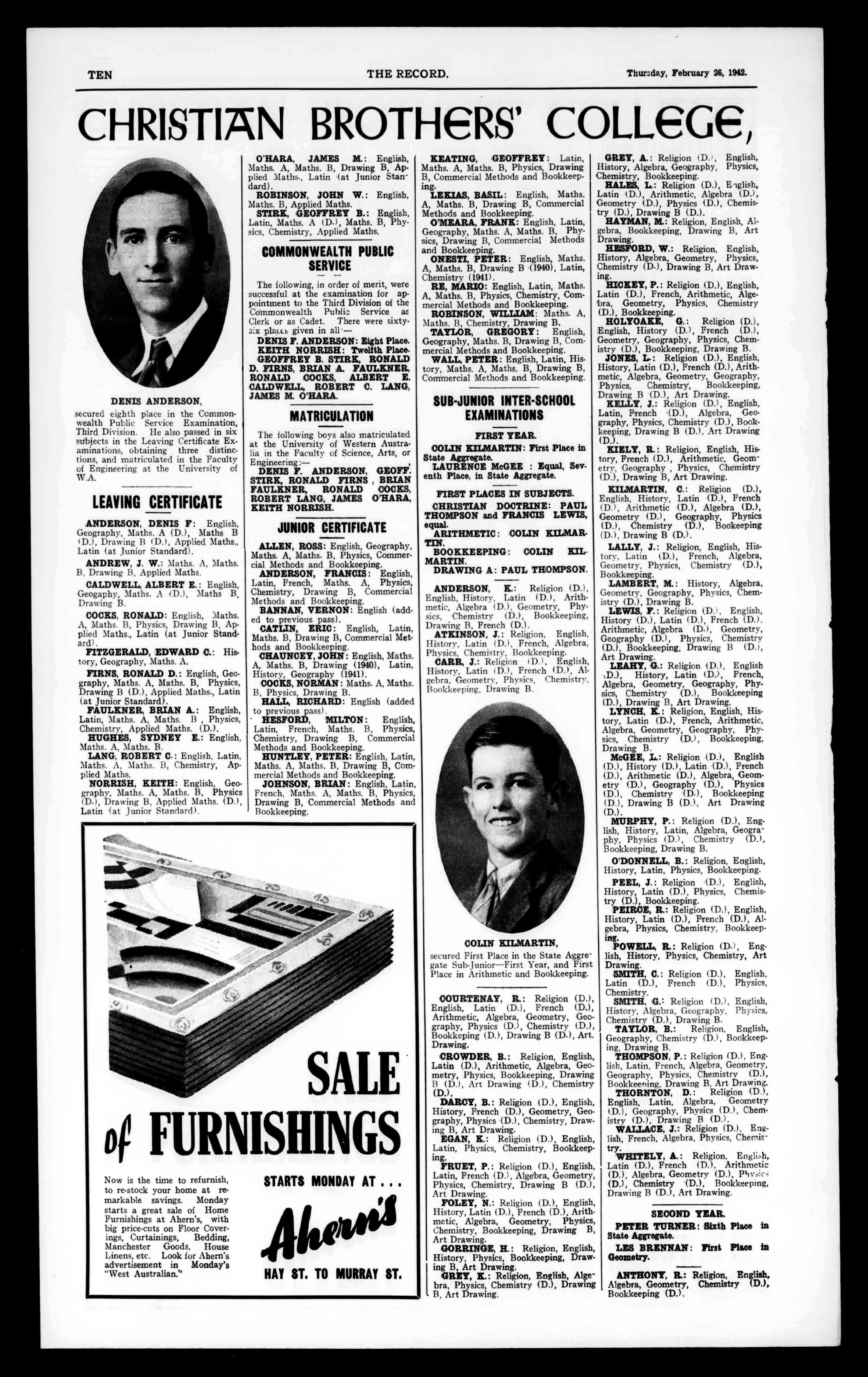
DENISANDERSON, securedeighthplaceintheCommonwealthPublicServiceExamination, ThirdDivision.Healsopassedinsix subjectsintheLeavingCertificateExaminations,obtainingthreedistinctions,andmatriculatedintheFaculty ofEngineeringattheUniversityof WA.
LEAVINGCERTIFICATE
ANDERSON,DENISF:English, Geography,Maths.A(D.),MathsB 0D.),Drawing11 Di,AppliedMaths., Latin(atJuniorStandard).
ANDREW,J.W.:Maths.A,Maths. B,DrawingB,AppliedMaths.
CALDWELL,ALBERTE.:English, Geogaphy,Maths.AD.),MathsB, DrawingB.
COCKS,RONALD:English,Maths. A,Maths.B,Physics,DrawingB,AppliedMaths.,Latin(atJuniorStandard).
FITZGERALD,EDWARDC.:History,Geography,Maths.A.
FIRNS,RONALDD.:English,Geography,Maths.A,Maths.B,Physics, DrawingB(D.),AppliedMaths.,Latin (atJuniorStandard).
FAULKNER,BRIANA.:English, Latin,Maths.A,Maths. 13 Physics, Chemistry,AppliedMaths.(D.).
HUGHES,SYDNEYE.:English, Maths.A,Maths.B.
LANG,ROBERTC.:English,Latin, Maths.A,Maths.13,Chemistry,AppliedMaths.
NORRISH,KEITH:English,Geography,Maths.A,Maths.B,Physics ID.),DrawingB,AppliedMaths.(D.), Latin(atJuniorStandard).
MATRICULATION
Thefollowingboysalsomatriculated attheUniversityofWesternAustraliaintheFacultyofScience,Arts,or Engineering:DENISF.ANDERSON,GEOFF. STIRK,RONALDFIRESBRIAN FAULKNER,RONALDCOCKS, ROBERTLANG,JAMESO'HARA, KEITHNORRISH.
JUNIORCERTIFICATE
ALLEN,ROSS:English,Geography, Maths.A,Maths.B,Physics,CommercialMethodsandBookkeeping.
ANDERSON,FRANCIS:English, Latin,French,Maths.A,Physics, Chemistry,DrawingB,Commercial MethodsandBookkeeping.
BANNAN,VERNON:English(addedtopreviouspass).
CATLIN,ERIC:English,Latin, Maths.B,DrawingB,CommercialMethodsandBookkeeping.
CHAUNCEY,JOHN:English,Maths. A,Maths.B,Drawing(1940),Latin, History,Geography(1941).
COCKS,NORMAN:Maths.A,Maths. B,Physics,DrawingB. HALL,RICHARD:English(added topreviouspass).
HESFORD,'MILTON English, Latin,French,Maths.I3,Physics, Chemistry,DrawingB,Commercial MethodsandBookkeeping.
HUNTLEY,PETER:English,Latin, Maths.A,Maths.B,DrawingB,CommercialMethodsandBookkeeping.
JOHNSON,BRIAN:English,Latin, French,Maths.A,Maths.B,Physics, DrawingB,CommercialMethodsand Bookkeeping.
SUB-JUNIORINTER-SCHOOL EXAMINATIONS
FIRSTYEAR.
COLINKILMARTIN:FirstPlacein StateAggregate. LAURENCEMcGEEEqual,SeventhPlace,inStateAggregate.
FIRSTPLACESINSUBJECTS.
CHRISTIANDOCTRINE:PAUL THOMPSONandFRANCISLEWIS, equal.
ARITHMETICCOLINKILMARTIN. BOOKKEEPING:COLINKILMARTIN. DRAWINGA:PAULTHOMPSON.
ANDERSON,K.:Religion(D.), English,History,Latin(D.),Arithmetic,AlgebraID.),Geometry,Physics,Chemistry(D.),Bookkeeping, DrawingB,French(D.).
ATKINSON,J.:Religion,English, IIistory,LatinID.),French,Algebra, Physics.Chemistry,Bookkeeping.
CARR,J.:Religion(D.),English, History,Latin(D.),FrenchID.),Algebra,Geometry,Physics,Chemistry, Bookkeeping,DrawingB.
GREY,A.:Religion(D.),English, History,Algebra,Geography,Physics, Chemistry,Bookkeeping.
HALES,L:Religion(D.),English, Latin(D.),Arithmetic,Algebra(D.), Geometry(D.),Physics(D.),Chemistry(D.),DrawingB(D.).
HAYMAN,M.:Religion,English,Algebra,Bookkeeping,DrawingB,Art Drawing.
HESFORD,W.:Religion,English, History,Algebra,Geometry,Physics, Chemistry(D.),DrawingB,ArtDrawing.
HICKEY,P.:Religion(D.),English, Latin(D.),French,Arithmetic,Algebra,Geometry,Physics,Chemistry (D.),Bookkeeping.
HOLYOAKE,G.:Religion(D.), English,History(D.),French(D.), Geometry,Geography,Physics,Chemistry(D.),Bookkeeping,DrawingB. JONES,L.:Religion(D.),English, History,Latin(D.),French(D.),Arithmetic,Algebra,Geometry,Geography, Physics,Chemistry,Bookkeeping, DrawingB(D.),ArtDrawing. KELLY,J.:Religion(D.),English, Latin,French'(D.),Algebra,Geography,Physics,Chemistry(D.),Bookkeeping,DrawingB(D.),ArtDrawing (D.).
KIELY,R.:Religion,English,His French(D.),Arithmetic,Geometry,GeographyPhysics,Chemistry (D.),DrawingB,ArtDrawing.
KILMARTIN,C.:Religion(D.), English,History,Latin(D.),French (D.),Arithmetic(D.),Algebra(D.), Geometry(D.),Geography,Physics (D.),Chemistry(D.),Bookeeping (11),DrawingB(D.).
LALLY,J.:Religion,English,History,Latin(D.),French,Algebra, Geometry,Physics,Chemistry(D.), Bookkeeping.
LAMBERT,M.:History,Algebra, Geometry,Geography,Physics,Chemistry(D.),DrawingB. LEWIS,F.:Religion(D.,,English, History(D.),Latin(D.),French(D.). Arithmetic,Algebra(D.),Geometry, Geography(D.),Physics,Chemistry (D.),Bookkeeping,DrawingB(D.), ArtDrawing. LEAHY,0.:Religion(D.),English ,D.),History,LatinID.),French, Algebra,Geometry,Geography,Physics,Chemistry(D.),Bookkeeping (D.),DrawingB,ArtDrawing. LYNCH,K.:Religion,English,History,Latin(D.),French,Arithmetic, Algebra,Geometry,Geography,Physics,Chemistry(D.),Bookkeeping, DrawingB. McGEE,L.:Religion(D.),English (D.),History(D.),Latin(D.),French (D.),Arithmetic(D.),Algebra,Geometry(D.),Geography(D.),Physics (D.),Chemistry(D.),Bookkeeping ID.),DrawingB(D.),ArtDrawing (D.). MURPHY,P.:Religion(D.),English,History,Latin,Algebra,Geography,Physics(D.),Chemistry(D.), Bookkeeping,DrawingB. O'DONNELL,B.:Religion,English, History,Latin,Physics,Bookkeeping. PEEL,J.:Religion(D.),English, History,Latin(D.),Physics,Chemistry(D.),Bookkeeping.
COLINKILMARTIN, securedFirstPlaceintheStateAggregateSub-Junior-FirstYear,andFirst PlaceinArithmeticandBookkeeping.
COURTENAY,R.:Religion(D.), English,Latin(D.),French(D.), Arithmetic,Algebra,Geometry,Geography,Physics(D.),Chemistry(D.), Bookkeping(D.),DrawingB(D.),Art. Drawing.
CROWDER,B.:Religion,English, Latin(D.),Arithmetic,Algebra,Geometry,Physics,Bookkeeping,Drawing II(D.),ArtDrawingID.),Chemistry (D.).
DARCY,B.:Religion(D.),English, History,French(D.),Geometry,Geography,Physics(D.),Chemistry,DrawingB,ArtDrawing.
EGAN,K.:Religion(D.),English, Latin,Physics,Chemistry,Bookkeeping.
FRUET,P.:Religion(D.),English, Latin,French(D.),Algebra,Geometry, Physics,Chemistry,DrawingB(D.), ArtDrawing.
FOLEY,N.:Religion(D.),English, History,Latin(D.),French(D.),Arithmetic,Algebra,Geometry,Physics, Chemistry,Bookkeeping,DrawingB, ArtDrawing.
GORRINGE,H.:Religion,English, History,Physics,Bookkeeping,DrawingB,ArtDrawing.
GREY,K.:Religion,English,Algebra,Physics,Chemistry(D.),Drawing B,ArtDrawing.
PEIRCE,R.:Religion(D.),English, History,Latin(D.),French(D.),Algebra,Physics,Chemistry,Bookkeeping. POWELL,R.:Religion(D.),English,History,Physics,Chemistry,Art Drawing. SMITH,C.:Religion(D.),English, Latin(D.),FrenchID.),Physics, Chemistry. SMITH,G.:ReligionID.),English, History,Algebra,Geography,Physics, Chemistry(D.),DrawingB.
TAYLOR,B.:Religion.English, Geography,Chemistry(D.),Bookkeeping,DrawingB.
THOMPSON,P.:Religion(D.),English,Latin,French,Algebra,Geometry, Geography,Physics,Chemistry(D.), Bookkeeping,DrawingB,ArtDrawing.
THORNTON,D.:Religion(D.), English,Latin,Algebra,Geometry D.),Geography,Physics(D.),Chemistry(D.),DrawingB(D.).
WALLACE,J.:Religion(D.),English,French,Algebra,Physics,Chemistry. WHITELY,A.:Religion,Engli.sh, Latin(D.),French(DA,Arithmetic (D.),Algebra,Geometry(D.),Phy.-ic, (D.),Chemistry(D.),Bookkeeping, DrawingB(D.),ArtDrawing.
SECONDYEAR.
PETERTURNER:SixthPlacein StateAggregate.
LESBRENNAN:FirstPlacein Geometry.
ANTHONY,R.:Religion,English, Algebra,Geometry,Chemistry(D.), Bookkeeping(D.).
TEN THERECORD. Thurzday,February26,1942.
SALE ofFURNISHINGS Nowisthetimetorefurnish, tore-stockyourhomeatremarkablesavings.Monday startsa
STARTSMONDAYAT HAYST.TOMURRAYST.
greatsaleofHome FurnishingsatAhern's,with bigprice-cutsonFloorCoverings,Curtainings,Bedding, ManchesterGoods,House Linens,etc.LookforAhern's advertisementinMonday's "WestAustralian."
---
PERTH/EXAMINATIONRESULTS/1941
ARNDT,F.:Religion,English,History,Algebra,Geometry,Physics, Chemistry(D.),Drawing.
BRADBURY,R.:Religion,English, History,Latin,Arithmetic,Algebra, GeometryD.),Physics,Chemistry ID.),Bookkeeping(D.).
BRENNAN,L.:Religion,English, History,Latin,French,Arithmetic,Algebra(D.),Geometry(D.),Physics, ChemistryD.',Bookkeeping(D.), Drawing.
'COOPER,W.:Religion(D.),English,HistoryID.),Arithmetic,Alge1,ra(D.),Geometry(D.),Chemistry D.),Bookkeeping(D.),Drawing.
DWYER,L.:Religion,English,Algebra,GeometryChemistry(D.),Bookkeeping(D.),Drawing.
ELLIS,FL.:Religion,English,History(D.),Arithmetic,Algebra,Chemistry,Bookkeeping(D.).
FRANKLYN,T.:Religion,English, history(D.),French,Arithmetic,Albegra(D.).Geometry(D.',Chemistry (D.),Bookkeeping(D.).
GITILFOYLE,J.:Religion,English (D.),History,Arithmetic,Algebra (D.),Geometry,Chemistry,Bookkeeping(D.).
HAINES,C.:Religion(D.1,English,Latin,History,Arithmetic(D.), Algebra(D.),Geometry(D.),Chemistry.11111,1;keepingID.),Drawing.
HARDY,E.:English,History,ArithmeticAlgebra,Geometry,Chemistry (D.),Bookkeeping(D.),Drawing.
HOLMES,H.:Religion,English, Algebra,Geometry,Chemistry,Bookkeeping(D.).Drawing.
HUGHES,B.:Religion,English,History,Arithmetic,Algebra(D.),Geometry(D.),Physics,Chemistry(D.), Bookkeeping(-D.).
JONES,B.:Religion,English,History,Arithmetic,Algebra,Geometry ID.),Physics,Chemistry,Bookkeeping (D.),Drawing.
KINSELLA,T.:Religion,English, History,Latin,Algebra,Geometry, Chemistry,Bookkeeping(D.),Physics.
MILLER,H.:Religion,English,History,Arithmetic,Algebra,Geometry, Chemistry,Bookkeeping(D.),Drawing.
McADAM,G.:Religion,English,History,Algebra,Geometry,Chemistry, Bookkeeping(D.),Drawing.
MoCARTHY,W.:Religion,English, History,Latin,Geometry,Chemistry, Bookkeeping(D.),Drawing.
McDONALD,E.:Religion,English, History(D.),Arithmetic,Algebra, Geometry,Chemistry(D.),Bookkeeping(D.),Drawing.
McGINNITY,K.:Religion,EnglishD.),Latin,llistory(D.),Arithmetic D.I.Algebra,Geometry(D.),Physics, Chemistry(D.),Bookkeeping(D.), Drawing.
NELSON,D.:Religion,English,History,Algebra,Geometry,Chemistry, Bookkeeping,Drawing.
OMA,L.:English,History,Arith. metic,Latin,Algebra,Geometry(D.), Physics,Chemistry(D.),Bookkeeping (D.),Drawing.
O'CONNOR,K.:English,History, Arithmetic,Algebra,Geometry,Chemistry(D.),Bookkeeping(D.),Drawing O'SULLIVAN,F.:Religion,English, History,Arithmetic,Algebra.Chemistry,Bookkeeping(D.).
PASOO,J.:Religion,English,History(D.),Arithmetic,-Algebra,Geometry(D.),Chemistry(D.',Bookkeeping(D.).
PEMBER,M.:Religion,English.Thistory,Latin,Algebra,Geometry,Physics,Chemistry,Bookkeeping,Drawing. PHILLIPS,A.:Religion,English, History,ArithmeticID.),Algebra, Geometry(D Geography.Physics, ChemistryID.),Bookkeeping(D.). Drawing.
SpateofDivorceFilms
HOWLEGALARETHEY?
Areyoua-filmtan-)Doyoupatroniseyourlocalcinemaonceaweek, orevenonceamonth?
yuucannotfailtohaveseen oneatleastofthose"matrimonial comedies"whichHollywoodhasspecialisedinmakingduringthelastyear.
Whathaveyouthoughtofthem?
Justthattheyarecleverslap-stick films,designedtomakeyoulaughuproariouslyandgenerallysucceedingin doingso?
Haveyoueverthought,though,of thebasisofthatlaughter?Youmay ormaynothavenoticedthatthebutt ofnearlyallthejokeswasthe"oldfashioned,"Christianideaoftheindissolubilityofthemarriagetie.Orperhapsyouhave,likethefilmproducer, justtakendivorce,andre-marriage, andconjugalinfidelity,forgranted.
Now,whyshouldtherebesucha spateofthesematrimonialcomedies L.
turnedoutbyHollywood?Withinthe lastsixmonthsourFilmCritichas notednolessthanninesuchfilms,and hehasexpressedhisamazementthat anyofthemshouldhavebeenexhibitedhere.
InherentDanger.
Forthereis,ashepointsout,aninherentdangerinthesefilmswhichdependforthesuccessoftheirplotson theimmoral,un-Catholicconventionof divorce.
"Itisnotconceivable,"hehaswritten,"thateventhehardeststoneof faithcouldbewornbysuchconstant drippingasisfurnishedbyalongrepetitionofthissortofthing?Evenin thecaseofculturedandwell-informed Catholics!
"ButwhatofthecaseofCatholics thatareneitherculturednorwellinformed,andparticularlyyoungpeople?"Itmaywellbethatinagreatnumberofcasesnoparticularharmisdone totheformerclass.Ontheother hand,Iamconvincedthatagreatdeal ofharmisdonetothelatterclassby evenonesuchfilm.Whenthesefilms aremultipliedastheyare,averyheavy onusfallsonthedistributorsofthem, andonthebodieswhichareentrusted withthesafeguardingofpublicorder andmorality.
"Itisnottheeffectofanyonesuch filmthatisreallydangerous.Possiblyitisostensiblyharmless,standing byitself.Butfilmsarenowsomuch andsoimportantapartofpopularentertainmentthatanyonewhowould consideranyfilmasunrelatedtothe nextwouldbemorefatuousthanany ostrichburyinghisheadinthesand.
"Thecumulativeeffectofthesefilms cannotbutbe,andinfactis,mostdisquieting."
LegalPosition.
Itwouldbeinterestingtoenquireon whatgroundsourFilmCensorallows suchfilmstobeshown.Further,itis conceivablethatquiteagoodcase couldbemadeforthecontentionthat suchfilms,ridiculingastheydoaninstitutionthatisheldtobesacrosanct byChurchandStatealike,offend againstfundamentallawsofthecountryandthereforehavenorighttobe showninIrishcinemas.
Considerforamomenttheposition offilmswhichacceptbirthcontrolas aconvention.Theyarenotallowed tobeexhibitedhere-chieflybecause birthcontrolisnotallowedbythelaw oftheland.Divorce,too,isillegal: yetfilmswhicharebasedontheacceptanceofthedivorceconvention maybeshowneverywhere.Whyis this?-"TheIrishCatholic."
ROBINSON,W.:Religion,English, History,Geometry,Chemistry,BookkeepingD.)
SERISTER,A.:Religion,English, History,Arithmetic,Geometry,Physics,Chemistry,Bookkeeping(D.).
STUBBS,R.:Religion,English,History,Algebra,Geometry,Chemistry, Bookkeeping(D.),Drawing.
SUTHERLAND,J.:Religion(D.), English,History(D.),Latin(D.),
J.F.CAIN
17STIRLINGHIGHWAY, COTTESLOE. 'PhoneF2121,DayorNight. LICENSEDSANITARYPLUMBER, IRONWORKER,SHEETMETAL WORKER.
S.BEECROFT-Butcher
181RokebyRoad,Subiaco.
OrlyPrimeFreshKilledMeatSold 'PhoneW1373.
RandolphKnapp
SIGHT-TESTING OPTICIAN.
12ATWELLARCADE, FREMANTLE.
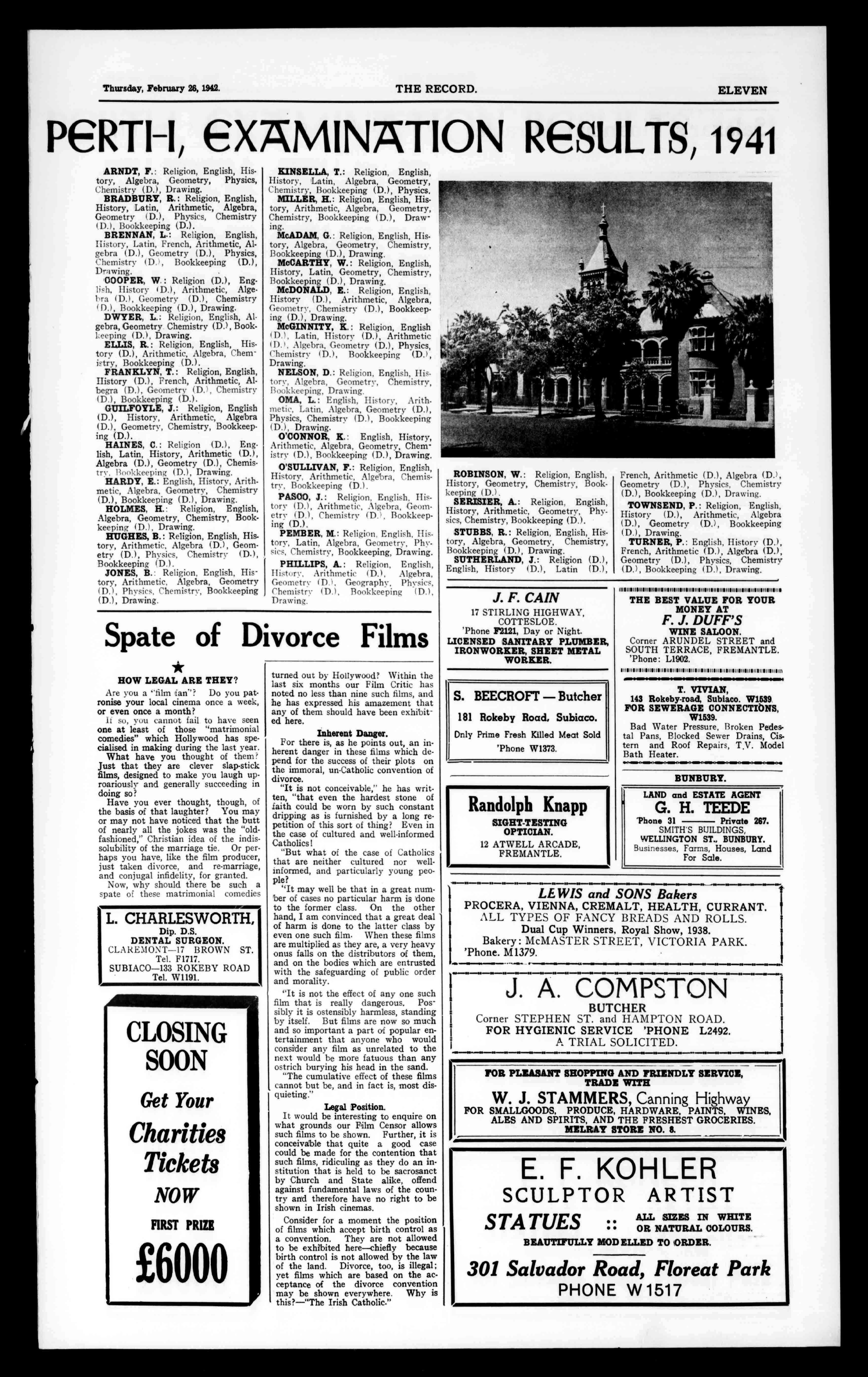
French,Arithmetic(D.),Algebra(D.), Geometry(D.),Physics,Chemistry (D.),Bookkeeping(D.),Drawing.
TOWNSEND,P.:Religion,English, History D.1,Arithmetic,Algebra (D.),Geometry(D.),Bookkeeping D.),Drawing. TURNER,P.:English,History(D.), French,Arithmetic(D.),Algebra(D.), Geometry(D.),Physics,Chemistry (D.),Bookkeeping(D.),Drawing.
111111ONNIMOMIH1111.1111HIHIMOHIDIHIHIM1111.0111.1,. THEBESTVALUEFORYOUR MONEYAT F.J.DUFF'S WINESALOON.
CornerARUNDELSTREETand SOUTHTERRACE,FREMANTLE. 'Phone:L1902.
T.VIVIAN, 143Rokeby-road,Subiaco.W1639 FORSEWERAGECONNECTIONS, W1539.
BadWaterPressure,BrokenPedestalPans,BlockedSewerDrains,CisternandRoofRepairs,T.V.Model BathHeater.
BUNBURY.
LAND and ESTATE AGENT
G.H.itat;DE
'Phone 31 Private 267. SMITH'SBUILDINGS, WELLINGTONST.,BUNBURY. Businesses,Farms,Houses,Land ForSale.
LEWISandSONSBakers
PROCERA,VIENNA,CREMALT,HEALTH,CURRANT. ALLTYPESOFFANCYBREADSANDROLLS. DualCupWinners,RoyalShow,1938. Bakery:McMASTERSTREET,VICTORIAPARK. 'Phone.M1379.
J.A.COMPSTON
BUTCHER
CornerSTEPHENST.andHAMPTONROAD. FORHYGIENICSERVICE'PHONEL2492. ATRIALSOLICITED.
FORPLEASANTSHOPPINGANDFRIENDLYSERVICE, TRADEWITH
W.J.STAMMERS,CanningHighway FORSMALLGOODS,PRODUCE,HARDWARE,PAINTS,WINES, ALESANDSPIRITS,ANDTHEFRESHESTGROCERIES. MELRAYSTORENO.S.
E.F.KOHLER SCULPTORARTIST
STATUES ALL SIZES IN WHITE ORNATURAL COLOURS.
BEAUTIFULLYMODELLEDTOORDER.
301SalvadorRoad,FloreatPark PHONEW1517
Thursday,February26,1942. THERECORD. ELEVEN
CHARLESWORTH,
DENTALSURGEON.
CLOSING SOON GetYour Charities Tickets NOW FIRSTPRIZE £6000
Dip.D.S.
CLAREMONT-l7BROWNST. Tel.F1717. SUBIACO-133ROKEBYROAD Tel.W1191.
Salazar'sFinancialMiracles
(ContinuedfromFrontCover.)
considerit.Perfectlyfreediscussion waspermitted,withtheresultthatthe newConstitutionobtainedanalmost unanimousmajorityonMarch19,1933, andPortugalbecamethefirstCorporativeRepublic.
ThenewConstitutionandthe"Es' tadoNovo"whichitbroughtintobeing bearallthemarksofSalazar'speculiar lineofthought.Manyofitsprovisionsareforparticularapplicationto theneedsofthecountryitselfand mustbeexaminedinthatlightifthey aretobeunderstood.Itisnoimpracticaldeclarationoftheoreticrightsbut aconcreteStatesystemforaparticularnation.The"EstadoNovo"isan essentiallyChristianStateandtheConstitutioninsistsonthefundamental principlesofpoliticalmorality.Itis anefforttorealiseanidealsystem whichhasbeenthoughtoutbyalong lineofdistinguishedmodernphilosophersandadumbratedinthefamous Encyclical,"QuadragesimoAnno,"of PopePiusXI.Initspoliticalaspect itisstrictlyauthoritarianwithoutat thesametimefallingintotheextremes oftotalitarianism;itisanti-liberal, butnotundemocratic.Itestablishes astrongGovernmentwithamplefreedomofaction,yetinsistsonresponsi. bilitytothepeopleinwhomsovereigntyresides.
TheConstitutionbeginswiththe rightsofthecitizenandfollowsthe lineofliberaldemocracieslikeSwitzerland,FranceandBelgiumbyensuringtherighttolife,reputation,liberty, freeexpressionofthought,publicmeetingandassociation,tocontractandto property.ButpoliticalPartieshave beenbannedandareneverintendedto riseagain.EventheCatholicParty, whichSalazarhimselfhelpedtoform, hasbeendissolved.InsteadthecountryisunitedintoonevastNational UnionwhichSalazarinsistsisnota Partyinanysensebutthenationorganisedtoreformitselfinco-operation withitsrulers.Salazardoesnotdeny thatthePartysystemmayworkadmirablyelsewhere-hehasconsiderable admirationfortheEnglishsystemof
J.NEILSON,Optician
S.DANNELL,F.S.M.C.(London), W.A.O.A.
OPTOMETRIST. TelB1616
16PLAZAARCADE,PERTH.
RacingSelections
BY"THEHAWK"BELMONTPARK.
Saturday,February28,1942.
Breeders'Handicaptioy.teWing,1; Yodful,2;Reynaud,3. BelmontHandicap:Loyalist,1; Muralex,2;Replete,3. BelmontPurse(1):Amato',1; ShadyGirl,2;Rags,3. BelmontPurse(2):Amaroyal,1; Karawea,2;GoldJay,3. TrialStakesAmalion,1;Symsolette, 2;GothicArt,3. FlyingWelter:Bravilo,1;Thesigne, 2Juana,3.
TrottingSelections
RICHMONDPARK.
Saturday,February28.1942.
W.A.Breeders.Handicap:Peter's Double,1;Noalimba,2;Wilfred's Wonder,3.
MelvilleHandicap:MissSilver,1; DoreenMinton,2Warrego,3. CommercialHandicap:Adaloma,1; Thebes,2SirRaymond,3. FebruaryHandicapMissMurchison,1;OxfordGirl,2CavanChief,3. SummerHandicapWilfred'sWonder,1;Noalimba,2PlainPercy,3. NationalHandicapJeanWood,1; PleasantBoy,2;BayBeauty,3. 1
government-butheisconvincedthat theParliamentaryPartysystemdoes notsuitPortugal.Itreducedthe countrytoruinbeforeandwoulddo soagainifgiventhechance.Thereis noplacefortheoldswindlingprofessionalpoliticianinthe"EstadoNovo," anditisSalazar'shopetosecurethat nationalunitywillneveragainbedestroyedbyPartystrife.
Therearemanypeoplewhocallthis Fascism.ButitisnotFascism.Corporatismisrathersocialdemocracy.In thewordsofHerrKunschak,theformer AustrianTradesUnionleader:"The basisoftheCorporativeStateistrue democracy nothinglessthanorganiseddemocracy."
AcomparisonofthePortugueseand ItalianCorporationsrevealsanessentialdifferencebetweenthetwosystems,adifferencewhichisfoundedon twocompletelyincompatibleState theories.InItalytheCorporations, whilefulfillingusefulsocialandeconomicfunctions,areinrealityorgansof Statecontrol,meansbywhichtheGovernmentalpowerreachesdownthrough thewholenation.TheCorporations arenotautonomousself-governing bodiesbutpreservesoftheFascist Party.ForFascism"TheState"(in thewordsofMussolini),"becomesthe expressionoftheconscienceandwillof thepeople. Itsconceptionofthe Stateisallembracing;outsideofitno humanorspiritualvaluescanexist, muchlesshavevalue.ThusunderstoodFascismistotalitarian,andthe FascistState-asynthesisandaunitinclusiveofallvalues-,interprets,develops,andpenetratesthewholelife ofpeople. TheFascistStatelays claimtoruleintheeconomicfieldno lessthaninothers;itmakesitsaction feltthroughoutthelengthandbreadth ofthecountrybymeansofitscorporative,socialandeducationalinstitutions,andallthepolitical,economic andspiritualforcesofthenation,organisedintheirrespectiveassociations. circulatewithintheState."(Fascism Doct.andInst.,pp.11and29.)No clearerexpositionoftotalitarianprinciplescouldbegiven.Placethese quotationsbesideSalazar'scriticismof Fascismandthedistinctionbecomes apparent."Wemustdriveawayfrom ourmindsanyideatowardstheformationofwhatiscalledtheTotalitarian State.ThatStatewhichsubordinates everything-themoralorder,law,policy,economiclife-toitsconceptofthe nationorrace;whichconsidersitself omnipotent,itsownfirstprincipleand lastend;whichcontrolsallactivity, whetherindividualorcollective-isessentiallypaganandconsequentlyincompatiblewithourChristiancivilisation.Ourconstitutionapprovedby theplebisciterejects,asirreconcilable withitsobjects,allthatproceedsdirectlyfromthistotalitarianprinciple. Itbeginsbyestablishingthelawsof moralityandjusticeaslimitstoitsown sovereignty.ItimposesontheState theobligationtorespectthenatural rightsofindividuals,families,corporationsandlocalbodies."
BothStatesarecorporative,buttheir corporatismiscompletelydifferent:the StateCorporatismofItalyislikea pyramidwhichstandsonitsapex,the Statesupportingthenation.Inthe PortugueseCorporatismofAssociation thepyramidstandsonitsbroadbase. Thecorporationsareinaveryreal senselocalantonomousbodiesinwhose businesstheStatecannotinterfereexceptforpurposesofco-ordinationand directionintheinterestsofnational unityandtheCommonGood.Thus, thoughsuperficiallylikeitinsome ways,thePortuguesesystemisthevery antithesisofFascism.Itisaneffort toorganiseanationdemocratically whilepreservingitfromtheweakness ofdemocracy,thefailureofAuthority; and,wonderfultorelate,Salazarseems tohavesucceeded,tohaveestablished anauthoritariandemocracywhichmay wellprovetheStateofthefuture.
A.E.HANSENFamilyButcher
654ALBANYROAD,VICTORIAPARK.
OrdersCalledforandDeliveredDaily. ATrialSolicited.
Terms:CashWeekly. 'PHONEM1184ANDLETYOURPAYENVELOPELIVELONGER.
YellowCabs
TheFirstDivorce Bill
In1670 tookplaceoneofthe chiefeventsinthereligiousandsocial historyofEngland.Theimmemorial Christiandoctrineofmarriagewas,in principle,abandoned.AcertainLord RooshadobtainedfromtheChurch courtsaseparationfromhiswife,who hadabandonedhim.ABillwas broughtintoParliamenttoallowhim tomarryagain,thoughhiswifewas stillalive.CharlesII.attendedthe debateintheLords,andsupportedthe Bill.Hehadnointentionofgetting ridofhiswifeandmarryingagainfor thesakeofhavingason,buthisattitudewouldmakehisenemiesthinkhe mightdoso,orkeeptheminfear.In this,asineverythingelse,hewasplayingtostrengthenhishandagainstthe richmenwhoweretryingtodestroy thelastofthemonarchy,andinsupportingthisinnovationof"terminable marriage"heweakenedhisfoesbyconfusingthem.
TheDukeofYorkwasagainstthe DivorceBill,bothasaCatholicandas presumptiveheirtothethrone.The benchofbishopsdidnotvoteagainst itinabody:twoofthemfavoured thenewdoctrineinmorals,butthelaymenfeltsostronglythattheBillbecamelawbyamajorityoftwoonly. HadtheProtestantbishopsbeenagreed onthatonepointofdoctrine,thisreligiousrevolutionwouldhavefailed: buttheywerenot.Theinnovation wasthoughtshocking,andformany years-till1692-therewasnorepetitionofit.After1715thethingbecomescommoner,adivorcetaking placeoneayearontheaverage.After 1775,itisthreeayear.Till1857divorceremainedaprivilegeofthevery rich,forthecostofgettingaBill throughParliamentisverygreat.Divorceafterthatdatewasmadepartof generallaw,butstillcostaconsiderableamountinpaymenttothelawyers, sothatthemassofworkingpeople werenotaffected.Butthemorality ofdivorcehascomebythistimetobe takenforgrantedinEngland,andwill doubtlessinthenearfuturebecome universal.Thedenialofnoother Christiandoctrinecanhavesuchaprofoundeffectonthewholestructureof society.
-ByHilaireBelloc,in"AShorter HistoryofEngland."(Harrap.)Pages 418-419.
TOLET.
HalfHouse;suitelderlycouple;unfurnished;SouthPerth,closeto Church."M.B.,"thisoffice.
FrontSingleFurnishedROOM;2d. tram;closeSt.Brigid'sandMonastery; R.C.lady.Applythisoffice.
WANTED.
Capableyoungwoman,forHousework;accommodationsupplied;MidlandJunction;evacuatetocountryif necessary.ApplyM.C.,thisoffice. Capablewomanorgirl;nopolishing orwashing;cookingessential,andmust bewillingtotakebabyouttwohours daily;goodoutings.Mrs.Asphar. MU1165.
DEATH.
McCLOSKEY.-OnFebruary15,passedpeacefullyaway,MaryAgnes McCloskey,widowofthelateBernardMcCloskey,dearlybeloved motherofMrs.J.W.O'Brienand JohnBernardMcCloskey,21Bedfordstreet,EastFremantle;lovinggrandmotherofBernard,Noreenand Brian.R.I.P.
INMEMORIAM.
BOGUE.-Inlovingmemoryofour dearhusbandandfather,Frederick Aloysius,whopassedpeacefullyaway onFebruary25,1939. Eternalrestgrantuntohim,0Lord, andmayperpetuallightshineupon him.Mayherestinpeace.
PIANTO.-Inlovingmemoryofour darlingwifeandmother,Isabel AnastasiaPianto,whopassedaway onFebruary27,1935.R.I.P. ImmaculateHeartofMary,your prayersforherextol.
0.SacredHeartofJesus,havemercy onhersoul.
-Insertedbyhersorrowinghusband, Joe,sons,Lou,Joe,Ossie(A.A.S.C.), Harry(A.A.S.C.),John(A:I:F. abroad),Daughters,Isabel,Kath., RoseandMolly,ofMenzies.
PIANTO.-Insadbutlovingmemory ofourdarlingmother,IsabelA. Pianto,whopassedawayonFebruary27,1935.R.I.P. ImmaculateHeartofMary,your prayersforherextol.
0.SacredHeartofJesus,havemercy onhersoul.
Thursday,February
MassTimeTables
WAGIN
March1:Wagin,8a.m.;Wedgecarrup,10a.m, March8:Wagin,8a.m.;Dumbleyung,10a.m. March15:Kukerin,9a.m.;Lake Grace,11a.m. March22:Dumbleyung,9 a.m.; Wagin,11a.rn March29:Wagin,8a.m.;Dumbleyung,10a.m.
COLLIE
St.Brigid's,Collie:7a.m.and930 a.m.
HARVEY
March1:Harvey,8am.(N.B.:SodalitySundayforChildrenofMaryand SacredHeartladies)Waroona,10a.m. March8:Harvey,8a.m(N.B.:Holy NameSunday)Yarloop,10a.m. March15:Waroona,8.30a.m.(N.B.: ConfessionsonSaturdayevening); Harvey,10am. March22:Yarloop,8.30a.m.;Harvey,10a.m. March29:Harvey,8a.m.;Waroona, 10am.
HOLIDAYRESORTS
Albany: 7.30a.m.,9.30ameachSunday.
Busselton: 8am,
Banbury: 7a.m.,9.30a.m.
Cottesloe: Sundays,7a.m.,10a.m..
Announcing D'ARCY'SGRAND RE-OPENING ModernandOld TimeDance
1942SEASONTHURSDAY,5th.MARCH, at ANZACHOUSEBALLROOM.
OnceagainD'Arcy'sRhythm Orchestrawillbeinattendance. AGrandGalaEvening.
Renewoldacquaintancesat D'Arcy'sonTHURSDARY, MARCH5th. ADMISSION1/6.
TOPICALBOOKSOFGREAT INTEREST
PRESENTPROBLEMSERIES. THEHERESYOFNATIONAL SOCIALISM.
ByIreneMarinoti.Wrapper 5/WHYDOESGODPERMITEVIL?
ByDomBrunoWebb,O.S.B. Wrapper 3/3
MAN'SSUFFERINGANDGOD'S LOVE.
ByVeryRev.Mgr.J.Messner. Wrapper 3/3
GREENMOUNTAINS.
ByBernardO'Reilly, OneofthemostthrillingSagasinthe HistoryoftheUation-Prolifically illustrated.
HeavyBoards 3/9
FullClothBoards 6/6 Postage3d.extrapercopy.
RADIOREPLIESNewImpressions,1941,NowReady. Paper 3/-(post3d.)
FullRexine 7/6(post4d.)
CATHOLICPOCKETCALENDAR FOR1942.
AnewseriesofPocketCalendars withbeautifulpicturesindelicatecoloursonfront,CompleteCalendar showingFeastDaysoftheyear,Fast Days,HolyDays,andpagesfor memos. Size,21x4iin. 5d.each;4/7dozen.
PellNrini&To.
fig.Ea.
776HAYSTREET,PERTH (Opp.FoyandGibson).

-Inserted-byhersorrowingdaughter, Kath.,andson-in-law,Pat.
TWELVETHERECORD.
26,1942.
Repairs
Cars
GreasingLift DucoExperts AGOODJOBATAFAIRPRICE ALLREPAIRSUNDERFOREMAN'SPERSONALSUPERVISION. LENHOPE,Foreman. W.R.MADDEFORD,Manager.
AllMakes of
Hydraulic
TOBE

StudiesinanAir-RaidShelter
FRAIDISNATURALr0
ButFearCanbeControlled
Itwassomewhereaboutoneo'clock inthemorningwhenIheardtheplaintive,bansheemoanofLondon'ssirens. Airraidswerenotanewexperience forme.TheGerman"Gothas"ofthe lastEuropeanWarhadtwicearranged theirvisitstoLondontocoincidewith mine.IhadseentwoZeppelins broughtdowninflames. Ihadbeen onceinPariswhenthecitywasbeing shelledby"BigBertha."Andonboth theEasternandWesternFrontsIhad managedtosurviveseveralairattacks aswellasrepeatedartillerybombardments.IntheSpanishCivilWar,also, Ihadseenaeroplanescomeswooping downtodroptheirloadsofhighexplosives. InthedayswhenIwasastudentof anthropology,burstingwitheagerness toknowalltherewastobeknownof thenaturalhistoryofthehumanrace, Ilearnedthatfear,orrather"the instinctofdanger,"wasanaturaland usefulthing;withoutitthehuman racewouldnothavesurvivedthe primitivestagesofitsexistence;and naturepaysnoheedtothechangedrequirementsoflifeinwhatiseuphemisticallycalled"civilisedsociety." Emotionalexcitementsarestillconditionedbynaturalinstincts,andeach andeveryemotionalexcitement-love orfear,wonderorhorror,desireor anger-hasitsownparticularand peculiarinstinct;andthesepairedinstinctsandemotionsbeingthepaired causesandeffectswithinus,itisthe balancebetweenthemwhichmakesthe differencebetweenthesaintandthe sinner,thegeniusandthedunce,the heroandthecoward.For,whilean instinctisanaturalphysicalresponse toanexternalstimulur,andanemotion anaturalmentalresponsetotheimpulseofthatinstinct,thecomplexintellectualapparatuswhichconnectsthe twoisaplasticthingwhichcanbe mouldedanddevelopedbyeducation, byfaith,bytraining,byenvoronment, experience;andwhile itremainsnaturalthattheinstinctof repulsion(letussayshouldhaveits complementintheemotionofdisgust, ortheinstinctofcuriousityofwonder, ortheinstinctofdangerfindsitscorrelatedemotionintheimpulsetorun away,itisonthedevelopmentoflack ofdevelopmentofthemindwhichlies betweenthemthatanypositivecourse ofactionwilldepend.Allofwhich simply,thattobeafraidisnatural, buttorunawayis'badtraining. Itiseasiertobebraveinpublic thanwhenalone.Ournaturalfearis thencontrolledbytheartificialfearof beingaphamed.Wehavetoshowto othersthatthemindwhichintervenes between-butyetconnects-ourinstinctsandemotions,hasbeendevelopedoutoftheprimitivestageandout oftheuntrained,childishstageintoa realcontrollingforce.Thatiswhy thenervous,sensitive,highly-strungindividualwilloftenprovebraverina crisisthanthestolid,unimaginative rusticwhohasneverreasonedabout hisinstinctsorbeentaughttocontrol theirinfluenceonhisemotions.
Buttheselong-dormantmemoriesof mystudiousdayswerenotrevivedby
A.F.CLARKE-F2483
LIC."A"GRADEELECTRICIAN.
17LILLIANSTREET,COTTESLOE.
WHENINTHEDARK-RINGFOR CLARKE.
CLAREMONTRADIOAND ELECTRICALSERVICE.
118STIRLINGHIGHWAY, CLAREMONT.
'PhoneF3068.
INSTALLATIONANDREPAIRSTO ANYTHINGELECTRICAL.
RADIOSALES-CASHORTERMS ,'"""epj,;\
YOUR EYES
DESERVETHEBEST.II youconsultS.andS.your eyeswillreceivequalifiedattention.Glasseswillbeadvisedonlyifnecessary.Theywill beglazedwithhighestquality lensinattractiveframes.Visit SAINI4EN6-SA1NEEN QUALIfilDorlictmt
theair-raidalarm.AfewweekspreviouslyIhadbeenlunchingwitha verydistinguishedsoldier,onewho canshowexternalsignsofhisvalour inthreelongrowsofmedalribbons. Wehadbeendiscussingsomeofthe membersofwhatwasthentheBritish Cabinet,andmyfriendendedhiscontributiontothediscussionwiththe statementofwhatwas,inhisopinion, theexplanationoftheirfailuretotake thenationaldangerseriously."Unlikeyouandme,"hesaid,generously couplingmymodestmilitarycareer withhisown,"unlikeyouandme, theyhaveneverknownwhatitisto beafraid."
Itwasathought-provokingnotion. Thereflashedthroughmymindlong suppressedmemoriesofoccasions,in battle,whenIhadbeendepressinglyafraid,andafraidmostofallthatthe menforwhomIwasresponsiblewould seethatIwasafraid.Buthaving subsequentlyconsoledmyselfwiththe factthatIhadnotallowedfearto controlmyactions,1hadimmodestly maiiiiimivineuliiiiiiitcliamiciesanctilisitossimisinia
BySEANIUSJIacCALL.refrainedeverafterwardsfromadmittingthatIhadbeenafraid.Andnow therewasvirtuenolongerinmyretic- ence!
Yes,itwasastimulatingnotion,so stimulatingthatmyfirstreactionto myfirstair-raidwarningofthepre- sentwarwasanewandcomfortable feelingthat,inbeingafraidonceagain, Ishould'bedoingnotmerelywhatwas natural,butwhatwasevengoodfor me.Andhavingsatisfactorilyconvincedmyselfonthatpoint-whilethe soundofthesirensstillrosewaveringlyontheair-IrealisedwithconsiderablesurprisethatIwasnotafraidat all.
Humannaturecanbeverycontrary.
EversincethecollapseofFrance, peoplehadprophesiedthatthenext air-raidwouldbethe"realthing,"and thatLondonwouldbecomethechief targetofthewholewar.Yet,when somebodydisturbedmythoughtswith ananxioushammeringonmydoor, andshoutsofadvicetogetupandto hurry,Icouldnotsharetheiranxiety.
ButIgotup,closedmywindowand theblack-outcurtains,andswitched onthelight.ThenIdressed,comfortablyandwarmly,andwentdown below.Inthestreetafussyair-raid wardenwasissuingorderstoal: comers.
Dorshelterwasagoodone,strongreinforcedwithirongirdersforsafety, andfittedwithelectriclightandwoodenbenchesforcomfort;andonceinsideitIrealisedthatindoingallIhao donesincethealarmsoundedIhad actedautomatically.Forjustasone canwakenatanearlyhourbyfixing thehourforrisingwellinmindthe nightbefore,sohadI-throughfearo: showingfear-fixedinmymindon goingtobedthethingsIproposedt doifawakenedbyanalarm.Now, however,Iheardfromthewardenof scoresoffolkwhohadjumpedoutif bedandswitchedontheirlightswithoutrememberingthattheirwindows wereopenandtheirblindsup;and,as Ilookedaroundatmyneighbouis,I sawthatothersofthemhadmerely grabl-edafewgarmentsinthedark.
Therewasasoldieronleave,completewithkhakitunic,tinhatandgas mask,butstillwearinghisstripedpyjamatrousers.Therewereelderly womenwithoutdoorcoatsthrownhastilyovertheirnightattire,andyoung womeninthinsilkpyjamasandequallythindressinggowns.Mostofthe menhadforgottentheirsocks,and someofthemhadlosttheirslippers. Therewasthehusbandwhohadrememberedthebabybutleftbehindhis wife;andtherewastheembarrassed ladywhohad,rememberedhergas maskbut'forgottenherteeth.
Clearlythen,thefirstlessontobe learnedinthismatterofair-raidsisto haveyourmindmadeupbeforehand onwhattodowhenthealarmcomes.
Becauseofmyrecentpreoccupations withthepsychologyoffear,Itook moreinterestinthementalreactions ofmy'fellowcave-dwellersthanin theirexternalshortcomings.And therewasmuchmaterialforstudy,
Mostconspicuousinthatgathering wasaWestAfricannegro.Hisfirst reactiontothealarmwastodrink nearlyhalf-a-pintofwhisky.After thathesat.formorethananhour,silentandmotionless.ThenIaskedhim
ifhecouldgivemeaprotective"juju" -theAfricanwitchdoctorsinsurance againstharm.Heearnestlyassured methathehadbeencivilisedoutof suchpagansuperstitions.
Therewasalsoaveryfrailandvery elderlyladywhosmiledandchatted witheverybody,andremainedall throughtheraidtheembodimentof reassuringcalm;andtherewasaburly man,whooughttohaveknown'better, whopesteredmecontinuallywithquestionsabouttheeffectiverangeand maximumweightofhigh-explosive bombs,theprobableresistanceofour shelter,andthechancesofbeingrescuedifwewere'buriedalive.There wastheadenoidalservantgirlwhotold my"fortune"withagrubbypackof cards,andtherewastheIrishbarman whowantedustosaytheRosary. Thereweretwogirlswhoembroidered steadilyunderthewatchfuleyeoftheir mother,andtherewasthepale'but pompousbusinessman,whopacedalmostceaselesslytoandfro.There werefouryoungmenwhotriedtoplay solowhist-whenthecardswerenotin useforfortune-telling-buthadto abandontheirgamethroughinability toconcentrate.
Andthentherewasthearmyintelligenceofficerwhotoldmehehadflown back'fromDunkirkwith128guineapigsasfellow-passengers.Theguineapigs,hefurtherinformedme,werethe survivingevidenceofsomeR.A.M.C. experiment,andwhenIaskedhimif theirnumberhadincreasedonarrival, wenaturallywentontodiscussthat immortalclassicamongshortstories: "PigsisPigs."Wethendiscovered thatwewerebothwriters.Afterthat discoveryweignoredthebloodcurdling warningsofourwardenandleftthe shelteronaprofessionalsearchfor"atmosphere."ButLondonwasdead, andlookedveryghostlyinthemoonlight;andsowestoodforaverylong timeinthedoorwayofourshelter, lookingoutonthesilentandverydesertedStrand.
Then,highabovethebarrageballoons, asolitaryaeroplane'buzzedhurryingly towardstheeast,wherethedawnwas alreadybrighteningthesky.Then, acolouredlightaboveapolicebox, downFleetStreetway,begantotwinkleasilentcall,andheavyfootsteps echoedreassuringlyintheempty street.Evenashesaidit,thesilence ofthenightwasshatteredbyalongsustainedunwaveringshriekofthe"All Clear"signal.AndLondoncameagain tolife.
Imademyfinalmentalnoteonthe psychologyoffearasourstrangelyassortedcompanionsofthenightreturnedtotheirrespectivedwellings.ForI notedthatthosewhohad'beenleast successfulinhidingtheirfears,now grumbledmostboisterously,anddemandedofnobodyinparticular:"Why didn'tIstayinmynicelittlebed?"
Thursday,February26,1942. THERECORD. THIRTEEN
yr. AMI.ISADO i
BELL'S OldScotchWhisky J. aforeyego NOONAN Wine&SpiritMerchant 17BurtSt.,Mt.Lawley 'PhoneB4735. LACKOFREADYCASH NEEDNEVERBEANOBSTACLE! SHOPWITHA CashOrder ANDFOR GREATER BRING SATISFACTION ITTO FY'S Andthat'sworthremembering!ForatFoy'sspecialprices oftenmeanconsiderablesaving,toyou-whyletlackofready cashbeanobstacle-solvetheproblemwithaCashOrder.Remember,also,everycashordertransactionatFoy'sistreated asstrictlyconfidential,andreceivestheutmostcourtesyandattention.CashOrdersmaybesecuredfromtheTraders' MutualCashOrderCo.,91St.George'sTerrace('PhoneB4418) forgreatestsatisfaction-bringyourstoFoy's! FoeValueand.FriendlyService
"IT
GIBRALTAR:
TheRod.ofGibraltarisoneofthe strategickey-pointsoftheworld.There arelessthantwosquaremilesofit, yetiftheRockweremadeofsolid gold,itcouldhardlybeofmoreimportance.IthasbeenaBritishpossessioneversinceSirGeorgeRooke captureditinthemostcasualfashion onJuly24,1704,afterasiegewhich lastedonlythreedays.Thepresent holdersareundernoillusionsastoits enormousvalue,andthisistrueas muchofthepastasofthepresent.As farbackat1780,CharlesIII.ofSpain offeredtocedetoBritaintheCanary IslandsandPortoRico,inexchange forGibraltar.Fox,theForeignSecretary,rejectedtheproposalinthe mostuncompromisingfashion-thecessionofGibraltar"couldnot'beconsideredonanyterms."
Theverynameof"Gib,"asitsinhabitantsaffectionatelycallit,isareminderofitschequeredcareer.Itis acorruptionoftheArabicname,"Jebel Tarik,"fortheMoorsheldGibraltar formanycenturiesuntiltheywere dispossessedbyAlonsodeArcosin 1462. Totheancientgeographersit was"MonsCalpe,"oneofthe"Pillars ofHercules."Thisancientnameis stillkeptbytheCalpeRowingClub andtheRoyalCalpeHunt,whichin
ritishBastioninVediterraneal
morepeacefultimesprovidedsportin theneighbouringSpanishterritory.
TheRockhasbeenmanytimesbesieged,notablyinthefamousthreeyearsiegeof1780.1783,whenamost determinedonslaughtwasmadebythe combinedforcesofFranceandSpain.
Itwascomputedbyaneye-witness that28,000troopswereconcentrated onthelandwardside,whilsttheassaultatseawascarriedoutby49ships ofthelineandtenfloatingbatteries, assistedbyswarmsofsmallercraft. TheBritishGeneral,nicknamed"Rock Elliott,"usedred-hotshot,and,after severalhours''bombardment,succeeded inblowing-upmostofthefloatingbatteries.Theattackerslostover2,000 men,thegarrisononly89.Theprotractedsiegecaughttheattentionof allEurope.EventheKingofSpain caughtupthegeneralfever.Hisfirst questioneverydaywas:"Isittaken?" Hisoptimismrefusedtobedaunted bytheinvariable,negativeanswer,and hisdailyretortwas:"Itwillsoonbe ours."Butitnevercame'backto Spain-andafter3years,7months,and 12daysthesiezewasabandoned. Whensuchalarge-scaleattackfailed
J.RANCLAUD
LateofKalgoorlie).
Residence

Factory:
'PHONE: MU1603
toreduceGibraltar,thelegendofits impregnabilitybecamesecurelyestablished.
ForyearstheentireeducationalfacilitiesoftheRockhavebeenprovided 'bytheIrishChristianBrothersand theIrishLoretoNuns.Sincethewar thesecommunitieshavebeenevacuated,notwithoutfatalcasualties,and allwomenandchildrenhaveleftGib raltar.Butinnormaltimesallthe childrenofeverycreedmustattend theseschools-therearenoothers.The annualprize-giving,atwhichtheGovernorpresides,isusuallyaverygrand affair.
ParallelwithMain-streetisanother leadingthoroughfareof"Gib"withthe significanttitleof"IrishTown."And amongstthemanyexoticnamesover theshopsonecanseehereandthere unmistakablyIrishtitles.Acouple ofyearsagotherewasawell-knowntobacconist'sshoponMain-street,with theboldletteringoverthedoor, "Sweeney's."
TheBishopofGibraltar,too,isan Irishman,RightRev.Mgr.Fitzgerald, whorulesoveramixedassortmentof Catholicsofmanynations,forofthe 18,000civiljanlinhabitantsinpeacetime,15,600areCatholics.TheCatholicCathedralinMain-streetwasoriginallyaMoorishMosque.Thearms ofFerdinandandIsabella,grantedto Gibraltar,maybeseenononeofthe wallsofthePatio.
Manyofthepublicbuildingsof "Gib''areinterestingremindersofthe chequered-fortunesoftheRock.Thus, theGovernor'sResidencewasaFran-
byP.REDMOND BUCKLEY
ciscanConventuptothetimeofthe Britishoccupationin1704.Itwas foundedastarbackas1480,andwith theexceptionoftheMoorishcastleis oneoftheoldestbuildingsontheRock. TheCastle,asilentwitnesstothe manysiegesofGibraltar,wascompletedbytheMoorsinA.D.742.
ClosebyaretheoldGalleries,tunnelsblastedoutofthesolidrockand piercedbyembrasures,inwhichwere mountedancientmuzzle-loadingguns, someofwhicharestilltobeseenin position.Thepublicarepermittedto visittheseoldGalleries,butthemoderndefencesoftheRockareaforbiddendomain.EntrancetotheUpper Rockisstrictlyforbidden;sentriesare postedtoturnbacktheintruder;and fromsecretoutpostskeeneyesare ceaselesslywatchingtoseethatnoone penetratesthesecretsoftheRock.
Oneofthemostinterestinvthings in"Gib"aretheimmensereservoirs, wherefreshwaterisstoredinthe heartoftheRock.Atunnelispierced rightthroughtheRockfromsideto side.Oneithersideofthisisthetop levelofthereservoirs,immensetanks excavatedintherock.Twentyfeet belowisanothertunnelatthebottom levelofthereservoirs;channelsfrom thecatchmentareasleadthewater intothesereservoirs,whicharethe solesourceofsupply.
Returningtothetowndownsteep andnarrowlaneways,onecomestothe CityHallonCommercial-square.Now theheadquartersoftheGibraltarCity Council,itwassuccessivelyahermitage,afoundlinghome,adebtor'sprison,aclub.Atoneperioditwas knownasConnaughtHouse,another Irishreminder,fortheDukeofConnaughtvisiteditandstayedthere whenitwastheresidenceoftheLarios family.
Outinthevastharbour-atleastup totheoutbreakofthewar-couldbe seentheflagsofeverynation,thered Sovietensigncheekbyjowlwiththe starsandstripesofU.S.A.,aBritish cargo-boatlyingbetweenacrackpassenger-linerandatankerfromHaifa. Besidethemarethesleek,sinister, greyoutlinesofcruisersanddestroyers,andaconstanttrafficofpinnaces, withwhite-cappedofficersincharge. OverallistheshadowoftheRock, towering1,400feetintothebluesky, likeacrouchinglionguardingtheentrancetotheMediterranean.Across thenarrowseaisAfrica-onlynine milesaway.Itisoneofthecrossroadsoftheworld'scommerce.HistoryitselfstandsastrideGibraltarand lookstoafuturethatnomancanforetell.
ONWHOSESIDEISGOD?
Intimetherearemanybattles,but intheorderofeternitythereisonly onebattle.ThegoodJews,goodProtestants,andgoodCatholicsinRussia andGermany,EnglandandFrance,are notenemiesintheeternalbattle.From thedivinepointofview,andnoother pointofviewmatters,thejustonboth sidesarefellow-travellersinthejourneyfromtimetotheFather'sheavenlymansion,butsharinginthesufferingscausedbythesinsoftheworld, untiltheJudgment,whenourdestiny willbedecidednotbythenationalanthemwesing,butbyfidelitytoconscienceandtheGodwhomadeus.Msgr.FultonJ.Sheen.
RealityCalling
Come!comefromthecrowdedcity, Comeforthinthejoyousspring; ThisValebytheBlackwoodRiver, Truejoytoyourlifewillbring.
Onelookatthisvernalvalley, Oneglanceatthegreatgreenhill, Makeslifealivingverity, Intunewiththeripplingrill.
Seethefreshgreenfieldsofclover, Andthegoldenwattletree; Bearthehummingtuneofthestreamlet, Andthetuneofthehummingbee.
Ah!Godmadethehillsandthevalleys, Andcreatedmantosee; ButSatanplannedthecity, Asnareforhumanity.
-STEPHENRYAN.
F.HUFNER
29MABELST.,NORTHPERTH.
TUNESANDREPAIRSPIANOS ANDORGANS.
'PhoneB5824.
1.4,1".#04,004.MISIMINIVSIONMMIPINPONWPAP PERTHFISHERIES 489WELLINGTONST.,PERTH. FISHANDPOULTRYSUPPLIED.
WholesaleandRetail.
Phone:B5992 CityDeliveries.
CountryOrdersCateredFor. .41.414.4.41,00041#4,04.04.444,44141004104.04.0041."
KALAMUNDA.
KalamundaMeatSupply RAILWAYROAD. E.C.HU1VIFREY, BUTCHER.
DeliverstheBESTQUALITY MEATthroughouttheDistrict. 'Phone130.
ThenormalpopulationoftheRock isabout18,000civilians,buttothese mustheaddedtheconsiderablemilitaryandnavalpersonnel,which amounts-eveninnormaltimes-to 8,000oreven10,000men.Hencethe crowdedMain-streetusuallyaffordsa busyspectacle.DuskyArabsslipsilentlypastinropesandalsandflowing 'bournous,graveMoorsstalkthrough thebustlingcrowds,Jewish,shopkeepersshrillycallattentiontotrays ofgarish-souvenirs,light-heartedAlgerianmerchantsstaggerunderaprodigiousloadofmulti-huedcarpets,boyish-lookingsoldiersandjauntyseamen rubshoulderswithsellersoffarmproduceand-fruit.Alongthecentreof thestreet,cars,vans,horses,donkeys, andhumanbeingsmingleinendless confusion.
Telephone134757.
MARTINP.RYAN (M.W.A.O.A.)
Optometristand Optician
SonofLateM.P.Ryan,lateof Fremantle.
ORIENTLINEBUILDINGS, WILLIAMSTREET,PERTH.
FOURTEEN THERECORD Thursday,February26,1942.
WILLSOONBEOURS"
BUILDER&CONTRACTOR
255LABOUCIIEREROAD SOUTHPERTH.
BUILDINSANDJOINING. STATESAWMILLS SPECIALISEIN LOCALTIMBERS STATEPRESSEDBRICKS AND OtherBuilders'Requisites 306MURRAYST.,PERTH AlsoatCountryandMetropolitanYards. WholesaleBUTCHER andRetail FORREALPRIME,TENDERMEAT,TRY E.J.MARCH Established25Years. 110GROSVENORROAD,MT.LAWLEY. GOODSERVICEANDDAILYDELIVERY. 'Phone-R1648 Ourunderstandingoftheneedsofthosebereavedisbornofourwide experienceasFamilyConsultantsandFuneralDirectors. ProsserScott&Co.Ltd. FUNERALDIRECTORS&.CERTIFIEDEMBALMERS 351-357HayStreet,Subiaco MODERATECHARGES AlsoatCOTTESLOE FREMANTLE LEEDERVILLE 21-23StirlingTer- 37ADELAIDESTREET, race. TelephoneL2682. TelephoneF1066. DAYANDNIGHTSERVICE. 628Newcastle Street. TelephoneB3399.
LOCKHARTSTREET, CANNINGBRIDGE. ALLCLASSES
CARDINALCONDEMNS
.JewishPogroms
thatweshouldbeeverreadytorepay totheraceoftheprophetsandApostlesofourreligion.St.Paulwas readytobeanoutcastforthesakeof hisprogenitors. "MayGodprotectalltruesonsof ourfather,Abraham.'"
MUSSOLINIWASHITLER'S TEACHER
(ConcludedfromBackCover-) shadowedthepresentwar.Hitler consentedtothedeportationofGermansfromSouthTyroltosealthe pact.
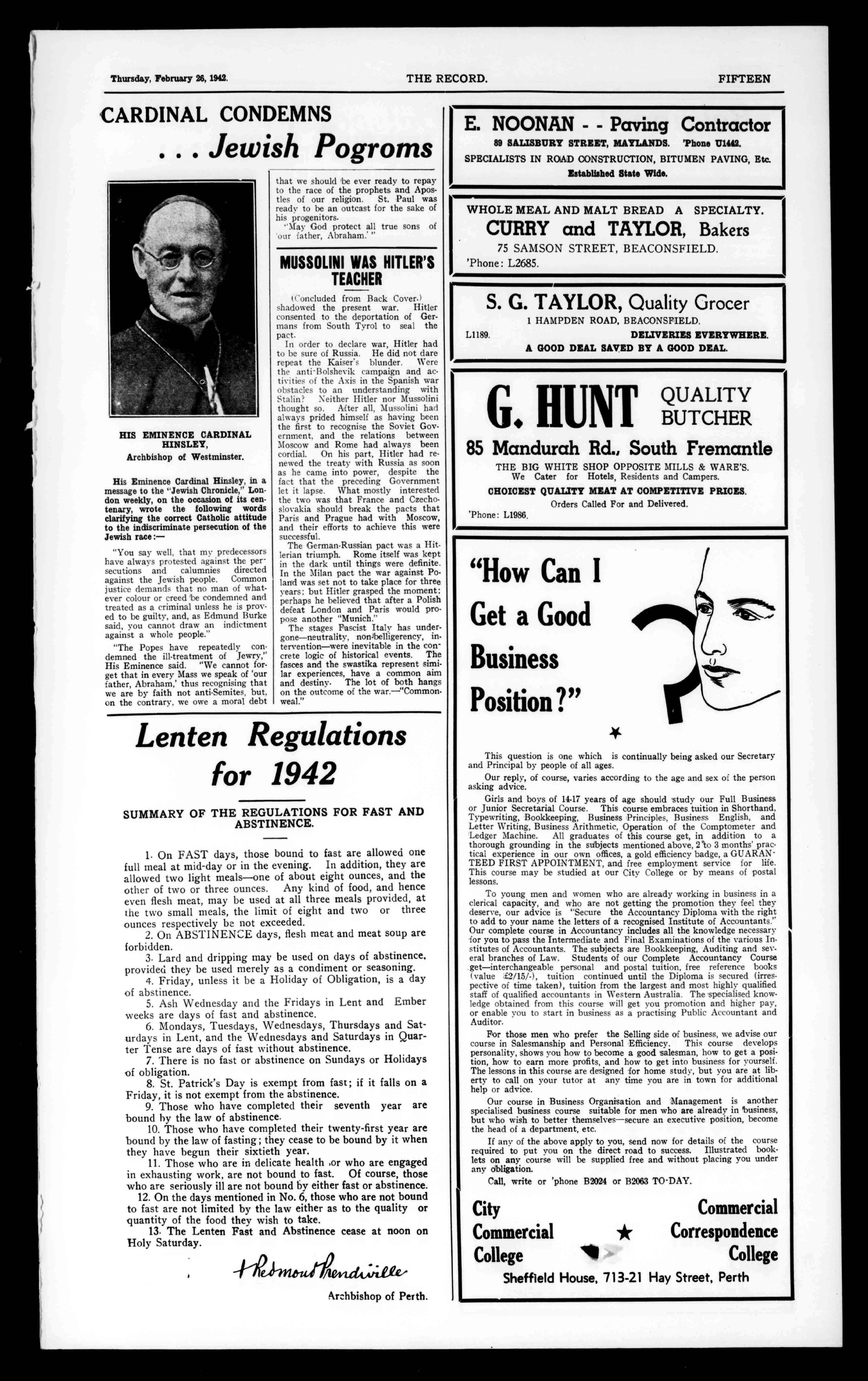
HISEMINENCECARDINAL HINSLEY, ArchbishopofWestminster.
HisEminenceCardinalHinsley,ina messagetothe-JewishChronicle,"Londonweekly,ontheoccasionofitscentenary,wrotethefollowingwords clarifyingthecorrectCatholicattitude totheindiscriminatepersecutionofthe Jewishrace:-
"Yousaywell,thatmypredecessors havealwaysprotestedagainstthepersecutionsandcalumniesdirected againsttheJewishpeople.Common justicedemandsthatnomanofwhatevercolourorcreed'becondemnedand treatedasacriminalunlessheisprovedtobeguilty,and,asEdmundBurke said,youcannotdrawanindictment againstawholepeople."
"ThePopeshaverepeatedlycondemnedtheill-treatmentofJewry," HisEminencesaid."WecannotforgetthatineveryMasswespeakof'our father,Abraham,'thusrecognisingthat wearebyfaithnotanti-Semites,but, onthecontrary,weoweamoraldebt
Inordertodeclarewar,Hitlerhad tobesureofRussia.Hedidnotdare repeattheKaiser'sblunder.Were theanti-BolshevikcampaignandactivitiesoftheAxisintheSpanishwar obstaclestoanunderstandingwith Stalin?NeitherHitlernorMussolini thoughtso.Afterall,Mussolinihad alwayspridedhimselfashavingbeen thefirsttorecognisetheSovietGovernment,andtherelationsbetween MoscowandRomehadalwaysbeen cordial.Onhispart,HitlerhadrenewedthetreatywithRussiaassoon ashecameintopower,despitethe factthattheprecedingGovernment letitlapse.Whatmostlyinterested thetwowasthatFranceandCzechoslovakiashouldbreakthepactsthat ParisandPraguehadwithMoscow, andtheireffortstoachievethiswere successful.
TheGerman-RussianpactwasaHitleriantriumph.Romeitselfwaskept inthedarkuntilthingsweredefinite. IntheMilanpactthewaragainstPolandwassetnottotakeplaceforthree years:butHitlergraspedthemoment: perhapshebelievedthatafteraPolish defeatLondonandPariswouldproposeanother"Munich."
ThestagesFascistItalyhasundergone-neutrality,non-belligerency,intervention-wereinevitableintheconcretelogicofhistoricalevents.The fascesandtheswastikarepresentsimilarexperiences,haveacommonaim anddestiny.Thelotofbothhangs ontheoutcomeofthewar.-"Commonweal."
LentenRegulations for1942
SUMMARYOFTHEREGULATIONSFORFASTAND ABSTINENCE.
1.OnFASTdays,thoseboundtofastareallowedone fullmealatmid-dayorintheevening.Inaddition,theyare allowedtwolightmeals-oneofabouteightounces,andthe otheroftwoorthreeounces.Anykindoffood,andhence evenfleshmeat,maybeusedatallthreemealsprovided,at thetwosmallmeals,thelimitofeightandtwoorthree ouncesrespectivelybenotexceeded.
2.OnABSTINENCEdays,fleshmeatandmeatsoupare forbidden.
1Lardanddrippingmaybeusedondaysofabstinence. providedtheybeusedmerelyasacondimentorseasoning.
4.Friday,unlessitbeaHolidayofObligation,isaday ofabstinence.
5.AshWednesdayandtheFridaysinLentandEmber weeksaredaysoffastandabstinence.
6.Mondays,Tuesdays,Wednesdays,ThursdaysandSaturdaysinLent,andtheWednesdaysandSaturdaysinQuarterTensearedaysoffastwithoutabstinence.
7.ThereisnofastorabstinenceonSundaysorHolidays ofobligation.
8.St.Patrick'sDayisexemptfromfast;ifitfallsona Friday,itisnotexemptfronttheabstinence.
9.Thosewhohavecompletedtheirseventhyearare boundbythelawofabstinence.
10.Thosewhohavecompletedtheirtwenty-firstyearare boundbythelawoffasting;theyceasetobeboundbyitwhen theyhavebeguntheirsixtiethyear.
11.Thosewhoareindelicatehealth,orwhoareengaged inexhaustingwork,arenotboundtofast.Ofcourse,those whoareseriouslyillarenotboundbyeitherfastorabstinence.
12.OnthedaysmentionedinNo.6,thosewhoarenotbound tofastarenotlimitedbythelaweitherastothequalityor quantityofthefoodtheywishtotake.
13.TheLentenFastandAbstinenceceaseatnoonon HolySaturday.
"HowCanI GetaGood Business Position?"
ThisquestionisonewhichiscontinuallybeingaskedourSecretary andPrincipalbypeopleofallages.
Ourreply,ofcourse,variesaccordingtotheageandsexoftheperson askingadvice.
Girlsandboysof14-17yearsofageshould-studyourFullBusiness orJuniorSecretarialCourse.ThiscourseembracestuitioninShorthand, Typewriting,Bookkeeping,BusinessPrinciples,BusinessEnglish,and LetterWriting,BusinessArithmetic,OperationoftheComptometerand LedgerMachine.Allgraduatesofthiscourseget,inadditiontoa thoroughgroundinginthesubjectsmentionedabove,2.to3months'practicalexperienceinourownoffices,agoldefficiencybadge,aGUARANTEEDFIRSTAPPOINTMENT,andfreeemploymentserviceforlife. ThiscoursemaybestudiedatourCityCollegeorbymeansofpostal lessons.
Toyoungmenandwomenwhoarealreadyworkinginbusinessina clericalcapacity,andwhoarenotgettingthepromotiontheyfeelthey deserve,ouradviceis"SecuretheAccountancyDiplomawiththeright toaddtoyournamethelettersofarecognisedInstituteofAccountants." OurcompletecourseinAccountancyincludesalltheknowledgenecessary foryoutopasstheIntermediateandFinalExaminationsofthevariousInstitutesofAccountants.ThesubjectsareBookkeeping,AuditingandseveralbranchesofLaw.StudentsofourCompleteAccountancyCourse get-interchangeablepersonalandpostaltuition,freereferencebooks (value.£21151-),tuitioncontinueduntiltheDiplomaissecured(irrespectiveoftimetaken),tuitionfromthelargestandmosthighlyqualified staffofqualifiedaccountantsinWesternAustralia.Thespecialisedknowledgeobtainedfromthiscoursewillgetyoupromotionandhigherpay, orenableyoutostartinbusinessasapractisingPublicAccountantand Auditor.
ForthosemenwhoprefertheSellingsideofbusiness,weadviseour courseinSalesmanshipandPersonalEfficiency.Thiscoursedevelops personality,showsyouhowtobecomeagoodsalesman,howtogetaposition,howtoearnmoreprofits,andhowtogetintobusinessforyourself. Thelessonsinthiscoursearedesigned'forhomestudy,butyouareatlibertytocallonyourtutoratanytimeyouareintownforadditional helporadvice.
OurcourseinBusinessOrganisationandManagementisanother specialisedbusinesscoursesuitableformenwhoarealreadyin'business, butwhowishtobetterthemselves-secureanexecutiveposition,become theheadofadepartment,etc.
Ifanyoftheaboveapplytoyou,sendnowfordetailsofthecourse requiredtoputyouonthedirectroadtosuccess.Illustratedbookletsonanycoursewillbesuppliedfreeandwithoutplacingyouunder anydbligation.
Call,writeor'phoneB2024orB2063TO-DAY.
City Commercial College
Correspondence 11 College
SheffieldHouse,713-21HayStreet,Perth ArzhbishopofPerth.
Thursday,February26,1942, THERECORD. FIFTEEN
E.NOONAN--PavingContractor 89SALISBURYSTREET,MAYLANDS.'PhoneU1442. SPECIALISTSINROADCONSTRUCTION,BITUMENPAVING,Etc. EstablishedStateWide. ,,... 75SAMSONSTREET,BEACONSFIELD. 'PhoneL2685. WHOLEMEALANDMALTBREADASPECIALTY. CURRYandTAYLOR,Bakers L11S9 1HAMPDENROAD,BEACONSFIELD. DELIVERIESEVERYWHERE. AGOODDEALSAVEDBYAGOODDEAL. S.G.TAYLOR,QualityGrocer G.HUNTQUALITY BUTCHER 85MandurahRd.,SouthFremantle THEBIGWHITESHOPOPPOSITEMILLS&WARE'S. WeCaterforHotels,ResidentsandCampers. CHOICESTQUALITYMEATATCOMPETITIVEPRICES. OrdersCalledForandDelivered. 'Phone:L1986.
Commercial
*BelgianCardinalOutspoken
CantheChurchadaptherselftoall formsofGovernment?
Isthefunctiono/theChurchlimited toservicesandtheadministrationof theSacraments?
Istherea"politicalCatholicism?"
HastheChurchanyjurisdictionin thepoliticalrealm?
Theseandkindredquestionsofvital importanceweresubjectedtosearchingexaminationbyCardinalVanRoey, PrimateofBelgiumandArchbishopof Malines,atarecentCongressofthe Jocists(YoungChristianWorkers).
"WearecertainthattheChurchwill emergevictoriousfromallthedifficultiesthatfaceher.Butwemustunderstandexactlywhatwemean:we arespeakingoftheChurchasawhole. WearespeakingoftheCatholicChurch throughoutthecenturies,whichhas survivedpersecutionandallthedisastersthatcanstrikethehumanrace. ButwedonotmeantheCatholic Churchinanyonecountry.Wehave onlytoglanceatthehistoryofEurope toseeatoncethatthepromiseofunbrokenexistencewasnotmadetothe Churchofanyparticularcountry, howeverCatholicorChristianitmight be. "HereIwouldmentionanargument whichonemeetsinmanyplacesand whichiscurrentinthepressofto-day. Certainpeople,andevencertainCatholics,saythatfortheChurchasa wholethefateofourcountryafterthe

CARDINALVANROEY.
warandtheGovernmentweshould havematterlittle:for,theyargue, theChurchadaptsherselftoallforms ofgovernment.Whatarewetosay tothisargument% Formsof'Government. "Clearlywemustdefineourterms. TheCatholicChurchadaptsitselftoall
TheColonialMutualFireInsurance COMPANYLIMITED.
ADDRESSTOJOCISTCONGRESS
governmentsonconditionthatthey safeguardherlibertyofconscience: thatistrue.Butasforadaptingherselftothegovernmentsthatoppress therightsofconscienceandpersecute theCatholicChurch-no,never!
"AndIwouldaddthatthegovernmentswhicharemoreorlesstolerable, andtowhichtheChurchcanadapt herself,areveryvaried.Thereare somemorefavourableandsomeless favourable.TheChurchisessentially indifferentwhethershelivesundera monarchyorunderarepublicorina democraticorautocraticgovernment. Thereisanendlessvarietyofgovernments-democraticmonarchy,autocraticmonarchy,democraticrepublic, autocraticrepublic,etc.France,Italy, Belgium,America,allhavedifferent regimes,butiftheseregimessafeguardandmaintaintherightsofthe Churchandallowhertofulfilherdivinemission,thatistosay,toworkas faraspossibleforthesalvationof souls,thentheChurchacceptsthese governments,doesnotopposethem, andadaptsherworktothem.
"Butitisclearlyimpossibleforthe Churchtoacceptallformsofgovernment.Wehaveonlytostudyhistory:didtheChurchadaptherselfto Mohammedanism?Shewascompletelysuppressedinallcountrieswhereit wasdominant.DidtheChurchadapt herselftothepersecutinggovern. mentsinEnglanduptotheendofthe 18th.century?Shewaseffacedfrom England.WouldtheChurchhave adaptedherselftotheFrenchRevolution?Thisregimeonlylastedten years,butifithadcontinuedthe Churchwouldhavebeensuppressedin everycountrywheretheRevolution raged. ChurchanOrganism.
"Butitisabsolutelyfalsetosaythat theChurchcanacceptallgovernments. TheChurchislikethehumanorganinn.Mancanliveintheglacialcold ofthenorthasinthetorridheatof theequator,butthereareplacesto whichhecannotacclimatisehimself, andwherehediesforwantofair.He cangetusedtoallkindsofchanges ofdiet,buttherearesomethatkill him.
"InAmericathereisacomplete separationbetweenChurchandState, butthereisalsocompleteliberty:Catholiclifeflourishesmagnificently. Italy,PortugalandGermanyhaveauthoritariangovernments,butthereis anenormousdifferencebetweenthem. Ourcountry,Holland,andFrance, haveregimesacceptabletotheChurch; butitmust'beadmittedthatthereis aconsiderabledifferenceastotheprofitwhichshederivesfromthemfor thesalvationofsouls.
"Itissometimesmaintainedthatthe roleoftheChurchisasfollows:to teachthefaith,toadministerthesacramentsandtomaintainChurchservices:alltherestbelongstopolitical Catholicism.Whatisouranswerto this?Itisnottruethatthefunction oftheChurchislimitedtoservicesand totheadministrationofthesacraments;sheisentrustedwiththeteachingofthewholeoftheevangelical truthsandevangelicalethics.
Catholic
PerthFuneral DirectorsLtd.
"Wemustadd,too,thattheChurch hastherighttodothisbyallnatural means,thatistosay,byallthemeans thathavebeengivenbyGodtomen. Whyshouldtherebemeansbelonging tonaturewhichtheChurchshallnot use?Itisanessentialpoint:moderninventionscreatedbyhuman geniusarenotanexceptiontothis rule;theyshouldbeattheserviceof thewholeworld,totheChurchaswell astotheState.Itisnotonlyoral teachingbutalsothewrittenword, andespeciallythepress,whichought to'beattheserviceofCatholicsaswell asnon-Catholics.Itistheradio,the cinema,and,inageneralway,teachinginschoolsandcollegesandallthat thisteachingcomprises.TheChurch claimsthisforherself,butthisisnot politicalCatholicism.
Church'sRights.
"TheChurch,then,hasnotonlythe missionofcelebratingMassandadministeringtheSacramentsandensuringthatthewordofGodispreached, butshehas,togetherwithparents,the missionofeducatingyouthbothmorallyandscholastically.Shehasthe rightofdefendingtheFaithandChristianmoralityagainsthostilepropaganda.Catholicshavetherightto profess,teach,defendandpracticethe CatholicFaithandCatholicprinciples inalldomains,notonlyindividually, butalsointhefamily,intheState,in publicandinternationallifeandby everymeansatthedisposalofmankind.
"WhenonespeaksofpoliticalCatholics,whathasoneinmind?IsitCatholicactivitiesorisitCatholiceducation?Butthatappertainstothe essentialmissionoftheChurch.She willnevergiveupthatright,forthe Churchhastherighttoteachthe faith;morethanthat,shehasthe rightandthedutyofseeingthatin theinstitutionswherethesecularsciencesaretaught,theatmosphereis wholesomeandtheeducationChris. tian.ThatisthereasonforCatholic schools.
"Dotheymeanworksofcharity? Buttoperformworksofcharityisthe firstpreceptofOurLord.Dothey meanCatholicAction?butthatisthe apostolateoftheHierarchyandthe clergyextendedtothelaity.Those whoattackthisso-calledpoliticalCatholicismhaveallthisinmind.The Churchwillalwaysclaimtherightof teaching,preachingandpractising charity,thatistosay,therightoffulfillingherapostolicmission.Shewill regardanyregimethatsuppressesthese thingsasoppressive.Tosuppress thesethingsistoopposehergreatest saints.
"When,thereforepeopleattack politicalCatholicismtheyareattackingthedoctrinalprincipleswhichshe teaches,andwhichsheappliestoevery branchoflife,evenoutsidethestrictly religioussphere.
MustTeachMoralPrinciples.
"Moreover,theChurchclaims,and shouldclaim,therighttoteachthose moralprincipleswhichgovernlife,not onlytheindividualandprivatelifeof everyperson,butalsothelifeofthe family,thesocietyandtheState-The headsofStates,kingsandthemightiestemperors,aresubjectlikeallother mentothedivineandnaturallaw. Likeallmenandlikeallstatesmen theyaresubjecttotheselawsinevery sphereandinalltheiractions,bothin thepolitical,nationalandinternational domains.
"TheChurchwillneverrenounceher rightofproclaimingthetruthand showingwhatisjustandunjust,ofdefininganddefendingtherightsand dutiesofindividualsaswellasfamilies andStates.Torefuseherthisright wouldbequiteclearlytosuppressa greatpartoftheChurch'sactivity:in proofofthis,itisonlynecessaryto considerforamomentwhatthelast Popeshavedone.
"TheEncyclical,'ImmortaleDei,'of LeoXIII.dealswiththeconstitution ofStates.TheEncyclicals,'Rerum Novarum'ofLeoXIII.,and'QuadragesimoAnno'ofPiusXI.,dealwithsocialandeconomicquestions.Allthis isnotstrictlyreligious,andyetnoone candenythePapacytherightofdealingwithsuchsubjects.
"PiusXI.issuedanEncyclicalon marriage,'CastiConnubii.'Thisagain isnotstrictlyareligiousmatter-He speaksinitofthedutyoffamilies,of husbandsandwivesandparentsand therightsoftheState.Inthesame wayheissuedanEncyclicalonthe Christianeducationofyouth,which againisnotstrictlyareligiousmatter.Again,inthisspherehespeaks oftherightsanddutiesoftheState. PiusXI.,in1937,wrotetheEncyclical, 'MitbrennenderSorge,'inwhichhe bothjudgesandcondemnsNational Socialism;atthesametimeheissued theEncyclical,'DiviniRedemptoris,' inwhichhecondemnsBolshevistic Communism.Allthesemattersare notstrictlymattersofthefaith;they donotconcernreligiousservicesorthe administrationofthesacraments,and yetinallthesefieldstheChurchison herownterritoryandclaimstheright ofjudging,notfromthepolitical'but fromthemoralstandpoint,theactions ofmenandthosewhoruletheworld.
"Alltheseobservations,unfortunately,mayonlyprovokeattacksonthe libertyoftheChurchandontherights ofconscience,andsoCatholicsought toopentheireyes;andIsaysonow.
Youhavetheopportunityoffulfilling theapostolateoftheChurch,andI beseechyoutospreadtheideasthat Ihavejustexpoundedbyallthemeans atyourdisposal:Catholicsmustrealisethatthereisanurgentdanger,and thattheymustdoeverythingtoavert it
NORTHAM.
E.0.TRESISE, M.P.S.,S.A.andW.A. MANUFACTURINGAND DISPENSINGCHEMIST. ForServiceandQuality.
Tel.:61Northam.
SIXTEEN THERECORD Thursday,February26,1942.
CONSULT
HOUSEOWNER,andHOUSEHOLDER'SCOMPREHENSIVE,BURGLARY, PLATEGLASS,MOTORVEHICLE,CROPS,FIDELITY
TEE,WORKMEN'SCOMPENSATION,THIRDPARTY. NO.33BARRACKSTREET,PERTH. W.L.CARTER,Manager. FootComfortGuaranteed iseN.901C Gede 667HayStreet,Perth Ifnecessarywe maketoorder. 'PhoneB1381. BootsandShoes InHalfSizes. ForExquisiteMildnessandTenderness andFineFlavourAlways. BehnsLimited QualityMeatsandSmallgoods TWOBIGBARRACKSTREETSTORES, ForYourConvenienceonEitherSide.
FORALLCLASSESOFINSURANCE,INCLUDINGFIRE,
GUARAN-
Funerals BY
ComplystrictlywitheveryrequirementofCatholicRitual. ThequietdignityandreverenceofservicesundercompetentCatholicsupervisionaffordconsolationinthehourofsorrow. NightandDayService. SYModerateFees. 379HaySt.,Perth(nearSt.Mary'sCathedral). Phones:Business,B8616;Private,B8623,B5496.
SpanishPrimate Appointed
UnderTermsofNew ConcordatwithHolySee
TextofAgreement
Theappointmentofasuccessorto thelastCardinalComayThomasinthe primatialSeeofSpainisthefirsttobe madeundertheagreementbetweenthe HolySeeandtheSpanishGovernmentsignedJune7last.References tothenewPrimateandtothepurport oftheagreementwithregardtothe appointmentofBishopsinSpainfollow:
ThenewArchbishopofToledo,Mgr. Pla,whohasbeenBishopofSalamanca since1935isaCatalan,likehispredecessor,andsinceheisincharacter amanverysimilartoCardinalGoma, therewillbeaclosecontinuityinthe See.In1936Mgr.PlaplacedhisepiscopalpalaceatthedisposalofGeneral Franco;itwasgratefullyacceptedas theheadquartersoftheNationalist movement,andSalamancabecamethe firstcapitalofNationalSpain.The Spanishpress,welcominghisappointmenttotheSeeofToledo,published longextractsfromthepastoralletter entitled,"TheTriumphoftheCityof GodandtheResurrectionofSpain," whichMgr.Plaissuedattheendof theCivilWar.
Thetextoftheagreementbetween theHolySeeandSpaininreferenceto theappointmentofBishopsreads:
1.Asfrequentlyasavacancyoccurs inArchiepiscopalandEpiscopalSees (orinanApostolicAdministrationof permanentcharacter,suchasthoseof BarbastroandCiudadRodrigo),or whentheHolySeedeemsitnecessary tonominateaCoadjutorwithrightof succession,theApostolicNuncioshall sendtotheHolySeealistofqualified candidates,atleastsixinnumber.
2.TheHolyFathershallselectthree fromthatnumberandsendthemto theSpanishGovernmentthroughthe ApostolicNunciature,whereuponthe ChiefofStateshallofficiallypresent oneofthemwithinaperiodof30days.
3.IftheHolyFather,inhishigh opinion,doesnotconsideracceptable allorpartofthecandidatesincluded onthelist,sothatheisunableto choosethreeorevenoneofthem,he shalldrawuponhisowninitiativea listofthreewhichheshalltransmit throughthesamechannelstotheSpanishGovernment.
4.Ifthelattershouldraiseobjections ofageneralpoliticalcharacteragainst allorsomeofthenewcandidates,it shallsoinformtheHolySee.
Should30daysfromthedateofthe abovementionedcommunication elapsewithoutareplyfromtheGovernment,thissilenceshallbeinterpretedtomeanthatthelatterhasno suchobjectionstomakeagainstthe newcandidates;itbeingunderstood thattheChiefofStateshallthereupon presenttotheHolySeeoneofthe threecandidatesincludedintheaforesaidgroup. If,onthecontrary,theGovernment shouldraisesomeobjection,thenegotiationsshallcontinue;evenifthe30 dayshaveelapsed.
5.Inallevents,eveniftheHoly Fatheracceptsthreecandidatesof thosesent,hecanalwayssuggestnew candidateswhichheshalladdtothe list,andthentheChiefofStatecan presentwithoutdistinctiononeofthe candidatesincludedonthelistorany ofthesupplementaryonessuggested bytheHolyFather.
6.Alltheaforesaidnegotiations shouldbekeptabsolutelysecretin ATTADALEDAIRY.
FREMANTLEROAD,'MELVILLE.
EDWINH.MITCHELL MILKFROMATTADALEDAIRY.
MilkDeliveredtoanypartof FremantleandSuburbsDaily. TEL.L1443.
character;thenamesofthecandidates shouldbekeptespeciallysecret,uptill themomentoftheirnomination.
7.TheSpanishGovernmentformally agreestoconcludewiththeHolySee anewConcordatdesignedtomeetthe desireoftheHolySeetorestorethe Catholicsentimentofagloriousnationaltradition.
Thepresentconventionshallremain inforceuntilitsprovisionsareincorporatedinthenewConcordat.
8.Inrelationtotheprovisionofnonconsistorialbenefices,atthesametime asthisconventionissigned,appropriatenegotiationsshallbeginwitha viewtoconcludinganotherconvention inwhichshallbeestablishedregulationsinregardsthereto.
TheChurch,towhomisguaranteed byinherentrighttheprovisionofthose non-consistorialbeneficesoverwhich theKingofSpainenjoyedspecialprivileges,isneverthelessdisposedto makecertainconcessionsonthispoint totheSpanishGovernment.
9.UntilthequestionisdefinitelysettledinthefutureConcordat,Prelates canproceedtotheprovisionofparishes, withinthelimitofCanonLawhowever,theymustnotifytheGovernment oftheirnominationsbeforetakingover abenefice,astheGovernmentmight, insomeexceptionalinstance,raisean objectionofageneralpoliticalcharacterinregardtothenominations.
10.Untiltheconclusionofthenew Concordat,theSpanishGovernment bindsitselftoobservethetermscontainedinthefirstfourarticlesofthe Concordatoftheyear1851.
11.AtthesametimetheGovernment agreesnottoenterintoanydiscussionsonmattersofcommoninterestor thosematterswhichcouldinanyway interesttheChurch,withoutfirstmakinganaccordrelativetheretowiththe HolySee.
ThefollowingfourarticlesoftheConcordatof1851wereaddedtotheAgreement:
ArticleI.:TheRomanCatholicApostolicreligionwhich,totheexclusionof anyothercultwhatsoever,continuesto bethesolereligionoftheSpanishnation,shallalwaysbekeptaliveinthe dominionsofhisCatholicMajestywith alltherightsandprerogativeswhich itshouldenjoyaccordingtoGod'slaw andtheprescriptionsoftheSacred Canons.
ArticleII.:Consequently,instrution inuniversities,colleges,seminariesand bothpublicandprivateschoolsofany kindwhatsoevershallconforminevery respecttothedoctrineoftheCatholic religion.TothatendBishopsand otherdiocesanPrelatesshallnotbeimpededinanywayintheexerciseof theirfunctionsinconnectionwithsupervisionoverthepurityofthedoctrineof faithandofcustoms,orasregardsthe religiouseducationofyouthevenin publicschoolsinsofarastheexercise ofthislastofficeisconcerned.
ArticleIII:Noobstaclesshallbe placedinthewayofthesaidPrelates orotherholyministersintheexercise oftheirfunctions,norshallanyone molestthem,underanypretext,inthe carryingoutofanythingthatappertainstothedutiesoftheiroffice;on thecontrary,allauthoritiesinthekingdomshallbechargedwithshowingand causingotherstoshowthemtherespectandconsiderationduetothemaccordingtodivineprecepts;alsothey shallseetoitthatnothingisdonethat mightbringdisgraceuponthemor causethemoffence.HisMajestyand hisRoyalGovernmentshallalsogrant theirvalidprotectionandsupportto theBishopswhenevertheyrequestit, especiallywhentheymustcombatthe iniquityofmenwhoattempttopervert thesoulsofthefaithfulandtocorrupt customs;or,wheneveritisnecessary forthemtopreventthepublication,introductionorcirculationofevilor harmfulbooks.
ArticleIV.:Inallothermattersrelativetotherightsandexercise ecclesiasticalauthorityandtotheministryoftheHolyOrders,theBishops andclergydependinguponthemshall enjoyfulllibertyaccordingtothe c""-edCan"rc.

WEREYOUONE
Thursday,February26,1942. THERECORD. SEVENTEEN
MilkDaily S.J.WADE TRALEEDAIRY.
FOURTHAVENUE, MT.LAWLEY. 'Phone:U2532.
Fresh
120
INTERNATIONALFISHERIES FRESHFISHTWICEDAILY. 131BARRACKSTREET. DELIVERIESANYWHERE. PHONEB2974 SupplierstoHospitals,EducationalandReligiousInstitutions. WEARETHEOLDESTANDLARGESTFISHDISTRIBUTORSIN WESTERNAUSTRALIA. OLIVEOILINLARGEORSMALLQUANTITIES. NewHospitalofSt.JohnofGod,Subiaco SPLENDIDUP-TO-DATEACCOMMODATION. ConvenienttoSubiacoandLeedervilleRailwayStationsandTrams. RecentAdditionsconsistofaFully-EquippedX-RAYDEPARTMENT andCHILDREN'SWARD. PatientsMaySelectTheirOwnMedicalAdvisers. UnfinancialPatientsmaybeadmittedonDoctor'sRecommendation. OPENTOALLDENOMINATIONS. FRANKJ.BOSWELL SPECIALISTSINHospitalEquipment,andSteamInstallations,HotWaterHeating, Ventilating,SewerageWork,andGeneralPlumbing. CornerRUTHandWILLIAMSTREETS,PERTH.-Tel.B2777. W.A.AgentforK.G.LUKEPTY.,LTD.,MELBOURNE. SuppliersofHospitalEquipmentandStainlessHospitalUtensils.
OFTHELUCKYONESTHISTIME IFNOT,GETYOURTICKETFROMCHARLESWATSON&CO. 76BARRACKSTREET(NextWilsonandJohn's). f6,000FOR2/6.OtherPrizesbytheThousand. CIMMININIIMIIIIIIIMOIIIIMMROMIIIIIIIIICIONIIIIIMIIIIIIIICEMMIWOMIMOMMUMIIIIIIRIMMINE1111111111M0111111111111r4 1 SAVECHARGES! SAVEFREIGHT! I ImprovetheValueofyourWoolbyhavingitSCOURED. a TheSWANWOOLSCOURINGCO. ofW.A.Ltd.Fremantle g theoldestbusinessofitskindinthisState,withitsmostefficientmod-P. 1ernplant,employstheverylatestmethodstosecureforclientsbetterg a returnsfortheirwool. 8 g ConsigntoNORTHFREMANTLE,andobtainrebatesof40percent.1 1 ofthefreightforallquantitiesoveroneton. Address:BOX2,POSTOFFICE,FREMANTLE. a = 15 E g. 'Phones:L1031-2 .111111111111011111MIIIIMMIHMIMEIIIIIIIIMIIIIIIIIIIIM111111111110111iIIIIIIIIMMIMMOI11111111111011111118.1 P.J.McCABE M.P.S. (MayhewGoldMedalist) PharmaceuticalChemist PrescriptionsCarefullyandAccurately DispensedandDelivered. CompleteStocksofPatentMedicines alwaysonband. 'Phone:B5442. SEETHISMODERNPHARMACY FORYOURSELF. CORNEROFHAYAND IRWINSTS.,PERTH 1 PETERS ICECREAM realkod Caloriesineverydayrood comparedwithIceCream. MIN fish 206 1111 Milk '14 II ChickenEggs 492 594 111 Baal' Beef' 652 764 ICE CREAM 907 Caloriesaretothebodywhat4ielistoanengine PatroniseOurAdvertisers
MussoliniwasHitler's
Teacher
FascesandSwastikaRepresentaCommon Experience,AimandDestiny
LotofBothHangsonOutcome ofWar
thisprocedurewithgreatability-and thepressureheexertedonopinion broughtresults.PresidentvonHindenburgofferedhimtheChancellery.
In1933hedidwhatMussolinihad donein1922;heacceptedthecollaborationofthenationalistsandconservativeswhohadfacilitatedhisrise topower,ifonlytoeliminatethem later.Notuntilhereceivedfull powersfromtheReichstagdidhedismissthedeputies.

"ThetotalitarianStatehadarrived. TheformulaisnotHitler's,butMussolini's."
Hitlercametopowerin1933;Mussolinicametopowerin1922.DisparityinachievementmakesmanyforgetthisItalianpriorityintheapplicationofmethod.Whathasbeen theinterplayofresponsibility,theexchangeofexperiencebetweenthetwo dictatorships?
In1920and1921Mussoliniproclaimedhimselfthechampionofthebourgeoisietormentedbycommunists,socialistsand"Popolari"(CatholicDemocrats).Hevowedalsothathe wouldvindicatethehonourofthenationthathad'beenslightedatthe ParisPeaceConference.Industrialists,landlords,politicians,andmilitaristsplacedtheirconfidenceinhim antcontributedfundsforhisarmed squads,notwithstandingthathehad foundedthemin1919withananticapitalist,anti-monarchicalandrevolutionaryprogramme.Formorethan twoyearsheattackedtradeunions andotherworkers'organisations,cooperatives,andmunicipalitieswhere hisadversarieswereinthemajority. Thegovernmenttoleratedthis;the courtswereslowandindulgent,and thenationalistsandconservativebourgeoisiereadilyenoughusedthefasces tobreakstrikesandintimidateworkers.ByOctober,1922,conditions wereripefortheMarchonRome.As iswellknown,theKingyielded;the menwhomadeuptheItalianParliamentyielded,fearingviolenceagainst theirpersonstheygrantedtheman whocontrolledthatviolencefullpower towieldit.Itmustnotbeforgotten, however,thattheyagreedtocollaboratewithhiminthehopethatintime thecountrywouldreturntotheconstitution.
Successalwaysisimitated;herewas anewformula,theformulaofviolence-SoondeRiverainSpainand HitlerinGermanywereexperimentingwithit.TheMunichPutschof 1923failed,andwiththatfailurecame Hitler'srealisationoftheneedtofollowcloserhisItalianmodelandto eschewhastiness.Heturnedtothe methodicaldevelopmentofhissquads, theexpansionofhisyouthorganisationsandemphasisedtheaidhecould bringtotheindustrialistsandGerman magnateswhofinancedhim.HisdirectattacksuponCommunistmilitants andupontheSocialDemocratand Catholicdemocratparties,withpropagandaagainstVersaillesasemotional background,wonhimthetoleranceof thevariouslocalandcentralgovernmentsandendearedhimtothemilitaristsandtotheGermanRight.HitlerwaitedlongerthandidMussolini infollowinghisdictatorialambition becauseherealisedthathecoulduse andgreatlyneededtheexistingdemocraticelectoralprocedure.Heused
Fromthenonhecontinuedtoparallel,butmorerapidly,thecourse shownbytheItalian.Mussolini,after havingabandonedanevennominal policyofco-operationwithoutside groups,hadafreehand;heabolished municipalandprovincialelectoral bodies;dissolvedallpoliticalparties excepttheFascists,whichhemadethe soleorganofpower;gavealltheprivilegestotheFascistsyndicates,and forcedtheyouthofbothsexestoenrollinFascistorganisations.Thisdid notsuffice.School,pressandradio 'becamemonopoliesoftheregime.The
ByLUIGISTURZO.ChamberofDeputies,deprivedoffreedomandindependence,sawitsmembersbecomerubberstamps,electedby a"yes"or"no"onlistsapproved'by IlDuce.AGrandCouncil,aFascist organofthegovernment,superiorto theministers,wasorganisedalongwith aFascistmilitia,asecretpolice,the "Ovra,"andaSupremeTribunalto suppressanyfreeandindependentactivity.
Hitlerhastenedtooutshinehis teacher.TheGestapoisbetterknown thantheOvra;inItalytheynever matchedtheReichstagfire;June20, 1934,outdidJune10,1924. Upon VonHindenburg'sdeath,HitlerundertookthedoubledutiesofChancellor andPresidentoftheReichandassumedthetitleofReichsfuhrer.
ThetotalitarianStatehadarrived. TheformulaisnotHitler'sbutMussolini's,whodefineditin1926"NothingoutsideorabovetheState, nothingagainsttheState,everything withtheState,everythingforthe State."Writingthearticle"Fascism" intheItalianEncyclopedia,Mussolini repeated:"ForFascismeverythingis intheStateandnothinghumanor spiritualexists,farlesshasvalue.outsidetheState."Therealitycorrespondstothedefinition;inItalyone speaksofState,inGermanyofReich; inItalyofnation,inGermanyofrace. Theplain,thecrystalcleartruthis thattotalitarianismhasbeenestablishedinthenorthandinthesouth.
Reciprocalinfluenceinpolicycontinued.Theanti-clericalMussolini, whointhefirstFascistprogrammeof 1919hadproposedradicalmeasures againsttheChurch,onceinpowerbegantofavourtheclergyandtoactin friendlyfashiontowardstheVatican. KnowingthatCardinalGasparrihad hadcautiouscontactwiththeLiberal PrimeMinister,OrlandoandNitti,for aviablesolutionoftheRomanQuestion,IlDucepresentedhimselfasthe mantoachieveit.Thenegotiations weresecret,andonFebruary11,1929, theLateranTreatyandtheConcordat weresubscribed.Inconsequence, Mussolinigainedthegoodwillofthe Catholicsoftheworld,whosawthe factandnotthemotive,andsucceeded increatingaconfusedandregrettably superficialrelationshipbetweenFascismandtheChurch.
InGermany,threateningexcommunication,severalbishopshadforbiddenthefaithfultojointheNazi Party;butwhenHitlerattained power,hedeclaredhimselffriendly tothetwogreatChurches,theProtestantandtheCatholic,andwas quicktostartnegotiationsforanew concordatforthewholeReich,instead ofmaintainingthesixexistingforthe differentStatesoftheWeimarRepublic.VonPapenrushedtoRome; MonsignorKaas,secretaryoftheGermanCentreParty,whowasinRome, supportingthethesisoftheconcordat Dr.Wirth,Catholicex-Chancellor,also inRome,lobbiedamongprelatesand cardinals.Thus,Hitlerdidnotneed thesevenyearsithadtakenMussolini. Henegotiatedandconcludedaconcordatinlessthansevenmonths.Confidenceinhimincreased;alargenumberofCatholicsinvariouspartsof theworldregardedhimwithfavour. FormanyofthemHitlerhadbecome asaviour;hadhenot,likeMussolini, savedhiscountryfromBolshevism, atheismandtotaldisorder? Evenintheinternationalfield,Mussolini'sexperienceprecededthatof Hitler.Mussolinifirstofthetwoexperimentedwiththelimitlesspossibilitiesofextorting"appeasement."The questionoftheboundariesofYugoslaviaandFiume,settledbythe TreatyofRapalloin1920byGiolitti andSforza,hadnotsatisfiedtheItaliannationalists.In1923MussolinioccupiedFiume,whichhadremaineda freecity.Geneva,Paris,andLondon wereperplexed;but,afterall,Mussolinihad"saved"ItalyfromBolshevism;Fiumemustnotbeallowedto causehimdifficulties;lethimsettlethe matterwithYugoslavia.AfterFiume camethebombardmentofCorfutorevengethemembersofGeneralTellini's missioninAlbania,murdered,itwas said,byabandofGreeks.Greece andEnglandprotestedandaskedfor theinterventionoftheLeagueofNations.Mussolinirefusedtosubmitto Geneva,butfinallyagreedtohavethe mattersettledbytheCommitteeof AmbassadorsinParis,whichhandled theevidencesothattheGreekshad topayanindemnity.
In1927theagitationwasagainst Franceandthecriesthatfilledthe streetswere:"WewantNiceand Savoy."ThepropagandaforannexationofCorsicawasstarted.The heatedspeechesofMussoliniforthe futurewaragainstParisandGeneva wereminimisedinLondonasoratory forhomeconsumption.
In1928Mussolinisignedatreatyof amitywiththeNegusofAbyssinia; thetreatycontainingaclauseforthe arbitrationofallquestions.Yet,alreadyin1932,accordingtoGeneralDe Bono,IlDuceorderedpreparationsfor waragainstEthiopia;the"imperial" war.Thenecessaryandimmediate excusesforthisactionwereavailable, ofcourse,induetime.
In1933HitlerresignsfromtheLeagueofNations;in1933hedisregards themilitaryclausesoftheVersailles Treaty.In1936heviolatestheLocarnoPact.Histroopsoccupythe demilitarisedRhineZoneandbegin theconstructionoftheSiegfriedLine. HitlerprofitsfromMussolini'sexperience;hehaslearnedtomeasurethe -futileprotestsofParis,Londonand Geneva.
ThegiftsfromItalyarereturned tenfoldfromthenorthinadeplorable actionandreactionbetweenthetotalitarianStates.Theracialtheorywas notconceivedinItaly,wherethepsychologicalandpathologicalconditions,
-"hastenedtooutshinehisteacher." presentinGermany,werelacking.Italiansspokeof"stirpe,"meaningdescentorfamily,andadegreeoffantasytracedtheirancestrytothe"Romans,"whomacenturyagothepoet Giustisatirisedasthe"bastardsof Aeneas."ButHitler'sexamplewas contagious.Perhapstoremedyacertaininferioritycomplexofthepoor Latins(helduptoridiculeandscorn byLutherandfromthenonbyevery respectableGerman)eveninItaly, wherethereissorichanheritageof diversebloods,theybegantospeakof theraceproblemandtomakeitan objectof"study"andof"law."Asan answertotheremarksofPiusXI., Fascistspokesmendeniedthatthere wasanyimitationonthepartofFascismbecausetheysaidtheracismof Germanywas"philosophic,"thatof Italyafactof"biology."
Fromracismtoanti-semitismthere isbutastep.AfterMussolini'srepeateddeclarationsthat"anti-semitismwouldbeinconceivableinItaly," heenactedanti-semiticlaws,expelled thenon-nativeJew,restrictedtheprofessional,legalandscholasticrights andtherighttoworkoftheJewof Italianbirth.
Therewastheimitativeperiodof theaccessiontopower,theperiodof doctrinalformation,butpracticalItaloGermanco-operationinthefieldof foreignaffairsbeganin1936.After theAbyssinianconquest,IlDucestatedhewassatisfied;hehadsettledall questionswithFranceonJanuaryYe 1935,bytheLavalagreement.From England,sometimebefore,hehadreceivedJubaland.Hitler,aftertheoccunationoftheRhineland,hadsaid thathesoughtandexpectednothing fromEnglandandFrance.ItalythereupongaveupherclaimsonAustria, andHitleraidedIIDuceintheSpanishadventure.Thissealedthetotalitarianalliance;andindoingsogave, permanently,thedirectionofaffairs tothemorepowerfulofthetwopartners.
Thereisnodoubtthattheplanfor aneworderinEuropeandintheworld belongstoHitler&Co.When,in 1933,theFuhrerwasdoubtfulabout IlDuce,a"newmapoftheGreatGermany,"withaswastikaoverTrieste waspublished.Themaphas'beenrevisedmanytimessincethen,andenlarged"onscientificbasis"byasecret specialisedcommissioncomposedcompletelyofGermans.Mussolinihadto havehisshare.HencetheFascist assaultonAlbaniaandtheagitation forCorsica,NiceandSavoy.The Rome-BerlinAxiswiththeIronPact ofMilanisaconsequenceandfore-
CONSULT withour ADVERTISERS forallyour REQUIREMENTS OfficialOrganoftheArchdioceseofPerth ESTABLISHED1874 CHINA,GLASSandPLATED WAREIMPORTERS. OTLEYPLACE,OffMURRAY STREET(RearSavoyHotel) Convents,Colleges,Institutions andSchoolsSpeciallyCateredfor. PriceListsandCatalogueon Application. PhoneB9651. Kelly&Rodoreda LateofJOHNDYNON6CO.
.........
onPage
PrintedandPublishedbyKeithFrancisSpruhan,at"TheRecord"Office,450HayStreet,Perth.
(Continued
15.)