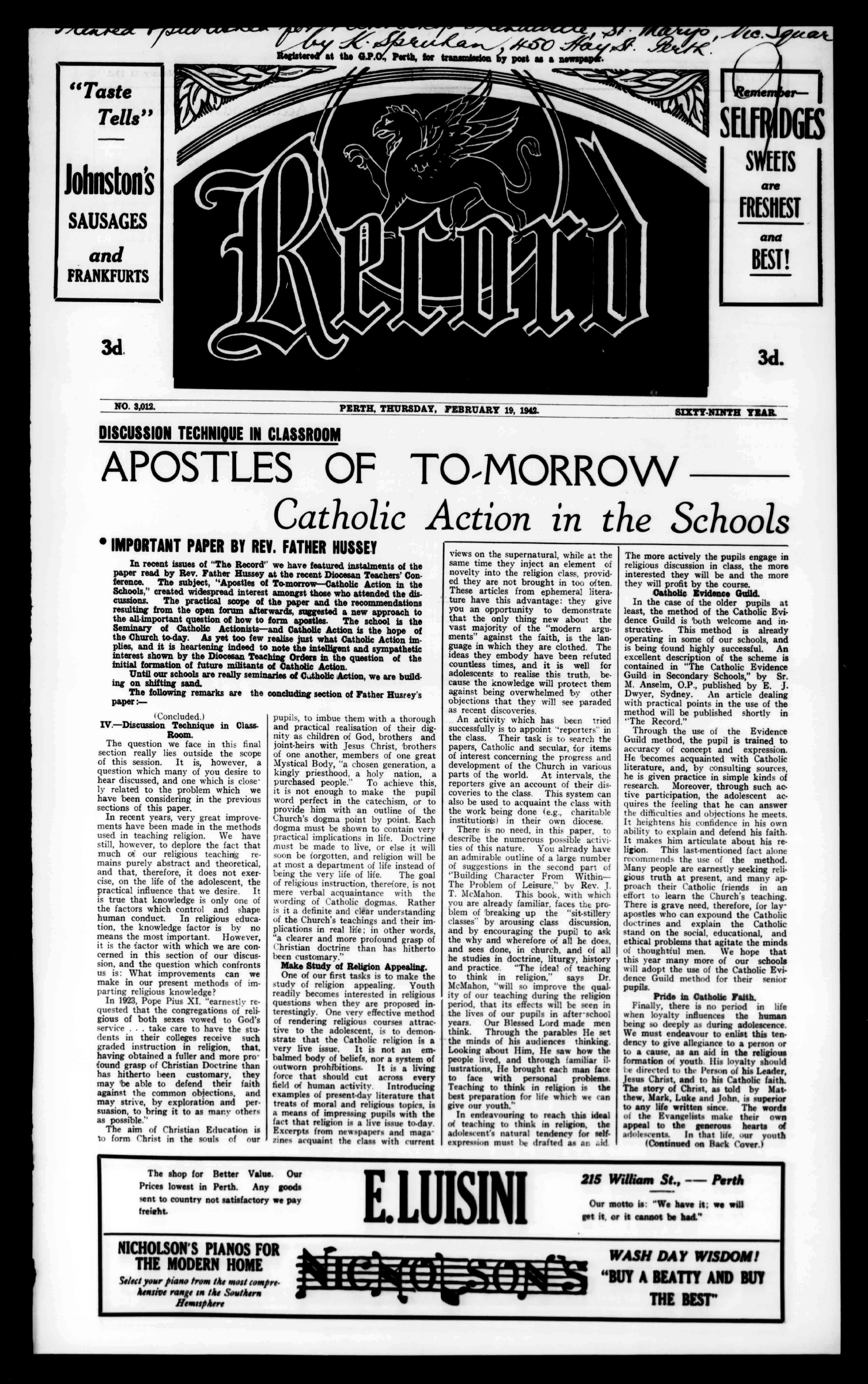
CatholicActionintheSchools
IMPORTANTPAPER
BYREY.FATHERHUSSEYInrecentissuesof"TheRecord'wehavefeaturedinstalmentsofthe paperreadbyRev.FatherHusseyattherecentDiocesanTeachers'Conference.Thesubject,"ApostlesofTo-morrow-CatholicActioninthe Schools,''createdwidespreadinterestamongstthosewhoattendedthediscussions.Thepracticalscopeofthepaperandtherecommendations resultingfromtheopenforumafterwards,suggestedanewapproachto theall-importantquestionofhowtoformapostles.Theschoolisthe SeminaryofCatholicActionists-andCatholicActionisthehopeof theChurchto-day.AsyettoofewrealisejustwhatCatholicActionimplies,anditishearteningindeedtonotetheintelligentandsympathetic interestshownbytheDiocesanTeachingOrdersinthequestionofthe initialformationoffuturemilitantsofCatholicAction.
UntilourschoolsarereallyseminariesofC,..tholicAction,wearebuildingonshiftingsand. ThefollowingremarksaretheconcludingsectionofFatherHusrey's paper:,ncluded.)
IV-DiscussionTechniqueinClassRoom.
Thequestionwefaceinthisfinal sectionreallyliesoutsidethescope ofthissession.Itis,however,a questionwhichmanyofyoudesireto heardiscussed,andonewhichiscloselyrelatedtotheproblemwhichwe havebeenconsideringintheprevious sectionsofthispaper.
Inrecentyears,verygreatimprovementshavebeenmadeinthemethods usedinteachingreligion.Wehave still,however,todeplorethefactthat muchofourreligiousteachingremainspurelyabstractandtheoretical, andthat,therefore,itdoesnotexercise,onthelifeoftheadolescent,the practicalinfluencethatwedesire.It istruethatknowledgeisonlyoneof thefactorswhichcontrolandshape humanconduct.Inreligiouseducation,theknowledgefactorisbyno meansthemostimportant.However, itisthefactorwithwhichweareconcernedinthissectionofour'discussion,andthequestionwhichconfronts usis:Whatimprovementscanwe makeinourpresentmethodsofimpartingreligiousknowledge?
In1923,PopePiusXI."earnestlyrequestedthatthecongregationsofreligiousofbothsexesvowedtoGod's service takecaretohavethestudentsintheircollegesreceivesuch gradedinstructioninreligion,that, havingobtainedafullerandmoreprofoundgraspofChristianDoctrinethan hashithertobeencustomary,they may'beabletodefendtheirfaith againstthecommonobjections,and maystrive,byexplorationandpersuasion,tobringittoasmareothers aspossible:.
TheaimofChristianEducationis toformChristinthesoulsofnur
pupils,toimbuethemwithathorough andpracticalrealisationoftheirdig- nityaschildrenofGod,brothersand joint-heirswithJesusChrist,'brothers ofoneanother,membersofonegreat MysticalBody,"achosengeneration,a kinglypriesthood,aholynation,a purchasedpeople."Toachievethis, itisnotenoughtomakethepupil wordperfectinthecatechism,orto providehimwithanoutlineofthe Church'sdogmapointbypoint.Each dogmamustbeshowntocontainvery practicalimplicationsinlife.Doctrine mustbemadetolive,orelseitwill soonbeforgotten,andreligionwillbe atmostadepartmentoflifeinsteadof beingtheverylifeoflife.Thegoal ofreligiousinstruction,therefore,isnot mereverbalacquaintancewiththe wordingofCatholicdogmas.Rather isitadefiniteandclearunderstanding oftheChurch'steachingsandtheirimplicationsinreallife;inotherwords,"aclearerandmoreprofoundgraspof christiandoctrinethanhashitherto beencustomary."
MakeStudyofReligionAppealing.
Oneofourfirsttasksistomakethe studyofreligionappealing.Youth readilybecomesinterestedinreligious questionswhentheyareproposedinterestingly.Oneveryeffectivemethod ofrenderingreligiouscoursesattractivetotheadolescent,istodemonstratethattheCatholicreligionisa veryliveissue.Itisnotanembalmedbodyofbeliefs,norasystemof outwornprohibitions.Itisaliving forcethatshouldcutacrossevery fieldof exampleshumanactivityIntroducing ofpresent-dayliteraturethat treatsofmoralandreligioustopics,is ameansofimpressingpupilswiththe factthatreligionisaliveissueto-day fromnvwspapersandmaga' /Int,acquainttheclasswith.urrent
TheshopforBetterValue.Ow PriceslowestinPerth.Anygoods Senttocountrynotsatisfactorywepay freight.
NICHOLSON'SPIANOSFOR THEMODERNHOME
WestyourlianafromMtmostcomprehensiverangesntheSouthern lionstfrhere
viewsonthesupernatural,whileatthe sametimetheyinjectanelementof noveltyintothereligionclass,provid- edtheyarenotbroughtintoooften. Thesearticlesfromephemerallitera-turehavethisadvantage:theygive youanopportunitytodemonstratethattheonlythingnewaboutthe vastmajorityofthe"modernargu- ments"againstthefaith,isthelanguageinwhichtheyareclothed.The ideastheyembodyhavebeenrefuted countlesstimes,anditiswellfor adolescentstorealisethistruth.becausetheknowledgewillprotectthem againstbeingoverwhelmedbyother objectionsthattheywillseeparaded asrecentdiscoveries. Anactivitywhichhasbeentried successfullyistoappoint-reporters"in theclass.Theirtaskistosearchthe papers,Catholicandsecular,foritems ofinterestconcerningtheprogressand developmentoftheChurchinvarious partsoftheworld.Atintervals,the reportersgiveanaccountoftheirdiscoveriestotheclass.Thissystemcan alsobeusedtoacquainttheclasswith theworkbeingdone(e.g.,charitable institutions)intheirowndiocese.
Thereisnoneed,inthispaper,to describethenumerouspossibleactivitiesofthisnature.Youalreadyhave anadmirableoutlineofalargenumber ofsuggestionsinthesecondpartof "BuildingCharacterFromWithinTheProblemofLeisure,"byRev.J.
T.McMahon.Thisbook,withwhich youarealreadyfamiliar,facesthepro- blemofbreakingupthe"sit-stillery classes"byarousingclassdiscussion, andbyencouragingthepupiltoask thewhyandwhereforeofallhedoes, andseesdone,inchurch,andofall hestudiesindoctrine,liturgy,historyandpractice"Theidealofteaching tothinkinreligion,"saysDr. McMahon,"willsoimprovethequalityofourteachingduringthereligion period,thatitseffectswillbeseenin thelivesofourpupilsinafter-school years.OurBlessedLordmademen think.ThroughtheparablesHeset themindsofhisaudiencesthinking. LookingaboutHim,Hesawhowthe peoplelived,andthroughfamiliar lustrations,liebroughteachmanface tofacewithpersonalproblems. Teachingtothinkinreligionisthe bestpreparationfurhiewhirl: an giveouryouth."
Inendeavouringtoreachthisideal ofteachingtothinkinreligion,the adolessent'snaturaltendencyforselfexpre,.1,,nmustbedraftedasat,..id
Themoreactivelythepupilsengagein religiousdiscussioninclass,themore interestedtheywillbeandthemore theywillprofitbythecourse.
CatholicEvidenceGuild.
Inthecaseoftheolderpupilsat least,themethodoftheCatholicEvidenceGuildisbothwelcomeandinstructive.Thismethodisalready operatinginsomeofourschools,and isbeingfoundhighlysuccessful.An excellentdescriptionoftheschemeis containedin"TheCatholicEvidence GuildinSecondarySchools,"bySr. M.Anselm,O.P.,publishedbyE.J. Dwyer,Sydney.Anarticledealing withpracticalpointsintheuseofthe methodwillbepublishedshortlyin "TheRecord."
ThroughtheuseoftheEvidence Guildmethod,thepupilistrainedto accuracyofconceptandexpression. He'becomesacquaintedwithCatholic literature,and,byconsultingsources, heisgivenpracticeinsimplekindsof research.Moreover,throughsuchactiveparticipation,theadolescentacquiresthefeelingthathecananswer thedifficultiesandobjectionshemeets. Itheightenshisconfidenceinhisown abilitytoexplainanddefendhisfaith. Itmakeshimarticulateabouthisreligion.Thislast-mentionedfactalone reconunendstheuseofthemethod. Manypeopleareearnestlyseekingreligioustruthatpresent,andmanyap- proachtheirCatholicfriendsinan efforttolearntheChurch'steaching. Thereisgraveneed,therefore,forlayapostleswhocanexpoundtheCatholic doctrinesandexplaintheCatholic standonthesocial,educational,and ethicalproblemsthatagitatetheminds ofthoughtfulmen.Wehopethat thisyearmanymoreofourschools willadopttheuseoftheCatholicEvidenceGuildmethodfortheirsenior Pupils.PrideinCatholicFaith.
Finally,thereisnoperiodinlife whenloyaltyinfluencesthehuman beingsodeeplyasduringadolescence. Wemustendeavourtoenlistthistendencytogiveallegiancetoapersonor toacause,asanaidinthereligious formationofyouthHisloyaltyshould edirectedtothePersonofhisLeader, JesusChrist,andtohisCatholicfaith. ThestoryofChrist,astoldbyMatthew,Mark,LukeandJohn.issuperior toanylifewrittensince.Thewords theEvangelistsmaketheirown appealtothegenerousheartsof adolescents.Inthatlife,ur s smith !ContinuedonHackcover
Ourmottois"Wehaveit,wewill getitoritcannotbehad."
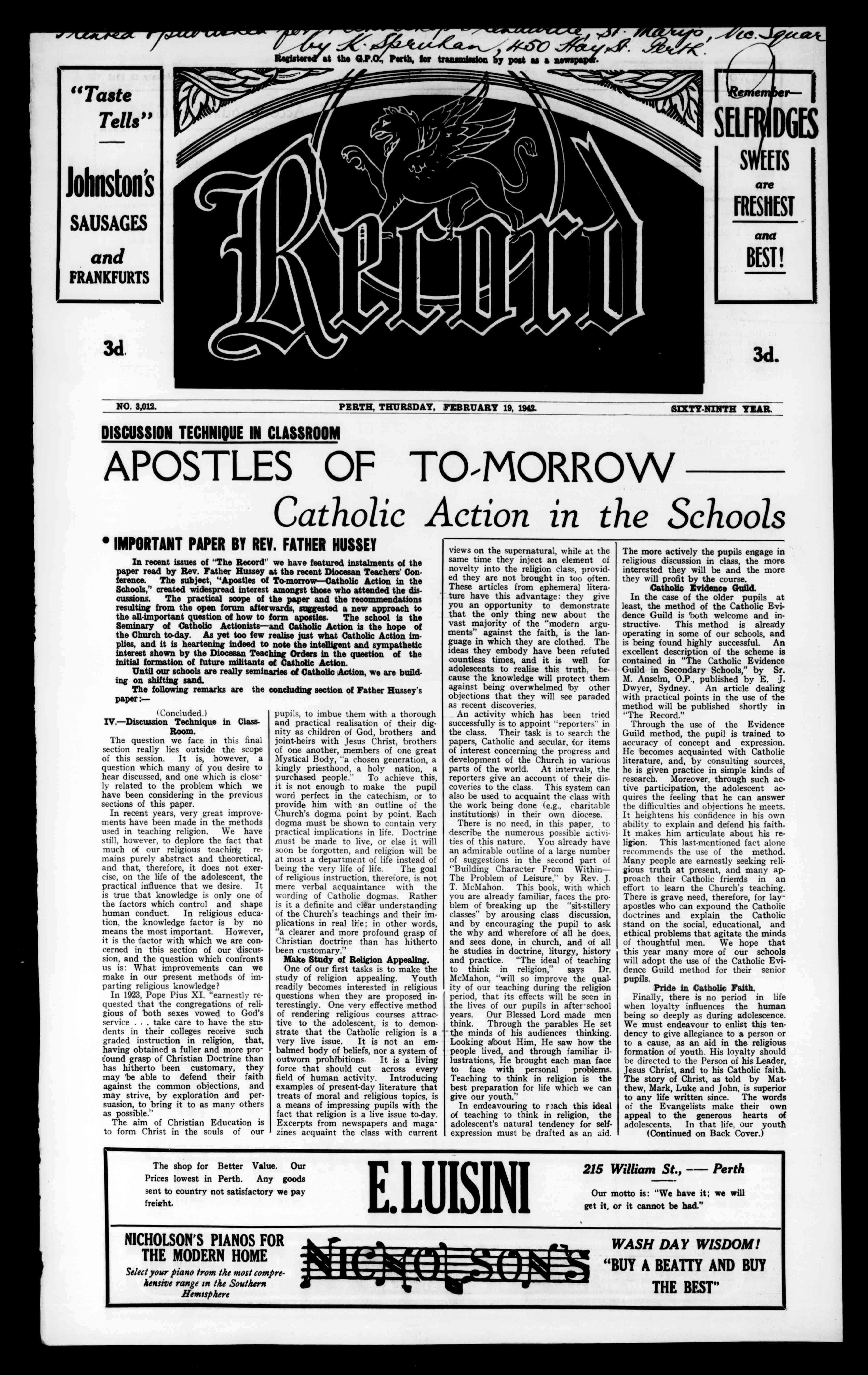
APOSTLESOFTO-MORROW
CatholicActioninthe
IMPORTANTPAPER
BYREY.FATHERHUSSEYInrecentissuesof"TheRecord'wehavefeaturedinstalmentsofthe paperreadbyRev.FatherHusseyattherecentDiocesanTeachers'Conference.Thesubject,"ApostlesofTo-morrow-CatholicActioninthe Schools,"createdwidespreadinterestamongstthosewhoattendedthediscussions.Thepracticalscopeofthepaperandtherecommendations resultingfromtheopenforumafterwards,suggestedanewapproachto theall-importantquestionofhowtoformapostles.Theschoolisthe SeminaryofCatholicActionists-andCatholicActionisthehopeof theChurchto-day.AsyettoofewrealisejustwhatCatholicActionimplies,anditishearteningindeedtonotetheintelligentandsympathetic interestshownbytheDiocesanTeachingOrdersinthequestionofthe initialformationoffuturemilitantsofCatholicAction.
UntilourschoolsarereallyseminariesofCatholicAction,wearebuildingonshiftingsand. ThefollowingremarksaretheconcludingsectionofFatherHussey's paper:uncluded.)
IV.-DiscussionTechniqueinClassRoom.
Thequestionwefaceinthisfinal sectionreallyliesoutsidethescope ofthissession.Itis,however,a questionwhichmanyofyoudesireto heardiscussed,andonewhichiscloselyrelatedtotheproblemwhichwe havebeenconsideringintheprevious sectionsofthispaper.
Inrecentyears,verygreatimprovementshavebeenmadeinthemethods usedinteachingreligion.Wehave still,however,todeplorethefactthat muchofourreligiousteachingremainspurelyabstractandtheoretical, andthat,therefore,itdoesnotexercise,onthelifeoftheadolescent,the practicalinfluencethatwedesire.It istruethatknowledgeisonlyoneof thefactorswhichcontrolandshape humanconduct.Inreligiouseducation,theknowledgefactorisbyno meansthemostimportant.However, itisthefactorwithwhichweareconcernedinthissectionofourdiscussion,andthequestionwhichconfronts usis:Whatimprovementscanwe makeinourpresentmethodsofimpartingreligiousknowledge?
In1923,PopePiusXI."earnestlyrequestedthatthecongregationsofreligiousofbothsexesvowedtoGod's service takecaretohavethestudentsintheircollegesreceivesuch gradedinstructioninreligion,that, havingobtainedafullerandmoreprofoundgraspofChristianDoctrinethan hashithertobeencustomary,they maybeabletodefendtheirfaith againstthecommonobjections,and maystrive,byexplorationandpersuasion,tobringittoasmanyothers aspossible."
TheaimofChristianEducationis toformChristinthesoulsofour
pupils,toimbuethemwithathorough andpracticalrealisationoftheirdig- nityaschildrenofGod,brothersand joint-heirswithJesusChrist,'brothers ofoneanother,membersofonegreat MysticalBody,"achosengeneration,a kinglypriesthood,aholynation,a purchasedpeople."Toachievethis, itisnotenoughtomakethepupil wordperfectinthecatechism,orto providehimwithanoutlineofthe Church'sdogmapointbypoint.Each dogmamustbeshowntocontainvery practicalimplicationsinlife.Doctrine mustbemadetolive,orelseitwill soonbeforgotten,andreligionwillbe atmostadepartmentoflifeinsteadof beingtheverylifeoflife.Thegoal ofreligiousinstruction,therefore,isnot mereverbalacquaintancewiththe wordingofCatholicdogmas.Rather isitadefiniteandclearunderstanding oftheChurch'steachingsandtheirimplicationsinreallife:inotherwords, "aclearerandmoreprofoundgraspof Christiandoctrinethanhashitherto beencustomary."
MakeStudyofReligionAppealing.
Oneofourfirsttasksistomakethe studyofreligionappealing.Youth readilybecomesinterestedinreligious questionswhentheyareproposedinterestingly.Oneveryeffectivemethod ofrenderingreligiouscoursesattractivetotheadolescent,istodemonstratethattheCatholicreligionisa veryliveissue.Itisnotanembalmedbodyofbeliefs,norasystemof outwornprohibitions.Itisaliving forcethatshouldcutacrossevery fieldofhumanactivity.Introducing examplesofpresent-dayliteraturethat treatsofmoralandreligioustopics,is ameansofimpressingpupilswiththe factthatreligionisaliveissueto-day. Excerptsfromnewspapersandmagazinesacquainttheclasswithcurrent
TheshopforBetterValue.Our PriceslowestinPerth.Anygoods senttocountrynotsatisfactorywepay freight.
NICHOLSON'SPIANOSFOR THEMODERNHOME
SelectyourpianofromMemostcomprehensiverangeintheSouthern Hemisphere
viewsonthesupernatural,whileatthe sametimetheyinjectanelementof noveltyintothereligionclass,providedtheyarenotbroughtintoooften. Thesearticlesfromephemeralliteraturehavethisadvantage:theygive youanopportunitytodemonstrate thattheonlythingnewaboutthe vastmajorityofthe"modernarguments"againstthefaith,isthelanguageinwhichtheyareclothed.The ideastheyembodyhavebeenrefuted countlesstimes,anditiswellfor adolescentstorealisethistruth,becausetheknowledgewillprotectthem againstbeingoverwhelmedbyother objectionsthattheywillseeparaded asrecentdiscoveries.
Anactivitywhichhasbeentried successfullyistoappoint"reporters"in theclass.Theirtaskistosearchthe papers,Catholicandsecular,foritems ofinterestconcerningtheprogressand developmentoftheChurchinvarious partsoftheworld.Atintervals,the reportersgiveanaccountoftheirdiscoveriestotheclass.Thissystemcan alsobeusedtoacquainttheclasswith theworkbeingdone(e.g.,charitable institutions)intheirowndiocese.
Thereisnoneed,inthispaper,to describethenumerouspossibleactivitiesofthisnature.Youalreadyhave anadmirableoutlineofalargenumber ofsuggestionsinthesecondpartof "BuildingCharacterFromWithinTheProblemofLeisure,"byRev.J. T.McMahon.Thisbook,withwhich youarealreadyfamiliar,facestheproblemofbreakingupthe"sit-stillery classes"byarousingclassdiscussion, andbyencouragingthepupiltoask thewhyandwhereforeofallhedoes, andseesdone,inchurch,andofall hestudiesindoctrine,liturgy,history andpractice."Theidealofteaching tothinkinreligion,"saysDr. McMahon,"willsoimprovethequalityofourteachingduringthereligion period,thatitseffectswillbeseenin thelivesofourpupilsinafter-school years.OurBlessedLordmademen think.ThroughtheparablesHeset themindsofhisaudiencesthinking. LookingaboutHim,Hesawhowthe peoplelived,andthroughfamiliar11lustrations,Hebroughteachmanface tofacewithpersonalproblems. Teachingtothinkinreligionisthe bestpreparationforlifewhichwecan giveouryouth." Inendeavouringtorsachthisideal ofteachingtothinkinreligion,the adolescent'snaturaltendencyforselfexpressionmustbedraftedasanaid.
Themoreactivelythepupilsengagein religiousdiscussioninclass,themore interestedtheywillbeandthemore theywillprofitbythecourse.
CatholicEvidenceGuild. Inthecaseoftheolderpupilsat least,themethodoftheCatholicEvidenceGuildisbothwelcomeandinstructive.Thismethodisalready operatinginsomeofourschools,and isbeingfoundhighlysuccessful.An excellentdescriptionoftheschemeis containedin"TheCatholicEvidence GuildinSecondarySchools,"bySr. M.Anselm,0.P.,publishedbyE.J. Dwyer,Sydney.Anarticledealing withpracticalpointsintheuseofthe methodwillbepublishedshortlyin "TheRecord." ThroughtheuseoftheEvidence Guildmethod,thepupilistrainedto accuracyofconceptandexpression. HebecomesacquaintedwithCatholic literature,and,byconsultingsources, heisgivenpracticeinsimplekindsof research.Moreover,throughsuchactiveparticipation,theadolescentacquiresthefeelingthathecananswer thedifficultiesandobjectionshemeets. Itheightenshisconfidenceinhisown abilitytoexplainanddefendhisfaith.
Itmakeshimarticulateabouthisreligion.Thislast-mentionedfactalone recommendstheuseofthemethod. Manypeopleareearnestlyseekingreligioustruthatpresent,andmanyapproachtheirCatholicfriendsinan efforttolearntheChurch'steaching. Thereisgraveneed,therefore,forlayapostleswhocanexpoundtheCatholic doctrinesandexplaintheCatholic standonthesocial,educational,and ethicalproblemsthatagitatetheminds ofthoughtfulmen.Wehopethat thisyearmanymoreofourschools willadopttheuseoftheCatholicEvidenceGuildmethodfortheirsenior pupils. PrideinCatholicFaith.
Finally,thereisnoperiodinlife whenloyaltyinfluencesthehuman beingsodeeplyasduringadolescence. Wemustendeavourtoenlistthistendencytogiveallegiancetoapersonor toacause,asanaidinthereligious formationofyouth.Hisloyaltyshould bedirectedtothePersonofhisLeader, JesusChrist,andtohisCatholicfaith. ThestoryofChrist,astoldbyMatthew,Mark,LukeandJohn,issuperior toanylifewrittensince.Thewords oftheEvangelistsmaketheirown appealtothegenerousheartsof adolescents.Inthatlife,ouryouth
(ContinuedonBackCover.) WASH
DAYWISDOM! "BUYABEAMANDBUY THEBEST"
StaffColonel:"Yourreportsshould bewritteninsuchamannerthateven themostignorantmayunderstand them."
Sergeant:"Well,sir,whatpartisit youdon'tunderstand?" * *
HotelandAccommodationGuide
REDLIONINN
 WHYTHEKOOKABURRA Lau,;ths
"Doesyourwifetalkmuch?"
"1'11sayshedoes.Whilewewere onourholidayshertonguegotsunburnt."* * * *
EnthusiasticHouseAgent:"Thisis ahousewithoutaflaw."
ProspectiveClient:"Bygosh!What doyouwalkon?"
"Father,"saidthesharplittleboy, astheysataroundthefamilyteatable,"Isawadeafanddumbbeggar inthestreetthisafternoon,andhe hadanimpedimentinhisspeech!'
"Adeafanddumbmanwithanimpedimentinhisspeech?-exclaimed father."Don'ttalknonsense!"
"Buthehad,father,'insistedthe youngster;"hismiddlefingerwasmissing."
"Blue"had'beenshootingattherifle range:hisshotshadgoneoutsidethe target,andtheSergeantMajorbecame soexasperatedthatheyelledout: "Hey,youlWhat'sthemeaningof this?Wherehaveyoubeenshooting?"
"Blue"calledpuzzled,andlooking athisriflethenattheemptyshells, said:"Well,Sergeant-Major,they've beenleavingmerifleallright,'costhe smoke'sstillcomingoutofthisend.-
*
Husband:"Idon'tmindyoubuying thesethings,mydear,butIwouldlike tohaveavoiceinthematter."
Wife:"Youhaveavoiceinitall right--the'invoice.'"
*
"Howisyournewhiredman?"
"Well,"repliedFarmerJones,"he broketwohoehandlesyesterday."
"Workingsohard?"
"Noleaningonthem."
* * *
AsSandywalkedslowlydownthe villagestreet,twoofhisoldfriends lookedonsadly.
"Man,Sandy'slookin'awfu'white andthinthesedays,"saidthefirst.
Thesecondshookhisheaddolefully.
"Ay,ye'rericht,"hereplied."He's jistlikeabottleo'milkwi'shoeson!" * * * *
Adotingauntanduncleweretaking averysmallbutverylivelyboyfora walk.Theykepthimbetweentheir. Inordertoprotecthimagainstany danger.
"Hullo,Bobby!"anacquaintance hailedthelittlefellow."Isthatyour daddyandmamma?"
"No,"reportedBobby,"they'remy convuys!* * *
"Treat'emhonest,buttreat'em firm."ThatisthemottooftheWild West.Atleast,sosomeofourmore blood-curdlingauthorswouldhaveus believe.
GingerGeffhadbeenbroughtupbeforethelocalcourtchargedwithsome minoroffence,andastherewaspracticallynoevidenceagainsthim,Geff wasrathersurprisedwhenthejudge exclaimed:
"Yereguilty. 1reckonI'llfineye adollar."
"Right,Jedge,"repliedtheGinger gentleman,"butI'llhavetoborrowit offenye."
"Greatsnakes!"criedtheworthyupholderoflawandorder."Itwasonly togitadollarthatIwasfiningye. Gitout!Yeain'tguiltyanyway."
Agent:"Iamsellingsomethingto preventroostersfromcrowingat2 a.m. HisFriend:"Marvellous!Whatis it?"
Agent:"Arecipeforchicken-soup."
Sandy:"Iamsurprisedatyoubeing soglumto-day,Jock!Didn'tyouwin a£1,000motorcaryesterday,inanart union?"
Jock:"Yes!Iwonamotorcar,but Iamangrywithmyselfforbuyingtwo ticketswhenonewouldhavebeen enough.Ihavewastedagoodshilling." *
Gertie treferringtoherfiance)
"Georgesuddenmaniaforcocktailsis -makingmeanxiousgranny."
Granny:"Ishouldn'tworry,dear. Afterallitcan'tlastlong.He'llhave togiveitupwhenthemoultingsea:sonstarts."
13111hadanastyfallfromthescaffolding,andhispalsflockedroundhim anxiously.Withsomeimaginationhe describedhissensationswhilefalling.
"ButwhatIwanttoknow,"said Alf,"iswhetherit'struethatallyour sinsflashbeforeyouatsuchtimes.Did yours?"
"Talksense,"said13ill."Ifellthirty feet,notthirtymiles!"
Baxter:"Youhaveheardofaman cuttingoffhisnosetospitehisface?"
Yardley:"Yes,butIhaveneverseen itdone.Ihaveknownamankick oneofhishandsoutofdoors,though."
* * * *
Dentist:"Yourtroublecomesfrom baddigestion.Iadviseyoutogoon aliquiddiet,nothingbutmilk,'broth andsuch."
Patient:"Well,doctor,justputinan aqueductinsteadofabridge."
LittleJohnniewastakentoaconcert byhismother.Oneoftheitemswas ahome-sicksongofthe"OldCountree." Johnnielistenedattentivelyuntilthe singerreached:"HadIwingsofa dove,l'dflee."
Then,inaloudwhisper,hesaid: "Whatisadove-eyedflealike,Mum?" * * *
"Whenyourfathersentyouforsome patternsofcloth,didn'thesayanythingaboutthecolourortheprice?"
"Oh,Idon'tthinkthatmatters.He wantsthemforpenwipers."
Curley,whoworesizefifteenin boots,wasonenightincludedina roundingupparty.Whentherollwas calledafterwards,hewasabsent. "HasanyoneseenPrivateSnakebite?" askedthesergeant.
"Yes,sir,"repliedavoice:"he'sjust goneuptothecrossroadstoturn around." * * * *
Thelovingmothersentherson. Bluey,ahot-waterbottleforthecold wintermonths.ThatnighttheDigger filledthebottleasdirectedandproudlytuckedhimselfintobed.
"Howwasthehot-waterbottle? askedhistentmatesnextmorning.
"Noflamin'good,"repliedBluey,"I couldn'tgetmefeetintotheneckof thebloomin'thing."
Brown:"Stoutpeople,theysay,arc rarelyguiltyofmeannessorcrime."
Robinson:"Well,yousee,it'ssodifficultforthemtostooptoanything low."
"Youtoldusinyourlecture,"said theearnestflapper,"thatdeepbreathingdestroysmicrobes."
"Yes,thatisso,"repliedthemedical man."Microbesarekiledbydeep breathing."
Butwhatpuzzlesme,"saidtheflapper,"ishowyouteachmicrobesto breathedeeply."
* * *
Mrs.BlinksttalkingaboutMrs. Smithwhoisshortsighted):"Wasn't itsadaboutMrs.Smith."
Mrs.Jinks:"Whatwassadabout Mrs.Smith?"
Mrs.Blinks:"Didn'tyouhearthe dearoldsoulwasinthehospital?She wenttopickupahorseshoeandshe didn'tnoticeahorsewasstandingon it * * *
Twocountryladswereonholidayin thecountry'slargesttown,andwere payingavisittoabilliardshall,where twoprofessionalplayersweregiving anexhibition.Afterwatchingoneof theplayersscorehundredafterhundredwithoutafault,oneladturnedto hiscompanion,andsaid:"Whatbe thisheregame,Jarge?"
"This'hebilliards,Will,"repliedthe other. Willthoughtforaminuteorso,and thenasked:"Well,whatbethatthere gameweplayroundtheclub?"
* * * *
Theteacherwasgivingtheclassa lectureonhonesty."Now,then,"he said,bywayofillustrationtolittle JohnnyJones,"afriendlendsyouhis overcoat.Puttingyourhandinone ofthepocketsyoufindthat,without knowing,yourfriendhasleftashilling there.Surelynow,Johnny,youwould notkeepthatshilling?"
"Certainlynot,sir,"saidtheboy.
"That'sright,"saidtheteacher, "whatwouldyoudo?"
"Spendit,"saidJohnnypromptly.
84ABERDEENSTREET,PERTH. UnderNewManagement. 'Phone:B1056. A.J.HESFORD(lateofKoorda),Proprietor.
GAYNOR'SHISMAJESTY'SHOTEL
HAYSTREET
EXCELLENTCUISINE
HOTELPERTH
JACKEDDINGTON, Proprietor.
ExcellentAccommodation
STAN.O'BRIEN COURTHOTEL PERTH.
('hone84261
HOTELBEACONSFIELD FREMANTLE. OverlookingtheOcean SuperiorAccommodation. ModerateCharges. M.BYRNE iLateofGrandandShamrock Hotels.Boulder).
SUBIACOHOTEL
FIRST-CLASSACCOMODATION
'Phone:W1028. A 1 McIIENRY,Proprietor
VICTORIAHOTEL
HAYSTREET,SUBIACO. RenovatedThroughout. EssenceofComfort. W.F.ARTIS,Proprietor. (LateofBalmoralHotel,Vic.Park> COUNTRY.
DukeofYorkHotel NARROGIN ReconditionedandRefurnished. NewLounge,DiningRoom,and CommercialRooms. ARTHURBOYLAN,Proprietor (LateGeorgeHotel,Perth.)
FREEMASON'SHotel TOODYAY. ExcellentCuisine. AmaticeRefrigeratorInstalled. OldandNewFriendsare CordiallyWelcomed. MRS.E.WING,Proprietress
PERTH. MODERATETARIFF.
GOLDFIELDS.
TRYHANNAN'SLAGERatRodBeaton's HANNAN'SHOTEL HANNANSTREET, KALGOORLIE.
STAR&GARTERHOTEL
Cnr.HANNANandNETHERCOTT STREETS,KALGOORLIE.
KalgoorlieBeer,AloayeCold,onTap AlsoallLeadingBrandsofWines andSpirits BERTSTARR Proprietor,
SEEYOUATTHEPALACEHOTEL KALGOORLIE
"TheHeart
TWO THERECORD. Thursday,February19,1942.
*
oftheCity." 'Phone13. :: Box124. AUSTRALIAHOTEL KALGOORLIE C.T.A.andR.A.C.HOUSE. OneMinutefromSt.Mary's Church. HotandColdWaterinHotel Bathrooms. RefrigerationThroughout. OnlyLock-UpGaragesinthe centreofTown. M.J.DILLON,Licensee. KeoughsforCatering AnyNumber,Place,orTime. ThreeReceptionRoomsforHire. OnHireCrochet'Cutleryand Glassware,etc. PhoneB1724. GLADKEOUGH. NEWCASTLESTREETPERTH. BRYANT&WATERS 80to90STIRLINGST.,PERTH. WOODandCOALMERCHANTS. OrdersPromptlyAttendedto. 'Phcne:B3938. 0.00.0 PAINTINGFORPERROTT PERROTTFORPAINTING. C.PERROTT 'PHONEB5548 10CAMELIAST.,NORTHPERTH. PAINTINGCONTRALTOR CONTRACTORTOTHELEADINGCONVENTS,COLLEGES,AND SCHOOLS. NowistheTimeto StartDrinking EMUBITTER THEIDEALSUMMERDRINK CONSULT 0744661g4it PHONEBI338 PRIVATEWM2223 THEGENERALAGENCYCO. PERTH'SLEADING 294-30PADBURYBLDGS.. HOTEL&BUSINESSBROKERS FORRESTPLACE ESTATEAGENTS
FollyofMaterialism
Omar,LismoreIwouldliketoaskyouafewquestionsaboutGod. Iwilldomybesttosolvethemfor you.
Youdonot,ofcourse,believethat theuniversecanbeexplainedin termsofthematerialonly.
MostcertainlyI'donot.Themere materialistoffersexplanationswhich donotevendeserveaplaceinthecata logueoferrors.Theyaretoopuerile. Ofvisiblethingsmaterialismgivesan explanationonewouldexpectofalunatic.Theverycausestowhichitappealsarethemselveseffects,andthe appealtoeternalevolutionisliketryingtoexplainarunningtrainbysayingthatitwasalwaysrunning.Of invisiblethingsmaterialismgivesno explanation.Wastingitstimetryingtoconstructbodieswithsmaller bodies,asachildwithblocks,itis quiteoutofbreathbythetimeitgets tothingsofthemind.Asamatterof fact,onceitsays"thelawsofmatter" ithascontradicteditself.Forlawis adecreeformulatedbyreason,andreasonisnotmaterial.Materialistsare inconsequentpeoplewhoproveGod everytimetheyspeakinordertodeny Him.Foratthebackofeverydenial ofGodthereistheideaofGod.No mancanbelieveintruth,orappreciate goodness,orseekhappinesswithout tendingtowardstheauthorofthese things.Yeteachoftheseideaslead toGod.Materialismisnotrational, anditsrealappealliesinthefactthat itmakestheuniversethemagnificent playthingofman'spride,andgives himafreefieldforhispassions.
OURMYSTERIOUSGOD!
Yettheonlyalternativeyouhaveisto askustobelieveinaGodwecan't understand.
Youcanunderstandthatthereisa God,eventhoughyoucannotfully understandthenatureofGod.God mustbetoogreatforthelimitedmind ofman,orHewouldnotbeGodatall. ButifHeisagreatermysterythan thisworld,theworld,theworldwithoutGodisaninsolubleenigma.You mustnotmixupmysterywithabsurdity.Tellmethatblindmatterproducedtheuniverse,andIadmitthe absurdity.Butmysteryisthevery oppositeofabsurdity.Theabsurdis false,contradictory,incoherent.But mysteryisatruthwhoseimmensity surpassesus.WhenwespeakofGod, whatwesaycanbetrueasfarasit goes.Buthumanideaswillnevergo farenoughtoexpressGodcompletely. WemustexpressGodaswecan,though wewillneverfullysucceedinexpressingGodasGodis.AndI,'forone, wouldnotbelieveinGodunlessHedid surpassmyownlimitedconcepts. * * *
WHYTHEOBSCURITY?
IfyouhavethetruthaboutGod,why alltheobscurity?
GodHimselfisnotobscure.The troubleliesinourownlimitationsand ourlackofcapacitytounderstand Himcompletely.Butthatdoesnot saythatwecannotknowthatHe exists,andquitealotaboutHim. Reason,ifdeveloped,admitsaninfinityofthingsbeyondit.Ifithasn't gotthatfar,ithasscarcelystarted work.
Youmayappealtonaturalmysteries, butIcan'tacceptthat,forscience maytellusto-morrowwhatwe don'tknowto-day. ThatideaIrejectashavingno valueatall.Allthingsbeginwith mysteryandleadtomysteries.The furthersciencepushesitsconquests, themoremysteriesitwillmeet.Every advancemeansfurthermystery;and weshouldatleastlearnfromnatural mysteriestobemodest.Moreover, theyshouldteachustoexpectmysterywhereGodisconcerned.Reason itselfshouldtellusthatadivinereligion,introducingtheinfinite,mustcontainelementsexceedingafinitecapacity. Doesnotfaithmeantheabdicationof reason?
No.Itpresupposestheexerciseof reason.Itisreasonabletobelieve whatGodhassaidofHimselfandHis purposes.Itisquitereasonable, wherewecantseeclearly,toaccept theauthorityofGodwhoseesall.
INTERPRETATIONOFLIFE.
Arenotthemysteriestaughtbyyour religionsimply"mentalopium"?
Notintheleast.Theydon'tstifle thought.Theyprovokethought.And theythrowanimmenseamountoflight ontheproblemoflife'spurposeand destiny.Thoughwecannotsound theirfulldepths,wefindinthemthe explanationofmostofournoblestexperiences.Theyarethekeytolife, andaslifeitselfismysterious,sothe keytoitismysterious.Akeyisas intricateasthelock,oritdoesn'tfit. Itisonlybycombiningtheclearand themysteriousthatwearriveataproperunderstanding.Wehaveanexampleofthatinscienceitself.In spectroscopeanalysisarayoflightis brokenupintoitsvariouscolours,but thespectrumrevealsaseriesofdark lineswhicharemostmysterious.Their explanationisfoundonlybynoting wheretheyfallinrelationtothecolourswhichareclearlyshown,Nowin hissearchforknowledgemanfindsthat hisownpowerofsightislimitedtoa verynarrowbandofwave-lengths.He canseeneitherinfrarednorultravioletrays.Thesewouldbeabsolute mysteriestohimifhedependedonly onsight.Buthisintelligencehasdiscoveredthem.Faithgoesfurther, andbyaknowledgerevealedbyGod, getsaninklingofthegreatmysterious realityofGodHimself,whoclarifies thepuzzlinglinesanddarkshadows bywhichthewholeofourknowledge andlifearecriss-crossedfromendto end.Sowefindthatthemysterious andthecleargivethetruesensetolife. CutouttheadditionalknowledgerevealedbyGod,doawaywithfaith, andthisworldbecomesunintelligible. Humanlifebecomesamelancholy puzzle.Eachhumanexistencedrifts likeafrailbarqueatthemercyofa treacherousseawithnoanchorage.And deathhangsoveruslikeadarkand heavycurtainextinguishinghope,and temptingmentogivethemselvesupto thisworldwhilstthingsseembright; yetwhenthingsareblack,tolifttheir handsagainsttheirownlives.Itis ourreligion,atonceclearandmysterious,becauseitistrue,whichalone givesbalancetolife,andsolvesitsproblems.
TheReligionoftheKing
"Listener,"Artarmon,N.S.W.
WhatisthepositionoftheEnglish sovereignwithreferencetoreligion?
InHalsbury's"LawsofEngland" (2nd.edit.),vol.VI.,No.557,weread: "Atcommonlawandbystatutethe Kingistheonlysupremeheadon earth,underGod,oftheChurchof England,andallspiritualandecclesiasticaljurisdictions,privileges,superioritiesandpre-eminencesareunited andannexedtotheImperialexclusion ofeveryforeignprince,person,prelate,State,orpotentate,spiritualor temporal."
Again,accordingtothetermsofthe oathwhicheverySovereignisrequiredtotakebeforeorathiscoronation, heisboundinteralia"Tomaintain thelawsofGod,thetrueprofessionof theGospel,andtheProtestantreformedreligionestablishedbylaw;to maintainandpreserveinviolablythe settlementoftheChurchofEngland, andthedoctrine,worship,discipline,
"(1)Anypersonwhoshallbereconciledto,orholdcommunionwith,the seeorChurchofRome,orprofessthe popishreligion,ormarryaPapist,is excluded'frominheriting,possessing,or enjoyingtheCrown,andinsuchcase thepeopleareabsolvedoftheirallegiance,andtheCrownistodescendto suchpersonorpersons,beingProtestants,aswouldhaveinheriteditincase thepersonsoreconciled,etc.,were dead."
"(2)Everypersoninheritingthe Crownmusttakethecoronationoath intheformprovided'bystatute."
"(3)Everykingorqueenmustmake, subscribe,andrepeat,sittingonthe throneintheHouseofPeers,either onthefirstdayofthemeetingofthe firstParliamentaftertheaccession,or atthecoronation,whichevershallfirst happen,adeclarationthatheorshe isafaithfulProtestant,andwill,accordingtothetrueintentoftheenactmentswhichsecuretheProtestant successiontothethrone,upholdand maintainthesaidenactmentstothe bestofhisorherpowersaccordingto law."
"(4)AnypersoncomingintopossessionoftheCrownmustjoinincommunionwiththeChurchofEngland."
"(5)Itisalsoprovided(bythe UnionwithScotlandAct,1706)asa fundamentaltermoftheunionof EnglandwithScotlandthateveryper. sonwhosucceedstotheCrownmust takeandsubscribetheoathsforthe preservationoftheEstablishedChurch inEnglandandthePresbyterian ChurchinScotland."(No.443.)
Accordingly,itwouldseem,that whilethelawremainsasitis,any SovereignwhobecameaCatholicor feltunabletodeclarehimselfafaithfulProtestantwouldipsofactocease tobeKing.
HELACKSLIBERTYOFCONSCIENCE. Whatwouldhappenifhesuddenly realisedthathewastheonlyman
andgovernmentthereof,asbylawestablishedinEngland. TheSovereignisalsoboundbyoathtopreservethe'PresbyterianChurchin Scotland."(Halisbury,Op.cit.,No. 459.)
WHATWOULDHAPPEN.?
Couldyoutellmewhatprocedure wouldbefollowedshouldanEnglishSovereignfeelunableatany timetodeclarehimselfafaithful Protestant?
Hecouldnotinconscienceremain headoftheChurchofEngland. Couldheretainthethrone?Asthe lawstandsatpresent,itwouldseem thathecouldnot.
CommentingontheActofSettlement(1700),theBillofRights(1688), andtheUnionwithScotlandAct (1706),Halsburythussumsupthelaw onthispoint: "ThedescentoftheCrowninthe presentlineofsuccessionsubjectto certainstatutoryconditionsasfollows:
inEnglanddeprivedoftheright ofprivatejudgmentortheliberty ofconsciencetowhichProtestants professtoattachsomuchimportance?
Whataction,ifany,wouldbetaken byanySovereign,Idonotknow. Hiscourseofactionwoulddependon hisownfreewill,Hecouldfollowone ofseveralpossiblecoursesofaction.He STOVES,allenamel,newandused; lowestprices;promptrepairs...W.A. StoveCo.,559WellingtonSt.(B6307.) MAGAZINESHOP. 506
Thursday,February19,1942. THERECORL THREE
IA
HAYSTREET.
doorsfromIrwinStreet) LENDINGLIBRARY,LOTTERY AGENCY,ANDBOOKSOFEVERY DESCRIPTION. PRICESREASONABLE. DERBY'S MURRAYSTREET.PERTH. PhonesB9731(threelines) B7777 B3588 B9101(twolines) REGISTEREDW.A.T.A. ALEXRODOREDA TurfCommissionAgent 802HAYSTREET. AGENTFORW.A.CHARITIES RingB5841andB5236. RENNANS OULDER LIMITED FORQUALITYDRAPERY, LADIES'ANDGENTS' CLOTHING MANCHESTERAND FURNISHINGS OurCatholicSchoolsandColleges CHRISTIANBROTHERS,MT.HENRY Oneofthe.issociatedPublic SchoolsofW-4. AquinasCollege TELEPHONE:MU1520 ForBoardersandDayStudents Boysadmittedfrom7upwards BeautifullySituated,overlookingtheriver,?tearthenewCanningBridge. ForParticularsaptlytoThePrincipal,AquinasCollege,CanningParade,Mt.Henry. SACREDHEARTHIGHSCHOOL HIGHGATE-PERTH (ConductedbySistersNotreDameDesMissions). BOARDINGANDDAYSCHOOLFORGIRLS. PUPILSPREPAREDALLEXAMINATIONS. MONTESSORISCHOOLFORYOUNGCHILDREN ForProspectusapply'Phone:B3810. REV.MOTHERPRIORESS LoretoConvent"Osborne"-Claremont BOARDINGANDDAYCOLLEGE. TheSchoolprovidesasoundeducationonmodernlinesinallbranches ofstudy.Thepupilsarepreparedforallexaminations.TheSchoolis beautifullysituatedbetweenOceanandRiver,inextensivegrounds, withfineplayingfieldsandprivateswimmingPoolinRiver. Telephone:F2135. Apply- MOTHERSUPERIOR. ST.ILDEPHONSUS'COLLEGE NEWNORCIA CONDUCTEDBYTHEMARISTBROTHERS. ForParticularsApplyto-THEBROTHERDIRECTOR
,Few
couldabdicatetheThroneandfollow thedictatesofhisconscience,whateverthecost.Hecouldmakeuseof constitutionalchannelstohavethelaw altered.Hecould,perhaps,endeavourtoeffectsomesortofcompromise betweentherequirementsofconscienceandtherequirementsofthelaw oftheland-tothedetrimentofconscience.
Howeverthatmaybe,hecouldnot, inthepresentcircumstances,become aCatholicexceptatthemostofgreat personalsacrifice. Itseemsratherstrangethatthe Kingshouldnotbefreetoembrace thereligionwhichwasthereligionof theKingsofEnglandforsomanycenturies,andisto-daythereligionofso largeapercentageofhissubjects.
WhyPraytoSaints
Mrs.B.,ManningRiver. Actsiv.,12,saysthatthereisnoother nameunderheavenwherebywe mustbesavedexceptthatof Jesus.
Correct,andCatholicsbelievethat. Thenwhydo'Catholicspraytothe VirginMaryandotherSaintsto makeintercessionforthem?
Firstly,becausedoingsuisopposed toneitherofthetwopassagesyou quote.EventhoughwepraytoOur LadyandtheSaints,theHolyNameof Jesusisstilltheonlynameunderheavenwherebywearesaved,andHeis stilltheoneMediatorbetweenGodand man.ForitisintheNameofJesus thatweaskMaryandtheSaintstointercedeforus,anditisthattheymay obtainforusagreatershareinthe fruitsofHismediationwithGodon ourbehalf.
Secondly,notonlyisprayertoOur LadyandtheSaintsnotopposedto thepassagesyouquote,itisanapplicationofthem.For,accordingto theNewTestament,Jesusmakesall whobelongtoHimmembersofHimself.HeistheHead,andwearethe members.Andthemembersarenot onlyforHim,buttheyareforeach other,andcanhelpeachother.For example,myeyeisforme,andmy handisforme.Butmyhandcan protectmyeyeifsomeonethrowsa brickatme.Butalwaysthepower andthelifeinmyeyesorinmyhand ismypowerandmylife.So,too,I, afloorlittlememberofChrist,canappealtomuchnoblermembersofChrist inthepersonsofMaryandtheSaints whenthedevilstartsthrowingbricks atme.ButanypowerandlifeinOur LadyandtheSaintsisthepowerand lifeofChrist,andisderivedfromHim. SoIamappealingtoHimafterall-I, inChrist,appealtoChristinother memberswhomHehasdeignedtoassociatemorecloselywithHimself;and anyhopeIhaveintheirintercessionis inthenameofChristandthroughHis onegreatmediationwithGod.Your difficultiesareduetotheverysuperficialviewvouhaveofourChristian religion,andastrangetendencyto isolatemembersofthegreatfamilyof thechildrenofGodone'fromanother. FromtimeimmemorialChristianshave said,"IbelieveintheCommunionof Saints."Thatmeansthe."common union"ofallinChrist,andimplies theircommunicationonewithanother. Catholicsunderstandthis,andcriticismfromothersismerely'becausethey havenorealunderstandingofthe Christianreligion.
WHYPURGATORY?
WhydoestheChurchteachthatthe righteoushavetosufferforatime inpurgatoryforthesinstheyhave committed?
Becausesuchistheteachingof Christ,andbecause,thoughpeoplemay berighteousinsomethings,theyare notrighteousinthesinstheycommit. Infactthemorethesinstheycommit. thelessrighteoustheybecome,andthe lessfittedforGod'sholypresencein heaven.Iftherewerenoprospective penaltiesforoursins,wecouldmultiplythemwithimpunity.Itwould notmatterintheleastwhetherwehad moreorless.ButtheCatholic Churchsaysthatitdoesmatter;and theNewTestamenttellsusthateach onewillanswerforthegoodorevil doneinthedaysofhisflesh;andthat eventhosewhoaresavedwillexpiate theirsinsinthefiresofpurification. * * * *
GODFORGIVES!
InIsaiahxliii,25,GodsaysthatHe forgivesusoursinswhenweturn toHiminobedience.
Thatistrue.ButHedoesnotsay thatHewillnotexactreparationofour evilconduct.ThoughHepromises forgiveness,nowheredoesHesaythat wecanthereforegetawaywithsin withoutanyfearoffurtherconsequences.Hebothforgivesandpunishes. SinceyouarequotingtheOldTestament,lookupII.SamuelXII.,14. WhenDavidsaidtoNathanthePro-
phet,"I NathanhavesinnedagainsttheLord," saidtoDavid,"TheLordalso hathputawaythysin;thoushaltnot die.Howbeit,'becauseofthisdeed, thechildalsothatisbornuntothee shallsurelydie."SoGodforgavethe guiltofthesin,yetexactedexpiation.
* * * *
ISSALVATIONFREE?
TheEpistletotheRomanssaysthat eternallifeisafreegift.
Correct.Butthathasnothing whatevertodowiththequestionof purgatory,unlessyoureallythinkthat wehavenoobligationtoearnour heavenbybeinggood,andthatitdoes notthereforematterhowmuchwesin. Iftheyareyourideas,ofcourse,yours mustbeaverycomfortablereligion. ButitisnottheChristianreligion.St. Peterwrites,"Brethren,labourthe morethanbygoodworksyoumay makesureyourcallingandelection."
Evidentlygoodworksareacontributingfactortowardsoursalvation.St. Paulsays,"Withfearandtrembling workoutyoursalvation."Yourmistakeliesinthinkingthatsalvationis afreegiftnotrequiringourco-operation.ThetruthisthatouropportunityofsalvationisthefreegiftofChrist whichwecouldneverhavedeserved. ButgrantedthatHehasmadesalvationpossibleforus,itisnecessarythat weearntherighttobenefitbyit. WithoutChrist,nogoodworkscould haveenabledustohaveoursouls. WithChrist,ourgoodworkscandoso; andHedemandsthemofus;forbids sin;andwillexactfromallofusan accountofthesinswehavecommitted.Andthoughwediewithour sinsforgiven,yetwewillexpiatethem inpurgatory.Thatblocksanyidea thatwecantradeonGod'sforgiveness andcontinuetosinwhilstthereistime todoso.Apartfromrevelation,the Catholicpositionistheonlyreasonable one,andthinkingProtestantsarebeginningtorealiseitmoreand.more. ThatiswhytheHighChurchpartyin theChurchofEnglandisrapidlyrestoringthepracticeofprayerforthe soulsofthedepartedwhomaybestill sufferinginpurgatoryfortheirsins whilstonearth.
NOTICETOPROPERTYOWNERS!
Youcanwithsatisfactionplaceyour Businessinthehandsof-
W.F.SAMSON, 5QUEENSTREET,FREMANTLE,
ESTATE&FINANCIALAGENT, SWORNVALUATOR.
Representing:QueenslandInsurance Co.,Ltd.;TheRoyalAutomobileClub
FOUR GOLDFIELDSSECTION. THERECORD Thursday,February19,1942. YOUCANDOALLYOURSHOPPINGAT HICKS' TheGoldfields'Leading EmporiumWhereYou AlwaysGet TheBestforLess RUSSELL'SKalgoorlie THESHOPFORMEN'SWEAR FORTHEBESTMEATatREASONABLEPRICES,DealfromJas.GrayandCo.Ltd. WHOLESALEANDRETAILBUTCHERS. UBURTST.,BOULDER,ARDAGHAVENUE,&HANNANST, KALGOORLIE. Telephones:B168;K875. Telephones:B168;K676. TRY JAMESSHEAHAN 75BURTSTREET,BOULDER, FORYOURNEXTGROCERYORDER. lB HAVEYOUTRIED THEPIONEERBAKERY SoleGoldfieldsManufacturerofProceraBread.OurPromptDelivery ServiceCoversKalgoorlieandBoulder. THEPIONEERBAKERY. 40NORTHTERRACE,BOULDER. (W.ANDERSON). 'Phone137Boulder,andourCarterwillcall. 0 RequiescatqiinPace W.STROTHER FUNERALDIRECTOR. 18HANNANST.,KALGOORLIE;COOLGARDIE; MENZIES. AtYourCommandatanytime.DayandNight. Telephone:K327. FRUIT,VEGETABLESWHOLESALE, 'PHONEBI651. D. T.R.NICHOLASCOY.LT METROPOLITANMARKETS,PERTH. Shops,Hotels,InstitutionsSuppliedinTownorCountry. 5/-BAGSVEGS.RAILEDANYWHERE. GoodsCarefullyPackedforShipmenttoNorthWest. BROWNS---Fruiterers 127BARRACKSTREET.PERTH. 'PhoneB3517 'PhoneB3517. ALLTHEBESTFRUITSOFTHESEASON. BESTCOOLDRINKSANDMILKBARTNTOWN.
ofW.A.(Inc.);GourleyOilandColour Works,Ltd.;"Titanic"Paintsand Oils,Etc.;"Durotint"Kalsomine. 'Phone:L1016(Office);L2553(Residence), trte;&Ae..5-e -ELLIOTT &ELLIOTT cuziodOPT1C111115',:. PICCADILLYh B.7988 ARCADE Sa(rITIF1( MODERn METIIODS EQUIPMMT OntheStaffisMr.J.KING, F.I.O.O.,lateManagerofJ.Neilson's. J.W.SHEEHAN PrimeBeefButcher HANNANST..KALGOORLIE. MARITANASTREET. Tel.438 :: Tel.438 ForYourGroceries BURTST.BOULDER M.JACKSO 3StoresForServiceNCOLLINS&CHEETHAMSts. KALGOORLIE
Withoutexaggeration,onemaysay thattheworldistremblingonthe brinkofachaostowhichthepresent warmaybeonlyatragicpreliminary. Foramoment,perhaps,welookintu theabyssofthefuture,anddrawback fromthesight.Formlessandindefinite,darkandmenacing,thespectacle atwhichwegazeistoomonstrousfor ourmindstograsp.Toooftenweturn away,anddeludeourselvesintothinkingthatthesethingscannotbe. Inthealmostimmeasurabledestructioncausedbythewar,men,property, homescities,andevennationsare beingsweptaway.Inthefuturewe seefalsephilosophers-farmoredestructivethananywar-capableof corruptingtheminds,thehearts,the lives,andthemoralsofallmen.There hascomeintobeingagreatnumber ofproposedNewOrders,eachpromisingablessedfuturewithahighstandardofliving,withmoreto-morrow, withfood,withrecreations,infact, withanatheisticandpurelymaterial outlook.
Neo-Paganism.
InthevanguardofthisnewpaganismAtheisticCommunismholdspride ofplace.Withhergoalltheother systemswhichproclaim,eventhough theyopposeCommunism,thatmanis limitedbyhismaterialneeds.They form"abarbarismmorefrightfulthan thatwhichstillinvolvedthegreater partoftheworldatthecomingofthe Redeemer anunspeakablecatastrophe,acollapsewhichsurpassesall imagination."(PiusXI.)Theypretend"toopenupaneweratoinaugurateanewcivilisation,theresultof blindevolution,anatheistichumanity."(PiusXI.)
Ledbymilitantatheists,thenew paganismincludesthesmallernumber ofthosewhorejecttheFaith,manyoutsidetheChurchneverfrequentthe Sacraments,orfailtoattendMass. Withdespairingsurrendertheseturn tothenewanddegradinghuman values.Butitincludes,too,theimmenselysuperiornumberofthosewflo. bothwithinandwithouttheChurchperhaps,becausenotwellversedinthe Christianphilosophy-driftwiththe currenttendenciesofthetimes.Their pursuits,theirpleasuresandamusementsarethesameasthoseofthe modernpagansamongwhomtheylive. Theyabsorbthatattitudeofmind whichtakesforgrantedthatGodisa mediaevalsuperstition.Thepress providesthemwithviewsthatareat
NotonBreadAlone
leastquestionable;theradioandcinemaamusethemwiththingsofwhich Christcouldnotapprove.They "slim,"and"tan,"andcultivatetheir bodieswithtrulypaganassiduity.In allthesethings,theyignorethecompleteabsenceofGod,andthespiritual inman,whichabsence,ifwemaysay so,isthemostprominentfeatureof contemporarylife. NaturalMan.
Whatisthetruedignityofman? Wellmayweask,foritissomething farotherthanahumancoginavast economicmachine,drivenbymaterial forces,sustainedwithfood,clothed, oiledwithamusementsandasatisfyingmeasureofsensegratification.
Observationshows,anditisknown fromrevelation,thatmanisacompositeunity,havingabodyandanintellectualsoul,whichisspiritualand immortal.Hestandsfarabovethe worldofplantsandanimals,because byvirtueofthiswonderfulprerogative heisabletoreasonandexercisefree will.Tosomeextent,hecanunderstandtheworksofcreation,andhe canacknowledgehisGod,forreason tellshimthatthereisaGod,who watchesovertheworldwithanallwiseProvidence,and,forman'sbenefits,GodhasrevealedHisownexistence.
SupernaturalBeings.
Hisintellectualsoul,alone,makes manindefinitelygreaterthanthe robustofmaterialisttheories.Butit isnotall.Thereismorewhich,if ithadnotbeenrevealedbyGodwe couldneverhaveknown,neverdreamednorimagined.
InHisinfiniteloveforman,God freelygavehimagiftwhichisbeyond ourcomprehension.Hebestowedon manasupernaturalentitywhichraisedhimtoheightstowhichcreated naturecouldnototherwiseattain.He raisedmantoasupernaturalplane. NolongerdoesmantreatwithGodas finitecreatureandInfiniteCreator,betweenwhomyawnsabridgelesschasm. NowthereexistsacommonbondbetweenmanandGod.
Wearenotconcernedherewiththe lossofthisgiftthroughthesinofour firstparents.Itmattersonlythat Christ,bythemeritsofHislifeand
"WhyDidItHappen--toMe?"
Didtheneatworldofyourhopes everblowupinyourface?Thendid youask:"Whydidithappentome?"
Well,whatistheanswer?
Weknow,tobeginwith,thatin thelivesofeachoneofusthereare timesofjoy,evenofsheerhappiness whichheartenustothetaskofliving. Sotrueisthisthatfromtimetotime wecometoexpectit.
Thenexttimeyoufeelasurgeof joyinyourheartoversomegoodfortune,pauseforamomentandaskyourself:"WhathaveIdonetobringabout thehappyoccurrence?Itmighthave beenotherwise,butitjusthappenedto turnoutthewayitdid."
Luck,perhaps;justgoodfortune.But thosewhoreallyponderlife'sevents willnotbecontentwithsuchananswer. "Thegreatworld,"youwillsay,and rightlyso,"istoointricateasystemto beruledbychance;andmylife,asa partofthelifeoftheworld,isnot swayedbyluckalone.Theremust belawwherethereissuchorder."
Yes,behindtheseemingchaosof humaneventsthereissuchalaw,alaw thatdirectsallthingstoagoodend,to God.AnddoInotowemypresent happinesstotheworkingsofthatlaw? AndifIoweittothelaw,Ioweitto HimWhogivesthelaw,GodHimself. Ioweit,nottoanyoutstandingmerit ofmyown,buttothefatherlyloveof HimWhowatchesovermeandthe worldinwhichIlive.
TIA.1.11,11.111.1111.111.111101HOW111ININIO1111.1111,11
TheExecutiveoftheCatholicWelfareOrganisationwishtoexpresstheir appreciationtothepublishersofcountrynewspapers,whoforwardcopiesof theirpaperstotheC.W.O.Hutsat NorthamandMelville.Thereare menfromeverycountrytownonthe strengthatbothMilitaryCamps,and theyarealwaysanxiousfornewsfrom theirhometown.Onbehalfofthe men'theExecutivethankthepublishersandproprietorsofthesenewspapers.
Ainill1.1111111HINIIIIIIIHIfill=111111111,111111111flINIIIIMIN
death,restoredittous."Hecame untoHisownandHisownreceived Himnot.Butasmanyasreceived Him,Hegavethempowertobemade thesonsofGod...(John,I:11and 12.)
TheVineandItsBranches.
Toillustratethegreattruthofour supernaturalelevation,Christusedthe simileofthevineanditsbranches.As thebranchisunitedtothevineand drawslifefromit,soweinafiniteand mysteriouswayareraisedupand unitedtoChrist;inafinitewaywe shareHislife;inafinitewaywedraw fromHimthevitalnourishmentthat makesusbearspiritualfruitpleasing toGod.
Thisnewlifewhichwesharewith Christ-givingusanewbeauty,anew dignity,andentitlingustoanewrewardforourmeritoriousactions-is necessaryforourtruedevelopment. "Asthebranchcannotbearfruitof itselfunlessitabideinthevine,so neithercanyouunlessyouabidein Me."(John,15:4.)Thismakesus feelveryhumble,forevenourgreatest worksareonlyfruitfulinChrist.But, whenwethinkoftheeffectsofthis unionwithGod,wearefilledwithjoy. TheEffectsofGod'sElevatingGift.
Asafewexamplessufficetoshow, theSacredScripturesdescribetheeffectsofourbeingraisedtothesupernaturalinthemostamazingterms.St. Johncallsus"sonsofGod"(John,I: 12;John3:1and2).St.Petersays thatwearemade"partakersofthe divinenature."(2Peter1:4.)St. Paulcallsus"fellow-citizenswiththe saintsandthedomesticsofGod"(Eph. 2:19),"sonsofGod,""jointheirswith Christ"(Rom.8:16and17).HedescribesourunionwithGodbycomparingittotheunionoftheheadand membersofahumanbody(Rom12 4and5.1
TemplesoftheHolyGhost.
Butthemostgloriousconsequence ofourbeingraisedaboveournatures isthatGodcomesandmakesHis abodeinoursouls.Asthisisawork ofdivinelove,itisascribedtothe HolyGhost,whoissaidtodwellin oursoulsasinHisTemple(Thomas Aquinas).''The'harityofGodis pouredforthinourheartsbytheHoly Ghost,Whoisgiventous."(Rom.5, 11.) Thisismorethanapresenceby operation,asGodispresentinallcreatures;itisnotjustthatoursoulsare madeliketoGod;itisnotapossession byFaithonly;itisarealpresence,so thatthesoulmaybesaidtotrulypossessGod.Wayfarersinthislife,we yethaveinembyrotheBeatificVision, which,oneday,willreachitsculminationintheworldtocome.
Conclusion.
Whenplacedbesidethesesublime truths,whichweknewonthewordof God,thedoctrinesofthosewhodonot understandthecompleteman,andwho imaginethathelivesonbreadalone, arefeebleandpuerile.Godwillsthat allmenshouldberaisedtothese heights.Hegrantsit,however,to thoseonlywhoreceiveChrist.Itis thetragedyofourdecadenterathat thegreatmajorityofmenrejectChrist, or,vaguelyacceptingHim,discard achmgs Thereisonehopeforthefuture. Theremustbenosurrendertothe modernpaganism;theremustbeno compromise.Thecallgoesforthfor alivelierandmoreintelligentspiritual lifeamongthefaithful,formorefrequentandunderstandingreceptionof theSacraments,ormortification.The lifeofthevine,whichflowsthrough thebranches,mustbecomesovigorous andintensethattheplantgrowsand extendsitselfsothatitstendrils stretchoutandenclosethewhole world.Whenmenlearn,andbeginto liveasGodwantsthemto,thenthey willhaveestablishednotaNewOrder buttheTrueOrderofconcord,brotherlylove,anduntoldhappiness. -J.D.
Godlovesus,andlovinguscannever forgetus:"Godsolovedtheworldasto giveHisonlybegottenSon."And thatSon,JesusChrist,toiledupthe slopeofCalvary,andthere,handsand feetnailedtoacross,diedforus-for us.HeWhosolovedthesoulsofmen astodieforthem,willHeforgetmenwillHeforgetus?ThewordsofHim Whodiedforusanticipateanyresponse:"Iwillnotforgetyou;Ihave gravenyouonmyhands,"(Isaias,xlix, 15-16.)
Theremayevencomeatimewhen misfortunesurroundsyou,andcastsits blightonyourhopes.Deathmay stalkroundthecircleofyourloved onesandbearoffonewhoseloveinspiredyoutobetterthings,onewhose smilewasthelightofyourworkaday life.Thedaymaycomewhenthe silkofluxuryslipsfromyourgrasp, andyoumustclutchforthenecessities oflife.Couragefleesbeforesullendespair;andyouarelefthopeless,helplessintheimpotencyofyourhuman powers.
Thenwhentemptedtospitoutcurses againstthehumanagentsofyoursufferings,tokickinvainagainstthe bondsofthewoesthatpinyoudown; whenmindedtochidetheGodWho youthinkhasforgottenyou,remember thenthatthelawoflovestillholds, thatallthingsworktogetherunto good,thatthetrailofhumanevents, howevertortuousitmaybeatany stage,leads,ifyoubutfollowon,to God.
Yourhardshipindicatesthathereand nowyourapproachtoHimmustbeby thethornyway.Willyouresistthe attractionofHisloveforyoujustbecausethebarrierofsorrowsandsufferingnowchallengesyou?Plungeon withcourageandconfidence.Trust thatGodstilllovesyou.Perhapsin thatdayyourbrainswirlingingrief cannotrecallthistruth.Ifinyour earstherepoundsthedirgeofwoe,listeninyourheartforthemelodyof Christwhichrisesbrilliantlyaboveany chorus:"Iwillnotforgetyou;Ihave gravenyouonmyhands."-nealandia."
4
Tel.:MU149.
SUBURBANROAD,SOUTHPERTH.
tosixteenyears Letyourboysandgirlslearn tochoosetheirownreading: Fiction,Travel,Biography. RomanticHistory,Applied Science,Adventure.These hookshavebeenselectedwith careandareconfidentlyrecommended.Callinand delveonthebookshelveswith yourchildren.
SECONDFLOOR
CITYANDSUBURBAN SUBSCRIBERS.
1Book,5/6quarterly(which entitlesyoutofirstedition copies),17/6yearly. 2Books,8/6quarterly 27/6yearly. 3Books,11/6quarterly, 35/-yearly.
TheseBooksmaybechanged asoftenasdesired.
BOOKCLUBFORBOYS ANDGIRLS.
BoysandGirlsofallages, fromfourtosixteen,will wanttojoinBOANSBook Club.Ifyourchildrenare notalreadymembers,surprise themwithasubscription. Theywilllearnself-reliance bychoosingtheirownreading fromthewell-stockedshelves offiction,adventureandeducationalsubjects.Allbooks havebeencarefullyselected byexperts,andarethoroughlyrecommended.
MURRAYST.END.
Thursday,February19,1942. THERECORD. FIVE
-
WEAVER&LOCK
CLASSAERATEDWATERS WESPECIALISE
HIGH
INCORDIALS.
RelaxwithaGoodBookfrom BOANS LIBRARY Whetheryoureadtostimulateyourmind,forrelaxation,tokeep upwiththetimes,orjusttofillinthatlastsleepytenminutes beforeyouturnoutthelight,youwillbeabletofindexactly thebookyouwantatBoansLibrary.Thesubscription, whichisexceptionallylow,entitlesyoutofirsteditioncopies ofthelatestinfiction,travel,biography,currenthistory.New booksareaddedtotheshelvesaftereachmail. COUNTRYSUBSCRIBERS. Specialconsiderationisgiventoyourneeds.BOANSpayfreight oneway,andthesubscriptioniswithinreachofall.Writefor BoansLibraryCatalogueItwillbesentPOSTFREE. SUBSCRIPTIONRATES. COUNTRYSUBSCRIBERS. OursubscriptionisVERY SMALL,andwepayfreight oneway.Subscriptions:2 Books,8/6quarterly30/yearly.4Booksweekly,14/C quarter,52/-yearly.Out cataloguePOSTFREE. LIBRARYFORBOYSAND GIRLS. Subscriptionfrom4/6quay terly,1Book.Ahostofinteresting,illuminatingandentertainingbooksforallages. fromfour

thattheAssociation'sTennisDavfortheC.W.O. willbeheldattheZooonSunday, March1. Courtsareavailablefrom 10o'clockonwards,andanoveltytournamentwillcommenceat1.30.Every memberoftheclubisaskedtomake
anefforttobepresent,andallthose goingmayobtainanyfurtherinformationfromtheclubsecretary,MissC. Slattery. OnSunday,March8,aMintietournamentwillbeheldattheclub's when em. on imture very ate. emat and All gagdto nce ch, eon endmembut very Rev. ;fora The at here rs ting red onal 'ateSt. teen ded din ein the m2 wool At nteers elpers t; dogs eet. ooks dden eEast rdand beast, TheirhowagetoGodtoshow.
SomepraisetheLordinasilentpraise, Whileotherscreateadin; Butallseemglad,intheirsimpleways, Fortheyknownotanysin.
Thebirdisbusywithclawsandbill, Forhisappetiteiskeen; Thecattlecomemooingdownthehill, TotheValewheregrassisgreen.
0!ifyouwouldtasteofheavenlyjoy, Andbanishallthoughtofill; Rise!whiletheValleyisveiledand coy, Andthehaloiso'erthehill.
-STEPHENRYAN.°MELLOWS'HOTEL SOUTHTERRACE,FREMANTLE. BESTBRANDSSTOCKED. NewlyFurnishedThroughout. ALLWELCOME. J.G.MULCAHY,Proprietor.
TEN THERECORD. Thursday,February19,1942. CENTRALDAIRY A.DREYER,Proprietor. STIRLINGHIGHWAY,CLAREMONT. PASTEURISEDORFRESHMILKTWICEDAILY. 'PHONE:WM1332. FRESHCREAM. DISSIPATEBADODOURSWith SANITOSBLOCKETTES USEDBYHOSPITALS,HOTELS,PUBLICBUILDINGS,ETC. AlsoSOLE Aust A.0 ALLC A SA B \V.A.Office "WARV\IC MIL BUNGALOW HE Telegrams: Rern LI 9/11 At7/11 buyingfo Linoleum.Severalgoodpatternsandcolours.6ft.wide. 13/6INLAID'11/6 RealInlaidLinoleumns,in jaspe,moire,andterrazzodesigns.Goodcolours.6ft. wide.Abargainat11/6. fo AHERN'S HayStreetthrutoMurrayStreet-Perth CATHOLICTENNIS ASSOCIATION By'RUN DayattheZoo. cumeetingwitoepaceinte sociationrooms,BactonHouse,on Monday,March2.Allareexpected tomakeaspecialefforttobepresent atthisimportantgathering. Theannualclubtournamentwill commenceonSaturday,March14,closingdateforentriesbeingSunday, March8.Thetournamentwillcomprise14events,includinganumberfor juniors.EntryfeeisonlyIs.per event. The"Patterson"trophywillbecompetedforonSaturdayandSunday, March7and8,andalargeentryis hopedfor. HighgateClub. Theclub'sannualgeneralmeeting willheheldintheParishHall,Highgate,onMonday,February23,at8 p.m.Asthisisthemostimportant meetingoftheyear,allmembersare requestedtobepresent. Membersarereminded
CENTRALDAIRY
A.DREYER,Proprietor. STIRLINGHIGHWAY,CLAREMONT.
PASTEURISEDORFRESHMILKTWICEDAILY.
'PHONE:WM1332.
FRESHCREAM.
DISSIPATEBADODOURSWith SANITOSBLOCKETTES
USEDBYHOSPITALS,HOTELS,PUBLICBUILDINGS,ETC. NOATTENTIONREQUIRED.
CanbeObtainedatAllLeadingStores.
AlsoSOLEMANUFACTURERSOF"ANTIODOR"DEODORISERS, FORICEBOXESANDREFRIGERATORS.
SANITOSMANUFACTURINGCO. 157PIERSTREET,PERTH. Tel.:B6715.
AustralasianCatholicAssurance
Co.Ltd. THE"A.C.A."
A.C.A.BUILDINGS,KINGST.,SYDNEY. ASSETSEXCEED£1,750,000.
ALLCLASSESOFLIFEANDENDOWMENT ASSURANCEPOLICIESTRANSACTED.
SAFEGUARDTHEFUTURE
BRANCHOFFICESINALLSTATES.
W.A.Office: "WARWICKHOUSE,"ST.GEORGE'STERRACE,PERTH ResidentSecretary:B.MURPHY.
HOMEBUILDERS
FORSOUNDCONSTRUCTIONUSE
TIMBER
PRODUCEDBY
RemarkableSellingofBritish
CATHOLICTENNIS ASSOCIATION
By"RON.' DayattheZoo.
Owingtotheinabilityofsecuring sufficientcourtsfornextSunday,the Association'sdayattheZoohasbeen postponedtillSundayweek,March1. Twelvecourtshavebeenhired,and thesewillbeavailableforplayfrom 10.30a.m.Thetournamentwillcommenceat2p.m.,continuingtill6p.m. Theentryfeeis1/6each.AllproceedsareinaidoftheCatholicWelfareOrganisation,andasaresulta largeroll-upofmembersisexpected. ThisdayattheZooisnotonlyconfinedtoAssociationmembers,buttoanyonewillingtojoininandhelptowards aworthycause.
FormationofWelfareFund.
AmeetingoftheSocialCommittee tookplaceatBactonHouselastFriday,theattendanceshowingadecided improvement. ChiefdiscussioncentredontheformationoftheWelfare ComfortsFund.Thisfundwillbe underthecontroloftheSocialCommittee,whoseworkwillentailtheprovidingofcomforts,etc.,forourmembers servingoverseas. Ithasbeendecidedtosetaside Sunday,March22,asaspecialappeal dayforthefund,andallclubsare askedtoco-operateincollectingas muchmoneyastheycan.
Clubsecretariesareremindedthat theymustforwardthenamesand numbers,etc.,ofthemembersoftheir clubservingoverseastotheAssociation secretaryassoonaspossible,sothat thecommitteewillknowthenumber ofparcels,etc.,toobtain.
AnnualGeneralMeeting.
AtBactonHouse,to-morrowevening (Friday),at8p.m.,thefifteenthannualgeneralmeetingoftheW.A.C.L.T.A.willtakeplace.Anurgentappealismadetoallmemberstoattend, asmostimportantbusinessconcerning everyonewillbediscussed.
Tit-BitsofInterest.
Thefirstcouncilmeetingofthenew seasonisscheduledforFriday,February27.Allclubdelegatesareexpected,asvariouscommittees,etc.,willbe elected.
Inthelatestissueof"Sidelines"(the VictorianAssociationmagazine),itis noticedthattheirannualtournament commencesnextmonth.Men'ssingles,doubles,andmixeddoubles championshipshavebeenomitted.
InN.S.W.theCatholicTennisAssociationisfacedwithseveraldifficulties. Inordertoovercometheshortageof menfortheclubteams,onesuggestion hasbeenadvancedthatseemstobreak newground-thatoneclubshouldbe permittedtoloanplayerstoanother club,ifonehasasurplusandtheother ascarcityofplayersofequalgrade.I wonderhowtheideawouldtakehere? St.Kevin'sClub.
Theannualhandicaptournamentwill commenceonSaturday,March7.EntrieswillcloseonSunday,March1.The tournamentwillconsistoftheusual events,theentryfeebeing1/6per event.Allmembersareremindedof thiscompetition,andareexpectedto compete.
Wednesday,March11,isthedate chosenfortheclub'sannualgeneral meeting,andalargeroll-upofmembersisanticipated.
St.Joachim'sClub.
Membersareadvisedthattheannual clubmeetingwilltakeplaceintheAssociationrooms,BactonHouse,on Monday,March2.Allareexpected tomakeaspecialefforttobepresent atthisimportantgathering.
anefforttobepresent,andallthose goingmayobtainanyfurtherinformationfromtheclubsecretary,MissC. Slattery. OnSunday,March8,aMintietournamentwillbeheldattheclub's courts,commencingat2p.m.,when wehopetoseealloldandnewmembers present.
H.A.C.B.S.
St.Brigid'sBranch,WestPerth.
Aspecialmeetingwillbeheldon Mondaynext,23rd.inst.,atwhichimportantbusinessaffectingthefuture ofthebranchwillbeconsidered.Every memberisspeciallyrequestedtoattend.
St.Malachi'sBranch,Highgate. Therewasagoodattendanceofmembersatthemeetingon11th.inst.,at whichonenewmemberwaselectedand twonominationswerereceived.All memberswhoarenototherwiseengagedonWednesdaynightsareaskedto attendthemeetings.Theirpresence wouldbeinvaluable.
OurLady,HelpofChristians',Branch, EastVictoriaPark.
Thequarterlymeetingtookplaceon Tuesday,February10,andtheattendancewassatisfactory.Severalmemberswerereportedonthesicklist,but wereprogressing.Wewerevery pleasedtohaveourchaplain,Rev. FatherO'Connor,presentwithusfora shorttimeduringthemeeting.The quarterlyCommuniontookplaceat theearlyMasslastSunday,andthere wasagoodattendance.Allmembers areaskedtoattendthenextmeeting onTuesday,24th.inst.
CATHOLIC WOMEN'SLEAGUE
NoticeofRegistration.
Allmemberswhohavenotregistered undertheWomen'sVoluntaryNational Registerare ly.Formsmaybehadat98St. George'sTerrace,Perth.Allcanteen workersareobligedtoregister. SewingCircle.
Beadsandnetareurgentlyneeded forthemakingofcoversforfoodin themilitarycamps.Allassistancein thiswaywillbemostacceptable.
MissFurzeisinattendanceatthe LeagueRoomseveryFridayfrom2 till4p.m.Shewilldistributewool tothosewhoarewillingtoknit.At presenttherearebutafewvolunteers forthiswork,andmanymorehelpers areneeded.
Dawnonthe Blackwood
VeiledistheValley,roflutcerorfowl, Nosoundbreaksthecalmretreat; Exceptingagrowl,wherethewilddogs prowl, Andamoanwherethewatersmeet.
Thedingoturnsonhistrack,andlooks TotheEast,atthegrowinggleam; Thensnarls,andslinkstothehidden nooks Inrookso'er-hangingthestream.
UpshoottheradiantraysintheEast Andsetsthehill-topaglow; Andupspringthecreatures,birdand beast, TheirhowagetoGodtoshow.
13/6
Theannualclubtournamentwill commenceonSaturday,March14,closingdateforentriesbeingSunday, March8.Thetournamentwillcomprise14events,includinganumberfor juniors.EntryfeeisonlyIs.per event.
The"Patterson"trophywillbecompetedforonSaturdayandSunday, March7and8,andalargeentryis hopedfor. HighgateClub.
Theclubsannualgeneralmeeting willheheldintheParishHall,Highgate,onMonday,February23,at8 p.m.Asthisisthemostimportant meetingoftheyear,allmembersare requestedtobepresent.
MembersareremindedthattheAssociation'sTennisDayfortheC.W.O. willbeheldattheZooonSunday, March1. Courtsareavailablefrom 10o'clockonwards,andanoveltytournamentwillcommenceat1.30.Every memberoftheclubisaskedtomake
SomepraisetheLordinasilentpraise, Whileotherscreateadin: Butallseemglad,intheirsimpleways, Fortheyknownotanysin.
Thebirdisbusywithclawsandbill, Forhisappetiteiskeen; Thecattlecomemooingdownthehill, TotheValewheregrassisgreen.
0!ifyouwouldtasteofheavenlyjoy, Andbanishallthoughtofill; Rise!whiletheValleyisveiledand coy, Andthehaloiso'erthehill.
-STEPHENRYAN.
ODDFELLOWS'HOTEL SOUTHTERRACE,FREMANTLE. BESTBRANDSSTOCKED. NewlyFurnishedThroughout. ALLWELCOME.
J.G.MULOAHY,Proprietor.
TEN THERECORD. Thursday,February19,1942.
&TRADINGCo.,Ltd.
MILLARS'
PlansandSpecificationsFree. BUNGALOWTYPEBUILDINGSHIGHLYRECOMMENDEDFOR W.A. MILLARS'CO.SUPPLYANDSTOCK "EverythingforBuilders" HEADOFFICE:ST.GEORGE'SHOUSE,PERTH. Telegrams:"MILTRADE." 'PHONE:B4141.
LINOLEUMS
7/11
7/11yard,thisisgreat buyingforBritishPrinted Linoleum.Severalgoodpatternsandcolours.6ft.wide.
9/11PRINT
At
l/6
InlaidLinoleumns,in jaspe,moire,andterrazzodesigns.Goodcolours.6ft. wide.Abargainat11/6. AHERN'S HayStreetthrutoMurrayStreet-Perth
INLAID')
Real

Co.,659WellingtonSt.(B6307.)
17
'Phone
S.BEECROFT-Butcher
181
Thursday,February19,1942. THERECORD. ELEVEN Carnarvon ST. 1941has forthepar successfulo A.Black, nualmusic theUniver edpassed, otherswith longlistof MusicExa excellent theJunior alsoconduc place,and obtaineda ineightsu OnFrida AnnualBa Hall,when ceeds.It years.As Doyou forworkin memberSt. tionFund L.C DE CLAREM SUBIA Amongst largerange Furnishings andPat Ciboriuam, andCandles Designsand readilypro foranySp* Requiremen LE PERTH'S 713-721Ce CL SOON GetYour Charities Tickets NOW FIRSTPRIZE £6000 a ancecostsfortheyear,£20waspaid offthechurchdebt,whichnowstands at£1,150,averyconsiderablesumfor thissmallparish.Duringtheyear severaladditionalfamilieshaveleftthe oamynaore,wiseneare toall.ShewasadevoutCatholicand adevotedmother. Priortoherfuneral,RequiemMass wascelebratedinSt.Aloysius'Church, ShentonPark,bytheRev.Dr.Collins. Thechiefmournerswereherdaughters,JulianMary(Mrs.J.Frederick), Cecilia(Mrs.JackCoultas),Messrs.J. FrederickandJ.W.Coultas(sons-inlaw),Mrs.EttieBannan(niece),Mr. JackKenny(nephew),andMrs.E. Ford(great-granddaughter).Thepallbearerswere:Messrs.M.Kinsella,E. Reilly,G.Pounder,H.Parker, Parker,andC.Shepherd. ThefuneralarrangementswerecarriedoutbyMessrs.ProsserScottanti Co.,Subiaco. Doyouwishtohelpeducateapriest forworkinWesternAustralia?Make aregularannualcontributiontohelp anindigentstudent. TiedeyouroldstoveforlatestGasor woodstove.Bargainprices.W.A.Stove
J.F.CAIN
STIRLINGHIGHWAY, COTTESLOE.
METAL WORKER.
F2121,DayorNight. LICENSEDSANITARYPLUMBER, IRONWORKER,SHEET
THEBESTVALUEFORYOUR MONEYAT F.J.DUFF'S WINESALOON. CornerARUNDELSTREETand SOUTHTERRACE,FREMANTLE. 'Phone:L1902. T.VIVIAN, 143Rokeby-road,Subiaco.W1539. FORSEWERAGECONNECTIONS, enPedes-Drains,CisTN.Model 267. URY. Land t and feller IT L1)E. STOTT TRAINING BRINGS PERMANENT EMPLOYMENT Call,Writeor'Phone forProspectus STOTT'SrPaecrepeptuearlthTrustees'.Buildings,.St..George'sBT92e8r1STOTT'SWoolworth'sBuilding,AdelaideStreet,Fremantle L1218
RokebyRoad,Subiaco. imeneumminsomplosommenimuluenummemonsue
ST.MARYPARISH.
1941hasbeenaverydifficultyear fortheparish,but,nevertheless,avery successfulone.InSeptemberMr.E.
A.Black,Mus.Bac.,conductedtheannualmusicexaminationsonbehalfof theUniversity,andeveryonepresentedpassed,some,indeed,withhonours, otherswithcredit.Therewasafairly longlistofcandidates.TheTheoryof MusicExaminationbroughtthesame excellentresults.Laterintheyear theJuniorCertificateExamination, alsoconductedbytheUniversity,took place,andthetwostudentswhosat obtainedapass,havingbeensuccessful ineightsubjectseach.
OnFriday,November7,St.Mary's AnnualBazaarwasheldintheConvent Hall,when£93wereraisedinnettproceeds.Itwasthe'bestbazaarforsix years.Aswellasdefrayingmainten-
Doyouwishtohelpeducateapriest forworkinWesternAustralia?RememberSt.Charles'SeminaryEducationFundinyourwill.
L.CHARLESWORTFL
Dip.D.S. DENTALSURGEON.
CLAREMONT-17BROWNST. Tel.F1717. SUBIACO-133ROKEBYROAD Tel.W1191.

ancecostsfortheyear,£20waspaid offthechurchdebt,whichnowstands at£1,150,averyconsiderablesumfor thissmallparish.Duringtheyear severaladditionalfamilieshaveleftthe district,andnowthenumberofparishionersisverylow.Thefinancial sideofparochialadministrationisbecominganacuteproblem.
Towardstheendoflastyearfarewell partieswereheldontwooccasions,the firsttosaygood-byetoMrs.Wm. Newby,whohasleftheretotakeup residenceinthecity;andtheotherto bidfarewelltoMissMaureenHughes, whohasbeencalledtocontinueher studiesattheTeachers'TrainingCollege,Claremont.Bothladieswere life-longresidentsoftheparishandexemplaryCatholics,thelatterbeingvicepresidentoftheChildrenofMary.
InthesportingarenatheConvent Schoolheldtheirown.Thecricketfor thelasthalfoftheyearwaswonby us,andinthetennistournamentour schoolcapturedthetrophy,whichwas anewtennisnet.Intheinter-chool sportsmeeting,however,wewerenot successful,beingdefeatedbytheState School.Theannualconcert,staged'by thePresentationConventpupils, broughtagoodhouse,butitwasnotas attractiveasinotheryears.Halfthe takingswerehandedtothelocalpatrioticfund.Thechildren'sweekly Massandinstructionhascontinued throughoutthecoolmonths,andthe monthlymeetingoftheSodalityof theB.V.M.,togetherwiththepractical talk,tookplaceregularly.
Theparishschoolhasbeenthoroughlyrenovatedandpainted,andnowpresentsamostpleasingsight,whilethe gardensaroundSt.Mary'saremoreattractivethanever.Onaccountofthe gravityofthetimes,nocelebration markedtheschoolbreak-uplastyear. Theholidaysarenowconcluded,and studiesbeganonMonday,February9. AsisusualtheNunsreturnedto Northamptonforthesummervacation.
MidnightMasswasthesceneofa generalparishCommunion,andalmost everypractisingCatholicwasatthe railstocelebratetheFeast.All throughtheyearMasshasbeensaid forVictory,ChristianPeace,forthe soulsofthosekilled,andforthesafety ofour'forces.
THEDEATHOFANOLD COLONIST
THELATEMRS.ELLENDOWLING
ThedeathofMrs.EllenDowling,a highlyrespectedresidentof92Hensman-road,Subiaco,occurredatSt.Andrew'sPrivateHospital,Subiaco,on Thursday,February5,1942.Thelate Mrs.DowlingwastheyoungestdaughterofthelateMr.andMrs.Kenny.She wasbornatMt.Eliza,Perth,nearthe siteofthewaterfountaininMounts BayRoad,86yearsago.Educatedby theSistersofMercy,VictoriaSquare, shewasthelastremaininglinkofa grandoldfamily.Twodaughterssurviveher,JulianMary(Mrs.J.Frederick),andCecilia(Mrs.JackCoultas).
ThelateMrs.Dowlinghadenjoyed thebestofhealthuptillsixyearsago, whenshemetwithanaccident,which resultedinherbeingbed-riddenuntil herdeath."Gran,"asshewasfamiliarlycalledbyhermanyfriends,war ofakindlynature,whichendearedher toall.ShewasadevoutCatholicand adevotedmother.
Priortoherfuneral,RequiemMass wascelebratedinSt.Aloysius'Church, ShentonPark,bytheRev.Dr.Collins. Thechiefmournerswereherdaughters,JulianMary(Mrs.J.Frederick), Cecilia(Mrs.JackCoultas),Messrs.J. FrederickandJ.W.Coultas(sons-inlaw),Mrs.EttieBannan(niece),Mr. JackKenny(nephew),andMrs.E. Ford(great-granddaughter).Thepallbearerswere:Messrs.M.Kinsella,E. Reilly,G.Pounder,H.Parker,G. Parker,andC.Shepherd. Thefuneralarrangementswerecat. riedoutbyMessrs.ProsserScottand Co.,Subiaco.
Doyouwishtohelpeducateapriest forworkinWesternAustralia?Make aregularannualcontributiontohelp anindigentstudent.
TradeyouroldstoveforlatestGasor woodstove.Bargainprices.W.A.Stove Co.,559WellingtonSt.(B6307.)
J.F.CAIN
17STIRLINGHIGHWAY, COTTESLOE.
'PhoneF2121,DayorNight. LICENSEDSANITARYPLUMBER, IRONWORKER,SHEETMETAL WORKER.
S.BEECROFT-Butcher
181RokebyRoad,Subiaco.
DnlyPrimeFreshKilledMeatSold. 'PhoneW1373.
RandolphKnapp
SIGHT-TESTING OPTICIAN.
Thursday,February19,1542. THERECORD. ELEVEN
ROSARIES ForYour FRIENDS MakeyournextGilt oneofSignificance. Levinsons'havean assortedrangeof SilverandCrystal. M.O.P.andColoured BeadRosaries. Pricedfrom£1126to£350. Amongst LEVINSONS' largerangeofChurch FurnishingsareChalic andPatens,Vases. Ciboriums.PyxBoxes andCandlesticks. DesignsandQuotations readilypreparedFREE, foranySpecial Requirements. LEVINSONS PERTH'SLEADINGJEWELLERS 713-721CentralHayStreet,Perth. CLOSING SOON GetYour Charities Tickets NOW FIRSTPRIZE £6000 a
12ATWELLARCADE, FREMANTLE. H11.11111111HIMIIIIMInifilflIIIIMINIMOIHIOM11HO THEBESTVALUEFORYOUR MONEYAT F.J.DUFF'S WINESALOON. CornerARUNDELSTREETand SOUTHTERRACE,FREMANTLE. 'Phone:L1902. T.VIVIAN, 143Rokeby-road,Subiaco.W1539. FORSEWERAGECONNECTIONS, W1539. BadWaterPressure,BrokenPedestalPans,BlockedSewerDrains,CisternandRoofRepairs,T.V.Model BathHeater. BUNBURY. LANDandESTATEAGENT G.H.TEEDE Phone31 Private267. SMITHSBUILDINGS, WELLINGTONST.,BUNBURY. Businesses,Farms,Houses,Land ForSale. WhiteRockQuarriesLtd. AOR AllGradesofMetalforRoadConstructionand ConcreteWork RingLES.O'NEILL,B1166(Business),F2744(Priv.) 7thFloor,ColonialMutualBuildings,Perth. MaterialismistheEnemy ofScience FORMANISNOTMERELYPHYSICAL. (Read"MantheUnknown."ByAlexisCarrel,oftheRockefeller ResearchInstitute.) VIVISECTIONHASMISLEDRESEARCHANDLEFTIT GROPINGINTHEDARK. WriteforevidencetoB.U.A.V.,46IRVINESTREET,COTTESLOE. 'Phone:F1272, YourFutureHomeSite! SecureitNOWwithasmalldeposit(£2/10/-) andmonthlyinstalmentsof£1each EVERYLOTAi.ACRE;HIGHPOSITIONS,WATER,ELECTRIC LIGHT,ETC.,AVAILABLE, TheManager, T.M.BurkePty.,Ltd. PleaseforwardfullparticularsofHomeSitesavailableonEasyTerms. Name Address ForFullParticularsofUnsold LotsforwardcoupontoT.M.Burke Pty.Ltd. GLEDDENBUILDINGS, PERTH. B6295. STOTT TRAINING BRINGS PERMANENT EMPLOYMENT Call,Writeor'Phone forProspectus race,PerthPerpetual Trustees' St..George'sBTe81.r- STOTT'S STOTT'SWoolworth'sBuilding,AdelaideStreet,Fremantle L1218 .....1M1140111011M1
450HAYSTREET,PERTH.
TELEPHONE:B9141.
AddressallcommunicationstotheEditor,BoxA35,G.P.O.,Perth.
PERTH.TITI'RSDAY,FFBRUARY19,1942.
Britain's"MeaCulpa"
THEnewsthatBritain'sBoardofEducationcollaborated withtheChurchestodraftanActmakingdailyworship andreligiousinstructioncompulsoryineveryschoolinthe UnitedKingdom,passedwithlittlecommentinthelocalpress. Strangelyenough.forlikemanyanotherthingBritish,thepresent driveforreligioninBritishschoolsstartedwithaleaderinthe London"Times."Itwasn'tlongafterwarbeganwhenthe 'Times"deploredthefactthat"inacountryprofessedlyChristian, andacountrywhichatthemomentisstakingitsallindefenceof Christianprinciples.thereisasystemofnationaleducationwhich allowsthecitizensofthefuturetohaveapurelyheathenupbringing."
Theevacuationofcitychildrenprovedarevelation:onsu_vey,threeoutofeveryfivehadnoideawhowasbornonChristmas Day,whyChristmaswascelebrated,and"knewabsolutelynothing oftheBibleandhadneverbeentaughttopray."So,lastsummer,224PeersandmembersofParliamentsigned'amanifesto "thatthefuturecitizenshouldbesomouldedincharacterbyChristianeducationthathiscitizenshipshallbecometheexpressionof theseprinciplesinaction."Therefollowedalengthydebatein theCommonsonreligiouseducation.discussionofthewarbeing shelvedforthetimebeing.Andnowitistoheastatutoryrequirementforallschoolsthatdailyworshipandreligiousinstructionformpartofthecurriculum,andaGovernmentinspectorof religiouseducationistobeappointed.
ThenumberofchildreninBritainbetweenfiveandfourteen yearsofageattendingdenominationalschoolsisabout30per cent-1,500,000children,ofwhom377,000areCatholics.InAustraliathepercentageismuchlower,asitisinAmerica.Asan Americanjournalputit:'U.S.parentsandchurchmenalikehada righttorubtheireyesinwonderatthesurprisingBritishmove almosteveryStateinAmericamakesitacrimetogivesectarian instructioninthepublicschools."
HereinAustralia,too,weboastoffree,compulsoryandseculareducation.Theenlightenedgenerationsaroundusto-daytell theirowntaleofthewisdomofourstatesmenofthepast.The long-sightedvisionthatforesawagreatyoungcountry'sdestiny hornontheshouldersofaGodlessyouth,withoutmorals,without theelementaryprinciplesofChristianity.withoutthevaguest knowledgeofChristandofHislaw,withoutevenahealthydevotiontothecommongoodofthenation-thatvisionofourown "statesmen"ofthepastandtheycouldnotbuthaveseenit),is nowatragicreality,acurseontheirmemory. -
MoresohereinAustraliathaninBritain,isthereneedofa "meaculpa"utteredinourname,andthereintroductionofreligiousinstructionintoourpublicStateschools.Beneaththemercilessdrummingoftheblitz,andthroughthechild-evacuationscheme. Britainbegantorealisejusthowfarthedrifthadgone.Juvenile delinquencycasessoaredtoappallingfigures.Infaceofthe .starkrealitiesofwarBritainatlasthasbeguntoseethingsintheir trueperspective.Acknowledgingthefar-reachingerrorofher educationalpolicyinthepast,shehasfranklyandsincerelyattemptedtoremedythingsatonce,evenunderthestressofwar. Legislationisnoteverything,butitcandomuchtohelp.
ButallthatisinBritain.Here,anenlightenedlegislation goestothelengthofpenalisingdenominationalinstruction. Speakingwithajustifiablebitternessandsmartingunderthecontinuedinjusticeinflictedonusthroughthissamelegislation,we do,however,wishthepeopleofBritaineveryblessingofthe Christoncemoretobespokenofintheclass-roomsofthenation. Britain,inthis,hasgivenaleadtotheEnglish-speakingworld. Itistobehopedthisleadwillbefollowed.ForcenturiesChristianityandeducationwenthandinhand.ThroughouttheMiddle AgeseducationwasexclusivelythedomainoftheChurch.Every :greatuniversityinBritain,and,later,evenintheUnitedStates,was foundedwithstrongreligiousmotives.Onlyahundredyearsago "theideaofeducationwithoutreligiousinstructionwasasnovel .astheideaoftravelwithoutahorse."
Itistobehoped.then,thatourstatesmenofto-dayaregifted withaclearervisionthanthoseofapastgeneration.TheprecedentinBritainhasopenedthepathbeforethem.EvenMexico,asreportedelsewhere,nowshowssignsofmovinginstepwith theUnitedKingdom.AreweinAustraliasoblindorsoutterly insincerethatwecannot,orratherwillnot,realisethefundamental gravityofthisquestion?Whilstthecrucifixremainsstripped fromthewallsofourschols,wecannotbutbe,ineffect,anapostatenation.Itishightimeweutteredour"meaculpa."
tOeciircObioceoe
ARCHBISHOP'SENGAGEMENTS.
February27.-PresideattheQuarterly Priests'Conference,ChapterHall, VictoriaSquare.
February27:ConfirmationforAdults, inSt.Mary'sCathedral,at6.45p.m. March7:PresideatCeremonyofProfession,atSt.Mary'sConvent,Leederville.
March8:OfficialopeningofSt. Charles'Seminary,Guildford.
CONFIRMATIONOFADULTS.
HisGracetheArchbishopwilladministertheSacramentofConfirmation toadults,inSt.Mary'sCathedral,on
PRIESTS'CONFERENCE.
TheQuarterlyConferencefor PriestsoftheMetropolitanArea willbeheldattheChapterHall, VictoriaSquare,onFriday,February27,at10a.m. a Friday,February27,at6.45p.m.Intendingcandidatesarerequestedto notifytheAdministrator(VeryRev. E.Kennedy,D.D.)notlaterthan February26..Thosefromoutsidethe Cathedralparishwillberequiredto furnishlettersfromtheirrespective parishpriests.
St.Charles'Seminary,Guildford Lain
OPENINGCEREMONY
FIXEDFORSUNDAY, MARCH8
WORDSOFPIUSXI.
"Theseminaryis,andshouldbe,the appleofyoureye,VenerableBrethren, whosharewithUstheheavyweight ofthegovernmentoftheChurch;itis, andshouldbe,thechiefobjectofyour solicitude."Thisstatementwasmade byourlatereveredPopePiusXI.in hisencyclicalon"TheCatholicPriesthood."Itadmitsofonlyonemeaning-weareremindedoftheparamountimportanceofthediocesan seminary.Again,inthewordsofHis Holiness:"Thismatter,indeed,isofso greatanduniversalimportancethatWe thinkfittingtodevotetoitaspecial Encyclical;sinceitisOurdesirethat thefaithful,whoalreadypossessthe pricelessgiftofFaith,mayappreciate thesublimityoftheCatholicPriest. hoodanditsprovidentialmissionin theworld;thatthose,too,whodonot possesstheFaith,butwithuprightness andsincerityareinsearchofTruth, maysharethisappreciationwiththe faithful;aboveall,thatthosewhoare themselvescalledmayhavestilldeeper understandingandesteemoftheirvocation."
OFFICIALOPENING.
St.Charles'Seminarywillbeofficially openedbyHisGracetheArchbishop ontheafternoonofSunday,March8. Ageneralinvitationisextendedtothe laitytobepresentatthefunction, whichwillbeofareligiousnature.Hundredsofvisitorswilltaketheopportunityofinspectingthenewinstitution,oneofthemostimportantinthe ProvinceofPerth. Theceremonywillcommenceat3 o'clock.AftertheintroductoryaddressoftheRector,HisGracethe ArchbishopandHisLordshiptheBishopofGeraldtonwillspeak.Theoccasionalsermonwillthenbedelivered, followedbyBenedictionoftheBlessed Sacrament.
Aftertheceremonythosewhodesiremayobtainafternoontea.The buildingwillbeopenforinspection bothbeforeandaftertheofficialfunction.
TRANSPORTARRANGEMENTS.
Becauseofpetrolrestrictions,parkingarrangementswillnot'beaproblem onthisoccasion.Mostpeoplewill travelbytrainorbustoGuildford.A time-tableofmostconvenienttrains andbuseswillbepublishedlater,togetherwithanyothertransportarrangementsmade. Astheceremonyshouldbeconcluded byabout4.15p.m.,personstravelling longdistancesshouldnotbegreatlyinconveniencedbytransportdifficulties.
LentenSermonsin St.Mary'sCathedral
FATHERLALORTOPREACH.
ThecourseofLentensermonsinSt. Mary'sCathedralwillbepreachedthis yearbyFatherLalor.Thetheme chosen'bythepreacherwillbe"The MysticalBodyofChrist."
OnSundayeveningnextthesubject willbetheDivineLifethatChrist cameonearthtogiveus,andgiveus moreabundantly.Onthefollowing threeSundayeveningsFatherLalor willtreatof:
U,:TheChurch-theBodyofChrist.
M.:ChristinOurNeighbour.
IV.:TheEucharistandtheChristlife.
QUARANTORE
1942. FEBRUARY.
Sunday. 4th.Wagin:OneDayofExposition. MARCH.
Sunday. 1st.Coolgardie:OneDayofExposition. 2nd.Kondinin:OneDayofExposition. 3rd.Kalamunda:OneDayof Exposition. 4th.Subiaco:FortyHours' Prayer(20th.-22nd.).
=1,11=4,=.=000MMIMOOMO.100=11011
Advertising IfCOa Rates
EIGHT THERECORD. Thursday,February19.1942.
1874. OfficialOrganoftheArchdioceseofPerth.
Established
0
InMemoriam,andBereavement Notices,4s.aninsertion(35words),id.perwordover.Allcasualadvertising,4s.persinglecolumninch.Engagementannouncementsmust besignedbybothparties ReportsofFuneralschargedforat2s6d.perinch,singlecolumn (about50wordsinoneinch). Weddings,includingsinglecolumnphotoblocks,withreport,10/6; doubdecolumnphoto.blocks,withreport,£1ls.;threecolumnphoto blocks,withreport,fl10s.(Reportsmustbesignedbyparishpriest.) ForSale,ToLet,SituationsWantedandVacant,andBoardandResidence,oneinsertion(notexceeding20words),2s6d,Id.perwordover 20.Reducedrateforseveralinsertions. ParagraphAdvertisements,9d.perline,singlecolumn. SchoolResultsmustbecoveredbyletterofauthorisation,andmust beTypewrittenorinBlockLetters,andwillbepublishedintheorder received. CONTRACTRATESforgeneraladvertisingonapplicationtothe AdvertisingManager. TheManagementreservetherighttorefuseanyadvertisemntitdeems unsuitable,andacceptsnoresponsibilityforanylosssustainedfromerrors oromissionswhichmayoccurinadvertisements. AllenquiriesconcerningAdvertisementsshouldbeaddressedtothe ADVERTISINGMANAGER,"THERECORD,"450HAYSTREET, PERTH,WestAustralia.'Phone:B6950andB9141.
Engagements,Marriages,Deaths,
MexicanRevolutionaryLeadersNow
FavourTeachingReligioninEducation
Agroupof40highrankingmilitary officersoftheMexicanArmy,includingframersofthenation'spresentConstitution,andchiefsofRevolutionary Partyunits,haveaddressedastatementtoPresidentAvilaCamacho, whichisregardedthereasoneofthe mostimportantandsignificantdocumentsofitskindintherecenthistory ofMexico.
Receivedinallcirclesofthecountry witharemarkableconsensusofapproval,thestatementreviews"theNa tionalSituation,"andcontainsconclusionsstrikinglyreflectiveofcurrent trendsinMexicanattitudesthattouch mostintimatelyandpertinentlyconditionswhichhavebeenthesourceof somuchtroubleanddissension.
"CultivationofConscience."
Ingeneral,thestatement,whichhas receivedthefullapprovalandsupport ofmanydeputies,setsforth,almostas atheme,theprinciplethattheaimof aunitedMexicocanbefulfilledonly iftheindividualcitizeninhissocial andeducationaltrainingisdeveloped as'awholebeing."Thisidealispredicatedparticularlyinthestatement's sectiondealingwitheducation.
Categoricallyandfrankly,thestatementdeclaresthatthepurposeoftrue educationinMexicois"themoralredemptionofthenewgeneration,"and thattheneweducationalapproach shouldbedirectedtowardthecultivation"ofman'sconscience"and"thereformofhismoralconduct."
'1hedocumentassertsthattorealise "astrongandunitedMexico,"educationcannotbe"alaboratoryofhatein whichthenationalfamilyisbroken downintounrelatedandcontending sections,"but,ontheotherhand, shouldrebuildnationalunityby strengtheningthepresentgeneration's moralcharacter.Thestatementstresses thatsuchanendisnottobeattained bymerelegalformulae,"moreorless certainandclear,"'butthroughediication'ssolicitude"forthe'formationof characterandthedevelopmentofthe wholeman,"whichpreoccupation,it adds,is"ofgreaterimportancethan themerecultivationoftheintellect." "Itisnotinstructionandtheimpartingofinformationwhichisneeded," saysthestatement,"buteducationin thepurestsenseoftheterm."
Theneweducation,thestatement emphasises,must"cultivateman'scon-
science,reformhismoralconduct;it mustteachrespectforheroism,courage,goodness,andbrotherhood,not onlyastheyconcernthepresent,but astheyexistedinthepast.""Insuch aneducationalsystem,"thedocument says,"theteachermustregainhishistoricandtraditionalrole;hemustnot beapublicagitatorordisturber,but mustexercisehisinfluencebybeing alivingexamplerofideals."
Broadcastsfrom CatholicChurches
During1942
Thefollowing'broadcastshavebeen arrangedfor1942throughStation OWN:-
March1-11a.m.:St.Mary'sCathedral.
MarchS-7.30p.m.St.Brigid'sChurch, WestPerth.
March24-7.30p.m.:St.Patrick's, Fremantle.
April5-11a.m.:St.Mary'sCathedral.
May3-11a.m.:St.Mary'sCathedral.
May24-7.30p.m.:St.Mary'sCathedral (Pentecost).
June7-11a.m.:St.Mary'sCathedral.
June21-7.30p.m.:St.Brigid'sChurch, WestPerth.
July5-11a.m.:St.Mary'sCathedral.
August2-11a.m.:St.Mary'sCathedral
August16-7.30p.m.:St.Patrick's, Fremantle.
September6-11a.m.:St.Mary'sCathedral.
September20-7.30p.m.:St.Brigid's, WestPerth.
October4-11a.m.:St.Mary'sCathedral.
October18-11a.m.:St.Mary'sCathedral(MissionSunday).
October25-7.30p-m.:St.Mary'sCathedral(FeastofChristtheKing).
November1-11a.m.:St.Mary'sCathedral.
December6-11a.m.:St.Mary'sCathedral.
December24-Midnight:St.Mary's Cathedral.
AnOpportunityforYouth
Theworldto-day,morethanever before,isopentoconviction.This opendooristherebecausehumanityis consciousoftheterriblebreakdownof somanysystems.Peoplearesufferingfromthesicknessofindecision. Theyarealerttothedangerswhich followinthewakeoffalsephilosophies.
BelievingaswedothattheonlysolutionistheCatholicsolution,itlogicallyfollowsthattheChurchneedsan amplifier.TheCatholicpresscan servethatpurpose.Itcanbeavery practicalloud-speaker,capableofreachingallclasses,alltrades,allnations, withadoctrinethatwillsavesoulsand reconstructsociety. ItstandstoreasonthattheChurch hastouseallmodernlegitimatemeans ofwork.Hereitis,then,thatyouth enjoysthefullfreedomofagreatmediumofco-operationintheextension ofChrist's-kingdom-bymeansofthe press.Thereareunlimitedpossibilities whichCatholicyouthcanworkforin thefieldoftheCatholicpress.Methods inonedioceseorinonecitymaydiffer frommethodsinanother.Young workers,highschoolsudents,college students,youngfarmers,mayapproach theproblemfromdifferentangles.But inanycasetheopportunityisthere.
OurCatholicpressisatadistinct disadvantagewhencomparedwiththe financialbackingofsecularnewspapers, whichconductallkindsofsubscriptioncampaignsandattractcertain typesofadvertising.Becauseofthat fact,theindividualCatholichassomethingmorethanthedutyofbuying onlyhisparticularcopyofthepaper everySunday.Youngpeopleespecial. lycouldassistintheworkoffinding newsubscribers.Increasedsubscriptionlistsenhancethevalueofthe paperasanadvertisingmedium,and consequentlyincreasethefinancialrevenue.
WhereCatholicyouthparticipatein apresscampaign,theyshoulduseall
theresourcesavailable,andadoptthe mostup-to-datetechniqueinthepromotionofthiscommonwork.There is,forexample,thequestionofcommonexperience,commonenthusiasm, mutualaid.Thesethingswillmake suchacampaignarealaffairofthe communityinsteadofremainingthe privateaffairofafewindividualworkers.
Catholicyouthgroupsofallkinds, Catholicyouthconferencesandmeetings,canbeputtoworkforthisvery usefulpurpose.Contestsbetween schoolsinthesamearea,competition betweenclubsofthesameparishor diocese,canmakethisdrivearealsuccessandarealpleasure.
ThefirstandessentialdutyofCatholicyouthtowardsourpressisto readthepresscarefullyinorderto learnwhatCatholicpapersandmagazinescanbringintothehome,bothin thefieldofincreasedknowledgeof Christiantruthsandsoundandobjectiveinformationregardingimportant matters.
SoitisthattheCatholicpapersuppliesanessentialneedofCatholic youth,providingabettertrainingand moreadequateapproachtothevarious problemswhichdailylifeconstantly raises.Toputitanotherway,the CatholicpressisthenecessarycomplementofthecatechismandtheSunday sermon.
TheCatholicpressisachannelofinformationforCatholicyouth.ItcontainsinformationwhichourCatholic youthmusthaveiftheyaretobe equippedfortheChristianapostolate, for,bymeansofthepress,ourCatholic youngpeoplesharewithadultsthe privilegeofkeepingintouchwithimportanteventsinthelifeoftheChurch. ConstructivecollaborationwiththeCatholicpressmeansChristlikeco-operationwiththeChurch'sreaderswho needthathelp.
12audinitcaso4
THEaccountofitappearedin the"MedicalGuardian"for October,1933,ofalljournals.Discussingthephenomenaof possessionbythedevil,thecase oftwonativegirlsinNatalwas instanced.Withoutapparentcause theybecamesuddenlypossessed.All theChurch'scriteriaofgenuinepossessionwerepresent-therewasno questionofhysteria,insanityorepilepsy,orindeed,anynaturalexplanation.Themanner,too,inwhichthe unfortunategirlswerefinallydelivered wasthatwhichtheChurchhasalways recognised-exorcism.
Whenaskedhisname,thedevilin oneofthegirlsreplied:"Icannottell you,butIwillwriteit."andshewrote withherfinger:LUCIFER.Thepriest thenasked:"Tellmewhyyouwere castoutfromheaven."Andthe answercame:"BecauseGodshowedus HisSonmademanandcommanded ustoadoreHim:butwecouldnot, becauseHehadtakentoHimselfan inferiornaturetoours."
Astrangeadmissionfromtheone whowasthemasterpieceofGod'screation.ForthatiswhatLuciferwasthegreatestoftheangels,themost dynamicpersonalityamongthem. They,ofcourse,werenotcreatedin heaven,anymorethanweare.They, too,hadtochoosefreelytosharein thenatureoftheTriuneGod.That, oraneternityoffrustrationwastheir choice,andtheycouldonlyexpress thatchoicethroughsomeactoftheir angelicwill.Ithas'beenrevealedto usthattwo-thirdsaloneofthehosts ofangelschoserathertofollowMichael inhisadorationofChrist,whowas thenrevealedtothemlongbeforethe dramaofhumanhistoryhadbegun.It seemsthatGodmadeknowntothe angelsthegreatdivineplanofthe 'futurecreationofmankind,thefall andtheredemption,showedthemthe Christwhowasyettocome,toldthem thepersonlivinginChristwastheSecondPersonofHisTrinity,andasked themtopayhomagetoHisSon-becomeman."Lettheangelsadore Him,'Paultellsus,wasGod'sdecree"Jesus,whowasmadealittlelower thantheangels."(Heb.,2,7.)"But wecouldnotbecauseHehadtakento Himselfaninferiornaturetoours."
Luciferandhislegionswithhim couldnot,wouldnot,stooptothattoadoreaman,evenifthatmanwas God.Humannaturewassoinferior, soverydifferentandlessndblethan theirown.EventheHolyGhosthas saidthatmanismadelessthanthe angels,so,resplendentwiththegreat intellectsthatGodhadgiventhem,almostsuffocatingwiththepowerthat wastheirs,withpersonalitiesmoreintenseandkeenerthanwecaneven imagine,they"couldnot"adoreGod
ASMAN.Notonlythat.Godin theexcessofHislovehadgiventhese creaturesofHissuchpower,andhad madethemsolikeHimself,thateven thoughtheywerefinitecreaturesthey weresogreattheycouldnotrealise thedifferencebetweenthemselvesand theBlessedTrinity.Andsmarting undertheindignityofthechoicethat Godhadgiventhem,Lucifercriedina surgeofinjuredpride:Iwillnotserve. IwillbeliketheMostHigh.With him,whoiscalled"thesealofGod's image,fullofwisdomandperfectin beauty,"athirdoftheangelicuniversetookupthecry.Thenbroke fromanotherangelthereplythat echoesstillbeforethethroneofthe Father,Son,andHolyGhost:'vii-ca-el! WhoislikeGod.Sincethatdramatic momenthehastakenLucifer'splace amongtheangels,andwasthevery pinnacleofcreatedbeings,ifohecould putitlikethat,untiltheassumption intoheavenoftheMotherofGodwhenshewasraisedtoadignityabove eventheangels.Thenamethatwe havegivenhimisbutthethreeHebrewwordsthatexpresshiseternal challenge:MI-CA-EL,"whoisliketo God."MichaeltheArchangel. IntheApocalypse,St.Johnreminds usthat"MichaelandhisangelsovercamebytheBloodoftheLamb."In themysteryofcreationthedramaof theangelsandthedramaofmankind areinterwovenwiththeBloodof Christ.Angelsandmenalikeare "madesharersofthedivinenature," tousePeter'swords,onlyiftheywill recognisethatthroughHim,andwith Him,andinHimisallhonourand glorygiventotheFatherintheunity oftheHolyGhost-Christwasthe choicebeforetheangels,asHeisthe choicebeforemankind.InHimis thesynthesisofallthings,forHeis Godandangelandmaninoneeternal Person.
THEQARDINALINTERVENES.
"WhentheChurchinCubawas threatenedwiththefateoftheChurch inMexico,confiscationanddereliction, theHolySee,attheendofherresources,cabled(Cardinal)Gibbons couldhedoanything?TheCardinal putonhistop-hatandcalledatthe WhiteHouse.Afterapleasantlunch thePresidentcasuallyinquiredwhat wastroublingsovenerableanddeara citizen. ThatnightanAmerican warshinleftforCubabearingasealed letterfromaPresidenttoaPresident. PresumablyChurchaffairwentbetter; buttheHolySeeneverthankedGibbonsforhisintervention.HerDelegateremarkedthatitcouldnotbe rightforasinglecardinaltohesoinfluential."
MissEileenMcCarthy,atpresentan inmateofSt.John'sHospital,Subiaco, isprogressingfavourablyandhopesto returnhomesoon.
TOLET.
LargeUnfurnishedROOM;adult family;suitquietwoman.104Second Avenue,MountLawley.
Thursday,February19,1942. THERECORD. NINE
11
A PEAIGHT
TheAngelintheMist.Robert Speaight.Passe1930. TheUnbrokenHeart.RobertSpeaight. Cassell,1939. ShaneLesliehassomewheresuggestedthatwritersmaysoonout-number readers,andthatareader'sautograph onabookmaybesoughtaseagerly asnowisanauthor's.Thathyperboleisfaircommentaryoftheovercrowdingofthecontemporaryliterary stage.Inthematterofnovels,especially,thereisanextraordinaryvariety topickfrom,and eveninoneauth isnotalwaysfo Kaye-Smith,byh andArnoldBenn else's,arecasesof workfarsurpas Andthoughout wearetoldisdeer flourishing.Beca beeclectic,ther maninliteratur manincommerce, grettable,necessit tifiedwithoutenth istence,itisprop enthusiasm-ifjus aword-theexi Speaightasaw
MAC
WHOL PO
BESTQUA
TABLEAND
Add Telephones: ARTH f
IERTH:
CrBeaufortan bulwerStreets B9400.
PARTNERS: STIRLI Bo

4ReviewbyJ.E.B.
ORDS..
Iwouldliketorecordattheoutset thatIfailedtorepressthedesireto labelthis"ASpeaightofWords;"such thingsaretoberesistedinstinctively. However,itservestodistinguishmy subjectfromtheSpeaightofthestage, andtheSpeaightwhoturnedfromone ofthebywaystothePathtoRome. Fortheauthor,evenbeforeheisan
ouredhislife.Thisemergesvery clearlyfrom"TheAngelintheMist,whichisastudyofagreatactress,and fromhiscontributiontoasymposium ontheirconversion,writtenbyconverts. Heisalsoaconvertwithadifference. Hisventforanalysishasbeenapplied tohisreligion,buthehasavoided,I
backgroundshedespisedandheloved (hisfatheraprofessorofclasicsfell fightingintheEasterWeekRising); fromaDr.Gautier,apsychiatrist,who helpedDesmondbacktoreason,when hishereditaryweaknessbegantodeclareitself;fromaRhodaCharles,a girl,whoclaimedhimforawhile,body andalmostsoul.Thesethreepeople representatriplepaganism-hisaunta brilliantclassicistwithaRomanmind; Dr.Gautier,anagnosticFrenchscientist;thegirl,anintelligentcultivated specimenofEngland'shopelessly inadequategoodPaganism.Itis astoryofliberation,but almostasmuchastory of "theheroismoftherelaxedgrip"-an expressionthatisthekey-phraseofthe book.Andagainstthistriplepagan- ismiscontrastedasuperbCatholic, ArnaldoPetti,apianist,andagainst thenaturalheroismofpaganismisconan ag-
y ue selHe oof 'nel onide ing ws *nd es, ost ny r0a annd atobble ex rips ly
At very tly, rank. care. ad a Id ad re ad nt. if at at ticace ed ert ent usu. 9/, by uildAt s).
His developmentishisadjustmenttothe worldintowhichheismaturing,a crucialadjustmentthateverychild mustmakeincrossingthroughadolscencetoadulthood.Thiscrossingfor Desmondiscomplicatedbyamingled streakofhereditaryweaknessand genius;"somethingshedidnotseeat allbecausehesawotherssoclearly."It isachievedbyhisself-wonliberation fromthreepeople:hisaunt,who broughthimupamongtheEnglishcircleinDublin;the''Emigres,whohad nevergoneintoexile,"andkepthim fromhisaffinitieswiththeCeltic
THERECORD. Thursday,February19.1942.
SIX
PAGE(S) ISSUE VOLUME BoysarepreparedfortheJuniorandLeavingCertificateExaminations andfortheUniversity. Boysaretakenfromtheageof6years,r.indarearrangedinDivisions accordingtoageandsize. Smallboysarecaredforindormitoryanddiningroombyatrainednurse. DayBoystraveltotheSchoolbyTrolleyBusorMetroBus,bothof whichpassthemainentranceonStirlingHighway. AMasterseesthesmallboysonandofftheirbusesmorningandafternoon. TheSwanbourneRailwayStationisfiveminutes'walkfromtheSchool. ProspectusandfurtherparticularsonapplicationtotheRector. Telephone:F1122. REV.AUSTINKELLY,S.J. SCHOOLREOPENSONTUESDAY,FEBRUARY10th. BOARDERSRETURNMONDAY,FEBRUARY9th. TheRectorwishestonotifyparentsthatallrequiredprecautionshave beentakenattheSchooltoensurethesafetyofthepupilsintheevent ofanairraid.AnapprovedAirRaidShelterhasbeenconstructed. thanourselvesinwhomIbelievethat thepoweroffeelingsointensely,isno mereliteraryconvention. "TheUnbrokenHeart"describesthe developmentofthepersonalityofa peculiarly,almostmorbidly,sensitive youth,DesmondMacNamara.
NUMBERINGINCORRECT DATE
PersonalSupervisionE.MURPHY INKKI4M104.14 JohnstonBros. TheQualityButcher CornerSOUTHANDSOLOMON STREETS,BEACONSFIELD. DeliveriesAllSuburbs. COMPETITIVEPRICES. "EATMOREMEAT,ORWE'LL BOTHSTARVE."
A PEAIGHT
TheAngelintheMist.Robert Speaight.Cassel,1936. TheUnbrokenHeart.RobertSpeaight. Cassell,1939.
ShaneLesliehassomewheresuggestedthatwritersmaysoonout-number readers,andthatareader'sautograph onabookmaybesoughtaseagerly asnowisanauthor's.Thathyperboleisfaircommentaryoftheovercrowdingofthecontemporaryliterary stage.Inthematterofnovels,especially,thereisanextraordinaryvariety topickfrom,andvariationsofquality eveninoneauthor.Initialsuccess isnotalwaysfollowedup.Sheila Kaye-Smith,byherownadmission, andArnoldBennett,byeverybody else's,arecasesatwriterswhoseearly workfarsurpassedtheirlaterwork. Andthoughoutputisincreasing,Art wearetoldisdecreasing,andCriticism flourishing.Becauseweareforcedto beeclectic,thereviewer,themiddle maninliterature,likethemiddlemanincommerce,isapractical,ifregrettable,necessity.Andhavingjustifiedwithoutenthusiamone'sownexistence,itisproposedtojustifywith enthusiasm-ifjustifyisnottoocold aword-the,existenceofRobert Speaightasawriter.

.4ReviewbyJ.E.B.
ORDS..
Iwouldliketorecordattheoutset thatIfailedtorepressthedesireto labelthis"ASpeaightofWords;"such thingsaretoberesistedinstinctively. However,itservestodistinguishmy subjectfromtheSpeaightofthestage, andtheSpeaightwhoturnedfromone ofthebywaystothePathtoRome. Fortheauthor,evenbeforeheisan authorisanactor(withadifference), andaconvert(withadifference). Heisanactorwithadifferencefrom othersofhisprofession,notsimply becauseheisintelligent.Therehave beenintelligentactorssinceShakespearegraduatedfromholdinghorses outsideatheatreinLondon,tillNoel Cowardgraduatedfromthepantomimestage.Butfewactorshave graduatedfromOxfordasSpeaight did,andhishabitsofthought,conditionedbyhiseducation,havedevelopedontheacademicside.Hehas analysedanartthatothershavebeen contenttoexercisemoreorlessunconsciously;hehaslookedforand foundaspiritualsignificanceinthat art,anditssignificancehasdeeplyco
MACFARLANE&CO.LTD.
WHOLESALEDAIRYPRODUCEMERCHANTS, POULTERERSANDSMALLGOODSMEN.
BESTQUALITYBUTTER,BACON,CHEESE,LARD,DRIPPING, TABLEANDCOOKINGMARGARINE,TABLEPOULTRY,AND SAUSAGESALWAYSONHAND.
ATRIALSOLICITED.
Address:48MURRAYSTREET,PERTH.
Telephones:B1438andB3777.
ARTHURE.DAVIES&Co.
funeralDirectorsanbEmbalmers
IERTH:
CrBeaufortand BulwerStreets. B9400.
CLAREMONT: Opposite RailwayStation. F2177.
FREMANTLE: 86Market Street. L2225.
PARTNERS:WALLACEA.H.GREEN&GEORGEB.COCKERILL.
STIRLINGHIGHWAY,CLAREMONT
BoardingandDaySchool
ConductedbytheJesuitFathers 1.W\ ;row"'
ouredhislife.Thisemergesvery clearlyfrom"TheAngelintheMist,whichisastudyofagreatactress,and fromhiscontributiontoasymposium ontheirconversion,writtenbyconverts.
Heisalsoaconvertwithadifference. Hisventforanalysishasbeenapplied tohisreligion,buthehasavoided,I believe,thedangerofbringing,asMartindaleputsit,"hisfaithdowntothe levelofhisintelligence."Hehas foundasynthesisforhislife,andthe workthatfillshislife-thetraditional Thomistideaoffulfillmentofthedevelopmentofpersonalitythroughwork, oftheordinationofeverythingin towardstheVisionofGod.
Suchistheman.Heisabrilliant actorofvariedroles,andheissteeped inthetheatre-hisdescriptionsof Racine'sBerenice,actedagainstthe backgroundofaRomanamphitheatre in"TheUnbrokenHeart,"andhisdramaticcriticismin"TheAngelinthe Mist,"testifytoaloveandappreciationofthetheatrebeyondtheordinary.AferventCatholic,comparativelyyoung,withamindtempered withtherestraintanddelicacythat comesthroughthebestineducation, andparticularlythroughthe'bestin Oxfordeducation,capableoflovely prose,RobertSpeaightshouldbeable towriteexcellentnovels.Ihave foundthathehasdonesointhetwo thatIhaveread;unfortunately(or fortunately)Ihaveyettoreadhis third.
Somuchfortheauthor.Whatof thebooks?"TheAngelintheMist" isastoryofthepresenttoldfromthe retrospectofadecadeandahalfon, 1936fromthevantagepointof1950. Yetthearrangementisneverviolent. ItunfoldsthelifeofHelenaVaughan, amemberofatheatricalamily,like theKendallsortheKembles,whoinheritedthefamilytalentinanextraordinarydegree,sothatheractingwas poetrywheretheaverageactingis justgoodverse.Thecharacter throughwhoseeyesmuchoftheaction isseendescribesheras"oneofthose privilegedsoulsuponwhomGodhas bestowedhisprerogativeofcreation."
Thestoryofthebookisthestoryof howthatartwasbroughttoitssuperb fulfilmentandculminationasthecharacteroftheactresswasmouldedby suffering,byanunhappymarriage withabrilliantwriter,byanimpossibleandsacrificedlove,byaself-imposedabstentionfromthetheatre,by meditation,by"anangelinthemist."
TheclimaxofthebookisherinterpretationofLadyMacbeth,afteryearsof preparationofherfacultiesforthetask. Theplotisworkedoutwithadelicacy thatmakessuchasummarysound sacrilegious;Icanonlyrecommend thatitshouldbereadinthebook.
backgroundshedespisedandheloved hisfatheraprofessorofclasicsfell fightingintheEasterWeekRising); fromaDr.Gautier,apsychiatrist,who helpedDesmondbacktoreason,when hishereditaryweaknessbegantodeclareitself:fromaRhodaCharles,a girl,whoclaimedhimforawhile,body andalmostsoul.Thesethreepeople representatriplepaganism-hisaunta brilliantclassicistwithaRomanmind: Dr.Gautier,anagnosticFrenchscientist;thegirl,anintelligentcultivated specimenofEngland'shopelessly inadequategoodPaganism.Itis astoryofliberation,butalmostasmuchastory of "theheroismoftherelaxedgrip"-an expressionthatisthekey-phraseofthe book.Andagainstthistriplepagan- ismiscontrastedasuperbCatholic, ArnaldoPetti,apianist,andagainst thenaturalheroismofpaganismis,:on- trastedthesupernaturalheroismo5an integrallyCatholiclife.Heisamag- n:ticerltcharacter.
Thebackgroundsareexcellen(ly clone--EnFland,Dublin,FranceTine isnotsowellhandled,thoughhismi. ectivityisamiracleofprecision.He hasapowerofdescription-forproof thefollowing:"Theelmsstoodsentinel oneithersideofhim,theirtrunkscontortedlikegiantswrestling.Wide branchesmetabovehim,repeating theirownpatternindelicateshadows upontheground.Therewasnowind tosendawhisperthroughtheleaves, andalldistinctionofcolourwerelost inthesilvermoonlightandtheebony ofthemoonshade."Andhecanpro- duceastrikingphrase-forinstance,a pagancharactercandespiseChristianityas"contemporarymythology."And thoseexamplescanbematchedrepeat- edly.
Ihaveoneadversecriticism.RobertSpeaightconfessestoanadmirable desireto"Restorethesplendourofsex inaworldthathasforgottenitinPuritanismandpromiscuity."Perhaps becauseheseesthingssoveryclearlyhimself,hemayover-estimatetheimmunityofothersinthematter.At alleventsonehalf-page,andanotvery necessaryhalf-page,isunpleaasntly, andIshouldthinkdangerously,frank. Therefore,itshouldbereadwithcare, andifsowithsafety,byadults.
Thefunctionofarevieweristoread byproxy-thephraseisBacon's,soa review,howeverinarticulate,should endwithreadit,ordon'treadit.Some confidentcriticssay,"youmustreadit."InthisinstanceIwillventure astrongly-wordedsuggestiontoread thebooksIhavefoundexcellent. Othersmightcallthemhighbrow,if theywereinthehabitofusingthat particularlyunfortunateword,hi++that ismoreoftenself-criticismthancriticismoftheworkinhand.Inanycase Ihave,bywayofgratitude,testified tothefaiththatisinmethatRobert Speaighthaswrittentwoexcellent novels.
BoysarepreparedfortheJuniorandLeavingCertificateExaminations andfortheUniversity.
Boysaretakenfromtheageof6years,andarearrangedinDivisions accordingtoageandsize.
Smallboysarecaredforindormitoryanddiningroombyatrainednurse.
DayBoystraveltotheSchoolbyTrolleyBusorMetroBus,bothof whichpassthemainentranceonStirlingHighway.
AMasterseesthesmallboysonandofftheirbusesmorningandafternoon.
Andshouldyoudoso,youwillnot onlyfindagoodstory,butyouwill finditclothedinexcellentprose.You willfindbriliantlywrittencriticism ofacting,youwillfindsoundsand sightsoftheEnglishcountrysideimprisonedinthepageswithanastonishingfreshness.Itisnearly'twoyears sinceIreadthebook,andyetIcan remembersomeofthesethings-the rustleofcoarsetweedandthefresh smellofanearlyautumnshower,that werethesense-backgroundofawalk; thesightofastrongrideronastrong horse.Youwillfindafinehalf-humourouscharacterisationofanactormanager,HelenaVaughan'sfather,but youwillfindonlyraretouchesofa veryrealhumour.Ratheryouwill findanunrelievedintensityoffeeling thatmaystrikeyouasunreal.But thebookdealswithfiner-fibredpeople thanourselvesinwhomIbelievethat thepoweroffeelingsointensely,isno mereliteraryconvention.
TheSwanbourneRailwayStationisfiveminutes'walkfromtheSchool. ProspectusandfurtherparticularsonapplicationtotheRector. Telephone:71122.
REV.AUSTINKELLY,S.J.
SCHOOLRE-OPENSONTUESDAY,FEBRUARY10th.
BOARDERSRETURNMONDAY,FEBRUARY9th.
TheRectorwishestonotifyparentsthatallrequiredprecautionshave beentakenattheSchooltoensurethesafetyofthepupilsintheevent ofanairraid.AnapprovedAirRaidShelterhasbeenconstructed.
"TheUnbrokenHeart"describesthe developmentofthepersonalityofa peculiarly,almostmorbidly,sensitive youth,DesmondMacNamara.His developmentishisadjustmenttothe worldintowhichheismaturing,a crucialadjustmentthateverychild mustmakeincrossingthroughadolscencetoadulthood.Thiscrossingfor Desmondiscomplicatedbyamingled streakofhereditaryweaknessand genius;"somethingshedidnotseeat allbecausehesawotherssoclearly."It isachievedbyhisself-wonliberation fromthreepeople:hisaunt,who broughthimupamongtheEnglishcircleinDublin;the"Emigres,whohad nevergoneintoexile,"andkepthim fromhisaffinitieswiththeCeltic
SIX THERECORD. Thursday,February1.9.1942.
lif1-1011111111111111111111111,1111111111111111111111111111111111111111.11.11,,, GasStoves,New,Enamel,f8/19/.. Onlyafewleft,Acceptoldstovepart payment.W.A.StoveCo.,559Wellington-street. DressandFashion VMH.H11111.11HIHIN1011111H1H11.1.111.1.11.11.M.H.V. UNSIGHTLYFACIALHAIR REMOVEDPERMANENTLY withoutdiscomfortor ELECTROYLSIS.inconvenienceby ConsultationsFree. P7455. MISSR.DUGGAN, Room33,ThirdFloor,GleddenBuildings,WilliamStreet,Perth. ADVANCENEWS ofgreatimportanceforout-of-town ShoppersforHEADLINES. MADELONMILLINERY NO.6PLAZAARCADE (MurraySt.End,opp.Roans). PersonalSupervisionE.MURPHY JohnstonBros. TheQualityButcher CornerSOUTHANDSOLOMON STREETS,BEACONSFIELD. DeliveriesAllSuburbs. COMPETITIVEPRICES. "EATMOREMEAT,ORWE'LL BOTHSTARVE."

Thursday,February19,1942. THERECORD. SEVEN ... generalInterest MISS 14-year-oldd Giralt,ofV cessfulinpa Certificate French,Mat B,Drawin Biology,an pupilattend ff CONGRA d c o s e Averypl attheCony onSaturday, berofthe" toRev.Mo sionofher Patrickwas tionsandco andmemora Averyen allrecalling renewingof noonteaa programme Laterint Kieranwas tationtoM sent,asato ciationofhe Thosepre Carr,R.Dr L.Johnson, Reilly,R.H son,Troy, D.Walsh. SOM TheUnit Frenchand 1938(lasta Japanwith essentialw cluded77 percent.of morethan andores.I milliondol Japan.Bri percent.of ofhertin. eseaggresso quirements cent.ofth (wherepeopl Chinasent micashe alsotook ports;40 toEmpirecountries. ALASTMINUTECHANCE. Youhavealastminutechanceto win5.6,000furhalfacrown.Thiswill beyourlastchanceinAustraliaduring thewartogetsuchabigprizeforsuch asmallsum.Getticketsatoncein theNo.98CharitiesConsultation. TennisattheZoo ASSOCIATIONPICNIC ProceedstoC.W.O. TheW.A.CatholicLawnTennisAsSalCalutilai February20:H.A.C.B.S.RiverTrip toKeane'sPoint. March1:Combined-A.C.L.TennisAssociation'sTennisDayatSouth PerthZoologicalGardens. CEREMONYAT "GLENDALOUGH" NUMBERINGINCORRECT log M1158 Telephones- L1460 MEAD,SON&CO. FUNERALDIRECTORS. 190ALBANYROAD, VICTORIAPARK. 33CANNINGHIGHWAY, EASTFREMANTLE. DATE PAGE(S) ISSUE VOLUME isisespeciaynecessaryorsore linen,asdampcausesmildew.Mildewcanberemovedfromlinenby 'bleachingoutwithasolutionof chlorideoflime. Theopeningsandkeyholdofthe boxinwhichblanketsareputaway forthesummermonths,shouldbe sealedwithadhesivetapetoprevent theentryofmoths. Tocleangoldarticles, soapywater,drywithasoftclothand polishwithachamoisleather. Neverusesodawhencleaningpaintwork-Useonlyaverymildsoapif anypartsareextradirty.Borax waterisusuallysufficienttobrighten RECENT forMrs. acethe eofthe crament convert kplace esimple ssionon Oct,that anonthedee. byRev. dafter nofthe pel.ketoall immenseat"Glenaformer nrgroafvitnhge, range,at whowas dingfigngand t g a pe oldaadr inttheold "New 1880,he hichwas Howhisprof: feasibleryearthe f-tonecut newspaper dbythe atitwas ank PERTH. DUFF'S LiqueurWhisky AlwaystheSame Hibernian-AustralasianCatholicBenefitSociety BESTBENEFITSFORLOWESTCONTRIBUTIONS. DEATHBENEFIT.-f50,age16andunder20,4/10quarterly;£100,7/2quarterly.20yearsandunder23, 5/3qr.;f100,8/-qr.23yrsandunder25,5/5qr.;£100,8/4qr.25yrs.andunder30,5/10qr.;£100,9/2qr. Membersupto51accepted.AlsoSickness,MedicalandHospitalBenefits. J.EDWARDS,GrandSecretary,WestAustralianChambers,St.George'sTerrace,Perth. Tel.:$78114.
MISSJOSEPHINEGIRA.LT, 14-year-olddaughterofMrs.andMr.J. Giralt,ofVenn-street,Collie,wassuccessfulinpassingherJuniorUniversity Certificateinninesubjects:English, French,MathematicsA,Mathematics B,Drawing,Geography,History, Biology,andMusic.Josephineisa pupilattendingthePresentationConvent,Collie.
"OLDGIRLS" CONGRATULATEJUBILARIAN
Averypleasantfunctiontookplace attheConventofMercy,Bassendean, onSaturday,February14,whenanumberofthe"oldgirls"mettodohonour toRev.MotherPatrick,ontheoccasionofherGoldenJubilee.Mother Patrickwastherecipientoffelicitationsandcongratulationsonthishappy andmemorableoccasion.
Averyenjoyabletimewasspentby allrecallingpasthappymemoriesand renewingoldfriendships.Afterafternoonteaashortimpromptumusical programmewasenjoyed.
Laterintheafternoon,Rev.Father KieranwascalledontomakeapresentationtoMotherPatrickfromallpresent,asatokenoftheloveandappreciationofher"oldgirls."
Thosepresentwere:MesdamesG. Carr,R.Drew,K.Watson,S.Bignell, L.Johnson,A.Webb,C.Lamb,E. Reilly,R.Houlahan,J.Dixon,J.Dobson,Troy,W.Binks,andMissesM.and D.Walsh.
SOMEHARDFACTS
TheUnitedStates,theBritish, FrenchandDutchEmpiresduring 1938(lastavailablefigures)provided Japanwith86percent.ofher essentialwarmaterials.Thisincluded77percent,ofheraircraft,99 percent.ofheroilandpetroleum,and morethan90percent.ofhermetals andores.In1938theU.S.A.sent131 milliondollarsofaircraftandpartsto Japan.BritishMalayagaveher67.5 percent.ofherrubberand92percent. ofhertin.FromCanada,theJapaneseaggressorsreceivedhalftheirrequirementsofaluminiumand91per cent.oftheirnickel.BritishIndia (wherepeopleareverysympatheticto ChinasentJapan97percent,ofthe snicashewanted.Thedemocracies alsotook82.3percent.ofJapan'sexports;40percent.oftheseweresent toEmpirecountries.
ALASTMINUTECHANCE.
Youhavealastminutechanceto win£6,000forhalfacrown.Thiswill beyourlastchanceinAustraliaduring thewartogetsuchabigprizeforsuch asmallsum.Getticketsatoncein theNo.98CharitiesConsultation.

MI158 Telephones- L1460
MEAD,SON&CO.
FUNERALDIRECTORS.
190ALBANYROAD, VICTORIAPARK.
33CANNINGHIGHWAY, EASTFREMANTLE.
TennisattheZoo
ASSOCIATIONPICNIC
ProceedstoC.W.O.
TheW.A.CatholicLawnTennisAssociationareconductingaTennisDay attheZoologicalGardensonMarch1. Thisday'soutingwillbesimilartothat conductedlastyear,andthepriceof admissiontotheGardenswillbe6d., plus1/6fortennis, Courtswillbeavailablefrom10a.m. forgeneralplay.MerryChainTournamentwillcommenceat2p.m.,and willcontinueuntil5.30p.m.,whenthe courtswillagainbeavailableforgeneralplayuntildark.Allofthemetropolitanclubsareaskedtoarrange parties.Theproceedswillbedevoted totheCatholicWelfareOrganisation,so thatmemberswillhaveanopportunity ofanenjoyableday,andalsoofhelpingthisworthycause.
HELPFULHINTSFORTHEHOME
Parchmentlampshadesmaybefreshenedupbythefollowingprocess:Add alittlevinegartocoldwater,andwipe overthelampshadeswithapieceof cotton-wooldippedinthesolution. Wipedownwardsinstraightlines, cleaningasmallpieceatatime.
Ifyouhaveblackmotoroilstains onyourclothes,they removed bysqueezingtheminseverallotsof eucalyptusoiluntiltheyvanish,when thearticlescanbewashedorcleaned.
Ascorchthathasnotburntthematerialtoomuchcanbebleachedout fromwhiteandfadelesscoloursby moisteningwithwatercontaininga teaspoonfulofammoniafollowedby soakinginperoxideofhydrogenfor aboutfifteenminutes.Placeinthe sunifpossible,andwhenthemark fades,washandrinse.
Itsavestimetowashsaucepans whiletheyarehot.Or,ifthatcannotbedone,fillthemwithcoldwater topreventtheremainsoffooddrying onthem.
Alwayskeepapairofoldscissorsin thekitchen.Theyaresomuchquickerthanaknifeforcuttingthefinsor tailsofffish,shreddingsalads,ormakinggarnishes.
Newlinenshouldnotbewashedbeforestoring,butitshouldbekeptina darkplace,freefromdamp,withtissuepaperbetweenthefolds.Bluepaper isthebesttouseforwhitearticles,as itpreventsthemturningyellow. Starchedthingsshouldbewashedand rough-dried,butnotironed.They can'be"gotup"lateronwhenyouare readytousethem.Begenerouswith theblueinthefinalrinsingwater,as itwillhelptokeepthelinenagood colour.
Whenstoring,rememberthatdamp istheenemyofallstoredbelongings, sochooseadry,airyplaceifpossible. Thisisespeciallynecessaryforstored linen,asdampcausesmildew.Mildewcanberemovedfromlinenby 'bleachingoutwithasolutionof chlorideoflime.
Theopeningsandkeyholdofthe boxinwhichblanketsareputaway forthesummermonths,shouldbe sealedwithadhesivetapetoprevent theentryofmoths.
Tocleangoldarticles, soapywater,drywithasoftclothand polishwithachamoisleather.
Neverusesodawhencleaningpaintwork.Useonlyaverymildsoapif anypartsareextradirty.Borax waterisusuallysufficienttobrighten
uppaintwork,anditisnoticeablethat thebetterthepaintthebetteritwill clean.Anounceofboraxshouldbe dissolvedinacupofboilingwaterand stirredintoapailofwarmwater.Use aspongeandcleanandrinseasmall partonlyatatime.Afterdrying withasmoothcloth,polishitwitha feather.
InEngland,whereapplesarenot procurable,theyhavetakentocarrots.Awell-scrubbedrawcarrotcontainssugar,whichhelpstosatisfythe desireforsweets,andchewingisgood forchildren'steeth.Carrotsalsocontainvaluableprotectivevitaminsand aregoodforthecomplexion.
It'sagoodideatoleavezipfasteners,press-studsandbuttonsfastened whenwashingshirts,blousesandjumper.Thisnotonlyprotectsthematerialandfasteners,butalsohelpsto keepthearticlesinshape.
Neverhangknittedwoollensupafter washingthem.Laythemonatowel easeintoshape,andleavetodryquite flat.
Beforewashingpillow-slips,turnthem insideoutandremoveanyloosefeathersorfluff.Andbeforewashing skirts,slacks,orflanneltrousers,brush allseamsandturn-upstoremoveloose dirtandfluff.
Crepesuedefabricswillnotwatermarkifyouironthemwhenthematerialispracticallydry.Alwaysmeasurecrepefabricsbeforewashing,so that,althoughtheyalwaysshrink,they canbestretchedbacktotheiroriginal sizewhenironing.
Potatoesarereallybetterforusif cookedintheirskins.Inadditionto someofthepotatobeingwastedin peeling,cookingtendstoextractmineralsaltsandlessenthehealthprotectionofthisvaluablefood.Theskin "sealin"thegoodnessandshouldbe eaten,becauseitisitselfofdefinite healthvalue.
SalCciLicLA
February20:H.A.C.B.S.RiverTrip toKeane'sPoint.
March1:Combined-A.C.L.TennisAssociation'sTennisDayatSouth PerthZoologicalGardens.
CEREMONYAT "GLENDALOUGH"
HISGRACECONFIRMSRECENT CONVERT.
ItwasahappydaylastweekforMrs. MaryLawrence,whenHisGracethe ArchbishoparrivedattheHomeofthe LittleSisterstoconfertheSacrament ofConfirmationonthisrecentconvert totheFaith.Theceremonytookplace intheladies'infirmary,andthesimple solemnitymadeadeepimpressionon thosepresent-sodeep,infact,that oneofthepatientspresent,anonCatholic,afterwardsexpressedthedesiretoreceivethesamegrace. TheArchbishopwasassistedbyRev. FatherCullen(Chaplain),andafter theceremonygaveBenedictionofthe BlessedSacramentintheChapel. BeforeleavingHisGracespoketoall theinmates,whoappreciateimmenselyhisvisitstothem.
Twootherrecentconvertsat"Glendalough"areanex-Masonandaformer Methodistminister.
PERSONAL
StephenH.Horgan,inventorofthe half-toneprocessofphoto-engraving, diedatSt.Mary'sHospital,Orange,at theageof87.Mr.Horgan,whowas aCatholic,wasoneoftheleadingfiguresintheworldofengravingand photography,andspentthegreaterpart ofhislifeasanartexecutiveofleadingdailynewspapers,includingtheold "NewYorkDailyGraphic,"theold "NewYorkHerald,"andtheold"New YorkTribune."OnMarch4,1880,he madethefirsthalf-tonecut,whichwas publishedinthe"Graphic."However,itwasnotuntil1897thathisprocesswasdemonstratedtobefeasible withafastpress.Inthatyearthe "Tribune"carriedthefirsthalf-tonecut printedonawebperfectingnewspaper pressafterhehadbeentoldbythe foremanofthe"Herald"thatitwas impossible.
Thursday,February19,1942. THERECORD. SEVEN
.. generalInterest
JAMESB.DOYLE, oftheChristianBrothers'College,Kalgoorlie,whowasrecentlyawardedthe MathematicsExhibitionattheUniversityofWesternAustralia.
SIGHTTESTING Opticians Laubman&Pank (W.A.).LIMITED. 64BARRACKSTREET,PERTH. 'Phone:B3511. DUFF'S LiqueurWhisky AlwaystheSame Hibernian-AustralasianCatholicBenefitSociety BESTBENEFITSFORLOWESTCONTRIBUTIONS. DEATHBENEFIT.-f50,age16andunder20,4/10quarterly;£100,7/2quarterly.20yearsandunder23, 5/3qr.;£100,8/-qr.23yrsandunder25,5/5qr.;£100,8/4qr.25yrs.andunder30,5/10qr.;£100,9/2qr. Membersupto51accepted.AlsoSickness,MedicalandHospitalBenefits. J.EDWARDS,GrandSecretary,WestAustralianChambers,St.George'sTerrace,Perth. Tel.:B7801.
'- 4 -'i-.
Sir,-Iwasrecentlyin ofaCatholicfamily,and wasasked,"WhenisaCatholic Mass?"Noonecould factoryanswer,sowouldyou sothroughthecolumns cord"?-Yours,etc.,
(Catholicsareobliged wholeMass,withouteven omission.Thevoluntary then,ofanypartoftheMass
-oiceolt
...11). thecompany thequestion latefor giveasatispleasedo of"TheReQUIZZ. tohearthe thesmallest omission isasin;
MATHESon LIMITED
--1-
FORCHEAPERGROCERIES
i i
J.NEILSON,Optician
S.DANNELL,F.S.M.C.(London), W.A.O.A.
OPTOMETRIST. Tel.:B1616
16PLAZAARCADE,PERTH.
venial,ifitisnotanotablepart;mortal,ifitis.Whenthenconstitutesa notablepartoftheMass?Igather fromyourquestionthatyouwantto knowwhatpartoftheMasswould constituteamortalsintomiss.To omitculpablyanypartorallofthe MassuptotheOffertoryisavenial sin.ToomitalloftheMassupto theOffertoryinclusively,isomittinga notablepart,andthereforethelatecomersimplyhasnotheardMass.One must,ifpossible,hearanotherMassnottodosowouldrenderoneguilty ofmortalsin.TheOffertorycornmencesimmediatelyaftertheCreed,or ifthereisnone,immediatelyafterthe Gospel.
Ifonearrivessomeconsiderabletime afterMasshasbegun,yetbeforethe Offertory,oneisboundnevertheless, underpainofvenialsin,tohearupto thatpartinasubsequentMassifpossible.TomissthecompleteOffertoryprayersis,aswehavesaid,to missMassaltogether.Thosewho habituallycomelateforMasscommit sinsofdisobedienceandscandal.They aremistakeninthinkingtheyactup tothespiritofCatholicismbybeing intimefortheGospel,averycommon error.Yourotherquestionwillbe answerednextweek.-Ed.)
PRESCRIPTIONSPECIALIST.
COLINF.CAMPBELL (LateMcWhinney'sPharmacy).
CORNERSTIRLINGHIGHWAYANDSTUARTSTREET, 'PHONE:F2219. MOSMANPARK. 'PHONE:F2219.
PRESCRIPTIONSCALLEDFORANDDELIVERED.
D.HILL
WHOLESALEANDRETAILBUTCHER. NEWCASTLEROAD,MIDLANDJUNCTION. Tel.118Midland. TRUSSEDPOULTRY.
A.H.FOSTER
SANITARYENGINEER,PLUMBER,SHEETMETALWORKER, STOVEMAKER,CASTINGandGENERALREPAIRS.
17NEWMANSTREET,FREMANTLE.
SpecialQuotesforallworkcarriedoutonConvents,Colleges,etc.
EstimatesSubmittedforAllClassesofWork. Telephone:
March29:Wagin,8a.m,;Dumbleyung,10&m.
TOODYAY
February22:Clackline,8a.m.:Modyay,9.30a.m.
COLLIE
St.Brigid's,Collie:7a.m.and930 a.m.
HARVEY
February22:Yarloop,8.30a.m..Harvey,10a.m.
March1:Harvey,8a.m.(N.B.:SodalitySundayforChildrenofMaryand SacredHeartladies);Waroona,10a.m.
March8:Harvey,8a.m.(N.B.:Holy NameSunday)Yarloop,10a.m.
March15:Waroona,8.30a.m.(N.B.: ConfessionsonSaturdayevening) Harvey,10a.m.
March22:Yarloop,8.30a.m.;Harvey,10a.m.
March29:Harvey,8a.m.Waroona, 10a.m.
HOLIDAYRESORTS
Albany: 7.30a.m.,9.30ameachSunday. Busselton: 8a.m. Bunbury: 7a.m.,9.30a.m. Cottesloe: Sundays,7a.m.,10a.m..
RacingSelections
BY"THEHAWK"
HELENAVALE.
Saturday,February21,1942.
KalamundaWelter:Sansonala,1; Orimadale,2;Hinda,3. GreenmountBreeders':Tresigne,1; Ripplian,2;Cheriton,3. MundaringMaiden:Chelham,1; Vasseite,2;Monison,3. BassendeanPurse(1):Yodful,1; YeomanBay,2;SunVin,3. HelenaValeHandicap:WhiteTip, 1;Merapi,2;Karawea,3. BasendeanPurse(2):Steeper,1; MaoriLass,2;OurMinx,3.
TrottingSelections
GLOUCESTERPARK.
Saturday,February21,1942. KellerberrinHandicap: Master Whips,1;Thebes,2;LadyLizzie,3. CountryTrottingDerby:Antique Pride,1;OnDerby,2;RexPronto,S. WaginHandicap:LadyCynthia,1; PlainPercy,2;Courageous.3. HighClassHandicap:GlenWilfrid, 1;Kolrock,2;MissMurchison,3. HarveyHandicap:EarlWhips,1; Lin'sRelic,2;Adaloma,3. KalgoorlieHandicap:BlackElla,1; RedRunner,2;Lelaine,3.
Soldier'sLetter
Thefollowinginterestingletterwas receivedbyMrs.M.A.Green,ofMt. Lawley,fromherson,LieutenantBernardH.Green,oftheA.I.F.abroad. Hisbrother,LieutenantHenryF. Green,isalsowiththeA.I.F.abroad, asarealsoBombardierEdwardGreen andBombardierRaymondGreen.Followingareextractsfromhisletter:IhadthreewonderfuldaysinJerusalem,sawallthesights.I'lltryand describethem.Thefirstmorningwe hiredaguide,arealdecentchap.He wasaninterpretertotheAussiesin thelastwar.WewentovertheOld Cityfirst,andsawtheWailingWall, theJudgmentHallofPontiusPilate, theactualplacewhereOurLordstood whenHewascondemned.Theyhave builtaconvent(French)overthis spot.IboughtMillapairofRosary beadsandwillsendthemonlater. Afterthatwesawthespotwhere JesusChristwasbaptised;thenthe placewhereHeenteredinthecity fromtheMountofOlives.Wethen wentalongtheactualpathHetook whenHecarriedHisCrosstoCalvary, andsawtheactualplaceswhereHe fellwiththeCross.ThenontoCalvaryitself,wheretheCrossstood,also theTombofOurLord.Theyhave anotherchurchhere,andIhadthe RosarybeadsblessedbytheFather, andthenplacedonOurLord'sTomb, whichIthinkMillwillappreciate.I boughtapairofRosarybeadsformyself,buthavenowdecided,seeingas howtheywerealsoblessedandplaced ontheTomb,tosendthemontoyou, withGod'sblessing.Icangetanother pairformyself.Iwilltryandgeta pairforyoualllateron. Inthe afternoonwewentouttoBethlehem, andsawthespotwhereOurLordwas hornand.neMangerwhereHelay.I cannothopetodescribejusthow1 feltintheseplaces,butitgavemea queerfeelinginmystomachtobe standingonthesesameplaceswhere OurLorddid.Thenwewentonto theGardenofGethsemani.Theyhave awonderfulchurchbuilthere-itis calledtheChurchofAllNations.It isthemostwonderfulplaceIhaveever seen.Apriesttheregaveusasouvenir,aLeafoutoftheGarden,which alsowillbesenthome.Thenwesaw theVirginMary'sTomb;thenthecave whereOurLordlived,theremainsof theTemplethatHedrovethetrades. menoutof.Wethenwenttothe MountofOlives,andsawthepathHe tookwhenHeenteredtheCityon PalmSunday.Thenextdaywewent outonanall-daytourtoNazareth, Tiberias,theSeaofGalilee.AtNazarethwesawtheworkshopofSt.Joseph,andotherhistoricalplaces.Then outtotheSeaofGalilee.Weall wentforaswimhere.Itwasraining likeanythingatthetime.TheWogs couldn'tunderstandusatall.Fancy swimmingintherain!However,it wastoomuchofachancetoletpass. Theyhavechurchesandchapelsbuilt onalltheplacesthathadaconnectionwithOurLord,andinthemall Isaidalittleprayerforusall.I'm afraidthatIcouldn'tdescribeit,even infiftypages.Iboughtsomesnaps andwillsendthemon,andyoucansee foryourself. Well,theschool'sfinished,andby somechanceImanagedtogetafairly goodpass.Couldn'ttopitlikemy brother,butIdidwellenoughtoget apass.whichisallIwant.NowI hopeonedaytogetshiftedtomy unit,notthattheyaredoinganything. Theyareonlyafewmilesfromhere.
S.L.GIBSON
ELECTROMECHANOTHERAPEUTIST
CHRONICMUSCULAR,JOINTAND NERVEDISEASES.
TheMostScientificApparatusand Appliancesinuseinthetreatmentof StiffJoints,Deformities,etc.,byMachineryunderpatient'sowncontrol. TheonlyPlantofitstypeinAustralia. RHEUMATISM,MuscularorArticular,PARALYSIS,ATROPHY,and otherwastingprocessesofthemuscles andjoints;LocalisedOdeamas,Sciatica,Neuritis,etc.-NERVOUSDISORDERS,Hysteria,Insomnia,andall DepressedNerveStates,convalescent stageafterseriousillness,orbreakdownduetosustainedNerveDrain, arepromptlyrestoredtonormalhealth. REJUVENATION,Reducingbymethodsfreefromdangerousdrugsor sweating.FOOTTROUBLES-fallen arches,verucae,apainful,contagious lesion,attimesmistakenforacorn, bunion,etc.
NOTEONLYADDRESSMedico-MechanicalInstitute(Reg.) 3rd.Floor,LONDONCOURT(ST. GEORGE'STERRACEEND). LadyinAttendance. 'Phone:B3071
TWELVE THERECORD. Thursday,February19.1942.
*TOfit
..a*
/
L2968;Private,L2004. BASSENDEANBAKERY I N.LOVELOCK BAKERANDPASTRYCOOK,ETC. 'TEL.:UL128. WESTROAD,BASSENDEAN. 4, _ PHONEF2396ONEQUALITY-THEBEST JAS.KIELY&SONS BEACHBAKERY FAIRLIGHTSTREET,MOSMANPARK MaltandWholemealBreadaSpeciality. Youaremissingsomethingifyouhavenotyettried Swan CRYSTAL Thesparkling,brightnewbeer LIEUT.BERNARDH.GREEN. MasslimeTables WAGIN
22:Dumbleyung,9a.m.: Wagin,11a.m. March1:Wagin,8a.m.;Wedgecarrup,10a.m. March8:Wagin,8a.m.;Dumbleyung,10a.m. March15:Kukerin,9a.m.;Lake Grace,11a.m. March22:Dumbleyung,
Wagin,11
February
9 a.m.;
a.ni
...
theSaintsin ove
Thatcharmingwidow,theMadame deChantal,wantedterriblytobea saint.Likesomanycharmingwidows beforeandsince,shemademistakes. Sheused,forexample,togetupatfive o'clockofacoldwinter'str.,rning,and then,withallofawoman'sdelightful inconsistency,callthemaidtohelp herdress!
Luckily,orratherprovidentially,for themaidaswellasforherself,God sentFrancisdeSalestostraightenout someofMadame'stwistedideasonthe spirituallife."Noone,"hetoldher, "willbedisturbedorannoyedatyour devotions.'Theservantsofthelady wereofthesamemind."Madame's firstdirector,"theytoldherquite frankly,"hadherpraythreetimesa day,anditannoyedusall;butthe BishopofGenevahasherprayevery hourintheday,yetwearenotinconveniencedinanyway."
Lovable,gay-heartedTheresaof Avila,hadshebeenliving,wouldhave toldtheMadameexactlywhatFrancis deSalestoldher,thatthetruetestof loveofGodisloveofneighbour."Accordingtomyopinion,"thegreatSpanishmysticwrotein"TheInteriorCastle,""thesurestsignofloveofGod ischaritytowardsall."Onecanalmostseeherwritingthosewords,lay downherpen,and,withaprayeron herlips,makeherwaytotheevening recreation.Thereshewouldburst inuponhersisterswiththatinfectious laughofhersandproceedtopractise whatshepreachedbysingingand dancingawaytherecreationhourlike thegayestoftheyoungestnovices.
Almostanythingonereadsnowadays eitherstartsoff,endsup,oratleast digresses,bytellingwhattheworld needstoremedyitsills.Usually thereissomegood,certainlynoevil. intheremediesprescribed;butfew ofthemgetdowntotherealcause ofthe-disease.Itisverymuchlike applyingaskinointmenttohealcancer-nice,buthopelesslyinadequate. Whatthemodernworldneedsissome real, kind ofcharitythatcomeswithsanctifying graceandisspelledwithacapitalC. Inotherwords,theCharityofChrist, theCharityoftheChantals,theDe Sales,theTheresas,andtherestof thefriendsofChristwhomwegroup underthatawful,mysterious,terrifyingtitle,"theSaints."
Thesaints,ofcourse,werethemost charitablepeoplethateverlived.They weredesperatelyinlovewithGod,and provedtheirloveforHimbyfalling desperatelyinlovewiththeirneighbour.Anyoneofthemwouldhave givenhisneighbourtheshirtoffhis back,as,infact,anynumberofthem did.SaintAlphonsusLiguoriwent mostofthemonebetter,andpawned hispectoralcrosstosuccourthepoor, probablyfiguringhecouldraisemore onhiscrossthanhecouldonhisshirt. Ilewouldhavepawnedhisring,but
NATisCHIROPRACTIC?
"Chiropracticisadruglessmethodof healingandisbaseduponthescientific factthatthesoftnerves,astheyescapefromthelateralopeningsofthe spine,frequentlybecomeimpingedby comingincontactwithhardbone; hencepathologicalchangestakeplace attheterminationofthenerve.The spineisthekeytotheentiresituation regardingthemaintenanceofhealth ontheonehandortheestablishment ofdiseaseontheother,andisthemost vitalandimportantthinginthewhole anatomicalstructure."
-AlfredWalton,11DHarvard."SOITISYOU,LORD"
couldn'tfindapawnbrokerfoolish enoughtogivehimanythingforit. Holinessrepulsessomepeople,but alsoattractsmanymore.Thesaints hadverylittleprivacy.Nomatter wheretheywereorwhattheywere doingtheymetpeople.Itmayhave beenonFifthAvenue,orKremlin Square:itmayhavebeenwhilethey wereinthecloister,intheLouvre,or whilewanderingaroundtheVatican. Stilltheymetpeople.Themultitudes evenworeapathtotheretreatsofthe DesertFathers,andtheholiertheanchoriteoranchoress,thebusierheor shewaskeptansweringthecallers.In otherwords,thesaints'lives,justlike ourown,weretiedupwiththoseof theirfellow-men:they,too,hadtodeal alldaylongwithfriends,strangers,acquaintances,andenemies.Theonly differencebeingthatwherewelove ourfriends,dislikeourenemies,and
by NORBERT WENDEL,O.P.paynoattentiontostrangers,the saintsmanagedtolovethemall. Thesaintsnaturallylovedtheir friends(althoughitmightbeaddedby wayofparadoxthattheydidn'tlove their'friendsnaturally,butsupernaturally).Weknow,forexample,a greatdealabouttheholyloveSt. GregoryandSt.Basilhadforeach other;andweknow,too(happily enough),thatthepairofthemwere notaversetospicingtheirfriendship withalittlehumour.AsAgnesReppliersays:"Wecannotreallylove anybodyatwhomweneverlaugh. GregorylovedBasil,reveredhim,and laughedathim."InaletterthatSt. GregorywrotetoSt.Basil,afterhavingescapedfromtheausterityofhis friend'shousekeeping,hetellshim franklyasonemantoanother:"I haveremembranceofthebreadand broth-sotheyarenamed-andshall rememberthem;howmyteethstuck inyourlunches,andliftedandheaved themselvesasoutofpaste."
St.ThomasMoredidanexcellent joboflovinghisfriend,Erasmus,althoughthatdistinguishedgentleman andscholarwasnottheeasiestperson intheworldtogetalongwith.Erasmus,ontheotherhand,whowas,as someonehasputit,"aconstitutional griper,"probablythoughtmoreofSir Thomasthananymanheeverknew. AtleasthespokeofHenry'shappy Chancelloras"amanwhomIholdso dearthat,ifheweretocommandme todanceandplayring-around-a-rosy,I shouldobeyhimwithpleasure."And that,comingfromErasmus,reallyis ,,inething!Manyagreatpersonage commandedErasmustodance,but thatworthyneitherheedednorobeyed:or,ifhedid,itcertainlywasnot withpleasure.
SaintDominic'sthoughtswhenhe laya-dyingwere,forhisfriendsand brethren."Iamgoing,"hesaidto thosefaithfulonesgatheredaround him,"whereIcanserveyoubetter." Then,ofcourse,therearethosesimple, unselfishwordsfoundatthebeginning ofoneofSt.ThomasAquinas'letters thatshowhowwelltheAngelicDoctor understoodtheconnectionbetween loveofGodandloveofneighbour."TonightIhavegivenupmyprayerin ordertowritetoyou."
isyou,Lord."NorwasSt.Johnthe onlyholypersonwhohadsuchanexperience.St.MartinofToursandSt. ('atherineofSienabothgaveaway cloakstobeggarswhowereChrist. Examplesarenumberless.Inevery agetheChurchhasproducedsaints wholovedthehoipolloi.St.Peter andSt.Paulwerepastmastersatit;so weretherestoftheApostles.BernardofClairvaux,PhilipNeri,ElizabethofHungary,DonBoscoloved peopleuntilithurt--andthenthey startedlovingalloveragain.The Cured'Arswouldspendeighteenhours adayinahot,sweatyconfessional listeningtothesinsandfoiblesofendlesslinesofpenitentswhosefaceshe neversawandmanyofwhosevoices heneverheardagain.
St.FrancisdeSalesusedtosay: "Sanctitydoesnotconsistinbeingodd, butitdoesconsistinbeingrare."Perhapsatnothingelsehavethesaints beenmorerarethanintheirloveof enemies.Theyseemtohavetakena positivedelightinliterallyandfigurativelysupplyingfoodformouthsthat bitthem.LiketheGoodShepherd beforethem,thesaintsshowedamarkedpreferencefortheblacksheepofthe fold."Tenderlyandwithinfinite pity,"saysthebiographeroftheBishopofGeneva,"hewouldassisteven debauchedwomenwhowouldfall againandagainintosin."Tothe judgeswhohadsounjustlycondemned him,St.ThomasMorespokeabout meetingtheminheaven;whileofSt. TheresaofAvilaitwassaidthathe bestwaytogainherfriendshipwasto insulther.
Whilespeakingoflovingone'.=enemies,itwouldneverdotoomitthe storyofthemanwholovedapeople whohadbeenbrandedastheenemies ofsociety.Offonatinyislandinthe SouthPacificlivedonerobust,healthy manamidsteighthundredofhis"rottingbrethren."Itwasnotsove:.y
lungagothattwenty-three-year-old DamiendeVeustersteppedashoreon theIslandofMolokai,butsincethat timehisnamehasbecomeasyinbcl foraheroismandacharitythatchallengesthebesteffortsofthecinonised saintsthemselves.FrancisofAssisi embracedaleper;PeterClavernoised notafewofthem;butDamiende VeusteritwaswhopackedupLagand baggageandwenttolivewitheight hundredoftheworld'smuttunanimousoutcasts.Hedressedtheir soresandbathedtheirstumpsastenderlyandaslovinglyashewouldhave tendedadimpled,fluffyinfant."To touchaleper,"saysArnoldLunn,"is atestofcourage;totendhiswounds atestofheroism."Andhemight haveadded,"atestofsupernatural Charity."
Whenthetelltalewhitespotsbegan toappearonDamien'sfaceandeveryoneknewthattheinevitablehadhappened,hisonlycommentwas:"Now, whenIpreach,Ishallbeabletosayinsteadof'dearbrethren;'myfellowlepers.'"
Friends,strangers,acquaintances, enemies-tothesaintstheywereall thesame.Theywereneighboursand thereforetheywereChrist.Theold Frenchsaying,"themoreIknowof peoplethebetterIlikemydog,"certainlyneveroriginatedwiththesaints. Itdoes,however,sumupveryconciselythemoderndifficulty.Somany peopleandsomanynationslovethemselvesandtheirdogsandhatetheir neighbours!OurideasofCharity havebecomedistortedalmostbeyond recognition.
VictorHugohaswrittenofthedeath ofapoor,unknownwretch,andthen goesontodescribehowtheneighbourscameinandactuallyfoughtfor thechildren.To-daythetendencyof theagewouldbetoreachforatelephoneandcallinacharitableinstitution."Ourcharities,"saidthelate FatherBedeJarrett,0.P.,"arenowall organised.Astrangethingsurelyto tryandorganiselove!Onlyanungenerousagecouldventureonsucha paradox."-"AveMaria."
STURMERandSON (LateTiallion'cl, BAKERS.
90TORNSTREET,NORTH FREMANTLE. (Tel2739.) Priv!.WinnersRoyalShow. DeliveriesThroughoutFremantle.
Thesaintsnotonlylovedtheir friends,theyalsofoundtimeandreasonforlovingthatvastarmyofpeoplewithwhomtheydailyrubbedelbows-themanorwomansittingnext totheminthesubway(iftherehave beenanysubwaysaints),thenumberlesspeopleofthemarketplaceswho arecommonlyclassedunderthename ofacquaintances.ThesaintstookOur LordatHiswordwhenHesaid: ". aslongasyoudidittooneof thesemyleastbrethren,youdiditto me."Theysawintheacquaintances notonlyfellow-citizensofheavenbut evenChristHimself. OnedaySt.JohnoftheCrosswas washingthefeetofahumblebeggar, whensuddenlythereappearedonthe feethewaswashingthestigmataof 'OurLord.Unperturbedandwith uttersimplicity,thesaintlookedup intothebeggar'seyesandsaid:"Soit
Thursday,February19,1942. THERECORD. THIRTEEN
Affectionsofanyofthefollowingparts maybecausedbyNERVESimpinged atthespinebyasublimatedvi.itebra BRAIN ES EARS ARMSATChiropractic L) HEART (SPINAL) "VNECR'Adjustments PA14C:AHS 1Vtll sr,;7,,risRemovethe SM:,sorerCauseof GENIALORGANS LARGEBOWEL THIGHS.°LEGS S A S E
-QualifiedChiropractorMacLAREN'SCHAMBERS, 144WILLIAMSTREET, PERTH. PhoneB2582. NOCHARGEFORCONSULTATION.
Mr.AndrewMartin
LACKOFREADYCASH NEEDNEVERBEANOBSTACLE! SHOPWITHA CashOrder ANDFOR GREATER BRING SATISFACTION ITTO FY'S Andthat'sworthremembering!ForatFoy'sspecialprices oftenmeanconsiderablesaving,toyou-whyletlackofready cashbeanobstacle-solvetheproblemwithaCashOrder.Remember,also,everycashordertransactionatFoy'sistreated asstrictlyconfidential,andreceivestheutmostcourtesyandattention.CashOrdersmaybesecuredfromtheTraders' MutualCashOrderCo.,91St.George'sTerrace('PhoneB4418) forgreatestsatisfaction-bringyourstoFoy's! Ft),ValueandFriendlyService 1
Eatingisasymbolofoursalvation. Itisagreatsyrnbolbecauseitisa smallsymbol,acommonsymbol.We complainifitdoesnotoccuratleast threesquaretimes,everydayofour lives.Itisintimatelylinkedwithour own,dearselves.Itisnormallycarriedoutinthemerrycompanyof others.Atanyrate,itisacommon experiencewhichwesharewithevery humanfleshthatcoversmortalbones. Itisatruesymbolofourunioninand withGodbecauseiteffectsanorganic unionandassimilation.
Potatoesandcabbageareeatenby meandbecometransformedintomyself.Similarlywecansaythatevery oneofusistakentohimselfbyour Father,wearetransformedintopartakingofHisnature,sothatHislife becomesourlifeandHisenergyour energy,andwebecomethefulnessof Hisglory.Justaswetakefoodand assimilateituntoourselves,sodoes Godtakeusandassimilateusunto Himself.However,takingustoHimselfaddsnothingtoGod,sinceHeis complete,andnothing,muchlesswe pokyhumanbeings,canaddanything toHiswholeness.
Thatiswhy,inaway,itisbetterto turnthecomparisontheotherway around,andtosaythat,justaswe caneatandassimilatethepotatoes andthecabbage,whichareinferiorto ourselves,sowecanalsoeatand"assimilate"thatwhichisinfinitelygreaterthanourselves,God:Hislifebecomesourlife,andHisenergyourenergy,andweareinfinitelyincreased thereby.Wesharespecificallyinall ofcreatednaturebyeatingthereof
*ONEAT
"Gatherupthe
and,likewise,wepartakeinthedivine naturebyeatingthedivinefood. Ofcoursethereisstillthistosayin 'favourofthefirstwayoflookingatthe comparison.True,ifGodassimilates usuntoHimself,nothingisadded untoHim,thoughitgivesHimglory. Butitgivesusagreaterhonour.Similarlyonemightsaythat,afterall,the thousandsofpoundsofpigsandchickenswhichweconsumeinalifetime reallyaddnothingtous,'forwehave thelife.Buttheyaregreatlyhonouredbybeingdeemedworthytobeassimilateduntous,andthustheyfulfil thepurposeoftheircreation.
Well,Isupposeyoucanlookatit whicheverwayyouprefer.Thecomparisonisgoodbothways.Butit musthethatOurLordfoundthesecondonemoreconvenientforouruse whenHelovinglygaveusthegood Foodthatcombinesoureatingbread andoureatingGod.Weareboth bodilyandinfinitelyincreasedthereby.Thepowerandtheenergyand thelifeofChristflowthroughthe veinsofourwholebeingwhenweeat andassimilateHisBodyandBloodto ourselves.
Noneofuscaneverboastheloves Godaslongashehateshisbrother.It
areextraspeciallygood,arc richinfoodvalue,andhave adelicioustrue-fruitflavour. Theyareeasytoprepare, extraquicksetting,andmake themostappetisingdishes.
10FRUITFLAVOURS. PortWine,Strawberry,Raspberry,Cherry,RedCurrant, Orange,Lemon,Apricot,Pine. apple.
Fragments
isalsotruethatnoonecanclaim properrespectordevotionfortheEucharist,unlesswehavefirstofalla properreverenceforfood.Itisall verywellforustogointopiousrapturesabouttheBlessedSacramentand tokneelinchurchbythehour,readingreamsofholyprayers,butitall won'tringquitetrueifatthesame timewedespisetheordinaryfoodwe eat,ifwewasteit,ifweletitspoil,if weleaveitonourplateandthrow itinthegarbagecan.
GodHimselfmadeuswiththenecessityofeatingeveryday,andHeHimselfsuppliesuswiththefoodtoeat; and,what'smore,thefoodwhichHe givesusisdeliciousandweenjoyit. But,ifweforgetthatallourfood comesfromHim,thatitisagiftfrom
ByADEDEBETHUNE.
Him,wewillnevertreatitwiththe reverencethatagift'fromGoddeserves.Whetherwebuyourdinners fromrestaurantsorchainstoresor farmers,incans,bottles,orcellophane, whetheritcomefromwheatorcornor grape,orfromcowsorchickens,itall comesalwaysasagiftfromGod.
AslongasweforgetthattheBlessed Sacramentisprimarilyfood,wewill neverunderstandwhatitmeansand wewillneverloveitforwhatitis. Everythingweeatisfood;andthereforeallofitisrelated,inacertain sense,tothebreadandthewineof theEucharist,totheCorpusChristi andtothePreciousBlood.Forthis specialreasonweoweallfoodaspecial reverence,muchinthesamewayas wehaveaspecialconsiderationfora greatman'srelatives,poorandinsignificantthoughtheymaybe,because, beingofhisfamily,theyhaveaspecialshareinhisgreatness.
Attheveryleast,however',good shouldbetreatedwiththesamesort ofrespectweliketogivetoourselves. Ifitbegoodenoughtobecomepart ofmyown,preciousself,thenit shouldbetoogoodfordumps,garbageandsewers.Ifhalfapieceof breadbegoodenoughformetoeat, whyisnottheotherhalfofthevery samepiece?IfIcannoteatitat thatmoment,itdeservesnonetheless tobecared'forwiththesamerespect asifIcould.Itcanreverentlybe savedforthenextoccasion.Letus notforgetthatOurLordtoldHisdisciplesafterthemultiplicationofthe loaves,whenallhadbeenfilled: "Gatherupthefragmentsthatremain, lesttheybelost."
Ofcourse,iffooddeservesrespect because,potentially,itcouldbecome partofmyownbodyandmyownlife, itdeservesrespectequally'becauseit couldbeelectedtobecomepartofany humancreature'sbodyandlife.I amnottheonlyhumanbeingonthe faceoftheearth.Whatistrueofme, asahumanbeing,istrueofothers; andifIdeservefood,andif'fooddeservestobecarefullyreaped,saved, andpreparedforme,well,thenitcertainlydeserveslikewisetobecarefully saved'forothers,knownorunknown, whomightneedit.
Foodthatisgiventoanotherrepresentsthegiver.Thisissuchadeeprootedtraditionofmankindthat,althoughImaynotbeawareofthetradition,Iwillnaturallyfeelhurtifmy guestsdonoteatthefoodIgivethem. Ifeeltheyarerefusingthegiftofmy friendship.IfIlikepeople,thefirst thingIshalldoistoinvitethemfor dinner,and,ofcourse,Ishallgivethem thebestfoodthatIamabletogive them,becausethefoodisnotonlyfor theirneedandtheirenjoyment,butit alsostandsforme.Itisagiftofmyselftomyguests.
And,afterwehaveeatenthesame foodtogether,wefindthatwehave become!better'friendsandtheiceis officiallybroken,thoughwemayhave saidlittlethatwasofanyconsequence.Thereisarealsenseinwhich webecomeonebecausewehaveeaten thesamefood.Solongaswehave notastrongrealisationofthemeaningofservingfoodtoguests,weshall neverunderstandtheEucharistand weshallneverknowthatweareone becauseweeatonebread;weshall neverbeabletoclaimatruedevotion totheBlessedSacrament.
Whooffersfood,offershimself.This istrueofmygivingasandwichtoa manatthedoor,orofmyentertaining friendsinthekitchenorthedining room.Itisalsotrueofbanquets, wheretheserversaretheambassadors andrepresentativesofthehostwho givesthefood.Itistrueoffarmers
whoraisefood,ofbutcherswhodress meats,ofbakerswhomakebread,of grandmotherswhoputuppreserves, ofanyonewhopeels,cooksorprepares bowl.torothers.,Itisalsotrueofevery Christianwhooffersthebreadand wineattheSacrificeoftheMass.
Andthen,again,whoeatsfoodwith others'becomesonewiththem,because theyalleatthesamefood.Theman whoeatsmysandwichbindshimselfin adefinitebondtomewhohavegiven himthesandwich.Guestsatafamily supperoratabigbanquetbecome unitedtotheirhostandtoone another.Anyone(providedheisnot alreadysated)whodoesnoteatthe foodgivenhiminhospitality,who throwsitawayorleaveshalfofiton hisplate,isrefusingfriendshipandinsultinghishost(stupidetiquettebooks tothecontrarynotwithstanding);and thisisallthemoreemphaticallytrue ofthosewhorefusetheFoodofthe banquettableatMass.
Inshort,eatingfoodisanimageof ourassimilationtoGod,ortheassimilationofGodtoourselves,whichever wayweliketoputit.Thismakes eatingaworthywork,andfoodan objectofhonour.Foodistobetreatedwithrespect,primarily,becauseit isagiftofGod;inparticular,becauseitisrelatedtothematterofthe Eucharist;iffornootherreason,becauseitisnobleenoughtonourishmyself-ahumanbeing-andallother hamanbeings;symbolically,because itrepresentsthegiverandbecausethe onemealmakestheguestsone;and finally,becauseitisanimageofour unionwithGod.
WRECKERSOFEUROPE
ByPETERMAURIN.AdamSmith.
1.AdamSmith expoundedthetheory thateverything wouldbelovely ifeverybodytookin eachother'swashing andgotpaidforit.
2.Englandfirst andothernations afterwardacted onthattheory.
3.Thesearchformarkets androwmaterials isatthebase ofmodernimperialism.
4.Andmodernimperialism isatthebase ofmodernwars.
Napoleon.
1.TheFrenchnobility havingbecomeignoble, theFrenchbourgeoisie decidedtogetrid oftheFrenchnobility.
2.Havinggotrid oftheFrenchnobility, theFrenchbourgeoisie splitintwo andbroughtabout theFrenchterror.
3.NapoleonBonaparte endedtheFrenchterror andstartedawar fortheextermination offoreignnobility.
4.Napoleonicrule endedatWaterloo andtheTreatyofVienna establishedacompromise betweenlanded aristocracyand plutocraticbourgeoisie. Hitler.
1.Inthenineteenthcentury, secularisteducators spreadtheidea thattheNordicrace isasuperiorrace.
2.Whatsecularisteducators usedtobelieve Hitlernowbelieves.
2.Hitlerbelieves thatinferiorraces oughttomakeroom forsuperiorraces.
IIn1914 theAlliesclaimed thattheirjabwas tomaketheworld safefordemocracy.
5 Hitlerclaims thatdemocracy isdangerous, forthereason thatunderit theworldismadesafe forinferiorraces.
CatholicWorker,"NewYork.
FOURTEEN THERECORD. Thursday,February19,1942.
ING
FULCREEMCO.'S JELLIES
43LS\"1\1-CED 43GIRLSWANTED totaketheplaceofthosewhowent theCollegewasopenthisyear. soonastheygetanywherenearthe TERisover14,enrolherNOWfor Everygraduateofthiscourseis POINTMENT,andhastheusefor Thefeesmaybepaidinsmall maybeginanyday. Write,callor'phoneB2024or ing,"anddetailsofourfreetrial noobligation. outtoworkduringthefirstmonth Cityoffices qualifyingabsordourjuniorsas stage.IfYOURDAUGHbusinesstraining. GUARANTEEDAFIRSTAPlifeofourFreeEmploymentBureau. monthlyinstalments.Newstudents B2063for"GuidetoBusinessTrainoffer.EnquiriesplaceYouunder CityCommercialCollege W.A.'sBusinessUniversity SheffieldHouse,713-21HayStreet,Perth
-"The
ItCostsNoMoretohaveyour PrescriptionsAccurately Dispensed. ROBERTW.DALBY,M.P.S. Of130OxfordStreet,Leederville, carriesafullsupplyofallAccredited BrandsofToilets,PatentMedicines. FullPhotographicService,Etc.'Phone B6224andreceiveREALService.

Shintoism thepathofthegods
.4(
"Theabsolute,definiteobstacle totheChristianisationofJapan"
WhentheseventeenthcenturymissionariesenteredJapan,theydidnot evensuspectthattherewasaduality ofreligionsthere.Theyhadbeliev. edJapantobeBuddhist.,Buddhism ;hadindeedsopenetratedthelifeof theJapanesethatithadinsomesort eclipsedtheofficialreligion.There areonlyalittleoverahundredthousandCatholicsinJapan,andconversionsareonlyattherateoftwo thousandtothreethousandayear. UnderthreatfromAmerica,Japan openedhercitiesandcountrytoWesterncommerceandculture,The countrytookoverourindustrialtechnique,ourcapitalism,oureducational programme;shehasadoptedthereposeofSunday,theGregoriancalendar,theemblemoftheRedCross: yetstillshehasremainedalmostcompletelyclosedtoChristianity.The causeofthisobstinacyisnotsomuch thepridewhichsomeattributetoher, aprideindeedwhichsheshareswith othernations,buttoShintoism,which embodiesandexpressestheJapanese soul.AnAmericanwhohaslived manyyearsinJapancharacterises Shintoismthus:"Itseemedtomelike akindofoccultforce,vast,extraordinary,whichhasneverbeenseriously consideredasaforce.Ibelievethat itistheabsolute,definiteobstacleto theChristianisationofJapan.Itis notonlyabelief,itisnotonlyareligion:itisathingwithoutiorm,like magnetism,indefinableasanancestral pressure.Itisapartofthesoulof therace.Itsignifiesalltheloyalty ofthenationtothesovereign,thedevotionofvassalstotheirprinces,the respectforsacredthings,themaintenanceofprinciples. Achildis Shintofromthemomentitopensits eyes,thesymbolofShintoisreflected initstoys,andtheexcursionswhicha youngmothermakeswithherchild
onherbackusuallyhaveShintoist templesastheirobjectives."
"Inageneralway,"writesaJapanese,OkakuraYoshishaburo,"weare allShintoistsinJapan.WehaverecoursetoBuddhistpriestsforfunerals aboveall,asonegoestothedoctor whenoneisill,withoutmixingwith thishappeningtheslightestreligious element."ThetermShintoisChinese,theJapanesetermis"Kami-nomichi,"whichmeans"roadofthe gods,"or"conductconformingtothe .0.4,114.P.M.4".00,4414.04,004,04.04,0.004V4.
ItV.MILLIEZ,S.J.divinities This"pathofthegods.' orof"Kami"presentsitselfunderthe formofanaturereligionandaworshipofancestors.TheJapanesesun issacred;itisbeneaththeprotection ofinnumerableKami,analogousto nymphs,geniiorheroesoftheancient Graeco-Romancults.Animals,trees, mountainsandstonesarethesources oftheKami.IfShintoismhasbeen thegreatobstacletotheconversionof Japan,itwillnotperhapsbestillsoin yearstocome,foritisevolvingina strictlynationalsense.Adecreehas obligedChristiansandBuddhiststoreturntothe"Jinga"-theirsanctuaries -incertaincircumstances.BycommandoftheGovernment,theceremoniestheredisplayedarenowstrippedofallreligiousmeaning.Bya recentdecisionoftheHolySeeCatholicsalsocantakepartinthemwitha completesecurityofconscience.This dissociationofreligiousworshipand nationalcultallowsustohopethat onedaythemassoftheJapanesepeoplewillunderstandthatitispossible tobeconvertedwithoutforswearing onthataccounttheircountryorsuptrior.-"Students'MissionaryBulletin."
LentenRegulations for1942
SUMMARYOFTHEREGULATIONSFORFASTAND ABSTINENCE.
1.OnFASTdays,thoseboundtofastareallowedone fullmealatmid-dayorintheevening.Inaddition,theyare allowedtwolightmeals-oneofabouteightounces,andthe otheroftwoorthreeounces.Anykindoffood,andhence evenfleshmeat,maybeusedatallthreemealsprovided,at thetwosmallmeals,thelimitofeightandtwoorthree ouncesrespectivelybenotexceeded.
2.OnABSTINENCEdays,fleshmeatandmeatsoupare forbidden.
3.Lardanddrippingmaybeusedondaysofabstinence. providedtheybeusedmerelyasacondimentorseasoning.
4.Friday,unlessitbeaHolidayofObligation,isaday ofabstinence.
5.AshWednesdayandtheFridaysinLentandEmber weeksaredaysoffastandabstinence.
6.Mondays,Tuesdays,Wednesdays,ThursdaysandSaturdaysinLent,andtheWednesdaysandSaturdaysinQuarterTensearedaysoffastwithoutabstinence.
7.ThereisnofastorabstinenceonSundaysorHolidays ofobligation.
8.St.Patrick'sDayisexemptfromfast;ifitfallsona Friday,itisnotexemptfromtheabstinence.
9.Thosewhohavecompletedtheirseventhyearare boundbythelawofabstinence.
10.Thosewhohavecompletedtheirtwenty-firstyearare boundbythelawoffasting;theyceasetobeboundbyitwhen theyhavebeguntheirsixtiethyear.
11.Thosewhoareindelicatehealth,orwhoareengaged inexhaustingwork,arenothoundtofast.Ofcourse,those whoareseriouslyillarenotboundbyeitherfastorabstinence.
12.OntheclaysmentionedinNo.6,thosewhoarenotbound tofastarenotlimitedbythelaweitherastothequalityor quantityofthefoodtheywishtotake.
13.TheLentenFastandAbstinenceceaseatnoonon HolySaturday.
-11d-ineurgeAtuttivitek,
J.C.HAMILTON,M.P.S.Ph.C. DAYANDNIGHTCHEMIST.
197BRISBANESTREET PERTH.
PrescriptionsCarefully.andAccuratelyDispensed. CompleteStocksofPatentMedicnes.
Thursday,February19,1942. THERECORD. FIFTEEN 411
CountryOrdersatCityPrices.'PhoneB1236-AnyHour. KELLERBERRIN W.P.LAIRD Kellerberrin R.A.C.Foreman'sandI.A.M.Certificate. SERVICESTATIONFOR DODGE,CHEVROLET, FORD CARS AND TRUCKS. GENERAL REPAIRS,BORING, BATTERYCHARGING. BOX 32, 'PHONE 109. She'llchangealotinanother year,butshe'llneverhesweeter thansheisto-day.Keepthat sweetnessfortheyearstocome. HaveanewPortraitmadenow. RingB8833fortheappointment. LANGHAMSTUDIOSLTD. CENTRALARCADE HAYSTREET,PERTH LATEMICHAELO'DEA, Founder JOSEPHO'DEA. Principal. Bowra&O'Dea FuneralDirectors 195PierStreet:Perth PricestoSuitAllClasses HIBERNIANMORTUARYBENEFITSAVAILABLE TOALLMEMBERS Tel:Business,B4308 Private,B6717-B3376 ArchbishopofPerth.
Anglo-DutchBorneo
StrategicOilResources
NATIVECUSTOMS
TheislandsoftheNetherlandsEast IndiesstretchfromAustraliatothe south-eastcornerofAsia,formingas itwere,giantstepping-stonesbetween thetwocontinents.Theyarethe peaksandplateausofaoncegreat connectingbodyofland,allother traceofwhichhaslongsincebeensubmergedbytheocean.
Borneo,largestoftheseislands,and thirdlargestintheworld,iscomparativelylittleknownexcept,perhaps,astheallegedhomeofthecelebratedWildMan.Butthathardly constitutesitschiefinterest,forthis landoftropicalswampandjungle whereNaturerunsriotisalsothedomainofelephants,monkeysbuffaloes,rhinoceroses,crocodiles,andother animals,oftheworld'slargestflower, ofheadhuntersandmanyotherfascinating,ifsometimesfortunatelydistant,objects.
Hollandownsaboutthree-quarters (approx.'216,000squaremiles)ofBorneo,theremainderbeingunderBritishinfluence,andconsistingofSarawak(92,000squaremiles),British NorthBorneo(31,000sqaremiles),and thenativeStateofBrunei(4,000 squaremiles),whichliesbetweenthem onthenorth-westcoast.
Sarawak,anindependentState undertheprotectionofGreatBritain,
ByW.T.BELL.isthekingdomofSirCharlesVyner Brooke,thirdoftheromanticlineof WhiteRajahs.Histerritoryisarich landofsavages,mountains,jungleand largerivers,whereruledchaos,slaveryandsuddendeathwhenSirJames Brookelandedtherein1839.Heassist-
BartlettoStudio
ViceRegalPhotographers.
NOTENEWADDRESS:
TRINITYBUILDINGS,HAYSTREET(Centre) (TakeLiftfromTrinityArcade). FORHIGHSTANDARDPORTRAITURE.
NIGHTORDAYWEDDINGSASPECLALTY.
MakeYourAppointment.
'Phone:B3851.
ROSENSTAMMPTY.LTD.
61,63and65KINGST.,PERTH
TheLeadingLeatherMerchant
WESUPPLYANYTHINGINLEATHER SaddleryandHarness,SuitCases,Etc.SuedeSkinsforFancyWork
SOLEAGENTSFORDr.Scholl'sFootAppliances."Salvitis"StockRemedies,forHorses,Cattle Sheep,Pigs,Poultry,Dogs.FreeBookletonApplication WERESTRINGTENNISRACQUETS
CONSULT
TheColonialMutualFireInsurance COMPANYLIMITED.
FORALLCLASSESOFINSURANCE,INCLUDINGFIRE,HOUSEOWNER,andHOUSEHOLDER'SCOMPREHENSIVE,BURGLARY, PLATEGLASS,MOTORVEHICLE,CROPS,FIDELITYGUARANTEE,WORKMEN'SCOMPENSATION,THIRDPARTY. NO.33BARRACKSTREET,
edRajahMudsHassintosubduethe warringtribesmen,andthreeyears laterHassinabdicatedinhis'favour. Illsgreat-nephew,thepresentRajah, maintainsorderandcontrolwitha handfulofEuropeanofficers,preservingSarawak'suniquedistinctionasan absolutemonarchyofanEnglishfamily.ThecapitalisKuching,agoodsizedtownabout20milesinlandon theSarawakRiver.Itiswellfortified,haspublicgardens,goodroads, manycomfortablehomes,anewspaper,clubs,amusuem,andvarious factories.Sarawak'sexportsinclude gold,coal,rubber,camphor,birds' nests,sago,pepperandtimber,inadditontolargequantitiesofpetroleum fromtheoilwellsoftheRoyalDutch ShellGroupatMiri.
AldousHuxleyhasthusgraphically describedMiriasseenfromthedeck ofhisship:"Half-a-mileaway,across theswell,laytheland.Thedark greenforestcamedowntothewater, andinthelittleclearings,conquered fromthetrees,wecouldseeafew dozensofEuropeanbungalows,a scoreortwoofminiatureEiffel Towers,markingthesiteoftheoil wellswhichhavecalledMiriintoexistence,afewcylindricaloiltanks, likewhiteMartelloTowersdotted alongthecoast.Outatsea,oppositeaclusterofthesewhitedrums,a steamerlayatanchor;shewasloadingacargoofoilfromthesubmarine pipeline,throughwhichthewealth ofMiriispumpedintothetankers thattakeittotheouter-therealworld.Beyondtheneardarkpromonotoryontherightwecouldsee. far-offandsunillumined,arangeof fantasticallyjaggedmountains."
NorthBorneoisadministeredbythe BritishNorthBorneoCharteredCompanyunderBritishprotectorate. Rubberandtobaccoestatesarescatteredthroughouttheterritory,andits valuabletimberandcoalresourcesare beingincreasinglydeveloped.Sandakan,thecapital,isathrivingcentre oftrade,withalltheinstitutionsofa BritishcolonialportinAsia.
BruneiisaBritishProtectorate undertheruleofanativeSultan,with aBritishResidentasadviser.
ThepoliticalandadministrativecentrefortheNetherlandsportionofBorneoisBanjermassin,onthesouth coast,atownbuiltonpilestoavoid floodingfromtheperiodicaloverflowingsoftheRiverBarito.Itisa placeofconsiderableimportance,for thesurroundingcountryisrichin coal,goldanddiamondmines,whilst frequent'planeandsteamerservices connectBanjermassinwithSourabayainJava,andwithBalikpapan oilfieldonBorneo'seastcoast.
Balikpapan,whichisalsoconnected byairwithSandakan,tothenorth,is atownhewnfromthejunglebythe RoyalDutchShellGroup,andwhich to-dayprovidesmuchofAustralia's, andtheworld's,petroleumsupply. Largetanksareconnectedbymilesof pipelinewiththeproducingareasof theinterior,andextensivetinand case-factories,hugedistillationunits, alaboratoryandalltheequipmentof themodernrefinery,arelocatedinthis outpostofcivilisationwhichhasbeen whollydevelopedandsupportedby theGroup.
Itmaywellbesaidthatthetown hasgrownoutofoil,andthatoilis theonlyreasonforitsexistence.Perhapsitsmoststrikingaspect,however,liesintheamenitiesprovidedfor employeesinthisout-of-the-wayspot. Modernhospitals],elecitricity,bungalowssetingardensandlawns,schools, aclubwithcinema,dancefloor,stage, restaurantandbar,nativedwellings andclubs,tenniscourtslitbyelectric light,agolfcourse,swimmingpools, playingfields,andothersportingfacilities-imagineallthese,milesfrom anywhere,andinthemidstoftropical forests. Theseforestsharbourallkindsof fauna,includingmonkeysofmany species,rangingfromtheSemitic-lookingProboscismonkeytothemore familiarorang-outang.Atleastone kindhasbeenputtousefulworkby thenatives,whotieacordaroundthe monkey'sbodyandsendhimaloftto pickcoconuts.Thenativeindicates, bymediumofcordandvoice,which nutsareripeenoughforplucking, andthemonkeythentwiststhestalk sothatthefruitisloosenedandfalls. Whenfamiliarwiththework,the monkeyissentupwithoutaguiding cordandpromptlyobeystheorders ofhismasterbelow. Theorang-outang(hisnamemeans "manofthewoods")isaninhabitant oftheswampyforestareas.Hehas adreadofreptilesandisastrictvegetarian,livingsolelyonforestfruits. Fourtimesasstrongasman,the
orang-outangistheanswertoavegetarian'sprayer-notgastronomically, ofcoursebutasalivingexampleof thestrengthtobeattainedthrough vegetarianism.Hishandsarealmost twiceaslongasthoseoftheadult human,andwithoneofthemhecan breakabranchasthickasaman's arm.Heisinoffensiveifleftundisturbed,butwhenrousedhasbeen knowntocrushaman'schestortoinflictterriblewoundswithhisteeth.
Anotherspeciesofmonkeyispartialtocrabsandothersmallcreatures oftheriverbanks,whichrendersit extremelysusceptibletothewilesof thelocalcrocodileswho,aftercraftily coveringthemselveswithmud,lieas ifdeadontheedgeofthewater.The monkeysarriveatebb-tidefortheir crab-hunt,neversuspectingthepresenceofthecrocodileunderhismud camouflage.Atafavourableopportunitythereptileswingshisheavy tailwithlightning-likerapidity,stunningseveralmonkeysatoneblow. Hethencarriesthemoffandburies themuntilinhisfavouritestateof -emi-decay,forthecrocodilenevereats freshfood.
Thisfondnessformonkeys,however, oftenprovestobehisdownfall,for huntersuseadeadmonkeyasbait, afterconcealingatoughstickinhis bodyandattachingaropefromthe centreofthesticktoafloat.When thecrocodileswallowsthebait,the stickgoesdown,too,butturnscrosswiseinhisgullet.Ithassharp points,andthemorehetriestoget ridofitthemorefirmlyitbecomes stuck.Thefloatjerksaboutandthe watchinghunterscatchholdofitand dragthecrocodiletotheshore,where heispromptlydecapitatedwithan axe. Superstitionpreventsthenatives 'frominterferingwithcrocodilesunless searchingforaknownman-eater. Thentheygoonkillingthereptiles andholdingpost-mortemsontheir bodiesuntiltheyhavesecuredtheone whoseinsidecontainsthebrasslegrings,bracelets,andear-ringswhich, untilrecently,adornedthebodyof thedeceased.
Mostofthenativetribesareseminomadicandlivebyhunting,ricegrowing,orgarneringtheproductsof thejunglefordisposaltoChinesetraders.Theseproducts,whichinclude armadilloskins,birds'nests,resins, rubber,fruits,beeswax,mangrove bark,etc.,providealivingforthousandsofnatives.
Housesareofbambooandpalmleaves,'boundwithrattanandusuallybuiltonpolesnearariver.Each accommodatesalargenumberofrelatedfamilies,sometimesevenawhole tribe,andtheyarethereforeofgreat length,sinceanadditionalbuildingis addedtotheoriginalwheneveranew familycomesalong.
Marriageisusuallymonogamous, andreligionincludesworshipofthe dead,and,peculiarly,ofrice,whichis consideredtopossessasoulandishonouredonallmannerofoccasions.
Certainreligiousceremonialsinvolvinghumansacrificearethoughtto havebeenresponsiblefortheoldBorneancustomofhead-hunting,butin morerecenttimesanenemy'shead apparentlyservedmuchthesamepurposeinBorneoasdoesadiamond ringinthecountry.Whenboymet girlovertherehedidn'tgiveherdiamonds-hejustwentoffandcollected aheadortwotolayatherfeet,therebyacquiringmuchprestigeinthe lad'seyes.However,theGovernmentsofBorneohaveinterferedto suchanextentwiththisprettycustomthatitisdyingoutnow.-"Shell Magazine."
A.F.CLARKE-F2483
LIC."A"GRADEELECTRICIAN.
17LILLIANSTREET,COTTESLOE. WHENINTHEDARK-RINGFOR CLARKE.
NORTHAM.
E.0.TRESISE, M.P.S.,S.A.andW.A. MANUFACTURINGAND DISPENSINGCHEMIST. ForServiceandQuality.
Tel61Northam.
SIXTEEN THERECORD Thursday,February19,1942.
PERTH. W.L.CARTER,Manager. FootComfortGuaranteed BootsandShoes InHalfSizes. GeOV 667HayStreet,Perth Ifnecessarywe maketoorder. 'PhoneB1381. ForExquisiteMildnessandTenderness andFineFlavourAlways. BehnsLimited QualityMeatsandSmaUgoods TWOBIGBARRACKSTREETSTORES, ForYourConvenienceonEitherSide.
ALBANY. H.C.PriorFuneralDirector ALBANY(Established1921). PrivateMortuary.MotorVehicles, ChargesModerate. 'Phone215. Albany,Mt.Barker,Denmarkand Districts.
-THEBusbies'Corner
THEPENITENTIALSEASONOF LENTBEGANLASTWEDNESDAY.
DearLornerites,-Asyouknow,last WednesdaywasAshWednesday,the beginningofanotherpenitentialseason.ForthreeSundayspreviousto AshWednesdaythepriestwearspurplevestments,togivethefaithfuladequatewarningoftheapproachofthe Lentenseasonleadingtothegreat leastoftheResurrection.Think aboutLentnowandmakegoodresolutionstobeginwell.TheLemonade Bottlelooksforwardtoreceivingall thesparepenniesthatwillbesaved fromsweetsduringthenextfew weeks,andquiteapartfromthiswe mustnotforgetthatLentisatimeof Penance.Athomeyouwillnotice thatthegrown-upshavetofast,but thatonlythelawofabstinencebinds thoseunder21. Accordingtothe newregulations,WednesdaysinLent arenotdaysofabstinence,exceptAsh Wednesday,buteveryoneshouldmake biggersacrificesduringtheLenten season,thatismoresacrificesthanthe Churchlaysdown.Doingwithout thinkswelikeverymuchisoneway ofgaininggraceandshouldbeafavouritewayamonglittlechildren.
AUNTBESSY
WestLeederville.
DearAuntBessy,-Iamsendingyou fiveshillingswiththeprickcards. Pleasesendmeanothercard.Iam sendingyousomestamps.Ihada goodholidayatPaynes'Findwith MumandDad.Mary,mysister, startedschoolwithmethisyear.I hopeyouarewell.
IRENECHEGWIDDEN.
DearIrene,-Iwasdelightedtohear fromyouagain,andtoknowthatyou hadsuchaniceholidayathomeinthe country. IhopeMarywilllike school.Thankyouverymuchforthe moneyandtheprickcards.Ihave sentalonganothercard,andhopeyou willhaveaslittletroublefillingitin asthelastones.
AUNTBESSY.
DearAuntBessv,-Enclosedplease findaverysmalldonationforthe LemonadeBottle.Ihopeitwillfill upsomesmallcorner,andthatImay beabletoincreasemyeffortssoon.
ANONYMOUS.
DearAnonymous,-Yourdonation wasverywelcome,andthankyou somuchforsendingitalongatthis timeoftheyear,justwhenthingsare ratherslack.Itcertainlydidfillup acornerintheLemonadeBottle,and atpresenttherearemany,manycornerstohefilled.However,thereare
TOPICAL BOOKS OF GREAT INTEREST
PRESENTPROBLEMSERIES THEHERESYOFNATIONAL SOCIALISM.
ByIreneMarinoff.WrapperWHYDOESGODPERMITEVIL?
ByDomBrunoWebb,O.S.B. Wrapper 3/3
MAN'SSUFFERINGANDGOD'S LOVE.
ByVeryRev.Mgr.J.Messner. Wrapper 3/3
GREENMOUNTAINS.
ByBernardO'Reilly, OneofthemostthrillingSagasinthe historyoftheUation-Prolifically illustrated.
HeavyBoards 3/9
FullClothBoards 6/6 Postage3d.extrapercopy.
RADIOREPLIESNewImpressions,1941,NowReady. Paper 3/-(post3d.)
FullRexine 7/6(post4d.)
CATHOLICPOCKETCALENDAR FOR1942.
AnewseriesofPocketCalendars -withbeautifulpicturesindelicatecoloursonfront*CompleteCalendar showingFeastDaysoftheyear,Fast Days,HolyDays,andpagesfor memos. Size,21x4iin 5d.each;4/7dozen.
1e1ie8ritti&To. fig.CO.
776HAYSTREET,PERTH (Opp.FoyandGibson).

I, WANTED:£100.
Asyouallknow,thisyear'sObjectiveisagain£100,andthoughthe workbeganwellatthebeginningof theyear,therehasbeenafallingoff ofsupportduringthepastfewweeks. Nowifthosewhohavesogenerously supportedtheappealinthepastdo notcomeforwardtohelpalittlethis year,Iamafraidweshallnothave ±100fortheBusbies'Schoolatthe endoftheyear,andthatwouldindeed beverydisappointingafterthevery fineresultsachievedduringthepast twoyears.Theseschoolsaredoing marvellousworkforoutbackchildren, whohavenotthesplendidopportunitiesoflearningabouttheFaithas havethosechildrenwholiveinthe cityandtownshipswherethereare numerousCatholicschools.Itisvery necessarythatweshouldmakeupto theminsomewayfortheopportunitiestheyaremissing.They,too. mustbetaughttoknow,loveand serveGod,andtheydependonusfor alittlehelpinthisregard.Iknow therearemanycallsonyourspare penniesjustnow,butdon'twipethe Busbiesoffyourdonationlistaltogether.Makeitapracticetosend somethingeveryweek,oratleast everymonth,fortheLemonadeBottle. Attheendofevery'fewmonthsIwill publishtheamountinhand,sothat youwillseejustwherewestandand howmuchmoreisneeded.Thiswill 'bethesameprocedureaslastyear.Do sendinyourdonationnow,orwrite inforaprickcardonwhichtocollect penniesfortheBushiesfromyour friends.
stilltenmonthsoftheyearinwhich towork,soIshallnotbeginbycomplaining.Wehavemadeawonderful startandthatmeansalot.
AUNTBESSY.
Stoneville.
DearAuntBessy,-Enclosed 5s. postalnotefortheBushies-with everygoodwishforthesuccessofthe appeal. MRS.E.NORRIS.
DearMrs.Norris,-The5s.camein veryhandythisweekandhelpedto swellthetotal.Thingsaren'tso goodfortheCornerjustaboutthis timeoftheyear,butIthinkmoreinterestintheBushieswillbebrought tolightastheyearproceeds. AUNTBESSY.
DearAuntBessy,-Ihavejustreturnedfromaholidayinthecountry. Ithasbeenterriblyhot,hasn'tit?I wenttothebeachonthehotdaysand gotterriblysun-burnt.Stillitwas verycoolinthewater,andsummer willsoonbeover.Iambackatschool nowandhavegoneupintoanew standard.Ilikemynewschoolwork verymuch,andIthinkIshallgetgood resultsfromitthisyear.
ARTHURMOORE.
DearArthur,-Thebeachseemsto betheonlyplaceduringtheseheat waves,andIthinkyoupickedthebest placewhenyouwentswimming.Itis abouttheonlycoolplaceonahot day.Ihopeyouwillgetonwellat schoolduringthecomingyear.New workisnearlyalwaysinteresting. AUNTBESSY.
milummougusnimmouguinimins....1....gainint
Thursday,February19,1942. THERECORD. SEVENTEEN
LEMONADEBOTTLE. AcknowledgedWithThanks. s.d. Sirs.E.Norris 50 IreneChegwidden 50 Anonymous 10 INTERNATIONALFISHERIES FRESHFISHTWICEDAILY. 131BARRACKSTREET. DELIVERIESANYWHERE. PHONEB2974 SupplierstoHospitals,EducationalandReligiousInstitutions, WEARETHEOLDESTANDLARGESTFISHDISTRIBUTORSIN WESTERNAUSTRALIA. OLIVEOILINLARGEORSMALLQUANTITIES. NewHospitalofSt.JohnofGod,Subiaco SPLENDIDUP-TO-DATEACCOMMODATION. ConvenienttoSubiacoandLeedervilleRailwayStationsandTrains. RecentAdditionsconsistofaFully-EquippedX-RAYDEPARTMLNT andCHILDREN"WARD. PatientsMaySelectTheirOwnMedicalAdvisers. UnfinancialPatientsmaybeadmittedonDoctor'sRecommendation. OPENTOALLDENOMINATIONS. FRANKJ.BOSWELL SPECIALISTSINHospitalEquipment,andSteamInstallations,HotWaterHeating, Ventilating,SewerageWork,andGeneralPlumbing. CornerRUTHandWILLIAMSTREETS,PERTH.-Tel.B2777. W.,A.AgentforK.G.LUKEPTY.,LTD.,MELBOURNE. SuppliersofHospitalEquipmentandStainlessHospitalUtensils. WEREYOUONEOFTHELUCKYONESTHISTIME IFNOT,GETYOURTICKETFROMCHARLESWATSON&CO. 76BARRACKSTREET(NextWilsonandJohn's). £6,000FOR2/6.OtherPrizesbytheThousand. nismonsmord ImprovetheValueofyourWoolbyhavingitSCOURED. SAVEFREIGHT! SAVECHARGES! TheSWANWOOLSCOURINGCO. ofW.A.Ltd.Fremantle g theoldestbusinessofitskindinthisState,withitsmostefficientmodernplant,employstheverylatestmethodstosecureforclientsbetter returnsfortheirwool. ConsigntoNORTHFREMANTLE,andobtainrebatesof40percent. ofthefreightforallquantitiesoveroneton. Address:BOX2,POSTOFFICE,FREMANTLE. 'Phones.L1031-2. ,---24W111111110111111111111131IMIMMOOMM1110111111111111I311111111111113 111111111111111111111111111111111111.1.111111111111111111111111I1101111111111111111 PATRONISE AN OLD C.B.C. STUDENT DanWhite Ph.Ch.,J.P. Chemist USETHEPHONE: B2848 II U PLAZA ARCADE PERTH I U FreeDelivery ICECREAM A\.V.A.PRODUCT_ )00C1 citc.ttai.,:oxi EATSAVE EVERYDAY, PatroniseOurAdvertisers
AustralianFederationofUniversity
AtanInterstateConferenceofCatholicUniversitymenandwomen,held atRiverviewCollegeandatGrailHeadquarters,onJanuary24and25,itwas unanimouslydecidedtofoundanAustralianFederationofUniversityCatholicSocieties.TheobjectoftheFederation,assetdownintheprovisional constitution,is:"Toco-ordinatethe CatholicUniversitySocietiesofAustralia,withthethreefoldaimof:
(a)Stimulatinginterestandactivity withineachindividualsociety
lb)MakingCatholicUniversityopinionandeffortrealfactorsinthe CatholicandnationallifeofAustralia;
(ciCooperatingwithotherNational Federationstoachievetheaimof PaxRomana:PaxChristiin RegnoChristi.
PaxRomana,whichistheInternationalSecretariateofCatholicStudent Federation,hadalreadyadmittedthe SydneyUniversityNewmanSocietyto affiliationonconditionthatstepswere takentofoundanAustralianfederation;thefederationnowformedthus becomesanaffiliatedmemberofthe worldmovement,whoseheadquarters areatpresentinWashington,U.S.A.
Theactivitieswillincludetheholdingofanannualconferencetodiscuss questionsconnectedwithstudentlife andapostolate.Thisfirstnational conferencehadforitsthemeoneofthe essentialfunctionsofUniversityCatholicSocieties:theformationofCatholicstudentsintoCatholicprofessional menandwomenwhowillplaytheir properpartinsociety.Throughout thediscussions,whichwereanimated andpractical,thestresswaslaidon thetrainingoftheindividualpersonality.
TheconferenceopenedatRiverview withBenedictionoftheMostBlessed Sacrament,given'byVeryRev.Father N.Hehir,S.J.Intheopeningaddress whichfollowed,Mr.T.Herbert,B.Ec., explainedthepurposeoftheconference,andpointedoutitsimportance inthefactthatthespiritualreform oftheindividualmustbethestarting pointofallsocialreform.Heexpressedhisconfidencethatthefedera-
APOSTLESOFTO-MORROW
(ConcludedfromFrontCover.) willseethepowerofanidealwhich strengthenedtheGod-mantoconquer bodilyfatigue,toaccepthardshipsand disappointments,tosufferaJudasto accompanyHischosenband,tobear silentlycalumnieswhichledtoHis crucifixion.Bringyourpupilsinto frequentcontactwiththepersonality ofChrist,theirLeader.Thatpersonality,itsbeauty,itscharm,itsnobility, cannotfailtomakealivingappealto youth.Youth,too,yearnsforfriendship.Christ,iftheycometoknow Him,willofferthemallthetruequalitiesoffriendship-sympathy,generosity,sincerity,charm,helpfulness.Christ shouldbebroughtbeforetheadolescent,notasacharacterofhistory,but asalivingFriendwhohasdonemuch fortheadolescentandwhohopesfor muchfromhiminreturn.Loyaltyto ChristandHisprinciplesisyouth's bestprotectionagainsttemptation, andamoststablemotiveforfuture fidelity.
Similarly,theloyaltyofyouthtoa causeshouldbedirectedtowardshis Catholicfaith.Avoidcreatinginthe mindsofyouththeimpressionthatreligionisacodeof'don'ts,"aclogon man'sliberty,whereasinrealityitis theMagnaChartaofhisliberty,dignityandndbilitv.Acquainthim withtheglorioushistoryofhisChurch. Hewillbemovedbytherecordofher brilliantachievementsinthefieldsof art,literatureandsocialservice.Her world-widecharacterandherunbroken historybacktothedaysoftheApostlescanbemadestimulitoyouth's devotiontoher.Thefactsofthe Church'shistoryareofanaturetofire theimaginationofyouthandarouse hisprideinhisreligion.Andwhen theyunderstandthevalueandthe gloryoftheirCatholicfaith,thenwe cansurelyaddgratitudetoGod,tothe arrayofincentiveswhichwillinspire theadolescentsofto-daytobecomethe apostlesofto-morrow.
CatholicSocieties
FIRSTNATIONAL CONFERENCE
tionwhichwasabouttobe'formed underdifficulties,butinanswertoa realneed,wouldgrowtobeargood fruit.Mr.Herbertthenintroduced thespeakers:Rev.FatherJ.F.Slowey andMissJulieThornton,whowereto openthefirstdiscussionon"TheInfluenceofCatholicStudentsinourUniversities."
Student'sApostolate.
Theconclusionreachedattheend ofthisfirstsessionwasthatCatholic studentscanhaveaninfluenceonuniversitylife,andexercisearealapostolate,providedtheymakeaneffortto attainpersonalsanctityand,atthe sametime,towidentheircircleofacquaintance;theyshouldstrivetobring greaterunityamongtheCatholicstudentsandtotaketheirfullpartinnormal,undergraduatelife;itistheir task,fearlesslybuttactfully,toCatholicisethewholeatmosphereoftheUniversity,tobringanew,andaCatholic, spirit.Theirapostolateislargelya personalone,butitwouldbeofgreat valuetothemtohaveineveryuniversity,amaterialcentre,abuilding, orevenaroom,wheretheycouldmeet tosolvetheirproblems,toprepare themselvesandtorenewtheirenthusiasmfortheirtask.
Thesubjectofthesecondsession, "ProfessionalTraininganditsProblems,"wastreatedunderthreeheadings.Thefirst,"TheChoiceofaCareer,-wasintroducedbyMr.J.Ferguson,andfromthewholediscussion thereemergedoneleadingprinciplethat,inthischoice,thereshouldbeno exaggeratedemphasisoneconomicsecurity.Asenseofdivinevocation shouldberestoredwithregardto careers.TheCatholicUniversitycan helpbysettingatruestandardof valuesandbyspreadingintelligent viewsontheutility,butalsoonthe limitationofvocationalguidance.
-Specialisation"wasthenextaspect tobeconsidered,andaninteresting discussionwasopenedbyMissBetty Phillips,B.Sc.,andMr.CyrilWalsh, B.A.,LL.B.TheproblemunderconsiderationwastheneedforaCatholic viewpointonallspecialisedquestions, anditwasgenerallyfeltthattheessentialwastocreateasenseofthis need.TheundergraduatewhoisdeeplyCatholic,whoknowsthatthe Churchhasaviewpointonallhisspecialproblems,andwhorealisesthathis owntrainingisincompletewithouta knowledgeofthatviewpoint,willfind meanstosupplythedeficienciesofhis curriculum.Inthisthesocietycan helphimbyprovidingliterature,organisinglectures,andencouragingvaluablediscussions.
OhristinUs.
Adiscussiononthedangersofoverspecialisationandtheneedfora"harmoniousdevelopmentofpersonality,' wasopenedbyDr.J.C.Eccles,M.B., B.S.Melb.,M.A.,D.Ph.(Oxon), F.R.A.C.P.,F.R.S.Theneglectofthis development,Dr.Ecclespointedout,is verycommon;itproducesuneducated specialistswhoareincapableofappreciatingspiritualandaestheticvalues, andunabletoplaytheirproperpartin society.The"greatirrationalisms," Communism,NationalSocialism,etc., wouldnothavearisenifuniversity peoplehadbeenproperlytrainedinsteadofbeingmeretechniciansand toolsoftotalitarianism.Itisthetask oftheCatholicsocietytospreadthe Christianidealofthefullhumanpersonalityandtointroduceitsmembers toatrueCatholicculture.
Theseconddayoftheconference openedwithDialogueMassatRiverview,celebratedbyFatherHehir,S.J., anditwasagainFatherHehirwho ledthethirdsessionon"SpiritualLife andSocialResponsibility."Hismain thesiswasthatourspirituallife-the
LifeofChristinus-isourchiefsocial responsibility,fortheverysimplereasonthateverysin,eventhemost secret,hasitssocialeffects.Ifwe neglectthespirituallife,wearehelping tokillthehumanrace,becauseGod willleaveustoourowndevicesand theresultcanonlybedisaster;thepresentwarisacaseinpoint.
Women'sDuties.
Inthediscussionwhichfollowed, practicalsuggestionsweremadeasto themeanstobeadoptedindeepening thespirituallifeofstudents.Itwas thoughtthatreligiousactivitiesshould bemorefrequentandlessformal;that Catholicliteraturecanbeofgreathelp; thatthereshouldbearegular,andnot justaspasmodicefforttobuildupa Catholicatmosphere.
Thefourthsessionoftheconference tooktheformofaninformaldiscussionconductedbythemenandwomen separately,thewomenstudentsreturningto"Loyola"forlunch.Aspecial talk'byMrs.A.P.Mackerraswasalso arrangedforthemat'Loyola."Its subjectwastheopportunitiesopento womengraduatesto-day,theundergraduatestrainingforlife,andthespecialdutyofalluniversitywomento calmpanicunderwarconditionsandto encourageagreaterconfidenceinGod.
At4.30p.m.allthedelegatesgatheredatGrailHeadquartersforthearlop-
tionofaconstitutionandtheelection ofofficers.Theformationofthefederationwasformallycarried,there beingsixfoundationmembers.Of theseonlythreesocietieswererepresented,butthreemore,unabletobe presentowingtorecentdevelopments, hadpreviouslysignifiedtheirintention ofaffiliation.Anexecutivecommitteewaselected,consistingofapresident(Mr.T.A.Herbert,B.Ec.),an hon.secretary(Mr.E.H.Burke,B.E.), anhon.treasurer(Mr.T.N.Ferguson, Dip.Pub.Ad),andanhon.assistantsecretary(MissR.Goldie,BA.).This committee,togetherwithrepresentativestobeappointedbytheaffiliated societies,willconstitutethecouncilof thefederation.
Themainbusinessoftheconference wasatanend,butthedelegatesremainedtogetherforteaat"Loyola"for abriefsummingupofthevariousdiscussionsandforasocialevening,which includedtwoplayspresentedbythe Graildramaticartgroup--oneamimed burlesqueof"Hamlet,"andtheother W.B.Yeats'spoeticalanddeeply spiritualplay,"TheHourGlass."The conferencewasconcludedwiththerecitationoftheCreedinthechapelof "Loyola." Theweek-endhadbeenabusyand happyone,andallfeltthat,whatever thedifficultiesahead,itmarkedareal steptowardseffectiveunityofaim andeffortamongtheCatholicstudents ofAustralia.
SOUTHDOWNDAIRY.
402CANNINGHIGHWAY, SOUTHPERTH. Tel.MU1601
W.J.FERRIDGE&
CONSULT withour ADVERTISERS forallyour REQUIREMENTS OfficialOrganoftheArchdioceseofPerth ESTABLISHED1874 CHIliA,GLASSandPLATED WAREIMPORTERS. OTLEYPLACE,OffMURRAY STREET(RearSavoyHotel) Convents,Colleges,Institutions andSchoolsSpeciallyCateredfor. PriceListsandCatalogueon Application. PhoneB9651. Kelly&Rodoreda LateofJOHNDYNON&CO.
DAIRYMEN. BottledMilkDeliveredifRequired. FreshandScaldedCream. `04,11,104."..111.4.0.4,11.0000.... HaveyouinvestigatedourHomeBuilding Plan?Ifyouownablockyoumayhave amodernhomeerectedwithoutdeposit,to bepaidoffineasyweeklypayments.Or wewillsupplythelandandthehomecompletefromL50deposit.ModernBrick Homespaidrightoffin15yearsunderour plan.Nofees.PlansandSpecifications Free.Callandchatthematterover-no obligationincurredwhatever. DUDLEY&DWYERLIMITED HOMEDESIGNERSANDBUILDERS. 98ST.GEORGE'STERRACE. CheapestGroceries QuickestService FreshestStocks SaveyouilAtiet/cuatsaveat.. MUMSELFSIHRVICIE DEPARTMENT 159MURRAYSTREET, PERTH. 25ADELAIDESTREET, FREMANTLE. PrintedandPublishedbyKeithFrancisSpnihan,at"TheRecord"Office,450HayStreet,Perth.
SON,

AustralianFederationofUniversity'
AtanInterstateConferenceofCatholicUniversitymenandwomen,held atRiverviewCollegeandatGrailHeadquarters,onJanuary24and25,itwas unanimouslydecidedtofoundanAustralianFederationofUniversityCatholicSocieties.TheobjectoftheFederation,assetdownintheprovisional constitution,is:"Toco-ordinatethe CatholicUniversitySocietiesofAustralia,withthethreefoldaimof:
(a)Stimulatinginterestandactivity withineachindividualsociety;
lb)MakingCatholicUniversityopinionandeffortrealfactorsinthe CatholicandnationallifeofAustralia;
lc)Co-operatingwithotherNational Federationstoachievetheaimof PaxRomana:PaxChristiin RegnoChristi.
PaxRomana,whichistheInternationalSecretariateofCatholicStudent Federation,hadalreadyadmittedthe SydneyUniversityNewmanSocietyto affiliationonconditionthatstepswere takentofoundanAustralianfederation;thefederationnowformedthus becomesanaffiliatedmemberofthe worldmovement,whoseheadquarters areatpresentinWashington,U.S.A.
Theactivitieswillincludetheholdingofanannualconferencetodiscuss questionsconnectedwithstudentlife andapostolate.Thisfirstnational conferencehadforitsthemeoneofthe essentialfunctionsofUniversityCatholicSocieties:theformationofCatholicstudentsintoCatholicprofessional menandwomenwhowillplaytheir properpartinsociety.Throughout thediscussions,whichwereanimated andpractical,thestresswaslaidon thetrainingoftheindividualpersonality.
TheconferenceopenedatRiverview withBenedictionoftheMostBlessed Sacrament,givenbyVeryRev.Father N.Hehir,S.J.Intheopeningaddress whichfollowed,Mr.T.Herbert,B.Ec., explainedthepurposeoftheconference,andpointedoutitsimportance inthefactthatthespiritualreform oftheindividualmustbethestarting point,,fallsiwialreform.Heexpressedhisconfidencethatthefedera-
APOSTLESOFTO-MORRLW
(ConcludedfromFrontCuser.) willsecthepowerofanidealwhich strengthenedtheGod-mantoconquer bodilyfatigue,toaccepthardshipsand disappointments,tosufferaJudasto accompanyHischosenband,tobear silentlycalumnieswhichledtoHis crucifixion.Bringyourpupilsinto frequentcontactwiththepersonality ofChrist,theirLeader.Thatpersonality,itsbeauty,itscharm,itsnobility, cannotfailtomakealivingappealto youth.Youth,too,yearnsforfriendship.Christ,iftheycometoknow Him,willofferthemallthetruequalitiesoffriendship-sympathy,generosity,sincerity,charm,helpfulness.Christ shouldbebroughtbeforetheadolescent,notasacharacterofhistory,but asalivingFriendwhohasdonemuch fortheadolescentandwhohopesfor muchfromhiminreturn.Loyaltyto ChristandHisprinciplesisyouth's bestprotectionagainsttemptation, andamoststablemotiveforfuture fidelity.
Similarly,theloyaltyofyouthtoa causeshouldbedirectedtowardshis Catholicfaith.Avoidcreatinginthe mindsofyouththeimpressionthatreligionisacodeof`don'ts,"aclogon man'sliberty,whereasinrealityitis theMagnaChartaofhisliberty,dignityandndbility.Acquainthim withtheglorioushistoryofhisChurch. Hewillhemovedbytherecordofher brilliantachievementsinthefieldsof art,literatureandsocialservice.Her world-widecharacterandherunbroken historybacktothedaysoftheApostlescanbemadestimulitoyouth's devotiontoher.Thefactsofthe Church'shistoryareofanaturetofire theimaginationofyouthandarouse hisprideinhisreligion.Andwhen theyunderstandthevalueandthe gloryoftheirCatholicfaith,thenwe cansurelyaddgratitudetoGod,tothe arrayofincentiveswhichwillinspire theadolescentsofto-daytobecomethe apostlesofto-morrow.
CatholicSocieties
FIRSTNATIONAL CONFERENCE
lionwhichwasabouttobeformed underdifficulties,butinanswertoa realneed,wouldgrowtobeargood fruit.Mr.Herbertthenintroduced thespeakers:Rev.FatherJ.P.Slowey andMissJulieThornton,whowereto openthefirstdiscussionon"TheInfluenceofCatholicStudentsinourUniversities."
Student'sApostolate.
Theconclusionreachedattheend ofthisfirstsessionwasthatCatholic studentscanhaveaninfluenceonuniversitylife,andexercisearealapostolate,providedtheymakeaneffortto attainpersonalsanctityand,atthe sametime,towidentheircircleofacquaintance;theyshouldstrivetobring greaterunityamongtheCatholicstudentsandtotaketheirfullpartinnormal,undergraduatelife;itistheir task,fearlesslybuttactfully,toCatholicisethewholeatmosphereoftheUniversity,tobringanew,andaCatholic, spirit.Theirapostolateislargelya personalone,butitwouldbeofgreat valuetothemtohaveineveryuniversity,amaterialcentre,abuilding, orevenaroom,wheretheycouldmeet tosolvetheirproblems,toprepare themselvesandtorenewtheirenthusiasmfortheirtask.
Thesubjectofthesecondsession, "ProfessionalTraininganditsProblems,"wastreatedunderthreeheadings.Thefirst,"TheChoiceofaCareer,-wasintroducedbyMr.J.Ferguson,andfromthewholediscussion thereemergedoneleadingprinciplethat,inthischoice,thereshouldbeno exaggeratedemphasisoneconomicsecurity.Asenseofdivinevocation shouldberestoredwithregardto careers-TheCatholicUniversitycan helpbysettingatruestandardof valuesand'byspreadingintelligent viewsontheutility,butalsounthe limitationofvocationalguidance.
"Specialisation'-wasthenextaspect tobeconsidered,andaninteresting discussionwasopenedbyMissBetty Phillips,B.Sc.,andMr.CyrilWalsh, B.A.,LL.B.TheproblemunderconsiderationwastheneedforaCatholic viewpointonallspecialisedquestions, anditwasgenerallyfeltthattheessentialwastocreateasenseofthis need.TheundergraduatewhoisdeeplyCatholic,whoknowsthatthe Churchhasaviewpointonallhisspecialproblems,andwhorealisesthathis owntrainingisincompletewithouta knowledgeofthatviewpoint,willfind meanstosupplythedeficienciesofhis curriculum.Inthisthesocietycan helphimbyprovidingliterature,organisinglectures,andencouragingvaluablediscussions.
ChristinUs.
Adiscussiononthedangersofoverspecialisationandtheneedfora"harmoniousdevelopmentofpersonality,' wasopenedbyDr.J.C.Eccles,M.B., B.S.Melb.,M.A.,D.Ph.(Oxon), F.R.A.C.P,,F.R.S.Theneglectofthis development,Dr.Ecclespointedout,is verycommon;itproducesuneducated specialistswhoareincapableofappreciatingspiritualandaestheticvalues, andunabletoplaytheirproperpartin society.The'greatirrationalisms,' Communism,NationalSocialism,etc., wouldnothavearisenifuniversity peoplehadbeenproperlytrainedinsteadofbeingmeretechniciansand toolsoftotalitarianism.Itisthetask oftheCatholicsocietytospreadthe Christianidealofthefullhumanpersonalityandtointroduceitsmembers toatrueCatholicculture.
Theseconddayoftheconference openedwithDialogueMassatRiverview.celebratedbyFatherHehir,S.J., anditwasagainFatherHehirwho ledthethirdsessionon"SpiritualLife andSocialResponsibility."Hismain thesiswasthatourspirituallife-the
LifeofChristinus-isourchiefsocial responsibility,fortheverysimplereasonthateverysin,eventhemost secret,hasitssocialeffects.Ifwe neglectthespirituallife,wearehelping tokillthehumanrace,becauseGod willleaveustoourowndevicesand theresultcanonlybedisaster;thepresentwarisacaseinpoint.
Women'sDuties.
Inthediscussionwhichfollowed, practicalsuggestionsweremadeasto themeanstobeadoptedindeepening thespirituallifeofstudents.Itwas thoughtthatreligiousactivitiesshould bemorefrequentandlessformal;that Catholicliteraturecanbeofgreathelp; thatthereshouldbearegular,andnot justaspasmodicefforttobuildupa Catholicatmosphere.
Thefourthsessionoftheconference tooktheformofaninformaldiscussionconductedbythemenandwomen separately,thewomenstudentsreturningto"Loyola"forlunch.Aspecial talkbyMrs.A.P.Mackerraswasalso arrangedforthemat"Loyola."Its subjectwastheopportunitiesopento womengraduatesto-day,theundergraduatestrainingforlife,andthespecialdutyofalluniversitywomento calmpanicunderwarconditionsandto encourageagreaterconfidenceinGod.
At4.30p.m.allthedelegatesgatheredatGrailHeadquartersfortheadop-
tionofaconstitutionandtheelection ofofficers.Theformationofthefederationwasformallycarried,there beingsixfoundationmembers.Of theseonlythreesocietieswererepresented,butthreemore,unabletobe presentowingtorecentdevelopments, hadpreviouslysignifiedtheirintention ofaffiliation.Anexecutivecommitteewaselected,consistingofapresident(Mr.T.A.Herbert,B.Ec.),an hon.secretary(Mr.E.H.Burke,B.E.), anhon.treasurer(Mr.T.N.Ferguson, Dip.Pub.Ad),andanhon.assistant, secretary(MissR.Goldie,BA.).This committee,togetherwithrepresentativestobeappointedbytheaffiliated societies,willconstitutethecouncilof thefederation. Themainbusinessoftheconference wasatanend,butthedelegatesremainedtogetherforteaat"Loyola"for abriefsummingupofthevariousdiscussionsandforasocialevening,which includedtwoplayspresentedbythe Graildramaticartgroup--oneamimed burlesqueof"Hamlet,"andtheother W.B.Yeats'spoeticalanddeeply spiritualplay,"TheHourGlass."The conferencewasconcludedwiththerecitationoftheCreedinthechapelof "Loyola." Theweek-endhadbeenabusyand happyone,andallfeltthat,whatever thedifficultiesahead,itmarkedareal steptowardseffectiveunityofaim andeffortamongtheCatholicstudents ofAustralia.
SOUTHDOWNDAIRY.
402CANNINGHIGHWAY, SOUTHPERTH. Tel.MU1601
W.J.FERRIDGE&SON, DAIRYMEN.
BottledMilkDeliveredifRequired. FreshandScaldedCream.
HaveyouinvestigatedourHomeBuilding Plan?Ifyouownablockyoumayhave amodernhomeerectedwithoutdeposit,to bepaidoffineasyweeklypayments.Or wewillsupplythelandandthehomecompletefrom150deposit.ModernBrick Homespaidrightoffin15yearsunderour plan.Nofees.PlansandSpecifications Free.Callandchatthematterover-no obligationincurredwhatever.
&DWYERLIMITED HOMEDESIGNERSANDBUILDERS. 98ST.GEORGE'STERRACE.
CONSULT withour ADVERTISERS forallyour REQUIREMENTS OfficialOrganoftheArchdioceseofPerth ESTABLISHED1874 CHINA,GLASSandPLATED WAREIMPORTERS. OTLEYPLACE,OffMURRAY STREET(RearSavoyHotel) Convents,Colleges,Institutions andSchoolsSpeciallyCateredfor. PriceListaandCatalogueon Application. Phone89851. Kelly&Rodoreda WeofJOHNDYNON&CO.
CheapestGroceries QuickestService FreshestStocks Sehoe,vota..4e.t/aidsaveat.. (ARTHI4SELFSIIIVIG " 40 DEPARTMENT 169MURRAYSTREET, PERTH. 25ADELAIDESTREET, FREMANTLE, PrintedandPublishedbyKeithFrancisSpruhan,at"TheRecord"Office,450HayStreet,Perth.
DUDLEY