3d

3d.

3d
3d.
TheConferencecommencedwithMassinSt.Mary'sCathedral,celebratedbyHisGracetheArchbishop,assistedbyRev.FatherMcGillicuddy.Rev.FathersPerrott,S.J.,andCollinswerepresentinthe Sanctuary.AlterMasstheclergyandteachersassembledinthehall oftheTeachers'TrainingCollege,whereHisGraceformallyopened theConference.
Outstandingfeaturesofthethree-day discussionsweretheinauguraladdress bytheDiocesanDirectorofEducation, VeryRev.J.T.McMahon,M.A.,D.Pb, H.Dip.Ed.;theannualreportbythe DiocesanInspectorofSchools,Rev. FatherJ.Murphy,B.A.,L.Ph.;andthe dramatisationsbyPrimarySchoolchildrenoftheMass,preparationforfirst HolyCommunion,BibleHistorystories,andtheLastSupper.Thefinal sessiondevotedtwohourstoanopen forumonthedifficultbutvitalproblem ofCatholicActionwithintheschool years.Thesubjectwasdiscussedfrom manyanglesandseveralpracticalrecommendationssuggestedandresolutionscarried.
Rev.Dr.McMahonopenedtheproceedingsbyanaddressinwhichhe outlinedtherelationsofCatholicAction intheschoolstothedevelopmentofa healthyparishspirit.Dr.McMahon said:-
THEDEVELOPMENTOFAPARISH SPIRIT.
EnglandQuestionsHerEducation.
ThevalueoftheeducationGreat Britainhasbeengivingherchildrenis thesubjectofkeenandwidespreaddiscussionssincethewarbegan.Theold confidenceintheStatesecularschool hasbeenbadlyshaken.Inspiteofthe enormousexpenditureofmoneyoneducationalwork,thoughtfulpeopleadmit thattheyhavenotbeentravellingon theroadtoefficiencyandcharacterformation.The"Times,"initseditorial onFebruary17,1940,gavevoicetothe uneasystirringofthepublicmindthat thefundamentalsofpopulareducation demandreconsideration.Recognising thelackofmoraldisciplineandthe absenceofpersonalresponsibilityamongtheyoungpeopleintraining forwar,theeditorialpleadedforarecastingoftheStateschemeofeducationtomakeroomforreligionwithin thedailycurriculum.Onthispoint theeditorialisbluntlyoutspoken: "Thehighestofallknowledgemust begivenfranklythehighestofall placesinthetrainingofyoungcitizens.
Itwillbelittleusetofight,asweare fightingto-day,forthepreservationof ChristianprinciplesifChristianityitself istohavenofuture,oratimmense costtosafeguardreligionagainstattackfromwithoutifweallowittobe starvedbyneglectfromwithin."
Oneimportantresultofthatleader hasbeentheconferenceofbothHouses ofParliament,whohavesubmittedto thePrimeMinisterafive-pointprogrammefortheChristianisingofeducationinBritain.Seventy-twoPeersand 152membersoftheHouseofLords signedtheproposal.InittheGovernmentisaskedtomakeitpossible foreveryschooltohaveteachersable andwillingtogivereligiousinstructionandtosunervisereligiousexercises whilemaintainingfreedomofconscienceforteachers,parentsandchildren. ReligiousDoctrineistobeanoptional subjectintrainingcolleges.Areligiousserviceistobeheldinevery schooleachday.Textbooksonreligionaretobeset,andStateinspectors willhavepowertoinspectreligious educationintheschools.
AreOurYouthPreparedforCamp Life?
Imentionthisimportantadmission oftheneedofreligionwithinthe school,becauseIwantallofus,priests andreligiousteachers,toaskourselves:"Arewesatisfiedwithourown schools?"Farmoreinproportionto ourresourcesthanthegeneralcommunity,havewespentourselvesand beenspentinthecauseofreligious education.
Ouryoungmen,somefreshfromCollege,othersnotmanyyearsaway, haveenteredthecampsintrainingfor war.Ouryoungwomenhave,with equaldevotion,joinedthevariousorganisations.Howhasthetraining ofourschoolsmetthechallengeof camplifeuptothepresent?Arewe satisfiedwiththeresults?Areweget- tinganadequatereturnforoursacrifices?
Iknowthattherearemanyanswers tothesequestions.Theveryvariety
oftheanswersisaproofofthefact thatnotallofusaresatisfied.This conferenceofteachersisjustifiedonly bythebeliefthatimprovementsare possible,andmaybemadeactual,by suggestionanddiscussion.
Inacountrywhereallclassesof citizensarethrownintosuchclosecontactasinAustralia,thereisnomovementofthoughtthataffectsoneclass thatdoesnotalsoaffectallother classes.Consequentlyourdiscussion ofthosequestionsduringthisconferenceisaworkofnationalimportance, deservingourundividedatention.
TheGoalofOurEfforts. Parentsandteachershavediffered, andwillcontinuetodifferonmany educationalprinciples,butall,with oneaccord,proclaimcharacterformationastheidealproductoftheschools. Unfortunately,allparentsandteachersdonotrecogniseandobeyanother principleofvitalimportance,namely, thatcharacterisbuiltfromwithin.As teacherswestandby,watchingand guiding,asawiseoldgardenernurses hisshrubstobloomandblossom.Externalpressureavailsaslittlewiththe growingchildasitdoeswiththegrowingplant.Bothchildandplantsubmitexternally,buttheirinsidesrevolt. Thetempleofmindandcharactercan bebuiltonlybytheinwarddweller. Howcanweassist?Ihaveendeavouredtoanswerthatquestionwith twobooks.Thefirstasksofallreligiousteachersthattheythinktoteach iftheywouldhelpyouthtobuildfrom withinthetempleofmind.Thebook isappropriatelycalled"Teachingto ThinkinReligion."Thesecondisan attempttotranslateintoclassroom practicetheprinciplesoftheschoolof asceticism,insistingthatthefoundationofcharacterissetinthedifficult cementofself-disciplineandself-denial. Aboveallitaimsatthedevelopment ofthequalityofinwardness.Thesecondbookiscalled:"BuildingCharacter FromWithin."
IstheParochialSpiritDesirable?
Inthisyear'sconferenceweareaskingtheteacherstofacetheproblemof developingaparishconsciousness amongthechildren,particularlyamong thosewhogooutoftheirparishto CollegeorConventHighSchool.The word"parish"issimplytheGreekfor neighbourhood,anditmeansadefined pieceofterritoryaroundtheparish churchandschool.Unfortunately thenamesmackssomewhatofinferiority. A"parochialspirit,"forinstance,isnotconsideredadesirable stateofmind.Thetaintoftheword
passesintothething.Wehaveseen societiesoftheCatholiclaitybegun withgreatpromise,butgraduallyfadingaway,poisonedfromwithin throughhyper-criticism.Suchsocietiespersuadethemselvesthatoneof thereasonsoftheirexistenceisto correcttheevilsofparochialism.They viewwithpolitecondescensionboth pastorandparishasnecessarynuisances,tobetoleratedonlybecausethe wisdomofHolyChurchhasnotfound awaytoimprovethemoutofexistence.Iamhumanenough,however, toenjoythespectacleofthosesame societies,whenthetinselhastarnished, andtheenthusiasmhaspaled,edging uptosomeparishinthehopeofcheckingtheirperniciousanaemiabythe transfusionofhealthy,ifparochial, blood.
WhyistheParishsoImportant?
1.Becauseitisthefamilyunitofthe Church,bearingthesamerelationto thediocesethatthediocesebearsto theUniversalChurch.
2.Becausewithintheparishchurch allsocialbarrierscease,andallparishionersareequalbeforeGodasthey kneelatthealtarrails.Classdistiitionsandtheirevilfruitofsnobbery availlittleherebelow,andnothing hereafter.Theparishisthecommon groundwherethepupilsofCollegeand HighSchoolmeetthepupilsofthe parishschoolsasequals.
3.BecauseCatholicAction,ifitis toattainanything,mustmeanaction withintheparish.
4.BecausetheparishistotheCatholicCollegeandHighSchoolwhat thefrontlineistothearmycamp.In actionthetrainingistested,andwhateverweaknessesareuncoveredbythe starkrealitiesofthebattleground, thesemustbecorrectedandstrengthened.Nottobringthelessonofexperience,wonsohardinactualwarfare,tobearuponthefuturetraining ofsoldiersincampwouldbefoolishnessunthinkable.Similarlyinthe parishlife,whosechurchandschool maybehumblebuildings,andwhose pastorandflockmaybesimpleand prosaic,theCollegeandHighSchool are ambitiontestedandtried.Theirhighest musteverhethattheirpro- ductmaywinthetitleofgoodparishioners.Youreligious,menandwomen, calledtothehighvocationofCatholic teaching,watchwelltheparish,and listenpatientlytothecommentsofthe pastors,andyouwilllearnmuchthat youcanapplytothechildrennow underyourcharge.
TheParishistheUltimateUnit. Withintheparishthepastoristhe teacheroftheCatholicFaith.This dutyhefulfillsbypreachingbyword ofmouthfromthepulpit,bytherecurringroundoffeastandseason,by (ContinuedonBackCover.)
215WilliamSt.,--Perth
Ourmottois:"Wehaveit;wewill getit,oritcannotbehad."
Outsidethevillageinnsatavery agedman,hiswhiskershidingthe placewherehiscollarwasn'tandhis fadedblueeyeswatchingthevisitors hopefully.
'Aye,sir,"hegroaned,"Ibevery old,Ibe-ninety-sevencomeMichaelmas,an'Iain'tgotanenemyinthe world."
"Whatabeautifulthought!"sighed theladyfromLondon.
"Soitbe,mum,"repliedtheancient one;"I'veoutlived'emall,"
Customer:"Isuspectthatyou're givingmeawfullyshortweightformy money!"
Grocer:"Well,I'mpositiveyou're givingmeanawfullylongwaitfor mine."
* *
Anelderlywomanwalkedintothe BankofEnglandandpresentedaparcelofloancoupons.
"Isthisforconversionorredemption, madam?"askedtheofficial.
"Youngman,"wasthereply,"isthis theBankofEnglandortheChurchof England?"
TwoNegroesmetataNewOrleans town,Onewasabigfellowwhohad travelledasfarasCanada;theother alittlechapknownasSam.
"NiceplaceupinCanada?"inquired thelatter, "Finestintheworld."
"AnyroomformeupinCanada?"
"Yes,theylikeusfolksupthere."
"HowdoIgetthere?"
"Why,youjustgetsintoaboat righthereontheMississippiRiver,and yourowsandrows,andthenyou'rein Canada."
EarlythenextmorningSamgot intoaboatandrowedandrowed.But theMississippicurrentisswiftinthe oppositedirection,andSamwaspuny. Herowedfrom6a.m.to6p.m..attend. ingstrictlytobusinessandconcentratinghisgazeonthebottomofthe boat,Bytheendofthattimehehad :ostaboutsixfeet.
Hisbigfriendhappenedtostroll downtotheriverhank,sawhimstill rowingfrantically,andcalledout -Thatyou,Sam?"
Thelatterlookedup,startled.
"Greatsnakes!"heexclaimed,"who knowsmeawayuphereinCanada?"
Arichman,whosestrangehobby waskeepingwildanimals,washorrified onedaytodiscoverthataparticularly savagepumahadescapedfromits cage.Grabbingarifle,theuneasy ownerstartedoffonatourofthedistrict.Presentlyhecameacrossan oldcountryman,bigandwhiskered, digginginthegardenofhiscottage.
"Excuseme,"pantedtheownerof theescapedbeast,"buthaveyouseen anythingofapumaaboutthisneighiourhoorl?"
"Puma?"gruntedtheoldchap,leaningonhisspade."No,can'tsayas Ihas,Mister-hutafewminutesago Itiedanastybruteofadogtothe kitchentable!"
* * * *
Judge:"Doyouconsiderthedefendantareliablewoman?Hasshea goodreputationforveracity?"
Witness:"YourHonour,shehasto getsomeoneelsetocallherpoultryat feedingtime.Theywon't'believe her."
Housewife:"Youseemtobean able-bodiedman.Youshouldcertainlybestrongenoughtowork."
Tramp:"Iknowthat,mum.And youarebeautifulenoughtogoonthe stage,butevidentlyyoupreferthe simplelife."
Housewife:"Juststepintothekitchen,andI'llseeifIcanfindyou something."
*
"Pardonmyignorance,"saidtheold ladytothecaptainoftheliner,"but howdoyoumanagetofindyourway acrosstheocean?"
"Bymeansofthecompass,madam," answeredthecaptain."Theneedle invariablypointstothenorth."
"But,"queriedtheoldlady,"suppose youwishtogosouth?" * * * *
Clerk(whohashadsicknessinthe family,tohisemployer):"Iwouldrespectfullyaskyouforanadvance;yesterdayIhadtopaymydoctor'sbill, amountedtoahundredandthirty pounds."
Principal:"Ah!mydearfellow,the oldstory,I'mafraid-livingvastlybeyondyourmeans!" * * * *
"Portar,portar,comeheadatonce! criedtheEnglishmanfromacarriage windowtoaScotsporter,inthataggravatedaccentthatsomehowalways seemstoputaScotsman'sbackup.
"Whatd'yewant?"akedtheporter.
"Portar,I'velostmyluggage.'
"Then,"hesaid,turningroundand strollingaway,"forwhatda'dyebe wantingaporter?"
Someboysthoughtitwouldbegreat sportiftheycouldtakeinafamous naturalist.Theykilledacentipede, andthengluedontoitabeetle'shead, thewingsofabutterfly,andthelegs ofagrasshopper.Theypackeditina boxandtookittothegreatman."We founditinthefields,"theleaderof thegroupexplained."Canyoutell uswhatitis?"
"Ah!"exclaimedthenaturalist. "Didithumwhenyoucaughtit?"
"Oh,yes,"cametheanswer,"it hummedlikeanything!"
"Then,"saidthenaturalist,"itisundoubtedlyahumbug!" a a a
"Here'sabook,madam,whichtells youhowtokeepyourhusband.It's awonderfullittle'book."
"I'vebeenkeepingmyhusbandfor thelastfifteenyears,"repliedthe woman."WhatIwantisabookthat willtellmehowtomakemyhusband gotoworkandkeepmeforachange."
* * *
"What'sthedifferencebetweenlearningtodriveacarandlearningtoplay golf?"
"Easy.Whenyou'relearningto playgolfyoudon'thitanything."
Pete:"Say,Tubby,whatdidthe foremandockyouforyesterday?"
Tubby:"Well,youknowaforeman isafellowwhostandsaroundand watcheshismenwork?"
Pete:"Yes.Butwhat'sthatgotto dowithyougettingdocked?"
Tubby:"Why,hegotjealousofme. PeoplethoughtIwastheforeman." * * * *
Thenightwasdark;theroadwasdeserted.Asolitaryfigureslippedfrom shadowtoshadowalongthetree-lined pathway.Suddenlyhestopped,a soundhaddisturbedhisthoughts.Movingsilentlyforward,thegreatdetectivecameuponastrange,sinizter scene.Inaclearing'besidetheroad twomen,aidedbythefeebleglean.)f ashadedlantern,werediggingfurl ly. "Ah!"mutteredthedetective,lietweenhisteeth."Aplot-aplot."
"Yus:-repliedoneofthemen,overhearinghim."Yus,it'saplot,and wehopetogetsomespudsfromit lateron.We'redoin'abitofovertime.diggin'forvictory!"
000FELLOWS'HOTEL
SOUTHTERRACE,FREMANTLE. BESTBRANDSSTOCKED. NewlyFurnishedThroughout. ALLWELCOME. J.G.MULCAHY,Proprietor.
CONSULT
c&rtm,0°67
HotelandAccommodationGuide
REDLIONINN
84ABERDEENSTREET,PERTH. UnderNewManagement. 'Phone:B1056.
A.J.HESFORD(lateofKoorda),Proprietor.
GAYNOR'SHISMAJESTY'SHOTEL
HAYSTREET PERTH.
EXCFLLENTCUISINE MODERATETARIFF.
HOTELPERTH
JACKEDDINGTON, Proprietor.
ExcellentAccommodation
STAN.O'BRIEN COURTHOTEL PERTH.
Phone134261
HOTELBEACONSFIELD FREMANTLE OverlookingtheOcean SuperiorAccommodation. ModerveCharges. M.BYRNE (LateofGrandandShamrock Hotels,Boulder).
FIRST-CLASSACCOMODATIOI
'Phone:W1028
A. McHENRY,Proprietor.
VICTORIAHOTEL HAYSTREET,SUBIACO. RenovatedThroughout. EssenceofComfort.
W.F.ARTIS,Proprietor. (LateofBalmoralHotel,Vic.Park' COUNTRY.
DukeofYorkHotel NARROGIN. ReconditionedandRefurnished. NewLounge,DiningRoom,and CommercialRooms. ARTHURBOYLAN,Proprietor LateGeorgeHotel,Perth.)
FREEMASON'SHotel TOODYAY. ExcellentCuisine. AmaticeRefrigeratorInstalled OldandNewFriendsare CordiallyWelcomed MRS.E.WING,Proprietress
Acountrymancalledattheofficesof afireinsurancecompanyandintimatedthathedesiredtoinsurehisshop andhouseholdeffects.
"Whatfacilitiesforextinguishinga firehaveyouinyourvillage?"inquiredtheofficial. Themanscratchedhishead,ponderedforamoment,andthenanswered:
"Well,there'stherain!" * * * *
Theoldcountrymansenthisyoung sontothevillageshopforanounce oftobacco,givinghimsixpence. Hewaited.Yearspassed-andmore years.Hestillwaited.
Thenonedayalargeandveryshiny motor-carpulledupbeforehishumble cottagedoor,andoutsteppedan equallylargeandshinyman.
"Well,dad,"heboomed,"Iwentto America,workedhard,andIguessI'm amillionairenow."
"Maybe,"retortedtheoldchapcurtly:"butwhere'smybaccy?" Thesonproducedapacketfromhis pocket. "Hereitis,dad,"hesaid;"butit's dearernow.Youowemefourpencehalfpenny."
PHONE131338
PRIVATEWM2223
GOLDFIELDS.
TRYHANNAN'SLAGERatRodBeaton's HANNAN'SHOTEL HANNANSTREET. KALGOORLIE.
STAR&GARTERHOTEL
Cnr.HANNANandNETHERCOTT STREETS.RALGOORLIE. KalgoorlieBeer,AlwaysCold,onTap AlsoallLeadingBrandsofWines andSpirits BERTSTARR Proprietor.
SFEYOUATTHEPALACEHOTEL KALGOORLIE
"TheHeartoftheCity."
'Phone13. Box124 AUSTRALIAHOTEL
KALGOORLIE
C.T.A.andR.A.C.HOUSE.
OneMinutefromSt.Mary's Church HotandColdWaterinHotel Bathrooms.
RefrigerationThroughout.
OnlyLock-UpGaragesinthe centreofTown.
M.J.DILLON,Licensee.
JimFitzpatrick's HOTEL ROCKINGHAM BYTHESEA.
FISHING,SHOOTING, GOLF,TENNIS. HIGHCLASSCUISINE. RingRockingham21for Reservations.
HaveyouinvestigatedourHomeBuilding Plan?Ifyouownablockyoumayhave amodernhomeerectedwithoutdeposit,to bepaidoffineasyweeklypayments.Or wewillsupplythelandandthehomecompletefrom£50deposit.ModernBrick Homespaidrightoffin15yearsunderour plan.Nofees.PlansandSpecifications Free.Callandchatthematterover-no obligationincurredwhatever.
DUDLEY&DWYERLIMITED HOMEDESIGNERSANDBUILDERS. 98ST.GEORGE'STERRACE.
THEGENERALAGENCYCO. PERTH'SLEADING
29A-30PADBURYBLDGS., HOTEL&BUSINESSBROKERS FORRESTPLACE
ESTATEAGENTS
"Convert,"Adelaide,SA.:
Couldamanandawoman,bothCatholics,decidebeforemarriage,never tocohabit,buttodevotetheirlives tosomespiritualworkforGod,such asteachingtheCatechismortheserviceofthepoor?
Themarriagecontractessentially consistsinthemutualconsentofthe parties,wherebyperpetualandexclusiveconjugalrightsaregivenandacceptedfortheendforwhichmarriage wasinstituted.Themutualconferring andacceptingofconjugalrightsis thereforeinseparablefromtruemarriage.Buthusbandandwifeare notnecessarilyboundtoexercisetheir rights.Bymutualagreementthey maydecidenottousetheirrights,and whenthisagreementismadeforserious andworthyreasons,thereisnothing wrongwithit.Shouldtheyagreebeforemarriagenottoexercisetherights whichderivefrommarriage,theiragreementwouldnotaffectthevalidityof themarriagecontract.Bythemarriagecontract,conjugalrightsaremutuallyconferredandreceivedbythe partiesconcerned,eventhoughthey agreenottoexercisetheserights.
Itmustbeobserved,however,that ifoneofthepartiesconcernedchanges hisorhermindaftermarriageand wishestomakeuseofconjugalrights, theotherpartywouldbeobligedto consent. Wouldapriestmarrythem,knowing this?
Thepriestwouldmarrythem,providednoimpedimentwerepresent whichwouldmakethemarriageinvalidorunlawful.Thecaseyousubmitwouldnotbeanimpedimentto truemarriage,and,therefore,thepriest wouldbefreetomarrythem.But whetherhewouldapproveoftheagreementdependsonthecircumstancesof thecase.
Woulditbenecessarytoconsummate themarriageinordertomakeita truemarriage?
No.AsIhavealreadyexplained, marriageisacontractinwhichconjugalrightsaremutuallyconferredan acceptedbythecontractingparties. Thepartiesaretrulymarriedwhen thiscontractisvalidlymade.Inthe caseunderdiscussion,thiscontractis quitevalid,eventhoughtheparties concernedmutuallyagreenottoexercisetherightswhichderivefromthe contract.Hence,consummationof themarriageisnotrequired. Arethereanyfamousinstancesofsuch mariages?
Yes.Themostfamousinstanceis themarriageoftheBlessedVirgin MaryandSt.Joseph.Theirswasa truemarriage,thoughMaryremained avirginaftermarriageasbefore.Let mereferyoutotheGospelaccording toSt.Luke,Ch.I.,vv.,25-35.
THEATTITUDEOFTHECHURCH. WouldtheChurchfrownuponsucha marriage?
TheChurchwouldnotapproveof suchmarriagesasageneralrule;nor
wouldtherebeanyreasontodoso, forsuchcasesarefewandfarbetween. Shewouldapproveoftheminindividualcasesandthenonlyforseriousand worthyreasons, Wouldsuchamarriageberatedspirituallyhigherthanmarria.aewiththe objectofchild-bearing?
Therighttotheuseofmaritalprivileges,thenaturalpurposeofwhichis child-bearing,isessentialtothemarriagecontractitselfandinseparable fromit.Withoutthemutualgiving andacceptingofconjugalrights,there canbenotruemarriage.Butthepartiesmaymutuallyagreenottoexercise therightsacquiredthroughthemarriagecontract.Iftheythusforgothe exerciseoftheirrightsforhigher spiritualpurposes,theirmarriagewould beofgreatervalueinthesightofGod preciselybecauseofthesehighermotives,notbecauseofanydifferencein themarriagecontractitself.Inother words,themarriagewouldhavegreater spiritualvaluebecauseofthemoth animatingthecontractingparties,not becausethemarriagecontractitself wouldbeholierinsuchacase.
CANHEMARRYAGAIN?
Anothermatter:11aCatholicmarries aProtestantgirlinaProtestant Churchandlaterrepentsofthebargain,wouldaCatholicpriestmarry himtoanothergirlintheCatholic Church?
Inordinarycircumstances,no.MarriagebetweenaCatholicandanonCatholicinaProtestantChurchisnot validintheeyesofGodand,therefore, thepartiesremainsingle.Butthis doesnotmeanthatanypriestwould marrythemantoanotherpartner, thistimeaCatholic.Thoughthefirst marriagewasnotvalidintheeyesof God,neverthelessitmayhavegiven risetoseriousobligationsofoneparty totheother.TheProtestantgirl doubtlessthoughttheunionvalidand lawful,andthustheCatholicman,who knowsthattheChurchdoesnotrecognisehismarriageasvalidintheeyes ofGod,hasdoneheraveryseriousinjury.Thisinjuryhecanonlyrepair bymarryingherproperlyaccordingto thelawsoftheCatholicChurch.In suchacase,therefore,aCatholicpriest wouldrefusetomarryhimtoanother girlandthuscondonethecrimehe hadcommittedagainstthefirst,whoin asensewashisinnocentvictim.
If,however,theProtestantparty didnotacquiresuchrightsorhadlost them,orhadobtainedacivildivorce andhadmarriedagain,theCatholic partywouldbeentitledtobringthe matterbeforeanecclesiasticalcourt. Afterdueexaminationofthefactsof thecase,thiscourtmightauthorisehis marriagetoanothergirl.Butsuch permissionisnotlikelytobegranted aslongasthefirstmarriageremained bindingistheeyesoftheState,becauseofthecomplicationswhichwould arise.
CanyoutellmewhyPriestsandNuns don'tgetmarried?
SeeingthatIamapriest,andhave thereforepersonallyrenouncedall ideasofmarriageforthesakeofmy vocation,Ioughttobeabletotellyou that.Inthefirstplace,itisnotbecausewebelievethatthereisanything evilorwrongwithmarriage.Itisbecausewetakeliterallytheinvitation ofChristtorenounceallhumanaffectionsandtiesfortheloveofHim,and todevoteourselvesentirelytoHisserviceandthatofsouls.ChristHimselfpredictedthatsomewouldaltogetherrenouncemarriage"forthe kingdomofheaven'ssake."Andif menhavesacrificedmarriageforthe sakeofscience,nursing,exploration, philanthropy,makingadifficultrenunciationofmerelynaturalgrounds,no onecouldquarrelwiththosewhogive upmarriageforChrist'ssake.St. Paulnevermarried,andsaid,"Iwould thatallwerelikemyself,unmarried."
AndtheCatholicChurchhasadopted hisideal-Everypriestmustputto onesidethewholeofmarriedlifeand allthatitimplies.Christsaid,"In heaventhereisneithermarryingnor givinginmarriage,fortheyshallbe astheangels."Apriestadoptsthose standards,asitwere,beforehistime,
thathemaydedicatehiswholebeing toChrist,andgiveundividedinterest totheworkforChrist.Infact,a priestmustbe,asfaraspossible,"anotherChrist"inthisworld,wholly giventospiritual,supernaturaland heavenlythingsinthisworld,bent onlyonthesalvationofsouls,anddetachedfromselfishconsiderationsof hisowncomfort,andtheindulgingof hisnaturalinclinationsandaffections.
Andasthepriestinhissphere,so thenuninherownspherealsofeels calledtorenounceallthings,andconsecrateherselfentirelytoGod,living forthingsofthespiritandnotofthis world.Shetoorenouncesmarriage andallseekingofhumanaffections.So herveryhabitwarnsmentospare themselvesthetroubleofbestowing theirattentionsuponher.Sheisunapproachableon;themerelyhuman level,andbehavessothatnoone woulddreamofbreakingthroughher reserve.Sheisreserved-forGod, andacompleteconsecrationtospiritualideal-anddutiesofcharity.
* * *
"OURMINISTERSMARRY."
Ourministersgetmarried,andhave children. Thatistrue.But,togetherwith manyotherideals.theProtestantre-
formersthrewawaytheidealofcelibacy,andlostallrealunderstanding ofthesupremeinvitationofChristto renounceallthings,eventheconsolationofwifeandchildren,inorderto followHim.Andthereisnoreason whytheCatholicChurchshouldabandontheidealbecausetheProtestant churcheshavedoneso.Thecelibacy oftheclergyhasbeentheChristian idealfromtheveryearliestagesofthe Church.Whenthedisciplesasked OurLordwhetherIIeexpectedmen nottomarry,OurLordreplied,"Not allmesswillrefrain,butthosetowhom itisgiven.Hethatcandoso,lethim doso."Protestantismabolishedthe difficultthings,andfollowedtheeasier pathofthesensesratherthanthe higherroadofthespirit.Butinthe CatholicChurchthehighidealsof Christremaintothisday.Recently ayoungpriestdied,andafterhisdeath somenoteshehadwrittenpriortohis ordinationwerefound,andtheycontainedthesebeautifulwords,"Iamto 'beapriest,livingforChristonly.I mustnotonlyrenouncemarriage.I renounceallthetendernesswomen canshow,andwhichgivessuchcharm tothelifeofaman.Allsuchconsolations,sodeartothehumanheart, areexcludedbymyvow.Oncethe sacrificeismade,notoneofthose sweetnes-sesmusteverbedesired.The lifeofapriestmustbeasolitaryone -alonewithGod."Ifyouobjectto suchideals,andtheCatholicstandard ofcelibacyforthepriesthood,Iwill gladlyansweranyparticulardifficultiesthatoccurtoyou.Butthefact thatProtestantministerschooseto marry,justasothermenwhohaveno desiretoriseaboveordinarylevelsof humanlife,isnotreasonwhytheCatholicChurchshouldbecontented withthesamelowerstandards.
* * * * "IT'SLONELYWITHOUTAWIFE." AdamwaslonelyintheGardenof Eden,andevenGodmadehima
wifecalledEve,andtheyhada family. SinceGodintendedtocreatethe differentsexes,andgrantthemtheimmensedignityandprivilegeofcooperatingwithHimintheworkof creation,itisevidentthatAdam alonewouldbeincompleteandunable tofulfilGod'spurpose.SoGodprovidedhimwithawife,andtheyhad children,aswasnecessaryforthevery foundationofthehumanrace.But itdoesnotfollowthatitisnecessary forallsubsequentmenandwomento marry.Andweareassuredinthe NewTestamentthatitisbettertoabstainfrommarriagefortheloveof Godthantomarry.Itisnotthat
STOVES,allenamel,newandused; lowestprices;promptrepairs...W.A. StoveCo.,669WellingtonSt.(B6307.)
MURRAYSTREET,PERTH.
Phones:B9731(threelines)
B7777
B3588
B9101(twolines)
REGISTEREDW.A.T.A.
ALEXRODOREDA TurfCommissionAgent
802HAYSTREET.
AGENTFORW.A.CHARITIES RingB5841andB5236.
FORQUALITYDRAPERY, LADIES'ANDGENTS' CLOTHING MANCHESTERAND FURNISHINGS
OurCatholicSchoolsandColleges
CHRISTIAN
'Phone:B3810.
Loreto
Imerenon-marriageisbetterthanmarriage.Itisnoblerandbettertobe thehonorablefatherofafamilythan tobeaselfisholdbachelor,who merelywishestoshirkresponsibilities. Itisthemotive,therefore,thatmakes thedifference.St.ThomasAquinas pointsoutthat,aseternalspiritual thingsarenoblerthantemporalearthlythings,andasthesoulisnobler thanthebody,sotochoosethedetachedunmarriedstateinordertolivefor thesoulanddevoteoneselftoeternal andspiritualthingsisanoblerchoice thantochoosealifeinvolvingimmersioninbodilysenseattractionsand earthlypursuits.SoChristHimself chosethenoblerstate,andSt.Paul
also,advisingotherstoadoptiteven ashepraisedit.Iadmitthatthese notionswillappealonlytothosewho retainathoroughlyChristianoutlook: andthat,aspeopledriftfromthespirit ofChristianity,theywillfailtoappreciatesuchideals.Forthemerely "naturalman,"saysSt.Paul,"does notperceivethosethingswhichareof thespiritofGod."Ifthosewho choosecelibacyfortheloveofGodare lonely,theyofferthatsacrificetoHim. Butiftheyliverightuptotheir idealstheysoonceasetobelonely,for thereisnoroomforlonelinessina heartfilledtooverflowingwithanintenseloveofGod.
Dothedeadreturn?Spiritualistssay yes.
Sinceyouaskme,"Do"thedeadreturn,ImustanswernoIfyouhad said"Canthedeadreturn,"Iwouldto replythat,withGod'ssp.tcmilpermission,andbyHispower,thatwouldLe possible,andithaso'vasionallyhappened.ButIdenythatthisoccurs atspiritualisticseam-es. Supposed communicationswiththedeadatsuch weirdmeetingsaredueeithertoconsciousfraudontheps.-ofmediums;
orareonlyimaginaryandduetomentalsuggestionimposedbyamedium, orcreatedbysomechne'sownexcited andexpectantpsychologicalstate;cr duetoimpersonation.someevilspirit exertingitsinfluenceandpretending to'hethisorthat,departedpersonal. ity.TheCatholicChurch,needless tosay,condemnsspiritualism,and forbidsanyparticipatioainspiritualisticmeetingstoallCatholicsFar thatmatternoprofessingChristian shouldhaveanythiqgtodowithspiritualismanditsoccultpractices.
Anothermatter-wouldafriendof mine,ofIrishdescent,bemorally justifiedinrefusingtofightwith Englandinthepresentwar,knowinghowshetreatedhisancestors?
TherecordofEnglishruleinIreland isnotpleasantreading-evenforEnglishmen.Butthereisnomoraljustificationforyourfriend'sattitude,for itimpliesthatanationwhichhasdone wrongmustneverbeallowedtodo rightbyresistingwrong.England, forinstance,haspersecutedIreland, thereforeshemustnottrytosave Polandfrompersecution.Shemust, inshort,besoparalysedbyconscience thatshewillleavetheworldatthe mercyoftheconscienceless.The fallacyisplainandtheansweris plain:therightwaytoatonefordoing
wrongisnottodonothingbuttodo right.Thewrongsofthepastmust notpreventusfromconsideringwhat istherightthingtodonow,inthe presentworldsituation.Whenan immortalandbrutalpaganismthreatensallthatChristiansholddear,itis notimeforEnglandtoask:"AmI worthytoresistit?"Oneisalways worthytodoright.
Theanswerjustgivenisinsubstance thatgivenbyG.K.Chestertonmany yearsago.Asfarbackas1933,Chestertonforesawthiswar,andpredicted thatitwouldbeginbyacombined GermanandRussianattackonPoland.Hisessaysonthesubjecthave justbeenpublishedinbookformby F.J.Sheed,underthetitle:"TheEnd oftheArmistice."Itisabookwhi"h Istronglyrecommendtolisteners.
"Puzzled,"Fivedock, Ifwegetourownbodiesbackatthe Resurrection,howwilluglypeople fare?IamsureIdon'twantmy figureback?
Intherisenbodiesofthejustalldeformityanduglinesswillberemoved bythepowerofGod.Thegloryof theindwellingsoulwilloverflow throughthebodyandendowitwith surpassingbeauty,whileleavingitsindividualcharacteristicintact.You
maynotwantyourfigureback,but youwillcertainlywantyour'bodyback tosharewiththesoulthejoybeyond comprehensionofheaven.Yourpresentdissatisfactionwithyourbodyis duepreciselytoitsmortalcharacteristics-itissubjecttodisfigurement, disease,painanddeath.Butyou surelywouldnotrefuseaglorified bodybeyondthereachofpainand death,aneverlastinginstrumentofuntoldjoyandpeace.
TheChurchteachesthatperfectsorrowwiththedesireofconfession willsufficetoforgivesinwhena mancannotgotoconfession.
Correct.
Whatwouldhappentohimifhetried hisbestandyetcouldnotarrive atperfectsorrow?Wouldhebe lost?
Thecasecannotoccur.Ifapercontrieshisbesthewillalwaysreceive thegraceofperfectcontrition,forno
ItCostsNoMoretohaveyour
oneisdamnedagainsthiswill.Perfectsorrowisnotamatterofsentimentorfeeling;itisamatterofthe will.Whenthehumanwill'triesits best,"Godwillnotrefusethegrace necessaryforsalvation.Thedanger forsuchamandoesnotlieintherefusalofgracebyGod,butinhisnot tryingashemight.Peopleaddicted tohabitsofsindonotnormallychange theirwillsatthelastmoment.Butif amanreallydoestrytoreachperfect sorrow,thegracewillnotberefused.
r"411111CWOrecentdeathsilluminate thediversityoferrorandillustrate theDivinityoftheChurch,which,as Chestertonpointedout,comesoutof eachcrisis"reelingbuterect."The onepassingwasthatof"Judge"Ruth. erford,andtheotherthatoftheDuke ofConnaught.
Itwouldbeindeedappallingifthe CatholicPress,re-echoingasbestitcan thesublimevoiceofChrist'sChurch, weretofallintotheenormityofdishonour,ngthedead.HenceIamnot concernedtovilifythepersonof "Judge"Rutherford,butmerelytoexaminethemaniawhichheunhappily letlooseupontheearth,andtohope thatitmayshortlyshareitsfounder's physicalmortality.The"Judge"himselfhasgonetomakepersonallyhis witnesstoJehovahandhisjudgment isinthehandsofGod.
ApostolicSuccession.
Theoriginal(inthesenseof"first") sect,theviewsofwhichRutherford expoundedandelaborated,tracesits apostolicsuccessionbacktoPastor CharlesT.Russell,intheyear1874. TheWitnessesofJehovahconstitutea classiccaseofthelogicalfinishtothe real,old-timeProtestantism.(Idonot herecontemplatethestagewherethe thingdegeneratesintoamerejumble ofdoubtsanddenialswhichiscalled scepticismoragnosticism,orjustplain atheism.Ihaveinmindthelast
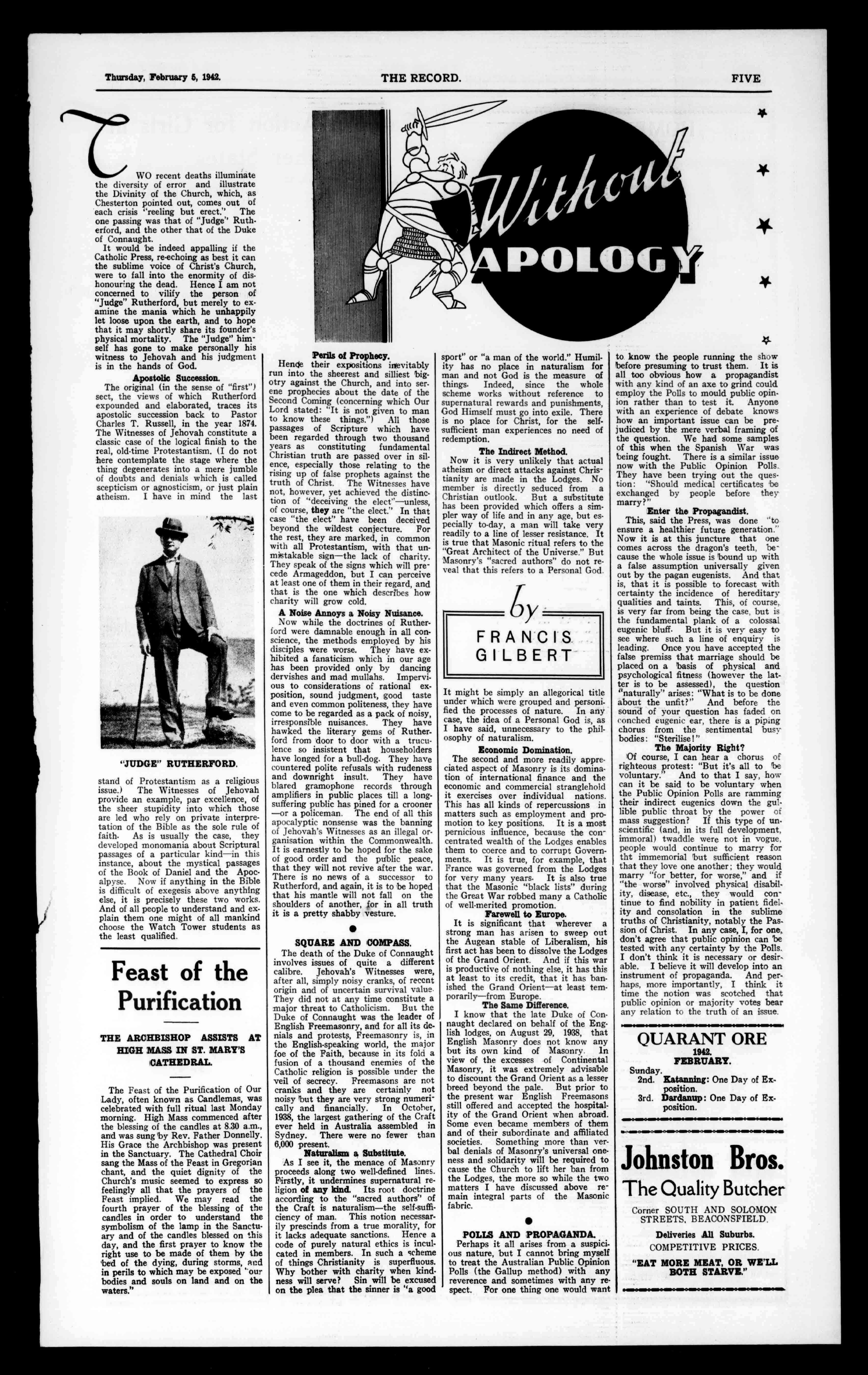
standofProtestantismasareligious issue.)TheWitnessesofJehovah provideanexample,parexcellence,of thesheerstupidityintowhichthose areledwhorelyonprivateinterpretationoftheBibleasthesoleruleof faith-Asisusuallythecase,they developedmonomaniaaboutScriptural passagesofaparticularkind-inthis instance,aboutthemysticalpassages oftheBookofDanielandtheApocalpyse.NowifanythingintheBible isdifficultofexegesisaboveanything else,itispreciselythesetwoworks. Andofallpeopletounderstandandexplainthemonemightofallmankind choosetheWatchTowerstudentsas theleastqualified.
THEARCHBISHOPASSISTSAT HIGHMASSINST.MARY'S CATHEDRAL.
TheFeastofthePurificationofOur Lady,oftenknownasCandlemas,was celebratedwithfullrituallastMonday morning.HighMasscommencedafter theblessingofthecandlesat8.30a.m., andwassung'byRev.FatherDonnelly. HisGracetheArchbishopwaspresent intheSanctuary.TheCathedralChoir sangtheMassoftheFeastinGregorian chant,andthequietdignityofthe Church'smusicseemedtoexpressso feelinglyallthattheprayersofthe Feastimplied.Wemayreadthe fourthprayeroftheblessingofthe candlesinordertounderstandthe symbolismofthelampintheSanctuaryandofthecandlesblessedonthis day,andthefirstprayertoknowthe rightusetobemadeofthembythe 'bedofthedying,duringstorms,and inperilstowhichmaybeexposed''our bodiesandsoulsonlandandonthe waters."
PerilsofProphecy. Hencletheirexpositionsinievitably runintothesheerestandsilliestbig- otryagainsttheChurch,andintoserenepropheciesaboutthedateofthe SecondComing(concerningwhichOur Lordstated:"Itisnotgiventoman toknowthesethings.")Allthose passagesofScripturewhichhave beenregardedthroughtwothousand yearsasconstitutingfundamental Christiantrutharepassedoverinsilence,especiallythoserelatingtothe risingupoffalseprophetsagainstthe truthofChrist.TheWitnesseshave not,however,yetachievedthedistinctionof"deceivingtheelect"-unless, ofcourse,theyare"theelect."Inthat case"theelect"havebeendeceived beyondthewildestconjecture.For therest,theyaremarked,incommon withallProtestantism,withthatunmi.stakablesign-thelackofcharity. Theyspeakofthesignswhichwillpre- cedeArmageddon,butIcanperceive atleastoneofthemintheirregard,and thatistheonewhichdescribeshow charitywillgrowcold.
ANoiseAnnoysaNoisyNuisance.
NowwhilethedoctrinesofRutherfordweredamnableenoughinallconscience,themethodsemployedbyhis discipleswereworse.Theyhaveexhibitedafanaticismwhichinourage hasbeenprovidedonlybydancing dervishesandmadmullahs.Impervioustoconsiderationsofrationalexposition,soundjudgment,goodtaste andevencommonpoliteness,theyhave cometoberegardedasapackofnoisy, irresponsiblenuisances.Theyhave hawkedtheliterarygemsofRutherfordfromdoortodoorwithatruculencesoinsistentthathouseholders havelongedforabull-dog.Theyhave counteredpoliterefusalswithrudeness anddownrightinsult.Theyhave blaredgramophonerecordsthrough amplifiersinpublicplacestillalongsufferingpublichaspinedforacrooner -orapoliceman.Theendofallthis apocalypticnonsensewasthebanning ofJehovah'sWitnessesasanillegalorganisationwithintheCommonwealth. Itisearnestlytobehopedforthesake ofgoodorderandthepublicpeace, thattheywillnotreviveafterthewar. Thereisnonewsofasuccessorto Rutherford,andagain,itistobehoped thathismantlewillnotfallonthe shouldersofanother,forinalltruth itisaprettyshabbyvesture.
SQUAREANDCOMPASS,
ThedeathoftheDukeofConnaught involvesissuesofquiteadifferent calibre.Jehovah'sWitnesseswere, afterall,simplynoisycranks,ofrecent originandofuncertainsurvivalvalue Theydidnotatanytimeconstitutea majorthreattoCatholicism.Butthe DukeofConnaughtwastheleaderof EnglishFreemasonry,andforallitsdenialsandprotests,Freemasonryis,in theEnglish-speakingworld,themajor foeoftheFaith,becauseinitsfolda fusionofathousandenemiesofthe Catholicreligionispossibleunderthe veilofsecrecy.Freemasonsarenot cranksandtheyarecertainlynot noisy'buttheyareverystrongnumericallyandfinancially.InOctober, 1938,thelargestgatheringoftheCraft everheldinAustraliaassembledin Sydney.Therewerenofewerthan 6,000present. NaturalismaSubstitute. AsIseeit,themenaceofMasonry proceedsalongtwowell-definedlines. Firstly,itunderminessupernaturalreligionofanykind.Itsrootdoctrine accordingtothe"sacredauthors"of theCraftisnaturalism-theself-sufficiencyofman.Thisnotionnecessarilyprescindsfromatruemorality,for itlacksadequatesanctions.Hencea codeofpurelynaturalethicsisinculcatedinmembers.Insuchascheme ofthingsChristianityissuperfluous. Whybotherwithcharitywhenkindnesswillserve?Sinwillbeexcused onthepleathatthesinneris"agood
sport"or"amanoftheworld."Humilityhasnoplaceinnaturalismfor manandnotGodisthemeasureof things.Indeed,sincethewhole schemeworkswithoutreferenceto supernaturalrewardsandpunishments, GodHimselfmustgointoexile.There isnoplaceforChrist,fortheselfsufficientmanexperiencesnoneedof redemption.
TheIndirectMethod. Nowitisveryunlikelythatactual atheismordirectattacksagainstChristianityaremadeintheLodges.No memberisdirectlyseducedfroma Christianoutlook.Butasubstitute hasbeenprovidedwhichoffersasimplerwayoflifeandinanyage,butespeciallyto-day,amanwilltakevery readilytoalineoflesserresistance.It istruethatMasonicritualreferstothe "GreatArchitectoftheUniverse."But Masonry's"sacredauthors"donotrevealthatthisreferstoaPersonalGod.
Itmightbesimplyanallegoricaltitle underwhichweregroupedandpersoni. fiedtheprocessesofnature.Inany case,theideaofaPersonalGodis,as Ihavesaid,unnecessarytothephilosophyofnaturalism.
EconomicDomination. ThesecondandmorereadilyappreciatedaspectofMasonryisitsdominationofinternationalfinanceandthe economicandcommercialstranglehold itexercisesoverindividualnations. Thishasallkindsofrepercussionsin matterssuchasemploymentandpromotiontokeypositions.Itisamost perniciousinfluence,becausetheconcentratedwealthoftheLodgesenables themtocoerceandtocorruptGovernments.Itistrue,forexample,that FrancewasgovernedfromtheLodges forverymanyyears.Itisalsotrue thattheMasonic"blacklists"during theGreatWarrobbedmanyaCatholic ofwell-meritedpromotion.
FarewelltoEurope.
Itissignificantthatwherevera strongmanhasarisentosweepout theAugeanstableofLiberalism,his firstacthasbeentodissolvetheLodges oftheGrandOrient.Andifthiswar isproductiveofnothingelse,ithasthis atleasttoitscredit,thatithasbanishedtheGrandOrient-atleasttemporarily-fromEurope.
TheSameDifference.
IknowthatthelateDukeofConnaughtdeclaredonbehalfoftheEnglishlodges,onAugust29,1938,that EnglishMasonrydoesnotknowany butitsownkindofMasonry.In viewoftheexcessesofContinental Masonry,itwasextremelyadvisable todiscounttheGrandOrientasalesser breedbeyondthepale.Butpriorto thepresentwarEnglishFreemasons stillofferedandacceptedthehospitalityoftheGrandOrientwhenabroad. Someevenbecamemembersofthem andoftheirsubordinateandaffiliated societies.SomethingmorethanverbaldenialsofMasonry'suniversalonenessandsolidaritywillberequiredto causetheChurchtoliftherbanfrom theLodges,themoresowhilethetwo mattersIhavediscussedaboveremainintegralpartsoftheMasonic fabric.
Perhapsitallarisesfromasuspiciousnature,butIcannotbringmyself totreattheAustralianPublicOpinion Polls(theGallupmethod)withany reverenceandsometimeswithanyrespect.Foronethingonewouldwant
toknowthepeoplerunningthesh.,w beforepresumingtotrustthem.Itis alltooobvioushowapropagandist withanykindofanaxetogrindcould employthePollstomouldpublicopinionratherthantotestit.Anyone withanexperienceofdebateknows howanimportantissuecanbeprejudicedbythemereverbalframingof thequestion.Wehadsomesamples ofthiswhentheSpanishWarwas beingfought.Thereisasimilarissue nowwiththePublicOpinionPolls. Theyhavebeentryingoutthequestion:"Shouldmedicalcertificates-be exchangedbypeoplebeforethey marry?"
EnterthePropagandist.
This,saidthePress,wasdone--to ensureahealthierfuturegeneration." Nowitisatthisjuncturethatone comesacrossthedragon'steeth,becausethewholeissueisboundupwith afalseassumptionuniversallygiven outbythepaganeugenists.Andthat is,thatitispossibletoforecastwith certaintytheincidenceofhereditary qualitiesandtaints.This,ofcourse, isveryfarfrombeingthecase,butis thefundamentalplankofacolossal eugenicbluff.Butitisveryeasyto seewheresuchalineofenquiryis leading.Onceyouhaveacceptedthe falsepremissthatmarriageshouldbe placedonabasisofphysicaland psychologicalfitness(howeverthelatteristobeassessed),thequestion "naturally"arises:"Whatistobedone abouttheunfit?"Andbeforethe soundofyourquestionhasfadedon conchedeugenicear,thereisapiping chorusfromthesentimentalbusy bodies:"Sterilise!"
TheMajorityRight?
Ofcourse,Icanhearachorusof righteousprotest:"Butit'salltobe voluntary."AndtothatIsay,how canitbesaidtobevoluntarywhen thePublicOpinionPollsareramming theirindirecteugenicsdownthegutliblepublicthroatbythepowerof masssuggestion?Ifthistypeofunscientific(and,initsfulldevelopment, immoral)twaddlewerenotinvogue. peoplewouldcontinuetomarryfor thtimmemorialbutsufficientreason thattheyloveoneanother;theywould marry"forbetter,forworse,"andif "theworse"involvedphysicaldisability,disease,etc.,theywouldcontinuetofindnobilityinpatientfidelityandconsolationinthesublime truthsofChristianity,notablythePassionofChrist.Inanycase,I,forone, don'tagreethatpublicopinioncanbe testedwithanycertaintybythePolls, Idon'tthinkitisnecessaryordesirable.Ibelieveitwilldevelopintoan instrumentofpropaganda.Andperhaps,moreimportantly,Ithinkit timethenotionwasscotchedthat publicopinionormajorityvotesbear anyrelationtothetruthofanissue.
1942. FEBRUARY.
Sunday.
2nd.Katanning:OneDayofEx. position. 3rd.Dardanup:OneDayofEx. position.
GRAILSUMMERSCHOOLIN MELBOURNE.
The1942SummerSchoolopenedat GrailHeadquartersonSaturday,Januar'y24,oiithaweek-endRetreatgiven byRev.W.P.Hackett,S.J.
Inspiteofthedifficultconditionsof thetimes,about40girlsmanagedtobe presentatthecourse.Severalwho wereunabletogetleavefromtheir workspenttheeveningsat"TayCreggan,"andthushadsomeshareinthe school.BesidestheMelbournegirls therewererepresentativesfromAdelaidsandQuorn(S.A.),andfromVictoriancountrycentres.
HOMEBUILDING.
ThethemeofthecoursewasHomebuilding,andthefirstdayopenedwith atalkonthespiritofahomebuilder,specialstressbeinglaidonthe needforahomelovingwomanhood, bothintimespresentandintimesto come,whenthequestionofpost-war reconstructionwillarise.Thetalks duringtherestofthedaycoveredthe BuildingoftheHome(Mr.Frank Moriarty)anditsFurnishingandDecoration(DianaWalkerden)-whilein theirfreetimethegirlsweregivenan opportunityofassessingtheirown capabilitiesintherunningofahousehold.WinGartlan'sinstructionin theartofToyMakingwasfollowedby manyingenious"creations"-apositive menagerieofsofttoysgrowingupovernight.
THEQUEENOFTHEHOME.
Thewoman'spartasQueenofthe Homewasconsiderednextday,and takingastheirmodelOurLady,the HomebuilderofNazareth,thegirls discussedthespiritualandmoralqualitieswhichmustbe,abovealltalents andabilities,thespecialattributesof theCatholichousewife.
Wednesdaymorningbroughtmany anxiousmoments,forthiswastheday ofthe"HouseholdTests"-wheneach girlwascalledupontogiveproofof herdomesticity,andwhenMrs.F.G. Atchisonarrivedforthejudgingshe foundahousefulofbusycompetitors, cooking,patching,polishing,decorating,allwithsufficientskilltoearnfor themselvesthe"Householddiplomas" whichwerepresentedbyFatherHackettonthefinaleveningofthecourse.
THEPOTOFGOLD.
Havingthusdisplayedtheirability tokeephouse,thegirlssetaboutlearninghowtomakeendsmeet,withthe helpofMissClareBride,whogavea talkonThePotofGold-Savingfor Marriage,andMissA.Cook,whshowedthemhowtomakethisyear's modelsoutoflastyear'shats-asubstantialwar-timeeconomy!
ContessaFilippini'stalkonEntertainingatHomewasfollowedbyalittleinformalparty,whenMadameinvitedherhearerstobeherguestsfor theevening,justtoseehowitwas done,apracticaldemonstrationwhich provedverypopular.
LITURGYANDLIFE.
Theplaceofmusicinthehomeand thebeautyoftheChurch'sLiturgy werediscussedbyRev.P.Jones,D.Ph., Mus.Doc.Sac.,andasthecoursewas drawingnearitsclosethegirlsinvited theirmotherstospendanafternoonat "TayCreggan,"sothattheycouldshow themsomethingofwhattheyhad learnt,andatthesametimeexpress somemeasureoftheirgratitudeto theirparentsbygivingthemapleasant afternoon'sentertainment.
Aneveningofdiscussingfutureplans precededthefinalday,whenthegirls set,Iratedintotheirdifferentlocality groupstodiscussschemesfortheyear's workinCatholicAction.
Lectureson"Home"defence,the elementsofA.R.P.andhomefirefighting,andatalkonthecelebrationof feastsinthehomewerefittedinbetweendiscussions,andabusydayendedwithaGuestEveningofsongs,films, andplays,attheendofwhichMr.F. K.Maher,NationalDirectorofCatholicAction,addressedthegirls.
THEEND.
OnSaturdaymorningHisGracethe ArchbishophonouredtheSummer Schoolwithavisit,andpresented badgesto15newGrailmembers,after whichthegirlsassembledforthelast timetosingtogethertheirthemesong, "TheFutureLifeBeforeUs,"andthe wordsofitsfinalchorusrangintheir earsastheyleftforanotheryear's work:
"InpeaceorwarHisKingdomcome, Ineveryland,ineveryhome. Excelsior!Forward!"
Doyouwishtohelpeducateapriest forworkinWesternAustralia?RememberSt.Charles'SeminaryEducationFundinyourwill.
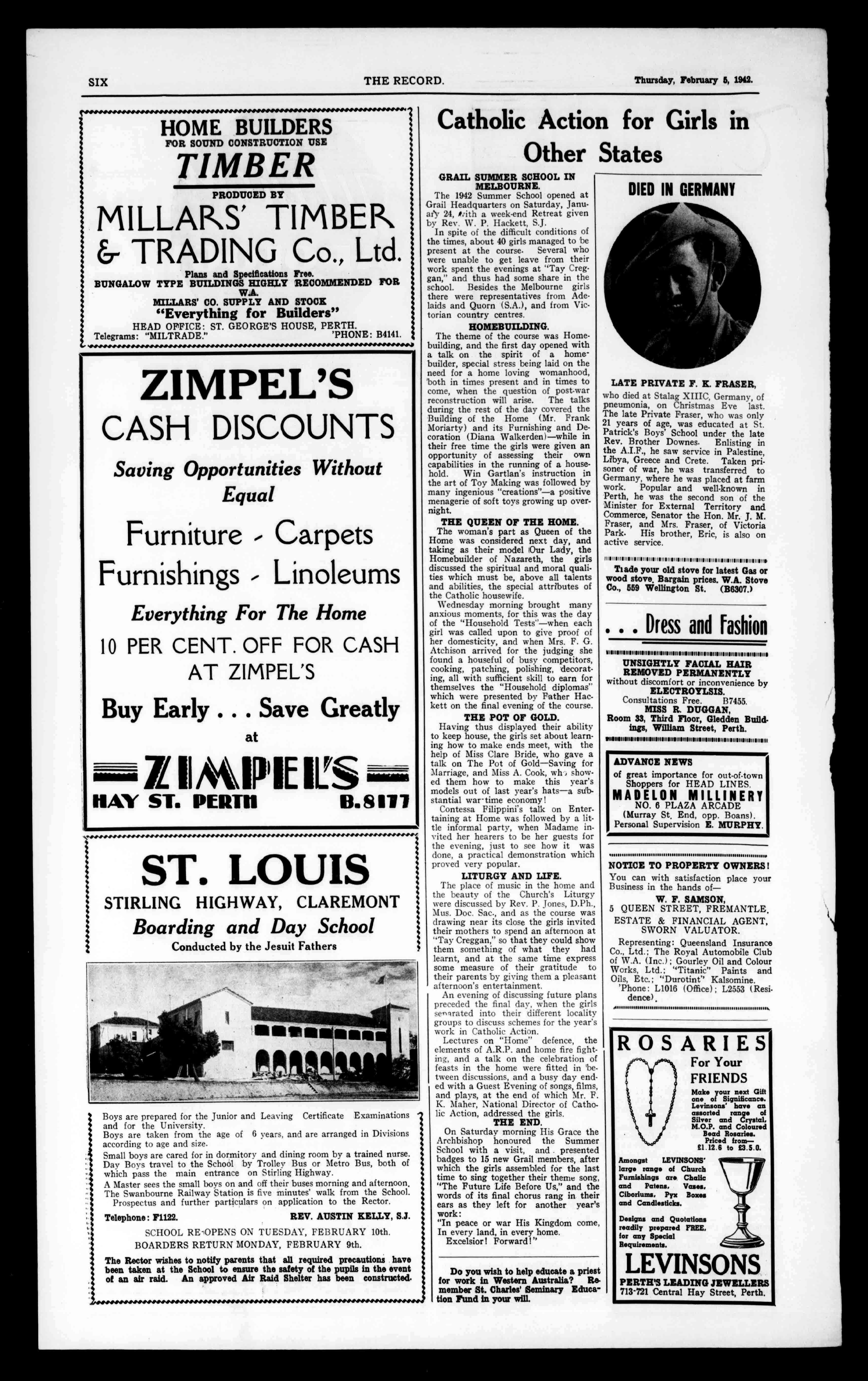
LATEPRIVATEF.K.FRASER, whodiedatStalagXIIIC,Germany,of pneumonia,onChristmasEvelast. ThelatePrivateFraser,whowasonly 21yearsofage,waseducatedatSt. Patrick'sBoys'Schoolunderthelate Rev.BrotherDownes.Enlistingin theA.I.F.,hesawserviceinPalestine, Libya,GreeceandCrete.Takenprisonerofwar,hewastransferredto Germany,wherehewasplacedatfarm work.Popularandwell-knownin Perth,hewasthesecondsonofthe MinisterforExternalTerritoryand Commerce,SenatortheHon.Mr.J.M. Fraser,andMrs.Fraser,ofVictoria Park.Hisbrother,Eric,isalsoon activeservice.
mefigninvinguilluiniumninimIngologoinineninloim. TiedeyouroldstoveforlatestGasor woodstove,Bargainprices.W.A.Stove Co.,559WellingtonSt.(B6307.)
DressandFashion
MIHMIIHIU...1.11.11.1111111.101C1111.1H.1.141HVIIHOUS UNSIGHTLYFACIALHAIR REMOVEDPERMANENTLY withoutdiscomfortorinconvenienceby ELECTROYLSIS.
ConsultationsFree. 117455 MISSR.DUGGAN, Room33,ThirdFloor,GleddenBuildings,WilliamStreet,Perth.
ADVANCENEWS ofgreatimportanceforout-of-town ShoppersforHEADLINES.
MADELONMILLINERY NO.6PLAZAARCADE (MurraySt.End,opp.Boano
PersonalSupervisionE.MURPHY.
NOTICETOPROPERTYOWNERS!
Youcanwithsatisfactionplaceyour BusinessinthehandsofW.F.SAMSON, 5QUEENSTREET,FREMANTLE, ESTATE&FINANCIALAGENT, SWORNVALUATOR.
Representing:QueenslandInsurance Co.,Ltd.;TheRoyalAutomobileClub ofW.A.(Inc.);GourleyOilandColour Works,Ltd.;"Titanic"Paintsand Oils,Etc.;"Durotint"Kalsomine. 'Phone:L1016(Office);L2553(Residence).
February20:H.A.C.B.S.RiverTrip toKeane'sPoint.
February22:CombinedA.C.L.TennisAssociation'sTennisDayatSouth PerthZoologicalGardens.
4.1=114411
Aftersixweeksofunwontedstillness, SantaMariaCollegewasstirredanew tolifebytheactivityofyouth-eager, irrepressibleyouth.Asbusafterbus stoppedattheCollegeentrance,the buildingwasthrongedwithhurrying figures,swiftly-movingfeetechoed throughthelongcorridors,andupand downthestaircases;girlishlaughter rangoncemorethroughthehallsand gaygreetingswereexchanged.
Whyallthisexcitement?Whatis themeaningofthesuddengaietyin therecentlyquietedschool?Well mightanonlookerwonder!Itisthe occasionofagirls'Retreat.Gathered therefromanumberofschoolsconductedbytheSistersofMercywere eightyex-pupils,invitedbytheMother GeneralofVictoriaSquaretoattend thefirstRetreatatSantaMaria.
TheselflessdevotionoftheRetreat Master,Rev.FatherPerrott,S.J.,was greatlyappreciatedbytheretreatants, whoansweredthesummonstoeachdevotionalexercisewithhurriedstep,betrayinginwardenthusiasm,andthe sightofyoungpeople,rosaryinhand, slowlypacingthepaths,leftlittletobe desired.
SantaMariaCollegelendsitselfadmirablyasaplaceofretreat.The building,spaciousbutcompact,with modernequipmentwhereverdesired, hassplendidaccommodationforalmost onehundredgirls.Itsgrounds,tastefullylaidout,areextensive,whilethe panoramaofriver;cityanddistant hills,especiallyifviewedveryearlyin themorning,issuchasliftsone's heartingladthanksgivingtothe DivineGiverofallgoodgifts.
AmongthosepresentattheRetreat arrangedfor'Mercy"girlswere:M. Walsh,P.Ryan,B.andC.Beard,J. Minchin,N.Stapleton,J.Hassel,A. Bernet,M.Wyndham,G.Campbell,C. Flaherty,B.Knight,C.Flynn,G.Leyden,P.Nicholas,R.Selby,M.Gartland,J.Boylan,P.Kerr,P.Harris, C.McCaughey,N.Fienberg,M.Young, R.Hughes,L.McGurk,K.Marsh,J. Brown,J.Myers,B.Austin,A.andJ. Magher,K.Hardisty,K.McDonough, P.McCarthy,M.Maguire,N.Harford, M.Perry,A.Parker,J.Troy,R. Micheli,B.Tyncross,B.O'Brien,P. Dowsett,P.Garvey,T.Trefry,C. D'Arcy,E.Carey,M.Markham,T. Crotty,T.Rooney,M.andN.Houlahan,M.Mooney,M.O'Sullivan,M.and C.Healey,M.Miolin,K.Duggan,K. Power,E.McCarthy,M.Cantwell,N. O'Brien,M.andE.Eanderson,B. O'Brien,P.Hickey,E.Carr,M.andB. Troy,P.Hayes,B.Pyke,S.andM. Bowen,P.Peachey,E.Collopy,C. Cream,G.Burnett,G.Davis,D.Matthews.
Itshouldbeexceedinglygratifying totheSistersofMercytomeetwith suchareadyresponsefromgirlswhom theyhavetrainedinthecareoftheir ownsouls,andwhoaresoeagerto availthemselvesofsuchanopportunityofseekingfreshgracesfromGodto assisttheminthenow-a-daysdifficult taskof"facinglife."
"Yes,wasn'titfun?"Thatiswhat fiftyex-collegiansfromSt.Gertrude's College,NewNorcia,andfromtheSt. JosephCollegeshavebeensayingsince Sunday,January25,whenSt.Gertrude'sheldtheirAnnual"HighTea" attheSouthPerthConvent.Although thedaybroughtplentyofheat,itdid notpreventthegirlsfromgathering onceagaintomeetfriendsoftheir schooldays,andparticularlytoseethe Sisterswhomperhapstheyhaven't seenforsometime.Funwasinthe air.. Aguessingcompetitionproved veryamusing,andafteracertain amountofhardthinking(?)timewas declaredandaprizedonatedtothe winners.Afterseveralothergames wereplayedaveryenjoyableevening wasbroughttoaclosewithmanysaying,"Seeyouagainnextyear!"
Amongthosepresentwere:MesdamesJ.G.Hogan(President,S.G.C.), McGregor,Monnock,Hegney,Casellas, P.Collier,J.Hogan,J.andJ.Clune, andJoyce;MissesA.O'Neill,K. K.Bendon,M.Cullen,M.Cantwell,M. Treacy,N.Spillane,L.Ashdown,R. Williams,E.CarmodyP.Ruland,G. Sturges,R.Scully,M.Scully,B.Petroff, J.WisbyW.Mullan,S.Cailes,U.Harvey,A.Patterson,M.Dix,E.andJ. Gaunt,C.andD.Davis,E.Walker,P. Palister,E.Baxter,M.Walker,D. Schutz,N.Joyce,T.Scully,J.O'Brien, E.O'Brien.
PATERSON'SSUPPLYSTORES
123CLAREMONTCRESCENT, SWANBOURNE.'Phone:F2571. GROCERANDGREENGROCER. DeliveriesfromNedlandsto MosmanPark.
HomeofGoodShepherd
Laundry,Leederville
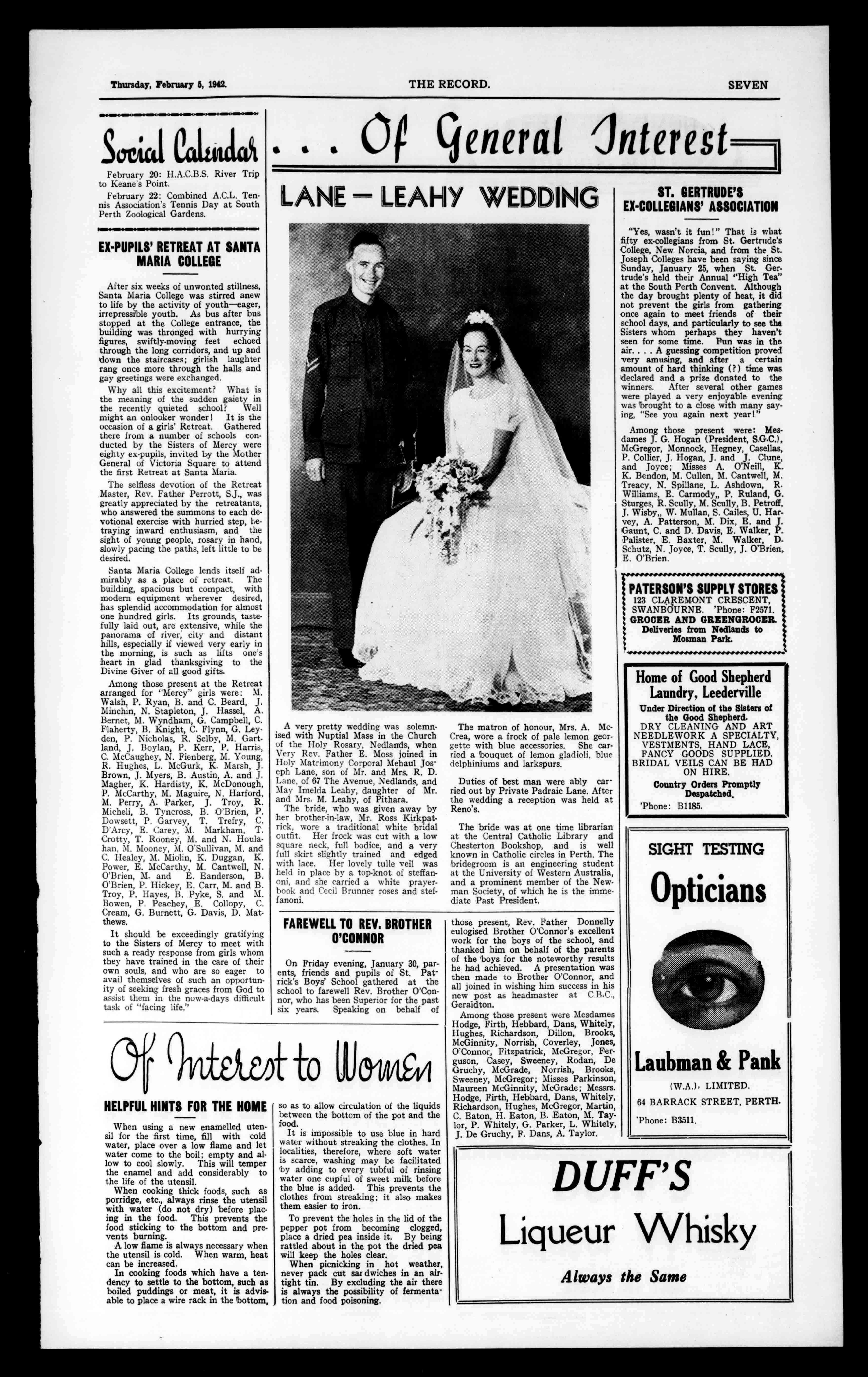
AveryprettyweddingwassolemnisedwithNuptialMassintheChurch oftheHolyRosary,Nedlands,when VeryRev.FatherE.Mossjoinedin HolyMatrimonyCorporalMehaulJosephLane,sonofMr.andMrs.R.D. Lane,of67TheAvenue,Nedlands,and MayTmeldaLeahy,daughterofMr. andMrs.M.Leahy,ofPithara.
Thebride,whowasgivenawayby herbrother-in-law,Mr.RossKirkpatrick,woreatraditionalwhitebridal outfit.Herfrockwascutwithalow squareneck,fullbodice,andavery fullskirtslightlytrainedandedged withlace.Herlovelytulleveilwas heldinplacebyatop-knotofsteffan(Ali,andshecarriedawhiteprayerbookandCecilBrunnerrosesandsteffanoni.
FAREWELLTOREV.BROTHER O'CONNOR
OnFridayevening,January30,parents,friendsandpupilsofSt.Patrick'sBoys'Schoolgatheredatthe schooltofarewellRev.BrotherO'Connor,whohasbeenSuperiorforthepast sixyears.Speakingonbehalfof
HELPFULHINTSFORTHEHOME
Whenusinganewenamelledutensilforthefirsttime,fillwithcold water,placeoveralowflameandlet watercometotheboil:emptyandallowtocoolslowly.Thiswilltemper theenamelandaddconsiderablyto thelifeoftheutensil. Whencookingthickfoods,suchas porridge,etc.,alwaysrinsetheutensil withwater(donotdry)beforeplacinginthefood.Thispreventsthe foodstickingtothebottomandpreventsburning. Alowflameisalwaysnecessarywhen theutensiliscold.Whenwarm,heat canbeincreased.
Incookingfoodswhichhaveatendencytosettletothebottom,suchas boiledpuddingsormeat,itisadvisabletoplaceawirerackinthebottom,
soastoallowcirculationoftheliquids betweenthebottomofthepotandthe food. Itisimpossibletouseblueinhard waterwithoutstreakingtheclothes.In localities,therefore,wheresoftwater isscarce,washingmaybefacilitated byaddingtoeverytubfulofrinsing wateronecupfulofsweetmilkbefore theblueisadded.Thispreventsthe clothesfromstreaking;italsomakes themeasiertoiron.
Topreventtheholesinthelidofthe pepperpotfrombecomingclogged, placeadriedpeainsideit.Bybeing rattledaboutinthepotthedriedpea willkeeptheholesclear.
Whenpicnickinginhotweather, neverpackcutsaldwichesinanairtighttin.Byexcludingtheairthere isalwaysthepossibilityoffermentationandfoodpoisoning.
Thematronofhonour,Mrs.A.McCrea,woreafrockofpalelemongeorgettewithblueaccessories.Shecarriedabouquetoflemongladioli.blue delphiniumsandlarkspurs.
DutiesofbestmanwereablycarriedoutbyPrivatePadraicLane.After theweddingareceptionwasheldat Reno's.
Thebridewasatonetimelibrarian attheCentralCatholicLibraryand ChestertonBookshop,andiswell knowninCatholiccirclesinPerth.The bridegroomisanengineeringstudent attheUniversityofWesternAustralia, andaprominentmemberoftheNewmanSociety,ofwhichheistheimmediatePastPresident.
thosepresent,Rev.FatherDonnelly eulogisedBrotherO'Connor'sexcellent workfortheboysoftheschool,and thankedhimonbehalfoftheparents oftheboysforthenoteworthyresults hehadachieved.Apresentationwas thenmadetoBrotherO'Connor,and alljoinedinwishinghimsuccessinhis newpostasheadmasteratC.B.C., Geraidton.
AmongthosepresentwereMesdames Hodge,Firth,Hebbard,Dans,Whitely, Hughes,Richardson,Dillon,Brooks, McGinnity,Norrish,Coverley,Jones, O'Connor,Fitzpatrick,McGregor,Ferguson,Casey,Sweeney,Rodan,De Gruchy,McGrade,Norrish,Brooks, Sweeney,McGregor;MissesParkinson, MaureenMcGinnity,McGrade;Messrs. Hodge,Firth,Hebbard,Dans,Whitely, Richardson,Hughes,McGregor,Martin, C.Eaton,H.Eaton,B.Eaton,M.Taylor,P.Whitely,G.Parker,L.Whitely, J.DeGruchy,F.Dans,A.Taylor.
UnderDirectionoftheSistersof theGoodShepherd. DRYCLEANINGANDART NEEDLEWORKASPECIALTY, VESTMENTS,HANDLACE, FANCYGOODSSUPPLIED. BRIDALVEILSCANBEHAD ONHIRE.
CountryOrdersPromptly Despatched.
'Phone:B1185.
Established1874.
PERTH,THURSDAY,FEBRUARY5,1942.
THEopeningoftheProvincialSeminaryofSt.Charles,and themomentoussignificanceoftheeventinthehistoryof theChurchintheWest,recallstomindthewordsofthe greatPiusXI.,sobeautifullyexpressedinhislatteronthePriestnoodwrittenin1935.ThelateHolyFatherdescribedthisletter asthesupplementandculminationofallhispreviousencyclicals. Herealised,farmorethantheenemiesofCatholicism,the"vital importanceofthepriesthood."Ashesaysofthosesameenemies "Itisthepriesthoodtheydesiretoberidofthattheymayclear thewayforthedestructionoftheChurch,whichhasbeensooften attemptedyetneverachieved."Withhismagnificentletterbeforeus,wecanbutreiteratewhathasbeensaidsooftenbefore thehopeoftheworldistheCatholicpriesthood.Andturning overthepagesdealingwiththetrainingforthepriesthood,we realisehowveryimportantintheeyesoftheChurchisthepreparationgiventhoseuponwhomdependingreatmeasurethespiritual, moralandsocialconditionsofpeoplesandofnations.
Theseminaryshouldbe,andis,themostimportantobjectof aBishop'sforethoughtandsolicitude.Carefulalwaysisthechoice ofsuperiorsandprofessors."Givethebestofyourclergytothe seminaries,"saystheHolyFather;"donotfeartotakethem fromotherpositions."Theymustbemenwhoteachvirtues ratherbyexamplethanbywords,mencapableofimparting,togetherwithlearning,asolid,manly,andapostolicspirit.Itisof paramountimportancethatthefuturepriestshouldhavealearningadequatetotherequirementsoftheage.Essentialtooisa soundphilosophicalfoundationthatwillsharpenhismindtodistinguishtruthinaworldbewilderedwithfalseideologies.With adepthofvisionbornoflongexperiencePiusinsistsonthisas necessaryindevelopinganintellectualkeennessandclaritywith whichtostudytheproblemsconfrontingusnowandinthe future.Itwillgivethepriestasuperioritytoooverthosewhose mereeruditionperhapsiswider,butinconsequentialandtragically misleadingforwantofaphilosophicbackground.
TheHolyFatherurgeswhathasjustbeenaccomplishedhere inthe\Vest-thefoundationofaregionalorprovincialSeminary,wherediocesesaresmallandwheretheywouldfinditdifficult toequipandmaintainacollegeoftheirown.Inourowncase, thesacrificeshavebeengreat,butthegenerosityoftheCatholic peoplehasbeengreater.Eachsacrifice,greatorsmall,hasbeen initselfaprayerforthisgreatestandmostimportantworkinthe ProvinceofPerth-aprayerthatcannotfailtowintheblessingof theHolySpirit.EverythingthatcanbedonetomaketheSeminaryofSt.Charles'worthyofitsvitalfunctioninthelifeofthe Church,hasalreadybeendone.Theresponseinthenumberof studentswhowillcommencethisyearaugurswellforthefuture sufficiencyofvocations.Strangelyenough,asthePoperemarks, `itis,infact,preciselyintimeswhichseemleastpropitious,that thenumberofpriestlyvocationsincreases."
ThoughundoubtedlyGodsowstheseedofvocationliberally. yetwemustrememberthewordsHespokewhenonearth:"The harvest,indeed,isgreat.butthelabourersarefew.Pray,therefore.theLordoftheharvest,thatHesendlabourersintoHisharvest."Prayerisindispensable,butneithermustweneglect everyhumanmeansofcultivatingthisseedofvocationthat capableandholymenmayfilltheall-too-thinranksofthepriesthoodintheyearsahead.ItisinanefforttofosteranddevelopvocationsamongourownboyshereintheWestthattheambitious projectoftheSeminarywasundertaken.Andnowitisanaccomplishedfact.
WecanonlypraythattheHolySpiritwillabundantlybless St.Charles',thatHewillguideandinspirethesuperiorsandprofessors,thatHewillmakeknownHiswilltothestudentsseeking lightontheirvocation,andthat,throughthisgreatworkbegun inthefaceofsomanydifficulties,Hewillensureacompetent, courageousandholypriesthood.toguideandsanctifyourpeople inthedifficultdaysthatmostcertainlyfacetheChurchinthistheSouthernLandoftheHolyGhost.AndmaythegreatSt. Charles,theirpatron,inspiresuperiorsandstudentsalikeeverto "walkworthyofthevocationinwhichtheyarecalled"-theexternalPriesthood.
Anotherscholasticyearhascommenced,andsuchoftheresults ,o1thepastyear'sworkascanbegaugedfromtheexamination successesalreadypublishedinourcolumnsareahappyaugury forthecomingterm.OurCatholicschoolsandcollegeshavealreadyestablishedhighprestigeinthescholasticworld,butthere--liltsobtainedinthepublicexaminationsofthelastyearhavebeen uniquelysuccessful,surpassingthestandardsetinanyotheryear. NotonlydoesthisapplytothewinningofUniversityexhibitions andscholarships,buttotheresultsofallschoolsgenerallytaken intheaggregate. Theoutstandingsuccessesofourschoolsmust,inthefirstinstance,becreditedtothesterlingteachingabilityofthereligious
congregationsofmenandwomenwhodevotetheirlivestothe impartingofChristianeducation.Forthoughitisregrettedby somethatourfineCatholiceducationalsystemistrammelledand confinedbycompetitiveexaminations,itmustberemembered,on theotherhand,thatwearelargelyboundbytheexigenciesofthe timesandtheutilitarianoutlookofmoderneducation.The teachersinourCatholicschools,however,arenotblindtothe falsityofmereintellectualdevelopment,andareconcernedtoneutralisepagantrendsbydevelopinginthechildren,largelythrough religiousinstruction,habitsofself-controlanddiscipline.In otherwords,theyareconcernedtodevelop,notonlythebodyand theintellect,butalsothewillandtheimagination-inbrief,to cultivateallthefacultiesharmoniously.sothattheadolescent leavestheirhandsproperlybalancedinitsdevelopmentandsoadequatelypreparedforthebattleoflife.
ThechieftaskoftheCatholiceducationalistis,therefore,to integratethewholecurriculumwiththereligiousinstruction.And inthisendeavour,theabsoluteneedoftheCatholiceducational systemisbroughtintostartlingrelief.FortheCatholicFaithis notinculcatedmerelybydoctrine.Itisalsoalifetobelived, andtheexample,everbeforetheeyesofthechildren,oftheir teachers,whoarededicatedtothelifeofChristianperfection,isa forcemorepowerfulthananyrhetoric.IntheCatholicschool, moreover,thereistheconstantopportunityforthechildtotranslateintoactionthepreceptsoftheclassroom.Butaboveallhe seesinthelivesofhisteachershowtheCatholicFaithimpenetrateseveryactionoftheday,givingeverythingitsmeaning,its motiveanditssanctification.
Theoutstandingresultsofthepastyearredound,also,tothe creditofthechildren,foralltheteachingintheworldiswasted unlessthereisresponsivenessonthepartofthechild.Andthe increasedapplicationandperseveranceonthepartoftheexaminationcandidatesisagainatributetotheCatholicteachersandto thescientificsystemoftrainingandteachingwhichobtainsinthe Archdiocese.
ConsiderablecreditisalsoreflectedontheCatholicparents andhomesofthechildren,forthereisevidencedanincreasedsense ofresponsibilityontheirparttoseetheirchildrenproperlyplacedintheworldandtohavethemexerciseabecominginfluence incivicandnationalaffairs.ToolonghaveCatholicsbeendiffidentaboutadoptinganoffensivepolicy.Forfourhundredyears theChurchhasbeenthrownonthedefensive,butatlastthereare signsthatCatholicsareemergingfromthecatacombsandare preparingtogivetothesociallifeofthenationthebenefitsofa philosophyandeducationwhich,inmanyinstances,canalone solveitsmyriadproblems.This,atleast,willstandtothecredit ofthecompetitiveexaminationsystem-thatitmayfireCatholic youth,throughitssignalsuccessinthisfield,witharightambition totakeitsproperplaceinthecommunityatlarge,andtoactasa positiveleaveninaworldwhichhasalmostcompletelysuccumbedto
ARCHBISHOP'SENGAGEMENTS.
February7.-9am.:PresideatSolemn HighMassattheConventofMercy, VictoriaSquare(GoldenJubileeof MotherM.Patrick).
ST.CHARLES'SEMINARY, GUILDFORD
OPENSONTUESDAYNEXT. FEBRUARY10.
St.Charles'Seminarywillcommenceits firstscholasticyear nextweek.Situated ontheriverinGuildford,thedelightfulpropertywillbethescene ofgreatexcitementon Mondayafternoonas thestudentsarrive.It willbemorethanjustgoingbackto schoolfortheseboys-itwillbethebeginningofanewphaseintheirlife,culminating,pleaseGod,inthePriest. hood.
TheRector,VeryRev.Dr.Goody, wishesthestudentstobeinresidence by5o'clockonMonday,February9.
TheSeminaryissituatedinMeadowstreet,Guildford,andiswithinfive minuteswalkingdistanceoftheGuildfordRailwayStationorthebusstop. Thebusesareofthe"BeamTransport Co.,"whichleaveSt.George'sTerrace, Perth,atfrequentintervals.Thebuses departfromoppositeSt.George'sCathedral.
Cassocksandsurpliceswillbesuppliedtothestudents,whoarerequired tobringwiththemallotherarticlesof clothing.
Studentswhoarenotaccompanied bytheirparentswillbemetattherailwaystationifsufficientnoticeisgiven totheSeminaryauthorities, ForallenquiriestelephoneeitherSt. Mary'sCathedralortheSeminary, UL310.
Aswehavesaidbefore,thesuccess oftheSeminarywilldependtoagreat extentuponthespiritualinteresttaken initbytheCatholiclaity.Iftheyare indifferentitwillshowlittleadvance-
February8.-BlessandopennewBoys' SchoolatLeederville.
February11.-PresideatCeremonyof ReceptionandProfessionatSt.John ofGodConvent,Subiaco.
February27.-PresideattheQuarterly Priests'Conference,ChapterHall, VictoriaSquare.
muntwiththeirhelpitcanscarcely fail. TheofficialopeningoftheSeminary willtakeplaceonadatetobeannouncedlater.
EVENINGDEVOTIONSTOBE
BROADCASTFORTHEFIRST
TIMEINWESTERNAUSTRALIA.
Inadditiontothebroadcastsofthe MissaCantataat11a.m.onthefirst SundayofeachmonthfromSt.Mary's Cathedral,therewillbeadditional eveningbroadcastsfromSt.Brigid's, WestPerth,St.Patrick's,Fremantle, andtheCathedral.
Thefirstofthesebroadcastswillbe fromSt.Patrick'sChurch,Fremantle, onSunday,February15,at720p.m., andwilltaketheformofasermonfollowedbyBenediction.Thepreacher willbetheVeryRev.FatherHaugh, O.M.I.,andthechoirwillbedrawn fromSt.Joseph'sLadies'Collegeand theParry-streetPrimarySchool.The organistwill'beMissK.Dronev.
Therewillbefurtherbroadcastsfrom St.Brigid'sChurch,WestPerth,on March8,andagainonMarch22from St.Patrick's,Fremantle.
GREATDISTINCTIONFORAQUINAS.
SelectionCommitteeonMonday,two ofthesuccessfulapplicantswerefrom CatholicColleges.Thefortunateboys wereTerenceDesmondI3ourke114 years10months),of271Hay-street, Perth,apupilofAquinasCollege. ArthurPead(14years7months),of 61Hampton-road,Fremantle,apupil
ITwasinthestudiosofRadio AthlonethatImethim,some weeksafterwarhadbrokenout. AcrossSt.George'sChannelthecities ofEnglandlaysilentinthedarkne oftheblack-out.TheLuftwaffe,a thousandmilesaway,wasmercilessly blitzinganalreadyfatallystricken Poland.Somehoworotheritallseemedsofarawayinthoselastdaysof AutumninDublin.
Hewasasmallman,dark,witha shockofcurlyhairaboveho:n.rimmed glasses.Therewassomethingalive andveryearnestinhispersonality.We spokeofhisnewbookthathadbeen publishedonlythatweekbyFrank SheedinLondon."Time'sWall Asunder"wasthetitleofthissecond bookofpoemsfromhispen.Poems thatcrystallisedinversethespiritof theSecondPentecosttheyspokeof inEuropebeforethewar.
Yes,RobertFarrenhadcaughtthis newspiritthatwasrevivifyingCatholicismontheContinent.Had caughtitandexpresseditinthe poemsofhistworecentlypublished books,"ThrongingFeet"and"Time's WallAsunder."
Christagonised,alone inthisWhiteHost.
Christofthesupperroom, Christoftheemptytomb, ChristoftheDayofDoom inthisWhiteHost.
Whowas,beforetheSun, Wholived,ereLifebegun, Whoshall,whenTimebedone, inthisWhiteHost.
WhodreadDivinity
WhoOneinTrinity, WhoisInfinity, inthisWhiteHost.
Jesu,withMagdalenIjoinmyplea, withhimwhocravedremembrance fromthetree, withdrowningPeter:"Lorddeliver me" bythisWhiteHost.
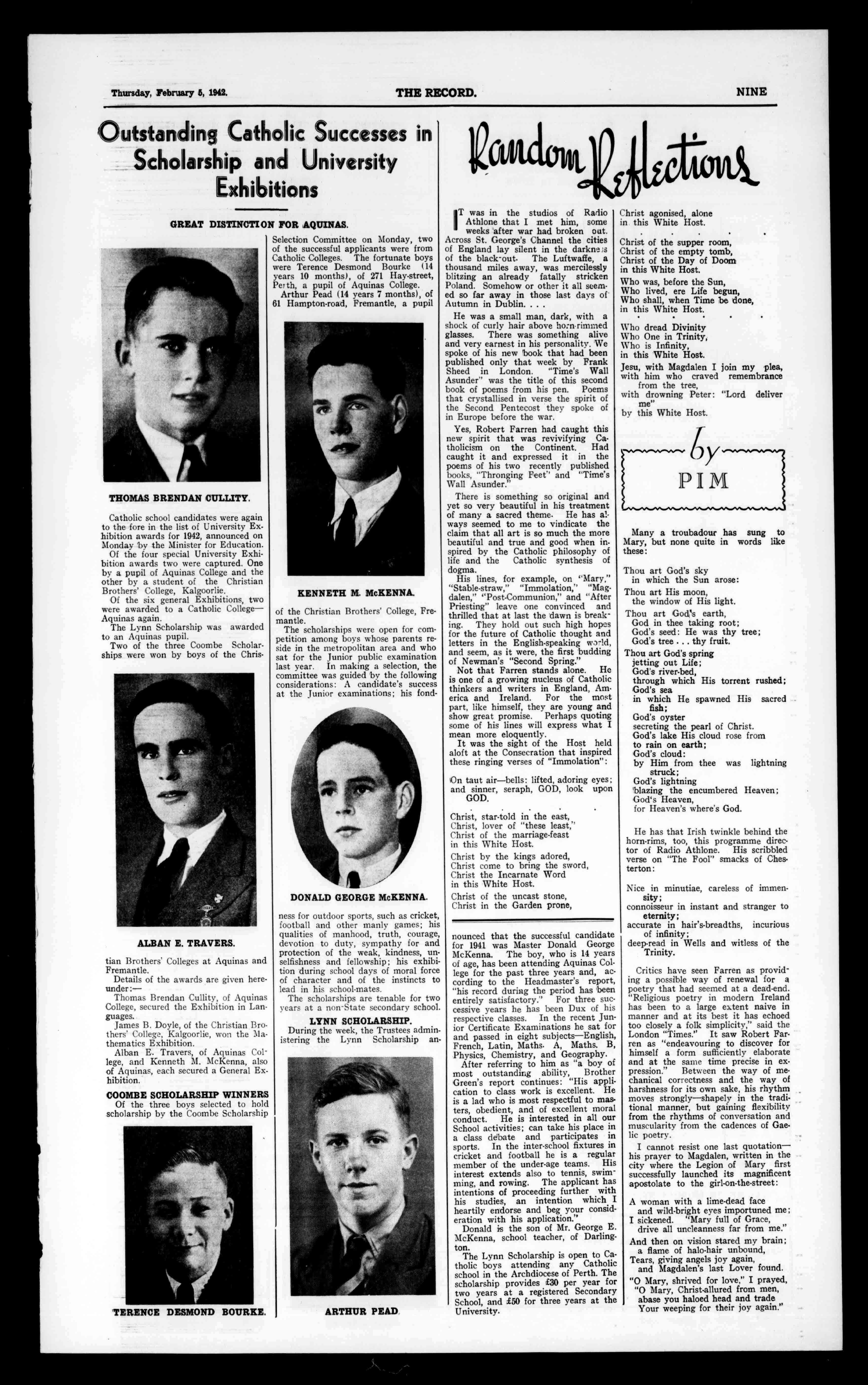
THOMASBRENDANCULLITY.
Catholicschoolcandidateswereagain totheforeinthelistofUniversityExhibitionawardsfor1942,announcedon MondaybytheMinisterforEducation.
OfthefourspecialUniversityExhibitionawardstwowerecaptured.One byapupilofAquinasCollegeandthe otherbyastudentoftheChristian Brothers'College,Kalgoorlie.
OfthesixgeneralExhibitions,two wereawardedtoaCatholicCollegeAquinasagain.
TheLynnScholarshipwasawarded toanAquinaspupil.
TwoofthethreeCoombeScholarshipswerewonbyboysoftheChris-
ALBANE.TRAVERS. tianBrothers'CollegesatAquinasand Fremantle.
Detailsoftheawardsaregivenhereunder:-
ThomasBrendanCullity,ofAquinas College,securedtheExhibitioninLanguages.
JamesB.Doyle,oftheChristianBrothers'College,Kalgoorlie,wontheMathematicsExhibition.
AlbanE.Travers,ofAquinasCollege,andKennethM.McKenna,also ofAquinas,eachsecuredaGeneralExhibition.
COOMBESCHOLARSHIPWINNERS
Ofthethreeboysselectedtohold scholarshipbytheCoombeScholarship
KENNETHM.McKENNA.
oftheChristianBrothers'College,Fremantle.
Thescholarshipswereopenforcompetitionamongboyswhoseparentsresideinthemetropolitanareaandwho satfortheJuniorpublicexamination lastyear.Inmakingaselection,the committeewasguidedbythefollowing considerations:Acandidate'ssuccess attheJuniorexaminations;hisfond-
Thereissomethingsooriginaland yetsoverybeautifulinhistreatment ofmanyasacredtheme.Hehasalwaysseemedtometovindicatethe claimthatallartissomuchthemore beautifulandtrueandgoodwheninspiredbytheCatholicphilosophyof lifeandtheCatholicsynthesisof dogma.
Hislines,forexample,on"Mary," "Stable-straw,""Immolation,""Magdalen,""Post-Communion,"and"After Priesting"leaveoneconvincedand thrilledthatatlastthedawnisbreaking.Theyholdoutsuchhighhopes forthefutureofCatholicthoughtand lettersintheEnglish-speakingw-rld, andseem,asitwere,thefirstbudding ofNewman's"SecondSpring."
NotthatFarrenstandsalone.He isoneofagrowingnucleusofCatholic thinkersandwritersinEngland,AmericaandIreland.Forthemost part,likehimself,theyareyoungand showgreatpromise.Perhapsquoting someofhislineswillexpresswhatI meanmoreeloquently.
ItwasthesightoftheHostheld aloftattheConsecrationthatinspired theseringingversesof"Immolation": Ontautair-bells:lifted,adoringeyes; andsinner,seraph,GOD,lookupon GOD.
Christ,star-toldintheeast, Christ,loverof"theseleast," Christofthemarriage-feast inthisWhiteHost. Christbythekingsadored, Christcometobringthesword, ChristtheIncarnateWord inthisWhiteHost.
DONALDGEORGEMcKENNA.
nessforoutdoorsports,suchascricket, footballandothermanlygames;his qualitiesofmanhood,truth,courage, devotiontoduty,sympathyforand protectionoftheweak,kindness,unselfishnessandfellowship;hisexhibitionduringschooldaysofmoralforce ofcharacterandoftheinstinctsto leadinhisschool-mates.
Thescholarshipsaretenablefortwo yearsatanon-Statesecondaryschool.
LYNNSCHOLARSHIP. Duringtheweek,theTrusteesadministeringtheLynnScholarshipan-
Christoftheuncaststone, ChristintheGardenprone, flouncedthatthesuccessfulcandidate for1941wasMasterDonaldGeorge McKenna.Theboy,whois14years ofage,hasbeenattendingAquinasCollegeforthepastthreeyearsand,accordingtotheHeadmaster'sreport, "hisrecordduringtheperiodhasbeen entirelysatisfactory."ForthreesuccessiveyearshehasbeenDuxofhis respectiveclasses.IntherecentJuniorCertificateExaminationshesatfor andpassedineightsubjects-English, French,Latin,Maths.A,Maths.B, Physics,Chemistry,andGeography. Afterreferringtohimas"aboyof mostoutstandingability,Brother Green'sreportcontinues:"Ilisapplicationtoclassworkisexcellent.He isaladwhoismostrespectfultomasters,obedient,andofexcellentmoral conduct.Heisinterestedinallour Schoolactivities;cantakehisplacein aclassdebateandparticipatesin sports.Intheinter-schoolfixturesin cricketandfootballheisaregular memberoftheunder-ageteams.His interestextendsalsototennis,swimming,androwing.Theapplicanthas intentionsofproceedingfurtherwith hisstudies,anintentionwhichI heartilyendorseandbegyourconsiderationwithhisapplication."
DonaldisthesonofMr.GeorgeE. McKenna,schoolteacher,ofDarlington. TheLynnScholarshipisopentoCatholicboysattendinganyCatholic schoolintheArchdioceseofPerth.The scholarshipprovides£30peryearfor twoyearsataregisteredSecondary School,and£50forthreeyearsatthe University.
Manyatroubadourhassungto Mary,butnonequiteinwordslike these:
ThouartGod'ssky inwhichtheSunarose:
ThouartHismoon, thewindowofHislight.
ThouartGod'searth, Godintheetakingroot; God'sseed:Hewasthytree; God'streethyfruit.
ThouartGod'sspring jettingoutLife; God'sriver-bed, throughwhichHistorrentrushed; God'ssea inwhichHespawnedHissacred fish; God'soyster secretingthepearlofChrist. God'slakeHiscloudrosefrom torainonearth; God'scloud: byHimfromtheewaslightning struck; God'slightning 'blazingtheencumberedHeaven; God'sHeaven, forHeaven'swhere'sGod.
HehasthatIrishtwinklebehindthe horn-rims,too,thisprogrammedirectorofRadioAthlone.Hisscribbled verseon"TheFool"smacksofChes. terton:
Niceinminutiae,carelessofimmensity; connoisseurininstantandstrangerto eternity; accurateinhair's-breadths,incurious ofinfinity; deep-readinWellsandwitlessofthe Trinity.
CriticshaveseenFarrenasprovidingapossiblewayofrenewalfora poetrythathadseemedatadead-end. "ReligiouspoetryinmodernIreland hasbeentoalargeextentnaivein mannerandatitsbestithasechoed toocloselyafolksimplicity,"saidthe London"Times."ItsawRobertFarrenas"endeavouringtodiscoverfor himselfaformsufficientlyelaborate andatthesametimepreciseinexpression."Betweenthewayofmechanicalcorrectnessandthewayof harshnessforitsownsake,hisrhythm movesstrongly-shapelyinthetraditionalmanner,butgainingflexibility fromtherhythmsofconversationand muscularityfromthecadencesofGaelicpoetry.
IcannotresistonelastquotationhisprayertoMagdalen,writteninthe citywheretheLegionofMaryfirst successfullylauncheditsmagnificent apostolatetothegirl-on-the-street: Awomanwithalime-deadface andwild-brighteyesimportunedme; Isickened."MaryfullofGrace, drivealluncleannessfarfromme." Andthenonvisionstaredmybrain; aflameofhalo-hairunbound, Tears,givingangelsjoyagain, andMagdalen'slastLoverfound. "0Mary,shrivedforlove,"Iprayed, "0Mary,Christ-alluredfrommen, abaseyouhaloedheadandtrade Yourweepingfortheirjoyagain."
BROWNS---Fruiterers
127BARRACKSTREET,PERTH.
'PhoneB3517 'PhoneB3517.
ALLTHEBUTFRUITSOFTHESEASON.
BESTCOOLDRINKSANDMILKBARTNTOWN.
AustralasianCatholicAssurance Co.Ltd. THE"A.C.A."
A.C.A.BUILDINGS,KINGST.,SYDNEY.
ASSETSEXCEED£1,750,000.
ALLCLASSESOFLIFEANDENDOWMENT ASSURANCEPOLICIESTRANSACTED.
SAFEGUARDTHEFUTURE
BRANCHOFFICESINALLSTATES.
W.A.Office:
"WARWICKHOUSE,"ST.GEORGE'STERRACE,PERTH ResidentSecretary:B.MURPHY.
EMPLOYERSRING STOTT'S
becausetheyknowthatStott Studentsgivecompletesatisfaction.Stott'sconnectionextends overaperiodofnearly.40years. AskforProspectus.
EMPLOYERS RINGSTOTTS_
STOTT'SPerpetualTrustees'Buildings,St.George's Terrace,Perth B9281
STOTT'SWoolworthBuilding,AdelaideStreet,FreL1218
COLLEGEDAYSAREHEREAGAIN!
SUPPLIEDBY HAYST.TOMURRAYST.
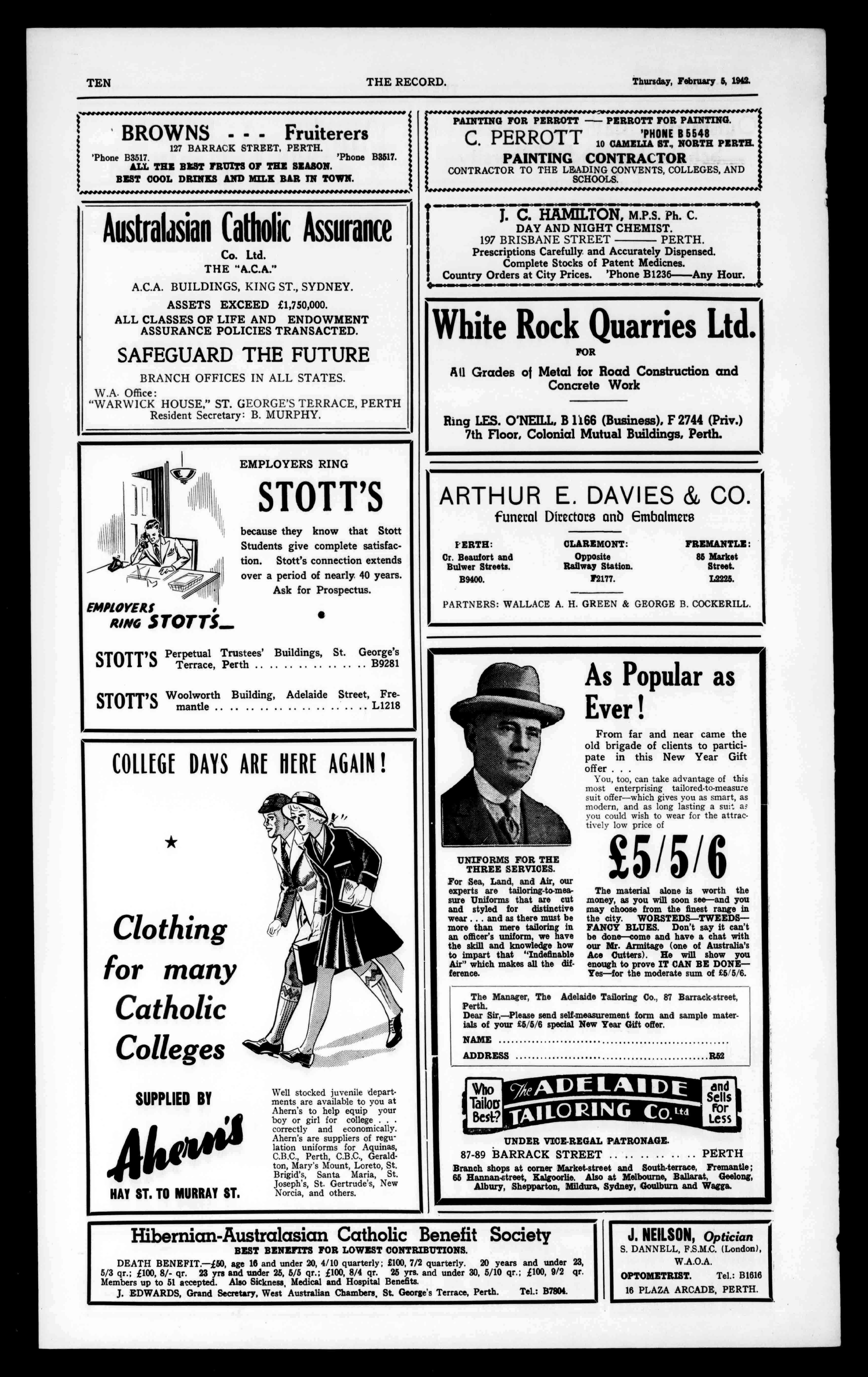
Fromfar
Gift offer.
"Von,too,cantakeadvantageofthis mostenterprisingtailored-to-measu:e suitoffer-whichgivesyouassmart,as modern,andaslonglastingasu:-.a' voucouldwishtowearfortheattractivelylowpriceof 151516
Thematerialaloneisworththe money,asyouwillsoonsee-andyou maychoosefromthefinestrangein thecity.WORSTEDS-TWEEDSFANCYBLUES.Don'tsayitcan't bedone-comeandhaveachatwith ourMr.Armitage(oneofAustralia's AceCutters).Hewillshowyou enoughtoproveITCANBEDONEYes-forthemoderatesumof£5'5/6.
TheManager,TheAdelaideTailoringCo.,87Barrack-street, Perth.
DearSir,-Pleasesendself-measurementformandsamplematerialsofyour£5/576specialNewYearGiftoffer,
Wellstockedjuveniledepartmentsareavailableto
AnnualGeneralMeeting.
ThefifteenthannualgeneralmeetingoftheAssociationwillbeheldat BactonHouseonFriday,February20, at8p.m.Chiefbusinessofthemeetingwillbetheconsiderationofvariousreportsandtheelectionofofficebearers.Nominationsforlattermust beinthehon.secretary'shandsby February6,i.e.,14daysbeforemeeting.
TennisDayatZoo.
ArrangementsareinhandretheAssociation'sproposeddayattheZooon Sunday,February22.Proceedsofthe tournamentwillbedevotedtotheCatholicWelfareOrganisation,abody whoaredoingsplendidworkinhelping ourCatholicfriendsoverseas.Last year'sdayattheZoowasagreatsuccess,andtheexecutiveanticipatea similar,ifnotlargerattendanceonthis occasion.Reservethedatenow,and arrangeaclubparty.
SocialMeeting.
Owingtothepoorresponsefrom members,thesocialmeetingfixedfor lastMondayhadtobeabandoned. Effortsarenowbeingmadetohave themeetingonFriday,February13, anditishopedtheattendancewill showanimprovement.Thiswillbe thefirstassemblyoftheyear,andas theexecutivelooktothesocialcommitteeforsupportduringthecoming season,agoodstartisawaited.The socialcommitteeisopentoanymemberoftheAssociationwhoiswillingto attendmeetings,andtoco-operatein allsocialfunctionsthatmaybear rangedfromtimetotime.
MetropolitanSocialCouncil. Bro.Burrowespresidedoverafairly wellattendedmeeting,anddelegates representedDistrictBoard,Highgate, MidlandJunction,Subiaco,Victoria ParkandMaylands.
Itwasdecidedtoholdarivertrip toKeane'sPointonFriday,February 20.Thepricetobe1/6.Alldelegateswereurgedtomakeastrong appealtomembersofthevariousbran chestocomealongandmaketheeveningagreatsuccess.Thebusinessof themeetingbeingthenconcluded,the presidentthankeddelegatesfortheir attendanceandclosedthemeeting. OurLadyHelpofChristiana'Branch, EastVictoriaPark.
Thefortnightlymeetingtookplace onTuesday,January27,andthepresident,Bro.W.Ramsay,presided.The attendancewasgood.IthasbeendecidedtoalterthenameoftheSoldiers'ComfortsFundtotheFighting Forces'Fund,asthiswillcoverthe Army,AirForceandNavy.Some formofentertainmentistobearrangedformembersonmeetingnights,and afterthenextmeeting,whichtakes placeonTuesday,February10,avery interestingcompetitionwill'beheld. Membersarethereforeaskedtoattend andhelpmaketheeveningsenjoyable ineveryway.
ByW.J.
Oneofourmembers,NoelHickey, leftPerthduringtheweekfortheMaristBrothers'NovitiateatMillagong, NewSouthWales.Weextendto Noelourheartiestcongratulationsand goodwishesonenteringtheReligi)us life,andpraythathemaybeworthy ofthehighcallinghehaschosen.
OurformerSecretaryandState champion,Geof.Wornor,hasbeen transferredtoanunknowndestination inthecountryonmilitaryduty,andit isunlikelythatwewillseehimfor sometime.Thisisunfortunate,for Geof.wasverypopularwiththeboys anddeservedlyso,ashehadtheinterestoftheSocietyatheart,anddidnot sparehimselfduringhistermasSecretary.Youhavethesincerewishesof all,Geof.,andwelookforwardtoyour return.
TheboyswerenoticedonMonday eveningspreadinggravelontheschool grounds,inpreparationfortheopening onTuesdaymorning.
TheAthleticClubcompletedthe inter-clubcompetitiononSaturday last,whenthe"C"Gradeteamcarried offthehonours.Theyalsowonthe Relayrace,butowingtoanunintentionalobstructionofanopponentby oneofourteam,theyweredisqualified. The"A"and"It"Grades,despitethe lossofmembersthroughmilitaryduties,performedverycreditably.
TheDouglasMemorialCompetition willbeconductedonthenexttwo Saturdays,andwearehopefulofa victory.
Meetings.
OnWednesday,February11,ageneralmeetingwillbeheldintheLeague Roomsat3p.m.,andnotaspreviouslyannouncedat8p.m. CanteenService.
Leaguememberswillbeincharge oftheBarrack-streetBuffetonSuna clay,February15.
SewingCircle, Thesewingcirclewillmeetat2p.m. onTuesday.Beadsandnetforthe makingofmilkjugsandmeatcovers forthecampsareurgentlyneeded.
DuringthetemporaryabsenceonaccountofillnessofMrs.Ryan,Miss Furzewillbeinattendanceatthe LeagueRoomseveryFridayfrom2 p.m.to4p.m.todistributewoolfor themakingofgarmentsforthefightingforces
CLOSINGSOON.
17STIRLINGHIGHWAY, COTTESLOE.
'PhoneF2121,DayorNight. LICENSEDSANITARYPLUMBER, IRONWORKER,SHEETMETAL WORKER.
S.BEECROFT-Butcher
181RokebyRoad,Subiaco.
DnlyPrimeFreshKilledMeatSold. 'PhoneW1373.
RandolphKnapp
SIGHT-TESTING OPTICIAN.
12ATWELLARCADE, FREMANTLE.
CLOSEONEEYEANDLOOK ALONGFACEOFPAGEFROM BOTTOMEDGE.
ItwillnotbelongbeforetheNo.98 CharitiesConsultationwillclose.Beforeitistoolate,getaticket.There isafirstprizeof£6,000,anditisthe biggestprizeforhalfacrowninAustralia.
nismcnoluninuoillatitulitinimmuinisusillitentitosime THEBESTVALUEFORYOUR MONEYAT F.J.DUFF'S
WINESALOON.
CornerARUNDELSTREETand SOUTHTERRACE,FREMANTLE.
'Phone:L1902.
tMllO4IMIMI=MIOMIPMOM=IMe,M*41=10IIMPIMMMIIIMMWIII T.VIVIAN, 143Rokeby.road,Subiaco.W1539.
Wagin,11a.m.
March1:Wagin,8a.m.;Wedgecarrup,10a.m.
March8:Wagin,8a.m.;Dumbleyung,10a.m.
February8:Childow,8a.m.;Mundaring,9.30a.m.
February15:Jennacubbine,7.30a.m.; Toodyay,9.30a.m.
February22:Clackline,8a.m.;Toodyay,9.30a.m.
St.Brigid's,Collie:7a.m.and9130 a.m.
FRASER.-AtStalagXIIIC,Germany,onDecember24,1941,Private F.K.Fraser,WX279,prisonerof war,6th.Division,A.I.F.,aged21 years;belovedsecondsonofthe MinisterforExternalTerritoryand Commerce,Senator,theHon.and Mrs.J.M.Fraser,of26Teddingtonroad,VictoriaPark;belovedbrother ofDoreen,Eric(onactiveservice), andBasil. Hischeerysmileandkindlytouch Arenowbutmemoriesofthepast.
LEEN.-OnJanuary16,1942,athis lateresidence,31Hay-street,Subiaco,Michael,dearlybelovedhusband ofNora,lovingfatherofJack(Narrogin),Bill(deceased), Tom (R.A.A.F.),father-in-lawofVeronica andPhyllis,deargrandpaofJoan, Patricia,andJohnMichael;aged73 years. RequiescatinPace.
INMEMORIAM.
ARDAGH.-Inlovingmemoryofour dearwifeandmother,Maria,whodepartedthislifeonFebruary4,1937. R.I.P.
-Insertedbyherlovinghusband andchildren.
FISHER.-Inlovingmemoryofmy dearhusband,SamuelFisher,who passedawayatSt.John's,Kalgoorlie, onFebruary4,1938. Happymemoriestreasuredever, Ofthosedayswespenttogether.
FISHER-InlovingmemoryofSam, dearlybelovedfriendofWallyand TedPrice. MostSacredHeartofJesus,have mercyonhersoul.
McMANUS.-Ofyourcharity,prayfor thesoulofTheresaMcManus,who diedFebruary9,1940. 0,SacredHeartofJesus,have mercyonhersoul.
-Insertedbyherlovingmotherand sisters.MarieandEileen.
QUAIN.-Ofyourcharity,prayfor thereposeofthesoulofMary,whose anniversaryoccursonFebruary8. MostSacredHeartofJesus,have mercyonhersoul.
-Insertedbyherlovingdaughter, Agatha,son-in-law,Horace,andBaby John.
QUAIN.-)Ofyourcharity,pleasepray forthereposeofthesoulofMary, whodepartedthislifeonFebruary 8,1937.R.I.P.
-Insertedbyherlovinghusband, TeresaandJoe(Damboring),Kitty, Joeandfamily(Wiluna).
BEREAVEMENT.
Thewidowandsonsofthelate MichaelLeen,of31Hay-street,Subiaco,wishtosincerelyTHANKallrelativesandkindfriendsforfloraltributes,letters,cards,telegrams,andpersonalexpressionsofsympathyintheir recentsadbereavement,especiallyDr. Nelson,Rev.FathersBrosnan,O'SullivanandO'Kane,fortheirkindnessand attentionduringhislongillness;Sisters ofSt.JohnofGod'sHospital,HibernianSociety,PoliceUnion,Mr.and Mrs.C.Henfry,Mrs.Usmar,andMrs. Scott.Willallpleaseacceptthisasa personalexpressionofsinceregratitude.
SILVERWEDDING. PERROTT-DELANEY.-OnFebruary1,1917,atSt.Brigid'sChurch, WestPerth,byRt.Rev.Monsignor B.Fagan,V.G.,assistedbyRev. FatherDoocey,DenisCharles,eldest sonofthelateMrandMrs.Perrott, ofCork,Ireland,toKathleen,youngestdaughterofthelateMr.andMrs. Delaney,ofWestPerth.
coversinstructioninallbusinesssubjects, andisthebestpossiblecoursefor agirlorboyof14-16yearsofage whodesiresofficeemployment.All graduatesofthiscoursegetagold efficiencybadge,2to3months' practicalexperienceinourown offices,AGUARANTEEDFIRST APPOINTMENT,andfreeemploymentserviceforlife.
Studentsofthiscoursehavethe privilegeofpreparingfortheUniversityJuniorExaminationatno extracost.Quiteanumberof studentstakeadvantageofthis everyyear,and32candidatespresentedbyuslastNovemberwere successfulinobtainingtheirJuniorCertificate.
Ifthecareerchosenforyour childneedstheLeavingorMatriculationasastartingpoint,we canhelpyou.FourofourstudentspassedthecompleteLeavingExamination-twoofthem matriculating.
Ifyourdaughterwishestoenter theCommonwealthServiceasa shorthand-typiste,itisnecessary forhertopasstheCommonwealth Typistes'Examination.Atlast year'sexaminations12ofthe15 candidatespresentedbyussecuredapass,andthemajorityof themhavealreadybeenoffereda positionintheCommonwealth Service.
Call,write,or'phoneB2024or B2063fordetailsofanycourseBusinessorExaminationPrepara-tion-inwhichyouareinterested. Enquiriesplaceyouundernoobligation.
EXAMINATIONRESULTS,1941, LEAVINGCERTIFICATE.
BOSCI,STEPHEN:English,History,MathematicsA.(d),Mathematics B(d),Physics,AppliedMathematics.
BROWN,FRANK:English,Latin, MathematicsA(d),MathematicsB(d).
BUSSANICH,HENRY:English, Italian.(d),MathematicsA,MathematicsB,Physics,AppliedMathematics.
CAREY,PATRICK:English,DrawingB.
CASSERLEY,RONALD:English, Latin,MathematicsA,MathematicsB (d),Physics,AppliedMathematics.
COTTON,RICHARD:English, Latin,History(d),MathematicsA, Physics.
FARRINGTON,RALPH:MathematicsAMathematicsB,Physics, DrawingB.
McLINDEN,JAMES:English,Latin, MathematicsA(d),Mathematics13 (d),Physics,AppliedMathematics(d).
RYAN,THOMAS:English,MathematicsA,MathematicsB(c1),Physics, AppliedMathematics.
WARD,GERALD:English,History, MathematicsA,MathematicsB,Physics,DrawingB.
WESTON,LEONARD:English,History,MathematicsA,MathematicsB, Physics,DrawingB.
RESULTSSUMMARISED.
ENGLISH:11Presented:TENPASS-
ED.
LATIN:5Presented;FOURPASSED.
HISTORY:6 Presented:FOUR PASSED(OneDistinction).
MATHEMATICSA: 11Presented; TENPASSED(ThreeDistinctions).
MATHEMATICSB:11Presented; NINEPASSED(FiveDistinctions).
APPLIEDMATHEMATICS:6Presented;FIVEPASSED(OneDistinction).
PHYSICS:10Presented;NINE PASSED.
DRAWING13:6Presented;FIVE PASSED.
ITALIAN:1Presented;ONEPASS1D(OneDistinction).
JUNIORCERTIFICATE.
PassWithCertificate.
BELL,FRANCIS:English,Latin, History,MathematicsA,Mathematics B,Physics,DrawingB.
CAREY,FRANCIS:English,Latin, History,MathematicsA,Mathematics B,Physics,DrawingB.
GALLAGHER,KEVIN:English, Latin,History,MathematicsB,Physics,DrawingB.
IMMS,WALTER:English,Latin, History,MathematicsB,DrawingB.
KEANE,CORNELIUS:English, History,MathematicsA,Mathematics B,Physics,DrawingA,DrawingB.
LETIZIA,MANLIO:History,MathematicsA,MathematicsB,Physics, DrawingB.
MARTIN,KENNETH:English,MathematicsA,MathematicsB,Physics, DrawingB.
MYERS,EDGAR:English,Latin, History,MathematicsA,Mathematics B,Physics,DrawingB.
McFALL,THOMAS:English,Latin, History,MathematicsA,Mathematics B,Physics,Chemistry,DrawingA, DrawingB.
McGINLEY,MICHAEL:English, Latin,History,MathematicsA,MathematicsB,Physics,DrawingB.
NATOLI,JOSEPH:English,Latin, History,MathematicsA,Mathematics B,Physics,Chemistry.
PEARARTHUR:English,Latin, History,MathematicsA,Mathematics R,Physics,Chemistry,DrawingA, DrawingB.
STURT,GERALD:English,MathematicsA,MathematicsB,Physics, DrawingA,DrawingB. WARDMAN,DAVID:English,History,Geography,MathematicsB,Physics,DrawingA,DrawingB. Passes.
CAIRD,ALEXANDER: MathematicsA,MathematicsB,DrawingA, DrawingB.
CASSIDY,WILLIAM:English,History,MathematicsB,DrawingB.
DOHERTY,KENNETH:History, MathematicsB,Physics,DrawingB.
DOWNEY,HAROLD:Geography, Physics,DrawingA,DrawingB. VERGONA,FRANCIS:English, Latin,MathematicsA,MathematicsB.
JUNIORENTRANCECLASS.
SECONDYEAR. (d)PassWithDistinction. (1,Religion;2,English;3,History; 4,Latin;5,Arithmetic;6,Algebra;7, Geometry;8,Chemistry;9,Geography; 10,Drawing.)
ANDERSON,FRANCIS:1,2,3,4,6, 7,9.
BROWN,RONALD:1,2(d),3,4,5, 6,7,9,10.
BLATCHFORD,WILLIAM:1,2,3, 10.
BOVELL,ROLAND:1,2,3,4,5(d), 6,7,8,9,10.
BRODERICK,LESLIE:1,2,3,5, 7,9,10.
CROMWELL,FRANK:1,2,3,4, 5,6,9.
DUXBURY,WILLIAM:1,2,3, 4(d),5(dl,6(d),7(d),8,9,10,
DALY,JAMES:1,2,6,7,9.
FITZPATRICK,GERALD:1,2,3, 4,6,9.
GLEESON,KEVIN:1(d),2,3(d),4, 5,6,7,9,10.
HUNTER,ROBERT:1,2,4,7,8,9,
10.
HIRD,JOHN:1,2,4,8,10.
IBBOTSON,DESMOND:1,2,3, 4(d),5(d),6,7,8,9,10.
JOHNSON,MAURICE:1,2,3(d), 4,5,7,9.
LANGFORD,JOHN:1,39,10. MOYNIHAN,THOMAS:1,2,3,4,7, 9. MURPHY,BRIAN:1,2,3,4,5,6, 7,8,9.
NEWBOLD,MARTIN:1,3,4,5,6.
O'HARA,MAURICE:1(d),2(d),3, 4,5,6,7,8,10.
REED,EDWARD:1,2,3,9.
ROSAM,KEVIN:1,2(d),3(d),4, 5,6,9.
SULLIVAN,JOHN:1,2,3,4,5,6,7.
SCOTT,WILLIAM:1,2,3,4,5,6,7, 9. VICK,JOHN:1,2,3,7,8,9,10.
FIRSTYEAR.
BYDDER,GEORGE:1,2,3,4(d),5, 6(d),7,8,10.
BARWISE,RONALD:1,6,7,10.
BURNS,BASIL:I(d),2,3,4,5,6,7, 8,10(d).
BILICH,JOHN:1,2,3,7,10.
BRADY,LAURENCE:1,2,3,4,6, 7(d),8(d),10.
CANNON,RONALD:lid),2,3(d), 4,5,6,7(d),8(d),10.
CAREY,JAMES:1,2,3(d),4, O(d),7(d),8,10. CAREY,BRIAN.lid),2,3,4(d),5, 6,7(d),8,10(d).
COLLERAN,ROBERT:1,2,3,6,7, 8,10,
CROMWELL,ALLAN:1,3,4,6,8, 10.
CHAMBERLAIN,JOSEPH:1,2,6, 7,8,10.
DALY,LAURENCE:1,2,3,6,7, 8,10.
FRANCIS,VICTOR.1,6,7,8,10.
FURLONG,KENNETII:1.(d),2,3, 4,5(d),6(d),7,10(d).
GRANT,RONALD:1(d),2,4,6, 7(d),8,10.
HARRISON,JOHN:2,3,4,7,8(d) 10(d).
JOHN,KEVIN:2,4,5,6,7,8,10(d).
JAMESWILLIAM:1(d),2,3(d),4, 5,6(d),7(d),8,10(d).
LEES,BERNARD:1,2,3,4,5(d), 6(d),7,8,10(d).
MORGAN,KENNETH:1,2,6,7, 10(d).
MrLBOURNE,JOHN:1,4,6,8,10.
MOYNIHAN,JAMES:1,2,3,4,5, 6,7,10.
MILLER,THEODORE:1,6,7,10,
MAGUIRE,ANTHONY:1,3,4(d),7, 8,10.
NUNWEEK,RICHARD:1,2,6,7, 10(d).
O'HARA,FRANCIS:1,2,7,8.
PARRY,LEONARD:1,2,3(d), 4(d),5,6(d),7,8,10(d).
RULY,NICHOLAS:1,2,3,4(d), 6,7.
ROBERTSON,WILLIAM:1,2,3,4, 6,7,8,10.
WALKER,JOHN:2,3,5,6,7(d),8, 10(d).
SCHOLARSHIPEXAMINATION. CollegeScholarship. St.Aloysius',ShentonPark. AlfredLinden,First. WilliamOldfield,Second. St.Joseph's,Subiaco. VernonElliott,Third. O'HaraScholarship. C.B.C.,Fremantle. RayCapes.
EXAMINATIONRESULTS,1941. UNIVERSITYOFWESTERN AUSTRALIA.
LEAVINGCERTIFICATE.
DYSON, MAUREEK English, Latin(d),French(d),German(d), History.
FISHER,BETTY:French,MathematicsA,Music.
MULLIGAN,.PATRICIA:English, French,German,History.Geography (d),MathematicsA,Biology(Natural History).
McDONALD,MARGARET:English, Latin,French,German,Biology(NaturalHistory),Music.
O'DEA,KATHLEEN:English, Latin,French,German,Mathematics A,MathematicsB,Biology(Natural History).
WHITELY,PATRICIA:English, French,German,MathematicsA,Bio. logy(NaturalHistory).
JUNIORCERTIFICATE.
ANDERS,SUSI:.English,Latin, French,German,MathematicsB,Biology(NaturalHistory),DrawingA.
BROWNE,THURZA:English, Latin,French,MathematicsA,MathematicsB,Biology(NaturalHistory), DrawingA,Music.
CARR,EVELYN:English,Latin, French,German,Mathematics13,Biology(NaturalHistory),DrawingA.
CHURCH,BEVERLEY:English, Latin,MathematicsA,Mathematics B,Biology(NaturalHistory),DrawingA,CommercialMethodsandBookkeeping.
FALL,JOAN:English,Latin, French,German,MathematicsA,MathematicsB,.Biology'(NaturalHistory),DrawingA.
GRATWICK,VAILIMA:English, Latin,MathematicsA,Biology(NaturalHistory),DrawingA.
GREEN,ETHEL:English,Latin, French,German,MathematicsA,MathematicsB,Biology(NaturalHistory),DrawingA,ArtofSpeech.
HALLIDAY,DOROTHY:English, Geography,MathematicsA,MathematicsB,Biology(NaturalHistory), DrawingA,CommercialMethodsand Bookkeeping.
MULLIGAN,BARBARA:English, Latin,French,MathematicsA,MathematicsB,BiologyNaturalHistory1, DrawingA,Music.
O'NEILL,JILL:English,Latin, French,MathematicsA,Mathematics 13,Physics,Chemistry,Biology(NaturalHistory),DrawingA.
PRENDERGAST,AILEEN:English,Latin,French,German,Geography,MathematicsA,Mathematics 13,Biology(NaturalHistory),DrawingA.ArtofSpeech.
RUTHERFORD,AUDREY:English,French,MathematicsB,Biology (NaturalHistory),DrawingA.
SCAMMELL,ELLEN:English,Geography,MathematicsA,Mathematics B,DrawingA,CommercialMethods andBookkeeping.
SMART,MARGARET:English, Latin,French,German,Geography, MathematicsA,MathematicsB,Biology(NaturalHistory),DrawingA, Music.
STARICOFF,SADIE:English, French,MathematicsA,Mathematics B,Biology(NaturalHistory),Music, Hebrew.
WOOD,LUCY:English,French, Geography,MathematicsA,MathematicsB,Biology(NaturalHistory), DrawingA,Music.
ALLIANCEFRANCAISEEXAM-
INATIONRESULTS,1941.
DIVISION MaureenDyson(DistinctionandLargeSilver'Medal), 13ettyFisher,MargaretMcDonald,PatriciaMulligan,KathleenO'Dea,PatriciaWhitely.
DIVISIONIII.:MaureenChild, ViolaEarle,TereseHoran,Margaret Leahy,JoanPerrott,KathleenSachse.
MUSICAL81100111SES,1941.
PIANOFORTE.
GRADEIV.:A.Christian(Credit).
GRADEV.:D.Storrie(Honours).
GRADEVI.:D.Sadler.
PREPARATORY:M.Lyddy,Y. Harris.
THEORETICAL
GRADEIV.:H.Merchant(Honours),A.Christian(Credit).
GRADEV.:C.Parfett(Honours), D.Storrie(Credit).
DIVISIONIV.:EthelGreen(d), BarbaraMulligan(d),LucyWood 'Id),SusiAnders,ThurzaBrowne,Joan Fall,VailimaGratwick,JillO'Neill, AileenPrendergast,AudreyRutherford,MargaretSmart,SadieStaricoff.
MUSICEXAMINATIONRESULTS, 1941.
PLAINCHANTFESTIVAL, SectionforGirls'SecondarySchools: S.H.H.S.Choir,FirstPlace.
HarmoniumPlaying-OpenSection: K.Sachsem,FirstPrize, Chyronomy(Conducting)B.Law. son,SecondPlace.
MUSICALFESTIVAL.
PianoDuet,under18:K.Sachseand B.Fisher,SecondPrize, PianoSolo,under14:V.Hoult,SecondPrize.
VocalSolo,under16:M.O'Sullivan, ThirdPlace.
UNIVERSITYOFWESTERN AUSTRALIA.
PRACTICAL.
Grade11,-Piano-Credit:K.Sachse, S.Staricoff.Violin-Credit:M.Dear.
GradeIII.-Piano-Credit:T. Browne,P.Byrne,S.Hope,V.Hoult, M.Leahy,J.Walmsley,L.Wood. Pass:A.Dear,L.Watts,B.Mulligan, BJenour.Singing-Credit:K.Donohoe.Violin-Credit:N.Watts.
GradeIV.-Piano-Credit:M.Burke, M.Horan,T.Horan,H.McFall,G. Paxman.Pass:R.Gilchrist,S.Shil ony.Violin-Credit:L.Dear.
GradeV.-Piano-Credit:B.Atkinson,V.Barnes,B.Lavater,I.Wallace, P.White.Pass:D.Fox,A.Collins. GradeVI.-Piano--Honours:M.Atkinson,M.Mulligan.Credit:M.An dersen,S.Barnes,L.Dillon,J.Earle, P.Horan,P.O'Neill,L.Outridge,M. Foley,E.Duffy.Pass:M.Carlisle. Preparatory-Honours:R.White,K. Mann,M.Northway.
THEORY.
GradeIV.-Honours:P.Byrne.Credit:S.Staricoff,M.Smart.Pass:L. Wood. GradeV.-Credit:J.Marr,R.Gilchrist.
MUSICALPERCEPTION.
GradeIII.-Honours:B.Fisher.
GradeIV.-Honours:T.Browne. Pass:B.Mulligan.
TRINITYCOLLEGE,LONDON.
PRACTICAL.
HigherLocal-Singing-Merit:J.Hamilton.Piano:J.Canby.
AdvancedPreparatory-Honours: B.Watson.
THEORY.
ArtofTeaching:D.Horry.
AdvancedIntermediate-Honours: P.Byrne,M.Leahy.
AdvancedJunior-Honours:V. Hoult.
Junior-Honours:B.Bodeker,A. Dallimore,L.Stubber,H.Gibson,B. Atkinson,T.Horan,M.Horan,V. Barnes,S.Shilony,E.Duffy,B.Watson.
Preparatory-Honours:P.Wright, J.Paynter,A.Collins,M.Anderson,D. McDonald,P.Horan,M.Kilmartin,P. O'Neill,M.Watt.Merit:M.Northway, F.Kinsells.
L.CHARLESWORTH, Dip.D.S. DENTALSURGEON.
CLAREMONT-17BROWNST.
Tel.F1717.
SUBIACO-133ROKEBYROAD
Tel.W1191.
A.F.CLARKE-F2483
LW."A"GRADEELECTRICIAN.
17LILLIANSTREET,COTTESLOE.
WHENINTHEDARE-RINGFOR CLARKE.
NORTHAM.
E.0.TRESISE, M.P.S.,S.A.andW.A. MANUFACTURINGAND DISPENSINGCHEMIST.
ForServiceandQuality.
Tel.:61Northam.
JUNIORCERTIFICATE,1941. 11.MERCHANT:English,History Geography,MathematicsA,MathematicsB,Biology-Botany,Drawing, Music.
COMMERCIALRESULTS.
BOOKKEEPING: Junior-Honours:A.White,V. Quinn,V.Saxey.
TYPEWRITING: Junior-Honours:A.White, V. Quinn,V.Saxey.
SHORTHAND: Elementary:V.Quinn.
ALBANY.
H.C.PriorFuneralDirector
ALBANY(Established1921).
PrivateMortuary.MotorVehicles. ChargesModerate. 'Phone216.
Albany,Mt.Barker,Denmarkand Districts,
EXAMINATIONRESULTS,1941.
LEAVINGCERTIFICATE.
LETITIAC.ROGERS:English, Geography(Distinction),Biology-Botany,IndustrialHistoryandEconomics,Music.
JUNIORCERTIFICATE.
ALMAH.TOM1O11:English,History,Geography,Biology-Botany, DrawingA(1940),MathematicsA (1941).
MUM.
LILIANTHOMPSON:GradeAIL Piano(PassIntermediateTheory (Honours,100marks).
BERYLW.STEVENSON:Grade III.Piano(Pass);GradeV.Theory (Honours).
MAXINEJ.WORMALD:GradeIV. Piano'(Credit);IntermediateTheory (Merit).
PATRICIARYAN:GradeIV.Piano (Pass);IntermediateTheory(Merit).
KATHLEENDWYER:IntermediateTheory(Honours).
LOISTARGUS:IntermediateTheory(Merit).
GLADYSGODDARD:GradeIV. Piano((redit);AdvancedJuniorTheoryIlonours).
HAZELWALSH:GradeIV.Violin
Pass)
JEANAN GradeV.Piano (Honours);JuniorTheory(Honours).
NANCYALLEN:GradeV.Piano tlionours);JuniorTheory-(Honours, 100
MARGARETBEATON:GradeV. Piano(HonoursJuniorTheory(Honours).
PATRICIABENNIGAN:GradeV. Piano(Credit);JuniorTheory(Honours,99).
KATHLEENSHEPLEY:GradeV. Piano-(Credit);JuniorTheory(Honours,100).
VERONICAEVANS:GradeV.Piano (Credit);JuniorTheory(Pass).
MARGOTBYRNE:GradeV.Piano (Credit);PreparatoryTheory(Honours);FirstStepsElocution(Honours)
ELLENSHEEHAN:GradeV.Piano (Credit);PreparatoryTheory(Honours);FirstStepsElocution(Merit).
ROBERTHARVEY:GradeV.Piano (Credit);JuniorTheory(Merit).
SHIRLEYSTROUD:GradeV. Piano(Pass);JuniorTheory(Pass).
PATRICIACARTLEDGE:Grade VI.Violin(Honours,90);JuniorTheory(Honours,100).
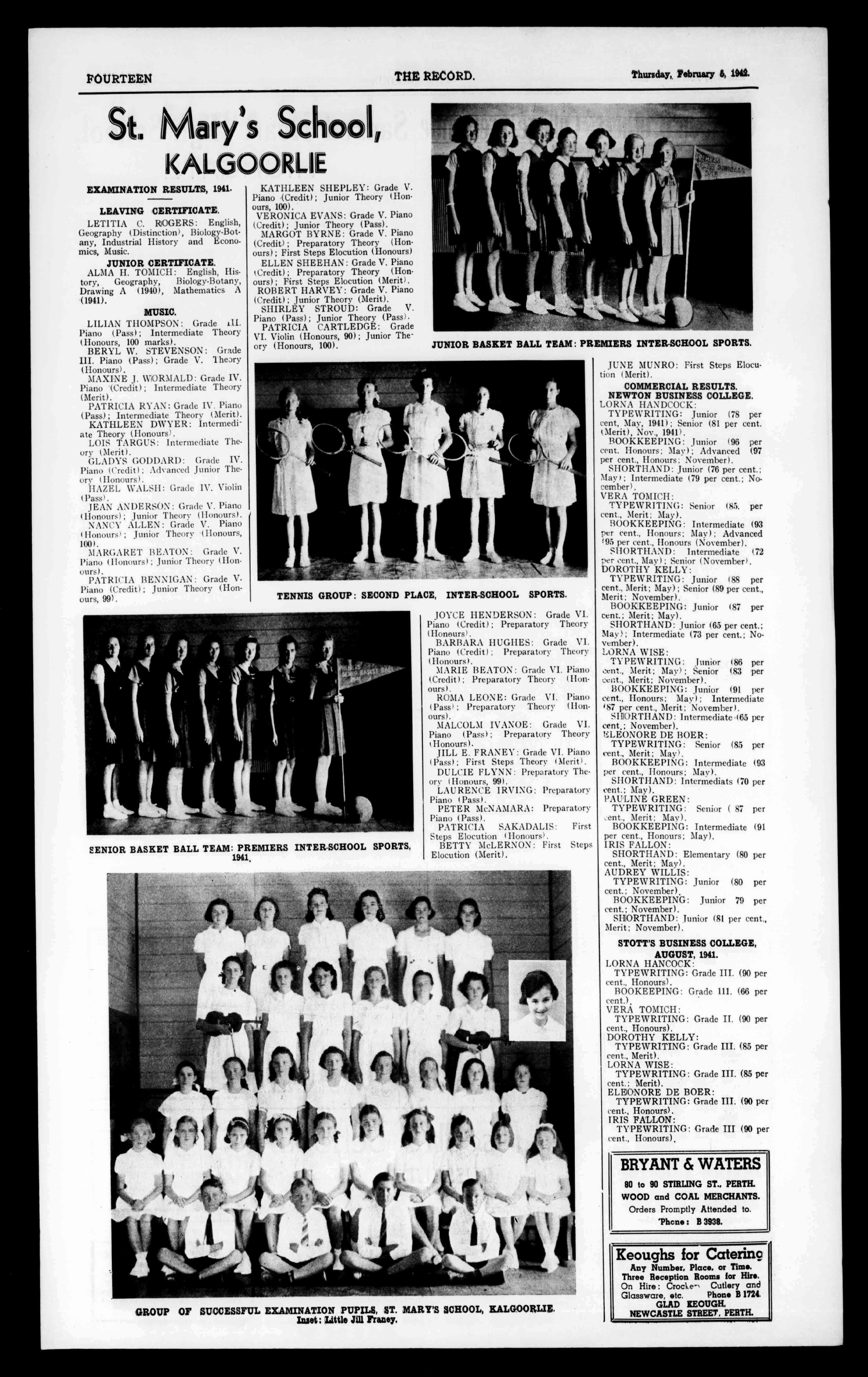
SECONDPLACE,INTER-SCHOOLSPORTS.
JOYCEHENDERSON:GradeVI. Piano(Credit);PreparatoryTheory (Honours).
BARBARAHUGHES:GradeVI. Piano(Credit);PreparatoryTheory (Honours).
MARIEBEATON:GradeVI.Piano 1.Credit);PreparatoryTheory(Honours).
ROMALEONE:GradeVI.Piano (Pass);PreparatoryTheoryIllunours).
NIALCOLMIVANOE:GradeVI. Piano(Pass);PreparatoryTheory (Honours).
JILLE.FRANEY:GradeVI.Piano (Pass);FirstStepsTheoryMerit).
DULCIEFLYNN:PreparatoryTheory(Honours,99).
LAURENCEIRVING:Preparatory Piano1Pass).
PETERMcNAMARA:Preparatory Piano(Pass).
PATRICIASAKADALIS:First StepsElocution(Honours).
BETTYMcLERNON:FirstSteps Elocution(Merit).
JUNEMUNRO:FirstStepsElocution(Merit).
001EKERCIALRESULTS.
NEWTONBUSINESSCOLLEGE.
LORNAHANDCOCK:
TYPEWRITING:Junior(78per cent,May,1941);Senior(81percent. (Merit),Nov.,1941).
BOOKKEEPING:Junior(96per cent.Honours;May);Advanced(97 percent.,Honours;November).
SHORTHAND:Junior(76percent.; May);Intermediate(79percent.;Nocember).
VERATOMICH: TYPEWRITING:Senior(85.per cent.,Merit:May).
BOOKKEEPING:Intermediate(93 percent.,Honours;May);Advanced (95percent.,Honours(November).
SHORTHAND:Intermediate(72 pereent.,May);Senior(November).
DOROTHYKELLY:
TYPEWRITING:Junior(88per cent.,Merit;May);Senior(89percent., Merit;November).
BOOKKEEPING:Junior(87per cent.;Merit;May).
SHORTHAND:Junior(65percent.; May);Intermediate(73percent.;November).
LORNAWISE:
TYPEWRITING:Junior186per cent.,Merit;May)Senior(83per cent.,Merit;November).
BOOKKEEPING:Junior(91per cent.,Honours:May);Intermediate (87percent.,Merit;November).
SHORTHAND:Intermediate-165per cent,:November).
ELEONOREDEBOER:
TYPEWRITING:Senior(85per cent.,Merit:May).
BOOKKEEPING:Intermediate(93 percent.,Ilonours;May).
SHORTHAND:Intermediats(70per cent.;May).
PAULINEGREEN: TYPEWRITING:Senior(87per cent.,Merit;May).
BOOKKEEPING:Intermediate(91 percent.,Honours;May).
IRISFALLON: SHORTHAND:Elementary(80per cent.,Merit;May).
AUDREYWILLIS:
TYPEWRITING:Junior(80per cent.;November), BOOKKEEPING:Junior79per cent.:November).
SHORTHAND:Junior(81percent., Merit:November).
STOTT'SBUSINESSCOLLEGE, AUGUST,1941.
LORNAHANCOCK:
TYPEWRITING:GradeIII.(90per cent.,Honours).
BOOKEEPING:Grade111.(66per cent.)
VERATOMICH: TYPEWRITING:GradeII.(90per cent.,Honours).
DOROTHYKELLY:
TYPEWRITING:GradeIII.(85per cent.,Merit).
LORNAWISE:
TYPEWRITING:GradeIII.(85per cent.;Merit).
ELEIONOREDEBOER:
TYPEWRITING:GradeIII.(90per cent.,Honours).
IRISFALLON: TYPEWRITING:
GradeIII(90per cent.,Honours),
OnFebruary2thisschoolwillbegin thesecondyearsofitsexistence.CommencingearlyinFebruarylastyear witharoll-callof24pupils,itsteadily increaseditsnumbers,untilattheend ofthescholasticyeartherewere58 pupilsontheroll.Thisfactinitself speaksvolumesfortheexcellenceof theschoolanditsteachers.
Thescholasticsuccessesattainedalso beareloquenttestimonytoitsworth. Oneofitspupils,TerryEaton,was successfulingainingaStateSecondary SchoolScholarshipinafieldof1,400 candidates.
Theschoolinspectorwasunusually laudatoryoftheestablishment,commentingveryfavourablyontheteachersandtheirmethods.
Itiswithwelljustifiedhopethata furtherandevenmoresuccessfulyear isanticipated.Yetitisnotwithsuch materialsuccessesthatprogressis measured,butintheincreasingnumberofchildrenregularlyattheSacraments,inthequickeningoffaithin carelesshomes,inthemanyandferventvisitsmadetotheDivineLover ofchildren-thesearethethingswe note-thesearethethingswerejoice in-thesearethethingswhichcause ustoutteraveryferventandsincere wishforthisnewventure.Admultos etplenosannos.
EXAMINATIONRESULTS.
Thefollowingisaresultofthe scholasticsuccessesobtainedbythe DominicanSisters,St.Peter'sSchool, BedfordPark,during1941.Allcandidatespresentedweresuccessful:SECONDARYSTATESCHOOL SCHOLARSHIP.
TerenceJ.Eaton.
TRINITYCOLLEGEOFMUSIC, LONDON.
VERSESPEAKINGCHOIR:Honours.
JUNIORELOCUTION:Marian Gibbins(Credit).
GasStoves,New,Enamel,£8/19/-. Onlyafewleft.Acceptoldstovepart payment.W.A.StoveCo.,559Wellington-street. 'w1041M011W.
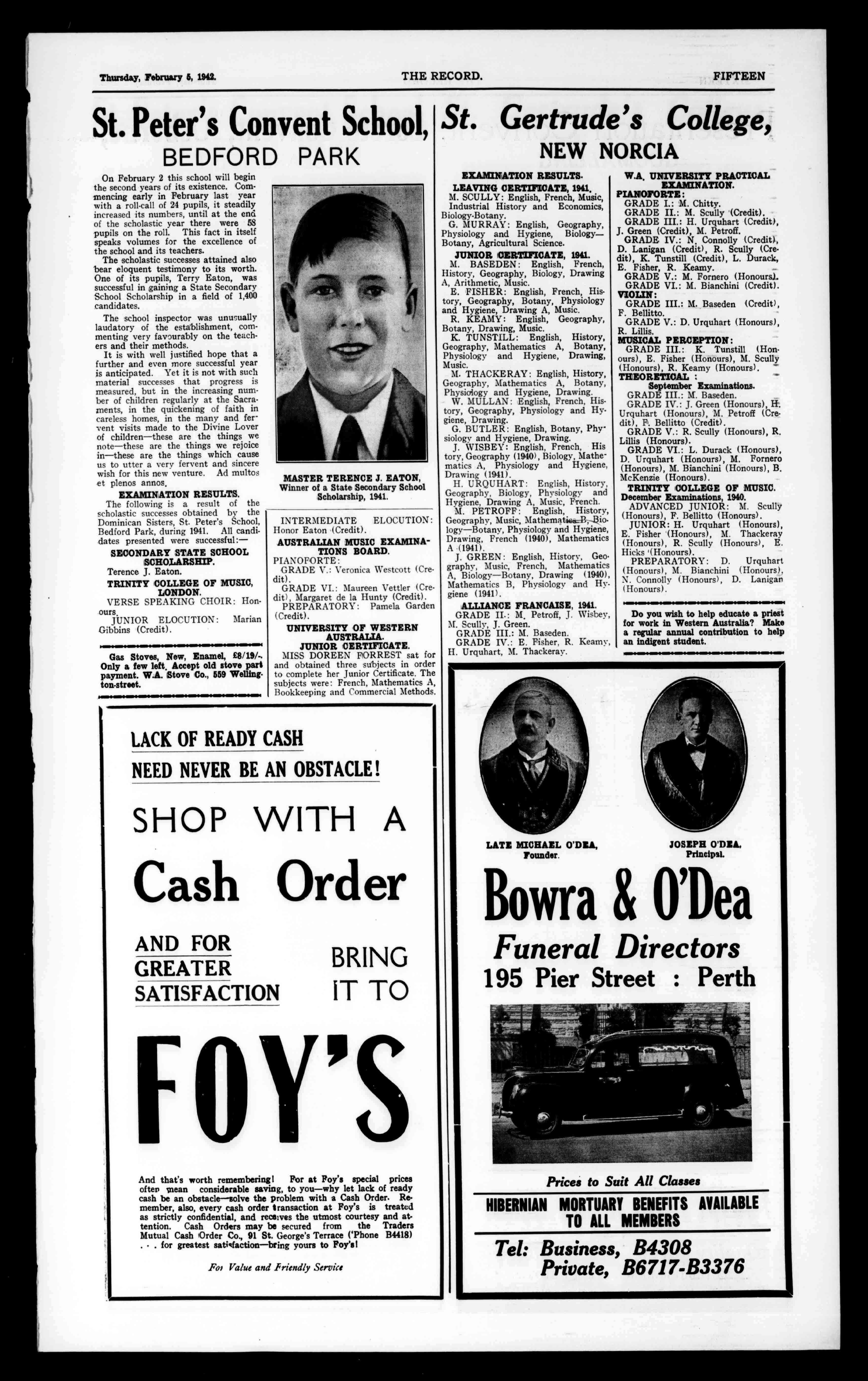
MASTERTERENCEJ.EATON, WinnerofaStateSecondarySchool Scholarship,1941.
INTERMEDIATEELOCUTION: HonorEaton(Credit).
AUSTRALIANMUSICEXAMINATIONSBOARD. PIANOFORTE: GRADEV.:VeronicaWe,tcott(Credit).
GRADEVI.:MaureenVettler(Credit),MargaretdelaHunty(Credit).
PREPARATORY:PamelaGarden (Credit),
UNIVERSITYOFWESTERN AUSTRALIA.
JUNIORCERTIFICATE.
MISSDOREENFORRESTsatfor andobtainedthreesubjectsinorder tocompleteherJuniorCertificate.The subjectswere:French,MathematicsA, BookkeepingandCommercialMethods.
EXAMINATIONRESULTS.
LEAVINGCERTIFICATE,1941,
M.SCULLY:English,French,Music, IndustrialHistoryandEconomics, Biology-Botany.
G.MURRAY:English,Geography, PhysiologyandHygiene,BiologyBotany,AgriculturalScience.
JUNIORCERTIFICATE,1841.
M.BASEDEN:English,French, History,Geography,Biology,Drawing A,Arithmetic,Music.
E.FISHER:English,French,History,Geography,Botany,Physiology andHygiene,DrawingA,Music.
R.KEAMY:English,Geography, Botany,Drawing,Music.
K.TUNSTILL:English,History, Geography,MathematicsA,Botany, PhysiologyandHygiene,Drawing, Music.
M.THACKERAY:English,History, Geography,MathematicsA,Botany, PhysiologyandHygiene,Drawing.
W.MULLAN:English,French,History,Geography,PhysiologyandHygiene,Drawing.
G.BUTLER:English,Botany,PhysiologyandHygiene,Drawing.
J.\VISBEY:English,French,His tory,Geography(1940),Biology,MathematicsA,PhysiologyandHygiene, Drawing(1941).
H.URQUHART:English,History, Geography,Biology,Physiologyand Hygiene,DrawingA,Music,French.
M.PETROFF:English,History, Geography,Music,Mathematiw,--11, logy-Botany,PhysiologyandHygiene, Drawing,French(1940),Mathematics A(1941).
J.GREEN:English,History,Geography,Music,French,Mathematics A,Biology-Botany,Drawing(1940), MathematicsB,PhysiologyandHygiene(1941).
ALLIANCEFRANCAISE,1941.
GRADEII.:M.Petroff,J.WisbeY, M.Scully,J.Green.
GRADEIII.:M.Baseden.
GRADEIV.:E.Fisher,R.Kearny, H.Urquhart,M.Thackeray.
WA,UNIVERSITYPRACTICAL EXAMINATION.
PIANOFORTE:
GRADEI.:M.Chitty.
GRADEII.:M.Scully(Credit).
GRADEIII.:H.Urquhart(Credit), J.Green(Credit),M.Petroff.
GRADEIV.:N.Connolly(Credit), D.Lanigan(Credit),R.Scully(Credit),K.Tunstill(Credit),L.Durack, E.Fisher,R.Keamy.
GRADEV.:M.Fornero(Honours).
GRADEVI.:M.Bianchini(Credit).
VIOLIN:
GRADEIII.:M.Baseden(Credit), F.Bellitto. GRADEV.:D.Urquhart(Honours), R.Lillis.
MUSICALPERCEPTION:
GRADEIII.:K.Tunstill(Honours),E.Fisher(Honours),M.Scully (Honours),R.Keamy(Honours).
THEORETICAL SeptemberExaminations.
GRADEIII.:M.Baseden.
GRADEIV.:J.Green(Honours),H. Urquhart(Honours),M.Petroff(Credit),F.Bellitto(Credit).
GRADEV.:R.Scully(Honours),R. Lillis(Honours).
GRADEVI.:L.Durack(Honours), D.Urquhart(Honours),M.Fornero (Honours),M.Bianchini(Honours),B. McKenzie(Honours).
TRINITYCOLLEGEOFMUSIC.
DecemberExaminations,1940.
ADVANCEDJUNIOR:M.Scully (Honours),F.Bellitto(Honours).
JUNIOR:H.Urquhart(Honours), E.Fisher(Honours),M.Thackeray (Honours),R.Scully(Honours),E. Hicks'(Honours).
PREPARATORY:D. Urquhart (Honours),M.Bianchini(Honours). N.Connolly(Honours),D.Lanigan (Honours).
Doyouwishtohelpeducateapriest forworkinWesternAustralia?Make aregularannualcontributiontohelp anindigentstudent.
Itiswithageneralfeelingofsatisfactiononthepartofbothteachers andpupilsthatwereportonthescholasticyearof1941.Ithasbeenavery happyandsuccessfulyear.TheState InspectorofSchools,whovisitedthe schoolinMay,gaveasplendidreport andemphasisedthehappyspiritofcooperation'betweenteachersandpupils. Theusualroundofworkandplay broughtthedesiredsuccesses.The enrolment,whichhasbeeninthevicinityofninetytoninety-seven,ishighestinthejuniorclasses,Therewere alsotheusualinter-schoolmatchesin basket-ball,footballandcricket,the latterteamgivingquiteagoodaccountofthemselves.Aquantityof knittedarticlesweremadebythegirls andboysinresponsetoanappealby theRedCrossSociety,andmoneywas alsoraisedbythechildrenforbuying WarSavingsCertificates.
Thereligiouslifeofthestudentshas beenwellcateredforduringtheyea;, theParishPriest(Rev.FatherPlacid, O.S.B.)beingunremittinginhisservices.Athree-days'Retreatforthe boys,andoneforthegirls,waspreachedinNovemberbytheRev.Father Packer,C.SS.R.,whenthefewquiet daysawayfromhome,andthesimple,yetverypractical,lecturesofthe RetreatMasteraccomplishedsomethinginthelivesofthechildrenwhich nonumberofmissionscouldever achieve.
TheLordAbbotScholarship-avery valuableone,whichentitlestheholder tothreeyearsboardandtuitionatSt. Ildephonsus'College,NewNorcia (valuedat£180),withanextension ofanothertwoyearsiftheprogress andconductoftheholderaresatisfactory-thusincreasingthevalueof theScholarship'byafurther£120-was wonthisyearbyJosephChownfrom amongtheCatholicboysoftheNew NorciaDiocese,
EXAMINATIONRESULTS, TRINITYCOLLEGEOFMUSIC. THEORETICAL.
FIRSTSTEPS:LeslieJones,Honours(100percent.);ThelmaLee,Honours(100percent.);NevillePowell, Honours(100percent.).
PREPARATORY:BethWilliams, Honours(100percent.);VelmaEvans, Honours(100percent);VioletWaldock,Honours(100percent.);Elvia Ferguson,Honours(93percent.).
JUNIOR:JohnClough,Honours(97 percent,)VeronicaLowry,Honours (95percent.);OliveKenevan,Honours (92percent.);MarionClamp,Honours(92percent.);MaryWhite,Credit (80percent.).
INTERMEDIATE:JoyClamp, Honours(94percent.)EileenWhite, Honours(87percent.).
PRACTICAL.
FIRSTSTEPS:PatriciaHampshire, Honours;LeslieJones,Credit. ELOCUTION.
PREPARATORY:VerseSpeaking Choir,Pass.
FIRSTSTEPS:PeggyBowen,Credit;EllaLee,Credit;GwenRyan.
PREPARATORY:Teresa.Curley, Honours;OliveKenevanCredit; RitaGallagher,Credit;VelmaEvans, Credit;LeslieJones,Credit. W.A.UNIVERSITY.
PRACTICAL.
GRADEIV.:VeronicaLowry,Credit;JohnClough,Credit. GRADEV.:VelmaEvans,Credit; OliveKenevan.
GRADEVI.:VioletWaldock,Credit.
CITYCOMMERCIALCOLLEGE.
Typewriting: GRADEVI.:JeanBrennan.
NEWTONBUSINESSCOLLEGE.
Bookkeeping: ADVANCED:PatLowry,Honours; GeoffKent,Honours;JeanBrennan, Honours;VioletWaldock,Honours.
Typewriting:
SENIOR:JeanBrennan,Merit.
Arithmetic: JosephChown,Honours(100per cent.);RoyClarke,Honours;Pat Lowry,Merit;GeoffKent,Merit;John Sachse,Merit;VioletWaldock,Merit; DerbyMcKenna,JohnBrennan, DoreenMontague;VeronicaLowry, JackBrennan,VelmaEvans,Edna Montague,JohnClough.
English:
MelvaShaddick,EdnaMontague, VioletWaldock,VeronicaLowry, GeoffKent,RitaGallagher,JohnBrennan.
Handwriting:
KathleenO'Brien,RoyClarke,Violet Waldock,EdnaMontague,OliveKenevan,VelmaEvans,ThelmaLee,Mary White,MarionClamp,GilbertFerguson,ElviaFerguson,LeslieJones, PatriciaBrennan.
NURSES'REGISTRATIONBOARD.
MissFoster.
NEWNORCIASCHOLARSHIP.
JosephChown.
PRIZELIST.
CHRISTIANDOCTRINE.-Junior
Grade:NellieBowen.Intermediate: EllaLee.Senior:GeoffKent,Rita Gallagher.
MUSIC-PracticalandTheoretical: VelmaEvans.
ELOCUTION:TeresaCurley.
GOODCONDUCT:OliveKenevan.
INFANTSCHOOL:
Infants:JudithSadler.
ClassI.:GlenGibson.
ClassII.:MaureenPriest.
PRIMARYCLASSES:
ClassIII.:TomLowry. ClassIV.:DouglasMcKenna.
ClassV.:PatriciaBrennan.
ClassVI.:TeresaLowry.
SECONDARYSCHOOL:
FirstYear:RitaGallagher. SecondYear:DoreenMontague.
HANDCRAFT:JohnBrennan.
NEEDLEWORK(PlainandFancy): LeslieJones.
SPORTSCHAMPION:Patricia Brennan.
PHONEF2396-ONEQUALITY-THE
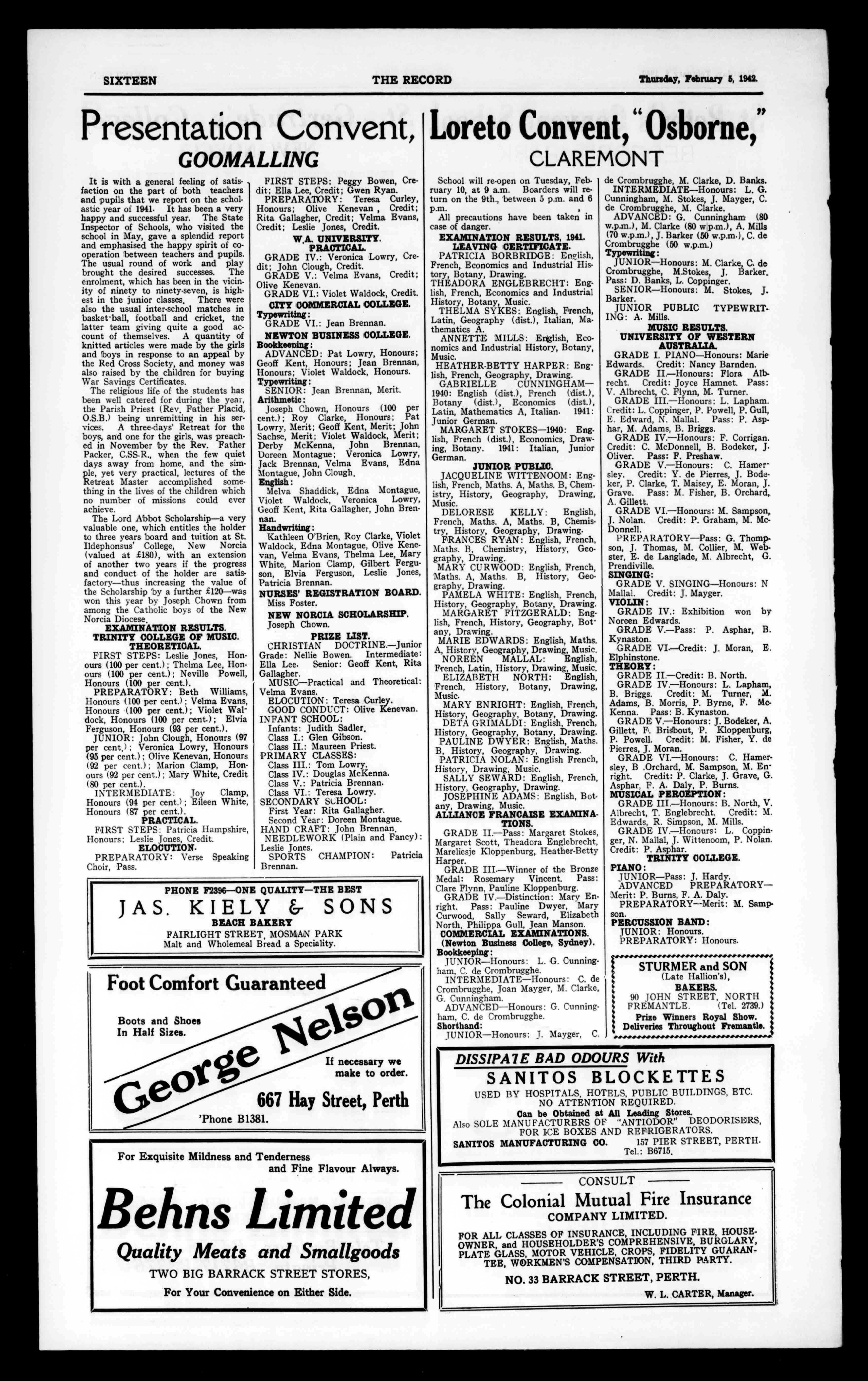
Schoolwillre-openonTuesday,Feb-
10,at9a.m.Boarderswillreturnonthe9th.,between5p.m.and6 p.m. Allprecautionshavebeentakenin caseofdanger.
EXAMINATIONRESULTS,1941.
LEAVINGCERTIFICATE.
PATRICIABORBRIDGE: French,EconomicsandIndustrialHistory,Botany,Drawing.
THEADORAENGLEBRECHT:English,French,EconomicsandIndustrial History,Botany,Music.
THELMASYKES:English,French, Latin,Geography(dist.),Italian,MathematicsA.
ANNETTEMILLS:Eniglish,EconomicsandIndustrialHistory,Botany, Music.
HEATHER-BETTYHARPER:English,French,Geography,Drawing.
GABRIELLE CUNNINGHAM1940:English(dist.),French(dist.), Botany(dist.),Economics(dist.), Latin,MathematicsA,Italian.1941: JuniorGerman.
MARGARETSTOKES-1940:English,French(dist.),Economics,Drawing,Botany.1941:Italian,Junior German.
JUNIORPUBLIC.
JACQUELINEWITTENOOM:English,French,Maths.A,Maths.B,Chemistry,History,Geography,Drawing, Music.
DELORESEKELLY:English, French,Maths.A,Maths.B,Chemistry,History,Geography,Drawing.
FRANCESRYAN:English,French, Maths.B,Chemistry,History,Geography,Drawing.
MARYCURWOOD:English,French, Maths.A,Maths.B,History,Geography,Drawing.
PAMELAWHITE:English,French, History,Geography,Botany,Drawing.
MARGARETFITZGERALD:English,French,History,Geography,Botany,Drawing.
MARIEEDWARDS:English,Maths. A,HistorY,Geography,Drawing,Music.
NOREEN MALLAL: English, French,Latin,History,Drawing,Music.
ELIZABETHNORTH:English, French,History,Botany,Drawing, Music.
MARYENRIGHT:English,French, History,Geography,Botany,Drawing.
DETAGRIMALDI:English,French, History,Geography,Botany,Drawing.
PAULINEDWYER:English,Maths. B,History,Geography,Drawing.
PATRICIANOLAN:EnglishFrench, History,Drawing,Music.
SALLYSEWARD:English,French, History,Geography,Drawing. JOSEPHINEADAMS:English,Botany,Drawing,Music. ALLIANCEFRANCAISEEXAMINATIONS.
GRADEII.-Pass:MargaretStokes, MargaretScott,TheadoraEnglebrecht, MareliesjeKloppenburg,Heather-Betty Harper.
GRADEIII-WinneroftheBronze Medal:RosemaryVincent.Pass: ClareFlynn,PaulineKloppenburg.
GRADEIV.-Distinction:MaryEnright.Pass:PaulineDwyer,Mary Curwood,SallySeward,Elizabeth North,PhilippaGull,JeanManson.
COMMERCIALEXAMINATIONS. (NewtonBusinessCollege,Sydney).
Bookkeeping: JUNIOR-Honours:L.G.Cunningham,C.deCrombrugghe.
INTERMEDIATE-Honours:C.de Crombrugghe,JoanMayger,M.Clarke, G.Cunningham. ADVANCED-Honours:G.Cunningham,C.deCrombrugghe. Shorthand:
.TUNIOR-Honours:J.Mayger,C.
deCrombrugghe,M.Clarke,D.Banks.
INTERMEDIATE-Honours:L.G. Cunningham,M.Stokes,J.Mayger,C. deCrombrugghe,M.Clarke. ADVANCED:G.Cunningham(80 w.p.m.),M.Clarke(80wlp.m.),A.Mills (70w.p.m.),J.Barker(50w.p.m.),C.de Crombrugghe(50w.p.m.)
Typewriting: JUNIOR-Honours:M.Clarke,C.de Crombrugghe,M.Stokes,J.Barker. Pass:D.Banks,L.Coppinger. SENIOR-Honours:M.Stokes,J. Barker.
JUNIORPUBLICTYPEWRITING:A.Mills.
MUSICRESULTS. UNIVERSITYOFWESTERN AUSTRALIA.
GRADEI.PIANO-Honours:Marie
Edwards.Credit:NancyBarnden.
GRADEII.-Honours:FloraAlb. recht.Credit:JoyceHamnet.Pass:
V.Albrecht,C.Flynn,M.Turner.
GRADEIII.-Honours:L.Lapham. Credit:L.Coppinger,P.Powell,P.Gull, E.Edward,N.Mallal.Pass:P.Asphar,M.Adams,B.Briggs. GRADEIV.-Honours:F.Corrigan. Credit:C.McDonnell,B.Bodeker,J. Oliver.Pass:F.Preshaw.
GRADEV.-Honours:C.Hamersley.Credit:Y.dePierres,J.Bodeker,P.Clarke,T.Maisey,E.Moran,J. Grave.Pass:M.Fisher,B.Orchard, A.Gillett.
GRADEVI.-Honours:M.Sampson, J.Nolan.Credit:P.Graham,M.McDonnell. PREPARATORY-Pass:G.Thompson,J.Thomas,M.Collier,M.Webster,E.deLanglade,M.Albrecht, Prendiville. SINGING:
GRADEV.SINGING-Honours:N Mallal.Credit:J.Mayger.
VIOLIN: GRADEIV.:Exhibitionwonby NoreenEdwards. GRADEV.-Pass:P.Asphar,B. Kynaston. GRADEVI.-Credit:J.Moran,E. Elphinstone.
THEORY:
GRADEII.-Credit:B.North.
GRADEIV.-Honours:L.Lapham, B.Briggs.Credit:M.Turner,M. Adams,B.Morris,P.Byrne,F.McKenna.Pass:B.Kynaston.
GRADEV.-Honours:J.Bodeker,A. Gillett,F.Brisbout,P.Kloppenburg, P.Powell.Credit:M.Fisher,Y.de Pierres,J.Moran. GRADEVI.-Honours:C.Hamersley,B.Orchard,M.Sampson,M.Enright.Credit:P.Clarke,J.Grave,G. Asphar,F.A.Daly,P.Burns.
MUSICALPERCEPTION: GRADEIII.-Honours:B.North,V. Albrecht,T.Englebrecht.Credit:M. Edwards,R.Simpson,M.Mills.
GRADEIV.-Honours:L.Coppinger,N.Mallal,J.Wittenoom,P.Nolan. Credit:P.Asphar. TRINITYCOLLEGE.
PIANO:
JUNIOR-Pass:J.Hardy.
ADVANCEDPREPARATORYMerit:P.Burns,F.A.Daly.
PREPARATORY-Merit:M.Sampson.
PERCUSSIONBAND:
JUNIOR:Honours.
PREPARATORY:Honours.
STURMERandSON (LateHallion's), i BAKERS. 90JOHNSTREET,NORTH FREMANTLE. (Tel.2739.)
PrizeWinnersRoyalShow. DeliveriesThroughoutFremantle.
DISSIPA7EBADODOURSWith SANITOSBLOCKETTES
USEDBYHOSPITALSHOTELS,PUBLICBUILDINGS,ETC. NOATTENTIONREQUIRED.
CanbeObtainedatAllLeadingStores.
AlsoSOLEMANUFACTURERSOF"ANTIODOR"DEODORISEIRS, FORICEBOXESANDREFRIGERATORS.
SANITOSMANUFACTURINGCO. 157PIERSTREET,PERTH. Tel.:B6715.
TheColonialMutualFireInsurance COMPANYLIMITED.
FORALLCLASSESOFINSURANCE,INCLUDINGFIRE,HOUSEOWNER,andHOUSEHOLDER'SCOMPREHENSIVE,BURGLARY, PLATEGLASS,MOTORVEHICLE,CROPS,FIDELITYGUARANTEE,WORKMEN'SCOMPENSATION,THIRDPARTY.
NO.33BARRACKSTREET,PERTH.
W.L.CARTER,Manager.
4110441.111110
DearCornerites,-Youareallbackat schoolnowandlookingforwardto learninghostsofnewthingsduring thecomingmonths.Itcertainlyisa greatfeelingtoknowthatyouhave goneupintoanewclassandareadvancinginlearning,andIwishyouall greatscholasticsuccessesthisyear. Forthosewhowillbetakingimportantexaminationsatthecloseofthe yearIwouldremindthemthatprayer forsuccesswillhelptheminmanyof theirdifficultsubjects.InMarchwe celebratethefeastofthegreatSt. ThomasAquinas,averylearnedman andpatronofscholars.Makehim ycurpatronSaintforthisyear. AUNTBESSY.
MosmanPark.
DearAuntBessy,-Kindlysendme thenamesandaddressesoftwoBushiestowhomIwishtosend"TheMessenger"and"TheRecord.' J.McC. DearJ.McC,-Ihavesentalong bothnamesandaddresses,andIknow youwillkeeptheselittlebushchildren wellsuppliedwithgoodliterature. Regularsuppliesmeanverymuchto theseoutbackfamilies-andCatholiclit, eraturewillhelptokeeptheFaithin ruraldistricts.
AUNTBESSY.
* *
DearAuntBessy,-Pleasefindenclosedpostalnotefor2/6.Iwas verypleasedtoseeyoureachedthe
SOUTHDOWNDAIRY.
402CANNINGHIGHWAY, SOUTHPERTH. Tel.MU1601
W.J.FERRIDGE&SON, DAIRYMEN. BottledMilkDeliveredifRequired. FreshandScaldedCream.
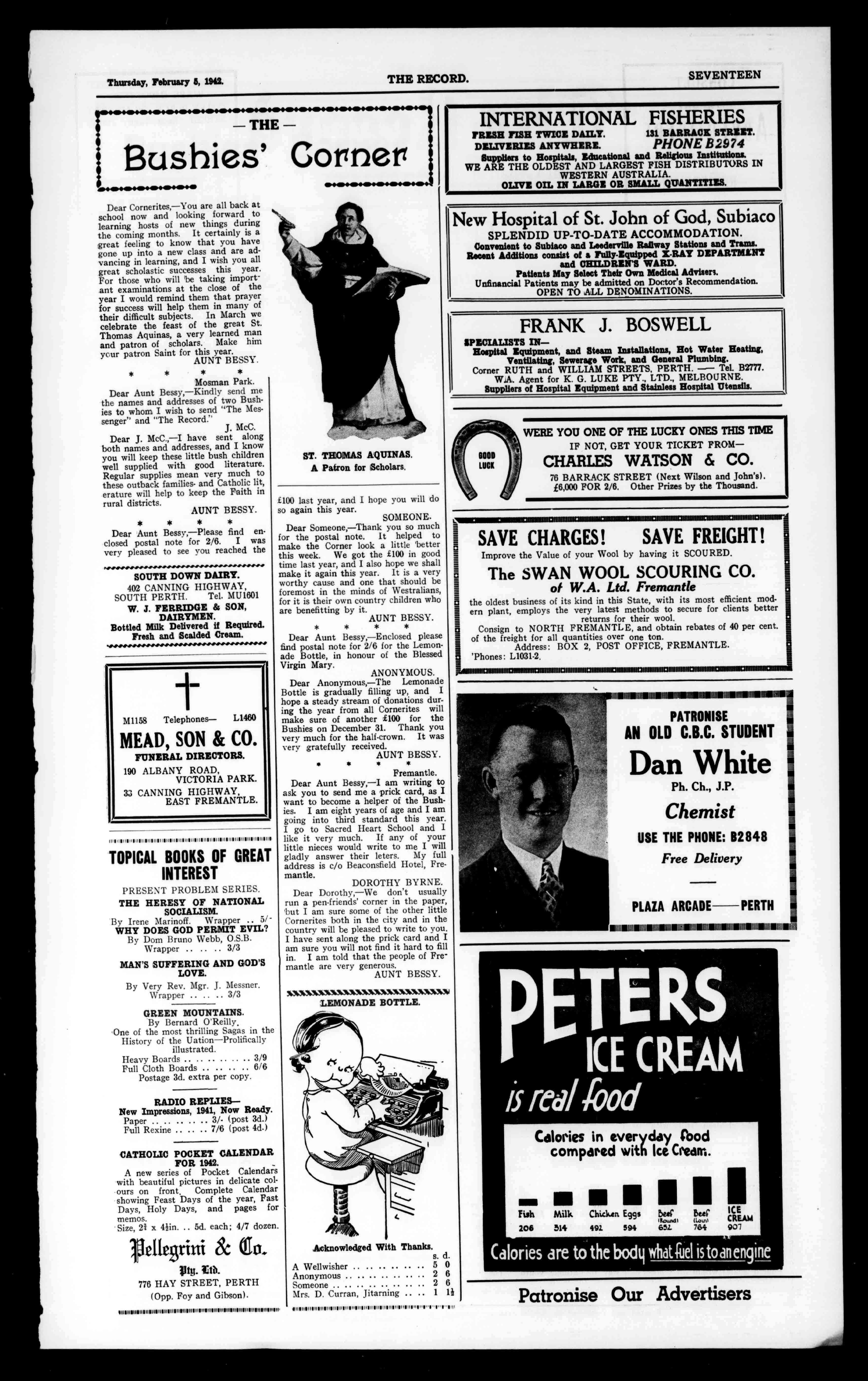
M1158 Telephones- L1460
MEAD,SON&CO. FUNERALDIRECTORS.
190ALBANYROAD, VICTORIAPARK.
31CANNINGHIGHWAY, EASTFREMANTLE.
1111d.11.1111118,1111114.11111111111121111111111.111111.11411111141,1
TOPICALBOOKSOFGREAT INTEREST
PltESEVI('R()BLENISERIES.
THEHERESYOFNATIONAL SOCIALISM.
HyIreneMarinoff.Wrapper 5/-
WHYDOESGODPERMITEVIL?
ByDomBrunoWebb,O.S.B. Wrapper 3/3
MAN'SSUFFERINGANDGOD'S LOVE.
ByVeryRev.Mgr.J.Messner. Wrapper 3/3
GREENMOUNTAINS. ByBernardO'Reilly.
OneofthemostthrillingSagasinthe HistoryoftheUation-Prolifically illustrated.
HeavyBoards 3/9
FullClothBoards 6/6 Postage3d.extrapercopy.
RADIOREPLIESNewImpressions,1941,NowReady. Paper 3/.(post3d.)
FullR.sine 7/6(post4d.)
CATHOLICPOCKETCALENDAR FOR1942.
AnewseriesofPocketCalendars withbeautifulpicturesindelicatecoloursonfront.CompleteCalendar showingFeastDaysoftheyear,Fast Days,HolyDays,andpagesfor memos. Size,21x4iin.5d.each;4/7dozen.
Petiegrini&To.
Pg.CO.
776HAYSTREET,PERTH (Opp.FoyandGibson). imensoonewsniusumwomweniniumniumml...4.
ST.THOMASAQUINAS.
APatronforScholars
1100lastyear,andIhopeyouwilldo soagainthisyear.
SOMEONE.
DearSomeone,-Thankyousomuch forthepostalnote.Ithelpedto maketheCornerlookalittle'better thisweek.Wegotthe£100ingood timelastyear,andIalsohopeweshall makeitagainthisyear.Itisavery worthycauseandonethatshouldbe foremostinthemindsofWestralians, foritistheirowncountrychildrenwho arebenefittingbyit.
AUNTBESSY.
* * * *
DearAuntBessy,-Enclosedplease findpostalnotefor2/6fortheLemonadeBottle,inhonouroftheBlessed VirginMary.
ANONYMOUS.
DearAnonymous,-TheLemonade Bottleisgraduallyfillingup,andI hopeasteadystreamofdonationsduringtheyearfromallCorneriteswill makesureofanother£100forthe BushiesonDecember31.Thankyou verymuchforthehalf-crown.Itwas verygratefullyreceived.
AUNTBESSY.
Fremantle.
DearAuntBessy,-Iamwritingto askyoutosendmeaprickcard,asI wanttobecomeahelperoftheBushies.IameightyearsofageandIam goingintothirdstandardthisyear. IgotoSacredHeartSchoolandI likeitverymuch.Ifanyofyour littlenieceswouldwritetomeIwill gladlyanswertheirleters.Myfull addressisc/oBeaconsfieldHotel,Fremantle.
DOROTHYBYRNE.
DearDorothy,-Wedon'tusually runapen-friends'cornerinthepaper, 'hutIamsuresomeoftheotherlittle Corneritesbothinthecityandinthe countrywillbepleasedtowritetoyou. IhavesentalongtheprickcardandI amsureyouwillnotfindithardtofill in.IamtoldthatthepeopleofFremantleareverygenerous. AUNTBESSY.
LEMONADEBOTTLE.
OPENTOALLDENOMINATIONS.
FRANKJ.BOSWELL
SPECIALISTSINHospitalEquipment,andSteamInstallations,HotWaterHeating, Ventilating,SewerageWork,andGeneralPlumbing. CornerRUTHandWILLIAMSTREETS,PERTH.-Tel.B2777. W.A.AgentforK.G.LUKEPTY.,LTD.,MELBOURNE.
SuppliersofHospitalEquipmentandStainlessHospitalUtensils.
WEREYOUONEOFTHELUCKYONES
(ContinuedfromFrontCover.)
thewrittenwordorprinterpage,by imageandsymbolinchurch,bypreceptandexampleandbyhispresence intheschools.Circumstancesprevent himfromfulfillingtherollofteacher oftheparish,sohedelegatesreligious menandwomentosharehisresponsibility.Itisnotafavour,butthe veryelementaryrightduetohisoffice aspastor,whenheasksthereligious teacherswhoconducttheschoolsto whichthechildrenofhisparishgo,to everkeepinmindthatitisbytheparishthattheessentialactivitiesofthe Church'slifearetobecarriedon.He hastherighttoexpectthatthereligiousteachers,whoteachtheboysfrom hisparishinColleges,andthegirlsin HighSchools,shouldnotmerelygive anintellectualassenttotheprinciples thattheparishistotheChuprchsomethinglikeacelltoanorganism,but thatheandsheshouldlivethatprincipleintheclass-rooms.Theparish istheultimateunitintheMystical BodyofChrist.Onthespiritualhealth oftheparishunitdependsthegrowth inholinessoftheChurch.Anditis hardtorealisethis,attimes,inthe pettyparishwheretheordinaryhumdrumdutiesoftheChurchsdailylife areperformed.Withinthatparish frameworkarealltheavenuesofservicewhichazealouspriestandanenthusiasticlaityrequire.Withinthe parishcriss-crossthepathsofsaint andsinner.Hereisthefinalarena whereinthefaithweteachinour schoolsislivedout,ordeserted.Our pastpupils,whethertheyamass wealthorremainpoor,whetherthey winfameorremainhiddenamongthe mediocrities,allofthemwillliveina parish,andofthemtheirpastorshas therighttodemandthattheyliveand actasgoodparishioners.Itwillbe apoorcompensationtothepastorifhe seesourpastpupilsprominentonbig occasionsatCollegeandConventreunions,wellinthelime-lightongreat daysforthediocese,andonthewhole, remarkablefortheirplatformattendance,iftheparishsodalitiesandsocieties,theparishactivities,socialand financial,know'hemnot.
WeFaceTheseDifficultQuestions:
AtthisConferencewe,theeducators ofCatholicYouthwithintheArchdiocese,cometogethertoseekasolution tothesedifficultquestions:-
1.Howmayourschools,HighSchools andColleges,educateourpupilsinparishconsciousness?
2.Howmaywedirectourchildren whilestillatschooltoactivitieswithin theparish?
3.Areourschoolsodalitiesandsocietiesfeedingtheparishones?Orare weperpetuatingdistinctionsbetween childrenoftheparishbyourownexclusivesodalitiesandsocieties?
4.Whatco-operationwiththeparochialclergycanweoutlinewhichwill unitepriestandteacherinthetremendoustaskofguidingourchildren tobuildtheirowncharacters?
5.Parent,priest,andteachermaybe saidtoconstitutetogetheroneand thesametempleofChristianeducation. Asweliveinthesametemplewhat avenuesofservicecanweexplore whichwillincreasethemutualhelp andunderstandingofparent,priest andteacherin'co-operatingwithdivinegraceinformingthetrueandperfectChristian,"whichthelatePope PiusXI.definedastheproperandimmediateendofChristianeducation?
Toquoteagainfromthatmemorable encyclicalonChristianEducation: "Thefirst,natural,andnecessaryelementasregardseducationisthefamily,becauseitwassoordainedbythe CreatorHimself" Parentcomesbeforepriestand teacherasthefamilycomesbeforethe schoolinitsresponsibilitytoGodfor theeducationofitschildren.Canwe, throughthechildrenstillwithus, arouseourparentstoafullerco-operationwithusintheformingoftheir childrenaccordingtotheidealsetfor usbythathomeinNazarethwhere "Hewassubjecttothem,"and"advancedinageandwisdombeforeGod andman?"
Tosuchquestionsourdiocesan teachers,withtheircustomarygenerosityofspirit,havegiventhemselves aroundtheircommunitytablesduring thesedaysofva.c.ati.m.MaytheHoly Spiritgivepointarylperpcsetothese discussionsduringth-secomingdays ofConference.Ana,niavwe,acting asyourdelegateswithintheschoo'sof theArchdiocese,ask orsGra-e's blessingsuponourwork.
CHINA,
OTLEYPLACE,OffMURRAY
STREET(RearSavoyHotel)
Convents,Colleges,Institutions
Kelly
Late
FIRSTSECTIONOFPAPERREADBYFATHERHUSSEYATTEACHERS'CONFERENCE.
Rev.FatherHussey,whoactedas ChairmanfortheopenforumdiscussionsconcerningCatholicActioninthe schools,madethefollowingintroductoryremarks:Introduction.
Duringthepastfewweeks,inpreparationforthisConference,there havebeensomelengthydiscussions amongsttheseniorteachersinalarge numberofourmetropolitanprimary andhighschools.Thesedisaissions haveservedaveryusefulpurpose, eventhoughitwillbeimpossibleto dealinthispaperwithallthepoints thatwerebroughtforward.Ofthe generalimpressionscreatedbythepreliminarytalks,oneisoutstanding: Thereis,amongstourteachers,an abundanceof"divinediscontent."
Thosewhoknowtheschoolsrealise thattheteachershavereasonforconsiderablesatisfaction.Amongstthe teachersthemselves,however,thereis noevidenceofcomplacency.Onthe contrary,thereisaveryrealanxiety toimproveonpresentpractice.
Howcanwecreateinourchildrena greaterdesireforholiness?Howcan wemakethemmorepious?Howcan wearouseinthemastrongerpridein theirCatholicfaith?Howcanwe improveourpreparationoftheseboys andgirlstomeetthechallengewhich thesepresentdayshaveflungdownto thefaithandpietyofCatholicyouth? Howcanwedevelopinthemthatmilitantapostolicspiritwhichwillgivereal CatholiccrusaderstoAustralia?These arequestionswhichyou,mydear teachers,areconstantlyproposing.Of youranxietytofindtheanswersthere isnodoubt.
Moreover,thetypeofquestionwhich isbeingaskedpointstoarealisation ofthetruththattheproblemcentres aroundthedevelopmentofcharacter andthedirectionofconductrather thanaroundthemethodsofimparting knowledge.Thereisarealdesireto avoidwhatarecentpublicationcalls "educationfromtheearsup." Isthisdesirebeingrealised?Thisis thequestionwhichtheConferenceis facing.Itisaquestionoftremendousimportance.
ScopeofPaper.
Inthispaperthefirsttaskistodefineitsscope.Inthefirstplaceit mustberememberedthatthissession isafollow-onfromtheyesterday'smore importantsession,duringwhichpracticallecturesonthebuildingofcharacteroftheadolescentboyandgirl weregivenbyRev.Dr.McMahon.Yesterdayyoudealtwithmanyofthe questionsyouhavebeenasking,and someofwhicharementionedabove. Thismorning'ssession,however,isto taketheformofanopenforumonthe difficultproblemofCatholicAction withinthetwelve-plusgroupinour schools.
Thereisalinkbetweenthetwosessions,andtofixitinourmindswewill recallthewordsspokenbyPopePius XItotheCatholicAssociationsof Romein1931:"CatholicActionmust consistoftwothings:itmusthavetwo phases-notnecessarilysuccessiveones -twodivisions,idealandmoral
Aworkofformationfirstofall:formationofintelligence,ofwill,of thoughts,ofsentiments,ofactiveinitiatives,oftruthfulness,ofsanctity.CatholicActionmusthaveasitspreliminarytheindividualsanctificationof eachofitsmembers,sothatthesupernaturallifeaboundsandsuperaboundswithinthem....Butafterthis firstelementofformationcomesthe second:thedistributionofthislife, theActionoftheApostolate."
To-daywearetodealwiththesecondelement,theactionoftheapostolate.Inyesterday'sdiscussionthe accentwasonCatholic-thismorning theaccentisonAction.
ImportanceofCatholicAction.
IntheAppendixII.ofActaetStatutaSynodiArchidiocesanaePerthensis primaeitisstated:"ThecalltoCatholicActionisdirectedinaspecial waytoCatholicyouth.Theformationoftheyoungshould,therefore,be theprimaryconsideration.Inthis
workourReligiousTeachershavea uniqueopportunityofrenderingthe mostpowerfulassistance,fortheCatholicschoolsareindeedthenurseries ofCatholicAction."
Twopointsaremadeinthisstatement:First,thepowerofreligious teacherstorenderinvaluableassistance toCatholicAction.Secondly,the workintheschoolswillbemainlyof aformativenature.Thefirstpoint: Thispowerwhichyoupossesstorenderinvaluableassistancecarrieswithit aresponsibilitywhichisgrowingmore andmoreimportant.Weneednot dwellonthevitalimportanceofCatholicActionTheneedofthehour isthewillofGod.Itisobviousto allthattheneedofthehouristhelayapostle.AndthesummonstoCatholicActionissimplyacalladdressedto Catholicstheworldovertoawaken totheapostolicobligationsandpossibilitiesoftheirlives-tobecomeapostles.Thisisthetaskofourcentury. Tootherageshavebeengivenother duties.TosomeithasfallentodefendtheFaithagainstheretics.To others,thetaskofarmingtomeetthe Saracenwhothreatenedtooverrun Europe.Laterstillwasthestrifeof theReformationandthesubsequent laboursofTrenttosettheChurch's houseinorder.
To-day,thoughcontroversyhasnot ceasedandthetheologian'slaboursare stillnecessary,ourforemosttaskisto recovertheterritoryofeverydaylife andconsecrateitafreshtoGod.The home,factory,shop,office,club,dancehall,sports-ground-theseareto-day's fieldsoflabour.Tocarrythegrace ofGodintothisterritoryisthetask ofthelay-apostle.Webadlyneed theseapostlesandtheproblemofsupplyingthemconfrontstheschools.
Thesecondpoint-thattheworkin theschoolswillbemainlyofaformativenature-mustnotbeunderstood tomeanthatintheschoolsnoprogresscanbemadetothesecondpha theactionoftheapostolate.Strictly speaking,oneshouldnotspeakofprogressfromonephasetotheotherbecausetheworkofformationisachieved,atleastpartly,"throughaction."
Now,itisperhapsfortunatethatthis principleof"formationthrough action"islimitedinitsapplicationto theschools,becauseitisaprinciple thatcanbeeasilyover-worked.However,itisobviousthatsomeavenues ofapostolicactionmustbefoundfor ouryoungapostles.Otherwisethe apostoliczealthatwesucceedinarousingwilllanguishforwantofsomething toworkon.Itisnoeasytasktofind suitableavenuesofactionforboysand girlsatschool,buttheymustbefound ifwearetosucceedinourworkofformationforthelay-apostolate. TheProblem.
Themainproblemconfrontingus inthisdiscussion,therefore,istodiscoverwhatwecangiveadolescent boysandgirlstodo,inordertointroducethemtotheactiveranksofthe lay-apostolate.
Ofthemanyotherpracticalpoints whichyouhaveraisedinourpreliminarytalkswecandealnowwithonly two.Oneconcernsco-operationbetweentheschoolsandtheparishes;the other,theuseofdiscussiontechnique intheclass-room.Theimportanceof thesepointsandtheirrelationtothe mainproblembeforeusinthisses-
sionwillbecomemoreapparentaswe proceed.
Toclarifythetaskbeforeusthe discussionwillbedividedunderthe followingheads:
1.SchoolandParish.
II.:SchoolandAction.
ILL:OrganisationofAction.
IV.:DiscussionTechniqueinClassroom.
I.:SCHOOLANDPARISH.
Theparishistheprimaryunitinthe hierarchicalorganisationoftheChurch. Moreimportantstillinthiscontract, isthefactthattheparishisforthe faithfulthesourceofthesupernatural life-thenormalchannelofsacramentalgracewhichistheformativeinstrumentofCatholicAction.Duringboth schoolandpost-schoolyears,ouryoung peoplearemembersofsomeparish. Theobjectofthissectionofourdiscussionistoexaminewhetheryouare givingthisfacttheprominenceand attentionthatitshouldreceiveinthe schools.
IntheConferenceprogramme,the followingquestionsappear:Areour highschools,boardingandday,neglectingtoeducatetheirpupilstoparish consciousness?Aretheproductsof theseschoolsremarkablefortheirinterestintheirownparochialaffairs?
Admittingthattheparishisthemost importantcellintheorganisationof theChurch,havetheseschoolsgivenit theattentionitdeserves?Arethe schoolsocietiesahelporahindranceto theparochialsocieties?
Parishesreportthatnumbersofcollegeandhighschoolpupilsandexpupilswillnotjointheirownparochialsodalitiesandsocieties.Thisis particularlythecasewhereboysand girlsattend,orhaveattended,schools outsidetheirownparishes.Thisisa problemwhichmustbefacedsquarely. Ifasatisfactorysolutioncan'befound, it llhelpconsiderablytowardsthe soutionofanotherproblem-thatof post-schoolleakage. Toomuchoftheblamefortheexistenceofthisproblemisplacedupon theschools.Youwilladmit,however, thatmorecouldbedoneintheschools tobringhometoadolescentstheimportanceofbeingmembersoftheir ownparochialsodalities,andoftaking anactiveinterestintheirparishaffairs. Iamgoingtoaskyounowtoexpress yourviewsonthesematters.
(Thediscussionwhichfollowedwas toolengthytoreportinfull.Itleft nodoubt,however,oftheteachers anxietytoestablishcloserco-operation betweentheschoolsandtheparishes. Thefollowingresolutionswerepassed unanimously:
(1)Boys'Schools:Day-boysattendingschooloutsidetheirparishes,should beconsecratedmembersoftheJunior HolyNameSociety(orothersodality), notintheparishwheretheirschoolis situated,butintheirownparishes. Eachschoolshouldhaveaboyappointedtoactasprefectoftheboysfrom hisparish.
Thissystemisalreadyoperatingin manyparishes.
(2)Girls'Schools:Theteachers wouldwelcometheformationofsimilarjuniorsectionsintheSacredHeart Confraternity.
Discussionaroseconcerningtheage ofadmissionintothesejuniorsections, butnofinalitywasreached.) (TobeContinued.)
MACFARLANE&CO.LTD.
WHOLESALEDAIRYPRODUCEMERCHANTS, POULTERERSANDSMALLGOODSMEN.
BESTQUALITYBUTTER,BACON,CHEESE,LARD,DRIPPING, TABLEAND000BINGMARGARINE,TABLEPOULTRY,AND SAUSAGESALWAYSONHAND.
ATRIALSOLICITED.
Address:48MURRAYSTREET,PERTH.
Telephones:B1438andB3777.