"Taste Tells"
SIXTY-NINTHYEAR.
PERTH,THURSDAY,JANUARY15,1942.
SIXTY-NINTHYEAR.
PERTH,THURSDAY,JANUARY15,1942.
TherecentbombingbytheJapaneseofNewGuineaandofTutuila, themosteasterlyislandoftheSamoanGroup,directsattentionto theseplacesascentresofCatholicmissionaryendeavour.ThefollowingaccountbytheRev.FatherJ.Murtaghshouldproveofgreat interesttoourreaders:-
SAMOA
When,in1889,AdmiralKimberley arrivedinSamoaonboardtheAmericancruiser,"TheTrenton,"heandhis followersreceivedaletterofwelcome, signedJosefo,Malietao,Mataafa,King ofSamoa.TheAdmiralwasunaware thatthebaptismalname,Joseph,placedsoprominently,hadshockedthe SamoanProtestantnatives,andthey haddumblybuturgentlybeggedMataafatosignhisnameashispredecessorshaddone.Topacifythewoundedfeelingsofhishereticalsubjects, MataafaremarkedthatEuropeanSovereignsboresimilarnames-Victoria, William,etc.-but,seeingthatthisin nowaysatisfiedthem,hesaid:"You askmetogiveupmybaptismalname; doesthatmeanthatyouonlyallowme tobeaCatholicinprivate,andthat,as KingofSamoa,Imusthavenoreligion?Well,then,IthinkmosthighlyofallofthenameIreceivedinBaptism,and,ifmysentimentsdonot pleaseyou,herearethetitleandthe honoursyouhaveconferreduponme; doasyoulikewiththem."Suchwas thefaithofJosephMataafa,principal ChieftainofSamoa,whodiedat Nfouhnouou(Apia)onthe6th.ofFebruary,1912.Itwassaidthathewas nearly90yearsold,anagerarelyattainedbythenativesoftheseislands. Hisrenownhadspreadfaroutsidethe boundariesoftheOceanianarchipelagoes,andeminentmenwhoknewhim welldidnothesitatetodeclarethat "fromthenobilityofhischaracterand histalents,Mataafamighthavewon anameinanyageorinanycountry."
Borninthemidstofpaganism,Mataafaatfirstledthecarelesslifeof youngchiefsofhisnativeland.Issue ofthenoblelineoftheToupouas,which hasgivenmostofherkingstoSamoa, hisonecarewastoenjoytheprivileges ofhisprincelybirth:alifeofidleness, ofrovingwherehewilled,andofpleasure,Paganmoralsinthosedaysleft theyoungchieftainnoothercourse;his greatnessandrenowndependedina
greatmeasureonthenumberofhis wives. Ofthese,itissaid,Mataafahadover ahundred.Aneasymatterinhiscase, for,totheadvantageofbirth,hejoined aremarkableperson,alwayshaving beenconsideredoneofthehandsomest meninSamoa.Addtotheseadvantages,awell-meritedreputationfor strength,abilityandcourage.
Uptothetimeofhisbaptismthen, Mataafawasapolygamist,andwhen hehadmadeuphismindtoembrace theCatholicreligion,hestillkeptfive wives,andtheMissionariesenjoyedthe novelspectacleofseeingtheladies goingregularlybycommandoftheir mastertoweedthefields-Finaly, gracetriumphed,andMataafaannouncedhisresolveofachangeoflife.He wasbaptised,and,thesamedaymarriedtoayounggirlfromToutouila, namedElizabeth,andneverwasthere ahappierormoreunitedpair.Mataafa chosetosetasidetheancientSamoan custom,whichonlyallowedthewife aninferiorplaceinthehousehold:he madehisElizabeththetruecompanion ofhislife,evenshowingherevery markofhisesteemandaffectionin public.
Shediedwhilestillyoung,and,wishingtoremainfaithfultoherevenbeyondthetomb,Mataafanevermarried again.Everynighthehadadecade oftheRosarysaidinthefamilyforthe reposeofhersoul,andhewasoften foundkneelingbesidehergravein tears.
OnMarch18,1868,hewasbaptised bythenameofJoseph,beingthen nearlyfortyyearsofage.Itwould beanexaggerationtosaythatreligion transformedMataafasuddenly,and made,withoutaperiodoftransition,a pagansoulintoanirreproachable Christianhero.
But,fromthedayofhisbaptism,he became,byhisobediencetotheworkingsofgrace,amanandaChristian, whoseequalonewouldseekinvain throughouttheislandsofthePacific.
Catholicmissionariesmetwithfewso endowedwiththespiritofprayer.He saidtheRosaryandmadetheStations oftheCrossdaily,andoftenwithdrew fromworldlypleasurestospeakwith hisGod.Severalvolumeshavebeen writtenontheSamoanwars,andall agreeincreditingMataafawithacourageandabilityinconductingoperationsthatwouldhavedonehonourto anyEuropeanGeneral.Inabattle. foughtafewmilesfromApia,ammunitionfallingshort,averitablepanic seizedthewarriors.Thechiefswere doingtheirutmost,invain,torally thesoldiers,whenMataafa,hisrosary inonehand,hissceptreintheother,advancedaloneinfrontoftheenemy,He savedthearmybythisonecourageous act.
Hispoliticalcareerwasbesetwith difficultiesthatwouldhavediscouragedalessfirmcharacterthanhis.Three timeselectedtothethronebythefull consentofthemajorityofhispeople, yetdethronedeachtimebytheinterventionofEurope,hewassetaside withviolence,thenexiled,andonlyenjoyedpeaceatasomewhatadvanced age.Histact,prudence,andupright conductindealingwiththeGreat Powers(Germany,England,andthe UnitedStates),whichdisputedforhis kingdom,enabledhimtotriumphfinallyoverallobstacles.Thecelebrated Englishwriter,RobertLouisStevenson,whodiedinSamoa,payshimthe followingtribute:"Mataafaisanative ofexceptionalcharacter.Iscarcely daretosayofaSamoanthatheissincere,thoughIhavemetwiththe phenomenon,butImustsayofMataafathatheappearstobemanifestly andinvariablytheenemyoffalsehood." MataafawasalwaysaCatholicanda Christiankingduringtheyearshis countryhadtostruggleagainstparty intriguesandcivilwar-Newspapers alltheworldoverspokeofhishumanityandgenerosityin1889,atthetime whentheterribledisasterofthatyear claimedsomanyvictimsinthesearoadsofApia.Sevenwarvessels, belongingtoGermany,Englandand theUnitedStateswereanchoredinthe port,whenafearfulcycloneblewdown upontheislands,Oneshipaloneescaped;alltheotherswerewrecked uponthereefs.Mataafacamefrom themountains,whitherhehadretired beforetheenemies'cannon,andsenta hundredofhiswarriorstohelpthe ship-wreckedcrews.Stevensonhas describedthisdramamagnificently,a dramainwhichsomanybravesailors
losttheirlives,thesurvivorsowing theirlivestothemagnanimityofa Christianchief.Thischiefforgotthe war,andonlysawbrothersintheunfortunatebeingsbattlingwiththe wavesfortheirlives.Tiedtogether, thesoldiersbravelyflungthemselves intothesea,inspiteofthefearfulrush ofwater,andsucceededinsavingmany ofthesailors.ThiswasMataafa's noblevengeanceonhisenemies.
HewasfinallyexiledbythePowers forfiveyearsontheJaluitIslands;he foundhisgreatestconsolationinthe practiceofChristianvirtue,andwon thesympathyofallthewhiteswho knewhim.
Atthecloseof1900hereceivedfrom theGermanGovernment-whichhad restoredhimtohisnativeland-the titleofAlitSili,orHeadChieftainof Samoa,whichheretaineduptohis death.
Suchis,inbrief,thestoryofMataafa.
InthepeninsulaofMoulinouou,a fewpacesonlyfromthetombofthe German,EnglishandAmericanmarineskilledduringthewarbythebulletsofhissoldiery,standsthebeautifulmausoleuminwhichMataafarests. Thenumerousreligiousinsigniawhich hecausedtobeengraveduponita shorttimebeforehisdeathwilltell generationstocomethatthelastKing ofSamoawas,beforeallthingselse,a grandCatholic.
Samoa-ortheNavigators'IslandswasmadeaVicariateApostolicin1851, thepresentBishopbeingHisLordship MostRev.J.Elarnand,S.M.,whowas consecratedatApia,Samoa,inMay, 1920.Thereare14millioncentres spreadoverthearchipelago,with21 priests,14lay-Brothers,57whiteSisters,25nativeSisters.Over5,000childrenattendtheVicariate'shundred schools,whilethetotalCatholicpopulationisover13,000souls,
In1896,theVeryRev.FatherEberhardLimbrock,oftheSocietyofthe DivineWord,withtwoFathersanda coupleofBrotherslandedinCentral NewGuinea.TheGermanNewGuinea Companywastheninchargeofthe colony,andtheofficialstoldthe Fathers:"IfyoustayhereinMadang wecanofferyousomeprotection,but ifyougototheTumleoIslandyouare responsibleforyourownsafety."To Tumleotheywent,andpeopledidnot welcomethem.Thernissionersbuilt awoodenhouse,whichBrothershad markedandmorticedfortheminHolland,andtheyerecteditonirontubes
(ContinuedonBackCover.)
''Oh,doctor,"criedawild-eyedman, "I'mdreadfullyafflicted.Theghosts ofmydepartedrelativescomeand perchonthetopsofthefence-posts allroundmygardenwhenduskisfalling.Icanlookoutintothegloaming anyeveningandseeacoupleofdozen spookssittingontopoftheposts,waiting,waiting,waiting!WhatshallI do?"
"Sharpenthetopsoftheposts,"
Asthebattalionmarchedon,one wearysoldierfellout.Sittingdown bytheroadside,hetookoffhisboots toresthisfeet.
"Howfarisittothecamp?"heaskedapassingfarmhand.
"Aboutfourmilesasthecrowflies,' wasthereply.
"Ay,"repliedthesoldier,"buts'pose theblinkin'crowhadtocarryarifle andpackweighing'arfatonandwith blistersonbothheels,howfarisit then?" * * * *
Withamodesttaponthedoor,the newofficeboyenteredthemanager's room.
"Please,sir,"hesaidnervously,"I thinkyou'rewantedonthetelephone:'
"Youthink,boy!"snappedthemanager."What'sthegoodofthinking?"
"Well,sir,someoneattheotherend said,'Isthatyou,youidiot?'"
* * *
LittleTommylookednervouslyinat thekitchen,wherehismotherwas restingafteralongspellatthewashtub.
"Oh,mother,"saidthechild,"are youfeelingtired?"
"Yes,"shemurmured,"I'mfair wornout.Ican'tliftmyhandtodo anotherstroke,
Tommyboldlyapproachedher.
"Well,mum,"hesaid,"Ijustwant totellyouthatIdroppedthebagof eggsonthewaybackfromtheshop."
*
"SinceI'vebeeninloveIcan'teat, Ican'tdrink,Ican'tsmoke."
"Whynot?"
"I'mbroke!"
* * * *
"Yes,"saidHardup,ashesettled downinisfavoritecornerattheclub, "moneysimplymeltsaway.It'simpossibletosaveacoppernowadays."
"Ithinkmuchdependsontheformationofourearlyhabits,"remarked aclubmate.
"Yes,you'requiteright,there,"repliedHardup,sadly."BeforeIstartedtowalkmymotherpaidanursemaidtoshovemeaboutinapramand I'vebeenpushedformoneyever since." * * * *
NewBoarder:"What'sthefoodlike here?"
OldBoarder:"Chickeneverymorn ing." NewBoarder:"Chickeneverymorn. ing?That'sfine,Howisitserved?"
OldBoarder:"Inashell."
* * * *
"Isyourhouseverydamp,Mrs. Smith?"
"No,Tommy:whatmakesyouthink that?"
"Becausefathersaysthereissomuch dueonit."
* * * *
AnEnglishmanobtainedleavefrom worktoattendawedding,Hereturnedwithtwoblackeyes.
Theforemanaskedhimwhat11, happened.
"WhenIgotthere,"repliedtheman, "Isawafellowalldresseduplikea peacock.`Andwhoareyou?'says I.'I'mthebestman,'hesaid,and "hewas,too!"
* * * *
Itwasahotafternoonandthesummersalehadcrowdedtheshop.Tempersrosewiththetemperature,and theassistantswerehavingahectic time. Onewomanwhohadfoughtherway toacounterthoughtshewasn'treceivingsufficientattention, "IfIweretryingtomatchpoliteness,"shesnapped,staringatanassistant,"I'dhaveahardtimeinthis shop."
"Madam,"repliedtheassistant,"will youkindlyletmeseeyoursample?"
Shehadjustsaid"No"verykindly butfirmly,andhefelthehadagrievance.
"Whydidyouleadmeon?"hedemandedbitterly."Whydidyoulet metakeyourunsinthecareveryday, andtodancesandtheatresevery night?Whydidyouencourageme whenyouwerealreadyengaged?"
Hangingherheaddemurely,the missreplied:
"Iwantedtotestmylovefor Edward."
* *
Afterbearingtheroughshavefora whileinsilencethecustomerremarked:
"Halfaminute!Haveyougotanotherrazor?"
"Ofcourse,sir,"repliedthebarber boldly."Why?"
"Oh,IthoughtI'dliketodefend myself!"
* * * *
Shewassuchadearoldladythat everybodywantedtotakecareofher. Sothebusconductorwaitedpatiently whileshereadthroughtheplaces shownonthedestinationboard.
Thensheaskedatlast:
"IsthisaBarkingbus?"
"No,ma'am,"repliedtheconductor gently:"thisonepurrs."
* * *
Heleanedoverthefenceandsawhis neighbourhardatworkinthegarden.
"Beenatitlong?"heasked.
"Yes,"sighedtheworker,dejectedly."Sinceseveno'clock," "GoodHeavens!"gaspedtheother. "Iwouldn'tthinkofsuchathingas workingatthathourinthemorning."
"Iwouldn'teither,"camethereply. "Mvwifethoughtofit."
*
Furthreedayshehadleanedover thefence,watchingtheA-R,P.demolitionsquadatworkontheruins.
Bowlerhatonthebackofhishead, anoldclaypipestuckinonecorner ofhismouth,hejuststoodandstared withoutaword,Finally,towards theendofthethirdday,theforeman's nervesbrokeunderthissilentscrutiny. Hewentovertothesolitaryspectator.
"Listen,"hesaid."Haven'tyou gotanythingbettertodothanwatch otherpeoplework?Ormaybeyou're interestedinthisparticularproperty, eh?"
Themanremovedhispipefromhis mouth.
"Well,inasortofway,chum,"he said. usedtolive'ere!"
"Lumme!"exclaimedtheforeman. Thenheturnedtohisgang,"Pack up,boys,"heshouted."Here'sthe blokewe'vebeendiggingfor."
Abuy,askedtodefineanatomy, wrote:-
"Anatomyisthehumanbodywhich consistsofthreeparts,thehead,the chistandthestummick.Thehead containstheeyesandbrains,ifany. Thechistcontainsthelungsanda pieceofliver.Thestummickisdevotedtothebowels,ofwhichthereare five,a,e,i,u,u,andsometimesyand w."
* *
"Sandy,lad,"saidMacDougalltohis son,"ye'regettin'marritth'mornin'. Here'saweemoosetrapforye.If there'sanythin'awomanhatesmore thanamouse,'tisamoosetrap.Takan auldman'sadvice,Sandy,an'setit iverynichtwhenyegangtobed,Then putthesitterfromyourpocketunder thespring."
* * * *
Asmallevacueewashurryingto school,Ilewaslateandontheway hekeptsaying:"Please,God,don'tlet mehelate."
Atthatmomenthestumbledand fell.Hepickedhimselfupslowly andmuttered,"Allright,youneedn't pushme,"
* * * *
Ahumanesocietyhadsecureda showwindowandfilleditwithattractivepicturesofwildanimalsintheir nativehaunts.Aplacardinthemiddleoftheexhibitreadthus:''Weare skinnedtoprovidewomenwithfashionablefurs."
Amanpausedbeforethewindow, anharassedexpressionforthemomentgaveplacetooneofsympathy, "Iknowjusthowyoufeel,oldsports, hemuttered."SowasI!"
* * * *
AftertheserviceoneSundaymorningthevicarwasapproachedbyan oldladywhoexpressedgreatappreciationoverhisdiscourse.
"Why,vicar,'shesaid,"youcan neverknowwhatyourservicemeant tome.Itwasjustlikewatertoa drowningman."
GAYNOR'SHISMAJESTY'SHOTEL
HAYSTREET PERTH.
EXCELLENTCUISINE MODERATETARIFF.
OntheRoad, BBedaCity
FirstClass Accommodation.
ALLLEADINGLINESOFLIQUORSTOCKED. 'Phone:B3418. M.CRANLEY,Proprietor,
CORNERKINGANDMURRAYSTREETS.
NOWUNDERPERSONALSUPERVISIONOF K.D.HEENAN,PROPRIETOR.
HOTELPERTH
JACKEDDINGTON, Proprietor.
ExcellentAccommodation
STAN.O'BRIEN COURTHOTEL PERTH.
PhoneB4281
HOTELBEACONSFIELD FREMANTLE.
OverlookingtheOcean SuperiorAccommodation. Modera'eCharges. M.BYRNE LateofGrandandShamrock Hotels,Boulder).
SUBIACOHOTEL
FIRST-CLASSACCOMODATION
'Phone:W1028. A.jMclIENRY,Proprietor.
VICTORIAHOTEL
HAYSTREET,SUI3IACO. RenovatedThroughout. EssenceofComfort. W.F.ARTIS,Proprietor. (LateofBalmoralHotel,Vic.Park)
COUNTRY.
DukeofYorkHotel NARROGIN.
ReconditionedandRefurnished. NewLounge,DiningRoom,and CommercialRooms. ARTHURBOYLAN,Proprietor tLateGeorgeHotel,Perth
FREEMASON'SHotel TOODYAN. ExcellentCuisine.
AmaticeRefrigeratorInstalled OldandNewFriendsare CordiallyWelcomed MRS.E.WING,Proprietress
Telephone:B4094,
GOLDFIELDS.
TRYHANNAN'SLAGERatRodBecton's
HANNAN'SHOTEL
HANNANSTREET, KALGOORLIE.
STAR&GARTERHOTEL
PeterMaurinisoneofthemostimportantmeninmodernAmerica.As co-founder,withDorothyDay,ofthe "CatholicWorker,"heisleaderofa movementaimedatrebuildingsociety onafoundationofChristiancharity. AlloverAmerica-onstreetcorners, inparks,in"jungles"alongtherailroadtracks,inschools,colleges,and universities,andinsomeofAmerica's besthomes-PeterMaurinhasbeen preachinghisgospel:"FeedthehungryforChrist'ssake;shelterthehomelessforChrist'ssake;instructtheignorantforChrist'ssake."
WhenPeterMaurintalksthiswayandhealwaysdoes-itmeanssomething,forPeterpractiseswhathe preaches.Ifhehasadimeinhis pocket,heislucky.Hisclothesare shabby-whateversomebodygavehim aftertheywereprettywellwornout. Hisshoesarethick-soledandcomfortable-high-topped,heavyworkman's shoes.Hissocksfalldownoverhis shoetops,andwhenhesitsdownhis long,heavyunderwearshowsbetween hisshabbypant-legsandhisknotted shoe-strings.Usuallyheneedsashave, andmostofthetimehisshort,grey hairisuncombed,Hisfaceisrough hewn,hisneckiscorded,hishandsare gnarled. FeelsatHome.
Whenhegetsoutofthe'jungles," theslums,ortheCatholicWorker homes,helooksoutofplace. But whereverhegoes,PeterMaurinfeels rightathome-inanArchbishop's studyorinaflophouse.
WhenPeterMaurintalks,everybodylistens,andeverybodylearns something.HismessageistheGospel ofChristputintoactionthroughvoluntarypovertyandtheworksof mercy.HebelievesthatGodwants ustobeourbrother'skeeper:Tofeed thehungry,toclothethenaked,to shelterthehomeless,toinstructthe ignorant-allatapersonalsacrifice.He wantshousesofhospitalityforthe homeless,farmingcommunitieswhere mencanearntheirdailybreadatdecentlabour,workers'schoolswhere poormencanlearnChristianityand socialjustice.
Twenty-ThreeinFamily.
BehindPeterMaurinto-dayliemore thansixtyyearsofa epicalmostunmatchedinmodern times.HewasborninSouthern France,oneofapeasantfamilyof twenty-threechildren.Asaboy,he walkedmileseachSundaytoattend MassinanancientRomanesquechurch, Hisfirstjoboffthefarmwasselling coffeeandtea.Scarcityofsalesforced himtogotoParis.By1909hewasin Canada,stakingoutahomesteadin Saskatchewan,andtryingtoekeouta livinginthewilderness.
Whenhispartnerwaskilledina huntingaccident,Petergaveuphis claimandwentonthetramp.
Trampingaroundthecountryhad givenPetertimetodoalotofthinkingandalotofreadingabouttheills ofsociety,liehadreadaboutKarl Marx,butCommunismdidn'tappealto him;hewasinclinedtowardsanarchism.Throughtheseyearshehad MOH111801119111011111,11111.111.01HIMIOVI.S111111.1111111111
Editedby DOMGASPARLEFEBVRE,O.S.B.1iyC.J.MacNEILL,inthe"Advocate:* notbeenworkingovertimeathisreligion,butwheneverythingelsefailedto produceananswertotheproblemshe wasmullingoverinhisbigpeasant's head,heturnedbacktohisboyhood religionandfoundtheanswerinChristiancharity. Hethoughtheknewwhatwaswrong withtheworldandwhatwouldcure it.Theworldlookedprettycrazy, andhedecidedtobecrazyinhisown way-tobecrazyforChrist.
EasyEssays.
AtKingston,N.Y.,in1927,hetold theRotaryClub:"Ifyouputtoomuch moneyintobusiness,youaregoingto putbusinessoutofbusiness."And theydid,hesays;"sonowtheycallme theprophetofthedepressioninKingston."
TheKingstonaffairshowedhim thathecouldtalktopeople,andhe movedinonUnion-square,thesoapboxcentreofNewYorkCity,tobegin preachingthesocialdynamitehehad discoveredintheancientreligionof Christ.Itwasabouttimetoblowthe lidofftheChurch'sstoreofdynamite, andhewasjustthemantodoit. "Union-square,"hesays,"wasinthe processofbecomingRed-square,So IwenttheretokeepUnion-square Union-square." Whenhedecidedthatitwaseasier tomakepeoplereadthantomake themlisten,hebegantoputhis"Easy Essays"onpaper,theninbooks.
DorothyDay.
InDecember,1932,hereadsomeof DorothyDay'sarticlesinthe"Sign" andthe"Commonweal."Herewasa womanwhothoughtashethought. Peterdroppedhispickandrushedinto NewYorktoseeDorothy,theex-Communistnewspaperwoman,whohad joinedtheChurchin1927, Hisprogrammewascomplete:Vol. untarypoverty,education,housesof hospitality,farmcommunes.That isstillthebasicprogrammeofthe movement.
Povertyisnotanendinitselfin Maurin'sprogramme,butameansof bringingpeopletoChrist."Poverty," saysthe"CatholicWorker,"isholy (whetherinvoluntaryorvoluntary), becauseOurLordsharedit.He showedHimselffirsttothepoorshepherds.HewasaworkerHimself. PovertybringsusclosetothoseChrist loved.Wechosetolivewiththepoor, eatwiththem,shareourclothes,our meanswiththembecauseweloved Christinthem. ."
Indoctrinationofthemassesisa basicpointintheprogramme.Religiousandsocialeducationhavebeen carriedonconstantlysincethemovementwasfounded-throughthe monthly"CatholicWorker,"through pamphlets,articles,publicaddresses, round-tablediscussions,organised classes,butmainlythroughtheexamplegivenbytheCatholicworkers themselves. FarmCommunes.
Offarmcommunes,Peterwrote: "Theunemployedneedfreerent;they canhavethatonafarmingcommune. Theunemployedneedfreefood;they cancutthatonafarmingcommune. Theunemployedneedtoimprovetheir minds;theycandothatonafarmingg commune.Theunemployedneed spiritualguidance;theycanhavethat onafarmingcommune."Thiswas thetheory,anditisnowthepractice onthefarmsconductedundertheauspicesofthe"CatholicWorker."
DorothyDaytooktoPeter'splan immediately,andmonthslaterthenew movementwasunderway.OnMay1, 1933,appearedthefirstissueofthe "CatholicWorker,"with2,500copies published.
"Forthosewhoaresittingon benchesinthewarmspringsunlight.
Forthosewhoarehuddlinginshelters tryingtoescapetherain.Forthose whoarewalkingthestreetsintheall butfutilesearchforwork.Forthose whothinkthatthereisnohopeforthe future,norecognitionoftheirplight, the'CatholicWorker'isbeingedited. Itisprintedtocalltheirattentionto thefactthattheCatholicChurchhas asocialprogramme.It'stimethere wasaCatholicpaperfortheunemployed,"FirstHospitalityHouse.
ByautumnthefirsthouseofhospitalitywasopenedinNewYork.After
longcannotresistthefaiththatinspiressuchcharityaslivesinthehomes ofthe"CatholicWorker."
God'sAmbassador.
PeterhasheadquartersinNewYork sincethe"CatholicWorker"wasfoundedsixyearsago,butheisstillonthe trampabouthalfthetime.Every yearhegoesroamingaroundthecountry,travellingby'busandstopping whereverpeoplewilllistentohim.
usingseveralpoorflatsforatime,the CatholicWorkersmovedintoathreestoryhouseinCharles-street.In1936 theymovedagain,to115Mott-street, intheslumsofChinatown.FromSt. Joseph'shouseinMott-streetDorothy DayandPeterMaurinhavedirected thegrowthoftheirmovement.
IthasbeentoughgoingatSt.Joseph'shousemostofthetime,butthey havekeptgoingsomehow.Bishops, priests,professors,drunks,andpros tituteshaveallcometnere,andstill do,tolearnfromtheCatholicWorkers andtohelpthemoutintheirprogramme.
Fromhousesofhospitalityitwas onlyasteptothefarmcommunes,and inApril,1936,the"CatholicWorker" tookpossessionofitsfirstfarmouton StatenIsland.
Nowthereareatleasttwenty-five housesofhospitalityscatteredoverthe country,thecirculationofthe"CatholicWorker"hasgrowntoover125.000, themessageisreachingthemasses.
Ackepspiritualitypervadesthe homesandthefarms,Mass,Communion,andtheOfficialPrayerofthe Churchareonthemustlistforallthose wholivethelifeofthe"Catholic Worker."Noreligionisforcedonthe menandwomenwhocomeseekinga mealorabed,butthosewhostayfor
Heneverworriesaboutwherehe willeatorsleepathisnextstop.He isGod'sambassador,andGodtakes careofHisown,
Whereverhegoes,Peterisworking forabetterworld,doingthejobofthe ApostleofCharity.Buthemakesno regularreportstoheadquartersin NewYork,andsometimestheyget worriedabouthim.Thingsaren'tthe sameinMott-streetwhenPeteris away.LastyearhehadbeenunheardofforsolongthatDorothyDay finallywrotehimanopenletterinthe "CatholicWorker,"begginghimto comebackoratleastletthemknow wherehewas.
Onhistravelsoverthecountry Peterleavesbehindhimlittlegroups ofdiscipleswhohavecaughttheinspirationthatishis.Wherehisspirit grows,therespringuphousesofhospitality,whereapoorfellowcanget abedandadecentmealwithnoquestionsasked,andfarmingcommunes, whereamancansupporthimselfin frugalityonhisownlabours.
PeterMaurinisstirringtheleaven ofChristiancharityintosociety,and theleavenisbeginningtowork.
1,1,111.11111111,11111.111111114111H1H.14111.111111.11111.4
SavemoneyonStoves,Coppers, Baths,BathHeaters,andRepairs.W.A. StoveCo.,559WellingtonSt.(B6307). 411111111111i11111111111111111111111111111111111111111111111111111.11111111,1.
WEREYOUONEOFTHELUCKYONESTHISTIME IFNOT,GETYOURTICKET
TheotherdayIwasreadingamost interestingandthrillingaccountina Canadianmagazineofthevoyageof fourmeninalife-boatfromsomedis tanceoffIrelandtotheshoresofIceland,andtheamazingpartofthestory wasthatofthefoursurvivorsofthe wholepartythatoriginallysetoutonly oneofthemenwasnotinanyway sufferingfromtheeffectsofsuchaperilousseatrip.Theotherthreemen werefrostbittentosuchadegreethat theysufferedthelossoffeetorarms. Thisonemansethimselfarigorous courseofactionthatwouldnotallow hiscirculationtoflag,andbysteadily andcourageouslystickingtohisrule tokeephiscirculationgoingheavoidedthetragedythatovertookhisother companions.
AsIreadthatstoryIthoughtof howoftenwesetourselvesacourse ofconduct,andofhoweasilyweare deflectedfromthatcourse,mostlyI thinkfromlaziness.Haveyouever thoughtofhowweallowthesinof slothtowinditselfintoourlivesso thatitisnotanexaggerationtosay thatveryoftenitchangesourwhole lives?
Inthefirstflushofenthusiasmof somecourseofactionwemaybeso surethatwewillreachourend,but graduallyitjustbecomestoomuch trouble,andbydegreesweletsloth turnusfromourappointedcourse.The troubleisthattheturningfromthat courseissoverygradualthatwedo notrealisethatweareleavingtheroad thatwillbringustoourgoal.So oftenwedropthislittlehabitorthat lifelonggooddeedbecauseitbecomes toomuchtroubleonsomeparticular occasion,andoncethebreakismade itissomucheasiertogivewaytothe sameexcusethenexttimeitpresents itselftous.
StickIt!
Howveryfewofustherearewho cansteadilysetourselvestoadaily routine,andsticktoit;andwesoseldomrealisethatitisjustthisdaily strengtheningofourwillthatweneed sobadly,Howveryoftenwewould findourselvesstrongenoughtoface ourbigtrialsifwehadmadeourselves strongbythefaithfulperformanceof littleactsofthewill.
Haveyoueverthoughtofwhatleads somanytoanindifferencetowardsthe Faith?Thereareafewcaseswhere somesuddenpersonalexperiencehas embitteredsomesoulandtragically turnedthemfromthesourceofall sweetness,butinmostcasesthedeclinefromthepracticeoftheFaith isgradual.Isthisnotthelotof manyayoungmanorwoman?
Perhapsfirstaskimpingofmorning prayer,thennonightprayers:thenit reallyistoomuchtroubletobeready togoouttoSundayBenediction:and oneSundaymorningcomesand"Why shouldIgetupforMass?"orperhapsitis,"No,Iwon'tgotoearlyMass thismorning.IwenttoCommunion lastweek;I'llgotolateMassto-day.' Nextweekitisthesame,andinamatterofmonthsattendanceatSunday Massisamatteroffeelingwhetherone isuptoitornot!Perhapssomeproblemarisesaboutreligion;well,we mustlookupthesolution oh,it issuchafag!Itmeantgoingtoa Catholiclibrary,orpayingaspecial visittoapriest,anditistoomuch bother. MaketheEffort, Isupposeinjustthesamewayvery oftenpeoplefallintothehabitofvery infrequentconfession.Theeffortis justtoomuch.Itmeansacertain effortandaspecialarrangingoftime. Whenthelittleeffortswerefirstforegonethepersonwhosoacteddidnot meanforaminutetolettheiraction developintosuchahabit,andlittle thoughtthattheywouldintimebecomesolaxinthepracticeoftheir Faith.
Idonotmean,ofcourse,thatjust becausewebreakourregularhabit onceinawhileweareonourwayto perdition-suchathoughtwouldbethe heightoffolly;butweshouldwatch thatsheerlazinessdoesnotbetrayus intohadhabits,andbeevenmore watchfulthatlazinessdoesnotleadus toacancellingofgoodhabits.For oncethegoodhabitsgo,itiseasyfor
thebadhabitstocreepinandfind groundreadyfortheirplanting.
Justasthatshipwreckedsailorsaved himself,andtriedtosavehiscompanions,byconstantenergyandsteady applicationtoasetcourseofaction, sotoowecankeepfromourlivesmiseryandregretifwewatchthatthe sinofslothdoesnotcreepintoour lives.Ifwethoughtaboutitmore oftenwewouldbebetterpreparedto meetitwhenitmakesitsstealthyadvanceuponus,butitsapproachisso verystealthythatwedonotheeditin time,andsomeofitsgainsarealready madewhenweawaketothefactthat wehavethissintocontendwithand toeradicate.
Unfortunatelyweoftenoverlookthe truthandcallourfailingbyother namesmoreflatteringandeasierof excuse.Letushehonestwithourselvesandcallitslothifitisthat nastything, Singleton,in"TheSouthern Cross."
"Itseemsasifthedaysofbitter strugglebetweenGovernmentand ChurchinMexicohaveendedthisdayintheShrineofOurLadyofGuadalupe,"declaredonecommentatorafter witnessingthestirringceremoniesrecentlyheldatthefamousnational shrineofthepatronessoftheAmericas.
PresidentCamachoandtheArmy tookanofficialpartinthecelebrations. Facilitiesweregivenfornation-wide broadcasts.
ArchbishopCantwell,attheinvitationofArchbishopMartinez,ofMexico, wentfromLosAngeleswithadistinguishedgroupofpriestsandlaityto celebrateMassinthegreatCathedral attheShrine, NumerousAmericanbishopsandrepresentativesofmanySouthAmerican republicswerepresent.
Thefestivitieswereoragnisedasa demonstrationoffraternalunity amongalltheAmericas.
Onhisarrivalinthecitywhere inpastyearsbishopsandpriestshad goneaboutinlayclothes,Archbishop Cantwellwaswearingepiscopaldress.
ClericalDressAgain. "IamdelightedtocometoMexico nowthattheclericalgarbmaybe wornwithoutoffendinganyone'ssusceptibilities,"saidHisGrace,returning thanksforhiswelcome.
ThousandsofpeoplepackedtheCathedral.Outside50,000peoplegatheredandlistenedtoIndianshappilyplayingtheirguitars, CheersinsidetheCathedralgreeted theAmericanpriestsandlaityas theywalkedinprocessiontowardsthe massivebronzealtar.Athunderof applausearoseonthearrivalofsix highofficersoftheMexicanArmy,and asquadofcadetsfromtheFederalMilitarySchoolmarchedtowardsthesanctuarycarryingthenationalbag.
ForthefirsttimetheArmywastakinganofficialpartinareligiousceremony.ButtheywerenotonlyrepresentingtheArmy:theyhadcomeas anofficialcommissionfromPresident Camacho.
ArchbishopCantwellandArchbishop Martinezgaveaddressesduringthe day.Whereasinformerdayseverythingwasdonetostiflereligiousteaching,nowtheseaddresseswerebroadcastoverthenationalnetwork.
"Pork-Barrel"Politics, Afrankadmissionofthepersecution oftheChurchwasmadeontheoccasionby"ElExcelsior,"oneofMexico City'sleadingnewspapers.
Thispersecution,itsaid,"wasinstigatedbytheradicalismofpresidents oftheRepublicandsecond-classofficialswhobytheirmannerssoughtto makethemselvesimportantinthe sphereofpork-barrelpolitics."
"Theturmoilofpassion,"itadmits, "lentitselftoawreakingofvengeance andthereapingofprofit,"Butnow, itadds."thescenehaschangedcompletely.""ElExcelsior"confesses that"theMexicanCatholicstolerateda greatdealwithremarkablestoicism." 14=11011=1.11 II",rimemb
GasStoves,New,Enamel,£8/19/-. Onlyafewleft.Acceptoldstovepart payment.W.A.StoveCo.,559Wellington-street.
needy,thepoorandtheorphan.And nunsdomoreforthewelfareofmankindingeneralandwomanhoodin particularthanalltheself-styledand much-advertised"feminists"inthe world. *
NOFEMALECLERGY.
"Feminist,"Sydney:
Doyoubelieveintheequalityofthe sexes?
Intherespectsinwhichthesexes areequal,yes;intherespectsinwhich theyarenotequal,no.
Manandwomanareequallyhuman beings,withthesamehumannature. thesameoriginanddestiny,thesame inalienablepersonalrights.Butman andwomandifferprofoundlyinother respects.Humanpersonalitymanifestsitselfinadifferentwayineach sex.Thestructureofthebodyis different;thepsychologicalinstincts andtendenciesarenotthesameThe prevailingqualitiesofmindandcharacterofthenormalmandifferfrom thoseofthenormalwoman.Someof thesecharacteristicscanbediminishedbyeducation,buttheycannotbe entirelyeliminated.Thatwoman differsfrommaninsomeimportantrespectsdoesnotmeanthatsheisinferiortoman.Toidentifyadifference withinferioritywouldbeanobvoius logicalfallacy.
Manandwomanarenotintendedby naturetoberivals,forthesexesare complementarytoeachotherand, whenunitedinmarriage,formanorganicwhole.AsPopePiusXI,declared:"Thesexes,inkeepingwith thewonderfuldesignsoftheCreator, aredestinedtocomplementeachother, inthefamilyandinsociety,precisely becauseoftheirdifferences,which thereforeoughttobemaintainedand encouraged."(EncyclicalontheChristianEducationofYouth,1930.) * * * *
FEMINISM,GOODANDBAD.
Doyoubelieveintheemancipationof woman?
Thatdependsonwhatvonme "emancipation,"Ifyoumeanthat womenshouldbefreefromtheservilityanddegradationtowhichthey weresubjectinpagantimes,andto whichtheyarelikelytoreturnwith thelossofChristianity;ifyoumean thatwomenshouldbefreetodevelop theirpersonality,physically,intellectually,spiritually,socially,inaccordancewiththespecialqualitiesoftheir sex,thenIbelieveintheemancipation ofwoman.Butifyoumeanby"emancipation"afoolishandunnatural imitationofmen,evenofthevicesof men,basedonthesillyassumption thatthephysicalandpsychological characteristicsofwomenareidentical withthoseofmen,thenIdonotbelieveintheemancipationofwoman, anymorethanIbelieveinanything whichisunnaturalandabsurd.This sortof"emancipation"whichignores thedifferencesderivingfromnature itself,leadstotheverydegradationandenslavementthatyouareso anxioustoavoid. Doyoubelieveinthefeministmovement?
Inafeministmovementwhoseaim istomakewomanmorewomanly,yes; inafeministmovementwhoseaimis tomakewomanmorelikeaman,no. Suchamovementwouldnotreally beafeministmovement.Itwouldbe rathera"masculinist"movement,as unnatural,inhumanandanti-socialas itwouldbeanti-Christian. * * *
Doyoubelievethatwomenshould haveequaloccupationalopportunitieswithmen?
Intheirrespectivespheres,yes;indiscriminately,no.Therearesome occupationsforwhichmenarenaturallyunsuited,Ontheotherhand someocupationsarenotsuitablefor women,workinginminesandmendingroads,forinstance,and,ingeneral, thetypesofworkforwhichwomenare physicallyunfit.AsPopeLeoXIII. declared:"Womenarenotsuitedfor certainoccupations:awomanisby naturefittedforworkinthehome; anditisthiswhichisbestadaptedto preservehermodestyandtopromote thegoodupbringingofchildrenand thewell-beingofthefamily!' Woman'smostimportantsphereis thehome;herprimarysocialduties arethoseofwifeandmother.The purityandvirtueofwomanhoodlie atthefoundationoftheChristianfamilyandofChristiansociety.Andno considerationofrealorapparentpublicgoodcanjustifyanycustomorlaw whichseriouslyendangersthetrue functionofwomaninthefamilyand insociety.But,apartfrominsisting ontheessentialdoctrineswhichsafeguardthevirtueandthetrueinterests ofwomen,theCatholicChurchallows
workorstudyforwhichwomenare notphysicallyunfitisdiscouragedby theChurch,providedChristianstandardsofdecencyandtheinterestsof thefamilya:esafeguarded.ItsPope PiurXI.insists:theindiscriminate e.rploymentofgirlsandyoungmentogetherincertainmodernfactories wouldviolateChristianstandardsof conduct,whiletheemploymentof mothersinindustry,awayfromtheir homesandchildren,wouldbeanintolerableabuse.
Womenhavearighttoaneducation whichwillfitthemfortheirstationin lifeand,whentheyarenotboundby domesticties,thereisnoreasonwhy theyshouldnotreachthehighestexcellenceinscienceandliteratureand art,
EQUALPAY. Doyoubelieveinequalpayformen andwomen?
Therateofpayformenandwomen engagedinindustryshouldbegovern edbytherequirementsofjustice,not bydifferenceofsex.Justicedemands thatallworkers,maleorfemale,should receiveanequitableremunerationfor theirlabour.Therefore,whereverthe workdonebywomenisequaltothat donebymen,theyhaveastrictright injusticetoequalpay.Topay womenlesssimplybecausetheyare womenwouldheaseriousviolationof theSeventhCommandment:"Thou shaltnotsteal," * * * *
WOMENINPUBLICLIFE, Doyoubelievethatwomenshould taketheirplaceinpubliclife?
Yes.Butitremainstobeseen whattheplaceofwomeninpubliclife reallyis.Inthecomplexconditions ofmodernsociety,womenareengaged inlargenumbersinindustryorother workoutsidethehome.Itisthereforeofthehighestimportancefor safeguardingtheinterestsofwomen andchildrenandforthewell-balanced conductofpublicaffairsthatwomen's influencebefeltinpubliclife.Thisis particularlytrueinmunicipaladministrationwherethewoman'sroleisof specialvaluebecauseofhersuperior graspofdetailsandhergreaterknowledgeofcertainproblems,suchashousingandchildwelfare.Thesameis true,thoughnotinlikemeasure,of theworkoflegislationandpolitical administration.
InthemoderndemocraticState educatedChristianwomenhaveavery importantroletofulfilinraisingsocial standards,andinsecuringamorejust andbeneficentadministrationofpublic affairs,especiallythosewhichmore directlyconcernthewelfareofwomen.
Therefore,whilethemostimportant officeofwomanremainsthatofthe wifeandmotherwhoholdsthefuture oftheraceinherhandsthroughthe influencesheexercisesinthehome, theparticipationofmatureandwellqualifiedwomeninpubliclifeisof greatvalueforthewelfareofthe homesandfamilieswhichcomposethe State.
* * * *
THECHURCHANDWOMAN, Iwillbeveryinterestedinyouranswerstothesequestions,knowing theattitudeofyourChurchto women, Ifyoualreadyknowtheattitudeof theCatholicChurchtowomen,why haveyouaskedsomanyquestions aboutit?Iamafraid,however,that IcannotendorseyourclaimtoaknowledgeoftheCatholicposition.
YourChurchregardswomanasamachineforbearingchildren. Thatisarathersurprisingstatement foronewhoclaimstoknowtheattitudeoftheCatholicChurchtowomen, foritisquiteatvariancewithfacts.
TheCatholicChurchregardswoman asahumanperson,withthedignity andtherightsofeveryhumanperson.
TheChurchteachesthatthewifeisnot theservantorslaveofherhusband, butacompanionandahelpmatewho ishisequal,withanequalitywhichis notdiminishedbythefactthatthe husbandisnaturallyandnormallythe headofthehome.Finally,theChurch holdsmarriageandmotherhoodinthe highestesteemastheinstitutionof GodHimselfandthevocationinlife ofthevastmajorityofwomen.The Churchloathesandcondemnsthemodernperversionwhichdespisesmotherhoodandpreferspomeraniansand poodlestobabies.Andtheteaching oftheChurchisfullyinaccordwith
thedeepestinstinctsofnormalhuman beings.
"STICKTOTHEKITCHEN."
Youtellwomentosticktothekitchen.
Thatisaverydistortedversionof theteachingthatwomenarebynature bestsuitedforworkinthehome-and thatthatistheusualvocationof womenandquiteinkeepingwith womanlyinstincts. Inthehomeatanyratewomanis free;shehasthefreedomofthehome. Shecandevelopherpersonalityand exercisehercreativeandartistictalentintheeducationofherchildren andthemanagementofherhome;the distinctivenessandpersonalityofthe homeareusuallythoseofthewifeand motherwhopresidesoverit.
TheChurchisnotimpressedbythe staleand--.oisonousclaptrapaboutthe "emancipation"ofwomenwhoare takenfromtheirhomestospendlong hoursinfactories,andoffices,doing tiringandmonotonouswork,subjectto exactingregulations,wearingthemselvesoutforapittancewithwhichto providethemselveswithclothesand cosmeticsandtalkies,andthen,when theyarenolongerusefultotheiremployers,abandonedtoanimpoverishedandlonelyoldage.Itisnotemancipation,howeverloudlyitbeproclaimedassuch.Butitisuncommonlylikeslavery.
LOCKINGGIRLSINCONVENTS.
Youtakethebestgirlsandshutthem upinConvents.
TheCatholicChurchdoesnothingof thekind,Everygirlwhoentersa convent,doessoofherownfreewill, andremainsthereofherownfreewill. Thegirlwhoenterstheconventdoes sotoconsecrateherselfwhollytoGod bythethreevowsofpoverty,chastity, andobedience.Shefreelysacrifices thegoodsofthisworldandthejoysof familylifeinordertodevoteherself themorecompletelytotheeducation ofchildren,thecareofthesickand
Youdonotallowwomentobecome priestsorBishops. Correct.Butinsodoing,the ChurchissimplyfollowingtheteachingofChrist,whonowherecommissionedwomentoexercisethefunctions ofthepriesthood,St,Paul,whowas inapositiontoknowthemindof Christ,expresslyforbadewomentoexercisepriestlyfunctions(ICor.xiv., 34;ITim.ii,11-12.)
InAmericathereisawomanBishop. Thereisaladywhocallsherself "BishopAlmaWhite,"buttheCatholicChurchcannotbeblamedforthat. Thatisprogress. Itiscertainlyachange,butitisnot progress.ItisachangeintheteachingofChrist,whichisDivineTruth andwhollytrue,and,therefore,a changefortheworse,adistortionand anerror,Suchbeingthecase,itis absurdtocallit"progress," YourChurchmustfallinline,orbeleft behind.
Consideringthedirectioninwhich modern"feminism"isheading,Catholicsandnormalpeoplegenerallywill prefertobe"leftbehind."Andwhen
STOVES,allenamel,newandused; lowestprices;promptrepairs...W.A.. StoveCo.,559WellingtonSt.(B6307.) RENNANS
FORQUALITYDRAPERY, LADIES'ANDGENTS' CLOTHING MANCHESTERAND FURNISHINGS 41111.1.1111,
OurCatholicSchoolsandColleges
CHRISTIANBROTHERS,MT.
'Phone:B3810.
MURRAYSTREET.PERTH.
Phones B9731(threelines)
B7777
B3588
B9101(twolines)
REGISTEREDW.A.T.A.
L.CHARLESWORTH,
I Dip.D.S. DENTALSURGEON.
CLAREMONT-17BROWNST. Tel.F1717.
SUBIACO-133ROKEBYROAD Tel.W1191.
ALBANY.
H.C.PriorFuneralDirector ALBANY(Established1921).
PrivateMortuary.MotorVehicles. ChargesModerate. 'Phone215. Albany,Mt.Barker,Denmarkand Districts.
A.F.CLARKELIC."A"GRADEELECTRICIAN. 17LILLIANSTREET,COTTESLOE.
WHENINTHEDARK-RINGFOR CLARKE.
ALEXRODOREDA
TurfCommissionAgent 802HAYSTREET.
AGENTFORW.A.CHARITIES. RingB5841and55236.
80to90STIRLINGST.,PERTH. WOODandCOALMERCHANTS.
OrdersPromptlyAttendedto. Then(':B3938.
KeoughsforCatering
AnyNumber,Place.orTime.
ThreeReceptionRoomsforHire.
OnHireCrocke-Cutleryand Glassware,etc. PhoneB1724. GLADIEOUGH.
NEWCASTLESTREET.PERTH.
NORTHAM.
E.0.TRESISE, M.P.S.,S.A.andW.A.
MANUFACTURINGAND DISPENSINGCHEMIST. ForServiceandQuality. Tel.:61Northam.
INTERNATIONALFISHERIES
FRESHFISHTWICEDAILY. 131BARRACKSTREET.
DELIVERIESANYWHERE. PHONE.13-974
SupplierstoHospitals,EducationalandReligiousInstitutions. WEARETHEOLDESTANDLARGESTFISHDISTRIBUTORSIN WESTERNAUSTRALIA.
OLIVEOILINLARGEORSMALLQUANTITIES.
FRANKJ.BOSWELL
SPECIALISTSINHospitalEquipment,andSteamInstallations,HotWaterHeating, Ventilating,SewerageWork,andGeneralPlumbing. CornerRUTHandWILLIAMSTREETS,PERTH.-Tel.B2777. W.A.AgentforK.G.LUKEPTY.,LTD.,MELBOURNE.
New
"feminism"hasrunitscourse,those whowereattractedbyitwillheartily wishtheyhadstayedbehind-ifany remaintowish.
Yourclaimtoknowtheattitudeof theChurchtowomanisnotsupported
bythestatementsyoumakeinyour letter.IfyouwishtostudytheCatholicattitudeasitisinreality,let merecommendyouabookentitled "WomenandtheCatholicChurch,"by OlgaG.Hartley.
W.H.Y.,EastBankstown,N.S.W.:
AreyouaRomanCatholic?
IamaCatholicpriest.Butwhat doyoumeanbythewords"Roman Catholic?"IfyoumeantheonesupranationalanduniversalChurchwhich hasitsheadquartersinRomeandis subjecttothePope,thenIamamemberofthe"RomanCatholicChurch."
Ifyoumean,however,thatthereare severalCatholicChurches,orseveral separatebranchesoftheCatholic Church,thenyourquestionismeaninglessasbeingdevoidofallsolidhistoricalandscripturalfoundation.
Ionceheardapriestsaythatifan angelcamedownfromHeavenand saidanythingcontrarytothe teachingoftheCatholicChurch, theAngelwouldbewrong.What didhemean?
Hemeantexactlywhathesaid. ChristOurLordfoundedtheCatholic ChurchandguaranteedthatItwould notmakemistakesinteachingHis doctrine.Whenceitfollowsthatwhat theChurchteachesisthetruthreveal. edbyGod.Since,therefore,theteachingoftheCatholicChurchisdivinely revealedtruth,itisevidentthatanythingcontrarytothatteaching,even ifitweretocomefromanangel,must befalse,St.Paullongagoexpressed thistruthwhenhesaid:"Butthough we,oranangelfromheaven,preach agospeltoyoubesidesthatwhichwe havepreachedtoyou,lethimbeanathema."(Gal.T.,8.)
AnotherpriestreferredtotheChurch UnconqueredandUnconquerable. Whatdidhemean?
BysayingthattheChurchwas"unconquered,"hemeantthatinthetwo thousandyear-ofherhistory,inspite ofopenandsecretpersecution,andin spiteofallhumanfrailtyandperversity,theChurchhascontinuedtoflourish.InsavingthattheChurchwas "unconquerable,"thepriestwassummingupthepromiseandtheprophecy ofOurLord;thattheGatesofHell wouldneverprevailagainstHisChurch, andthatHewouldbewithHisChurch untotheconsummationoftheworld. Matt,XVI.,18:XXVIII.,20.)
Averyprominent;ournalistoncetold aCatholicBishopthathewasfanningtheslumberingembersofbrutalbigotryandsectariansavagery. Whatdidhemean?
Strippedofitsrhetoricaltrappings, thejournalist'sstatementaccusesthe Bishopofstirringupsectarianism.It mustberemembered,however,that itisonethingtomakewildcharges andquiteanothertosubstantiate them.
MIXEDMARRIAGES.
Inasermononmixedmarriagesthe priestsaiditwasevilcommunicationsthatbroughtaboutundesirableengagements.Whatdidhe mean?
Idoubtwhetheryouhavereported thepriestcorrectly.Itwouldbeabsurdtosupposethathecondemnedall communicationwithnon-Catholicsas evil-Whatheprobablymeantwas this:SincetheChurchdisapprovesof mixedmarriages,youngpeoplewould bewelladvisednottokeepcompany withnon-Catholicswithintentto marry,fortherootofthetroubleis there,Non-Catholicsmaybe,and are,excellentpeople,finefriendsand companions:buttheChurch,anxious topreservethefaithofHerownsub-
jects,doesnotapproveofthemas marriagepartners.Thereisnothing unreasonableinthis,Abusinessman mayhavehostsoffriendsinevery walkoflife,buthewouldnotregard allofthemassuitablebusinesspartners.Now,theChurchregardsmarriageassomethingveryseriousand holy,inwhichthereshouldbethe greatestpossibleunitybetweenhusbandandwife.Completeunityof idealsandaspirationsisnotpossible whenhusbandandwifearedividedon themostfundamentalofallissues, whichisreligion. RashJudgments. 'RegularListener,"Riverina,N.S.W.: Ihaveoftenbeenpuzzledastothe meaningofa"rashjudgment," Wouldyoumindexplainingitfor me?
Ajudgmentisanundoubtingmental assent.Arashjudgmentisoneformedwiththeknowledgethatthegrounds foritarenotvalid,Menhavearight tothegoodesteemofothersuntilthey haveshownthattheydonotdeserve it.Thisgoodesteemofothersi3a positivegoodofgreatworth,formen attachgreatervaluetotheirgood namethantotheirmaterialpossessions.Ifamanweretochangehis goodopinionofyouwithoutanyreason,youwouldrightlythinkhehad doneyouaninjustice.
Arashjudgmentisasinagairst jrstice,foritinjuresafellowmanin hl^characterandgoodname. Isarashjudgmentmortalsin?
Arashjudgmentismortalsinwhen threeconditionsarepresent:(1)Whs.n theinjusticedonetoanotherbythe judgmentisserious,(2)Whenthe interiorassentisserious.(3)When thejudgmentisconsciouslyrashand unfounded.Ifanyoneofthesethree conditionsisabsent,therashjudgment wouldnot'beamortalsin.
CALUMNYANDDETRACTION.
Whatisthedifferencebetweencalumnyanddetraction?
Detractionistheunjustdestruction ofthegoodesteeminwhichanotheris held,bymakingknownsometruebut hiddenfaultofthatother.Calumny differsfromdetractiononlyinthis, thatwhatisimputedtoanotherisfalse infactandknowntobefalse-Detractionisasinagainstjusticemore seriousthantheft,foraman'sgood nameisofgreatervaluethanhis wealth.Itismortalsinwhenthedefamationhasbeenseriousandunjust. Calumnyaddstheguiltoflyingtothat ofinjustice.
When,however,therevelif:,--ofthe faultofanotherisnecessaryorvery useful,forself-defenceortosaveothers fromharm,noinjusticeisdonebyrevealingitandnosiniscommitted. Suchisthecasewhenthefaultsof childrenaremadeknowntotheirparents:whenwerevealthefaultsof othersinseekingadvicefromtrustworthypersons,orintryingtosave peoplefromharm:whenitisaquestionofchoosingsomeoneforanoffice ordignity,formarriage,orasamedicaladviser,teacherorservant,Moreover,itisnotdetractiontomake knownwhatispublicbythejudgment ofacourtoflaw,fortheculprithas losttherighttoesteeminthematter concerned,anditisconductivetopublicsecuritythat(unreformed)criminalsshouldbeknownforwhatthey are.
Amongallclassesofsocietythefarmerespeciallymayholdhimselfto havebeenhonouredbyOurLord.BeginningHisbeautifulparableof thevineandthebranchesHecallsHisFatherinsimplewordsafanner: Patermeusagricolaest-"MyFatherisafarmer."Histeachingsabound withreferencestoanillustrationstakenfromfarmlife.Hecompared HisKingdomtoavineyardintheinterestofwhichthemanagerwent outtohirelabourers.AgainHecomparesittoasheepfoldofwhich HeHimselfisthegoodshepherd.AChristian'slife,dyingtothethings ofthisearth,islikeagrainofwheatthegrainisplacedintotheground todie,anditdieitbringsforthmuchfruit."Theworldisavast fieldofgrainripefortheharvest;but,alas,"theharvestisabundant butthelabourersarefew,'Thus,thereisreferenceafterreferenceto thingsofthefarmtoillustratesomepointofOurLord'steaching.
ButaboveallthingstheLordused theproduceofwheatandofgrapes, breadandwine,fortheinstitutionof theaugustSacramentoftheHolyEucharist.Breadandwinearethesubstanceschangedintothesubstanceof theBodyandBloodofourBlessed Saviour.Theirsenseappearancesare thecarriersofthemostpreciousgifts ofOurLord'slovetous.Intheconsecratedelementsofbreadandwine JesusChristmakesHimselfpresentto bethespiritualfoodofmen.Heis thebreadthathascomedownfrom heaven,ofwhichifmeneattheyshall notdie. Withgoodreason,then,hasChristian traditionusedthesheafofwheatand thevinewithgrapes,theseprecious productsofthetoilofafarmer,as symbolsoftheHolyEucharist.Both adorntabernacleandaltarassymbols togivevividexpressiontothisgreat andlovingmysteryofourCatholic Faith,bothplaytheirpartinbeautifyingChristianartandarchitecture; bothenrichhymnsandcanticlescomposedtogivehonourtoOurLordin theHolyEucharist.Ashekneelsin prayerbeforethetabernaclethefarmer particularlyhasreasontogloryinall thisandtogiveprofoundthankstohis LordandMasterforhavinghonoured hiscallinginsoexaltedamanner,The regardshownhimforhisworkonthe landoughttogivehimmuchencouragement.
Respectforhiscallinghasnotalways beenaccordedthefarmer.Thepride andbombastofcitieslookeddownwith disdainuponhistask.Inthefaceof this"rurallifebecameconsciousofitselfonlytobecomeashamedofitself. Thesmallfarmerbecameapologetic. Rurallivingwassomethingonlytobe endured."Withcontemptuoussneer sophisticatedurbanitesspokeofthe farmerasahick,ahayseed.Theyknewnotwhereoftheyspoke.
Thefarmer'scallingisasacredcalling,True,hedoesnotwearawhite collarashegoesouttohiswork;his faceisbeprimedbydustascaressing windspressinonhimwhilehefollows theplough;hishard-hornedhandsgive proofofthetoilsomelabourthatis hisonthefarmstead.Butwhata
DEATH.
GALVIN.-Ofyourcharity,prayfor thereposeofthesoulofPilotOfficer JohnAnthony(Tony)Galvin, R.A.A.F.,attachedtoR.A.F.,killedin actionatJarabub,MiddleEast,on December12;dearlylovedstep-son ofDick,andonlychildofMrs. Walsh,"TheNook,"Mundijong;aged 25years. Mayhissoulrestinpeace.
INMEMORIAM.
DONOGHER.-Ofyourcharity,pray forthereposeofthesoulofReverend PatrickDonogher,whodepartedthis lifeonJanuary18,1935. MostSacredHeartofJesus,have mercyonhissoul.
THORNTON.-Ofyourcharity,pray forthehappyreposeofthesoulof Tim,dearlylovedsonofHaroldand ThelmaThornton,whoseanniversaryoccursonJanuary16. 0,SacredHeartofJesus,havemercy onhissoul.
THORNTON.-Infondandloving memoryofourdarlingVincent (Tim),whopassedtoahigherlife onJanuary16,1941;aged16years. Sadlymissedbyhisgrandparents, GarandNanaHanson. ImmaculateheartofMary,prayfor him.
tremendousfallacyhaslaidholdofthe mindsofmenthattheyhavecometo thinkthatfineclothes,powderedfaces anddaintyhandsmeasurethetrue worthofaman'scalling.Thesacrednessofthefarmer'scallingrestson somethingmoresubstantialthansuch externalthings.
Whenhardtimescomeandcitydwellerswithharassedmindsanddejected heartstaketheirplacesinabreadline, whenbeggarsmustekeoutapitiable existenceonthefewcrumbsthatfall fromthetablesoftherichorthatare doledoutbywell-paidreliefofficialsof theState,thefarmercangotohis well-stockedlarderforbreadandmeat andothergoodthingswhichaprovident,home-makingfarmwifehasstoredaway.Insuchdaysparticularly thefarmerhasreasontoregardhimself withahighsenseofself-respect,aselfrespectbasedupontheindependence andfreedomthatishis:indarkdays whenalltheworldisharassedbymaterialdistresshemaygivethanksto Godindeephumilityofheartforthe noblecallingthathascometohim.
Intruth,thefarmer'scallingisone thatmustcommandgreatrespect.
Muchknowledgeandmuch quiredtomanagewellafarmstead withitslandandfences,barnsand granaries,toolsandmachinery.Farmingisamongthegreatestofhuman arts.Thefarmermustbeanartisan andacraftsman;acapitalist,financier, managerandworker;aproducerand seller,Hemustknowsoil,andseed, poultryandcattle;hemustknowwhen totillthesoil,cultivatehisfieldsand harvesthiscrops:hemustknowhow besttocombineandutilisehiscapital andhislabour;hemustknowmarkets, whentobuyandwhentosell.Few occupationsrequiresuchacombination ofknowledge,skillandexperienceas farming.
InthepresenceofhisLordthefarmershouldrecallallthis,notinsenseless vaingloryorinsinfulpride,butin gratefulappreciationofthecallingthat Godgavehimasatillerofthesoil Praiseandthanksgivingshouldrisein hisheartashereflectsonthehighregardtheLordhasshoweredonhim andhiswork.
Butotherpiousandfruitfulthoughts cometohismindashekneelsinthe presenceofhisEucharisticLord.The HolyEucharistisasuperabundant sourceoflife.Itislifeinandthrough Christ,Whoislife,Whocameupon earthinorderthatmenmighthave lifeandhaveitabundantly,Who sharesHislifegenerouslywiththose whoabideinHim.ThroughtheHoly EucharistourmembershipintheMysticalBodyofChristbecomesaliving andfruitfulmembershipsothatwith St.Paulwemaycryout:"Itisnow nolongerIthatlive,butChristlivesin me.'OurBlessedLordthoughtofour livingwithHimasanorganicunion withHim. amthevine,youare thebranches,"Hesaid."Hewho abidesinMe,andIinhim,hebears muchfruit."Organiclife-thatisthe lawofalllifeinnatureandsupernature. Noonebetterthanthefarmerunderstandsthemeaningoforganiclife. Everydayheseesitburgeoningand blossomingandbearingfruit.Organic lifeisallaroundhim.Heseesitin thebladeofgrassinhismeadowas wellasinthestalkofwheatorcorn thatraisesitselfingratitudetoGodto offerHimitspreciousgoldenfruit.He seesorganiclifeinthecattlepeacefully browsingonverdantpastures;inthe poultryasitforagesabout,nowlazily, nowwithgreedyhaste,tofinditsdaily food;inthebeesastheyflybusilyand industriouslyfromflowertoflowerto gatherfromthemsweetnectaron whichtofeedduringlongwinter months.Everywherenatureteems
withlife,organiclife.Theverysoil whichthefarmertreadsisfilledwith myriadformsoforganiclife,allcalled bytheirCreatortobeabouttheirrespectivetaskstohelpthefarmerwin fromnature'sstorehousethethings neededforthelifeofmen.
Likethethreeyoungmenwhosang theircanticleofpraiseinhonourof GodtheCreatorofthevisibleworld, thefarmer,too,hascausetoraisehis voiceinpraiseofHimWhoplacedall thisbeautyandallthiswealthoforganiclifearoundabouthim;indeed, pitintohishandstocareforitasHis managerandtodrawfromitlifefor himselfandhisfellow-men.Thefarmer worksamidorganiclife,notamidlifeless,soul-deadeningmachines.Machineshaveroutedorganiclife.Machineshavekilleditssoul.Welivein amechanisticage.Machinesarefound oneveryside-clangingandclicking, stampingandgroaning,whirlingand whirringmachines;noisome,infernal machines,busyalldaywiththeirsoulkillingroutine.Mencallthemaproductofcivilisation,yes,evenofculture. despitethefactthattheyhavecreated aslavecivilisationinwhichmillionsof workersarechainedtothelever)of machines.
Itwouldbestupid,ofcourse.tosay thatmachineshavenotaddedtoman's creaturecomforts,toeaseandenjoymentoflife.Indeed,theyhave.hut productsofman'singenuity,theyare usedforpurposesofdestructionof whatisfinestandbestincivilisation. Theyhavebecomepurveyorsofdeath; theyhurtleitfromthesky.shootit forthfromgiganticguns,senditracing throughthewatersfromoutofthe ocean'sdepths.Theyhavebecome thesymbolsofmechanisticnihilism, destroyingprecioushumanlivesand thepreciousthingsofartaccumulated throughlongagesoutofthesweatand toilandingenuityofthelabourof man.
Hardlyanyonebetterthanthe farmersensesthefolly,thecrimeof war.Instinctivelyheshrinkshack fromitsterriblehorrors,becausehe haslearnedtoknowtherealmeaning oflife.Dailyhecompanionswith life,withplantsandanimals,withinsectsandbirds,withmicrobesand weeds,withorganismsattheirbest andattheirworst.Inhisdailywork hebecomesappreciativeoftheorgans, endowmentandorganicpoweroflife.
Asthecavalcadeoflifepassesdaily beforethefarmer'seyes,eventhough hedoesnotknowhowtoexpressitir, wcrds,hesensesthesacrednessoflifc. Willitalwaysbeso?Willthemachineinvadethefarmsteadsofour countrysidewithitsprocessesofmass productionanditsslaveryofcommercialisedhumanactivity?Willitbend thefarmerlowwithdebtandstamp hismindwiththementalityofsellers andspeculatorsonthemarketsofthe world?Willitrobhimof ontentmentthewhileitbringshim greatereaseinhiswork,androbhim too,ofthesacredtraditionofhisforbearstowork,produce,andlivefirst forhisfamilyhouseholdandthenout ofhissurplusesforthedemandsof themarketsoftheworld?Willit makeagrindingjobofhisdailytaskor makeofhislabourareallabourof love?Themachinewillnotdestroy hissoulifthefarmereverremembers thathemustremainitsmasterand neverallowhimselftobecomeits slave,ifeverheremembersthatGod gavehimthesacredcallingofbeing thecustodianofthelifeofHisnature. Christ'slifeintheChurchisanorganiclife.OurLordHimselftaught that,whenHecomparedHimselftothe vineandustothebranches.Weare allunitedinChrist.Indeed,weall whoarebaptisedinChrist,"areone bodyinChrist,butseverallymembers oneofanother.'Inotherwords,we belongtotheMysticalBodyofChrist. TheEucharisticBreadgivessymbolic expressiontothisimportantandvital truth,forSt.Paulwrites:"Because thebreadisone,wethoughmany,are onebody,allofuswhopartakeofthe onebread,"Catholictraditionexpandedthisideabyshowinghowthe EucharisticBreadhasbeenmadefrom manygrainsofwheatandtheEucharisticWinefrommanygrapesofthe vine;sowealso,beingmany,formone bread,onebodyinChrist.
Supernaturallife,then,isorganic evenasisnaturallife.Allthelifewe seeinnatureismadebytinyliving organismscalledcells.Eachhasits specialfunction,butallcombineto formthebodyofman,allarerequired forhiswell-being.Bothnaturean(1
supernaturefurnishthepatternforthe farmer'ssocialandeconomiclife.He mustnotstandalone,hemustnotlive hislifeinisolationfromhisneighbours. Hemustcontinuewithhisfellow. farmersforpurposesofco-operation.In thefieldofhismaterialintereststhese undertakingsofco-operationare co-operatives.Whileco-operatives servematerialandearthlyinterests theymustbecarriedalongbyidealsof religion,particularlytheidealsofsocialcharity,Socialcharityinculcatesbrotherlyloveinsocialrelations, mutualserviceandhelpfulness.With. outthespiritofsocialcharitycooperativeswillfail,becausesocialcharityis"thesoulofthesocialorder,"to quotethestrikingwordsofPiusXI. Socialcharity,however,isnothing elsethanChristiancharityappliedto thesocialrelationsofmen.Itteaches co-operativeenterprises."AnewcommandmentIgiveyou,thatyoulove oneanother:that,asIhavelovedyou, youalsoloveoneanother."Inthe spiritofthisloveco-operatorswillrespectoneanother'sopinions,willseek togetalongwitheachother,bearup undercriticism,subduejealousies,stop pettybickerings-inshort,willbe kind,respectfulandhelpfulonetowardanother.Thisserviceconceptof socialcharitygoesbeyondthereliefor almsconceptofsocialcharitywhich givesaidtothepooranddistressed, preciousandsalutaryasthisconceptis undercertaincircumstances.Social charityisabiggercharity:itmeetsthe greatneedsoffraternalfellowshipin allsocialandeconomic,civicandpoliticalrelationsofmen. Viewedinthislight,co-operatives domorethanbuildupthematerial fortunesofco-operators.Theybuild men.BecauseofthishighidealofcooperationtheAntigonishmovementin NovaScotiahasbeensosuccessful.Its chiefleader,theinspirationofthe wholemovement,FatherJ.J.Tompkins,haspreachedthedoctrineinseasonandoutofseason:"Wearenot buildingco-operatives:wearebuilding men.Fortheproperfunctioningofsocial charity,devotion,generosityandselfsacrificearerequired.Wherecana Catholicfarmerlearnthatbetterthan beforetheEucharistictabernacle? ThereintheSacramentofLovedwells theDivineCo-operatorWhothinksnot ofHimselfbutofus,WhoexpendsHis loveonuswithsuperabundantdevotion,WholaiddownHislifeforusbecauseHelovedustotheend.No greaterlovehasanymanevershown forhisfriendsthanourBlessedSaviourshowedforuspoorsinnersHe continuestoshowthatloveforus. Asthefarmerreflectsonallthatthe HolyEucharistmeansforhiminhis workhewillfeelhimselfrichlycompensatedforallthesacrificeshemakes asatillerofGod'sland.Hewillgive praisetotheLordforhavingcalled himtobeacustodianandmanagerof therichesofHisnature.Hewill labourwithHimtoenrichhisownlife andthatofhisfellowsinsocietywith thepreciousthingsthatarefoundin thevastandinexhaustiblestorehouse oftheworldwhichGodcreatedforthe useandenjoymentofmen.Toour EucharisticLord,Whoisimmortal,invisible,theoneonlyGod,behonour andgloryforeverandever'
BY"THEHAWK" BELMONT.
Saturday,January17,1942. BelmontStakes:DaintyLace,1; Merapi,2;Teatic,3. TrialStakes:Loyalist,1;Glencairn, 2;Amalion,3. BelmontDividedPurse(1)Bentley,1;Momalong,2;Tresigne,3. BelmontDividedPurse(2)Maori Lass,1;Steeper,2;Moined'Or,3. BelmontHandicap:Rimutaka,1; TempleChief,2;Replete,3. FlyingWelter:Dawnlist. Mahogany,2;Brio,3.
GLOUCESTERPARK.
Saturday,January17,1942, W.A.Breeders'Handicap:Earl Whips,1;Adaloma,2;LittleSheik,3. KellerberrinHandicapCourageous, 1;BrentLight,2;Walisca,3. KununoppinHandicap Princess Doral,1;Casatar,2;MillAdonis,3. MerredinHandicap:Percy'sLad,1; AuburnChilde,2;LadyLizzie,I High-ClassHandicapKing'sGuide, 1;SilverEmblem,2;Queen'sGift,3. NungarinHandicapLadyMedina, 1;RedRunner,2;RohdaLou,3. NorthamHandicap:LouisAgain,1; JulianWilver,2;Lalaine,3.
SinceJapanstartedaPacificWar, Chinahasassumedanevengreaterimportanceintheworldthanshehadalreadygainedasaresultofherown splendidresistancetoJapaneseaggression,Becauseofourinvolvmentwith Japan,ChinahasbecomeofspecialinteresttoAustralia.Forthatreason,a book,entitled"ChinaThroughCatholic Eyes,"byThomasF.Ryan,S.J.,with aprefacebyMme.ChiangKai-Shek,is welcome,
Forathousandyearsandmore,it isrecordedinthisbook,thepeopleof EuropeknewofthepeopleofChina onlybylegendandbythevaguestof reportsfromsourcesthatnonecould trace.Noonehadevermetthese people,andreturnedtotellofthem untiltwoCatholicpriestspenetrated tothefarlandsoftheEastinthe13th. century.ThetwoFranciscanFriars whothuslinkedEastwithWestwere onlythefirstofalonglineofCatholic messengersoftheGospelextending downtoourownday,Nocountry,or people,ororganisationofanykindin theWesternworldhashadsuchlong andsuchabundantintercoursewith ChinaastheCatholicChurch,anduntil acenturyagoalmostalltheinformationaboutChinathatreachedthe landsoutsideAsiacamefromCatholic missionaries.Contactsuchasthat betweentheChurchandChinais uniqueinthehistoryoftheworld.
MadameChiang.
Mme.Chiangsaysintheforeword thatnoreportonmodernChinaiscompleteunlessitrecordstheworthypart thatCatholicmissionarieshaveplayed. "Theyhavenotacceptedthefacile passivityofinaction;shesays:"on thecontrarytheyhavehurledthem-
COUNTRYWITHAGLORIOUSPAST
selvesunsparinglyandwithconsecratedzealintothetaskofalleviatingpain andmisery,bothphysicalandspiritual. Theirlifeofself-denialand innerdisciplinehasprovedtobea sourceofinspiringcouragetoallthose theyserve,andwithwhomtheysuffer, FollowingthefootstepsoftheMaster, theydaredtodoanddie.Lifeto themisnotacomedyofahundred acts,butaveritablebattlefieldon whicheachmustexerthisutmostso thatrightwilleventuallytriumph overmight.'
Noorganisationorgovernment knowssomuchaboutChinaastheCatholicChurch.Itismostopportune, therefore,that"ChinaThroughCatholicEyes"hasbeenpublishedbythe CatholicTruthSocietyofHongkong.
WhattheCatholicworldneededoutsideofChinawasabookthatwould bewrittenwithouttheaimofpresentingtothepublicanyspecialvocation tojoinoneortheothermissionary societyinChina,butwiththesolepurposeofputtingdowninblackand whitethecompletebackgroundofthe inChina,fromtheearlytimes
Inmediumanddarkgrey,with wideD.B.lapelsand3buttonfront. Thestrongliningsmakeitideal forhardwear.Thesegreymelange CollegeSuitshavealsoanoutside breastpocket,andwecanattach theCrestofanydesiredCollege. Availableinallsizesfromb'sto2's. Walsh'spricewhiletheylist,389.
TheBigStoreForMen andBoys
ofGenghisKhantothoseofChiang Kai-Shekin1941. PresentSituation. ThepresentsituationinChinaand itsoutcomeareoftremendousimportancenottoallwhoregardworldaffairs fromaCatholicpointofview. It willmeanagreatdealtotheChurch inChinainfutureyearsthatoneof hermissionarieshaswrittenabook like"ChinaThroughCatholicEyes," whilethatnationisinagony,andwhen shereallyneedsthesympathyofthe wholeworld.Thebookisavoice raisedaboveallpassionate,selfishand interestedgroupstotellthetruth aboutthelandwhereCatholicmissionariesaresweatingandtoiling, Theaveragereaderhasheardtoo manystoriesaboutChinasvices,leper. scales,dirt,and"GrapesofWrath," withtoolittlecompensationfromthe brightersideofthestoryofChina's progress,Therehasbeentoomuch pityforChinaandtoolittleesteem. Thetimehascomewhenwemustget awayforawhilefromthe"Good Earth.'storiestocometoafewstories ofChina'scultureandprogressandof herrevolution,whichisinfullswing.
Chinaisacountryofawonderfully gloriouspast.Itspeopleareto-daya greatandculturedpeople,andatpresentareforgingafuturethatislikely tomakeitoneofthedominating forcesamongthenationsoftheworld. China'sliteraturepraisedpeaceand philosophicalequanimitywhenwanderingtribesclubbedtheirwaytoconquestacrossEurope,andperhapsifwe willlearnfromhershewillteachus manythings.
Confucius.
Itisacommonplaceexpressionto quote"ConfuciusSay"lineswithout reallyknowingwhatConfuciussaid. Mostpeople,forexample,thinkofConfuciusashavingbeenareligiousleader inChina,and,whenspeakingofthereligionoftheChinese,callthem"Confucionists."Confuciuswasnotareligiousteacher,claimednoDivinerevelations,andsaidheknewnothingof theotherworld,thoughheacknowledgedthelawofheavenasthesupreme ruleoflife,Yettherehasbeenno exampleinanycountryapartfrom Christianlands,ofabodyofteachings formingthehabitsandinfluencingthe lifeofthepeopleinthewaythatthe teachingsofConfuciushavemoulded thepeopleofChina.
Chinaforthousandsofyearshashad ahighdegreeofcultureandcivilisation.Oneoftheencyclopedias,forinstance,publishedinthe15th.century,
ISt.Joseph'sCollege,FremantleI I
had917,480pages,abouttentimesthe numberofwordsofthe"Encyclopedia Britannica."Norwerethesebooks merelywrittenmanuscriptskeptrolled upinlibraries,Engravingfromstone wasemployedatleastasearlyasthe firstyearsoftheChristianera,andthe "FiveClassics"wereprintedinthis wayinA.D.170. Foreigners.
PeonleoutsideofChinaregretthe changeswhichhavetakenplacethere intheselaterdays.Theydeplorethe factthatthepicturesqueChinaofthe pasthasgone,andhasbeenreplaced byanewChina,andthatcustomsand mannershandeddownforthousands ofyearshavegivenplacetomodern speedandprogress.Theworldmoves on.however,andalandinhabitedby afifthoftheworld'spopulationcannot remainonevastmuseum,however glorious.
Thestoryofthecomingofmodern lifetoChinaisnotpleasantreading:it isastoryofconflicting"rights"andof mightusedtodecidethem,ofWestern aggression,andofattemptstoexploit China.Itcontainsmanyunhappy episodesthatarenowbestforgotten. Whenforeigntradersbegantoknock peremptorilyatthegateofChina,the countryfounditsisolationregardedas aformofhostility.Itthenheardfor thefirsttimetheclaimofonenation's "right"ofintercoursewithothernations,anditsoonfoundoutthatthis rightwouldbebackedupwithforceif necessary.Whenitwassupported withforce,andwhenChinabecameinvolvedwithWesternPowersforthe firsttimeinitshistory,itfounditself completelyatadisadvantage,Itwas withoutthemodernequipmentofother nations,andithadtomakepeaceon disadvantageousterms.The"unequal treaties"followed.
TwentiethCentury.
The20th.centuryisacenturyof progressinChina.Therewereleaders whosawthatanewagehadcomeand thatChinamustmeetitorperish.On October10,1911,theblowwasstruck thatendedtheage-oldempire.Before theendoftheyeartheChineserepublicwasareality.Oneofthegreatest revolutionsinthehistoryoftheworld hadbegun.Itisstillgoingon,An understandingofthisrevolution,its progress,anditseffectontheChinese peopleisnotonlyessentialforanunderstandingofChinato-day,butalso necessaryifwearetoformanyclear opinionofthepartthatChinaislikely toplayintheworldofto-morrow.It isimportanttounderstandthisifwe wouldgraspthemeaningoftherecent FarEasterncrisis,whichhassince plungedusintoaPacificWar,There isthepointofviewalsooftheJapanesetobeconsidered.Thistheob. servershalltreatatsomefuturedate. Communism.
OnehasheardmuchofCommunism inChina,anditisadmittedthatCommunismhasmadeabigassaulton China,andthatthegreatestconflictbetweenthetwoisyettocome,Unhappily,forChina,theRussianadvisersoftheyoungRepublicabused theconfidencereposedinthem,and usedtheiropportunitytocarryonsubversivepropagandauntilatlengththe Chineseleaderswereputtothepainful necessityofdrivingthembyforcefrom thecountry.ThefootholdthatCommunismgainedbythetreacheryof thesefalsefriendshasbeenmaintainedtothepresentday,Aconsiderable proportionoftheyoungpeoplein China,especiallystudentsandclerks, aresupportersofCommunism,and manyforeignersinthecountryhave alsolenttheirinfluenceinthesame direction.TherearenumbersofBritishandAmericans,notablyUniversity professorsandlecturers,secondary schoolteachers,andevenacertain numberofnon-Catholicmissionaries, whohavedoneastrangedisserviceto thecountrythatgavethemhospitality byinculcatingtheCommunistdoctrinesintheyoungpeoplewithwhom theyareincontact.
TheNationalGovernmentofChina, however,isopposedtoaCommunist formofgovernment,andthoughthere isatpresentaCommunistarmywhich hasshownitselfinspiteofpromises andengagements,hostiletotheState, andhopesonedaytothreatenitssupremacy,theNationalGovernmentwill notbowtotheCommunistarmy,andis readytofacetheextremityofcivil warratherthanallowanyminorityto challengethesupremeauthorityofthe State.Inthisitwouldhavethesupportofanoverwhelmingmajorityof thepeople.
Whatisneededto-dayisabookthat willexplainChinawithasimplicity andclarityofthoughtthattheaverage Australiancanunderstand."China ThroughCatholicEyes"doesjustthat. Chinaneedstobeunderstoodinthe worldto-day.Dorifonlyweknew it,theworldneedsChinathetowerof strengththatwantsonlypeace,and thatmaybesoonthegreatestfriend foritinhumanhistory,
St.Gertrude'sEx-Collegians'AssociationareholdingtheirannualHighTea attheSouthPerthConventasusual thisyear.Sunday,January25,has beenchosen,and3.30p.m.thetime Theyarelookingforwardtoarecord rallyofex-studentsofalltheSt.Josephsschoolsthisyear,andhopefor increasedmembership.FullparticularscanbeobtainedfromthePresidentoftheAssociation(B3753). ConventsofMercyEx-Students'Retreat.
Aweek-endRetreat-January31to February2-forex-pupilsoftheSisters ofMercy,VictoriaSquare,isbeingconductedbyaJesuitFatheratSanta MariaCollege,Attadale.
Ex-collegiansandotherswhohave previouslytakenpartintheseRetreatsatVictoriaSquare,arepleased attheirbeingresumed,andasmore spaceandaccommodationareavailableatAttadale,alltheex-pupilswho canpossiblyattendarecordiallyinvited.
Specialbusarrangements,enabling girlstobebackintimeonMonday morningattheiroffices,willbeannouncedatalaterdate.
Thoseintendingtoparticipatewill kindlycommunicatewithConventof Mercy,VictoriaSquare,notlater,ifpossible,thanJanuary26. RiverTrip.
St.Gertrude'sEx-Collegians'Associationheldaverysuccessfulrivertrip lastSunday,January11.Thelarge crowdwenttoApplecrossforlunch, touredtheriverduringtheafternoon asfarasAquinas,andreturnedtoCanningBridgefortea.Musicwassuppliedonboardandwasgreatlyenjoyed.AmongthosepresentwereMesdamesJ.Hogan,J.Hegney,A.Herbert, McGregor,Mollit,V.Kaye,J.Smith; MissesM.Cullen,I.O'Rooke,M.Stellane,K.Goody,N.Cantwell,K.Power, M.Casey,B.Williamson,E.Walker, M.Joyce,D.Schuts,McGregor,Scally, C.Petroff;Messrs.J.Hogan,J.Hegney,J.Smith,K.Henderson,C.McGregor,J.O'Rooke.
Catholicinstitutionshavebenefited from"TheDailyNews"Orphans' ChristmasCheerFundtotheextentof £150.Inaccordancewiththedesires ofthedonors,themoneywasdistributedonChristmasEveamongthe followinginstitutions:
St.Joseph'sOrphanage,Subiaco, St.Vincent'sFoundlingHome,SuMac°, Boys'Town,Clontarf.
TheHomeoftheGoodShepherd, I.,eederville. TheannualCatholicpicnicforthe orphans.
CastledareJuniorOrphanage. TardunFarmSchool. Anamountof£55seachfromCole's StoreandBoansPty.,Ltd.,wasalso receivedanddistributed.
IN.0441.1=11.1
SERGEANTJ.BOYLE,
who,after18months'serviceabroad withtheA.I.F.,hasbeenpromotedto hispresentrank.SergeantBoyleisa well-knownCollieathlete,andwas prominentinlocalsportingcircles.He wascaptainoftheCollieRowingClub whenheenlisted,andwasoneofthe mostcapableoarsmenintheSouthWest.HestrokedCollie'sseniorfour inanumberofinter-clubraces.SergeantBoylewasalsoagoodsoccer player,havingbeeninseveralelevens thatmetwithsuccessesintheSouthWestandinthecity.InArmyathleticshehasdonewellasadistance runner.
SergeantBoylereceivedhiseducation atthePresentationConvent,Collie,and isaveryfineandpopulartypeof youngman.HecomesfromaprominentCatholicfamilyinCollie.He wasaCorporalinhisbattalionwhenit tookpartinthefirstLibyancampaign andinthebattleforGreece.Oneof thefirstColliementoenlist,heunderwenttrainingatNorthamandinthe EasternStatesbeforegoingoverseas withaWestAustraliancontingent.Beforeenlistinghewasinamilitiabattalion.Asteady,reliableyoungman, withresourceandinitiative,heisa typicalAustraliansoldier.Nowa veteraninwarexperience,hemayfollowinthefootstepsofotherprominent Colliemenwhoweregrantedcommissionsonthefieldofbattle.
Mrs.O'Sullivan,ofVincent-street,Mt. Lawley,leftonSaturdayforanextendedholidayintheEasternStates.Mrs, O'SullivanispresidentoftheCatholic Women'sLeague,HighgateBranch. ShewillstaywithhersisterinMelbourne,andwillalsotaketheopportunityofvisitinganothersisterwhois intheLoretoConvent,Melbourne.
* * *
MissMarjorieWyndham,ofMarystreet,Highgate,isatpresentholidayingatCottesloeforafortnight.
VACANCIESFORCHOIRBOYS.
Therearevacanciesforseveralchoir oysatthebeginningofthisschool year.Boysfromeightyearsofage mayapply,butboysolderthanten yearswouldneedtohaveveryspecial qualificationsandaknowledgeof music, Bursariesaregrantedtosuccessful candidates,whichcoverstheireducationattheChristianBrothers'College, St.George'sTerrace,butnotbooksand clothing.Thebursariesholdgoodto thecloseoftheschoolyearinwhich theboy'svoicebreaks.
Conditions.
Thesuccessfulcandidateswillbeexpectedtoattendthedailyclassesin musicandsinging,whicharegivenat theCollegebytheDirectoroftheCathedralChoir,aswellastheweekly practiceonFridayeveningsattheCathedral(exceptforbeginnerswhodo notsingintheCathedralforthefirst year).Inaddition,theymustattend thefunctionsintheCathedralatwhich their-,resencemayberequired.
Applicationswillbereceivedon MONDAY,JANUARY26,atthe ChristianBrothers'College,at9.30a.m., whentheDiocesanDirectorofSacreri Musicwillbeinattendance.
THELATEPILOTOFFICERJOHN ANTHONYGALVIN, whowasrecentlykilledinactionat Jarabub.HewastheonlysonofMrs. Walsh,of"TheNook,"Mundijong. R.I.P.
CongratulationsalsotoJoseph Chown,onwinningtheNewNorcia Scholarship.Josephisanephewof Rev.Dr.Rumble,M.S.C.,andapupilof thePresentationConvent,Goomalling. NumberofvisitsmadebytheLadies' AuxiliaryoftheCatholicWelfareOrganisationtotheMilitaryHospitalduringthepastyearwas1,447,not447as wasincorrectlyreportedinlastweek's issue.Comfortswerealsodistributed tothemen.
* C * *
Mr.AustinNewton,oftheHotel, Coorow,isonabusinessvisittoPerth forafortnight.
Mr.andMrsG.Byrneandtheirtwo children,ofMullewa,havereturned homeafterspendinganenjoyablesix weeksinPerth
* * * *
Messrs.McLeanandKeating,wellknowntailorsofPerth,haveclosed downforthedurationofthewarowing tothefactthatallmembersofthefirm havejoinedthefightingforces.Mr. JohnKeatingisnowamemberofthe A.I.P.abroad,Mr.LeoKeatingisin theR.A.A.P.,andMr.LenKeatingrecentlyjoinedupwiththeA.I.F.
Astheboysneedhavenoprevious knowledgeofmusicorsinging,except thepossessionofagoodvoice,allthe applicantswillbegivenalessoneach dayduringthatweek,andattheend oftheweekachoicewillbemade,judgingbytheabilityandaptitudeshown byeachlad.
ThesuccessfulboyswillthenberequiredtoobtainaletterofrecommendationfromtheirParishPriestsand theirpreviousteachers.
TenorsandBassesNeededforthe CathedralChoir.
As80percent.oftheadultmembers ofthechoirarenowinthevariousdefenceforces,athomeandabroad,itis absolutelynecessarythatanyofthose stillfreetohelpshouldvolunteertheir assistancetokeepthingsgoingatleast untilourabsentmembersareableto returntousagain.Anyonepossessing thenecessaryvoice,butperhapsare lackinginmusicalknowledgeorexperience,willbegivenallthehelpthey requiretoovercomethesedifficulties.
LettersmaybeaddressedtotheDiocesanDirectorofSacredMusic(Rev. FatherLynch),c/oSt.Mary'sCathedral.
Mrs.J.LavanhasreturnedtoPerth fromsometimespentatBunbury,and istheguestofhermother,Mrs.W.E. Harford,atNedlands, * * * *
CongratulationstoMissItaMcGrade, ofWestPerth,onattainingthirdplace intheCommonwealthTypingExaminationheldrecently.
DOROTHEABERNADETTE O'BRIEN, Theengagementisannouncedof DorotheaBernadette,youngestdaughterofMrs.M,O'Brien,of369Bulwerstreet,andthelateMr.D.J.O'Brien,
HATS! Agrandinvestmentat14/11.
450
TELEPHONE:B9141. PERTH,THURSDAY,JANUARY15,1942.
Sundaynextisthedayappointedfortheannualreadingofthe jointPastoraloftheWestralianHierarchyonmixedmarriages. AmongthedecreesoftheFourthPlenaryCouncilofAustraliaand NewZealand,thatrelatingtothematterofmixedmarriagewas ofparticularimportance.TheBishopsnotedwithregretthat, despitetheannualinstructionsgiveninallchurches,"mixedmarriagesareannuallyincreasingwithlamentableresults."After settingouttheteachingoftheChurchonthesupernaturalaspect ofmarriage,andtheCatholicideal,thePastoralproceedstoexaminethehazardsofmixedmarriages,particularlyastheyendangerthefaithofthechildren.Thedivergenceofoutlookbetweenthepartiesonthefundamentalissueofreligionisstressedas asourceofmaritalunhappiness."Intheverymomentofunion," statetheBishops,'theystandatanunspeakabledistancefromeach otherinallthatconcernsthesouls-itsfaith,itshopesandaspirations." * * * *
ThePastoraltraceshowcompromiseonthepartoftheCatholic oftenarisesinthehome,andtheoutwardmanifestationsofthe Faithtendmoreandmoretobesuppressed.Theparticulardifficultiesarisingoutoftheeducationofthechildrenareindicated, andhowthechilditselfistornbetweenconflictingloyalties.The Pastoralconcludesthatitis'rarethattheCatholicdoesnotsuffer deteriorationofsoulandthatindifferencedoesnotcreepin." Whereeventhepromisesarekept,thereisalwaysaninabilityto speakandacttogetheronwhatconcernsGod,andtheChurch,the soulandthehereafter.Wheretheyarenotkept,discordgrows intodisunion,andmarriage,insteadofbeingthehelptosalvation whichGodintendedittobe,becomesapositivehindrance.This istheconsideredopinionoftheBishopsafterthirtyyears'experiencefollowingthepromulgationofthe"NeTemere"decree. "Experienceshows,"declaresthePastoral,"thatthechiefcause ofdefectionintheChurchiscluealmostentirelytomixedmarriages." * * *
Thepromulgationofthe"NeTemere"decreeof1908provoked averitablesectarianstorm.PeoplesaidtheChurchwascompletelyunreasonableandhigh-handed.Yet.after30years,the Hierarchy,sofarfromrelaxingtheconditionsofmixedmarriage, wasmoved,evenattheriskofgreaterinitialdefection,tomake themyetmorestringent.Allofwhichdemonstratesbeyond furtherdisputehowtheChurchdisapprovesofmixedmarriages andhowSheisinducedtotoleratethematallonlyfromfearof greaterevilsandscandalsbeingprecipitated.ThealmostcertainspiritualshipwreckoftheCatholicpartyorofthechildren. orofboth,isprovidedagainstbythedifficulty,amountingtoimpossibility,ofobtainingadispensationinthecasewherethewoman isanon-Catholic.Thisisveryunderstandable.Inmostcases itisthemotheralonewhoistheeducatorofthechildren.Even ifshedoesnotenjoyamonopoly.hersisthethepredominatinginfluence.Butgiventhebestintentionspossible,ifsheisnota Catholic,shecannottransmittheFaithtoheroffspring.
Themostimportantfeatureofthenewdecrees,however,is thatwhichrelatestotheseriesoftwelveinstructionswhichboth partiesmustattend.Certainpromisesarerequiredfromboth partiestoamixedmarriage,andifthesearetobemadeintelligentlythenon-Catholicmustunderstandatleastsomethingofthe religionwithwhichheorsheagreesnottointerfere,andinwhich thechildren,bypromise,willbebaptisedandbroughtup.Nor couldthepriesthaveamoralcertaintythatthepromiseswould bekeptunlessheknewthatthenon-Catholicpartyhadatleast anelementaryunderstandingofwhattheyimplied.AndtheinstructionsarenolessimportantfortheCatholicthanforthenonCatholicparty,becausetheindifferencesofrequentlymanifested inregardtomixedmarriagesislargelyduetothelackofinstructionstothepeople.Further,thegrowthofimmoralityhasmade themarriagecontractmoredifficulttoobservethaneverbefore. AndifitisdifficultbetweenCatholicshavingallthespiritualadvantagesoftheFaith,themixedmarriagewi!itryhumannature beyondwhatisreasonable.
ARCHBISHOP'SENGAGEMENTS.
January18-
Morning:OfficiatesatCeremonyof Profession,SistersofNotreDame desMissions,HighgateHill. Afternoon:OfficiatesatCeremonyof Reception,SistersofNotreDamedes Missions,HighgateHill.
January22:AdministertheSacrament ofConfirmationtochildrenattending ReligiousHolidaySchoolatCoolgardie.
January27:9a.m.,St.Mary'sCathedral:CelebrateMassontheoccasion oftheopeningoftheAnnualTeachers'Conference.
TheWesternAustralianProvincial SeminaryofSt.Charles,atGuildford. istoopenitsdoorsandcommenceits firstscholasticyearonFebruary10 next,Onthisdatewillcometofruition,withtheGraceofGod,thehopes andexpectationsofmanyyears.Since theSeminarywasfirstprojected,some timebeforethewar,itseemedonseveraloccasionsthattheschemewould havetobeabandonedonaccountof apparentlyinsuperableobstacles,but thesedifficultieshave,inatrulyProvidentialmanner,onebyonebeenovercome.Firstcamethewarwithits suddendislocationofsomanypeacetimeactivities;thentheshortageof labourandtheriseinthepriceof buildingmadeitquiteimpracticable toproceedwiththeoriginalventureon themagnificentsiteacquiredatAttadale,andjustwhenitappearedthat, forthetimebeing,therewouldbeno St.Charles'Seminaryafterall,theopportunityofpurchasingthefinepropertyatGuildford,previouslyknown as"GardenHill,"presenteditself.DuringthepastfewweekstheworkofrenovatingthesepremisesandofadaptingthemforuseasaSeminaryhas beenproceeding.Thepreparationsare nowalmostcomplete.
OnFebruary10,then,Godwilling, thefirstcollegeforthetrainingofour localyouthsforthepriesthoodwillbecomeanaccomplishedfact,andthe EcclesiasticalProvinceofWesternAustraliawillbepossessedofaninstitutionwhichwillformaguaranteeofits abilitytobeself-supportinginthe future,
ApartfromtheencouragementofHis ExcellencytheApostolicDelegateand theabsolutelyindispensableinitiative anddirectionofHisGracetheArchbishop,andofHisLordshiptheBishopofGeraldton,thecompletionofSt. Charles'SeminaryhasbeenmadepossiblebythegenerosityoftheCatholic peopleofWesternAustralia.Notwithstandingthemanyandgrievious burdensupontheirfinancialresources occasionedbythewar,thenecessary moneyforthecompletionoftheSeminarywasfoundwithoutmuchdifficulty,Thissum,althoughsmallin relationtotheamountwhichwould havebeenrequiredfortheoriginalproject,wasbynomeansinconsiderable. Atthisjunctureaspecialwordofgratefulnessisduetotheverynumerous lay-folkandthemanypriestswho, withoutanyformofpersonalanpr atall,respondedsogenerouslybothin cashandkindtothegeneralappeal whichwasmadeforthefurnishingsof thechapelsoftheSeminary.
ThedirectionofSt.Charles',bothas regardsdisciplineandscholasticinstruction,willbeunderthecontrolof theRector(theVeryRev.L.J.Goody, D.D.,D.Ph.)andtheVice-Rector(the Rev.E.McBride).Intheworkof teachingthestudents,allofwhichwill beconductedattheSeminaryitself, theRectorandVice-Rectorwillhave thecapableassistanceofMr.W.Mangini,B.Sc.,andofotherexterninstructors.
ThesuccessofSt,Charles'Seminary willdependtoagreatextentuponthe spiritualinteresttakeninitbytheCatholiclaity.Iftheyareindifferentit willshowlittleadvancement;with theirhelpitcanscarcelyfail. TheofficialopeningoftheSeminary willtakeplaceonadatetobeannouncedlater.
CHESTERTONBOOKSHOP, 36PIERSTREET,PERTH.
REV,FATHERZ.MoBRIDE.
HisGracetheArchbishopandthe BishopofGeraldtonhaveappointed Rev.FatherE.McBride,priestin chargeoftheBayswater-BedfordPark Parish,Vice-RectorofSt.Charles' MinorSeminary,Guildford.Father McBridewasborninKanownaonFebruary27,1912. Educatedatthe ChristianBrothers'College,Kalgoorlie, wherehehadabrilliantscholastic career,hemadehisecclesiasticalstudies atCorpusChristiSeminary,Werrebee, Victoria,wherehetookmanyprizesin thevarioustheologicalsubjects.ReturningtoPerthin1937,hewasordainedbyHisGracetheArchbishopinSt. Joseph'sChurch,Subiaco.Hisfirst appointmentwasasassistantpriestat Palmyra.AtpresentFatherMcBride isinchargeofBayswater-BedfordPark Parish,where,amonghisnotablepastoralactivities,hehadthedistinctionof settingupthefirstPraesidiumofthe LegionofMaryinW.A.Father McBrideisalsoChaplaintotheThird OrderofSt,Francisandheldasimilar positiontoamaleCatholicAction GroupintheUniversity.
1942.
JANUARY.
Sunday. 3rd.Beverley:OneDayofExposition. 4th.Beaconsfield:OneDayof Exposition.
FEBRUARY.
Sunday. 1st.RedemptoristMonastery: FortyHours' Prayer Jan.30th.-Feb.1st.). Harvey:OneDayofExposition. 2nd.Hatanning:OneDayofExposition.
SUBSCRIPTIONRATES.
Metropolitan.
12Months:Onebook,10s;twobooks, 12s6d;threebooks,flfourbooks,£1 7s.6d.
Country.
12Months:Threebooks,£115s.;four books,£25s.;fivebooks,£210s. Wepayfreightonbookstothesubscriber.
ScrapsofvariousversionsoftheChristmasbroadcastofHisHolinessPopePiusXIIhavebeenpublished,ThefollowingremarkablestatementofthePope'saddresswaspickedupfromatransmittingstationoutsideItaly, Lookingupontheworlditwashard todiscoverarayofconsolation,said HisHolinessPopePiusXII.inhis broadcasttotheworldonChristmas Eve,1941.
Mankindwaslaceratingitselfina warofdestruction.Atthatholytime fromthelipsoftheChurchthewonderfulcryarose-theKingofPeaceis surroundedbyahaloofglory;the wholeworldwantstoseeHisface.But, despitethecry,eventsweredriving millionsofpeopleandfamiliestomiseryanddeath.Itwastruethateverywheremendisplayedanadmirable spectacleofindomitablecourageinthe defenceofinheritedrightsandterritories,ofcalmnessinthefaceofpain; anexampleofpeoplewho,likethesacredflames,wereeatingthemselvesup orthetriumphoftruthandjustice; yet,HisHolinessdeclared,hewasdeeplymovedwhenhethoughtoftheunhappylotofthewoundedandofprisoners,ofthephysicalandmentaltorturewroughtbythedeathanddestructionwhichaerialwarfarehad broughttothicklypopulatedtowns andindustrialareas,ofthewasted richesofentireStatesandofthemillionsofpeoplegivenoverbywarand bruteforcetomiseryandstarvation.
BothBidesIrreconcilable, HisHolinessexpressedhisdistressat thesuffocationoftheideaofjustice bytheideaofpower,attheeasewith which,individuallyandcollectively, thepropertyandthelifeofotherswere beingviolated.This,aswellasthe destructionofotherethicalconceptions, atmosphere inwhichtheoutlinesoftheconception ofgoodandbad,justiceandinjustice, wereblurredandindangerofbeing altogethereradicated.Noonewho hadatheartthewelfareofnations couldremainunmovedbythedisturb. ancetospiritualequilibrium.Anyone whoreallyperceivedthepresentwould bethemoredepressedbythefactthat therewasto-daynoroadvisibleby whichthenationscouldcometoan understanding.Bothsidesseemedto standirreconcilablyagainsteachother.
PopePiusrefutedtheallegationthat afailureofChristianitywasresponsiblefortheworldcollapse."Christian. itydidnotfail,"hesaid,"butmenopposedChristianityanditsteachings." Hewentontospeakofthespreadof materialismandoftheexcessesofthe technicalage.Techniquewasto-day atoningforitserrorsbydestroying whatyesterdayithadhelpedtoerect.
IlisHolinessemphasisedthatthesolutioncouldbeonly"backtothealtars; hacktothefaithinGod,inwhicheach individualandeachcommunitycan findthemeasureofrightandduty whicharetheirdue;backtotheiron basisoforderincommunitieswhichin regardtonationalrelationswilleffectivelycurbthemisuseoflibertyaswell asthemisuseofpower." DisastrousPossibilities.
Thecomingreconstruction,saidPope Pius,offereduniquecreativepossibilitiesforgoodaswellasdisastrouspossibilitiesforerror,Thefuturerequiredsage,seriousandthoroughcontemplation,inviewofthegiganticdifficul. tiesofthetaskitselfaswellasthedistrousresultswhichfailuremustneeds bringaboutinthematerialaswellas thespiritualfield.Reconstruction neededmenofperspicacityanddetermination,menwithcourage,but,beyondall,menwithconscience,whoin alltheirplanningandactivitylived responsiblelivesbeforeGodandhad respectforHisholylaws.
Itwasnotthefirsttimethatmen hadadornedthemselveswiththe laurelsofmartialsuccessandhad dreamtofgivingtotheworldanew order,ofshowingnewpaths,which,in theiropinion,shouldleadtoprosperity,happinessandprogress.Butevery timethattheyhadsuccumbedtothe temptationtoimposetheirownconstructionsinplaceofthedictatesof reason,moderation,justiceandhumanity,onlyaheapofthedebrisofthe disillusionedhopesandfrustratedplans hasbeenthetragicresult.History teachesthelessonthatpeaceagreementswhosespiritandprovisionswere indefianceofthejudgmentofconsci-
enceandstatesmanlikesagacitynever hadanyrealpowertosurvive.Thefact thattheywereshort-livedwasproof oftheirhumanlyunderstandable,but notthelessdisastrous,mistakesin calculation.
WorldCannotAffordaMisfitPeace.
Themiseryofthiswar,saidHisHoliness,issogreatthatmankindcannot affordtoletitbefollowedbyaneven greaterdisaster,withallthemeansof asincere,energeticandmagnanimous determination,isnotthetaskofthisor thatgrouporthisorthatnation.It isuptoallnations,itisuptomankind.
Andbecauseitistheconcernofthe world,itneedstheco-operationof Christianityforthesakeofthereligious,ethicalelementwhichisrequired forreconstruction.
ThePopepointedoutthathewas onlydoinghisdutywhen"withallthe earnestnessofOurApostolicoffice"he drewtheattentionoftheentireworld tothedangerswhichseriouslyendangeredpeace."Thewishofallnations istoemergefromthevisitationsand thedebrisofthiswar.Theneworder mustbebuiltonanimmovablefoundation-thatethicallawwhichthe CreatorHimselfissuedbytheorder ofnatureandwhichHehasindelibly writtenintotheheartsofmankind."
FivePointsComplemented. HisHoliness,"incomplementingand surveyingwhatHesaidonotheroccasions,"thenformulatedfiveitems whichhedeclaredwere"essentialprerequisitesfororderbetweennations," viz.:
Firstly,intheambitofaneworder foundedonanethicalbasistherecould benoroomfortheviolationoftheliberty,integrityandthesecurityofother nations,nomatterwhattheirterritorialrealmortheirmilitarystrength.
UnavoidableasitisthattheoutstandingcapacityandpowerofbigStates, theformationofeconomicgroupsbetweenthemselvesandsmallerweaker Stateswillleadtheway,nevertheless smallerStatesalsomustretainunreservedlytherightofdemandingrespect fortheirpoliticalfreedomaswellas effectiverespectforthatneutrality which,accordingtonature,aswellas tointernationallaw,theyhavethe righttoexerciseinpoliticalconflicts Foronlythuswilltheybeabletoat. taincommonweal,thematerialand spiritualprosperityoftheirownpeople,
Secondly,intheambitofanew orderfoundedonanethicalbasis,there couldbenoroomfortheopenor camouflagedsuppressionoftherights andprivilegesofnationalminorities withregardtotheirowncultureand language,forthefrustrationorcurtailmentoftheireconomicactivities, oroftheirnaturalfecundity.The moreconscientiouslyresponsiblea Stateauthorityisinrespectingthe rightsofminorities,themoresecurely andeffectivelyitmaydemandofminoritymembersthelawfulfulfilmentof theirobligationsascitizenswhichare theirs,togetherwithallothercitizens oftheState.
TotalWarCondemned.
Fourthly,intheambitofanew orderonanethicalbasis,therecould be,aftertheeliminationofthemost dangeroushotbedsfornewconflicts, noroomfortotalwarandforunlimitedarmament.Itshouldnotbepermittedthattheterrorofwar,withits economicandsocialmiseryandits moralaberrations,shallcomeover mankindforthethirdtime.Ifmankindistosafeguarditselfagainstthis scourge,serious,sincere,graduallimitationofarmamentsisnecessary,The lackofproportionbetweentheroccessivearmamentofpowerfulStatesand thedeficientarmamentofsmallStates iscreatingthedangerforthemaintenanceofpeaceamongnationsand counselsfar-reachingadequatelimitationintheproductionandpossessionof aggressivearms.Inthesamemeasure asdisarmamentisbeingdeveloped,adequateeffectivemeanshonourabletoall mustbeplacedatdisposalinorderto givebacktotheprinciple,"pactssunt servanda,"thefunctionsvitaltoitin thelegalrelationsbetweenStates.This principleinthepastexperiencedcrises and,itcannotbedenied,sometimescollapsed;theresultisthealmostirreparablediminutionoftrustbetweennationsandbetweentheirleaders.If mutualtrustistoberecreated,institutionsmustbeestablishedwhich,supportedbygeneralrespect,takeover thenobletaskofbringingabouthonestrespectofagreementsorofpromotingnecessaryimprovementinthese agreementsaccordingtotheprinciples ofjusticeandequity.Wearefully awarewhatmountainsofdifficulties mustbeovercome,whatanalmostsuperhumanamountofgood-willmustbe displayedoneithersideforattaining thehappysolutionofthisdoubletask. However,thiscommonworkissoessentialforlastingpeacethatnothingexcusesfromattemptingthisworkand co-operatinginit.Maytheowerof good-will,withtheaimtobeattained inview,helpinovercomingthedreary reminiscencesofattemptswhichfailed inthepastandalsohelpinpersuading peoplenottobediscouragedbythe thoughtthatthisworkwillrequireunheard-ofenergies.
TheChurch.
Fifthly,intheambitofaneworder foundedonanethicalbasis,therecould benoroomforpersecutionoffaithor theChurch.Fromlivingfaithemanatesagenuineresilientmoralpower, whichgivesformanddirection;faith formsstrong,firmcharacterswhich withstandtemptations,Howmuch themoremustitbeconfirmedifthe maximumofmoralstrengthisdemandedofleadingstatesmendowntothe lastmemberofthepeoplewhenitis requiredtobuildanewEuropeanda newworldonthedebriswhichthis worldwarhaspiledupbyitsterrorism,hatredandalienation!
OnDecember30,1941,theDominican Priory,Dongarra,wasthesceneofjoyfulcelebrations,whenMotherMary Bonaventure,0.P.,oneofthefoun dressesoftheOrderinWesternAustralia,attainedthefiftiethanniversaryof herReligiousProfession.TheJubilarian,whohasspentsomanyyearsinthe serviceofGodandsoulsinWestern Australia,wastherecipientofmany heartymessagesofcongratulation,ant herjubileewasfittinglycelebratedin thePriory,whichhasbeenthescene, forsomanyyears,ofherlabours,bya SolemnPontificalMass,followedbythe bestowaloftheCrownandStaff,symbolsofhereternalrecompense.
TheMasswascelebratedbyHis LordshipBishopO'Collins,withVery Rev.FatherDuffy,C,SS.R.,andRev. FatherO'Collins,S.J.,asdeaconsat theThrone,andRev.FatherBrennan, Chaplain,asAssistantPriest.Very Rev.FatherLynchandRev.Father PrendergastwereDeaconandSub-Deacon,respectively,whileRev.Father NortonwasAssistant,Rev.Father Gallagher,Adm.,wasMasterofCeremonies.PresentintheSanctuarywas VeryRev.MonsignorIrwin.Themusic oftheMasswasrenderedbytheNuns' Choir.
Theoccasionalsermonwaspreached byVeryRev.FatherDuffy,C.SS.R., whotookforhistextthesewordsfrom theBookofLeviticus,ch.xxv,v.x.: "Youshallsanctifythefiftiethyear, becauseitistheyearofJubilee."Continuing,hesaid:"Thereisanisland landintheSouthPacificwhichisalmosttheexactantipodesoftheEmeraldIsleofthenorth,alandwhichha oftenandfittinglybeendescribedas theEmeraldIsleoftheSouthSeas,a landwhichcontainswithinitselfthe wondersshedabroadinmanyother lands,alandwhichrejoicesinthe nameof'TheDominionofNewZealand.'Inthatfavouredland,over fiftyyearsago,therelivedayoung womanofhighandnobleideals,on whomtheworldsmiled,andbefore whomitsheditscharms.Buther heartwascapitivatedbyahigher beauty,andherearlistenedtoahigher calling.Herthoughtswereraisedfrom thethingsofearthtothoseofheaven, fromtheinterestsoftimetothoseof eternity.ShewaschosenbyGodto fulfilahigherdestiny,toserveHimby servingsouls.Sherespondedgenerouslytothecall,andconsecratedherselftotheserviceofGodandsoulsin theDominicanPriory,Dunedin.That youngwomanwastheJubilarian,in whosejoyweareparticipatingonthis, thefiftiethanniversaryofherReligious Profession.
Thirdly,intheambitofaneworder foundedonanethicalbasis,therecould benoroomfornarrow-minded,egotisti_ calcalculationsaimingattheacquisitionofeconomicresourcesandraw materialsinamannerwhichexcludes therefromothernationslessfavourably endowedbynature.ItisgreatconsolationtoUstonotethatthisprincipleisgraduallybeingrecognisedalso bythosenationswhobyitsapplicationwouldbe"donors"andnot"recipients."Butitisjustthatsolution whichthiseconomicallydecisivequestionhasmadeinmethodicalprogress undernecessarysafeguardsbylearning fromthefailuresandshortcomingsin thepast.Werethisproblemnotseriouslytakenintoconsiderationinthe comingpeace,deeprootswithfarflungramificationswouldremainwith regardtorelationsamongnationsfrom whichbittertension,contrasts,envy, and,finally,conflictsmustsprout.It must,however,berememberedthata satisfactorysolutiontothistaskof peaceiscloselyrelatedtoanotherpillarofneworderofwhichWeshall speakinasubsequentitem.
Withparticularreferencetosocial problems,whichafterthiswarwill presentthemselveswithrenewedforce, OurpredecessorsaswellasOurselves havedraftedencyclicalsonhowthey couldbesolved.Butonemustwell beawarethattheycanbefullysolved onlywhenstatesmenandnations,employersandemployees,areimbuedby faithinGod,LawgiverandJudge,to whomtheyareresponsiblefortheir actions.Atheism,risingupagainst God,Whoputstheuniverseinorder, isthemostdangerousenemyofajust neworder.Ontheotherhand,each individualbelievinginGodisastrong promoterandchampionforthisnew order;hewhoconfessesinJesusChrist, inHisdivinity,Hislaw,Hisworkof loveandbrotherhoodofman,iscontributingtosocialreconstructiona mostvaluableasset.Allthemore willthosestatesmenhaveashareinit whoarereadytoopentheirgatesto theChurchofChristandpavetheway sothatitmayfreelyandunhampered placeitssupernaturalpowersatthe serviceofconciliationamongnations, andthatitmayco-operatewithitszeal andloveinthegiganticworkofhealingthewoundsofwar.
ThySonhasdiedtosaveme, AndfromHisthroneonhigh, HisHeartthismomentyearneth ForevensuchasI. All,allHisloveremember, And,0,remember,too, HowpromptIamtopurpose HowslowIamtodo. Yetscornnotmypetitions, Butpatientlygiveear, Andhelpme,0myMother, Mostlovingandmostdear. Help,help,0holyMarv. -M.R. IIIIIIIIIIIIRIUMU1111111111111.1111.11111111111111111111111.1filfill0
Afterafewyearsofreligiouslife,a furthersacrificewasdemandedofher byherDivineSpouse,andshegenerouslylefthernativelandtoplantthe foundationsofherOrderinthisdistant andfar-flungcorneroftheMaster's vineyard.Andto-daywearehere tocelebratethefiftiethanniversaryof thatgreatdayonwhichshevowed herselfsocompletelyandgenerouslyto theserviceofGod.Fiftyyearsof humble,devotedserviceintheVineyardisagreatandgloriousachieve. ment,agracegrantedonlytothefew.
OfthegenerousbandwholeftNew Zealandoverfortyyearsagotolab ourforGodinWesternAustralia,only tworemain,oneofthembergtheJubilarian,MotherMaryBonaventure.
OnbehalfofHisLordshiptheBishop,andtheclergypreFen*.IcongratulatetheJubilarianandNaythatGod maypreserveherformanymoreyear! inHisservice.MayHecrownherlife ofservicebyaDiamondJubileeinten years'time,andbyevenmoreyearsof service,untilfinallyHeinvitesherto theeternalvisionofHimselfinHeaven,asherfinalandabundantreward."
AttheconclusionoftheMass,the Jubilarian,carryingalightedcandle, advancedtothefootoftheThrone, wheretheBishopplacedonherhead acrownofroses,signifyingthecrown whichwillhehersinHeaven,andplacedinherhandastaff,symbolicofthe graceofGodwhichservestoguideher stepsonwardtotheattainmentofthat crown.
Attheconclusionofthissymbolic ceremony,HisLordshiptheBishop congratulatedtheJubilarianandwishedhereverygraceandblessingtocontinueinGod'sservicetotheend.FinallyhereadtohertheApostolicBenedictionbestowedonherbyourHoly FatherthePope,ontheoccasionofher Jubilee.Theceremonyconcludedwith thesingingofthe"TeDeum."
TheBishopandthevisitingclergy wereentertainedtoluncheonandspent anenjoyableday.AfterthePontifical Benedictionintheafternoon,thevisitorsreturnedtoGeraldton.
OnMondaylastwasheldourannual generalmeeting,andquiteagood crowd,mostlyyoungermembers,was present.InhisaddressFatherO'Sullivanurgedtheyoungermembersfora greatereffortinthesedaystokeepthe clubonitsfeet.
Ifonehadpassedthesiteofthenew I3rigidineConventduringtheweek,he wouldhavenoticedadozenorsoof ouryoungfellows,togetherwithalmost asmanyoftheolderidentities,hardat work.That'stheway,boys,it'sgood training.
LastSaturdayour"A"and"B" Gradesjustfailedbysomethreeorfour pointstotakethehonoursfortheday. Howeverthe"C"teammadeupfor thingsbywinninghandsomely.Their Relaywinby50yardsorsowasoneof thehighlightsoftheday.OurFremantlerunnerswereagainwelltothe fore.In42startstheyhavefailed onlyoncetobeplaced.Goodwork!
Intheclubswinging,quiteafewof theboysareprogressingrapidlyunder theexpertguidanceofMr,Swanell. Thereis,however,ashortageofclubs, andwewonderifanykindpersonwho hasasetlyingidleandhasnofurther useforthem,couldletusknow.One canalwaysgetsintouchwithBrian Ryan(B9368)orLeoHickey(B3844).
THEDOORTOLUCK.
Luckisgoingtoopenthedoorsoon tosomebodywiththerightticketin theNo.98CharitiesConsultation.Luck willhandthewinner£6,000.Buya ticket(2/6)now,andleaveittoLuck totellyouifit'stherightticket.
Doyouwishtohelpeducateapriest forworkinWesternAustralia? RememberSt.Charles'SeminaryEducationFundinyourwill.
Aconferencefortheteacherswillbe conductedbytheDiocesanDirectorof SacredMusic(Rev.FatherLynch),in theCathedralHall,onSunday,January 25,at3p.m.,andonMonday,January 26,at10a.m.(alsointheCathedral Hall).Thesubjectmatterforthis yearistheRequiemMass.
TheConferencewillopenattheCathedralonTuesday,January27,1942, whereMasswillbecelebratedat9 a.m.Immediatelyafterwardsthere willbeadramatisationoftheMassin theCathedralHall,Murray-street,by thepupilsofSt.Joseph's,Victoria Square,
Acordialinvitationisextendedto theprieststoattendthedramatisation.
Thereportonthe1941inspectionof schoolswillbepresentedonthisOCCAsion.
Wednesday,January28:
TheremainingsessionsoftheConferencewillbeheldattheLadies'College,VictoriaSquare,throughthe courtesyoftheMotherGeneral.There willbetwoforenoonsessionsdaily, from9.30to10.30a.m.,andfrom11a.m. to1p.m.
TheInfantClasses, Classdramatisationsofpreparation forFirstHolyCommunionandBible HistoryStorieswillbegivenbythe pupilsofthePrimarySchoolofthe SacredHeart,HighgateHill.
TheMiddleYears(8to12):
Practicallecturesontheteachingof theCatechismprescribedwillbegiven bytheRev,FatherJ.Murphy,B.A., L.Ph.,theDiocesanInspectorof Schools.
TheAdvancedYears(12andafter)
Practicallecturesonthebuildingof characteroftheadolescentboyand girlwillbegivenbytheVeryRev,J.
FORMANISNOTMERELYPHYSICAL.
(Read"MantheUnknown."ByAlexisCarrel,oftheRockefeller ResearchInstitute.)
VIVISECTIONHASMISLEDRESEARCHANDLEFTIT GROPINGINTHEDARK.
WriteforevidencetoI3.U.A.V.,46IRVINESTREET,COTTESLOE.
'Phone:F1272.
RelaxSoapwilltakethehard workoutofwashdaysfor YOU.Relaxisgentleonthe fabricandyourhands;washes clothesasnowywhite;and NOhardrubbingisnecesEASY sary.AlwaysuseRELAXin YOURwashtub.(Obtainableinthreesizes.)
MADEINW.A.BYWESTRALIANSOAPSLTD.
She'llchangealotinanother year,butshe'llneverbesweeter thansheisto-day.Keepthat sweetnessfortheyearstocome. HaveanewPortraitmadenow. RingB8833fortheappointment.
T.McMahon,M.A.,Ph.D.,II.Dip.Ed., DiocesonDirectorofEducation, Thursday,January28: Thesessionswillbefrom9.30a.m. to10.30a.m.,andfrom11a.m.to12 a.m.,attheLadies'College,Victoria Square.
TheInfantClasses. ClassdramatisationofthepreparationofthealtarforMass,settingthe vestments,andofthe"steps"upto theGospelwillbegivenbythepupils ofthePrimarySchoolofSt.Brigid's, \VestPerth, Duringthesecondhourthechildren willdramatisetheLastSupper. TheMiddleYears(8to12Years).
Rev.FatherJ.Murphywillcontinue hislectureontheteachingoftheCatechism. TheAdvancedYears(12yearsand after).
Thetwohours'sessionwillbedevotedtoanopenforumonthedifficult problemofCatholicActionwithin theseyearsatschool.Whatcanwe getadolescentboysandgirlstodothat willinterestthemandintroducethem totheactiveranksoftheLayApostolate?Itwouldbeofrealvaluetoall interestedinthisevasiveproblemwere theteachersoftheseadvancedclasses toholdaround-tabletalkathomebeforeandduringthevacation,andthus cometothediscussionwithsomeone ideathatmightbetriedout.Wecan wastealotoftimetalkingaboutCatholicAction.Thereligiouswhoare onactivedutywithintheclass-rooms dayafterdayshouldbeabletosuggestsomeactivitythatthenormalboy andgirloftheseage-groupswouldtake up.Todateallthesuggestedactivitiesfortheyouthofsecondaryschool agearepitchedattheextraordinary boyandgirl.ThisConferencewelcomesthesuggestionsofteachers,who knowtheaverageboyandgirlintheir classes.
Rev,FatherG.Husseywillactas chairmanofthediscussion. AlreadyapracticalsuggestedactivityhasbeenproposedbytheRev.BrotherBradley,ofClontarf"BoysTown," whohasworkedsuccessfullyaFaberial, Societyamongordinaryboysinthe Brothers'schoolsinTasmania.BrotherBradleywillhavetenminutesat theConferencetodescribewhatthose boysdidasaresultoftheirmembershipintheFaberianSociety.
Rev,Dr.McMahonrecommends homediscussionsamongtheteachers onthefollowingpoints,whichmay producesomeprogrammeofactivity:
1.Arewefosteringtheidealof teachingtothinkinreligionamongthe classesfrom12upwards?
2.Howcantheteacherpromotethe discussion-circleatmospherewithinthe class?Lecturettes,projects,heckling asmeanstobetterthinkingandselfexpressionintheprescribedprogramme ofChristianDoctrine!
3.Whatisthepossibilityofbreakinguptheclassintosmallbusy groups?Inwhatpartsofourprogrammecantheybedoneeffectively?
4.Whatactivitieswithintheparish canbeoutlinedtoadolescentsashelps tobuildingtheircharacter?
5.Areourhighschools,boardingand day,neglectingtoeducatetheirpupils inparishconsciousness?Aretheproductsoftheseschoolsremarkablefor theirinterestintheirownparochial affairs?Admittingthattheparishis themostimportantcellintheorganisationoftheChurch,havethese schoolsgivenittheattentionitdeserves? Aretheschoolsocietiesahelpora hindrancetotheparochialsocietiesof theChildrenofMary,theJuniorHoly Name,theVincentdePaul?
6.CatholicActionmustbeaction withintheparish,howthencanwe directthosepupilswhilestillatschool toactivitieswhichtheparishneeds?
Theex-pupils'Retreat,whichisto begivenintheSantaMariaCollege,is opentoallgirlswhohaveattended schoolsconductedbytheSistersof Mercy,andaverycordialwelcomeis extendedtoall.ThisRetreatwill commenceonSaturday,January31,at 3..0p.m.,andwillcloseveryearlyon Mondaymorning,February2,toallow ofthegirlsreturningtotowntoattendschoolandofficeingoodtime. ThoseintendingtomaketheRetreat arekindlyrequestedtocommunicate withtheDirectress,attheConventof Mercy,VictoriaSquare,asnearaspossibletoJanuary26. Busarrangementswillbepublished nextissue.
MASSTIMETABLE.
January18:Kukerin,9a.m.;Lake Grace,11a.m.
January25:Dumbleyung,9a.m.; \Vagin,11a.m. February1:Wagin,8a.m.;Wedgecarrup,10a.m. February8:Wagin,8a.m.;Dumbleyung,10a.m. February15:LakeGrace,9a.m.. Kukerin,11a.m. February22:Dumbleyung,9a.m.; Wagin,11a.m. March1:Wagin,8a.m.;Wedgecarrup,10am, March8:\Vagin,8a.m.;Dumbleyung,10a.m. 'March15:Kukerin,9a.m.;Lake Grace,11a.m. March22:Dumbleyung,9 a.m.: Wagin,11a,m. March29:Wagin,8a.mDumbleyung,10a.m.
MASSTIMETABLE.
January18:Mundaring,8a.m.;Chidlows,9.30a.m. January25:Baker'sHill,8a.m.; Toodyay,9.30a.m.
MassTime-Table. St.Brigid's,Collie:7a.m.and9A0 a.m. January18:Buckingham's,7.30a.m.; Darkan,9a.m. January25:Shotts,7.30am.;Lyall's Mill,9.30a.m. February1:Noggerup,7.30a.m.; \\'ilga,9.30a.m.
MASS
MetropolitanSocialCouncil.
Bro.Burrowespresidedoveronlya fairattendanceofdelegatesfromSubi aco,SouthPerth,Highgate,Maylands, andEastVictoriaParkonDecember 12,1941.Thedecisionofthecouncil requoitsinfinalswasthatrulesbeupheld,thereforedeclaringSubiacoas winnersoftheshieldfor1941.During theeveningitwasalsodecidedtohold anotherrivertriponFriday,January 23.Thepricewillbe1/6,andalldelegatesandmembersareurgedtocome alongandmakeitasuccess.Delegates,pleasenote,thenextmeetingof thecouncilwillbeheldonFriday, January16,1942.
St.Joachim'sBranch.
Thepresident,Bro.P.Reidy,presidedatthemeetingheldonJanuary 5,1942.Atthecommencementofthe meetingthepresidentaskedmembers tostandinsilenceasamarkofrespect tothelateBro.L.Gentelli,oneofour foundationmembers,whopassedaway onDecember27.Ourverydeepest sympathyisextendedtohiswifeand familyintheirsadloss,R.I.P.MembersareremindedthataMassforthe reposeofhissoulwillbeofferedupon Sunday.
WearepleasedtosaythatBro.T. Preston,whohadanastyaccident, haslefthospitalandismakingsatisfactoryprogress.Aletterwasread fromBro.G.Keogh,whowishesall membersahappyandvictoriousNew Year.WeextendoursincerecongratulationstoBro.D.J.Fleming A.I.F.abroad),whohasattainedthe rankofsergeant.Thenextmeeting willbeheldon19th.inst. DistrictBoard.
Theattentionofmembersgenerallyis drawntothefactthatthemeetingsof thebrancheswillbeveryseriouslyaffectedbytheabsenceofthelargenumberwhohavebeencalledupforservicewiththeA.M.F. Abigproportionoftheseareamongstthesociety's verybestmembers.Nowthosememberswhoarestillavailablehaveanopportunitytodoagreatservicetotheir societybyattendingthemeetingsas oftenaspossible.Itisverydesirable thatthebranchesshallcontinueto functionactivelyandwellnotwithstandingthecircumstancesofthe times.
St.Mary'sBranch,Leederville, Atthemeetingheldon7th.inst.. therewasasmallattendance;this beingcausedprimarilybytheabsence ofsomanymembersonmilitaryservice.Anappealismadetoallthose memberswhocanpossiblydosotoattendthemeetingsregularly,andthus ensurethatthebranchwillcontinueto functionsuccessfullyandbeingood shapewhenourfellow-memberscome backfromwarservice.Thereore,a goodattendanceiskeenlydesiredat themeetingonWednesdaynext.
KALAMUNDA.
KalamundaMeatSupply RAILWAYROAD. E.C.HUMFREY, BUTCHER. DeliverstheBESTQUALITY MEATthroughouttheDistrict. I'11,.ne130.
'Phone:B3511.
LATESISTERM,IGNATIUS.
OnMonday,January12,attheConventofOurLadyofMercy,Victoria Square,SisterM.Ignatius(Murphy) passedtohereternalreward, ThedeceasedSister,whoenteredreligionaboutfortyyearsago,wasa highlyesteemedmemberoftheCommunity.Fromtheverybeginningof herreligiouslife,herloveforprayer wasremarkable,evenamongstreligious.ForsometimeSisterM.Ignatius wasengagedinteaching,butformany yearsherdutiesassacristanatSt. Mary'sCathedralandattheConvent fullyoccupiedhertime.Herwork wasindeedalabouroflove.HerdevotiontoOurLordintheBlessedSacramentwassomethingfarbeyondthe ordinary,andafterfortyyearsofdaily, andalmosthourly,activityaroundthe altar,herlastgenuflectionassacristan was,ifpossible,morereverentthan thefirst.
Alogicaloutcomeofherdevotion totheMassandtheBlessedSacrament washerprofoundreverenceforeach andeveryoneofGod'sanointedpriests, Inthemsheregardednotthehuman personality,butwiththeeyeoffaith saw"otherChrists"endowedwith powersoastoundingastobeincrediblewereitnotoffaith.Manyofthe oldergenerationofpriestsintheArchdiocesewillrememberherreverential and"motherly"attentionsassacristan atSt,Mary's.
OnTuesdaymorningSolemnRequiemMass,atwhichHisGracethe Archbishoppresided,wascelebratedby Rev.FatherRafferty,withRev.Father Lalordeacon,andRev.FatherDonnellysub-deacon.HisGracewasassistedbyRev,FathersBrennanand Cullen.VeryRev.Dr,Goodywas masterofceremonies.
Thefollowingpriestswerepresentin theSanctuary:Rev.FathersCollins, C.SS.R.,Conway,0.M.I.,Moss,Crowley,Wallace,O'Connor,Lynch,Ahern, Power,Brosnan,McGillicuddy,Slowey, O'Kane,Nolan,P.O'Sullivan,Boylan, andMcCarthy.
Theserviceatthegravesidewas conductedbyVeryRev.FatherMoss.
LATEMR.STANLEYJOHNSON.
ThelateMr.StanleyJohnson,27-yearoldPostOfficeemployee,diedinthe CollieHospitalonDecember31,1941, fourhoursafteradmittance.Hewas sufferingfromdoublepneumonia.Mr. Johnsonwasatworkthepreviousday, buttookillandwaslaterremovedto thehospital.Heleavesawidowand threeyoungchildren.ThelateMr. JohnsoncametoColliethreeyearsago, andimmediatelytookakeeninterest inCatholicsportingassociations.He provedhimselftobecapableandefficientinallmattersrequiringhisattention.AprominentHolyNameSociety man,hewasalwaysreadyandwilling toextendhisvaluableservicestoany Churchorparochialmatter.Inhim ColliehaslostoneofitsbestCatholic men.Tohissorrowingrelativesand friends"TheRecord"extendsitsde.pestsympathy.Mayherestinpeace.
Mrs.Johnsonandfamilydesireto thankallkindrelativesandfriendsfor wreaths,flowers,andtokensofsympathy;especiallyRev.FatherDiviney, NursesofCollieHospital,Dr.Smith, SacredHeartSodality,CatholicWomen'sLeague,andtheHolyNameSociety.
Therewasaveryfineattendanceof membersoftheColliebranchofthe HolyNameSocietyrecentlywhenthe annualelectionofofficerstookplace. AtthemonthlyMassandHolyCom munionoftheSocietyfivenewmemberswereenrolledandeightmorewill havecompletedtheirtermofproba. tionnextmonth.Atthemeetingit wasobservedthat26membershadleft theCollieBranchduringthepastyear eitherthroughmilitaryservicesor throughbeingtransferredtootherdistricts,hutthegreatestlosssustained wasthedeathofMr.StanJohnson. TheCollieBranchwishestoextendits sinceresympathytohiswifeandthree littlechildren,hisparents,brothers,sis tersandrelatives.
Electionofofficersresultedasfollows:President,W.Keenan;vice-presi dent,W.Branley:secretary,Brian Jones;treasurer,MervynSmith;councillorsanddirectors,Messrs.D.James, J.Ryan,P.Turley;prefects,Messrs. FrankHenderson,senr.,OwenO'Callaghan,L.Miller,P.Clifford,LouiGottelonga,B.Quinn,andKeithForde. Duringtheeveningaveryinteresting lecturewasgiventothememberson thesubjectoftheHolyFamily,in whichtheobligationsofthevarious membersofthefamilycirclewas stressed.
LANCASTER&CO's.
HYGIENICPREPAREDWHITEBROWN,ANDWHOLEMEAL BREAD.
'PhoneNo.ofthePHOENIXBAKERYisL2283.
3CRANDONST.,FREMANTLE. DeliveriesEverywhere.
YellowCabs RepairsAllMakes ofCars
HydraulicGreasingLift DucoExperts
AGOODJOBATAFAIRPRICE
ALLREPAIRSUNDERFOREMAN'SPERSONALSUPERVISION. LENHOPE,Foreman. W.R.MADDEFORD,Manager.
HAVEYOUTRIEDOURWHOLEMEALBREAD?IT'SDELICIOUS ANDNUTRITIOUS. GUILDFORDROAD,MT.LAWLEY J.SEXTON&SONS(LateAI.F.)
RoyalShowAwards:FirstPrizes,19241926and1936;ThirdPrizes, 1925,1927,and1928;HighlyCommended,1932. FORPROMPTDELIVERY'PHONEU2261.
A.E.HANSENFamilyButcher
654ALBANYROAD,VICTORIAPARK.
OrdersCalledforandDeliveredDaily. ATrialSolicited, Terms:CashWeekly.
'PHONEM1184ANDLETYOURPAYENVELOPELIVELONGER.
J.F.CAIN
17STIRLINGHIGHWAY, COTTESLOE. 'PhoneF2121,DayorNight. LICENSEDSANITARYPLUMBER, IRONWORKER,SHEETMETAL WORKER.
S.BEECROFF-Butcher
181RokebyRoad,Subiaco. DnlyPrimeFreshKilledMeatSold 'PhoneW1373.
RandolphKnapp
SIGHT-TESTING
W.A.UNIVERSITY.
PRACTICALEXAMINATIONS: PIANOFORTE.
A.Mus.A.:MercyDella.
Grade MavisSaunders.
GradeII,:ZeldaRundle.
GradeIII.:BettyMoore(Credit), AlysonFrith,JoyceFord,FayBlakemore.
GradeV.:AdeleHodgson(Credit).
GradeVI.:PatriciaRobinson(Credit),LeslieHann. VIOLIN.
GradeIV.:BertRatcliffe.
Preparatory:ShirleyMilligan. THEORETICAL.
MayExaminations:
GradeIII.:JosephineGiralt.
GradeIV.:SuzanneMoore.
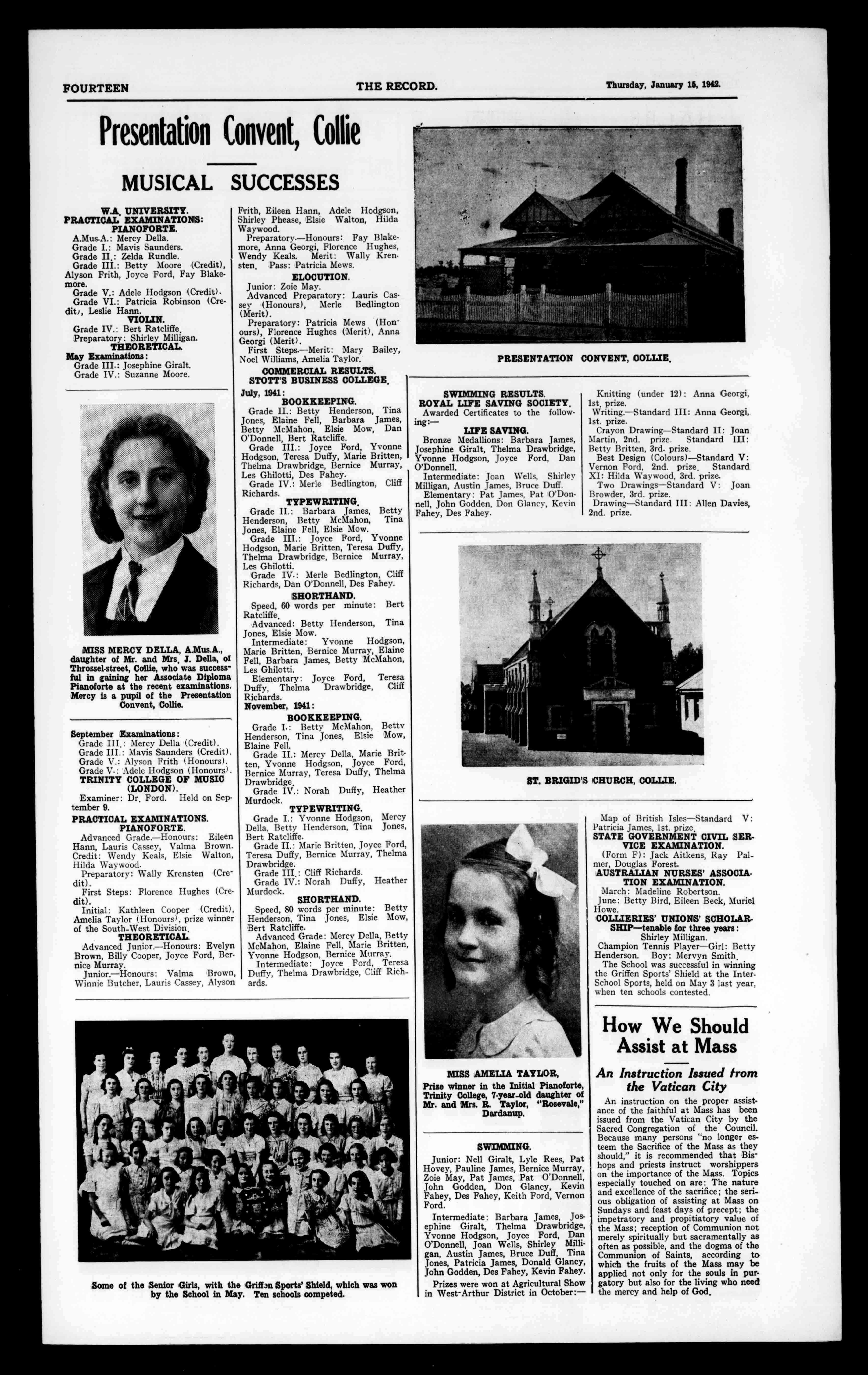
MISSMERCYDELLA,A.Mus.A., daughterofMr.andMrs.J.Della,ot Throssel-street,Collie,whowassuccessfulingainingherAssociateDiploma attherecent MercyisapupilofthePresentation Convent,Collie.
SeptemberExaminations:
GradeIII.:MercyDella(Credit).
GradeIII.:MavisSaunders(Credit).
Grade\'.:AlvsonFrith(Honours).
GradeV.:AdeleHodgson(Honours).
TRINITYCOLLEGEOFMUSIC (LONDON).
Examiner:Dr,Ford.HeldonSeptember9.
PRACTICALEXAMINATIONS.
PIANOFORTE.
AdvancedGrade.-Honours:Eileen Hann,LaurisCassey,ValmaBrown. Credit:\VendyKeals,ElsieWalton, fIildaWaywood.
Preparatory:WallyKrensten(Credit).
FirstSteps:FlorenceHughes(Credit).
Initial:KathleenCooper(Credit), AmeliaTaylor(Honours),prizewinner oftheSouth-WestDivision.
THEORETICAL.
AdvancedJunior.-Honours:Evelyn Brown,BillyCooper,JoyceFord,BerniceMurray.
Junior.-Honours:ValmaBrown, WinnieButcher,LaurisCassey,Alyson
Frith,EileenHann,AdeleHodgson, ShirleyPhease,ElsieWalton,Hilda Waywood.
Preparatory.-Honours:FayBlakemore,AnnaGeorgi,FlorenceHughes, WendyKeals.Merit:WallyKrensten,Pass:PatriciaMews. ELOCUTION.
Junior:ZoieMay.
AdvancedPreparatory:LaurisCassey(Honours),MerleBedlington (Merit).
Preparatory:PatriciaMews(How ours),FlorenceHughes(Merit),Anna Georgi(Merit).
FirstSteps.-Merit:MaryBailey, NoelWilliams,AmeliaTaylor.
COMMERCIALRESULTS.
STOTT'SBUSINESSCOLLEGE.
July,1941: BOOKKEEPING.
GradeIL:BettyHenderson,Tina Jones,ElaineFell,BarbaraJames, BettyMcMahon,ElsieMow,Dan O'Donnell,BertRatcliffe.
GradeIII.:JoyceFord,Yvonne Hodgson,TeresaDuffy,MarieBritten, ThelmaDrawbridge,BerniceMurray, LesGhilotti,DesFahey.
GradeIV.:MerleBedlington,Cliff Richards.
TYPEWRITING,
GradeII.:BarbaraJames,Betty Henderson,BettyMcMahon,Tina Jones,ElaineFell,ElsieMow.
GradeIII.:JoyceFord,Yvonne Hodgson,MarieBritten,TeresaDuffy, ThelmaDrawbridge,BerniceMurray, LesGhilotti.
GradeIV.:MerleBedlington,Cliff Richards,DanO'Donnell,DesFahey.
SHORTHAND.
Speed,60wordsperminute:Bert Ratcliffe,
Advanced:BettyHenderson,Tina Jones,ElsieMow.
Intermediate:YvonneHodgson, MarieBritten,BerniceMurray,Elaine Fell,BarbaraJames,BettyMcMahon, LesGhilotti.
Elementary:JoyceFord,Teresa Duffy,ThelmaDrawbridge,Cliff Richards. November,1941:
BOOKKEEPING.
Grade BettyMcMahon,Betty Henderson,TinaJones,ElsieMow, ElaineFell.
GradeII.:MercyDella,MarieBritten,YvonneHodgson,JoyceFord, BerniceMurray,TeresaDuffy,Thelma Drawbridge, GradeIV.:NorahDuffy,Heather Murdock.
TYPEWRITING.
GradeI.:YvonneHodgson,Mercy Della,BettyHenderson,TinaJones, BertRatcliffe.
GradeII.:MarieBritten,JoyceFord, TeresaDuffy,BerniceMurray,Thelma Drawbridge.
GradeIII.:CliffRichards.
GradeIV.:NorahDuffy,Heather Murdock.
SHORTHAND.
Speed,80wordsperminute:Betty Henderson,TinaJones,ElsieMow, BertRatcliffe.
AdvancedGrade:MercyDella,Betty McMahon,ElaineFell,MarieBritten, YvonneHodgson,BerniceMurray.
Intermediate:JoyceFord,Teresa Duffy,ThelmaDrawbridge,CliffRichards.
PRESENTATIONCONVENT,COLLIE.
SWIMMINGRESULTS.
ROYALLIFESAVINGSOCIETY, AwardedCertificatestothefollowing:LIFESAVING.
BronzeMedallions:BarbaraJames, JosephineGiralt,ThelmaDrawbridge, YvonneHodgson,JoyceFord,Dan O'Donnell.
Intermediate:JoanWells,Shirley Milligan,AustinJames,BruceDuff.
Elementary:PatJames,PatO'Donnell,JohnGodden,DonGlancy,Kevin Fahey,DesFahey.
Knitting(under12):AnnaGeorgi, 1st,prize.
Writing.-StandardIII:AnnaGeorgi, 1st.prize.
CrayonDrawing-StandardII:Joan Martin,2nd.prize.Standard
BettyBritten,3rd.prize.
BestDesign(Colours)-StandardV: VernonFord,2nd.prize.Standard XI:HildaWaywood,3rd.prize.
TwoDrawings-StandardV:Joan Browder,3rd.prize. Drawing-StandardIII:AllenDavies, 2nd.prize.
ST.BRIGID'S'CHURCH,COLLIE.
MapofBritishIsles-StandardV: PatriciaJames,1st.prize, STATEGOVERNMENTCIVILSERVICEEXAMINATION. (FormF):JackAitkens,RayPalmer,DouglasForest. AUSTRALIANNURSES'ASSOCIATIONEXAM/NATION.
March:MadelineRobertson.
June:BettyBird,EileenBeck,Muriel Howe.
COLLIERIES'UNIONS'SCHOLARSHIP-tenableforthreeyears ShirleyMilligan. ChampionTennisPlayer-Girl:Betty Henderson.Boy:MervynSmith, TheSchoolwassuccessfulinwinning theGriffenSports'ShieldattheInterSchoolSports,heldonMay3lastyear, whentenschoolscontested.
MISSAMELIATAYLOR, PrizewinnerintheInitialPianoforte, TrinityCollege,7-year-olddaughterot Mr.andMrs.R.Taylor,"Rosevale," Dardanup.
SWIMMING.
Junior:NellGiralt,LyleRees,Pat Hovey,PaulineJames,BerniceMurray, ZoieMay,PatJames,PatO'Donnell, JohnGodden,DonGlancy,Kevin Fahey,DesFahey,KeithFord,Vernon Ford.
Intermediate:BarbaraJames,JosephineGiralt,ThelmaDrawbridge, YvonneHodgson,JoyceFord,Dan O'Donnell,JoanWells,ShirleyMilligan,AustinJames,BruceDuff,Tina Jones,PatriciaJames,DonaldGlancy, JohnGodden,DesFahey,KevinFahey. PrizeswerewonatAgriculturalShow inWest-ArthurDistrictinOctober:-
AnInstructionIssuedfrom theVaticanCity
AninstructionontheproperassistanceofthefaithfulatMasshasbeen issuedfromtheVaticanCitybythe SacredCongregationoftheCouncil. Becausemanypersons"nolongeresteemtheSacrificeoftheMassasthey should,"itisrecommendedthatBishopsandpriestsinstructworshippers ontheimportanceoftheMass.Topics especiallytouchedonare:Thenature andexcellenceofthesacrifice:theseriousobligationofassistingatMasson Sundaysandfeastdaysofprecept;the impetratoryandpropitiatoryvalueof theMass;receptionofCommunionnot merelyspirituallybutsacramentallyas oftenaspossible,andthedogmaofthe CommunionofSaints,accordingto whichthefruitsoftheMassmaybe appliednotonlyforthesoulsinpurgatorybutalsoforthelivingwhoneed themercyandhelpofGod,
AttheinvitationoftheEditor of"America,"Mr.R.Brennan,Irish MinistertotheUnitedStates,outlinedinthefollowingarticletheattitude ofIrelandinthepresentworldwar. Mr.Brennanindignantlydeniesthat PresidentdeValerabaseshisattitude onhostilitytoBritain,andshowsthat someBritishnewspaperscongratulated Eireonherneutrality.
ItisonlytwentyyearssinceIreland, afterastrugglewhichhadlastedfor centuries,achievedapartialmeasureof freedom.Itwasnotaltogetheror mainlythefaultoftheIrishthatthere ensuedacivilwarwhichdidnothing tohelpthecountryalreardybledalmostwhitebecauseofyearsofmisgovernmentandemigration.Finally, thepeoplesettleddowntorepairthe damagecausedbytheravagesofthe past,toreorganisetheiragricultural system,todevelopanindustrialarm, toimprovethelivingstandardsofthe people.
Howwelltheywroughthasbeentestifiedtobymanyobservers.Notwithstandingthecarryingoutofa largeandcostlyreconstructionscheme, anEnglishcritic,Mr.HorsfallCarter, wasabletosaythatafterseventeen yearsofself-government,thefreeportionofIrelandwasinashealthyaconditionasanyintheworld.("Atlantic Monthly,"September,1938.)
Thepeopleweresickofwars.They settheirfeetonthepathofpeace. Therewastobenomorecivilstrife. Thesmallminoritiesrightandleft whowouldhaveforwardedtheiraims bytheuseofforcewererudelypushed asideandfoundpoliticaloblivion.Participationinforeignwarswasruledout absolutely.TheIrishdesirednodominionsaveovertheirownisland. Neversincethefifthcenturyhadthey soughttoimposebyforcetheirwayof lifeonotherpeoples.Empirewas notforthem.Indeed,sogreatwas theiraversiontostrifethattheyeven ruledoutforcetoachievethereintegrationintothenationalterritoryof theirownsixcountiesoftheNorth.
Voicingthispassionatedesirefor peace,theIrishGovernment,many yearsbeforethewarstarted,madeit clearthatIrelandwouldtakenopart init.Practically,theonlydifference ofopinioninthecountryonthisstand wasnotonitswisdomorjustice,but astowhetheritcouldbemaintained. Itwas,therefore,notsurprisingwhen thewarbrokeoutthattheGovernment'sformaldeclarationofneutrality wasatoncesupportedbyeveryparty intheDailandSeanad.
Therewasnotasingledissentient voice.Theentirepressofthecountry,includingpapersregardedasproBritish,agreedthatnootherpolicy waspossible.Leadersinthetrade unionsandintheacademic,profes-
BishopVonGalen,arrestedbythe GestapoafterpreachingthreeantiNazisermonsinMunster,wascarried shoulder-highbacktohisepiscopalresidencewhen,inviewofhisgreatpopularity,hewasreleasedafteroneday's detention,statestheSwissnewspaper "SchaffhauserZeitung,"
ThreeSwissCatholicnewspapers"NeueZurcherNachrichten,""Vaterland"and"Liberte"-declarethatthe Bishopwasarrested.Therehadbeen somedoubtiftheGestapo,whomthe Bishopattacked,haddaredtotake suchaction.
OthersourcesreportthattheBishop hasbeenunderhouse-arrestsincethe beginningofSeptember,unableto leavehisresidence,eventoenterhis Cathedral.
111M.1.1111.1101.MNIMOMMII
Doyouwishtohelpeducateapriest forworkinWesternAustralia?Make aregularannualcontributiontohelp anindigentstudent.
J.W.SHEEHAN
PrimeBeefButcher
HANNANST.,KALGOORLIE. MARITANASTREET.
Tel438 Tel.438
sionalandcommercialfieldsallstrong. lybackedtheGovernment.This meansthatpossiblyninety-nineper cent.ofthepeopleareunitedinthe standtokeepoutofthisconflict.In Irishpoliticallife,therehasneverbeen suchaunanimityofopiniononany question.Republicans,Nationalists, Unionists,Catholics,Protestantsand Jewsareallontheoneside.Inthe twoyearsthathaveelapsedsincethe warstarted,thepeoplehavebecome moreandmoredeterminedtoadhere tothispolicy. OutsideIreland,thisstandhasbeen assailedbypeoplewhodonotunderstandordonotwanttounderstand thesituation,IhaveheardAmericans dwellingonthefoolishnessofIreland's attitude,butitishardlyconceivable that,onaquestionsovitallyaffecting theinterestsofIreland,alltheIrish peopleshouldbewrongandahandful ofpeoplethreethousandmilesaway shouldberight.Ifitistruethatthe fightisforthesurvivalofdemocracy, surelywhentheIrishpeoplespokein suchanunmistakablemanner,it shouldhaveendedthematter.Americanswouldstronglyresentanyoutsideattackontheirrighttodecide theirownnationalpolicies. Ireland'sattitudehasbeenmisrepresented.Ithasbeenstatedthat herpolicyisdictatedbyhatredof Englandbecauseofthepersecutions metedouttotheIrishpeopleinthe past.Thisisentirelyerroneous.It istruethattheIrishpeoplehavenot forgottenthepast,butwhentheyrecallitnow,itisnotinaspiritofbitternessorvindictivenessbutasajustificationoftheirhard-headedrealism atthepresenttime.
Theydonotlikeconquerors,benevolentorotherwise-indeedtheywould smileatthephrase"benevolentconqueror"-andtheyarenotatallinclinedtoinviteanyofthemtotheir shores,Theysayittookthemmore thansevencenturiestogetridofthe strangerintheirhouse,andwhy shouldtheyinvitehiminagainoranyoneelsetotakehisplace.Sofar fromharboringthoughtsofbitterness andhatred,theIrishmanisover-generous.Treathimroughandhewilltry andgetbackatyouwhenandwhere hecan.Treathimgenerously,andhe isover-generousinmeetingyouradvances. Whatistrueoftheindividualistrue ofthenation.SinceIrelandachieved partialfreedom,theGovernmentand peoplehavegivenevidenceofthenationaldesiretoliveonamicableterms withGreatBritain.Thishasitsroots notlessinthegenerousimpulsesT havespokenofthaninacommonsense realisationofthefactsofgeography andeconomics.Aslongastimeshall run,whateverchangesthecenturies maybring,thesetwoislands,Ireland andGreatBritain,willbeneighbours, anditwouldbeutterfollytothinkof themlivinginastateofperpetual strife.
Becauseofallthis,thepolicyofthe IrishGovernmenthasbeentor:move bypeacefulmeansallremainingcauses ofdissensionbetweenthetwocountries.Itwaswiththisobjectinmind, asmuchastoachievethefullindependenceofIreland,thatMr.deValeratriedin1938tohavethepartition ofIrelandended.Hehaddeclared twoandone-halfyearsbefore(May28, 1935)that"wearegoingtogetourindependenceofBritain,butwearcnot goingtoallowourterritoryunderany conditionswhatevertobemadeuse ofbysomeforeignpowerasabasisof attackagainstBritain."
AsIhavesaid,thedecisiontoremainneutralwasmadeyearsbefore thewarstartedandtheIrishleaders leftnooneindoubtonthatscore.The factwaswellknowntotheBritish Governmentatthetimetheportsthe Britishstillheldwerehandedbackto Irelandin1938.TheNewYork "Times"onNovember10,1940,dwelt onthisfactinthefollowingwords:
"Itisrecalled thatformerPrime MinisterNevilleChamberlain'sAdministrationatLondonhandedbackthe portstoIrelandundertheAgreement ofApril,1938,wellawareofwhatthe IrishGovernment'sattitudewouldbe intheeventofwar.Mr.Churchill, whostronglyopposedtheAgreement, toldtheHouseofCommonsthenthat Irelandwouldbeneutralinawar,but theCommonsratifiedtheAgreement, asdidalsotheIrishpeopleinasubsequentgeneralelection."
PERTH BdNIN4/44.04.04.410.0.410.4.414N4N/4/414NINVIVIVINILININININ/NIN/N4
Thefollowingisthetextofthe ChristmasmessageconcerningAustralianprisonersofwarinItaly,ijoadcastbytheVaticanradiostationto therelativesandfriendsoftheprisonersinAustralia.
InthenameoftheHolyFatherPope PiusXII,thePapalNunciotoItaly hasoncemorevisitedtheprisonerof warcamps,visitingthusthosewhoare nearanddeartoyou.HiscommissionistheoutcomeoftheHoly Father'spaternalinterestintheprisonersandofhisunceasingsolicitude fortheirwelfare.Itishistaskto bringthementheHolyFather'sgreetings,and,ashisrepresentativetohelp alleviateineverywaypossibletheir necessarilyirksomelot.Inthepast fortnighthehasseenyourdearones, commissionedthistimeinparticular toconveytothemtheHolyFather's Christmasgreetingsandtopresent themwithChristmascardsandgifts fromhim.Toeveryprisonerhehas broughtacardonwhichisareproductionofRaphael'sAdorationofthe Magi,andthisgreetinginEnglish-a greetingsprungindeedfromtheheart ofthecommonFather-"Christmas, 1941.Withevergreaterpaternalsolicitudeweturnourthoughtstoeach oneofyouwhoinyourseparationfrom distanthomesatthisChristmasseason feelverykeenlytheabsenceofyour lovedones.Theyareprayerfuland affectionategoodwishes.Maythey sweetenthebitternessofthatseparationandbetoyouallasourceofDivinecomfortandChristianhope.Pope PiusXII."
PresentsFromthePope.
WiththepaternalwishesgothepresentswhichtheHolyFather'sgenerosityhasprovided-cigarettes,books, gamesofallsorts,andasprizesfor Christmasraffles,handsomeleatherboundclocks.ThishavetheHoly Father'srepresentativeandthosewho accompanyhimtotellofthemenand theirconditions.Yourdearonescannotbutfeelthedrearinessthatgoes withtheirlotasprisonersofwar,but theyarenotunhappyandtheyare keepingtheirspiritshigh.Thefood suppliedthemisgoodandsufficient, correspondingtowhatisgiventothe samerankintheItalianArmy,and sincethemenruntheirowncantens anddotheirowncooking,theycan addtoitsomethingoftherelishthat comesfromthisservingintheways theyhaveknownathome.Theyare wellclothedandrecentlyreceivedan adequatesupplyofwinterclothing. Theyareinfinehealthandthevisits haveshownlittleornosicknessinthe camps.
RecreationinCamps.
Fortheirrecreationtheyhavetheatreswheretheystageconcertspracticallyeveryweek.Forthepast monthpreparationsforChristmas showshavebeenunderway.Small librariesaregraduallybeingbuiltup ineachcamp.Therearelanguage classesforthosewhowishthemand manyhavebecomeproficientinItalian already.Everyfacilityisgivenfor religiousservicesforthemenandan AustralianAnglicanminister,aprisoner,isallowedentirefreedominprovidingreligiousassistanceforthemen ofhiscamp.Catholics,iftheyhave notSundayMassinthecampits,lf, aregiventheopportunityofhearing Massoutside.Seenowthepictureof whatisactuallyhappening.Inthe personofhisrepresentativetheHoly Fatherisamongyourdearones,to wishthemahappyChristmasand brightenthecelebrationofthemasfar aseverhemay.Theirthoughtsare directedtootherChristmasescelebratedintheintimacyoftheirhomes. Theythinkofyouandsoseizeonthe chanceoftheNuncio"svisittobeg himtosendyouaChristmasmessage, andthatmessage,stillwarmfromtheir hearts,thismarvellousgiftofGod,the radio,enablesustogiveyounow,be foreithastimetocool.Theygreet youall,parents,wives,children,relativesandfriends,assuringyouoftheir
thoughtforyouandforyoutheypray, throughtheSaviour'scoming,every blessing,spiritualandtemporal,inthe NewYear.Andmaywejoinoar wishtotheirs,prayingthatthePrince ofPeacemayshortenthescourgeof war,hastenthecomingofajustand universalpeace,andreuniteyouand yourdearones,
SPANISHPOLICEHOLD BARCELONAMANFOR BISHOP'SMURDER
THELATEBISHOPIRURITA.
Barcelonapolicehavearresteda formerassistanttothemayorofSiguenzo,JuanAndresOrtega,onacharge ofhavingtakenpartinthemurderof BishopIrurita,ofBarcelona,during theSpanishWar. Heisalsoaccusedofhavingburnt thebodyaftersoakingitwithpetrol.
ThebodyofBishopIruritawasnever found.TheBishopwasarrestedearly inthewar,andevidencecollectedafterwardsindicatesthathewasshoton December3,1936,andhisbodydestroyed,
"Chiropracticisadruglessmethodof healingandisbaseduponthescientific factthatthesoftnerves,astheyescapefromthelateralopeningsofthe spine,frequentlybecomeimpingedby comingincontactwithhardbone; hencepathologicalchangestakeplace attheterminationofthenerve.The spineisthekeytotheentiresituation regardingthemaintenanceofhealth ontheonehandortheestablishment ofdiseaseontheother,andisthemost vitalandimportantthinginthewhole anatomicalstructure."
-AlfredWalton,M.D.,Harvard.
DearCornerites,-Wednesdayisthe feastofoneofourgreatestchildmartyrs-St.Agnes.Doubtlessyouall knowthestoryofhergreatheroism whenshewascommandedtorenounce Christandworshiponeofthepagan idols,Quiteearlyinlifeshemadea vowtoOurLordthatshewouldnever marrybutwouldpassherlifeinHis servicealone.Thereforewhenthe Emperorcommandedhertomarryone ofthenoblesofhiscourtatRome,she toldthepagansofhergreatlovefor ChristCrucified.InpaganRomeit wasacrimeofthehighestordertobecomeaChristian,andeverydaymartyrsweredyingfortheFaith.St. Agnes,asthedaughterofanoble family,wassparedthehorrorsofthe arena,butwastorturedandfinallyput todeathwiththesword.Shewasa modelofinnocenceandpurityandis aspecialpatronoflittlechildren.
AUNTBESSY.
LEMONADEBOTTLE.
AcknowledgedWithThanks.
JudithHickey Is.
DearAuntBessy,-Pleasefindenclosedthreeshillings.Averykind ladygavemetwoshillingsforyou,and Grandpagavemeoneshilling.Iam verygladthatyouhavenearlyreceivedtheonehundredpoundsyourequire,andwishyoueverysuccessin thecomingyear. BETTYSTANLEY.
DearBetty,-IamsosorryIhadto holdyourletteroverforafewweeks, astherewasnotenoughspaceinthe papertoputalllettersintogether. However,thankyouverymuchfor sendingalongthethreeshillings.As youknowIreceivedthe£100ingood timeandthisyearwearehopingto getanother£100in.
AUNTBESSY. *
DearAuntBessy,-Enclosing5s,for theBushies,forafavourtobegranted. Willyoupleaseprayformyintention? MOSMANPARK.
DearMosmanPark,-The5s.was veryacceptableandhelpedtheCorner alongquiteabit.Ishallcertainly prayforyourintentionandhopethat youwillbegrantedyourfavour. AUNTBESSY.
DearAuntBessy,-Enclosedplease find£1towardsyour£100forBushies, inhonourofpoorsouls. B.E.D.
.411,04,.41,ININNIVNINI04. PINNY
SOUTHSUBURBANDAIRY SUBURBANROAD(M.U.19), SOUTHPERTH.
CLEANLINESSANDQUALITY. OWNCOWS'MILK. F.J.ROBERTS,Proprietor. 0,04,04,1,11~4.411,04NMOYMPAMONINININNPM
29MABELST.,NORTHPERTH. TUNESANDREPAIRSPIANOS ANDORGANS. 'Phone05824.
FreshMilkDaily
S.J.
TRALEEDAIRY, 120FOURTHAVENUE, MT.LAWLEY. 'Phone:U2532. 11111111,11111111111111111111111111111111115111)111111111111111111111111111111
CLAREMONTRADIOAND ELECTRICALSERVICE. 118STIRLINGHIGHWAY, CLAREMONT. 'PhoneP3068.
INSTALLATIONANDREPAIRSTO ANYTHINGELECTRICAL. RADIOSALES-CASHORTERMS
Telephone04757.
MARTINP.RYAN (M.W.A.O.A.)
Optometristand Optician
SonofLateM.P.Ryan.lateof Fremantle.
DearB.E.D.,-The£100forlast yearcameinsafely,andnowweare tryingtoraiseanother£100forthis year.Idohopethisyearwillbeas successfulaslastyear,andIamsureit willbeifalltheCorneritesgivemethe supporttheysogenerouslygavelast year.Thankyouverymuchforyour kinddonationofif.
AUNTBESSY.
* * * *
DearAuntBessy,-Enclosedisa smallofferingfortheLemonadeBottle. MayGod'sblessingaccompanyit.
BARNEYBROLLIGAN.
DearBarney,-The"small"offering wasverygratefullyreceivedandit gaveagoodstarttotheNewLemonadeBottlefor1942. Thankyouvery much.
AUNTBESSY.
* * * *
DearAuntBessv,-Enclosedplease find2/6fortheBusbies'Fund. N.WALSH.
DearN.Walsh,-The2/6helpedto givetheNewYearagoodstart,andas theAppealfor1942hasbegunverysuccessfully,Ihopeitwillcontinueto prosperduringthecomingmonthsand bringinanother£100fortheBushies.
AUNTBESSY.
* * *
DearAuntBessv,-Pleasefindenclosed10s.fortheBusbies.
ANONYMOUS.
DearAnonymous,-The10s,wasreceivedsafelyandIwasverypleased tohaveit,astheLemonadeBottlewas totallyemptywhenitcamealong. However,nowithasquiteabitinit, andaverygoodstarthas'beenmade fortheNewYear.
AUNTBESSY.
* * * a
DearAuntBessv,-Enclosed5s.for theBushies,inmemoryof"LittleMarie Blanche."Pleasesayaprayerforour brother,Vincent,R.A.A.F.,alsoallour dearrelativesandfriendsoverseas. Withloveandbestwishestoyouand alltheBusbies.
HILDANOONAN.
DearHilda,-Thankyouverymuch forthe5s.IthelpedtheLemonade Bottlequiteahit.Ishall,ofcourse. prayforyourrelatives,asIamsure theyneedalltheprayerstheycanget duringwartime.
AUNTBESSY.
*
DearAuntBessy,-Iamsendingyou somestampsandIwishtojoinyour happybandofworkersfortheBushies' cause.Mysisterjoinedyourhappy lotsometimeago,andshehasbeen sendingyousomestampsandshehas filledafewprickcardsalso.Iwould likeyoutosendmeaprickcardand I'llstartthenewyearwellforthe Bushies'Corner. Ihopeyouhave theLemonadeBottlefilledbynow. MydaddyisnotatRottnestnow.He isintheNavalBaseConvalescent Home.Hemetwithanaccidentover atRottnestandhewentintoHollywoodMilitaryHospitalonChristmas Eve.ButIhopehewillbeableto behomesoon.lieiskeepingmuch betternow.Wishingyouandallthe BushiesaveryhappyNewYear.
EDITHPRATT.
DearEdith,-Atlastwehavebeen abletofindalittlespacetoprintyour veryinterestingletter,andIdohope youwillwriteinoftennowthatyou areaCorneriteyourself.Ihavesent alongtheprickcardandIknowyou willgetitfilledasquicklyasyoursister.Itcertainlywashardluckfor yourfathertobesickatChristmas time,andIdohopeheisquitebetter now. AUNTBESSY.
* * * *
DearAuntBetsy,-Enclosedfind postalnotefor10s.forBushies' Scheme,inhonourofSt.Joseph,St. Jude,andSt.Rita.Trustingyouwill receivethe1100. L.E.M.
DearL,E.M.,-Wereachedthe£100 for1941'beforethecloseoftheyear, andhopetoattainasimilarobjective for1942.That,ofcourse,willdepend onthegenerosityofCorneritesduring thecomingmonths,hutsofarwehave madeanexcellentstart.Thankvou verymuchforthelOsnote,which helpedalot.
AUNTBESSY.
DearAuntBessv,-Pleasefindattachedpostalnotefor3/6forLemonadeBottle,inhonourofSt.Anthony, forspecialfavoursreceivedthrough him.Wishingyoueverysuccess. ALOVEROFST,ANTHONY.
DearLoverofSt.Anthony,-Your verypracticalwayofhonouringSt. AnthonyhelpedthenewLemonade Bottletomakeanexcellentstart, whichT hula'willliemaintainer)
forsendingitalong.Asyouknowthe 1190cameinsafelyforlastyear,and nowwehavetoworryaboutthis year's.lbwever,IantsuretheOcr neriteswouldnotlettheBushies' down. AUNTBESSY * *
Mt.Magnet.
throughouttheyear.IamsureCorneriteswillstilldotheirbestforthe Busbies. AUNTBESSY.
* * * *
DearAuntBessy,-IpromisedI wouldgivesomethingbeforetheend oftheyear,sohereisashilling.It isthelastdayofDecember,soIthink itwillbetoolate.Ifitisputitin fornextyear.Idohopeyougetthe hundredpounds,Bestwishesforthe NewYear.
JUDITHHICKEY.
DearJudith,-Yourlettercametoo lateforthe1941total,butitwasin plentyoftimetostartoffthe1942LemonadeBottle,sothankyouverymuch
DearAuntBessy,-Thisisthesecond timeIhavewrittentoyou,andIwish youahappyNewYear,Iwentinfor boxingandgot12/6.Wehaveamine. Itis12feetdeep.Wehaveacubby houseandwecookourowndinneron ourownfireatthecubby.Wehave alittleboystoppingwithusforthe holidays. CONDREW.
DearCon,-Iwassopleasedtoreceiveanotherniceletterfromyou,and Ihopeyouwillsendmeoneoften.I don'tthinkIhaveanotherCorneritein Mt.Magnet,Thecubbyhousemust beagreataffair,andIamsuremany littleboysandgirlswillbeenviousof youwhentheyknowyoucaneven cookinthere. AUNTBESSY.
FORALLMAKESOFBREADATITSBEST, DARLINGRANGEBAKERY
R.H.rORTWINE. KA.LAM17NDA'SBESTBAKER. PFOMPTDELIVERYTOALLPARTSOFTHEDISTRICT. CANNINGROAD. 'PHONE:Kal.32.
L.&F.WHITE
GENERALSTOREANDNEWSAGENCY. ALLCLASSESSMALLGOODS. ATRIALAPPRECIATED. CORNERADELAIDEANDPOINTSTREETS,FREMANTLE. L2110.
LEWISandSONSBakers
PROCERA,VIENNA,CREMALT,HEALTH,CURRANT. ALLTYPESOFFANCYBREADSANDROLLS.
DualCupWinners.RoyalShow,1938.
Bakery:McMASTERSTREET,VICTORIAPARK. 'Phone.M1379.
WHENGIVINGYOURNEXTORDER, DON'TFORGETTHATBOTTLEOF "SOVEREIGN"BRAND PICKLESANDTOMATOSAUCE.
BrolgaWorcestershireSauce;"SharpandStrongVinegar."ExcellentLinesAll, ManufacturedbyTHEWESTERNPRESERVINGWORKS.PERTH. J.J.O'HENEY,Proprietor,
SPECIALISEIN LOCALTIMBERS
STATEPRESSEDBRICKS AND OtherBuilders'Requisites 306MURRAYST.,PERTH AlsoatCountryandMetropolitanYards.
SAVECHARGES! SAVEFREIGHT!
ImprovetheValueofyourWoolbyhavingitSCOURED.
mocammannuminausumwommuumininsimmuumwinnunimnimuunintininimumuir T.0
TheSWANWOOLSCOURINGCO. ofW.A.Ltd.Fremantle theoldestbusinessofitskindinthisState,withitsmostefficientmodernplant,employstheverylatestmethodstosecureforclientsbetter returnsfortheirwool.
ConsigntoNORTHFREMANTLE,andobtainrebatesof40percent. ofthefreightforallquantitiesoveroneton.
Address:BOX2,POSTOFFICE,FREMANTLE.
'Phones:L1031-2.
Engagements,Marriages,Deaths,InMemoriam,andBereavement Notices,3/-aninsertion(45words).Theseadvertisementsmustbecertifiedtobysomerespectableperson. ReportsofFuneralschargedforat2/-perinch,singlecolumn(about 50wordsnoneinch). Weddings,includingsinglecolumnphotoblocks,wit:,report,10/6; doubleco5Lmrphotoblocks,withreport,£1/1/-;threecolumnphoto blocks,withreport,£11101-.(Reportsmustbeendorsedbyparishpriest.) ForSale.ToLet,SituationsWantedandVacant,andBoardand Residence,oneinsertion(notexceeding20words),1/6.Reducedrate forseveralinsertions. ParagraphAdvertisements.Id.perlinesinglecolumn.
SchoolResultsmustbecoveredbyletterofauthorisation,andmust beTypewrittenorinBlockLettors.
CONTRACTRATESforgeneraladvertisingonapplicationtothe AdvertisingManager. TheManagementreservetherighttorefuseanyadvertisementit deemsobjectionable,andacceptsnoresponsibilityforanylosssustained fromerrorswhichmayappearinadvertisements.
Allenqu.riesconcerningAdvertisementsshouldbeaddressedtothe ADVERTISINGMANAGER,"THERECORD,"450HAYSTREET,PERTH, WestAustralia.
CHINA.
OTLEYPLACE,OffMURRAY
STREET(RearSavoyHotel)
Determinationtobecomea"radical" ofthemostuncompromisingsort, coupledwiththegraceofGod,forced Dr.HerbertE.Cory,professorofliberalartsattheUniversityofWashington,anerstwhileMarxianCommunist, andnowaCatholic,tocapitulateto theconservativeandyetultra-revolutionarytruthsofthepuretraditionof Christianity,theeducatorsaysinhis newbook,"TheEmancipationofa Free-Thinker."
Dr.Coryrevealstheargumentsbiological,psychological,sociological, historical,philosophical,andtheological-whichledtohisconversion,inhis book,theintellectualodysseyofan agnostic.
Forthefirst18yearsofhislife,Dr. Corysayshewassustainedbywhat heterms"agentle,nebulousCongregationalistChristianity"whichfounderedundertheonslaughtsofthechief unbelieversofthenineteenthcentury, poeticandscientific.Foryearsafter hewasaagnostichumanist,butabout 1917becamearadical,about90per cent.Marxian-Communist,"hesays, althoughrejectingatheismasahypothesis,because,headds,theproblem ofgoodandtheoriginandobjective validityoftherationalprocess,forced himgraduallytotheconclusionthat somesortoftheistichypothesiswas muchmorereasonable,
Astudyofthebiologicalsciencesbegantoexertaremarkableinfluencein theprocessofDr.Cory'semancipation fromagnosticism.Thishecontinued forfouryearsinthelaboratoriesof JohnHopkinsUniversity,whitherhe hadturnedfromtheteachingofEnglishliteratureduringnineprevious yearsattheUniversityofCalifornia, aftertakinghisdoctorateatHarvard. Meanwhile,thesocialquestionremainedprofoundlyintheyoungscientist's thoughts,andhebegantosuspectthat Marxian-Communismwasfartoobour-
geoisandconservativetosolvethe vexingproblem.Sincehewasdeterminedtobecomearadicalofthemost uncompromisingsort,Dr.Gorydelved deeplyinthestudyofscholasticism, andcapitulatedtothetruthsofthe puretraditionof.Christianity.
Thedistinguisheduniversityprofessorcomments:"Iamoftenamazed andannoyedattheobstinacywith which,inthefaceofinnurneratieand unusualopportunities,Iresistedthe truth.Irealisenowthatmybroodingfearlestsomeoneofmywishes mightdictatesomeofmythoughts borderedattimesonthepsychopathological.Icanfairlysaythatmylong pilgrimagetoRomehasbeenoneof growingrelentlessreasoningcoercingan increasinglystubbornandmoreorless emotionalresistance.Yetallmyeffortswouldhaveavailedmenaught withoutthegraceofGod."
HeenteredtheCatholicChurchin 1933,whenhewas50yearsold.He addsinhisbook:
"Itwasnotuntilthedayofmyfirst. HolyCommunionthatIfoundIhad attainedforthefirsttime,towhatin thestrictestsenseofthewordmaybe termedhappinessincontrastwithmere pleasure,IwastemptedalmosttobelievethatIhadalreadyachievedthe greatestpossiblehappiness. Ihave foundoutthatIwaswrong.Foreach year,notwithstandingtheonsetoftryingvicissitudes,perhapssomewhat morethantheaveragenumberwhich anyoneexpects,thishappinesshasintensifiedundreamably,evenincorporatingintoitselfagooddealofthepain thatIhaveexperienced.AnddailyI realiseevermoreandmorethateven thisincreasedhappinessisasnothing whencontrastedwiththatwhichawaits allofuswhenwefaceourgreatestopportunity-death-ifbyperseverance wecometothatmagnificentadventure inastateofgrace."
Applicationsforscholarshipswill closeonSaturday,January24,and shouldbesenttotheRev.J.T. McMahon,D.Ph.,M.A.,SouthPerth. Applicantsshouldobservethefollowingconditions:-
(1)CandidatesmustpasstheJunior Examination.
(2)TheapplicationmustbeaccompaniedbythereportoftheHeadof theSchoolandmuststate:
(a)Subjectspresented;subjects passedforJunior.
(b)Resumeofapplicant'srecord inschool,conductandsport.
)c)Thefollowingdetailsregarding familyandfamilyincome:-
47-49BAYVIEWTERRACE, CLAREMONT TelephoneNo.F2262 CLAREMONTMEATCO. FAMILYBUTCHERS ImportersofEnglishFillet,etc. G.CORDIN,Prop.
Note:QualityHighest;PricesLowest
(la\YOUR "wyEYES DESERVETHEBEST.It youconsultS.andS.your eyeswillreceivequalifiedattention.Glasseswillbeadvisedonlyifnecessary.Theywill beglazedwithhighestquality lensinattractiveframes.Visit SAINI4EN6-SAINKEN OVA PTIIIIANI .4),TIT.Nix,ATTSAISA11011011M(
(1)Father'soccupationandsalary, ormother'sincomeiffatherisdead.
(2)Numberofchildreninfamily.
(3)Numberofchildrenearning, andstateamountofwageearnedby eachchild.
(4)Numberofchildrenatschool.
Failuretosupplythisinformation willdisqualifythecandidate.
(3)Applicationsshouldbeaccompaniedbyacertificateofbirth.Candidatemustnothavecompletedhis sixteenthyearonthedayhesitsfor theJuniorExamination.
(4)Astampedaddressedenvelope mustaccompanytheapplication,for thereturnofthecertificateofbirth.
TheLynnScholarshipisopentoCatholicboysattendinganyCatholic schoolintheArchdioceseofPerth.The scholarshipprovides£30peryearfor twoyearsataregisteredSecondary School,andi50peryearforthree yearsattheUniversity.TheTrustees wishtoremindthoseintendingtoapply thattheyshouldobtaintheHead Master'sletterbeforethebreak-up,as itisessentialthattheapplicationbe accompaniedbythisletter,Some candidatesexperienceddifficultylast yearinobtainingsuchlettersowingto theabsenceoftheHeadMasteronholidays.Thesuccessfulcandidatewho failsintheLeavingCertificateoratthe Universityforfeitsthescholarship,and thescholarshipcannotbeheldbya boywhoholdsanyotherscholarship, exhibitionorbursary.
TheTrusteeswillmeetonTuesday, February3,1942,andtheirdecision shallbefinal.TheseTrusteesare: Rev.J.T.McMahon,D.Ph.,M.A.,chairman:Rev.J.Fahey,D.SO.;J.P.Max. well,Esq.,LL.B.;F.Connaughton, Esq.;P.R.Jackson,Esq.,J.P.,secretary,
Kelly
Late
ContinuedfromFrontCover.)
asaprotectionagainstwhiteants. Theseinsects,however,workedthemselvesupthroughtheironpipes,and lateronthepipesthemselveshadtobe insulated.Somelandwasbought fromthenatives,agardenandcoco palmplantationwerelaidout.
Thereweretroubleswiththenatives, butthingsimproved,andtheFathers beganschoolandcatechism,Other stationswerefoundedundersimilar oppositionofthenatives.Theywere willingforabarterinland,butthey didnotunderstandthelawofnottrespassing,andtheyobjectedtotheir childrencomingunderanotherspiritual controlthanthatoftheoldintimidatingsuperstitionpractisedbytheelders. Formanyyearsawhitemanwasnot safeeveninthecoastalvillages,andit isonlyafewyearssinceblacksthemselvesweremurderedwithoutwarning assoonastheytrespassedinastrange village.
To-day,therearetwoflourishing vicariates-CentralNewGuineaand EasternNewGuinea-underthe FathersoftheDivineWord.They havetheirownaeroplanesandpilots tocovertheirvastterritory,linking outlyingstationswiththemission's headquarters.CentralNewGuineawas knownbeforethelastwarasthePrefectureofKaiserWilhelmsland,but wasrenamedin1922,andmadeaVicariateApostolicin1931.TheBishop, MostRev.JosephLorks,S.V,D.,lives atKariru,Wewak.Outofatotal nativepopulationofabout250,000,
thereare27,631Catholicsand12,852 catechumens,spreadover234mission centres.Thereare33priests,36layBrothers,37Sisters,and192catechists, while1,518childrenattendtheVicariate'stwenty-eightschools.
TheVicariateofEasternNewGuinea, whichisboundedonthenorthbythe VicariateofRabaul,onthesouthby theVicariateofPapua,andonthe westbyCentralNewGuinea,wasestablishedin1922andispresidedover byHisLordshipBishopFrancisWolf, D.D.,S.V.D.Thereare18mission centres,35priests,46lay-Brothers,48 whiteSisters,276catechists, 103 schools,attendedby5,124children,and atotalCatholicpopulationof25,580 souls.
ATTADALEDAIRY.
FREMANTLEROAD,MELVILLE.
EDWINH.MITCHELL
MILKFROMATTADALEDAIRY. MilkDeliveredtoanypartof FremantleandSuburbsDaily. TEL.L1443.
PERTHFISHERIES
489WELLINGTONST.,PERTH. FISHANDPOULTRYSUPPLIED. WholesaleandRetail. Phone:B5992. CityDeliveries. CountryOrdersCateredFor.