"Taste Tells"
Johnston's SAUSAGES and FRANKFURTS
NO.3,000.
PERTH,THURSDAY,NOVEMBER27,1941.
AnglicanArchbishopHailsPapalEncyclicalsas"GreatLandmarks"
AdmitsReformationasSourceofSocialEvils
GeneralCorrespondenceWithCatholicThought
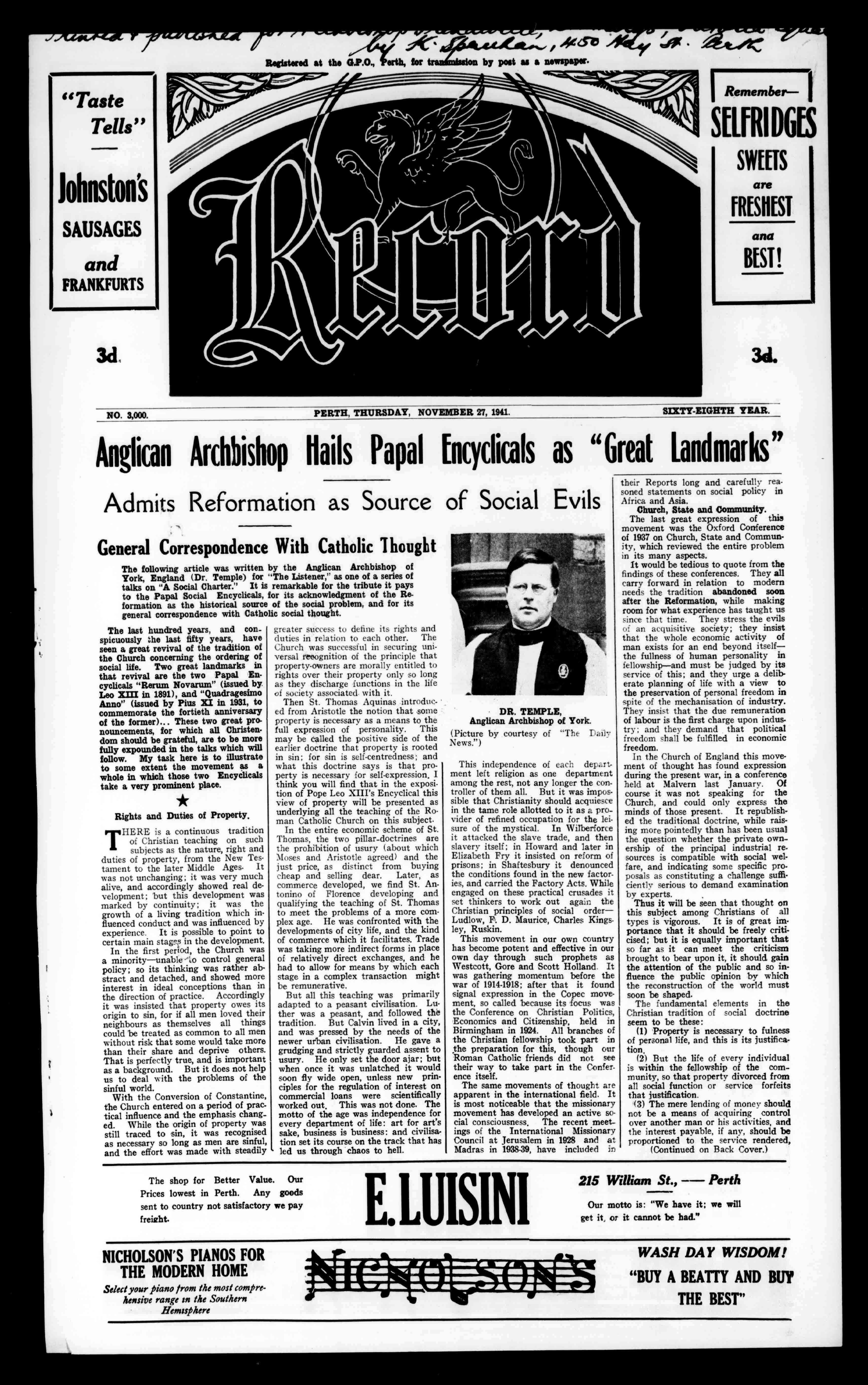
ThefollowingarticlewaswrittenbytheAnglicanArchbishopof York,England(Dr.Temple)for"TheListener,'asoneofaseriesof talkson"ASocialCharter."Itisremarkableforthetributeitpays tothePapalSocialEncyclicals,foritsacknowledgmentoftheReformationasthehistoricalsourceofthesocialproblem,andforits generalcorrespondencewithCatholicsocialthought.
Thelasthundredyears,andconspicuouslythelastfiftyyears,have seenagreatrevivalofthetraditionof theChurchconcerningtheorderingof sociallife.Twogreatlandmarksin thatrevivalarethetwoPapalEncyclicals"RerumNovarum"(issuedby LeoXIIIin1891),and"Quadragesimo Anno"(issuedbyPiusXIin1931,to commemoratethefortiethanniversary oftheformer)...Thesetwogreatpronouncements,forwhichallChristendomshouldbegrateful,aretobemore fullyexpoundedinthetalkswhichwill follow.Mytaskhereistoillustrate tosomeextentthemovementasa wholeinwhichthosetwoEncyclicals takeaveryprominentplace.
RightsandDutiesofProperty, THEREisacontinuoustradition ofChristianteachingonsuch subjectsasthenature,rightand dutiesofproperty,fromtheNewTestamenttothelaterMiddleAges.It wasnotunchanging;itwasverymuch alive,andaccordinglyshowedrealdevelopment;butthisdevelopmentwas markedbycontinuity;itwasthe growthofalivingtraditionwhichinfluencedconductandwasinfluencedby experience.Itispossibletopointto certainmainstagr,sinthedevelopment, Inthefirstperiod,theChurchwas aminority-unable.'"cocontrolgeneral policy;soitsthinkingwasratherabstractanddetached,andshowedmore interestinidealconceptionsthanin thedirectionofpractice.Accordingly itwasinsistedthatpropertyowesits origintosin,forifallmenlovedtheir neighboursasthemselvesallthings couldbetreatedascommontoallmen withoutriskthatsomewouldtakemore thantheirshareanddepriveothers. Thatisperfectlytrue,andisimportant asabackground.Butitdoesnothelp ustodealwiththeproblemsofthe sinfulworld.
WiththeConversionofConstantine, theChurchenteredonaperiodofpracticalinfluenceandtheemphasischanged.Whiletheoriginofpropertywas stilltracedtosin,itwasrecognised asnecessarysolongasmenaresinful, andtheeffortwasmadewithsteadily
greatersuccesstodefineitsrightsand dutiesinrelationtoeachother.The Churchwassuccessfulinsecuringuniversalrecognitionoftheprinciplethat property-ownersaremorallyentitledto rightsovertheirpropertyonlysolong astheydischargefunctionsinthelife ofsocietyassociatedwithit.
ThenSt.ThomasAquinasintroducedfromAristotlethenotionthatsome propertyisnecessaryasameanstothe fullexpressionofpersonality.This maybecalledthepositivesideofthe earlierdoctrinethatpropertyisrooted insin:forsinisself-centredness;and whatthisdoctrinesaysisthatpropertyisnecessaryforself-expression.I thinkyouwillfindthatintheexpositionofPopeLeoXIII'sEncyclicalthis viewofpropertywillbepresentedas underlyingalltheteachingoftheRomanCatholicChurchonthissubject.
IntheentireeconomicschemeofSt. Thomas,thetwopillar-doctrinesare theprohibitionofusury(aboutwhich MosesandAristotleagreed)andthe justprice,asdistinctfrombuying cheapandsellingdear.Later,as commercedeveloped,wefindSt.AntoninoofFlorencedevelopingand qualifyingtheteachingofSt.Thomas tomeettheproblemsofamorecomplexage.Hewasconfrontedwiththe developmentsofcitylife,andthekind ofcommercewhichitfacilitates.Trade wastakingmoreindirectformsinplace ofrelativelydirectexchanges,andhe hadtoallowformeansbywhicheach stageinacomplextransactionmight beremunerative.
Butallthisteachingwasprimarily adaptedtoapeasantcivilisation.Lutherwasapeasant,andfollowedthe tradition.ButCalvinlivedinacity, andwaspressedbytheneedsofthe newerurbancivilisation.Hegavea grudgingandstrictlyguardedassentto usury.Heonlysetthedoorajar;but whenonceitwasunlatcheditwould soonflywideopen,unlessnewprinciplesfortheregulationofintereston commercialloanswerescientifically workedout.Thiswasnotdone.The mottooftheagewasindependencefor everydepartmentoflife:artforart's sake,businessisbusiness:andcivilisationsetitscourseonthetrackthathas ledusthroughchaostohell.
DR.TEMPLE, AnglicanArchbishopofYork. (Picturebycourtesyof"TheDaily News.")
Thisindependenceofeachdepartmentleftreligionasonedepartment amongtherest,notanylongerthecontrollerofthemall.ButitwasimpossiblethatChristianityshouldacquiesce inthetameroleallottedtoitasaproviderofrefinedoccupationfortheleisureofthemystical.InWilberforce itattackedtheslavetrade,andthen slaveryitself;inHowardandlaterin ElizabethFryitinsistedonreformof prisons;inShaftesburyitdenounced theconditionsfoundinthenewfactor. ies,andcarriedtheFactoryActs.While engagedonthesepracticalcrusadesit setthinkerstoworkoutaga;i:the ChristianprinciplesofsocialorderLudlow,P.D.Maurice,CharlesKingsley,Ruskin.
Thismovementinourowncountry hasbecomepotentandeffectiveinour owndaythroughsuchprophetsas Westcott,GoreandScottHollandIt wasgatheringmomentumbeforethe warof1914-1918:afterthatitfound signalexpressionintheCopecmovement,socalledbecauseitsfocuswas theConferenceonChristianPolitics, EconomicsandCitizenship,heldin Birminghamin1924.Allbranchesof theChristianfellowshiptookpartin thepreparationforthis,thoughour RomanCatholicfriendsdidnotsee theirwaytotakepartintheConferenceitself. Thesamemovementsofthoughtare apparentintheinternationalfield.It ismostnoticeablethatthemissionary movementhasdevelopedanactivesocialconsciousness.TherecentmeetingsoftheInternationalMissionary CouncilatJerusalemin1928andat Madrasin1938-39,haveincluded
theirReportslongandcarefullyreasonedstatementsonsocialpolicyin AfricaandAsia.
Church,StateandCommunity.
Thelastgreatexpressionofthis movementwastheOxfordConference of1937onChurch,StateandCommunity,whichreviewedtheentireproblem initsmanyaspects.
Itwouldbetedioustoquotefromthe findingsoftheseconferences.Theyall carryforwardinrelationtomodern needsthetraditionabandonedsoon aftertheReformation,whilemaking roomforwhatexperiencehastaughtus sincethattime.Theystresstheevils ofanacquisitivesociety;theyinsist thatthewholeeconomicactivityof manexistsforanendbeyonditselfthefullnessofhumanpersonalityin fellowship-andmustbejudgedbyits serviceofthis;andtheyurgeadeliberateplanningoflifewithaviewto thepreservationofpersonalfreedomin spiteofthemechanisationofindustry. Theyinsistthatthedueremuneration oflabouristhefirstchargeuponindustry:andtheydemandthatpolitical freedom,hallbefulfilledineconomic freedom.
IntheChurchofEnglandthismovementofthoughthasfoundexpression duringthepresentwar,inaconference heldatMalvernlastJanuary.Of courseitwasnotspeakingforthe Church,andcouldonlyexpressthe mindsofthosepresent.Itrepublishedthetraditionaldoctrine,whileraisingmorepointedlythanhasbeenusual thequestionwhethertheprivateownershipoftheprincipalindustrialresourcesiscompatiblewithsocialwelfare,andindicatingsomespecificproposalsasconstitutingachallengesufficientlyserioustodemandexamination byexperts.
Thusitwillbeseenthatthoughton thissubjectamongChristiansofall typesisvigorous.Itisofgreatimportancethatitshouldbefreelycriticised;butitisequallyimportantthat sofarasitcanmeetthecriticism broughttobearuponit,itshouldgain theattentionofthepublicandsoinfluencethepublicopinionbywhich thereconstructionoftheworldmust soonbeshaped.
Thefundamentalelementsinthe Christiantraditionofsocialdoctrine seemtobethese:
(1)Propertyisnecessarytofulness ofpersonallife,andthisisitsjustification
(2)Butthelifeofeveryindividual iswithinthefellowshipofthecommunity,sothatpropertydivorcedfrom allsocialfunctionorserviceforfeits thatjustification.
(3)Themerelendingofmoneyshould notbeameansofacquiringcontrol overanothermanorhisactivities,and theinterestpayable,ifany,shouldbe proportionedtotheservicerendered,
(ContinuedonBackCover.)
215William
Ourmottois:"Wehaveit;wewill getit,oritcannotbehad."
./C±..444te-ALL RegisteredattheGP.O.,erth,fort bypostuanewspaper. 1
R.7e777berSELFRIDGES SWEETS FRESHEST BEST! 3c1. SIXTY-EIGHTHYEAR.
TheshopforBetterValue.Our PriceslowestinPerth.Anygoods senttocountrynotsatisfactorywepay E.LUISINI
St.,
--Perth
NICHOLSON'SPIANOSFOR THEMODERNHOME SelectyourpianofromthemostcomprehensiverangetotheSouthern Hemisphere WASHDAYWISDOM! "BUYABEATTYANDBUY THEBEST"
WHYTHEKOOKABURRA Laughs
"Nowremember,Pat,"saidasergeanttoanIrishsoldier,"thepassword isSaxe-afterMarshallSaxe,you know."
"Shure:saidPat,"Oi'llneverforget it,Wasn'tmyfatheramillerandmy uncleacoalman?"
LaterinthedaytheIrishmanwas challenged.
"Bags,"hereplied. * * *
Thefarmerhadbeencomplaining thathecouldfindnooldclothestoput Onthescarecrow.
"Well,-saidhiswife,hopefully, "there'sthatflashysuitBillworeat collegelastyear."
"Don'tberidiculous,"snortedthe farmer."Iwanttoscarethecrows, notmakethemlaugh." * * * *
Asugar-planterinIlawaiitooka friendfromtheStatestotheedgeofa volcano.
"Thatcrateris70,004yearsold,"he explained.
"Howdoyougettheexactage?' askedthenewcomer."Icanunderstandthe70,000,buthowdoyoucalculatethefour?"
"Well,I'vebeenhereintheislands forfouryears,andthecraterwas70,000 yearsoldwhenIarrived."
*
Mrs.Smythewasmakingfinalarrangementsforanelaboratereception.
"Nora,"shesaidtoherveteranmaid, 'forthefirsthalf-hourIwantyouto standatthedrawingroomdoorand calltheguests'namesastheyarrive," Nora'sfacelitop.
"Thankyou,ma'am,"shereplied. "I'vebeenwantingtodothattosome ofyourfriendsforthelasttwenty years." * * * *
ThevenerableScotsmusicianput downhisbelovedinstrumentwitha sigh.
"I'vebatoneregret,"hesaid.'I cannatakemyfiddlewi'mewhenI go."
"Afterall,thatwon'tmattervery much,"hisvisitorconsoledhim."You'll haveaharp,youknow!"
"Aye!"saidtheoldviolinist,fiercely;"andwha'sgauntaelearntheharp atmyage?"
* * * *
AlittlegirlwrotealettertoGod askingforf5forherparents.
TheletterwenttotheDeadLetter Office,whereasorter,aMason,sawit, andtookittohislodge.Asaresult £3wascollectedandsenttothechild.
Somemonthslatershewroteasimilarletterandaddedapostscript: "Don'tsenditthroughtheMasonsthis time.Lasttimetheykeptback£2."
* * *
OnedayaDiggerandaTommywere walkingthroughthecountrywhen theycameacrossasignwhichread:
'Phone:B3511.
"TwelvemilestoChadbury.Ifyou can'treadasktheblacksmith." ImmediatelytheTommybeganroar. ingandrockingwithlaughter.The Diggerbecameveryindignantand cried,"Whattheblazesareyoucacklingat?Ican'tseenojoke."But theTommyonlylaughedlouder.
ThatnightincamptheTommywas lyingawakethinkingaboutthejoke whenheheardlaughtercomingfrom theDigger'sbed."Haveyougotthe ballyjokenow,chum?"heasked. "Tooright,"smiledtheDigger,"what iftheflamin'blacksmithwasout?' * * * *
TheColonelwasgoinghomeon leavebymeansofhisowncar.Pullingintothelonelycountrygaragethe Colonelbellowed,"Here,boy,Iwant somepetrol,andgetamoveon!You wouldneverbeanygoodintheArmy unlessyouhadpush.Pushisessential.WhenIwasyourageIpushed andthatwaswhatgotmewhereI am."
"Well,sir,"saidtheboy,withagrin, "Ireckonyou'llhavetopushagain. 'causethere'snotadropofpetrolin thisplace!"
Thetouringcompanyhadneverbeen ofthebest,andwhentheyreachedthe stageofplayingtothefamilyofthe manwhoownedthelittlecountrytheatre,andfoundthattheyleftatthe endofthefirstact,itwasdecidedto breakup.
Twooftheactorssetouttowork theirwaybacktoLondon.
Theywereluckyenoughtogeta passageonabarge,andwhenpassing throughalocktheyoverheardthisconversation:
"Whatyougotonboardthistrip, Jim?"
"Loadoffertilisersandacoupleof actors,Bert." Thetwoactorslooked)ateach otherinsilence,andsigheddeeply.
"Cyril,"saidone,"shallwenever topthebill?"
* * *
AsmartmansawanIrishmanwhose bibulousappearanceledhimtoremark:"Pat,whatmakesyournoseso red?"
"Shure,"repliedPat,"it'sthereflectionofmesoul." "Thereflectionofyoursoul?What doyoumean?"
"Shure,it'sthereflectionofmy soul,"retortedPat."It'sglowin'wtd pleasureatmeabilityto'tendtome ownbusiness."
* * * *
Customer(excitedly "Amousetrap.quick;Iwanttocatchabus."
Assistant:"Er-Idon'tthinkitwould doforthat,madam."
* * * *
Hewastellingherhisfamilyhistory.
"Mygrandfatherwasapoor,hardworkingclockmaker.Whenhedieda fewyearsagohelefthisestate,which consistedoftwohundredclocks,tomy father," "Howinteresting,"shesaid,'itmust havebeenrealfunwindinguphisestate."
* * * *
"Billgothisnosebrokeninthree places.
"Well,ifhetakesmyadvice,he'll keepoutofthoseplacesinfuture," * * * *
Mrs.Woophaddied,andTadwantedtoputupsomesortofmemorial her.Astained-glasswindowinthe localchurchbeingsuggested,Dad agreed.andleftallarrangementsin thehandsoftheminister.
Atlengththewindowarr;ved,and wasfittedintoposition.Dad,inan unusuallyexcitedframeofmind,set outtoviewit.
Theministerescortedtheoldchap intothechurchand,withaflourish,indicatedthewindow,whichdepicted'in angel.
"Howdoyoulikeit?"saidhe.
Dadgazedatitthoughtfully.
"Nogood,"hegrunted.
"Why,what'syourobjection?"
"Itain'tahitliketheoldwoman.'
Mrs.Henpecksankintoachairwith awearysigh.
"What'swrongnow,mydear?"askedherhusband,barelytakinghisnose fromtheeveningpaper.
"It'sthishouse,"shemoaned,"Talk aboutlabour-savingdevices!It's nothingbutwork,frommorntillnight nevergetaminutetomyself."
"Hrn,"mutteredHenpeck,"butwho wasthepersonyou'vebeentalkingto atthegateforoveranhour."
"Oh,thatwasMrs.Smithbut,he hadn'ttimetocomein."
HotelandAccommodationGuide
GAYNOR'SHISMAJESTY'SHOTEL HAYSTREET PERTH.
EXCELLENTCUISINE MODERATETARIFF, HOTELPERTH
JACKEDDINGTON, Proprietor.
ExcellentAccommodation
STAN.O'BRIEN COURTHOTEL PERTH.
'Phone:84281.
HOTELBEACONSFIELD FREMANTLE.
OverlookingtheOcean. SuperiorAccommodation. ModerateCharges. M.BYRNE LateofGrandandShamrock Hotels,Boulder),
SUBIACOHOTEL
FIRST-CLASSACCOMODATION 'Phone:W1028, A.J.McHENRY,Proprietor.
VICTORIAHOTEL HAYSTREET,SUBIACO. RenovatedThroughout. EssenceofComfort. W.F.ARMS,Proprietor. (LateofBalmoralHotel,Vic.Park) COUNTRY.
DukeofYorkHotel NARROGIN. ReconditionedandRefurnished. NewLounge,DiningRoom,and CommercialRooms. ARTHURBOYLAN,Proprietor. (LateGeorgeHotel,Perth.)
FREEMASON'SHotel
TOODYAY.
ExcellentCuisine. AmaticeRefrigeratorInstalled. OldandNewFriendsare CordiallyWelcomed. MRS.E.WING,Proprietress
GOLDFIELDS.
TRYHANNAH'SLAGERatRodBeaton's HANNAN'SHOTEL HANNANSTREET, KALGOORLIE.
STAR&GARTERHOTEL
Cnr.HANNANandNETHERCOTT STREETS.KALGOORLIE.
KalgoorlieBeer,AlwaysCold,onTap AlsoallLeadingBrandsofWines andSpirits.
BERTSTARR Proprietor.
SEEYOUATTHEPALACEHOTEL KALGOORLIE
"TheHeartoftheCity."
'Phone13. Box124, AUSTRALIAHOTEL
KALGOORLIE
C.T.A.
TWO THERECORD. Thursday,November27,1941.
Laubman&Pank (W.A.),LIMITED.
BARRACKSTREET,PERTH.
SIGHTTESTING Opticians
69
andR.A.C.HOUSE. OneMinutefromSt.Mary's Church. HotandColdWaterinHotel Bathrooms. RefrigerationThroughout. OnlyLock-UpGaragesinthe centreofTown. M.J.DILLON,Licensee. JimFitzpatrick's HOTEL ROCKINGHAM BYTHESEA. FISHING,SHOOTING, GOLF,TENNIS. HIGHCLASSCUISINE. RingRockingham21for Reservations. NowistheTimeto StartDrinking EMUBITTER THEIDEALSUMMERDRINK DUFF'S LiqueurWhisky AlwaystheSame CONSULTtnir0.(4,(1, PHONE81338 PRIVATEWM2223 THEGENERALAGENCYCO. PERTH'SLEADING 29A-30PADBURYBLDGS.. HOTEL&BUSINESSBROKERS FORRESTPLACE ESTATEAGENTS
BadDoctrinesButBig StrangeTaleofMormonism
ThestoryoftheMormonshasbeentoldonthefilms,andthe greatworldthatlearnshistoryfromthecinemanowknowsofBrig- hamYoungand"thesaintlyJosephSmith.'Whatitknowsisnot anymorecompletethanwhatithaslearnedofotherchaptersof history,butitiswelltoknowsomethingabouttheMormons, whoseachievementsaremoreremarkablethanthoseofanyofthe hundredsofotherstrangereligioussectsthathaveariseninthe UnitedStatesinthelastcentury.NeilanLong,in"TheSouthern Cross,"supplementsthefilmstoryandgivestheMormonsfullcredit fortheirenergyandmaterialsuccess.
SEVENTY-FIVEyearsagothis yearthefirstHolyMasswas saidinSaltLakeCityonaportablealtarinaMormonassemblyhall. TheMormonshaveneverbeenafraid ofCatholicism;for(foronething)the famousIndianpadre,P.J,DeSmet, gavetheleadersofthesectsome soundadviceontheirfirstgreattrek westwards.Andfavoursdoneinone's hourofneedhaveaknackofclinging tothememory.
Mormonismhasthedistinctionof beingtheonereligiousbodythat,practicallyunaided,hasgivenawholeState totheUnion.Cometothinkofit,it isastoundinghowequivocalandshady weretheoriginsofsomenon-Catholic sects,andyethowrespectableand staidtheyhavebecomeintheeyesof succeedinggenerations.
ForinstanceMartinLutheronce preachedthatr4'rationcomesbyfaith alone,andtheworksofhisimmediate disciplesreflected'theiradherenceto thisperniciousdoctrine.JohnCalvin openlyproclaimedthatsomemenare borntobedamned,andonlytheelect aretobesaved,thusopeningthefloodgatestodespairandrecklessabandonment.Andthetwelveapostlesofthe Mormonsopenlyadvocatedandpractisedpolygamy.NoTurkishsheik everputanythingoveronJoseph SmithorBrighamYoung.
PhenomenalSuccess.
Theremaybealessonhereforthe Catholicpriestandlayman.TheextraordinaryzealoftheearlypromotersofLutheranism,Calvinism,and Mormonismproducedabundantresults thatremain.Thisphenomenalsuccess canhardlybeattributedtotheHoly Spirit,butmustbecreditedtohuman resourcefulness,humanenergyandhumanwill-power."Workasifeverythingdependedonyou,"saysanapprovedCatholicauthor,"prayasif everythingdependedonGod."The storyoftheMormons,ifitdoes nothingelse,unfoldswhatunaided natureandsternhumanresolvecan doeithertoturnawildernessintoa garden,orcarveanabidingnichein theannalsofmen.
J.F.CAIN
17STIRLINGHIGHWAY, COTTESLOE.
'PhoneF2121,DayorNight.
LICENSEDSANITARYPLUMBER, IRONWORKER,SHEETMETAL WORKER.
1111,11.11111111111Ilit111111111111111.111111111111i111111111111/IIIIIIIII.
St.AndrewDailyMissal
Editedby DOMGASPARLEFEBVRE,O.S.B.
ThisMissalissmallerthantheformer editionpublishedinBelgium.
ItisacompleteDailyMissal,butthe Collects,EpistlesandGospelsareonly giveninEnglish.Withthisexception theMissalisinLatinandEnglish. Size6x4inches.Indiapaper. 1,19:1pages.170Illustrations.
7-8th.inchthick.
Thefollowingbindingsareavailable No.1910.Blackcloth,semi-flexible,
HAYSTREET,PERTH.
TherearenownearlyamillionMormonsinthewholeworld.Twothousandmissionariescarrythemessageof JosephSmith.Recentlywhentravelling inoneofourSouthernstatesIhada longconversationwithtwoMormon elders.Theywerecourteous,intelligentyoungmenwhoseemedimpressed bytheaccomplishmentoftheirfounders,andeagertospreadtheMormon message.
ThirteenArticles.
Ihavestillinmypossessionasmall cardhandedtomebyoneofthemissioners.Ononesideofthiscardisa pictureofthefineMormontempleand squarebuiltinSaltLakeCity.On theothersidearethethirteeenarticles offaithoftheChurchofJesusChrist ofLatter-daySaints.
Polygamywasdefinitelybannedby theMormonsin1890;so,inthebeginning,letitbeclearlyunderstood thatthereisnothingaboutwives,multipleorsingle,inthislittlesummary ofcreed.Itis,however,statedthat FaithintheLordJesusChristisnecessary,aswellasRepentance,Baptism byimmersion,andLayingonofhands forthegiftoftheHolyGhost.
Theeightharticlereadsasfollows:
"WebelievetheBibletobetheword ofGodasfarasitistranslatedcorrectly;wealsobelievetheBookofMormontobethewordofGod."
Andthisishowthenintharticle stands:"We allthatGodhas revealed,allthatIledoesnowreveal, andwebelievethatHewillvetreveal manygreatandimportantthingspertainingtotheKingdomofGod."
Ihaveonlyspaceforonemorearticle, thetenth:"Webelieveintheliteral gatheringofIsraelandintherestorationoftheTenTribes:thatZionwill bebuiltuponthis(theAmerican) continent:thatChristwillreignpersonallyupontheearth;andthatthe earthwillberenewedandreceiveits paradisiacalglory."
OgdenMists. Experienceteachesusallthatmemory,recallingthepast,tendstogild whatwaspleasant,andobliterate whatwasbitter.Thatisprobably whywetalkabout"thegoldenmists ofmemory."Now,ifyouwenttosee therecentproductofHollywoodcentreingaroundthelivesofJosephSmith andBrighamYoung,youwillnotice how,insomewhatsimilarfashion,the strong,heroic,uncompromisingtraits ofthetwomen'scharactersareemphasised,whilsttheuncertain,unlovely,harshthingsourhistoryteachesus areshroudedinsilence.ForthisI donotblamethemoviemagnates. Afterall,theyareintheentertaining, andnotthechronicling,business.
JosephSmith. ButletmesetdownbriefbiographiesofJosephSmiththeprophet,and BrighamYoungtheorganiser,taking the'factsfrom"ChildrenofGod,"a recentbookbyVardisFisher.
JosephSmithwasbornonafrontierfarminNewYorkstateinthe year1805.Hewasnotyetfifteen whenhedeclaredthattheDeityhad manifesteditselftohim,andordered thatanewcreedmustbeestablished onearth,asallexistingcreedswerean abomination,andhatefulinthesight oftheLord.
Smith'srealorfeignedsincerityin tellingofthisvisionwonhimmany adherents,andmanyenemies.Buthe hadnotyetmadewhathisbiographer callsthebigmistakeofhislife.Later onhewastogiveoutthattheexistenceofaheavenlybook,writtenon goldenplates,hadbeenrevealedto him.Questionedconcerningthisvolumeinsubsequentmonths,hewent intoahuddlewithayoungschool teachernamedOliverCowdery.The resultofthisstrangedollaboration wasthe"BookofMormon,"thecontentsofwhichwereallegedtohave beenrevealedbyanangelnamedMoroni.Harkingbacktoourexcerpts fromthethirteenArticlesofFaith,you willnotethattheBookofMormon andtheBooksoftheBibleareplaced Inthesamecategory.
JosephSmithwasafirst-rateoratorandabornspell-binder.Hehad
Works
theassuranceofanAdolfHitler,and anunyieldingdogmatismthatbrooked nocontradiction.Whensomeofhis followersexpresseddoubtaboutthe wisdomorfeasibilityofmultiplemarriageshefirmlyreplied:"Arevelation fromGodcannotbeamistake:'
Smithwasamanofcourage.He laughedatoppositionandwasadamantinthefaceofpersecution.Set uponbyahostilemob,hediedbrave!Y;andVardisFishertellsusthathis 'astwordswere:"0Lord,myGod!**
BrighamYoung.
ThemantledroppedbyJosephSmith fellupontheshouldersofBrigham Young.Herewastherealgeniusof Mormonism.Herewasthemanofresourceandendurancewholedthousandsintothetracklessdeserts,and who,inspiteofhostileIndiansand theravagesofdisease,amidscarcityof foodandwater,plantedtheseedsofa greatcommonwealth.
BrighamYounghadaslittleeducationasJosephSmith.Whenthelatterwasmurderedhisoneambitionwas to"getawayfromChristiansandout oftheUnitedStates?'Hewasjust themantoleadthethousandsofhis peopleovera1,500milewastetoaland ofpromise,thusblazingatrailforthe gold-seeking"Forty-niners"whofollowedinhordesnotverylongafterwards.Whenhediedin1877heleft allhiswivesandhishalf-a-hundred childrenwellprovidedfor.
YoungbuiltupthebeetsugarindustryinUtah,startedadailypaper, establishedauniversityortwo,encouragedagricultural,engineeringand manufacturingenterprises,originated thefirst(ormaybethesecond1departmentstoreinthewholecountry,and altogetherprovedhimselftobeone ofAmerica'sgreatestpathfindersand industrialbuilders.
ArtemusWard.
Threewell-knowncharactersvisited Utahintheheydayofitsharemproclivities-HoraceGreeley,thejournalist,RichardFrancisBurton,eccentric Catholicglobe-trotterandwriter,and ArtemusWardthehumourist,alsoa Catholic.Thelast-mentionedwasthe leastimpressedofallthree,andonce wroteinthatquaintwayofhis:
"IgirdedupmyLionsandfledthe Seen.Ipacktupmyduds&letSalt LakeCitywhichisa2ndSodum&Germorrer,inhabitedbyastheavin&onprincipledasetofretchisaseverdrew itrethinenyspotontheGlobe."
Ifyoueverhaveanopportunityto visitSaltLakeCityyouwillprobably wanttoseethebrinylakethatgives theplaceitsname.Youcanswimin it,butyoucannomoresinkinitthan youcanintheDeadSea.Thewater is26percent.salt.Thebeachisnot ofwhitesand,thoughitlookslikeit. Itisofcrustedsalt.
TheMormonshaveanaffectionfor thesea-gull.Oncewhenlocuststhreatenedtoutterlydestroythecropsthat weretheirsolemeansofsustenance thoseseafaringbirdsflewinfromthe Pacificinendlessflocksandgobbled upthedestructiveinsects.Youwill beremindedofthatfactonthestreets ofUtah'scapitalcity.
CathedraloftheMadeleine.
ThereareonlysomesixteenthousandCatholicsinUtah,buttheirCathedraloftheMadeleineisanimposingstructure,comparingfavourably withtherenownedMormontemple.
DoctorScanlan,whowas,Ibelieve, analumnusofAllHallowsCollege, Dublin,wasthefirstbishopofSalt Lake,andhelaidhisfoundationswell. Thepresentbishopisaconverttothe Church-theMostRev.DuaneG.Hunt, D.D.Heisthefourthoccupantof theSee.
OaksFromAcorns.
Butstrikingasimilarnoteasthat onwhichwebegan,itisaceaseless sourceofwondertothetravellerin Utahthatsuchworth-whileachievementsshouldhavebeenrealisedfrom beginnerssodoubtful.Mormonstithe themselvesnowtotheextentofabout fourmilliondollarsannually.They erectnewchapelsatthecostofonemillionandaquarterayear.Theytake careoftheirpoorandtheirownneedy -althoughtheNewDealismuscling inonthispartoftheirprogramme. Theycontrolbanks,radioandinsurancecompanies,trustfundsandwhat not.Underonesingle,strongHead, SeerandProphettheyengageinBig Businessinalargeway.
Thechildrenofthisworldarewiser intheirgenerationthanthechildren oflight.Manyaprofessorofthe TrueFaithmightwellemulatethe steadfastnessunderadversityofJosephSmith,andtheindomitablewillto achieveandindefatigablestrivingsof BrighamYoung.
Thursday,November27,1941. THERECORD THREE
red No.1912.Imitationleather,redunder goldedges 24/6
1913.AmericanSealleather,red undergoldedges 37/6 No.1916.RealMoroccoleather,gold roll,redundergoldedges47/6
Missalcompletewithslipcase andboxed.Postage,5d.extra, Peltegrini&Ca. fig.Eto. 543GeorgeSt.,Sydney;240Elizabeth St.,Melbourne;370QueenSt.,Brisbane;63FlindersSt.,Townsville;68 GawlerPlace,Adelaide; 778
1111111111111111111111.1111111111111111111111111111111111111111111111111111111111
No.
Each
HOMEBUILDERS FORSOUNDCONSTRUCTIONUSE TIMBER PRODUCEDBY MILLAKS'TIMBER &TRADINGCo.,Ltd. PlansandSpecificationsFree. BUNGALOWTYPEBUILDINGSHIGHLYRECOMMENDEDFOR W.A. MILLARS'CO.SUPPLYANDSTOCK "EverythingforBuilders" HEADOFFICE:ST.GEORGE'SHOUSE,PERTH. Telegrams:"MILTRADE." 'PHONE:B4141. 41.4," Youaremissingsomethingifyouhavenotyettried Swan CRYSTAL Bitter Thesparkling,brightnewbeer
PAINTINGFORPERROTT PERROTTFORPAINTING.
D.C.PERROTT 'PHONEB5548 10CAMELIABT.,NORTHPERTH. PAINTINGCONTRACTOR CONTRACTORTOTHELEADINGCONVENTS,COLLEGES,AND SCHOOLS.
PHONEF2396-ONEQUALITY-THEBEST JAS.KIELY&-SONS BEACHBAKERY FAIRLIGHTSTREET,MOSMANPARK MaltandWholemealBreadaSpeciality.
WEAVER&LOCK HIGHCLASSAERATEDWATERS WESPECIALISEINCORDIALS.
Tel.:MU149
BASSENDEANBAKERY
I
SUBURBANROAD,SOUTHPERTH. e i
N.LOVELOCK
BAKERANDPASTRYCOOK,ETC.
1'TEL.:UL128. WESTROAD,BASSENDF.AN.
J.C.HAMILTON,M.P.S.Ph.C. DAYANDNIGHTCHEMIST. 197BRISBANESTREET PERTH. PrescriptionsCarefullyandAccuratelyDispensed.
CountryOrdersatCityPrices.'PhoneB1236 AnyHour.I CompleteStocksofPatentMedicnes. ire=1.0111,1=1.111-4.414M1.0.1144.4=1..MW,^MINM...!..1M1.=1..4M10MI.A=1411=NIAMEMI.414.M.:.
WJ.EASTON,Jr.,Butcher
233HAYSTREET,PERTH. 'PHONEB4770FOROURPROMPTDELIVERY. ATRIALSOLICITED.
A.H.FOSTER
SANITARYENGINEER,PLUMBER,SHEETMETALWORKER, STOVEMAKER,CASTINGandGENERALREPAIRS. 17NEWMANSTREET,FREMANTLE.
SpecialQuotesforallworkcarriedoutonConvents,Colleges,etc.
EstimatesSubmittedforAllClassesofWork.
D.HILL
WHOLESALEANDRETAILBUTCHER. NEWCASTLEROAD,MIDLANDJUNCTION. Tel.118Midland. TRUSSEDPOULTRY.
CENTRALDAIRY
A.DREYER,Proprietor. STIRLINGHIGHWAY,CLAREMONT. PASTEURISEDORFRESH
Thursday,November27,1941.
HowtheChurchFaresin IndiaandIraq
IRAQ
FactsabouttheChurchinIraqare oftenmisrepresented,evenintheCatholicPress.Inthefirstplaceitmust bestressedthatoutofthe120,000 Christiansinthatcountryapproximately90,000areCatholics.Ofthese 80,000belongtotheChaldeanRite underthePatriarchofBabylon,Mar JosephEmmanuel11,whoresidesat Mosul.Therestarechieflyofthe SyrianRite,andcomeunderthePatriarchofAntioch,CardinalIgnatius Tappouni,ofBeirut.Therearealsoa fewhundredCatholicArmenians, GreeksandLatins.
Thenon-Catholics,orSchismatics, consistof10,000Jacobites,afewArmeniansandGreeks,andbetween 10,000and20,000NestoriansorAssyrians.Thelatterappearofteninthe Pressasiftheywerethelargestbody ofChristiansinIraq.Thisis,firstly, becausetheyformatriballyorganised group,unabletofitintothestructure oftheIraqiState,andconsequently frequentlyindifficultieswiththeGovernment;and,secondly,becausethey havebeenprotectedandhelpedby theChurchofEngland.
AssyrianTribesmen.
Hence,whenreadingofdifficulties betweenChristiansandtheGovernmentofIraq,itshouldberemembered thatmanyormostofthesetroubles concerntheAssyriantribesmenand theirPatriarchMarShimun,andnot thefarmorenumerousCatholicChristians.Thesedifficultieswerepartly solvedaftertheAssyrianrevoltof 1933bythemigrationoflargenumbers toSyria.
TheotherChristians,Catholicor Schismatic,donotformatribalgroup, butattempttomakethemselvesanormalandintegralpartoftheState.On thewholetheyareincordialrelations withtheGovernment,andoccupy manypositionsinpubliclife,inthe Administrations,andevenintheParliament.Therebeingalsoverylarge PersionandJewishminorities,and manydivisionsamongtheMohammedansthemselves,theCatholicminority isabletoexertafairmeasureofinfluenceinpublicaffairs.
PortugueseArmy MarriagesRegulated
ThePortugueseGovernmenthasissueddecreesregulatingthemarriageof membersoftheArmy,Navy,andAir Force.Underthesenoofficercan marrywithoutpreviousconsentofthe MinisterofWar,andthatpermission willbegrantedonlyunderdefiniteconditionsspecifiedinthedecree,The mostimportantoftheregulationsis thatofficersareforbiddentomarry divorcedwomen."TheGovernment," comments"Portugal,""islosingnoopportunitytoattentuatetheillconsequencesofdivorce.BytheConcordatenteredintoafewmonthsago betweenPortugalandtheHolySee divorcehasbeenlimitedtoparties contractingcivilmarriage;thatisto saythosewhoarelegallymarriedby theChurchmaynotapplyforcivildivorce.ThustheStateofwhichDr. Salazaristheheadisfightingtheperniciousindividualismrepresentedby divorceandisconsolidatingthemoral andChristianbasisoffamilylifein Portugal."Officersunder25yearsof ageandoflowerrankthanLieutenant arenotallowedtomarry.Theymust alsoprovethattheyhavesufficient meanstomaintainawifeandafamilyinkeepingwiththeirstandingas officers.Moreover,theAuthorities demanddefiniteinformationaboutthe bride,herantecedentsandconnections, thedifferenceofagebetweenthetwo partiesandtheexistenceofsonsof minorageorunmarrieddaughtersof eitherofthem.Explainingthereasonfortheselattersomewhatdrastic regulations,"Portugal"remarks:"Itis rightthattheArmyshouldbeprotectedfromtheillswhichassailother classesofsociety,notonlyfromthe principlesinvolvedbutalsofromthe practicalpointofview,sincetheServicesaretheexecutivearmofthe Nationinallexternalaffairs."
STOVES,allenamel,newandused; lowestprices;promptrepairs...W.A. StoveCo.,569WellingtonSt.(B6307.)
INDIA
TheremarkablewayinwhichChristianityhasinfluencedallspheresof lifeinIndiaandformedthebasisof muchGovernmentlegislationwasrevealedbytheBishopofGuntur,MonsignorP.Thomas,whenhespokeat therecentAll-IndiaCatholicSummer SchoolheldatBangalore.Monsignor ThomassaidthatChristianityinIndia wasnolongerlookeduponasawesternandexoticplant-"Ithastaken deeprootsinthecountryandshows allthevigourandvitalityofspontaneousgrowth,"hesaid.
"Abodyofmenimpregnatedwith Christianprinciplesandidealsanddisplayingthatzealandhopefulnessof whichChristianityistheinspiration mayaccomplishmuchforhastening thedaywhenIndiawillacceptChristianityasthetruthandthelightthat illumesthosewhogropeinthedarknessandshadowoferrorandignorance."
"TheteachingoftheGospel,"said theBishop,"hasbeencreatinganew conscienceamongtheeducatedclasses ofIndia.Mr.Gandhi,whowasnot educatedinaChristiancollege,has doneperhapsmorethananynonChristianindividualtodirecttheattentionoftheeducatedclassestothe teachingsofOurLorryparticularlythe exaltedcodeofperfe-ctionoftheSermonontheMount..Thereisagrowingsenseoftheneedofbrotherhood betweenmanandman.
"ThepredominanceofChristian ethicsisshownintheprogrammeof manyIndianStates,IndianandprovincialGovernmentsandintheinitiativetakeninmuchoftheirsociallegislation.Theprinciplesinculcatedby modernreformersarerepletewiththe leavenofChristianteaching.
Christianity'sManyBlessings.
"Thereisnoneedtoenumeratethe manyblessings,directandindirect, whichhaveaccruedtothepeopleand thelandfromtheworkofChristian missionersandChristiancommunities.
OfthethreeimportantreligiouscommunitiesinIndia,theHindu,Muslim, andChristian,itisonlythelatter whichhastoitscreditaworkunequalledbythewealthier,morepowerful,moreinfluentialandmorenumerouselementsoftheIndianpopulation.
BasisofModernLaws.
"Severallegislativemeasurescalculatedtoimprovethesocialandmoral welfareofthecountryastheSarda Act,theActrelatingtotheuseof publicwellsandroadsandmanyother suchsalutarypiecesofreformandthe growingrecognitionoftheChristian doctrine,ofuniversalbrotherhoodand theemanicipationofwomenowetheir inspirationtotheteachingsofthe DivineFounderofChristianity.
"Truereligionisaperennialsource ofmoralstrengthandspiritualregeneration.St.PauldidfortheRoman EmpirewhatSenecatheStoic unabletodowithalltheloftyidealism ofhi..school.AndmanyCatholic youthsimbuedwiththespiritofSt. Paulanddominatedbythelawof ChristcandomuchtomakeChristianitythegoodleaventhatlightens andsweetensthewholeofhumanlife."
RandolphKnapp
SIGHT-TESTING OPTICIAN.
12ATWELLARCADE, FREMANTLE.
S.BEECROFT-Butcher
181RokebyRoad,Subiaco.
Dnly.PrimeFreshKilledMeatSold. 'PhoneW1373.
........4.4.4.4.O.0I41..................4141,0004.0
1 STURMERandSON (LateHallion's), 2 BAKERS.
90JOHNSTREET,NORTH FREMANTLE. (Tel.2739.)
PrizeWinnersRoyalShow. DeliveriesThroughoutFremantle.
ODDFELLOWS'HOTEL
SOUTHTERRACE,FREMANTLE. BESTBRANDSSTOCKED.
NewlyFurnishedThroughout. ALLWELCOME.
J.G.MULOAHY,Proprietor.
FOUR THERECORD.
4
Telephone:L2968;Private,L2004.
MILKTWICEDAILY.
WM1332. FRESHCREAM. Ourunderstandingoftheneedsofthosebereavedisbornofourwide experienceasFamilyConsultantsandFuneralDirectors. ProsserScott&Co.Ltd. FUNERALDIRECTORS&CERTIFIEDEMBALMERS 351-357HayStreet,Subiaco MODERATECHARGES AlsoatCOTTESLOE FREMANTLE LEEDERVILIE 21.23StirlingTer 37ADELAIDESTREET. race. Telephone1.2682. TelephoneF1066. DAYANDNIGHTSERVICE. 628Newcastle Street. TelephoneB3399.
'PHONE:
Inotherwords,notonlydothey misstatewhatIsaid,buttheyconfuse 1,,,,..eparatebroadcasts.
* EVOLUTION,FACTORTHEORY?
(8)"Thushe(Dr.Ryan)deniedall existenceofmonophyliticevolution, dismissingwithoutcommenttheimmenceweightofcircumstantialevidencethathasaccumulatedinits favour."
SixBrightBoys
"Student,"TheUniversity,Sydney alsoS.C.W.,"Med.IV,"andseveral otherinquirers).
Pleasecommentontheenclosedletter whichwaspublishedin"HoniSolt,' issueofOctober23,1941-thefinal issueforthisyear. Theletterisheaded:"Attention,Dr. Ryan,"andissignedbySixBright Boysfromthelocalseatoflearning. Thecasualreaderoftheletterwould gathertheimpressionthatitissome sortofattackontheQuestionBox Sessioningeneraland,inparticular, onmycriticismofthetheoriesof Messrs.Wells,HuxleyandWells. Thequestionswhichfollowarequotationsfromtheletter.
*
JUSTARRIVED!
(1)"Wehavejustbeenprivilegedto listentoabroadcastfromoneof Sydney'sleadingcommercialstationsbyamanwho,intheshort spaceofonehour,delivereddogmatic opinionsonmatterssodiverseas theology,politics,economicsand purescience," aThisSessionhasbeeninexistencefornearlyfburteenyears-forprobablymorethanhalfthelifetimeofthe saidBrightBoys.But,foralltheir brightness,theydonotseemtohave realisedasyetthatitisaQuestion BoxSession,inwhichaconsiderably varietyoftopicsistobeexpected.
(b)Religionisnotalittlewatertightcompartmentunrelatedtopolitics,economicsandscience,asthe BrightBoysseemtoimagine.Truereligionaffectseverysphereofhuman thoughtandlife;andeverysphereof humanlifeandthoughtcanbediscussedinthisSessiontotheextentthatit touchesreligionandmorals.
,(c)Themattersdiscussedinthis Sessiondosometimesrequirespecialisedknowledgeinphilosophy,theology, andalliedsubjects.Whereintricate problemsarisingfromothersubjects aredealtwith,theviewsofexpertsare soughtbeforetherepliesaredrafted. Fortherest,nospecialisedknowledge isrequired.
Id)Therepliesgivenaremadeas clearanddefiniteaspossible.Inthis sensetheyaredogmatic.Ihavenever beenabletosympathisewiththementalityofpeoplewhoconfuseobscurity ofexpressionwithdepthofthought, andthinkitthehallmarkofwisdomto avoidgivingadefinitereplyonanything.
(2)"Witheasygraceheskippedlightlyfromtopictotopic,borneupby thesupremeconfidencethatcharacterisesajudgmentthatknowsnorestrictionsaveitsowninfallibility."
(a)Thatisaverydogmaticstatementfurpeoplewhodonotapproveof dogma.
(b)Itisalsoaratherincoherent statement:Assuming,forthesakeof argument,thatmyjudgmentisinfallible,itisdifficulttoseehowinfallibilityrestrictsmyjudgment,Infallibilityremovesrestrictionsratherthanimposesthem.
TheBrightBoysareapparently usingthewordswithoutpayingmuch attentiontotheirmeaning. *
* "INSIDI
"SUPERFICIALLOGIC'';
OUSMANNER."
(3)"Thesessionandmanyofthe statementsmademighthavebeen laughable-indeed,whenremovedof theirsurfaceveneer,arelaughablewereitnotforthesuperficiallogic withwhichtheywerecoated,and theinsidiousmanneroftheirdelivery." TheSixBrightBoysheremakethree verydogmaticstatements.Herethey are:ThestatementthatthisSession andmanyofthestatementsmade thereinarelaughablewhentheirsurfaceveneerisremoved;thestatement, thatmylogicis"superficial:"thestatementthatthemannerofmydelivery is''insidious."
ThelaststatementisagemofwisdomworthyoftheSixBrightBoys. Themannerofmydeliveryisinsidious!Thepublicmustbewarned: thepeoplemustbesavedfromcorrup. tion.TheSixBrightBoyswarnthe studentsoftheUniversityagainstthe perniciousinfluenceofmy"insidious" manner-andthusconstitutethemselvestheguardiansofthesacreddogmas ofunbelief.
Comingtothematteroflogic,Ihave exposedsomeobviousbowlersinthe writingsofMr.Wellsandothers.The SixBrightBoysdonotshowthatmy criticism-forwhichIgavechapter
andverse-wasunjustified,oritselfillogical.Theymerelygivereadersthe earnestassurancethatmylogicissuperficial,Theyknow!Theyhave spoken!Thereisnomoretobesaid!
ADICTATOR'SPUSHOVER.
(4)"Infact,herewaspropaganda,directedtoalargesectionofthecommunitywhoaccept(sic)anystatementsifdeliveredwithconvictionthesectionwho(sic)becomeadictator'spushover."
(a)Afterhavingwarnedreaders againstthe"superficial"logicinwhich manyofmystatementsareclothed andthe"insidious"mannerofmydelivery,theHarmoniousSextetproceeds towarnalargesectionofthecommunityagainstitsownlackofreasoningpower.Suchunfortunatepeople "acceptanysuchstatementifdelivered withconviction."Theyarethepeople who"becomeadictator'spushover."
(b)AccordingtoProf.AlbertEinstein-ofwhomtheSixBrightBoys haveprobablyheard-thelargesection ofthecommunitywhichsponsorsand listenstothisSessionisnotcomposed ofpeoplewhoreadilybecomea"die. tator'spushover."Inacircularissued lastyearbytheDepartmentofInformation.weread:
"Anotabletributetothecourageof theCatholicChurchinGermanyis paidbyAlbertEinstein,world-famous scientist,inanarticlein'L'EreNouvelle:Inthearticle,hedescribeshow hewasdrivenoutoftheReich.
"'AllthecentresofGermanculture andlearningremainedsilentwhenHitlercametopowerandNationalSocial. ismbegantopropagandiseitserrors, saysMr.Einstein,whothenaddsthat onegreatbodyofGermanthoughtwas notmute.
"'OnlytheCatholicChurch,'he writes, onslaught'protestedagainsttheIlitlerian onliberty,UptillthenI hadnotbeeninterestedintheChurch, butto-dayIfeelagreatadmiration forandagreatattachmenttothe Churchwhichalonehashadthecouragetostruggleforspiritualtruthand moralliberty.'"
(c)ThoughIhaveconsistentlykippealedtoreason,thehistoryandtangibleevidenceintheconductofthis QuestionBox,Ihaveneverbeenso shortofrationalargumentastohave tofallbackonthe"conviction"with whichIuttermyreplies,astheBright Ladsinsinuate.Inconsequence,Ido notfeelgreatlyimpressedbytheiras. surances.
THESCOUNDREL!
(6)"ThatmanwasDr.Ryan,M.A., D.D."
Witnessthemelodramaticdisclosure ofthevillain'sidentity. However,intheirzealforscientific accuracy,theSextethascreditedme withanArtsdegreewhichIdonot possess. "Verysoonhebecamelaunchedupon an'unerring'attackagainsttheevolutionarytheoriesofHuxleyand Wells.' WhattheSextetmeansby"very soon"andbyan"unerring"attackis notclear.Butletusproceed.
(6)"Here,bymeansofaseriesof quotations,takenfromtheintroductorysectionsofabookdesigned onlyasageneraldiscourse,hedismissedthetheoriesofthreeeminent scientistsasphantasieswithout proof."
(a)Ididnotdismissthetheoriesof theWellsianTrinity"bymeansofa seriesofquotationstakenfromtheintroductorysectionsofthebook."
Icriticisedtheprecioustrioforconfusingtheorieswithfacts,forusing scienceasacloakforatheisticphilosophywhichhasnothingtodowith science,forlogicalhowlerswhichwould disgraceaschoolboy,forignorantand irrelevantgibesatreligiousbeliefsand practices(e.g.,thealleged"biological impossibility"ofangels).
Thiscriticismwassupportedbya carefulanalysisofthestatementsof thethreeauthors. Iwashelpedin thisbythefactthatmyreadingeven inmattersscientifichasnotbeencon. tinedtothebooksofmenlikeMr. Wells.MayIsuggestthattheBright Boysstudytheprintedrecordsofthis SessionintheCatholicpapers.They willthenhaveatleastthesatisfaction ofbeingabletoattackwhatIdidsay.
(b)Igaveonlyonequotationfrom theintroductorysection,aquotation explainingthepurposeofthebook,
"TheScienceofLife,"inthewordsof theauthorsthemselves.Ithensubjectedthepassagetoacriticalanalysis,IrefertheSextettotheCatholic papersofOctober16.
(c)Iwouldlikeoneormoreofthe SixBrightBoystoexplainwhyMr. Wellsisdescribedasan"eminentscientist."
'(d)Inageneralwork,evenmore thaninatechnicalone,itisimportant torecogniseandrespectthedifference betweenfactandtheory.
WHATISA"FACT"?
(7)"'Afact,'lie(Dr.Ryan)said,'is somethingexperiencedorobserved. Hasanymaninhislifetimeobserved theeffectsofevolutionarychange'?"
(a)Ididnotsaythat.What1salt wasthis:
"Bythecanonsofscientificusage,a factisanobservedorexperiencedphenomenon.Intermsofthisdefinition, evolutioneveninthemostrestricted senseisdefinitelynotafact;forno onepastorthepresenthaseverbeen privilegedtowitnesswithhissense, evensoelementaryaphenomenonin theevolutionaryprocessastheactual originofanewandgenuineorganic species.
"If,however,theweirdfactisused untechnicallytodenoteaninferred event,postulatedtointerpretcertain naturalphenomena,thentheassertion that'evolutionisafact'maylieallowedtostand.
"Itshouldberemembered,however, that,onfurtherinvestigation,suchalleged'facts'frequentlyprovedtobe theveryreverseoffact,"
TheSextetoffersnoreasonforalteringonewordofwhatIsaid.
(b)TheSessioninwhichIquoted theintroductorysectionofthe"ScienceofLife"wasnottheSessionin whichIgavetheforegoingexplanation oftheword"-fact,"Yet,atthebeginningoftheirletter,theSixBright Boyssaythatthey"hadjustbeenprivilegedtolistento
(a)Why"thus"?Theinferenceis thatoftheSixBrightBoys.Itis notmine.
Ididnotrejectmonophyliticevolutionbecauseoftheexplanationof theword"fact"attributedtomeby theSextet.Astudyoftheprinted recordofthebroadcastintheCatholic papersofOctober23willbesufficient toshowthat.
lb)IrejectedtheclaimofMr.Wells andCo.thatmonophyliticevolution wasafact.Isaidthatitremaineda theoryunprovedandprobablyunprov. able.EventheBrightBoysadmit thattheevidenceis"circumstantial,' andtheymighthaveaddedthatthe evidenceofmonophyliticevolutionis practicallynon-existent,
(c)Ididnotdismissthematter withoutcomment.Insupportofmy contentionIquotedProf.LouisVialleton's"OriginsdesEtresVivants.' Thiseminentscientistdeclared,not onlythatmonophyliticevolutionwas notafact,butthatitwasimpossible. AndwhatMr.WellsandtheBright Boysweresoanxioustohaveaccepted asfact,hedescribedasanillusion.
ApparentlyVialletonwasnotimpressedbywhattheBrightLadsdescribeasthe"immenseweightbycir-
RENNANS OULDER LIMITED
FORQUALITYDRAPERY, LADIES'ANDGENTS' CLOTHING MANCHESTERAND FURNISHINGS 4111111.1111r
OurCatholicSchoolsandColleges
CHRISTIANBROTHERS,MT.HENRY
OneoftheAssociatedPublic SchoolsofWA.
AquinasCollege
TELEPHONE:MU1520
ForBoardersandDayStudents Boysadmittedfrom7upwards BeautifullySituated,overlookingtheriver,NearMenewCanningBridge. ForParticularsapplytoThePrincipal,AquinasCollege,CanningParade,Mt.Henry.
SACREDHEARTHIGHSCHOOL HIGHGATE-PERTH
(ConductedbySistersNotreDameDesMissions). BOARDINGANDDAYSCHOOLFORGIRLS. PUPILSPREPAREDALLEXAMINATIONS. MONTESSORISCHOOLFORYOUNGCHILDREN ForProspectusapplyREV.MOTHERPRIORESS
LoretoConvent"Osborne"-Claremont BOARDINGANDDAYCOLLEGE.
TheSchoolprovidesasoundeducationonmodernlinesinallbranches ofstudy.Thepupilsarepreparedforallexaminations.TheSchoolis beautifullysituatedbetweenOceanandRiver,inextensivegrounds, withfineplayingfieldsandprivateSwimmingPoolinRiver. Telephone:F2135. Apply- MOTHERSUPERIOR.
ST.ILDEPHONSUS'COLLEGE NEWNORCIt.CONDUCTEDBYTHEMARISTBROTHERS.
ForParticularsApplyto-THEBROTHERDIRECTOR
Thursday,November27,1941. THERECORD. FIVE
111/1
RA
'Phone.B3810.
FRANKJ.BOSWELL
SPECIALISTSINHospitalEquipment,andSteamInstallations,HotWaterHeating, Ventilating,SewerageWork,andGeneralPlumbing. CornerRUTHandWILLIAMSTREETS,PERTH.-Tel.B2777. WJA.AgentforK.G.LUKEPTY.,LTD.,MELBOURNE. SuppliersofHospitalEquipmentandStainlessHospitalUtensils.
NewHospitalofSt.JohnofGod,Subiaco
SPLENDIDUP-TO-DATEACCOMMODATION.
ConvenienttoSubiacoandLeedervilleRailwayStationsandTrams. RecentAdditionsconsistofaFully-EquippedX-RAYDEPARTMENT andCHILDREN'SWARD.
PatientsMaySelectTheirOwnMedicalAdvisers.
UnfinancialPatientsmaybeadmittedonDoctor'sRecommendation. OPENTOALLDENOMINATIONS.
CONSULT
TheColonialMutualFireInsurance COMPANYLIMITED.
FORALLCLASSESOFINSURANCE,INCLUDINGFIRE,HOUSEOWNER,andHOUSEHOLDER'SCOMPREHENSIVE,BURGLARY, PLATEGLASS,MOTORVEHICLE,CROPS,FIDELITYGUARANTEE,WORKMEN'SCOMPENSATION,THIRDPARTY. NO.33BARRACKSTREET,PERTH.
W.L.CARTER,Manager.
ForExquisiteMildnessandTenderness andFineFlavourAlways.
BehnsLimited
QualityMeatsandSmallgoods TWOBIGBARRACKSTREETSTORES, ForYourConvenienceonEitherSide.
SLIPPERY
cumstantialevidence.'intayour monophyliticevolution.
(9)"Dothemessagesoffossils,residualcharacteristicsandembryologicalchangesconveynothing?"
Thepointatissueisnotwhetherthe fossils,residualcharacteristics,etc., haveamessagetoconvey.Thewhole questionatissueisthemeaningofthe message.Itwillbeobservedthat themessagewhichMr.Wellsfindsin themisflatlycontradictedbythe messagewhichProf.Vialleton(and others)findinthem.
Suchbeingthecase,mycriticismof Wellsforassumingasestablishedfact somethingwhichwasmeretheorywas fullyjustified.
* * * *
"BLIND"BELIEFINCREATION.
(10)"Inanswerhehasnothingconstructive,saveablindbeliefina mysticalcreativetheorythathasno proofsaveitsself-endowedinfallibility."
la)Inanswertowhat?TheBright Boysareapparentlysoignorantofthe doctrineofcreation,astaughtinCatholicphilosophyandtheology,that theythinkmonophyliticevolution wouldoverthrowthatdoctrine.It doesnotseemtohaveoccurredto themthatthescientifictheoryofevolution(whethermonophyliticorpolyphylitic)doesnotrefuteoreventouch thedoctrineofcreationastaughtin Catholicphilosophyortheology.In viewofthestatementunderdiscussion, Idoubtwhethertheycouldevenstate correctlythedoctrinewhichtheyattacksovehemently.
(b)Creationisatruthknownwith certaintyfromphilosophicalargument,andfromtheteachingsofDivine Revelation.Thephilosophicalproofs ofcreationandtheargumentswhich establishthehistoricalfactandthe genuinenessofDivineRevelationhave beenformulated,developed,reiterated inthousandsofbooksoveraperiodof manycenturies.
Hence,1donotfeelunderanyobligationtorepeatthemhere.
Intheirutterignoranceofthestrictlyrationalcaseforcreationandthe philosophicalandhistoricalcasefor Relevation,theSixBrightBoysdescribecreationasamysticaltheory acceptedbyblindfaith.Theyblunder-andevenintheirblunders,they areobjectionablydogmatic.
i(c)Intheirappallingignoranceof thethoughtofcenturies,fromthe timeofAugustineonwards,theynaivelyassumethatevolutionexcludescreationandviceversa.
(d)Greatscientistsandthinkers, whoseintellectualqualificationswere atleastequaltothoseoftheSix BrightBoys,haveacceptedthedoctrineofcreationandfounditquitein harmonywiththefindingsofscience. Nameswillbesuppliedonapplication.
(e)PerhapstheSixBrightLads wouldcondescendtodissipateourignorancebyexplaininghowadoctrine canendowitselfwithinfallibility.
(11)"Andwhencedoesthisspeaker claimtoderivehisabilityforunfailingtruth?Surelyitisnotfromhis owndepthofknowledge?" SinceIhaveneverclaimedinfallibility,theBrightBoysquestionismeaningless;andismerelyanotherindicationthattheydonotknowwhatthey aretalkingabout.
HECRITICISEDHISBETTERS!
(12)"Thoughundoubtedlyamanof someeducation,hecannothavethe temeritytoopposemenwhohave devotedtheirlivestoscientificinvestigation."
ia)Inotherwords,theBrightBoys areshowingtheirtrulyscientificoutlookbytellingmethatIoughttobe ashamedofmyselfforventuringto criticisemybetters.
(b)IdidnotcriticiseWellsandhis associatesfordevotingtheirlivesto scientificinvestigation.Icriticised themforabusingscienceasacloakfor atheisticpropagandaandforserious lapsesinlogic. Otherswhohavelikewisedevoted theirlivestoscientificinvestigation flatlydisagreewiththetheorieswhich WellsandCo.trytopassoffasestablishedfacts.
(13)"Alternativelyhe(Dr.Ryan)may claimtoinviolatetruthofthebranch ofsectarianismwhichherepresents.' IsuggestthattheBlightBoyslook upthemeaningoftheword"sectarianism"inagooddictionary.Ialsosuggestthat,havingdoneso,theyponder thefactthatsectarianismisnotthe monopolyofreligiousbodies.Inmy experience,themostignorant,bitter andintolerantofallsectariansarecertaintypesoffreethinkers.
* * TILTINGATWINDMILLS!
(19)"Inthiscasehisownwordscondemnhim.'Theinfallibilityofthe Church,'hesays,'isderivedinlarge measurefromtradition.'" Intheirzealforscientificaccuracy, theSixBrightBoysagaincreditme withastatementInevermade;with astatementswhichonlypeopleas abysmallyignorantoftheCatholic positionastheSixBrightBoyscould possiblymake.
(15)"Dr.Ryan,inrailingagainstmilitantatheisminRussia,tracestraditionbacktomilitantChristendomin theInquisitionofSpain."
(a)Itracedthemilitantatheismof RussiabacktothefundamentalphilosophyofCommunism,asexplainedin thewritingsofLeninandotherauthenticCommunistsources.
(b)ItracedTraditionbacktoChrist OurLord.
(c)WhatIhadtosayaboutmilitant atheisminRussiahadnoconnection withwhatIsaidaboutTradition.
(d)Afterhavingexhibitedtheirignoranceofalltheisticphilosophyand thehistoricalandphilosophicalcasefor Revelation,theBrightBoyshereexhibittheirignorancepishistorygenesallybyspeakingoftheSpanishInquisitionas"militantChristendom" ic).
UNFORTUNATE!
(16)"Thuswearetoacceptblindlya dogmashroudedinsuperstitionand mysticism,andcarefullyguardedby anautocraticcliquefordistribution ofthemassesdowntheages-instead ofretainingourmindsopenandprogressiveforintelligentappreciation oftheadvancesoftruescience?"
Forcommentontheremarkabout "lilindly"acceptinga"dogmashrouded insuperstitionandmysticism"and carefullyguardedbyan"autocratic clique,'ImustrefertheSixBright Boystothecommentsalreadymade onsimilarchildishandignorantstatements.(SeeNo.10above.)
Comingafterthesectionsoftheletterjustexamined,thestatementofthe BrightBoysabout"openandprogressive"mindsforthe"intelligentappreciationoftheadvancesoftruescience,"isapieceworthyofW.S.Gilbertathisbest.
Thejokeisthattheymeanit.Judgingfromtheirletter,thefactisthat theirmindsareclosed-withavoid withintheenclosure.Theymistake thecrampedlittlecircleinwhichthey liveandmoveandhavetheirbeing forthebroadworldofscienceandcul-
SixBrightBoys: 41)Betrayanappallingignoranceof theCatholicposition,ofthephilosophyoftheism,ofthethoughtofcenturies.(SeeNos.10,13,14,HO (2)DistortwhatIsaid,orattribute tomestatementswhichInevermade. (SeeNos.6,7,8,11,14,15,16.)
13)Showthemselvesignorantof whatisfactandwhatistheoryevenin thefieldofscience.(SeeNos.6.7,8 (c),9.) (4)Thoughcondemningdogmatism, theyspeakwithadogmaticassurance whichwouldmakethemostimpenitentdogmatistblush. ,,eeNos2, 4,6,10,14,16.) Inshort,itisunfortunatefor'hemselvesthattheSixBrightBoys,Oauld havewrittenastheysod;for,inthe wordsoftheBible,whichtheydespisesoheartily:"Evenafoolifhe willholdhispeaceshallbecounted wise;andifheclosehislips,amanof understanding,"(Prow.XVII.,28.) 11111.sis,111e1111111ete111511111e111Iuu1111e11m1111eiriei1111111 SavemoneyonStoves,'Coppers, Baths,BathHeaters,andRepairs.W.A. StoveCo.,559WellingtonSt.(B6307).
FootComfortGuaranteed
SIX THERECORD
27,1391.
Thursday,November
at
BringAlltheKiddiesin toseeOld
HeComesDownthe ChimneyEveryDayInto Toyland
SLIDESDOWNJUMBO'S TRUNK!
-ROUND-RIDES! PatroniseOurAdvertisers
MERRY-GO
BootsandShoes inHalfSizes. GeOV 667HayStreet,Perth Ifnecessarywe maketoorder. 'PhoneB1381.
NoticetoSubscribers &CatholicAdvertisers
Duringthelatterhalfofthepast yearandduringasimilarperiodthis year,advertisersinthispaperandCatholicbusinesspeoplegenerally,have beenapproachedwithaviewtogiving advertisementstoapublicationknown as"TheCatholicAnnual,"Ithas beenrepresentedthatthispublication twhichisreallyaCalendar)hasthe officialapprovalofHisGracetheArchbishop,andtherefore,officialstanding andCatholicpatronage. HisGracetheArchbishopwishesit tobeknownthathehasnotinany wayapprovedofthispublication,and thathissanctioninthematterhasnot evenbeensought.Theonlyofficial publicationofthisnatureisthe"CatholicCalendar."Itisreadilyidentifiableinthatitcarriesacolouredreproductionofsomesacredpainting, andtheimpressof"TheRecord"Office, bywhomitisprinted.Moreover,the agentssolicitingadvertisementscarry withthemanofficialletterofauthorisationfrom"TheRecord"Office.
AdvertisersandCatholicbusiness peopleareadvisednottohaveany businessdealingswith"TheCatholic Annual,"asitcompletelyunauthorised,whereas"TheCatholicCalendar," havingofficialapprobation,isproduced andprintedunderpropersupervision. Businesspeopleshoulddemandtosee thecredentialsofanypersonspurport. ingtobeactingunderCatholicauspices,andtheonlyofficialsanctionin thismatteristheletterofauthorisationissuedby'"TheRecord"Office.
,COLLIE
MassTimeTable.
Duringthesummermonths,Sunday MasswillbecelebratedatCollieat7 a.m.and9.30am.
HARVEY
MASSTIMETABLE.
November30:Yarloop,8.30a.m.;
Harvey,10a,m.
December7:Harvey,8a.m.;Waroona,10a.m.
Monday,December8:Harvey,CanonicalVisitationandConfirmation,at 8p.m.
Tuesday,December9:Yarloop,CanonicalVisitationandConfirmation,at 7.30p.m.
Wednesday,December10:Waroona, CanonicalVisitationandConfirmation, at7.30p.m.
Thursday,December11:Hoffman Mill,CanonicalVisitationandConfirmation,at7,30p.m.
Friday,December12:HoffmanMill, HolyMassandConfirmation.
December14:Harvey,8a.m.;Yarloop,10a.m.
December21:\Varoona,8.30a.m.; Harvey,10a.m.
NORTHFREMANTLE
ST.ANNE'SANNUALCONCERT.
Tuesday,November17,wasthedate chosenbythepupilsofSt.Anne'sConventSchoolfortheirgrandannualentertainment,whichwaspresentedtoa crowdedaudienceinthelocalTown Hall.
Theentertainmentopenedwiththe renderingofasong,"BeautifulFlowers,"bytheclass,adelightfulpicture beingpresentedbythechildrendaintily attiredinwhitefrocksbrightenedwith gayflowers.Twoverypleasingaction songs,"Umbrellas"and"PixieGuide," byN.Stewartandclass,wereverywell received.Asonganddance,"Quak- ers,"thegirlsbeingattiredinquaint Quakercostumes,receivedatremendousovation,asalsodidanactionsong anddance,byR.Caryandclass,"April isaLady."Thesmallboys,L.Fraser andB.Compton,welldeservedtheap- plauseaccordedthemfortheirexcellent renderingofaselectedpianoduet.Folkdancesbytheclassprovedavery popularitem,followedbyP.Feeny,N. Moncrief,M.Vaidandclassinasong, "Rendezvous,"forwhichtheyreceived averygoodapplause.Faultlesslyexecuteddrillbytheclasswasroundlyap- plauded.MissM.CorkhillandL.Tapperwereverypleasingintheirrenderingofadelightfulpianoforteduet,after whichMiss0.Benbowthrilledtheaudiencewithhersonganddance,"My DutchDoll.""Hunters,'averycolourfulpresentationbytheclass,and folksonganddance,byL.Stewartand class,broughtthefirsthalfofadelight- fulprogrammetoaclose.
Followingtheinterval,theaudience wereentertainedbyacharmingpresen.tation,"DameDurden'sSchool,"the leadingrolesbeingplayedbyN.Moncrief,as"DameDurden,"andL,Tapper,"FairyContent."
TheMissesD.Downey(piano),P. Lancaster4pianoaccordian),V.Spencer(violin),andJ.McLeod(banjoline) broughtthehousedownwiththeirartisticcontribution,whichtheywere calledupontorepeat,Patrioticnumbers, by"We'llRemember"and"Victory," theclass,weregreatlyappreciated.AfteranexcellentpianoduetbyS. RitchieandD.Poland,Miss0.Benbowonceagainpleasedtheaudience withsonganddance.TheSchool Choir,withtheirdelightfulrendering ofthreeselections,"DannyBoy,""Tip- toe,"and"ComingHome,"markedthe closeofaveryenjoyableevening,The accompanisteswereMissesE.Cassidy, .Ratcliffe,J.Corkhill,S.Ritchie,and R.Cary.
DuringtheeveningtheRev.Father Smiththankedtheaudienceonbehalf oftheSistersandchildrenfortheirassistanceinmakingtheconcertsucha grandsuccess.
HAVEYOUTAKENTHE PLEDGE?Watchout-youwillbeintoxicatedby"THEUNFAIRSEX"on December11and12,attheRepertory ClubTheatre.
Namesreceivedwillbeaddedtothe listandwillappearasthey
tofillinthefollowingformand tosenditto"TheRecord,"450Haystreet,Perth(eventhoughthename mayhaveappearedbeforeinanyof ourcolumns).
FOROURROLLOFHONOUR
NAME
PARENTS(initialsalso)
IFMARRIED,WIFE'SNAME
PARISH
EDUCATEEAT
OCCUPATIONINCIVILLIFE
BRANCHESOFFORCESANDRANK
DATEANDNATUREOFCASUALTY
CATHOLICWOMEN'S LEAGUE
Meetings.
TheexecutivewillmeetonMonday. December1,at2.30p.m.Thelast generalmeetingfortheyearwillbe heldonWednesday,December10,at8 p.m.Agoodattendanceisexpected. Soldiers'Buffet. MembersareaskedtobeinattendanceattheBarrack-streetbuffeton Friday,December5. SewingCircle.
ThesewingcirclemeetseveryTuesdayat2p.m.Donationsofmoney andmaterialareurgentlyneeded.Good cleansecond-handclothingisalsowelcomed.GarmentsarefortheEnglishair-raidvictims. OutstandingTickets, AllholdersofcardsfortheNavy. ArmyandAirForceAppealareasked toreturnsameimmediately, Thelastdayforhandinginofbutts ofticketsfortheraffleoflingeriesetis December18.
INMEMORIAM.
COLBERT.-Inlovingmemoryof(1:7 dearmother,AnnieElizabethColbert,whodiedatPerth,November 30,1938.R.I.P.
-Insertedbyherlovingson.Jim. daughter-in-law,Mary,andson,
CORBETT.-Inlovingmemoryofour dearsister,Helen,whodeparted thi:-,lifeNovember24,1937:alsoour dearmother,BridgetRyan,whodied August25,1938. Maytheirsoulsrestinpeace. -InsertedbyGladys,Leah.KathleenandGerald.
O'DRISCOLL.-Ofyourcharity.pray forthereposeofthesoulofThomas O'Driscoll,ofGrassValley,whodied Nvember16,1940:lovednephewof Mrs.R.A.DavidsonandMrs.R,Kinloch. SacredHeartofJesus,havemercy onhissoul.
UMAHONEY.-Inlovingmemoryof ourdearnephew,Frank,whopassed awaynoDecember1,1940. MostSacredHeartofJesus,have mercyonhissoul. -Insertedbyhislovinguncle.aunt. andKathleenFenton.
O'MAHIONEY.-Inlovingmemoryof mydearson,BernardFrancis O'Mahoney,whodied,resultofaccident,onDecember1,1940. ImmaculateHeartofMary, :our prayersforhimextol. 0,SacredHeartofJesus,havemercy onhissoul.
-Insertedbyhislovingfather.William.
Soldier'sLetter
Thefollowingletterwasreceivedby Mrs.\V.WilliansfromhersonLaurie (Lofty),whoisaprisonerofwarin Crete.
Beforejoininguphewasanengine driveratNorseman,wherehewasalso amemberofthevolunteerfirebrigade. Heis24yearsofageandwasbornin Geraldton.HeleftAustraliainApril, 1940,andwasluckyenoughtogo throughLibyaandGreecewithouta scratch:-
"AsIamstillinatransitcamp,do notwriteuntilyouhearfrommeagain. Iamquitewellandthingsneverlookedbrighter,Iamjustbeginningto realisethatI'llcomethroughthiswar alive.There'scertainlysomeconsolationinbeingaprisonerofwar!
"There'sabsolutelynonewshere, strangeasitmayseem.Iwentto churchyesterday.Ifyoudon'tget thisletterjustletmeknow. Tguess itwilltakesometimetogetthrough anyhow.
"I'vebeenwonderinghowthingsare athome.It'salongtimebetweenletters,butthennonewsisgoodnews theysay.Charleswasdoingfine whenlastheardof.Ihopethatpoultryisgettingfat.Itwillbeagreat daywhenwearesittingdowntothat feedofrooster.Whataday!Roll "ntheArmistice.Well,cheerio."
Ifyou'resufferingfrom'flu,measles, taxationitis,etc.,takeadoseofBUK-UUPPO,obtainableattheRepertory ClubTheatrefrom"THE SEX,"onDecember11and12.
MIMInR1610101111MINIUORIMIWIDIHSHIHMOIMIHD
THEBESTVALUEFORYOUR MONEYAT F.J.DUFF'S WINESALOON.
CornerARUNDELSTREETand SOUTHTERRACE,FREMANTLE. 'Phone:L1902. 1.111114H111111.1111110111111111111111111HI140.4111111.11,1111111.111
POUNDSCHEAPER THANANYOTHER WORLDRANGE RECEIVER.
Thursday,November27,1941. THERECORD. SEVEN
ROLLOFHONOUR WEEKLYMASSES OFFERED TheCatholicWelfareOrganisationis sponsoringaRollofHonour,bearing thenamesofCatholicWarCasualties. Thenameswillappearin"TheRecord" andtheorganisationwillarrangefor theweeklycelebrationofMassesfor allthoseonthelist.
hand. Relatives
invited
cometo
ofanymembersofthe forceswhohavesufferedcasualtiesare
mirkeiggiii044.7
INTRF OTTER.1ES COMMISSIONS =CAANW TICKETS 2'6 ALSO GETYOURS NOW EVERYTICKETGASAGLANCEof0,000 tH r97CHARITIETCONSULTATION The"81GSHOT" It'samarvelthisModel3K06dualwave Krieslermantelmodel. ItspopularityisAustralian-wide-itstone, clarityandreceptionandshortwaveper- Hearingisbelieving! formancewinsnewfriendstoKriesler! WORLD RANGE COMPACT. il4/17/6 PIDGEON&DENFORD818HAYST., NearKingSr
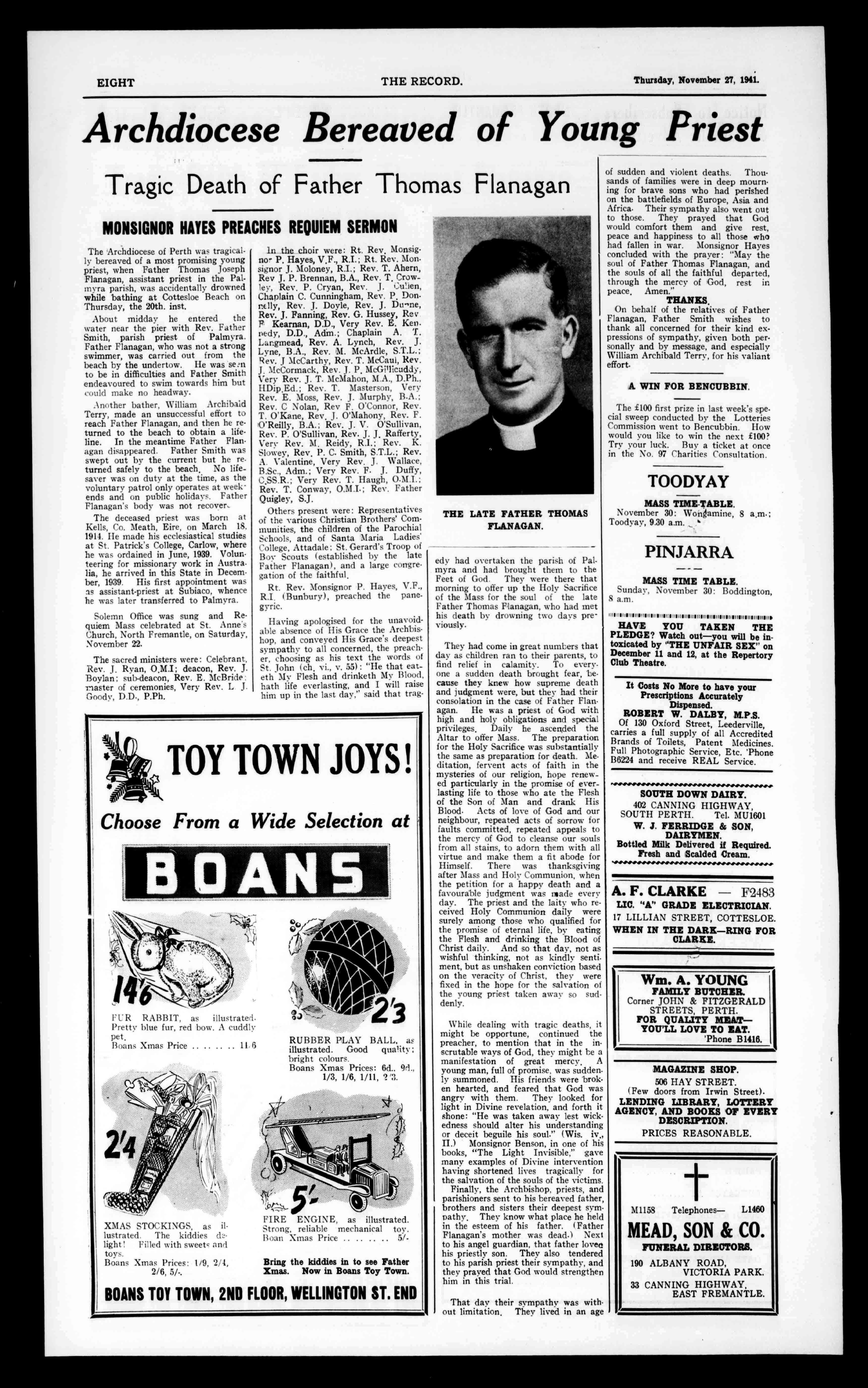
ArchdioceseBereavedofYoungPriest
TragicDeathofFatherThomasFlanagan
MONSIGNORHAYESPREACHESREQUIEMSERMON
TheArchdioceseofPerthwastragicallybereavedofamostpromisingyoung priest,whenFatherThomasJoseph Flanagan,assistantpriestinthePalmyraparish,wasaccidentallydrowned whilebathingatCottesloeBeachon Thursday,the20th.inst.
Aboutmiddayheenteredthe waternearthepierwithRev.Father Smith,parishpriestofPalmyra. FatherFlanagan,whowasnotastrong swimmer,wascarriedoutfromthe beachbytheundertow.Hewasseen tobeindifficultiesandFatherSmith endeavouredtoswimtowardshimbut couldmakenoheadway.
Anotherbather,WilliamArchibald Terry,madeanunsuccessfuleffortto reachFatherFlanagan,andthenhereturnedtothebeachtoobtainalifeline.InthemeantimeFatherFlanagandisappeared.FatherSmithwas sweptoutbythecurrentbuthereturnedsafelytothebeach,Nolifesaverwasondutyatthetime,asthe voluntarypatrolonlyoperatesatweekendsandonpublicholidays.Father Flanagan'sbodywasnotrecover.
Thedeceasedpriestwasbornat Kells,Co.Meath,Eire,onMarch18, 1914.Hemadehisecclesiasticalstudies atSt.Patrick'sCollege,Carlow,where hewasordainedinJune,1939.VolunteeringformissionaryworkinAustralia,hearrivedinthisStateinDecember,1939.Hisfirstappointmentwas asassistant-priestatSubiaco,whence hewaslatertransferredtoPalmyra.
SolemnOfficewassungandRequiemMasscelebratedatSt.Anne's Church,NorthFremantle,onSaturday, November22.
Thesacredministerswere:Celebrant, Rev.j.Ryan,()XI;deacon,Rev.J. Boylan;sub-deacon,Rev.E.McBride: -masterofceremonies,VeryRev.LJ. Goody,D.D.,P.Ph.
Inthechoirwere:Rt.Rev,Monsigno-P.Hayes,V.F.,R.I.;Rt.Rev.MonsignorJ.Moloney,RI.;Rev.T.Ahern, RevJ.P.Brennan,B.A.,Rev.T.Crowley,Rev.P.Cryan,Rev.J.Cullen, ChaplainC.Cunningham,Rev.P,Donnay,Rev.J.Doyle,Rev.J.Du-'ne, Rev.J.Fanning,Rev.G.Hussey,Rev FKearnan,D.D.,VeryRev.E.Ken. nedy,D.D.,Adin.;ChaplainA.T. Langmead,Rev.A.Lynch,Rev.J. Lyne,B.A.,Rev.M.McArdle,S.T.L.; Rev.JMcCarthy,Rev.T.McCaul,Rev. J.McCormack,Rev.J.P.McGillicuddy, VeryRev.J.T.McMahon,MA.,D.Ph., HDip,Ed.;Rev.T.Masterson,Very Rev.E.Moss,Rev.J.Murphy,B.A.; Rev.CNolan,RevF.O'Connor,Rev. T.O'Kane,Rev,J.O'Mahony,Rev.F. O'Reilly,BA.;Rev.J.V.O'Sullivan, Rev.P.O'Sullivan,Rev.J.J.Rafferty, VeryRev.M.Reidy,R.I.;Rev.K. Slowey,Rev,P.C.Smith,S.T.L.;Rev. A.Valentine,VeryRev.J.Wallace, B.Sc.,Adm.;VeryRev.F.J.Duffy, 0.SS.R.;VeryRev.T.Haugh,0.M.I.; Rev.T.Conway,O.M.I.Rev.Father Quigley,S.J.
Otherspresentwere:Representatives ofthevariousChristianBrothersCommunities,thechildrenoftheParochial Schools,andofSantaMariaLadies' College,Attadale;St.Gerard'sTroopof BoyScouts(establishedbythelate FatherFlanagan),andalargecongregationofthefaithful, Rt.Rev.MonsignorP.Hayes,V.F., R.I.(Sunbury),preachedthepanegyric.
HavingapologisedfortheunavoidableabsenceofHisGracetheArchbishop,andconveyedHisGracesdeepest sympathytoallconcerned,thepreacher,choosingashistextthewordsof St.John(ch,vi.,v.55):"HethateatethMyFleshanddrinkethMyBlood, hathlifeeverlasting,andIwillraise himupinthelastday,"saidthattrag-
edyhadovertakentheparishofPalmyraandhadbroughtthemtothe FeetofGod.Theyweretherethat morningtoofferuptheHolySacrifice oftheMassforthesoulofthelate FatherThomasFlanagan,whohadmet hisdeathbydrowningtwodayspreviously.
Theyhadcomeingreatnumbersthat dayaschildrenrantotheirparents,to findreliefincalamity.Toevery. oneasuddendeathbroughtfear,becausetheyknewhowsupremedeath andjudgmentwere,buttheyhadtheir consolationinthecaseofFatherFlanagan.HewasapriestofGodwith highandholyobligationsandspecial privileges.Dailyheascendedthe AltartoofferMass.Thepreparation fortheHolySacrificewassubstantially thesameaspreparationfordeath.Meditation,ferventactsoffaithinthe mysteriesofourreligion,hoperenewedparticularlyinthepromiseofeverlastinglifetothosewhoatetheFlesh oftheSonofMananddrankHis Blood.ActsofloveofGodandour neighbour,repeatedactsofsorrowfor faultscommitted,repeatedappealsto themercyofGodtocleanseoursouls fromallstains,toadornthemwithall virtueandmakethemafitabodefor Himself.Therewasthanksgiving afterMassandHolyCommunion,when thepetitionforahappydeathanda favourablejudgmentwasmadeevery day.ThepriestandthelaitywhoreceivedHolyCommuniondailywere surelyamongthosewhoqualifiedfor thepromiseofeternallife,byeating theFleshanddrinkingtheBloodof Christdaily.Andsothatday,notas wishfulthinking,notaskindlysentiment,butasunshakenconvictionbased ontheveracityofChrist,theywere fixedinthehopeforthesalvationof theyoungpriesttakenawaysosuddenly.
Whiledealingwithtragicdeaths,it mightbeopportune,continuedthe preacher,tomentionthatintheinscrutablewaysofGod,theymightbea manifestationofgreatmercy, A youngman,fullofpromise,wassudden. lysummoned.Hisfriendswerebrokenhearted,andfearedthatGodwas angrywiththem.Theylookedfor lightinDivinerevelation,andforthit shone:"Hewastakenawaylestwickednessshouldalterhisunderstanding ordeceitbeguilehissoul."(Wis.iv,, II.)MonsignorBenson,inoneofhis books,"TheLightInvisible,"gave manyexamplesofDivineintervention havingshortenedlivestragicallyfor thesalvationofthesoulsofthevictims.
Finally,theArchbishop,priests,and parishionerssenttohisbereavedfather, brothersandsisterstheirdeepestsympathy.Theyknowwhatplaceheheld intheesteemofhisfather.(Father Flanagan'smotherwasdead.)Next tohisangelguardian,thatfatherloves hispriestlyson.Theyalsotendered tohisparishpriesttheirsympathy,and theyprayedthatGodwouldstrengthen himinthistrial.
Thatdaytheirsympathywaswith. outlimitation,Theylivedinanage
ofsuddenandviolentdeaths.Thousandsoffamilieswereindeepmourningforbravesonswhohadperished onthebattlefieldsofEurope,Asiaand Africa.Theirsympathyalsowentout tothose.TheyprayedthatGod wouldcomfortthemandgiverest, peaceandhappinesstoallthosewho hadfalleninwar.MonsignorHayes concludedwiththeprayer:"Maythe soulofFatherThomasFlanagan,and thesoulsofallthefaithfuldeparted, throughthemercyofGod,restin peace.Amen."
THANKS.
OnbehalfoftherelativesofFather Flanagan,FatherSmithwishesto thankallconcernedfortheirkindexpressionsofsympathy,givenbothpersonallyandbymessage,andespecially WilliamArchibaldTerry,forhisvaliant effort.
AWINFORBENCUBBIN.
The£100firstprizeinlastweek'sspecialsweepconductedbytheLotteries CommissionwenttoBencubbin.How wouldyouliketowinthenextf100? Tryyourluck.Buyaticketatonce intheNo.97CharitiesConsultation.
TOODYAY
MASSTIME-TABLE. November30:Woniamine,8a.m.: Toodyay,9.30a.m.`
PINJARRA
MASSTIMETABLE. Sunday,November30:Boddington, Sa.m. trIVIiliti.11,1,. 1,111111111111111.11111.1111111111111111113.
HAVE YOUTAKENTHE PLEDGE?Watchout-youwillbeintoxicatedby"THEUNFAIRSEX"on December11and12,attheRepertory ClubTheatre.
ItCostsNoMore Prescriptionstohaveyour Accurately Dispensed. ROBERTW.DALBY,M.P.S.
EIGHT THERECORD. Thursday,November27,1941.
TOYTOWNJOYS! ChooseFromaWideSelectionat FL'RRABBIT,asillustrated. Prettybluefur,redbow.Acuddly pet. RoansXmasPrice 11.6 XMASSTOCKINGS,asillustrated.Thekiddiesdalight!Filledwithsweet.and toys. BoansXmasPrices:1/9,2/1, 2/6,5/-. RUBBERPLAYBALL,as illustrated.Goodqualit.y; brightcolours. BoansXmasPrices:6d..9d., 1/3,1/6,1/11,71. FIREENGINE,asillustrated. Strong,reliablemechanicaltoy. RoanXmasPrice 5/BringthekiddiesintoseeFather Xmas.NowinBoansToyTown. BOANSTOYTOWN,2NDFLOOR,WELLINGTONST.END
THELATEFATHERTHOMAS FLANAGAN.
Of130OxfordStreet,Leederville, carriesafullsupplyofallAccredited BrandsofToilets,PatentMedicines. FullPhotographicService,Etc.'Phone B6224andreceiveREALService. SOUTHDOWNDAIRY. 402CANNINGHIGHWAY, SOUTHPERTH. Tel.MU1601 W.J.FERRIDGE&SON, DAIRYMEN. BottledMilkDeliveredifRequired. FreshandScaldedCream. A.F.CLARKE-F248:3 LIC."A"GRADEELECTRICIAN. 17LILLIANSTREET,COTTESLOE. WHENINTHEDARK-RINGFOR CLARKE. Wm.A.YOUNG FAMILYBUTCHER. CornerJOHN&FITZGERALD STREETS,PERTH. FORQUALITYMMAITYOU'LLLOVETOEAT. 'PhoneB1416. MAGAZINESHOP. 506HAYSTREET. 1FewdoorsfromIrwinStreet). LENDINGLIBRARY,LOTTERY AGENCY,ANDBOOKSOFEVERY DESCRIPTION. PRICESREASONABLE. M1158 Telephones-LI460 MEAD,SON&CO. FUNERALDIRECTORS. 190ALBANYROAD, VICTORIAPARK. 33CANNINGHIGHWAY, EASTFREMANTLE.
COLLIECHILDREN'SBALL
Influenceofthewarwasevidentat theannualfancydressballheldbythe CollieresidentsintheAmusuHallre cently,manychildrenparadingincostumesappropriatetothetimes.The ballhadadistinctmilitaryandpatrioticnote.Themainawardforthebest setwenttothe"VforVictory"children,whowereenteredbyMrs.Milligan.Bothafinancialandsocialsuccess,theballwasthesecondbestheld intheCollieParishsincetheannual Children'sBallwasfirstoriginated. Twenty-twosetsandinnumerablechildreninindividualcostumetookpart Alargenumberofadultsattended. Afterthegrandmarchchildrendanced thesets,andsoonafterwardswentto theConventHallforsupper.Dancingwasthenenjoyedbytheadults. ThejudgeswereMrs.Morrisonand MissMeagher.Theyhadanunenviabletaskselectingtheprizewinners, forthecostumeswereofauniformly highstandard.However,the"Vfor Victory"set,whichwontheprizein theseniordivision,andthe"Bridal' setinthejuniordivision,werepopularselections.Otherprizewinners included:Bestcouple,"Rajahand Ranee;"bestgirlover8years,"SwingingAlongtheRoadtoVictory;"best girlunder8years,"LadyMakeBe. lieve;"bestboyover8years."Mayor:" bestboyunderSyears,"Drummer Boy."Specialprizeswentto"Poppies andPetalFairies"and"HotelCooks," The22setswereasfollows:"Weofthe LightFantastic,"enteredbyMrs.Ford: "GentlemenPreferBlondes,"entered byMrs.Bennett;"PoppiesandPetal Fairies,"byMrs.Noonan;"MaoriFarewell,"byMissPia-irisandMrs.Coldhart;"VforVictory,"byMrs.Milligan; "BridalSet,"byMrs.Wittorf;"Atthe ServiceoftheEmpire,"byMissI. Miller;"BabySunbeams,"byMissL. Bolton;"TheFlagofVictory,"byMrs. Madden;"Carnival,"byMrs.Tracy; "PowderPuffs,"byMrs.Pike;`'Fairies,"byMrs.Boyd;"There'llAlways beanEngland,"byMrs.McGinnand Mrs.Quinn;"BoysandGirlsofHolland,"byMrs.WaywoodandMissByfield:"HotelCooks,"byMrs.Phease; "TheWirrawayGirls,"byMissWood; "TheParachuteTroops,"byMiss Wood;"Valentines,"byMrs.Branley; "WaltzingMatilda,""RedIndians," "DownSouth,"and"Spring,"byMiss Branley. Inconnectionwiththeball,araffle tookplace(bypermisisonoftheLotteriesCommission),andfollowingare thewinners:No.382,Mr.P.W.Hicks (2/cwt.ofpotatoes);No.374,Mr.John O'Hara(fatlamband10s.worthof meat)No.494,MissElsieWalton Ewington(caseoffruit);No.593, NormaPianta(1dozencordials);No. 1037,S.Dempsey(1pairofgloves) No.764,AliceBastow(boxofhandkerchiefs);No.1099,Mrs.G.Fogarty(joy ride).ThisartunionwasdrawnduringadanceheldintheConventHall, Atthedancemusicwassuppliedby Messrs.F.Bentley,R.Hutchinson,and W.Cunneen,whilethecateringwasin thecapablehandsofMesdamesGhilottiandRyan.PartoftheraffleproceedswereforwardedtotheSecretary oftheCatholicWelfareOrganisationfor patrioticpurposes.
LEEDERVILLESEWINGCIRCLE
The'LeedervillebranchoftheC.W.L. heldtheirweeklysewingafternoonat thehomeofMrs.LePagerecently,The loungewasdecoratedwithgladioliand golden'bloom,andtheafternoonitself wasbothdelightfulandsuccessful. AmongthosepresentwereMesdames LyonJohnson,Boylan,Dillon,Frawley, Rawlings,Larkin,Bailey,Atkinson, McMullen,E.Watters,N.Watters, Cripps,Salter,Storeham,Flanagan, Buckley,Ryan,Berrty,Johnson,Beeson,Philby,Wheldon,Brand,Jones, Witheridge,Edwards,Chesson,Foster, Sinclair,Hebbard,Reckner,andMisses ParkerandBranch.
DressandFashion
rminemonsummensommommusumustmosuninsus UNSIGHTLYFACIALHAIR REMOVEDPERMANENTLY withoutdiscomfortorinconvenienceby ELECTROYLSIS.
Free. 117455. MISSR.DUGGAN, Room33,ThirdFloor,GladdenBuildings,WilliamStreet,Perth. 1110111118.111111111111111111101HIMIMIHORI.101n111111111111filiP
OfGeneralInterest
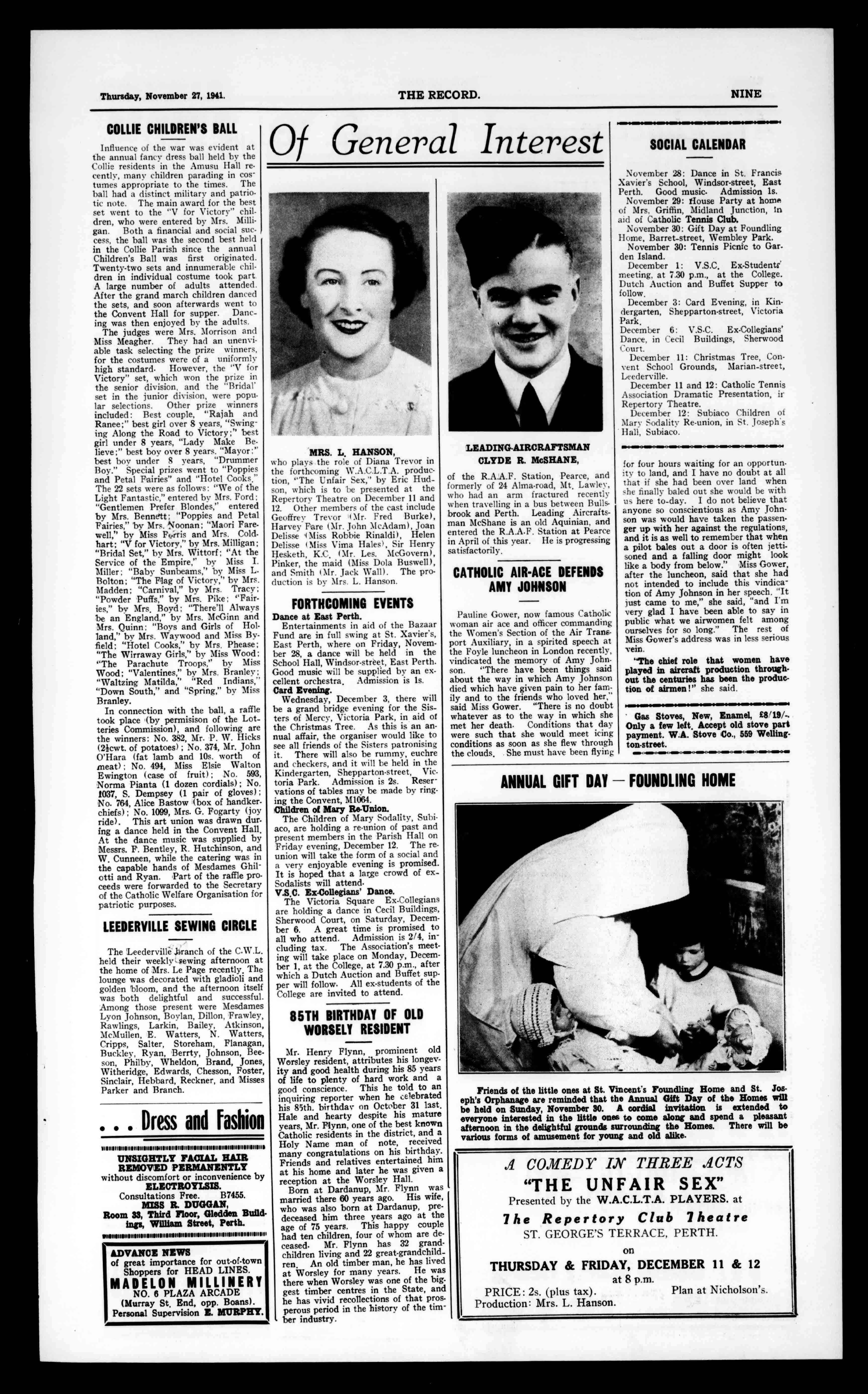
MRS.L,RANSON, whoplaystheroleofDianaTrevorin theforthcomingW.A.C.L.T.A.production,"TheUnfairSex,"byEricHudson,whichistobepresentedatthe RepertoryTheatreonDecember11and 12.Othermembersofthecastinclude GeoffreyTrevor IMr.FredBurke), HarveyFare(Mr.JohnMcAdam),Joan Delisse.(MissRobbieRinaldi),Helen Delisse(MissVimaHales),SirHenry ffesketh,K.C,(Mr.Les.McGovern), Pinker,themaid(MissDolaBuswell), andSmith(Mr.JackWall).TheproductionisbyMrs.L.Hanson.
FORTHCOMINGEVENTS
DanceatEastPerth.
EntertainmentsinaidoftheBazaar FundareinfullswingatSt.Xavier's, EastPerth,whereonFriday,November28,adancewillbeheldinthe SchoolHall,Windsor-street,EastPerth. Goodmusicwillbesuppliedbyanexcellentorchestra,AdmissionisIs. CardEvening, Wednesday,December3,therewill beagrandbridgeeveningfortheSistersofMercy,VictoriaPark,inaid01 theChristmasTree.Asthisisanannualaffair,theorganiserwouldliketo seeallfriendsoftheSisterspatronising it.Therewillalsoberummy,euchre andcheckers,anditwillbeheldinthe Kindergarten,Shepparton-street,VictoriaPark.Admissionis2s.ReservationsoftablesmaybemadebyringingtheConvent,M1064. ChildrenofMaryRe-Union.
TheChildrenofMarySodality,Subiaco,areholdingare-unionofpastand presentmembersintheParishHallon Fridayevening,December12.Thereunionwilltaketheformofasocialand averyenjoyableeveningispromised. ItishopedthatalargecrowdofexSodalistswillattend.
V.8.0.Ex-Collegians'Danes. TheVictoriaSquareEx-Collegians areholdingadanceinCecilBuildings, SherwoodCourt,onSaturday,December6.Agreattimeispromisedto allwhoattend.Admissionis2/4,includingtax.TheAssociation'smeetingwilltakeplaceonMonday,December1,attheCollege,at7.30p.m.,after whichaDutchAuctionandBuffetsupperwillfollow.Allex-studentsofthe Collegeareinvitedtoattend.
85THBIRTHDAYOFOLD WORSELYRESIDENT
Mr.HenryFlynn,prominentold Worsleyresident,attributeshislongevityandgoodhealthduringhis85years oflifetoplentyofhardworkanda goodconscience.Thishetoldtoan inquiringreporterwhenhecelebrated his85th.birthdayonOctober31last. Haleandheartydespitehismature years,Mr.Flynn,oneofthebestknown Catholicresidentsinthedistrict,anda HolyNamemanofnote,received manycongratulationsonhisbirthday. Friendsandrelativesentertainedhim athishomeandlaterhewasgivena receptionattheWorsleyHall. BornatDardanup,Mr.Flynnwas marriedthere80yearsago.Hiswife, whowasalsobornatDardanup,predeceasedhimthreeyearsagoatthe ageof75years.Thishappycouple hadtenchildren,fourofwhomaredeceased.Mr.Flynnhas32grandchildrenlivingand22great-grandchildren.Anoldtimberman,hehaslived atWorsleyformanyyears.Hewas therewhenWorsleywasoneofthebiggesttimbercentresintheState,and hehasvividrecollectionsofthatprosperousperiodinthehistoryofthetimberindustry.
LEADING-AIRCRAFTSMAN
CLYDER.MeSHANE, oftheR.A.A.F.Station,Pearce,and formerlyof24Alma-road,Mt,Lawler, whohadanarmfracturedrecently whentravellinginabusbetweenBullsbrookandPerth.LeadingAircraftsmanMcShaneisanoldAquinian,and enteredtheR.A.A.F.StationatPearce inAprilofthisyear.Heisprogressing satisfactorily.
CATHOLICAIR-ACEDEFENDS AMYJOHNSON
PaulineGower,nowfamousCatholic womanairaceandofficercommanding theWomen'sSectionoftheAirTransportAuxiliary,inaspiritedspeechat theFoyleluncheoninLondonrecently, vindicatedthememoryofAmyJohnson."Therehavebeenthingssaid aboutthewayinwhichAmyJohnson diedwhichhavegivenpaintoherfamilyandtothefriendswholovedher," saidMissGower."Thereisnodoubt whateverastothewayinwhichshe metherdeath.Conditionsthatday weresuchthatshewouldmeeticing conditionsassoonassheflewthrough theclouds,Shemusthavebeenflying
SOCIALCALENDAR
November28:DanceinSt.Francis Xavier'sSchool,Windsor-street,East Perth.Goodmusic-Admissionls.
November29:HousePartyathome ofMrs.Griffin,MidlandJunction,In aidofCatholicTennisClub.
November30:GiftDayatFoundling Home,Barret-street,WembleyPark.
November30:TennisPicnictoGardenIsland.
December1:V.S.C.Ex-Studentf meeting,at7.30p.m.,attheCollege. DutchAuctionandBuffetSupperto follow.
December3:CardEvening,inKindergarten,Shepparton-street,Victoria Park, December6:V.S.C.Ex-Collegians' Dance,inCecilBuildings,Sherwood Court.
December11:ChristmasTree,ConventSchoolGrounds,Marian-street, Leederville.
December11and12:CatholicTennis AssociationDramaticPresentation,it RepertoryTheatre.
December12:SubiacoChildrenof MarySodalityRe-union,inSt.Joseph's Hall,Subiaco.
forfourhourswaitingforanopportunitytoland,andIhavenodoubtatall thatifshehadbeenoverlandwhen shefinallybaledoutshewouldbewith ushereto-day.Idonotbelievethat anyonesoconscientiousasAmyJohnsonwaswouldhavetakenthepassengerupwithheragainsttheregulations, anditisaswelltorememberthatwhen, apilotbalesoutadoorisoftenjettisonedandafallingdoormightlook likeabodyfrombelow."MissGower, aftertheluncheon,saidthatshehad notintendedtoincludethisvindicationofAmyJohnsoninherspeech."It justcametome,"shesaid,"andI'm verygladIhavebeenabletosayin publicwhatweairwomenfeltamong ourselvesforsolong."Therestof MissGower'saddresswasinlessserious vein.
"Thechiefrolethatwomenhave playedinaircraftproductionthroughoutthecenturieshasbeentheproductionofairmen!" The airl
GasStoves,New,Enamel,£8'19 Onlyafewleft.Acceptoldstovepart payment.W.A.StoveCo.,559Wellington-street.
ANNUALGIFTDAY-FOUNDLINGHOME
Theatre
&FRIDAY,DECEMBER
PRICE:2s.
Thursday,November27,1941. THERECORD. NINE
ADVANCENEWS ofgreatimportanceforout-of-town ShoppersforHEADLINES. MADELONMILLINERY NO.6PLAZAARCADE (MurraySt.End,opp.Boans). PersonalSupervisionZ.MURPHY.
Consultations
FriendsofthelittleonesatSt.VinoenisFoundlingHomeandSt.Joseph'sOrphanageareremindedthattheAnnualGiftDayoftheHomeswill beheldonSunday,November30.Acordialinvitationisextendedto everyoneinterestedinthelittleonestocomealongandspendapleasant afternooninthedelightfulgroundssurroundingtheHomes.Therewillbe variousformsofamusementforyoungandoldalike.
COMEDY
A
IXTHREEACTS "THEUNFAIRSEX"
PLAYERS.at The
PresentedbytheW.A.C.L.T.A.
RepertoryClub
ST.GEORGE'STERRACE,PERTH.
at
on THURSDAY
11&12
8p.m.
(plustax). PlanatNicholson'..
Mrs.L.Hanson.
Production:
Parents'Responsibility RegardingReading
NonemorethantheCatholiccommunitydeplorethepoisonoustypeofliteraturefortheyoungwhichisbeingprintedandsold inthiscountry,moreespeciallysincetheoutbreakofwar.But inthismatterthereisforusthesomewhatbitterreflectionthat weCatholics,whenwewerethepioneersforthesuppressionofthis evil,wherebrandedasreactionaryandpeopletalkedaboutthe IndexasifitwereacupboardwhereintheChurchkeptthebread awayfromherchildren.Actuallythecupboardcontainedthese verysourandpoisonousappleswhicheveryoneisnowagreed shouldbeforbiddentoalladolescents.Itseemsthatnon-Catholics arebeginning,inthismatteratleast,torealisethehollownessand fatuityofLiberalism.Butprohibitivemeasuresofthemselveswill dolittletostemtheinroadswhichimmoralliteraturehasalready madeuponthemindsandheartsoftherisinggeneration.Itis simplythatculturalinterestshavedwindledtozero,largelybecause ofthedeclineofthereligiousspirit.
Itwouldbeasimplemattertomaketheschoolsthebuttofthis issueandtoclaimthatthesystemofteaching,withaneyeonthe annualcompetitiveexaminations,hadintroducedanapproachto theculturalsubjectswhich,throughitsveryutilitarianism,hasdestroyedtherealappreciationofthem.Buttheproblemdrives muchdeeper.Itisboundupwiththematerialisticphilosophyof ourcivilisation,whichischaracterisedbythepolicyof"laissezfaire,"andbyunrestrainedindividualism-bythespiritofLiberalismwhichyetpermeateseveryexpressionofsociallife.Ithas hadperhapsitsworstrepercussioninthefamilygroup,withthe weakeningofparentalauthorityandthefalsenotionsof"rights" giventochildrenbymuchofthe"new"education.Theneedfor discipline,domesticallyandnationally,isbeingexperienced,and itisahealthyportent.AmericanCatholicsgavetheleadincleaningupthepornographicscreenand,morerecently,bawdyburlesque.Stilllatertherewasaninterdenominationalcampaigninthe Statesagainstindecentliteratureandaleagueforcleanreadingwas established.Itseemstomanythatweinthiscountrymightwell followtheAmericanlead.
Aswehavesaid,merelydefensiveandrepressivemeasureswill notsuffice.Good,wholesomebooksandmagazinesofrealinterestandliteraryworthmustreplacethehorrorstories,"truelove" episodes,andthelegionofvulgarsentimentalnovels.Oncethe Governmenthasdoneitsdutyonthenegativesidebypreventing thepublicationandsaleofbothlocalandimportedsalaciousliterature,thepositiveonusofprovidingthe"right"classofreadingis ontheparents.ForCatholicsinthisStatethereisnoreasonable .excusefortheirchildrenbeingseducedbyimmoralliterature.There existsinPerthafineCentralCatholicLibrary,whichisgrowing rapidlyandwhichcontainsacomprehensiverangeofbookstosuit varyingtastes,whichcanbeprocuredatrateslowerthanthoseof anyotherlibraryinthecity.YettheCatholicLibrarydoesnot receivethesupportitmerits,eitherbecauseCatholicparentsareignorantofitsexistenceorbecausetheyareremissintheirobligationsintheseriousmatterofsoundliterature.Itistobehoped thatCatholicswillrealisethegravityoftheirobligationsandhelp theCatholicCentralLibrarytohelpthemselvesandtheirchildren.
theLibraryLectures
ANINVITATIONTOALL
Theseriesoflecturesarrangedbythe CentralCatholicLibraryCommittee aredrawingtoaclose.Theyaregiven attheLibrary,36Pier-street,Perth,on Fridayevenings.Alllecturesofthe serieshavesofarbeenanoutstanding success,theaccommodationbeingtaxedtocapacityoneachoccasion. Theserieshasasacentralthemethe LifeofChrist,andHisvitalsignificance inthedramaofhumanhistory.The treatmentisnotmerelyachronological
presentationoftheincidentsofthelife ofOurLord,butcertainaspectsofHis lifearelinkedupwithmodernproblems,foritisobviousthatthemore realandthoroughourappreciationof ChristandHissignificance,thedeeper andmorevitalwillbeourCatholicity. Themainlectureoftheeveningis followedbyashorttalkononeofthe varioussectionsofthelibrary. Thefinallectureoftheserieswillbe onNovember28,andthesubjectwfil be:"ChristandtheInterpretationof History."Mr.K.Spruhanwillbethe lecturer.
tOeZrcObtocecie
ARCHBISHOP'SENGAGEMENTS.
November27-December2.-Narrogin andDistricts:CanonicalVisitation andConfirmation.
December3.-3p.m.:Administerthe SacramentofConfirmationatSt. LouisCollege,Claremont.
December5.-8p.m.:Distributeprizes atSantaMariaLadies'College,Attadale.
December8(FeastoftheImmaculate Conception.TitularFeastofthe Cathedral):
8a.m.:PontificateinSt.Mary'sCathedral.
3p.m.:DistributenrizesatAnnual PrizeDay,St.LouisCollege,Claremont.
8p.m.:AdministertheSacramentof ConfirmationattheChurchofthe ImmaculateConception,Harvey. December9.12:HarveyandDistricts: CanonicalVisitationandConfirmation.
December13:PresideatReception CeremonyatSt.Joseph'sConvent, Fremantle.
December14:AdministertheSacramentofConfirmationattheChurch
ofOurLady,HelpofChristians,East VictoriaPark,after9.30a.m.Mass.
7.30p.m.:AdministertheSacrament ofConfirmationattheChurchof ChristtheKing,Beaconsfield.
December19.-10am.:PresideatQuarterlyConferenceofthePriestsofthe MetropolitanArea.
6,45p.m.:AdministertheSacrament ofConfirmationtoadultsinSt. Mary'sCathedral.
December19.-8.30p.m.:OpenBazaar atSt.FrancisXavier's,Windsorstreet,EastPerth.
December20.-ConsecratenewChapel atClontarfBoys'Orphanage.
December21Morning:AdministertheSacrament ofConfirmationatSt.Anthony's Church,Wanneroo.
Afternoon:Officialopeningofnew ChapelatClontarfBoys'Orphanage.
December23.-8a.m.:PresideatReceptionCeremonyattheNovitiateof theSistersofMercy,VictoriaSquare.
December25(ChristmasDay):St. Mary'sCathedral:Midnight,Pontificate, 11a.m.:PresideatSolemnHighMass.
St.Charles'Seminary,Guildford
Progressisbeingmaintainedsatisfactorilywiththepreparationsforthe openingoftheSeminary.Apartfrom thisgeneralreportthereisnothing freshtoannounceexcepttoacknowledgemostgratefullythefollowingdonationstowardsthefurnishingoftilt chapels:
1.Tenpoundsfromaprev:ousbenefactorofEastPerth.
2.SevenpoundsforasetofVest-
ments:TheCatholicWomen'sGuild, Wagin.
3.Vestments(value£10)Conventof theGoodShepherd', ThegiftofAltarClothsandAltar Linen,andalsoasmallwoodenaltar (£10-i15),wouldstillbemuchappreciated. Werepeatourspecialrequestfora second-handMissalandaMissalforRequiemMasses.ThesebooksareunobtainableinAustraliaatpresent.
SolemnNovenaforthe ImmaculateConception
TITULARFEASTOFST.MARY'S CATHEDRALANDCHIEFPATRONALFEASTOFTHEARCHDIOCESEOFPERTH.
Asmentionedinlastweek'sissue, therewillbesolemncelebrationsheld attheShrineofOurLady,inSt. Mary'sCathedral,fortheninedaysprecedingtheFeastoftheImmaculate ConceptionoftheBlessedVirgin.Our Lady,underthistitle,isthechiefPatronoftheArchdioceseofPerth,and alsothetitularoftheCathedralitself. Consequentlythefeastandthedaysof preparationforitareofspecialimportancetoallCatholics,notonlyof theCathedralParishbutalsoof..ae whlediocese.Thisandalsothefact thattheNovenaisbeingofferedasa specialintercessionforpeaceshouldbe morethansufficienttorecommenditto practicingCatholics.
TheorderoftheNovenaisasfollows:-
CommencingSaturday,November29: Masseachmorning,7a.m.:Benediction eachevening,7.30p.m.,bothatthe LadyChapel,HolyCommunionwill bedistributedbothbeforeandduring Mass,attherailsoftheLadyAltar.
Benedictionwill'besungeacheveningbythefollowingchoirs:
November29:ChildrenofMary.
November30:CathedralChoir.
December1:St.Patrick'sBoys.
December2:St.Joseph'sGirls.
December3:ChildrenofMary.
December4:St.Patrick'sBoys.
December5:St.Toseph'sGirls.
December6:ChildrenofMary.
OnSundayevening,December7, theFirstVespersoftheFeastwillbe chanted.(Thiswillbethefirsttime, inourknowledge),thatSolemnVespers willhavebeensunginSt.'Mary'sCathedral.)
OntheFeastoftheImmaculateConceptionitself,PontificalHighMasswill becelebratedbyHisGracetheArchbishopat8a.m.
QUARANTORE
DECEMBER.
Sunday.
1st.EastFremantle:'Forty HoursPrayer(5th.-7th.). Maylands:FortyHours' Prayer5th.-7th.).
2nd.Leederville:FortyHours' Prayer(12th.-14th.).
3rd.Leonora:OneDayofExposition.
4th.York:OneDayofExposition.
ConfirmationofAdults
HisGracetheArchbishopwilladministertheSacramentofConfirmationtoadultsinSt.Mary's CathedralonFriday,December 19,at6.45p.m.IntendingcandidatesarerequestedtonotifytheAdministrator (VeryRev.E.Kennedy)notlater thanDecember18.Thosefrom outsidetheCathedralParishwill berequiredtofurnishletters fromtheirrespectiveparish priests.
PRIESTS'CONFERENCE.
TheQuarterlyConferenceofthe PriestsoftheMetropolitanArea willbe Victoriaheldintite'ChapterHall, Square;at10a.m.on Friday,December19.
CENTRALCATHOLICLIBRARY
SUBSCRIPTIONRATES.
Metropolitan.
12Months:Onebook,10s;twobooks, 12s6d;threebooks,il;fourbooks,£1 7s.6d.
Clotmtry.
12Months:Threebooks,15s.;four books,#25s.;fivebooks,£210s. Wepayfreightonbookstothesubscriber.
Doyouwishtohelpeducateapriest forworkinWesternAustralia?Make aregularannualcontributiontohelp anindigentstudent.
CLONTARFDONATIONS
TEN THERECORD. Thursday,November27,1941. Established1874. AddressallcommunicationstotheEditor,BoxA35,G.P.O.,Perth. OfficialOrganoftheArchdioceseofPerth. 450HAYSTREET,PERTH. TELEPHONE:B9141. PERTH,THURSDAY.NOVEMBER27,1941.
*
*
*
d. Anonymous,Claremont 220 Grandmother 26 StaffofCustomsDepartment, Fremantle 106
s.
NewPresbyteryOpenedatMt.Barker
HisGracePraisesCatholicEnlistments
UrgesTotalWarEffort
TheofficialopeningofthenewPresbyteryatMountBarkertookplaceon
Sundayafternoon,November16.The ceremonywasperformedbyHisGrace theArchbishop,whojourneyedfrom Katanning,wherehewasinthecourse ofCanonicalVisitation.HisGrace returnedthateveningtoKatanningto administertheSacramentofConfirmation.Thefollowingclergywerepresent:VeryRev.DeanGilroy(Albany),Rev.FatherByrne(Kataning), Rev.Dr.Collins(ShentonPark)and Rev.FatherMcLoughlin,C.SS.R. (Perth).Alargegatheringofpeople attendedtheceremony,representing MountBarker,Kendenup,Albanyand Denmark.
AftertheblessingofthenewPresbyterybyHisGrace,FatherM.Holohan,theparishpriestofMountBarkeranddistricts,addressedthepeople.OnbehalfoftheCatholicsof MountBarkerheextendedtoHis GraceaveryheartywelcometoMount Barker,thankinghimforhavingcome toopentheIletfPresbytery,Father Holohanthencongratulatedthepeople onthecompletionofthenewPresbytery,andthefirstCatholicpresbytery ofMountBarker,andsincerelythankedthemfortheirco-operationinthe work.Heremarkedthatwhenthe ArchbishoplastFebruarymentioned thebuildingofasmallPresbytery,the taskseemed,atthattime,adifficult one,butduetothewholeheartedcooperationofthepeopleandtheirdesire tohavearesidentpriest,thetaskwas willinglyundertakenandsuccessfully accomplished.Thebuildingofthe Presbyterymeantextradebtandextra worktoraisenecessaryfunds,andthe newPresbyterywasindeedanexpressionoftheselfsacrificeofthepeople fortheChurch.FatherHolohonalso congratulatedandthankedthecontractor,Mr.G.Duckett,ofMountBarker,whowasalsothedesignerofthe building,forthegoodworkmanship putintothebuilding. HisGracethenaddressedthegather. ing.HethankedFatherHolohanand thepeopleofMountBarkerfortheir enthusiasticwelcome,andsaiditwas alwaysagreatpleasureforhimto cometoMountBarker,andonthis occasion,moregratifyingthanever, havingcometoopenthenewPresbytery.Heexpressedhisgreatdelight withthenewbuilding,whichheremarkedwasneitherextravagantnor luxurious,yet,wasverycomfortable andworthyofMountBarker,andan assettothetownship.Thebuilding ofthepresbyterywasnecessary,becauseMountBarkerwasthemaincentreoftheMountBarker-DenmarkParish,andaresidencewasnecessaryfor thepriest.Onlythebareessentials werebuiltwithaminimumexpenditure.
HisGraceheartilycongratulatedthe people,FatherHolohan,andthecontractorontheworkdone,andthanked thepeoplefortheirgenerousco-operationwiththeparishpriestinthe buildingofthepresbytery,andhoped thatthesamesupportwouldcontinue inthefutre.
Inthecourseofaneloquentaddress, theArchbishopspokehighlyofthe MountBarkerdistrict,itsnaturaladvantagesandwonderfulpossibilities, and,thoughhewasnotspeakingasa prophet,hesaidthathebelievedthat therewasagreatfutureaheadforthe districtofMountBarker.Hestronglyexhortedthepeopletostayonthe
landinspiteofadverseconditions,and condemnedtherushofthepopleto thecity.Hesaidthatthisdesertion ofthelandandrushtothecities wouldonlyendinruinandchaos,spirituallyandmaterially.Thehopeof theChurchandStatelavinthelandowner.
ThedaybeingadayofNational Prayer,HisGraceremindedthepeople ofMountBarkeroftheirdutytoperservereinprayerforvictoryandpeace intheworld.Heexhortedthemalso todoalltheirmeanswouldallowto helpthewareffort.Hesaidhewas certainthatCatholicsweredoingtheir dutyeverywhereinproportiontotheir numbers.Speakingonthequestion ofCatholicenlistmentsintheForces, HisGracewishedtorefutecertainfalse rumours.HisGracesaidthat,having ascertainedthefacts,hefoundthatthe percentageofCatholicenlistmentswas higherthanthepercentagesofCatholicsinthepopulation,sothatnoone couldjustlysaytheCatholiccommunitywasnotdoingitsduty.
Whilerenderingeveryaidtothewar effort,HisGracewarnedthemagainst possibleneglectorthoughtlessnessas regardstheirChurchresponsibilities.It wouldbeasadstateofaffairsif,by helpingtheirforcesoverseasfighting forChristianity,theyweretoneglect tomaintainandsupportthoseinstitutionswhichwerethesymbolsforChristianityathome.
TheVeryRev.DeanGilroy,ofAlbany, formerparishpriestofMountBarker, addressedthegathering,andcongratulatedthepeopleontheirveryfine effort. Rev.FatherMcLoughlin,C.SS.R., alsospokeinsupportofthewonderful workdonebytheparishpriest,the people,andthecontractor.Father McLoughlinhadjustconcludedaweek's MissionintheMountBarker-Denmark Parish.
FatherHolohanthenreadthelist(.1 donations,whidhamountedto£120 todate. Abeautifulafternoonteawasserved bytheladiesoftheparish,whichcon. eludedamemorableevening.
ListofDonations.
£1010s:HisGracetheArchbishop.
£5each:VeryRev.DeanGilroy,Mr. andMrs.G.Duckett,Mr.T.Mulkerin, Mr.J.Keogh,Mr.G.Clarke,Mr.J.Cosgrave,AFriend.
£33seach:Mrs.J.C.Warnock,Mr. V.Hart,Mr.L.Duckett.
£3each:Rev.M.Holohan,Mr.J. Manion,Mr,J.Mulkerin,Mr.Martin, Rev.Dr.E.Collins.
£22seach:Mrs.A.O'Neill,VeryRev E.Moss.VeryRev.FatherDuffy, C.SS.R.,Rev.E.Carolan,Mr.andMrs. Mulkerin,Rev.M.Diviney,Mr.C. Nens.
£2each:Mr.G.Enright,Mr.B. Magee,Mr.G.Clarke,Rev.J.McGillicuddy.
£1iseach:Rev.T.Masterson,Rev.J. Russell,Rev.F.Byrne,Rev.Dr.E. Kennedy,Mr.McClintock,Mrs.T.Stevenson,Mr.Monahan.
fleach:Mrs.J.Keogh,Mr.E. Keogh,Mr.D.Keogh,Mrs.S.Reeves, Mrs.D.Herbert,,Mr.L.R.Gorman, Mr.J.Cosgrave,MissV.Doyle,Mrs.J. Devine,Mrs.Lalley,Mr.andMrs.J. Donohoe,Mr.F.P.Collins,Mrs.C.Falconer,Mrs.Seal,MissM.Maguire,A Friend,Mrs.Mercer.
lOs6deach:Mr.W.V.Hockley,Mrs. VChester.
lOseach:MissE.Collins,MissJ. Keogh,MissR.Collins,MissG.Keogh, MissP.Duckett,Mr.W.Collins,Miss W.Duckett,Mr.W.Wheeldon,MissC. Enright.
5seach:Mr.E.E.Warburton,Mr.J. Donohoe,junr.,Mrs.W.Mohr,Mrs.M. Offer,Mrs.Boff,AFriend. NEW
WasChristaCommunist?
InAustralianowadays,whereCommunismisattemptingavoltefaceto makeitsselfpalatabletothemasses, weoftenhearsincere,butbeguiled,pee. pleprattlingaboutChristbeinga Communist,oratleast,onewhodid notbelieveinprivateproperty.It mightproveofinteresttosettlethis question,ofwhetherHewasornot, onceandforall. Itshouldbeunnecessarytosaythat afairstudyoftheGospelsyieldsno suchconclusion,buttosatisfythe doubtingThomases,wewilllookintoit insomedetail.
Christnowherecondemnedtheprivateownershipofgoodsasunjustor unlawful,Perhapsthenearestapproachtosuchadeclarationisfound inHisreplytotherichyoungmanwho
ByB.R.ADDERLEY.
askedwhatwasrequiredofhimtoobtainlifeeverlasting-WhenOurLord wasinformedthattheYoungmanhad, fromhisyouth,kepttheprincipalcommandments,Headdedthiscouncilof perfection:"Iithouwiltbeperfect,go sellwhatthouhastandgivetothe poor. ."Youwillnoticeinthese wordsthatChristdrewquiteclearly thedistinctionbetweenwhatisnecessaryandwhatisofcouncil.Theyoung manwasnotrequestedtodivesthimselfofhisgoodssinlesshewishedtobe perfect,andhewasnotcommanded tobeperfect.
Moreover,thefactthatChristcounselledtheyoungmantosellhisgoods showsthatHedidnotconsiderthe holdingofpropertyasunjustorunlaw. ful.IfHehad,Hewouldhaverequestedtheyoungmantogiveaway hisgoods,nottotransferthetitleof ownershiptoanotherbyasale.The youngmancouldnothavesoldwhat wasnothistosell.
Again,forthosewhomightstill doubt,whenChristbecameaguestin thehouseoftherichZacheusHeassuredhim,"Thisdayissalvationcome tothishouse,"forZacheushadsaid, "Behold,Lord,thehalfofmygoods1 givetothepoor."Christ,inpraising himforthisaction,didnotcommand himtogiveawaytheotherhalf,as HewouldhaveifHehadconsidered theholdingofprivatepropertyunlawful.
EventhoughChristdidnotrequire thatmenshouldrefrainfromcalling externalgoodstheirownHedidcondemntheunjustandunsocialuseof privateproperty.
InHisdescriptionofthelastjudgment,Hepromisedheaventothose whowouldfeedthehungry,givedrink tothethirsty,andclothethenaked.IndeedallthroughtheGospelwefind Christmakingtherightuseandjust disposalofprivatepropertyoneofthe mostbindingandimportantofHis commandments.
AdespatchfromVaticanCitysays theHolySeechargedthePapalNuncioinBerlinwiththetaskofintercedingwithGermanyinfavourofthe NantesandBordeauxhostages.Itis understoodthatCardinalEugeneTisseranthadanaudienceofthePope, andinformedhimoftheGermans'decisiontosuspendtheexecutionofa further100hostages.
OrganAccompaniments,by theRev.DomS.Moreno,O.S.B., acompanionvolumetothe "MelodyBook,"cannowbeprocuredat"TheRecord"Office. PriceoftheOrganAccompanimentis10/6,andthe"Melody Book"is1/9,
ConvictChapelofSt.Dismal, TheGoodThief
Thursday,November27,1941. THERECORD. ELEVEN
OUR 1941XmasNumber PUBLISHEDTHURSDAY,DECEMBER11. InThreeColours-ProfuselyIllustrated. ORDERYOURCOPYNOW frotnyourlocalNewsagent,ChurchAgent,ordirectfrom thisofficenotlaterthanDecember5th. IntendingAdvertisers PLEASENOTEthatAdvertisingcopyfortheChristmas NumberwillhereceivednotlaterthanFriday,December5th,
PRESBYTERYATMOUNT BARKER.
ThisChapelwasbuiltbyconvictsandnamedafteraconvict-St.Dismas,theGoodThief,whorepentedontheCrossbesideChristonCalvary.Itisthefinestchapelinanygaolintheworld,andisatbleak ClintonPrison,neartheAdirondacksatDannemora,whereNewYork sendsitstoughestcriminals.Theinmatesbuiltitbytheirvoluntary labour,withaltars,paintings,stainedglass,sculpture,ofwhichalmostany parishmightbeproud.Whenitwasdedicated,HisHolinessthePope senthisblessing,andthePresidentoftheUnitedStatessenthiscongratulations.TheBishopofOgdensburgcalleditthebiggestandbestchurch inhisdiocese.
CATHOLICTENNIS ASSOCIATION
By"RON."
AnnualTournament.
TheAssociation'sannualtournament wascontinuedoverlastweek-end, matchesbeingplayedinbothchampionshipandhandicapsections.A,WintonandK.Hoodcontestedthemen's "B"Gradesingles,andafteralongand interestingtussletheformerwassuccessfulat10-8,7.5.Flood,however, hadhisrevengebywinningthe"C" GradefinalfromD.O'Sullivanat11.9, 6-4.Thewomen'ssingleshandicap hasbeencompleted,resultinginavictoryforMissF.KellyfromMissP. McGuinessat7-5,3-6,6.4.Matches playedresultedasfollows:
Championships.-"B"Grade-Men's Singles(final):K.WintonbeatK. Flood,10-8,7-5."C"Grade-Men's Singles(final):K.FloodbeatD.O'Sullivan,11-9,6.4.
Men'sDoubles(final):NeckandMcIntyrebeatHowieandPhipps,7-5,7-5.
Women'sDoubles(final):Misses HarfordandMarshbeatMesdames BradyandSutcliffe,2-6,8-6,6-1.
MixedDoubles(final):MissE.Laur. risonandK.FloodbeatMissM.HeagneyandWright,6-4,5.7,6-3.
"D"Grade-Men'sDoubles(final): R.andL.RyanbeatSullivanandHolland,4-6,6-4,7-5, Handicaps.
Women'sSingles:MissP.McGuinness beatC.Davis,6.3,6.1,andK.McGovern,6-2,8.6;MissF.KellybeatMiss P.Tangney,6.3,6-5.Final:MissF. KellybeatMissP.McGuiness,7-5,3-6, 6.4.
Men'sSingles:GrahambeatSmythe, w.o,,andJ.Jones,6.1,6-3;K.Flood beatP.Sullivan,63,6-5;Hollandbeat F.Jones,6-2,6-1,andJamesJones,5-6, 6.1,6.2.
Women'sDoubles:MissesM.Pyke andE.O'ConnorbeatMissesM.O'Reil.
THELOVEBUGWILLBHT
ifyoudon'tstudy"THEUNFAIR SEX,"attheRepertoryClubTheatre, December11and12.
OntheStaffisMr.J.KING, F.I.O.O.,lateManagerofJ.Neilson's.
lyandK.Quinn,6-4,3-6,61;Misses K.O'MahonyandR.WoodbeatMisses E.MurphyandElliott,6.2,5-6,7-5; Mrs.WebsterandMissK.Mitchellbeat MissesD.BuswellandJ.Miller,5-6,6-4, 6-4;MissesS.DalyandK.Mitchellbeat MissesM.PykeandE.O'Connor,6-4, 6-4.Semi-final:MissesMcGuinessand ToolebeatMrs.WebsterandMiss Kelly,5.6,6.4,6-4,
Men'sDoubles:HollandandSullivan beatJackJonesandF.Jones,6-1,6.5; NeckandMcIntyrebeatWrightand Graham,6.1,2-6,6-3;CrippsandMarsh beatJamesJonesandHansen,6-0,6-3; O'LoughlinandSutcliffebeatJennings andHarvey,6-3,6-4.
Men'sDoubles:MissL.Houghand MarshbeatMissB.TwycrossandHardisty,6-3,6-2,andMr.andMrs.Beasley,6-5,6-4;MissK.TooleandToole heatMissP.TangneyandHolland,4-6, 6.0,8.6.
PicnictoGardenIsland.
OnSunday,November30,theAssociationwillconductitsannualpicnic toGardenIsland,andindicationsare thatthisyear'soutingwilleclipseall previousones.Thet.s.s."Emerald" ischarteredtoleaveBarrack-street Jettyat10a.m.,andfromFremantle at1120a.m.Fareswillbe:From Perth3/6,family7/6;fromFremantle, 2/-,family5/-.Membersareurgedto organiseaclubpartynow.
DramaticClub. Withlessthanthreeweekstogo beforetheiropeningperformance,the membersofthedramaticclubarehard atworkonrehearsals.Mrs.L.Hanson,whoistheproducerof"TheUnfairSex,"hasagoodcasttohandleand eachshouldgivetheirbestonthe openingnight.
ThursdayandFriday, December11and12,arethedatesof theperformances,forwhichticketsare availablefromallclubsecretariesat2s. (plustax).ThisbeingtheAssociation'sfirstventureintoamateurtheatricals,itisanticipatedthatarecordattendancewillbepresenttoseehowit fares.Remember,reservetheabove datesattheRepertoryTheatreforthe Association'splay.
Jottings.
BestwishestotwopopularNedlands members,inNoreenMcKinleyand CharlieMcCarter,whoaretobemarriedonSaturday,November29.
WordhascomefromtheMiddleEast thatJoeEdwards(formerAssociation secretary!hasbeenappointedsecretaryofatenisclubinPalestine,whilst JackLiddy(ofN.S.W.CatholicTennis Association)hasbeenappointedcap. tainofthesameclub.
CongratulationstobothTedMcMahonandNeilHanley,twopopular Theresianmembers,ontheirrecentengagements.
TheannualAssociationdinnerwill nottakeplaceuntilsometimeat Easter.
TheexecutiveareconsideringNays andmeansofhelpingAssociationmeti.berswhoareservingwiththetcr(., overseas.Detailswillbepublished whenfinalised.
H.A.C.B.S.
OurLadyHelpofChristians'East VictoriaPark. Thehalf-yearlymeetingtookplaceon Tuesday,November18,andwasvery wellattended.Theelectionofofficerswasheld,afterwhichtheretiring presidentcarriedouttheinstallation ceremony.Anothernewmemberwas initiatedduringtheevening.The quarterlybalancesheetwasread,and itispleasingtoknowthatthebranch isinaverysatisfactoryposition.The quarterlyCommuniontookplaceon Sunday,November16,andalthough theattendancewassatisfactory,it wouldbemoresoifa,lthemembers whoreceiveHolyCommuniononthat daywouldwearregalia,andsitinthe seatsreservedforthem.Membersare remindedthatthefinalinthe"A" Gradeinter-branchcompetitionswill beplayedatHighgateonDecember3, betweenourbranchandSubiaco.Our break-upsocial,arrangedforDecember16,promisestobeaveryenjoyable evening,andalargecrowdisexpected. ThenextmeetingtakesplaceonTuesday,December2. AppointmentofVeryRev,FatherJ. WallaceasDistrictChaplain. HisGracetheArchbishophasappointedVeryRev.FatherWallace, Adm.,Highgate,asChaplaintothe DistrictBoard.Theappointmentis averypopularone,andattheCommunionBreakfastonSundaylast FatherWallacewasheartilywelcomed inhisnewcapacity.FatherWallace takestheplaceofRev,FatherJ.Dunne who,afterhaving'beenDistrictChaplainforanumberofyears,askedtobe relievedoftheoffice.TheDistrict Boardexpressesitskeenappreciation andthankstoFatherDunneforthe assistanceandguidancegivenbyhim totheBoardfromtimetotime,particularlyduringthethreeyearsthatthe NationalDirectorywaslocatedinW.A.
St.Malachi'sBranch,Highgate. Atthemeetingon19th.inst.,acordialwelcomewasextendedtoaparty ofmembersofSt.Mary'sBranch,Leederville,whowerepresenttoparticipateinareturnBadmintonmatch. Thisprovedmostenjoyableandinterestingandattimesexciting.Thefunctionconcludedwithdancing.The visitwasacompletesuccess.The meetingonWednesdaynextwillcommencepromptlyat8o'clock,asafter themeetingthefinalsoftheinter'branchcompetitionswillbeplayed.
St.Brigid'sBranch,WestPerth.
TherewasafairattendanceofmembersatthemeetingonMondaylast, whenarrangementsweremadefora teamtogotoEastVictoriaParkon December4toplaythelastmatch priortothesemi-finalsandfinals. TherewillbeafurthermeetingonMondaynextatwhichagoodattendance isdesired.
St.Columba'sBranch,SouthPerth,
Therewasaverygoodattendanceof membersatthemeetingon18th.inst., inclu&-heChaplain,RevFather Mina),Afterthemeetingasocial eveningwasheld,whichwasmostinterestingandenjoyable.Theofficersand membersareonthejobtosecurenew members,andaprogressivecanvassof theparishistobemade.Everymemberisaskedtoattendthemeetingon Tuesdaynext. AnnualGeneralCommunionandBreakfast.
Afullreportwill1wint1,11,herlin nextweek's"Record.' MetropolitanSocialCouncil. Bro.L.BurrowespresidedoverafairlywellattendedmeetingonNovember 21,anddelegatesrepresentedHighgate, EastVictoriaPark,Midland,Subiaco andMaylands.Bro.WalewasselectedasumpireforthefinalmatchbetweenSubiacoandEastVictoriaPark, whichwilltakeplaceatHighgateon Wednesday,December3,1941.Anappealwasmadeforalltocomealongto ourrivertrip,whichisbeingheldon Friday,December5,Delegates,please notethenextmeetingofthecouncil willtakeplaceonFriday,December12. Sr.McCarthywaswelcomedasadelegatefromEastVictoriaPark.
VERANDAHBLINDS
ERECTEDFREEOFCHARGE
Here'saspecialofferinMulti-StripedDuckBlinds forVerandahsorShopFronts!Ahern'swillmake themtomeasure,complete,foronly101d.squarefoot andwewillmeasureanderectfreewithinthe metropolitanarea.
Choosefromheavy qualityDuck,in red/gold,blue/gold, ororange/god. Blindsmadecompletewithroller, lathe,cord,pulleys, etc.,for104d.sq.ft. HaySt.toMurraySt.,Perth
ST.JOSEPH'SCONVENT,FREMANTLE
EX-STUDENTS'ASSOCIATION.
Atawell-attendedmeetingofthe aboveAssociationheldrecentlyatthe Convent,thefollowingofficialswere electedfortheensuingyear:President, MissDorothyTangney;vice-president, MissMonicaVincent;secretary,Miss ConnieYench;treasurer,MissKathleen Sander;committee,MissesBessieVincent,PatHunter,PhilippaSmith,CassieBrown.
Thefinalfunctionforthisyearwill beaninformalafternoonteaatthe ConventonSunday,December4,at3 p.m.Thiswillgiveanopportunityfor oldgirlstomeettheSistersandtheir formercompanions,andastherewillbe noformalprogrammetherewillbe plentyoftimefortalkandtherenewal offriendships.Alistofprojectedactivitiesfor1942willalsobediscussed, andsuggestionswillbewelcomed.Exstudentsintendingtobepresentonthe 14th.areaskedtobringaplateofcakes forafternoontea.
AssociationMembership.
MembershipoftheAssociationis opentoallex-studentsofanyschool conductedbytheSistersofSt.Joseph oftheApparitionanywhereinthe State.Itishopedtoformcountry branchesatAlbany,Cunderdinand Northam,butuntilthisisdonegtrls fromthosedistrictswillbewelcomeas membersofthemainAssociation.The membershipfeeof2/6for1942isnow due,andmaybesenttothesecretary, MissC.Yench,Osborne=oad,EastFeemantle,ortotheConvent.
DATESSHOULD BEPLANNED
Onceuponatimea"date"meant 1066. Approachingrecenttimesthe peopleoftheUnitedSatesgotitto meantheboyfriendorthegirlfriend withwhomoneortheotherwasto goout.Itnowmeans"anysocialengagement,bigcrlittle."Andtheword isbecomingpopularinAustralia.But, ofcourse,youknowwhata"date" is;moretothepointiswhattodo ona"date."Fr.DanielLordhas writtenanotherofhisbreezypamphlets onthesubject;for,afterall,adate canpresentareallybigproblem.Does thegirlwantanexpensivedinner,the costliestofseatsatthetheatre,a sumptuoussupper,andadanceatthe swankiestplaces?Doestheyoung manwanttopretendthathehasany amountofmoney?Whatistobedone onadate,anyhow?Datesshculdbe nlanned,saysFr.Lord,justasthe famousconversationalistsrehearsed theirconversations.Otherwise,the mee'ingcaleasilybecomeanoccasion cfsin.InthispamphletFr.Lordhas comewell-consideredadvice,toldinhis usuallivelymannerandintroducing againhispopularFr.Hallandthe Bradleytwins.
DomenicoSaviowasborninApril, 1842.Aboyofremarkablepiety,he waslatertobetakenintoDonBosco's greatoratoryatTurinandtobereccviisedbythesaintasanextrardinarysoul.DonBoscotookaspecial interestinDomenicoandwasgrieved thattheladhadtoleavewhenhis healthrem:miredit.Domenicodiedin 1857.HislifeisLrieflywrittenby Rev.A.Maher,andispublishedinthe latestissueofA.C.T.S.pamphlets.
WhatTcDoOnaDate.ByDanielA. Lord,S.J. A.SaintforBoys:DomenicoSavio.By Rev.A.Maher. Australia-1CatholicTruthSocietypub- licaticnsforNovember.
WAGIN
MonthlyMassTime-Table.
Sunday,November30:Wagin,8 a.m.,Dumbleyung,10a.m.
CONFUCIUSSAY-RingB4885to bookfor"THEUNFAIRSEX,"atthe RepertoryClubTheatre,onDecember 11or12.
Ifyou'resufferingfrom'flu,measles, taxationitis,etc.,takeadoseofBUK-1717PPO,obtainableattheRepertory ClubTheatrefrom"THEUNFAIR SEX,"onDecember11and12.
TWELVE THERECORD. 27,1941.
itae;045-t-4-4. ELLIOTT &ELLIOTT
PICCADILLY"6,,, ARCADE SCIEflTIFIC MOD(an MKTRODSEQUIPMEBT
4440PTIC111115:
BROWNS---Fruiterers 127BARRACKSTREET,PERTH. 'PhoneB3517 'PhoneB3517. ALLTHEBESTFRUITSOFTHESEASON. BESTCOOLDRINKSANDMILKBARINTOWN. WANTEDKNOWN!Wesellthebestthat'sgrown. Phones:L2440,L1022. 97and101SOUTHTERRACE,FREMANTLE SCALLYBROS. GROCERS,GREENGROCERSandFRUITERERS OrdersCalledforandDelivered PricesLow-QualityHigh
MANJIMUP
Thebazaar,whichwasheldinthe TownHallonFriday,8th.inst.,proved anoutstandingsuccess.Theproceeds amountedto£345.Greatcreditis duetothestallholdersandtheirassistants,whoworkedveryhardand underdifficultcircumstances,dueto manypatrioticappeals.Thefinaldraw oftheprizepacketwasconcludedthe samenight.Thewinnerswere:Miss ElsieCollins,Eastbrook;MissNellie Fontunnini,Manjimup:Mrs.Thomas, andMrs.Cole.
Theannualschoolconcertwasheld beforeacrowdedaudienceintheTown HallonThursday,November20.The highstandardwhichhasbeencharacteristicofSt.Joseph'spupilsinthe pastwasevensurpassedonThursday night.
Asthelocalpapersreported,and whichvoicestheopinionofall:"The annualconcertofSt.Joseph'sSchool isahighlightinoursociallife,asindicatedbythepackedcapacityofthe TownHall,andthehighstandard whichhasbeencharacteristicofsuch events."
MassTimeTable.
November30:No.1Mill,8a.m.;Pal. garup,9.30a.m.
December7:Pemberton,8a.m.;East. brook,10a.m.
December14:Manjimup,8a.m.;No. 1Mill,9.30a.m.
December21:Eastbrook,8.30a.m. Manjimup,10a.m, ChristmasDay,December25:Pemberton,MidnightMass;Manjimup,8 a.m.;No.1Mill,9.30a.m.
MUSIC'EXAMINATIONS.
ST.JOSEPH'SCONVENTRESULTS.
MayUniversityExamination-Theory.
GradeII.:VeroniceKelly.
GradeIV.:DeidreWeston(Credit).
GradeV.:ThelmaPajannini(Hon ours).
GradeVI.:GeorginaGiblett,Aileen Mouritz,BerylSibley(allHonours).
AugustTrinity,College-Practical. Intermediate(Piano):ImeldaHayes (Honours).ObtainedprizeforhighestmarksinthatgradeintheBunbury centre.
September'UniversityExam.-Theory.
GradeV.:GeorginaGiblett,Imelda Hayes(99marks),PatriciaLogan, AileenMouritz(allHonours)
GradeVI.:NancyHookHonours), EuniceWilson(Credit),JamesGillard.
September.-University--Practical.
GradeIII.:MargaretYoung(Credit', DeidreWeston(Pass).
GradeIV.:PatriciaLogan(Credit), ThelmaPajannini(Pass).
GradeV.:EuniceWilson,Aileen MouritzCredit1, GeorginaGiblett (Pass).
GradeVI.:EileenDawnMuir(Cre dit).
Violin.
ImeldaHaves,BerylSibley,Mary Stevens(all'Credit).
Preparatory.
ThereseGolding,NancyHook,John Ryan,Allpresentedpassed. VeronicaKellycompletedmusicfor theLeavingExamination, Deidre.WestongainedMusicforJun. ior.
SubiacoYoung Men'sClub
ByH.J.
Afterdiscussingtheoutcomeofthe firstmeetingoftheinter-clubteamsin theW.A.A.A.atthemeetinglastMonday,itwasdecidedthatonepersonbe electedtotakechargeofeachteam. Thefollowingweredulyappointed: LeoHickeytotakechargeofthe"A" gradeteam,BertMcPartland"B"team, andBrianRyan"C"team.Itwas pointedoutthatallathleteswouldbe underthesupervisionofthepersonin chargeoftheirrespectiveteams,and shouldanyonebe.indoubtofanything heshouldapproachthepersonin charge,orifheisunavailableatthe moment,Mr.Patterson, Therewerethreenewmembers,in TomDaly,JimCarmodyandKen Ryan,enrolledatthemeeting,anda letterwasreceivedfromafourth,Jack Carmody,whodesirestoenterourclub. Hewillberegisteredduringtheweek, andwehopetoseehimnextSaturday atLeedervilleOval.
Saturday,November22,sawtheopeningdayoftheinter-clubathletics,and weareverypleasedtosayourthree teamswerewelltothefore,eachteam givingaverygoodaccountofitself.In the"A"gradeourteamwasbeatenby threepoints,thescoresbeing:Cotteslie,60;C.Y.M.S.,57. Averycreditableperformanceforthefirstappear. ancein"A"gradecompetition.The "A"teamconsistedmostlyoflastyear's "B"team,anditwaspleasingtosee howwelltheydid.The"B"team likewiselostbyaverynarrowmargin, fourpoints:Cottesloe,59:C.Y.M.S.,55. Thatalsowasanexcellentperformance toputupagainstsuchastrongteam. Inthisteamtherewereseveralnewcomerswhohavenothadverymuch experienceininter-clubrunning,but whoneverthelessmorethanpulled theirweight.Itwasamostpleasing featuretonotehowkeenlyournew athletestookpartintheevents,and theyalldidverywellcompetingas theywereagainstexperiencedathletes. The"C"gradeteamhadveryhardluck tobebeatenbyonepoint,thescores being:Cottesloe,60;C.Y.M.S.,59.The "C"team,takenonthewhole,wasan outstandingsuccess,asnearlyallthe athletesarenewtoourclubandmost ofthemstillfairlyyoung.
Followingaretheindividualresults:
"A"Grade-100Yards:FirstDivision:GWorner,2.SecondDivision: D.O'Brien,2. PoleVaule-First Division:H.Ryan,1.Mile:L.Hickey,3.Shot-put-FirstDivision:J. Berkerv,3.SecondDivision:H.Ryan, 1.440Yards-FirstDivision:G.Worner,1.SecondDivision:D.O'Brien,3. Javelin:D.Kelsall,3.120YardsHurdles-FirstDivision:G.Worner,3. SecondDivision:L.Hickey,2.Broad
ThedancewhichwasrunonSaturday,November22,inconjunctionwith theTennisClub,fortheOrphanageand FoundlingHome,wasagreatsuccess, bothsociallyandfinancially,andIam sureallwhowerepresentenjoyed themselves.
CATHOLIC WOMEN'SLEAGUE
CathedralBranch.
Thebranchwillholditsnextand finalmeetingoftheyearonMonday, December1,attheusualtimeand place.Itwilltaketheformofreadings,cardsandcompetitions,followed bysupper,forwhichmembersareaskedtobringaplateandeachmayalso bringaprospectivemember.Christ. masandNewYearwisheswillbeextendedtoallbythePresident.
ThecardpartyheldintheLeague RoomsonNovember3wasaverygreat success.
TheWelfareBrnchhasnowquitea goodstockofclothesonhandready fordistributiontoneedyfamilies.
Mrs.Keenan,1036Wellington-street, WestPerth,isinchargeofthisactiv its'oftheCathedralBranch.
THELOVEBUGWILLBITEYOU ifyoudon'tstudy"THEUNFAIR SEX,"attheRepertoryClubTheatre. December11and12.
Representing:QueenslandInsurance Co.,Ltd.;TheRoyalAutomobileClub ofW.A.(Inc.):GourleyOilandColour Works,Ltd.:"Titanic"Paintsand
Duffy,1.Third
Division:McMahon,1. PoleVaultFirstDivision:D.Flinn,1. Second
Division:K.Hodge,1.
Themostsuccessfulathleteofthe dayinourclubwasJimDeGruchy, havingwonalltheeventsforwhichhe entered.Thisathleteshowsgreat promiseindeed.Anothercreditable ^erformancewasgivenbyMcMahon. Thistalentedathletegaveagooddisplayandwillbeagreatassettothe club.K.Duffydidwellinwinningthe rolevault,asdid13.WoodandK. Hodgeinwinningthepolevault.We willbelookingtothesetoupholdthe highstandardofpolevaultingwhich existsinourclub.Itwillbenoticed thatourclubwasfirstinalldivisions ofthepolevault.P.LynchandK. Gartlanddidwellinthe440yardsand willbevaluablemembersoftheteams. AlanTownsendwasapleasantsurprise inthe100yards:healsoperformedere ditablyintherelay.J.Wooltorton andG.Platerwerealsomemberswho, althoughtheydidnotcomebeforethe publiceye,performedwellandwho withalittlemoretrainingwilldoa lotfortheclub.
Itwillinterestourmemberswhoare incamptonotethattheycanobtain leaveonSaturdayafternoonsifthey approachtheC.O.andadviseh:n:tir.t theyareparticipatinginorganised sport.Thishasbeenmadepo;sibleby theW.A.A.A.A.
J.NEILSON,Optician OANNELL,F.S.M.C.(London), W.A.O.A.
OPTOMETRIST. Tel.:B1616
16PLAZAARCADE,PERTH.
.MologNMO..11 .141.11MIN
T.VIVIAN, 143Rokeby-road,Subiaco.W1539. FORSEWERAGECONNECTIONS, W1539.
BadWaterPressure,BrokenPedestalPans,BlockedSewerDrains,CisternandRoofRepairs,T.V.Model BathHeater. 111011111.1i0411104MO11,041MOIMMI.M111.4111.4.1114114M..Mode
Thursday,November27,1941.
THIRTEEN
THERECORD.
LANDandESTATEAGENT G.H.TEEDE 'Phone31 Private267. SMITH'S,,BIJILDINGS, WELLINGTONST.,BUNBURY. 4,,,ihegses.Farms,Houses,Land ForSale. ak,i41,4M.04=011. JohnstonBros. TheQualityButcher CornerSOUTHANDSOLOMON STREETS,BEACONSFIELD. Deliveries
BUNBURY.
AllSuburbs. COMPETITIVEPRICES. "EATMOREMEAT,ORWE'LL BOTHSTARVE."
NOTICETOPROPERTYOWNERS!
Youcanwithsatisfactionplaceyour BusinessinthehandsofW.F.SAMSON, 5QUEENSTREET,FREMANTLE. ESTATE&FINANCIALAGENT, SWORNVALUATOR.
Oils,
01.8111.1448.1101
Etc.;"Durotint"Kalsomine. 'Phone:L1016(Office);L2553(Residence).
Jump-FirstDivision:L.Hickey,2. SecondDivision:H.Ryan,2. "B"Grade:100-Yards:A.Townsend,3.Javelin-FirstDivision:B. MoGinnity,1. SecondDivision:L. Ryan,2.OneMile-FirstDivision:B. Patterson.2.SecondDivision:H.J. McPartland, 1. PoleVault-First Division:L.Ryan,1. SecondDivision:B.Wood,1. BroadJump:A. Townsend,2.120YardsHurdles:H. J.McPartland,3.ShotPut:D.Hendersan,2.Relay:C.Y.M.S.,2. "C"Grade:100Yards:J.DeGruchy, 1. 440Yards:J.DeGruchy,1.SecondDivision:P.Lynch,1.ThirdDivision:K.Gartland,3.90YardsHurdles-FirstDivision:D.Flinn,2. SecondDivision:McMahon,2.MileSecondDivision:K.
DERBY'S MURRAYSTREET.PERTH. PhonesB9731(threelines) B7777 B3588 B9101(twolines) REGISTEREDW.A.T.A. ALEXRODOREDA TurfCommissionAgent 802HAYSTREET. AGENTFORW.A.CHARITIES. RingB5841andB5236. PERSONALITYTAILORING ISREALTAILORING -NOTFACTORYMADE! PLAZAARCADE(Opp.BOANS). HERMANCOHEN,Proprietor. HimselfaMasterTailor. Established40YearsinPerth. 'PhoneB8626. "Personality"Men'sSuitsandLadies'CostumesareCutStylishlyand TailoredExpertly. ARTHURE.DAVIES&CO. funeralDirectorsartoEmbalmers 1ERTH: Cr.Beaufortand bulwerStreets. B9400. CLAREMONT: Opposite RailwayStation. F2177. FREMANTLE: 85Market Street. L2225. PARTNERS:WALLACEAH.GREEN&GEORGEB.COCKERILL. ec YOUmustdecidein favourofgoodlighting ifyouwouldsafeguard thehealthofyourchild. Throughinfantyears YOURwisdomishisonly protectionfromtheperilof poorlighting. GytiaciCott LAMPS MADE INAUSTRALIA PatroniseOurAdvertisers
AquinasCollege,Mt.Henry
AnnualSpeechNightandDistribution ofPrizes
HISEXCELLENCY,LIEUTENANTGOVERNORATTENDS
AquinasCollegehelditsannualconcertandspeechnightintheopen air,onFridaynight,November21.Thestagehadforabackgroundthe mainsectionoftheCollege,whichwasdecoratedwithcolouredlights andtheAustralianflag.BoysoftheCollegeformedaguardofhonourtowelcomeHisExcellencytheLieutenant-Governor,SirJamesMitchell,andLadyMitchellontheirarrival,andtheCollegeChoirsangthe NationalAnthem.OtherdistinguishedguestsincludedtheLordMayor, Dr.T.W.Meagher,himselfanoldAquinian.andVeryRev.Dr.J. McMahon.
Theentertainmentcommencedwith theCollegeChoir,whichhaswonthe PlainChantCompetitionforthelast threeyears,singing"AnchorsAweigh," byZimmermann,and"Weddingof JackandJill,"byCoots.Theyreceivedaverygoodapplausefortheable mannerinwhichtheypresentedthese twonumbers.Gymnasticsbytheseniorboysfollowed,andprovedtobethe excitingturnoftheevening.
TheSeniorPrefect,RedmondPrendivillethenreadanaddressofwelcometoHisExcellencytheLieutenantGovernorandLadyMitchell,after whichMissAnnetteBernet,prominent youngviolinist,gavetwosolos.The CollegeChoirreturnedagaintogive averysweetrenditionoftwooldfavouritesinMozart's"CradleSong"and theever-popular"BlueDanube,"by Strauss.Theyoungboysexcelledin averyamusingandwellpresented sketch,"WhatParliamentDoes."Plume DrillwaswellperformedbytheJuniorSchool,andthecolourfulplumes gaveatouchofgaietytothescene. Theverse-speakingchoirpresented "SailingatDawn,""Tarantella,"by HilaireBelloc,and"Boots,"byRud. yardKipling.Theywereunderthe capabledirectionoftheirteacher.The CollegeChoirthenrendered"Alabama Coon"byStarr,"CarrymeBacktoOld Virginny,"byBland,and"Legionof theLost,"byWeston.Pianistduring theeveningwasMissI.Grant,andviolinistswereMissesA.BernetandM. Hanley.
Doyouwishtohelpeducateapriest forworkinWesternAustralia?RememberSt.Charles'SeminaryEducationFundinyourwill, Whwoe CONFUCIUSSAY-RingB4885to bookfor"THEUNFAIRSEX,"atthe RepertoryClubTheatre,onDecember 11or12.
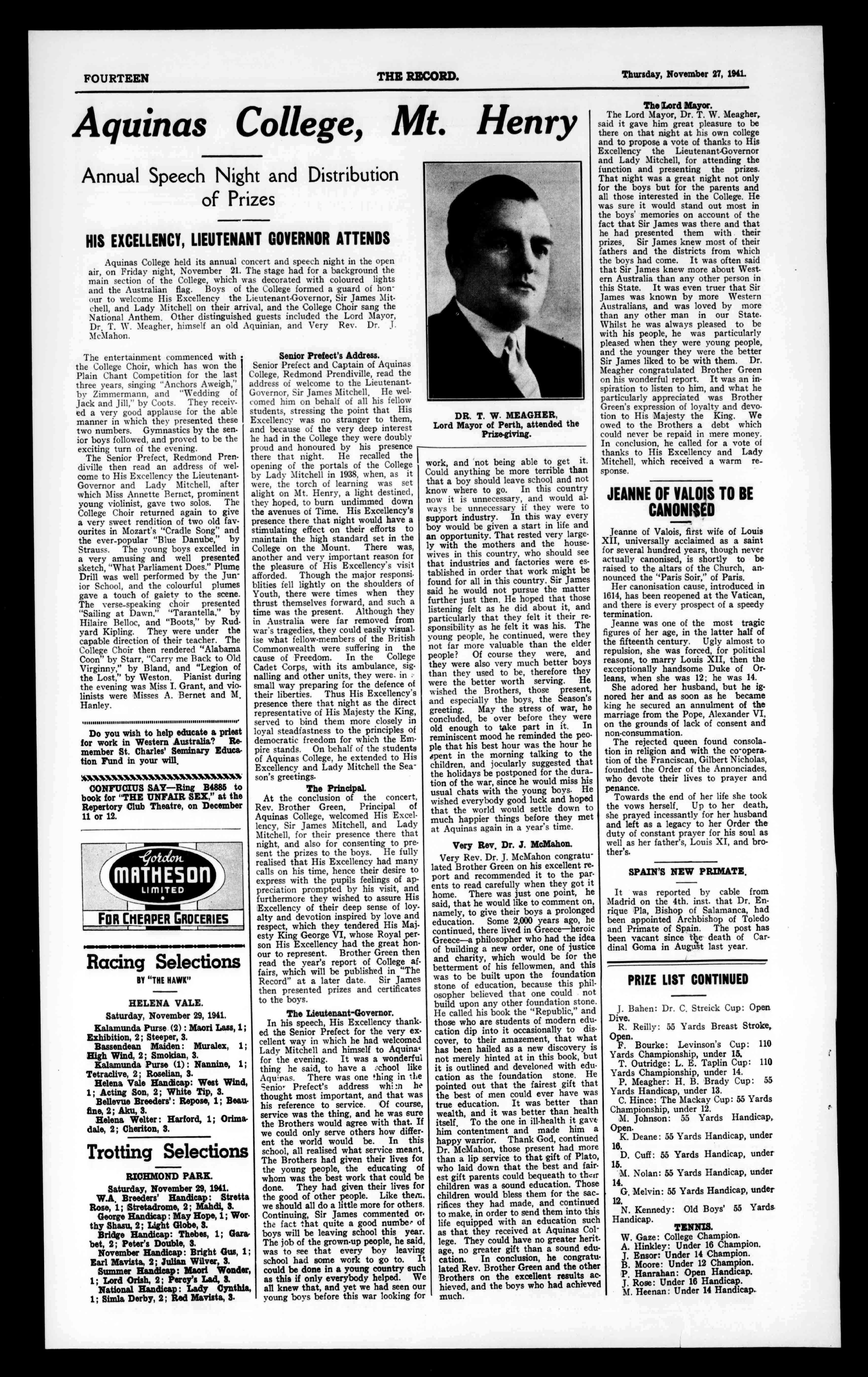
2;Steeper,3. BassendeanMaiden:Muralex,1; HighWind,2;Smokian,3. KalamundaPurse(1):Nannine,1; Tetraclive,2;Roselian,3.
HelenaValeHandicap:WestWind, 1;ActingSon,2;WhiteTip,3. BellevueBreeders':Repose,1;Beaufine,2;Aku,3.
HelenaWelter:Hayford,1;Grimedale,2;Cheriton,3.
TrottingSelections
RICHMONDPARK.
Saturday,November29,1941. W.A,Breeders'Handicap:Stretta Rose,1;,Stretadrome,2Mandi,3. GeorgeHandicapMayHope,1;WorthyShasu,2;LightGlobe,3. BridgeHandicap:Thebes,1;Gar& bet,2;Peter'sDouble,3. NovemberHandicap:BrightGus,1; EarlMavista,2;JulianWilver,3. SummerHandicap:MaoriWonder, 1;LordOrish,2Percy'sLad,3. NationalHandicapLadyCynthia, 1;SimlaDerby,2;RedMavista,3.
SeniorPrefect'sAddress.
SeniorPrefectandCaptainofAquinas College,RedmondPrendiville,readthe addressofwelcometotheLieutenantGovernor,SirJamesMitchell.Hewelcomedhimonbehalfofallhisfellow students,stressingthepointthatHis Excellencywasnostrangertothem, andbecauseoftheverydeepinterest hehadintheCollegetheyweredoubly proudandhonouredbyhispresence therethatnight.Herecalledthe openingoftheportalsoftheCollege byLadyMitchellin1938,when,asit were,thetorchoflearningwasset alightonMt.Henry,alightdestined, theyhoped,toburnundimmeddown theavenuesofTime.HisExcellency's presencetherethatnightwouldhavea stimulatingeffectontheireffortsto maintainthehighstandardsetinthe CollegeontheMount.Therewas, anotherandveryimportantreasonfor thepleasureofHisExcellency'svisit afforded.Thoughthemajorresponsi. blitiesfelllightlyontheshouldersof Youth,thereweretimeswhenthey thrustthemselvesforward,andsucha timewasthepresent.Althoughthey inAustraliawerefarremovedfrom war'stragedies,theycouldeasilyvisualisewhatfellow-membersoftheBritish Commonwealthweresufferinginthe causeofFreedom.IntheCollege CadetCorps,withitsambulance,signallingandotherunits,theywere-in smallwaypreparingforthedefenceof theirliberties.ThusHisExcellency's presencetherethatnightasthedirect representativeofIIisMajestytheKing, servedtobindthemmorecloselyin loyalsteadfastnesstotheprinciplesof democraticfreedomforwhichtheEmpirestands.Onbehalfofthestudents ofAquinasCollege,heextendedtoHis ExcellencyandLadyMitchelltheSeason'sgreetings.
ThePrincipal.
Attheconclusionoftheconcert, Rev.BrotherGreen,Principalof AquinasCollege,welcomedHisExcellency,SirJamesMitchell,andLady Mitchell,fortheirpresencetherethat night,andalsoforconsentingtopresenttheprizestotheboys.HefullyrealisedthatHisExcellencyhadmany callsonhistime,hencetheirdesireto expresswiththepupilsfeelingsofappreciationpromptedbyhisvisit,and furthermoretheywishedtoassureHis Excellencyoftheirdeepsenseofloyaltyanddevotioninspiredbyloveand respect,whichtheytenderedHisMajestyKingGeorgeVI,whoseRoyalpersonHisExcellencyhadthegreathonourtorepresent.BrotherGreenthen readtheyear'sreportofCollegeaffairs,whichwillbepublishedin"The Record"atalaterdate.SirJames thenpresentedprizesandcertificates totheboys.
TheLieutenant-Governor.
Inhisspeech,HisExcellencythankedtheSeniorPrefectfortheveryexcellentwayinwhichhehadwelcomed LadyMitchellandhimselftoAquina' fortheevening.Itwasawonderful thinghesaid,tohaveaAthoollike Aquinas.Therewasonethingin!Le =enio,Prefect'saddresswhi:nhe thoughtmostimportant,andthatwas hisreferencetoservice.Ofcourse, servicewasthething,andhewassure theBrotherswouldagreewiththat.If wecouldonlyserveothershowdifferenttheworldwouldbe.Inthis school,allrealisedwhatservicemeant, TheBrothershadgiventheirlivesfoi theyoungpeople,theeducatingof whomwasthebestworkthatcouldbe done.Theyhadgiventheirlivesfor thegoodofotherpeople.Likethem, weshouldalldoalittlemoreforothers. Continuing,SirJamescommentedor. thefactthatquiteagoodnumbe,of boyswillbeleavingschoolthisyear. Thejobofthegrown-uppeople,hesaid, wastoseethateveryboyleaving schoolhadsomeworktogoto.It couldbedoneinayoungcountrysuch asthisifonlyeverybodyhelped.We allknewthat,andyetwehadseenour youngboysbeforethiswarlookingfor
work,andnotbeingabletogetit. Couldanythingbemoreterriblethan thataboyshouldleaveschoolandnot knowwheretogo.Inthiscountry nowitisunnecessary,andwouldalwaysI,,unnecessaryiftheywereto supportindustry.Inthiswayeveryboywouldbegivenastartinlifeand anopportunity.Thatrestedverylargelywiththemothersandthehousewivesinthiscountry,whoshouldsee thatindustriesandfactorieswereestablishedinorderthatworkmightbe foundforallinthiscountry.SirJames saidhewouldnotpursuethematter furtherjustthen.liehopedthatthose listeningfeltashedidaboutit,and particularlythattheyfeltittheirresponsibilityashefeltitwashis.The youngpeople,hecontinued,werethey notfarmorevaluablethantheelder people?Ofcoursetheywere,and theywerealsoverymuchbetterboys thantheyusedtobe,thereforethey werethebetterworthserving.He wishedtheBrothers,thosepresent, andespeciallytheboys,theSeason's greeting.Maythestressofwar,he concluded,beoverbeforetheywere oldenoughtotakepartinit.In reminiscentmoodheremindedthepeoplethathisbesthourwasthehourhe spentinthemorningtalkingtothe children,andjocularlysuggestedthat theholidaysbepostponedforthedurationofthewar,sincehewouldmisshis usualchatswiththeyoungboys.He wishedeverybodygoodluckandhoped thattheworldwouldsettledownto muchhappierthingsbeforetheymet atAquinasagaininayear'stime.
VeryRev,Dr.J.McMahon.
VeryRev.Dr.J.McMahoncongratulatedBrotherGreenonhisexcellentre. portandrecommendedittotheparentstoreadcarefullywhentheygotit home.Therewasjustonepoint,he said,thathewouldliketocommenton, namely,togivetheirboysaprolonged education.Some2,000yearsago,he continued,therelivedinGreece-heroic Greece-aphilosopherwhohadtheidea ofbuildinganeworder,oneofjustice andcharity,whichwouldbeforthe bettermentofhisfellowmen,andthis wastobebuiltuponthefoundation stoneofeducation,becausethisphilosopherbelievedthatonecouldnot builduponanyotherfoundationstone. Hecalledhisbookthe"Republic,"and thosewhoarestudentsofmoderneducationdipintoitoccasionallytodiscover,totheiramazement,thatwhat hasbeenhailedasanewdiscoveryis notmerelyhintedatinthisbook,but itisoutlinedanddevelonedwitheducationasthefoundationstone.He pointedoutthatthefairestgiftthat thebestofmencouldeverhavewas trueeducation.Itwasbetterthan wealth,anditwasbetterthanhealth itself,Totheoneinill-healthitgave himcontentmentandmadehima happywarrior.ThankGod,continued Dr.McMahon,thosepresenthadmore thanalipservicetothatgiftofPlato, wholaiddownthatthebestandfairestgiftparentscouldbequeathtotheir childrenwasasoundeducation.Those childrenwouldblessthemforthesacrificestheyhadmade,andcontinued tomake,inordertosendthemintothis lifeequippedwithaneducationsuch asthattheyreceivedatAquinasCollege.Theycouldhavenogreaterheritage,nogreatergiftthanasoundeducation.Inconclusion,hecongratulatedRev.BrotherGreenandtheother Brothersontheexcellentresultsachieved,andtheboyswhohadachieved much.
TheLordMayor. TheLordMayor,Dr.T.W.Meagher, saiditgavehimgreatpleasuretobe thereonthatnightathisowncollege andtoproposeavoteofthankstoHis ExcellencytheLieutenant-Governor andLadyMitchell,forattendingthe functionandpresentingtheprizes. Thatnightwasagreatnightnotonly fortheboysbutfortheparentsand allthoseinterestedintheCollege.He wassureitwouldstandoutmostin theboys'memoriesonaccountofthe factthatSirJameswasthereandthat hehadpresentedthemwiththeir prizes,SirJamesknewmostoftheir fathersandthedistrictsfromwhich theboyshadcome.Itwasoftensaid thatSirJamesknewmoreaboutWesternAustraliathananyotherpersonin thisState.ItwaseventruerthatSir JameswasknownbymoreWestern Australians,andwaslovedbymore thananyothermaninourState. Whilsthewasalwayspleasedtobe withhispeople,hewasparticularly pleasedwhentheywereyoungpeople, andtheyoungertheywerethebetter SirJameslikedtobewiththem.Dr. MeaghercongratulatedBrotherGreen onhiswonderfulreport.Itwasaninspirationtolistentohim,andwhathe particularlyappreciatedwasBrother Green'sexpressionofloyaltyanddevotiontoHisMajestytheKing.We owedtotheBrothersadebtwhich couldneverberepaidinmeremoney. Inconclusion,hecalledforavoteof thankstoHisExcellencyandLady Mitchell,whichreceivedawarmresponse.
JEANNEOFTAMSTOBE CANONISED
JeanneofValois,firstwifeofLouis XII,universallyacclaimedasasaint forseveralhundredyears,thoughnever actuallycanonised,isshortlytobe raisedtothealtarsoftheChurch,announcedthe"ParisSoir,"ofParis. Hercanonisationcause,introducedin 1614,hasbeenreopenedattheVatican, andthereiseveryprospectofaspeedy termination.
Jeannewasoneofthemosttragic figuresofherage,inthelatterhalfof thefifteenthcentury.Uglyalmostto repulsion,shewasforced,forpolitical reasons,tomarryLouisXII,thenthe exceptionallyhandsomeDukeofOrleans,whenshewas12;hewas14. Sheadoredherhusband,butheignoredherandassoonashebecame kinghesecuredanannulmentofthe marriagefromthePope,AlexanderVI, onthegroundsoflackofconsentand non-consummation.
Therejectedqueenfoundconsolationinreligionandwiththeco-operationoftheFranciscan,GilbertNicholas, foundedtheOrderoftheAnnonciades, whodevotetheirlivestoprayerand penance.
Towardstheendofherlifeshetook thevowsherself,Uptoherdeath, sheprayedincessantlyforherhusband andleftasalegacytoherOrderthe dutyofconstantprayerforhissoulas wellasherfather's,LouisXI,andbrother's.
SPAIN'SNEWPRIMATE,
Itwasreportedbycablefrom Madridonthe4th.inst.thatDr.EnriquePla,BishopofSalamanca,had beenappointedArchbishopofToledo andPrimateofSpain.Theposthas beenvacantsincetedeathofCardinalGomainAugustlastyear.
PRIZELISTCONTINUED
J.Bahen:Dr.C.StreickCup:Open Dive. R.Reilly:55YardsBreastStroke, Open. F.Bourke:Levinson'sCup:110 YardsChampionship,under15, T.Outridge:L.E.TaplinCup:110 YardsChampionship,under14. P.Meagher:H.B.BradyCup:55 YardsHandicap,under13.
C.Hince:TheMackayCup:55Yards Championship,under12.
M.Johnson:55YardsHandicap, Open. K.Deane55YardsHandicap,under 16, D,Cuff55YardsHandicap,under 15. M.Nolan:55YardsHandicap,under 14, G.Melvin:55YardsHandicap,under 12.
N.Kennedy:OldBoys'55Yards Handicap.
TENNIS.
W.Gaze:CollegeChampion. A.Hinkley:Under16Champion. J.Ensor:Under14Champion. B.Moore:Under12Champion.
P.Hanrahan:OpenHandicap.
J.Rose:Under16Handicap.
M.Heenan:Under14Handicap.
FOURTEEN THERECORD. Thursday,November27,1941.
-4,4zeot MATHE5Orl LIMITED FORCHEAPERGROCERIES
BY"THEHAWK" HELENAVALE.
29,1941. KalamundaPurse(2)MaoriLass,1; Exhibition,
RacingSelections
Saturday,November
DR.T.W.MEAGHER, LordMayorofPerth,attendedthe Prize-giving.
Thursday,November27,1941.
PRIZELIST,1941.
CLASSLISTS:
LeavingCertificate.
ReligionKnowledge:A.Travers.
DuxofCollege:1st.placeEnglish, French,Latin,MathematicsB,ChemistryT.Cullity.Second,alsospecial prizeinScience:R.Prendiville.2nd., alsospecialprizeinMathematics:K. McKenna.4th.,alsospecialprizefor French:A.Travers.5th.:K.O'Brien. 6th.,alsospecialprizeinGeography K.Sawle.7th.,alsospecialprizein Latin:J.Burke.8th.:B.Corr.9th., alsospecialprizeinEnglishandHistory(winnerofJ.L.Walshprizefor English):D.Jones.10th.:N.Durack11th.:T.Stack.12th.:H.Gordon. 13th.:H.Rigg.
FirstYearLeaving.
ReligiousKnowledge:P.Banting. DuxofClass:T.Bourke.2nd.:P. Hanrahan.3rd.:J.Ahern.4th.:P. Banting.5th.:W.Gaze.6th.:P. Durack.7th.:K.Merchant.8th.: K.Norris. JuniorUniversityClass.
ReligiousKnowledge:D.McKenna, G.Calder.Dux:D.McKenna.2nd.: B.MaloneyandB.O'Hara.4th.: K.Dyson.5th.:G.Evansand C.Dyson.7th.:L.Bothe.8th.:A. Harrold.9th.:P.HallandA.Holland.11th.:J.WalshandG.Calder. 13th.:J.McKenna.14th.:W.Leahy andN.Sheridan.16th.:B.Quinlivan, 17th.:R.Bothe.18th.:J.Strempel andJ.Kelly. SecondYear.
ReligiousKnowledge:D.Cullity.
Dux:J.Bowen.2nd.:C.Macnish.3rd.: A.Hinkley.4th.:M.Heenan.5th.: D.Cullity.6th.:R.Hoult.7th.:L. Kirwin.8th.4J.Ensor.9th.:P.CunninghamandR.Carter.10th.:G.Pal. lasis.11th.:C.Brown.12th.:D. Doran.13th.:D.Calder.14th.:W. Taplin.15th.J.Banting.16th.:M. Johansen.17th,:B.Heenan. FirstYear.
ReligiousKnowledge:E.Haywood.
Dux:E.Haywood.2nd.:D.Kennedy.3rd.:C.Stacey.4th.:M.Marwick.5th.:F.Barnes.6th.:A. Price.7th.:J.O'Brien.8th.:G. Summerhayes.9th.:G.Melvin.10th.: P.Shaddick.11th.:B.Reilly.12th.: P.Webb.13th.:J.Paton.14th.:T. Bryan15th.:N.Coucher. GradeVL
ReligiousKnowledge:C.Banting. Dux:P.Martin.2nd.:G.Bahen. 3rd.:J.Hammer.4th.:C,Banting. 5th.:I.Robinson.6th.:V.Cooper. 7th.:T.TaplinandD.Norris.9th.: A.Van-derVossen.10th.:R.Melvin. 11th.:D.Anderson.12th.:F.Handley.13th.:P.Marwick.14th.:M. Paget.15th.:N.Tunstill.16th.:P. Paton.17th.:L.Dawson. GradeV.
ReligiousKnowledge:B.Moore.
Dux:J.Tout.2nd.:B.Moore.3rd.: S.HaywoodandJ.Moylan.5th.:B. O'Brien.6th.:B.Coffey.7th.:A. Dolin,P.Porter,K.O'Donnell,R.VanderVossen.
GradeIV.
ReligiousKnowledge:D.Barry. Dux:C.Hince,G.Rodoreda.3rd.:H. LampenSmith,D.Barry.5th.:M. Reilly.
GradeIII.
ReligiousKnowledge:J.Lane.Dux: G.Cullity.2nd.:B.Bahen.3rd.:W. Barker.4th.:J.McCall.5th.:P. Walsh.6th.:B.Moore.7th.:T. Parry.
Grade
ReligiousKnowledge:W.Olchiltree.
Dux:J.Prosser.2nd.:D.Walsh. GradeI. ..ReligiousKnowledge:.G.Ganfield.
Dux:T.Gregson.
SpecialPrises.
OratoryPrizes:B.O'Hara, P. Meagher,M.Jones,M.Heenan.
DancingPrizes:K.McKenna,T. Mayger.
ATHLETICS.
M.Johnson:TheArchbishop'sCup forCollegeChampionAthlete:120HurdlesChampionship,Open(Honour cap);880YardsChampionship,Open: OneMileChampionship,Open. J.Burke:Dr,T.W.MeagherCup 1Honourcap)220YardsChampionship,Open;440YardsChampionship, Open.
K.Deane:P.L.PrendivilleTrophy: 100YardsChampionship,Open;100
T.W.SHEEHAN
PrimeBeefButcher HANNANST..KALGOORLIE. MARITANASTREET.
T.I.438 Tel.438
GOLDFIELDSSECTION. THERECORD FIFTEEN
VERYREV.DR.J.T.McMAHON, M.A.,Ph.D.,H.Dip.Ed. YardsChampionship,under16;220 YardsChampionship,under16.
N.Durack:J.J.MinihanCup:880 YardsChampionship,Open.
T.Hales:P.J.McCarthyCup:Broad Jump,Open;100YardsHandicap, Open.
J.Dease:GeorgeHalpinCup:High Jump,Open.
D.Campagnoli:Dr.J.J.SavageCup: JuniorChampionAthlete440Yards Championship,under16.
A.Hinkley:R.E.BrownCup:880 YardsChampionship,under16;440 YardsHandicap,under16;MileHandicap,Open. B.Robinson:A.D.ScottCup:100 YardsChampionship,under16.
J.Strempel:G.J.RuseCup:High Jump,under16.
T.Bourke:T.AhernCup:100Yards Championship,under15;220Yards Championship,under15.
J.Schwarz:OldAquiniansCup-JuvenileChampion:100YardsChampion. ship,under14;220YardsChampion. ship,under14.
L.Dawson:C.J.WroblewskiCup: HighJump,under14.
L.Kirwin:F.BryantCup:High Jump,under14.
G.Melvin:PeterScottCup-Midgit Champion:100YardsChampionship, under13.
D.Tighe:F.R.BurnettCup:High Jump,under13.
D.Kennedy:MacRobertsonCup:75 YardsHandicap,under12;Siamese Race,under12.BalloonRace,under 12.
M.Paget:T.St.J.KennedyCup: HighJump,under12;75YardsHandicap,under12.
C.Banting:KellyandRodoredaCup -JuniorSchoolChampion:HighJump, under11;75YardsHandicap,under 11.
P.Walsh:B.St.J.KennedyCup:50 YardsChampionship,under10.
J.Lane:50YardsChampionship, under9;50YardsHandicap,under9.
A.Holland:J.L.WalshCup:440 YardsHandicap,Open220Yards Handicap,Open. J.Jones:J.P.DurackCup:100Yards Handicap,under16.
W.Kynaston:J.DunphyCup:220 Yards,under16.
T.Keough:0.G.MoylanCup:220 YardsHandicap,under14.
A.Carlyle:SandoverCup:100Yards Handicap,under14.
I.Robertson:FoyandGibsonCup: 100YardsHandicap,under13.
W.Barker:J.QuinlivanCup:50 YardsHandicap,under10.
B.Bahen:50YardsHandicap,under 10.
G.Worner:Headmaster'sCup:Old Boys'100YardsHandicap.
P.Prendiville:Dr.J.W.HoranCup: OldBoys'220YardsHandicap. FOOTBALL.
T.Cullity:PerrottCup,forbestand fairestplayer(Honourcap).
B.Lawrence:Mostimprovedplayer. CRICKET.
H.Rigg:Capt.1st.XI.,1,039runs andtwocenturiesin"DarlotCup"cricket(Honourcap).
B.Rigg:Bowlingaverage. SWIMMING.
R.Trend:CollegeChampion-W.P. GibsonCup.
F.Christian:A.D.ScottCup-SeniorChampion:110YardsFreeStyle, Open;440YardsFreeStyle,Open;55 YardsBackStroke,Open;220
16. liequtem Inhoursthataredarkest,thereisanabidingcomfortinthe quietunderstandingserviceofA.&J.KYLE (Established1896). Telephone:K23. CASSIDYSTREET KALGOORLIE. YOUCANDOALLYOURSHOPPINGAT TheGoldfields'Leading EmporiumWhereYou AlwaysGet TheBestforLess RUSSELL'SKalgoorlie THESHOPFORMEN'SWEAR FORTHEBESTMEATatREASONABLEPRICES,DealfromJas.GrayandCo.Ltd. WHOLESALEANDRETAILBUTCHERS. UBURTST.,BOULDER,ARDAGHAVENUE,&HANNANST, KALGOORLIE. Telephones:B168;K675. - Telephones:B168;K875. TRY... JAMESSHEAHAN 75BURTSTREET,BOULDER, FORYOURNEXTGROCERYORDER. O HAVEYOUTRIED THEPIONEERBAKERY SoleGoldfieldsManufacturerofProceraBread.OurPromptDelivery ServiceCoversKalgoorlieandBoulder. THEPIONEERBAKERY. 40NORTHTERRACE,BOULDER. (W.ANDERSON). 'Phone137Boulder,andourCarterwillcall. O a RequiescatIIIinPace W.STROTHER FUNERALDIRECTOR. 18HANNANST.,KALGOORLIE;COOLGARDIE; MENZIES. AtYourCommandatanytime,DayandNight. Telephone:K327. PatroniseOurAdvertisers ForYourGroceries .BURTST.BOULDER M.JACKSO 3StoresForServiceNCOLLINS&CHEETHAMSts. KALGOORLIE
Yards FreeStyle,under
W.P.LAIRD Kellerberrin
R.A.C.Foreman'sandI.A.M.Certificate. SERVICESTATIONFORDODGE,CHEVROLET,FORDCARSAND TRUCKS.GENERALREPAIRS,BORING,BATTERYCHARGING.
BOX32, 'PHONE109.
WhiteRockQuarriesLtd.
FOR
AUGradesofMetalforRoadConstructionand ConcreteWork
RingLES.O'NEILL,B1166(Business),F2744(Priv.) 7thFloor,ColonialMutualBuildings,Perth.
AustralasianCatholicAssurance Co.Ltd. THE"A.C.A."
A.C.A.BUILDINGS.KINGST.,SYDNEY. ASSETSEXCEED£1,500,000.
ALLCLASSESOFLIFEANDENDOWMENT ASSURANCEPOLICIESTRANSACTED. BONUSES,1939:
Life:£215s.per£100assuredperannum.
Endowment:£117sper£100assuredperannum. BRANCHOFFICESINALLSTATES.
W.A.Office: "WARWICKHOUSE,"ST.GEORGE'STERRACE,PERTH NesidentSecretary:B.MURPHY.
ONTHEBORDERSOFTIBET
ExtraordinaryWorkof MonksofSt.Bernard
CHARITYRULESONTHEROOFOFTHEWORLD
Theworldisfamiliarwiththeheroic monksofSt.Bernardandtheirremarkabledogs,andofthegreatworkofres. cuetheyhaveperformedonthevery summitsoftheAlpsforalmostathousandyears.Fewknowthatabranch ofthefamoushospiceisnowcarrying onitsworkofmercyamidtheHim& lavansnows.
E.R.Yarham,inthe"Catholic Times,"tellsaboutthemand.oftheir workfortravellersbetweenChinaand Tibet.
AstheresultofthereportofCanons CoquozandMelly,whocompletedan adventurousjourneyof1,5110miles amongthemountainsandglaciersof mid-Asiain1931,theAugustinian CanonsoftheHospiceoftheGreatSt. Bernard(togivethemonasteryin Switzerlanditsfulltitle)decidedto buildahospiceonthebordersofTibet, interritoryevenwilderthanthesurroundingsoftheirancientEuro-,ean home.
WhenTibetandthehugeChinese provinceofSzechwanmeetistobe foundthepassofLat-za,atanaltitude of10,000'feet,whichiseveryyearfrequentedbythousandsofpilgrims,who pressonwithalmostfanaticalzeal, eventhoughtheyareinconstantdangerofbeingswepttodeathbygigantic avalanches,orofperishinginthebittercold.Thenumberofdevotees whohavelosttheirlivesinthisinhospitablemountainregionlyingalmost onthe"RoofoftheWorld,"isbeyond calculation.
Littleaccountistakenofthesetragedies,butthemonksofSt.Bernard regardthesepilgrimsasbrothersand arepreparedtosacrificeth-irown livesforthem.
Themonksbuilttheirfirsthospiceon thepassofSi-la,ataheightof12,600 feet,buttheirmonthsoftoilwere broughttonaughtwhenitwasswept awaybyanavalanche.Itwasfound, indeed,impossibletomaintainany buildingthere,andsothebrothers putuptheirhomeatLat-za.Atfirst theydidnottakeanyoftheirgreat dogswiththem,butthreeyearsago BrotherCyrilleftwithsomeSt.Bet, nardsonalongandadventurousjourney,boundfortheHimalayas,inorder tocarryontheworkofrescuewhich beganontheAlps. TheefforttoestablishtheHimalayan hospiceandtoextendtheworkofthe Europeanestablishmenthasalready metwithencouragingsuccess.The monkshavegainedtherespectand eventheaffectionofallthosewith whomtheyhavecomeincontact,and nativesfromthesurroundingcountrysidemountthepassinordertoreceivemedicalattention.Asamatter offact,thisphaseoftheworkwas sourgentthatatemporaryhospital wasthefirstbuildingthebrothersput up.Tomakethemselvesself-supportingtheyhavecultivatedgroundlower downthevalleyandhavegrownvegetablesandvarietiesofgrapes.
Theirplanistofindnativeassistantstohelpthemtocarryonthe work.Thebrothershavebeenteachingthosewhoseeminterestedhowto useskis,Theyareexpertsintheuse ofthese,forinwintertheSwisshospiceisoftensnowedunder,andthe snowliesasdeepasanordinaryhouse. Theonlywaythenofreachingitisby ski. Inrecentyearsmodernmethodsof transporthavedonealottolessenthe terrorsoftheAlpinepassofSt.Bernard,lyingat8,111feet,althougheven nowtravellersandworkmenarerescued.Butthebrotherswishedto lookforanewspherewheretheycould exercisetheirlabourofloveevenmore fullythanontheAlps.Thiswasthe urgewhichsentthemforthtofind anewhomedeepamongtheHimalayansnows, BrothersCoquozandMelly,asmentioned,wereselectedtoundertakethe search,whichtheyaccomplishedpartlyonhorsebackandpartlyonfootand skis.
Thebrothershadtotravelthrough countryinfestedbybrigandsafterpassingYunnanfu,andtheir"guard"fled atthefirstsightofdanger.Happily thebrigandslookedfiercerthanthey reallywere,andthecanonswontheir gratitudebytendingthesickand woundedwhomtheybroughttothem. ThebrigandsroundLat.zastilltakea friendlyinterestintheworkofthe canons,theywatchthemtendtheir vinesandarefullofadmirationforthe magnificentSt.Bernarddogs.
DuringtheirpioneerjourneyFathers CoquozandMellysometimestravelled withatroopofbanditswhotreated themwell,andalongtherouteoffifteenhundredmilestheyeffectednumerouscuresamongtheChinese,Indian, andTibetansick.Asaresult,ever sincethenthemonksofthehospice havebeenabletorelyontheirhelp andfriendship. Thetwotravellersapproachedthe valleysofthegreatriversYangtze. kiangandMekongandcrossedthe mountainsat10,800feet,andthen reachedthevalleyoftheSalween. TheywerethefirsttocrosstheSi-la passonskis,andthefeatwasamost difficultone.Thefirstnightthey campedatnearly11,000feet,where manyhugeavalancheshadfallen. Theysleptonabedofbranchesaround whichtheybuiltawallof,snow.An improvedroofwasmadewithawaterproofblanketsupportedonskis.The growlsofwildbeastscouldbeheard andafirehadtobelightedtofrighten themaway.
Nextmorningtheywentonagain, hutwhenhalfwayto.thesummita thickmistenvelopedMem,andthen hailfellheavily,followedbysnow. Therestoftheclimbwasveryhard, forsnowlay40feetthickinthepass itself,andthedescenttheotherside wasverydangerous,fortherewere steeprocksandslipperyprecipices. Theycampedagain,usingwetwood -whichproducedmoresmokethan heat-forafire,andtriedtodrytheir clothesandblankets.Nextdaythey wentonagainandhadtocuttheir waythroughaforestofbambooshalfcoveredinsnow.Whennightcame theycampedamongthebamboos,ate theirlastfoodandstrucktheirlast matchesinahopelessattempttoget afire. Thenextdaytheweatherbrokebeautifullytine,andaftertwomorehours strugglingamongthebamboosthey reachedopencountryawayfromthe snowandwereabletorevelinthe gloriesofspring.Theyreachedthe banksoftheSalween,andcametoa house,whichwas,almostmiraculously, thehomeofsomeTibetanChristians, whorevivedthemwithfoodandmilk.
Ayoungmanactedasguideintothe lowervalleys,wheretheydelivered mailtothemissionaryatBahang,and theletterswerenonethelesswelcome forbeingfivemonthsoverdue.They returnedtoYunnanfuanotherway andtheirreporttotheChapterofthe GreatSt.Bernardledtothedeterminationtoestablishahospiceonthe Himalayas.
In1933thetwoheroicmensetoff again:accompaniedthistimebyBrotherDueandlaybrother,I3ro.Chappelet,takingwiththemsetsofmechanicalandjoinerytoolsaswellaskitchen utensils.Theirluggagealsocontainedallthenecessaryornamentsfortheir chapel,foldingbeds,foodstuffs,atypewriter,awirelesssct,andChinesegarments.Sincetha'.timeothermonks havefollowedanddogshavebeen sent.Fortunatelytheseheroicmen arewellinuredtotheterribleweather metwithintheirnewhome.
Plumbing,centralheating,andelectricityhavedonemuchtoameliorate conditionsoflifeintheirSwisshospice, butthefactremainsthatagoodwinter'ssnowis30feetdeeponthepass, whichhasaclimatecomparableto thatofSpitzbergen,anditburiesthe sturdystonebuildingsuptothethird storey.WhensomepriestsfromneighbouringvalleyswenttobidGod-speed toanumberofmonksofftoLat-za theyhadtoskioversnow33feetdeep.
Asstated,thebrothersfounditimpossibletomaintaintheirfirsthospice, but,nothingdaunted,theyputupanother.Whencomplete,itwillbe similartotheSwissmotherhouse,with alargerefectory,severaldormitories,a chapel,andaninfirmary, Worksuchasthisneverreceives front-pagemention,butthisself-sacrificingservicewillendurelongafterthe deedsofmurderousdictatorsarebut anevilmemory.
Thelatestnewsfromthismountain homeofapostoliccharityisthatone ofthepriests,FatherNamchen,has losthislifebydrowning.Inthe courseoftheworktowhichhehaddevotedhimselfhewastryingtocross theMekongriveratadangerouspoint whenhewasdrowned.Thebodyhas notbeenrecovered.FatherNamchen hadcomefromSwitzerlandthreeyears ago.-"TheRock."
SIXTEEN THERECORD Thurrday,November27,1941.
KELLERBERRIN
LATEMICHAELO'DEA, Founder.
O'Dea FuneralDirectors
JOSEPHO'DEA, Principst.
Bowra&
Street:Perth PricestoSuitAllClasses HIBERNIANMORTUARYBENEFITSAVAILABLE TOALLMEMBERS Tel:Business,B4308 Private,B6717-B3376
195Pier
TheBushies'Corner
it.Whatalongwaytolookback/ andtohaveseenmanychangesand improvementsinone'sowntime,with somanyschoolsandchurchesgoingup everywhere.Godblessourpriestsand nunswhoaredoingsomuchforthe childrenout-back.Irememberallour Bishops,andhavespokentothemallthefirstBishopGriver,BishopGibney, andArchbishopClune,alsoBishopSalvado,ofNewNorcia,andnowArchbishopPrendiville.Weareexpecting himaroundheresoon.Iamenclosing 5s-2/6fortheBushies,andwouldyou pleasehand2/6totheClontarfBoys' BandAppeal.Thatisanotherlandmarkofgirlishdays.SoCheerioand Godblessyouandyourwork.Saya littleprayerforme,please.
GRANDMOTIIER
ST.FRANCISXAVIER, PatronofAustralia.
DearCornerites,-Spain,whichisone ofthegreatestgloriesoftheCatholic Church,particularlynowafterthe greatCatholicvictoryovertheforces ofatheism,isalsorenownedforthe numberofverygreatSaintswhowere bornwithinherboundaries.Oneof thesegreatSpanishSaintsisthePatron ofAustralia,andhisfeastiscelebrated onDecember3.St.FrancisXavier wasayoungSpanishgentlemaninthe dangerousdayt,i..theReformation.He wasmakingaMimeforhimselfasa orofessorofphilosophyintheUniversityofPariswhenSt.IgnatiusLoyola, thefounderoftheJesuitOrder,met himandpersuadedhimtousehistalentinordertogainsoulsforGod.He joinedtheJesuitOrderandsoonwas senttotheEastIndies,wherefor twelveyearshepreachedtheGospel toHindostan,Malacca,andJapan.The vastpossibilitiesinthekingdomof Chinaappealedtohischarity,andhe wasresolvedtoriskhislifetogainan entranceintothecountry,buthedied, likeMoses,insightofthelandofpromise.ThereisalittlestoryofSt. FranciswhichtellsthataPortuguese gentlemanwhooncesailedinthesame shipwiththeSaintwasveryanxious toseethefamousmissionary.Great washisdisappointmentonbeing shownapersonstandinginagroup roundachess-table,chattingfamiliarly withthesoldiers,crew,andpassengers, likeanyordinarypriest.Attheend ofthevoyage,however,hesenthisservanttoseewhatbecameofhim.Franciswentasideintoawoodandbegan topray,andtheservantsoonranto callhismastertoseetheSaintinan ecstasyliftedfromthegroundinhis prayers.
AUNTBESSY.
* * Menzies.
DearAuntBessy,-Iamreturning thetwocards,alsoapostalnotefor5s., filledbythechildren,andwillyousend metwomoreWithbestwishes.
ISABELPIANTO.
DearIsabel,-Bothyourselfandthe childrenofMenzieshavebeenvery generousincollectingthepenniesfor theLemonadeBottle,andIamvery pleasedandgratefulforthisbighelp. Soonthefinalresultsofthisyear'sappealwillbeout youwillallhave thesatisfaction knowingthatyou didsomuchtohepwithitssuccess.
AUNTBESSY.
* * Busselton.
DearAuntBessy,-Enclosedstamps, hopingthesemayhelpalittle.
WELLWISHER.
DearWellwisher,-Everylittlehelps withthegoodwork,andIamalways pleasedtoreceivestampsineitherlarge orsmallquantities,sothankyouverymuchforsendingthemalong.
AUNTBESSY.
* * TarinRock.
DearAuntBessy,-Iamstayingwith AuntyDoraandGrandmawhileUncle isinhospitalveryill.Iampacking thirtythree-pennybitstosendtoyou fortheBushies.Withbestwishes fromAuntyandGrandma,andlove fromJohn,Dorothy,Joe,Michael,Ther. ese,and MARGARETNAISBETT.
DearMargaret,-Iwasverysorryin. deedtohearthatyourUncleissoill, andIdohopehewillbewelland strongagainbeforeChristmas.Ire ceivedthethirtithreepences,andmust thankyouandyourlittlebrothersand sistersforsendingthemalong,asthey didmuchtohelpontheL.B.thisweek. AUNTBESSY.
* * Yar/oop.
DearAuntBessv.-HereIamagain. hailandhearty,afternearly12months climbingthatlonghill,IhavenearlyreachedtheS0-milepost,thankGodfor
DearGrandmother,-Youcertainly havelivedaverylongandinteresting life,andIhopeyouwillbesparedfor manymoreyearsyet.Thankyouso muchforsendingalongthepostalnote Ihavegiventhe2/6totheClontart Boys'BandCommittee,andtheywish metothankyouverymuchforsendingitalong.Theyhopetohavethe boysfittedoutreadyfortheopening oftheirnewChapelonDecember21.
AUNTBESSY.
* * * * Menzies.
DearAuntBessy,-Ireceivedyour prickcardandamreturningitinthis letter.Iamlookingforwardtothe Christmasholidays,aswearegoingto Perth.IhopeyougetyourLemonadeBottleoverflowingthisyear.Well, dearAuntBessy,Ishallclosenow. Hopingyouwillforgivemeforwriting suchashortletter.
EILEENDUGGAN.
DearEileen,-Thankyouverymuch forreturningtheprickcardandmoney. IhopeyouwillhaveaveryniceholidayinPerthatChristmas.
AUNTBESSY.
* * * * CollinsSiding.
DearAuntBessy,-Pleasefindenclosed5s,postalnotefortheBushies. Ihopeyoureachthehundredbefore theendoftheyear.
SOMEONE.
DearSomeone,-Thankyouvery muchforyourgenerousdonation.I wasverypleasedtoreceiveit,especiallyjustnowwhensomuchremainsto bedonetocompletethe£100.However,Ithinktheresultwillbesatisfactoryattheendoftheyear. AUNTBESSY.
WANTED-828us.
Mondaybringsustothelastmonth oftheyear,andsoonwewillbeable toannouncethesumtotalofthisyear's appeal.Thiswillbedoneintheissue ofDecember25,soyouhavejustfour shortweekstosendalongyourdonationifyouhavenotalreadyhelped. PrickcardsmustreachmebyDecember22intimetobeincludedinthe finaltotal,soifyouhaveprickcards outstanding,trytohavetheminsoon. Ofcourse,ifyouthinkyoucanfillin anothercardbeforethefinalday,I willbeonlytoopleasedtosendthem along,MeanwhileIsendoutanurgent S.O.S.tolong-silentCornerites,and thoseofotheryearswhohavenotyet putinanappearancetorallyaround theL.B.tillthelastmoment,asitis verymuchlackinginsparklestill. However,Itrustthemailbagwilloverflowduringthenextfewweeks.
M11111l111111l1t1111111t1111118111111111111111111111111111111111111111111
LEMONADEBOTTLE.
AcknowledgedWithThanks. £s.d.
WEREYOU
NORTHAM.
E.
BRYANT&WATERS
80to90STIRLINGST.,PERTH. WOODandCOALMERCHANTS. OrdersPromptlyAttendedto. Phone:B3938.
L.CHARLESWORTFI,
Dip.D.S. DENTALSURGEON. CLAREMONT-17BROWNST. Tel.F1717. SUBIACO-133ROKEBYROAD Tel.W1191.
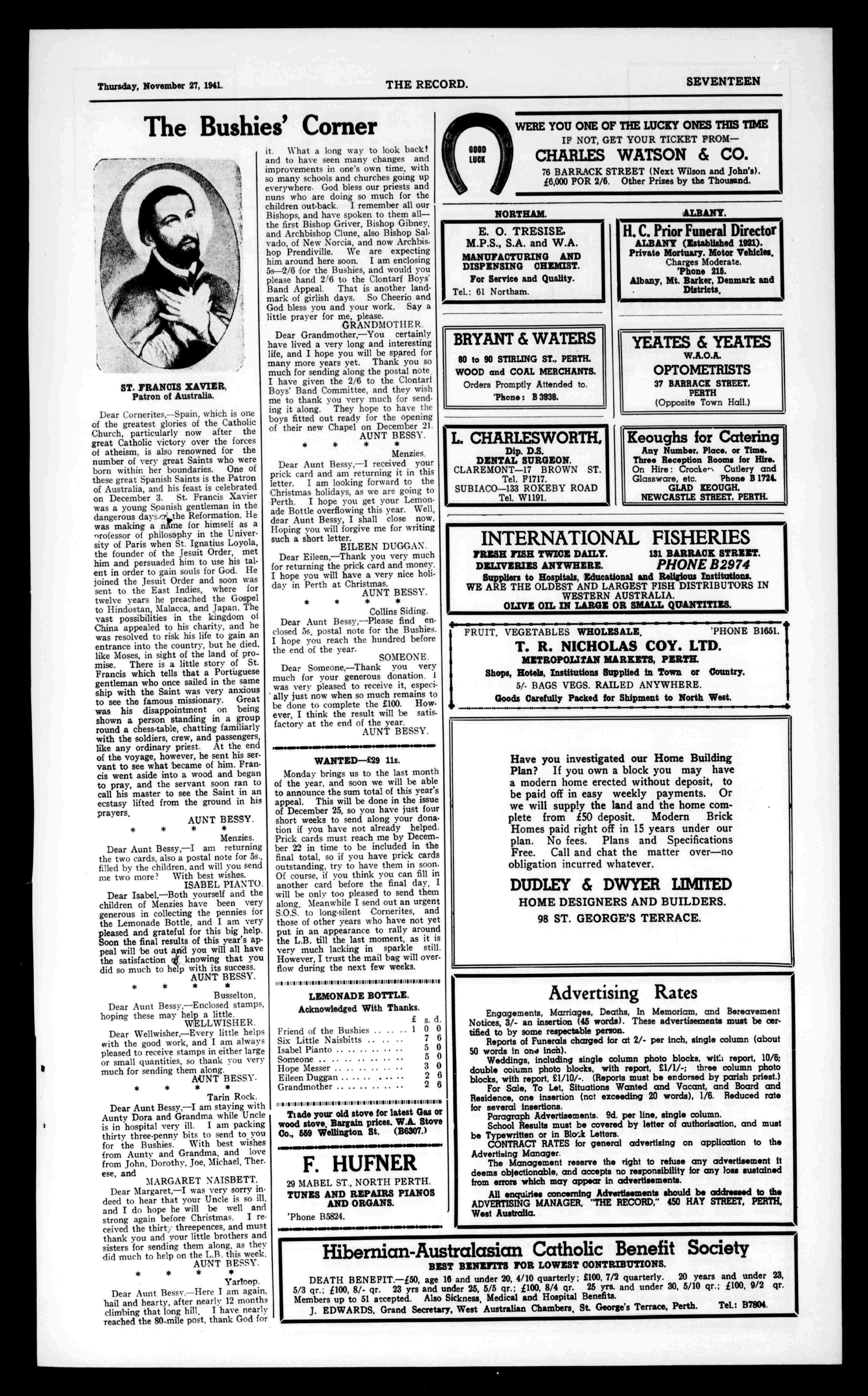
ALBANY.
H.C.PriorFuneralDirector
ALBANY(Established1921).
PrivateMortuary.MotorVehicles, ChargesModerate. 'Phone215. Albany,Mt.Barker,Denmarkand Districts,
YEATES&YEATES
W.A.O.A.
OPTOMETRISTS
37BARRACKSTREET.
PERTH (OppositeTownHall.)
KeoughsforCatering
AnyNumber,Place,orTime.
ThreeReceptionRoomsforHire. OnHireCrooke,Cutleryand Glassware,etc. PhoneB1724. GLADKEOUGH, NEWCASTLESTREET,PERTH.
INTERNATIONALFISHERIES
FRESHFISHTWICEDAILY.
OLIVEOILINLARGEORSMALLQUANTITIES.
FRUIT,VEGETABLESWHOLESALE, 'PHONEB1651.
T.R.NICHOLASCOY.LTD.
METROPOLITANMARKETS,PERTH.
Shops,Hotels,InstitutionsSuppliedinTownorCountry. 5/-BAGSVEGS.RAILEDANYWHERE. GoodsCarefullyPackedforShipmenttoNorthWest.
HaveyouinvestigatedourHomeBuilding Plan?Ifyouownablockyoumayhave amodernhomeerectedwithoutdeposit,to bepaidoffineasyweeklypayments.Or wewillsupplythelandandthehomecompletefromf50deposit.ModernBrick Homespaidrightoffin15yearsunderour plan.Nofees.PlansandSpecifications Free.Callandchatthematterover-no obligationincurredwhatever.
DUDLEY&DWYERLIMITED HOMEDESIGNERSANDBUILDERS. 98ST.GEORGE'STERRACE.
AdvertisingRates
Engagements,Marriages,Deaths,InMemoriam,andBereavement Notices,3/-aninsertion(45words).Theseadvertisementsmustbecertifiedtobysomerespectableperson.
ReportsofFuneralschargedforat2/-perinch,singlecolumn(about 50wordsinandinch).
Weddings,includingsinglecolumnphotoblocks,witlireport,10/6; doublecolumnphotoblocks,withreport,£1/1/-;threecolumnphoto blocks,withreport,W101-.(Reportsmustbeendorsedbyparishpriest.)
ForSale,ToLet,SituationsWantedandVacant,andBoardand Residence,oneinsertion(nctexceeding20words),1/6.Reducedrate forseveralinsertions.
ParagraphAdvertisements.9d.perline,singlecolumn.
SchoolResultsmustbecoveredbyletterofauthorisation,andmust beTypewrittenorinBlockLetters.
CONTRACTRATESforgeneraladvertisingonapplicationtothe AdvertisingManager.
TheManagementreservetherighttorefuseanyadvertisementit deemsobjectionable,andacceptsnoresponsibilityforanylosssustained fromerrorswhichmayappearinadvertisements.
AllenquiriesconcerningAdvertisementsshouldbeaddressedtothe ADVERTISINGMANAGER,"THERECORD,"450HAYSTREET,PERTH, WestAustralia.
Thursday,November27,1941. THERECORD. SEVENTEEN
FriendoftheBusbies
SixLittleNaisbitts 76 IsabelPianto 50 Someone 50 HopeMesser 30 EileenDuggan 26 Grandmother 28 11.31,11111.1!Iill.civurs,,,,,iiiiiiitiguipitioniug111111111. 'LadeyouroldstoveforlatestGasor woodstove,Bargainprices.W.A.Stove Co.,659WellingtonSt.(B6307.1 1141MOIMI. F.HUFNER 29MABELST.,NORTHPERTH. TUNESANDREPAIRSPIANOS ANDORGANS. 'PhoneB5824.
1 00
ONESTHISTIME IFNOT,GETYOURTICKETFROMCHARLESWATSON
CO. 76BARRACKSTREET(NextWilson
John's). i6,000FOR2/6.OtherPrizesbytheThousand.
ONEOFTHELUCKY
&
and
M.P.S.,
MANUFACTURING
0.TRESISE,
S.A.andW.A.
AND DISPENSINGCHEMIST. ForServiceandQuality. Tel.:61Northam.
131BARRACKSTREET.
PHONEB2974
EducationalandReligiousInstitutions.
LARGESTFISHDISTRIBUTORSIN
DELIVERIESANYWHERE.
SupplierstoHospitals,
WEARETHEOLDESTAND
WESTERNAUSTRALIA.
Hibernian-AustralasianCatholicBenefitSociety BESTBENEFITSFORLOWESTCONTRIBUTIONS. DEATHBENEFIT.-j50,age18andunder20,4/10quarterly;£100,7/2quarterly. 20yearsandunder23, 5/3qr.;£100,8/.qr.23yrsandunder25,5/5qr.:£100,8/4qr.25yrs.andunder30,5/10qr.;#100,9/2qr. Membersupto51accepted.AlsoSickness,MedicalandHospitalBenefits. J.EDWARDS,GrandSecretary,WestAustralianChambers,St.George'sTerrace,Perth. Tel.:87008.
Australia'sHeroHisMemoryIncomparablyDear
FirstBroughtChrist'sNametoAsia
IncredibleLaboursofFrancisXavier
(BasedonaSketchbyRev.0.0. Martindale,134.-
Onlyafewyearsagoahugecross withthemedallion,"Zaburio,"uponit waserectedatYamaguchi,intheWest ofJapan-paidforlargelybynonChristianswhoseloveandadmiration forthismanXavierisstillstrong.tandtheopeningceremonywascarried outbythenon-ChristianGovernorof theprovince.Yousee,onedoesn'tforgetXavier,onceyouknowhim-no, noteventhepagansoftheFarEast. ForFrancisXavierisoneofthe greatestheroesourWesterncivilisation hasproduced.Therefloweredinhim allthatisfinestinthatChristianculturewearefightingtopreserveandrevive. ThisdashingSpanishcavalierisone ofourgreatestSaints,anditwashe whofirstbroughtthenameofChrist totheshoresofAsia.Hewasnot theonlymissionaryofthatamazing sixteenthcentury,orsince,buthis namehaseclipsedtheothers,andhis memoryisincomparablydear.Most ofyouknow"TheThreeMusketeers" andrememberd'Artagnan;orperhaps, CyranodeBergerac.Romantic,audacious,unmoneyedgentlemen;dashing, gallant,poetsdespitethemselves,never brokenbytheknocksoffate,proud, tender-hearted(evensoft-hearted-,full ofcharm-schoolboyheroesofromance andfilm.Well.Xavier,hadhesomehowbeende-sainted,couldhavebeen justthat.Asitis,heisreal,and remainsalive!
InthenorthofSpain,inaworld scorchedbrownandgrey,withdazzling torrent-bedsandaskyblazingblue,was thefrontierfortressofXavier.Ahollowsquareofterriblythickwalls,with atowerinthemiddle,windingpassages withinthewalls;iron-clampeddoors;a singleloop-holelitthechapel.Francis ofXavierwasborninthatcastlein 1506.Hisboyhoodwasaustereand happy.Hegrewuphardasnails, paramountineverysortofatheltics!, yetinlovewithsongs;thick-haired; brown-faced;andamiracleofthat personalmagnetismthatlastedhim throughlife.Butwhenhewassix, disastersbegan.Civilwarbrokeout inSpain;FranceandthePapacywere involved.Oneofhisancestralhomes afteranotherwasdestroyed;wallswere demolished,landsconfiscated,taxes imnosed.Thefamilywasruined,but stillfought.
Yearswentby:theXavierfamily workedlikebeaversatabrokendam torestoretheirfortunes:Francis,the mostbrilliant,wassenttotheWorld University,Paris,andwasextravagant. Hismother,tormented,thoughtto bringhimhome.Howeverheremained,butworkedmostofallatgetting theXaviertitlestonobilityre-recognised,andsucceeded.Court,Cathedral,Commander-in-Chief-suchwere thevisionsthatdazzledhim.Yetstrangely-theworldly,brilliant,daring ladremainclean.Neverhistheflabby lip,thesHingeyeoflust;neverhis thecollapse,northefever,northepestilence. Hewasnineteenwhenhewentto Paris.Hewasproudinthosedays andthoughtthatpridewasenough; thathecouldalwaysdrawtheline.But Ithinkthattheironself-controlofthis passionateladwasrunningoutwhen intohislifecameIgnatiusofLoyola. Yes,therehewas-thefounderofthe Jesuits,aSpanishnoblemanastruly aswasFrancis,butalmost-asthey'd sayinAfrica-"goneKaffir,"Hesaw beyondmoney:beyondrank.Xavier hatedandmockedhim.Yettheymet. AndIgnatiusconqueredhim.And saidafterwardsthatthestiffestclay heeverhadtohandlewasFrancis Xavier.Whoknowshow,Ignatius madeFrancisseethatmoney,titles,
Divineissues;thatwhatcountedwas selfishness,wereasnothingcompared'co whatonewas(notwhatonehad,nor whatonewasnamed-;ratherwhatone mightdoforothersinthenameof Christ,thanwhatonemightdoforself, inthenameofself.
Xavierwasnow28.Forthreeyears hetrainedhimselftoserve,inhospitals andprisons.Ordainedpriest,hefell sickandwasgiventwomonths'life.Ignatiustoldhimtorestandmadehim hissecretary.PoorIgnatius!Someonecomplainedthathecouldneverget letterstoRomeanswered."Whose faultisthat?"repliedIgnatius,smiling lovinglyyetgrimly."SenorMaster Francis's.Hisfingersaresonumb withcold,yethewillnotrealisethata fireismeanttowarmone'shandsat."
Butintothissober,quietexistencea bombfell.In1539theKingofPortugalaskedformissionerstotheIndies, Ignatius,himselfillinbed,hadnoone elsetosend,soheturnedtoXavier. "Francis,"saidhe,"nooneelsecangoyoumust.""Certainly,"saidXavier, "atonce;hereIam."Hehadless thanadaytoprepare.Hemendedhis owncassock;Ignatiussupplementedit bythegiftofhisownwaistcoat.
the
ThejourneytoPortugalover Alpswasterrible.Snowdrifts,torrents,precipices.Xavier,hismuscles stilltruetohim,hadtogallopafter runawayhorses,scrambledownchasms, managethestables.Aladoftheambassador'sretinue,whohithertohad enjoyedlifealltoowelloverhalf'.11sops.fascinatedbyFrancis,remarked: "ForthefirsttimeinmylifehaveI understoodwhatitistobeaChristian."
Lisbonwasreached.Hesailedfor India,andgotthereafteraghastly voyageofayear.Theemigrantswere theveryscumofPortugal.Francis wasfortwomonthscontinuouslyseasick;thefood,theverywater,putsi fied;Francissacrificedall,hisfood,his clothes,hiscabin,tothepanic-stricken, cursing,murderousandpromiscuous throng.TheywinteredatMozambique,"theGraveyardofPortugal," andbythenhewassurroundedbyan adoringtroopofsoldiers,sailors,slaves andnatives, Impossible,Ifear,eventosuggestto youwhathisworkbecamewhenhe reachedGoa.TheChristianityofthat commercialised,irresponsibleworldwas toooftenbutafarce,Officialswere eitherworsecorruptthanothers;or, havingdenouncedabusesandbeing foundout,weremurdered.Francis criedinagonythatEuropeanswere theworstenemiesofthemselves,ofthe natives,andoftheirFaith.
From1542to1544hemadethirteen times-he,alwaysseasick-thessixhundredmiles'journeytoCapeComorin andback.Heworkedchieflyamong theParavarpearlfisheries;8rganiseda wholepolice,aswellasaneducation; wassentforbyRajahstotreatwith brigandsorpirates;inaworldofdysentry,malaria,andelephantiasis,hemade (andarrangedforthesolidinstruction of-somethirtythousandconvertsby 1545.Andbesurethathisworkhas lasted!
ThencameCeylon.Thens..nsuous Malacca,commerciallyundefeatedas yetbySingapore.Inthatindolentair hestillsleptinhispalm-leafhut,his headuponastone.Thencetothe "SpiceIslands,"westofNewGuinea. HepursuedthelowPapuantypeof nativesintotheirmountains;thedamp swarmedwithinsectsandreekedwith cloves-Head-huntersofBorneo;the cannibalismandhideousimmoralities ofCeram-nothingquelledhishope. IntheMoluecasittookthreeyearsand ninemonthstogetanswersfromRome, yettheseislands,alwaysactivelyvolcanic,withmud-fountains,explosions anddust-clouds,andabrutalisedpopulation,weretohimpurehappiness. Theyshouudbecalled,hewrote,"The
IslandsoftheHopeofGod."
Threetimesshipwrecked,shakento bitsbytravelling,oftenstarving,attackedbyMohammedans,hidingintile bush."Never,"saidhe,"haveIbeen happierelsewhere,normoreconfirm. ously.'
ThenheforesawJapan.Rememberhewasnofanatic,hurlinghimself unpreparedintounknownlands,Beforegoingtherehestudiedthelanguage;studiedtootheJapanesereligions: translatedSt.Matthew'sGospelinto Japaneseandlearntitbyheart andhowmuchmoredidhedo.Yet inJapan,morethananywhere,heseemedtofail-hiswholelifeseemedtohim failure;yetthere,morethananywhere, hewas,infact,successful.Hearrived afterarealGethsemanioffear;hewas vibrantlysensitive;andhiscourage wastruecourage,justbecausehefearedbothwhatheforesaw,and,above all,theUnknown.Heleftbutfifteen hundredtotwothousandChristians behindhim-seed,however,ofanimmenseChurch,oftenallbutannihilatedbypersecution.
Atlast,in1552,heleftforChina, andarrivedatSanCian,oppositethe Si-kiangwhereCantonis- Butno tradingvesselwouldtakehimtothe landintowhichitwasdeathforsuch ashetoenter.Shiveringfitsattacked him."ShallIreachChina,"hewrote. "Idonotknow.Everythingisagainst it."InNovember,alonewithaMal'barservantandaChineseboy,hefell definitelysick.Bledandre-bled,he passedintodelirium.Inithereverted tohischildhood'slanguage,Basque. ThenameofJesuswasalwaysonhis lips.
Wehavefulldetailsofthoselast days.Imagineamereframeworkof ahut,thepalm-leafthatchinfragments;thewind,settingthelittlelamp flaringandflickering;theceaseless soundofthewaves;thecrucifix,fastenedupbytheChinaman,withChinainvisiblebehindit,andthewhiteface andtheshiningeyesofFrancis,who
wasallbutspeechlessnow,seeing nothingbutthatcrucifix,thememorial ofChristandHisdeath.Nowwere themapsrolledup,nowwasthetravellingdonewith.NowwasIgnatius,far awayathisdeskinRome,nowwas everhebiddenalastfarewell.Now wasthethrillofParis,nowwasthe homeinSpain-handedovertoGod andleftthere.
ThenightofDecember2passedby.
OnlytheChinamanwatchedbythe dyingSaint.At2o'clockonthethird, whenthewindsandthewatersgrew restless,Francistoo,stirred.Thevigilantnativerose,putalightedcandle intothehandofFrancis,andheldit there.Perhapsinthebreezeofthe dawn,itflickeredforthelasttime,and wentout.Butatthatsamehour,all alone,savefortheChinamanandhis crucifiedChrist FrancisXavier died.
Ifinthenext-to-nothingIhavesaid ofthismillionthparto:whathereally was,Ishallhavedog;well.Heisthe PatronofallmissiAaryendeavourof theCatholicChurch-doyouwonder thatweveneratehimfortheSaintthat heis.AndsoIleavewithyouFrancis Xavier,cavalierofChrist,oneofthe greatestChristiansofalltime-tothe endImightsay"schoolboy,"despite thewornfaceandthethickhairgone grey.
FrancisXavier,PatronofAustralia, prayforourcountryinthishourof need.Amen.
(ContinuedfromFrontCover)
nottotherelativestrengthandweaknessofthepartiestothetransaction.
(4)Commerceshouldbeanexchange atfairpricesforthebenefitofboth partiesandofthecommunitygeneral- ly-notarivalryinwhicheachseeks tobuycheapandtoselldear.
Whetherthefinalstatementofprinciplesbeinthesetermsornot,itisof urgentimportancethatChristians shoulddeterminewhattheirprinciples areinrelationtotheproblemsofthe contemporaryworld.Tothisendan expositionofthegreat"RerunsNovarumisboundtomakeamostirn, portantcontribution.
CONSULT withour
forallyour REQUIREMENTS OfficialOrganoftheArchdioceseofPerth ESTABLISHED1874 CHINA,GLASSandPLATED WAREIMPORTERS. OTLEYPLACE,OffMURRAY STREET(RearSavoyHotel) Convents,Colleges,Institutions' andSchoolsSpeciallyCateredfor. PriceListsandCatalogueon Application. PhoneB9651. Kelly&Rodoreda LateofJOHNDYNON&CO.
ADVERTISERS
SevenReasons WhyC.C.C. Enrolment Pays 1.Theteachingdepartmentsare fullystaffed-studentsgetadequateattention. 2,Eachdepartmentisunderaspecialistwhodoesnootherwork. 3.Thewholecourseoftrainingisplannedprimarilytofitthestudent forEMPLOYMENT-competitionsorexams.,whichinterferewiththis training,orwhichcausethestudenttoforgetthismainobject,areignored. 4.Tuitionthroughoutisindividualandsemi-private.Theprogressof studentsischeckedcarefullyandthetime-tablesrevisedmonthly. 5.Aftertheoreticaltrainingiscompleted,studentsaretransferredtothe BusinessOffices,wheretheytakepartinactualdailybusinessroutine underourSecretarialandManagerialstaffs. 6.GraduatesareGUARANTEEDAPPOINTMENTS. 7.FreeEmploymentServiceforlifeisprovidedtoallgraduates. Call,writeor'phoneB2024orB2063for"GuidetoBusinessTraining."Enquiriesplaceyouundernoobligation. CityCommercialCollege W.A.'sBusinessUniversity SheffieldHouse,713-21HayStreet,Perth PrintedandPublishedbyKeithFrancisSpruhan,at"TheRecord"Office,450HayStreet,Pertb.
Australia'sHeroHisMemoryIncomparablyDear
FirstBroughtChrist'sNametoAsia
IncredibleLaboursofFrancisXavier
(BasedonaSketchbyRev.C.0. Martindale,SA-
Onlyafewyearsagoahugecross withthemedallion,"Zaburio,"uponit waserectedatYamaguchi,intheWest ofJapan-paidforlargelybynonChristianswhoseloveandadmiration forthismanXavierisstillstrong-eandtheopeningceremonywascarried outbythenon-ChristianGovernorof theprovince.Yousee,onedoesn'tforgetXavier,onceyouknowhim-no, noteventhepagansoftheFarEast. ForFrancisXavierisoneofthe greatestheroesourWesterncivilisation hasproduced.Therefloweredinhim allthatisfinestinthatChristianculturewearefightingtopreserveandrevive. ThisdashingSpanishcavalierisone ofourgreatestSaints,anditwashe whofirstbroughtthenameofChrist totheshoresofAsia.Hewasnot theonlymissionaryofthatamazing sixteenthcentury,orsince,buthis namehaseclipsedtheothers,andhis memoryisincomparablydear.Most ofyouknow"TheThreeMusketeers" andrememberd'Artagnan;orperhaps, CyranodeBergerac.Romantic,audacious,unmoneyedgentlemen;dashing, gallant,poetsdespitethemselves,never brokenbytheknocksoffate,proud. tender-hearted(evensoft-hearted-,full ofcharm-schoolboyheroesofromance andfilm.Well.Xavier,hadhesomehowbeende-sainted,couldhavebeer, justthat.Asitis,heisreal,and remainsalive!
InthenorthofSpain,inaworld scorchedbrownandgrey,withdazzling torrent-bedsandaskyblazingblue,was thefrontierfortressofXavier.Ahollowsquareofterriblythickwalls,with atosserinthemiddle,windingpassages withinthewalls;iron-clampeddoors;a singleloop-holelitthechapel.Francis ofXavierwasborninthatcastlein 1506.Hisboyhoodwasaustereand happy.Hegrewuphardasnails, paramountineverysortofatheltic-:, yetinlovewithsongs;thick-haired brown-faced;andamiracleofthat personalmagnetismthatlastedhim throughlife.Butwhenhewassix, disastersbegan.Civilwarbrokeout inSpain;FranceandthePapacywere involved.Oneofhisancestralhomes afteranotherwasdestroyed;wallswere demolished,landsconfiscated,taxes imnosed.Thefamilywasruined,but stillfought.
Yearswentby:theXavierfamily workedlikebeaversatabrokenclam torestoretheirfortunes:Francis,the mostbrilliant,wassenttotheWorld University,Paris,andwasextravagant. Hismother,tormented,thoughtto bringhimhorne.Howeverheremained,butworkedmostofallatgetting theXaviertitlestonobilityre-recognised,andsucceeded.Court,Cathedral,Commander-in-Chief-suchwere thevisionsthatdazzledhim.Yetstrangely-theworldly,brilliant,daring ladremainclean.Neverhistheflabby lip,theslidingeyeoflust;neverhis thecollapse,northefever,northepestilence.
Hewasnineteenwhenhewentto Paris.Hewasproudinthosedays andthoughtthatpridewasenough; thathecouldalwaysdrawtheline.But Ithinkthattheironself-controlofthis passionateladwasrunningoutwhen intohislifecameIgnatiusofLoyola. Yes,therehewas-thefounderofthe Jesuits,aSpanishnoblemanastruly aswasFrancis,butalmost-asthey'.1 sayinAfrica-"goneKaffir."Hesaw beyondmoney:beyondrank.Xavier hatedandmockedhim.Yettheymet. AndIgnatiusconqueredhim.And saidafterwardsthatthestiffestMay heeverhadtohandlewasFrancis Xavier.Whoknowshow,Ignatius madeFrancisseethatmoney,title-,
Divineissues;thatwhatcountedwas selfishness,wereasnothingcomparedto whatonewas(notwhatonehad,nor whatonewasnamed-;ratherwhatone mightdoforothersinthenameof Christ,thanwhatonemightdoforself, inthenameofself.
Xavierwasnow28.Forthreeyears hetrainedhimselftoserve,inhospitals andprisons.Ordainedpriest,hefell sickandwasgiventwomonths'life.Ignatiustoldhimtorestandmadehim hissecretary.PoorIgnatius!Someonecomplainedthathecouldneverget letterstoRomeanswered."Whose faultisthat?"repliedIgnatius,smiling lovinglyyetgrimly."SenorMaster Francis's.Hisfingersaresonumb withcold,yethewillnotrealisethata fireismeanttowarmone'shandsat."
Butintothissober,quietexistencea bombfell.In1539theKingofPortugalaskedformissionerstotheIndies, Ignatius,himselfillinbed,hadnoone elsetosend,soheturnedtoXavier. "Francis,"saidhe,"nooneelsecangoyoumust.""Certainly,"saidXavier, "atonce;hereIam."Hehadless thanadaytoprepare.Hemendedhis owncassockIgnatiussupplementedit bythegiftofhisownwaistcoat.
ThejourneytoPortugaloverthe Alpswasterrible.Snowdrifts,torrents,precipices.Xavier,hismuscles stilltruetohim,hadtogallopafter runawayhorses,scrambledownchasms, managethestables.Aladoftheambassador'sretinue,whohithertohad enjoyedlifealltoowelloverhalfEurope,fascinatedbyFrancis,remarked: "Forthefirsttimeinmylifehave1 understoodwhatitistobeaChristian.'
Lisbonwasreached.Hesailedfor India,andgotthereafteraghastly voyageofayear.Theemigrantswere theveryscumofPortugal.Francis wasfortwomonthscontinuouslyse.a sick;thefood,theverywater,put.:1 fled;Francissacrificedall,hisfood,his clothes,hiscabin,tothepanic-stricken, cursing,murderousandpromiscuous throng.TheywinteredatMozambique,"theGraveyardofPortugal," andbythenhewassurroundedbyan adoringtroopofsoldiers,sailors,slaves andnatives. Impossible,Ifear,eventosuggestto youwhathisworkbecamewhenhe reachedGoa.TheChristianityofthat commercialised,irresponsibleworldwas toooftenbutafarce,Officialswere eitherworsecorruptthanothers;or, havingdenouncedabusesandbeing foundout,weremurdered.Francis criedinagonythatEuropeanswere theworstenemiesofthemselves,ofthe natives,andoftheirFaith.
From1542to1544hemadethirteen times-he,alwaysseasick-theesixhundredmiles'journeytoCapeComorin andback.Heworkedchieflyamong theParavarpearlfisheries;organiseda wholepolice,aswellasaneducation; wassentforbyRajahstotreatwith brigandsorpirates;inaworldofdysentry,malaria,andelephantiasis,hemade (andarrangedforthesolidinstructi,-ii of-somethirtythousandconvertsby 1545.Andbesurethathisworkhas lasted!
ThencameCeylon.Thens.nsuous Malacca,commerciallyundefeatedas yetbySingapore.Inthatindolentair hestillsleptinhispalm-leafhut,his headuponastone.Thencetothe "SpiceIslands,"westofNewGuinea. HepursuedthelowPapuantypeof nativesintotheirmountains;thedamp swarmedwithinsectsandreekedwith cloves.HeadhuntersofBorneo;the cannibalismandhideousimmoralities ofCeram-nothingquelledhishope. IntheMoluecasittookthreeyearsand ninemonthstogetanswersfromRome, yettheseislands,alwaysactivelyvolcanic.withmud-fountains,explosions anddust-clouds,andabrutalisedpopu- lation,weretohimpurehappiness. Theyshouudbecalled,hewrote,"The
IslandsoftheHopeofGod."
Threetimesshipwrecked,shakento bitsbytravelling,oftenstarving,attackedbyMohammedans,hidinginuie bush."Never,"saidhe,"haveIbeen happierelsewhere,normorecontinuously."
ThenheforesawJapan.Rememberhewasnofanatic,hurlinghimself unpreparedintounknownlands,Beforegoingtherehestudiedthelanguage;studiedtootheJapanesereligions; translatedSt.Matthew'sGospelinto Japaneseandlearntitbyheart andhowmuchmoredidhedo.Yet inJapan,morethananywhere,heseemedtofail-hiswholelifeseemedtohim failure;yetthere,morethananywhere, hewas,infact,successful.Hearrived afterarealGethsemanioffearhewa--, vibrantlysensitive;andhiscourage wastruecourage,justbecausehefearedbothwhatheforesaw,and,above all,theUnknown.Heleftbutfifteen hundredtotwothousandChristians behindhim-seed,however,ofanimmenseChurch,oftenallbutannihilatedbypersecution.
Atlast,in1552,heleftforChina, andarrivedatSanCian,oppositethe Si-kiangwhereCantonis.Butno tradingvesselwouldtakehimtothe landintowhichitwasdeathforsuch ashetoenter.Shiveringfitsattacked him."ShallIreachChina,"hewrote. "Idonotknow.Everythingisagain,t it."InNovember,alonewithaMal., barservantandaChineseboy,hefell definitelysick.Bledandre-bled,he passedintodelirium,Inithereverted tohischildhood'slanguage,Basque. ThenameofJesuswasalwaysonhis lips. Wehavefulldetailsofthoselast clays.Imagineamereframeworkof ahut,thepalm-leafthatchinfragments;thewind,settingthelittlelamp flaringandflickering;theceaseless soundofthewaves;thecrucifix,fastenedupbytheChinaman,withChinainvisiblebehindit,andthewhiteface andtheshiningeyesofFrancis,who
wasallbutspeechlessnow,seeing nothingbutthatcrucifix,thememorial ofChristandHisdeath.Nowwere themapsrolledup,nowwasthetravellingdonewith.NowwasIgnatius,far awayathisdeskinRome,nowwas everhebiddenalastfarewell.Now wasthethrillofParis,nowwasthe homeinSpain-handedovertoGod andleftthere.
ThenightofDecember2passedby.
OnlytheChinamanwatchedbythe dyingSaint.At2o'clockonthethird, whenthewindsandthewatersgrew restless,Francistoo,stirred.Thevigi- lantnativerose,putalightedcandle intothehandofFrancis,andheldit there.Perhapsinthebreezeofthe dawn,itflickeredforthelasttime,and wentout.Butatthatsamehour,all alone,savefortheChinamanandhis crucifiedChrist FrancisXavier died.
Ifinthenext-to-nothingIhavesaid ofthismillionthpartn:whathereally was,Ishallhavedo*.well.Heisthe Patronofallmissionaryendeavourof theCatholicChurch-doyouwonder thatweveneratehimfortheSaintthat heis.AndsoIleavewithyouFrancis Xavier,cavalierofChrist,oneofthe greatestChristiansofalltime-tothe endI themightsay"schoolboy,"despite wornfaceandthethickhairgone grey. FrancisXavier,PatronofAustralia, prayforourcountryinthishourof need.Amen.
(ContinuedfromFrontCover.)
nottotherelativestrengthandweaknessofthepartiestothetransaction.
(4)Commerceshouldbeanexchange atfairpricesforthebenefitofboth partiesandofthecommunitygeneral- ly-notarivalryinwhicheachseeks tobuycheapandtoselldear. Whetherthefinalstatementofprinciplesbeinthesetermsornot,itisof urgentimportancethatChristians shoulddeterminewhattheirprinciples areinrelationtotheproblemsofthe contemporaryworld.Tothisendan expositionofthegreat"RerumNovanunisboundtomakeamostimportantcontribution.
SevenReasons
CONSULT withour ADVERTISERS forallyour REQUIREMENTS OfficialOrganoftheArchdioceseofPerth ESTABLISHED1874 CHINA.GLASSandPLATED WAREIMPORTERS. OTLEYPLACE,OffMURRAY STREET(RearSavoyHotel) Convents,Colleges,Institutions andSchoolsSpeciallyCateredfor. PriceListsandCatalogueon Application. PhoneB9651. Kelly&Rodoreda LateofJOHNDYNON&CO.
WhyC.C.C. Enrolment Pays 1.Theteachingdepartmentsare fullystaffed-studentsgetadequateattention. 2,Eachdepartmentisunderaspecialistwhodoesnootherwork. 3.Thewholecourseoftrainingisplannedprimarilytofitthestudent forEMPLOYMENT-competitionsorexams.,whichinterferewiththis ',raining,orwhichcausethestudenttoforgetthismainobject,areignored. 4.Tuitionthroughoutisindividualandsemi-private.Theprogressof studentsischeckedcarefullyandthetime-tablesrevisedmonthly. 5.Aftertheoreticaltrainingiscompleted,studentsaretransferredtothe BusinessOffices,wheretheytakepartinactualdailybusinessroutine underourSecretarialandManagerialstaffs. 6.GraduatesareGUARANTEEDAPPOINTMENTS. 7.FreeEmploymentServiceforlifeisprovidedtoallgraduates. Call,writeor'phoneB2024orB2063for"GuidetoBusinessTraining."Enquiriesplaceyouundernoobligation. CityCommercialCollege W.A.'sBusinessUniversity SheffieldHouse,713-21HayStreet,Perth PrintedandPublishedbyKeithFrancisSpruhan,at"TheRecord"Office,450HayStreet,Pertb.