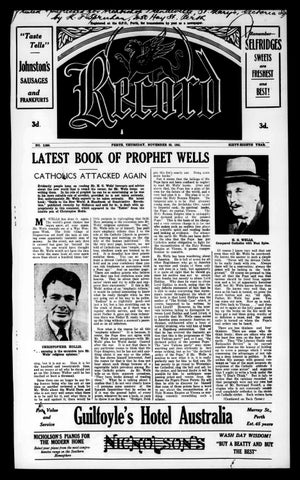
EvidentlypeoplekeeponreadingMr.H.G.Wells'forecastsandadvice aboutthenewworldthatisroundthecorner,forMr.Wellskeepson writingthem.Inhisroleofprophethecanbeasentertainingashewas inhismoresuitableroleofnovelist,providedheisnottakenseriously. But,unfortunately,Mr.Wellsexpectstobetakenseriously.Hislatest book:"GuidetotheNewWorld.AHandbookofConstructiveRevolution,"publishedrecentlybyGollanczandsoldfor4s.,isdealtwithappropriatelyinthiscomment,whichappearedinthe"Tablet"fromthe nimblepenofChristopherHollis.
MR.WELLShasdoneitagain. Theworld'sgreatthinkerhas begunanew,alloveragain. NIT..WellsremindsmeofaWarWeaponsWeek.Thelittlevillageof llogsnortonsetitselfthetaskofraisingsomeapparentlyfantasticsumof money.Intheevent,notonlydoes itsucceedbutgoesfarbeyondits quota.Soonewouldhavethought thatMr,Wellswouldnothavetheface towritethesamebookalloveragain morethanaboutahundredtimesrun-
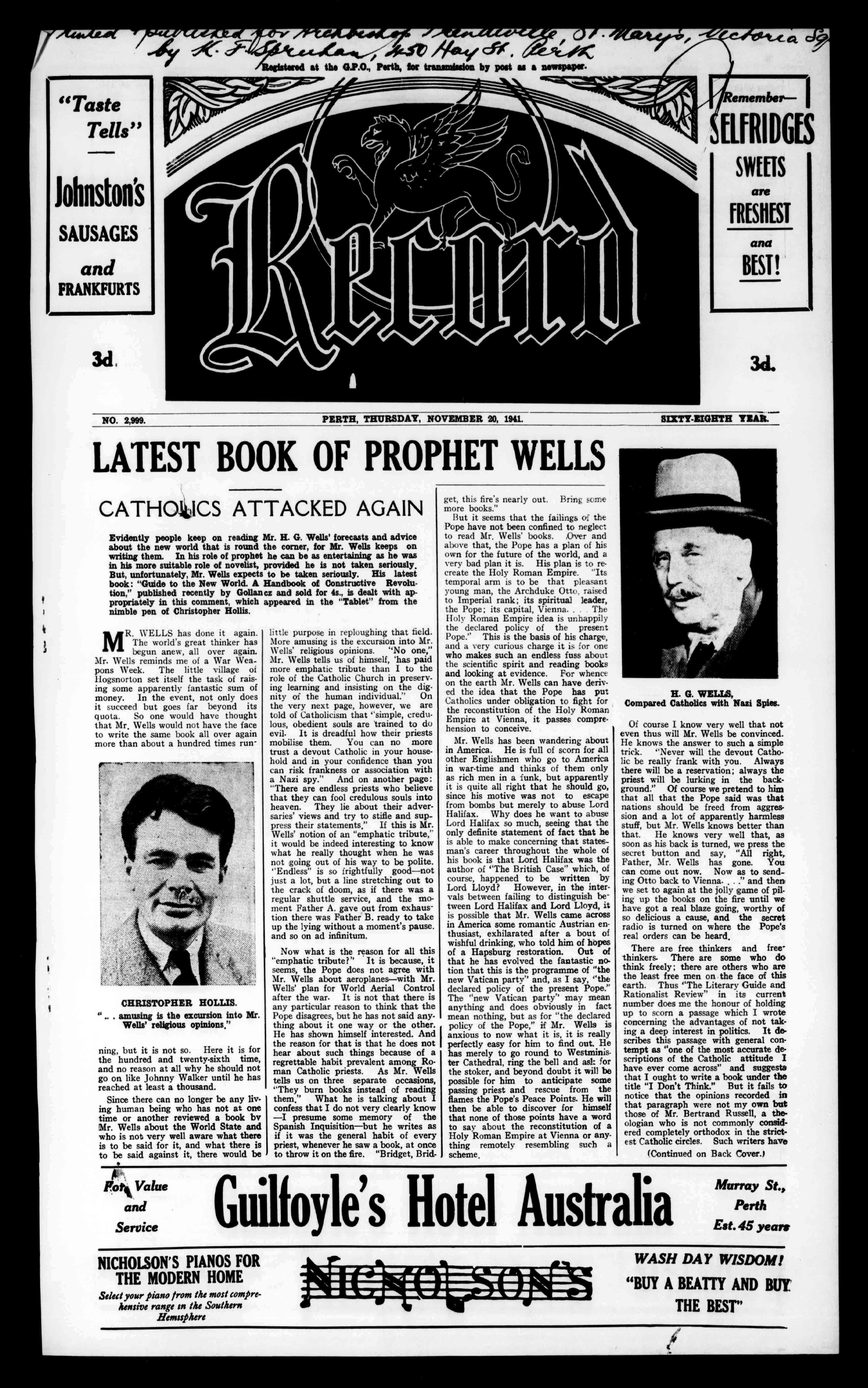
CHRISTOPHERHOLLIS.
" amusingistheexcursionintoMr. Wells'religiousopinions," ning,butitisnotso.Hereitisfor thehundredandtwenty-sixthtime, andnoreasonatallwhyheshouldnot goonlikeJohnnyWalkeruntilhehas reachedatleastathousand.
Sincetherecannolongerbeanylivinghumanbeingwhohasnotatone timeoranotherreviewedabookby Mr.WellsabouttheWorldStateand whoisnotverywellawarewhatthere istobesaidforit,andwhatthereis tobesaidagainstit,therewouldbe
littlepurposeinreploughingthatfield. MoreamusingistheexcursionintoMr. Wells'religiousopinions."Noone," Mr.Wellstellsusofhimself,'haspaid moreemphatictributethanItothe roleoftheCatholicChurchinpreservinglearningandinsistingonthedignit),ofthehumanindividual."On theverynextpage,however,weare toldofCatholicismthat'simple,credulous,obedientsoulsaretrainedtodo evil.Itisdreadfulhowtheirpriests mobilisethem.Youcannomore trustadevoutCatholicinyourhouseholdandinyourconfidencethanyou canriskfranknessorassociationwith aNazispy."Andonanotherpage:
"Thereareendlesspriestswhobelieve thattheycanfoolcreduloussoulsinto heaven.Theylieabouttheiradversaries'viewsandtrytostifleandsuppresstheirstatements,"IfthisisMr. Wells'notionofan"emphatictribute,' itwouldbeindeedinterestingtoknow whathereallythoughtwhenhewas notgoingoutofhiswaytobepolite. "Endless"issofrightfullygood-not justalot,butalinestretchingoutto thecrackofdoom,asiftherewasa regularshuttleservice,andthemomentFatherA.gaveoutfromexhaustiontherewasFatherB.readytotake upthelyingwithoutamoment'spause. andsoonadinfinitum.
Nowwhatisthereasonforallthis "emphatictribute?"Itisbecause,it seems,thePopedoesnotagreewith Mr.Wellsaboutaeroplanes-withMr. Wells'planforWorldAerialControl afterthewar.Itisnotthatthereis anyparticularreasontothinkthatthe Popedisagrees,buthehasnotsaidanythingaboutitonewayortheother. Hehasshownhimselfinterested.And thereasonforthatisthathedoesnot hearaboutsuchthingsbecauseofa regrettablehabitprevalentamongRomanCatholicpriests.AsMr.Wells tellsusonthreeseparateoccasions, "Theyburnbooksinsteadofreading them,"WhatheistalkingaboutI confessthatIdonotveryclearlyknow -Ipresumesomememoryofthe SpanishInquisition-buthewritesas ifitwasthegeneralhabitofevery priest,wheneverhesawabook,atonce tothrowitonthefire."Bridget,Brid.
get,thisfire'snearlyout.Bringsome snorebooks."
Hutitseemsthatthefailingsofthe Popehavenotbeenconfinedtoneglect toreadMr.Wells'books.Overand abovethat,thePopehasaplanofhis ownforthefutureoftheworld,anda verybadplanitis.HisplanistorecreatetheHolyRomanEmpire."Its temporalarmistobethatpleasant youngman,theArchdukeOtto,raised toImperialrank;itsspiritualleader, thePope;itscapital,Vienna..The HolyRomanEmpireideaisunhappily thedeclaredpolicyofthepresent Pope.'Thisisthebasisofhischarge, andaverycuriouschargeitisforone whomakessuchanendlessfussabout thescientificspiritandreadingbooks andlookingatevidence.Forwhence ontheearthMr.WellscanhavederivedtheideathatthePopehasput Catholicsunderobligationtofightfor thereconstitutionoftheHolyRoman EmpireatVienna,itpassescomprehensiontoconceive.
Mr.Wellshasbeenwanderingabout inAmerica.Heisfullofscornforall otherEnglishmenwhogotoAmerica inwar-timeandthinksofthemonly asrichmeninafunk,butapparently itisquiteallrightthatheshouldgo, sincehismotivewasnottoescape frombombsbutmerelytoabuseLord Halifax.Whydoeshewanttoabuse LordHalifaxsomuch,seeingthatthe onlydefinitestatementoffactthatbe isabletomakeconcerningthatstatesman'scareerthroughoutthewholeof hisbookisthatLordHalifaxwasthe authorof"TheBritishCase"which,of course,happenedtobewrittenby LordLloyd?However,intheintervalsbetweenfailingtodistinguishbetweenLordHalifaxandLordLloyd,it ispossiblethatMr.Wellscameacross inAmericasomeromanticAustrianenthusiast,exhilaratedafteraboutof wishfuldrinking,whotoldhimofhopes ofaHapsburgrestoration.Outof thathehasevolvedthefantasticnotionthatthisistheprogrammeof"the newVaticanparty"and,asIsay,"the declaredpolicyofthepresentPope." The"newVaticanparty.'maymean anythinganddoesobviouslyinfact meannothing,butasfor"thedeclared policyofthePope,"ifMr.Wellsis anxioustonowwhatitis,itisreally perfectlyeasyforhimtofindout.He hasmerelytogoroundtoWestrninisterCathedral,ringthebellandashfor thestoker,andbeyonddoubtitwillbe possibleforhimtoanticipatesome passingpriestandrescuefromthe flamesthePope'sPeacePoints.Hewill thenbeabletodiscoverforhimself thatnoneofthosepointshaveaword tosayaboutthereconstitutionofa HolyRomanEmpireatViennaoranythingremotelyresemblingsucha scheme.
H.G.WELLS, ComparedCatholicswithNaziSpies. OfcourseIknowverywellthatnot eventhuswillMr.Wellsbeconvinced. Heknowstheanswertosuchasimple trick."NeverwillthedevoutCatholicbereallyfrankwithyou.Always therewillbeareservation;alwaysthe priestwillbelurkinginthebackground."Ofcoursewepretendtohim thatallthatthePopesaidwasthat nationsshouldbefreedfromaggressionandalotofapparentlyharmless stuff,butMr.Wellsknowsbetterthan that.lieknowsverywellthat,as soonashisbackisturned,wepressthe secretbuttonandsay,"Allright, Father,Mr.Wellshasgone.You cancomeoutnow.NowastosendingOttobacktoVienna. ."andthen wesettoagainatthejollygameofpilingupthebooksonthefireuntilwe havegotarealblazegoing,worthyof sodeliciousacause,andthesecret radioisturnedonwherethePope's realorderscanbeheard, Therearefreethinkersandfreethinkers.Therearesomewhodo thinkfreely;thereareotherswhoare theleastfreemenonthefaceofthis earth.Thus"TheLiteraryGuideand RationalistReview"initscurrent numberdoesmethehonourofholding uptoscornapassagewhichIwrote concerningtheadvantagesofnottakingadeepinterestinpolitics.Itdescribesthispassagewithgeneralcontemptas"oneofthemostaccuratedescriptionsoftheCatholicattitudeI haveevercomeacross"andsuggests thatIoughttowriteabookunderthe title"IDon'tThink."Butitfailsto noticethattheopinionsrecordedin thatparagraphwerenotmyownbut thoseofMr.BertrandRussell,atheologianwhoisnotcommonlyconsideredcompletelyorthodoxinthestrictestCatholiccircles.Suchwritershave
(ContinuedonBackCover.)
NICHOLSON'SPIANOSFOR THEMODERNHOME
SelectyourpianofromthemostcomprehensiverangeentheSouthern Hemssphere
WHYTHEKOOKABURRA Laughs
Aftertwentyyears'absence,aman returnedtohishometown.Hediscoveredonlyoneoftheoriginalresidents, anoldIrishwoman.
"Tellme,Mrs.Daly,"hesaid,"what becameofpoorlittleJimmyMcKenna?"
"Poor!''echoedMrs.Daly."Poor nothin'.Jimmyhadnoschoolin',as youmayremember,butwhenhegrew uphemadeafortunealthoughhe couldn'treadorwrite."
"Andwhereishenow?"
"Icouldn'tsay.Yousee,about twoyearsagohewentdowntothe poolwheresomeoftheboyswasswimmin',an'itbein'awarmdayhetook offhisclothesan'wasdrowned."
"Toobad,"saidthevisitor."To thinkofaboylikethatcomingtosuch anend,Andhemadeafortuneyou say?Yethecouldn'treadorwrite.'
"No,"saidMrs.Daly."Norswim." * * *
Thepoliceinspectorwasawarethat thevillageinnkeeperwas,insporting parlance,"makingabook."
Beingtoowellknownhimselftolay theoffenderbytheheels,hesentfor twodetectivesfromaneighbouring townandexplainedmatterstothem.
Thedetectivesvisitedtheinn,and aftercallingfordrinks,inquiredthe oddsforacertainrace,andweretold 5to1barthree.
"Now,"theythoughtgleefully,"we havehim."
"Whatthreedoyoubar?"wasthe nextinquiry.
Theinnkeepersmiledpleasantlyas heanswered,"Youtwoan'theinspector,"* * * *
Threemenarrivedattherailway stationwiththeintentionofcatching thelasttrain.Astheyreachedthe platformthetrainbegantomoveout. Themenranforthetrain,andthe guardandaporterbundledtwoof themintotheguard'svan.
Thethirdmanstooddisconsolately ontheplatformwatchingitdisappear.
"Hardluck,sir,"saidtheporter. "I'msorryyouwereunabletogeton."
"Yes,"repliedtheman."Myfriends willbesorry,too;theywereonlyseeingmeoff."
"Wehavebeenmarriedoverayear now,andweneverquarrel.IfadifferenceofopinionarisesandIam right,Henryalwaysgivesinimmediately" "Andifheisright?"
"Oh,thathasn'thappenedyet!"
Theyoungmanwentintoabusy cafeforasnack,butthewaitressseemedtoobusytoattendhim.
Eventuallyhemanagedtogivehis order,adding,"andI'minabitofa hurry.I'llberegisteringwiththe nextage-group,"
'Phone:B3511.
Atavillageconcertfortroops,men fromthenearestcampturnedupin force.
Thelocalsopranowasobligingwith "AnnieLaurie,"andthesoldierswere beginningtogetrestive.
Asshereachedthelines:"Andfor bonnieAnnieLaurieI'dlaymedoon anddee,"avoicecamefromtheback ofthehall:
"IsthereaMissLaurieinthe house?"
*
Traveller:"CanIshowyousome samplesofourfamouslines,sir?"
Manager:"You'llhavetoexcuseme to-day,Ihavesomuchonmyhandsat themoment."
Traveller:"AsIcansee,sir,buta tabletofourlightningcleanseranda littlewaterwilltakealotofitoff."
* * * *
Atameetingthespeakerexclaimed:
"Thereoughttobeonlyoneheadto everyfamily!"
"That'strue,"repliedaworried-lookingmanintheaudience.
"Youagreewithme?"shoutedthe speaker.
"Ido,"repliedtheman."I'vejust paidforhatsforsevendaughters." *
Twoworkmensatdowntoeattheir lunchandonebeganunwrappinga parcelabout18or20incheslong.
"Whatsthat?"askedhisfriend.
"Well,mywifeisaway,soImadea pieformyself."
"Abitlong,ain'tit?"
"Ofcourseit'slong.It'srhubarb.
* * * *
"WhenIappliedforajobthemanagerhadthenervetoaskifmypunctuationwasgood."
"Andwhatdidyoutellhim?"
"IsaidI'dneverbeenlateforwork inmylife."
"What'sthematterwithGilaries? Gotlumbagoorspinalcurvatureor something?"
"No;hehastowalkthatwaytofit someshirtshiswifemadeforhim."
Thebusconductorhandedhackthe shillingtothewomanpassenger,
"Thiscoinisnogood,"hetoldher. "It'sspurious."
"Ridiculous!"saidshe,examining thecoin."Why,it'sdated1921.It wouldhavebeennoticedbeforethis ifithadbeenbad."
* *
TheHollywoodmagnatetoldanassistantthatinhisopinionacertain writerwastheonlymanforafilm theyhadunderconsideration.The assistantwastactfullydoubtful.
"Don'tyouthinkhe'salittlebittoo caustic?"hesuggested.
"DoIcarehowmuchhecosts?"demandedtheproducer."Gethim!"
* * WhenthehungryScotwasserved bythedeafbarmanwithtwopennyworthofpotatocrispshetoreopenthe bag,spreadthecontentsoverthecounter,andlookedinvainfortheusual smallpacketofsalt.
"Nosalt,"hecomplained.
Thebarmancuppedhisearinhis hand.
"Sorry,"hesaid,"Ididn'tquite catchyou."
"Nosalt!"yelledtheScotsman.
"Oh!"saidthebarman."Ithought yousaid'oneshort.'"
"Bytheway,Mrs.Grubb,"saidthe newlodger,"Ihaveafewidiosyncrasies."
"That'sallright,"repliedtheland lady. seethattheyaredusted regularly."
Ayoungwomanwasextremelyvain ofthehonoursconferredupontwodistantmalerelatives.Shetalkedonthe subjecttoallandsundry:"Ihavetwo relativesintheHouseofLords.Have youany?"
"No,"repliedoneofheracquaint. ances."butIhavethreemaidenaunts intheKingdomofHeaven."
Intheironmonger'sshopTomkins noticedashillinglyingonthefloor. Glancingroundcautiouslytoseethat noonewaslooking,hedroppedhis gloveontopofit,stoopedcasually,and triedtopickthemuptogether,butin vain. Evenatthethirdattempthefailed togettheshilling.Thentheironmongerappeared.
"Ah,good-morning,sir!"hebeamed."Allowmetointroducetoyou myspecialbrandofglue.Ibelieve Youarealreadyacquaintedwithits marvellousstickingpowers."
HotelandAccommodationGuide
CORNERKINGANDMURRAYSTREETS.
CITYHOTEL-:-Perth
NOWUNDERPERSONALSUPERVISIONOF E.D.HEENAN,PROPRIETOR. Telephone:B4094.
OnttoeRoad
CityBeach. W HOTEL
FirstClass Accommodation. ALLLEADINGLINESOFLIQUORSTOCKED.
'Phone:B3418.
EMBLEY
M.CRANLEY,Proprietor.
GAYNOR'SHISMAJESTY'SHOTEL HAYSTREET PERTH. EXCFLLENTCUISINE MODERATETARIFF.
HOTELPERTH JACKEDDINGTON, Proprietor.
ExcellentAccommodation
STAN.O'BRIEN COURTHOTEL PERTH.
'Phone'B9261
HOTELBEACONSFIELD FREMANTLE. OverlookingtheOcean SuperiorAccommodation. ModerateCharges. Hi.BYRNE (LateofGrandandShamrock Hotels,Boulder).
SUBIACOHOTEL
FIRST-CLASSACCOMODAT1ON 'Phone:W1028, A.JMclIENRY,Proprietor
1 STREET,SUBIACO. RenovatedThroughout. EssenceofComfort. W.F.ARTIS,Proprietor. (Lat
HAY VICTORIAHOTEL eofBalmoralHotel,Vic.Park)
COUNTRY.
DukeofYorkHotel NARROGIN. ReconditionedandRefurnished. NewLounge,DiningRoom,and CommercialRooms. ARTHURBOYLAN,Proprietor (LateGeorgeHotel,Perth.)
FREEMASON'SHotel
TOODYAY. ExcellentCuisine. AmaticeRefrigeratorInstalled. OldandNewFriendsare CordiallyWelcomed. MRS.E.WING,Proprietress.
GOLDFIELDS.
TRYHANNAN'SLAGERatRodBeaton's HANNAN'SHOTEL
HANNANSTREET, KALGOORLIE.
STAR&GARTERHOTEL
Cnr.HANNANandNETHERCOTT STREETS,KALGOORLIE.
KalgoorlieBeer,AlwaysCold,onTap Also
TWO THERECORD. Thursday,November20,1941.
Laubman&Pank (W.A.),LIMITED. 64BARRACKSTREET,PERTH.
SIGHTTESTING Opticians
-
allLeadingBrandsofWine. andSpirits BERTSTAAB Proprietor. SEEYOUATTHEPALACEHOTEL KALGOORLIE "TheHeartoftheCity." 'Phone13. Box124. AUSTRALIAHOTEL KALGOORLIE C.T.A.andR.A.C.HOUSE. OneMinutefromSt.Mary's Church. HotandColdWaterinHotel Bathrooms. RefrigerationThroughout. OnlyLock-UpGaragesinthe centreofTown. M.J.DILLON,Licensee. T1 JimFitzpatrick's HOTEL ROCKINGHAM BYTHESEA. FISHING,SHOOTING, GOLF,TENNIS. HIGHCLASSCUISINE. RingRockingham21for Reservations. NowistheTimeto StartDrinking EMUBITTER THEIDEALSUMMERDRINK `MeetyouattheSavoy' t.
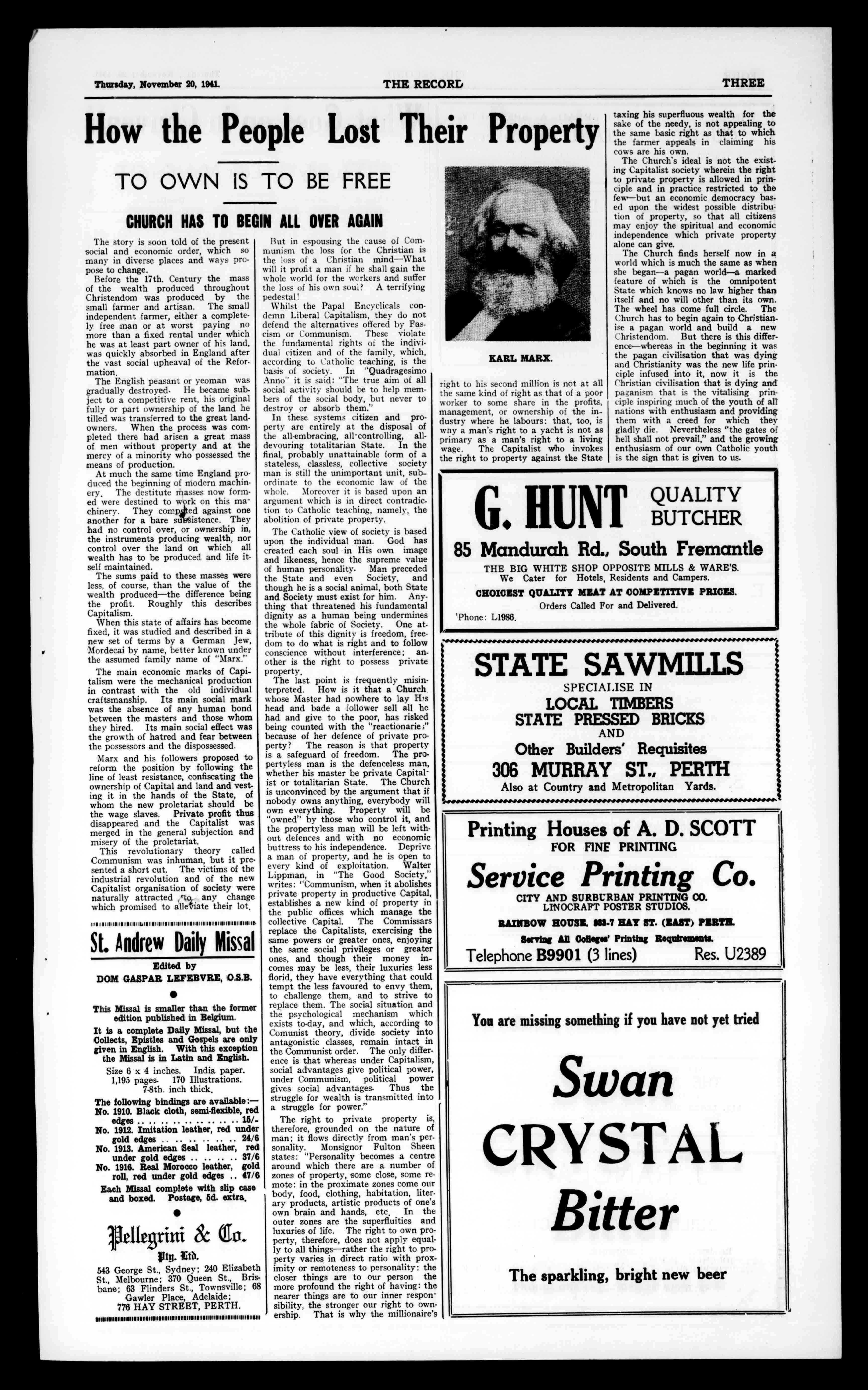
HowthePeopleLostTheirProperty
TOOWNISTOBEFREE
CHURCHHASTOBEGINALLOVERAGAIN
Thestoryissoontoldofthepresent socialandeconomicorder,whichso manyindiverseplacesandwaysproposetochange. Beforethe17th.Centurythemass ofthewealthproducedthroughout Christendomwasproducedbythe smallfarmerandartisan.Thesmall independentfarmer,eitheracompletelyfreemanoratworstpayingno morethanafixedrentalunderwhich hewasatleastpartownerofhisland, wasquicklyabsorbedinEnglandafter thevastsocialupheavaloftheReformation.
TheEnglishpeasantoryeomanwas graduallydestroyed.liebecamesubjecttoacompetitiverent,hisoriginal fullyorpartownershipofthelandhe tilledwastransferredtothegreatlandowners.Whentheprocesswascompletedtherehadarisenagreatmass ofmenwithoutpropertyandatthe mercyofaminoritywhopossessedthe meansofproduction.
AtmuchthesametimeEnglandproducedthebeginningofmodernmachinery.Thedestitutemassesnowformedweredestinedto onthismachinery.Theycoinedagainstone anotherforabaresistence.They hadnocontrolover,orownershipin, theinstrumentsproducingwealth,nor controloverthelandonwhichall wealthhastobeproducedandlifeitselfmaintained.
Thesumspaidtothesemasseswere less,ofcourse,thanthevalueofthe wealthproduced-thedifferencebeing theprofit.Roughlythisdescribes Capitalism.
Whenthisstateofaffairshasbecome fixed,itwasstudiedanddescribedina newsetoftermsbyaGermanJew, Mordecaibyname,betterknownunder theassumedfamilynameof"Marx."
ThemaineconomicmarksofCapitalismwerethemechanicalproduction incontrastwiththeoldindividual craftsmanship.Itsmainsocialmark wastheabsenceofanyhumanbond betweenthemastersandthosewhom theyhired.Itsmainsocialeffectwas thegrowthofhatredandfearbetween thepossessorsandthedispossessed.
Marxandhisfollowersproposedto reformthepositionbyfollowingthe lineofleastresistance,confiscatingthe ownershipofCapitalandlandandvestingitinthehandsoftheState,of whomthenewproletariatshouldbe thewageslaves.Privateprofitthus disappearedandtheCapitalistwas mergedinthegeneralsubjectionand miseryoftheproletariat.
Thisrevolutionarytheorycalled Communismwasinhuman,butitpresentedashortcut.Thevictimsofthe industrialrevolutionandofthenew Capitalistorganisationofsocietywere naturallyattracted,no,anychange whichpromisedtoalletiatetheirlot,
St.AndrewDailyMissal
Editedby DOMGASPARLEFEBVRE,,O.S.B.
ThisMissalissmallerthantheformer editionpublishedinBelgium.
ItisacompleteDailyMissal,butthe Collects,EpistlesandGospelsareonly giveninEnglish.Withthisexception theMissalisinLatinandEnglish. Size6x4inches.Indiapaper. 1,193pages. 170Illustrations. 7-8th.inchthick.
Thefollowingbindingsareavailable:No.1910.Blackcloth,semi-flexible,red
No.1912.Imitationleather,redunder goldedges 24/6
No.1913.AmericanSealleather,red undergoldedges 37/6
No.1916.RealMoroccoleather,gold roll,redundergoldedges 47/6
EachMissalcompletewithslipcase andboxed.Postage,5d.extra.
&To.
lg.Eat. 543GeorgeSt.,Sydney;240Elizabeth St.,Melbourne;370QueenSt.,Brisbane;63FlindersSt.,Townsville;68 GawlerPlace,Adelaide; 776HAYSTREET,PERTH.
ButinespousingthecauseofCommunismthelossfortheChristianis thelossofaChristianmind-What willitprofitamanifheshallgainthe wholeworldfortheworkersandsuffer thelossofhisownsoul?Aterrifying pedestal!
WhilstthePapalEncyclicalscondemnLiberalCapitalism,theydonot defendthealternativesofferedbyFascismorCommunism.Theseviolate thefundamentalrightsoftheindividualcitizenandofthefamily,which, accordingtoCatholicteaching,isthe basisofsociety.In"Quadragesimo Anno"itissaid:"Thetrueaimofall socialactivityshouldbetohelpmembersofthesocialbody,butneverto destroyorabsorbthem."
Inthesesystemscitizenandpropertyareentirelyatthedisposalof theall-embracing,all-controlling,alldevouringtotalitarianState.Inthe final,probablyunattainableformofa stateless,classless,collectivesociety, manisstilltheunimportantunit,subordinatetotheeconomiclawofthe whole.Moreoveritisbaseduponan argumentwhichisindirectcontradictiontoCatholicteaching,namely,the abolitionofprivateproperty.
TheCatholicviewofsocietyisbased upontheindividualman.Godhas createdeachsoulinHisownimage andlikeness,hencethesupremevalue ofhumanpersonality.Manpreceded theStateandevenSociety,and thoughheisasocialanimal,bothState andSocietymustexistforhim.Anythingthatthreatenedhisfundamental dignityasahumanbeingundermines thewholefabricofSociety.Oneattributeofthisdignityisfreedom,freedomtodowhatisrightandtofollow consciencewithoutinterference;anotheristherighttopossessprivate property,
Thelastpointisfrequentlymisinterpreted.HowisitthataChurch whoseMasterhadnowheretolayH's headandbadeafollowersellallhe hadandgivetothepoor,hasrisked beingcountedwiththe"reactionaries' becauseofherdefenceofprivateproperty?Thereasonisthatproperty isasafeguardoffreedom.Thepropertylessmanisthedefencelessman, whetherhismasterbeprivateCapitalistortotalitarianState.TheChurch isunconvincedbytheargumentthatif nobodyownsanything,everybodywill owneverything.Propertywillbe "owned"bythosewhocontrolit,and thepropertylessmanwillbeleftwithoutdefencesandwithnoeconomic buttresstohisindependence.Deprive amanofproperty,andheisopento everykindofexploitation.Walter Lippman,in"TheGoodSociety,' writes:"Communism,whenitabolishes privatepropertyinproductiveCapital, establishesanewkindofpropertyin thepublicofficeswhichmanagethe collectiveCapital.TheCommissars replacetheCapitalists,exercisingthe samepowersorgreaterones,enjoying thesamesocialprivilegesorgreater ones,andthoughtheirmoneyincomesmaybeless,theirluxuriesless florid,theyhaveeverythingthatcould temptthelessfavouredtoenvythem, tochallengethem,andtostriveto replacethem.Thesocialsituationand thepsychologicalmechanismwhich existsto-day,andwhich,accordingto Comunisttheory,dividesocietymto antagonisticclasses,remainintactin theCommunistorder.TheonlydifferenceisthatwhereasunderCapitalism, socialadvantagesgivepoliticalpower, underCommunism,politicalpower givessocialadvantages.Thusthe struggleforwealthistransmittedinto astruggleforpower."
Therighttoprivatepropertyis, therefore,groundedonthenatureof man;itflowsdirectlyfromman'sper. sonality.MonsignorFultonSheen states:"Personalitybecomesacentre aroundwhichthereareanumberof zonesofproperty,someclose,someremote:intheproximatezonescomeour body,food,clothing,habitation,literaryproducts,artisticproductsofone's ownbrainandbands,etc.Inthe outerzonesarethesuperfluitiesand luxuriesoflife.Therighttoownproperty,therefore,doesnotapplyequallytoallthings-rathertherighttopropertyvariesindirectratiowithproximityorremotenesstopersonality:the closerthingsaretoourpersonthe moreprofoundtherightofhaving:the nearerthingsaretoourinnerresponsibility,thestrongerourrighttoownership.Thatiswhythemillionaire's
taxinghissuperfluouswealthforthe sakeoftheneedy,isnotappealingto thesamebasicrightasthattowhich thefarmerappealsinclaiminghis cowsarehisown.
TheChurch'sidealisnottheexistingCapitalistsocietywhereintheright toprivatepropertyisallowedinprincipleandinpracticerestrictedtothe few-butaneconomicdemocracybaseduponthewidestpossibledistributionofproperty,sothatallcitizens mayenjoythespiritualandeconomic independencewhichprivateproperty alonecangive.
KARLMARX.
righttohissecondmillionisnotatall thesamekindofrightasthatofapoor workertosomeshareintheprofits, management,orownershipoftheindustrywherehelabours:that,too,is whyaman'srighttoayachtisnotas primaryasaman'srighttoaliving wage.TheCapitalistwhoinvokes therighttopropertyagainsttheState
TheChurchfindsherselfnowina worldwhichismuchthesameaswhen shebegan-apaganworld-amarked featureofwhichistheomnipotent Statewhichknowsnolawhigherthan itselfandnowillotherthanitsown. Thewheelhascomefullcircle.The ChurchhastobeginagaintoChristianiseapaganworldandbuildanew Christendom.Butthereisthisdifference-Whereasinthebeginningitwas thepagancivilisationthatwasdying andChristianitywasthenewlifeprincipleinfusedintoit,nowitisthe Christiancivilisationthatisdyingand paganismthatisthevitalisingprincipleinspiringmuchoftheyouthofall nationswithenthusiasmandproviding themwithacreedforwhichthey gladlydie.Nevertheless"thegatesof hellshallnotprevail,"andthegrowing enthusiasmofourownCatholicyouth isthesignthatisgiventous.
Thursday,November20,1941. THERECORD THREE
G.HUNT QUALITY BUTCHER 85MandurahRd.,SouthFremantle THEBIGWHITESHOPOPPOSITEMILLS&WARE'S. WeCaterforHotels,ResidentsandCampers. CHOICESTQUALITYMEATATCOMPETITIVEPRICES. OrdersCalledForandDelivered. 'Phone:1,1986. STATESAWMILLS SPECIALISEIN LOCALTIMBERS STATEPRESSEDBRICKS AND OtherBuilders'Requisites 306MURRAYST.,PERTH AlsoatCountryandMetropolitanYards. PrintingHousesofA.D.SCOTT FORFINEPRINTING ServicePrintingCo. CITYANDSURBURBANPRINTINGCO. LINOCRAPTPOSTERSTUDIOS. RAINBOWHOUSE,982-7HAYST.(EAST)PIRTE. ServingAllColleges'PrintingRequirements. TelephoneB9901(3lines) Res.U2389 Youaremissingsomethingifyouhavenotyettried Swan CRYSTAL Bitter Thesparkling,brightnewbeer
I
I
i
WHOLE
75
E.CAESAR,DAIRYMAN
89
BITUMENPAVING,Etc.
EstablishedStateWide.
THEBREADBAKEDBY-- CORLETTBROS. (LateA.I.F.), isSuperiortothatbakedbyothers. DeliveriesSouthPerth,Victoria ParkandBelmont. Procera,White,and100percent.Wholemeal,Vienna,andHerculesTheStarchFreeGermLoaf. 'PhoneM1278,orcallattheBELMONTBAKERY.
S.G.TAYLOR,QualityGrocer
1,1189.
1HAMPDENROAD,BEACONSFIELD.
DELIVERIESEVERYWHERE. AGOODDEALSAVEDBYAGOODDEAL.
"THESTOREOFQUALITY." 'Phone:F2198. STIRLINGHIGHWAY,MOSMANPARK.
RHODESitSONS GROCERS,IMPORTERS,WINEANDSPIRITMERCHANT. Goodsdeliveredtoanypartofthedistrict.
WHENGIVINGYOURNEXTORDER, DON'TFORGETTHATBOTTLEOF "SOVEREIGN"BRAND PICKLESANDTOMATOSAUCE.
BrolgaWorcestershireSauce"SharpandStrongVinegar."ExcellentLinesAll ManufacturedbyTHEWESTERNPRESERVINGWORKS,PERTH. J.J.O'HENEY,Proprietor.
ALLKEENHOUSEWI'ESMEATAT THEMODELMEATSUPPLY 400ALBANYROAD,VICTCRIAPARK.
ALLLINESSMALLGOODSANDCOOKEDMEATS. 'Phone:M.1089 G.JAGER,Proprietor.
J.RANCLAUD
(LateofKalgoorlie).
BUILDER&CONTRACTOR
Residence: 255LABOUCHEREROAD SOUTHPERTH. 'PHONE MU160:3
ALL
WhatGoesoninConvents
TragedyofLostVocations
Oneofthemostprominentfeatures ofourCatholiclandscapeisthesplendidworkofourSistersandNuns.Admiredbyallwhounderstandthem, thesewomenlivealifethatisatonce excellentandattractive.OurLord summeditupforusinHisownpregnantwords,"Beyou,therefore,perfect."(Math.5,48.) Surely,thisis aglamorouscareerwithwhichanygirl wouldbeinsympathy.Perhaps,a shortreviewofthislifemaybeofuse tosomethoughtfulreader.
Tostriveafterperfectionisthework ofeveryreligious,and,inorderto realisethishighambition,itisnot enoughtoobeymerelythecommands ofGod.Hiscounsels,too,mustbe putintoeffect.Thisisnomeantask,
For"TheRecord,"byJ.D. andthatiswhythereligioushouse hasnoroomfortheloverofease,ofinordinatepleasure,orofthelimelight.
Themeansemployedbyreligiousin thisquestforperfectionarenecessarily energeticandradical.Onecannotexpecttoclimbsteepheightsbyusing half-heartedorjustsuperficialefforts, AndthevirtuespractisedbyourSistersandNunsarenopioustravesty, butthehappyfruitofgenerosityand practicalaction.Hence,inorderto liveinaccordancewiththecounsels ofGod,wefindreligiousleavingtheir homes;asitwere,forsakingfather, mother,brotherandsister,andliving incommunities.Here,gatheredtogethedunderasuperior,withwiserules toguidethem,theystriveafterperfectionbyobservingpublicvowsofpoverty,chastity,andobedience. Poverty.
Discoursingtotheyoungmanwho wishedtoliveabetterlife,Christ said:"Ifthouwillbeperfect,go,sell whatthouhast,andgivetothepoor., andthoushalthavetreasureinheavan."(Matt19,21.)Inthesewords andinHislaterexplanations,Our Lordplacespovertybeforeusasacapitalsourceofperfection.And,indeed, itiseasytoappreciatethisfact.A shipbeforeitcancrosstheoceanmust firstweighitsanchor,andso,too,a SisterorNun,wishingtoembarkon thewayofperfection,mustbreakthe bondsthatchainhertotheshore. Judgingwisely,shechoosesbetween theserviceofGodandthatofMammon. Peoplenaturallystoreuptreasures. Thehumanreasonlooksahead,and,to someextent,foreseesthefuture,andis eagertoprovideforthedaytocome. Howdisillusionedwillbethatmyopic soulwhoistoosolicitousforpresent riches.Ontheotherhand,howhappy willthosebewho,whentheirtime comes,findlaidupinheavenpriceless treasuresofgloryunimagined,of beautyunsurpassed,undimmedby time,untaintedbyrustormoth,giving joyeverlastingintheireternalpossession. Byembracingpovertythereligious ensuresthatallhercareisforthe thingsofGod."Forwherethytreasureis,thereisthyheartalso."(Matt. 6,21.)
Chastity.
Factory: LOCKHARTSTREET, CANNINGBRIDGE.
Obedience.
IndicatingHisloveforobedience, OurLordsaidtotheyoungmaninthe Gospel:" Come,followMe."(Matt. 19,21,)FormanyyearsHeHimself wasobedienttoHisMotherandfosterfather.HispersonalexampleindicatedtheWayHewishestobefollowed. HewantsHisobediencetobeimitated andHewishes,also,tobefollowedas aleaderwhoseinstructionsarecarried out.TheseinstructionsHegives mediatelythroughthesuperiorsprovidedbyHisall-wiseprovidence.Areligiouslivingunderobediencecansay, atanymomentoftheday,thatsheis doingthewillofGodhereandnow. ObedienceteststheloveofGod. WherethereisnoloveofGod,wefind baserloves,theloveofcreatures,the loveofpower,theloveofourownwill. OnlyasoulwholovesGodtrulyand tenderlywillsurrenderherownselfwill.
WorkforGod,
Whathasbeensaidsofarformsa somewhatcompendiousdescriptionof themeansusedbyNunsintheirefforts tobeperfect.Theextentoftheirsuccessismeasuredbythedegreeinwhich theypractisecharity,forcharityisthe virtuebywhichweloveGodaboveall forHisownsakeandourneighbouras ourselvesfort14loveofGod.Initself, thisistheepiOrneofperfection,and allGod'scounselsleaddirectlyorindirectlytoitspractice.
Now,evenacasualglancearound willrevealstrikingexamplesofthe wayinwhichNunsshowlovefortheir neighbour.Themagnificentwork theydoamongstusbearsunmistakable testimonyoftheirspirit.Theyhave nocausetofearthetestofChrist, whenHesaid,"Bytheirfruitsyou shallknowthem."(Matt.7,16.)
Firstofall,wehavethecontemplativeNuns,Theirworkisundoubtedlyfirstinexcellence,forby theirunceasingprayersandsacrifices theywinforustheinestimablegiftof sanctifyinggrace.Besidethisgreat workofcharity,allotherworksofcorporalmercypaleintocomporativeinsignificance.
"SufferchildrentocometoMe. saidOurLord(Luke,18,16),and everywherewelookthereareschools wherechildrenaretaughttolovetheir God.Forthesicktherearehospitals;forthefallensinnerthereisa home,refuge,andencouragementto rise;thepoor,theaged,thefoundling andorphan,allthoseunwantedbythe worldarecaredforbytheseremarkableloversofGod.Thereisnoneed orsufferinginsocietywithoutsome correspondingreligiousinstitutetosup- plytheneedoralleviatethesuffering. EventhestrickenlepersfindSisters eagertodresstheirsores, Vocations.
Onecouldnotconcludethesebrief considerationswithoutcommentingon theconcernfeltbysomeatthewayin whichthenumberofvocationstothe religiouslife,4monggirlsatleast,has apparentlydecreasedinthelastfew years.Ifthisistrue,itisatragedy indeed.Ofcourse,manyreasons couldbeassignedforthisapparent malady,butthemustfundamental,I think,isthepoorqualityofouryoung girls'faith.Theyacceptthegreattruthsofreligionasjustsomuchother ready-to-handknowledgewithwhich themodernmindisoverwhelmed.
Astherosefillstheairwithitsper-Thesestartlingrevelationshaveno fume,sochastitygivestolifeadelicategreatmeaningforthem.Thevivid fragrancethatisnotofthisworld.ThisidealsofChrist'shighdoctrinedonot beautifulvirtueessentiallybelongstoburnwiththatfierceflamewhichentheangelsofGod,whoneithermarrykindleshearts,liftspeopleabovethemnoraregiveninmarriage,(Matt.22,selves,andgivespurposetoficklewills. 30.1 Withgoodreasonmenhave Itwouldnotbepossible,ofcourse, namedchastitytheangelicvirtue. noradvisableforeveryonetoembrace
Avirtuethatcanattainsuchheightsthereligiouslife.Nevertheless,unisawonderfulthingindeed.Itisdoubtedly,therearemanywhoare clear,alsototheHeartofChrist.De-freetodoso,andwhohavethegrace spitehumanfrailty,menareable(withofGodtopersevereinsuchavocaGod'shelp)toriseabovethedesirestion,butwhowillturn,orbeturned, oftheflesh.WithunstintedloveGodawayfromit.Esau,whosoldhis willrewardthosewho,thoughinferiorbirthrightforamessofpottage,may beings,risetothisheavenlyplane. havebeenafool,buthewasneverso
Ofallwomen,Marywasthefirsttofoolishastheseunperceivingsouls. consecratehervirginitytoGod,andTheyexchangealifeofholinessand shesetsusastirringexample.Herservicetosocietyforthetransienceof perfectvirtuewasamorepreciouspleasureormoreimmediateadvantthingthanhermotherhoodofChrist.ages.
Inherloveofchastity,shehesitated, Whenthetimecomesforourmodanditseemsthatshewouldhavere-erngirltochooseherpathinlife,she fusedtobetheMotherofGodifitwoulddowelltoreflectonthereligihadmeantthesacrificeofthisvirtue.ousstate.Andlest,perhaps,shemay
"AndMarywastroubledathisbedazzledbytheprospectsofaworldword . lycareer,sheshouldmakethisher
AfterOurLadycomesalongproces-constantprayer:"0,Lord,increasemy sionofwhite-robedvirgins.Theirfaithsothatthingsdivinemayasmarchingfeetresoundthroughthecen-sumesomethingoftheirtruepertildes,andtherhythmictreadechoesspective;enlightenmymindtoknow anearnestinvitationtofollowthepathwhatitisYouwant;strengthenmy ofperfectpurityintheserviceofGod.willtodoit."
THERECORD.
20,1941.
FOUR
Thursday,November
MEALANDMALTBREADASPECIALTY. CURRYandTAYLOR,Bakers
SAMSONSTREET,BEACONSFIELD. 'Phone:L2685.
SPECIALMILKFORINFANTS.
BUTCHER
HYGIENICDELIVERIESTHROUGHOUT FREMANTLEANDSUBURBS. TRYOURBOTTLEDMILK.
r,---j-.-A.COMPSTON
CornerSTEPHENST.andHAMPTONROAD.
.
FORHYGIENICSERVICE'PHONEL2492. ATRIALSOLICITED.
BASSENDEAN.
BROADWAYBUTCHERS UL204.
UL204
DELIVERY
HEATINGPLACEFOR
KEENHOUSEWIVES." WESPECIALISEINSMALLGOODS.
HANSENFamilyButcher
ALBANYROAD,VICTORIAPARK. OrdersCalledforandDeliveredDaily.
TrialSolicited. Terms:CashWeekly. 'PHONEM1184ANDLETYOURPAYENVELOPELIVELONGER. 1
OFFERSAPROMPT
ATACOMPETITIVEPRICE. "THE
ALL
A.E.
654
A
E.NOONAN--PavingContractor
SPECIALISTS
SALISBURYSTREET,MAYLANDS.'PhoneU1442.
INROADCONSTRUCTION,
1
CLASSESBUILDINGANDJOINING.
RA
TheBanningof"Ulysses"
(Severallistenershaveaskedmeto statetheCatholicattitudetoJames Joyce's"Ulysses,"andtocommenton theactionofMr.Harrisoninbanning thebook.Itishopedthatallenquirerswillbesatisfiedwiththefollowing generalstatement.)
Publicauthorityhastheright andthedutytosecurethewell-being ofitscitizens,topromotethegoodof thecommunityasawhole,topreserve themoralstandardswithoutwhich civilisationwouldlapseintosavagery andanarchy,andtofosterreligion whichisthenecessarybasisofmorals.
Ithas,therefore,boththerightand thedutytobanandproscribeeverythingwhichissubversiveofright orderandgoodmorals.Thisrighthas itsoriginintheverynatureofcivil society,theAuthorofwhichisGod. Andthisrightanddutymustbeexercisedinaccordancewtihthelawof God. Nooneintouchwithrealitieswill denythattherearebookswhichare subversiveofallorderanddecency. Noonewholivesintheworldofliving menandnotinthe(Gistsofdiscreditedrationalisttheorieswilldenythat therearepeoplewho,becauseoflack ofeducationormentalbalance,or both,areliabletocorruptionfrom suchsources.Suchbeingthecase, fewnormalpeoplewilldenythatsocietyhastherightandthedutyto protectitselfagainstsuchsubversive anddestructiveelements.
ASERVICETOTHEPUBLIC.
12)TheStatewhich,underpretext ofbeing"democratic,"allowsfullfreedomtotheagenciesofimmoralityand subversionisnotbeingdemocratic.It issimplyfailinginitsdutybothto theCreatorandtoitsowncitizens, betraying trust,andwritingthe sentenceofitsdestructiononthewall ofthefuture-perhapsofthenear future,
(3)Thetheorywhichwouldgive everyoneabsolutefreedomtodowhat hepleaseshasnobasisinreasonor reality,andissynonymouswithanarchy.Freedomisnottherightto dosimplywhatonepleases,butthe righttodowhatoneoughttodo. Whatoneoughttodoisdetermined bythelawofGod,therightsofothers andconsiderationsofthecommon good.Weoughttobefreetoattain ourfinaldestiny,andthereforewe mustbefreetoobservethelawof God,whichisthemeanstoitsattainment.Intheconcretewearefreeto doaswepleasewithinthegeneral frameworkofthelawofGodandthe commongood.Outsidethoselimits thereisnosuchthitukasmoralfreedom.
(4)"Ulysses"isagrosslyobscene andblasphemouswork:theproductof adiseasedandpervertedmind;breathingtheatmosphereofthesewerand thebrothelandofperversionswhich cannotbenamed.
Therefore,inbanningtheimportationof"Ulysses,"theMinisterwas simplydoinghisduty,and,thereby, doingaservicetothepeopleofAustralia.
(Incidentally,ournewspapersdiscreetlypassedoverthefactthatthe bookhaslongbeenbannedinEnglandandCanada.)
ALAMEARGUMENT.
(51Inreplytoanableletterby hopPitcher,publishedinitscolumns onWednesday,October15,the"SydneyMorningHerald"attemptedto answertheissuesraisedbytheBishop bycomparing"Ulysses"withsections oftheBible,andofthewordsofChau. cer,etc.,Shakespeare,etc.,stating thattheobjectionablepassagesin "Ulysses"formbutaninsignificant partofthetext,
Thereis,moreover,nocomparison betweenthetwoclassesofbooks.The Bibleoccasionallydescribesscenesof evil,butdoesnotapproveorcondone evil.
TheworksofShakespeareandothers containmoreorlesssalaciouspassages, buttheyaretheexceptionrather thantherule."Ulysses,"onthecontrary,isfilthyandblasphemousfrom beginningtoend.
Itisaratherlargebook.Letthe "SydneyMorningHerald"publish--if itdares-anytenconsecutivepagesof it.
ABRIGHTLADFROMTHEUNIVERSITY.
(6)Writingin"BoniSoit"(25/9/41), abrightladfromtheSydneyUniversitywroteasfollows:-
"IfHarrisonwasuncontaminated onreading'Ulysses,'hehadnoreason forbanningit;ifhewascontaminated thenheplacedhimselfinanexquisite. lyhypocriticalandtypicalposition."
IfthesaidBrightLadhadstudied alittleelementarylogichewouldnot havebeenguiltyofthehowlerwhich hisargumentcontains.Hewould haverealisedthatdisjunctionsarenot ofmuchuseunlesstheycoverallthe possibilities. Hisargumentdefinitelydoesnot coverallthepossibilities.la)He naivelyassumesthatthemassesofthe peoplehavethesamequalificationsas thecensor;whichisnonsense.Ifthe censorhasbeenwiselychosen,hewill befreetoalargeextentfromthedangerofcorruptionbecauseofhistraining,prudenceandsobrietyofjudgment.Butonlyonewhoseknowledgeofhumannatureisnilwould maintainthatcertainbookswouldnot beextremelyharmfulinthehandsof theyoungandinexperienced,theuneducatedandtheunbalanced.
10Thebrightladagainoverlooks theobviousfactthat,providedheis guidedbyobjectiveprinciples,evena corruptcensorcanliecorrectandreasonableinhischoiceofbooks-justas apersonallycorruptstatesmancan makegoodlaws.
(c)Acensorallegedlycorruptedby thereadingofabookcouldhave enoughdecencytowishtoprevent othersfrombeingcorrupted.
Becausetheseobviousfactswere overlookedbytheBrightLadfrom SydneyUniversity,hisargumentis fallacious.andprovenothing.
LetusapplytheBrightLad'sargumenttoanothercase,namely,the verypracticalformofcensorshipwhich isexercisedwhen,say,avictimof smallpoxisisolated:
"Ifthedot-tordidnotcontractthe diseasewhenexaminingthepatient, hehadnoreasonforwishingtoisolate him.ifhedidcontractthedisease thenheplacedhimselfinanexquisite. lyhypocriticalandtypicalposition."
Theargumentistoosillyforcomment.ButtheBrightLad'sargumentagainstthebanningof"Ulysses" isnotlesssillyandpreposterous.
* * *
"TOTHISPUREALLTHINGSARE PURL"
(7)Perhapsthemostcynicaland hypocriticalofallthereasonsurged againstthebanningofthebookwas theplea:"tothepureallthingsare pure." InhisEpistletoTitus,Bishopof Crete,St.Paulwrote:
"Allthingsarecleantotheclean; buttothemthataredefiledandtounbelievers,nothingisclean;boththeir mindandtheirconsciencearedefiled."
(I.,15.)
ThesewordsofSt.Pauldonotmean thatthosewholeadcleanlivescannot recogniseandcondemnmoralt. whentheyseeit.FortheApostle, whosepurityoflifecannotbequestioned,condemnedinthestrongest termsthevicesandperversionsdescribedwithsuchgustoanddetailby Joyce.Hedeclaredthatservitudeto theseveryviceswasoneofthepunish. mentsofapostasyfromGod.(Rom.
I.,17-32.)
Furthermore,ifthewordsmeant thatforthosewhoarepurethereisno suchthingasimpurity,thenitwould followthatGodwhoisPurityitself, wouldbeunabletoforbidorcondemn theviceofimpurity.
WhatSt.Paulmeantteasthis:All thingscreatedbyGodaregoodin themselves.Thosewholeadgood liveswillneverbecontaminatedbya createdthing,fortheywilluseitasit shouldbeusedinaccordancewiththe lawofGod.Ontheotherhand,those whohavecorruptedtheirownsoulsby infidelityandtheviolationofGod's lawwillpervertanddefileeverything theytouch, Yet,withastupidityoradishonesty whichleaveonespeechless,somepeopledistortthemeaningoftheApostles'wordstojustifyallsortsofmoral perversion.
Thefactisthat,farfrombeinga justificationof"Ulysses"oranysimilarwork,thewordsofSt.Paulcondemnitutterly.Forin"Ulysses,"the sexinstinctcreatedbyGodandgood initself,isdefiledwithanobscenity
orplaywithgreatersecuritynearthe cliff.
Theoutcryagainstcensorshipof anykindissimplyaphaseofthatwild andunreasoningrevoltagainstauthorityoflawandorderinanyshapeor formwhichisalegacyofthegodless andnowdecrepitphilosophyofLiberalism.
andblasphemycomparableonlytothe ravingsofthedamned.
OUR"INTELLECTUALS."
(8)Certainintellectuals,pseudo-intellectualsandsub-intellectuals,have attemptedtochampion"Ulysses"asa workofart,aliterarymasterpieceone oftheoutstandingworksoftheCetihwy.Yet,atarecentmeetingatthe University,thechairmanwouldnotallowthereadingofpassagesfromthe book!Thefactthatsuchawork isthuscommendedinanindictment ofthesaidintellectuals,pseudo-intellectualsandsub-intellectuals.Itshows theintellectualbankruptcyandutter degeneracyoftheLiberalisticand atheisticphilosophywhichistheonly philosophytheyknow.
Somuchbywayofgeneralcomment "Ulysses"andtheactionoftheMinisterinbanningthebook.
Wecomenowtoaletterwhich challengesallcensorship,ratherthan thebanningofanyparticularbook.
* * * * CENSORSHIPRESTRICTSFREEDOM. W.R.G.,Sydney: (Manyofyourquestionshavebeen answeredinthecommentaryjustgiven. Ishall,therefore,confinemyself tohosenotalreadydealtwith.) Censorshipisarestrictionoffreedom.
Reasonableandobjectivecensorship exercisedintheinterestsofthecommongoodbylawfulauthoritydoesrestrictthefreedomofcertainindividuals:nevertheless,itisthebulwark offreedom,ratherthanarestriction ofit.Censorshipdoeslimitthephysicalpowerofcorruptandevilmento destroyfreedombyunderminingthe lawsandinstitutionswhicharethe foundationandguaranteeoffreedom.
Justandreasonablecensorship limitsfreedominthesamesensethat afencealongtheedgeofaclifflimits freedom:itpreventsmenfromfalling overthecliff.Butbythisveryrestrictionitgivesgreaterscopeforfreedom.Itenablesmentowalkorwork
NOFREEDOMWITHOUTLAW ANDORDER.
Therevoltagainstlawinthename offreedomleadstothedestructionof freedom;forfreedomisinseparable fromlawandorder.Wherelawand orderaretreatedwithcontemptand floutedwithimpunity,libertydegeneratesintolicence,andsocietydissolves inanarchy,Anarchyissynonymous withthesavageryandterrorismwhich aretheveryantithesisofliberty.
Wheretherearetrafficlawsmen arefreetowalkthestreetsandmay fostersomehopeofreturninghome withlifeandlimbsintact.Werethere notrafficlaws,ourstreetswouldbe filledwithavastanddangerousconfusioninwhichtheonlyfreedomwould bethefreedomofaviolentdeath.
Wherethelawsforbiddingrobbery andmurderarerespected,peoplecan liveandmovewithfreedom.The abolitionofthoselawswouldnot bringfreedomtothepeople.Itwould simplygivebanditsandgangstersfreedomtodestroytheliberties,tosay nothing,ofthelivesofthepeople.
Therehavebeenlawswhichwere meaningless,stupid,unjust.Butthe factremainsthatthesystemoflaw ahichsurroundsusisthebulwarkof freedom.
Similarly,theremaybeformsof
FORQUALITY
'Phone: B3810.
Thursday,November20,1941. THERECORD. FI'VE
RENNANS OULDER LIMITED
DRAPERY, LADIES'ANDGENTS' CLOTHING MANCHESTERAND FURNISHINGS OurCatholicSchoolsandColleges CHRISTIANBROTHERS,MT.HENRY OneoftheAssociatedPublic SchoolsofW.A. AquinasCollege TELEPHONE:MU1520 ForBoardersandDayStudents Boysadmittedfrom7upwards PeautilullySituated,overlookingtheriver,nearthenewCanningBridge. ForParticularsapplyloThePrincipal,AquinasCollege,CanningParade,Mt.Henry. SACREDHEARTHIGHSCHOOL HIGHGATE-PERTH (ConductedbySistersNotreDameDesholh-ions). BOARDINGANDDAYSCHOOLFORGIRLS PUPILSPREPAREDALLEXAMINATIONS. MONTESSORISCHOOLFORYOUNGCHILDREN ForProspectusapplyREV.MOTHERPRIORESS LoretoConvent"Osborne"-Clarethont BOARDINGANDDAYCOLLEGE. TheSchoolprovidesasoundeducationonmodernlinesinallbranches ofstudy.Thepupilsarepreparedforal,examinations.TheSchoolis beautifullysituatedbetweenO.canandRiver,inextensivegrounds, withfineplayingfieldsandprivateSwimmingPoolinRiver. Telephone:P2135. Apply- MOTHERSUPERIOR. ST.ILDEPHONSUS'COLLEGE NEWNORCIA CONDUCTEDBYTHEMARISTBROTHERS. ForParticularsApplyto-THEBROTHERDIRECTOR
cetrorshipwhichareunjustandunreasonable.Butthefactremainsthat enlightenedcensorshipclosesthedoor toagenciessubversiveofalllawand order,and,thereby,offreedom.It restrictswhatiseviltogivegreater freedomtowhatisgood.
* * *
CENSORSHIPIMMORAL?
*
Sincemenhavearighttofreedom andcensorshiprestrictsthatright, censorshipisimmoral. Thatstatementcontainsalmostas manyerrorsasitdoeswords.Here aretwoofthem:
11)Youassumethatfreedomisthe righttodosimplywhatonepleases, withoutrestrictionofanykind,withoutanyconsiderationfortherightsof othersorthecommongood,orthelaw ofGod.
Thatassumptionisopposedtoreasonandwouldresultinanarchy.It isopposedtoreasonbecauseitignores GodandthelawofGod,towhichall createdthingsaresubjectforthevery reasonthattheyarecreated.No manhasanymoralfreedomtoviolate thelawofGodortosethimselfinthe wayofthecommongood,whichis sanctionedbyGod:forGodgivesno onefreedomtofloutIlislaw.
Itleadstoanarchybecause,inpractice,itwouldmeanthateveryman woulddowhatsuitedhim,without considerationofothers.Therewould henoprincipleofunityororderinsociety-inotherwords,therewouldbe anarchy.
12)ifallrestrictionofourallegedly unlimitedfreedombeimmoral,then alllawisimmoral;forthereasonthat everylawrestrictsindividualfreedom inaccordancewiththerequirements ofthecommongood.Iflawisimmoral,thenthereisnosuchthingas morality;formoralityisofitsnature anobligatorysubmissiontolawinthe strictsenseoftheterm-intheconcrete,tothelawofGod.
* * *
WHOISTOCHOOSE?
Advocatesofcensorshiparguethat good,informedandimpartialbooks arenotcensoredorbanned, Correct-Thisdoesnutmean,how ever,thatcensorsarenotliableto makemistakes;orthateverybook whichispassedbythecensorisneces. sarilygood,informedandimpartial. Therealquestionis:Whoisgoingto decidewhatbooksaregoodand whatbooksarebad.
.1,c,that thequestion.Anti hereistheanswer:Menappointedto theofficeofcensorbylawfulGovernmentalauthority,whetherofChurch orState.
Censorsbanbookswhichdonotconformtotheirideasandpassbooks whichagreewiththeirownviews.
Thatwouldperhapsbeavalidobjectionwheretheattitudeoractionsof someindividualcensorareconcerned Butasanargumentagainstallcensorship,itisworthless.
Itisbasedontheirrationalandunwarrantedassumptionthattherearc noobjectivestandardsoftruthand falsehood,noobjectivestandardsof rightandwrong.Obviously,ifthere benodefiniteandobjectivemoral code,nolawgiverandnoGod,there wouldbenosolid,rationalbasisfor censorship-astherewouldbeno rationalfoundationformorals.
Hence,theatheistwhodeniesGod andthemorallawofwhichGodisthe Author,naturallyconcludesthatall censorshipmustbearbitraryandsubjective;dependentonthewhimofthe individual-censor,orthewillofsome
cliqueordictator,orthefadsandfashionsofsociety.
lintitdoesnot,therefore,follow thatallcensorshipoughttoheabolished.Itmerelyfollowsthatatheismis asdisastrousinpracticeasitisirrationalintheory,Fortunatelyforcivilisation,atheistswhofollowtheir"philosophy"toitslogicalconclusionare comparativelyrare.
* * * C
ANINSULTTOINTELLIGENCE?
Atanyrate,censorshipisaninsultto theintelligenceofpeoplewhohave sufficienteducationtojudgebooks forthemselves.
Undoubtedly,therearemanypeoplewhoarequitecapableofdeciding objectivelyandimpartiallywhethera givenbookisgoodorharmfuland subversive.Butnotallsuchpeople canbeexpectedtofulfilthedutiesof censorship;anymorethantheycanbe expectedtofulfilotherfunctionsof Government.
Finally,anyonewhohasanycontact withtheworldofrealitiesknowsthat therearemanypeoplewhoaresimply notcapableofchoosingorjudging booksforthemselves.Take,forinstance,theinfluenceofsexyliterature onunbalancedpersons.Aninvestigationintothereadingmatterofmen whohavebeenconvictedofappalling crimeswould,Ithink,proveveryenlightening.
Infine,Icanseenouseforcensorsor censorship.
Thatyoucanseenouseforthemis fairlyobviousfromyourletter.But itdoesnot,therefore,followthatcensorsdonotfulfillausefulandeven necessaryfunctihninthecommunity.
Ifyouroppcitiontocensorshipis basedonnothinmoresolidthanthe reasonsgiveninyourletter,thenitis illogical,uninformedandunworthyof aneducatedman.llllllllll
SavemoneyonStoves,Coppers, Baths,BathHeaters,andRepairs.W.A. StoveCo-,559WellingtonSt.(B6307).
CLAREMONTRADIOAND ELECTRICALSERVICE, 1ISSTIRLING
'Phone
SIX THERECORD Thursday,November20,1941. FRANKJ.BOSWELL SPECIALISTSINHospitalEquipment,andSteamInstallations,HotWaterHeating, Ventilating,SewerageWork,andGeneralPlumbing. CornerRUTHandWILLIAMSTREETS,PERTH.-Tel.B2777. W.A.AgentforK.G.LUKEPTY.,LTD.,MELBOURNE. SuppliersofHospitalEquipmentandStainlessHospitalUtensils. NewHospitalofSt.JohnofGod,Subiaco SPLENDIDUP-TO-DATEACCOMMODATION. ConvenienttoSubiacoandLeedervilleRailwayStationsandTrams. RecentAdditionsconsistofaFully-EquippedX-RAYDEPARTMINT andCHILDREN'SWARD. PatientsMaySelectTheirOwnMedicalAdvises. UnfinancialPatientsmaybeadmittedonDoctor'sRecommendation. OPENTOALLDENOMINATIONS. CONSULT TheColonialMutualFireInsurance COMPANYLIMITED. FORALLCLASSESOFINSURANCE,INCLUDINGFIRE,HOUSEOWNER,andHOUSEHOLDER'SCOMPREHENSIVE,BURGLANY, PLATEGLASS,MOTORVEHICLE,CROPS,FIDELITYGUARANTEE,WORKMEN'SCOMPENSATION,THIRDPARTY. NO.33BARRACKSTREET,PERTH. W.L.CARTER,Manager. ForExquisiteMildnessandTenderness andFineFlavourAlways. BehnsLimited QualityMeatsandSmallgoods TWOBIGBARRACKSTREETSTORES, ForYourConvenienceonEitherSide. LACKOFREADYCASH NEEDNEVERBEANOBSTACLE! SHOPWITHA CashOrder ANDFOR GREATER BRING SATISFACTION ITTO F Andthat'sworthremembering)ForatFoy'sspecialprices oftenmeanconsiderablesaving,toyou-whyletlackofready cashbeanobstacle-solvetheproblemwithaCashOrder.Remember,also,everycashordertransactionatFoy'sistreati1 asstrictlyconfidential,andreceivestheutmostcourtesyandattention.CashOrdersmaybesecuredfromtheTraders MutualCashOrderCo.,91St.George'sTerrace('PhoneB4418) forgreatestsat'cfaction-bringyourstoFoy's! FinValueandFriendlyService PatroniseOurAdvertisers
HIGHWAY, CLAREMONT.
INSTALLATIONANDREPAIRSTO ANYTHINGELECTRICAL.
SALES-CASHORTERMS A.F.CLARKE--F2-18:3 LIC."A"GRADEELECTRICIAN. 17LILLIANSTREET,COTTESLOE. WHENINTHEDARK-RINGFOR CLARKE. Telephone84757. MARTINP.RYAN M.W.A.O.A. Optometristand Optician S,11ofLateM.P.Ryan,lateof Fremantle. ORIENTLINEBUILDINGS. WILLIAMSTREET.PERTH. DUFF'S LiqueurWhisky AlwaystheSame FootComfortGuaranteed BootsandShoes InHalfSizes. Ifnecessarywe maketoorder. 667HayStreet,Perth 'PhoneB1381.
F3068.
RADIO
INMEMORYOFST.FRANCIS
FRANCISPASSES
Feelingthatthetermofhispilgrimagewasapproaching,andthathis bodilytentwouldsoonbestruck,Francisgatheredhisdisciplesaroundhis couch,and,likeJacob,extendedhis handsoverthemintheformofa cross,blessingallthechildrenofhis love.Heaskeduponwhatbrowhis righthandrested?"Itisonthehead ofBrotherElias,'theyreplied."Itis well,"hecontinued,"Iblessthee,my son,asunderthyhandtheMostHigh hasmultipliedmychildren,soIbless themallinthee.FormypartIbless theeaswellandmorethanIcan,and conjureHimwhocandoallthingsto makeupformyimpotence;mayhere. memberthyworks,mayliehearall thywishes,mayHegivetheepartone dayintherewardofthejust!'At FriarElias'slasthourGodremembered theprayersandmeritsofthedying saint.
Franciscouldnotforgethisdear daughtersatSt.Damien's,andsent St.Clareandhercompanionsalast benedictionwithaletterfullofthe mosttouchingexhortations.Allthese finetraitsofthemostexquisitecharityshowustheamiableFrancisofAssisi,whocouldsayofhisspiritualchildrenwhat,stillyoung,hesaidofthe poor,"Ibearthemallinmyheart." Thus,afterinvokingheaven'sfavours onhisimmensefamily,hebeggedhis brethrentotransporthimtoSt.Mary oftheAngels,ground"hallowedbeyond allothers,thecradleofhisOrderand hisfavouriteretreat;"forhewished,' saidSt.Bonaventure,"tobreathethe lastbreathofhismortallifeinthat verysanctuarywherehehadreceived thedivineinbreathingofgrace."
ItwastowardsthecloseofSeptember,1226.Thesaintwasbornethither onalitter;andwhentheyreached theplainabouthalf-waybetweenthe townandtheconvent,heaskedifthey wereoppositethehospicewhereinthe beginningofhisconversionhelovedso muchtotendthelepers.Ontheir replyingintheaffirmative,"Turnme towardsthecity,"hesaid,andthen, raisinghimselfwithaneffort,hisleft armrestingononeoftheFriars,his rightstretchedouttowardsAssisiand hiseyesupliftedtoheaven,hepro. nouncedthesesolemnwords:
"BlessedoftheLordbethou,0City, forthroughtheemanysoulswillbe saved,andintheemanyservantsof theMostHighwilldwell,andfrom theewillbechosenfortheeternalKingdom.Peacebetothee."
Withallthesebenedictionsislinked anamefullofpleasingmemoriesfor
St.Francisandourreaders,thename ofhisgreatbenefactressinRome, GiacominadiSettesoli.Assoonashe reachedPortiunculahedictatedthe followinglettertoher,inwhichheprophesiesthedayofhisdeath:-
"Know,myverydeardaughter,that theever-blessedChristhasrevealedto metheapproachingendofmydays. If,therefore,youwishtoseemeagain inthisworld,setoutimmediatelyupon receiptofthismissiveandhastento St.MaryoftheAngels.Ifyouarrive laterthanSaturdayyouwillfindme dead.Bringwithyouahairshirtas ashroudformybody,andwaxtapers formyinternment.Ialsobegof youtobringsomeofthepastryyou mademetotaketoRomewhenIwas ill."
OnOctober1Francisassembledall thereligiousintheconvent,gavethem hisbenedictionagain,and,asasymbol offraternalunion,dividedamong themaloafwhichhehadblessedwith thesignoftheCross.FriarElias alone,inhisexcessivegrief,wouldnot eathisportion,whichBrotherLeo,who askeditfromhim,piouslypreserved; andthechroniclesrelatethatitsubsequentlyservedtocureacrowdofsick persons.Allthebrethrenwereweeping.Francisbeckonedhistwofirstbornsons,BernardodiQuintavalle andEdigo(PeterofCataneo,thesecondofhisdiscipleshadalreadyreturnedtoGod)todrawnigh."Come,my sons,"saidhe,"come,untilIblessyou beforeIdie."Andcrossinghishands overtheirheadsheblessedthemwith aspecialbenediction.
OnFridayevening(October2),he madeasigntohisFriarstoapproach hisbed.Hisbodywasinthelastextremity,buthismindretainedthefull possessionofitsfaculties.Atthat extremehourhedictatedhislasttestament,aburningeffusionoflovehelet fallfromhisfalteringlips,amasterly workinwhichhehimselfhasdepicted ingrandlinesthedifferentphasesofhis life,FraAngeloofRietiwrote,while theotherreligiouslistenedwithan emotionitiseasytoconceive:
ExtractsfromtheLastTestamentof St.FrancisofAssisi.
"TheLordhathgiventome,Brother Francis,thegracetothusbegintodo penance.WhenIwasleadingmylife ofsin,thesightofleperswasveryrepulsivetome;buttheLordledme intotheirmidstandIpractisedmercy intheirregard;andwhenIcame awayfromthem,whathadseemedbit-
ROLLOFHONOUR
TheOldBoys'AssociationofSt.II dephonsus'College,NewNorcia,is anxioustohaveaspecialfeatureinthis year'sCollegeAnnu.!;Aiivotedtothose ex-studentswhoareWrvinginthe fightingforces.WillanyOldBoys, friendsorparentswhoknowofany S.I.C.ex-studentservingwiththe Army,Navy,orAirForcekindlysend particularsto-
Mr.J.O'Halloran, 48St.George'sTerrace, orto-
Mr.K.Henderson, 168VincentStreet.
of
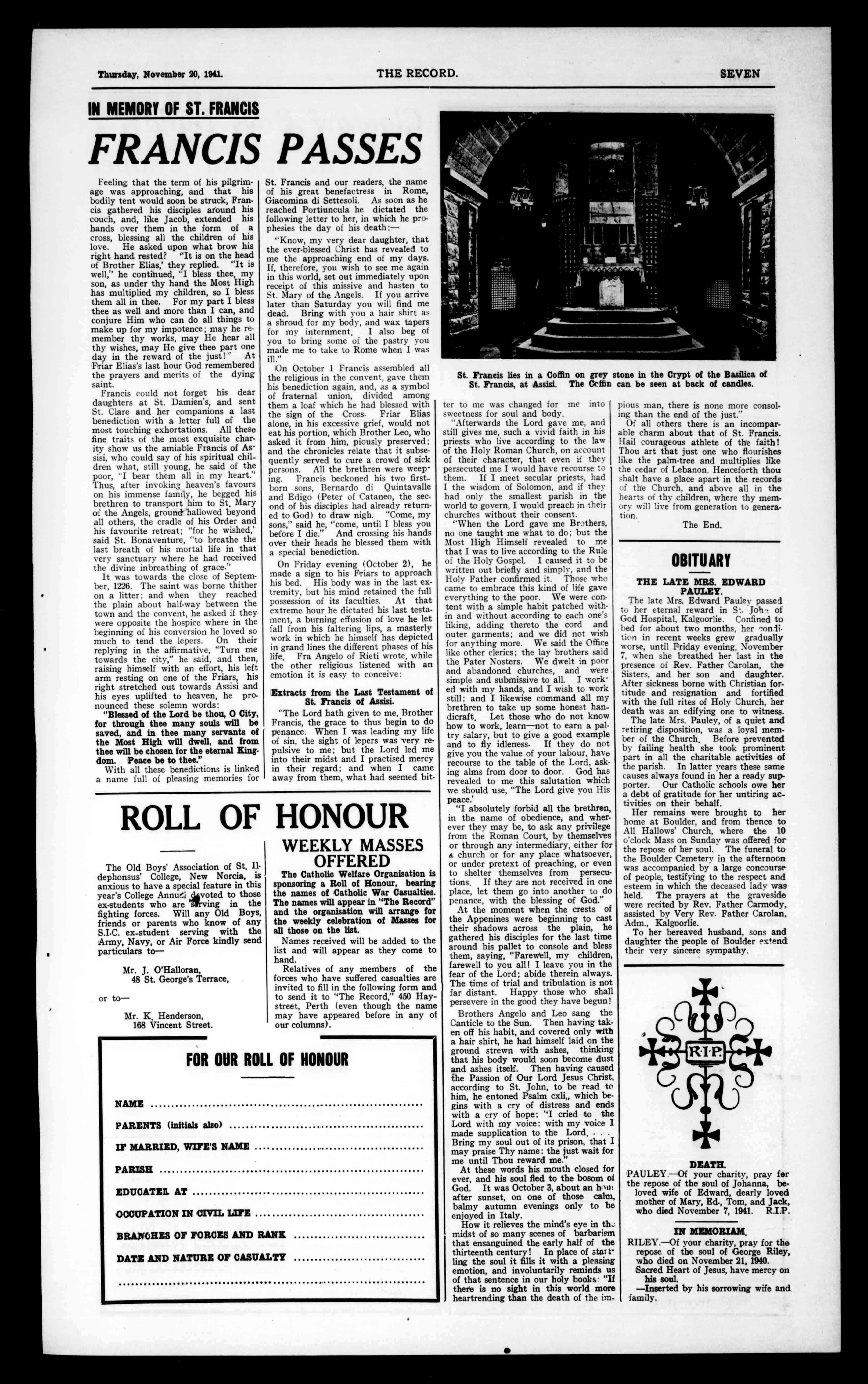
St.FrancisliesinaCoffinongreystoneintheCryptoftheBasilica
St.Francis,atAssisi.TheCelinacanbeseenatbackofcandles.
tertomewaschangedformeinto sweetnessforsoulandbody.
"AfterwardstheLordgaveme,and stillgivesme,suchavividfaithinhis priestswholiveaccordingtothelaw oftheHolyRomanChurch,onaccount oftheircharacter,thatevenifthey persecutedmeIwouldhaverecourseto them.IfImeetsecularpriests,had IthewisdomofSolomon,andifthey hadonlythesmallestparishinthe worldtogovern,Iwouldpreachintheir churcheswithouttheirconsent.
"WhentheLordgavemeBrothers, noonetaughtmewhattodo;butthe MostHighHimselfrevealedtome thatIwastoliveaccordingtotheRule oftheHolyGospel.Icausedittobe writtenoutbrieflyandsimply,andthe HolyFatherconfirmedit.Thosewho cametoembracethiskindoflifegave everythingtothepoor.Wewerecontentwithasimplehabitpatchedwithinandwithoutaccordingtoeachone's liking,addingtheretothecordand outergarments;andwedidnotwish foranythingmore.WesaidtheOffice likeotherclerics;thelaybrotherssaid thePaterNosters.Wedweltinpoor andabandonedchurches,andwere simpleandsubmissivetoall.Iworkedwithmyhands,andIwishtowork still;andIlikewisecommandallmy brethrentotakeupsomehonesthandicraft.Letthosewhodonotknow howtowork,learn-nottoearnapaltrysalary,buttogiveagoodexample andtoflyidleness.Iftheydonot giveyouthevalueofyourlabour,have recoursetothetableoftheLord,askingalmsfromdoortodoor.Godhas revealedtomethissalutationwhich weshoulduse,"TheLordgiveyouHis peace.'
WEEKLYMASSES OFFERED
TheCatholicWelfareOrganisationis sponsoringaRollofHonour,bearing thenamesofCatholicWarCasualties. Thenameswillappearin"TheRecord" andtheorganisationwillarrangefor theweeklycelebrationofMassesfor allthoseonthelist.
Namesreceivedwillbeaddedtothe listandwillappearastheycometo hand. Relativesofanymembersofthe forceswhohavesufferedcasualtiesare invitedtofillinthefollowingformand tosenditto"TheRecord."450Haystreet,Perth(eventhoughthename mayhaveappearedbeforeinanyof ourcolumns).
FOROURROLLOFHONOUR
NAME
PARENTS(initialsalso)
IFMARRIED,WIFE'SNAME
PARISH
EDUCATE!,AT
OCCUPATIONINCIVILLIFE
BRANCHESOFFORCESANDRANK
DATEANDNATUREOFCASUALTY
"Iabsolutelyforbidallthebrethren, inthenameofobedience,andwherevertheymaybe,toaskanyprivilege fromtheRomanCourt,bythemselves orthroughanyintermediary,eitherfor achurchorforanyplacewhatsoever, orunderpretextofpreaching,oreven toshelterthemselvesfrompersecutions.Iftheyarenotreceivedinone place,letthemgointoanothertodo penance,withtheblessingofGod."
Atthemomentwhenthecrestsof theAppenineswerebeginningtocast theirshadowsacrosstheplain,he gatheredhisdisciplesforthelasttime aroundhispallettoconsoleandbless them,saying,"Farewell,mychildren, farewelltoyouall!Ileaveyouinthe fearoftheLord:abidethereinalways. Thetimeoftrialandtribulationisnot fardistant.Happythosewhoshall persevereinthegoodtheyhavebegun!
BrothersAngeloandLeosangthe CanticletotheSun.Thenhavingtakenoffhishabit,andcoveredonlywith ahairshirt,hehadhimselflaidonthe groundstrewnwithashes,thinking thathisbodywouldsoonbecomedust andashesitself.Thenhavingcaused thePassionofOurLordJesusChrist, accordingtoSt.John,tobereadto him,heentonedPsalmcxliwhichbeginswithacryofdistressandends withacryofhope:"Icriedtothe Lordwithmyvoice:withmyvoiceI madesupplicationtotheLord, Bringmysouloutofitsprison,thatI maypraiseThyname:thejustwaitfor meuntilThourewardme."
Atthesewordshismouthclosedfor ever,andhissoulfledtothebosomof God.ItwasOctober3,aboutanh,o, aftersunset,ononeofthosecalm, balmyautumneveningsonlytobe enjoyedinItaly.
Howitrelievesthemind'seyeinth_ midstofsomanyscenesofbarbarism thatensanguinedtheearlyhalfofthe thirteenthcentury!Inplaceofstartlingthesoulitfillsitwithapleasing emotion,andinvoluntarilyremindsus ofthatsentenceinourholybooks"If thereisnosightinthisworldmore heartrendingthanthedeathoftheirn-
piousman,thereisnonemoreconsolingthantheendofthejust."
OfallothersthereisanincomparablecharmaboutthatofSt.Francis. Hailcourageousathleteofthefaith! Thouartthatjustonewhoflourishes likethepalm-treeandmultiplieslike thecedarofLebanon.Henceforththou shalthaveaplaceapartintherecords ofth'eChurch,andaboveallinthe heartsofthychildren,wherethymemorywilllivefromgenerationtogeneration.
TheEnd.
OBITUARY
THELATEMRS.EDWARD PAULEY.
ThelateMrs.EdwardPauleypassed tohereternalrewardinS:.Joh-,of GodHospital,Kalgoorlie.Confinedto bedforabouttwomonths,her'7oniilioninrecentweeksgrewgradually worse,untilFridayevening,November 7,whenshebreathedherlastinthe presenceofRev.FatherCarolan,the Sisters,andhersonanddaughter. AftersicknessbornewithChristianfortitudeandresignationandfortified withthefullritesofHolyChurch,her deathwasanedifyingonetowitness.
ThelateMrs.Pauley,ofaquietand retiringdisposition,wasaloyalmemberoftheChurch,Beforeprevented byfailinghealthshetookprominent partinallthecharitableactivitiesof theparish.Inlatteryearsthesesame causesalwaysfoundinherareadysupporter.OurCatholicschoolsoweher adebtofgratitudeforheruntiringactivitiesontheirbehalf.
Herremainswerebroughttoher homeatBoulder,andfromthenceto AllHallows'Church,wherethe10 o'clockMassonSundaywasofferedfor thereposeofhersoul.Thefuneralto theBoulderCemeteryintheafternoon wasaccompaniedbyalargeconcourse ofpeople,testifyingtotherespectand esteeminwhichthedeceasedladywas held.Theprayersatthegraveside wererecitedbyRev.FatherCarmody, assistedbyVeryRev.FatherCarolan, Adm.,Kalgoorlie.
Toherbereavedhusband,sonsand daughterthepeopleofBoulder.x+end theirverysinceresympathy.
DEATH. PAULEY.-Ofyourcharity,prayfor thereposeofthesoulofJohanna,belovedwifeofEdward,dearlyloved motherofMary,Ed.,Tom,andJack, whodiedNovember7,1941. R.I.P.
INMEMORIAM, RILEY.-Ofyourcharity,prayforthe reposeofthesoulofGeorgeRiley, whodiedonNovember21,1940. SacredHeartofJesus,havemercyon hissoul. -Insertedbyhissorrowingwifeand family.
Thursday,November20,1941. THERECORD. SEVEN
TROTTING
Gloucester Park
SATURDAY,NOV.22,1941
EMPLOYERSRING STOTT'S
becausetheyknowthatStott Studentsgivecompletesatisfaction.Stott'sconnectionextends overaperiodofnearly40years. AskforProspectus.
ClontarfBoysBuild MemorialChapel
OpportunityforGenerousBenefactors
EMPLOYERS RING
STOTTL
STOTT'SPerpetualTrustees' Terrace,Perth Buildings,St.George's B9281
STOTT'SWoolworthBuilding,AdelaideStreet,Fremantle L1218
Tocrowntheirgreatachievements, astheyouthfulbuildersofBoys'Town -St.Joseph'sOrphanage,Clontarf, W.A.-theboyshave,duringthepast year,beenbusilyemployedinerecting withinthelovelygroundsasplendid ChapelintheSpanishMissionstyle. To-day,whenthedestructionanddeco. lationofsomanybeautifulbuildingsis dailypartofmodernwarfare,the votingtradesmen,technicallytrained tthis"Homeawayfromhome"for theorphanedanddestituteboysof WesternAustraliaandofexiledlads fromoverseas,havealmostcompleted theirownspaciouschurch,whichwill provideaccommodationfor160pupils. Ithasbeenerectedbytheboysthemselves,an1isintendedtobeapracticalmemorialtothevenerablepioneeringBisl.ops,PriestsandChristianBrothers,whohavedevotedtheirlivesto thespiritualandtemporalwelfareof the3,000orphanedandhomelessboys, whohaveinthepastforty-fouryears beenreared,educatedandtrainedat Clontarf:Whatapracticalwayto honourthosenobleservantsofGodby theerectionofaworthyTempleofGod, inwhichthepresent200poorboys underthecareoftheChristianBrotherswilldailypraythat"Godmay vouchsafetorewardwitheternallife allthosewhohavecloneusgood."
Onevisitsthecemetery,whereso manycostlymonumentsareerected overthedead,andhowoften,thetall grassandneglectedgravesrevealthat thememoryofthoseonceourloved friendsorrelativesisquicklyforgot. ten.Thesimplecrossorstoneover thegraveisquiteinorder,butthedePartedsoullongsonlyforremembrance attheAltarofGod.WhenSt.Monicawasdying,shemadethislastreouesttoherson,theBishopofHippo: "AllIaskoftheeisthatthoudailyremembertoprayformeattheAltaro: God."
Byplacingamemorialwindow,an altar,aseat,asetofcandlesticks,a statue,altarlinen,orasetofvestmentsinthenewChapelatClontarfin memoryofdeceasedfriendsandrelatives,Catholicdonorswillshareforall timeintheprayersoftheChristian Brothersandoftheiryoungcharges eachtimetheyassistatHolyMass."It isaholyandawholesomethoughtto prayforthedeadthattheymaybe loosedfromtheirsins."
Donorsofanyoftheaboveurgent needsofClontarf'snewChapelwill shareinthefollowingsuffrages:
1.OfficeoftheDeadfordeceased friendsandbenefactorseveryMonday.
2.GeneralMassandCommunionfor allbenefactors,livingordead,onthe FirstSundayofeachmonth.
3.TwicedailybothBrothersand boysprayfortheirkindpatrons.
TheyouthfultradesmenoftheHome havebuilttheirownChapelunderthe guidanceoftheBrothers,andthey nowlooktothemanykindfriendsof theorphanladstohelpinfurnishingit inamannerworthyofGod'sHouse. Everyonecandohissharebyeven donating5,10,or20ofthe300,000 bricks(pricedatonlyls.each)that wereusedinitserection.Manyfamiliesmaydesiretomakeafamilydonationofoneofthetwelveleadlightornamentalwindowsincolouredglass(at acostof£15each).Memorialplates willheattachedtosuchspecialgifts.
Itisdesirablethattworealstained glasswindowsbeplacedinthesanctuaryclosetotheHighAltar-oneof
theIlolyFamilyandoneofOurLady, HelpofChristi:.ns.Thesepractical memorialswillensurethatthesoulsof ourdeardepartedwillbeprayedfor dailybeforetheBlessedSacrament. £10willcoverthecostofoneofthe 44seatsoroneofthesixsetsofnew vestmentsneededforthenewchurch. willhelptoplaceoneofsixlarge brasscandlesticksuponthenewaltar. ThealtaruponwhichtheHolySacrificewillbedailyofferedisoneofthe finestmonumentsthatcanperpetuate thememoryofone'sdeceasedrelatives orfriends.Shouldanyonedesireto claimthispreciousmemorial,thecost isonly£100,astheboysattheHome aremodellingitallexceptthealtar table,Abrassmemorialtabletwill beplaceduponthealtarifdonated.A largecrucifixandfourlargestatuesof theSacredHeart,OurLady,St.JosephandSt.Patrick,aswellastwo adoringangels,awaitgenerousdonors. Thenamesofalldonorsofgiftsor moneytowardsthenewChapelof Boys'Town,Clontarf,WA.,willberecordedinthe"GoldenBookofRemembrance,"whichwillbeplacednearthe HighAltarintheSanctuary.DonationsmaybeforwardedtoRev.BrotherP.D.Allen,Secretary,Clontarf Orphanage,VictoriaPark,W.A. HisGracetheArchbishophasappointedSunday,December21,forthe openingceremonyoftheMemorial Chapel.
GasStoves,New,Enamel,£8!19'.. Onlyafewleft,Acceptoldstovepart payment.W.A.StoveCo,559Wellington-street.
NATis(111ROPRACIIC?
"Chiropracticisadruglessmethodof healingandisbaseduponthescientific factthatthesoftnerves,astheyescapefromthelateralopeningsofthe spine,frequentlybecomeimpingedby comingincontactwithhardbone; hencepathologicalchangestakeplace attheterminationofthenerve.The spineisthekeytotheentiresituation regardingthemaintenanceofhealth ontheonehandortheestablishment ofdiseaseontheother,andisthemost vitalandimportantthinginthewhole anatomicalstructure."
-AlfredWalton,M.D.,Harvard.
.kRectIoruofanyofthefollowing
EIGHT THERECORD. Thursday,November20,1941. L.&F.WHITE GENERALSTOREANDNEWSAGENCY. ALLCLASSESSMALLGOODS. ATRIALAPPRECIATED. CORNERADELAIDEANDPOINTSTREETS,FREMANTLE. L2110.
R.N.PERCIVALSecretary
Essentiallymodern,yetthoroughlydignified. ThisMignonPianoisamodelofoutstanding value ahandsomeuprightinwalnutcasework ofdistinguisheds:a-can.Itsexquisitetone,excellentcraftsmanshipandunsurpassinglysturdyconstructionrankitasaninstrumentofquality yetthepriceislowincomparison. eXICHOLSON'S &,PIANOS PERTH-FREMANTLE-KALGOORLIE
pans atthespine
WAIN CARS rz.,Chiropractic ,ART (SPINAL) ANCRCAs Well Adjustments TOMACN s'""Removethe KIDNEYS SMALLDOWELCauseof LARGEBOWEL ENITALORGANS TN/GPASMOLL. D A S E Mr.AndrewMartin -QualifiedChiropractorMacLAREN'SCHAMBERS, 144WILLIAMSTREET, PERTH. PhoneB2582. NOCHARGEFORCONSULTATION.
byasubluzatedvertebra may byNERVESimpinged
MONATEAMICALE
NotwithstandingthefactthatWednesday,November12,wasaveryhot evening,theParishHall,Highgate,was thesceneofaveryhappygatheringof youngpeople.Theoccasionwasthe secondAmicaleoftheseason.The halllookedverycoolwithfreshgreen foliageadorningthewallsindecorative goldandsilverpaperwallbrackets, whilstdozensofbrightlycolouredballoonswerestrungthefulllengthofthe hall;fromthecentreoftheceiling hungprettypapersunshadesanda hugegreenbellfromwhichgreen streamerswerecaughtanddrawnto eachcorner.
Duringtheeveningtherewereseveralunusualnoveltydances.The "HollywoodStars"causedmuchlaughter.Luckynumbersandspotdances wereheld,forwhichprizeswereawarded.Theballoondancewasasceneof giuchexcitementaftertheballoons hadbeenlowered,andeachcouple havingfromonetofiveeach,thedance continued,whichpresentedavery prettypicture.NoreenMcMullenwas theluckyholderofthefreeticketin thetinoftoffee.
Amongstthosepresentwere:Misses EleanorCasey,TerryEdwards,Francis Casey,DulcieKeefe,NorahFlynn, YvonneFirmin,MaryFlanagan,Pat Mulcahy,VernaFlanagan,Vivian Davies,NoreenMcMullen,CecilySlat tery,HilaryBrady,RitaMcMullen, MargaretEaston,PatSlattery,Esme LeGuier,BerniceChoyce,Bonnie Smith,EileenScott,ShirleyBurge, BessieEvans,Edith\Duhmer,June Jones,WinnieSmith;BridieCoffee, LaurelMohr,DaphneKnox,Phyllis Flood,A.Southwood,EleanorLe Guier:Messrs.T.Cogan,G.Slattery, J.O'Mara,H.Easton,G.Smith,P. McCaul,PrivateMcGinnity,PrivateP. Ryan,H.Wilkinson,D.Richards,H. Barry,K.McGrath,R.Flanagan,R. Stockdale,K.Clarke,PrivateDaly, SergeantKnight,W.Patterson,D. Read,L.Wintle,D.Dwyer,J.Griffin, J.Evans,K.Seage,R.Marsland,R. Smith,S.Bailey,B.Young,B.Daly,G. \Voodings,M.Smith,J.Smith,A. Hogan,W.Pitts,A.Philips.
MaryMulcahy'sorchestrasupplied themusic,andtheladiesresponsible forallarrangementswereMesdames Slattery,Mulcahy,ThomasandLynch. Byspecialrequest,theAmicalewill berepeatedonThursdayevening, November27,Inplaceoftheusual suppertherewillbecooldrinks,icecream,etc.,andnovelideasgalore. Everygirlonenteringthehallwillreceiveafreeticketinapairofsilk hose,andtheboyslikewise,buta specialmysterypacketwillbetheir reward.Asthiswillbethelastdance oftheseason,wecordiallyinvitemembersandfriendsofothersocietiestoattendthispartydance.Theadmission is1/6,andMaryMulcahy'sorchestra hasbeenengaged.
SewingGuildDisplay.
Wednesdayevening,November26, intheParishHall,Highgate,theCa. tholicWomen'sLeagueSewingGuild willholdtheirexhibitionofsummer garments.Theeveningwillbeinthe formofasocial.Supperwillbepro videdandadmissionisfree.Allare cordiallyinvited.
GIFTSUNDAYATST.VINCENT'S FOUNDLINGHOME
Sunday,November30,willbethe annualGiftDayatSt.Vincent'sFoundlingHome,Station-street,Wembley. AllfriendsoftheSistersandthechildrenarecordiallyinvitedtocome alongandspendapleasantafternoon inbeautifulsurroundings.TheWembleyParktrolleybusrunsquitenear totheFoundlingHome-Therewill beamusements,refreshments,andvariousnovelentertainmentsforthose whocometospendthisdayamongthe children.
..DressandFashion
OfGeneralInterest
Y.S.C.OLDCOLLEGIANS'SOCIAL
TheVictoriaSquareOldCollegians' Associationheldtheirmonthlymeeting attheCollegeonthe10th.inst.Avery satisfactorybalancesheetwaspresentedfromtheproceedsoftheplaysat theRepertoryTheatreandgeneralbusinessdiscussed.Afterthemoreserious sideofthingshadbeenattendedto, gameswereindulgedin,WinifredMills andGwenCampbellbeingthelucky winners,Winifredbeingthewinneron twooccasions! Supperandlight chatterbroughttheeveningtoaclose. Amongthosepresentwere.JoanHealey,EnidForrestal,GwenCampbell, BiddyCrimmins,MarjorieWyndham, DorothyBrennan,JesicaMcInnes,NellieCatchpole,MargotandKath.Maher, MaimieandCarmelKeating,Mrs.Murphy,RonnieMurphy,WinifredMills, RoseandCassieFlynn,andShirley Schwarz.
Didyouattendthedancesofthis Associationduringtheyear?Well, now,theAssociationoffersyoua betterandbrighterdanceonSaturday, December6,atCecilBuildings,SherwoodCourt.Admissionis2s(notax), andallareassuredofagreattime.Be amongthosepresentandenjoyyourself.Also,Collegians!Thereareplans afootforamoonlighthikenextmonth, sodon'tmissthatactivity
ThefinalmeetingoftheAssociation fortheyearwillbeheldattheCollege onMonday,December1,at7.30p.m., whenelectionofofficersfortheensuing yearwilltakeplace.Therewillalso beaDutchAuctionandbuffetsupper. Shouldanycollegiannotreceivea noticerethismeetingandrequiresfurtherparticulars,samecanbehadfrom thePresident(MarjorieWyndahm), B4928.
WEDDING
AquietandprettyweddingwascelebratedbytheVeryRev.FatherWallace,Adm.,intheSacredHeartChurch, HighgateHill,onOctober21,when Sheila,thefifthdaughterofMrs.L. Kennedy,ofMt.Magnet,andthelate Mr.T.Kennedy,wasunitedinthe bondsofHolyMatrimonytoJack,the eldestsonofMr.andMrs.Read,of1 Carr-street,WestPerth.
Thebrideenteredthechurchonthe armofhercousin,Mr.LenAtkins.She wascharminglyattiredinacoralpink embroideredjacketsuit,asmallwhite hat,andtulleveil,withmatchingwhite accessories,andcarriedabouquetof whitegladioli,pinkrosesandfucshias.
Mrs.TedScottassistedthebrideas matronofhonour,andworeamaize ensemblewithaccessoriestomatch,and carriedaposyofrosesinshadesof palegoldtoamber.Sergeant\V. Read(R.A.A.F.),brotherofthebridegroom,actedasbestman, Aftertheceremonyareceptionwas heldattheresidenceofthebridegroom'sparents,thehappycouple afterwardsleavingfortheirhoneymoon atKalamunda.Thebridetravelledm asmartdustypinkensemblewithnavy accessories.
"LOVEONTHEDOLE"
Thepreviewofthisfilm,whichwill shortlybeshowninPerth,washeldat thePiccadillyonSundayeveninglast. Itdealswithlifeinaslumareaofa Midlandstownduringthedepression years,showingthetragicallyhopeless positionwhichconfrontedthoseonthe dole,andtheunjustanomaliesinthe regulationofpaymentstotheunemployed.Itisapicturewithhardlya brightspot,eventhehumourhasacertaintragicgrimness,andthetragedya sharpandbitingedge.Thesordid atmosphereofafactorytown,themorbidityanddespairofitsdown-and-out inhabitants,andtheeventualcrime careersofmanymakethisamostdepressingfilm.Itsmainvalueliesin thefactthatitdrawsattentiontoconditonsexistinginmosttownsdueto thegreedofcapitalistemployers,who, inthewordsofPopePiusXI,have laidupontheworkingclassesayoke littlebetterthanthatofslaveryitself. Itisthestoryofpeoplelivinginthe worstposibleenvironmentandstrugglinginvaintoescapefromthe straitswhichencompassthem.
STOVES,allenamel,newandused; lowestprices;promptrepairs...W.A. StoveCo.,659WellingtonSt.(B6307.)
KOALACLUB
TheKoalasandtheirfriendswerea: theirnativehauntslastWednesday evening,November12. King'sPark resoundedtotheirharmonioussinging andgaylaughter.Fleetoffootthey gambledoverthegrassyknolls,prattlingandplayingtotheirheart'scontent.Afterthebrighteveningspent underneaththestarstheywended theirwearywaydownthemanysteps ofJacob'sladderforsupperatBernie's.
OnWednesday,November26,agala flanneldancewillheheldatMrs. O'Connell'sSocialRooms.Admission willbefree,butasmallchargeofsixpencewillbemadeforsupper.
BRIDGEANDRUMMYPARTY FORPATRIOTICPURPOSES.
TheSubiacoBranchoftheCatholic Women'sLeagueareholdingabridge andrummypartyintheReception Hall,4th.floor,BoansLtd.,onMonday, November24,at2p.m.Therewillbe goodprizesandtheproceedsarefor patrioticpurposes.
TheprizeswonattheSacredHeart ConventFete,heldonNovember8,are asfollows:Whitesuppercloth,Miss WinnieDwyer;tulipsuppercloth,Miss Clifton;traycloth,Mrs.Nallen;fivepieceset,MissWilkinson;tigerlily cloth,MissBerylLewis;cake,Miss ShirleyJoice;raffiatray,Mrs.C.Voalc.
PERSONAL.
Mrs.M.A.Taylorhasrecoveredfrom herillness,andisrecuperatingather homeafter14weeks'illnessinhospital atWagin.
NEXTSATURDAY'SOPENING.
ThereisanopeninginPerthonSaturday,November22,forsomeoneto winf100.AtnoononSaturdaynext thespecialsweepconductedbytheLot. teriesCommissionwillbedrawn.Get aticketatonceintheNo.97Charities consultationandbeinthespecial.
SOCIALCALENDAR
November21:PlainandFancyDress Ball,St.Thomas'School,Reservestreet,Claremont.
November22:DanceinSt.Joseph's Hall,Subiaco,inaidofOrphanageand FoundlingHomeXmasFund.
November24:DanceinSt.Francis Xavier'sSchool,Windsor-street,East Perth.Admissionis.Euchreparty inadjoiningroom.Goodprizes.Supperprovided.AdmissionIs.
November24:BridgeandRummy Party,forpatrioticpurposes,inReceptionHall,fourthfloor,BoansLtd.,at 2pm.
November25:Bridgeat8.30p.m.,in St.FrancisXavier'sSchool,Windsorstreet,EastPerth.Goodprizes.Admission2s.
November25:CardandGames Evening,ParishHall,Oxford-street, Leederville,
November26:EuchrePartyinSt. FrancisXavier'sSchool,Windsor-street, EastPerth.
November26:GalaFlannelDance, atMrs.O'Connell'sSocialRooms.
November26:ExhibitionofWork ofCatholicWomen'sSewingGuild, HighgateParishHall.
November27:Amicale,inIfighgate ParishHall.
November28:DanceinSt.Francis Xavier'sSchool,Windsor-street,East Perth.Goodmusic.Admissionls.
November29:HousePartyathome ofMrs.Griffin,MidlandJunction,In aidofCatholicTennisClub.
November30:GiftDayatFoundling Home,Barret-street,WembleyPark.
November30:TennisPicnictoGardenIsland.
December1:V.S.C.Ex-Studentr' meeting,at7.30p.m.,attheCollege. DutchAuctionandBuffetSupperto follow.
December6:V.S.C.Ex-Collegians' Dance,inCecilBuildings,Sherwood Court.
December11:ChristmasTree,ConventSchoolGrounds,Marian-street, Leederville.
December11and12:CatholicTennis AssociationDramaticPresentation,it RepertoryTheatre.
1411M1.=111.04=NY
Thursday,November20,1941.
RECORD. NINE I
THE
VIOSUIIIIH111111111111111111111011111111111.111.1.1111111.11111110111. UNSIGHTLYFACIALHAIR REMOVEDPERMANENTLY withoutdiscomfortorinconvenienceby ELECTROYLSIS. ConsultationsFree. B7455. MISSR.DUGGAN, Room33,ThirdFloor,Gledden fags,WilliamStreet,Perth. musuonensueueueninsmonenommummusummonsm ADVANCENEWS ofgreatimportanceforout-of-town ShoppersforHEADLINES. MADELONMILLINERY NO.6PLAZAARCADE (MurraySt.End,opp.Boans). PersonalSupervisionE.MURPHY.
P.J.McCABE M.P.S. (MayhewGoldMedalist) PharmaceuticalChemist PrescriptionsCarefullyandAccurately DispensedandDelivered. CompleteStocksofPatentMedicines alwaysonhand. 'Phone:B5442. SEETHISMODERNPHARMACY FORYOURSELF. CORNEROFHAYAND IRWINSTS.,PERTH Choosefromtheseunbeatable POLOSHIRTS TheBargainbuyof theYear!Honeycomb-weaveCoolCellularShirtswithButtonfrontandshort sleeves.Allpopular colours,andinSUM S.M.,M.,andOA. Walsh'sPrice 6/FINECOTTONCELLULAR SHORTSLEEVEDSHIRTS7/11 WALSHS THEBIGSTOREFORMEN&BOYS
DifficultiesoftheSocial Reformer
FortheCatholicstudent,atleast,thesocialproblemtendsto degenerateintoaviciouscircle.Hiseconomicsareinextricably boundupwithhisreligionanditsphilosophy.Yethemustpropagatehisbeliefsinthematerialisticworldwhichdenieshisfirst postulatesaboutthenatureanddestinyofman.Hetherefore feelsthatthespreadofCatholicsocialteachingiswell-nighfutile untiltheworldisconvertedtoChristianityoratleasttosomesound formofnaturalreligion.Hebeginstoneglecteconomicsandhistoryinfavourofapologetics.Oftenheisconfirmedinthisoutlookbytheconsiderationthatallshadesofpresent-daysocialreformersuniteatonepoint-thecondemnationofCapitalismasit nowexists.Heisfearfulofcompromisewithhisstrangebedfellows,andperhapsofbecomingapawninthehandsofthosewho desiremerelytoperpetuateclasshatred.
Heseesfurther,thatthepracticalresultsofhistheorieswould bepalatable,uptoapoint,eventomaterialists,whileontheother hand,manywhoshouldhehisalliesbecomedie-hardreactionaries inthefaceofthesimplicityandausterityoftheChristiansocial programme.Often,too,thereformerisoppressedwiththedangersthatlieahead-ifsupposingthosepalliativemeasuresweare forcedtoacceptfortheimmediatereliefofthepoorshouldbecome permanentfeaturesofnationallife,ortheState,whoseaidweinvoketosuppresscapitalisticgreed,shouldcometoownusbodyand soul.Then,again,whentheCatholicreformerhasdecidedthatthe worldmustbeChristianinordertoreceiveandproperlyapplya sanesocialorder,heisdismayedtofindhowdifficultitisforpeople toleadChristianlivesintheirpresentsocialandeconomicenvironment.Soheseemseternallycaughtuponthehornsoftheold dilemma.
Thesolution,ofcourse,liesinthefactthatoursocialtheories areCatholic,i.e.,theyembracephilosophyandreligion.Thereis nostrictcategorisationofeconomicsononesideandChristianityon theother.Religionisthemotive.thespiritandtheguaranteeof successforourwholeprogramme.Allournotionsarerootedin moralphilosophywhichconcernsitselfwiththenatureanddestinyofman,hiscivilrightsandduties,andthoseoftheState,the relationsbetweenhisindividualandsociallife,etc.Perhapswe laytoolittleemphasisonthisaspectofoursocialteaching,and hencefindourselvestalkingatcrosspurposes.Andaboveallwe mustavoidexaggerationwhichinvitesdiscouragementandfinally despair.Itispossible,nomatterhowdifficult,toleadtheChristianlifeinanysocialorder.And,moreover,oursisnottheonly systemwhichcangivestabilitytosociety.Slaverydidsofrom timeimmemorial.Itwilldosoagainifwearepreventedbyslog ordiscouragementfromgettinginfirst.
theLibraryLectures
ANINVITATIONTOALL
Theseriesoflecturesarrangedbythe 'CentralCatholicLibraryCommittee aredrawingtoaclose.Theyaregiven attheLibrary,36Pier-street,Perth,on Fridayevenings.Alllecturesofthe serieshavesofarbeenanoutstanding success,theaccommodationbeingtaxedtocapacityoneachoccasion.
Theserieshasasacentralthemethe LifeofChrist,andHisvitalsignificance inthedramaofhumanhistory.The treatmentisnotmerelyachronological presentationoftheincidentsofthelife ofOurLord,butcertainaspectsofHi,
lifearelinkedupwithmodernproblems,foritisobviousthatthemore realandthoroughourappreciationof ChristandHissignificance,thedeeper andmorevitalwillbeourCatholicity.
Themainlectureoftheeveningis followedbyashorttalkononeofthe varioussectionsofthelibrary.
Followingaretheremainingsubjects oftheseriesandthelistoflectures:-
November21:
ChristinOurNeighbours:Catholic Action-FatherHussey.
November28: ChristandtheInterpretationofHistory-Mr.K.Spruhan.
tOelircObiocese
ARCHBISHOP'SENGAGEMENTS.
November20-27.-WaginandDistricts: CanonicalVisitationandConfirmation.
November27-December2.-Narrogin andDistricts:CanonicalVisitation andConfirmation.
December3.-3p.m.:Administerthe SacramentofConfirmationatSt. LouisCollege,Claremont.
December5.-8p.m.:Distributeprizes atSantaMariaLadies'College,Attadale.
December8(FeastoftheImmaculate Conception.TitularFeastofthe Cathedral)
8a.m.:PontificateinSt.Mary'sCathedral.
3p.m.:DistributenrizesatAnnual PrizeDay,St.LouisCollege,Claremont.
8p.m.:AdministertheSacramentof ConfirmationattheChurchofthe ImmaculateConception,Harvey.
December9-12:HarveyandDistricts: CanonicalVisitationandConfirmation.
December13:PresideatReception CeremonyatSt.Joseph'sConvent, Fremantle.
December14:AdministertheSacramentofConfirmationattheChurch ofOurLady,HelpofChristians,East VictoriaPark,after9.30a.m.Mass.
7.30p.m.:AdministertheSacrament ofConfirmationattheChurchof ChristtheKing,Beaconsfield.
December19.-10am.:PresideatQuarterlyConferenceofthePriestsofthe MetropolitanArea.
6,45p.m.:AdministertheSacrament ofConfirmationtoadultsinSt. Mary'sCathedral.
December19.-8,30p.m.:OpenBazaar atSt.FrancisXavier's,Windsorstreet,EastPerth.
December20.-ConsecratenewChapel atClontarfBoys'Orphanage.
December21Morning:AdministertheSacrament ofConfirmationatSt.Anthony's Church,Wanneroo.
Afternoon:Officialopeningofnew ChapelatClontarfBoys'Orphanage.
December23.-8a.m.:PresideatReceptionCeremonyattheNovitiateof theSistersofMercy,VictoriaSquare.
December25(ChristmasDay):St. Mary'sCathedral:Midnight,Pontificate. 11am.:PresideatSolemnHighMass.
St.Charles'Seminary,Guildford
FURTHERACKNOWLEDGEMENTS
Wewishtoacknowledgegratefully thefollowinggiftswhichhavebeen madeduringthelastweek:-
1.Tabernacle:ASilentWorkerof WestPerth.
2.MissalStand:InMemoryofMrs.
P.J.Russell.
3.SmallSetofStationsoftheCross: ChildrenofSt.Patrick'sSchool,HavelockStreet.
4.TenGuineas,fromtheChristian Brothers'SecondarySchoolAssocia-
tion(ThiswillbeappliedtoVestments.) ExceptforthreemoresetsofVestments(f5-£6each),theAltarCloths, andotherAltarlinen,thelistOithe presentappealhasbeenfilled.These finalitemswouldbeverymuchappreciated,andperhapssomekindperson wouldliketodonateasmallpolished woodenaltarfortheSisters'Chapel. Werepeatonceagainourspecial requestforasecond-handMissaland aMissalforRequiemMasses.These booksarenotobtainablenewinAustraliaatpresent.
SpecialCelebrationfortheTitular
FeastofSt.Mary'sCathedral
SOLEMNNOVENAINPREPARATIONFORTHEFEASTOFTHE IMMACULATECONCEPTION.
InpreparationforthetitularFeast ofSt.Mary'sCathedral,onDecember 8,theImmaculateConception,asolemnNovenawillbecelebrated.The orderoftheceremonieswillbe:Mass eachmorningattheshrineofOur LadyandBenedictioneachevening, alsoattheLadyChapel.SolemnFirst Vespersofthefeastwillbesunginthe CathedralonSundayevening,December7,andPontificalHighMasswillbe celebratedbyHisGracetheArchbishoponthefeastitself(Monday,December8),ateighta.m.
TheNovenaofMassesandBenedictionswillcommenceonSaturdaymorning,November29,andcontinueeach morningandeveninguntilSunday, December7,inclusively.Themorning MasswillbetheparochialMass,commencingat7a.m.,withthedistributionofHolyCommunionbothbefore andduringtheMass.Benedictioneach eveningwillbesungbytheChildrenof Mary,theboysofSt.Patrick'sSchool, andthegirlsofSt.Joseph'sSchool,in rotation,inthefollowingorder:Nov. 29,ChildrenofMary;Nov.30,CathedralChoir;Dec.1,St.Patrick'sBoys; Dec.2,St.Joseph'sgirls;Dec.3,ChildrenofMary;Dec.4,St.Patrick's boys;Dec.5,St.Joseph'sgirls;Dec.6, ChildrenofMary;Dec.7(Vespers),Ca. thedralChoir.
TheNovenawilltaketheformofa solemnsupplicationfortheintercessionofOurLady,thatpeacemaybe returnedtotheworld,Itispresumedwithconfidencethatthepeopleof theCathedralparishandalsomany othersoutsidetheparishwillaccept theopportunityofferedbytheNovena withalacrityandwillpresentatruly impressivedemonstrationoftheirconfidenceintheImmaculateQueenof Peace.
The"OsservatoreRomano"reveals thattheHolyFathertookpersonal stepstobringaboutthecessationof hostilitiesduringtherecentconflict betweenPeruandEcuador.Quoting theVaticannewspaper,VaticanRadio statedthatHisHolinessmadedirect representationstothePresidentsof thetwocountries,tootherSouthAmericanStates,andtotheUnited Statessothatafriendlysettlement mightbereached.
AnnualScholarship Examinations
CHRISTIANBROTHERS'COLLEGE,ST.GEORGE'STERRACE, PERTH.
TheannualexaminationforEntrance ScholarshipwillbeheldatC.B.C.,St. George'sTerrace,onSaturday,November29,at9.30a.m.Entrieswill bereceivedbythePrincipaluntil Wednesday,November26.Applicants mustbeunder\layearsofageonthe lastdayofthi,syear.
Thesubjectsofexaminationare: (1)English,and(2)Arithmeticand Mensuration,thestandardbeingGrade VI.TheEnglishpaperwillembrace Composition,Parsing,Analysis.
Twofullscholarshipsandtwohalf scholarshipsarebeingoffered,allfor thecompletesecondarycourseoffive years.
CLONTARFDONATIONS
QUARANTORE
Sunday. NOVEMBER.
4th.ShantouPark:OneDayof Exposition.
DECEMBER.
Sunday.
1st.EastFremantle:Forty HoursPrayer(5th.-7th.).
Maylands:FortyHours' Prayer(5th.-7th.).
2nd.Leederville:FortyHours' Prayer(12th.-14th.).
3rd.Leonora:OneDayofExposition.
4th.York:OneDayofExposition.
TEN THERECORD. Thursday,November20,1911. Established1874. AddressallcommunicationstotheEditor,BoxA35,G.P.O.,Perth. OfficialOrganoftheArchdioceseofPerth. 450HAYSTREET,PERTH. TELEPHONE:B9141. PERTH,T111.7RS1).1V.NOVEMBER20.1941.
£s. Mr.I.G.Boyle 11 McLeanBros.andRigg 22 HibernianAustralasianCatholicBenefitSociety 120 S.H.Rodd 10 H.Jennings 10 d. 0 0 0 0 0
PlainChantFestivalatKalgoorlie
StrikingProgress inSingingof GregorianChant
Thegeneralprogressinthesingingof GregorianChantintheGoldfields schoolsthisyearisverymarked.This isparticularlysointhecaseofthe boys.TheMissaCantata,whichis sungonceamonthbothinSt.Mary's, Kalgoorlie,andAllHallows,Boulder, isbearingevidentfruit,andnowitcan safelybesaidthattheworkofthe schoolsinthisareaisquiteequalto theschoolsofthemetropolitanarea.
ThePlainChantCelebrationsthis yearwereheldduringthefirstweekof thismonth.TheDiocesanDirectorof SacredMusic(Rev.FatherAlbert Lynch)spentsometimeineachofthe schools,andaMissaCantatawassung inSt.Mary's,Coolgardie,onWednesday,November5,andbythecombined choirsofChristianBrothers'boys,St. Mary'sParochialSchool,Butler-street, andBoulderParochialSchoolinSt. Mary'sChurch,Kalgoorlie,onSunday, November9.
MinaCantataatCoolgardie.
TheMissaCan-ata,celebratedby Rev.FatherKell*er,inSt.Mary's Church,Coolgardie,onWednesday, November5,wasmemorableforthe lovelysingingofthepupilsofSt.Anthony'sConventofMercy,Coolgardie. Theirqualityandfeelingfortherhythm anddynamicexpressionofthechant wassatisfyingtoahighdegree.The MasswasNo.2,CredoNo.3,andthe PanisAngelicuswassungasamotetat. theOffertory.Attheconclusionof Massthe"AveMaria"wassung.The Properwaswellsungbytineschola, MissaCantataatKalgoorlie.
TheoutstandingfeatureoftheMissa CantataatKalgoorliewastheastonishinglyfinesingingoftheProperofthe Massbyagroupcomposedofseveral girlsandboysfromSt.Mary'sSchool andtheChristianBrothers.TheDiocesanDirectorwasverymuchsurprisedonhisarrivaltofindthatthisgroup hadpreparedtheverydifficultProper oftheMass,"Terribilis,"Gradualincluded.Atnoplaceandatnotime
TheCombinedChoirsattheAnnualGoldfieldsPlainChantCelebrationsMissaCantata,inSt.Mary's,Kalgoorlie.(CN.C.,Kalgoorlie;St.Mary'sParochial
intheArchdiocesehastheProperofa Massbeensungsowell.Thechildren andtheteacherswhoprepareditare tobewarmlycongratulated.
Therewereoverfourhundredchildreninthecombinedchoir,andthe congregationcompletelyfilledthe church.Thesingingwasveryimpres. sive,thechildrenrespondingwell.
AttheconclusionoftheMass,the Rev.FatherLynch(whoconducted thechildren)complimentedtheteachers fortheirsplendidwork,andthanked them,onbehalfofHisGracetheArchbishop,fortheirco-operationwith himselfandtheAdministratorofSt, Mary's(VeryRev.FatherE.Carolan). Theyandtheirpupils,hesaid,were doingagreatworkforGod'spraise andglory.
Soldier'sLetter
PrivateJ.Keating,servingwiththe A.I.F.abroad,hassentthefollowing interestinglettertohisfather,Mr. Keating,ofMcLeanandKeating,Haystreet,Perth.Healsowroteadetailed descriptiveletterofhisevacutation fromCrete,whichwaspublishedinour lastissue:-
"SincemylastletterwehaveChang. edourplaceofresidence,andafter beinginthenewhomeforaboutthree weekshavejust.aboutsettleddown. Itisanotherlandofwogs,camels,donkeys,etc.,abouttheonlychangesbeing thatthecountryisverymountainous andthelanguagemostlyFrench.So fartheweatherhasbeenprettygood, nicesunnydaysandcoldnights. Aboutaweekagotherewasafallof snowonthemountainacrossthevalley,andIbelievewewillsoonbegettingourshareofit,soIsupposewe'll soonbepullingonthewoollies.The shortsandshirtsaredyinghard,but donotthinkwewillbeabletowear themmuchlonger.Ourquartersare verycomfortable,ahouseinavillage. Thereareplentyoffigtreesintheback yard,butthefigsarenearlyfinished. Wealsohaveblackberrytreesanda streamrunningthroughthefrontgardenofdahlias,bytheway.Thereis afairbitofleavegoingtoacoupleof placesaroundhere.SofarIhavenot savedenoughtogo,butthefellows whohavebeenspeakveryhighlyof them.Intheseplaceswehavethe nameofmillionaires,sohavetoliveup toit.Inthismoneythereareseven poundstotheAustralianpound,soa fellowfeelsquiterichdrawing14to21 quideachpayday.Thetroubleis youhavealotofnotesandverylittle money.Thetuckerisgood,bread everyday,andsofarverylittlebully beef.Onethingaboutbeingaway fromthemaincampisthatwehave ourowncookandfire,socantoast eachmorning,andthenagain,ifYou
wanttobuyanyextrasyoualways cookthemyourself.
Thevillageweareinisnotvery big,butsincewearrivedaboutevery secondhouseinthestreetshasbeen cleanedoutandstockedwithlocal beer.Weseemtohaveagreatname fordrinkingbeer,that'sifyoucancall itbeer.However,Idon'tthinkthey aremakingafortune,aswehaveour owncanteenandalthoughtheAussie beerisrationed,wecaneasilygeta bottleortwoeverynightaslongasthe cashlasts!Thelocalbeersoldatthe canteenis15piastrescheaperthanat thewogshops,soyoucanseethecanteenisverypopular."
PATRONESSOFAVIATORS.
TheBlessedVirgin,undertheinvocationofOurLadyofLoreto,isthe firstpatronsaintofaviators,saysthe SemaineReligieusedeQuebec.St. Eliasmaybeinvokedprivatelyby aviatorsasasecondarypatron,the noticesays,but"sinceitistheprerogativeoftheHolySeetogivetoa country,anationoragroupacelestial patron,inourpublicprayersespeciallyletusalwaysinvokeOurLadyofLoreto,theliturgicalpatronessofallthose whoflythroughtheair."
OurLadyofLoretowasdeclaredthe PatronessofAviatorsbydecreeofthe SacredCongregationofRites,signed March24,1920.
OrganAccompaniments,by theRev.DomS.Moreno,O.S.B., acompanionvolumetothe "MelodyBook,"cannowbeprocuredat"TheRecord"Office. PriceoftheOrganAccompanimentis10/6,andthe"Melody Book"is1/9. 1
Thursday,November20,1941. THERECORD. ELEVEN
School,KalgoorlieandBoulderParochialSchool-Sistersof St.JosephoftheSacredHeart,ParochialSchool,Butler-street,SistersofMercy.
OUR 1941XmasNumber PUBLISHEDTHURSDAY,DECEMBER11. InThreeColours-ProfuselyIllustrated. ORDERYOURCOPYNOW fromyourlocalNewsagent,ChurchAgent,ordirectfrom thisofficenotlaterthanDecember5th. IntendingAdvertisers
AdvertisingcopyfortheChristmas NumberwillbereceivednotlaterthanFriday,December
The"Schola,''composedofpupilsoftheChristianBrothers'Schooland StMary'sParochialSchool(SistersofSt.JosephoftheSacredHeart). ThesealsosangtheProperasgiveninthe"Gradual.'
PLEASENOTEthat
5th.
Thisgroup,togetherwithacoupleinhospital,isallthatisleftofaPlatoon,42strong,thatwentthroughLibyia,GreeceandCrete.The writer,PrivateJ.Keating,isthirdfromthetight(frontrow).
TWELVE
HAVEYOUTRIEDOURWHOLEMEALBREAD?IT'SDELICIOUS ANDNUTRITIOUS. GUILDFORDROAD,MT.LAWLEY.
J.SEXTON&SONS(LateA.I.F.)
RoyalShowAwards:FirstPrizes,19241926and1936;ThirdPrizes, 1925,1927,and1928;HighlyCommended,1932. FORPROMPTDELIVERY'PHONEU2281.
THERE'SALOAFOFQUALITYINEVERYSLICEOF LANCASTER& CO's. HYGIENICPREPAREDWHITE,BROWN,ANDWHOLEMEAL BREAD.
'PhoneNo.ofthePHOENIXBAKERYisL2283. 3CRANDONST.,FREMANTLE. DeliveriesEverywhere.
PEERLESSBREADMANUFACTURERS
145FITZGERALDSTREET,PERTH.
OurMotto:"QUALITYandSERVICE."
Specialties-VIENNABREADandROLLS.
'Phone:B1041.
Yellow
Hydraulic Cabs GreasingLift
RepairsAllMakes ofCars
DucoExperts AGOODJOBATAFAIRPRICE ALLREPAIRSUNDERFOREMAN'SPERSONALSUPERVISION. LENHOPE,Foreman. W.R.A..MADDEFORD,Manager. ..-..-..-..-...-..--.._,..--.-.,-... LEWISandSONSBakers
PROCERA,VIENNA,CREMALT,HEALTH,CURRANT. ALLTYPESOFFANCYBREADSANDROLLS. DualCupWinners.RoyalShow,1938. 1 Bakeone.mry1:37M9cMASTERSTREET,VICTORIAPARK. .....on11-...40...4. gIMEINEENNIMOMMI3111111131111111111110k. Aummaimmomr.4
1: P. SAVECHARGES! SAVEFREIGHT! .1
ImprovetheValueofyourWoolbyhavingitSCOURED. ..I I' 5
5 g TheSWANWOOLSCOURINGCO. 2= ofW.A.Ltd.Fremantle E1 = '.4 theoldestbusinessofitskindinthisState,withitsmostefficientmod-E: ernplant,employstheverylatestmethodstosecureforclientsbetterg= returnsfortheirwool. P ConsigntoNORTHFREMANTLE,andobtainrebatesof40percent.
LI 'Phones:1.1031-2. = = FAumumaumnemanenumninimmoiniumunnummunnennuninumnammunnommacommennunj DISSIPATEBADODOURSWith SANITOSBLOCKETTES
USEDBYHOSPITALS,HOTELS,PUBLICBUILDINGS,ETC. NOATTENTIONREQUIRED. CanbeObtainedatAllLeadingStores.
CATHOLICTENNIS ASSOCIATION
AnnualTournament. TheannualAssociationtournament isnowwelladvanced;allchampionshipshavingalmostbeenconcluneu. Thisweek-endanumberofthehandicapmatcheswillbeplayed.Thefinal ofthe"A"Grademixeddoubles,betweenMr.andMrs.J.Beasley(Nedlands)andMissK.McGovernand L.Graham(St.Joachim's)aroused keeninterest.Theformerpairwere successfulafterastirringcontest,in whichtheplaywasofagoodstandard. Thewinnerscombinedwellinthevital set,winningitat6.1.
A.Wintonhasnowadvancedtothe finalofthemen's"B"Gradesingles, andwillmeetK.Floodinthefinal,at VictoriaPark,onSunday.A.Sutcliffe andM.O'Loughlin(thewell-known Midlanddoublespair)onceagainprovedtoostronginthe"B"Gradedoubles,defeatingCrippsandBromleyin thefinaltothetuneof6-4,6.4.
Lastweek'smatchesresultedasfol.
lows:
"A"Grade.-MixedDoubles(final): Mrs.BeasleyandBeasleybeatMissK. McGovernandGraham,3.6,6.3,6-1.
"B"Grade-Men'sSingles(semifinal):A.WintonbeatA.Neck,6.4. Men'sDoubles(final):M.O'Loughlin andA.SutcliffebeatF.CrippsandF. Bromley,6.4,6-4. PicniotoGardenIsland.
OnSundaynext,November30,severalhundredAssociationmembersand friendswillembarkontheannualtrip toGardenIsland.Thet.s.s."Emerald"hasbeencharteredtoleaveBarrack-streetJettyat10am.,callingat Fremantleat11.20am.Faresforthe tripare:FromPerth,singleticket,3/6, familyticket,7s6d.FromFremantle, singleticket,2s,familyticket,5s.Duringnextweekallmembersareurged toadvertisethisgreatsocialouting amongsttheirfriends,andendeavour tomakethepicnicasuccess.
SubiacoYoung Men'sClub
ByH.J.
AtthemeetinglastMondaynight theteams theathletic drawnup,andalistofallthemembers whohavesubmittedtheirnameswas takentobeforwardedtothesecretary oftheW.A.A.A.A.forregistration.We speciallyaskallthosewhosenames havebeentakentobeatLeederville OvalonSaturday,November22,andall ensuingSaturdays,notlaterthan1.34) p.m.ifthereareanywhohavenot yetsubmittedtheirnamesandwhoare desirousofdoingso,pleasegetintouch withthepresidentbyringing139368,or withtheactingsecretary,L.Hickey, 133844.
Trainingpractice,whichhasbeentakingplaceontheEsplanadebehindthe C.B.C.College,hasbeenpoorlyattendedduringthelastfewweeks.Wehope thattrainingwillbewellattended henceforth,nowthattheathleticseasonhascommencedandtheschoolexaminationsarewellnighover.Everyoneknowsthatwithouttrainingfailure isinevitable,andsowewanttoseeall memberswhocanpossibledoso,to comeanytimebetween5pm.and7 p.m.onTuesdaysandThursdays.If youcannotgetalongthen,dosome trainingprivatelywhenyouhavetime atyourdisposal. Thedancewhichisbeingruninconjunctionwiththetennisclub,onSaturdaynight,22nd.inst.,isguaranteed tobeahugesuccess.Admisionis only1/6.Anexcellentsupperwillbe provided.Thereisaperfectfloorand agoodorchestra.Theolderpeople arecordiallyinvitedandweassure themthattheirinterestswillbewell providedfor,andthedanceswhichall theolderpeopleenjoywillbewellto thefore.Rollupinyourhunched, andbringalongyourfriends.The danceisforaworthycause,thepro ceedsbeingfortheSt.Joseph'sOri:lan. ageandSt.Vincent'sFoundlingHouse, toprovideChristmascheerforthem. Sodon'tforgetyourrendezvousnext SaturdayatSt.Joseph'sHall,"tibiae°.
CATHOLIC WOMEN'SLEAGUE
SewiriCircle.
ThesewingcirclemeetsattheLeagueRoomseveryTuesdayafternoonat 2p.m.Morehelpersareneeded,as itishopedtosendagoodbatchof clothestoLondonbeforeChristmas, sothatMrs.Troymaydistributethem tothevictimsoftheair-raids.Those whohavenotthetimetoattendthe circlemayhelpbytakinghomesewing orbydonationsofmaterialsand money.
Thursday,November30,1941.
MetropolitanSocialCouncil.
OnNovember13,Bro.L.Burrower presidedoverafairlywellattended meeting,anddelegatesrepresentedthe DistrictBoard,VictoriaPark,East VictoriaPark,Midland,Maylandsand Highgate.Thefinalsofthe"A" Gradeinter-branchcompetitionbetweenSubiacoandEastVictoriaPark branches,atHighgate,onWednesday, December3,Allplayerstobeinthe hallby8o'clock.Duringtheevening itwasdecidedtoholdarivertripto ApplecrossonFridaynight,December 5.Thepriceis1/6.Sr.Williamson tenderedherresignationfromthecouncil.Itwasreceivedandaccepted withregret.Sr.Joycewaselectedto fillthevacancy,andSr.Williamson willactastreasureruntilthegeneral elections.NextmeetingofthecouncilwilltakeplaceonFriday,November21. St.Joachim'sBranch.
AtthemeetingheldonNovember 10,Bro.P.Reidypresidedoverafair attendance.Sickpaywaspassedfor twomembers.ThememberswhoattendedthesocialtenderedtoSr.WilliamsonandBro.Hoganreporthaving anenjoyabletime,andthattheeveningwasanoutstandingsuccess.Membersarereminded'thattheannualgeneralCommunionandbreakfastwill takeplacenextSunday,23rd.inst.,and transportwillleavethePostOfficeat 7.30am.Atthenextmeetingonthe 24th.inst.,theelectionofofficerswill beheld,Allmembersarerequested toattend.
WAGIN
Time-TableoftheArchbishoponVisitationtoParish.
Saturday,November22:7.30p.m., Dumbleyung-Confirmation.
Sunday,November23:9a.m.,Dum. bleyung-Mass;11a.m.,Wagin-Mass; 7.30p.m.,Wagin-Confirmation.
Monday,November24:9a.m.,Kukerin-MassandConfirmation.
Tuesday,November25:9a.m.,Lake Grace-MassandConfirmation.
Wednesday,November26:9a.m., Newdegate-MassandConfirmation; 7.30p.m.,Ravensthorpe-Devotions.
Thursday,November27:7am., Ravensthorpe-Mass. MonthlyMassTime-Table.
Sunday,November23:Dumbleyung, 9a.m.;Wagin,11a.m.
Sunday,November30:Wagin,8 am.;Dumbleyung,10a.m.
TOODYAY
MASSTIME-TABLE.
November23:Baker'sHill,8a.m.: Toodyay,9.30am.
November30:Wongamine,8a.m.: Toodyay,9.30am.
PINJARRA
_MASSTIMETABLE.
Sunday,November23:Dwellingup, 8am.;Pinjarra,10a.m.
Sunday,November30:Boddington, 8a.m.
COLLIE
SundayMasses.
St.Brigid's,Collie:7.30ain.and10 am.
47-49BAYVIEWTERRACE, CLAREMONT
TelephoneNo.F2262
CLAREMONTMEATCO.
FAMILYBUTCHERS
ImportersofEnglishFillet,etcG.CORDIN,Prop. Note:QualityHighest;PricesLowest
THERECORD.
t: S. ofthefreightforallquantitiesoveroneton. == Address:BOX2,POSTOFFICE,FREMANTLE.
AlsoSOLEMANUFACTURERSOF"ANTIODOR"DEODORISEIRS, FORICEBOXESANDREFRIGERATORS. SANITOSMANUFACTURINGCO. 157PIERSTREET,PERTH. Tel.:B6715.
ColossalBargain
AHERN'S DEPARTMENT MANAGERS' SALE LOOKFORBARGAINDETAILSIN DAILYPAPERS!SEETHEWINDOWS
2nd
Week
;.(61I',inARERESPONSIBLEfor mostheadaches,duetoeyestrain.SAINKENglassesfor distanceornearvision,banish eyestrainandenhanceyour appearance.Theyarewithin reachofall.Don'tdelay,see SAINEEN&SAINI4EN 011.1.11118. NITIT.MIXTAMSAillAlleala
MULLEWA
CONVENTSCHOOLCONCERT.
OnSaturday,November8,theMullewaTownHallwastherendezvousof alargegatheringoftownspeopleand visitors,theoccasionbeingtheannual PresentationConventconcert.
Expectationswerefullyrealisedand thisfunctionwaswelluptothehigh standardofthoseofpreviousyears, SeveralladsfromtheChristianBrothers'AgriculturalCollege,Tardun, helpedgreatlytowardsthesuccessof theevening.TheSistersandpupils aretobecomplimentedonthesuccessfulandenjoyableeveningpresented thepublic.
Theprogrammecommencedwith therenderingoftwosongs,"Plashing oftheOars"and"CalloftheMaytime,"bythepupils,whichwereboth wellreceived.Adelightfulpianoforte duet,"KingoftheForest,"waspresentedbyMissesM.HobbsandM. McCahill.Thiswasfollowedbythe "SongofAustralia,"sweetlysungby MasterC.Bone.The"WaltzClog," bytheseniorgirlswassplendidlycarriedout. Aplay,"ThreeNaughty Imps,"metwiththeapprovalofthe audience.MastersPeterandPaulSt. Johngaveacharmingrenditionof "CarrymebacktooldVirginia."Verse speakingwaswellcarriedoutbythe girls,thepiecesbeing"AboBenAdam" and"WaratahandWattle,"AclassicalScothdancewasnicelyexecuted bythegirls,asalsowastheHarp Drill.Probablyoneofthebestitems wastherenderingoftwopartsongs, "Farewell"and"Ts,"bytheTardun boys.Anaetio4song,"Sergeant Daddy,V.C.,"bytheboys,provedto begoodentertainment.Oneofthe highlightsofthenightwasasketch, "TravellingDoctor,"capablyhandled byMastersJ.ColemanandJ.Mapson, andthenanotherTardunlad,Master A.Keith,pleasedwiththe"Roseof Tralee."Muchlaughterwasderived fromanactionsong,"ThePussyCats," bythejuniorboys.MasterM.O'Brien renderedayodellingsong."TheWater Mill,"andarecitation,"HowMcDougallToppedtheScore,"gaveMasterJ. Colemananopportunitytoshine. SelectedsongsbytheChristianBrothers'boys'choirbroughtthefirsthalf toafittingconclusion.
Followinganinterval,thesecond halfoftheprogrammeopenedwithan operetta,"FairyRing,"whichsawall thepupilstoadvantage.Theentertainmentwasconcludedwith"There'll AlwaysbeanEngland."
Followingtheconcert,dancingwas indulgedinuntilmidnight,MissMoya Mooreprovidingthemusic.
TRIBUTE.
(TotheEditor,"MullewaMail.")
Sir,-AsavisitortoyourtownI wouldliketoexpressmypleasureof theexcellenceofthefareprovidedat aconcertpresentedbythepupilsofthe PresentationConvent,NIullewa,andthe AgriculturalCollege,Tardun,onSaturdayevening.Onedoesnotusually findsuchahighstandardofentertainmentincountrytowns.Thebehaviourwasacredittotheyoungsters,and ifthisistheusualstandardofconductshownbyttsseyoungpeople,Mullewahasreasontobeproudofthem.Yours,etc., "VISITOR." Mt,Lawley.
BUNBURY.
LANDandESTATEAGENT G.H.TEEDE
'Phone31 Private267. SMITH'SBUILDINGS, WELLINGTONST.,BUNBURY. Forms,Houses,Land ForSale.
ROSARIES r.
ForYour FRIENDS
MakeyournextGift oneofSignificance.Levinsons'havean assortedrangeof SilverandCrystal, M.O.P.andColoured BeadRosaries. Pricedfrom£1126to£350.
Amongst LEVINSONS' largerangeofChurch FurnishingsareChalic andPatens,Vases, Ciborium,PyxBoxes andCandlesticks.
DesignsandQuotations readilypreparedFREE, foranySpecial Requirements.
ST.JOSEPH'SCONVENT SCHOOLS,FREMANTLE
GRANDANNUALENTERTAINMENT.
Notwithstandingthosesultryconditionsthatusuallyportendthegatheringstorm,acrowdedhouseawaited withexpectancy-havingpackedaway life'stroubles-thegrandannualentertainmenttobegivenbythepupilsof St.Joseph'sConventSchools.on Thursday,November13,1941,at8 p.m.,intheTownHall,Fremantle. Anditsexpectancywasamplyrewarded,foraprogrammesoversatilein character,sorichandrareinthenumberspresented,andsobrightly,and withacharmingregularitytobeenvied,shallremainoneofitssublimest memories.
Amongtheaudiencewereobserved:
VeryRev.FatherHaugh,O.M,I.(Superior),Rev.FatherConway,O.M.I., Rev.FatherCowan,O.M.I.(St.Patrick's),Rev.FatherRyan,O,M.I. (ChurchofChristtheKing),Rev. FatherFlanagan(St.Gerard's,Palmyral,Rev.BrotherO'Connor(Superior),Rev.BrotherTevlin,Rev.BrotherWilliams,Rev.BrotherKilpatrick(ChristianBrothers'College,Fremantle),Rev.BrotherDuffy(Superior),Rev.BrotherQuilligan(Christian Brothers'College,Perth),andCouncillorJamesM.FarrellandMrs.Farrell.
P.Sievenwright,D.Williams,F.Lander,S.Strother,M.Herbert,andM. Leavy,SwedistExercises,byClass, withtheir(Olympicbearing,were roundlyapplauded.Forgrandfinale, thevocalnumbers,"Nocturne"and "SpringTime,"aswarbledbythe SchoolChoir,wereamelodyofglorioussong,worthyoftheirbeautiful heritage-Australia.
Theaccompanisteswere:MissesJ. Ratcliffe,V.Empsall,D.McLinden, M.Lonstaff,P.John(piano),;Misses D.Day,P.Lancaster,V.Spencer(violin). TheSistersofSt.Josephdesireto placeonrecordtheirgratefulthanks totheOblateFathers,inthefirstplace, fortheirpaternalsolicitudeforthe spiritualwelfareoftheSistersandthe childrencommittedtotheircare,and inthenext,toMr.Butsenandthe membersoftheorchestra,toMissL. Kavanagh,teacherofelocution;to MissYates,teacherofdrill;toMissJ. Ratcliffe,inthearenaofdancing,and toallkindfriendsandsympathisers whohaveinanywaycontributedtowardsthesuccessoftheirgrandannualconcert.
.114.0441,04.4.4.41.4W4P.~4.41.4.44.41~4.0
ATTADALEDAIRY.
FREMANTLEROAD,MELVILLE
EDWINH.MITCHELL
MILKFROMATTADALEDAIRY.
MilkDeliveredtoanypartof FremantleandSuburbsDaily. TEL.L1443.
J.NEILSON,Optician
S.DANNELL,F.S.M.C.(London), WA.O.A.
OPTOMETRIST. Tel.:'B1616 16PLAZAARCADE,PERTH.
T.VIVIAN, 143Rokeby-road,Subiaco.W1539. FORSEWERAGECONNECTIONS, W1539.
BadWaterPressure,BrokenPedestalPans,BlockedSewerDrains,CisternandRoofRepairs,TN.Model BathHeater. 00411.4=.0411000M11.41NO.N.D.41.11.0MMIO.
713-721
Theprogrammewasintroducedbya delightfulovertureoforchestralselections,underthebatonofMr,Butsen. Openingsongs,"MyOwnAustralian States"and"TheLittlePeople,"beautifullyrenderedbyasnow-white groupoflittleones,causedathrill,for ahappyblendingofourown"Australiafair"andthe"Landofsongand story."Dance,Minuet,presentedby theMissesJ.BahenandJ.Fontanella, easilyremainsathingofbeauty.Miss DorisMcKenzie,in"CanarySong,' waswarmlyapplauded.Seniorgirls inanactionsong,"GraceDarling,"exquisitelysustainedbyMissesN.Coffey andK.Hawkins,onthe"lightfantastic,"wasajoyforever.ThepirouettingofMissesL.Cole,M.Keefe,D. Scarlett,V.Spencer,J,Bahen,J.Fontanelle,soloist;P.Lancaster;Toe Dance;K.O'Connor,asQuakergirls, withtheirquaintcostumes,wasmuch appreciated.Fencing,byseniorgirls, worthyofthelimner'sbrush,withits thrust,itsparryanditscounterpoint, feintsbetrayingagraceandcharmand aleonineactivityassociatedwiththose Spartandays,broughtdownthehouse. MissV.Spencer,insonganddance, "SingSomethingIrishtoMe,"was warmlywelcomedbythechildrenof theGael.Rhythmicolddances,by Class,calleduphappymemoriesof otherdays.Asong,selected,byMiss B.Elder,wascharminglyrendered.A Toeclassic,exquisitelyinterpretedbyMissesD.ScarlettandP.Lancaster, helpstokeepgreenthememoryof Palvola,thefamousdanseuse.Club swinging,byseniorgirls,withitsaddedsplendourinthegloaming,wasa faultlessexhibitionandcreatedastorm ofapplause.Songs,"MusicandHer SisterSong"and"TheSwallows,"by theSchoolChoir,theirvoicesbreaking ontheearinmelodysublime,wonsustainedadmiration.Entr'Acte,juvenilequartette.TheMissesE.Downey piano),P.Lancaster(pianoaccordion),V.Spencer(violin),andJ. MacLeod(banjoline),wereapplauded fortheirartisticcontribution.Miss RomaCollettwasaccordedawonderfulreceptionforherfinishedinterpretationoftheItaliansong'11Baccia." TapDance,byMissesB.andL.Cole, wascharminglyexecuted. Aone-actplay,"ThePrincessand theWoodcutter,"willberemembered asageminminiature.Scene:The Woodcutterisdiscoveredathiswork inagladeoutsidehishut-thePrincess enters.Casteofcharacters:Princess, MissJ.MacLeod;Woodcutter,MissJ. Todd;King,MissA.Sweeney;Queen, MissP.Lancaster;BluePrince,MissP. Scott;RedPrince,NIissP.Thompson; YellowPrince,MissFanning.Ina rolewhereinalldidwell-eachholding themirroruptoNature-theWoodcutter,asthefinishedartist,acquitted himselfwithmarkeddistinction.Miss JudyBahenwasseentoadvantagein adanceentitled"Spring."Seniorgirls insonganddrill,"TheStar-Crossed FlagofAustralia,"graceofmovement andglorioussong,raisedgreatenthusiasm.Dance,"Hunters":Splendidin itssetting.Infancyoneheardagain thehornofthehunterawakeningthe distantechoesalonghillanddale, MissS.Natoliforaselectedsoloren deredwithlyricgrandeurinhernative patois,receivedanovation.RodDrill, byseniorgirls,withitsgraceofdepartmentandrhythmicalevolution, wasafeatureofcalisthenicswinning muchappreciation.TheEight-Hand Reelwillalwayscommandapplause. Itcallsupthehappymemoryofbygonedays,whenfaultlesslypresented, asbyMissesE.Rutherford,P.Par!e-,
AmessagefromNewYorkstatesthat Rev.FatherJamesMurtagh(secretary oftheAustralianCatholicMissions) whowastheguestpreacherinSt. 'Patrick'sCathedral,Newark(New Jersey)onthe19th.ult.,referredto theplightofthemissionsintheSouth Seas,andemphasisedtheresponsibilityofAmericanCatholicsintheevent ofwarinthePacific,becausethecommunicationswithAustraliawouldbe menaced.Hepointedoutthatthere weremanyAmericanpriestsandSistersengagedinmissionaryandmedicalwork,fromSamoatotheSolomons, whoreliedonAustraliaforvitalsupplies.
CanningHighway
FORSMALLGOODS,PRODUCE,HARDWARE,PAINTS,WINES, ALESANDSPIRITS,ANDTHEFRESHESTGROCERIES. MELRAYSTORENO.8
McMullanCaBrown
65SOUTHTERRACE,FREMANTLE.
LICENSEDSANITARYPLUMBERS,DRAINERS,IRONWORKERS. Telephone:L2474.
4 FORALLMAKESOFBREADATITSBEST, DARLINGRANGEBAKERY
R.H.rORTWINE. KALAMUNDA'SBESTBAKER. PFOMPTDELIVERYTOALLPARTSOFTHEDISTRICT. CANNINGROAD. 'PHONE:Kal.32. -......_....._.,.._.
S.L.GIBSON
ELECTRO-MECHANO-THERAPEUTIST
ChronicMuscular,Jointand NerveDiseases
TheMostScientificApparatusandAppliancesinuseinthe treatmentofStiffJoints,Deformities,etc.,byMachineryunder patient'sowncontrol.TheonlyPlantofitstypeinAustralia.
RHEUMATISM,MuscularorArticular,PARALYSIS, ATROPHY,andotherwastingprocessesofthemusclesand joints;LocalisedOdeamas,Sciatica,Neuritis,etc.-NERVOUSDISORDERS,Hysteria,Insomnia,andallDepressed NerveStates,convalescentstageafterseriousillness,orbreakdownduetosustainedNerveDrain,arepromptlyrestoredto normalhealth.REJUVENATION,Reducingbymethods freefromdangerousdrugsorsweating.FOOTTROUBLESfallenarches,verucae,apainful,contagiouslesionoftimes mistakenforacorn,bunions,etc.
NOTEONLYADDRESS------
Medico-MechanicalInstitute(Reg.)
3rd.Floor,LONDONCOURT,ST.GEORGE'STERRACE END.
LADYINATTENDANCE. 'PHONE:B3071.
Thursday,November20,1941.
THIRTEEN
THERECORD.
LEVINSONS
PERTH'SLEADINGJEWELLERS
CentralHayStreet,Perth.
DERBY'S MURRAYSTREET,PERTH. Phones:B9731(threelines) B7777 B3588 B9101(twolines) REGISTEREDW.A.T.A. ALEXRODOREDA TurfCommissionAgent 802HAYSTREET, AGENTFORW.A.CHARITIES. RingB5841andB5236. FORPLEASANTSHOPPINGANDFRIENDLYSERVICE, TRADEWITH W.J.STAMMERS,
CatholicGirls'Primary Schools'SportsAssociation
SecondAnnualAthleticMeeting
W.A.C.A,GROUND,FRIDAY,NOVEMBER28.
TheSecondAnnualAthleticMeeting conductedbytheCatholicGirls'PrimarySchools'SportsAssociationwillbe conductedattheW.A.C.A.Groundon Friday,November28.Firsteventat 2p.m.
Programme.
for"ThePellegrini
eNamesofcompetitorsineachof thetrackeventsmustaccompanyeach school'sentry.Namesofparticipants inteameventsneednotbesupplied.
f)Forfurtherinformationringthe
Hon.Secretary,Mr.J.Mitchell:B9141. RulesforFlagRaces.
Under15,50yards;under13,50 yards;under12,30yards;under11,30 yards.
Theteamconsistsoftwelvegirls, Flagsmustbeexchangedoverthe line,andnopersonmayrununtilshe hasreceivedtheflag.Atthefinish No.12runnerholdstheflagupasshe crossestheline.
RulesforPassball.
Theteamconsistsoftwelvegirlsfacingeachotheralong24feetlines, dividedeachintodivisionalspacingsof 4ft.long.Thefirstandthelastgirls oneithersidetoetheextremitiesof theline.Theotherfourplayersmay standanywhereintheirdivisional space.Thedistanceacrossfor"A"
GradeSchoolsis15feetforunder15, and12feetforunder13. For"B"
GradeSchoolsthedistanceis12feet forover12,and9feetforunder12.
For"C'GradeSchoolsthedistanceis 12feet(open).
TheStart:No.Iholdstheballabove herhead,andonthesignalthrowsto No,2,whoreturnsittoNo.1facing her.Theballisthenthrowncross wisetoeachcompetitorinturn.There isareturn(ordouble)throwatboth endsoftheline.Theballispassedup anddowntheteamthreetimesinall.
WhenNo.1receivestheballforthe lasttimeshemuststillbetoeingthe extremityofthelinewithheroutermostfoot.Onreceivingtheballshe runs10yardsholdingtheball.
Intheeventofadropthegirlto whomtheballwasthrownpicksitup andthrowsfrombehindtheline.If theballisdroppedbeforebeingthrown thegirlwhodropsitpicksitupand throwsfrombehindtheline. AnAppeal.
ProtectOurYoungMen inCamp
Whenthousandsofyoungmenare gatheredfromallpartsofthecountry, andputinmilitarycamps,socialproblemsofthemostdifficultnatureat oncearise.Theaveragemanathome hashisjob,hishobbies,andhisrecreations.Heisaclerk,student,abeginneratatrade,abusinessman.His hobbymaybemusic,orstamp-collecting,orworkasanamateurcarpenter. Forrecreationheoccasionallyvisitsa moving-picturetheatre,attends a dancenowandthen,andsitsinata cricketmatchasoftenashecanfind thetime.
Alltheseactivitiesareforciblyset asidebythenecessarydisciplineofa camp.Thesoldierliveswithcompanionswhomhehasnotchosen,and istakenupwithoccupationswhich,at best,hemaybarelytolerate-The oldself-chosenlifehasended,andhe findshimselfinalifeofwhichtwelve monthsagoheneverdreamed.Obviously,thesituationdemandsanadjustmentwhichinsomecaseswillbe reachedonlywithconsiderabledifficulty.
Nodoubtthemilitaryauthoritiesare evenmorekeenlyawareofthesedifficultiesthananyciviliancanbe.They knowthatmenarenotaherdofbrutes whocanbetrained,atleastinsome fashion,byashowofforce.Their problemhereistoeasetheyoungrecruitsintotheirnewlife,withonly thatdegreeofcompulsionwhichmilitaryexperiencehasshowntobeuseful.Anewrecruitisnotexactly paralleledbyanewboyatapreparatoryschool,buttheconditionsofthe twohavemuchincommon.
NOTICETOSUBSRIBERSAND CATHOLICADVERTISERS
Duringthelatterhalfofthepast yearandduringasimilarperiodthis year,advertisersinthispaperandCatholicbusinesspeoplegenerally,have beenapproachedwithaviewtogiving advertisementstoapublicationknown as"TheCatholicAnnual."Ithas beenrepresentedthatthispublication (whichisreallyaCalendar)hasthe officialapprovalofHisGracetheArchbishop,andtherefore,officialstanding andCatholicpatronage.
HisGracetheArchbishopwishesit tobeknownthathehasnotinany wayapprovedofthispublication,and thathissanctioninthematterhasnot evenbeensought.Theonlyofficial publicationofthisnatureisthe"CatholicCalendar."Itisreadilyidentifiableinthatitcarriesacolouredreproductionofsomesacredpainting, andtheimpressof"TheRecord"Office, bywhomitisprinted.Moreover,the agentssolicitingadvertisementscarry withthemanofficialletterofauthorisationfrom"TheRecord"Office.
(a)EntriesclosewiththeHon.Secretary,Mr.J,Mitchell,ChurchOffice, VictoriaSquare,Perth,onFriday,November21.Noentrieswillbeaccept. edafter5p.m.onthatdate.Mem. bershipfee(5s.for"A"GradeSchools and2s6dfor"B"and"C"Grade Schools)shouldaccompanyeach school'sentry.
(b)Intrackevents,onlyonerepresentativefromeachschoolwillbeallowedtocompeteineachevent.
lc)Schoolsmustberepresented ineveryeventlistedfortheirGrade. Schoolsnotparticipatingineveryevent willbedisqualifiedfromtakingfinal honours.
(d)Forthepurposesofthemeeting, "Under-age"meansunder-ageonthe dayoftheSports.Aschoolentering anover-agecompetitorinanyevent illbedisqualified.
RacingSelections
BY"THEHAWK"
GOODWOOD.
Saturday,November22,1941. MaidenHandicapHighWind,1; MissSolomon,2Vapour,3. CanningHandicapJollyImp,1; MeadowLine,2;FirstWave,3. CanningPurse(1)Kerlion,1;Roselien,2;Luncheon,3. CanningCup:WestWind,1;Hes. peros,2;Nicker,3. CanningPurse(2)Exhibition,1; SpanishBurn,2;LordAgra,3. WelterHandicapHestia,1;Cheriton,2MadamMurphy,3.
TrottingSelections
GLOUCESTERPARK.
Saturday,November22,1941. WA.Breeders'Handicap:Admiral Park,1;AuburnChilde,2;BonnieArabian,8. KellerberrinHandicap:NanWay,1; Walisca,2;WorthyShasu,3. KununoppinHandicap:GoldVale, 1;EugowraLady,2;SwiftLady,3. MerredinHandicap:EarlWhips,1; DirectLady,2;FancyPatch,3. Moors.Handicap:TennesseeWood, 1;SilverEmblem,2;EarlMavista,3. NungarinHandicap:WeeTaraire,1; OwyheeSheik,2;Master'Whips,3. NorthamHandicap:RohdaLou,1; PrincessDoral,2LeeTennesee,3.
Theorganisingcommitteeismaking everyendeavourtomaketheAnnual SportsMeetinganeventworthyofour CatholicPrimarySchools,hutitneeds theco-operationoftheteachersand pupilsalike,Thecommitteappeals forthatco-operation.Superiorsand SportsMistresseswillcontributetothe successofthemeetingbysendingin entriesasearlyaspossible,bygiving asmuchattentionasposibletothe trainingofcompetitors,byencouragingallthechildrenintheschooland theirparentstobepresentatthe Sports.NowthatthePrimarySchools havetakentheirrightfulplacebeside ourSecondarySchoolsinthesphereof athletics.itisourdutytokeepthem there,Themembersofthecommittee willsparenopainsindoingso.Itremainsonlyfortheschoolstodotheir part.
CENTRALCATHOLICLIBRARY
SUBSCRIPTIONRATES.
Metropolitan.
12Months:Onebook,10s;twobooks, 12s6d;threebooks,£1;fourbooks,£1 7s.6d.
Country.
12Months:Threebooks,£115s.;four books,£25s.;fivebooks,£210s. Wepayfreightonbookstothesubscriber.
NewBooksAddedtotheLibrary.
"Dig."ByFrankClune.
"TheScandalofFatherBrown."G. K.Chesterton, "Dig."
ThestoryofBurkeandWillsisadmirablydescribedin"Dig,"byMr.F. Clune.Whenthesetwoexplorersset forthin1860,nearlythreepartsofAustraliawasunknowncountry.Mr.Clune studiesthecharacteraswellastheachievementsofthesemenandtheir pluckycompanions,KingandGray. Youcannotread"Dig"throughwithoutmanymomentsofintensesympathyandemotion,andintheendyou willfeelthattheauthorhaserectedto twogreatmenamemorialofwhichhe maybeproud.
Lecture.
Thelectureto-morrow(Friday)even ingwillbedeliveredbyRev.Father Hussey,"thesubjectbeing"Catholic Action."
Oneapproachtoasolutionofthis difficultproblemisthroughaprogrammewhichprovidestherecruits withfacilitiesforathleticgames,and withsuchamusementsasmoving-picturesanddances.Tomanyofthe newly-fledgedsoldiersthesedevicesare veryhelpful.Occasionallythemen aregrantedleavetoamusethemselves outsidethemilitarycamps,andthe authoritiestrytokeeptheimmediate neighbourhoodfreefromresortswhich furnishopportunitiesfortheintemperateuseofalcoholand,especially, forsexualirregularities.Intaking thisdesirableprecaution,theauthoritiesdonotprofesstoactascensors01 moralconduct.Theirsolepurposeis tokeepdiseaseoutoftheArmy.
Withthatpurposewedonotquarrel, foritundoubtedlypreventsmuchdisorder.Whatwedoprotest,however, andvigorously,istheapparentbelief oftheauthoritiesthattopreventdiseasetheyareatlibertytousemeans andmethodswhicharethemselves immoral,andwhich,atleastinsome cases,evensuggestthatimmoralpracticesmaybeindulgedinprovided thatprecautionsagainstdiseaseare taken.
Itisdecidedlyshockingtoknow that,underarmyregulations,quartermastersarerequiredtohaveonhand atalltimesastockofmechanicaldeviceswhicharesupposedtoprotect theuseragainstdiseasearisingfrom sexualpromiscuity,Thenewrecruit iswarnedagainstimmoralcoursesnot onlybytheChaplains,butalsobythe Armyregulatiods.Shouldhecork tractadiseaseinconsequenceofviolationoftheseregulations,heissubjecttoseverepunishment.Whatis bannedbytheregulationsisnot, then,immorality,butthedisease whichfrequentlyfollowsit.Inthis respect,therecruitmayleadasimmorallifeashecanmanage,inview oftherestrictionsuponhisliberty, butif,withtheaidofdevicesfurnishedhimbytheArmy,heescapesdisease,heincursnocensure.
Howmanyparentsknowofthis practice?Withsorrowandfearthey watchedtheirsonsmarchaway,but theywerewillingtogivethemtoprotectanddefendtheircountry.What dotheythinkoftheprotectiongiven theirsonsbytheArmy?
Theargumentsurgedforthisvile practicearenotnew.Theywere urgedtwenty-sevenyearsago,when thearmieswererecruitedforthefirst WorldWar.TheyshockedtheChristianconsciencethen,andtheyshock theChristianconscienceto-day.
AdvertisersandCatholicbusiness peopleareadvisednottohaveany businessdealings(with"TheCatholic Annual,"asitcobipletelyunauthoris. ed,whereas"TheCatholicCalendar," havingofficialapprobation,isproduced andprintedunderpropersupervision. Businesspeopleshoulddemandtosee thecredentialsofanypersonspurportingtobeactingunderCatholicauspices,andtheonlyofficialsanctionin thismatteristheletterofauthorisationissuedby"TheRecord"Office.
HARVEY
MASSTIMETABLE.
November23:Waroona,8.30a.m.; Harvey,10a.m.
November30:Yarloop,8.30a.m.; Harvey,10a,m.
December7:Harvey,8a.m.;Waroona,10a.m.
Monday,December8:Harvey,CanonicalVisitationandConfirmation,at 8p.m.
Tuesday,December9:Yarloop,CanonicalVisitationandConfirmation,at 7.30p.m.
Wednesday,December10:Waroona, CanonicalVisitationandConfirmation, at7.30p.m.
Thursday,December11:Hoffman Mill,CanonicalVisitationandConfirmation,at7,30p.m.
Friday,December12:HoffmanMill, HolyMassandConfirmation.
December14:Harvey,8a.m.;Yarloop,10a.m.
December21:\Varoona,8.30a.m.; Harvey,10a.m.
THEBESTVALX,LEFORYOUR MONEY-AT F.J.DUFF'S WINESALOON.
CornerARUNDELSTREETand SOUTHTERRACE,FREMANTLE.
'Phone:L1902.
FOURTEEN THERECORD. Thursday,November20,1941.
"A"Grade
pupilsor
hop'sShield"
Championship
nant 100Yards,Under15. 75Yards,Under14. 75ards,Under13. 50Yards,Under12. 50Yards,Under11. 30Yards,Under10. 30Yards,Under9. 30Yards,Under8. FlagRace,Under15. FlagRace,Under13. FlagRace,Under11. PassBall,Under15. PassBall,Under13. "B"Grade(schoolsof100-200pupils) Competingfor"TheImeldaCup"and ChampionshipPennant: 100Yards,Under14. 75Yards,Under13. 50Yards,Under12. 50Yards,Under11. 30Yards,Under10. 30Yards,Under9, 30Yards,Under8. FlagRace,Over12. FlagRace,Under12. PassBall,Over12. PassBall,Under12.
Grade
pupils):Competing
Cup"andChampionshipPennant 100Yards,Under14. 75Yards,Under13. 50Yards,Under12. 50Yards,Under11. 30Yards,Under10. 30Yards,Under9, 30Yards,Under8. FlagRace(noagelimit). PassBall(noage
The
(schoolsof200
over)Competingfor"TheArchbis-
and
Pen-
"C"
(schoolsofunder100
limit). ImportantPoints.
MRTHE5011 LIMITED FORCHEAPERGROCERIES
INIIIF OTTER,'ES COMMISSIONS imamMEP TIOcET9 2'6 Ggire;ifs ALSO VIEDTICKETGASACIA/CEOF/6,000 LITSB 11,97OWLITILSCONSULTATION
EpistletoCatholic Horoscope-Keepers
Iknowthatyouwillnotapproveof myproposaltoaddressyoupublicly, andthatitwillcauseyousomevexationofspirittobedraggedintothe openandpointedoutforwhatyou are,IntheprocessItoomustconfess myselfassufferingsomeacutedistress ofmind.Foritisnotalittlepainful tomeeventoadmitthatyouexist, thatyouundeniablyexist.IsometimeswishthatIcouldlielikeatrooperanddenythatyouexist.
Butthisistheunpleasanttruth. Youarethere(thoughyoumaynotbe allthere).YouareCatholic,butyou keephoroscopes.ByyourCatholic nameyourightlyclaimtobeofareligion,whichdemandsthehighestop. erationsoftheintellectandthesublimestexercisesofreasons,butinyour practiceyoudostooptothislowand sickeningsuperstition.
ThemerestinexpertuseofCatholic reasonoughttoshowyouinthetwinklingofaneyethatyoucannotbeboth Catholicsandhoroscope-keepersatthe sametime,fortheonecontradictsthe
ByJ.P.DEFONSEKA.
other;butyouappeartoreconcilethe contradictoriesandtocarryon,asif nothingwerethemattterwithyou.
TobeaCatholic'stoliveinthelight, intheonlytruelight;andyet,fora timeoraseason,youbaselysneakout ofittositintheexteriordarkness andinthevalleyoftheshadowof death.Youcontentyourselvesfora timewiththehusksoftheswine.
Itissaidthatitrequiresallsorts tomaketheChurch.Itisalsotrue thattherearevarioustypesofCatholicliver,withvaryingfallings-shortof thefullnessofCatholicliving.And therearethemanysundrytypesof badCatholicism,
Now,youhoroscope-keepingCatholics,youarenotlikethese,itistrue. Buttheremustbefoundaplacefor yoursortalsoamongtheCatholic"deplorables."Itwouldbe,nodoubt,a selectplace;foryouareaclassby yourselvesandyouareaclassapart. Youhaveonlyonetrouble;noother.
YouhavetheFaith,youpracticeit toallintentsandpurposes,youare regularinyourduties,youarenothypocriticalormovedbyhumanrespect, youarenothyper-critics,nordoyou wishtotaketheadministrationofthe Churchintoyourownmostefficient hands.Yourexample,forpublicpurposes,isgoodandevenadmirable.But fortheonelittleriftinyourlute, therewouldbenothingtosayadverselyofyou.
Theonlyconcessionyouaskforis thatyoubeallowedtokeepyourhoroscopesandthoseofyourfamilyand others,andtohavetheirlunacyinterpretedtoyoufromtimetotimeby thequacksandcharlatanswho"read" them.Ofcotkro-..youwilldothis eversoquietly,withallcircumspection andinallsecrecy,tobesure.
IfanyonecalledyouhoroscoperiddenslavesbythenameofbadCatholics,youwilljumpoutofyourshoes torepudiatetheallegation-Ifany disrespecterofplanetsandastrologers caughtyoured-handed,youwillbeout ofcountenanceandfeellikecreeping intoyourshoesinshame.Nothingin theworldwouldurgeyoutoplead, formallyorseriously,theexcusethat astrologicalreasons,planetarymaldispositions;inauspiciousdays,amalefic SaturnorMarsorDragon'stailpreventedyoufromperformingsomeparticularobligation.
Inpublicyouyourselveswouldmuch ratherbeamongthescoffersandsceptics,satiristsandheartyunbelieversof thisscienceofthedonkeys.Butbe allthatasitmay,youhavehadyour horoscopescast;youhavethemcast foryourchildren;yougettheim-
SOUTHSUBURBANDAIRY SUBURBANROAD(M.U.19), SOUTHPERTH.
CLEANLINESSANDQUALITY. OWNCOWS'MILK. F.J.ROBERTS.Proprietor.
S.BEECROFF-Butcher
181RokebyRoad,Subiaco.
DnlyPrimeFreshKilledMeatSold. 'PhoneW1373.
postorsandskimpyrogueswhocast themtodelivertoyoutheirdamnable forecastsofyourfuture;youreceive thesemendaciousrevelationswiththe reverenceduetotheGospel;yousomehowadaptyourselvestotheprescriptionsofthisastralvoodoo.
Tomakeananalysisofyourdouble andconfoundedlife(fortheremustbe somekindofmethodeveninyour madness)itwouldappearthatyou wouldstandbyboth:theGospeland horoscope.IneverywayyouareCatholic,youhavetheEnthronement, lightyourlamp,burnyourcandlesand incense,makeyourprayers,profess theKingshipofChristinyourhome andintheworld.Butinyoursecret drawerlurksthepalmyrahleaforola orwhatnot,inwhichyourastrological destinyiswritinhieroglyphs.
Youwouldhavethebestofboth worlds:theChristianhappyeternity hereafterandthegoodtimeherepromisedbytheplanets.Youwould haveyourCatholiccakeandeatittoo. InillnesyouwillinvoketheMostHigh andthesaints;butyouwillalsohave theplanetarybookoffatesearched-for thenatureordurationofthemalady.
Ifyoumustmarryorgiveinmarriage, youwillsearchthestarsfortheauspiciousday;andthenyoumustconstrainyourparishpriesttoacceptthis date,andnoother,forthereception ofthesacrament.
Nobodyhascollectedstatisticsof thenumbersofyourhoroscope-keeping Catholiccrew.Butasyouareaclass apart,andasyoucommunicatetoone anotherthetitbitsofyourastrological findings,youbelieverswillknow,ifno oneelsedoes,howmanyyouare. Moreimportantthanthat,you,who areclientsofsooth-sayersandgoin foryourparticularbrandofdivination,youwillknowyourselves.In yourwickedheartsandobtuseconsciencesyouwillknowyourselves.
Howevermanyorfewyoumaybe, oneuglyfactisclear.Youareastain ontheCatholiccharacter;adisgrace andinsulttotheFaith;anevilexampletoyourneighbour;andanobstacletoenquiriesintothetruthsof theCatholicFaith,whocannotreconcileyourFaithwithyourhoroscope. BeforetheenemiesoftheFaithyou makeyourreligionafarceandmockery.
Onemaywonderhowyoumakethe reconciliation.Someofyousaythat youdonotreallybelieveintheplanetarybusiness,butyoudabbleinthe occultforfun,foralark,merecuriosity,toseewhatitislike,andsoon. Butthismatterisaninfractionofthe FirstCommandment.Allformsof thisresorttodivinations,omens,signs, charms,andthethousandothervanitiesaresuchinfractions.Theresortto soothsayersandastrologersisofthe samesort,Theancientquackery hasindeedlastedandamongbackward peoples.
Withtheconfusionofmindinmodernorcontemporarytimesithascome backintosomefavourandhasbecome afashionwiththeweak-mindedand themindless.Letthosewhowantit, haveit.WhathastheCatholic,the manwhoholdsarationalphilosophy, thegrimrealist,themanwhobelieves onlyinwhattheCreedsaysand doubtsmostotherthings,theonly healthyscepticintheworld,whathas heto-dowiththismumbo-jumbo?
Othersofyousaythatthesoothsayingbusinessisa"science"andhas nothingtodowiththeFaith.Itdoes notrequireaCatholictodenythatit isascience,aslargenumbersofpeopleoutsidetheFaithdothesame. Thereisnorealantagonismbetween theFaithandScience.Butthereis betweentheFaithandthis"science."
Howwouldyou,asCatholics,reconciletheProvidenceofGodwiththe fatalismofthestars,thefreedomof thewillwiththeutterdependenceon planetaryconjunctions,themorallaw withthedictatesofdeadmatter careeringinspace,therationalmind withtheincubusofirrationalthingsin creation?
resultsofinfringingtheothers.You letmehope,willnotmurderforcuriosity,orburgletheBankforalark,or setfiretoyourneighbour'shouseto seewhatitislike. Inthesedirections,youbehave yourselves,ifnotoutoffearofthe Lord,atleastoutoffearofthePolice, whichisthebeginningofwisdomwith somepeople.ButtheMajestyofGod youfearlesslyscantfromorwhittle downorevendenyforaspace,giving thethingsthatareGod'stotheinanimatethingsofthiscreation,which havenomind,whereasyouhavesome.
That
Butifyouappreciatedthedepth andmeaningofthesefundamentalveritiesoftheFaith,howpossiblycould youholdtruckwithamythofthe influenceoftheplanetsandanold wives'taleofgoodandbadtimes, whichrendersthosedivinetruths meaningless?
You,whograpplethesuperstitionto yoursoulforalarkorforfunandthe restofit,areinnobettercasethan theothersofyou,whoratethesuperstitionasa"science."Oftheoffence againstthefirstCommandmentyoudo notseetheresult,asyoucanseethe
Thursday,November20,1911. GOLDFIELDSSECTION. THERECORD FIFTEEN
husband,
badhealth, grantyoulonglifeorkillyou,willremainmoonshine,ifandaslongasonly thoseoutsidetheFaithindulgesuch moonshine.Butwhenyoualsosuccumbtoit,thenitbecomesaserious thing,adisasterofthehumanmind,a cryingshame. I.W.SHEEHAN PrimeBeefButcher HANNANST.,KALGOORLIE. MARTTANASTREET. Tel.438 Tel.438 PATRONISEOURADVERTISERS. YOUCANDOALLYOURSHOPPINGAT TheGoldfields'Leading EmporiumWhereYou AlwaysGet TheBestforLess
thedeadmatteroftheplanets makeyourich,getyouacharming wifeor
increaseyourbank balance,giveyougoodor
RUSSELL'SKalgoorlie THESHOPFORMEN'SWEAR FORTHEBESTMEATatREASONABLEPRICES,DealfromJas.GrayandCo.Ltd. WHOLESALEANDRETAILBUTCHERS. UBURTST.,BOULDER,ARDAGHAVENUE,&HANNANST., KALGOORLIE. Telephones:B168;1675. Telephones:B168;K876. TRY... JAMESSHEAHAN 75BURTSTREET,BOULDER, FORYOURNEXTGROCERYORDER. O.HAVEYOUTRIED THEPIONEERBAKERY SoleGoldfieldsManufacturerofProceraBread.OurPromptDelivery ServiceCoversKalgoorlieandBoulder. THEPIONEERBAKERY. 40NORTHTERRACE,BOULDER. (W.ANDERSON). 'Phone137Boulder,andourCarterwillcall. 13 Requiescatq4inPace W.STROTHER FUNERALDIRECTOR. 18HANNANST.,KALGOORLIE;COOLGARDIE; MENZIES. AtYourCommandatanytime,DayandNight. Telephone:K327. Photographs! QuickandGood! IllustrationsLtd. DAYANDEVENING. 870HAYSTREET,PERTH. 'Phone:B4602;Private:W1199.
Catholic
PerthFuneral DirectorsLtd.
DoWeNeedanOrder ofLayPreachers?
MovingPowerofthe
SomelittlewhileagoIrevisited,after anabsenceofsomefiftyyears,thesite oftheWelshchapelinwhichIreceivedmyfirstreligiousimpressions.Of thewhite-washedwallslittlewasleft standing,andthestablebeneaththe building,wherethefarmersofthe:lirroundingcounktryside,spendingthe wholedayin"religiousexercises,put theirhorses,wasbutacavityinthe ground,But,thoughthebuildingnas goneandthetypeofreligionitrepre- sentedisdisappearing,thememoryremains.And,bethelimitationsof WelshNonconformitywhattheymay, itisahallowedandatreasuredmemory.Tothehomely+preachersof thattimeIowemorethanIcansay.
Humbleenoughtheywere-farm labourers,blacksmiths,shop-keepers. Eventheprofessionalpreacherswere drawnfromthesameranksanddifferedfromthelaymenwhosometimes filledtheirplaceonlyinpossessinga veneeroftheologicaltrainingandgen- eralculture-Beyondthese,ofcourse, werethe"star"oratorswhovisitedus onanniversariesandotherspecialoccasions,andsomeatleastofwhomhad considerablegiftsandgatheredlarge congregations,wholistened,notwithoutexclamationsofapproval,totheir proclamationof"theGospel."
Moreprominentinthispreaching traditionofNonconformitywerethe namesofsuchgiantsasWesley,Whitfield,Spurgeon,HenryWard,Beecher andDr.Parker,ofthenowdemolished CityTemple.Tothesemightbeaddedcertainwell-knownAnglicansFrederickDenison,MauriceNewman, inthedayswhenhepreachedhis "ParochialSermons,"F.W.Robertson, ofBrighton,andFatherStanton.
Ihavedistinguishedbetweenthepro- fessionalpreachersandtheirlayhelpers,butintruth,fromtheCatholic standpoint,theywereallevenNewmanatthetimeindicated)laymen,Fromthatstandpointthebulkofthe preachingthathasdonesomuchto maintaintheChristiantraditionin thiscountrywasthatoflaymen. I suggestthatthisisafactwellworth pondering.
Itsetsthemindwonderingwhether inourCatholiclaitytheredonotexist potentialpreachersatleastequalin capacitytothoseonwhomProtestantismhassoeffectivelycalled.Andthat raisesthequestionwhether,atatime whenalltheresourcesoftheChurch arerequiredandwheninotherrespectsthevalueofaninstructedlaity isrecognised,itmightnotbewiseto formanOrderofLayPreacherstovisitsuchchurchesasrequiretheirservices. Thatavocationtothepriesthood doesnotimplythepossessionofpreach. ingabilitywearepainfullyaware.It islegitimatetoask,therefore,whether thefunctionsofpriestandpreacher shouldberegardedasinseparable. Shouldapriestfeelanobligationto preachwhetherornohecandosohelp- fully,and,ontheotherhand,mustone whopossessesthenecessarypulpitgifts bedebarredfromemployingthemin andfortheChurchbecausehehasno vocationfortheexerciseofsacerdotal functions?
Inpracticetheeffectofcombining thetwoofficesinthesamepersonhas been,asfarasCatholicsareconcerned, tolowertheveryconceptionofpreach- ing.The"sermon,"generallyspeaking,isatbestnomorethanabrief "instruction."Andthoughasermon maywellheinstructive,itdoesnot followthataninstructionisasermon. Thetwothingsbelongtodifferent categories.
Thefirstmayhecomparedwiththe briefpreparedforanadvocate,thesecondtothespeechbasedonthatbrief.
Washday'sBiggest BargainBar
SpokenWord
Thepreacherisanadvocate,anditis hisbusiness,usingthedatasupplied byRevelation,tosecureaverdictfor theTruth,Heisconcernednotonly withthemindbutwiththewholeman andespeciallywiththewill.
Themedievalpreachingfrairwasa powerfulinfluenceinthelifeofhis times.InthewordsofaProtestant historian:"Theitinerantpreachers knewthedifficultiesandsorrowsand temptationsofthepeopletheyaddressed:theywerenotafraidtocastigatethevicesofallclasses,andto insistontheperformanceofduties; ..110111111111.1.101118111111.1111.1111011111111111411111111111114
BySTANLEYB.JAMES,in"The Universe."
.11111114.1111.11.111111114H1111111118111H11,1118.1111.111101n101
theygavecouragetothepoorandop- pressed.Theteachingonthewhole, withsomemarkedexceptions,was bracingandstimulating."
Itwasprobablytheirverypopularitywhichbroughtabouttheirdeterioration.Thedesiretocourtapplausebyanostentatiousdisplayoflearning, byretailingstorietsofthemarvellous andbyanecdotesMoreracythanedifying,broughtthefriarsintodisrepute.ItwasthiswhichgaveWyclif, commonlyknownas"theMorningStar oftheReformation,"hisopportunity. Howheuseditthestoryofhis"Poor Preachers"informsus.Thelessonis obvious.
Neverhasspeechhadsogreatpower ofmovingmenasithasacquiredtoday.Itislargelybyoratorythat bothMussoliniandHitlerhavebuilt uptheirfollowing,andthoughtheyare tobeimitatedinneithertheirmatter normethod,theinfluencewhichthey havesecuredbythismeansisinstruc tive. Itistime,Iventuretothink,that theChurchovercameitsdistrust(due toreactionfromtheProtestantoveremphasisofthepulpit)ofpreaching andrecoveredwhatwasonceamong itsmosteffectiveweapons,Isuggest thatthismightbedonebytheinstitutionofadulyauthorised,well-trained OrderofitinerantLayPreachers.
PORTUGALYOUTHPLANACTOF HOMAGETOOURLADY.
TheNationalCommitteeofCatholic YouthofPortugalhasacampaign, uniqueinthecountry'shistory,originatedby"Novidades,"LisbonCatholic daily,topromotetheplacingof plaquesofbluePortuguesetilewitha pictureoftheBlessedVirginonas manypublicplacesaspossibleduring theyear.
Theplaques,designedasalastingreminderof1940,Portugal's800th.year, andofthecenturietkolddevotionof thecountrytoitsPatroness,willbear theinscription:"TheVirginMary, OurLady,conceivedwithoutoriginal sin."
J.F.CAIN
17STIRLINGHIGHWAY, COTTESLOE.
'PhoneF2121,DayorNight.
LICENSEDSANITARYPLUMBER, IRONWORKER,SHEETMETAL WORKER.
KALAMUNDA.
KalamundaMeatSupply RAILWAYROAD. E.C.HUMFREY, BUTCHER.
DeliverstheBESTQUALITY MEATthroughouttheDistrict.
'Phone130.
PeakEconomySoapoffers youmorereallygoodsoapfor LESSmoney.Itlathers easily,isexcellentinthekitchenandlaundry,andisunequalledforboilingpurposes. TryPEAKsoapthisweek.
THEGOODECONOMY
SIXTEEN THERECORD Thursday,November20,1941. BELL'S OldScotchWhisky aforeyego J.NOONAN Wine&SpiritMerchant 17BurtSt.,Mt.Lawley 'Phone B4735. BartlettoStudio ViceRegalPhotographers. NOTENEWADDRESS: TRINITYBUILDINGS,HAYSTREET(Centre) (TakeLiftfromTrinityArcade). FORHIGHSTANDARDPORTRAITURE. NIGHTORDAYWEDDINGSASPECIALTY. MakeYourAppointment. 'Phone:B3851. ROSENSTAMMPTY.LTD. 61,63and65KINGST.,PERTH TheLeadingLeatherMerchant WESUPPLYANYTHINGINLEATHER SaddleryandHarness,SuitCases,Etc.SuedeSkinsforFancyWork SOLEAGENTSFORDr.Scholl'sFootAppliances."Salvitis"StockRemedies,forHorses,Cattle Sheep,Pigs,Poultry,Dogs.FreeBookletonApplication WERESTRINGTENNISRACQUETS WholesaleBUTCHER andRetail FOR,REALPRIME,TENDERMEAT,TRY E.J.MARCH Established25Years. 110GROSVENORROAD,MT.LAWLEY. GOODSERVICEANDDAILYDELIVERY. 'Phone:B1648. MACFARLANE&CO.LTD. WHOLESALEDAIRYPRODUCEMERCHANTS, POULTERERSANDSMALLGOODSMEN. BESTQUALITYBUTTER,BACON,CHEESE,LARD,DRIPPING, TABLEANDCOOKINGMARGARINE,TABLEPOULTRY,AND SAUSAGESALWAYSONHAND. ATRIALSOLICITED. Address:48MURRAYSTREET,PERTH. Telephones:B1438andB3777.
Funerals BY
ComplystrictlywitheveryrequirementofCatholicRitual. ThequietdignityandreverenceofservicesundercompetmtCatholicsupervisionaffordconsolationinthehourofsorrow. NightandDayService. ModerateFees. 379HaySt.,Perth(nearSt.Mary'sCathedral). Phones:Business,B8616;Private,B8623,B5496.
SOAP !MADEINW.A.BYWESIRALIANsears1.111111TEID
TheBushies'
DearCornerites,-Tuesdayisthe feastofagreatPolishSaint.StanislausKostkawasofanoblefamily, andevenasachildwasverygoodand holy.Attheageoffourteenhewent withhiselderbrother,Paul,tothe JesuitCollegeatVienna,andthough Stanislauswaseverybrightandsweettempered,hisseverepenanceswere feltasareproachbyPaul,whoshamefullyill-treatedhim.Thisill-usage andhisownpenancesbroughtona dangerousillness.andbeingina Lutheranhousehewasunabletosend forapriest.However,hewascured ofthisillnessbyOurLadyherself,and wasbiddentoentertheSocietyof Jesus.HefledtoRome,joinedthe Novitiate,andafteraprobationof tenmonths,markedbyararepiety, obedience,anddevotiontohisinstitute,hedied,ashehadprayedtodie, ontheFeastoftheAssumption,1567, attheageofseventeen.Ileisamodel forallCatholicyouthatthepresent time,whentherearesomanydangers andpitfallsbesettingthepathof youngboysandgirlsofto-day.
AUNTBESSY.
DearAuntBessy,-Enclosedplease findpostalnote,2/6,fortheLemonadeBottle.Wishingyourschemeall thesuccessitdeserves.
ANONYMOUS;
DearAnonymous,-Thankyouso muchforsendingalongthehalf-crown. Itisabighelp,especiallyatthistime oftheyear,foralthoughthingsare lookingabitbright[fortheLemonadeBottle,westillhavequiteawayto gotorealisethe£100bytheendof theyear.
AUNTBESSY.
* * * *
DearAuntBessy,-Enclosedfinddo nationfortheLemonadeBottle.Hopingyougetyour£100andwishingthe Cornereverysuccess. A.H.
DearA.H.,-Yourgenerousdonation andverykindwishesfortheCorner havehelpedmuchbothbyraisingthe totalintheLemonadeBottleandby raisingmyspirits.Ithinkperhaps wemayseethe£100bytheendofDecember,afterallforagoodmanymore Corneritesarepullingtheirweightnow.
AUNTBESSY.
* * * *
Menzies.
DearAuntBessy,-1haveseenmy letterin'TheRecord"whichyouwrote andIwasverypleasedtoseeit.I havenotmuchtotellyouaboutMenzies,asIhaveheardothergirlshave writtenandtoldyouaboutthetown. Theweatherisgettingratherhotnow, butsomedaysitgetscold.Would youpleasesendmetwoprickcards whichIcouldfillin.Iamveryglad thatIcanwritetoyou,AuntBessy, andIwillkeeponwritingasoftenas Ican.Wehavenotmanyweeksto gotoschoolnow,andwhenwehave ourChristmasholidayswewillbe goingtotheConventinCoolgardiefor abouttwoweeks.Ihavetwobrothersandonesister,whoaregoingto school,andmytwobrotherswouldlike tocometoCoolgardie,butmysisteris goingtostophome.Well,dearAunt Bessy,Ihaveno..inor4news,soIwill close.Withallbeatwishesfrom DORISEPIS.
DearDoris,-Iamsopleasedyou willbeabletogototheBushies'HolidaySchoolatCoolgardieatChristmas time.Itwillmeanagooddealto you,asyouwilllearnmuchaboutyour HolyFaiththere.Whatapityyour sisterandbrotherscannotdotoo.But perhapstheywillhavethechancenext time.Ihavesentalongthetwoprick cardsandIhopeyourlittlefriendsat Menzieswillhelpyoutocollectthe penniesforthem.
AUNTBESSY.
* * * WestLeederville.
DearAuntBessy,-Enclosedplease findasmallofferingfortheBusbies, inhonourofSt.Jude. GRATEFUL.
DearGrateful,-Yoursmalloffering wasverywelcome,aseverylittlehelps usonthepathtosuccess,andtheend oftheyearisalmostinsightnow.I think,pleaseGod,wewillgetthe£100 inbythenafterall. AUNTBESSY.
Corner
Holleton.
DearAuntBessy,-Thisismyfirst lettertoyou.MynameisHope Messer,andIamelevenyearsold.We arehavingMassto-morrow,andwe areallgoingtoConfessionandHoly Communion,Rev.FatherStinsongives usMassonceeverytwomonths.He comesahundredmilesthen.Two monthsagowewenttotheReligious HolidaySchoolatMerredin,wherewe madeourFirstConfessionant,Fir..t HolyCommunion.Thereisag(Id mineatHolleton.Mydaddyworks onit.WearehavingaChristmastree attheendoftheyear.Thiswhe alluntilmynextletter.IamenclosingoneshillingfortheBushies HOPEMESSER.
DearHope,-NowthatyouhavejoinedtheCornerIhopeyouwillwritein often,asIlikenewCorneritestokeep intouchwithmeandtelltoeallthe news.Whataluckylittlegirlyou weretobeabletogototheReligious HolidaySchool.Iamsurf:youenjoyeditverymuch,andIhopeyou willbeabletogoagainandagainas thereisreallysomuchtolearnabout one'sHolyFaithThankyouvery muchforyourkinddonationwhich willdomuchtoenabletheBushies' Schoolstocontinuewiththeirgood work. AUNTBESSY.
* Holleton.
DearAuntBessy,-Thisismyfirst lettertoyou.MynameisMollyMesser,andIhopeyouwillhavemefor oneofyournieces.Iamthe"Scarecrow"intheplayatChristmas.There arethirteenchildrenatourschool.One ofmybrothersisthebiggestinthe school,andmyotherbrotheristhe smallest.Ihavetwoblackandwhite catsandoneblackkitten.Iwill writeagainsoon. Iamenclosinga shillingfortheBusbies.
MOLLYMESSER.
DearMolly,-Iamsogladyouwrote intotheCorner,especiallywhenyou writesuchniceinterestinglettersI dohopeyouwillkeepwritingbecau'-e otherCorneritestooliketoreadyou. lettersintheCorner.Thankyoufor sendingalongtheshilling,whichIwas verypleasedtoreceive. AUNTBESSY.
DearAuntBessy,-Thisismyfirst lettertoyou.Ihavetwosistersand twobrothers,threeparrots,andtwo magpies.IgotoschoolatHolleton. Ourteacher'snameisMissHenderson. WearehavingaplayattheChristmasTree.Itiscalled"TheWizard ofOx."IamDorothyintheplay.My brotherJohnshotawildturkeyIct Sunday.WearehavingMassto-morrowmorningateighto'clock.Iam enclosingashillingfortheBushies, willwriteagainsoon. PEGGYMESSER.
DearPeggy,-Whatalovelytime youwillhaveintheplay.Dorothy istheheroine,andIamsureyouwill enjoyplayingherpart.Johnmust beaverygoodshotifhecanshoothis dinneraseasilyasallthat,don'tyou thinkso? AUNTBESSY.
LEMONADEBOTTLE.
AcknowledgedWithThanks.
InMemoryofNIargaretMary
A.H.,Perth
AFriendoftheBushies
Mr.Drew
HopeMesser
Grateful
Anonymous
Mr.Manning
Mr,Graham
Mr.Gibson Ilelper
11114118111111111118118.111111,1111H1.1111111111111111111,8111111.
'LadeyouroldstoveforlatestGasor woodstove,Bargainprices.W.A.Stove Co.,559WellingtonSt.(B6307.)
F.HUFNER
29MABELST.,NORTE!PERTH
WEREYOUONEOFTHELUCKYONESTHISTIME
IFNOT,GETYOURTICKETFROMCHARLESWATSON&CO.
76BARRACKSTREET(NextWilsonandJohn's). £6,000FOR2/6.OtherPrizesbytheThousand. NORTHAM.
E.0.TRESISE, M.P.S.,S.A.andW.A. MANUFACTURINGAND DISPENSINGCHEMIST. ForServiceandQuality. Tel.:61Northam.
BRYANT&WATERS
80to90STIRLINGST..PERTH. WOODandCOALMERCHANTS. OrdersPromptlyAttendedto. 'Phone:B3938.
L.CHARLESWORTH, Dip.D.S. DENTALSURGEON. CLAREMONT-17BROWNST. Tel.F1717. SUBIACO-133ROKEBYROAD Tel.W1191.
DearAuntBessy,-Iamsending voltsomeusedstamps,also2s,forthe LemonadeBottle.Theweatheris gettingwarmagain.Iexpectitis inPerthtoo.Withbestwishes. HELPER.
DearHelper,-Ireceivedthestamps andthe2s.safely,andwasverypleasedtogetboth,astheyhelpedtoswell thefundsthisweek.Asyouseethe Cornerislookingalotbrighterthis week,butagooddealmoreeffortisrequiredbeforethe£100comessafelyin. AUNTBESSY.
TUNESANDREPAIRSPIANOS ANDORGANS.
'Phone135824.
ALBANY.
H.C.PriorFuneralDirector
ALBANY(Established1921). PrivateMortuary.MotorVehicles, ChargesModerate. 'Phone216. Albany,Mt.Barker,Denmarkand Districts,
YEATES&YEATES W.A.O.A. OPTOMETRISTS 37BARRACKSTREET. PERTH (OppositeTownHall.)
KeoughsforCatering AnyNumber,Place,orTime. ThreeReceptionRoomsforHire. OnHireCrooke-,Cutleryand Glassware,etc. PhoneB1724. GLADKEOUGH. NEWCASTLESTREET,PERTH.
FRESHFISHTWICEDAILY. 131BARRACKSTREET. DELIVERIESANYWHERE. PHONEB2974 SupplierstoHospitals,EducationalandReligiousInstitutions. WEARETHEOLDESTANDLARGESTFISHDISTRIBUTORSIN WESTERNAUSTRALIA.
OLIVEOILINLARGEORSMALLQUANTITIES.
INTERNATIONALFISHERIES
FRUIT,VEGETABLESWHOLESALE, 'PHONEB1651.
T.R.NICHOLASCOY.LTD.
METROPOLITANMARKETS,PERTH.
Shops,Hotels,InstitutionsSuppliedinTownorCountry. 5/-BAGSVEGS.RAILEDANYWHERE.
GoodsCarefullyPackedforShipmenttoNorthWest.
HaveyouinvestigatedourHomeBuilding Plan?Ifyouownablockyoumayhave amodernhomeerectedwithoutdeposit,to bepaidoffineasyweeklypayments.Or wewillsupplythelandandthehomecompletefrom£50deposit.ModernBrick Homespaidrightoffin15yearsunderour plan.Nofees.PlansandSpecifications Free.Callandchatthematterover-no obligationincurredwhatever.
DUDLEY&DWYERLIMITED
HOMEDESIGNERSANDBUILDERS. 98ST.GEORGE'STERRACE.
AdvertisingRates
Engagements,Marriages,Deaths,InMemoriam,andBereavement Notices,3/-aninsertion(45words/.Theseadvertisementsmustbecertifiedtobysomerespectableperson.
ReportsofFuneralschargedforat2/-perinch,singlecolumn(about 50wordsinoneinch).
Weddings,includingsinglecolumnphotoblockswithreport,10/6; doublecolumnphotoblocks,withreport,E1/1/-;threecolumnphoto blocks,withreport,E1/10/-.(Reportsmustbeendorsedbyparishpriest.) ForSale,ToLet,SituationsWantedandVacant,andBoardand Residence,oneinsertion(notexceeding20words),1/6.Reducedrate forseveralinsertions.
ParagraphAdvertisements.9d.perline,singlecolumn.
SchoolResultsmustbecoveredbyletterofauthorisation,andmust beTypewrittenorinBlockLetters. CONTRACTRATESforgeneraladvertisingonapplicationtothe AdvertisingManager. TheManagementreservetherighttorefuseanyadvertisementit deemsobjectionable,andacceptsnoresponsibilityforanylosssustained fromerrorswhichmayappearinadvertisements.
AllenquiriesconcerningAdvertisementsshouldbeadcfrossedtothe ADVERTISINGMANAGER,"THERECORD,"450HAYSTREET,PERTH, WestAustralia.
Thursday,November20,1941, THERECORD. SEVENTEEN
$
£s.d. 200 1 00 100 76 30 26 26 26 26 26 20
Hibernian-AustralasianCatholicBenefitSociety BESTBENEFITSFORLOWESTCONTRIBUTIONS. DEATHBENEFIT.-150,age18andunder20,4/10quarterly;£100,7/2quarterly. 20yearsandunder23, 5/3qr.;£100,8/-qr.23yrsandunder25,5/5qr.:£100,8/4qr.25vrs.andunder30,5/10qr.;£100,9/2qr. Membersupto51accepted.AlsoSickness,MedicalandHospitalBenefits. J.EDWARDS,GrandSecretary,WestAustralianChambers,St.George'sTerrace,Perth. Tel.:B7804.
THESACRAMENTOFTHESICK
BeautyandSignificanceof ExtremeUnction
OBSERVATIONSOFADOCTOR.
Thephysician,unlikethelayman,is almostdailyincontactwiththeSacramentofExtremeUnction.Hencethe importanceofadiscussionofthatsacrament,especiallyasitisrelatedto theactivitiesofthephysician,maybe readilycomprehensible.Secondonly perhapstohispersonalattendance uponhisownreligiousdutiesisthe doctor'sdutyintimeofseriousillness toadvisethereceptionoftheSacramentofExtremeUnction.
INSTITUTEDbyChristtobeadministeredinimpendingdeath, ExtremeUnctionisapartofthe lastBenedictionthatmanmayreceive beforemortaldissolutionspeedsthe flightofthesoul.ReceivedinsequencetotheSacramentofPenance andtoHolyViaticumandpreceding thefinalPapalBenedictionitprepares thespiritforthepromisedBeatific Vision.Inthelightofthepurposeof itsexistencethissacramentassumes amajorroleinthedailyroutineof thephysician'spractice.
Manisabeinginwhomthetwo elementsofwhichheiscomposedbodyandsoul-areinteractive.There isnoquestionbutthattheemotions ofworry,fear,remorseanddespair,all experiencedbythetroubledsoul,have definitedeleteriouseffectsonthebody. Similarlyadiseasedbody,brokenand rendereduseless,stimulatesahitherto lethargicmindtocontemplatethesoul anditsdestiny.
Asoundmindcontributestotheenduringsoundness,functionallyspeaking,ofthebody.Nolessrealistically doesacleansoulcontributetoaterrorlessdeath.Inthisrespectalone thesacramentofExtremUnctionis unexcelledinsignificance.Itisthe onlyjustifiableformofeuthanasia availabletotheCatholicphysician.
Andhowsignificantitis!Practised asthedoctorisintheinterpretation offacialexpression,andaccuratein diagnosing"thenativeactandfigure oftheheartincomplementextern" fromtheco-ordinatedactionoffacial muscles,itishewhowouldbefirstto affirmtheunaffectedexpressionof faithonthesickmanwhohasjust receivedtheLastSacrament-anex-
pressionoffaithvastlysuperiorinits marksofbeautytoanyobservedduringthecourseofuntroubledlife.
Inadditiontotheactualspiritual powerofExtremeUnctionthereare otherperfectlytangibleresultstobe notedduringandfollowingitsadministration.Theseresultsarelikelyto bemoreclearlyapparenttothephysicianandthepriestthantothepatientorhiskin.Referenceishere specificallymadetothepsychological reactionofthepersonsattheimmediatebedside.Howoftenhasitbeen notedthattheatmosphereofthesickroom,seeminglyheavywithdoubtand uncertainty,suddenlybecomesclear andlightfollowingthereceptionofthe LastSacramentbythepatient.The changeisnotedbyallandtoeach theremaycometheimpressionthat theendisnotyet,thatthereisstill somehope!Althoughreasonmay dictatethattherehasbeennomaterial change,yetchangeofsomesortthere certainlyhasbeen.Thatchangeis undoubtedlyduetothereliefofnervemuscletensionwhentheimiividual emotionsoffearanddoubtarereplacedbyconfidenceandbytheconscioussatisfactionofsomethingaccomplished.Thepriestbecomeslessfretfulandmoreatease.Hisattitude morecheerful.Heisalwaysrelieved inmindand,seeminglyonnottooinfrequentoccasions,inbody;foritis commontofind receptionofExtremeUnctionappearstorelievepain. Thepatientisbuoyedbytwoseparatehopes.Ifheisnottodie,thesacramentjustreceivedwillspeedhisrecovery;andifdeathisinevitablehe willpassonwithasenseofsecurity forthefuture.Ineithercase,heexemplifiesthelasthalfofthequotation -"fortemposceanimum,mortisterrore carentem."
Thepatient'srelativesconsolethemselveswiththethoughtthattheirdear onehasnotgonetohisCreator"unanointedandunanealed."Theyhave consummatedadutynotonlytotheir relativebutalsototheirreligionaen theirGod.Theyhavealsoveryeffectivelyavoidedtheprobablequalmsof consciencethatwouldhavecome shouldtheyhavebeenneglectfulofthe steptaken.Theyarelikelytoexperi-
AAWAK
WhentoBegin Training?
Themajorityofgirlsandboys beginintheNewYearandfinish inDecemberorthefollowing January.FromAugusttoNovembertherearecomparatively fewjuniorscompletingtraining. Thosewhodoobtainsatisfactory appointmentsmuchmorereadily thanatothertimesoftheyear.
TimetoBegin
Now Getourfreebook,"GuidetoBusinessTraining."No.obligation.
SheffieldHouse,713-21HayStreet,Perth
ence,too,amarkedsenseofrelieffrom anotherpointofview.Anotherwise intelligentandmatureindividualwill oftenexhibitamorbidandstupidtype ofsolicitudeforapatient.Itisbased upontheactuallynon-existentterror withwhichasickpersonissupposed tobecomepossessedatthemerementionoftheLastSacrament.Thepos- sibilityofthisattitudebeingfoundin thesick-roomisalwayspresent. A perfectlysplendidbuthighlyemotional husbandorwife,brotherorsister.will attimesalmostharshlyturnasidethe doctor'ssuggestionofExtremeUnctionontheentirelyfalsepremisethat theverysightofthepriestwiththe HolyOilsissufficientcausefora graverelapse,anemotionalstorm borderingonhysteriaorevensudden deathfromshock.
Forthisreason,withstrongemotion cloudingreasonandjudgment,ExtremeUnctionisalltoooftenunreasonablydelayed.Onlyafterinsist' encebythephysicianhasbroken downprejudicedothesewell-intentionedrelativesallowthepriesttoadministerthesacrament;andonlyafter thethreatenedstormfailstomaterialisedotheyrealisewithwonderand awethattheycouldhavebeenmistaken.Thenandonlythendothey experiencethereliefofmindthat shouldhavebeentheirsatthefirst suggestionoftheLastSacrament.As amatterofpersonalexperiencethe authorhasyettoseeapatientupset byeitherthepreannouncedortheunheraldedentranceofthepriestinto thesick-roomforthepurposeofministeringtotheill.
Itshouldberecalledbymedicalmen, bothasdoctorsandaspossiblepatients,thatExtremeUnctionshouldbe receivedwhilethesubjectisconscious andfullyawareofwhatistakingplace.
ExtremeUnctionhasaneffecton everypersonpresentatitsadministrationandinnolittlemeasureonthe doctor.Thepatientmayassumeone oftwoattitudes:hemayexhibita heretoforeunexpectedstrengthofwill tolive.Thisisofextremeimportance,especiallyintheacutefulminatingtypesofillnesses;orhemaymore peacefullyresignhimselftotheunswervingcourseofapproachingdeath. Ineitherinstance,hebecomesalesser trialtoanalreadysorelytrieddoctor. Thewilltoliveinthefaceofimpendingdisastermeansthatthephysician isassuredofthefullestco-operation thathispatient'sintellect,willand physicalstrengtharecapableofgiving. Everydoctorfullyrealisesthegreat powersofthesethreeforcesofresistanceandassistance. Wouldthatthephysicianalways mighthaveallofthosefactorsassistinghim!Intheotherinstancethe patientconveysbyhisattitudetheimpressionthatthedoctorhasdonehis bestinapositivemanner,hasleft nothingundonethedoingofwhich mighthavealteredtheendresult,and havingapproachedtheapexofhishumanlimitationsmustofnecessityresignhiswillwiththatofthedoctorto theWillwhichallowsthembothto liveanddieagain.Trulymayitbe saidthatthephysicianhasaconstant allyinthesacramentofExtremeUnction.
Havingsooftenviewedwithinterest thevariousdifficultsituationsencounteredinthegivingoftheLastSacrament,thephysicianisqualifiedto makesomeobservationsontheseveral mentalandemotionalattitudesmanifestedbythoseinattendance.The firstquestiononemightaskis:"What isthepredominatingnoteintheattitudeofthepatienttowardhisreceptionoftheLastSacrament?"Itis probablysafetosaythatinthelarge majorityofcases,andtheseregardless ofageandsex,thecommonlyexpected reactionsoffearvaryingindegreefrom simplenervousapprehensionthrough thestagesofworry,starkterror,hysteriaanddespair,aretheexception ratherthantherule.Twonotesin man'sspiritualmaterialcomposition predominate,confidenceorfaith,and itssequel,relaxation.Confidenceis engenderedbyasenseofsecurity; andsecurityofstationresultsinbetter neuromuscularco-ordinationsonecessarytocompleterelaxation.There hasbeenpresentuptonowaninhibitionintheformofemotionaltension.
Inthepresenceofsuchaninhibition neitherspiritualnormuscularrelaxationispossible.Withtheremovalof theinhibitionthereisapsycho-physio- logicresponseallowingthereturnto fullbalanceofthepreviousexistingimbalancebetweentwoopposingautonomicinfluences.Inotherwords,a peacefulsoulinhabitsapeacefulbody. Whatmaybesaidoftheattitude ofthephysiciantowardsExtreme Unction?Justasthedoctorislikelytobethefirsttorecognisetheseriousnessofanillness,heshouldbethe firsttosuggestthefullmeasureof consolationthattheChurchcangive tohispatient.Thishappensdaily. Itisinterestingtonoteatthispoint thatmostnon-Catholicphysiciansare veryconscientiousinthematterofadvisingthefamilyofanon-Catholicpa- tientthatthe"lastrites"oftheChurch shouldbeobtained.
Theattitudeofthepriestinthesickroomwhileanointingtheillisalways inspiringandconducivetothesense ofwell-beingofall.Dignified,calm, unhurried,unawedbythecloseprox- imityofdeath,reassuringinhisevery wordandgesture,hefiguratively "poursoilontibubledwaters"when heanointswithottheorgansofthe fivesenses.Thewell-modulatedvoice speakingsoftly,butdistinctly,without quiverortraceofnervoustension, servestoinspirenotonlyhimwhois thechiefobjectofhisattentionbut alsothosewhoreverentlyassistby theirpresence.
andStandingquietlyandunobserved somewhatapartfromtheothers duringtheceremonythephysician hastheoft-repeatedopportunityof closelyobservingthecompositepicture. Thepatientisconsciousandindanger ofdeath,themembersofthefamily aregroupedaroundthebedandthe priestinpurplestoleanointswiththe oilofsalvation-thisisthespiritual preparationfordeath.Ifthereis beautyindeathitcanbeseenonlyin thewell-prepared;andithasitsbasis inthesacramentofthedying.
Wells'LatestBook
(ContinuedfromFrontCover.)
inheritedfromtheirchildhoodnotonly theirunbeliefbutalsoahiggledy-piggledycollectionofideasandrelicsof Protestantismthathavenorealconnectionwithit.When,thereforethey comeacrossafreethinkerwhodoes reallythinkfreely,theymerelydeny thefact.Mr.Russellwritesavery ablebookdescriptiveoftheextreme unlikelihoodoftheneworderestablishingitself.Hispublishermerelywrites onthewrapperthatthebook''reveals theessentialwaytoaneworder."In thesamewayMr.Wells,anxioustotell theworld'whalethe'''Popethinksabout peace,doesnorgotothePope'speace points,butmerelytellsusinsteadwhat hisgrandfatherin1883mighthavetold himthatPopeswouldbelikelytothink aboutpeace.
"For,asmyfatherusedtosayin 1883
Whenonceyoustart
Onallthisart, Good-bye,moralitee. Andwhatmyfatherusedtosay Andwhatmyfatherusedtosay Andwhatmyfatherusedtosay Isgoodenoughforme."
-ChristopherHollis.
14.04.0.041414.1141414.414.444.11.4.4141.~004.4144
PERTHFISHERIES 489WELLINGTONST.,PERTH.
FISHANDPOULTRYSUPPLIED. WholesaleandRetail.
Phone:B5992.
CountryOrdersCateredFor. 0.14.4%
CityDeliveries.
PO.P.0.4.0.1.0441.004.4.04.0.4,14.4.0.1.004.44.
FreshMilkDaily
'Phone:U2532.
RandolphKnapp
CONSULT withour ADVERTISERS forallyour REQUIREMENTS OfficialOrganoftheArchdioceseofPerth ESTABLISHED1874 CHINA,GLASSandPLATED WAREIMPORTERS. OTLEYPLACESOffMURRAY STREET(RearSavoyHotel) Convents,Colleges,Institutions andSchoolsSpeciallyCateredfor. PriceListsandCatalogueon Application. PhonB9651. Kelly&Rodoreda LateofJOHNDYNON&CO.
NowistheBest EnrolYour
SonsandDaughters
CityCommercialCollege W.A.'sBusinessUniversity
S.J.WADE
DAIRY. 120FOURTHAVENUE,
LAWLEY.
TRIMZE
MT.
SIUHT-TZSTING OPTICIAN. 12ATWELLARCADE, FREMANTLE. PrintedandPublishedbyKeithFrancisSpruhan,at"TheRecord"Uthce,450HayStreet.Perth.