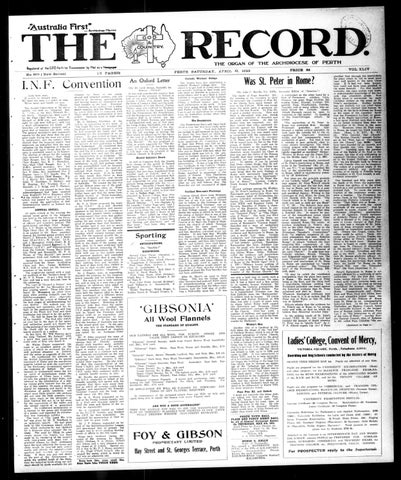
The Record Newspaper 22 April 1922

Page 1

/Australia First" -

Archbishop Mammy

Registered

No

( 8

2073 ( New Series)

Irish born man, If you're to Ireland true, We heed not race, r r creed, or clan, We've heart and hands for you. -Davis. The Annual Conveation of lie above society- was held On Saturday last, at the Kim; Edward Ho.Aj Proceed rgs were cpert 9 tel, Perth. by the High Chief REoleer, Bro. M. Mitchell at 1030 a.m., and continued right thr,i.gh untii 0.30 p ra., with but All a short adjournment fcr lunch. branches Lad delegates present, and a great deal of business was dealt with. The general secretary's and treasurer's reports for the year show that the progress made during the term was entirely satisfactory, and the balance sheet showed that the financial aspect had improved, an indication that the next valuation by the Registrar of Friendly Societies will again reveal that the society is absolutely sound in its finance. The election of officers for the ensuing year resuited as follows: --Past High Chief Ranger, Bro. M. Mitchell; High Chief Ranger, Bro. R. J. Shanahan: C. Sot/ High Chief Ranger, Bro. J.Jas. WAsh: general secretary, B -o. Dwyer; executive council treasurer, Bro. P. Giles; B.C. woodward, RIO J. Hegney (senr.); E.C. beadle, Bro. F. O'Toole; District Chief Ranger, Bro. T. J. Morris; B.C. Auditors, Bros. P. Giles, T. Davidson. T. Slattery. and W. Keating; E.C. Trustees, Bios. J. Maxwell, J. J. Snigg, and T. Slattery. Convention was pleased to hear that acknowledgment had been received from England's Print Minister's office 'act the receipt of a copy of a motion which was passed by Convention last year, urging the application of SelfDetermination insofar as Ireland was concerned, ANNUAL SOCIAL. At eight 'o'clock in the evening the given to the delegates social annual was held in the ball -room of the Savoy was a large gathering There Hotel. of officers and n.embers present. The -High Chief Ranger, sub newly-lected Bro. J. C. Walsh, in the absence of the R. Shanahan), who (Bro. Chief High is at present in the East. presided. Among the invited guests present were Messrs. J. Edwards, D.P., and J. Markham (H.A.C.B S.), W. Dwyer, LL.B., and J. Monaghan (Celtic Club), R. E. Walsh (Young Ireland Society), C. M. Gibbons (A.N.A.), and representatives from the Catholic Young Men's Societies, Perth and Fremantle, Mr. P. A. Bryan, of "The Record," and several prominent Irish and Catholic citizens. Apologies for non-attendance were received from his Grace Archbishop Clune and Rev. Father McMahon, M.A., both of whom are life honorary members of the society. The progranene evened with a capital rendition of the "Soldier's Song,' by 4 Mr. P. A. Bryan. It got a fine reception. and was a very welcome item to the gathering. The toast of "Ireiand a Nation' was submitted by Mr. Joe Monaghan in a fine' rousing speech. Those who ,have heard Mr Monaghan on other occasions when putting Ireland's case for eapeciAly wei Self -Determination pleased with his review of Ireland in the first stages of self -determining her Oa His outlook was enown destiny. couraging and optimistic, and his delight at the pushing-out bag and bag gage of the Black and Tans and their auxiliaries was joined in by the gatherHe had no fears for the future ing. of his country. The God who watched over her in the days of her agony and subjection would not desert her in the morning of her emancipation, and He vfbnld still be with her in her march onwards as a nation. In fine form, Mr. Will Ginivaa gave the song "Ireland, My Ireland," with a spirit that captered the hearts of A every exile of Erin who heard it. Mr. Walter Dwyer supported the toast in an excellent speech ,in the course of which he reviewed the present political situation in Ireland, and the unfair propaganda of the cabHe condemned the attitude of les. the British Government in its special treatment of Ulster and the murderous pogrom carried on with the connivance of the Six -County Government against He conthe Catholics of Belfast. demned in unmeasured terms the bite ter spirit of sectarianism which the Orangemen of Ulster have i .roduced into the politics of their State, and referred to the introduction of a similar vicious party rancour into the politics of this country. He made a strong appeal for tolerance and sanity in the discussion of public questions, and urged upon those 'resent who perhaps did not view the Irish question from the same anele as the advocates of Irish freedom did, not to be led away by the cancoctions cf the cables and the tainted reports of a prejudiced press. He condemned sectarianism as a menace to the peace and happiness of a nation, and regretted its introduction into Australian politics. The toast of "The Land We Live In" was given by Mr. E. Needham in He had great an optimistic speech. faith in this bounteous island continwas destined Ily ent, which undoubte for a foremost place amongst the nations. The need fcr filling its great empty spaces was urgent, but there e must be no swanning of the country with imm grants until there was a practical scheme for their settlement upon the land otherwise the towns and cities would be crow led with out-cfworks. and already the unemple:rient question had t e ..elied an n r it:nig If there was any real desire s stage. part of the Government to on the settle the untitled lands of the State, then the lockectup lands along our railways should be made available for set .

c

1

.

-

I

-

PERTH SATURDAY, APRIL

PAGES)

Convention

N

.

THE ORGAN OF THE ARCHDIOCESE OF PERTH

a the GPO Perth For Transmission by Post as a hbroispapor

I. 1 .

C

dement by those of our tinemployed and returned soldiers, who are desirous of becoming agriculturalists and making homes for themselves and their tamilies on the land. Essential ly Australia in his opinion was a white man's country, and the White Austraha palicy must not e tampered with There must be no adulteration of teat Australia must be kept clean policy. and white. Mr. C. Gibbons, President of the A NA in responding to Vac toast of "The Land We Live In," thanked Mr. Needham for tie able manner it. which he had proposed the toast, and the gathering fcr the heartiness of its receptiou 11, alao wished to thank the Lx.e, for their invitation to the functiun, and could not help remarking on the fervour of t heir patriotism to their Irish Fatherland. He considered that in patriotism occupied the same planedid the civil life of a nation as religion the great was and side, to its moral est character;stic of an Irishman. He settle final the that sincerely hoped meat of the Irish question would be when perhaps and satisfactory to all, it was accomplished (and he sincerely hoped it would be soon) the need of a national Irish Society in AustraliaIf so, he trust would cease to exist. ed they would then throw in their lot with his Association, and devote their great talents to the advancement He trusted the day was of Australia. not far distant when one of the qualifications of holding office as Prime Minister would be that of being Australian born, and that the terms Irish, 1

,

English, Scotch or Welsh -Australian, would be dropped, and that we would all be Australians. Mr. P. A. Bryan proposed the toast In a well directed of the "I.N.F." speech of congratulation and encouragement to the Society to continue organising and present better evidence of achievement than even that gathering was-and it would be a difficult matter for any society to show better proof of progress than that functionthe speaker said it was not so much their advancement amongst themselves as a body, and the cordial relationship which existed between members, but the material growth the organisation could boast on any public occasion when numbers and sheer faith in the ideals of the society, and their duty to it were exhibited without fear or favour, instancing St. Patrick's Day demonstrations. Mr. Bryan dealt with one or two points raised by previous speakers, and concludedwith the statement that it was char acteristic of Irishmen abroad that in their undying love and devotion to the land of their birth they yielded to no one in their loyalty and duty to their adopted country. (Applause.) Mr. J. Hegney, junr., in responding, thanked the proposer for his congratu)story remarks and his evident sincerity. His society was a truly national one and as long as a man was a good Irishman no questions were asked reOne of garding his religious belief. their best members who had for two the soin office highest the held years

ciety worshipped at a different shrine from the majority of the members, which was proof of their broadmindness in this respect. Referring to Mr. Gibbons' wish that when the aspirations of Irela nd were satisfied the I N F might merge into the A.N.A., he said he hoped the Foresters would always exist as an inspiration and ideal to young Australians to love their native land. It has been said that the freedom of Australia was won in the recent great war. In his opinion it was won at the Eureka Stock ade, where the standard of freedom was raised by an Irishman-Peter Lalor. Mr. P. Giles proposed the toast of "Kindred Societies," and expressed the societies opinion that all friendly should work together more unitedly for their common aims. We were en gaged in similar work, and travelled the same road to a common end, and the obstacles encountered on the way could be more easily overcome with advantage to their members if they tackled them together. He also trust ed that the representatives of the Perth C.Y,,M.S. and the Young Ireland Society would not forget to bring the I.N.F. under their members' notice as a suitable benefit society to join. Mr. Neville, the general secretary of the A.N.A. responded on behalf of the friendly societies, and agreed with the proposer that there were many matters on which all societies could worU together, and mentioned the Friendly Societies' Council was the body who could carry out this idea. Mr. R. E. Walsh responded on behalf of the Young Ireland Society, and in a brief and eloquent speech outlined the aims and desires of the society he represented. Mr. A. Campbell replied on behalf of the P.C.Y.M. Society, and thanked the I.N.F. for their hospitality. He expressed his appreciation of their society and its good work. Mr. J. P. Doheny responded on behalf of the Self-Determination League, and mentioned that at present the League was in recess pending developments of affairs in the Old Land. Songs were rendered during the course of the evening by Messrs. Kelly, Ginivan, P. A. Bryan, O'Neill and others, and a very pleasant evenSpecial creing closed at 11 o'clock. dit is due to Mr. P. J. Ryan, secretary of the Hugh O'Neill Branch, who arranged the social, which in every de' tail was an admirable one. Some look like, some smell like, None Taste Like UNION BIER -

An Oxford Letter (By Dr. Cyril Bryan, Radcliffe infirmary , Oxford.) It was with considerable surprise that I learned of the presence in Oxford of four of our great Catholic Orders. The Jesuits, 1 knew, were already here, for the fame of Campion Hall, and the kindly personality of its late Rector i Father. Plater) were not confined to England. But in addition to the Jesuits I found that the Franciscans, the Benedictines, and the Dominicans were installed here. Campion Hall is, of course, for the training of Jesuit Novices, and boasts a distinguished staff, one of that number being Father Martindale, one of the foremost Catholic writers of the day. We are great friends, and I recently had the sad privilege of serving the Mass which he offered up for the repose of the soul of a West Australian lady - in very fact the wife of the Editor of He has promised to "The Record." write an article especially for "The Record," and though I do not know what shape it will take, I am hoping that it will deal with the progress of the Catholic Church in England. Harold Qidnlan's Death. As well as Campion Hall, the Jesuits have charge of the parish in Oxford and Saint Aloysius' Church is a very beautiful one. The Rector, Father Steuart, has just been transferred itfront is another part of Oxford, and that evidence of the work of conversion is going on, that at his last post he was responsible for over one hundred Ca,1,persons being brought into thethat an Recently I heard lie Church. transferred Australian priest had been to the parish, and I called. to find that ' it was a Father Page, who Kew (Viceducated in Xavier College. was from I found toria). When he the West, he asked if I had known to Harold Quinlan. "I was chaplain I his brigade," Father Page said, "and killed. was he day the well remember I was goiag along the -oaci when ofalong his came Harold and half a dozen they hussars. They pulled up when 'Give said, boys the of one and saw me. us yom Messina. Father.' I gave them off my blessing and absolution, andnever they went. Poor boys, they hack." came

Sporting ANTICIPATIONS. (By "Sparkle.)" GOODWOOD. Second Class Purse: Cleomine, 1; Melton Lock, 2; Arthur L., 3. Second Class Plate: Orient Flavour, 1; Beggarlean 2; Horsetail°, 3. First Class Plate: Ayrlove, 1; Some Class, .2; Lockmaster, 3. Goodwood Handicap: Malt Dust, 1; Ardol, 2; Devil March, 3. First Class Purse (first division): Single Key, 1 Western Knight, 2; Sit. ent Sign, 3. First Class Purse (second division): Lord Yelbeerie, 1; Farnsworth, 2: Yalgar, 3. Welter Handicap: Welsh Singer, 1; Golden Bond, 2; Winged Victory, 3.

Catholic Workers' College. The Jesuits have also established a The Catholic Workers' College here. object is to get hold of young men who are actually working at their trade and who show an interest in economic and Social affairs, and to give them a sound training in economics from she Catholic viewpoint. The principal is Father O'Dea, a brilliant science man and most enthusiastic in his work. It has only been going during the past year, and Father O'Hea tells me that they -ape to get an application for admission from an Australian worker when they are settled clown. The Dominicans. The Dominicans have only been back :.bout a year, but they have made quite 1 Ley were fortunal ,atis s ate enough to get someone to buy back for them the very land on which the Dominican Priory stood in the 13th. even century; and to make their return stove more auspicious the feundation the on laid was of their new Priory 750th. anniversary of the da e on which Oxford. to came the Dominicans first 1 his was on August 15th last, when the foundation stone was laid in the presence of Cardinal Bourne ar.d Cardinal Gasquet, and a distinguished gathering, including, of course. your special represertative. It was a long time since two Cardinals of the Cathode Church, and iv: supported 1-y numerous prelates ,iginlys tlrNreil ti .t i vas of 4,,nr1s. eve.", in the in procession Order. marched Dominican This streets of Oxford. Priory, by the way. is building alongside of Pusey House. and we are told what we can well believe, that the Puseyites are not enamoured of their 1

.

Cardinal Newman's Footsteps. Coining almost direct from Newman College as I did, it was only natural that one of my first tours of Oxford was to follow in the footsteps of the illustrious Cardinal. Newman was an undergaduate of Treaty, and visitors to that College cannot escape being shown the roopas in which he lived and the statue of himself that is one of the glories of the College. From Trinity I wended my way to the famous old Church of St. Mary the Virgin in Highstreet the church of which Newman The was Rector for some years. church dates from the 13th. century, and has, therefore, witnessed many vicissitudes. It was here that Wycliffe first began to make himself heard before the so-called Raformation had begun in earnest; and here also Cranmer, before Ridley, and Latimer were tried only a they were burnt at the stake It Street. Broad in away few yards was whilst Vicar of St. Mary's that Newman threw himself into the Tractarian Movement that was to bring him into communion with Rome. We in found it a chill cold place-lifeless it, fact is the only word to apply to apalmost would But that description for ply to any of these churches where has hundreds of years the True Sacrifice not been celebrated. After St. Mary's we went to Oriel College. This was the College which years after Newman had endured thirty of misunderstanding and sometimes counfellow his from vituperation gross trymen, took the bold step of conferwas It him. upon Fellowship ring a

IGIBSONIN All Wool Flannels THE STANDARD OF QUALITY. AND FINISH OUR FANNELS ARE ALL WOOL. FORBE PURITY, EQUALLED. VALUE THEY CANNOT Merino Wool, beautifully "Gibsonia" Natural Saxony, made from Finest soft, 28in., 3/11 yard. and Durable, 28in., 2/11 "Gibsonia" Super, Silver, Pure Wool, Warm yard. Sky, and Pink, 28in., 3/6 yd. "Gibsonia" Super, Merino Flannels, Cardinal, Dependable, 28in., 3/6 yd. Thoroughly "Gibsonia" Dark Grey, Pure Wool, Australia's Best Soft TexWool. Pure Saxonies, Cream "Gibsonia" tures, Clear Creams. Cream Saxony, No. 1, 28in., 3/3 yard. Cream Saxony, No. 2, 28in., 3/9 yard. grade. 28in 3/11 yard. Super. Cream Saxony, No. 3 The highestDye, 28in., 3/11 yard. "Gibsonia" Navy Flannel, Fast Indigo mill production, fully main"Gibsonia" Crimean Flannels. A recent Unand Pyjamas. taining the high "Gibsonia" Standard. For Shirts shrinkable, 28in., 3/11 yard. PLEASED TO FORWARD PATON APPLICATION WE WILL BE TERNS OF ANY FLANNEL REQUIRED. from our Mills, we fully antiIn consequence of the increased output every Flannel need. cipate being able to supply this Season your

ARZ YOU GOOD AUSTRALIAN? SEE THE 'e 1GNIFICENT DISTHEN YOU MOULD NOT FAIL TO SHOWING IN OUR TASTEPLAY OF "GIBSONIA" FLANNELS NOW ENTRANCE). FULLY DRESSED WINDOW. (HAY-STREET

FOY & GIBSON 13R0PRIETARY LIMITED

Terrace, Perth Day Street and St. Georges

22,

1922

VOL XLIV

PRICE 3d

glorified God through his martyrdom, the place where he did so must have been well known to the early ChrisIf it had not been known, tians. God could not have been glorified in For that implied the sense foretold.

Was St. Peter in Rome?

notoriety, the tiara notitia cum laude, (By John C. Reville, S.J., D.Ph., Associate Editor of "America.") or wide-extended knowledge of the fact The death of Pope Benedict XV., is confronted on the other Land by a with due attendant praise. Now scholars, Cave, the meeting of the Conclave to elect host of Protestant Rome alone is mentioned by early Pearson, the great Hugo Grotius, the his successor, the recession of Pius Xl. Christian writers as the scene of St. erudite Usher, Blonde', Larclner. HilNeither Jerusae to the throne, have again turned all Peter's martyrdom. genfeld, 'lase, Hundhausen, Guerike, eyes to the Vatican. With rare excepiem, nor Antioch, nor any other Aposmany others, who ensee ever cleaned that honour. So tions the press paid a generous tri- Meander, and as tolic claims. bute to the late Pantita To Pius XI. tirely favour the Catholic forcibly do the facts miitate for Rome Adoph Harnack cannot be open to it gave a cordial weicome. Here and as the scene of the Apostle's death suspicion in this matter. In speaking that the Protestant Lai dner, in speakthere a discordant note was struck he ing of St. Paul's martyrdom at Rome, and unfair estimates of Benedict and of the Baur-Tubingen school, , At this Ca- writes: his work were written. a fact never doubted, says that it rests "The martyrdom of St. Peter in tholics were not surprised, nor did on no better evidence than does the throtigh martyrdom of St. Peter in the same Rome was contested, first, they marvel that often answered oblater and prejudice, Moreover, when St. Paul came Protestant city. jections against the Papacy and the Popes were brought forward. Among through a similar critical prejudice. In to Rome, he found the Faith founded (Rom, I, 8; XVI., 9; XV, those objections one was urged anew both cases the mistake led to the re- there, historical 14i. Who founded that Church? in connection with the statement that cognition of important truths, and has consequently been "The Roman Church," answers DollinPope Benedict XV. was the successor But that it was ger in his "First Age of Christianity of St. Peter, and that as Roman Pon- productive of good. and the Church" (pp. 94-96) "must tiff he traced back his line to the Fish- a mistake is now perfectly clear to lie could not be every sincere investigator. The whole have been founded by an Apostle, and erman of Galilee. Peter's successor, so the objection ran, critical armory with which Baur at- that Apostle can only have been Insisting upon the peculiar Peter." tacked the ancient tradition is now for Peter was never at Rome. Peter, tone of the Epistle of St. Paul to the therefore, never founded his Chair in rightly regarded as worthless" (Grisar: that city, and the claims of the Roman "History of Rome and the Popes Dur. Romans, the tone of one addressing an organised Christian body, well groundPontiffs that they occupy his seat of ing the Middle Ages," 'To'. 1. p. 298). in the Gospel, Dollinger concludes authority are not supported by hishimself was finally convinced ed that "we are brought back to Peter as tory. In answer, it can be proved of Calvin in and Rome, martyrdom St. Peter's he only founder who can be imagined. that Peter visited Rork. that he suf- wrote in his "Institutes" (Bk. IV., ch. The notion of a gradual origin of the fered martyrdom there, that Peter was VI., par V.): "I no longer question the particular truly Bishop of Rune, "or, what is the of St. Peter community without orany the martyrdom of fact of Bishops early the Priscilla being founder, or of Aquila same thing, that in Rome, which is unanimously attestPaul himself, is self or St. founders, its Rome were universally regarded as ed by all historians." evidently untenable." his true successors in the Episcopate." But what are the principle grounds (C. J. B. Allnat. "Was St. Peter BisOne hundred and fifty years after London, Catholic of our Catholic belief? ..Strange as it hop of Rome?" the death of St. Peter, his martyrdom St. Peter -Eimself stands Truth Society Pamphlets. Vol. 50, p. may appear, in Rome was spoken of in the whole fact, that least the one for at sponsor, 1 sq.) at Rome, and there in a posi- Church as a well authenticated and unExcept perhaps among the Walden- he was To quote the merest tion of authority, that of his episcopal doubted fact. s'es, St. Peter's residence in Rome. his Writing to the fraction of the testimony would reEpiscopate and martyrdom there were and pontifical dignity., The Protestant histreatise. a quire his he closes Minor, for of Asia 'Christians Christendom of the common belief In 1326, First Epistle with the words: "The torian, Cave, in his "Scriptorum Eccletwelve unbroken centuries. Historia Literaria" (p. 5), siasticorum salwhich is in Babylon Church Pope between during the controversy, and so doth my son Mark" writes: "That Peter was at Rome. ... John XXII. and Emperor Louis of uteth you with the whole affirm we intrepidly menhere The Babylon 13). cham(C, V., a Papua, of Bavaria, Marsilius multitude of the ancients." And he be the old capital of the pion of the Emperor, wrote, in con- tioned cannot chapter and book, quote, to proceeds at that time It was Empire. Assyrian famhis ,Tandun de Jean nection with It cannot be any- "witnesses altogether unexceptionous "Defensor Paces." or "The Cham- a deserted city. successor Peter's Ignatius, St. able." towns which the insignificant filled of one was book The pion of Peace." Peter at Antioch; Papias of Hierapolis, proin the East. with false theories of the State, an- bore that namethem. a disciple of St. John; St. Irenbably here Babylon never visited social the extent some to ticipating aeus of Lyons. disciple of that Polythe centre of errors of Rousseau's "Contrat Social." means imperial Rome, heathen wickedness in Peter's day, carp who was a disciple bf St. John. Marcilius was a man of undoubted Most of these witnesses were of the' in the Babylon was the older In the "Defensor Pacis," just as learning. Apostolic or immediate post-Apostolic The well known he did not absolutely deny Peter's day of Balthasar. Others like Origen, Cahn, Terage. "Speaker's Commentary" Protestant residence and Episcopate in Rome: he tullian could be added. These witof anconsensus "an absolute finds Certain them. over doubt a cast Latins, Syrians, Greeks, tesnesses Babylon that here interpreters cient Lutherans and Calvanists absolutely tifying either to Peter's sojourn in as equivalent to denied them, among others, the learn- must be understood death there. Similar tesor his Rome the least "without aziopts ft Rome," ed but bitterly partisan. Spanheim. this explanation of the timony is found in every succeeding Rationalists like Baur, Adalbert Lip- misgiving Clement of Alexandria from St. age, the mind with as alone according word whole sius, his pupil, who devoted his in the second ceOntury; from St. Cypof the Apostle and the testimony of life practically to attacks on the PetTertullian and OriCarthage, of rian that nonadds It Church." the early Volkmar, rine claims, Winer, Zeller. In the fourth cenThiersch, gen in the third. called the residence and martyrdom Catholic scholars, Ewald, view. affirms St. Oplicitly St. Jerome tury The support this Hilgenfeld and Gregoroof Peter in Rome "a myth." Rome, his Episcoto Peter's journey, "Commentary" declares that the vies writes in his "History of the City same there under martyrdom there. his pate St. Peter of martyrdom and presence (Vol. of Rome in the Middle Ages" Nero. his burial "at Rome on the in Rome are maintained by "nearly p. 1721:- "History knows nothing of the Triumphal near Hill. Vatican The "Commencritics." unbiased all Apostle the of the presence in Rome C. I). Peter." and calls Peter "the legendary tary" of the Protestant Bishop, Elli- Way" (De Viris Illustribus. says: cott, He is solChurch." Rome in Peter's Episcopate founder of the Roman "It may be called the established emnly affirmed -by a multitude of early cenfirst five meant the here For authorities. not only a bold step to confer such a interpretion that the place turies, writes Allnatt (Loc. Cit.), and signal honour on Newman, the man, is Rome. We never hear of Peter not later, centuries itself and the thing many indeed until but it was a brave and a fine action being in the East, is improbable, whereas nothing but a singlywriter can be cited as having to so signally honour Newman the that doubt faintest stand against the the can Protestant prejudice entertained Catholic, the Catholic protagonist, the historical evidence that St. Peter Peter had established his Chair in ex-Anglican and Oxford Divine. For . Constantinople and Rome, Rome. he it remembered Newman was the sojourned and died in Rome. Whatever theological evidences may East and West, Gaul and Africa, here first Catholic since the "Reformation' St. tics and schmatics looked upon the to achieve such an honour. Of course follow from it, it is as certain that Peter was at Rome as that St. John succession of the Bishops of Rome he was still Father Newman at this were was at Ephesus." from St. Peter as an unimpeachable time, but only a c oaple of years the Council of to elapse before Rome itself capped Ellicott admits that the evidence for historical fact. In 451 Council, hence found Chalcedon. an Eastern this distinction and Newman, St. Peter's say in Rome is "as strong, himself numbered :.mongst the Princes early and wide, as that on which we not neterally inclined to the recognia Pope quite addresses has Oriel claims, tion of Roman of ihe Church. believe that Hannibal invaded Italy.Leo I .as "the interim eter to all men number of etchings and engravings of beauJohn's Eastthe St. as word, of Another well In the striking ages, as Peter." all of at Newman of the voice tiful original painting of him in the Gospel (XXI, 13, 19), Our Lord had ern General Council. that of Ephesus whereby sucdeath "the of the manner foretold Celestine scarlet by Herkomer. in 431. called Pope St. Peter was to "glorify God.". As C. Wolsey's Hat. (Continued on Page 1.1 F. 13. Allnatt argues (op. cit.) if Peter Another relic of a Cardinal in Oxford takes the shape of the "red hat" of Cardinal Wolsey, which is one of the proudest belongings of Christ Church, the great College founded by the great Cardinal in the heyday of his power. It Is both a Cathedral and a College, this Bring due to the fact that the Cathedral is a survival of the original church VICTORIA SQUARE, Perth, ,Telephone A3914) going back to the year 740. The church was rebuilt in 1120. again in 1239, and to .gain in 1430. It was surrendered Boarding and Day Schools conducted bg Ike Sisters of Mercy Henry VIII., and he in turn surrenderIn 1125 Woled it to Cardinal Wolsey Pupils are admitted at any time. sey began the building of the huge ColSECOND TERM BEGINS MAY 1st. lege which was to become an appanage of the Cathedral, but after less Pupils are prepared for the UNIVERSITY EXAMINATIONS (Music in than 5 years of building Wolsey was EXAMINAand other subjects), for the ALLIANCE FRANCAISE disgrace and Henry had taken everything back again. One of the stainedof the ASSOCIATED BOARD EXAMINATIONS for the MUSIC TION, glass, windows in the Cathedral depicts TRINITY COLLEGE OF of the R.A.M. and R.C.M., and for the the martyrdom of St. Thomas a'Becthis MUSIC. kett, but the curious fact about window is that Beckett's head was orCOLdered to he obliterated by Henry VIII. Pupil.; are also prepared for COMMERCIAL and TRAINING for some Unknown reason. ELOCUTION, SWIMMING (Summer Terms), EXAMINATIONS, LEGE Oxford. Pope Pins XL and DANCING and PHYSICAL CULTURE (Winter Terms). I must not conclude this letter without telling you that the new Pope, UNIVERSITY EXAMINATION RESULTS: Pius XI., knows Oxford quite well, in having stayed here for some time Matriculation -49 Successes. 20 Complete Pa 'sea. CertificateceleLeaving He war. the to prior just 1914, Church, Junior Certificate -39 Complete Passes. brated Mass at St. Aloysius' which would seem to bring Oxford into Mathematics. E180 rather close touch with Rome. t nivereity Exhibition for Mathematics and Applied £120 (1916): AlGreek and Latin for Exhibition HALL. University (1921); PERTH TOWN Prizes, 140; Singing Music Prized: 12 Examination, PLAIN AND FANCY DRESS BALL. Francaise liance Appeal. Gold Medals, In aid of Clontarf Orphanage Prizes, £12: Teachers' Dipdoma (Pianoforte), 22 Successes; On THURSDAY, MAY 4th, 1922. Total amount in money etc. (Pianoforte. Violin, Singing Harmany) Good Prizes for Fancy Dresses. prizes won by Students, £732 9s. Refreshments. Music by Mr. Denton a Jazz Orchestra. Tickets. 2/6. DAY AND BOARDAttached to the Convent is an INTERMEDIATE C. S. VINCENT, Organiser. SCHOLAR FOR ING SCHOOL. wherein PUPILS are PREPARED EXAMS. for NURSE G. SILLY SHIPS, BURSARIES. COMMERCIAL and TEACHERS' SINGING. (Late of Fremantle), TRAINING COLLEGE, etc. PIAOFORTE, VIOLIN. Has opened a MATERNITY HOSPITAL in the Hills of KALAMUNDA. Private Accommodation. Superior For PROSPECTUS Rooms for each Patient. Station), RAILWAY -ROAD (opposite KALAMUNDA. -

.

.

.

.

.

ladies' College, Convent of Mercy,

apply to the Superioreis


Turn static files into dynamic content formats.

Create a flipbook