TheWest AUSTRALIAN RECORD
"TheMusicoftheCatholicChurch"
ByR.J.BASTIAN,OrganistofSt.Patrick'sChurch,Fremantle
(PAPERREADBEFORETHEW.A.MUST('TEACHERS'ASSOCIATION
Writinganarticleonsuchacolossalsubjectpresentsgreatdifficulty, inthematterofwhattosayand whatnottosay.Thereismaterial sufficienttotilltwelvesucharticles, andthenleavemuchunsaid.Thisbeingthecase,itisnotpossibletodo muchmorethangiveabareoutline ofthesubject.
Thesynopsisofthesubjectmatter isasfollows
GregorianorPlainChant(ashort sketchofitsrise,decayandrestoration).
Polyphonicmusic.
Homophonicmusic.
Somepersonalviewsofthemorningandeveningservices.
ReasonwhyLatinislewdinthe RomanLiturgy. PlainChant,PlainSong,orGregorianmusic,isundoubtedlythecreationofthefirstsixcenturiesof Christianity.Ithasnowbeenwell establishedthatPlainChantorGregorianmusicdidnothaveitsrisein Rome,butthatitoriginatedinthe East,and,duringthecourseofyears, gravitatedtoRome.Theactivityof componentpartsoftheChurchoperatedonRouteasthecentre,where everythingwasregulated,andassignedaplaceinaccordancewith theirpeculiarcharacteristics.
PlainChanttheoryseemstohave originatedinSyria,inthefourth century,whensacredmusicbeganto hecultivated.AntiphonyandhymnodyhadalreadybeenadmittedintotheChurchbySt.JohnChrysostomatConstantinople,andbySt. Ambrose(whodiedin397)inMilan.
diatonicprinciplegraduallyprevailed,andonlyBfiatwasretainiel,for thepurposeofavoidingthetritone betweenFandB.Inempla-ongthe melodythetonicwasrar.ilyused, anditwasnottillthe11thcentury thatachangearoseinwhich TheTonicwasgraduallytoDominate theentireMelody
Abouttheyear1000Indonward, attemptsweremadetoornament andelaboratethechant,andbythe timethatPolyphonymaleitsappearanceinthe14thcentiii'y,ithad becometortuousandfanciful.The adventofPolyphonywaslargelyre-
lesmes,inFrance,thattherestorationofPlainChantisdue.Forover thirtyyearstheypatientlycollected manuscriptsfromallpartsofEurope,theresultoftheirlaboursbeingthediscoveryofanadmirable traditionoftheGregorianChantup tothe17thcentury.Thepresent Pope,PiusX.,inhis"MotuProprio"onchurchmusicof1903,has oecreedtherestorationofPlain ChantthroughouttheentireChurch.
GeneralPrinciples
1.Sacredmusic,beingacomplementarypartofthesolemnliturgy, participatesinthegeneralscopeof
exerciseonthemindsofthosewho listentoitthatefficacywhichthe Churchaimsatobtaininginadmittingintoherliturgytheartofmusicalsounds.
Butitmust,atthesametime,be universalinthesensethat,while everynationispermittedtoadmit intoitsecclesiasticalcompositions thosespecialformswhichmaybe saidtoconstituteitsnativemusic, stilltheseformsmustbesubordinatedinsuchamannertothegeneral characteristicsofsacredmusic,that nobodyofanynationmayreceivean impressionotherthangoodonhearingthem.
TheDifferentKindsofSacredMusic
FromMilantheyPenetratedintothe otherLatinChurches toGaul,SpainandSouthernItaly, whileJamieprobildybecameacquaintedwiththeminthefourth century.Duringthisperiodseveral Popesworkedatthedevelopmentof churchmusic,viz.,1.eoId.461),Grlasinsi.496),SynimachusId.5141, John(d.52(,,andBoniface((l.532I. PopeGregory(d.604.)regulatedthe organisationandsystematisation(if liturgicfunctionsandaccompanyinz ctrints.MaiothistinteaPPeared thelitur2Jcalcalled "Saee'amfntariam;regorianam,-and themusical,called"Antiphonarium Gregorianum Ithasbeenadmittedthatmanyunprovenmusical traitshavebeenassignedtoGregory,particularlysoastohispersonalactivityasmusicalcomposer. Itwastothestudentsofthe"ScholaCantorum,"orsingingAhed, whichhadlongbeenestablishedin Rome,thatthelabourofframing musicallawswasreleglted,andPope. Gregoryissupposedtohavedone littlemoretlmntorousethemto vreateractivity.UpontheSchola ('antorinndevolvedti.v,taskof spre.olin,ztheGregorianChant.England,throughSt.Augustine,became acquaintedwiththeliturgicandmusicalreformunderGregoryhimself. ftwasinthetimeofSt.Ambrose hatthefour"AuthenticModes" werearranged; andPopeUrnrory atalaterteriodaddedwhatis knownasthefour"NavalVodes."
Theauthenticmodeswerethose startingfrom F,(1,whilethe Id:teals eachafourth viz., B,c,P.Thereare mode,:whichareonlytransposition.; oftheseeight,bymeansofBfiat, theonlychromaticnoteallowedin thisstrictlydiatonicsystem.
Thelatestinvestigationschow thatatonetimeliturgicmimicemployedprettyextensivelythechr.,maticscale.However,thnetei0
sponsibleforthedecayof Ilainsong.InCathedralsan 'irish Churches"up-to-date"hooksousted theoldchantbooksthatwerestill truetotradition.
rndertheinfluenceof1',lyfinony, PlainChantwaspracticlily untilbythetimeof.ualertrina thetraditionofPlainChanthad beenwellnighlost.Whenlateron attempttorestoreitwasma,ieby thepublicationoftheMedicoean Press,thevariationsfromthe nalwereamazing.Therearealsa twoothereditions,knownasMechlinandflatisbon,bothfounded.,n theMedicoean,andcarryingthe gameleparttiresfromtradition. withintheli,st,150yeareorthereabout,PlainChantLasonly'survivedinafewobscuremonasteries. Modernanisichasalsohaditsshare indistr,,ctingattentionfromPlain'one.!tiswelltoknowthat throw.hc,iitthisperiodtheecclesiasticalaethoritieshaveinsistedthat PlainChantwasthetrueliturgic ccr^'.
Its!orgelytothemonksofSo-
theliturgy,whichisthegloryof Godandthesanctificationandedificationofthefaithful.Itcontributestothedecorumandthesplendouroftheecclesiasticalceremonies; and,sinceitsprincipalofficeisto clothewithsuitablemelodytheliturgicaltextproposedfortheunderstandingofthefaithful,itsproper aimistoaddgreaterefficacytothe text,inorderthatthroughitthe faithfulmaybethemoreeasilymovedtodevotionandbetterdisposed forthereceptionofthefruitsof gracebelongingtothecelebrationof themostholymysteries.
2.Sacredmusicshouldconsequentlypossess,inthehighestdegree,the qualitiespropertotheliturgy,and Preciselysanctityandgoodnessof corm,fromwhichitsothercharacter ofuniversalityspontaneouslysprings. Itmustbeholy,andmust,therefore,excludeallprofanitynotonly initself,butinthemannerinwhich itispresentedbythosewhoexecute it. Itmastbe''trueart,"furotherwiseitwillheimpossibleforitto
3.Thesequalitiesaretobefound, inthehighestdegree,intheGregorianChant,whichis,consequently, thechantpropertotheRoman Church,theonlychantshehasinheritedfromtheancientfathers, whichshehasjealouslyguardedfor centuriesInherliturgicalcodices, whichshedirectlyproposestothe faithfulasherown,whichsheprescribesexclusively,forsomepartsof theliturgy,andwhichthemostrecentstudieshavesohappilyrestoredtotheirintegrityandpurity.On thesegroundsGregorianChanthas alwaysbeenregardedasthesupreme modelforsacredmusic,sothatitis fullylegitimatetolaydownthefollowingrule:-"Themorecloselya compositionforChurchapproaches initsmovement,inspiration,and savour,theGregorianform,the moresacredandliturgicalitbecomesandthemoreoutofharmonyitiswiththatsupreme-model, thelessworthyisitofthetemple.
TheancienttraditionalGregorian chantmust,therefore,belargely teeteredtothefunctionofpublic worship,andeverybodymusttake forcertainthatanecclesiastical functionlosesnothingofitssolemnitywhenitisaccompaniedbyno othermusicthanthis.
Specialeffortsaretobemadeto restoretheuseoftheGregorian "hintbythepeode,sothatthe faithfulmayagaintakeamoreactiveportintheecclesiasticaloffices, aswasthecaseinancienttimes.
Theaho.-enontOnedqualities.;re also PossessedinanExcellentDegree bytheClassicPolyphony, especiallyoftheItotaanschool, whichreachedits.greatestperfection inthefifteenthcentury.,owingtothe worksofPierluigidaI'alestrina,and continuedsubsequentlytoproduce compositionsofexcellentquality fromtheliturgicalandmusical standpoint.Theclassicpolyphony agreesadmirablywithGregorian Chant,thesuprememodelofallsacredmusic,andhenceithasbeen foundworthyofaplacesidebyside with'theGregorianChantinthe moresolemnfunctionsoftheChurch, suchasthoseofthePontificalChapel.This,too,must,therefore,lie restoredlargelyinecclesiasticalfunctions,especiallyinthemoreimportantbasilicas,incathedrals,andin thechurchesandchapelsofseminariesandotherecclesiasticalinstitutionsinwhichthenecessarymeans areusuallynotlacking.
5.TheChurchhasalwaysrecognisedandfavouredtheprogressofthe arts,admittingtotheserviceofthe culteverythinggoodandbeautiful discoveredbygeniusinthecourseof ages-always,however,withdueregardtotheliturgicallaws.ConsequentlymodernmusicisalsoadmittedintheChurch,sinceit,too,flu*:
EMPIRESELF-RAISINGFLOURRisesAboveallOthers.
PERTH,SATURDAY,MAY l9]3
SATURDAYEVENING,MAY
ON
3rd,1913.)
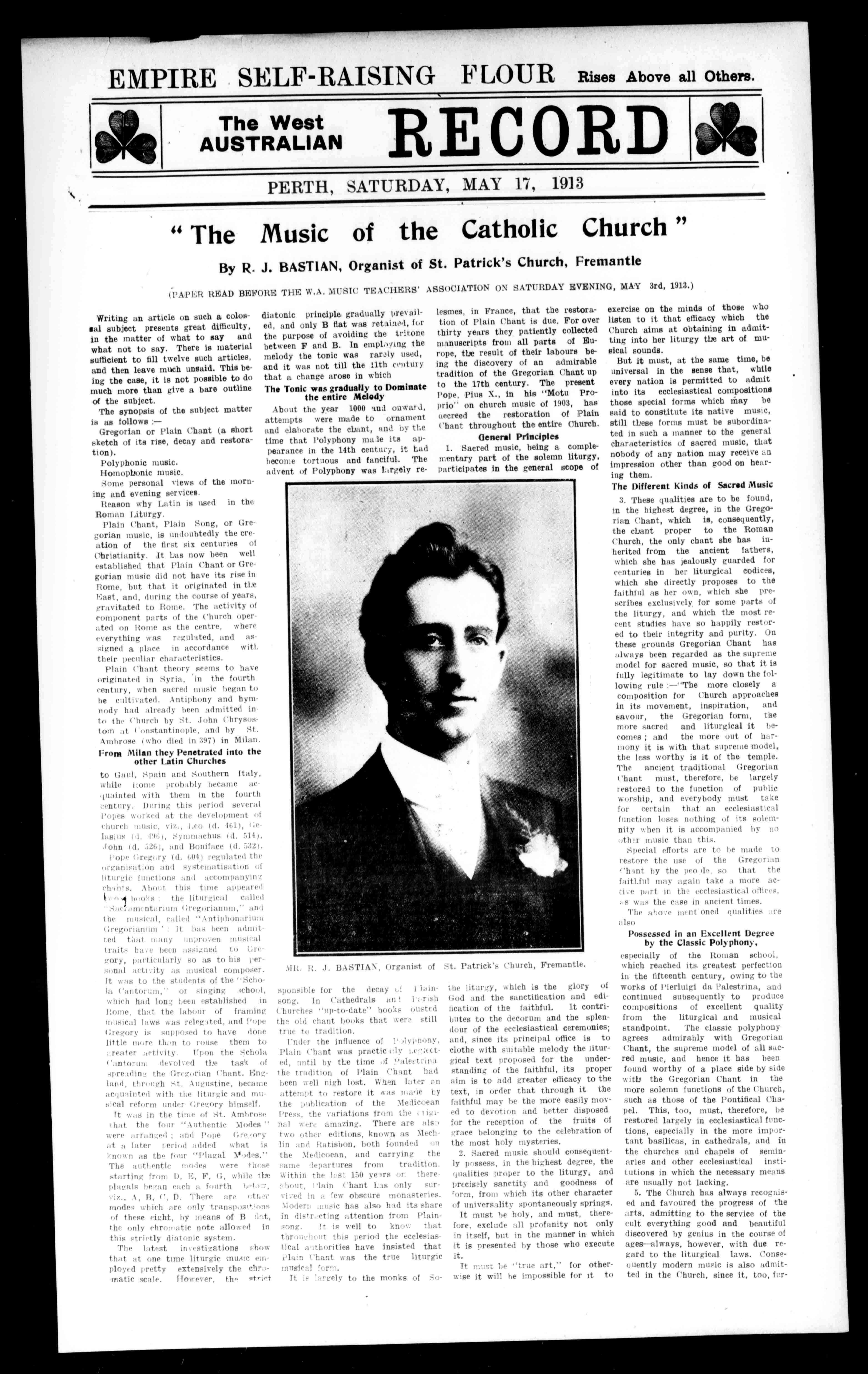
Milt.it..1.BASTIAN,Organistof Patrick'sChurch,Fremantle.
nichescompositionsofsuchexcellence,sobriety,andgravity,that theyareinnowayunworthyofthe liturgicalfunctions.
Still,sincemodernmusichasrisen mainlytoserveprofaneuses,greater caremustbetakenwithregardtoit, inorderthatthemusicalcompositionsofmodernstylewhichareadmittedintheChurchmaycontain nothingprofane,befreefromreminiscencesofmotifsadoptedinthetheatres,andbenotfashioned,evenin theirexternalforms,afterthemannerofprofanepieces.
tAmongthedifferentkindsofmodernmusic,thatwhichappearsless suitableforaccompanyingthefunctionsofpublicworshipisthetheatricalstyle,whichwasinthe::retitestvogue,especiallyinItaly,duringthelastcentury.Thisofits verynatureisdiametricallyopposed totheGregorianChantandtheclassicpolyphony,andthereforetothe mostimportantlawofallrood music.litsidestheintrinsicstructure,therhythmandwhatis'.nown astheconventionalismofthisstyle adaptthemselvesbutbadlytothe reolirementsoftrueliturgicalmusic.
hisbookentitled"CatholicChurch Music,"says"Letusimaginea Personofthepresentdayignorant alikeoftheMassesandoperasof Mozart;lethimhearanitemfrom eachwithfullchorusandorchestra, andhewouldbeaboldmanwho couldatlirmhiscapacitytodistinguishonefromtheother."
Haydn'sMassescomeinter SevereCriticism, oneofthenreceivingthesoubriquet ofthe"HuntingMass."
InGermanyasocietywasformed calledtheCecilian,whichhadfora purposethecollectingofmassmusic faithfultotheliturgy.Dr.Terry saysofthiscollectionthan"Thepity ofitisforCatholicsthatifpresentdayAnglicanmusicisasuninspired astheCecilia'',itisatleastwrittenby'menwhoknow.'Inother words,itisbycomposerswhohave passedthroughafairlycomplete traininginharmonyandcounterpoint.Evidenceofthistrainingis notforthcomingintoomanyofthe compositionsbyCecilianwriters."
WhatGrovesSays Groves'dictionarysays"After the11thcenturyplain-songcompositionwenton,butonlytoalimited extent.Attimesitmadepathetic attemptstokeeptheoldflavour,just asinlaterdaystheItaliancomposerstriedtokeepupthepolyphonic styleevenwhentheirthoughtsran morenaturallyintheoperaticstyle; butthelatewritersofplain-song couldnotfailtobeprofoundlyinfluencedbythenewtendenciesout ofillicitmodernmusicwastodeveleiFThetrueartofplain-song waslost,thehestdaysofplain-song compositionwereover,anditwould havebeenwellforplain-songifthe compositionsinadegradedstyle whichwereputforthinitsname, andobtainedanunhealthypopularity.hadneverconeintoexistence. Plain-song,likeeverything,else,must hejudgedbyitsclassicalepoch;and thedecadentcompositionsofthe rith,16thand17thcenturiesareonlyworthstudyasawarningofwhat plain-songisnot.Itisoneofthe chiefmeritsofthenewreformsin:t1tutedbytheBenedictines,and youpushedforwardwiththeapprovalofthePope,thatthismusicis beingrecoveredfromthechaosInto wt.ichtheofficialmusic-editionscurrentsincethe16thcenturyhadplungeiitandonceagaintheartistic methodofthecompositionsisbeing revealedantivindicated."
Astopolyphony,theMassesof Palestrinastandseverelyalone.Even theeasierofthesemassesaremuch ttadifficultfortheaveragechoir. Theyareonlytobeheardinsuch Churchesastheli.('.Cathedralat Westminster,inLondon,iihereDr. Terry-whobutrecentlywitshonouredbytheUniversityofDurhamin havingthedegreeofMils.,Doc.conferredonhimforhisresearchesin ttefieldofplain-songistakinga leadingpartintherestorationof el.irchmusic.
Forquiteanumberofyearsithas beenacommonexperienceforaCatholicChoirtohavearepertoireof somehalfadozenmassesbyMozart, Weber,Gounod,Haydn,andothers. Foralongtimenoothertradition hasbeenupheld,asmanychoir-mastersandorganistswereProtestant, who,notbeingsteepedinthehistory and,whatismoreimportant,not havingservedanovitiateinCatholic Churchmusic,werequitecontentto leavethingsastheyfoundtheta.
Then,again,aCathedralChoir mightperform,andperformwell,the afore-mentionedmasses,butitwas SettingaPaceMuchtooStrongfor theOrdinaryChair
Itisapitiablethingtocontemplate asmallcountrychoirhavingthe choicebetweenwhatisusuallytermedthe"bigmasses,"andthedreary drivelwhichsomeyearsagowas turnedoutbyinferiormen.Ofrecent yearswelltrainedandclevermusicians.suchas,PerosiinRome,Terry andTozerinEngland,havedone ouchinwritingmusicsuitedto voluntarychoirs.
TheCatholicArtandBookDepot
534Hay-street,nextdoorCelticClub,oppositeKingEdwardHostel. MissM.3.McDERMOTT.Proprietress
ALWAYSTHELATESTNEWBOOKSINSTOOK.
ALargeConsignmentofNewGaolsjustopened.PureWaxCandles, Floats,IncenseandCharcoal,BrassCandlesticks,andvariousotherArticlessuitableforAltars.
Statuary,Rosaries,andCrucifixes,StationsoftheCross,framed andunframedPictures.AllChurchandSchoolrequisites.AllIrish, English,andAmericanNewspapersandMagazinesinstock.
AgentsforallInter-StatePapersandMagazines.GoodMagazinesfor theHomeCircle,"AveMarie"and"CatholicFireside."
THEAUSTRALIANCATHOLICDIRECTORYSTILLONHAND.
COUNTRYORDERSRECEIVEPROMPTATTENTION.
theatricalcompaniestosingthesolo portionsofthemass"Madame Squalliniheldthecongregationspellboundbyhersuperbrenderingof 'EfIncarnatusest'inAflat, thesilverynotesofhergloriousvoice ringingthroughthesacredbuilding. SignorBassoBello,oftheItalian opera,washeardtogreatadvantage inW-'s'OuiTollis.'"
AstotheEveningServices
itisacommonexperiencetofinda goodchoircelebratingthemorning serviceintinestyle,andthesame,or partlythesame,choirsingingthe eveningservicestomusicofawretchedcharacter.Manychoirsattachno importancetotheeveningservice,as theyconsidertheirworkdonewhen theMassmusicisfinished.This seemstometoheagreatmistake, fortheeasyshouldalwaysprecede thedifficult,andforthisreason alonetheBenedictionmusicwouldbe usefulintrainingachoirinthose smallthingsfromwhichgreater worksgrow.
changeininterpretationthatispossiblewithamodernlanguage.Inthe CreedsoftheCatholicChurchare laidupdoctrinesofwhichthe Churchclaimstobetheguardian. Thelanguageofthesedoctrineshas inthecourseoftimecometobea "dead"language.A-livinglanguage isinastateofcontinualchange.
ThesuccessorsofPalestrinainthe PapalChoirweresuchmenasVittoria,ViadonaandStirlen°,who alishowtheinfluenceofPalestrina intheirwritings.AlsotheorganJetsofSt.Oark'satVenicehave leftbehindthemsomefineexamples ofpolyphonicwriting.Lotti'swritingsareoccasionallyperformedat thepresentday.
.lustaspolyphonyheldanevilinfluenceoverplain-song,somodern arlsicinitsturn,havingitsmelody, inthetop,andthereforebecoming lathmoresensuousandmoreeasily understeod,incontradistinctionto palyehi.ne,withitsinterweaving melodies,anditssubjecthidden intheembroideriesofaccompanying melodies,andthusbecomingadelightfulmusicalauzzleappreciated onlybytheeducatedfew,wasmore andmoreabandonedinfavourofthe newestnovelty.
Inthewayofmodernmusic,the Catholicchurchhasbeenindeedwell eepediedwithbeautifulmusictotally unfitforthesolemnliturgyitwas supposedtoembellish.Dr.Terry,in
ProtestantsgenerallycreditRoman Catholicswithfineperformancesof linemusicintheirchurches.Thisis largelypopularfiction.ManychurchesIhaveknownwouldhavebeen Povertystrickenmusicallyhaditnot beenfortheenthusiasticProtestant singerstobefoundinthechoirs.
RomanCatholiccongregationsare muchgiventolookingonandleavingothersdothework.Thisstrange apathyisonlytoooftenbalancedby acriticalactivitythatissometimes distressingtoahard-workingand conscientiouschoir-master.Every choir-masterisdoubtlesswellacquaintedwiththosemusicalgeniuses whosimplywanttowalkinandout ofthechoirasitmaypleasethemselves.Catholiccongregationstireno exceptiontotherule,unlessitis thatthewriterhasbeenparticularlyunfortunateinthatrespect.Let megiveafurtherquotationfromDr. Terry:-
FortheeveningservicesEnglish hymnsaregenerallysung.Asto hymnbooks,therearemanyextremelypoorcollections,suchasthe "CrownofJesus"hymnal,themelodiesofwhich,iftheycanbeso-called,aremutilatedcuttingsfromthe profaneworksofthegreatsecular composers.Further,theharmonies areappalling,andwouldnevermeet withanyquarteratthehandsofa musician.Dr,Terrysaysofthis hymnalthat-"Thetenacitywith whicholdermembersofourcongregationsclingtosomehalf-dozen tunesofsuchafatuoustypeas 'Daily,Daily,'0Mother,'andthe restoftheterriblecontentsof'The CrownofJesusMusic,'createa greatdifficultyinthewayofnickinghymnsingingpopular.Another Catholicwritersays"Itismusic suchasthiswhichhasmadetheRomanCatholicservicesalaughingstocktoProtestantEngland."
Awordwhichmeansonethingat thepresentdaymaymeansomething quitedifferentahundredyearshence. AtthepresenttimeaRomanCatholic,whateverhiscountryandlanguage,isasmuchathomeinaCatholicChurchwhetherthatChurch heinEurope,Asia,orAmerica. Inconclusion,itmayhesaidthat, practicallythegreaterpartofthe subjectmatterofthisarticlemay,be appliedtotheChurchinAustralia. Thereisroomformuchhope,buta choir-mastermusteducatehiscongregationbynotpanderingtopopulartasteoropinion.Heholdshis positionasmuchforthispurposeas anyother,andshould,atleast,have thecourageofhisconvictions.Particularlyisthisthecasewiththe largerchurches,whichshould"lead theway."Theymustbeas"beacon lights"totheoutlying,churches.
"Imitationisthesincerestformof flattery,"providedtheimitationis welldone.Thereissomethingmore thanincongruityinthespectacleof asmallchoiremulatingtheheavy servicesofacathedralchoir.Why shouldamusicalservicebeconsideredasofsmallaccountunlessitis teemingwithdifficulties?Aplain, simple,andbeautifulservicewell done,willdomorethananything elseinupliftingthemusicofthe church.Letthemoreimportant churchestakethedecisivestep,and theothersarehoundtofallinline.
MissMcMahon
CORNERPIERANDMURRAI STREETS,PERTH. FruitandConfectionery.LightP. freshmsnts
Thewordsandmetreofe'meof thesehymnsarebynomeansabove reproach.Onelineinparticularforcesitselfonthewriter'simagination,beginning,"Irisefromdreams oftime."Whatdothesewords mean?
"Oneofthemostfruitfulcausesof badperformances,andonewhich oftenestbringsdespairtotheearnest choir-master,isthe ReluctanceofOurSingerstogivean AdequateAmountofTimetoPractice Withtheself-satisfactionbegottenof ignorance,theythinkitbeneath theirdignity,andareflectionon theirmusicalability,toheaskedto givefurtherpracticetoapieceof musicaftertheyconsiderthatthey "knowit."Howlertheyreallyare from'knowingit'isbesttoldby thelong-sufferingcongregationcondemnedtolistentothemonSundays.Thisfatalcomplacencyam(-meetoursingerslieslikeablight overthewholeofourchurchmusic. Anxioustoshinein'grand'performances,theydespisetheonlymeans bywhicherandperformancesbecome ssi"le,vii.,reeularandsystematic prictice.Andthemoreincompetent thechoir,themoreunnecessarydo itsmembersconsiderrehearsalsto be. etme("noteanotheramusingarticlefronta("Abatewriter.It Fearsreferencetotheone-timeprevalentfashionofhavingmembersof
Anotherhymn,"Alll'raisetoSt. Patrick,"canonlyhedefendedonthe groundthattheRev.F.W.Faber wrotehiswordsforit.Onecanonlyexpresstheregretthatamore fittingtunewasnotavailablewhen thewordswerewritten.
ThefirstEasterthewriterspent asorganistofSt.Patrick'sChurch, Fremantle,heuneartheda"Regina Coeli"byhambillotte.Thechoir wasmostanxioustoperformthis, butwereeventuallypersuadedtosing asmall"ReginaCoeli"byWebbe. Thefirstfewbarsaresufficientto showthelight,frivolouscharacterof Lambillotte's"ReginaCoeli,"atype ofmusicmuchinvogueinItaly duringthelastcentury.
Thedirection"TempodePolacca" referstoaPolishdanceintriple measure.Itispleasanttorecord thatoflatehymnbookshaveappearededitedbyDr.Terryinone case,andTozerintheotheralsoa BenedictionManualbyTozer..The majorityofthehymnsarereallyfine, andshoulddomuchtoupliftthe Performancesofthemusicalpartof theeveningservice.
TheReasonwhyLatinisusedin theService oftheRomnnCatholicChurch,put briefly,isasfollows:-Latinbeinga deadlanguage,isnotopentothe
HESFORD
WellingtonStreet,Perth
(RIGHTOPPOSITERAILWAySTs TION).
HATTERS MERCERS and OUTFITTERS
LeadinghouseinTow forMens'sGoods
OURRANGEOFHATS,SHIH' TIES,FANCYVESTS,SIMIr CLOTHINGANDUNDERWEA, STANDALONE FORVALI
MoneysavedisMone' made
THENMAKEYOURPURCHV AT HESFORDBIIO
4 neat:A.ifecerci. SATURDAY,MAY17,1912.
SATURDAY,
HibernianAustralasianCatholicBenefitSociety.
(ApprovedbytheHierarchyoftheChurchandRegisteredundertheFriendlySocieties'AstaofAustralasia.
ItsWatchwordsares-REILIGION,NATIONALITY,eATHOLleITY,131SNI3VOLBNOB
ItisESSENTIALLYIRISHandCATHOLICanditSPECIALLYAPPEALSTOCATHOLICYouthsdeemedingtheirSUPPORTandALLEGIANCE.BrancheswillbeestablishedisanyLOCALITYonreceiptby theDISTRICTSECRETARYofarequisitionSIGNEDbyTENPERSONS,Sanctionedby'thePRIEST oftheDISTRICT,thenamesandagesofintendingmembersbeingfullysetoutistherequisition.
BRANCHES'ThroughouttheCommonwealthandNewZealand;50,00omemberssad23oo,000is Funds.FinancialHelpandMedicalAssistanceincasesofSicknessGuaranteed.
NOMINALENTRANCEFEES. MODERATECONTRIBUTIONS.
LoansAdvancedinLargeorSmallAmountsonApprovedCityandSuburbas FreeholdProperties.
FullParticularsonApplicationto,M.A.SCANLAN,DistrictSecretary. No.gEagleChambers,Hay-Street,Perth.
InandAroundtheHome
'MidPleasuresandPalacesthoughwemayroam, Beiteversohumble,there'snoplacelikehome
IteouldelBeDone
Somebodysaidthatitcouldn'tbe done,
Buthe,withachuckle,replied
That"maybeitcouldn't,"buthe wouldheone
Whowouldn'tsaysotillhe'dtried.
Sohebuckledrightin,withatrace ofagrin,
Onhisface.Ifheworried,hehid it.
Hestartedtosingashetackledthe thing
Thatcouldn'thedone,andhedid it.
Somebodyscoffed"Oh,you'llnever dothat
Atleastnooneeverhasdoneit."
Buthetookoffhiscoatandhetook offhishat, Andthefirstthingweknewhe'd begunit
Withtheliftofhischinandahit ofagrin, Withoutanydoubtingorquiddit,
Hestartedtosingashetackledthe thing
Thatcouldn'tbedone,andbedid it.
Therearethousandstotellyouit cannotbedone, Therearethousandstoprophesy failure; Therearethousandstopointoutto you,onebyone, Thedangersthatwaittoassail you
Butjustbucklein,withabitofa grin. Thentakeoffyourcoatandgoto it; uatstartintosingasyoutackle thething That"cannothedone,"andyou'll atitoit.
Jealousy
ofahyaka,sadthenthehootof theowlafterthesethepantherand thejackal.Thedonkeycanbeheard iifftytimesfartherthanthehorse, andthecattentimesfartherthan thedog.Strangeasitmayseem, thecryofaharecanbeheardfartherthanthatofeitherthecator thedog.Butthe%hisperofaliar reachesbeyondthegatesofHeaven andshamestheAngels.
ATaleofLetters
Whichlettersarethehardestworkers?TheBees(B's).
Whicharethemostextensiveletters?TheSeas(C's).
Whichlettersarethemostfondof comfort?TheEase(E's).
Whichlettershavethemosttosay forthemselves?TheI's.
Whicharethenoisestletters?The Jays(Xs).
Whicharethelongestletters?The Ells
Whicharethepoorestletters? TheOwes(0's).
Whichlettersarethegreatest bores?TheTease(T's).
Whicharethemostsensibleletters?TheWise(Y's).
MannersinChurch
JealousyspoilspleasuresanddestroysfriendshipstUereforeitis mostnecessarytoovercomeajealous temperament.Onefrequentlyhears howtoovercomesensitiveness,but howtofightagainstjealousyisseldomtoldus. Itcanmanifestitselfinnumerous uglyways,anditisnotaneasy thingtofight.Whohasnotfeltits Painfulprodding?Butonemustrememberthatneitherfriendshipnor lovecanstandjealousy'seternalfriction,sothesooneroneeliminatesit fromone'scharacterthemorecertainoneisofkeepingbothloveand friendship.
Takewhatisyours,anddonot worryoverwhatisgivensomeone else.Ifthereistobeanycomfort insociallifeorinthelifeofthose whomustwork,everytwingeof jealousymustbecrushedout.The personalclementmustbedoneaway withatalltimes,andwemustall learntomakeourselvesasefficient aspossibleinourvariouswalksin life.,Toliveforandthinkofothers isalwaysahelp,andaddedtothis wemustforgetourselvesexceptin oureffortstoimproveourmindsand himlives.
Animals'Sounds
anywaysoeasilyasby,fillinglifeHediedabouteighteenmonthsafter againwithactivities,interestsandhisresignation,A.D.1296. toils.
EarlyCommunion
TheearlyCommunionofchildren hasbroughtthepastorsintoacloser contactwiththelittleflowersof theirflocks,theresultbeingthat thereisatremendousrevivaloffaith andpietyamongCatholicswherever thePope'scommandsarecarefully carriedout.
FrequentCommunionofthelittle onespromotesinnocenceandpurity, and,byreflection,spreadspietyand devotionamongtheolderpeople. Thereislittledoubtfrompresent indicationsthattheTwentiethCenturywillbeknownasthe"Century oftheBlessedSacrament,"-F. Finn,5..1.,inCatholicTelegraph.
Girls'FaintedFaces
Twoyearsagoshewasalittlegirl withbraidedhair.Oneyearagoshe loutherhairup,andlookedsixteen, assheactuallywas.Isawherthe otherday,andshewouldpassfor twenty-four,Herfacewasincarnadined.Thepaint-boxhaddoneits work,andshelookedoldenoughto knowbetter.Likemanyagirlyoungbutfoolish-shelabouredundertheerroneousideathatnoone wouldsuspecthercolouringofbeing anythingbutnatural.But,likeall ofherclass,shedeceivesnobodybut herself.
Ifthereisacrowdgoingtochurch don'ttryyourutmosttoelboweverybodyelseandincreasethegeneraldiscomfort.Takeiteasy.Don't aimablowattheholywaterfont andimmersethewholehand.Dipthe fingerinlightlyandthensprinkle yourselfalone,nottheothersstandingaroundyou.Walkquietlydown theaisletoyourpewandtakethe mostconvenientseattherein.Don't laysiegetotheendseatandholdit againstallcomers.Neverdisturb yourneighbourswithyourprayers. Theyshouldknowtheirown.Beattentivetothepriestatthealtar. Asilent,goodexampleismosttellin.;andmostedifying.IngoingOut offeratleastashortprayerof thanksgiving.Takeyourtime.Don't leaveGod'shouseinagreathurry. During,confessionhoursneverdeprive anyoneofhisorherplace.Itshows butapoorspiritinwhichtoreceive theSacramentofPenancetorobone ofwhatbelongstohim.Itisnotat allforbiddentoallowanother,who forsomenecessaryreasonmusthurry,togoinaheadofyourself. Youwouldnotforgetyourselfin visitingthehouseofafrienddo natdosointhehouseofGod.Carry yourselfmodestly,becomingly,withoutaffectation,withoutprominence. Looktothecomfortofothers if anyinconveniencemustheborne,let itbeyourselfwhowillbewillingto hearit.
Whydogirlspainttheirfaces? Ineverknewamanwholikedakalsominedmug,andninemeninten regardtherougeasadangersignal. Thepaintdoesnotimproveagirl's appearance;itdoesn'tfoolasoul butherself,anditlessensaman's respectforher.
ChurchCalendarforMay
18.TRINITYSUNDAY(WHIITE).-
VESPERS(WHITE)OFTHE FEAST.
20.TUESDAY(WHITE)-ST.BERNARD1NE.OFSIENA,CONFESSOR.
St.Bernardine,anativeofthe RepublicofSiena,inItaly,gave earlyproofofsolidpiety,andparticularlyofatenderdevotiontothe MotherofGod.Hischaritytothe sickwasnotlessremarkablethan hispatienceinbearinghisowninfirmities.Havingbecomeapriest,itis incrediblehowmuchgoodheeffected byhispreachinginvariouspartsof Italy-aresultduenotsomuchto hisnaturalgiftsastotheburning zealwhichinspiredhiswords.St. Bernardinediedin1444,inthe sixty-fourthyearofhisage.
21.WEDNESDAY(WHITE).-ST. FELIXOFCANTALICIO,CI,NFESSOR. St.FelixwasbornatCantalicio, inthePapalStates,in1513.Asa laybrotherintheCapuchinOrder.he gaveaperfectexampleofhumility, obedienceandmortification.Hedied inRomeattheageof72.
22.THURSDAY(WHITE).-FEAST OFCORPUSCHRISTI.SPECIALDEVOTION.
Theroarofthelioncanheheard fartherth"nthesoundofanyother livingcreature.Nextcomesthecry.
Moping Don'tmopeandbroodoveryour woes,disasters,andlosses.Dosomething.Settowork.Beginatonce torepairthedisaster.Ifallyour !ifi.worlisuddenlyfallsinruinsabout you,likeahouseofcards,potsome f thestonesoftheruindownat .,nce.asafoundationforthenew building.Ifallyouhaveearned, withhardandanxiouslabour,is phinedawayfromyou,donot fret,beginagain,gatherso-nemore. youwillnotforgetyourtroublein
To-daywearenotaskedtoimitatethevirtuesofsomesaint,orto contemplatethemercifuldealingsof Godwithman.Wearetakenup,as itwere,intotheHolyofHolies,and invitedtogazeontheradiantperfectionofGodastheBlessedseeHim oneGodinThreeDivinePersons.. UntilthefourteenthCenturythis feastwasnotgenerallycelebratedin theChurch,forthereasonthatall festivalsintheChristianreligionare trulyfestivalsoftheHolyTrinity, sincetheyareonly,meanstohonour theBlessedTrinity,andstepsto raiseustoItasthetrueandonly termofourworship.AsPopeAlexanderwritesintheeleventhcentury: ---"TheRomanChurchhasnoparticularfestivaloftheTrinity,because shehonoursIteveryday,andevery hourofthe(lay,allherofficescontainingItspraises,andconcluding withatributeofglorytoIt."
19.MONDAY(WHITE).-ST.PETER CELESTINE,'POPEANDCONFESSOR. St.Peter,anativeofSouthern Italy,spentthegreaterpartofa veryausterelifeinsolitude.Inhis oldagehefoundhimselfunexpectedlyelectedPope.Heendeavouredin vaintodeclinetheprofferedoffice, butatlengthyieldedtotheimportunitiesofkingsandcardinals.Considering,however,thatthroughinexperienceoftheworldhewasunfittedforthegovernmentofthe ('hurch,heresignedthePontificate afterfourmonths,withtheobjectof spendingthereuainderofhisdays intheretirementofhismonestery.
AstheAdorableTrinityistheessentialandprimaryobjectofallreligionandofallfestivals,sothe augustEucharististheperpetual sacrificeandtheholiestworshipwe canrendertotheTrinity.Inother words,everydayisafestivalofthe Trinitywhichweadore,andofthe Eucharistbywhichweadoreit.The specialfeastoftheBlessedEucharist,whichaecelebrateto-day,was institutedinthethirteenthcentury. "Withoutdoubt,"saysUrbanIV., intheBullofinstitution,"Holy Thursdayisthetruefestivalofthe HolySacrament,butonthatday theChurchissomuchoccupiedin bewailingthedeathofherSpouse thatitwasgoodtotakeanother day,whenshemightmanifestOther joyandsupplyforwhatshecould notdoonHolyThursday."
23.FRIDAY(WHITE).*-SECOND DAYOFTHEOCTAVEOFCO?.PUSCHRISTI.
"ThisistheBreadwhichcometh downfromheaventhatifanyman eatofIt,hemaynotdie.Iamthe livingBreadwhichcamedownfr.,: heaven.Ifanymaneatofthis Bread,heshallliveforeverand theBreadthatIwillgiveisMy Fleshforthelifeoftheworld.'(St.John'sGospel.)
24.SATURDAY(WHITE).-FEAST OFTHEBLESSEDVIRGIN MARY,HELPOFCHRISTIANS.
ThisfeastwasinstitutedbyPope PiusVII.atthebeginningoflast century.Napoleon,inhisambitious attempttobecomeautocratofthe world,foundaformidableobstacle intheoppositionoftLeSupreme Pontiff,whorefusedtosurrenderthe patrimonyoftheChurch,ortoallowtheFrenchEmperortocontrol themanagementofecclesiasticalaffairs.Asaconsequenceofhisfirmness,PiusVII.wasdetainedincaptivityforseveralyears.
Ingratitudeforhisliberation, whichseemedananswertotheprayersoftheChurch,invokingtheintercessionoftheBlessedVirginan hisbehalf,heorderedthepresent feasttohecelebrated.Underthe titleof"HelpofChristians,"the 131,EIP^dVirginMaryhasbeenselectedaspatronoftheCatholicChurch inAustralasia.
ne \r
MAY17,1912.
J5245-9ct.

J6207-9ct.
01353
H1231
G4461-15ct.Gold,Diamond,and
H49.
F2787-9ct.
.19236.
143004-9ct.
.19244
G7349-9ct.
J4685
.14096
neW:A.Record- SATURDAY,MAY17.1912,
GoldBrooch,setreal RubyorSapphire,13s6d.
GoldSwanBrood:, 6s6d.Others,6s6d,8s6d. 10s6d,12s6d.
-FashionableCameoBrooch, 9ct.Gold,25s.Otherdesigns, 17s6d,25s,30s,35e.
-Pretty9ct.Gold Brooch,setwithAmethyst, 13e6d.
RubyBrooch,£3.
GoldEngravedBrooch, 8s6d.Engravingname,isextra. PrettyFineGoldPearl andTurquoiseSetBrooch, 40s.
-.Pretty9ctGoldBrooch setwithPaleGreenPeridot. 20s.
-Pretty9ct.GoldBrooch. setwithPearls,PaleGreen PeridotandGarnet,25s. PrettyGoldandSilverBrooches WeShowHerejustanicelittleselectionofBrooches thatwillmakeChoosinganEasyMatter ForaFurtherChoice,Sendtor ourIllustratedArtCatalogue. PostFreeonBequi,st
GoldTwinHeart ArrowandBellBrooch,10s 6d.
-Pretty9ct.GoldPearland RubyBrooch,18s6d.
0328
-FineGoldDoubleRowCrescentBrooch,setwithGoonQuality Pearls,£33s.
-ScotchPebbleBrooch,silver mounted,10s6d.
-SilverandScotchPebble Brooch,916d.
GoldDaggerBrooch,set PearlsandRubiesorSapphires,£1 5s. 901, YerJEAD 40, S301-9ct.GoldDaggerBrooch,setInvitation Pearls,£15s.SetwithRealPearls,£115s. 15ct.Gold,setwithRealPearls,£2108. PrettySilverEnamelledBrooch,is6d. .18565-PrettySilverEn smelledBrooch,3s. J4167-9ct.GoldPeridotand AmethystBrooch,22s6d. J4786-PrettyScrolldesign, 9ct.GoldBrooch,lls6d. F4851-FinestPearlSet15ct. GoldBrooch,£315s. J9214-SterlingSilverSwan Brooch,2s.Otherdesigns,2s, 296d. f.11111111111_,.. J5251-Pretty15ct.GoldPearland RubyBrooch,40s. J4095-9ct.GoldBrooch,set with3Amethysts,25s. E8396-9ct.GoldCurband PendantHeartBrooch, 5s6d. 91'0°14Dat4SM(AUSTRALIA)LIMITED. 613615NaySt.,PERTH. MELBOURNE,SYDNEY,BRISBANE,NEWZEALAND,LONDON.
OUEENSLAND
ABazaarinaidofBeaudesertConventBuildingFundwasopened11 FatherMcCarthy,ofBrisbane,tecently.Allsectionsofthecommunity,whorecognisetheexcellentresultsachievedbytheSistersof Mercyinthedistrictinthecauseof Christianeducation,areworkingto makethefunctionamarkedsuccess. .s.a.
RedHillistohaveanewchurch. Tendershavebeencalledforitsconstruction,andpriestandpeopleare determinedthatthechurchshallbe worthyofthemselvesandtheserviceofGod.
Dr.Duhigopenedamissionat Pittsworthrecently.andcontinued hissermonsandinstructionsfora week.AttheconclusionheadministeredConfirmationtoanumberof candidates.
4,40
AttheconclusionofamostsuccessfulmissionconductedbyFather O'Sullivan,('.SS.R.,atRosewood, FatherLane,onbehalfofFatherA. Horan,announcedthattheChurch andgroundswerefreefromdebt. Itwasanannouncementthatwas verygratifyingtopriestandpeople. Itmeantthatinthecourseofthree yearstheCatholicsofthedistrict hadcontributedover£3,000tothe purposeofliquidatingtheChurch debt.TheerectionofanewConvent willshortlybeundertaken.
Mr.E.K.Byrnehasbeenelected Hon.Secretaryofthenewlyformed Queenslandclub.Mr.Byrnehasa highreputationasanorganiser,and itisanticipatedthatunderhisable guidancetheClubwillprogressimmensely.Mr.Byrneisanativeof Enniskillen,Ireland. .111.
AustralianCatholicNews
attheSacredHeartHospital,Darlinghurst.
TheparishionersofthelateDean Butlerhaveinauguratedamovement fortheerectionofamemorialto him.ThelateDeanadministeredthe parishof('ootamundraforaperiod of30years.FatherO'Shaughnesywas electedpatron.
cialceremoniesatSt.Brigid's Church,Marrickville,theheadquartersoftheOrderintheArchdiocese ofSydney.SirGeraldStrickland, whocalledontheVeryRev.Father FrancisClans,C.P.,waspresentat theHighMass.TheOrderrecently celebrateditssilverjubileeheAustralia.
4o
Capt.E.J.Kelleher,ofBandaberg,hasbeenappointedareaollicer ofthe4aDivisionoftheCommonwealthforces.Heisawell-educated youngfellow,andisassistanthead teacheroftheBoys'CentralState School.Hewasthepresidentofthe CommitteeofSt.Patrick'sDayCelebrations,andholdsofficeasPresidentintheC.Y.M.Society.
NEWSOUTHWALES
m TheSistersofCharityhaveissued their55thannualreportoftheworkingsofSt.Vincent'sHospital.Itis ineveryrespectagratifyingone, andshowsthatthenobleSisters arefaithfullyprotectingthegreat idealsandtraditionsoftheirOrder. Theworkoftheinstitutionhasincreasedtosuchanextentastonecessitateincreasedextensioninorder, tocopewiththeneedsofout-door patients.Thefoundationstoneofa Nurses'Homewaslaidrecentlyby theStateGovernor,andwhencompleteditwillrelievetheinstitution ofthespacenowoccupiedbyprobationsintrainingandincreasetheaccommodationinthegeneralsection y60beds.Thepatientstreatedduringlestyearintheout-doordepartmentnumbered15,340,with38,146 attendances.Withfewexceptionsno feescouldbeexpected.Anewbuildingtomeettherequirementsofthe out-doordepartmentisincourseof censtraction.Itwillcost£12,000. Thereisaconstantlyincreasingdemandonthehospitalaccommodation.Qfthetotalnumberofpatientsadmittedtheexperienceofthe Institutionshowsthattwo-sixths canpaynothingatall,three-sixths anythingfrom2s6daweekupto about7s,whiletheremainingonesixthcomprisetheinmatesofthe privatewards.Uponthisone-sixth andthegenerosityofsubscribers,the sistersdependfortheupkeepofthe remainingfive-sixths.ThenewoutdoordepartmentbuildingwillprovidealargeX-rayroomonthe groundfloor,wthothercommodious roomsformassage,hotairandelectricaltreatment,awaitingroom, doctor'sroom,office,etc.;andon thefirstfloorthereMillbeanoperatingtheatre,sterilisingroom,recoveryroom,andsurgeon'sparlour;a departmentforthetreatmentofdiseasesoftheskin,andtwodressing roomsformaleandfemalepatients.
ThefoundationstoneoftheChristianBrothers'newMonasteryat iraggitWaggawillbesolemnlyblessedandlaidbyhisLordshiptheBishopofGoulburn,Dr.Gallagher,on Sundaynext.Thebuildingwillcost over£2000.AlreadyMonsignorBuckleyhashadpromisestotalling£500. 41..
...Thelion.JamesGormley,M.L.('., swirledatalargelyattendedmeetingofCatholicsofWaggaWaggato Jiscusstheproposederectionofa MonasteryfortheChristianBrothers,andthoughnowfaradvancedin years,madeacharacteristicallyspiritedspeech.
AtSt.FrancisXavier'sChurch, LavenderIlay,MissRitaC'Keeffe, youngestdaughterofthelateMauriceO'Keefe,ofWestMaitland,solicitor,wasmarriedtoMr.HarryJosephHayes.eldestsunofMr.C.H. i!ayes,ofArmidale.
ir
Theins-trancesonSt.Mary's Church,Grafton,whichwasrecently destroyedbyfire,amountto£500.
Thelossisestimatedatover1:5000.
Avallablpvestmentmadeina FrenchConventandvaluedat£130, v:asdestroyedinthefire.Theorigin ofthefireisnotknown. 4).
ThedeathisannouncedofMr.P. McDonald,brotherofFatherMcDoneld,ofRozelle.Thedeceasedwasin Sis23rdyear,andhadbeenonlya few(laysill.Hecontractedacold, ;.ndpleurisysupervened.Hewasremovedtr,St.Vincent'sHospital,but des!_itemedicalskillandtheunre;ittentonoftheSistersof (hxity,liesuccumbedtothedisease. wir
ThedeathisalsoannouncedofMr. JohnGitbrie'o'RyanB.A L
TheNewSouthWalesDistrictof theHibernianSociety,whichheldits annualmeetingrecently,sentanaddresstohisExcellencytheStateGovernor,SirGeraldStrickland.The followingreplywasreceivedbyDistrictSecretaryO'Loughlinfromthe Governor'sPrivateSecretary" GovernorthankstheHibernianAustralasianCatholicBenefitSociety ofthisState,assembledinannual convention,fortheirexpressionof loyaltyanddevotiontothethrone andpersonofhisMajestytheKing, andalsoforthekindcongratulations conveyedinyourtelegram."Onthe sameoccasionawirewassentto thenewCoadjutorArchbishopofMelbournewelcominghimtoAustralia, andcongratulatinghimonhiselevationtotheepiscopate.HisGrace repliedthustotheDistrictSecretary"DearMr.O'Loughlin,-Iwish throughyoutoconveymyheartfelt thankstotheNewSouthWalesH.A. C.B.Societyforthekindcongratulationssenttomefromtheannual meeting.Iamalreadylongenough inAustraliatoknowthatevery goodCatholiccausecancountupon 'thehelpofyourgreatorganisation. BeggingGod'sblessinguponthe goodworkofyoursociety.Iam, dear,Mr.O'Loughlin,yours, D.MANNIX.
HisLordshipBishopCarroll,of Lismore,blessedandopenedthenew churchatKeerongonSunday.The buildingcost£580,andthecollectionrealised£189,leavingadebtof C88.Thepreviouscollectionreached £303.
VICTORIA
wasonherwaytoAlbury,atthe timeoftheaccidenttovisither son,Mr.T.J.Kelly,whohadreceivedseriousinjuriesthroughbeing rundownbyatrainatWodonga. Thedeceasedladywasastaunch Catholic,andonewhoalwaystook aleadingpartin.allCatholicmovements.Ors.Kelly'skindlyhospitalitytothepriestsofSt.Mary's, Sale,whoseministrationsextendto theRosedaledistrict,wasoneofthe featuresofalifefullofcharitable andfriendlyacts.
01-
TheologicalConferenceswereheld inthedifferentdeaneriesofthedioceseofBallaratrecently.Theclergy oftheDeanery,Ballarat,metatthe Bishop'sPalace.
411.
Mr.JohnDoolan,oneofthebest knownresidentsofTerang,diedrecentlyaged60years.
BeanNelan,ofColac,willcelebrate thejubileeofhispriesthoodnext month.
4.40 Rev.FatherFoley,wasrecently, givenawelcomehomebythepupils ofSt.Mary's,Garvoc.Amongstthe visitorswereRev.FatherConway andRev.Mr.Arnold,of.Panniure, whospokeofhisfriendshipwithFatherFoleyaslongstanding.
SOUTHAUSTRALIA
Thestatisticsofthereportshowthan ofthe2,377patientstreatedlast year1,352weremalesand1,025females.Thenumberofsurgicaloperationsamountedto1,949.Twenty newheftwereaddedtothehospital.
Ofeveryhundredadmittedtothe hospital,51wereCatholicand49 non-Catholic.Inacomparativetable oftheworkofthehospitalsinceits openingin1857,itwasstatedthat 60,876patientswereadmitted,while thetotalnumberofoutdoorpatientstreatedwas286,838,representing attendances.Thetotal iiiim%,erofoperationsperformedwas 27,085.
41.es.
TheneworganatSt.Augustine's, Balmain,wasrecentlyblessedby insignorO'Brien.HighMass.was sungbyFatherP.J.Sheehy,with VeryRev.P.J.Moynaghdeaconand FatherJ.Sheridansub-deacon,FatherM.Rohanwasmasterofceremonies.Thechoirwasconductedby thechoir-master,Mr.JosephCologan.
TheremainsofthelateDean.Butler,whofor30yearsadministered theparishofCootamundra,hutwho atthetimeofhisdeathinTurnut recently,wasinchargeofthatparish,weretakento('ootamundra,In accordancewithhiswishes,fwrinterment.AtSt.Columba'sChurch, Cootamundra,thesolemnobsequies forthereposeofhissoulwereceleerated,andwereveryimpressive.Dr Gellasher,BishopofGoulburn,presided,andafterthelastabsolution dliveredaneloquentpanegyricon thedeadpriest.Alargenumberof hedioces.npriestswerepresent.
Arepresentativegatheringof DaylesfordanddistrictresidentsentertainedtheRev..T.J.elalone, P.P.,whohasbeenpromoted fromDaylesfordtoCliftonHill, atavaledictorysocialin thepresbytery,Daylesford.Dr. Loughran,whopresided,presented FatherStalonewithahandsometravelline,hag,rug,andsmoker'stompanionasatangibleproofoftheaffectionandesteemfeltforhimin Daylesfordanddistrict,andtheir deepregretathisdeparture.Fr. Malonemadeacharacteristicresponse.
TheRev.J.Barry,('.M.,hasjust concludedaverysuccessfultwo weeks'missionatBalaclava.
4.
HerExcellency,LadyDenman,receivedawarmcivicwelcomefrom theMayorofSouthMelbourneanda largeandfashionablegatheringon theoccasionofhervisittoopenthe MayFairinaidofFatherCollins' Church.InopeningtheFair,Her Excellencymadeahappyspeech.
FatherP.P.Ryan,ofBlumberg, whorecentlyresignedthechargeof theparish,owingtoadvancingyears andfailinghealth,andwhowill shortlyleavetheState,waspresentedwithavaledictoryaddressby hieparishioners.Therev.gentleman declinedatestimonialofamonetary nature.FatherRyanministeredto thespiritualneedsofBlumbergfor morethan18years.andwontheadmirationandloveofhispeoplefor hispriestlylifeandattributes.His farewellwordswereagracefultributetothekindnessandgenerosity ofhisparishioners.Theconcluding wordsofhisfarewellwere:-"IfI ouldgiveexpressiontothesentimentsIfeeljustnow,itwouldhe thatyoustickwithunshakenfidelity tothefaithofSt.Patrickthat faithhandeddowntoyouunsullied throughthecenturiesandbetter still,yougiveexpressiontothat faithby,yourlives-for,afterall, this,andthisalone,iswhatmatters.
HisGracetheArchbishopwasaskedtogiveamessagetothepublic throughthe"Register"onhisjubileeday.Hesaid"Iamexceedinglygratefulforallthekindly wordsthatthe'Register'hasever saidofme,and\forthecordialreferencestotheeffortsoftheCatholic body.Heavenknowsthatwetryto doourbest.Wehelpthesick,the destitute,theorphanstothefull extentthatourmeansallow.We helpthemofeveryclassandcreed. Welookfornorewardinthisworld, butwefondlybelievethatareward willonedaycome.Thereisnogood thatwecanpossiblydototheunhappyonethatwehaveeverfailed instrivingtodo."
SenatorFindleymovedavoteof thankstoLadyDenman,whichwas secondedbyFr.Collins,whowarmly thankedherExcellencyforherkindnessinopeningtheFair.
Dr.MannixwilladministertheSacramentofConfirmationinSt.Mary's Church,Geelong,onSundaynext. Asitwillbehisfirstvisittothat centre,theparishionersarearrangingforthepresentationofasuitable addressandwelcome.
HisGracetheArchbishopwill,it isexpected,openthenewChurchat Kara,onSundaynext. 4/*
ThepriestsattachedtotheCathedralofSalearetakingacensus oftheCatholicsoftheparish.
TheRev.T.J.McEvoy,ofport Augustadiocese,whohasbeenlaid upinthePrivateHospitalatNorth Adelaide,isnowconvalescent,and has,afteraspellatHenleyBeach, returnedtoPekina. .s.
TheFeastofSt.PauloftheCross, founderoftheconereeationofthe I'ssion'sts,wascelebratedwithspe-
ThedeathisreportedofMrs.J. J.Kelly,formerlyofRosedale,who wasinjuredinamotoraccidentat Wangaratta,recently.Mrs.Kelly
Atthe.SupremeCourtrecentlyMessrs.A.J.Hannan,Jas.W.Regan, C.W.O'BrienandA.S.Ferguson wereadmittedtotheSouthAustralianBar.Threeoftheyoungmen areCatholics,whilstMr.Ferguson, thoughanon-Catholic,isapast studentoftheChristianBros.'College,Perth.Mr.HannanwaseducatedbytheMaristBros.,Largs BayMr.Regan,whoistheyoungestofthehunch,beingonly22,is, likeMr.Ferguson,apastpupilof theChristianBrothers.Mr.C.W. n'BrienhailsfromtheOldLand,and wasformerlyinpracticeinIreland andNewZealand.
SATURDAY,MAY17,1912. ne feeceivt
TheW.'A,fise
Mr.andMrs.MO'Dea'sSilverJubilee
Itisnotaverypleasantexpert/Meeforamantobelockedup,at anytime-muchlessonthedayset apartforthecelebrationofhissilverjubilee.YetonlastTuesday,the 25thanniversary,ofMr.andMrs. M.O'Dea'swedding,thegenialNationalPresidentoftheHibernianSocietywaslockedup.Theexplanation ofthissadcoincidenceisthatthe esteemedjahilarianwaslegallydetainedasoneofthejurymeninan importantmurdercase,anddidnot enjoythelibertyofreceivingthe showersoftelegramsthatfellin "Ballynerina,"Thontas-street,"thick asleavesinVallombrosa."
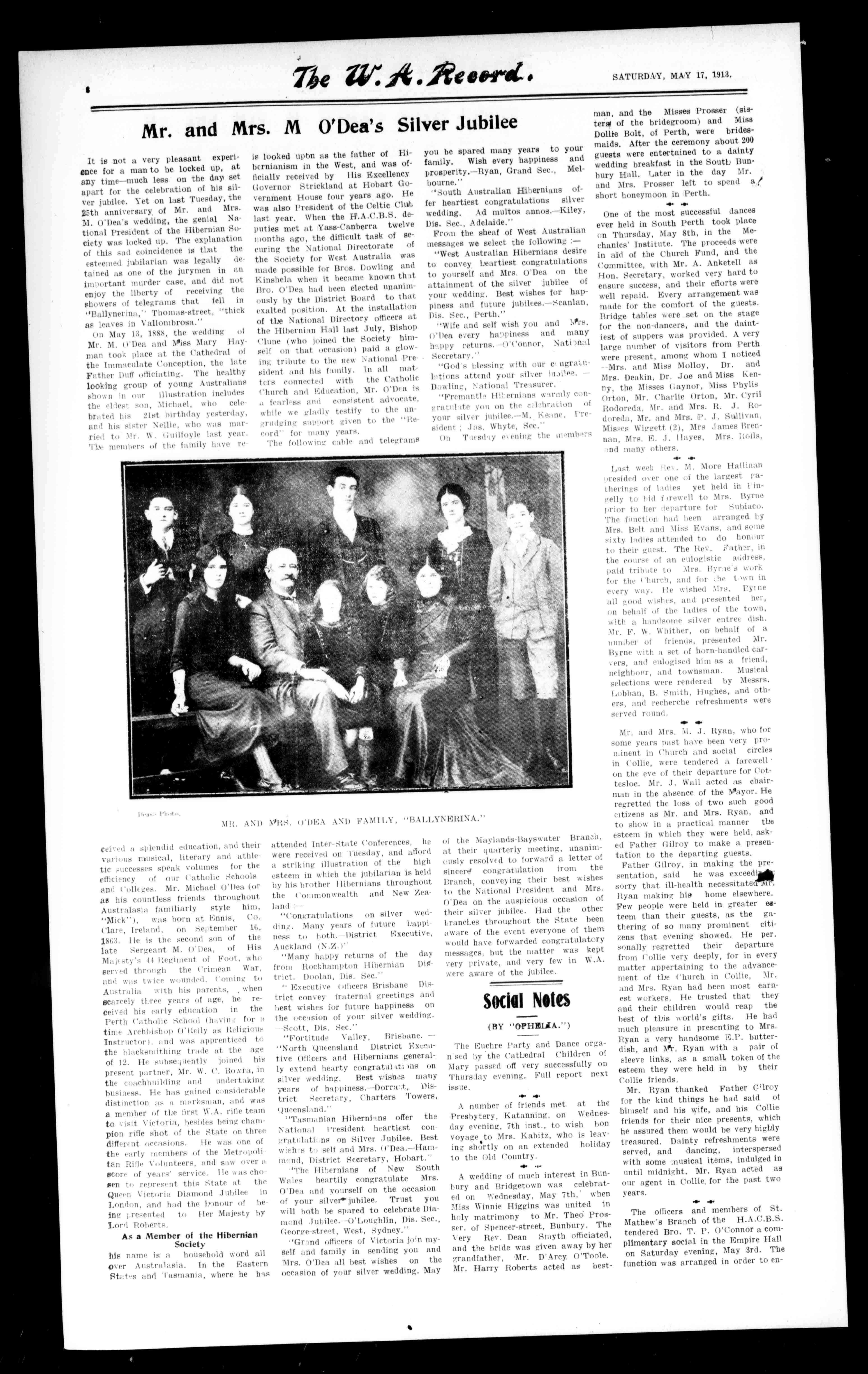
onMay13,188e,thewedding 4,1 Mr.M.O'DeaandMissMaryHaymantookplaceattheCathedralof theImmaculateConception,thelate Father'Duffofficiating.Thehealthy lookinggroupofyoungAustralians showninourillustrationincludes theeldestson,Michael,whocelebratedhis21stbirthdayyesterday, andhissisterNellie.whowasmarriedtoMr.W. lastyear. Themembersofthefamilyhavere
islookedupbnasthefatherofHibernianismintheWest,andwasofficiallyreceivedbyHisExcellency GovernorStricklandatHobartGovernmentHousefouryearsago.He wasalsoPresidentoftheCelticClub lastyear.WhentheI-f.A.C.B.S.deputiesmetatYass-Canberratwelve monthsago,thedifficulttaskofsecuringtheNationalDirectorateof theSocietyforWestAustraliawas madepossibleforBros.Dowlingand Kinshelawhenitbecameknownthat Bro.O'DeahadbeenelectedunanimouslybytheDistrictBoardtothat. exaltedposition.Attheinstallation oftheNationalDirectoryofficersat theHibernianHalllastJuly,Bishop Clune(whojoinedtheSocietyhimselfonthatoccasionpaidaglowingtributetothenewNationalPresidentandhisfamily.InallmattersconnectedwiththeCatholic f'huntandEducation,Mr.O'Deais afearlessandconsistentadvocate, whilewegladlytestifytotheun;laidgingsapportgiventiethe"Reord"formanyrears.
Thefollowingcableandtelegrams
youbesparedmanyyearstoyour family.Wisheveryhappinessand prosperity.-Ryan,GrandSec.,Melbourne."
"SouthAustralianHiberniansofferheartiestcongratulationssilver wedding.Admultosannos.-Kiley, Dia.Sec.,Adelaide."
FromthesheafofWestAustralian messagesweselectthefollowing:"WestAustralianHiberniansdesire toconveyLeartiestcongratulations toyourselfandMrs.O'Deaonthe attainmentofthesilverjubileeof yourwedding.Bestwishesforhappinessandfuturejubilees.-Scanlan, Dis.Sec.,Perth."
"Wifeandselfwishyouand!Ors. O'Deaeveryhappinessandmany hippyreturns.()Vomit-,Nati-in:A Secretary."
"God'sblessingwithourc.ugrautl!itionsattendyoursilverbi.)ilee. Dowling,NationalTreasurer.
"PreinatithHiternianswarmlyconaeyouonthee.1,braiionof yoursilverjubilee.-M.Keane.President.Ins.Whyte,Sec."
OnTuesdayeeningtheinemb,,rs
man,andtheMissesProsser(sisters,ofthebridegroom)andMiss DollieBolt,ofPerth,werebridesmaids.Aftertheceremonyabout200 guestswereentertainedtoadainty weddingbreakfastintheSoutl;BanburyHall.LaterinthedayMr. andMrs.Prosserlefttospenda shorthoneymooninPerth. 4.
Oneofthemostsuccessfuldances everheldinSouthPerthtookPlace onThursday,May8th,intheMechanics'Institute.Theproceedswere inaidoftheChurchFund,andthe Committee,withMr.A.Anketellas Hon.Secretary,workedveryhardto ensuresuccess,andtheireffortswere wellrepaid.Everyarrangementwas madeforthecomfortoftheguests. Bridgetablesweresetonthestage forthenon-dancers,andthedaintiestofsupperswitsprovided.Avery largeniirnherofvisitorsfromPerth werepresent,amongwhomInoticed --Mrs.andMissMolloy,Dr.and Mrs.Deakin,Dr.JoeandMissKenny,theMissesGaynor,MissPhylis Orton,Mr.CharlieOrton,Mr.Cyril Rodoreda.Mr.andMrs.It.J.Itodoredit,Mr.andMrs.P.J.Sullivan, MissesWireett(2),MrsJamesBrennan,Mrs.E..1.Hayes.Mrs.!tolls, andmanyothers. asis. Lastweek!teeM.MoreHallimen presidedoveroneofthelargestratheringaofIidlesyetheldin1ini>ellytobidfirewelltoMrs.Byrne priortoherdepartureforsubiaco. 'rhefunctionhadbeenarrangedby Mrs.Belt,andMissEvans,andseine sixtyladiesattendedtodohonour totheirguest.TheRev.Fatinr,in thecourseofaneulogisticaUdtess, paidtributetoMrs.Byrie'swork forthechurch,andfor;hetownin everyway.HewishedMrs.By!ne allgoodwishes,andpresentedher, onbehalfoftheladiesofthetown, withahandsomesilverentreedish. Mr.F.W.Whither,onbehalfofa limberoffriends,presentedMr. Byrnewithasetofhorn-handledcarvers,andeulogisedhimasafriend, neighbour,andtownsman.Musical selectionswererenderedbyMessrs. Lobban,B.Smith,Hughes,andothers,andrechercherefreshmentswere servedround.
ceivtqlasplendideducation,andtheir variousmusical,literaryandathleticsuccessesspeakvolumesforthe efficiencyofourCatholicSchools andColkees.Mr.Michael (or ashiscountlessfriendsthroughout Australasiafamiliarlystylehim, "Mick"), washornatEnnis,Co. Clare,Ireland,onSeptemberDi, 1863.Ileisthesecondsonofthe lateSergeantM.O'Dea,ofHis Maifsty's41RegimentofFoot,who servedthroughtheCrimeanWar, andwastwicewounded.coiningto Australiawithhisparents,when scarcelythreeyearsofage,hereceivedhisearlyeducationinthe PerthCatholicSchoolhavinfor time.ArchbishopWI:01yasIteligiaus Instructor),andwasapprenticedto theblacksmithingtradeettheage of12.Hesubseinentlyjoinedhis presentpartner,Mr.W.C.Boxra,in thecoachbuildingandundertaking business.Hehasgainedc,,nsiderable distinctionasmarksman,andwas amemberoftbefirstW.A.rifleteam tovisitVictoria,besidesbeingchampionrifleshotoftheStateonthree differentoccasions.Hewasoneof theearlymembersoftheMetropoli tanRifleVolunteers,andsawovera scoreofyears'service.le',vaschosentorepresentthisState,itthe QueenVictoriaDiamondJubileein London,andhadthekanourofbeingixesentedtoHerMajestyby LordRoberts.
AsaMemberoftheHibernian Society hisnameisahouseholdwordall overAustralasia.IntheEastern Stat.-sandTasmania,wherehehas
attendedInter-StateConferences,he werereceivedonTuesday,andafford astrikingillustrationofthehigh esteeminwhichthejubilarianisheld byhisbrotherIliberniansthroughout theCoumaonavealthandNewZealand:-
"Congratulationsonsilverwedding.Manyyearsoffuturelappiliesstoboth.District.Executive, Auckland(N.Z.I"
"Manyhappyreturnsoftheday fromRockhamptonHibernianDigtrict.Doolan,Die.Sec."
"ExecutiveIdlicersBrisbaneDistrictconveyfraternalgreetingsand bestwishesforfuturehappinesson theoccasionofyoursilverwedding. Scott,Dis.Sec."
"FortitudeValley,Brisinine.-
"NorthQueenslandDistrictExecutiveOfficersandHiberniansgenerallyextendheartycongratuletainson silverwedding.Bestristids,marry yearsofhappiness.-DorraJ'DistrictSecretary,ChartersTowers, Queensland."
"TasmanianHiberniunsofferthe National('residentheartiestconretnlatic onSilverJubilee.Best W!First',selfandMrs.O'Dea.-Hatnin,,nd,DistrictSecretary,Hobart."
'ThefitherniansofNewSouth WalesheartilycongratulateMrs. O'Deaandyourselfontheoccasion ofyoursilve&jubilee.Trustyou willbothbesparedtocelebrateDiamendJubilee.-O'Loughlin,Die.Sec., George-street,West,Sydney."
"CrindofficersofVictoriaja'nmyselfandfamilyinsendingyouand "Mrs.O'Deaallbestwishesonthe occasionofyoursilverwedding.May
oftheMaylands-BayswaterBranch, attheirquarterlymeeting,unanimouslyresolvedtoforwardaletterof sincerecongratulationfromthe Branch,conveyingtheirbestwishes totheNationalPresidentandMrs. O'Deaontheauspiciousoccasionof theirsilverjubilee.Hadtheother brancl.esthroughouttheStatebeen awareoftheeventeveryoneofthem wouldhaveforwardedcongratulatory messages,butthematterwaskept veryprivate,andveryfewinW.A. wereawareofthejubilee.
SEIMNets
(BY"OPHBIAA.")
TheEuchrel'artyandDanceorgan'sedby'theCathedralChildrenof Marypassedoffverysuccessfullyon Thursdayevening.Fullreportnext issue.
Anumberoffriendsmetatthe Presbytery,Kittanning,onWednesdayevening,7thinst.,towishbon voyagetoMrs.Kahitz,whoisleavingshortlyonanextendedholiday totheOldCountry. 011. AweddingofmuchinterestinBunburyandBridgetownwascelebratedonWednesday,May7th,when MissWinnieHigginswasunitedin holymatrimonytoMr.TheProsser,ofSpencer-street,Bunhury.The VeryRev.DeanSmythofficiated, andthebridewasgivenawaybyher grandfather,-Mr.D'ArcyO'Toole. Mr.HarryRobertsactedasbest-
Mr.andMrs.M..1.Ryan,whofor someyearspasthavebeenveryproninentinChurchandsocialcircles inCollie,weretenderedafarewell ontheeveoftheirdepartureforCottesloe.Mr.J.WallactedaschairmanintheabsenceoftheM'ayor.He regrettedthelossoftwosuchgood citizensasMr.andMrs.Ryan,and toshowinapracticalmannerthe esteeminwhichtheywereheld,askedFatherGilroytomakeapresentationtothedepartingguests.
FatherGilroy,inmakingthepresentation,saidhewasexceed' sorrythatill-healthnecessitated'lif. Ryanmakinghishomeelsewhere. Fewpeoplewereheldingreatereateemthantheirguests,asthegatheringofsomanyprominentcitizensthateveningshowed.Heper. sonallyregrettedtheirdeparture fromCollieverydeeply,forinevery matterappertainingtotheadvancementoftheChurchinCollie,Mr. andMrs.Ryanhadbeenmostearnestworkers.Hetrustee!thatthey andtheirchildrenwouldreapthe bestofthisworld'sgifts.Hehad muchpleasureinpresentingtoMrs. RyanaveryhandsomeE.P.butterdish,andMir.Ryanwithapairof sleevelinks,asasmalltokenofthe esteemtheywereheldinbytheir Colliefriends.
Mr.RyanthankedFatherGgroy forthekindthingshehadsaidof himselfandhiswife,andhisCollie friendsfortheirnicepresents,which heassuredthemwouldheveryhighly treasured.Daintyrefreshmentswere served,anddancing,interspersed withsome:nusicalitems,indulgedin untilmidnight.Mr.Ryanactedas oururgentinCollie,forthepasttwo years.
TheofficersandmembersofSt. Mathew'sBranchoftheH.A.C.B.S. tenderedBro.T.P.O'ConnoracomplimentarysocialintheEmpireHall onSaturdayevening,May3rd.The functionwasarrangedinordertoen-
ord SATURDA.Y,MAY17,1913.
1'11.4,
MR.ANDNIBS.o'DEAANDFAMILY,"BALLYNERINA."
BOANBROS.'
WestAustralia'smammothnewStores
WOULDYOULIKE YOUCANUNDERSTAND
Howeasyitis,forBoans:tocarefullyattendtotherequirementsof ThousandsofCustomerseveryDayinTownandCountry,. Whenwetellyouwehave684EMPLOYEES.
Boans'GreatandEverIncreasingBusinesshasbeenbuiltupbykeepingfaithwiththepublic.WesellTIPTOPGOODSatBed-rockPrices. CallandVIEWPERTHfromourROOFTEAGARDENS.
YourJewellerydeliveredinaCoalCart?Well,hardly!It'sthesame whenshopping.ItismuchnicertopurchaseyourgoodsataBig. Fresh,WellI.ighted,andAiryStore,whereyoureceivepromptandefficientattention.AtBoans'youshopunderthebestandmostagreeable conditionsinanEconomicalway.EverythingCheerful-ourPremises andourStaff!OurHigh-(tradeGoodshavetheSameEffectonyot:. LetusProveIt.
JUSTOPENED:-MEN'SANDBOYS'CLOTHING.SPECIALVALUEINTHESELINES.
BUTTERICK'SCELEBRATEDPAPERPATTERNS.-WearethesoleagentsforButterick'sPaperPatterns.Theyaretruetomeasurementandsuperiortoallothercutpaperpatterns.Fullrangestocked.
EverythingforEverybodyat
Bros,
Bon TheUniversalProviders
WellingtonandMurrayStreets,Perth
ablethemembersofthelodgetoexpresstheirkeenappreciation.ofBro. O'Connor'seffortsinconnectionwith theNarroginBranchofthesociety. AlargeattendanceofHiherniansand friendswaspresent,andmusical itemsanddancingwasindulgedin midnight.Duringtheevening thePresident,Bro.Markey,announcedthattheHiberniansofNarrogin desiredtogivesometangibleproof oftheesteeminwhichBro.O'Connorwasheld,andhewouldaskthe (haplainoftheLodge,DeanBrennan,tomakethepresentation.In makingthepresentation(whichwas aPast-President'sdiploma,mounted inasolidoakframeofhandsomedesign,andinsetwithphotographsof theofficers),DeanBrennaneulogised thePast-('resident'swork,notonly asanlibernian,butalsoasacitizen,andpaidatributetoBro. o'Connor'ssterlingqualities.Hewas surebewouldvoicethefeelingofthe 1.15dgemembersinaskingBro.O'Connortoacceptthetokenoftheirappreciation,withtheirsincerethanks forhispasteffortsandwishesfora longandprosperousfutureamong them.
lks.Dods,Barron,Gardinerand ht ,yor(Or.M.Brown)also spokeintonesofappreciationofBro. yronnor'sworkasaHibernianand citizen.Bro.O'Connorrespondedin averyfeelingmanner,andthanked thesocietyfortheirrecognitionof hiswork. Thediplomawasinscribedasfel'rows PresentedtoBro.T.P. t'f',,nnorbySt.:Mathew'sBranch, 'o.563,oftheH.A.('.B.S.,Narrogin,onhisretirementfromtheoffice ofPresident,1912-1913.'' Daintyrefreshmentswerehanded :windduringtheeveningbythe ladies,whoassistedgreatlyinthe successoftheevening.
'footballnotes
By"ANGLE-SHOT.")
thelongdistancekicking,theshort surepass,andalltheothergrand featuresoftheAustraliangame.
Loversofthegamehadsomething stirringtowatchonSaturdaylast intwoofthematchesatleast.SUIWacohadtoputforththeirvery besteffortstopreventdefeatatthe instanceofl'erth.Thestandardof playshowedthatbothteamshad paideveryattentiontotraining.The slackeningofpaceinthefinalstages wasduetothewarmweather.Perth supportersroustbeimmenselypleasedbytheperformanceoftheirteam, whichwonheapsof encomiums.Teamsthatprovidesuchcontestsasthisarethebestfriendsof thegame,andwillfindnolackof encouragement. sis
EastPerthdidindeedwakeupand gaveNorthFremantlethegameof theirlives.Northshadthebestof thescoreinthesecondandthird quarters,butinthefirstandlast Eastswerepracticallysupreme.It wasBests'gamelosttothembythe uncertaintyoftheirforwards,who shouldemulatetheexampleofthe Richmond(Vic.)Club,whoonthe samedayscoredninegoalsoutof elevenscoringshots.
.4P
ItispleasingtonotethatEast Perthhivesecureda"coach"--and oneofthehest-inl'addyShea,who starredinEssendonforyears.Easts areontheupwardmarch,andwill reachthetop,letushope.
.11..
SouthFremantleandWestPerth rovidedapoorgameattheW.A.
C.A.Ground.ThePortmenwere rotcalledontoexertthemselves lunch,andcameouteasysinners.
WestnortbasConanSawlsofar,andthroughnothavinga pianointheschooltheSisterscan-
AEuchrePartyandDance aidnothaveaWestEndSchoolConcert oftheWestNorthamSciloolHas atXmas,thesameasotherschools have,andinthisthechildrenare heldintheRailwayInstituteonthealwaysgreatlydisappointed.
5thinst.,andprovedagreatsuccess -infact,itturnedouttobethe mostsuccessfultournamenteverheld intheWestEnd.Some28tables wereoccupiedbyeuchreplayers,and theprizesfelltoMr.Bradyfirstand Mr..1.McKenziesecondinthe gents.,andMrs.Milnerfirstand Mrs.Plumnersecondfortheladies
RheumatisminherBlood andGeneralBreak-upof HerNervousSystem.
AsaLastResourceOrdered AwayforaChange.
ApointthatallAustraliansshould trivetoattainistokeeptheirown footballinsuchastateof excellenceastomeritforalltime thetitle"KingofallWinter Games."
ItIStimetoexpectgoodexhibitions,,!,peciallyasthebestexponentsIntheStateareengaged.We shHIIbeem,erlylookingforsardto therenetitionofhistoryinthedazzlinglybrilliantupanddownplay, themasterlyhandlingoftheball,
Banksplayedwithgreatjudgment, andwasinvaluabletoSouths.ResidesGast,Hiltonshowedupwell forNests,andshouldbecomeoneof thehestintheStateeitherindefenceoroffence. sis4.
SurelyWestswillgeta-:noveon nowwithIvoCrappas"coach;" theyoughttoenthuseamillionand improveinproportion.Henceforth theywillhaveno"passengers,"and nounduetairdenwillbethrownon timefew.
HARRYMcCARTHY
195PierStreet,Perth. PracticalIndenture.(llinehdli). COACHANDMOTORCARPat MEL
Patronisedb7Vfes-Ro7alt7.
The"booby"prizeswenttotwowell knownNorthamites,andonunwrappingtheseprizesweresubjectedto somehilariouschatting.Thegreat successofthepartyisentirelydue tothegreateffortsputforwardby thecommittee,bywhomnolabour wasconsideredtoogreatortiresomeinordertocrownthesocial withsuccess.FatherO'Donnell,in handingouttheprizes,thankedone andallfortheirattendance,and thankedthecommitteeonbehalfof theSisters,anditispleasingtoreportthattherenovating,etc.,of theschoolwillbeputinhandat once,owingtotheprofitfromthe partyrealisingtenguineas.Thefollowingladiescomprisedthecommittee--MesdamesMorris,Allen,l.nonard,Mahony,McGally,Brennan,Williams,Doyle,andHassett,withMesdames('lohesseyandReganasjoint secretariesandtreasurers,ondMessrs.('lohessey,LeonardandLynch tookcontroloftheEuchreParty andDanceatnight,andawordof praisemustbegiventoMrs.MilnerandtheMissesAlbeuryandDaly forpresidingatthepiano;alsoas inthepastwithCatholicsocialsin theWestEnd,ourProtestantfriends cameforwardwithgreatassistance bylendingtablesandchairsand rivingrefreshments,aswellascominginlargenumberstotheparty. itistheintentionofthecommittee toholdthesepartiesmonthlythroughoutthewinter,andin.Julyto
ThosepersonswhosufferfromAnemiaor poorblood,Constipation,Indigestion,Sickness afterEating.IrregularHeartAction,Nervousness.SickorNeuralgiaHeadache,Nervous Breakdown,causedbyoverstudyorbusiness warries,KidneyIrregularities,shoulduse CLEMENTSTONIC,becauseitactsat onceuponinactivefunctions,andgivesthere newnerveforce.Itrapidlyputsthehuman houseinorder,andmakesmenandwomen healthy.Thisisprovedbythefollowingletter fromMrs.J.J.Frost,ofPortAdelmie. carterofGranvilleandCarlisleStreets. writtenAugust7,1911.
CLEMENTSTONICLTD.,
"Mypresentexcellenthealthis dueentirelytothevirtuesof ClementsTonic.
IsufferedfromRheumatism foralongtime.Inspiteofmedical treatmentitgrewworse,untilfinally IgotsobadthatIcouldnoteves standerect.Mysufferingeffected mygeneralhealth,andmynervous systemquitebrokedown.
"Asalastresourcethedoctors orderedmeawayforachangeof air.Eventhatdidnotbenefitme.
OnedayIreadofacureeffected byClementsTonic,andIdecided togiveitatrail,withthehappiest results.Aftertakingfivebottles1 wasfreefrompain,andcouldget about.Sevenbottlesrestoredmeto perfecthealth. I amalways recommendingittomyfriends.
(Signed)Mrs.J.J.FROST."
blaChildren'sBall.Thetraining ofthechildrenwillbeundertakenat once,andtheco-operationofallthe ladiesofNorthaminthisprojectis askedfor,soastomaketheBalla hugesuccess,suchasNorthamhas rotyetwitnessed,inorder,ifpossible,toprovidetheWestEndschool withapiano.Atpresentitisnecesr-iryformusicpupilstogotothe conventforpracticeandinstruction, andthisisahardshipinwinteras wellasinsummertohavetowalkforitto
NotonlyinAustraliaisClementsTonic usedanditsvalueasahealthrestorerappreciated,butinothercountriesthemeritsof thismedicinearevoicedbythosewhospeak frompracticalknowledgeofitsstrength-creating powers.Mrs.Frostisbutoneofhundreds whovoiceopinionsthus,andwhoalsorecommendthismedicinebecausetheyknowby BENEFITSreceived,thatingivingittotheir sickfriendstheyaregivingthemthemediumto somethingbeyondprice-lastingandrobust health.S.,:dtoylurCHEMISTandSTORE
SATURDAY,MAY17,1913. neWA.Aecerci
-dmDonotwpituntilto-morrow.
Thea.A.ffeceiryt,
Boulder
Apleasantgatheringtookplace lastweekatByrne'sShamrockHotel. Theoccasionwasawind-upsocialin connectionwiththeSt.Patrick's Daycelebrations.Therewasalarge attendance,includingDeanRobinson andothervisitorsfromKalgoorlie. TheRev.P.J.Donogherpresided.
Aftertheloyaltoasthadreceived attention,theChairman,inaneloquentspeech,proposed"Ireland-a Nation,andafterMr.M.Byrne hadspokeninsupport,thetoastwas enthusiasticallyhonoured."TheDay WeCelebrate"wasthensubmittedby theVeryRev.DeanRobinson,Mr. B.Lesliesupporting.
FatherDonogherreferredincomplimentarytermstothesterling u-rkperformedbyMr.BenLeslieas secretaryofthecelebration.The functionshadbeenanunprecedented success,andformuchofthissuccess theyhadtothankMr.Leslie,assecret:ery.Theothermembersofthe committeehadalsodonesterling urk.HethereforehadmuchpleasureinpresentingMr.Lesliewitha veryhandsomelyframedenlarged photogroupofthecommitteeand ofiidale.
ofagoodoldCatholicstock,who havealwaysbeenrecognisedasgood citizensandexemplaryCatholics.
Inabriefbutappropriatediscourse deliveredbyFatherMastersonprevioustoadministeringtheSacrament,heextolledtheblessingsofa happyCatholichome.Nolanguage, hesaid,couldexaggerateitshappiness.But,hesaid,hehopedand feltsureMissCarrwouldinher marriedlifemakethathomeahappyone,andeverbewhattheCatholicChurchexpectedaCatholic wifetobe-"thesunbeamandnever-. fadingjoyoftheeCatholichomestead."
Themuchneededandmuchtalked ofimprovementstoSt.Isidore'swill soonlieaccomplished.Acommittee ofpracticalCatholicmenhavebeen appointed.TheyhavethebestinterestsoftheCatholicChurchatheart, andarepreparedtotransactbusinessinalogicalmanner.Itisquite unusualtohearofmeetingsconductedwithanypretentionstoParliamentaryprocedure.Thegentlemen composingthespecialChurchCommitteearethefollowingMessrs.P. Ryan,JohnWhite,McNamarra,with E.RyansecretaryandFatherMastersonex-officiochairman.
Mr.Leslie.whoreceivedavery heartyreceptioneonrising,responded inanappropriatespeech,andreferredtothefactthatalthoughthesecretarialworkhadbeenheavyithad beenmadecomparativelylightby thewholeheartedco-operationofthe committee,eachoneofwhomhad w..rkedloyallyandwell.Hehadbeen connectedwithpublicbodiesonthe fieldsforthepast19years,buthad neverworkedwithsuchanunselfish andenergeticcommittee.(Hear, hear.)
Afeatureoftheeveningwasthat anoldprospectingmateofMr.Leslie's,Mr.T.C.Craig,ofKalgoorlie, cameoutspeciallytodohonourto hisone-timefellowprospector.Subsequentlyasimilarpresentationof anenlargedphotogroupwasmade toMr.J.P.Murphy,sen.,whohad actedasstarterandassistantorganiser.Mr.Boylan,onbehalfof thecommittee,madethepresentationinaneatspeech.Agoldmedal waspresentedforthewinnerofthe HibernianShield(championship sprintinghandicap).Mr.F.Boylan, sen.,acceptedthemedalonbehalfof hisson,Mr.A.Boylan,whoisnow aresidentofPerth.Thesecondplacedman,\Ir.W.McCoy,wasawardedasilvermedal.Goldmedalswere alsowonbyM.CahillandEileen French,thelatterfordancingcontests).
Duringtheeveningaprogramme ofmusicalandelocutionaryitems wasprovidedbyMessrs.L.Mitchell, F.Boylan,B.Leslie,andothers. PissBoylanpresidingatthepiano.
Unacmbbiat
Mr.Randell,Leonora,lOs6d.
inggreenthememoryofhimwho foundthedearharpofhiscountry indarknessandgaveallits"notes tolight,freedomandsong."The committeehaveappointedasleadingladyfortheconcertMissFitzgerald,ofthefamous"Gracia"AcademyofMusic,conductedbytheSistersofCharityofSt.Vincent'sCollege.Thistalenteddescendantofthe "PrincelyGeraldine"hasalovely contraltovoice,whichwillbeheard inMoore's"HasSorrowThyYoung DaysShaded"and"TheMeetingof theWaters."WecomplimenttheHiberniansonselectingadistinguishedgraduateofaCatholicSchoolto carrytheirhonours.TheSydney "Morn:ngHerald"ofApril25had averyfinenoticeofhersinging. WeunderstandthattheTomMoore Celebrationwasinauguratedlast yearwhentheDelegatestotheHibernianInter-State('onferencewere inSydney,andwhenthepresentNationalTreasurer,Mr.J.S.Dowling, ofFremantle,deliveredasoul-stirringpatrioticoration.Mr.Madigan, writingtoafriendinWestAustralia,says"Theanniversarybrings tomymindsomeofthemostpleasantrecollectionsofmylife.Itremindsmeofanassociationwithmen whomIshallneverforget.Ionly wishwehad.1as.S.Dowlingtodeliveroneofthosetineorationswhich helpedsomuchlastyear,andIhonestlythink,helpedtobringtheNationalDirectorycollarshacktothe GoldenWest."
Theproposedimprovementsconsist ofachancelsome14ftby16ft,in whichthealtarwillbeplaced;also asacristyofsuitablesize,and churchseats.Thelatterareespeciallyneeded,usthelocalStateschool istobeopenedonthe19thinst., andmostofthepresentderelictseatingaccommodationbelongstothe StateDepartment.Finally,afence isverymuchneeded;theoneatpresentinusewasalwaysaworthless structure.Thefrontoftheproposed newonewillbeornamentalCyclone, paintedwhite.Theseimprovements willheconcludedbeforetheendof ,July.St.Isidore'swillthenpresent quiteagayappearance,andwillbe worthyofbeingdedicatedexclesi,ely--asitwillthenhetoDivineservice.Moreover,wecanboastthat itwillhetheprettiestcountry churchinAustralia.
Everyoneinthefarmingdistrictsis anxiouslylookingforrain.ehoteh the"cockles"areproverbiallyhard topleaseinweatherconditions,all arenowunanimousindesiringcontinuousrains.
ToniMooreAnnigersaryConcert
syDNEyc()NvENTPUI'll,l'HOSENASSTAR.
UndertheauspicesoftheN.,;,W. DistrictoftheHibernian-;ocietythe AnniversaryConcertinhonotirof thememoryofIreland'sNational Bardwillheheldattheft'ydney TownHallonWednesday,May28.
Acknowledgments
Mr..1.Mc(fmire,Dardanup,17s.
Rev,Dr.O'Hurley, loolgardie ("Records"soldatChurch),18s. "Records"soldatCathedral(per Mr.Kelly),AlOs6d.
Mrs.E.Campbell,Wickepin,1086d. Rev.Bro.Gabriel,Redemptorist Monastery,NorthPerth("Records" soldatChurch),£114s.
TerrorsofaSluggishLiver THOUGHTSHENEVERWOULD
BE CURED.
AGREATTRIUMPHFORBILE BEANS.
Thegreatreliableapecificforliver tremblesisundoubtedlyBileBeans.
MrsM.O'Leary,of2,Chancery-lane, Adelaide,says:-"Thesluggishstate ofmylivercausedmetobeincontinualill-healthterriblepainsshot acrossmytemples,whilebackache alsotorturedme.Stoopingattimes wasalmostanimpossibility,whileif Ididgetdown,straighteningupwas absoluteagony.onmanyoccasions theviolenceoftheheadachesandthe distressingpainsatthebackofthe headmadelifealmostunbearable. Ibecamelanguidandweary,while nauseaandsicknesscausedmuchunpleasantness.Mywholesystembecamethoroughlyrun-down,andI wasinashockingstate.
OnWednesday,the7thinst.,avery popularmarriagewassolemnisedin St.Isidore'schurch.ThecontractingpartieswereMr,WilliamS. White,ofJennacubbine,andMiss Clara1,.Carr,ofGeraldton.
Mr.Whiteisapopularmemberof a:TenchrespectedCatholicfamilyin theneighlmerhood.Hisgrand-parentscametothesedistrictsfromthe EneeraldIsleverymanyyearsago. Theyresidedcontinuouslyinthese EasternDistrictstilldeathdespatchedthemtoahappierworld.Butneithertheynortheirdescendantshave lostawhit.ofthatsterlingfaith andpracticalCatholicitywhichis saidtoheaconspicaoescharacteristicoftheIrishracethroughoutthe world.Anditisworthyofnotealso thattheWhiteclanWhichinprogenyhearsafavourablecomparison inpointofnumberstothatofAbraham--ownsagoodlyportionof.fen nac:Jibineandsurroundingdistricts. Thehamofindustryandhappytoil canbeheardaroundtheirhomesteads &Ay,fromearlymorningtilllate evening.ButMetatheirlivesmay beMetanduneventful,andtheirlot eastinaeemparativelyobscureand unobtrusivesphere,theymastever takeanhonourableplaceintheroll ofAustralia'san.iculturalpopulation.Nordoesthebridedeservea milderencomium,forshealsocomes
ThePastDistrictPresident,Bro.T. Madigan,ofRosebankTerrace,l'reverley,isthemovingspiritinthecelebration,andtheSociety,ofwhich Mr.Madiganisadistinguishedmember,istohecongratulatedonKeep-
Rev.FatherDonogher,Boulder ("Records"soldatChurch),fal5s.
Mr.Hughes,West'Perth,1.:13s6d.
Mrs.Dawson,Victoria(perMr. Shine),10s6d.
Rev.FatherLynch,Maylands("Records"soldatChurch),£14s.
VeryRev.DeanWalsh,York("Records"soldatChurc1.0, 4s.
Mrs.McNamara,Parkerville,17s. "Records"soldat('ottesloe Church(perMr.Bridgewood),£4.
Mr.T.F.Quinlan,Perth,3s3d.
Mrs.G.Douglas,Ravensthorpe,lOs 6d.
Mr.J.Saunders,Balbartip, MissKelly,Greenhills,6s6d.
MissHettenhach,Perth,28.
Rev.Bro.Gabriel,Redemptorist Monastery("Records"soldat Church),IA18s.
Mrs.Kissane,Wagin,lOs6c1 previouslyacknowledgedApril19th).
Mr.G.Harris,Dumbleyung,4s4d.
VeryRev.DeanSmyth,Itunbary ("Records"soldatChurch),C1010s.
VeryRev.P.J.Gibney,Perth,8s
Gd.
Mr.T.McMahon,SouthernCross, lOs6d.
Rev.FatherMeagher,Geraldton, 12s.
"Afterusingmanyremediesthat weresupposedtocureliverdisorder, anditssymptoms,withoutobtaining anybenefit,Ithoughtmycasewas hopelessandacurewasanimpossibility.However,Iwasdelightedto findthatinBleBeansIhadanexcellentmedicinewhichactedina naturalandeasymanner,Itonly requiredafewdosesofBileBeansto dispeltheheadachesandnausea,and endallpainsandsickness.AsIcontinuedtakingthiswonderfulmedicine,somyillsdisappeared,andday bydayIgrewstrongerandmore energetic.AfullcourseofBileBeans restoredmetoperfecthealth,which Ihavenowenjoyedforsome time.
"Myhusbandalsoderivedgreat benefitfromBileIteansandweboth thinkhighlyofthisexcellentmedicine.''BileBeansareunequalledas ageneralhouseholdmedicine,andare invaluableforallliverandstomach disorders,piles,headache,constipation,biliousness,indigestion,flatulence,foulbreath,nausea,dyspepsia, anaemia,andcommonfamilyailments.Ofallchemistsandstores, orpostfreefromTheBileBean Mfg.Co.,39,Pitt-street,Sydney.
IfyoucannotsecureBileBeans fromyourlocalStore,wewillsend direct,postpaid,onreceiptofpostalnotefor1/14smallsize,or2/9 largesize.AddressTheBileBean ManufacturingCo.,39Pitt-street, Sydney.
10
SATURDAY,MAY17,191..
HAIRDRESSERandTOBACCONIST 697HAYST.,NEXTSANDet. Trythelatestinnovation-Electric Brushes,Massage,etc.ThreeChairs going.TobaccoBlendingaSpeciality. AN.11111=1111 BuyDirectfromFactoryandSave25per centtorSpotCash. ARUNDEL'S Saddle.Harness,&CollarFactory 179Murray-st.,opp.BoanBros. RidingSadcicsfrom30sto£610s,Bridles4s6dto25s Ladies'AstrideSaddlesfrom50sto£510s BuggyHarnessfrom55sto£810s,SpringCartHarnessfrom75s Leggingsfrom5s6dpad orscRugsOstolOs HorseRugs,bestcanvaschecklinedwithlegstraps12s6dto18s6d "Aeme"HorseRugsofeverydescriptionfrom12s6d CartBridlesfrom4stolOs6d,CartSaddles18sto25s CartBreechingsfrom16s6dto25s,Cellarsfrom12sedto25s SecondhandUarness,eollarsandSaddles
MARKCONROY
maids ....11
ThequarterlymeetingofSt.LawrenceO'Toole'sBranchoftheH.A. C.B.SocietywasheldattheMaylandsChurchonlastTuesdayevening,therebeingagoodattendance ofmembers.Thechiefbusinesswas thenominationofofficersfortheensuingterm.Thenominationssubmittedwereasfollows:-President, Bros.G.Hanrahan,J.Colgan,and H.Dalton; Vice-President,Bros. JohnMcDonaldandM.Collins;Secretary,Bro.E.J.Kenny,unopposed(declaredelected);Treasurer,Bro. J.ColganandBro.M.Collins;Warden,Bros..1.J.CaseyandT.McDonaldGuardian,Bros.G.Hanrahan,M.Collins,andJ.J.Casey SickVisitorsBayswater,Bros.T. McDonaldandP.O'Connor,Maylands --SistersM.MaherandB.Whelan Auditors,Bros.H.DaltonandH. Hanrahan.MissKathleenHenson wasnominatedformembershipofthe Branch.OurChaplain,Fr.Lynch, remindedthemeetingthattheNationalPresident(Bro.M.O'Dea) wascelebratingthesilverjubileeof hiswedding,andthoughtthatmembersshouldsendamessageofcongratulation.Asonewhohadbeen associatedwithBro.O'DeainHibernianworkforsomeyears,especially attheHobartInter-StateConference fouryearsago,hecouldtestifyto thetruespiritofHibernianismwhich actuatedtheNationalPresident.TodayacablefromNewZealandand wiresfromeveryDistrictinthe CommonwealthfromChartersTowersandHobarttoPerth,hadbeen received,andhemovedthatamessageoffraternalgreetinghesent TI.emotion,whichwassecondedby Bro.Dalton,wascarriedunanimously.To-morrowthequarterly CommunionoftheBranchwilltake placeat:MaylandsChurchatthe9 o'clockMass.Memberswillmeetat theentrancetotheChurch,andwill proceedinregaliatotheseatsin front,wl.richwilhereserved.The halt-yearlymeetingoftheBranch will BayswateronTuesday,May27thinst.TL'eelectionof cancerswillhethemostimportant business.
The Ah'eord
fastfortheFirstCommunicantsand sparednopainsintheireffortsto makethedayamemorableanda happyonefortheprivilegedchildren.Fr.Brennan,whopresentedthe childrenwithspeciallydesignedCommunionCards,complimentedthe childrenandtheirparentsonthe mannerinwhichtheyhadco-operatedwithhiminthespiritualwork oftheparish.Hewassorrythathis workamongstthemwouldbeinterruptedforalittlewhile,asthe Vicar-Generalhadappointedhimto takechargeofSt.Brigid'sParish, WestPerth,duringtheabsenceof FatherFaganintheOldCountry. Hewasnotdesertingthembyany means,ashehadimploredtheVicarGeneraltoleavehimtohisown scatteredflock,andtofinda!,etter andamoreworthysubjectforWest Perth.AstheVicarwouldnotlistentohisentreaties,hisownduty wastoobey.liepointedoutthat therewouldbenointerruptionin theworkforthenewChurch.He hadappliedforasitesometimeago, andhopedforafavourablereplyin theverynearfuture,
Theplansandspecificationsforthe newChurchwerealreadyprepared, andhehadplacedasubstantialsum tothecreditoftheDwellingupCatholicChurchCommitteeintheCommonwealthSavingsBankthismoneyhadbeenraisedbydirectdonationstowardstheChurchBuilding Fund,andbytheverysuccessfulentertainmentheldinDwellingupon lastSt'atrick'sNiglit.TheCoenmitteealsointendedholdingaBazaaronadatetobefixed,aboutthe middleofnextOctober.Hehadevery confidencethattheamountsraised bydonationsyettocomeinandby theBazaarwouldenablethemto buildtheChurchandhaveitfree fromalldebtbefol'enextChristmas.
dinginThreeSpringswilllivelong inthememoryofeveryone.TheDapeycoupleleftforanextendedhoneymoonintheEasternStates.Numerouswireswerereceivedfromall overtheStates,andthecouple carrywiththemthebestwishesand goodwillofthepeopleoftheThree Springsdistrict.
Mr.andMrs.T.Berriganentertainedalargenumberoftheresidentsofthetownshipanddistrictat theirresidence,andaffordedallan opportunityofwishingthehappy couplegoodwishesfortheevent thatwastotakeplaceonthenext day.Theeveningwaspassedmostly withsingingandmusicalitems.
ThreeSpringsresidentswillbe gladtohearthat,thoughnosteps havebeentakentowardsbuildinga stationattheirtown,thematterhas notbeenoverlooked.Therequired amountisdownontheCompany's estimates,andplansandspecificationsarebeingdrawnup.Though itcannothedeniedthattheCo.has shownnounduehasteinthematter, stillitisreassuringtoknowthatit hasnotbeenforgotten.
(ivildfordInkiland
OnMay2fith,atSt.Luke'sHall, George-street,Maylands,aEuchre PartyandDancewillbeheldinaid offundsfortheforthcomingbazaar. Therearesixprizestobecompeted for,andeverything,sofar,points toasuccessfulandanenjoyableentertainment.
Thegreatestenthusiasmprevailsin connectionwiththeforthcominghamar,andladies,eithoutnumber,are onthefinancialwarpathseeking whomthlemaywaylay.Through thecourtesyofSuperintendentLapsley,inwhatwasoncetheMaylands oitlicHall(andisnowunderthe 4.Brigade),aselectdancetook laceinaidoftheBazaarfunds nWednesdayevening.Seeingthat adecisionwascometoonlyonSundaymorningbytheBazaarCommittee,thesuccessattendingthe functionisgratifying.
AmeetingoftheSodalityofthe ChildrenofMarywasheldonSunday afternoon,whentheRev.Motherand oneoftheHighgateSistersattend ed.Thirty-oneattended,andMiss BirdieWalshwaselectedPresident entilnextSeptember. Aspecial stallundertheauspicesoftheSodalitywillheinevidenceatthe Bazaar,andthemembersareworkingenergeticallytosecurepremier lace.
Dwellings*Doings
lelookedupontheChurchasthe firstessentialtowards.thethorough organisationofthatcornerofhis parish.Itwouldheaworkingcentre fromwhichthepriestcouldwithout muchdifficultyattendtothespiritualwantsnotonlyofDwellingup, hutalsoofMarrinup,'thenewState Mill,andHolyoake.Ifkiswishes wererealised,theChurchwouldhe openedwithamuchneededmission bytheRedemptoristFathers.
Inconclusion,hebrieflyreferred ioFr.Sheridan.whowascoming fromKalgoorlietotakechargeduringhisabsence,asazealous,hardworkingPriest,whowouldleavenothingundoneinhiseffortsforthe spiritualneedsofthepeopleentrustedtohiscare.
threeSprings
AscensionThursday,May1-it,was a,gre.,tdayfortheCatholicchildren inDwellingup,asoveradozenof themmadetheirFirstHolyCommuniononthatbeautifulmorning. Severaladultsalsotookathantage oftheopportunityandreceivedIlely communionwiththechildr:m.The platformonwhichtheAltarwas erected,aswellastheAltar iself, wascarefullyandartisticallydecoratedfortheoccasionbyMrsO'Connor,whowasassistedbyMrsSin;:rt, Mrs.Turner,andMrs.Bennett.
Thesethoughtfulladiesalsopre'a adaintyandsubstantial!Teak-
est,giveitapicturesqueappearance.
Theacreagecroppedthisyearwill beconsiderable,buttheexactquantitycannotbeascertainedasyet, asmanyofthefarmersarestillbusy seeding.TheSlaterfamilyalone willcropover4,000acres.
ThereisaCatholicSchoolhere, whichisunderthesupervisionof MotherDeSalesandSisterGerard, ofthePresentationOrder.Itisa branchoftheGeraldtonConvent. Theyhave10residentpupilsalonein temporarybuildings.AConventis mud'required.
AttheannualmeetingoftheRoad Boardonthe11thinst.,Mr.William Slater,ofLakeView,eightmiles fromhere,wasunanimouslyelected chairmanforthethirdtimeinsuccession.Mr.SlaterhasbeenidentifiedwiththeBoardforthelast15 years,andhasdonegoodworkfor thedistrict,whereheisdeservedly Popular.Hetooktohimselfawife somefouryearsago.Hisvery,fine residence,surroundedbysomethousandsofacresofbeautifulcountry givesevidenceofasturdypopulation.HisgoodladyisfromCork's owntown.
TherenderingofWeber'sMassin attheMissaCantatainMidlandlast Sundayquitesurpassedtheexpectationsofthelargecongregationpresent.Thoughexceedinglydifficultof interpretationinplacesbyreasonof thevarioussentimentstowhichthe composerintendedtogiveexpression, thegeneralchoir,andthosealsoto whomspecialpartshadbeenallotted,acquittedthemselvesverycreditably.Aspecialwordofpraiseis duetotheconductor,Mr.Thompson,forhisuntiringzealintheinterestsofthechoir,andwehopeto havetl.epleasureofhearingthe swineMasssungagaininthenear future.
Afarewellsocialanddancewillhe tenderedthis(Saturday)eveningin theMidlandFriendlySocieties'Hall, toMissAdaHalton,wholeavesnext weektojoinherfatherinKalgoorlie. Wefeelsurethathermany friendswilltaketheopportunityof showingtheiresteemandrespecttowardsthedepartingguest,everto thefrontinallmatterspertaining totheChurch,shewasdevoidof thatnarrow-mindedjealousywhich attimesisprevalentamongzealous churchworkers.AsaMildofMary andamemberofthechoir,shewas everatherpost,alwaysgivinggood exampletoherweakersisters,and everreadytoassistthemintheir difficulties.Wewishherbonvoyage andaLappysojournonthegoldfields.
Mr..Johnlierrigan,ofthewellknownfirmofcontractors,Berrigan Bros.,wasmarriedintheThree SpringsCatholicCburchrecentlyto MissDeliaKennedy,ofSydney,Ns% SouthWales,bytheRev.Father Scanlan.Mr.T.Berrigangavethe brideawayMr.D.Toddwasbest man,thebridesmaidsbeingthefour MissesBerrigans-May,Lily,Eileen, andClara,niecesofthebridegroom. Thebrideworetheusualwreath andveilandorangeblossoms,and carriedabouquetofwhitechrysanthemums,herdressbeingofwhite embroideredmuslin,andshelooked veryprettyindeed.Therewasa largenumberatthechurch,andas thehappycouplereachedthedoor theyreceivednotonlytheLearty congratulationsoftheirnumerous friends,huttheusualdelugeofrice andconfettithatalwayscomesthe wayofnewlymarriedcouples.The manypresentsreceivedincluded ehefmes,etc.Thebridegroom'spresenttothebridewasapairofgold earrings,andthebride'spresentto thebridegroomwasapairofgold sleevelinksthefourlittlebridesmaidseachworeagoldbrooch,the Siftofthebridegroom. Thebride'stravellingdresswas treytweedwithgreysilkandcream lace,withcreamhattomatch.'There wasalargecrowdattherailway stationtoseethehappycoupleoff, rice,wheatandconfettibeingshoweredinalldirections.
Everyoneseemedtoheoutforthe day,andnodoubtthisthefirstwed-
AEuchrePartyandDancewere heldintheTownHall,Midland,in aidoftheSt.VincentdePaulSociety'sfundsonThursdaynightlast.
Adetailedaccountofit,together withtl.ewinnersoftheprizes,will appearinnextissue.
Mrs.W.Lockley,ofNortham,who wasonashortvisittoherparents, Mr.andMrs.Gee,ofGuildford,last week,returnedhomeonMonday.
Mr.SlateristhesecondsonofMr. andMrs.Geo.Slater,of"TheHomestead,"oneoftheoldestandmost completesettlementsintheGoomallingdistrict.BothMr.Slater,who isinhis86thyear,andMrs.Slater, whoisinher77thyear,arehearty enoughtogivetheirfriendsatrue welcome,andtoassistinallgood works.TheSlaterfamilyareforemostineverylocal('atholicand charitablemovements.
Mks.J.McAuliffehasbeenspeniingaholidayinKalgoorlieamong hermanyfriendsofformeryearsin thatcentre.
RecentlytheladiesoftheCatholic Churcharrangedadanceinaidof thefundsoftheAltarSociety,and ahandsomeprofitresulted.Allwho attendedagreethattheballwascarriedoutincapitalstyle,andthe evening'samusementwasimmensely enjoyed.Theladiesprovidedadaintysupper,besidesattendingtoevery detailthatcouldassisttokeepup thereputationtheyenjoyforcarryingoutfunctionsofthekindinsuch amannerastothoroughlyplease theirpatrons.Mrs.ArnoldLockyer wasamostenthusiastichon.secretary,andamongtheladieswhogave valuableserviceswereMrs.J.McAuliffe,Mrs.M.Eaton,Mrs.J. O'Connor,Mrs.Summers,Mrs.Power,MissO'Brien,andMissRamplin. Mr.Powerplayedthedancemusic.
T.P.HERBERT
FAMILYOROCIIIRANDPROVISION MERCHANT.
398RokebvRd.,SUBIACO (NearNicholsonRoad). Goodscaretullyparked.Families waitedondaily.Cotintryartier, attendedto.
ThechildrenofSt.Mary'sSchool, Guildford,underthetutorshipofthe Sisters,arelearningaMass,which theywillsinginfutureattheHoly SacrificeeverySunday,Considering thatitistheirfirstattempt,the workalreadyaccomplishedisvery creditableindeed,andwearecertain thatwiththethoroughknowledgeof musicandinvincibleperseverance whieL'theSisterspossess,thatthe childrenwillsurpassinproficiency eventhemembersoftheadults' choir.
60011141111g
TheDistrictofGoomalling,which isoneofthemostpromisinginthe State,isunfortunatelylittleknown to"Record"readers.Itshouldhave aspecialinterestforthe"Record," asmostoftheleadingfarmersand craziersareCatholics.Ithasabundantpromise,asthesoilisgood, largelychocolate.Thecountryis beautifullyundulating,whilethe largeareasthatareclearedandinterspersedhereandtherewithfor-
Irishnational'foresters. ASocietyforIrishmen. Noinitiationfee.Cheapestcontributions rJRANOFt ;RuchO'Neill.Perth,every alternateThursday,TradesHall.Beaufort Street.BrianBoruBranch,Fremantle. everyalternateTuesday,FriendlySo datesHall.HighStreet.CharlesStuart Parnell.Boulder.Secretary'sAddress,16 ClancyStreet,Boulder.JohnDillon,MidlandJunction,J.Heagney,MontrealRoad. koneytoLendonapplicationtotheSociety'sSolicitors,Messrs.J,andB,Maxwell,BarrackStreet,Perth,ortheGeneral Secretary,careofJ.J.Snigg,BarrackSt.
TheatreRoyal
soleDirection C.SPENCER
TheFamous"FiveStar"Programme.
ACROSSAUSTRALIA. ACROSSAUSTRALIA. withFrankBirtlesandhisGaumont Operator.
And REDANDWHITEROSES. -PRICES2s.,is.6d.,ls.anded. BookingfreeatTheatreorbyTel. 2317.
SATURDAY,
MAY17,1913.
UndertheauspicesoftheChildrenof Mary,St.Brigid'sWestPerth.
--HIBERNIANHALL,PERTH.
EuchrePartyandDance
ToDefraytheInterestonthe ChurchDebt.
OnTUESDAY,20thMAY,1913. At8p.m.
LADIES'TICKETS,1/. GENT'S.TICKETS,1/6. L.SMITH,Secretary.
GrandArtUnion,collie
TheHoldersofBooksofTicketsin theARTUNIONinaidoftheCatholicChurchBuildingFund,Collie, aremolestedtoRETURNtheButts orunsoldBooksnotlaterthanthe 25thofthepresentmonth,asthe drawingtakesplaceonthe28thinstant.
Moneyorders,etc.,tobeaddressedtoFatherGilroy.
"MorsEtVita"
GOUNOD'SWORLD-FAMEDORATORIO. Willberenderedatthe:athed.ralof theImmaculateConception
NEXTWEDNESDAYEVENING, MAY21.
100trainedvoicesunderthe&ErectionofMr.W.Westhoven.
TICKETS,3s.Plansnowopenat Nicholson's,whereseatsmaybereservedbypayingls.extra. Programmewillcontainfullcopy ofwords.
LadyBarron,Lieut.Governor StoneandJusticeRoothwillbe present.
J.KELLY,R.HESFORD, JointHon.eece.
TIOLEPHONE1060.
VeWA...Record
"ACatholicNewspaper,inapariah,isaperpetualmission." -LEOXITI.
SATURDAY,MAY17,1913.
Geforamat
Jperes *tarts*"
Itwasperhapsonlytobeexpected thatcertaindove-coteswouldbedisturbedby,theGovernment'sdecision tosendashipofwartocarrythe PapalLegatefortherecentEucharisticCongresstoMalta.The"EnglishChurchman-hastenedtotellits readersthat''suchanofficialrecognitionofthePapacybyourGovernmentismostreprehensible.Itisa directinsulttoBritishProtestants, andwillrendertheRomanistsof Maltaevenmorearrogantthanthey havehithertobeen.Itcallsforthe strongestprotestbothinParliament andinthecountry."Theprotestin Parliamentthuscalledforhasnot yetbeenmade,butquestionsnave beenasked.Mr.Churchillexplained toMr.Faillethatsimilarfacilities weregivenin1905.But,inquiredMr Fettle,"Aresimilarcourtesiesextendedtotheheadsofotherreligi.ins'?" Mr.Churchill'sreplytothiswas thattheGovernment.had"actedaccordingtoprecedent,andprecedent hadnotbeenestablishedwithoutfull reviewofallthespecialcircumstancesofthecase."This,one wouldhavethought,wouldheeeleen sufficient.lintitdidnotsatiefythe inquisitiveMr.King,whoaskedthe SecretaryforForeignAffairsvhetherhehadinquiredoftheItalian AmbassadorortheItaliancevernmentastotheproprietyoftheoffer OfnBritishwarshiptoconveythe PapalLegatetoMaltafor theEucharisticCongress,Sir E.Greyreplied"Theanswerisin thenegative.Anactofcourtesyto adistinguishedvisitorto:t'eltadid notcallforanysuchinquiry. ThedecisionoftheAsquithMinistrytoignorethefanaticalravings ofthemeddlesomemanufacturersof sectarianstrifeisagoodomenof whettheirattitudewillhewhenon
theHomeRuleBill,CarsonandCo. willoncemorerevivetheUlster sectarianbogey.Carson,wenotice, hasatlastdecidedtodevotesomeof hisprofessionaltimetothediscreditedpropaganda.Thecableinformed usafewdaysagooftheheroic sacrificeabouttobemadebythe mis-representativeofTrinityCollege (which,bytheway,isinDublin,and notinUlster),inrelinquishinghis privatepracticeforthreemonths, sothathemayhelptodestroyHome Rule.Aself-sacrificingheroisCarson
Diocesannews.
FatherTreacy,C.SS.R.,concluded averysuccessfulRetreatattheChristianBrothers'CollegelastSaturday, morning,when220boysapproached HolyCommunion.FatherTreacyarrivesinKalgoorliethismorningto joinFatherMcDermottattheKalgoorlieMission,whichopensatSt. Mary'sto-morrowmorning.Father McDermottisrenewinganoldacquaintancewiththepeopleofthe Easterngoldfields.FatherTreacy willseeto-dayforthefirsttimethe world-famed"GoldenMile."Judging byallthefavourablereportshehas heardconcerningthesterlingCatholicspiritthatpervadestheparishionersofKalgoorlie,Boulderandthe variousoutlyingdistricts,helooks forwardtoaverysuccessfulseries ofmissions,and,asfaraswe know,hewillnothedisappointed. FatherMcDermottconcludedtheRetreatforthe('oolgardieSistersthis week.MotherM.AntoniawaselectedRev.Mother.
Aninterestingceremonytookplace attheSt.JohnofGodConvent Chapel,Subiaco,onThursdaymorning,whenMissNellie.1ones,formerlyamemberoftheHighgateChoir, receivedtheholyhabitoftheSt. JohnofGodorder,takingasher nameinreligionSister[VaryDympna.TheVeryRev.P.Hayes,Adm., officiated,assistedbyFatherT. O'Brien.AmongthosewhowitnessedtheceremonywereSr.M.Dympna'sfoursistersandMissesBarry andWalsh.TheAltarwasartisticallydecoratedfortheoccasion,and 'theCommunityChoirrenderedthe impressivemusicappropriatetothe occasion.
TheannualMaydevotionsarebeingheldinSt.Brigid'sChurch,West I'erth,whichhasthegreathonour ofpossessingthestrongestChildren ofMarySodalityinthemetropolitanarea.Themostpleasingfeature ofthedevotionsIstheprocession aroundtheChurchonSundayevenings.OnnextSundayeveningFr. canal],0.MA.,ofGlendalough,will preachtheoccasionalsermononOur BlessedLadytheQueenofMay.
AmeetingoftheArtUnionCoininitteewillheheldinSt.Brigid's PresbyteryafterdevotionsonSundayevening.
ThemanyfriendsofFatherGoodman,M.S.H.,willregrettolearnof averysevereattackofbronchitis, whichnecessitatedthepostponement ofhismissionsatBracknelland Glengarry(Tasmania). OfhisrecentmissionatWestbury,theTasmanian"Monitor"says:-Morning andeveningthecrowdscontinuedto frequentHolyTrinity('hurch,and listenedwithanattentionandinterestthatcalledforhighcommendationfromtheearnestandeloquent preacher.Theclosingscenewasone toberemembered.Thehundredsof devoutcommunicantswhohadknelt atthealtarrailsthatmorningand duringtheweekcheeredtheheartof thernissioner,andhisdiscourseson theMassandontheRealPresence intheEucharistcreatedquiteanenthusiasmamongallwhothrongedto hearhim.Verymanyofotherdenominationslistenedtotheproofsof theEucharisttakenfromtheProtestantBibleandtheRev.Mr.Carter's Anglican('atechismwiththedeepest attention.TheprocessionoftheAdorableSacrament,carriedbyFather Goodmanundertherichcanopy, madeagreatimpressiononallthe
prostrateadorersintheChurch.AfterBenedictiontherenewalofthe BaptismalVowswasmadebyall, holdinghighovertheirheadsthe lightedtapersandrepeatinginloud tonestheformofrenunciationof Satanandallhisworksandpomps. ThePapalBlessingconcludedthe religiousceremonies,'afterwhichFatherGoodmanthankedthecongregationforthepietyandattention shownthroughoutthemission,and prayedthattheywouldperseverein theirgoodresolutions.
LoversofOratoriowillhavethe pleasureofhearingGounod'smasterpiece,"MorsetVita,"attheCathedraloftheImmaculateConception onnextWednesdayevening.The hookingatNicholson'shasbeenmost satisfactoryuptodate,andtheorganiserswillhavethesatisfactionof seeingacrowdedattendance.The Oratoriowillherenderedby100 trainedvoicesunderthebatonofMr W.J.Westhoven.HisExcellencywill beunavoidablyabsent,hutLady BarronandLieut.Stonehavesignifiedtheirintentionofbeingpresent.HisHonourJusticeRooth,who verygenerouslypresentedthemusic, willalsobepresent.
AcablefromRome,announcesthat onlastTuesday,HisLordshipBishopClunehadaprivateaudience withOurHolyFather,PopePiusX. -thefirstgrantedbyHisIlolinessto anyEnglish-SpeakingPrelate,since hisrecentverysevereillness.The SovereignPontiffwasdelightedwith theveryfavourablereportBishop Chinegaveofthespiritualandmaterialprogressofhisdiocese,andof thegeneroussupportgiventheCatholicChurchbytheliberty-loving peopleofAustralia.Hisloliness eulogisedthespiritoffreedomand democracywhichcharacterisesthe citizensofthisgreatcommonwealth.
Brevities
TheHon.MurielFrazer,sisterof LordLovat,hasbeenreceivedasa nunattheConventoftheSistersof CharityofSt.VincentdePaul,Mill Hill,London.ShehasalreadyqualifiedasaprofessionalnurseinaLondonhospital,andis29yearsofage.
TheLondon"Times"publisheda "St.Patrick'sDayNumber,"Ye godsandlittlefishes!Howthetimes havealteredtheConservatismofthe "Times.-Theencrustedenemyof the('elthadprophesiedthattheday woulddawnwhenaCeltinIreland wouldbeasscarceasaRedIndian ontheshoresofManhattan.Theold toneThundererofvestedinterests andToryhumbug,thepushbehind theblindoppositionofthelone quarrelbetweenEnglandandIreland, wouldseemtohefallingbackupon itshaunchesandrelenting,"Ohthe times,ohthemanners."Surelythe generationsoftheoutragedanddespised('elthaveneedtorejoicein theapotheosisofthe"Times."It isagoodomen.
Amedicalauthorityattheannual CongressofAmericanPhysiciansand Surgeonshasputforwardtheextraordinarystatementthatlifecould besustainedinthetissuesofanimalorganismsforfouryearsafter thedeathoftheanimalsfromwhich thetissueshadbeentaken.One physiciandeclaredthatitwasprobablethatultimatelyitwouldbe provedthatlifecouldbesustained intissuesforaslongastheanimal wouldhavelivednormally.Some ScientificSilasachingfornotoriety, mightinformourreadersofthe possibleadvantagesthatarelikely tobegainedbythisorasucceedinggenerationifthehintedatpossibilityisauthenticated.It 1-.as beenstatedbyascientificquidmine atthebeginningofthisyearthatit waspossibletomanufacture"life" andmakeitamarketablecommodity.Anythingispossibletothe dreamer.Evenpigsmightflyand themoonturnintogreencheese.
('ardinalGibbons,writingtothe PeaceCongressrecentlyheldatNew York,expressedthehopethatBritanniaandColumbiawouldstretch theirarmsacrosstheoceanand
formasacredarchofpeacewhich wouldunitethetwonationsinproclaimingtotheworldthatwith Godahelptheearthwouldnever morebedelugedwithfratricidal blood.
AnuglynoteatthePeaceBanquetwasstruckbyProfessorManaterherg,ofHareeird,whowarned hishearersofthelikelihoodofnonAnglo-SaxoncitizensoftheUnited StatesregardingtheAnglo-American peacecelebrationasthefirststep towardsanAnglo-Americanalliance againstGermany.TheforeigncitizensoftheUnitedStateswere,he added,notfriendlytoGreatBritain.
Thelatestventureinjournalismis the"AdelieBlizzard,"amonthly publicationof26pages.Ithailsfrom theAntarctic,andiseditedby,Dr. Mawson.eofarithasacirculation ofsevencopies.Itsmanagement shouldbesingularlyfreefromthe worriesoftheout-backsubscriber, whodoesn'tgethispaperregularly, andtheconstantreaderwhowants tovoiceathree-columngrievance. Astheregionisnotprolificof spreadingeucalyptsandfieldsofverdureand'glowingskiesofopal, andasthesylvanshadeandthe Purlingbrookareabstractandhypothetic,andtheonlylivingthings ofbeautyaretheseal,thetenguin, thepetrel,and,ofcourse,theEditor,hisstaffanddogs,thereshould belittleofthepoeticelementto tantaliseortoexasperatethesolitudethathathitscharmsferDr. Mawson. lmilersuchfrigidlyperfectconditions,thereshouldbean excellentfieldforinspirationand journalisticenterprise.Whatever theremighthethe"Record"extends acordialgreetingtoitsAntarctic contemporary,andhopesthatas timegoesonthe"Blizzard"willincreaseinSizeandinwisdom.
ThePresbyterianAssemblyinSydney,onTuesdaylast,turneddown themotionofRev.Dr.Burgess,that theCompulsoryClausesoftheDefenceActwereaninterferencewith thelibertyofthesubjectandwith parentrights,byanoverwhelming majority.
AmongotherAustralianartists, MissKathleenO'Connor,daughterof thelateMr.C.V.O'Connor,ofthis State,hashadoneofherpictures acceptedbythesalonFrancais,and ithasbeenhungonitswallsBurin;theSpringExhibition.
ThecitizensofMelbourne,through Dr.Maloney,M.H.R.,havecongratulatedMr.JusticePowersonhis appointmenttotheFederalHigh Court Bench.
CablesinanutShell
Acampaienofoutrage.
Suffragettesstillgoingstrong.
Bombslabelled"VotesforWomen" arebeingliberallydistributedbythe hystericalsisterhood.
ADundeetire,whichreducedFarringtonHall,theresidenceof1*. HenryMcGrady,aformerLordPro vostofthecity,ischargedupto theirmanyvagaries.Thedamageis estimatedat£10,000.
BomfordandIlfordpillarboxes havebeendrenchedwithacids.
TheWomen'sSocialandPolitical Leaguehavecommencedacampaign againstthechurches,asaprotest againsttheeaytheyhavetreated thewomen'ssuffragemovement.
TheNationalUnionofWomen's SuffrageSocietiesisarrangingfora suffragettepilgrimagetoLondon.
Seventeensocietiesfromallpartsof thecountrywillstormthecityand attendaserviceinSt.Paul'sonJuly27.
TheSecretaryoftheLabourPress Companyarrestedforhavingprinted "TheSuffragette."
Bigstrikeinvolving10,000men fearedintheClydeshipyardsand theNorth-EastofEngland.Themen refusetoworkover-time,andare dissatisfiedwiththeexistingratesof wages.
TheemployeesintheRoyaldockyardsarenotsatisfiedwiththeconcessionsrecentlyofferedthembythe Admiralty.
12 TZeW:A.,Record, SATURDAY,MAY17,1913.
ThedockersofLiverpoolhave yieldedtotheshipowners.
Japan'sformalprotestagainstthe CalifornianBillofExclusionconsideredbyCabinetatWashington. secretaryofStateBryantelegraphedtoGovernorofCaliforniaurging himtoreturntheBilltotheLegislatereforre-consideration.
AnotherrevoltinMexico.3,000 Federaltroopsarefightingagainst theSonoraStatetroops.Thelatter arecannonadingtheirposition.
MontenegroevacuatesScutari.
KingNicholasdeclaredthatRussia, ServiaandGreececounselledsubmissiontoEurope.Russiawillcontinue to'protectMontenegro.
TheGreek-BulgarianCommission hasfailedtoagreetothedelimitatienofthefrontiers.
Belgariahassignedanagreement withRoumania.Thelattertakes Silistriawithitsfortifications,and extendsherfrontierfromPopinato Kokardja,andthencetoCapeShelia.
FcurpoliceinspectorsinNewYork Lae*beenfoundguiltyof"graft." Theyweresentencedto12months' imprisonmentandafineof£100 each.
TheestateofHughTrevanien,who dieundersuspiciouscircumstances fromveronalpoisoning,lasbeen provedat£51,829.
TheBalkanAlliesdemandawar indemnityfromTurkeyascompeneationfortheirlosses.Thede'sand amountsto£60,000,000.
A1:erribletaleofBulgariannsglectandcrueltytohersickand weleaedTurkishprisonersistoldby anEnglishladywhohasbeenworkinginthe"RedCrescent-mission atSofia.
ThefaithfulofRomehelddemonstreakingofjoyonMondaylastin bones'.ofthePope'srecoveryfrom hisrecentillness.AlltheChurches wereilluminated,andasolemn"Te Deei"wassunginSt.l'eter's.
AnotherrailwaystrikeisthreatenedftEngland.
TiesuffragetteshavebeendemonstretingagainstMir.JohnRedmond inIreland.Threewomenwerearrestedforsmashingthefanlightsof the''sitedLeagueoffices.
Aeombcontaining24guncartridgeswasfoundinaDublintheatre readyforexplosion.Itissupposed totavebeenplacedtherebythe st.fregettes.
hetotaldamagedonebythe Enelishsuffragettesforthepastweek tet.es.C50,000.
A-a-phoenragedinManillarecently.Alargeamountofdamagewas dorealongthecoast,andmanypersee,1,,sttheirlives.Itissaidto bellee.worstthathasvisitedthe Ph'mineIslandsforeightyears.
eheformaltransferofSkutari fre7:1MontenegrotothePowerswas forThursdaylast.
Inarecentinterviewwith"The FinancialTimes,"W.A.Holman, N.S.W.Attorney-General,saidthat allinvestmentscomplyingwiththe Labourpolicyofalivingwageand whitelabourwouldbewelcome.
W.J.Bryan,UnitedStatesSecretaryofState,declinestosupport anyAmericancountrythatrepudiatesitsjustdebts.
ItisofficiallyannouncedthatBulgaria'slossesinthewaragainst Turkeywere:-33officersand29,711 menkilled,95officersand52,550 menwounded.Inadditionthereare 3,193menmissing.
LocalandPersonal
---
Mr.J.H.ByrnehasbeentransferredfromthechargeoftheKatanningRailwayStationtotheposition ofchiefclerktotheDistrictSuperintendentatKalgoorlie.
Mr.M.P.Coganhastakenuphis residenceatWagin.PriortohisdeparturefromMenzies,whereLehas beeninbusinessforyears,hewasaccordedaheartysend-off.
ThemarriageofMr.WalterIlerbertKing,ofPerth,andMissMary McCarthy,onlydaughterofMr.and Mrs.JohnMcCarthy,ofForreststreet,NorthPerth(formerlyof Greenhillsl,tookplacerecentlyat Highgate,Fr.Crowleyofficiating.
AEuchreTournamentwasheldat theClaremontConventSchoollast Tuesdayevening.Mrs.Wonderley andMrs.BennettandMr.Quinlan, ofClaremont,wereamongtheprize winners.Theinclementweatherwas responsibleforasmallerattendance thanusual.
UndertheauspicesoftheBridgetownBranchoftheHibernianSociety,aEuchreTournamentwillbe heldattheBridgetownMechanics' InstituteonnextWednesdayevening,wheninadditiontovaluable prizes,aprizewillbegiventothe holderofthewinningnumber.
Dr.Henchley(lateoftheChelsea HospitalforWomenandtheRoyal WestminsterOpthalmicHospital), hascommencedpracticeatsouth BritishChambers,Barrack-street, Perth,wherehemaybeconsulted from10to12inthemornningand from2to4intheafternoon.
eh. Theholdersofbooksofticketsfor theCollieGrandArtUnionarerequestedtoreturnthebuttstoFatherGilroynotlaterthanthe25th ofthepresentmonth.Thedrawing, whichtakesplaceonthe28thinst., isexpectedtoresultinaverysubstantialsumbeingsecuredforthe ChurchBuildingFund.
16
TeeSeeakeroftheUnitedStates ieeofRepresentativesattheIntere.ffionalPeaceCongressfavoured are:!rationtosettleeverydifference ar:e:ngbetweenthenationsofthe word.
iteetierantsarepouringintoCanadeattherateof1,200aday,and areringingcapitalattherateof e:eeelee,000ayear.SotheDorninioreeMinisterforFinancesays.
'.nun declaresthatPortugal'streatmentofpoliticalprisoners deservesthetreatmentthatEngland roc?.,'.outtoServiaafterthemurdereftheServianKingandQueen. :,nDillonwaspounceduponbe airebofsuffragettesinoneofthe meirstreetsofDublin,andassailed forhavingvotedagainsttheWomen's FreeehiseBill.Dillondeclaredhe wee.voteagainstthesuffragettes eve:etime.Theysubsequentlybornbareeclthewindowsofhishouse withstones.
ReeisayMcDonald,theLeaderof theBritishLabourParty,hasdecidedtopublishthe"Suffragette." KeirHardiewillco-operate. eenty-oneAmericanbattleships willshortlytakepartinacruiseof theMediterranean.
NextTuesday,bythe"orsova," Mrs.ReedyandMissReedy,ofCottesloe,leaveonatourthrough England,Ireland,Scotlandandthe Continent.Theywillbeabsentfrom theStateforabouteightmonths.
UndertheauspicesoftheChildren ofMary,St.Brigid's,WestPerth,a EuchrePartyandDancewillbeheld attheHibernianHallonTuesday eveninginaidoftheChurchDebt Fund.Valuableprizeswillbecompetedfor,andwehopethatthe goodreputationtheChildrenofMary haveestablishedinthewayofrunningsuccessfultournamentswillbe fullymaintainedonTuesday.evening
Inourreportlastmonthofthe deathofthelateMrs.D'Arcy,aformerCatholicbooksellerofPerth,it wasstatedthatthedeathtookplace atSt.Vincent'sHospital,Melbourne ANorthMelbournereaderofthe "Record"writestostatethatMrs. D'Arcyhadneverbeenapatientat thatHospital,andthatherdeath tookplaceattheresidenceofher niece,Mrs.M.('ounan,of47Peelstreet,Melbourne.
ThedeathtookplaceatSt.John ofGodHospital,Suhiaco,onWednesdayevening,ofMrs.Scaddan,relictofthelateMr.RichardScaddan, ofEaglehawk,Victoria,andmother ofPremierScaddan.Deceased,who hadbeenunderthecareoftheSistersforsomemonths,wasanative ofCornwall(England),andwasofa quiet,unassumingdisposition.The funeral.whichwaslargelyattended, tookplaceattheMethodistportion oftheKarrakattaCemetery.on Thursdayafternoon.
Mr.andMrs.T.E.O'Donoghue andsonleavePerthonTuesdayto takeuptheirresidenceinSydney. TheirmanyfriendsinWestAustraliawillregrettolearnthatthey aresayingfarewelltothisState, andparticularlyMrs.O'Donoghue's nativecityofPerth.SincehisarrivalfromVictoriamanyyearsago, Mr.O'Donoghuehastakenanactive interestinChurchmatters,andof lateintheSt.VincentdePaulSociety.HewasalsoGeneralSecretaryoftheA.N.A.formanyyears.
thew,ofAlbany.)Thereare18grandchildren,andtwogreat-grand-children.Alargenumberofrelativesand friendsfollowedthesadcortege.The remainswereinterredintheBanburyCatholicCemetery.Archdeacon Smythofficiating.Thepall-bearers wereTheMayorofSunbury(Mr. Fraenkel),Messrs.C.L.Hastie, R.Beer,J.Houston,HarryProsser andTyler.
;a
Spencer'sl'ictures,Ltd.,haveeven eclipsedthemselvesthisweekinpresentingtwostaritemsontheone programme,andpackedhousesare theresultoftheirenterprise.)"Across Australia"isaseriesofviewstaken withFrankBirtles,theOverlander, byhisGaurnontoperator,andgives mostinterestingviewsoflifeinthe NorthernTerritoryofAustralia. Severalkindsofnativecorroborees areafeatureofthepicture,which alsoincludesemuhunting,sharkfishing,alligatorshooting,native spearthrowing,etc.Theotherattraction,"RedandWhiteRoses,"is aVitagraphproductionofunusual strength,exposingthecorruption thatsurroundstheactionsofsome modernpoliticians.Thebalanceof theprogrammeisofaveryhighorderindeed.OnWednesdayevening nextwillbepresented"TheTicket ofLeaveMan,"thestoryofareformedcriminal'searnestendeavour toliveastraightlife,inspiteofthe urgentappealsofhisoldassociates.
Bilbsry
Messrs.JoyceandO'Connell,two well-knowngoldfieldshonifaces,who havetakenupalargelumpofpastoralcountryontherouteofthe trans-Australianrailway,accompaniedbyMr.Fred.Talbot,brother ofthewell-knowneludesquatter, arrivedatFeliciaonMondayper motorcarfromKalgoorlie.
Mr.FrankMilliganhasresignedhis positionintheBunburypoliceforce totakeoverthemanagementofhis father'spropertyatAustralind,besideskeepinganeyeomhisownholdingsoutthatway."Frankwillhe muchmissed,"saysthe"Southern Times,""hischeerygreetingand pleasantsmilehavingearnedforhim hostsoffriends."
TheCommitteeorganisedtocater forthechildrenoftheWestPerth ParishonSt.Patrick'sDay,must feelhighlygratifiedattheresultof theirlabours.Afterattendingplentifullytothewantsofaboutathousandchildren,theywereinapositiontohandthesumof£20left overtotheParishPriesttowards theChurchdebt.Thewarmestpraise isduetoboththecateringandgeneralcommitteesfortheirveryable andgenerouseffortsincollectingfor anddispensingrefreshmentstosuch alargenumberofchildren,andthen showingsuchagoodsurplusbalance.
FatherGrogan,C.SS.R.,whohas beenengagedingivingmissionsduringthepastthreeweeksinFr.Hugh O'Reilly'sextensiveparish,conductedamissionduringthepastweekat Kellerberrin,whenhewillbringthe missiontoacloseto-morrow.Next weekhewillpreachshortmissions atTamminandYorkrakine.Missions willopenatNangeenanonthe25th andatMerredinonthe28th.on June1stthemissionwillopenat [line'sHill,andtheDoodlakinemission,whichwillopenonJune5and closeonJune8,willbringtheseries toaclose.
Mrs.J.D.('onnolly,ofPerth,left LondonfortheEucharisticCongress atMaltalastmonth,withadistinguishedparty(undertheauspicesof the('atholicAssociation),whichinchidedVeryRev.FatherBannin, P.S.M.,London;LordandLady Braye;LordCliffordof('hudleigh; SirA.DempseyandMissDempsey, Belfast;Rev.II.E.Duggan,O.S.13-; Cardiff;Rev.A.Jordan,0.5.11.,Scarisbrick;LordWalterKerr,G.C.B., andtheRev.R.andMissKerr;Rev. J.McGlade,P.P.,Limavady;Dr.and Mrs.Neville,SouthAscot;Rev.J. Oldham,Liverpool;RightRev.Mgr. O'Reilly,CardiffMr.F.W.Ratcliff,K.S.S.,andMrs.Ratcliff,Edgbaston;Rev.R.Taylerson,Stock'onon-Tees;andRev.W.Westhead, Wigan.
Attheageof81years,MrsBridgetDelaney,ofSunbury,relictofMr Thos.Delaney,deceased,passedaway lastweek.Mrs.Delaneyhadbeena residentoftheSouth-Westfor60 years,andleavesagrown-upfamily oftwosonsandfourdaughters-Mr. JohnDelaney,atlienger;Mrs.H. Offer,loneofBenger;Mr.Thos.Delaney,oftheGoldfields;Mrs..Joseph Hough,ofRathmines,Sunbury;Mrs. FredBurge,ofAlbany;Mrs.Car-
ThemonthofMayisdedicatedto theVirginMarybytheCatholic Church,andspecialdevotionsin everycountryandDiocesethroughouttheworldtestifytothisfact. TheVirginMaryishonouredbya specialworshipworthyoftheRedeemer'sMother,butsheneverreceivesthesupremehonourwhichis duetoGod.InallcasessheisregardedasanintercessorormediatrixwithGod.Duringherown monthspecialdevotionsarebeing heldinBunbury. Theproposedestablishmentofa DebatingandLiterarySocietyfor menandforboys(over14yearsof age)isanovelmovementwhich shouldfindgeneralandenthusiastic supportfromthemenfolkwhoare inanywaykeenonself-improvementandintellectualadvancement. DeanSmyth,whoisorganisingit, shouldknowagreatdealaboutsuch societies,havingbeeninthethickof suchliterarydevelopmentinPerth formanyyears.Fromsuchsocieties haverisensomeoftheforemost speakersanddebatersofmodern ParliamentarylifeinW.A.,anditis hopedthatinthe"HomeofPremiers"theremaybeothersbrought tolight,whoselatentintellectuality isbiddenandwaitingforanopportunitytorevealit.
Atthe10o'clockMasstheArchdeaconpreachedfromtheGospelof St.John.Heexplainedthecoming oftheHolyGhostintotheworld, andthepreparationwhichtheGreat MasterrequiredHisfollowersto makeforHiscoming.Fromthe GospelaccountgivenoftheLord's promisesheshowedthattheHoly Ghosthaddoneatwo-foldworkin theworldsinceHisadventonthe firstPentecost.Thefirstwasgeneral,universal,forthewholeChurch whichChristhadthenjustfounded. TheSpiritwastoabideinthe Churchandpreserveitfromteachingerrorinfaithandmoralsuntil theendoftime.ThattheHoly Ghosthaddonesotheyrequiredno proof.Theveryinstitutionwhich .Jesusestablished,andwhichafter HisAscensionintoHeavenwastakenpossessionofbytheParaelete, isto-dayasrealandgenuine,as true,asauthoritative,asvlgoreus, andenterprisingasitwaswhenit boreafreshuponitthatcall-mark ofitsDivineFounder.Letmensay andthinkastheymay,theycannot denytheexistenceoftheCatholic Church,asthe.realisationofDleine promise,oritsperpetuityasthe workoftheHolyGhost.
TheHolySpirithaddischargedanotherworkintheindividualsouls ofmen.Heabidesinandinspires
SATURDAY,MAY17,1913. TeIV....Necei-eiA 13
everyonewhoisinthestateof sanctifyinggrace.Hispresenceis evidencedintheireverydaylife,and everyonewhoshallbesavedmust havegivenevidenceduringhislife ofthisabidingpresenceoftheHoly Spirit.HerethepreacherdenouncedthesinsandobstacleswhichfrustratedtheworkofGodtheHoly Ghost.TherewasHumanRespect, whichmadecowardsofitsvictims, pervertingthemfrombeingfearless, intrepidandpracticalCatholicsinto apologeticandspinelessthings,who hadnotcourageenoughtobless themselves,muchlesstofrequent theSacramentsandHolyMassin thepresenceofnon-Catholics.The sneersofthemockerandscofferof theirholyreligionhadmoreterror forthemthanthethreatsoftheAlmightyWhomtheydeserted.
Attheeveningdevotionsthebig schoolroomwascrowded.TheSisters ofMercywerepresent,theChildren ofMary,theHolyAngels,theSacredHeartmembers,andabouttwentyAltarboys.TheArchdeaconbeganaseriesofsermonsonthe FourthCommandment,"Honourthy FatherandthyMother."
OurSocieties
KALGOORLIECATHOLICYOUNG MEN'SSOCIETY.
22ndinst.,promisestobeexciting.
TheSecretarywasinstructedtoforwardaletterofcondolencetoSr. Reg.Smith,whorecentlysuffereda verysadbereavement. Twonominationsformembership werereceived.
Sr.CoffeyreportedhavingengagedtheHibernianHallforTuesday, 27thMay,toholdaEuchreParty andDanceinaidoftheBenevolent FundoftheBranch.Alltheprizes havebeenverykindlydonated.
Mr.C.Sheridanissupplyingthe music,sodancersmayrelyupon beingwellsatisfiedinthatrespect, whiletheladiesoftheBranchare providingtherefreshments.
FORMATIONOFJUVENILE BRANCHATPERTH.
AmeetingwasheldintheHibernianHall,Perth,lastSundayafternoontoestablishaJuvenileBranch intheCathedralParish.Inaddition tobetween70andSOboysbeingpresent,thefollowingalsoattended:VeryRev.FatherHayes,Rev.Bro. Murphy,Bros.A.E.Farmer,D.P. ILS.Parker,D.V.P.J.A.Young, P.D.P.M.A.Scanlan,D.S.G.Taylor,D.T.J.Hart,D.W.J.Parker, D.G.M.Cooney,ofSt.Malachi's Branch,andliros.F.GroganandT. ('arrick,ofSt.Patrick'sBranch.
theEuropeanandAmericancities willshowthat7s6disausual chargeforsuchproductions,andat thefirstproductionof"Morset Vita"attheBirminghamFestivalof 1885,thatsum,Iaminformed,was theminimumcharge.Theprices chargedforgrandopera,comic opera,grandconcerts,andforeven pianolaandgramaphoneentertainmentsare.muchinexcessofwhat Mr.liryanispreparedtopayfor oratorio! Doesyourcorrespondent realisethatwearepresentingtothe musicloversofPerthanoratorio whichhasneverbeenheardinW.A. -anoratoriothatmarksthezenith ofGounod'sgenius?Isheawareof thefactthatthechoirconsistsof Perth'sfinestchoristersdrawnfrom theleadingcl.'oirsofthecity,and thatthesoloistsarethemosttalentedthatcanbeproduced?Hashe realisedthattoallisaddedthe grandorganandorchestra?Surely Mr.Bryanlostsightofthesepoints whenhevaluedhispleasureat2s.
MRS.KEOUGH
0ATERER.
119Nsweastle-/treat,Perth. Uateejagplaintalwaysouaiieo, MasksandBallscateredforis shortestuotis.
PATRONISE MONS.TROUCHET
THEWELLKNOWNFRENCH OHEMIST, BARRACKSTREET,PERTH. PURESTDRUGSATLOWEST RATES.
E.RIORDAN
CabProprietor
PalaceCabRank St.George'sTerrace
TEL.1224.
Therewasalargeattendanceof :membersatourroomsonMonday eveninglast.ThePresident,Mr.C. Dugan,occupiedthechair.Threenew memberswerereceived,Mr.Callery, Mr.Nind,andMr.Quinn.ThePresidentwelcomedFatherO'Grady,our newSpiritualDirector.TheSociety, hesaid,sufferedaseverelossinthe departureofFatherPhilSheridan, buthefeltsurethatFather O'Grady,whocametouswitha greatreputationfromthecoast, wouldguidethedestinyoftheSocietywell,andfollowinFr.Sheridan'sfootsteps.Mr.Kennan,inproposingthehealthofournewSpiritualDirector,trustedthattherev. gentlemanwoulddoallinhispower tospreadourSociety.Heoutlined thesmallbeginningsoftheYoung men'sSocietysomefouryearsago, andtrustedthatitwouldkeepon expanding.Mr.Simpsonfurthersupportedthetoast,andsaiditwas hardlynecessaryforhimtomake agreatspeech,asthepreviousspeakerssaidallthatitwaspossible tosayonsuchanoccasion,butsincerelyhopedthattheRev.Father wouldremainwithusforalong time,andfulfilallthegrandwork expectedfromhim.FatherO'Grady, who,onrisingtorespond,wasreceivedwithgreatcheers,said:-"I feelverythankfulfortheheartywelcomeyouhavegivenmethisevening,butIfeelsuretl.atmypredecessorwhenleavingwasalittle sadatparting.So,toconsoleyou onhisdeparture,hetoldyouthatI Waspossessedofmanyfinequalities, whichinrealityIneverpossessedat all.However,Iwilldomybestfor theYoungMen."TheRev.Father delightedhishearersduringhis speech,whichwasfullofsuchfine Irishwitandhumour.Theremainder oftheeveningwasspentwithan inter-societydebateontheReferenda.Messrs.KennanandYarrett supportedtheaffirmative,whileMessrs.M.O'DonnellandGuilleopposed.Afterlisteningtobothsides, theSocietydecidedinfavourofthe negativeside.(Tohehopedthisitem doesnotcomeunderFederalsignaturelaw.-Ed."Record.")NextMondaynightwillhemagaiinenight. Allthemembersarerequestedto handintheirpaperstoournewlyelectededitor,Mr.Hackett.
-H.A.C.B.S.
ST.BRIGID'S(WOMEN'S)BRANCH,
Forty-nineboyswereinitiatedby theD.P.,Bro.Farmer,whocongratulatedtheboysonhavingjoined theSocietyandhavingmadesucha splendidstart.VeryRev.Father HayesandBro.Murphygavethe juvenilesgoodadvice,andspokeon theobjectsandbenefitsoftheSociety,andpromisedtodoallintheir powertoincreasethemembershipof thenewBranch. Theinitiationofthosewhohad agreedtobecomemembers,butwho wereunavoidablyabsent,waspostponedtill3o'clocknextSunday, whentheelectionofofficerswillalso takeplace.
Image
Aninfluentialmeetingofladieswas heldonSundayeveninginco:nectionwiththeforthcomingbazaar. This"SaleofGifts"isbeingorganisedinordertoraisefundswith whichtomeetoutstandingliabilities onthesuburbanschools,andifpossibletoreducetheindebtediv:ason St.Patrick'sChurch.
Atthelastmeetingofthe.'ovenileHihernians,themembersresolved toapproachHolyConmanioninregaliaonSunday,25thinst.,tobe folloae.1byagrandCommuuion Breakfast,forwhicharrangemeuts arebeingmade.
AtlastMondaynight's et.ligof the"StaroftheSea"Branch,the Secretaryannouncedthat,inCoe:junctioniiiththePresident,hehad forwardedacongrattilaorytelegram toHisGraceArchbishopO'Reily,of Adelaide,ontieoccasionofhisrecentJubileecelebrations.liisGrace (staLlishidthe"StaroflieSea" Branchsomefiveandthirtyyears ago. Itwasunanimouslyresolvedto forwardawireofcongratulationto National('residentandMrs.O'Dea onTuesday,thedayonwhichwas commemoratedtheirhappywedding (layoffiveandtwentyyearsago.
Eulogisticreferencesweremadeto theretiringPresident,Bro.Keane, whohasbeenappointedtoNullagine.Hewillbepresentedwitha goldmedalbytheBranchatasocialeveningtobeheldinhishonour onMonday,26thinst.
"Morset ISTHEADMISSIONFEEEXCESSIVE?
Mr.Bryanisconfidentthatheis voicingtheopinionsofmanywho arewillingtospend2sonoratorio. Weareequallyconfidentthatthe music-loversofPerthhaveahigher appreciationandthattheywillshow onthe21stinst.thattheirappreciationoforatoriohasnotbeenoverestimatedbytheorganisersof "MorsetVita."
Weareatalosstoknowonwhat groundsMr.Bryanassertsthatour revenuewillnotbenefitbythehookingfees.Heisquiteinerror.We agreethatmanyof"our"people wouldbekindenoughtotakecharge ofthehooking,butasMessrs.Nicholsonhavespecialfacilitiesandhave alwaysbeenextremelysatisfactory, wehavenotseenfittoplacethe bookingelsewhere.Wewouldsubmit toMr.Bryanthattheproceedswill heputtoapurelymusicalpurposetheorganandchoirfund.Surely, then,wemayrelyonhissupportto anundertakingwhichhasforitspurpose,firstthecateringforahigher musicaltaste,and,secondly,thedefrayingofexpensesinconnection withtheorganandchoir.
Inconclusion,wemightsaythat theoccasionaillenableournonCatholicfriendstohearourorgan andthespecialchoirunderfavourableconditions.Itisonlyfairthat suchvisitors,aswellasourown people,shouldhegivenanopportunitytoreserveaseat,andweare confidenttheyarepreparedtopay fortheprivilege.Wearecatering forthemusicalcommunity,whowill recognisethegreatnessofourundertaking,andacceptourpricesaccordingly.-Weare,Sir,yours,etc.,,
ARCH.KIRKPATRICK J.KELLY, Hon.Secs."MorsetVita."
J.G.HAY'SVIEWS.
Sir,-IcannotagreewithMr.P
A.Bryan'sletterinyourlastissue concerningtheprohibitivechargeof admissionsayeven4s--tohearGounod'smasterpiece,"MorsetVita," inthe('athedralonthe21stinstant.
AsputbyFatherHayesfrontthe pulpitlastSunday,crowdswillpatronisethetheatreforthesameor higherchargetoobtainlessvalue fortheirmoney.Iwillgofurther, andsaythatthefrequentattending placesofamusementtowitnessm.'retriciousrubbish,nottospeakof sexualplays,leadstoatrophy.ofintellect,nottomentionworseresults, whileifGounod'simmortalmusicis faithfullyrendered,themindand tl.esoulreceiveachasteningand purifyingeffect.
Courthotel
BEAUFORTSTREET,PRETE.
Be.O'Brien,Proprietor)
ONLYTHECHOICESTAMR BESTBRANDSOFWINESAXE SPIRITSINSTOOK.
CoustryVieitorswillSadthebest ofAccommodationetTh.Court
TELEPHONEishi.
BROOKSANDBOWER.
26IrwinStreet
JOINS=PLUMBERS'GASFIN TERB,TINSMITHSAND11110 WORKERS.
WindmillssuppliedandFixed,Usk vauntedIronTanksfromtootois, 000Gallons.Repairswithass nessanddespatch.Hotand 00114. WaterLaidon.
CELTICCAFE
(Hay-Street,oppositeMasonicClunl CONDUCTEDBY
MissVance
THISUP-TO-DATEANDWELLEQUIPPEDCAFEOFFERSCOMFORTANDTHEBESTSERVICE TOCUSTOMERS.CLEANLINESS ANDANEXCELLENTMENU GUARANTEED.
THREECOURSEMEALS,is. EARLYLUNCHEONONALLHOLI DAYS.OPENALLDAYONSUN DAY.
Churchofourtadgof victories,camberweii
Victoria
12,990 12,990
StonesWanted
SOLEMNBLESSINGofthefoundationstoneby,theArchbishopof MelbourneonSunday,May25th, 1913. REV.G.A.ROBINSON, Camberwell,Vic.
NORDDEUTBOHER LLOYD.
IMPERIALGERMANMAIL HOMEWARDBOUND.
Thequarterlymeetingofthis Branch,heldonthe8thinst.,was v.(11attended.ThePresident,Sr. Keough,wasinthechair.Theprincipalbusinessofthemeetingwas thenominationofofficersforthe ensuinghalf-year,andasmostofthe positionsarebeingcontested,the election,whichtakesplaceonthe
Sir,-Itisgratifyingtoknowthat yourcorrespondent,Mr.P.A.Bryan ispleasedattheprospectofhearing theoratorio"MorsetVita,"but ourpleasure,liehis,hasitsthorn ofdisappointment,forhevalueshis pleasureat2s.
Thepriceofadmissionwasamatterofcarefulconsiderationonthe partoftheorganisers,anddueattentionwaspaidtoeverypoint.An examinationofthepriceschargedin
Inthematteroforganrecitals, theymightwellbefurnishedtore frequently,say,threeorfourayear. Migl.tIsuggestthatRossini'smagnificent"StabatMater"shouldbe rehearsedandpractisedatoncefur thenextmusicalperformance,perhal;(4inSeptember?
AnadditionalreasonfortheCathedralbeingfilledonnext%%ethicsdayeveningisthefactthattheproceedswillhedevotedtoextin:4,1ish thedebtincurredinconnectionwith theorganandchoirexpenses,andI feelnodoubtintheantici'ntedresult.
J.G.HAY,MelbaCorner.
Zieten,May24., Gneisenau,June21. Scharnhorst,July19. Seydlitz,August16.
AllTwinSerowe.
ReduceSaloonFarestoLondon et.Class,Single,£66;Return,£99. 2nddo.do.,238/10do.,£57/15. 3rddo:,from£15;do.,from237. EASTERNSTATES, GNEISENAU,?MAY19. GeneralAgentsforW.A.:L.RATAZZI&Co.,Fremantle, and49St.George'sTerrace,Perth. PHONE1520.
14 Theal:.Record, SATURDAY,MAY17,1913.
W.Zimpel'furnituremanufacturer
TheCheapestandMostReliableHouseforFurnitureofSuperior QualityandFinish
BED-ROOMSUITES,DINING-ROOMSUITES,SIDEBOARDS,EXTENSIONTABLESINOAK,WALNUT,ANDOTHERSEASONEDTIMBERS
ATSUCHLOWPRICESTHATCANNOTBEEQUALLEDWHENQUALITYANDDURABILITYARETAKENINTO FILEFURNITUREASPECIALITY.
BEDSTEADSandCOTSisLATESTDESIGNSandLARGESTSTOCKStoSELECTFROM.
CONSIDERATION.OF-
CARPETSandLINOLEUMS.-W.%IMPELisSHOWINGaVERYMEESELECTIONinallSHADESiindCOLOURStoPLEASEtheMOST FASTIDIOUS.
AlsoCURTAINS,TABLECLOTHS,SHEETS,QUILTS,BLANKETS,Etc.,atPRICESthatMUSTcoMMANDaREADYSALE. VEi.i BLINDSinallSizes,madeandpaintedanycolour.
AVisittoW.ZIMPEL'SWAREHOUSEandFACTORY
InHayStreet,Perth
WILLCONVINCEYOUTHATITWILLBETOYOURADVANTAGETOPURCHASEATHISWAREHOUSEANDSAVEMONEY.
UniversalJubilee
ApostolicLetterofOurHolyFatherPiusX.
ESTABLISHINGAUND,ERSALJUBILEEINMEMORYOFTHE PEACEGIVENBYTHEEMPERORCONSTANTINETHEGREATTO THECHURCH.
PIUSPP.X.
ToALLTHEFAITHFULIN CHRISTWHOSHALLREAD THISOURLETTER,HEALTH ANDTHEAPOSTOLICBENEIiit;TIoN.
Thecommemorationofthegreat andhappy,eventthroughwhich,sixteencenturiesago,Peacewasfinally giventotheChurch,whileitfillsall Catholicswiththegreatestjoyand eal:sthemtoworksofpiety,moves l'stoopenthetreasuresofcelestial giftsthatchoiceandcopiousfruits Mayaccruefromthatsolemnity.Noth.ngindeedcouldbemorefitting andopportunethanthecelebration oftitEdictpromulgatedatMilanby theEmperorConstantinetheGreat, foil,wingcloseuponthevictory,over MazentiusobtainedundertLwglorlo..sStandardoftheCross-the Edictwhichputanendtothecruel .EreecutionoftheChristiansand .edtheminpossessionofthe oftyboughtatthepriceofthe Blo,doftheDivineRedeemerandthe Martyrs.ThenatlasttheChurch Militantgainedthefirstofthose tr,ciipLswhichthroughoutitshist.-yhaveinvariablyfollowedperseclionsofeverysort,andfrom thatdayeverincreasingbenefitshave accruedtothehumanrace.Formen, staincloningbydegreesthesuperstiti,worshipofidols,intheirlaws, customsandinstitutionsfollowed ermoretheruleofChristianlife, tia,.soitcametopassthatjustice an.:loveflourishedtogetheronthe earti..Therefore,Wethinkitappr..;.riatethatonthishappyoccasion,onwhichsuchagreateventis comniernorated,prayersshouldbe limit:pliedtoCod,toHisVirgin Pekr.hyr,andtoalltheBlessed,espeeiillytotheHolyApostles,that all;.eopb:s,renewingthedignityand gl,ryoftheChurch,maytakerefuge inthebosomofthistheirMother, mayroutouttheerrorsbywhichinseas,teenemiesoftheChurchstrive tc,=inroaditssplendourindarkness, maysurroundtheRomanPontiff withthehighesthomage,and,with the:rmindsatrestinperfecttrust, rn,:yseeindeedintheCatholicreligio.:the,lefcnceandsafeguardofall thin:s.Thenwillitbepossibleto ho:thatmen,againfixingtheir eyesonthe('rose,thesignofsalvation,willbeablecompletelyto
overcometheenemiesoftheChristiannameandtheunbridledlustsof theirhearts.Tothepurpose,then, thatthehumbleprayersthatshould heofferedontheoccasionofthis solemncommemorationthroughout theCatholicworldmayredound tothegreaterspiritualgoodofthe faithful,Weordainthattheybe enrichedwithaPlenaryIndulgence inJubileeform,urgentlyexhorting allthechildrenoftheChurchthat theyunitetheirprayersandtheir worksofpietytoOurs,totheend thatbymeansofthespiritualfavourof.Jubileeofferedtothemthese mayhearthegreatestpossiblefruit bothtotheprofitofsoulsandthe advantageofreligion.
grantthesamePlenaryIndulgence provided,duringthesameinterval, tley,visitsixtimesinallachurch orchurchesintheirownlocality,to bedesignatedbytheOrdinary,and performintheirintegrity,theother worksofpietywhichwehaveabove specified.Further,wepermitthat thisPlenaryIndulgencemayandcan beappliedbywayofsuffragetothe soulswhohavepassedfromthislife unitedtoGodbycharity.
Tosailorsandthoseengagedin travelWegrantthatwhentheyvisit theirhomesorotherwisewhenthey arriveatanystation,theycanlawfullygainthesameIndulgencewhen theyshallhaveperformedtheworks aboveprescribedandshallhave%tattedsixtimestheCathedralorthe principalortheparochialchurchof theirhome,orofthestation.
Astothereligiousofbothsexes, includingthoseboundtoperpetual enclosure,aswellasallothers, whomsoever,whetherthelaityorecclesiastics,secularorregular,who aredetainedinprisonorcaptivity, orwholabourunderanybodilyinfirmityorunderanyotherimpedimentwhatsoever,andwhocannot Performtheworksmentionedorany oneofthem,Welikewisegrantand Permitthattheconfessorcancommutethoseworksintootherworks ofpiety,orpostponethemtoanothernotdistanttime,andthathe canenjoinsuchworksashispenitentscanperformforchildrenwho havenotyetbeenadmittedtofirst Communion,WealsogranthisauthoritytodispensefromHolyCommunion.
Relyingthereforeonthemercyof AlmightyCodandontheauthority oftheBlessedApostlesPeterand Paul,andhavingconsultedOurVenerableBrethren,theCardinalInquisitorsGeneraloftheHolyRoman Church,ofthatposerofbindingand loosingwhichtoItsthoughunworthy,hasbeenentrusted,Webythis presentLettergrantandimpart,in theformofageneralJubilee,aPlenaryIndulgenceofallsinstoalland sundryofthefaithfulofbothsexes, whetherresidentinthisdearCityof nirs,orcomingtovisitit,whoin thispresentyear,fromLowSunday, whenthesecularcelebrationsintendedtocommemoratethePeaceofthe Churchbegin,tothefeastofthe ImmaculateConceptionoftheVirginMotherofGodinclusive,twice visiteachoftheBasilicasofSt. JohnLateran,St.PeterPrinceof theApostlesandSt,Pauloutside theWalls;whothere,accordingto Ourintention,forsometimepour forththeirprayerstoGodforthe prosperityandexaltationoftheCatholicChurchandofthisApostolic See,fortheextirpationofheresies andtheconversionofallwhoare inerror,forconcordamongstChristianPrincesandpeaceandunityamongstallthefaithful;who,having properlyconfessedtheirsins,refresh themselvesduringtheperiodindicatedwiththecelestialbanquet; and whofurthermore,eachoneaccording tohismeans,giveanalms,tothe needyor,ifpreferred,assignitfor somepionspurpose.Tothose,however,whocannotvisittheCity,We
andtotheSovereignPontiffandthe ApostolicSee,andwhichotherwise arenotunderstoodtobegrantedby anyconcessionhowamplesoever.He canalsoabsolveandisempowered toabsolvefromallsinsandexcesses,howevergrievousandenormous, evenfromthosereserved,ashasbeen said,tothesameOrdinariesandto UsandtheApostolicSee,butheis toimposeasalutarypenance,andto observetheotherthingsenjoinedby thelaw;andifthereisquestionof heresy,becanabsolveandisempoweredtoabsolvefromit,when, accordingtotheprescriptionsofthe law,errorhasbeenabjuredandretracted.Hecanalsocommuteinto otherpiousandsalutaryworksvows ofwhatsoeverkind,eventhoseconfirmedbyoathandreservedtothe HolySee,alwaysexceptingvowsof chastity,ofreligion,andofanobligationwhichhasbeenacceptedfrom athirdpartyorinwhichthereis questionofprejudicetoathirdparty,exceptingalsopenalvows,which arecalledvowspreservingfromsin, unlesstherebeindicatedacommutationofsuchacharacteraswillin futureservetorestrainfromsinas muchasthesubject-matterofthe originalvow.AndinregardtopenitentsofthiskindwhoareinHoly Orders,evenRegulars,hecandispenseandisempoweredtodispense themfromanoccultirregularitycontractedsolelyfortheexerciseof theirOrdersandfortheattainment ofhigherOrders.
Furthertoallandsundryofthe faithful,boththelaityandecclesiasticssecularorregularofwhatsoever OrderandInstitute,eventhosethat shouldhespeciallynamed,Wegrant authoritytoselectforthispurpose anypriestwhatever,secularorregular,whoisanapprovedconfessor; anditispermittedalsothatnuns, novicesandotherwomenlivingin enclosureavailofthisauthorization, providedtheconfessortheyselecthe approvedforhearingtheconfessions ofnuns.Allwhogotoconfession withintheaforesaidappointedtime, intendingtogaintheJubileeandto performtheworksnecessaryforgainingit,anysuchconfessorcanabsolveandisempoweredtoahsohe, forthisoccasionandinthetribanal ofconscienceonly,fromallsentences andcensuresofexcommunicationand suspension,andfromotherecclesi dealsentencesandcensures,bythe laworbymanforwhatevercause enactedorinflicted,evenfromth..se reservedtoOrdinariesandtoUsor theApostolicSee,evencasesspeciallyreservednomattertowhom
Wedonotintend,however,byOur presentLettertodispensefromany otherirregularitywhatsoever,whetherarisingfromcrimeorfrom defect,eitherpublicorhiddenor known,norfromanyotherincapabilityordisabilityinwhatmanner soevercontracted.NordoWeintend toconcedeanyauthoritytodispense inthepremises,ortorehabilitateor torestoretothepristinestateeven inthetr:bunalofconscience,Nordo WeintendtoderogatefromtheConstitution,whithappendeddeclarations,publishedbyOurpredecessor ofhappymemoryBenedictXIV., whichbeginsSacrainentumPoenitentine.NorintinedoWeintendthat thissameLettercanorshouldanywisehelpthosewhobyUsand theApostolicSeeorbyPrelateor Ecclesiasticaljudgehavebeenby nameexcommunicated,suspended,interdicted,ordeclaredtohaveincurredothersentencesorcensures,unlesswithintheaforesaidtimethey shallhavemadesatisfaction,and, whennecessary,cometotermswith theparties.Butifwithintheappointedtimetheycouldnot,inthe judgmentoftheconfessor,makesatisfaction,Wegrantthathecanab-
SATURDAY,MAY17,191,:,
15
The1,W:A.ecarci
solvetheminthetribunalofconscience,onlyinorderthattheymay gaintheIndulgencesoftheJubilee, theobligationofmakingsatisfaction assoonastheycanbeingimposed uponthem.
Wherefore,invirtueofholyobedience,We,bythispresentbetter, strictlyorderandcommandallOrdinarieswheresoeverresiding,and theirVicarsandofficials,and,failingthem,thosewhoarecharged withthecureofsouls,thatwhen theyreceivetranscriptsorprinted copiesofthepresentLetter,they publishit,ortakecarethatitbe publishedintheirchurchesanddioceses,provinces,cities,towns,territoriesanddistricts,andthatto thepeopledulyprepared,asfaras possibleevenbythepreachingofthe wordofGod,they,designate,asexplainedabove,thechurchorchurches tobevisited.
prayermaybeusedtheRosaryor fivedecadesofIt,orthelitanyof theSaintsorofOurLady,orsimplyfiveOurFathersandfiveHail Mary's.
II.CONFESSION.
Thesecondconditionisthatthe faithfulbeingtrulyrepentantconfess theirsins;andhereitmustberememberedthattheyshouldbeinthe stateofgracewhentheyfulfilthe lastoftheconditions,fortheIndulgenceisgainedonlywhenalltheconditionsarefulfilled,andnoindulgencecanhaveanyeffectinasoul guiltyofmortaloffenceuntilithas beenforgiven.
III.COMMUNION.
Thethirdconditionisthedevout receptionofHolyCommunion.Itis toheborneinmindthattheConfessionandtheCommunionprescribed fortheJubileearedistinctfrom, andindependentof,theannualConfessionandCommunion.
NotwithstandingApostolicConstitutionsandOrdinances,especially thosebywhichthefacultyofabsolvingincertainthereinexpressed casesissoreservedtotheRoman Pontiffforthetimebeingthateven similarordissimilarconcessionsof suchindulgencesandfacultiescannot availanybodyunlessexpressmention andspecialderogationofthemhe madenotwithstandingalsothespecialruleagainstthegrantingofindulgencesadinstarandoftheindulgencesofanyehatsoeverOrders, CongregationsandInstitutes,even whenbasedandestablishedonoath, Apostolicconfirmationoranyother guarantee,alsoindult,privileges, andApostolicLettersforsaidOrders, Congregations,Institutesandpersonsthereofinwhatsoeverwayconceded,approvedandintroduced all andseveralofwhich,althoughof themandoftheirwholetenora special,specific,expressandindividualmention,andnotmerelymention bygeneralclauses,wouldhavetohe madeoranyexpressionwhatsoever indicated,oranyotherformwhatsoeverelaborated,fortheobservance ofthis,regardingWeirtenorassufficientlyexpressedinthispresentLetterandtheformprescribedforthem asobserved,Wedoforthisoncederogatespecially,nominatim,andexpresslyfortheeffectasaforesaid; andallthingselsewhatsoevertothe contrary.FinallythatthisOur presentLetter,ahichcannotbetaken toeveryplace,maymoreeasily cometotheknowledgeofall,We willthattranscriptsorevenprinted copies,whensignedbythehandofa NotaryPublicandsealedWiththe sealofanecclesiasticaldignitary, shalleverywhereandforallhaveabsolutelythesameauthorityaswould belongtothispronntLetter,ifexhibitedandshown.
GivenatRomeatSt.Peter's,tindertheringoftheFisherman,onthe Sth(layofMarch,1913,intietenth yearofOurPontificate.
TheJubileeindulgencemayhe gainedonceonlybyaspecialpermissionoftheHolyFatheritmay heappliedtothereliefoftheholy soulsinpurgatoryallotherIndulgences,whichareusuallysuspended duringJubileetime,mayduringthe
presentJubilee,bythespecialpermissionofHisHoliness,begained andappliedtothesoulsinPurgatory.
IV.GIVINGANALMS.
Thefourthconditionprescribesto thefaithfultogive,eachoneaccordingtohismeans,analmstothe needyor,ifpreferred,assignitfor somepiouspurpose.Incaseofpoverty,thisconditionmaybecoolmatedbytheconfessorintosome otherpiouswork,
TocommemorateinRometheConstantinianCentenary,ithasbeendecidedtobuildanewchurchinhonouroftheHolyCross,,astheCross isthesymbolofthepeacewhichour Saviourbroughttotheworld.
ConfessorsaregivenbytheApostolicLetterspecialfacultiestocommutetheseworksintootherworks ofpietyorpostponethemtoanother notdistanttime,andtoabsolve theirpenitentswhentheycometo confessionwiththeintentionofgainingtheJubilee,forthissoleoccasionandinthetribunalofconscienceonly,fromallsentencesand censuresreservedtotheordinaries andApostolicSee.(SeeApostolic Letter.)
AuntBessy'sCorner
MonicaCooperwritesfromTennysonRoad,Worthing,England:-1 hadaweek'sholidayforEaster,and onEasterMondaywewentfora driveinthemorning.Intheafternoonwewenttoseethepier,which wassweptawayinaterriblegale. Itwasadreadfulsight.OnWednesday1spentadelightfuldayin thecountry.Iwentforapicnicto afarm.Ienjoyedseeingallthehens, cows,horses,dogs,andsheep.It wasaverynicewalkthroughthe country.OnThursdayIwentto seethebungalowsblowndown.Last Sundaywereceivedfromourdear friendMrs.Burkethree"Records" andsomeveryniceAustralianAnnals.LastSundayfortnightmysisterandmothercamefromLondon toseeus.Iwasverypleasedtosee them.Wishingthe"Record"every success.
Averyinterestingletter,Monica. Ihopeyouwillnotkeepmesolong waitingagainforaletterfromyou. AITNTBESSY.
thisMay,andIhavenotmisseda Sunday.Twenty-fiveFirstCommunicantsreceivedHolyCommunion thismorning.Mylittlecousinwas one.Wishingthe"Record"every success. Aniceletter,Phyllis.Ihopeyou willbeasregularinwritingtome infutureasyouhavebeenatthe Sodalitymeetings.Imustgoup SoonandseethenewHighgatefence aswellastheAltarilluminations.
AUNTBESSY.
cameraagain.Yes,Mr.Vinegarwas asilly,man.Tellmewhatyouthink ofthestorythisweek.
AUNTBESSY.
IreneO'NeillwritesfromAlfred Road,iN.Fremantle:6/5/13.Isuppose youthinkthatIhaveforgottenye.: butitisnotso.Iwroteyousome, timeago,butIfearthelettermust havegoneastray.Ihaveleftschool thisyear,asIhaveturned14.I wasexceedinglysorrytoleave,forI wasveryfondoftineSisterthatwas Leachingme.IhaveJoinedthe"ChildrenofMary"inFremantle,andI hopenextmonthtobecomeamemberofthe"SacredHeartSodality" also.To-morrowbeingthe7thof May,willbeagreatday,inFremantle,theofficialopeningoftheNaval Base,whichitistobehopedwill employalargenumberofmen,as thereareagreatmanyunemployed. ThecommunityofFremantlereceivedagreatshockatthenewsofthe ship"Victor"losingthecaptainand someofitscrew.Itmusthavebeen asadandawfuldeath,forthose mentodiefaroutatsealikethat, Ithinkthe"W.A.Record"isgreatlyimproving.Whatagreatnumber ofniecesandnephewsyoumust havebynow.Yourcircleofnieces inNorthFremantleseemstohegraduallyincreasing.
Delightedtohearfromyouagain, Irene.Yes,yourlettermustbare goneastray.Yourhandwriting aboutthehestIhaveseen.
AUNTBESSY.
ByspecialmandateofHisHoliness, CARD.MERRYDELVAL, SecretaryofState.
ConditionsforGainingtheJubilee I.VISITSToCHURcHES.
Thefirstconditionprescribestotire faithfulSIXvisitstothechurchor churchesintheirownlocality,tohe designatedbytheOrdinary.These visitsmayheperformedonthesame daybyenteringandleavingthe churchsixtimesinsuccession,prayinsduringeachvisitasdirectedbelow.Thechurchestobevisitedby thefaithfulshallbetheirownrespectivechurchesandinthelocalidotwherethereareseveralchurches closetoeachother,preferenceshould begiventotheonewherethePriest residesandtheBlessedSacramentis i'reserved.
TheinmatesofColleges,convents, edorphanagesoftheArchdiocese .ayperformtheprescribedvisitsin theirwnchapel.
NIi,Butanethssevisitsthefaithfulmust,fursometime,praydevoutlyto(;ot)fortheprosperityand fttic'atholieChurchand theApostolicSee,fortheextirpation ,fheresies,fortheconversionof:ill sinners,forthepeaceandunityof allChristianpeopleandfortheintentiot,softheHolyFather,Inprayingfortheseintentionsanyformof
JosephWallacewritesfrom46 Vincent-street ameightyears old,andIgototheSacredHeart KindergartenSchool,whereIamin thesecondstandard.Imademy FirstHolyCommunionthismorningateighto'clockMass,andIfeel veryhappy.AfterMasswestayedin Churchforthanksgiving,thenwe wentovertotheConventandhad trea'cfastthenwewentbacktoten o'cloc'iMass,FatherCrowleygave esaholycardeach.Mymother andfathergavemealovelybigpictarcofSt.Joseph,mypatronsaint. mustsaygood-bye,asmycousin wantstowrite.
Iamverypleasedtoacceptyou asanephew,Joe.Whatanice nameyouhave.IntheOldLawthe sayingefts"GotoJoseph."Some ofmyniecesandnephewstellme thatoneoftheirmottosis"Goto AuntRemy."Iainpleasedtohear youreceivedyourFirstHolyCommunion.Ibelieveyouhaveanice newfenceroundtheHighgateChurch now.Tellmeallaboutitinyour nextletter, AUNTBESSY.
ThomasFrancisMalonewritesfrom 511'ictoria-street,NorthPerth hopeyouwillacceptmeasoneof yournephews.Iamnineyearsold. IgotoSt.Brigid'sConventSchool andaminthe,thirdstandard.Ihave gottwobrothersandthreesisters. Wegetthe"Record"everySunday. Ialwayslookatthe('hildren'srage. Wesendthe"Record"toouruncle everyweek.
Verypleasedtoacceptyouasa nephew,Torn.Tellmeinyournext letterwhatyoulikebestinthe Children'sPage.
AUNTBESSY.
FrancisGeraldWalsh,of34Rowland-street,Subiaco,writesIam eightyearsoldonthe8thofMay. IamintL'esecondstandard.Wehad amissionfortwoweeks.Itwasvery nice.Isawyourphotointhe"Record.Itwasonlyasmallone.I wouldliketoseealargeroneof you.Ilikedthestoryof"Nor.and Mrs.Vinegar"verymuch,butIthink hewasaverysillyman., Youwriteainiceletter,Frank,and Iamhappytoreceiveyouasa nephew.Iamgettingtoooldto havephotostakennow,hutwhenI celebratemygoldenjubilee(ifIlive solong)Imusttryandfacethe
MattO'RourkewritesfromHareel (S.W.):-Ihavebeenreadingt'::e lettersinthe"Record,"and1 thoughtIwouldliketobecomeone ofyournephews.Wegetthe" cord"everyweek,andIlikereadiez itverymuch.Igotoschoolevery day,andIaminthethirdclass.I hadthirteenlittlechickens,anda nativecatcameandkilledeleven them.ThenIsetatrap,andmy owncatgotinit.Ithinkherlez Isbroken.Hopingyouwillacce;.t measoneofyournephews
1amverypleasedtoacceptyo:: asanephew,Matt.Youcertainly hadhadluckwithyourchickensand yourcat.Ihopethenumber13had nothingtodowiththecalamity. (;ladyoulikethe"Record."Write soonagain.
AUNTBESSY.
CyrilHandley,of98Park-street. Subiaco,tellshowhespentAscensionThursday.AscensionThursday hascomeandgonefortheyear1913. Itwasabeautifuldaytheskywas clearandtheatmosphererefreshing. Itwasarrangedonthatdayforc'::r school-St.Patrick's-andtheC.B.C. tomeetonWellington-streetrecreationgroundsforfootball.Itwasan excitingandanevenmatchthrotiahout,huttheC.B.C.provedvi betsintheend.Iintendedto nessthematch,butonaccountof havingsomuchtodoathomeinthe wayofperformingsmalldutiesaboutthehouse,Iwasunableto so.IntheafternoonIhadapleasanttriptoFremantle.Itismr;t interestingtowatchthewayh.lr.(lredsoftonsofcargoaretransportedfromshiptothewharfbymeane
Phyllis0lirien,of46Viirentstreet,writesWearenowinthe monthofNOsty.Thestatueof"our Lady"isbeautifullydecoratedwith flowersandcandles.Therearealso colouredlightsallaroundtheetatile,andacrownoflightsround Herhead.Wehavespecialdevotion inourChurch.Firstwerecitethe Rosary,andafterthechildrms.ng abymn.FatherCrowleyreadsa Inssefromthelifeof"tete:lily," whichisveryinstructive.';pat daynightwearegoingtohaveour usualprecessionoftheChildrenof Mary.Ihavebeenamemberofthe childrenofMary'sSodalityfiveyears
16 netil:A.ASectu-d, SATURDAY,MAY17,1913.
BarnettBros. 674HayStreet,Perth
Lights,modernintreatment, forDomesticDwellingsand PublicBuildings ORIGINALDESIGNSSUBMITTEDON APPLICATIONTO BarnettBros. filassTREPeople
memorialandPresentationStained014$$ Windows,forchurches,convents,etc. Leaded
CornerBeaufortandBrisbaneStreets,Perth cheapestStoreintheWest
HennessyorMartell'sBrandy,1**
HennessyorMartell'sBrandy,* AustralianBrandy,alllines
OidFrenchUognac,ownbottling
J.D.K.Z.Gin,largestsize
A.V.H.Gin,largestsize
Wolfe'sSchnapps,qrts. MarieBrizardHunt
LemonHartRum,overproof
LemonHartRum,ordinary FinestImportedPort
FinestImportedSherry
Penfold'sInvalidPort
Reynella
Han'sIrvine's Seppelt'sSherry l'enfold'sSherry
EnglishAle,StoutandLager
EneliehAle,StoutandLager
26/to30/pergallon.
AllotherLinesatequallyreduced
elHark.cranes,whichareworked e..simply.Iremainedonthewharf sawitbigforeignboatgo 0-ttosea.Whenreachedhome 1 ;lasverytired,butIfeltpleased (imyselfforLavingputinthe af-rnoonsosatisfactorily.
.,iimustbeabignephew,Cyril, jeti.:ing.byyournicehandwriting.1 e.(.gladtohearthatyoudidnot aih'Nthefootballexcitementtointerferewithyourdutiesathome.
rtisgoodinmoderation,butthe he:.eismoresacredthanthefootfield.
Ai,UNTBESSY.
3 e Floodwritesfrom156 Itc:,-.11-tareet,EastPerth Inow takethepleasureofwritingthis letter,hopingthatyouwillaccept maaconeofyourmanynieces.I antlevenyearsold,andIgotoSt. sph'sSchool.Iaminthethird el..,F.Ilikeschoolverymuch.I ha-fourbrothersandtwosisters. 11a:setthe"Record"everyweek, endlikereadingtheChildren'slettereandstoriesverymuch,asitis a%PrynicepastimeonSundayafterr. (ireheartilywelcome,Madge, an Ihopetohearfromyouoften. AUNTBESSY.
FeThelmaDoewritesfromGoldenButterfly,Dingo('reek,viae'.00kynie Idonotknowwhetheryou acce;:tedmeasaniece,asthere wesnoanswertolilyletterinlast we,'s"Record."Isawyouryacht in - e"Record."Ihavealittle n.WU?youpleasegivemea D' terit'.Babyisjustbeginning .:.1k.Wehadsomeveryhotdays week,buttheweatherischang. in (fcourseIacceptedyou,Rose,but thesoldprinterdoesnotalways et:nwhatIwrite.Ithink"Beasy"...meldhethenicestnamefor yol.rkitten-thatisifthedearlittle thinsbelongstothefemalesex. AUNTBESSY.
how)obyPaidhisfart
Thesunhadset,butthe'ower1(1geeofthewildstormy-lookingclouds massedinthewestwerestillled withthecrinisowtire.Inteeeast thegreygloomofthecomingnight wasmountinguptothesky,and hereandthereapalestaralready0" glimmeredinthedusk.,Abrisk wind,orwhatsailorscall"ahalfgale,"wasblowing,andthewaters oftheEnglishChannelwerebretkinginshort,angrywavesofdeep greeninthehollowsandsnowywhite wherethe'crestscurledandspouted inhissingfoam.Farofftothe southwardadimbluishline,which onlytheexperiencedeyeofaseaman couldhaverecognisedasland,markedthecoastofFrance,whileinthe oppositequarterthechalkyheadlandsofEnglandgleamedfaintlyin thefadingtwilight.
Thestoutship"Falcon,"leaning gallantlytothewind,wasmaking herwaydowntheChannel,bound forAmerica.Thesailshad beenreefed,thecablescoiled, andeverytl.ingmadesnugforthe night.CaptainEssex,pleasedasan oldsailoralwaysiswhenhisvessel iswellawayfromthedangersofthe landandmakinggoodprogresstinderasteadywind,pacedtoandire onhisquarter-deck,grufflyhumming alittlesong,thegreaterpartof whichwaslostinhisthick,bushy beard,thoughnowandthenyou mighthavecaughtsomewords,as "Theseaistheplaceforme,my, lads,"or"Alivelyshipandawillingcrew."
CaptainEssex'slittlesongwasinterruptedbyasuddencommotionin theforwardpartofthevessel.There wasasoundofloudangrytalking, ahastyscufflingoffeet,followedby thefrightenedsobbingofachild.
"Halloa!"exclaimedCaptainEssex,"whatisthemeaningofthat row?"
"Astowaway,sir,"answeredone ofthemenfrombelow.
"Astowawayonmyship!"growledthecaptain."Bringtherascal
here.We'llgivehintatasteofthe rope'sendfirst,andthen But whatisthat?"
"'l'hestowaway,sir,"wastheresponse,astwoofthecrewapproached,Wadingbetweenthemavery entailandveryraggedboy.
Theangerinthecaptain'sface gavewaytoalookofastonishment, mingledwithpity,ashiseyesrestedupontheshiveringformoftheintruder.Buthemaintainedthesternnessofhistoneasheaddressedthe boy.
"Well,"saidhe,"whatareyoudoinghere?"
"N-nothing,sir,"wasthetremblingreply.
"Whoareyou,andwheredidyou comefrom?Speakup,now? N. nonsense,"saidthecaptain.
"I'mJolty-JobOliver,sir,"said theboy,betweensobs,whichhe vainlyendeavouredtochokedown. "IliveinLondonbythedocks,sir."
"Whatareyoudoinghere,then?" askedthecaptainagain.
"I-Ihidawaydownbelow,andandtheyfoundme.Iwasn'tdoing anything,sir.Ididn'ttouchathing, sir.Ithoughttheywouldn'tmind. I'mnotverybig,yousee,andI don'tweighmuch,sir."
Hebrokedownwithagasp,and pressedhissmallgrimyfistsintohis streamingeyes.Then,asthecaptainremainedsilent,butcontinued togazeathimwithatremendous frown,hemadeabraveefforttogo onwithhisstory.
"Ihau'n'tanyfatherormother, yetisee,andIhavetoearntryown living.Everybodysays,He'stoo small.What'shegoodfor?'and theydon'ttakeme;thoughIam strong.Icanliftatrunk-alittle one.Icanrunerrands,veryfast buteverybodysays,'Oh,he'stoo raggedandtoodirty.'IfI.couldget jobs,yousee,Icouldgetmeanew suitofclothes,andeverybodydon't wantme,and-"Hereafreshstorm ofsobsshookthesmallframe."But youhaven'ttoldmeyetwhatyou aredoingaboardthisship,"saidthe
captain,preservinghisseveritywith aneffort.
"TheshipwasgoingtoAmerica," answeredtheboy."Everybodyis richinAmerica.Everybodywants youthere,yousee.TomDixey wentthere,andhemakesheapsof money."
"That'sallverywell,"responded thecaptain,"butpeoplewhogoto Americapayfortheirpassages,and tohideawaysoastogowithout payingisjustthesameasstealing somuchmoney.Don'tyousee thatP
Evidentlytheboyhadnevertaken thatviewofthequestion.Helooked atthecaptain'ssternfacewitha frightenedandstartledexpression. Thenhebeganahurriedsearchinthe pocketsofhisraggedjacket.From onehedrewforthtwocoppers,from anotherasilversixpence,andfrom athirdashilling,muchbattered, chipped,anddefaced.Theseheheld outtowardsthecaptain.
"ThisisallI'vegotnow,sir.I earnedthesixpenceandthetwopoiniestheshillingagentlemangave me.It'sbroken,butit'sgoodsilverallthesame,sir."
"AndwhatamItodowith these?"askedthecaptain.
"Topaymyfare,"repliedtheboy.
"It'saboutenough,Ithink.Iwill earntherestsoon,whenIgetover there."
Thegoodcaptaincouldmaintain hisgravitynolonger.Asmilelighteduphisruggedfeaturesashesaid kindly"There,there,Joby,keep yourmoney,myboy.Youarean honestlittlefellow,afterall.You shallstaywithmeontheFalcon,' andwewillmakeamanofyou.How willthatsuityou?"
(Toheconcludednextweek.)
IambTeaRooms
352WELLINGTONST.,PERTH.
Mealsatallhours.Grillsa Speciality.
MISSNORAKEANE, Proprietress.
SATURDAY,MAY17,1913. Tie li'ecord 17 Phone675Central BRISBANE
and
Wholesale
RetailWineandSpiritStore
SirJohnPower'sThreeSwallowWhisky.., Jameson's***Whisky Mitchell'sImperialqrts.Whisky Burke'sImperialqrts.Whisky Burke'sBottlesWhisky Power'sPotStill(ownbottling),Imp.qrts Power'sPotStill(ownbottling),bottles Power'sPotStill,bulk Walker'sRedLabel BlackandWhite 1'sher'sSpecialReserve) GlenoranNo.10 ExtraSpecialMalt110yearsinwood) FineOldScotch,Imperial((rte. Fine()IdScotch,bottles FinertldScotch,Bulk Perbottle. 6/ 6/6 7/3 6/9 5/ 6/6 4/9 26/to 5/9 5/9 5/9 5/6 5/ 5/3 5/ 5/3 4/9 6/ 4/6 Percase. E3/6/ E3/9/ £3/17/6 £31161 E2/18/ £3/10/ £2/15/ 30/pergall. £3/4/ .C3/4/ .C3/3/ £3/2/ £3117/6 £3 £2/17/6 £3 C2/15/ E3/5/ C2/10/
rates. Perbottle. Percase. 8/ 24/8/ 7/ E3/16/ 5/6 £3 5/6 £3 6/6 E4/2/ 6/ £3/17/6 5/6 £3/3/6 6/6 23/13/ 5/6 £3 4/ £2/5 5/to7/6bottle. 5/to7/6bottle. 3/9 21/161 3/ £1/9/ 3/ 21/91 3/6 £1/14/ 3/ C1/9/ 12/9to13/6perdoz. C2/10/eto22112/percase. AssortedCasesmadeup. DeliveryCity,Suburbs,oronrailsPerth.WriteforPriceList,andseeweightofcase(Indcostofdelivery,toanypartoftheState. S P.M.{)'Donohoe,Licensee ,112:13!,11111...11,41eLINL. ICEIM.111116.....1111111117,
Reviews
THENEWZEALANDEDUCATION SYSTEM.
WehavereceivedfromtheRight Rev.Dr.Cleary,BishopofAuckland, N.Z.,asixteenpagepamphletissued bytheCatholicFederationofN.Z., OfalecturedeliveredbytheBishop Ontheperennialquestionof"The BibleinSchoolsMovement."New Zealandisjustnowintheuroesof muchprotestingandagitationthat theStatemaybeinducedtoassume whatistheobviousduty )fthe churches(iftheyareshattheyclaim tobe).TheCatholicslisrchin N.Z.,aselsewhere,recognisingits dutyandacceptingit,hasalways providedatgreatcostandsacrifice forthereligiousinstructionofits children,butotherchurches,after neglectingtheirplaindutythrough severaldecades,havesuddenlyawakenedtothefactthat"grassis growingovertheirchurchdoorsteps,"andhencethereisafrantic appealtotheGovernmenttosetup asateacherofreligion,andto evolvea"brand"ofitsown.From theperusalofDr.Cleary'sclearexpositionoftheaimsandclaimsof the"BibleinStateSchoolsLeague," itappearsthatitisnottheBiblein schoolsthatiswantedbytheLeague, butsomethingcalled"non-sectarian" religiousinstruction.Dr.Cleary givesusasampleofwhatthisnonsectarianreligiousinstructionmeans inQueensland,where"theGovernmentinitsschoolmanualshasflung asidethenarrativeoftheVirginal IncarnationoftheSonofGod,and giventothechildrenaChristWho isnotthe(.hristoftheGospels." "TheRev.Dr.Youngmanstates," saystheBishop,"thatthesemanaals,withChristianitymutilatedin suchfashion,'metwiththeapproval ofthel'rotestantChurches.'""God forgivethosechurches,"saysBishop Cleary.TheGovernmentinN.Z.is beingloudlytoldofthe"thingsdone beyondtheJordan,"i.e.,inQueenslandandN.S.W.,wherethe"Leaguers"assureit(andcallCanonGarlandtowitness)that,thesystem theycallforworks"absolutelywithoutfriction.':BishopClearyasks whydoesnottheLeaguequotethe testimonyoftheJewish,Baptist, congregationalist,Adventist,andSecularistorganisationsinAustralia andNewZealand?Theapprovalof evenoneclericalleader,laymen, synod,association,ornewspaperon theCatholicsidecannothecitedfor thesimplereasonthat, "CatholicFeelingisDeep,Unanimous,andBitterlyHostile
in-State-Schools-toprocureBishop Cleary'spamphlet,forin/ittheywill findammunitionsufficienttoexplode mostoftheargumentstheyarelikelytomeetwith,wheneverthisquestionarises,asitdoesinseasonand outofseason.
BISHOPCLEARY'S"OCCASIONAL LETTER."
DirectfromtheRightRev.Dr. Cleary,BishopofAuckland,comesa luminouseight-pagepamphlet,an "OccasionalLetter"whichhelately issuedtotheclergyandlaityofhis flock.Theletteristwofold,thefirst partdealingwitha"LeagueofAttack,"i.e.,"Bible-in-SchoolsLeague ofNewZealand,"whichtheBishop showstobemakinganattemptto inducetheStatetoinstituteaGovernmentreligionfortheschoolsof NewZealand.Thesecondpartofthe "Letter"tellsof"AFederationof Defence"-the('atholicFederation. Dr.Clearytellstheneedandobjects ofthisFederation,recountstheactivitiesofsimilarbodiesinGermany andU.S.A.,and,comingnearerhome tellsthetaleofthesplendidrecord thatistothecreditoftheyear-old CatholicFederationofVictoria, whichhasestablished420distinst andseparatebranches,distributed 50,000defensivepamphlets,andweldedtogetheralltheChurchesofMelbourneinacrusadeagainstImmoralLiterature.TheCatholicFederationofVictoriaisyetinitsinfancy, butitsinfancyisthatofagiant.
BishopClearyrecountsitstriumphs toencouragehispeopletodolikewise,andwehavenodoubtthat both"hisloveandhisletter"will havetheeffecthewishesonhisitamediateflock,whileitwillalsoinspirefromafarthethreeStates whichsofarhavenotorganisedfor defence.
"orTLINESFORCONFERENCES."
W.A.REGISTRYOFFICE BOOKANDARTDEPOT.
BAIRD'SARCADE,HAY-STREMT1lNTRANCH. TILIPEIONSI111111 MissA.Taylor,Proprietress.
CatholicChurchandConventRequisites. RegistryOffice. Specialattentiongiventoaeleetioa ofservants,Hotelandprivate.Ring 1837.
theBlessedSacramentandtothe SacredHeartcannotwellbedividedintothree,butmustremainone andthesamealways."Wecould multiplyquotationfromthisadmirablevolumedidspacebutpermit weshallcontentourselveswiththe closingwordsofthelastsermon:"Letusalwaysbearinmindthat weowetheSacrificeoftheMass, withallitsfruitsandallitsblessings,totheloveofourSaviour's SacredHeart."Cordialcommendationisourattitudetowardsthislittlebook,whichwehaveunsealedfor ourreaders.
"EXCELLENCEOFTHE ROSARY."
forgoats."Dr.Yorke'spapershows thatinmostcountriesthereisnone fortheChurch."Whilethemeanest andthepooresthavetherightto comebeforethebarofpublicopinionanddemandafairhearing,the greatestChurchintheworld,theMotherChurchofChristendom,no soonerappearsinjudgmentthanthe voicesareraised,'Awaywithher.
tothesystemwhichisallegedtohe working"absolutelywithoutfriction."Theinjusticeofthecli,:msof theBible-in-State-SchoolsPartyis forcefullydrivenhomeby1.1,eBishop,andthemethodsofproofadoptedbythe''League"toshowhow "peacecameinoneday"totil.'"!EfvendAustralianStateswhich1-egan toteachaGovernmentreligion,for theChurchesthathavefailedarelikenedbyHisLordshiptothetaleof AulusGellius,thattheducksof Pontuswaxedfatondeadlypoison. EightalterationsintheEducation ActofNewZealandareinvolvedin thedemandsofthe"Leaguers,-and someofthesetrespassonSod-given rightsofconscience."Overandover againthe'League'hasbeeniublicly pressedtojustifythemifitcan.But tothishourneitherthe'Letrue'nor anyofitsofficialsormembershas attemptedthisformidabletask."Dr. i'leary'sablelecturefinisheswith whatheterms"Seven'knotty pointsfortheLeague." If thisquestionistobesettledfrom theview-pointofmsralright,then the"League"hasbeencourtedand hensstanimp(ssibletasksbutifitis tohesettledbyphysicalforce,of courselogicdoesn'tcount,andinsteadoffinding"the"answerthe '1,eague"canmake"an"answer;it couldtaketheformoftheexpressionofpowerthelittleboyused whenhesaidashesquashedthe toadwithapieceofroadmetal"I'lllearnyertoheatoad."We recomwendourreaders-thoseinterestedintheeternalquestionofBible-
Oneofthemostthoughtfullittle volumesthathavecometoourtable foralongtimeis"OutlinesforConferencestoYoungWomen,"atranslationfromtheFrenchofAbbe M.F.Blanchard.Itispublished byJosephF.Wagner,ofNewYork, andisauthorisedbyCardinalFarley'simprimatur.Thebestwecan sayofitis,thatitisequaltoanythingthatevercamefromthepen ofFatherllaturinathisbest.The thirdchapterdealswiththesubject oftheimpulsetoactivity.WithordinarygoodCatholicwomenthisis asubtledanger,Itseemstomany thattheactivitiesofparishwork whichtheydelightinisallA.M.D.G., thoughintheeventofanotherstallholderdoingbetterattheBazaar. orofMissF.beingchosenassol'dsteontheoccasionoftheBishop's visit,itismadeclearthattheenvy sari,ealousywhicharisecouldnot havetheirrootsinthepureintentienwhichwethoughtwehad.Every chapterissoadmirablethatwe mustnotfollowourinclinationto quote,elsetheresultwouldbea longreviewunsuitedtothe"Record."Toallyoungwomenthishook isgreatlytoberecommended,and willbereadwithgreatprofitto theirsouls.
asas
Veryopportunelyforthemonthof Marycomesalittlevolume,"The ExcellenceoftheRosary,"by,Rev. M.J.Frings4ItispublishedbyJosephF.Wagner,ofNewYork,and bearstheimprimaturofCardinal Farley.Thefirstchapterisabeautifulone,whichdealswiththename oftheRosary.Thecontemplationof natureinitssymbolisingofheavenlythingsandinparticular"the flowersofthevalley,"showntous assymbolsoftheMotherofGod, areusedbytheauthortoexplain theterm"MysticalRose,"whichthe ChurchbestowsonMary,whois QueenoftheSaints,astheroseis "QueenRoseoftherosebudgarden," Theauthorexplainsalltheprayers oftheRosary,recountsitsorigin, andinthelastchapter,basinghis wordsonthetextfromPsalms ('!(VIII.,92,"Unlessthylawhad Seenmymeditation,Ihadthenperhapsperishedinmyabjection,"he showshowthecontemplationofthe mysteriesoftheRosarykeepbefore ourmindstheLifeandDeathand TriumphofJesus.Thebookhelps ustorealisemorethanever,that theRosaryisasummaryoftheGospelstorystrungontheRosary beads,andcomposedofprayerswhich wehavelearnedfromanArchangel's salutationandfromthelipsofthe dyingSaviour. Weseewhatwe knewalready,butnowevenclearer, thattheRosaryisnotfanciful,but hassolidfoundationintheApostles' Creed,withwhichitbegins,and drawsusonprayerfullytoconsider thegreatmysteriesoftheLifeof Christandtohelpusto"imitate whattheycontainandobtainwhat theypromise."Anexcellentbook forthemonthofMay.
"VISIONOFPEACE"AND "GHOSTS."
"ThesacredHeart,TheSourceof GraceandVirtue,"isthetitleofa volumeoftwelvesermonsby,Father ArthurDevine,C.P.Ourreaders whorememberthePassionistmissionsofsixteenyearsagowillfeel aninterestinknowingthatFather DevinebelongstothatCongregation. Shehookhearstheimprimaturof CardinalFarley,andispublishedby JosephF.Wagner,NewYork.A fewextracts:-"Thisdevotionisas oldastheChurch.ItbeganonCalvary,whenourSaviour'sheartwas piercedandopenedbythesoldier's lance.Itwasthespecialdevotion ofSt.Johninthefirstyearsof Christianity,andofSt.Bernardin themiddleases.""Whenwereflect onallthatthepromptingsofthat Sacred1feartledourSaviourtodo f.rus,ourthoughtsofthemselvesat onceturntoandrestonHispassionandontheBlessedSacrament. Forevidentreasonsweareconvince!thatdevotiontothePassion,to
Crucifyher.'"Ofcoursethispamphletisnotawail.Dr.Yorkeis notcryingformercyfortheChurch fromtheworld,butjusttelling factsandshowinghowunreasonable thoseare,whoacceptthebadtradition,"permissiontocommitsin, idolatory,badpriests,wickednunsscarletwoman,"withouttakingthe troubletoheartheCatholicarrument.Readthispamphlet,master it,andhelptospreadthelightwith it.Itshouldbeveryhelpfulto thoseofotherfaiths,andiscalculatedtohavetheeffectofinfusing themwithcouragetoaccostthe ghostasHamletdid."I'llcrossit thoughitblastme,"wouldbea veryonwardandupwardstepforone totakewhohadbeenlessonedinto lookingupontheChurchasAntiChrist,theGreatBabylon,theSc letWoman,etc.,etc.
J.B.GEORGE
Pharmaceuticaland
Dispensing CHEMIST
330HAYST.PERTH
(CornerofHayandPierStreeta
HaveYouTriedFloramac
THEDISPENSINGOFPRESCRIP TIONSHASBEENMADE ASPECIALSTUDY.
Denationalmutual LifeAssociation ofAustralasiaLtd.
Australia'sMostProgressiveLifeOffice.NotedforLIBERALgiaiDITIONS,LOWESTPRE1WIS, LARGEBONUSES,BESTNET RESULTS.
PioneerofNon-Forfeiture HeadOffice,Melbourne.Branches throughoutAustralasia,SouthAfrica,GreatBritainandIreland,and elsewhere.
Number166oftheAustralianCatholicTruthSocietyis"TheVision ofPeace,"thetaleofayoungatheistdoctor,whoseconversionis broughtaboutbythegraceofGod workingthroughtheconversationof apriestwithwhomhemakesajourneyfromSydneytoMelbourne.Eric NesfieldleavesSydneysayinginhis heart"thereisnoGod,"andasermonatSt.Francis'ChurchinMelbournecompletesFatherWalsh's work,whoreceiveshimintothe Church.Thatisnotquitetheendof tl.estory,butweshallleaveitat thatsoastoleaveitnewforour readers,whowilldowelltoprocure 'it.ItiswrittenbyFatherM.Forrest,M.S.H.,Sydney. "GhostsinGeneral"isthetitleof number167oftheA.('.T.S.ThislittlenamshletisfromthepenofRev. P.c.Yorke,D.D.,ofSanFrancisco. Itisnotataleofhauntedhouses; the.hoststurnouttohethespectresconjuredupinthemindsofthe morentandunreasoning,atthe herementionoftheCatholicChurch. insomecountriesthereis"nolaw
W.A.BranchOfficeST.GEORGE'STERRACE,PERTH.
LocalDirectors-TheRt.Hon.Sir JohnForrest,P.C.,G.C.M.G.,M.P., Wm.Macmurtrie,Esq.
y.Wright lisanagerforW.Australia.
M.J.O'KEEFE
Butcher
77NEWCASTLESTREET, LEEDERVILLE.
PrimeBeef,Mutton,Pork,Lamb. alwaysonhand.CornedBeefsat SmallGoodsaSpecialty.AllMeal keptinCoolStorageonthePremi sea.
PHONE2111.
RAILWAYHOTEL
BARRACKSTREET,PERTH.
JAMESRYAN
(LateofKalgoorlieandGlobe Hotels.)
18 74ea:A.Iiecord SATURDAY,MAY17,1932.
THEUNITEDSTORESLTD
Grocery,Tea,Coffee,WineandSpirit Merchants,andImporters.
WEIMPORTDIRECTALLGrocerise,Delicacies,'kea,come.,warm.. .sedSpirits.
COFFERROASTEDDAILYSOthatCustomerscanrelyapoabola& suppliedwiththePUREANDFRESRARTICLE.
YEADirestfromHILLESTATESisCEYLONfremM.to4s.Pa, FARMER'S&FILITTONSCelebratedHAMSandRA:10N,aideellees 4brandsofHIrT'rJiRalwasisSteck.
WesupplytheBEST,mad1aire;portingallourGeodearsable,awe IlesterntheLOWESTPRICEforvAryth.tag
TheUnitedStoresLimited
4079HayStreet,Perth Noagenciesorbranches
CRITERIONLIVERY&BAITSTABLES
(BACKOFCRITERIONHOTEL), 101-103MURRAYSTREET,
BRAGS, SINGLE ANDDOUBLEBUGGIES,SULKIES, OASIS NAGGONETTES, ALLVEHICLESRUBBERTYRE')
LADIES'ANDGENT'SHAOKB.WEDDINGPARTIESASPROULE'S HorsesonHirebyDayorWeek.
W.SMYTH,Proprietor.
TELEPHONE776
JOHNDYNONCO. THECHINAHALL
236and238MurrayStreet,Perth.
'BINA,GLASS,EARTHENWARE,FANCYGOODS,E.P.WARE.As. XmasNoveltiesandPresents
IIIREATVARIETYINTEASETSDINNER-SETS,TOILET-SITS,AND FRUIT-SETS.
WRITEFORCATALOGUEANDPRICELIST.
TELEPHONE270Central
SLAVONIANVINEYARD WestAustralianWines
ALLOURWINESPUREJUICEOFTHEGRAPE. CLARET,HOCQUE,AND:.'ORT,GUARANTEEDWITHOUTADULTERATIONS. PRICESMODERATE.
RINGUP TEL.CENTRAL266(DayandNight). ForallkindsofPLUMBING,GAS FITTINGS,andGALVANISED IRONWORK.
MarkDunn
332-334WELLINGTONST.,PERTH.
LicensedPlumberandDrainer TotheMetropolitanWaterSupply. SewerageandDrainageDepartment.
DairyingUtensils,Baths,BathHeaters,Tanks,andWindmillsMade. Fixed,andRepaired.
R.K.OATES&Co..
OFF746WELLINGTONSTREET.
WoodandCoalMerchants
AgentsforHowardSmith'sA.I., NewcastleCoal,CollieCoal,Charcoal,etc.Specialquotesfortrash lots.DryJarrahBlocks,12s.bd. Perload.
TELEPHONEtro2.
eonventofSt.Josenh
AdelaideStreet,Fremantle
FORYOUNGLADIES(BOARDERSANDDAYPUPILS),CONDUCTED BYTHESISTERSOFST.JOSEPHOFTHEAPPARITION.
TheBuildingiswellventilatedandcomfortable,andtheDormitories,etc.,arewellfittedtosecurecomfortand,health.
ThechildrenareconstantlysupervisedbytheNuns,especiallywith regardtofeligiousandmoraltraining.
AllbranchesofathoroughEnglishEducationaretaught; also French,Drawing,German,Painting,Singing,Pianoforte,Organ,Violin, Mandoline,Book-keeping,Elocution,ShorthandandTypewriting,Needlework(PlainandFancy),andKindergartenClassesforJuniorPupils.
AreductionwillbemadeinfavourofSisters.
-PaymentinADVANCEisrequiredforBoardersandDayPupils. PriortotheremovalofanyBoarder,onequarter'snoticemustbe given. Boarderswillbeadmittedatanytimeoftheyear.
PupilsarepreparedforUniversitiesandMusicalExaminations. Theyhavealsotheadvantageofseabathing. Forfurtherparticularsapplytothe Rev.Mother
ConventofSt.Joseph,Fremantle
WINNINGQUALITIES
INLADIESCOSTUMES!
Allthegraceandbeautythatwomen mostadmireintailoredcostumes,will befoundineverysuitwemake.
Theperfectnessofourworkforladies isamatterofpridewithus-justas itisthecauseofuniversaladmiration withallwhohaveseenexamples.
e.J 4
Apply:-A.andJ.MARIAN SlavonianVineyard,Armadale,W.A. iti*****OWstitittteir**00004 -RAILWAY4.0 C011eemace
********+********ti 4. -RECHkBITLCoffeeNoce
,;) A Mrs.CRA;ABERLAIN,Proprietress.
e) ThemostsuitableforvisitorstoPerth.Theyarerightopposite tiothePerthRailwayStation.BestattentionandModeratePrices
10000.4044,,..440.44..#040VP1100
SHINE'SCatholicArtandBook Depot
CR.PIERANDMURRAYSTREE'l;),PERTH;andatNo.10,MARKET BUILDINGS,SOUTHTERRACE,FREMANTLE. PRAYERBOOKS,id.to12/6 ROSARIES,3d.to5o/. SCAPULARS,2d.to1/3. MEDALS,Id.to5/-.
PAPERS,Etc.-W.A.Record,CatholicPress,Advocate,Messenger AustralLight,Madonna.
CROSSES,Id.to5/. CRUCIFIXES,I/to3o/. FONTS,IstoTo/6. PICTURES,rd.to21/(unframed) STATUES,3d.andupwards. BOOKSonvarioussubjects. LivesoftheSaints,CatholicTruthSocietyPublications,MountCarmel Habit,WaxCandles,Candlesticks,AltarCruets,Charcoal.Incease Tapers,WicksandFloats,FairyLamps,Altarvases,Medallions. WRITETOUS,lettingusknowwhatSouwant,andwewill CAREFULLYSELECT,PACK,andPOSTYOURORDERS.
"i
Ourmostskilledcuttersandtailors attendtotheladiesdemands-their knowledgeandskillcombinedmake perfection.
Youwilldelightinviewingthenewestmaterials -ourWinterdisplay,Everyfabricorworkwill befoundhere.
Itisathz.timetoorderyourcostume.Weare ready-Areyou?
SATURDAY,MAY17,1912. .0*
ecords 1,
TheW:A
CoganBros., FashionableLadiesandGentlemen'sTailors HAYSTREET,PERTH WheretheGoodHatsare sraam~parito.~.~.......w."0~.~..0."~~2o", BRIGGS&_ROWLAND 603WellingtonSt.,Perth OPPOSITERAILWAYGOODS YARD THEPREMIERLIMEANDSTONEMERCHANTSOFW.A. AbsolutelytheHighestPertentageLimeintheState. WriteforpricesandparticularsbeforePurchasingelsewhere,aswe defyCompetition.TheonlyBRIGGSintheTRADE.Noconnection withanyonetradingunderasimilarname.LimeforManureatavery towrate.
leafandDumbjustitution,Waratab,
THEENOBLEWORKOFTHEDOMINICANNUNS.
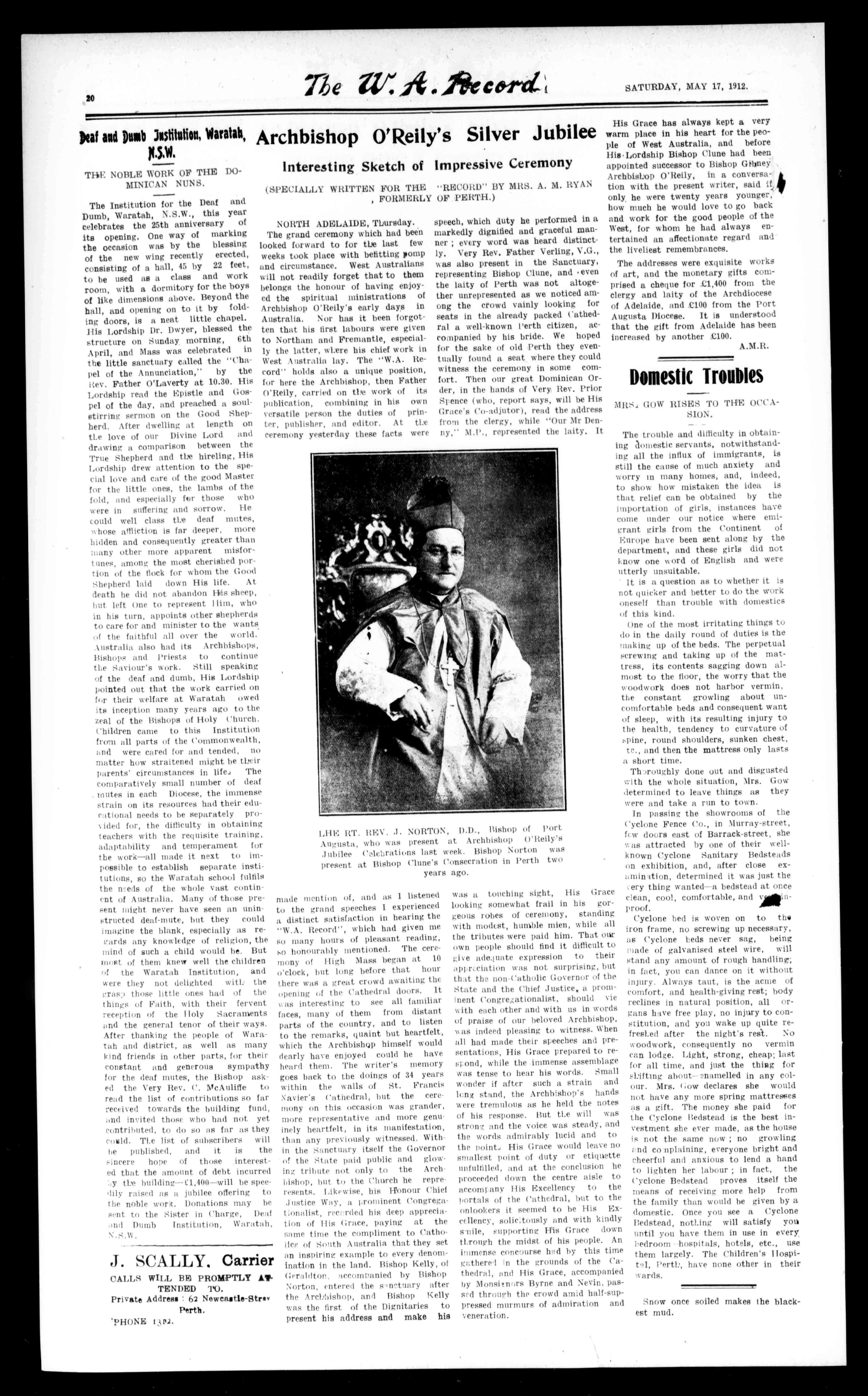
ArchbishopO'Reily'sSilverJubilee InterestingSketchofImpressiveCeremony (SPECIALLYWRITTENFORTHE"RECORD"BYMRS.A.M.RYAN FORMERLYOFPERTH.)
TheInstitutionfortheDeafand Dumb,Waratah,N.S.W.,thisyear celebratesthe25thanniversaryof itsopening.Onewayofmarking theoccasionwasbytheblessing ofthenewwingrecentlyerected, consistingofahall,45by22feet, tobeusedasaclassandwork room,withadormitoryfortheboys oflikedimensionsabove.Beyondthe hall,andopeningontoitbyfoldingdoors,isaneatlittlechapel. HisLordshipDr.Dwyer,blessedthe structureonSunday.morning,6th April,andMasswascelebratedin thelittlesanctuarycalledthe"ChapeloftheAnnunciation,"bythe Rev.FatherO'Lavertyat10.30.His LordshipreadtheEpistleandGospeloftheday,andpreachedasoulstirringsermonontheGoodShepherd.Afterdwellingatlengthon tLeloveofourDivineLordand drawingacomparisonbetweenthe TrueShepherdandthehireling,His LordshipdrewattentiontothespecialloveandcareofthegoodMaster forthelittleones,thelambsofthe fold,andespeciallyfarthosewho wereinsufferingandsorrow.He couldwellclassthedeafmutes, whoseafflictionisfardeeper,more biddenandconsequentlygreaterthan manyotherinureapparentmisfortones,amongthemostcherishedportionoftheflockforwhomtheGood ShepherdlaiddownHislife.At deathhedidnotabandonMssheep, hutleftOnetorepresentMtn,who inhisturn,appointsothershepherds tocareforandministertothewants ..fthefaithfulallovertheworld. AustraliaalsohaditsArchbishops, Bishopsandl'rieststocontinue theSaviour'swork.Stillspeaking ofthedeafanddumb,HisLordship pointedoutthattheworkcarriedon fortheirwelfareatWaratahowed itsinceptionmanyyearsagotothe zealoftheBishopsofHolyChurch. ChildrencametothisInstitution fromallpartsoftheCommonwealth, andwerecaredforandtended,no matterhowstraitenedmightbetheir parents'circumstancesinlife,The comparativelysmallnumberofdeaf mutesineachDiocese,theimmense strainonitsresourcesbadtheireducationalneedstobeseparatelyprosidedfor,thedifficultyinobtaining teacherswiththerequisitetraining, adaptabilityandtemperamentfor thework-allmadeitnexttoimpossibletoestablishseparateinstitutions,sotheWaratahschoolfulfils thewedsofthewholevastcontinentofAustralia.Manyofthosepresentmightneverhaveseenanuninstructeddeaf-mute,buttheycould imaginetheblank,especiallyasregardsanyknowledgeofreligion,the mindofsuchachildwouldhe.But mostofthemknewwellthechildren oftheWaratahInstitution,and weretheynotdelightedwiththe gras:ithoselittleoneshadofthe thingsofFaith,withtheirfervent receptionoftheHolySacraments andthegeneraltenoroftheirways. AfterthankingthepeopleofWaratahanddistrict,aswellasmany kindfriendsinotherparts,fortheir constantandgeneroussympathy forthedeafmutes,theBishopaskedtheVeryRev.C.McAuliffeto readthelistofcontributionssofar receivedtowardsthebuildingfund, i.ndinvitedthosewhohadnotyet contributed,todosoasfarasthey could.TLelistofsubscriberswill hepublished,anditisthe sincerehopeofthoseinterestedthattheamountofdebtincurred :aythebuilding-C1,400-willbespeedilyraisedasajubileeofferingto thenoblewore.Donationsmaybe senttotheSisterin('barge,Deaf AidDumbInstitution,Waratah, N.S-w'
NORTHADELAIDE,Thursday.
Thegrandceremonywhichhadbeen lookedforwardtoforthelastfew weekstookplacewithbefittingpomp andcircumstance,WestAustralians willnotreadilyforgetthattothem belongsthehonourofhavingenjoyedthespiritualministrationsof ArchbishopO'Reily'searlydaysin Australia.Norhasitbeenforgottenthathisfirstlaboursweregiven toNorthamantiFremantle,especiallythelatter,wherehischiefworkin WestAustralialay.The"W.A.Record"holdsalsoauniqueposition, forheretheArchbishop,thenFather O'Reily,carriedontheworkofits publication,combininginhisown versatilepersonthedutiesofprinter,publisher,andeditor.Atthe ceremonyyesterdaythesefactswere
speech,whichdutyheperformedina markedlydignifiedandgracefulmanner;everywordwashearddistinctly.VeryRev.FatherVerling,V.G., wasalsopresentintheSanctuary, representingBishop('lune,andeven thelaityofPerthwasnotaltogetherunrepresentedaswenoticedamongthecrowdvainlylookingfor seatsinthealreadypackedCathedralawell-knownPerthcitizen,accompaniedbyhisbride.Wehoped forthesakeofoldPerththeyeventuallyfoundaseatwheretheycould witnesstheceremonyinsomecomfort.ThenourgreatDominicanOrder,inthehandsofVeryRev.Prior Spence(who,reportsays,willbeHis Grace's('o-adjutor),readtheaddress fromtheclergy,while"OurMrDenny,"M.P.,representedthelaity.It
HisGracehasalwayskeptavery warmplaceinhisheartforthepeopleofWestAustralia,andbefore HisLordshipBishop('lunehadbeen appointedsuccessortoBishopGibney ArchbishopO'Deily,inaconversationwiththepresentwriter,saidit. only,heweretwentyyearsyounger, howmuchhewouldlovetogoback andworkforthegoodpeopleofthe West,forwhomhehadalwaysentertainedanaffectionateregardand theliveliestremembrances.
Theaddresseswereexquisiteworks ofart,andthemonetarygiftscomprisedachequefor£1,400fromthe clergyandlaityoftheArchdiocese ofAdelaide,and0100fromthePort AugustaDiocese.Itisunderstood thatthegiftfromAdelaidehasbeen increasedbyanother£100. A.M.R.
Domesticironies
MRS.,(KMRISESTOTHEOCCASION.
-Thetroubleanddifficultyinobtainingdomesticservants,notwithstandingalltheinfluxofimmigrants,is stillthecauseofmuchanxietyand worryinmanyhomes,and,indeed, toshowhowmistakentheideais thatreliefcanbeobtainedbythe importationofgirls,instanceshave comeunderournoticewhereemigrantgirlsfromtheContinentof Europehavebeensentalongbythe department,andthesegirlsdidnot knowonewordofEnglishandwere utterlyunsuitable.
Itisaquestionastowhetheritis notquickerandbettertodothework oneselfthantroublewithdomestics ofthiskind.
Oneofthemostirritatingthingsto dointhedailyroundofdutiesisthe !miltingupofthebeds.Theperpetual screwingandtakingupofthemattress,itscontentssaggingdownalmosttothefloor,theworrythatthe woodworkdoesnotharborvermin, theconstantgrowlingaboutuncomfortablebedsandconsequentwant ofsleep,withitsresultinginjuryto thehealth,tendencytocurvatureof spine,roundshoulders,sunkenchest, te.,andthenthemattressonlylasts ashorttime.
Thiroughlydoneoutanddisgusted withthewholesituation,Mrs.Gow determinedtoleavethingsasthey wereandtakearuntotown.
J.SCALLY,Carrier
CALLSWILLBEPROMPTLYAT-
TENDED PrivateAddress62Newcastle-Strev Perth. 'PHONE13e2.
madementionof,andasIlistened tothegrandspeechesIexperienced adistinctsatisfactioninhearingthe "W.A.Record",whichhadgivenme somanyhoursofpleasantreading, t.ohonourablymentioned.TheceremonyofHighMassbeganat10 o'clock,butlongbeforethathour therewasagreatcrowdawaitingthe openingoftheCathedraldoors.It asinterestingtoseeallfamiliar faces,manyofthemfromdistant partsofthecountry,andtolisten totheremarks,quaintbutheartfelt, whichtheArehbisheiphimselfwould dearlyhaveenjoyedcouldhehave heardthem.Thewriter'smemory goesbacktothedoingsof34years withinthewallsofSt.Francis Xavier'sCathedral,buttheceremonyonthisoccasionwasgrander, morerepresentativeandmoregenuinelyheartfelt,initsmanifestation, thananypreviouslywitnessed.WithintheSanctuaryitselftheGovernor oftheStatepaidpublicandglowingtributenotonlytotheArchbishop,buttotheChurchherepreresents.Likewise,hisHonourChief JusticeWay,aprominentCongregationalist,reccriledhisdeepappreciationofHisGrace,payingatthe sametimethecomplimenttoCatholicsofSouthAustraliathattheyset aninspiringexampletoeverydenominationintheland.BishopKelly,of Geralitton,accompaniedbyBishop Norton,enteredthevnetuaryafter theArchbishop,andBishopKelly wasthefirstoftheDignitariesto presenthisaddressandmakehis
wasatouchingsight,HisGrace lookingsomewhatfrailinhisgorgeousrobesofceremony,standing withmodest,humblemien,whileall thetributeswerepaidhim.Thatour ownpeopleshouldfinditdifficultto giveadeoutteexpressiontotheir appreciationwitsnotsurprising,but thatthenon-CatholicGovernorofthe StateandtheChiefJustice.aprominentCongreAationalist,shouldvie witheachotherandwithusinwords ofpraiseofourbelovedArchbishop, aasindeedpleasingtowitness.When allhadmadetheirspeechesandpresentations,HisGracepreparedtorespond,whiletheimmenseassemblage wastensetohearhiswords.Small wonderifaftersuchastrainand longstand,theArchbishop'shands weretremulousasheheldthenotes ofhisresponse.Butti.ewillwas stronzandthevoicewassteady,and thewordsadmirablylucidandto thepoint,HisGracewouldleaveno smallestpointofdutyoretiquette unfulfilled,andattheconclusionhe proceededdownthecentreaisleto accomianyHisExcellencytothe portalsoftheCathedral,buttothe onlookersitseemedtoheHisExcellency,solic:touslyandwithkindly s-nile,supportingMsGracedown throughthemidstofhispeople.An immenseconcoursehadbythistime giltherelinthegroundsoftheCathedral,andHisGrace,accompanied byMonsiensarsByrneandNevin,passedthroughthecrowdamidhalf-suppressedmurmursofadmirationand veneration.
Inpassingtheshowroomsofthe CycloneFenceCo.,inhurray-street, fewdoorseastofBarrack-street,she wasattractedbyoneoftheirwellknownCycloneSanitaryBedsteads onexhibition,and,aftercloseexamination,determineditwasjustthe crythingwanted-abedsteadatonce clean,cool,comfortable,andArn_ proof.
Cyclonebediswovenontothe ironframe,nuscrewingupnecessary, asCyclonebedsneversmug, being !ladeofgalvanisedsteelwire,will standanyamountofroughhandling; infact,youcandanceonitwithout injury.Alwaystaut,istheacuteof comfort,andhealth-givingrest;body reclinesinnaturalposition,allorganshavefreeplay,noinjurytoconstitution,andyouwakeupquiterefreshedafterthenight'srest.No woodwork,consequentlynovermin canlodge.Light,strong,cheap;last foralltime,andjustthethingfor shiftingabout-e.namelledinanycolour.Mrs.tiowdeclaresshewould nothaveanymorespringmattresses agift.Themoneyshepaidfor theCycloneBedsteadisthebestinvestmentsheevermade,asthehouse isnotthesamenownogrowling t.ndconplaining,everyonebrightand cheerfulandanxioustolendahand tolightenherlabourinfact,the CycloneBedsteadprovesitselfthe meansofreceivingmorehelpfrom thefamilythanwouldhegivenbya domestic.OnceyouseeaCyclone Bedstead,nothingwillsatisfyyou untilyouhavetheminuseinevery bedroomhospitals,hotels,etc.,use themlargely.TheChildren'sIlosPital,Perth,havenoneotherintheir wards.
Snowoncesoiledmakestheblackestmud.
20 TheW:Alf cord SATURDAY,MAY17,1912. ....1
LHERT.REV..1.NORTON,D.D.,BishopofPort Augusta,whowaspresentatArchbishopG'Iteily's JubileeCelebrationslastweek.BishopNortonwas presentatBishop('lane'sConsecrationinPerthtwo yearsago.
PHILIPCOYLE
WholesaleWineandSpiritMerchant
Moir'sChambers,Perth
SoleAgentsfor
W.&A.Gilbey'sWinesandSpirits
HansIrvine'sWinesandBrandies
AyalaChampagne
ApollinarisTableWaters
Gordon'sSpanishSherry
GlenorauNo.10Whisky
Stormontb,Tait&Co,Port
JamesWatson'sXXXWhisky
E.&J.Burke'sAleandStout
GonzalezByass&Co.'sPort
MarieBrizardandRoger'sBrandies andLiqueurs
KitzSparklingAppleCider
Kupper'sLagerBeer
Cawsey'sSquashandCordials
Ind,CoopeCo.'sEnglishAle
CalixtoLopez&Co.'sHavanaCigars
SirJohnPower&SonPotStillWhisky
M.Marceau&Co.,FrenchWines,Bordeaux
HansIrvine'sChablis,anExcellentAltarwine
StocksofAssortedLiqueursalwaysonhand
AllegedAmoy
THEBRIGHTBOY.
Anenterprisingsuperintendentwas engagedoneSundayincatechising theSundayschoolpupils,varying theusualmethodbybeginningat theendoftheCatechism.
AfteraskingwhatweretheprerequisitesforConfirmation,andreceivingsatisfactoryreplies,heasked:
"Andnow,boys,tellmewhatmust precedeBaptism?"
"Ababy,sir!"shoutedoutalively.irchin.
UNDRESSINGTHEM.
Alittleslumchildwasenjoyinghis hrglimpseofpastorallife.Thesettio nneatsgildingthegrassand rosesbitheold-fashionedgarden,and onalittlestoolhesatbesidethe farmer'swife,whowaspluckinga Chicken.
Hewatchedtheoperationgravely forsometime.Thenhespoke:---
"Doyertakeofftheirclotheseverynight,lady?"
USINGTHEBOUNDARYMARK.
"PooroldAlf,"sighedMrs.Crimp, astheformofherhusbandvanished downtheroad."He'sgrowin'shoekin'bald!"
"Yes,I'venoticedit,"assentedher neighbour."Eversincehislastillnesshe'sbeennioultin',asyoumight say.Ihopeheain'tworryingover it,Mrs.Crimp."
"Well,itdobotherhimabit,"she admitted.
"Andwellitmight,"saidher neighbour."Whenmyoldmanlost hishairhefeltthecoldsomethin' terrible."
"Oh,itain'tthecoldthatworriesAlf,"repliedMrs.Crimp,"it's thebotherhehaswhenhe'swashin' himself.Ifhedoesn'tkeephishat on,poorchap,hecarn'ttellwhere hisfacefinishes!"
ASAFEOFFER.
Hehadnoloveforhiswife'spet dog-neitherbadanyoneelsefor thatmatter,excepthiswife.Yet,
whenitmysteriouslydisappearedone day,heoffered£25rewardforits recovery."ButIthought,"said Tomkinstotheadvertiser,"youhatedthatdoglikepoison?"
"Idid."
"Whyonearth,then,doyouoffer suchabigrewardforitsreturn?"
"Iliketopleasemywife."
"Well,thatmaybe;butthatrewardissuretobringthedogback!"
"Ithinknot,"saidtheother,with aknowingsmile,"thatis,unless someonesawmeburyitinthegarden!"
ASUSUAL.
Ayoungwomanwhowasverystout andwhoardentlylongedforaslim, willowyfigure,finallydecidedtoconsultaphysician,thinkinghecould assistherinreducingheravoirdupois. Thephysiciandrewupacareful dietaryshewastoeattoast,boiledbeeftea,etc.,andtoreturnina monthandreportreduction.Atthe endofthemonthshereturned,and couldhardlygetthroughthedoctor'sdoorwkay.Helookedatherin graveastonishment."Didyoueat whatItoldyou?"
"Yes,Idid,religiously,"shereplied,pantingforbreathfromthe exertionofmountingthestairs.
Hemeditated,withawrinkled brow,SuddenlyheBudaflashofinspiration.
"Anythingelse?"heasked.
"Myordinarymeals,"shereplied, calmly,seatingherselfmorecomfortablyinthelargearm-chair.
BOTH('ORRE('T.
ADetroitwomanwhoteachesa missionclassofboyswasexplaining tothemonedaythepeculiaritiesof EnglishBridling.Shecalledattentiontothedifferencebetweenlead themetalandleadtheverb,andthe childrengraspedthepointinstantly. Thenshetookthetwowordsweak andweek.Sheexplainedthedifferenceinthemeaningandusetothe tots,thencalledupIsraelSugenheimer,agedfive,tousetheword
"weak"inaphrase.Thelittlefellowthoughtamoment,thenanswered"Aweakoldwoman."Theteachernoddedherapprovalandsmiled intotheeyesupturnedtohers."Now JerryRyan,"shesaid,turningto anotherlittleboy,"youtakethe word'week'anduseitinaphrase." Jerrythoughtaminute,andthen he,too,replied"Aweekoldbaby."
ANOTHERRELATIVE.
Theconductorofawesternfreighttrainsawatrampstealingarideon oneoftheforwardcars.Hetolda brakemaninthecaboosetogoup andputthemanoffatthefirststop.
Whenthebrakemanapproachedthe tramp,thelatterwavedabigrevolverandtoldhimtogetaway.
"Didyougetridofhint?"theconductoraskedwhenthetrainwasundermotionagain.
"Ihadn'ttheheart,"wasthereply."Heturnedouttobeanold schoolfriendofmine."
"I'lltakecareofhim,"saidthe conductorashestartedoverthetops ofthecars.
Whenthetrainhadagainstarted thebrakemancameandsaid"Well, isheoff?"
"No,heturnedouttobeanold schoolfriendofmine,too!"replied theconductor.
AHINTTOTHEENGLISHMEN.
AtthebattleofTrafalgartwo Scots,mesamatesandcroniesfrom thesamevillage,happenedtobestationedneareachotherwhenthecelebratedsignalwasdisplayedfromthe Admiral'sship.
"Looktipandread,Jock,"said onetotheother."'Englandexpects everymantodohisduty'-not wordforpuirauldScotland!"
.Jockcockedhiseyeattheflags, andturnedtohiscrony."Man,Geordie,isthata'yoursense?"he'asked,"Scotlandkenswellenoughthat herbairnswilldotheirduty;that's justahinttotheEnglishmen."
ADVRWNSEIN
TheW.A.Record
AccidentsWillHappen BUTCHERGASHESHISFINGERS.
-ZAM-BUKRECOMMENDEDBY CHEMISTEFFECTSGRAND CURE.
"Myhusbandisabutcher,andone daywhilecuttingacarcasetheknife slipped,inflictingaterriblecutacross thefourlingersofhislefthand," saysMrs.AliceAmos,10,Arthurstreet,Granville,Sydney."Inflammationsetinthewound,which eventuallyturnedtoblood-poisoning. Theinflammationextendedrightup totheelbow,andtheonly,wayhe couldgeteasewastoholdhisarm LIP.liecouldnotgetmuchrestat nightthroughthethrobbingpain.One nighthewascompelledtoleavea placeofamusementandgohome,becausethepainwassounbearable.
"Inavainendeavourtogetrelief hetriedallsortsofremediesand oils,butnothingdidhimanygood.
"Achemistadvisedhimtouse Zam-Bukbedidso,andappliedit frequentlythatnight.Theinflammationhadsubsidedbymorning,and thepainwasmucheasier.ByperseverancewithZam-Bukallbadmatterwasdrawnoutofthewound, andsoonhishandwashealedup."
Zam-Bukendseczema,piles,ringworm,badlegs,ankles,festering wounds,anningsores,scratches. bites,cuts,burns,bruisesandother skintroubles.Soldbyallchemists andstoresat1/6perpot(orlarge sizecontainingnearly4timesthe quantity),3/6.Apotshouldalways hekepthandyinthehome,workshop andonthesheeprunorcattlestation.
IfyoucannotsecureZam-Bukfrom yourlocalStore,wewillsenddirect, postpaid,onreceiptofpostalnote forI/6smallsize,or3/6largesize.
AddressTheZane-BukManufacturingCo.,39Pitt-street,Sydney.
HOME,91JewellStreet,Beat Perth.Superioraccommodationdueineaceoacbettient.Moderate.
sATI'IMAY,N1.11'17,1912. ne Record. IL Telephone285,Office1558BondedStores,RailwayStreet,WestPerth
NURSE
Professional
BEENE'SMATERNITY
HowTomDillonBecameaZouave
AStoryoftheCountyCork
By"BRIGID,"in"YoungIreland"
(Continued.)
"Well,itwantedacoupleof monthsoftheyearallout,"said Tom,"butIknewthepoorthing wastossicatedinhermind,soI didn'tbotherheraboutthemistake shewasmaking;hutseeI
"
'Indeed,then,itis,an'why ouldn'tI?I'msurehe'sasdead nowaseverhe'llbe,an'tisn'tby yourselfyou'dstopalways,an'you, Imaysay,inthebeginnin'ofyour days.'
"
'You'reverysensible,Ithink,' seeshe.
"'Well,nobodycouldlayittomy chargethat1evertuckabiteoutof astonewallyet,'seaI,'anyway.'
"'PoorPatputnobushinthe gaponmewhenhewasgoing,'see she.'Ofcoorse-an'whynot?-he cutouttheirownshareforhischildher,an'they'dhenoincumberance toanyonethatwouldcomeover'em; butthishouseismine,an'I'mdoingrapidwellinit.Theshopis wellstocked,'shewenton,and 1 havefourfinefeatherbeds,an'bed clothesaccording,fitforanyoneto liein,an'halfadozenralesilver spoons,an'agreatdaleofother valuean'ifIhaven'tthreeorfour goodpigsintheyarditisn'tinthe wantofthepriceof'em,butinthe wantofamanabletobuyandsell, an'takeanintherestinthebusiness.So(if1couldthinkofthelike atall)itisintoasnugnesthe'd hecoiningthatwouldbecomingin tome.'
"Well,ofcoorse,thedickenswas busywithmyselfasusual,"said Tom,"an'sonothingwoulddome buttolookeveracrassathertoo, 'cryserious,an'say
"
'HowdoyouknowbutI'mlookingoutforawifemyself,Ors.Maerath?An'Iamlookingoutfor tine:sesI,'an'tistoyouthatI'm tellingiti
"'Whyshouldyoubetellingitto meinparticular,Toni?'seeshe, lookingveryinnocentallofasudden'mylittlegirlistooyoungall eatforyou.You'dhavetowait toolongforher.Shewasonlyfour yearswildaweekortwoago.'
"
'an'1findmyselfthere'snothinglike theshopan'indeed,asIsaidbefore,I'mdoingrapidwellinit,an' rilltheneighbourslovean'likeme, en'I'mnotafeardoftheworld-not ahitofit-onlythat1getdownheartedsometimeswhenIthinkwhat alonewidowIam,withoutthe man'shelpabouttheplacethatI wasusedto.'
"'Whatelsewouldtheneighbours dobutlovean'likeyou?'seaI. 'They'dhequareiftheydidn't.An' youwon'tbelongwithoutthehelp either-that'sifyouliketotakeitonlyI'llsaynomorenow,asIpromisedmaymotherwhatItouldyou.'
"Well,latherthat,Idunnomuch howthetalkwent,orwhetherImovedovertothewidow,orthe widowmovedhethertome,orthe twostoolscometogetherofthemselvesbutbythetimethepunch wasfinishedIfoundmyselfwithmy armroundMrs.Magrath'swaist,en' shelookingupatmetellingmehow lonesomeshewas,especiallywhen shewasgoingtoshetup,without anyoneshecouldopenhermindto, orturnthekeyinthedoorean' whatagreatlookshethoughtIhad ofpoorl'ataboutthemoosetaychies.
''Well,Ipitiedthepoorthingso muchthatIstoppedwithherconsolingher,ontilthelastminuteof keepingepen,an'"--
"Whataboutthetire-shovel,Tom?" inquiredlineofhisfriendsblandly.
wellattinded-therewasapowerof peoplethereentirely,:
"'Oh!Isupposeso,'seaI,quite careless.
"'Yes,indeed,'seeshe,'an'there woraBailofmatchesspokenof therean'indeed,Tom,oneortwo oftheneighbourswortalkingtomyselfan'yourfatheraboutyoutoo,'
"'Oh!we'recomingtoitnow,' seeItomyself;butIsaidtomy mother
"'Yeh!whathadtheytosayaboutme?Ineverintherferewithanyone'sbusinesshutmyownan'can't theyletmepass?'
"
'Well,indeedtheyhadnothing hadtosayofyoueither,'seashe, 'an'iftheyhadatself,Isuppose 'tisn'ttoyourownfatheran'motherthey'dcometosayit;butwhen allthematchmakingwasgoingonI begintothinkwhattheysaidwas three-thatyououghttoheonthe look-outaswellastherestnow,'
"WelI"saidTom,"whenIheard mymotherinthroducin'thetalkaboutmirtchniakin',Istoppedandconsidheredmyselfforaminit,an'then Ithoughtmaybe'twasn'tabadopporthunity."
"Opportunityforwhat,Tom?"askedoneofhisfriends, "Forconsultingmymother-what else?"repliedTom."Whatcouldhe morenathural?So,sesItoher, 'Why,don,maybe'you'reright,mother,'seaI'forthoughyoulookas Youngun'handsomea'mostitsever youdid,still,asyouhavenodaughtherofyourown,'seeI,'itmightn't Ireanyharmtobeonthelook-out forsomenicesweet-temperedgirl aboutseventeenorsothatyoucould taichhowtofallintoyourown ways'"-
"Andthatwouldhavebrowneyes, andasunbeamortwoastrayamonghercurls,ehToni?'saidoneof hiscomrades.
neverthrottledhisheadonewayor anotheraboutthebusiness,only whatevermymotherputhimupto aboutit;hewastoofairan'aisygoingforthat;but'twouldntdo tosayso,an'soImadearsaer verysimple 4 '"WhathaveItosayaboetit mother?SureIwasn'tthereat ,,a toknowwhatwasgoingon.'
"'Well,Dinissaid,'sesmymother,'thatweworouldneighbours always,andthatMisthisst'onnor couldgiveherdaughtherahundred pounddownonthenail,besidesa fairshareofstockan'othervalue; an'bedad,Tom,'sesmymother, veryconfidentiallike;"twouldbe veryaisyforyoutogofartherand fareworse.'
"'Well,youknowbest,mother,of coorse,'seeI'an'indeedtohave youforitiseverything; butyou knowwellhowshyIam,an'thatI knownothingatallaboutcoorting orwhatsumevertheycallit.'
"
'Well,indeed,Toni,youwor neverforwardthatway,'seamymother,'buttwoultibeasheepish thingnow,an'yougoingforyour threean'twinty,nottoknowhow topassajokewithayoungwoman whinyou'dfallintocompanywith her.'
"'Ah!yes,seaI;an'Ifeltitall,' addedTomsentimentally,"but youknowwell,mother,thatmarriageisnojoke. SureI'mtorrid, evenif'twat,thewaythatitturned outconthraryatself,thatyou'dhave tosticktoyourbargainallthrough, whetheryoulikeitornot;forthat, wansthetiedthesthring,alltheart ofFatherMacCarthyhimselfcouldn't loosenit!'
"
'Idon'twantyourdaughther, PeggyMigrant,'srsI,veryoffended like'avshewastwentyyearould don'twantyourditughther 'tis thewomanoftheexperienceall'the natelegan'footI'dliketobetalkingto,'ses Maybe.t.WOn'tbe longbeforeIwillhetalkingtoher henshelutistexpectsit.' MPSthewidow,laughing overatrite,'I'dliketotrymyhand itmatchmakingagain..I'dwantto imowthewaysofitforlittleKitty, sin'ifitisanywomanIknowyou mane,outwithit.There:snotime, theysay,likethepresent.'
'"No,l'eggy,'seeI,veryearners again-'no,PeggyMagrath, say nomorenow,untilTTepaikfirst tothewildpeople;forIpromised ,nymothersolemnthatTi!'laveher knowofittwenty-fourhoursatthe lutistbeforeI'daskanywomanti marryme,heshewhoshemay.'
"'Well,'tisright,ofcoorse,Tom,' Fesshe,'thatyou'dbesaidan'led t,yyourparents,aslongasthey wouldn'tbetooonraisonable,which isoftenthecasean',begor,ifitis datigl.ter-in-lawthey'dbewantine youtobringinuponthethireto 'ern,ascivilasthey'dbeinthebe;Alining,maybeyou'dsoonknowthat yourownhousewouldbethebest foryouofcorirmeTmanewiththe fallinrinofthefarmtoyou,whin they'dliegone,tohackit.'
"'That'stheverythingIwas thinkingofmyself,too,'sesi.
"'You'reenfarright,'seethe,
"Yehsurewedidn'twantit,''reW(]Torn,withhismostartlessexpression."Whatwouldwewantputting;downlire'atthattimeofnight, an'goingaway?lintItimidher againthatIwouldn'thephasedif she'dbealwaysgrievingaboutpoor !rat,huttokeepuphersperitsontil she'dseemeagain,whichwouldhe soonan'thenIsteppedoutinairnestforhome,withoutanymoredelay.
"Well,theyusedneverhewaiting upformewhenIwentin.continuedTom"forthesrirvintboyslept inthesettleinthekitchen,sothe /Moreissattoheleftupontl.elatch, ,in'thecandleonthe,levy,theway Iiambilightitmyself,an'boultthe diire,en'gotobedwithoutdisturb inganyone.hilt,begor,thisnight, whenIdhrewrinearthehouse,what shwildI14el.1,111,atlightinthewindyan'whenIwentin,sureenottell thesarvintboywassoundasleep aftherhisdayhut,insteadofbeing !hesame:'.ayinherownnest,lily motherwitssittingailalonebythe ;;re,an'shenoddingoverherbald, the',eel.woman.
" ! isitthereIhaveyou,mother"l4(14I.'What'sthematther?Ts itanythingailsmyfather?'
"'Ohwishes,neverwelcomeyou, Tom,'sesshe,rousingupwhenI spoke;'howlateyondobeout, whereverwindohe!No;there'snothin.;ailsyourfather,thankGod! onlyIcomedowntosettlethetirePlacewhenconwasinbed,andthen Isatherefromminittoininittill yoilCOMP.'
"'Tiedad,there'smorethanthatin it,'RaysIinorownmind,'whateveritisbutifitisanyoneelse ntstomarrymeerr-nightI'min iltireadI'llneverbeabletostand it.'
"However,Ilitthepipe,an'seeI outleold
"'I'lltakeiismoke,mother,before totoh'dbutsureyouneedn't waitforMe.Isupposeyou'retired, iin'youatthemarketto-day.'
"Why,then,no,Tom,'seeshe; 'I'mnottiredatall,althoughTstirredaboutagood 'Twasvery
leeTompassedovertheremarkin silence,andrepeated ""filialhowtofallintoyour ownways,andnotbemisthissbeforehertimeoveryouinyourown house.'
"'Oh,ed I'mnotafeardofthat atall,'seamymother,settlingherselfonthestoolan'throwinganothersodonthetire,whileI'm thereI'mthere,an'whinI'mgone, ofcoorse,everythingwillhetattier tileforhertohave,wi.oevershe'll 1,e;butI'mtootumidnowtohavea iniethissoveralefortheremaindher ofmydays.'
"'Well,thit'stheverything1 meantwhinispoke,'sesI'tohave aniceyarncrititurethatyou'd have!ovinenitwityou,!Mtastager thateotldbemoreuptoeverythinethanyourselfforI'dbesorry toliethe'cisionofanythroubleto yo sesi.'orMirawinganylistiirl.ancinthefamily.'
"'Isuppose!waneofuswouldlike tohaveatstagercurseinantique.1s,' Resormother,makinganswer; the:Ail I. inmyetcfur mistager,butatine'Polyy,,L1n.: 1.an,aq.atreathandentire'y ..t milkan'htitther.'
"Well,'tweethefirsttime:-said Torn,"thatmymothershowedany wishformetogetmarried,soI thought'twouldhebettherforme tohumourherinit,an'laiveher getusedtothenotionofit,vn' thatafterwardsIcouldslipinthe rightdaughther-in-lawwhinthe timeit conicsoseeIto1..er
"'Yehmother,'seaI.'whoisslv, atallthat'stakingthelikingto me,an'Isoyoungrindyouthfulan' tindherlymired"
"[Aireoffyourthricks,youschamint,thiefoftheworld,'seemy,tio. ther, 1lughing; nutsayingthe girltackanylikinetoyou;but,to makeitPlaintoyou,'twasDinis Shinean'aproperhonestman ;s thatinthroduccdametchto-dayto yourfatheran'myself.betweenyou an'hisniece,theWidowConaer's daughther;an'yourfathercottoned atwansttoit,andbedmetoepaik toyouaboutitan'seewbetyou'd say.'
"Well,Iknewinmyheart,"remarkedTom,"thatmypoorfather
'Yeh!don'tbetalkinglikeafool thatway,child,'seamymother.Ah, there'snoonelikethemotherfor undherstandingthesoartyouare," putinTomparenthetically."'I'll setthethinggoingforyou,'sesshe, 'an'you'llsoongetintothewaysof it.Besides,sureyouknowNell,' Connoralways.IoftenseeyounoddingyourheadtoherinthechapelyardofaSunday.'
(Tobecontinued.)
BurnettBros.
ArealsoIRONMONGERS,andsell everydescriptionofBuilders',HouseholdandGeneralIronmongery,Farm andGardenRequisites,LawnMowers,TrellisWork,TooleSanitary Ware,Artists'MaterialsPlainan, FancyGlass,Artisticandwell-selectedWallPaPeringsspeciallydeelgeedMantelpiecesinSolidOak,Terreb endKam.'Grateswithhandsome sidepanels,uniquelyblendedTiled Hearehs,Cutlery,M.P.Ware,Brushware,etc.Countryinquiriespromptlyrepliesto.
12 7be Record: SATURDAY,MAY17,1912,
OURSTORY
AsaPepstabletdissolves okinthemouth,apowerful3 {Viimedicineisbrestheddirectly .;intothelungs.Thisnovel remedysoothesinflamma;F:1 teeminthethroat,loosens phleern,destroysgerms, makesbreathingeasy,re-01! naivesthecauseofcoughing,LI; andpromptlybanishesallti" chestsoreness1,6a3perbox.IfyoucannotsecurePepsfrom yourlocalStore,wewillsenddirect, Postpaid,onreceiptofpostalnote for1/6smallsize,or3/largesize. AddressThePepsPastilleCo..39 Pitt-street,Sydney. PrintedandnutiliehedforthePishopandclergyoftheDioceseofPerthbyThomasSlattery,attheiroffiee,23MurrayStreet,yerth.Rev.P. Lynch,EditorandManager. lits144,4V(et /7,