
No.5.
6eneitalSleanings.
MARSHALBAZAINE'SESCAPEFROM SANITEMARGUERITE.
Theeiretimetancesoftheescapeare nnquestionablyremarkable.Every- thingappearstohavebeenplannedsix weeksago,andwiththeutmostdeliberation.ColonelVillette,thefaithful aide-de-camp,andMadameDazaine, theMarshal'sWife,wereseeminglythe soleconspirators.Rememberingthat MarshalBimineisoversixtyyearsof age,andexceedinglycorpulent,itis, withoutdoubt,extraordinarythathe shouldhavebeenabletodescend,hand underhand,bymeansofaknottedrope, fromtheoverhangingterraceimmediatelybelowhiswindon,perpendicularly, onehundredfeettothesea,whichwas thenboilingandchafingtempestuously ontherocksbeneath.Athalf-pastfive o'clockoatheMondaymorningthe prisonerwasobservedbyacoupleof soldiersontheterracebelowhisapartments.Directlyafterwards,thesentinel whohadchargeofthatterracehaving beenrelievedatdaybrsa.k,theMarshal musthaveaccomplishsdafeatnotunworthyofBlondinatNiagara.The knottedropeafterwardsfounddangling fromthecliffprovedtobeblood-stained. Anopenboat,hiredfortheoccasion waslyinginwaittherefortheescapingprisoner,andseemstohave lived,inthestormysurf,bylittleless thanamiracle.MadameBazaineherselfieseswedtheboatuntilsheandher hushaudwerepickedupbyapassing vessel,anItaliansteamyachtthe "Baronllicasoli."Asintheromantic historicalinstanceofLavalette,the wholeschemeoftheescapeseemsto havebeenplannedandpersonallycarriedoutbythedauntlesswifeofthe prisoner.Initscombinationofthe terribleandridiculous,thishair-breadth escapefromaprecipice,overhanginga boisteroussea,onarockycoast,would seemsobeonlycapableofadequateillustrationinthepagesofthePolice News,orthroughtheclosingsceucsof atranspominemelodrama.
DONCARLOS.
AninterviewbetweenDonCarlos andtheNewYorkHerald'scorrespondenthas,duringthislastweek,been goingtheroundofthenewspapers.It isreadwilhreluctancebythefoesof Legitimacy.CharlesVII.ofSpain, accordingtothistranslanticreporter's accountofhim,isutterlyunlikethe impossiblemonsterhehasbeendepicted byhissystematictraducers.Thewelcomeaccordedbyhismajestytothe travellingnewspapercorrespondentmay seemstrangetosomeaftertheincident ofCaptainSchmidt'smilitaryexecution, butthen,astothat,DonCarlos'sexplanationissimply-"CaptainSchmidt wasarrestedunderverysuspiciouscircumstances,ustriedbyacourtmartial,foundgisty,andexecutnedasa spy. eve less,I.egretexceedingly thatmyorderstosavehislifeincommonwiththeothers,arrivedtoolate." Addressinghimselftotherepresentative ofAmericanjournalism,bywhomhe wasthenbeinginterviewild,theKing expressedhispleasureattheadventof soimpartialanobserver."Ourcause issogood,"hesaid,"thatwedonot fearthelightofday.Thefalsenews spreadbyourenemiesisbothaudacious andpersistent,andtheypossessthe meansofgivingitpublicitythroughthe varioustelegraphicagencies.Weare buttoogladtohavehonestjournalists withus,sothattheymaygatherevidencetoshowtheabsurdityofthe storiesfloatinginregardtoCarlist
SUBIACO,FRIDAY,NOVEMBER6,1874.
atrocities.'Wehavenotatourdisposal themeansofmakingknownthetrue stateofthings,whileourenemies,by reiteration,wouldintheendmakethe worldbelievethatwearereallythe monsterstheydesiretorepresentus." QuestionedastotheprobabilityofGermanintervention,DonCarlosdisdained thenotionofanythingofthekindbelt,g attemptedasinthehighestdegreeimprobable.
TheCarlistPoli'yhasforalong whilepastTeensopersistently.misrepresentedthatitissatisfactorytoobtain throughthisinterviewsomenotionof thesentimentsinspiringDonCarlos himself,inregardtoKinglyandCon stitutionalGovernment.WhatSpain wants,whattheKinghimselfwants,he sail,"isaCortesfullyandfairlyelectedbythepeople-aCorteswhichwill reflectthefeeling's,interests,wishes,and sentimentsofthepeople,andnotcon- stituteamerebodyoffactiouspoliti- cans,whoarepowerlessfor;nod,and stroegonly!Orevil.Wedonotwant." saidDonCarlos,"menwhofiadtheir wayintothelegislatureforthemere purpoeeoffurtheringprivateinterests, ofpremn!gatiegdect:iieswhichover.. throwthebasisofsnciety,andetiin barricades."Thecountry,hehadpre- viouslyremarked,"hasdren poverishedbywars,revolutions,and changesofGovernment,thatitwould requirethetermofmywholelifeto restorehertothatdegreeofprosperity Iwishhertoenjoy.Thisranonlybe accomplishedbyalongandfruitfulseasonoftranquilityandrepose;bycillti- vaftigtheartsofpeace,re-estahlishing andconsolidatingthefinancesofthe nationandthecreditofthe:lovernruent andbygivingtothecountrythatrest whichithasneverenjoye1 sincethe timeofCharlesV.Idesiretorestore toSpain,"saidtheKing,"something ofherancientgrandeur.Thisshallhe bytask,andmyonlytask!"Surely,a nobleone!
Goingfromtheparticulartothe general,thefuturesovereign,aswe hope,ofthemajorpartoftheIberian peninsula,withafreedomseldomlooked forfromcrownedheads,exrrassedtohis democraticcompanionhisviewsnoonthe yetlargersuhjectsofmodernprogress andcivilization."IwishSpain,"saidDon Carlos."tomarchonwardinthepaths ofprogressandenlightenment,andnot toremainbehindhersisternationsin scienceandeducation,becausewithout theseshewouldbeoutstrippedinthe raceforwealthandprosperity.But," headded,"thereissomethingradically wronginmodeldcurrentsofthought andmodernsystemso;education.The worldisrushingintogrossmateralism andunbelief-amateriAlisinwhich,if notchecked,willendintheextinction ofthehtunanrace.Thefaultofnil this,"saidtheSpanishKingtothe AmericanRepublican,"isinthemodern methodsofinvestigation.Theso-called SUCUPSofto-day,whowillbecalled foolsbythesavansoftwoityyears hence"-admirablywellsaid, 3oar Majesty-"wishustodiscardthetruth whichhasbornethetestofages,andto accepttheirwhimsicaltheoriesinstead.Spainshallneverdothis,ifIcanhelp it.Religionandeducationshouldgo handinhand,andassisteachother,for sciencewithoutreligionisblind.Ihave notyethadtimetoelaborateasystem ofeducationfortheSpanishpeople,becausemyattentionuptothismoment hasbeenoccupiedbymorepressingmatters;bat,"addedtheKing,witha smile,"whenIhavecomperedmy throne,andrestoredpeaceandorder,it willbetimetoconsidereducation."In themidstofallthis-whilethereport
ofthisinterviewisyetfreshlywithin thepublicrecollection,comestheastondingintimationthatoneafteranotfierthe4eadingpo4etuofEurope,at theinstigation,uodoubt,ofGermany, batecometotheprecipitate.doterminationofrecognizingMarshalSerrano's Government!
THEBOYMORTARA.
TheBoyMortara,severalyears egofamousthroughoutEuropeisnow FatherPiusMortara,anAugustine maulintheMonasteryofNotreDame deBeauchene,andonthe16ult.he preachedasermonatNiort,inthe DepartmentoftheTwoSevres,onthe occasionofthefestivalofNotreDame deMontCarmel.
AthenDAY'SWORK.
AGermanecclesiastic,whohasbeets makingashorttourinthiscountry, andwhoonSundaylastfollowedinthe trainofhisGracetheArchbishopof WestminsterfromtheearlyMassinthe ItalianChurchtothesermonatEdengrove,wasprofoundlyastonishedathis Grace'sunfiaggiagenergy,andatthe indomitablespiritbywhichbewas enabletoperfOrmsuchanextraordtndry amountofwork.Oarreaders,whoare notstrangerstothebelovedArchbishop, andtowhomhisunwearieddevotionis wellknown,willlearnwithpleasure thatadistinguishedforeignecclesiastic wasconstrainedtopassahighseulogium onhislirace'swonderfulexertionsof Sundaylast.InthemorninghisGrace celebratedthe9a.m.MassattheItalian Church,andpresidedatabreakfast whichbegavetoatemperanceleague. Ahontmid-dayheopenednewschoolsat Ilamps(ead,andnosoonerfinishedthis workthanhestartedforTower-hill, whereheaddressedatemperancemeeting numberingupwardsof20,000persons. AttireconclusionoftheTower-hill meeting.hedrovetotheChurchofthe SacredHeart,Holloway,wherehe sangPontificalVespersandpreached toacrowdedcongregationfornearly anhour.Hislaboursterthedaywere notyetcompleted,fornosoonerwas serviceoverthanhisGraceaddressed anothertemperancemeetinghellinthe school-roomofEden-grove.OurreaderswillperceivethathisGracewasnot idlelastSunday
SCENEOFTHEMARTYRDOMOFTHE COMMUNEHOSTAGES.
TheSceneoftheMartyrdomofthe HostagesmurderedbytheCommune isthusvividlydescribedbytheParis CorrespondentoftheTimes:-Some foreignerscalleduponmeto-day,Flimsy,theIInit,whowerepassingthrough Parisandbeggedmetoprocurethem admissiontotheprisonofLaRoquette, asalsotoaccompythem,whichIaccordinglydid.Itwasinthisprison thatthesixunfortunatevictimsknown tohistoryasthehostagesoftheCommunewereshotnnthe23rdofMay, whiletheVersaillestroopwerealready inParis.Onourarrivingatthegates theforeignladieswhowereamongthe partyatfirst,withakindofsuperstitiousdread,avoidedwalkingonthefive flagstonesleadinguptotheentranceof theprison,onwhichtheguillotineis erectedonthedayofanexecution.We afterwardswentintotheinteriorofthe prison,theladies,onseeingthatthe niassivegateclosedbehindthem,experiencingakindofterror.AfterIhad presentedtheorderwithwhichLavas provided,achiefwarderwasdirectedto actasourguide.Wefirstwentwithinthesecondenceinte,wherethewarder showedusCellNo.8,inwhichthe
ArchbishopofPariswasoriginallyconfined,andthenCellNo.23,towhich hewastransferred,inorderthat,he mightnotremaininproximitytoPresidentBonjean.'Wenextdecendedthe stairswhichthehostageswentdown andwalkedtotheextremityofthewall ofthesecondenceinte,whereitwasat firstintendedtoexecutethehostages. Thewarderexplainedtousthatthe CommunistNationalGuards,perceiving thesickprisonersonthefirststory mightwitnesstheexecution,suddenly alteredtheirminds,andmadethe victimsturntheirbacksandproceedto thespacebetweenthefirstandsecond enceintewall.Hemadeusfollowthe painfulroutetakenbythehostages,and quittingthesecondenceintewewent betweenthetwoavailsseparatingthe firstandsecondenceintes,andarrivedat thespotwhereawhitemarbleslabrecordsthefactthatMonseigneurDarboy, Presidentl3onjean,theAbbeDeguerret, M.leCoudray,Allard,andasixth, whosenameescapesme,perishedthere. Thewarderthenshowedusthespot wherethememberoftheCommune stoodwhopresidedattheexecution,and whoissupposedtohavebeenFerree. Heexplanedtous,inshort,thedetails ofadramadisgracefultohumanity.I lookedatthetwowalls,straightand high,batwithoutanyruggedness,intendedtodiscouragetheboldestattemptsatescape."Icmustbedaftenit,"Isaid,"toescapefromhere." ThankGod,"hereplied,"itisimpossible."Whyimpossible?"Iasked." "Hasnobodyeverescaped?""No,"he rejoined,"thereisnoinstancereported evenofanattempt."
THEARCHBISHOPOFWESTMINISTER ONCHURCH-GOINGLONDON. HisGracetheArchbishop,inreplying toadeputationwhowaiteduponhim thisdayweek,toaskforhisassitance totheHospitalSaturdaymovement, saidithadbeenassertedattheMansion House-andliewassorrytohearitthatunfortunatelytheworkingclassesof Londondidnotattendplacesofworship onSunday.Hehadbeentwenty-five yearsinLondon,andheknewasafact thisstatementwastrue;butwhenhe cametoexaminethecausesofit,he couldnotspeakofitwithblameto thosewhodidnotgotochurch,because manyofthepopulationwereshutout fromtheirplacesofworship,asthey werenotsufficientlylarge'toreceive them.In1838aRoyalcommission examinedthecapacityofalltheplaces ofworshipinLondon.Thereturn madewasthattherewaschurch-room for800,000.Sincethenaccommodationbadbeenaddedforanotherhalfmillion,sothattherewaschurch-room foraboutone-halfthepopulationof London.Heknewwithsorrowthatthe greatmassesofworkingmendidnotgo tochurch,andhewasnotsurprisedatit. Inthegreaternumberofplacesof worshippewsandplacesweresotapart, andthepoorhadthegreatestdifficulty infindingaPmwheretheycould distinctlyhearthatwhichwastaught fromthepulpit.Thefactwasthat provisionhadnotbeenmadeinchurches forthosewhowereplacedinhonourable poverty.Ashadbeensaidbyoneof thedeputation,theHospitalSaturday movementwasnotapoliticalone,andin onesenseitwasnotareligiousmovementbecausethehospitalswereopened toeverybody.Itwasamovementofthe lawofChristianhumanity,heedshe shouldgivetoitallthesupportinhis power.
SIRGanserWOLSRLYSKETCHEDBY STANLEYINHIS"COOMASSEAND MAGDALA."
CaptainButlerstepsoptoMr.Stanleywithagentlemanandsays:-"Mr. Stanley-SirGarnet!'Thisstatelylittlegentlemanofproudmilitarybearing, quickbrighteye,broadhighforehead, ardenttemperament,asparklingvivadonsintelligenceanimatingeveryfeatare-thisisSirGarnetWolsely-the pacificatoroftheRedRiver,andthe youngherochosenforthecommandof theBritishexpeditiontoCoomassie. HeisthetheveryreverseofmyconceptionofSirGarnetWolseley,whocalled thegentlemenofthePress'drones'and acursetomodernarmies."Ifhehad notbeenasoldierbyhisappearance,I shouldjadehimtohavemadeafirstratespecialcorrespondent-justthe mantohaveseizedanitemanddareda general-in-chieftolaybandsonhim, justthemantobesenttoanypartof theworldtocollectnews.Hiseager eyesbetraytheinquisitivesoulandindomitableenergy.Takingnooffence whateverathissharp-temperedcriticism ofthenecessityoftheage,'Iadmitat oncethattheBritishGovernmentcould havefoundnoworthiermantoentrust thecastigationoftheAshanteestothan SirGarnetWorseley."
FIELD-MARSHALVONMOLTKEATHOME.
Field-MarshalvonMoltke,likethe PrincevonBismark,hasalargeestate inSilicia.whichhefarms.Hischateau andvillagearebetweenthetownsof ScheveidnitzandReichenbach,andthe estateisnotonlyfertile,butsituatedin abeautifulcountry.Thehouseislarge, butextremelyplain,withgreenshutterstothewhitlowslikethedwellingof arichpeasant,andhereVonMoltkeis alwaysthefirsttoriseinthemorning. Heregularlyleaveshisbedatfive o'clock,warmssoniccoffeewithaspirit lamp,andafterwardswalksoutintothe morningair.At7a.m.hecommences hisinspection,visitshisflourmill,the sawmill,thedistillery,andthegarden, whereheholdslongconversationswith thegardener,andamuseshimselfby pruningtheyoungtrees.At10n.m., hoascendstohisownroomonthe secondfloor,whereafrugalbreakfast awaitshim,duringwhichhereadsthe newspapersandopenshisletters.Here heworksatplansorotherbusinesstill noon,whenheliesdowntill2p.m.,the hourfordinner.Afterdinnerhesmokes acigarmidretirestohisstudytodespatchhiscorrespondence.
TuxPOPE'SBRIEFONJOANOFARC.
needednobetterormoresolidresponse thanconfrontingthemwithrenowned andillustronsdeedswellknowntoall.
AsforOurselves,Werejoi.Tgreatly thattoyouhasbeenconfidedthecharge ofcelebratingandputtinginhighreliefthesingularmissionofthisYoung Virgin,herspotlesslife,hersignalpiety, herloftyachievements,andtheglorious servicessherenderedtohercountry. Sinceyouhaveacquittedyourselfof thiselevatedoffice,notonlybypreaching,butafterwardsbypublishingyour discourses,weferventlytrustthatyour eloquentwordsmaythrowlightupon thespiritsofyourreaders,andthat theymaydrawthembackfromerrorto thetruestsentimentsofpiety.Meanwhile,asatokentoyouofcelestial favour,andasanattestationofOu'r paternalbenignity,Webestowupon youboth,withtheutmosttenderness, belovedsons,theApostolicBenediction.
"GivenntRome,atSt.Peter's,on the13thofJuly,1874,inthetwentyninthyearofourPontificate. "PlusIX.,Pope,"
SECRETSOFTHEPRUSSIANPRISONHOUSE
SIlbjnitUJisanauthenticextract fromaletterwrittenbyaPriestnowin prisonforthefaithatTreves,and addressedbyhimtohisbrother,a StudentintheGermanCollegeatRome. Forwardedsurreptitiouslytoitsdedestination,wecananddoherebyvouch foritsperfectauthenticity,whilecompelled,forobviousreasons,tokeepthe nameofthewritercarefullyconcealed. Itrunsasfollows:-
HomeRulersaresaidtohaveparticipatedinamanifestationinafield.Mr. butt,M.P.,waspresentatademonstrationheldinMonaghan,andsaidhewas notdiscouragedbythemajorityagainst himforhebelievedanationlike England,ifitrecognisedmoralrights andobligations,would,wheneighty HomeRulerswerereturned,grantto theIrishpeopletherighttomanage theirownaffairs.Mr.Daly,of Limerick,insupportingoneofthe resolutions,saidhehadsufferedexile forthecause,andifthe'Government drovethemtodesperationthenthey shouldshowthatthesamespiritwhich animatedtheirforefathersintheir strugglesforlibertystillanimatedthe heartsofthemenof'74.
JOHNMITCHELL.
Mr.JohnMitchell,"of1848,"has beengreetedwithagrandwelcomein Ireland,sincehisreturnfromAmerica. Itisrumouredthathisbrother-in-law, Mr.Martin,purposesresigninghisseat inParliament_infavorofhisrelative. Alreadythesumoffifteenhundred poundshasbeencollectedforMr. Mitchell,andbandedovertohim.
AREPORTEDINCIDENTINTHE LIFEOFTHEHOLYFATHER.

TheAlliesLemann,havingplacedin homageatthefeetofhisHolinessthe twopanegyricstheypronouncedrecently atOrleanson"JoanofArcandthe JewishHeroines,"andJoanofArcand CharlesVII.,"theHolyFatherhasin return,addressedtothemthefollowing Brief.Fromthemagnificentexpressions.thereinappliedbyPiusIX.tothe nameandmissionofJoanofArcmay therenotbedrawnthehappiest'auguriesastotheinterestfeltatRomeinthe causeofherbeatification?
"Toourdearsons,JosephandAugustinLemann,,PriestsofLyonsPiusIX.,Pope.
"DEARSONS,'HEALTHANDArosTOLICBENEDICTIONI-"Itiswithgreat satisfactionthatwehavereceived,wellbelovedsons,yourpanegyricsonthe celebratedyoungmaidenwho,inthe evildaysofFrance,whenitwassurroundedbyenemies,wassent,insoadmirableamanner,totheaidofher afflctedcountry,andillustratedits annals,notonlybyherradientfaith andherbrilliantactions,butstillmore byhersignalandindomitablepatience inthemidstoftheiniquitousdoomto whichshewasdevoted.
"Iwilltrytopassafewminutesof thisdamp.drearynight,indescribing ourprisoncellandourprisonlife.I haveonestool,aroughtableanironbedstead,withstrawmattressandsmall blanket,butwithoutsheetorcoverlet. Wegetourfoodlikealltheotherprisoners,inabrownpauninkin,andeat itwithawoodenspoon.Weneverhave meat,orvegetables,orwhitebread; andouronlydrinkiswater.Ourdiet isgruel,boiledrice,potatoes,beans,or blackrye-soup(adreadfuldish)alternately.Theprisoncookeryisdirtier thanyoucanimagine.Ourmoney, penknives,watches,andeverythingelse, weretakenfromusthedayweentered. l'enandinkwemayhavebypermission, butmustgivealluptotheturnkeyat night.Ifeelsomachthenever knowingwhato'clockitis.Inthe coldMaynightsweweretorturedwith rheumaticpaint,and.evennow,Iam furfromwell.Ah!withoutthegrace ofGod,weshouldnotharothecourage tostayhereonesingleday.Weare happyandmerrythroughitall,we fifteenGermanpriests,shutupfor Christ'ssakebutwehavenochurch norchapel.ItistwomonthssinceI lastsaidMass.Ahardthing,indeed, nottobeabletoliveasaChristianand apriest.
"Ourprisonwindowisthickbarred, but,wereitnotfortheprison-roofswe shouldseedownthebeautifulMoselle valley.Ourroom(Iamconfinedwith fiveothers)islargeenoughtowalk aboutin,butsosilent.Nosoundcan getthrougthesethickstonewalls;and onlythegratingkey,whentheycometo inspectus,andourownvoices.We oftensinghymnsandpartsoftheOffice together.IcamehereonMay8th,and shallbesetfreeonOctober22nd,ifI paymyfineof400thalers.
"ThePrussianGovernmenthasgainednothingbyourimprisonment.We knowthatourCatholicfellow-country mensympathiseandsufferwithus,and we,aresufferersforGodandforHoly Church,forourPopeandourBishop. OurgoodBishopIHeisinprison,too, withus;butwecanneverspeaktohim. Onlynowandthenwecanseehim throughourironsbarswhentheytake towalkintheyard."
1867,thePapalandFrenchsoldiers hadmarchedintriumphthroughthe PortodiPopoloandtheCorso,greeted bythecheersofthepeoplewhilelovely flowerswereshoweredfromtheadjoiningwindows,themostimportantofthe prisoners,amongwhomGuiseppe Critoniwasfirst,werebroughtunder DeCharette'schargetothedungeonsof CastleSt.Angelo.Beforenightfall,a specialcourierfromthePopebrought orderstotheofficerinchargeofthe castletogranttheprisonerseveryprivilegethatprudencewouldallow.-Consequently,thenauseousfoodandsour wine,usuallysuppliedtotheincarceratedinthedingycellsofSt.Angelo, weresubstitutedbygoodfareandwine ofagenerousflavour.Onthesecond dayofhisconfinement,Giuseppe Critonibecameseriouslyill.litafew daysanindubitablecaseoftyphusfever developeditself,andthephysicianadvisedthatthepatientberemovedtothe SantoSpiritohospital-aninstitution foundedbyPiusIX.WhenhisHolinesshadheardofGiuseppeCritoni's arrest,heseemeduncommonlyinterested inthenews-anoldfeelingseemed arousedwithinhim.Critonirecovered, andwassentbacktotheCastleofSt. Angelo.Confinementagaintoldonthe oldrebel'sconstitution,andarelapseof thedreadfulfeverensued.Thistime theveteran'sheartfell.Heknewthat deathwasuponhim,andthechaplain approachedhisbedsidemorefrequently thanusual.Thenightuponwhich Uiueseppewaswarnedthathishours werebrieflynumbered,theofficeron dutyintheCastleofSt.Angelowas informedbythesentinelthattwopriests demandedentranceintotheprison.Aa neitherofthemcouldgivethepassword ofthenight,thesentinelreferredthem tohisofficer. "Havethemsearchedandthen closelyexaminedbythecorporalofthe guard,"wastheofficer'sdirection.The clergymenweresearched,butnorevelationsofatreasonablenaturewere broughttolight.Theofficercoming forward,inquireduponwhatground theysoughtaccesstotheprisonatthat hour.Oneofthepriests,agrey-haired oldman,saidthattheyhadcometo visitGiuseppeCritelli,wholayatthe pointofdeath.Thementionoftheold rebel'snamebyapriestatsuchanhour wassuspicious,andtheofficerbluntly refusedadmittance.Theyoungerof theprieststhensaid Iamherein thenameofhisHolinessthePope.Ho gavemepermission,inperson,toenter theprisonto-eight.'Iheofficerrepliedthatinsuchtroubledtimesasthose averbalpermitwasnotvalid.
"Singularlyopportune,itseemsto us,inourownday,isthisrareexample, Foronlytoonumerousarethosewho persistincalumniatingourmostholy religionaswantinginelesAloe,asdepressingenergy,andasdisei,tlyantagonistictoanythinginthewayofgenerous enterprizess,andwhodaresodenyto DivineProvidenceanyinterpositisn.in theeventsofthisworld.Indirect denialofanysuchabsurdities,thereis
IRELAND.
HOMERULE.
Twentythousandpersonsarestated tohavebeenpresentataHomeRule manifestationinthesuburbsofDublir. afewdaysago,lifterwalkingthrough thestreetsofthecityinaprocessiona milelong,andtwentythousandother
Amongthebandsofprisonersbrought fromthefieldofAlentanabythePapal ZouavosandtheirFrenchallies,says awriterinAppleton'sJournal,wasan oldhazel-eyed,slim,andsinewy veteran,namedGiuseppeCritoni.He lookedmorelikeabanditthana soldier,andheworetheredshirtofthe Garihaldians.Howaswellknown amongtherebels,andliewasfearedby thePapalgendarmerieasaverydangerousman.HehadbeeninRome previoustothedisturbancesof'1b48, plottinginfavoroftheRevolutionists, andonmanyoccasionssincethatmemorableyearliehadactedasaspyfor MazziniantiGaribaldi.Critonibada acharmedlife,sofarasescapingkeen andcraftypolicemenisconcerned.He neverwasarresteduntilafterthePapal victoryatMontana.In1866he narrowlyescapedtheclutchesofAlbertoMassullo,theshrewdestdetectivein theserviceofhisHoliness,byputting onthedisguiseofamendicantfriar. CritoniwasanativeofViterbo,andin hisboyhoodheplayedwithandloved oneMastaiFerretti,whomthevetern rebelofteninlateryearscalledthemost nobleandgentleofboys:Critoniand, thisboyoftenpractisedsword-exercise together,andtheybecamesomewhat familiarwiththeuseoftherapierand broadsword.Critoni'schumbeingremarkableforhisdevotionstoreligious duties,hisparentshadsenthimtoan e"clesiasticaltrainingschool,while CritonihimselfwenttoAnconaand joinedhisfatherinthebankingbusiness.Afteralapseofoveradecadeof years,Critonivisitedhisnativecity, andwhenheaskedforMastaiFerretti, wasinformedthatbehadenteredinto HolyOrders,andwasthenacuratein oneoftheparishesofViterbo.The meetingofthetwoformerplaymates wasasardentlyenthusiasticastwo SouthernItalianscouldmakeit.Critoni sentforthecurate,MastaiFerretti, who,aftertheadministeringtherites oftheChurch,enrolledhimintheOrder ofthe"SevenDolours,"apiousinstitution,establishedinhonourofthe sevengreatafflictionswhichtheCatholic ChurchattributestotheMotherof Christ.Themembers theOrder weartwoblackeca suspended fromacordwornar seneckand insidetheclothes. wasthis'badge thecurate,Mastaierretti,placedupon GiuseppeCritoni'Sneck,afterhaving enrolledhimamemberofthe"6ette Dolori."Critonirecoveredand,,went backtoAncona,promisingevertc).retainthesacredinsigniaoftheOrderto whichhebelonged.Timerolledon, andMasaiFerrettiwentasamissionarytoSouthAmerica.Hencethe intercourseoftherebelandthepriest endedforoverfortyyears.Inturns Critonibecameabankruptbroker,a journalist,aschoolmaster,andarevolutionist.Inthelast-namedprofessionheremainedtillhedied. When,onabalmyspringeveningin
"Andbywhoseauthorityaroyou here?"theofficeraskedtheoldgreyhairedpriest.
"OntheauthoritywhichtheHoly Churchhasgiven."
Theofficerwasconfusedbytheindefiniteanswer,andinsistedthatthe parleyshouldend,declaringthathis ordersweresuchthathecouldnotconverseunnecessarilywithunknown priestsorlaymenwhocametothegates ofthecastleafterthehourof"Ave Maria,"unprovidedwiththeparoleand anorderfromtheGeneral-in-Chief,or thePope.Theold,grey-hsiredclergymanthenrequestedtheofficertogive himasheetapaper,whichwasduly furnishedTheoldman,placingthe paperonthedooroftheguard-house, wrote:PassthePopeandalousignor Moriazzi,PopePius(inpropriapersona). TheOfficerreadthecommunication, andstoodconfounded.ThePoperaised hishat,themoonbeameddowuonhis silverylocksandhandsomeface.There wasnodoubt.TheOfficerfellonhis kneesandbeggedtheHolyFatherto sparehimthedisgraceandpenalty whichhisinsolencedeserved.TheOfficer wasnotoulyexcused,butprotnoted thenextday.Morelikeapoorpriest fromPiedmontthantheLordofthe. Vatican,PioNono,withMoriazzi; passedintotheroomwhereGuiseppe Critoni,therebellaydying.They confrontedeachother-eachthedearest companionoftheother'syouth,who. wereplaymatesatatimewhentheir destinieswereunknow,andwhentheir prospectsonthelifepathseemedequal. OnewasnowPiusIX.,PopeofRome;
THEWESTAUSTRALIANCATHOLICRECORD,
theother,GuiseppeCritoni,themost trustedadherentofMazziniand Garibaldi,thatPope'sarchenemies. ButPiusIX.wasnotthemantoconsiderthewthingsatthatmoment,for hisheartbeingasopenandliberalas hispurse,hecouldnotforgettheassociationsofhischildhood,andrecollectionswhichnomancanbeworthywithoutrevering.
"Doyourememberme,Guiseppe?" askedthePopewhilehegraspedthe thinsinewywristofthedyingrevolutionist.Theravingwasover,andthe calmwhichprecedesdeathhadsetin. Guiseppelookingup,said-"Apriest, butIdonotknowyou."
"Itis,indeed,toolongforyouto remembermyface,"saidthePopeof Rome."Doyourecollect,Guiseppe thatinViterbo,morethanfortyyears ago,youknewaboynamedMastai Ferretti?"
Theold'rebelstrovetoriseuponhis pillow,andopeningwidehisflickering eyes,heexclaimed-"WhereisMastai Ferretti-PioNono-ilPapa?"
"Heishere,Guiseppe.Iamhere andIwishyoutospeaktome.The (lyingmanpressedthePope'shand,and thenfumbledinhisshirt,asifsearching forsomethingonhisbosom.Atlast heclutchedsomething,andgasped "Mastai!"
ThePopelookeddownandfound betweentherebel'sfingersascapularof theSevenDolors.Thepromisehad beenkeptnearlyhalfacentury,and tearsrolleddownthevenerablePontiff's cheeks.Thelastwordsofthedying rebelwere"Notagainstyou,Mastai, notyou;"whichmeantthatitwas notagainstthePope,butPapacy,that hebadtakenuparms.
THEO'CONNELCENTENARY.
wewouldfixattentionupontheproceedingsofthelastfewdaysinUlster assufficientdefenceoftheattitudeof IrishCatholicsinthisrespect.We refer,ofcourse,tothecelebrationofthe anniversaryoftheBattleoftheBoyne, whichiskeptannuallyasapolitical holidaythroughoutalargeportionof Ulster.Thatevent,whichoccurred some186yearsago,ending',inthedefeatoftheIrisharms,haseversince beenannuallycelebratedwithallthe offensiven..sandalltheacrimonywhich canbeimpartedtoapublicdemonstration.Sofarasweknow,notalone Christendom,butthewiderdomainof Paganism,affordsnokindredcommemoration.TheseOrangedemonstrationarealoneintheirshamefulness. TheScotchandEnglishplantersand undertakersobtained,notbythefortune ofwarortherightsofanyconquest effectedbytheirvalour,butmostly throughpurchaseorinpaymentof arrearsofpay,theestateswrestedfrom thenativeIrishafterthewarsofElizabeth,Cromwell,andWilliamIII.The sonsofthishandfulofaliens,whoseem ratherencampedthansettledinthe country,indefianceofeveryprinciple ofchivalryandoutragingeveryhabit ofChristianandsocialdecency,come forwardannuallytocelebratethedefeat, bythehelpofforeignmercenaries,of thepeopleofIreland,whoroseinarms todefendtherightsoftheirsovereign, thoughliehadjustlosttheCrownof England.
tion,CardinalCullen,andHomeRule, wildglorificationofthetriumphofthe Conservativesatthelategeneralelection, anddeclarationsthatToryandProtestant-meaningOrangeman--aresynonymousterms,Mr.Disraeli'sGovernment wascondemnedanddenouncedforits haltingandtimidpolicyinsupporting Mr.Newdegate'smotionregardingconvents,andforitsattidueinthematter ofFatherO'KeeffeandtheCallan Schools.Itistoberecollectedthat therewasscareelyoneofthesemeetings atwhichseveralofthespeakerswere notclergymen,Episcopalian,Presbyterian,MethodistandBaptist,manyof themmagistrates.Itmaybegathered fromallthis,howmuchrespectIrish CatholicsfeelforthelargeOrange elementuponthemagisteralbench.
I Established1046:1.
WM.MILLER,CE,5
PRACTICALENGRAVER, Sculptor,Designer,Die-sinker, AND GENERALMECHANICIAN, Bullen'sNewCottages, MURRAYSTREET,PERTH, (EngravertoRigFacelkneyGovcraorWeld.) -4-

To-day(writestheFreeman'sJournal ofAugust7)weenteruponthe hundredthyearwhichhaselapsedsince theoccurrenceofaneventforever numorableintheannalsoftheIrish saee.OnthefithAugust, Catherine,wifeofMorganO'Connel,of Carhen,.nearCaherciveen,presentedher hushandwithason,whowas,indue time,christenedDaniel.Seventy-one yearsafterwardsthebodyofthatson wasbornetoitslastresting-place amidstthetearsandlamentationofa bereavednation.Inthethreescore andtenyearswhichelapsedbetween thehourwhenthebirthofason gladdeadthehouseofMorgan O'Connellandthehourwhenastricken nationmourneditslostand.glorious chief,DanielO'Connelhadwonfor himselfthemostbrilliantandthemost enduringreputation,whichhasbeen theweedofanymanspringingfromthe oldCelticrace.Tothelast-uptothe momentwhendiseaselaiditsgiant handonthatmajesticfigure,the momentwhen"thescenedarkenedere thecurtainfell"-O'Connelwasnot alonetheloved,thehonoured,theadored ChiefandTribuneandLiberatorofhis ownpeople,butthemostconspicuous andremarkablefigureonthegreatstage ofChristendom.
"IRISHORANGEISMAND CONSERVATISM.
WEgladlygiveourreadersanopportunitytoformtheirownopiniononthe article,undertheaboveheadingwhich weextractfromanEnglishJournal. Ourownopiniononthesubjectmatter issimplythis:-Ifsimiliarthingsas thereinreferredtoweredoneinAshantee againsttheirsubjectstheEnglishGovernmentwoulddispatchtroopsand spendhalfamillionofmoneytocorrect theoffenders.WhynotinIreland?
ToEnglishCatholicstheintense politicalhatredfeltbytheir;Irish bretherntowardsConservatismmust oftenappearwhollyinexplicable,when theyconsiderthenaturaltendencyofthe Catholicmindtothatschoolasopposed toLiberalism,whichoutsideofIreland islargelysynonymouswithrevolutionarytendencies.Withoutunearthing buriedtomesorproducingconnected linksofhistoricevidenceinexplanation andjustificationofthisIrishpeculiarity
AsItisofdeepimportancethatnot onlytheCatholicsinEnglandandScotland,butalsotheConservatives generally,shouldfullyunderstandthe powerfuloppositiontoeveryToryGovernmentwhichtheirOrangeallies justlyprovokefromIrishCatholics,we willmakeanextractortwofromthe speechwhichMr.W.Johnstone,memberforBelfast,andtheleaderofIrish Orangeism,deliveredonMonday,near Lisburn.to100,000,ashetellsus,of thebrethern.Hesays:-
Thankstothekindnessofagentlemanin theneighbourhood,theywerethenassembled onamagnificentspot,100,000strong-the trueOrangemenandProtestantsofUlster rallyingroundtheOrangebannerofciviland religiousliberty,thatindicatednolessthe triumphsofthepastthantheirhopesforthe timetocome.(Cheers.)TherewereassembledundertheauspicesofaConservative Government-(cheers-tirePremiershipof Mr.Disraeli-(cheery)-withnodangerthat anyofthemwouldsufferthesametroubles andtrialsunderhisPrimiershipthatsome ofthemdidwhenhelastoccupiedhis presentposition.Theyweretheretoletall whomitmightconcernknowwhatthe principlesandpoliticsoftheProtestantsand OrangemenofUlsterwere.(Cheers.)
Fromthechurchspiresfloatorange andblueflagsthebellsringamerry peal;aspecialserviceisheldbyoneof thechaplainstotheOrangeLodges; thebrethernallmarchthitherinlull regalia,precededbystandardsandevery speciesofbunting;whilefifeanddrum bandsplay"TheProtestantBoys," Croppiesliedown,"and"Kickthe "Pope."Nearlyallthemengoto churchfullyarmed.Thewomenand childrenrivalthemenindisplayof orangeribands.Thesermonisusually ofaninflammatorycharacter,pointing outthegloriesoftheRevolutionof1688 whichsecuredforevertotheProtestant settlersinIrelandpossessionoftheir lands,anopenBible,anddeliveryfrom Popery.Afterservice,theprocession reforms,theofficiatingministers,dressed asOrangechaplains,takingtheirproper positions;"KickthePope"ispiped bytheshrillfifes,andthesonsofDutch Williammarchofftotheplaceofrendezvous.Catholicsaremetonthe road,orachapelispassed,orahamlet orstreetinhabitedbyCatholicshasto bemarchedthrough,andthesignalis giventohalt,drawtheirpistols,and letflyavolleyofdefiance.Thedrummerplieshismuscletobringoutthe deepestroll,andthefifertoexecutehis mostexpressiverenderingof"Croppies "liedown"onsuchauoccassion;and shouldanysoundofdisapprobationbe heard,orthechallengebeacceptedby Catholics,inafewminutesthechapel orthedwellingiswrecked,andprobablyafewcorpsesstrewthegrouted. Whentheassignedplaceofmeetingis reached-itisgenerallyanobleman'sor countrygentleman'sdemense-themonsterassemblageoftenamounts;tofrom tentofiftythousandmenconcentrated therefromallthedistrictformanymiles round.Thereisscarcelyalocalityin theEasternorOrangehalfofUlster thathadnotameetingofthissorton Mondaylast;andonSunday,the12th inst.,althoughtheydidnotmarchon thatday,thechurchesinBelfastand throughoutalargeportionofUlster werealldecorated,andthepulpitsrang withtheusualinflammatoryharangues. Astrike,bywhich40,000persons arelockedout,allthemillsandthe factoriesintheflaxandlinentrade beingclosed,addedtothedangersof thepresentcelebrations,againstwhich theGovernmentmadeprovisionbyconcentratinginBelfastalargeforceof militaryandconstabulary.Ourmain objectistoexplaintoourEnglishand Scotchfriendswhomaynotbeacquainted withthepeculiarlocalpoliticsofIreland theapparentanomalyoftheintense hostilityofIrishCatholicstoConservativesorTories.Atallthemeetings thisweekinUlster,besidestheusual denunciationofPope,PoperyUltramontanism,Jesuits,DenominationalEduca-
AdvertingtoHomeRule,andthe indentityofOrangeismandToryism, hesaid:-
ENGRAVINGofeverydescription -PresentationGifts,Crestsor Monogramsondies,seals,orrings; embossingdies;memorialplates,&c. SteelStamps,warrantedtostampcold iron,Brands,andStencilPlatesfor markingwoolbales,cases&c. Copperplatesengravedandprinted, forWeddingandVisitingCards,inthe lateststyle,andwiththeutmostdispatch. Sculptureinanydesign.GravestonesandChurchTablets,cutand prepared.
LADIES,wishingtohaveArticles doneinthemuchfavoredMOTHER 0'PEARL,fbrPresentGifts,orforself use,asBrooches,Bracelets,Chatelaines,Crosses,(inlaidwithGoldor Silver)Earrings,LocketsandPendants,(newstyle),Pins,&c.,&c., havethesametoanydesignorpattern executed,eitherplain,carvedincrelievo orengraved.
AllkindsofMathematical,Surveying,Surgical,andotherscientific,instrumentsofwhateverdescription, cleaned,repaired,oradjusted,and guaranteed.
Imo"W.M.wouldbegladtogive LESSONSinDRAWINGtoany youngpersonsdesiriousoflearningthat usefulart.
W.M.begstostateforgeneralinformationthathehasnotbeeninthe serviceofMr.E.M.Daviessincethe 10thofOctoberlast.
'['heywereassembledtherethatdaywith arighttobeheard,withtheseprinciplesto uphold,withprivilegestoguard,andthey desiredthatiheiemightbenomistake,and nomisunder-mildingonthepartoftheir rulersastowhattheirprivilegeswere,or whatweretheprivilegeswhichtheyuphold. They,theOrangemenofUlster,andthe OrangemenofScotlandandEngland, especiallyLancashire,puttheirshouldersto thewheelanalreturned,byatriumphant majority,aConservativepartytotheHouse ofCommons.Andwhydidtheydoso? Whatwasitpersonallytothe1,$),o00individualsbeforehimwhetherMr,Gladstone orMr.DisraeliwasPrimeMinister?butit waseverythingtothemwhethertheywere ruledbyaProtestaaGovernmentornot. (Hear,hear.)TheywroughtforConservatism,becausetheybelieveditwould supportProtestantreligionandconstitution. Theyhadawordoffriendlywarningtosay. Amistakewasmadeinopposingthemotion ofMr.Cartwrighttoenquireintothecase ofFatherO'KeefeintheCallanSchool business,andamistakewasmadebythe ConservativepartyinopposingMr. Newdegate'smotion.Theyhadawordof advicetogiveonthepartofOrangemen namely,thatiftheOrangemenwereto supportConservatism,theywoulddoso becausetheyexpectedConservatismwould supportProtestantisin...(hear,hear)...and themomentConservatismceasedtodoso,it wouldceasetohavethesupportofthe OrangemenofUlster,Lancashire,and Glasgov.(Hear,hear.)
Wenowaskourreaderswhether IrishCatholicswouldbehuman,or wouldtheynotratherbesuper-angelic, iftheydidnotfeelinclinedtodetesta partythatisrecommendedtothem thus,andbysucharguments?Until theConservativesbreakwiththeirIrish Orangecontingent,thereisbutlittle hopethattheycansoftentheopposition ofIrishCatholics.
T.CUNNINGHAM,
QUBSCRIPT1ONSinaidofthe le,BuildingFundofST.PATRICK'S Church,Fremantle.
s.d.
Amountalreadyacknowledged12596 Rev.J.Carreras 210 Mrs.Flannagtut 0ao Contractorsbillstobepailbythe endof'theyearamounttooeir£180. Ofthissum£50hasyettoberaised. Donationsthankfullyreceivedand acknowledgeinthe"Record." Fremantle,October31st,1874.
NOTICE.;
ITisintendedtopublishthe"WEST AUSTRALIANCATHOLICRECORD" onthe6thofeachmonth,andasit willhavealargecirculationitwill proveanexcellentmediumforadvertising.
Printingofeverydescriptioncanbe executedattheOrphanagePress,and ordersforPrintingareearnestly solicited.
Correspondenceonanytopicoflocalor generalinterestwillbeinsertedinthe columnsofthe"RE,cortp,"andcontributionsfrompersonsresidentinthe CountryDistrictsareinvited.
AllCorrespondenceforpublicationinthe "RECORD"mustbeaddressedtothe VeryRev.M.Gibney,Episcopal ResidencePerth. Perth,July2nd,1874.
HousePainter,Glazier,df.c., BEGSrespectfullytoinformhis friendsandthePublicgenerally thathehascommencedbusinessin Perth,andhopesbygoodworkmanship andcloseattentiontobusiness,tomerit ashareofpatronage.
Perth,Oct.1,1874.
PHILLIPMAC, SOOT&SHOEMAKER, HAY-STREETPERTH.
frif"Orderspunctuallyattendedto.
TOOURREADERS.
PersonsdesirousofbecomingSubscriberstothe"CATHOLIC RECORD"candosooftapplicationtoMR.C.O'MAHONY, Perth.PersonsintheCountry DistrictscanbecomeSubscribers bygivingtheirnamesandpaying theamountofSubscriptionto theResidentClergymanofthe Districtinwhichtheyreside. Perth,Jul-I2nd,1874.
CATHOLICRECORD,FRIDAY,NOVEMBER6,1874.
Nett.
BROADBROOK.-Ofyourcharitypray forthesoulofJomeBEOADBROOKwhodied atPerth,onOctober9,1874,fortifiedwith theritesofHolyChurch.-R.LP.
THEWEST
Austitalian(Ilatitaticgeroi:d.
"Beindefatigableinyourpurpose,andwith undauntedspiritresistiniquityandtryto conquerevilwithgood,havingbeforeyoureyes therewardpreparedforthosewhocombatfor thenameofChrist."-PiusIX.
FRIDAY,NOVEMER6,1874.
THEORPHANAGES.
COLLECTIONINAIDOFTHEBOY'SAND GIRLS'ORPHANAGES.
"Openthymouth,decreethatwhichisjust,anddo justicetotheneedyandpoor."-Proverbs81stc 19v.
THEFEASTOFALLSAINTS.-Sunday, the1stofNovember,-wastheauspicious daychosentosolicitalmsonbehalfof theBoys'andGirls'Orphanages,inthe CathedralChurch,Perth.
Onthatday,-attheSevenand Eleveno'clockMasses,-theVicar General,theVeryRev.M.GIBNEY deliveredmosteffectiveaddressess onthenecessityanddutyofCatholics contributing,totheutmostoftheir ability,tothesupportoftheOrphanages.TheVeryRev.preacher,interse, andtellinglanguage,pointedouttothe congregationsassembled,thegoodwork thathadbeenundertakenintraining, educating,andwatchingoverthe spiritualandmaterialwelfareofthe inmatesofbothOrphanages;andthough, comparativelyspeaking,muchgoodhad alreadybeeneffected,yetstillgreater meanswereurgentlyrequiredforcarryingout,andaccomplishing,fully,the realandpracticalgoodcontemplatedfor thechildrenineitherOrphanages.
TheVeryRev.preacher,whileadmittingthegenerousspiritwhichhadon formeroccasionsbeenmanifestedbythe peopleofPerth,solicitedacontinuance ofthatliberality,soastoenablethose who.hadsogenerouslyandmagnanimouslydevotedthemselvestothesuperintendenceandchargeofthepoorOrphan anddestitutelittleones,tostillfurther perfecttheworktobeperformedby bothInstitutions.
Continuingtoexplain,andenlarge uponthepracticalgoodwhichthe Orphanageshadalreadydonetothe Colony,byproperlyrearingandeducatingtheChildrenwhohadbeenplaced ineitherOrphanages,theVeryRev. preacherexhortedthosewhodesired God'sblessingsuponthemselves,and uponthecolonyitself,tocontribute abundantlytothesupportoftheInstitutionswhosecauseheadvocated.
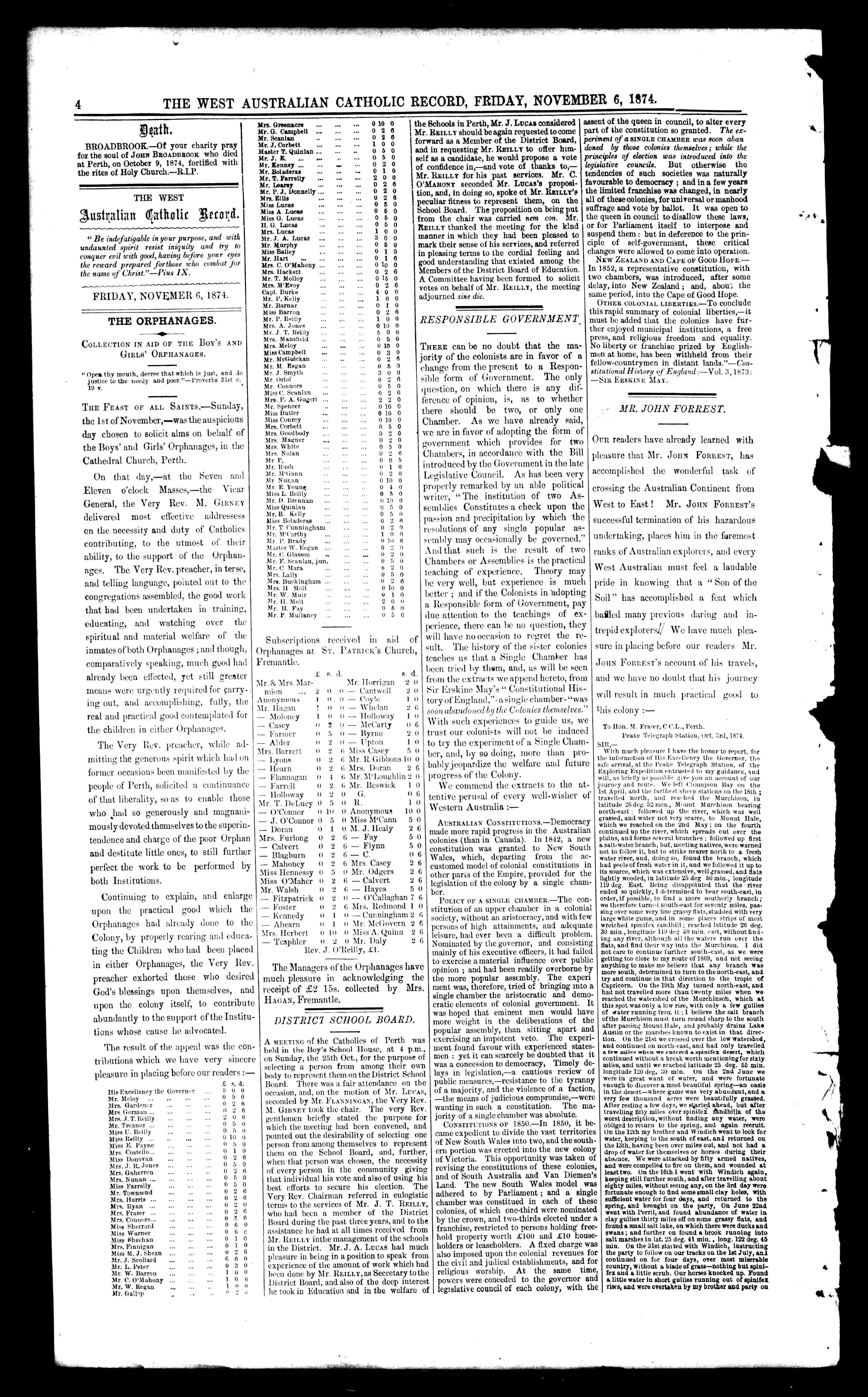
Theresultoftheappealwasthecontributionswhichwehaveverysincere pleasureinplacingbefore
Subscriptionsreceivedinaidof Orphanagesat
Church, Fremantle.
theSchoolsinPerth,Mr.J.LUCASconsidered Mr.REILLYshouldbeagainrequestedtocome forwardasaMemberoftheDistrictBoard, andinrequestingMr.REILLYtoofferhimselfasacandidate,hewouldproposeavote ofconfidencein,--andvoteofthanksto,Mr.REILLYforhispastservices.Mr.C. O'll&AHOWYsecondedMr.Lucas'sproposition,and,indoingso,spokeofMr.REILLY'S peculiarfitnesstorepresentthem,onthe SchoolBoard.Thepropositiononbeingput fromthechairwascarriednemcon.Mr. REir.tvthankedthemeetingforthekind mannerinwhichtheyhadbeenpleasedto marktheirsenseofhisservices,andreferred inpleasingtermstothecordialfeelingand goodunderstandingthatexistedamongthe MembersoftheDistrictBoardofEducation. ACommitteehavingbeenformedtosolicit votesonbehalfofMr.REILLY,themeeting adjournedsinedie.
RESPONSIBLEGOVERNMENT,
assentofthequeenincouncil,toalterevery partoftheconstitutionsogranted.TheexperimentofaSINGLECHAMBERwassoonakin dosedbythosecoloniesthemselves;whilethe principlesofelectionwasintroducedintothe legislativecouncils.Butotherwisethe tendenciesofsuchsocietieswasnaturally favourabletodemocracyandinafewyears thelimitedfranchisewaschanged,innearly allofthesecolonies,foruniversalormanhood suffrageandvotebyballot.Itwasopento thequeenincounciltodisallowtheselaws, orforParliamentitselftointerposeand suspendthembutindeferencetotheprincipleofself-govemmsnt,thesecritical changeswereallowedtocomeintooperation.
THEREcanbenodoubtthatthemajorityofthecolonistsareinfavorofa changefromthepresenttoaResponsibleformofGovernment.Theonly question,onwhichthereisanydifferenceofopinion,is,astowhether thereshouldbetwo,oronlyone Chamber.Aswehavealreadysaid, weareinfavorofadoptingtheformof governmentwhichprovidesfortwo Chambers,inaccordancewiththeBill introducedbytheGovernmentinthelate LegislativeCouncil.Ashasbeenvery properlyremarkedbyanablepolitical writer,"TheinstitutionoftwoAssembliesConstitutesacheckuponthe passionandprecipitationbywhichthe resolutionsofanysinglepopularassemblymayoccasionallybegoverned." Andthatsuchistheresultoftwo ChambersorAssembliesisthepractical teachingofexperience.Theorymay beverywell,butexperienceismuch better;andiftheColonistsinadopting aResponsibleformofGovernment,pay dueattentiontotheteachingsofexperience,therecanbenoquestion,they willhavenooccasiontoregrettheresult.Thehistoryofthesistercolonies teachesusthataSingleChamberhas beentriedbythorn,and,aswillbeseen fromtheextractsweappendhereto,from SirErskineMay's"ConstitutionalHistoryofEnglaud,"-asinglechamber-"was soonabandonedbytheColoniesthemselves." Withsuchexperiencestoguideus,we trustourcolonistswillnotbeinduced totrytheexperimentofaSingleChamber,and,bysodoing,morethanprobablyjeopardizethewelfareandfuture progressoftheColony. Wecommendtheextractstotheattentiveperusalofeverywell-wisherof WesternAustralia:-
NEWZEALANDANDCAPEOFGOODHOPE.In1852,arepresentativeconstitution,with twochambers,wasintroduced,aftersome delay,intoNewZealand;and,abou:,the sameperiod,intotheCapeofGoodHope. OTHERCOLONIALLIBERTIES.-Toconclude thisrapidsummaryofcolonialliberties,-it mustbeaddedthatthecolonieshavefurtherenjoyedmunicipalinstitutions,afree press,andreligiousfreedomandequality. NolibertyorfranchiseprizedbyEnglishmenathome,hasbeenwithheldfromtheir fellow-countrymenindistantlands."-ConstitutionalHistoryofEngland:-Vol.3,1873: -SIRERSKINEMAY.
MR.JOHNFORREST.
OURreadershavealreadylearnedwith pleasurethatMr.JOHNFORREST,has accomplishedthewonderfultaskof crossingtheAustralianContinentfrom WesttoEast! Mr.JOHNFORREST'S successfulterminationofhishazardous undertaking,placeshimintheforemost ranksofAustralianexplorers,andevery WestAustralianmustfeelalaudable prideinknowingthata"Sonofthe Soil"hasaccomplishedafeatwhich balledmanypreviousdaringandintrepidexplorershiWehavemuchpleasureinplacingbeforeourreadersMr. JOINFORREST'Saccountofhistravels, andwehavenodoubtthathisjourney will muchpracticalgoodto thiscolony:-
-Calvert 026-Flynn
-Blagburn026-C. 06
-Mahoney026Mrs.Casey 26
MissHennessy050Mr.Odgers 26
MissO'Maher026-Calvert 26
Mr.Walsh 026-Hayes 50
-Fitzpatrick020-O'Callaghan76
-Foster 026Mrs.Redmond10
-Kennedy 0I 0-Cunningham26
-Ahearn 0 I 0Mr.McGovern26
Mrs.Herbert0100MissA.Quinn26
-Teaphler020Mr.Daly 26 Rev.J.O'Reilly,XI
TheManagersoftheOrphanageshave muchpleasureinacknowledgingthe receiptof£215s.collectedbyMrs. HAGAN,Fremantle.
DISTRIC7SCHOOLBOARD.
AMEETINGoftheCatholicsofPerthwas heldintheBoy'sSchoolHouse,at4p.m., onSunday,the25thOct.,forthepurposeof selectingapersonfromamongtheirown bodytorepresentthemontheDistrictSchool Board.Therewasafairattendanceonthe occasion,and,onthemotionofMr.LUCAS, secondedbyMr.FLANNINGAN,theVeryRev. M.GIBNEYtookthechair.TheveryRev. gentlemenbrieflystatedthepurposefor whichthemeetinghadbeenconvened,and pointedoutthedesirabilityofselectingone personfromamongthemselvestorepresent themontheSchoolBoard,and,further, whenthatpersonwaschosen,thenecessity ofeverypersoninthecommunitygiving thatindividualhisvoteandalsoofusinghis besteffortstosecurehiselection.The VeryRev.Chairmanreferredineulogistic termstotheservicesofMr.J.T.REILLY, whohadbeenamemberoftheDistrict Boardduringthepastthreeyears,andtothe assistancehehadatalltimesreceivedfrom Mr.REILLYlathemanagementoftheschools intheDistrict.Mr.J.A.LUCAShadmuch pleasureinbeinginapositiontospeakfrom experienceoftheamountofworkwhichhad beendonebyMr.REILLY,asSecretarytothe DistrictBoard,andalsoofthedeepinterest lietookinEducationandinthewelfareof
AUSTRALIANCONSTITUTIONS.-Democracy mademorerapidprogressintheAustralian colonies(thaninCanada).In1842,anew constitutionwasgrantedtoNewSouth Wales,which,departingfromtheaccustomedmodelofcolonialconstitutionsin otherparLsoftheEmpire,providedforthe legislationofthecolonybyasinglechamber. POLICYOFASINGLECIIAMBER.-TheConstitutionofanupperchamberinacolonial society,withoutanaristocracy,andwithfew personsofhighattainments,andadequate leisure,hadeverbeenadifficultproblem. Nominatedbythegovernor,andconsisting mainlyofhisexecutiveofficers,ithadfailed toexerciseamaterialinfluenceoverpublic opinion;andhadbeenreadilyoverborneby themorepopularassembly.Theexperi meatwas,therefore,triedofbringingintoa singlechamberthearistocraticanddemocraticelementsofcolonialgovernment.It washopedthateminentmenwouldhave moreweightinthedeliberationsofthe popularassembly,thansittingapartand exercisinganimpotentveto.Theexperimentfoundfavourwithexperiencedstatesmenyetitcanscarcelybedoubtedthatit wasaconcessiontodemocracy,Timelydelaysinlegislation,-acautiousreviewof publicmeasures,-resistancetothetyranny ofamajority,andtheviolenceofafaction, -themeansofjudiciouscompromise,-were wantinginsuchaconstitution.Themajorityofasinglechamberwasabsolute.
CONSTITUTIONSOF1850.-In1850,itbecameexpedienttodividethevastterritories ofNewSouthWalesintotwo,andthesouthernportionwaserectedintothenewcolony ofVictoria.Thisopportunitywastakenof revisingtheconstitutionsofthesecolonies, andofSouthAustraliaandVanDiemen's Land.ThenewSouthWalesmodelwas adheredtobyParliament;andasingle chamberwasconstituedineachofthese colonies,ofwhichone-thirdwerenominated bythecrown,andtwo-thirdselectedundera franchise,restrictedtopersonsholdingfreeholdpropertyworth.£100and..£10householdersorleaseholders.Afixedchargewas alsoimposeduponthecolonialrevenuesfor thecivilandjudicalestablishments,andfor religiousworship.Atthesametime, powerswereconcededtothegovernorand legislativecouncilofeachcolony,withthe
ToIlon.H.Fraser,CC.L.,Perth. PeakeTelegraphStation,Oct.3rd,1874. SIR,Withmuchpleasurerhavethehonortoreport,for theinformotionofillsExcellencytheGovernor,the safearrival,atthePeakeTelegraphStation,ofthe ExploringExpeditionentrustedtomyguidance,and will,asbrieflyas1,0,1111+,ell,youanaccountofour journeyandroute.WeleftchampionBayonthe lotApril,andthefarthestsheepstationsonthe18th; travellednorth,andreadiedtheMurchison,in latitude26deg.52min.,MountMurchisonbearing north-eastfolloweduptheriver,whichwaswell grassed,andwaternotveryscarce,toMountIlale, whichwereachedonthe2ndMay;onthefourth continueduptheriver,whichspreadsoutoverthe plains,andformsseveralbranchesfollowedupfirst asalt-waterbranch,but,meetingnatives,werewarned nottofollowit,buttostrikenearernorthtoafresh waterriver,and,doingso,foundthebranch,which hadpoolsoffreshwaterinit,andwefolloweditupto itssource,whichwasextensive,wellgrassed.andfiats lightlywooded,inlatitude25deg60min.,longitude 119deg.East.Beingdisappointedthattheriver endedsoquickly,Ideterminedtobearsouth-east,in order,ifpossible,tofindamoresoutherlybranch; wethereforeturnedsouth-eastforseventrmiles.passingoversomeveryfinegrassytlats,studoedwithvery largewhitegums,andinsomeplacesstripsofmost wretchedspinifexsandhillreachedlatitude26deg. 30min.,longitude119deg40min.east,withoutfindinganyriver,althoughallthewatersrunoverthe fiats,andfindtheirwayintotheMurchison.Idid notcaretocontinuefurthersouth-east,aswewere gettingtooclosetomyrouteof1869,andnotseeing anythingtomakemebelievethatanybranchwas moresouth,determinedtoturntothenorth-east,and tryandcontinueinthatdirectiontothetropicof Capricorn.Onthe19thMayturnednorth-east,and hadnottravelledmorethantwentymileswhenwe reachedthewatershedoftheMurchinsoh,whichat thisspotwasonlyalowrise,withonlyafewgullies ofeaterrunningfromitIbelievethesaltbranch oftheMurchisonmustturnroundsharptothesouth afterpassingMountHale,andprobablydrainsLake Austinorthemarshesknowntoexistinthatdirection.Onthe21stwecrossedoverthelowwatershed, andcontinuedonnorth-east,andhadonlytravelled afewmileswhenweenteredaspinifezdesert,which continuedwithoutabreakworthmentioningforsixty miles,anduntilwereachedlatitude25deg.55min. longitude120deg,30min.Onthe2ndJunewe wereingreatwantofwater,andwerefortunate enoughtodiscoveramostbeautifulspring-anoasis inthe.desert-wheregamewasveryabundent,anda veryfewthousandacreswerebeautifullygrassed. Afterrestingafewdays,westartedahead,butafter travellingfiftymilesoverspinifeiditnilhillaofthe worstdescription,withoutfindinganywater,were obligedtoreturntothespring,andagainrecruit. Onthe12thmybrotherandWindichwenttolookfor water,keepingtothesouthofeast,antreturnedon the13th,havingbeenovermilesout,andnothada dropofwaterforthemselvesorhorsesduringtheir absence.Wewereattackedbyfiftyarmednatives, andwerecompelledtofireonthem,andwoundedat leasttwo.Onthe16thIwentwithWindichagain, keepingstillfurthersouth,andaftertravellingabout eightymiles,withoutseeingany,onthe3rddaywere fortunateenoughtofindsomesmallclayholes,with sufacientwaterforfourdays,andreturnedtothe spring,andbroughtontheparty,OnJune22nd wentwithPerri',andfoundabundanceofwaterin claygulliesthirtymilesoffonsomegrassyfiats,and foundasmallsaltlake,onwhichtherewereducksand swans;andfurtheronfoundabrookrunninginto saltmarshesinlat.25deg.41min.long.122deg.45 min.Onthe31ststintedwithWindich,instructing thepartytofollowonourtracksonthe1stJuly,and continuedonforfourdays,overmostmiserable country,Withoutabladeofgrass-nothingbutspinifezandalittlescrub.Ourhorsesknockedup.Found a.littlewaterinshortgulliesrunningoutofspinifex rises,andwereovertakenbymybrotherandpartyon
the5th,inlatitude25deg.32min.,Ion.124deg., wherewehadonlyenoughwatertogiveallthehorses onedrink,andtheonlywaterknownwas70miles back.TheviewtonorthandN.E.wasmostwretched -nothingbutspinifex-notahillvisiblehorison beingsauniformandwelldefinedasthesea,presentinganawfulprospect.Twohorseshadbeenabandoned,beingunabletotravel.Failingtofindany waterintheneighbourhood,onthe8threturned18 miles,andfoundenoughwaterinagullytolast nearlyaday,whichenabledustosearchthecountry beforeweretreatedfurther.Onthe7thmyselfand brother,withanativeapiece,searchedindifferent directions,andwerefortunateenoughtofindsufficientatarockgullytolastafortnight;on9thmy brotherandMerrilwentaheadInsearchofwater;we followedon11ththeyweresuccessfulenoughtofind asmallspringinaspringygully,withplentyofwater init,inlat.26deg.6min.,andlong.124deg.42min.; thiswasveryfortunate,andgoodoldfeedwasplenti foul,inagrassyflat,thefirstseenforoveronehundred andthirtymiles.Thespringwassurroundedbythe worstdescriptionofredsandhills,coveredwithspinifex,whichappearstoextendforagreatdistancein everydirection.Werestedlereonthe14thand15th andonthe16thIstartedwithWindichtolookfor water.Countryofthemostwretcheddescriptionto travelover;ourhorsesknockedup;leftoneandcon. tinnedsearchonfoot.Onthe18thfoundapoolina rockygully,whichranoutofsomerockycliffsinthe epinifexundulations,sufficienttolastthepartya month,inlatitude26deg.2min.,andlongitude125 deg.27min.Onthe19thwemetthepartycoming(i ourtracks,andonthe20threachedthewater,with allthehorses;recoveredthehorsefhadabandoned, andbroughthimtocamp.Fromthisspotwecould makenoheadwayforthreeweeksfivetimeswetried indifferentdirections,overthemostfearfulepinifex sandhillsandplains;alltherockwaterholeswere dry,andwenearlykilledmanyofourhorseswiththe longtripewithoutwater.Atlastathunderstorm came,andalthoughitscarcelyrainedwherewewere, wethoughtitmighthavedonetothenorth-east. LeftcampwithWindichonthelet,instructingthe partytofollowonthe7th,and,beforeleavingtobury flour,andeverythingwecouldpossiblydowithout,so astolightentheloadsforthehorses.Foundalittle reinhadfallenforthefirst60miles,butafterwards itappearedtoend.Onthe7thwesightedhilly countryahead,andathoughourhorseswerenearly doneupforwantofwater,madetowardsit.Itwas thefirsthillycountrywehadseenformanyhundreds ofmiles.Twentymilesoverhighepinifexsandhills, broughtustotheranges,whichwerebeautifully grassedintheflats,butnowater.Foundrockholes drycontinuedontillnight,andcampedwithout waterforourselvesorhorses.Onthe8thsearchedin everydirectionforwaterhorsesnearlydead;found saltwater,butcouldnotdrinkit.Intheafternoon foundgraniterocks,andwaterinthem,inseveral places,andtowardseveningfoundenoughtolastthe wholepartyoneday,Returnedtowardstheparty. MetthemonthelUth,andbroughtthemtothewater onthe11th,whichisinlatitude25deg.55min. longitude126ueg.50thin.Onthe12thwentagain withWindich,thepartytofollowonthe13th,and foundaspringintheBarrowRange,whichtheparty reachedonthe14th,inlatitude26deg.3min., longitude127deg.2,1min.,nearwhichwetawMr, horse-tracksbuthehadnotfoundorvisited thespringWewerenowinsafetyandinagood positionThecountrywesmuchimproved;fine rangeswerevisibletotheeast,andalthoughspinifex wasapparentlywithoutendtothenorthandsouth, stilltotheeast,thedirectionwewishedtogo,looked verypromising,andmanyrangesraninthatdirection.Onthe15thleftspring,withWindich,party tofollowon16th.Foundwateringraniterockholes thefirstday.TheCavanaghRangeslookedveryremarkabletotheeastonthe16threachedthem,and foundwhereMr.Gileshadbeenrampedforalong time,atamostsplendidspring,inlatitude28deg. 11min,andlongitude120dee.east,Mr.Goose's trackwasalsoCV05.311.Onthe17ththepartyarrived andontheltithwerestedatthespring,Onthe20th reaehedSkirmishHillofMrGosss,havingbeing ebli,edtoabandonanotherhorse.Allthewaterwas drieedup,butwefounIalittlebydigginginthesand anentamilefromhiscamp.On21stagainleftwith Winilieh,thepartytofellowonthe22nd.Reached ToinkinsonItangesnowateratnight.On22nd continuedonhorsesknockedup;leftthem,and wentonfoottriedsn.th,andreturnedtowherewe leftourhorses,lateistheafternoon,withoutfinding adropofwater.Startedagainonfoottothenorth, andbadnottravelledmorethantwomileswhenwe discoveredafinerunningspring,ofgoodwater; walkedback,andbroughtourhorsestoit.Next day(August2:;rel)partyarrivedhorsesall,knocked up.andtwoleftbehind,withonehundredandfifty poundsofflour.Windichandstartedbackonfoot, andbroughtthehorsestoramp,whichwereachedby sundown.Springisinlatitude26deg.15min., longitude129deg20ruin.Restedherefourdays. Onthe27thleftcampagainwithWindich,partyto fol'owon28th,Thefirstdayfoundaspring,and anotheronthe26th.Returned,andmettheparty, andtookthemtothewater,inlatitude26deg.7min. Onthe31stweallmovedforwardtogether,andfound waterintheNairnRanges,inlatitude26deg.3 min.,longitude130deg.FromthispointwefollowednearlyalongthehomewardrouteofMr.Gorse, having,however,tosearchforwateruntilwegotto theMusgraveRanges,whichwereachedonSeptember4th.Afterthisweobtainedwateratmanyof his(Mr.Goose's)comps.BeforereachingtheMusgraveRange,wewereshortofwater,andwere obligedtoabandonanotherhorseand150lbs.flour. FromtheMusgraveRangeswestrucktheheadofthe Alberta,andfollowslitdowntothetelegraphline, whichwereachedUT)September27th.Onourwaydown theriverweabanden,1anotherhorse,andhadconsiderabledifficultyinprocuringwater.Onthe28thwe travelleddownthelinetowardstheI'eakeTelegraph Station.On29thoneofourhorsesdroppeddown dead,justafterwelaidsaddledhim.On30th SeptemberwereachedthePeake,wherewerecieved thegreatestkindnessandattention.Ireportedour arrivaltoHisExcellencyGovernorMusgrave,and senthimashortaccountofourjourney.TheChief Secretaryhasofferedtoassistusinanyway,andwe aregoingtoavailourselvesofsomeassistanceinthe wayofhorses,asoursareallknockedup,andscarcely abietotravel.Afterwereachedlongitude127deg.we enteredamuchbettercountry,andallthroughthe TomkinsonandMusgraveRangesthereisalarge extentofgoodcountry,butitisnotverywide,and spinifexappearstoextendfartothenorthandsouth. Althoughwehavebeenveryfortunateinbeingable toreachthetelegraphline,Ifearwehavenotdone somuchreconnaissanceworkaswemighthavedone hadtheseasonbeenfavorable.Norainworthmentioninghasfallennornofeed,exceptalittleofthe oldestanddriestdescription,thatitisamarvalhoweverourhorseskeptaliveatall.Wehavehadto walkinturnsthewholeday,eventothePeakeonly threeofthehorseswereabletocarryaman,andthey wereonlyjustable;togetthemoutofaslowwalk wasneverthoughtoflatterly.Iftheseasonhadbeen different,evenwiththewretchedspinifexdesert throughwhichwe'passed,Ibelievewemighthave beenabletogetfurthernorth,butallourattempts wereunavailing,andatlastwewereoniytoogladto beabletomakeintoMr.GorseandMr.Giles's track.Whilewestuckinlat.26deg.IImin., long.128deg.east,manyhundredsofnatives wereseen,andtheyareverynumerouseveninthe worstspinifexcountry,inwhichmuchgameexists. Threetimestheyattackedus,andwewereobliged totireonthem.Thefirsttimefiftyattackedus,and thethirdtimeoveronehundred,butwemanaged todrivethemoff,andsomewerewounded;butas farasweknownonewerekilled.Inthelastinstance WindichandIwerealone,andaspearcamevery closebetweenus.Wewereoutofmeat,teaand sugarbeforereachingthePeake,andhadbeenliving overamonthondamperandwater.Healthofthe partyhasbeenverygood,andeveryoneconducted himselfinanexemplarymanner.Isincerelytrust ourendeavoursmaymeetwiththeapprovalofHis ExcellencytheGovernor. JOHNFORREST, CommanderofExpedition. PeaksStation,Oct.8rd,andAdelaideOct.5th, 1674
Jilanttinjottingo.
THEPROTESTANTORPHANAGE.-Wehave receivedacommunicationfromMr. T.H.J.BROWNinreferencetothe Inquirerrefusingtogiveinsertiontohis lettercomplainingoftheremarkscontainedintheInquirer,ofthe21stOct., anenthimself,and,also,themotherof thechild,which,fromallegedill-treatment,hefeltcalledupontotakefromthe ProtestantOrphanage.Wecertainly thinktheEditoractedveryharshly'; andwhytheletterinquestionwasrefusedinsertion,itisnoteasytounderstand.Itistoberegretted,however, thatMr.BROWNdidnot,inthefirst instance,beforebringingthematterso prominentlybeforethepublic,placethe whalematterinthehandsofthemanagersoftheOrphanage.
THELEGISLATIVECOUNCIL.-TheLegislativeCouncilhasbeensummonedforthe despatchofpublicbusinessonWednesday, the18thofNovember.Thequestionwhich mostintereststhepublicatthepresenttime iswhetherthenewCouncilwillaffirmthe propositionofthelateCouncil,viz.,"that thetimehadarrivedforthiscolonyto assumeaResponsibleformofGovernment," orwhethertheyconsiderthepresentform allthatisdesirable.Wehavenodoubt ourselvesthattheadoptionofaResponsible formofGovernmentwillbecarriedbya largemajority.
NORTHERNDISTRICT-.-Mr.MaitlandBrown hasbeenelectedtorepresenttheNorthern DistrictintheLegislativeCouncil.
THEGOVERNOR.-HISExcellencyreturnedtoPerthonFridaylast.Fromthe reportsofthelocaljournals,wearepleased tonotethatHisExcellency'sreceptionin theChampionBayDistrictwasmost flatteringandcordial.

Sbciety,butastheRulesarestillinthe handsofthesub-committeeandasitis intendedtofurtherincreasetheusefulnesstotheSociety,wewilldeferour remarksuntiltheRuleshavebeenfinally adopted.
CourtHouse,andproceededtothesceneof WESTAUSTRALIANCATHOLICBENEFIT theceremony,thebandplayingsomelivelySOCISTY-Weproposedexplainingatsome airs.HisExcellencyarrivedatthescenelengththeobjectscontemplatedbythis unctuallyataquarterpastthree.Hewas drivenfromtheResidencybyC.Crowther, Esq.,M.L.C.,fortheGreenough.ImmediatelyafterthearrivalofHisExcellency,the ceremonyofturningthefirstandoftheproposedrailwaywascommenced.Anaddress fromtheMunicipalCounciltoHisExcellency,waspresentedbytheChairmam,C. Crowther,Esq.,towhichHisExcellency madeanappropriatereply.Attheconclusionoftheaddressandreply,thecrowd cheeredmostlustily.Directlyafterreading thereplyHisExcellencyproceededtothe performanceoftheimportantceremonyover whichthepeoplewererejoicing.Sowell didHisExcellencyhandletheshoveland fillthebarrow,thatno"navvytothemannerborn,"couldhaveaccomplisheditbetter, andthestyleinwhichhewheeledtheloaded barrow,tippedit,anddrewitafterhim alongtheplank,delightedthepickand shovelelement,largelyrepresentedatthe gathering.Cheers-frequent,loudandlong, greetedHisExcellency'scompletionofthe ceremony,theexcitementandenthusiasm culminatinginthehorsesbeingtakenfrom thecarriageandascoreofwillinghearty handsdrawingHisExcellencyintriumph thewholedistancebacktotown.Abanquet tookplaceintheevening,attheGeraldton Hotel,towhichaboutahundredandtwenty satdown.ThechairwasoccupiedbyM. Brown,Esq.,M.L.C.,forGeraldton.The banquetwasineverywayaperfectsuccess. SpeechesweremadebyHisExcellency,Mr, Barlee,Mr.Brown,Mr.Crowther,Mr. Palmer,Mr.Davis,andothers,butaretoo longtogiveinatelegram.Thedecoration ofthetownwasprofusetriumphalarches wereerectedatintervalsalongthelineof routefromthetowntothesceneofthe ceremony,whileflags,mottoes,anddesigns appearedoneveryhouse.Thedaywasa grandoneforGeraldton,andwillbereferred tobyfuturegenerationswithpride,asthe mostmemorableinthehistoryofthetown."
QUARTZCRUSHINGMACHINE.-TheGovern-
MECHANICALINGEN-UITY.-ForSometime pastthepropersupplyofwaterattheBoys' Orphanage,Subiaco,wasamatterwhich causedthemanagersconsiderableexpense, andwasatthesametimeattendedwithvery greatdanger,Asiswellknowntovisitors, thewellattheOrphanageisoverloofeet deep,andatsuchadepth,ofcourse,the watercouldonlybebroughttothesurface byaforce-pump;but,somehowortheother, theforce-pumpwasalwaysgettingoutof order,and,asaconsequence,theservantsof theOrphanageneverfailedtocomplain loudlyaddlustily-forwater.Thenecessity ofagoodandconstantsupplyofwaterfora housecontainingsonicsixtypersons,all-told, canbeeasilyunderstoodandappreciated. Toeffectsodesirableanend,arecourseto theprimitiveplanofthewindlassand buckethadtoberesortedto,andassoonas thathadbeendone,thecomplaintsofhaving toraisewaterfromsuchadepth;were repeatedandplaintiveintheextreme.To addtothedifficultiesoftheManagers,there wastheconstantapprehensionofsonicofthe youngonestumblingdownthewell,andnot afewhair-breadthescapesfromsucha catastrophecanberecountedbythe youngstersthemselves.Inthisdilemma theOrphanagewasvisitedbyMr.Joseph Nunan,Builder,ofPerth,who,aftersome consideration,resolvedupon,andweare gladtosay,successfullycarriedoutaplan bywhichbothdangeranddifficultyingetting waterhasbeenremoved.Mr.Nunan,byan ingeniouscontrivanceofasimplehorizontal wheel,whichisworkedbytheBoys,ley meansoflevers,hasarrangedtwoimmense bucketstoalternatelyascendanddescend, bywhichaconstantandabundantsupplyof water,withlittlelabor,issecured.We wouldrecommendvisitorstotheOrphanage toinspectMr.Nunan'scontrivance,and whentheydosotheymustconcludeaswe dothatMr.Nunanistruly,tosaythebeast, amechanicalgenius.
menthaveerectedinFremantleaQuartz CrushingMachine,andanypresumedgold bearingQuartzwillbecrushedgratuitously.
GOLDPROSPECTORS.-Theresultofthe examinationofthesettledDistrictsbythe Melbournegoldprospectorshasnotbeenas successfulascouldhavebeenwished.The preciousmetalhasonlybeenfoundinsmall quantities,andtheexpectationsouniversally indulgedinbyeverycolonistastothe discoveryofapayablegold-fieldseemsasfar aseverfrombeingrealized.
THEBisitop.-IlisLordshiptheBishopreturnedtoPerth,bytheGemgette,onTuesday last.
NATIVESINOURCRIMINALCOURT.-Ithad longbeenasourceofregrettoColonists generally,thatwhileourunfortunateNatives aresubjectedineverywaytothesamelaws andaredealtwithpreciselyinthesameway foranyinfractiontheroefasaWhiteMan, yet,evenincasesoflifeordeath,the Nativeshaveveryseldombeenaffordedthe advantagesofCounsel.ThepeculiarhardshipsofthepoorNativesinthisrespecthas beenveryproperlypointedoutbyour contemporarytheInquirer,anditishoped somethingwillbedonetoaffordtheNatives inourCriminalCourtswhateveryEnglishmandelightsin,especiallyinourlawCourts, viz.,"fairplay."Theargumentsofour contemporaryhavereceivedadditional weight,bythepublicationbyMr.Howell,a l'ractioneroftheCourt,ofaletterinwhich hedrawsattentiontothecircumstancethat indaysgoneby,Counselwerealwaysretained forNatives,andthefeespaidbytheGovernment.Itistobehopedthatthepractice willberevivedandthusasmallmeasureof justicebemetedouttoouraboriginals.
'I-TimNATIVES.-Weareofteninclinedto thinkthatconsequentuponthemanifestation,periodically,ofalargeamountof mawkishsentimentalityaboutourdegeneratedNatives,manyoftherealgrievances underwhichtheylaborarepassedover unheeded.Thepropertreatmentoftho nativesshould,unquestionablyinterestevery loverofhisspecies,andanyefforttoimprove andamelioratetheirconditionshouldreceive encouragementandsupport.Asarule,itis true,ourcolonistsarekindtotheAboriginal, andthoughtheyhavenotmadeanygreat sacrificeorsupportedastheyoughttodo, effortsthatarebeingmadetoraisethemin thescaleofhumanity,andcivilization,yetit mustbeadmittedthattheNativesofour dayaretreatedmuchmorekindlyand liberallythaninthegoodoldtimes,which,itis atonce,theprideandpleasureofmanyanold Colonisttoboast.TheGovernment,too,treat ourNativesnow-a-days,withapaternalcare notalwaysbestowed,yet,notwithstanding whathasbeendone,muchremainstobeaccomplished,anditis,too,inthepowerofour government,tobenefittheNativesstillmore. Ourspecialobject,however,inthusreferringtoourNatives,istocallpublicattention,andGovernmentattentionalso,toa crueltytowhichtheyaresubjected.Itis this:-whenNativesfallintothehandsofthe Police,andarcbeingtransferredfrontout) districttoanother,theyarenotonlyhandcuffed,buttheyarechainedbythenecktoeach otherandthentothePOLICEMAN'SHORSE
TILEYORKCHURCII.-Inconsequenceof theabsenceofHisLordshiptheBishop,who isonaPastoraltourintheNorthern District,thelayingofthefoundationstone ofthenewChurchinYorkhasbeen postponed.WehearthatSt.Patrick'sday willbeselectedasthedayonwhichto performtheinterestingceremony.
VoTtsenyPROXY.-Thepublicatlarge areunanimousintheircondemnationofthe systemofvotingbyProxy,asitispractised anesanctionedbylawinthiscolony,andits completeprohibitionwouldbelookedupon asarealpublicgood.Wetrustwhenour Legislatorsassemblethatthesystemof votingbyProxywillnotescapetheir attention.
LossOFTHECAROLINEHUTCHINGS.Weregrettoreportthelossofthisfine vessel,whichtookplaceatFormosaduring theprevalenceofafearfultyphoon.Happily noliveswerelost.TheCaptainandofficers oftheCarolineHutchingsarewelland favourablyknowniuFremantle.
SODALITYOFTHECHILDRENOFMARY.-
Anythingmorerevoltinganddisgustingly cruelcannotbewellconceived.huagino twoorthreeunfortunateNativesbeing broughttotaketheirtrial,perhapsonsome groundlesscharge,orbeingremovedfrom onedistricttoanother-wretchedobjectsof humanity-chainedbythenecktooneanother, andhenaswehavesaidtothePoliceman's Horse!Issuchanoutrageonhumannature tobeanylongertolerated?IsnothandcuffingthemiserableNativeallsufficient? WhatdangerhasthePolicemantoapprehend-hisNativeprisonersecurelyhandcuffed,-himselfwellarmedandequippedishenotmorethanamatchforadefenceless Native?Butquantumsuf.thepracticeof chainingpoorNativestooneanotherand thentoahorseisreprehensibleintheextreme -isdebasing-isasluronourcivilizationandisbeyonddoubtaninsulttoeveryone whohasinhisbosomthefeelingsandaspirationsofregeneratedMan.
THECROPS.-Fromallpartsofthecolony wecontinuetoreceivemostencouraging accountsofthestateofthegrowingcrops, andfurtherthatthefavorableseasonleads totheconclusionthatthecolonywillbe blessedwithanabundantharvest.We sincerelytrustthatProvidencewillgrantus withagoodharvest-asagoodharvestnever failstobringpeaceandplentytomany homes.
TIIERAILWAYATCHAMPIONBAY-We copyfromtheFremantleHerald,thefollowinggraphicaccountoftheceremonyof turningthefirstsodoftheGeraldineand NorthamptonRailway:-"TheGeorgette, whichhadbeenanxiouslyexpected,arrived hereonThursdaymorning,andthetown wassoonalivemakingpreparationsforthe grandceremony,whichwastotakeplace, andwhichwillmarkanerainthehistoryof thecolony.TheGovernor'sreceptionwas mostenthusiastic,andmusthavebeenintenselygratifyingtohim,markingasit emphaticallydid,theappreciationofhis policyinhisendeavorstobringabouta speedyandcompletedevelopmentofthe greatmineralandotherresourcesofthis district.Geraldtonwasneverbeforesogay orsofullofpeople.Thesteamerbrought alargenumberofvisitorsfromPerthand Fremantle,andcrowdsflockedinfromall partsofthedistrict.Athalf-past2o'clock, thebandandalargeprocessionleftthe
OnRosarySunday,theMembersofthe SodalityoftheChildrenofMarypresented theVeryRev.M.GIBNEY,whoisSpiritual DirectoroftheSodality,withacongratulatoryaddressonhiscompleterecoveryfrom hisrecentseveteillness,andatthesame timeavailedthemselvesoftheopportunity ofpresentingtheRev.gentlemanwitha veryhandsomechair,andalsoseveralpieces ofwoolwork,thehandyworkofsome membersoftheSodality.Therewereover fiftymembersoftheSocietypresentonthe occasion,anditwasevidentnotonlyfrom theaddresswhichwasread,butfromthe deepinterestwhichoneandalltookinthe proceedings,thatwordswouldfailtoexpress theesteemandregardinwhichtheChildren ofMaryheldtheirSpiritualDirector.We givetheaddresswhichwasasfollows:-
VERYREV.AltosDEARFATHER.-Oncemorewehave thehappinessofapproachingrespectfullytowishyou ahappyFeastandeveryblessing,spiritualand temporal. Onthisjoyousoccasionourheartsaretoofull,and wordsbig,feeblyexpressourfeelings.Wehave muchtomicefor,muchcauseofthanksgivingand gratitude,andforwhichwecongratulateyou,our dearSpiritualFather. Yourrestorationtohealth,afteryoursevere illness,isadebtofgratitudetoGodofwhichweare fullysensible.Ourhumbleprayershavebeen answeredandourFatherrestored.Mayitbefor many,manyyearstolaborinthedutiesofyourholy ministry,andwalkinthefootstepsofyourglorious Patron,St.Matthew,tosharehereafterinhisglory. Suchshalleverbetheprayerofyourdevoted childrenoftheSodality. DearRev'Father,webegyouracceptanceofthe chairandwoolworkforalotteryfortheBoys'School. Wewouldhavehadothergiftsbutforthelong illnessofdearSisterMaryFranckWeaskyour prayersforherrecovery,ifitpleaseGod. Inconclusion,weaskyourblessing."
NUMBEROFVOTERSINPERTH.-AcorrespondentoftheInquirer's-TAXPAYER-impugnsourstatement,"thatnotmorethan one-halfofthosewhowereentitledtovote, hadtheybeendulyregistered,exercisedtheir privilegeatthelateelectionofmembersto serveintheLegislativeCouncilforthe districtofPerth."TheCensusof1870 shows;thattherewereatthattime796 DwellingHousesintheDistrictofPerth, anditmaybefairlyassumedthateach Householderhasavote-hencethereshould be796votersontheElectoralRoll,whereas thereareonlyabout520.Since1870,however,theincreaseinthenumberofhouses inPerth,anditssuburbs,hasbeenveryconsiderable,and,therefore,toconcludethat therearenowinthecityanddistrictof Perthover1000voters,isfullywarranted. Fromthesefacts,andrememberingthe numberwhoreallydidvoteatthelate elections,considerablylessthanonehaltof thebonafidevotersdidnotexercisetheir undoubtedrightsonthatoccasion.TAXPAYERwillthereforeseethattoconclude thatbythereturnofMessrsLeakeandBirch, theconstituencyofPerthdeclaredagainst ResponsibleGovernmentwohld,aswebefore said,beagratuitousassumption.
PRIZESINAIDOFTHEYORKSCHOOL BUILDINGFUND.-TheDrawinginaidofthe YorkSchoolBuildingFund,tookplaceinthe SchoolHouse,Yolk,onWednesdaythe28th ofOctober.Thefollowingarethenamesof theWinnersofPrizes.1stprize,Mr.J.C. Chipper(Perth),Harmonium,&c.;2nd prize,MissE.Pope,(York),SilverWatch; 3rdprize,Mr.J.Philips,(Newcastle),Chair; 4thprize,Revd.J.Carreras,(Fremantle), ScrapBook5thprize,H.Duckhani,(York), cushion.
6

THEWESTAUSTRALIANCATHOLICRECORD,FRIDAY,NOVEMBER
PERTHHORTICULTURALSOCIETY'SEXHIBI-
TION-TheannualExhibitionofFlowers, Fruits,andVegetables,undertheauspicesofthePerthHorticulturalSocietytookplace intheTownHallonWednesday,the21st Oct.TheExhibitionwasconsideredin everywayacompletesuccess.Theattendanceofvisitorswasmostnumerous,andthe splendiddisplayofflowersandfruits, specially,musthavebeenmostgratifyingto thefriendsoftheHorticulturalSociety.
TaxREGATTA-TheannualRegattawill takeplaceinPerthonMonday,the9thinst. FromtheProgrammepublishedaday'sreal enjoymentmaybeanticipated.
Onteavot.
THEREisalandbeyondthesky- Arealmofpurestbliss Whereallispeacewithoutalloy,Andnoughtbuthappiness.
Noeyebathseen,noearbathheard, Norhearthase'erconceived WhatGODhaslovinglyprepared, Forthosewhohavebelieved.
Notonguecantell,nopencantrace, Thejoyswhichthereabound; Notime,nolengthofyearselflike, Whenoncesecurelyfound.
Unlikethetransientjoysofearth, Whichquicklypassaway; Theirvalueisoflittleworth, Theymakenolastingstay. Theyonlygiveamoment'speace, Toooftreplacedbyfears Theybringnotlastinghappiness, Inthissadvaleoftears.
Ourlifeisbutapilgrimage, Afleetingpointoftime; Wheremomentspassfromyouthtoage, Andendlikethisshortrhyme.
Thenletuschoosethebetterpart, Andrisetothingsabove; Takecourage,andwithcheerfulheart, Pursueourworkoflove.
OurtoilsandPainswillquicklyend, Ourlifewillorelongclose; Letalloureffortsthenbuttend, Tothatmostsweetrepose.
TochantforeverGLORIA, ToHistwholivesonhigh TheenelessALLELUIA. Peralleternity.
Mayweallmeetin11EAvnxabove, Tosingthepraiseoflliatwelove. M.A.K. Perth,W.A.,July20,157-1.
TheEditorCatholicRecord.
SIR,TodayIwasshownaletter,inasupplementtotheinquireroflastweek,indefence ofGoodTemplarism.Sofarastheexplana- tionsgiveninthatlettermaybeaddressed tonun-Catholicsweneednottroubleourselvesaboutit.IregretIcannotpresently procurethesaidletterorsupplement,and thatcircumstancesdonutpermittheto writelesshurriedlyandbrieflyonthisoccasion.But,lestyoumightnotbeableto sparetimetowriteonthissubjectforyour nextissue,withyourpermission,Iwilljust remind"ATemplar"thatforCatholicsit mattersnottheleastwhethertheydoordo notseethemselveswhatevilmayexistin anysocietyorinstitution.Alla"true Catholic"requirestoknowiswhetheror notasocietybeorbenotcondemned-with respecttoCatholicsjoiningthem-bythe CatholicChurch.AuextractIhavejust beforeme*willbequitesufficientforanyCatholicdeservingthenameofCatholic,to besatisfiedthatCatholicsjoiningtheorder ofGoodTemplarsofanyshapeandany whereitmayexist,doincurthecensuresof theChurch,exactlythesameasiftheydid jointhesocietyofFreemasons.Theextract issuesasfollows;-"llisEminenceCardinal "Cullen,inhislento'Pastoral,reminded "CatholicsthatthecensuresoftheChurch "hadrepeatedlybeenpronouncedagainst "SecretSocieties.BenedictXIV.Pius "VII,andLeo.XII,andPiusLX,andothers "hadexcommunicatedallwhohadengaged "in,encouragedorpromotedthem.Free- "masons,Rzbbonmen,Fenians,andGood "Terplars,aswellasthosewhotakepart intheirtneetingsorballs,incurthecon- 'sureoftheChurch."ThusspeaksCardi-nalCullen,ArchibishopofDublin-that mostcelebrated,learned,andvenerable "DoctoroftheCatholicChurch-andno Catholic,whoisaCatholiccouldeverforone momentdoubtthatthisrenowneddignitary couldsopubliclyandsolemnlyproclaimGood TemplarismascondemnedbytheChurch, ifhewerenotsatisfiedthatsuchisthecase. Therefore,leteveryCatholicbeshown merelythesewordsofCardinalCullen,and thematterforeveryCatholicisatrest. ThosewhoarenotguidedbytheCatholicChurch-maytrytoguideoneanotherto thebestoftheirability,anditisforthemselvestotakeheedlesttheblindshouldlead theblind,andfallbothintothepit.Asfor usCatholics,wehavebutoneguide-which istheChurch-whichChurch,beingguided byGodhimselfcanneverleadusastray. .ForusCatholicsitisenoughtoknowthat, wheneverweallowourselvestobeguidedby theChurchwearegoingonsafely,andthat toobeytheChurchistoobeyGodhimself, whowaspleasedtoappointherhisreprescu*Wecklyliegister,February21$1,1874.
tativeuponearth-andwhohassaidtothat Church;"Hethathearethyou,hearethme, andhethatdespisethyou,despisethme. Anditisforthisreasonthatatrue Catholic,assoonasheisdulyandsufficiently informedthattheChurchdoesreallyand inverydeedcondemnGoodTemplarism, shallneverbecomeaTemplar, Believemeetc., A.J.LECAILI.E. Geraldton,September28th,1874.
[WepublishwithmuchsatisfactionArchdeaconLecaille'sletter.AsfarasCatholic areconcernedtheArchdeaconhasclearly shownwhyCatholicscannotbecomeGood Templars.Weshallrefertothesubjectin ournext.En.]
CONVERSIONOFTHEMARQUIS
OFRIPON.
Theconversionofadistinguished memberoftheEnglishnobilitytothe CatholicChurchisannouncedina telegraphicmessagefromEurope.As conversionsofthekindhaveceasedto beuncommonamongst.thetitledclasses inGreatBritain,weshouldhardly thinkitnecessarytomakespecial referencetothatoftheMarquisofRipon towhomwereferbutforthefactthat thisnoblemanwasattheheadofthe Masonicfraternityandresignedhis connectionwiththatbody,asanact necessarilyprecedenttohisreception intotheChurch.Thatfactgivestohis receptionapeculiarsignificance,which wetrustwillreceivegraveattention, whereveritisnecessarythatthelesson soconveyedshouldbestudied.Persons, nominallyCatholics,whoremainconnectedwiththeassociationfromwhich theMarquisofRiponhasseparated himself;mevirtuallyasmuchoutof theChurchashislordshipwasbefbrehe wasreceivedintoit;butitistohe hopedthattheexampleofonewho wassohighintheorderashewas,will notbelostuponthem.Theannouncementoftheconversionofthenoble Marquis,takenwithaparagraphthat latelyappearedintheChurchHeist/dEnglishProtestant.jorrnal-leadsusto expectthatseveralsimilarannouncementswillsoonfollow.Thatoresinof Protestantopinionindulgesitsthe followingforebodings:-
"Anothernoblefamily-recently movedtothehighestgradeinthe peerage-isabouttoloseitssonand heir,whobecomesaconverttothe ChurchofRome,if'hehasnotalready actuallyseceded.Mr.Carey-Elwes,a landedproprietorintheMidland counties,andrecentlyHighSheriffof hisshirehas,withhiswifeandfamily, likewisejoinedtheAnglo-Rowan communionand,fromwhatwehear fromquarterswhicharewell-linformed, therecanbelittledoubtthatanother largeandinfluentialexodusinthesame directionisimminent."
Wedonotseehowafamilylosesits sonandheirbyhisconvectiontothe CatholicChurch.Butletthatpass,as ofnomoment.EvidentlytheChurch Iler«111hadnotitseyeontheMarquis ofRipon.Holycoulditsuspectthe headoftheFreemasonsinEngland,of aleaningtowardsRome,wherethesaid Freemasonsreceivednoquarter?The conversion,inthiscase,musthavebeen astartlingsurprisetoExeterHall,and inthegrandtempleofmystery.Inthe orderofProvidence,thosehighinthe laudarefirstreturningtotheancient faithof"MerryEngland;"thepoor andlowlywillfollowincrowdsbefore longandtherewillbeaCatholic hierarchy,aCatholicnobilityand aristocracy,toreceiveandprotectthem. TheMarquisofRiponwasbornonthe 24thofOctober1827.Hesucceeded hisuncleEarldeGrey,tothattitlein 1859,andtotheEarldomofRiponin thesameyear.HeisatpresentLord LieutenantoftheNorthRidingofYorkshire,aPrivyCouncillor,andKnight oftheGarter.He,asViscount Goderich,representedHullinthe HouseofCommons,in1852and1863; Huddersfield,from1853to1867;and theWestRidingofYorkshirefrom 1857to1869.HewasUnderSecretary forWarforfouryears,andSecretary forWarsubsequentlyforthreeyears, whenheacquiredoneofthemostdistinguishedofficesoftheState-Lord PresidentoftheCouncil.Iuhisearly politicalcareer,howasaleaderof
advancedultra-liberalopinions,andtook greatinterestintheconditionoftheartisansandindustrialclasses.TheMarquisofRipon'sfatherwasthefirstEarl ofRipon,andformanyyearsheheld mostimportantpositionsinImperial Councils.HewasPrimeMinister,and resignedthatofficein1828.Acelebratedspeechofhis,intheCommons, onthefinancialstateaffairs,obtained forhimthenameof"Prosperity" Robinson.-Advocate.
ANEVENINGONCHELSEA BRIDGE.
Areyoucurioustoascertainthe progressofinfidelityamongtheartizans andworking-classesofLondon?Ifso, visitChelsea-bridgesomeSundayevening.Intheearlypartoftheafternoon thehallisopenedfromaportablepulpit byatallmeagregentlemanwhothundersforthtoamixedassembly.Inhis lefthandthereisaNewTestament,in hisrightabundleoftracts.Undera runningfireofcommentaryandridicule, heshouts,roars,screams,appealstothe Deityandcommonsense,thatlidholds theantidotetoallevilinhisrightfist. Hesoonwearies.Themonotonyis thenrelievedbyvocalperformancesand femaleexhortation.
Minglenowwiththecrowd.You findpublicsentimentanythingbut Christian.Itsmacksstronglyof Jacobinism,andreproducesRousseau's famousprinciple:-"LaproprietZ:est Incausegeneraleetperniimentedo routeslerthisordres."
1foundoneexceptiontotherule,he wasaburly,energeticartizan,fullof enthusiasm.HeassuredmethePilgrim'sProgresswasthebookofthe future."Tisanallegory,sir,"saidlie, thoughIneverdoubtedthefact,lie quotedprofuselyfromthe"tinkerof Elstow."Wasthe"tinker"a.plagiarist?Hisworkhad,certainly,a closeaffinitytothatofGuillaumede Utiieville,aFrenchmonkofthe14th century,whoseworkispreservedin
Thetallmeagregentlemanisagain inthetub.Hisardourisintense.A fairsympathiserinmyvicinityattracts attentionbyexclaiming"Heresembles PaulatEphesus!"AvolleyofunseemlycontinentsenthegreatApostle ibllowedthisremark;and1mustsay that,ifitweretrue,thebeautiful master-pieceintheLouvrewouldhave beenagrossexaggeration. ThereisarushIantcarriedalong bythecrowdintothepresenceofa discipleofSpinosa.Thismanwas ignorantofthepaternityofhissystem. HeclaimedBollingbroke,Tindal,Tor land,andMillashisprecursors.They werethegreatlightsoftheworld.He neverattributedthedeismofVoltaire tothefirstthree,nottheliterarysuccessofMilltogleaningsfromSuarez andUbags.However,hefaredbetter thanthetallmeagregentleman,who wasnowcompletlydeserted.The ApostleofPantheismpropoundeda takingtheory"Oneuniversalspirit permeatesallcreation,andformsan integratingpartofthewholeofus. Wehavesomuchincommon,whynot haveallthingsincommon? The ultimateendofmanistheenjoyment ofthegoodsofthislife,whynotenjoy himselfhere?Hecanenjoynothing hereafter;ondissolutionheloseseternallyhisindividuality.'Theparticleof spiritwhichnowenlivensisthenabsorbedinthegeneralmass.Englishmentakeacommon-senseviewof severalthings;whynottakeacommon-senseviewofthis?Thesectsare wrangling,fighting,denouncingeach other.Itisamerepretence.Itis reallyalightforbread.Gentlemen mustsupporttheirladiesandfair daughters,evenattheexpenseofdissimulation.Theannihilationofthe soulbyProfessorHuxley'sscalpeland forcepsislongsinceknowntothem." Itneveroccurredtothemthatthe learnedProfessormighthaveannihilated theuniversalspirit." Thereisadigression.Thesuccessiveintroductionofspecies,andthe boldinductionsofDarwinonthatsubjectarenowdiscussed.Thespouter waxesenthusiasticasheproceeds,and
6,1874.
themobhailwithjoyOriginofSpecies asanauthority.
Agentleman,whoforciblyreminded neofaKildare-streetemissary,whom IonceencounteredinthewestofIreland,tookexceptiontothisconductby interruptingthedeclaimer."What isfaith,sir?""Fanaticism,"replied thePantheist."No,sir,"rejoinedhe ofKildare-street."Faith,sir,is belief,sir,beliefinChristalone,sir, andinnothingPapistical.John Cummins,sir,rearsafamilyofnineon faith,andlastweekobtainedafryingpanthroughfaith.Ishalltellyouan incident,sir.""Nonsense,"roared thelecturer;"Turnhimout,"groaned themob,andtheex-ApostleofConnemarabeathisretreattotheaccompanimentof"frying-pan."
Whenpeaceisrestored,Iamoutsidethecrowd,and,notwishingtoinconvenienceneighboursbyjumpingmy- selfbetweentheirshoulders,Iwithdraw toanothergroup.Herearespectable mechanicwashewingawayMoses.He sodisfiguredthegreatlavi-giverthat MichaelAngelowouldscarcelyhave knownhim.Hebrandedthedivinelycommissionedlaw-giverwithtyranny andmurder,andassuredhishearers thatmodernprincipleswereinconsistant withadifficultview-alogicalconclusionfirbymodernprincipleshemeant "HumanInnocenceandSocialPerfectibility."Hethenmadeafewcutsat the:authenticityoftheGospels,grew indignantoverthedoctrineofinspiration,andsaidthatDoctorColensowas sufficientlyadvancedforhisideal Christian."Smith'sMahometand slahornedans"wasthefuturecivilizes. Itenabledmentomeetonthebroad groundofacommonbeliefinthesame Godwithoutanyfurtherrestrainton theintellect.Therecognitionofthis broadbasishebelivedtobetheelixirof allsocialills. Icouldnolongerbeartheclamour,thestrife,thesentiments.Iwithdrew fromthescene,whichhadalready suggestedathousandreflections.Has thegeniusandteachings,thought1 ofChillingworthJeremyTaylor, Barrow,andTillotson,ledasthis? ArethelogicalinferencesofMaldonatus andtheprescienceofBossuetalready verified Hastherejectionof traditionsledtotherejectionoftheother motivesofcredibility,andhasRevelationnosupportinEngland?True,we havechurches,eccelesiastics,andsees innumerable,butwehavethembecause ourfathershadthem.Mannersand customsoftensurvivetheirinstitution whichcalledthemintoexistence,but whentheybecomeobnoxioustosocial orpolitica;prejudicetheymustsuccumb, becausetheycannotestablishtheir "raisond'etre."Allnationshave collapsed,allnationswillcollapse,and formsofreligionthatarebasedon politicalexigenciescannotsurvive.
THECHURCHANDTHE WORLD.
Twiceduringthelatesessiono ParliamentthePrimeMinisterofEngland,speakingintermsofunusalgravity, declaredhisabsoluteconvictionthata struggleofthemostmomentouscharac terandofpoi'tentuousmagnitudeisatthismomentalloverthecivilisedworldin activepreparation.ThroughoutEurope, throughoutChristendom,thoughtful menarerangingthemselvesrapidly upononeoftwosides,accordingtothe dictatesoftheirbelieforoftheirunbelief.Theconfrontingforcesthus hastilybeingmusteredarethose,accordinglyaswemayliketotermthem, ofImperialismandUltramontanism,of theChurchandtheWorld,ofCristianityandoftheRevolution.Itis impossiblenottorecogniseinalldirectionstheevidencesofthisgreatmovement.Thepoliticalatmosphereisfull
ofportentsofthegiantstormthatis approaching.Uponneithersideare theadherentsofthetwogreatconfrontingcausesphlegmaticorindifferent. Thetimeforindifferenceisgoneby. Weareallofuse-whicheversideis chosen-interribleearnest.
NeverwasCatholicisminthose halcyondaysofherrule,whichare calledemphaticallytheagesofFaith,in morerapturousearnestthansheisnow.
Neverwereherchildrenmorenumerous, morewidelydistributedonthefaceof theglobe,or,atthesametime,more absolutelyunitedintheirallegienceto thegreaetcentralauthorityofHoly Church,thesupremeandsoverignSee ofPeter,whencefornineteencenturies thePrinceoftheApostlesandhissuccessors,asvicegerentsoftheGood Shepherd,havefedthelimbsandthe sheep,havepreservedintacttheFaith, andruledwithanunerringhandthe perpetuallyadvancingandexpanding destinesofChristendom.
OpposedtoCatholicismfromthefirst andtothelast,confrontingheratevery turnasherdeadliestenemy,irreconcilable,implacable,haughty,insolent, domineering,thepowerofthisWorld wasseeminglyneverstrongerthanitis atthisjuncture-itscrownwasseeminglyneverstrongerthanitisatthis juncture-itscrownwasseemingly nevermorefirmlyplanteduponits arrogentbrow-itssceptre,whichisa drawnsword,wasseeminglynever morefirmlyheldinitsstronggraspitsfootwasseeminglynevermore securelyplantedupontheearth,whichis foritsprideasauindestructiblepedestal. Apparentlytheconflictbetweenthese twoconfrontingforcesisunequal,but onlyapparently.Theoneismaterial theotherspiitual.rbeoneisaggressive,repressive,actsbybruteforce,isa creature,orrather,letussay,amonster,accordingtoitsownshowing compoundedofbloodandiron.The other,whichinitsverynatureisaltogetherapartfromthereachofsubjectiontothepowersofthisWorld,is asintangibleandimpalpableasan etherealandeternalessence.Ithas oftenbeengrappledwithbeforenow, buthasalwayspassed,mustalways pass,notmerelyscathelessoutofthe graspofitsassailants,buteven,atthese times,strengthenedbytheverystrife throughwhichithasemerged.
scribed-DeathisanEternalSleep
TheChurchesareclosed.ThePriests aredrivenintoexile,or,ifcaptured, areguillotined.UpontheHighAlter ofNotreDametheshamelesspersonificationofHumanReasonisadorel. Theabominationofdesolationhaving thusenteredthesacredplaces-atlast thereissent,evidentlybythewillof DivineProvidence,fortheexpresspqrposeofcomplftelymastering,inits turn,thisall-masteringRevolution,one ofthoserareandtypicalparagonsof geniuswhoarethevisibleinstruments oremissariesofOmnipotence.Athis mandatethesubvertedaltarsarereplaced,thepriestsarerecalled,the churchesarere-opened.Religion,reviledandostracizedbeforehiscoming, intheoutragednameofphilosophy,is restored,isopenlyandresplendentlyrestored,totheEldestDaughterofthe Church.Acarefully-preparedConcordantbindsheranewinallegiancetothe SeeofPeterasthecentralauthorityof Christendom.And,asifindistinctrecompenseforthissignalachievement, thislast,andnotleast,ofthesupreme Rulersofmen-onewhosereputationas ahistoricalconquereris,intinerecognitionoftheworld,uponalevelwith thoseofAlexandertineGreatandJulius Caesar-isenabledforawhile,through successionofmarvellousfeatsofarms, tobuildupagainthevanishedempire ofCharlemagne.Asayetfurtherand moresignalattestationofthisbeing accordedtohim,thusdistinctly,asifin recompense,asthefounderofanew dynasty,heisanointedbythesacred handsofthePope,andinvestedwith allwithalltheimperialsymbolsof sovereignity,notlikePepinatRome, butinhisowncapitalofParis-inthat vs,l,sanctuaryofNotreDame,where, butafewyearspreviously,theshameful impersonatoroftheGoddessofReason hadbeenworshipped.Nevertheless, butafewmore,andthislast,ashewas alsooneofthegreatestofthegreat menmouldedinthemouldofPlutarch, maddenedbyambition,intoxicatedby success-aslessermenhadbeenbefore him,aslessermenhavebeensincedaredto laynothisunhallowed,buthisanointed handupontheArkofGod.Fromthat momentthebondthatboundthefasces ofhisruletogetherwasloosened.His empireextendedbythattime"from "theshoresoftheBaltictotheStraits "ofMessina,fromtheislandsnorthof "ZuyderZeetothesouthernmostpoint "inthetaperingcoastlineofIllyria."
Duringthefirstthreehundredyears ofitsexistenceitwasallbutdrowned inblood.Thegreatestpoliticalorganizationtheworldhaseverknown,that which,intheoldPagandays,gave supremepowerintotheirresponsible 'laudsoftheRomanEmperors,trodit literallyunderfootforthreecenturies initsgraveoftheCatacombs.Its sublimebaptismalfontwastheCoilsseum.Therethesacredritewasperformed,notwithwater,butwithblood, asthepastimeoftheimpiousCmsars, whocalledthemselvesDivine.Yet, threecenturieshavingrolledby,the gianttomboftheCaticombswas opened,andtheChurch,likeitsDivine Founder,afterhisthreedaysofsepulture,haditsRessmection.From thattimeforwardithassetmaterial forceatdefiance.Astheglorifiedbody oftheRedeemerpassedthroughthe doorswhentheywherelocked,earthly obstaclesareasnothingtoItsconning andgoing.Barbarismadvancesupon RonieunderAttilla.Anoldman,in thepersonofthePontiff,confrontsthe Hunattheheadofhishordes,andata word,atabenedictionlieoverwhelminghostisrepelled.AChristianEmperor,inthepersonCharlemagne,owns hisspiritualallegiancetotheSuccessor ftofS.l'eter,asruleroftheUniversal Church,and,inrewardforhisloyal adhesiontothesupremacyoftheHoly See,hisdescendantsforathousand yearsenjoytherightsofSovereignityin themidstofChristendom.Attheendof thatthousandyearsthemostgodless Revolutionrecordedinthehistoryof thehumanracesuddenlybreaksforth towardsthecloseofthelastcentury, liketheopeningoftheneitherpit.At itscoming-Religion.blushing,veilshersacredAres, Andunawaresmoralityexpire's. Lothydreadempires,Chaosisrestored; Lightuteabeforethyuncreatingword." OverthepublicCemeteriesthereisin-
featinghisopponentsinasuccession ofpichadbattles,headvancedintothe heartofRussia,tookpossesionofits ancientcapital,heldhiscourtinthe mielstofthebarbaricsplendourofthe palaceoftheKremlin.Then,however, camethecatastrophewhichwasneccessitatedandprecipiteedbythe burningofMoscow.TheVictor,in hisprideofpower,hadsuccumb,notto EarthbutHeaven;nottoMan,but God.Hisenormousarmy,comprising withinitcontingentsfrommostofthe greatracesofEurope,hadtoretreat throughaRussianwinter,whichhad cometwomonthsearlierthanhadbeen knowforforfortyyearstogether.In thehorrorsofthatDante-likeRetreat byones,bytwos,byscores,bybattalions, numbedbytheicywindsanddrifting snows,thehatidsoftheveteransoldiers ofNapoleondroppedtheirarms-astha PopebadpredictedNapoleonthe Greatwascompetingwithapowerbeforewhichtheveryglobe,ofwhose fairestportionhehimselfpeerless domicator,ifbutascarcelydistinguishableatomcirclingintheabysses oftheuniverse.ThatSupremePower has,nevertheless,leftuponthisatom EartheversincethedaysoftheRedemption-whenitwassanctifiedby thefootstepsoftheincarnateGod-a visiblerepresentativeinthepersonofthe SucessorofSt.Peter,and,assuch,the HeadandRulerofallChristendom. Alaric,attheheadoftheGoths;Attila, astheleaderoftheHuns;Genseric,as thechiefoftheVandals;Barbarossa, withallGermanyathisbackSelim, incommandofthe(Martianfleetat Lepanto;Mustapha,theGrandVizier ofNlahomettheFourth,withhisinfidel hordesinbattlearmybeforethe wallsofViennaNapoleon,when LordParamountofEurope;Time itself,withallitswastinginfluences, nineteensuccessivecenturies,eachin turn,allofthemtogether,havebeen utterlypowerlessagainstwhatissimply aboveandbeyondthereachofallearthly ormerelyhumanauthority.TheGlory oftheWorldisgreatnodoubt,andits power,withinitsownlimits,dominant. But tench because isistouredelupon,aRockandbya DivineArtificer.-WeeklyRegister.
PROFITSOFORANGECULTUREINCALIFORNIA.
About150orangetreesareinbearing condition,andyield10dol.worthof fruitpertree.Forlarge-bearingtrees theyieldis1,000to1,500each.They canbear3,000,butthefruitinsuch casesissmall.Hisbearingtreesoccupysixacres,andbehasplantedouta youngorchardof20acres.
H.D.Barrows'sSicilylemontrees are12yearsold.Thecroplastyear soldfor1,500dol.Theproceedsper treewere&idol.,coin.Thelemon beginstobearatfiveyearsold.His orangetreescommencedtobearatfrom eighttonineyearsfromtheseed. Theycomeintofullbearingat10years; fromthattimeto15yearsoldtheyield increasesabout50percent,andat20 reacheswhatmaybetermed)maximun. Asmalliacreasemaybeexpectedafter thatage.Some.treesyieldover2,000; hisneighbourcounted2,500ononetree. Someoldtrees,70yearsold,havebeen knowntoyield5,000oranges.By carefulgrafting,thetreescanbe broughtintobearingtwoorthreeyears earlier.Citronscanbemadean importanttrade.Theycomeinto bearingataboutthreeyears,andbear veryprolifically;willgrow,likea willowfromthecutting.

Unsatisfiedwiththepossessionofthis vastdominion,hemustneedsabsorbinto ittheStatesoftheChurch.Theholy cityofRome,thecityofthePopesand oftheApostles,he,withmatchless pride,declarestobethesecondcityof hisempire.Asheirisborntohis amazingfortunes-
ThatyoungAstyanaxofmodernTroy-" andtheinfant,atthemomentofits birth,isannoucedtotheworldunder haughtytitleoftheKingofRome.
ThevenerablePontiffmeanwhileis draggedfromhispalace,iscarriedoff intoexile,isimprironedatFontainebleau.AtthatveryFontainebleau,by afittingNemesis,thecaptorand incarceratorofPiusVII.hashimself, notverylongafterwards,tosignearlier ofhistworapidlysuccessiveabdications. ButpriortothatthePopehaspronouncedaprophecyinhisregard,and thattheprophecyhasbeenfulfilled! WhentheGreatEmperor'slegions weremostpowe,fulandmostnumerous, when,likeanotherSesostris,hehad vestiublewithcrowedKingsandSatraps, PopePiusVII.saidofhimthatthe armsshouldfallfromthehandsofhis soldiers! Verysoonafterwardshistoryrecordsthefact,andincharacterssoluridthattheyglareuponthe recognitionofall-thosefewandsimple wordshadtheirliteralfulfilment.
CrossingEuropeattheheadofanarmy thatout-XerxesedXerxes'thislastof theGreatConqeurors,thisSoldierwho intheestimationsofSoldiers,issecond onlytoBabbinalentereduponthemost daringand,asLordBroughambas calleditdeliberately,themosttriumphantofallhisfourteenwonderfulcampaigns.Inonesenseitwasthemost triumphantofthemall,forinithe carriedeverythingbeforehim.De-
TheAttstralasiamcontainsaninterestingMemorandaontineprofitsofOrange CultureinCalifornia.Considering howsuccessfullytheOrange,Lennon, andLimecanbegrowninthisCalony, itisamatterofsurprisethatmoreattentionisnotgivenbyourColonistto theirculture.Astotheirprofitableness, therecanbenodoubt,andasaproof thattheOrange,&c.,wouldpaytobe grownextensivelywegladlyplacethe Memorandatowhichwehavereferred beforeourreaders.TheDollarmay bevaluedat3s.8d.
S.WolfskillsaysthattheWoolskill orchardinthiscitycontains20acresof trees,nowabout20yearsold.Last yearandthisyearthetreeswerepruned veryclose,andthecropwasnotso largeasusual.Theincomehasbeen inthepast,from7,000dol.to10,000 dol.peryearfromthe30acres.Besidestheorchardsabovereferredto, therearethelargeorchardsofL.J. RoseandB.D.Wilson,neartheMissionSanGabriel,theyieldofwhichis reportedmuchabovetheforegoing. Mr.Childshasalargeorangeorchard inthiscity,whichhasbeenwellultivatedandwhichyieldsveryheavily. Theorangecropusuallysellsatfrom 15dol.to25dol.per1,000onthetrees, owingtowhetherthefruitislargeor small.At5dol.per1,000,oronehalf acent.each,thecropwillpay,onan orchardof10yearsold,250do1.per acre.Thetreeswillyieldabout1,000. each,50totheacre.Thebuildingof railroadstotheinteriorstatesandterritorieswillopenarnaketwhichcannot beoversuppliedevenatthepresent prices.Thecropisonethatkeepswell. Theripefruitremainsonthetrees withoutinjuryfromJanuaryuntilJune. Theyhaveaverythickskinand beartransportationremarkablywell. Mr.Hawescarriedaboxofthem fromLosAngelestoNewYorkthence backtoNashvilleTenn.Onarriving thelatterplacethefruitwasperfectly soundandinfinecondition;atleast, thatwastheverdictofthosewhoate thefruit.Byusingwindmillstopump upthewatertoirrigatewith,therecan behadthousandsofacressuitablefor thecultivationofthesemitropicalfruit. Thiswillalwaysbeoneofourmost importantindustries.
"Muchhasbeenwrittenonthissubject bylocalandotherwriters.Onone pointtheyallagree,whichisthefact thatthecultureoforanges,lemons, andlimes,&c.isveryprofitable.A recentcorrespondentforoneofthe ChicagopaperNaysthatthewholething isover-estimated,andwouldleadhis readerstosupposethatpossiblythe profitwasverylittlegreaterthanfor ordinaryproducts. Yesterdaywesentour"local"outto collectthefactsfromtheorange-growers andfromthefrnit-standswherethefriut wasboughtandsold.
W.Workman,whoownsanorchard of60lime-treesontineeathankofthe LosAngelesRiver,statesthatthetrees arefromsevento15yearsold;thatthe limetreescommencestobearatfive yearsoldfromtheseed.His15-year oldtreesareinflower,bud,andfruitall theyearround.Theripefruitis gatheredeveryweek.Theyieldper yearpertreeis3,500,andsellsatfor 10dol.to15dol.perthousand.The productofasingletreehasbeenknown toamountto50dol.inasingleyear. Aboutthreehundredtreescanbe plantedtotheacre.Hehas175lemon trees15yearsold.Theaveragereturn fromthesaleofthefruitsnets15dol. pertree;about2,000lemonspertree.
MARSHALMACMAHON.
ACorrespondentofours,whohas longwatchedtheMarshalPresident's career,givesusthefollowinggraphic sketchandestimateofhischaracter:Itiscloseupontwentyyearssince thenameofthegallantsoldierwhois nowPresidentoftheFrenchRepublic firstbecamefamiliartoEnglishmen. OurarmywasthenintheCrimea,takingpartwiththeFrenchinthesiege ofSebastpool.MacMahonhadcome fromAlgiersasColonelofthe41st RegimentoftheLine,buthadbeen promotedtotherankGeneralof Brigadewhilstonhisvoyage,andcommencedhisdutybeforethefamousRussianfortressincommandofthesecond BrigadeofCanrobert'sdivision.There wastomuchtodo,andtoolittletime todoitin,forofficersofeitherarmy tomanyacquaintancesoutoftheirown corpsduringthefirstfewmonthsofthe investment;but,ofthefewFrenchmen whoformedfriendshipsamongsttheir Englishcomrades.GeneralMacMaboa wascertainlyone.Astimewenton, andthefamousassaultontheMalakoff becameknowninEngland,theGeneral's namebecamealmostahouseholdword amongstus.Itwashewho,inperson,

ledthatattack,andwhenPelissier,who sawhisgreatdanger,senttoanaide-decampwithordersforhimtoretire fromthepositionhehadtakenup,the onlyreplyMdcMahonvouchsafedwas, TelltheMarshalthat1amhere,and thathereIwillremain."There-was somethinginthesewordswhichso harmonizedwithourEnglishideasof whatweterm"pluck,"thatitwillbe verylongerethenameofthegallant officerwhoutteredthemcanbeforgotten amongstus.
MariePatricedeMncMahonwashorn atSully,nearAutun,inthedepartment ofSa6ne-et-Loire,onthe13thJuly, 1808,andis,consequently,inhis67th year.Consideringthatthegreatest partofhislifehasbeenspentinthe burninghotclimateofAfrica,andthat hehasbeenseveraltimesveryseverely wounded,heisayoung-lookingman forhisage.This,however,maybe accountedforbythefactthathehas alwaysbeenatemperateman,but alsoonewhotakesagreatdealofexercise,isaverykeensportsman,andhas neverindulgedinthosevicesfinwhich somanyofhiscountrymenareonlytoo celebrated.Attheageofsixteenyoung MacMahonwansenttotheMilitary CollegeofSt.Cyr,andthreeyears laterfoundhimasub-lieutenantina regimentof'theLine,whichfberned partoftheexpeditiontoAlgier,in 1830.Hisfinherhadbeenuntilhis deathapersonalfriendof(harksX., andtheRevolutionwhichplacedLouis PhillipsonthethroneofFrancewas lookeduponbyhisJim-lilyasagreat blow.ButMacAlahon'saxiomthrough lifehasbeenthataFrenchsoldier oughttobetheservant.ofFrance,and notofanyparticulardynasty.For sometimeafterthe oftheelder branchoftheBonrlionsMiteMahon regardedassnspeetedLegitimist,but hisloyalconductunderthenewstate ofthingsverysoonputhimrightwith theauthorities,andin1833hewasap-pointedaide-de-camptoGeneralAreliard atthesiegeofAntwerp.In1a:17 waswoundedatthesiegeofConstantine, andshinethenhisnamehasbeenmneverycampaignand everybattle-fieldinwhichtheFrenel, Armyhavefought,includingtileexpeditionbitethecountryoftheKayblesillI5;,;,andthe\veilknown"turn ofthetide"ofvictoryatMagenta. DuringthelateFa:ince-Prussianwar thepresentwriterwasattachedto ?11acMahon'scorpsasthespecialcoirespondentofaLondonmei..Ile C0111111elimoithecampaignWhenthe armymarchedontofStrasbourg,and endeditatSedan.Duringthatperiod, andafterwardsatVersailles,duringthe reignoftheCommune,hesawagreat dealoftheMarshal.Akinder-hearted, moregenial,orlessostentationsman Leverlived.Asageneralheisnota strategist,forhismilitarytraininghas beenintheschoolthatdestroyedso manyFrenchofficers-Algeria.Batas commanderoftroopswhenadashhas tohemade,orasthefearlessleaderwho showsthewayhehasorderedhismen togo.MacMahonissecondtononuns thateverworeepaulets.Atthebattle ofWoerth,ontheGthAugust,1870, whenhisarmywasoutnumberedand beatenbytheCrownofPrussia,and againonthe31stofthesamemonth, untilhewasdangerouslywounded earlyonthemorningofthe1stSeptem- ber,andobligedtomakeoverthe commandtoGeneralDucroh,the exampleMacMahonshowedhismen wasbeyondallpraise.Withavietorous army,theproperplaceforthechiefis wherehecanseeallthatisgoingon withoutexposinghisperson;butwhen troopshavebeenbeatenandarecowed, itisoftenneedful-atanyrate,in Frencharmies-forthechiefstoshow theirfollowerstheroadtovictory. MarshalMacMahonis-ashisown countrymen,andespeciallyhisfellow officers,sayofhim-morelikean EnglishmanthanaFrenchmanwhen calledupontobravedanger.Thereis nottheslightestbombast,'orevenexcitementabouthim.Itisreallynottoo snitchtosayofhimthathedoesnotknow, orcertainlydoesnotseemtoknow, whatfearmeans.Thepresentwriterhas morethanonceseenhimwithshells burstingafewfeetoff,andbulletsfalling
literallylikebail,gazingthroughhis doublefieldglassattheenemyas calmlyitsifhewas,commandingasham fightatChillons.TheGermansareno meanjudgesofthevalnoofasoldier, andtheestimatetheyhaveformedof MacMahon'scourageandsangfroidis, perhaps,thebesttestimonialthatcan begiveninhisfavour.
InprivatelifeMacMahonismorelike anEnglishcountrygentlemanthana FrenchOfficer.Happilymarriedfor morethanaquarl,erofacentury,heis neversocontentedaswheninhisown family.liehasfoursonsandone daughter.Oneofthefora.erhaslately obtainedhiscommissionintheFrench cavalry,afteraverysuccessfulcareer atSaintCyr;anotherisastudentat thatcollege;the(tilersarestillnt school.TheMarshelseldomdressesin uniformwhenhecanavoiddoingso. Heisaveryearlyriser,andispassion- atelyaddictedtoallkindsoffieldsports. Duringthepastwinter,whenhecould steala(layfromthecaresoftheState," hehasbeenoftenknownto1,tareVersaillesattior8pin.,whenhoisnesawas ever.travelbyrailtohisestatein Turenne,aLorehewouldarriveearlythe nextmorning.shootthereallday,then taketherailagain,andliereadyto receievehisMinistersatVcrsaillesthe following.morning.Inheightheis about5feetlitMae,adonis uprightandvigorous,withhairnow almostwhite,anda(hearhint,Savo, leakingeye.Asahorseinauandashot hehasbutafewequals.Ileisatone antithesamethehestlikedandthe mosthatedmailinFrance.Frenchmen whohavethetrueintr-e4softheir countryatheart;evehimforhis couragoalaisimple-mindedeess-forthe factofhistelperhaps.theonlynolo inFranceivhucouldIlavesomuch veatnegsthurstopenhimandnotuse itforhisownpersonaladvantages. FiereollonapartistsandItepablivima alikehatehim-thefirstbecausehewill nottakeanypartinthekintrigues;the host,liocansewhenentrustedwiththe co:mu:ridofthearmy,heput'learn alai,..jampalc,titheiiifitmena( Butto tooldi-1.1:estile Marshalisequallyitalitli.rent.Iliaone lireis .1,,hisflutytohis country.andallimpartialmenmust adinitthathedoesita'Aurafearor afil,et Aotl,last,notlea..t.theMarshalis practialCatholilienevamisses behigpne'itatHighMassonallSun,yitialletitoh,audmayIofaaiseen atlaavMass dit'Sovr:C duriligthepi,1*heattend;theSacraunlit fut'a.::let;oldHealyCommunioa.InacountrylikeFrance, where,formanyyears,amongstthevast majorityofWell,itwasdeemed,absurd andfeminineevento:wituowledgethat ulauhasasoul,antithatthereisahereafter,itmusthaveretpiirednosmall amountofmoralcourageforamilitary mantoprofessopenlythatliewasa Catholic.ButMaeMellottneverflinehed fronthisyonthupwarda.and,sincehis marriage,hisexcellentwifehasbeena greathelptohiminthisasinother matters.Iliachildrenarealleducated mostcarefullyinthecatholicfaith.
PASTORALOFTHEBISHOPOF PADERBORN.
Coneladtq')
"YourcommunionwithtileSonof St.Petermustbenotonlyacommimioa offaittabutalsoacommunionofeliatity. h Iffaitisthefirstandmostnecessary thinginourreligion,charityisthe highest.IfIhadfaith,'saysthe Apostle,that1couldmovemountains, butwerewantingincharity,Iwouldbe thing.TheChristianreligionis, therefore,agreatbondofcharity,and theChMandheadofthisbondof charityistheChurchofRome,accordingtothewordsofthegreatmartyrSt. Ignatins,thediscipleofSt.Johnthe Apostle.Nuttoagreewiththefaithof thisChurchisheresy;totearasunder thebondoflovewiththisChurchis schism:Thesesinsandcrimesarethe poisonousfruitofpride,risingagsinst orderinflueChurchasprescribedby God,ai:dintheendtheyriseagainst GodHimself,ovenasLuciferdid.
Concerningthesecondrequisite,oar c'ommuniouofloyewith.theSee.of.6L
Peter,1shallbeshFt.Ihavepromised byoathtotheRomanPope,theVicar ofChrist,obedidnce,love,andfidelity. AstothedogmaofInfallibilityisno newdoctrinasomysolemnpromiseby oathhasimposednonewobligations. ItiscontainedinthefourthcommandmentofGod,"fhoushalthonourthy fatherandthymother'Ihonourand lovemyparentsevenbeyondthegrave. Alas!ouragemoreandmoreneglects Usedutyoffilialpiety.Howdeepis ourfall,howjustandbitterarethe coniplaintsdailyheardof,thatfilial piety,theloveandobedienceofchildren towardstheirpatents,arevanishing. Butthisdutyoffilialpiety,whichGod himself'haswrittenintheheartsofmen, whichcanbeeffacedfromtheheartsof menonlybyunnaturalinsensibility,is amongallthedutiesIhavetoperform themostsweetanddearone.Besides myparents,Iloveallthosetothe paternalormaternalcareofwhomI amcommitted,Ihonourtheheadof theStateaccordingtothepreceptof theApostle:'FearGodandhonourthe King.'Ihonourandlovethosewho aremyfathersinChrist.Ihonourmy pastors,whoharetogiveanaccountof illysoul.Ihonourandloveinaspecial mannertheVicarofChrist,thelather uf.Chii,temiom,thePope,theSupreme IleadoftheChurch.1lovehimasthe FatherofChristendom,andsharewith himjoyandgrief.AllCatholicsought toeinspiredbythesesentiments,all oughttospeakthislanguage.Who speaksotherwise,-evenifhespoke withthetonguesofangels,-speaksthe languageofAntichrist.Woetothe despisersoftheFourthCommandment ofGod,whoaretearingtheheartsof thechildrenfromtheheartoftheir spiritualFatherdoublywoetothem, ifalthoughboundbyholyoathsto fidelityandobedience,theyslander theholyFather,andcalninniate him,inordertoextinguishthe affectiontowardsthisFatherinthe L,artsofhischildrenNotsatisfiedwithLavingdeprivedhintofhis property,imprisonedhintinhisown house,heistobedeprivedoftheonly thinghithertolefttohim,thelove ofInschildren.lintyourplots,oh despisersoftheFourthCommandment, shallnotsucceed.Doyounotsee,that notwithstandingthe'utmosteffortsof thedeadelyenemiesoftheChurch,for thepurposeofoverturningtheSeeof St.Peter,andtearingasunderthebond oflovebetweentheHolyFatherand themillionsofhischildren,thisbondof afitaitionbecomescloserandcloser? Thehatredandfuryofhispetseenters andenemieshavepromotedtheloveof millionsofhischildren.Who,outof thegloriouslistofhisvenerablepredecessors,couldexhibitsimiliartriumphs oftheloveofhischildren?Remain j(-hied,incorporatedbythegrehbond oflovewiththeheadofthisbond. Thisismyardentdesire.Whatever mayhappen,donottearasunderthetie bindingyouupwiththeSeeofSt. Peterthroughyourlawfulpastorsand bishops.'lheSeeofSt.Peteris,as St.Cypriansays,theunityfromwhich thepriesthoodproceeds,therootand maternalwomboftheCatholicChurch. Neveracknowledgeaspastoronenot enterivthroughtherightdoor, notsentbytheSeeofStPeter,not joinedwiththisSeeintheunityof faiththroughthebondoffidelityand obedience.Insteadofdeliveringyour childrentomercenariesandrobbers, teachthemratheryourselves,fashers andmothers,nottopartakeofthe sactiligiollsservicesofapostatized priests,bywhichthemajestyofGodis nothonoured,butdishonouredandoffended,buttrybymeatusofprayersand holytongstoedifyoneanother.Even intheclangerofdeath,donotcallin schismaticorheretic-priests,Lunt,ifa lawfulpriestcannottobehad,elicitan actofcontritionwhichjoinedwiththe desireoftheHolySacramentofPenancecleansesthesoulfromsin.Divine graceisindeednecessaryinorderto elicitanactofperfectcontrition,but Godwillgivethisgraceabundantly, ifyouhumblyprayforit.Never,and uponnoconditioncallahereticalor schimaticalpriestforthesakeofthe
baptismofyourchildrentheburialof ofyourhead,consecrationofyour marriages,thatyoumaynotpartakeof theirheresyorschism.Iforthodox andfaithfulpriestsarenottobemet letthebaptismofyourohildrenbeperformedbyfaithfullaymen;buryyour deadyourselves;andasregardsthe ecclesiasticalconsecrationofyourmarriages,waitfortheinstructionwhich, whenIhavereceivedthenecessary powersfromtheHolySee,IshallpublishInourjointPastoralofthe2nd February,webishopshavealready givenyouinstructions.Butsincethe dangeroftheinterruptionoftheadministrationofmydiocesehasapreached,nearer,Ifeelobligedtoremind youagainoftheseinstructions,forthe sakeofthesalvationofyoursouls.If youobservetheseinstructions,ifyou remainunshakeninyourfidelitytothe SeeofStPeter,ifyoukeepclosetogether,rallyingroundthestandardof theholyRomanCatholicfaith,fighting likemenfortheinterestsoftheholy faith,withoutbeingseducedintounlawfulviolentacts,orthedisturbance ofpublicpeaceandpublicorder-then happywillyoubemybelovedflock? Yourcontemporariesandposteritywill venerateyonasthedefendersandpreserversoftheCatholicfaith,andwhat ismostimportant,youwillobtaina celestialcrowninheaven.Themore heavythetrialsare,thegreaterthe dangersandoppressions,themorebeautifulthiscrownwillbewhichisdestined toadornyou.Oh!mydearchildren, isithardtoobtainthiscrownsinceoar SaviourHimselfhassaid,dintwehave touseviolenceinordertoenterthe kindoinofheaven-sincetheApostle adds.thatthepathtoheavenleads throughmanypainsandtribulations. Thedifficultyisatpresentseeinin,Is greater,butinfactitisless;itis easiertoobtaintocrown;thousands, whoinamorepeacefultimewould haveforfeitedthiscrown,willnowobtainitbypartakinginthestruggles andthesufferingsoftheChurch.Let noneremainbeano'shiresuchareward ispromised.Performallyourduties withgreaterjoyandzeal.Likeat. Johninhisapostolicletter,Irecommendtoyouallthespecialdutiesof yourrankandcondition.Tochildren, youngwen,oldmen,towomenand girls,tolaborersworkinginthesweat oftheirbrow,tomastersandmistresses, especially,tofathersandmothers,to maleandfemaleteachers,toeveryone ofthem,Iwouldliketosayindividually whatmyloveandsolicitudedesiresand expectsfromtheminthiscriticalseason; butthisterriblecrisis,speaksmore lushlytotheirhearts,thancanmy feeblewords, "1recouiendagaintoyourassiduous, fervent,andhumbleprayers,the interestsoftheholyChurch,and especiallythoseofitsSnpreineCastor. Andsincepublicprayersaidtogether hassuchspecialclaimstobeheardby God,Irequesttheparishpriesttogive theparialtionersat,olyortilaityof havingsoniepublicdevotiononceevery weekinbehalfofthedistressofthe Church,TheBlessedSacramentmay beexposedduringthisdevotion.I concludebyassuringyouofmy unalterableloveandpastoralsolicitude, requestingyou,thathowevergremour separationmaybe,letusmeetone anotherdailyintheSacredHeartof JesusandMary.-CatholicTimes. "Paderborn:May31874."
[RecentTelegramsconveyedthe intelligence,that'fbrthepublicationof theabovePastoral,thegpodBishopof Paderborn,hadbeensel7tencedbythe GermanGovernmenttothreemonths imprisonment.ThedevotionandattachmenttoHo.yChurchshownbythe BishopsofGermanyduringallthe persecutiontowhichtheyhavebeensubjectedmustbeasourceofgi:ititication toeveryCatholidandshouldinduce Catholics,everywhere,tooffertheir "ferventandhumbleprayers"onbehalf oftheirpersecutedBretherniuGermany.-EDIToRRecord.]
PrintedandpublishedfortheProprietors byTisotasBRYAN,uttheCatholic Boys'Orphanage,Subiaco,nearPerth, WestAustralia.