THE R ECORD


THE St Vincent de Paul Society has criticised the Federal Government of “taking to people with the stick” by punishing sole parents and imposing a “harsher compliance regime” to score political points in the 10 May Federal Budget.
“A harsher welfare compliance regime and the extension of compulsory income management are measures that assume that if you are disadvantaged, your problem is idleness,” said Dr John Falzon, chief executive of the Society’s National Council of Australia.

Dr
“Idleness is not the problem. The problem is entrenched inequality.”
He said the Budget has left Newstart recipients on a benefit below the poverty line.
“In fact, unemployment benefits in Australia have had no real adjustment since 1994, so the gap between unemployment benefits and the minimum wage is growing and the gap between unemployment benefits and the pension is growing significantly,” he said.
There are a significant number of sole parents who will be $56 a week worse off due to changes in the Budget, he said, which is “quite a significant figure when you’re on a low income”.
There will also be some 21 year old benefit recipients who will be $43 a week worse off, he said.
On top of these financial disadvantages, there will be a more demanding compliPlease turn to Page 15
Parishioners in the hills above Perth made this year’s Easter a memorable one, writes Jo Doyle
Easter 2011 was celebrated at Kalamunda’s Holy Family Church with all the solemn sadness and sweet joy of this wonderful and most-important season.
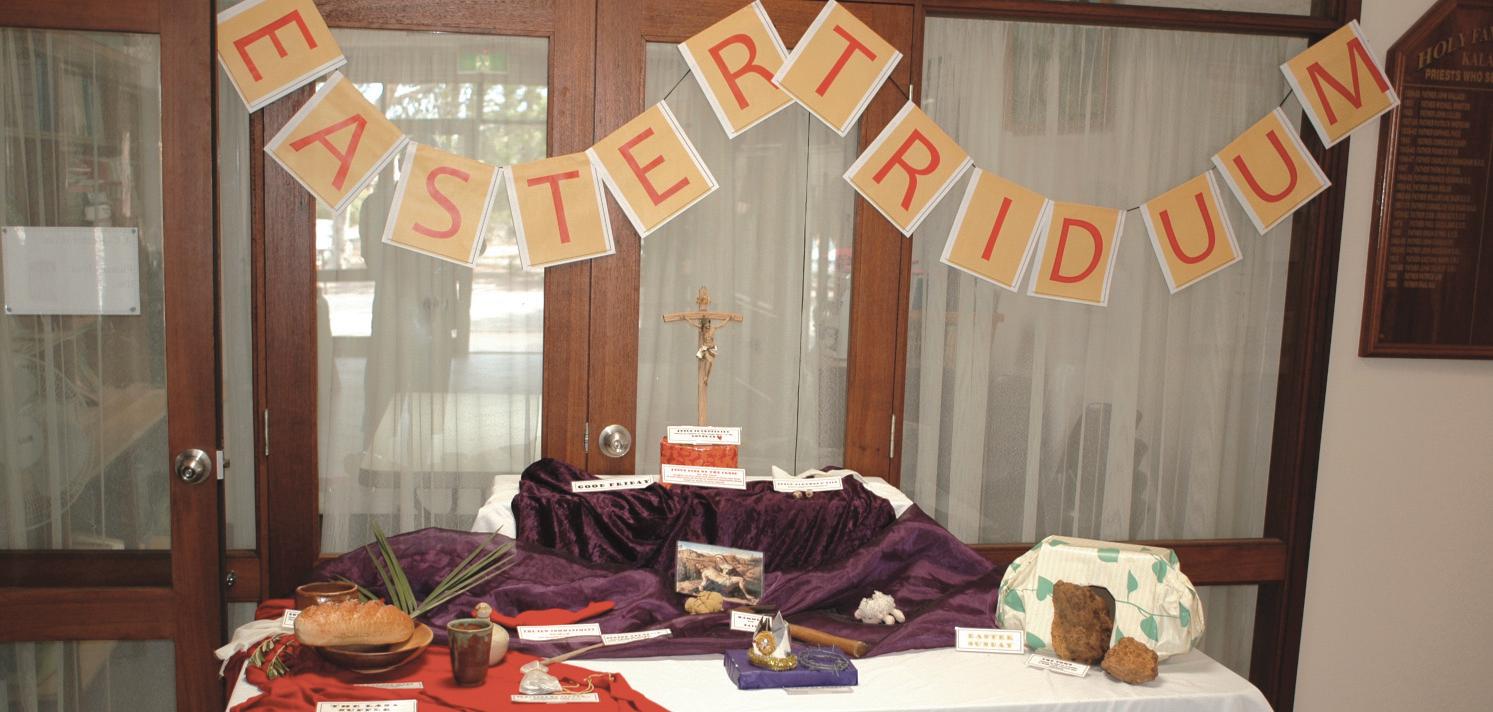
An Easter display was set up in the church foyer by the leader of our Children’s Liturgy team, Anna van Eck.
Set out on a table, there were symbols, objects and brief explanations that told the Easter story from a wooden plate and goblet for the Last Supper to a hammer and long nails for the crucifixion, a lamb, a small crown of thorns and model of a tomb with a rock rolled in front of it.
Children could pick up and examine the items and hopefully get closer to the Easter story of the very real Jesus and His loving sacrifice.
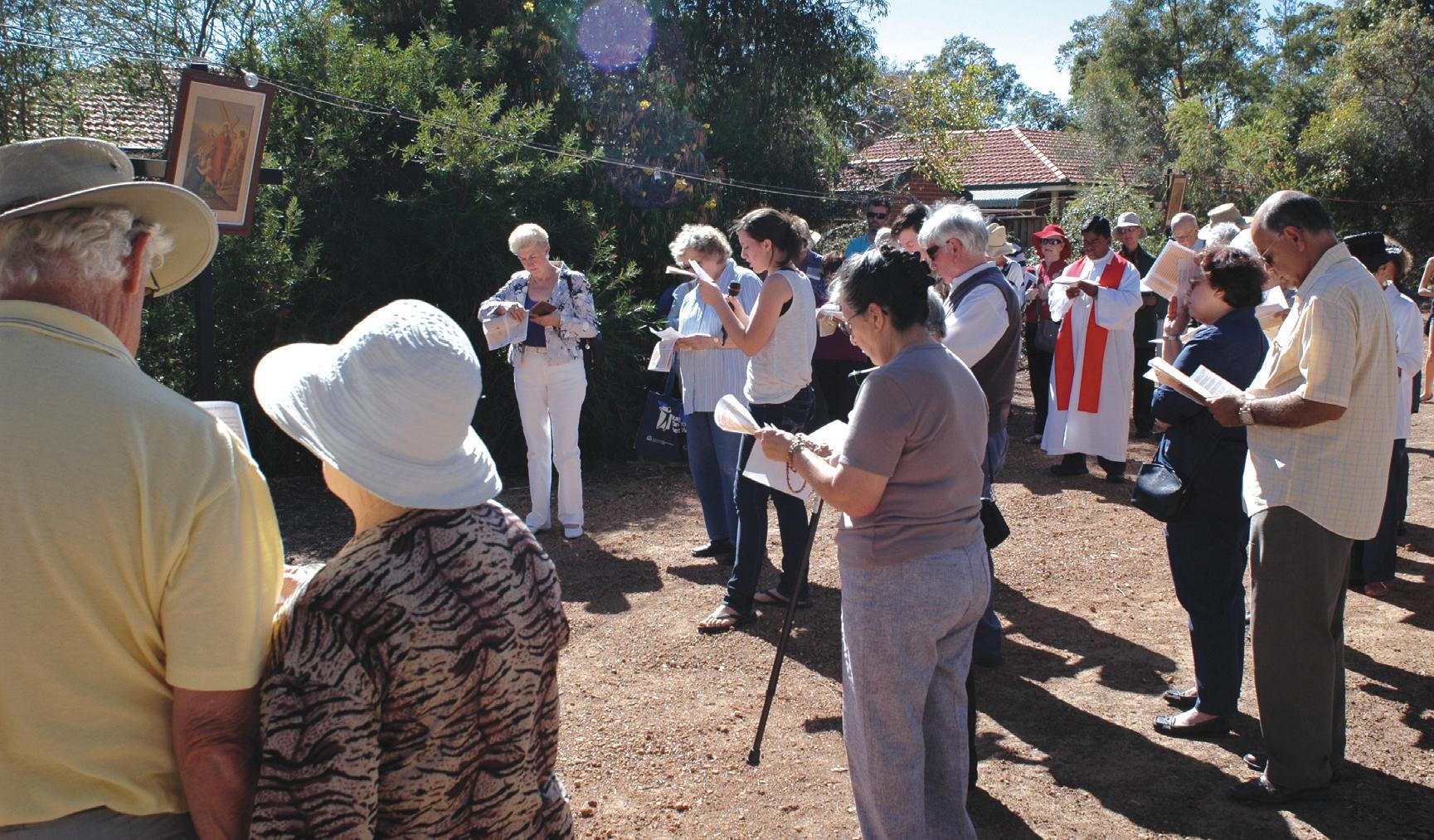
In the morning on Good Friday, we celebrated Stations of the Cross outdoors with the birds and the trees.
We sang as we processed around the church grounds and paused at each station for a reading and prayers.
Carol Christie, Stephen Phillips and Annemarie Lindsey led us in the readings.
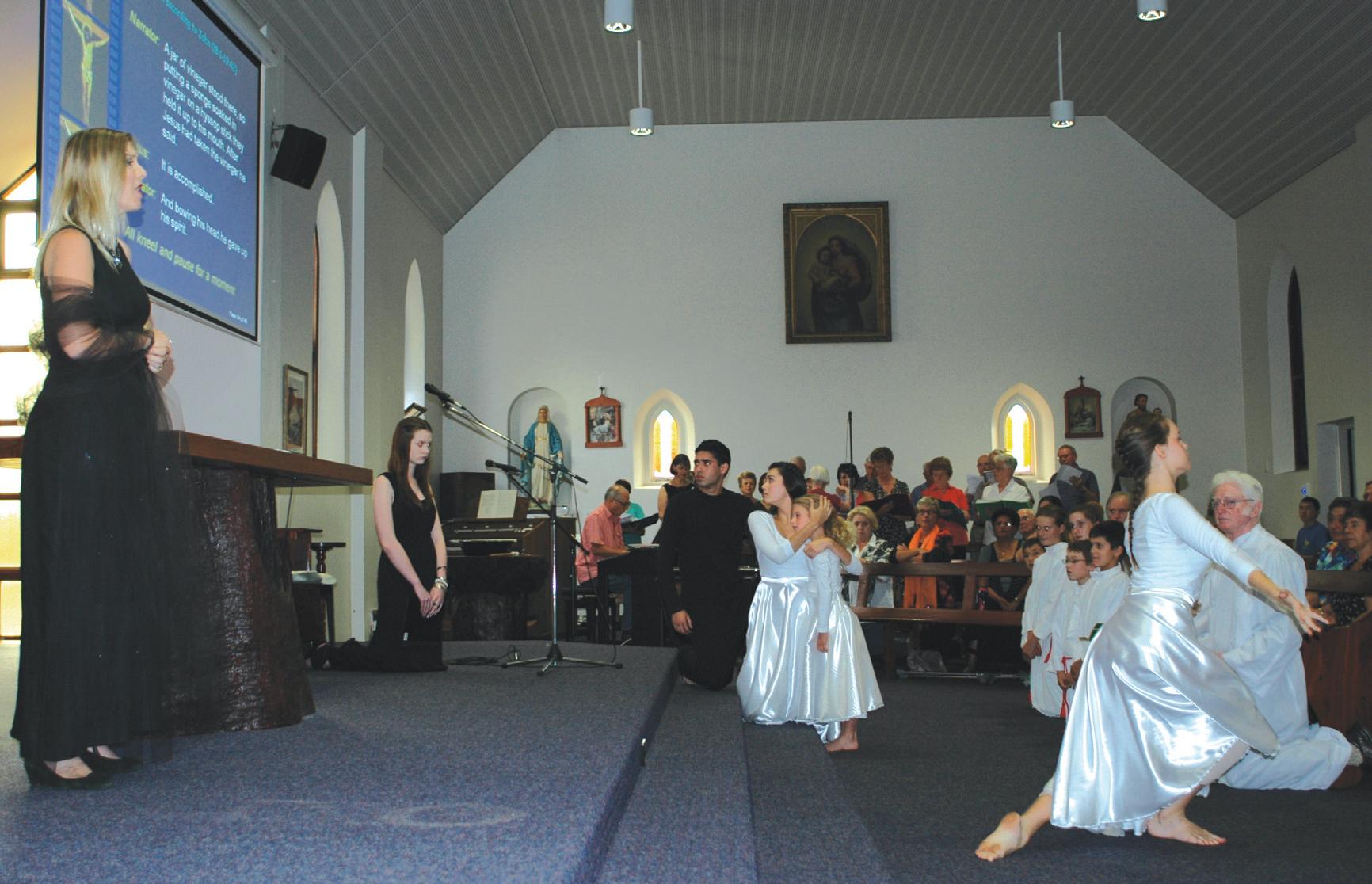
During our Good Friday afternoon celebration we had a liturgical enactment of our Lady’s sorrow at the foot of the cross.
Opera singer Fiona Cooper Smyth sang Pie Jesu as ballet dancer Annie Quinn approached the altar, with Matthew, Tiffany and Emily taking the roles of the beloved disciple, Mary Magdalene and a child.
Arranged by parishioner Jane Pike, it was touching and moving in its sincerity and beauty.
From Good Friday, a group of parishioners met daily in the church to pray a novena of the Chaplet of Divine Mercy.
This led up to Divine Mercy Sunday on 1 May and the beatification of Pope John Paul II.
Parishioner Pamela Kenyon, who has a special devotion to the Divine Mercy, brought in a painting of the Divine Mercy of Jesus, to form a prayer focus.
Before the joyous Easter morning celebration, the rock on our display table had been rolled away from the small tomb, bandages lay unravelled and we all happily celebrated that Jesus Christ had risen.
During Mass, Fr Paul Raj baptised baby Ruby Cable amidst a flock of little children at the baptismal font clambering to welcome the newest member of our church family.
No big difficulties: Perth clergy affirm new translations of the Mass prayers
Local priests see no major problems for this coming October
BY ANTHONY BARICHThe Council of Priests of the Archdiocese of Perth has given the new translations of the Missal its full endorsement.
In an exclusive statement to The Record after discussing the issue at their 14 April meeting at the Cathedral Presbytery, Perth’s Council of Priests chairman Fr Brian McKenna said the changes “will be as readily accepted as the original (1973) translation was”.
“The Council of Priests of the Archdiocese of Perth accepts that there may be minor difficulties in implementing the New Translation of the Roman Missal,” the 16 April statement said. The new Missal will be available in Perth at the beginning of Advent.
Perth Auxiliary Bishop Donald Sproxton told The Record that workshops for the catecheses on the Mass and “Train the Trainer” sessions have been well received by parishes across the Archdiocese.
The Bishops of the province of WA have decided that the people’s parts of the Mass will be introduced on the 31st Sunday in Ordinary Time (29-30 October), to enable parishes to be prepared for and
deliver the Catechesis on the Mass. In some other parts of Australia, this introduction will occur earlier.
Bishop Sproxton said that the prelates of WA anticipate that the New Roman Missal will be available at the beginning of Advent, when the priests will be permitted to begin using the Presidential Prayers, the Prefaces, the Eucharistic Prayers and the rest of the Missal.
Pew cards with people’s responses and the texts of the Confiteor, the Gloria, the Creed and the Mystery of Faith acclamations are now available to parishes for free from the Archdiocesan Centre for Liturgy for parishioners to learn in advance.
“The changes in the people’s responses are not many or difficult.
“The biggest challenge will be for the celebrants because of the wording and the flow of language will be different from what we have been used to,” the statement from Perth’s Archdiocesan Council of Priests said. “With time and practice in getting used to these differences, it is anticipated that the New Translation will be as readily accepted as the original English translation was”.
The statement from the Council of Priests of the Archdiocese of Perth, an official Archdiocesan organisation, is in stark contrast to one issued on 23 February by the National Council of Priests Australia, a purely private organisation unrelated to the Perth body.
The NCPA said that the new translations provoked calls for a boycott.
The NCPA said the new translation could exclude women and suggested a concession be given to people who “find this new translation unacceptable” just as one was given to Catholics who prefer the Tridentine Mass in Latin.
It said individual priests would not conform to the new translations and make their own changes as they saw fit.
“As in the past, individual priests will adapt styles to suit individual circumstances whilst being faithful to the key elements of the Eucharistic tradition in the Church,” it said.


Editor
Journalists


Peter Rosengren office@therecord.com.au
Bridget Spinks baspinks@therecord.com.au
Mark Reidy mreidy@therecord.com.au
Anthony Barich abarich@therecord.com.au
Advertising/Production
Accounts
Catherine
Bibiana

Mary MacKillop Catholic Community Primary School in Ballajura is a triple stream school catering for approximately 700 children from PreKindergarten to Year 6. The school strives to live the motto of Truth Love and Dignity, enabling the students to grow in a safe and happy environment.
The school has a very positive relationship with the Mary MacKillop Catholic Parish. The parish and school are situated on the same site, allowing the development of a great sense of community within the suburb of Ballajura. From its foundation in 1990 the school has supported children with special needs through the St Joseph Centre, as well as being integrated into mainstream classes.
An curriculum embracing the spiritual, religious, intellectual, physical and social development of all, where relationships and learning are important, are offered by the school. The academic program caters for the needs of all students and offers a numeracy and literacy support program, including Reading Recovery.
Mary MacKillop runs a Gifted and Talented Program and has just completed a technology upgrade throughout the school. The performing arts are enthusiastically embraced and students are involved in a number of sporting activities throughout the year.
The successful applicant will take up this position on 1 January 2012.

THE University of Notre Dame Australia has been granted $165,000 by the Australian Government Department of Education, Employment and Workplace Relations to investigate how technology tools, including mobile technologies and software programmes can enhance the learning and teaching of mathematical concepts to promote understanding.
Developing digital information and communications technology educational (ICTE) resources for mathematics is just one branch of the groundbreaking $7.8m Teaching Teachers for the Future Project.
The project, the largest of its type ever undertaken at a tertiary level in Australia, sees current pre-service teachers from 39 universities and higher education institutions combining together to build up their ICTE capacity. Fremantle Campus School of Education lecturers, Associate Professor Jean MacNish and Ms Lorraine Day, are project leaders in this branch of mathematics education. They will investigate current best practice of the use of information and communication technology (ICT) in teaching mathematics.
The results of their research will guide their recommendations on how the use of ICT can be incorporated into mathematics curriculum to improve student learning in conjunction with the new national graduate teacher standards.
Consultant, Leadership, Employment & Community Relations Team on 08 6380 5237 or email wrd@ceo.wa.edu.au. All applications, on the official form, should reach The Director of Catholic Education, Catholic Education Office of WA, PO Box 198, Leederville 6903 no later than 30 May 2011.
Ms Day, a former President of the Mathematical Association of WA, will work alongside teachers in their classrooms to assist both staff and students in their use of ICT resources, ultimately enhancing the delivery and their understanding of mathematics curriculum. “I would like to see mathematics teachers make their lessons more concrete, more visual and more kinaesthetic so that the students will be engaged and have an understanding of what they’re doing,” said Ms Day, who will ‘team teach’ primary mathematics units in second semester with one of UNDA’s other maths educators. “We have revamped these units to include the use of technology throughout. We haven’t changed what we’re teaching, but we’ve changed how we’re going to teach it,” she said.
 BY GLYNNIS GRAINGER
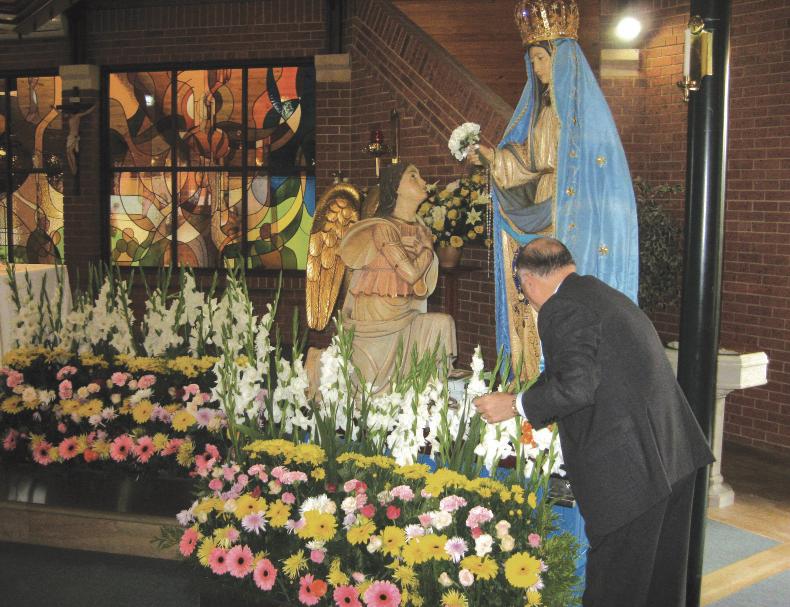
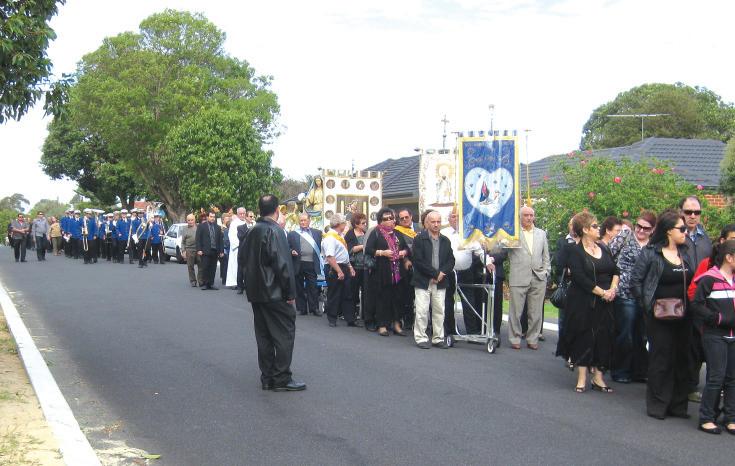
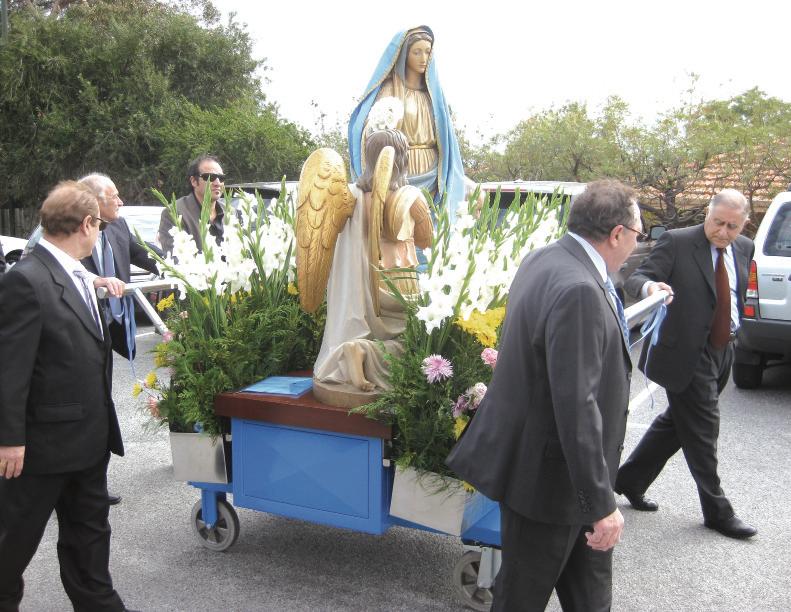
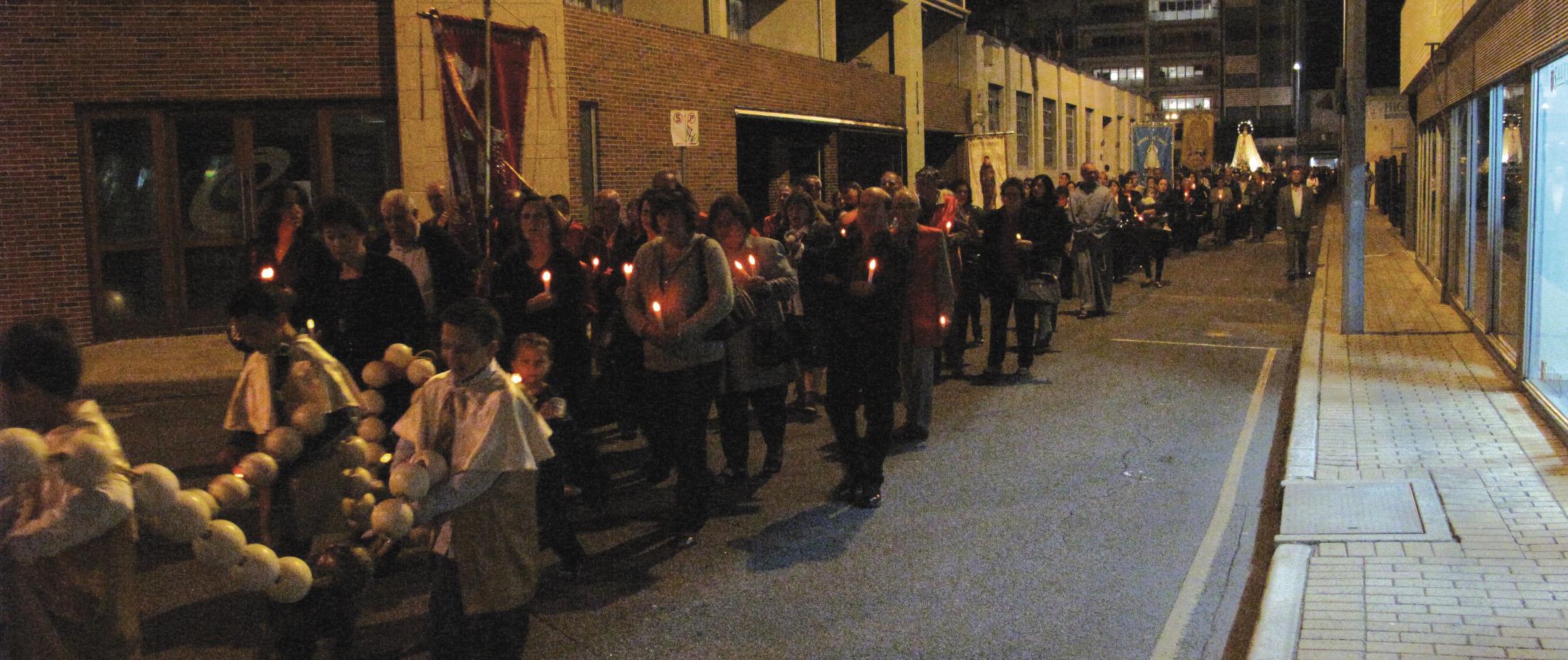
The annual Italian festival in honour of Our Lady Maria SS (Santissima) Annunziata was held over four days at St Kieran’s Church, Osborne Park, culminating in a procession around the suburban streets of Tuart Hill on Sunday, 15 May.
As part of the festival, there were three days of prayer with Holy Rosary at 7.15pm followed by Mass and homily at 7.30pm on 11-13 May. There was the anointing of the sick at the Friday Mass. The celebrants were parish priest Fr Michael Gatt and Fr Leo Spicer.
On Sunday, Fr Gatt celebrated Solemn Mass at 10am with the procession at 11.15am followed by Benediction and lunch in the parish centre.
About 500 parishioners and visitors took part in the 41st year of the procession, accompanied by the Perth City Band - which began and ended at the church.
Sunday also marked the anniver-
sary of passing of Fr Gatt’s mother, he told the congregation in the Prayer of the Faithful.
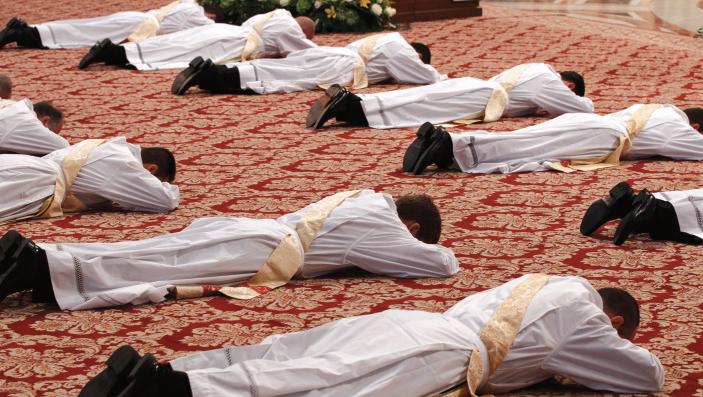
Acolyte Eugene Tresham was accompanied at the altar by seminarians from Redemptoris Mater Seminary, Morley: Matteo Verdi, 21, and Antonio Scala, 43, the latter who will be ordained to the diaconate at St Mary’s Cathedral on 26 May.
In his homily at the Sunday Mass, Fr Gatt said, “When we celebrate the Feast of Our Lady ... a very special thing, and she was chosen by God to be His mother.”
In Perth, the origin of the feast goes back to 1971 when a replica statue of Mary was brought to WA from Sicily to St Kieran’s Church.
Parishioners from Raccuia in Italy formed the Maria Annunziata Association and the yearly devotion has been held ever since.
In Sicily, the annual Maria SS Annunziata festival takes place in Raccuia, Messina, when it will be celebrated on 20-21 September this year.
SAINT John of God Health Care has taken significant steps towards fulfilling its Social Justice Vision, with two policies demonstrating its commitment to patients and caregivers facing hardship.
The Social Justice Vision incorporates Social Outreach and Advocacy services and three other areas: caregivers facing hardship, patient concessions and community responsibility.
To develop the policies, working groups of caregivers from across the group considered existing practices and policies within the overarching framework of their Social Justice Policy.
Group Director of Mission Jennifer Stratton said that as well as enabling SJOGHC to reach out to even more people in need, “the new policies give our caregivers clear guidance and empower them to make decisions quickly, and with confidence and equity, in times of urgent need or crisis”.
The patient concessions policy ensures that services can respond to requests from benevolent agen-
● A need has been identified and an appeal made to knit, crochet or provide warm bed coverings and clothes for newly arrived male refugees to Northam; a town where temperatures regularly go below zero during the winter months.
The WA State Catholic Women’s League started collecting these items at its annual general meeting in April with plans to gather more items at the Bunbury diocesan annual general meeting in Margaret River on 21 May.
Donations will be sent to the organisers, Wellspring Community Inc (WA) or Northam Uniting Church Congregation.
For more information or to help with the appeal, contact Janet MacGregor on 08 9452
cies, international aid agencies or hospital clinicians and management who have assessed a patient as requiring treatment that is not readily available elsewhere in the region.
Patients and caregivers alike can find themselves in difficult circumstances; caregivers can experience hardship or crisis in their lives or that of their immediate family’s lives.
“We have offered and continue to offer our caregivers many types of support including practical responses such as providing meals or fundraising for specific causes, both of which are to be applauded and encouraged at a local level,” Jennifer said.
“Sometimes, the best way we can assist is by providing financial support, whether directly or indirectly, such as approving extended sick leave.”
Examples of caregivers experiencing hardship in the past include those affected by the 2009 Black Saturday bushfires in Victoria and, more recently, Western Australia’s bushfires.
8632 or email dejagmac@ optusnet.com.au.
● St John of God Counselling Centre, Fremantle has changed its name and location. Now called St John of God Murdoch Ferns House, after the diocese in Ireland where the Sisters of St John of God began their mission, the new premises are at 62 Pakenham St, Fremantle. During its seven years of operation, the Counselling Centre saw at minimal or no cost 2,500 clients from vulnerable population groups in Perth’s south metropolitan area.
The hospital’s Manager Social Outreach and Advocacy, Peta Wootton, said the Sisters of St John of God were an integral part of Murdoch’s history.
“The opening of Ferns House and incorporation of our Social Outreach and Advocacy services under one roof helps to
While assistance was offered to caregivers in the past, this new policy ensures caregivers, such as those affected by Christchurch’s earthquake, are able to access help more easily.
The Christchurch caregivers, many of whom experienced significant hardship themselves, were the first recipients of the Caregiver Hardship Policy.
Each caregiver from the Halswell and Waipuna services was given a $100 grocery voucher on 25 March - a gesture, it was hoped, would boost morale as well as provide some financial respite.
St John of God Health Care board member Tony Howarth has offered his Queenstown holiday apartment for use by caregivers at no cost. The St John of God Hauora Trust has also made available two holiday homes - in Lake Taupo and Mount Lyford - for caregivers to use.
“Supporting people who are vulnerable, materially poor, powerless or marginalised is a fundamental and non-negotiable part of our ministry,” Jennifer said.
continue this heritage,” she said.
● With a booming economy, growing population and low unemployment levels, competition between employers in Western Australia for professional, passionate and committed employees is high.
St John of God Hospital Subiaco has developed a new workforce brand to assist in recruiting and retaining caregivers who fit within the hospital’s values and culture. The new brand’s taglines are Be part of something greater and If your heart makes you stand out, you’ll fit right in and it is supported by a red heart image.
Subiaco Director of Workforce Development Shellee Chapman said the new branding reflected the St John of God values, which are demonstrated by the hospital’s caregivers every day.
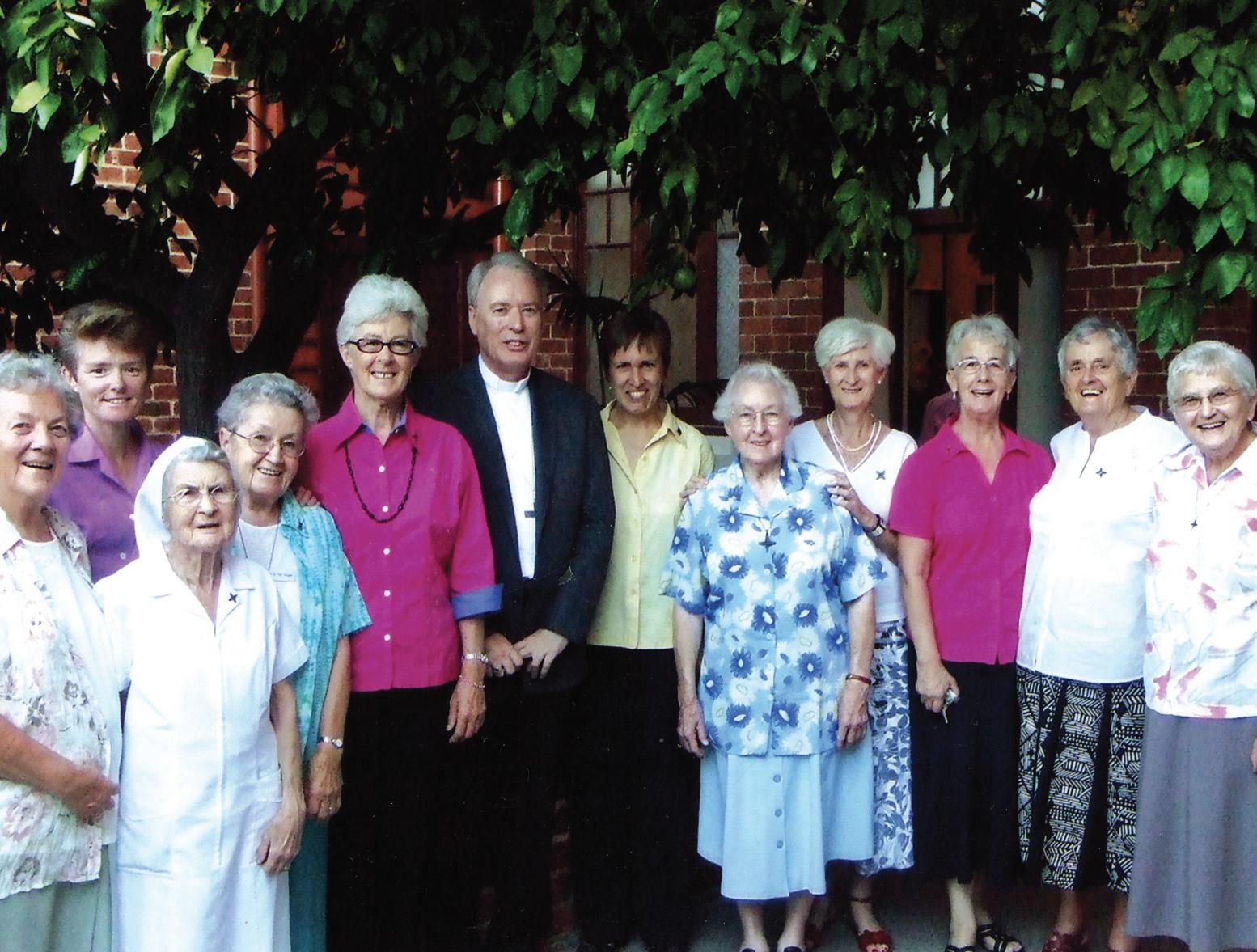
SISTERS of Our Lady of the Missions Claudia Stecker from Toronto, Canada and Kate O’Neill from Geelong, Victoria spoke about the Mission of the Order in the Philippines with fellow Sisters of Our Lady of the Missions and associates at the Catholic Pastoral Centre in Highgate on 13 March.
Up to 60 friends and associates of the Order gathered to hear Sr Claudia and Sr Kate give their testimony. Perth Auxiliary Bishop Donald Sproxton also attended the special session.
The missionary work started 24 years ago when the Sisters ventured into the highlands of south Mindanao to be among
the Monobo people, offering education to girls from remote villages and providing basic health education to women.
Their mission has expanded since then and the Sisters are now also working in Cotabato City, Piket - a refugee camp for both Christians and Muslims fleeing war - and Manila City.
Sr Claudia, who has been in the Philippines for 14 years, was first missioned to Cotabato, a predominantly Muslim city and the scene of ongoing violence and widespread poverty.
During her eight years in the Philippines, Sr Kate has worked among the 300,000 street children of Manila.
During their two weeks in Perth, Sr Kate and Sr Claudia visited the schools where the Sisters of Our Lady of the Missions have previously taught to raise awareness of the United Nations Millenium Goal, “Every child has a right to an education”.
Despite that goal, many children in the Philippines do not experience that right, they said.
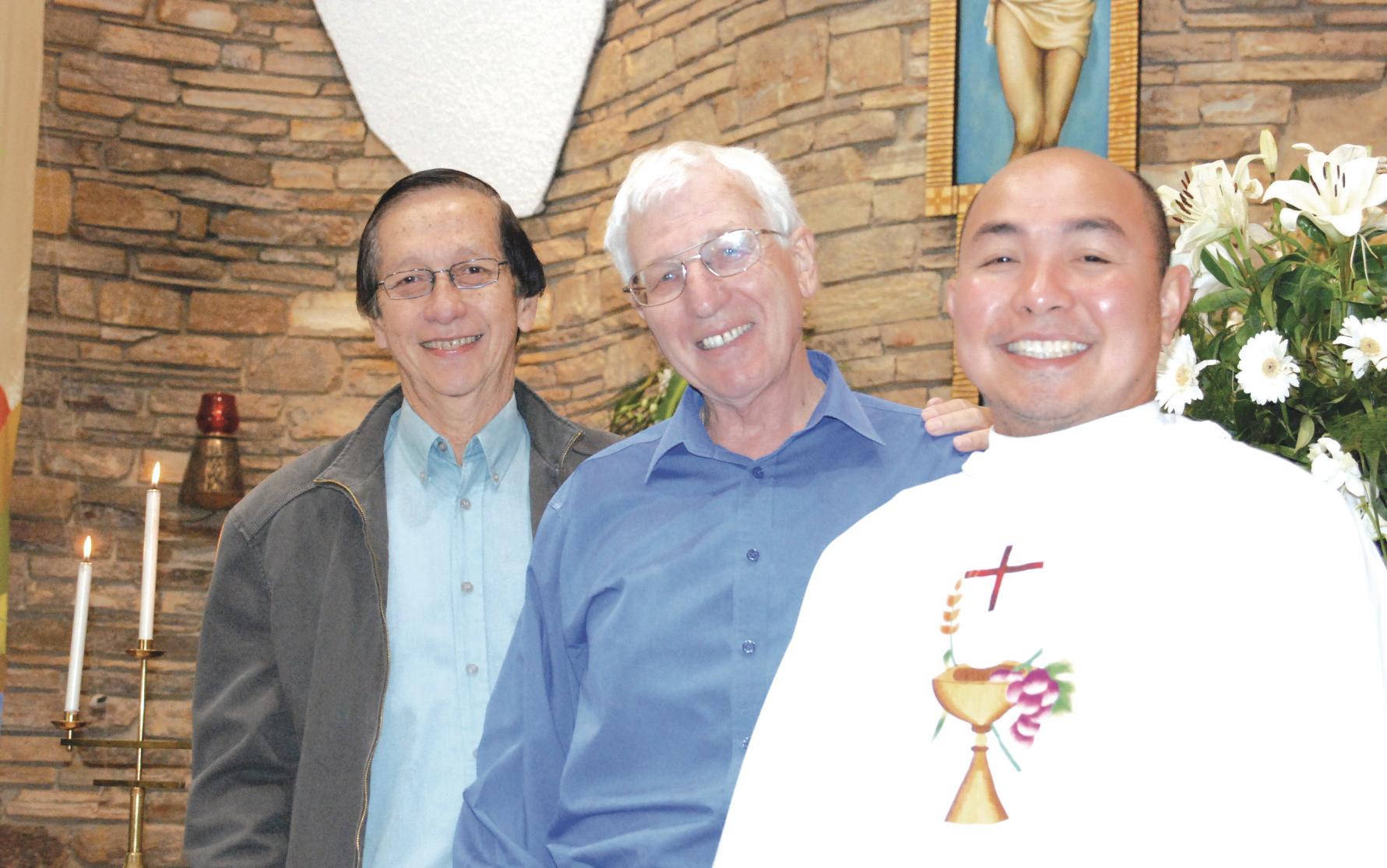
FATHER Elver Delicano has picked up the pieces in Maida Vale Parish over the last eight months, establishing its first parish council in 10 years.
Fr Elver, 36, said he did not know where or how to start when he was installed on 13 August last year as parish priest at St Francis of Assisi, after long-time parish priest Fr Steve Durkin passed away after a long battle with cancer on 13 July, two weeks shy of his 54th birthday.
Fr Durkin was known as a great storyteller and parishioners still talk about his impressive homilies. Formerly stationed in Kalgoorlie, parishioners remember him as definitively Australian and very congenial.
He was particularly good with children, which subsequently brought many lapsed parents back to the Church.
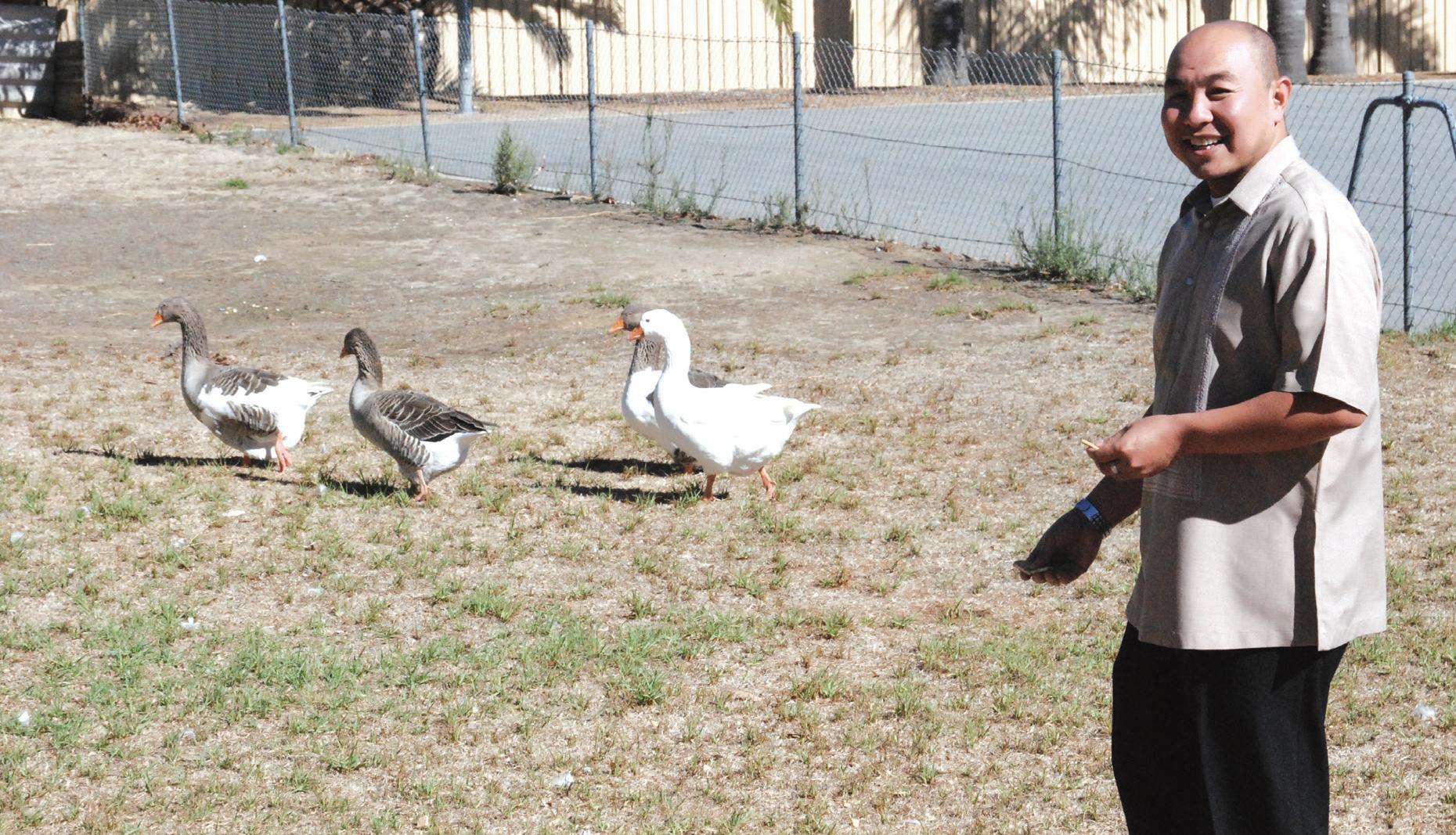
When he transformed his pet dogs into reindeer for Christmas events, it was a “huge hit” with the kids. He also had four geese, which Fr Elver - who has a great devotion to St Francis - has since inherited.
Fr Elver initially joined the Franciscans in Manila and studied at the Franciscan Our Lady of the Angels Seminary in Manila. He was also ordained on the feast of the great saint, 4 October.
Parishioners say attendance is up and they are jumping at opportunities to become involved in new initiatives.
This year’s Anzac Day Mass drew more people than in recent memory, so Fr Elver invited them to the old parish hall – the shed that served as the original church – for a cuppa. It was so successful it inspired Fr Elver to see the need for a social committee.
A social committee’s fundraising efforts will be needed to install a fence surrounding the church property – which could cost tens of thousands of dollars - as vandals have damaged the outdoor statue of St Francis so often and so badly it had to be removed, and youths often do burn-outs on the church’s sizable parking lot.
The new parish council established by Fr Elver has several sub-
committees looking after everything from the Legion of Mary and the St Vincent de Paul Society to commentators, special ministers, flowers and ground maintenance.
Importantly, Matthew Gibney Catholic Primary School Principal Ashley Arnold is on the new 18-person parish council to help facilitate greater unity between the parish and the nearby school.
“Ashley’s heart is truly in the parish,” Fr Elver said. “He goes far beyond what is normally expected of a school principal, especially in regards to the sacraments.”
Fr Elver ensures baptisms of families in the school take place during regular parish Masses so the parish embraces them.
He also has a particular focus on home visitations, including the sacraments. The new finance committee, headed by Roy, an accountant, has installed five air conditioners in the church while a new multimedia overhead projector is on the planning books. Fr Elver has invited the Legion of Mary Frank Duff Prayer Group to meet monthly to pray the Rosary after the 9.30am Mass in the church rather than in the hall. He has also switched Adoration of the Blessed Sacrament from after the 9.30am Mass on the last Friday of each month to before the Mass, and has mandated 15 minutes of silence “to spend time with Jesus in the Blessed Sacrament” before they start the Rosary.
These and other initiatives, he and the parish council have started, have helped the parish become a family, Fr Elver said.
He always allows several months
of prayer, discernment and reflection before suggesting anything, as he learned much about lay empowerment in his seminary formation in the Philippines. “I love to work with people. When parishioners serve the parish it becomes a community of faith, a community of disciples,” he said, adding that permanent Deacon Trevor Lyra has been an invaluable help to his sacramental and pastoral ministry. Fr Elver was formerly assistant parish priest at Mundaring; Maida Vale is his first posting as parish priest.
Last year he invited close to 200 volunteers of the parish and their families to a Thanksgiving Mass to thank them for their time, service and talents, as “they are gifts of the Church”. “One thing I’ve learned as a priest in a new parish is it’s important to know your people. It’s not that important to do what I want or just to provide what the parish needs, but to allow God to inspire; because, as much as possible, I’d like to do what God wants in the parish,” he said. “Life as a parish priest is not easy or hard. It is a life of sacrifice – giving oneself for love of God, the Church and the people of God especially.”
New parish chairman George Favacho said his new role has also given him a broader perspective of what is involved in the running of a parish.
George and Roy, both daily communicants, said people are “quite enthusiastic” to take up roles, and Fr Elver has unified the parish.
“There’s better communication and awareness of what’s happening in the parish,” George said.
 BY MATHEW DE SOUSA
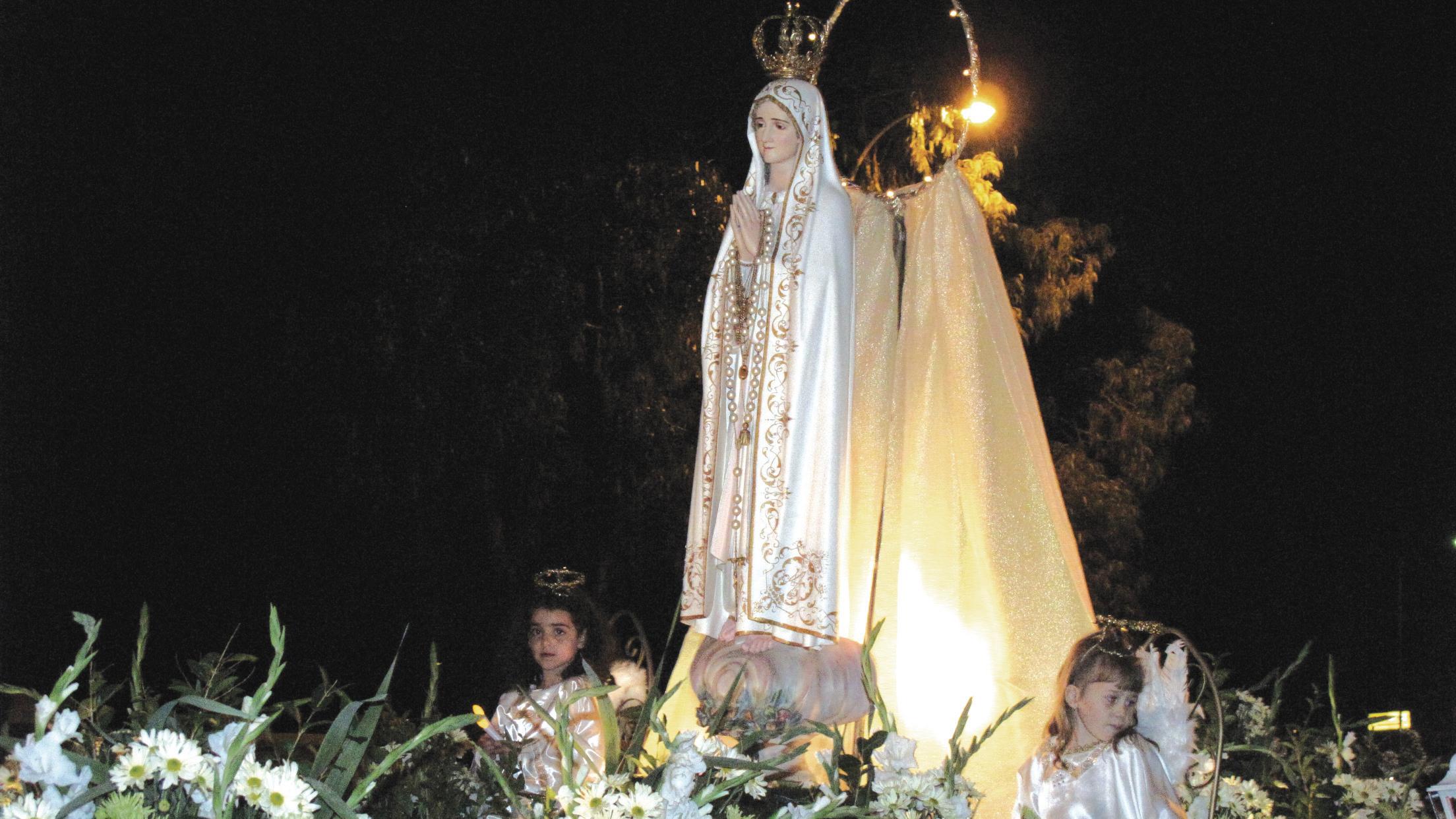
HUNDREDS of faithful filled St Patrick’s Basilica for Mass on 13 May and then processed around Fremantle in honour of the Marian apparitions at Fatima in 1917 on the feast day of Our Lady of Fatima.
Several priests concelebrated the Mass, which was recited in both English and Portuguese.
Fr Tony Maher preached the homily on the way St John the Apostle took Mother Mary back to his home and cared for her after the crucifixion. So too must we take Mother Mary home with us, he said. As Mary helped Jesus through His own life by caring for Him and encouraging Him to perform His first miracle, so too must we entrust ourselves into her loving arms so that we may be guided just as she guided her beloved son, he said.
After Mass, the faithful filed out and formed into a number of groups, including the Sacred Heart of Jesus group which led the procession through the streets of Fremantle. Our Lady of Fatima requested that the Rosary be prayed daily; in heeding this call, the procession of local and Portuguese Catholics prayed the Rosary publicly as they witnessed their faith in Fremantle.
A statue of Our Lady of Fatima was carried on a float and a number of children who had dressed up in white to form a chorus of angels with the statue of Our Lady, adorning the procession with beauty. The procession finished at St Patrick’s Basilica where the Blessed Sacrament was exposed and Benediction took place. Throughout the Mass, procession and benediction a choir sang devotional hymns and praises, which lifted the spirits of all those who attended.









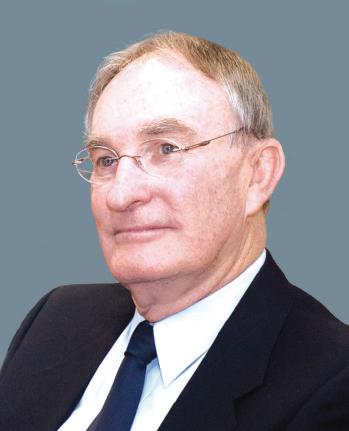
TOOWOOMBA Bishop William
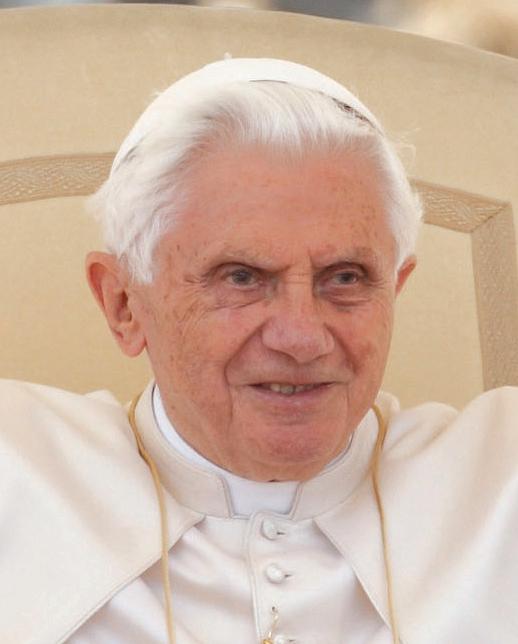
M Morris was asked to resign six times by three Vatican dicasteries and Pope Benedict XVI himself before the Pontiff finally insisted that he leave office on 2 May, leaked documents have revealed.
It has also been revealed that Bishop Morris asked Vatican dicasteries for more time to resign as he was dealing with a protracted case involving sexual abuse.
Brisbane Auxiliary Bishop Brian V Finnigan, whom the Pope appointed as the Toowoomba diocese’s apostolic administrator on 2 May, praised Bishop Morris’ handling of the sexual abuse of 13 young girls at the hand of a former Catholic primary school teacher in the Toowoomba diocese during 2007 and 2008.
“The scourge of sexual abuse has confronted the diocese,” Bishop Finnigan told Australian Associated Press on 3 May.
“The good work that Bishop Morris has done to address the needs of the victims will continue into the future.”
The former teacher, 61, admitted last year to the abuse. Bishop Morris accepted legal liability for the abuse immediately and the Church entered into mediation with the victims.
Pope Benedict’s removal of Bishop Morris, 67, came after more than a decade of conflict between the prelate and the Vatican, documents obtained by The Record reveal.
The document - prepared by Fr Peter Schultz, Toowoomba’s judicial vicar, and Fr Peter Dorfield, former vicar general of the diocese - entitled Summary History of Bishop Morris’ dispute with the Roman Dicasteries, is an addendum to a seven-page defence of the prelate sent on 29 April to priests, leaders and the head of Christian denominations in the Toowoomba region.
It reveals that the conflict origi-
nally stemmed from Bishop Morris establishing guidelines for the use of General Absolution within the celebration of Communal Rites of Reconciliation, which were in conflict with papal guidelines.
Retired Auxiliary Bishop Geoffrey Robinson of Sydney said on ABC Radio on 1 May that the issue of General Absolution was the original source of the rift between Rome and Bishop Morris.
Bishop Morris “felt the Third Rite was doing an immense amount of good, and was loath to abandon it. In fact, he said he wouldn’t,” Bishop Robinson said.
Pope John Paul II’s 2002 apostolic letter Misericordia Dei (“The Mercy of God”), warned that there are “some places” where there has been “a tendency to abandon individual confession and wrongly resort to ‘general’ or ‘communal’ absolution.”
Sources in Toowoomba told The Record that General Absolution had been provided in the diocese several years prior to Misericordia Dei, commencing shortly after Bishop Morris was ordained as Bishop of the diocese on 10 February 1993.
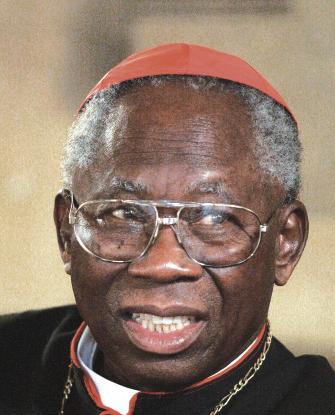
The issue of General Absolution led to a dispute between the prelate and Cardinal Francis Arinze, then-Prefect of the Congregation for Worship and the Discipline of the Sacraments.
“For a number of years, Bishop Morris had been in regular and difficult discussions with the
Congregation (Cardinal Arinze) over our pastoral use of General Absolution in the Communal Rite of Reconciliation,” the Toowoomba College of Consultors’ document said.
“His position on this sacramental matter was seen as defiant and ongoing opposition to the position of the Congregation.”
Then, in his 2006 Advent Pastoral Letter, Bishop Morris stated that, “if Rome would allow it”, he would be prepared to ordain married priests and women priests.
He also said that due to an ageing clergy, the Church should be open to recognising the validity of Anglican, Lutheran and Uniting Church Orders.
“Given our deeply held belief in the primacy of Eucharist for the identity, continuity and life of each parish community, we may well need to be much more open towards other options for ensuring that Eucharist may be celebrated,” Bishop Morris said in the 2006 Advent Pastoral letter. “As has been discussed internationally, nationally and locally, the ideas of ordaining married, single or widowed men who are chosen and endorsed by their local parish community; welcoming former priests, married or single, back to active ministry (and) ordaining women, married or single.”
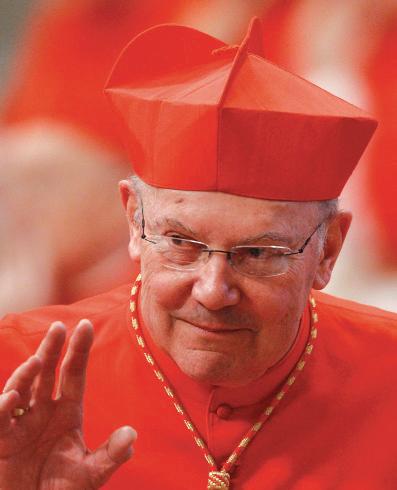
This, and a failed attempt to bring Bishop Morris to Rome to meet Cardinal Giovanni Battista Re,
then-prefect of the Congregation for Bishops, Cardinal Arinze and Cardinal William J Levada, Prefect of the Congregation for the Doctrine of the Faith, led to Denver Archbishop Charles Chaput’s apostolic visitation from 24-27 April 2007. This visit included an interview with Bishop Morris and many other people throughout the diocese.
A memorandum dated 28 June 2007 from the Congregation for Bishops arrived in Toowoomba in September that year requesting Bishop Morris’ resignation. He replied on 17 September that he would “reflect” on it and reply after his October holidays.
This prompted a 6 November 2007 letter from the congregation stating the request for his resignation was being made “in the name of the Holy Father”.
Bishop Morris asked the three Cardinals in a meeting on 19 January 2008 in Rome if he could speak to the Pope but was told “this would only be permitted after he had resigned”, the document said.
The Bishop told Cardinal Re in a letter on 24 January 2008 that “he felt unable to resign”, which was followed by another letter from the Cardinal on 13 February 2008 again calling on the prelate to resign.
After a failed request by Bishop Morris to the Supreme Tribunal of the Apostolic Signatura seeking advice in defending his position, Cardinal Re again demanded
Bishop Morris resign by the end of November 2008 in a letter dated 23 October 2008 that also stated that if the resignation was not forthcoming the Bishop would be removed.
This letter cited the report of Archbishop Chaput that “the general theological climate of the diocese, priests and people was considered to be in theological and disciplinary decline”.
Bishop Morris replied on 19 December 2008, saying that “in conscience, he could not resign.”
He then wrote to the Pope on 24 December 2008, and met with him on 4 June 2009 where the Pontiff “reiterated the demands of the three Cardinals and indicatd that the Bishop’s talents lay elsewhere than as the Bishop of a diocese”.
“The Pope urged Archbishop (Philip) Wilson (Australian Catholic Bishops Conference president, who accompanied the prelate in the meeting) to work with Bishop Morris to find him a suitable position in the Australian Church,” the document said.
Cardinal Re again asked for Bishop Morris’ resignation in a 9 July 2009 letter, prompting him to write to the Pope clarifying his position that “in conscience, he could not resign from office”.
Pope Benedict replied on 22 December 2009, requesting that Bishop Morris resign from office, reminding him there is no appeal from papal decisions.
Australian Bishops back Pope’s decision to remove Toowoomba Bishop with “doctrinal problems”
BY ANTHONY BARICHAUSTRALIA’S Catholic Bishops have backed Pope Benedict XVI’s decision to remove Toowoomba Bishop William Morris and acknowledged that the prelate was judged to have “doctrine and discipline” problems that led to his downfall.
Following the 2 May removal, the Bishops held a special Plenary Meeting in Sydney to discuss the issue and committed themselves anew to “teaching faithfully what Christ taught as the Church has
handed it down”. In a 12 May letter to Brisbane Auxiliary Bishop Brian Finnigan, whom the Pope appointed Toowoomba’s apostolic administrator on 2 May, Adelaide Archbishop Philip Wilson said the Australian Bishops pledge to “reaffirm our faith in this mission which the Successor of Peter has received from Christ Himself, and we gratefully acknowledge Pope Benedict’s faithfulness to the Petrine ministry, even when it involves very difficult decisions”.
Australia’s Bishops acknowledged that, in removing Bishop Morris after several requests for his resignation by three Vatican congregations and the Pope himself, Pope Benedict was exercising his “Petrine care for the whole Church”.
“This has been difficult and distressing for all concerned, and it is not surprising that the decision has caused varied and intense reactions,” the letter said.
“We appreciate that Bishop Morris’ human qualities were never in question; nor is there any doubt about the contribution he has made to the life of the Church in Toowoomba and beyond.
“The Pope’s decision was not a denial of the personal and pastoral gifts that Bishop Morris has brought to the episcopal ministry. Rather, it was judged that there were problems of doctrine and discipline, and we regret that these could not be resolved. We are hopeful that Bishop Morris will continue to serve the Church in other ways in the years ahead.”
The Bishops will address the Pope’s decision and the process that produced it with the Pontiff during their 10-22 October ad limina visit to Rome.
During their Ad Limina visit, Australia’s Bishops will pray at the tombs of the Apostles Peter and Paul, to whose intercession they
will entrust their own ministry, the Diocese of Toowoomba and the Church inAustralia.
The Bishops discussed the Bishop Morris episode at length during their 5-12 May Plenary Meeting at Mary Mackillop Place in North Sydney, and heard from the leaders of 40 Religious congregations who have members working in Toowoomba.
The prelates also reflected on their responsibility as Bishops and on what it means for them to serve the communion of the Church and to exercise their ministry collegially as pastors of Christ’s flock, as teachers of the apostolic faith and as moderators of the sacred liturgy.
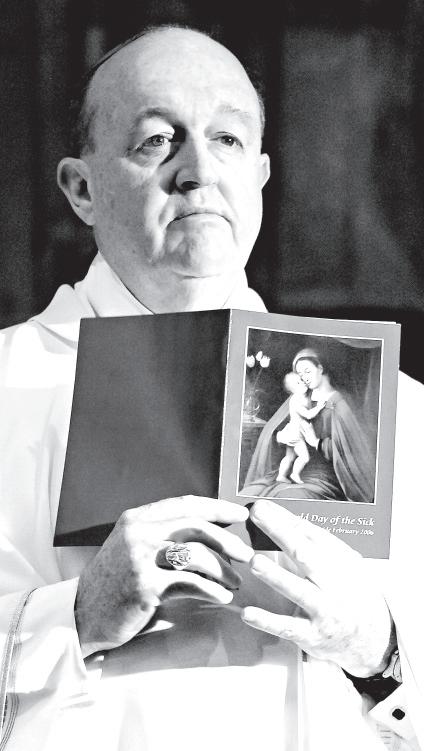
“We also reflected upon the unique role of the Pope as head of the College of Bishops. It is his task to guard and promote the communion of the Church and the integrity of the Church’s faith,” the Bishops’ statement said. Archbishop Philip Wilson
It would seem from a recent independent survey that distrust of “authoritarian” and “out of touch” Church hierarchy and non-belief in core teachings are rampant among a very over-worked Australian clergy.
Charles Sturt University lecturers Chris McGillion and John O’Carroll sent a survey to every priest engaged in parish ministry in Australia – 1,550 in total – plus 160 retired priests. Of these, 542 were returned completed by mid-2009.
They then interviewed about 50 priests “chosen at random” from every State and Territory in the country.
The result is the book Our Fathers: what Australian Catholic priests really think about their lives and the Church, published this year.
While it is true that Australian priests are very hard workers and have a reputation as pastorally compassionate and sensitive, much angst reported by this new survey stems from the 1960s anticipated changes in core teachings - especially those regarding sexualitythat never eventuated.
The study shows that while 90 per cent of respondents said their life as a priest has been fulfilling, “what we discovered was a world rich in commitment but also in complaint, disillusionment and dissent,” McGillion and O’Carroll said in the book.
Twenty-one per cent of respondents disagreed with the statement that priestly celibacy should be optional, while more than half (58 per cent) felt the Vatican exerted “too much control over the Australian Church”.
Nearly three-quarters (70 per cent) said that the Vatican “didn’t always understand the nature of the Australian Church”.
A majority (63 percent) judged that the Australian Bishops were “too conservative in Church matters”, while only 84 per cent agreed that Jesus was born of a virgin, and close to half (40 per cent) held that it was not essential to believe Christ rose bodily from the dead in order to understand the Resurrection.
The survey, however, was not necessarily entirely representative. Including the Eastern rites in communion with the Pope, the current Official Directory of the Catholic Church in Australia says there are 1,948 diocesan priests and 1,137 Religious priests – and these figures do not include the many who have been ordained since across the country. Andrew Hamilton SJ wrote in the Jesuit online journal Eureka Street that, given ambiguities in some statements to which the priests were asked to respond, “I am not convinced that the survey reveals a widespread rejection by priests of Catholic moral positions. The question needs closer and more precise analysis”.
The defining issue from which much of the survey angst stemmed was Pope Paul VI’s 1968 encyclical Humanae Vitae (“Of human life”) on the regulation of birth. Just 19 per cent of the survey’s respondents agreed that it is always a sin
for a married couple to use artificial birth control. Australian priests were evenly split on whether it is always a sin for unmarried people to have sex. They were also split on the question of whether practising homosexuals should receive Holy Communion: 36 per cent said they should not while 45 per cent agreed they should.
“There’s no doubt Humanae Vitae was a pivotal, critical moment - it galvanised many people who were struggling with embracing the Church’s teaching,” said Sydney Auxiliary Bishop Julian Porteous, Rector of the Archdiocesan seminary from 2002-2008 and author of After the Heart of God: the Life and Ministry of Priests at the Beginning of the Third Millennium (2009).
Bishop Porteous also noted that priests who have a jaundiced view of the Magisterium weren’t the only ones affected by the events of the 1960s.
“With student uprisings coupled with the ‘sexual revolution,’ priests were naturally caught up in this vortex of doubt and confusion and challenge to authority, and some of them have never quite recovered,” he said.
“They have stayed loyal as priests serving their people but have carried the effects of those times and
have adopted an attitude of questioning the Church’s teaching on a number of issues.
“At the same time, there were many priests who went through that period and stood by the Magisterium, believed it was correct, and showed ongoing loyalty to the teachings of Popes John Paul II and later, Benedict XVI.”
Humanae Vitae reiterated traditional Church teaching condemning as immoral the use of birth control, but several Bishops’ conferences around the world – including those of Belgium, Canada, France, Germany, the Netherlands and the US – issued statements after its publication assuring Catholics that the issue was a matter of conscience.
Melbourne Auxiliary Bishop
Peter Elliott, a Pontifical Council for the Family official from 19871997, confirmed that the Australian episcopal conference also fell into line with the others in 1974.
“After complaints to Rome, the statement was later corrected, but the damage was already done. The correction received little publicity. Through the secular media, Catholics heard ‘follow your conscience’, a green light for birth control and sterilisation,” Bishop Elliott said in Humanae Vitae: Personal Recollections , published by The Record on 8 April 2009.
He added that using dissent against the papal teaching became an instrument to achieve the radical goals of what Pope Benedict XVI calls ‘the hermeneutic of discontinuity’ or rupture – the belief that Vatican II threw out the past to usher in a kind of ‘new Church’.
Pope Benedict XVI has denounced this line of thought repeatedly. “Unfortunately, in the wake of Humanae Vitae, aggressive dissent seemed to freeze many Catholic leaders,” Bishop Elliott said, while many people did not read what Pope Paul VI taught but relied on “garbled accounts” of his teaching from the secular media.
Dissent reached the highest echelons of the Church. Bishop Elliott said he was effectively expelled from
a prominent theological association for his support for Humanae Vitae as an infallible teaching and for not supporting a theologian who rejected the physical Resurrection of Jesus.
Bishop Elliott cited renowned Lateran professor, the late Fr Eremengildo Lio OFM, who argued in Humanae Vitae e Infallibilta (1986) that the encyclical is really an ex cathedra solemn definition, hence infallible. Shortcomings in seminary formation also appear to have played a role in some priests dissenting from or not understanding key Church teachings.
Fr John Walshe, 53, national chairman of the Australian Confraternity of Catholic Clergy which has 300 members, recalls that while formation methods in seminaries varied, “psychology was almost seen as more important than penance, prayer and discipline of life that had always been the backbone of the formation of a priest”.
These old “ideological hangups” do not seem to exist among Australia’s new generation of priests who are more open to the disciplinary ideas of what the Church is trying to teach, Fr Walshe said.
This is baffling the older generation of clergy. For example, in 2009, Canberra-Goulburn Bishop Pat Power said in a column in The Swag, the magazine of the National Council of Priests Australia, that he is “disturbed” by some young seminarians and priests who, “seeing themselves as ‘true believers’, want the Church to revert to pre-Vatican II practices and attitudes”.
Fr Walshe said some older clergy don’t understand this phenomenon and “say the (young priests) are too conservative, but they’re not reacting, they’re searching for something, and when they find something of value that’s good and true they hold onto it”.
Therefore, these young priests have “had to be very bold to stand apart from their peers to respond to the priesthood and they’ll do it on the terms of the Church, which they believe ‘can lead me into true and lasting happiness’,” he said.
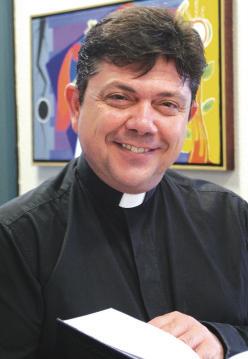 BY FR MAURIZIO PETTENA CS
The Australian Catholic Migrant and Refugee Office Director
BY FR MAURIZIO PETTENA CS
The Australian Catholic Migrant and Refugee Office Director
There are surveys that suggest 90 per cent of Catholic priests are happy in their job, yet some recent media on the subject would suggest that we are in an insurmountable crisis of faith in this country.
Much of the criticism aimed at the Catholic Church, sometimes from within its ranks, is aimed at those who appear to ignore the decline in vocations, and try to
patch up the problem with foreign clergy who cannot inculturate. Indeed, it cannot be denied that the Catholic Church in Australia is in need of pastoral workers at various levels, due to an increase in Catholic populations.
The Catholic Church in Australia is the one most impacted by migration. As such, Bishops are responding to this need in a way that is possible for our time, and in a way which has already brought unforeseen gifts. I am one of those overseas priests and I wish to comment on this from my experience and knowledge of working extensively with migrant communities.
I have worked in Australia for over 20 years as a migrant chaplain, a parish priest and as a member of a missionary Order of priests.
My duty as the Director of the Australian Catholic Migrant and Refugee office is, among other things, to liaise with the Department of Immigration on the Labour Agreement which allows us to bring to Australia priests, Sisters, Brothers and lay pastoral workers
from overseas. These people are volunteering to come to this country as missionaries and many of them have become pastors who are deeply loved by their congregations.
This is not new to Australia. We have always had missionary priests coming to Australia from countries such as Ireland to help in building the universal Church.
In the Catholic tradition, we have priests who are called fide donum, literally, a gift of faith.
These priests are present as missionaries, interacting pastorally with an increasingly multicultural Church, visible in practically every country of the world.
There are many gifts that come from this, including the privilege of welcoming people who come from thriving Catholic communities.
The international and multicultural flavour this brings and the revitalisation of the liturgy can be seen in hundreds of parishes across this country.
The parochial attitudes of those who see bringing foreign clergy to this country as a bandaid solution
rather than an immense gift and possibility for renewal are as much responsible for the decline in faith of Australians as the Bishops they seek to blame.
It is my view that the recent McGillion and O’Carroll report shows one particular view of the migrant priest phenomenon - that Bishops “import” from overseas out of desperation – whereas, in many ways, I believe it should be seen as a sign of the Bishops’ commitment to providing for the Catholic faithful.
Vocations are not growing in Australian dioceses for many reasons and there is a need for careful reflection on this but we also need to remember that we are a universal Church which cannot seek to limit the cultural background of its clergy due to lack of understanding.
The harm we do in showing frankly racist attitudes toward those who have come here in generosity is extremely upsetting. We can take a more positive role in helping these migrant priests to get used to Australian culture but instead, we simply criticise them
for being “ignorant, tribal or patriarchal.”
It is true that sometimes it takes migrant clergy time to adjust to life in this country. Just as it takes a while for migrants to learn another language, there are cultural norms that will be unfamiliar.
Often, clergy and Religious who come here are placed too soon into communities extremely different to their own.
But the immense benefits of learning from one another and growing together in the liturgy and ministry of the Church may be just what this country needs. We really owe an apology to all the overseas priests, who have laid down their lives to come here and serve, for the criticism that is often aimed at them.
We have always had foreign clergy in this country, from the early Irish missionaries right through to migrant chaplains who selflessly serve the migrant communities in our nation which, at this moment in our history, make up the majority of practising Catholics.
It would seem from a recent independent survey that distrust of “authoritarian” and “out of touch” Church hierarchy and non-belief in core teachings are rampant among a very over-worked Australian clergy.
Charles Sturt University lecturers Chris McGillion and John O’Carroll sent a survey to every priest engaged in parish ministry in Australia – 1,550 in total – plus 160 retired priests. Of these, 542 were returned completed by mid-2009.
They then interviewed about 50 priests “chosen at random” from every State and Territory in the country.
The result is the book Our Fathers: what Australian Catholic priests really think about their lives and the Church, published this year.
While it is true that Australian priests are very hard workers and have a reputation as pastorally compassionate and sensitive, much angst reported by this new survey stems from the 1960s anticipated changes in core teachings - especially those regarding sexualitythat never eventuated.
The study shows that while 90 per cent of respondents said their life as a priest has been fulfilling, “what we discovered was a world rich in commitment but also in complaint, disillusionment and dissent,” McGillion and O’Carroll said in the book.
Twenty-one per cent of respondents disagreed with the statement that priestly celibacy should be optional, while more than half (58 per cent) felt the Vatican exerted “too much control over the Australian Church”.
Nearly three-quarters (70 per cent) said that the Vatican “didn’t always understand the nature of the Australian Church”.
A majority (63 percent) judged that the Australian Bishops were “too conservative in Church matters”, while only 84 per cent agreed that Jesus was born of a virgin, and close to half (40 per cent) held that it was not essential to believe Christ rose bodily from the dead in order to understand the Resurrection.
The survey, however, was not necessarily entirely representative. Including the Eastern rites in communion with the Pope, the current Official Directory of the Catholic Church in Australia says there are 1,948 diocesan priests and 1,137 Religious priests – and these figures do not include the many who have been ordained since across the country. Andrew Hamilton SJ wrote in the Jesuit online journal Eureka Street that, given ambiguities in some statements to which the priests were asked to respond, “I am not convinced that the survey reveals a widespread rejection by priests of Catholic moral positions. The question needs closer and more precise analysis”.
The defining issue from which much of the survey angst stemmed was Pope Paul VI’s 1968 encyclical Humanae Vitae (“Of human life”) on the regulation of birth. Just 19 per cent of the survey’s respondents agreed that it is always a sin
for a married couple to use artificial birth control. Australian priests were evenly split on whether it is always a sin for unmarried people to have sex. They were also split on the question of whether practising homosexuals should receive Holy Communion: 36 per cent said they should not while 45 per cent agreed they should.
“There’s no doubt Humanae Vitae was a pivotal, critical moment - it galvanised many people who were struggling with embracing the Church’s teaching,” said Sydney Auxiliary Bishop Julian Porteous, Rector of the Archdiocesan seminary from 2002-2008 and author of After the Heart of God: the Life and Ministry of Priests at the Beginning of the Third Millennium (2009).
Bishop Porteous also noted that priests who have a jaundiced view of the Magisterium weren’t the only ones affected by the events of the 1960s.
“With student uprisings coupled with the ‘sexual revolution,’ priests were naturally caught up in this vortex of doubt and confusion and challenge to authority, and some of them have never quite recovered,” he said.
“They have stayed loyal as priests serving their people but have carried the effects of those times and
have adopted an attitude of questioning the Church’s teaching on a number of issues.
“At the same time, there were many priests who went through that period and stood by the Magisterium, believed it was correct, and showed ongoing loyalty to the teachings of Popes John Paul II and later, Benedict XVI.”
Humanae Vitae reiterated traditional Church teaching condemning as immoral the use of birth control, but several Bishops’ conferences around the world – including those of Belgium, Canada, France, Germany, the Netherlands and the US – issued statements after its publication assuring Catholics that the issue was a matter of conscience.
Melbourne Auxiliary Bishop
Peter Elliott, a Pontifical Council for the Family official from 19871997, confirmed that the Australian episcopal conference also fell into line with the others in 1974.
“After complaints to Rome, the statement was later corrected, but the damage was already done. The correction received little publicity. Through the secular media, Catholics heard ‘follow your conscience’, a green light for birth control and sterilisation,” Bishop Elliott said in Humanae Vitae: Personal Recollections , published by The Record on 8 April 2009.
He added that using dissent against the papal teaching became an instrument to achieve the radical goals of what Pope Benedict XVI calls ‘the hermeneutic of discontinuity’ or rupture – the belief that Vatican II threw out the past to usher in a kind of ‘new Church’.
Pope Benedict XVI has denounced this line of thought repeatedly. “Unfortunately, in the wake of Humanae Vitae, aggressive dissent seemed to freeze many Catholic leaders,” Bishop Elliott said, while many people did not read what Pope Paul VI taught but relied on “garbled accounts” of his teaching from the secular media.
Dissent reached the highest echelons of the Church. Bishop Elliott said he was effectively expelled from
a prominent theological association for his support for Humanae Vitae as an infallible teaching and for not supporting a theologian who rejected the physical Resurrection of Jesus.
Bishop Elliott cited renowned Lateran professor, the late Fr Eremengildo Lio OFM, who argued in Humanae Vitae e Infallibilta (1986) that the encyclical is really an ex cathedra solemn definition, hence infallible. Shortcomings in seminary formation also appear to have played a role in some priests dissenting from or not understanding key Church teachings.
Fr John Walshe, 53, national chairman of the Australian Confraternity of Catholic Clergy which has 300 members, recalls that while formation methods in seminaries varied, “psychology was almost seen as more important than penance, prayer and discipline of life that had always been the backbone of the formation of a priest”.
These old “ideological hangups” do not seem to exist among Australia’s new generation of priests who are more open to the disciplinary ideas of what the Church is trying to teach, Fr Walshe said.
This is baffling the older generation of clergy. For example, in 2009, Canberra-Goulburn Bishop Pat Power said in a column in The Swag, the magazine of the National Council of Priests Australia, that he is “disturbed” by some young seminarians and priests who, “seeing themselves as ‘true believers’, want the Church to revert to pre-Vatican II practices and attitudes”.
Fr Walshe said some older clergy don’t understand this phenomenon and “say the (young priests) are too conservative, but they’re not reacting, they’re searching for something, and when they find something of value that’s good and true they hold onto it”.
Therefore, these young priests have “had to be very bold to stand apart from their peers to respond to the priesthood and they’ll do it on the terms of the Church, which they believe ‘can lead me into true and lasting happiness’,” he said.
BY FR MAURIZIO PETTENA CS
The Australian Catholic Migrant and Refugee Office Director
There are surveys that suggest 90 per cent of Catholic priests are happy in their job, yet some recent media on the subject would suggest that we are in an insurmountable crisis of faith in this country.
Much of the criticism aimed at the Catholic Church, sometimes from within its ranks, is aimed at those who appear to ignore the decline in vocations, and try to
patch up the problem with foreign clergy who cannot inculturate. Indeed, it cannot be denied that the Catholic Church in Australia is in need of pastoral workers at various levels, due to an increase in Catholic populations.
The Catholic Church in Australia is the one most impacted by migration. As such, Bishops are responding to this need in a way that is possible for our time, and in a way which has already brought unforeseen gifts. I am one of those overseas priests and I wish to comment on this from my experience and knowledge of working extensively with migrant communities.
I have worked in Australia for over 20 years as a migrant chaplain, a parish priest and as a member of a missionary Order of priests.
My duty as the Director of the Australian Catholic Migrant and Refugee office is, among other things, to liaise with the Department of Immigration on the Labour Agreement which allows us to bring to Australia priests, Sisters, Brothers and lay pastoral workers
from overseas. These people are volunteering to come to this country as missionaries and many of them have become pastors who are deeply loved by their congregations.
This is not new to Australia. We have always had missionary priests coming to Australia from countries such as Ireland to help in building the universal Church.
In the Catholic tradition, we have priests who are called fide donum, literally, a gift of faith.
These priests are present as missionaries, interacting pastorally with an increasingly multicultural Church, visible in practically every country of the world.
There are many gifts that come from this, including the privilege of welcoming people who come from thriving Catholic communities.
The international and multicultural flavour this brings and the revitalisation of the liturgy can be seen in hundreds of parishes across this country.
The parochial attitudes of those who see bringing foreign clergy to this country as a bandaid solution
rather than an immense gift and possibility for renewal are as much responsible for the decline in faith of Australians as the Bishops they seek to blame.
It is my view that the recent McGillion and O’Carroll report shows one particular view of the migrant priest phenomenon - that Bishops “import” from overseas out of desperation – whereas, in many ways, I believe it should be seen as a sign of the Bishops’ commitment to providing for the Catholic faithful.
Vocations are not growing in Australian dioceses for many reasons and there is a need for careful reflection on this but we also need to remember that we are a universal Church which cannot seek to limit the cultural background of its clergy due to lack of understanding.
The harm we do in showing frankly racist attitudes toward those who have come here in generosity is extremely upsetting. We can take a more positive role in helping these migrant priests to get used to Australian culture but instead, we simply criticise them
for being “ignorant, tribal or patriarchal.”
It is true that sometimes it takes migrant clergy time to adjust to life in this country. Just as it takes a while for migrants to learn another language, there are cultural norms that will be unfamiliar.
Often, clergy and Religious who come here are placed too soon into communities extremely different to their own.
But the immense benefits of learning from one another and growing together in the liturgy and ministry of the Church may be just what this country needs. We really owe an apology to all the overseas priests, who have laid down their lives to come here and serve, for the criticism that is often aimed at them.
We have always had foreign clergy in this country, from the early Irish missionaries right through to migrant chaplains who selflessly serve the migrant communities in our nation which, at this moment in our history, make up the majority of practising Catholics.
The removal by Pope Benedict of Bishop William Morris from the diocese that had been placed into his care for the Catholic faith in 1993 has been major news throughout the Catholic world over the last fortnight. While the removal was almost unprecedented in Australia, it not-so-surprisingly illuminated fault lines within the Church which all reasonably well-informed observers have known about for decades. To use somewhat technical language, the fault-line is sometimes described as the one which runs between the hermeneutic of continuity on the one hand and a mentality which can be described, on the other, as a hermeneutic of discontinuity. At the end of the day, however, the issue under debate was the simple fact that in the Catholic Church every Bishop, a successor to the apostles, is obliged by sacred oath to teach what the Catholic Church teaches - period.
The hermeneutic of continuity is an outlook which sees the history of the Church from Christ up until now as an organic and constantly developing unity which takes into account the person and teachings of Christ, Scripture, two millennia of Catholic faith and practice and the defined body of teaching called the magisterium. It accepts as a matter of faith that some things can’t change, no matter what the popular view such as, for example, the belief in Christ’s divinity. Such things are, in effect, the constellations in the night sky by which the ordinary Catholic man or woman can safely navigate because they do not change position.
The hermeneutic of discontinuity, conversely, is more a mentality that tends to regard much of the Church prior to the Second Vatican Council as somehow deficient and which seeks to obscure, change or reverse some or much Church teaching, not excluding the dogmatically defined magisterium, usually in matters to do with the sanctity of human life and gender, but also extending to issues such as ecclesiology, liturgy, and in specific instances such as the ordination of women. It usually seeks to do so in accord with moral relativism and the values predominantly to be found in popular culture. It often confuses the individual sinfulness or failings of members of the Church throughout history with the actual faith of the Church.
One mentality is informed by two millennia of constant belief and practice, often heroically witnessed to by martyrdom, the other by the mass media and the fashionable theories that abound in our culture. On the side of the essential unity of Church belief and teaching from Christ up until the present is Pope Benedict; on the side of changing Church teaching and practice to suit some values of majority opinion, sadly, was Bishop Morris.
PO Box 3075
Adelaide Terrace
PERTH WA 6832
office@therecord.com.au
Tel: (08) 9220 5900
Fax: (08) 9325 4580
The arguments surrounding the dismissal of Bishop Morris are therefore also about ecclesiology, which is to say they are about the Church: among these being questions such as what is the Church, who constitutes it, who has authority to define what are the essential beliefs which distinguish Christianity, especially Catholicism, from other beliefs and philosophies and who, if anyone, has the power to change Church teaching? This is why the arguments surrounding the dismissal of Bishop Morris are fundamental in nature; they are neither irrelevant nor obscure. They also have direct consequences for Catholic youth, for Catholic marriages, and for Catholic family life. Although he is undoubtedly a good man and shares much in common with fellow members of the Church, Bishop Morris’ first problem was that he didn’t understand that.
The problem for Bishop Morris, in the end, was that given the two positions he had to make a choice - his way or the Catholic Church way. The problem for the Church was how to handle a Bishop well down the road in effectively promoting what might now reasonably be called heresy in his diocese. As The Australian’s columnist Christopher Pearson (also a convert to Catholicism) wrote shortly after the story broke, Bishop Morris had already sown consternation in his diocese with his 2006 pastoral letter. Seeking comment on how to respond to a shortage of priestly vocations in the diocese of Toowoomba, the Bishop canvassed possibilities including the ordination of women priests and recognising the validity of Anglican, Lutheran and Uniting Church Orders. He did this although he should have known that the Church had already definitively ruled these out. In 1994, Pope John Paul II declared authoritatively as the Vicar of Christ in Ordinatio Sacerdotalis that the Church had no power to ordain women priests. A year later, the Congregation for the Doctrine of the Faith, under the future Pope Benedict XVI, clarified John Paul II’s teaching as “to be held definitively as belonging to the deposit of faith.”
Official Church teachings and various statements on the validity or otherwise of the Orders of other Christian denominations are numerous, date back centuries and were, in some instances, reaffirmed by the CDF (under the future Pope Benedict XVI) as recently as 1998 as definitive. To suppose that such teachings could be dropped or changed by the Church was never anything more than mere fantasy. And whether critics were in a majority or a minority in the diocese of Toowoomba is immaterial. The truth of the Gospel never depends on numbers.
Bishop Morris has been portrayed (not surprisingly) by organisations such as the National Council of Priests of Australia as the innocent and unjustly treated victim of a dogmatic, pharisaical mindset under Pope Benedict and Rome (the usual conspiracy theory in the NCPA world of billabong theology where no fresh water appears to have flowed in since 1968).
But as reported in this edition of The Record (see stories on pages 6-7) he was actually treated with the utmost delicacy, discretion and respect by two Popes and three Vatican dicasteries. He was given more than ten years to resolve the issues and, remaining immovable, still stubbornly resisted repeated requests for his resignation.
One other problem seems to have eluded Bishop Morris. Catholic spouses and families everywhere face an unprecedented onslaught against their faith, their values and their children from a modern anti-culture predicated on the idea that there are really no more moral rules and no real consequences: one should do whatever one wants. As the simple people of faith do their best to lead the at-times difficult Christian life of fidelity to Jesus and everything He taught, they do not need bishops who will obscure the way or who become obstacles to the heroic vocation of Christian marriage and family. In fact, they are, sadly, better off without them. One might say that they need a Bishop who can be a rock. One of the two Bishops at the heart of this controversy is undoubtedly that.
Christopher Hitchens got an easy shot at the Church in the Weekend Australian today when he pointed out that the Vatican ‘defrocked’ Bishop Pius Ncube of Bulawayo for sexual impropriety but Robert Mugabe remains a ‘Catholic in good standing’ and visits the Vatican for events on his diplomatic passport, so avoiding the European Union travel ban on him.
Whatever the legal points or diplomatic niceties, surely our Bishops and Vatican leaders could speak out about Mugabe and deplore his abuses of his people’s human rights?
Gerard Tonks Gooseberry HillLike many others, I look forward to the new changes to the responses in the Mass.
As far as the response to the priest’s saying “The Lord be with you”, being “and with your spirit”, this simply brings us into line with Mass goers in other languages and with the Traditional Response. As should be well known, Et cum Spiritu Tuo was and is the Latin Reply in the so-called “Tridentine” Mass and this was faithfully followed in French, Spanish and German Masses and in others too. English was the only major European language that did not do this. As has been pointed out by a Bulletin on the subject put out by St Patrick’s Cathedral in Melbourne, the wording “And with your Spirit” (Et cum Spiritu Tuo), refers to the “Gift of the Spirit which the priest received at Ordination”. It is not some archaic form of English.
The other changes make the responses more reverent towards Almighty God, our Creator and I really cannot see why objections should arise to them.
MJ Gonzalez WillettonJust for the record (no pun intended), I look forward to the new missal translation. We have every reason to have confidence in the liturgical changes, with Pope Benedict at the helm. It is my sincere wish that these enhancements extend in forthcoming years to the music in our liturgy, too.
Margaret O’Hagan ApplecrossSurely it should be obvious to all but the most-blinkered that, since the natural way for a family to be constituted is through the union of a man and a woman, and that the most secure way for children to be raised is within the contractual commitment of a mother and father, that same-sex “marriage” and its associated “rights” for S-S couples to adopt and rear children, is playing with nature. I have no vested interest in who-does-what-with-whom, but I do care about the natural meaning of marriage being changed to something that it isn’t, and the rights of children, our nation’s future, to be raised by their own parents.
Mrs C V Phillips
Southern River


My request is that you imitate the West Australian with the layout of the weekly crosswords. This will make correction easier.
Mrs Winifred Klomp ComoSince ancient times, the Chinese believed that in primitive, uncivilised communities, people lived like animals. It was a politically incorrect way of saying that they had no proper concept of marriage, fatherhood, motherhood and family, as we know it, and that they simply let basic animal instincts condition their lives, their relationships.
Well, we do not believe that we live like uncivilised, promiscuous people, do we? There are numerous relationships in society and we would like to think that love reigns in all of them; that we are all about caring, sharing, respecting, reaching out to someone in need – whoever the ‘someone’ might beand being responsible stewards in our world. There is no doubt that every single relationship is important, though Confucius –and many others – believed that the marital relationship tops the list. It is so easy to see why this is the case. Marriage is, indeed, unique in many respects. Its bond is permanent, it is exclusive and has particular responsibilities. Marriage is a union in which one sex complements the other perfectly, and is specifically blessed by nature with the opportunity to reproduce humans and thereby create its own natural family.
This is why Jesus described this unique and meaningful bonding in marriage as two people becoming one flesh, and declared that it was for this very reason that, from the beginning, they were made male and female. It is as God intended.
Christians as well as Jews, Hindus and Sikhs, consider marriage to be a sacred relationship and the event is joyfully celebrated by the couple’s families, relatives and friends.
For Buddhists, it is not a religious affair but nevertheless a ceremonial and
significant one. Chinese regard the married couple as the basic unit of society. Since families come from married couples, and societies consist of families, it makes good sense to regard the married couple as the basic unit of society.
Good marriages make good families which make good societies
Sadly, the family story is not a happy one in the UK today where youth are disillusioned and unsure. Breakdown in family relationships, economic pressures, deteriorating moral standards in society, television shows that are not family friendly and drugs, to mention a few, have all contributed to making many a family environment unstable and unhealthy.
Pressure groups have been chipping away at traditional family values. In one department in Scotland, staff members were told to refrain from referring to children’s parents as mum and dad. Never in the past have parents objected to these beautiful words. In 2010, children in some schools were prevented from making the traditional Father’s Day cards –according to The Telegraph.
Soon there may be no meaningful marriage and husbands and wives will give way to partners.
Unfortunately, social engineers in the form of politicians, judges and some media are still hard at work in many countries. The damage they inflict on society does not seem to matter. They are not supporters of an institution that has maintained and sustained societies for thousands of years. Many are against religion. In Australia, there is at the moment good news: traditional marriage still exists. It is still serving society as well as it always has.
It would be disastrous for any society if its politicians – or judges – were to somehow weaken the structure of marriage and family. It should remain as nature intended.
We need our husbands and wives, mothers and fathers, parents and children, and we need their relationships to be strengthened. I sincerely hope politicians do the right thing.
Malcolm Lyons Carlisle

Heading overseas?
Why not take a trip to the glorious Scottish islands of Orkney and the remarkable Italian Chapel?
BY PAUL MAUGHANBritain is a land awash in magnificent and grand, ancient churches, chapels and abbeysmany landmarks in the country’s history and heritage.
It comes as little surprise then, that on Scotland’s outer edge (on windswept Orkney) two humble Nissen huts (and one Italian Prisoner of War), should perhaps be considered for later-day addition to this august company.
During the Second World War, Prime Minister Winston Churchill sought to protect the British Fleet anchored in Orkney’s Scapa Flow from submarine attack.
On the natural harbour’s protective outer island of Lamb Holm, camps were built to accommodate the men working on the construction of what became known as the Churchill Barriers - a series of rock and concrete causeways designed to prevent eastern access to Scapa Flow.
Some 1,300 Italian Prisoners of War toiled for five years on these Barriers and during this time simultaneously constructed ‘The Miracle of Camp 60’ - more commonly known worldwide simply as the Italian Chapel.
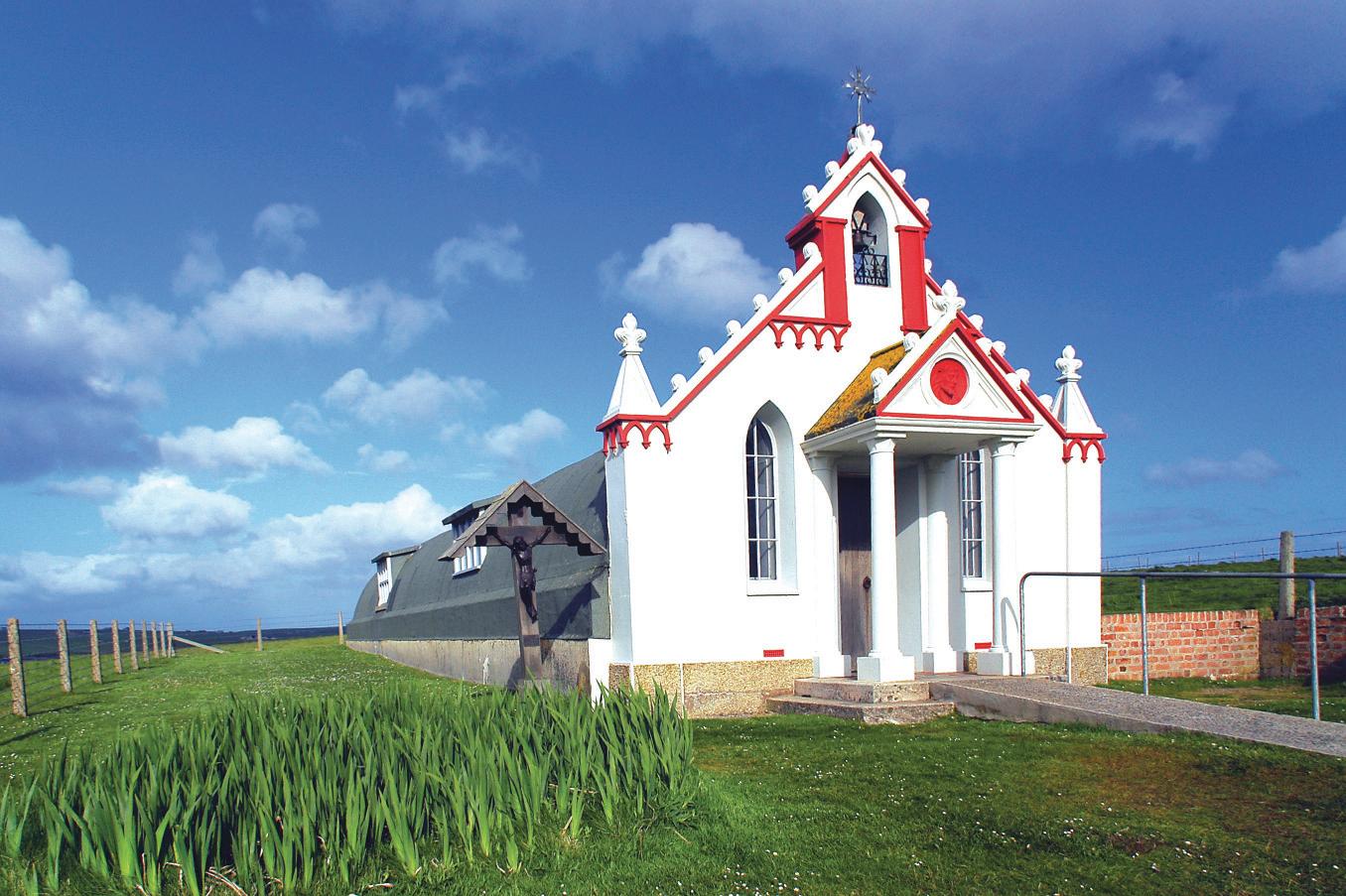
On a grassy slope overlooking the sea, this remarkable, simple, famed church remains a fitting memorial to their endeavours. Made of nothing more spectacular than two Nissen huts joined endto-end, concrete and scrap metal –the only meagre building materials then available – it is today widely regarded as an inspirational wonder.
With the blessing of the camp commandant, and under the direction of the project mastermind, the late Domenico Chiocchetti, the POWs set about turning this ‘ugly duckling’ into an artistic masterpiece. Exquisitely fascinating today, it must have been utterly stunning to those imprisoned here in the 1940s.
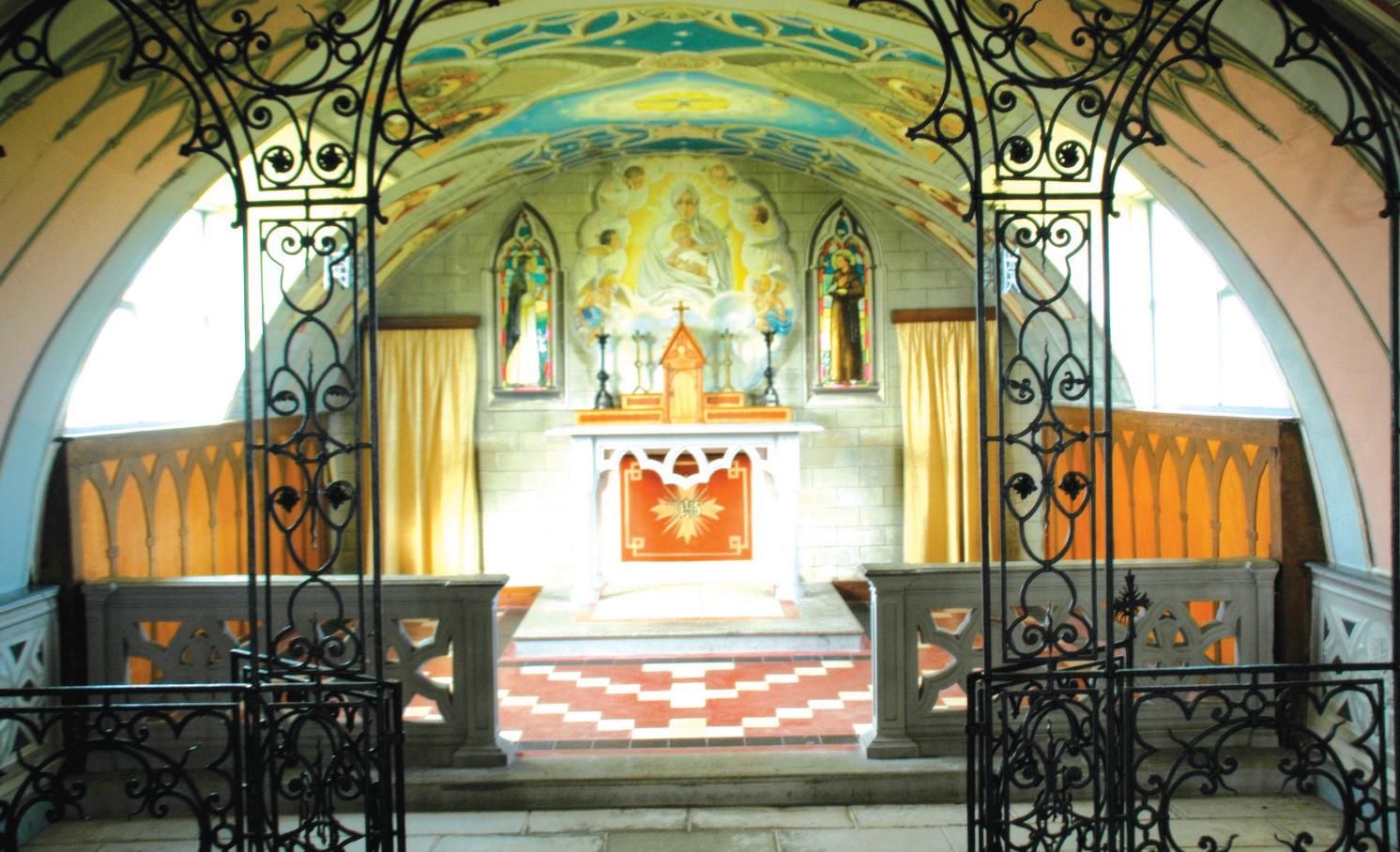
Chiocchetti’s enthusiasm for his project was contagious. The Chapel’s interior was lined with plasterboard and then painted to resemble brickwork. An altar and its fittings were made from concrete and flanked by two windows made from painted glass. Gold curtains either side of the altar were purchased from an Exeter company using the inmates’ own funds. The work proceeded with great skill and ingenuity.
Chiocchetti himself set about painting the ornate interior of the sanctuary with stunning frescos while another Italian craftsman constructed the wrought iron rood screen that still complements the handsome interior today.
Others built a façade to the Chapel’s front complete with a Mediterranean belfry, decorated windows, and a moulded head of Christ above the door. It is a truly remarkable work of art fashioned and decorated from obviously limited materials; yet its legacy surely heralds that even in the darkness of war the goodness of the human
spirit can and does shine through. The camps have long since gone but the unmanned Chapel remains and is still in use today with Mass celebrated here on the first Sunday
the considerable artistic skill of
here are so numerous and remarkable that it’s hard to accommodate them all, unless you allocate at least a week to do the place some justice. Orkney is simply one of the most stunning destinations in Scotland.
Only 10km off the northern Scottish mainland, this constellation of magical islands is readily accessible by air, but more commonly visitors arrive by ship. The 90 minute NorthLink vehicular ferry crossing from Scrabster to Stromness, one of the most fascinating fishing villages in Scotland, takes passengers past the remarkable Old Man of Hoy - a legendary towering rock sea-stack that is one of Orkney’s leading visual attractions.
Famed travel writer Bill Bryson nominates Orkney as his favourite destination in Britain. It is hard to disagree with him: green, lush, treeless and windy, Orkney is an eerie mix of character – moody and sullen when overcast; yet sparkling like morning dew when bathed in sunlight. It is truly a gorgeous place.
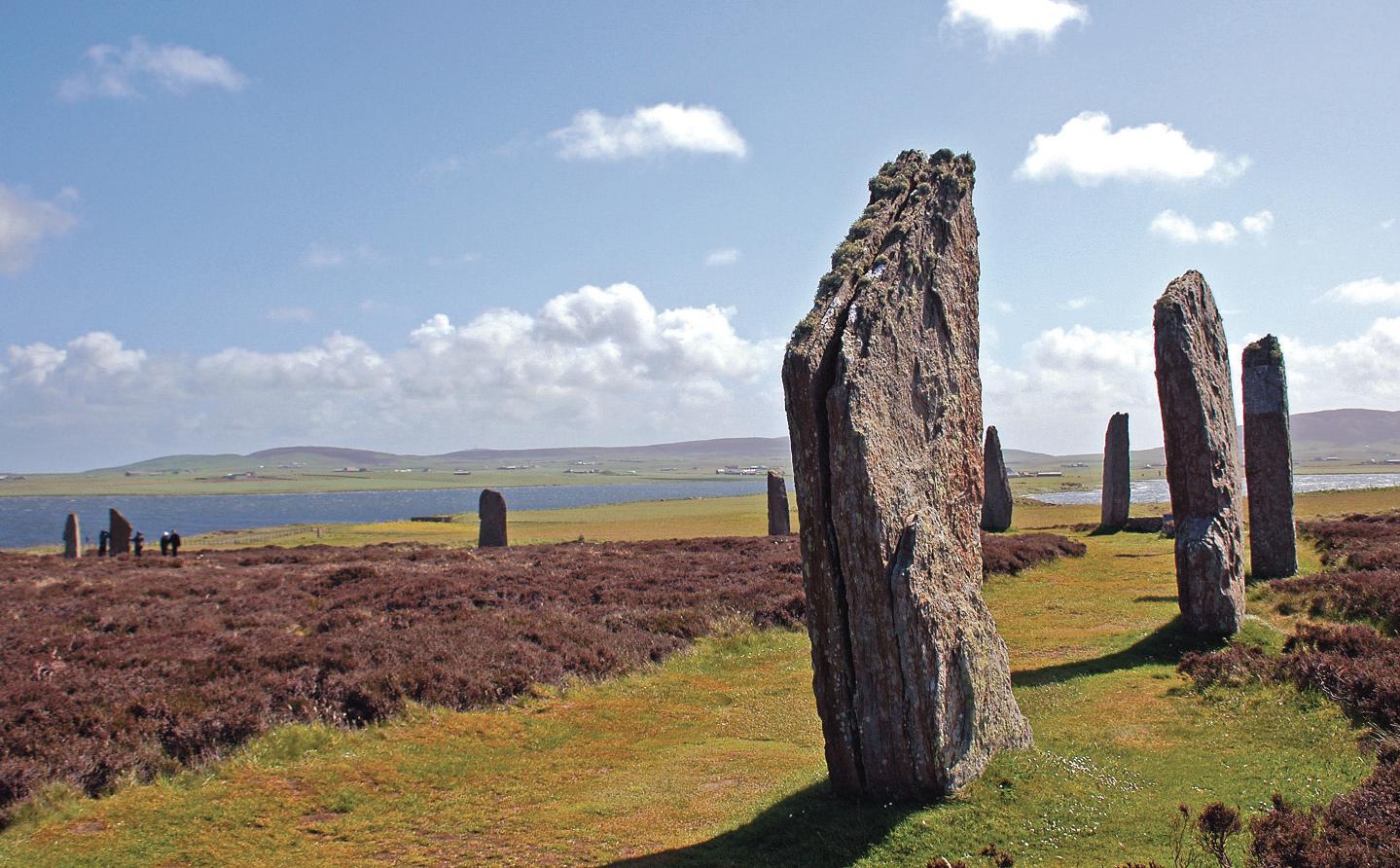
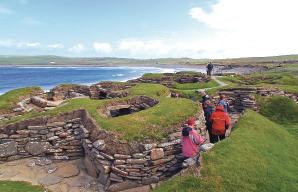
Orkney’s archaeological heritage is unparalleled in Europe, being endowed with ancient remains older than the pyramids themselves. Over 1,000 primal sites have been identified, encompassing Skara Brae, a complete 5,000 year old Stone Age village; the magnificent Bronze Age stone Ring of Brodgar and the mysterious chambered tomb of Maeshowe dating from 2000BC. This place is incredible.
Orkney is quirky too. The shortest scheduled air service in the world operates here - a two minute hop between Westray and Papa Westray – a distance shorter than the main runway at Heathrow. Why bother?
Magnificent wildlife, superb (but chilly) diving, wild weather, fabulous craft, stunning jewellery, stirring music and great food make Orkney an exciting destination. Accommodation is plentiful with much of it being self-contained. You can bring your car on the NorthLink ferry and, if you choose, you can even sleep on board (as a low-cost B&B option). How convenient is that!
So, if you have been hankering after a holiday destination in Europe that is sure to deliver a totally unique and different experience, then buy a ticket to Orkney – you will never regret it.
its builders. Open year round, entry to the Chapel is free. No one should go to Orkney and not visit the Italian Chapel (in fact, most do). However, the attractions
While “new atheists” Richard Dawkins and Christopher Hitchens have been grabbing headlines with their bold claims that modern science has killed off God, an Oxford professor has been quietly chipping away at the ground they stand on. John C Lennox, Professor of Mathematics and Fellow in the Philosophy of Science at Oxford’s Green Templeton College, has been popping up at debates around the globe to take issue with the most prominent new atheists.
Lennox’s arguments are outlined in his book, God’s Undertaker –Has Science Buried God? As The Spectator ’s Melanie Phillips has written, Lennox’s book provides an “excoriating demolition of Dawkins’ overreach from biology into religion”. The brilliance of Lennox’s approach is that it does not just concentrate on one academic discipline, like biology. It spans all of the most relevant fields, including cosmology, physics, philosophy, theology and mathematics, offering a compelling case for the view that scientific knowledge, rather than killing God off, actually makes a divine creator necessary.
Drawing on his own discipline, mathematics, Lennox calculates the odds of life arising by chance and concludes that anyone who would bet on those odds must be either deluded or just plain mad. Of course, in the best academic traditions, he refrains from using such colourful language, but the force of his arguments leaves no room for any other conclusion.
Unlike biblical creationists, Lennox is not hampered by the need to take the Bible, or any other religious text, literally. He simply shows that the most recent advances in science make it plain that there must be a mind behind the genesis of life.
The big picture
Beginning with the big picture of the universe and planet earth’s
place in it, he notes that the ruling view in science is that the universe is not eternal but began with the “big bang” – a view that had not always been accepted by the scientific community.
“The remarkable picture that is gradually emerging from modern physics and cosmology is one of a universe whose fundamental forces are amazingly, intricately and delicately balanced or ‘fine tuned’ in order for the universe to be able to sustain life,” he writes. “Recent research has shown that many of the fundamental constants of nature, from the energy levels in the carbon atom to the rate at which the universe is expanding, have just the right values for life to exist. Change any of them just a little, and the universe would become hostile to life and incapable of supporting it.”
For a start, an abundant supply of carbon is needed on earth to support life and, as eminent mathematician and astronomer Sir Fred Hoyle discovered, “the nuclear ground state energy levels have to be fine tuned with respect to each other … if the variation were more than one per cent either way, the universe could not sustain life.”
Lennox comments: “Hoyle later confessed that nothing had shaken his atheism as much as this discovery. Even this degree of fine tuning was enough to persuade him that it looked as if ‘a super intellect has monkeyed with physics as well as with chemistry and biology’.”
Precision tuning
But, in terms of the tolerance permitted, Lennox believes that even this example “pales into insignificance” in comparison with the fine tuning of some of the other parameters in nature. They include:
As theoretical physicist Paul Davies confirms, if the ratio of the nuclear strong force to the electromagnetic force had been different by one part in 1016, no stars could have formed.
The ratio of the electromagnetic force-constant to the gravitational force-constant must be equally delicately balanced to produce the right

size of star to sustain a planet with life. A variation here of only one part in 1040 and life becomes impossible. (Davies has commented that this feat is akin to a marksman hitting a coin at the far side of the observable universe, 20 billion light years away.)
An alteration in the ratio of the expansion and contraction forces of the big bang by as little as one part in 1055 at the Planck time (just 1,043 seconds after the origin of the universe) would have led to either too rapid an expansion of the universe with no galaxies forming or too slow an expansion with consequent rapid collapse.
Lennox goes on to list even more mind-boggling examples of precision-tuning in the universe. Such features of cosmic design were what
led Sir Fred Hoyle to state that “there are no blind forces in nature worth talking about”, and Paul Davies to conclude, simply, “ the impression of design is overwhelming”.
Biology: the living cell
Moving on to biology, Lennox notes that there seems to be less certainty about the need for a “God” among today’s academics than there is in physics, but after reviewing the evidence he wonders why this is so. He says: “From the time of the great thinkers of the ancient world, such as Aristotle and Plato, to that of modern biologists, the living world has been a source of never-ending wonder. And the more that science uncovers, the more the wonder grows.”
Lennox says that one reason biologists are not so impressed by the design hypothesis is that, according to neo-Darwinism, the engine for evolution – the process of mutation, genetic drift and natural selection – is adequate to account for the growth and variation of all the species on earth. He distinguishes between microevolution within a species and macroevolution (allegedly between species) and notes problems with current evolutionary theory, including the shortage of examples of mutation bringing about biological advances, gaps in the fossil record and so on.
But he does not dwell on these problems, noting that any serious scientist who questions the dogma of neo-Darwinism is usually branded
30 years of life as a Priest of Jesus Christ is also aBY T INA JACK
When St Paul’s Mount Lawley parishioners came to Mass on Sunday morning on Mother’s Day, 8 May, they saw Fr Timothy Deeter wearing the same vestments that he wore on the day of his ordination and using the same chalice and paten his family gave him for use as a priest. Even the altar linens were special: bordered with lace handmade by his mother, grandmother and great-grandmother. Fr Deeter was celebrating his 30th anniversary of priestly ordination.
From his early life and ordination in Chicago, Fr Deeter’s ministry of preaching has been very popular, with invitations to speak at conferences all over the world. But for the past 14 years, he has been in Australia, not always at Mt Lawley but currently as parish priest of St Paul’s and Chaplain of Edith Cowan University.
Mother’s Day was a perfect day for this celebration, because Fr Deeter credits his mother as nurturing his vocation, which has since then deeply affected so many people.
Virginia ‘Jinny’ Deeter first brought little Timmy to Mass when he was four. In those days of the
silent Latin Low Mass, parents didn’t dare bring babies to church – one parent went to Mass, perhaps with the older children, while the other stayed home with the little ones. In any case, Jinny said that the very first time her son went to Mass, he was entranced with what was happening at the altar, pointed to the priest and said, “I wanna be one of those guys”.
When asked about his calling, Fr Deeter replied, “Despite the fact that I had several girlfriends in high school and uni (even whilst I was in seminary), I always wanted to be a priest. It was a call that I felt most intensely on the day of my First Holy Communion, which was the most important day of my life. I remember making my thanksgiving after Communion and thinking: If receiving Holy Communion is so breathtakingly wonderful, how much more wonderful must it be to actually consecrate the bread and wine and bring them to the people as the Body and Blood of Christ.”
Fr Deeter has just passed the 53rd anniversary of his First Holy Communion on 13 April, which is also his mother’s birthday.
She came to his First Holy Communion Mass, which was at 7.30am (because of the long
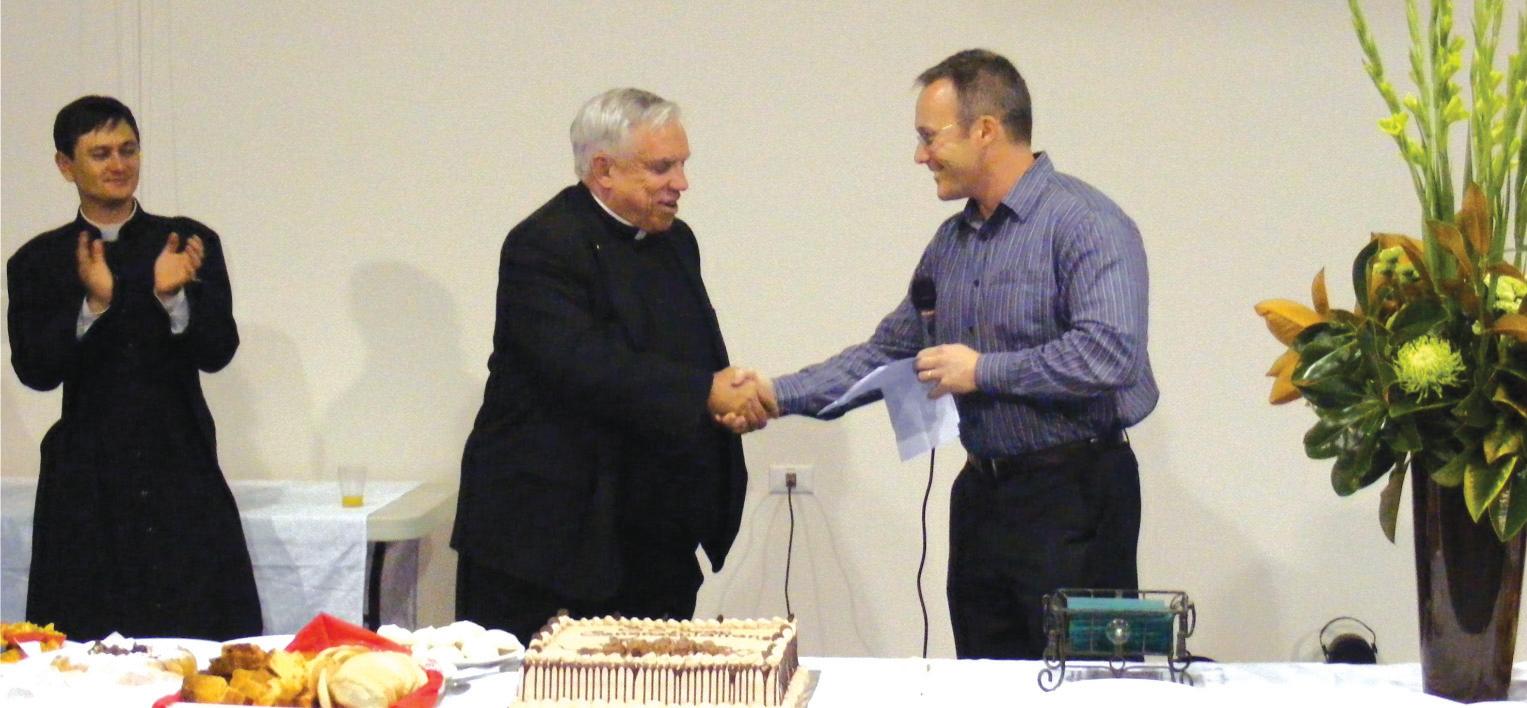
Eucharistic fast in those days), but then hurried home to make final preparations for the brunch to celebrate the event. Timmy had completely forgotten that it was also his Mum’s birthday until his uncle – her brother – gave his Mum a hug and kiss, presented her with a gift and
said, “Happy birthday, Sis.” Timothy started crying (he was only seven).
Jinny said, “Timmy, what’s wrong?” He replied, “I forgot it was your birthday, Mummy. I forgot to get you a present.” His mother knelt down on the floor in front of him, hugged him and said, “It’s all
right. No mother could receive a more beautiful birthday gift than to see her child receive his First Holy Communion.”
Coming home from primary school each day, Fr Tim would find his mother in the kitchen, cooking, ironing, washing dishes – and
St Anne’s Belmont parish priest, Fr Michael Rowe applauds Fr Tim Deeter while Greg Brennan shakes his hand, offering cong age six and Fr Tim cuts the cake at Mount Lawley on 8 May, his 30th anniversary and also Mother’s Day, a time to remember The Cat’s Eye nebula, an interstellar cloud of gas and dust, is pictured in a new view from the Hubble Space Telescope. A recent Vatican document analysing evolution in the light of faith accepts as likely the prevailing tenets of evolutionary science, including that the universe erupted 15 billion years ago. PHOTO: CNS/COURTESY NASA, HUBBLE HERITAGE TEAM.as either a heretic, a lunatic, or both. He accordingly directs most of his attention to the question of the origin of life, rather than its progress.
Quoting geneticist Michael Denton, he points out that the break between the non-living and the living world represents the most dramatic and fundamental of the “discontinuities in nature ... Between a living cell and the most highly ordered nonbiological systems, such as a crystal or a snowflake, there is a chasm as vast and absolute as it is possible to conceive.”
Denton has said that even the simplest cell of all, a bacterial cell, is “a veritable micro-miniaturised factory containing thousands of exquisitely designed pieces of intricate molecular machinery, made up altogether of 100 thousand million atoms, far more complicated than any machine built by man and absolutely without parallel in the non-living world.”
He also points out that there is little evidence of evolution among cells: “Molecular biology has also shown us that the basic design of the cell system is essentially the same in all living systems on earth from bacteria to mammals. In all organisms the roles of DNA, mRNA and protein are identical. The meaning of the genetic code is also virtually identical in all cells.”
In summary, he says there is not “the slightest empirical hint” of an evolutionary sequence among all the incredibly diverse cells on earth.
This view was echoed by Nobel Prize-winning biologist Jacques Monod: “The simplest cells available to us for study have nothing ‘primitive’ about them.”
The plot thickens: from proteins to DNA
Lennox adds that it is hard to get any kind of picture of the “seething, dizzyingly complex activity” in a living cell, which contains around 100 million proteins of 20,000 different types. The existence of proteins alone is a mystery, given that each one represents an intricate construction of amino acids in a very specific order necessary for them to function. There is no way, he says,
in which proteins could have formed simply from raw matter and energy.
As Paul Davies puts it: “Making a protein simply by injecting energy is rather like exploding a stick of dynamite under a pile of bricks and expecting it to form a house.”
The odds of getting a simple protein to form by chance has been put at 1 in 10130
But this is only the probability of getting a single protein. The most basic forms of life require hundreds of thousands of proteins. Sir Fred Hoyle famously calculated the odds of this happening by chance at more than 1040,000. This is a very big number indeed. The number of grains of sand in the world has been calculated at 1020, the number of stars in the known universe at 1022, and the number of particles in the universe at 1080. Sir Fred confessed that this fact alone had challenged his atheism. He said that the idea of the spontaneous formation of life was akin to a tornado sweeping through a junkyard and producing a Boeing 747 jet aircraft.
When you move on from proteins to an even more complex part of a cell, the DNA which acts as the blueprint for all living things, the picture becomes even more astonishing. The DNA of bacteria can be around four
million characters long – enough to fill about 1,000 pages. Human DNA is around 3.5 billion characters –enough to fill a whole library.
Lennox and other scientists compare DNA to a computer language and say that the cell’s information processing capacity far outstrips anything present-day computers can do. As Microsoft’s founder, Bill Gates, has pointed out, “DNA is like a computer program, but far, far more advanced than any software we’ve ever created.”
It was this very fact which led atheist philosopher Antony Flew to change his mind about God: “What I think the DNA material has done is that it has shown, by the almost unbelievable complexity of the arrangements which are needed to produce (life), that intelligence must have been involved in getting these extraordinarily diverse elements to work together. It’s the enormous complexity of the number of elements and the enormous subtlety of the ways they work together. The meeting of these two parts at the right time by chance is simply minute. It is all a matter of the enormous complexity by which the results were achieved, which looked to me like the work of intelligence.”
(There have been claims that Flew’s views on the need for a God were misrepresented, but Flew himself denied this.)
A mind behind it all
Lennox goes through all the theories put forward to give credence to the idea that all of this could have happened by chance and, as a mathematician, indicates that such scenarios are basically laughable. He says that the conclusion that a super intellect is at work in the creation of life may not be verified by scientific “induction” or experiment, but it is a valid inference to the best explanation (“abduction”). He points out that the probability of a purely random origin for any sequence of even the most basic biological significance is “so small as to be negligible ... It could therefore be argued that the molecular biology of the cell shows the same order of
fine tuning that we saw in connection with physics and cosmology.”
He also warns against any attempt to try to write off the clear implications of a mind behind the design of living things as an analogy from something like a watch. “We are not arguing from analogy, but we are making an inference to the best explanation,” he notes.
Lennox points out that the obvious conclusion that arises from reflecting on the reality that sciences like physics and biology have uncovered is that “information and intelligence are fundamental to the existence of the universe and life and, far from being the end products of an unguided natural process starting with energy and matter, they are involved from the very beginning”. In other words, the whole universe has the unmistakeable signature of monumental design about it.
So, what if you take all of the probabilities unearthed by science together? What are the chances of life developing without a super-mind to guide it? The answer, clearly, is as close to zero as anyone could imagine. In fact, the figures involved are so profound, so enormous, that no human mind could possibly imagine them in any real sense.
Despite all this, there still appears to be room for atheists to cling to their faith in a merely mechanistic universe that arose from nothing more than chance. In other words, there is room for the operation of free choice in the matter.
But the real riddle in it all is: how has it come about that so many people in the modern world still think that in the God v Chance debate, science has somehow proven that everything has happened according to a series of blind accidents? And why is it that the media are more than happy to allow that status quo to continue? Go figure.
William West is a Sydney-based freelance journalist and Editor of Perspective magazine, little known but one of the best resources for modern families available in Australia today. You can find Perspectives on the Parents for Education website at: www.pared.edu.au/ pared-schools/perspective-magazine
As a fashion blogger, I was intensely interested in what Kate Middleton would wear for the ceremony. It doesn’t take a lot of investigative journalism to know that wedding dresses have become less and less flattering over the years. Now, it is nearly impossible to find one with straps. The majority of them are one quick move away from a wardrobe malfunction. As a friend put it, “they are a hot mess.”
So would the future queen of England don a similarly unflattering ensemble?
Looking at her pictures from the last couple of months, it was clear that Kate is a classic fashion personality. She wears knee-length dresses and matching suit sets. She’s got an elegance that not many women her age have.

I saw the tweets about the dress before I saw it. I knew it was an Alexander McQueen dress, who was known for his envelope-pushing designs and bold statements. Then I saw the picture and had a momentary vision of Grace Kelly. Elegance, Grace. Refinement. She was stunning and all covered up.
Here’s hoping her long-lacesleeved dress starts a worldwide trend of brides looking to accent their natural beauty while looking demure and regal. Thank you, Kate!
Katie Hinderer blogs for Mercatornet on www.mercatornet.com/tiger_print
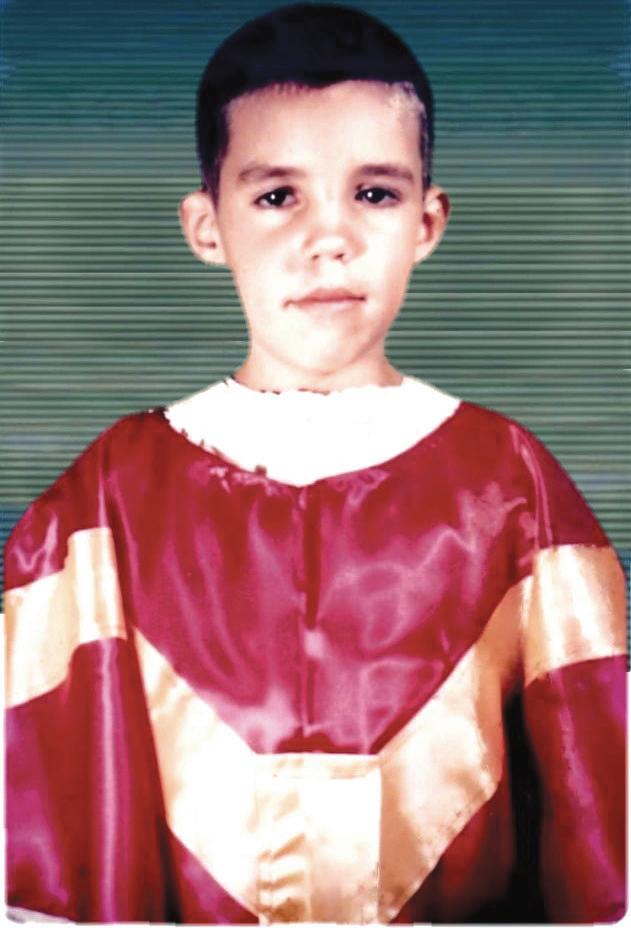
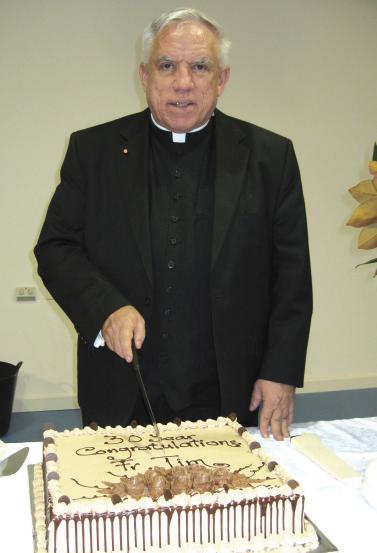
singing hymns to Our Lady, with a Madonna planter filled with African violets placed prominently on the window ledge above the sink. Returning from Sunday Mass with a couple of younger brothers in tow, he would knock on his parents’ bedroom door and find his mother in a
rocking chair, with a baby in one arm and her Rosary or Sunday missal in the other hand.
On relating these stories, Fr Deeter added, “That’s the kind of mother I had. That’s the kind of mother who produced a priest: a woman of rock solid faith, a woman of compassion,
a woman who taught me the meaning of self-sacrifice because she lived completely for her family.”
Fr Deeter holds a DMin in liturgical spirituality, MA degrees in theology and Church music, and a teaching diploma. He has taught in schools in Illinois, Oklahoma and Texas in the US. In addition, he has been Director of Music and Liturgy at St Mary’s Cathedral in Perth, and Director of the Liturgy Office of the Archdiocese of Sydney, where he also was a member of the World Youth Day 2008 preparation committee. Fr Deeter has served as WA chairman of the Royal School of Church Music, WA chaplain for the National Civic Council, and has been the national chaplain for the Society of Catholic Teachers Australia Inc since 2005. From 2008 to 2009, Fr Deeter worked in Rome, translating Italian documents pertaining to the canonisation causes of two young candidates for sainthood: Bl Pier Giorgio Frassati and Bl Nunzio Sulprizio. Fr Deeter has also been a popular speaker, retreat master and Catholic newspaper columnist in both Perth and Sydney.
Above all, Fr Deeter spends much of his time promoting devotion to Our Lady and adoration of Our Lord
in the Most Blessed Sacrament. As a result, he sees his priesthood as ‘dying to self as a priest – and living for the people’. Since his arrival at Mt Lawley, we have seen a renewal in Sunday Mass attendance and parents have commented that their children have a new sense of reverence during Mass and an awareness of what is happening. Attendance at the 5.45pm weekday Mass is very good. Many people call in after finishing work to attend a Mass which is quick, yet reverent and inspiring.
Parishioners showed their appreciation of Fr Deeter with a dinner in the new St Paul’s Primary School multi-purpose hall. They were astonished to find that one of the guests, Fr Michael Rowe, was once a pupil at St Paul’s School. Fr Rowe is chaplain of Perth’s Latin Mass community, and a good friend of Fr Deeter’s.
The photo of Fr Tim at the age of six shows him in Mass vestments made for him by his mother.
When he was in Year 1, the nun who taught his class chose Timmy Deeter out of 64 other students to act out the role of the priest as the children studied the Mass.
Little did that Sister know that the boy she chose would one day truly offer the Holy Sacrifice.
But Jinny Deeter had an inkling in her heart that this would one day happen.
It was a day she never saw in this life, for she died of cancer at the age of 53 on 8 May 1977. Visiting his mother one day in hospital, the seminarian Tim Deeter expressed his exasperation with God for subjecting his mum to so many sacrifices throughout her life, which was now ending so young and so painfully. Jinny said to her son: “Yes, I’ve made a lot of sacrifices in life. But if you’re going to be a priest, you will have to do the same. The priest who offers the Sacrifice must also be a sacrifice.”
It was coincidence – or Providence – that the day chosen by the Cardinal Archbishop of Chicago for Fr Tim’s ordination was the fourth anniversary of his mother’s death. Thus, the birthday and day of death of his mother became the anniversaries of the two most important dates of which her son was aware in his own spiritual journey: his First Holy Communion and his ordination to the priesthood. It is the love and sacrifice of a mother that contributes so much to the love and sacrifice of a priest. I think Jesus, the eternal High Priest, would agree.
gratulations his 30th anniversary of ordination to the Priesthood; Timmy Deeter at the example of sacrifice his own mother gave him. PHOTOS: COURTESY ST PAUL’S PARISHPERTH Ukrainian Greek Catholic community leader, Bohdan Mykytiuk considers himself lucky to be alive.
Bohdan’s family was nearly wiped out by the Soviets and Nazis for being Christians and Ukrainian nationalists.
His father was urged by a guard in the Brigitka political prison camp in Ivano Frankivsk to escape; he later returned to find the Soviets had massacred 6,000 inmates.
His mother, also an inmate of the same prison, later narrowly escaped being killed when a stray Allied Forces bomb devastated a children’s hospital in Bayreuth, Germany, along with the women, babies and Methodist nuns who ran it.
His grandmother died fleeing the Ukraine during World War II.
Bohdan and his sister, Marta, decided that their late father’s wishes – to tend their grandmother’s memory - would be better fulfilled if they helped seminarians back in Ukraine rather than paying to upkeep her grave in Austria.
They believed this was more appropriate as there has been a priest in every generation of their family as far back as they could trace, including links to the late Ukranian Greek Catholic Church Patriarch and Cardinal, Josyf Slipyj.
Bohdan has also worked with the current ‘Patriarch’, Sviatoslav Shevchuk, for a number of years.
Bohdan, a retired Edith Cowan University education, migration and settlement lecturer and Catholic school teacher, was born in the safer confines of Northam, but has always felt very much at home in Ukraine.
He is an active member and educator in the Ukrainian-Greek Catholic parish in Maylands and the Ukrainian community in WA. He has often visited Ukraine and,

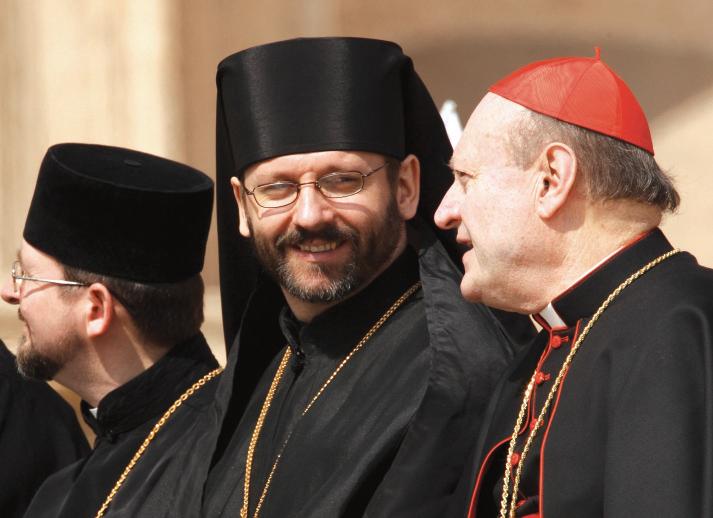
since 2005, has returned annually to the Holy Spirit Seminary and the nearby Ukrainian Catholic University in Lviv, Western Ukraine, to help the seminarians and students realise that “having faith in doing the right thing” as his ancestors did, “will eventually bear fruit”.
In addition to prayers and theological studies, all seminarians are actively engaged in a range of pastoral activities in schools and hospitals with people with disabilities, orphans, street kids, drug addicts, alcoholics and the sick, aged and infirm.
As chaplains in the armed forces, the seminarians work with police and security services, providing help and spiritual guidance to all those in need.
They also conduct missions throughout Ukraine and Russia (particularly Siberia - a popular place for incarceration of Ukrainian political prisoners since Tsarist times) as well as other countries of the former Soviet Union where Ukrainians live.
“Through their example, their humility and their piety, the seminarians are awakening and encouraging people in Ukraine to follow Jesus in their daily life, particularly caring for one another, building community and helping those less fortunate,” Bohdan said.
“This is a remarkable programme and a testament to the deep faith of the Ukrainian people, considering decades of atheistic and Communist enculturation and the current government’s limited expenditure on social services.”
It’s hardly surprising, however, since the grandparents of many seminarians and students of the Ukrainian Catholic University fought in the Ukrainian Resistance during World War II and together with their parents were active in the underground Ukraine Greek Catholic Church during the 40 -year Soviet occupation of Western Ukraine until the declaration of Ukrainian Independence in 1991.
In terms of finances, the seminary is trying to solve its own problems by striving to become financially independent, particularly in the wake of the steep rise in world food prices and, thereafter, the Global Financial Crisis in 2008.
During vacations, they conduct summer camps for students and pilgrims and, during the year, they cater for weddings and other celebrations in а function centre that they renovated themselves.
“With the seminary having trouble making ends meet financially, naturally one of the things to suffer is educational resources,” he said.
Not long ago, Bohdan and the current ‘Patriarch’ (although the
Pope has not officially given him that title, many Ukrainians refer to him as such) Sviatoslav Shevchuk, then Chancellor of the Holy Spirit Seminary in Lviv, set about redressing the imbalance.
Back in WA, Bohdan mobilised Ukrainian Catholics in Northam to raise $5,000 to computerise the seminary library.
In the same year, $10,000 was raised for library shelving with the help of the Ukrainian community in Perth.
In 2008, Bohdan and his friends in Ukraine donated $5,000 to refurbish computer classrooms.
After the blessing of the refurbished facilities, Chancellor, thenFr Sviatoslav thanked Bohdan and his wife Katryna on behalf of the seminary, awarding them an embossed insignia of the Holy Spirit Seminary.
Staff of the Holy SPirit Seminary wanted to name the computer centre after Bohdan, but he preferred to name it after his uncles – “the Mykytiuk Brothers from the River Prut” in Kolomyia, who were executed by the Soviets during the war for their Christian and nationalist activities
Bohdan is now on the Advisory Board of Lviv Ukrainian Catholic University’s Institute of Leadership and Management. The Institute has trained over
500 lay young adults to be workers in their parishes, along with seminarians, to spread the Gospel and help those in need.
Together, they mobilise their parishes to become active in projects such as programmes for children from dysfunctional families and helping other parishioners in need.
They also help address a major social crisis evolving in the Ukraine – family breakdown stemming from over 10 million Ukrainians working elsewhere throughout Europe, many of whom leave their spouses and children for years at a time.
During their holidays, seminarians have to report to the priest in their parish who keeps a log of the work they do around the parish and in the community, especially working with lay leadership teams.
“In a post-Communist society where oligarchs have simply changed their colours and not their behaviour, as a thinking, feeling Christian, how could you not support the process of renewal generated by the Ukrainian Catholic University and the Holy Spirit Seminary in Lviv?” Bohdan told
The Record
If you would like to find out more, support Christian renewal in Ukraine or tour some of the unique holy places of special significance in Ukraine, contact Bohdan at mykbr@yahoo.com.
Beatification cause for renowned US television evangeliser gains momentum in Australia
BY ANTHONY BARICHSYDNEY Cardinal George Pell and Archbishop Barry Hickey have joined the global push for the beatification of Archbishop Fulton J Sheen.
ACBC president Archbishop Philip E Wilson of Adelaide and Archbishop Hickey, ACBC vice president, along with Melbourne Archbishop Denis J Hart and Darwin Bishop D Eugene Hurley, have signed a cover letter to be presented on 25 May to Pope Benedict XVI with the position paper, or positio, by Bishop Daniel J Jenky of Peoria.
Cardinal Pell and Archbishop Hart also wrote separate letters
to the Peoria-based Archbishop Fulton Sheen Foundation.
The cover letter was given to many local Bishops to sign by the Archbishop Fulton J Sheen Society, which leads the late prelate’s beatification cause in Australia.
Founded in 1999 in Perth by father and son team Daniel and Martin Tobin, the Society promotes the beatification and works of Archbishop Sheen.
An annual concert run since 2000 has raised over $50,000 for missions in India, Kenya and China and for a Fulton J Sheen Scholarship established in 2006 at the Seminary of the Good Shepherd in Sydney. It also funded a series of television spots on Channel 9 by Archbishop Hickey.
This year’s concert at Gibney Hall at Trinity College, is on 25 May.
The Australian Bishops’ letters will be presented to the Pope with the positio, summarising Sheen’s life and virtue, along with letters from prelates around the world by Bishop Jensky on 25 May after the
weekly general audience with the positio
In his personal letter sent directly to the postulators of Sheen’s cause in Peoria, Illinois, Cardinal Pell said he admires what Archbishop Sheen did as a catechist, in particular “his skill at harnessing the media to present Catholic teaching in a compelling and faithful way”.
“I’m also impressed by the number of people from many walks of life who have been moved by Archbishop Sheen’s example and teaching,” the Cardinal said.
“Archbishop Sheen had a gift for touching the lives of people in enormously varied circumstances and states of life.
“This gift continues to be evident through the inspiration his writings provide to people today.”
In his own personal letter, Archbishop Hart spoke of the “profound” influence the late prelate had on his own life and vocation to the priesthood.
“As a small boy I remember the impression and the faith (Sheen)
created when visiting Melbourne in 1948 for the Centenary of the Archdiocese,” Archbishop Hart said in the letter dated 5 April.
“My life has been profoundly touched by his stressing of a daily Eucharistic holy hour and I believe that the spiritual leadership which he has provided is worthy of closer examination.
“In far-off Australia, we would support very much the moves in the Church in the United States to promote (Sheen’s) cause for beatification.
“Clearly evident was his loyalty to the Church, passionate love of God and devotion to Mary, our Blessed Mother.
“Even in the time of great suffering his deep, interior life transformed his life and ministry and shone from all that he did.
“I therefore pray that his cause be submitted for examination to the Congregation for the Causes of Saints and, because of his reputation for holiness, I believe that such examination is in the interests
of the Church, of priests and of so many people.”
Handing the positio to the Pope is the initial step in the Vatican’s process to determine whether an individual should be beatified and then canonised as a saint.
Once this step has been completed, an investigation can begin into a miracle that may have occurred as a result of prayer to Archbishop Sheen.
Mgr Stanley Deptula, executive director of the US-based Archbishop Sheen Foundation, said the foundation believes a miracle has already been granted through the intercession of the late prelate, but would not release details, as is usually the case when a miracle is under investigation.
In November 2010 the diocese of Peoria suspended its promotion of Archbishop Sheen’s cause due to a dispute with the Archdiocese of New York over the final resting place of his remains. The diocese resumed its work in January 2011.
Perth Ukrainian Greek Catholic community leader Bohdan Mykytiuk with now Archbishop Sviatoslav Shevchuk in the computer room he helped to upgrade at the when he was Chancellor of Holy Spirit Seminary, which Bodhan has helped financially and materially. PHOTO: COURTESY BOHDAN MYKYKTIUK Italian Cardinal Gianfranco Ravasi, president of the Pontifical Council for Culture, talks with Ukrainian Archbishop Sviatoslav Shevchuk of Kiev-Halych, the new head of the Ukrainian Catholic Church, centre, during Pope Benedict XVI’s general audience in St Peter’s Square at the Vatican on 30 March 30. CNSTHE Archdiocese of CanberraGoulburn has told an ACT Assembly enquiry into the Territory’s Prostitution Act 1992 it wants “a fundamental root and branch transformation” of the local community’s approach to the industry, going far beyond the Swedish model of criminalising purchasers of sex.
The Archdiocese calls for a thorough legislative overhaul to target those who create the demand for the use of women’s bodies, an aggressive programme to discourage those involved at every level of the trafficking trade and accompanying public education campaign and targeted exit programmes.
“It is not sufficient for a society to simply throw up its hands and seek to make accommodations because of the size of the problem or the choices of a few,” the submission said.
“The aim is to change behaviour
around this business and, through this, change the attitude that permits, even encourages, an industry which so transparently discounts the needs, dignity, equality and humanity of women and men.”
It also called for more health checks for men about to purchase sex and increased police powers to combat prostitution, but argued that the nation’s capital will never be a society of equality while it is legalised.
A recent study around sexual health clinics in Sydney’s western suburbs shows a significant proportion of sex workers are nonnationals and, in some instances, a preponderance are migrants from Asia, Africa and eastern Europe, it said. Much of this group could be classified as vulnerable and “on the evidence” it can be extrapolated that many have been trafficked, which is “a scourge on any society and an affront to any community which seeks to uphold the dignity of each individual”.
The Archdiocesan youth and young adults coordinator, Daniela Kesina, dismissed the notion that it is futile to stamp out such an “ancient profession”, and that prostitution is “merely a commercial transaction” in a column in The Canberra Times on 24 March.
“The slave trade was a very ancient ‘profession’ too. The fight was long and hard, but it was eventually won. No sensible person today would suggest its reintroduction. So society can change for the better, and that should always be our goal,” she said.
She urged the enquiry to assess the research and evidence of what is in the best interests of the women and girls in the industry, including evidence that criminalisation has helped to combat prostitution and human trafficking for sexual purposes.
“Rather than expanding or normalising prostitution, let us work towards the demise of this pitiful and damaging industry and strive
for authentic gender equality,” she said.
Women’s Forum Australia cofounder Melinda Tankard Reist told the ACT Parliament Legislative Assembly Justice and Safety Committee on 11 May that the Territory’s Government was “complicit” in sexual violence against women when it accepted licence fees for brothels.
Also advocating the Swedish model and exit programmes, she said that women involved in prostitution had significantly higher rates of drug abuse and mental and physical health problems, and that the ACT Government was compromised by its “regulation’’ stance.
‘’To accept licence fees from money that has been obtained in such an unethical and harmful manner renders the ACT both complicit and compromised and we’d be interested to know how much money the ACT Government derives from such licensing fees,’’ she said.
Personal encounter inspires Balcatta parish priest to name new youth group after charismatic Pope
BY BRIDGET SPINKSTHE newly beatified Pope John Paul II had such an impact on Balcatta’s Fr Irek Czech SDS that on 1 May, the Polish Salvatorian priest launched and consecrated the parish’s new JPII Youth Group to the new Blessed.
Fr Irek said that Karol Wojtylawho was born six years before his own father, Bernard - was like a second father for him; a spiritual one. He said he felt close to him through his writings and speeches, and the media coverage of his pilgrimages.
“I admired his ability to proclaim God’s Word to the crowds with a personal approach. I loved him because he loved youth,” Fr Irek said of John Paul II, whom Pope Benedict XVI beatified on 1 May in Rome. Fr Irek, who grew up in Wodzislaw Slaski in southern Poland, said he was “nourished” by John Paul II’s messages, which
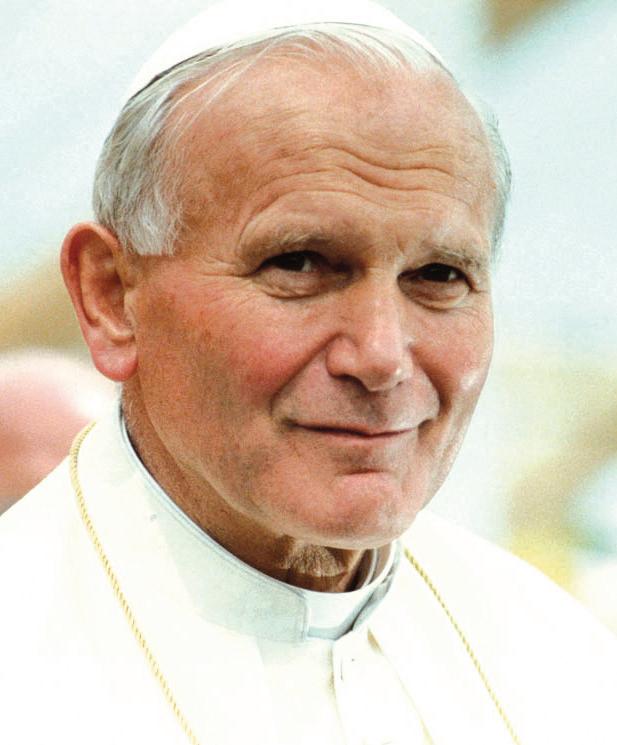
were passed on by his parish priests.
The writings of JPII, especially Love and Responsibility and his Wednesday audiences on marriage and sexuality, which came to be known as the Theology of the Body, helped Fr Irek to recognise the dignity of every human being and to respect others, including his high school girlfriend and also, himself.
“Already as a teenager, I knew that love and responsibility could not be separated,” he said.
His first close encounter with the Pontiff was on 10 June 1987 when John Paul II was on pilgrimage
to Poland. “It was not a personal encounter with St Peter’s successor because I was part of a crowd of one million people in the city of Tarnów, but the experience was good enough to remember for the rest of my life,” he said.
On this trip, the Holy Father beatified a 16 year old Polish girl, Karolina Kózkówna, who died defending her purity.
Fr Irek was about the same age as Karolina so not only did the Pope’s visit leave a great impression but her life story did too, he said.
In 1992, while learning Italian
for two months in Rome, Fr Irek was again close to the Holy Father and attended his Wednesday Angelus Domini and heard the Pope’s speeches more frequently.
Eight years, later Fr Irek met Pope John Paul II face to face and had a short chat with him in St Peter’s Square.
“I asked him to bless all the pastoral projects and initiatives I held in my heart, which he did,” he said.
Fr Irek’s newly formed JPII Youth Group has come about after discernment and the past few years of work with youth, he said.
The group had its first meeting on 15 May after the 6pm Mass.
The meeting began with a time of praise followed by prayers of intercession to Bl Pope John Paul II that those who attend may “become truly mature and responsible people”. They also prayed a Litany to Bl Pope John Paul II penned by Fr Irek. The group watched the first episode of Into the Heart with Christopher West followed by discussion groups and supper.
The second meeting will take place on 19 June, as meetings are scheduled for every third Sunday of the month. For more information, visit www.stlawrence.org.au or email jp2group@hotmail.com or call 9344 7066.
A GOOD Samaritan Sister who pioneered an ‘online classroom’ to help remote students overcome the tyranny of distance has received an award for innovation from The University of Notre Dame Australia.
Sr Jennifer Farrell SGS, a senior lecturer at the School of Nursing at UNDA’s Broome campus, and her colleagues Sally Clark (Associate Dean) and Donnelle Perry (Sessional Lecturer and Tutor), received the inaugural Vice Chancellor’s Award for Innovation in Curricula, Resources and Approaches to Student Learning in April.
The team developed a web-based
classroom facility called Elluminate Live, which enables students to interact with other remote students and teaching staff.
Sr Farrell said the programme is a revelation, especially for the unique needs of the Broome campus, which serves a population of around 350,000, of whom 47 per cent are Indigenous, in the vast, remote Kimberley region.
Elluminate Live enables students to access education from their own residence or community setting by using a computer, web connection, video camera and microphone.
Sr Farrell said before the programme was developed, there were
no tertiary education centres in WA delivering nursing education to remote and regional students unless those students were able to leave their communities and families for extended periods.
The former rural midwife said the programme had been developed on growing evidence that an accessible and inclusive approach to education is necessary for people in the Kimberley and Pilbara regions –especially Aboriginal people.
“People living in remote areas like the Kimberley often have limited ability to engage in education and in particular to gain qualification in nursing,” Sr Farrell said.

THE first weekend in May saw the 2011 National Count of Attendance hit Catholic parishes to find out the number of practising Catholics in Australia. First held in 2001, this is the third time the Australian Catholic Bishops Conference has conducted the count at a national level.
President of the Australian Catholic Bishops Conference, Adelaide Archbishop Philip Wilson, said that this project was part of a wider strategy to look into the ministry of parishes in Australia.
“Information collected, in addition to the number of people in attendance, includes the language and frequency of celebration. The count is conducted both for Masses and Sunday Assemblies in the absence of a priest and consists of a simple head count of all those who attend Mass at parishes and other Mass centres throughout the whole of Australia over four weekends,” Archbishop Wilson said.
“This count will allow us to better understand our Catholic congregations and provide ministry to them.”
In 2006, the last time a National Count was held, an average of 708,618 people attended Mass, or a Sunday Assembly in the absence of a priest, each weekend.
The total attendance figure represented 13.8 per cent of Australia’s 2006 Catholic population. An average of at least 58,000 people attended Mass celebrated in one of 30 languages other than English.
There was an average of 102 Sunday Assemblies in the absence of a priest, with an overall weekly attendance average of 2,357, or around 23 people per Assembly.
Sally Clark, Sr Jennifer Farrell SGS and Donnelle Perry, who received a University of Notre Dame Australia Vice Chancellor’s Award.
This year, for the first time, the National Count of Attendance will be conducted electronically, and most parishes will submit their counts online, rather than using paper forms. Any queries regarding the ACBC National Count of Attendance can be directed to the ACBC Pastoral Research Office on (03) 9953 3457 or by email to s.reid@ pro.catholic.org.au. A copy of the report based on the 2006 National Count of Attendance can be downloaded from the Pastoral Research Office website: www.pro.catholic. org.au.
VATICAN CITY (CNS) -
With fewer than 100 days to go, preparations for World Youth Day 2011 in Madrid are heating up and organisers are promising a fiesta, adding a Spanish flavour to the traditional opportunities for prayer, friendship, music and religious education.
As of 7 May, organisers reported 347,965 youths had registered for the 16-21 August event, which Pope Benedict XVI will attend.
The figure included 22,488 young people from the United States and 5,439 from Canada. The Italians - always a big contingent at World Youth Daywere leading the pack with 65,196 registrants, outpacing even the Spaniards by more than 10,000. While registering has benefits - including priority seating at papal events - young people seem to know they won’t be turned away, and so an earlier estimate of 1.5 million participants seems to be right on track.
Fr Eric Jacquinet, the official in charge of the youth section at the Pontifical Council for the Laity, the official sponsor of World Youth Day, said, “We can’t predict how many will register at the last minute.”
At WYD Paris in 1997, he said, 300,000 young people pre-registered and there were 1.2 million people at the closing vigil and closing Mass with Pope John Paul II.
The staff of WYD Madrid has rallied interest and is helping prepare all those young people with a major presence on the Internet, especially through social media such as Facebook and Twitter.
Photos of the preparation phase are posted on Flickr and videos produced by or about WYD 2011 are collected on a special YouTube channel. Organisers announced on 10 May that the Madrid event will be the first WYD with its own radio station and with a webTV site. More than 30,000 people applied to be volunteers at WYD and the staff is still sifting through the applications to settle on 22,400 volunteers. As of 12 May, she said, the WYD staff was 500 strong, and 80 per cent of those workers were volunteers.
The first three afternoons, evenings and nights - “evening” in Madrid would be considered “night” in many other parts of the world - have been set aside for cultural activities, including the music and museum visits.
The mornings will be dedicated to religious education sessions, which take place in hundreds of locations and in dozens of languages. The teachers of the sessions are 250 Bishops, who almost always leave plenty of time to dialogue with the youths. The pontifical council chooses the 250 Bishops, usually based on those who have told the council they will attend WYD and are available. The final choice, he said, is based on language and country of origin - “for example, we want to make sure the German speakers come not only from Germany, but also from Austria and Switzerland.”
VATICAN CITY - Every Bishops’ conference in the world must have guidelines for handling accusations of clerical sex abuse in place within a year, the Congregation for the Doctrine of the Faith said.
In a letter dated 3 May and released by the Vatican on 16 May, US Cardinal William Levada, congregation Prefect, said that in every nation and region, Bishops should have “clear and coordinated procedures” for protecting children, assisting victims of abuse, dealing with accused priests, training clergy and cooperating with civil authorities.
Describing sexual abuse of minors as “a crime prosecuted by civil law,” the doctrinal congregation said Bishops should follow local laws that require reporting cases of sexual abuse to police.
Since the early 1990s, about two dozen Bishops’ conferences, starting mainly with English-speaking countries, have drawn up guidelines for dealing with accusations of sexual abuse of minors filed against clergy and other Church employees.
Other conferences - for example, the Italian Bishops’ conference - have said they did not draw up guidelines because Bishops were obliged to follow canon law and special provisions enacted in 2001 by Blessed Pope John Paul II and in 2010 by Pope Benedict XVI.
Jesuit Fr Federico Lombardi, Vatican spokesman, said the fact that conferences were given a precise deadline and only 12 months to draft their guidelines demonstrates how seriously the Vatican takes the matter.
“The aim is to give Bishops a strong common denominator for drafting guidelines appropriate to their own national situation, with its unique culture and legislation,” he told reporters on 16 May. The guidelines of several countries, including the United States, have been adopted as mandatory norms in those countries and approved by the Vatican.
The guidelines the doctrinal congregation now is seeking throughout the world do not have to be binding, the letter said, although they must reflect the binding provisions of canon law and the special provisions enacted in 2001 and last year. The special provisions issued in the past 10 years expanded or
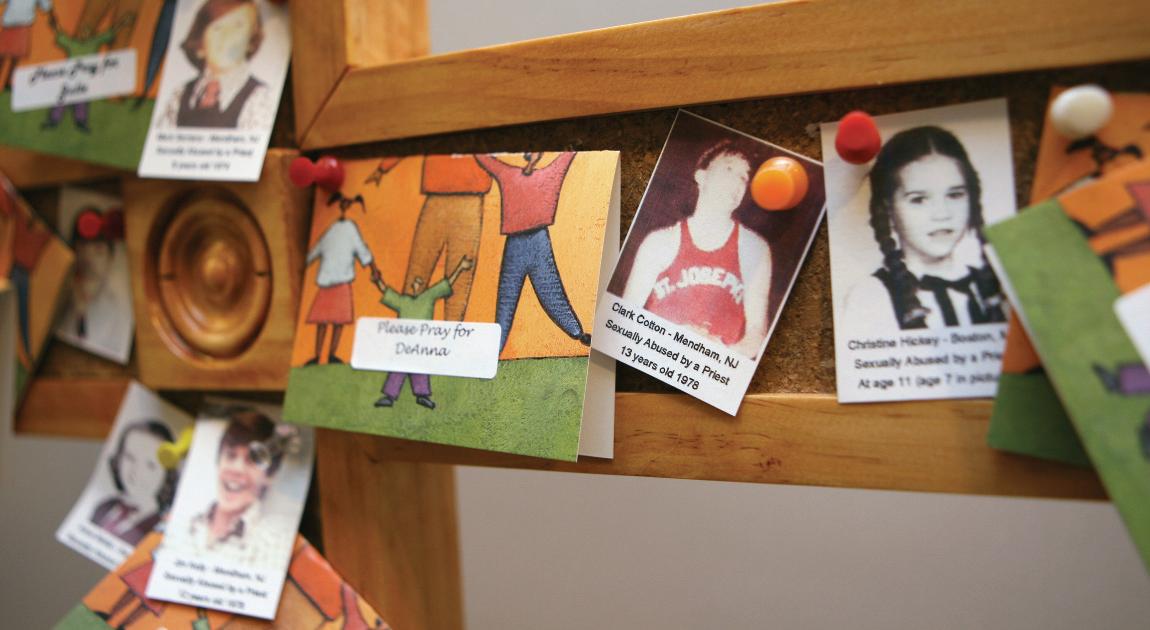
extended several points of Church law: they defined a minor as a person under age 18 rather than 16; set a statute of limitations of 20 years, instead of 10 years, after the victim’s 18th birthday for bringing a Church case against an alleged perpetrator; established an abbreviated administrative procedure for removing guilty clerics from the priesthood; and included child pornography in the list of serious crimes which could bring expulsion from the priesthood.
Barbara Dorris, a spokeswoman for the Survivors Network of those Abused by Priests, known as SNAP, said in a statement on 16 May that “the Vatican abuse guidelines will change little,” particularly because they do not insist that the national guidelines be binding.
“Bishops ignore and conceal child sex crimes because they can,” the SNAP statement said, adding that “any ‘reform’ that doesn’t diminish Bishops’ power and discretion is virtually meaningless.”
The doctrinal congregation said new guidelines should reflect the fact that diocesan or national review boards “cannot substitute for the discernment” and decision-making authority of individual Bishops. Fr Lombardi said the point of the letter was to make clear that an individual Bishop “cannot abdicate his responsibility” for ensuring child safety and handling abuse cases,
even though he may avail himself of the advice of outside experts. He said the fact that the guidelines do not have to be binding does not lessen a Bishop’s responsibility or the Church’s commitment to ending abuse. Rather, he said, it is a recognition that in many countries all the Bishops have agreed to follow the same procedures and, culturally, did not feel a need to have a Vatican stamp on them in order for them to be binding.
“The responsibility for dealing with the delicts (crime) of sexual abuse of minors by clerics belongs in the first place to the diocesan Bishop,” the letter said. But the adoption of national guidelines is meant to “lead to a common orientation within each episcopal conference, helping to better harmonise the resources of single Bishops in safeguarding minors.”
Citing Pope Benedict’s meetings with representative victims of child sexual abuse during his trips outside Italy, the doctrinal congregation’s circular letter encouraged Bishops or their representatives to meet with victims and their families. Bishops’ conferences should consider introducing child protection programmes aimed at creating “safe environments” for children and educating Church workers and parents about the signs of abuse and how to handle suspected cases, the letter said. The letter reiterated the
need for Bishops and Religious communities to exercise special care when accepting candidates for the priesthood or Religious life and to provide “a healthy human and spiritual formation” and a clear understanding of the value and meaning of chastity. Special emphasis was given in the letter to the obligation of Bishops and Religious Superiors to exchange information about candidates who transfer from one diocese, seminary or Religious Order to another.
The doctrinal congregation said Bishops must act as fathers and brothers to their priests, ensuring their ability to live out celibacy, to understand how clerical sexual abuse damages victims and “to recognise the potential signs of abuse perpetrated by anyone in relation to minors.” The Vatican letter offered Bishops’ conferences guidance in dealing both with those making accusations as well as with accused clerics.
People making accusations against a priest should be treated with respect, it said, and “spiritual and psychological assistance” should be offered to victims. The Vatican said when an accusation is made, a priest must be presumed to be innocent until it is proven he is not. However, it said, a Bishop can limit an accused priest’s ministry until an investigation can be conducted.
VATICAN CITY (CNS) - In a world marked by new forms of slavery and injustice, the Church must evangelise constantly and fearlessly - even in the face of persecution, Pope Benedict XVI said.
The Pope, addressing directors of the Pontifical Mission Societies on 14 May, said Catholic activity at every level needs to be infused with the missionary spirit.
“All the sectors of pastoral life, of catechesis and of charity should be characterised by the missionary dimension: the Church is mission,” he said. Evangelisation, he added, must begin with a firm faith and an enthusiastic desire to share it with others. The Church’s evangelisation efforts are aimed at “transform-
ing the world according to God’s plan,” leading men and women to “real freedom” and out of all forms of slavery, he said. “New problems and new forms of slavery, in fact, are emerging in our time,” the Pope said. “This is true in the so-called First World, which is well-off and rich but uncertain about its future. And it is true in developing countries where, partly because of a globalisation that is often profitdriven, there’s an increase in the masses of poor, of emigrants and of the oppressed, in whom the light of hope grows weak.”
Pope Benedict said the duty to evangelise requires a “total love” of Christ and a willingness to sacrifice even one’s life in order to witness
the Gospel. “Christians should not have fear, even if at present they are the religious group which suffers most from persecution on account of its faith,” he said, quoting from his 2011 World Peace Day message.
Oblate Fr Andrew Small, the newly appointed national director for the Pontifical Mission Societies in the US, said US Catholics continue to be the most generous donors to the Pope’s missionary projects, giving more than 40 per cent of the total raised worldwide.
Fr Small said that even in the Church, however, there’s a risk of overlooking the particular needs of evangelisation.
“Things have shifted. People are aware of the world and its needs
more. I think we’ve forgotten the missionary needs. That was the way we looked at the world in the past: We saw it through the eyes of faith,” he said. Nowadays, he said, people often see the world’s needs through the lens of hunger or poverty or HIV/AIDS. “But we’re forgetting that when somebody needs their AIDS drugs, they might also want somebody to pray with them. I think we’ve neglected that side of it a little bit,” he said.
In his talk to the group, Pope Benedict warned of the “temptation to reduce evangelisation to a project that is merely human or social, hiding or passing over the transcendent dimension of the salvation offered by God in Christ.”
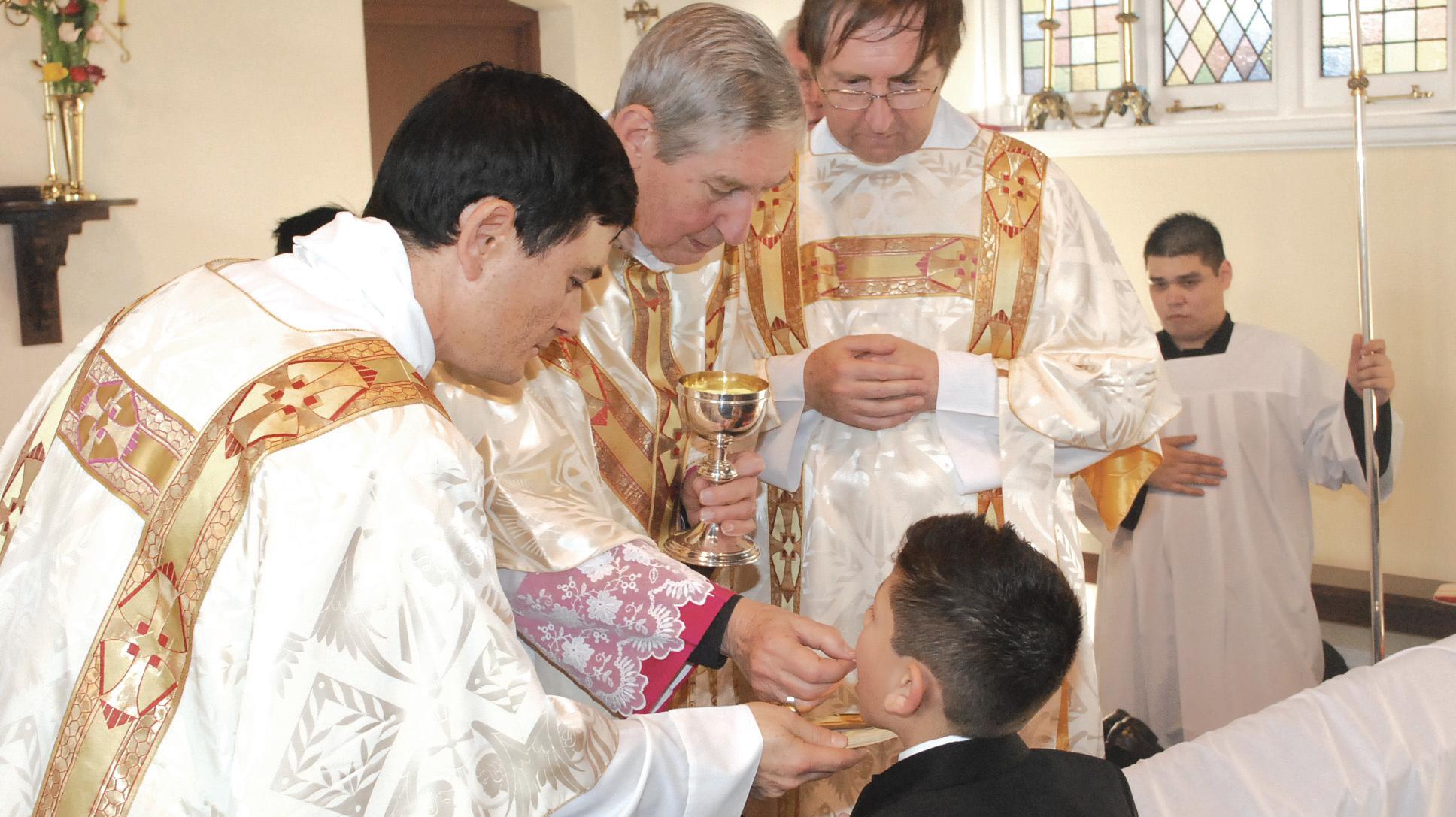
Vatican norms insist on ‘generous’ approval for use of Tridentine
VATICAN CITY - A new Vatican instruction calls on local Bishops and pastors to respond generously to Catholics who seek celebration of the Mass according to the 1962 Roman Missal, commonly known as the Tridentine rite.
The instruction, issued on 13 May, said pastors should approve such Masses for groups of faithful, even when such groups are small or are formed of people from different parishes or dioceses. These faithful cannot, however, contest the validity of the modern Mass or the authority of the Pope.
“In deciding individual cases, the pastor or the rector, or the priest responsible for a Church, is to be guided by his own prudence, motivated by pastoral zeal and a spirit of generous welcome,” it said.
The instruction said that, depending on pastoral needs, Bishops should make sure seminarians are trained in celebrating the Tridentine rite, or “extraordinary form” of the Mass.
At the same time, the Vatican said the Pontifical Commission Ecclesia Dei would be responsible for ensuring local Church officials were making the old rite available where warranted.
The instruction was issued by the Ecclesia Dei commission and approved by Pope Benedict XVI.
It came nearly four years after the Pope, in an apostolic letter titled Summorum Pontificum, relaxed restrictions on use of the Tridentine rite and said it should be made available in every parish where groups of the faithful desire it.
The new instruction said the Pope’s letter of 2007 had three main aims: to offer the old rite to all the faithful as a “precious treasure” to be preserved, to guarantee the use of the old rite “for all who ask for it” and to promote reconciliation in the Church.
It said local Bishops have the responsibility to make sure liturgical matters in their dioceses are proceeding in agreement with the
Pope’s expressed desires and in “peace and serenity.” That includes taking measures to ensure respect for the extraordinary form of the Roman rite, it said. The instruction, in a section listing “specific norms,” addressed several issues that have arisen as groups of faithful have petitioned for the scheduling of Masses in the old rite:
● The papal letter had stated that a “group of the faithful” existing “in a stable manner” could legitimately request celebration of the Tridentine rite. The norms said such a group could be “quite small,” could have formed after the publication of Summorum Pontificum and could be made up of Catholics from different parishes or dioceses who want to gather in a specific parish church or chapel.
● In the case of a priest who presents himself occasionally in a parish church with some of the faithful and wishes to celebrate in the extraordinary form, the local pastor should permit it.
● The norms said the Tridentine rite should be made available at sanctuaries and pilgrimage sites to groups of pilgrims who request it, if there is a qualified priest.
● The faithful who ask for celebration of the Tridentine rite must not belong to or support groups that contest the Pope or the validity of the Mass and sacraments as celebrated in the ordinary form, the norms said.
Jesuit Fr Federico Lombardi, Vatican spokesman, said the language of that provision made it clear that “there should be no polemical or critical intent on the part of those people making the request.”
The instruction also addressed the question of who can celebrate the Tridentine rite. The papal letter had said that priests who use the 1962 Roman Missal must be “qualified” to do so, but did not spell out requirements.
The new document said that every Catholic priest in good standing is generally qualified to celebrate Mass in the extraordinary form. A basic knowledge of Latin is needed, enough to pronounce the words correctly and understand their meaning, it said.
Regarding the need to know the rite, it said priests are presumed to be qualified if they present themselves spontaneously to celebrate the Tridentine rite and have cel-
THE Bishops of England and Wales are re-establishing the practice of abstaining from meat on Fridays as a penance to identify with Christ on the cross. In the resolutions published from their spring plenary assembly, which concluded Thursday, the Bishops announced the re-establishment of the practice, to go into effect on 16 September, which marks the anniversary of Benedict XVI’s visit to the United Kingdom last year.
“Every Friday is set aside by the Church as a special day of penance, for it is the day of the death of our Lord,” a statement of resolutions from the assembly reminded. “The law of the Church requires Catholics to abstain from meat on Fridays, or some other form of food, or to observe some other form of penance laid down by the Bishops’ Conference.
“The Bishops wish to re-establish the practice of Friday penance in the lives of the faithful as a clear and distinctive mark of their own Catholic identity.”
The prelates added that it is “important that all the faithful be united in a common celebration of Friday penance.”
“Respectful of this, and in accordance with the mind of the whole Church, the Bishops’ Conference wishes to remind all Catholics in England and Wales of the obligation of Friday Penance. The Bishops have decided to re-establish the practice that this should be fulfilled by abstaining from meat,” the resolution stated. The prelates said those who do not eat meat normally should abstain from some other food on Fridays. “Many may wish to go beyond this simple act of common witness and mark each Friday with a time of prayer and further self-sacrifice,” the Bishops’ statement concluded. “In all these ways we unite our sacrifices to the sacrifice of Christ, who gave up His very life for our salvation.”
ebrated it previously. Fr Lombardi said that learning, or relearning, the rubrics of the old rite could be “demanding.”
“For example, I wouldn’t have a problem with the Latin. But knowing all the rubrics that indicate the movements and particular gestures is much more complex,” he said.
The instruction said the Ecclesia Dei commission would be in charge of monitoring compliance with the provisions allowing the use of the old rite, and would have the power to decide on recourse by groups of faithful against “any possible singular administrative provision of an ordinary which appears to be contrary” to the papal letter.
The commission’s decisions can, in turn, be appealed to the Vatican’s highest tribunal, the Apostolic Signature.
The Ecclesia Dei commission is headed by US Cardinal William Levada, Prefect of the Congregation for the Doctrine of the Faith, who signed the instruction.
On other matters, the instruction:
● Said a group of faithful can celebrate the Easter triduum services in the extraordinary form if there is a qualified priest. In making a church or oratory available, the local pastor should not exclude the possibility of celebrating the triduum services in both ordinary and extraordinary forms in the same church.
● New saints and some new prayers for special occasions can and should be inserted into the 1962 Missal. It said provisions on this question would be issued later.
● All priests have permission to celebrate the Tridentine rite alone, without a group of faithful.
● Masses for the ordination of priests should always use the ordinary rite, except when it involves the small number of religious institutes with a special dedication to the extraordinary rite.
The instruction said use of the Tridentine rite would also require exceptions from liturgical norms currently in use that are “incompatible with the rubrics of the liturgical books in effect in 1962.” It did not spell out those exceptions.
Asked if altar girls are allowed to serve at a celebration of the Tridentine rite, Father Lombardi said the question was not specifically addressed in the new instruction.
Continued from Page 1 ance regime, with a greater likelihood that people will be penalised. He said subjecting people to compulsory income management simply because they are on a certain benefit, or live in certain postcodes that are lower socio-economic areas, is “demeaning”.
While the Society has always supported voluntary income management, compulsory income management “like what we’ve seen in the Northern Territory so far” is unacceptable, he said.
The media’s obsession over the number of teenage mothers has been overblown, and the Government is now targeting them, he said.
“This has been touted as a major problem in Australia, but it’s a huge beat-up by the media,” he said.
“Of the people who receive parenting payments in Australia, only two and a half percent are aged 19 or under, so this idea that there is a huge number of teen mothers out there is a complete misconception.”
While he conceded that encouraging teen mothers back into education is “an excellent idea, the method by which it’s going to be applied is terrible – to threaten them with the complete loss of their income, which could have dire consequences for both these mothers and their children”.
He applauded the Budget’s investment in training and massive investment in mental health, “but it is very sad and quite offensive to see the Government persisting with an attitude that because you are poor you basically have yourself to blame and must change your behaviour and will be punished if you don’t”.
“We encourage the Government to seriously analyse the actual causes of unemployment, especially in areas of concentrated disadvantage,” he said.
While the Society applauds
place-based initiatives that support people who have been left out or pushed out, “we cannot condone the Dickensian rhetoric of needing to take a stick to the backs of the poor.”
The Budget included several proposed changes to the not-for-profit sector, providing $53.6 million for a new independent Commonwealth regulator and $2.9 million to develop a codified definition of charity for use in Commonwealth law.
In announcing the 2011 Federal Budget, Treasurer Wayne Swan flagged the establishment of an Australian Charities and Not-forProfit Commission by July 2012 to introduce national regulation in the sector and to increase compliance activity.
The Gillard Government expects to raise $41 million from this measure after the Commission determines the legal status of the Notfor-Profit (NFP) sector with the Assistant Treasurer Bill Shorten insisting changes are needed to address the “overly complex and duplication of regulatory requirements.” The establishment of the Commission announced in the 2011 Federal Budget is also expected to advise on ways to tighten tax loopholes for charities and NFPs which run businesses unrelated to their charitable works, and in the process raise additional revenue for the Government.
While the Budget revealed NFPs would be asked to pay income tax on profits from unrelated commercial activities that were not directed back to their altruistic purpose, Catholic Health Australia chief executive Martin Laverty warned that it is essential that lengthy and indepth consultation be carried out before any changes are made to current tax laws.
CHA is the nation’s largest grouping of not-for-profit hospitals and aged care services that employ 40,000 Australians.
When Pope Benedict XVI visited a homeless shelter in Rome last year he told those gathered that the Church loved them profoundly and wouldn’t abandon them, “because it recognises in every one of your faces, the face of Christ”.
The Pope was expressing one of the foundational truths on which our Church is built; each person has been created in the image and likeness of God. It is a pity that our politicians are not guided by such Divine understanding.
WA Police Minister Rob Johnson recently announced that all homeless people would be removed from the Perth CBD during the meeting of Commonwealth Heads of Government Meeting in October this year. Unfortunately, his insensitive comments on the plight of those living on the street attracted the majority of media attention and no one seemed to pick up that they were merely a superficial indication of a much deeper and more serious issue.
Premier Colin Barnett did his best to smooth over the mess when he met with a group of people who were living on the city’s streets, but what he really did was simply
give Mr Johnson’s words a more politically and socially acceptable flavour. Mr Barnett said he didn’t expect CHOGM would have a significant impact on those living on the streets. However, with the verbal dexterity of a conditioned politician, he provided himself with an emergency exit door: “But if it does, those people will be treated with respect and found accommodation.”
I have no reason to doubt Mr Barnett’s sincerity in his desire to house those affected for the three day gathering but, as with the majority of politicians across the globe, he does not seem to be guided by Divine wisdom. Inevitably, this worldly way of thinking leads to the most vulnerable and fragile people in our societies being buried under the demands and desires of the more influential.
So if history is anything to go by then the fate of those living on the streets of Perth in October has already been written. A study of any major world event in recent years, whether it is CHOGM, APEC, the Olympics, G7 summits etc, will indicate a familiar pattern. When the world’s eyes turn toward a host city, they will airbrush their public face to hide what they perceive to be unsightly blemishes. Those living on the streets or in squats or shanty-towns are usually the first to go. Politicians will work long and hard to present a utopian façade so that they can inspire and attract future tourism and, consequently, future income. It all makes financial sense. Sadly, though, those who pay
the greatest price for this economic boom are those who already suffer the most. The physical trauma and emotional stress associated with living on the streets is magnified further when their own elected leaders want to hide their existence by sweeping them aside like unwanted trash.
On a human level, this is an affront to their dignity and selfworth but, even more tragically, it is a deep wounding of the spiritan offence against their true Divine identity. Most of those who live on the streets have never received the love that is supposed to nurture this spirit and this, in fact, is why many are there in the first place. They eventually identify themselves as those around them do - by their lack of accommodation or their addiction, or their anger or other such behaviours or conditionsand their true identity in Christ becomes buried beneath them.
But it is not only our politicians who fail to recognise who these people really are; it is a blame that many of us must share. It is traditionally told that when St Lawrence was asked to hand over the treasures of the Church to a tyrant emperor, he presented him with the sick, the lame and the unwanted. He was burnt alive for his response.
Each of us must question our own attitude to the suffering of our brothers and sisters in Christ.
Do we even acknowledge their existence or make time to pray for them or are we too, guilty of sweeping them into the forgotten corners of our hearts?
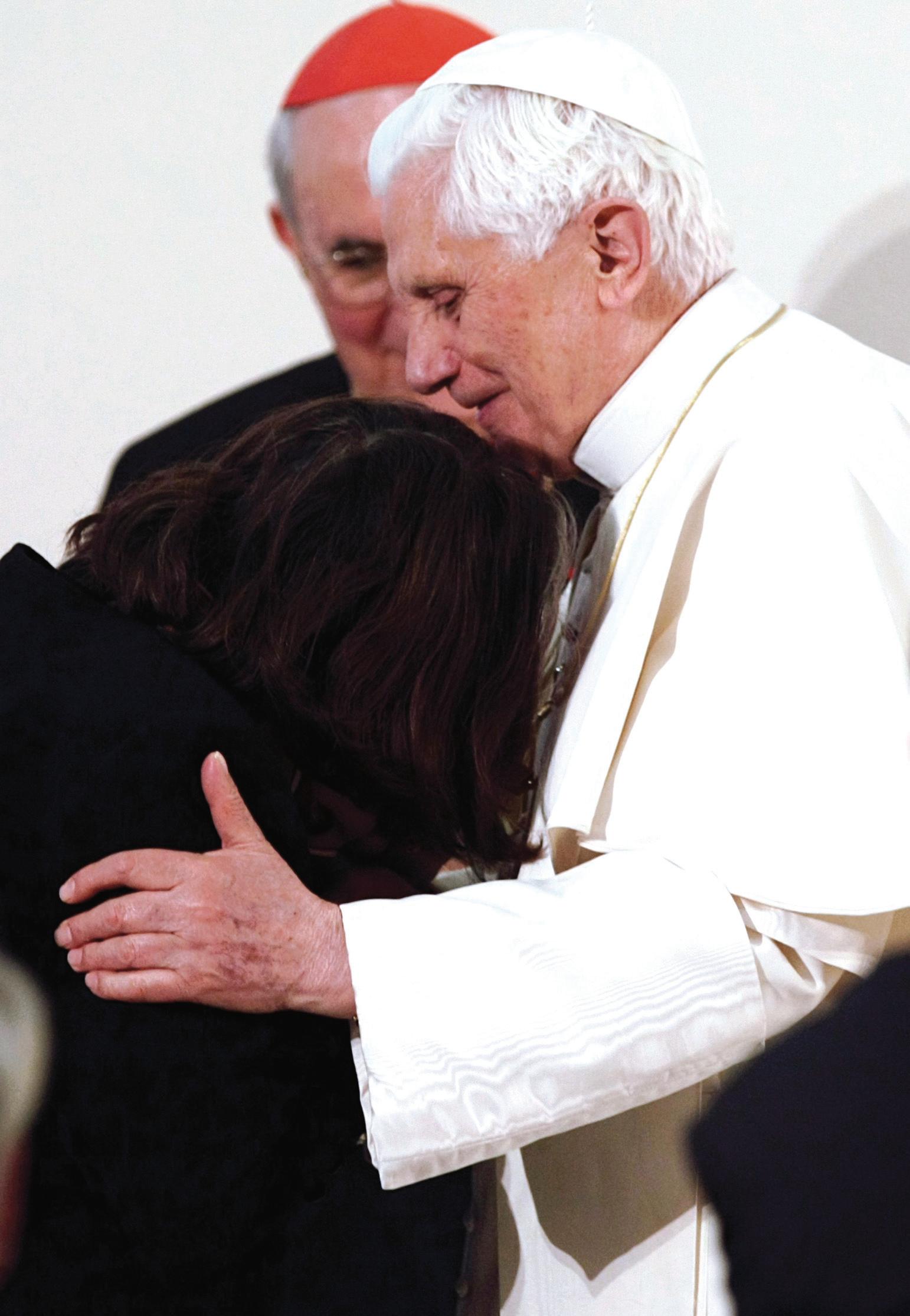
 By Fr John Flader
Q: I have some charismatic friends who seem to be filled with the Holy Spirit, who talk in tongues and participate in healing ceremonies. Is there anything I can do to have a deeper relationship with the Holy Spirit without the distinctly charismatic elements?
While the Holy Spirit certainly manifests His presence and power in more extraordinary ways, beginning at the first Pentecost and continuing down to the present, all Catholics can, and indeed should, have a very personal relationship with the third Person of the Blessed Trinity.
Let me explain some ways in which we can do this, based on the various roles of the Holy Spirit mentioned in the Scriptures.
Jesus says in the Last Supper that the Holy Spirit will “be with you forever” and that “He dwells with you, and will be in you” (Jn 14:17). As St Paul puts it, “your body is a temple of the Holy Spirit within you” (1 Cor 6:19).
This opens wide vistas in our spiritual life. We have the dignity of being temples of the Holy Spirit, who dwells within us. We can therefore carry on a loving conversation with the Holy Spirit who is not “out there”, but “in here”. He is the “Sweet guest of the soul”.
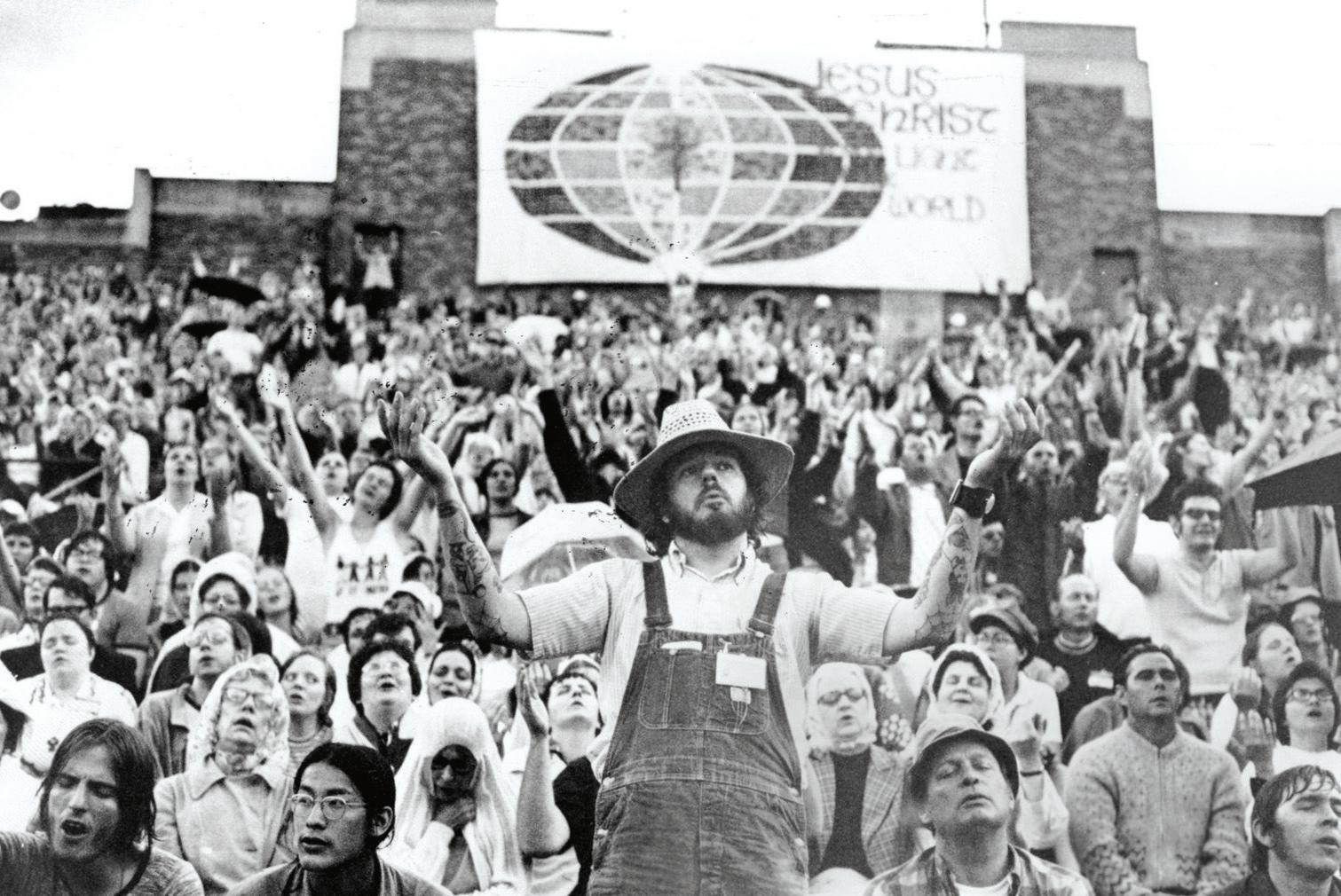
This awareness of our dignity should move us to struggle harder to avoid sinning, especially against our body. It was in this context that St Paul wrote that we are temples of the Holy Spirit, concluding, “You are not your own; you were bought with a price. So glorify God in your body” (1 Cor 6:19-20).
Also in the Last Supper, Jesus refers to the Holy Spirit as “the Spirit of truth” who “will guide you into all the truth” (Jn 16:13). This has many applications for Christian life.
Those engaged in study of any kind, be it secular or spiritual, can invoke the Holy Spirit to lead them into the truth of whatever they are studying.
Also, if someone is having difficulty grasping the truth of a particular matter, they can ask the Holy Spirit for lights.
And anyone who is teaching others can ask the Holy Spirit to guide them, and those they are teaching, into the truth.
St Paul writes to the Romans that the Holy Spirit instils in us a
deep sense of our divine filiation, of being not only creatures but children of God our Father: “For all who are led by the Spirit of God are sons of God. For you did not receive the spirit of slavery to fall back into fear, but you received the spirit of sonship. When we cry, ‘Abba! Father!’ it is the Spirit Himself bearing witness with our spirit that we are children of God …” (Rom 8:14-16).
When we are troubled, or feel in some way that God is distant, we can pray to the Holy Spirit to make
us cry out “Abba! Father”, remembering that God is never distant –He is a Father who loves us and sent His Son to die for us. We are His children.
In the same eighth chapter of his letter to the Romans, St Paul tells us that the Holy Spirit also helps us in our prayer: “Likewise, the Spirit helps us in our weakness; for we do not know how to pray as we ought, but the Spirit Himself intercedes for us with sighs too deep for words. And He who searches the hearts of men knows what is the mind of the Spirit, because the Spirit intercedes for the saints according to the will of God” (Rom 8:26-27).
There can be times when we find it difficult to pray, when we don’t know what to say or we feel dry. It is the time to go to the Holy Spirit and ask Him to intercede for us, so that the Father will know what is in our hearts.
Always, the Holy Spirit is the Love between the Father and the Son; He is the “Lord, the giver of Life” (Profession of Faith), the sanctifier.
We are all called to be saints but so often we content ourselves with being merely “good Catholics” who attend Mass on Sundays.
We can ask the Holy Spirit, as we do in the prayer “Come, Holy Spirit”, to “kindle in us the fire of Thy love”, to give us a vibrant spiritual life reflected in our love for God and our neighbour.
Finally, as the Holy Spirit came down on the apostles on the first Pentecost and transformed them into bold preachers of the Resurrection, we can pray to the Holy Spirit to fill us with apostolic zeal to lead others to Christ.
And we can ask Him for the “gift of tongues”, so that we reach the minds and hearts of our friends.
Pope Benedict XVI embraces a woman during a visit to the Caritas homeless centre in Rome on 14 February last year. PHOTO: CNS/GREGORIO BORGIA, POOL VIA REUTERS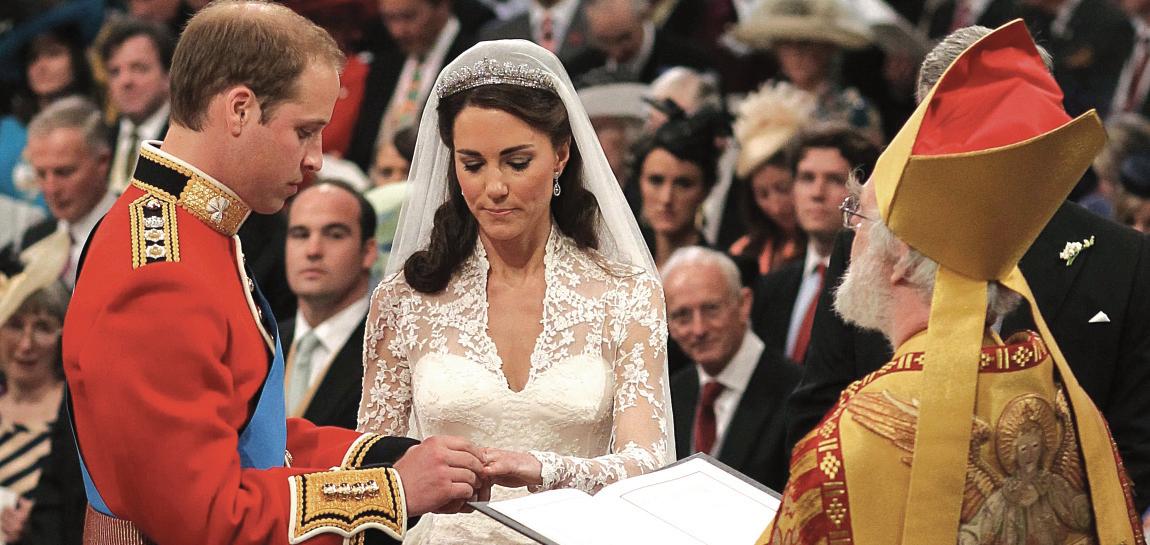
 By Tim Wallace
Tim
By Tim Wallace
Tim
Wallace, editor of Ecologicmedia. com, a Sydney-based website focusing on human and environmental issues, begins a new column for The Record
Royal wedding fever has again demonstrated, along with the proven commercial track of Disney flicks, that fairy tale fantasy has staying power in the age of celebrity.
Behind the photogenic facade of horse-drawn carriages, posh hats and grand titles, however, lies a mundane fact: our regard for royalty now is largely because it is a thoroughly defanged institution, stripped of any real authority apart from cutting ribbons and exchanging occasional pleasantries with subjects over whom they reign in name only.
As a mechanism for the exercise of real political sovereignty, the happenstance of inheritance leaves much to be desired. History shows the wise and noble monarch to be the exception rather than the rule.
Few are equipped with the temperament and intellect to fulfill high office; even fewer have it by dint of being born into the right family.
Yet, in certain Catholic circles there remains a hankering for the days of old; mostly within what is described as the “traditionalist” movement where an understandable dismay at centuries-old rituals sacrificed on the brutalist altar of modernity has also led, erroneously, to confabulating a past golden age where the Church was triumphant, pews were full and society, from sovereign to serf, bent its knee to a higher power.
None personify this better than the American internet evangelist Michael Voris, a former CBS anchorman who has cannily mim-
icked the style and tone of the Fox News Network to deliver acidic homilies of great appeal to those upset about cafeteria Catholicism and the moral decay of Western civilisation generally. Last year, Voris captured a wider public imagination with a lament that the inherent problem with democracy is everyone gets to vote – “and the only way to prevent a democracy from committing suicide is to limit the vote to faithful Catholics”.
But even that would be a fudge, Voris went on, since the whole idea of democracy was little less than an experiment doomed to failure from the outset: “Now the only way to run a country is by benevolent dictatorship – a Catholic monarch who protects his people from themselves and bestows on them what they need, not necessarily what they want, who protects their rights as human beings. It was this political system that caused Europe to emerge from the morass of marauding barbarians and create Western civilisation.”
At least two things are notable about this perspective.
The first is its dubious historical accuracy. For, quite apart from might be said about the damage caused by any number of Catholic monarchs to the essential mission of the Church through their weather-vane commitment to Christian values, one virtue of the mediaeval system that sprang from the disintegration of the Roman empire was kings lacking the wherewithal to act as dictators.
That form of monarchy (sometimes benevolent but more often self-serving) developed later with the retrograde trend towards regalism, in which all social and economic institutions, including the Church, were centralised under royal control.
Regalism began before the Reformation. The distributist scholar and monarchist John Medialle has noted that this concentration was the beginning of the modern nation-state, “in which all loyalties, and all power, were transferred to the state in the person of the king; from there it was but a short step to replace the all-powerful king with an oligarchy or a democracy, or more usually, an oligarchy disguised as a democracy”.
It also laid the ground for less democratic revolutions and unvarnished totalitarianism.
Here, then, is the criticism of contemporary government that should be made by a serious Catholic commentator: not that it
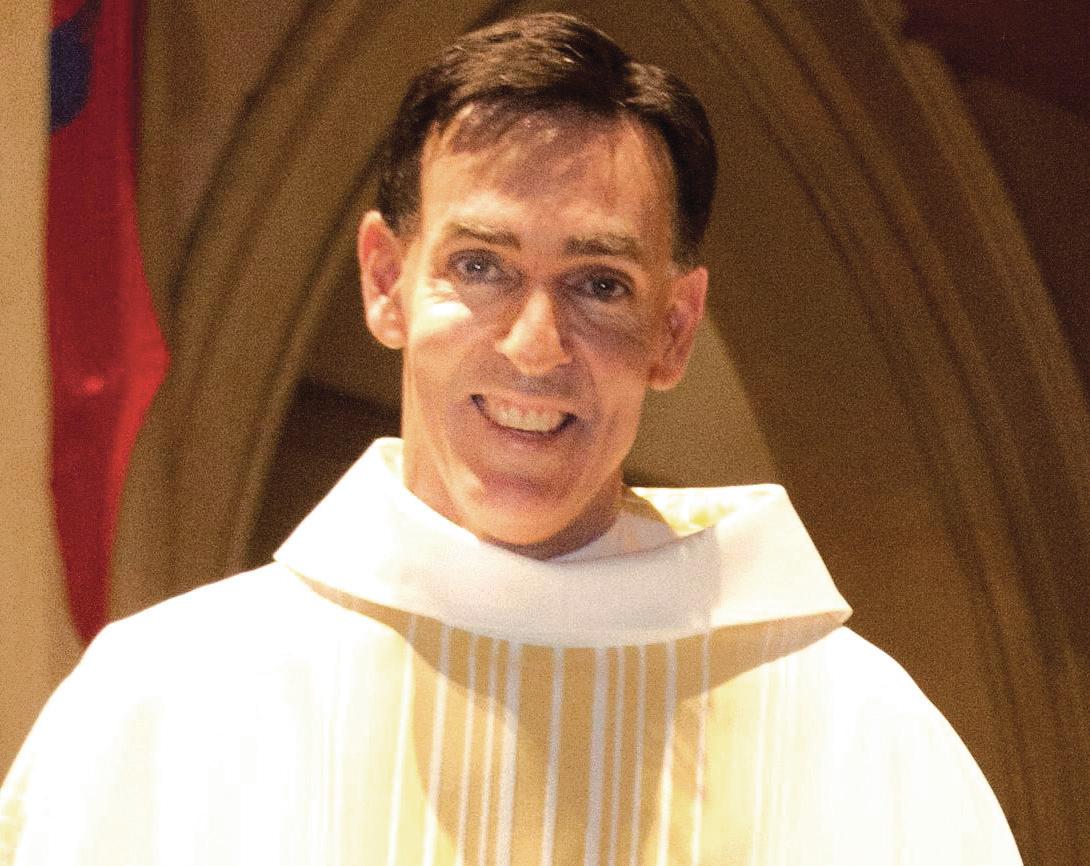
is too democratic but not democratic enough.
The second notable aspect of this traditionalist longing for monarchy is its demonstration that the papacy, as slow-moving as it may seem to the rest of world, is often in the unenviable position of shepherding a flock that contains both forces enthusiastic for change and those wanting no change whatsoever.
It was Pope Leo XIII, best known for his pioneering social encyclical Rerum Novarum, who faced up to the challenges of a changed world with his policy of ralliement, unburdening French Catholics of their rusted-on loyalty to the deposed ancien régime by recognising that the anti-clerical attitudes of a particular republican government did not invalidate the republican system itself; indeed, obdurate hostility to the latter because of distaste for the former could only make things worse.
As Pope Benedict XVI noted on the bicentenary of his predecessor’s birth last September, Leo XIII was wise and far-sighted in guiding his flock towards “the path of constructive participation, rich in content, firm in its principles yet capable of openness”.
Yet then, as now, there were those who failed to recognise the wisdom, their sense of fidelity to tradition being so acute they felt justified in ignoring the Pope.
A parallel might be noted today in the context of the environmental debate. It is now more than 20 years since Pope John Paul II addressed the “ecological crisis” and the emergence, in response, of a new ecological awareness “which, rather than being downplayed, ought to be encouraged to develop into concrete programmes and initiatives”.
Yet many Catholics continue a staunchly oppositional attitude to environmental concerns, based on their perception of the environmental movement as being dominated by people antagonistic to religion in general and some fundamental Christian concerns in particular. Is this a productive strategy? I fear not.
- Tim Wallace is a freelance journalist who has worked on metropolitan dailies and magazines, including The Canberra Times, Australian Financial Review, The Age, The Sydney Morning Herald and The Diplomat magazine. He is the ghostwriter and editor of True Green: 100 everyday ways to contribute to a healthier planet and author of True Green @ Work: 100 ways to make the environment your business, both published by ABC Books and National Geographic.
Iwas born and bred in Brisbane. I have been blessed with two wonderful Catholic parents, and five faith-filled brothers and sisters. We went to Mass every Sunday and at least two weekdays during Lent each year. We also said the Rosary quite often, but every evening during Lent and Advent.
 with Debbie Warrier
I was educated by the Christian Brothers. Ever since the age of 12, I have felt God calling me to be a priest. This revelation has been happening through prayer, the Word of God in Scripture, and God communicating with me through others.
I also grew up as a pretty good tennis player - having a set point against the world’s number one at the time, Ivan Lendl, in the 1988 Australia Open. I was 18 at the time.
When I was 19 I contracted an illness called Guilain Barre Syndrome which left me totally paralysed within 24 hours. I spent three months in hospital, and three years in a wheelchair recovering from this illness.
The illness has left me with nerve atrophy in my legs and hands, which means I have very weak hands and legs.
Although this sounds like a terrible experience, I received great blessings from it.
When I contracted the illness I can remember thinking, while lying on my back in intensive care, totally paralysed with a respirator helping me breath, “I have taken so much for granted in my life.”
So from that point on, I have been extremely grateful for everything God has blessed me with, particularly my faith, the wonderful people in my life, the beautiful world we live in, and being able to move and breathe.
At the University of Queensland I gained my Bachelor of Engineering degree, a Bachelor of Business degree, and a Master of IT. I worked in Product Development as a Mechanical/ Manufacturing Engineer, before changing fields to Systems Analyst/ Project Manager.
Whilst working for a large multi-national company in Hong Kong, the call to the priesthood came to me again.
I fully wanted to be a priest just before entering the seminary at 34 years of age.
I spent six to seven years in the Holy Spirit Seminary, Brisbane, which was an experience I enjoyed immensely. Prior to this I had been putting my vocation off for so long, making up all the excuses in the world to avoid hearing God’s call.
When I finally had the grace of God to accept this call, it has been like a huge weight was lifted off my shoulders. I have been on cloud nine ever since.
Initially, I felt God was calling me to be a missionary priest in the sense of one who is called to spread the Good News to developing countries (for some reason taking a vow of poverty appealed to me). But with the need for priests in my home city of Brisbane, after much prayer I have discerned that God is calling me to be a diocesan priest here.
My mum, dad, brothers, sisters, nieces and nephews are always there for me. I have eight very close friends, and their wives, who are wonderful that way as well. The reaction of everyone when I became a priest was “Finally!”
I live with Archbishop John Bathersby and the Dean of the Cathedral, who are terrific mentors and housemates.
Many other priests from Brisbane give me wonderful support.
I also find the staff at the Cathedral and Wynberg (the Archbishop’s house) to be very special people in my life. The support of my parishioners has meant a lot as well.
But by far my biggest influence and support has been my very good friend who also happens to be my Lord and Saviour Jesus Christ. I love Him so much.
SATURDAY, 21 MAY
Parish Migrant-Related Activities
10am-12.30pm at the Catholic Education Centre, Ruislip St, Leederville. For anyone having an interest in creating multicultural awareness amongst parishioners and making newly-arrived migrant parishioners welcome. Enq: Fr Blasco 9279 4226.
SUNDAY, 22 MAY
Multicultural Food fair
11am-2pm at Good Shepherd Parish, 215 Morley Dr, Lockridge. Fundraising event for the Divine Mercy Church at Maryville, Lower Chittering. Asian cuisine, sausage sizzle - sponsored by Jet Design and Drafting, cake stall, tea - coffee and cold drinks, variety stall, raffle draw every hour. Enq: Agnes 0435 63 6518 or Judith 0437 90 8793.
MONDAY, 23 MAY
Monthly CYM World Youth Day 2011 Pilgrimage Meeting
7.30pm at Perth Catholic Pastoral Centre, 40A Mary St, Highgate. All pilgrims are invited to attend as we count down to Madrid, meet other pilgrims and get practical preparation tips for Madrid.
TUESDAY, 24 MAY
Mary’s Apparitions in history
6.30-7.30pm at St Paul’s Parish, 106 Rookwood St, Mt Lawley. Presenter: Fr Tim Deeter. Includes the most famous apparitions and the lesser known (Rome, Walsingham, Beauraing, Banneaux, Akita, Zeitoun, Kibeho) and the controversial (Garabandal, Bayside, Medjugorje). 5.45pm Mass. Enq: Fr Tim 9271 5253.
Spirituality and The Sunday Gospels
7-8pm at St Benedict’s School Hall, Alness St, Applecross. Jesus said, “Trust in God and trust in me.” Presenter: Norma Woodcock. Collection to cover costs. Enq: 9487 1772 or www.normawoodcock.com.
WEDNESDAY, 25 MAY
‘An hour for Sheen’ Variety Concert
7.30pm at Gibney Hall, Trinity College, East Perth. Featuring St Joseph’s Chamber Choir; Yan Kee soprano; Daniel Mullaney baritone; June Glen poet and raconteur; John Meyer pianist. Part of the proceeds to two overseas missions and the supporting of the Cause of Servant of God Archbishop Fulton J Sheen. $27.50 inc supper. Pensioner and Senior discount. Credit card payment facilities available. Ample parking. Enq and tickets: Daniel 9291 8224, sheensociety@globaldial.com.
FRIDAY, 27 MAY
Medjugorje – Evening of Prayer
7pm at Our Lady’s Assumption Parish, 356 Grand Prom, Dianella. An evening of Prayer with Our Lady Queen of Peace including Adoration, Rosary, Benediction and concluding with Holy Mass. All welcome. DVD on Ivan’s visit to St Mary’s Cathedral in February (Ivan is alleged visionary from Medjugorje) available on evening or contact 9402 2480 or email medjugorje@y7mail.com.
FRIDAY, 27 MAY TO SUNDAY, 29 MAY
Rachel’s Vineyard Healing
Retreat for people suffering psychologically and spiritually due to a past abortion experience. Please include us in your prayers.
SATURDAY, 28 MAY
CYM Annual Ball
This year’s annual CYM Ball with the theme being ‘Recycle-ball’ will be stunning! Board the James Stirling, the largest vessel of Captain Cook Cruises and be prepared to be tempted by delicious buffet and then dance the night away. Ship departs at 7.30pm. Attire, semi formal. The recycle-ball theme promotes using classy secondhand outfits from op shops, borrowed or preloved. Cost: $70 (alcoholic drinks will be sold at the bar). For tickets call 9422 7912 or email admin@cym.com.au.
Annual Day Retreat – Legion of Mary
9am-3.30pm at Little Sisters of the Poor, Rawlins St, Glendalough. Retreat Topic: Pope Benedict’s letter Verbum Domini. Retreat Master Fr Hugh Thomas. Holy Mass, Benediction and Reconciliation. A small donation to offset cost can be made. Enq: Rosemary 0421 58 0783.
SUNDAY, 29 MAY
35th anniversary of the Australian Burma Mission
Relief Society
9am at Holy Trinity Parish, 8 Burnett St, Embleton. Thanksgiving Mass followed by food fete at parish hall. Enq: George 9272 1379.
Irish Famine Commemoration
3pm at Irish Club Theatre, Townshend Rd, Subiaco. Australian Irish Heritage Association second annual commemoration to honour victims of the catastrophic Irish potato famine of 1845–1851. A presentation of live short famine poems by Tony Curtis, reflections, stories and music with an audiovisual content. Irish afternoon tea provided. Free. Enq: Tony 9367 6026.
TUESDAY, 31 MAY
Day of Reflection (MMP)
10.30am at St Paul’s Parish, 106 Rookwood St, Mt Lawley. Rosary, Holy Mass and talks. Confession available. Celebrant and speaker Fr Tim Deeter. Bring lunch to share. Tea/coffee supplied. Concludes 2pm. Enq: Margaret Bowen 9341 8082.
FRIDAY, 3 JUNE
Pro-life witness
9.30am at St Brigid’s Parish, Midland. Mass followed by Rosary procession and prayer vigil at nearby abortion clinic led by the Franciscan Friars of the Immaculate. Come and pray for an end to abortion and the conversion of hearts. Enq Helen 9402 0349.
FRIDAY, 3 TO SUNDAY 5 JUNE
‘Be Inflamed’ Weekend Retreat for Teens 6pm at Eagle’s Nest Retreat Centre, 1406 O’Brien Rd, Gidgegannup. Teens aged 13-17. Weekend of fun, activities, music and spiritual talks from fantastic speakers. Cost $60. Concludes Sunday 1.30pm. Download registrations at cym.com.au. Enq: Stefania 9422 7914 or admin@cym.com.au.
FRIDAY, 3 TO SATURDAY, 11 JUNE
Novena to the Holy Spirit
7.30-8.30pm at Holy Family Parish, Lot 375 Alcock St, Maddington. 7.30-9.30pm Fridays. Includes Holy Hour, Holy Spirit formation and prayers. Concludes Saturday with a Solemn Night Vigil, Midnight Eucharistic Adoration, healing, anointing prayer and Holy Mass. Enq: Fr Varghese 9493 1703.
SATURDAY, 4 JUNE
Vigil for life
8.30am at St Augustine’s Parish, Gladstone St, Rivervale. Mass followed by Rosary procession and vigil at abortion clinic led by Fr Paul Carey SSC. Weekly prayer vigils: Monday, Thursday and Saturday 8.30-10.30am. Come and pray for the conversion of hearts and an end to abortion. Enq. Helen 9402 0349.
Day with Mary
9am-5pm at St Brigid’s Church, 69B Morrison Rd, Midland. Day of prayer and instruction based on the Fatima message. 9am Video; 10.10am Holy Mass; Reconciliation, Procession of the Blessed Sacrament, Eucharistic Adoration, Sermons on Eucharist and Our Lady, Rosaries and Stations of the Cross. BYO lunch. Enq: Franciscan Sisters of the Immaculate 9250 8286.
SUNDAY, 5 JUNE
Divine Mercy
1.30pm, an afternoon with Jesus and Mary will be held at St Francis Xavier Parish, 25 Windsor St, East Perth. Exposition of the Blessed Sacrament and we pray the Holy Rosary, Chaplet of Divine Mercy and St Faustina’s Praises of Divine Mercy. Refreshments will follow. Enq: John 9457 7771.
SATURDAY, 11 JUNE
Divine Mercy
2.30pm at St Francis Xavier Parish, 25 Windsor St, East Perth. Main celebrant: Fr Marcellinus. Reconciliation in English and Italian. Divine Mercy prayers followed by Veneration of First Class Relic of St. Faustina Kowalaska. Refreshments. Enq: John 9457 7771.
SUNDAY, 12 JUNE
50th Parish Anniversary 9am at Holy Spirit Parish, 2 Keaney Pl, City Beach. Mass celebrated by Archbishop Hickey followed by brunch. Holy Spirit Parish has touched many lives so please come
celebrate with us. Enq and RSPV: Fr Kettle 9285 0218 or text 0431661858 or fbarich@iinet.net.au.
SATURDAY, 18 JUNE
25th Jubilee Parish Dinner Dance
7pm at St Simon Peter Parish, 20 Prendiville Ave, Ocean Reef in the Prendiville Gym. Fabulous evening of music, dancing and a 3-course meal. Tickets $35 per person and Seniors $30. BYO alcohol and soft drinks. Coffee and tea provided. Tickets on sale now after all Masses and from Parish Office. Enq: Monique 9300 4885.
FRIDAY, 8 TO WEDNESDAY, 21 SEPTEMBER
Cruise on the River Nile
14-Day package. Includes Tour/Sightseeing of Jordan and Egypt. Cost: $4,900 per person twin share (22 people). Accompanying priest: Fr Joe Carroll. Itinerary and Enq: Fadua 9459 3873 or 0404 893 877.
St Jude’s Parish, Langford is organising a 13-day pilgrimage departing 1 October. Pilgrimage will include visits to the Shrines of Divine Mercy, Infant Jesus, the Black Madonna, St Faustina, the birthplace of Pope John Paul II and the Museum at Auschwitz. Total cost per person $5,800. The Spiritual Director, Fr Terry Raj. Enq: Co-ordinator John Murphy 9457 7771, Matt 6460 6877, mattpicc1@gmail.com.
WEDNESDAY, 5 OCTOBER TO THURSDAY, 20
OCTOBER
Pilgrimage to Rome, Lanciano, San Giovanni Rotondo and Medjugorje. Bed and breakfast, evening meals, transfers, guide, flying Emirates $3,990. Enq: 9402 2480.
FRIDAY, 11 TO TUESDAY, 22 NOVEMBER
Pilgrim Tour To The Holy Land
Jordan, Israel and Egypt. Spiritual Director: Fr Sebastian Kalapurackal VC from St Aloysius Church, Shenton Park. Enq: Francis – Coordinator, 9459 3873 or 0404 893 877 or Skype ID: perthfamily.
EVERY SUNDAY
Gate of Heaven Catholic Radio
Join the Franciscans of the Immaculate every Sunday from 7.30-9pm on Radio Fremantle 107.9FM for Catholic radio broadcast of EWTN and our own live shows. Enq: radio@ausmaria.com.
Pilgrim Mass - Shrine of the Virgin of the Revelation 2pm at Shrine, 36 Chittering Rd, Bullsbrook. Commencing with Rosary followed by Benediction. Reconciliation is available before every celebration. Anointing of the Sick administered during Mass every second Sunday of the month. Pilgrimage in honour of the Virgin of the Revelation, last Sunday of the month. Side entrance to the church and shrine open daily between 9am-5pm. Enq Sacri 9447 3292.
EVERY FIRST SUNDAY
Divine Mercy Chaplet and Healing Prayer
3pm at Santa Clara Church, 72 Palmerston St, Bentley. Includes Adoration and individual prayer for healing. Spiritual leader: Fr Francisco. All welcome. Enq: Fr Francisco 9458 2944.
EVERY SECOND SUNDAY
Healing Hour for the Sick
6pm at St Lawrence Parish, 392 Albert St, Balcatta. Begins with Mass, Exposition of the Blessed Sacrament and prayers. Enq: Fr Irek 9344 7066 or ww.stlawrence. org.au.
EVERY THIRD SUNDAY OF THE MONTH
Oblates of St Benedict
2pm at St Joseph’s Convent, York St, South Perth. Oblates are affiliated with the Benedictine Abbey of New Norcia. All welcome to study the rule of St Benedict and its relevance to the everyday life of today for lay people. Vespers and tea later. Enq: Secretary 9457 5758.
EVERY FOURTH SUNDAY OF THE MONTH
Holy Hour for Vocations to the Priesthood, Religious Life
2-3pm at Infant Jesus Parish, Wellington St, Morley. The hour includes Exposition of the Blessed Eucharist, silent prayer, Scripture and prayers of intercession. Come and pray that those discerning vocations to the priesthood or Religious life hear clearly God’s loving call to them.
EVERY MONDAY
Evening Adoration and Mass
7pm at St Thomas Parish, Claremont, cnr Melville St and College Rd. Begins with Adoration, Reconciliation, Evening Prayer and Benediction. Followed by Mass and Night Prayer at 8pm. Enq: Kim 9384 0598, claremont@ perthcatholic.org.au.
EVERY TUESDAY
Novena and Benediction to Our Lady of the Miraculous Medal
6pm at the Pater Noster Church, Marmion and Evershed Sts, Myaree. Mass at 5.30pm. Enq: John 0408 952 194.
Spirituality and The Sunday Gospels
7-8pm at St Benedict’s School Hall, Alness St, Applecross. The power of the Gospel message: How can we live meaningful and hope-filled lives? Presented by Norma Woodcock. Donation for The Centre for Catholic Spiritual Development & Prayer. Enq: 9487 1772 or www.normawoodcock.com.
Bible Teaching with a difference
7.30pm at St Joachim’s Parish Hall, Shepparton Rd, Victoria Park. Exciting revelations with meaningful applications that will change your life. Novena to God the Father, followed by refreshments. Bring Bible, a notebook and a friend. Enq: Jan 9284 1662.
EVERY WEDNESDAY
Holy Spirit of Freedom Community
7.30pm at The Church of Christ, 111 Stirling St, Perth. We are delighted to welcome everyone to attend our Holy Spirit of Freedom Praise Meeting. Enq: 0423 907 869 or hsofperth@gmail.com.
Holy Hour at Catholic Youth Ministry
6pm at 40A Mary St, Highgate, Catholic Pastoral Centre. 5.30pm Mass followed by $5 fellowship supper. Enq: Stefania 9422 7912 or www.cym.com.au.
EVERY FIRST WEDNESDAY
Holy Hour prayer for Priests
7-8pm at Holy Spirit Parish, 2 Keaney Pl, City Beach. All welcome. Enq: Linda 9341 3079.
SECOND WEDNESDAY OF THE MONTH
Chaplets of Divine Mercy
7.30pm at St Thomas More Church, Dean Rd, Bateman. Chaplet will be accompanied by Exposition followed by Benediction. Monthly event. All welcome. Enq: George 9310 9493 or 9325 2010 (w).
EVERY THURSDAY
Divine Mercy
11am at Sts John and Paul Church, Pinetree Gully Rd, Willetton. Pray the Rosary and Chaplet of Divine Mercy, and for the consecrated life, especially here in John Paul Parish. Conclude with veneration of the First Class Relic of St Faustina. Please do come and join us in prayer. Enq: John 9457 7771.
Fr Corapi’s Catechism of the Catholic Church
7.30pm at St Joseph Church, 20 Hamilton St, Bassendean - parish library. Enq: Catherine 9329 2691.
FIRST THURSDAY OF THE MONTH
Taize Prayer and Meditation
7.30-8.30pm at Our Lady of Grace Church, 3 Kitchener St, North Beach. Prayer and meditation using songs from the Taize phenomenon. In peace and candlelight, we make our pilgrimage. All are invited. Enq: Joan 9448 4457 or Office 9448 4888.
EVERY SECOND THURSDAY
St Denis Discussion Group
7.30pm at parishioners’ homes to discuss any aspect of our faith followed by supper and fellowship. Enq: George 9349 2187 or Anna 9242 2788, (w) 9249 2788.
FIRST FRIDAY OF THE MONTH
Holy Hour for Vocations to the Priesthood and Religious Life
7pm at Little Sisters of the Poor Chapel, 2 Rawlins St, Glendalough. Mass, followed by Adoration with Fr Doug Harris. All welcome. Refreshments provided.
Catholic Faith Renewal Evening
7.30pm at Sts John and Paul’s Parish, Pinetree Gully Rd, Willetton. Songs of Praise, sharing by a priest followed by Thanksgiving Mass and light refreshments after Mass. All welcome to attend and bring your family and friends. Enq: Kathy 9295 0913, Ann: 0412 166 164 or catholic-
ACROSS

2 Possible Easter month
6 Slayer of Abel
8 Story of original sin (with “The”)
9 St ___ Stein
10 Where Jesus went for 40 days
11 The ___ Land
13 Person in the first stage of the process of Christian initiation
15 Chant, as a monk
17 God, the Father
19 Patron saint of candle makers
22 ___ of Turin
24 Member of an order of St Angela Merici
27 Saint who wrote a rule
29 Catholic portrayer of Dracula
31 Alpha and ___
32
33
34
1
2
3
5
6
10
14
29 S 6TH SUNDAY OF EASTER
Wh Acts 8:5-8, 14-17 Message welcomed
Ps 65:1-7, 16, 20 Cry out to God
1 Pet 3:15-18 A clear conscience Jn 14:15-21 I will come back
30 M Acts 16:11-15 A woman called Lydia
Wh Ps 149:1-6, 9 Shout for joy Jn 15:26-16:4 Spirit to be witness
Nazareth
16 Jewish month of Passover
18 Made a priest
21 ___ Mass
22 ___ rosa: secretly, as the appointment of a Cardinal
25 “___ Night”
26
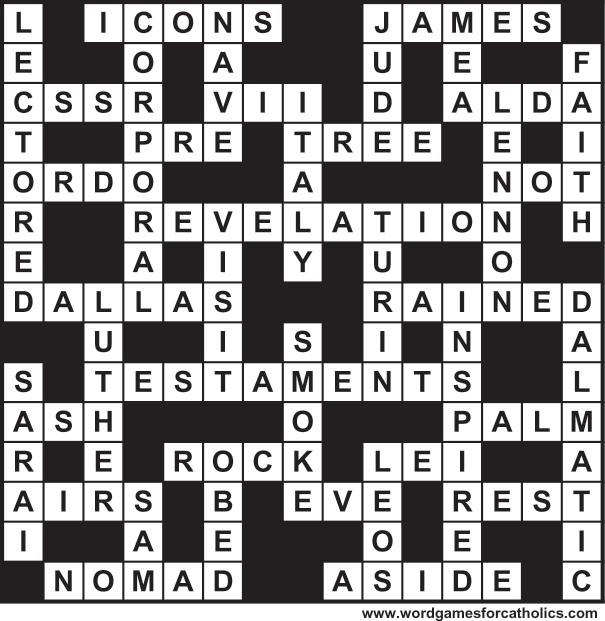
Red Acts 17:15, 22-18:1 Paul In Athens
Ps 148:1-2, 11-14 God alone is exalted Jn 16:12-15 Many things to say
2 Th Ss Marcellinus and Peter, martyrs (O)
Wh Acts 18:1-8 Paul goes to Corinth
Ps 97:1-4 God’s wonders Jn 16:16-20 weeping and wailing
WRR LAWN MOWING & WEED SPRAYING Garden clean ups and rubbish removal. Get rid of bindii, jojo and other unsightly weeds. Based in Tuart Hill. Enq 9443 9243 or 0402 326 637.
BUSINESS OPPORTUNITY
Work from Home - P/T or F/T, 02 8230 0290 or visit www.dreamlife1.com.
REAL ESTATE FOR SALE
Completely fully furnished. 3 bedrooms 1 bathroom villa. Close to good Shepherd Church, Lockridge. Phone (08) 9378 4384. Price Market value.
ARE YOU BUYING OR SELLING real estate or a business? Why not ask Excel Settlements for a quote for your settlement. We offer reasonable fees, excellent service and no hidden costs. Ring Excel on 9481 4499 for a quote. Check our web site on www.excelsettlements.com.au.
NEW BOOK BINDING, General Book Repairs; Rebinding; New Ribbons; Old Leather Bindings Restored.Tydewi Bindery 0422 968 572.
HOLIDAY ACCOMMODATION
ESPERANCE 3 bedroom house f/furnished Ph 09 9076 5083.
Deadline: 11am Monday
ALL AREAS. Competitive Rates.
Mike Murphy Ph 0416 226 434.
BRENDAN HANDYMAN
SERVICES Home, building maintenance, repairs and renovations. NOR. Ph 0427 539 588.
PROPERTY MAINTENANCE. Your handyperson. No job too small. SOR. Jim 0413 309 821.
BRICK RE-POINTING Ph Nigel 9242 2952.
PERROTT PAINTING Pty Ltd
For all your residential, commercial painting requirements. Ph Tom Perrott 9444 1200.
PICASSO PAINTING Top service. Ph 0419 915 836, fax 9345 0505.
MOTOR HOME FOR SALE
2003 Mercedes Sprinter, 306 CDi. Low kilometres, vg condition. Many extras. Ready to go. Bargain at $51,900. Ph 9653 1794.
CATHOLICS CORNER Retailer of Catholic products specialising in gifts, cards and apparel for Baptism, Communion and Confirmation. Ph 9456 1777. Shop 12, 64-66 Bannister Rd, Canning Vale. Open Mon-Sat.
RICH HARVEST YOUR CHRISTIAN SHOP Looking for Bibles, CDs, books, cards, gifts, statues, Baptism/Communion apparel, religious vestments, etc? Visit us at 39 Hulme Ct (off McCoy St), Myaree, Ph 9329 9889 (after 10.30am Mon to Sat). We are here to serve.
KINLAR VESTMENTS
Quality hand-made and decorated vestments: Albs, Stoles, Chasubles, Altar linen, banners, etc. 12 Favenc Way, Padbury. By appointment only. Ph Vickii on 9402 1318, 0409 114 093 or kinlar.vestments@gmail.com.
OTTIMO
Convenient location for Bibles, books, cards CD/DVDs, candles, medals, statues and gifts at Shop 41, Station St Market, Subiaco. Fri-Sun, 9-5pm.
PILGRIMAGE
JOIN SR ISABEL BETTWY on a 13 day pilgrimage (includes travel time) to Poland in the Footsteps of St Faustina
The 70th anniversary of the martyr death of St Maximilian Kolbe. Celebrate the 80th anniversary of Jesus appearing to Faustina Kowalska. Attend the Mass and closing of the World Apostolic Congress on Divine Mercy in Lagiewniki. Departing Perth on Wed, 28 Sep 2011.
Cost: AU$4,900 per person twin share (min 18 people) + AU$ 800 single supplement. Francis Williams (coordinator). T: 9459 3873 (after 4pm) M: 0404 893 877 (all day) E: francis@perthfamily.com Skype ID: perthfamily88

HOLY LAND PILGRIMAGE
COME JOIN THE KNIGHTS OF THE HOLY SEPULCHRE ON A PILGRIMAGE TO THE HOLY
LAND AND PETRA FROM
28 SEPT TO 11 OCT 2011.
CONTACT BOB PETERS
08 9201 2702
MOB: 0419 195 645
EMAIL: repeters@iinet.net.au
The Record. The Parish The Nation. The World
31 Tu VISITATION OF THE BLESSED VIRGIN MARY (Feast)
Wh Zeph 3:14-18 Enemies driven away [Alt. Rom 12:9-16 Profound respect]
Isa 12:2-6 Praise God’s name Lk 1:39-56 Mary set out
1 W St Justin, martyr (M)
faithrenewal@gmail.com.
Communion of Reparation All Night Vigils
7pm-1.30am at Corpus Christi Church, Lochee St, Mosman Park. Enq: Vicky 0400 282 357 and at St Gerard Majella Church, Ravenswood Dr and Majella Rd, Mirrabooka. Enq: Fr Giosue 9349 2315, John or Joy 9344 2609. The Vigils consist of two Masses, Adoration, Benediction, Prayers and Confession in reparation for the outrages committed against the United Hearts of Jesus and Mary. All welcome.
Healing and Anointing Mass 8.45am at Pater Noster, Myaree.
3 F St Charles Lwanga and companions, martyrs, (M)
Red Acts 18:9-18 Paul sails for Syria
Ps 46:2-7 Sing praise for God Jn 16:20-23 Sorrow turned to joy
4 S Acts 18:23-28 Followers encouraged
Wh Ps 46:2-3, 8-10 God is King Jn 16:23-28 Your joy is complete
Continued from Page 18
Reconciliation, followed by Mass including Anointing of the Sick, Praise and Worship to St Peregrine and the Sacred Heart of Jesus. All welcome. Enq: Joy 9337 7189.
EVERY FIRST SATURDAY
Healing Mass
12.35pm at St Thomas Parish, cnr Melville St and College Rd, Claremont. Spiritual leader: Fr Waddell. Enq: Kim 9384 0598, claremont@ perthcatholic.org.au.
EVERY FIRST FRIDAY
Healing Mass
7pm at St Peter’s Parish, Wood Street, Inglewood. Reconciliation, praise and worship, Eucharistic Adoration, Benediction,
Anointing of the Sick, special blessings and fellowship after the Mass. Celebrants, Fr Dat (parish priest) and specially invited priests. All welcome. Enq: Priscilla 0433 45 7352, Catherine 0433 92 3083 and Mary-Ann 0409 67 2304.
EVERY DAY DURING THE MONTH OF MAY
Novena in Honour of Our Lady of Fatima
7-8.30pm at Holy Cross Church, Hamilton Hill. On Saturdays, the novena will start at 6pm and on Sundays, at 8am. All are welcome. Enq: Connie 9494 1495.
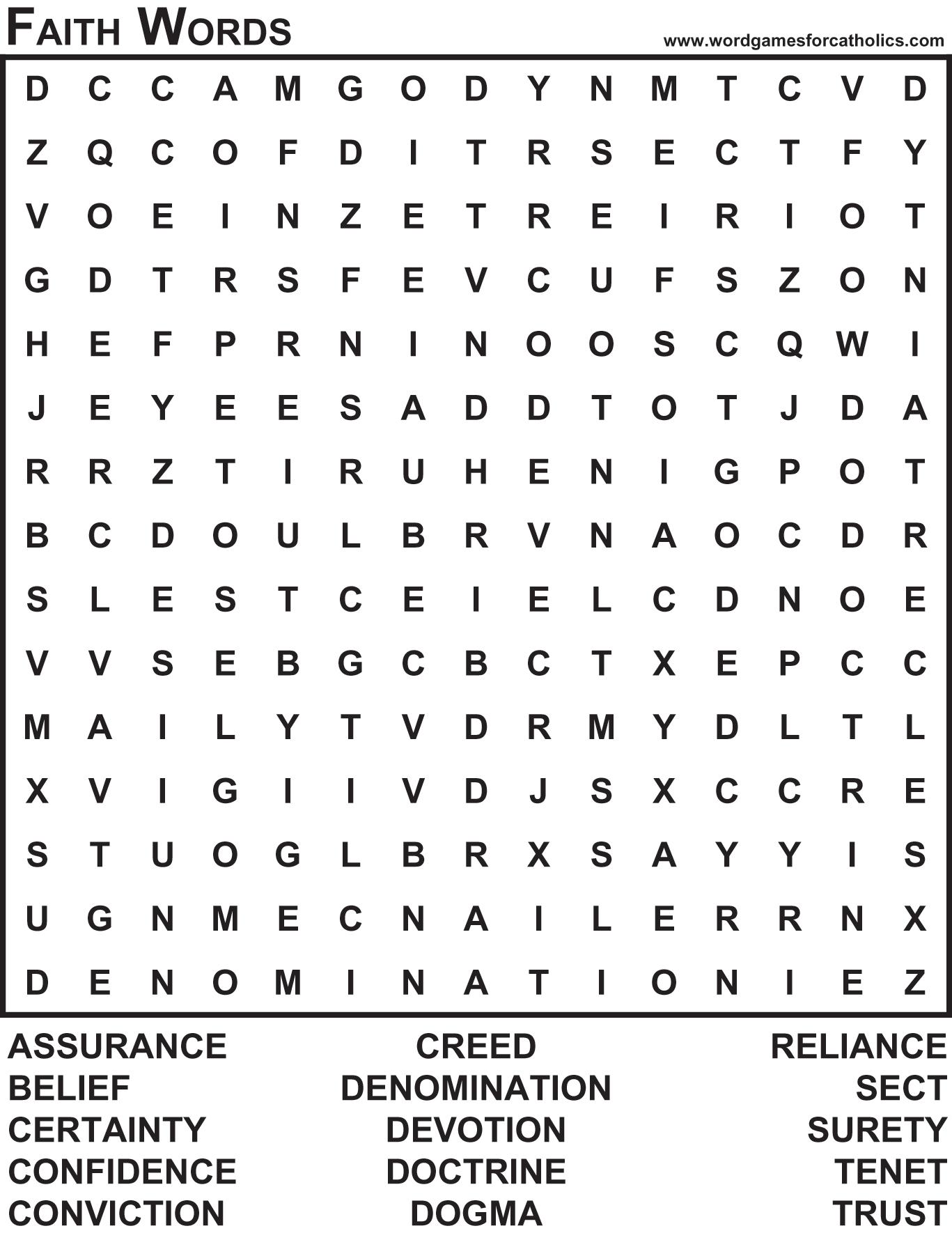


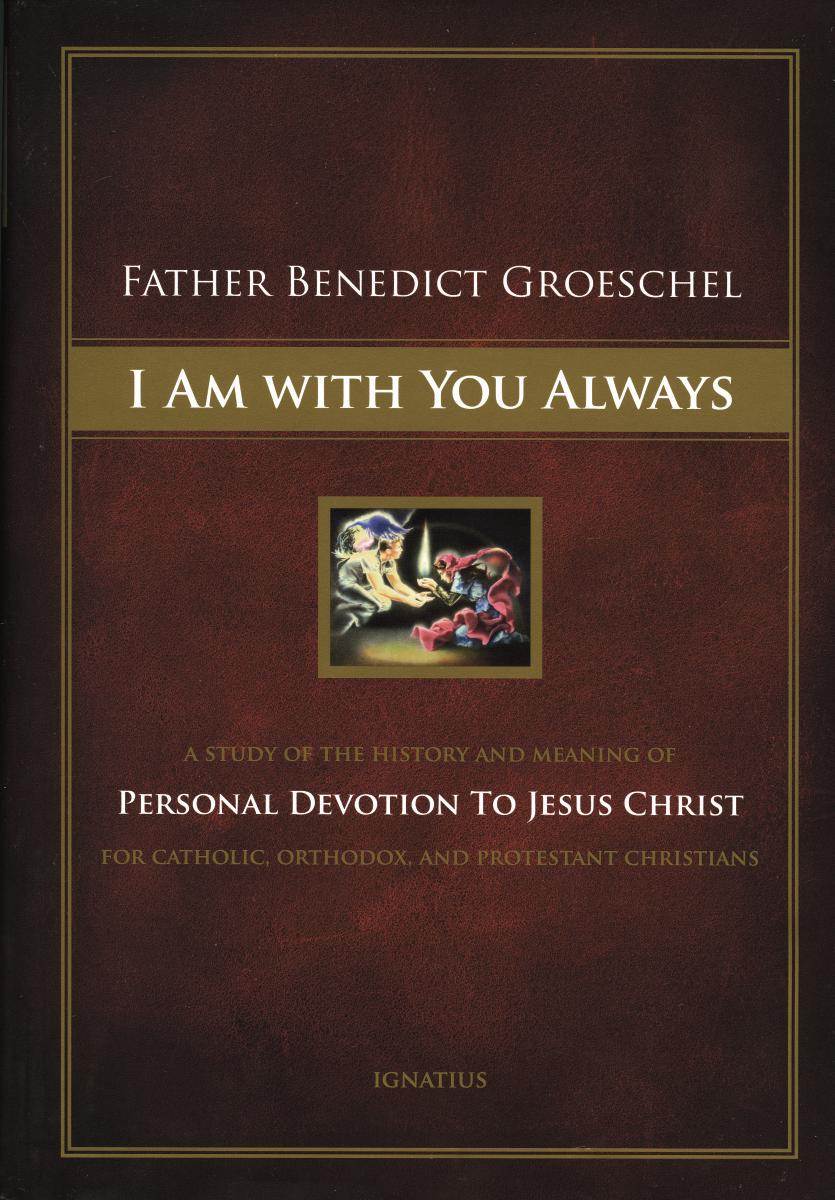

Father Benedict Groeschel
RRP $60.00
The devotional life of Christians over the two millennia since Jesus’ birth has been one of motion, changing and growing in response to the challenges presented to the Church, the temperaments of newly baptised nations, and controversies about how we can and should relate to God.
In this book, the well-known spiritual writer and teacher, Fr Benedict Groeschel CFR., surveys the development and trials of Christian devotion from the days of the martyrs until the 20th century. By observing what “image of Christ” the canvas of common devotion portrays, he hopes we will move “not to discredit this image, but to sharpen it and make it more consistent with the New Testament and the ancient Church”.

RRP $32.00
Padre Pio: The True Story focuses primarily on the post-World War II era to the time of Padre Pio’s death. It was during this time that an onscure Italian Capuchin priest attracted worldwide attention for his holiness as well as his mysterious stigmata.


Francesco Castelli
RRP $30.00
On 14 June 1921, a priest knocks at the convent in San Giovanni Rotondo. He is in his early forties and wears a simple cassock but he is no ordinary priest. He is Bishop Raffaello Carlo Rossi, future Cardinal sent by the Holy Office to investigate secretly Padre Pio. Bishop Raffaello interviews Padre Pio himself and examines the mysterious wounds of Christ that he bears on his body.After gathering all the evidence, the Inquisitor sketches his own evaluation of Padre Pio which includes his reasons for believing that the stigmata are of divine origin. He sends his report and the depositions to Rome, where they stay buried for nearly a century, until now.

Jeff Cavins, Matthew Pinto and Patti Armstrong
RRP $35.00
Amazing Grace for the Catholic Heart will help you celebrate your Catholic faith like no other book you have ever read. It will take your heart and soul on a joyous spiritual retreat from the challenges and struggles of everyday life. This collection of 101 stories of faith, inspiration, hope and humour attest to the power and beauty of God’s amazing grace.


The contributors to Women, Sex, and the Church challenge the misconception that the Church’s teachings are anti-women and anti-sex. Instead, these women explore the controversial teachings on abortion, sex, marriage, and contraception and how these actually evidence the Church’s love of women. Readers will discover that following the Church’s teachings is, in fact, the truest form of feminism.
The contributors to this text rely on biological, sociological and medical evidence combined with personal anecdotes and experience to analyse theological teachings and compare them to the secular, feminist perspective on these teachings.
