
“It’s political correctness gone mad. The tradition has always been to use ‘BC’ and ‘AD’.”

“It’s political correctness gone mad. The tradition has always been to use ‘BC’ and ‘AD’.”
MOVES to substitute the use of ‘BC’ and ‘AD’ in school curricula with secular terms have been condemned by Catholic educators.
Educators should honour traditions and heritage by using the traditional Christian dates, said the Director of Catholic Education in Western Australia, Ron Dullard.
“This is political correctness gone mad. The traditions in this country have always been BC and AD. We shouldn’t be changing it to BCE and CE for namesake,” he said.
By 2013, under a proposal from the Australian Curriculum, Assessment and Reporting Authority (ACARA), schools will no longer have to refer to the terms BC (“Before Christ”) and AD (from the Latin Anno Domini, meaning “Year of Our Lord”).
Schools will instead be free to use the secular historical terms BCE (“Before the Common Era” and CE (“Common Era”).
A spokesman from the authority, which is responsible for making all changes to the national schools curriculum, described this as a “pre-
scriptive measure”. He emphasised schools could choose which system they preferred to use in teaching.
“We’re not excluding BC and AD. We expect students to be conversant with a number of ways for representing dates in history,” the spokesman told The Record, adding: “This is not an attempt to denigrate Christianity in any way or form.”
The use of the terms BC and AD date back to the 6th century and were formalised with the replacement of the Julian calendar by the Gregorian calendar under Pope Gregory XIII in the 16th century.
The dean of St Mary’s Cathedral and a governor of the University of Notre Dame, Monsignor Michael Keating, said he believed the decision of the curriculum authority was a further creep towards secularism and an attempt to be inclusive in a multicultural country.
“My view is that secularists are trying to use this tactic to deChristianise society, to get rid of Christian symbols,” he said.
“The fact is that the most notable person in history was Jesus Christ; I think most people acknowledge that. He’s had the biggest, most pro-
found effect on people in the world.
“Before him, Before Christ, and Anno Domini, the time of Christ, is for me a very good line in the sand.”
The new terms are increasingly used in academia, according to Dr Angela McCarthy, a theology lecturer at the University of Notre Dame. She said the use of “BCE” and “CE” came about in the 1980s when people of different religions wanted more fruitful discussion about their faiths.
The curriculum changes are planned to be rolled out across the country in 2013.
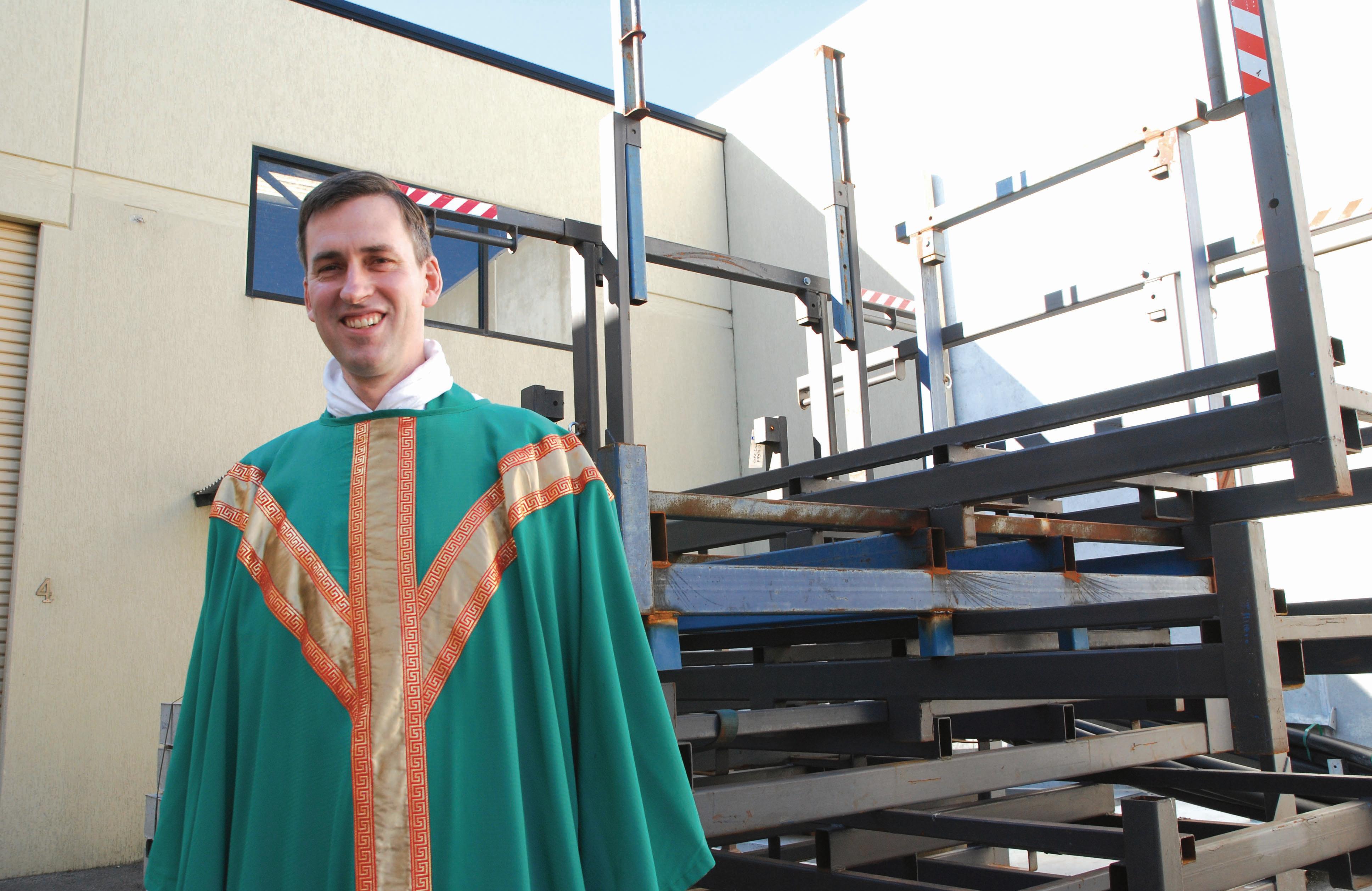
A NEW Catholic chapel has opened in the industrial heartland of Malaga.
Next to an aluminium workshop and across the road from a giant hardware warehouse, St Philomena’s chapel has been established in a workshop unit off Juna Drive.
It brings more Mass and confession time options to people working in or near the city, with a 4.45pm Mass from Monday to Friday and a 6.45am Mass on Monday mornings.
St Philomena’s opened its doors on 22 July, the feast day of Mary Magdalene; chaplain Father David Watt said he already had interest from workers in the area.
Fr Watt said the chapel was intentionally different from anything that was offered elsewhere, except perhaps for the Robert Healy Centre in Joondalup and All Saints chapel in the city.
With 4.45pm mass being a vigil of the following day, he is doing his level best to help busy, working people keep alive the tradition of beginning each day with Mass.
“As I always say, a day without Mass is a non-event,” Fr Watt said.
“It’s not about attending ‘this’ Mass, it’s about attending ‘a’ Mass,” Fr Watt said.
Continued on Page 5
THE ARCHDIOCESE of Adelaide has denied allegations by the global head of the Traditional Anglican Communion that Adelaide’s Archbishop Philip Wilson and vicar-general Monsignor David Cappo failed to investigate a 2008 written complaint itemising a decade of sexually abusive behaviour by three Catholic priests – including one still running an Adelaide parish.
Archbishop John Hepworth,
the head of an estimated 400,000 traditional Anglicans who split from the Anglican Communion in 1991 and who in 2007 expressed a desire to reunite with the Catholic Church, began his clerical career as a Catholic priest, being ordained in Adelaide in 1968.
In revelations published by The Weekend Australian , Archbishop Hepworth said his decision to leave the Catholic Church in 1972 and become an Anglican had been driven by more than a decade of sexual exploitation by older semi-
narians and priests that began with his grooming for homosexual sex at the age of 15 at Adelaide’s St Francis Xavier Seminary; the abuse continued, he said, until he decided to leave Australia and the Catholic priesthood at the age of 27.
In written statements provided to the archdiocese in 2008, Archbishop Hepworth details his youthful feelings of deep confusion and guilt over “sexual experiences that fed at the same time my need for friendship and acceptance” as well as his sense of “being trapped” by warn-
ings from superiors that any talk of sexual experiences would disqualify him from the priesthood. The statements name three priests who sexually abused him. Two of them are now dead: Fr John Stockdale, who died on New Year’s Eve in 1995 in a cubicle at a notorious “men-only” club in Melbourne; and Fr Ronald Pickering, who avoided prosecution for sexually abusing a string of teenage boys by fleeing to Britain. In 2001, the head of the Melbourne archdiocese’s Independent Commission on
Sexual Abuse, Peter O’Callaghan, QC, wrote that Pickering “had a proclivity for child abuse”.
The third, according to Hepworth’s statement, one night in 1969 during a walk wrestled him to the ground and forced him into sex, and remains a senior cleric in the Adelaide archdiocese.
The archdiocese said in its statement that an investigation into the allegations had been “on foot” since 2007 when Archbishop Hepworth first notified the archdiocese.
ST JUDE’S parish in Lynwood has achieved a long cherished dream with an upgrade to their church’s sanctuary. The upgrade was ready in time for the confirmation of 36 children on Sunday, 28 August and the launch of the parish’s new website (stjudescatholic.org.au).
After a year of fundraising, said parish priest Fr Terry Raj, parishioners were happy with the results.
The parish has swapped plain brick for marble in highlighting the area behind the altar and tabernacle, and installed a new, locally made tabernacle light in the shape of a teardrop.
“We did it to make the church more attractive: to keep up with the majesty and the sanctity of the celebration,” Fr Raj said.
“The celebration of Mass is always beautiful and this adds to that. It draws people’s attention right to the altar, the central focal point of our celebration.”
Other upgrades include the rendering of the back wall, the installation of new LED lights and digital projection equipment, and an upgrade to the church’s sound system. The upgrades provided a fitting backdrop to the recent confirmation of students from St Jude’s Catholic primary and other local primary schools, Fr Raj said.
Digital projection equipment will aid with the introduction of new English Mass parts later on this year. The installation of a digital camera projector, as used in university lecture theatres to project printed text, would be especially convenient, Fr Raj said, for Masses throughout the week.
The upgrade has been spearheaded by parishioner and architect, Roger Martin of Parklin
Construction. As a boy, Mr Martin served Mass when the existing church was opened in 1972, replacing the small hut used since the 1967 parish foundation.
Fr Raj said he was grateful to all those parishioners who made the sanctuary upgrade and the new website possible, including Masters student Rojesh Susaimanickam who put the website together in the short time of just two weeks.
The parish will continue its fundraising efforts throughout the year to pay for the upgrades.
Editor
Peter Rosengren office@therecord.com.au
Journalists
Mark Reidy mreidy@therecord.com.au
Tim Wallace twallace@therecord.com.au
Rob Hiini rhiini@therecord.com.au
Advertising/Production
Mat De Sousa production@therecord.com.au
Accounts
June Cowley accounts@therecord.com.au
Classifieds/Panoramas/Subscriptions
Catherine Gallo Martinez office@therecord.com.au
Record Bookshop
Bibiana Kwaramba bookshop@therecord.com.au
Proofreaders
Chris Jaques Eugen Mattes
Contributors
Debbie Warrier John Heard
Karen and Derek Boylen Anthony Paganoni CS
Christopher West Catherine Parish
Bronia Karniewicz Fr John Flader Guy Crouchback
The Record PO Box 3075
Adelaide Terrace
PERTH WA 6832
21 Victoria Square, Perth 6000
Tel: (08) 9220 5900 Fax: (08) 9325 4580
Website: www.therecord.com.au
The Record is a weekly publication distributed throughout the parishes of the dioceses of Western Australia and by subscription.
The Record is printed by Rural Press Printing Mandurah and distributed via Australia Post and CTI Couriers.


A TEAM of business students from University of Notre Dame (UNDA) Fremantle has beaten competitors across the state by averting a natural disaster.
The Deloitte Australia’s 2011 Dream Team Competition required students to present business plans for one of four businesses located in a natural-disaster-prone-town.
The UNDA team won first prize for its intuitive use of social media and polished financial outlooks in its presentation, “Independent Supermarket Business Continuity”. Gabriela Wade, Michelle Blank, Tayler Wright and Rochelle Cardozo recieved a $500 cash prize.
In the past five years Notre Dame’s team has won in 2007, 2010 and 2011, and come second twice.
Team member Michelle said, “we feel very privileged to have represented UNDA at the competition and are grateful to have had the most amazing support from our fellow students and dedicated academics in the School of Business.”
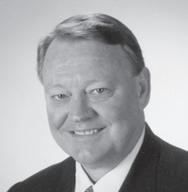
The executive dean of the College of Business, Chris Dopel said: “They are good students, it’s as simple as that, and they have good lecturers to prepare them and to give support.”
He said there were advantages students gained from such a competition. “Students learn to tackle real-world problems in a proper business environment. They also learn to work with each other alongside people from different fields as well as learning about business deadlines. Our performance has established a fine tradition for the School of Business.”
16 Confirmation, Woodvale – Bishop Sproxton
Installation of Rev Ron Larkin as UCA Moderator – Fr Peter Porteous OSM
16-18 Parish Visitation, Morley – Archbishop Hickey
18 Maria
Dianella – Archbishop Hickey
20 Visit Confirmation Candidates Majella and St
Schools – Archbishop Hickey
23 Confirmation, Mirrabooka – Archbishop Hickey
23-25 Parish Visitation, Armadale – Bishop Sproxton
24 Visit St Ninian and St Chad (TAC) – Archbishop Hickey
25 Annual Catenian Mass, St Mary’s Cathedral – Archbishop Hickey
28 Opening of The Faith Centre – Archbishop Hickey
Opening and Blessing, St Brigid’s College, Lesmurdie – Mgr Michael Keating
29/30 Bishops’ Commission, Sydney – Bishop Sproxton
A
“COMBINEDChurches
Commonwealth Prayer Initiative” has been launched to pray for a successful and safe Commonwealth Heads of Government Meeting (CHOGM) in Perth this year.
A quarter of the world’s leaders, representing 2.1 billion people, will attend. The inititiave will pray for all leaders and nations involved.
On Saturday, 22 October, churches will come together in St Mary’s Cathedral to celebrate the
THERE was regal ceremony for a regal cause on Sunday, 11 September, as three men and three women were invested into an order that protects followers of Christ in the Saviour’s home land.
Members of the Equestrian Order of the Holy Sepulchre and of candidates’ families turned out at St Joseph’s Church, Subiaco in what is an annual tradition for the association.
Men were knighted with ceremonial swords and women presented with medals before each was vested in the clothing of their office – white capes for men and black for women, both featuring the red Jerusalem cross.
Greenwood parish priest Fr Vinh Dong was made an Ecclesiastical Knight for his work to aid Christians in the Holy Land, and medical doctor Benedict King and Keith Stone were knighted for their efforts.
Karen Gauci, Rosa Tognela and Annaleah Williamson were recognised as Ladies of the order for their commitment.
Perth’s Archbishop Barry Hickey, himself a member of the order, performed the rites of investiture.
Links to the “equestrian” heritage of the order are now only ceremonial. The order’s origins go back to the first Crusade and to defence of the historical site of Christ’s burial.
culmination of this prayer period and to pray blessings into the city as CHOGM begins.
On behalf of Archbishop Barry Hickey, Auxiliary Bishop Donald Sproxton has asked Tes Lee of Focolare and Kaye Rollings of Flame Ministries International to approach parishes and schools to invite them to pray for CHOGM.
Churches, schools and Catholic organisations have been encouraged to adopt one of 54 nations and pray for the needs of the leaders and people of that country. St Charles’
Seminary has opted to pray not for a nation but for Queen Elizabeth who will visit during CHOGM.
Schoolchildren are being encouraged to write prayers to be incorporated into a permanent sculpture commemorating CHOGM that will be erected near Wesley Uniting Church in the city. They are also being asked to contribute to the sculpture’s cost so it is truly theirs.
The prayer initiative has spilled into country areas and overseas with church representatives from other CHOGM nations making
contact with WA churches and praying reciprocal prayer.
As the prayer countdown begins, “Project 54” will occur. Each day, one of the 54 nations and its needs will be prayed for, with the flag of that nation being raised at St George’s Anglican Cathedral. Prayers will focus on social, religious and political issues in each of the countries.
The Commonwealth Christian Assembly [20-22 October] will mark the end of this period with a series of prayer and worship events enti-

Choir of the John Paul II Catholic University of Lublin, Poland will perform at OUR
Friday, 23 September, 2011 at 7.15pm.
Tickets at $10 will be available at the door on the night of the performance.
tled “Shine”. From 24-28 October a series of events titled “Converge” based at Wesley Uniting Church will offer 24/7 prayer and praise during CHOGM, addressing the New Millennium Goals identified by the United Nations in 1995. “Converge” will end with a “Celebration of the Nations” at St George’s Cathedral on Sunday, 30 October.
To become involved in the prayer initiative, please contact Tes Lee at ffperth@iprimus.com.au or Kaye Rollings at kdr@aapt.net.au. Also see www.commonwealthprayer.org.
OUR LADY of Missions Parish, Whitfords gave out white balloons at last weekend’s masses to highlight the importance of child protection and their commitment to keeping kids safe.
“Our parish has an active and effective procedure that supports child protection,” the parish said in its 11 September bulletin.
Every volunteer and staff member who is directly involved with children in the parish, must hold a valid working with children card, the parish said.
Whitfords parish has a central database of all ministry leaders which is maintained by dedicated volunteers.
The central importance of child protection was noted in parishes throughout Perth including Fremantle, Gosnells and Manning.
The official white balloon day fell on 7 September and is an initiative of Bravehearts – a support organisation and lobby group for the protection of children.
This year’s event was the 15th annual White Balloon Day for the organisation – its principal fundraising event for the year.
St Thomas the Apostle Parish in Claremont will mark the occasion this weekend (17-18 September) after not wanting to diminish its importance by holding it on the same weekend as the 10th anniversary of September 11.
THOUGHTS and ideas of students from Our Lady of Grace, in North Beach, have been echoing across Perth airways over the past month.
The school was selected, along with others, to participate in a project initiated by Perth radio station 98.5 Sonshine FM.
Sonshine spokeswoman Nadia King told The Record it was designed to provide children with the opportunity to express ideas and knowledge in a public forum.
“We want to share with listeners the pure and imaginative nature of children as well as give the opportunity to contribute to our programming in a positive and encouraging way,” she said.
The project involves volunteers visiting schools and interviewing students on a range of topics. It has been running since the start of August and will continue through September and run again in 2012.
“We have heard kids tell us about their favourite part of the school day, why Australia is a great place to live, what they would do if they had superpowers and what they think God looks like … amongst other interesting comments,” Ms King said.
“We have been receiving great feedback from listeners as well as children and their families.”
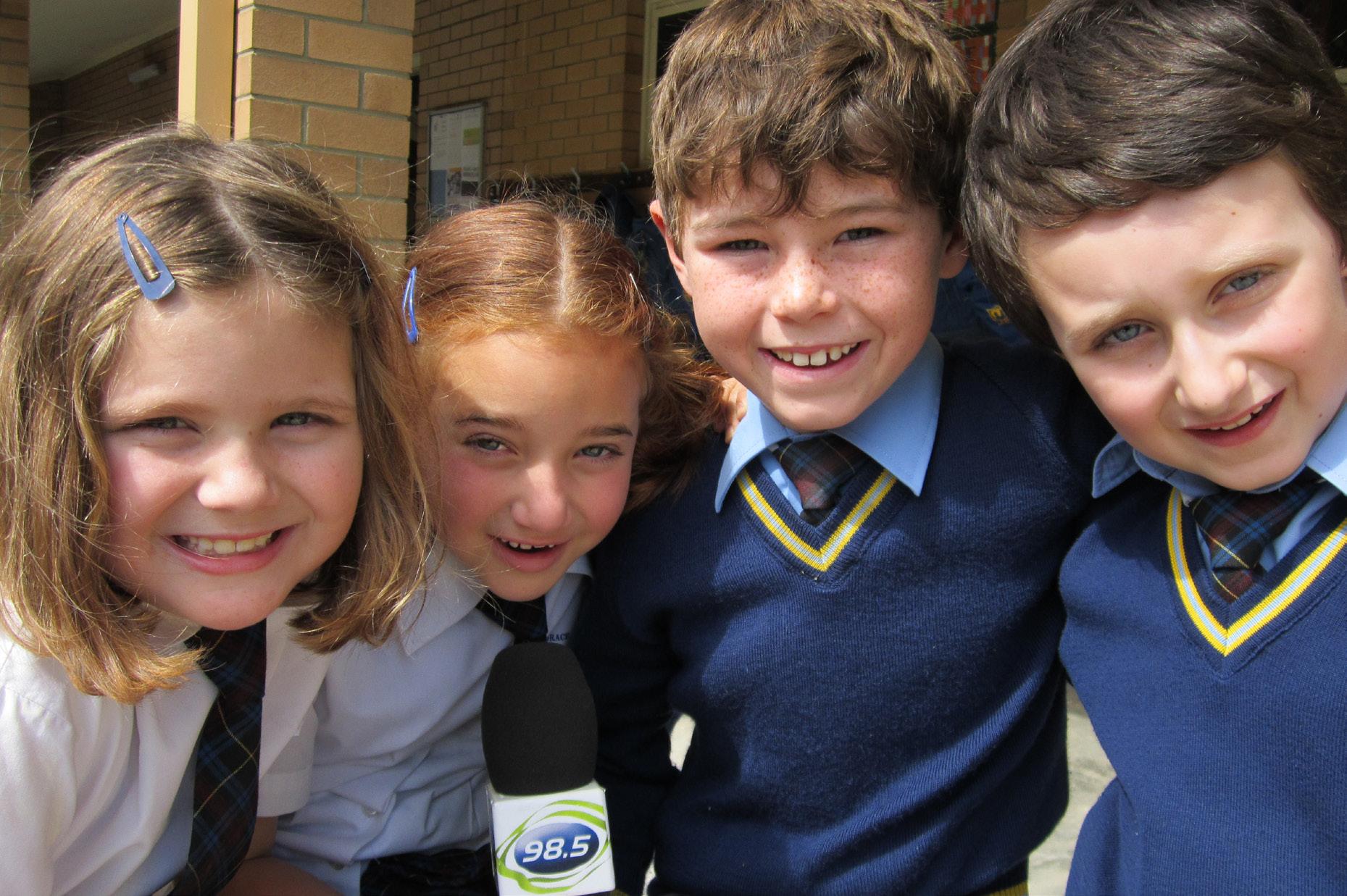
North Beach principal Chris Kenworthy agreed the response to his school’s participation was more than positive. “The whole process has been delightful,” he said. “Not only has it provided good publicity
but students involved have loved being stars.”
Ms King said this current project supported the station’s policy of Family Matters, which aims to ensure there is nothing played that
families wouldn’t want kids to hear. “We are Perth’s number one family station,” she said, “and our aim is to bring the positive message of hope and the life changing wisdom of God to every household in the city.”
Continued from Page 1
“However, at the specific request of Archbishop Hepworth, the Church took no steps to progress the matter until he decided he was ready to formalise his complaints.”
That decision was only made by Archbishop Hepworth in February, the statement said, “and ever since that time the matter has progressed in an orderly way”.
“If there has been any delay, therefore, it is because Archbishop Hepworth specifically chose not to deal with the matter until then. It would have been irresponsible, and contrary to Church practices, to ignore Archbishop Hepworth’s wishes in this regard ... it is wrong to suggest that any delay has been other than at the request of Archbishop Hepworth himself.”
The report in The Weekend Australian contrasted the alleged tardiness of the Adelaide response to that in Melbourne, where Mr O’Callaghan processed Archbishop Hepworth’s complaint against Pickering in just over 12 months.
However, the Adelaide archdiocese’s statement said it was not appropriate to compare the responses, since in Melbourne the accused were already dead.
“It is important to recall that these events are said to have occurred almost 50 years ago and that alone makes an investigation of this sort very complicated. As well, unlike the Melbourne investigation, there is an obligation on the Archdiocese of Adelaide to accord all parties concerned with natural justice and procedural fairness. Further, the priest concerned has categorically denied the allegations and therefore all of the issues need to be examined carefully.”
The Hepworth statements mention two of Archbishop Wilson’s episcopal predecessors in Adelaide: Auxiliary Bishop Philip Kennedy, who “warned me that if any of his friends were implicated, I would be destroyed”, and a meeting at whichArchbishop James Gleeson told him to leave the archbishop’s office.
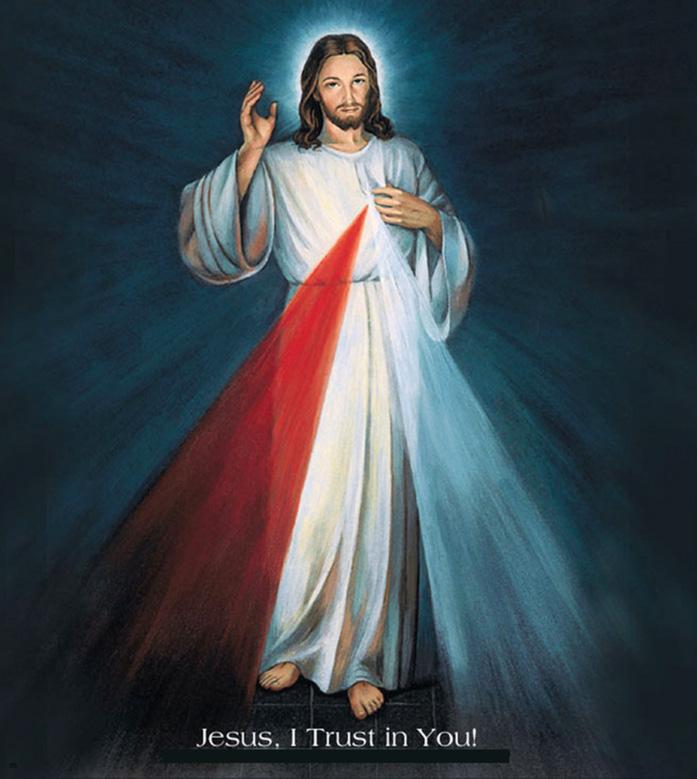
There are both Printed and Oil Painted Posters of “Jesus I trust in you” available at two different sizes.
For more information contact The Record Bookshop on 9220 5900
At a March 2010 Mass for the Adelaide diocese’s deceased bishops, including James Gleeson and Philip Kennedy, Archbishop Wilson noted in his homily that bishops, being human, made mistakes.
“You know, becoming a bishop is a very dangerous thing, because in discipleship bishops have the responsibility for governance. That means they have to make decisions, and that means they have to give to the church what is the closest element of their lives, their total dedication and their love,” he said.
“And there is the danger, because it is always possible to make a mistake and because bishops are human, they do make mistakes. They have to ask the forgiveness of the Lord, they have to move forward and sometimes have to ask the forgiveness of people, because of the way in which they failed in their responsibilities.”
“But this extraordinary role which is given to them is one that comes to them not because of their worthiness, but because of their discipleship of the Lord and their willingness to be co-operators with the Lord in the care of God’s people. It is all about love, and so in their humanity with their limitations, bishops are meant to be the ones who stand as the icon of Christ, the shepherd the lover of his people in the midst of the local church which is committed to God, committed by God to their care.”
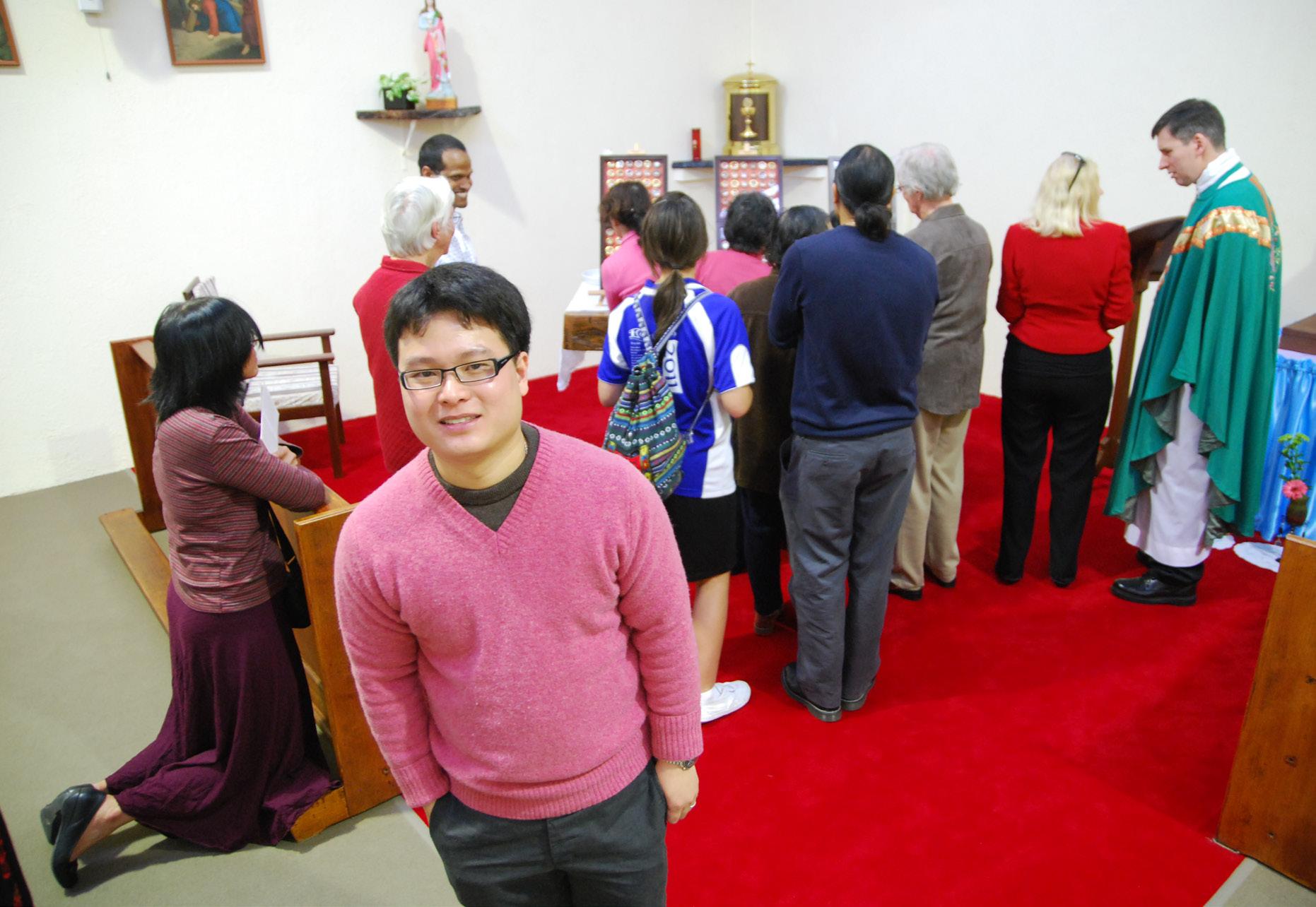
THERE’S a small crowd, huddled together before the altar of St Philomena’s chapel in Malaga, peering through the glass. Some are gazing in fascination while others look unsure as to what they should do.
“You can kiss it if you like,” says relic curator and enthusiast, Giovanny Jefferson.
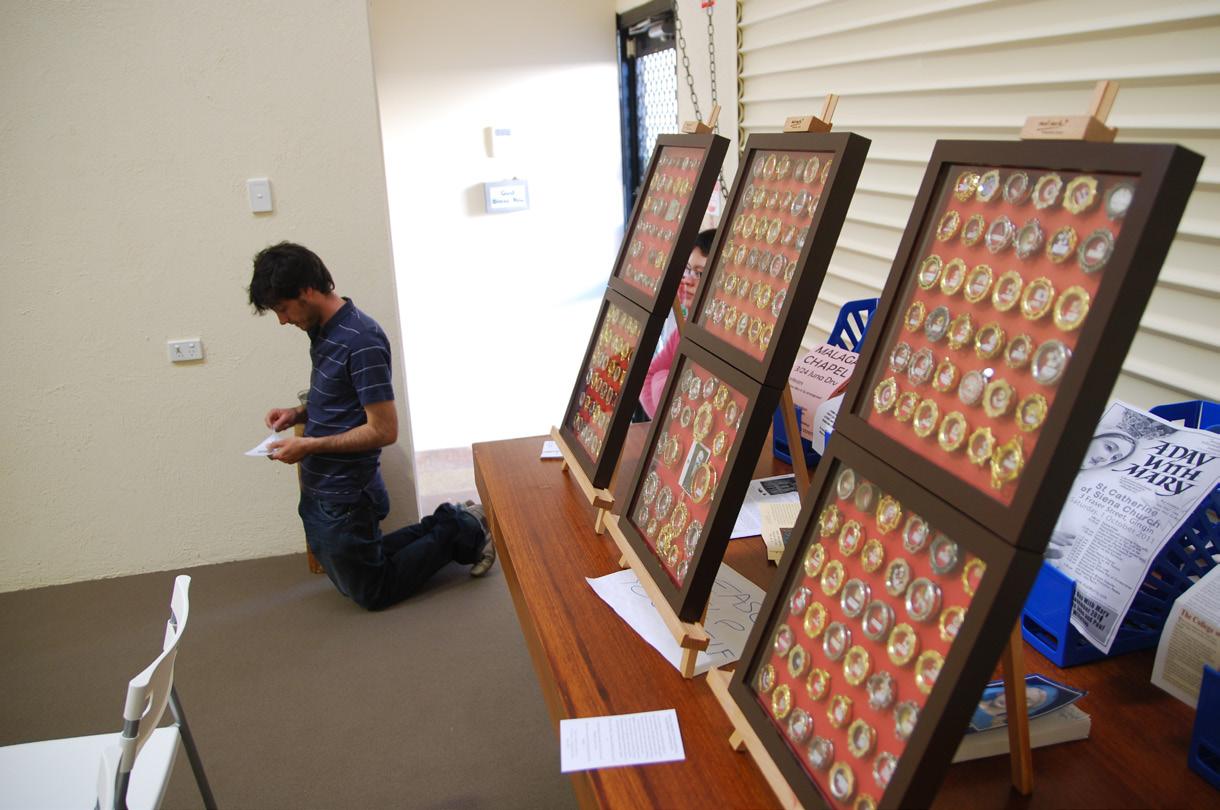
There are three wooden, glassfronted cases, upright on the altar. Inside are the relics of over 200 saints and blesseds of the Catholic Church, each in their own small reliquary with their own label.
Giovanny says he’s not about forcing anything, religious or otherwise, down people’s throats.
“I would like people to be close to the saints and to do it in their own way,” the genial 32-year-old curator says. “It’s their choice.”
A young pregnant woman approaches and asks about the relics of St Gerard Majella, patron saint of expectant mothers, and Giovanny looks only too happy to share his knowledge.
“Through this work I want to glorify God in his saints,” he says later. “I want to get people praying, whether they pray to saints or not, and I want to help people understand that the saints are real people – just like us. I want us to be able to follow in their footsteps.”
It’s been more than 10 years since Giovanny first felt a desire to bring the opportunity to venerate official saints of the Church to others.
In the late 1990s, he had his first saint experience at St Mary’s Cathedral, Perth, when the relics of St Therese of Lisieux were displayed to huge crowds.
In 2000, he had an up-close encounter with the touring relics of St Faustina Kowalska, founder of the Divine Mercy devotion.
That set off a stream of letters as Giovanny wrote away to dioceses and religious orders throughout the world, requesting relics for eventual display and veneration. Life intervened, and he and his wife went
about their daily lives raising two children and working to carve out a living. With a secure career as a financial manager and his young-
Continued from Page 1
Fr Watt selected Mass times to fit in with other nearby Mass centres such as Mt Lawley and Glendalough parishes that also offer Mass to endof-day commuters.
Almost everything in the chapel has been donated - mostly by Fr Watt’s friend and priestly colleague, Fr Michael Rowe, Rector of the Traditional Latin Mass Centre at St Anne’s in Belmont.
The altar came from the nowdefunct Bethel Community with a special Mass intention attached for the first Mass to be celebrated on it once installed at St Philomena’s.
Two men from the Disciples of Jesus Covenant Community, Ray Cammock and Brendan McCabe, fitted-out the interior as well as restoring the donated pews and Stations of the Cross.
It has been five years since Fr Watt first pitched the idea of St Philomena’s Chapel to Archbishop Barry Hickey. Between financial constraints and council regulations, it had been a hard slog to bring the chapel to fruition.
“It got to the stage sometimes when I wondered whether we could actually succeed in bringing the chapel about under the conditions we were facing,” Fr Watt said.
The chapel’s signage comes from
Fr Watt’s previous position when he served as Catholic chaplain to Edith Cowan University.
Fr Watt and the university had a very public falling out in 2001 when the university sacked him from the chaplaincy and banned him from its campuses. He had signed a public letter opposing gay marriage in his role as ECU Catholic chaplain.
For more information on St Philomena’s Chapel, contact Fr David Watt on (08) 9376 1734.
est now at school, he says it is the right time to bring his initial desire to fruition.
A few months ago, his proposed
Saints and Sacred Relics Apostolate was approved by Archbishop Barry Hickey. Giovanny is getting ready to officially launch the new apostolate at his home parish, St Joseph’s in Queens Park at all Masses on the weekend of 8-9 October. He still writes away for relics but says the internet has made things more difficult in recent years. Relic hunters who trade the holy objects as interesting oddities have dioceses and religious orders well and truly on guard. But it is still possible to obtain relics, Giovanny says.
“It is my dream to see all churches and other places of worship in Perth have at least a relic of a saint or blessed for veneration by its own parishioners and regular attendees”. And, he adds, “I’m always ready to assist priests and religious leaders in making that a reality.”
A CATHOLIC primary school in Perth’s northern suburbs has enhanced its Aboriginal heritage at a ceremony to open new buildings.
An artwork unveiled during the service at Liwara Catholic Primary in Greenwood includes the word Kalori, which is Noongar for message stick, a means of communication by Aboriginal people.
Each of the Liwara students and staff wrote a message or did a drawing on the back of a tile incorporated into the artwork. The background of the mosaic states the Liwara mission statement in binary code.
The artwork will be hung in the school’s new library, built using a federal government Building the Education Revolution grant. Liwara’s community hall, the Ahern Centre, was also refurbished while a new canteen and uniform shop was incorporated into the structure.
The new building has been named the Sister Leonie O’Brien Library, honouring the school’s foundation principal who attended the ceremony. Sr Leonie was instrumental in the naming of the Greenwood school in 1974.
The Aboriginal term Liwara means where a community gathers. The decision to use it represents a departure from the norm as most Catholic schools in WA have been named after saints or other eminent persons in the Church.
Also at last month’s opening ceremony, crucifixes were blessed to be placed in the new building and refurbished community hall. The jarrah part of the largest cross was made from salvaged timber from St Mary’s Cathedral. The cross is the first cut from this wood and was created by Caine Gath, a prominent Perth furniture maker who is a parent of a Liwara student.
All the school’s former principals attended the event as well as local state and federal MPs, while Senator Louise Pratt represented the federal government.
 - MICHAELA CARR

moments past, passing and to come
Obituary
Fr Charles Andrew O’MalleyBorn to eternal life 31 August
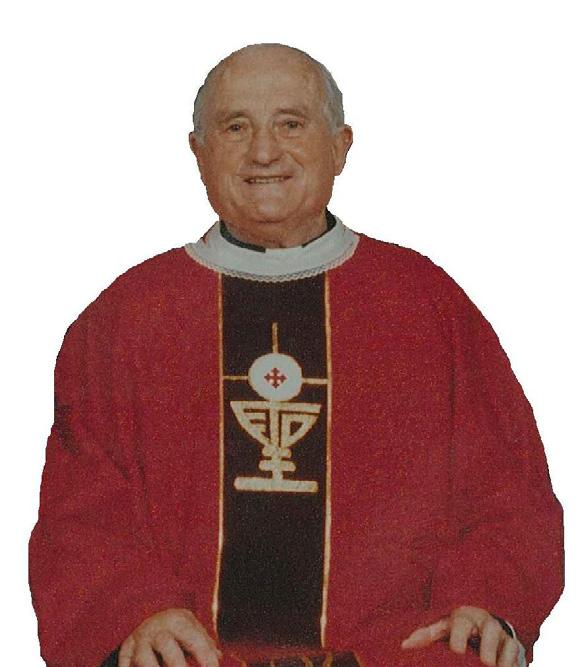
FR CHARLES Andrew O’Malley passed away peacefully on 31 August at the Brightwater The Oaks aged-care facility in Waikiki, following a long illness. He was 84. He arrived in the Archdiocese of Perth in 1961 from Ireland following his ordination to priesthood in Genoa on 29 October 1961. He would have been 50 years a priest next month.
He was appointed to St Mary’s Cathedral as assistant priest in December 1961 and then the Parish of Applecross in the same capacity in February 1963.
On 20 April 1969 he was appointed editor of The Record
Then he served as parish priest in the parishes of Kellerberrin (19 September 1971) and Kenwick/ Thornlie (17 February 1980), retiring on 25 May 2000.
A Pontifical Concelebrated Requiem Mass was held in Sacred Heart Church, Thornlie last Wednesday, 7 September. Longtime Thornlie parishioner Mrs Pat Ebsary delivered the eulogy. She said Fr O’Malley was a very energetic, hard worker who fully focused on this complex, the school, presbytery and Church building.
“He had great insight into where Thornlie was developing and we
are grateful to God for his untiring efforts.
could come to Australia and eventually continue studies at the seminary. This did come about, and he is now Fr Benedict Lee, who is concelebrating Mass with Archbishop Hickey today.
Fr O’Malley was a very energetic, hard worker ... fully focused.
“He loved the different nationalities which moved into the parish and quickly learnt a fair bit of their dialects, being fluent in different languages. A fairly large Korean community resided here for some years and Fr O’Malley provided the necessary steps to catechise and helped hold their Catholic faith, as some were converting to other religions.
“A Carmelite nun came to Kenwick on holiday and befriended Fr O’Malley. She knew of a young man who needed help who maybe
“Fr O’Malley wrote a book Come Follow Me – A Contribution to the Australian Bi-Centenary 1988 with artist Frank Pash and is written about in the Applecross parish history. The Eucharist was central to his life and, no matter how unwell he was, with a walking stick at times, down to the church he would come. Even when he became ill with a stroke, he hobbled down to the church to hear confessions. He refused assistance going down, but agreed to accept help back to the Presbytery. Father loved to visit the sick and elderly and take the Eucharist to them – he worked tirelessly as a pastor.
“He had a great love of Mary. When he was visited at the nursing home, more often than not he was praying the rosary. When he heard that the Fatima statue of Our Lady was coming to Perth, he phoned the organisers for Thornlie to be included in the programme. This gave him much happiness.
“Coming home to Sacred Heart Church, where he served for 20 years, for his final farewell would be his ultimate accomplishment of joy on this earth.
“Rest in peace, Fr Charles O’Malley.”

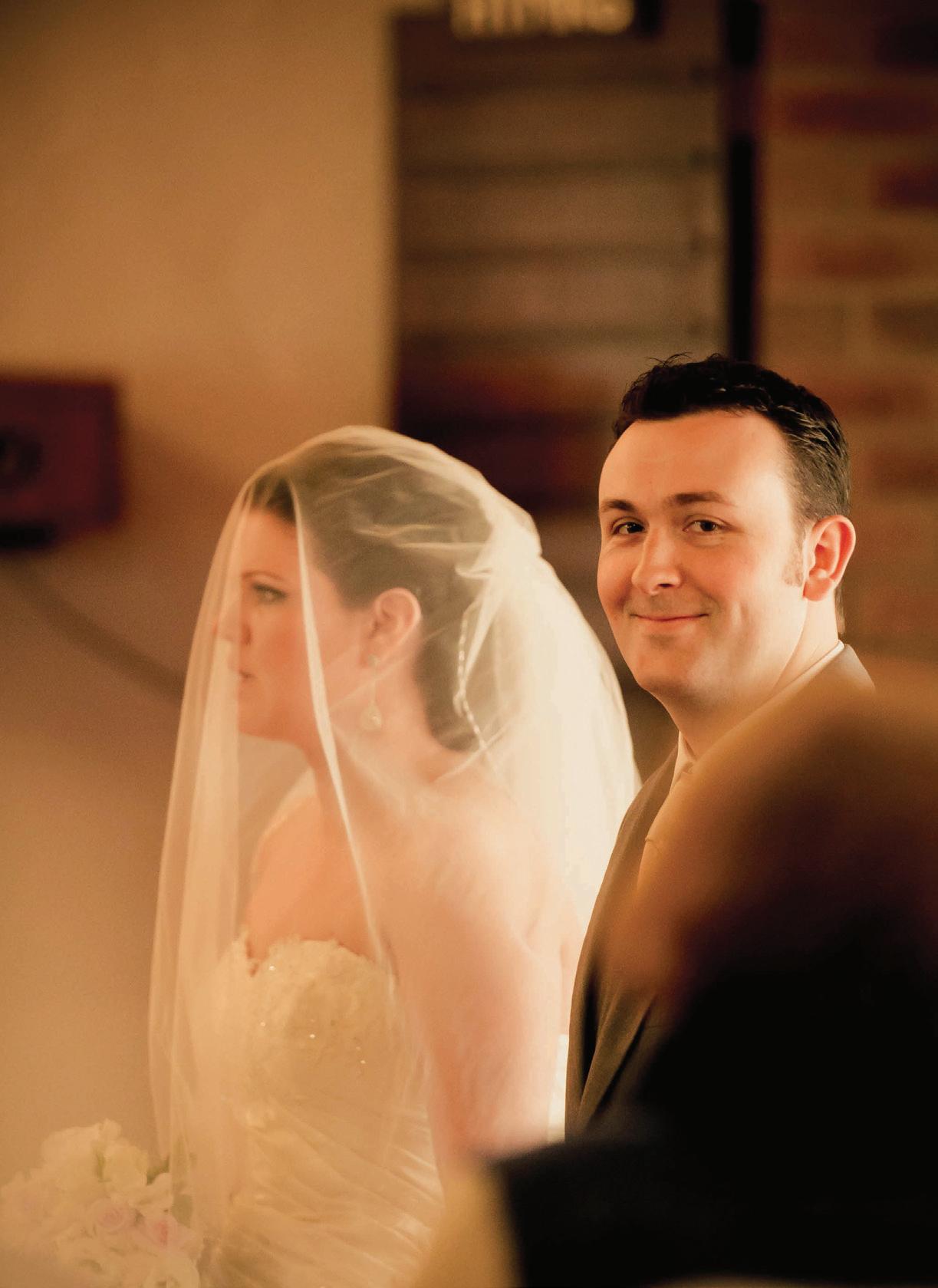
Got a wedding photo? Send yours to office@therecord.com.au.
Br Oliver’s special relationship with God through Mary
A MARIST for 76 years, Br Oliver Clarke, 96, passed away peacefully in Darwin on 30 July following a cerebral haemorrhage. The son of Michael and Mary Clarke, he was born Dennis Austin Clarke in Moora, WA in 1914. From 1916 to 1930, his mother and then, in 1920, his father, taught at the school at Dandaragan, a small community on the Moore River 140km from Perth. The family of six boys and their parents lived very simply behind the school in a cottage. In 1928, he went to St Ildephonsus College, New Norcia where he completed his leaving certificate.
The brothers and Benedictine monks instilled in him a cultivated mind, a disciplined approach to spirituality, to learning and life, and a love of Mary, the mother of Jesus.
After a preliminary year in the Marist Juniorate at Mittagong, NSW, he entered the Novitiate, was professed in 1936 and had post-Novitiate formation in teacher training in 1937. During those times of upheaval and eventually war, there was little opportunity for university degrees but his qualities as a teacher were recognised early and he spent six years teaching the young juniors at Mittagong.
In 1943, at the height of World War II, began his long period of being Principal: Rosalie, Ashgrove (1945), Hawthorn (1947), Northam (1950), Griffith (1953), New Norcia (1954) and Wangaratta (1961). On returning to Victoria, he was appointed to the Provincial Council
in 1962. He was an inspiration to successive generations of brothers and Provincials with his lack of pretension and deep and sensitive humanity. Given his flair for English and History, Br Oliver began the Marist Newsletter in 1969 and stepped down in 1989, doing much of the writing and reporting himself. In 1990, he became the first Province Archivist at Templestowe, educated himself about archives, took an interest in the professional association and became president of the Catholic Religious Archivists’ Association. He was a rock of good
“He was an inspiration ... a rock of good humour ...“
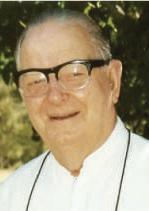
humour and cheerfulness, of stability and advice.
He took on gardening, read every book on roses, and established the roses that now adorn the front of Templestowe.
After 20 years at Templestowe, he took an exploratory trip to Darwin, returned and indicated that he would like to be appointed to the Karama Community, where he spent the last 16 years of his life. In his life, he developed a special relationship with God that comes to us through fidelity to Mary’s way. He not only read widely, he could read people, with a kind of sixth sense, with a great ability to meet people at their level.
GANDOLFO - Catholic schools and institutions need to be “genuinely Catholic” and pass on the values that support communities and the truth that saves souls, Pope Benedict XVI has said.
“This saving truth, at the heart of the deposit of faith, must remain the foundation of all the Church’s endeavours, proposed to others always with respect but also without compromise”, the Pope told a group of bishops from India.
In a country with large Hindu,
ROME - The religious nature of the Indian people, discrimination against Catholics, interreligious dialogue and evangelisation were the main topics of discussion when two dozen Indian bishops sat down with Pope Benedict XVI.
“It was a real heart-to-heart talk, and that is what it should be. It was a sharing between him and us,” said Archbishop Felix Machado of Vasai.
Making their ad limina visits to the Vatican, the Indian bishops went to Castel Gandolfo where they had a few minutes alone with the Pope, then met with him in small groups for a 20-minute discussion.
President of the Catholic Bishops’ Conference of India, Cardinal Oswald Gracias of Mumbai, said, “Naturally, I invited the Holy Father to India. That was very important because all of us are waiting for his visit.” He said his group spoke to the Pope “about the challenges the Indian Church is facing”. It was “a small minority” but had “great influence” in education, healthcare and community building. “The Holy Father was particularly interested in our efforts at interreligious dialogue,” the Cardinal said. While there have been acts of intimidation and violence against Christians in India, the Church is building bridges with members of other religions and “collaborating together to build peace, to build a better India, to see how we could bring God back into society.”
While the people of India traditionally have been deeply religious, he said, especially in the lives of people living in urban areas, “God is beginning to move from centre stage, getting a little marginalised.” But secularisation is having less of an impact among Indian Catholics than Catholics in many other countries, he said. The Cardinal said he told the Pope “85 percent of our people go for Sunday Mass. He
Sikh, Muslim and Christian populations, the Church must teach and promote the “intellectual and moral truth” to the Catholic faithful, the Pope said at the end of the bishops’ ad limina visits.
Catholics must then bear witness to God’s love for everyone and reach out to their neighbours, showing them by their words and actions that Christ is the way, the truth and the life, he said.
Through friendship, respect and love, all Catholics can strive “not to
condemn the world but to offer it the gift of salvation”, he said.
The Catholic Church makes “an invaluable contribution” to all of Indian society with its many Church-run schools, orphanages, hospitals and clinics, he said.
Church-run schools have been especially valuable in developing “the spiritual, intellectual and moral faculties of their students,” he said. And schools should continue to practise “sound judgement” and let students learn about “the herit-
age bequeathed to them by former generations, thus fostering a sense of values and preparing their pupils for a happy and productive life.”
Pope Benedict encouraged Indian bishops to “continue to pay close attention to the quality of instruction in the schools present in your dioceses, to ensure that they be genuinely Catholic and therefore capable of passing on those truths and values necessary for the salvation of souls and the up-building of society.”
“The capacity to present the truth gently but firmly is a gift to be nurtured especially among those who teach in Catholic institutes of higher education” and those who teach seminarians, religious and the lay faithful. He said “students have the right to receive the fullness of the intellectual and spiritual heritage of the church.” With more solid catechetical formation, church members will be better able to serve the church and society. CNS
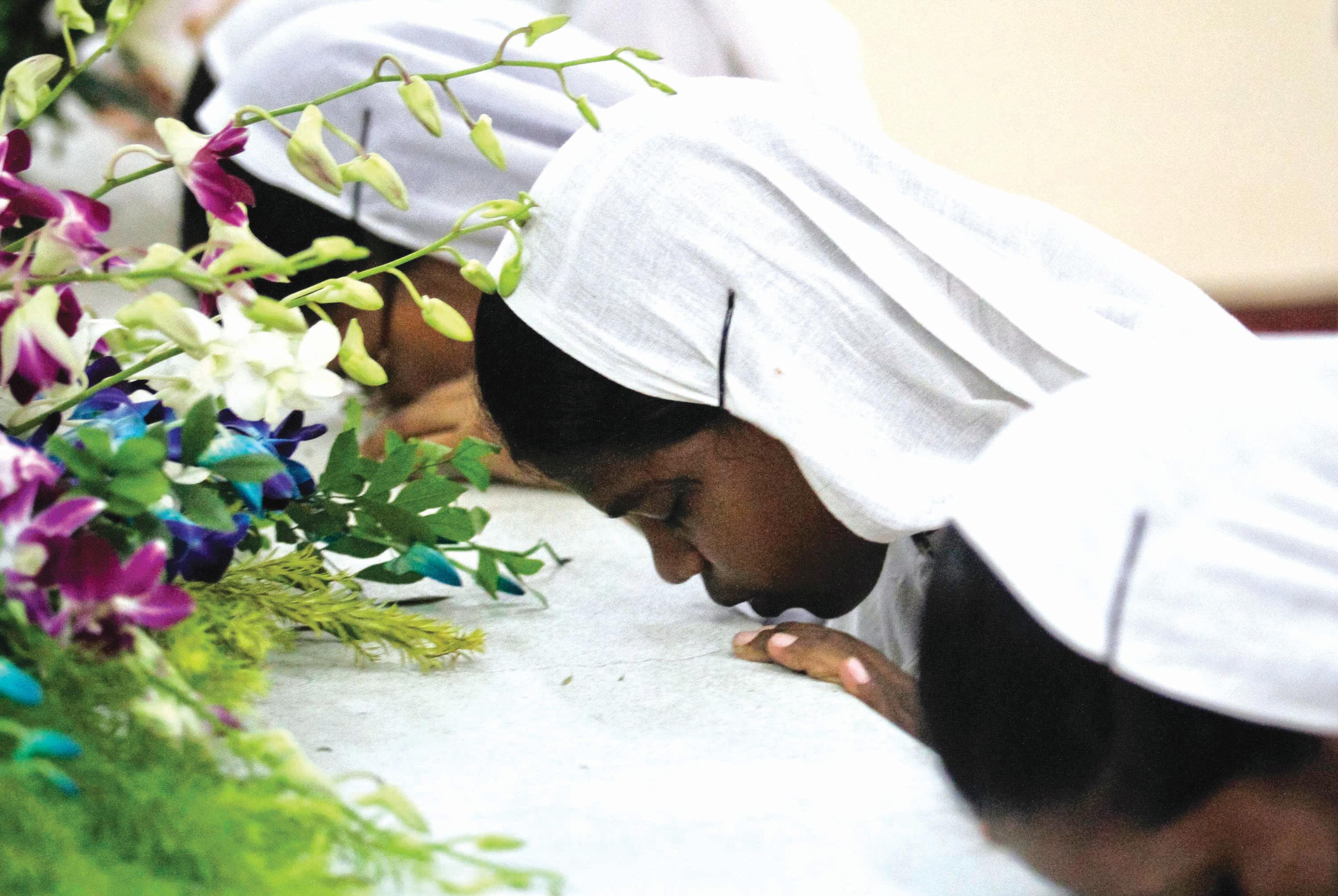
said, ‘Wow, that’s a dream.’ He was so happy to hear that.”
The Cardinal, who served as vice chairman of the Vatican’s Vox Clara Committee for the new English translation of the Mass, said the Indian bishops are using the introduction of the new missal as an opportunity to educate the faithful, but also the priests, about the importance of liturgy.
He said he recently met with young people from the archdiocese, “and one of the questions they asked me was, ‘Cardinal, why are the homilies so boring?’” The people “want to have a God experience when they come to Mass on
Sundays or weekdays, and that’s up to us. We can do that”, he said.
Archbishop Machado, who used to work at the Pontifical Council for Interreligious Dialogue, is chairman of the Indian bishops’ committee for dialogue with other religions.
He said that in his region of India, “the work of evangelisation goes on. This particular region, it has virgin lands for proclamation of the word and conversions. Jesus has been attracting so many people. People just come”, he said. “We get people asking to convert in spite of very stringent laws that some states have made in India” regulat-
ing conversions, he said. But still, “I get 500-600 adults every year as new Christians, and this is what we were sharing with the Holy Father.”
“There is news around that in India the Christian churches are persecuted, a bit too exaggerated of a word for me, but all these problems don’t really discourage us,” he said. “Jesus never promised us a bed of roses. He already told us, he warned us what is in store for us if we really try to follow him and take up our cross.” While there are some who want to make life difficult for Christians, many others treat Catholics, especially bishops, with great respect, he said. CNS
CHRISTCHURCH - Catholics in New Zealand have drawn inspiration from a recent Divine Mercy Congress as they work to rebuild from a series of devastating earthquakes in the past year.
“The blessings and graces which all received at the congress have and will continue to inspire all those who attended to greater acts and greater works of mercy in their homes, workplaces, and missionary endeavours,” Pat Barrett, national coordinator for the event, said.
“This is particularly important right here now in Christchurch,” he
added, “which has suffered exceptional losses and destruction over the past 12 months.”
Since September 2010, four major earthquakes and more than 7,000 aftershocks have shaken the city and “reduced its centre to a demolition site,” Mr Barrett said.
Over 200 people have been killed in the series of quakes and 27,000 have left the city permanently. More than 5,000 damaged homes need to be razed to the ground, “to say nothing of the 900 plus city buildings that will have to be demolished,” he said.
The New Zealand Apostolic Congress was launched under the title “Divine Mercy - God’s Gift for our Time” and began with a Votive Mass of Divine Mercy, celebrated by Bishop Barry Jones of the Christchurch diocese.
Bishop Jones was accompanied by Archbishop Alapati Mataeliga of Samoa and Fr Patrice Chocholski, Secretary General for the World Apostolic Congress on Mercy and parish priest in Lyon, France.
“Fr Patrice has travelled around the globe over the past three years, visiting every continent, attending
every national and regional congress and encouraging all to greater trust in Divine Mercy and greater works as servants for the Lord”, Barrett said. “He spoke of the need for modern witnesses to Divine Mercy in a world infused by hate, revenge, and self.”
Barrett said upwards of 500 people attended Masses, Eucharistic adoration, presentations, films, and talks given by “witnesses to and for mercy.”
One of the best aspects of the congress was the “high caliber of the keynote speakers”. CNA
LISBON - A Pakistani Christian woman accused of blaspheming Mohammed and condemned to death has collaborated with a French journalist to tell her story.
The plight of Asia Bibi has brought international attention, with even Pope Benedict XVI speaking out on her behalf. With journalist Anne Isabelle Tollet, Bibi has authored Blasphème
The Catholic charity Aid to the Church in Need, which collaborated in the publication, described the book as “an impressive account of this Pakistani who for two years has awaited the order to be hanged, simply for having dared to share a glass of water with other women.”
Anti-blasphemy laws in Pakistan are recognised by human rights groups as a way to repress minorities. In fact, two Pakistani officials who had spoken out against the laws were both murdered.
One of them was Shahbaz Bhatti, the minister for minorities killed 2 March. Arrest warrants have been issued for two suspects in his death, though it is reported the suspects have fled to Dubai. CNS
LONDON - British courts penalised Christians through an “incorrect interpretation” of human rights laws, said Catholic Archbishop Peter Smith who said judges were guilty of “woolly thinking” and a bias against Christians who wore religious jewellery or took a moral stand against acts they held in conscience to be sinful.
Court decisions did not uphold Articles 9 and 14 of the European Convention on Human Rights, he said. His comments were directed at courts which wrongly upheld the
legitimacy of disciplinary measures taken against four Christians, Nadia Eweida, Shirley Chaplin, Lillian Ladele and Gary McFarlane, who have since decided to challenge the workings of the law at the European Court of Human Rights.
Eweida, a check-in clerk for British Airways, was suspended after refusing to remove a small crucifix over her uniform. Chaplin, a nurse, was stopped from working on wards and given a desk job after she refused to hide her cross.
Ladele lost her job as a registrar after she refused to officiate at civil partnership ceremonies for
gay couples. McFarlane, a relationship counsellor, was sacked when he refused to give sexual therapy counselling to gay couples.
The Equality and Human Rights Commission wants to convince the European Court the law was wrongly applied in the cases of Eweida and Chaplin but correctly in the cases of Ladele and McFarlane.
Archbishop Smith said that although Sikhs and Muslims had successfully used the law to uphold a right to manifest their beliefs in such areas as religious attire and jewellery, Christians were denied the same right because courts had
decided it was not essential to the practice of their faith.
“Why can’t Christians wear the symbol of the cross?” he asked. “It is absolutely part of the Gospel,” he said. “Without the cross there is no salvation. It is at the heart of our faith because it is the symbol and sign of God’s unconditional love.”
Archbishop Smith also insisted that Christians must be allowed “by any reckoning” to act according to their consciences and “not be obliged to do something they know or believe in their consciences to be wrong.” CNS
LOS ANGELES - The Grand Marian Procession started inside La Placita Church a day before the 230th anniversary of the founding and dedication of Los Angeles to Our Lady of the Angels.
“Here is where Los Angeles was born. Here is where our great city came to be,” said Claretian Father Roland Lozano. Then the 300 modern-day pilgrims processed to the Cathedral of Our Lady of the Angels. On an ornate wood carriage, six members of Hermandad del Senor de Los Milagros (Brotherhood of the Lord of Miracles), dressed in flowing coloured robes, carried an almost life-sized statue of the Blessed Mother cradling a toddler Jesus. Aztec dancers performed to the pounding beat of a single drum. Bagpipers from the LAPD’s Emerald Society of Pipes and Drums played and the slowly moving assembly sang Ave Maria and other hymns to the mother of God.
“I think it’s important we recognise the history of Los Angeles and how our Catholic faith played a big part in that history,” said walker and LA City Council member Tom LaBonge. “And at the Cathedral many times when we have marched it’s very sad, because we marched for a police officer’s or firefighter’s funeral. But today is a celebration.”
Erika Manier, 16, agreed. “I think it’s really cool: a lot of people coming together just to talk about Mary
LESHAN - A nun was severely beaten and hospitalised and a priest suffered minor injuries after being attacked while trying to reclaim two former Church properties in China’s southwestern Sichuan province. Sister Xie Yuming suffered head and chest injuries and remained in the hospital several days after she and Father Wang Xueqing were attacked by around a dozen unknown assailants earlier this month, local sources told the Asian Church news agency UCA News. The two were trying to assert Church rights to two schools that formerly belonged to Kangding diocese. The schools were among several properties confiscated in the 1950s but due to be returned.
Sources said the attack sparked anger among parishioners, who gathered outside their local church, vowing to defend their rights. Kangding siocese currently has three priests and two nuns serving 13,000 Catholics in the Garze Tibetan Autonomous Prefecture. The diocese has no bishop and is being administrated by Leshan diocese. CNS
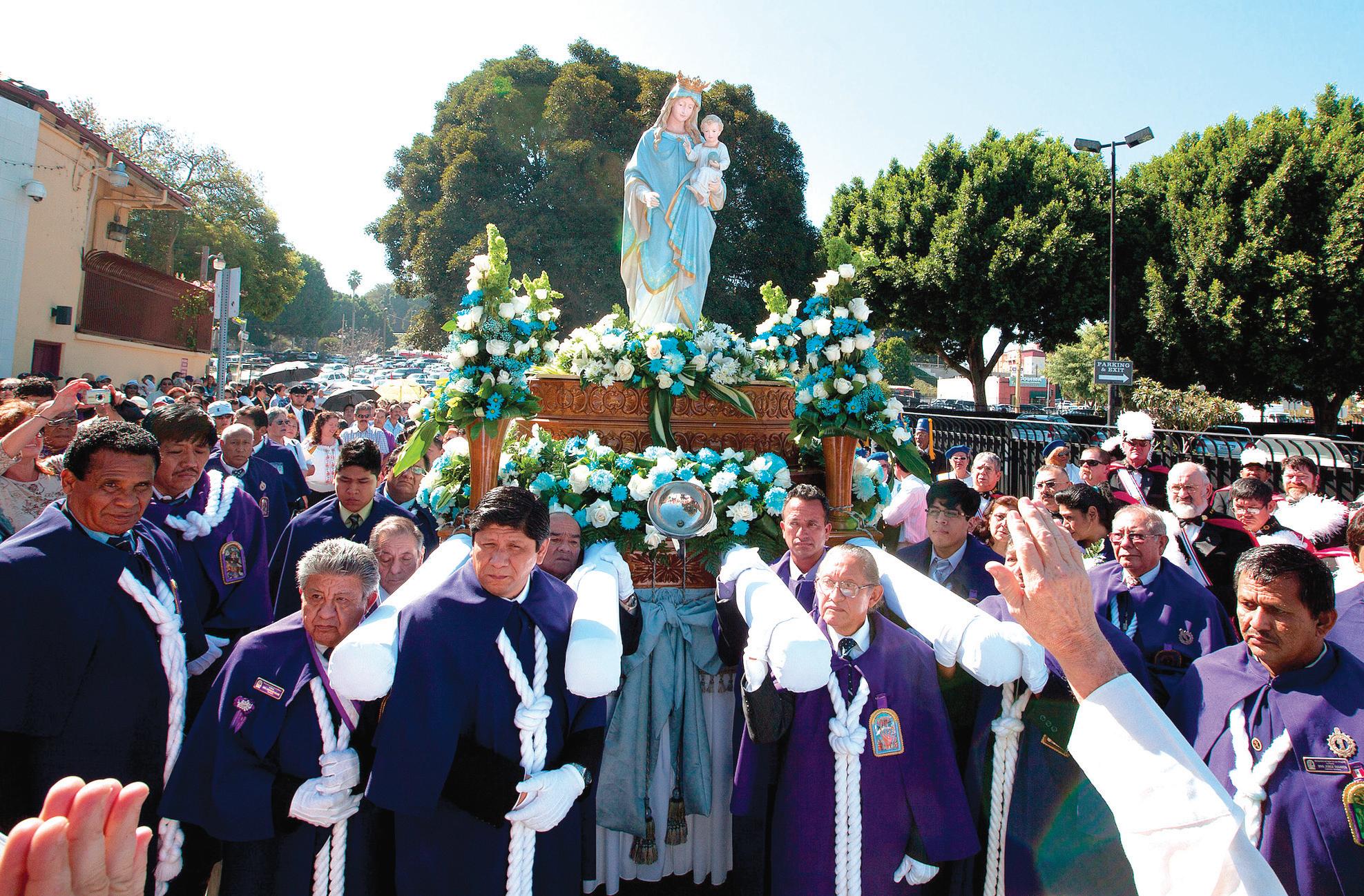
and celebrate together as a community,” said the junior at Immaculate Heart High School.
Larry Campitiello, master of the Southern California district of the Knights of Columbus, took part in the Marian event with more than 50 fellow members. “We’re pleased to be here because we’re celebrating
Our Lady and we’re celebrating the birth of the city,” he said. “It’s just a great combination. Just a natural event.”
One of the honorary “Ladies of Grace” of the Ladies of Peter Claver from Holy Name of Jesus Church couldn’t march because of bad knees, but went instead directly to
the Cathedral’s plaza. “This is just fabulous because they do this in European countries, and I’ve always wanted to be a part of one,” 71-yearold Jennie Dudley told The Tidings, Los Angeles archdiocesan newspaper. “Carrying the statue, honoring Our Blessed Mother, to me that’s the ultimate.” CNS
HAVANA - Havana’s Ladies in White have asked the Catholic Church to mediate with President Raul Castro about “harassment, repudiation and repression” over their efforts to bring attention to the situation of political prisoners.
Spanish news agency EFE reported that Berta Soler, leader of the Ladies in White and wife of ex-prisoner Angel Moya, told journalists the chancellor for the Archdiocese of Havana, Mgr Ramon Suarez Polcari, and the archdiocesan spokesman, Orlando Marquez, were very receptive to the request.
In the summer of 2010, Havana Archbishop Jaime Ortega Alamino and other Cuban bishops intervened with the government after harassment of the women escalated.
For years the women and other family members of prisoners have waged peaceful protests, typically marching silently, dressed in white, after Mass on Sundays.
Not long after Church leaders first wrote to Castro and then began meeting with government authorities, Cardinal Ortega announced the government had promised to
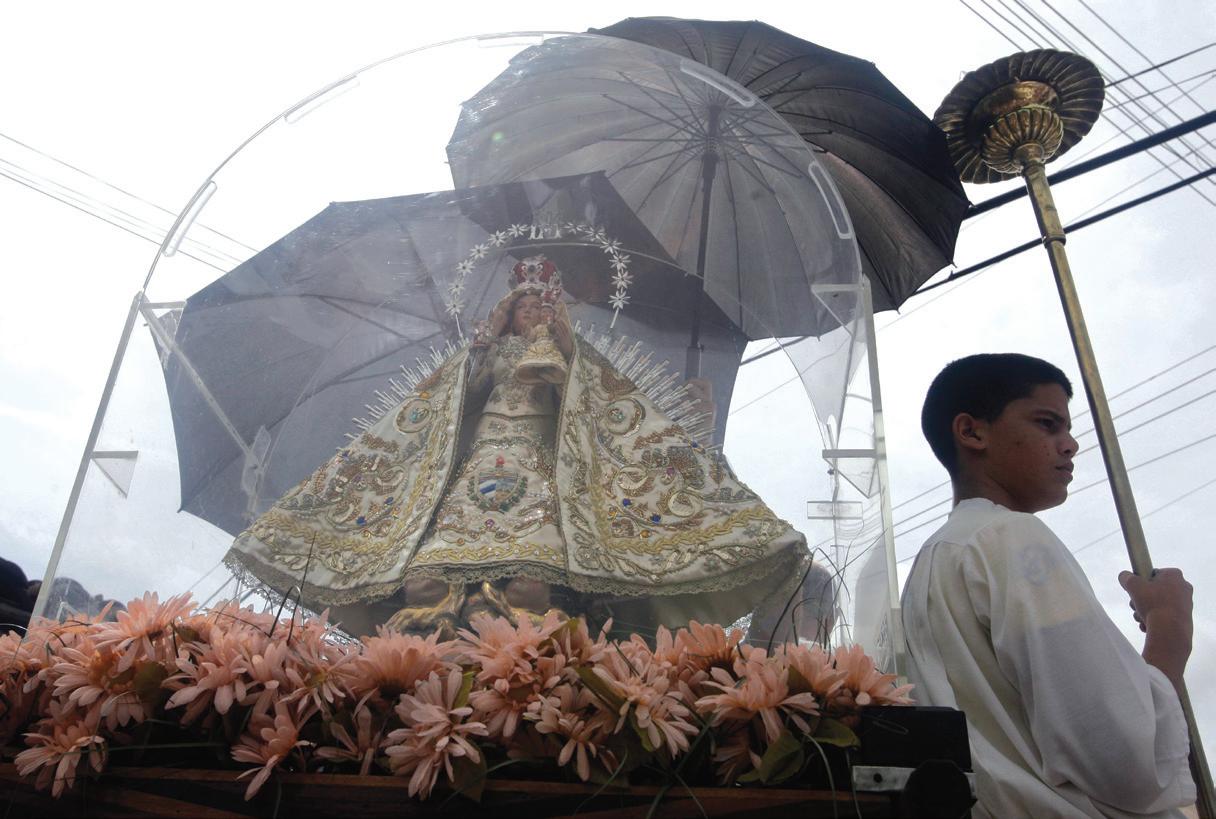
release the last of 75 prisoners held since a 2003 crackdown on dissidents. Those prisoners and others, totaling 126, were released over the next nine months. Most went with their families to Spain, although a few were permitted to remain in Cuba.
The US bishops’ migration committee chair has expressed support for efforts being made by prelates of the state of Alabama to reverse an unjust immigration law. In a statement, Archbishop José Gomez of Los Angeles called on the federal government to enact comprehensive immigration reform, while reminding that reform should balance humanitarian principles. The new Alabama immigration law would threaten the ministry of the Church, a statement from the US bishops explained. “Our nation,” Archbishop Gomez said, “is in great need of a federal solution to the challenge of illegal immigration, one that balances the rule of law with humanitarian principles.”
NICARAGUA
Catholic officials in Nicaragua have rejected the police explanation of the death of Father Marlon Pupiro Garcia and demanded a thorough investigation. The Archdiocese of Managua said the version given by the police had “inconsistent and implausible elements that do not convince us as bishops or the people of God crying out for justice.” Fr Pupiro, 40, was found asphyxiated in August. His body was wrapped in plastic in a dumpster located along the road that leads to Leon from Masaya. Five days later, police arrested Yasker Blandon Torres, who allegedly murdered the priest to steal his Mitsubishi SUV. Authorities said Blandon confessed the crime. Seven other people linked to the murder were arrested. Church officials do not believe the priest was killed for his SUV.
UNITED STATES
An independent report commissioned by the Diocese of Kansas City - St Joseph to examine its policies and procedures on assessing child sexual abuse allegations found “shortcomings, inaction and confusing procedures,” said the former US attorney who headed the investigation. The key finding of the report, was that “diocesan leaders failed to follow their own policies and procedures for responding to reports” relating to abuse claims lodged against two priests. The 138-page report faulted the diocesan vicar general, who “waited too long to advise the (diocesan) Independent Review Board, a body of confidential advisers to Bishop (Robert) Finn, of the allegations”.
Pope Benedict XVI has mourned the death of Polish Cardinal Andrzej Deskur, a longtime promoter of media and communications and close friend of Blessed John Paul II. The Cardinal died at home in Vatican City on 3 September at the age of 87. Cardinal Deskur was called to work at the Vatican’s Secretariat of State in 1952 and soon began his long career in the field of communications. He played a key role in advising Pope Pius XII on the 1957 encyclical Miranda Prorsus (“On the Communications Field: Motion Picture, Radio and Television”). He helped prepare the council’s 1963 Decree on the Instruments of Social Communication (Inter Mirifica), which called on the Church and laity to instil “a human and Christian spirit” into newspapers, magazines, books, films, radio and television.
CNS
VIENNA - Cardinal Christoph Schönborn is not playing “a game of chicken” with priests calling for reforms in Church practice, but is interested in getting them to work with him to bring new life to parishes, his spokesman, Michael Pruller, said. “The situation is not as dramatic as the Austrian media make it seem”, he said “There has been no discussion of sanctions, no ultimatum, no talk of punishment.”
Leaders of the “Initiative of Parish Priests” launched a “Call to Disobedience” in late June, urging priests to join in saying a public
LILONGWE - Malawi’s priests and religious have condemned President Bingu Mutharika’s “irresponsible verbal attacks” on the head of the bishops’ conference, Bishop Joseph Mukasa Zuza of Mzuzu. “The threat of war is a major concern, especially coming from the head of state,” the Associations of Diocesan Catholic Clergy of Malawi, Religious (Women) Institutes of Malawi and the Men Religious Institutes of Malawi said.
Bishop Zuza invoked the President’s ire when he said Malawi’s social, political and economic problems “are of our own making, depending on our respective roles.” Responding to the bishop’s remarks, Mutharika said he would “deal with the nongovernmental organisations which are leading people to protest against my leadership,” adding that his “patience is wearing thin, let us fight.”
The statement said religious leaders “are harassed, threatened, disrespected, denounced when they practise their prophetic role” and noted that “any attempt to attack the clergy is an attack on the Church.”
“We are aware that the tirades of public outbursts from some quarters of society against Bishop Zuza are as a result of the homily,” the statement said, noting “some people are insinuating” the bishop “was motivated by elements from the opposition, while others are saying he was attacking the state president, and some are taking it personally.” Noting the Church has an “obligation and inherent right, independent of any human authority, to preach the word of God,” priests and religious said they “strongly believe that what the bishop did was fulfilling his rightful duties.”
They affirmed solidarity with Bishop Zuza and said they “wholeheartedly agree with the content of the homily.” CNS
prayer at every Mass for Church reform; giving Communion to everyone who approaches the altar in good faith, including divorced Catholics who have remarried without an annulment; allowing women to preach at Mass; and supporting the ordination of women and married men.
Cardinal Schönborn met with the four Vienna archdiocesan priests who are on the presiding council of the initiative, and plans to meet with them again in a few weeks, Pruller said. “We don’t send spies to all the parishes to make
sure all the rules are kept,” he said, but added that, if a priest is violating Church law, the situation will be dealt with on a case-by-case basis.
According to news reports, initiative membership has grown from about 300 to about 400, and polls taken among Austrian Catholics showed overwhelming support for changes the priests support.
“The polls are in line with polls from previous years,” Pruller said. “It is a reminder that we have to do more to explain” Church teaching on ordination, the sacraments, marriage and Church structure.
In late June, in a written response to the priests’ “Call to Disobedience,” Cardinal Schönborn said he was shocked by the idea of urging priests to disobey Church discipline but wanted to discuss ways to meet the needs of Viennese Catholics. He also said if the priests really believe they have a profound conflict of conscience in following Church teaching, they may have to consider whether or not they want to continue as Catholic priests.
Many people read the Cardinal’s statement as an ultimatum. But “this is nothing like that,” Pruller said.
“There will be an ongoing debate and there has to be an ongoing discussion of the underlying issues.” Pruller said Cardinal Schönborn met only with the priests in his archdiocese who were leaders of the initiative and a wider discussion would be up to the bishops’ conference which meets in October.
The Cardinal is convinced that his plan for renewal and reform, aimed at helping each Catholic discover his or her mission as a member of the Church, is “more likely to solve the problems in the long term,” the spokesman said. CNS
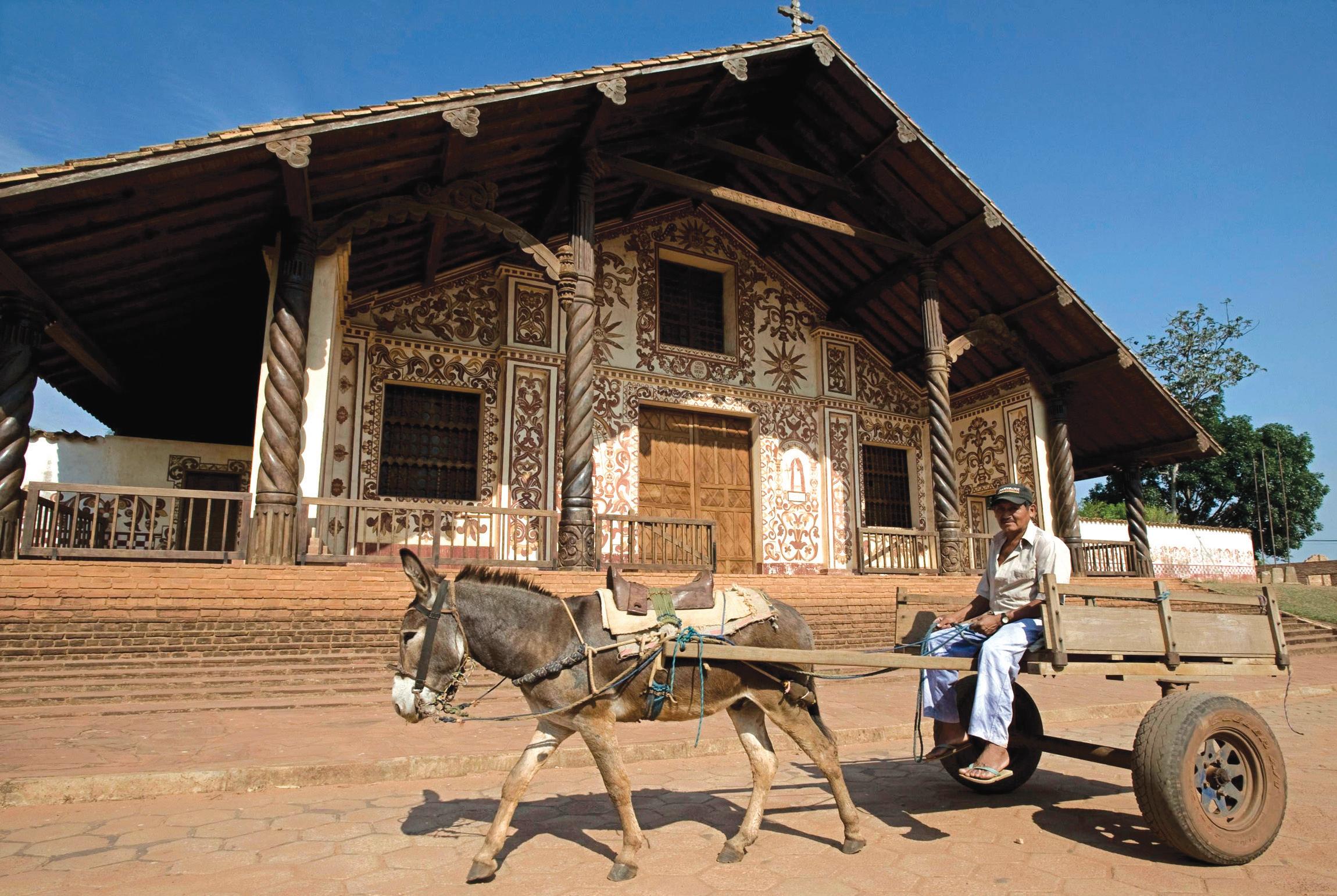
COCHABAMBA, Bolivia - Half a millennium has passed since missionaries arrived in what is now Latin America and the region, which was then inhabited entirely by native peoples, some with complex civilisations, is now considered the most Catholic in the world. So why does it need missionaries?
Meeting in Aparecida, Brazil, in 2007, the region’s bishops called for the Latin American Church to be in a “permanent state of mission.”
They realised “Latin America is a continent of people who are baptised, but not really disciples, much
less missionaries,” Father Victor Codina, a theologian who lives in Bolivia, said. “Many have little sense of belonging to the Church.”
Experts say that building a sense of belonging among Catholics and encouraging them to share their faith experience, which is the essence of missionary action, are challenges for the Church. “You have to begin by encouraging people to have a spiritual or religious experience which in technical terms is called mystagogy - initiation into the spiritual life,” Fr Codina said. “Without that, there is no faith, no mission, no Christian life.”
At a symposium held in
Cochabamba, participants described challenges and new arenas for mission in Latin America. Perhaps most important was viewing the Church’s mission not as taking faith to others but as a process of dialogue and developing relationships with others, especially on the margins. In Latin America, they said, that means listening to and learning from people who lived in the region when the first Catholic missionaries arrived.
“There must be recognition of the values of the various indigenous people, who are the ones who suffered most from the impact of colonisation,” said Fr Roberto Tomicha,
who hails from a Chiquitano indigenous community.
Today’s challenge is to establish an equal relationship between the Church and indigenous because the first European missionaries “had a paternalistic mentality,” he said. “We were considered to be like children who never grew up.”
According to Calixto Quispe, a permanent deacon who learned traditional rituals from his grandfather, the Church needs “dialogue between cultures; dialogue between generations, between parents and the children of today; interreligious dialogue; and dialogue with problems in society.” CNS
DUBLIN - The government of Ireland has thanked the Vatican for its response to the Cloyne report, but stands by its criticism of a 1997 letter that it says gave some clergy a pretext for covering-up sexual abuse accusations.
In a brief statement, the government said “it welcomes the statement in the response that the Holy See is sorry and ashamed for the terrible sufferings which victims of abuse and their families have endured.” The 400-page report found that Bishop John Magee of Cloyne, who resigned in 2010,
ignored 1996 child protection guidelines set down by the Irish Catholic Bishops’ Conference and failed to report to the police at least nine of 15 sexual abuse allegations. Furthermore, it found the “reaction of the Vatican” to the efforts of Irish bishops to respond to allegations was “unhelpful to any bishop who wanted to implement the agreed procedures.” The report cited a 1997 letter sent to the Irish bishops’ conference by then-nuncio Archbishop Luciano Storero who stated the Congregation for Clergy considered child protection
guidelines outlined in Child Sexual Abuse: Framework for a Church Response as a mere “study document”, and that it contained “procedures and dispositions”, namely what is referred to as mandatory reporting, “which appear contrary to canonical discipline”.
The Vatican responded that the letter merely offered advice on the development of a document, and the Church has a long history of reiterating the importance of reporting sexual abuse cases to civil authorities.
“Having considered carefully the
Cloyne Report and the response of the Holy See”, the statement stated, “the Government of Ireland remains of the view that the content of the confidential letter in 1997 [...] provided a pretext for some members of the clergy to evade full cooperation with Irish civil authorities in regard to the abuse of minors. This is a matter of great concern to the Irish Government.”
“It is the Government of Ireland’s hope that, in spite of outstanding differences, lessons have been learned from appalling past failures. In this regard, it welcomes
the commitment in the concluding remarks of the Holy See’s response to a constructive dialogue and cooperation with the Government.
“In welcoming this commitment the Government expects the fullest cooperation from the Holy See, the Catholic Church in Ireland and all other relevant bodies with a view to ensuing that Ireland is a society fully safe for children and minors and that all of those with responsibility for the welfare and care of children in this country are fully subject to Irish laws and requirements.” ZENIT.ORG
Matthew, Mark, Luke and John told us all about what Jesus said and did, but not one of them mentioned what he looked like.
The vaguely European-featured Jesus with a brown beard and hair was pretty much the standard for most of history, at least until Rembrandt van Rijn, the greatest painter, draftsman and printmaker of the Dutch Golden Age, came along.
In the mid-17th century he and students at his Amsterdam studio painted a series of at least eight heads of Christ which set the liturgical art world on its ear.
Rembrandt’s studio was in a section of Amsterdam with a fairly large Jewish population, and it is believed the same young Jewish man was the model for all the portraits, which look remarkably like the olive-skinned and dark-haired men you would see strolling the Galilee shore today.
For the first time six of these paintings are brought together for an exhibit, “Rembrandt and
A unique exhibit in the US features six Rembrandt paintings, never exhibited together, that changed how the world saw Christ, writes Lou
the Face of Jesus,” which was first exhibited at the Louvre in Paris and now at the Philadelphia Museum of Art until the end of October, after which it will travel to Detroit Institute in November.
“‘Rembrandt and the Face of Jesus’ marks the first time that an exhibition including a substantial group of paintings by Rembrandt will be seen in Philadelphia”, said Timothy Rub, director and CEO of the Philadelphia Museum of Art.
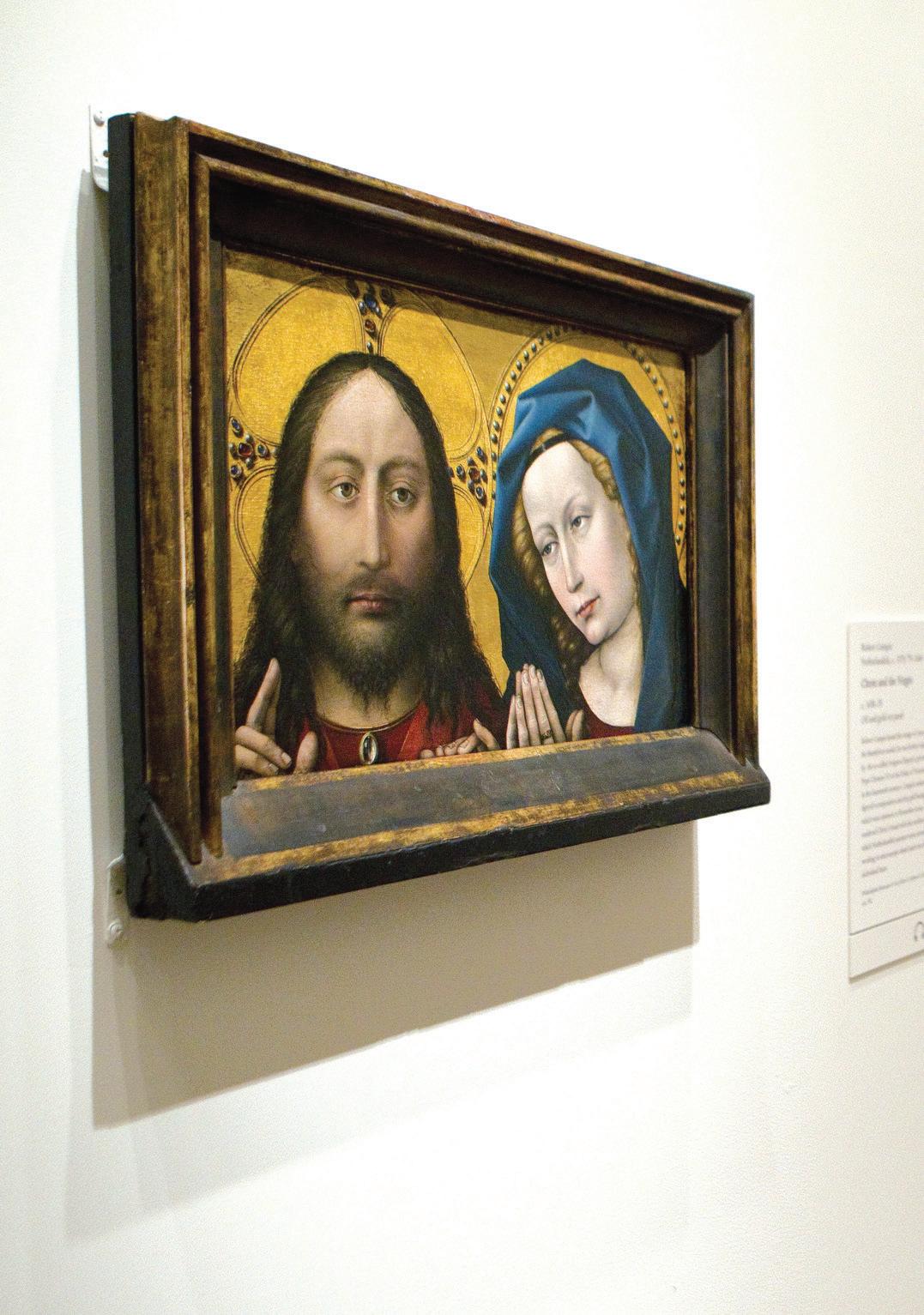
In his day Rembrandt was ridiculed for his innovative portrayal of the Saviour. By long-standing tradition, the head of Jesus was taken from three sources - Veronica’s veil, which according to tradition was imprinted with the image of Jesus after a woman wiped his face on the road to Golgotha; the Mandylion of Edessa, a similar icon venerated in the East; and the Lentulus letter, a written description of Christ purportedly written by the governor of Judea who preceded Pontius Pilate.
However, the Lentulus letter is generally dismissed as a 15th century forgery, and neither Veronica’s veil nor the Mandylion can be
 Baldwin.
definitively traced to the 1st century.
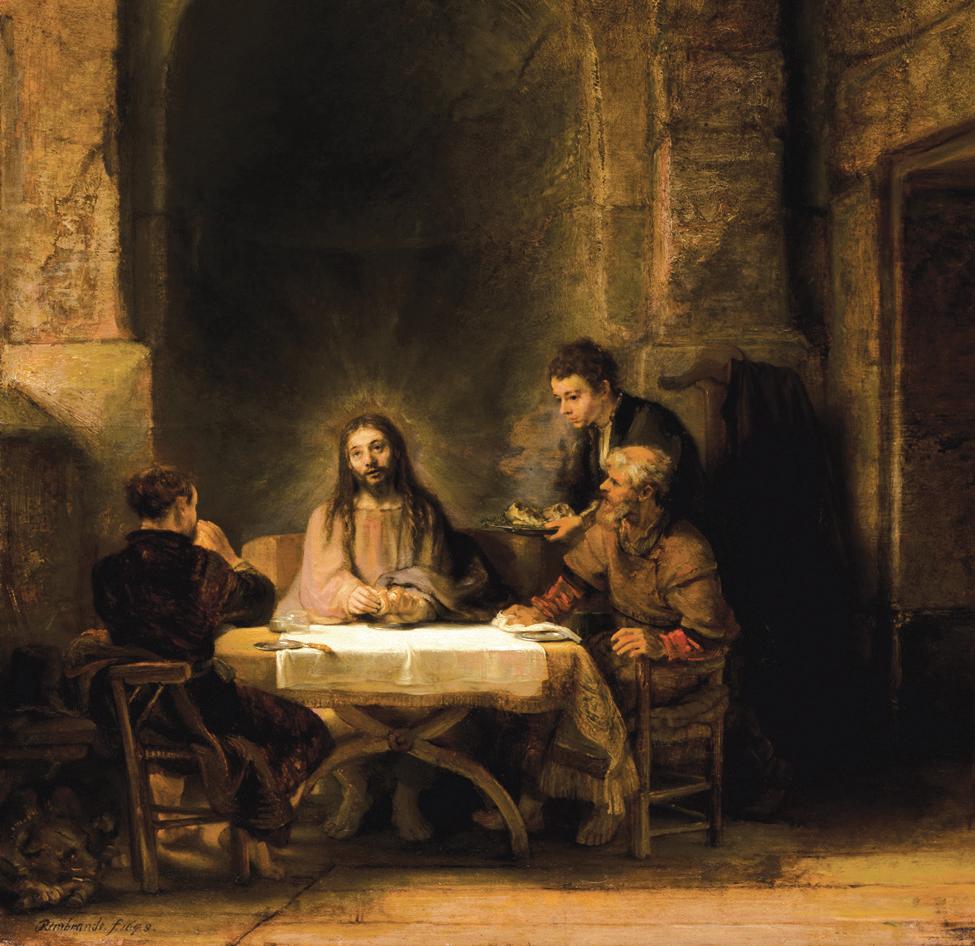
In addition to the six heads of Jesus, the Philadelphia museum exhibit contains other Rembrandt works drawn from the great museums of America and Europe showing the artist’s transition from the traditional to the innovative. Especially noteworthy are Supper at Emmaus and Christ Preaching (The Hundred Guilder Print), both from the Louvre.
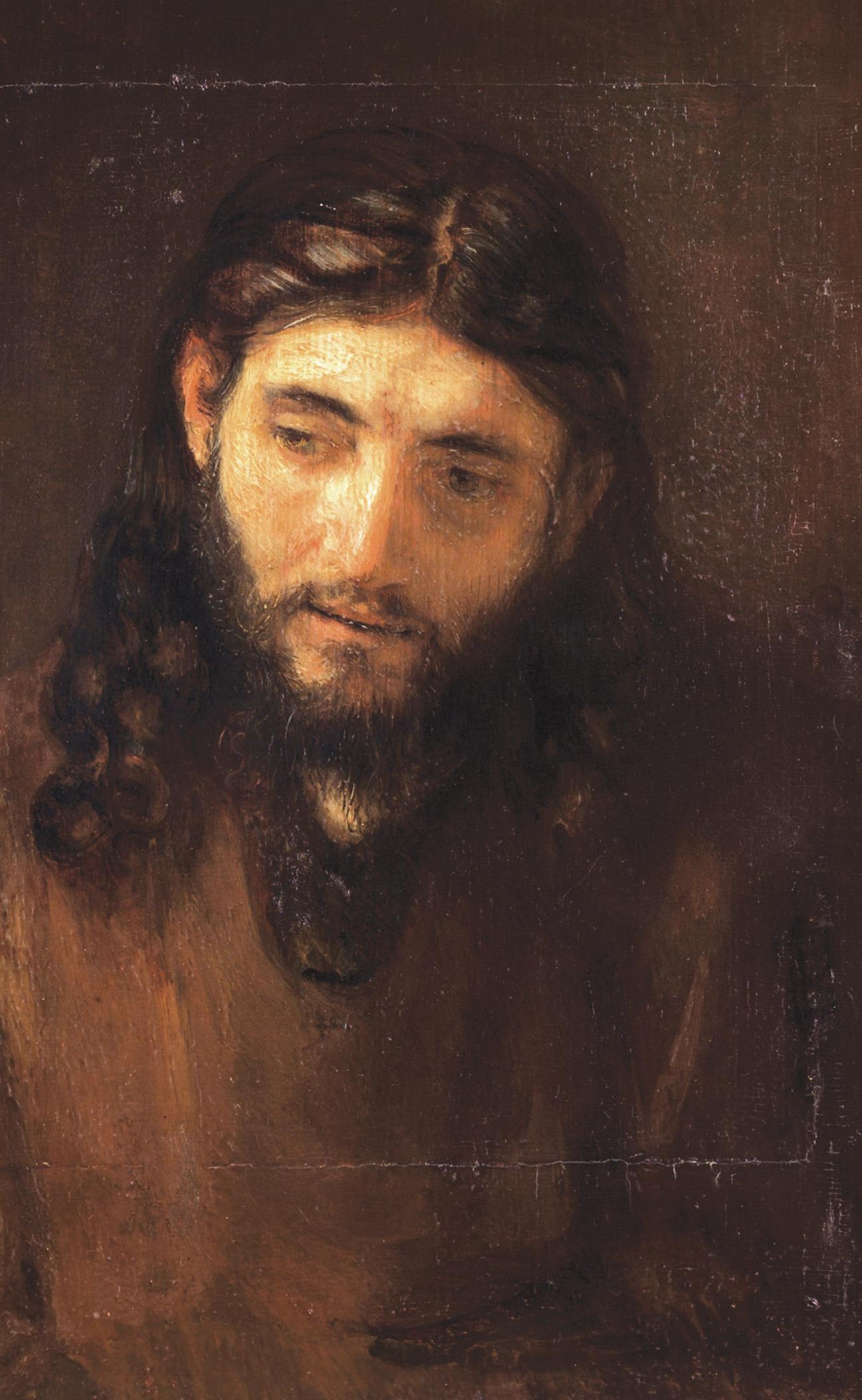
Although a number of the paintings and prints in the exhibit are from the Philadelphia museum’s collection, it includes only one Head of Jesus. It is part of the vast John G Johnson collection and was until recently in storage, because it was thought to be a more recent copy of Rembrandt’s work.
Typical of Rembrandt’s period, it is painted on oak, and by close examination it was originally a smaller portrait pieced into a larger panel, with a background almost seamlessly painted to form a single panel.
When Lloyd DeWitt arrived at the museum a decade ago as asso-
ciate curator of the Johnson collection, he was “extremely puzzled why someone would take such time on a copy and piece it together,” said Jennifer Thompson, associate curator of European paintings and sculpture before 1900.
DeWitt consulted with Peter Kline, a wood biologist who has an international reputation for dating the panels works are painted upon. Through examination of the pattern of tree rings on the two panels, he was able to determine the main panel was from a tree harvested during Rembrandt’s Amsterdam years, and the surrounding panel was even earlier, about 1610, which made it almost a certainty the picture was from Rembrandt’s studio, not a later copy. With the Head of Jesus authenticated, DeWitt conceived the notion of the exhibit with the Philadelphia museum’s work as a starting point. Although DeWitt himself recently moved on to the Art Gallery of Toronto in his native Canada, “he was the first to think about bringing all of the heads together for an exhibit,” Thompson said. - CNS
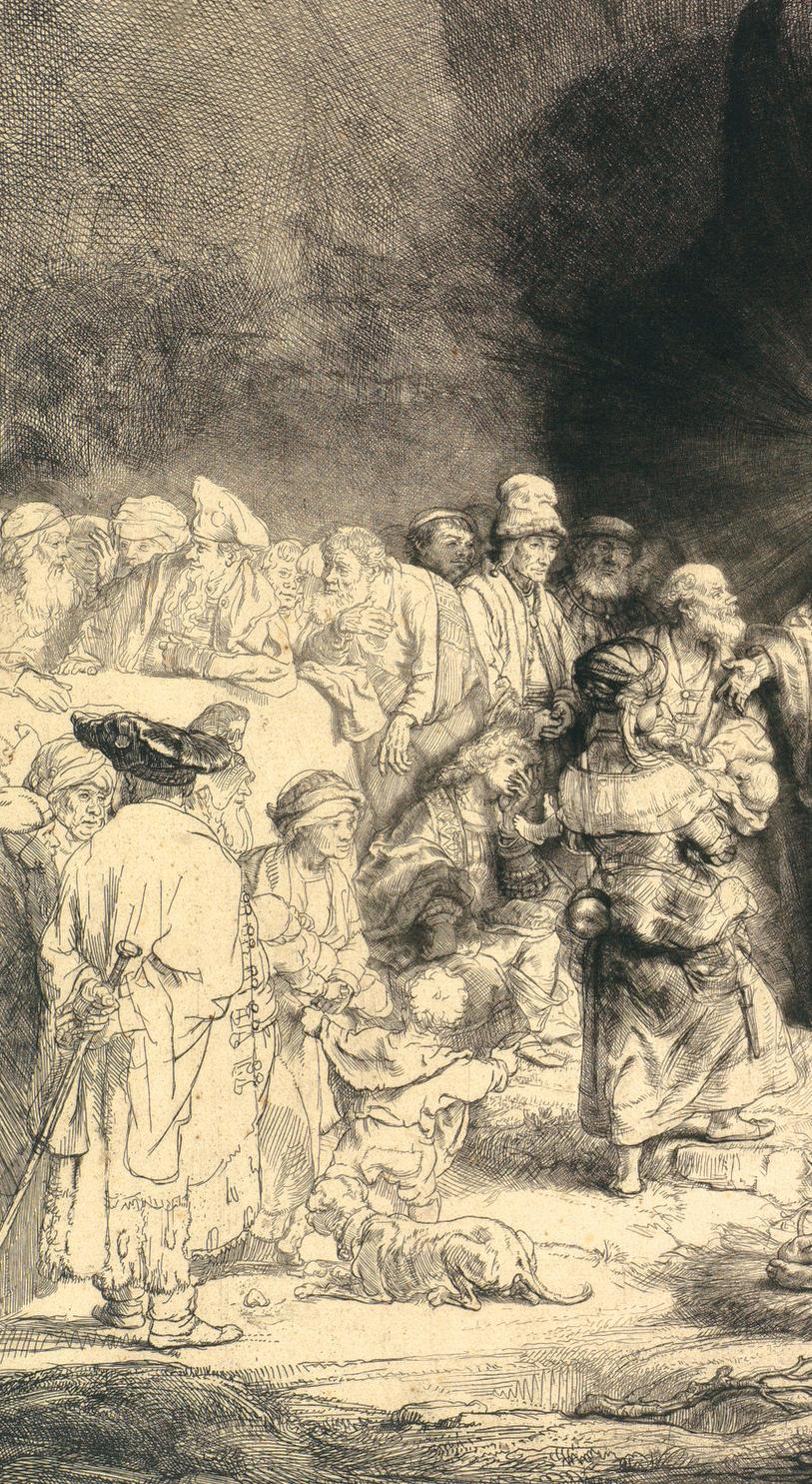
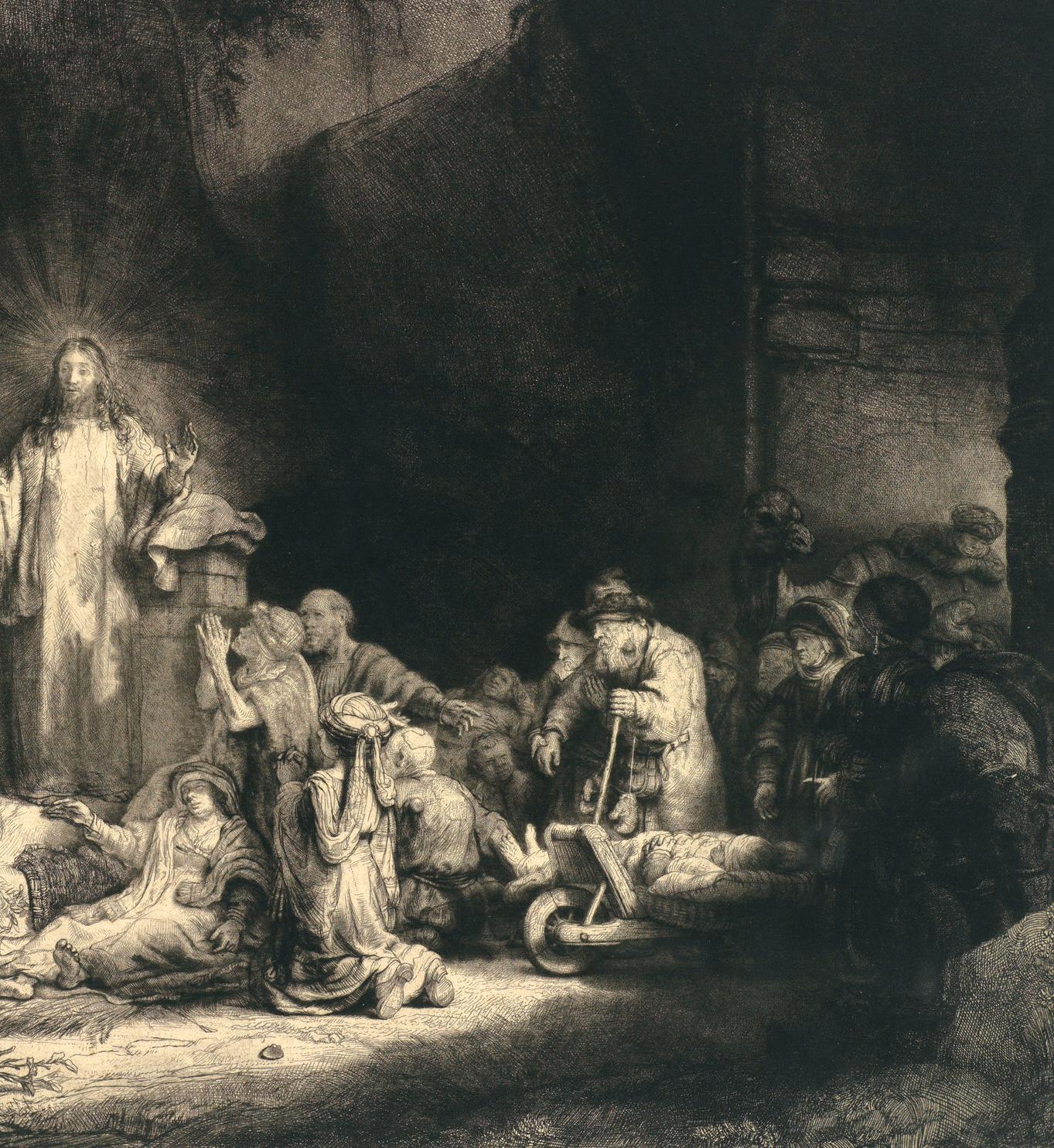
Seeking his face: The etching Christ Preaching (starting at top, clockwise) is among the works being shown in “Rembrandt and the Face of Jesus” on display at the Philadelphia Museum of Art.
Also on display is Head of Christ attributed to Rembrandt van Rijn, and among six such paintings created by the Dutch master and his students that have been brought together for the first time. The panels present Christ as a young, humble, tender figure with dark hair and olive skin.
Supper at Emmaus depicts Christ’s famous encounter with two disciples after his resurrecdtion.
A depiction of Christ and Mary by Dutch painter Robert Campin is shown in contrast with the innovative style of Rembrandt.
PHOTOS: STARTING FROM TOP: CNS/ COURTESY OF THE PHILADELPHIA MUSEUM OF ART; CNS/COURTESY OF THE PHILADELPHIA MUSEUM OF ART; CNS/ COURTESY OF THE PHILADELPHIA MUSEUM OF ART; CNS/NANCY WIECHEC
Here is an edited excerpt of Pope Benedict’s remarks on beauty, art and faith from his general audience on 31 August
Dear Brothers and Sisters,
In this period I have recalled several times the need for every Christian, in the midst of the many occupations that fill our days, to find time for God and for prayer. The Lord himself gives us many opportunities to remember him. Today I would like to reflect briefly on one of these channels that can lead to God and can also be of help in the encounter with him. It is the way of artistic expression, part of that “via pulchritudinis” — the “way of beauty”, of which I have spoken several times and whose deepest meaning must be recovered by men and women today.
Perhaps on some occasion you paused before a sculpture, a picture, a few verses of a poem or a piece of music that you found deeply moving, that gave you a sense of joy, a clear perception, that is, that what you beheld was not only matter, a piece of marble or bronze, a painted canvas, a collection of letters or an accumulation of sounds, but something greater, something that “speaks”, that can touch the heart, uplift the mind.
A work of art is a product of the creative capacity of the human being who, in questioning visible reality, seeks to discover its deep meaning and to communicate it through the language of forms, colour and sound. Art is able to manifest and make visible the human need to surpass the visible, it expresses the thirst and the quest for the infinite. Indeed it resembles a door open on to the infinite, on to a beauty and a truth that go beyond the daily routine. And a work of art can open the eyes of the mind and of the heart, impelling us upward.
However, some artistic expressions are real highways to God, the supreme Beauty; indeed, they help us to grow in our relationship with him, in prayer. These are works that were born from faith and express faith. We can see an example of this when we visit a Gothic cathedral: we are enraptured by the vertical lines that soar skywards and uplift our gaze and our spirit, while at the same time we feel small yet long for fullness ....
Or when we enter a Romanesque church we are spontaneously prompted to meditate and to pray. We perceive that these splendid buildings contain, as it were, the faith of generations. Or when we listen to a piece of sacred music that plucks at our heartstrings, our mind, as it were, expands and turns naturally to God.
I remember a concert by Bach in Munich, conducted by Leonard Bernstein. At the end of the last passage, one of the Cantatas, I felt, not by reasoning but in the depths of my heart, that what I had heard had com-
municated truth to me, the truth of the supreme composer, and impelled me to thank God. The Lutheran bishop of Munich was next to me and I said to him spontaneously: “in hearing this one understands: it is true; such strong faith is true, as well as the beauty that irresistibly expresses the presence of God’s truth”.
What Marc Chagall, a great artist, wrote, remains profoundly true: that for centuries painters have dipped their paintbrush in that coloured alphabet which is the Bible. Thus how often art can bring us to remember God, to help us to pray or even to convert our heart!
Paul Claudel, a famous French poet, playwright and diplomat, precisely while he was listening in the Cathedral of Notre Dame to the singing of the Magnificat during Christmas Mass in 1886, had a tangible experience of God’s presence. He had not entered the church for reasons of faith but rather in order to seek arguments against Christians and instead God’s grace worked actively in his heart.
Dear friends, I ask you to rediscover the importance of this path also for prayer, for our living relationship with God. Towns and villages throughout the world contain treasures of
As Marc Chagall said: for centuries painters have dipped their brushes in the coloured alphabet that is the Bible.
art that express faith and beckon to us to return to our relationship with God. May the visits to places filled with art, then, not only be opportunities for cultural enrichment but may they become above all moments of grace, incentives to strengthen our bond and our dialogue with the Lord so that — in switching from simple external reality to the more profound reality it expresses — we may pause to contemplate the ray of beauty that strikes us to the quick, that almost “wounds” us, and that invites us to rise toward God.
I end with a prayer from a Psalm, Psalm 27[26]: “One thing have I asked of the Lord, that will I seek after; that I may dwell in the house of the Lord all the days of my life, to behold the beauty of the Lord, and contemplate his temple” (v 4).
Let us hope that the Lord will help us to contemplate his beauty, both in nature and in works of art, so that we, moved by the light that shines from his face, may be a light for our neighbour.
In the wake of New York’s same-sex marriage law, plural marriage is getting an airing, but no-one wants to talk about the kids, writes Carolyn Moynihan.
Three years ago Texas authorities caused a sensation in the United States with a raid on the polygamous Mormon sect living at Yearning For Zion Ranch, during which 401 children were taken into state custody. The pretext for the crackdown was not so much polygamy, although it is a crime in Texas, but forced sex with underage girls taken as wives by older men. In other words, the wellbeing of children was the main issue.
Community leader Warren Jeffs, already in trouble before the raid, is currently in jail awaiting trial in Texas on sexual assault and bigamy charges. If he sits tight a bit longer, though, the bigamy charge may collapse; with samesex marriage apparently in the bag, polygamy is looking like the next big thing in the United States - and no-one seems to care what happens to the children.
While Jeffs has been cooling his heels in clink, television networks have promoted his cause by rolling out shows such as Big Love and Sister Wives. The Browns of Sister Wives, all four of them, have
talked about how happy they are with their choice and how well adjusted their 16 children are, and how the children are carefully educated about choice and consequences, and how there are no underage or arranged marriages.
Fictional versions of the lifestyle add to the gloss by leaving out what one script writer calls the “yuck factor”.
Now that the small screen has demystified and sentimentalised polygamy it is the turn of professors and judges to legitimise it. And what better time to do so than in the wake of the latest green light for same-sex marriage?
Straight after New York conferred the right to marry on homosexuals, Ralph Richard Banks, a Stanford law school professor predicted that polygamy and incest must now be legalised: “Over time, our moral assessments of these practices will shift, just as they have with interracial marriage and same sex marriage.”
Right on cue, in mid-July, the patriarch of the Brown family, Kody Brown, filed a challenge to Utah’s law against polygamy. His lead counsel, Jonathan
Turley, a law professor at George Washington University, wrote in the New York Times that the suit is based not on any analogy with same-sex marriage but on the Supreme Court’s 2003 decision in Lawrence v Texas, that states could not use the criminal code against what two consenting adults - in that case, homosexuals - do in private. Privacy is the issue, he insists, not what society finds acceptable.
However, if it comes to acceptability, Turley has an answer ready for critics: society already accepts other kinds of plural relationships. He says: “It is widely accepted that a person can have multiple partners and have children with such partners. But the minute that person expresses a spiritual commitment and ‘cohabits’ with those partners, it is considered a crime.”
We are going to hear this argument a lot more in the new battle for the rights of polygamists. It has been used also by another law professor, Adrienne Davis of Washington University at St Louis, in a 92-page article
in the Columbia Law Review of December 2010. With interesting timing, the university sent out a press release about the article earlier this month.
But Davis, like Turley, prefers not to hitch her wagon to the same-sex marriage star. She says it’s a red herring in the polygamy debate since same-sex marriage is concerned with the couple relationship and polygamy with plural relationships. In fact, she is not really interested in marriage at all (“I am no particular fan of the institution of marriage”); a power feminist, she talks, rather, of “intimate relationships” and rules for “bargaining for equality” within them.
Polygamy, with its “multiple partners, ongoing entrances and exits, and life-defining economic and personal stakes”, presents a special challenge in this regard, one which family law could hardly cope with, Davis admits. But, no problem; it turns out that commercial partnership law has a “robust set of off-the-rack rules” that could be adapted to arbitrate
the disputes of polygamists. If the power relationships can be regulated - and she believes they can (lots of work for lawyers there) - there would be no reason to withhold social recognition from polygamy. In social revolutions like this numbers are always useful: a million backstreet abortions; tens of thousands of gay couples already enjoying family bliss but without the blessing of marriage; and now, “50,000 to 100,000” polygamists minding their own business but persecuted for merely moral reasons. (A recent Gallup poll shows that 86 per cent of Americans consider polygamy immoral.) The implication is that what so many people are doing, with little evident harm, must really be harmless.
Many feminists, it’s true, are unhappy about the subjugation of women in communities like Yearning For Zion. Then there’s the problem of young girls becoming extra wives, and there have been disturbing stories about what happens to “spare” boys once
they reach puberty. Some, simply expelled from their compounds, have been found living rough around rural towns in Utah and Arizona.
Which brings us to the central question about polygamy, or any other variation on the married mother and father family: what about the kids? Is this form of adult intimacy good for them?
One can almost hear Professor Davis sigh as she reluctantly addresses this issue in a section of her essay headed “Children and Other ‘Externalities’ …”. “Part of me wants to radically resist the notion that intimacy cannot be theorised without attention to children”, she protests.
Still, she does take a sideways glance at the children and comes up with the same argument as Turley: we already have de facto polygamy, in both the unmarried (single mothers and nomadic fathers) form and the married (divorced and remarried parents) or serial form, and family law accommodates those. Not only that, but the law is develop-
ing norms to deal with claims arising from other multi-parent situations: open adoption, grandparents raising children, and “reprotech families” formed by both heterosexual and same-sex couples using donor gametes and surrogate mothers. Why not add polygamy to the “marriage pantheon”?
Well, yes, marital culture is in a mess, but we know that the absence or divided affections of fathers resulting from transient partnerships and divorce create serious risks for children and much actual misery. And we have some idea from the grown children of donor daddies of the problems being generated by the reprotech variants of family life. So, again, what about the kids? Why expand the opportunities to generate emotional and economic problems for them?
All Davis will say is that it is “unclear that polygamy generates more costs for children than the standard alternatives” (to a married mother and father). That’s it: like, “Since when did we start
worrying about children?”
She does have a point (I have made it myself) although it is slightly chilling that a woman, in particular, would make it with such detachment. Adults do already make a lot of trouble for their children. But these are pathologies we should be trying to fix, not spread more widely by recognising another pathway to family chaos on the basis that “it can’t be any worse” than the others are.
It may be true that the case for social recognition, or at least tolerance, of polygamy is different to the case for same-sex marriage and the claim to same-sex parenthood that goes with it. But they have one thing in common: they both find their place in a decaying marriage/sexual culture where adult desires increasingly trump the needs and rights of children.
Three years after the Yearning For Zion raid, is the welfare of children no longer an issue in the adult scramble for sexual rights?
Carolyn Moynihan is deputy editor of MercatorNet.
Dear Father, I am confused about what is allowed in weddings. A friend asked the priest to use a certain reading, but he refused because it was not in the Bible. Nor was she allowed to use a particular love song she liked.
There are a number of issues that arise in connection with weddings that raise concern, both on the part of the couple and on the part of the celebrant. I will deal with four of the more common ones.
The first one refers to the readings. There is a general principle that in all liturgical celebrations – for example, the Mass, the celebration of the sacraments such as marriage, funerals, etc – only readings from sacred Scripture are allowed.
In his recent Apostolic Exhortation Verbum Domini, Pope Benedict confirmed that in the liturgy “the readings drawn from sacred Scripture may never be replaced by other texts, however significant the latter may be from a spiritual or pastoral standpoint: No text of spirituality or literature can equal the value and riches contained in sacred Scripture, which is the word of God. This is an ancient rule of the Church which is to be maintained” (n 69).
This is a matter of commonsense. God himself speaks to us through his scriptures and the Church wants us to hear what he has to say. Weddings, like all liturgical ceremonies, are privileged opportunities to listen to the Word of God.
Therefore, all non-scriptural readings are forbidden during the ceremony itself. If the couple have some favourite reading from a secular source that they would like to use, there is nothing wrong with including it at the back of the wedding booklet, or reading it at the reception.
The second issue is the choice of hymns. While there is usually no official list of hymns that are allowed or forbidden, in general, hymns used in liturgical ceremonies should have some religious or spiritual content so that they are appropriate for use in a church ceremony. For this reason popular love songs are usually inappropriate. Many parishes have a director of music who can help the couple choose appropriate hymns which they like.
Apart from hymns, there are a number of instrumental works that, while not strictly sacred, have a certain spiritual quality and are thus appropriate for weddings.
Among them are Wagner’s Bridal March, Mendelssohn’s Wedding March, Pachelbel’s Canon in D, Bach’s Air from Suite 3, etc.
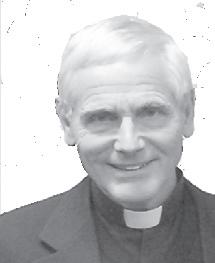 By Fr John Flader
A third issue is the formula for the exchange of consent. Some couples may have heard a particular formula in a wedding they attended, or they may have composed one themselves. Even though the formula may seem appropriate in itself, the exchange of consent is the essential act by which the couple give themselves to each other in marriage and it is very important that they use only a formula approved by the Church. The very validity of the marriage may be at stake.
There are two formulas in the “Rite of Marriage” and the couple are free to choose whichever of them they prefer.
God himself speaks to us through his Scriptures and the Church wants us to hear what he has to say.
A fourth issue is the place for signing the register and the other official papers towards the end of the ceremony. While in some weddings the papers may have been signed on the altar, this is expressly forbidden by the Church.
The reason is that the altar is not just a table. It represents Christ himself, it has been consecrated, and hence only those objects used in the liturgy may be placed on it. Since the signing of the papers is not an official part of the liturgy of marriage, another table should be used for this purpose.
It should be noted that while people consecrating themselves to God in a liturgical ceremony sign their vows or rule of life on the altar, this is because they are making their consecration to God himself, who is represented by the altar. In a wedding, the couple are committing themselves to each other, not to God.
All in all, the couple have a wide variety of texts and music from which to choose and they should respect the norms of the Church and the wishes of the celebrant in making these choices.
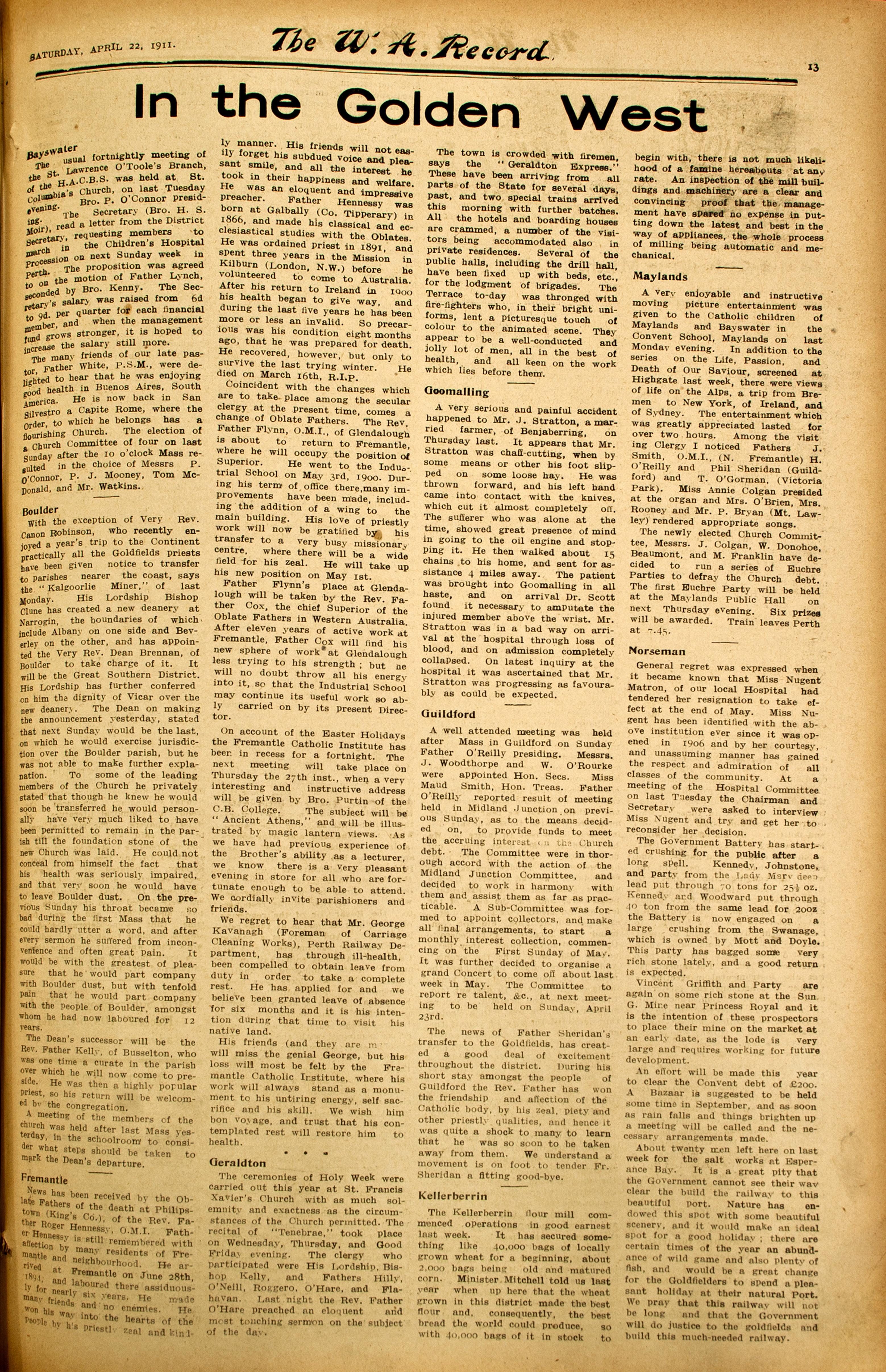
THE ANNUAL report on persecution of Christians around the world produced by the Catholic charity Aid to the Church in Need can make distressing reading, reminding Christians in lucky countries like Australia that the freedoms they take for granted just don’t exist in numerous other nations.
In fact, the organisation which has an Australian arm based in Sydney warns that some sections of its 2011 report, entitled Persecuted and forgotten? A Report on Christians oppressed for their Faith, are not for the faint-hearted. But people need to know, it asserts, what is really happening to Christians on a global scale.
“In the incident log that follows each country’s introduction [in this report],” the foreword says, “the report details some of the most significant incidents of violence and intimidation over the period in question. Some of the reports make for unavoidably distressing reading and hence the book may be judged inappropriate for very young children and other vulnerable people.”
But what distresses Catholics greatly in countries where persecution is a regular daily threat, writes report author John Pontifex, is that for those living in the developed nations of the world the sufferings of Catholics and Christians in less developed parts of the world seem usually to be off the radar. Silence, as much as the persecutor, is also often a dispiriting, disheartening enemy.
High on the watch-list of Persecuted and forgotten’s 144 pages of country by country reports is the rise of extremist Islam which attacks not only Christians and Jews but other Muslims as well.
“By 2011, organisations promoting human rights for Christians were noting the increased threat posed by Islamism, especially extremist movements originating in Saudi Arabia.”
However a new factor in the global picture of religious persecution, it points out, is the growing expression of the intention on the part of extremist movements such as Al Quaeda to entirely eliminate Christianity from the countries they are operating in, such as Iraq.
“Such fundamentalists are spurred on by the fact that what they wish to see happen is already close to coming to pass. It is no exaggeration to say that in the past 150 years an exodus of Christians on a truly Biblical scale has taken place in many parts of the Middle East. In some cases, this has happened within a generation. Iraq,
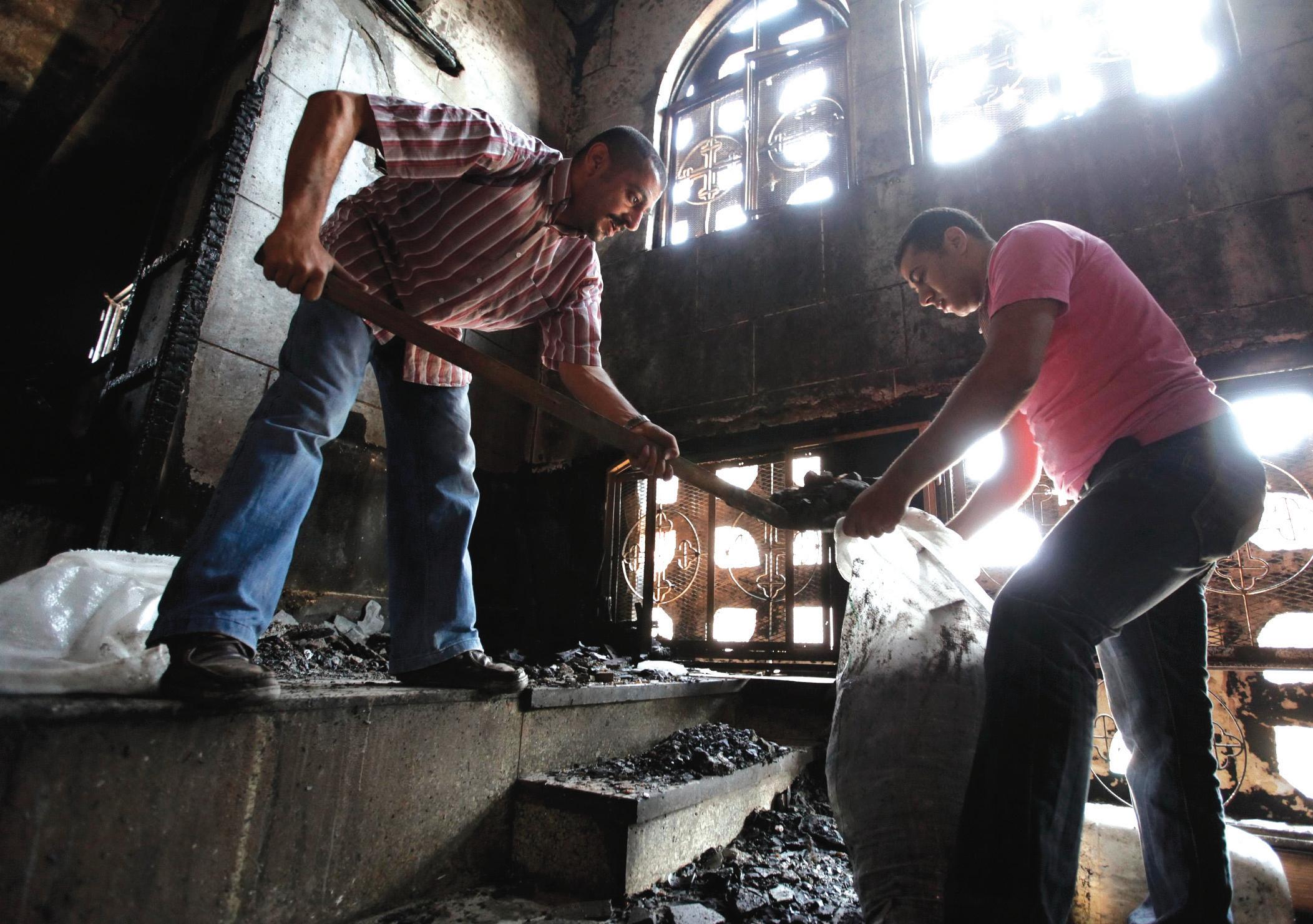
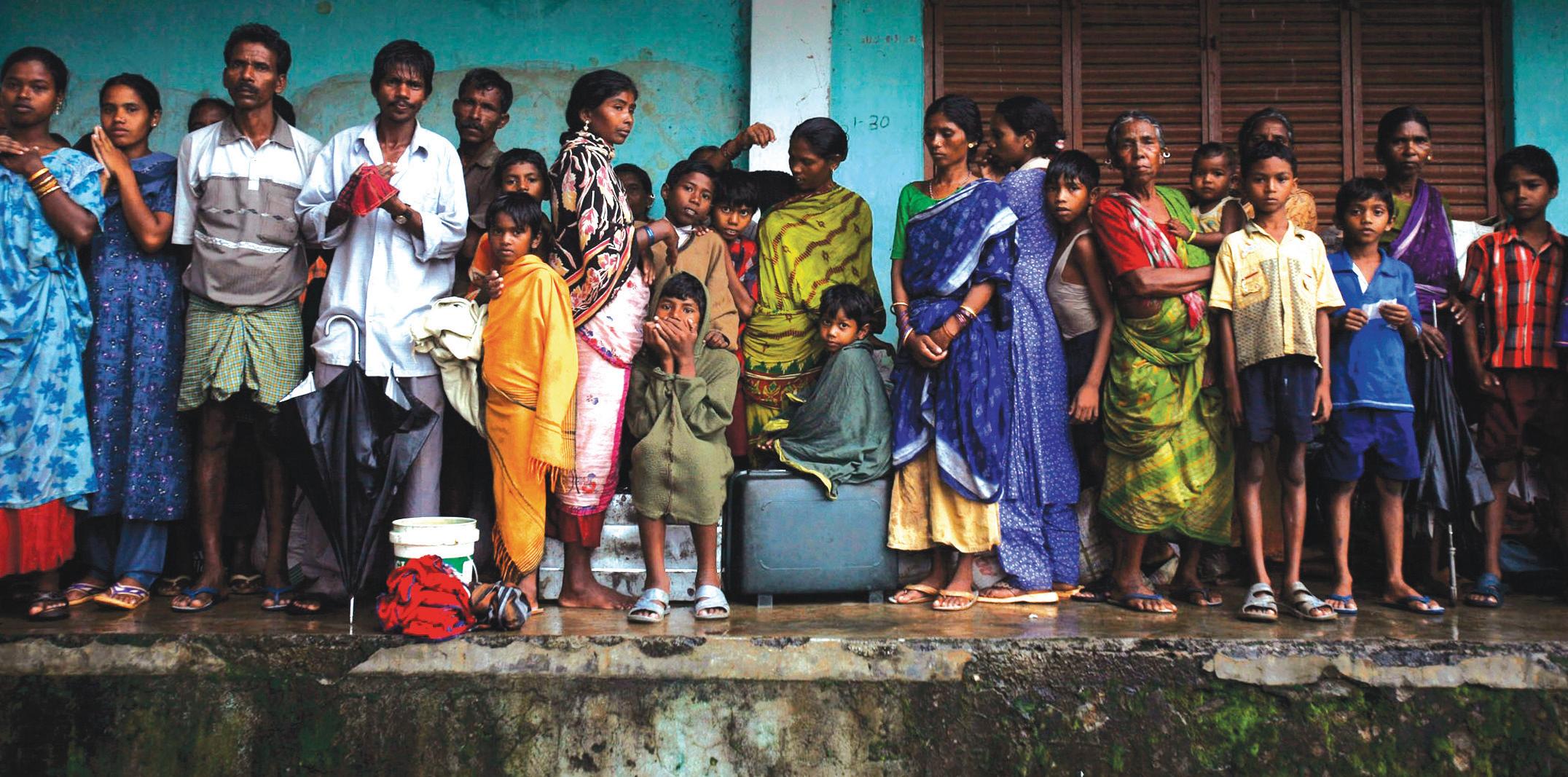
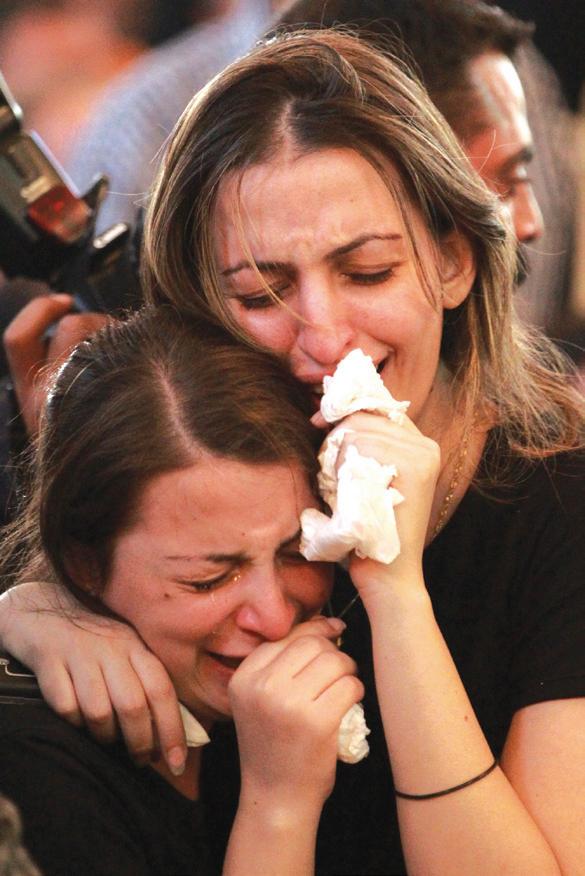
the 2007-08 outbreaks of persecution in the state of Orissa,” it notes.
Surprisingly, persecution is happening in places traditionally thought of as close to the Catholic Church, such as Venezuela in South America, where persecution has sprung from political antipathies rather than religious factors.
Despite the ongoing efforts to kill or push all Christians out of the
“... near-elimination of Christianity now looking a real possibility in the Middle East but previously unthinkable improvements in places such as China ...”
Middle East there is no doubt that for sheer ferocity stalinist North Korea is the number one persecuter of Christians where believers are consigned to concentration camps in which scientific experimentation, torture, summary executions and sexual violence, especially against females, is normal practice.
However, although global persecution of Christians appears to be entrenched and serious there are some surprising improvements, such as in China.
“Elsewhere in the country and at different times, the situation seems much improved, with religious freedom afforded to a degree unthinkable a generation ago.
however, is by far the most serious. At the time of the last census in 1987 the country was home to 1.4 million Christians. By the beginning of 2003, that figure had fallen to 800,000. By the beginning of 2011, the media was giving 500,000 as the country’s Christian population but leading Catholic prelates in Iraq have told Aid to the Church in Need that the real figure could be as low as 150,000. Of those still in Iraq, many – if not most – were living as displaced people desperate to join family and friends in neighbouring Jordan and Syria …”
In the Middle East the situation is now at unprecedented levels, the report warns. “Significant developments in key countries point to the
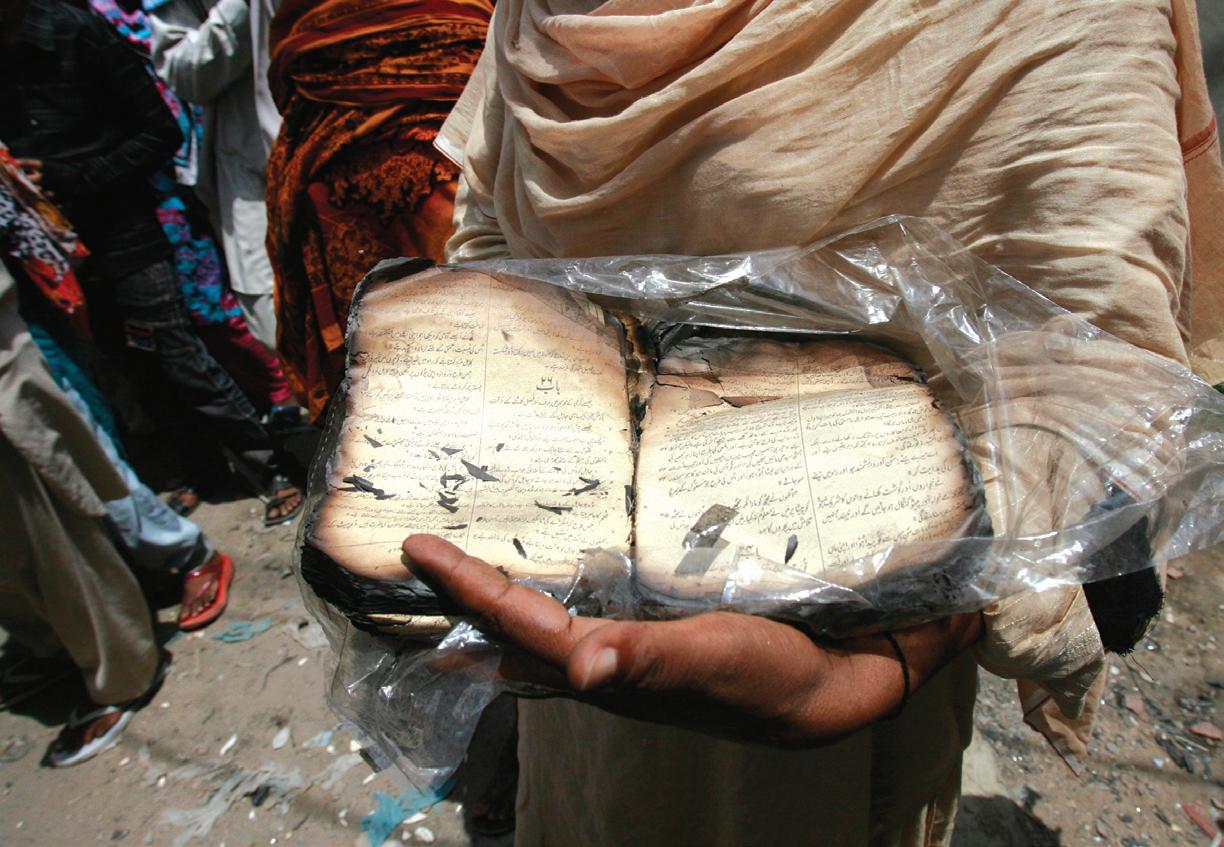
inescapable conclusion that – especially in the Middle East and some other countries – Christianity is under threat as never before and could yet disappear.”
However, clashes between extremist Islamic groups and Christians who have lived in their nations for millennia are only part
of the disturbing picture. “Another key theme of [this report] is that in non-Muslim countries too there have been manifest signs of increasing radicalisation of religious groups and a corresponding growing antipathy to Christianity. This is especially visible among Hindu extremists in India as witnessed by
“Indeed, change for the better has been noted in a number of communist and former communist regimes notorious for their anti-Christian activities in earlier times.”
With near-elimination of Christianity now looking a real possibility in the Middle East but previously unthinkable improvements in places such as China, the global picture is mixed, writes report author John Pontifex. Nevertheless, it is clear that Persecuted and forgotten? faces all Christians with a real challenge. Recalling a conversation with Archbishop Bashar Warfa of Sudan who asked him “Who can we turn to?” Pontifex sums up the question that must face any reader of Persecuted and forgotten?:
“I had no hesitation in assuring him of the constant prayers and support of ACN. For as ACN’s late founder Fr Werenfried van Straaten so famously said: “They are being tested in faith; we are being tested in love.”
Persecuted and forgotten? can be downloaded from CNA’s website www.aidtochurch.org
‘FATHERS, do not rebuke your sons lest they become disheartened,” Paul writes in his letter to the young Christian community at Ephesus (modern-day Turkey). The wisdom of Paul’s words has been brought home with great force, but even greater sadness, by the allegations of years of violent sexual abuse reported in The Weekend Australian by Adelaide-based Archbishop John Hepworth of the Traditional Anglican Communion.
By Archbishop Hepworth’s account of his time as a naive teenage Catholic seminarian in Adelaide’s St Francis Xavier Seminary, he was repeatedly suborned, groomed and blackmailed by some fellow seminarians and clergy for homosexual sex, then threatened with expulsion including by one bishop if he made formal accusations. The abuse reportedly continued after ordination, by which time the clerical predators would have held a psychologically vulnerable victim in thrall. According to Archbishop Hepworth, the archbishop of the time simply told him to leave the archbishop’s office when he tried to reveal what had happened to him.
Now the allegations have been made very public, receiving worldwide coverage, Australian Catholics must countenance three possibilities: Archbishop Hepworth is delusional, a liar, or telling the truth.
By his account, from the time he entered the seminary in 1961 he unwittingly entered a living hell. The abuse, compounded by the cold rejection of his attempts to report it to superiors, paints a picture of a predatory homosexual subculture within the archdiocese together with a picture of official ineptitude and mismanagement responding to it.
A disturbing aspect of the whole issue, on the basis of what is known about other cases, is that he was unlikely to have been the only victim of those he names, that in all probability victims were not just junior clerics but also parishioners and their families – the baptised. An immediate, full and thorough investigation is now needed. It is not insignificant that Archbishop Hepworth says his impulse to seek resolution with the Catholic Church was motivated by, among others, an Anglican woman. It was, after all, to women that the news of the resurrection was first given.
Questions must naturally arise as to why the investigation, including into a priest still serving in the archdiocese, is still at a “preliminary” stage after nearly five years.
PO Box 3075
Adelaide Terrace
PERTH WA 6832
office@therecord.com.au
Tel: (08) 9220 5900
Fax: (08) 9325 4580
Nor is the abuse he recalls and credits with his decision to flee the Catholic Church just a problem of the past, if the allegations reported in The Weekend Australian are accurate – and one might expect the newspaper to have made a rigorous assessment of the credibility of his claims regarding the Adelaide archdiocese’s response to his complaints, beginning in 2007.
Questions must naturally arise as to why the archdiocese’s investigation, including into a priest still serving in the archdiocese, is still at a “preliminary” stage after nearly five years. By contrast, an investigation by the Archdiocese of Melbourne into Archbishop Hepworth’s allegations against one priest, now dead, were swiftly resolved in little more than a year by a highly regarded Queen’s Counsel, resulting in compensation of $75,000 and an official and heartfelt apology from Archbishop Dennis Hart.
The Adelaide archdiocese’s response is that Archbishop Hepworth never formalised his complaint until earlier this year. Its investigation, it says, is more complicated because the accused priest in its jurisdiction is still alive and serving, but is now proceeding and close to finalisation. Archbishop Hepworth, for his part, has said he was always under the impression his detailed written statements in 2008 constituted a formal complaint and were being investigated.
Even if Archbishop Hepworth is wrong, is the Adelaide archdiocese’s approach justified? Do all complaints not explicitly made formally result in zero investigation? In light of the past decade or so, this is perhaps the most amazing revelation to come out of this sorry affair.
Survivors of sexual abuse, whether at the hands of Catholic personnel or those in society at large, can be understandably disheartened at what might be interpreted as a lack of zeal to ensure the protection of others. Despite the archdiocese’s statement that its officials and lawyers repeatedly encouraged Archbishop Hepworth to report his complaint to the police – a complaint the archdiocese says is “very complicated” to investigate given the events occurred almost 50 years ago – its own response could appear discouraging to anyone who has been abused. What are victims to think?
The Church is full of good men who have heard a unique call in their hearts to proclaim the truth of Jesus Christ crucified, dead and risen from death. The position of priests, extremely difficult since the sexual abuse scandals first broke, has just been made harder. It is not only the victims who suffer, but the whole Church. This episode can only lend weight to those critics who charge that elements of the Church are not really serious about reconciliation with the victims of abuse. If ever there was a time to say it, it is now: serious, detailed, believable allegations of abuse that extend to a culture within the Church should never, ever be ignored.
I AM very surprised that The Record should publish an article apparently attempting to minimise the seriousness of a Member of Parliament allegedly misusing large amounts of money to spend on prostitutes (“A political victory? It’s nothing of the sort”, 31 August 2011).
Apart from the moral aspects, prostitution is extremely destructive as a way of life to those women involved in it. As a criminal lawyer I have met several and found them, sometimes beneath a veneer of bravado, to be desperately unhappy and suffering progressive psychological if not physical damage.
Many can only survive through the use of drugs, and all are at risk of both disease and attacks by psychopaths. For an MP to encourage the industry by patronising them, whether using his own money or someone else’s is, if true, shocking and deserves public investigation.
Yet the article by Robert Hiini appears to be condoning or minimising this, and even attempts to evoke sympathy for the alleged perpetrator, whose behaviour, if accurately reported, has been utterly contemptible, but who is made to sound like the victim: “Some poor misguided soul” [allegedly] “spent rather a lot of union money on prostitutes.”
I gather the true agenda behind this article is actually to attack Tony Abbott by fair means or foul (in this case, foul). Your author’s fear of “sanctimony” appears welljustified.
Guy Crouchback NEDLANDSNO SANE farmer puts two bulls in a paddock and expects to get calves, or two ewes and looks for lambs. Same-sex unions are, by definition, sterile.
The proposed amendment to the marriage laws to legalise same-sex ‘marriage’ is non-sense.
Marriage is the institution in all societies to protect and nurture the young. The family is the strength and foundation of our community, our state and nation.
Any legislation that further undermines the precarious status of the family in a disintegrating world will undermine our wellbeing as a nation. This is already apparent on a global scale.
For two men or two women to set up house together and call themselves “family” makes as much sense as a farmer waiting for calves from his two bulls.
To then demand the “right” to have a child artificially is to treat the child as an object or commodity and to deny it the very rights it has to proper birth from a natural father and mother and to the bonding identity and security it needs.
This is not bigotry but biology. A strong and just society cannot be based upon selfishness.
Mrs Sarah Fanning TARLO, NSWAlarm bells that are beginning to ring in public life over an ageing population are thoroughly predictable, writes Barry Morgan
READING Don Stammers’ article in the Wealth section of the Weekend Australian, (“Focus needed to salvage the ageing sector”, 24 August) reminded me yet again of the stupidity of the anti-natalist policies of successive governments over the past 40 years.
Forget the morality of the issue; it would be hard to find a more glaring example of short-term ideology ignoring predictable long-term serious national consequences.
The so called ageing population crisis is not so much a problem of people getting older as one of insufficient younger wealth producers to support them. This is a direct outcome of not enough babies being born over past decades.
The babies denied life four decades ago would now be in the prime of their productive years producing wealth and paying taxes; that they are not there is the major reason governments are flailing around with ineffective short term policies that not only fail to solve the problem but eventually worsen it.
Pushing married women into the workforce was one such policy.
It worked for a little while but of course this meant that staying in the workforce meant having fewer children, and many of those babies spent their babyhood and early childhood in ‘childcare’.
With the close early nurturing bond between mother and child so radically distorted, is it any wonder we now endure a rising number of problem youth?
Increasing numbers of married women in the workforce meant the double income syndrome, rising consumerism and the status of the 4 bedroom, 2 bathroom suburban house complete with entertainment centre, two cars, a crushing mortgage and repayments to go with it.
This worked for those who got in early but increased demand meant increasing prices, bigger borrowings, higher debt load and increased payments for those following on.
The real estate industry, not known for its moderation, was only too happy to feed the unrealistic expectations of neophyte ‘investors’ and keep the ball rolling as long as possible which, as always, meant it went too far.
Without recognition of the importance of marriage, our society is digging its own grave.
Apart from Western Australia currently feeding China’s voracious appetite for minerals, we are now seeing the first indications of the bursting of the housing bubble. Because these issues are generational they take time to manifest themselves.
Because politics is mostly about current issues the problems outlined above have not been addressed.
What would the term ‘the Whitlam era’ mean to 30 year olds looking to get married with dreams of their own home and a family?
Not much, if anything, but they
are the ones paying the price for the greed and irresponsibility of the previous generation.
They also will be the ones who will be burdened with higher taxes to pay for the increasing numbers of ageing citizens and their care.
It is the politicians of today and, even more so, future parliaments who will be faced with the problems of an ageing population passed on to them by earlier administrations. As a nation, we have been aborting ourselves at the rate of an estimated 90,000 children per year for more than 40 years.
We quite rightly lament the emotional and financial cost of the road toll each year but no one - no one - apart from a few dedicated voices raises a whisper about the cost to the nation of its annual abortion toll. If the road toll is bad, why isn’t the abortion toll?
To end where I began. Our ageing population problem is, in reality, a birth dearth problem.
Australia’s political class must recognise that without healthy family life, without government recognition of marriage, the family and all the benefits flowing from them our society is digging its own grave.
Doubt what I say? Try googling ‘demography’, together with the names of nations such as Japan, Greece, Ireland and any of the PIIGS nations.
Do the same with terms such as ‘Russia’ and ‘demography’ and see that at long last Vladimir Putin and the Russian parliament have seen the stupidity of the communist inheritance and are now offering considerable financial inducements such as cash grants, including grants of land to families, not to improve Russia’s economy but to raise the nation’s birth rate.
Barry Morgan writes from AlbanyASET OF social building blocks will determine how long a person lives and how healthy they will be during their lifetime. Experts know these building blocks as the social determinants of health.
Health policies, and the Council of Australian Government’s just signed-off health-reform agreement, mostly focus on how hospitals and health services are funded. Health policies give essential attention to physical activity, dietary management, tobacco, alcohol control and public safety.
The influence of social determinants on health are greater than biomedical and behavioural ones, writes Martin Laverty There is a tangible role that educational attainment plays as a building block of health. Income plays as important a role.
Hospitals, health professionals, physical activity and awareness of what we eat, drink and smoke are indeed important building blocks of good health. Yet there are other key social building blocks not routinely considered by health policy makers, despite a genuine and real interest of health policy experts to improve the health of all Australians.
Mounting evidence suggests the influences of some social determinants on a person’s health are greater than biomedical and behavioural risk factors. This evidence has only begun to be understood in any meaningful way in the last decade,
but health policy in Australia has been slow to respond.
Australian health policy has remained focused on biomedical and behavioural risk factors, and has ignored a landmark report of the World Health Organisation delivered in 2008 that invited Australia to expand health policy thinking by considering social determinants alongside medical and behavioural health priorities.
Average life expectancy for Australians in the lowest socioeconomic group is three years lower than those in the highest socioeconomic group, and long-term health conditions are near to three times more prevalent in the lowest socio-economic group than that of the highest.
Good health starts in the womb and needs a safe and secure pregnancy. It needs positive early childhood experiences. School participation, transition to reliable work, safe and secure housing, access to safe food and sustenance, and sufficient access to income and resources are all necessary building blocks to good health.
So, too, is social interaction and the development of skills to engage
with a person’s community. With the exception of pregnancy management and food regulation, each of these policy areas is overseen by agencies located outside the normal boundaries of a health portfolio.
A study of 2,500 patients in
College of Physicians, which found non-completion of high school is a greater risk factor than biological factors for development of many diseases, and that the level of a person’s formal education predicted cardiovascular mortality better than participation in a long-term clinical trial.
This research points to the tangible role that educational attainment plays as a building block of health, and asks Australians to consider if greater encouragement for higher educational attainment might enable better health.
public hospitals found those with lower literacy levels reported two times the prevalence of chronic illness compared to patients with higher literacy. This finding points to the important role of literacy and education in health outcomes, and how improving the reading ability of the population is in fact a building block of good health.
The role of educational attainment in health outcomes was underscored by the American
Income plays just as important a role as a building block to good health. A study of 126 countries published in the British Medical Journal assessed income inequality data held by the United Nations Development Programme and mortality data held by the World Health Organisation. The study found income inequality associated with high mortality; rates of mortality fall as personal income rises.
A rationale put forward for the link between low income and poor health is that the psychosocial stress of being in a relatively low position within a social and economic hier-
archy leads to actual physiological harm. These findings suggest Australians could consider both the role of financial support for low income Australians as a contributor to good health, but also the opportunity to address the causes of psychosocial stress of those in socioeconomic disadvantage.
As long as health policy remains focused only on biomedical and behavioural factors, it will not achieve best health outcomes and will burden future taxpayers with ever escalating health costs.
There will always be a need for investment in hospital care, for expansion in health workforce and preventive health initiatives. This investment is urgent as the population heads towards peak ageing.
In addition to traditional health system investment, new investment is needed in social determinants. Australia can start by working out how best to implement the World Health Organisation’s 2008 social determinants action plan.
Martin Laverty is the CEO of Catholic Health Australia and an editor of Determining the Future: A Fair Go and Health for All, published by Connor Court Publishing.
What to make of advice reportedly given to the federal government that processing in Australia the asylum claims of those who come to Australia by boat poses a risk to nation’s social cohesion, while at the same time the federal opposition has been advised a return to the “Nauru solution” of the Howard era is no longer an effective deterrent?
The first observation that might be made is that advisors provide at least two important services: first, to give frank and fearless advice; second, to tell political masters exactly what they want to hear.
Boat people have, of course, been posing a perilous threat to social cohesion in Australia ever since Captain Arthur Phillip planted the Union flag in the soil of what we now know as Port Jackson. History does not sufficiently record the views of the locals to the intrusion but one can surmise with reasonable certitude feelings were at least mixed.
In 1869 Henry Parkes, as close as the Australian federation comes to having a founding father, had a good many things to say about the threat posed to the prosperity and social cohesion of the colony of New South Wales by a flood of undesirable boat people.
The consequences, he said in a speech to the NSW Legislative Assembly recorded for posterity, would “strike right into the root of the social fabric, and will speedily show themselves in our social life and character”.
What, Parkes asked (rhetorically), was the experience of the mass of immigration that had poured into the country during the preceding decade? “Have these people come to mingle with us – to assist in forming one common Australian people?” He thought not.
“All people coming here, from whatever country, should lose all sense of foreign grievances, and mingle together in promoting Australian interests and in forming one people,” he continued (to cries of “hear, hear!”). “But has this been the
case? On the contrary, have not these persons moved about with a separate action of their own – have they not, obviously and beyond dispute, instead of acting as free agents in a free country, been insensible to the priceless liberties they enjoy, surrendering their precious rights, and yielding up all their privileges to priests not more able to direct them than are themselves?”
He was, of course, not referring to those of swarthy complexion
that I do not want to see this colony, which is the birth-place of my children, converted in province of the Pope of Rome,” he said (to much cheering). “I cannot but remember that the very liberties of England are identical with the liberty of mind which the Protestant religion, pre-eminently, not only admits but encourages.” Not that he was a bigot (by his own objective assessment); it was just that swamping the colony with popish boat people
as a visit to any church on Sunday will attest, eventually attained by successive waves of immigration from around the world.
So too future generations might wonder at what all the fuss was about over several thousand people arriving by boat in any given year.
The advice given to the government, that dismantling the punitive deterrent of offshore processing is likely to result in an estimated 600 asylum seekers
“I do not hesitate to say that Irish Roman Catholics are not the best people.”
from dusty lands who worshipped strange gods in unintelligible tongues (the total number of immigrants from places other than Great Britain between 1860 and 1867 comprising a grand total of 130). Rather, what he feared was the threat posed by Irish – and, more pointedly, Catholic – immigrants.
What alarmed Parkes was that of nearly 21,000 immigrants to the colony in those seven years, almost 15,000 were Irish and 12,000 Catholic. “I for one at once declare
with brogues had more than any other cause contributed to a “state of continuous depression and backwardness”. Buttressed by the opinions of “expert” commentators, he declared: “I do not hesitate to say that Irish Roman Catholics are not the best people.”
Today we might wonder what all the fuss was about, the nation having seemingly survived in relatively good shape the outnumbering of the nation’s protestants by those of the Catholic faith – a demographic tilt,
arriving by boat each month, might well be correct. The advice that such numbers (more than 7,000 a year) would quickly overwhelm the nation’s mandatory detention facilities might also probably be accurate. But the suggestion that the option of releasing the people into the community would most likely result in the creation of a class of second-class citizens, triggering the possibility of Australia experiencing European-style disharmony, seems a tad overblown. Being treated
as second-class citizens would probably be regarded by most boat people as an improvement over their current lot anyway.
Perspective is important here. Dig into the immigration statistics and you will find facts that should equally outrage commentators who rail about Australia being “swamped” by boat people.
In 2010-11 the Australian government proposed to take 13,770 people under its humanitarian programme, 54,550 under its family reunion programme and 113,850 under its skilled migrants programme. There have been more than 14,000 visas issued for accountants alone. Given the burden of sheltering the estimated 16 million or so refugees in the world falls on developing countries with the least resources, Australia’s skimming of the skilled from other countries for its own national self interest might well be regarded as somewhat parasitic.
At any time it is estimated there are more than 50,000 people in Australia illegally – people who have come here on tourist, student or other visas and overstayed. Yet the presence of these people causes little community concern.
Even more startling: in the first six months of 2010-11 there were 2,959 applications for protection visas lodged in Australia. Just 672 of those were by “illegal maritime arrivals” (IMAs) (in other words, boat people); 2,287 were from people who arrived in the country by other means (tourist and student visas). Yet there is no national fretting over them. (Interestingly, “non-IMAs” comprise but a fraction of those incarcerated in detention facilities (316 of 5,403 imprisoned as of the end of June). Why the inconsistency?
It is not being swamped by boat people we should be concerned about but the possibility this problem is nothing more than a contrivance, the expression of prejudices that has led to a policy that achieves the remarkable outcome of being simultaneously soft-headed and hard-hearted.
FRIDAY, 16 SEPTEMBER
Healing Mass and Eucharistic adoration
7-10pm at Holy Family Parish, 375 Alcock St, Maddington. Led by Fr Augustine Vallooran VC, Director of Divine Retreat Centre, Potta, India.
FRIDAY, 16 TO SUNDAY, 18 SEPTEMBER
“Living The Franciscan Way” - secular Franciscans of WA retreat
7pm at the Redemptorist North Perth Monastery guesthouse. Explore how the spirituality of St Francis can impact on one’s relationship with God and personal happiness, as well as how Franciscan witness impacts on the Church and society at large. Will include a liturgical celebration of St Francis’ gift of the stigmata. Live-in option available. Daytime attendance is possible. Enq and registration: Anthony 0449 864 287.
SATURDAY, 17 SEPTEMBER
Love Ministry Healing
6pm at Our Lady of Mercy, cnr Girrawheen Ave and Patrick Ct, Girrawheen. Love Ministry Healing team including Fr Nishan and other clergy. Come and be prayed over, healed from the past or present issues or stand in for a loved one who may be ill or facing problems at this time. Enq: Fr Hugh Thomas or Gilbert on 0431 570 322.
St Padre Pio pilgrimage to Toodyay and anniversary of St Francis stigmata 8am buses depart. 10.15am DVD, 11.30am Mass, confession available. 1pm lunch BYO, tea and coffee provided. 2.30pm Eucharistic procession, rosary, adoration, Divine Mercy and benediction. 4pm depart for Perth. Enq: Midland, Catrina, 9255 1938; Bassendean, Ivana 9279 7261; Morley, Joan 9276 9439; Leederville, Leena 9444 3617; Balcatta, Rosa 9276 1952; Glendalough, Fr Doug 9444 6131.
One day healing retreat
9am-5pm at Holy Family Parish, 375 Alcock St, Maddington. Led by Fr Augustine Vallooran VC, Director of Divine Retreat Centre, Potta, India. BYO lunch.
Youth Music Workshop with Fr Rob Galea –Catholic Youth Ministry 2-5pm at Catholic Pastoral Centre, 40A Mary St, Highgate. Featuring International touring Catholic musician – Fr Rob Galea. Cost: $10includes afternoon tea. Bring your whole music team or come on your own. Registrations and enq: admin@cym.com.au or 9422 7912.
SUNDAY, 18 SEPTEMBER
Healing service
7-9.30pm at Our Lady of the Mission Parish, Whitford, 270 Camberwarra Dr, Craigie. Led by Fr Augustine Vallooran VC, Director of Divine Retreat Centre, Potta, India.
75th anniversary celebrations
9.30am at St Francis Xavier Church, 25 Windsor St, Perth. Mass. Past parishioners, ex-pupils of SFX school are cordially invited. Enq: Barbara 0401 178 782 or Roseanne 0434 899 406.
Healing service
1-4pm at Good Shepherd Parish, 215 Morley Dr, Lockridge. Enq: Melanie 0410 605 743 or m.fonseca@curtin.edu.au.
St Jerome’s Parish school fete 9am-2pm at St Jerome’s Parish, 36 Troode St, Munster. Variety of stalls: cakes, books, jar bazaar, white elephant, rides, hot food, refreshments, raffles, Holden Club of WA and more. Enq: Brenda 9418 5998.
‘Madrid WYD comes to Perth’ concert –Catholic Youth Ministry
6pm at St Thomas More Parish, cnr Dean and Marsengo Rds, Bateman. Begins with Mass; 7:30pm Sunday Sesh with International Catholic musician, Fr Rob; followed by fellowship and supper. Register for FREE ticket: admin@cym. com.au or pay $5 at the door. Enq: cym.com.au or 9442 9712.
Prayer in the Taize Style
7-8pm at Sisters of St Joseph’s Chapel, 16 York St, South Perth. Includes prayer, using Taize songs, sacred Scripture and time for personal prayer. Last Taize prayer for the year. Bring torch. Mary MacKillop books on sale in foyer. Enq: Sr Maree 0414 683 926.
TUESDAY, 20 SEPTEMBER
Baby Mass
7.30pm at Our Lady of Grace Church, North Beach in 3 Kitchener St, North Beach. To help those who have never had the chance to name or to grieve the loss of their baby: mothers, fathers, siblings, grandparents and other interested persons. Followed by 30 minutes for personal reflection. Refreshments provided. Enq: Judy 9447 4144 or parish 9448 4888.
SATURDAY, 24 SEPTEMBER
“Be Still In His Presence”
Christian programme
10-11.30am at Anglican Church hall (behind parish), 195 Lesmurdie Rd, Lesmurdie. Monthly meetings include praise and worship, silent reflection, lectio divina, small group sharing and a cuppa at the end. Enrich your faith journey. Enq: Lynne 9293 3848 or 0435 252 941.
Archbishop Hickey: LIVING BIBLICALLY in Anglican Ordinariate Group
10am at St Ninian & St Chad Church, 11 Susan St at 10am. Archbishop Barry Hickey will deliver an address entitled ‘Living Biblically’. Enq: Harry 0417 1801 45.
SATURDAY, 29 OCTOBER
Mercedes College Perth - graduating class of 1990 reunion
7.30pm Rosie O’Grady’s, Northbridge, cnr James and Milligan Sts. Enq: kathleen.bryce@yahoo. com.au.
FRIDAY, 30 SEPTEMBER
Medjugorje evening of prayer
7-9pm at Our Lady of Mount Carmel Parish, 2 Collick St, Hilton. Includes Eucharistic adoration, rosary, benediction and holy Mass. Free DVDs available. Enq: Eileen 9402 2480, 0407 471 256 or medjugorje@y7mail.com.
FRIDAY, 30 SEPTEMBER TO SUNDAY, 2 OCTOBER
‘Firm in the Faith’ CYM Young Adult retreat Awesome retreat which is based on the theme of WYD11 “Planted and built up in Christ, Firm in the Faith’ (Col 2:7). Weekend of fun, activities, music and spiritual talks from fantastic speakers. Retreat cost $80. Ends lunchtime on Sunday. Download registration forms: cym.com.au. Enq: admin@ cym.com.au or 9422 7912.
SATURDAY, 1 OCTOBER
Day with Mary 9am-5pm at St Catherine of Siena Parish, 3 Fraser St, Gingin. Day of prayer and instruction based on the Fatima message. 9am video; 10:10am holy Mass; Reconciliation, procession of the Blessed Sacrament, Eucharistic adoration, sermons on Eucharist and Our Lady, rosaries and stations of the Cross. BYO lunch. Bus contact: Nita 9367 1366. Enq: Franciscan Sisters of the Immaculate 9250 8286.
Vigil for Life
8.30am at St Augustine’s Parish, Gladstone St, Rivervale. Begins with holy Mass, followed by rosary procession and vigil at nearby abortion clinic, led by Fr Paul. Weekly prayer vigils: Monday, Thursday and Saturday 8-10am at Rivervale. Enq. Helen 9402 0349.
MONDAY, 3 OCTOBER
Transitus of St Francis Of Assisi
6.30pm at Edel Quinn Centre, 36 Windsor St, East Perth. The secular Franciscans celebrating vigil feast of the extraordinary life and death of their founder. Reflection on your life path and personal happiness in God. Begins with holy Mass with Fr Michael followed by refreshments. Enq: Anthony 0449 864 287.
SATURDAY, 6 NOVEMBER
Love ministries
Charismatic healing team
6pm at All Saints Parish, 7 Liwara St, Greenwood. Begins with Mass followed by healing ministry prayer. Enq Fr Giosue 9349 2315 or Fr Michael 0417 17 5796 or Gilbert 0431 57 0322.
FRIDAY, 7 OCTOBER
Pro-Life Witness
9.30am at St Brigid’s Parish, cnr Great Northern Highway and Morrison Rd, Midland. Begins holy Mass followed by rosary procession to the nearby abortion clinic led by the Franciscan Friars of the Immaculate. Weekly prayer vigils: Fridays 9-10.30am at Midland and 10am-12pm at Balcatta. Enq Helen 9402 0349.
SATURDAY, 8 OCTOBER
Annual Mass at Grotto
10.30am at Richard Priestly’s farm, Wariin Rd, Wooroloo. Please bring chair and picnic. BBQ meat at no cost. Farm is located 2.2km from corner of Wariin Rd. Allow 45 minutes from Midland. Enq: Richard 9573 1247 or 0428 502 74.
SUNDAY, 16 OCTOBER
Lord of the Harvest Parish 50th Anniversary
10.30am at St Michael’s Parish, Lindsay St, Beacon. Begins with Mass, followed by lunch at Beacon Country Club. All past and present parishioners and ex-locals invited. RSPV and enq: Michelle 9686 6056 or bingarra@bigpond.com.
MONDAY, 9 JANUARY TO MONDAY, 16
JANUARY 2012
Summer school
The Royal School of Church Music in Australia (RSCM) will be hosting a summer school for all denominations next year. The programme will include workshops for church musicians and singers to help them inspire their congregations towards a more enjoyable and meaningful participation in Church liturgy. Enrolments are now open and interested parties can find out more by going to www.rscmaustralia.org.au. Enq: Deirdre 9457 4010
SATURDAY, 25 FEBRUARY 2012
A reunion for Holy Cross Primary School, Kensington Any ex-students or family members, please contact Julie Bowles (nee O’Hara) on 9397 0638 or email jules7@iinet.net.au.
EVERY SUNDAY
Gate of Heaven Catholic Radio
Join the Franciscans of the Immaculate from 7.309pm on Radio Fremantle 107.9FM for Catholic radio broadcast of EWTN and our own live shows. Enq: radio@ausmaria.com.
Pilgrim Mass - Shrine of the Virgin of the Revelation 2pm at Shrine, 36 Chittering Rd, Bullsbrook. Commencing with rosary followed by benediction. Reconciliation is available before every celebration. Anointing of the sick administered during Mass every second Sunday of the month. Pilgrimage in honour of the Virgin of the Revelation, last Sunday of the month. Side entrance to the church and shrine open daily between 9am-5pm. Enq Sacri 9447 3292.
EVERY FIRST SUNDAY
Divine Mercy chaplet and healing prayer
3pm at Santa Clara Church, 72 Palmerston St, Bentley. Includes adoration and individual prayer for healing. Spiritual leader Fr Francisco. All welcome. Enq: Fr Francisco 9458 2944.
Divine Mercy
1.30pm at St Francis Xavier Parish, 25 Windsor St, East Perth. Fr Alphonsus. Includes exposition of the Blessed Sacrament and Reconciliation, holy rosary, and Divine Mercy prayers. Followed by benediction and veneration of first class relics of St Faustina Kowalska. Enq: John 9457 7771.
St Mary’s Cathedral youth group –fellowship with pizza
5pm at Mary’s Cathedral, 17 Victoria Sq, Perth. Begins with youth Mass followed by fellowship downstairs in parish centre. Bring a plate to share. Enq: Bradley on youthfromsmc@gmail.com.
Panorama Editorial Policy
The Record reserves the right to decline or edit any items submitted for publication in Panorama. Deadline:
11am every Monday.
Peter Rosengren, Editor
EVERY SECOND SUNDAY
Healing hour for the sick
6pm at St Lawrence Parish, 392 Albert St, Balcatta. Begins with Mass, exposition of the Blessed Sacrament and prayers. Enq: Fr Irek 9344 7066 or ww.stlawrence.org.au.
EVERY THIRD SUNDAY OF THE MONTH
Prayer in style of Taize during September
7-8pm at Sisters of St Joseph’s Chapel, 16 York St, South Perth. Chapel doors open at 6.30pm. Everyone welcome to come along for prayer, using songs from Taize in the stillness of a candlelit chapel. Mary MacKillop merchandise and books for sale in the Mary MacKillop Centre. Enq: Sr Maree Riddler 0414 683 926.
Oblates of St Benedict Meeting
2pm at St Joseph’s Convent, York St, South Perth. For all interested in studying the rule of St Benedict and its relevance to everyday life. Afternoon tea. Enq: Secretary 9457 5758.
EVERY FOURTH SUNDAY OF THE MONTH
Holy hour for vocations to the priesthood, religious life
2-3pm at Infant Jesus Parish, Wellington St, Morley. The hour includes exposition of the Blessed Eucharist, silent prayer, scripture and prayers of intercession. Come and pray that those discerning vocations can hear clearly God’s call.
EVERY MONDAY
Evening adoration and Mass
7pm, St Thomas Parish, Claremont, cnr Melville St and College Rd. Eucharistic adoration, reconciliation, evening prayer and benediction, followed by Mass and night prayer at 8pm. Enq: Kim 9384 0598, claremont@perthcatholic.org.au.
EVERY TUESDAY
Bible teaching with a difference
7.30pm at St Joachim’s Parish hall, Victoria Park. Exciting revelations with meaningful applications that will change your life. Bring Bible, a notebook and a friend. Enq: Jan 9284 1662.
Novena to Our Lady of the Miraculous Medal
6pm at the Pater Noster Church, Marmion and Evershed Sts, Myaree. Mass at 5.30pm followed by benediction. Enq: John 0408 952 194.
EVERY WEDNESDAY
Holy Spirit of Freedom community
7.30pm at The Church of Christ, 111 Stirling St, Perth. We are delighted to welcome everyone to attend our Holy Spirit of Freedom praise meeting. Enq: 0423 907 869 or hsofperth@gmail.com.
Holy hour at Catholic Youth Ministry
6pm at 40A Mary St, Highgate, Catholic Pastoral Centre. 5.30pm Mass followed by $5 fellowship supper. Enq: Stefania 9422 7912 or www.cym. com.au.
Bible study at Cathedral
6.15pm at St Mary’s Cathedral, 17 Victoria Sq, Perth. Deepen your faith through reading and reflecting on holy scripture by Fr Jean-Noel. Meeting room beneath Cathedral. Enq: Marie 9223 1372.
Holy Hour - Catholic Youth Ministry
5.30pm at Catholic Pastoral Centre, 40A Mary St, Highgate. Begins with Mass; 6.30pm Holy Hour of Adoration, followed by $5 supper and fellowship. Enq: cym.com.au or 9422 7912.
EVERY FIRST WEDNESDAY
Holy hour prayer for priests
7.30-8.30pm at Holy Spirit Parish, 2 Keaney Pl, City Beach. All welcome. Enq: Linda 9341 3079.
SECOND WEDNESDAY OF MONTH
Chaplets of the Divine Mercy
7.30pm at St Thomas More Catholic Parish, Dean Rd, Bateman. A beautiful, prayerful, sung devotion accompanied by exposition and followed by benediction. Enq: George 9310 9493 or 9325 2010 (w).
EVERY THURSDAY
Divine Mercy
11am at Sts John and Paul Church, Pinetree Gully Rd, Willetton. Pray the rosary and chaplet of Divine Mercy, and for the consecrated life, especially here in John Paul Parish. Concludes with veneration of the first class relic of St Faustina. Please do come and join us in prayer. Enq: John 9457 7771.
St Mary’s Cathedral praise meeting 7.45pm every Thursday at the Legion of Mary’s Edel Quinn Centre, 36 Windsor St, East Perth. Includes praise song and healing ministry. Enq: Kay 9382 3668 or fmi@flameministries.org.
FIRST THURSDAY OF THE MONTH
Prayer in style of Taize
7.30-8.30pm Our Lady of Grace Parish, 3 Kitchener St, North Beach. Prayer, song and silence in candlelight. Taize info: www.taize.fr Enq: Secretary 9448 488 or 9448 4457.
FIRST FRIDAY OF THE MONTH
Communion reparation all-night vigil
7pm-1.30am at two locations: Corpus Christi Parish, Lochee St, Mosman Park and St Gerard Majella Parish, cnr Ranveswood Dr and Majella Rd, Westminster (Mirrabooka). In reparation for outrages committed against the sacred hearts of Jesus and Mary. Enq: (Mosman Park) Vicky 0400 282 357 and Fr Giosue 9349 2315.
Healing Mass
7pm at St Peter’s Parish, Inglewood. Praise and worship, exposition and Eucharistic adoration, benediction and anointing of the sick, followed by holy Mass and fellowship. Celebrants: Fr Dat and invited priests. 6.45pm Reconciliation. Enq: Mary Ann: 0409 672 304., Priscilla: 0433 457 352 and Catherine: 0433 923 083.
Holy hour for vocations to the priesthood and religious life
7pm at Little Sisters of the Poor Chapel, 2 Rawlins St, Glendalough. Mass followed by adoration with Fr Doug Harris. All welcome. Refreshments provided.
Catholic Faith Renewal Evening
7.30pm at Sts John and Paul Parish, Pinetree Gully Rd, Willetton. Songs of praise, sharing by a priest followed by thanksgiving Mass and light refreshments afterwards. All welcome. Enq: Kathy 9295 0913, Ann 0412 166 164 or catholicfaithrenewal@gmail.com.
Healing and Anointing Mass
8.45am Pater Noster Church, Evershed St, Myaree. Begins with Reconciliation followed by 9am Mass of the Sacred Heart of Jesus, Anointing of the Sick and prayers to St Peregrine. Enq: Joy 9337 7189.
EVERY FIRST SATURDAY
Healing Mass
12.35pm at St Thomas Parish, cnr Melville St and College Rd, Claremont. Spiritual leader: Fr Waddell. Enq: Kim 9384 0598, claremont@perthcatholic.org.au.
EVERY FOURTH SATURDAY
Voice of the Voiceless Healing Mass
12pm at St Brigid’s Parish, 211 Aberdeen St. Northbridge. Bring a plate to share after Mass. Enq: Frank 92967591 or 0408 183 325.
FREE DIVINE MERCY IMAGE FOR PARISHES
High quality oil painting and glossy print –Divine Mercy promotions
Images are of very high quality. For any parish willing to accept and place inside the church. Oil paintings - 160 x 90cm and glossy print -100 x 60cm. Enq: Irene 922 11247 or 9417 3267 (w).
Sacred Heart pioneers Is there anyone out there who would like to know more about the Sacred Heart pioneers? If so, please contact: Spiritual Director Fr Doug Harris 9444 6131 or John 9457 7771.
St Philomena’s Chapel 3/24 Juna Drive, Malaga. Mass of the day: Monday 6.45am. Vigil Masses: Mon-Fri 4.45pm. Confessions by appointment. Closed on public holidays. Enq: Fr David 9376 1734.
CHINA HIGHLIGHTS AND CHURCH VISIT – 11 DAYS
Beijing, Nanjing, Wuxi, Suzhou, Hangzhou, Shanghai. Departing Perth, Sat, 15 October 2011 at 3.55pm SQ226. Enq: Francis (Tour Coordinator) 9459 3873 or 0404 893 877, SkypeID: perthfamily88.
PILGRIM TOUR TO THE HOLY LAND13 DAYS
Jordan, Israel, Egypt and Dubai (optional) Departing Perth, Friday, 24 February 2012 at 10.30pm EK421. Spiritual Director: Fr Phong Thanh Nguyen. Enq: Francis (Tour Coordinator) 9459 3873 or 0404 893 877, SkypeID: perthfamily88.
CATHOLICS CORNER Retailer of Catholic products specialising in gifts, cards and apparel for Baptism, Communion and Confirmation. Ph 9456 1777. Shop 12, 64-66 Bannister Rd, Canning Vale. Open Mon-Sat.
RICH HARVEST YOUR
CHRISTIAN SHOP Looking for Bibles, CDs, books, cards, gifts, statues, Baptism/Communion apparel, religious vestments, etc? Visit us at 39 Hulme Ct (off McCoy St), Myaree. Ph 9329 9889 (after 10.30am Mon to Sat).
We are here to serve.
KINLAR VESTMENTS
Quality handmade and decorated vestments: albs, stoles, chasubles, altar linen, banners, etc. 12 Favenc Way, Padbury. By appointment only. Ph Vickii on 9402 1318, 0409 114 093 or kinlar.vestments@gmail.com.
ACCOMMODATION
HOLIDAY ACCOMMODATION
ESPERANCE 3 bedroom house f/furnished Ph 08 9076 5083.
TAX SERVICE
Quality tax returns prepared by
Deadline: 11am Monday
registered tax agent with over 35 years’ experience. Call Tony Marchei on 0412 055 184 for appt. AXXO Accounting & Management, Unit 20/222 Walter Rd, Morley.
LOSE WEIGHT safely. Ongoing follow-up. Michael 0412 518 318.
WRR LAWN MOWING AND WEED SPRAYING Garden clean ups and rubbish removal. Get rid of bindii, jojo and other unsightly weeds. Based in Tuart Hill. Enq 9443 9243 or 0402 326 637.
ARE YOU BUYING OR SELLING real estate or a business? Why not ask Excel Settlements for a quote for your settlement. We offer reasonable fees, excellent service and no hidden costs. Ring Excel on 9481 4499 for a quote. Check our web site on www.excelsettlements.com.au.
FURNITURE REMOVAL
ALL AREAS. Competitive rates. Mike Murphy Ph 0416 226 434.
BRENDAN HANDYMAN
SERVICES
Home, building maintenance, repairs and renovations. NOR. Ph 0427 539 588.
PR OPERTY MAINTENANCE
Your handyperson. No job too small. SOR. Jim 0413 309 821.
BRICK RE-POINTING Ph Nigel 9242 2952.
PERROTT PAINTING Pty Ltd
For all your residential, commercial painting requirements. Ph Tom Perrott 9444 1200.
PICASSO PAINTING Top service. Ph 0419 915 836, fax 9345 0505.
CHEAP, VARIOUS CATHOLIC/ PROTESTANT Books New/2nd
Hand/DVDs/CDs 94404358
BOOK BINDING
NEW BOOK BINDING, General Book Repairs; Rebinding; New Ribbons; Old Leather Bindings Restored.Tydewi Bindery 0422 968 572.
ACROSS
1 Catholic actor of “The Honeymooners” fame
6 The women brought these to anoint Jesus’ body
10 Level of reverence reserved to God alone
11 A high priest
12 Right granted by a bishop to a priest, enabling the exercise of ministry
16 Second Pope
18 The Hebrews fled from here
20 The ___ of Ars, the patron saint of priests
21 “___ homo”
22 Judge who had thirty sons who rode thirty asses (Judg 10:4)
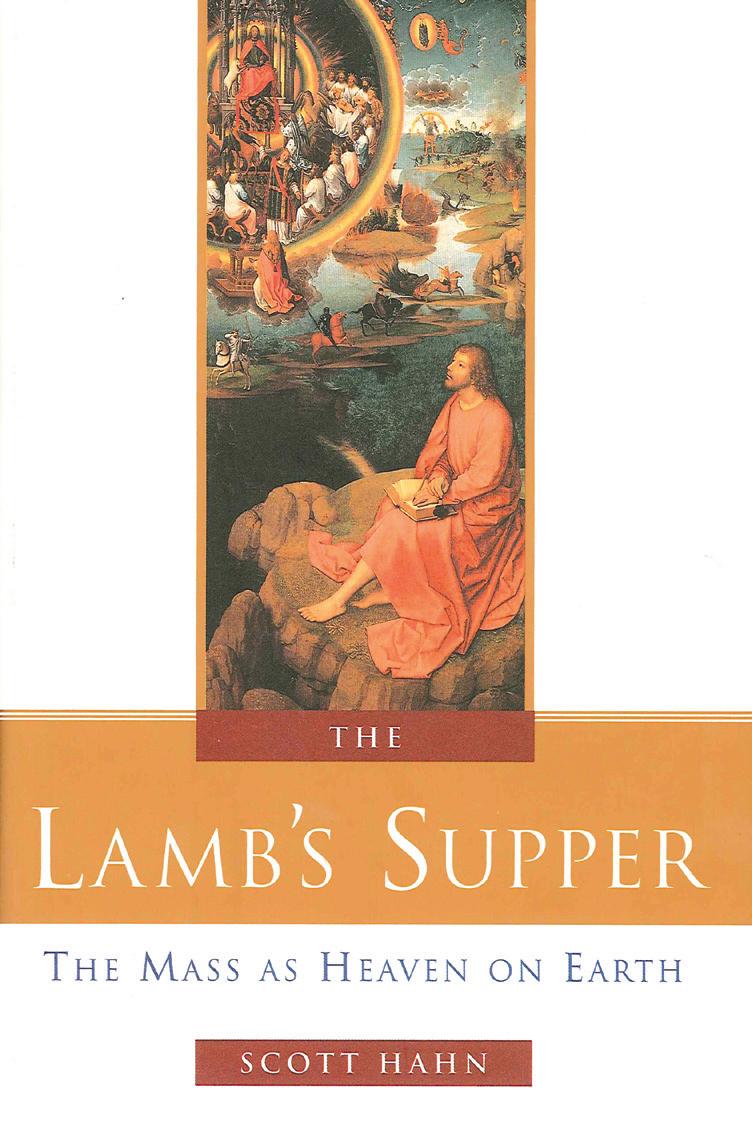
23 Recent Pope, affectionately
24 Apostles’ or Nicene
26 Chief apostle
28 Visible appearance of God
32 Teresa of Avila’s
to Jacob
19 God’s life in us
21 “…thy will be done on ___”
25 Early landing place
27 Donate a portion of money to church
29 City that was the home of Abram
30 Archdiocese in Nebraska
31 Dinah, to Esau
32 OT prophetic book
34 Heroic St Bernard animal
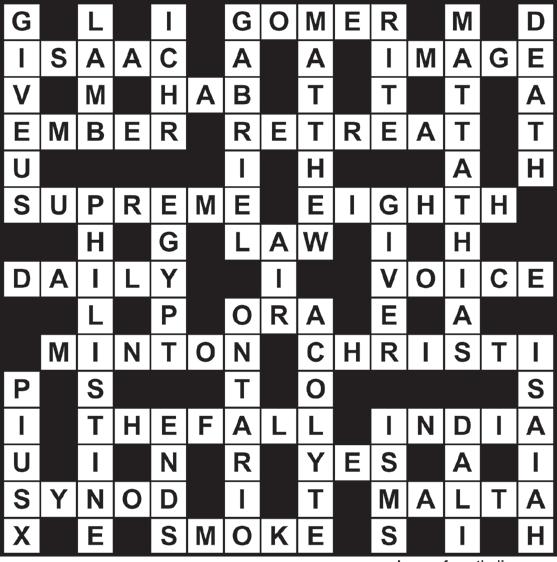
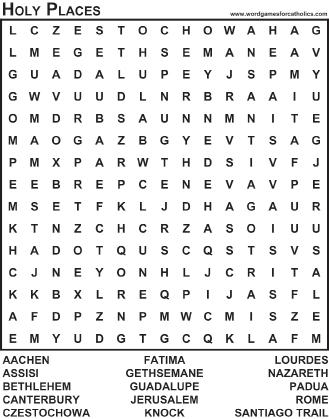
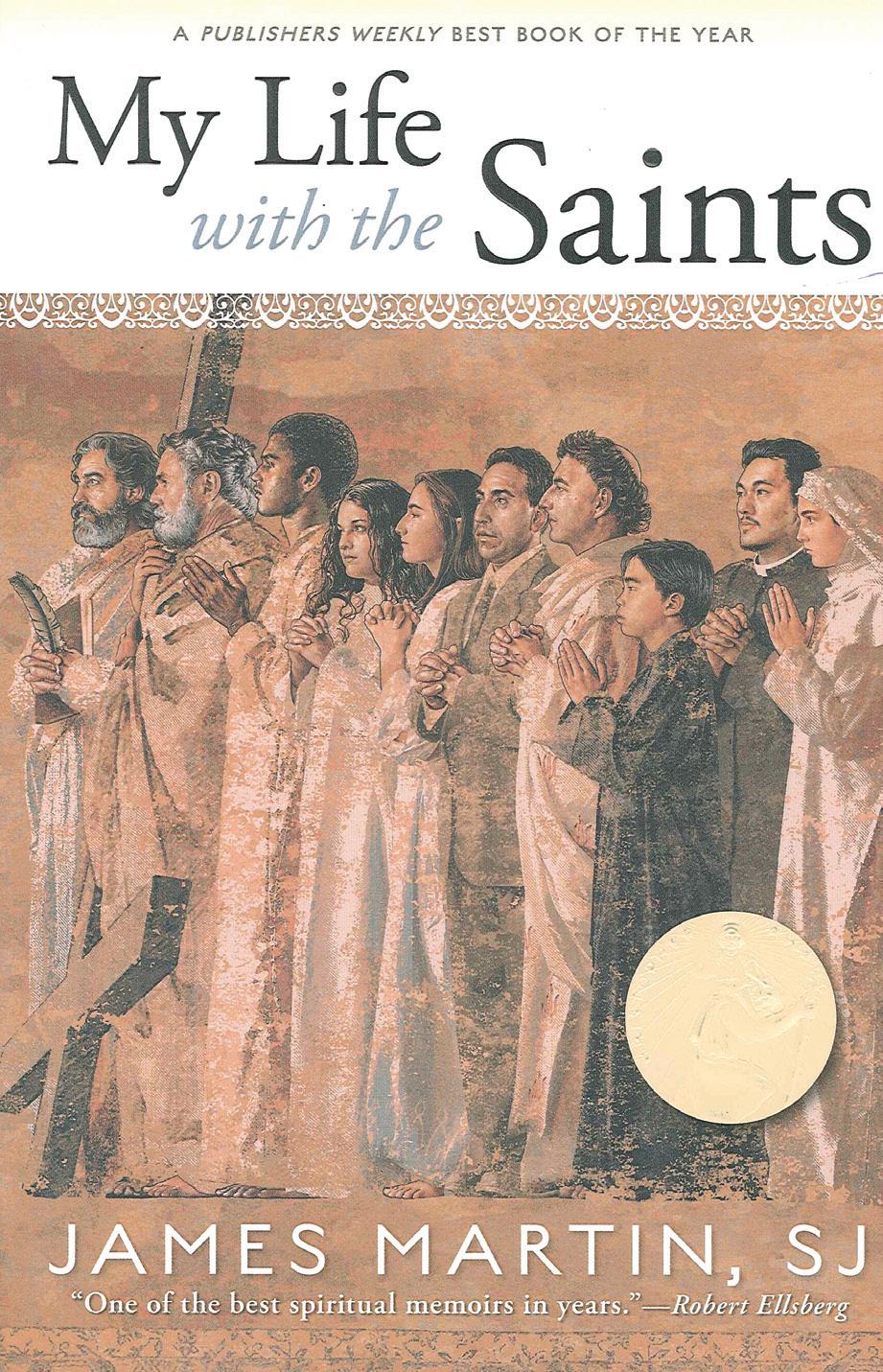
RRP $24
In an inspiring memoir, the author of In Good Company pays homage to the Catholic saints, from St Peter to Pope John XXIII, who accompanied him every step of the way and changed his life.
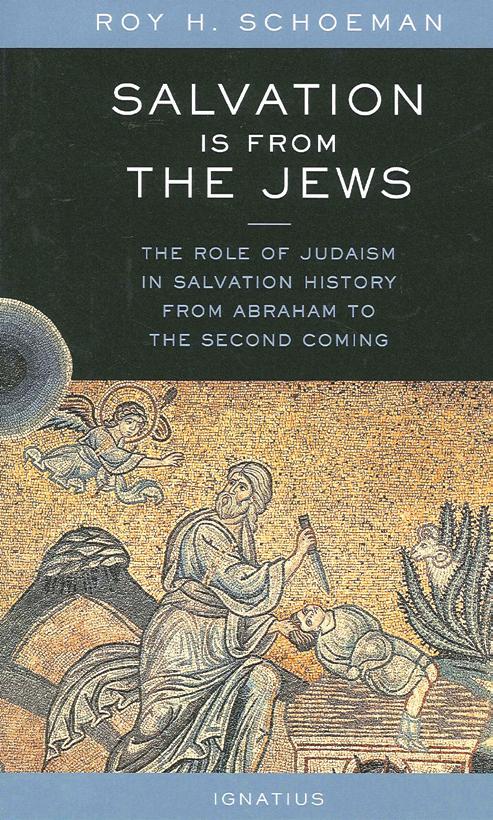
The Role of Judaism in Salvation History from Abraham to the Second Coming
Roy H Schoeman
RRP $26
This book traces the role of Judaism and the Jewish people in God’s plan for the salvation of mankind, from Abraham through the Second Coming, as revealed by the Catholic faith and by a thoughtful examination of history. It will give Christians a deeper understanding of Judaism, both as a religion in itself and as a central component of Christian salvation. To Jews it reveals the incomprehensible importance, nobility and glory that Judaism most truly has.
Translated and Edited by E Allison Peers
RRP $20
Although St Teresa of Avila lived and wrote almost four centuries ago, her superbly inspiring classic on the practice of prayer is as fresh and meaningful today as it was when she first wrote it. The Way of Perfection is a practical guide to prayer, setting forth the saint’s counsels and directives for the attainment of spiritual perfection. Through the entire work there runs the author’s desire to teach a deep and lasting love of prayer beginning with a treatment of the three essentials of the prayer-filled life: fraternal love, detachment from created things, and true humility.
Women in the Priesthood? is a book that should become the standard reference in the debate about women’s ordination. The author cites copiously from American as well as European sources and presents the feminist position in the words and categories of the leading feminist authors. But, for the first time, the whole question is placed in the comprehensive context of anthropology, biology, psychology, philosophy, and theology. Women in the Priesthood? is a balanced presentation of the profound consistency of the Catholic Church’s teaching and practice concerning the role of women in the Church and in society. Written in a scholarly but very readable manner.
Email: bookshop@therecord.com.au