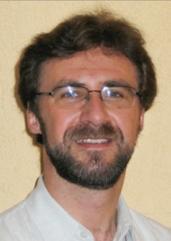
Tim Cannon
Why marriage is a STRAIGHT THING Page 10


Why marriage is a STRAIGHT THING Page 10
Discourse, controversy, comes with the territory of academic freedom, UNDA academics say as they reject efforts to shut down prominent climate sceptic’s lecture
BY ANTHONY BARICHTHE University of Notre Dame Australia’s reputation as a credible academic institution was not tarnished but strengthened by hosting controversial climate sceptic Lord Christopher Monckton on 30 June in Fremantle, University organisers said.
The university “came under quite a bit of pressure internally and externally to cancel the event”, UNDA College of Business Executive Dean Prof Chris Doepel, who organised the event, told The Record
He said the event has not damaged UNDA: “in fact, many people have perceived our independence as being a very strong virtue … that we have in fact allowed someone with a contrarian point of view to be heard and be questioned”.
This pressure included an open letter signed by 50 academics organised by University of WA post-graduate student Natalie Latter accusing Lord Monckton of promoting “widely discredited fictions about climate change”.
While it also accused him of distorting the research of “countless scientists”, Lord Monckton made his own allegations against scientific authorities.
“Each of us has the responsibility of coming to our own conclusions after absorbing knowledge from all reliable sources,” Mannkal Economics Foundation chairman Ron Manners, who gave the vote of thanks after Lord Monckton’s address, said.
“(Lord Monckton’s) reflections should enable us to skip past the ‘deafening daily static’ from so many vested interests”.
Lord Monckton told over 200 guests at UNDA that the Intergovernmental Panel on Climate Change changed its 2001 recommendation that “long-term predictions of future climate states is [sic] not possible” to “the body of evidence points to global warming” due to one man rewriting the original report, which was in consultation
Please turn to Page 7
Editorial - Page 8





PRAYER and practical action are being urged by parishes ahead of the Australian Bishops’ groundbreaking Social Justice Sunday Statement on Prisons and the Justice System due on 25 September.
Perth Catholic Social Justice Council (CSJC) executive officer Terry Quinn told The Record that while each state has responsibility for corrective services and the justice system, there are concerns and problems in the justice system which are common throughout Australia.
These concerns include Indigenous over-representation in prisons; high recidivism rates; prisoner health - well below the national average; the link between mental health and imprisonment and the link between alcohol and drug addiction and imprisonment.
“These are just some of the issues faced by prisoners and their families, by prison authorities and other professionals, including prison chaplains, working in the area,” said Mr Quinn, who is also a prison chaplain at Wooroloo Prison Farm. “While we do not know yet (exactly) what the Bishops will say in their statement, we do know that often the decisions of courts and prisoners’ review panels are applied most punitively
to Indigenous people, those with mental disabilities and younger offenders. I hope the statement will address these issues.
“This is the first time in many years that the Bishops have made a national statement on the state of the criminal justice system in Australia.”
Australian Catholic Bishops Conference president Archbishop Philip Wilson of Adelaide confirmed on 1 July that the Bishops’ 2011 Social Justice Sunday statement would be titled Building bridges, not walls: Prisons and he justice system
He said the statement would address five key challenges relating to the criminal justice system:
• fear campaigns about law and order;
• adequate support for people coming out of prison;
• social factors that can contribute to crime;
• the dignity of prisoners; and
• realistic alternatives to incarceration.
“No crime can diminish the fact that we are all created in the image and likeness of God,” Archbishop Wilson said.
“In our parishes and communities, let us consider how we can offer support and make a difference for our brothers and sisters in prison and seeking
bridges to a new life.” The Perth CSJC have prepared bulletin notices and suggested Prayers of the Faithful to use on the weekend Masses of the four Sunday of June, July, August and September to encourage parishioners to think and pray about prisoners, victims of crime and their families in the lead-up to the Bishops’ Statement.
The parish bulletin notices include testimonials from parents of prisoners and links to the Social Justice Sunday Statement. In cases where parishes have already prepared Prayers of the Faithful well ahead of time, parish priests and liturgy committees have been urged to consider adding additional petitions that the Perth CSJC suggested.
Broome Bishop Christopher Saunders, chair of the Australian Catholic Social Justice Council, has played a major role in the Statement and said he gained extra insight into these issues when he addressed a 29 May 2010 Law and Order Forum at the University of Notre Dame Australia in Fremantle.
Panellists at the forum, including Chief Justice Wayne Martin and Police Commissioner Karl O’Callaghan, agreed that criminal justice should lead to social justice by empowering families and communities to tailor solutions.
Keeping mental illness in prison - Page 9
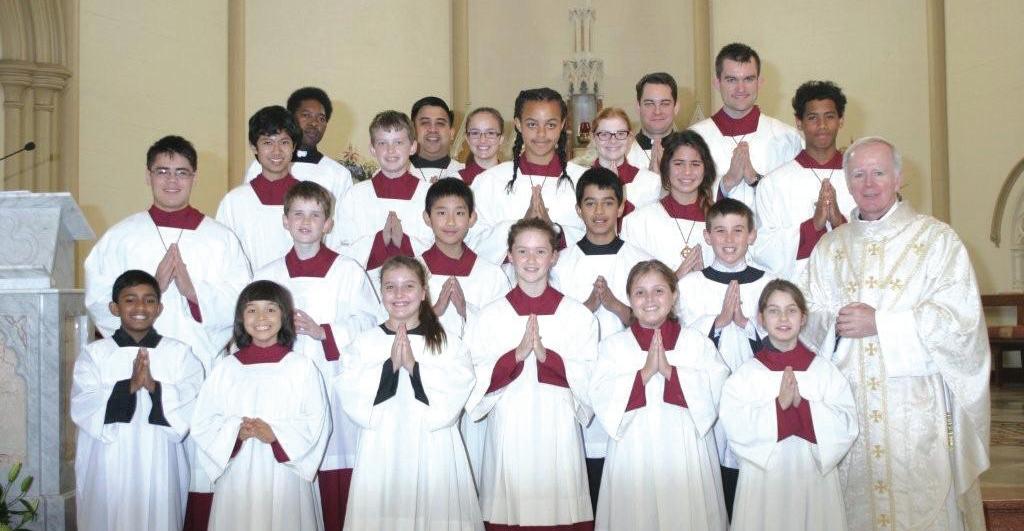
SAINT Joseph’s Parish in Subiaco re-launched the Guild of St Stephen on 26 June.
St Stephen was the first martyr of the Church and is the Patron Saint of the Guild which is set up to officially train, foster and develop altar servers and acolytes within Australia. St Joseph’s is the designated parish for the Guild in the Archdiocese and now has over 31 altar servers and 11 acolytes trained to serve the Mass and other liturgical services.
Servers play a vital role in the Catholic Liturgy and it often proves the starting point of interest for young men for the vocation of priesthood.
The Official Guild of St Stephen investiture Rite Mass was to invest the junior servers aged 13 and below into the Guild and to enrol the servers 14 and over into the Guild and present their medal.
Guild servers pledge their loyalty and devotion to the Church and commit to serving reverently and regularly as part of their role.


MC of St Joseph’s, Subiaco, Hugh Jones, said: “The attendances at Masses have been growing with the Solemn Sung Mass at 10am on Sundays attracting a very large crowd with the full quota of servers including thurifer and the beautiful Schola Cantorum Choir directed by Mr Michael Peters. We have been approached
by many schools and parishes to assist with the training of their ministers and servers in effort to correct some of the laxness that has slipped into our beautiful traditions and revive the richness of our liturgy”. Parish priest Fr Joseph Walsh said that he was “immensely proud of the Guild and the wonderful work done by the servers in the parish and hopes that the Guild will continue to grow as more and more young people become interested in the formation process offered by the association.”
These evenings will offer an opportunity to reflect on the spiritual and theological understanding of the Mass using the “Become One Body, One Spirit in Christ” DVD resource. 2 Hour workshops from 7.30PM—9.30PM
Thursday 14th July
St Mary’s Parish, Leederville
Tuesday 19th July
All Saint Parish, Greenwood
Tuesday 2nd August
Our Lady of Lourdes, Rockingham
Tuesday 16th August
Holy Name Parish, Carlisle
Tuesday 13 September
Our Lady Mt Carmel Parish, Hilton
Tuesday 11 October
Good Shepherd Parish, Lockridge
SAINT John of God Health Care has committed to creating more jobs for Indigenous Australians as part of the 50,000 Sustainable Indigenous Jobs campaign spearheaded by the Australian Employment Covenant. The programme brings Australian employers, the Australian Government and Indigenous people together in order to create real jobs, with Indigenous employees supported by pre-employment training, job placement and on-the-job mentoring.
SJOGHC will offer job opportunities to Indigenous Australians in areas including nursing, allied health and hospitality across its facilities in WA, Victoria and NSW. SJOGHC Group Chief Executive Officer Dr Michael Stanford said that by signing the covenant, the not for profit organisation was pledging to deliver Indigenous jobs in mainstream healthcare, a sector where Indigenous Australians are significantly underrepresented.
Dr Stanford said: “The Australian Employment Covenant provides St John of God Health Care with access to expertise and assistance that will help us to design and implement training and employment initiatives. We
plan initially to offer development pathways and employment to Indigenous people in areas such as enrolled nursing and patient care.”
As its workforce needs continue to grow, the organisation sees great potential to extend the number of opportunities for Indigenous Australians across a range of clinical and nonclinical roles.
Signing the Covenant strengthens SJOGHC’s existing commitment to working with Indigenous Australians; mostly through initiatives delivered by its Social Outreach and Advocacy services.
These include a laptop giving programme for first year Indigenous medical students at the University of Western Australia, and Indigenous health services including mental health programmes at Warrnambool and Murdoch, a diabetes clinic at Bendigo, a drug and alcohol service at Bunbury, and the Strong Family, Strong Culture service in northern WA, which works with Aboriginal families with children in the 0-5 age group.
St John of God Health Care’s longstanding commitment to the health and welfare of the community, in particular the Indigenous community, began in 1895 when its founders, the Sisters of SJOG, arrived in Australia. They subsequently worked in remote communities, first in the WA Goldfields and later in the Kimberley where the SJOGHC still runs services.
JULY
8-10 Centacare 25th Anniversary celebrations, Geraldton –Archbishop Hickey Parish Visitation, Corrigin/Kulin – Bishop Sproxton
11 Mass, Pregnancy Assistance – Archbishop Hickey Fundraising Gala Dinner for Life – Archbishop Hickey
12 Pastoral Visit, Djooraminda – Archbishop Hickey
14 Visit Redemptoris Mater Seminary – Archbishop Hickey
16 Mass, Carmelite Monastery – Archbishop Hickey
17 Mass, St Mary’s Cathedral, 11.00am – Archbishop Hickey
19 Opening and Blessing at Jeremiah Donovan House –Archbishop Hickey

 BY ANTHONY BARICH
THE Malaysian Singaporean Catholic Community of Australia (MSCCA) is helping activate Archbishop Barry Hickey’s vision of the Church to be more akin to the original Christian communities in Rome.
The Archbishop said he “completely endorsed” the aims and objectives, all past, present and future events that the MSCCA would organise with the aim of continuously sponsoring youth, particularly Malaysian/Singaporean youth and the underprivileged to attend and participate in World Youth Days, including next month’s in Madrid, Spain.
He told the gathering - including people from Albany, Narrogin, Bunbury, Mandurah and Katanning – that the MSCCA’s vision of supporting people in need is “fundamental” to the Church’s essential calling.
Inspired by the vision of Fr Roy Pereira, the MSCCA evolved from the sole focus on youth to a broader vision of deepening, strengthening and nourishing the Catholic faith within and amongst the MalaysiaSingaporean community.
“I have a vision of the early Christian communities in Roman cities, made up of all kinds of peo-
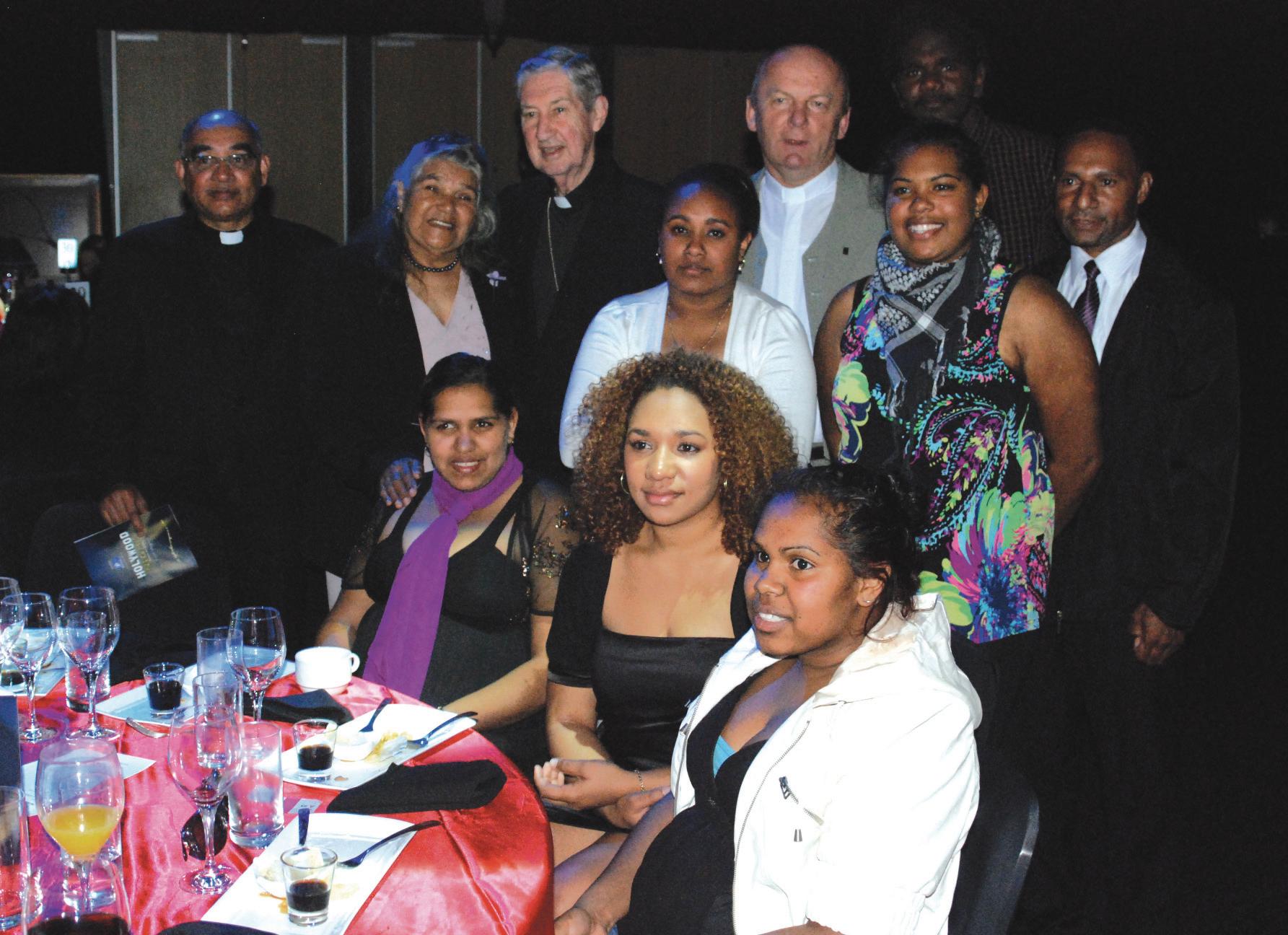
ple – Greeks, Jews, slaves and travellers – held together by Christ with a common principle of loving one another, ensuring nobody in their community was left lonely or suffering,” Archbishop Hickey told 320 people at a 2 July “Holywood Night” fundraiser at the Perth Convention Centre.
While not-for-profit agencies supported by the Catholic Church often depend on government funding, the Archbishop said that the ideal vision of the Church is to form communities where its members have the conviction that, as a family, nobody is left out or suffers.
This vision, he said, is the practical manifestation of Christ’s “challenging” command to “love one another”. “In rubbish dumps around the world, there are Christians who befriend people, preserve their dignity and find help. The Christian tradition is therefore alive and well in the world today,” he said.
The spirit to do this comes from Christ, he said, as His command was that, “whatever you do for the least of these, you do it to Me”.
“When we contemplate this command, we have no alternative but to be active and do something,” the Archbishop said.
“Fr Roy is doing that by building resources to help underprivileged people.”
Also present at the fundraiser were members of the Archdiocesan Daydawn Advocacy Centre, an agency named after a small “ghost town” near Mount Magnet that used to be a thriving gold mining centre. The Archbishop said the creation of Daydawn was the result of his concern for Indigenous Australians in the city of Perth, adding that the agency has had “enormous success” in “battling against huge bureaucratic difficulties”.
Daydawn is an initiative on behalf of Indigenous people, especially Nyoongar people of southwest WA, whose rights and legitimate aspirations are often difficult to attain. It is an act of solidarity for those who suffer disadvantage or rejection. The Centre also promotes the full inclusion of Aboriginal people in the life, worship, education and spirit-filled community of the Church at every level. In this, it works closely with the Catholic Aboriginal Ministry.
Fr Roy said the MSCCA’s ministry for youth and the disadvantaged is often “difficult, tedious and time constraining”, but “God has not finished with us yet”. “How can we sleep at night knowing that children are going hungry on the street? It’s a continuous challenge to give children a chance, to do something for humanity,” Fr Roy said.



PERTH Catholic Sudanese refugees displaced by a 55-year civil war that has claimed about 2.2 million lives prayed at a 3 July Mass for a peaceful future for their homeland ahead of Southern Sudan’s 9 July independence.
War has been ongoing in the oil-rich country since 1954 between Muslims in the north, who have been in power, and Christians and other traditional religions from the region in the south.
While sporadic conflicts began soon after residents of Southern Sudan voted overwhelmingly to secede from Sudan in a January referendum, the violence intensified in May this year as government troops from the North sought to control key areas in South Kordofan, which borders the oilrich states of Unity and Upper Nile.
The most recent government violence has targeted the Nuba people around Kadugli, the South Kordofan capital, with witnesses reporting Sudanese troops going door-to-door to hunt down the opposition.
Attacks in May centred on Abyei, farther to the south, near the undefined border. Abyei is home primarily to members of the Dinka Ngok tribe, supporters of the government of Southern Sudan.
Salesian Fr Albert Saminedi, chaplain to Perth’s African-born Catholic community who worked in Sudan for nine years, told The Record that the 9 July independence will be according to a boundary line drawn up in 1960, but authorities from the north want the line changed to include the oil-rich areas.
The war, which has claimed 10 times more lives than the nearby Darfur conflict, has forced over 40,000 refugees to flee to Australia through refugee camps in nearby
Egypt, Uganda, Kenya and Ethiopia, Fr Saminedi said.
In Perth, Catholic Sudanese refugees gather for Mass and fraternity weekly at St Bakhita’s Church in Westminster, named after a slave kidnapped at age seven and resold several times, finally in 1883 to Callisto Legnani, the Italian consul in Khartoum, the Sudan capital located in the north.
Perth’s Sudanese Catholics will gather again with other Sudanese in Mirrabooka on 9 July to celebrate the birth of a new nation that locals call “The New Sudan”, Fr Saminedi told The Record
The Catholic Church is very active in South Sudan, but has been heavily persecuted, with very few Christians in the north, he said.
“Christian missionaries have been expelled from Southern Sudan a number of times, and the Catholic Church, during this time of conflict, is very close to the people, taking care of their education and healthcare by the missionaries,” said Fr Saminedi, who organised the building of 11 schools and five churches in his nine years as a missionary in Wau, a city in Southern Sudan on the western bank of the Jur River.
On 3 July, Perth Sudanese Catholics prayed for the birth of the nation and that conflict in various parts end, “so the people may rejoice and the new nation will live in harmony and peace”, said Fr Saminedi.
The Salesian priest worked for nearly 20 years as a missionary in Egypt, Kenya, Tanzania and Sudan.
He was in Egypt in March during the Arab uprisings.
“We ask the faithful to pray for these people, that they may truly experience peace and joy, and that they may unite themselves and build a new nation together, putting aside their differences,” said Fr Saminedi, who is also parish priest at Our Lady of Mercy Parish in Girrawheen.
- additional reporting by CNS



Friday 15 July | 2pm

RESPIGHI
Paul
BOOK


THE celebration of the feast of the Holy Trinity at St Mary’s Church in Kalgoorlie took on extra meaning on 19 June when 16 young children from the parish and State schools who have been attending classes conducted by the Missionary Sisters of Charity for the “After School Catechism Programme,” received Jesus for the first time in the Sacrament of the Holy Communion.
This moving spiritual Mass was celebrated by Fr Anand Reedy at the 10am parish Mass.
The parents and friends joined in together with the children to celebrate this special day in their Christian lives, which continued after the Mass in St Mary’s Parish Centre, where a special large morning tea was held with many varied foods were on offer.
On the same morning, Fr Daniel Boyd travelled to Kambalda to celebrate the Feast of the Holy Trinity with the faithful in that town.
On the following Sunday, 26 June, 29 Year 4 students from St Mary’s Primary Catholic School in Kalgoorlie also received Jesus for the first time in the Sacrament of Holy Communion, which was conducted by Fr Anand during the beautiful 10am Mass at St Mary’s Church in Kalgoorlie on the feast of Corpus Christi.
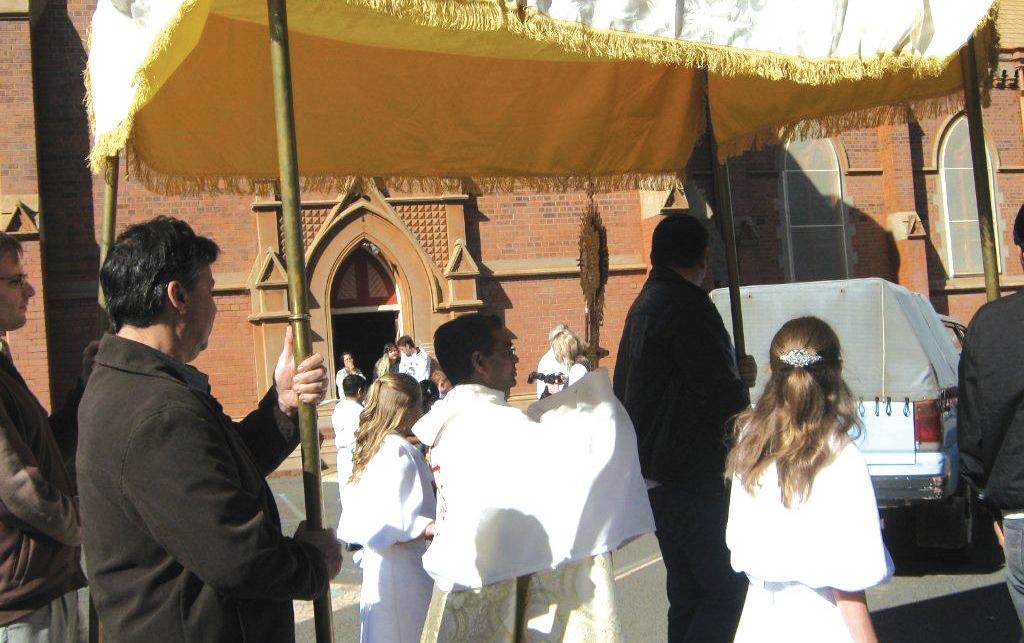
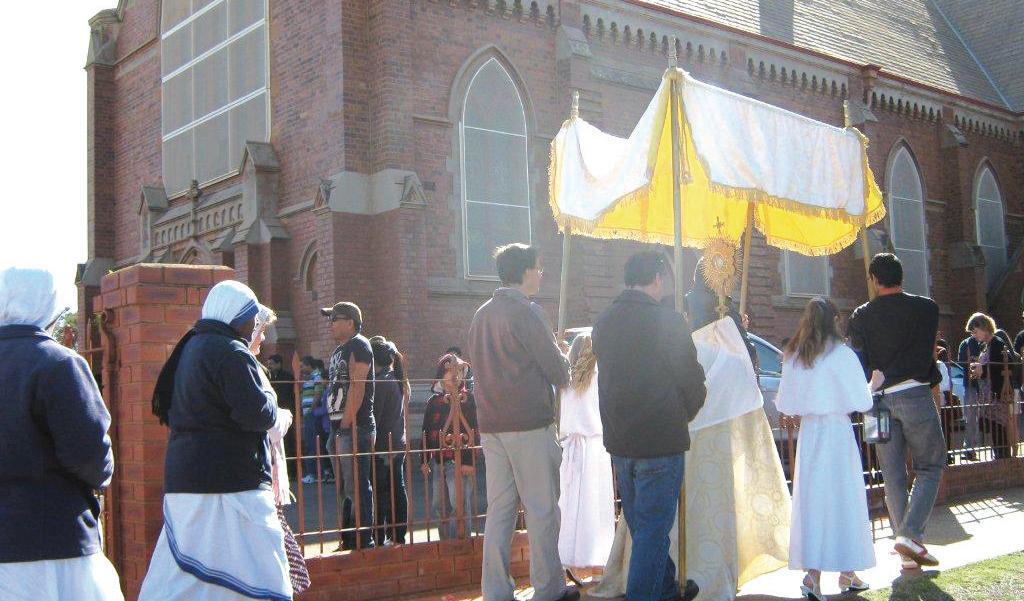
At the conclusion of Mass, the congregation joined in with Fr Anand in a moving Corpus Christi procession around the church carrying Our Lord in the Monstrance.
These Corpus Christi processions since Vatican II are not so often celebrated as before in the life of the Catholic Church.
Celebrations for the 29 children and their parents and friends continued after the Corpus Christi procession in St Mary’s Parish
Centre, where another special morning tea was held with delicious varied eats on the table for the faithful to eat.
For the town of Norseman, the feast of Corpus Christi was one special day in the year for the town, when about 40 parishioners from Kalgoorlie, Boulder, Kambalda and Coolgardie travelled with Fr Daniel to celebrate an annual Mass and barbeque with the parishioners in the southern parish town.
This annual get together, held on one day in the year for each of the outlying towns of the parish, helps to bring together the scattered members of the large parish for crucial support and a good yarn.
Fr Daniel had earlier celebrated the 9am Mass in Kambalda before arriving in Norseman for the special 11.30am Mass and barbeque.
Once again, great celebrations were held on the following Sunday at the 5.30pm parish Mass at All Hallows Church in Boulder on 3 July, where 14 students from St Joseph’s Catholic Primary School in Boulder also received Our Lord for the first time in the Sacrament of Holy Communion during a beautiful spiritual Mass celebrated by Fr Daniel.
All Hallows Church was filled to capacity for this occasion with parents and friends attending to help celebrate with the children this special day in their lives.
This celebration continued at the conclusion of Mass in All Hallows Church Parish Centre with a large amount of assorted eats there to be consumed.
Fr Anand had earlier in the day travelled to Kambalda to celebrate the 9am Mass in that town for the faithful.
Special mention should be given the priests, Sisters and the school staff for preparing the children for the special day in their Christian life; while the people who prepared all the food and the special three large cakes that were made for each of the three celebrations also made significant contributions.
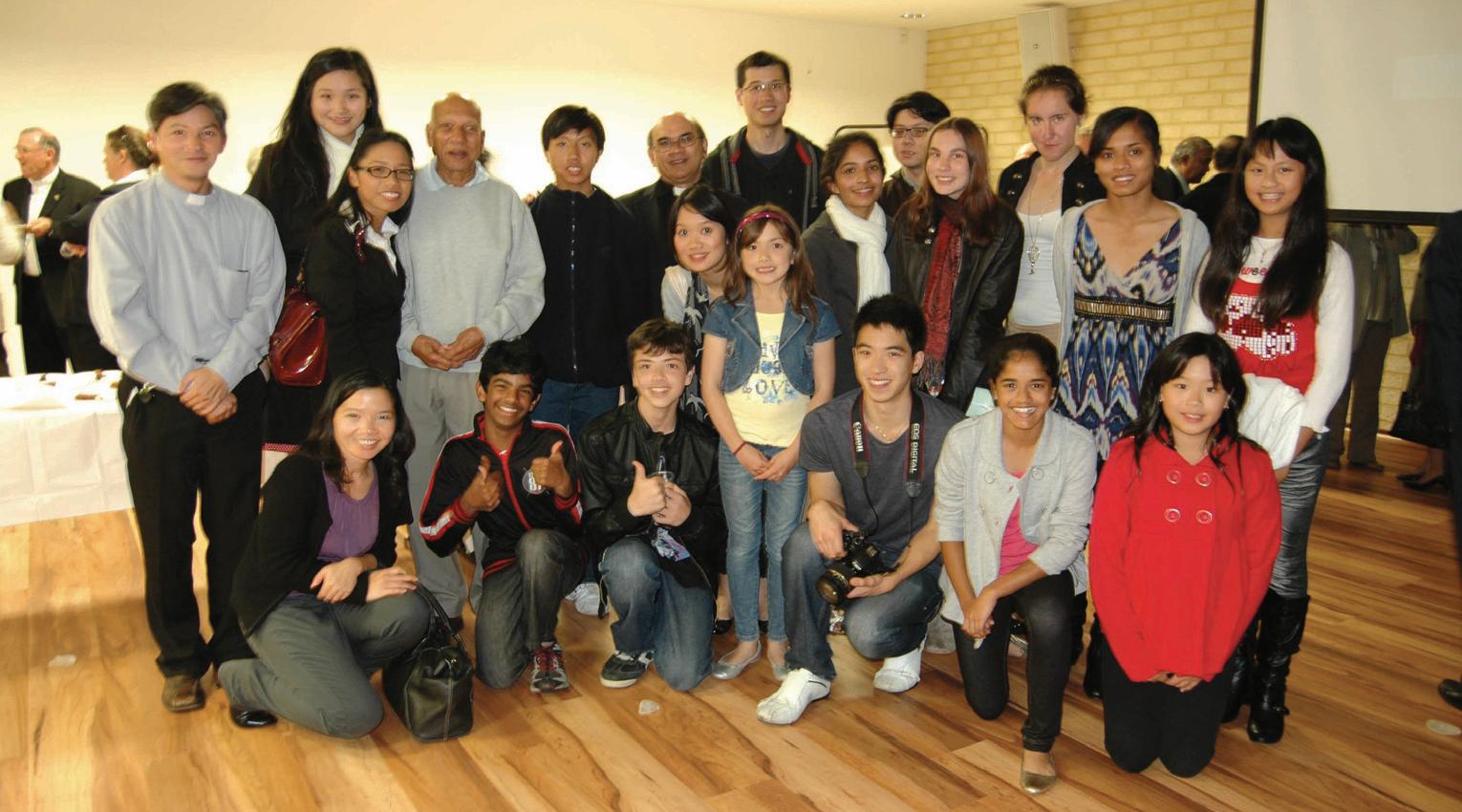
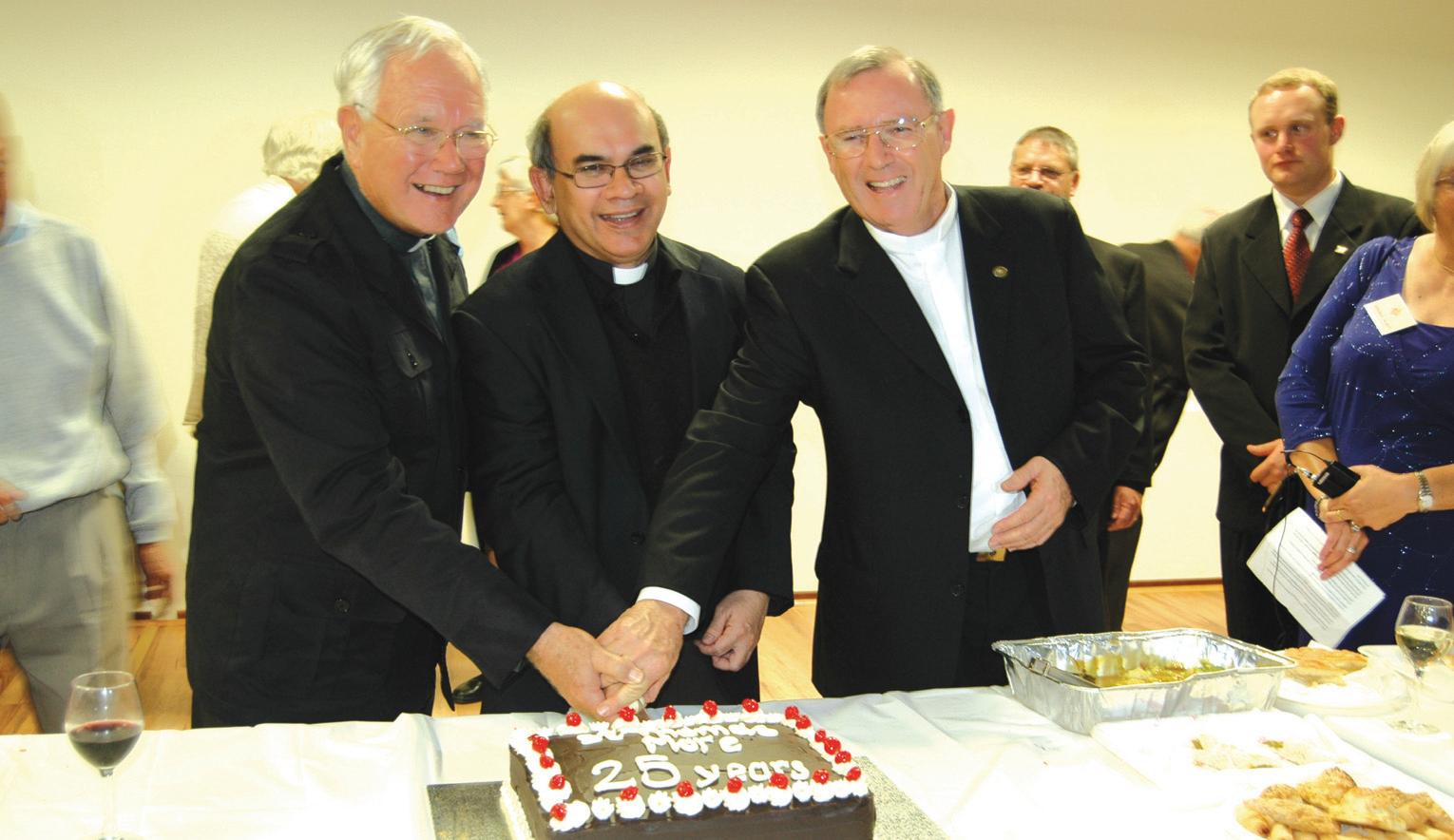
THE Catholic Parish of Bateman celebrated its 25th Jubilee on 22 June with Mass followed by supper – the date marking the beginning of the parish and the feast day of its patron, English martyr St Thomas More.
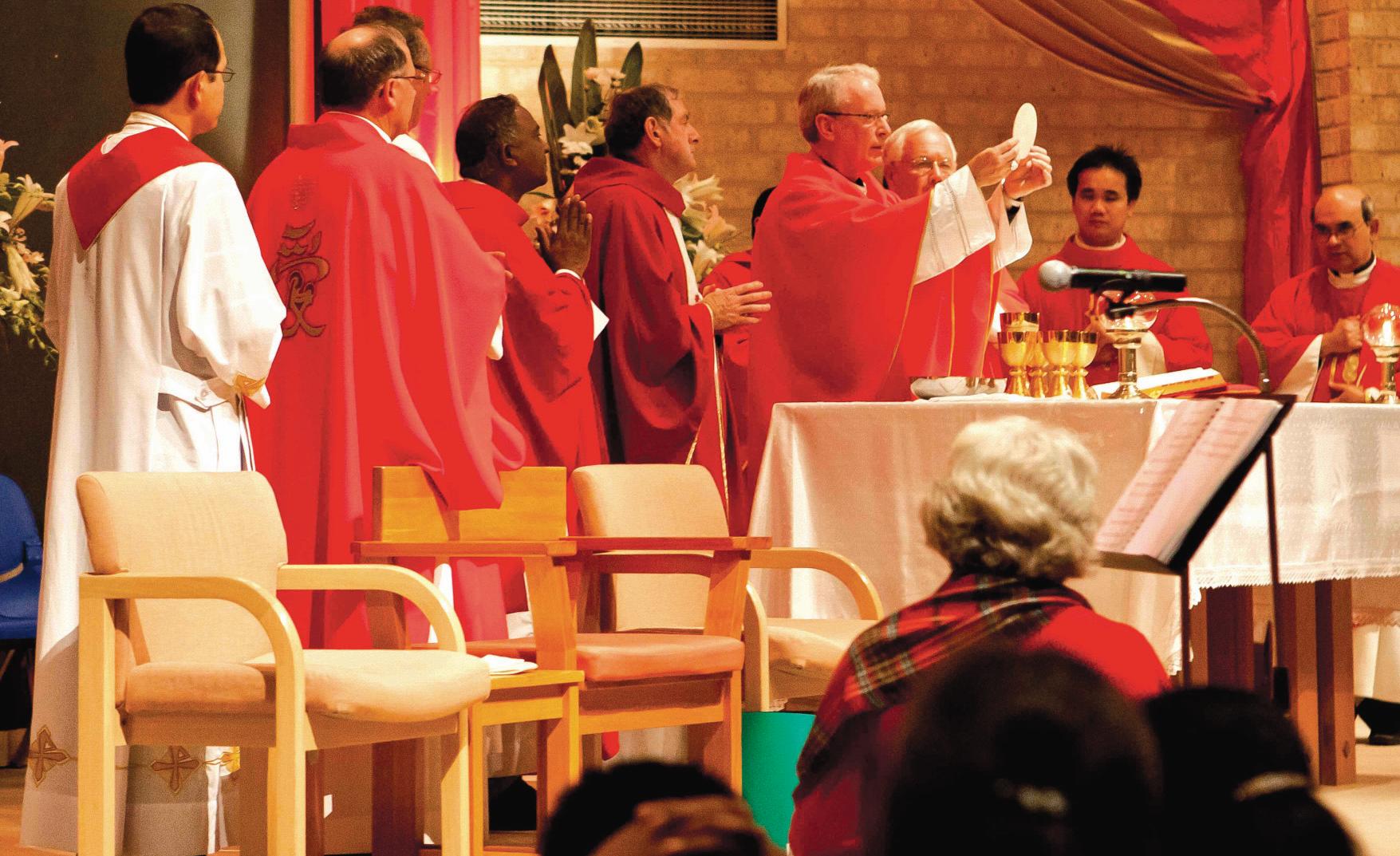
Auxiliary Bishop Donald Sproxton concelebrated the Mass with current parish priest, Fr Philip Perreau, Applecross parish priest and former Bateman parish priest who built the church, Fr Peter Whitely, and St Mary’s Cathedral Dean and former Bateman parish priest, Mgr Michael Keating.
Seven other priests who were either past assistant priests or had supported the parish in many of its past Sacramental celebrations also concelebrated for over 450 parishioners.
Bishop Sproxton spoke about the love St Thomas More had for the Church. His love was so great, Bishop Sproxton said, that the saint could recognise the need for reform
in the Church. The 25th Jubilee was also an opportunity to recognise and celebrate the growth of the community.
Before Mass, paintings of the Yidarra Catholic Primary School students depicting their thoughts on the parish were presented on a PowerPoint. At the supper, a PowerPoint presentation of the life of the parish was also screened. Fr Whitely, Mgr Keating and Sr Maura Kelleher, the first Principal of Yidarra Catholic Primary School, also reminisced about their time in the parish.
To mark the Jubilee, a logo was designed by Peter Grainger, a past parishioner with his own graphic design business. A prayer was also composed by Geneve Cornejo.
The celebrations will continue throughout the year with a formal dinner, a multicultural night, bush dance and a gathering of past and present Catholics who have journeyed through the RCIA (Rite of Christian Initiation for Adults) programme.
“All this reminds us that there is so much to give thanks for and celebrate,” a parish statement said regarding the occasion.

 BY ANTHONY BARICH
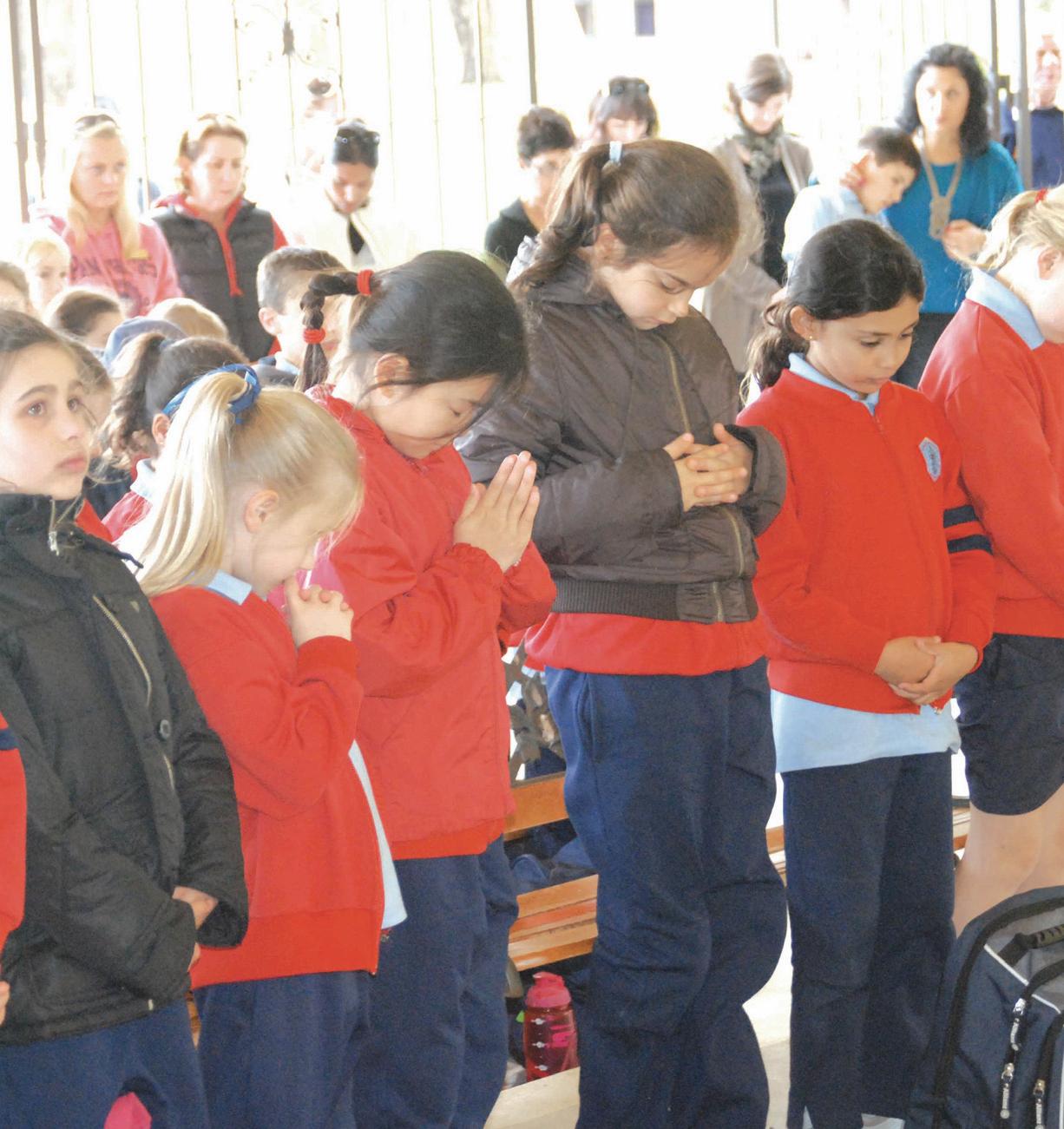
THE entire St Paul’s Catholic Primary School in Mt Lawley experienced a major catechesis on God’s love and on Catholic devotion to Mary with a trip to Our Lady’s Shrine Church in Bullsbrook on 29 June.
Over 200 students, from preprimary to Year 6, attended Mass and prayed a decade of the Rosary.
The day was planned by Mt Lawley Parish Priest Fr Tim Deeter to celebrate the feast of Sts Peter and Paul (last year the whole school visited the newly completed St Mary’s Cathedral for the occasion).
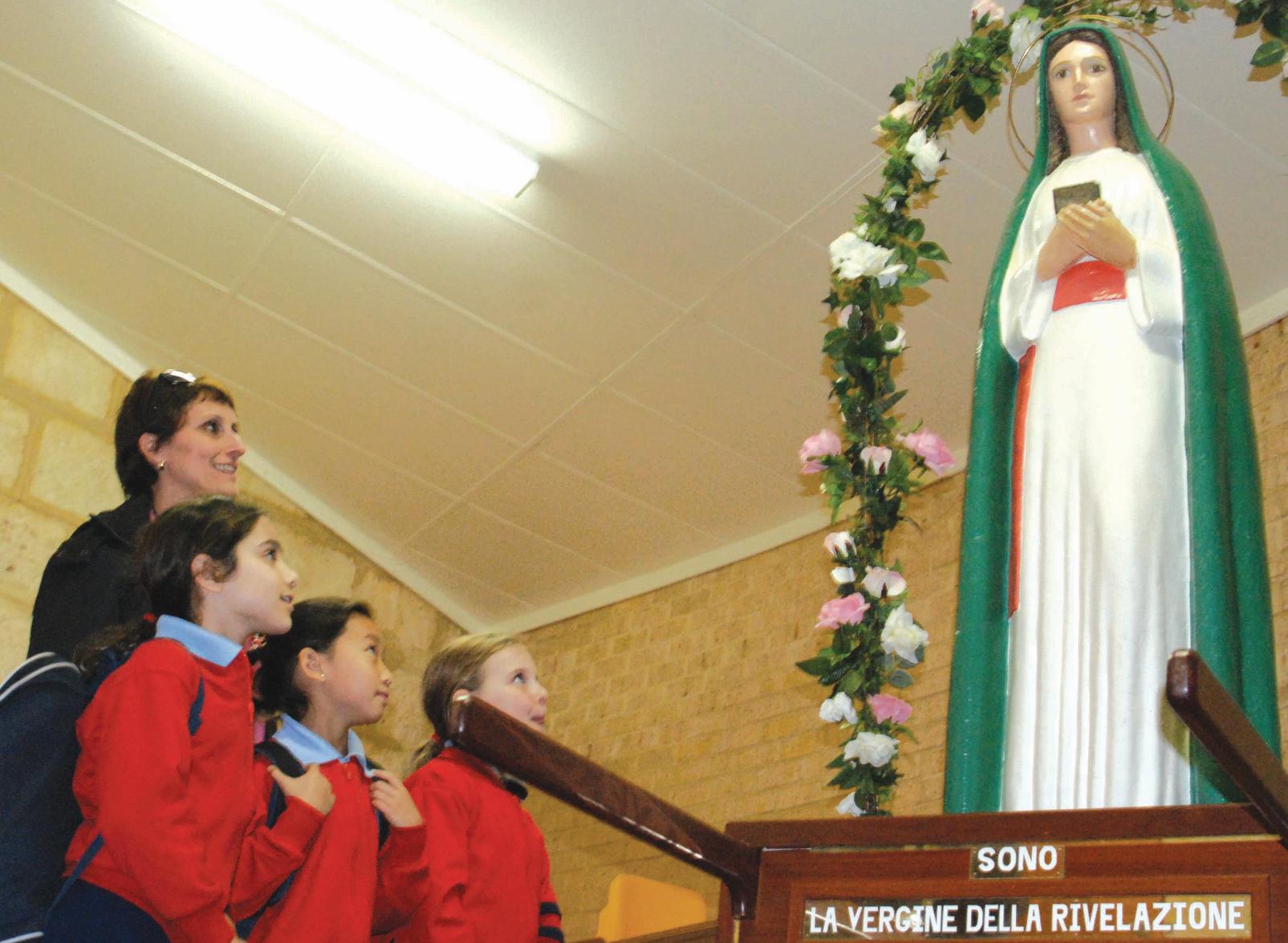
Students also heard talks and viewed the museum that told the story of sceptical Catholic Bruno Cornacchiola who had a vision of the Virgin of the Revelation at Tre Fontane, Rome on 12 April 1947.
Bruno founded SACRI, an association of Christ’s lay faithful which owns the church and shrine at Bullsbrook that was established and dedicated to ‘Mary, Mother of the Church’ in 1987 by Archbishop William Foley.
St Paul’s Deputy Principal Sandra Peterson told The Record that the SACRI Association members were
2 Hour workshops from 7.30PM—9.30PM
These evenings are designed for those who wish to work with the new resource “Become, One Body, One Spirit in Christ” DVD for the purpose of workshopping groups in parishes or church organisations.
Tuesday 5th July
Infant Jesus Parish, Morley
Wednesday 20th July
St Thomas More Parish, Bateman
Thursday 4th August
Our Lady of Lourdes Parish, Rockingham
Wednesday 17th August
Our Lady of the Mission Parish, Whitfords
Wednesday 14th September
St Brigid Parish, Midland
Wednesday 12th October
Infant Jesus Parish, Morley
ALL WELCOME Registra on is ESSENTIAL
Registra on Form
Centre for Liturgy
28 Marda Way, Nollamara WA 6061
T: 9207 3350 F: 9349 0362 E: liturgy.centre@perthcatholic.org.au
Name ___________________________________________Telephone ________________
Parish _________________________________________Date A ending ______________
Number A ending __________ Train the Trainer
“extremely welcoming” and had planned the day with Fr Deeter to ensure the students enjoyed themselves while being well catechised. SACRI Association member Carl Lombardo said the visit of a school to the shrine was a rarity, and encouraged other schools to do so.
Fr Deeter told The Record that a visit like this one was important as it could help give the students and teachers – and also the 50 parents who attended on the day – a “good foundation in their faith.” The visit increased their awareness of various shrines around their own Archdiocese that are “expressions of our faith,” Fr Deeter said, telling how God has intervened in the lives of real people.
Cornacchiola, a baptised Catholic, initially hated the Church after being convinced by a Lutheran man that the Catholic Church was the source of all the world’s evils. He vowed to kill the Pope, even buying a dagger to carry out his intention.
Cornacchiola married a devout Catholic woman, Yolanda, whom he often beat. He demanded that she leave the Church and join his Protestant sect. She agreed to do so only on the condition that he first attend Mass with her on nine consecutive First Fridays. At the conclusion of the nine months, Cornacchiola was still determined on his path, and Yolanda reluctantly joined him.
One day, while he was preparing an anti-Church, anti-Mary speech, Bruno took his children to the Cistercian Abbey grounds at Tre Fontane in Rome. The abbey sold excellent chocolates which Bruno bought for his children. But Tre Fontane is also the place where St Paul was beheaded for the Faith. Bruno sat and wrote notes for his speech while his children played ball. He heard his children cry out that they had lost their ball which had rolled into a cave. Gianfranco, one of the children, ran into the cave; when he didn’t return, Bruno went in after him.
He found Gianfranco kneeling, transfixed by something Bruno could not see. The boy kept repeating, ‘O beautiful lady! O beautiful lady!’ Soon all three of Bruno’s children were kneeling in awe, but Bruno still saw nothing. He cried out, ‘God, help us!’ and then felt two hands that reached out and touched his eyes. He experienced some pain as light filled his eyes, and then he saw before him Our Lady.
Fr Deeter pointed out that this incident is reminiscent of the conversion experience of St Paul, the school’s patron, who was also struck blind by Christ when he was persecuting the Church, just as Bruno
was. Both St Paul and Bruno were led ‘out of darkness into light’ – the school motto.
Bruno saw this glorious woman wearing a green mantle over a white dress with a rose sash tied at her waist. He was told that his wife’s persuading him to observe the nine First Fridays had saved him. Then he was told to approach every priest in Rome and ask him for help, until one would reply, ‘Ave, Maria! My son, what can I do for you?” That priest would take him to see the Pope and tell him about his experience.
Bruno faithfully spoke to various priests over the next two years, until one finally gave the response Our Lady had predicted. This priest took Bruno to the Vatican, where Pope Pius XII was praying the Rosary each week with select groups of the faithful in anticipation of his declaration the following year, 1950, of the dogma of Mary’s Assumption into Heaven. Bruno confessed his apostasy from the faith and his intention to murder the Pope, who forgave Bruno and eventually approved the apparitions at Tre Fontane.
Fr Deeter told the students that both Yolanda and Bruno needed great patience, as Bruno was not immediately converted on observing the nine First Fridays. Bruno had to wait two years for Mary’s prediction to be fulfilled.
This teaches an important lesson, Fr Deeter said – that God answers prayers at exactly the right time, the time He knows is best, not when we think it’s the right time. “God loves us, and He wants us to be patient and put our trust in Him,” he told the gathering.
Before praying the first Joyful Mystery of the Rosary, the Annunciation, he also urged the students to pray not for material goods but for something to help them be better boys and girls, and for the parents and teachers to pray for graces in their lives, especially for their marriages and families.
For the past two years, St Paul’s Primary School has prayed the Rosary as a community each day in May and October – the months commonly dedicated to Mary. They attend Mass every Thursday morning, celebrate the Sacrament of Reconciliation several times a year, and pray the Stations of the Cross during Lent. As a result, the children are very familiar with Catholic liturgy and devotions, and more and more parents are bringing their children to weekend Masses. Half of St Paul’s parishioners are under the age of 18, and more than half the registered parishioners attend Mass every weekend – a very high statistic in modern Australia, Fr Deeter said.
St Paul’s Catholic Primary School assistant principal Sandra Peterson with eight year old students Jacinta Scerri, Aceeta Phan and Emma Maughan.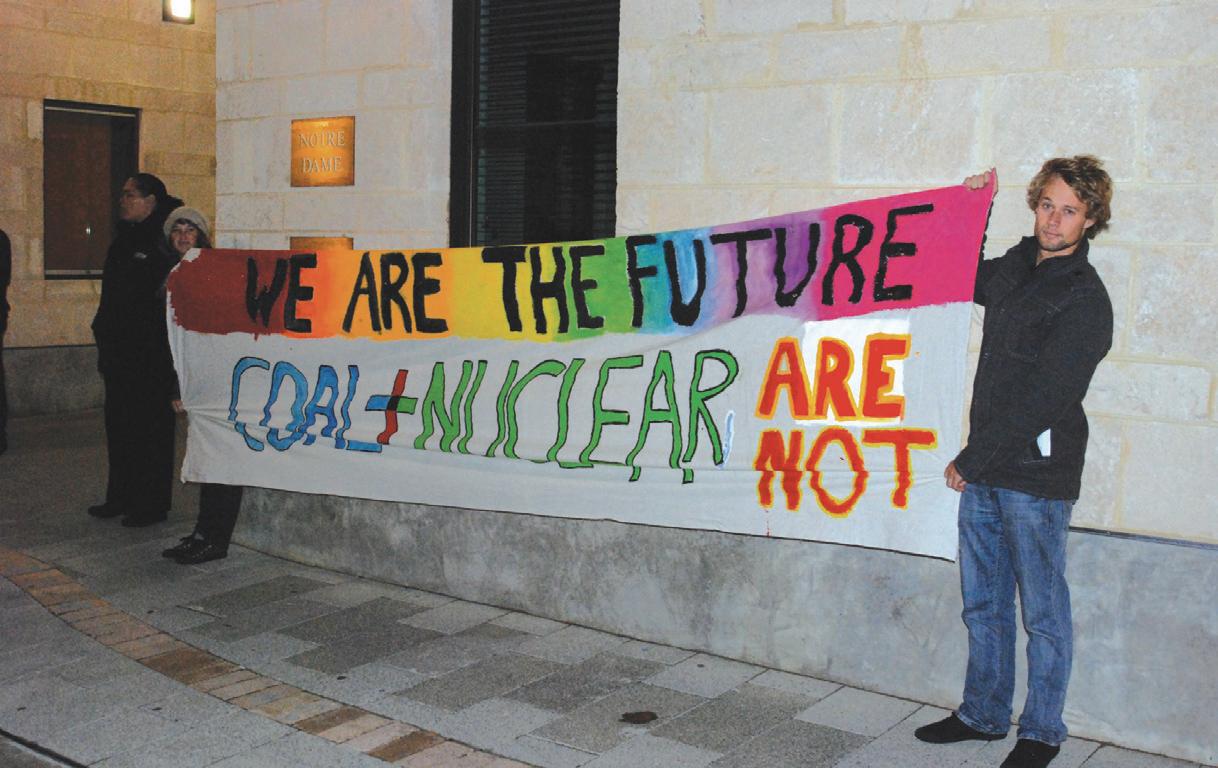
Continued from Page 1
with some 200 scientists. UNDA Vice Chancellor Celia Hammond said the university hosted Lord Monckton, a former adviser to British Prime Minister Margaret Thatcher, in fidelity to Pope John Paul II’s Apostolic Constitution on Catholic Universities to be “immersed in human society” and not shirk difficult issues.
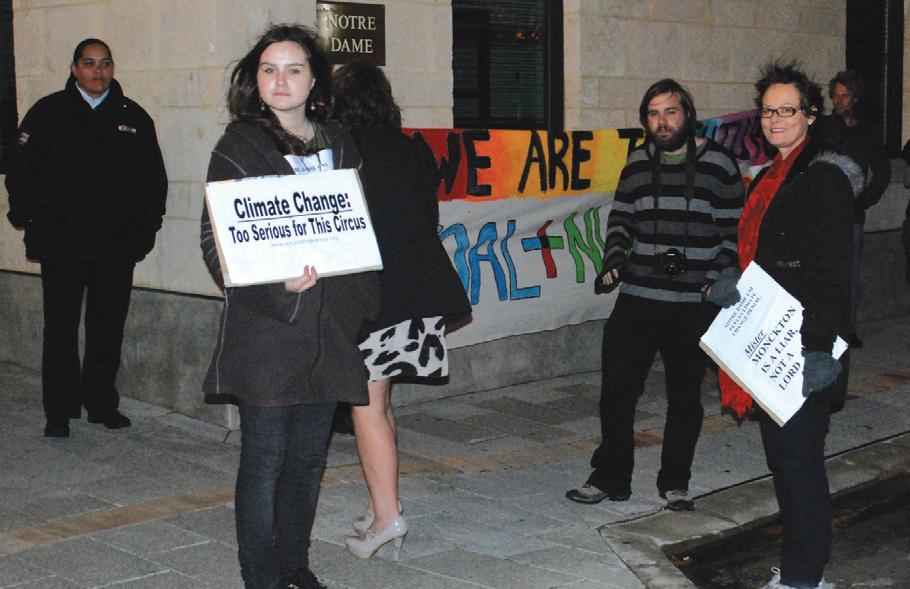
About 20 student-aged protesters held banners outside the building chanting, “Lord Monckton is a hoax, climate change is no joke” every so often, but stopped soon after the address started.
When the late mining magnate Lang Hancock’s daughter Gina Rinehart - who has sponsored the Lang Hancock Lecture series –asked Prof Hammond to host Lord Monckton, UNDA also planned to host a prominent Australian speaker who opposes Lord Monckton’s views in late September. This speaker, yet to be announced, will discuss public policy in response to climate science.
In October, UNDA will host a seminar on the theological and spiritual aspects on the theme of humanity’s responsibility of stewardship of the earth.
Prof Doepel told The Record that the university had a right to “challenge the consensus view” on climate change by hosting Lord Monckton.
“He does express a contrarian point of view and we are not frightened to allow a contrarian point of view to be presented. There were some highly qualified people here who took issue to some of his assumptions and mathematical modelling – and that’s exactly what I expected would happen,” Prof Doepel said.
“We let him have the podium and let him be challenged by people who would inevitably come to a lecture like this. We believe that’s consistent with what a university should do.
“He’s talking about public policy as well as science; he has been a (government) adviser before in policy positions, so he does have credentials to make those sorts of claims.”
In his talk titled The Climate of Freedom, Lord Monckton conceded that there is a ‘greenhouse effect’, humans are causing global warming which, he said, does exist. His main argument was that the world is not warming anywhere near as rapidly as the Australian Government claims.
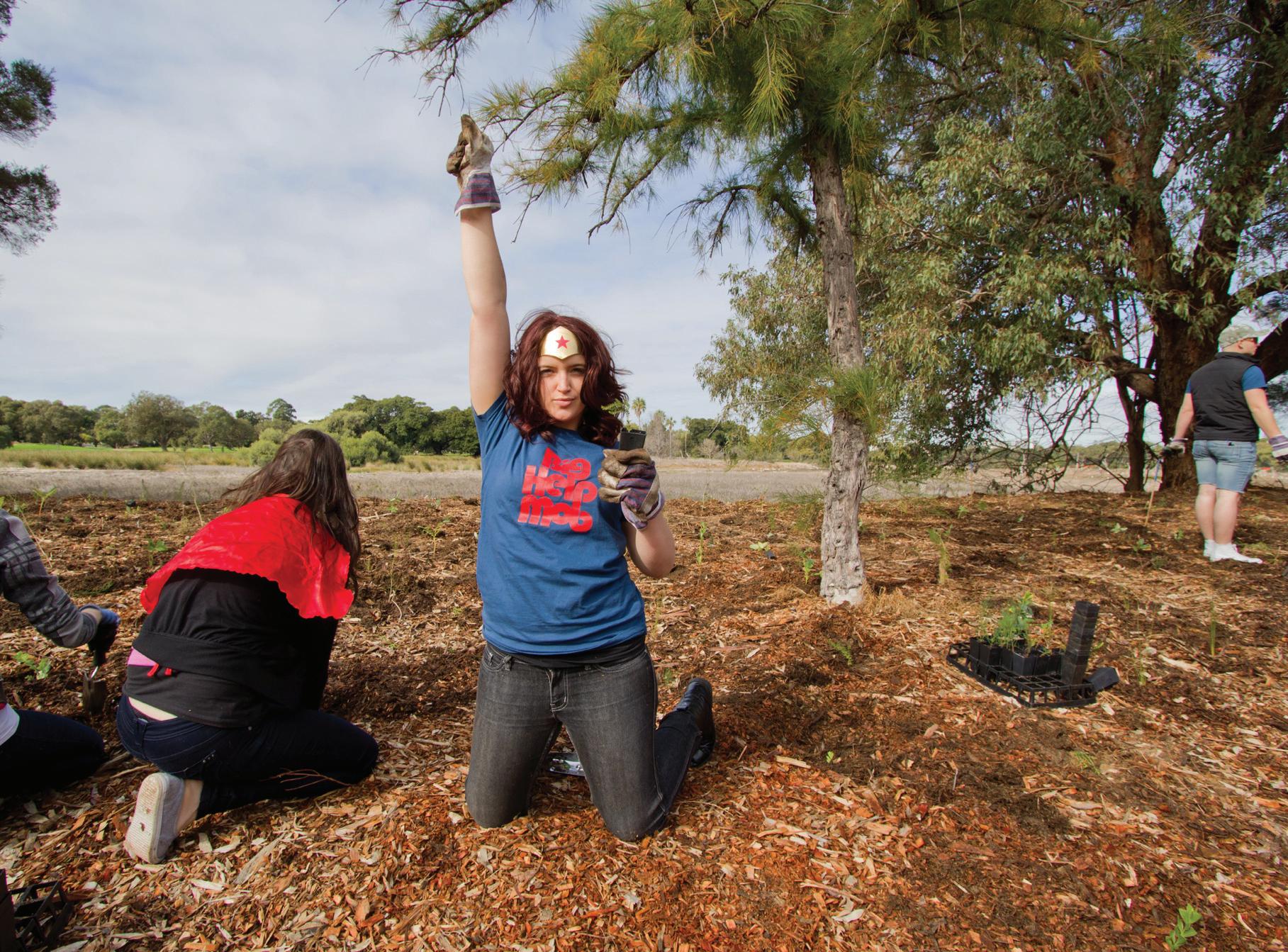
CURRENT and former Young Christian Students (YCS) members have embraced a new project aimed at giving youth positive first experiences of volunteering “to get them hooked on giving back”.
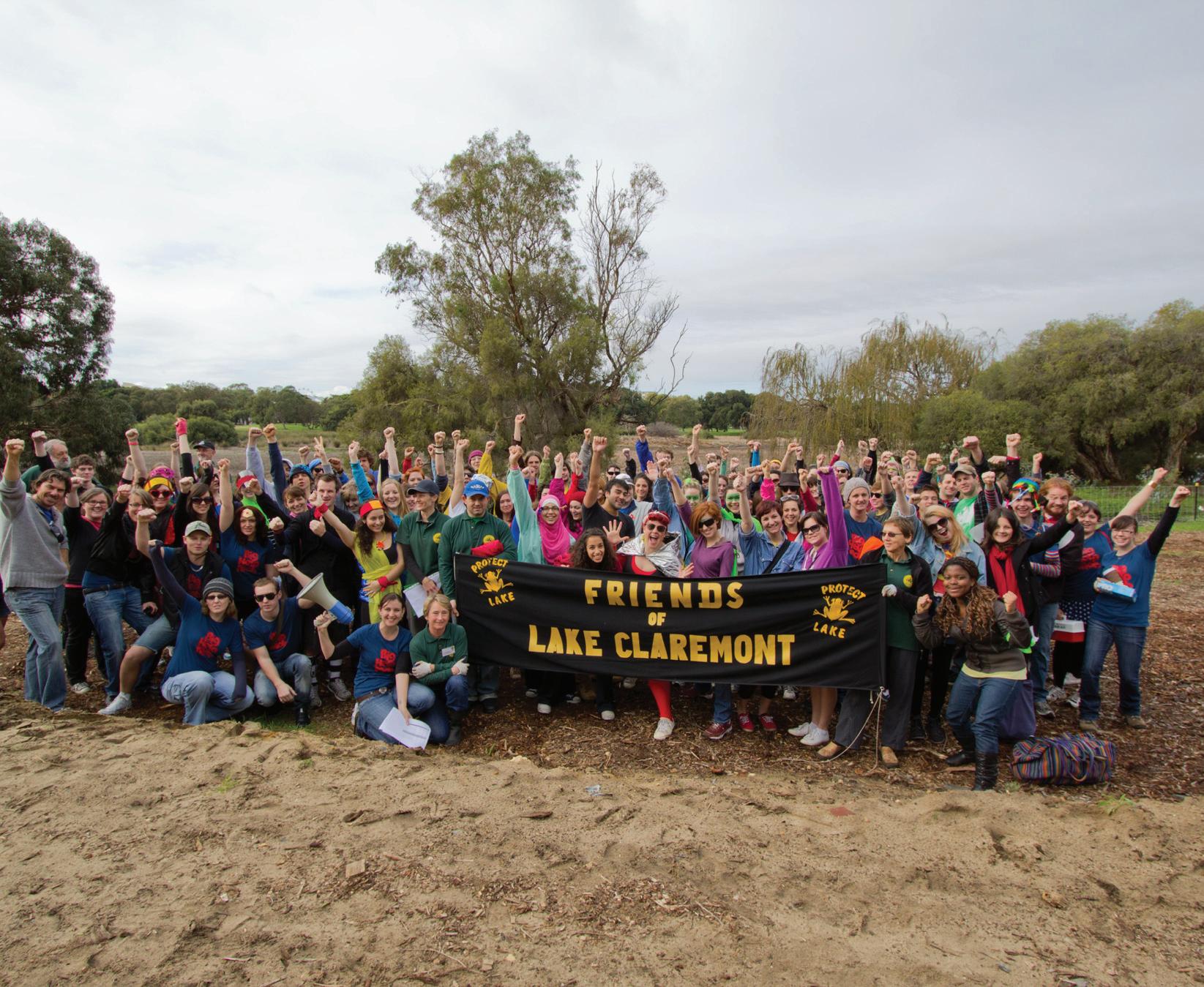
Former Australian YCS coordinator Vicky Burrows joined current YCS national coordinator Merida Cooke, Vincent Restifo and Fremantle parishioner Jasmine Morris and others as over 140 youth aged 15 to 30 helped revegetate the fairways at Lake Claremont Golf Course in three hours.
The project will assist Friends of Lake Claremont, a young organisation involved in weed and rubbish removal and revegetation of the area with native flora, including the wetland vegetation and adjacent bushland areas.
He also warned against the Australian Government’s carbon tax based on Europe’s experience with such a tax.
“Trust me, you need it like a hole in the head … It will cause a potential economic disaster of the most catastrophic proportions,” he said, adding that money would be better spent allocating such funding to helping the Third World.
He said that given China is building two coal-fired power stations a week until 2030, the West “is not the problem, therefore it is not the solution”. He warned about the economic consequences of “attempting to mitigate global warming by taxing, regulating, reducing or replacing anthropogenic emissions of carbon dioxide”.
He also addressed “the antithesis between the free enterprise ideal exemplified by the life and deeds of Lang Hancock and the notion of authoritarian consensus that grips academe and politics today”.
He also defended carbon itself, saying “it’s not the killer it used to be” as coal plants have fewer emissions due to improvements; adding that many life forms depend on it.
When WA Greens Senator Scott Ludlam told Lord Monckton, “it must be lonely being on the fringe when 97 per cent of scientists” confirm global warming, the Briton questioned that figure, as only “a few dozen” scientists were actually involved in climate sensitivity work.
Prof Doepel conceded that UNDA did not expect Lord Monckton to call the Federal Government’s chief climate change adviser Prof Ross Garnaut a fascist, displaying a Swastika next to a quote from him at a Los Angeles conference last month.
“That hasn’t helped us with our PR but he’s been quite sincere in his apology and he assured the Vice Chancellor his address here would be delivered in an appropriate manner,” Prof Doepel said.
Lord Monckton, a former journalist and now Chief Policy Advisor to the Science and Public Policy Institute, said journalists had failed to ask why the cost of mitigating the effects of global warming would far outweigh the cost of doing nothing.
When asked by retired ABC journalist Peter Kennedy whether he thought his Nazi slur against Garnaut helped or hindered his cause, he pointed to inconsistency in Australian media.
He referred to a columnist last month saying that opponents of the consensus on climate change “should be gassed” to death.
The day also involved a “spontaneous sports carnival” in Fremantle, with activities including ‘mega-tunnel ball’, ‘tug-owarfare’ and ‘bouncy-beach-ball volleyball’.
“Shocked onlookers and innocent bystanders looked on in awe as two streams of young people marched through Fremantle cheering and shouting for seemingly no reason,” was the organ-
isers’ jovial descripton of the “spontaneous sports carnival”.
“With a siren from nowhere, a placid town square was turned into an instant sports carnival, as giant volleyballers, tug o’war-ers and tunnelballers shouted and cheered their way through a few minutes of madness. The real winner, however, was Act Belong Commit, who do fantastic work
encouraging individual engagement in the community as a way to keep mentally healthy.”
The project was an initiative of Big Help Mob, part of Perthbased, youth-led, non-profit organisation Youth Tree which uses creativity and fun to involve young people in volunteering, active citizenship and other forms of making positive change.
The Centre for Liturgy will run four workshops to introduce parish musicians and others to Mass settings that can be used with the new translation of the Mass. Each workshop will include background information about the implementation process; presentation of two complete new Mass settings; presentation of revised parts of existing settings.
Wednesday 13 July
Holy Family Catholic Church, Como 7.30pm - 9.30pm
Monday 22 August
Queen of Apostles Catholic Church, Riverton 7.30pm - 9.30pm
Tuesday 20 September
All Saints Catholic Church, Greenwood 7.30pm - 9.30pm
Thursday 6 October
St Thomas More College Chapel, Crawley 7.30pm - 9.30pm
John Henry Cardinal Newman, beatified by Pope Benedict XVI last September during his four-day visit to the United Kingdom, is famously associated with an idea of what a university is and what it should attempt to be - both for those who seek education within its confines and for the society in which it exists.
The name of Newman, an Oxford Anglican who famously arrived at Catholicism after setting out on a quest to prove that Anglicanism was part of the Roman Catholic Church, is now almost synonymous with the idea of a university as the locus of intellectual development. The Newmanic vision of a university is most notably set out in sections of his magnum opus, the Apologia pro vita sua and in the series of Dublin lectures that were eventually published as The Idea of a University. Newman had a deep faith in and intellectual, rational, vision of the importance of truth for its own sake which he saw could not possibly conflict with Christianity and the Gospel. He very clearly foresaw the dangers of stagnation which could quickly develop if those who proposed new theories, methods or approaches perceived that authority or others who disagree were waiting to pounce on the slightest perceived error. Newman’s name is therefore synonymous with intellectual freedom in the service of the primacy of truth and around the world today there are numerous university societies and residential colleges which bear the name of this intellectual giant of 19th century English Catholicism, scholarship and letters.
The hallowed name of Newman came to mind in an unexpected way in the recent controversy generated by the visit of English peer Lord Monckton and his speech at the University of Notre Dame in Fremantle last week. When it came to the crunch over Lord Monckton’s speech, the University of Notre Dame Australia did what many other institutions in Australia, including not a few universities, probably would not do: it not only talked the talk of academic freedom, it walked the walk. In doing so, the University’s Vice Chancellor Celia Hammond and College of Business Executive Dean Professor Chris Doepel resisted a considerable degree of blatantly attempted intimidation from within academia on the part of those who could not tolerate the idea that an Australian university would ever host a talk by an individual sceptical of their version of climate change. The intolerant demanded tolerance - but only of their view.
PO Box 3075
Adelaide Terrace PERTH WA 6832
office@therecord.com.au
Tel: (08) 9220 5900
Fax: (08) 9325 4580
Therefore, among the really illuminating lessons of the controversy from last week were not only the importance (and example) of academic courage in the service of concepts such as the very idea of a university and its service to intellectual progress, but the way in which, by attempting to bludgeon Notre Dame into cancelling his speech, antiMonckton protestors looked very much as if they were confirming the British peer’s point about the seemingly innate totalitarian tendencies of many fervent believers in climate change.
It was remarkable, bordering on amazing, to read the open letter penned by University of Western Australia doctoral student Natalie Latter, signed by approximately 50 fellow students and academics, leading the charge against Lord Monckton’s speech and calling on Notre Dame to cancel the whole event. Not to put too fine a point on it, the extraordinarily vehement Ms Latter, together with her fellow students and academics, bluntly attempted to shut down academic freedom via intimidation. Oddly, it seemed to escape Ms Latter and the outraged academics that as they claimed the moral high ground of defending good science they were, in effect, acting to preserve their own view on climate change from criticism and scrutiny. It seemed to escape them collectively that Lord Monckton’s jibe in reference to the Third Reich was, at worst, eccentric in the way that British peers are famous for, a la PG Wodehouse, but nevertheless precisely a point about totalitarianism in intellectual matters. But Ms Latter, a doctoral student in philosophy, clearly misconstrued it literally; she just didn’t get it. Remarkable. It almost seemed as if the climatistas were not really interested in the principal of intellectual and academic freedom at all. It was obvious that they entirely missed the point that having Lord Monckton deliver his speech at Notre Dame did not constitute endorsement of his criticisms and theories by the university at all. Rather, hosting his speech contributed to discussion and argument on an issue which is by no means settled, as, just to pick one example, the very interesting recent paper on Analysis of the impacts of station exposure on the US Historical Climatology - Network temperatures and temperature trends by John Nielsen-Gammon of the Department of Atmospheric Sciences at Texas A&M University, together with six colleagues at a variety of universities (accepted for publishing in the Journal of Geophysical Sciences in March this year) shows.
It was also remarkable to consider how often many academics attack the Catholic Church as close-minded and opposed to truth and reason when every reading of history confirms that not only the inventor of universities and the western tradition of scholarship, but their greatest defender as well, is none other than the Church. Strangely, it is academics in their remote theoretical laboratories who are most prone to becoming the fiercest foes of the academic freedom (of their opponents) which they so loudly trumpet. By contrast, Vice Chancellor Hammond and Dean Doepel, faced with mounting pressure, internally and externally, took the courageous course. In doing so, they honoured not only the principle of intellectual freedom but the very idea of a university as set out by Blessed John Henry Newman and the idea of a university still most widely valued around the world. They are in good company. Notre Dame and those who organised Lord Monckton’s speech, therefore, are to be congratulated for refusing to bow to a pseudo-intellectual lynch mob masquerading as the acceptable face of public opinion.
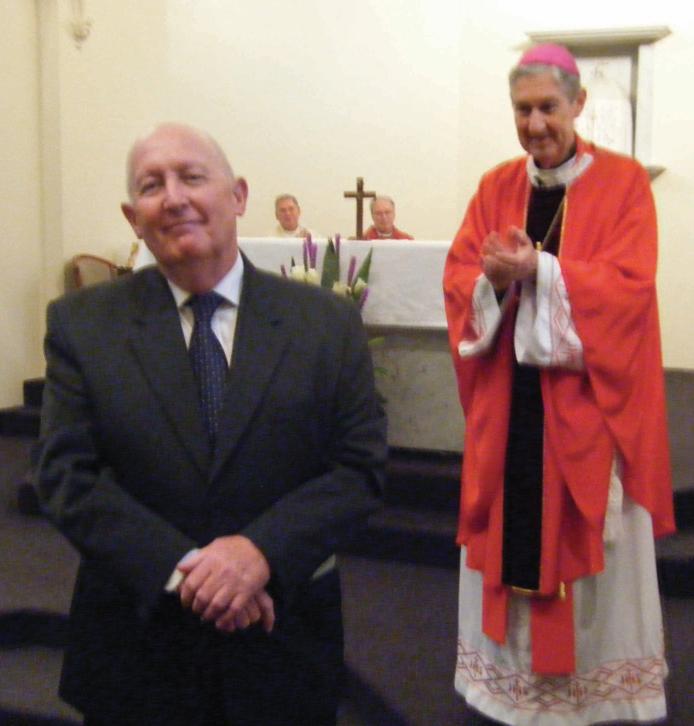
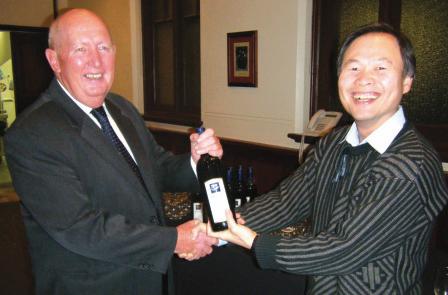
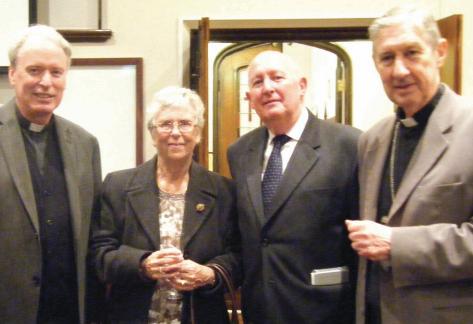
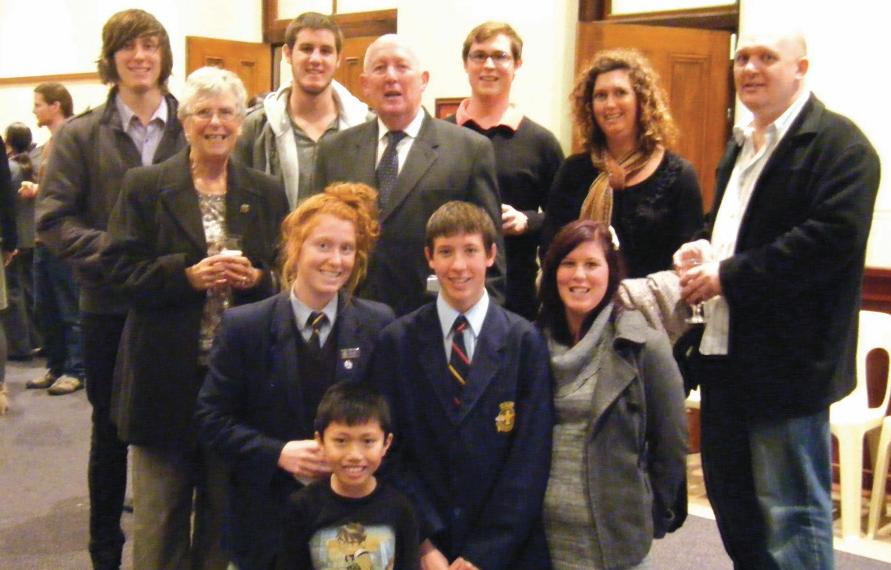
Friends and colleagues gathered to farewell longserving Archdiocesan staff member Chris Reynolds at the Pastoral Centre in Highgate on 30 June.
Mr Reynolds was retiring after working for the Archdiocese for almost 18 years as Information Technology Manager for the Catholic Development Fund
and the Archdiocesan Finance Office. Throughout his time, Mr Reynolds advised almost all of the agencies of the Archdiocese, and possibly all of them.
Archbishop Barry Hickey concelebrated a special Mass for the occasion, at which staff and friends joined Mr Reynolds, his wife Heather, their children and grandchildren, to wish the cou-
Mr Reynolds and his family.
ple well. Concelebrating the Mass with the Archbishop were Auxiliary Bishop Donald Sproxton, Fathers Robert Cross, Michael Separovich and Pat Cunningham; Catholic Youth Ministry staffer Mat de Sousa served as acolyte. Refreshments were later served, providing one and all with the opportunity to catch up and reminisce.
A CATHOLIC charity is supporting six priests in their heroic struggle to minister to huge numbers of migrants and refugees in Thailand.
According to Church figures, there may be up to 2.5 million people from Burma (Myanmar) in Thailand, with more entering the country every day.
Thailand’s Bishop Joseph Visitnondachai of Nakhon Sawan diocese – head of the country’s Catholic Office for Emergency Relief and Refugees – explained how the Thai Church brought in priests from Burma to work with immigrants because of a shortage of clergy.
However, while the Burmese priests could more easily communicate with the immigrants, the Church did not have the resources to provide basic essentials for the priests.
Bishop Visitnondachai said: “At first we didn’t know how we would feed the priests – but Aid to the Church in Need said ‘Don’t worry, we will help you.’”
The charity for persecuted and other suffering Christians is providing Mass offerings for the priests, which enable them to purchase the basic essentials they need to live.
Bishop Visitnondachai said: “Only by the help of Aid to the Church in Need can we give stipends to the six priests who are
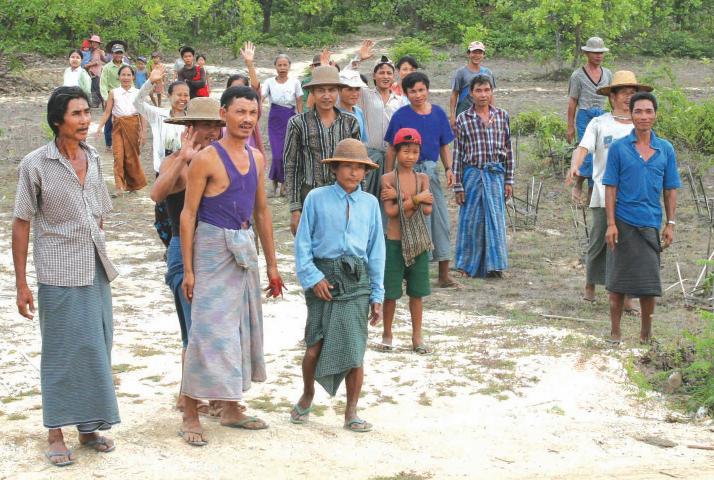
visiting the refugee camps and the migrants.”
In addition to providing Mass offerings for the priests, ACN is also currently supporting the pastoral care of migrants and refugees from Burma with $60,000 over a two-year period.
This follows a grant of over $95,000 for 2008-10. Burmese priests have been caring for both refugees and migrants –refugees have fled armed conflict whereas migrants are those who have made the journey for social and economic reasons.
While Burma has fewer jobs available – and wages are low com-
pared with everyday expenses –neighbouring Thailand needs a lot of manual workers.
Both groups face significant restrictions: migrants are not freely allowed to travel from one area to another and must stay in the area where they are working, while refugees are not allowed to leave camps nor work.
Those in the camps are dependant on supplies from relief agencies and NGOs.
The priests make weekly visits to the refugee camps to celebrate Masses, hear Confession, and celebrate other Sacraments such as Baptism, and Anointing of the Sick.
Mental illness which makes a person incapable of being responsible for his or her actions has often been treated as a legal safeguard. Record journalist MARK REIDY, who has more than a decade of experience dealing with those living on the margins of Perth’s streets, reflects on key flaws in WA’s mandatory sentencing laws which now see mentally ill people automatically go to jail.
BY MARK REIDYWhen lawmakers adopt a “one size fits all” approach, it is inevitable that the most vulnerable citizens in that society will bear the greatest burden.
Such is the case with recent WA legislation that demands mandatory sentencing for any person assaulting a public officer.
The law, which was passed in September 2009, was the by-product of a sharp escalation in the number of assaults on police, ambulance drivers and other public officers. However, the impulsive responses that triggered its introduction inadvertently placed those suffering mental illness, and their families, in a tenuous and potentially traumatic position.
Under the law, any adult causing bodily harm to a public officer will receive a minimum of six months’ incarceration.
Those aged 16–18 will be jailed for up to three months. Attorney General Christian Porter has justifiably claimed that the new law has been a success, pointing out that reported assaults against police had decreased by almost 30 per cent in the first 12 months.
However, buried beneath these statistics is the distress suffered by the families who now refuse to call police when they are having difficulties with their mentally ill relatives, because they fear that such intervention could lead to an officer being assaulted and family members being subsequently jailed.
Mike Seward, Executive Director of the WA Mental Health Carers
and Friends Association (known as ARAFMI), expressed this concern recently, saying, “No mother and father wants to be responsible for their child going to jail, so parents, many elderly, would rather cop a beating than phone police”.
Such a predicament is a blight on our legal system. It is also contrary to Catholic social teaching which states that every person is unique, created in the image of God, is therefore invaluable and worthy and must always be treated accordingly. It is a premise that needs to be reflected in our laws.
The Vatican II document, Gaudium et Spes, called on the Church to “establish a political, social and economic order which will to a better extent serve and help individuals as well as groups to affirm and develop the dignity proper to them.”
Pope John Paul II, who would often speak of a preferential love for society’s most vulnerable and emphasise how Jesus had identified Himself with them, made specific mention of those with mental illness in a 1996 article, The image of God in people with mental illness. He said quite clearly that we, as a Church, should never hesitate in taking up the cause of the most vulnerable and that we must become the voice of those who are not listened to, “not to demand charity, but to ask for justice.”
It is imperative, therefore, that as Catholics, both individually and as a body, we take action when we perceive injustices within our society.
When we are confronted with laws such as mandatory sentencing, which forces justice to apply a uniform punishment without the discretion to consider each case on its own merits, then
it is time to emulate the actions of our founder and seek a more just outcome.
Secular groups such as the Law Society of WA and the Criminal Lawyers’ Association have added their weight to the protestations of ARAFMI, echoing concern that mandatory sentencing laws will not only jeopardise families, but will inevitably increase the number of people with mentall illness in our jails.
WA Queen’s Counsel Tom Percy also expressed his opposition, asserting that mandatory sentencing forbids judges and magistrates from making any allowance for circumstances such as mental illness and denies them the opportunity to direct those charged to appropriate medical treatment.
No one denies police and other public officers, who courageously battle on the frontlines of an increasingly violent culture, the right to maximum protection under law, but the relevant legislation must not come at the expense of those whose mental condition at the time may diminish their moral culpability.
One of the key foundations of Catholic social teaching is the safeguarding of the rights and dignity of society’s most defenceless members, both in attitude and law. But failed or unfulfilled policies towards mental illness in recent decades have led to many families feeling helpless and unsupported.
Despite valiantly battling on a day to day basis, most are not equipped to deal with the confused, unpredictable and, at times, violent state that their mentally ill relative or friend will intermittently display.
It is in these situations that they have, in the past, been able to seek assistance from the police. But if mandatory sentencing laws are not amended to take
into account the ramifications of mental illness, then such families will be robbed of their last refuge of support.
The plight of those with mental illness and their families in this situation was most likely an oversight of a law that rode its way through parliament on the back of the emotive wave of public indignation that saw a man freed from a charge of brutally assaulting a police officer.
However, in the cold light of day, we must delve into the intricacies of this needed, but flawed, law and seek to modify it to protect those who are incapable of protecting themselves. It is for this reason that ARAFMI are sponsoring a petition requesting the removal of any law that imposes mandatory sentencing for those with a mental illness.
This petition is running in conjunction with a bill recently introduced into WA parliament by Greens MLC Alison Xamon which, if successful, will redirect power back to courts.
Judges would then be able to determine each case on an individual basis and decide whether an offender’s behaviour at the time of the assault was impaired by his or her mental state and if so, prevent him or her from being automatically sent to prison.
The final words I shall leave to Pope John Paul II who once wrote: “Persons with mental illness and their families are in need and are asking for the Church, you and I, to help in their search for justice. In Matthew’s Gospel story of the final judgement, Jesus tells us, ‘whatever you did for one of these... you did for me’. Our call is clear – our response is not optional”.
The petition can be found on the ARAFMI website: www.arafmi.asn.au
Mental illness which makes a person incapable of being responsible for his or her actions has often been treated as a legal safeguard. Record journalist MARK REIDY, who has more than a decade of experience dealing with those living on the margins of Perth’s streets, reflects on key flaws in WA’s mandatory sentencing laws which now see mentally ill people automatically go to jail.
BY MARK REIDYWhen lawmakers adopt a “one size fits all” approach, it is inevitable that the most vulnerable citizens in that society will bear the greatest burden.
Such is the case with recent WA legislation that demands mandatory sentencing for any person assaulting a public officer.
The law, which was passed in September 2009, was the by-product of a sharp escalation in the number of assaults on police, ambulance drivers and other public officers. However, the impulsive responses that triggered its introduction inadvertently placed those suffering mental illness, and their families, in a tenuous and potentially traumatic position.
Under the law, any adult causing bodily harm to a public officer will receive a minimum of six months’ incarceration.
Those aged 16–18 will be jailed for up to three months. Attorney General Christian Porter has justifiably claimed that the new law has been a success, pointing out that reported assaults against police had decreased by almost 30 per cent in the first 12 months.
However, buried beneath these statistics is the distress suffered by the families who now refuse to call police when they are having difficulties with their mentally ill relatives, because they fear that such intervention could lead to an officer being assaulted and family members being subsequently jailed.
Mike Seward, Executive Director of the WA Mental Health Carers
and Friends Association (known as ARAFMI), expressed this concern recently, saying, “No mother and father wants to be responsible for their child going to jail, so parents, many elderly, would rather cop a beating than phone police”.
Such a predicament is a blight on our legal system. It is also contrary to Catholic social teaching which states that every person is unique, created in the image of God, is therefore invaluable and worthy and must always be treated accordingly. It is a premise that needs to be reflected in our laws.
The Vatican II document, Gaudium et Spes, called on the Church to “establish a political, social and economic order which will to a better extent serve and help individuals as well as groups to affirm and develop the dignity proper to them.”
Pope John Paul II, who would often speak of a preferential love for society’s most vulnerable and emphasise how Jesus had identified Himself with them, made specific mention of those with mental illness in a 1996 article, The image of God in people with mental illness. He said quite clearly that we, as a Church, should never hesitate in taking up the cause of the most vulnerable and that we must become the voice of those who are not listened to, “not to demand charity, but to ask for justice.”
It is imperative, therefore, that as Catholics, both individually and as a body, we take action when we perceive injustices within our society.
When we are confronted with laws such as mandatory sentencing, which forces justice to apply a uniform punishment without the discretion to consider each case on its own merits, then
it is time to emulate the actions of our founder and seek a more just outcome.
Secular groups such as the Law Society of WA and the Criminal Lawyers’ Association have added their weight to the protestations of ARAFMI, echoing concern that mandatory sentencing laws will not only jeopardise families, but will inevitably increase the number of people with mentall illness in our jails.
WA Queen’s Counsel Tom Percy also expressed his opposition, asserting that mandatory sentencing forbids judges and magistrates from making any allowance for circumstances such as mental illness and denies them the opportunity to direct those charged to appropriate medical treatment.
No one denies police and other public officers, who courageously battle on the frontlines of an increasingly violent culture, the right to maximum protection under law, but the relevant legislation must not come at the expense of those whose mental condition at the time may diminish their moral culpability.
One of the key foundations of Catholic social teaching is the safeguarding of the rights and dignity of society’s most defenceless members, both in attitude and law. But failed or unfulfilled policies towards mental illness in recent decades have led to many families feeling helpless and unsupported.
Despite valiantly battling on a day to day basis, most are not equipped to deal with the confused, unpredictable and, at times, violent state that their mentally ill relative or friend will intermittently display.
It is in these situations that they have, in the past, been able to seek assistance from the police. But if mandatory sentencing laws are not amended to take
into account the ramifications of mental illness, then such families will be robbed of their last refuge of support.
The plight of those with mental illness and their families in this situation was most likely an oversight of a law that rode its way through parliament on the back of the emotive wave of public indignation that saw a man freed from a charge of brutally assaulting a police officer.
However, in the cold light of day, we must delve into the intricacies of this needed, but flawed, law and seek to modify it to protect those who are incapable of protecting themselves. It is for this reason that ARAFMI are sponsoring a petition requesting the removal of any law that imposes mandatory sentencing for those with a mental illness.
This petition is running in conjunction with a bill recently introduced into WA parliament by Greens MLC Alison Xamon which, if successful, will redirect power back to courts.
Judges would then be able to determine each case on an individual basis and decide whether an offender’s behaviour at the time of the assault was impaired by his or her mental state and if so, prevent him or her from being automatically sent to prison.
The final words I shall leave to Pope John Paul II who once wrote: “Persons with mental illness and their families are in need and are asking for the Church, you and I, to help in their search for justice. In Matthew’s Gospel story of the final judgement, Jesus tells us, ‘whatever you did for one of these... you did for me’. Our call is clear – our response is not optional”.
The petition can be found on the ARAFMI website: www.arafmi.asn.au
What with New York legislating same-sex marriage, and Labor state conferences toppling like dominos, it appears that samesex marriage activists have adopted a new tack: “momentum rhetoric”
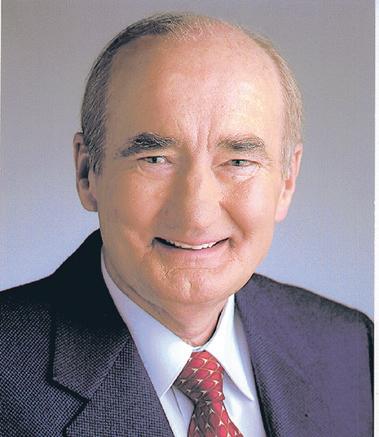
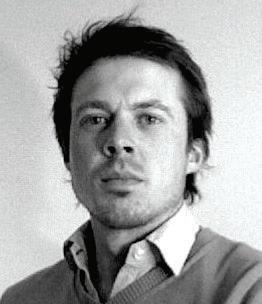 BY T IM CANNON
We mustn’t comb over the big issues. The most blatant momentum rhetoric sprang up around the recent Galaxy Poll, wherein 75 per cent of respondents agreed that same-sex marriage is inevitable in Australia.
It was an odd poll - more Nostradamus than Aquinas - on what really is a complicated political and moral issue. No engagement with the issue itself, just speculation as to where we might end up.
Then again, perhaps the poll sits comfortably with a debate in which two sides spend a great deal of time arguing about completely different things.
For same-sex marriage advocates, it’s about equality. Or, as Senthorun Raj put it with crystalline clarity yesterday: “Marriage equality is an issue about respect and visibility.”
Activists like Raj want to use marriage law to achieve the social and cultural objective of increasing respect and visibility for men and women who identify as homosexual.
As far as the objective goes, Raj is unlikely to court much opposition. He certainly won’t get any from me: I too believe that respect and visibility must be accorded to all members of society, without regard to gender, race, religion, sexual preference, etc.
What concerns me is the means that Raj and others are advocating for achieving this outcome, namely, the radical modification of the institution of marriage.
This is why those on my side of the debate tend to focus our argument on the institution itself: why it is the way it is, and why changing it is a bad idea.
And so while the recent momentum rhetoric is all clinking champagne glasses and anticipatory excitement, allow me to offer a glass of cold water to the face, and a snap back to the reality of the institution we call marriage.
But first, an analogy. There is a scene in the 2003 Jim Carrey movie Bruce Almighty, in which Carrey’s character, in a bid to woo the girl of his dreams, decides to use his (temporarily acquired) divine omnipotence to drag the moon a little closer to the balcony on which he is undertaking said wooing.
All goes to plan. By the dazzling light of a closer, brighter moon, romance is mightily enhanced, and the woo-ee robustly woo-ed. Happy ending, right?
Not quite: there are other consequences too. Massive tidal disruptions ensue around the globe. Thousands are washed away.
mary function of marriage, and a closer look at the institution itself supports such a conclusion.
According to section 46 of the Marriage Act, marriage is a “solemn and binding” institution. It is meant to bind two people, by force of public law, in a permanent relationship.
Why should the law bind two people so? To enhance their visibility and respect in the community?
Not likely. Rather than enhance the status of the couple, marriage seems rather to place them in a position of lifelong subservience, both to one another and to the State.
As they say, you get less for murder.
No, the only conceivable reason for binding two people in a lifelong union is because marriage anticipates procreation.
Activists deny this. But why else would Article 23 of the International Covenant on Civil and Political Rights affirm a compound right “to marry and to found a family”? Why not have two separate rights, if marriage is not about procreation?
The Office of the United Nations High Commissioner for Human Rights unequivocally supports the conflation of marriage and procreation. In its General Comment (no 19) on Article 23, the Commission states: “The right to found a family implies, in principle, the possibility to procreate and live together” (at par 5). All of this is bound up in the one right, under Article 23, “to marry and to found a family”.
But it doesn’t take a human rights commissioner to figure out that it is by reason of the inherent babymaking character of heterosexual unions that the State encourages permanence in those unions.
At the same time, there is no reason to suggest that the permanent quality of marriage accords the couple any special status. Rather the permanence of the union is directed towards pre-emptively safeguarding the interests of any children that the marriage may (or may not) produce.
Marriage is the State’s best and only direct means of trying to ensure that children are born into a family where they are raised by their own flesh and blood; their own mother and father. And, to quote a 2009 Galaxy Poll, 86 per cent of Australians believe that children should, wherever possible, be raised by their own biological mother and father.
See, every child that has ever existed had both a mum and a dad. Marriage is how the State imposes upon the spouses an obligation to see their responsibility to their progeny through. This is the sine qua non of a flourishing civilisation: intact families taking their responsibility to care for one another seriously.
In a world of increasingly casual, fragmented and confused relationships, the institution of marriage still says to the community: when it comes to the life-generating heterosexual union, permanence is vital.
But same-sex marriage advocates don’t want marriage to propagate that message anymore. As far as they are concerned, marriage is a tool for enhancing the status of same-sex couples; a means to an end.
Homes are ruined. All to be expected when you tinker with the moon. See, the moon may well have formidable romance-enhancing capabilities, but it also performs a whole lot of other, far more important functions. Meddle with it to enhance romance, and everything
else gets out of whack. We take a similar approach on marriage. For although redefining marriage may enhance visibility and respect for those who identify as gay or lesbian, the primary function of the institution of marriage is not to enhance visibility and respect
for those who enter into it. Using marriage as a means to that secondary end - and modifying the institution in the process - seems a frightfully reckless manner of proceeding.
I have said that “enhancing visibility and respect” is not the pri-
And yet, even as activists demand fundamental alterations to the institution of marriage, it is the intact biological family, headed by a mum and a dad in a permanent union with one another, which continues to be the foundational unit and fundamental building block of society. Always has been, always will be.
That’s the story of our species, whether it is reflected in our legal and social institutions or not.
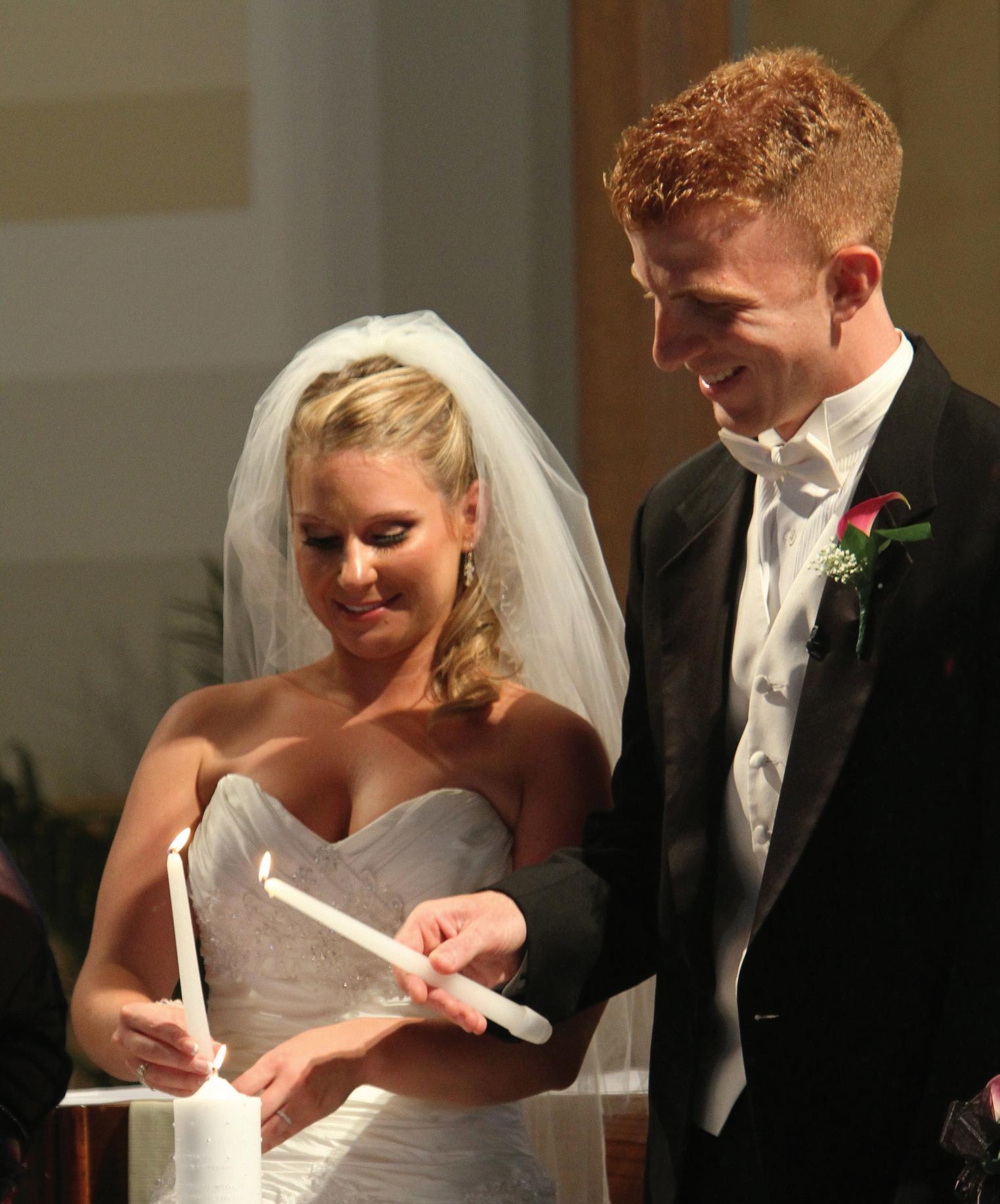
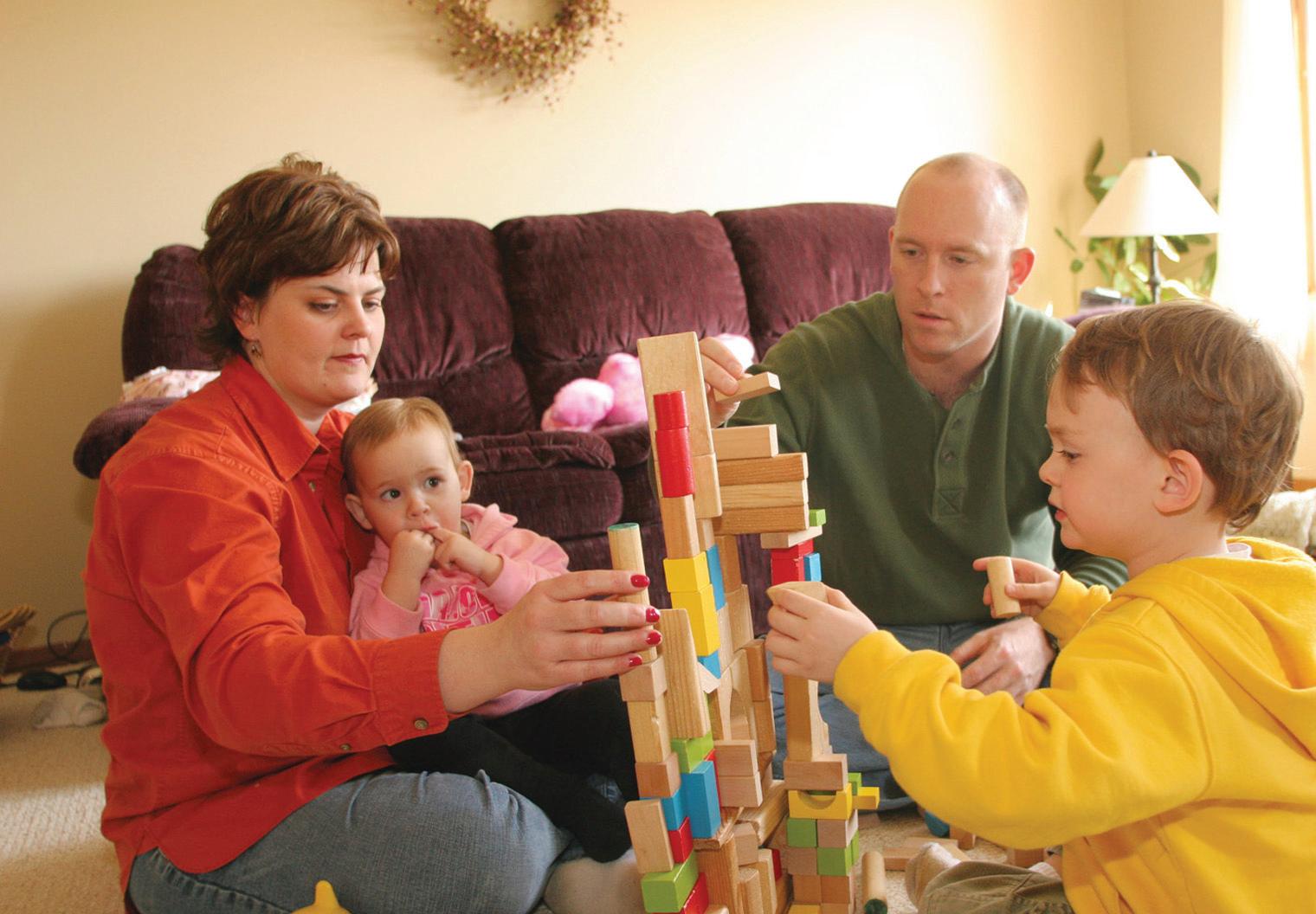
Army National Guard Capt Steven Sellars, his wife, Heidi, and their children, Evelyn, left, and Ryan, play with building blocks in their home in Hastings, Minn. CNS PHOTO/DAVE HRBACEK, CATHOLIC SPIRIT Megan Ward and Bryce Horsley smile after lighting the unity candle during their wedding at Sts Philip and James Church in St James, NY in July.IF precedent is any guide, many good Catholic lay people are waiting to hear what their diocesan Bishops and/or local pastors have to say about the new evangelisation before they decide whether it’s something for them to get involved in. That’s the typical reaction of the clericalist mindset to something new in the Church: “What does Father want us to do?”
It was good enough to keep the Church running for a long time, but it doesn’t work so well anymore. If it persists, its internal inadequacies are likely to alienate more and more people in the years ahead. And there will be no new evangelisation. There is, of course, nothing wrong with lay-clergy cooperation — in relation to evangelisation or anything else. On the contrary, cooperation between lay people and their Bishops and priests is very, very good.
But excessive dependence of the laity on the clergy — always waiting for them to do the thinking, give the orders, and take the lead — is something else again. It is, to repeat, an expression of clericalism, and it just isn’t helpful.
By now, surely, the problem that the new evangelisation is supposed to address should be perfectly obvious to everyone, lay and cleric alike. It’s the serious shrinkage of faith in places where it used to be strong.
That is notably the case in much of Europe in countries like France, Germany, Spain, Great Britain, and even parts of Ireland, where, to one degree or another, Christianity appears to have its back to the wall. Pope Benedict XVI says many of the inhabitants of such places have become “a people of unbelief and distance from God.”
That isn’t an issue only in Europe. The same problem, or set of problems, also exists in North America — that is to say, in the United
States and Canada. Quebec, once a bastion of Catholicism, has been experiencing radical secularisation for years, and participation in the Church is way down.
In both countries, mainstream Protestantism is weak and growing weaker. And in the United States, too, the Church has serious problems of retention, dramatised in the fact that one in three Americans who were raised as Catholics have quit the Church, with half joining mostly conservative Protestant bodies and the others becoming religiously unaffiliated.
Pope Benedict has spoken often about such matters, but he’s done more than talk. A while back he announced that the world Synod of Bishops in October next year would focus on new evangelisation, and earlier this year he established as part of the Curia a Pontifical Council for the New Evangelisation to organise the Holy See’s response to the issue.
While it hardly needs saying that meetings and structures have only limited value in and of themselves, they’re essential to developing and applying the new thinking that the new evangelisation clearly demands.
That was the central point of Benedict’s important address to the new pontifical council last May, in which he declared “the need for a renewed method of proclamation” to counter the effects of secularisation.
A renewed approach is required, he insisted, because this crisis itself is new, finding expression as it does in things like “the exclusion of God from people’s lives” and “generalised indifference toward the Christian faith, to the point of attempting to marginalise it from public life.”
When the Pope talks about “a renewed method,” many people probably assume that he means new projects and new technologies,

especially the use of digital media. Undoubtedly he does — seeing Benedict using Twitter on TV strongly suggests as much. But he likely also means something else — something that’s a great deal more important.
Specifically, I believe Benedict was speaking of the need for a new mentality suited to the new evangelisation. Above all, a mentality in which the clericalism of the past is no longer dominant in Catholic life.
So let me ask: Do Catholic lay people really have to wait for marching orders from the clerical hierarchy of the Church before getting involved in the new evangelisation?
The answer, of course, is no.
For sceptics, here’s a simple program for new evangelisation that any lay Catholic can and should undertake right here and now, on his or her own, without waiting to receive instructions from the Pope or the Bishop or the pastor.
First, be exemplary in the practice of your religion. That doesn’t mean being a pious pain in the neck; it means living out the faith with conviction and commitment, and doing so not just at church on Sunday but in weekday secular life in the world — in the home, school, neighbourhood and workplace. People of faith who do that will attract attention, and although the attention won’t always be favorable, sometimes it will be. That’s evangelisation.
Second, study the faith so that you can explain it intelligently and, when necessary, defend it.
Slowly and carefully read the Catechism of the Catholic Church (or, if that’s too much, the Compendium of the Catechism) along with the American Bishops’ adult catechism. Read other solid, orthodox religious literature (a man named Joseph Ratzinger has published a lot). Bone up on the history of the Church. “Always be ready to
give an explanation to anyone who asks you for your hope” (1 Pet 3:15). That also is evangelisation. If you’re not up to doing it now, the remedy rests with you.
Two other steps are worth mentioning, though they may not be available to everyone. One is to join a faithful apostolic group that provides formation for evangelisation (if you can find one, that is). The other, for those with some special skill or aptitude — writing or music, for example — is to think of creative ways to put it to use in this great cause.
Whatever else you do, stop excusing inaction by saying you can’t do anything until Father tells you what to do. That’s clericalism, and it’s wrong.
Here’s hoping you and Father have many opportunities to work together in the future on behalf of the new evangelisation. But, pending that, you’ve got lots to do right now.
Religious charisms adapted for everyday use by laity
Church renewal comes at parish level as laity educated on famous paths to holinessBY ANTHONY BARICH
PERTH Angelicum graduate and Maranatha Centre for Adult Faith Formation presenter Michelle Jones is giving a series of talks to connect people of the Archdiocese with six major types of Christian spirituality that have renewed the Church and inspired its teachings of pathways to holiness.
Following the success of talks on Franciscan, Dominican, Ignatian, Salesian, Carmelite and Benedictine spirituality at Claremont parish during Lent, Michelle, 35, is now presenting the talks at Subiaco parish on Wednesday nights at 7pm.
Michelle, who is in her third year of working with Maranatha, said the series is part of the Centre’s efforts to promote an experience of engaging the head and the heart, “taking in information for the sake of transformation”.
She said the series seeks to explore various forms of spirituality that, while originating in consecrated Religious life, are ultimately expressions of the one Gospel and pathways into the mystery of Jesus that is accessible to all.
Michelle, who completed a Licentiate in Sacred Theology at the Angelicum (Pontifical University of St Thomas Aquinas) in Rome and is close to completing a Doctorate in Theology there, explores the six types of spirituality in their own historical context and how these “nourish 21st century Catholics in our own discipleship”.
Having already covered Benedictine, Franciscan, and Dominican spiritualities Michelle will cover Ignatian (6 July), Carmelite (20 July) and Salesian (27 July) spiritualities next. All are welcome to attend the talks. She described how Benedictine spirituality - started by St Benedict of Nursia (480-550AD), the father of western monasticism – is about how to be the presence of Jesus’ peace in the world.
She also told how the Dominican way – founded by St Dominic (1170-1221) – is about preaching the Truth of the Gospel in whatever context one finds oneself.
The Franciscan life is about embracing the poor, crucified, selfemptying Jesus in a whole-hearted way, she said, while Ignatian spirituality – started when St Ignatius Loyola (1491-1556) founded the Jesuits – is about ordering one’s life in such a way that one brings about the Kingdom of God in all things. Her talk on the Carmelite tradition will centre on the spirituality that underpins the Order of Our Lady of Mount Carmel, started in
the 1190s in the Holy Land. This spirituality, she said, is hard to summarise briefly, but is about drawing from solitude and prayer to bring about the Kingdom of God.
Michelle did her Licentiate in Sacred Theology thesis on the Apostolic character of the contemplative life according to St John of the Cross and Saint Thérèse of Lisieux, key figures in the Carmelite tradition. Her Doctorate in Theology, where she is specialising in Spiritual Theology, includes a thesis on contemporary English Carmelite nun Ruth Burrows’ understanding of mysticism.
Michelle’s talk on Salesian spirituality will focus on the teachings of Doctor of the Church St Francis de Sales and St Jane Frances de Chantal, co-founders of the Visitation Order.
Her talks have drawn a wide variety of people, including participants in the Towards Catholicism programme for people thinking about becoming Catholic run by the Claremont zone of priests.
People from the Christian meditation group that meets at Subiaco parish on Wednesdays facilitated by psychologist Dr Neil Preston also attend her talks, which she said shows that people from across the spiritual spectrum have the same desire to know Christ.
For more information about courses offered by the Maranatha Centre for Adult Faith Formation visit maranathacentre.org.au.
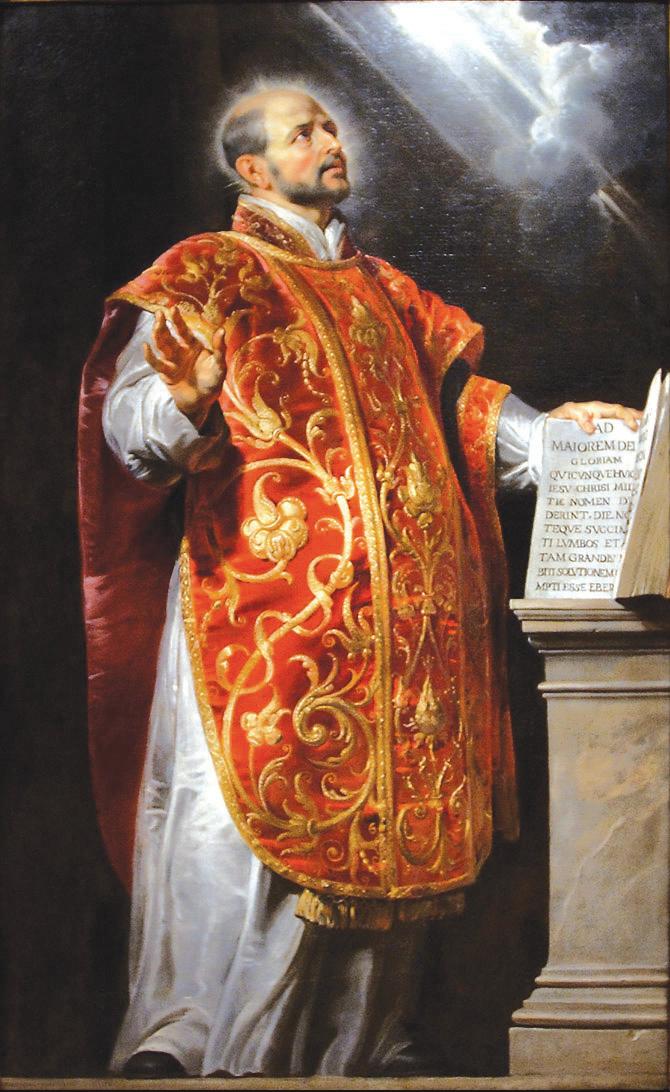
St Ignatius of Loyola, founder of the Society of Jesus (Jesuits). GOOGLE IMAGES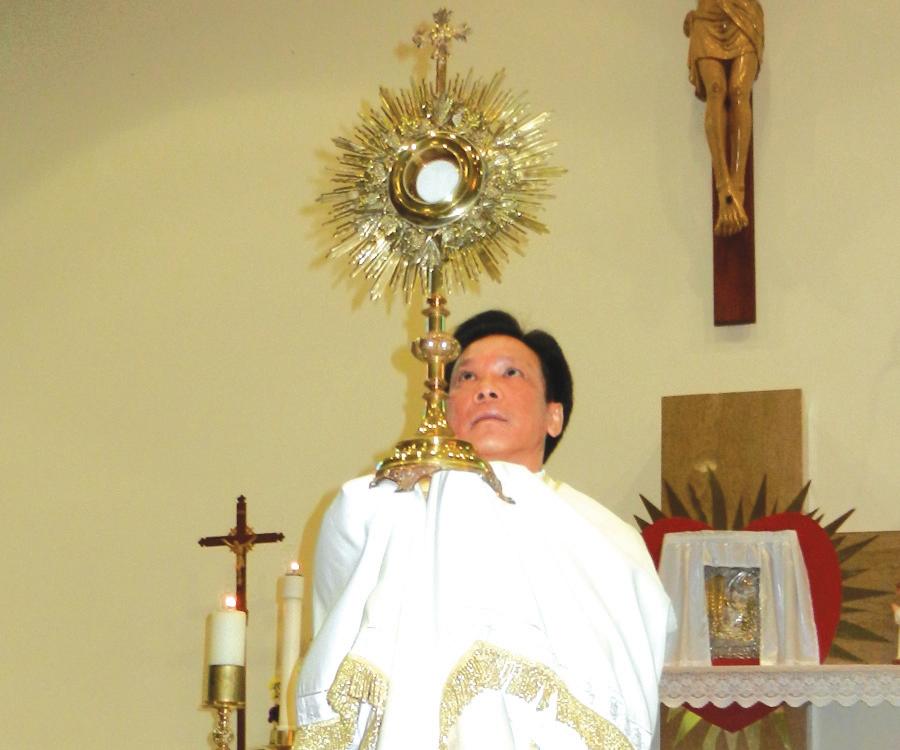
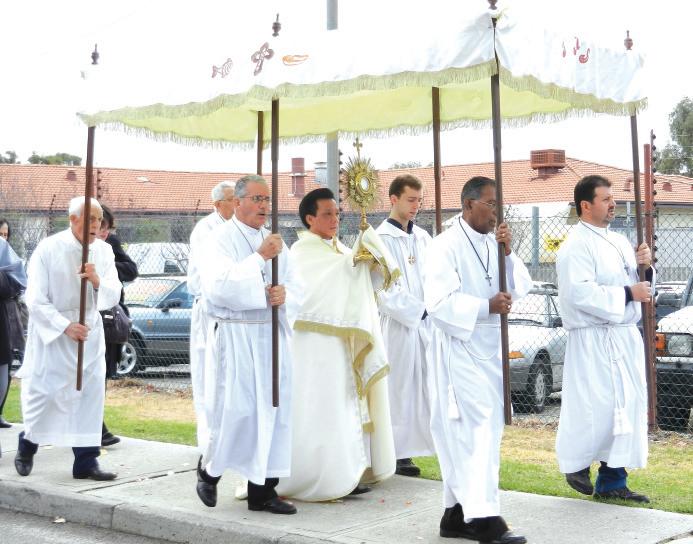
PARISHIONERS from St Joseph’s Parish held their annual Corpus Christi Procession on 26 June honouring the Blessed Sacrament through the streets of Bassendean.
The Procession was followed by Benediction, with light refreshments held in the parish hall afterwards.
“It was lovely to see so many new faces at this year’s procession and visitors are welcome to join us next year,” a parishioner told The Record

 BY ANTHONY BARICH
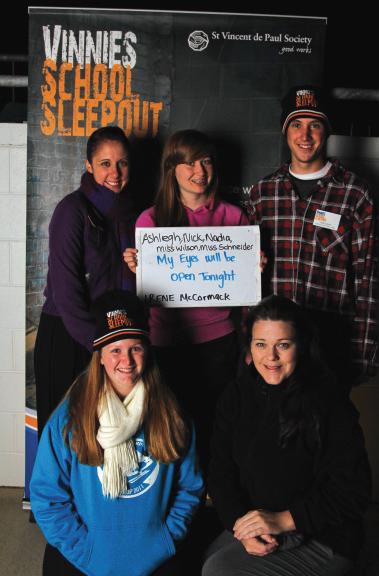
OVER 130 students participated in the St Vincent de Paul Society’s inaugural School Sleepout at the WACA ground on 4 July.
St Brigid’s, La Salle, John XXIII, Mandurah Catholic, Irene McCormack Catholic and St Norbert’s Colleges and St Thomas the Apostle Claremont Parish Youth Group participated after registering through the Every Day Hero page on Vinnies’ website.
The Sleepout gave students the opportunity to experience firsthand what it is like to be without a home this winter. Over 105,000 Australians live without safe and secure accommodation every night of the year. In Western Australia it is estimated that almost 14,000 peo-
ple don’t have a place to call home, according to Vinnies.
Vinnies said the event was about young people making a statement on homelessness by joining together for the night, to listen to other people’s experiences of homelessness and to help raise awareness and funds to support the homeless and emergency relief services of the St Vincent de Paul Society in WA.
Archbishop Barry Hickey gave a spiritual reflection and blessed participants as the participating students heard from staff of Vinnies, the Archdiocesan Catholic Youth Ministry and Vinnies clients who have been homeless.
“The evening was a moving and poignant reflection on homelessness and allowed students and teachers to immerse themselves
Book Review
Counterstrike
By Hal G P ColebatchPublished by Acashic Books
247 pages
Price $24.90
REVIEWED BY BRIAN PEACHEY
WHEN I reviewed the book, Light River, which Archbishop Barry Hickey launched, I wrote: “Hal Colebatch has done it again! He has proved himself – if proof was necessary - to be one of Australia’s leading poets. We in Western Australia are fortunate to have in our midst such a towering literary figure.”
It is important to also remind readers that Light River, his seventh book of poetry was awarded the WA Premier’s prize for poetry. His latest novel, Counterstrike, is his 21st published work. It has been described as a thriller of ideas. It is an action story that is also literate and sophisticated.
Woven together are lyrical descriptions of Lighthouse and Bottle-Opener islands (Rottnest and Garden Island), the Swan River at Nedlands and the imaginary islands that lie further west, just beyond the sunset, combined with international intrigue and a tender love story.
The temptation - which confronts most reviewers – is to tell much of the story. It is sufficient to say that it begins with Harry Godwin, a solicitor, part-time University tutor, enthusiastic war-gamer, and frustrated would-be naval officer, and his friend Toby Bowen, sailing in a dinghy to the outer islands.

They fall in with Monty Montgomery, whose boat, the Rampant Richard, may remind some of the late Frank Baden-Powell (one of my fellow students at St Patrick’s Boys School) whose famous yacht, Dirty Dick, was named after his theatre-restaurant.
Another West Australian identity, whom I recognise in the story, could be my friend the late Professor Leslie Marchant, who appears as Professor Mercator, a former tanker-officer turned maritime historian, to whose memory the book is dedicated.
Colebatch has an extraordinary gift for vividly
evoking the atmosphere of Rottnest and Garden Island, and the almost other-worldly quality that seems sometimes to touch them – the yellow moon over deserted Tompson Bay in winter, the plump little sanderlings running in the last ripples on the beach at “Bottle-Opener island” and quokkas lolloping under the revolving beams of the lighthouse at night.
As it unfolds, Colebatch weaves an incredible storey that will be of great interest to those who have participated in war games, but also to those who fear or see the possible consequences of the conflicts in the world. The outlines gradually emerge of a political conspiracy to weaken the alliance with America, part of a wider-ranging plot against the whole “Anglosphere” by way of the manufacture of false history. The end result may possibly be World War III. At the same time, an isolationist President has been elected in America. The terms in which this is discussed, subtly but unmistakeably, underline the parallels between past and present.
There is a final, unforeseen climax in which the many threads of the plot come together. Although the atmosphere is very much Colebatch’s own, there are touches here reminiscent of both Arthur Ransome and Frederick Forsyth.
I highly recommend Counterstrike as an intelligent thriller of ideas, one of the first books to grapple with the growing problem of false and manufactured counter-knowledge. It is a warning about the technique of planting conspiracy theories, and fostering paranoia under the mantra of “keeping an open mind.” As one character puts it, “If you keep an open mind some people will throw all their garbage in it.”
I should not comment on the ending, which is for the reader to judge.
Counterstrike is available from Acashic books through their website, www.acashic.com.
in the issue of homelessness and all that surrounds it. We are very grateful to the schools that participated and would like to acknowledge the efforts of staff and students who slept out in the 2 degree temperature,” St Vincent de Paul Society WA spokesperson Lucinda Ardagh said. She said the money raised will go directly to supporting homeless services the Society runs, “but, more importantly, we now hopefully have 130 new advocates in the community in the area in homeless”.
“We hope what they learnt and experienced on the night will stay with them and will help them go back to their friends and family and schools and share a new perspective on this important issue,” Ms Ardagh said.
JOHN Paul Care (JPC), pastoral care programme of Willetton parish, joined in celebrations of the parish feast day of Ss John and Paul through its participation in the Parish Ministry Fair which showcased the time, talent and treasure of 30 parish ministry activities within this vibrant parish.
The parish embodies Stewardship as a way of life to receive God’s gifts gratefully, cherishing and tending them in a responsible and accountable manner, sharing them in justice and love with others, and returning them with increase to the Lord.
JPC enables parishioners to volunteer their time and talent in providing practical, emergency short term support for people in need for tasks such as visiting, emergency meals, family support, gardening, handyman, home help, transport, bereavement support and mental health information.
Co-ordinator Betty Thompson said that the care programme fosters “a sense of belonging to the parish community by enabling people to step forward and offer their gifts and talents. People feel connected and, in many cases, longlasting relationships are formed”.
THE Director of Choicez Media, one of Australia’s best known Catholic media and training businesses, is driven by the mantra, “The Catholic Church has the best product in the world with the worst marketing department”. But Jonathan Doyle, who founded Choicez with his wife Karen, is determined to correct this travesty and has now added an e-journal for Catholic educators to their already impressive array of teaching initiatives.
Jonathan explained to The Record that “beingCatholic”, which was launched in March this year, is an on-line service that aims to address the needs of three diverse groups.
The first of these, he said, was the growing number of non-Catholic teachers entering the Catholic system - those who had never received any Catholic formation but were open to learning.
“We want to provide these staff … with a simple and accessible resource for learning a little more each month about the great adventure they have embarked on”, Doyle enthused.
The second group he wanted to reach was the large number of Catholic teachers who had only
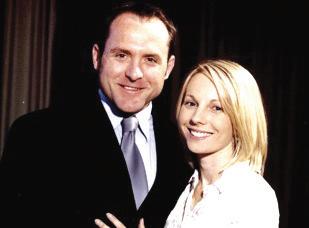
received a minimal depth of formation in their faith and other related matters.
Doyle explained that less than eight percent of Australian Catholic teachers had received formal theological formation and he hoped that the “beingCatholic” website would provide and encourage these people to further their understanding.
The site is also intended for Bishops, Catholic Edeucation staff
and other Catholic leaders whom Doyle believes will be provided with, “ongoing and deeper insight, inspiration and motivation into the great panorama of Catholic thought”.
Doyle, who hopes that the site will become Australia’s largest e-journal for Catholic educators within two years, said that “beingCatholic” has been growing at a rate of 200-300 subscribers per
fortnight and is currently being received by over 8,000 readers, both in Australia and overseas.
“We have been receiving amazing feedback”, he shared, “including messages of support and encouragement from Catholic Education Office Directors and even as far afield as Uganda”.
The e-journal draws from a wide array of writers, including well-known Catholic identities
and academics, as well as classroom teachers and parents, and covers an extensive range of topics and issues.
“The great vision of reaching young people wherever they are is ancient and ever new”, said Doyle, “It is that long tradition to which we are heirs and authors … let’s continue the journey.”
To access this free service go to www. beingcatholic.com.au
ST PAUL. Minnesota (CNS)When St Paul Seminary professor Chris Thompson recently went searching for the top agriculture programmes at US Catholic universities, what he found - or, rather, what he didn’t find - shocked him: There aren’t any.
He made the discovery after receiving an invitation to present a paper on developments in American agriculture over the past 50 years at a conference in Rome in May.
“There seems to be no presence of (agriculture) as a focused discipline or professional formation in (any of the 244) Catholic universities across the board,” he said in an interview at the seminary, where he is academic dean.
“That’s how I became the expert,” he added with a laugh.
In addition to serving on the board of the National Catholic Rural Life Conference, Thompson has given lectures and participated in conferences on Catholic social thought regarding the environment. He also is slated to teach a seminary course on the topic in the fall.
“There’s this odd lacuna, this odd, blind spot in Catholic higher education in agriculture,” Thompson told The Catholic Spirit, newspaper of the Archdiocese of St Paul and Minneapolis. “How can it be that the single largest economic force in the country has no presence or standing in the modern Catholic university?”
And, he added, what impact does that have, not only on Catholics interested in farming as a career, but also on society at large?
The 16-18 May Pontifical Council for Peace and Justice conference marked the 50th anniver-
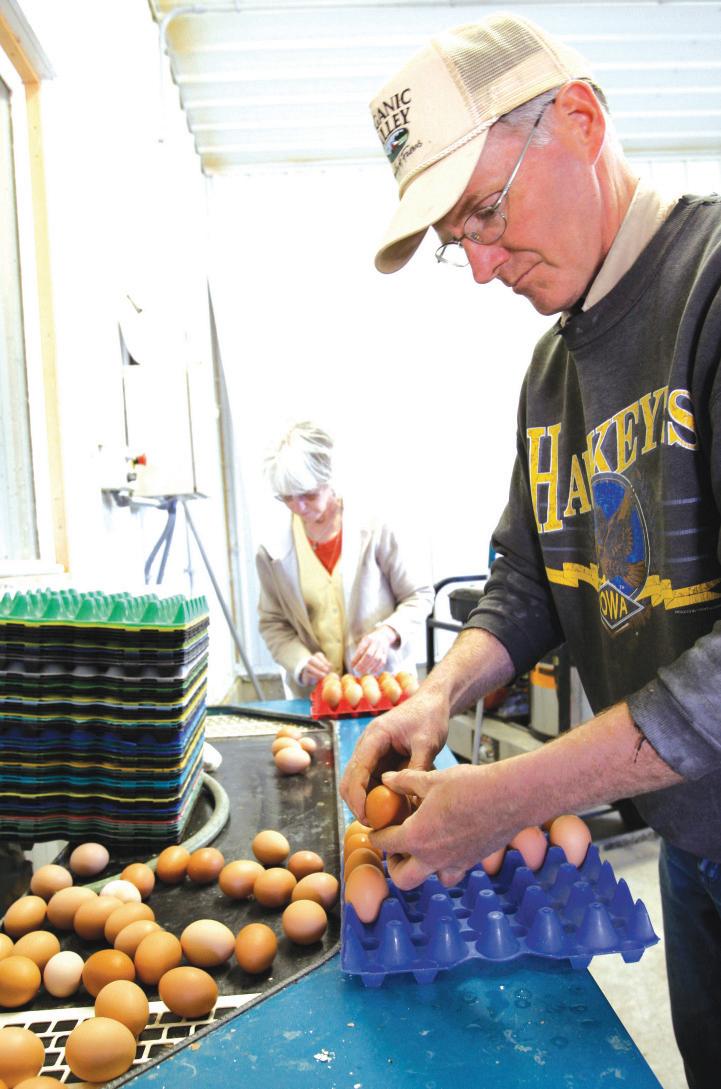
“For the decades prior to Mater et Magistra, the family farm was promoted by the Catholic Church as one of the most ideal conditions in which a family might be raised and a livelihood pursued,” Thompson wrote in his paper.
The US Bishops saw farming as conducive to family life because it often involved multiple generations and it relied on nature’s rhythms as designed by God, he explained.
Over the past 50 years, however, the number of family farms in the country has dropped by half, from 4 million to 2 million.
“The family farm has been decimated, and its status has been reduced to a nostalgic memory of an era largely believed to have evaporated,” Thompson wrote.
While more and more people in recent years have become aware of the need to care for the environment, we also need to bolster our awareness of the moral dimensions of agriculture, he said.
“We really need a generation of thoughtful men and women, well-informed in Catholic social thought, entering into conversations on food production, food security, human dignity, rural life - all these things that have been on the margins of the typical Catholic university experience,” Thompson said.
“I think we have to draw from our Catholic heritage,” he added, “and in my mind, (St Thomas) Aquinas has supplied for centuries the philosophical architecture to help us navigate those questions. I think he can still do that, but it’s going to take some work on the part of educators to build that bridge.”
In his paper, Thompson said Catholic universities need to introduce a “green Thomism,” or a philosophy of creation as divinely ordered and a vision of stewardship that guides our participation in God’s creation.
phy grounded in nature as a starting point for understanding what it means to be human.
“Over time, what was originally a discussion of the human person distinct from (the plant and animal kingdoms of) lower creation but in relation to lower creation became a discussion of the human person just as a distinct entity,” Thompson said.
“There’s no longer a philosophical discussion of what it means to be a human being in relationship to other creatures.”
Agriculture, he added, is the one area of work where people’s relationship to lower creation and their awareness of its rhythms are most essential.
This lack of reflection on nature and rural life in Catholic universities has led in part to the modern disconnect between people and the land, he said.
To illustrate his point, Thompson referred to a group of university students he led on a rural retreat to southwest Minnesota.
Afterwards, he asked the students to reflect on the experience.
One graduating senior told him that before the retreat she hadn’t realised that farm animals were raised in Minnesota.
“(Many people) have no idea where their food comes from,” Thompson said.
“I think that tends to sever our relationship to place; it severs our relationship to the land.”
To get people thinking again about agriculture as a moral endeavour, Thompson said he would like to see the creation of a pontifical institute or centres of Catholic learning committed to the study of agriculture and environmental issues, as well as agriculture-related courses at Catholic universities.
sary of Mater et Magistra (“Mother and Teacher”), Blessed Pope John XXIII’s 1961 encyclical on
Christianity and social progress, which addressed agriculture among a number of other topics.
Over the past half-century, Thompson discovered in his research, Catholic universities have moved away from teaching philoso-
“I think many people would say: ‘... How can there possibly be Catholic principles in agriculture? Are you telling me that there’s something like Catholic farming ...?’ and I’m going to say, ‘Yes, I think there is.”
WASHINGTON (CNS)
- We use our TVs for more than watching TV. There are DVDs (and, for the hardy holdouts, VHS tapes), and time-shifting and on-demand options in the new digital age.
TVs also are used to play video games. The Supreme Court has opened the floodgates for the most violent of video games to be purchased by minors, striking down a California law that had banned their sale to youngsters, imposing a $1,000 fine for any store that sold violent video games to anyone under 18. The vote wasn’t close7-2 - and the two dissenters represented one each from what is generally regarded as the court’s liberal and conservative wings.
Leland Yee, the California state Senator who wrote the law, was clearly unhappy with the high court’s decision.
“Unfortunately, the majority of the Supreme Court once again put the interests of corporate America before the interests of our children,” he said in a statement posted on his website on 27 June, the date of the court’s ruling. “It is simply wrong that the video game industry can be allowed to put its profit margins over the rights of parents and the wellbeing of children.” Such profits come “at the expense of our kids’ mental health and the safety of our community,” he said.
The video game industry’s annual sales total $10 billion.
US Rep Joe Baca, D-California, said he would reintroduce a bill that would require the makers of any video game rated T (for teen) or higher to post a health warning, in the manner of those found on cigarette packs: “WARNING: Excessive exposure to violent video games and other violent media has been linked to aggressive behaviour.” He sponsored such a bill in 2009, but it went nowhere.
“Research continues to show a proven link between playing violent games and increased aggression in young people,” Baca said in 2009.
In his dissent, Justice Stephen Breyer said, “I would find sufficient grounds in these studies and expert opinions for this court to defer to an elected legislature’s conclusion that the video games in question are particularly likely to harm children,” adding his view that the California law passed constitutional muster.
Breyer added: “What sense does it make to forbid selling to a 13-year-old boy a magazine with an image of a nude woman, while protecting the sale to that 13-year-old of an interactive video game in which he actively, but virtually, binds and gags the woman, then tortures and kills her?”
The justices in the majority considered video games a protected form of speech under the First Amendment. It was the first time the court gave a blanket protection to a communications medium since 1952, when movies got that nod.
VATICAN CITY - While empirical science has done much to further progress, subjecting God and His truth to scientific scrutiny represents an incorrect and despotic use of human reason, Pope Benedict XVI said.
How reason, truth and faith interconnect has always sparked debate throughout history, the Pope said on 30 June during an award ceremony in the fresco-covered Clementine Hall in the Apostolic Palace.
The Pope gave three European theologians the Ratzinger Prize for their excellence in theological studies: Manlio Simonetti, an 85 year old Italian professor and expert in ancient Christian studies and patristic biblical interpretation; Fr Olegario Gonzalez de Cardedal, a 76 year old Spanish
priest and Professor of Dogmatic and Fundamental Theology; and Cistercian Fr Maximilian Heim, a 50 year old German theologian and abbot of the Heiligenkreuz monastery in Austria.
The Pope used the occasion to talk about the significance and the challenges surrounding theology.
He noted the important contributions theology has made, but warned that theology must not only be concerned with the past as that would “leave the faith today in darkness.”
Nor must theologians only look at psychological or sociological studies, leaving faith on the wayside, as that would strip theology of meaning and a solid foundation, he added.
Though studying the past and understanding human and social sciences are important in theology, the Pope said the real question at stake is: “Is what we believe in true or not? In theology, the question of truth is at play: truth is its ultimate and essential foundation.”
Christ is the truth, and people can and must know Him through reason, he said.
“From here, one understands that Christian faith, by its very
nature, must call forth theology; it had to ask itself about the reasonableness of faith.”
So, while reason is fundamental to faith, there is an incorrect use of reason - a “despotism of reason which becomes the supreme and final judge of everything,” he said.
The Pope said this use of reason, which is “incompatible with the nature of faith,” can be seen in Psalm 95, which recalls Meribah as the place where the early Israelites tested God and “tried Me though they had seen My works.”
Putting God to some sort of a test is even more pronounced in today’s world, where natural science and its empirical method have achieved so much, the Pope said.
But there is a limit to how reason is used: “God is not an object of human experimentation. He is a subject and He manifests himself only in a person-to-person relationship,” he said.
The correct use of reason in matters of faith then is when it is used on a personal level and is driven by love.
The Pope said: “Love wants to know better the person who loves. Love - true love - doesn’t make us blind,” it makes people see.
Love will satisfy a person’s thirst to really know the other, and that is why those who seek the truth are on the path to seeking God, he said.
“This is why authentic theology is so important. Solid faith leads reason to open itself up to the divine, so that reason, guided by love for the truth, may know God even more from up close,” he said.
Therefore, theology must be made up of two elements: “humility, which lets us be ‘touched’ by God, and discipline, which is tied to the order of reason, (which) keeps love from blindness and helps develop its power to see,” he said.
During the ceremony, the Pope greeted each of the prize recipients, handing them each a large award certificate and a small envelope.
The prizes included a check for US$87,000. The Ratzinger Prize will be awarded each year in sacred Scripture, patristics and fundamental theology.
This was the first time the prizes were awarded since the establishment last year of the Joseph Ratzinger (Benedict XVI) Vatican Foundation, which promotes theological studies on the Pope’s writings and to reward promising scholars.
OTTAWA, Ontario - A new pastoral letter from Canada’s Catholic Bishops is aimed at helping school boards, teachers, parents and students in their ministry to young people with same-sex attraction.
Released on 27 June, the eightpage document from the Bishops’ Commission for Doctrine upholds Church teaching on homosexuality while encouraging sensitivity to teenagers and young adults who are attracted to people of the same sex.
The document was published as publicly funded Catholic schools in Ontario work to incorporate the provincial government’s equity policy, which encourages respect and acceptance of individuals of diverse backgrounds into schools.
Earlier this year, the Ontario Bishops sent a letter encouraging Catholic schools to establish groups to combat bullying based on sexual orientation.
Ottawa Archbishop Terrence Prendergast, a member of the doctrinal commission, said the document offers a clear explanation of the Church’s teaching on homosexuality.
“If we are going to be Catholic school boards and we are going to try to have equality and equity in our outreach to young people, then we need to be clear about what the Church’s teaching is,” he said.
The letter urges educators to encourage chastity, “especially since society often misunderstands and scorns this virtue.”
“Avoidance of difficult questions or watering down the Church’s teaching is always a disservice,” it said. “Such attitudes could lead
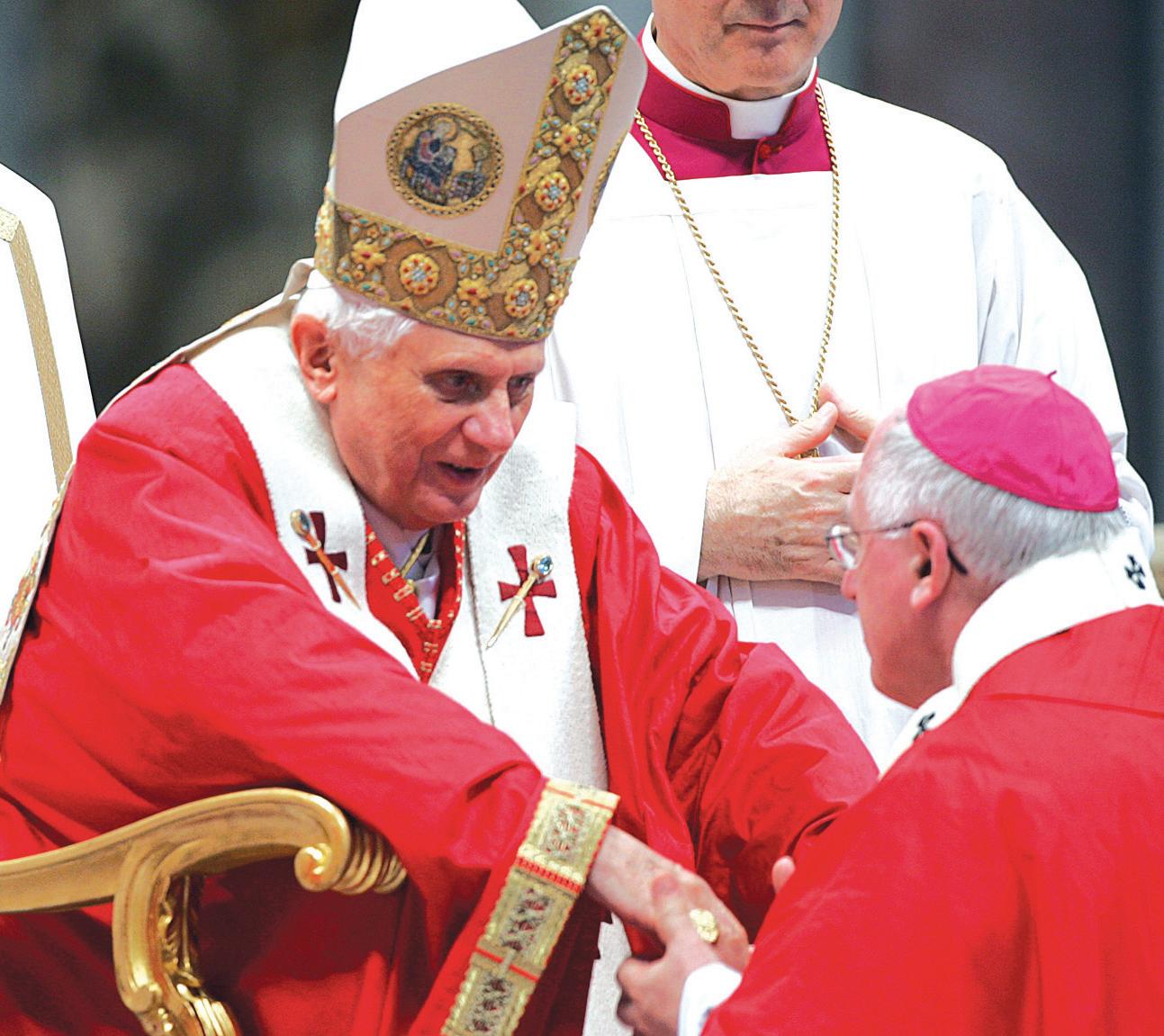
in different ways,” he said, stressing friendship and support groups such as Courage and EnCourage for families and friends of those struggling with same-sex attraction.
The letter recognises the “enormous pressures” facing young people grappling with same-sex attraction such as “unjust discrimination, the sense of invisibility and isolation, and ignorance of their particular situation.”
It urges priests and pastoral workers to examine themselves honestly in an effort to remove barriers that might make young people experiencing same-sex attraction feel unwelcome. It urges parents to “respond lovingly and trust divine providence” if their child reveals same-sex inclinations and to continue welcoming him or her into their home.
The letter also warns of the temptation to suicide by those who can “no longer deny or ignore their deep-seated, same-sex inclinations” and urges young people to accept the love of God to help them through their difficulties.
The letter outlines Church teaching on sexuality, traditional marriage, and on the distinction between inclinations and actions.
young people into grave moral danger.” The Bishops stressed the virtue of chastity, describing it as “a way of loving” that entails “more than the avoidance of sin” but involves the successful integration of sexuality and a person’s bodily and spiritual being.
“Through a Christ-centred love Christians can be fulfilled in all aspects of life, including the gradual integration of their sexuality.
On this challenging journey, only a greater love can heal a lesser love,” the document said.
“God catches us up in His love,” Archbishop Prendergast explained.”
Sometimes we figure, how can I love as a human person when I’m torn in my attractions? Allow God
to love you and to heal you, and perhaps you can redirect love into a different way or channel it into a cause.”
Not everyone is called to marriage, he said, but people can find ways of giving themselves to others “that can heal them as well as help other people to heal.”
Even Jesus counted on the love of God to keep going, the Archbishop said. “Married people are tempted. Priests who have the vow of chastity, Bishops are tempted. Everyone is tempted by this drive of sexuality, to love and beget life,” he said.
But chastity and celibacy are not sentences of loneliness, the Archbishop added.
“We can be with other people
“While homosexual acts are always objectively wrong, same-sex inclinations are not in themselves sinful or a moral failing,” it said. “To the extent that a same-sex attraction is not freely chosen, there is no personal culpability in having such an inclination.”
“Nonetheless, when oriented toward genital activity, this inclination is ‘objectively disordered,’” the letter said, quoting the Catechism of the Catholic Church. “This does not mean that the person as a whole is somehow defective or ‘badly made,’ or that he or she has in some way been rejected by God.”
For those who do not see marriage as an option, “choosing chastity as a positive value is even more of an ongoing challenge,” it said.
Chinese Bishop ordained without Vatican OK; other ceremony postponed
BY CATHOLIC NEWS SERVICELESHAN, China - A Chinese Bishop was ordained without a Vatican mandate on 29 June, the same day the government forced postponement of an ordination that had the approval of the Pope.
In southwestern Sichuan province, Fr Paul Lei Shiyin was ordained Bishop of Leshan - without a papal mandate - in the presence of about 1,000 guests and government officials at Our Lady of the Rosary Church in Emeishan, reported the Asian Church news agency UCA News.
Bishop Johan Fang Xingyao of Linyi, president of the government-sanctioned Chinese Catholic Patriotic Association, was the main celebrant.
The six other Bishops who laid hands on Bishop Lei had all been ordained with Vatican approval.
Bishop Lei was the first Bishop ordained in China without Vatican
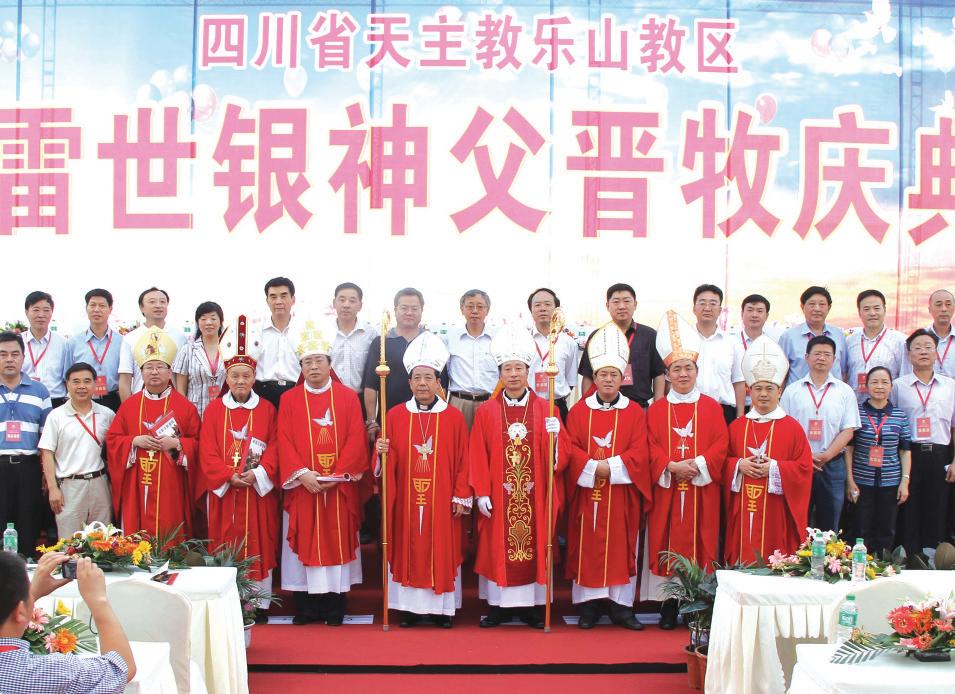
approval since the Vatican published a clarification about the excommunication of those who participate in the ordination of a Bishop not recognised by the Pope.
The Pontifical Council for Legislative Texts published a text
VATICAN CITY - The Vatican is studying a possible document on the relationship of clergy and laity which touches on the sensitive issue of the administration of the Church’s goods, Vatican sources said.
The sources denied an Italian report that the document will issue instructions on the reorganisation of US dioceses that face financial pressures in the wake of the sex abuse scandals - in particular regarding parish closings.
The sources, who spoke to CNS on 28 June, said the document under preparation only marginally touches on the topic of parish closings and, if published, will be directed at the universal Church.
The form of the document has not yet been determined; it may be an instruction or a less formal circular letter, they said.
“The main topic here is the respect of norms regarding the nature of the priesthood in collaboration with laypeople, especially as it is affected by the restructuring of parish life,” said one source familiar with the draft document.
“In some countries, new forms of parish structures have been created in which the priestly ministry appears weakened - in practice, the priest’s role risks being reduced to that of a celebrant of the Sacraments, while teams of laypeople are put in charge of management,” he said.
“But the office of governing is part of the priestly ministry.”
The preparation of the document is being guided by the Congregation for Clergy because it has competence over matters pertaining to the administration of ecclesiastical goods.
In that sense, the sources said, the document will touch on the matter of parish closings, which often involve the loss or redistribution of the Church’s assets and properties.
In the United States, parish closings have sometimes prompted protests among the faithful.
In several recent cases, the Vatican has upheld mergers of parishes but said that Church buildings that were closed must be reopened and “used in some manner as determined by the Bishop.”
Vatican officials have privately expressed reservations about some of the parish closings and the way they were handled.
One Vatican official said, however, that the document under consideration would not seek to emit specific norms for the United States.
“If that were the purpose, we would have talked to the (US) Bishops’ conference,” he said.
“The focus of this study is much wider. In the United States, there is the issue of parish closings.
In Europe, there are other problems tied to a lack of clergy.
The situations are diverse, and the Holy See wants to give a universal response,” he said.
The sources said the clergy congregation had been studying these issues for several years.
They said it was still too early to say when - or if - a document would be published.
Still, the council said, the ordination of a Bishop without papal approval provokes scandal and confusion among the faithful, and this scandal must be repaired through acts of communion and penitence.
Bishop Lei, 48, told UCA News he can personally obey the Church unconditionally but he also has to consider the fundamental interests of the local Church.
“I wrote a letter and answered inquiries from Rome a year ago. I did what I needed to do and have waited for a long time,” he said.
The local Church cannot give up the opportunity of evangelisation, he said.
“I hope you can understand that we have to consider the Church’s survival and development. We have no way out and cannot sidestep this issue but must work according to the reality,” he said.
90th anniversary of the establishment of the Communist Party of China on 1 July.
Fr Sun was forcibly taken away by security officers on 26 June and was being “looked after” by government officials, UCA News reported.
It was unclear from the UCA News reports if the government officials preventing the ordination were local or federal.
Often, in China, mid-level officials in the provinces carry out government policies in different manners.
On 29 June, Handan Diocese posted on its website a notice to demand the return of Fr Sun and a letter to the government protesting its interference in the ordination.
earlier in June explaining that unauthorised ordinations generally bring the penalty of automatic excommunication, but there can be mitigating circumstances - including fear of reprisal, necessity or serious inconvenience.
Meanwhile, in northern China’s Hebei province, Handan Diocese had planned to proceed with the ordination of Fr Joseph Sun Jigen, elected coadjutor Bishop by diocesan officials and approved by the Vatican.
However, government officials objected to the ordination date of 29 June, the feast of Sts Peter and Paul, saying it was too close to the
The previous day, plainclothes police were stationed at all road junctions leading to the church where the ordination was scheduled.
As people who did not know that the ordination was postponed arrived, police in the church compound dispersed them, causing tension, one source told UCA News.
Catholics across China have called for fasting and prayer to the intercession of Sts Peter and Paul for the Church in China in the light of the news of the two situations.
VATICAN CITY - Pope Benedict XVI inaugurated the Vatican’s online news portal with a click, and then announced the launch with the first-ever papal tweet.
“Dear Friends, I just launched News.va. Praised be our Lord Jesus Christ! With my prayers and blessings, Benedictus XVI,” the Pope said in his message on the news site’s Twitter account. His tweet - 117 characterswent viral, and within 24 hours http://twitter.com/news_va_en had more than 35,000 followers.
The Pope was flanked by Vatican communications officials on 28 June as he tapped an iPad and officially launched www. news.va, which aggregates news content from the Vatican’s newspaper, radio, television and online outlets.
The Pontiff was then given a brief tour of the portal’s features. The launch came on the eve of the feast of Sts Peter and Paul and the 60th anniversary of Pope Benedict’s ordination into the priesthood.
Archbishop Claudio Celli, who heads the Pontifical Council for Social Communications, said at a news conference on 27 June that the site would streamline news from the Vatican newspaper, L’Osservatore Romano ; Vatican Radio; the Vatican television station, CTV; the Vatican Information Service, VIS; the Fides missionary news agency; the Vatican press office; and the main Vatican website.
It offers print, video and audio material in Italian and English. New languages will be added gradually, beginning with Spanish, followed probably by French and Portuguese, he said.
Thaddeus Jones, an official of
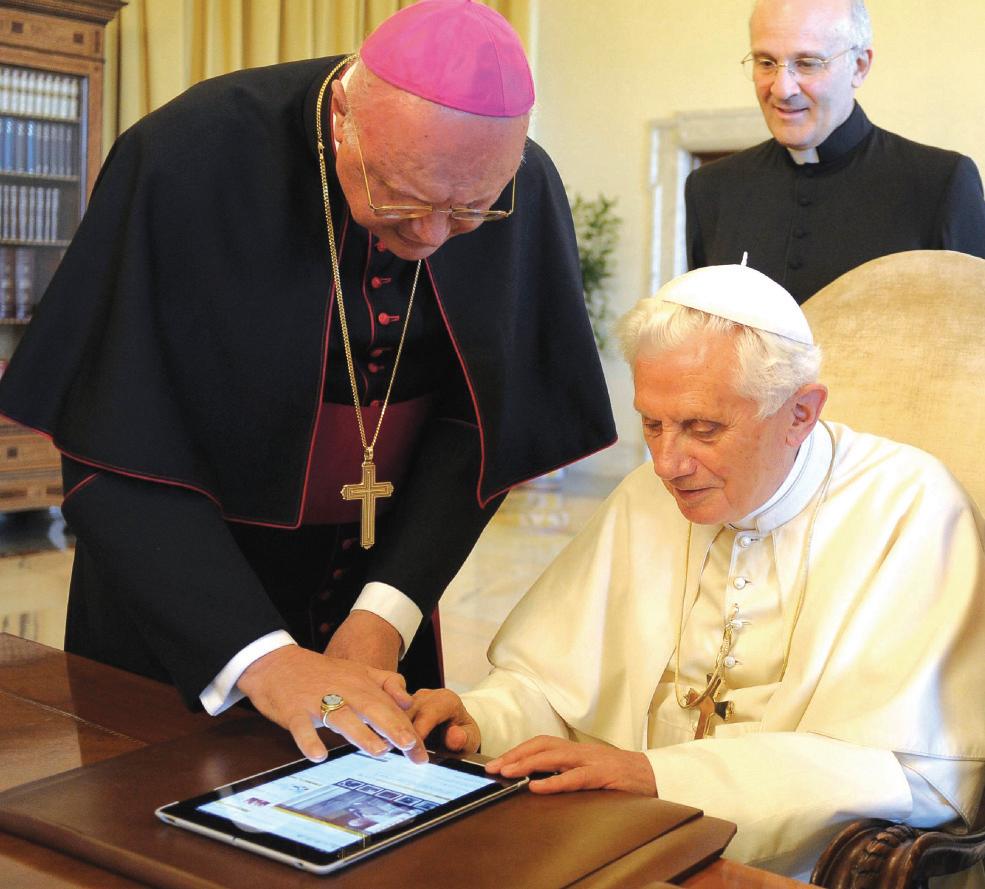
the pontifical council who coordinated the creation of the portal, said the site gives all the news generated by the various information sources but will highlight the latest most important items of the day. It features a list of the 10 most read stories and offers links to many social network sites. Users can share content through Facebook, Twitter and email, Jones said. Gustavo Entrala, CEO of 101, the Spanish digital media agency chosen for the technical development of the new site, said it was constructed on a high-end, flexible platform that allows millions of people to use it at the same time.
The first big test, said Jesuit Fr Federico Lombardi, head of the Vatican press office, will be the World Youth Day event in Madrid from 16-21 August, which will be
PHOTO:attended by Pope Benedict and which is expected to generate heavy traffic to the site.
Costs of the development and maintenance of the site will be borne exclusively through donations from private organisations and foundations, Archbishop Celli said.
It will not be supported at present or in the future by advertising or other commercial initiatives, he said. While Pope Benedict may not appear to be a media-savvy Pontiff, Archbishop Celli said, “in reality, with this Pope Vatican communications have made enormous strides.”
The Archbishop gave as an example the Pope’s reply when his advisers proposed an appearance on YouTube. According to the Archbishop, the Pope replied, “I want to be present wherever the people are found.”
Chinese Bishop ordained without Vatican OK; other ceremony postponed
BY CATHOLIC NEWS SERVICELESHAN, China - A Chinese Bishop was ordained without a Vatican mandate on 29 June, the same day the government forced postponement of an ordination that had the approval of the Pope.
In southwestern Sichuan province, Fr Paul Lei Shiyin was ordained Bishop of Leshan - without a papal mandate - in the presence of about 1,000 guests and government officials at Our Lady of the Rosary Church in Emeishan, reported the Asian Church news agency UCA News.
Bishop Johan Fang Xingyao of Linyi, president of the government-sanctioned Chinese Catholic Patriotic Association, was the main celebrant.
The six other Bishops who laid hands on Bishop Lei had all been ordained with Vatican approval.
Bishop Lei was the first Bishop ordained in China without Vatican
approval since the Vatican published a clarification about the excommunication of those who participate in the ordination of a Bishop not recognised by the Pope.
The Pontifical Council for Legislative Texts published a text
VATICAN CITY - The Vatican is studying a possible document on the relationship of clergy and laity which touches on the sensitive issue of the administration of the Church’s goods, Vatican sources said.
The sources denied an Italian report that the document will issue instructions on the reorganisation of US dioceses that face financial pressures in the wake of the sex abuse scandals - in particular regarding parish closings.
The sources, who spoke to CNS on 28 June, said the document under preparation only marginally touches on the topic of parish closings and, if published, will be directed at the universal Church.
The form of the document has not yet been determined; it may be an instruction or a less formal circular letter, they said.
“The main topic here is the respect of norms regarding the nature of the priesthood in collaboration with laypeople, especially as it is affected by the restructuring of parish life,” said one source familiar with the draft document.
“In some countries, new forms of parish structures have been created in which the priestly ministry appears weakened - in practice, the priest’s role risks being reduced to that of a celebrant of the Sacraments, while teams of laypeople are put in charge of management,” he said.
“But the office of governing is part of the priestly ministry.”
The preparation of the document is being guided by the Congregation for Clergy because it has competence over matters pertaining to the administration of ecclesiastical goods.
In that sense, the sources said, the document will touch on the matter of parish closings, which often involve the loss or redistribution of the Church’s assets and properties.
In the United States, parish closings have sometimes prompted protests among the faithful.
In several recent cases, the Vatican has upheld mergers of parishes but said that Church buildings that were closed must be reopened and “used in some manner as determined by the Bishop.”
Vatican officials have privately expressed reservations about some of the parish closings and the way they were handled.
One Vatican official said, however, that the document under consideration would not seek to emit specific norms for the United States.
“If that were the purpose, we would have talked to the (US) Bishops’ conference,” he said.
“The focus of this study is much wider. In the United States, there is the issue of parish closings.
In Europe, there are other problems tied to a lack of clergy.
The situations are diverse, and the Holy See wants to give a universal response,” he said.
The sources said the clergy congregation had been studying these issues for several years.
They said it was still too early to say when - or if - a document would be published.
Still, the council said, the ordination of a Bishop without papal approval provokes scandal and confusion among the faithful, and this scandal must be repaired through acts of communion and penitence.
Bishop Lei, 48, told UCA News he can personally obey the Church unconditionally but he also has to consider the fundamental interests of the local Church.
“I wrote a letter and answered inquiries from Rome a year ago. I did what I needed to do and have waited for a long time,” he said.
The local Church cannot give up the opportunity of evangelisation, he said.
“I hope you can understand that we have to consider the Church’s survival and development. We have no way out and cannot sidestep this issue but must work according to the reality,” he said.
90th anniversary of the establishment of the Communist Party of China on 1 July.
Fr Sun was forcibly taken away by security officers on 26 June and was being “looked after” by government officials, UCA News reported.
It was unclear from the UCA News reports if the government officials preventing the ordination were local or federal.
Often, in China, mid-level officials in the provinces carry out government policies in different manners.
On 29 June, Handan Diocese posted on its website a notice to demand the return of Fr Sun and a letter to the government protesting its interference in the ordination.
earlier in June explaining that unauthorised ordinations generally bring the penalty of automatic excommunication, but there can be mitigating circumstances - including fear of reprisal, necessity or serious inconvenience.
Meanwhile, in northern China’s Hebei province, Handan Diocese had planned to proceed with the ordination of Fr Joseph Sun Jigen, elected coadjutor Bishop by diocesan officials and approved by the Vatican.
However, government officials objected to the ordination date of 29 June, the feast of Sts Peter and Paul, saying it was too close to the
The previous day, plainclothes police were stationed at all road junctions leading to the church where the ordination was scheduled.
As people who did not know that the ordination was postponed arrived, police in the church compound dispersed them, causing tension, one source told UCA News.
Catholics across China have called for fasting and prayer to the intercession of Sts Peter and Paul for the Church in China in the light of the news of the two situations.
VATICAN CITY - Pope Benedict XVI inaugurated the Vatican’s online news portal with a click, and then announced the launch with the first-ever papal tweet.
“Dear Friends, I just launched News.va. Praised be our Lord Jesus Christ! With my prayers and blessings, Benedictus XVI,” the Pope said in his message on the news site’s Twitter account. His tweet - 117 characterswent viral, and within 24 hours http://twitter.com/news_va_en had more than 35,000 followers.
The Pope was flanked by Vatican communications officials on 28 June as he tapped an iPad and officially launched www. news.va, which aggregates news content from the Vatican’s newspaper, radio, television and online outlets.
The Pontiff was then given a brief tour of the portal’s features. The launch came on the eve of the feast of Sts Peter and Paul and the 60th anniversary of Pope Benedict’s ordination into the priesthood.
Archbishop Claudio Celli, who heads the Pontifical Council for Social Communications, said at a news conference on 27 June that the site would streamline news from the Vatican newspaper, L’Osservatore Romano ; Vatican Radio; the Vatican television station, CTV; the Vatican Information Service, VIS; the Fides missionary news agency; the Vatican press office; and the main Vatican website.
It offers print, video and audio material in Italian and English. New languages will be added gradually, beginning with Spanish, followed probably by French and Portuguese, he said.
Thaddeus Jones, an official of
the pontifical council who coordinated the creation of the portal, said the site gives all the news generated by the various information sources but will highlight the latest most important items of the day. It features a list of the 10 most read stories and offers links to many social network sites. Users can share content through Facebook, Twitter and email, Jones said. Gustavo Entrala, CEO of 101, the Spanish digital media agency chosen for the technical development of the new site, said it was constructed on a high-end, flexible platform that allows millions of people to use it at the same time.
The first big test, said Jesuit Fr Federico Lombardi, head of the Vatican press office, will be the World Youth Day event in Madrid from 16-21 August, which will be
PHOTO:attended by Pope Benedict and which is expected to generate heavy traffic to the site.
Costs of the development and maintenance of the site will be borne exclusively through donations from private organisations and foundations, Archbishop Celli said.
It will not be supported at present or in the future by advertising or other commercial initiatives, he said. While Pope Benedict may not appear to be a media-savvy Pontiff, Archbishop Celli said, “in reality, with this Pope Vatican communications have made enormous strides.”
The Archbishop gave as an example the Pope’s reply when his advisers proposed an appearance on YouTube. According to the Archbishop, the Pope replied, “I want to be present wherever the people are found.”
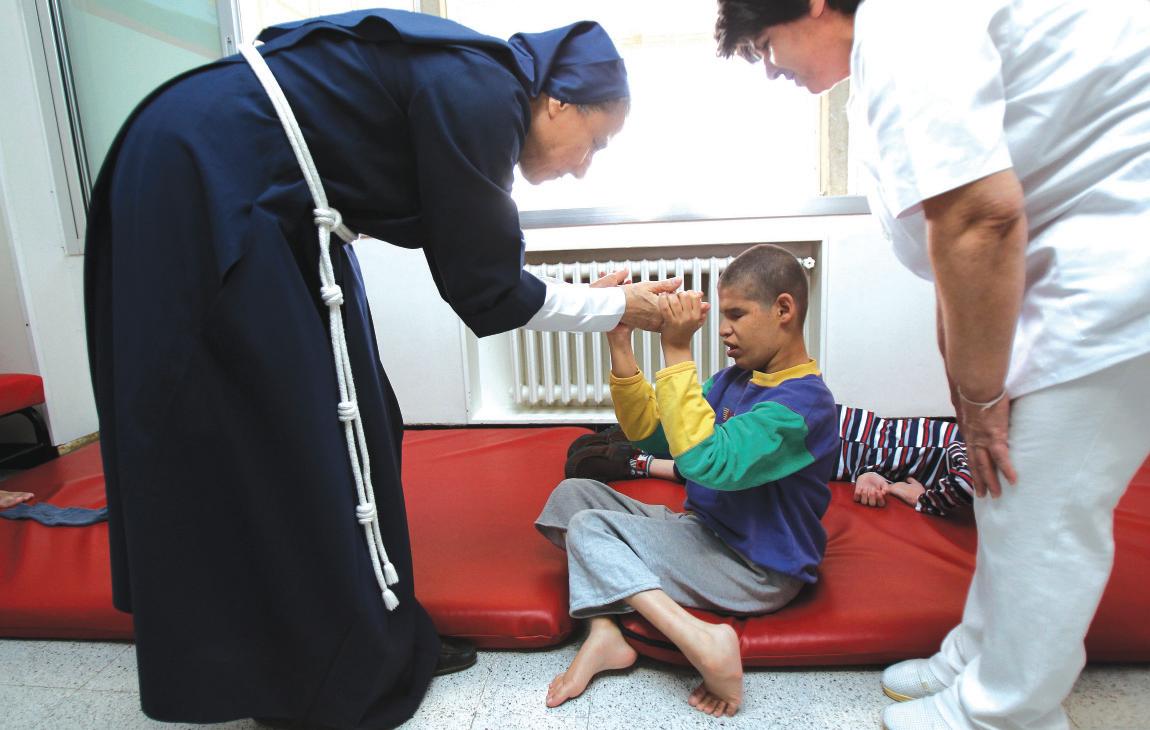
Barbara Harris’ call in The Record recently for a Church agency to help relieve parents of the stressful financial burden when enrolling their children with disabilities in Catholic schools is a cause for reflection ...
Igive my sincere thanks to the many people who emailed me, texted me, wrote me letters, phoned me up or met me in the shopping centre and told me how much they appreciated what I had written about the experience of so many parents of children with special needs seeking acceptance and access to services in the Church.
I also want to thank those who told me that their experience was different. It gives me hope.
One of the words that we hear regularly in our conversations and see in media reports is the word “inclusion”. Constantly, decisionmaking authorities are reminded to be “inclusive”.
We say that social justice demands inclusion and we are encouraged to use inclusive language.
To counter criticism, we quote statistical numbers in our defence to demonstrate just how inclusive we are. Statistical inclusion does not prove practical inclusion.
Using inclusive language, for instance, does not make a programme inclusive.
While some people are being welcomed and included and others are not, we cannot be said to be inclusive.
Social justice requires that we meet the needs of all. No one should be excluded in our Church because they learn differently, their needs are different, or because they make us feel uncomfortable.
No one in our Church should be ignored or “put on hold” because they are different or challenge us to be creative. What happens to people who are missing out while we wait
for funding? It is right and proper to seek funding from governments, local, State or Commonwealth. It is not right, however, that we make some members of the Body of Christ wait or miss out on access to Church while we sort out funding issues.
This is why funding and supporting children with special needs and their families is a whole of Church issue.
Funds must be found by us as Church, and pressure and stress must be taken off parents and local school communities so all can be included.
It is a whole of Church responsibility – a responsibility to be shared – not relegated to the family and the local school. Inclusion is a product of faith, not funds.
There was one leader who welcomed the marginalised, accepted the outcast, and was particularly fond of all those whom His society shunned. His name was Jesus and He practised inclusion.
Jesus embraced people who were marginalised to help Him build the faith community around forgiveness and love.
Unfortunately, the world focuses on outcomes and criteria of fitness that preclude participation for some.
Being different too often means being looked at as a distraction, being seen as a burden, coming at a ‘cost’ in terms of time, energy and resources. It is easy to pay ‘lip service’ to the Gospel values.
A deeper understanding of Gospel values requires focus and commitment.
Inclusion is not a matter of charity or a caring behaviour that we practise and encourage because we are “nice” people.
Inclusion is a moral and ethical responsibility for all the members of our Church.
Inclusion provides benefits for all. Inclusion means that the best talents come forth. It means the practical extension of showing goodness to one another. Inclusion is a response to the call of Christ.
Inclusion is not about helping special needs people; it is about enabling and empowering all of us. It is about learning from each other and sharing the journey.
Inclusion works. When

All my life I have been searching for the depths of God’s love and an experience of profound spiritual transformation.
Emmanuel Centre started in 1981, it was set up to walk with people across the whole spectrum of disability.
Of course, some people said it would not work; that people with disabilities like to stick with “their own kind” and such a venture would be a breeding ground for bitterness, marginalisation and antagonism.
Those myths were and are being exploded many times over. Emmanuel Centre works because it always seeks to include. Yes, sometimes we don’t quite get it right. But a willingness to learn how to do something overrides the first impulse to say, “We can’t”.
We have found that inclusion builds community and helps us to achieve what Christ came to teach. Inclusion is what we as Church can be about at every level because that is what Jesus was all about. Jesus’ “Love one another as I have loved you” gives us both the goal and the means to achieve it.
To do other than include all of God’s children is an incomplete effort; a departure from the example and command of Jesus, and makes a sham of our sometimes daily Eucharist because we outcast the very members of the Body of Christ whom we supposedly are honouring.
We are all connected, related and belong to each other. Jesus said, “I am the Vine and you are branches” (John 15:5). There is no one, no place, no thing that is not related to Christ and through Christ.
If Jesus tells us that we all belong, then we do, regardless. To maintain that some people, some things or some places, are not part of the Divine Plan is not being in touch with reality.
We read in the Book of Genesis of God’s great act of inclusion. God wanted all of us to be with Him.
God looked on all that He had made and indeed it was very good. When we insist that all the resources of the Church be available to all God’s people, we join God in creating another Garden of Life.
Barbara Harris is coordinator of the Emmanuel Centre, a self-help centre run for and by people with disabilities, their families and those who work with people with disabilities. Contact EmmanuelCentre@westnet.com.au.
The first mystical experience occurred in 1998 when I was living alone in a small flat in Melbourne’s leafy eastern suburbs.
My life was not going well. Much tragedy had befallen our family, including several deaths of immediate family members. I despaired, and grieved endlessly. There was much darkness.
I was forever seeking solace for my wounds but somehow this seemed to evade me at every turn.
This constant search for healing also became a much deeper search. I desperately wanted a divine experience of God touching my life.
As I was sitting in the flat after receiving the news of having to leave, I was more despairing than ever. Where would I live now? I did not know.
So I simply said a prayer and handed my life over to God, saying, in effect, “I can’t manage all of this alone now. It’s Yours. You deal with it.”
Within minutes I was filled with ecstasy, a radiant love and profound sense of peace. I was amazed.
This was what I had been wanting for so long. Everywhere I looked the world was transformed into a brilliant goldenness. Not only was I filled with an ecstatic brilliance, but I could also see it in everything around me.
Within a week I had found new and far better accommodation in more settled surroundings.
I felt filled with joy and peace which I wanted to last forever.
Ten days after this mystical experience,m as I like to call it, the ecstasy vanished.
But now, unlike before, I knew something had opened in me which had profound significance.
Not long after this experience I awoke one morning and was gripped with an extraordinary desire to write.
It was bursting in me and could not be ignored so I quickly boned up on freelance writing, bought a dictaphone, then found someone to interview who worked in the area of
lay Catholic ministry. I sent the article off to the Catholic press and it was published soon after.
So began a new direction in my life with freelance writing, albeit occasionally.
I still yearn to write as words just seem to tumble out of me like rushing waters in a mountain stream.
Four years after I began writing, another deep desire emerged in me: fiction writing. I was truly stunned.
I had no intention or want to do so previously. But again, a similar pattern emerged, a bursting desire to write. I read as many books as I could on the fiction writing process.
I also delved into biographies about fiction writers and began trying to sense my own unique method of crafting narrative.
After some years and many failed attempts, four short stories poured out of me that were publishable, finally.
By now I felt more than ever a continuing desire to write fiction and saw this as a yearning from the depths of my soul.
Fiction was not something that I could have ever constructed.
In fact, that was one of the first lessons I needed to learn before anything emerged. I needed to sit back and write out of that free space in myself, writing from the images that arose from within.
What began in non-fiction had opened into fictional expression. Life was more hopeful now, and hope-filled.
Over the ensuing years there were at least another six mystical experiences much like the first but these rarely lasted more than anywhere from minutes, to a few days.
But, at other ‘low’ times, similar but less intense experiences also occurred.
I remember one when I was simply standing in the queue at Safeway (supermarket) waiting to be served.
I looked up at the large number of people and suddenly I experienced that brilliant ecstasy for several minutes.
I felt touched by the Spirit once more, and deeply reassured that things would work out for the best somehow.
To seek God’s divine touch in our lives ultimately opens us to the ways of the Spirit and a much deeper, richer way of being in the world than we could ever imagine possible.
It is a pathway to the core of our self and a truth-filled vocation, whatever that may be.
FRIDAY, 8 TO SUNDAY, 10 JULY
MMP Annual retreat
7pm at Redemptorist Monastery, 190 Vincent St, North Perth. Enq and bookings: Ron 9300 8389.
SATURDAY, 9 JULY
Padre Pio day of Prayer
8.30am at Good Shepherd Church, Cnr Morley Dr and Alton Rd, Lockridge. Begins with Padre Pio DVD (parish centre), 10am Exposition of the Blessed Sacrament, Rosary, Divine Mercy, Silent Adoration and Benediction. 11am Mass, St Padre Pio liturgy and Confession. 12pm lunch, bring a plate to share. Enq: Des 6278 1540.
“Biblical Women You Haven’t Met Yet” Catholic Women’s Group Seminar
9.30 -11.30am at the Edel Quinn Centre, 36 Windsor St, East Perth. Discover women from Old Testament starting with Eve and how much these women have to tell us about the true nature of discipleship, suffering, redemption and true freedom. Presenter: Dr Philippa Martyr. Enq and registration: Lydia 0413 993 987, register at catholicwomen.perth@gmail.com.
Divine Mercy Healing Mass
2.30pm at St Francis Xavier Church, Windsor St, East Perth. Main Celebrant: Fr Marcellinus Meilak, OFM. Begins with Mass followed by Divine Mercy prayers and Veneration of First Class Relic of St Faustina and prayers for an end to abortion. Reconciliation in English, Maltese and Italian. Refreshments afterwards. Enq: John 9457 7771.
SUNDAY, 10 JULY
Secular Franciscan Order WA - Day of Reflection
10am at the Edel Quinn Centre, 36 Windsor St, East Perth. All welcome. Come and join our members in our discussions of how to live the Gospel life in the spirit of our seraphic father, St Francis of Assisi. Enq: Angela on 9275 5658.
Eucharistic Reparation
3pm at Our Lady Queen of Peace Parish, Cnr Milroy and Drury Sts, Willagee. The World Apostolate of Fatima Aus Inc invites you to attend a Eucharistic Hour for reparation. Enq: Diana 9339 2614.
WEDNESDAY, 20 TO FRIDAY, 22 JULY
I Stand Anchored Youth Camp
6pm at Advent Park campgrounds. Young people high school years 9-11. Fun times, great food, games, music, talks, and friendships. Enq: Marty 0417 637 040 or perth@ymt.com.au
THURSDAY, 21 TO SUNDAY, 24 JULY
Encounter Youth Convention
6pm at Advent Park campgrounds. For young people ages 17-30. Each day is packed full of fun, friendship, music, learning and exploration of a life lived to fullness. Enq: Mario 9202 6868 or mario.borg@disciplesofjesus.org.
FRIDAY, 22 TO SUNDAY, 24 JULY
“Finding the Rhythm” - A Reflective Weekend for women in the health profession
4pm at St John of God Retreat Centre, 47 Gloucester Crescent, Shoalwater. How can one manage the endless changes in life and keep a balance? Assists women in finding the rhythm of good discernment in life and ministry. Concludes Sunday at 1pm. Enq: Sr Ann 0409 602 927, ann_cull@y7mail.com or Sr Kathy 0418 926 590, kkettle@mercy.org.au.
FRIDAY, 29 JULY
‘An Evening of Prayer with Our Lady Queen of Peace’ - Medjugorje prayer group
7-9pm at St Vincent’s Parish, 114 Parmelia Ave, Kwinana. Includes Eucharistic Adoration, Rosary, Benediction, Holy Mass. Free DVD of Don Calloway’s testimony and conversion from drugs, alcohol and crime to priesthood and DVD of Ivan’s talk at St Mary’s Cathedral. Enq. Eileen 9402 2480, 0407 471 256 or medjugorje@y7mail.com.
St Jude’s Parish, Langford is organising a 13-day pilgrimage departing 1 October. It will include visits to the Shrines of Divine Mercy, Infant Jesus, the Black Madonna, St Faustina, the birthplace of Pope John Paul II and the Museum at Auschwitz. Total cost per person $5,800. Spiritual Director, Fr Terry Raj. Enq: Co-ordinator John Murphy 9457 7771, Matt 6460 6877, mattpicc1@ gmail.com.
WEDNESDAY, 5 TO THURSDAY, 20 OCTOBER
Pilgrimage to Rome, San Giovanni Rotondo and Medjugorje
Includes 3 nights in Rome, 2 nights in San Giovanni Rotondo (Padre Pio); visit to Monte Gargano and Lanciano (Eucharistic Miracle); 7 nights in Medjugorje (alleged daily appearance of Our Lady). Spiritual leader: Fr Ronan Murphy. Cost: $3,990, includes Emirates flight, bed, breakfast and evening meals, transfers, guide, taxes and tipping. Enq: Eileen 9402 2480 or 0407 471 256 or medjugorje@y7mail.com.
FRIDAY, 11 TO TUESDAY, 22 NOVEMBER
Pilgrim Tour To The Holy Land
Jordan, Israel and Egypt. Spiritual Director: Fr Sebastian Kalapurackal VC from St Aloysius Church, Shenton Park. Enq: Francis – Coordinator, 9459 3873 or 0404 893 877 or Skype ID: perthfamily.
EVERY SUNDAY
Gate of Heaven Catholic Radio
Join the Franciscans of the Immaculate from 7.30-9pm on Radio Fremantle 107.9FM for Catholic radio broadcast of EWTN and our own live shows. Enq: radio@ausmaria. com.
Pilgrim Mass - Shrine of the Virgin of the Revelation
2pm at Shrine, 36 Chittering Rd, Bullsbrook. Commencing with Rosary followed by Benediction. Reconciliation is available before every celebration. Anointing of the Sick administered during Mass every second Sunday of the month. Pilgrimage in honour of the Virgin of the Revelation, last Sunday of the month. Side entrance to the church and shrine open daily between 9am-5pm. Enq Sacri 9447 3292.
EVERY FIRST SUNDAY
Divine Mercy Chaplet and Healing Prayer
3pm at Santa Clara Church, 72 Palmerston St, Bentley. Includes Adoration and individual prayer for healing. Spiritual leader: Fr Francisco. All welcome. Enq: Fr Francisco 9458 2944.
EVERY SECOND SUNDAY
Healing Hour for the Sick
6pm at St Lawrence Parish, 392 Albert St, Balcatta. Begins with Mass, Exposition of the Blessed Sacrament and prayers. Enq: Fr Irek 9344 7066 or ww.stlawrence. org.au.
EVERY THIRD SUNDAY OF THE MONTH
Oblates of St Benedict Meet
2pm at St Joseph’s Convent, York St, South Perth. Study the rule of St. Benedict and its relevance to the everyday life for lay people. Followed by Vespers and afternoon tea. Enq: Secretary 94575758
EVERY FOURTH SUNDAY OF THE MONTH
Holy Hour for Vocations to the Priesthood, Religious Life
2-3pm at Infant Jesus Parish, Wellington St, Morley. The hour includes Exposition of the Blessed Eucharist, silent prayer, Scripture and prayers of intercession. Come and pray that those discerning vocations to the priesthood or Religious life hear clearly God’s loving call to them.
EVERY MONDAY
Evening Adoration and Mass
7pm at St Thomas Parish, Claremont, cnr Melville St and College Rd. Begins with Adoration, Reconciliation, Evening Prayer and Benediction. Followed by Mass and Night Prayer at 8pm. Enq: Kim 9384 0598, claremont@ perthcatholic.org.au.
EVERY TUESDAY
Bible Teaching with a difference
7.30pm at St Joachim’s parish hall, Shepparton Rd, Victoria Park. Exciting revelations with meaningful applications that will change your life. Novena to God the Father, followed by refreshments. Bring Bible, a notebook and a friend. Enq: Jan 9284 1662.
Novena to Our Lady of the Miraculous Medal
6pm at the Pater Noster Church, Marmion and Evershed Sts, Myaree. Mass at 5.30pm followed by Benediction. Enq: John 0408 952 194.
EVERY WEDNESDAY
Holy Spirit of Freedom Community
7.30pm at The Church of Christ, 111 Stirling St, Perth. We are delighted to welcome everyone to attend our Holy Spirit of Freedom Praise Meeting. Enq: 0423 907 869 or hsofperth@gmail.com.
Holy Hour at Catholic Youth Ministry
6pm at 40A Mary St, Highgate, Catholic Pastoral Centre. 5.30pm Mass followed by $5 fellowship supper. Enq: Stefania 9422 7912 or www.cym.com.au.
EVERY FIRST WEDNESDAY
Holy Hour prayer for Priests
7.30-8.30pm at Holy Spirit Parish, 2 Keaney Pl, City Beach. All welcome. Enq: Linda 9341 3079.
SECOND WEDNESDAY OF THE MONTH
Chaplets of the Divine Mercy
7.30pm at St Thomas More Catholic Parish, Dean Rd, Bateman. A beautiful, prayerful, sung devotion accompanied by Exposition and followed by Benediction. The next devotion is to be held on Wednesday, 13 July. Enq: George 9310 9493 or 9325 2010 (w).

EVERY THURSDAY
Divine Mercy
11am at Sts John and Paul Church, Pinetree Gully Rd, Willetton. Pray the Rosary and Chaplet of Divine Mercy, and for the consecrated life, especially here in John Paul Parish. Conclude with veneration of the First Class Relic of St Faustina. Please do come and join us in prayer. Enq: John 9457 7771.
St Mary’s Cathedral Praise Meeting
Due to renovations at 450 Hay St Perth, CPM now meets at 7.45pm every Thursday at the Legion of Mary’s Edel Quinn Centre, 36 Windsor Street, East Perth. Includes Praise song and healing ministry. Enq: Kay 9382 3668 or fmi@flameministries.org.
Fr Corapi’s Catechism of the Catholic Church
7.30pm at St Joseph Church, 20 Hamilton St, Bassendean - parish library. Enq: Catherine 9329 2691.
FIRST THURSDAY OF THE MONTH
Taize Prayer and Meditation
7.30-8.30pm at Our Lady of Grace Parish, 3 Kitchener St, North Beach. Prayer, song and silence in candlelight – symbol of Christ light of the world. Next service: Thursday, 7 July. Taize info: www.taize.fr. Enq: Beth 9448 4457 or 9448 4888.
FIRST FRIDAY OF THE MONTH
Holy Hour for Vocations to the Priesthood and Religious Life
7pm at Little Sisters of the Poor Chapel, 2 Rawlins St, Glendalough. Mass, followed by Adoration with Fr Doug Harris. All welcome. Refreshments provided.
Catholic Faith Renewal Evening
7.30pm at Sts John and Paul’s Parish, Pinetree Gully Rd, Willetton. Songs of Praise, sharing by a priest followed by Thanksgiving Mass and light refreshments after Mass. All welcome to attend and bring your family and friends. Enq: Kathy 9295 0913, Ann: 0412 166 164 or catholicfaithrenewal@gmail.com.
Communion of Reparation All Night Vigils
7pm-1.30am at Corpus Christi Church, Lochee St, Mosman Park. Enq: Vicky 0400 282 357 and at St Gerard Majella Church, Ravenswood Dr and Majella Rd, Mirrabooka. Enq: Fr Giosue 9349 2315, John or Joy 9344 2609. The Vigils consist of two Masses, Adoration, Benediction, Prayers and Confession in reparation for the outrages committed against the United Hearts of Jesus and Mary. All welcome.
Healing Mass
7pm at St Peter’s Parish, Wood Street, Inglewood. Reconciliation, praise and worship, Eucharistic Adoration, Benediction, Anointing of the Sick, special blessings and fellowship after the Mass. Celebrants, Fr Dat (parish priest) and specially invited priests. All welcome. Enq: Priscilla 0433 457 352, Catherine 0433 923 083 and Mary-Ann 0409 672 304.
Healing and Anointing Mass
8.45am Pater Noster Church, Evershed St, Myaree. Begins with Reconciliation followed by 9am Mass of the Sacred Heart of Jesus, Anointing of the Sick and Prayers to St Peregrine. Enq: Joy 9337 7189.


ACROSS
1 Noahʼs boat was measured in these
6 The Infant of Prague, for one
10 Patron saint of cab drivers
11 Saviour
12 Catholic ___
16 Patron saint of dancers
18 Easter treat
20 A stone was rolled in front of this in Matthew
21 Crèche
22 ___ box
23 Number of the commandment that instructs us to honor our parents
24 “Regina ___”
26 Have ___ on us
28 Teaching handed down from the Apostles and continues to be handed on by the Church
32 Type of school
33 The Blessed ___ Mary
35 “Bad company ruins good ___” (1 Cor 15:33)
36 Jacobʼs dream (Gn 28:12)
DOWN
2 David married his widow
3 OT book
4 What Samson did while his hair was shaved
5 9am prayer
7 Apostle number
8 Entice one to sin
9 Peter cut this off the soldier of the high priest
13 This one was permitted to take peace from the earth (Rev 6:4)
14 At Mass, the entrance prayers or song
15 Biblical territory
17 An archangel
19 Worship
21 Gregorian ___
25 Service book
27 Jesus was baptised in one
29 “…a chosen race, a ___ priesthood” (1 Pt 2:9)
30 Lucifer
31 A dove brought back this branch back to Noah
32 Benedictine title
34 Liturgical colour
LAST WEEK’S SOLUTION
10 S 15TH SUNDAY IN ORDINARY TIME
Gr Isa 55:10-11 Carrying out God’s will
Ps 64:10-14 Care for the earth
Rom 8:18-23 Creation groaning
Mt 13:1-23 Discerning the word
11 M St Benedict, abbot (M)
Wh Ex 1:8-14, 22 A threat to us
Ps 123 A prey to their teeth
Mt 10:34-11:1 Not peace, but sword
12 Tu Ex2:1-15 Moses frightened
Gr Ps 68:3, 14, 30-31, 33-34 poverty and pain
Mt 11:20-24 Refused to repent
13 W St Henry (O)
Gr Ex 3:1-6, 9-12 The blazing bush
Ps 102:1-4, 6-7 The Lord forgives
Mt 11:25-27 I bless You, Father
14 Th St Camillus de Lellis, priest (O)
Gr Ex 3:13-20 I Am Who I Am
Ps 104:1, 5, 8-9, 24-27 God sent Moses
Mt 11:28-30 I will give you rest
15 F St Bonaventure, Bishop, doctor of the Church (M)
Gr Ex 11:10-12:14 Passover meal
Ps 115:12-13, 15-18 Cup of Salvation
Mt 12:1-8 Master of the Sabbath
16 S Our Lady of Mt Carmel (O)
Gr Ex 12:37-42 Israel out of Egypt
Ps 135:1, 10-15, 23-24 Everlasting Love Mt 12:14-21 Led truth to victory
WRR LAWN MOWING & WEED
SPRAYING Garden clean ups and rubbish removal. Get rid of bindii, jojo and other unsightly weeds. Based in Tuart Hill. Enq 9443 9243 or 0402 326 637.
BUSINESS OPPORTUNITY
Work from Home - P/T or F/T, 02 8230 0290 or visit www.dreamlife1.com.
FURNITURE REMOVAL
ALL AREAS. Competitive Rates. Mike Murphy Ph 0416 226 434.
EDUCATION SERVICES
ENGLISH TUTOR Using whole word, word in context and phonics programme. Teacher with Master’s degree, 7 years’ experience. Police cleared. Ph Tom 0449 979 637.
RELIGIOUS PRODUCTS
CATHOLICS CORNER Retailer of Catholic products specialising in gifts, cards and apparel for Baptism, Communion and Confirmation. Ph 9456 1777. Shop 12, 64-66 Bannister Rd, Canning Vale. Open Mon-Sat.
RICH HARVEST YOUR
CHRISTIAN SHOP Looking for Bibles, CDs, books, cards, gifts, statues, Baptism/Communion apparel, religious vestments, etc? Visit us at 39 Hulme Ct (off McCoy St), Myaree. Ph 9329 9889 (after 10.30am Mon to Sat). We are here to serve.
KINLAR VESTMENTS
Quality hand-made and decorated vestments: Albs, Stoles, Chasubles, Altar linen, banners, etc. 12 Favenc Way, Padbury. By appointment only. Ph Vickii on 9402 1318, 0409 114 093 or kinlar.vestments@gmail.com.
OTTIMO
Convenient location for Bibles, books, cards CD/DVDs, candles, medals, statues and gifts at Shop 41, Station St Market, Subiaco. Fri-Sun, 9-5pm.
Deadline: 11am Monday
HOLIDAY ACCOMMODATION
ESPERANCE 3 bedroom house f/furnished Ph 08 9076 5083.
BUSINESS FOR SALE
DONGARA PIZZA BAR Ph 08 9927 1389 after 3.30pm or MOB 0400 579 117.
FOR SALE CHEAP
Various Catholic/Protestant Books New/2nd Hand/DVDs/ CDs 9440 4358.
ARE YOU BUYING OR SELLING
real estate or a business? Why not ask Excel Settlements for a quote for your settlement. We offer reasonable fees, excellent service and no hidden costs. Ring Excel on 9481 4499 for a quote. Check our web site on www.excelsettlements.com.au.
Most Sacred Heart of Jesus may Your Name be praised and glorified now and forever. Amen. Thanks for prayers granted. Say for 3 days.
HENNEKER BRYAN AUSTIN, dearly loved husband of Norma for 57 years. Father of Bryan, Lee and Alan and father-in-law of Chris and Garry Blair. Much loved Pop of Sigourney, Bert, Jack, BJ, Elle and Ryan Blair. Bryan passed away, peaceful through death to Eternal life in Esperance, on 30 May 2011. His Requiem Mass was held in St Mary’s Church, Kalgoorlie on 4 June and he was interred in Catholic section of Kalgoorlie Cemetery. A gentle man who reached out to all with much love. RIP
NEW BOOK BINDING, General Book Repairs; Rebinding; New Ribbons; Old Leather Bindings Restored.Tydewi Bindery 0422 968 572.
BRENDAN HANDYMAN
SERVICES Home, building maintenance,repairs and renovations. NOR. Ph 0427 539 588.
PROPERTY MAINTENANCE.
Your handyperson. No job too small. SOR. Jim 0413 309 821.
BRICK RE-POINTING Ph Nigel 9242 2952.
PERROTT PAINTING Pty Ltd
For all your residential, commercial painting requirements. Ph Tom Perrott 9444 1200.
PICASSO PAINTING Top service. Ph 0419 915 836, fax 9345 0505.
THE LIFE AND STORY OF ST FRANCIS OF ASSISI will be put to music by Peter Kearney and Catherine Mahony in a presentation titled “Good Morning Good People” at Infant Jesus Church, Morley on Sunday, 31 July commencing at 2pm. Admission $10 per person, plus an afternoon Devonshire Tea will be available during intermission for $5.
Expected to finish by 4.30pm.
Described as “a prayerful and moving journey”. Enquiries: Infant Jesus Parish Office 9276 8500.
POSITIONS AVAILABLE PART TIME GARDENING POSITION AVAILABLE, suit young student or someone with an interest in outdoor work. Must be able to work alone at times and have a licence. For further info contact Steve on 0402 216 182.
HOLY ROSARY PARISH, NEDLANDS SEEKS A MUSICAL DIRECTOR TO START IMMEDIATELY. Applicants need to lead the music and singing, and foster new musicians and singers in the parish. Enthusiasm and leadership skills are essential. Remuneration dependent on experience and qualifications. Contact Fr Gregory Jacobs on 93861870 or hrpnedlands@ bigpond.com for more detail. Applications close on Wed, 13 July.




Paul Wilkes
RRP $34.95
Through reflection and personal experience, Paul Wilkes examines the power of the Eucharist to impart healing grace, spiritual strength and peace to both communicants and Extraordinary Ministers of Holy Communion. Compelling stories from his hospital Eucharistic Ministry reflect the exceptional writing for which he is known. Wilkes takes the reader on a journey to realise God’s love for us as the personal stories bring the reader to a better understanding of God’s presence even in the face of suffering and sorrow. Admitting his own flaws and doubts, Wilkes connects to every reader who yearns to encounter the mystery of God’s love for each of us.

Timothy Radcliffe
RRP $27.95
A Christian is pointed towards God, who is the point of everything. If one thinks of religion as just ‘useful,’ then one has reduced it to another consumer product. But if we are pointed to God, this should make a difference to how we live. Christians are usually no better than anyone else, but their lives should be marked by distinctive forms of hope, happiness and courage. Shot through with humour, friendship and wisdom, the pages of this book outline a manner of living which is at once faithful to the teachings of Jesus and rooted in the tradition of the Church and at the same time responsive to the turbulence of the modern world.
Ignatius Press
RRP $17
This easy-to-use companion study guide helps the readers who approach Joseph Ratzinger/Pope Benedict’s Jesus of Nazareth without the benefit of extensive theological or biblical training. The goal is not to replace Benedict’s book but to make it more accessible, more fruitful for the average reader—whether lay, Religious, priest or deacon.


Bert Ghezzi
RRP $35
Catholics around the world rely on the Catholic saints for guidance and inspiration . . . so it’s important that the saints and their stories be easy to find. Voices of the Saints by Bert Ghezzi provides readers with many convenient ways to look up 365 Catholic saints: chronologically, alphabetically, by feast day, even by theme. The saint’s patronage is also listed when available, as is the date of beatification or canonisation.
Francesca Javiera Del Valle
RRP $27
First published in Spanish in 1932, this 10-day devotion to the Holy Spirit has attracted many readers to a deeper appreciation and veneration of the Great Unknown. The author was a poor dressmaker who, in spite of her very limited education, testified to an extraordinary understanding of the power and gifts of the Holy Spirit through her habitual and silent practice of heroic virtue. One admirer wrote that this work leads even the most learned theologian to acknowledge the healthy and profound doctrine expounded. Yet it becomes clear from reading that the book is not written by a theologian but by a soul who has first-hand experience in the school of the Divine Spirit.