RE - ROOF NOW
SAVE
TAT
with
WITH THE
HARD BURNT CLAY ROOFING TILES
ftc
1/?eCor
OFFICIAL ORGAN OF
No. 3148.
THE
ARCHDIOCESE
Perth, Thursday, July 2, 1964.
OF
E ARN THE HIGHEST S AVINGS BANK INTEREST
3 0,0 31% 3 s
PERTH
I Registered at the G.P.O., Perth, for trananairsion by post as a Newspaper.)
2
Price 9d.
PROMISES Of STATEMENT ON PROBLEM By PATRICK RILEY, N.C.W.C. Reporter. from VATICAN CITY.
POPE PAUL VI REVEALED THAT THE C HURCH IS IN THE PROCESS OF A MAJOR R E-EVALUATION OF THE QUESTION OF B IRTH CONTROL AND SAID THAT FOR THE PRESENT, AT LEAST, THE PRONOUNCEMENTS ON THE QUESTION BY POPE PIUS XII MUST BE CONSIDERED V ALID AND BINDING FOR ALL CATHOLICS. Pope Paul spoke out with the apparent intention of ending the current controversy over the possible legitimacy for using certain recently discovered hormone pills which can prevent conception. He did not refer explicitly to the "pill." But he said that the Church is being aided by "many eminent scholars" In an intensive study of the question, and that s findings will be revealed as soon as possible. Pending a further pronouncement, he said, nobody is to "take it upon himself to speak in terms different from the norms" laid down by Pius XII.
Review PAUL VI'S statement came in the course of a 5,000-word discourse before a group of cardinals on the eve of the feast of St. John the Baptist, his baptismal patron. He took the occasion to review the first year of his pontificate. In the course of his talk he also revealed that the Catholic Church is returning to the Orthodox Church of Greece relics of St. Andrew the Apostle, which were looted by Latin Crusaders during the sack of Constantinople in 1204. The Pope spoke warmly of his meeting last January with Ecumenical Patriarch Athenagoras I of Constaninople, spiritual leader of the Orthodox world. He also referred to the forthcoming third session of the Ecumenical Council and the International Eucharistic Congress to be held in India in November. He talked, too, about world peace.
Pius XII BUT the bombshell of his discourse was the reference to the birth control controversy and his promise to reveal the findings of the current investigation as quickly as possible. For the time being, at least, he demanded adherence to the findings of Pius XII, whom he had served as collaborator for many Years. Pope Pius XII's detailed pronouncements on birth control reaffirmed the Church's condemnation of active interference with the Procreative purpose of the marital act. He also reiterated the illegality of direct sterilisation—any deliberate attempt, either as an end or a means, to make Procreation impossible. Pius XII did not, however, condemn every act that would bring about
sterilisation as an undesired effect, such as the surgical removal of diseased ovaries. Shortly before he died in 1958, Pope Pius dealt with moral problems connected with pills that prevent ovulation. He described this effect as "temporary sterility." This is a judgment which medical and moral specialists have been closely examining and disputing. Pius stated that the woman who takes such a pill as a necess*ry remedy for an unhealthy uterus or organism, rather than, to prevent conception, "provokes indirect sterilisation, which is permitted according to the general principles governing acts with a double effect." This traditional distinction of the "double effect" refers to a cts using legitimate means and having a licit goal, but which could have a secondary result which would in itself be illicit. Speaking to participants in the seventh International Haematological Congress in Rome whom he granted an audience at Castelgandolfo on 'September 12, 1958, Pope Pius stated that it would be immoral to take such a pill if the goal were simply to prevent conception. "But a direct, and therefore illicit sterilisation is provoked when ovulation is stopped so as to prevent the uterus and the organism from the consequences of pregnancy, which it is not able to sustain," he said. "Some moralists maintain that it is permissible to take medicines for this reason, but they are wrong." To
Midwives
PIUS XII had said in 1951, addressing Italian midwives, that the socalled rhythm method of birth control—the use of the natural infecund per(Continued on Page Two)
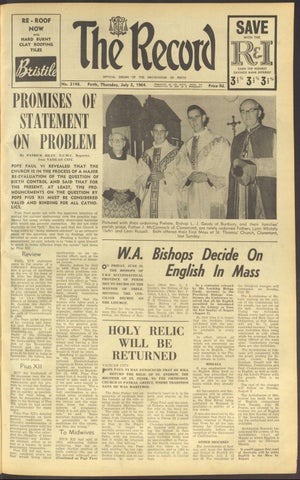
Pictured with their ordaining Prelate, Bishop L. J. Goody of Bunbury, and their famil ies' parish priest, Father J. McCormack of Claremont, are newly ordained Fathers Lynn Whitely ( left) and Leon Russell . Both offered their first Mass at St. Thomas' Church, Claremont, last Sunday.
WA. Bishops Decide On English In Mass
ON FRIDAY, JUNE 26, THE
BISHOPS
OF T H E ECCLESIASTICAL PROVINCE OF PERTH MET TO DECIDE ON THE MANNER OF IMPLEMENTING THE CONCILIAR DECREE ON THE LITURGY.
Present for the meeting, were His Grace the Archbishop, the Bishop of Bun-
bury (Most Rev. L. J. Goody). the Bishop of the Kimberleys (Mot Rev. J. Jobst, S.A.C.), the Bishop of Geraldton (Most Rev. F. X. Thomas), the Auxiliary Bishop of Perth ( Most Rev. M. McKeon) and the Lord Abbot of New Norcia (Rt. Rev. G. Gomez. O.S.B.).
HOLY RELIC WILL BE RETURNED VATICAN CITY: ROPE PAUL VI HAS ANNOUNCED THAT HE WILL RETURN THE RELIC OF ST. ANDREW, THE BROTHER OF ST. PETER, TO THE ORTHODOX CHURCH IN PATRAS, GREECE, WHERE TRADITION SAYS HE WAS MARTYRED. The Holy Father told an assembly of cardinals that the transfer of the relic is being made at the request of Orthodox Metropolitan Constantine of Patras. The relic, said to be the head of the Apostle. was taken from Constantinople by the Crusaders in 1204 so that, in the Pope's words. "it might be worthily preserved next to the tomb of his brother, St. Peter. with the intention that it might be returned one day. God willing." His gesture, the Pope said, testifies "to our veneration for the Greek Orthodox Church and to our intention to open our
brotherly heart to it, in the faith and charity of the Lord." Pope Paul said the council Fathers would venerate the relic at the third session of the Vatican Council, and it would then be taken to Patras by a papal mission. Christian tradition credits St. Andrew with preaching the Gospel in Asia Minor and Greece, and an early tradition holds that he was crucified in Patras. In the fourth century the relic was taken to Constantinople. and in 1204 to the Cathedral of S4. Andrew in Amalfi. in Central Italy.
In a statement released by His Lordship Bishop Goody, secretary to the Provincial Bishops Conference, the Conference resolved that all the English permitted be introduced into the Liturgy as from the first Sunday of August ( August 2). By that time it is hoped that the booklets being published with the people s part in English would be available in every parish. In effect, almost all those parts of the Mass which are commonly audible to the congregation will be in English. The only exception is the Preface to the Canon, which will remain in Latin. MISSALS It was emphasised that no English Mass book or missal was prescribed for the use of the people. They will be able to use the books which they already have. All Sacraments and Sacramentals will be administered in English as soon as the New Ritual being published in England is available—a matter of a few weeks. It was also resolved by the Conference that there be a public renewal of Baptismal Vows by all the candidates for Confirmation immediately before the reception of the Sacrament of Confirmation. OTHER DIOCESES The Archdiocese of Sydney will have the Epistle and Gospel in English for the Sundays. .Tuly 5. 12 and 19. The remainder of
the liturgical changes will commence on Sunday, July 26. The Archdiocese of Hobart, waiting on the arrival of the translations for the people, has not yet set the date. Archbishop G. Young has forbidden Masses every half-hour on Sundays and Holy Days of Obligation, so that Masses will not be "a quick mumbled murmur." He has also forbidden Mass being celebrated at side altars while the principal Mass is being offered at the main altar. Confessions during Mass are also forbidden. The Archdiocese of Adelaide will commence with the priest reading the InEpistle, Collect, troit, Gradual, Gospel and the Offertory, Communion and Post - Communion prayers in English, as well as reciting the Lord's Prayer with the people. This is on July 5. The rest of the changes will follow on Sunday, August 2. The Archdiocese of Melbourne has made the use English compulsory of from Sunday. July 26. Priests are allowed to introduce the use of English on the first Sunday of July if the brochures containing the authorised text are a vailable. Archbishop Simonds has informed the priests of his all that Archdiocese Masses at which English is used must be Dialogue Masses. It would appear that most of Australia will be using English in the Mass by A ugust.
THE
Page Two FROM PAGE ONE
PROMISE OF STATEMENT ON "PILL" ioci — is allowed "for a long time, perhaps even for the whole duration of the marriage," provided there are legitimate medical, eugenic, economic or social reasons. At that time Pope Pius also voiced the hope that science would find ways to make the rhythm method more accurate. Pope Paul, concluding his comments on his own to pontificate, referred current "formidable problems," and singled out one — "The problem everybody is talking about — that is, of so-called birth control; that is to say of population growth on the one hand and of family morality on the other." He continued: "It is an extremely serious problem. It touches the source of human life. It touches sentiments and concerns which are closest to the experience of man and woman. It is an extremely complex and delicate problem. "The Church recognises its manifold aspects, that is to say the multiple spheres of competence. Among these, that of the spouses is certainly preeminent — their liberty. their conscience, their love and their duty. "But the Church must also affirm her part, that is, God's law, which she interprets, teaches, promotes and defends. And the Church will have to proclaim this law of God in the light of scientific. social and psychological truths which in recent
times have had new and very extensive study and documentation.
Careful Study "It will be necessary to look carefully and squarely at this theoretical as well as practical development on the question. And this is what the Church is in fact doing. The question is under study as broad and deep as possible, that is, in the serious and honest manner a question of such importance demands. "It is under study, we repeat, and we hope soon to conclude (this study) with the help of many eminent scholars. We shall quickly issue its conclusions in the form which is iudged most adequate to : he subject treated and to the goal to be achieved. "But meanwhile we say frankly that as of now we do not have sufficient reason to regard the norms given by Pope Pius XII as surpassed, and therefore not binding. They must t herefore be considered valid, at least until we feel bound in conscience to modify them. "In a subject of such gravity, it certainly seems that Catholics should want to follow a single law, such as the Church authoritatively proposes. And it t herefore seems opportune to recommend that nobody for the time being take it upon himself to speak in t erms different from the norms in force."
Thursday, July 2, 1964
RECORD
T
Bishop Fulton Sheen . . .
CAUSES OF VIOLENCE
HE FIRST REASON FOR VIOLENCE IS HATRED retain decency and morality. Sup- lects of conscience one can deaden OF VIRTUE BECAUSE pose there came to this earth some- its voice and for the moment feel OF BAD CONSCIENCE. one whose virtue was perfect, no consequences, as David did not whose kindness to the poor and to feel the guilt of murder and This hatred of goodness exthe afflicted was without limits, adultery until almost a year after presses itself in violence. A boy the crime. But the need of punishwhose compassion to the hungry in a gang who refuses to break made him hungry and whose one- ment remains not in the conscious school windows will invariably be ness with the wounded made him mind, but in the unconscious mind taunted and ridiculed by the rest feel their wounds, and who Because reparation for the wrong of the gang. His refusal to destroy spurned all hypocrisy and short does not come out normally, it property is an indirect condemna- cuts to popularity by a denial of then begins to come out abnormtion of their destructiveness. self -discipline—would not all those ally. A faithless husband running who fell below that line hate and A tube of toothpaste if squeezed around with other women will despise him? with the cap on, will break out in often either beat his wife, or torThis ex If His goodness were perfect, He an unexpected place. ture her mentally, because her would be crucified. And this is the plains the curious complexes that very fidelity is to him a rebuke. ultimate explanation of the Cruci- arise in human nature, such as the She becomes his conscience and fixion of Christ. excessive washing of hands which placards before his mind his is an external symbol of the need adultery. To justify his own filth, of washing of one's own soul. 014 014 he must throw mud. So it is with punishment. The The young woman in a college which we should bring judgment WORLD has so little use for dormitory who refuses to take part THE and which should conto ourselves wicked two extremes—the very in the orgiastic abandon of her and demn ourselves for wrong, is promuch too society disturb who fellow students will be ridiculed jected to others. This probably is the very good or saintly. That is for her virginity. the psychological reason for the on crucified No one who does wrong is com- why thieves were because love of violence and horror movies. Lord Our of side either fortable in that wrong, unless television shows and stories in our everyone else is dragged down to they disturbed the false peace of contemporary civilisation. We in why and possessions, his level. This is one of the reasons affluent must see punishment; we must see Supreme crucified was midst the.r why teenagers whose excessive mediocre who a reparation; we must see justice drinking and late hours are con- Goodness. It is the find in one done. But instead of applying it who those — demned by their parents will al- survive to ourselves, we take a fiendish pat on the ways say their parents are "old- another an approving in seeing others suffering. delight declension. fashioned:" they will seek out a back for every moral is violence for reason Another Expiation is done not by self group or a gang which will give Everyone but by others. The criminal is punishment. of the need the:r misconduct approval. it is disThe horrors of con punished. As an individual descends the who steals knows that stolen science are projected to the horrors object the and honest, moral ladder into decay, he will the rightful on the screen. Instead of confessalways seek that level which will should be returned to should ing their own guilt and doing window broken The wner. o give to his dishonesty, or to his depenance, they deny their own mugging or immorality, a stamp of be paid for; the automobile be reshould smashed liberately guilt and accept the garroting. approval and thus ease his conpaired. ing, the bayoneting machine-gunn science. This hatred of virtue is so inConscience not only tells us of others as a substitute for the punishment which in their own grained in weak and fallen human what is wrong, but it also tells us hearts they know they justly for punishment deserve hat we nature, that it is easy to predict deserve. what will happen to those who what is wrong. By repeated neg
Desmond 0()nag iOrites from
AUTHORITIES CONCERNED OVER PUBLIC VENERATION
I
T IS DIFFICULT TO BE A SAINT . . . BUT IT IS ALMOST AS DIFFICULT TO BE OFFICIALLY RECOGNISED AS ONE.
On the tii.., anniversary of Pope John's death, a volume was pi-esented to the Bishop of Bergamo containing hundreds of petitions and thousands of signatures from those anxious that the process for the canonisation of Pope John be initiated.
Requests for "relics" of Roncalli died. However, the Pope John arrive from Bishop of Bergamo, MonQuebec, Detroit, Argen- signor Gaddi. may ask that tina, Spain and Poland. A it be held in Bergamo. family came from Korea Premature Cult in pilgrimage to John's birthplace, Sotto II Monte. NE serious imThe flowers pilgrims leave pediment to the regularly canonisation process would are removed from his tomb under St. be public veneration as if Peter's, but immediately John XXIII were already a they are replaced. canonised saint. The reliThe missionary institute gious authorities in Berwhich is building a semi- gamo are worried because nary around Angelo Ron- of a "premature cult" of calli's birthplace calculates the late Pope. that there have been a milOn the threshold of the lion visitors to Sotto Ii Sotto II Monte parish Monte since his death. church 13 ex-voto have been About 15,000 arrive each placed already — silver Sunday creating serious hearts in a gilded frame traffic snarls as the tourist with thanks to John XXIII buses and cars pack into for graces received. They the small village. have been removed to the The police try to establish sacristy by the parish priest. In the church there is a an itinerary beginning in the house where John was fitll-leng.h portrait of the born and ending in the Pope on his throne. John church on the hill, but there donated it to the church. It Is not an Italian driver who is a painting and not a sacred image as there are will follow a leader. lamps or candles burnno Sotto H Monte has even it, but this disbecome a popular spot for ing before too academic for is inction , honeymoon couples. :he thousands of visitors. The petitioners who hope There are usually half a that Pope John will soon be dozen women who touch it recognised as a saint are as they pray while hundreds seminarians, parish groups, of letters and postcards admonastic communities, and dressed to the Pope are individuals. deposited near it. And if no Normally, the preliminary candles can be burnt before which pre- this painting, there are investigation cedes the complex canonisa- many lit at the altar alongtion procedure would take side but with attention place in Rome as that is the paid only to the portrait of diocese in which Angelo the "good Pope."
O
Wood, Coal and Coke
BRYANT & WATERS — Now
ADAMS & KIVISALU 5 EDWARD STREET, EAST PERTH PHONE 28-1713—A 41. 69-1010
In one of the Sotto II Monte buildings there is a small Pope John museum in which the room in the Vatican where he died is partly reconstructed. The bed has been brought from Rome together with the yellowing photographs of family groups which he took with him to the Vatican. Here visitors enter, make t he sign of the cross, kiss the bedcover which is protected by cellophane, and. accompanied by the priest or nun present, say the "De Profundis," as Pope John, for the Church, is still simply a dead person and there should be no public official acts of veneration and no public requests for grace.
Thanksgiving ANY visitors do
M not feel bound
by this caution—there is a woman from France who has come to offer thanksgiving that her brother has returned to the sacraments. There is a reformed criminal who wants the Pope's sainthood to be recognised by public acclaim. There are priests who say that John's influence can be felt in the confessional where sinners acknowledge it. For the visitors, Pope John is as present as he was over a year ago and the pilgrimage to Sotto Ii Monte has the air of a family feast, just as Cardinal Lercaro's Mass there on June 3 had a joyous character. The Pope's brothers and relatives have had to become accustomed to the continuous visits, but they have not lost any of the simplicity they shared with
their brother. One of them, Zaverio, recently illustrated this quality in recalling his first meeting with Angelo after his election as John XXIII: "He hurried towards us along the corridor with his quick step and I made a rabbit-killing gesture, 'Now you're really fixed. This is a fine cat you've got to skin—they've closed you in like a prisoner.'" The brothers still work in the fields and pass each Sunday afternoon playing cards at a bar on the outskirts of the village. They are happy to recall the last visit by Angelo in 1958, shortly before his election as Pope, when he enjoyed taking his stick and walking all over the village, to the church and the kindergarten, guessing the family name of the children from their faces and naming the proprietors of all the farms surrounding Sotto Ii Monte.
Simplicity image of AnTHE gelo Roncalli in
the streets of Sotto II Monte before coming to the conclave in Rome evokes Cardinal Suenens' tribute to him: "He lived in the presence of God with the simplicity of one who goes for a walk in the streets of the town where he was born." When he last walked these streets he was 77 and, after a life spent at the service of the Church, he could have expected a decrease in duties which would have allowed him to put his memoirs in order and en-
gage in the historical have their ideological counterpart in "Mater et Magistudies he enjoyed. ster" and "Pacem in Terris." find to was he Instead Cardinal Suenens defined himself, in his words, "at the harnIpny which so many the end of the road and on recognised in John's life: top of the heap." "John XXIII was superThere can be little doubt natural with naturalness; that Pope John is a saint and was natural with such and that this will be recog- a supernatural spirit that it nised by the Church, but was impossible to discern there are all kinds of saints the dividing line." —Pius X is a saint, and A Pope John anecdote: Pope John was devoted to In 1959 Don Primo Mazzohim, but the anti-modernist lari visited him. Don Primo, repression under Pius X although always faithful to crushed initiatives without the Church, had been in discrimination and embit- trouble because he was contered great prelates like sidered too avant-garde. He Cardinal Ferrari. had met Pope John when Pope John's genius lay in they were both chaplallbs his ability to guide the during the first world WIC. Mazzolari as a lieutenant, Church, to express its cath olicity in his every gesture. Roncalli as a sergeant. Some persons tried to to disarm enemies without his audience with prevent essential any surrendering principles . . . and it was the Pope. and Mazzolari these qualities which have was rather tense, but as not been forgotten in the soon as he entered, John year since .his death, which welcomed him wih "Lieuhave led 50,000 in the Ber- tenant." Mazzolari replied, gamo district to request his "Sergeant," and the meeting which could not have been happier. and beatification
OFFICIAL ENGAGEMENTS JULY 5: '7.30 p.m.--Confirmation and Canonical Visitation, Nth. Beach. JULY 12: 3 p.m. —Bless and Open New Church, Bruce Rock. 7.30 p.m.—Confirmation and Canonical Visitation. East Fremantle. JULY 16: 9 a.m.—Preside at Solemn High Mass at Carmelite Monastery, Nedlands. JULY 19: 3 p.m.—Confirmation at St. Mary's Cathedral (Girls). 7.30 p.m.—Confirmation and Canonical Visitation, Scarborough. JULY 23: '7 p.m.—Attend Maltese Mission, St. Joseph's Church, Bassendean. '7.30 p.m.—Confirmation at Holy Rosary, Doubleview. JULY 26: 3 p.m. —Confirmation and Canonical Visitation, Highgate. 7.30 p.m.--Confirmation and Canonical Visitation, Mandurah.
JULY 30: 6 p.m.—Bless New Church, Manning.
AUGUST 2: 10.30 a.m.—Preside Solemn High Mass, Redemptorist Monastery, North -Perth. 3 p.m.—Bless New School, Kellerberrin. AUGUST 9: 3 p.m. —Confirmation, St. Mary's Cathedral (Boys). 3.30 p.m.—Bless New Convent and Administration Block, Loreto Convent, Swanbourne. AUGUST 10: 8 p.m.—Attend Premiere of Viennese Boys' Choir AUGUST 10-14: First Clergy Retreat. AUGUST 16: 4 p.m. —Confirmation and Canonical Visitation, Manning. AUGUST 17-21: Second Clergy Retreat AUGUST 23: 3 p.m.--Bless New Convent, Nollamara.
....41.041.41,.....4M00.0.411,..4.4.14.04411,41.0•41.4.0.411.#4.0#######.41.14P11,0###.44 .
Thursday, July 2, 1964
THE
Eight Murdered During Guiana Violence
GEORGETOWN, BRITISH GUIANA: HE murder of a leading Catholic c:vil servant and seven of his children cl'maxed five months of murder, arson and violence in British Guiana and led to swift emergency measures by the British Governor, Sir Richard Luyt. Within 24 hours he had taken control of security from Premier Cheddi Jagan and his ministers and had rounded up 35 persons believed to have preached or practised violence. Thirty-three of the arrested persons belong to the People's Progressive ruling party, including the deputy premier, Brindley Benn. The murdered man, Arthur Abraham, had his house set on fire by terrorists soon after midnight on June 12, and although several priests and Bishop Lester Guilly, S.J., from the neighbouring cathedral joined the firemen, they could rescue only the wife and one daughter. Another daughter was absent at the time and arrived back to see her home ablaze. Absolution was given from outside the house.
T
TRAINED IN CUBA The police have launched a hunt for the terrorists and have detained several members of the People's Progressive party youth organisation for questioning. It is alleged that many of these youths have been to Cuba for training in terrorism. Following months of arson and bloodshed, a state ment was issued by 15 heads of Christian denomi nations in the country, including Bishop Guilly. The statement refers to the appalling tension and violence and calls for a return to sanity and mutual respect among the six races. "With the approach of independence there must arise that deep love of our country and fellow countrymen which is called patriotism," it said. "Positive kindness must replace hatred. Those who are tempted to violence, perhaps through provocation, must curb their passions." The statement pledged the denominations to give what aid they can to those who have suffered the loss of their homes and their possessions through arson.
Employment For The Handicapped
DURING THE WEEK JULY 5-12 A DRIVE WILL BE
CONDUCTED TO CREATE GREATER EMPLOYER A WARENESS OF THE CAPABILITIES OF THE HANDICAPPED AS EMPLOYEES. Employ the Handicapped Week is designed to provide employers with the opportunity to see demonstrations of the skills of handicapped persons and to put before them the facts relative to work performance and attendance records of such workers. It is anticipated that the awareness of such facts will help towards overcoming misunderstanding towards the handicapped as normal employment propositions. In W.A. there are over 550 persons unemployed because they are unable to find jobs suited to their handicaps. All these persons are considered by the Commonwealth Employment Service to be capable of Performing specific jobs in Which their handicaps would not affect work performance. Each morning between a.m. and noon groups 10 of employers will be taken on conducted tours of Melville Rehabilitation Centre ed by experts in job escortplacement of the handicapped. Several disabled Will be specially workers brought back to the centre to demonstrate their skills during the week.
The Monday tour will be restricted to a party of Government, civic and church leaders, but other session'; will be open to any employer wishing to atterd. Applications should be made to Mr. R. Jenkinson, telephone 23-0161. Employ the Handicapped Week is being conducted by Junior Chamber of Commerce of Australia in conjunction with the Department of Social Services and the Commonwealth Employment Service. Perth Junior Chamber is organising the W.A. section of the project.
LONDON: THE NEWMAN ASSOCIATION, FOCAL POINT OF LAY LEADERSHIP INSIDE THE CATHOLIC CHURCH IN BRITAIN, HAS CALLED FOR AN INTENSIVE THEOLOGY STUDY DRIVE AMONG THE LAITY. The association of Catholic university graduates and professional people said in its annual report that a theologically literate laity and lay theologians are an essential need for the Church's practical approaches to its own renewal and the world's social problems. FULL SERVICE "Only the participation of the laity in the field of theology can readily draw it away from its rather abstract appearance and fully into the service of the Church so that it can creatively influence secular culture and form the proper basis of a living integrated faith," it declared. The association is proposing to help in this by getting away from the present lecture system, with one person talking to a passive audience, to a "subcircle" plan. "Sub-circles" in rather residential areas than in city centres are formed by members who meet alternatively in each other's homes. All take part in a living intellectual and spiritual community by discussing; such subjects as ecumenism, the liturgy, the Church and current social problems, marriage and family apostolates and catechetics. The aim is to develop an educated laity capable of leading the dialogue with the unbeliever. CO-OPERATION They need clerical cooperation, but as professional people themselves have much to contribute to development of such a "living theology," the report said. On the renewal of the Church and frustrations of some educated people at its slowness, Oliver Pratt, association president, said the Newman project is more than a safety valve. Criticism which is not constructive could become anticlericalism. It must produce new and positive ideas contributing to the renewal.
SYDNEY: REDEMPTORIST priest of the Eastern Rte. Father Michael Schudlo, is at present in New South Wales to conduct 18 one-week and several four-day missions for Ukrainian Catholics in various parts of the State. Father Schudlo, who recently arrived in Australia from the United States, has
ELLIOTT
O PTICIANS - OPTOMETRISTS Piccadilly ArcAde . . 1 54 William St. . . F REMANTLE: 30 Market St. C OTTESIOE. 19 Napoleon St
21 8151
2 1 5304 5 2602 3 2655
Page Three
Need For Theology Study
Missions For Ukrainians
ELLIOTT
P ERTH.
RECORD
already conducted 29 missions in Victoria, New Zealand and Tasmania during the past eight months. Following the New South Wales missions, Father Schudlo will conduct eight in Adelaide and four in Perth. Most of these missions will be preached in Ukrainian in local Latin Rite churches. Each mission will comprise nightly Mass, instruction and a sermon. grnphasis will be on ,- ..:riestly vocations of which there is a shortage in the Ukrainian Catholic communities and of man's relationship to God.
POPE PAUL TALKS WITH OT'TO PREMINGER
Award To Producer Of The Cardinal" ROME: American movie producer-director Otto Preminger has been presented the Grand Cross of Merit by the Roman Catholic Order of the Knights of the Holy Sepulchre for his new film 'The Cardinal" (Columbia) The Viennese-born Pre minger, who is Jewish, received a sash with a Cross in a brief ceremony at the headquarters of the Order near the Vatican. In the citation, Preminger was praised for the execution and spirit of "The Cardinal," a picture which tells the story of an American who rises from priest to cardinal in the Church. The picture, filmed on location in the United States, Italy and Vienna, re-
ceived its world premiere in Boston on November 11 last. Preminger said after the award ceremony that when he first began the film h' encountered some opposition from prominent Catho lic churchmen in the United States. "But Cardinal Cushing of Boston saw the picture in a preview and wrote an article praising it," said Pre minger. "That started the ball rolling. Other churchmen saw it and three weeks ago in New York I got word from Rome that I was to get this decoration." Preminger gave a special showing for the bishops at tending t he Ecumenical Council. -
New Series Of Religion Books ARCHBISHOP SIMONDS, of Melbourne, the. Chairman of the Australian Bishops' Committee for Education, has announced the publication in October this year of a series of four religion books prepi f )1children in the first four grades of school. The gr•neral title of th's series of books will be "My Way To God ' The texts of these books have been designed for the religious needs and development of junior children and the many two and four col our illustrations will be a delight and an inspiration to the children and their parents. The books are of a large size popular with children and will have illustrated strong board covers. Four Teacher's Books are also being published as for volumes companion each grade text. In addition to much helpful material on the approach to teaching religion to children of these ages, these books will provide sets of sample lessons designed for use in Catholic and also in government schools. The books will be published and distributed by E. J. Dwyer of Sydney. Archbishop Simonds pointed out that the Bishops of Australia, at their meeting in March this year, formally issued and prescribed the exclusive use of these books
NEW ORGAN MELBOURNE: On Sunday, July 19. Archbishop Simonds. of Melbourne, will bless and inaugurate the new memorial pipe organ which has been under construction in St. Patrick's Cathedral for many months. This ceremony can be taken to indicate the final completion of the cathedral structure. The decision to instal the new organ was made to mark the fiftieth anniversary of the episcopal consecration of the late Archbishop Mannix.
A. R.
MONAHAN PTY. LTD.
FUNERAL DIRECTORS SINCERE CATHOLIC SERVICE
ALL SUBURBS DAY & NIGHT 71 5885 71 5894 HEAD OFFICE & CHAPEL cnr. Walter Rd. 8. Grand Prom.
BEDFORD PARK
in their dioceses. Teachers are asked to keep this instruction in mind when ordering books for Grades I to IV.
PRINCIPAL A. R. MONAHAN 2 6 1819
7
PURPLE CHAIRS FOR YOUR CLUB?
A ll right, we know you're not running a ladies' geranium society. But we have recommended purple chairs The point is this: chairs, their shape and colour have to he considered in relation to the function, style and colours of the premises they're going in. At Sebels we look at the total seating problem and our recommendation is cornprehen. sive. If you'd like to know more, write us immediately.
The "Monarch" from the range of 23 Sebel Chairs — every one well designed and sturdily made for specific seating purposes in clubs, halls, hotels, etc.
C arjyle & Co. (1959t Pty. Ltd., 1-9 Milligan St., Perth. Phone 21-9331
SEM 62
THE
Page Four
Thursday, July 2, 1964
RECORD
=INTERNATIONAL- Everyman 's NEWS Family 0•11.M1 #4.414,
INDIA
MALTA
More Desecration
Relic To Stay
Catholic more TW0 churches have been desecrated in Kerala State, as police claim to have made arrests involving three of the previous ten cases. The latest incidents occurred in St. George's Church at Palode, where an unsuccessful attempt was made to wreck the tabernacle, and at St. Anthony's Chapel, Thundathumkadavu, where a statue was damaged. Police maintain that robbery, not anti-religious sentiment, was the only motive of the crimes. They arrested four persons and recovered articles missing from two churches.
• AN alleged relic of St. Paul's armbon e, which was to have been taken to North America, Britain and Australia this summer, will remain in Valletta after all. Priests of the Church of St. Paul Shipwrecked, where the relic is preserved, yielded to opposition which grew out of popular fears that such a long journey would be hazardous. But the five priests who were to take the relic to Maltese emigrant communities abroad will still carry out their July to September visitation.
/
A FRENCH-CANADIAN MISSIONARY OF THE OBLATES OF MARY IMMACULATE, PARISH AS SERVING OUANAOF GE VILLA IAN PRIEST IN THE HAIT POLICE. BY STED ARRE 3IINTHE, HAS BEEN under now is , 0.311 Father Charles Berube, of city chief the n, Ilaitie Cap in forced residence d his diocese, on the alleged ground of having cleane been had , which church the walls of the parish smeared with the slogan "Duvialier for Life." (President Francois Duvalier recently declared himself lifetime head of the Caribbean republic.) The Haitian government last winter expelled all the Jesuit missionaries from the country. Archbishop Francois Poirier of Port-au-Prince, the nation's capital, had been expelled earlier.
DOMINICAN REPUBLIC
NINIPAINIP###ININOWs
Shepherds Newsagency
HIGH ST., FREMANTLE—Phone 5-2696 GREETING CARD SPECIALISTS L ARGE SUPPLIES OF ROSARY BEADS, MISSALS, STATUES, ETC. "THE RECORD" ON SALE EVERY FRIDAY M###41.41.04•4141,14P
0#######.4.4.0~#4.#4.411,IsiNNI ,41.4, #4.44111•4,04.4•••••••04
Your Hotel Guide HOTEL
BRIGHTON
S TIRLING HIGHWAY, COTTE SLOE
EL HIGHWAY HOT G HIGHWAY, to. STIRLIN CLAREMONT
3 Minutes from Beach I":1.IMITED PARKING AREA Excellent Accommodation at Moderate Tariff. Now under Personal Management of TED TAYLOR. Phone 3-2024.
PHONE $ 1566 Friendly Service — Good Accommodation — Parties Specially Catered for M. A. & E. M. McDONNKLL
S AVOY PLAZA HOTEL
BAYSWATER NHoiel
THE HEART OF PERTH Dancing. Entertainment, Every Night. Rooms with bath 45/-, Ina. breakfast. Meet You at the Savoy r. Manage Lucas, MR
SUDAN National C hurch
First Class Accommodation and Service DRIVE-IN BOTTLE DEPT. FREE HOME DELIVERY
Phone: 8-1028
OPP, STATIO Excellent Accommodation Frequent Train Service — 4 Mlles f rom City — Large Parking Area BED and BREAKFAST REASONABLE TARILIFY LEO BARTLETT, Prop. TZL.: 11 1224
Excellent Lounge and A ccommodation Phone 67-2418 Cnr. Cambridge and A lexander Streets, Wembley
Alex McHenry. Proprietor,
WAVERLEY
HOTEL
HOTEL
Next Bruins Waverley Stores A LBANY HIGHWAY CANNINGTON Modern and Convenient Homely Accommodation
Ulm Our Drive-la Bottle Servfoo Phone 65241$ A. R CONNELL
HOTEL CRITERION HAY STREET
CENTRAL PERTH 2 4-HOInt SERVICE litosidonto Proe Parking for Country Cathedral. Minutes' walk from HOTEL THE COUNTRYMAN'S PHONE: U 1115 (5 lines)
Australia
MURRAY STREET, PERTH E xcellent Aceommodatioa sad Dining Service LUNCH, 10/-p DINNER 17/4. PHONE 25 1541
ITALY
1•4.4••• # #4,0"INIP , ,4 ,####04 41,4,1
Designer Of New Royal Effigy
?hone 3-2155 R. M. DYMOCK, Licensee
Cnr. High and Market Sts. FREMANTLE O ffers excellent homely accommodation Phone : 5-1786 Philip
Cnr. KING & HAY STREETS nce of
Private Bar for convenie Guests and Friends
21-8634
B. REILLY
04.#.4. , 04.4 , 0 , 111.40,14 , 111.004
Jack Sheedy
Kearina.
Licensee
D ALY'S
WILLIAM Pbni1P4
It goes like this: "Dearest Lord, teach me to be generous. Teach me to serve Thee as Thou deservest; to give and not to count the cost; to fight and not to heed the wounds! to toil and not to seek for rest; to labour and not ask for reward, save that of knowing that I am doing Thy will. Amen."
NOBLE . .
THE word "generous" originally referred noble birth with all the implications of of to one honourable and princely behaviour associated with high rank. Today it means a warmhearted readiness to give without counting the cost and without estimating the possible return. If Ignatuis felt the need to petition for a greater spirit of generosity, how much more fervently should we of lesser faith and nobility of soul make this plea ours. While some people seem to have greater natural gifts of generosity than others, there is no one who is generous automatically.
MAGNANIMOUS . . . AS everyone has to be taught how to love, so too does each one have to learn how to become more magnanimous of spirit. As laughter tends to generate more laughter, so is the presence of a living generosity an infectious thing. Children reared in an atmosphere of a free giving of self on the part of parents absorb a sort of openness of spirit and empathy for the needs of others which are extremely attractive. As an older daughter will unconsciously mimic the scolding tone of the mother in dealing with a younger sister, so too does she radiate an approach to life that is a reflection of the parent.
LOVING . . .
23-4548.
P. Oorschot Builders PTY. LTD.
( REGISTERED "A" CLASS BUILDERS
CARLTON HOTEL 248 HAY
169 NORTH LAKE RD., MELVILLE
ST.. PERTH
DAILY
ROYAL
at
HOTEL
WELLINGTON 8TRETTA. PERTH stmts.. Dept.. II -14414 t1-aet 4
and
The founder of the Jesuits was a Spaniard living in a different culture than any of us know and us. faced by circumstances quite novel to most of ges challen basic same the met he life Yet in his that Everyman does today. His, too, was the need to deal with himself, with others and always with God. While a knowledge of self, of the needs of others and of the nature of God is important, equally essential is a frame of mind or a basic attitude towards life. This is summed up in the saint's well-known Prayer for Generosity.
HOTEL
2 p.m. BUSINESS MEN'S LUNCHEON — 12 to
eT.
CHNTURY.
77 ST, GEORGE'S TERRACE, PERTH.
Home of Country People CANNING HIGHWAY EAST FREMANTLE Eric Campbell, Prop. 5-1721.
25-3091
WEFT
HERE IS A PRAYER COMPOSED BY ST. IGNATIUS LOYOLA IN THE SIXTEENTH
* The address of the local Catholic Marriage Guidance Centre is
Plympton
SERVICE
Rex (private) Hotel
P
T
A YOUNG couple in the first flush of married love are naturally inclined to be generous with each other. But as the routine of life sets in and the demands on each other become more frequent and the responses less appreciated, a resentment can develop which will atrophy generosity. This is why it is important for a couple to realise, whether they are young or older, that the wells of generosity need constant refilling. The prayer of Ignatius is in a sense a return to the source of all love, which is God. A readiness to give in a human is a reflection, however dim, of the complete liberality of God's love for us. One who is close to God is always marked by an openness of spirit and a generous response to the needs of others. Pray then — "Dearest Lord, teach me to be generous."
NATIONAL HOTEL
NORTH AM
GENEROSITY
, 0•11,41,11.14.0,04.41.41.• 41# 4M41,111#41.4.#41Nd,•#~4
PERTH'S LEADING HOTEL FOR ALL VISITORS Phone: 23-1531
Phone Northam 49 T. E. MURPHY, Proprietor
21-1341.
THE OFFICE OF THE PATRIARCH OF VENICE, GIOVANNI CARDINAL EMENT URBANI, HAS ISSUED A STRONG STAT DINCLU IOUS, FORBIDDING PRIESTS OR RELIG TO UGH, THRO ING THOSE JUST PASSING N. VISIT THE 32nd BIENNIAL ART EXHIBITIO in The exhibition, one of the most prestigious of parts all from Europe, is devoted to modern art l iastica eccles of fire the the world. .It has drawn ons. occasi l other severa on l disapprova The decree of the patriarchal curia stated that tent "according to the prudent judgment of compe exhithe . . . works the of persons viewing some bition is wholly indecorous."
HOTEL NADE SPLA E
COMMERCIAL HOTEL
PHONES
Catholics Honoured
RIGHT ON THE SEA FRONT
TOM KENNY, Licensee. or. Stock and High Roads, MELVILLE Phone: 34) 3428
Phone:
•
HOTEL COTTESLOE
rile States Moot Modern
Prop. 13
, 4.41
Enjoy the Best A CCOMMODATION & SERVICE
W ILLAGEE PARK HOTEL
FRIENDLY
1P, # WI.4.4
A PRIEST and two CathoTHE Sudanese governlaymen who led resistlic have to ed report is ment within started a new and more ance against Hitler War subtle form of persecution Germany during World antieight among are I I now aiming ans, Christi of a new to establish a national inde- Nazis honoured in e pendent church on the series of German postag stamps. Chinese pattern. The Sudanese clergy have The priest is Father Alfred been invited to make a trip Delp, S.J., editor of the to China and the govern- periodical der Stimmen ment has offered to pay the who was executed for Zeit, contravel expenses under his writings in February, dition that the priests ac- 1945. cept the plans for a national The laymen are Count church. Claus von Stauffenberg, a The Sudanese government forbidden leader in the assassination has allegedly seminarians to continue attempt on Hitler in 1944, their studies in foreign stucountries and has forced and Sophie Scholl, a Univer them to sign statements dedent leader at the claring that they disapprove sity of Munich, executed for the "requirement to go tance efforts. resis abroad."
WEMBLEY HOTEL
SUBIACO HOTEL
GERMANY
MSGR. JOHN C. KNOTT
TELEPHONE (Day and Night) — 30-2677 Royal effigy for Mr. Arnold Machin, designer of the new Machin is a Mr. :oinage, pictured with some of his work. . Schools y Academ Royal the Master of Sculpture at —( Photo U.K. Inf. Service)
Will Plan and Build: Churches, Schools, P resbyteries . . Housing . . . Etc.
Thursday, July 2, 1964
THE
Page Five
RECORD
Red China Continues Fight Against Religion
British Railways' "Operation Leapfrog"
HONG KONG: HE CHINESE COMMUNIST REGIME CONTINUES TO DRIVE AGAINST ALL OBSTACLES TO ITS ABSOLUTE AUTHORITY, MOVING AGAINST RELIGION ON THE ONE HAND AND FAMILY TIES ON THE OTHER.
T
New arrivals from the mainland report two new measures aimed at wiping out the last remnants of religious influence on young people. Articles in the current Shanghai papers indicate official attempts to o vercome family opposition to new colonies on the Chinese-Russian border. The anti-church regulations are aimed at Baptism and Sunday school classes. Names of all candidates for Baptism must now be filed at the Office of Religious Aff airs for checking against lists of landowners, counter-revolutionaries, or "culprits from labour reform." If the candidate's name is not rejected, the pastor must assure his good conduct after Baptism. NO GUARANTEE The effect of this is described by a refugee priest who recently arrived here: "No one can guarantee that tomorrow he himself will not break some new law of the Chinese communists, much less that someone else will not. Thus pastors are o ften hesitant to baptise." The second new regulation states that parents must not allow children to become influenced by religious activities until they are 18. To implement this measure, authorities have "hinted" that the few reschool maining Sunday classes must close. Family barriers to the colonising of remote Sinkiang on the Russian border are challenged in several articles in Shanghai dailies. Communist authorities sent a delegation from Shanghai recently to bring back news of living conditions in Sinkiang. PIP41.4.00440...#######4.#4.41.04.44INIPAP
PHIL KEOGH
Resident Chemist 274 Cambridge St. W embley - 87 3984
"It is an ideal place for young people and provides a bright future for them," one of the delegates told an interviewer. He then appealed to the people of Shanghai to dedicate their youth to serving the State in Sinkiang. A week later another pressed Shanghai paper home the same message. It quoted a forum of heads of families as having agreed that their children were not their private property and therefore must be taught to serve in any part of China. STEP-UP Peking's current plans for Sinkiang — in English the word means "New Frontier" —thus seem to call for a step-up in displacement of its native population, now largely Moslem, by Chinese from the east. It is said that about two million of Sinkiang's seven million people are now Han Chinese—peo-
ple from the central and eastern areas. But reports of unrest keep filtering out of this strategic land of deserts and mountains, of over 650 thousand square miles. Last month Peking publicly accused Moscow of subversive activities, including enticement of Chinese citizens to cross into the Soviet Union. Russia countered with the claim that inhuman conditions in Sinkiang are causing 1,200 persons per month to seek asylum in the Soviet Union. In addition, Sinkiang's non-Chinese inhabitants are not accepting communist China's domination meekly. It is generally agreed here that, given the possibility of collusion, the independent tribesmen will continue to boil the waters between the t wo giants Pf communism Sinkiang will undoubtedly figure strongly in SinoSoviet strategy moves in the months ahead.
Fatima Pilgrim Recovers From Paralysis FATIMA, Portugal: The medical staff of the hospital here is studying the nature of the allegedly instantaneous recovery of a paralytic Eucharistic t he during blessing at the Fatima shrine on June 13. The case is that of Manuel Correia de Veiga, a Portuguese who emigrated from Graciosa in the Azores to the United States in 1952. Veiga fractured his spine in a factory accident six years ago. Despite several surgical operations in Boston, he remained paralysed from the waist down, and was confined to a wheelchair. Veiga was accompanied by his daughter on a pilgrimage to the Marian shrine disembarked here. They from the liner Saturnia in Lisbon on June 12, and ar-
ISAIA — ALTAR WINE
G uaranteed as Pure Grape Juice made in Conformity with E cclesiastical Conditions for Church use.
rived at the Fatima shrine just in time for the traditional Mass for the sick on June 13, the 47th anniversary of the second appearance of the Blessed Virgin in 1917. Following the Mass, as the sick were being given the blessing of the Blessed Sacrament, Veiga leaped to his feet and was able to walk in the closing procession bearing the statue of Mary.
A 17-ton tank is lifted by a sideloader from a railway wagon in a demonstration of a new British Railway idea for speeding the transport of oil products by rail and road. A newly developed demountable tank, capable of carrying up to 4,000 gallons of motor spirit or the equivalent in heavier oils, is used. The tank can be transferred from one vehicle to another in only four minutes, being switched between road and rail transports or deposited on the ground to await loading. — (Photo iLK. Inf. Service)
MAY VISIT POPE
LONDON: Archbishop still barriers to union Michael Ramsey of Can- with the Anglicans. He said it is possible terbury declared that it is "more than likely" that that some day the Anglihe will visit Pope Paul VI can Church may re-establish full ties with Rome if "in the near future." The Anglican prelate it could keep its married predicted the visit in an clergy and local customs, interview in the "Econo- much like the eastern mist," a London weekly. churches which are in It would be the first visit union with Rome. between the heads of the He added, however, he Catholic and Anglican did not believe the BriChurches since Dr. Geof- tish public would want frey Fisher, then Arch- to have their bishops apbishop of Canterbury, pointed by the Pope. met with Pope John Asked what would beXXIII in December, 1961. come of existing Roman Dr. Ramsey declared in Catholic bishops in this the interview that the eventuality, the ArchCatholic Church's posi- bishop said: "They might tion on papal infallibility find themselves unnecesand Marian dogmas are sary."
AUSTRALIA'S MOST POPULAR DAILY MI
ot *OW
ef Tat miss
4,044,.41.;
the F. h., + ond SAUK tioiy Spiret„:„ 5,1, *eV .4 thet
It3:7„..., 01110
itsr
i.gy sigiderome arnd kyr PSAL4
C LAREVALE ISAIA PTY. LTD.
684 ALBANY HiWAY, VIC. PARK — PHONE 6-3164
H OGANS LTD. AND GENERAL ENGINEERS ALL WORK GUARANTEED — PROMPT SERVICE A SSURED — CARS PICKED UP AND DELIVERED FREE. SPECIALISED SERVICE ENGINE
RECONDITIONING
GENERAL PANEL
REPAIRS
Catholic German The news agency, K.N.A., has reported that the treaty —it will be the first between the Vatican and a communist State — would regulate Church administration and the function of bishops. The news agency says the treaty does not touch on the fate of Jozsef Cardinal Mindszenty, the Primate of Hungary, who has resided in sanctuary in the U.S. Legation in Budapest since the abortive revolution of 1936. Nor does it decide on the relocation of those Catholic bishops granted amnesty by the government last year.
NT_
S AINT JOSEPH DAILY MISSAL
W INE & SPIRIT MERCHANTS 8. LIQUEUR MANUFACTURFP, ;
MOTOR
TREATY
BONN: Diplomatic talks between the Holy See and the communist government of Hungary may bear fruit soon in an official treaty, according to reports reaching here.
* Complete for Every Day * Large Type * Beautifully illustrated in FULL COLOUR * Confraternity Version * Treasury of Prayers * Simplified Arrangement * Sunday and Feast Day Calendars * Fewer References * Latest Indulgences * Exact References * Doctrinal Notes
No, 810 22. Black cloth, square corners red edges, gold stamped silk bookmarks:
39'6
C ontaining the New Mass Rubrics and Holy Week Liturgy, this "St. Joseph Daily Missal" will enable every Catholic to Pray the Mass with the priest.
BEATING
LUBRITORIUM
SERVICE
FITTING
TURNENG
AND
C YLINDER
BORING
CYLINDER
SLEEVING
CYLINDER
HEAD RECONDITIONING
CRANKSHAFT
GRINDING
Other bindings and prices: * Black Cloth, 45/-, 52/6 * Simulated Leather, gold edges, 75/- * Black Leather, gold edges, 92/6. And every few shillings up to £9.
The rich, modern beauty 7 large, clear type — simplified arrangement establish it as the Ideal Missal for Every Catholic.
Please add Postage to all Mail Orders.
1 26 Adelaide Tce. Phone:
23-1953 (5 lines) SAPS
RYAN.
E.J. DWYER.
SHOWROOMS: CUSA HOUSE, 175 ELIZABETH ST., 583 GEORGE ST., 398 GEORGE ST., 104 KING ST. F ACTORY ADDRESS: CNR. KIPPAX AND WATERLOO STREETS, SURRY HILLS. TELEPHONE: 211 4533
Manager
EJDI;86
•
THE
Page Six
RECORD
Thursday, July 2, 1964
The Vatican's Public Relations Criticised PITTSBURGH, U.S.A.: "you have it within your power to make more of an impact on the non-Catholic world than all of the missionaries of all time put together," the president organisation of religious newswriters for the daily press told a group national a of of Catholic public relations personnel here. FATHER BAUM Harold Schachern, presi- and the Ecumenical Coundent of the Religious News- cil "the great challenge beAn appeal for honesty in writers' Association, was fore the Catholic press to- the Catholic press as an aid one of three persons who day." to ecumenism was made by addressed sessions of the Baum, Gregory Father does today "The laymen one-day "national public reCenthe of director 0.S.A., lations seminar" sponsored not need to be told, ad nautre of Ecumenical Studies the glorious how seum, by the Bureau of Informain Toronto and a consultant tion of the National Catho- Church is. Or how spectacu to the Vatican's Secretariat lar its triumphs have been. lic Welfare Conference. for Promoting Christian Schachern spoke on the Or how superior it is to all Unity. instituand churches other theme, "A Reporter Looks Urging a view of the tions. elaat Vatican Public Church that sees it as "a tions.' true sociological reality, not "He needs to know what "Public relaL:ons as a the Church is, not only in as a moralistic stage play," factor in in/Put:nein_ iiews its ideal form, but what it Father Baum said: "In the past we have often been of the Catholic Church e,.na- is here and now. He needs afraid to tell the truth . . . he said, to know this, not just for nat_i_ The new Bull Ring shopping centre — with St. Martin's Church on the left — which Today, however, people are the sake of a true perspec"dates from about the opened recently by Prince Philip at Birmingham, the large industrial city in the as w t've on the full reality of the shocked if they are not told middle of the first session midlands. The site covers nearly four acres, with the roofed area extending over English truth." the he also that Church, but Vatican the Second of three departmental stores, two supermarkets, over 100 individual shops and secmarket, a the said priest The may see that his mind, his Council, or about November Ecua banqueting suite for 2,000 people. recy imposed on the 1, 1962; for it was about heart and his will are need--(Photo U.K. Inf. Service) that date that the American od for the good of the menical Council during its Catholics gave session rst Bishops inaugurated t h e rhurTh," Callahan said. and non-Catholics alike the now famous press conferimpression "that the orgaences of briefings. FATHER TAVARD nisers of the Council were "I hope you noticed that afraid of something." I said news of the Catholic Father Georges Tavard, Church, and not news of the "Fortunately," he added, A. ., of Mount Mercy ColVatican; for public rela- krge, Pittsburgh, cautioned "this was changed during ATHOLIC missions throughout the Territories of Papua and New Guinea are tions, unfortunately, has not agai' _;t, over - simplification the second session, when yet penetrated that vast by the press of the theothe material discussed on desperately short of lay staff and have requested the. Oversea Service Bureau complex of buildings from logical issues being debated the floor of the Council to help them in recruiting teachers, building tradesmen, mechanics, nurses and the which flows such a flood- in the Ecumenical Council. was made available to the tide of news which is • inlike. As a result of over-simpli- press. Nevertheless, in the adequately presented, some- fication, he said, "the vari- minds of Protestants and terest and satisfaction in times inter- ous shades of opinions tend other observers, the Cathoabominably This was stressed by Mr. preted and sorrowly mis- to be reduced to two, black and Mrs. Bill Armstrong. the work being done by the lic Church often appears as SHOP and SAVE at there volunteers serving understood," he said. who returned to Melbourne which is ,ind white, of which the one a community Service Overseas the under month's a after One must never confuse tends to be associated with anxious and fearful, which recently called Bureau's scheme, public relations of the Co antour of the Territories. jitters, always the had position while the has Australian Volunteers dl with Vatican public rela- c.ter is apparently the afraid that the truth could Mentioning specific needs, Abroad ( A.V.A. ). tions, he said. "for once the 'rood rne." t hey said that His Lordship harm it." Council sessions end and Bishop Copas, M.S.C., Vicar The Overseas Service BuPTY. LTD. t he fine Council press office Apostolic of Port Moresby, reau plans to send 25 or 30 closes its doors, the antiwas planning to build a hosA.V.A. volunteers to Papuaquated Vatican press office pital next year and he need- New Guinea, the British 2 Cargill St., Vic. Pk. again is in control." ed about ten carpenters to Solomon Islands, and other BULK and SMALL CUTS When problems of the carry out that project. Pacific islands next January. TOP QUALITY at LOWEST In Sideia the mission was first session were finally is apseeking The Bureau PRICE. look to resolved in time for the without a nurse plications, and interested second session last Septemafter the small hospital and AUCTIONS: persons can receive further clinic. His Lordship Bishop ber, "press relations in from the Buinformation ApoVicar NI.S.C., Thurs-Fri. only 5 p.m. Hoehne, Rome, reached a full flowerreau at 260 Flinders Lane, required Rabaul, of stolic ing." ASHINGTON: W Melbourne. teachers and, in particular, EGAL Department of the National Catholic Welfare an electrican or a diesel P ESS CONVENTION Conference has adopted an attitude of caution and mechanic. At the U.S. Catholic press Another of Bishop Copas' convention, a Catholic edireserve towards the proposed constitutional amendis a young person needs tor appealed for more canthe in prayers and ments to permit Bible reading with youth organisation exdour in the Catholic press nation's public schools, the department's director had perience and some sporting In reporting the 'back-stage' ability to help organise life of the Church. He called P ractitioners in All a dvised. sport and recreation for it essential if laymen are to Branches of Dentistry become involved in the The department continues members of the Y.C.W. Consedine R. William 790-794 Hay Street, Port Moresby. present the Church's mission. believe to made the point in a statea is Armstrong Mr. Bill Perth clauses in the Constitution ment sent to the directors of Daniel Callahan, associate Phones: 21-7181. 21-7637 former National President are of incalculable benefit editor of "Comrrionwealth" Catholic bureaus of infor86-1639, 71-2601 Emergency: to religion," the Consedine of the Y.C.W. and his wife Principals: Joseph L. Rogers magazine, galled honest re- mation in dioceses through Moore) Margaret ( formerly Alfred L. Rogers, Dip. D.S. statement said. "The first porting about the Church out the country. Convenient CAR PARKING can be arranged by phone separates is a former National Secreamendment tary. Bill is now an emChurch and State by proployee of the Overseas Serhibiting establishment of vice Bureau, a community I NSIST ON religion and also by prohibiting government inter- organisation established in W. F. SAMSON & Co. 1961 to encourage Austraference with the free exerR ETWA. cise of religion. The govern- lians to serve in the development is thus under a consti- ing societies of Asia, Africa 5 QUEEN STREET, FREMANTLE and the Pacific. tutional obligation to show "Fit for a King" REAL ESTATE AGENTS. AUCTIONEERS and SWORN VALUATORS During their tour of such special respect for the reliRepresenting: Queensland Rents Collected. Estates Managed. Insurance Co. Ltd., Royal Automobile Club of W.A. (Inc.), gious liberty of all citizens; places as Port Moresby, GoW. Savings Bank Agency. NB R.A.C. of Ltd.. Insurance Bank Pty. LADIES! forbidden to prefer one reli- roka, Madang, Rabaul and Equitable Life and General Insurance Co. Ltd. wife his and Bill Samarai, gion to another, or to prefer Phones: Office: 8-1316. 5-3770. Private: Sir Frederick Samson, visited many missions—ProBuy the Best Fresh Meat from OUR irreligion over religion." F.C.I.V., 5-28511, G. 0. Samson, 39-16458. D. P. Micro, 5-3881. Catholic — and and testant the said statement The Butchers Shops House Judiciary Committee they met some of the volunSpecial Quotations to Schools and Institutions teers who went to the Terby conducted hearings earlier this year. ritory o Celler Emanuel Telephone 21-7722 chairman Phone 6 1184 684 Albany Highway, Vic. Park The missions and other New York "contributed to ) e 2 : or organisations in the Territhe confusion presented by 0/ /1teni3h tories of Papua and New the proposals themselves The Cheaper Food Mart and provided added reason Guinea expressed great inOPTICAL DISPENSER for caution." Cnr. Chapman Rd. and Pitt St., Bentley. Phone 68-1639. United Insurance Building, 218 St. George's Terrace, Doctors Prescriptions DIFFERENT VIEWS Opp. Forrest House, Perth. Dispensed Among the principal Bible L ONDON: Archbishop reading and prayer propoWestsals was that sponsored by John Heenan of minster offered E130 to a Rep. Frank J. Becker of SERVICE IN THE NEVER BE WITHOUT — New York, which would Jewish organisation here to r7 a HEART OF THE CITY to student provide the constitutional enable a British study in Israel. to permit amendment BM, A The Archbishop sent the Catholic prayer. school l/LI & money to "Bridge," a group spokesmen took different specialising in education views in testifying before the committee. No position and youth guidance. It was a further expresin the controversy was sion of goodwill towards taken by the U.S. Catholic the Jewish community here hierarchy. uncerwhich the Archbishop had much too is "There ALL TYPES OF HEARING AIDS shown earlier by deciding, should be what to as tainty IN STOCK PRICED FROM with the Holy See's approdone, let alone the possible ultimate effect on the exist- val, to become a joint presi26,17 A vai:ablo ;n 1'.-: • FREE HEARING TESTS • LIBERAL TRADE-INS • 20,-,7 a nd f ,- 4o7 .,.nd N.-, ing guarantees," Consedine dent of Britain's Council of BATTERIES CORDS AND SERVICE FOR ALL MAKES Christians and Jews. By doasserted. •CONCESSIONS TO PENSIONERS IS.V. HEARing so the Archbishop heal• Delicious BULK JAMS DELOW ING ATTACHMENT FROM £3/15/ed a rift begun ten years 15 delicious v arie,l,s in 2:i:h. And A CATHOLIC POSITS & INTEREST FREE TERMS I FREE HOME .no friit. A ,chrols anr1 other larae users M r fr ago when the Holy See deDEMONSTRATIONS. PAPER should H. RAYNER and SONS creed that Catholics FORREST PLACE PERTH PHONE withdraw from the council 86-90 Railway Pde., West Perth — 28 3985 IN EVERY Opposite the G.P.O. on street level 23-4960 because of the danger of inHOME differentism,
Missions Need Lay Workers
C
M EAT A UCTIONS
Amendment Treated With Caution
L
•
POLLIC1 SMALLGOODS
Aid For Israelis
HEARING AIDS £35
Thursday, July 2, 1964
THE
Page Seven
RECORD
POPE PAUL SHOWS HE IS NO "HAMLET"
By JAMES C. O'NEILL, N.C.W.C. Reporter, from VATICAN CITY. FIRST YEAR OF THE REIGN OF POPE PAUL VI IS SO STUDDED WITH MOMENTOUS AND DRAMATIC EVENTS THAT THE MAN AT THE CENTRE OF THEM IS ALMOST OBSCURED FROM SIGHT.
THE
Like his predecessor, Pope John XXIII, who was referred to at first as an "interim Pope," Pope Paul was characterised by some as the "Hamlet from Milan." If the development of the first year of the papacy of Giovanni Battista Montini is any standard, the name of the indecisive "Hamlet" will be no more applicable to him than the insignificant term of "interim" was to his r emarkable predecessor. In the first few months his election, the new fter a Pope threw himself into the t ask of becoming familiar with all aspects of his role as Christ's Vicar on Earth. Though he long knew many f acets of it from his years as a close associate of Pope Pius XII, there were still hundreds of reports to pore o ver, cardinals, prelates and people to talk with, and a r outine of audiences, visits to and speeches master. Many in the Roman curia, the top administrative offices which assist the Pope in governing the Church, found it difficult to determine what kind of a Pope the new one was going to be. Is Papa Montini a strong Pope? A traditionalist? An innovator? FIRST INDICATION Pope Paul provided an indication early in September. He summoned all officials of the curia and announced that he expected them to reform their offices to meet better the demands of the present day. The speech mixed praise for their work and for their loyalty with demands of modernisation, internationalisation and efficiency. In his inaugural address to the second session of the c ouncil, Pope Paul made it clear he favoured holding the council and stressed that he also supported fully its announced goals, set by Pope John. While staying in the shadows during the second session, the Pope in his closing speech revealed that he was by no means indifferent to the progress of the council In effect he told the Fathers that matters had moved too slowly. Greater clarity of c oncepts, better and shorter schemata must be drawn up before the next session, he declared. At the Pope's instruction, all matters pending before the council were drastically r eviewed when the second session closed. NO TIME WASTED The Pope too was quick to implement the decisions of the council regarding the liturgy and mass communiY our
FREMANTLE
cations. He created a spe- number of heads of State, cial commission to carry including the Presidents of the United States, Tanganout the far-reaching liturgical reforms and set up an- yika, Italy, Ireland and Brazil, the sovereigns of Denother to carry out the programme laid down by the mark and Greece, the Secretary-General of the United council for mass media. In May this year he • Nations and two chancelnamed Paolo Cardinal Mar- lors of Germany. While the series of state ella head of the Secretariat visists paid tribute to the for non-Christians, the first office to which Giovanni such office ever to exist within the Church and pro- Montini has been raised, it bably the first to be created was the Pope's visits to by any Christian body to others that gave indication of his emotional side. bridge the gap between the Like Pope John, he visited Christian and non-Christian Rome's main gaol, Regini world. Coeli and the city's hospiPILGRIMAGE tals. An early Lent found the Pope celebrating Mass in The Pope's January pilthe parish churches of poor grimage to the Holy Land and populous areas of the captured the imagination of the world. This revealed a Diocese of Rome, preaching capacity, surprising to informally and distributing Communion to hundreds many, of the Pope to act independently, without re- and hundreds of people. The first year of the reign ference to traditions or precedents. The meeting and of Pope Paul has been embracing of the Pope, with marked by the slow unfold eyes brimming with tears, ing, the gradual adaptation to the enormous demands and the Patriarch of Cono f the papacy of the man stantinople was dramatic who is Giovanni Battista proof that the new Pope had no intention of being Montini. content with paying lip-serOne brief years has revice to the goal of the revealed a Pontiff of immense union of Christendom. undertakings, one who chooses to study situations, VISITS yet who can under special During the first year as circumstances react with Supreme Pontiff, Pope Paul warmth and emotion even was visited by a remarkable to the edge of tears.
WILL POPE GO TO BOMBAY CONGRESS? ROME: PECULATION continues here over whether Pope Paul VI will go to Bombay, India, in November for the International Eucharistic Congress.
S
The Pontiff held a 40-minute private audience with Valerian Cardinal Gracias of Bombay, but did not disclose whether he plans t o make the trip to Bombay. Ever since the Pope made his pilgrimage to the Holy Land last January, there has been speculation here over the possibility of him going by plane to Bombay for the congress. An invitation to make the trip already has been extended to him by the Indian government, but up until now there has been no authoritative information regarding the Pope's reaction to the invitation. After the audience with the Pope, Cardinal Gracias authorised a statement which said: "During the audience, it must be clearly stated, the Holy Father did
CHEMIST—
JOHN CATTALINI PhC MPS '
SERVICE TILL 9 P.M. NIGHTLY 197 HIGH STREET.
PHONES: 5-3167,; Res., 5-2501.
PERTH'S ART and DRAWING SUPPLY SPECIALISTS 103 ROKEBY ROAD, SUBIACO and 148 WILLIAM STREET, PERTH
8 -4541
JACKSONS
8-4541
Oils, Crayons, Paints, Drawing Equipment
H OT WATER
AROUND THE CLOCK! AROUND THE HOME!
BRAEMAR — the name that means HOT WATER throughout Australia! All units carry 2 YEARS Guarantee and Service. A vailable from all Major Electrical Wholesalers and Hardware Merchants. ELECTRIC SOLID FUEL OIL FIRED SOLAR Phone 50-2044. Cnr. STOCKDALE RD. &
JONES ST., O'CONNOR
not reveal his mind as to whether he intends to travel t o Bombay or not for the International Eucharistic Congress. That is a matter best left entirely to his judgment and not to press speculations." INTEREST.IN CONGRESS The Archbishop of Bombay came here during a three-week visit to France, Belgium, Holland and Italy to rally interest in the Eucharistic Congress among bishops and lay groups in those countries. "What was clear during the whole audience, which was entirely connected with the International Eucharistic Congress," the Cardinal's statement continued, "was his more than practical interest in the success of the congress." Cardinal Gracias disclosed he has submitted periodic reports to the Pope concerning the congress and the Pope "was in a position to help us" with advice and practical support. "In other words, he is going all otO to make the congress a great success," the Cardinal's statement said. The Cardinal's statement said the Pope was pleased with the information that during the congress food and clothing will be distributed to the indigent. "He was happy to learn that during the days of the congress there will be visits to the slums, hospitals, gaols and similar institutions to present the spirit of social service which is a characteristic of Christianity," the Cardinal's statement said.
t
.......At a new El million perfumery factory at Ashford, Kent, England, the Compounding f loor is flanked by pipes like those seen here each bearing a label with the name of an exotic perfume ingredient. The new factory produces perfumes for a wide range of products — toilet preparations, household cleaning products, etc. At the same time a number of perfumery ingredients are made which are sold to other perfumery manufacturers. With 56c-c of the campany's trade in exports, their products are sold to over 50 c ountries. —'Photo U.K. Inf. Service)
Church's Interest In °TIARA'S Science, Culture DAY & NIGHT
V ATICAN CITY: HE Church is not indifferent to or estranged from cultural and scientific matters, the Holy Father told the staff of the Vatican Library.
T
Pope Paul spoke after a tour of the library, one of the world's great storehouses of books and manuscripts, during which he examined its most rare manuscripts and inspected its ultra-modern restoration and microfilm laboratories. The Pope was welcomed by Eugene Cardinal Tis serant, Cardinal Librarian and Archivist of the Holy Rome Church, Father Alfonso Raes, S.J., prefect of the library, and Father Arnold Van Lantschoot, 0 Praem., vice-prefect. After the tour, Pope Paul addressed the assembled staff. He told them that the Church is interested in every phenomenon and desires that ideas may be circulated and truth may be known.
He said the Church's specific concern is that the divine aspect of things and events may become evident and thus serve to glorify God.
PHARMACY Cr. FITZGERALD & FORREST STS., NORTH PERTH
MARTINO BROS.
GARAGE and SERVICE STATION All Classes Motor Repairs, Panel Beating and Painting. Cnr. JAMES and FITZGERALD STREETS GIVES PROMPT, EFFICIENT SERVICE ALWAYS When in trouble Ring 28-1373.
WATSONIA HAMS and BACON
Mass for Pilgrims V ATICAN CITY: Pope Paul VI observed the first anniversary of his election c. • on June 21 with an earlymorning Mass in St. Peter's for pilgrims from his for-
Their high standard of Quality never varies
mer Archdioesc of Milan. After Mass, the Pope blessed the first stone to be used in a new church dedicated to Sts. Peter and Paul to be built on land donated by the city of Milan to comarch their memorate bishop's election as Pope. Later that day the Pope went to the College of St. Peter the Apostle to visit priests from missionary lands doing graduate work in Rome. That night a solemn thanksgiving cere mony was held in St. John Lateran Basilica with all of Rome's parish priests in attendance. The principal ceremony marking the anniversary of the Pope's coronation took place in St. Peter's on June 30, when members of the Papal court, the diplomatic corps and all the cardinals in Rome attended a solemn Pontifical Mass celebrated by Eugene Cardinal Tisserant, dean of the College of Cardinals
and tadhe
Savings vprpHPreat IttlARTIRS
[HE
Page Eight
Legion Of Mary. .. * THIS is the second in a series of five articles on the life of Edel Quinn, for whom the Diocesan process—the first step towards beatification—is now in progress. Edel Quinn, a young Irish girl, worked as a Legionary in Dublin. It was discovered she had contracted T.B. and had been given one year to live by the doctors. She spent some time in a sanatorium and then on her return home, was elected to go to South Africa as Envoy of the Legion of Mary.
0
N the sunny morning of October 30, 1936, the voyage to Africa commenced in the Lien;ibby Castle. Very early in the morning of November 23, the ship entered the harbour of Mombasa, one of the great ports of the African East Coast. On the landing stage was Dr. Hefferman, Bishop of Zanzibar, awaiting the traveller. Dr. Hefferman explained to Edel that Mombasa was not to be the end of her journey. He felt that Nairobi, situated in the centre of the country, was more suitable for extension work. By four o'clock that afternoon she took the train for Nairobi. There began the toil of envoyship which terminated nearly eight years later with her death in the same city. NAIROBI AND INDIFFERENCE During the first phase of her African expedition, Nairobi would be the startingpoint and the end of every journey and her place of resting in between. Edel saw notable Catholics, who received her kindly, but did not disguise from her that her cause was a hopeless one. And, indeed, Catholic life among the Europeans in Nairobi was far from intense — the feverishly commercial atmosphere was not conducive to the practice of religion. After a combined pretor of-ororynoliontoloMolitoiow.
Free
Lighting Advisory Service
by
G. 6. MARTIN Ltd.
"Everything Electrical" 227 Havelock Street, West Perth OPEN SATURDAY MORNING k11.1111111411M0411-21.411111-1111-11/
liminary meeting, Edel invited possible volunteers to a smaller meeting where she could go into details with them. "Are there any first for a volunteers group?" she asked. Six women offered themselves. The first Praesidium of the Legion in Kenya was founded! PRELIMINARY WORK Their first activities were the visitation of hospitals and the teaching of catechism on Sunday. When the had battles preliminary been won, Edel had to introduce the Legion to the would-be members. It was not easy to translate the Legion prayers satisfactorily. Versions of these had to be prepared in Swahili, Luganda, Kikuyu, Luo, Kimeru, to mention but a few of the languages which were as numerous as the tribes. SPIRITUAL DIRECTORS Edel Quinn was keenly alive to the vital part played by the priest in transmitting the Legion spirit to the members. "After all," she wrote to a priest, "a Praesidium is what its Spiritual Director makes it. That is particularly the case in Africa, where the people depend for training and guidance, for methods and Legion spirit, altogether on the priest. It makes all the difference in the world when the latter really interests himself in the work and helps the members."
ANDERSONS INDUSTRIES PTY. LTD. 2-6 ROYDHOUSE STREET, WEMBLEY 8-2141 — 8-1121
THE SOCIETY of ST. VINCENT de PAUL
WANTED URGENTLY Clothes and Furniture ( To assist hundreds of NEEDY families.)
or
Or
Miss Quinn found herself hemmed in by a sea of mud The Fathers tried to dissuade her from going. 'I promised to be there,' replied Edel, 'and I explained to them that on no account does a Legionary miss a meeting. I will have to go.' "She was told there was no car and no driver to negotiate the route — the road was not visible. She pleaded for assistance. Finally he had to yield to her and found a lorry with chains on its wheels and an expert driver who would dare the trip. "In some incredible fashion, they managed seven miles and then the lorry got stuck in the mud. The three of them scrambled out and more by swimming than walking, they managed to reach their destination at the appointed time, covered with mud from head to foot!" TRANSPORT DIFFICULTIES Edel proposed that she be permitted to buy a car. Her ordinary method of getting about was to thumb a lift from a lorry. She would be taken for about a hundred miles and deposited some place where she would set about her business. Sometimes she was able to return to the mission the same day, but more often she had to stay for days. Such was Edel's life week after week. Not a backward step or halt unless her plans were shattered by the rains or by a breakdown in her health. Edel knew her time was limited and she would not waste a second. In spite of her haste, she neglected no detail. The Legionary system is a cure for sloth, indolence intermittent vague and good will. She spurred on the officers, insisting that they neglect no duty and observe all the rules.
THE FIRST CURIA! The first fruits of that exwere the tension drive founding of a Curia at Nairobi on April 4, 1937, not quite five months after her arrival in Mombasa. The Acies was carried out with the traditional ceremonies. At the entrance to the African Church of St. Peter Clever, the statue of Our Lady Mediatrix of All Graces stood on a little altar decked with flowers. All round were grouped the Praesidia, African and nonAfrican. It was a triumph of Our Lady—this uniting of all her children, without REWARD FOR DEVOTION distinction of language, race —A MUD-BATH! or colour. An African missionary Each member of the conMiss gregation went forward to deeply how tells Quinn's heroic devotion to a renew before Our Lady's promise had moved him: throne the consecration: "I "A meeting had been ar- am all Thine, My Queen and ranged eight miles from a My Mother and All That I mission station where she Have is Thine." The formula was staying and Edel had of consecration was said in promised to attend it. Kiswahili, Kikuyu and Eng"The night before, a ter- lish. Edel had succeeded in rible downpour flooded the working the miracle of countryside; in the morning brotherly union.
CONCRETE PAVING SLABS IN ALL POPULAR SIZES AND COLOURS — CONCRETE FENCE POSTS KERBING GARDEN MATERIAL FOR SOAKWELLS
Kindly Deliver to Society Stores at —
r
DIFFICULTIES And finally there remained to be vanquished the difficulties. topographical The rains constitute a major handicap for all who travel in Africa. Often the missions cannot be reached by the principal roads. During the first months, Edel experienced all the risks associated with the use of every miscellaneous and more than dubious means of transport, as she travelled from mission to mission. Nothing could curb her spirit or prevent her from keeping an engagement.
CONCRETE SPECIALISTS
318 Bulwer Street - North Perth 46 Eighth Avenue - Maylands 24 Helena Street - Midland
15 Bronte Street - East Perth Depot — 10 a.m. 3.30 p.m. 28 4573, 71 6454, and Ring between 74 1941 for truck to call
Thursday, July 2, 1964
RECORD
ZEAL AND ENCOURAGEMENT Edel knew how to stimulate the zeal of all and to get work done. She devoted a great deal of her time to training the officers for their delicate work. She was proud to tell Dublin of the grit and constancy of the Legionaries, beginning with the Spiritual Directors. • To be continued.
NEW BADGE The headquarters of the Holy Name Society is to consider producing a new type of badge, made in the form of a tie tack. This is in answer to a request from one of the Perth branches who felt that in the summertime when coats were not worn they would prove a more suitable type of badge.
World Visitors Attend Dickens Festival
1
Students of Novelist Charles Dickens from America, Australia, Brazil, Canada, France, Germany, Iraq and Italy are in Broadstairs, Southeast England, for the annual Dickens Festival. sands at Picture shows citizens of Broadstairs parading down the High Street to the themcitizens the by made are costumes their of t he opening of the Festival. Most selves, who dress throughout the week as particular Dickens characters. —
Photo U.K. Inf. Ser,
C.W.L. BRANCH NOTES Highgate members are to meet next on Wednesday, July 8 at 10.30 a.m. at the home of Mrs. Hogan, 20 Woodsome Street Mt. Lawley.
Shenton Park branch will meet in the parish hall, after Devotions, on Sunday, July 5. Victoria Park branch is to meet on Sunday, July 5 after Devotions, in the parish hall. Cottesloe branch is on Tea Roster from July 6-10. CARD PARTIES Bridge and Rummy will be played at 2 p.m. Thursday, July 9 in All Saints Memorial Centre. The Victoria Prk branch will kindly act as hostesses.
State president Mrs. F. Balmer 71 4407. State secretary: Mrs. M. Pollett, 28 1826.
Cathedral branch president: Mrs. E. Stephens 21 9094. Secretary: Miss D. Hardy. Cottesloe branch president: Mrs. Hughes 3 5407. Bladen Mrs. secretary: 3 1012. Highgate branch president: Mrs. M. Pollett 28 1826 secretary Mrs. D. Wighan 10 Wamur St., North Perth. affiliated
Delegates to organisations:
Social Services: Mrs. R. Green 71 3457. of Council National Women: Mrs. F. Balmer
714407, Mrs. L. Ives (224 7th Avenue, Inglewood). Films and T.V. Mrs. Hartigan 83182, Mrs. Dilander 71 3852. N'Gala: Mrs. Gabbedy Murphy Mrs. 67 3606, (Myaue Flats, Flat 5 Cnr. Onslow and Riverview Sts. South Perth.) Anyone desirous of information concerning these organisations, will be supplied with same, by contacting the above named delegates. FOR QUALITY MEAT
A. W. TAYLOR FAMILY BUTCHER Corner John and Fitzgerald Streets, Perth.
Leederville branch will hold their card evening in St. Mary's Hall on Wednesday, July 8 at 8 p.m. Below are the names and of numbers telephone branch presidents and secretaries — who will only be too willing to supply any information regarding memberships of the Catholic Women's League.
FOP
•
SERVICE
SINCE
1895
T YRE SERVICE
N~0.0,414 1,04.41NiPs..."1.41.4.1.4.41.4,4.~.~4,
SPECIAL / A New Kind of Exclusive RETREAT Introduces
z
A Special retreat for Catholic children who attend State or non-Catholic schools will be held at Victories Our Lady of Church, Wembley on Saturday, July 18 from 10-30 a.m. to 3-30 p.m. The retreat is being organised by the Mater Dolorosa Praesidium Wembley and the retreat master will be Father D. Foley. The programme will be: 10.30 to 10.45, introduction; 10.45 to 11.15 tour of church, confessions; 11.15 to 11.45, talk; 11.45 to 12.0, preparation for Mass; 12.0 to 12.30, Mass and commentary; 12.30 to 12.40, thanksgiving; 12.40 to 1.15 lunch and games; 1.15 to 1.40, Stations of the Cross, confessions; 1.40 to 2.0, talk; 2.0 to 2.15, visit, confessions; 2.15 to 2.30, talk, 2.30 to 3.0, Miraculous Medal film; 3.0 to 3.15, Benediction; 3.30, depart. Those attending the retreat should bring their own lunches and cups of tea will be provided. Further enquiries can be made by ringing 87 2693 or 8 3820.
TYIIE RE-CAPPING WITH G8 NO -SQUEAL TREAD You Pay Only 11- in the £ per Week SUPPLIED and FITTED BY:—
BOANS
SERVICE STATION
Corner of ROYAL and BENNETT STREETS, EAST PERTH
BOANS
MORLEY SERVICE STATION
WALTER ROAD
BOANS
MEDINA SERVICE STATION
Also S.,pplied at BOANS, WAVERLEY, and H AYWARD'S, BUNBURY (A Beans Store)
Thursday, July 2, 1964
THE
Holy Name Tea At Doubleview O
N Sunday, June 14, at 5.30 p.m. about seventy men assembled at the Holy Rosary School for the annual High Tea of the Holy Name Society of the parish. The tea was prepared and served by members of the parish Holy Rosary Fraternity. It was in keeping with the high standard set in previous years and the ladies are to be thanked and c ongratulated on their efforts. Present for the occasion were Father F. X. Brown, Father P. McComb and Dominic, a 1s o Brother Messrs. G. Donovan and K. O'Connell of the Central Executive and D. Jackson r epresenting St. Dominic's parish Holy Name Society. The president, Mr. Boylen, welcomed the clergy and visitors. In responding Father Brown introduced Mr. W. English of the National Fitness Council of W.A., who had kindly con-
High Mass On Sunday, July 5 Solemn High Mass will be broadcast from St. Mary's Cathedral at 11 a.m. on 6WN. The Cathedral choir will sing the organ accompanied Mass of St. Joseph by the Belgian composer Flor Peeters. The music of this Mass follows a contemporary modal style. Simple melodic lines are heard with special effect at the opening of the "Kyrie" and "Benedictus". Then frequently as in the "Christe" and the "Laudamus te" of the Gloria, these simple lines converge to form virile harmonies. The style of this Mass represents an important bridge in the history of Church music. From the flowery sentimental music of the previous one hundred years, the trend here is set towards an art which well qualifies what St. Pius X refers to as "worthy contemporary art."
sented to be the guest speaker for the evening. Mr. English spoke of the functions of the National Fitness Council and where it fitted into the overall picture of the welfare of the youth in the community. He drew attention to the problems of present-day youth, and said that their earlier physical maturity gives them problems that many are not psychologi cally developed enough to handle with confidence. At the same time, he said, they are subjected to increasing pressure from press, television, radio and books— all cunningly designed to part them from their money. This advertising has behind it all the measures of psychology manipulated by adults to bemuse the immature. "It is necessary," Mr. English said, "therefore, that there be youth organisations of many and diverse t ypes, in all areas, to attract these young people to more desirable modes of behaviour than is held up to them Py national advertisers. This is where the National Fitness Council can help. Mr. English pointed to the great work done by the organisation in assisting in guiding youth groups of all f orms. Because of the intensive training of members of the National Fitness Council in youth work, they are well fitted to assist new groups and are only too willing to do so. In moving a vote of thanks to Mr. English, the vice-president Mr. Symonds echoed everyone's appreciaof his intimate knowledge and eloquent presentation of his subject. At the same time Mr. Symonds also thanked the guests for their attendance and the ladies for the excellent repast.
N IGHT CHEMIST
CONTINUOUS DISPENSING SERVICE WEEK DAYS 9 A.M. to 9 P.M. D. F. HAYDON — PHONE 24-1423 167 SCARBOROUGH BEACH ROAD, MT. HAWTHORN
WILLIS and ELLIOTT
O PTOMETR I STS 172a Scarborough Beach Road. Phon• 24-3543. 230 Hannan Street, Kalgoorlie. Phone K.795 R. F. WILLIS, W.A.O.A., Optometrist
Fund Raising for a
NEW ORGAN is easier than you'd think !
MUSGROVES WILL SHOW YOU HOW!
Charts, Envelopes, etc.— EVERYTHING SUPPLIED
phone 21 6611 for details
WHAT THE MODERN ORGAN HAS TO OFFER • Today's small
console hove all the power of yester. day's giants, yet are soorgans much easier to install. Na expensive structural requirements. • Modern design makes them extremely easy to play • The reliability of Musgrove's Hammond, Selmer and Wur. litzer organs. is world renowned. Mairterance ccsts are Izsw. Local service guaranteed.
IVIUSGROVES Phone 21 223 Murray St., Perth 6611 and Branches
RECORD
Page Nine
••••
Helpers Wanted
Y.C.W. BRANCH NO TES By Y.C.W. Branch Correspondents
CARLISLE (Boys) have boosted their leaders' group to ten members. At last As a result of acts of Justin meeting, week's kindness shown to a mem- Regan was appointed presiber of the family by the dent on a temporary basis. Little Sisters of the Poor Two leaders, Chris Watts at Glendalough two women and Peter Regan, are leavwanted to know how they ing the group. Peter is to could help. work in Bunbury and Chris The response reply to the finds that he is unable to question made it obvious continue due to study. In a that there was a need for social soccer match against more than two extra pairs Highgate on June 21, the of hands at Glendalough's team repaid a long-standing home for the aged. debt and defeated Highgate There are many small ser- by five goals to one. vices which can be renderEXECUTIVE (Boys) reed by willing helpers giving cently organised a two some of their time to this training weekends at Marwork of charity. ian Lodge. Over fifty boys They include letter writ- spent the weekends doing a ing for patients, reading programme which had "Infor those who cannot see fluence" as its theme. Betoo well or at all, feeding sides the introductory "Insome of the old people in fluence" talk, other subjects the home, folding linen and were "Gospel Method and a host of other tasks. Practical Application," "PerTo get this on an organi- sonal Sanctification" and sed basis Miss L. Flanagan "Work Campaign." A pleawould like to hear from anysant addittpn to last week's one from the age of 15 on- programme was an imwards who would be willing promptu address by Bill to work on a roster system Hebb, who spoke on Interto provide continual small national Y.C.W. and Y.C.W. service help to the Sisters in the Eastern States. Bill and the people at Glendal- returned to Perth last week ough. after a six-week tour studying Y.C.W. in Australia. He will pass on this knowledge t o foreign delegates at the International training school in Belgium later this year. The national conference will be held at Lismore, New South Wales, from August 28 to September 4. The W.A. representatives will be Aquinas College football John Henryon and Gary teams did well in the Alcock Buchholz. Girls will be reCup last weekend when presented by Gay Downey they defeated Christchurch and Geraldine La Roche. In in all divisions. addition, a number of obThe results were: servers will also attend. 1st XVIII Aquinas 23-24 The sporting services def Christchurch 4-8. committee has made ar2nd XVIII Aquinas 18-14 rangements to have all players in Y.C.W. sporting def. Christchurch 1-0. Under 16 A Aquinas 11-14 teams insured as from next def Christchurch 2-1. year. Under 16 B Aquinas 17-17 KENSINGTON held a def Christchurch 1-0. combined general meeting 2nd year A Aquinas 13-9 last Sunday. An ex-Y.C.W. def Christchurch 0-1. leader, Mr. Neville Ward, 2nd year B Aquinas 12-7 spoke on his experiences in def Christchurch 0-5. the Y.C.W. and the way it 1st year A Aquinas 14-12 has benefited him. The def Christchurch 0-1. meeting concluded with re1st year B Aquinas 7-7 cords and games and supdef Christchurch 2-4. per was provided by the _HOCKEY: girls. 1st X1 Aquinas 4 def CARLISLE (Girls) recentChristchurch nil. ly attended a most interest2nd XI Aquinas 6 Def ing training weekend at Christchurch 1. Marian Lodge. They have 3rd XI Aquinas 4 def now completed the prelim! Cluistchurch 2. nary training programme. 4th XI Christchurch 3 def Jose Ots has been elected Aquinas 1. president. Others on the 2nd year A Aquinas 2 committee are Helen Harridrew Christchurch 2. son, Mary Barron, Frances 2nd year B Aquinas nil Ots, Joan O'Leary, Loretta drew Christchurch nil. Taylor, Francine Elliott and 1st year A Aquinas 1 Kathy Jedrezewski. drew Christchurch 1. COTTESLOE (Boys) are 1st year B Christchurch preparing for the next gen3 def Aquinas nil. eral meeting, which is to be RUGBY: on July 12. A debate 1st XV Christchurch 19 held has been planned and endef Aquinas 3. thusiastic speakers are ask2nd XV Aquinas 11 drew ed to contact Maureen Ryan Christchurch 11. or Peter Fitzpatrick.
A.C.C. Football
GIRLS' CLUB At the last meeting of the Maria Assunta Girls' club, the members were shown and explained the Sacred Vessels used in the celebration of Mass. A discussion was then held on a topic which is still very much in the news —The Beatles. As the club's missionary work had progressed very little, the girls decided to arrange a sewing night. This was held last Saturday and the girls wish to thank Mrs. Fitzgerald and Mrs. Thornton for their generosity. With their kind assistance, articles of clothing were made for the children at Wandering Mission. The evening was quite enjoyable and it is hoped another will be held in the near future, so as to help the natives and at the same time improve the skill of the girls.
BEDFORD PARK (Boys) now have two groups which come together to discuss The business. general branch paper, "Bedford Bulletin," started its second year of publication last Sunday. This paper has opened the door to a number of contacts in the par ish. They are conducting a census. FREMANTLE (Boys) will hold a general meeting on July 14 at 8 p.m. Due to uncircumstances, favourable only two leaders attended the training weekend at Marian Lodge. However, they were successful in expressing what they had learned to the other leaders —so all was not lost. OSBORNE PARK (Girls) held a successful general meeting last Sunday. The "Car Hike" which was to have been held on July 12 will now be held on July 19. The C2 basketball team ended the first game with a tie with Rivervale, who are currently holding second position in the competition. QUEENS PARK (Girls) discussed the possibility of starting a team at the last
meeting. The leaders were given a number of girls to contact in the hope that the group can be enlarged. All young workers of the parish are asked to attend Mass each Tuesday morning. BEACONSFIELD (Girls) appointed Janice Coen as president with Josie Capolinga treasurer and Maureen Wesley secretary. The basketball team remains un beaten at the end of the first round. BUNBURY (Girls) held a regional social on June 21. Prior to the social, the boys and girls attended Mass. The next social will be at Collie on August 16. On Fri day, June 26, a stall was held to raise funds to send
delegates to the Y.C.W. conference in Lismore. SOCIAL CALENDAR July 11: Highgate Dance. July 12: Queen's Park Dance, Waverley Hotel. July 17: Bedford Park Dance, R.S.L. Hall, Grand Promenade and Craven St. July 18: East Fremantle Dance at the Presbyterian Church Hall, corner of King St. and Canning Highway. July 19: Osborne Park will hold a "Car Trial," leaving at 10.30 a.m. • On July 5 there will be a meeting of the boys' publicity officers at '7'7 St. George's Terrace at 10.30 a.m. All publicity officers are invited to attend this Sunday meeting.
Xaverian Club
The Xaverian Club will hold a Masquerade Party at the home of Marion Plunkett, 40 Mills Road, Gosnells, on July 14 at 8.30 p.m. The meeting place will be No. 1 William Street, Perth, and all members are asked to go along and help make this a very successful evening. A number of new members were welcomed at the bowls last Friday and it is hoped to see them at more of the functions. Squash will be played at the squash courts at Maylands on July 3 from 9 to 11 p.m. The meeting place will be No. 1 William Street, Perth, at 8.15 p.m. A meeting will be held at the Criterion Hotel on July 7 and members are asked to be at the hotel by 8.15 p.m.,
as the guest speaker will commence at 8.30 and the meeting at 9.30. All are asked to attend and make suggestions for further func-
Y.C.S. Notes C.B.C. LEEDERVILLE On Friday, June 26 the second Y.C.S. social for this year was held in the College Hall. The evening was a great success, and Julian Cantoni must be complemented on his work in organising this social. Recent debates against Brigidine College and Sacred Heart were very successful.
A rthur E. Davies & Co.
FUNERAL DIRECTORS and EMBALMERS F REMANTLE: 85 Market Street — 5-2225 C LAREMONT: Opp. Railway Station — 3-2177 AND ALL SUBURBS W ALLACE A. H. GREEN — 64-1879 (Private)
AHERN'S SPECIAL OFFER!
Black Venetian
PURE WOOL GABARDINE OVERCOATS USUALLY £17 / 10/ REDUCED
TO
ONLY
£12/19/6 ALL SIZES MENSWEAR MURRAY ST. FLOOR
Page Ten
MISSION NOTES By Rev. Father W. J. Foley
THE
RECORD
Thursday, July 2, 1964
Preserving The Irish Language T
HERE HAS BEEN MUCH CONTROVERSY ABOUT THE IRISH LANGUAGE — A GOVERNMENT - APPOINTED COMMISSION HAS PREPARED A REPORT ON IT AND THE GAELIC LANGUAGE ORGANISATIONS HAVE ORGANISED A PETITION, NOW BEING SIGNED BY TENS OF THOUSANDS OF PEOPLE, ASKING THE GO VERNMENT TO ENSURE THAT THE
Clongowes College
LONGOWES has had a C t special College Union not easy. Measures taken in Now the Catholic Primate
LANGUAGE IS PRESERVED.
It has been a compulsory Day to celebrate the 150th the past have done much, anniversary of the foundasubject in the schools since of All Ireland, Archbishop what to becoming and determine without Conway, State, the the foundation of tion of the college. Mil Patwould be the most effective yet the vast majority of involved in differences of rick McGilligan, member of people conduct their daily approach, has come out means in the circumstances the Dail and a former Cabiof today is a difficult and net Minister, who is affairs in the English lan- very forcefully on the side PresiThe delicate ittask. (And cause language. Irish the guage, and there are prob- of dent of the Union, said all self, however, is one which ably less than 100,000 people the Protestant Archbishop present would place Clonincidentally, speaks to the heart of IreDublin, who speak Irish only in of gowes very high in the hierE WAS ONLY FOUR YEARS OLD, BUT land." a is Simms, Dr. Rev. Most their daily lives. archy of Irish schools. Scholars from all over the ALREADY POVERTY AND HUNGER HAD Many of these are to be fluent Irish speaker, using They all had not only a world have studied the PLAYED THEIR PART. found in the few remaining the language on many occagreat affection for the the of language. riches Irish of sions.) parts as areas, such school but for the Jesuit More than once he must have had to fight for Catholic In translation, the stories of all Virtually Donegal and Galway, where Order. When Clongowes that spark of life that was threatened on every the people stayed Irish. clergymen can speak the the native-speakers, notably was founded in 1814, he side. No, it wasn't the days that played havoc speaking through the cenadded, Ireland had a popuwith this little spark . . . the sun was warm, and turies, right down to our lation of eight millions, who time. These areas are far he loved to play and skip and jump with his friends had mostly a very low stanfrom the richest; they are . . . real or imaginary. But the night, with its dard of living, and a Cathothe areas to which mainly lic majority which was that cloth the cool, damp air penerating through Cromwell could not successlargely denied educational served as both bed and blanket . . . this is what fully pursue the natives in facilities. made his tiny body shiver, and in the end, his bloodthirsty campaign "I think we were very option completely. to spark smothered the which gave them lucky that the Jesuits came —to hell or to Connacht. It was a simple funeral . . it had to be, there to Clongowes 150 years And Connacht, or Conwas no inoney for anything more. The neighbours ago," he said. Dublin in MacGLYNN From LOCHLINN province the is naught, The Rector of the College, gathered together to make the little coffin, and Galway contains which Father Hilary Lawton, SA, the cross that would cast its shadow over his grave. from the Aran Islands and said Clongowes had very County, and which most of language, and now ArchWho can say that the Passion of Christ ended at the Blasket Islands, have steadily increased its numConnemara — a picturesque bishop Conway has made three o'clock on Good Friday? The little child was outpost of the language—is his important statement, in been best-sellers. bers. In some cases the transthe course of a message on situated. Christ . . . continuing His Redemptive Act Father C. O'Conor, SJ., emiby his done were and Lemass lations the of Father opening the Premier through pain and suffering, through life and love. Provincial, said that among Oxford or favin Cambridge nent Murray Memorial Park in party are, of course, When his eyes closed for the last time on his Irish Jesuits today, no less authorities, fascinated by our of the language. Mr. Dunleer, County Louth. than a hundred were pastmother, they opened to find another Mother, who the freshness and origina- students of Clongowes. "I gladly send warm greetJames Dillon, Leader of the gathered him to Her Heart and took him home. as mind of Irish favour the of lity in is to ings present the on those Opposition, expressed through its own occasion of the opening of it, too, although he thinks Father Ignatius writes of his work amongst the Father Murray Memo- language. that excessive compulsion Japanese immigrants in Brazil: In Britain, the British in the schools, where Irish rial Park in Dunleer. Father •1 spent twelve years as a missionary in Japan. is obligatory, can do more Murray was a man cast in Government assists t h e Welsh language, which is Having heard stories of the tragic shortage of heroic mould who not only harm than good. Whelan, Kevin Father very much alive in Wales; C.SS.P., at Kimmage Manor, It is a difference of ap- pioneered in many fields of missionaries for the Japanese immigrants in Brazil, proach so far as the Irish Irish history but enkindled and, in Scotland, the Scots Dublin. and moved, too, by the pressing appeals of Popes Gaelic political parties are con- the same pioneering spirit Father Michael C. Doyle, Pius XII and John XXIII for Latin America, I cerned, but there are oppo- in others. He did heroic St. Vincent's Parish, Sony Council County London asked to go to Brazil. work in the cause of the has Irish-language classes nents of the language, a Street, Sheffield, England, "I installed myself in January, 1963, in the minority, who see in it a preservation of Irish as a in its educational proa native of Athy. midst of a new Japanese colony that was being badge of nationalism in an living language, a cause gramme. In the United Dr. Joseph Prendiville, which has a special place States, many Irish-Ameri- Killorglin, County Kerry, age when nationalism is formed at Guatapara, right in the bush, where not, they say, a desirable in the hearts of the people cans not only speak the aged 75, a native of Castleliving conditions are still very primitive. It is of Ireland. philosophy. Irish language, but support, island. He is the father of also a region infested by wild beasts and specially "The disappearance as a in tens of thousands, festi- Father James Prendiville, by extremely venomous snakes. The first families LOSE INDEPENDENCE living tongue of the lan vals of the language, songs C.C., Donnybrook, Dublin, of immigrants had arrived in 1962 and others folwhich has been and dancing. There were and several doctor sons. He As against these, there is guage lowed almost every month. There are now 110 spoken here since the begin- about forty thousand people is also survived by his wife, the majority who, even if they do not speak the lan- ning of our recorded hissuch families, but at that time there was not a at the New York Feis (or Mrs. May Prendiville, and guage daily or at all, have tory, which enshrines the other sons and daughters. single Catholic amongst them. festival) this year. always believed with Presi- very personality of Ireland "In the beginning, my work was extremely diffident de Valera that to down through the ages, and cult. They were honest people, no doubt, but the 20 MABEL STREET throw away its language is in which is expressed so vast majority of them, having no religious beliefs, SOUTH PERTH for a nation to throw away much of the deep Christihad nothing but scorn for religion, which they its identity and, indirectly, anity and historic tradition 67-2716 PAINTING CONTRACTORS of our people—this is a considered a fairy tale invented to amuse children. its claim to independence. There are those who ar- death which few Irishmen Nonetheless, whilst living amongst them and shargue that the United States, could contemplate without ing their life, I began by teaching the catechism Canada and Australia speak sadness. -14 MEMORIALS to the children and by contacting the grownups. "To say what is the best English, but have very disA fter about a year of this preliminary work, the way to avert that death is tinct separate identities in atmosphere had considerably changed. The desire the form chosen demobrati to draw near to Our Divine Saviour, Jesus Christ, 75 QUEEN VICTORIA STREET, FREMANTLE cally by their peoples. So complex is the situa began to develop and a few persons asked to be Erected Specialising in Altars and Memorial Work. tion that there are Irish baptised. My first ten adult Baptisms took place Church Altars planned and executed. anywhere in W.A. language enthusiasts who at Christmas. Since then the movement towards Designs and Quotes without obligation. have been refusing to sign the Church is growing fast. Now, whole families "We Have Over 60 Years' Experience." Phone 5-1661 the petition—not many of want to come over. Already ten of them are them, but some of the most EW President of the Catholic and more than eighty persons have been prominent —because of disBlackrock College baptised. putes about its wording. LICENSED PLUMBERS Union is Mr. David 0' DUFFY BROS. 4MINOW-1.4.0 , MOINP41.4.11 H tRDW ARE MERCHANTS Loughlin, who succeeds Mr. Frank Purcell. The Repairs a Specialty. 21-5598. 235 Newcastle St., Perth Union has been authorised the raising of a loan not exceeding £20.000 for capital expenGet Better Meat for Less at By Most Rev. Fulton J. Sheen diture on the Holy Ghost Boys' Club, Dun LaogHAT are we going to do apostle, with so many years preaching, baptising and hake, County Dublin. Re234 HAY STREET, EAST PERTH — 23-4927 of apostolate behind him, visiting the sick. to save the world—that elected joint secretaries * 63 CANNING HIGHWAY, SOUTH PERTH 67-1708. * is, to save souls? Our mis- already completed much of of the Union are Father sionaries are so few and a seminary course? True, he WATCH THE WINDOWS FOR OUR SPECIALS J. Corless, C.SS.P., Mr. H. BREATHE a prayer to the . . . but has D., Ph. no Eighteen many! so are souls Church the that Spirit K. Holy Devine and Mr. H. P. * * million are born in Asia * may be guided aright in this Nugent, with Mr. F. every year, and yet we have Eu- matter. One thing is certain Smithwick re - elected from MISSIONARIES the in million 14 only save the world cannot —we be treasurer. Before could America and rope the Church after 1900 years. It meeting, the President of and teachers of the way we are going. We would take all of those who trainers r stitutionsCatholic gn the College, Father V. catechists and prepare need more priests, more know not Christ 32 years to these Dinan, C.SS.P.. celebratSt. Sisters, more catechists. for ordination. pass in single file before a them -SPECIAL QUOTES AT ed Mass for living and did not drag with him And we need more Catholics given point. What is the Paul tremendous a feel will who who deceased students fellow members the of Jewish answer? Does it not lie in Union. studied with him at the feet responsibility towards the the mission fields themthe of Gamaliel. He found na- Missions. Presently, selves? tives—young men from the average per capita contriFROZEN FOODS—FISH—VEGETABLES & POULTRY. ranks, like Timothy, Titus bution of American CathoALWAYS AVAILABLE, FRESH FISH and SHELL FISH WE have 80,000 catechists in and others, and ordained lics to the Holy Father for Head Office: 7 CLEAVER STREET, WEST PERTH Africa and Asia alone. Many them without a long train- the Missions of the world is PHONE 28-4511 of these are men who have ing period. Catechists with 27 cents a year (about two TIME was—and not too long ago—when getting McDONALD ST., KALGOORLIE—Phone Kal. 49 sacrifled their lives to bring ten or fifteen years of shillings and fivepence). 29 Branch: the Gospel to their own Christ-like service behind May the Spirit inspire you into the Civil Service was them could quickly be pre- to send us your autograph the culmination of the highpeople. Could not some of these be given intensive pared for ordination, for —at the bottom of a cheque est hopes of young people. training for a year or more the moral and spiritual side —to help us save YOUR It is a sign of the times that THINKING OF TRAVELLING? quite w Plumber of Civil and then be ordained? They of their lives would already soul. Servants are leaving the * are not like our seminarians have been tested. Certainly, FOR ALL BOOKINGS BY who have never preached among 80,000 of them we GOD LOVE YOU to D.T. for Service for industry. of President the ndeed, I the Gospel or suffered for could find 5,000 who could £1/10/-, "for the Missions;" the Civil Service Alliance, it. Do these native eate- be ordained after an inten- to Anon. for 10,'-; to L.B.S. Mr. E. J. Murphy, has told 'ehists really need a mini- sive course — even though WITHIN AUSTRALIA OR °VERSE/5 for £2, "for the Misions;" to the annual meeting that a mum of six years in the some were married. The Anon. £2. for of problem recruitment same is true for nuns. Their seminary? Take the case of Consult— a leper whom I met in work, like that of mission- • CUT OUT this column, serious magnitude was developing. pin your sacrifice to it Africa. Both of his legs ary priests, would be to TRAVEL In one sense, that cannot and post it to REV. were off above the knees— train missionary Sisters in SERVICE FATHER W. J. FOLEY, be altogether bad news for eaten by the disease. And the mission lands. Four 15 WILLIAM ST., Catholic Missions Office, the Government; it is a sign yet, crawling on these such Sisters in Brazil are PERTH. 21-2841. 77 St. George's Terrace, that there are opportunities stumps, he made 40 con- already running a radio staelsewhere in Ireland. #4.4.4.11.4.04,04.00.041.4.0.00.0.0.00#04.44.0~.4.4NMAP,...~.~......~~#4.4,41.4411 Perth. verts a day. Has not such an tion, teaching school,
Recent Deaths
M. G. O'Brien & Sons
C. C. SMITH & CO.
N
G OD LOVE
Blackrock College
YOU
C LEM PAULLS
N I
ROSS INTERNATIONAL FISHERIES
Civil Service
AIR, SEA, RAIL or ROAD
DALGL'TY-N.Z.L.
Thursday, July 2, _1964
THE
RECORD
Page Eleven
KALGOORLIE DEBUTANTES Eleven debutantes were presented to His Lordship Bishop McKeon, at the Catholic Ball held in Kalgoorlie recently. Pictured ( left to right) are: ( Back Row): Imelda Johnston, Wanda Sasnaskas, Patricia Wallis, Patricia Willox, Suzanne Cocking, Kerry Rodgers, Lynette Sparling. Dianne Davies, Evelyn Martin, ( Front Row): Michele Lonsdale ( miniature debutante), Mrs F. Cooper ( who trained the debutantes), Pamela Brabants ( miniature debutante), Sally Docherty, Elsie Vukovich.
THEATRE IS NEARING COMPLETION last Monday's Therry Society meeting it was ATannounced that the new home for the Society, St. Mary's Hall, Lectlerville, is almost ready for occupation. Mr. Grenville Murray. president of the society, said that through the cooperation of His Grace the Archbishop and Monsignor A. Langmead, the hall, which has been standing since 1928, has been improved and renovated. The new two-level playing area, incorporating the original stage and 15 feet of stage on a lowerlevel, is completed and plans are afoot for a number of other improvements. Two new dressing rooms have already been built and a supper room and green room will be commenced shortly. Monsignor Langmead has also made two other rooms available to the soeiety. One
which was formerly let as a shop will be converted into an office and the other is already in use as a prop. room and wardrobe. The Therry committee and members extend their grateful thanks to Monsignor Langmead for his kindness. Rehearsals have commenced for the first production in the new theatre. The play, "Vanity Fair," is being produced by Edna Hopkins, well known in theatre circles for her excellent work both as producer and actress. The cast includes Dorothy Barber, Paul de Lano, Linley Jones, Lyn Berent, Colette Wiltshire, Bill Connaughton, Graeme Plum-
mer, Michael Kiely and John Orcisk. Members who were not present at last Monday's meeting are requested to prepare an excerpt from a play or poem for presentation to the meeting. This is a continuation of last Monday's exercises conducted by Anne Burnett, which proved interesting and helpful to all present A page of prepared work will be ample.
PATRICIAN MEETING
The next meeting of the Fremantle Patrician group is to be held at St. Patrick's Hall, Parry Street, on Tuesday, July 7 at 8 p.m. The subject for discussion will be "DEATH". An invitation is extended to all interested Catholics.
A picture of the Whitely family taken at the "at home" held after Father Lynn Whitely's first Mass last Sunday. They are (left to right): Mr. Michael Whitely, St. Charles' Seminary, Guildford, Father Barry Whitely, assistant priest, Maylands, Mrs. V. Whitely, t he newly ordained, Mr. V. Whitely and Brother R. Whitely of the Christian Brothers' C ollege, Albany.
LA COIFFURE S ALON 292
Murray - St.. 21 50" (Next Bohemia Hotel) by Peter of Austria
PETER of AUSTRIA MS
Char).. St. 24 2277 ( opp. Nortt.) Perth Hotel
— MONDAY to FRIDAY — Su. Perm end Phenom a £ 2 '10- : All others Pea
teem El /18 :f,31 1100,- Miracle 88. Brush Wave Sauna. Modelling er-r AND SET INCLUDED I srith Salons Air Conditioned
......,_.1 1.............~0_,........„...„...... R OSETTA LODGE 1 682 BEAUFORT STREET, MT. LAWLEY A vai lable for Weddings, Parties, Luncheons, Dinners, Afternoon Teas, etc. FOR BOOKINGS—PHONE: 71-4671 Specialised Catering ,.......„....... ..........,..............
GUILD OF SACRED MUSIC The next meeting of the Guild of Sacred Music will be held on Thursday, July 9 at 8 p.m. at the Children of Mary Chapel, corner of Hay Street and Victoria Avenue, Perth. The guest speaker will be Bruce Naylor, organist and choirmaster at St. George's Cathedral. His talk will be followed by questions and discussion. Anyone interested in church music and particularly parish choirs are invited to attend.
M . and Mrs. FRANK TILLEMANS pictured after their recent wedding at the Church of the Holy Family, Como. The bride was formerly Margaret ( Peggy ) Collins of Como. Father T. Linnane officiated at the marriage. —Photo Hendriks.
IRISH CLUB NOTES The monthly social and dance of the Irish Club which is being held in Highgate Hall on Sunday night, July 5, will be a fancy dress occasion, and prizes will be awarded for the most amusing and the most original costumes. Members and their friends are asked to contribute to the gaiety of the evening by wearing fancy dress and joining in the fun. The Committee decided to hold a Cabaret at a suburban hotel in mid August, and are busy planning to make it as bright and enjoyable as were the cabarets of last year. At Shenton Park hall the dancing Thursday night classes continued to be popular, and young members are asked to go along. They will be taught Irish folk dancing free of charge
TENNIS NOTES a permitting Weather medal tournament will take place at St. Mary's Tennis Club on July 5, commencing at 1.30 p.m. A good attendance is expected. Tickets for the annual dance, and presentation of trophies, are now available from committee members. The dance will take place on Friday, July 24 at the Mt. Hawthorn Civic Centre. There will be a good orchestra, and supper will be provided. This is the social highlight of the year and good time is guaranteed. Amongst those who have expressed the intention of attending the 1964 carnival in Hobart are Dale Tatham, Graham Petereson, John Cripps, and John Loughlin. It is hoped a few more will also be representing the state at this carnival.
and meet other young people in an atmosphere of happy relaxation. Pipe band practice continues as usual at the venue at. the East Perth football oval. Hurling fans are reminded that there will be a practice at 3 p.m., on Sun-
day afternoon, and players are asked to meet at the Eastern end of Langley Park. All enquiries should be made to the secretary, Edward Fitzmaurice, 62 Redfern Street, North Perth, Phone 244691.
EXCELLENT CUISINE
iancing and Entertainment Nightly. Private Room for Parties
EUROPEAN NIGHT CLUB RESTAURANT Fully Air-Conditioned
27 LAKE STREET, PERTH.
23 - 1589.
Specialists in "MEALS TO TAKE AWAY" — Ring and Order WEDDINGS and PARTIES on SUNDAYS
H. J. LILLEYMAN W.A.O.A.
OPTICIAN and OPTOMETRIST 453 ALBANY HIGHWAY, VICTORIA PARK. 6-1880. And 156 ROKEBY RD., SUBIACO. 8-3983. Res.: 67-1685
5 1319
PHONES .
5 3626
5 3161
W HITE TOP COASTAL TAXIS
Radio Controlled -- Meter Equipped PROMPT TAXI SERVICE — 110 CARS at your service Depots in all Fremantle Suburbs 2 4-Hour Service. ALWAYS HAIL A WHITE TOP COASTAL TAXI
"W.A.'s FINEST SOCIAL CENTRE" • AR.
.4,11.• tau? •
P1Eauthcre 71-.Tokge Wedding Receptions
PRIVATE PARTIES, LADIES' NIGHTS, DINNERS and SOCIAL FUNCTIONS Situation: Cnr. ORD and HIGH STREETS, FREMANTLE PHONE 5-2834 (Adjacent to War Memorial)
THE
Page Twelve
Thursday, July 2, 1964
RECORD
17frimare WORLD 1 SPORT TURF TOPICS.
A
,•
RIDING TREBLE TO FRANK TREEN, A DOUBLE TO NORM COOMBE ALSO
DOUBLE
A
TO
TRAINER
•
By THE HAWK
(FROM THREE RIDES) AND
BRIAN SHIER WERE FEATURES OF BELMONT
(611.) 1—WAROONGA HANDICAP .... ABSTRACT or LITTLE HENNESSY (8f.) 2—ADVANCE HANDICAP .... COUNT AMBER or SPALANT (81.) 3—BORONIA HANDICAP, 2 PHAR SOUND or SARASON (about 14f.) 4—INGLEWOOD HANDICAP ALY GIFT or FILMORIAN (W.) 5—NOVICE HANDICAP .... MAGIC RED or DARKIN (6if.) 6—BORONIA HANDICAP, 1 .... PAN PACIFIC or STAR BEECH (about 7f.) 7—WANDOO SPRINT .... CLEAR BREAK or RAILWAY BOY
PARK'S
MEETING LAST SATURDAY. After two weeks of solid raining the track was little worse than holding. Inspecting the track after the last race, it was hard to believe that some ninety horses had raced on it during the afternoon. Winner of the last race, Copper Son, "bolted in" by six lengths. Despite the ease of his win, the going was good enough to enable him to run within a second of the course record.
Sticks On
R ACONLAW seemed to appreciate the seven furlongs of the Spring Hill Handicap by coming home stoutly over the last half -furlong to beat SAPPHIRE STAR and Any PRINCE. RACON chance the third horse had was lost either through greenness or because he he was forced to go wide on the turn. While the field was not strong it would perhaps be unwise to sack the colt on that run. Sapphire Star ran a good second after hitting the front in the s traight. This filly could win another short one before going for a spell.
Worth F ollowing
WINNER of the Brooksway Handicap (2) over seven furlongs, MASTER ORL gave all the indications of a horse likely to improve still further. It was only his second start since returning from a spell, but he looks a much better horse than when he won a couple of races last yeiir. SAN MAURA surprised by rattling home to run second, a repetition of the performance could put the mare right In line for a similar type of race. It was not on form that they backed SHEROIC from 20's -to 5's at one stage of the betting. While the horse never looked like winning, the owner -trainer is not the type of man to throw his money away with out a reason. Best this be kept in mind from now on. The favourite, heavily backed ENIGMATIC, again failed. Chancy at the barrier —which means he has to win them twice—he is far from a good betting, proposition and is becoming almost as expensive as his stablemate UOMIE.
An Amazing Run WITH five furlongs to go in the mile Brookesway Handicap (1), SOFT SPRINGS was eight lengths behind the second-last horse -in a strung-out field. From then on he took the bit and was responsible for an outstand ing performance in running ELLA'S COMMAND to half
a length. With a little further to go, there is no doubt he would have won. From a staying point of view, it was a most promising run. After the race Soft Spring's rider stated that the horse refused to stretch out early in the race. The winner, having only his second start, is a handy galloper when in form and is sure to benefit from the race.
Treen At His Best THE brilliant riding of Frank Treen ,enabled GREENTOI to just beat BEAU GUARD and PETITE AMIE in the 101-furlong Perry Lakes Handicap. The winner, previously regarded purely as a sprinter, battled out the finish in bulldog style. Aistrope did not allow PETITE AMIE to carry out her customary role in front, where she is at her best, but even so she ran a close third.
Plunge Succeeds ALMOST everyone on the course seemed to know that EL CANTRO was a certainty, and that is the way the EDMUNDO three-yearold was backed—from 3's to 5/4 in a matter of minutes. Racing first-up in the Standard Handicap of 61 furlongs, Treen took El Centro to the front and there he stayed, giving nothing else a chance. Doing it the hard way AQUITANIA chased the winner into the straight, but then dropped out. While he has won a couple of races, this horse has not lived up to his early promise. El Cantro can be placed right in the top flight or the list of horses who are going to win more races. came AMBER COUNT home with a wet sail to run third and will be better suited by a longer journey. This fellow shows a heap of promise.
In Rare Form THE last race turned out to be a boat race. COPPER SON about whom they bet the sat in begood price of fi
W. J. FULLER — G. A. FULLER of the Stock Exchange Stock and Sharebrokers
of
Perth
105 St. George's Terrace, Perth T elephone 23-1113:2
ing, as he likes Belmont and is at his best at this time of the year.
Week's Best THE effortless win of COPPER SON puts his performance down as by far the best seen during the day. There was plenty of merit in the runs of stablemates SOFT SPRINGS and EL CANTRO in their respective races.
.... • MAGIC RED BEST BET .... .... • STAR BEECH EACH WAY .... DOUBLE: PHAR SOUND—MAGIC RED
WOliNICIOMNICWOMCWOMICIIMWMCWOMWCVM
Weather Effects The Best For The Trots Y.C.W. Footballers RICHMOND RACEWAY
GEO. H. NEWTON, FULLER & CO. Members
hind the early leaders, then his rider said ta-tah and off he bounded to win at his ease with six lengths to spare. He is an extremely fit horse at present and as he showed last year, a bit of distance won't trouble him from now on. FAIRY PORT and PAPRAC, who were closest to the winner in the market, did not show up and it was left to HIGH NOWA and COMMAND NOWA, two outsiders, to fill the places. The good run of the third horse is encourag
Telcgramg "Warnewt" Porth
.., 041.4.#4.4.4. 04111,14P4P4, , 04.41,4•######4,04.4.4.04•41 , 44.4rde.p...............".....pdp.####4,1411 . 1
DOOGUES
LOTTERY AGENCY
LOTTERY Nos. 1594 and 1595; also £8000
"CARDS FOR ALL OCCASIONS" BEAUTIFUL — RELIGIOUS THEMES Of Special Interest to Catholics SEE OUR OUTSTANDING DISPLAY AT PERTH ARCADE and 19 BARRACK STREET, PERTH
•
VER the past few weeks wet weather has put the
O standard of Y.C.W. football to the test.
Several teams adapted tion. Gauntlett scouted well themselves to the adverse as a rover and accepted conditions, while others many knocks from Applewent to pieces once a little cross - Palmyra's superior moisture dampened their rucking. spirits. Paddy O'Reilly played a A big factor in this breakworthy game at centre for down seems due to lack of East Victoria Park, as did understanding between Lee Salter on the wing. teammates. This problem Applecross - Palmyra had can only be overcome by more cohesion in the sticky training hard and getting to conditions. No doubt trainknow each other through ing on this ground may have this training. a slight bearing on this. Some teams experience . . 412 MAYLANDS totraining in difficulty gether as a side. This is due CARLISLE .... 4.6 to distances to travel from When two teams of simiwork to training making the lar strength met last week, thus time late to commence a close, hard-fought game it is dark before the players resulted. are out on the track. Maylands gained the asSupporters help a team on the day of a game, and cendancy in this game also at other times. Each through their strength and week Midland are urged to determination. better things in no uncerCarlisle have big men but tain manner by quite a large lacked the will to go in hard contingent of ardent supand get the ball. They left porters. These young people many men unguarded at make quite a picnic atmotimes, enabling Maylands to sphere of the football games break away in the forward they attend. It is a pity that line. more teams can't boast such Both sides experienced enthusiastic support. difficulty in handling the BEDFORD PARK .... .... 9.8 greasy ball. Their play apMIDLAND ---- ---- - - -- -- -7.4 peared shaky and uncertain. Bedford Park were more No doubt the fine weather of past weeks has spoilt purposeful in their attack than Midland, playing a co- players so much that they cannot adapt play to adhesive brand of football. verse conditions. quite were duels ruck The even; although Bedford's PREMIERSHIP TABLE rovers took the ball away Pts. (70 TEAM s. encounter these well from 365 Scoring was restricted Scarborouh -- ----36 ---- 32 283 due to good play by the Highgate -- - - ---- .... 259 32 Park Bedford Phil side. each of lines back 241 Marinich at fullback and A/cross-Palm -ra . 24 188 Tony Nolan scouting well Midland ---- - -- ---- 24 129 .... 16 on the half-back line played Leederville 101 well for Bedford Park. East Vic. Park . .. 16 76 while Kevin Mosey was a Como ---- -- -- ---- ---- 12 8 .... Park 50 Shenton them. for centre the in force 40 .... 8 Hector Hogan at full for- Maylands 25 Carlisle -- -- - - -- ---- 8 ward for Midland had a 0 10 good tussle with his full- South Perth .... back. Ray Slushniak and NEXT WEEK'S GAMES Pedro Delcasale in the back ("Record" selections in atBedford's troubled line bold type.) tacking division. It was only good scouting around the South Perth v Highgate, packs by Bedford Park's Melville Oval at 1 p.m. small men that won the Bedford Park v Maylands, game for them in the for- Meville Oval at 3 p.m. ward line. Applecross-Palmyra v LeeA /CROSS-PALMYRA .... '7.5 derville at Gill Street ReEAST VIC. PARK ---- ---- 3.4 serve at 1 p.m. In the muddy conditions, Carlisle v Como at Gill Applecross-Palmyra adaptStreet Reserve at 3 p.m. ed their play more effectiveScarborough v Midland at ly than East Victoria Park. Park at 1 p.m. Haig a became The ruck duels deciding factor. B. Neesham Shenton Park v East VicApplecross - Palmyra toria Park at Haig Park at for knocked well to his rovers, 3 p.m. allowing his team to initiate forward moves. Unfortunately, East VicTUCKER and toria Park lost their tall ruckman Ted O'Connor at AURISCH aro half-time through injury. R AD! ;TOR SPECIALISTs Ted played well in the first n•,s And Renal rs by half. qaalified Tradesmen. Tony McNaught, at centre PHONE 21-6518 or Call half-back for Applecross1017 HAY ST., PERTH Palmyra. held out many for ward moves by the opposi
By ROSSMOYNE
•
7.15—Qualifying, 1 ( about 12f.) CLANCY BAR or ALICESAN 7.45—Yonkers Handicap ( about 14f.) ESMEROIC or YOUNG FID 8.15—Qualifying, 2 ( about 12f.) SMOKY HAZE or RAWSLEY 8.50—Roosevelt Hcp. (14f.) MEADOW WORTHY or BRILLIANT FIELD 9.25—Fremantle Hcp. (141.) SWAHILI or or STEPHEN MAC
10.00—Washington Hcp. ( 14f.) REGGIE JOHN or ROYAL SCEPTRE 10.30—Independenced Day Hcp. (about 12f.) SILVER SHADES or GLEN NYTH
• \ • • • • ••••••••• N. •• •
• •••• • •• • N.
Best Bet: SMOKY HAZE E/W: MEADOW WORTHY Double: ESMEROIC — SMOKY HAZE Best Quinella: MEADOW WORTHY — BRILLIANT FIELD • • • • N. • • •
Cohesian In C.B.C. Team
FIGHTING to regain form and lost prestige, the C.B.C. Hockey Club's Al side played strongly on Saturday to draw 3-3 with the experienced Perth team. An outstanding display by Olympian Eric Pearce, who scored all three goals, was the feature of the match. The C.B.C. side was without centre-halfback Kevin Carton and goalkeeper Pat Kirwan, both unavailable because of business reasons, but replacements Gordon Lembreggen and Aron Mukerjie was outstanding and were named among the three best players with Eric Pearce. Mukerjie, a former New South Wales goalkeeper, joined the club following the Australian championships and has been playing in the R1 grade. C.B.C. played particularly strongly in the first half and established a two-goal lead. Forwards kept a constant pressure on the Perth defenders and were unlucky not to score more goals. Before half-time, Perth re-
1
plied with three goals to take the lead. In the second half, play was even, but again both sides were unlucky not to score. Eric Pearce finally forced his way through and scored the equalising goal. Perth remained scoreless in the second term. It was an encouraging game for the club. Players teamed together better and greater cohesion was evident. Eric Alcock, at centrehalf, played strongly and Gordon Pearce, at right inner was in good form and unlucky not to goal. Brian O'Connor played his best game for some time and his good leading and fast dashes down the right wing often outpaced the Perth defenders. The C.B.C. Club is holding its annual cabaret on July 11 at Cygnet Hall, Crawley.
W. & G. JANISSEN—Electrical Contractor 207 WHARF ST. (Cr. Renou St.), QUEENS PK. 68-1243.
TO LiEYS BRAN DY S PECIAL
HOSPITAL
Geo.Boucher & Co. For First Class Plumbing Services Steam and Hot Water Installatiors 211 NEWCASTLE STREET, PERTH PHONES: 21-2204, 21-2205.
Thursday, July 2, 1964
THE
Popular Appeal Of Violin Sonatas •
MMMMMMMMM • II • II III
Al • II II •
-• • E.
III
ffif BEETHOVEN: "Kreut"Spring" and zer" ' Sonatas. R.C.A., 57/6. II • MMMMMMMMM I
V SCHUBERT: "Wanderer" Fantasia. Sonata No. 13 in A major. H.M.V., 57/6.
Page Thirteen
RECORD
delightfully by John Williams, a pupil of Segovia. There is some incidental interest in that he was born and spent the early part of his life in Melbourne. He may therefore be claimed as an Australian, although almost all his development has occurred in England and Europe. The recording. like the performance, is ex-
BACKSTAGwithE.De. Strave HRISTOPHER MARLOWE'S "DR. FAUSTUS," THE UNIVERSITY DRAMATIC SOCIETY'S INTERVARSITY PLAY FOR 1964, WILL BE PERFORMED AT THE DOLPHIN THEATRE FROM AUGUST 2 TO 8.
Evan Taplin will play the London about seven years "Anastasia" will be Patch's evil John Faustus and Vic- ago after dancing teacher special jubilee presentaTHERE could hardly be a tor Marsh will be Mephisto- Marina Berisovka had told tion, produced by Jess I greater contrast than philes. Others in the cast them she was an excepGorman. these two works, the "Wanare Ross Dunne. Tim Rob- tional pupil. derer" being almost 'like ertson and Kevon Hodges. Jane intends to audition Beethoven in its restless The play, presented in for the Royal Ballet Comstriving, while the A major Marlowe's quadricentenary, pany later this month. cellent. is sunny and charming. is to be produced by Philip Parsons and Joan Pope and will use an authentic, preMICHAEL DRILLIEN has Renaissance stage with parSzertour, recent his On on move- booked a variety of shows emphasis ticular the as claimed been yng has for the Capitol Theatre durment. It is hoped to create w orld's greatest violinist, a ing the coming months. the feeling that a troupe of -Itoo rejects, modestly he laim c travelling players is presentThe McKeller Show is to and Rubinstein has been the show. ing greatworld's be presented on Friday and the N the appropriate setting billed as After the Dolphin season, Saturday, July 3 and 4, and of St. Mary's Cathedral, est pianist. By H. T. GOLLOP the company will pack stars Kenneth McKeller, the Australian Broadfoolish Such ratings are more than forty costumes one of Scotland's great casting Commission is to tenors, Jimmy Shand and present what is possibly the in the extreme, for one can together with properties for The soloist is Sviatoslav his 's band, renowned comed- greatest example of relino more compare different to Melbourne journey the V HAYDN: Symphonies has not yet first-rank artists than vin- Richter, who Union Theatre for a late Au- ian Jack Redcliffe and sin gious music ever written— performbad a "Mili(The recorded 100 and 88 tage wines of different ger Moira Robinson. e. Passion of Our Lord," "The performanc gust tremena has who tary). C.B.S., 57/6. types. Both Szeryng and ance and to St. Matthew, according in Rehearsals are already A special duplicated . His "WanRubinstein are superb ar- dous reputation by Johan Sebastian Bach. a progress by the for season in prepared being is stage powerful superb, is derer" tists and their performBallet Workshop, directed TILL the Bruno Walter Melbourne. The three choirs—the 200ances of these two favourite playing which places this by Diana Waldron. The two rank. first very long the in continue, releases issue sonatas voice University Choral Soviolin eethoven B the main on proworks after his death. Most of ciety, the 100-voice Underhave given me much joy gramme will be "Les SylHis playing on the other them are well worth having graduate Choral Society and over the last two years. I side is, naturally, in comPERTH - BORN dancer phides" and "Facade." and here is lovely instruthe A Cappelle Choir — in cannot think of a better contrast with a charm mental sound and attention Jane Landon become the plete Further variety will be conjunction with the West souvenir of their visits. d accentuate and innocence to detail in the best Walter ballerina from the provided by Artur Ruben. Australian Symphony Orfirst The "Spring" has a simple, by a rather slow time. stein and Johnny O'Keefe chestra, will give two pertradition. Royal Ballet School to star Thoroughly recommended. Haydn symphonies, how- in a full-length ballet in the and the smash musical hit happy atmosphere which is formances on Thursday and almost Schubertian, while ever, have a lively, infecFriday, July 23 and 24. annual mid-year matinee "Carousel." the "Kreutzer" has a powertiously gay quality about held at London's Drury World-famed William Herful brilliance. This performthem, to say nothing of Lane last month. bert will sing the part of V SOR: Twenty Studies drive and pace and it seems ance gives more prominence Miss Landon, partnered by the part West- to me that the earlier work, Guitar. tit) the piano part than has For THE Therry Society is the Evangelist and another Australian, Warren sung by be will of Christus rethus in life tradition, the lacks particularly, been minster, 55/6. de Maria, danced Aurora in appealing for donations to Perth baritone Bruce Marturning to Beethoven's inthe slow movement. a to enable them purchase "The Sleeping Beauty." This tin. From Sydney will come The recording is excellent is regarded as one of the set of curtains for their new tention of a piano sonata comthe distinguished contralto only the was es OR have performanc both and with violin obbligato. most exacting roles in clas- theatre, which is almost Florence Taylor. Other soloposer of much conse- passages of great beauty, sical dancing. completed. It is estimated The two soloists have also quence who wrote for the but I am not prepared to that they will cost in the ists will be Molly McGurk (soprano), Eric Osboine Jane's parents took her to vicinity of £250. other combined in t wo guitar and these studies, enthuse. tenor) and John Browne ( modfor violin three all Segovia giving discs, edited by (bass). sonatas by Brahms and an- ern instruments, explore the other Beethoven sonata. instrument thoroughly. This Admission to the Cathed, FUTURE productions in ral will be by programme These are fine performances sounds rather forbidding. are studies Perth are: too, but this disc will have but most of the and the booking of seats very tuneful and are played "Richard III in Modern more popular appeal. will not be possible. ProDress," being produced grammes are now available for St. George's College at the University Bookshop W. W. EDMONDSON & SONS until July 16 and at Boans by Colleen Clifford. the performance. Conuntil "The WORKERS proOpera," Beggar's METAL PLUMBERS and SHEET r1 V HE rather sparse audience at the Capitol last duced by Jeana Bradley cession rates are available Certified West Australia, Hot Water Specialists and Tuesday sat stunned for almost a full minute at to parties of 20 or more. for Bankside. General Plumbing. All Work Guaranteed Bach's of ce performan Szeryng's Henryk of end the 29-2095. Phones. 28-1714. After Hours: 87-2553, Partitia No. 2 in D minor for solo violin; then they burst 80 JAMES STREET, PERTH LEARN TO DRIVE into enthusiastic applause. at the BEST DRIVING SCHOOL This work ends in the tre- Perth; the genial Szeryng, happy the to ponding 38 ST. QUENTIN AVE., CLAREMONT. Phone 32-002 res KEN SUE'S mendous Chaconne, which is such a mighty peak in mood, gave no less than THE ONLY DRIVING SCHOOL TEACHING AUTOMATIC CAR AND TRUCK DRIVING the literature of the violin seven encores, the last of that it is often played by which was Bartok's suite of PHONE 5 2833 or 29 1227—ANY HOUR itself, detached from the Rumanian Dances! LANDSCAPE GARDENERS At a press conference the rest of the work. * LAWN AND GARDEN CONSTRUCTION day, Szeryng spoke of next EXCAVATING has LEVELLING, Perth * ROTARY HOEING, In recent years * BITUMEN PAVING philosophy of life and his hearing in fortunate been * QUOTATIONS GIVEN FREE OF COST people many of the world's finest of his interest in him, to Music, here. everyw Stern, violinists, Menuhin, SHEET and METAL WORKER but YOUR MORLEY CHEMIST Oistrakh, Kogan and Cam- was not an end in itself, sts in Galvanised and Aluminium Speciali of expression poli, but none could have a means of Roof Decking ) (Ph. C. M.P.S. deeper things. He discussed bettered this Chaconne. Phone 28-2096 PERTH WEST technique STREET, playing CLEAVER of 6 points Without fuss or bother. BOANS MORLEY of his debt to told and Bach's to brougt ryng Sze (The Pharmacy Rialit Inside Roans) , whom Have Your Prescriptions Picked up and Denver,-1 great architecture a quality Arthur Rubinstein the greatest of vital integrity all too un- he cOnsidered Phone 76 1395 usual in this world of show- living artist. He concluded with a glowStory of young manship and gimmicks. American Rz his ing tribute to the people of rise to Prince . programme His entire progress their and ia Austral o f his Church. FOR TRAVEL ANYWHERE with the exception of some in the arts. His tour, which TOM TRYON, was Kreisler, ROMY SCHNEIDER, charming ended In Perth, has been unBY SEA, AIR, RAIL, OR LYNLEY, CAROL i i a with solid diet. It began believably happy and he JOHN SAXON..'.' JOHN HUSTON .GLENNON sonata by Leclair, whom the looked forward to an early MOTOR COACH TECHNICOLOR • PANAVISION programme notes claimed return. This is a wish which B OOK AT— to be "diffcult," a statement all music -lovers heartily rewhich would make Paganini ciprocate. smile,I fancy. In the Prokofiev D major sonata after NOW SHOWING AT the interval, the soloist 10.40 a.m.. 2.00 p.m., '7.45 p.m. found great strength in his pianist, Marinus Flipse; Your Ticket will cost you no more and 400 Offices Szeryng's attack here emt hroughout the world ensure that you have friends phasised the flute-like quale verywhere to look after your complete travel ity of the violin part which a rrangements. With the assistance of the had been rewritten from a Visual Education Section of vious flute sonata. pre The only organisation that can offer their complete The recital ended with the Education Department, Service is Ravel's "Tzigane," a rhap- the National Safety Council PTY. LTD. sody for violin and piano. of Western Australia has enfilm minute more sixrather made a This piece was 91 Central Avenue, Maylands virtuoso in character, brist- titled "Safe Driving—Drivers ling with technical difficul- Signals." W.A.'s Leading Paving Contractors The film, which is essenties—but, all the same, not For Better Paving Contact Us mere technique but fine tially for instructional purposes, was produced with music. We specialise in Gravel and Bituminous Paving of co-operation of the Ser5 1 WILLIAM STREET, PERTH The audience was enthu- the and NaRoads, Tennis Courts, Playgrounds, etc. firms, local vices, well as . siastic throughout Safety Council InPhone 21-2896 We have a most modern plant including power Rollers they might be for the recital tional Graders and Mechanical Loaders, etc. was a musical landmark in structors. It is the first of a series Estimates Submitted Free. oftrvrir which will cover all aspects be based Country will Clients please note that we havc, a State-wide and driving of Service, and will gladly quote on any requirements. PLUMBING MATERIALS on the Council's Driving and Roadcraft Manual. We also supply at ruling rates Gravel, Metal, Sand B ATHROOM FIXTURES Copies of the film are and Loam. Prompt Delivery. 229-233 Wiliam St., Perth available through the film SEPTIC TANK — DRY WELLS library of the Visual EducaPHONE: 71-1578 28-1541 tion Section, Vincent St., The "Plumbing Supply Specialists" Leederville
I MAKE no apology for returning to a disc issued some three years ago because it is suddenly topical, being one of a set of three made by Henryk Szeryng, who was here last week, and Arthur Rubinstein, who will be here in a fortnight's time.
Cathedral Recital
frf E-REC°11D
I
S
S
Violin Recital Was Musical Landmark
J. L. FITZSIMMONS & CO.
C. MORRIS - Plumber
BOB DEVEREUX
COOKS
C OOKS 4°AgviEDL. SERVICE
ROY GAL YIN & CO.
Film For Drivers
F. LIST & SON
Page Fourteen
THE
RECORD
Thursday, July 2, 1964
RADIO REPLIES Charity And Unity . . . By THE REV. DR. RUMBLE, M.S.C.
THE "THREE DAYS AND THREE NIGHTS" PROBLEM LISTENER, WELLINGTON, writes1/41 MATT. 12.40, REFERRING TO HIS DEATH AND RESURRECTION, JESUS SAID: "FOR AS JONAS WAS THREE DAYS AND THREE NIGHTS IN THE WHALE'S BELLY, SO SHALL THE SON OF MAN BE THREE DAYS AND THREE NIGHTS IN THE HEART OF THE EARTH." R.: As we shall see, the We can only conclude that words "three days and three that expression had a difnights" constituted a proferent meaning for them verbial or colloquial expres- than appears to us accordsion among the Jews of that ing to our modern ways of time which they did not in- speaking. terpret in the strictly literal THE JEWISH -DAY" sense that comes to your mind now. Q.: In the beginning God That should not surprise created the world and us, for we have a somewhat everything therein. He resimilar expression in the ferred during creation to word "fortnight." When a "a day" in the following man says he'll be back in a language: "And the evenfortnight, in current usage ing and the morning were he means that he'll be away the first day" . . . "second approximately for two day," and so on to the weeks. He is not binding sixth day." A day in God's himself to stay away for calculation, therefore, is exactly 14 nights, which the from sunset to sunset. word "fortnight" would In order to impress a R.: mean in a strictly literal sense. This will become religious lesson on the Jews. Moses adopted the literary clearer as we go on. device of describing God's Marys arrived there at creative work in seven chapIMAGINED dawn on the Sunday, ters each of which he deMISCALCULATION three days and three covering picted as "day.' a Q.: My query is: Who is renights back from dawn on Six of these chapters ensponsible for making such Sunday would make His working, the an obvious miscalculation visage God as death occur sometime on resting. This was by stating that Jesus was seventh as the previous Wednesday Jews impress the upon to crucified on a Friday, and afternoon. observobligation of their later on by making "Good Friday" such a Holy Day? ing the sabbath rest. R.: The first day of the The calculation adopted week (Sunday) began at R.: The miscalculation is by Moses for the purposes You your own, and if that is not of his account became tradi- sunset on Saturday. omit that fact, and count obvious to you it is because tional with the Jews and for you lack the necessary backthem a "day" was the back from sunset on Saturday to sunset on Friday, ground knowledge of Jew- period between one sunset from that to sunset on ish customs. and the next sunset. All four Gospels put the Now Our Lord, Who had Thursday, and from that to sunset on Wednesday, argudeath of Christ on the day said He would be in the ing that Christ must have before the sabbath (i.e. Frigrave "three days and three day), and His resurrection nights," also said He would been crucified before sunset on the Wednesday. But the Parly in the morning on the rise on the "third day." important thing is the Jewfirst day of the week (our ( Mk. 9:30, 10:34). ish mode of reckoning. Sunday). For Him, the expressions The evangelists knew what were equivalent. The "third An alternative method they were doing and that day" meant "the day after thought out by yotirself their account did not con- tomorrow." Speaking on a which no Jews would recogtradict the prediction they Friday, it would mean Sunnise can be no substitute themselves had recorded day. for that. The Jews counted that Jesus would be "three As regards the events days and three nights" in covering Our Lord's stay in in both the first day and the last when reckoning an inthe grave. the tomb, the first day terval of time. would be from sunset on lllllllllllllllllllllllllllluhllllllllllllllllllnhlllllll The general expression Thursday to sunset on FriMEAD SON & CO. " three days and three day; the second day, sunset on Friday to sunset on Sat- nights" was used to cover FUNERAL DIRECTORS any period extending over urday; the third day, sunset on Saturday to sunset on airee days. That Our Lord's body was in the tomb part Sunday. Our Lord would have of Friday, all day Saturday. risen on the third day any time after sunset on Saturday, even though he had been only two nights in the grave. ALL SUBURBS and VICTORIA PARK
6-1153 6-1158 11111111111111111111111111111111111111111111111111111111111I riPNW,
I
.JEWISH WAY OF THINKING Q.: As His body was not in the tomb when the two
MOBILE CRANES FOR HIRE
Lift from 6 to 23 Tons — 140ft. JIB LENGTHS
ECONOMIC CRANE & PLANT HIRE
1
,)TY i LTD i i
4 Cnr. KEW and STAR STREETS, WELSHPOOL 4 26-1841 : Hours: After Phones: 6-1605 — 6-6361.
004,04P#M,###004,4NMNININK.04.04`4 .0"/".#041,0•0411,11.041-~#4, . 0#0.04. 0."....
Renmano ALTAR WINE — SOLE AGENTS —
R. CONNABEER & COMPANY
165 HAY STREET, SUBIACO.
Phone 8-1410.
W. H. BRANCH & SON STONEHAM STREET, JOONDANNA Phone: 8-2406 — 24-1157 All Types of Electrical Work Undertaken
PHONE 25 2781 , ALL HOURS
CLYNK BROS. Regd.
All Metro..
105
QUOTES F REE SCARBOROUGH BEACH
Country Areas
SUPPLIED RD., SCARBOROUGH
and part of Sunday was enough. In the Book of Esther ( 4:16) we find Esther bid ding the Jews to fast for "three days and three nights" before she went to plead with the King on their behalf; yet (5:1) on the "third day," after only two nights, she went to the King's court with her peti tion. As a matter of fact, if Our Lord's body had been literally three nights in the tomb, He would have risen, not on the third day as He had foretold but on the fourth day according to Jewish modes of reckoning which you ignore. Certainly no Jew would have dreamed of objecting to the expression "three days and three nights" in the tomb by saying: "But He was only two nights in the tomb!" —Three days and three nights" was a colloquial expression covering any period overlapping into three distinct days. Friday before sunset, Saturday, and any time on the first day of the week after sunset on Saturday.
1
RECORD," "THE by. courtesy of Station 2SM, : Sydney, publishes some t 4 t of Dr. Rumble's radio • answers each week. Queries from our read- i ers ( which must be ac- 4 companied by name and I address of sender) are t answered over the radio t in their due turn, which t involves a delay of some / weeks.
i
Replies to them may or may not then be t among those chosen for t publication these t in columns.
New Things And Old "pAULIAN." SYDNEY, writes— WOULD YOU PLEASE EXPLAIN FOR ME OUR LORD'S WORDS IN MATT. 13.52: "THEREFORE EVERY SCRIBE INSTRUCTED IN THE KINGDOM OF HEAVEN IS LIKE TO A MAN THAT IS A HOUSEHOLDER, WHO BRINGS FORTH OUT OF HIS TREASURE NEW THINGS AND OLD?"
R.: Those words follow upon seven parables recorded by St. Matthew in that same chapter; parables in which Our Lord explained the nature of the Church He was establishing and to which He referred as the "kingdom of heaven." A scribe was a Jew who was devoted to a study of the Old Law, but here the supposition is that he has been converted to the New Law given by Christ, and is well instructed in it. Such a man will understand that the new teachings he has learned from Christ are but the working out of God's designs as manifested in the preparatory Mosaic dispensation. Our Lord Himself had said, in His sermon on the mount: "Do not think that I am come to destroy the law, or the prophets. I am not come to destroy, but to fulfil" (Matt. 5:17). So the Jewi.;h convert to Christianity, well-instructed in it, w.11 find like the careful householder that he has not really thrown away any of his old possessions at all. While explaining to others the new teachings he has accepted. he will be able to bring out the beauty and the real meaning of the Old Testament, the promises of v,-h:ch found their fulfilment in Christ, and in His CIAE,c11 as the true "Israel," or Chosen People of God. Cur Lord's purpose. therefore, was to relate the New Law given by Himself to the Old Law given by Moses, and 'o show that one who understood both would indeed be able to bring forth out of his treasure both "new things and old."
"ECUMENICAL," OCEANIA, asks—
IS IT NOT TRUE THAT ONLY. CHARITY WILL MAKE OTHERS LISTEN TO OUR THEOLOGY AND BRING ABOUT UNITY?
R.: Not the unity in faith, worship and discipline which is the present problem confronting us. Charity disarms hostility and fosters friendly dispositions. But, as Bishop Dwyer, of Leeds, said in the Ecumenical Council, according to probably the most reliable of secular news agencies, the "United Press International," "Friendly words do not mean that unity is near. Catholic dogmas are still rejected because they are believed to be erroneous." Q.: People, unmoved by demonstration, feel their hearts moved when confronted with sincere sympathy and love. R.: Moved to friendly dispositions, I grant; and that is all to the good. But to unity in the same basic faith and acceptance of the same essential truth, not necessarily; that may be as far off as ever. • IMPORTANCE OF ORTHODOXY Q.: What is the use of orthodoxy, if we don't have charity? R.: The one does not exclude the other. have both
We must
Q.: God will judge us on our charity, not on our orthodoxy. R. : Read the second and third chapters in the Apocalypse or Book of Revelation. Even though St. John was bidden to write to the seven churches of Asia Minor: "I know thy works and thy faith and thy charity and thy ministry and thy patience(Apoc. 2:18), in each case there was the most severe condemnation for not eradicating false doctrines and for not insisting on orthodoxy. I am full of sympathy for the viewpoint you have in mind; but it ignores other vital aspects of the unity problem.
Lawn Mowers, Shears Sharpened and Set
Harry Armstrong Pty. Ltd. CITY COUNCIL AVENUE — 21-4390
LOCKS. DOOR CLOSERS and SAFES OVERHAULED and SERVICED C AR and ALL TYPES OF KEYS CUT. Immediate Service.
. ---------....,----------,....--„..---.... ---,....--,.....-------_---,--....,----,.. , .-------,-. AWNINGS, BLINDS, FLYWIRE DOORS, and FLYSCREENS ALL TYPES .',',.asur,7TI and Installed in 7 Days H
STAN BOND 1010 BEAUFORT ST., INGLEWOOD Phone 71 4313 Top Quality Tradesmen ------ ...- --...,--------------------.....----....------ ---...., ,--..,..--.....----.2
THE COLONIAL MUTUAL FIRE INSURANCE COMPANY LIMITED
CAN MEET YOUR REQUIREMENTS IN INSURANCE PROTECTION 133 ST. GEORGE'S TERRACE, PERTH. Phone: 21-6091. A. De CAUX, Manager.
H OULAHANS
32 THOMPSON ROAD, NORTH FREMANTLE A re Suppliers of Yellow Sand for Top Dressing or Build ing, Metal, Gravel, Rubble, Ashes and Filling. Bulldozers, Loaders, Graders for Hire. Will QuotP for Excavation and Levelling Jobs. PHONE: 5-1499 . . . 5-3469
-
MAKE CHEMIST ALLAN
N rit,############M14 ,Y,,,..P.I.O.,#,,,e.~0..P~#4.•...M####.11,0,11 , 11.411 , 0V...API
J
T
IJIM'
ALLAN. J P., M.P.S. Ph.0
YOUR CHEMIST
CNR. ATWELL ARCADF A- CANTONMENT ST. FREMANTLE. W.A. Telephone: 5-2786. After Hours: 30-2388 — Prescriptions
Specialty
74 1054 A fter Hours 71 2670
John lobb & Associates Optometrists 8' Optalans JOHN LOBB Optometrist
1 3 THE AVENUE, MIDLAND
PREMIERE OF
Vienna Boys Choir CAPITOL THEATRE
Monday, August 10th Proceeds to Franciscan Missionaries of Mary Admission: ADULTS 21 - — CHILDREN 11 Bookings at Pellegrinis, D.- ogues and Sisters Preferential Bookings 31/-. Contact Mother Superior, 6-3459
THE
Thursday, July 2, 1964
Page Fifteen
RECORD
'\1\66..6.6.AAAAA.ALS.A.6AA.
Conducted by BROTHER JUNIPER
* DEAR BOYS AND GIRLS I t certainly proves which are the most popular competitions. Already t here have ben many entries for the c olouring competition. Don't forget though that it is to be in four colours, besides the black and white. To encourage more interest in the page, I have decided to publish each w eek if possible, the best letter contributed by a Junior Reader. Every now and then I will change the subject of the letter but if one comes in that is b etter on any subject, then that will be publ ished. A prize of 2 6 wi l l be sent to the w riter of the best letter deal ing with the subject: "A good turn that someone did for me." J ust any letter at al l wil l need not qualify for reproduction. ecessarily n a good letter it must being from A part using good English written, be neatly length. reasonable and be of a I have received a letter from CATHY CORBITT. She tel ls me she enjoys doing the Missing Letters competition. I am glad to hear you have been studying hard, Cathy. MAUREEN BAN NON has written to me for her prize. She said her hank t family was very proud of her for winning her section. Well, goodbye, for this week J.R.'s. God bless you al l . BROTHER JUNIPER.
Birthday Greetings On SUNDAY JULY 5 . . . Frank Nikoletti, 91 Sasse A venue, Mt. Hawthorn, will be ten. Mary Fontanini, Fonty's Pool, Manjimup, will also be ten. Dianne Travers, 25 Behan S treet, Bentley, will be eight. Richard Franklyn, of 45 Coode Street, South Perth, v.-ill be five.
On MONDAY JULY 6 . . . Margaret Barnewall, of 4 Fletcher Street, Applecross, will be 12. Shane Gillen, 164 Thelma Street, Como, will be six. Ann Winton, 122 Wilding S treet, North Scarborough, will be eight. Noel Rogers, 18 Evershed Street, Myaree, will also be eight. Gregory Travers, of 25 Behan Street, Bentley, will be nine.
My Birthday is am now
years of age
Name A ddress
School 11( bby
MASSES OF THE WEEK JULY 5 (Green): Seventh Sunday after Pentecost ( 2nd Class). Creed. Preface of the Holy Trinity. JULY 6 (Green): Mass of Preceding Sunday (4th Class). No Gloria. Common Preface. JULY 7 (White): Feast of Sts. Cyril and Methodius. Bishops and Confessors (3rd Class). Common Preface. JULY 8 (White): Feast of St. Elizabeth, Queen and Widow (3rd Class). Mass "Cognovi.- Common Preface. JULY 9 (Green): Mass of Preceding Sunday (4th Class). No Gloria. Common Preface. JULY 10 (Red): Feast of the Seven Brothers, Martyrs, and Sts. Rufina and Secunda, Virgins and Martyrs (3rd Class). Common Preface. JULY 11 (Red): Feast of Blessed Oliver Plunkett, Bishop and Martyr (3rd Class). Mass "Deus Omnium," under one conclusion. Second Prayer Commemoration of St. Pius I. Pope and Martyr. Common Preface. JULY 12 (Green): Eighth Sunday after Pentecost ( 2nd Class). Creed. Preface of Holy Trinity.
Colour this drawing in with at least four colours and send it in to Brother Juniper, c - The Record, 450 Hay-st., Perth. Supply your Age
On TUESDAY JULY 7 . . . Mary Cygler, of 95 Harold Street, Highgate, will be 13. Veronica Clinch, 24 Butler Street. Kalgoorlie, will be nine.
On WEDNESDAY JULY 8 . . .
it to Pie ie fill in the coupon below in 810 LETTERS and send so tha' Brott 'r Juniper. The Junior Record." 450 Hay Street.. Perth. ouzo this on you greet may wher your birthday comes around he
YOUR COLOURING-IN COMPETITION
Janfrey Radich, Haddrill Road, Baskerville, Upper Swan. will be 12. Vicky Shoenmakers, of 7 Harman Street, Cloverdale, will be seven.
On THURSDAY .1LLY. 9 . . .
You must be a Member to compete.
New Members
Lisa Allan (9),of 153 Waddell Road, Bicton, goes tO Santa Maria College and is fond of music and tennis. Merronee O'Dea (8), of 43 Kenmore Crescent, Floreat Park, goes to Brigidine Convent and her hobbies are tennis and sewing. Connie Calabro (12), 154 Carr Street, West Perth, goes to school at Leederville.
Richard Franklyn (5), 45 Coode Street, South Perth, likes football and cowboys. Gregory Travers (9) of 25 Behan Street, Bentley, goes to Castledare School and likes drawing; sister Dianne ( 8) goes to Santa Clara, Bentley, and likes knitting. Eddy Borg (11), of 93 Kimblerley Street, West Leederville attends Marist Brothers and his hobby is reading.
Riddles
Q.—Why are tall people more lazy than short ones? A.—Because they are always longer in bed. Q.—Why is a fishmonger greedy? A.—Because his business makes him sell fish (selfish). —•— Q.—Why did the fly fly? A.—Because the spider spied her.
Kathleen Aitken, Orchard Avenue. Armadale. will be nine. Jeffrey Smith, 21 Victoria Square, Perth, will be ten. Dianne Butler, 73 Gildercliffe Street, Scarborough, will be 12. Beth Gerrans, 32 Collier Street, Wembley, will be nine. Suzanne Mander, of 246 Ninth Avenue, Inglewood, will be 12. Michelle O'Meara, of 17 Lancaster Street, Dianella, will also be 12. Kerry-Anne Jackson, 246 R avenscar Street, Double view will be 12. Dianne Dwyer, of Hall's Creek, will be ten.
On FRIDAY JULY 10 . . . Susan Coster. of 28 Oats Street, Kewdale, will be 12. Catherine Shaw, of 14 Koplgoo Way, Koongamia, will be nine. John Rigg. 145 Bateman Road, Mt.. Pleasant, will be seven.
On SATURDAY JULY 11 . . . Patrick Gillen, of 42 Manning Road, South Como, will be five. Judith Hyde, 6 Kitchener Street, North Beach, will be nine. John Healey, 205 Douglas A venue. South Perth, will be five.
OPERATION WHIRLEYBIRD was on a special mission of charity when this picture was t aken. The helicopter brought a group of marines from Camp Lejuene who reconditioned a collection of old bicycles and delivered them to Our Lady's Orphanage at Nazareth ( Raleigh), North Carolina. Two of the happy youngsters are shown riding down the ramp of the copter. The whole operation was sponsored by local Knights of Columbus. — (Photo N.C.) #4,411.011,0
Page Sixteen
The Record
NEXT TIME FLY IN JET STREAM COMFORT with
450 HAY STREET. Box R 1279, G.P.O., Perth. Telephone: 21-2837, Subscription Rates: £2/5/6 per year; £1/2/9 per half-year.
Thursday, July 2, 1964
MARQUIS NARROWS MOTEL
Under Personal Supervision of PAT KENNY Fully Air Conditioned, TV., Phones, Radios, Fric:ge, Tea Set,
For Super Service Stay at the NARROWS COMO — Phone 67-1866
A l l Correspondence should be addressed to The Manager. DISPLAY ADVERTISING: 15/- per single column inch, or by Contract Rates.—Apply Advertising Department.
194 St. George's Terrace, Perth — 21 2821
C LASSIFIED ADVERTISEMENTS In Memoriam
Deaths ADAMS: On June 26, at Repatriation Hospital, Holly wood, James Adams, of 88 South Street, South Fremantle, dearly beloved husband of Minnie (Dolly), loving father of Josephine, -James and Margaret; inCatholic terred in the Cemetery, Fremantle, after Requiem Mass.—Bowra and O'Dea, Funeral Directors. Requiescat in pace. SCHOCKER: On June 28, suddenly, James Schocker, of 95 Hill Street, Perth, beloved brother of Jack (decd.), Mary ( Mrs. Keogh), Ursula (Sister M. Peter), Bill, Albert, Lou, Bertha and Gertrude (Sister M. Mercedes), fond brother-in-law of Mary (decd.), Gladys and Jim; privately interred in the Catholic Cemetery, Karrakat ta, after Requiem Mass. — Bowra and O'Dea. Funeral Directors. Requiescat in pace. FLORAL TRIBUTES IT TARE8 FLOWERS l'O EXPRESS your feelings to :.Aur bereaved ones. For personal attention and prompt delivery phons 23-3048 (3 lines) ; after hours 5-2410. Telegrams "wnsoNJOHNS.- Perth. WILSON & JOHNS PTY. LTD., 74 Barrack Street, Perth.
•
WAIN (William): Of your charity pray for the eternal repose of the soul of our dearly beloved husband and father, died July 7, 1958. 0 grant him, Lord, eternal rest.
Bereavement CUNNINGHAM (Mary Agnes): Daughter (Mrs. E. Ivey) and son Tom wish to thank the Good Mother and Sisters of the Little Sisters of the Poor, "Glendalough," for kindness and care of their late mother; also Father O'Brien for Masses offered and Hilda Hall for kindly deeds; relatives and friends for messages of condolence.
Personal
_ BOY, 19, like to meet girl for friendship and outings. -Write Box 1334, this office. RETIRED gent, own home and means, would like to meet a single lady or widow, genuine. — Apply Box 1341, this office.
To Let NICE bed sitting-room, use kit., car space. — 297 Fitzgerald Street, Perth.
Contact
Board and Residence
MAXWELL ROBINSON & PHELPS
A vailable
Cnr. Cambridge & Kimberley Streets, West Leederville Phone:
8-4715
Situations Wanted
CANTWELL ..(Daniel and BUILDING, modernising, Mary): Please pray for the renovating & general house souls of our loved parents. \iimprovements; we special—Margaret and Nell. ise in this work.—Consult Reg. Bldr. No. 1271 Frank McADAM: Of your charity, Browne for free inspection, pray for the happy repose. quotes and advice. Phone 3-5088. • of Thomas Leo McAdam; anniversary July 4.—InsertPAINTING Specialist, Reg. ed by his devoted wife and No. 43.—For a clean, skilled family. job to your home or business premises ring 6-2884, or write to M. J. Holland, 270 McVITTIE (Robert): Please Orrong Road, Carlisle. pray for his soul; anniversary July 6. • May Perpetual Light shine For Hire upon him.
SINGLE room, lady or gent, full board, washing and _•arage, TV. — McGuire, 199 Manning Rd., Sth. Bentley. young available BOARD w oman; quiet home, near bus.—Phone 67-4024.
Situations Vacant KINDLY woman, irregular day and night baby-sitting, small children; also housekeeping during confinement; Floreat.—Box 48, this office.
CROCKERY, Cutlery, Barbecue equipment. Coloured lights, chairs, etc. Palmer's. 68-2891.
Travel Service FREMANTLE - U.K. £A109. To GERMANY and HOLLAND £A115. Complete Information. High Standard Personal Service. We visit you on request. Dutch and German spoken. CENTROPA W.A. TRAVEL AGENCY. Phone 64-2723 ALL HOURS.
Holiday Resort PINE FLATS, ROCKINGHAM Beach-front Holiday Flats. S.C. Spotlessly clean, fully furnished. Phone Rock 397 or 87-1422. MELBOURNE East, 119 Grey St., B/B 20/- nightly; modern amenities, refined home; beautiful locality, near Cathedral.
Private Tuition CAREFUL individual instruction, Maths, Arithmetic, Bookkeeping.—Ph. 87-4093. EXPERIENCED private tutor available for Junior and Leaving examinations. —Telephone 87-2715.
Hairdresser LINDA PAUL SALON, 1266 Hay Street, West Perth. Prop. Dorothy Cook. Perms from £2/101-. Phone 21-7042.
Employment SHIXVIELD Employment Agency, 713 Hay Street (above Canis Bros.) for prompt, courteous service Employers, let us select your staff. Please phone 23-3537: after hours 67-2000
CHEVIOT AGENCY COTTESLOE: Ocean front, Marine Parade; modern Brick, with beautiful views; delightfully designed for relaxation and home comfort; separate fiatette for income or aged parents; sites almost unobtainable this select situation; £8,500.
Guest Houses ADELAIDE Visitors. —Bed and breakfast; central, quiet homely surroundings; motel room 35/-, guest room 25/adults; children reduced rates. -- Write Jasper Motel and Guest House, 17 Jasper Street, Hyde Park, S.A.
NOLLAMARA: Very attractive 3-bedroom home for £700 dep., £2/17/- week; total price 0,000.
GERALDTON: St. Francis Guest House; Bed & Breakfast 20/-, children 15/-; tray service; no stairs.
NIAYLANDS: Here's a brand-new Brick/Tile for those who want modern styling; close to city; river views; bus passes, near church, train, shop centre; £4,450.
ADELAIDE: AccommocTation and hospitality at their best; only motel on the Math North Road, two miles from city; tariff, breakfast incl., £4/10/- double, children special rates; restaurant open to public. — Phone 65-9091, Mr. and Mrs. T. Meichen, Scotty's Motel, corner of Main North Road - Nottage Terrace, Medindie.
DIANELLA: Another new special in best locality for £4,550; high-class finish and fittings; approx. £1,300 deposit, £5 week pays off.
SWANBOURNE: A 3-bedroom W.B. house, close station, shop centre and magnificent ocean view for £2,650; condition good; opportunity valuable location reasonable figure. SCARBOROUGH, Deanmore Street, close church; 7-yearold Brick/Tile 2 bedroom home, overlooking oval in high sleet locality; Axminster carpets throughout; £6,750. MORLEY PARK: Building now, new Brick Home with carport, close Boans and bus route; every latest feature; £4,050. WANTED—HOUSES NEAR THE CHURCH, ALL DISTRICTS.
Cheviot Estate Agency & Building Co.,
COOINDA GUEST HOUSE 119 Scarborough Beach Rd. (corner Abbett Street) Comfortable, Superior Accommodation. Reasonable Tariff. Ample Parking. Phone 25-1792 Reduced Rate for Children.
42 ST. GEORGE'S TERRACE.
21-4675 — A/H 71-6167
Get The Record On Thursdays
LINDEN PRIVATE HOTEL, 26 Acland Street, St. Kilda, Tel. 94-2396, "for your Melbourne holiday." All rooms luxuriously furnished. Hot & cold water, free car-park, family rooms reduced rates, one minute to beach and city trams. Tariff 30/- day (incl. 3-course breakfast). Also available — 2-bedroom luxurious self-cont. Flat; all conveniences.
* COPIES OF "THE RECORD" are to be obtained at the following depots on Thursday afternoons: ALBERT'S BOOKSHOP, Forrest Place, City; CATHOLIC BOOKSHOP, Pier Street, City; DOOGUE'S AGENCIES, 159 Murray Street, City;
Dancing Tuition
GLEDDEN NEWSAGENCY, William Street, City;
MODERN Dancing Class, Monday night, R.S.L. Hall, Guildford Road, Maylands; supervision W. Thompson and D. Mackie. Commences 8.30 p.m. Adthission 4/-.
Gledden
Building,
W. A. MORLEY, Newsagent, 526 Hay Street, City; PELLEGRINI & CO., 820 Hay Street, City; PLAZA NEWSAGENCY, Plaza Arcade, City; SHEPHERD'S NEWSAGENCY, 123 High Street, Fremantle (on Fridays).
Printed and published by Francis Joseph Dillon "The Record" °flies, 550 Hay Street. Perth.
Test Drive the smooth one - new Holden from James Clay!
THF
General Agency Co. Wembley Branch Cnr. CAMBRIDGE and GREGORY STS. 8-4080 — 8-4089 • FOR SALE — COTTESLOE: Superior modern residence overlooking ocean, consisting of 2 large bedrooms and selfcontained flat, or third bedroom, large lounge and dining annexe, fully fitted kitchen, hot water all points, 2 toilets U.M.R. Garage and double carport, ultra-modern design with handy exclusive features. Priced at /28,300. • WANTED — NEDLANDS: Teacher reJOHN BURKE, Manager. quires 2 or 3 bed roomed home north of Stirling After Hours: 86-2555 Highway to £ 6,500.
Lotteries THE Wishing Well Lottery Kiosk and Tobacconists, 40 Pier St., Perth. Ph. 23-3978.
Learn To Drive PERSONAL Instructions. STAN FENNER. 67-2958. Safety Council Driving Instructor's Certificate.
DON'T FORGET! ' Send in
l
GLOSSY PRINTS
NOUDGIN sescusL MEDAN
Plan your holiday around a New Holden — from The new Holden is packed JAMES CLAY MOTORS. with new features . . . new power from the two engines . . more miles to every gallon . . . great, new styling. Test Drive the New Holden from JAMES CLAY MOTORS. DON'T DELAY — CALL IN TODAY! James Clay Motors are your authorised Holden dealers. See James Clay Mot ors Pty. Ltd. for a valuation on your present car . . . and a power test drive of the new Holden along the Kwinana Freeway.
of Your WEDDING PHOTO for publication in
PHONE NOW
"The Record"
Stir!ing
*After Hours:
FOR A FREE TEST DR•V
86 6262
H'way Nedlamis
oonosite ( Coot
St rfio
• ...
STAN MORGAN
86-5012
JIM FERRIS
87 2476 29 2745
BRIAN NIKICH