AUSTRAIIAN WATCHING C°
The 1/?CCOra
A LL CLIENTS INDEMNIFIED TO The EXTENT of 0000
OFFICIAL
No. 3143.
ORGAN
OF
THE
ARCHDIOCESE
Perth, Thursday, May 28, 1964
OF
EARN THE HIGHEST S AVINGS BANK .INTEREST
PERTH
Registered at the G.P.O., Perth, for • rAnsr.,.:: s1or. by post as a Newspaper. )
Price 9d.
NON-CHRIST!AN RELIGIONS DENTAL CONGRESS AND CHURCH .
1.011.01,
*It*.
NEW BONDS Pope Paul VI chose the feast of Pentecost to announce to the world that he has decided to set up a secretariat for non-Christians s omewhat similar to that established by Pope John XXIII to deal with relations between Roman Catholics and other Christians. Pope Paul's revelation came almost at the end of a lengthy sermon on the significance of the catholicity of the Church. He was speaking in St. Peter's before 20 cardinals, more than six thousand seminarians studying in Rome and thousands more pilgrims. Among the cardinals present were Laurian Cardinal Rugambwa of Bukoba, Tanganyika, and Stefan Cardinal Wyszynski of Warsaw.
Vatican pavilion World's Fair.
at
the
Pope Paul in his address went on to say that by his taking these steps, "no pilgrim, however far geographically or religiously may be the country from which he comes, will any longer be wholly a foreigner in this Rome which is still faithful today to the historic role which the Catholic Faith assigns to it— that of the 'patria corn-munis' (common fatherland)."
* By JAMES C. O'NEILL reporting from VATICAN CITY In the course of his address, the Pope defined true catholicity as transcending all differences, so that "every nationalism is merged in the good of the world community, every form of racism is condemned, every form of totalitarianism is revealed in its inhumanity." His Holiness developed the theme of the Church's catholicity and its efforts to "bring closer together, even through simply contacts, those who belong to other religions."
True Catholicity In the opening portions of his sermon, Pope Paul spoke directly to the assembled seminarians on that characteristic of the Catholic Church "which we call today catholicity, that is to say, universality.Warming to his theme, the Pope noted that the using of words over and over again "often detracts from the vigour and wonder of their significance." Such a word, he said, is "catholicity."
"We use this term of 'catholicity' with extreme ease, practically without realising the fullness to Third Effort which Among the efforts he- mism it refers, the dynawhich emanates cited were the Ecumenical from it, the beauty which Council and the establish- it implies and the effort ment of the Secretariat for which it imposes." Promoting Christian Unity. In connection with these His Holiness said that efforts, Pope Paul stated the mark of catholicity that he wanted to an- calls on all for a meeting nounce that "we shall in- with God's mercy and stitute shortly here in "with this call forms - the Rome the secretariat for new people, His people, non-Christians, an organ the assembled people of which will have very dif- the Church.ferent functions but the But he noted that man same structure as that for habitually seeks his selfthe separated Christians." He went on to reveal interest and that of his that the head of the new immediate family and persecretariat was to be Paolo haps. with some developCardinal Marella — '`the ment. that of his country Cardinal Archpriest of or social class. this Basilica (St. Peter's), who in addition to 'the Dynamism wisdom and virtue which Only with a true cathomake him dear to and venerated by the Roman licity can these inner Church, has a rare compe- boundaries be overcome, tence in the field of reli- the Pope declared. gious ethnography." Then he said: "If the Cardinal Marella, 69, is Catholic name is truly a veteran papal diplomat there for ever, every who served as Apostolic selfishness is overcome, Delegate to Japan for 15 every class difference is years and became an exraised to full social solidapert on Shinto. He has also rity, every nationalism is headed papal missions in merged in the good of the Australia and France, and world community, every served from 1924 to 1933 form of racism is conat the Apostolic Delegation demned, every form of in Washington. totalitarianism is revealed He was in the spotlight in . its inhumanity. The In April when he went to small heart goes to pieces, New York as papal legate or rather it acquires an for the opening of the • Continued on Page Two.
Sunday was obLAST served as Common-
wealth Sunday and also marked the opening of the Australian Seventeenth Dental Congress in Perth.
To mark the occasion, His Grace the Archbishop presided at a Solemn High Mass in St. Mary's Cathedral. The celebrant was Father P. Quinn and the deacon was Father P. O'Reilly and sub-deacon Father P. McCrann. The Mass was attended by delegates, many from overseas, to the Dental Congress in addition to members of the Victoria League, Royal Overseas Society and Royal Commonwealth Society. Speaking to the delegates to the congress, His Lordship Bishop McKeon said that he had always been impressed by their efforts to avoid the extractions of the natural tooth if it is at all possible for it to be saved. He said: "It is a silent humble admission on your part that even your best substitute still remains but a substitute for the tooth fashioned by the hands of the Divine Dentist. Bishop McKeon said he was one of many who must have been edified to read during the week that 12 of the delegates to the congress minister in an honorary capacity to the dental needs of spastic children in New South Wales. "What a grand example of Crtristian charity," he said. "I would like to think those 12 men are typical of the many other members of their profession who are acting in similar capacity." His 'Lordship told the delegates that their presence in Perth in such large numbers was itself evidence of the sincerity of their efforts in the advancement of the science of dentistry. He said: "We are grateful to you because your efforts and your interest rebound to our benefit." • See Page Eleven
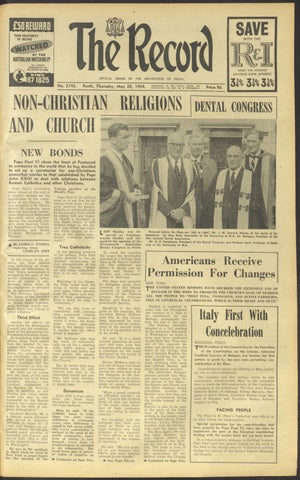
Pictured before the Mass are k left to right) Mr. J. M. Seward, Master of the Guild of St. Appolonia. Sir Alex Reid, Chancellor of the University of WA., Dr. Mangoss, President of the New Zealand Dental Association. Mr. G. D. Henderson, President of the Dental Corgress, and Profesor Saint, Professor of Medicine at the University of WA.
Americans Receive Permission For Changes NEW YORK: THE UNITED STATES BISHOPS HAVE DECREED THE EXTENSIVE USE OF ENGLISH IN THE MASS TO PROMOTE THE CHURCH'S GOAL OF LEADING ALL THE PEOPLE TO "THAT FULL. CONSCIOUS. AND ACTIVE PARTICIPATION IN LITURGICAL CELEBRATIONS WHICH IS THEIR RIGHT AND DUTY." English is expected to come into use throughout the country at a date to be established by the Bishops, presumably before the end of this year. The Bishops' decisions, adopted at a full meeting of the American Hierarchy in Washington on April have now been confirmed by the Holy See. They consist of two separate decrees, one spelling out the parts of the liturgy that are to become English, the other certifying the various English texts to be used, covering both sung and recited Masses and other liturgical services. The American Bishops' decrees provide that English may replace Latin for the les,:ons of the Mass— the Epistle and Gospel and the other readings which sometimes precede the Epistle—and that they are to be proclaimed facing the people instead of the altar. English is also to be used in the parts of the Ordinary of the Mass which pertain to the people, such as the Kyrie, Gloria, Creed. Sanctus. Lord's Prayertogether with its introduction—and the Agnus Dei. The Ecce Agnus Dei and the triple Domine, non sum dignus before the Communion of the faith ful are also to be in English. The same is true of the "common prayer" — the invocations of the faithful which the Liturgy • Continued on Page Two.
Italy First With Concelebration BOLOGNA. ITALY: THE President of the Commission for the Execution of the Constitution on the Liturgy, Giacomo Cardinal Lercaro of Bologna, has become the first prelate to profit by the new rules permitting concelebration of the Mass. Concelebration means the offering of Mass jointly by two or more celebrants. The Cardinal and four bishops whom he had consecrated concelebrated Mass in the cathedral here to mark the 50th anniversary of the Cardinal's ordination to the priesthood. The four were Bishop Gilberto Baroni of Albenga, Bishop Marcello Morgante of Ascoli Piceno, Auxiliary Bishop Luigi Bettazzi of Bologna, and Auxiliary Bishop Antonio Angioni of Pisa.
FACING PEOPLE The Mass in St. Peter's Cathedral was ofTerf_<1 at an altar facing the congregation. Special permission for the concelebration had been granted by Pope Paul VI. since the rules to implement the part of the liturgical constitution dealing with the matter have not yet been issued. In a congratulatory message to Cardinal Lercaro, Pope Paul paid him special tribute for his work in the field of the liturgy and his "industrious activity during the labours of the Second Vatican Ecumenical Council.
Page Two
THE
English In Mass From Page 1 Constitution provides for of the Gospel and sermon. The parts of the Proper of the Mass to be in English in addition to the lessons are the Introit, Gradual (and .its substitutes), Offertory and Communion anthem. The various salutations and dialogue formulas—such as "The Lord be with you / And with your spirit"—are also to be in English. The initial prayers at the foot of the altar re. main in Latin, as does the Collect. Except for the Sanctus-Benedictus, all of the Canon of the Mass remain in Latin. including the Preface. The use of English Is provided for in all of the rites for the administration of the sacraments, except Holy Orders. The same holds true for sacrarnentals. The new decrees also provide that wherever the local bishop decides that "the true and certain necessity of the Church requires it," vernacular languages other than English may be permitted for the liturgy. Thus 'Spanish - speaking communities, for instance, could have the liturgy in their own tongue in the United States. This provision stipulates that the parts of the Mass which remain in Latin in the "English" Mass do so in other languages as well. The texts to be used are those approved by a national bishops' conference of the same language. The Bishops at their April meeting agreed on uniform texts for the use of English, and these texts too have been confirmed by the Holy See's new liturgical commission. The dates for the English use to go into effect are contingent on the time needed by publishing firms to prepare standard editions of altar missals and rituals. The ritual for the administration of the sacra ments and various bles.;_ ings in English is expected to be ready by early in autumn. But the altar mis sals, being more complex, might not be ready until perhaps November. The English texts are to be made public after the Bishops decide on the exact time of their introduction.
While missals for altar use are to be rushed for publication, hand missals for use of the people in general are not to be issued with the new English texts. This is because the changes are of a transitional nature. The Holy See's new liturgical commission is charged with the extensive revision of Mass texts and rites ,and when its Freformed liturgical books are issued—probably within a decade—new English translations will be required. And in the meantime, bishops from nine English - speaking nations are at work preparing for a )common text for use throughout the Englishspeaking world. In the meantime, however, the English texts adopted by the American Bishops for the Ordinary of the Mass are to be made available to the people on cards, leaflets and missal inserts. The new translations are understood to adhere to the modern English patterns set by the Confraternity of Christian Doctrine version of the Old Testament and by the 1961 American ritual book. These in general eliminate the archaic second person singular pronoun and verb forms, replacing Thou and Thee with You. The decrees provide that the Scriptural readings of the Mass be taken from the version translated from the original languages by members of the Catholic Biblical Association of America and sponsored by the Episcopal Committee of the Confraternit3,- of Christian Doctrine. These include texts which have not yet been published, as well as older ones in the standard Confraternity Bible texts. The introduction of English does not mean that Latin is to be forgotten in t he Church in the United States. The Bishops in their initial decree conceding the extensive use o f English stated that "nevertheless steps should be taken so that the faithful may also be able to say or to sing in Latin those parts of the Ordinary of the Mass which pertain to them."
OFFICIAL ENGAGEMENTS MAY 29-31: Forty Hours Prayer. St. Mary's Cathedral.
JUNE 16: Confirmation and Canonical Visitation, Coolgardie.
MAY 31: 5 p.m.—Preside at Solemn High Mass at St. Mary's Cathedral. 7.30 p.m.—Confirmation and Canonical Visitation, at Rivervale.
JUNE 18: Confirmation and Canonical Visitation, Boulder.
JUNE 5: 9 a.m.—Solemn High Mass for Feast of the Sacred Heart. St. Mary's Cathedral. 3 p.m.— Attend Procession in honour of the Sacred Heart, Highgate Hill. '7,30 p.m.—Confirmation and Canonical Visitation at Doubleview. JUNE 14: Confirmation and Canonical Visitation, Kalgoorlie. JUNE 15: 7.30 p.m. —Presentation of Diplomas to Catechists, St. Mary's Cathedral.
JUNE 19: Receive Debutantes, Catholic Ball, Kalgoorlie. JUNE 21: 3 p.m. — Confirmation and Canonical Visitati o.n Carilla. 7.30 p.m.—Confirmation and Canonical Visitation, Claremont. JUNE 28: 3 p.m. —Confirmation, St. Mary's Cathedral (Boys). 7.30 p.m.—Confirmation and Canonical Visitation, Cottesloe. JULY 5: 3 p.m.—Bless new Convent, Loreto, Swanbourne. 730 p.m.—Confirmation and Canonical Visitation, Nth. Beach. 0 , 0•INN' #411,041.41. #4 ,
G. N. MARSTON PTY. LTD. Plumbers & Sheet Metal Workers Licensed Plumbers, Hot
Water Specialists, All Types c.f General Plumbin7, No Obligation—Work Guaranteed
Quotes Fr,^1v (livrn
277 HAY ST., SUBIACO—Phone 8-1579 - 8-3056
RECORD
Bishop Fulton Sheen VERY APT RETORT TO PRIESTS AND MINISTERS WHO FIND FAULT WITH THE WORLD MIGHT BE: "PHYSICIAN, HEAL THYSELF." It is fitting that religion turn its gaze inward and ask if it is fulfilling its mission. Here we speak of Christianity in general, without any specific relation to a church. In what might be called Christianity's "moment of truth" there are some considerations worth pondering— Has the affluence and prosperity of America in any way softened the Christian message? The Old
•
Thursday, May 28, 1964
•
between their profession of a religion and their practice of it, between their Sunday and their weekday. One business man said: "If I practised what I profess on 'Sunday, I would go bankrupt within six months."
•
In the early Church, the Apostles, seeing their time taken up with administration, appointed seven administrators in order that they might be free for spiritual work. What the Christian leaders do with the flock often depends upon the nature of the flock itself. If the flock is prosperous and well-fed, IN the early Church, then the lambs exist for shearing. the pagans were If, however, they are hungry, then deeply affected by the charity of they are to be fed. Our Blessed the Christians, saying: How they Lord did not say: "Shear My love one another! In the Old sheep," He said: "Feed them." Testament the people of God were "separated" people in the sense that they did not share the judgments and the values of the world. IT is very interesting But today let 12 people sit at I ' to make a comparison of bishops, priests and ministers a dinner table, three of them professedly Christian and the other nine, non-Christian. Would there be any way of telling at the end of the meal who were Christians and who were not? Would the judgments and values of the church-going be any different than those who sit at home? Nietzsche once said: "If you want me to believe in a Redeemer, you must in an affluent country and in an begin to act as if you were reimpoverished mission land. In the deemed." latter, they are all shepherds. The Could it not be that those who bureaucracies that produce cold, are called to be the salt of the earth statistical Christs are practically have turned out to be its hone:. non-existent. The wounded on the And the Church which was meant road from Jerusalem to Jericho to be a society of redeemed men, are not passed by because "they commissioned to transform the do not belong to our department." world, has become a kind of a In the Book of the Apocalypse, Sunday club of moralisers or fulthe Church that was rich, Laofillers of an obligation which goes dicea, was the one that the Angel no further than the Sunday hour? of God called poor. In some cases, The layman who pays generprosperity and money in the bank ously may think that that is all become readily identified with that is required of him. Too ofte: Providence. Does a comfortable then, the prominent Catholic ot Christianity really make a comthe prominent Methodist or the forting Christianity? prominent Congregationalist genAnother judgment which might erally becomes the one who conbe made concerning Christianity tributes the most, not necessarily today is that there is not a suffi- the one who is the leaven in the cient recognition of the rupture mass, the city on the hill, or the that exists among the laity be- salt of the community in which he tween their religion and their life, lives.
I F
Christianity's "Moment 01 Truth"
Testament warning about Israel losing its faith when it became fat and prosperous is not without some application to Christianity today. The full basket from the pews sometimes stifles the prophetic utterance from the pulpit. One can almost formulate a law: in days of prosperity, the Church has administrators: in days of adversity, the Church has shepherds. A vast majority of the time of the bishops, priests and ministers of t he Christian churches is consumed in administrative work, much of which could be more capably done by the laity. The result is that the leadership, good example and saintliness which should inspire people, is occasionally wanting. When primacy is given to mortar in the Church, mortals lose their significance.
04.4......"•••••••••••••••`.041 ,04411.00411.4NINININPIPANI•41.#4,41P,a,""••••••####~•
BUDDHIST ACCUSES VIETNAM GOVT. SAIGON:
THICH TRI QUANG, the bonze who led last year's agitation that resulted in the overthrow of President Ngo dinh Diem's government, has now launched accusations against the present government of South Vietnam. His accusations are largely similar to those made last year against the Diem regime, Tri Quang. now secretary general of the Institute of Buddhist Clergy, alleges that four of five demands formulated by the Buddhist Inter-Sect Committee last year are still "unresolved problems." The only one he seems to regard as satisfied is that concerning Buddhist flags, now flown without any restrictions. Outside some pagodas they are displayed more profusely than the national flag. In a long article published by a Saigon daily, Thich Tri Quang challenges the present government with seven questions, such as: "Why does persecution of Buddhists still go on in settlement centres in the Highlands?" and "Why are Buddhist students drafted into the army in a way that seems like a dragnet operation?" He asked "Have the Buddhists fought for four months resounded that around the world just to have to live a more shameful, a more unjust life now?" He alleges that Buddhists have been arrested on false charges in Binh Dinh and other provinces. The Ministry of the .Interior has issued a formal denial of the charge that officials have persecuted Buddhists in Binh Dinh. In an interview given to another Saigon daily, Thich Tri Quang made similar accusations of "terrorism" in Binh Dinh. He also objected to "revival" of the Co So Mon sect of Buddhism, which stayed aloof from last year's agitation. The Buddhist leader protested likewise against the "propaganda being spread
to the effect that Buddhism is communist and neutralist." The present government, criticised by Thich Tri Quang, is predominantly non-Christian. The Chief of State, Minor-General Duong van Minh, and the Prime Minister, Major - General Ng-uyen Khanh, are both Buddhists. Last year's president of the Buddhist Students' As• By FATHER PATRICK O'CONNOR, S.S.C. sociation of Saigon is now a member of the government — Secretary of State for Social Welfare. Many observers are convinced that the present government has been leaning over backwards to favour the Buddhists. On April 26 the Chief of State and the Prime Minister joined in laying the cornerstone for a "national" Buddhist pa goda to cost 80 million piastres (EA495,000) on a choice piece of government property in Saigon city. The government donated th,' site. Thich Tri Quang's complaints have been published close to the anniversary of the May 8, 1963, incident in which eight persons were killed when security forces tried to disperse Buddhist demonstrators outside th, Hue radio station. For this anniversary and the approaching festival of Buddha's birthday, and the proposed trial of Major Dang Sy, local commander of security forces on May 8 last year, efforts are b,
ing made to arouse militant Buddhist sentiment. Thich Tri Quang and two companions received asylum in the American Embassy in Saigon from September 1 last year until the coup of November 1-2 that overthrew the Diem government. FOOTNOTE — The bonze who last year acted as press officer for Buddhists at Xa Loi Pagoda in Saigon, Thich Due Nghiep, has issued a statement disavowing Thich Tri Quang's complaints against the government. Thereupon one of the leading bonzes disavowed the disavowal and endorsed t he complaints.
PRIEST'S MOTHER DIES was received NEWS by Ilis Grace the
Archbishop on Monday that the mother of Father Peter O'Reilly, C.R.P.. Prior of the Norhertine Monastery, at Kerry Downs, York, had (fed in Ireland on Friday, May 22. Father O'Reilly had returned to Ireland earlier this year when his mother had become seriously ill. He was with her when she died. The late Mrs. O'Reilly came from Hailishorough. County Cavan. ÷ May she rest in peace.
From Page 1. unknown capacit pansion."
for ex-
The missionary dynamism of Catholicism. said the Pope, is what creates the perennial Pentecost within the Church, and the "urgency of responding to this duty of Catholicism blows in the sails of the Church." As examples of the response, the Pope cited the development of present-day lay and clerical apostolates, the EcuCouncil. menical the Church's relations with all forms of modern life and its efforts to draw closer together separated Christians and non-Christians as well.' It was at this point that the Pope made his announcement of the new secretariat. The idea of such a secretariat for non-Christians was suggested in April of 1963 by Bishop Antoine Thijssen, S.V.D., of Larantuka, Indonesia. It won the prompt seconding of Thomas Cardinal Tien, S.V.D., Apostolic Administrator of the Taipei Archdiocese in Formosa. In a letter addressed to Eugene Cardinal Tisserant, Dean of the College rti Cardinals, last Septere' 15, Pope Paul indicated that he was considering establishing such an orf!rinisation. In his discourse. the Pope revealed nothing fur ther than that the secreta riat is being established and that Cardinal Marella will head it. No further details were immediately forthcoming from other Church sources.
Thursday, May 28, 1964
THE
RECORD
Page Three
Press Not To Blame For Distorted Image B ANTRY, IRELAND: POPULAR MISCONCEPTIONS CONCERNING THE ECUMENICAL COUNCIL ARE TO BE BLAMED ON COUNCIL PUBLICISTS AND LOBBYISTS, NOT ON THE PRESS, SAYS BISHOP CORNELIUS LUCEY OF CORK AND ROSS. Bishop Lucey said in a t alk here that press reporting on the council has been e xcellent, on the whole. watmelliorilmWnle "If the impression the public has of the council is in many ways a wrong one," said, "it is not the reporters, many of them non-Catholics, who are to blame, but the 'experts' through their tendentious press releases, special reporters and spicy 'inside the council' publications generally." He went on to say: "These experts are not council Fathers. They are people, clerical and lay, attached in a minor capacity to the council, the great majority of whom are content to do the work assigned to them, but a certain few of whom use their position to lobby and make propaganda for their view of what the council should do. WRONG LABELS "It is the slanted writing of these publicists, a mixture of rumour, gossip, quips, propaganda and truth, that has given the world the distorted picture it has of the council and its proceedings. "They it is who have done the sinister labelling. They it is who have divided the council into 'camps' and 'cliques,' into 'progressives' or 'liberals' and 'reactionaries' and 'conservatives;' Into those crusading for the Gospel and those 'intriguing for the letter of the law.'" Bishop Lucey said that actually, when the council Fathers have had a divergence of views it has been on incidentals, not essentials. He said also: "Then a final vote is taken and a decree promulgated, there are no longer bishops for or against. All are one again in the unity that is the Catholic Church, a unity that derives not from the force of natural convictions, but from the special existence of the Holy 'Spirit." IIIIIIIIIIIIIIIIIIIIIIIIIIIIIIIIIIIIIIIIIIIIIIIIIIIIIIIIIIII
JOHN BEGLEY — CHEMI ST298 CANNING HIGHWAY, COMO ( Oppcs , te Como Post Office) T elephone: 67-1559 Prescriptions Readily Dispensed— Will Call for and Deliver NIGHT TRADING 7 - 9 p.m. on Mon., Tues., Thurs., Fri. 1111111111111111111111111111111111111111111111111111111111111
S HOP and SAVE at
M EAT A UCTIONS
Honoured For Brave Rescue BERLIN: HE British Army officer who in 1962 faced unarmed 800 mutinous Congolese soldiers to rescue a Belgian missionary priest has been named a Knight Commander
T
of the Order of St. Sylvester by the. Holy See. Major Richard Lawson, now commander of tank units of the British forces in Berlin, was honoured early by the Queen with the Distinguished Service Order for his heroism in the Congo. In January, 1962, Major Lawson was serving with Nigerian units of the United Nations forces in the Congo. A fter hearing that some Belgian missionaries had been by mutinous massacred troops in Kongolo and that mutineers were rampaging through the town, Major Lawson was flown there at his own request by a Swedish pilot in a light plane. As he left the plane, the major, unarmed apart from his "swagger stick," was immediately surrounded by armed and angry irregular troops. The major — only five feet, five inches tall— was attacked by a tribesman armed with an arrow. But he promptly punched him on the nose and knocked him over.
CALM RESCUE Still surrounded by the mob, he walked calmly away demanding to see the local commanding officer. He worked his way through the town, seeking out the facts of the massacre in which 22 Belgians had been shot and their dismembered bodies thrown into the river. Hearing that one Belgian priest had survived, Major Lawson walked to the Holy Ghost mission, found Father Jules d'Armont. led him back through the town — past the men who had murdered his fellow priests on New Year's Day — to the waiting plane and took off immediately. On January 27, Major Lawson again volunteered to rescue some Catholic missionaries in danger and again returned to the area, this time with another officer, a Major Nwawo. Here they were suddenly attacked by an armed mob shouting "Kill these spies." They were beaten and robbed and their clothes were torn. Major Nwawo was dragged away to be executed, but after being t reated with special brutality he was freed. Eventually, by the intervention of some Congolese officers, Major Lawson was able to ensure the evacuation of the priests and nuns by air. The rescue party t hemselves finally had to abandon their truck and tramp the final miles back t o safety.
PTY. LTD.
School For Blind CHONGJU, Korea: In this republic, where poor children with good eyesight must work from dawn unAstronomical Wonders are viewed by students and faculty of Barry College, Miami til after dark for their Shores, Flo., from atop the col lege union building through a large telescope recently families, the plight of blind children is particularly donated to the college. It is staffed b y Dominion Sisters of Adrian, Mich. Two of the hard. Sisters are shown with Judith Ben kert, Grosse Pt., Mich., and Suzanne Watters of Aiken S.C. To instruct such children to play and work, a 67-yearold missionary from the United States, Father Wilbur J. Borer, MM., directs the country's only school for the blind. It is the latest project of a career in Korea which dates back to 1934. The Ji Kok school not W ALLPAPERS & only teaches the children LONDON: Catholics are PAINTING DIVISION wage-earning crafts, but joining in a new help-your also provides a friendly at- neighbour movement which Registered Tradesmen mosphere in which they can has been launched successbuild self-confidence in the fully in the little town of 64-3760 presence of other blind Abingdon. near Oxford. R ing for Free Quotes children. Houses in the town ot "It is very important that some 15,000 people are blosblind children learn a soming out with swinging ,^4, ..4 .0V1.#14 , 0•.###...NO craft," Father Borer said, signs bearing a fish emblem "for they nearly all come indicating that the resident from very poor families. A will do anything he can to blind person will be able to help his neighbour. PractiDancing and Entertainment Nightly. Private Room for Parties earn the price of his rice if cal examples are emergency he develops a skill." car lifts, providing time The problem of the blind plus cars to visit sick in is accentuated by the fact hospitals, gardening a n d that many poor Korean house decorating for elderFully Air-Conditioned children must work all day ly, infirm or poor people, 27 LAKE STREET, PERTH. 231589. and into the night in fac- shopping for others, and tories. Blind children make welcoming new arrivals. Specialists in "MEALS TO TAKE AWAY" — Ring and Order it more difficult for poor About a hundred houses WEDDINGS and PARTIES on SUNDAYS families to feed and house have these metal fish signs 04.4.4.4,....4 04.4114M0,0,04P#41414 , ...."1.141,040.0.44.41 , themselves. so far and the organisers— Each morning the school's Neighbours Unlimited—feel 19 children attend a regular that another thirty should class programme. Five tea- cover most of the town. chers supervise. Fish sign cards are also beIn keeping with the Ko- ing distributed wholesale so rean government's physical that anyone in urgent need fitness campaign, Father of something has only to Borer has a full programme stick one in the front winof basketball, soccer and dow for someone to call. jump rope. A ping-pong The programme is spont able tilted up in the centre sored and largely financed helps them to play their by the local branch of the own version of the game by British Council of Churches. rolling the ball back and The local Catholic parish f orth. priest is an observer on the "When we have gradua- council and an enthusiastic tion," said Father Borer. supporter of the neighbours "we invite local officials, plan. who rarely miss the opporSocial groups in other tunity. We are not given any towns are watching the exgovernment help, but we periment and the forecast IGNIFIED and reverent are certainly getting some is that it will spread observance of your wishes and a ttention." throughout the country. the fulfilment of all religious
"Neighbours Unlimited"
E XCELLENT CUISINE
EUROPEAN NIGHT CLUB RESTAURANT
Trained to assist...
at Church and Cemetery.
D
East Pakistan Refugees In India NEW DELHI, INDIA:
A estimated that 340.000 refugees have fled from East
N official spokesman for the Indian government has
Pakistan between January 1 and May 8 of this year. The refugees claim they Bengal, Assam and Tripura were forced out because of The Indian government BULK and SMALL CUTS PAPER religious intolerance and has set up a separate direcTOP QUALITY at LOWEST economic pressure of the torate general of relief PRICE area's Moslem majority. under the Ministry of ReIN EVERY The movement of refugees habilitation to co-ordinate AUCTIONS: reached its peak in March, administration of refugee HOME Thurs-Fri. only 5 p.m. the official spokesman said, camps. when 95,148 entered the At the same time, appeals three Indian States of West for aid have been made by Catholic Charities of India and collections are under way in pari4hes, schools P LUMBING MATERIALS and other Catholic instituBATHROOM FIXTURES tions throughout the country. 229-233 Wiliam St., Perth SEPTIC TANK — DRY WELLS Drives are also being organised by other Chris28-1541 The "Plumbing Supply Specialists" tian and not, - nristian • vastramos~s~rh charitable organisations.
2 Cargill St., Vic. Pk.
ROY GALYIN & CO.
CRAFTSMAN
requirements are assured by the correct training of the Catholic funeral
conductors
placed
at
your service by Bowra & O'Dea. Arrangements can be made by phone .t. any hour, Sundays included.
A CATHOLIC
F UNERAL D IRECTORS
BOMA Sz O'DEA ( Ect. 1888)
68 STIRLING ST., PERTH 21-4308.
Page Four
THE
RECORD
COUNCIL FACED WITH COLLEGIALITY ISSUE TALCA, CHILE: HE most critical problem still confronting the Ecumenical Council is to clarify the concept of episcopal collegiality, according to Bishop Manuel Larrain of Talca, President of the Latin American Bishops' Council.
T
Bishop Larrain asserted that this principle of the bishops' full power of jurisdiction over the Church complements rather than counters the principle of papal primacy. The more the concept of collegiality is affirmed, he said, the greater the stress is laid on "the importance of the Head of the College, who is the Roman Pontiff." A prime mover in the land reform movement in Chile and himself a member of the council's commission on the lay apostolate, Bishop Larrain dealt with a wide range of questions concerning the council in the course of an exclusive interview with the N.C.W.C. News Service. MORE SESSIONS He said among other things that two more sessions will be needed to complete the work of the council, that the council should adopt modern parliamentary procedure. He predicted that the council will pass the declarations upholding religious liberty and stressing the close ties between Christians and Jews. In dealing with the question of the most vital concerns of the council, the 63-year-old churchman had this to say: "The most delicate and fundamental problem is that which is related to the Church, and very especially the relations of the bishops with the Roman Curia. It is necessary to give full clarity to two principles—the primacy of the Roman Pontiff, and at the same time the collegiality and power of the bishops. "These are two ideas which can and ought to be harmonised perfectly, since, within the true concept of collegiality, the more you affirm collegiality, so much the more do you - exalt the
* By. . . FATHER JOHN J. BRADLEY, M.M. importance of the head of the college, who Is the Roman Pontiff." The big majority in favour of discussing collegiality in the test vote of last October 30 is "a clear indication" of approval, the Bishop said. He said that this will have very useful results for "the development of the practical life of the Church." He added: —The first of these, I think, will be the importance given to the episcopal conferences, to the regional councils, and at the same time to the senate of bishops who will assist the Pope as advisers to solve the Church more serious problems. The idea of this senate, or whatever you care to call it, had already been suggested by the Holy Father himself during the council. We do not yet know how it will be put into practice, but without doubt it is an idea' that has the assent of all." PRIORITIES Concerning other council priorities, Bishop Larrain said: "First of all, the schema on ecumenism should be completed, especially the sections on the Jewish people and on religious liberty, which have not yet been dealt with. "Next in importance, I believe, is Schema 17, which deals with the relations of the Church with the modern And lastly, the world. schema on the apostolate of the laity, which will complete the chapter on the laity already studied in the tract on the Church." Asked whether the council might take any action regarding race relations, relations, Bishop Larrain
W. & G. JANISSEN—Electrical Contractor I 207 WHARF ST. (Cr. Renou St. ), QUEENS PK. 68-1243. 1 . 444.4 , 004 , 44.4.4,44F.4
"..4.0,41 ,0 44### #4.41.1~4.0.0#41.4.0#4 ,44.
74 1054 A fter Hours 71 2670
John lobb 8t Associates Optometrists 6-1 Opticians 13 THE AVENUE, MIDLAND
JOHN LOBB Optometrist
e4.4441 ,04.41 ,44`4,04,1e#0,4NP4.4.4.4.#####,INedp.e.deaNee,e4ne,Nee.edeedhele404.4.0.4`.04
MAKE
CHEMIST ALLAN .J. T. 'JIM') ALLAN, J.P., M.P.8 CNR
Ph.C.
YOUR CHEMIST
ATWELL ARCADE & CANTONMENT 8T. FREMANTLE, W.A. Telephone: 5-2786. After Hours: 30-2388 — Prescriptions a SpeeiaVy 4.4,44.4,44,44,44,44 ,44.4.4.4.4.4, 14
44 ,44P4,44,4`4,44.4,44`4.4..444%.
04.0•04.######4.#####4...."..","r####,Npipiik#04P,P4.04.0.0.04.
Catholic
referred to the forthright denunciation of racism made before the council Fathers last session. "There was unanimous approval when the North American Bishop of Baton Rouge, in Louisiana, Bishop Tracy, spoke against racial discrimination," said Bishop Larrain. "His speech was interrupted by the unanimous applause by all the Fathers. Here we can see very clearly how the council feels about this issue." DIACONATE Turning to the question as to whether to restore the diaconate as a permanent order in the Western Church, and whether deacons should be allowed to marry, the Chilean prelate asserted: "I think that it is impossible to legislate universally about this question, since much depends on the local circumstances of each region. In general, I believe it is most advisable to reestablish the diaconate in the Church as it was in the primitive Church. But at the same time it is necessary to take precise measures assuring that this will bring about the desired result and not give rise to greater evils. "I repeat, with regard to allowing deacons to marry, that this depends on each country. For example, a group of African bishops was completely against the idea of married deacons. It seems to me that the topic of married deacons will not be dealt with in the council, but will probably be left to the decision of the episcopal conferences and of the Holy See." Asked his estimate of the t ime needed to conclude the Ecumenical Council, Bishop Larrain replied: "I think that in two more sessions— if the schemata are shortened and considered without delay—it will be possible to complete all the material submitted to the council. Naturally, if His Holiness wishes to wthdral,v some of the projects which are now proposed, this will shorten the council much more and it might be reduced to a single session. "I do not believe it is possible to eliminate an entire schema, since they have been submitted for the consideration of the world hierarchy. But it is possible to abbreviate the schemata — a work that is now being done in the various commissions." Asked about the suggestion that the council's third session be its last, and that all further conciliar work be continued by the commissions or by mail, Bishop Larrain said he thought this would not be possible. "I do not know to what degree it would be a true council in this form," he said. STREAMLINING
SPECIAL QUOTES AT
ROSS INTERNATIONAL FISHERIES F ROZEN FOODS—FISH—VEGETABLES & POULTRv ALWAYS AVAILABLE, FRESH FISH and SHELL FISH Head Office: 7 CLEAVER STREET, WEST PERTH PHONE 28-4511 Branch: 29 McDONALD ST., KALGOORL1E—Phone Kal. 49 •
TUDOR HOUSE MANUFACTURERS OF FLAGS, CANVAS, HOLLAND and VENETIAN BLINDS and KITS.
TUDALUX ALUMINIUM AWNINGS, — All At Lowest Prices — Let Us Measure and Quote Free
Phone: 6 1620 286 Albany Highwo7, Victoria Park
Concerning the possibility of adopting new procedures to streamline the council's work, the Bishop said: In my opinion it would be very advisable to adopt the procedure used in modern parliaments, that is to say a majority report and a minority report. Thus, for example, when there are two different opinions on a given topic, a group of Fathers and experts could give one opinion and another group would present the other side. After this a vote would be taken. Bishop Larrain said. however, that the addition of new members to the commissions. provided for by Pope Paul in the last session, was "very useful for the future development of the council." The head of the Latin American Bishops' Council
Thursday, May 28, 1964
Britain's New Severn Bridge
took issue with those who complain the council has been too slow. He acknowledged that the concrete achievements have been few, but said that the council has been of great value. He summed it up this way: "This slowness, which is real, has served nevertheless to clarify many ideas. It has provided contacts which are most beneficial, and above all it has demonstrated the liberty which exists in the Church for voicing all opinions which can be considered pertinent. "I disagree with those that think that the work done in the council is not proportionate to the time consumed. It is not possible to view the council from a purely pragmatic viewpoint, not to try to find immediate results. "Above all we must look at the spirit which has been achieved and this has been the result of both public We and private sessions. must appreciate the contacts established between the different hierarchies and the effects on the whole episcopate of six months' residence together in Rome. This has created a climate of comprehension, of brotherhood, and an understanding of problems, which in my estimation is the greatest fruit coming from the council."
Suspended 400 feet above the River Severn in south west E ngland, a workman makes the suspender cables for the new Severn Bridge. which crosses the river between Aust and Beachley. When completed in 1966, the bridge will be the second largest in Europe, with a main span of 3,240 feet. Photo UK
I: '
FAMILY PROTECTION KAMPALA, UGANDA: HE Catholic Bishops of Uganda have sent the national Marriage Commission an eight -point memorandum outlining the. Church's stand on marriage lawN and holding that it is "in the interest of the State to protect the happiness of the
T
individual family." The statement was the second Catholic declaration submitted within a month to the commission, which was established last winter to consider new legislation in the field of marriage, divorce and the status of women. Uganda's National
Committee of Catholic Wo men in mid-April urged the commission to do away with polygamy. It also called for compulsory civil registration of all marriages. The Bishops reiterated the Catholic women's stand
Altar Servers Meet In Hobart— Pope Stresses Their Importance HOBART: THE ALTAR SERVERS' FESTIVAL. WHICH CONCLUDED IN HOBART LAST WEEK. WAS A TTENDED BY 1,200 BOYS FROM ALL PARTS OF
on these points and also called for restrictions on and eventual abolition of the practice of the "bride price" which husbands pay upon Marriage. Voicing approval of providing judicial separation of couples in the event that all attempts at reconciliation fail. the Bishops pointed out the Christian stand that "the marriage bond is not dissolved." The Bishops also called tor legal recognition of the right of a woman to own property and for recognition of the legitimate widow and children as the rightful heirs of a deceased man.
AUSTRALIA. In a letter to Archbishop Young, Pope Paul underlined the importance of the work of altar servers. He said the closest collaborator of the priest and sacred ministers in the celebration of the divine mysteries and the most active participant in the liturgy is, without doubt, the altar server, who fulfils those functions normally reserved to the ordained acolyte." In his main address to the festival, Archbishop Young told the story of the Second Vatican Council's liturgy decree. The constitution, he said, set the liturgy right at the heart of the Church's life. It could no longer be regarded as of interest to only a few. The role and privileges of the altar server were recognised by the liturgy constitution, said the Archbishop. Speaking to priests and Brothers on the training of servers, he said it was important to tell them of the meaning of the liturgy and not be satisfied with only the mechanics of serving the various ceremonies.
F. R. BEECROFT BUTCHER 181 Rokeby Road, Subiaco Only Prime Fresh Killed Meat Sold Phone: 8-1373
MEMORIALS
C. C. SMITH & CO.
75 QUEEN VICTORIA STREET, FREMANTLE Speciakising in Altars and Memorial Work. Erected Church Altars planned and executed. anywhere in W.A. Designs and Quotes without obligation. "We Have Over 60 Years' Ex erience." Phone 5-1661 , 0.41 ,""fre.4411 .4WINIP .../.4.#4,11,0#4.4.4.41.####,.."ININIPAINP4
H OULAHANS
P, P4P4M4 .,
32 THOMPSON ROAD, NORTH FREMANTLE Are Suppliers of Yellow Sand for Top Dressing or Building, Metal, Gravel, Rubble, Ashes and Filling. Bulldozers, Loaders, Graders for Hire. Will Quote for Excavation and Levelling Jobs. PHONE: 5-1499 . . . 5-3469 ,44.4,44,44,4,4,14.04,44,04,P0,44 e4,04•4,1 4 0,1,4 44,44.04 , 4,44,4 , 44.4.4.44.4`
4 , 14 .4.4.4.4.44.4"44.4,4 4.04,04,4V4, ,44.41 4, 14.~~4#4,0.4
EXPERT REAL ESTATE SERVICE 3ur orgailisation caters for a comprehensive service in Real Estate under the following headings: PROPERTY SALES: By Auction or Private Treaty. We have homes available in all leading suburbs. VALUATIONS: We are Sworn Valuers and can offer a complete valuation service. home sites in all V ACANT LAND: We specialise Choice lots availab'e n Scarborough and suburbs.Deubleview from £100 deposit. -- gistered B.::'fiers (Class A and BUILDING: We -s :-)n easy '-lsnect our '11,3c-fern specialise in -e p,, f 've--oorneci - • 'ec c.cf, brick honle. a' Doubieview. These homes sre cc-m-iplete with rnck-lern c. ,!cur schemes plearning Kichen and Bathroom, Lamines-tooped cupsoarcis, Electric Stove, Tiled Shower recess, Hot water Sys:ern and every modern fitting necessary for home 7.o.nfort. Price (including land) £3,750. Deposit £850. Ea.y Weekly Payment..
In.pections to wait yogi. eonvoniance.
DUDLEY and DWYER LTD. 98 ST. GEORGE'S TERRACE Mrmhlr-, Real nztato Institute eie.e#4.4..e.e.e."pe......e.e0.....e•eive####•#•4e.e.e.e•-ev~ieeiroo.o.e#4,edeer.ea
J
Thursday, May 28, 1964
THE
Page Five
RECORD
Priestly Work In Chile's "Callornpa" A t Concepcion, southern port in Chile, Father Andres Schlosser, SS.CC., develops a £A112 500 programme of rehabilitation of 30,000 persons living in dire circumstances in the slum area at E ast-side of the Bio Bio River, "Costanera."
•
.;•
Xt.!,
Pictured (upper left): the ' Alsacia" school and social centre which it attended by 1,000 children some of them shown in a classroom ( lower left). There is also a clinic for out -patients, a community hall for religious services and other activities. The priest and his lay helpers from the area, aided by professional workers from his Institute for Social Progress, hope to bring for all families a change such as shown by the children in the right photos. However, local conditions plus Chile's economic recession have slowed the programme.
Don't Involve ChurchInPolitics M ADRID: HE new Archbishop of Madrid-Aleala asked a large crowd of laity here "never to compromise the Church with political questions, because the Church has received no other mission than that of placing all its children under the divine government of Jesus Christ."
KOREAN BISHOPS OPPOSE BIRTH CONTROL PROPOSALS
T
Referring specifically to leaders and members of the lay apostolate in the diocese elevated in March to the rank of an archdiocese, Archbishop Casimiro Morcillo y Gonzalez said they had "reached the age of maturity," and he expected their "generous collaboration." The Archbishop had just made his solemn entry into the city and prior to the public gathering had addressed clergy at the Cathedral of St. Isidore. TO WORKERS To workers gathered in the major plaza of Madrid. he said society is not always just with them in failing to acknowledge many of their aspirations.
A R.
MONAHAN PTY. LTD
FUNERAL DIRECTORS SINCERE CATHOLIC SERVICE
SUBURBS DAY & NIGHT 71 5885 71 5894 BEDFORD PARK PRINCIPAL A. R. MONAHAN 26 1819
"I think of the difficulties you must face," he told them. "Open your heart to hope, because the Church, your Archbishop and Spain understand you and wish to understand you even better. Open your heart to love, because class struggle only brings with it hate. Thus you will receive full justice as the fruit of Christian love between the social c lasses, towards which I also ask you to exercise such Christian love." Speaking of the Second V atican Council, he warned t he people against inaccurate reports on council sessions: "Let no one dare take the commentaries of any newspaperman, whether he wears the cassock or the r eligious habit, for the decrees and constitutions of the council. Any renewal which is to be made, whether by the council or not, is to be prepared fittingly. Such preparation must be done first by the clergy, and a fterwards by the faithful." I ' bee you," he said, "not t o be too surprised if some day you see a new, kind of archdiocesan curia primarily geared towards pastoral activities in all their wide complexity." PRIESTS SCARCE The Archbishop said the scarcity of priestly vocations is one of the chief problems facing the archdiocese, adding that the Seminary of Madrid has the "lowest level of vocations among the dioceses of Spain and all Europe." Within a few years, he said, it will be necessary to ordain over two thousand new priests and create several new parishes, and he indicated he would prefer smaller parishes with one or two priests to larger ones with several priests each. He stressed also the needs of Spanish-speaking areas outside the archdiocese, and of the separated brethren and non-Christians. The Archbishop is chairCommittee for the Society for Latin American Priestly Co-operation.
Executed In Vietnam
SEOUL. SOUTH KOREA. HE Catholic Bishops of South Korea have taken a firm stand against proposed government legislation favouring artificial birth c -mtrol and abortion to cope w ith the countr 's acute overpopulation problems.
T
A statement on their posi- operation within our dotion, signed by the 12 Ordiiitani to cope with these naries of South Korea and probiems." released for publication to "We strongly oppose and the Korea press listed five reasons why they could not urge reconsideration of the support such legislation. proposed national eugenic They point out, however, law," they said. "which that they were "contribut- chiefly comprises birth preim., postive and full co-- vention by immoral methods and artificial interruption of pregnancy."
CIVIL RITES
31t NICK Germany: The Czechoslovak Ministry of Education and Culture ha,: called on provincial officials to make more competitive civil "rites- instituted by the communists to replace religious ceremonies. In an article in its official newspaper, Osvetova Prace, monitored here, the ministry cited increasing participation in religious rites by citizens and warned that the "withering away" of religion in a socialist society is not so simple as some "neo-freethinkers" want to believe. BAD TASTE The publication attacked the bad taste exhibited in decorations of public halls where civil rites are held. the "uncultured behaviour" of those performing the rites, and "hurly-burly at weddings which neither newlyweds nor relatives are able to escape." It attacked funerals where there is 'no one to say farewell to the deceased or to speak a few appreciative words about his life," and said the ministry has now issued a directive to enhance the rite of "welcom ing the children and promising the parents to educate them as good citizens"—the communist substitute for Baptism. It also complains that too many civil funeral parlours resemble chapels, both outside and inside, and announced architectural competitions to design appropriate funeral parlours.
They listed the following reasons: V The State cannot usurp int lives of its people. It not have an unlimited rignt over their lives—including the lives of infants in their mother's womb— because "people exist before the State and the State is formed by the people." The nation's constitution "guarantees the right of humans t o life," they noted. Infants in the womb possess this right. Civil law affirms that "infants in the womb enjoy appropriate rights of the law." It is thus deplorable. they said, that the country's criminal law treats "too lightly crimes of abortion and the invasion of the embryo's right to life." • Artificial abortion severely harmful to the mother's health— whether accomplished by medication or operation. They cited statistics of abortion operations which were followed by infection, extrauterine pregnancy, habitual abortion, uterine rupture, and other physical and mental ill-effects. • Immoral birth control, especially abortion, destroys the moral order of famii:, and society. "If immoral birth control, especially abortion, is unchecked," they said, "various social evils such as family discord and juvenile delinquency will be aggravated and finally the moral order of the family and society will be destroyed." Sexual morality must be respected in order that the family and society "be based on a sound foundation." • Birth control is not the only way to solve the problem. They cited as some others voluntary delay of
marriage, the firm suppression of the custorn of concu binage, periodic continence I the "rhythm method"), encouragement of emigration, development of uncultivated land and improvement in techniques of food production. Birth control and particularly abortion. t hey said, are "based on a mentality contrary to the dignity of human life." • Other countries that have tried such legislation have failed. They gave as examples the sterlisation law enforced in Germany in 1933 "to promote national eugenics," which failed and w as suspended in 1945, and t he abrupt shortage in the labour force and disproportion in age levels 'in Japan since the enforcement of 11 national eugenics law there. The law has brought a sharp decrease in the birth rate. the Bishops said. "and many other ill-effects which are about to force the amendment. or suspension of the law." IIP
S AIGON. Vietnam; Ngo dinh Can, brother of Archbishop Ngo dinh Thuc of Hue and the late President Ngo dinh Diem, was attended by three Vietnamese priests before his execution by a firing squad inside Chi Hoa prison here late in the afternoon of May 9. Before the execution he received all the last sacraments. including anointing, given because of his illness. On the morning of May 8 he also received Holy Communion during a Mass celebrated in his prison cell. The three priests, one of whom was a Vietnamese chaplain, accomarmy panied him to the place of execution. He told the priests he forgave all his enemies. The execution was delayed about half an hour while prison officials awaited the arrival of a Hue. from delegation where former police official. Phan quang Dong. was executed at noon on May 9. He. also a Catholic, was likewise attended by a priest who accompanied him to the place of execution. These were the first death sentences carried out in South Vietnam since 1956.
MOBILE CRANES FOR HIRE Lift from 6 to 23 Tons — 140ft. JIB LENGTHS
•• •
ECONOMIC CRANE & PLANT HIRE
PTY
LTD
Cnr. KEW and STAR STREETS, WELSHPOOL A fter Hours: 26-1841 Phones: 6-1605 — 6-6361.
F. LIST & SON PTY. LTD. 91 Central Avenue, Maylands W.A.'s Leading Paving Contractors For Better Paving Contact Us We specialise in Gravel and Bituminous Paving of Roads, Tennis Courts, Playgrounds, etc. We have a most modern plant including power Rollers Graders and Mechanical Loaders, etc. Estimates Submitted Free. -..ountry Clients please note that we have a S.'ate-wide cervice, and will gladly quote on any requirements. We also supply at ruling rates Gravel. Metal, Sand and Loam. Prompt Delivery PHONE: 71-1578
THE
Page Six
Thursday, May 28, 1964
RECORD
=INTERNATIONAL
Australian Succeeds Australian As C.I.S. President
#N1154.41.4.~41544
GERMANY
CEYLON Stir Over Old Church
"Change By New Thinking"
A GOVERNMENT order to use an abandoned Catholic church building in Anuradhapura for a police station has met with opposition from both Buddhists and Catholics and a member of Parliament.
OFFICIALS of the coming biennial German Catholic Congress in Stuttgart expect 200,000 participants.
The Catholic building and another formerly owned by the Anglican church have been acquired by the Anuradhpura Preservation Board. Catholics say the building, which had been used as a place of worship for 73 years, should be torn down. Member of Parliament K. B. Ratnayaka added that use of the church for secular purposes would tend to cause disharmony between non-Buddhists an Buddhists. He suggested a section of the building which once housed an old hospital and now contains several other offices be set apart for the police post.
SWEDEN
BISHOP JOHN TAYLOR, 0.M.I., ANGLICAN DF STOCKHOLM, ARCHBISHOP MICHAEL RAMSEY, OF CANTERBURY, AND REPRESENTATIVES OF OTHER CHURCHES TOOK PART IN A PROCESSION AND ECUMENICAL SERVICE HELD BY THE SWEDISH LUTHERAN CHURCH.
1 0.441 .40,15,
IsdP4.4,4
ir#4.4.45 , 15 , 5,50,0.5.04 ,
The occasion marked the 800th anniversary of the consecration of the first Catholic bishop in Sweden, a Cistercian monk named Stephen. On May 18, feast day of St. Eric, a Swedish king who established Christianity in Sweden in the 12th century, Bishop Taylor offered Mass in the Y.M.C.A. auditorium in Upsala, where the first Swedish diocese. was founded in 1164. The Catholic church in that city was too small to hold the crowd attending the Mass. Later in the day, the 12-century church in Upsala, now belonging to the Lutherans, was opened to Catholics for a vespers service.
Spokesmen said the motto will be "Change by New Thinking," and that several German and foreign prelates are expected to attend, including Augustin Cardinal Bea, S.J., president of the Vatican Secretariat for Promoting Christian Unity, and Archbishop Corrado Baffle, Apostolic Nuncio to Germany. Speaking of the congress motto, Bishop Karl J. Leiprecht of Rottenburg said: "We have to adapt to the new situation in the Catholic Church, without any anxious conservatism. Everywhere we have to be ready to make a new beginning, a new 'thinking with the Church,' without crossing the border of Faith. Then we will have a changing Church in a changing wortd."
t
*4.4V4NIP4SlN#4.4N/NIPNP4,IN####dl,MI.#N##,##Nre#Nok##N#N#4'e
SPAIN
4.#41 , ,4 1P41 , 041 ,041
Bishops Approve Vernacular THE Bishops of Spain approved the use of the vernacular in the Mass, sacraments and sacramentals at a joint meeting in Madrid, and appointed a committee to prepare texts and norms for liturgical renewal as decreed by the Constitution on the Liturgy of the Second Vatican Council.
YOUR HOTEL GUIDE I HIGHWAY HOTEL GREECE 206 STIRLING HIGHWAY, CLAREMONT PHONE 11 1566
P
Friendly Service — Good A ccommodation — Parties Specially Catered for M. A. Sir 2. M. McDONNELL
S AVOY PLAZA HOTEL
B AYSWATER Hoiel
OPP. STATION Excellent Accommodation Frequent Train Service — 4 Mlles f rom City — Large Parking Ares BED and BREAKFAST REASONABLE TARRIFF LES BARTLETT, Prop. TEL.: 11 1224
THE HEART OF PERTH Dancing, Entertainment, Every Night. Rooms with bath 45/-, breakfast. Meet You at the Savoy BM Lucas, Manager.
SUBIACO HOTEL First Class Accommodation and Service DRIVE-IN BOTTLE DEPT. FREE HOME DELIVERY
Phone: 8-1028 Alex McHenry, Proprietor.
WAVERLEY
WEMBLEY HOTEL
Excellent Lounge and Accommodation Phone 87-2418 Cnr. Cambridge and A lexander Streets, Wembley
HOTEL
HOTEL
Australia
Next Boons Waverley Stores ALBANY HIGHWAY C ANNINGTON Modern and Convenient Homely Accommodation Use Our Drive-In Bottle Serviee A. R. CONNELL Phone 6.14 2419
MURRAY STREET, PERTH Excellent Accommodation and Dining Service LUNCH, 10/-1 DINNER rug. PHONE 2$ 1541
CRITERION HOTEL
Enjoy the Best ACCOMMODATION ar SERVICE
CENTRAL HAT STREET PERTH
24-HOUR SERVICE Erse Parking for Country Residents 5 Minutes' walk from Cathedral. TEE COUNTRYMAN'S HOTEL PHONE: 23 1115 (5 Ulnas)
HOTEL COTTESLOE RIGHT ON THE SEA FRONT
Stock and High Roads, MELVILLE Phone: 30 3428
THE board of the World Union of Catholic Women's Organisations has called on its affiliates to observe 1965 as International Co-operation Year, in accordance with a United Nations appeal, and urged member groups to increase efforts to expand co-operative activities.
Cnr. High and Market Sts., FREMANTLE Offers excellent homely accommodation Phone : 5-1786
NORTH AM Phone Northam 49 T. E. MURPHY, Proprietor
Philip
P
Hearin*.
Licensee
Plympton
SHENTON PARK HOTEL
HOTEL
NICHOLSON ROAD SHENTON PARK Excellent Accommodation, Moderate Tariff, Spacious Car Park Beer Garden, Open Air Bar, Phone: 5-2170
Hcme of Country People C ANNING HIGHWAY EAST FREMANTLE Eric Campbell, Prcp. 5-1721.
1P4h#4 , 11•4.4.114/414PAPAPAPAPAP.#4,..diKapIstr.#4,4K.04.1.4.........,tr#4 , 04P41.41~4.4",sp.I.#141.4,P.AP-"I
Jack Sheedy PHONES
214141.
CARLTON HOTEL
23-1091
t tS HAY
ST., PERTH
BUSINESS MEN'S LUNCHEON — 12 to 2 p.m. 5.5154/45`14115.05.11.~.11 ,45,45,1•45
DALY'S
MEET
DAILY
ROYAL
FRANCE
..#4,4,0441.4.4,4P#4,11 ,411
HOTEL ESPLANADE
NATIONAL HOTEL
COMMERCIAL HOTEL
A STATUE has been erected in Athens to the memory of a Catholic priest revered as a national martyr. The statue was placed in the courtyard of the new Byzantine Catholic church of Athens in commemoration of the 20th anniversary of Father Chrysostom Vasiliou's death in a Nazi prison camp on September 8, 1944. after four months of prison torture. He had assisted in the escape of many Greeks to join the Free Greek National Army in Egypt, and sheltered several Jews from Nazi purges. Bishop Hyacinthe Gad, Byzantine Exarch, presided at the ceremony, which was attended by members of parliament, city and other officials, as well as several prelates and priests.
International Co-operation
PERTH'S LEADING HOTEL FOR ALL VISITORS Phone: 23-1531
TOM KENNY. Licensee.
Monument To Catholic Priest
Phone 3-2155 a. M. DYMOCK. Licensee
W1LLAGEE PARK HOTEL The States Most Modern
• I
at
HOTEL
Cr.WTILLI A M and WittLINGTON STREETS, PERTH nettle Dept.. 1.1-5494 Plionee • 21-5924
I
ARGENTINA ("IsIVP-4,041.4411411,1
Groundwork For University THREE priests from the Wisconsin Province of the Society of Jesus have arrived in Buenos Aires to lay the groundwork for a Jesuit university in Salta, in the f ar_porth-west of Agentina, to open in 1966. To be joined by their provincial, Father John J. Foley, S.J., at the end of May, the priests' immediate goal is to complete transactions which were begun last June regarding the projected university. They intend to discuss their plans with government, Church and university officials, and to set up a residence in Salta, nearly 800 miles north of Buenos Aires.
INDIA 1.41^###.111K#41.1 4 1
•
Midday Meal For Children FRANK SENZ, of New York, programme director of Catholic Relief ServicesNational Catholic Welfare Conference in India, announced in New Delhi the inauguration of a midday meal project for primary and nursery 'school children in New Delhi. Present at the inauguration were Sushila Nayar Ji, Health Minister, and American Embassy officials. In its initial stages, the midday meal project will provide a glass of milk and a bowl of porridge to 300 s tudents. The programme will later be expanded to feed more than 30,000 students enrolled in various and nursery p rimary schools of the city.
RUMANIA
THE GERMAN CATHOLIC NEWS AGENCY, K.N.A., REPORTED IN BONN THAT THE RUMANIAN GOVERNMENT HAS FORBIDDEN THE USE OF THE HUNGARIAN LANGUAGE AT MASS IN THE JASSY DIOCESE IN NORTH-EAST RUMANIA, It said there are about 80.000 Hungarian-speaking Roman Catholics in the See. K.N.A. also reported that the embassy of a neutral country is negotiating Nvith the Rumanian government on behalf of the Holy See, seeking permission for a Rumanan bishop to attend the. third session of the Ecumenical Council. It said the prelate in question, Bishop Aaron Marton of Alba Julia, has not been able to make his required "ad limina- visits to the Holy See or to attend either of the first two sessions of the council. Bishop Marton, now 67, has been Bishop of Alba Jul;a since February, 1939.
VIM=
Mr. Edmund Burley, secretary and director of Berlei Limited of Sydney, Australia, has been elected President of the Chartered Institute of Secretaries. Mr. Burley succeeds Sir David Muir ( formerly Agent -General for Queensland in London) who has had to resign because of ill-health after only four months as President. Commenting on Mr. Burley's election, Mr. John Philips, Secretary of the Institute in London, said, "This year marks the Golden Jubilee of the Institute's Australian Division comprising one quarter of our membership, and we wanted an eminent Australian as President throughout 1964." Mr. Burley's election as world-wide President of the Institute followed his term as President of the Australian Division, of which his father, Mr. Arthur Burley, was first President in 1947. —(Photo U.K. Trot. Service)
Parents Defy School Order WINNIPEG, Canada: The judge said it was a "flagrant disregard of the law" and Mr. and Mrs. Roger St. Onge, parents of 13 children, rejoined: "We are ready to go to gaol." The "flagrant disregard" was a defiance of the Manitoba Province school attendance act. The St. Onges kept three of their children out of school during Janu ary and February. It was done in protest against a demand by the local school hoard that parents pay the cost of transporting their children to a Catholic school in the same bus service provided free to students attending a tax-supported public school next door to the Catholic institution. Five other couples joined the St. Onges in the protest and a total of 21 children were kept from classes at
U.S.S.R. Expel Christian Missionaries SOVIET Premier Nikita Khrushchev has called on all African nations to expel Christian missionaries, according to a report from the official Soviet news agency, Tass, received in Bonn. Tass said that in a speech at Aswan, Egypt, Khrushchev declared that expelling the missionaries would guarantee the national progress and national rebirth of all African peoples. He said that missionaries are the agents of former imperialistic nations which are using them in an attempt to reconquer their lost colonies.
St. Emile parochial school. The children returned to classes when an anonymous benefactor took over payment of the bus fares for all involved. Police Magistrate G. L Cousley fined the St. Onges a total of 90 dollars. The judge gave them an alternative—pay the fine or serve 15 days in gaol, and also gave them a month to pay the fine, go to gaol or appeal. Joseph Sullivan, counsel for the couple, has indicated the conviction will be appealed against. Mrs. St. Onge said: "If we lose, our neighbour and our eldest daughter will take care of the children. We are ready to go to gaol." Dr. Adam Giesinger, the president of the Manitoba. Catholic parish school trustees, said he was astonished at the heavy sentence. "Since a matter of principle was at stake and not ill will, and since a constitutional point based on the Manitoba Act of 1870 has been raised, we expected a suspended or nominal sentence." A number of others have echoed Dr. Giesinger's astonishment over the sentence and the reprimand given by the magistrate to the parents.
DON'T FORGET! Send in GLOSSY PR!NTS of Your WEDDING PHOTO for publication in 1 "The Record"
THE
Thursday, May 28, 1964
Page Seven
RECORD
Pope: Plain Chant Will Subsidiarity Principle In Survive Change
Welfare Aid
V ATICAN CITY: HIS HOLINESS THE POPE has cautioned public welfare organisations from crowding private initiative and personal responsibility out of the field of organised chiurity and assistance. The Pope received members of the Seventh Congress of Italian Welfare Organisations and praised their work aimed at "helping, preventing and healing suffering of all kinds, but mainly physical and economic, among the weakest members of society." Welfare work, the Pope said, "is a reflection of that supreme law of charity which was brought to the world by the Gospel." He added that the increase of agencies dedicated to public welfare was to be regarded as a "good omen for social unity and general peace. It c omes to heal the wounds of conflict still to be felt and feared, and to convince all that it is not hatred, revolutions, wars and selfishness the world needs, but providential and brotherly love."
FRIENDLY The relationship between and private aid public groups should be friendly, Pope Paul declared. Noting in Italy public welfare work is an outgrowth of the country's Catholic inheritance, he warned it would be unfortunate if public authority lessened the capacity of groups or individuals to act in the field of assistance and welfare. This must be avoided, he declared, "if one does not want to harm the sense of personal responsibility towards poorer brothers at its very roots, and in the end to deprive the practice of charity of human, consoling sensitivity." The Holy Father said the principle of subsidiarity—
that nothing should be done by a higher power which can be done by a lower one —should apply in the relationship between public and private welfare work.
VATICAN CITY: ROPE PAUL VI has sought to assuage the fears of those who see the Ecumenical Council's Constitution on the Liturgy as possibly spelling a new eclipse for
"It will safeguard the free Gregorian chant. and fruitful task of workSpeaking to a pilgrimage chant assures great beauty ing for the good of others; it will give order, drive and of French teachers of plain to the rites of the Church, help and it will stress the chant, the Pope said: "Are the Pope declared: "As our prestige and nature of the any of you perhaps alarmed predecessors often pointed function of a public autho- at the future applications out, this chant has all the rity which tends to direct, of the Constitution on the qualities required in reliintegrate and promote while Sacred Liturgy which was gious music." adopted by the council being neither monopolistic In St. Peter's Basilica Fathers and promulgated with the 3,000 members of nor exclusive." 4? Let this pilgrimage, organised Public authority in this by us last December admirable that read them by the Gregorian Institute sense, the Pope continued, concerning of Paris, were some 200 would "normally remain at text's passage chant, and parti- "Little Singers"—choirboys a higher level than that of liturgical cularly the following: 'The —who had just concluded the direct exercise of assisttreasure of sacred music is their tenth international ance, and would make availto be preserved and foster at Loreto, across Italy from able to the latter, by provied with great care Rome. dential subsidies from pub(Liturgy Constitution, paralic funds, the spontaneous The Pope addressed what graph 114.) contribution of means aiiu he called "a special word" forces arising from the peoto the Little Singers, who ADAPTATION ple themselves, not only came from Great Britain, Pope Paul went on to say with economy of organisaBelgium, Spain, France, that some "effort of adaptations and expenditures, but Switzerland, Germany and also—and this is what mat- tion" will be necessary, but Italy. ters most—with an incom- added he is confident "that "To you, my dear children parable wealth of moral you are generously disposed who are listening to us," he and prepared to do so." virtues and of the finest said, "we want to say why Stating that Gregorian sentiments."
we have a predilection for you, Little Singers. It is because of your age. Jesus loved children . . . Our predilection is assured to you because you are closer to the altar. You are not only assistants, you are helpers. With the priests and the other celebrants you are also ministers, small but valiant ministers in the sacred ceremonies."
A CATHOLIC PAPER IN EVERY HOME KELLY & RODEREDA Pty. Ltd. CHINA, GLASS and PLATED W ARE IMPORTERS 39 KING STREET, PERTH Convents, Colleges Institutions and schools specially catered for. Price list and catalogues on application. PHONE 23-2055
MISSIONS CONCERN ALL CATHOLICS
VATICAN CITY: THE HOLY FATHER HAS HAILED RECOGNITION • OF THE FACT THAT MISSIONARY WORK IS NOT CONFINED TO MISSIONARY SOCIETIES, BUT IS THE CONCERN OF ALL CATHOLICS. The Pope spoke on May 15 at an audience for the general assembly of the pontifical missionary societies directed by the Congregation for the Propagation of the Faith. He said that the "missionary movement demonstrates and sustains the spirituality and activity of the Church." Pope Paul expressed pleasure that "the idea that missionary interest is no longer restricted to those who give their name to the institutes for the missions. but is a matter of concern for the hierarchy of the bishops and of the whole community of the faithful. is spreading," He noted that there has been a clarification and development of the principles of missionary work. This has resulted in the fact that missionaries today acknowledge "the human values of every people and of every civilisation, and of the consequent duty not to suppress them with other values derived from another civilisation," the Pontiff stated. "Instead of suppressing these civilisations," the Pope said missionaries today work "to understand them, t o adopt them and purify them . . . to vivify them in Christ with their own original expressions." Pope Paul said that the "difficulties of missionary preaching are increasing in many countries, while the roads of the Gospel are becoming smoother in other r egions." Missionary approaches are changing with the times, he said. As an example, he pointed to the programme of bringing young persons from mission countries to more developed nations for education. This, he added, "is proving practical, right and proper." * * * • More than LA11,880,000 m as distributed by the Congregation for the Propagation of the Faith for missionary work in 1963. The figures for mission e xpenditures were released during the annual general assembly of the pontifical missionary societies in Rome. The missionary groups include the national societies for the propagation
of the Faith, the Society of St. Peter the Apostle for the Native Clergy and the Missionary Union of the Clergy. Twenty - three national directors were present. Of the amount, nearly four million pounds went to 750 ordinary subsidies and four and a half million pounds went to extraordinary subsidies, which included 844 projects, such as and churches schools, chapels, student centres and press and radio operations.
Inspects Clothing For Poor VATIC \ N CITY The Holy Father visited the Vatican warehouse to inspect the clothing for the poor sent him yearly by the U.S. National Council of Catholic Women. The new clothes, including First Communion dresses, were given to the Pope by the N.C.C.W. for distribution in the neediest areas of Italy and other countries. Last year the clothing was valued at more than 290,000 dollars. Half of it was distributed in parishes in Africa. Pope Paul also looked over layette sets for newborn babies donated by 800 schoolchildren from U.S. military families in the Frankfurt, Germany, area. Pope Paul is the third pontiff, after Pius XII and John XXIII, to make a special visit to the warehouse to acknowledge the generosity of the U.S. Catholic w omen. He was accompanied by Monsignor Andrew P. Landi, of the Brooklyn diocese, director in Italy of Catholic Relief ServicesNational Catholic Welfare Conference, and Archbishop Angelo Dell'Acqua, Substitute for Ordinary Affairs at the Papal Secretariat of State.
wish you were going? . sailing away to Europe a passenger on a beautiful, new, Lloyd Triestino Liner, the award winning Galileo or her sistership Marconi . . . visiting exciting oriental ports and meeting lots of gay, friendly people. You will be certain of a treat when you sail Lloyd Triestino . . . the service is superb and the food . . . mmmmmm! It's glorious. And when you travel Lloyd Triestino you enjoy weeks of good living! and the splendid comforts of sailing on a new ship. There's so much good fun and activity on board, too! . . . swimming. deck games. parties. dancing, movies, horse racing, cards . . . never have a chance to be bored. •
Ask your travel agent or the general agents for literature on Galileo and Marconi, a sailing schedule and list of fares for first and tourist classes. Be sure to take advantage of reduced return fares or the even greater saving to be had from off-season Return Excursion rates. day, Whether you decide to go next month . . . next year . . . or just some remember, for a wonderful holiday on your way to Europe—Lloyd Triestino is THE line to travel with.
Lloyd Triestine) -VIA THE ORIENT TO MESSINA, NAPLES AND GENOA
OLILEO MARCOXJ Fre-intle, General Agers: GEORGE WILLS & CO. LIMITED. 133 St. George's Terrace, Perth. Telephone 21 9421. Atso at
THE
Page Ei ilit
First African Boy Attends Eton College, England
Thursday, May 28, 1964
RECORD
* A mes. age from FATHER E. DUNDON, National Director of the Apostleship of the Sea.
.••••••••••41 , 0W
Everyman 's Family
Seaman 's Day
By
last Sunday of May is Seaman's Day in Australia. THE It :s the day when we turn our attention to the men who man the merchant ships. From one end of the year to the other, tnese men bring Australia's goods from port to port around the coast and from country to country around the world. Many of you have gone on overseas journeys or cruises in their company. If there was a priest passenger on board, Mass would have been said in one of the passengers' lounges at a time convenient to you, the pasa hardly But senger. thought would have been given to the spiritual needs of the men who work that ship day and night. Twenty-four hours of the day every department of the vessel would have been active. A constant vigilance would have been kept on deck, in the engine-room, and in the galley. A round of activities that lasted the 24 hours of the day would have spread to the seven days of the week.
1
In the traditional tail-coat of a student at Eton Tokinbo Akintola makes history by becoming the first to join one of Britain's most famous public schools. Picture shows him on his first day with Powell Jones, of Cranleigh, Surrey Both boys are 13 years old. Tokinbo is the son of thc... Premier of Western Nigeria, Chief Samuel Ladeke Akintola, and he has been a pupil in preparatory school in England. Tokinbo's mother travelled to England to accompany him on his first day at Eton, which is Iiear Windsor, England. Photo U.K
13,0(ANT & WATERS — Now
Wood, Coal and Coke (••••.
Imi. Service ,
ADAMS CY KIVISALU
5 EDWARD STREET, EAST PERTH PHONE 28-1713--A H 69-1010
•
"•••••
S.
-•••,
M. MALONE MOTOR BODY REPAIRER AND AUTOMOTIVE PAINTER 501 MURRAY STREET, PERTH --Phones: 23 4915
232688'
-
P. D. LALLY LICENSED PLUMBER
23 Fulham Street, Kewdole. Phone 6 3682 HOT WATER SPECIALIST. SHEET METAL WORK SEPTIC TANK INSTALLATIONS. • ALL WORK GUARANTEED --"`••
••••., • -•••,_
AWNINGS. BLINDS. FLYWIRE DOORS. and FLYSCREENS ALL TYPES
STAN BOND 1010 BEAUFORT ST., INGLEWOOD Phone 71 4313 Top Quality Tradesmen
1 -
Arthur E. Davies & Co. FUNERAL DIRECTORS 1,s
\ABALMERS FREMANTLE: 85 Market Street — 5-2225 CLAREMONT: Opp. Railway Station — 3-2177 .AND ALL SUBURBS W ALLACE A. H. GREEN — 61-189 iPrivatel
Telephone 21-7'722
0I1 )
ci ,V0111in
OPTICAL DISPENSER United Insurance Building. 218 St. George's Terrace. Opp Forrest House. Perth
Doctors' Prescriptions Dispensed
THINKING OF TRAVELLING? FOR
ALL
BOOKINGS
BY
AIR SEA, RAIL or ROAD WITHIN
AUSTRALIA
OR
OVERSEOS
Consult—
DALGETY-N.Z.L. 04141.41~411 ,041•••••41.4141.41. 00-41,11 ,0#41\111,0-41.41 ,411.04.41KD
TRAVEL SERVICE
15 WILLIAM ST., PERTH. 21-2841.
RELAX IN PORT Life is like that for the seaman. While he is a member of a crew, he is on duty almost 24 hours of every clay. When he hits port, it is necessary for him to relax He must relax in mind and in body and thus restore the energy that has been used up during the voyage. His soul, too, needs revitalising just as his body. So the Church has organised for his welfare The Apostleship of the Sea. The Apostleship of the Sea is the Church's official organisation which takes care of the spiritual and social life of the seaman. Irrespective of his rank or nationality, all seamen are made welcome in the hundred-odd Stella Mans Clubs that exist in the main ports of the world. These clubs are the parish centres for the seamen. In them the sailor will find his parish priest ----the Apostleship of the Sea Chaplain. In the club chapel Mass will be celebrated at an hour convenient for him. There. too, he may receive the Sacraments of Confession and Holy Communion. Frequently the Port Chaplain will spend his evenings giving instructions to converts and to those who did not complete their course on religion during their school days. One of the important ways that The Apostleship of the Sea encourages the spiritual life of a seaman is by the establishment of Rosary Circles on board ship. Two or three of the sailors from a particular ship bring the other Catho lic members together for other the Rosary and prayers during the voyage. In this way, though most of these cannot attend Mass on a Sunday, contact is kept with Almighty God and graces flow to enable theni to live as perfectly as their counterparts on shore. In some ports of Austra h a, this work for seamen was originally started by t he St. Vincent de Paul Socity. In most of the larger ports a certain number of members of the society carry out ship visitation They also attend the Stella Mans Club. FULL TIME There are four full-time chaplains for the merchant seamen in Australia —Fremantle, Adelaide, Melbourne and Sydney. Part-time chaplains attend to the needs of the seamen in Townsville, Brisbane, Newcastle, Port Kembla, Geelong, Portland, Port Pine, Port Augusta, Wyalla, Albany, Geraldton, Bunbury, Darwin, Cairns. Hobart, Lauceston, Davenport and Burnie. However much they may
wish to work for the seamen, it is not possible foi them to do as much as they wish on account of the other duties which they have to perform. Since ships come to the port at hours outside the normal working hours, it is necessary to have full-time priests on this work. It is necessary to have many more Stella Mans Clubs in operation. The clubs that are in existence need constant modernisation and reequipping. In order to call the attention of the seaman's fellow-Catholic ashore to this situation, the last Sunday of May has been set aside as Seaman's Sunday. On that day in each church in Australia, prayer for seamen are requested. This is done with the approval of the Hierarchy. So when in your parish on the last Sunday of May your priest makes this request, be generous in the quality of your prayers for seamen and for those who look after his welfare in the Apostleship of the Sea.
RADIO FIRST JALES, Brazil: .The Assumptionist bishop here marked the silver anniversary of his priesthood by inaugurating a diocesan broadcasting station, Radio
Assumption.
Collecting funds for the purpose, Bishop Arthur Horstuis. A.A., said: "I prefer 30,000 florins (Dutch coins) for a broadcasting station to 50,000 for a new church. The radio station will enable the Bishop to reach the diocese's 350,000 Catholics scattered over an area onethird the size of Holland. He said he considers the station of prime importance because there are only 2:1 priests for 21 parishes with only nine 'widely dispersed and inadequate churches, 60 per cent of the people are illiterate, and there is an acute shortage of schools. The radio will provide primary education for the people and also courses in agriculture, domestic economy and religious instruction. The Dutch-horn prelate said Dutch and German bishops have generously contributed towards the cost of building the station and the Brazilian government is helping to operate it.
Wants Pope CEB1 CITY, The Philippines: The President of the
Philippines plans to invite Pope Paul VI to attend the celebrations here of the 400th anniversary of this country's Christianisation. President Diosdado Maca-
pagal said in Cebu City on May 17 he has conferred with Rufino Cardinal Santos of Manila and Archbishop Julio Rosales of Cebu City on his plans, and has directed his government's foreign affairs department to draft a letter inviting the Pope to make the trip: The mayor of Cebu City
said he expects two million people at the 1965 celebration if the Pope decides to come.
, 0•-.11,411,•••••••••••••••••••• ••••••• 4 , 0 .••••••••••••••PW.•••41 , 411.41,1 0•••••••••••••••••4,14,411.0,111
MSGR. JOHN C. KNOTT
INVENTORY I
AND NECESSARY BUSINESS PRACTICE TO TAKE CAREFUL INVENTORY AT REGULAR INTERVALS.
T IS A CUSTOMARY
Such a stocktaking reveals the successes which make for profits and, equally important. those failures and miscalculations which can lead to financial difficulty. It would be good alscLif a married couple and, later, when the children mature, if a family could
take a similar inventory. In a sense this is often done spontaneously at remembering-when ses-
sions. On the occasion of a wedding, or of a death of a family member or of the return -to the old home town of one who is living in other parts, the family gets together, memories get unlocked, reminiscences start, laughter flows and sometimes t ears. There are silent pauses as each one remembers and then the babble of several conversations going on simultaneously. Now and then the in-laws look at each other with a shrug and a smile or a lifted eyebrow of amused amazement.
sessions are good things for the emotional SUCH relief offered. They serve to strengthen the
1
family bond among adult members who, by reason of their own commitments, can easily lose communication. They are especially valuable for a sense of perspective. The old, old problems which looked so catastrophic at the moment of occurrence are now seen against the background of a lifetime and in better proportion. The tracings of God's finger reveal themselves. The frustration of carefully laid plans, the dashing of hopes, and the sorrows and disappointments of life are seen in context with other gifts of God. They are recognised now as invitations to growth, as demands for more faith and trust in God, as not just the shutting of one door but the opening of anot her. many times one could say, looking back HOW over his own life: "If this had not happened,
I would not have met you, or I would not now be
in this job, or this opportunity would not have opened up.- It is at a time like this one can say with hindsight wisdom—"God is good., He is good not only in His obvious gifts of life and health, of love and of children, of material things and of friends, but in His less welcome gifts, humanly speaking, of Himself. We need perspective to appreciate this and more trust in His love for us to be generous in our acceptance of His future plans for us. There are certain natural plateaux in every married couple's life which might be used as inventory -taking opportunities. When a couple celebrates their first wedding anniversary. their stocktaking will be mostly concerned with their personal inter -relationships. They should have learned a great deal about themselves in living with each other for 12 months. It is hoped that their love matured with their knowledge. But, in quick passage of time, here they are now celebrating their tenth anniversary. They are more family now than marriage. The children are all young, demanding, exhausting in the problems they can create. The baby food and the diapers, the jealousies and bickerings, the disciplining and educating. the bills to be paid and the headaches to be aspirined can seem endless in their variety and impossible in their permanent solution. They can be surfeited with the endless work of making a family. Take this same couple on their silver anni-
versary. The kids are fairly well raised and along their educatoinal trails. Now they are beginning to reap the rewards. Which child would they not have had Which headache is remembered? Which bill was not paid? Which disaster not met or crisis not overcome somehow? God is good now as He was at every anniversary. It is we who only get wiser and more appreciative as we get older. * The address of the local Catholic Marriage Guidance Centre is 77 ST. GEORGE'S TERRACE. PERTH.
23-4548.
Renmano ALTAR WINE --- SOLE AGENTS ---
R. CONNABEER & COMPANY
165 HAY STREET, SUBIACO.
Phone 8-1410.
1
Thursday, May 28, 1964
THE
Annual Meeting Records Progress
Message To Y.C.S. Meeting ADELAIDE: OPE PAUL sent his blessing and wishes for a successful second national conference to all Australian members of the Young Catholic Students' Movement who met in Adelaide last week.
R
to Canberra by Government THE TENTH ANNUAL MEETING OF THE PARENTS departments. Of these., 2,-, AND FRIENDS' FEDERATION OF WESTERN AUSTRALIA WAS OPENED BY HIS GRACE THE A RCHBISHOP ON SUNDAY, MAY 24, AT THE ALL S AINTS' MEMORIAL CENTRE.
Among the official guests were the Honourable Paul Hasluck, M.H.R., Minister for External Affairs and the Honourable E. H. Lewis, M.L.A., Minister for Education. His Grace congratulated the Federation on the progress they have made, particularly over the last 12 months. However, he said: "I am sorry that the financial position of the Federation is not better than it is, and I would appeal to all A ssociations to realise their obligations in this respect." On behalf of the schools, the Archbishop thanked the Federation for the valuable services which it is rendering to the schools. He said that the establishment of the Federation has given rise to a new spirit of enthusiastic co-operation between parent and teacher and child. GOVERNMENT AID His Grace said that the climate of public opinion towards private schools had changed and the atmosphere of Government attitudes has also changed very favourably. He said: "The Federal Government grants in favour of scholarships and the building and equipping of science laboratories is indeed welcomed by us. And it is significant and most important —for it recognises at long last the principle of equal distribution."
He then outlined the various stages. • THE MISSION FIELDS As long ago as 12 years, the Commonwealth Government introduced the idea of supporting not merely Government schools, but all schools that were ministering to the Aborigines or to the native people of Papua and New Guinea. It directly subsidises salaries of the schoolteachers in denominational schools, provides a great deal of equipment for them and gives capital assistance to them. • SUPPORT FOR UNIVERSITIES One department of the assistance for tertiary education which the Commonwealth Government gave support was for colleges within universities. There was an equal opportunity and an equal share in the resources among all colleges, both those established and supported by the C hris tian denominations and those which might have been promoted by other non- denominational bodies. • AUSTRALIAN CAPITAL TERRITORY Large bodies of public servants were transferred
His Grace also expressed his gratitude to the Anglican Archbishop of Perth, the Most Reverend George Appleton, for the admirable attitude which he is adopting in connection with the cause for State aid. "For years and years," pe said, ''we have carried on this crusade single-handed. It is no longer so." In thanking the Archbishop he said: "I thank the Communion of which he is the distinguished head. and I only hope other denominations will espouse this cause, because we are crusading not for ourselves alone—whether Catholics or Anglicans—but we are crusading on behalf of all religious denominatoins."
*
• it
SS,I!•
Page Nine
RECORD
per cent had been accustomed to sending their children to private schools and, in Canberra, the churches out of their own resources were not in a position to provide the accomodation in church schools to which these parents might send their children.
The message from the for the 100 delegates from way tied to the work of Pope was read by the every State. the bishops in your own Y.C.S. Episcopal Chairdioceses. You are thereman, Bishop Gleeson, who He told the delegates: fore really representatives described the meeting as "You came here with the of your own bishops." the first Australian as- idea in mind to promote Other official messages sembly of students, reli- the work of God's Church to the conference were regious and priests to study and the deeper spiritual ceived from the Interthe needs of the student life of all students. The national Y.C.S., the Young world. Y.C.S. is an efficient body Christian Movement in Bishop Gleeson had pre- of Catholic Action, with a Chicago and the English viously celebrated Mass work that is in a special Y.C.S. Movement.
The Government, therefore, introduced a scheme of long-term, low-interest loans. It started with a scheme limited to secondary schools and was then extended to all schools, primary and secondary. • PRESENT STAGE The scholarship grants and the provision for build ings for science purposes in secondary schools. These grants are needed in order to provide facilities for science teaching. Both the scholarships and the science grants were made accessible to both private and Government schools. Mr. Hasluck made one observation about the scholarships. "We were hoping," he said, "to inaugurate them from January 1, but for a variety of reasons, mainly connected with negotiating and the arrangements for the taking out of the scholarships, we were not able to do so and they will be inaugurated as from next January."
a • #
, # .#1. • efa,• •,,a‘10
kJ"
W.A. representativer at the Y.C.S. National conference in Adelaide were: — Left to Right: Mother M. Raphael (Victoria Square), Brother McAppian (Aquinas), Sister M. Bernardine ( Lesmordie), Brother St. John (Fretrantle), Michael Quinn (Aquinas), Gerald Kelly ( Fremantle), Father P. Ahern (Diocesan Chaplain), Brother Hassam (Geraldton) . Sitting (L. to R. ): Christine Hebb (Sacred Heart Convent, Highgate), Ann Hilsz (Brigidine Convent, F loreat Park) .
1,4•4., a•a#
Air
se s
#t
MAXWELL ROBINSON & PHELPS
I#4a
. . 1 11 11111111 11 1111,111111 1111 1 1 1 1 11111IFTT17
Mr. Hasluck's Address IN addressing the meeting, Mr. Hasluck said that he felt, as a member of the National Government, that they as Australians are trying to work out a problem that belongs to Australia. He said: "I feel that so long as members of this Federation, thinking in a way in which they have in approaching this problem— not in a spirit of violent opinion, but with dignity. tact and restraint—will no; only be doing their duty as they feel it as members of their own faith, but will be contributing to a better Australian solution to an Australian national prob lem.
A PAPER CATHOLIC IN EVERY HOME
Last Sunday several hundpeople attended the blessing and breaking of red
ground for the new church for Ukrainian Catholics to be built at Maylands
599 Newcastle Street, Perth
283141
Get Better Meat for Less at
C LEM PAULLS
( Above: ) A n artist's impression of t he new church.
234 HAY STREET, EAST PERTH — 23-4927 63 CANNING HIGHWAY, SOUTH PERTH 67-1708. WATCH THE WINDOWS FOR OUR SPECIALS
( Right) : Father I. Schewcin, S.T.L.,
H. J. LILLEYMAN
is pictured breaking the soil for the foundations.
W.A.O.A.
OPTICIAN and OPTOMETRIST 453 ALBANY HIGHWAY, VICTORIA PARK. 6-1880. And 156 ROKEBY RD., SUBIACO. 8-3983. Res.: 67-1685
"I would like to remind the meeting." he said. "that this change has been going on for a number of years."
1 PHONE .25 2781 ALL HOURS
CLYNK BROS Regd. BUILDERS
4•41,41.4M•Pa••••P 4•4•411.##.4.11 ~ ,
a
Shepherds Newsagency
H IGH ST., FREMANTLE—Phone 5-2696 Greeting Card Specialists Outstanding Range of Cards for All Occasions "THE RECORD" ON SALE EVERY FRIDAY
F REE 105
ATLAS
CONCRETE TANKS
2,300 GALLONS to 50,000 GALLONS
All Metro. & Country Areas
QUOTES
SCARBOROUGH
BEACH
SUPPLIED RD.,
SCARBOROUGH
PHONE 6S-2S65 for Qr0TATION
CONCRETE SERVICE CO. 227 WHARF STREET, QUERN•S PARE
THE
Page Ten
Legion Of Mary. .. "MODS" and "ROCKERS:" irresponsible Destructive, behaviour on the, part of teenage groups in recent weeks has made national headlines. Two groups known as "Mods" and "Rockers" clashed when they met at a holiday resort in England. The widespread naturally has publicity aroused much discussion, with representatives of social welfare organisations, etc., giving the opinions on the general behaviour of youth. USUAL QUESTIONS: The usual questions are asked: "Are kids any better or worse than they were 20 years ago?" "Who is to blame?" "What can be done about it?" — Perhaps this last question could be altered to read: "What should I have done about it?" The formation of groups of teenagers does not necessarily rriean trouble. With the correct leadership and guidance, this enormous amount of youthful energy can be put to good use. A competitive spirit between groups does not necessarily mean that one group must annihilate the other. It should be the means of stimulating the individuals in each group to better themselves. LOCAL GROUPS: There are many groups of young people working in Catholic organisations in the parish. Their ages range from nine to 16 years. These groups are known as Junior Legionaries. The Legion system and training for juniors is very similar to that of the senior Legionaries. Most important of all is the necessity to attend a weekly meeting and the serious obligation of completing the work assigned before the next meeting. There are no slackers in the junior Legion — if a would-be member does not want to work, he is not invited to stay. Tasks are many and varied and by no means of a juvenile nature. For instance, they teach younger
Catholic children attending State schools their prayers, prepare them for First collect and Communion them for Mass on Sundays, visit the sick of the parish to perform household tasks for them such as chopping wood, shopping, etc., visiting homes for the aged, reading to the blind, taking physically handicapped children out for an afternoon, assisting their teachers and the parish priest in the upkeep of the buildings of the parish. The children are not expected to wait for an opportunity to do these tasks. Their work obligatoin is as binding to them as it is to senior Legionaries. THE ARE WHERE ADULTS? The willingness of large numbers of children to join the junior Legion is a pleasing contradiction to the many remarks heard on the "hopelessness of youth." Yet, because of a lack of co-operation on the part of adults, there is a serious danger that many of these groups, ready and waiting now, will never commence. Each junior praesidium must have a senior member as a president. In practically every Catholic school in the are there Archdiocese groups of up to 14 young children pleading for help, and to all appearances their pleas are falling on deaf ears. Their willingness, energy and the opportunity of giving them this wonderful training will be thrown away. In a few years they will leave school and when we are asked: "What could I have done?" how many of us will be able to answer truthfully: "I did all I could." The WE WANT HELP: obligations of a president of a junior praesidium are the attendance at the weekly junior meeting and to fulfil the necessary work obligation of a senior member. If it is not possible to fulfil this work obligation from the junior meeting, it would be necessary to the senior member to attend a
AHERN'S
senior praesidium meeting, where the supervision of the junior praesidium would suffice as a work assignment for that Legionary. INQUIRIES: Working with a junior praesidium is one of the most interesting and rewarding tasks of a senior Legionary. This is a most urgent and iserious plea for assistance. The school years is halfway completed—please don't ignore this request! You may receive further information regarding this work by contacting your local Legion praesidium, or writing to the Legion Office, 77 St. George's Terrace. A Legionary is on duty at the office between 1.15 p.m. and 1.45 p.m. Monday to Friday.
CATHOLIC WOMEN'S IXaverian RT REPO GUE LEA Club HIS
, ,###### 41 , 00,1P4P4 11.4P4.4.4, , 41 , #41
GRACE THE ARCHBISHOP told members of the C atholic Women's League that they should always practise true Christian principles in public life, for it was by this that they should be recognised.
SALE
FINAL
WEEK
MONDAY AT 9.05 A.M.
ODDMENTS & REMNANTS MUST BE CLEARED
Among the members o the Xaverian Club trying their hand at tenpin bowling last Friday were John Coyne, Marion Plunkett and Theresa Scott.
NEW EXECUTIVE The occasion for the The next bowls night will League was the 26th Annual In the afternoon session on Friday, June 12. It be week last Conference held of the annual conference, doesn't matter if you have at the All Saints' Memorial the election of executive ofbefore as the Centre. His Grace was pre- ficers to fill the vacancies not played social and is only is game DiSpiritual the sent with of two vice-presidents and fun. rector, Monsignor A. Lang- a treasurer were completed. Other members who enmead, to hear the annual The executive for the Catha Saturday night out joyed actiLeague's the of report olic Women's League for O'Leary, Maureen were vities and accept their dona- this year is: President, Mrs. Mary Goodman, tion towards the Seminary F. Balmer; vice-presidents, Frank Busher, Alex Eley and Bursary. Mrs. E. Jolley and Mrs. E. and her sisThe retiring president, Edwards; secretary, Mrs. M. Marie Gordon ter Anne. It is hoped to Mrs. R. Jolley, welcomed Pollett; minute and press of these evenHis Grace to the conference secretary, Mrs. M. Purkiss; have another future. near the in ings inhis for and thanked him treasurer, Mrs. R. TownsSquash will be played on League. In her the in terest secretary, international end; PATRICIAN MEETINGS June 5, at the 0-report., Mrs. Jolley thanked Mrs. R. Green; auditor, Friday, AND Centre at 9 Squash ford the of all the members Miss Hamilton. DISCUSSION GROUPS have been courts Three p.m. executive and the general The new president, Mrs. booked for one hour and The next meeting of the members for the support memBalmer, thanked the everyone is welcome. MemFremantle Patrician Group they had given her during bers for electing her and bers are to meet at No. 1 will be held in St. Patrick's her term of office. promised to do everything William Street, Perth, at 8 Hall, Parry Street,, FreMrs. Jolley said that in her power to carry on p.m. mantle, on Tuesday, June 2, though much had been the good work of her preA picnic to Noble Falls at 8 p.m. The subject foz to like would achieved, she decessors. Mrs. Balmer then will be held on Monday, discussion is: "Why I Am have seen more branches of made a presentation on beA Catholic." All interested the League formed. She half of the members to Mrs. June 1, leaving No. 1 William Street at 10 a.m. sharp. Catholics are invited. hoped that with the good Jolley and Mrs. Davies. this picnic is anything If A discussion group for name which the League had like previous ones, it should BRANCH NOTICES Catholics and non-Catholics acquired more branches be great fun. would be formed in the near will be held at Wanneroo Executive members will Catholic School on Wednep- future. meet on Wednesday, June 3, After the branch secre- at All Saints' Memorial day, May 27, at 8 p.m. Mr. taries had read their re- Centre at 10 a.m. The genPittaway will introduce the topic, which will be: "What ports, showing the wide eral meeting will follow at range of activities covered 1 p.m. Do Christians Expect Of by members of the League, The Council?" Leederville branch will members A discussion group for His Grace told the in the presbytery at 8 meet that he was very pleased Catholic and non-Catholic had p.m. on Thursday, June 4. they progress the with Overseas Students will be Maylands branch will made. He thanked Mrs. held on Sunday, May 31, at a card party in the hold as presi44a Pier Street, commencing Jolley for her work years parish hall on Tuesday evenfive last the over dent at 7.45 p.m. Ron Chapman who ing, June 2. will introduce the topic, and also Mrs. Davies finShenton Park branch is which will be: "Is It Wise had handled the League 27 roster for daily teas at for on capably so ances To Question Religious Docthe All Saints' Memorial years. His Grace said that trine?" this was a truly great effort. Centre from June 1 till June Last Sunday, the Maria Monsignor Langmead was 5. Assunta Girls' Club held its also praised by His Grace At the May meeting of the third meeting. for his untiring work as Shenton Park branch the Spiritual Director. held was officers of The activity of the club is election and the following are the to help the children at the Apart from urging memThe bers to always practise branch executives for this Wandering Mission. year: President, Mrs. Harti- members are enthusiastic Christian principles in pubgan; vice-president, Mrs. and have put forward many lic life, His Grace told the secretary, Mrs. practical ideas. that Dawson; present members 150 The Ladies' Auxiliary of example could Indermaur; treasurer, Mrs. and prayer A series of discussions on MisJesuit the Australian of solving the Hall; delegate, Mrs. Foley. the Mass are being consions will be holding an be a means delinducted at the meetings. tea problem of juvenile afternoon American quency which was such a These are not only interestmusicale on Tuesday. June vexing question in the ing and informative but also 9, at 1.30 p.m. at the home help the members to realise of Mrs. R. I. Browne, 299 world today. the importance of the Mass. His Grace asked all memCharles Street, North Perth. Results of the elections to show There will be a small bers of the League which took place at the preand leadership spiritual a charge and friends are inThe Sisters of the Holy vious meeting were as folto do all they could to help vited to bring a gift, buy a of Nazareth will lows: president, Mary Ann Family ever-increasing this combat gift. hold their first seasonal D avi s; secretary, Mary Everyone is cordially in- menace. meeting in preparation for Joan treasurer, Burke; His Grace accepted a vited. Further details may their annual Fete. Thornton; publicity officer, cheque from Mrs. Jolley as be obtained by ringing Mrs. The meeting will be held Marcelle Butler. the League's annual contriJ. Fitzpatrick on 3-5057, Mrs. Although the attendance June 7 at 3 p.m. at Our on W. T. Ennis on 30-3581, or bution towards the Semiat the meetings has been Lady of Grace School, Kitnary Bursary. Mrs. G. Palandri on 86-1949. chener Street, North Perth. good, the club still hopes to All friends who are willing recruit more members. Any girl interested can contact to help in this annual event are most cordially invited. the president —ph. 6-1751. ..
GIRLS HELP MISSION
Jesuit Missions
Preparation For Annual Fete
112nel Liturgical Week
Anniversary
Thursday, May 28, 1964
RECORD
At Monastery
THE Redemptorist Fathers will hold a Liturgical Retreat at the Monastery Church, Vincent Street, North Perth, from June 7 to 14 at 7.30 p.m. nightly. Body—"I am with you all This will take the place of days." the ordinary retreat for the Pope Pius XII said that men of the Holy Family the Liturgical Year is Confraternity and the wo"Christ Himself —ever living men of the Confraternity of Our Lady of Perpetual Suc- in His Church." The Liturgy then is our life. It is Christ's cour and St. Alphonsus. way of saving us and of This year the retreat will be made open to anyone in keeping us saved. Nothing Perth who is interested in is more important than that. the Liturgical Revival. THE PREACHERS This Liturgical Week will be an effort to put into pracThe Redemptorist Fathers tice the recent Constitution have invited a guest speaker on the Liturgy, authorised for each night, including the Second Vatican one from Melbourne, Father by Council. Such a week will W. H. Stinson, C.SS.R., Ediremind Catholics that the tor of the "Majellan." Each Liturgy is their life. of these priests is deeply interested in the Liturgical The early Christians lived with Christ, ate with Him, Revival. They are Fathers prayed with Him. They J. CfrAuncy, C. Dennehy, shared His humiliation and C.S8.R., A. Lynch, P. CunHis glorification. There is ningham, P. Ahern, W. H. no need to envy them. Stinson, C.SS.R., D. Foley There are the first Chris- and B. Hickey. It is hoped that all who tians and the present-day Christians. But there is are interested in the Lituronly one Christ and there is gical Revival will keep this week free. only one life lived by Christ. Further details will be He lives that life now in published in next week's His Church, His Mystical "Record."
BUYING OR SELLING - TOP VALUE ALWAYS
HOPKINS MIGHTY MART 222 BEAUFORT STREET, PERTH Public Auctions — Tuesdays, 10.30 a.m.
HUGE RANGE OF GOODS FOR PRIVATE SALE
WE ARE CASH BUYERS — PHONE 25-1826 llIIlllIllIlltllIlllIlll tlIlIllIIllIItIIIIlIIIIIIl
HAMS • BACON : ALWAYS 1=------•• • COOKED MEATS and INSIST on • SAUSAGES of course . . . i WA made- • CONTINENTAL E
77 -i1111111111111I0Illint111111111111111111111111i116'=
SMALLGOODS
' THE GREATEST MANE IN S MALLGOODS"
THE SOCIETY of ST. VINCENT de PAUL
WANTED URGENTLY Clothes and Furniture ( To assist hundreds of NEEDY families.)
Kindly Deliver to Society Stores at — or Depot —
318 Bulwer Street - North Perth 46 Eighth Avenue - Maylands 24 Helena Street - Midland 15 Bronte Street - East Perth
or Ring between 10 a.m. and 3.30 p.m. 28 4573, 71 6454, 74 1941 for truck to call
Thursday, May 28, 1964
THE
RECORD
Page Eleven
Y.C.W. BRANCH NOTES By Y.C.W. Branch Correspondents GUILDFORD (GIRLS) Last Sunday the Guildford branch celebrated its first anniversary with a day of r ecollection for all leaders. The day commenced with Mass, followed by breakfast then a short talk by the chaplain, Father H. Brennan, on the "Vocation of a Leader. A discussion followed this talk and some interesting points were raised as to why girls and boys leave a leaders' group after only a short while of service. As Father Brennan is unable to devote as much time as he wishes to both groups, it has been decided that at future leaders' meetings both groups will combine for the chaplain's talk. HILTON PARK (GIRLS) The leaders spent a very enjoyable training weekend at Marian Lodge and one resolution to be carried out is to try and bring more girls from the parish into the Y.C.W. group. The basketball teams are continuing with their good play and so far all three are undefeated and on top of the ladder in their respective grades. BEACONSFIELD (GIRLS) A very successful social evening was held • a few weeks ago to help raise money for "Ellen of India" —Ellen Mills, who is going to India to help with Y.C.W. work in that country. It is hoped to have another similar function in the near future. The basketball team is continuing its run of success and so far remains undefeated in its grade. This has only been achieved because of close co-operation between coach and players. CAILDFORD (BOYS) Last Sunday, the branch celebrated its first anniversary in the Y.C.W. Movement. Leaders attended the Y.C.W. Mass in the parish church and were then treated to breakfast in the presbytery. The topic of social activities was discussed and It was decided to seek the help of the local youth organiser, Mr. J. Hollands, in attempting to improve the social calendar. Congratulations to the staff of the "Y.C.W. News," the branch newsletter, for bringing out a special edition to commemorate the anniversary. E ‘ST FREMANTLE (Girls) Both basketball teams are continuing to play well and _so far are in the top four in their respective grades. All young people of the parish are reminded of the
MOVING!
Y.C.W. dance to be held on Saturday, June 6, at the Presbyterian Church Hall, on the corner of King Street and Canning Highway, East Fremantle. An invitation is extended to all other groups in Perth who would like to go along and have a wonderful evening. MORLEY PARK (BOYS) At the last meeting, the guest speaker was Mr. Melville Ward, who spoke on past experiences and aims of the Y.C.W. It was decided to hold the next general meeting on Sunday, June 7, and it is hoped that the next Y.C.W. general Communion will be better attended. On next Sunday week, about six leaders will help out with the census of the different religions in Ashfield.
STH. SUNBURY (GIRLS) Another house party was held on May 16 at the home of Mr. and Mrs. W. Carmody. About forty people turned up, many who were new to Y.C.W. Everyone enjoyed the evening (especially the scavenger hunt arranged by Helen) and we are all looking forward to more. A Beetle night was held after the Tuesday night meeting. Money is needed to send representatives A. Buswell (South Bunbury) and B. Depiazzi (Town) over to Lismore for the National Conference, and it is hoped that by holding several functions similar to this, their financial burden will be lessened. The Friday night squash evenings are going well.
SCARBOROUGH (BOYS) Y.C.W. members are reOn Sunday night, three minded that badminton is members from the State held on Monday nights at Committee on Alcoholism St. Joseph's Hall. Everyone spoke to almost forty young is invited to go along and people at a general meeting make it a success. in the parish. First speaker, the State SOCIAL CALENDAR secretary, made the point that the first drink is often June 6: East Fremantle taken without any thought Dance. of the consequences that it June 20: Highgate Dance. could lead to, and often that young people were influenced to drink by group pressure and social environment. Another speaker then stressed the need for education in this matter, as at present there is a great amount of Government expenditure required on rehabilitation centres and so on. A doctor claimed that excessive drinking is most often the result of immaturity and insecurity, and can lead to nervous and liver diseases and heart trouble. N May 21, )lr. Maurice He suggested that as a Francis Foley died at means of avoiding this one should make life healthy St. John of God Hospital, and interesting — that is, Subiaco. where he had satisfying employment, conbeen a patient for five structive hobbies, etc., so as to give one a sense of weeks, achievement. Solemn Requiem Mass The meeting was concluded with a short talk from was offered for the repose priest Father O'Brien, and the of his soul by his Father Wiliam Foley, son. Y.C.W. president, Kevin Horgan. after which supper last Saturday morning, and dancing followed. His Grace the Archbishop. His Lordship Bishop McKENSINGTON (BOYS) Keon. about forty priests A general meeting was and very many Christian held on May 23. The discus- Brothers were present in sion was led by Gary Buch- the crowded Holy Rosary holz and there was a good Church, Nedlands. Assistattendance. ing Father Foley at the The subject under discus- Mass were Fathers D. sion was teenage parties Foley and M. Toop, with Father F. Walsh master of and under-age drinking. At the next general meet- ceremonies and the priests' ing a debate will be held on choir singing the Mass. National Service. The prayers at the graveside in Karrakatta Cemetery were read by the parsh priest of Nedlands, Monsignor E. Moss.
PRIEST'S FATHER DIES
o
5-1777
The State's LeadincFURNITURE REMOVERS and PACKERS
GILLS TRANSPORT SERVICE Ply. Ltd. PERTH and FREMANTLE
EXCITINGLY DIFFERENT!
ALL - FRUIT - DRINKS By GOLDEN MILE CORDIALS P4P.41.4•04, ""14•04.~4144
Specialising in SCHOOL and I NSTITUTIONS Supply NIPAPVININ11,14, 0~4.0~#4
PHONE: 71-2529 A fter Hours: 24-3118 . 4 . 4,41.04,, 41 "NNIMAINIKINIMINN.#4.0.0.41,4141.4.44h1 , 004.0.0.4.4.4,.
Mr. Foley had been ill for some time prior to his entry into hospital, where he was taken in Easter week. He was able to receive Holy Communion nearly every morning and was able to receive Holy Viaticum on the morning of the day he died. Mr. Foley was an early member of the Holy Name Society in the Nedlands parish. Mr. Foley worked in the Postmaster General's Department. where he was a foundation member and a of president the past Supervising Technicians' Association. P.M.G. Department. He was awarded the Imperial Service Medal just prior to his retirement. The late Mr. Foley is survived by his widow. Mrs. Augusta Foley. of Stanley Street, Nedlands. and five children, Kevin (Brother Foley of Castledare), Kath (Mrs. I. J. O'Hara, London), Maurice (Port Moresby), William ( Father Foley, Catholic Missions Office) and Elizabeth. ÷ May he rest in peace.
gtogeosm,fi..7,901101 4:'N' •
SINCE THE OPENING OF THE -PALLOTTI SOCIAL CENTRE" LAST YEAR, THE NEW HALL HAS SEEN AN EVER-INCREASING ACTIVITY. The students at the hos- found the lessons in cut- girls took part. A few tels do not go home as a ting and sewing very much nights earlier, Mrs. Stanrule during their short different from their school ley (teacher) congratulated term holidays, but join in lectures, and took great her pupils on the splendid various out-of-school acti- interest in them. Soon they achievements in their danvities — general training will play in Y.C.W. school cing classes at the final and social entertainments. competitions in their self- dance evening. A very successful sew- made sports tunics. ing and dressmaking class To all voluntary teachers was recently conducted Their sewing ability was and helpers, especially the for the 20 girl students by put to the test by Miss E. ladies of the Catholic the Catholic Women's Little, their matron, who Women's League, many League, Cottesloe Branch, organised a Fancy Dress thanks for their practical pictured above. The girls Ball, in which boys and apostolate.
Need For Light And Guidance Speaking on Commonwealth Sunday at the special High Mass in St. Mary's Cathedral, His Lordship Bishop McKeon said: "Today as we stand at the gate of the New Year of the Commonwealth of Nations. both those who control the destinies of the Commonwealth and we as the citizens of the Commonwealth, if we are to make any worthwhile contribution to the healthy growth in peace and prosperity of the Commonwealth, then we need light, we need guidance, and only God can give the light and guidance which we need." His Lordship pointed out that in 1947 there were some 90 million people in the Commonwealth, but that number has now grown to 700 million. "As we look at those millions," he said, "one significant fact strikes us immediately—it is that only one per cent of those people are white." He said that the other 89 per cent should not be regarded as inferior, because, after all, colour, like beauty, is only skin deep. Speaking about the links of trade and language which bind member nations of the Commonwealth, His Lordship said that it is true that for many these links will have real meaning, but it is equally true that for millions the only language
Recollection Afternoon
The next First Saturday Afternoon of Recollection will be held in All Saints' Memorial Chapel on Saturday, June 6, from 2 p.m. to 4 p.m. and will be conducted by a Dominican Father. An open invitation is extended to all.
The ELSIE KELLY C ORSET SALON Fashion Corsets Ladies' Surgical and Exclusive Lingerie and Hosiery. "Salon,"
Room
109, First
Floor, Sheffield House
Marist Reunion! Al Northam
they will understand is the language of Christian charity, and that the only trade ships they will welcome to their shores will be the trade ships which carry to them the language of that charity. "If we expect our less privileged fellow citizens to retain their faith in us," he said, "if their hope in us is not doomed to yield to despair, then the Commonwealth of Nations must be bound together by the golden links of Christian charity."
There will be a reunion of Old Boys of the Marist Brothers' College, Northam. on June 6. The reunion will commence with an afternoon at the college. Sporting activities have been arranged and the present students will display different aspects of the Marist Brothers' apostolate throughout the world. The Old Boys' Dinner will be held at 6.30 p.m., followed by a dance at 8 p.m. Invitations to these functions have been sent out to many old boys, but any past student who has not received an invitation should contact the Principal as soon as possible.
HEISTS *HUM *RUST * ACID
22.eumbidie ta• ri
! • TFE. W ITH
THE
SILENT M OVEMENT
S AME
SLEEK
CISTERNS
• All-welded seams are treated against corrosion. • The stainless steel is quality M.O. silent • The completely see-saw action makes LESMURDIE the troublefree cistern.
STYLE Available Leading H ARDWARE ACTION STORES and PLUMBERS A ND SEE -SAW
Made in W.A. by
THE
Page Twelve
Thursday, May 28, 1964
RECORD
7ts Adizarif WORLD of SPORT
Bedford Pk. Too Strong For Highgate
TACKLED
NEXT WEEK'S GAMES "Record" selections in black type. At Melville Oval: v. 1 p.m.— Leederville Midland. 3 p.m.— Scarborough v. Maylands. At Gill St. Reserve: 1 p.m.—Highgate v. Applecross-Palmyra. 3 p.m. — Carlisle v. East Victoria Park. At Raphael Park: 1 p.m.—Bedford Park v Shenton Park. 3 p.m.— South Perth v. Como.
Y," BEDFORD PARK CAUSED IN WHAT COULD BE TERMED A Y.C.W. "DERB THEY PROVED TOO AN UPSET TO THE "RECORD" SELECTIONS WHEN STRONG FOR HIGHGATE LAST WEEK. Catania. E. Johnson and J. B. Pucker, P. Clayton and Carlisle are elated at their M. Dark. victory over South Perth. Cross. • Victoria East Watch out, • Park, your neighbours are SCARBOROUGH .... . 10.25 itching to go in this week's . 2.2 SHENTON PARK . A/CROSS-PALMYRA- . . 5.10 encounter. ough's Scarbor again Once this . . . 4.5 day . the of MIDLAND . The game strength and play-on game week appears to be HighThere was not a great gate and Applecross - Pal- overwhelmed their opposiing deal of difference in the convinc a record to tion position its has Each myra. strength of both sides. TI ' win over Shenton Park. on the ladder to consider. played was Applecross - Palmyra backs half first The The four could change conslight ascendancy siderably This depends on on even terms with Shenton gained a forward oppoquite their ough over Scarbor holding Park. Redford M Ji rJ,ind A medal tournament will well. In the second half, nents to restrict Midland's palyed at St. Mary's Tenallowbe . tired, scoring Park Shenton HOW THEY WEN f LAST Club, Britannia Road, ing Scarborough the luxury WEEK Play became congested as nis men when driving players preferred to man- Leederville, on Sunday, May loose of 3.12 BEDFORD PARK forward. This resulted in handle opponents rather 31, at 1.30 p.m. 5.2 .... HIGHGATE .... fast, play-on football — a All members, friends and than go for the ball. The of play the weary umpire, as usual, became brand tennis players are inkeen Fielding a weil-balanced Shenton Park players could to attend. this vited for at scapego the Park mobile side, Bedford match. not bers who would like Mem play. ly scramb proved too strong for Highthe Association attend • to It was players' disrespect gate in a fast, open game in presentation evening trophy ns. position s conditio for the umpire' CARLISLE . perfect football on June 17 should notify the well SOUTH PERTH 3.8 that contributed to frayed secretary by June 15. moved Highgate tempers. across the centre only to Club tournament trophies South Perth tried very Applecross-Palmyra fought find stiff opposition across hard in a fairly even contest will be presented at a dance the Bedford half-back line. with Carlisle to improve hard in their forward line on July 24. This evening will goal. at A Highgate player tackles a member of the Bedford Park shots many had and Once Bedford drove the ball their held at the Mt. Haws be previou of play by Midland thorn Community Centre check in last Sunday's Y.C.W. football match. team close I n up over the centre and deep weeks. into the forward zone, their and should prove most enplayed backs, many shots ended up Carlisle When small men, scouting well down joyable. they out of bounds or resulted in centre, the around the packs, peppered proved too strong in key behinds. the goals with hurried positions. Around the flanks Best for Applecross-Palshots. their play became unstable, myra were M. Seeba, R. Perth Gauntlett, D. Neesham; and South Highgate's teamwork was allowing for Midland M. Williams, found wanting, especially in enoegh latitude to break the forward line. Bedford, ay and drive the ball for- D. Dawson and B. McKibon the other hand, backed ward. Carlisle played a little bon. up well to move out of better in their forward line • trouble when caught. to run up a winning score. Basketball Best for Carlisle were A. AT the initial meeting of the Y.C.W. (Girls) Best for Bedford were W. A. and Maslin Ward, K. J. tation was and Collins, K. Mosey EAST VICTORIA PARK 12.5 The St, Thomas Tennis Association for the 1964 season, a presen Della; and for Highgate. N. Wilson; and for Sogth Perth MAYLANDS on serving of years . 8.5 six after who, Healy, Kath Club wish to thank the orto
St. Mary's Tennis Club
RESIGNATION OF PRESIDENT
Y OUR
CHEMI ST —
N. H. MOORE, M.P.S.
429 ALBANY HIGHWAY, VICTORIA PARK (opp. P.O. ) R ing 6-1076 — We call for and Deliver your Prescriptions CONSULT OUR TRAINED COSMETICIAN 'waylay. I te Helen] Ruben‘tein. Innoxia. Mac factor. Cot!.
S EVEN HILLS AS Seven HiHs it complies v. 'th
RY Ra ndW ISNW7ET ADLTA
• -e ;Ji-errr.-. 5
:oy Church Law
WESTRAL WINE and SPIRIT AGENCY Phone 8-1410
167 HAY STREET, SUBIACO.
Don't let your chairs let you down
Very felt chairs still physically let you down. But most people have walked into handsome new club or public premises and seen old chairs which let things down very badly indeed. If you have recently moved into new premises—are you happy with the old-chair atmosphere? Picture your old chairs in a new home. Unhappy about 90 what you see? Write us immediately for our comprehentive chair catalogue.
Chair-man.
The "Town House" from the range of 23 Sebel Chairs — ever , one well designed and sturdily made for specific seating purposes in clubs, halls, hotels, etc.
se.e Carlyle &Co. (1959) Pty. Ltd., 1-9 Milligan St., Perth. Phone 21-9331.
SE9.62P
In the first half both sides played a close brand of football with Maylands on top by two goals at halftime. Several positional changes in the second half unbalanced a Maylands forward line that had combined quite well in the first half. There was little system in the football played. Melville Oval is a large ground, but players failed to realise this and congested play unnecessarily. East Victoria Park managed to score the few goals extra to record the win.
made the committee, has resigned.
BUSY BEE
ganisers of the Association was Tournament, which ed. very well conduct
Osborne Park 2; Palmyra. Kath had served in the ille O. Melv ry secreta of s c apacitie ( 1959), treasurer C2 GRADE: Rivervale, 19581, Anyone interested in th: school secretary (1960) and Beaconsfield 6; Osborne Hobart Carnival is asked to Park, Palmyra, Willagee 4: president (1961-63). 2: would ds tion Maylan Scarborough, contact Des Wells as soon The Associa like to take this opportunity Highgate, Guildford 0. as possible. to sincerely thank Kath for C3 GRADE: Hilton Park to service of A working bee will be her six years 8; Mt. Lawley, East FreY.C.W. basketball. Ken4; East Perth held on Monday, June 1, at was mantle 6; presentation The Park, Mosman sington, in 8 a.m. to erect the new Chapla n Diocesa made by West Perth, Maylands 2: of the Y.C.W.. Father J. Palmyra 0. cyclone fence. O'Brien, who said that he the for was ,"grateful smooth efficiency and quiet competence which had been Kath Healy's contribution of to the organisation Y.C.W. basketball in several positions over the years." Jan Fitzhardinge has been FTER a rest period of t‘‘o weeks, during the AustraLEEDERVILLE .... .. . . 13.15 appointed this year's presi3.6 dent by the girls' executive. COMO lian Championships, the Old Aquinians'Hockey Club -bearers elected office r Othe With no reserves as refielded five teams for the fixtures on Saturday, May 23. Carolyn secretary, are: placements, Como struck Joan treasurer, Smith; team was quickly into Because of lack of match trouble when Kevin Sale secretary school Duffy; stride and netted eight team won. one only ice, pract t wisted his knee in the first Margaret Munden; assistant goals before the change. another team having a draw ten minutes of play. treasurer Gaye Wildy; and This was mainly due to losing. three other the and Kevin usually plays at publicity officer, Geraldine Grade, Old some fine hockey from McA2 the n I centre half-back. His loss Willesee. Aquinians lost to Old Scotch Kenzie and Melvin. team unbalanced Como's backprogressive The 2 goals to 4. After half-time the break line. points in the Y.C.W. BasketAquinians of two weeks began to take game this n I Leederville combined well ball Association to May 23 played well in patches and its toll and the team slowed as a team and, with the are as follows: during most of the second up considerably. However, found extra man, they Al GRADE: South Perth half were attacking almost the players combined in a breaking away from Como 8; Manning, North Double - continuously. Ho weve r, close-checking game and quite easy on forward view, West Perth, Kensingmost of the attacks were scored an other goal to run moves. ton 4; Subiaco, Palmyra negated by good play by the out easy winners. backs of the opposition. The Best for Leederville were Gold 2; Scarborough 0. Bill McKenzie, the topAquinian backs were not sc S. Ledden, R. Harrigan and A - RESERVE GRADE: scorer, was best player and aland sturdy in defence B. Paterson; and for Como Applecross, Hilton Park 8; Melvin was also mentioned. P. Devlin, D. Blank and P. St. Michael's 6; Highgate, lowed the opposition to The B3 team met UniverSheridan. South Perth 4; Bedford score some easy goals. sity last Saturday and drew Daly were The goalscorers Park 2; Como, East Victoria 2-2. This was a hard-fought • and Kinsella. During the match with the younger and Park 0. second half Prindiville was fitter opposition battling B1 GRADE: Leederville 8; moved to centre-half and against the more expert PREMIERSHIP TABLE Mosman Park, Centrals 4; provided a lot of drive for enced Aquinian team. % Floreat Pts. 3; TEAM Scarborough the forwards. The C,3 team lost its first 354 Park 2; Kensington 1; Como Prindi Scarborough . . . 24 Best players were nil. for the season when match Kinand ce Lawren ville, 486 20 .. A /cross-Palmyra it was beaten by Old Hale B2 GRADE: Queen's Park. sella. 348 ... 20 Highgate .... Rivervale 6; Shenton Park, The R2 team lost 5-2 to 0-1. The opposition team 321 St. Clare's 5; Carlisle 4; East . 20 Bedford Park Scarborough. The team was was the best they have met 163 Victoria Park 2; Claremont, unable to field a full side so far and consequently the . 16 Midland . were Aquinians found it hard to Victoria Park 0. consequently and 161 12 Leederville settle down to their usual ntage disadva a at placed 8; a : Palmyr B3 GRADE style of play. r, 106 Howeve 12 start. Park the m Vic. East Bedford Park 6; Leederville, fro lies within still team the oss Dave Gordon led the forApplecr Park, 23 n 8 Mosma Carlisle stiking distance of the top wards in many attacking 4; Manning, North Double48 4 Como of its division. moves, but these resulted in view 2; South Perth 0. 41 4 Maylands only one goal. The best its ed continu The B2 team Cl GRADE: Hilton Park, 32 East Fremantle 8; Carlisle, unbeaten run when it beat players were Gordon, Wood 4 Shenton Park Suburban 9-4. The Aquinian and Glasson. 10 Victoria Park, St. John's 4; 0 South Perth .
BAD DAY FOR OLD AQUNIANS
A
Thursday, May 28, 1964
THE
RECORD
TURF TOPICS . . .
W
HEN the first two favourites were successful at the opening meeting at Belmont Park last Saturday, backers were off to a good start for the winter season. From then On results went right against them.
Jockey Graham Aistrope added to his good record by again riding a winner a week. COVANUS gave him this week's win. In his present good form, the run is likely to continue. _
Green But Good
that there is a marked difference between winter and summer form. Royal Coral is bred on staying lines and the way he appears to skim over the ground suggests that he is going to appreciate more distance as he gets older. SEA REBEL mystified his connections and others with his moderate third. It might be as well to skip this run and remember his previous smart win when weighing up his future chances.
BACKED for a "bundle," COUNT AMBER had no t rouble in winning the seven-furlong Novice Handicap, giving his owners their first win on the turf. This young brother to good galloper COUNT SPUTNIK still needs experience. When he took the lead with ease in the straight, he did not seem to know what to do next. The colt is sure to improve and go on winning races. WEST KEY came IN the light of her form, home well to run second, particularly the last run, it while MAGIC RED'S third is hard to fathom why CRY was full of promise. Racing TIME was sent out such a first-up after a long spell, short-priced favourite in he went to the front and the 7f. Army Handicap remained there until well ( 2). At no stage did she look like taking a hand in the into the straight. From now on he will take finish, and it will be some no end of running down in time before punters tumble over one another to take 2-1 a six-furlong event. again. The race was won by KINJALA, a proved "artful dodger," who wins a race dashingly one week and is then unsighted at his next few starts. It is that type of horse who annoys punW. T. (Tiny) Beazley's colt, ters. Nothing else in this ROYAL CORAL, left a good weak field gave a "bark." impression by the way he won the 61-furlong Infantry Handicap, so much so that some predict him to figure in next season's classics. This often happens when THE Platoon Handicap (2) a youngster wins a race in over 101 furlongs dealt angood style at this time of other blow with long-shot the year, but history shows GEMINE loading nearly all
False Favourite
Colt's Style Pleases
Shock Result
BELMONT
. . . THE HAWK selects . . .
4..1,11"4.4.41,11,1 1 , 1P#41,11,4 , , 1 1,11 , 11,41 ,11141.....
.........11411 ,41.4P411.41.41
--SUBURBAN HANDICAP, 1 (60.) FAIRY'S WISH or ENODALO 2 —HILLS HANDICAP, 2 (about 7f.) 'COUNT AMBER cr GILLBROLA 3 —SUBURBAN HANDICAP, 2 (60.) . . . . . . . . ABSTRACT or FINE LADY 4— MT. HENRY HANDICAP. 1 (11f.) CHANORAH or BRIGHT GUARDIAN 5 —HELENA VALE MILE BURRELL or MY RAJAH 6—MT. HENRY HANDICAP. 2 (11f.) . . VIENNESE FLIGHT or TRAVMONT 7 —NOVICE HANDICAP (60.) . . . . . .MAGIC RED or YOUNG PORTY •. —HILLS HANDICAP, 1 (about 7f.) . . MUNDANE or PH AR SOUND BEST BET . . * MAGIC RED EACH WAY . . * CHANORAH DOUBLE: COUNT AMBER —MAGIC RED
I
the way to win by lengths. Almost collared on the turn, this chap showed grit in the straight to beat TRAVMONT. The favourite, VIENNESE FLIGHT, was a long way back in fourth place and could do no better.
Clever Riding Tells
HOLIDAY WEEKEND MEETING
Belmont Park Saturday, May 30 HELENA VALE MILE
Monday, June 1 HELENA VALE CUP H. G. BOLTON, Mang Sec. W.A T.C.
TROUDAKHIL, winner of the last race, over seven furlongs, is now in line to win three races in a row, and what is more, this handy mare has the ability to do it. Both her wins have been from a wide barrier draw, which could account for her going out at 6-1 in this race. Her laststride win on Saturday could suggest that a longer journey would suit her better from now on. The promising runs of COPPER SON and FAIR'S PRINT drew attention to their future propects.
Week's Best
YOU CAN HELP
Improved With Age
THE BEST FOR THE TROTS GLOUCESTER PARK By ROSSMOYNE
•
( ALL EVENTS 12 FUR.) 7.15 Qualifying 1. ROYAL SCEPTRE PRESSURE PAK.
or
7.45 Parkerville Hcp.
8.15 Qualifying 2. JMUKI" HAZE TRIPLE FAITH.
or
8.50 Mundaring Hcp. WOOL BOY or MISS DURHAM. 9.25 Helena Hcp. ELL BOOM or DRESSAGE. 10.00 National Park Hcp. TUGMAN or COLLINSON. 10.30 Darlington Hcp. FLUTE SONG or SMART VOLO. Best bet — WOOL BOY. Each AZE.
way
—
SMOKY
Double SCEPTRE ROYAL WOOL BOY Best Quinella SCEPTRE ROYAL PRESSURE PAK.
Struck in gold and presented to Paolo Cardinal Marella, Papal Legate to the New York World's Fair, by Francis Cardinal Spellman of New York, this medal was designed by sculptor Albino Manca. It shows on one side the heads of Popes Paul VI and John XXIII over an exterior view of the Vatican Pavilion a t the fair. The reverse side depicts the Pieta by Michelangelo on exhibit there. Bronze copies of the medal will be available as Vatican Pavilion souvenirs. N
DUFFY BROS. 235 Newcastle St., Perth.
LICENSED PLUMBERS
11ARD1{ ARE
21-5598.
MERCHANT:"
Repairs a Specialty
Castledare I W. H. BRANCH & SON STREET APPEAL DEMOLITION CONTRACTORS JUNE 12 •#~4,,,########
04.0.M.•••••
r_ COUNTRY performer sevenyear-old mare BRIGHT GUARDIAN won the best race of her career when she landed the Platoon Handicap (1) over 101 furlongs. The field included a couple of promising horses who had won at their last start. but not only did she beat them but overcame a bad check five furlongs from home. Seldom do mares produce their best form at such a late stage, but this one could prove an exception to t he rule. UOMIE (second) spoilt his chance by hanging out during the race. CHANORAH'S strong - finishing fourth was promising.
•
COMMEMORATIVE MEDAL
Three In View
WHEN Aistrope found that COVANUS disliked t h e whip, he smartly put it a way and pushed the horse out hands and heels to win the Belmont sprint. TANTRUM again showed an abundance of speed, but shortened stride near the post to run second, while RAILWAY BOY ran a sound 1 1 1 1 1 1 1 1 1 1 1 1 1 1 1 1 1 1 1. race to gain the other placing. SON 0' MINX ran fourth 7 and should now be ready to show his real form. He was THE whirlwind finish pr6in a mix-up with the first duced by TROUDAKHIL in winner, COUNT AMBER, at the Army Handicap (1) the track earlier in the stamps her as a young mare morning which cost him capable of going on and quite a bit of skin from his later winning better races. near hind leg, but it did not seem to trouble him. It is IIIIIIIIIIIIIIIIIIIIIIIIIIIIIIIIIIIIIIIIIIIIIIIIIIIIIIIIIIIII possible that this horse will not be produced until racing resumes at Ascot.
TWO JACKS or FLORAL TRIBUTE.
R ACES
By THE HAWK
Page Thirteen
#4.'# J`,
STONEHAM STREET, JOONDANNA
Phone: 8-2406 — 24-1157 All Types of Electrical Work Undertaken
one of the first in W.A.
H. MEXIS
B E A COLLECTOR
THE WEST AUSTRALIAN DEMOLITION CO 77 Carr Street. West Perth
Salvage Yard For
All Your Requirements
GOOD BRICKS £4 per 1,000
THE
Page Fourteen
Thursday, May 28, 1964
RECORD
SOCIAL PICTORIAL .... ...............
..... MO.
Left to right: Pixie Philippe of Shenton Park, Delys Wachtel of Bayswater and Marlene Butler of Maylands at t he Y.C.W. dance at Shenton Park last Sunday.
*
*
*
-
Margaret Connolly of Perth has her veil adjusted by one of her bridesmaids before entering St. Mary's Cathedral last Monday to marry Terence McManus of Nedlands.
Margaret Rita Dawson, of Bedford Park and Thomas Patrick Corcoran, of Kenwick, were married recently at St. Peter's Church, Bedford Park. The bride is the daughter of Mr. and Mrs. L. Dawson and t he groom is the son of the late Mr. and Mrs. T. Corcoran.
Mr. and Mrs. Robert F. Griffiths signing the register after their wedding at Southern Cross. The bride was formerly Maria Ann Stanton daughter of Mr. and Mrs. A. Stanton of Southern Cross. The groom is the son of Mr. and Mrs. R. Griffiths also of Southern Cross. Father M. G. Diviney officiated.
Pictured with Father M. Diviney after their wedding with Nuptial Mass are Mr. and Mrs. Sebastian° Fresco of Southern Cross. The bride was formerly Miss Anna Maria Cotellessa. Both c ame from Lanciano, Italy within the last few years.
—Floreat Studios.
1 gn gnPitation . • • .... i
PETER of AUSTRIA
LA COIFFURE SALON
,4t4,.# IWW4P4141 ,OV, N , ,4W.INNIN 41
,4, 1 ,4, P4 , , , 414
291
to you and your friends tc Ihsoect the Appointments and Facilities Offered at
Murray St., 21 8040 Next Bohemia Hotel) by Peter of Austria
Chants St. 24 2277 , opp. North) Perth Hotel
366
— MONDAY to FRIDAY —
PERTH CITY LODGE
Cu. Perm and Phenoma, £2.1.0-: All others from £1/18/... Beautiful Body Miracle 88, Brush Wave Sauna, Modelling. CUT AND SET INCLUDED
4 Bulwer Street, City — Phone 28 4680
Both 'Salons Air Conditioned
For Wedding Receptions, Dinners and All Social Functions. —THERE IS PLENTY OF PARKING SPACE—
!.:50
THURSDAY, FRIDAY and SATURDAY Dancing 'til 3 a.m. With Colin Wild Trio g
dr- •
-393
145
Continental Cuisine
£29
Parties Catered For
£45
i. 0;,.
ftlethrum
)
!I
i
\ L.
, Phone 67 4573
For Resa•ations . ....._:— ....j
/14. 0N
LODGE
Iiii.FOIESHOIE MERLE POE.. COMO
John Mestichelli of Perth and his bride, formerly Jemina Horrocks of Graylands, who were married at St. Thomas' Church, Claremont last Saturday. Fr. Morahan, formerly of Claremont came from Pinjarra to officiate. The choir from Marist Bros. School, Subiaco, where Jemina was a teacher, sang at the ceremony and the Nuptial. Mass. —ncrrv- Studio .
£40
THE JEWELLER
41-•
k
PLAZA ARCADE (Hay St. end) GLEDDEN ARCADE (Cnr. Hay & WiTicm Sts.)
Thursday, May 28, 1964
THE
CHOICE BETWEEN TWO MOZART DISCS * MOZART: Sinfonia Concertante for Violin and Viola (K364). Two versions, H.M.V. and Decca. iialiWYYWAN'Weeee
READERS for not reviewing a who blame me
The Decca coupling is much more worth having, a Mozart Duo for Violin and Viola; this is wrongly listed on the record sleeve as K473. Mozart wrote two such Duos, 1(423 and 1(424— this is the first. In it, the two instruments continue their conversation which began in the Sinfonia Concertante And which reached ultimate perfection in the G minor String Quintet. On performance of the
Page Fifteen
RECORD
••••••
length," as Schumann proclaimed it to be, is given a magnificent performance by the Philadelphia Orchestra under Toscanini. Of course, the recording dates from 1941, which is before the days of high fidelity, and that is the only defect although the sound isn't all that bad. Most music-lovers would like to have a Toscanini performance in their collection and this has all his drive and force. Another strong source of
BACKSTAGwithE.. De Strave HE AUSTRALIAN BALLET COMPANY IS HOPING TO DO BETTER ON ITS CURRENT TOUR THAN THEY DID ON THEIR PREVIOUS TOUR, THE FIRST WHEN THEY DID BADLY IN ADELAIDE, BRISBANE AND PERTH, DESPITE GOOD HOUSES IN SYDNEY AND MELBOURNE, HOWEVER, THEY CHALKED UP A LOSS OF £ 100,000.
There's fun on an English DRAMA will be a feature It seems that Adelaide submarine when Ernest memories must be short be- of the Commonwealth Arts Beethoven symphony for Bringle, M.P., goes to sea cause the company's season Festival, which the British months should know that a to study economics in the during the Festival of Arts Government has agreed to gramophone critic is like a subsidise to the tune of armed forces. was booked out. batsman who would only be Since its last visit to Perth £80,000, with a further too happy for a change of 6WN: the company has been for- £50,000 promised by the June .1, 8 p.m.— "A Doll's bowling. Why and when record tunate in having Dame Mar- London County Council. House." Ibsen's famous The festival is to be digot Fonteyn and her partcompanies issue records is problem play of 1879 tells rected by Ian Hunter and ner Nureyev dance with it. a mystery more obscure of Nora, who slammed Prior to leaving Sydney, will be held in London in than haggis. For nearly five the door on her husband's Dame Margot said that she September, 1965. years I have been anxiously house because she was a for festival. for the horizon Plans was very pleased with her searching the treated as a doll. tour, particularly the "very which will include represensign of this noble Mozart tatives from all Commonexcellent" Australian Ballet work and now two arrive wealth -countries, began in Company. in the same week. Although there are no 1956. The long vacuum can only By H. T. GOLLOP An informal invitation has guest artists appearing with be due to lack of demand. the company in Perth, we already been sent to the All double concertos are will be able to see some of Australian Ballet Company. rarely played in public concerts, probably due to artis- Sinfonia Concertante, persuasion is the packaging. Australia's leading dancers tic ego, so readers may be there is not much doubt in The single disc is in a box, —Kathy Gorham, Marilyn unaware of this work, my mind. Neither is per- not a sleeve, with a magni- Jones, Gath Welch and Karl THEATRE GUILD'S next HE first half of the which is of the very first fect, the Bath Orchestra ficent brochure the size of Welander. tion is to be "Private produc Youth Concert under colwith libretto proopera rank. two of first an the n I doesn't achieve the majestic Lives," a comedy by Noel John Farnsworth Hall of pages and plates grammes the company is Coward. Though regarded It is hardly too much to opening tutti as well as the our began with a reasonable acToscaniand rtiana Schube Wedding" "Aurora's dancing scurMenuhin say that it occupies some- Russians and by many to be a sophisti- count of Rossini's "Barber niana, if such horrible words from "The Sleeping Beauty," thing of the place in Mo- ries through the final Roncated farce, it is comedy in of Seville" Overture, profar is It permitted. be may a comic Fun," "Just for zart's development as the do. the true sense, displaying a ceeded with a very good other any of in advance ballet, choreographed by "Eroica" with Beethoven. The Oistrakhs are tech- literature I have seen with ballet master Ray Powell, moving and compassionate "Clasiscal Symphony" (Proinsight into the relationship Charming and delectable nically brillant and the a single disc. and a new ballet, "The Dis- of lovers who are too akin. kofief ) and reached a higher level still with Rachmanias may be the early violin magical Andante is played play," by Robert Helpmann. In the cast will be Anne noff's "Rhapsody on a and keyboard concertos, the by them with great poetry, In the second programme Gabbedy, James Vilee, Coral Theme of Paganini." flute concertos and that for but, all the same, it is the they dance "Giselle" and Cumming and Michael Oxenflute and harp, they are but H.M.V., which I find more The soloist, Brenda Lucas, "Jazz Spectrum," a series burgh. satisfying. It is not merely foothills. the long and difficult played of movements with no story Colleen Clifford is the variations extremely well more Mozartian in style, it is This is the first great by Betty Pounder. producer. those all has it warmer, and received deserved apmountain; in it we breath The season began at the 7'.77 plause. the air of Olympus and little intimate touches of Capitol Theatre on Wednesfrom its slopes we see the colour, tempo and accent day and will continue for The second half consisted — A.B.C. RADIO DRAMA — mighty peaks of the piano which are the difference be11 nights. of works by Sir William playing Mozart tween great 6WF: the operas, the concertos, After the Perth season, Walton, conducted by the 31, 3.30 p.m.—"Flashquartets and quintets and the puerility of so many the company will return to May composer, beginning with Edith Lady When normal point." performances. stretching away to heaven. Melbourne to prepare for decides to put her estate the "Henry V Suite," conIn one passage of the AnThe first great opera, "Idoan alternating season with on an old feudal footing, sisting of music taken from and the almost viola. violin dante, meneo," followed the Elizabethan Theatre plans allow for no the film. This music of her like two lovers, seem to Opera Company. immediately. The adfor the wo- genius immediately evoked compassion vantages of this will be that The Decca issue has the foreshadow Pamino a n d son wants to visual memories of that her man "The Magic in Pamina both the ballet and the two Oistrakhs with the marry. The author is R. F. magnificent film with its GUILD'S CON- opera will be able to benefit stylised settings like mediPhilharmonic. Flute:" here, in the Menuhin M osco w Delderfield. TRIBUTION TO BRI- from the A.B.C. Symphony aeval cameos; the music while the H.M.V. has Menu- performance, we step out"Mr. matched perfectly, without hin, Barshai and the Bath side time and space—with TISH WEEK WAS R. C. Orchestras and the opera May 31, 8 p.m. — by Dringle's Sea Change," will alsb have experienced The the Oistrakhs, it is still just losing any of its 20th-cenFestival Orchestra. SHERRIFF'S "THE LONG dancers from the ballet. Gilbert Hackforth -Jones. tury character—surely this choice is a difficult one, due a double concerto. is some of the finest proSUNSET." to the foolish coupling of W.V.V.V.M.V.V.V.V gramme music of all time. the H.M.V. disc, which is a historiThis play has an poor Haydn violin concerto. * SCHITBERT: C Major The second item was excal theme, dealing with thi Admirable as Haydn's symSymphony. R.C.A., 57, 6. tracts from his two 'Facade' occupaRoman the of end phonies and quartets are, suites, witty, delightful tion of Britain. In it we see he would be the first to parodies, long familiar to British new the of seeds the symacclaim Mozart's superior- CCHUBERT'S great us, but never conveyed so phony "of heavenly Empire begin • to sprout. ity with the concerto. well as in this performance. Enduring qualities are abThe remarkable thing sent from this play and about this Youth Concert what once may have seemed was that each succeeding forceful now assumes a item was better than the tinge of the sentimental. It last and the crowning triis almost in the same vein umph of the evening was FREE." ARE LIFE End," "Journey's his as SPECIAL the magnificent orchestral which was at one time acH OSPITAL Cole Porter may have tives marring an otherwise playing of Walton's "Crown claimed as a masterpiece Imperial" March. weakened his message some- fine performance. of the century, but less than The chamber orchestra of what by insisting on his t wenty years later has beThe audience responded come little more than a copyright fees, but it cer- t wo violins, viola, cello, with uproarioius applause THE COLONIAL MUTUAL FIRE tainly applies to music in bass, oboe, flute and harpsi- in tribute to a very great memory. "Long Sunset," —"a wry Perth. The more intimate chord continuo, apart from man. INSURANCE COMPANY LIMITED comment on the contempo- music provided by the one horrible moment in the CAN MEET YOUR REQUIREMENTS IN A.B.C. in their own studios final Scena, played delight- .41.4.04,41.4P..~.~4.4.4.#0.41.4,40.41.0.4.411411 rary world"—is by no means INSURANCE PROTECTION dynamic, but it has a chew- and by the University is, by fully under Michael Brimer. GRACE YOUR HOME WITH 236 ST. GEORGE'S TERRACE, PERTH The shorter Purcell piece and large. the best music in able quality. FINE CEILINGS from Phone: 21-9066 A. De CAUX, Manager. In this production by Perth, and all for little or was a setting of an unforgettable text of high-soundJoan Clarke the cast did no cost. The University Music So- ing doggerel. I shall always what was expected of them, 5316$ and they can't be blamed ciety accepts anyone as an treasure the image of the PHONES. 5 1310 5 3636 for the apparent lack Of en- associate member for a Queen (Mary) instructing thusiasm (the disappoint- small fee which includes her subjects how to pray— admission to their meetings. ". . . . hourly from her own MARS ST., Rear PLANET ST., ingly poor houses didn't Radio Controlled - - Meter Equipped Monday they staged an Conversing with the Eternal any). Last them help WELSH POOL PROMPT TAXI SERVICE —110 CARS at your service Handel dramatic can- Throne." Such verse did not early A Julian. a Roman farmDepots in all Fremantle Suburbs 24-Hcq.or Service. =ibrous Plaster and Cement Daphne," daunt Purcell—he produced ing in England, Lionel tata, "Apollo and lightGoods Manufactured, delightfully ALWAYS HAIL A WHITE TOP COASTAL TAXI some Art," of Sons Clarke gave a competent and "Come Ye Supplied and Fixed. by hearted music. Ode Birthday Queen's a performance. So also did He had a particularly 'hone 6-2359. Res., 6-2357 June Young as Serena, his Purcell. are re- lovely effect in "Sound the P4.4,41 composers Both wife. markable for economy of Trumpet," a duet for sopKen Courtney had autho- musical resources; what rano and contralto, in which SHEET and METAL WORKER rity as Arthur, a Roman either Handel or Purcell the vocal lines are shaped Specialists in Galvanised and Aluminium soldier. This role required a can do with a single oboe like trumpets in different Roof Decking certain suredness in playing and soprano voice is little keys. This duet was very and Mr. Courtney missed short of miraculous. The effectively sung by Frances 6 CLEAVER STREET, WEST PERTH Phone 28-2096 few of the chances present- arias and duets of "Apollo Moncrieff, soprano, a n d South Perth Bakery ed by the script. 1 .4 ,~40,0,041,10##MAPJP.PIW .....4,01 , , .41 0.#4.04 ..#4.~...#41.0.0.4,11,11.,"0•4411.4.41 and Daphne" are almost all Heather Gibson, contralto. sang also Moncrieff iss duet, M one and tuneful The supporting actors did very "Bakers of Better the bass LOTTERY well in their various roles, "In My Heart a War is beautifully with Bread" catchy the in Box AGENCY Donald particularly David Billing- Raging," is very lovely, inT wo 1st Prizes 1962 chorus, "And and duet final deed. hurst as Lugar. LOTTERY Nos. 1585 and 1586 R oyal Show Nature Rejoicing." Margot Robertson. taking 'Despite the many limitaIf it's NOONAN'S "CARDS FOR ALL OCCASIONS" The soloists were ably tions placed on all concern- over at short notice the role the University by supported McMolly It's NICER from Daphne BEAUTIFUL — RELIGIOUS THEMES in of ed with the production Capella Choir and the choosing this play, producer Gurk, was rat-her the better De Of Special Interest to Catholics Phone 67-1044 Joan Clarke, designer Lionel of the two soloists. Bruce chamber orchestra under SEE OUR OUTSTANDING DISPLAY AT A most David Tunley. Clarke and the cast can be Martin's uncertain intonaPERTH ARCADE and 19 BARRACK STREET, PERTH , ...040.404.4.41 ONININONIPAPON#4.04.004,44.4 tion in some of the recita- happy evening.—H.T.G. proud of their efforts.
THE
-RECOR D
Youth Concert
Play Has Historic Theme THEATRE
TO LLB'S BRANDY
Intimate Music At University
THERE ISBESTAN THIOLDNGSCOLEIN PORTER SONG. -THE
WELSHP001. Modelling Works
W HITE TOP COASTAL TAXIS
C. MORRIS - Plumber
N OONAN'S
DOOGUES
Proprietors of the largest vineyard in W.A. We can supply the best Wine at very reasonable prices. 215 WILLIAM STREET, PERTH. Phone: 21-5393.
E. LUISINI
14/. Muscat . . ... 16/- Prices Port ... Claret ... 10/6 Sweet Sherry ... 18/Per. 12/_ Sultana ... Vermouth 18/Gal. Dry Shery ... 12/Marsala ... 18/14 SOUTH TERRACE, FREMANTLE Phone: 5-3178
THE
Page Sixteen
Great Pianist
MISSION NOTES
OGDON'S performJOHN ance at the Subscription
By Rey. Father W J Foiey
THOUGH SOUTH VIETNAM has its share of
juvenile delinquents and "Teddy-boys," it can also boast young people who really seek to render service to others. Such are some of the boys at the Christian Brothers' Technical School at Dalat and some of the students at Saigon. At Dalat, boys from the Brothers' Technical School have organised the distribution of bread every day to poor families near the school. Besides this, some of them have voluntarily given up several hours of their free time on Sundays to work for poor people, such as repairing houses made of straw or even rebuilding those which had literally fallen down. At Saigon, both Catholic and non-Christian Audents, moved by the poverty around them, decided to make social surveys in order to see what could be done to correct this situation. Others preferred to undertake work to help the poor. the sick and the crippled.
MISSIONARY SISTER from AFRICA write::
A "Last year we were able to build a small dis-
pensary to serve both clinical and maternity cases. However, this is not sufficient to care for the needs of a parish of 60,000 people and there is no other hospital! Considering the poor conditions and low standard of living that exist, we would like to build a hospital in order to help these people medically and spiritually, by attracting them to the Faith We appeal to you to help us . . . Even when there are hospitals, often they are so overcrowded and understaffed that adequate care still cannot be provided. In Nigeria, for example. there is one hospital bed for every 2.200; in India, one for every 3,600. Doctors average one for every 57,000 in one country, one for every 71,000 in another. More than 600 million children receive no medical care. Your contribution to the Society for the Propagation of the Faith will help maintain one of its 10,000 hospitals and dispensaries. Perhaps it will help to convert a dispensary into a hospital or provide an extra doctor or nurse. WON'T YOU GIVE? ••
NIN11,11.4./VV.INN, I
G OD LOVE
Concert made me look forward to his Tuesday recital and I was not disappointed. The programme was unusual in mat it tudn't range very far from the area of Chopin and Liszt, who call for great virtuoso playing. In Chopin's Opus 25 Studies, of course, there is wonueriul variety anu scope for all kinds of playing, but Ogdon excelled most particularly in those challenging his strength and skill. The only other work of the first part of the concert was a Fantasie for Left Hand by Alkan, a remarkable tour de force admirably played. 'Inc second half began with a long discursive rhapsody, "Hill Song," by Percy Grainger; although pleasant enough, it was hardly the calibre worthy of Ogdon. A short study by Debussy was much more rewarding. The peak of the evening was the "Fantasie apres une lecture de Dante," by Liszt, one of the works in which the composer set out to explore the limits of piano playing. Almost all technique with very little inside, it is still a magnificent vehicle for virtuosity. It has been a wonderful experience to hear a great pianist in the making because, with due respect to John Ogdon's great technical talent, his years of great interpretation lie before him. He could well be the Richter of the seventies. —111.T.G.
*
*
Produced by Otto Preminger, the film is based on the best-selling novel of the same name by Henry Morton Robinson. It tells the fictional story of a young
Y OU barn to barn! Give to the poor, wherever they are—in your slums, in the hovels of Latin America, in the leper colonies of Africa! Yes, the poor! Pray not only for your own needs, but make your lips one with the lonely hearts who cry out in their despair: "My God! Why hast Thou forsaken Me!"
MAY the Holy Spirit inspire us bishops, priests and laity to realise that the exit from the altar is not the sacristy but the broken world, that the Communion rail is the prelude to loving action in the world! The flesh the Lord took on was not easyfitting; it groaned at deafness, sighed at blindness, wept at death, bled at the sight of sin. You who are rich, give not only to those who are already rich, lest like Ephraim they become fat and unspiritual and identify the Kingdom of God with the addition of
BEGIN rethinking your spiritual life! We all belong to juridical entities where boundaries are strict! But as members of the Mystical Body we are sent as a leaven to the masses in the slums and as salt of the earth. Look for Christ everywhere, in the worried faces of the spiritually homeless, in the Magdalen& in those for whom the Vicar of Christ must trouble his soul. Rewrite your wills. Give principally to those who give to the poor and make no Wall Street investments. Better still, give it to the Vicar of Christ through his Society for the Propagation of the Faith and allow the Holy Father to make the distribution.
A PARISH is not JURIDICALLY responsible for a city: a diocese is not CANONICALLY responsible for the world. But both are morally responsible. Our Lord often spoke about the world: "God so loved the
M. G. O'Brien & Sons
P AINTING CONTRACTORS
20 MABEL STREET SOUTH PERTH. 67-2716
Q UALITY Tile Manufacturers snecialists
In
all
Colours
GOD LOVE YOU to Anon. for 5/-, "for the lepers;" to A Friend for .£10; to A Reader for £10; to Anon. for E298, "some war-saving certificates that will help the spread. of the Gospel;" to Anon. for £5, El and 5
of
CEMENT ROOFING TILES SUPPLIED
and FIXED
PHONES: 24-3921 — 2t-tlito After Hours: 24-3917, 23-16113. Free Quotes. Special Attention C Country Clients. . ALL
WORK
GUARANTEED
SCARBOROUGH BEACH RD.,
OSBORNE PARK.
the conceptual path— this
AND SOME REFLECTIONS will have its place later, in UNITY-AbyHISTORY 'The Harvill Press. a way still to be discovered Maurice Villain. —but by a spiritual path." HE present-day widespread and growing interest in the quest for Christian unity and the impetus given to this quest within the Catholic Church by the Second Council of the Vatican make it necessary for Catholics to clarify their ideas about the meaning of Christian unity and about the manner of the dialogue to be instituted with the non-Catholic Christian Churches.
T
The expressed desire of Pope John XXIII to further the cause of this unity by means of the General Council—to many a revolutionary development in the attitude of the Church—and the directive by his successor, Paul VI, at the beginning of the second session of the Council last year, were that the dialogue with the nonCatholic Churches be one of the themes considered by the General Council.
Yearning Behind these desires is the story of a gradually developing contact between Catholic and non-Catholic individuals and groups inspired by a deep-felt yearning for the unity of all Christians, culminating on the Catholic side in the appointment of official observers at the meetings of the World Council of Churches, the establishment of the Secretariat for Christian Unity and the invitation to non-Catholics. That the late Pope John had been accustomed from the days of his youth to pray for this unity, and died with
ELECTED by a Press panel as the top dramatic movie of the year, "The Cardinal" will open at the Grand Theatre on June 12. This will be first .hiving of the film in Australia.
world:" "I am the Light of the world:" "I have come to save the world." And He delegated the same responsibility to His Apostles: "I send you into the world." If the parish lives for itself, the city perishes; if the diocess lives for itself, the Prince of the World takes possession of it!
*
Illt ECUMENICAL DIALOGUE
"Cardinal" To Be Screened In Perth
B y Most Rev. Fulton J. Sheen HAVE you ever seen a person cross a muddy road by stepping on little rocks placed at convenient spots? Is this the way parishes are in cities, and our dioceses in the world? Are they little ghettos and spiritual fortresses in which we take refuge to avoid getting involved in the muck and mud of the city's crime and the dirty puddle of the world's hunger and poverty? What concern is there for the "sheep not of the fold," for the "sheep without a shepherd," for those non-parochial, non - diocesan areas which made Jesus weep as He looked over such a city and such a world?
Thursday, May 28, 1964
RECORD
• CUT OUT this column, pin your sacrifice to it and post it to REV. FATHER W. .1. FOLEY, Catholic Missions Office, 77 St. George's Terrace Perth.
American from an average home and his rise to become a Prince of the Church. Overseas reviews of the film have been generous in their praise of the subject matter and the acting ability of the cast. Cardinal Cushing of Boston said that ". . . judged on its own merits as a film about Catholic life, 'The Cardinal' is superb story-telling, filmmaking and drama. It is among the best of the postconcerned pictures war with 'themes and personalities specifically Catholic." Rabbi Belfour Brickner, of the Commission on Interfaith Activities in New York, said it was "an important and honest film . . . should be applauded and encouraged." The film story is told in a s eries of "flash - backs " Fermoyle, Bishop while played by Tom Tryon, is being officially informed of his elevation to the Sacred College of Cardinals. Subjects such as intermarriage, racial prejudice. anti-Semitism and religious involvement in social affairs are all part of the film. There is even some "romance" thrown in while the young Father Fermoyle is on an improbable two yens' leave to sort his problems out. The character of Cardinal Glennon is portrayed by John director-turned-actor Huston. Veteran actor Cecil Kellaway plays the part of Monsignor Monaghan.
Christ's prayer on his lips— "that they may be one"— proves beyond all doubt that his call to the Church was inspired not only by a knowledge of this gradual rapprochment but also by an ardent desire long matured in his own soul. The term "dialogue" indicates that contact with other Christians should disavow any polemical or controversial motive. The discussion on the theme of Ecumenism during the second session of the General Council last year accented unequivocally the need of true Christian charity as the motive force of such contact. Meanwhile, it was stressed that dialogue should be concerned, first of all, not with things that divide but with things which unite, such as faith in Jesus Christ as the Son of God and Saviour, Baptism and the acceptance of the Scriptures as the Word of God.
This spiritual path is a sympathetic, love-inspired appreciation of the various ways in which non-Catholics who wish to live with His life approach Christ of the spirituality characteristic of each denomination.
He sees the whole problem of Christian unity as part of the mystery of the Church and its solution as a new spiritual vision by means of which Christians will come to accept readily God's gift of unity. There are means to achieve this under the inspiration and guidance of the Holy Spirit. One is given the title of Spiritual Emulation. It is not possible to rejoin the broken pieces at the point where the breakage took place; too much has happened since then in the way of development in .the various denominations. There are traditions and loyalties which cannot be easily surrendered. The Churches should advance in parallel lines, as it were each one reflecting on the truths they hold, seeking a deeper understanding of them. In this way are avoided the dangers of inconfuterconfessionalism, sion and participation in worship.
Unity Novena
The story of the development of mutual contact bet wPr..-n Catholic and nonand Christians Catholic some valuable reflections on the meaning of the ecumenical dialogues are found in a recent book written by Maurice Villian, a Catholic priest, well qualified to express his views on this subject, since he was for many years a disciple of Father Paul Courturier, a pioneer in the Ecumenical Movement, and orginator of the "Week of Prayer for Christian Unity," collaborated with him and has continued to work for Christian unity since Father Courturier's death.
Fervent prayer and sacrifice are necessary. Hence the value of the "Week of Prayer for Christian Unity" —carried out in a variety of ways by both Catholics and non-Catholics. We know it as the Unity Novena. However, this particular practice does not exhaust the potency of prayer for unity, which should be continuous and should be united to the prayer of Our Lord—"that they may be one." Father Villain tells us of what is called "The Invisible Monastery "—a union of souls dedicated completely to the cause of Christian unity, "praying so as to achieve the inner unity Own Experience which is a sine-qua-non of the outward unity to come Paul Villain writes about the. Ecumenical Movement and an undeniably effective from knowledge gained by means of moving God's his own experience of con- heart." tact with non-Catholics, parThey who participate in ticularly with French Pro- t his way may be religious testants, and what he says communities, of groups is deeply touching and in- people or individuals not spiring. necessarily known to each Although we use the term other. Their common bond "dialogue," and this would is their dedication to prayer seem to mean an exchange and sacrifice. of ideas, it is obvious that In these ways the various contact with other Chris- Christian Churches would tians should not be confined advance until they were to this, and Villain favours ready to end the schism a different approach. "How, and re-enter the Mother then, are we to tackle the Church, prepared in the problem of understanding meantime on her part, by each other in the denomina- the same means, to receive tional field?" them. This would be the "The reply can be given time for the ultimate diawithout hesitation: Not by logue.
T ODAY S BRILLIANT NEW STARS IN A GREAT HUMAN
r.
INirm
DRAMA'
pre&e., ..041 gorn roe 11/01111V
T RNON,ROMY SCHNEIDER. CAROL LYNLEY. JILL HAWORTH. RAF VALLONE. JOHN SAXON, JOSEF MEINRAD, BURGESS MEREDITH. OSSIE • I DAVIS, DOROTHY GISH, TULLIO CARMINATI, MAGGIE McNAMARA AN OTra PONFIVISNWI BILL HAYES. CECIL KELLAWAY JOHN HUSTON GIENNON
A Columbia Reier,
Not Suitable for Children
AIR CONDITIONED
GRAND Phone
'21
Commencing JUNE 12th
Thursday, May 28, 1964
THE
RECORD
DESMOND O'GRADY writes from ROME . . .
The architect, Giovanni Michelucci, aimed to give the impression of a tent when he planned the church because of a number of Biblical concepts regarding the path towards Christ, Who is also the Way. In the Old Testament the tent was the preferred place for meetings with God and it also conveys the idea of a provisional stop on the way to the final destination. In achieving the tent effect, Michelucci used a prestressed concrete roof covered with copper sheet, while the Walls are in blocks of Pisan off-white stone. The church is ringed by a
The International Institute of Liturgical Art was responsible for the theme of the church and for the choice of the artists for the bronze mosaics, doors, panels, crucifixes and other furnishings. The main door of the church has two scenes representing crucial moments in the path towards Christ —the crossing of the Red Sea and the journey of the Magi. The long rectangular narthex or vestibule is open on one side to a cloister with trees. There are mosaics at the far end of the vestibule, while five bronze panels are dedicated to the patron saints of the capital the provinces cities of crossed by the autostrada which passes the church on its way from Milan to Naples to commemorate
The church was built by the company which constructed the Milan-Naples autostrada, or highway.
Michelucci's church has been compared to Le Corbusier's famous chapel at Ronchamps.
HE main hall
T
Opposite the main altar, in the fourth arm of the cross plan, there is an elevated chapel which leads to a choir stall where there is a 1,600-pipe organ. This chapel and the choir stall
MUNICH, Germany: Julius Cardinal Doepfner of Munich declared here that a large chasm has grown between convent life and the modern way of life in the last few centuries. The Cardinal, speaking at the Bavarian "Sister's Day" in the Munich cathedral, said that those who live a contemplative life in their monasteries cannot neglect missionary activity. Each member of the Catholic Church, including the nuns, should seek his own task in the world, he said. Therefore, he added, daily programmes, manner of dress, way of life as well as religious exercises ought to be changeable and should be adapted to the development of the Catholic Church and the modern apostolate in the world.
strada is one of those consoling works of an artist's old age which are freer, more vigorous and more daring than their earlier efforts.
Patron Of Florence of the church is in the form of a cross with an altar in each of its three arms. The altars are simple tables. The principal one has a window above it dedicated to the titular saint of the church,John the Baptist, Patron of Florence. The west altar has a large bronze crucifixion and the east altar a mosaic in stone and enamel representing the Madonna with Child.
Between
Persuasive Expression THE church on the auto-
CHURCH plantation of olives and a the fifty men who died durTHE NEW of St. John the path which allows one to ing the work. appreciate the architecture from different points and levels.
Chasm
of his contemporaries implies, for Michelucci, a rethinking of architectural terms rather than copying the fashionable mode: "Many so - called modern constructions have the structure and space of the most static 19th - century buildings."
Modern Italian Church Gives Impression Of Tent Baptist near Florence, which is to be officially inaugurated next month, is one example of a work of art which is faithful to a liturgical inspiration.
Page Seventeen
as being valid in itself, it was in harmony with the nearby Renaissance church of Santa Maria Novella. In various parts of Tuscany, Michelucci has proved — in churches, banks and other public buildings—that it is possible to match masterpieces in modern terms without resorting to necessarily false restoration or imitation of styles. It seemed he had come to the end of a long career in which he had married modernity with sobriety when he was offered the possi-
It does not make such a strong, immediate impact, but it is a persuasive expression both of movement And repose, of the need for contemplation precisely because one is travelling towards a goal. The autostrada church is also consoling as a proof that an organic guidance can be given which links expression to liturgical meaning in a mutual reinforcement. The result has aroused wide interest and r ecognition by a qualified Florentine committee as the outstanding work of 1963 in any artistic field. Michelucci is the first Tuscan to have won the award and it is appropriate that he should have done so with a work which resumes the theme of another Tuscan master, Dante, that man's life is a pilgrimage
imunimminimmlimmiimminn111111111III MEAD SON Cr CO. FUNERAL DIRECTORS
ALL SUBURBS and VICTORIA PARK 6-1158 6-1158 11111111111111111111111111111111111111111111H11111111111111
Lawn Mowers, Shears Sharpened and Set
Harry Armstrong Ply. Lid. CITY COUNCIL AVENUE — 21-4390
LOCKS. DOOR CLOSERS and SAFES OVERHAULED and SERVICED C AR and ALL TYPES OF KEYS CUT. Immediate Service.
W. W. EDMONDSON (.7 SONS PLUMBERS and SHEET METAL WORKERS Cer! -,ed West Australia, Hot Water Specialists and General Plumbing All Work Guaranteed Phones. 28-1714. After Hours: 87-2553, 29-2095. 80 JAMES STREET, PERTH
The new church of St. John the Baptist built near Florence 141,11.41.4•4`0#4.4•4.4.4.0.11.4 INN,"4 4,11 ,
"IV
41141,11.4...P41VINF"#
#
NIGHT CHEMIST
11,
CONTINUOUS DISPENSING SERVICE WEEK DAYS 9 AM. to 9 P.M. D. F. HAYDON — PHONE 24-1423 167 SCARBOROUGH BEACH ROAD, MT. HAWTHORN
4 4
,4•4^#4.4,A ..1P4.10,041.4.4.4.#4114.4.41.4,e4P041,0 4.4NNINININPO#N~41 4.#4,41.#4, 4NININP#4,04
WILLIS and ELLIOTT O PTOMETR I STS 172a Scarborough Beach Road. Phon• 24-3543. 230 Hannan Street, Kalgoorlie. Phone 1(.795 R. F. WILLIS, W.A.O.A., Optometrist I VINIrsileINIVINIPY#41.0.41 ,41 ,00~410,411,4e441 , 1141WM04,44104 , 41.414.~.0.0.4,041,1.......04...
W.A's FOREMOST QUARRYING & CONCRETE SUPPLIERS
7Ze
are immediately under the unlaced concrete "tent." The baptistry runs parallel to the vestibule and is entered through a door which carries representations of the creation of the world and the events in the Garden of Eden. The gallery which leads to the baptismal font looks on to olive trees in the cloister separating it from the vestibule and creates an impression of deep space. granite baptismal The font has three Biblical episodes in low relief on its cover which symbolise baptismal purification. One is the return of the dove to Noah's Ark, another the piercing of the heart of Christ crucified, and the last the resurrection of Christ.
Leading Architect HE architect who de-
T signed the church said
GROUP Crushed
METAL
( W.A.) Screened
SAND
Quality
CONCRETE •_-
69 1251 ! 79 2184 I 56 215
23 2534
Incorporating AUSTRALIAN BLUE METAL LIMITED JOHN DUNSTAN a SON PTY. LTD. READY MIRED CONCRETE (Vi A.) PTY. LTD.
that he aimed at a popular language. something nearer to a home during a feast than a monument. Giovanni Michelucci was born in Pistoia 70 years ago. and has been in the front rank of Italian architects for the past thirty years. His railway terminus in Florence, built in 1935. was one of the very first works of modern architectural rationalism in an Italy committed to the neo-classic style of the Fascist era. The work set the tone for many of Michelucci's subsequent buildings for as well
FOR
bility of building a church near the new autostrada:
"I believe that to detach ourselves from the past we must be enriched to the limit with the content of the past." 13-_it it the same time his whole attention is on the :-ontemporary: -"If I had started with the idea of making a work of art. I would have failed before beginning; I wanted only to make something that would be of use, that would respond to the needs Of our time." This response to the needs
SINCE
1895
TYRE SERVICE
Imagination IT proved a congenial opportunity for Michelucci who, freed from the need to create in harmony with existing buildings, could let his imagination spread its wings. The only structure nearby was the concrete and glass rectangular box which housed the local direction of the autostrada construction company and that, by its very anonymity. may have spurred him to conceive a building with individuality. -Bebore beginning work on the church of the autostrada." said Michelucci, "I constructed always had within cities with towers to havr which seemed stopped time." Michelucci believes that one has to absorb all the lessons of the past before one can make a step forward.
SERVICE
Introduces
A New Kind of Exclusive
Mit RE-CAPPING WITH G8 NO -SQUEAL TREAD You Pay Only 1/- in the £ per Week SUPPLIED and FITTED BY:—
BOANS
SERVICE STATION
Corner of ROYAL and BENNETT STREETS, EAST PERTH
BOANS
MORLEY SERVICE STATION 1 '
W ALTER ROAD
80A
t i
MEDINA SERVICE STATION Also S,,pplied at BOANS, WAVERLEY, and HA'YWARD'S, BUNBURY ( A Boans Store)
0.00.04/1401104.1.~4•04.04.04.414.040+04,04.#4.04P.O.P~.".
THE
Page Eighteen
Thursday, May 28, 1964
RECORD
RADIO REPLIES . . . By THE REV. DR. RUMBLE, M.S.C.
MORALITY OF STAGE HYPNOTISM "JAY," VICTORIA, asks— HYPNOTISM AS A FORM OF ENTERTAINMENT A LLOWABLE? R.: That question can be considered both from the -viewpoint of civil law and from that of sound moral principles. In Australia it is not forbidden by civil law, although in many countries it is, as in Austria, Italy, Belgium, Denmark, Germany and in some States of America. In these countries the practice of hypnotism is restricted by law to doctors only for medical reasons. From the viewpoint of sound moral principles hypnotism is not allowable for anybody as a form of entertainment. It is the common teaching of Catholic theologians that the use of hypnotism is morally permissible only for serious medical reasons when other equally efficient remedies are not available. Pope Pius XII, addressing a medical convention on February 24, 1957, declared hypnotism allowable in such circumstances, but added: "We do not wish what we say to extend to hypnotism in general. While it may be the object of scientific research, it may not be taken up by anyone at all but only by a genuine scientist and within the moral limits that apply to all scientific inquiry." He thus declared hypnotism morally unlawful as a mere hobby or amusement, and hypnotism in public theatres for entertainment purposes only. 41
Attendance Not Justified
DOES ONE SIN BY ATTENDING A HYPNOTIST'S SHOW, EVEN THOUGH ONE TAKES NO PART IN THE PERFORMANCE?
R.: One not excused by ignorance of the moral law would do so. Pope Pius XII gave as the basis of his c ondemnation the fact that no one has the right to deprive himself of the use of reason and of voluntary self-control without true necessity. It follows that no one is morally justified in adopting stage-hypnotism as a profession which depends on depriving participants of the use of reason and voluntary self-control; nor would non-participants be morally justified in co-operating with showmen by attending their entertainments, encouraging them by their financial support. In 1955, the Archbishop of Quebec issued a pastoral letter declaring that stage-hypnotism "cannot be justified from a moral viewpoint" and that owners of theatres and halls, therefore, are not morally justified in "letting their premises for such a purpose." Obviously there would be no moral justification for attending such shows and thus supporting them even as non-participants, if neither the hypnotist himself nor the putting of a hall at his disposal for his purposes can be morally justified. You have asked for my opinion and I liave given it. I do not believe that those taking milder views have given the matter due consideration.
Mosaic Authorship Of Genesis of the book of Genesis, but "JAY," VICTORIA, ask,with the fact that how the 9.: From your reply on evohuman race began could be lution ("Melb. Tribune,- known only by divine reve7-11-'63) I gained the im- lation since the time of pression that Moses com- man's origin was too remote for scientific investigation piled the book of Genesis or for any reliable human traditions concerning it. and obtained the facts of On the necessity of revethe story through divine revelation. In his book, lation, Father Vawter asks, p. 32: "Who, besides God, "A Path Through Genesis," witnessed creation?" and on Father Vawter discounts p. 33: "Who could imagine a tradition kept intact for this view. What, then, is 'hundreds of thousands of your opinion? years?" On p. 34 he says: "The author had certain you R.: On the occasion mentioned, I was not con- truths which had been made cerned precisely with the known to his people through revelation." problem of the authorship As regards authorship of :STS _ Mot , Vawter Genesis, Father quotes, p. 16, Professor W. TUCKER and F. Albright: "It is sheer A URISCH hyper-criticism to deny the r substantial Mosaic characR ADIATOR SPECIALISTS , by A t fteplacements and Renal! tre of the Pentateuchal traTradesmen Qualified dition." He admits, p. 17, PHONE 21-6518 that "the Pentateuch is also or Call the work of other inspired 1017 HA-Y ST., PERTH writers and editors," but on
Reported Vatican Ban On Books
SCEPTICAL, EPPING, writes: Would you please comment on the enclosed "Sun" special cable, published in the "Sun" on October 2, 1963? Is it reliable? R.: It is given banner headlines: "VATICAN BA ON 3 AUTHORS. It says that the Vicariate of Rome, which administers the diocese for the Pope sent a letter to Rome's booksellers instructing them, in accordance with the Pope's wishes, not to handle books by Robert Kaiser and "Xavier Rynne," doctrinal reasons being "given for the ban." It also urged the booksellers "to stop selling books by 34year-old Dr. Hans Kung, theological professor at Tubingen University in West Germany. The accuracy of that report had been disputed by other papers, the London "Catholic Herald" saying that the Vicariate of Rome denied having sent any such letter, and the authors mentioned saying they had not heard of any such ban. Robert Kaiser wrote the book, "Inside the Council;" "Xavier Rynne" wrote a book called "Letters From Vatican City." In a later issue, the -Catholic Herald" admitted that some instructions of such a nature had been given. • LATER CLARIFICATION Q.: Is there any possibility of checking the report? R.: A dispatch from the N.C.W.C. News Service, dated October 8, while noting some inaccuracies, says the report has been "substantially confirmed by the Vicariate of Rome." The item first appeared in the independent Roman daily, "II Messagero," which quoted a bookseller as refusing to sell a book by Teilhard de Chardin to a customer "because he had received a letter from the Vicariate of Rome, prohibiting the sale not only of Teilhard de Chardin's book but also those of the progressive theologian (Father Hans Kung) and the American theologians Rinner (presumably Xavier Rynne) and Kaiser, who write and comment on the first session of the Council." The N.C.W.C. corrective dispatch says: "A spokesman for the Vicariate, which is headed by Clemente Cardinal Micara, said that no written directives had been issued in the matter but that verbal instructions had been given to Rome's Catholic bookstores that suggested that 'they do not display books by the four authors and refrain from selling them.'" The N.C.W.C, dispatch adds that a communication sent in the name of Cardinal Micara independently of the instruction to the bookstores and without mentioning the names of the books, was read to the Council Fathers, saying that certain books "hav, appeared with ecclesiastical approbation which hay, been found to contain error," and urging "the Coun cil Fathers to take steps to counteract the influence of such books lest the impression be given that the Church is tolerating error." That clarification of the position would mean that while the verbal instructions to Rome's booksellers would be applicable only to them, since doctrinal reasons alone were given and put before all the Council Fathers, these latter reasons would consti tute a warning to readers of the books everywhere to guard against being misled by false teachings.
revelation; and he descr: bed the fact in a nonscientiffic way adapted to the ordinary people of his time." Whether Moses was a recipient of the divine revelation mediately or immediately, or responsible for every word of the Genesis account or only for the substance of it, were mat ters not possible to discuss at the time. And with the 43-word summary I have quoted from my reply, Father Vawter himself would not quarrel. , 0WWW,P4. "NM04.4.414PM#4,P4^4.40
/ i
1 p. 19 says: "There is such unity of purpose in Genesis that we find it easy to take the several possible authors as one." On p. 18 he had said: "It would be presumptuous to try to determine the matter further in these brief notes." His brief notes meant some thousands of words. With the still greater brevity demanded in my session I said: "How did Moses get his information that God in fact created a first two human beings? . . . he could have got it only by divine
byl "THE RECORD," c ourtesy of Station 2SM, Z Sydney, publishes some t of Dr. Rumble's radio 1 answers each week. Queries from our readers ( which must be accompanied by name and address of sender) are answered over the radio In their due turn, which involves a delay of some weeks.
AVON Electrical Service
( Proprietor: J. WERDLER ) 33 CALEDONIAN AVENUE, MAYLANDS We are Installation, Repair and Maintenance Specialists. We are Available at All Hours. Telephone: 71-3672
Replies to them may or may not then be among those chosen for these publication in columns.
_
PHONE 65-1368
C. A. Industries„
GATE and FENCE MANUFACTURERS 59 ROBINSON AVENUE, BELMONT.
A NEW LOOK IN CHURCHES
QUALITY LINK MESH FENCES SUPPLIED and ERECTED
ELLIOTT & ELLIOTT OPTOMETRISTS—OPTICIANS
PICCADILLY ARCADE . . . 21-8151 1 54 WILLIAM STREET . . . 21-5304 30 MARKET STREET, FREMANTLE . . . 5-2602 19 NAPOLEON STREET, COTTESLOE . . . 3-2655
1
CONCRETE SPECIALISTS CONCRETE PAVING SLABS IN ALL POPULAR SIZES AND COLOURS GARDEN KERBING — CONCRETE FENCE POSTS MATERIAL FOR SOAKWELLS
tanirMagailiiiiliratOMWOOMOWssoftw i
A rosette-shaped dome will cover the new church of St. Barbara. now under constuction in La Salle, Monteal, Canada. The circular edifice will serve a parish of 700 families The scale model pictured here also shows the presbytery in the rear and the church hall, right. Father M. D. Dubee is pastor. — Photo NC. '
1
ANDERSONS INDUSTRIES PTY. LTD. 2-6 ROYDHOUSE STREET, WEMBLEY 8-2141 — 8-1121
Thursday, May 28, 1964
THE \AZA6/Z6.6)\66.66.6.1
FIRST COMMUNION
Conducted by BROTHER
=]I
Page Nineteen
RECORD
JUNIPER
R DEAR BOYS AND GIRLS, T here were so many good entries in the colouring competition that it was difficult to pick the best. I must say that the standard of neatness is increasing with each competition. This is good because it shows that you are learning to have patience and have care how your handiwork turns out. I hope that you will keep up this good standard.
New Members Elizabeth O'Hehir (7), of 11 Thrall Street, Innaloo. goes to St. Dominic's School and likes drawing and skipping.
How do you like being back at school? We were most fortunate that the weather kept fine, because there is nothing more miserable than being kept indoors during
Jonnine Birrell (2), of 15 Finney Stree,t, Willagee, likes playing with dolls and building bricks.
holidays.
Gregory Croll (4), of 24 McKimmie Street, Palmyra, likes riding his bike and playing football; Allan (3) likes playing games, especially football.
Had a letter this week from Maria Kelly, a member from Northam. Maria has been a member of J.R.'s for 3 years. I will look for a New Zealand pen friend for you Maria. Hope you enjoyed your couple of days at Yorkrakine. Gail Gleeson wrote of her holiday on Rottnest Island. It must have been a terrific holiday Gail, and you sound really enthusiastic about the fishing. So much did Gail like the fishing that she wants it included now in her hobbies Larry Coyle wrote from Kalgoorlie to tell of his change of school. I am glad you like C.B.C. Larry. Also I hope that Grandad is fully recovered from his big operation Frances Ann Smith joined the J.R.'s and also wrote a letter. I hope you can stay in it all the time you are in school and then can join an adult praesidium. Frances' brother Adrian also joined. Well I must close now because my space has run out. God 1:less you all.
BROTHER JUNIPER.
Please fill in the coupon below In BIG LETTERS and send It to Brother Juniper. "The Junior Record." 450 Hay Street. Perth, so this'. when your birthday comes around he may sreet you on this page.
. 4..
I
1 My Birthday is I ,,. .
now
Address . .........
Deborah Watson (8), of 20 Pike Street, Karrinyup, goes t o Our Lady of Grace School and her hobby is drawing. Anne Bridgland (7), of 23 Charsley Street, Melville, is a pupil of St. Joseph's College, Fremantle, and likes playing with dolls. Barry Down (10), of 70 Wisbey Street, Bunbury, is a pupil of Marist Brothers and likes swimming and football. Frances Smith (12), of 184 McDonald St., Joondanna, goes to St. Kieran's School and her hobbies are tennis, basketball a n d drawing; Adrian (10) goes to St. Philip's School and likes cricket and reading; AnneMarie (7) goes to St. Kieran's School and likes painting, reading and TV; Vincent (5) likes playing trains, football and cowboys; Margaret (2) likes playing with cats; Louise (nine months) likes eating and tearing up paper.
Hobby
May 31 (Green): Second Sunday after Pentecost ( 2nd Class). Second Prayer Our Lady, Virgin and Queen. Creed. Preface of the Holy Trinity. June 1 (White): Feast of St. Angela of Mercici, Virgin (3rd Class). Mass "Dilexisti," Common Preface. June 2 (Green):. Mass of Preceding Sunday (4th Class). No Gloria. Second Prayer Sts. Marcellinus, Peter (Martyrs) and Erasmus (Bishop and Martyr). Common Preface. June 3 (Green): Mass of Preceding Sunday (4th Class). No Gloria. Common Preface. June 4 (White): Feast of St. Francis Carracciolo. Confessor (3rd Class). Common Preface. June 5 (White): Feast of Sacred Heart (1st Class). Creed. Preface of Sacred Heart. .inne 6 (White): Feast of St. Norbert, Bishop and Confessor (3rd Class). Mass "Statuit." Common Preface. June 7 (Green): Third Sunday after Pentecost (2nd Class). Creed. Preface of Holy Trinity.
MAY 31 . . • C:athy Galloway, 9 Harman Street, Colverdale, will be nine.
Maree Parker, of 30 Hayes Avenue, Mt. Yokine, will be ten. Belinda Wignall, of 77 Weaponess Road, Doubleview, will be ten.
Melinda Gleeson, 2 Wongan Avenue, White Gum Valley, will be two.
Annette Kavanagh, of 351 Railway Road, Shenton Park, will be nine.
Shelley Rogers, 18 Evershed Street, Myaree. will be ten.
Brian Morley, of 65 Coode Street, Bayswater, will be 14. —
Tony O'Brien, 10 Swansea Street, Swanbourne, will be seven.
Marianne Sheehan, c, o Box 234, Kalgoorlie, will be ei7ht.
John Bensley, of 157 Baden Street, Joondanna, will be nine.
Anne Travers, of 21 Turner Road, Kelmscott, will be ten.
On FRIDAY
Catherine Henderson, of 13 Hovea Cres., City Beach, will be six.
On SUNDAY
Milton Valli, 8 Brian Street, Armadale, will be 13.
Keith Chappell (8), Mill Street, Mullewa, goes to Mullewa Convent and likes collecting coins.
Dorothy Douglas, of 94 Holland Street, Wembley, will be 12.
John Nicoletti (10), c/o P.O., Westonia, likes foot ball; Marie (9) likes hopscotch.
Karen Guilfoyle (10), of 271 Huntriss Street, Doubleview, goes to St. Dominic's and has stamp collecting as a hobby. Margaret Kendall (7), of Hawtin Road, Forrestfield. goes to St. Patrick's, West Perth, and likes playing with dolls.
MASSES OF THE WEEK
Birthday Greetings
Garry Hope (7). of 64 Pace Road, Medina, goes to St. Vincent's School; Dianne (9) likes reading and goes to the same school, as does Robyn (5).
Marie Henning (8), cio Box 56, Dowerin, goes to St. Therese's School and likes reading. School
The children of St. Rose of Lima parish, Lima, Peru, put the unconsecrated hosts in the chalice themselves, before the Mass at which they received their first Holy Communion. The pastor, Father John Lawler, MM., looks on.
Mark O'Loughlin (6), 26 Thompson Road, North Fremantle, goes to St. Anne's, North Fremantle, and likes drawing yachts and playing football. Carol Benfield (10), of 61 Rosedale Street, Floreat Park, likes reading. Dennis Holyoake (12), of 17 Boundary Road, St. James, attends Trinity College and likes dancing, football and swimming. Anne Henderson (10), of 13 Hovea Cres., City Beach, goes to Brigidine Convent, Wembley, and enjoys knitting and sewing. When does a threepence travel? On a postage stamp. What tree can't grow? A family tree. What hare can't run? The hare (hair) on your head.
Marilyn Kelly, of 56 Buxton Street, Mt. Hawthorn will be nine.
Mark Ashman, 159 Birkett Street, Dianella, will be seven.
On MONDAY
JUNE 5 . . . Elizabeth Storey, of 460 Cambridge Street, Flo:eat Park, will be 11.
On SATURDAY JUNE 6 . . .
Jonnine Birrell, 15 Finney Street, •Willagee, will be three.
Winners Of The Colouring-in Competition
JUNE 1 . . . Diane Lalor, of 35 Robinson Road, Bellevue, will be 13. Adriaan Van Lith, of 35 Letchworth Centre, Salter Point, will be 11.
C ongratulations to the following members who were j udged the winners in the last colouring competition. They will receive their prize during the week.
Frances Allen, of 34 Gibson Street, Hilton Park, will be 12.
Helen Freeman, 106 Monash Avenue, Hollywood. A ngela Dalby, 60 Hamilton St., Bayswater. Mary Cygler, 95 Harold St., Highgate.
Geoffrey Taylor, of Lot 61 Karrinyup Avenue, Trigg. will be 13.
C armel O'Neill, 39 Dudley St., Midland
On TUESDAY JUNE 2 . . . Rosa Vozzo. of 13 Hayward Street, Harvey, will be 11. Katherine O'Neill, of 190 Seventh Avenue, Ingle wood, will be eight.
On WEDNESDAY JUNE 3 . . . Anne Sharkey, of 12 Buller Street, Kalgoorlie, will be 12. Brendan Eaton, of 77 Hare Street, Kalgoorlie, will be eight. Carol Holden, of 51 Gregory Street, Cloverdale, will be nine.
On THURSDAY JUNE 4 . . . George Van Beek, of 51 Second Avenue, Mt. Lawley, will be 14. Peter Sizer, of 35 Hopkins Street, Boulder, will be 13.
Lynne Hanrahan, 40 Roebuck Drive, Mt. Henry. Belinda Wignell, 77 Weaponess Rd., Doubleview. Maureen Bannon, c/o Board Office, Yanchep Park, Y anchep. Stephen Miller, 2239 Albany Highway, Gosnells. Michael Illich, Argyle St., Herne Hill. Catherine Henderson, 13 Hovea Crescent, City Beach.
WAYS and MEANS . . . TO HELP A NON-CATHOLIC FRIEND 1. Say a daily prayer for his conversion. 2. Offer to show him the inside of your parish church and explain it to him. 3. Offer to take him to Mass some day. (Often a w eek day is better for a start.) 4. Offer to take him to a Day of Enquiry conducted by the Legion of Mary. S. Offer to introduce him to a priest in your parish or to any priest you know. 6. Offer to take him to a course of talks at a Parish Enquiry Class. 7. Tell him about the Catholic Enquiry Centre's free c orrespondence course and give him a Personal Contact Card. From Catholic Enquiry Centre, P.O. Box 63, Maroubra, N.S.W. d.#41,41,1,4,04.41,11.4M+1.4.,..41#4,.....MaKI,NININOW,04,41,440,4.4,PAPYJA,M0
Page Twenty
Thursday, May 28, 1964
Geo. Boucher 8z Co.
The Record 450 HAY STREET.
Practitioners in All Branches of Dentistry
Steam and Hot Water Installatiors
Telephone: 21-2837, Box R 1279, G.P.O., Perth. Subscription Rates: E2/5/6 per year; £1/2/9 per half-year.
790-794 HAY STREET, PERTH
211 NEWCASTLE STREET, PERTH
All Correspondence should be addressed to The Manager.
For First Class Plumbing Services
PHONES: 21-2204, 21-2205.
,
Phones: 21-7484, 21-2837 Emeegensyi 28-1831, 11-2401 Trin pals: JosephL. Rogers Alfred L. Rogers, Dip. 15.15. Correalent CAR PARKING sae be arranged by ph**,
DISPLAY ADVERTISING: 15/- per single column inch, or by Contract Rates.—Apply Advertising Department.
w ww
C LASSIFIED ADVERTISEMENTS Deaths
_ BRIDGMAN: On May 19, at Royal Perth Hospital, Delia, of 232 Aberdeen Street, West Perth, dearly beloved wife of the late John Bridgman, loved mother of Jack % (dec.), Bill (dec.), Margaret, 'Violet (Mrs. A. Matthews). Emily (Mrs. E. Groves). Mary (Mrs. A. McEwan ), fond and Pat, Horace mother-in-law of Lil, Alice, Arthur, Ted (dec.) and Arthur, dearest grandma of ten grandchildren and 12 ingreat - grandchildren; terred in the Catholic Cemetery, Karakatta, after Requiem Mass. — Bowra and O'Dea, Funeral Directors. FOLEY (Maurice Francis, LS.M.): On May 21, at St. John of God Hospital, Subiaco, dearly loved husband of Augusta, devoted father of Kevin (Rev. Br. Foley), Kath (Mrs. I. J. O'Hara), Maurice (Port Moresby), Wiliam (Rev. Father Foley) and Elizabeth, loved fatherin-law of Ian and Patricia, and fond grandfather of Terrence, Denis, Sheena and Kevin, Gavin, Joanne and Vivienne. Eternal rest grant unto him, 0 Lord, and may Perpetual Light of Glory shine upon him. LENIHAN (Anne): On May 20, at St. John's Nursing Home, Kilkenny, Ireland mother of Rev. D. J. Lenihan, P.P. Merredin. R.I.P.
In Memoriam
--— SLATTERY: In ever-loving memory of our dear husband and father, Chri§topher James Slattery, who passed to his eternal rest on May 31, 1962.—Inserted by his loving wife, sons and daughters and families. Sacred Heart of Jesus have mercy on his soul. FLORAL TRIBUTES tT TAKES FLOWERS TO EX.7,ur feelings to your PRESS 3ereaved ones. For personal atten.lon and prompt delivery phone hours 13-3048 (3 lines) ; after "WILSONTelegrams 5-2410. JOHNS," Perth. WILSON & JOHNS LTD.. 74 Barrack Street * writs.
For Sale
Situations Wanted
Guest Houses
modernising, BUILDING, renovating & general house improvements; we specialise in this work.—Consult Reg. Bldr. No. 1271 Frank Browne for free inspection, quotes and advice. Phone 3-5088.
ADELAIDE Visitors. — Bed and breakfast; central, quiet homely surroundings; motel room 35/-, guest room 25/adults; child] en roduced rates. •— Write Jasper Motel and Guest House, 17 Jasper Street, Hyde Park, S.A.
PAINTING Specialist, Reg. No. 43.—For a clean, skilled job to your home or business premises ring 6-2884, or write to M. J. Holland, 270 Orrong Road. Carlisle.
GERALDTON: St. Francis Guest House; Bed & Breakfast 20/-, children 15/-; tray service; no stairs.
IRONING taken in; exr. ladies' and gents' clothing, 6/- hour — Contact Mrs. A. Bali, 401 Berwick Street, St. James Park.
For Hire
ONE S.I.C. New Norcia blazer, pullover, football jumper to fit boy 12; good condition. — Apply 51 First Avenue, Mt. Lawley.
CROCKERY, Cutlery, Barbecue equipment. Coloured lights, chairs, etc. Palmer's. 68-2891.
Situations Vacant
Travel Service
WIDOW wanted; house supplied on adjoining block in for housekeeping return duties for. elderly couple and two sops. — Call O'Connor, 119 Ninth Avenue, Maylands.
FREMANTLE -U.K. £A109. To GERMANY and HOLLAND £A115. Complete Information. High Standard Personal Service. We visit you on request. Dutch and German spoken. CENTROPA W.A. TRAVEL AGENCY. Phone 64-2723 ALL HOURS.
Miscellaneous AUTHORS invited submit MSS all types (including Poems) for book publication; reasonable terms.— Stockwell Ltd., Ilfracombe, England (Estd. 1898).
.._..._... [ Getting :iii-t
Holiday Resort PINE FLATS, ROCKINGHAM Beach-front Holiday Flats. S.C. Spotlessly clean, fully furnished. Phone Rock 397 or 87-14"
Dancing Tuition
WEDDING INVITATIONS ARE OUR S PECIALTY
R ecord Print 450 HAY STREET, PERTH. Phone 21-2837
MODERN Dancing Class. Monday night, R.S.L. Hall Guildford Road. Maylantis; upervision W. Thompson and D Mackie. Commences 8.30 p.m. Admission 4/,
Rooms To Let COMFORTABLE room in private house, Adelaide Terrace; middle-aged business lady preferred.—Reply Box 1282, this office. SINGLE furnished room for elderly person, nondrinker preferred; use of kitchen and conveniences in good quiet home, walking distance from city. Box 1276, or phone 28-1094. LARGE furnished room for lady in private home, near Monastery; all convenieces, bus. shops.—Ph. 28-2176.
CHEVIOT AGENCY EAST FREMANTLE Glorious view over ocean and river — 7 year old brick Tile 6 rooms study rumpus room Barage. Architect design — this beautiful site, good Value £9,250. MADDINGTON 4 acres good soil old spacious home with modern kitchen. Close Highway bus. Pretty surroundings, creek etc. £4,250. ORANGE GROVE Lovely Brick Tile 4 bedroom family home 31 acres Panelled lounge and dining room. Very attractive. £5,500.
ADELAIDE: Accomrnoaation and hospitality at their best; only motel on the Main North Road, two miles from city; tariff, breakfast incl., £4/10/- double, children special rates; restaurant open to public. — Phone 65-9091, Mr. and Mrs. T. Meichen, Scotty's Motel, corner of Main North Road - Nottage Terrace, Medindie.
DOUBLE VIEW Spacious 3 bedroom plus sleep out, home in nice condition — Also garage. A
good high site near High school. Available to good client irrespective of deposit. £3,650. TUART HILL In French Street, asbestos tile 3 bedrooms S.O. garage near High school, Shop centre. Attractive. £3,250. BUSINESS City Snack Bar to suit lady, Takings £110 — very well fitted — cheap rent. £1450 Plus stock. Another 5 day week T.O. £235 average £3,500 P.I.S. BUILDING The Cheviot Agency Co. will erect a modern home with latest fittings without deposit on your block or £400 on a block selected for £3,300.
Cheviot Estate Agency & Building Co.,
Employment
4 2 ST. GEORGE'S TERRACE.
SHEFFIELD Employment Agency, 713 Hay Street ( above Cans Bros.) for prompt, courteous service Employers, let us select your staff. — Please phone 23-3537; after hours 67-2000
21-4675 — A/H 71-6167
i
......11,1•04,1~4,11 ,40 , 00#####4.~#41,11 .4.04,4-41.4,11,1.11.4.4.4.4.4.4".#04.4.4 , 414"114NP
I
P ublic Notice LEARN TO DRIVE.— Will call all suburbs. — Stan Fenner. Telephone 67-2958.
1 4
Lotteries
1
THE Wishing Well lottery Kiosk and Tobacconist, 40 233978. Pier St.. Perth.
Private Tuition
Get The Record1 On Thursdays *
COPIES OF "THE RECORD" are to be obtained at the following depots on Thursday afternoons:
ALBERT'S BOOKSHOP, Forrest Place, City; CATHOLIC BOOKSHOP, Pier Street, City; DOOGUE'S AGENCIES, 159 Murray Street, City: Gledden
Building,
CAREFUL individual instruction, Maths, Arithmetic, Bookkeeping.—Ph. 87-4093.
GLEDDEN NEWSAGENCY, William Street, City;
TUITION all subjects, Primary to Leaving.-71-6091.
PELLEGRINI & CO., 820 Hay Street, City;
W. A. MORLEY, Newsagent, 526 Hay Street, City: PLAZA NEWSAGENCY, Plaza Arcade, City;
FOR your Accountancy and Secretarial work, telephone 71-6091.
WOOLLEY'S NEWSAGENCY, 577 Hay Street, City SHEPHERD'S NEWSAGENCY, 123 High Street, Fremantle (on Fridays).
Printed sad published by Fruatitt Joseph Dlon il "The Record" offlee, WI Hay Street, Perth.
Test Drive the smooth one new Holden from James Clay.
Accommodation A vailable
THF.
General Agency Co. Wembley Branch Cnr. CAMBRIDGE and GREGORY STS. 8-4080 — 8-4089 FOR SALE— NORTH FREMANTLE Inspect this large w.b.i. home including 3 large bedrooms, large lounge, spacious vestibule, modern bathroom. Situated in a high position at £250 deposit. WANTED— We urgently require houses in the Wembley, Floreat. Claremont Subiaco and JOHN BURKE, Managor. areas. We have genuine cash buyers waiting. A fter Hours: 86-2555
ROOM and conveniences; suit business, ladies; near church.—Phone 28-5007. MADRAS, India: An educator has charged that education in the State is governed not by educational but political considerations under the guise of social reform, and warned against nationalisation impending of schools. Warning that the government of Madras State is endeavouring completely to nationalise schools as early as possible, he countered that such a move would at best provide a dull, uniform education. Admitting the government has the responsibility to provide educational facilities and ensure equality of opportunity for all, he said it should not deny any community the right to organise its own schools within the framework of the national policy, or to foster the community's cultural needs.
‘ P
Auk
.amouslia
.
NOLDeN SPECIAL SIMAN
Plan your holiday around a New Holden — from The new Holden is packed JAMES CLAY MOTORS. . . . new power from the two with new features engines . • • more miles to every gallon . • • great, new styling. Test Drive the New Holden from JAMES CLAY MOTORS. DON'T DELAY — CALL IN TODAY! James Clay Motors are your authorised Holden dealers. See James Clay Motors Pty. Ltd. for a valuation on your present car . . . and a power test drive of the new Holden along the Kwinana Freeway. *After Hours:
PHONE NOW FOR A FREE TEST DRIVE Stirling
86 6262
H'way Nedloads
0000%J. the'. ( Copt Stir]'
STAN MORGAN ..._
-
86-5012
JIM FERRIS — -
87 2476
BRIAN NIKICH
29 2745