RE -ROOF NOW with
HARD BURNT CLAY ROOFING TILES
EARN THE HIGHEST S AVINGS BANK INTEREST OFFICIAL
No. 3138.
ORGAN
OF
THE
ARCHDIOCESE
OF
PERTH
,Registered at the G.P.O., Perth, for Perth, Thursday, April 23, 1964. transmission by post as a Newspaper.)
Price 9d.
Laymen's Duty To Unity Each Has Real Role To Play Milan: Catholic laymen have a "grave duty toward Christ and toward the Church" to work for the unity of all Christians, says Augustin Cardinal Bea. The German Cardinal, who heads the secretariat for Promoting Christian Unity addresed a conference on the subject of "What the Unity of Christians Expects from Laymen." He first stressed the real possibilities that exist to foster unity work as demonstrated by developments in the ecumenical field in recent years. "Things have been seen in these past few years that have not been seen for centuries," he said. "These are (acts which speak for themselves, but also speak above all as a testimony of the irresistible work of the Holy Ghost in the Church and in all those who have been baptised. This divine help will be able to move, though only little by little, the mountains of obstacles which still exist in the path towards unity." The Cardinal stressed that against this background of the reawakening of the world to a desire for unity. the layman has a real role to play. "The unity of the Church, that perfect unity willed by Christ, depends on the contribution of each and all of its members," he stated. "Consequently all are in fact in a position to contribute to the realisation of unity and therefore every member has the grave duty towards Christ and towards the Church to interest himself in the unity of all believers in Christ and to work for it."
Collective Effort The Cardinal warned, however, that the work for unity can fail "if the support were to lack a collective effort of sanctification on the part of the whole Church." He continued: "Experience shows this greatest contribution to the cause of unity comes from the example of those virtues which shine forth eminently in Christ, that is humility and charity; while pride, indifference and selfishness have been and always are the main causes of division." In reviewing what laymen can do in the field of unity work, Cardinal Bea first noted that -it is often thought that as a consequence of firmness and absolute faithfulness to the sacred deposit of Faith, there is nothing more to be done in the matter of doctrine in the ecumenical field. This is not exact." The Cardinal pointed out that he does not mean a compromise which he said cannot take place in the field of Faith. • "Often ideological differences which divide us are not dogmas but misunderstandings, which come from differences in mentality and terminology," he stated. "In these cases, it is possible to eliminate them with a fuller explanation of doctrine, an explanation which takes into account the mentality and language used today by nonCatholic brethren." The Cardinal concluded: "While Christianity of the Middle Ages was called on to give mankind the sublime creation of the cathedrals, our era seems to be called on or at least to prepare thoughtfully an incomparably greater, more sublime, more fruitful gift—the reconstructed temple of the unity of all those who believe in Christ."
THE
NEW
CONVENT
AT
NORTH
BEACH
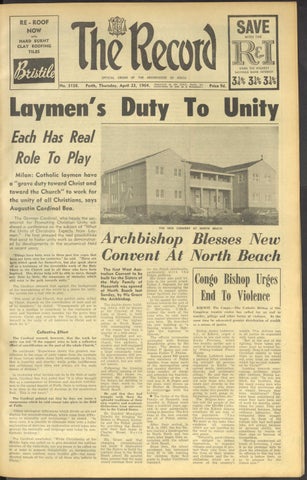
Archbishop Blesses New Convent At North Beach The first West Australian Convent to be built for the Sisters of the Holy Family of Nazareth was opened at North Beach last Sunday, by His Grace the Archbishop. The double-storey building, which will be known as the Convent of Our Lady of Grace, is built fronting Kitchener Street on one of the highest points in North Beach, with commanding views of the ocean,. less than a quarter of a mile away. The dignified and serviceable building houses a chapel, two parlours, a modern and well-equipped kitchen, dining-room and a large community room. Its appointments will provide the Sisters with modest comfort, but are without luxury. Following the blessing and official opening of the convent, His Grace expressed Nis gratitude to the Sisters for deciding to begin their work in the fast-growing parish of North Beach. He said that they had brought with them the splendid traditions of their own country and academic distinctions from universities in the United States. He thanked Monsignor Dzieciol for bringing the Sisters to Western Australia and the Polish people for providing the Sisters with their first home in Charles Street, North Perth. His Grace said that changing circumstances had made it imperative for the Sisters to build the convent close to the North Beach school. He assured those present that the nuns would continue their work
for the Polish cominunity, particularly with t he Polish children. His Grace also paid tribute to the parish priest, Father J. Depiazzi, for his efforts in encouraging the Sisters to expand educational facilities for Catholic families in the district. In his appeal for contributions towards the cost of the new convent, Father C.SS.R., McCarthy, C. praised the work of the nuns who, he said, have won respect wherever they have been. He described the new building as "a flaming beacon to hlighlight the highway to Heaven." The official ceremonies concluded with Solemn Benediction given by His Grace. The deacon was Father P. Quinn and subdeacon Father T. Phelan. Among about 500 guests were members of Polish families from many parts of the metropolitan area A and country districts. large number of clergy also attended the function. The builder of the convent was A. B. Power and the plans were drawn up by Mother M. Neomesia, in conjunctUan with the builder. • The Order of the Holy Family of Nazareth was founded in Poland more than a hundred years ago, and is now particularly strong in America. The five nuns at the new convent are all of Polish extraction. After their arrival in W.A. in 1957, the five Sisters started a kindergarten in North Perth and two years later began their association with the school at Noth Beach. Since then, the school enrolment has increased from 42 to 150. catering for children from first grade to Junior Certificate standard.
Congo Bishop Urges End To Violence KIKWIT, The Congo.—The Catholic Bishop of this Congolese trouble centre has called for an end to murder, pillage and other forms of violence. At the same time he advocated greater distribution of wealth as a means of justice. Bishop Andre Lefebvre. S.J., of Kikwit, urged a return to law and order in Kwilu Province, which two months earlier saw a wave of terrorism inspired by Peking-trained Pierre Mulele. Bishop Lefebvre issued a pastoral letter condemning outright all persons organised in Kwilu "to spread death, destruction, disorder and systematic pillage." He said that responsible before God are not only those who have taken part directly in the violence, "but also those who make this possible by giving to such gangs information, provisions, etc," The Belgian-born prelate told the people of the region—the 425,000 Catholics of the Kikwit diocese constitute 40 per cent of the population: "T h e Church condemns violence. We must at the same time condemn all excesses which are not justified by the need to restore order and peace. "Naturally, good citizens are obliged to defend themselves, to organise villages and groups to protect their own lives, and the lives of their women and children, and the installations which are a source of the country's
wealth. This defence can in all justice be organised with hand arms. "But at the end of the fighting, those taken prisoner must be treated humanely. Does it not violate Christian charity to treat them in ways we would not even treat an animal which has no soul redeemed by Christ?" Looking towards overcoming problems which abet violence, Bishop Lefebvre said: "Do you not think, my brothers, that the many young men who joined this movement did so simply because they were embittered? They have been embittered because they have been out of work for months, sometimes for years. They are embittered because, being ordinary labourers, they compared their meagre w ages to those of old friends who had well-paid jobs, not always because of personal ability, but sometimes by reason of their clan or because of favouritism. "Having condemned all kinds of terrorism, I view it as my personal duty to draw the attention of public officials to this big task which is before them, so as to prepare for the future now."
THE
Page Two
CONFUSION MARKS ECUMENICAL MOVEMENT
BREAKDOWN OF HONESTY W A NY PROBLEMS W HICH HAVE , NEVER BEFORE THE CONSCIENCE, OR WERE DISCUSSED BY AN HONEST MAN, ARE NOW OPENLY DEBATED . . . such as How much can one pad an expense account without being caught? Should one build obsolescence into products so they will have to be repurchased, every few years, and every few months? Should boxes of foodstuffs be made larger and the contents
HEADEDNESS, BURSTING WITH GOODWILL, BUT CONFUSED TO AN EXASPERATING DEGREE," SAYS ARCHBISHOP JOHN C. GARNER, OF PRETORIA.
"We refer, in particular, to the *sharing of pulpits,' or taking part in the formal religi,)us services of each other's churches. "Catholics can well he excused for asking what is happening. Where bishops and priests formerly warned them against taking part in the services of other churches, or interdenominational services, they themselves are going out of their way to take part in the once- banned functions. Can they be blamed for asking: Illicit before, are they licit now? or even (in their perplexity): Sinful before, are they virtuous now?" The Archbishop continued: "If participation is merely material, a gesture, without inner assent, it could be, at best, frivolous: and at worst, impertinent. Only goodwill saves it from being either. But gestures of goodwill can take forms other than sharing in formal religious worship, forms that are less likely to be misunderstood. "And misunderstood they certainly can be, both by Catholics and non-Catholics (or, as someone put it recently, by Protestants and non-Protestants). There is a very real danger that all will feel that this is indeed the culmination; that no other reunion is called for than that already achieved—in externals only: that all may stay just where they are: that all the fuss about seeking for the truth and embracing it, no matter what the cost, is outmoded; that the Roman Catholic Church has at last come down from its high horse, and acknowledged itself one of the religious bodies, loosely-knit, which go to make the 'church of Christ,' in which unity of faith is not of importance."
would have given back any amount I found. It was the normal and the right thing to do."
Bishop Fulton Sheen.. .
CAPE TOWN, SOUTII AFRICA. — "SO FAR, AROUND THE WORLD, THE ECUMENICAL MOVEMENT HAS BEEN DOGGED BY MUDDLE-
Writing an article in the "Southern Cross," a national Catholic weekly published in Cape Town, the Archbishop welcomed ecumenism as a "Godinspired movement towards bettter understanding, closer association and — in God's good time — the visible reunion of Christendom." But he attacked pulpit-sharing and taking part in the formal religious services of other churches. Archbishop Garner said: "May we be permitted to voice some doubts and to express strong criticism of some of the things that are being done, in the name of ecumenicalism, without being regarded as reactionary. Some things being done, in all good intention, will impede the movement rather than aid it; in fact they might well lead to disaster, the ruin of the whole movement. -
Thursday, April 23, 1964
RECORD
smaller?
1
How such questions in a culture which is more and more disregarding honesty will be answered was made evident in a national reaction to a Los Angeles Negro a few years ago. Mr. Douglas Johnson is a middleaged Negro janitor, whose story was written in Life magazine. An armoured car passing ahead of him accidentally dropped a sack through an open door. The sack contained 240,000 dollars in bills Mr. of ten and twenty dollars. Johnson and his wife Helen return the money to the owners and received a 10.000 -dollar reward. This type of story was the one
,••••.#
,,,, . +.0~~,00 , ~• , 4,#+
which always started the Horatio Alger books for boys a few decades ago. But Douglas Johnson, instead of receiving praise, was stunned by the abuse. Motorists passed by his house, hooted at him, his wife and his children, called them "stupid," sent letters telling him what he could have done with the money. One person said: "If I got it, I would still be driving." Another recommended that the hot money be given to gamblers at Las Vegas who would accept it for a discount. Others suggested going to Mexico. Others suggested spending the money on the track. Still others abused them, saying they were a disgrace to the coloured race. Mr. Johnson was ridiculed at work; his children were abused at school. One of them was given a knife and told to go home and cut his father's throat. It ultimately became necessary for the Johnsons to move from the neighbourhood to escape further abuse. After the incident was given some newspaper publicity, then honest people came forward and defended Mr. Johnson. Letters poured in from other parts of the world—from Greece, Ghana, Italy, Arabia, some just bearing the inscription "The Honest Janitor." Mr. Johnson said: "Returning that money wasn't as big a thing as people seem to think. It didn't have to be that much money. I
, o ,,,, o"
IIAT reasons may be given for the breakdown of honesty in American life? These reasons immediately come to mind—
An affluent and rich culture such as our own soon begins to judge characters by what they HAVE, rather than what they ARE. Once HAVING becomes the test of status, there follows the desire to have more and more. A neurotic competition sets in and it is not long until one begins to cut corners to make oneself the top man on the totem pole. Another reason for the dishonesty is to be found in the socalled ethics of our day. Instead of bringing to life a few principles, the tendency today is to build an ethics to suit the way one lives. It used to be that men were kept honest because they based their lives on the principle: "If I were dishonest, I could not live with myself." Conscience demanded that they keep faith with the moral law within. This gave way to a second and weaker principle, namely: "I could not be dishonest, for otherwise I could not live with my neighbour." Here there was a kind of a fear of social retribution. Both of these are passing out of existence. With the growing dishonesty and the attempt to make the head fit the cap, the new prin ciple is: "Anything is all right. provided you do not get caught. or if you can get away with it." ~~~~r~.
####••,
DESMOND O'GRADY writes from ROME. • •
-
IIIIIIIII
Pope's Diary Focuses Attention On Publishers WHICII POPE JOHN HE PUBLICATION OF TIIE SPIRITUAL DIARY OF 14 UNTIL HIS AGE THE AT RETREAT KEPT FROM HIS FIRST EDIZIONI PUBLISHERS, ITS ON DEATH, HAS FOCUSED ATTENTION BY A FOUNDTD WAS PUBLISHED THIS DI STORIA E LETTERATURA. BOTH OF FRIEND INTIMATE PRIEST. GIUSEPPE DE LUCA, WHO WAS AN EVERY OF INTELLECTUALS POPE JOHN AND POPE PAUL, AS WELL AS OF CREED AND NATION.
Recently, on the second "Dear De Luca, Goodbye, then, and with anniversary of Don De nse sorrow. I esteem imme Luca's death, a foundation was establisesd with his and envy your work, howsorry name in order to carry on ever, and am only from you removing in that encouragehis work — the ours, so poor and shabby in ment of pure research. content and persons, it The publishing house he leaves us poor and shabby. founded has brought out "What saddens me is just over three hundred hand- this meditated abandonsome, scholarly volumes. ment; is it not the reproof APRIL 25: ‘IAV 5: Don De Luca regarded it as of the inferiority of our so.1:") p.m. — Receive debu- his vocation to encouragi: 8.30 a.m.—Attend Anzac Day at its disprotantes at the Catholic studies. Because Christians called action, Mass, St. Mary's Cathedideals and the with portion Ball. have neglected pure re- needs at which it aims, at ral. in humanities the search in 8 p.m. — Attend Catholic ‘1.11( 10: the infidelity by which it p.m.— Bless and open recent centuries, argued can be deformed and beSchools' Drama Festival. school extensions. Arma- Don De Luca, not only has trayed? the initiative been lost by dale. .APRIL 26: "You have judged that acthem, but also at times con- tion P.s a movement which 7.30 p.m.—Confirmation and 111Y 13: tact has been lost with the Canonical Visitation, Mon :)pen Hibernian Society's most advanced spirits, so givz-s orders, you have not seen the appeal for help to ley Park. Annual Conference, East t he apostasy of contempo- all souls of goodwill which Victoria Park. rary thought is our fault. APRIL 28: inspires it. You have seen His answer was to launch it languish in sterile terms Sunday: 17, Pentecost 8 p.m.—Attend final session IlAY 11 a.m.— Preside Solemn his publishing house, which of conquest, in internal disof Ozanam School of High Mass, St. Mary's brings out first-class works putes, and you have remainCharity, Camillus House, in their original languages, ed disappointed and disCathedral. East Perth. seeks out writings which dainful. 3 p.m. — Bless new presbyMAY 1: are otherwise ignored be"You have seen its intery, Kelmscott. commercial their cause to speak up, to move ability 5.45 p.m. — Attend Mass in value is not on par with the world about it and you honour of St. Joseph the MAY 18: worth, encourages have not given strength to Worker, St. Mary's Cath- 3 a.m. — Profession Cere- their who its voice, power to its trumConmony, researchers Presentation young edral. vent, Iona. would other wise miss pub- pet. You have applauded 10.30 a.m.— Attend annual lication, and sustains spe- those who refused you and MAY 3: meeting of Catholic Wo. cialised review such as you have left in solitude 11.30 a.m.—Attend Mass at men's League, All Saints' "Twelfth Century Logic." those who invited you. St. Brigid's, West Perth. Memorial Centre, Perth. "If tomorrow determinaFeast of Our Lady of the From Letter becomes mere foolish tion Polish Crown. MAY 20: ambition and ridicule is the 12 Noon.—Attend Ukrainian 9 a.m. — Profession CereChaplain epilogue of Catholic miliEaster Mass, St. Patrick's mony, Convent of Mercy, GIUSEPPE nON tants, not all the fault will Church, Havelock Street. Victoria Square. was engaged in be with the poor corporals 3 p.m.--Annual May ProcesCatholic Action in the 1920's who waited but did not resion, South Perth. MAY 22: he decided that his ceive orders from brains but 7.30 p.m.—Confirmation and 10 a.m.—Clergy conference. C anonical Visitation, 7.15 p.m.-- Adult Confirma- most effective action in the capable of giving them. Titart Hill. tion, St. Mary's Cathedral. cultural sphere could not "If your solitude was a take place within an orga- mere tactic (and it is also; nisation. He also decided to and a pure fidelity to your BERNIE J. DUIINE HOMES cease direct collaboration in c oncrete work and vocation 4 7. DIRECT l'ITH THE BTIIT,DER -- DIG SAVING the cultural activities of the ( and it is),I would not have Homes from £2,275 — Your Plan — Only Genuine Clay Bricks Union of Catholic Univer- any right to lament. But it 117 'WOODROW AVF.NITE. DIANETALA sity Students. seems to me announced as This brought a letter in a theory, as a theory which reply from its chaplain, Don cuts the poor and hardLICENSED PLUMBERS DUFFY BROS. Montini, which is a reveal- worked threads with whim HARDWARE MERCHANTS ing indication of the char-c- one thought to reknit the 7 1-5598. 23E NI.!wcastlp c• Perth. Repairs a Specialty. ter of the future Paul VI: robes of charity which in
ENGAGEMNTS
D
this 20th century must once again clothe with glory the Church of Christ. "Perhaps we have too much haste and it is damaging. But the pressure of charity makes us conscious of urgency and we hope to find an excuse for our inexpertness in our zeal. See specialisation your that does not cool your love, that it does not eliminate sacrifice, that it does not divide the body of Christ. "You choose books —I would wish to choose souls. When I want to think of the strongest and dearest way of helping souls, I will take refuge with thought, and with some of your discreet conversations, in your magnificent and productive solitude. "There I will listen to you speaking to those far away and I will learn how to speak with those near at hand. "In the courage to love only Christ in everything, I will be, if you will bear with me, always your most af fectionate friends, Don Montini."
A
T a time when nearly every Italian newspaper and magazine carries articles regarding Pius 3tII's reactions
to the Nazis, and there is talk of staging Hochhuth's play "The Vicar," one of the best witnesses to Pius XII's wartime conduct has died in Rome. He was Francis D'Arcy Godolphin Osborne, the twelfth and last Duke of Leeds, who was British Minister to the Holy See from 1936 to 1947. He took refuge in the Vatican during the war, and when he moved out of the apartment which was his wartime sanctuary it was immediately occupied by the German Minister to the Holy See —as it was his turn to request sanctuary. Last year the Duke wrote to "The Times" in defence of Pius XII. On his retirement in 1947 he decided to live in Rome. At a dinner party which he gave barely a week before his death, he spoke about the flowers which he would like at his funeral. One of his guests remarked that with his tastes he had better die in the spring. He suffered a stroke a few days later and died . . . on the first day of spring.
THINKING OF TRAVELLING? FOR
ALL
BOOKINGS
BY
AIR, SEA, RAIL or ROAD WITHIN
AUSTRALIA
OR
OVERSEAS
Consult—
DALGETY-N.Z.L.
TRAVEL SERVICE
15 WILLIAM ST., PERTH. 21-2841.
Thursday, April 23, 1964
THE
RECORD
Pacr
President Gives Catholic Press Five Tasks Passive Melbourne: Five tasks were proposed for the development of the Catholic Press Association of Australia by its president, Father P. R. Wilkinson, at its 10th annual convention from April 8-10. HE SAID THE ASSOCIATION SHOULD CONSIDER IMMEDIATELY THESE TASKS: • The use of specialists in secular questions to write Christian commentaries on current events; • The intellectual formation of the staff writers of Catholic publications; • Formation of all members of the Catholic comgreater towards munity maturity in public opinions (particularly through liaison with apostolic efforts at diocesan and na t iona 1 levels); • An adequate study of the readership and reader
SHOP and SAVE at
M EAT A UCTIONS PTY. LTD.
2 Cargill St., Vic. Pk. BULK and SMALL CUTS TOP QUALITY at LOWEST PRICE. AUCTIONS:
Thurs-Fri. only 5 p.m. 1.4.4.0#4.411NIN4P#4.4411s#4,04.4.4•41.0~...prir
PHIL KEOGH
Resident Chemist 274 Cambridge St. Wembley - 87 3984 CONTOURE COSMETICS 4.0.1.04,04.4.#4,INFIN•4.4 , 0
reactions of the Catholic Press; • The clarification of the role of our Catholic education in regard to the Catholic Press. Father Wilkinson said the Association should also consider means towards— GREATER awareness of its role in the international Catholic Press; OFFERING of assistance to the hierarchy in implementing the social communications decree (with particular reference to liaison with radio and TV); FINALLY — the development of the Catholic Press Convention as a venue for editorial discussion of current news questions. Archbishop Simonds sent this message to delegates: "Altough I am unable to attend the inaugural functions this year, I wish to assure all the participants that they are again most heartily welcome, and that I shall await with interest
To Speak At First Ecumenical Mission MELBOURNE.— THE PRINCIPAL SPEAKER AT MELBOURNE'S FIRST ECUMENICAL MISSION, TO BE HELD FROM MAY 11 TO 13, WILL BE ARCHBISHOP LEONARD RAYMOND OF NAGPUR. INDIA. Archbishop Raymond will be supported on the platform by eminent speakers f rom various denominations and from public life in an exposition of faith and Christian principles as they apply to everyday living. The mission, which carries the overall title of "The Christian in the Modern World," will be officially opened by the Most Rev.
TOLLEYS BRANDY SPECIAL
H OSPITAL
You loo can enjoy that
Summer Feeling A ll winter long with an
Electric Heater from 5 /...
NO DEPOSIT!
NO INTEREST!
WEEKLY
' Speedie' 2-bar Radiator - - - - 85/20(10W. Complete with 9ft. flex
• plug. Independent switching.
a report on their deliberations. "The importance of the task facing the Catholic Press has been stressed in many statements by the Popes and Bishops. "Now the Second Vatican Council, in its Decree on the Media of Social Communications, has given particularly solemn expression to the mind of the Church on the role of the Catholic Press. "I am sure that the principals stated by the'Fathers of the Council will be care fully observed by the Catholic Press here, and that the Decree will provide a new impetus and inspiration to all those engaged in this apostolate." • A telegram from Cardinal Cicognani, Papal Secretary of State, informed the Catholic Press Association executive that Pope Paul VI had sent his "paternal apostolic blessing" to the participants in the convention.
Low-priced 'Speedie' Sunglow - - - - 39/11 1000W. Single-bar radiator with f lex & plug.
Sandovers Hay Street, Perth — Queen Street, Fremantle
J. D. Simonds, the Catholic Archbishop of Melbourne. Chairman for the opening night will be Sir Edmund Herring, Lieutenant - Governor of Victoria, and the theme will be "The Survival of Christian Values." "The Need of Christian Values" will be the title of Archbishop Raymond's talk. Most Rev. F. Woods, the Anglican Archbishop of Melbourne, will be chairman of t he second night, when the theme will be "The Renewal of Christian Thought." The theme for the final night of the mission will be "The Role of the Christian inAsia," when Mr. John Casson, management consultant and radio and television critic and lecturer, will be chairman. Archbishop Raymond will arrive in Melbourne on May 6, and will be welcomed at the Town Hall by the Lord Mayor on the following morning. In the afternoon the Archbishop will be the guest of honour at a reception attended by leading members of the Church and public life. Archbishop Raymond, who has just been appointed by His Holiness Pope Paul to the Commission for Promoting Christian Unity, under Cardinal Bea, is a distinguished author, eminent educationist and multilinguist, and has spoken at meetings and congresses in many parts of the world. He was noted for his contributions to the Vatican Council in Rome, and his press conferences there were considered outstanding. The mission, which is being organised by the Catholic Evidence Guild, with the support of the World Council of Churches, will take place during the Novena to be held throughout Australia as a "Week of Prayer for the Unity of All Christian People." It is designed to arouse the community as a whole to the greater awareness of Christ and His charity and the need to permit Him to be a guide for each one in his daily round.
Outlook
MANILA: The major problem today of the Church everywhere is the passive outlook of lay people, according to Father Omer Degrijse, C.I.C.M., Superior. General of the Immaculate Heart of Mary missionaries. The priest spoke out on arriving here on April 1 on a two-month visit to missions of his congregation, which is also known as the Scheut Fathers. "Only five per cent of the members of the Catholic Church are actively engaged in apostolic work," he said. "These are the priests, the Religious and the few lay apostles of Catholic Action." The real problem of the Church in every country and in every parish, he said, is how to awaken the 95 per cent to their responsibility of spreading the Faith in their own sphere of influence. Father Degrijse said the 95 per cent are passive and unaware of their "obligation to spread the Gospel" in accordance with their calling as part of the "people of God." The large majority of baptised people consider themselves free of any obligation to spread the word of God. he said. As a result of this false situation, the Church has become "an army composed solely of officers without soldiers," he added. This is the reason the Church today finds itseslf unable to carry out her task, either on the world level or on the level of the parish. The priest said the greatest grace of our times would be for the Second Vatican Council to throw open its doors for the general mobilisation of all the baptised—"to put the whole Church and all her members in a state of mission."
Priests Fill Gap KAMPALA, Uganda: The Sudan's Interior Minister, Mohamed Ahmed Irwa, has said that Sudanese priests have taken over churches and schools and filled the gap left by the deportation of all foreign missionaries from Southern Sudan, according to a report here. The report stated that the cabinet minister spoke in Khartoum, the Sudan's capital, after touring the southern provinces from which some 300 Catholic and Protestant missionaries were expelled in March following years of increasingly harsh anti-mission measures by the government. The report did not state how, according to Irwa. about 25 Sudanese priests can suddenly do the work of the 272 expelled Catholic missionaries. According to a radio broadcast from the Sudan heard here, Irwa told an audience of Christian Sudanese at the southern provincial capital of Juba that the Moslem-dominated government, which has sought to impose Islam on the South. will "build churches, allocate land for them, open book centres for them, train Sudanese priests and increase their numbers." The broadcast quoted Irwa as saying: "I am very sorry to say that the foreign priests, despite the length of time they spent with us and despite the assistance and facilities which the government extended to them, did not train an ade quate number of Sudanese priests." One of the first measures against the missions in Southern Sudan was the cm,ficcltion of all mission schools.
IN HER SPARE TIME—Miss Brigitte Boudreaux, the "last of t he Montreuses ie Catechisme ,teachers of catechism)" in the bayou country of Louisiana, spends some of her spare time repairing rosaries. Since 1923 she has provided religious instructions to children in Larose, where until recently there was no Catholic school. Ph,,,,, N c.
Seminar To Study Liturgy Following the lead given by the "Constitution on the Sacred Liturgy,- a Seminar for Liturgical Studies has been formed in Perth. Rev. Father E. J. Stormon, S.J., has consented to make St. Thomas More College available for this purpose. The Seminar offers to people of ALL FAITHS lectures, study groups and day or half-day retreats which will be concerned with: • The forms of public worship and their spiritual significance; • The sacramental life an" its effect on the individual and the commit nity; • The daily liturgy in horn, and family and its inter dependence on the pub lie liturgy. Seeing that "the Church celebrates the paschal mys tery every eighth day,' which day, the Lord's day. is therefore "the foundation and kernel of the whole liturgical year" (Art. 106 of the Constitution on the Sacred Liturgy), the topic chosen for the opening lecture is "Sunday, The Perpetuation of the Easter Mystery." This will be given by Father Stormon, S.J., at St. Thomas More College on Music, though it is hoped that the Seminar will give all those who have been waiting for a "restoration the and promotion of Monday, April 27, at 8 p.m. After the lecture, discussion will be invited, an( those interested in working out ways of celebrating the Lord's day, "the original feast day" (Art. 106) parish and home will form study groups. A place and time for the meetings oc these groups will be decided to suit the convenience of the participants. The Seminar for Liturgi cal studies should be of' particular interest to mem bers of the Guild for Sacred
sacred liturgy" (Art. 14) an opportunity of widening their experience and deepening their understanding of Christian worship.
A. R.
MONAHAN PTY. LTD.
FUNERAL DIRECTORS SINCERE CATHOLIC SERVICE
ALL SUBURBS DAY & NIGHT 71 5885 71 5894 HEAD OFFICE & CHAPEL Cnr. Walter Rd. & Grand Prom.
BEDFORD PARK PRINCIPAL A. R. MONAHAN 26 1819
THE COLONIAL MUTUAL FIRE !INBURANCE COMPANY LIMITED
MEET YOUR REQUIREMENTS IN INSURANCE PROTECTION 135 ST. GEORGE'S TERRACE, PERTH 21-9066 A. De CAUX, Manager.
Gni. Better Meat for Less at
C LEM PAULLS
134 HAY STREET, EAST PERTH — 23-4927 63 CANNING HIGHWAY, SOUTH PERTH 67-1708. W ATCH TI-J7 WINDOWS Fop OUR SPECIALS
=INTERNATIONAL THE PHILIPPINES
CONGO
csge.""e#41,11,4,
Active Part In Politics
Tamer Fiestas Are Urged
THE Congolese Bishops have urged Catholics to take an active part in politics, but counselled them not to form a Catholic party.
MERRIMENT and expenditures for fiestas are out of hand, Bishop Lino Gonzaga of Palo has told his people.
In a joint pastoral letter, the Bishops said they regarded a Catholic party as undesirable and that Catholics instead should co-operate with political parties whose platforms are in harmony with the natural law and a Christian outlook. The letter discussed the crisis in the Congo and told Catholics: "The duty of a citizen demands participation in the nation's problems, both in the political and economic area."
Referring to the fact that some villagers spend their entire savings and even go into debt to prepare for sumptuous feasts for visiting friends, the Bishop said that "fiestas should be held to the minimum expense." Bishop Gonzaga's plea was in line with a recent one by Archbishop Mariano Madriaga of Lingayen-Dagupan, who urged his people in a pastoral letter to invest their money in credit unions instead of throwing it away for "frivolous fiestas."
YOUR HOTEL GUIDE HIGHWAY HOTEL 206
STIRLING HIGHWAY, CLAREMONT PHONE I1566
rriendly Service — Good Accommodation — Parties Specially Catered for M. A. & E. IL. McDONNELL
SAVOY PLAZA HOTEL
BAYSWATER Hotel
THE HEART OF PERTH Dancing. Entertainment, Every Night. Rooms with bath 45/-, Inc. breakfast, Meet You at the Savoy Bill Lucas, Manager.
OPP, STATION Excellent Accommodation Frequent Train Service — 4 Miles f rom City — Large Parking Area BED and BREAKFAST REASONABLE TARRIFF LES B A R'TLETT, Prop. TEL.: II 1224
SUBIACO HOTEL
WEMBLEY HOTEL
First Class Accommodation and Service DRIVE-IN BOTTLE DEPT, FREE HOME DELIVERY
Phone: 8-1028 Alex McHenry. Proprietor.
Excellent Lounge and Accommodation Phone 87-2418 Cnr. Cambridge and A lexander Streets, Wembley
HOTEL
WAVERLEY HOTEL
Australia
Next Boans Waverley Stores ALBANY HIGHWAY CANNING TON Modern and Convenient Homely Accommodation Use Our Drive-In Bottle Serviiie A. R. CONNELL Phone 65 2419
E xcellent Accommodation and Dining Service LUNCH, 10/-i DINNER 17/1. PHONE 23 1541
CRITERION HOTEL
Enjoy the Best ACCOMMODATION & SERVICE
CENTRAL HAY STREET F ERTH 24-HOUR SERVICE iftve Parking for Country Resident' I Minutes' walk from Cathedral. no COUNTRYMAN'S HOTEL
MURRAY STREET, PERTH
HOTEL COTTESLOE Phone 3-2155
PHONE: 23 1115 (5 lines)
HOTEL ESPLANADE
WILLAGEE PARK HOTEL The States Most Modern
PERTH'S LEADING HOTEL FOR ALL VISITORS Phone: 23-1531
TOM KENNY, Licensee. ".7nr. Stock and High Roads, MELVILLE Phone: 30 3428
NATIONAL HOTEL
COMMERCIAL HOTEL NORTH AM Phone Northam 49 , T. E. MURPHY, Proprietor
SHENTON PARK HOTEL NICHOLSON ROAD SHENTON PARK Excellent Accommodation, Moderate Tariff, Spacious Car Park Beer Garden, Open Air Bar, Phone: 8-2170
Jack Sheedy PHONES
21-4311,
Cnr. High and Market Sts., FRE.MANTLE Offers excellent homely accommodation Phone : 5-1786 Philip
P. Kearing,
License.
Plympton HOTEL
Home of Country People CANNING HIGHWAY EAST FREMANTLE Eric Campbell, Prop. 5-1721.
CARLTON HOTEL
23-3091
218 HAY
ST., PERTH
BUSINESS MEN'S LUNCHEON — 12 to 2 p.m.
DALY'S Cr,
MEET
DAILY
ROYAL
at
HOTEL
WILLIAM and WELLINGTON STREETS, PERTH, Phoopir 91-8924 Rattle Dept., 25-5436,
THE WATTLE RESTAURANT OPEN MONDAY TO SATURDAY 10 p.m. to 8 p.m.
3 COURSE MEALS 7/-, SNACKS from 4/-
A vailable for private hire
A fter 8 p.m. Week Days and on Sundays
R
62 St. George's Terrace, Perth, Phone 23 3403
, INFIRM Mn1,.r
NINIedede4P4KeiNe...""ihe.ere.e.04/40."11 , 11NedeMe,le#4 , 114P4Nedern#41,0,041 , 04 , 041 , 140,04.04.41
EVERYMAN'S
NEWS-'~J
FAMILY By
INDIA
ARCHBISHOP ALBERT V. D'SOUZA OF CALCUTTA HAS APPEALED FOR FINANCIAL AID TO HELP THE THOUSANDS OF PERSONS, MANY ARE CATHOLICS, FLEEING FROM PERSECUTION IN EAST PAKISTAN.
The Archbishop asked for donations without delay for "our persecuted brethren, irrespective of caste and creed, fleeing from the East Pakistan in thousands, forced to do so on account of the nightmare of atrocities perpetrated against them as members of minority communities." The Catholic Charities of India has reported that 80,0000 persons have fled across the borders into India. Of these, about 30,000 are Christians.
Father JOHN C. KNOTT
HOMOSEXUALITY IT IS REASONABLY ESTIMATED THAT IN ONE
MAJOR
UNITED
STATES
CITY
THERE ARE ABOUT A QUARTER OF A MILLION MALE HOMOSEXUALS. It is not that homosexuality is . endemic to that
FORMOSA
FRANCE
VIMININOVNINMINIVIN
Priest Teaches At Protestant Seminary
Saint's Relics Are Returned
THE Protestant Tainan Theological College has announced the appointment of a Catholic priest to give two courses a week on Roman Catholic theology. It said the new faculty member, Father Gabriel Ly, is to give particular emphasis to questions concerning Mariology. The seminary, with more than three hundred students, is supported by the Presbyterian, Baptist .i.nd Lutheran Churches.
THE relics of the missionary St. Marsus, which had lain for 1,100 years in Essen, Germany, the city of his birth, were returned to Auxerre, France, on April 5 by Bishop Franz Hengsbach of Essen. Bishop Hengsbach was in Auxerre to dedicate the new Church of St. Marsus, built in part with financial help from Germans in the Ruhr. St. Marsus had been sent as a missionary to Auxerre and died there.
PERU
SPAIN
le4Neve•eseN.
••••Nr.,4,04PAPAPI
El Greco To Stay Home
Film Office Re-opened
THE Spanish government has decided against sendin Havana, defunct since ing the El Greco masterthe mass exodus of priests piece, "The Burial of the from Cuba in the spring of Count of Orgaz," to its pavi1961, has resumed its acti- lion at the New York World vities in a limited way, it Fair. The huge canvas will was reported in Lima. remain at the Church of St. The Latin America head- Thomas in Toledo, from which it has been removed quarters of the Internaonly once since El Greco tional Catholic Film Office finished painting it in 1586. in Lima reported that the Cuban branch — once the The Archbishop of Toledo, most influential in Latin Enrique Cardinal Pla y America—is back in opera- Deniel, had earlier approved tion. The office serves as a its removal, but Spanish guide to the moral stanauthorities held that the dards in movies and encou- national treasure might be rages cultural films. % endangered.
THE Catholic film centre
SIGHT ON THE SEA FRONT R. M. DYMOCK, Licensee
Thursday, April 23, 1964
RECORD
THE
Page Four
U.S.S.R.
JAPAN . .."11 .41,1PM0#4,1
S
• ,p
vt,
Contrary To Expectation THE Communist party of Kazakh, a Central Asian republic in the Soviet Union, has complained that despite all the anti-religious propaganda, many young people were on the side of the church, a development it called "contrary to expectation and very surprising," according to a report that has reached Berlin. Opposing government regulations, religious groups such as the Baptists and other evangelical sects have held public meetings and established community centres and churches.
Life Of Pope Pius XII On T.V. THE life of Pope Pius XII was presented to Japanese television viewers in a 30minute documentary series entitled "The Man of the Century." Observers in Tokyo report that coverage of the Catholic Church by Japan's mass media has increased markedly since the reign of Pope John XXIII and the Second Vatican Council Mil lions of Japanese viewers watched Pope Paul VI make the Stations of the Cross in Rome on Good Friday. The Catholic population of the country is only 294,000—less than one-third of one per cent of the total.
BURMA
FATHER3IIS IvOAN AR Yv IDENTIFIED vAINS' IRISH AS KILLED TRIBESMEN IN NORBY REBELLIOUS KACHIN THERN BURMA. THE NEWSPAPER "NATION," OF RANGOON, HAS REPORTED. The dispatch said the priest was killed in an ambush and his body mutilated on March 23 about forty miles from the Kachin capital of Myikyina. Apparently he had been warning villagers not to take part in the tribe's war of independence against the government of Burma. The Kachins are fierce tribesmen who were adept headhunters before missionaries persuaded them to reform.
large urban centre or any other city of similar size. The fact of the matter is that the homosexual comes from any and every size of village, town, city and metropolis. Once he reaches adulthood there is a strong tendency for the homosexual to move into the larger cities. This is not merely because of the expected anonymity to be had away from the social and moral harassment of the smaller community in which he had been reared. He also finds more people of his own kind, who talk his language read the same periodicals, eat and drink at the same bars and restaurants, and holiday at the same resorts. In fact, if he chooses an occupation in which his clique is predominant, he can live most of his life isolated from normal _ society. * SOCIETIES have been formed to ORGANISED
promote his interests, conventions
held and magazines published to develop a rationale or philosophy life. A prime objective of their organisational efforts is to obtain the repeal of laws forbidding homosexual activities between consenting adults. All types of men are homosexuals, from burns to executives. They are found in the labouring class, among the white-collar workers, in the universities and the professions. They range from the poorly educated to the graduate degree type. They are found among the artists and the athletes, but are most noticeable in the fields of creative and performing arts and in industries serving women's beauty and fashion needs.
THEY rationalise their behaviour by claiming that this is the way they were born and that nothing can be done about it. To them it is as natural and normal to be attracted to their own sex as it is for someone else to be drawn to the other sex. They like to think of themselves as the third sex, normal in their abnormality and unjustly condemned and persecuted as a minority group by the rest of society. These justifications for their activities fly in the face of the moral condemnation of homosexuality by the three major faiths—Judaism, Catholicism and Protestantism. As promiscuity between people of different sexes is considered sinful, so also are intimate activities among those of the same sex. Modern psychiatry agrees with religion that homosexuality can be cured. There was a feeling at one time, which is still promoted by the organised deviants, that the homosexual was not responsible for his acts and that no cure was possible. RATIONALE
The best findings today indicate that while homosexuality is an illness, it can be cured if the subject really wants to change his behaviour. Psychiatry, in giving the patient a better insight into himself, and religion, in offering him the support of the grace of God and realistic spiritual direction, do offer hope. As with the alcoholic, the difficult thing is to get the homosexual to admit that he does have a problem and could use some help. Once this step is taken, the prognosis for a cure is good. * The address of the local Catholic Marriage Guidance Centre is 77 ST. GEORGE'S TERRACE, PERTH.
23-4548.
' 1 ,4`04.04, 0,11 , 0,e,e4 , 00
DOOGUES
LOTTERY AGENCY
LOTTERIES Nos. 1577 and 1578.
"CARDS FOR ALL OCCASIONS" BEAUTIFUL — RELIGIOUS THEMES Of Special Interest to Catholics SEE OUR OUTSTANDING DISPLAY AT PERTH ARCADE and 19 BARRACK STREET, PERTH
Thursday, April 23, 1964
THE
RECORD
MISSIONARIES HELP SAVE MANY LIVES
Page Five
A Step Back Into History
SAMBALPUR, INDIA.—CATHOLIC MISSIONARIES INTERVENED TO SAVE THE LIVES OF HUNDREDS OF MOSLEMS BEING ATTACKED BY ABORIGINAL TRIBESMEN IN INDIA'S EAST COAST PROVINCE OF ORISSA. Bishop Herman Westermann, S.V.D., of Sambalpur said his priests were able to save the lives of many Moslems, although many others were slaughtered before government forces were able to stop the uprising. The Bishop reported that one group of 308 Moslems took refuge in a Catholic village near Kesramal and were saved through the quick intervention of Father S.V.D. Martyniuk, Basil When he learned of their plight, Father Martyniuk called for police and soldiers to help defend the village. Father Herman van Burg-
NOONAN'S South Perth Bakery "Bakers of Better Bread" T wo 1st Prizes 1962 Royal Show If it's NOONAN'S It's NICER
Phone 67-1044 41.4.0.4s,#####.4"#41,11.04,11041.4INN#41,4
stenden, S.V.D., aided 81 hungry and exhausted Moslems hiding in the jungle after one old man in disguise sought help from the missionary. A group of 56 Moslems, mostly women and children, were not so fortunate, reported Bishop Westermann. The group at first sought refuge in the mission compound of Father Peter Speicher, S.V.D., at Jhunmur, but when they heard that a rampaging band was approaching, they panicked and fled. All 56 were killed not far from the mission station. The Adivasis tribesmen, primitive hill dwellers, apparently became infuriated by reports of Christians being persecuted in Moslemdominated Pakistan. Added to these reports, Bishop Westermann said, were wild rumours of local Moslems attacking villages, burning homes and killing women and children. Many Athvasis joined into bands, and armed with bows and arrows, knives and axes, began nunting down the Moslems. The rioting lasted several days before peace was restored.
MARTINO BROS.
GARAGE and SERVICE STATION
All Classes Motor Repairs, Panel Beating and Painting. Cnr. JAMES and FITZGERALD STREETS GIVES PROMPT, EFFICIENT SERVICE ALWAYS When in trouble Ring 28-1373.
1964 CATHOLIC BALL Tuesday, May 5th, 1964 EMBASSY BALLROOM Dancing 8.30 p.m. to 1.30 a.m. Admission by Ticket only, E1/5/- single. Presentation of Debutantes at 8.45 p.m.
We make disappearing chairs It's no trick—anybody can make 30 Sebel chairs disappear into one chair. How? Simple. Just stack them eachon-the-other. Floor area saved: 29 chairs multiplied by their own area. That's the advantage of stacking chairs —one of the types of seating which we know more than a little about. Please contact us if you have a seating problem. I'll be surprised if we don't have the solution.
The "Stak-a-Bye" from the range of 23 Sebel Chairs —every one well designed and sturdily made for specific seating purposes in clubs, halls, hotels, etc. Carlyle & Co. (1959) Pty. Ltd., 1-9 Milligan Street, Perth. Phone 21-9331.
SE5.62P
Cardinal Denies Charge COLOGNE. — JOSEF CARDINAL FRINGS, OF COLOGNE HAS DENIED A CHARGE THAT A CATHOLIC BISHOP TOLD THE NAZIS THAT THE CHURCH WOULD TOLERATE EUTHANASIA. Dr. Hans Hefelmann—a former Hitler aide on trial in Limburg for complicity in the "mercy killing" of handicapped Ger73,000 mans during the Nazi era— made the charge. He told the Limburg court that the late Coadjutor Archbishop Heinrich Wienken, of Meissen, told Nazi officials the Church would drop its opposition to euthanasia if certain security measures were taken. Hefelmann testified that Archbishop Wienken told Nazi Interior Minister Wilhelm Frick in 1941 in the name of the German Bishops' Conference that security measures the would be to limit killing strictly to mentally and physically handicapped persons. Cardinal Frings told newsmen that the Church has always regarded the taking of lives, even those described as not worth living, as a sin. Ile added: "I knew Archbishop Wienken since 1905, when we studied together at Innsbruck, and I know he was a thoroughly religious man. "I hold it impossible," he declared, "that he could ever have made such an offer, which would not be compatible with the teaching of the Church." In Limburg, a representative of the prosecuting attorney also said that Hefelmann's accusations against the late prelate were false. He said evidence to this effect would be introduced later at the trial. Meanwhile, Auxiliary Bishop Johannes Neuhaeusler, of Munich and Friesing, and a former prisoner of the Nazi concentration camp at Dachau, showed newsmen documents proving that in 1934 the German Bishops, in a letter to the German Ministry of Justice,
had pointed out "the incompatibility of euthanasia with Christian moral law." Bishop Neuhaeusler also noted that the late Adolf Cardinal Bertram, of Braslau, protested to the Nazi authorities in 1940 in the name of the German Hierarchy against their euthanasia proposals. He said other Catholic leaders—including the late Michael Cardinal Faulhaber, of Munich and Friesing and the late Bishop (later Cardinal) Clement von Galen, of Munster — made similar protests. The Munich Prelate recalled the statement of Bishop von Galen in 1941 calling those who supported euthanasia murderers.
EXPULSION CRITICISED NAIROBI, Kenya: Kenya's Minister of Justice and Constitutional Affairs, Tom Mboya, has criticised the expulsion of all Christian missionaries from the Southern Sudan in early March. Mboya, a Catholic, said in answer to questions after an address to students of the Royal College here: "I do not hesitate to say that if the removal of these missionaries is based on no more than an attempt to persecute the Church, to refuse the people the right to worship, then it is wrong." The Kenya Cabinet Minister then added: "The mass dismissal of missionaries on account of their preaching a religion which some State does not want is wrong and must be condemned. It is not for the State to say what church I shall worship in."
Chinese Professed MANILA.—Two Chinese-born nuns professed their final vows here. as Religious before the same American bishop who baptised them in China before the communist take-over and who had received their first vows as Sisters there. Taking their final vows as Maryknoll nuns were Sister Marian Agnes (Chow) and Sister Rose Miriam (Chin). Officiating at the ceremony was Bishop Joseph Regan, M M,. Prelate Nullius of Tagum, in the Philippines. The story of Theresa Chin and Paula Chow began years ago in the then flourishing mission of Kweilin, in South China, where the two young women were baptised by Bishop Regan, at that time a young missionary priest. After Baptism, both entered the Sister Catechists of Our Lady, a Chinese community being trained by Maryknoll Sisters. Father Regan received their preliminary vows as Religious. After several years of mission work, the Sister Catechists had to disband under pressure of growing communist controls. The two Chinese nuns made their way first to Macao and then
to Hong Kong, where they worked in refugee settlements with the Maryknoll Sisters. At first they hoped that some day they could return to China. But as that hope faded, they applied for admission to the Maryknoll Sisters' novitiate here. Meanwhile, Father Regan was assigned to start a pioneer mission in the Philippine hinterlands on the island of Mindanao and was named a bishop. Thus he was able to officiate when at last Sister Agnes and Sister Miriam pronounced their final vows as Maryknoll nuns. Also taking vows was a young Japanese nun, Sister Amy Bernadette (Yoneya), who became a Catholic in 1958. As the same time 13 postulants — nine Filipinas, three Chinese and one Japanese — received the Maryknoll habit and their religious names.
The new Wax Museum, just opened in Denver, features displays of interesting scenes and personages in the history of Colorado and the nation. The scene pictured here represents Denver's first Catholic bishop, French-born Joseph P. Machebeuf, also pioneer missionary priest of Ohio, New Mexico, Colorado and Utah. Created after careful historical research, t he scene depicts the bishop offering Mass on the back of his buggy, in a community where no buildings were available. The a ltar was enclosed in trunk -like box which he had fitted on t he rear of his buggy. He often heard confessions in the f ront seat. —Photo N.C.
H. J. LILLEYMAN W.A.O.A.
OPTICIAN and OPTOMETRIST 453 ALBANY HIGHWAY, VICTORIA PARK. 6-1880. A nd 156 ROKEBY RD., SUBIACO. 8-3983. Res.: 67-1685
Arthur E. Davies & Co. FUNERAL DIRECTORS and EMBALMERS
F REMANTLE: 85 Market Street — 5-2225 C LAREMONT: Opp. Railway Station — 3-2177 AND ALL SUBCRRS W ALLACE A. H. GREEN — 64-1879 (Private)
E XCELLENT CUISINE
D ancing and Entertainment Nightly. Private Room for Parties
EUROPEAN NIGHT CLUB RESTAURANT Fully Air -Conditioned
27 LAKE STREET, PERTH.
23 - 1589.
S pecialists in "MEALS TO TAKE AWAY" — Ring and Order W EDDINGS and PARTIES on SUNDAYS
Q UALITY Tile Manufacturers Specialists
in
all
Colours
of
C EMENT ROOFING TILES SUPPLIED and FIXED PHONES: 24-3921 — 24-4150 After Hours: 24-3947, 25-1683. Free Quotes. Special Attention to Country Clients. ALL WORK GUARANTEED
S CARBOROUGH BEACH RD,
I NSIST
OSBORNE PARK.
ON
POLLICKS SMALLGOODS "Fit for a King" L ADIES! Buy the Best Fresh Meat from OUR B utchers Shops 686 Albany Highway, Vic. Park
Phone 6 1184
or
The Cheaper Food Mart Cnr. Chapman Rd. and Pitt St., Bentley. Phone 68-1639
THE
Page Six
RECORD
LORETO WIT\ S FIRST SWIMMING CARNIVAL The inaugural Catholic Secondary Girls' Schools' swimming carnival was held at the Beatty Park Aquatic Centre on Wednesday, April 15. The 21 was conduct,eu souciily good performances and were registered in keenly contested events by the c ompeting schools. Loreto Convent, Claremont, easily won the competition with 229 points from St. Mary's College, Leederville ( 120), with Brigidine College, Floreat Park, third (115). Loreto uJii.;eLit won 11 indiviLlual "A" division events, four "B" division events and two relay titles in amassing their points total. They were well served in their victory by Joan Keogh, who won the open backstroke, the open 110 yards freestyle and swam in tv,.,) winning relays; Elizabeii. Johnston won the under-13 backstroke and under-13 freestyle, and Debbie Cole won the under-14 backstroke and freestyle. Another who performed well a number of events was Renee De mave, from St. Mary's College, Leederville. Thirteen - year - old Renee was P. first in the under-15 freestyle and first in the under-15 backstroke "B" division. She also won
Loreto JOAN KEOGH of Claremont, leaves the pool a fter winning the 110 yds. freestyle (open ) at the girls' inter -schools carnival held at Beatty Park last week.
the under-15 backstroke from Christine Cocks, of Loreto Convent, Claremont. A spectauclar performance of diving won the open title for 13-year-old Barbara Farrell of Brigidine College. rbara also swam well to come second in the 55 yards mackstroke under-14. Her elder sister, Maureen, was outstanding in the under-16 division, winning both the freestyle and 55 yards breastroke. Yvonne Pryor, from the Sacred Heart College, swam strongly to win the open breaststroke event in 47.9 seconds. Loreto Convent, Nedlands, had an outstanding and versatile diver in 13-year-old Rochelle Brady, who won the under-14 dive and came second in the open division. The carnival was considered such a success that it will undoubtedly be the forerunner of many more sporting contests between the schools. Final points: Loreto, Claremont, 229; St. Mary's, Leederville, 120; Brigidine College, Floreat Park, 115; Iona Presentation, 65.;; Sacred Heart, Highgate, 651; Siena, Doubleview, 36; Loreto, Nedlands, 35; St. Thomas Aquinas, 4.
dr.,...nne.....,P.P...••••••••••••••••••••••••••••••••••W4.~.......",,m,#####.04.4
Thursday, April 23, 1964
British "Bubble Speedboat" Makes Its Debut" I
kt.11',1
I
A British speedboat that glides through the water on a cushion of air bubbles at 60 knots is demonstrated for the first time by its designer, Mr. Basil Hurle-Hobbs. The 1 5-foot craft has two skins, the outer being made of nylon which is water -tight but not air-tight. Air is forced between the two skins to form bubbles that lessen drag and increase buoyancy. The boat is powered by a 1,500 lb. thrust jet and a car engine. (Photo U.K. In!. Service)
0.04 , 41 .41.0411014,~#41 , 111,11 , 04/...0M41.#41.4,IMMINKOWNIVM4.4"######41.####.11,1,114P#MNAPNINI,P41,111 ,4,1,1.4.41,..•4p.....",.......
New Teams In Y.C.W. Football Competition
THE 1964 FOOTBALL SEASON GOT AWAY TO A GOOD START LAST SUNDAY WITH TWELVE TEAMS TAKING PART. THIS SERVICE OF THE Y.C.W. WILL INVOLVE ABOUT 260 YOUNG CHAPS FROM THE PARISHES AROUND PERTH. It is good to see new teams such as Carlisle, South Perth and Maylands, and the return of a team from Midlands to the camp. In the Scarborough-Bedford Park game, Scarborough, a much improved team from last year, proved too able for Bedford Park, who seemed to lack spirit and condition, and won 4-14 to 2 goals. Shenton Park defeated Leederville in a good open game. The final score was 8-8 to 7-5.
to right) Peter Rebecchi, Loma Jowett; Marlene Pilgrim and Frances Tannock. defeated Methodist Ladies' College in the final match on April 10, the score being four rubbers to two. This is the third time Loma Jowett has been a member of
• Last Monday morning, Mr. N. W. Wasley, for the W.A.L.T.A., presented the Sacred Heart School Slazenger Team with the cup they had won, for the third time in succession, in the recent Schools Tennis Tournaments. The team, consisting of (left
the winning team. This year is the Golden Jubilee of Slazenger tennis and of the fifty years Sacred Heart School has a score of 21 wins — a proud record indeed. The teams are coached by Mr. Arthur Marshall, of East Fremantle.
0#49,41,4•01.41.M.14.0.4.11.4.4.41.011.4,0#4.".#41.#4,41.4.4,111.4111.4.41.0,MNINNIV,
PHONE 25 2781 ALL HOURS
CLYNK BROS. F REE
105
R EGD. BUILDERS A " Metro. & Country Areas /
QUOTES
SCARBOROUGH
BEACH
SUPPL I ED RD.,
SCARBOROUGH
W. F. SAMSON & Co. R.E.I \t," A
5 QUEEN STREET, FREMANTLE REAL ESTATE AGENTS, AUCTIONEERS and SWORN VALUATORS Representing: Queensland Rents Collected. Estates Managed. Insurance Co. Ltd., Royal Automobile Club of W.A. (Inc.) , R .A.0 . Insurance Pty. Ltd., Bank of N.S.W. Savings Bank Agency. Equitable Life and General Insurance Co. Ltd. Phones: Office: 5-1316. 5-3770. Prirate: Sir Frederick Samson, 5 -•!553, G. 0. Samson. 39-1653. D. P. Micro. 5-3551 .
H. P. Oor0, Builders ( REGISTERED "A" CLASS BUILDERS
169 NORTH LAKE RD., MELVILLE TELEPHONE (Day and Night) — 30-2677
Will Plan and Build: Churches, Schgols, Presbyteries . . . Housing . . . Etc.
Applecross-Palmyra completely outclassed the young and inexperienced Carlisle side. Even though they were defeated, 28-40 to nil, it is hoped that Carlisle won't be discouraged, but rise to bigger things. In a good hard game. Highgate, a much changed side from last year, narrowly defeated Midland by two It was still anypoints. body's game until the final
bell, but Highgate managed to hold on to win 8-6 to 8-4. East Victoria Park defeated Como 7-9 to 6-8 in a clean, open game. The winning margin was only seven points and indicates a closely contested match. Souh Perth could not muster a full team and forfeited to Maylands.
NEXT WEEK'S FIXTURES "Record" selections in black type. Shenton Park v. ApplecrossPalmyra, Melville Oval at 1 p.m. Carlisle v. Midland at Melville Oval at 3 p.m. Highgate v. Leederville, at Gill St. Reserve at 1 p.m. East Victoria Park v. Scarborough at Gill St. Reserve at 3 p.m. Maylands v. Como at Wellington Square at 1 p.m. South Perth v. Bedford Park at Wellington Square at 3 p.m.
38 ST. QUENTIN AVE., CLAREMONT.
Phone 32-002
J. L. FITZSIMMONS & CO. LANDSCAPE GARDENERS * LAWN AND GARDEN CONSTRUCTION * ROTARY HOEING, LEVELLING, EXCAVATING * BITUMEN PAVING * QUOTATIONS GIVEN FREE OF COST
Lawn Mowers, Shears Sharpened and Set
Harry Armstrong Pty. Ltd. CITY COUNCIL AVENUE — 21-4390 LOCKS. DOOR CLOSERS and SAFES OVERHAULED and SERVICED CAR and ALL TYPES OF KEYS CUT. Immediate Service,
1 , 41`.."4.4.41.0.,.."11.41,41.4P~1,4I.4., .11 0,1 , 0.141.1.4.4,MINIPAINININK4,11.40,11,N4P...#4,11.4.#41`
MOBILE CRANES FOR HIRE
TENNIS NOTES ST. MARY'S Despite doubtful weather, the annual tournament at St. Mary's Tennis Club was weekend. completed last Some very good sets were played and while congratulations must go to the winners, the losers are also deserving of credit for the competition they provided. Final results were: Men's singles—M. Hill d. I Barr; ladies singles — D. Tatham d. K. Dugan; men's doubles —I. Barr and P. Somers d. G. Peterson and M. Dellamarta; ladies' doubles—D. Tatham and M. Morris d. B. Bowman and P. Dolan; mixed doubles—I. Barr and P. Dolan d. K. Wilkes and D. Tatham; men's plate —J. Harris d. G. Mohr; ladies' plate—B. Bowman d. P. Dolan; handicap mixed doubles—Father Foster and Mrs. Black d. J. Browne, snr. and M. Cummins. Entry forms for the Association annual tournament are available from the secretary and it is hoped for a good representation in this touranment, in which St. Mary's players have always had good success.
Lift from 6 to 23 Tons — 140ft. JIB LENGTHS
ECONOMIC CRANE & PLANT HIRE
PTY LTD
Congratulations go to Dale Tatham and Ken Wilkes, who were successful in the under-18 girls and under-16 boys respectively. in the recent Association junior tournament.
Cnr. KEW and STAR STREETS, WELSHPOOL Phones: 6-1605 — 6-6361. After Hours: 26-1841
ST. DOMINIC'S Last weekend St. Dominic's Tennis Club completed its champion tournament The men's singles, men's doubles and mixed doubles were evenly contested and went to three sets. Once again Ethel, Jim and Jeff McGann were prominent in the list of winners. Details: Men's singles— Frank Bromley d. Jim McGann, 4-6, 11-9, 6-3; ladies' singles — Ethel McGann d. Gloria Thomas, 6-4, 6-0: mixed doubles—Ethel and Jim McGann d. Mary and Des 'Linton, 11-9, 5-7, 6-4; men's doubles—Jim and Jeff McGann d. Dick Standish and Max Hird, 6-8, 7-5, 6-2; ladies' doubles—Lillian Farrell and Chris Burrell d. Mary Linton and Dot Barrett, 6-4, 6-3. Members are reminded that entries for the Association tournament close on April 27.
Division of Coaching Colleges and Assoc. Pt,. ltd. i; MALCOLM ST., PERTH
CLAREMONT COACHING COLLEGE & ASSOCIATES (W.A.) P ARENTS! NOW IS THE TIME TO SUPPLEMENT YOUR CHILD'S SCHOOL LEARNING
Educational aid for those who may need assistance with school subjects If your student child has trouble with Arithmetic. Algebra English, Reading. Writing, etc
THEN RING NOW
1 •▪1 8566
ASK HOW WE CAN HELP
Private small group individual tuition and coaching----all grade, —all ages Experienced Qualified Teachers
FOR SERVICE, CONSULT—
GUARDIAN ASSURANCE (0. LTD. AND ASSOCIATED COMPANIES—
Caledonian Insurance Co. British Traders Insurance Co. Ltd. Licenses and General Insurance Co. Ltd. Guardian Life Assurance Co. of Aust. Ltd. We can Satisfy Your Every Insurance Requirement. Western Australian Branch: 248 ST. GEORGE'S TERRACE, PERTH. A . H. BRIGGS, Group Manager for Western Austra!ia.
Thursday, April 23, 1964
THE
RECORD
Pope Celebrates Mass For Prisoners In Rome A S MORE THAN A THOUSAND PRISONERS KNELT AROUND HIM IN THEIR DRAB PRISON UNIFORMS, POPE PAUL VI OFFERED MASS ON APRIL 9 IN ROME'S CENTRAL GAOL, KNOWN AS REGINA COELI. HE TOLD THEM IN A VOICE BROKEN BY SOBS THAT HE FELT PAINED WAS HE B ECAUSE POWERLESS TO FREE THEM. The prisoners cheered themselves hoarse at the Pope's arrival, a scene reminiscent of the visit of the late Pope John XXIII some five years before. Many of the prisoners, who include petty thieves and accused murderers, were in tears. The Pope explained he had come because "I have been sent." He said if Jesus Christ had not told His followers to console the suffering, "I would not be here." Even further: "I would not be entitled to it. In my insufficiency I might not even have the desire to do so. Instead, I am happy to be here, sent by Our Lord Jesus Christ." The Pope himself distributed Communion to each of the 500 prisoners who approached the altar, designed and erected for the occasion by the prisoners in the centre of the gaol's great rotunda. The line of communicants came slowly forward for 25 minutes. All the while the Pope moved unhurriedly back and forth, distinctly pronouncing the words, "Corpus Domini Nostri Jesu Christi . . ."
1 1 1 1 1 1 1 1 1 1 1 1 1 1 1 1 1 1 1 1,
PATRICK RILEY reports from ROME 1 1 1 1 1 1 1 1 1 1 1 1 1 1 1 1 1 1 1 1
One man burst into tears as the Pope approached, and the Holy Father leaned forward to speak with him. Pope Paul arrived at the prison at 8 a.m. He was greeted by officials of the prison. When he entered the three-tiered rotunda to the cheers of the prisoners, he passed a plaque commemorating the visit of Pope John on December 28, 1958. Several prisoners, still in their dun-coloured uniforms and open collars, served the Pope at his Mass. Two of them knelt for responses while others brought wine and water and entered with lighted candles for the Canon, the most sacred part of the Mass. To one prisoner who showed nervousness as he offered the Pope a fingertower, the Pope smiled and offered a few words of reassurance. During Mass, a prisoner played Schubert's "Ave Maria" on a violin. Another one, who was an opera singer by profession, sang "Pieta 0 Signore" (Lord Have Mercy). After the Gospel, the Pope addressed his congregation. He first thanked them for the words of welcome they had given him through a young spokesman upon his
C. MORRIS - Plumber SHEET and METAL WORKER Specialists in Galvanised and Aluminium R oof Decking 6 CLEAVER STREET, WEST PERTH Phone 28-2096
FOR
SERVICE
SINCE
1895
T YRE SERVICE Introduces
A New Kind of Exclusive
ITU RE-CAPPING WITH G8 NO -SQUEAL TREAD 1/
You Pay Only in the £ per Week
SUPPLIED and FITTED BY:—
BOANS
SERVICE STATION
Corner of ROYAL and BENNETT STREETS, EAST PERTH
BOANS BP MORLEY SERVICE STATION WALTER ROAD
BOANS
MEDINA SERVICE STATION
Also Supplied at BOANS, WAVERLEY, and H AYWARD'S, BUNBURY ( A Bowls Store)
arrival. He also thanked them for "your dear gifts, made by your own hands." ( The prisoners presented him with a kneeling stool of inlaid wood, a printing punch of less than onetenth of an inch square with "Ave Maria" inscribed on it, and a keepsake album in which each of the prisoners had written his thanks for the visit.) Before he left, the Pope made a brief tour of the gaol. The prisoners crowded around him, and at times he was separated from his attendants and from prison officials. He stopped to see prisoners who were lying ill in the infirmary. Prison officials would not allow photographers to take close-ups of any of the prisoners, nor would they divulge the names of those who had served the Pope's Mass. They refused to name the young prisoner whose address of welcome had so moved the Pope that he reached out and embraced him at its end, refusing to let him kneel and kiss his ring. Almost all of the gaol's inmates are awaiting trial or are serving short terms. The prison gets its name— which means Queen of Heaven — from a church that formerly stood on the site. The Pope left the gaol at 10.20 a.m.—two hours and 20 minutes after his arrival.
They Suffer With Christ VATICAN CITY: Pope Paul VI said that those who suffer from Hansen's disease suffer with Christ for all men. The Pope spoke in a letter to Monsignor Luigi Novarese, official delegate of the Italian Bishops to t he nation's hospitals, following a mission he preached at the Messina hospital for Hansen's disease victims. Pope Paul wrote: "Despite the apparent uselessness of their pains, they are called upon to give the Divine Saviour the most valuable and beneficial collaboration for the whole of mankind— that of suffering." The Pontiff said he was keenly aware of the mental and physical sufferings of those afflicted with Hansen's disease. He noted, however, that modern medical science now offers "effective relief and wellfounded hope of recovery" from the illness. He assured sufferers of his daily prayer "that they may attain the much-desired cure that permits them to return to their beloved families." Throughout his letter, the Holy Father used the medical term, Hansen's disease, and avoided the word "leprosy," which is frowned on by those who devote themselves to the victims of the illness.
Two Observers For Conference
VATICAN CITY: The Secretariat for Promoting Christian Unity has chosen and authorised two Catholic observers to attend the annual meeting of the United States Conference for the World Council of Churches, to be held at Buck Hill Falls, Pennsylvania, from April 22 to 24. Designated as observers by the unity secretariat are Monsignor Joseph Gremillion, director of socio-economic development of Catholic Relief Services-National Catholic Welfare Conference, and Father John Sheerin, C.S.P., editor of the 'Catholic World.' Monsignor Gremillion is to address the assembly on the challenge c onfronting the Church in the social change in progress in Latin America.
Page Seven
British All-Electric Car On Show At London Exhibition
A prototype of an all-electric car developed by a British firm made its public debut recently at the Electrical Engineers Exhibition in London. The car — one of several being developed under the sponsorship of Britain's Electricity Council — is a roomy 4-wheel, 4-door saloon capable of accommodating five passengers. The fibre glass body measures 11 feet 4 inches long, 5 feet 2 inches wide and 5 feet high overall. The wheels are placed centrally at the sides and at the front and rear, enabling the c ar to turn, roundabout fashion, in exactly its own length. Two motors, each 5 inches in diameter and developing 13 brake horsepower, are coupled to both the front and back wheels. High capacity storage batteries are below the seats and can be recharged by the built-in "Cyclocat" Automatic Charger or boosted from any 13 or 15 amp mains point. The car has a range of over 60 miles without re-charging: achieves a top speed of well above 30 miles per hour; and is silent in operation, with fast, smooth acceleration. u
!Pope Tells Of Need For Vocations
FOR QUALITY
In an appeal broadcast over Vatican Radio, Pope Paul cited the words of St. Matthew: "The harvest is great but the labourers are few." His Holiness also composed a prayer asking God for an increase in vocations to communities of Brothers and Sisters. He said that vocations are few "compared to the increased pastoral of necessities care." He added: "Few they are in consideration of the exigencies of the modern world with its uneasiness. its need for light and guidance!' The Church, the Pontiff said, stands in need of "teachers and directors who are progressive yet sympathetic for the past,- as well as of vocations to care for "the great numbers who have strayed from Christian ideals and who are indifferent . . . but who still need to see in priests and Religious the living example of a perfect Christian life." "Above all there is a great need for dedicated hands on the mission field, where so many of our brothers need to be catechised, help ed and consoled." The Pope said the vocation rate is an index to a people's Catholicity because "where vocations to the priesthood and religious life are abundant, there the people live generously in accord with the Gospel. There, too, you will find good and fervent parents who are not afraid, but rather happy and honoured, to give their children to the Church." In his prayer, the Holy Father asked God that today's youth may "share
Your thirst for that universal redemption for which You daily renew Your sacrifice upon the altar." The prayer appealed for "many young men who may prolong here Your mission and edify Your Mystical Body, the Church," and also for generous - hearted young women who may grow in their desire for evangelical perfection and may dedicate themselves to the service of the Church and their neighbours, who so desperately need such assistance and charity."
MEAT
A. W. TAYLOR F AMILY BUTCHER Corner
V ATICAN CITY.—Pope Paul VI has told the world's Catholics that they have a duty to foster vocations not only because of the Church's need for them, but also b ecause the number of vocations to the priesthood are a "precise and indisputable index of the vitality of the
UK
John and Fitzgerald Streets, Perth.
O'HARA'S
DAY & NIGHT PHARMACY Cr. FITZGERALD & FORREST STS., NORTH PERTH 4
Shepherds Newsagency HIGH ST., FREMANTLE For Missals, Rosary Beads 5- Statues. See Our Outstanding Range of Mother's Day Cards. THE RECORD" ON SALE EVERY FRIDAY
/W
SERVICE IN THE HEART OF THE CITY
AR
HEARING AIDS ALL TYPES OF HEARING AIDS IN STOCK PRICED FROM
£35
• FREE HEARING TESTS • LIBERAL TRADE-INS B ATTERIES CORDS AND SERVICE FOR ALL MAKES • CONCESSIONS TO PENSIONERS • S.V. HEARING ATTACHMENT FROM E3 15 - • LOW DEPOSITS & INTEREST FREE TERMS • FREE HOME DEMONSTRATIONS. FoRREST PLACE PERTH PHONE 2 3-1960 0.,-,cosite the GPO. 01 street level -
ROY GALYIN & CO.
PLUMBING MATERIALS BATHROOM FIXTURES 229-233 Wiliam St., Perth SEPTIC TANK — DRY WELLS 28-1541 The "Plumbing Supply Specialists" INAS ih.ioorimorim~owmowm.00iomiwwmmmwiowmommiwwke•
THE
Page Eight
legion Of Mary. .. LEGION OF MARY AS MISSIONARY FORCE MISSIONARIES AS A BODY ARE A HARD-HEADED RACE. SINCE THEIR TIME, EFFORT AND MATERIAL ARE NOT NOT EXPENDABLE, THEY HAVE NO MARGIN FOR ERROR. They are always on the lookout, therefore, for practical aids in their work. Because conditions vary so much from one country to another country, it does not always follow that an organisation that works in a civilisation like modern Japan will be equally as effective in more primitive cultures and vice versa. If the test of worth is what an organisation can the do, then certainly Legion of Mary has proved its value in Columban Mission territories. Archbishop Harold Henry of the Columban Mission in Korea said of the Legion: "Introducing the Legion may have been the best thing I have done since I went to Korea in 1933." To get a picture of the dramatic change that took
Crane Hire People L ARGEST FLEET 5 to 30 TONS BIG LIFTS HIGH LIFTS also • Air Compressors • End Loaders PHONE . . .
Mr. Arthur HAY f or fast reliable Service
O'CONNOR
CRANE SERVICE
1
6-6831
place in the Vicariate in the post Korean War years it will be helpful to quote statistics. In 1952 the Catholic population was about 10,000. There were 1,000 adult Baptisms for the year. The latest figures give the as population Catholic 61,961. Adult Baptisms for 1962 numbered 1,490. In the whole of Korea the number of adult conversions was 31,342. The majority of catechists were Legionaries of Mary. "In my opinion," Archbishop Henry said, "the Legion saved the situation. Without it this tidal wave of converts would have atomised our tiny core of 'old' Catholics. And without it far fewer converts would have been made." JAPAN — A MEANS OF CONTACT: The missionary problems in Japan are almost the direct opposite of those in Korea. In Japan it is not a matter of how to handle vast numbers of catechumens, but how to get them at all. Father Gerald Griffin, in the mission parish of Tateyama, says: "The work of the Legion consists mostly of house visits to keep in contact with those who are interested in the Church, and, if possible, bringing them to catechism. For instance, a new class of catechumens was started in spring consisting of 20 people the Lemustered had gionaries withbut any help on my part. "In fact, I am new to the parish, and without the help of the Legion could never have started a fresh class so soon. This made me realise what a boon the Legion was It is a permanent corps of leaders in the parish. In truth, the Legionaries are the forerunners of the priest. "I believe the praesidium here is the greatest boon to the parish andInever cease thanking Our Lady for such a wonderful blessing which she has given the world in the Legion." THE PHILIPPINES—EXPRIEST. OF TENSION MISSIONARY: Of all our
Renmano ALTAR WINE — SOLE AGENTS --
R. CONNABEER & COMPANY
165 HAY STREET, SUBIACO.
Wool, Coal and Coke
Phone 8-1410.
BRYANT & WATERS — Now
ADAMS & KIVISALU
5 EDWARD STREET, EAST PERTH PHONE 69 1010
,, , ,,,.11.1 , 11 ,4M,4PM4,11.#001.41P."1,1,1•41,1,0,11.4, ,,,,,,#4,41,11 . ,4100,1,4PW,P.4,0'N 4 . 1
Catholic gnstitutions— SPECIAL QUOTES AT—
ROSS INTERNATIONAL FISHERIES I FROZEN FOODS—FISH —VEGETABLES 8., POULTRY. ALWAYS AVAILABLE, FRESH FISH and SHELL FISH Head Office: 7 CLEAVER STREET, WEST PERTH PHONE 28-4511 Branch: 29 McDONALD ST., KALGOORLIE—Phone Kal. 49
THE SOCIETY of ST. VINCENT de PAUL
WANTED URGENTLY Clothes and Furniture ( To assist hundreds of NEEDY families.) Kindly Deliver to Society Stores at — or Depot —
318 Bulwer Street - North Perth 46 Eighth Avenue - Maylands 24 Helena Street - Midland 15 Bronte Street - East Perth
or Ring between 10 a.m. and 3.30 p.m. 28 4573, 71 6454, 74 1941 for truck to call
Thursday, April 23, 1964
RECORD
mission areas none has been a more fertile soil for the Legion of Mary than the Philippines. Here it has assumed the role of being one of the chief mission weapons. The overall ratio of people to priests is about 8,000 to 1. Thirty Columban mission parishes have one priest for totals varying from 12,000 to 30,000. The mission parish of Isabela on Negros Island has a population of 25,000, of whom 23,000 are Catholics There are three priests to The care for the parish. parish priest has more than sixty praesidia in the parish and a membership of some 700 Legionaries. As well as instructing the children, the Legionaries do the normal Legion work of home visits, etc. A VERSATILE APOSTOLATE: It will be seen from this short account of the Legion of Mary in three countries that its apostolate is effective in very different conditions. This is what makes it so valuable to the missionary. One of its great strengths is that it has a specific method. It obliges its members to pray, to study and to work. It does not train them first and then send them out. The Legion apostolate seeks to sanctify by the fusion of prayer and work. It makes heroic demands and gets an heroic response. With simple wisdom it recognises that the apostolate — like the Faith — is for simple men and women, because even the simple can know God and love Him.
Y.C.W. Branch Notes By Y.C.W. Branch Correspondents
the number of girls in the ing. A car usually is the QUEEN'S PARK (GIRLS) group rise to ten. The first largest investment a young The barbecue held on worker enters into when he Gospel discussion lead by a was 19, April Sunday, work. He finds his very starts proved Taylor Ruth great success and everyone have been workwho mates leaders the and nteresting i enjoyed the bowls and mini are finding the locally pro- ing for some time own cars. golf. It is hoped that a few pro- In order to be on the band preliminary dUced more young people will waggon socially many dive The helpful. very gramme come along to the next so- boys at Cottesloe will be blindly into buying the cial so as all parishioners cheapest car they can find, starting operations very can get to •know one antheir future mainignoring with Peter shortly Fitzpatother. Tuesday morning has tenance costs on the many rick elected as president. been chosen as the branch faults often arising on Mass morning and it is SHENTON PARK (BOYS) cheap second-hand vehicles. workhoped that all young to be made hold The Park will resolution Shenton ing girls in the parish will its first dance this Sunday is buy wisely by choosing try and come to Mass on night in the parish hall, either a new car or at least this day. a fairly late model car even which has had a new floor GUILDFORD (GIRLS) though the initial cost may put in it and is waiting to At the meeting last Tues- be tested. A cordial invita- be higher. Father Carmody then posed the question day the girls commenced is extended to all other whether a car is absolutely the "Needed at Work" sec- parishes. Members are retions of the Work campaign. minded that the Workers' necessary for a young chap It is hoped that in the near Mass will be held on Friday, with no real need for one future they will be able to May 1, at St. Mary's Cathed- except for social activities. Several cases were quoted introduce a discussion on ral at 5.45 p.m. during the meeting of marwork to the social club. WEST PERTH (GIRLS) ried men who had regretted Basketball practice will be On Sunday night, April 26, not having saved for marmornings Sunday on held were they while commencing at 10.30 a.m. in the leaders are holding a riage the Guildford State School dance to help raise money younger. Of those quoted, grounds. The next team for the basketball team. In- most had not thought of vitations are extended to all saving until they were enmeeting wili be held in the church hall on Thursday, young people of the parish gaged. Due to the high cost April 30, commencing at 8 and neighbouring parishes. of marriage, the fellows at the meeting began to realise p.m. under the guidance of Tony Yozzi's band will pjay throughout the evening nd a necessity in putting away Dennise Ferres. Frank Alessi will entertain a little each pay day even HIGHGATE (GIRLS) with a few songs. befoi.e any idea of a suitable marriage partner This year Highgate will be CATHEDRAL (BOYS) occurred to them. well represented at the The leaders' meeting held Finally, the costs for enCatholic Ball as Moya Ryan, Robyn Harris, Helen Rus- every Wednesday night had tertainment received close scrutiny. Entertainment is sell, Gretchen McCullum a good attendance last week. Several items of ina necessity in young feland Anne Woods are all terest cropped up. R. Mclows' lives. However, very making their debut. often, to create the big imThe dance held last Satur- Atee was nominated to attend the new laders' week- pression, they spend far too day evening was very sucend held on April 18-19 at much on a particular funccessful and it is hoped that tion—for example, the dearthere will be a good attend- Marian Lodge. It was announced that no est seats in a theatre. ance at the next one to be held in the Highgate Hall football team would be enFather gave the group a LEGION NOTES on May 2. This will be the tered into the competition solution to many entertainfirst regional dance to be this year owing to lack of ment problems. If there is PATRICIAN MEETINGS: with Bedford Park, interest. held happiness in the home, a Can YOU afford not to atThe theme of the meeting, fellow will not need as tend a Patrician meeting? Morley and Highgate commuch entertainment. As They provide a valuable op- bining to help cater for the stressed by Father O'Reilly in his chaplain's talk, stated young men, it is their reyouth of these parishes. portunity for Catholics to that Y.C.W. leaders need to On Saturday, May 9, a promote to sponsibility learn more about their squash evening has been ar- have a firm faith if they are such happiness at home. It Faith, by discussing it freeto face the tough opposition could turn out cheaper, too. ly with others. Meetings will ranged at the Oxford Courts young people meet today. A 30 of minimum a as and be held at C.B.C. Assembly SOCIAL CALENDAR Hall, Franklin Street, Lee- players is needed before the resolution following this up morning that courts can be hired, both suggested April 26: Shenton Park derville, on Thursday, May Dance at Henry Street 21, at 8 p.m. and St. Domi- boys and girls should bring prayers be said more attentively. Some of the memHall. nic's School, Beatrice St., along their friends. to bers will represent occupago Congratulations North DoublevieW, on Wedtions at the Workers' Mass May 1 (Friday): Workers' celewho Donnelly Noreen nesday, May 20, at 8 p.m. Mass at St. Mary's Cathon May 1. on birthday 21st her brated ATTENTION COSA MEMedral at 5.45 p.m. Noreen 22. April MERS! Special discussion Wednesday, KENSINGTON (BOYS) May 5 (Tuesday): Catholic group for Catholic Overseas is on the committee orgaRobert Dawson has now Ball at Embassy Ballroom Mass workers' the nising Students to be held on Sunjoined the leaders' group. May 2 (Saturday): Highfor Friday, May 1. day, April 26, at 7.45 p.m. at This Sunday a general meetgate Regional Dance at 44a Pier Street, Perth. Ring OSBORNE PARK (GIRLS) ing will be held with a disHighgate Hall. the bell for admittance. An cussion on "Present-Day Last week's meeting was informal discussion for CaTeenage Cults." Vice-presi- May 9 (Saturday): Scara combination of both the tholics and non-Catholics borough Dance at St. dent Gary Buchholz is on will be held at Wanneroo on leaders' and the preliminary John's Hall, Scarborough the organising committee Digney, Pat groups. training Wednesday, May 29, at 8 Road. Beach Mass on for the Worker's gave president, p.m. at the Catholic School. the branch 1. May a talk on the various asPOINT OF CONTACT: morontsTs _ Legion Office, Room 4, 77 pects of the Y.C.W. and the MANNING (BOYS) TUCKER and It meeting. a of procedure St. George's Terrace, Perth. Money is never a problem followthe that decided was AURISCH beA Legionary is on duty ing week some of the team —it is the ways fellows are tween 1.15 and 1.45 p.m. RADIATOR SPECIALISTS members would advance to spend it that often becomes and Repairs by the problem. Such was the All Replacements the leaders' group and also Qualified Tradesmen. finding last Sunday night that the team members PHONE 21-6518 when a group of ten lads or Call would hold an election of 1017 HAY ST., PERTH office-bearers at next Wed- discussed finance and savings at their general meetnesday's meeting. The "Osborne Autumn Dance" held last Sunday -1was immensely enjoyed by MEMORIALS all present, who danced to The annual General Comthe music of the fabulous munion of all Catholic new "Rednotes." The branch 75 QUEEN VICTORIA STREET, FREMANTLE Nurses will be held on would like to thank all Erected Florence Nightingale Sun- members who helped to Specialising in Altars and Memorial Work. day, May 3. Mass will be make this dance such a sucexecuted. and planned Altars Church anywhere in W.A. celebrated in St. Mary's cess. Designs and Quotes without obligation. Cathedral at 9 a.m. teams Osborne Park's "We Have Over 60 Years' Experience." Phone 5-1661 were both present at last The nurses will meet at the Goderich Street en- Saturday's official opening day of the basketball seatrance to Victoria Square son. Convent, in uniform if possible, at 8.45 a.m. RIVERVALE (GIRLS) 32 THOMPSON ROAD, NORTH FREMANTLE After the Mass, a light RiverThe recently formed breakfast will be served at Are Suppliers of Yellow Sand for Top Dressing or Buildvale girls' branch held its the Convent of Mercy, Vicing, Metal, Gravel, Rubble, Ashes and Filling. Bulldozers, first offical leaders' meeting toria Square. Loaders, Graders for Hire. Will Quote for Excavation on Tuesday, April 14. Bernaand Levelling Jobs. dette Monaghan presided 5-1499 . . . 5-3469 PHONE: over the meeting, which was Patricia by also attended (secretary), Mary Davis Truschel (treasurer), Maxine Glossay (enquiry secretary), Noelle Moore (propaThe usual monthly afterCONTINUOUS DISPENSING SERVICE gandist), Patricia Dawson, noon of recollection will be WEEK DAYS 9 A.M. to 9 P.M. held on Saturday, May 2. Julie Smith and Gwen HAYDON — PHONE 24-1423 F. D. from 2 to 4 p.m. at the All Badock. Topics under dis167 SCARBOROUGH BEACH ROAD, MT. HAWTHORN Saints' Memorial Chapel, 77 cussion were basketball and the furthering of the parish S t. George's Terrace. social activities. The exercises will be con-
GENERAL COMMUNION OF NURSES
G. C. SMITH & CO
H OULAHANS
RECOLLECTION AFTERNOON
6ucted by a Dominican Father. An invitation is extended to all to spend a short time of reparation on the First Saturday of the month in response to the appeal of Our Lady at Fatima.
NIGHT CHEMIST
corrEsLOE (GIRLS) At the previous meeting last Wednesday night it was pleasing to welcome two new members to the group, Clotilde Rousset and Rhona Paptist. This now makes
WILLIS and ELLIOTT
O PTOMETRI STS 172a Scarborough Beach Road. Phone 24-3543. 230 Hannan Street, Kalgoorlie. Phone K.795 R. F. WILLIS, W.A.O.A., Optometrist
THE
Thursday, April 23, 1964
Page Nine
RECORD
Dominican Choirs -Win Gold Medals
Irish Club
The Irish Club's social and dance held in Highgate Hall on Sunday, April 5, was attended by quite a large crowd of dancers who spent a very enjoyable evening. visitors and Regulars alike enthusiastically joined in the Irish folk dances and an exhibition of Irish dancing by the members of the dancing night Thursday class in traditional costume was given loud applause. Welcomed was Ed Goldies who brought along a number of his friends from the Xaverian Club, all of whom appeared to be having a gay time. It is hoped to see them at all the dances in future. The next dance at Highgate, to be held on the first Sunday in May, will have a very definite carnival touch, and the young and not-soand junior choirs were won by Dominican young are asked to come In the Trinity College speech examinations for 1963, the Gold Medals for senior and join in the fun. p upils. The club welcomes back junior choir (below) is from The senior choir (above) is from St. Thomas Aquinas High School, Bedford Park and the from their holiday in IreSt. Dominic's School, North Doubleview. land Mrs. Helena Costello and children. It was intriguing to hear the chilpronounced very dren's Irish brogue at the last social. The hurling season has opened and all intending players are asked to report to the eastern end of Lang-
C.W.L. Notes
e2) • • h omtnti 09ohn
Telephone 21-7722
OPTICAL DISPENSER
Doctors' Prescriptions Dispensed
United Insurance Building, 218 St. George's Terrace, Opp. Forrest House, Perth.
AHERN'S MOTHER'S DAY GIFT SUGGESTIONS!
'PYREX' Heat resisting Glass
COFFEE or TEA MAKERS U SUALLY 53 / 6
43/6
English "Pyrex" 6 cup size with attractive "Clover Leaf" decoration in gold. Complete with infuser and candle warmer stand.
U SUALLY £516/-
84/-
6 Cup, Coffee or Tea Jug with infuser also 2 cup jug and sugar pot. Complete with gleaming candle warmer stand.
Helpers are needed for the serving of afternoon tea at Clontarf Field Day on Sunday, April 26. Donations of cakes would be most welcome. Th.?. workers' bus will leave at 10.15 a.m. from outside Government House. The monthly meeting of the Inglewood - Bedford Park branch was held on April 15 at the home of Mrs. Townsend. The Balgo Mission parcel has now been forwarded and thanks are e xtended to donors who contributed towards it. Members are reminded that names and money for the Communion breakfast on May 17 must be given in before April 30. A cake stall will be held on the morning of Saturday, May 9, in front of the premises of Mr. Gallot, bootmaker, in Beaufort Street, and donations of goods toThe Xaverian Club offers wards this would be appreits thanks to Frances Mcciated from members. Kenna for making available The Highgate branch is her house on April 15 for a on roster for daily teas from card evening. This proved April 27 to May 1. very popular and it is hoped A final notice advising all to have another one shortly. that Monday, April 27, is Tennis will continue until the date of the card evening A May 1 and it is hoped to see for the Bursary Fund. a large number at this plate of cakes is requested functoin for the last two from members, excepting nights. those of the Inglewood and May 8 is the date set for South Perth branches, who ten-pin bowling and this are supplying the sandshould prove very enjoywiches. able. The secretary, Mrs. Pollett, would like the numbers On May 13 a house party of those intending to be at will be held at the home of Pat Burns, Burnside Street, the Holy Communion breakfast handed in by April 30. Bayswater. Members will branch secretaries Would meeting general meet at the place at 8 p.m. Girls please kindly attend to this matter. bring a plate and men liquid refreshments. For enquiries regarding membership please ring Bernadette McCormack on 67-4450.
ley Park at 3 p.m. on Sunday, April 26. New players are welcome and hurleys are available from sports committee member Pat Costello. Irish dancing continues to be taught each Thursday night at Shenton Park hall, and it is hoped that the attendance will increase there now that the nights are not so warm. The ap.nual general meeting will be held in Highgate Hall on Friday, May 8, and any member wishing to nominate for any position should contact the secretary, Edward Fitzmaurice, 62 Redfern Street, North • Perth. Phone 24-4691.
Scouts Observe St. George's Day
Catholic Scouts will observe St. George's Day by attending a special church with service concluding Benediction of the Blessed Sacrament at St. Mary's Cathedral at 6 p.m. on Sunday, April 26. After Benediction, t h e scouts will proceed to Kings Park, where a campfire will be held commencing at 7 p.m. Parents and members of scouts' families will be most welcome and should enjoy this function as well as the boys. In past years Catholic member of the Girl Guides Association have attended this function, and they will be most welcome to come along this year. Uniform may be worn if desired. cubs All scouts, and should attend in uniform and assemble at the Cathedral at 5.50 p.m. All scoutmasters are reminded that the success of this function depends on the individual groups.
Days Of Enquiry — What Are They? Many days in each year are devoted to Days of Enquiry or Afternoons of Explanation of the Church. its beliefs and doctrines. These programmes consist of simple explanations of Catholic forms of worship in the main and are directed to non-Catholic relatives, friends and neighbours. Days are organised on the parish basis in several centres and two afternoons are held each year by the Legion of Mary. A most successful afternoon was held by the parish of St. Columba's, South Perth, recently and a large number of non-Catholics attended, alone or accompanied by Catholic friends. Prior to the afternoon, the parish was canvassed by parishioners, who extended an invitation to their neiglibours. This personal note and show of interest is instrumental in bringing interest in the Faith to many non-Catholics and is one of the features of all days and afternoons. While all parish days of enquiry are followed up by instructions in the parish, those held by the Legion of Mary are supported by public talks on the Faith held every Thursday- evening in the City. These talks, which cover Catholic doctrine, faith and morals, are held at 8 p.m. each Thursday at the Meeting Room (Basement), All Saints' Memorial Centre, 77 St. George's Terrace, Perth.
Retreats For Women COMING RETREATS at Our Lady of the Rosary Retreat House, 16 Hampton Road, Victoria Park, have been booked as follows: April 28, 1Floreat Park; May 5, Rivervale; May 24, Assumpta Maria Curia.
avenan Club
00000000000 1 1 1 1 1 1 1 1 1 1 1 1 1 1 111111 1 101 1•1 11 1 41 1 1 11 . 1 000000
•
Prayers Asked On April 15, the Dutch Migrant Chaplain in W.A., Hubertus Vygen, Father C.SS.R., suffered a stroke while driving his car in North Perth. He was admitted to the Royal Perth Hospital, from where he was later transferred to St. John of God Hospital, Subiaco. Father Vygen is still in a serious condition and thousands of Dutch migrants throughout the State are praying for his speedy recovery..
Contact
MAXWELL ROBINSON & PHELPS 599 Newcastle Street, Perth
28 3741
and the
Savings
alepAeat RS
WHE
Page Ten
THE
UNTIL NOW IT HAS NOT BEEN NECESSARY TO GO THROUGH A DRIVING TEST TO GET A DRIVING LICENCE, BUT NEW REGULATIONS MAKE A DRIVING TEST COMPULSORY.
By
W
Father 1
Foley
MISSIONARY activity has made significant strides in SPANISH GUINEA, a former Spanish province which received its autonomy last August. The first missionaries arrived in 1774, but an Apostolic Prefect was not appointed until 1855. When the Missionary Sons of the Immaculate Heart of Mary first arrived in 1883, there were only 271 iCatholics. By 1933 they numbered 40,000. Today, Catholics account for 90 per cent of the total population of 250,000, a unique case since the percentage of Catholics in Africa is barely ten per cent. This reflowering of Christian life is particularly due to a new abundance of religious vocations. Eighty-five native seminarians are currently being t rained at the seminary in Banapa, and for an Oblate community for women with seven houses a novitiate and study house have recently been completed. Education has been the major factor in their religious progression. Colleges offer elementary and secondary courses near every missionary centre; no village is without a teacher or catechist. Despite its lack of formidable industry, this new State has derived a prosperous income from its natural resources. Native cocoa is considered the best in Africa. and a large quotient of coffee produce is bought by Spain at high prices. Sanitary service is con4idered one of the most efficient on the continent. A new network of roads, subsidised by Madrid, connects the major cities and has greatly aided industrial and missionary prosperity.
— There were 203 French diocesan FRANCE. priests on loan to the Missions by the end of
1963. The number has increased each year from four in 1957 to 60 in 1963. There are 155 of these priests now in Africa and the neighbouring islands, 41 in Latin America and seven in Asia. . Of the 119 in Africa proper last May, 16 were teaching in seminaries, 40 were in charge of Catholic Action or catechumens, 16 were teachers or chaplains in secondary schools and 47 were doing parish work.
1
Thursday, April 23, 1964
Now The Irish Have _ Driving Tests Vernacular
MISSION NOTES Rey
RECORD
THE CHINESE COMMUNIST press has. renewed its attack on the 'Vatican after three years of silence. Labelling the Vatican a "docile instrument of American imperialism," a Peking news paper accused the Pope of "spreading a smoke screen of peace to chloroform and deceive the entire world." The article added that they pressed on "infiltration and subversion in Socialist countries" by sending a large number of "special agents" ( missiona ries ). The latest attack is seen as an indirect reproach to Moscow, which shared responsibility for award ing the Balzan Peace Prize to Pope John XXIII and allowed Or hodox observers to attend the Council (no Chinese Bishop for the mainland was present). On the brighter side, Chinese Christians now know of the election of Paul VI and of the existence of the Council, news it was feared the government-controlled press had kept from them.
In The Mass
This is one of the steps tersections. young Two Dublin has no undertaken towards safe driving, - Cabinet Ministers, Mr. Neil ground railway system, and but its effects will not be Blaney (Donegal), the Local no tunnels as in cities like THE IRISH HIERARCHY seen for a considerable time Government Minister, and Paris for pedestrians to to come; all the drivers al- Mr. Charles Haughey (Dub- "cross" the street, and the IS TO DECIDE IN JUNE ready on the road had their lin), the Justice Minister, more you streamline the ON THE DEGREES AND licences before the regula- are battling energetically traffic along the main tions came in, and do not for road safety, but more streets, the greater is your METHODS OF USING OUR require to have a test. VERNACULAR, THE IRISH and more cars come on the problem of getting the Other steps taken towards road, and today's solution pedestrian across in a rea- AND THE ENGLISH LANsafety on the roads have in- is not tomorrow's. sonable time. GUAGE IN THE MASS. cluded speed limits of 30 miles an hour in built-up areas, but the actual events The Standing Committee on the roads continue to be of the Hierarchy has ala source of disappointment. ready had the matter before it, and a statement says: Last weekend, for in"The Standing Committee stance—and it was an ordiof the Irish Hierarchy, at nary weekend, not a holiday its meeting at Maynooth weekend — 11 people lost today (April 7), had under their lives on the roads of consideration the implethis island. When this can mentation in Ireland of the happen on an ordinary From LOCHLINN MacGLYNN Constitution of the Sacred weekend, the prospects for Liturgy of the Second Vatiholiday weekends, with can Council in accordance their extra traffic, are still with the rules of the motu not bright. proprio of His Holiness Dublin City, although it Pope Paul VI, of January has had few fatal accidents 25, 1964. in recent weeks (most of the accidents are in rural "A report from the Liturareas), continues to be a gical Commission appointed problem. It is an old city by the Irish Hierarchy last not built CHURCHMEN, both British and Irish, who deal with December and reports from for modern streamlined traffic, and a Irish em'grants in Britain have been telling us about different dioceses were benew system of one-wav fore the meeting . Several the emigrants, at a conference in Ireland, and what they degrees and methods of streets has come into operation. utilising the vernacular, have told us is most encouraging. Irish and English, in the So far it seems to work Those press reports of there. And in Britain, of Holy Sacrifice of the Mass quite well, but delays are the trouble created by the course, the number of peo- were formulated, and these still caused at the many inhigh-spirited Irish are out ple joining the Church is will be submitted for decision to the plenary meeting of context, and those statis- exceptionally high. of the Irish Hierarchy in tics (about the number in Members of the House of June. The final approval of prison, and so on) must be Lords, of the House of these decision rests with subjected to the analysis Com mons, and many less the Holy See. that is very necessary if famous houses up and down statistics are to mean anythe country, have joined the -The Standing Committee thing real. Catholic Church in recent also considered the application of the new liturgical For instance, if you had years. l'Es. IT'S ON ROAD laws to the Divine Office ten murderers in a prison, Irish priests back from and the Ritual for the SAFETY! adand 11 young Irishmen who the Emigrant Mission. ministration of the Sacrahad been merely singing on which does Mr. Blaney has just magnificent ments and the funeral serthe way home, the percen- work, speak of the wonder- vice. It will be recalled that said that since "road tage of prisoners would ful goodwill and co-opera- the ritual which was safety campaigns by way introshow the Irish with the tion they receive from Briof exhortations and apduced in Ireland by the highest share, but it would tish authorities, right up to Hierarchy in 1958, with the peals are of no avail, it really mean nothing in G overnment rank, where, approval of the Holy See, will now be necessary to terms of serious crime. for instance, Housing Mini- already anticipated review the approach to many of these campaigns and to It has been said of the ster Keith Joseph has been recommendations of the consider what further Irish that all their wars known to go out of his way Second Vatican Council many times to smooth the with regard action is called for in were merry and all their to the use of path of a addition to such exhortaconvent or a songs were sad. It can be the N'ernacular." chu rch engaged on building tions. said of their crimes that —or perhaps concerned by There is also a bright they are nearly all small.— some else's proposed buildside to the car question. and merry as well. ing, as happened when a More and more people, Certainly, experts like building which would overas the State develops, can Bishop Foley were very look a convent was planned. afford cars. happy about the example U nfortunately,our Premier Macmillan, in one that hundreds of thousands roads and streets, as in of Irish emigrants give in of his last interviews on any country with a long t elevision, said of the BriBritain. Members of most history, were built for tish people that probably other churches are not other, slower vehicles. churchgoers, so that the their most outstanding And Messrs. Haughey I rish account for an extra- characteristic was kindness and Blaney, who are far and understanding in anordinary high proportion of from short of new ideas. ( AUST.) PTY. LTD. other's need, and this, in Britain's churchgoers. must be at their wits' FORMERLY W.A. PEST CO. day-to-day life, has been the 66 CANNING HIGHWAY end (as they say in Mr. They are, said Bishop experience of Irish people VICTORIA PARK Blaney's native Donegal) Phone 6 2941. 6 6181 Foley from Britain, the in Britain. to find remedies. A fter Hours: 6 2914 backbone of the Church
Praise For The Emigrants
And A Footnote
0.0411 ,4.#####4,04,411.4,4,
G OD LOVE
A WNINGS, BLINDS, FLYWIRE DOORS, and FLYSCREENS ALL TYPES Measured and Installed in 7 Days by
YOU
STAN BOND
By Most Rev. Fulton J. Sheen IS not love of the poor of the world tied up with the love of a parish for the poor of its area? Suppose a frontiersman had cleared a small piece of forest and, with the trees he had chopped down, built a log cabin. The trees yet uncut, or the land yet uncultivated, could be likened to souls still in the order of nature, knowing not Christ. The trees subjected to the axe of discipline and made to minister to a human habitation might be likened to souls who became members of the Mystical Body of Christ, or the supernatural order. Would not such a woodsman seek to extend the arable land and diminish the wild foliage? Is not a pastor of a parish bound in like manner, out of love of Christ, to bring lost sheep into the fold, to become involved in every as pect of human life because Christ affected all humanity by His Incarnation? WILL there not be, as a
result of the Second Vatican Council, INVOLVEMENT and IDENTIFICATION of the parish with every single soul in the parish? The parish is not to minister to the saved alone; it serves the city, the community, the world, the uncut trees which are capable of becoming crucifixes. As the parish must not be a ghetto or a spiritual fort under siege, but rather a leaven in the mass of the city's corruption, so the dio cese and the nation are not to hoard their treasures as if they were national, but rather share them with Moslems, Buddhists, the hungry, the slum-dwellers and the wild foliage of the Communists' forests. The pastor who is worried about the soul of the city in which he lives, as Our Lord wept over Jerusalem, is also the pastor who will share all his blessings with the world, as His Master shed His Blood on the Cross at the crossroads of the civilisations of
Jerusalem, Rome.
Athens
and
IN a recent survey, 92 per cent of Catholics asked for more emphasis on the world obligation of the parish and the Mystical Body and less on parish needs and particular devotions. The "sense of the faithful" is right! We are members of the Mystical Body of Christ, and wherever there is "bodiness" there is our ministry, for the Incarnation was the "en-fleshing" of God in the form of man. There is humanity in the dope-fiend, in the Communist, in the juvenile delinquent w h o calls himself an atheist; in Harlem, in Vietnam, in the slums of Latin America. In other words, we are Catholic not just because we belong to an institution or a parish, but because we have a universal obligation to all mankind. The pastor who helps the poor in his parish,
even though they are not Catholics, is the pastor who makes sacrifices for the two billion who know not Christ. And the same is true for you. If you love humanity, for whom Christ died, you will seek to propagate the Faith all over the world. Won't you? * GOD LOVE YOU to Mother of a Priest for £2, "in honour of Our Lady for help received; to L.B.S. for £2, "for the Missions;" to Anon. for £5; to Anon. for £10; to "A Wellwisher" for £2. • CUT OUT this column, pin your sacrifice to it and post it to REV. FATHER W. J. FOLEY, Catholic Missions Office, 77 St. George's Terrace, Perth.
1010 BEAUFORT ST., INGLEWOOD Phone 71 4313 Top Quality Tradesmen
1L i
#4,041 , ..0.1P•
ELLIOTT & ELLIOTT OPTOMETRISTS—OPTICIANS
PICCADILLY ARCADE . . . 21-8151 154 WILLIAM STREET . . . 21-5304 30 MARKET STREET, FREMANTLE . . . 5-2602 19 NAPOLEON STREET, COTTESLOE . . . 3-2655 #0414.41,41,4.0,4,4,41•41 , 04,00.41,00#4,014.4.
IP, .4,,4
‘.1
\g•
CONCRETE SPECIALISTS CONCRETE PAVING SLABS IN ALL POPULAR SIZES AND COLOURS GARDEN KERBING — CONCRETE FENCE POSTS MATERIAL FOR SOAKWELLS
ANDERSONS INDUSTRIES PTY. LTD. 2-6 ROYDHOUSE STREET, WEMBLEY 8-2141 — 8-1171
Page Eleven
Thursday, April 23, 1964
SOCIAL PICTORIAL -
OLIVIA DONNELLY of Claremont, STEPHANIE WOOD, Wembley, MARGARET GOREY, Crawley and CARRIE BRIDGEWOOD, Cottesloe. E _IZABETH AHERN of Peppermint Grove with partner JOHN FISHER of Bicton.
At the Loreto Ball held on Tuesday night, debutantes were presented to Sir Thomas and Lady Meagher. Here are pictures of some of the debs.
P AULINE WALSH of Dalkeith.
A NNE NICHOLAS and partner PERTH'S ART and DRAWING SUPPLY SPECIALISTS 1 03 ROKEBY ROAD, SUBIACO and 1 48 WILLIAM STREET, PERTH
8-4541
JACKSONS
8-4541
JIM DELANEY, both of Crawley, SUE McMULLEN of South Perth, with ROGER SMART of Peppermint Grove.
Oi ls, Crayons, Paints, Drawing Equipment 41,04.41,###NININAKINIVINIVINNINPON
F INEST SOCIAL CENTRE" f.
eP
-A*3-
; . (Cakge 11flanhoe 1
Noreen Donnelly of North Perth, celebrated her coming of age with a party last Saturday attended by 180 guests
Wedding Receptions
PRIVATE PARTIES, LADIES' NIGHTS, DINNERS and SOCIAL FUNCTIONS Situation: Cnr. ORD and HIGH STREETS, FREMANTLE PHONE 5-2834 ( Adjacent to War Memorial ) ,41s.4.4,41,P#.0.4V 0,,,......"pipiPs..04,41.4.#4,0.41NINMO#########.• #4.0,1,4P4.4NA 4.4141 4.4.41.40.1 , 04ININIP
Hazel Jenkins and Daniel Evans both of Narrogin who were married recently with Nuptial Mass at St. Joseph's Church. Fr. D. Downey officiated.
W ATSONIA HAMS and BACON
LA COIFFURE S ALON
'292 Murray St., 21 5010 ( Next Bohemia Hotel by Peter of Austria
PETER of AUSTRIA 366
Charles St. 24 2217 (opp. North Perth Hotel
— MONDAY to FRIDAY — Su. Perm and Phenomta E2 '10-: All others from
£1118 'Beautiful Body Miracle 88. Brush Wave Sauna, Modelli— CUT AND SET INCLUDED Both Salons Air Conditioned ,4`4,1 4P4.00,11,1411.41,4 11.
0.4"011.M41.4,41.4.4.4!
ROSETTA LODGE
1 682 BEAUFORT STREET, MT. LAWLEY Their high standard of Quality never varies
Miss Margaret Taylor, eldest daughter of M'r. and Mrs. W. H. T aylor of Caversham, was celebrating her coming of age party. she also announced the engagement to Mr. John Foss the only son of Mr. and Mrs. R. C. Foss of Ardath. A.B.C. Photo
A vailable for Weddings, Parties, Luncheons, Dinners, Afternoon Teas, etc. FOR BOOKINGS—PHONE: 71-4671 Specialised Catering
4MMINNsir#MOVNINMININNI , 40.4.4'414,14.4 ,
Page Twelve
THE
RECORD
Thursday, April 23, 1964 !MO
dichard WORLD I Turf Topics . . .
DAY OF CLOSE FINISHES. . . TREEN'S VIGOUR TELLS . . . ANOTHER GOOD ONE . . . LAST STRIDE WIN . . LIKELY STAYER . . FINISH — A THRILLER. . .
By THE HAWK
Iv
ITH four close finishes, racegoers at Ascot last Saturday received plenty of excitement. However, as only one outright favourite was successful, most backers would finish on the wrong side. Losing days for punters at Ascot this season seem to have been more frequent than experienced there for some years. where but on the line. Had her rider got busy a little earlier, she might have seen it out. Coming from a long way back, promising colt SEA REBEL just got up to snatch victory. The winner is owned by Don Coverley, who has won a string of races with ALL INDIA and SWEET SAGA. Don also owns SWEET MYSTERY, the dam of these three horses, and recently he turned down a big offer for her from an interstate breeder as he wants to continue to breed from her in W.A. On his performance the youngest member of the trio will keep up the good work as he looks and races like a young stayer.
:1 FIRST WIN 1 After many placings, LA LOIRE opened her winning account by taking the sixfurlong Leyton Handicap. It was not an impressive win and those who took the short price about her might not have collected but for Treen's excellent riding. He had the winner in second place behind AMOCREST on the turn, but that colt, who was going well, ran very wide enabling La Loire to take the lead. Once in front, Treen kept her going with the whip and she saw the race out. Those who finished behind the winner are going to find it hard to win a two-year:old race. FOUND FORM
ALMOST A DEAD-HEAT
Until he won the Standar Handicap over six furlongs, REPORTER had not shown the form that enabled him to win a race in good style last year. He won this race in a fashion which suggests that he could win again for well-known owner Mrs. S. C. Gwynne. Wellfancied runners in RADIANCY and JAFINILO never looked like running a place let alone winning. E l JUST FADED GAY SQUANDER, a 20-1 chance who was quietly f ancied, had the Leyton Handicap (2) won every-
So close was the finish of the Pegasus Handicap over 10/ furlongs that few would have been surprised had the camera been unable to separate COOLADERRA a n d KUANTAN. Knowing Kuantan to be a doubtful stayer, Treen cleverly made the pace to suit that horse and only for the long telling estrides of Cooladerra near the post it would have come off. The winner was well handled by Aistrope, who continues to ride in top form. The slow early pace brought about the failure of the favourite LISAB, who is capable of a much better performance. ..sdisdpdr..41
For MI Your
PRIMING 111QUIREMENTS
11
R ECORD PRINT
EISTRONG FINISH A good win by MARKAB in the seven-furlong Novice (1) proved how unlucky that horse was in a similar race the previous Saturday. This week his rider kept him well out on the track to avoid any interference, and it made all the difference. Perhaps a longer distance could suit this horse better from now on. Slowly away from a wide marble, LORD ROBERT did well to run third. As it was only his second run, early improvement can be expected.
n
DOUBLE TO BURGESS
Jockey Les Burgess won successive races in the same fashion when he took MY RAJAH wide on the track and then finished brilliantly to win the 71-furlong Welter. Although it is almost a year since this horse last won, now that he has struck form he has the ability to win again. When the second horse, BURRELL, hit the front in the straight, he appeared to have the race won, but the winner proved too good on the day. BUSY WEEK Having his fourth start in a week, VILLANOVA
AT
A SCOT SATURDAY, APRIL 25 DIGGERS CUP ( 11 FUR. ) SEE W.A.'s FORMER CHAMPION
AQUANITA IN AN EXHIBITION GALLOP THE APPEARANCE OF MANNEQUINS & MARCHING GIRLS MAKES THIS A GALA MEETING. H. G. BOLTON, Secretary.
n
GLOUCESTER PARK
• By ROSSMOYNE • 9.30—Memorial Hcp. (13f.) (12f.) 7.00—Qualifying, 1 THREE ACES or SHEIK'S DELIGHT PADDY BOY or CORPLYN 10.00—Tobruk Hcp. (13f.) 7.30—Pozieres Hcp. (13f.) WILLADANA or BOELLA'S FIRST CARACrACUS or WANDER'S MINT 10.30—Gallipoli Hcp. (13f.) DRESSAGE or (12f.) 8.00—Qualifying, 2 JACK JUNIOR APTITUDE or VIDA'S BEST Best Bet • APTITUDE Each Way • DRESSAGE 8.30—Mons Hcap. (13f.) Double: ROBERT CHARLES or ITS DORIC BOELLA'S FIRST — APTITUDE 9.00—Bullecourt Hp. (13f. ) Best Quinella: GREAT VALUE or DRESSAGE — CARPATHIAN JACK JUNIOR
WEEK'S BEST
SEA REBEL gave a most a ttractive performance when he won a division of the two-year-old handicap.
NEXT SATURDAY
Apart from the running of the Diggers Cup at Ascot on Saturday, Anzac Day, arrangements have been made for a number of attractions to be seen during the afternoon. The appearance of W.A.'s former champion racehorse AQUANITA in an exhibition gallop is sure to appeal to both city and country people, while a parade of mannequins — not o n 1 y watched by the fair sex— and the presence of teams of colourful marching girls will add much interest to the day's racing.
On Sunday, April 26, Clontarf Boys' Town will hold its popular Mammoth Fair.
DIGGERS CUP DAY
Just when TROUDAKHIL appeared to have the sevenfurlong Woodlands Handicap (2) in her keeping, VIENNESE FLIGHT got up on the inside to beat her by a head. As Troudakhil did not enjoy the best of runs early, it was a sound effort. The hard run is sure to benefit her and it could prove wise to stick closely to her from now on, even over a longer distance.
THE BEST FOR THE TROTS
SPORTING FOLK HAVE BEEN WELL CATERED FOR THIS WEEKEND.
WESTERN AUSTRALIAN TURF —;Lm U:1
4`4'•4W#4.N#000##NNIVIVMMNPNWIM#~#~0~
ElONE TO FOLLOW
Apart from being an able horseman with a wide knowledge of the sport, Frank has the interests of the boys at heart and is never too proud to mention his lowly hard start. A varied experience in and out of Australia, a good riding record, together with an abundance of enthusiasm fit him to advise and help the youngsters both on and off a racecourse.
TWO BIG DAYS
•
Ph:dna 21 2837
lasted long enough to win the Novice Handicap (2). But for breaking loose and bolting for a couple of miles earlier in the day, the second horse, BRIGHT PETALS, could have beaten the winner. Her future form will show whether or not it was wise to start her after such a mishap. If only on looks, well-backed PETER PANTA, who came home stoutly, can be marked down as an early winner. Racing first-up, HUA MOON gave plenty of cheek until his condition gave out.
T
Coach For Apprentice Riders
HE appointment of jockey Frank Flannery as an adviser to the W.A.T.C.'s school for apprentice riders was a sound move and choice recently made by the club's committee.
NIGHT TROTTING GLOUCESTER-PARK
In the evening at Gloucester Park the W.A.r.C. has arranged an interesting eight - event programme. Both principal races —the Memorial Cup and Gallipoli Handicap, each of 13 furlongs—have attracted many of our smartest and most promising pacers.
450 HAY STREET, PERTH.
SPORT
With its varied attractions for young and old, big prizes and "value for money," no wonder that in the past this Fair has attracted as many as 20,000 people.
Spend . .
available. Also buses will leave St. George's Terrace for the Fair. Top jockeys (with colours up), reinsmen, TV and radio personalities will be in attendance conducting stalls. Children have been well provided for with every type of junior entertainment. Remember that to win one of the three big prizes —for which entry is free-you must be at the Fair when the drawing takes place. Again it should be a bumper day.
( ANZAC) NIGHT At Australia's Famous Trot Raceway
You will enjoy this 8 Event Programme with the featured races . . .
£700
MEMORIAL CUP Furlongs)
£600
GALLIPOLI HDCP ( 2.16. Over 13 Furlongs)
— CHEMIST298 CANNING HIGHWAY, COMO ( Opposite Como Post Office) Telephone: 67-1559 Prescriptions Readily Dispensed— Will Call for and Deliver NIGHT TRADING 7 - 9 p.m. on Mon., Tues., Thurs., Fri. 11111111111111181111111111111111111111111111111111111111111
£600
Gates Open 5 O'clock . . . First Event 7 O'clock. Win and Place Totaliser . . . Doubles and P. Stratton. Presider,.
Quinellas E. W. Perry, Secretary. ••••••••••••••••••••Knar•Po#4,•..~...4.4.•
MERCEDES BENZ
I
220 SE Automatic Saloon 1963 current series, 23,000 miles in new car condition throughout, radio and other extras, colour pearl white with red trim, bucket seats, price on application.
Now don't let the traffic worry you, as this will be police-controlled and there will be ample parking space
JOHN BEGLEY
£700
DIESEL MOTORS 220 A Saloon 1956, in exceptional order and condition. A beautifully kept car, original enamel and leather trim, at only
£1295
220 S Saloon semi-automatic 1958 thoroughly overhauled and painted Pearl White. Fitted with R adio and other extras, in splendid condition
1091 Albany Hwy. B entley 68-2531 After Hours 25-7546
0495 220 A Saloon 1956, SW. Trans., Coloured Black with Red Trim.
Well kept and mechanically Al 0185
....#041,T#04`0.#04.4.04,0`0004 •004.4.#4,0••••••
1P,P0~0.000.0.#,, , , ,,,00.0 , #######4 , 0,
....
THE
Thursday, April 23, 1964
Good Performance Of "Merry Wives" of NICOLAI: Merry Wives Windsor (complete in German). Three Urania discs, 97/6. E hear the overture so o ften, the opera never, although it is in the standard repertory of the German opera houses. My only acquaintance with the work is through the gramophone and, unfortunately, both German and French popular opera are represented by blanks in the catalogue. For example, apart from the untypical "Tales of Hoffman," Offenbach has only one worthy performance on disc, R.C.A.'s delightful "La Perichole." H.M.V. some years ago issued a ten-inch from excerpts of disc "Merry Wives" and whetted my appetite for more. The plot follows Shakespeare's play fairly closely, although it had to be simplified; musically it is full of good tunes, most of which are foreshadowed in the famous overture. Falstaff's drinking song in Act II and Fenton's Romance, "Hark The Lark," are wonderful and there are a number of good ensembles. I couldn't feel that the characters come alive musically like they do in the play, but then Nicolai was no Mozart. The singing honours go rather to the men, Walter Ludwig as Fenton and Wilhelm Strienz as Falstaff. The orchestra is the Berlin Radio Symphony Orchestra, a good second-liner, and the conductor is Arthur Rother. The recording sounds rather old, but is stereo, so it can't be that ancient. On the whole, a good runof-the-mill performance at a bargain price.
W
to distinguish him from the rest of a musical family as big as Bach's, was perhaps the greatest composer for the harpsichord; certainly he was one of the most prolific, with more than two hundred works published. More modern composers identify their works by mere numbers and keys — dull stuff like Opus 6 No. 3 in C minor. Couperin named his pieces—and what names! What would you make of "The Little Devil or the Three Widows" and "The Dodo or Love in a Cradle?" The disc is silent on the
SCHUBERT : Unfinished Symphony. MENDELSSOHN : Italian Symphony. H.V.V., 29/6.
I T
W 0 symphonies which are easy listening with a very wide appeal, the Mendelssohn gay and dashing, the Schubert more serious and sentimental. There could hardly be a pleasanter serious to introduction music than this record. Like all cheap records, including those from the record clubs, this is an old recording, dating back to ,4,4,41NP s#111 I
Off The Record By H. T. GOLLOP
Page Thirteen
RECORD
. Strave BACKSTAGE. with De RITISH WEEK WILL BE HELD IN PERTH FROM MAY 16 TO 24 AND WILL BE MARKED BY A NUMBER OF SPECIAL PRODUCTIONS IN OUR LOCAL THEATRES. The Playhouse is to present "Billy Liar," by Keith Waterhouse and Willis Hall. This was heard as a radio drama last Sunday. The University Dramatic Society has engaged talented producer John Gill to produce Arnold Wesker's -Roots," at the Dolphin Theatre. Patch will contibute to the celebrations by presenting Jess MacDonald-Taylor's production of "The Cure For Love," by British playwright Walter Greenwood. Beatrice Mansell will play the lead in this Lancashire comedy and "The Long Sunset," written by R. C. Sherriff, will be presented at the Guild in Hay Theatre Street.
the "Critic at Large" programme on the B.B.C. General Overseas Service, that versatile personality of the British stage and screen, actor-writer-producer Peter Ustinov (who has himself sometimes been described as "the greatest one-man show on .earth"), expressed the view that this suspicion was indicative of a general trend of the age. "We live in the era of the specialist, in which people devote more and more time to trying to perfect themselves in one thing, because society has become much less self-reliant. We switch on the lights the whole time knowing really without H E University what the process is that Dramatic Society makes the bulb go on." has announced the names He thought that in the old of the cast for their British Week production of Arnold days — and still today in some primitive parts of the Wesker's "Roots," which world—great store was set will be presented in the on the village carpenter and Dolphin Theatre from May 13 to 23. It is being pro- other craftsmen, because duced by John Gill and in- everyone could judge their work, since they could do cluded in the distinguished cast are Anne Lucas, Joan it themselves. Today, the Bruce, Evan Taplin, Alan general standard of putting things together had gone Cassell, Maurie Ogdon and down, although technical Janina Wasko. The set is being designed processes had gone up. by Maurie Jones. I can imagine that if Y.eonardo da Vinci had lived today, people would have said: "Why don't you stick ANY people, if to your painting instead of not most, tend trying to design siege canto be suspicious of versanons?" But only he could tility. In a recent edition of have told you whether the designing of the siege cannons didn't help him very much in his painting."
phony Orchestra in a number of special concerts, and British pianist John Ogdon and his wife Brenda Lucas will both give recitals in the Capitol Theatre during the week. British actor James Beattie, at present at the Playhouse, will be the reciter in an A.B.C. Recital at Studio 62 on May 17. These are only some of the many activities to be conducted during British Week, which is being organised by the British Trade Commission.
first, but has the second; it 1956, and is available only also gives us "The Benevo- in mono. It is true that you lent Cuckoos," "Old Gal- can get more brilliant reSupernatural cordings and rather better and lants In addition to these, a Treasurers," to say nothing performances of either of the better-known "Mys- work, but the Philharmonia Film Festival of Revivals will be held in the Como The under Guido Cantelli have terious Barricades." Theatre. Some of the films music has as much charac- been good enough to stay ter as the names, tuneful, in the catalogue at the full in this festival will be "Hamlet," "Reach for the boldly shaped and alive; so price until recently. Sky," V" "Henry and At the low price, it is a much harpsichord music "North-West Frontier." sounds merely dull twang- bargain. ing, but not here. The dozen A feature of British Week pieces are probably the pick will be "The First 400 of Couperin and they are Years," in which Googie brillantly played by Anton WAGNER: Flying DutchWithers and Keith Michell Heiller. will present, in costume, man (highlights in Gerscenes from a number of man). H.M.V., 57/6. Hearing so many records Shakespearean plays. (only the most interesting get reviewed), it's got to be TAKEN from the full set Guest conductor Sir Wilgood even to be played right I made by Electrola (Ger- liam Walton will conduct heard I through. This one man H.M.V.) some two the West Australian Symtwice, the first time to as- years ago, this is a fair sess and the second time, cross-section • of the opera, long past midnight when enough for the ordinary the house was still, to enlistener. joy. The Dutchman is sung by * * * Couperin's music is subtle, Fischer-Dieskau, Daland by MEANWHILE, in Sydney, witty, intelligent, rather Frick, Eric by Schock and Michael MacLiammoir, the like a miniature in painting; Mary by Sieglinde Wagner; versatile actor - dramatist the orchestra is that of the he speaks so quietly that writer-etc., is extending his your under him Opera Berlin State you have to give Phillip Theatre season of entire attention — but, once Kohwitschny and the perTHE VIRTUOSO HARPHE PROGRAMME for last week's Subscription "The Importance of Being you do that, you have a formance is first-rate. Oscar" for a further week SICHORD. Vol. 2. Van- richer musical reward than As with all E.M.I. "HighConcert included a comment by Sir William until May 9. He will introguard, 57/6. that given by the more obvi- light" records lately, the duce a new programme to Walton (who comes here next month) on music ous composers. One of the documentation is complete; tribute to the dramaRANCOIS C 0 U P ERIN, most beautiful records of the sleeve notes give a full critics, thus continuing an entertaining sideline of the "pay tists, poets, wits and revoF nicknamed "the Great" the year. account of the opera and a past Festival of Perth — that of criticising the. critics. lutionaries of Ireland." leaflet inside gives a comtext plete German-English In the attritive warfare of According to him, when of all excerpts. Always pro- performers and critics, of Your FREMANTLE CHEMIST— they brought the body of vided that he can read, a raves and rave-nots, per- Werther past her on a shutH E University listener need not know a formers concede to critics ter, "Charlotte, like a perPh.C., M.P.S. Graduate Drasingel thing beforehand the right to say whatever fect lady, went on cutting about the opera to derive they please, so long as it is bread and butter." Perhaps matic Society is to donate SERVICE TILL 9 P.M. NIGHTLY full enjoyment from this praise, while critics natu- because it was more famithe proceeds from the open197 HIGH STREET. PHONES: 5-3167,; Res., 5-2501. record. rally assume that the public liar than the unknowns, ing performance of Ray of production is more interested in the "Connais-tu le pays" from Omedei's critic's ego than the per- "Mignon," by Thomas, "Mourning Becomes Elecformance. seemed to me to be best, tra" (Eugene O'Neill) to the Australian Red Cross in aid Seriously, however, a per- Miss Bible conveying the atmosphere of far-off, half- of its Jubilee Appeal. The former always knows a play will be presented at forgotten, happy days of work much better than a the Dolphin Theatre for a childhood memory. critic because you have to short season commencing live with a work before you Sir Bernard Heinze's in- Thursday, April 30. For First Class Plumbing Services dare perform it in public. sistence ,on instrumental deOn the other hand, a critic tail was well to the fore HE recital of organ and can give the performer again in the enchanting F. R. BEECROFT Steam and Hot Water Installatiors choral music given in something that the per- "Mother Goose" Suite by BUTCHER the Cathedral last Monday former can't get from him- Ravel. In the final work, 211 NEWCASTLE STREET, PERTH 181 Rokeby Road, Subiaco by Henry Rossell and the self and least of all from Tchaikovsky's "Francesca under Choir Cathedral enthusiastic friends and folPrime Fresh Killed Only he however, Rimini," da PHONES: 21-2204, 21-2205. Father P. Ahern was relowers—an objective assessMeat Sold wasn't quite able to bring markable for both scope ment of interpretation. off the big effects. 8-1373 Phone: and variety. The stiffest and most cenI might add that, in the The part played by the sorious ear would have review of more competent IIIIIIIIIIIlIlIIIIIIIIIIIIIIIIIIIIIIIIIIIIIIIIIIIIIlIIIIIlII choir was very small, their laxed, however, with Beet- criticis than I, Tchaikovsky MEAD SON & CO. four motets lasting scarcely hoven's Second Symphony himself failed to bring the as many minutes. Even so, which began the concert. work itself off, although the FUNERAL DIRECTORS they ranged over two cen- Sir Bernard Heinze chose confusion of Hell and the and from Palestrina turies, sunny this for relaxed tempi dewhirlwind, terrifying Cnr. Stirling and Brewer Streets - Perth Victoria to Lotti and Pitoni, work which enabled the or- scribed by are Dante, and sang with precision and chestra to taste and relish, graphically in conveyed clarity. as it were, all the detail of music. The organ - playing by instrumental phrasing Our A Service Station for Despite brilliant violin Henry Rossell included al- local orchestra always playing and the increase in the quality have seems to from most everything majesty to frivolity, demon- of rising to great conduc- the numbers of the strings, Specialists in Hydraulic Brakes, Automatic & Industrial. tors and their Beethoven the brass sounded as overstrating both the powers of powering as ever and, from Brakes & Shoes relined. Drums Trued & Rebanded. ALL SUBURBS the new organ and the abi- was excellent. my seat at least, upset the Clutch Facing. lity of the soloist. Three and FRANCES BIBLE, visitPreludes by Bach laid a ing soloist, has a mezzo- balance. However, that was the only defect in one of the VICTORIA PARK solid foundation to the re- soprano voice of great 6-1158 cital and the grand climac- beauty and power. She sang best concerts for some time. 6-1158 teric was a modern Prelude three arias, all from French —H.T.G. 11111111111111111111111111111111111111111111111111111111111I AROUND THE CLOCK! and Fugue by Willan. opera, two of them rarely AROUND THE HOME! In complete contrast was heard; Stephano's aria from W. & G. JANISSEN—Electrical Contractor I BRAEMAR — the name that means HOT WATER throughout a set of variations. "Mein Gounod's and "Romeo 2 units All carry YEARS ! and Guarantee Service. Australia 207 WHARF ST. (Cr. Renou St.), QUEENS PK. 68-1243. junges Leben hat emn End," Juliet" was rather lacking Available from all Major Electrical Wholesalers and by Sweelinck, from the very in character but Massenet's Hardware Merchants. early days of the organ, "Air des Lettres" from notable for its tonal colour. "Werther," where Charlotte ELECTRIC YOUR MORLEY CHEMIST The most beautiful item expresses her fear that WerSOLID FUEL ( Bob Devereux PhC. MPS.) was a Pastorale from a ther might do something OIL FIRED Rheinberger sonata and the desperate, was sung with BOANS MORLEY most interesting was the such great force and power ( The Pharmacy Right Inside !loans) SOLAR Have your Prescriptions Picked up and Delivered concluding "Litanies," by a that I felt that Thackeray young Frenchman, Alain, might have been wrong, Phone 50-2044. Cnr. STOCKDALE RD. & JONES ST., O'CONNOR Phone 76 1395 who died in 1940.—H.T.G. after all.
M
A ssessment Of Interpretation
JOHN CATTALINI,
T
Organ Recital
Geo.Boucher & Co.
T
Brake Service Co. Phone 28 4886
BRAKES ONLY
H OT WATER
Page Fourteen
THE
RECORD
Thursday, April 23, 1964
State's Attitude RADIO REPLIES To God's Law . . . By THE REV. DR. RUMBLE, M.S.C.
Time Of Death Not fixed "FAITH," SYDNEY, asks: Do you think a person is put on this earth for a certain time, and when that time is up he dies; or is the length of our lives governed by our health, etc.? R.: Only in general can it be said that all living beings have been put on this earth for a certain time, and when that time is up, they die. For example, it is undoubtedly due to the will of God, according to the nature He has given them, that a horse, apparently so much physically stronger than man, should have a life-span of only 30 to 40 years, while man's normal life-span is roughly "threescore years and ten" (Ps. 89:10). The fact that man must die is decreed by God, for "it is appointed unto man once to die, and after that the judgment" (Heb. 9:27). But when precisely a given person will die is not normally determined expressly by God. That he has left to the influence of innumerable secondary causes, some beyond man's control—as when by chance or accident a man happens to be in a place when a building unexpectedly collapses upon him and kills him— and others within man's control, either his own or that of somebody else, as when a person deliberately commits suicide, or is shot down by a murderer. Death in either of those two cases would not be positively decreed by God at the moment of a person's birth into this world. FATALISM EXCLUDED
R.: Within our normally allotted life-span which is of general application to human beings, we can lengthen or shorten our own lives. Ps. 89:10 says in general: "The days of our years are three-score and ten years," but it adds: "Yet if in the strong they be four-score years, what is more of them is labour and sorrow." The point is that, while trials and difficulties are inevitable in this life, physical health and strength can result in a longer life than would otherwise be the Case.
Again, that the time of one's death is not "fixed" in advance is evident from the warning in Scripture against suicide: "Why shouldst thou destroy thyself . . . why shouldst thou die..jD . efore thy time," that is. before you need die (Ecclesiastes 7:16).
INFLUENCE OF PRAYER Q.: In a discussion, I said I thought we had a fixed time to die, but that God sometimes answered prayers by letting us live longer than was intended. R.: If God, in answer to prayer, lets us live longer than otherwise we "would" have lived, then there could not have been a "fixed" time at which He "intended" us to die. We would have been preserved merely from natural and secondary causes which normally would have resulted in our death.
Q.: Some people, involved in a terrible accident, come out of it alive, while other don't; or maybe recover from a serious illness; and it will be said: "It wasn't her time to go;" or, "Someone was watching over her." Is that true?
R.: It is true, as a fact, that if a person survives a serious accident, the time of that person's death did not coincide with the time of the accident. But it is not true that there are any grounds for the doctrine of "fatalism," namely, that a blind fate has a kind of directive power over our lives, ordaining that one person yill die in an accident and another person survive it. Death or survival in such cases is due to the natural interplay of ordinary secondary causes normally operating within the physical universe. It can be. however, that some special reason of His own or in answer to the intercessory prayers of guardian angels, saints, or of earthly relatives or friends, that God by His special providence will preserve someone from a death which normally would otherwise have resulted in a particular accident. In that sense where an astonishing escape from death occurs, the thought that "Someone was watching over her" is not unjustified. The survivor could certainly say: "Only for God's providence, I would certainly have been killed." HUMAN RESPONSIBILITY Q.: Do 3 ou think we have a fixed time to die. or do we sometimes lengthen or shorten our lives by the way we look after our health, etc.?
CATHOLIC TEACHING Q.: Would you kindly tell if the Church has any teaching on this subject? R.: It is asI have explained it to you. The Church distinguishes between God's general providence and His special providence. His general providence leaves events in this universe to the influences of the natural and secondary causes He has appointed for its ordinary regulation. But God Himself is not bound to conform all/lays to the decrees of His general providence. By His special providence He can intervene in order to make exceptions from normal rules. Thus, where death is concerned, God can permIt a person to die or not to die either in accordance with His own plans, or in answer to our prayers We are told in Deut. 34:5 that Moses died in the land of Moab -by the commandment rf the Lord." That involved a special decree on Gc.d's part concerning the death of Moses. On the other hand, we are told in Lk. 7:2 that a centurion's servant was dying, but that Our Lord restored the servant to health in answer to the centur:on's prayer. The time of that servant's death had certainly not be irrevocably "fixed" by God independently of other possible factors. With that, I think I have sufficiently covered the case you have put to me.
B.H., Castlegrag, N.S.W.: Q.: Is it possible for the State to know God's Law? R.: Your question is
prompted by my remark, on September 22, that in cases of divorce and remarriage, the State does not claim to be able to say what is or is not God's law in the matter but is concerned only with what it thinks expedient on the civic level. Among politicians elected as leglislators we could, of course, have not only those who personally believe in God but also agnostics or atheists. As regards possibility, however, it would have to be said that all could know at least to some extent God's Natural Moral Law even if, having no religious faith, they do not acknowledge any divinely revealed Positive Laws of God. But where the State, constitutionally, is based on secular principles only, regarding relationships with God, if any, as an entirely individual matter for citizens themselves, the State cannot claim to know or declare authoritatively what is the Law of God in any particular matter. It will be concerned in its Law courts, therefore, only with crimes against the laws of the land, not with sins as violations of the Will of God. No magistrate would find a charged person guilty of having violated any Law of God. He would declare that not to be within the State's competence, and that he was concerned with administering only civil laws. A violation of those might not be a sin against God's Laws; while, on the other hand, a sin against God's Laws might not be a crime in the eyes of the State. In that sense, a State which constitutionally restricts itself to civil legislation on a secular basis only makes it impossible for itself to claim to know or express any authoritative judgment as to what is or is not God's Law on any particular matter.
BELIEF IN ASSUMPTION OF MARY. Q.: If you don't like flights of the imagination, why do you assert that the Virgin Mary ascended to Heaven ( ?) bodily? R.: I like flights of the
imagination in poetry, music or works of art. I not only dislike them, however, but positively reject them as a basis for any
article or dogma of the Catholic Faith. Incidentally
W. W. EDMONDSON & SONS PLUMBERS and SHEET METAL WORKERS Certified West Australia, Hot Water Specialists and General Plumbing. All Work Guaranteed Phones. 28-1714. After Hours: 87-2553, 29-2095. 80 JAMES STREET, PERTH
Lay Missionaries
we do not speak of the Virgin Mary having "ascended" into heaven. We
speak of her "assumption"
into heaven. Christ, being God, had the power to ascend into heaven. Mary, not being God, had to be
assumed or taken up into heaven by the power of God. In your question you have the word "Heaven?)" with a query after it, but you give no indication as to whether you doubt whether there is a heaven or are only curious as to know how one gets there. If you want me to discuss that subject, you'll have to ask further questions about it, stating precisely what your problem is. As regards the bodily assumption of Mary into heaven, my assertion of that is not dictated by any flight of my own imagination but by the fact that the Catholic Church has defined it to be a truth revealed by Almighty God. That shifts the discussion to the problem as to whether the Catholic Church is infallibly right in her official definitions of Christian doctrine, a subject I cannot discuss now. You would have to ask further questions about that also. It is enough to note here that one who asserts the bodily assumption of the Blessed Virgin Mary as a fact because the Catholic Church has defined it to be a fact revealed by God. is not relying on a flirht of his own imagination. He might be the most unimaginative type of person imaginable! -4.411.4WININININININKIN•
"THE RECORD," by courtesy of Station 2SM, Sydney, publishes some 4 of Dr. R umble's radio answers each week. Queries from our readers ( which must be accompanied by name and address of sender) are answered over the radio in their due turn, which involves a delay of some 1 weeks. Replies to them may or may not then be among those chosen for publication these in c olumns. I NINPINIs.#4,1,1NO 4.0 , ..41.41.14111 , 41#41PW
M. G. O'Brien & Sons
W. H. BRANCH & SON
P AINTING CONTRACTORS
20 MABEL STREET SOUTH PERTH 67-2716
STONEHAM STREET, JOONDANNA Phone: 8-2406 — 24-1157
F. LIST & SON
All Types of Electrical Work Undertaken
PHONES
5 1319
PTY, LTD.
5 3161
5 3636
91 Central Avenue, Maylands
W HITE TOP COASTAL TAXIS
1
R adio Controlled - Meter Equipped PROMPT TAXI SERVICE — 110 CARS at your service Depots in all Fremantle Suburbs 2 4-Hour Service. ALWAYS HAIL A WHITE TOP COASTAL TAXI
W .A.'s Leading Paving Contractors For Better Paving Contact Us
74 1054 A fter Hours 71 2670
John lobb & Associates Optometrists & JOHN LOBB Optometrist
Opticians 13 THE AVENUE, MIDLAND
These lay missionaries visited Perth recently before going to work on Pallotine mission stations in this State. They are ( left to right) Diana Noyes of Victoria, Josephine Malone of Queensland and Marita Lewis of Victoria. Diana and Josephine will work at Derby and Marita has gone to the La Grange Mission. Pictured with the girls is Father J. Winson S.A.C.
We specialise in Gravel and Bituminous Paving of Roads, Tennis Courts, Playgrounds, etc. We have a most modern plant including power Rolle-F., Graders and Mechanical Loaders, etc. Estimates Submitted Free. Country Clients please note that we have a State-wide Service, and will gladly quote on any requirements. We also supply at ruling rates Gravel, Metal, Sand and Loam. Prompt Delivery. PHONE: 71-1578
4 4
Page Fifteen
RECORD
THE
Thursday, April 23, 1964
'-",----- ''
-- '',-- -- "-- -..-_-.,'
,'"-`,- "-
---".
.--__ ' --
,•'
•'`
' -',--.--. ' --'''
,'
•---,..,7
YOUR COLOURING-IN COMPETITION
D EAR BOYS AND GIRLS, There can be no doubt about it, but you all seem to like colouring competitions. Each day, from as early as last Monday, the morning mail has brought in entries for the new competition. If you haven't already sent in your entry, it would be advisable to do so soon as some of you will be getting ready for your first term exams which must be about to begin. I guess a number of you have been busy with the Catholic Schools' Drama Festival during the week. I believe that the standard of this year's entries is very high. Those of you who have been in the festival must write and let me k now how you went. I received a letter last week from two in New Guinea, JAWA choolboys s STALIN and MICHAEL KON. They have asked me to send them a copy of "The Record." Another note came from JUDITH SAUNDERS of Mosman Park. She wants to become a member. You are very welcome to "The Corner," Judith. No, there is no membership fee. Good-bye until next week J.R.s. GOD BLESS YOU ALL. BROTHER JUNIPER.
Pl.ase fill in the coupon below in B1G LltrilcHS and send it to Brotrter Juniper, "The Junior Record," 450 Hay Street, Perth, so the' when your birthday comes around he may greet you on this page. 4.4...104Pm•••••••••••••••••••••••••••••••••••••••••••••••••••••••••••••••..+044.0,.."••••••••••••4 4,•••• .
My Birthday is
New Members BERNADETTE FLYNN ( 3), of 23 Lowe Street, Carey Park, Bunbury, likes swimming and playing with dolls. NOLA COYLE (61, of 195 Dugan Street, Kalgoorlie. goes to St. Mary's Convent and likes playing with her brothers; then there are DELYS (4), KATRINA (2) and NEVILLE (1). WAYNE SIEBER (91, of Balingup, like'3 reading. ANNE MARIA LIEHNE ( 7), of 24 Jersey Street, Jolimont, goes to Brigidine Convent and enjoys drawing. MICHAEL ILLICH (6), of Argyle Street, Herne Hill, likes drawing. STEVEN MULVAY (8), 292 Huntriss Street, Doubleview, goes to St. Dominic' School and has stamp collecting as a hobby. ANNE (13), BRIAN (11), ALICE (7) and ROSEMARY GIBBS (5), of 35 Nulsen St., Norseman, all go to Sacred Heart Convent; Anne and Brian collect stamps and Alice and Rosemary like playing with dolls.
Colour this drawing in with at least four colours and send it in to Brother Juniper, c - The Record, 450 Hay-st., Perth. Supply your Age
Name Address
You must be a Member to compete.
Completes Late Vocation
Birthday Greetings On SUNDAY
School
APRIL 26 . . . ANN LYONS, of 5 Hayburn Street, Doubleview, will be 13. MAUREEN MALACARI, 23 York Road, Northam, will be six. LORETTA CLANCY, "Brentwood Park," Miling, will be 12. PHILIP BARLOW. of 6 Goldsworthy Road, Claremont, will be six. CARMEL MORAN, of 14 Tudhoe Street, Wagin, will be three.
Hobby
On MONDAY
am now
years of age
Name Address
APRIL 27 . . . GLENDA ABBOTT, of 237 Grand Promenade, Dianella. wil be 14. DENISE O'MEARA, of 17 Lancaster Street, Dianella, will be nine. MARY-ANNE O'LOUGHLIN of 23 Queenscliff Road Doubleview, will be 13. ROBERT LASHOWICZ, 101 Street, Bruce Butcher Rock, will be ten.
MASSES OF THE WEEK April 26 (White): Fourth Sunday after Easter (2nd Class). Creed. Preface of Easter. April 27 (White): Feast of St. Peter Canisius, Confessor and Doctor (3rd Class). Mass "In medio." No Creed. Preface of Easter. April 28 (Red): Feast of Blessed Peter Aloysius Chanel, Martyr (3rd Class). Second Prayer St. Paul of the Cross. Creed. Preface of Easter (see Australian supplement of missal). April 29 (Red): Feast of St. Peter, Martyr (3rd Class). No Creed. Preface of Easter. April 30 (White): Feast of St. Catherine of Siena. Virgin (3rd Class). Mass "Dilexisti." No Creed. Preface of Easter. May 1 (White): Feast of St. Joseph the Worker, Spouse of Our Lady (1st Class). Creed. Preface of St. Joseph. May 2 (White): Feast of St. Athanasius, Bishop, Confessor and Doctor (3rd Class). No Creed. Preface of Easter. May 3 (White): Fifth Sunday after Easter (2nd Class). Creed. Preface of Easter.
CHRISTOPHER STACEY, of 16 Strickland Road, Mt. Pleasant-, will be nine.
,
MARIANNE SINCLAIR, c '0 Box 54, Ballidu, will also be nine.
or k's , ot, >••••.
GERDA ROSENKRANZ, of 331 Wright Street, Cloverdale, will be eight.
.
Father John Michael Hickey, 51, for more than ten years Superintendent of Public Schools in Erie, Pa., is shown entering the North American College in Rome to sing his first Mass. He completed his studies for the priesthood at the Pontifical Beda College in Rome and was ordained there by Paul Cardinal Marella. He will return to the Erie Diocese for assignment in July. (Photo
N.C.)
ANGELA DALBY, of 60 Hamilton Street, Bays water, will be 14.
On TUESDAY APRIL 28 . . . FRANCINE BROWN, of 19 Walter Street, Claremont, will be six. SALLY ANNE HACKETT, of 40 Hillview Terrace, Bentley, will be seven. MAUREEN BURKE, of 18 Oxford Avenue, Mt. Pleasant, will be five.
K.ATRINA COYLE, of 195 Dugan Street, Kalgoorlie. will be three.
On WEDNESDAY APRIL 29 . . . MICHAEL SANDERS, of 't Saunders Street, Collie. will be 11. JAMES VANPRAAG, of 48 Street, AppleArdross cross, will be nine. DEBORAH BRENNAN, of Calingiri. will be ten. JOHN CHMIELEWSKI, of 410 Crawford Road, Inglewood, will be 14. NEIL RICHARDSON, of 16 Bransby Street, Embl ton, will be eight. PETER SMITS, of Princess Road, Mt. Helena, will also be eight. WALTRAUD ROSENKRANZ of 331 Wright Street, Cloverdale will be 12. BERNADETTE FLYNN, of 23 Lowe Street, Carey Park, Bunbury, will be four.
On THURSDAY APRIL 30 . . . PETA STRAUCH, of 42 Celebration Street, East Cannington, will be 12.
TONY HALPIN, of 40 Clive Street, Katanning, will be 12. ANNE-MARIA GRIFFIN, of Dyinda Street, Carey Park, Bunbury, will be six.
On FRIDAY MAY 1 . . . DEBORAH HOPKINS, of 9 Apara Way, Nollamara, will be 12. ROSS MARWICK, of Moore Street, Denmark, will also be 12. CHRISTINA EGGLESTON, of 7 Aldridge Road, Brentwood, will be nine.
On SATURDAY MAY 2 . . . ANNE TRAVERS, 44 Etwell Street, East Victoria Pk., will be ten. DENISE HEGNEY, of 7 Montreal Road, West Midland, will be 13. ANNE McKAY, of Benjaberring, will be 11. GARRY SCAPIN, of 112 Pangbourne Street, Wembley, will be six.
1Ps141,0,0,4.4"...#04"....###.1,4,11,04,44,11.4,444•41,PAPNVAP4.041.4, , 1 .##ø dnap 41.11,11M4.#4,11
WAYS and MEANS . . .
TO HELP A NON-CATHOLIC FRIEND 1. Say a daily prayer for his conversion. 2. Offer to show him the inside of your parish church and explain it to him. 3. Offer to take him to Mass some day. (Often a week day is better for a start.) 4. Offer to take him to a Day of Enquiry conducted by the Legion of Mary. 5. Offer to introduce him to a priest in your parish or to any priest you know. 6. Offer to take him to a course of talks at a Parish Enquiry Class. 7. Tell him about the Catholic Enquiry Centre's free correspondence course and give him a Personal Contact Card. From Catholic Enquiry Centre, P.O. Box 63, Maroubra, N.S.W.
Page Sixteen
Thursday, April 23, 1964
Practitioners in All B ranches of Dentistry
790-794 HAY STREET, PERTH Phones: 21-7484, 11-7837 niergeneyt 88-1639, 71-2601 i Principals: Joseph L. Rogers Alfred L. Rogers, Dip. D.B. Convenient CAR PARKING sac be arranged by photon
The Record
CARMODY (Norah Ellen): Treasured memories of our dearest mother, who left us so suddenly on April 29, 1955.
Junior girl, independent, 3-6 daily, or woman one morning two afternoons, for general housework. — Hendriks, phone 6-3465, E.V.P.
GALLAGHER: Please pray for the repose of the soul of Lucy Elizabeth Gallagher, who passed away on April 28, 1961.—Inserted by Dan, Mary and Pat. Eternal rest grant unto her, 0 Lord.
A ccommodation Available
TO Let, two rooms, double or single.—Phone 28-5007. GIRL wanted to share flat close to city with schoolteacher, 22.—Phone 23-2627.
Dressmaking
McNAMARA: Please pray for the souls of Kathleen, died April 25, 1952, and Timothy, father of above, died May 16, 1941.—Mollie. May their souls rest in peace.
RESSMAKING, all kinds, D low prices.-Phone 87-3595.
Private Tuition CAREFUL individual instruction, Maths, Arithmetic, Bookkeeping.—Ph. 87-4093.
FLORAL TRIBUTES IT TAKES FLOWERS PRESS your feelings
TO
EX-
TUITION all subjects, Primary to Leaving.-71-6091.
your to bereaved ones. For personal attention and prompt delivery phone 23-3048 (3 lines ; after hours 8-2410. Telegrams -WILSONJOHNS,“ Perth. WILSON & JOHNS IrTY. LTD., 74 Barraek Street,
FOR your Accountancy and Secretarial work, telephone 7 1-HI)91,
Perth.
r
l ilt 0 10 0 IR 0 0 0 I' 0 0
• • st • • • Ar iamemsrierwor THF
eneral Agency Co. Wembley Branch
Cnr. CAMBRIDGE and GREGORY STS. 8-4080 — 8-4089 For Sale
BLEY £5,200 Close R.0 Church & School. • This B/T 3-bedroom home has large lounge and large separate dining-room, modem kitchen. All cons. U.M.R. F/C, WIT included. Reticulated lawns, neat gardens Ring me to inspect—this is genuine first-class value! W ANTED— __ r We have had record sales 8 these past weeks. Our stock r et has depleted and we urgentJOHN BURKE, Manager. ly require homes of all types up to £7,000 from Mosman After Hours: 86-2555 Park to Subiaco to City Beach.
t
1
This FREE COUPON Could Win For You! • A week's holiday for two at Surfers' Paradise. • Latest 23" T.V. Set. • Modern Cycle. Just
your name and address on the COUPON ( below ) and drop it in the Barrel
write
at
CLONTARF BOYS' TOWN
MAMMOTH FAIR SUNDAY, 26th APRIL SEE-- Top Jockeys — Reinsmen — Footballers and your Favourite T.V. and Radio Personalities on Countless Stalls. FOR THE KIDDIES— Cartoon Shows — Train, Boat, Pony, Tractor, Merry-Go-Round and Hay Rides. BUSES FOR CLONTARF leave ( Cathedral Ave.,) St. George's Tce., from 12.20 p.m. PLENTY OF PARKING.
a.
Telephone: 21-2837. Subscription Rates: £2/5/6 per year; £1/2/9 per half-year.
tit r. • 0
3
For Super Service Stay at the NARROWS COMO — Phone 67-1866
All Correspondence should be addressed to The Manager. DISPLAY ADVERTISING: 15/- per single column inch, or by Contract Rates.—Apply Advertising Department.
CHEVIOT AGENCY
Situations Wanted
Guest Houses
BUILDING Alterations and Additions; have your old home modernised or your new home planned and erected. — Frank Browne, Reg. Bldr. No. 1271, 19 Walter Street, Claremont. Phonc 3-5088.
ADELAIDE Visitors. — Bed and breakfast; central, quiet homely surroundings; motel room 35/-, guest room 25/. adults; child] en roduced rates. • - Write Jasper Motel and Guest House, 17 Jasper Street, Hyde Park, S.A.
PAINTING Specialist, Reg. No. 43.—For a clean, skilled job to your home or business premises ring 6-2884, or write to M. J. Holland, 270 Orrong Road, Carlisle.
GERALDTON: St. Francis Guest House; Bed & Breakfast 20/-, children 15/-; tray service; no stairs.
REFINED elderly lady will housekeep one elderly gent or elderly couple; comfortable home; small wage; near bus route and Catholic church; Toodyay area preferred. — Reply Box 1201, this office. GIRL, 18 years, requires position as Telephonist Receptionist. — Reply Box No. 1, this office. TYPING done at home, any evening, City.—Box 27, this office.
For Hire CROCKERY, Cutlery, Barbecue equipment. Coloured lights, chairs, etc. Palmer's. 6-6448.
ADELAIDE: Accommodation and hospitality at their best; only motel on the Main North Road, two miles from city; tariff, breakfast incl., £4/10/- double, children special rates; restaurant open to public. — Phone 65-9091, Mr. and Mrs. T. Meichen, Scotty's Motel, corner of Main North Road - Nottage Terrace, Medindie. LINDEN PRIVATE HOTEL, 26 Acland Street, St. Kilda, Tel. 94-2396, "for your Melbourne holiday." All rooms luxuriously furnished. Hot & cold water, free car-park, family rooms reduced rates, one minute to beach and city trams. Tariff 30/- day (incl. 3-course breakfast). Also available — 2-bedroom luxurious self-cont. Flat; all conveniences.
Travel Service
Employment
FREMANTLE.U.K. EA109. To GERMANY and HOLLAND £A115. Complete Information. High Standard Personal Service. We visit you on request. Dutch and German spoken. CENTROPA W.A. TRAVEL AGENCY. Phone 64-2723 ALL HOURS.
SHEFFIELD Employment Agency, 713 Hay Street (above Canis Bros.) for prompt, courteous service Employers, let us select your staff. — Please phone 23-3537; after hours 67-2000
For Sale OUR Lady's College Blazer, fit girl 14-16, as new.—Phone 71-1308.
Companion Wanted REFINED widow pensioner would like lady or gent for companion, preferably with car.—Box 1000, this office.
Holiday Resort MELBOURNE East, 119 Grey St.: B/B 20/- nightly: modern amenities, refined home; beautiful locality, near Cathedral.
Personal GIRL, 23, would like companion for overseas working holiday.—Enquiries Box 1211, this office.
Lotteries THE Wishing Well Lottery Kiosk and Tobacconist, 40 Pier St., Perth. Pt. 233978.
To Let THREE bedroomed, fully furnished flat, suitable for ietired or middle-aged couple, £4/10/- p.w.; if helping in garden, etc., reduced to 30/-; references required. —Telephone 25-2099.
Parents & Friends
t.) 3
Under Personal Supervision of PAT KENNY F ly Air Conditioned, TV., Phones, Radios, Fric:ge, Tea Set.
Box R 1279, G.P.O., Perth.
C LASSIFIED ADVERTISEMENTS Situations Vacant
MARQUIS NARROWS MOTEL
450 HAY STREET.
NIPP4sONININPININININte
In Memoriam
1
The Parents and Friends' Association of Christian Brothers' High School, Highgate, wish to thank all parents and friends who contributed in any way to the success of their fete on Sunday, April 12.
Ts. Printed and enbashed by Frooeis Joseph Dillon "The Record" offlos, 410 Ray Street, Perth,
CLOVERDALE: A nice 3bedroom Brick/Tile Veneer Home; excellent position, near church; good finance; STONEVILLE: Modern Home, 5 acres, near-new Stone/Brick three-bedroom home with pretty garden, 5 acres clover; close post office, train, store; school bus passes; all amenities; hot water system, etc; price £4,800. NIELVILLE HEIGHTS: De Luxe Contemporary Home with city views; this handsome home is delightfully fitted without regard to expense; the garden is beautiful, with a secluded private patio, rockeries, ferns and natural trees; 0,250. EAST CANNINGTON: A small home close to the
DIANELLA: Modern threebedroom Brick/Tile in good location; condition as new; pretty garden; carport; good value, £5,350. BUSINESSES. — Cheviot has a large selection of businesses to suit all clients. Prices £800 to £10,000.
42 ST. GEORGE'S TERRACE.
t e,e~.
.e###•#.
21-4675 —A/H 71-6167
w.e#4v##••ere
ee,e#•,e,r
Getting Married?
WEDDING INVITATIONS
•
ARE OUR S PECIALTY
LEARN TO DRIVE.— Will call all suburbs. — Stan Fenner. Telephone 67-2958.
R ecord Print
Dancing Tuition MODERN Dancing Class, Monday night, R.S.L. Hall Guildford Road, Maylantis; supervision W. Thompson and D Mackie. Commences 8.3n p.m. Admission 4/-.
1
APPLECROSS: Close to church, highway and river; Brick/Tile conventional design; 3 bedrooms, back verandah; garage; nice condition; all conveniences; price £5,700.
Cheviot Estate Agency & Building Co.,
Public Notice
I
church in Redcliffe Street; good for couple; E1,300. ATTADALE: A 2,000 square feet Brick/Tile Home in very high position near Santa Maria College; suit a family; views of the city and river; top-class locality; /7,350.
450 HAY STREET, PERTH Phone 21-2837
.0.11.41.4.~41.4.4
4.41.4, 41MININP4.041•041.4.04.4 , 041.4.114 , 04.~..,"041041.441 , •
Test Drive the smooth one new Holden from James Clay!
140LrEN SPECIAL SEDAN
Plan your holiday around a New Holden — from JAMES CLAY MOTORS. The new Holden is packed with new features . . . new power from the two engines . . . more miles to every gallon . . . great, new styling. Test Drive the New Holden from JAMES CLAY MOTORS. DON'T DELAY — CALL IN TODAY! James Clay Motors are your authorised Holden dealers. See James Clay Motors Pty. Ltd. for a valuation on your present car . . . and a power test drive of the new Holden along the Kwinana Freeway. *After Hours:
PHONE NOW FOR A FREE TEST DRIVE Stirling
86 6262
H'way Nedlaads
opposite the
caw shoiag mate)
STAN MORGAN JIM FERRIS BRIAN NIKICH
86-5012 _
87 2476 29 2745