•
RE - ROOF NOW with
HARD BURNT CLAY ROOFING TILES
7er .. . .
he OFFICIAL
No. 3134
le?eC014
ORGAN OF
THE
ARCHDIOCESE
Perth, Thursday, March 26, 196-1Ar •
OF
EARN THE HIGHEST S AVINGS BANK INTEREST
PERTH
(Registered at the G.P.O.. Perth, for transmissioL. by post as a Newspaper.)
Price 9d.
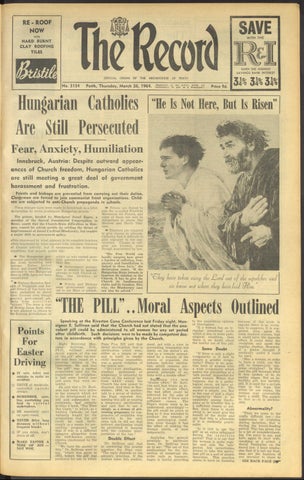
Hungarian Catholics "He Is Not Here, But Is Risen" Are Still Persecuted Fear, Anxiety, Humiliation Innsbruck, Austria: Despite outward appearances of Church freedom, Hungarian Catholics are still meeting a great deal of government harassment and frustration. Priests and bishops are prevented from carrying out their duties. C lergymen are forced to join communist front organisations. Children are subjected to anti-Church propaganda in schools. These charges have been made in Innsbruck in a joint declaration by seven prominent Hungarian priests. The priests, headed by Monsignor Jozsef Zagon, a member of the Sacred Consistorial Congregation in Rome, assert that the Church-State difficulties in Hungary cannot be solved merely by settling the threat of imprisonment of Jozsef Cardinal Mindszenty, but require a major shift in government policy. often impressed by what appears to be complete freedom often impressed by what appears tobe complete freedom of Church activity, but it enumerates the following conditions that impede public life: • The Hungarian government prevents the Holy See from installing new Father Gellert bishops. Belon and Jozsef Winkler, elevated to two Hungarian Sees in 1959, have not been consecrated.
which he was named apostolic administrator by the Holy See. • permission iss needed to appoint persons to high Church offices, like directors of seminaries.
• Bishops Bartalzn Badalik of Veszprem and Jozself Petery of Vac have not been permitted to direct their dioceses even though granted government amnesty from political "crimes." The same is true of Bishop Janos Bard, who is not allowed to return to the Kalocsa Archdiocese, of
• Priests and Bishops need government approval to say Mass or preach.
Points For Easter Driving * IT only takes one mistake to make an accident. * DRIVE at moderate, controlled speeds always. * REMEMBER, careless overtaking can lead to careful undertakers. 7A• BE especially alert on open roads. * NEVER drive long distances without frequent breaks. * IF you drink, don't drive at all. * MAKE EASTER A TIME OF JOY — NOT WOE.
• Priests are forced to join the so-called Freedom Movement for Priests, and some of them are sent in delegations to places like Moscow and North Vietnam. • Teachers are required to give classes in atheism. Catholics find it difficult to gain erarance to the universities. - Classes in religion are blocked, even though guaranteed by law. "The Free World can hardly imagine how great a burden of suffering, fear, anxiety and humiliation is linked to these facts," the declaration states. "If the Hungarian State intends to improve its relation to the Church, it has to give the Church its fundamental rights and its freedom. This way, the Mindszenty case can also be solved."
'Uhey haPe taAen (Way tli ,eord out of the sepaclue and ii)e &oh) not idiere diem &fie laid
"THE PILL" ..Moral Aspects Outlined Speaking at the Riverton Cana Conference last Friday night, Monsignor E. Sullivan said that the Church had not stated that the anovulant pill could be administered to all women for any set period after childbirth. Such decisions were to be mode by competent doctors in accordance with principles given by the Church.
Right Reverend Mon signor Sullivan, D.D., Ph.D., outlined several moral aspects of the use of "the pill" after the matter had been raised at a previous session of the conference. He said that "the pill" was a normal preparation used for the suppression of ovulation; it had some lawful uses and some that were unlawful. He said that a Dr. Rock, who had been very active in the research which led to the development of the pill and subsequent experiments, had recently written a book, "The Time Has Come," in which, as a faithful Catholic, he had valiantly fought for the proposition that the pill could be used licitly, simply as a means for preventing pregnancy and that it was in a different category altogether from the well-known contraceptive condemned by the Church. "We have the answer to this," Dr. Sullivan went to say, "which was given in 1951, before `the pill' was produced for use, in which
Pope Pius XII said that direct sterilisation, that is sterilisation which aims, either as a means or an end in itself, to render child - bearing impossible, was a grave violation of the moral law. " Direct sterilisation, whether permanent or temporary, is unlawful by virtue of the natural law from which which the Church has now power to dispense. And then in September, 1958, in another talk to a group of doctors, the Pope repeated this, naming this pill as causing a temporary sterilisation, and said that to use it simply as a means of preventing pregnancy by suppression of ovulation was unlawful. In the very same talk he did say that indirect sterilisation could be permitted in keeping with the common interpretation of the law."
ment, not with a view to preventing conception, but solely on the doctor's advice as a remedy necessitated by a malady of the uterus or organism, she induces indirect sterlisation which remains permissable according to the general principle of actions with a double effect." Exprining t h e term "double effect," Dr. Sullivan said that where an action had a double effect, the bad effect could be tolerated for the sake of the good one if there were sufficient reason. The Pope's words were to be understood accordingly — the pill could be riven so long as it was intended to produce the remedy of some pathological condition, even though it had the effect of making the woman sterile, at least temporarily.
Double Effect
Applying the general principle to particular cases, Dr. Sullivan went on to say: "The use of this medicament for the correction of menstrual disorder such as haemorrhages is lawful according
Dr. Sullivan said that in answering this precise question the Pope said: "The reply depends on the person's intention. If the woman takes this medica-
to the unanimous opinion of theologians. "If a woman has an irregular menstrual cycle which is due to some pathological condition, then there is no doubt about the lawful use of this pill.
Some Doubt "If there is only a slight irregularity is it licit to ensure a greater irregularity? There is no question here of women with a wide irregularity which makes the calculation of a 'safe period' impossible for some women. Where that happens, due to a pathological cause, we have already considered it. The answer is simply, yes. But in the case of just a slight irregularity there is no unanimity among theologians as to whether this is a sufficient reason or not. But, since there is doubt about it, we must give the benefit of the doubt and say that this is allowable if it is medically practicable. "Is it licit to use the pill' as an extra safeguard during the infertile period? That is to say that the woman is quite regular and uses the 'safe' period, but nevertheless wishes to take this anovulant pill as a sort of double insurance. This question seems to have no meaning
because if the cycle is regular there is no ovulation to suppress. It is suggested, once again by some medical sources, that it could have the opposite effect. It could delay the ovulation and upset the regular rhythm. However, if a doctor thought it medically useful it could be used. "May a woman, in order to have a child, use this pill to temporarily suppress ovulation? In this case the pill becomes what it was spoken of in its earlier stages. Not an infertility pill, but fertility pill. It is used for a certain time in the hope that when its use ceases, the woman may successfully have a child. The answer to that is—it is permissable.
Abnormality? "Then we come to the really difficult one — the suppression of ovulation during lactation,_ that is during the breast-feeding period. This has given rise to a lot of misunderstanding. I'm sorry to say, and here again to start with. speaking as a priest, a moral theologian on the moral law, I must emphasise that it is not my business nor the business of any moralist to claim to SEE BACK PAGE
Air,
THE
Page Two
Thursday, March 26, 1964
RECORD
DESMOND O'GRADY writes from ROME . . . Bishop Fulton Sheen . .
The Sadness Of Our Neurosis IN A CERTAIN UNIVERSITY, LABORATORY DOGS WERE KEPT IN TWO SEPARATE CAGES. In one were the dogs who still had fleas, and in the other, the dogs who had been dipped, washed and were without fleas. The experimenters discovered that the dogs with fleas were not nervous, because they had something to do—one might almost call it a purpose in life. The other dogs without fleas howled and screeched and, in general, created a problem of canine delinquency. They were bored. The body is directed towards the expenditure of energy, and the restlessness of the dogs without fleas was a kind of regulatory mechanism for keeping their organism fit. One wonders if modern boredom has the same cause. It used to be that people were afraid of death. Now they seem to be afraid of life. The absence of goal or purpose makes a life very much like a squirrel in a cage. The first example of this in literature is "The Plague," by Albert Camus. It is the story of the way in which Dr. Rieux combats a plague. He spends himself and is spent serving the afflicted— building laboratories and crematories, for which he is praised. But he knows that the plague goes on and the bacillus is hidden in clothes and furniture, and will break out again. The conclusion is—suffering is constant through life and without meaning. In another novel called "The City Beyond the River," a writer symbolises the meaninglessness of the world in the analogy of two factories—one takes big rocks and stones and grinds them all into infinitesimally small pieces. Then they are shipped to another factory where they are all baked together again. After that process, they are sent back to the factory to grind them up once more, and the process continues endlessly and meaninglessly. The Reverend Robert Eliot Fitch, Dean of the Pacific School of Religion, in Berkeley, California, has made a profound analysis of this hopelessness in modern society in this work entitled "The Self. Centred Self." One finds it in the novels of Francoise Sagan, who makes a sophisticated salute to sadness. Dr. Fitch says that those who feel sorry for themselves are the chest-clutchers, and they belond principally to an affluent society which alone can afford the indulgence of self-pity. But to those who are not immersed in this despair. there is actually more hope than there would seem at first glance. Despair can actually be the beginning of a tremendous amount of hope, and then becomes what might be called ''creative despair." When a man recognises that he is nothing, then he is already on the way to becoming everything. The essence of Christianity has never been that of optimism about man left only to himself. That is why the Psalmist said: "What is man that Thou art mindful of him?" But it may be asked: If man does not recognise anything beyond himself, how can he be helped? The answer is: Every man has a "hole in his head." By this is meant that no matter how much he attempts to keep entirely to himself, there is an opening into which saving influences may pour from God, if one but asks for help. NJ,"
4114#04 , 4".4.411 0441.41 ,
APRIL 5: 7.30 p.m.—Confirmation and Canonical Visitation, Attadale. APRIL 12: 3 p.m.— Attend Legion of Mary Acies Ceremony, St. Mary's Cathedral. 3.30 p.m.—Confirmation and Canonical Visitation West Perth. 7.30 p.m.—Confirmation and C anonical Visitation, Riverton. APRIL 18: 3 p.m. — Confirmation and C anonical Visitation, Como. 3 p.m.— Bless new Convent for the Sisters of the Holy Family of Nazareth, North Beach.
'7.30 p.m.—Confirmation and Canonical Visitation, Mt. Lawley. APRIL 25: 8.30 a.m.—Attend Anzac Day Mass, St. Mary's Cathedral. 8 p.m. — Attend Catholic Schools' Drama Festival. APRIL 26: 7.30 p.m.—Confirmation and Canonical Visitation, Morley Park. THE Little Sisters of the Poor express their deep appreciation and thanks to all their benefactors Ind friends, and especially the committee, for their generosity and kindness which helped to make their recent Pound Day the success that it was.
"••••••-•
Get Better Meat for Less at
C LEM PAULLS
234 HAY STREET, EAST PERTH — 23-4927 63 CANNING HIGHWAY, SOUTH PERTH. 67-1708,
WATCH THE WINDOWS FOR OUR SPECIALS
T IS TO BE HOPED THAT THE VATICAN WILL SOON PUBLISH THE STATE PAPERS RELATING TO THE SECOND WORLD WAR, AND PARTICULARLY THOSE REGARDING ITS RELATIONS WITH NAZISM.
Professor Toscano, who occupies the chair of international law at Rome University and heads the commission for the publication of Italian diplomatic documents, expressed this hope at a recent symposium in Rome on "The Holy See and the victims of Nazism." Professor Toscano pointed out that other States had published documents relating to the war, and that it was possible to build up a limited but clear picture of the Vatican's relations from what was already known. He went on to say that this picture needed more detail, but he did not need to spell out the reason — that the Holy See, and particularly Pius XII, is under accusation since Hochhuth wrote "The Vicar" and that documentation is needed to answer back. Even at the moment, according to Professor Toscano, the main lines regarding the relations between the Holy See and Nazism are clear. The can be summarised as follows: The Holy See was one of the -very first victims of Nazism; It was the first State to oppose Nazism; Its initial attempts to aid the victims of Nazism were abandoned when the victims complained that the interventions merely resulted in a worsening of their conditions; It continued in its attempts to aid the persecuted in a more discreet manner.
AID THROUGH MUSSOLINI OSCANO prefaced T his appeal for the
publication of Vatican documents by saying they would show that the Vatican had done far more for the victims of Nazism than anyone imagined. He said that indirectly. through Italian diplomatic documents, t h e story of the Vatican's aid to Jews could be pieced together.
The Vatican had asked Mussolini to help the Jews and through him much aid
was given, particularly to the Jews in France. By contrast, attempts to induce
Hitler to modify his policies only led him to make them more drastic.
Professor
OFFICIAL ENGAGEMENTS MARCH 25-29: Holy Week Ceremonies.
The Relations Of The Vatican With Nazism
•••"...r.
Toscano
also
pointed out that the Holy See was quite ineffective in its attempts to help the 200 priests who were in Dachau and Mathausen concentration camps. The Pope turnto the Italian Minister for Foreign Affairs for help in this matter because the Holy See was "powerless to obtain any change in the conditions" of the imprisoned priests. He recalled the Nazi reaction to Pius XI's 1936 encyclical, "Mit Brennender Sorge" (With Burning Sorrow), A note was sent to each German embassy throughout the world saying that the Vatican wanted to set the world against Germany, and that it had broken the world front against Communism. When Hitler visited Rome in 1938, Pius XI left the city for Castel Gandolfo because he could not bear to see the swastika triumph in the city of the cross. The German Ambassador to the Holy See complained to Cardinal Pacelli about an anti-Nazi speech by the Archbishop of Chicago, but all he had in exchange for his trouble was a detailed series of questions as to what the government intended to do about the persecution of the Church in Germany.
DISCUSSED STATEMENTS HE late President
T
Kennedy's father, at that time U.S. Ambassador to Great Britain, spoke with Cardinal Pacelli about Hitler's Rome visit and the pro-Nazi statements of the Cardinal - Archbishop of Vienna Innitzer. Cardinal Pacelli was of the opinion that the Viennese Cardinal's statements must have been made under duress. These were some of the reasons why, on the election of Cardinal Pacelli as Pope in March, 1939, Hitler ordered that the customary congratulations be sent, but that they were not to be expressed warmly.
All Professor Toscano's examples were based on State papers and he turned to evidence supplied by Sumner Welles to show that Pius XII in his last 1940 meeting with the German Minister for Foreign Affairs, von Ribbentrop, strenuously but vainly attempted to obtain a mitigation of Nazi persecutions in occupied territories. At the conclusion of his talk, Toscano said that those who have accused Pius XII of falling short of his responsibilities as regards Nazism do not accuse him of similar shortcomings
regarding Communism. Yet although Mussolini, in June, 1941, and Roosevelt, on two occasions in 1942, appealed to him for a condemnation
of Communism, he did not meet their requests.
the that replied He Church had already made its attitude clear: that he was the head of a neutral State; and that any comment would be given a political interpretation. Monsignor Alberto Giovannetti, of the Vatican Secretariat of State, also spoke at the symposium. He recalled many of the episodes of the war, including that of the last interview between Pius XII and the Italian Ambassador Alfieri, who, on Mussolini's instructions, complained about the telegram of solidarity which the Pope had sent to the leaders of Holland, Belgium and Luxembourg when they were invaded by Germany. The Pope took the accu sation that he "was unfriendly towards Italy" with calm: "We have absolutely nothing for which we must reprove ourself," he told the ambassador, "and we have no fear of going into a concentration camp."
He recalled that at Christmas, 1942, and in June, 1943, Pius XII condemned racial persecution.
There is an apparent contradiction in many discussions on the subject of Pius XII's response to the Nazi persecutions — those who say he did not know about the atrocities conflict with those who claim he did not want to make public condemnations which would aggravate the plight of the victims. This is a point which could be clarified by publication of the documents, but Monsignor Giovanetti suggested that although Dachau was in operation from 1933, there was no cle?.* information regarding the nature and extent of Nazi persecution. He said that Pius XII decided that only those on the spot could calculate how fierce would be the reprisals
against condemnation, so that the local pastors should decide what steps were to
documentation before they can be fully considered. And even when documentation is complete, it alone will not answer the most profound questions.
PHIL KEOGH
Resident Chemist 274 Cambridge St. Wembley - 87 3984 CONTOURE COSMETICS ,#.0.#4.04.4"...1.0.4411.4P41.44~- 1.14P4,11 .4 4.41 / 4 1
be taken.
WHAT IF POPE H AD SPOKEN? uT if Pius had
B
known the full story of Nazi atrocities and if he had spoken, said Monwhat Giovanetti, signor would have been the result? The Dutch hierarchy spoke out and the result was even more ferocious persecution.
STAMP
If the Pope had spoken, the concentration camps would have been crueller, the Church would have been attacked even more violently in Germany, and the conscience of the German people would have been troubled.
Contact
Monsignor Giovanetti concluded by saying that a violent protest by Pius XII in 1943 would not have saved the life of one Jew. This testimony by two qualified men shows the complexity of the problem when it is related to its historic context. It does not answer all the questions on the subject, but at least points to the need for more
MAXWELL ROBINSON & PHELPS 599 Newcastle Street, Perth Phone:
283141
VATICAN WAS AFRAID ONSIGNOR Giovanetti said that, without directly referring to them, Pius XII denounced the Nazi atrocities and adduced as proof of this that the Allied radios repeated the Pope's messages while the German radio ignored them. He further said that the Vatican was afraid of reprisals which would put out of action the Vatican Radio, which was almost the only means of contacting many of the bishops.
ROY GALYIN & CO. 229-233 Wiliam St., Perth 28-1541
otarzir-0,10 . wat,oriotowtotzenewmir PLUMBING MATERIALS BATHROOM FIXTURES SEPTIC TANK — DRY WELLS The "Plumbing Supply Specialists" orwiiiimomarammoormowide
Thursday, March 26, 1964
Pope's Journals Published V ATICAN CITY: The spiritual journals of Pope John XXIII, described as perhaps unique in world literature, will appear soon in bookshops of many nations. Entitled "Diary of a Soul," the book traces the spiritual development of the late Pontiff in his own words, from his early years in the seminary until one year before his death in 1963. Giacomo Cardinal Lercaro, Archbishop of Bologna and former confidant of the Pope, told a press conference here on March 11 that the book is an "extraordinary document." He called it "a confession so lively, so sincere, so revealing of the depths of a soul as has rarely been the case in literature." The book will appear in Italy next week. Publication rights have already been granted in the United States, Canada, England, Germany, France and Finland. Arrangements for editions in Spanish, Catalan, Portuguese and Dutch are being completed. The book contains the full text of notes Pope John made for his own edification from the age of 14 to that of 81. Nuns copied the text from a stack of notebooks the Pope left his secretary, Monsignor Loris Capovilla. Scholars then checked the text against the originals. Cardinal Lercaro said it was the first time a Pope had bared his innermost thoughts to the world in simple private notes instead of in the solemnity of pontifical documents. He said the book is the journal of "an open soul which seeks the will of God, but seeking His will in obedience ." He said the Pope's writings show an "evangelic simplicity" and constitute "a singular encounter of intimacy with the soul of the Pope."
THE
RECORD
Page Three
Pope Cites Reunion Aspect Of Council VATICAN CITY.—POPE PAUL VI TOLD 5,000 PILGRIMS, WHO CAME HERE FROM TRENT TO COMMEMORATE THE 400th ANNIVERSARY OF THE COUNCIL OF TRENT, THAT THE SECOND VATICAN COUNCIL IS SEEKING A SOLUTION FOR THE DIFFICULT PROBLEM OF THE REUNION OF CHRISTIANS, WHICH WAS LEFT UNSOLVED AT TRENT. The Pope celebrated Mass at the main altar of St. Peter's on Laetare Sunday. After reading the Gospel, he spoke at length to the assembled pilgrims, paying tribute to the history and the faith of the northern Italian city of Trent, which was the seat of the 15thcentury council held to meet the challenge of the Reformation. Linking t h e Tridentine council with Vatican II, the Pope said that both stressed a "stupendous fact." That fact is, he said, "the mystery of the faithfulness of the Catholic Church to Christ, her Founder and Master." From this faithfulness, the Bishop of Rome continued, there comes a sureness in the essence and guidance of the Church and "the certainty that her teaching is valid today as it was yesterday and as it will be tomorrow; that adherence to her doctrine and discipline will not render thought barren. that it will not sever it from the understanding and acquisition of all that modern science produces and possesses . . ." STIMULATES THE CHURCH The Pope continued by saying that this mystery of faithfulness provides "for loyal and fruitful dialogues with intellectual and spiritual trends of our times, and stimulates the Church to pour forth in expressions which are ever new because they are always sincere and lived, the inexhaustible
riches of truth which faith guarantees for us in the divine and religious field." Pope Paul said that the spirit of the Council of Trent "rekindles and strengthens that of the present Vatican Council, which is linked to it, and from which it begins to deal with old and new problems which then remained unsolved, or which arose later." The relationship between the two council is clearly demonstrated, the Pope said, by the "difficult question which arose at the Council of Trent, but which found no solution there— that of combining again in the same faith and in the same charity, with the Christians whom the Protestant reform separated from this heart of unity (Rome). The city of Trent had been chosen to facilitate the meeting, to act as a bridge, to offer the embrace of reconciliation and friendship." The Pope noted that although this was not accomplished by Trent, nevertheless it "will have to become the symbol of this desire ( for unity) to day, today more than ever, the deep, imploring, praying, patient
desire. With the firmness of her Catholic Faith, she (the Church) will have to open a door, not set up a barrier; not end a dialogue but open it; not reproach errors, but seek virtues; not wait for him who has not come in four centuries but seek him out fraternally. "This is what the new council, in continuation of the old, intends to do, with the help of God."
Much To Do
ROME: There is still so much work for the Ecumenical Council to do that it would be "extremely difficut" for it to finish in less than four sessions, according to Archbishop Lawrence J. Shehan of Baltimore. The prelate said, however, that it is not an impossibility for the council to end with its third session. "It will depend to a great extent on how perfectly the commissions do their work." Archbishop Shehan made his comments here after taking part in a two-week session of the Secretariat f o r Promoting Christian Unity.
And entering the sepulchre, they saw a young man clothed in white, who saith to them: "You seek Jesus of Nazareth, who was crucified; He is risen, He is not here; behold the place where they laid him."
Complete Dignified Catholic Funeral Service by A. R. MONAHAN PTY. LTD. ÷ Bedford Park and all Suburbs Day and Night — 71-5885, 71-5894. ALL FUNERALS PERSONALLY CONDUCTED BY MR. BERT MONAHAN — 26 1819. CERTIFIED FUNERAL DIRECTORS ELIGIBLE TO CONDUCT PENSIONERS' FUNERALS.
'iii••••••••ir • 100••••0000••0•11111110• • ••••••••••••• otor- 't,.•••••••••••••••••••isiroo'ssoostooreoos
ts
Welcome To The Monastery Fair VINCENT STREET, NORTH PERTH
SUNDAY, APRIL 5th HELP THE REDEMPTORIST FATHERS TO BUILD THE NEW RETREAT HOUSE AND A GREAT APOSTOLIC WORK
Cut this coupon out; fill in your name and address; bring it to the Monastery Fete; hand it to UNCLE TOM, and if your name comes out of the box you will receive a prize v alued at £25. ONE TICKET PER PERSON. N AME A DDRESS
_ 0 o% gpir4riusvoilivvriolvipiwiwaruiirlitwoiir101.41111
aritsglo
00trO000,t$4,40404.040ftitlorigt
000•00000001V11141
11k
THE
Page Four
Thursday, March 26, 1964
RECORD
ER) ATIONAL'il
EVERYMAN'S FAMILY
DENMARK •41.4..040,41
HAITI
FORMOSA
, NINNIM#41,141 I
1
To Publish Missal THE Benedictine monks of the new St. Canute's Priory in Copenhagen have announced plans to publish a Danish missal to aid youth in understanding the essentials of the Eucharistic celebration. The project would help fill the void which has e .Isted in the past five years —since the missal for the Danish laity has been out of print. The community, whose prior is Father Augustine Stock, 0.S.B., also has plans for a Danish Catholic hymnal.
Priest Is Expelled THE Haitian government has ordered the deportation of Father Yves Bajeux, C.S.Sp., Haitian-born philosophy professor at St. Martial's minor seminary in Port-au-Prince. The expulsion order for the Holy Ghost Father came less than a month after the Haitian regime suppressed Rond Point, a review for young Catholics, of which the priest was in charge. Rond Point was banned shortly after Haiti expelled all 18 Jesuits serving in the country on February 12.
BERNIE J. DUNNE HOMES
DEAL DIRECT WITH THE BUILDER — BIG SAVING Homes from £2,275 — Your Plan — Only Genuine Clay Bricks 117 WOODROW AVENUE, DIANELLA
Your Hotel Guide SAVOY PLAZA HOTEL
HIGHWAY HOTEL
THE HEART OF PERTH D incing. Entertainment, Every Night. Rooms with bath 45/-, Inc. breakfast. Meet YGil at the Savoy BM Lucas, Manager. FRIENDLY SERVME
206 STIRLING HIGHWAY, CLAREMONT PHONE 3 1566 rrtendly Service — Good A cc.,mmodation — Parties Sovcialiy Catered for M. A. & E. M. McDONNELL
BAYSWATER Hotel
R EX HOTEL
ar KING & HAY STREETS -4.1-ie Bar for Convenience et Guests and Friends Phone: 21 5634 Personal Supervision Mrs. B. B. REILLY
OF?. STATION Excellent Accommodation Frequent Train Service — 4 Miles from City — Large Parking Area BED and BREAKFAST REASONABLE TARRIFIP LEt3 BARTLETT. Prop. TEL.: 71 1224
SUBIACO HOTEL ru,t Class Accommodatioo
WEMBLEY HOTEL
and Service DRIVE-IN BOTTLE DEPT. FREE HOME DELIVERY Phone: 8-1028 -ties McHenry. Proprietor.
A VERLEY
Excellent Lounge and Accommodation Phone 87-2418 Cnr. Cambridge and A lexander Streets, Wembley
HOTEL
HOTEL
Australia
Seat BGans Waverley Stores ALBANY 11165W ST CANNINGTON Modern and Convenient tlomely Accommodation Use Our Drive-in Bottle Servisto • R CONNELL Phone 65 2419
MURRAY STREET, PERTH Excellent Accommodatlos and Dining Service LUNCH, 10/-: DINNER 17/8. PHONE 23 1541
CRITERION HOTEL
Enjoy the Best ACCOMMODATION & SERVICE
CENTRAL HAY STREET PERTH 24-HOUR SERVICE lse Parking for Country Residents I I Minutes' walk from Cathedral. THE COUNTRYMAN'S HOTEL PHONE: 23 1115 (5 lines)
HOTEL COTTESLOE RIGHT ON THE SEA FRONT Phone 3-2155 R. M. DYMOCK, Licensee
HOTEL ESPLANADE
WILLAGEE PARK HOTEL States Most Modern TOM KENNY, Licensee. Iv. Stock and High Roads, MELVILLE Phone: 30 3428 The
PERM'S LEADING HOTEL FOR ALL VISITORS Phone: 23-1531
NATIONAL HOTEL
COMMERCIAL HOTEL NORTHAM Phone Northam 49
T. E. MURPHY, Proprietor
SHENTON PARK HOTEL
NICHOLSON ROAD SHENTON PARK Excellent Accommodation, Moderate Tariff, Spacious Car Park Beer Garden, Open Air Bar, Phone: 8-2170
Cnr. High and Market Sts., FREMANTLE Offers excellent homely accommodation Phone : 5-1786 Philip P. Searing, Licensee
Plympton HOTEL
Home of Country People CANNING HIGHWAY EAST FREMANTLE ErIc Campbell, Prop. 5.1721.
4P4NP
Sheedy Jack PHONES 21-1341, 23-3091
CARLTON HOTEL
215 HAY ST., PERTH BUSINESS MEN'S LUNCHEON — 12 to 2 p.m.
4.4.04,04PeINOWNO#
Cr,
DALY'S
WILLIAM
MEET DAILY
and
ROYAL
at
Phones: 21-5924.
HOTEL
STREETS, PERTH, Bottle Dept., 21-5436,
WELLINGTON
THE WATTLE RESTAURANT
OPEN MONDAY TO SATURDAY 10 p.m. to R p.m, 3 COURSE MEALS 7/-, SNACKS from 4/. A vailable for private hire A fter R p.m. Week Days and on Sundays 62 St. George's Terrace, Perth, Phone 23 3403 R INFIRRI. Manager.
FU JEN UNIVERSITY IS OPEN AGAIN. THE CATHOLIC UNIVERSITY, CONFISCATED BY THE CHINESE COMMUNISTS IN PEKING 13 YEARS AGO, WAS OFFICIALLY REOPENED ON MARCH 1 IN A SUBURB OF TAIPEI, CAPITAL OF FORMOSA.
By Father JOHN C. KNOTT
The Meaning Of Man
Present for the ceremony was Father Harold W. Rigney, S.V.D., who was rector of the Peking university when it was seized by the- communists and who spent four years as a Red prisoner on the Chinese mainland. Father Rigney is now provincial of the Divine Word missionaries in the Philippines. Fu Jen University actually opened its doors to a freshman class of 450 last October, but the official reopening was delayed until the start of the second semester. It was rebttitl through aid largely supplied by the West German government. Additional support came from the late Pope John XXIII and from Richard Cardinal Cushing in the United States.
HOLLAND Wedding Plans PRINCESS IRENE will marry Prince Carlos Hugo
de Bourbon-Parma in a Catholic church near Soestdijk Palace some time between Pentecost, May 17 and July 1, the government has announced. There will also be a civil service in the palace. The Dutch princess became a convert to the Cath-
olic Faith before her engagement to the Spanish prince.
WHAT MAKES A MAN, A MAN? IT ISN'T JUST BECAUSE HE HAS A CERTAIN TYPE OF PHYSICAL REPRODUCTIVE SYSTEM. THIS DOES NOT CAUSE HIM TO BE A MAN IT MERELY INDICATES THE FACT THAT HE IS A MALE.
INDIA
There is more to sex than biology. Psychiatrists today are discovering what might be called the mystery of sexuality. This is something that colours and conditions the total personality of a man. He is male from the top of his head to the
ONINIP,M4PININO,
Censors Ban Film
THE Indian Board of Film Censors has banned showing of the Polish film, "Mother Joan of the Angels" on grounds that it might offend Catholic sentiments. Stefan Cardinal Wyszynski, Primate of Poland, denounced the film as antiCatholic when it was first shown in Poland. The movie was to have been shown in New Delhi at the second Polish Film Festival, sponsored by the Polish Embassy in India.
tip of his toe. One could give a piece of human tissue to a good
pathologist and, without being told what human body it was taken from, an examination would disclose the sex of the owner. If sex conditions the make-up of the body so does it also determine other aspects of a human being.
GERMANY
EAST GERMAN COMMUNISTS ARE STEPPING UP THEIR 4 ATHEISM INDOCTRINATION FOR YOUTHS IN THE LIGHT OF REVELATIONS THAT PREVIOUS TRAINING HAS NOT BEEN VERY EFFECTIVE. A survey in the mining town of Au revealed that of the 100 young people who had undergone the "youth initiation," a substitute for First Communion or Confirmation, only 34 had given up their church membership. Catholic and Protestant youths continue to attend church services and receive the sacraments even when they belong to the communist party. The East German regime has decided to follow the lead of Moscow and intensify its indoctrination training. Spies have been told to report on youths who still go to church. IVINIP#4.#0 M
CONGO
BRAZIL
University Barricaded
Benefits Of Population Growth
CONGOLESE students at Catholic Lovanium University held their professors
THE Minister of Health has said that rapid population growth, instead of being a hazard, is a great benefit to developing nations like his own.
barricaded within the campus as part of a strike for better food and more qualified teachers. atpriest-professor A tempted to hack down one of the barricades with a machete. He was disarmed by students who told him, "Those who take up the sword shall perish by the sword."
SPAIN
,411.4.####4.41 4,41
Pope Names New Patron ST. PAUL has been named the patron saint of the Cursillos de Cristiandad, a programme of instruction and apostolic action popular in Spain, Latin America and the United States. St. Paul was proclaimed the new patron by Pope Paul VI at the urging of leaders of the movement. Published in the Catholic Action magazine in Madrid, "Ecclesia," the papal brief states that "this method of Christian teaching, which already extends to a large number of Spanish Catholics and those of other countries, has brought forth abundant fruits; a Christian renewal of family life in conformity with divine law; a vitalisation of parishes and a faithful observance of duties, private as well as public, according to the dictates of conscience."
Speaking at the 17th World Health Assembly in Geneva, Dr. Wilson Fadul pointed out that in newly developing nations most of the energy used in production is human muscle power. "Thus any measures that contribute to increase the rate of population growth are beneficial to us," he said. Dr. Fadul said that nations which have achieved their industrial revolution have experienced a slowing birth rate. As a result, he said, economic and social conditions place natural checks and balances on the rate of birth. lItllIllIIllI lIIIIIIIllIIIIIIllIIIIlIIIllIIIIlIIIlIIIIIlIll
O'HARA'S
1
THERE is a male way of thinking MANLINESS- and of choosing. There is a manly intuition as there are male emotions.. The things that seem important to a woman the man is oftentimes unaware of. On the other hand, he can get excited over a football game which to her seems meaningless. He can get discouraged over a setback in the pursuit of a goal which had never seemed too important to her from the beginning. His sexuality is an integral part of his personality. In his manliness he is made to the image and likeness of God. He will live his life, pursue his love, achieve his successes and accept his failures, give honour and glory to God and in the end accept union with God, as a man. He will live for all eternity with God in heaven, among other ways, in and through his sexuality. It is as a man that he will love and be loved by the Trinity. It is as a man that while living on earth he will reflect the creative love of the Father, the r edemptive love of the Son and the sanctifying, healing love of the Holy Spirit. Through his sexuality he is called to create with t he Father as he has been created by Him. In marriage it is his vocation to initiate life with his wife. These two give the human matter. It is God Who animates and transforms their mutual gifts into the mystery of another human being.
THAT child is part of the man and part of the woman and in a sense part of God. The gifts of creative paternity continue to be made in the perfecting of the order of creation. The child born with an infinite capacity to be loved receives from the father the answer to his basic hunger. The father is there to encourago and guide, to teach and to lead, to perfect and purify the image and likeness of God which makes of each child such a singular and awesome mystery. He is there also, in his manliness, as the vicar of God to his wife. He has received from the Father half of the human gifts of-life and love. He gives them back to God in the love he has and shows for his wife. An essential part of creation is the perfecting of airther personality. "Come with me and be my love," are the words of the poet. They also offer the real challenge to sexuality. To return to God a better lover of Him in his wife and with her to send back to Him mote lovers in their children.
CREATIVE PATERNITY
The address of the local Catholic Marriage Guidance Centre is 77 ST. GEORGE'S TERRACE, PERTH. 23-4548.
DAY & NIGHT HOT WATER PHARMACY • Cr. FITZGERALD & FORREST STS., NORTH PERTH iimmitimiunnuminnituminiminiflinn
AROUND THE CLOCK! AROUND THE HOME!
a
BRAEMAR — the name that means HOT WATER throughout A ustralia! All units carry 2 YEARS Guarantee and Service. A vailable from all Major Electrical Wholesalers and Hardware Merchants. ELECTRIC SOLID FUEL OIL FIRED SOLAR
BRAEMAR
Phone 50-2044. Cnr. STOCKDALE RD. 8, JONES ST., O'CONNOR
THE
Thursday, March 26, 1964
RECORD
Page Five
authr o of this By Father Frederick R. McManus the article, the tenth
The Tenth of a Series .. .
of a series on the sweeping liturgical reform provided for the Ecumenical Council, serves as one of the council's official advisers on liturgical matters. He is a priest of the Boston archdiocese and a professor of canon law at the Catholic University of America, Washington, and is the immediate past president of the North American Liturgical Conference.
CONSTITUTION IS REVOLUTIONARY: CHURCH IS A COMMUNITY Of LOVE
'the victory and triumph of and human celebrate the memorial of stitutions The council of renewal From gloomy silence to joyous his death are again made prayers must change and be the Lord's death and tridoes not hesitate to express present,' and at the same adapted to men's underumph, Passion and Resurthe Christian hope with time giving thanks 'to God standing. A fundamental rection — and in that celegladness: await this is the revolution de- for his unspeakable gift' (2 purpose of the Second Vati- bration they commit them- the Saviour,"WeOureagerly song Lord Jesus Cor. 9:15) in Christ Jesus, can Council is "to adapt selves to live as Christians Christ, until He, our life, praise of his glory' (Eph. more suitably to the needs and to bear witness to shall appear and we too will manded by the Second Vatican 'in 1:12), through the power of of our own times those in- Christ. appear with Him in glory." the Holy Spirit." stitutions which are subject Council for Catholic Worship. to change." F lorida Spanish Records Filmed Mystery Made Distinguishing
I t may be expresed in other ways — from passive unconcern at Mass to active involvement, from a liturgy understood by priests to the people's worship.
The Constitution on the Liturgy is revolutionary, partly because it decrees a thorough reform of the services of worship, partly because it brings the whole Church abreast of the Biblical, catechetical, ecumenical and theological movements of the past few decades. To take one example, the picture of the Church as a legalistic, authoritarian society is bypassed. The Church is seen as a community of love, as an assembly of worshippers. The centre of Christian worship is the celebration of the Eucharist, holy Mass. According to the council, this is the height towards which all the other activities of the Church lead. It is the source and starting point for the entire Christian life of the faithful.
New Dynamism Will Transform Mass more often than not, The involvement of the YET, the Mass appears to be individual person in the
an impersonal and mechanical rite, or the weekly payment of a debt to God or a haven of escape from the real world. For a long time people have been described as "hearing Mass" and priests have been described as "saying Mass," as if it were a formula of words—words spoken in a language which not one participant in a hundred or a thousand could understand without a translation.
community's worship is at a minimum. Communion hardly appears to be the joyful feast of the Christian family at the Lord's common table. "The Church," says the couch, "has never failed to come together to celebrate the Paschal Mystery" of the Passion, Resurrection and Ascension of Jesus, "reading those things 'which were in the Scriptures concerning him' (Luke 24:27), celebrating the Eucharist in which
DOOGUES
LOTTERY AGENCY
"CARDS FOR ALL OCCASIONS"
EASTER CARDS
BEAUTIFUL — RELIGIOUS THEMES Of Special Interest to Catholics SEE OUR OUTSTANDING DISPLAY AT PERTH ARCADE and 19 BARACK STREET, PERTH 41.00#4.40,11,0,0•41.4.#4,0414P41..4, .."11,141.0#4,04,40.•
EXCELLENT CUISINE
D ancing and Entertainment Nightly. Private Room for Parties
EUROPEAN NIGHT CLUB RESTAURANT Fully Air-Conditioned
27 LAKE STREET, PERTH. 23- 1589. Specialists in "MEALS TO TAKE AWAY" — Ring and Order WEDDINGS and PARTIES on SUNDAYS st•~41,111NN4 , 0
0.41.000#0.11,.......0.4.e~4.0.4.4.00~004`.."1.041.4.ININP4401.4
WATSONIA HAMS and BACON
Their high standard of Quality never varies
Mysterious
THIS description of holy Mass is far removed from the routine and hurried celebration that is still common—and in which the mystery of God's great deeds in His people is not revealed but made mysterious. The description also shows how the council preferred the authentic language of the Bible to the technical catechism formulas and the abstract terms of theology. In the concrete, the Pope and the bishops of the council decided that the whole Mass should be simplified— "Elements which, with the passage of time, came to be duplicated, or were added with but little advantage, are now to be discarded; other elements which have suffered injury through accidents of history are now to be restored to the vigour which they had in the days of the holy Fathers, as may seem useful or necessary." This reform of the Mass prayers and rites, now under way with the appointment of a new commission by Pope Paul VI, may involve cutting down the Offertory prayers, restoring the Eucharistic prayer or Canon to its former effectiveness, solemnly proclaimed aloud, and improving the announcement of God's word. None of this is change for the sake of novelty, but for the sake of meaningful genuine worship.
THE
Mark
Church is always young, always alive. Its renewal and reform affect people in different ways. For some, change seems to lie a harsh renunciation of the past, even though the council has explained the Christian Faith and its purposes in the very words of holy Scripture. For others, including the college of apostles, the council's first achievement is "a sign of the providential dispositions of God in our time, as a movement of the Holy Spirit in His Church . . . a distinguishing mark of the Church's life, indeed of the whole tenor of contemporary religious thought and action." Above all, the Constitution on the Liturgy fulfils the vision of Pope John XXIII, that renewal of the Church might be the first step towards the unity of all who believe in Christ. As a divine institution, the Church is without spot or blemish. As a human institution, made up of sinful men, the Church may be unattractive and incomprehensible—in fact the vast, vast majority of men are unaware of, or are indifferent to, the Church. The Church is not afraid of the present or of the future. It welcomes growth and progress. The people
Exercise Of Priestly Office HE directives adopted by • T the council for this work
of reform indicate facets of Catholic worship that have been neglected and now need to be re-established, if in fact as well as in theory the liturgy is to be "considered as an exercise of the priestly office of Jesus Christ" by all His members. First, the communal and hierarchic nature of the Christian liturgy is to be stressed. The Church is the sacrament or sign of unity. It is defined as "the holy people united and ordered under their bishops." This must become evident, much more evident, in the ways of worship—the priest presides and leads, but the people have their full part. Next, the very act of worship is a lesson and a teacher. The Constitution on the Liturgy expresses this by setting down rules for future reform "based upon the didactic and pastoral nature of the liturgy . . . For in the liturgy God speaks to His people and Christ is still proclaiming His Gospel. And the people teply to God both by song and by prayer." This is why the rites of worship should be "short, clear, and unencumbered by useless repetitions . . within the people's powers of comprehension." This is why the council calls for a radical change in preaching, drawn "mainly from Scriptural and liturgical sources," why the language of the people will be introduced after many centuries of divorce between nave and sanctuary. Finally, the bishops adopted a principle of adaptation, so that there may be flexibility and diversity in the liturgy from place to place. Only God and His teaching are unchanging. Human in-
In Washington, officials of the Library of Congress examine original documents of 18th and 19th century 'Spanish Florida with Father Michael V. Gannon, director of the Mission of Nombre de Dios Library in St. Augustine, Florida. Left to right are Dr. Daniel J. Reed, Assistant Chief of the Division of Manuscripts, and Stephen R. Salmon, Acting Chief of the Photoduplication Service. The early documents, known as the East Florida Papers, are now being microfilmed by the Mission Library, which will bring them back in duplicate form to the old Spanish capitol of St. Augustine, from which they were removed 94 years ago. iPhoto N.C.)
> 0 <->
<
>OK
>
<
><><
= •
policies are good policies FOR YOU AND YOUR FAMILY FOR YOU AND YOUR BUSINESS FOR YOU AND YOUR PROPERTY ALL FORMS OF LIFE INSURANCE Probate • Retirement Tax Saving • Education Partnership • Family Protection etc.
ALL YOUR NEEDS Accident and General Insurance Fire • Loss of Profits House Owner's • Householder's Plate Glass • Public Liability Sickness and Accident
MOTOR VEHICLE COMPREHENSIVE
AUSTRALASIAN CATHOLIC ASSURANCE C O. LTD. Inc. in N.S.W. Principal Office in W.A.—Warwick House. 63 St. George's Terrace. Perth. 21-6815
Branches throughout the Commonwealth
0<
>
<
> <><
>
>
>
THE
Page Six
Thursday, March 26, 1964
RECORD
Pope Paul VI And The Holy Shroud Of Turin By FATHER W. FREAN, C.SS.R. HIS HOLINESS POPE PAUL VI RECEIVED IN PRIVATE AUDIENCE A GROUP OF DIRECTORS, REPORTERS AND JOURNALISTS OF THE CATHOLIC PERIODICAL "IL NOSTRO TEMPO" ON SEPTEMBER 21 LAST YEAR. In the course of this audience, which was reported by the principal newspapers, gifts were presented to His Holiness. Conspicuous among these was a positive photograph of the Holy Face of Jesus, reproduced from the Holy Shroud of Turin. The photograph was set in in an artistic frame of gold, protected by an outer covering lined with red velvet. The Rector of the chapel of the Holy Shroud, Don Pietro Borga, was invited-to make this presentation to the Supreme Pontiff. Paul VI delivered an inspiring address to all the members of this assembly in which he spoke of the noble mission of the Catholic journalist. When he was presented with the gift of the Holy Face of Christ from the Shroud of Turin, he uttered words calculated to stir deep emotion in the hearts of all lovers of Our Divine Redeemer. His impressive words are certain to give great joy to everyone who has been moved to deep devotion and love of Our Saviour by the imprints of the Face of Jesus and the sufferings of His Passion, impressed on the precious Shroud that enfolded His body after His death on Calvary. So we repeat them as he spoke them: "Ah, and here is the treasure of Turin! . . . I still remember the emotion I experienced when, in 1931, I had the joy of seeing the Holy Shroud. . . . It was precisely on the evening of May 16. . . . For this gift my gratitude to you is great. I shall treasure it dearly, and it will recall to me the profound spiritual emotion that I always feel in the presence of this photograph. Thanks, and thanks again." The newspapers in the headings of their reports, spoke of "The Joyful Wonderment" -- the marvellous joy—of the Holy Father in the presence of this touching image of Our Saviour, bequeathed to us by Christ Himself as a parting gift and a memorial of His great love -- "The Treasure of Turin."
The Holy Shroud, with its authentic image of Christ suffering for love of men, makes its strong appeal not only to Catholics, but also to many who are still outside the true Church, and are longing to be reunited in their Father's House — one fold under one Shepherd. At the present time, especially, when Pope Paul is appealing to all Christians for unity of Brotherhood in Christ, we welcome those ardent words which add his name to the long list of Popes who have spoken so beautifully of the Passion of Christ as depicted on the Holy Shroud, and have recommended this devtion to the faithful. These words of Pope Paul VI, spoken shortly after his coronation, recall the joy and emotion that Pope Leo XIII showed when the first photographs by Secondo Pia were presented to him in 1898; and the memorable words spoken by Pope Pius XI, when he had the more photographs of perfect Enrie in his posssession. He had been speaking of the Blessed Virgin Mary. But he presented pictures from the Holy Shroud to a group of Young Catholic Actionists. "These are pictures," he said, "of her Divine Son. One may say that they are the most thought-provoking, the most beautiful, the most precious that one can imagine. They are, in fact, from that object
which still remains mysterious, but which has certainly not been made by human hands. One can say that this is now proved—I refer to the Holy Shroud of Turin. "We have used the word "mysterious" because this holy object is still surrounded by considerable mystery. But it is- -certainiy a thing more sacred than any other. Indeed, we can now say that the genuiness of it is proved in the most positive way, even setting aside_ all idea of faith or Christian piety. It is not a human work" (Osservatore Romano, September 7, 1936), Again Pope Pius XI said: -We have personally followed the studies on the Holy Shroud, and we are convinced of its authenticity. Objections have been made, but they are groundless."
The Story Of The Hoy Shroud COR those who may not be acquainted with it, we shall briefly relate the epic story of the Holy Shroud. When Christ died on Calvary, He was surrounded with many bitter enemies, and a few faithful friends.
osity; and so Joseph's brave deed was rewarded in a marvellous way. For that sheet in which he wrapped Our Divine Lord's body on that first sad Good Friday evening is not only, as Pius XI assures us, the most precious possession of the Church (the Sacraments themselves of course excepted), but it has become one of the marvels of modern science. This is because the priceless value of the Shroud, as we know it, was revealed to us in its fullness only a few years ago. That sheet bears upon it a most beautiful image of the Face of Our Saviour—a Face made still more beautiful and more dear to us by its nobility and patience in the midst of the extreme sufferings He underwent for us. And it bears the imprints, marked in most extraordinary detail, and in His own Most Precious Blood, of the scourging, t h e crowning with thorns, the mockery, the crucifixion, and the spear thrust that opened His Sacred Heart after death.
The Confirmation THE history of the Holy Shroud cannot be related
on the linen, that are now so clear, had previously appeared so dim and confused. A commission was set up in the University of Paris to examine the photograph. The leading spirits among these experts were Professor Yves Delage and Professor Paul Vignon, the former an agnostic in religious matters and the latter a fervent findings Their Catholic. were as follows: • The two images on the Shroud are negatives, like the negative images that appear on a photographic plate. When photographed, they produce a perfect positive picture. • The Winging Sheet bears upon it the frontal and dorsal images of a man who has been scourged, crowned with thorns and crucified, and his side has been pierced with a lance. • Without any doubt the images represent the body of Jesus Christ bearing the marks of the Passion as it is depicted in the Gospels: • The bloodstains on the Shroud are stains of real human blood, attested as such by medical experts; the arterial blood can be distinguished from the venous blood; the blood which flowed during life from that which flowed after death when the body was taken from the cross; ,he blood clot is distinct from the serum. These blood stains are not negative images like the other images. They reveal a knowledge of the circulation of the blood centuries before it was discovered by Harvey. • The cloth itseslf is of ancient texture like that found in ancient tombs and in use at the time of Christ. It bears not the slightest sign of paint or artist's brush. The details are too tiny to be possibly produced by an artist's brush, and
could have been produced only by natural forces working under certain conditions as in a photograph. They are certainly not the work of man.
Photographs IN 1931 the Holy Shroud was again • exposed for veneration, and this time 12 special photographs were taken by an expert photographer named Enrie. These clearer photographs only confirmed all that had been previously revealed. So Professor Scotti of the University of Genoa was perfectly correct when he wrote in 1939: "No one who thinks scientifically now denies the authenticity of the Shroud." As we gaze on these picttures which Pope Pius XI has called "the most thought-provoking, the most beautiful, the most precious that one can imagine," we too will experience "the profound spiritual emotion" that Pope Paul VI tells us "he always feels in the presence of this photograph." Those who want to become better acquainted with this marvellous source of devotion anti love of Jesus Christ, can obtain their knowledge in a very cheap book, "The Winding Sheet of Christ," obtainable from The Majellan Press, Redemptorist Monastery, Ballarat, Victoria. It has 12 pages, with 23 photographic plates procured from Commander Enrie of Turin. Beautiful photo graphs, from life-size to prayerbook s ize (reasonably priced) also from Enrie of Turin, can be procured from Miss F. Fraser, Holy Shroud Information Centre, 67 Richardson Street, Albert Park, S.C. 6, Victoria,
F. LIST & SON PTY. LTD. 91 Central Avenue, Maylands W A's Leading Paving Contractors For Better Paving Contact Us
PERTH'S ART and DRAWING SUPPLY SPECIALISTS 103 ROKEBY ROAD, SUBIACO and 148 WILLIAM STREET, PERTH
Oi ls, Crayons, Paints, Drawing Equipment
We specialise in Gravel and Bituminous Paving of R oads, Tennis Courts, Playgrounds, etc. We have a most modern plant including power Rollers Graders and Mechanical Loaders, etc. Estimates Submitted Free.
YOUR MORLEY CHEMIST ( B.D1) Devereux PhC. MPS. )
Country Clients please note that we have a State-wide Service, and will gladly quote on any requirements. We also supply at ruling rates Gravel, Metal, Sand and Loam. Prompt Delivery.
BOANS MORLEY
PHONE: 71-1578
8-4541
JACKSONS 8-4541
The Pharmacy Right Inside Roans) FIH%,. your Pre,ertption, Pirked up and Delivered
Phone 76 1395
ALTAR
SERVERS'
FEST1VAL—HOBART
1964
IMPORTANT ANNOUNCEMENT A SPECIAL SOUVENIR BOOK
Arrangements are now in hand to print, as soon as possible after the Festival, a Souvenir Book giving a full report on each day's functions and containing photos, etc
Price 5/ As the Festival will portray the People's Part in the Liturgy of the Church, not only Altar Servers, but all Catholics will find this Souvenir Book of immense interest and assistance.
ORDER NOW
LIMITED NUMBER TO BE PRINTED Make sure of your copy by kindly filling in the form below And mail to:— Mr. S. W. Elliss, 46 Lansdowne Crescent, West Hobart Tasmania. Enclosed please find 5/- for payment in advance for:-ALTAR SERVERS' FESTIVAL SOUVENIR BOOK, HOBART, 1964." ( Please use BLOCK letters below) NAME ADDRESS
S TATE
Photo Copyright G. Enrie, Turin. His Mother Mary, St. John, the holy women, stood beneath the cross. But Jesus also had a friend on the governing council of Jerusalem, the Sanhedrin. His name was Joseph of Arimathea, and the Gospel tells us that he was a just man, who was also seeking for the Kingdom of God, and that he had taken no part in the deliberations against Our Lord Jesus Christ. At a time when even the Apostles were overcome by fear, Joseph showed how strong was his love for Christ by going to Pilate and boldly asking for His body, that he might give it honourable burial. Being a wealthy man, he bought rich spices and a long sheet of precious linen in which to enfold the body of Christ. This sheet was about fourteen and half feet long and about three and a half feet wide. The body was placed on the sheet with the head in the centre and the other part of the sheet was drawn over it. It is well for us to remember in our service of Jesus Christ that we are serving a Master Who will never be outdone in gener-
here, as space does not permit. All that we can say is that it was treasured and handed down through the centuries, protected in its precious reliquary, and, especially in these later times, only rarely exposed for the veneration of the faithful Thus, in 1898, being the fourth centenary of , the opening of the Cathedral of Turin, where it is enshrined. it was taken out and placed above the high altar where' all could see it. For the first time in its long history it was photographed by a man named Secondo Pia. That photograph it was that astonished the scientific world. For on the photographic plate, instead of the usual negative, there was a positive picture of the body of Our Saviour. as it was when He was lying in the sepulchre before His Resurrection. The negative was on the Shroud itself, and it had been imprinted there long centuries before science had ever thought of a photographic negative. That was why the imprints
Experts Agree! ! ! for
SOUND BUSINESS TRAINING in Shorthand, Typing, Bookkeeping, Arithmetic and English, see —
Metropolitan B USINESS COLLEGE Full Secretarial Course £90 45 weeks. £10 deposit
ONLY 1 /4d. AN HOUR 90 High Street, Fremantle 5 1506 8 54 William Street, PERTH 21 6406
Uet Pou
gro
Thursday, March 26, 1964
THE
RECORD
Page Seven
NEWS IN PICTURES AN INAUGURAL PRAYER
FIRST OF THREE CHURCHES
Bishop Paul Leonard Hagarty, 0.S.B., of Nassau, is shown as he read the opening prayer at ceremonies marking the inauguration of the new Constitution for the Bahamas recently. A native of Greene, Iowa, Bishop Hagarty's diocese includes the entire archipelago of the Bahamas, with 23,000 Catholics in a total population of 130,000. Three Catholics hold portfolios as Ministers in the Premier's Cabinet. Left to right: Sir Roland Symonette, Premier; Sir Robert Stapledon, Governor General; Bishop Hagarty and Hon. A. R. Braynen, chairman of the Constitution Day Committee. — (Photo U K. Imf. Service)
Britain's Sleek New Jet Christened AV-
T he first of three modern churches to be built at Camp Terendak at Malacca in Malaya w as consecrated recently by the Catholic Chaplain General of the Australian Army, Father J. Morgan. The opening highlighted a 12 day visit to Australian troops in Malaya and Singapore by Chaplain General Morgan.
I Mt4t' s.
L.
The church is situated in the centre of the camp which is the home of the 28th Commonwealth Infantry Brigade Group. Terendak is a self-contained Army town and its population of 10,000 consists of about 4,000 soldiers, another 4,000 wives and children 1 .000 domestic servants and 1,000 c ivilian employees. In mid April Chaplain General H. Cunningham will officiate at the opening of the new Presbyterian church. The Camp Terendak Church of England will be completed later this year. By this time the Australian, New Zealand and British Governments will have spent EA10,000,000 on the project.
"AMERICA STAR" COMPLETES TRIALS Gleaming in the red, black, white and silver livery of British European Airways, the three-pronged Trident jet airliner, one of Britain's new sleek, speedy and economical aircraft is christened at London Airport before going into service. Named the "Royal Mail Aircraft Trident" by Lady Douglas, wife of the chairman of B.E.A., Lord Douglas of Kirtleside, this dream aircraft will link London with major
European cities. T wo hours will become the maximum flying time to the most distant West European
c apital city. The 88-seat British airliner is the most advanced regional craft in the world and the first aeroplane to be designed from the start for completely automatic landing.
t Plioto N.C.)
Mr. Duncan Sandys Meets President Karume Of Zanzibar
The 8,310-ton deadweight motorship, "America Star," specially built for the Blue Star line for the carriage o refrigerated cargo, mostly chilled meat, from Australia and New Zealand through the Panama Canal to the East Coast of the United States and Canada, has successfully completed her trials off the North East Coast of England. Built by Bartrams of Sunderland, she is a sister ship of the "Canterbury Star" and the "Montreal Star" buiit at the same yard in 1960 and 1963 respectively, and the yard is now working on yet another similar ship, "Halifax Star." The "America Star" has three holds forward, and one hold aft of the machinery space, with associated tween decks. Back of the holds and tween decks are insulated and arranged for the carriage of frozen cargo, except the forecastle and No. 1 upper tween decks. Chilled meat lockers have been provided port and starboard in No. 2 and 3 upper tween decks.
Mr. Duncan Sandys (right), British Secretary of State for Commonwealth Relations, t alking with President Karume during his recent visit to Zanzibar. They had a three-hour meeting at the State House. On his return to Britain, Mr. Sandys said: "There is no doubt about it, wh;le, things are still unsettled there, that President Karume is the most popular figure in the island." He said he had spoken to a number of British residents and they wanted to stay in Zanzibar. --(Photo 17 K. Imf Service)
Accommodation for the ship's company has been arranged in the deckhouse on the upper deck, surmounted by a three-tier deckhouse. Deck and engineer officers and petty officers each have a separate single-berth cabin, while ratings and catering staff are accommodated in two berth cabins. Public rooms comprise a spacious dining room to seat 20 and a tastefully decorated smoking room. Included in the life-saving equipment are two 52-person lifeboats of g'ass-fibre construction, fitted with diesel motors. (Photo U.K. inf. Service)
THE
Page Eight
Thursday, March 26, 1964
RECORD
LEGION OF MARY NEWS AND NOTES them as a means to set up ment against their beliefs. Yet I might say it here that the National Church. P REPARATION FOR it was the greatest persecution th? Church has ever PRISON.—I had been priviknown. — (Extract from an Legion the leged to set up address given by Reverend around China. We made a the Father Aeden McGrath. shrewd guess that NEWS priests, Brothers and Sisters would be expelled from that AUSTRALIA: Junior LeIt was not long after the country and therefore the in Legion, which had been gionaries at Moonee Ponds, arrived Communists Melbourne, helped organise China that we realised that there since 1937, we tried to a football team to keep chilthey were going to attack increase, so that the people dren away from the influreligion and that they were would have some courage to ence of Seventh Day Advengoing to attack the Catholic carry on the work when tists. A "special" retreat for Church in particular. I was their pastors were gone. boys was arranged. The boys in Chungking and I heard I had watched the little also assist at a Catholic Enthat they considered the Catholic Church their Public Chinese who knew they were quiry Bureau on Saturday going to prison, and their mornings. Enemy No. 1. We soon disARGENTINA: A Redempcourage astounded me. covered that they meant to torist priest writes of the separate us from Rome. Young girls from the best gallant performance of two families in China who knew This, of course, we could not young women Legionaries just for their Faith that they do and it was on this point were going to be put in who rode all night long on that they decided to crush the Legion of Mary, the little prison, took scissors and cut horseback unaccompanied. through heavy mists and their hair close so that the organisation set up specially to help the priests in their lice in prison would not be across swamps, for the purtoo bad. They slept on the pose of completing the reguwork. They decided to crush floor at night and got used larisation of 14 marriages. these Legionaries into subIRELAND: To assist Lemission and later to use to what they would be dogionaries in the work of ing in prison. the sick aged and ARREST!—One night, 200 caring for courses soldiers came to arrest me. lonely, two weekend have been Because of a particular de- in home nursing organised by the Sisters of votion I had to the Holy Mother of God, I felt she Charity. POINT OF CONTACT! The was close and like a mother to me in prison. I promised Legion Office is open weekif I ever came out that I days—US to 1.45 p.m.—at would speak of that also to 77 St. George's Terrace, the end of my days. A month Room 4, downstairs. after my arrest the great attack on the Legion of Mary began. Police cars shrieking down the streets placards all over the town Thirty debutantes will be loudspeakers in the trees and buses, with placards, presented to Sir Thomas morning papers, everything and Lady Meagher at the was directed against the Loreto past Students' Ball Legion of Mary. Poor young to be held at the Embassy L ARGEST FLEET boys and girls, young men Ballroom on Tuesday, April and women were absolutely 21. 3 to 30 TONS Bookings for the ball are terrified. They were told they must sign a document now open and the ticket BIG LIFTS that the Legion of Mary was secretaries are Anne CasHIGH LIFTS a reactionary organisation tenelle, 86-5778; Sue Wallwork, 86-1634; Judy Ranor else go to prison. also dell, 86-2273. terrible FAILURE!—That • Air Compressors force that terrified the • End Loaders five young failed after PHONE months of persecution. They failed and they acknowledged that they could not the spirit that CRANE SERVICE suppress was in these young people, Eight retreats for Holy people determined that they Name men will be held 6-6831 would not sign any docu- again this year at the North Perth Redemptorist Monastery. Dates of the retreats are as follows: May 23 and 24; June 13 and 14; June 20 and 21; July Cnr. Stirling and Brewer Streets - Perth 4 and 5; July 11 and 12: July 18 and 19; July 25 and 26; August 8 and 9. The retreats begin at A Service Station for 5.30 p.m. on the Saturday and finish after Devotions on Sunday night. Specialists in Hydraulic Brakes, Automatic & Industrial. This year the retreat Brakes & Shoes relined. Drums Trued & Rebanded. house can accommodate Clutch Facing. only 35 to sleep in, with three sleeping out. #4.041.44,04,1,4•4, Last year 41 branches were represented at the retreats compared with 16 in 1962. Thirty eight branches from the Archdiocese of Perth were represented by Specialists in all Colours of 254 members while 26 came from three branches in the CEMENT ROOFING Bunbury Diocese. "To see that they are condemned by their own reason with which they have aspired to condemn the Christian religion will be one of the mortifications of the damned." —Blaise Pascal.
Debutantes At Loreto Ball
Crane Hire People
Holy Name Retreats
- O'CONNOR
Brake Service Co. Phone 28 4886
BRAKES ONLY
Q UALITY Tile Manufacturers TILES
Public Talks On The Faith
SUPPLIED and FIXED PHONES: 24-3921 — 24-4180 After Hours: 24-3947, 25-1683. Special Attention Free Quotes. to Country Clients. ALL WORK GUARANTEED
SCARBOROUGH BEACH RD,
OSBORNE PARK.
Arthur E. Davies & Co.
FUNERAL DIRECTORS and EMBALMERS FREMANTLE: 85 Market Street — 5-2225 C LAREMONT: Opp. Railway Station — 3-2177 AND ALL SUBURBS W ALLACE A. H. GREEN — 64-1819 (Private)
THE SOCIETY of ST. VINCENT de PAUL
WANTED URGENTLY Clothes and Furniture ( To assist hundreds of NEEDY families.) Kindly Deliver to Society Stores at — or Depot —
318 Bulwer Street - North Perth 46 Eighth Avenue - Maylands 24 Helena Street - Midland 15 Bronte Street - East Perth
Or Ring between 10 a.m. and 3.30 p.m. 28 4573, 71 6454, 74 1941 for truck to call
How often do Catholics find they are asked questions about the Faith, by non-Catholic friends and acquaintances and are unable to answer to the satisfaction of the enquirer. To help in this problem, Public Talks on the Faith are held each Thursday evening in the city. These talks are primarily intended for non-Catholics who are interested in Faith, so if you have friends and acquaintances who would like to hear Catholic Truth and Doctrine explained, bring them along. Visitors commit themselves in no way-financially or religiously. Opportunity is given for questions and answers. A cordial welcome is assured to all visitors. Talks commence at 8 p.m. each Thursday evening at:. Meeting Room (Basement), All Saints Memorial Centre, 77 St. George's Terrace,
• •
# t
,40
•
.
4,
Fr. G. O'Callagha blesses the badges of rank before presentation to the new Cadet. under-officers a t Aquinas College last week by their Hon. Colonel, Brig. H. B. Norman, D.S.O., M.C. Assisting Fr. O'Callaghan are Unit O.C. Major Egan, and Cadet Chaplain Fr. Chauncey.
Xaverian Club The Xaverian Club held a very interesing discussion evening recently, and the club offers its thanks to Father Quinn for answering the many and varied questions which were put to him. Thanks are also due to Hazel Pauley for allowing us the use of her house on this occasion. A picnic will be held at Serpentine Dam on Easter Monday, leaving No. 1 William Street, Perth,. at 10.30 sharp. Old and new members are invited to go along and join in the fun. Tennis will resume on Friday, April 3, and weather permitting will continue until May 1. A general meeting will be held at a city hotel on April 28 at 8 p.m. A Perth doctor has agreed to attend and will show films of his visit to Lourdes and give a talk on his visit. All members should attend the meeting. A weekend camp is being arranged for the end of May. This will be held at Araluen. Members wishing to attend the camp should notify the committee as soon as possible. Other functions are being arranged and these will be announced in next week's "Record." For enquiries ring Bernadette McCormack, 67-4450.
Teachers' Meeting The annual general meeting of the Catholic Teachers' Guild for 1964 will be held on Wednesday, April 1, at 8 p.m. in the Lower Hall, All Saints' Memorial Centre, 77 St. George's Terrace, Perth. During the evening a talk will be given by Father Russell on "Catholic Marriage Guidance." The scheduled topic, "Universities — Canada a n d U.S.A,." unfoninately has had to be postponed until later in the year. An invitation is extended to all Catholic teachers to attend this meeting.
German Easier Mass
SHOP and SAVE at
M EAT A UCTIONS
On Easter Monday, a Mass (missa cantata) will be said for German-speaking people of the metropolitan area at the Pallottine Mission Centre, Fifth Avenue, Riverton, at 10 a.m. German-speaking, migrants may avail themselves to make their Easter Confession in their own language. After Mass a cup of tea will be served. All are welcome.
PTY. LTD. 2 Cargill St., Vic. Pk. BULK and SMALL CUTS TOP QUALITY at LOWEST PRICE. AUCTIONS:
Thurs-Fri. only 5 p.m.
TO LIM BRANDY S PECIAL HOSPITAL
Wool, Coal and Coke
BRYANT & WATERS — Now
ADAMS & KIVISALU
5 EDWARD STREET, EAST PERTH PHONE 69 1010
MEMORIALS
G. C. SMITH & CO
75 QUEEN VICTORIA STREET, FREMANTLE Erected Specialising in Altars and Memorial Work. Church Altars planned and executed. anywhere in W.A. Designs and Quotes without obligation. "We Have Over 60 Years' Experience." Phone 5-1661
H OUI.AHANS
32 THOMPSON ROAD, NORTH FREMANTLE Are Suppliers of Yellow Sand for Top Dressing or Building, Metal, Gravel, Rubble, Ashes and Filling. Bulldozers, Loaders, Graders for Hire. Will Quote for Excavation and Levelling Jobs. PHONE: 5-1499
.
.
.
5-3469
NIGHT CHEMIST CONTINUOUS DISPENSING SERVICE WEEK DAYS 9 A.M. to 9 P.M. D. F. HAYDON — PHONE 24-1423 167 SCARBOROUGH BEACH ROAD, MT. HAWTHORN 0,04•4••1411.#4,1#0 , 0 , MilP.O•rn••••••••••0441
WILLIS and ELLIOTT O PTOMETRI STS 172a Scarborough Beach Road. Phone 24-3543. 230 Hannan Street, Kalgoorlie. Phone K.795 R. F. WILLIS, W.A.O.A., Optometrist
THE
Thursday, March 26, 1964
RECORD
Page Nine
Y.C.W. Branch Notes Jesuits Return By Y.C.W. Branch Correspondents
KENSINGTON (GIRLS) The general meeting held on Sunday, March 22, was well attended. The topic discussion was u nder and "Beatlemania" this proved very interesting. Thanks go to Frances Nicolay who prepared the talk. Basketball training has commenced and any girls who are interested in playing should go to training on Monday nights at 5.45 p.m. at the C. S. Harper Hall, Hay Street, Perth. MORLEY PARK (GIRLS) The leaders' meetings are still progressing very successfully and are held every Sunday night at 8 p.m. at the Infant Jesus School in Russell Street. The general meeting will be held on Sunday, April 5, at 8 p.m. at the old school hall. All girls are welcome. Office-bearers for the group are: secretary, Vera Nederfelt; treasurer, Mary Van Sambeek; census keeper, Sandra Bajgerycz; publicity officer, Magda Tiszavolgy. Helen Salas from Bedford Park is taking the meetings at present and helping out
generally, A very successful Communion breakfast was held last Sunday. GUILDFORD (GIRLS) The first sub-group was held last week and those who attended were Anne Barclay, Sandra Miocevich, Sonia McHeyzer, Carol Gerich and Diane Illich, under the guidance of Janet Roche. These meetings will be held every Thursday night and all girls interested are asked to come along to the next meeting at Diane's place, 1 Arthur Street, Caversham, on April 2. Basketball training will commence after Easter and any girls interested in playing please contact Janet Roche on 79-1748 or Father Brennan, 79-1073. LEEDERVILLE (GIRLS) Last Thursday evening the leaders went out contacting girls in the parish and talked to them on the "Work" c ampaign. A record evening will be held on April 5 and it is hoped it will be a real get-together for all girls of the parish. Basketball training will be starting soon and any girls interested in playing are asked to get in touch with Betty Divich.
From Overseas
Two Jesuit priests have recently returned to Aus• tralia after completing post-graduate studies overseas. They are Father B. J. Fleming, S.J., and Father J. Begley, S.J. Past students of St. Thomas More College will remember Father John Begley, first Dean of the College from 1955 to 1961 and Lecturer in Classics at University of W.A., who returned on March 15 to Australia from Rome. A past pupil of Marist Brothers' Assumption College, Kilmore, Victoria, Father Begley has recently completed his studies in Rome on Strawson's philosophy and has gained the degree of Doctor from the Pontifical Gregorian University. He is a Master of Arts of Melbourne University. He is now taking up the post of Professor of Philosophy at the Diocesan Seminary, Corpus Christi College, Werribee, Victoria. Father B. J. Fleming arrived in Melbourne on Sun_
day, March 15, to take up his appointment as Dean of Newman College within the University. Father Fleming, third son of the late Mr. D. R. Fleming and of Mrs. D. Fleming, of Sydney, is an old b3y of Marist Brothers' College, Darlinghurst. He is an Honours Graduate of Melbourne University, where he later took out the degree of Master of Arts in the School of History. He ha* for the past five years been engaged on a major study of the life and achievements of Thomas de Bradwardine, the 14th Archbishop of Canterbury. This work, which Father Fleming pursuea in London, Oxford and on the Continent, has been accepted by the ancient University of Louvain for their highest historical honour, the Doctorate of Historical Sciences. Father Fleming's doctoral dissertation is now being published in the University's Collection de Travaux d'Histoire et de Philologie.
in the
EMBASSY BALLROOM
Tuesday, 7th April, 1964 8.30 p.m. to 1.30 a.m. REGAN'S
JOHNNY
— CHEMIST 298 CANNING HIGHWAY, COMO ( Opposite Como Post Office) Telephone: 67-1559 Prescriptions Readily Dispensed— Will Cal l for and Deliver NIGHT TRADING: 7 - 9 p.m. on Mon., Tues., Thurs., Frl. US
llllllllll!lllIlllllllllllllIlIlllllIllIllllllIllIlIlllllIII
MEAD SON & CO. FUNERAL DIRECTORS
A LL SUBURBS and VICTORIA PARK 6-1158 6-1158 1111111I11111111111111111111111H111111111111111111111111111
FIRST CLASS to Europe & return
ORCHESTRA
Tickets available at the Embassy Ballroom.
1
Members of the Catholic Men's League will assist the Redemptorist Fathers in conducting their fete in aid of the new Retreat House on Sunday, April 5, by manning several stalls. In addition to the usual popular game which is conducted by the League to aid other causes, a China Shy is being introduced as well as other stalls which League members are manning. The president of the Central Division expresses the desire that every member take an active interest in this function as the building of a retreat house is a major step forward in the retreat movement which is to the spiritual betterment of every Catholic man. All members of the C.M.L. attending should be present as soon as possible after 12 o'clock (noon) on the Sunday in order that each stall will be properly manned throughout the afternoon as the fete commences at 1 p.m. Any man that can possibly a ttend on the Saturday afternoon to asssist in the erection of stalls and preparation of the grounds is urged to do so.
JOHN BEGLEY
£406
Santa Maria Ex-Students' Association
First Debutantes Ball
Catholic Men's League
W. & G. JANISSEN—Electrical Contractor 207 WHARF ST. (Cr. Renou St.), QUEENS PK. 63-1243. LICENSED PLUMBERS
DUFFY BROS. 2 35 Newcastle St., Perth.
MERCHANTS
II.RDW
21-5598.
Repairs a Specialty.
AlltitN'S ALL FURNITURE,
IX_ GAUL
c,Vild(COM
FLOOR COVERINGS, BEDDING and
FARES
FURNISHINGS
FIRST CLASS EXCURSION RETURN FROM
Many experienced travellers prefer to see Europe and Britain when the famous sights, resorts, art galleries and the like are not so crowded and when living is cheaper. Fares in the big new Lloyd Triestino air-conditioned sisterships are very low for voyages from Australia between August and early January, returning from Europe between December and May next or one year later:
£406 TOURIST CLASS TO EUROPE AND
Obtainable on
NO
FIRST CLASS RETURN FROM
TOURIST CLASS RETURN FROM
*Even less from Melbourne A delaide and Fremantle
'Jaya Triestlinto
and 2 Years to Pay combined value of £50 or more LOW INTEREST RATE!
Passengers in a hurry who disembark at Naples or Genoa may reach LONDON or the main European cities the same evening by air. Call on your travel agent or the general agents today for full information on reduced off-season fares and literature on Galileo and Marconi.
£318*
DEPOSIT Available on Orders of a
Book early for these popular sailing,s, leaving Australian ports during late August, September and October this year.
£344
VIA THE ORIENT TO MESSINA, NAPLES AND GENOA
„
C'y'*....•"''''et•—•.N..;
I
, ••"4--......sce s 0.,:..**** ......... • . ..,,,,,..e:
--
fdk‘
• ,..,,,.
General Agents: GEORGE WILLS I CO. LIMITED, 133 St. George's Terrace, Perth. Telephone 21 9421. Also at Frerrartle, 5 1176
THE
Page Ten
Informed Reports Say Patriarch Athenagoras Is Gravely Ill
MISSION NOTES
INFORMED MEMBERS OF THE ORTHODOX COMMUNITY IN ISTANBUL BELIEVE THAT PATRIARCH ATHENAGORAS IS SUFFERING FROM LEUKEMIA. It is also said that he had refused to follow the treatment prescribed by a doctor brought especially from London to assist him.
By Rev. Father W. J. Foley
* FORMOSA — MISSION CHAPEL SERVES AS A SCHOOL FOR DEAF AND DUMB WU FENG SCHOOL for the deaf and dumb is a very humble institution, but 16 children are finding a new of life there. On his mission trips to the 23 villages that make up the Wu Feng mission, Father John, the missionary in charge, noticed a distressing number of deaf and dumb children for whom nothing was being done. There seemed to be nothing that he could do about it either. Then one day, while he was building a small mission chapel in the countryside, the idea came to him of converting it, on weekdays, into a school for the deaf and dumb. "Finding a teacher for the school was not easy, but the one that was eventually found,- says the misionary. "is a gem. A deaf mute himself,. he is very well educated. very zealous and extremely cleVer." Books and charts that are used in Government grade schools were bought. At present 16 pupils, of whom three are girls, are being taught reading, writing and arithmetic, also hygiene and the sign language. Thanks to hearing aids, four of the boys of the school are learning to talk. According to present plans, the older pupils (15 or 16 years of age) will be kept for about three years and the younger ones,will be given a regular six-year course of studies. * TAIWAN — CHINESE CATHOLICS SHUN
THE
SIGN OF JUDAS"
ROTHER BENZCE, S.J.. who has become famous as B the Director of St. Joseph's Carpentry Shop, designs
symbols, intended to be instructive as well as decorative, for the churches, altars, confessionals and church furniture used in Taiwan. In the large church in Hsinchu he placed carvings on the confessional doors of the "Keys of St. Peter," "The Cock Crowing," and "Judas' Money Bag." Sunday after Sunday the priest entered the confessional with the "Sign of Judas" on the door and waited in vain for sinners. Finally, the Catholics told the parish priest: ''Father, no one wants to go to Confession under the 'Sign of Judas:' you had better change it."
G OD LOVE
For some weeks now the Patriarch has not granted scheduled audiences. Groups and individuals who have come from other countries with appointments arranged before their departure have found they cannot even see his All Holiness. Previously he granted frequent audiences. Patriarchate officials explain that he is slightly indisposed with influenza, but that he has a severe doctor who has ordered that no one can visit Athenagoras. The Patriarchate officials regularly promise that the Patriarch will return to duty in a few days. At present he is confined to bed at the Halki theological seminary on the island of Heybeliada in the Sea of Marmara, just over an hour's ferry trip from Istanbul. The cold, damp weather has caused a minor influenza epidemic, but the nonofficial reports on Athenagoras' illness say that the doctor's severity is due to his opinion that any activity would hasten the crisis in the blood cancer affliction. EXTREME FATIGUE The Patriarch, despite his age, is usually a man of boundless energy who has little need of either rest or sleep. However, he showed signs of extreme fatigue on r eturning from his Holy Land appointment with Pope Paul and he has not recovered since then. If the reported diagnosis of leukemia is correct, his days are numbered. He is said to have refused treatment with the thought that he is solely in God's hands and if the end is near he will offer his suffering
YOU
By Most Rev. Fulton J. Sheen WHAT mystery is hidden behind the scars worn by the Risen Christ? They were not wounds, for His Body was glorious in His Resurrection. As a Captain Who fought a great fight may wear ribbons as a token of his victory, so Our Lord wore His scars. But what have the scars to do with us? Amy Carmichael answered it well:
FOR QUALITY MEAT
A. W. TAYLOR FAMILY BUTCHER Corner John and Fitzgerald Streets, Perth.
Thursday, March 26, 1964
RECORD
"No wound? No scar? Yet as the Master shall the servant be, And pierced are the feet that follow Me; But thine are whole: can he have followed far Who has not wound, nor scar?"
ARE we like Christ in our novenas, our petitions, our searching for new devotions. our pietistic practices, if all of these are not related to our neighbour, to his service, to his salvation? Did not Our Lord say: "For their sakes, do I sanctify Myself"? Was not Paul willing to become accused just
H. P. OorPTY.,:q. Builders ( REGISTERED "A" CLASS BUILDERS
169 NORTH LAKE RD., MELVILLE TELEPHONE (Day and Night) — 30-2677
Will Plan and Build: Churches, Schools, Presbyteries . . . Housing . . . Etc.
Geo.Boucher & Co. For First Class Plumbing Services Steam and Hot Water Installations 211 NEWCASTLE STREET, PERTH PHONES: 21-2204, 21-2205.
to save his brethren, the Jews? The scars in the Hands and Feet and Side of Our Saviour would not be there if He did not love men unto death. Did not His Heavenly Father allow Him to be edged out of the world on to the Cross?
YOU Catholic laity are comfortable; we Catholic priests aret popular. It is hard for the comfortable to feel sympathy with the distressed: it is hard for the popular to be one with the unpopular in the slums, the sick beds and the leper colonies. Where are our scars? It is not a religious act which makes a Christian layman a priest, but a participation in the suffering of Christ in the day-to-day life of this world. Our parish is a ghetto if it is insensitive to a straw hut in Rwanda; our priesthood is not a victimhood if we are not worried about the hunger of our brother priests in Latin America and elsewhere! Woe to us who leave our altars and our C ommunion rails with hands unscarred and white! Thanks to you priests and laity for - scarring your hands with a sacrifice in Christ's Name for our poor Church.
GOD LOVE YOU to A.M.M. for 10/-; to L.B.S. for £2; to J.H. for £1, "a small sacrifice." • CUT OUT this column, pin your sacrifice to it and post it to REV. FATHER W. J. FOLEY, Catholic Missions Office, '77 St. George's Terrace, Perth.
11111i11111111111111111111111111111I1111l1111111111111111111 From . . . DESMOND O'GRADY in ISTANBUL II111111111111111111111111111011111111111111111111111111111
Council for the first time during the third session are all but completed, and these observers would be another of the links which are being created between the two bodies. These links are still fragile, but the Ecumenical Patriarchate is probably too far committed to retreat.
F. R. BEECROFT BUTCHER 181 Rokeby Road, Sublet° Only Prime Fresh Killed Meat Sold Phone: 8-1373.
SUCCESSOR There is no obvious successor to patriarch Athenagoras, but it does not seem at all likely that anyone likely to reverse the trend At the would be elected. same time, it would seem impossible to find a successor to match Athenagoras' c ombination of courage, imagination, personality and diplomatic skill. If a successor has to be chosen, the present policy in respect to the Catholic Church would have to be reaffirmed.
( AUST.) PTY. LTD. FORMERLY W.A. PEST CO.) 66 CANNING HIGHWAY VICTORIA PARR Phone 6 2941, 6 618I A fter Hours: 6 2944
M. G. O'Brien & Sons
PAINTING CONTRACTORS
20 MABEL STREET SOUTH PERTH.
67-2716
C. MORRIS —Plumber
SHEET and METAL WORKER Phone 28-2096 WEST PERTH STREET, CLEAVER 6 --- ---,,,- ,-,------AWNINGS, BLINDS, FLYWIRE DOORS, and FLYSCREENS ALL TYPES Measured and Installed in 7 Days by
STAN BOND
P ATRIARCH ATHENAGORAS t or the sake of Christian unity. The silence surrounding the Patriarch recalls Rome as Pope John's fatal illness advanced. Istanbul seems to have adapted the Roman saying to the Patriarch: "A Pope is never sick until he is dead." Athenagoras recalls Pope John in many ways—both aged men with more initiative than young men, both impatient of for. malities and, most important of all, both with a burning desire to see that all are one in Christ. Pope John's successor has continued his policy of rapprochement with the Orthodox Church, and especially with the Ecumenical Patriarchate of Istanbul. Would the good relations between the Catholic and Orthodox Churches be hindered or reversed if Patriarch Athena goras were to die shortly? Arrangements for observers from the Ecumenical Patriarchate to attend the
Reports Denied SAIGON ( Vietnam ): No bishop in Vietnam has contemplated an evacuation of Catholics to foreign countries and nobody is organising such a movement, according to Archbishop Paul Nguyen Van Binh of Saigon. In an official statement on March 3 the Archbishop denied reports of an evacuation of Catholics allegedly being organised by the bishops. He issued the denial as chairman of the Bishops' Conference of South Vietnam. He said the rumours "have no foundation, are harmful and contribute to sowing doubt and disunion among our compatriots, Catholic and nonCatholic." The reports may have originated in the uneasiness felt by many Catholics, especially those who fled from the north in 1954 and 1955 to escape communism. in recent Developments months have led individual Catholics, particularly the heads of families, to inquire anxiously about the possibilities of emigration. It is also suspected that communists may be trying to dishearten the Vietnamese Catholics, who have always been among their strongest opponents.
1010 BEAUFORT ST., INGLEWOOD Top Quality Tradesmen Phone 71 4313
ELLIOTT SI ELLIOTT O PTOMETRISTS—OPTICIANS
. 21-8151 PICCADILLY ARCADE 1 54 WILLIAM STREET . . . 21-5304 30 MARKET STREET, FREMANTLE . . . 5-2602 19 NAPOLEON STREET, COTTESLOE . . . 3-2655 0 , #4,04,0#4.14n#4.40
e#4411,11,,
114NelKINIVOIV.M4P 04,
74 1054 After Hours 71 2670
John lobb & Associates Optometrists & Opticians OHN LOBB Optometrist
13 THE AVENUE, MIDLAND
dr.dp##########
4.4.4.#4^4.4.41.0.104NPANKINPAINPAPWINIVAP-4.11.4.#4.41 , 1-NW
J
R OSETTA LODGE
682 BEAUFORT STREET, MT. LAWLEY Avai lable for Weddings, Parties, Luncheons, Dinners, Afternoon Teas, etc. FOR BOOKINGS—PHONE: 71-4671 Specialised Catering , 4" , #41141.#0414, 041 ,#M#04,411#4.4 4,•••••••••••••••44P4.04.~..41.#4.4 4.4.4.0-######11 , 04, 04.4.04P-#04,INMAPJNINNI
CONCRETE SPECIALISTS CONCRETE PAVING SLABS IN ALL POPULAR SIZES AND COLOURS GARDEN KERBING — CONCRETE FENCE POSTS MATERIAL FOR SOAKWELLS
ANDERSONS INDUSTRIES PTY. LTD. 2-6 ROYHOUSE STREET, WEMBLEY 8-2141 — 8-1121
INeNINIMIWP#00"...4.414 M
I NSIST
0
ON
POLLICKS SMALLGOODS "Fit for a King" LADIES! Buy the Best Fresh Meat from OUR Butchers Shops 684 Albany Highway, Vic. Park
Phone 6 1184
or
The Cheaper Food Mart Cnr. Chapman Rd. and Pitt St., Bentley. Phone 68-1639.
Thursday, March 26, 1964
THE
RECORD
Page Eleven
LORETO DEBUTANTE RIVER CRUISE
A boat on the river was the setting for a gay party last Friday for Loreto debs. and their partners. Among those who attended were: TOP RIGHT ( Left to Right): PAT WYNDHAM (Guildford), JANE and MARY McMAHON-GLYNN of Claremont. LEFT: P AULINE WALSH of Dalkeith, TOP LEFT: MARILYN LADNER of Most-Ilan Park, SUE FRANETOVICH ( Nedlands) and JUNE HEALY ( Claremont ) . The three with Marilyn's sister Michel le, organised the party. BELOW: , BRONWYN EVANS ( South Perth), NOELLE BOURNE (Wembley 1 SUSANNE CONNOLLY ( West Perth), GERALDINE ADAMS (Dalkeith).
MR. and MRS. NORMAN CRANES were married recently in St. Mary's Cathe_ dral. The bride was, formerly Kathleen Gray of Basendean.
JOHN CHARZtS MANERA of Wembley and ELSIE EMILY BONOMELLI of East Perth were married in St. Mary's Cathedral recently.
Father Baccini officiated
The bride and groom are pictured with their attendants (left to right) Pat Valadre, Brian Gray, Mrs. Ken Holt, Miss Coralie Valmadre and flower girl Leeanne Gray.
"W.A.'s FINEST SOCIAL CENTRE"
Plbantioe Tiabge r.
Wedding Receptions
PRIVATE PARTIES, LADIES' NIGHTS, DINNERS and SOCIAL FUNCTIONS Situation. Cnr. ORD and HIGH STREETS, FREMANTLE PHONE 5-2834 (Adjacent to War Memorial)
THE
Page Twelve
RECORD
Thursday, March 26, 1964
Iffigard" WORLD o SPORT' •
GOLFERS THORNLIE
Tall Order - Seven Ton Lift
By THE HAWK
PAR 3
PUBLIC GOLF COURSE
DAY PLAY
TURF TOPICS
1
NIGHT PLAY
INTERESTING ST. LEGER . . . STILL UNBEATEN . . . MORE TO FOLLOW . . . PLUNGE FAILS . . AISTROPE AGAIN . . UOMIE JUST. FAILS . . . PHOTO SURPRISES . . . NIP#411.0#41.41,04.•~411.•
NINIMMINIVINNWNsr#41 i
W.A.'s Only 18 Hole Par 3 Course
DESPITE the small field of only six runners, the St. Leger Stakes, run over 12 furlongs at Ascot last Saturday, provided keen betting and an exciting finish. This season's Derby winner GOJON again showed that staying is his game by coming from a long way back to beat APTOBE by a short half-head with the favourite RAC'S IMAGE inches away in third place. As the two horses were so wide apart it was hard to tell which had won, but a terrific final burst by Gojon won him the prize. The colt's owner now has eyes on the Eastern States and, while Gojon is a most promising stayer, he is going to meet much stiffer opposition there.
( 2nd 9 open Easter Saturday)
SPENCER RD., THORNLIE
Phones: 68 1670 or 69 1074 DIRECTION: Follow Albany Highway, turn Nicholson Rd. to Spencer Road, turn left to Golf Course.
i r
ri WILL IT LAST?
BRILLIANT COLT
EASTER RACING CARNIVAL ENJOY THE NEW STYLE OF RACEGOING IN
A SCOT'S GARDEN SURROUNDINGS ( SAT. MAR. 28
E ASTER HANDICAP ( 7' FUR. )
MON. MAR. 30
E ASTER CUP ( 12 FUR. )
A British double-decker bus, weighing over seven tons, is lifted easily and steadily by a sideloader claimed to be the largest in the world. This is the new British-made Lancer "2500" series sideloader with a lifting capacity of 25 tons. The first of the new series, designed to meet the requirements in heavier industries of bulk moving in limited areas, is going to the steelworks of Empresa Nucional Siderurigica at Aviles in Northern Spain. A Lancer sideloader has also been ordered from the British firm for the Essen, Germany, steelworks of Alfred Krupp. There it will be used to handle hot steel billets. There are three models in the new series with lifting capacitis of 55,000 pounds at 36 inch load centre, 45,000 pounds at 42 inches and 40,000 pounds at 48 inches. Lift weights vary between eight feet, twenty-four feet and the sideloaders have a laden travel speed of up to 25 miles per hour. ' Photo
U.K. Inf. Servic.
H. G. BOLTON, Secretary, W.A.T.C. (
A SCOT • . . THE HAWK selects . . . —NOVICE, 1
(7f.) . SPRING EARLY or ADESTE —NOVICE, 2 (7f.) ROUASTER or STADINA —C• HARON HANDICAP, 1 (11f.) • • .. UOMIE or SWEET SAGA —SWAN VIEW WELTER (6f.) • .. . . EDMUND RIVER or COPPER BLUE —EASTER HANDICAP—See par. this page. —JUNIOR HANDICAP (6f.) ▪ .. .. FRANSTAN or AUTUMN STAR 7 —CHARON HANDICAP, 2 (11f.) • .. ALY GIFT or HIT THE FRONT 8 —ADVANCE HANDICAP (7f.) . AQUITANIA or ANFREUX
* atowos GET BIGGER, STAKES GET
*
HIGHER,
SPORT
GETS
BETTER
NIGHT TROTTING
ii
BEST BET . . * AQUITANIA EACH WAY . . * ALY GIFT DOUBLE: CHIRPY — AQUITANIA
GLOUCESTER PARK
THE BEST FOR THE TROTS
Grand Easter
GLOUCESTER PARK
Programme
SATURDAY 28th MARCH EASTER TROTTING CUP £3000 and CUP 6 SUPPORTING EVENTS
MONDAY 30th MARCH EASTER
HANDICAP FINAL £1750
6 SUPPORTING EVENTS Gates Open 5 p.m. First Race 7.15 E. W. PERRY, Secretary, W.A.T.A.
•
By ROSSMOYNE
•
7.15—Qualifying (12f.): GOOD ROLE or MAL'S EMBLEM 7.45—Easter Handicap, 5 (13f.): JACK JUNIOR or SWIFT TARA 8.15—Welcome Handicap (13f.): FLUTE SONG or KLONDYKE KATE 8.50—Easter Handicap, 6 (13f.): SPARKLING EMBERS or OSSIE'S CHOICE 9.25—Easter Trotting Cup (16f.): HI CRAFT or MERCEDES 10.00—Windsor Handicap (13f.) SEATTLE or PRINCE GEM 10.30—Easter Handicap, 7 (13f.): PYTHAGORAS or SWAHILI Best Bet ... . . . GOOD ROLE Each Way .... SPARKLING EMBERS Double: GOOD ROLE—PYTHAGORAS Best Quinella: GOOD ROLE — MAL'S EMBLEM
For the third successive week at Ascot, Graham Aistrope has ridden a winner at double odds. This week it was BURRELL, who drifted from 5's to double those odds, which was not surprising, as suggested by his lack of form. Not an easy horse to ride, he was well handled by Aistrope, who in his present form seems sure to ride more winners.
Resuming racing after a spell, unbeaten LITTLE the carried RODERICK heavy impost of 9.10 and won the six-furlong Attfield Handicap in hollow fashion. Bookmakers, and most racing folk, too, thought that the task might be too great —which made it possible to get as much as 5-2 about his chance:- A good price in the light of his excellent record. Due to his two stylish wins recently, COUNT APT was always a short-priced favourite, and while he ran a very ordinary race, it could prove unwise to drop him as he has the ability to do much better. Racing for the first time, NIK NOT surprised by running third in such a class With field of youngsters. experience, this filly seems sure to win races. She owes her unusual name to spelling her owner's name (Tonkin) backwards. This is becoming quite a habit now when naming horses.
Sent out favourite, GREENTOI, who was meeting open company for the first time, failed badly. Coming to the turn, he appeared to be going well, but then suddenly weakened. Maybe he was short of a hit out as it is a few weeks since he last raced. • LIKES A JOURNEY When SWEET SAGA beat UOMIE in the 101-furlong Autumn Handicap, s h e proved that last week's Oaks win was no fluke. She is a promising staying filly likely to win more races. The second horse was a little unlucky as more than once he was disappointed for an opening and only got clear when the race was almost over.
E i FIT HORSE As he had to carry 9.1 and stand up weight to older horses, TALPEROR'S effort t o comfortably win the Mile Novice Handicap was no mean one for a three-yearold. Whereas he looked dogpoor when he last raced, he is now in good shape and on his run could live up to the high opinion part-owner Jim Cumming has always held of him. The owner's doubt last Saturday was that the mile might prove a little far. The form of those who finished behind the winner was far from promising.
SOFT SPRINGS ( third ) ran a good race, but seems to lack the necessary dash to win one.
n
A SHOCKER
Racegoers stood openmouthed when the photo showed that VILLAGE IMAGE had nosed EL CANTRO out of winning the seven-furlong Mill Point Handicap (2). It could only have been right on the line as there is no doubt that the WON WITHOUT FORM second horse was in front before and after the post. KINJALA'S win in the It is many a day since the Mill Point Handicap (2) photo proved so many, inover seven furlongs surprised all and sundry. Win- cluding the bookmakers, to ner of a race some time ago, be wrong. As with almost his last couple of outings every photo, the verdict were very poor. The plunge on LORD ROBERT (33's to went to the outside horse. 7's) in this race was surprising. • WEEK'S BEST As this horse was racing first-up, was carried wide on Only a quality filly could the turn, and still ran close to the placed horses, indi- give a performance as did cates that there are better unraced NIK NOT in the things in store for him. Furthermore, this fellow looks classy Attfield two-year-old race. the part.
rl
e...#40.41.1.41,11,04,00,11s0 P.0604.041.4.04.
411.4.4,04.4,POMO4P.K.46.`"#~04
EASTER DOUBLE for the main events to be decided next SELECTIONS are. w eekend E ASTER
HANDICAP Run on Saturday, March 28.
Seven and a half furlongs.
CHIRPY or NORVAL BOY E ASTER T welve furlongs.
CUP
Run on Monday, March 30. GOJON or LISAB
THE
Thursday, March 26, 1964
MASTERPIECE OF CHRISTIAN BELIEF LL
RITTEN: War Requiem. , Decca, 115/-.
Owing to my absence last yc ar,Imissed this issue, but work is of such importi...ace that it must be noticed dI can think of no better ti .ie than Easter week for ti.a review. Written in 1962, it is too ec rly yet to prophesise its fE.t;e, but it seems to be 0: .e of the very few masterp_ ices of this century. Towel mg above Britten's other w aks like a Mount Sinai, it deals with war and death iE the profoundest terms Britten uses the Latin text oi the Requiem Mass and Sc me of the war poems of M lifted Owen, a First World ar victim- who indicted a C. iristian civilisation for ft- :ling to use Christianity. T. .e Mass and the poems are sc rnetimes in contrast, Sc metimes intermixing and :ally in unison. ETERNAL TRUTH file futility, the despair, of senseless death in a usewar is transmuted by tL serenity and hope of the R-quiem Mass so that the w Jrk ends with confidence in God's love and mercy. It is strange that de-Christian is :d England should produce such a profound statemint of eternal truth and it is even stranger that this sec has been a best-seller everywhere, most notably in the U.S.A. Or is it so strange? It might be that the world of materialism, so brave and new to our fathers, has quickly learned that man cannot live by bread alone; perhaps this work and its reception is another sign of that "new spring of mankind" acclaimed by the late Pope John. FINE CAST To create a synthesis of an anti-clerical poet and Catholic tradition, giving sincere expression to each, shows a bold imagination remarkable even in Benjamin Britten. To use the three leading British, German and Soviet singers and,
moreover, to make the Russian the Christian advocate is imaginative beyond belief. Galina Vishnevskaya sings her parts of the "Dies Irae" with such intensity that she must have understood the text and to have had feeling for it, though not belief. That she was allowed to sing shows a liberality in Soviet officialdom unthinkable in Stalinist days. As I have remarked be-
By H. T. GOLLOP
r ONCERT IN THE PARK. R.C.A., 52/6. Pressure on space has cut my light music reviews lately, but this excellent album by the Boston Pops under Arthur Fiedler demands notice. Its contents are aimed at the middle-aged who want to escape from both Beatle and Beethoven. Lots of variety with three major groups, Schonherr's Austraian Dances, Victor Herbert's Favourites and a medley of old favourites like Sweet Adeline. There are also a halfdozen short pieces. All are played with verve and a strong rhythm which will set your toes tapping.
n VOR AK: Symphony No. 8. C.B.S., 57/6. This must have been one of the very last recordings
W. F. SAMSON & Co. R .E.I.W.A.
5 QUEEN STREET, FREMANTLE REAL ESTATE AGENTS, .i.JCTIONEERS and SWORN VALUATORS Representing: Queensland Rents Collected, Estates Managed. Insurance Co. Ltd., Royal Automobile Club of W.A. (Ino., R.A.C. Insurance Pty, Ltd., Bank of N.S.W. Savings Bank Agency. Equitable Life and General Insurance Co. Ltd. Phones: Office: 5-1316, 5-3770. Private: Sir Frederick F.C.I.V., 5-2553. G. 0. Samson, 39-1653. D. P.
38 ST. QUENTIN AVE., CLAREMONT.
Samson, 5-3551.
Phone 32-002.
J. L. FITZSIMMONS & CO LANDSCAPE GARDENERS
* LAWN AND GARDEN CONSTRUCTION * ROTARY HOEING. LEVELLING, EXCAVATING * BITUMEN PAVING * QUOTATIONS GIVEN FREE OF COST
'411
Barabbas brings to Virile Life t he man freed by the howling mob that crucified Christ.
(A)
Technirama Technicolour
Anthony Quinn — Silvana Mangano Phone 21 5678
PLUS "FRIENDSHIP CORNER" COLOUR.
made by the late Bruno Walter with the Columbia Symphony Orchestra. As always, he shows that feeling for lyrical beauty which has been the hallmark of his conducting for years. Both work and performances are so beautiful that reviewing ig made very simple—it is impossible not to recommend it. The fill-up is Brahms' Academic Overture.
Off The Record fore, cultural exchanges with Russia are likely to be more profit than loss to the West. The finest singing, however, comes from Peter Pears and Fischer-Dieskau, who are the spokesmen for Wilfred Owen. The Bach Choir and the London Symphony Orchestra under the composer make this set a gramophone classic.
AIR CONDITIONED GRAND
4 Sessions 10-7m a.m. 1.15 p.m. 4.45 p.m. 8.00 p.m.
Page Thirteen
RECORD
Easter Plays
T
HE Merry Society chose two plays, each with an Easter theme, for their March productions which were presented in the Assembly Hall last week. They were August Strindberg's "Easter 1900," produced by Paul de Lano, and "The Robe and the Thorn," by Conrad Carter, produced by Adrienne Shea. Carter's one-acter was a very simple little work, but set the audience in the right mood for what was to follow. In all, it was ably acted— as Hammond Margaret Tara, a Jewish maiden, was charmingly buoyant and the best of the cast of four. The plays written by August Strindberg around the turn of the last century show a major break from his earlier realistic works. Instead, he attempts to find a way of expressing psychological and spiritual realities—sometimes verging on the mystical. "Easter 1900" has ver3little action and what there is is powerful. The play is set in the living-room of a Swedish home around 1900. The action is spread over Maundy Thursday, Good Friday and Easter Sunday. There is one major weakness in this production. While waiting for the dreaded creditor, Lindkvist, to enter the Heyst residence, the cast failed to create a true atmosphere of fear. They should have been kept in almost horrified suspense until Lindkvist entered at the significant moment. As Eleanora, Linley Jones was convincing. Her performance was studied and authoritatitve. Graeme Plummer's performance did him credit, but one feels he did not fully understand his role as Elis. Rhona Landquist was well cast as Mrs. Heyst, but she should have made her character much more sympathetic.-,--D.T. WITH CHRIST THROUGH THE YEAR, by Bernard Strasser, O.S.B. A Chal370 loner Publication. pages, at 25/- stg. A publisher has to be keen or game to print on the Liturgy•at this time in history, for it is not easy to keep pace with the changes, e.g. 1955, 1960 and 1963; and we have still to' see the impact of the Decree of the Second Vatican Council of 1963. Still, these novelities may not be in vogue so soon and this reprint of a work of 1938, revised in 1958, is most useful. It is complete, without being comprehensive, nor has it the brevity of a dictionary, but it takes the reader through the general notions of liturgy, the cycles and season in the year, the framework and purpose in the common Masses, and some of the chief Feasts. This is a good book for classwork, libraries, or the interested reader. Symbols and diagrams are fine. —R.S.N.
BACKSTAGE..
with De Strave
HE WORLD PREMIERE OF ROBERT HELPMANNS AUSTRALIAN BALLET, "THE DISPLAY," IN THE ADELAIDE FESTIVAL OF ARTS, WAS GREETED BY A 15-MINUTE, 20-CURTAIN CALL FROM A WILDLY ENTHUSIASTIC AUDIENCE AND IMMEDIATE ACCLAIM FROM CRITICS. The ballet combines subtle decor by Sidney Nolan and music by Malcolm Williams with the style and craftsmanship of Helpmann. Mr. Helpmann has praised the Australian Ballet Company for its performance and expressed a pride in Adelaide and the Festival of Arts for presenting his ballet. BANKSIDE Productions are to present "The Cherry Orchard" for a ten to 12 night season at the Dolphin Theatre. This is a play about the passing of the old order in Russia, and the triumph of industrial civilisation over pastoral tradition. It will be produced by Jeana Bradley and the cast will include Neville Teede, Bill Dunst on e, Collin
O'Brien, Rosemary Barr, Jean Rule and Johanna Fewings. The sets will be designed by Maurice Jones, who will also be in the cast. THEATRE GUILD is to repeat its production of James Barrie's "The Admirable Crichton," following its successful season last year. The season will commence on April 16. Bookings are expected to be heavy as this play has been listed on the Junior syllabus. RUMOUR has it that the Graduate Dramatic Society is to have a new committee whose aim will be to give Grads a new face. There are promises of a series of new avant-garde plays—rarely, if ever, seen in Perth.
Piano Concerto Was Highlight
re
of the Beethoven. It began with a reasonably successful "Jupiter," although both clarity and cohesion were lacking in the finale. The new enlarged W.A. Symphony Orchestra was given a work-out with Bartok's "Miraculous Mandari n" Suite and the "Prometheus" symphonic poem by Liszt. Both are new to Perth and both are old, even the Bartok dating from 1919. The Liszt It might seem churlish, was unfortunate in followafter such a delightful per- ing the concerto, but on the whole was the best of the formance, to wish that she had played something more purely orchestra performances. worthy of her immense Bartok's suite was ruthtalent. She happens to be one of the few pianists who less music to a ruthless libcan play Mozart really well retto, owing more than somewhat to Stravinsky's and it is remarkable, to put "Rite of Spring," written it mildly, that she was not seven years earlier. With its asked to play one of his variety of, orchestration, it piano concertos, the greatest must have been a difficult in the literature. work to realise and the exThe rest of the concert citing performance was all fell well below the standard the more creditable.
-I1E highlight of the first Subscription Concert last Saturday w a s Beethoven's Second Piano Concerto, brought to life by Ingrid Haebler with a sureness of touch which combined tonal warmth, intelligence, limpidity and spaciousness.
Talented Cast In U.D.S. Revue
A
NYONE who missed the University Dramatic Society's revue, "Nothing On," at the Dolphin Theatre will be the poorer. Despite whatever the title may imply, the revue, which was arranged and presented by Lindsay Moore, had a c ounteance which glowed with warm, good-natured humour. It was rarely sick or nasty in anyway. The authors of the script made the occasional sideswipe at different aspects of our society, and my only criticism is that they could have hit harder. Any bawdy jokes were made obvious but fairly innocuous. The talented sextet of interestingly dissimilar actors worked in harmony to make this revue on a very high level indeed. Individually, one must admire Vic Marsh for a fine piece of mimickry in his send-up of "Buttons" from the recent Playhouse pantomime "Cinderella." Merrilyn Bosworth's suprising brand of humour, particularly as a dance hall "regular," contrasted with her cool sophistication in one or two of her solo numbers. Kay McDermott proved to have a flair for comedy and satire and near her best in a very pretty number, "The Rainbow Song." Another high-scoring item in which the whole cast excelled was the melodrama "Lily of the Snowstorm." The show ran at a slick pace from the clever opening number to the effective finale. This was made possible by a minimum number of sets and properties and the efficiency of the stage manager, Geoffrey Milne, and his crew.
Page Fourteen
THE
RECORD
Thursday, March 26, 1964
DEATH AND JUDGMENT
RADIO REPLIES
. . . By THE REV. DR. RUMBLE, M.S.C.
N.
K.B., GREENACRE, writes: Hebrews 9:7 says: "It is appointed unto men once to die and after that the judgment." But could there not be some exceptions to that? I mean that the Bible neither absolutely denies this, nor does it confirm it.
Christianity SI Women
R.: You are quoting what the Blble affirms. The proposition contains two statements: that all men must die once; and, secondly, that the next experience awaiting them will be their judgment.
' Protestant," Condobolin, N.S.W.: In his book, "Why I Am Not A Christian," Bertrand Russell says: "We sometimes hear talk to the effect that Christianity improved the status of women. This is one of the greatest perversions of history that it is possible to make." R.: As a Prodestant, you are urging whatever you think will be embarrassing for Catholics, and you apparently think anything Bertrand Russell says must be very telling, just because it is Russell who says it. But Russell does not know enough of history to know when he himself is peverting it. The Anglican Bishop R. C. Mortimer, in his book "Christian Ethics," points *lit that St. Paul's teaching that in Christianity there is neither male nor female but that all though their human nature are equally children of God; and baptised equally members of Christ; off-sets any ideas of male superiority and women's inferiority. There may be diversity of function; but in all essentials there is equality of status; and women are certainly not the mere instruments of men's lusts. That would scarcely suit Bertrand Russell, as we saw last week. But Bishop Mortimer is a professing Christian and, though a Protestant, you might discount Christian testimony. Listen, then, to Lecky, the rationalist. In his "History of European Morals" he says that vast change in the status of women must be manifest to all after the unlimited license of the pagan Empire was suppressed. He says that the absolute prohibition of sexual indulgence outside marriage the security of wives by the prohibition of divorce, the legal rights of guardianship of children hitherto reserved to men, and the inheritance rights of widows — these things enhanced women's dignity and status. % This rationalist historian even writes: "Whatever may be thought of its theogical propriety, there can be little doubt that reverence for the Virgin Mary has done much to elevate and purify the ideal of women and soften the manners of men." He adds that this gave rise to the "redeeming and en nobling features of the age of chivalry which no suc-
ceeding change of habit or belief has wholly destroyed." "WARPED OUTLOOK MONKS"
OF
Q.: "Monks," Russell writes, "have always regarded Women primarily as the They have temptress. thought of her primarily as the inspirer of impure lusts." R.: He doesn't know what monks think. He has never been one and is just guessing. Most monks owe the inspiration to embrace a religious vocation based on spiritual ideals to a good mother. Lecky speaks of the influence of the mothers of men like St. Augustine, St. Chrysostom, St. Basil, St. Gregory etc. Such sons of good mothers don't think primarily of women as the inspirers of impure lusts. Bertrand Russell, however, denies that lusts are impure and thinks of women as instruments for the satisfaction of them. "NATURE, BIRTII CONTROL AND CELIBACY" Q.: "Birth control," he says, "is thought wicked by people who tolerate celibacy because the former is a new violation of nature and the latter an ancient one." R.: Celibacy is not a violation of nature. Marriage is not, in the very nature of things, necessary for all men and women. There are many who have no oppor tunity of marriage, yet who live quite chastely. There are many who, for good natural reasons do not choose to marry; and others who for spiritual and religious reasons make that same choice. On the other hand, birth control by a contraceptive means, indulging in relationships intended by God to lead to the protection of children yet deliberately and positively frustrating them where otherwise they would be effective, against nature and the order intended by God.
H. J. LILLEYMAN W.A.O.A.
OPTICIAN and OPTOMETRIST 453 ALBANY HIGHWAY, VICTORIA PARK. 6-1880. And 156 ROKEBY RD., SUBIACO. 8-3983. Res.: 67-1685 0 , 14, 041.41.4.
Supplies of Fish, VEGETABLES and POULTRY at:
ROSS INTERNATIONAL FISHERIES
Head Office: 7 CLEAVER STREET, WEST PERTH PHONE 28-4511 Branch: 29 MACDONALD ST., KALGOORLIE. Phone Kat 49. SPECIAL QUOTES FOR CATHOLIC SCHOOLS HOSPITALS and INSTITUTIONS Fresh Fish and Shell Fish Available Daily FOR SERVICE, CONSULT—
GUARDIAN ASSURANCE CO. LTD. AND ASSOCIATED COMPANIES—
Caledonian Insurance Co. British Traders Insurance Co. Ltd. Licenses and General Insurance Co. Ltd. Guardian Life Assurance Co. of Aust. Ltd. We can Satisfy Your Every Insurance Requirement. Western Australian Branch: 248 ST. GEORGE'S TERRACE, PERTH. A. H. BRIGGS, Group Manager for Western Australia.
As a general proposition, that all men will die is certainly confirmed in Romans 5:12, where we read that "as by one man sin entered the world and by sin, death: so death passed upon all men;" and again, in 1 Cor. 15:21-22, "By a man came death . . . and in Adam all die."
-vIRGINITY HIGHER THAN MARRIAGE" Q.: "The teaching of the Church has been and still is," complains Russell, "that virginity is best; out this for those who find this impossible marriage is permissible." R.: Russell gives that as one of his reasons for not being a Christian, but he does not even understand Christian doctrine. With St. Paul, in Eph.5, the Catholic Church glorifies marriage as a Sacrament instituted as such by Christ and admits a true vocation to it. She does not underestimate it, as Russell does who discarded wives and took others, with no feeling of obligation to be faithful to any of them. On the other hand, the Catholic Church does not unduly exalt celibacy. She
declares that it is the lower choice if it be for selfish motives in order merely to avoid tying oneself down and shouldering ,the burdens and responsibilities of providing for a family. But, with Christ and St. Paul, she declares celibacy to be the higher choice if it be for higher spiritual motives, not judging marriage as evil, but in order to belong wholly to God without division of interest in a life of prayer and of service to mankind. All these reasons put forward by Bertrand Russell for not being a Christian are based, not on anything wrong with Christianity, but on something very defective in himself.
Catholic Marriages And State Laws "SAPERE AUDE," Greenwich: By what right does the State ignore, in a divorce case, the plea from the still practicing Catholic "that this court has no jurisdiction over the marriage as it was a contract made before God in God's House according to God's own Law"? it.: Firstly, when we speak of the "State," of course, we mean Australia generally, which is subject to the Federal uniform "Matrimonial Causes Act." Secondly, apart from all else, it cannot be said that civil law and its courts of administration has "no" jurismarriages over diction wherever and according to religious rites whatever they may be celebrated. The Catholic Church admits that, since marriage has social as well as religious significance, the sacof marriages ramental Christians as well as the merely natural matrimonial contracts of non-Christians, are to a certain extent subject to the laws of the State. Even two Catholics, as Australian citizens as well as Catholics, have to comply with two sets of laws, those of the State and those of their Church. Thirdly, Catholics hold that the State has no real power to dissolve the bond of a valid marriage in the sight of God. But the State does not claim the power to do that. It claims to know nothing of the mind of God on the matter, and that it is concerned only with administering its own secular laws which include civil legislation for the granting of a divorce in the case of a marriage previously recognised in civil law as valid. Fourthly, in one case, paragraph (m) of Section 28, civil law grants the right of a guilty partner to obtain a civil divorce from an innocent partner after five years of separation, even against the will of that innocent partner; but subsection 1 of Section 37 of the Act leaves it to the discretion of the Court to refuse a decree of divorce if for any reason such a decree would be harsh and
oppressive to the respondent. In 1961, Mr. Justice Nield was reported in the "Sydney Morning Herald" as refusing to Percy Cley Taylor a divorce from his wife applied for on the grounds of paragraph (m) of Section 28 of the Act, the judge giving as one reason for his refusal that if the marriage was broken up against her wishes and religious convictions, the situation would be unquestionably harsh and oppressive for her, since she would be compelled to describe herself as "divorced," with all the opprobrium of the community that would be involved. But even that refusal of a decree because of the religious convictions of the wife concerned only the administration of State law on the civic level, and involved no claim of the State to jurisdiction over the marriage as it existed in the sight of God and according to the law of God. The State admits that aspect of marriage, to be quite outside the sphere of its own competency.
/
"THE RECORD," by t courtesy of Station 2SM, Sydney, publishes some of Dr. Rumble's radio answers each week. Queries from our readers (which must be accompanied by name and address of sender) are answered over the radio in their due turn, which involves a delay of some weeks. Replies to them may or may not then be among those chosen for publication in these columns.
NAININPANINIP441,14.M.414.41.41411NINP441.4.41
Two apparent exceptions to this law of death could seem to be Elias and Henoch (4 Kings, 2:11; Gen. 5:24), who were taken from this world without having to die; but many biblical scholars and theologians see in the Apocalypse 9:7 a prediction that they will return as the "two witnesses" in preparation for the Second Coming of Christ and that they will be put to death. Another possible exception is found in St. Paul's statement that those who are still living when the Second Coming of Christ occurs will be taken up But alive to be always with Him (1 Thes. 4:16). even these exceptions would make no difference to the fact that we have but one life of probation in this world, however it ends. Our Lord clearly indicated that when, referring to His own life-work for our redemption, He said: "I must work while it is day, for the night cometh when no man can work" (Jn. 9:4). Nothing in all this, however, supports your idea that souls of people who have lived previously and died might be re-incarnated in other bodies and come back to live further lives in this world; so that St. John the Baptist could have been the prophet Elias, of the ninth century B.C., living again under the new name of John. But there are reasons folttie impossibility of that; namely( that Elias did not die; that the soul of St. John the Bapist like that of all other human beings was created for the first time at the moment of his conception; and that the doctrine of re-ificarnation is irreconcilable with the Christian religion. "IN14. ,611.,aP./V ININIt.41 , hd. riPsI^Oeirsil ,
MARTINO BROS.
GARAGE and SERVICE STATION All Classes Motor Repairs, Panel Beating and Painting. Cnr. JAMES and FITZGERALD STREETS GIVES PROMPT, EFFICIENT SERVICE ALWAYS When in trouble Ring 28-1373. -
ALTAR WINE Renmano _ SOLE AGiNT,
R. CONNABEER & COMPANY
165 HAY STREET, SUBIACO.
ii
Phone 8-1410.
THE COLONIAL MUTUAL FIRE INSURANCE COMPANY LIMITED
C AN MEET YOUR REQUIREMENTS IN INSURANCE PROTECTION 236 ST. GEORGE'S TERRACE, PERTH Phone: 21-9066 A. De CAUX, Manager.
Lawn Mowers, Shears Sharpened and Set
Harry Armstrong Pty. Ltd. CITY COUNCIL AVENUE — 21-4390
LOCKS, DOOR CLOSERS and SAFES OVERHAULED and SERVICED CAR and ALL TYPES OF KEYS CUT. Immediate Service.
MOBILE CRANES FOR HIRE Lift from 6 to 23 Tons — 140ft. JIB LENGTHS
ECONOMIC CRANE & PLANT HIRE 74
Cnr. KEW and STAR STREETS, WELSHPOOL Phones: 6-1605 — 6-6361. After Hours: 26-1841
1 .......t_.. ..."'
.1"..-,..
..--,"*".-_ --- -..... ----
, -.,,,_ ',..,_,C!,,, . ,w. , _ '''',...._ ''' ,--',•••'',..---'''....---,
W. W. EDMONDSON & SONS PLUMBERS and SHEET METAL WORKERS Certified West Australia, Hot Water Specialists and General Plumbing. All Work Guaranteed Phones. 28-1714. After Hours: 87-2553, 29-2095. 80 JAMES STREET, PERTH
W. H. BRANCH & SON S TONEHAM STREET, JOONDANNA Phone: 8-2406 — 24-1157 All Types of Electrical Work Undertaken
THE
Thursday, March 26, 1964
L
72
Page Fifteen
RECORD
5:2SLZ232SZZCS-622S2c7
141 ,04^4^4.#4...~4,41PNININIW
Hot Meals For Refugee Children
Conducted by BROTHER JUNIPER
MR\
VantaviTATAToraWAWANirs.WATAWATAWAIPAWAWSWAWAWAvesTargraWitsIsTalWee WAWArstiliveavai2,040k1
BIRTHDAY GREETINGS On SUNDAY
MARCH 29 . . . TOM ARKINK, 185 George Street, Queen's Park, will be 12. Tom attends Clontad School. ROBYN BRIDGLAND, 23 Charsley Street, Melville, will be 11. Robyn goes to St. Joseph's College, Fremantle.
On MONDAY MARCII 30 . . . ROSS JACOBS, of 1 Davy Street, Alfred Cove, will be 12. Ross is a pupil of St. Benedict's. HASTIE, of 34 AMELA P Swanstone Street, Collie, will be 11. Pam goes to St. Brigid's.
On TUESDAY MARCH 31 . . . PATRICK TP1OMPSON, 128 Lockhart Street, Como, will be 13. Pat attends Christian Brothers' College. ROBERT PENNELL, of 7th Avenue, Armadale, will be ten. Robert goes to St. Francis Xavier's School. HELEN FREAKLEY, of 15 Arthur Street, Kewdale, will be nine. Helen attends Holy Name School at Carlisle. STEPHEN MILLER, 2239 Albany Highway, Gosnells, will be seven. Stephen is a pupil of St. Munchin's School.
On WEDNESDAY APRIL 1 . . . IAN STRAKER, 14 Kennedy Street, Melville, will be 13. Ian attends Trinity College.
PINA ITALIANO, of 77 Grosvenor Road, Mt. Lawley, will be 12. Pina goes to Sacred Heart Primary School, Highgate.
FRANCESCA NOONAN, of 8 Marlow Street, Wembley, will be 13. Francesca goes to Our Lady's College.
On THURSDAY
KEVIN AAMOT, of 14 Kalamunda Road, Kalamunda, will be nine. Kevin attends Mary's Mount College.
APRIL 2 . . . BARRY GLORIE, of 182 George Street, Queen's Park, will be 12.. Barry is a pupil of Castledare School. ANNE CORBETT, of 380 Flinders St., Nollamara, will be nine. Anne attends Our Lady of Lourdes School. ZITA MULLEN, of 35 Furnival Street, Narrogin, will be nine. Zita is a pupil at St. Matthew's School.
On FRIDAY APRIL 3 . . . MARY ANDERSON, Box 40, Bolgart, will be 14. Mary goes to Toodyay Convent. ANTHONY DAVIS, of 76 Holland Street, Wembley, will be eight. Tony attends Our Lady of Victories. JOSEPHINE MIDDLETON, of 154 Princep Street, Norseman, will be eight. Josephine goes to Sacred Heart Convent. ROSS TAYLOR, 7 Tuckett Street, Carlisle, will be 11. Ross attends St. Francis Xavier's College, East Victoria Park.
On SATURDAY APRIL 4 . . . LINLEY WEDD, of 3 Brian Avenue, Mt. Pleasant, will be 13. Linley goes to St. Benedict's School. MAUREEN SMITH, of 1128 Beaufort St., Bayswater, will be nine. Maureen is a pupil of St. Peter's, Bedford Park. ••••••••••#~~~••••••••##4.4,
Please fill in the coupon below in 131G Lt i tts and send it to Brother Juniper. The Junior Record." 450 Hay Street. Perth. so the'. when Your birthday comes around he may greet you on this page.
MARY NARDUCCI, Kelvin Street, Pingelly, will be 11. CARMEL GERRANS, of 32 Collier Street, Wembley, will be five. THOMAS O'NEILL, c/o P.O. Dalwallinu, will be 13. Tom goes to St. Ildephonsus' College.
New Members JEFF GREEN (9), of 75 Gabriel Street, Cloverdale. goes to Notre Dame Convent and likes pets. WILLIAM HEGNEY (6), of 35 Connolly Street, Wembley, goes to Brigidine Convent and likes music and sport; Margot (4) likes playing with dolls and GAVIN ( 2) likes games and stories.
Riddles Why are playing cards like wolves? Because they go in a pack. *
*
What do you go out for but never bring back? A walk. * * What flies but never gets anywhere. A flag. What fracture and pain can a doctor not cure? A pane of broken glass.
My Birthday is am now
years of age
Name
........... •. •
• • .• ..... • •
Why is a fruit cake like an ocean? Because it has many currents (currants). Why may you pick an artist's pocket? Because he has pictures (picked yours).
Address
S
Free hot meals for 500 refugee children five times a week will be provided by this new U.S. 16,000 dollar food kitchen — part of the Maryknoll Fathers Star of the Sea Compound at Chaiwan, a resettlement area of Hong Kong. Left to right, Fr. Stephen B. Edmonds, M.M. parish priest who also runs a clinic, two schools, and now a food kitchen; Miss Pauline MacGuire, Hong Kong Programme Director of Catholic Relief Services—N.C.W.C.; Sister Jean Theophane, 0.P., one of the Maryknoll Sisters conducting a third school for the area; and Robert Aylwood, Director of the United States Far East Refugee Programme of the U.S. Consulate General, Hong Kong. Photo N.C.)
JjsOKING1
Your
D ESPAIR The Sunday picnickers had picked the farmer's fruit and his flowers, and their car was full of plunder. Pointing to an unexplored highway, they enquired of the farmer: "Shall we take this road back to the city?" "You might as well," said the farmer, "you've got almost everything else."
—
Copyright. 1642.
C.W
ff.r.44
School
A COINESE EDIT-LON ri-fE
tvitSSA
WAS Pur)LtS(4ED IS PEKING is 1615. mc TRASSIATtON, i INTO MANDARIN CAINESC, OCCuPiED S040L4Q5 ft:Q 24- YEAQS,
I NIsahesIsev
MASSES OF THE WEEK
CHEMIST—
JOHN CATTALINI, Ph.C., SERVICE TILL 9 P.M. NIGHTLY 1 97 HIGH STREET.
PHONES: 5-3167,; Res., S-2301.
THINKING OF TRAVELLING? FOR
ALL
BOOKINGS
BY
AIR, SEA, RAIL or ROAD WITHIN
AUSTRALIA
OR
OVERSEP S
DALGETY-N.Z.L.
TRAVEL SERVICE
1 5 WILLIAM ST., PERTH. 21-2841.
—
O VERDUE "I was wondering when Father Prendergast is coming back to the parish?" said Mother. "How long has he been away?" "Twenty-two weeks," said little Jackie suddenly. "How do you know?" asked Mother and Father simultaneously. "Well," said Jackie, "last Sunday Father Murphy said it was the twenty-second Sunday after Prendergast."
By M j MURRAY '
ROMAN
FREMANTLE
Consult — C HILLY A doctor attended an old lady who had caught a severe cold. -Did your teeth chatter when you felt the chill coming over you?" asked the doctor. "I couldn't tell you, doctor," she replied, "you see. they were lying on the table."
TRANG E BUT TRU Little -Known Facts for Catholics
Hobby..
.#4`04.4.4^4.4.4,1M4,04,0
FOR
SERVICE
SINCE
1895
TYRE SERVICE Introduces
A New Kind of Exclusive
Hitt RE—CAPPING WITH G8 NO -SQUEAL TREAD
March 29 (White): Resurrection of Our Lord (1st Class. Gloria. Sequence. Creed. Preface,""Cornmunicantes" and 'Ham igitur" of Easter. March 30 (White): Mass of Day (1st Class).
You Pay Only 1 /- in the £ per Week
March 31 (White): Mass of Day (1st Class).
SUPPLIED and FITTED BY:—
April 1 (White): Mass of Day (1st Class).
BOANS
April 2 (White): Mass Of Day (1st Class). April 3 (White): Mass of Day (1st Class). April 4 (White): Mass of Day (1st Class).
Corner of ROYAL and BENNETT STREETS, EAST PERTH
April 5 (White): Low Sunday (1st Class). Creed. Preface of Easter. P HONES
5 1319
-;
SERVICE STATION
erv.i. VA - Ii.CM LIbleAgY itAtzg
from thz tintt 4 the return of
5 3161
W HITE TOP COASTAL TAXIS
Radio Controlled Meter Equiooe-1 PROMPT TAXI SERVICE 110 CARS at your service 2 4-Hoipr service. Depots .n cremartie ''inorbs ALWAYS HAIL A WHITE TOP COASTAL TAXI
tr: dryz 45 YEARS 4 iyis REAN.
ICATED iZ LOCAL FISHERMEN INtS ti5IGNE CRAM- of SAINT PETER AT ViLLEFRANCHE OH "TNE 'FRESCO MA-WA, witS DicoRA-rto BY WE rAmoos yiRarR AND AR11ST (JEAN COCIZAtt
fl-te Popes from AVialloN. Povr Ntaouits ,(1447-55) iS cortsideret the der artci, he etulowozi, it
'With. A. qt-zat.
ogiection. of nutrtuec-ripts,
BOANS
MORLEY SERVICE STATION
W ALTER ROAD
BOANS
MEDINA SERVICE STATION
Also Supplied at BOANS, WAVERLEY, and H AYWARD'S, BUNBURY ( A Boans Store)
Page Sixteen
Thursday, March 26, 1964
The Record
MARQUIS NARROWS MOTEL Under Personal Supervision of PAT KENNY Fully Air Conditioned, T.V., Phones, Radios, Fridge, Tea Set.
For Super Service Stay at the NARROWS COMO — Phone 67-1866
450 HAY STREET. Box R 1279, G.P.O., Perth. Telephone: 21-2837. Subscription Rates: £2/5/6 per year; .E1/2/9 per half-year. All Correspondence should be addressed to The Manager. DISPLAY ADVERTISING: 15/- per single column inch, or by Contract Rates.—Apply Advertising Department.
Practitioners In All Branches of Dentistry 790-794 HAY STREET, PERTH
•
Phones: 21-7484, 21-7137 Emergency: 85-1639, 71-2501 Principals: Joseph I., Rogers Alfred L. Rogers, Dip. D.S. Conveslost CAR PARKING son b• arranged by phase •••••1
C LASSIFIED ADVERTISEMENTS
CHEVIOT AGENCY
IVAIP
From Page One speak with any authority about a medical theory or the result of any medical research. That's a scientific thing undertaken by
-specialists or the medical body as a whole. It is our business merely to take this information which they provide, assess its value, then apply the moral law to it." Dr. Sullivan went on to say: "Now here is the difficulty—it is known from common experience that after childbirth, during the iieriod of lactation ( giving milk), that nature suppresses ovulation. Exactly how this works, I understand, even doctors cannot yet explain fully. but it does happen. But nevertheless it also happens occasionally that a woman ovulates and even conceives again during the period of lactation. "Now here is the prob-
lem," Dr. Sullivan said, "as simply and clearly as I can put it. There is an opinion, maybe you could say a growing opinion, in the medical world that not only does nature intend this period of infertility but moreover that ovulation during this period indicates some deep-seated pathological condition—it is truly an abnormality, which could possibly be remedied by the use of the anovulant pill. "If that is so, if we could say already that it is established beyond doubt, then moralists could perhaps say that this anovulant pill coull be used lawfully for that purpose. But here is the catch—so far that is something that has not been fully proved.''
Doctors Uncertain Dr. Sullivan said that there was no unanimity in the medical world as to whether ovulation during the lactation period was truly abnormal or not, nor as to how long the infertile period after childbirth should be. He said that even supposing that one could judge ovulation during the lactation period to be abnormal, there were theologians who said that you could use the pill licitly, but there were others who still said no, because what was intended was really to
prevent pregnancy, which was not licit. 'lir • •
0-0-10-10
Deaths
Private Tuition
Guest Houses
COSTELLO (Laurence) Galway, Ireland. Sadly missed by Michael, Patrick and families. Rest in peace.
CAREFUL individual instruction, Maths, Arithmetic, Bookkeeping.—Ph. 87-4093.
SHANDLEY: On March 18, suddenly, at St. John of God Hospital, Belmont, Joseph, of 142 Leake Street, Belmont, dearly loved husband of Mollie, loving dad Mechtilde of A. (Mrs. Urquhart), Josephine (Mrs. R. Smith) and Veronica, fond father-in-law of Adrian and Ray, loved Pop of Stephen, Denise, Christine vnd Tricia. Requiescat in pace.
FOR your Accountancy and Secretarial work, telephone 71-6091.
ADELAIDE Visitors. — Bed and breakfast; central, quiet homely surroundings; motel room 35/-, guest room 25/. adults; child] en roduced rates. -- Write Jasper Motel and Guest House, 17 Jasper Street, Hyde Park, SA.
"Now how can we give
an answer? And yet we must give a practical answer," said Dr. Sullivan. "People come to a priest for advice and they want to know what they are to do, or you might expect me to give you an answer t onight.
Medical Judgment
TUITION all subjects, Primary to Leaving.-71-6091.
Situations Wanted BUILDING Alterations and Additions; have your old home modernised or your new home planned and erected. — Frank Browne, Reg. Bldr. No. 1271, 19 Walter Street, Claremont Phonic 3-5088. PAINTING Specialist, Reg. No. 43.—For a clean, skilled job to your home or business premises ring 6-2884, or write to M. J. Holland, 270 Orrong Road, Carlisle.
Language C oaching LANGUAGE Coaching: For
Junior & Leaving German. French, Italian.— Dr. R. T. Werther, 8 Archdeacon St., Nedlands. Phone 86-1258.
"In the present state of things, the most we can say is that if a competent, Public Notice _ conscientious doctor is convinced that there is LEARN TO DRIVE. — Will this infertile period and call all suburbs. — Stan that ovulation is abnor- Fenner. Telephone 67-2958. mal, and if he judges that in this particular case to INSURED your new home cure the cause of an ab- against white ants? Premium normality he should use from 30/- per annum. — these anovulants, well, Swan Insurance Co. 60-3090. then, he is free to do so, For Hire unless there is some authoritative interpretation given one way or the CROCKERY, Cutlery, Barother. Consequently, the becue equipment. Coloured woman patient whom the lights, chairs, etc. Palmer's. doctor so advises is also 6-6448. free to receive such treatment — unless and until Employment there is some authoritative decision on the SHEFFIELD Employment matter." Dr. Sullivan pointed Agency, 713 Hay Street out that to say the Church ( above Canis Bros.) for has made clear that any prompt, courteous service woman, after childbirth, Employers, let us select can freely be given these your staff. — Please phone pills by a doctor for six or 23-3537; after hours 67-2000. nine months, is not true. He said that so far we Holiday Resort have no authoritative PINE FLATS, ruling on this matter and ROCKINGHAM the answer to be given— the benign one, really, Beach-front Holiday Flats. since some moralists say S.C. Spotlessly clean, fully yes, while the majority furnished. say no—is that there is Phone Rock 397 or 87-1422. some doubt about it, and while this doubt exists, let Hinpitals, Rest Homes the doctor be free to follow his own judgment EDEN Hospital, 9 Hillview conscientiously, and let Road, Mt. Lawley (C Class) the patient be free to acfor Ladies; an excellent cept that. The judgment of trained staff at all times; abnormality is a medical your mother will be cared not a theological decision for with kindness and effi-
0 1.1010111-01 0,0 0 0-0-181• 00 • 0 0 lorir
THE
'General Agency Co. a
•
We urgently require all types of homes: throughout the entire!
JOHN BURKE. Manager. After Hours: 86-2555 11491104118-1riOTIrter15 0-10-010-011491101A151 1r1049110
EAST CANNINGTON. — Very large spacious Brick/ Tile home; 4 bedrooms, all good size; only six months old; below cost at only £4,500, finance on deposit. BUSINESS. — A top-class Delicatessen, no opposition, taking £450 week and £60 week profit; very few better; £4,500 including £1,000 stock.
42 ST. GEORGE'S TERRACE.
21-4675 —AM 71-6167
Jumble Sale The Ladies' Committee of the Parents and Friends' Association, St. Joseph's College, Subiaco, will conduct a jumble sale at the Braille Society Hall, Newcastle Street, Perth, on Friday, April 3. The sale will commence at 9 a.m.
MELBOURNE, East: 119 Grey St.; B/B 20/- nightly; modern amenities, refined home; beautiful locality, near Cathedral.
-
TUCKER and AURISCH
are R ADIATOR SPECIALIsTS A:: il.,;,:acements And lte;,a 4N Qualified Tradesmen.
PHONE 21-6518 or Call
1017 HAY ST., PERTH
NINININOWNIAP."....."‘"0.4.0041.#4,04.04.4.04.04
.4P41.410411 ,4,41.41004,11,INM
GIFT SALON
Dancing Tuition
Joseph
MODERN Dancing Class, Monday night, R.S.L. Hall Guildford Road, Maylanas; supervision W. Thompson and D Mackie. Commences 8.30 p.m. Admission 4/-.
( FINE
glass,
Lotteries
Pavlinovich FURNISHINGS)
The specialist in china, cutlery, ovenware, woodware jewellery, perfumes, etc.
You will be delighted at what is to be found at this Salon.
THE Wishing Well Lottery Kiosk and Tobacconist, 40 Pier St.. Perth. Ph. 233978.
246 St. George's Tce., Perth.
Printed and published by Francis Joseph Dillon "The Record" °files, 450 flay Street, Perth.
Tel. 21-2386
SPRING into Summer with new Holden from James Clay!
ciency and in a homely atmosphere; Mrs. Win Herbert personally supervises the welfare of all patients. — Phone 67-2019 or 71-4696 for bookings and waiting list.
HOLDEN SPECIAL SUDAN
Plan your summer holiday around a New Holden — from JAMES CLAY MOTORS. The new Holden is packed with new features . . . new power from the two engines . . . more miles to every gallon . . . great, new styling. Spring into Summer with Holden from JAMES CLAY MOTORS.
WIDOW like to share home with girl or widow; bedroom, use of kitchen.—Ph. 71-5215.
Accommodation
DON'T DELAY — CALL IN TODAY! James Clay Motors are your authorised Holden dealers.
Wanted
BY active woman pensioner, accommodation near church, furnished or partly; mod. rental; willing help care invalid, aged person, or other light duties.—Box 933, this office.
See James Clay Motors Pty. Ltd. for a valuation on your present car . . . and a power test drive of the new Holden along the Kwinana Freeway. *After Hours:
FLORAL TRIBUTES I T TARES FLOWERS TO EXPRESS your feelings to your bereaved ones. For personal attention and prompt delivery phone 23-3048 (3 lines); after hours 5-2410. Telegrams "WILSONJOHNS," Perth. WILSON & JOHNS P -TV LTD., 74 Barrack Streak Porta.
THORNLIE. — Brick / Tile home, 6 years old, attractively fitted by owner with cupboards, cocktail cabinet, bookcase and many other high-class fittings; 2 bedroom home in nice new locality for only 0,800.
Cheviot Estate Agency & Building Co.,
LINDEN PRIVATE HOTEL, 26 Acland Street, St. Kilda, Tel. 94-2396, "for your Melbourne holiday." All rooms luxuriously furnished. Hot & cold water, free car-park, family rooms reduced rates, one minute to beach and city trams. Tariff 30/- day (incl. 3-course breakfast). Also available — 2-bedroom luxurious self-cont. Flat; all conveniences.
I
APPLECROSS.—Nice home in choice position between highway and river; close to church, convent school, bus and shops; three bedrooms, lounge, entrance hall, kitchen with hot water service, cupboards, also long back verandah; pretty garden; good value, £5,700. MT. LAWLEY. — Second Avenue; Brick home in attractive situation; 3 bedrooms; deep sewerage; garage; garden reticulation; £800 deposit, £6 week.
Available
a
Wembley area.
ADELAIDE: Accommoaation and hospitality at their best; only motel on the Main North Road, two miles from city; tarirt, breakfast incl., £4/10/- double, children special rates; restaurant open to public. — Phone 65-9091, Mr. and Mrs. T. Meichen, Scotty's Motel, corner of Main North Road - Nottage Terrace, Medindie.
Accommodation
Wembley Branch
Cnr. CAMBRIDGE and GREGORY STS. 8 -4080 — 8-4089
GERALDTON: St. Francis Guest House; Bed & Breakfast 20/-, children 15/-; tray service; no stairs.
NEDLANDS.—A neat Brick/ Tile home near Waratah shop centre; lounge, diningroom, kitchen, 2 bedrooms; garage; some renovating required, but nice house at £4,950.
PHONE NOW FOR A FREE TEST DRIVE
86 6262
Stirling H`way Nedlaads
opposite the ( Capt. Stirling Hotel)
STAN MORGAN JIM FERRIS BRIAN NIKICH
86-5012 ...... 87 2476 29 2745