RE.ROOF NOW
ftc1?ccor t34 1 ft .....
with
HARD BURNT CLAY ROOFING TILES
OFFICIAL
No. 3132.
ORGAN
OF
THE
ARCHDIOCESE
A Perth Thursday, March 12, 196—r•
OF
EARN THE HIGHEST S AVINGS BANK INTEREST
PERTH
1Registered at the G.P.O., Perth, tor transmission by post as a Newspaper.
Price 9d.
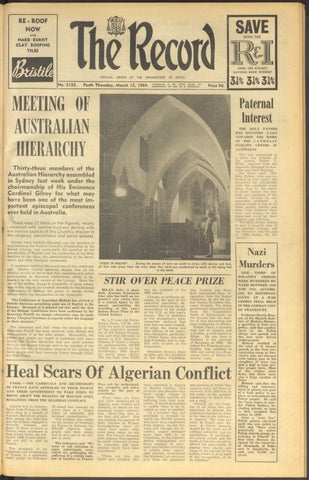
MEETING Of AUSTRALIAN HIERARCHY
Paternal Interest THE HOLY FATHER A450 HAS DONATED TOWARDS THE WORK OF THE CATHOLIC ENQUIRY CENTRE IN AUSTRALIA. This was announced in a letter the director of the centre, Father T. White, received from the Apostolic Delegate to Australia and New Zealand. The letter read: "The Holy Father, who was informed of your report, has expressed his satisfaction with the excellent work being done by the centre to make known the doctrine and teaching of the Catholic Church to our A separated brethren. special praise is due to all those people, priests and laity, who dedicate their time and energy to this important work by their prayers and offerings. "The Holy Father wishes to give a tangible sign of his paternal interest, and has therefore sent the sum of 1.000 dollars for the centre."
Thirty-three members of the Australian Hierarchy assembled in Sydney last week under the chairmanship of His Eminence Cardinal Gilroy for what may have been one of the most important episcopal conferences ever held in Australia. There were 22 items on the Agenda, mostly concerned with routine business dealing with the various aspects of the Church's mission in the religious, educational and social spheres. Among many matters discussed was the question of implementing the Vatican Council's Constitution on the Sacred Liturgy, and particularly the question of the introduction of 'English into the celebration of the Holy Sacrifice of the Mass, the administration of the Sacraments and other liturgical ceremonies. A statement issued at the conclusion of the conference said: "Mother Church earnestly desires that all the faithful should be led to that full, conscious and active participation in liturgical celebrations which is demanded by the very nature of the Liturgy. Since the use of the mother tongue is frequently of great advantage in this regard, the Council conceded to the National Conferences of Bishops the power to decide within certain limits the introduction of the vernacular. "The Conference of Australian Bishops has arrived at definite decisions permitting some use of English in the Liturgy. However, it is pointed out that until the Acts of the Bishops' Conference have been confirmed by the Sovereign Pontiff, no change whatsoever may be made in any liturgical functions as regards either the language or their structure." The statement said that when the decision of the Sovereign Pontiff has been received, each Bishop will communicate it to his own people. Meanwhile, the priests and people are urged to penetrate ever more deeply the Divine Mysteries that are made present through the Sacred Liturgy and to be mindful of the fact that the aim of liturgical renewal is the uniting of God's people with their heavenly Father through Christ the High Priest.
"STUDY IN PRAYER" . . . During the season of Lent we recall to mind, with sorrow and love, all that took place from the time when Our Lord was condemned to death to His being laid in the tomb.
STIR OVER PEACE PRIZE MILAN, Italy: A short, dark, dynamic Franciscan friar who has built an impressive arts centre here is a central figure in the uproar surrounding the awarding of this year's Balzan Peace Prize to the United Nations. He is 57-year-old Father Enrico Zucca, 0.F.M., who holds the post of president of the executive committee of the Balzan Foundation and who delivered in person to U.N. SecretaryGeneral U Thant a cheque for approximately 160.000 dollars this month as the foundation's 1964 award for world peace efforts. The late Pope John XXIII
was the recipient of the 1963 award. Charges of arbitrary decisions on the part of the executive committee immediately followed the announcement of the choice of the U.N. as this year's winner. The 11 members of the foundation's prize committee declared that they had not been consulted about the choice and that officers of the executive committee, particularly Father Zucca, had acted high-handedly and in conflict with by-laws of the foundation. President Antonio Segni of Italy and the president of the Swiss Confedera-
tion. Ludwig von Moos. both announced their resignation from the Balzan committee. So did the former Italian President Giovanni Gronchi. The Swiss government stepped in and froze the foundation's funds in Switzerland, on the ground that the charter of that foundation had been violated by its officers. Father Zucca. a dynamic man full of projects and activities, is well known in Milan. He was born in Vertova, in the province of Bergamo. in 1906. He joined the Franciscan community, was ordained in 1932 and served in a Franciscan friary at Monza for several years.
Heal Scars Of Algerian Conflict PARIS. — THE CARDINALS AND ARCHBISHOPS OF FRANCE HAVE APPEALED TO THEIR PEOPLE AND THEIR GOVERNMENT TO TAKE STEPS TO BRING ABOUT THE HEALING OF WOUNDS STILL REMAINING FROM THE ALGERIAN CONFLICT.
I.
Algeria won its independence from France in 1962 after close to a decade of Warfare. Extremist groups, both among the Algerians and the French, engaged in terrorist violence, and many of those arrested in France were sentenced to long prison terms. An estimated 1,000 former terrorists are still in gaol in France. The Assembly of the Cardinals and Archbishops of France in a statement made public on February
They call for understanding, sympathy and active charity on the part of everybody. "First, there are those who have disappeared in Algeria, men, women and 29 asked that amnesty be children, of whom no one given them as a "major possesses certain informatoken of solidarity and tion. Have they died, or national reconciliation." are they still alive? One The prelates also called can imagine the anguish of on the people of continen- their families in France. tal France to welcome the Investigations have al800.000 Algerian immi- ready been made; steps grants into their midst, have been taken on our and to give aid to all who part. The Church demands are in need. with urgency that searches be made wherever it may The statement said: "We be presumed that these want to call attention to persons might have been some unfortunate cases transferred. which are prolonging the suffering of a certain numThere are also the ber of families in France. wives and children who
have remained in Algeria of Moslem soldiers, civil servants and deputies who have sougl-it refuge in France. These families are suffering from their separation. It would be humane to enable them to be reunited as soon as possible. "In a broader way, our solicitude is directed towards the 800.000 persons who have been repatriated from Algeria. In our dioceses and through our assembly. urgent messages have been sent to all Christians, to the Catholic Action organisations and those engaged in charitable and welfare activities to receive these repatriated persons everywhere like brothers. Let everyone give them the assistance
and services of which they stand in need. Let them be received with affection in the midst of the national community of which they are a part. "Finally, we are thinking of all those who are expiating in prisons the sentences imposed on them at the time of the incidents in Algeria. The time has come to forget past discord. A broad amnesty should be the great act of national solidarity and reconciliation. In particular, the young people and the heads of families should be offered the opportunity of placing their energy and hopes at the service of the nation, which is so in need of the co-operation of all its children."
Nazi Murders ONE - THIRD OF POLAND'S PRIESTS WERE MURDERED BY NAZIS BETWEEN 1939 AND 1941, ACCORDING TO TESTIMONY GIVEN AT A WAR CRIMES TRIAL HELD IN THE GERMAN CITY OF FRANKFURT. Professor Martin Broszat, of the Munich Institute of Modern History, a specialist in Nazi race policy, said that another third of the Polish clergy was- gaoled and the rest were driven underground. Broszat testified at the trial of 21 former guards at the Nazi concentration camp at Auschwitz who are charged with taking part in the slaughter of from two and a half to four million people there. Most of the victims were Jews, but there were also a large number of Poles. Broszat said that the killing and imprisonment of priests was part of a Nazi policy to enslave or exterminate the Polish people. He said the Nazis began to murder Polish leaders, including priests, as soon as they occupied that nation in 1939. Only a "very few" Polish priests survived until the war ended in 1945 and "there were practically no active Polish church groups remaining in Poland" by that time, Broszat declared. Of the hundreds of thousands of Poles sent to Auschwitz, he said, only 15.000 survived.
1
THE
Page Two
LENTEN LAWS
Bishop Fulton Sheen .
ABSTINENCE:
ONE OF THE REASONS WHY OUR FOUNDING FATHERS INSISTED ON THE SEPARATION OF CHURCH AND STATE WAS BECAUSE OF THE PLURALITY OF RELIGIOUS IN THE UNITED STATES.
1. Everyone in good health who has reached the age of reason is obliged to abstain. To abstain is a serious obligation. All Fridays and Ash Wednesday are days of abstinence. Flesh meat and meat soup are forbidden. Lard and dripping may be used on days of abstinence provided they be used merely as a condiment nr seasoning.
M
ANY ,Nations, such as England, Norway, Denmark, Sweden and others, had one established religion: so did about nine of the colonies. By separating the Church and State, our forefathers never separated religion from the State. There is a tendency today, however, to argue that on account of the pluralism of religion in the United States, there should be no recognition of religion whatsoever because it might be unfair to those who are anti-religious. It is well in connection with pluralism to recall the story of a king who had a parade of all his uniforms. Hundreds of lackeys paraded before the court—one bearing a uniform for a ball, another for mountain-climbing, another for meeting foreign diplomats, another for state dinners, another for the throne, and another for Parliament, etc. The pluralism of costumes was recognised as a successful event until a boy standing off the edge of the room pointed out that the emperor was naked.
FAS1 : I. Everyone in good health over 21 years of age and under 59, and not engaged in exhausting 1.vork, is obliged to fast. This is a serious obligation. Every day of Lent, from Ash Wednesday to midnight on Holy Saturday, is a day of fast, except all Sundays and St. Patrick's Day (March 17). On fast days, those bound to fast are allowed one full meal, that is a meal without any limitation as to quantity, and two smaller meals. At the two smaller meals they may take whatever is necessary to enable them to perform their ordinary duties. The full meal may be taken either in the evening or at midday (A handy way of computing how much food may be taken at the smaller meals is to say that together they should not equal the full meal.) Eating between meals, even fruit and confectionery, breaks the fast. However, a biscuit or some similar small portion of food may be taken with a drink. Liquids do not break the fast (a liquid is anything that is consumed as a drink, e.g. tea, milk, fruit juices, beaten egg, etc.). On days of fast without abstinence, meat is allowed at all meals.
BASIC PRINCIPLES
NOTE:
AMERICAN CARDINAL ATTACKS "THE DEPUTY"
IT IS WELL to recognise pluralism of religious beliefs, but it is
wrong to conclude that; therefore, there should be no religion in a nation. There are always some basic principles which are absolutely necessary for the well-being of a nation and which are never in dispute. The Supreme Court, some time ago, at, the instigation of some atheists, judged that an innocuous 22-word prayer violated the First Amendment of the establishment of a church. The Court, basing itself upon a figure of speech, namely, the wall of separation, forgot that no one puts up a wall without containing something, and without enclosing something. Religion was supposed to be inside of this wall, not an established church.
Cardinal Spellman observed that the whole world —including the Jewish people — mourned the passing of Pope Pius in 1958. "My residence was flooded with condolence messages of from many of them who felt deeply that they as well as
we had lost a loving father," he said. "Today," he continued, "a play is being shown in our city which attempts to reverse this judgment and in effect holds Pope Pius XII guilty of the Nazi crimes. Only six years after his death, our Holy Father is being tried and condemned on stage." The Cardinal said he had worked intimately with the Pope and knew that. "he was incapable of any base motives or personal cowardice." Asked if his statement might be taken as a directive to Catholics to refrain from seeing "The Deputy," the Cardinal said his statement includes everything he wished to say.
OFFICIAL ENGAGEMENTS MARCH 15: 3.30 p.m.—Confirmation and Canoncial Visitation, Lesmurdie. 8.30 p.m.—Attend annual St. Patrick's Concert, MARCH 17: 10.15 a.m.— Attend St. Patrick's Day Mass, Subiaco Oval. MARCH 22: 8 a.m.— Confirmation and C anonical Visitation, Maida Vale. 3 p.m.—Acies Ceremony of Legion of Mary, Sacred Heart Church, Highgate. MARCH 24: 8.30 a.m.— Reception Ceremony, Convent of Mercy, Leederville. MARCH 25-29: Holy Week Ceremonies.
APRIL 5: '7.30 p.m.—Confirmation and Canonical Visitation, Attadale. APRIL 12: 3 p.m. — Attend Legion of Mary Acies Ceremony, St. Mary's Cathedral. 3.30 p.m.—Confirmation and Canonical Visitation West Perth. '7.30 p.m.—Confirmation and C anonical Visitation, Riverton. APRIL 19: 3 p.m. — Confirmation and C anoni ca I Visitation, Como. 3 p.m.— Bless new Convent for the Sisters of the Holy Family of Nazareth, North Beach. 7.30 p.m.—Confirmation and Canonical Visitation, Mt. Lawley. APRIL 25: 8.30 a.m.—Attend Anzac Day Mass, St. Mary's Cathedral.
SUPPORT OF LAW
The Supreme Court thereby' affirmed the Eleventh Commandment—Thou shalt not pray. They who were coMmitted to the defence of the Constitution, which is based on religion, have now declared against it.
IF A SUPREME COURT holds Thou shalt not pray — because it will offend the atheists—then is not the next step to give to the atheists rather than to God-fearing men the right of propaganda? The next decision logically will be that one which affirms that anti-prayer and anti-religion in school have the support of law in education. Whether or not the Supreme Court will quote the Soviet Constitution that "freedom of anti-religious propaganda belongs to the State" remains to be seen. But the bacillus has already infected our national organism. The prayer-ers are off the reservation: the anti-prayer-ers are on it.
We ask the question: Quo vadis, America? Does not this decision prepare the way for what may be the last decision of the Supreme Court? Some of us may live to see the day when it is passed. It will be the death sentence upon our
America has reached a critical hour where its citizens must once again hear the words that Washington spoke to his soldiers at Valley Forge: "Put only Americans on guard tonight!"
1
.41,04.1.41,1141 4.4.41 0•411,11N ,
They Elected A Human New Pastor Attraction
MO:
the people to elect their parish priests — called the right of patronage — still exists in a few localities in Italy. Meta's parish of Santa Maria del Latin) is one. The privilege of choosing t he parish priest here by secret ballot traces back to 1543. That was when two citizens, Nardello del Polo and Raffaele Falifani, gave the land for the new basilica of St. Mary of the Laurel. Their donation of the land was made on the condition that the faithful would have the right to elect their pastor from a list compiled by authorities of the Sorrento archdiocese. The reason for the 40-year lapse in exercising the franchise is one of longevity. The last pastor, Father Stefano Porzio, died this past January after serving two score years. As election day drew close, partisan fervour gripped the town. The odds-on favourite was Father Giuseppe Russo, who had served as a curate of the parish under Father Porzio. The other two priests on the ballot were Fathers Gennaro Iaccarino and Giovanni Cuccurullo. Despite the fact that Father Russo was popular and better known, factions developed in the town. Depate waxed in the streets, cafes, at the carpenter's shop and the smithy. The polls opened in a room adjacent to the church at 9 a.m.—after Mass on the third Sunday of Lent. Officials appointed by Archbishop Carol Serena of Sorrento sat as poll watchers.
The polls closed at 3 p.m., with 771 out of the eligible 1,300 electors having voted. At 5.30 the Archbishop's office announced the winner— Father Russo, with 437 votes. Father Iaccarino polled 181 and Father Cuccurullo came in third with 153.
the window of his house to acknowledge the cheering crowds. His new parishioners talked him into corning to his door, and then carried him in triumph to the threshold of the basilica.
JEWISH GUILT LONDON: Jews all over the world were disappointed when the Vatican council failed to make a statement rejecting Jewish guilt for Christ's death, a Jewish leader said here. Dr. Gerhart M. Riegner. of Geneva, director of coordination of the World Jewish Congress, speaking at the 13th biennial conference of the British section of the congress, called attention to the Rome communique of November 7, 1963, which laid the blame for the death of Jesus on all mankind. Dr. Riegner said the document contained a general condemnation of anti-Jewish hatred and persecution in the past and present. "It was not surprising that when the council later adjourned without adopting the text, or even discussing it, or at least taking a test vote of principle, that disappointment was considerable," he said.
TUCKER and AURISCH
are R ADIATOR SPECIALISTS All Replacements and Repairs by Qualified Tradesmen.
PHONE 21-6518
;
META, Italy: Catholics of this small town NEW YORK: Francis Cardinal Spellman across the bay from Naples went to the polls has assailed "The Deputy" as a "slanderous and divisive drama" and an "outrageous des- March 1 to elect their new pastor. It was the ecration of the honour of a great and good first time they had done so in 40 years. man," the late Pope Pius XII. The ancient privilege for Father Russo appeared at In a public statement the Cardinal said the controversial play by German author Rolf Hochhuth was "calculated to stir strong emotions and bitter feelings" and said he hoped it would not "drive a wedge between Catholics and Jews." The play, which opened on the Broadway stage on February 26, depicted the late Pope as failing to protest against the Nazi persecution of the Jews.
great country. That future decision will be a repetition of Article 124 of the Soviet Constitution, which reads: "The Soviet Union recognises freedom of religious worship and freedom of anti-religious propaganda." Note that it distinguished between worship and propaganda. Worship or prayer is recognised if there is a church (after 53,000 were destroyed) and if one will risk his job by going to church. But may one preach, publish, broadcast religion? May one organise religious youths? May one collect to build another church, or schools, etc? No! This is propaganda. And atheistic propaganda is reserved for the State.
The Eleventh Commandment
RULES OF FASTING AND ABSTINENCE DURING LENT
(a) The solemnities of marriage (Nuptial Mass, the use of music, etc.) are forbidden until Easter Monday. (b) The Pascal Precept is required to be fulfilled between Ash Wednesday and Trinity Sunday (May 24).
Thursday, March 12, 1964
RECORD
or Call
1017 HAY ST., PERTH
MUNICH: .1 communist c ommentator has acknowledged to Czechoslovaks that even under the good life promised by Marxism. religion can have basic human attractions. "Personal tragedies, a crisis in life and disappointments exist, too, under socialism," and these can lead an individual to turn to religion for comfort, wrote the question - and - answer columnist of the official publication of the Ostrava regional communist party committee. The question under discussion was, "Why do some young people believe in God?" The standard communist answer to this is that it is a carryover of the backward days under capitalism, noi yet corrected. But the Czechoslovak writer, Jaroslay Krejci, of the faculty of the Ostrava Education Institute, asserted that this is not the full explanation. Frequently, he wrote, the practice of reducing questions of the meaning of life and human happiness to the material things of the world "leads people not to real but to one-sided 'happiness' which is not far from illusion."
MAXWELL ROBINSON & PHELPS 599 Newcastle Street, Perth Phone:
28 3741
THINKING OF TRAVELLING? FOR
ALL
BOOKINGS
BY
AIR, SEA, RAIL or ROAD WITHIN
AUSTRALIA
OR
OVERSEP S
Consult—
DALGETY-N.Z.L.
TRAVEL SERVICE
15 WILLIAM ST., PERTH. 21-2841.
. ,.- 1e11.11100010MIPIONIIrilrilltSPIIIMall 1111r1111
ROY GALVIN & CO.
229-233 William St., Perth 28-1541
PLUMBING MATERIALS BATH ROOM FIXTURES SEPTIC TANK — DRY WELLS The "Plumbing Supply Specialists" 1110011010111111010111.111111110110101\01101W1101011111
Thursday, March 12, 1964
THE
RECORD
POPE: Gypsies Show I A Real Trust In God 1
•,071-„•
Page Three
Former West Indian Policeman Becomes Special Constable In Britain ...... ..........-... „
VATICAN CITY.—LIKE THE PATRIARCH ABRAHAM, THE CHOSEN PEOPLE AND EVEN THE HOLY FAMILY, GYPSIES SHOW A LACK OF WORLDLINESS AND A REAL TRUST IN GOD, POPE PAUL HAS SAID. He was speaking at an audience granted to delegates attending an international convention of chaplains to gypsies. The Pontiff encouraged and blessed their work. Gypsies, Pope Paul said, understand certain of the evangelical virtues better than many men. Citing Bible stories of wanderings, he noted that Abraham in his wanderings was given exemplary the "gift of faith," and that the Chosen People of God wandered for four centuries before reaching the Promised Land and showed "solid traditions of total trust in God." He also spoke of the example of the. Holy Family who fled to Egypt in obedience to God's will. "Exemplary faith, detachment from the world, obedience and absolute confidence in God, such are the qualities you must find and elevate among your flocks and upon which you can usefully centre your ministry," the Pope said. The convention of gypsies' chaplains opened with a Mass offered by Carlo Cardinal Confalonieri, Secretary of the Sacred Consistorial Congregation, which has charge of the programme of religious assistance to gypsies. Father Bruno Nicolini, in charge of the assistance programme in Italy, reported that in northern Italy eight laymen have been helping him since he began his mission to gypsies in 1959. He said that in 1959, 96 per cent of the 950 gypsies he contacted had been baptised, but that only six per cent had received first Holy Communion and less than five per cent had been confirmed. Only about a quarter of the marriages had been Church weddings, he said. In 1963, he went on, first Communions were up to 20 per cent, Confirmations to 18 per cent and 39 per cent of marriages had been regularised. Last year ,he said, the first gypsy in Italian history to become a nun entered a Benedictine convent.
REPORTED THREE HISTORIC EVENTS
VATICAN CITY.—Vatican Radio had a record year in 1963 in reporting on three historic events—the death of Pope John XXIII, the election and coronation of Pope Paul VI and the second session of the Second Vatican Council. Reporting in the annual year book, "Activities of the Holy See," Vatican Radio recalled that it issued news bulletins and medical communiques around the clock beamed to all parts of the world during the death of Pope John. The radio station, which is operated by a special team of Jesuit priests, gave technical assistance to 27 foreign broadcasting companies and systems during the conclave which elected the present Pope and during the coronation. Another special service, beyond the regular roundthe-clock schedule of the stations, was the magnetic tape recording of all the interventions of the council Fathers during the second session. More than 350 other Fathers were given use of Vatican Radio facilities to inform their faithful of their work in the council. Barcelona Radio named Vatican Radio recipient of the 1963 "Ondas" award "for services rendered to Christianity in the days of the death of John XXIII and the election of Paul VI to the supreme pontificate." In 1963, Vatican Radio broadcast 3,683 Weekly programmes. Of these, 231 were directed to European countries; 47 to Africa; 42 to Canada, the United States and Latin America: 22 to Asia and 14 to Australia and New Zealand.
W. H. BRANCH & SON S TONEHAM STREET, JOONDANNA
Phone: 8-2406 — 24-1157 All Types of Electrical Work Undertaken
ANNUAL IRISH CONCERT Capitol Theatre SUNDAY, 15th MARCH, 1964 A T 8.30 P.M. ADMISSION: ADULTS 6 6—CHILDREN 3/6 Bookings open at Theatre on Monday, 9th March
. .44 , 14.4.4•41 .4Krn4 ,4.44,4V4.4,14 4•4, •
We Solicit a Trial from all Religious Institutions No order too big or too small. We can supply every need— if at all manufactured. W.A. Agency for "Tibaldi" Brand Salami Sausaae and Canned Mortadella and Zompone.
GIVE YOUR NEXT ORDER TO—
SARA & COOK PTY. LTD.
WHOLESALE GROCERS AND PROVISION MERCHANTS
PHONE: 21-5121. 482 to 484 Murray Street, Perth
Under Study Vatican City: The beatification causes of two 19th. century Italian priests, both founders of congregations of Sisters, have been introduced in Rome. The Sacred Congregation of Rites has begun to study the lives of Father Luigi Scrosoppi, founder of the Sisters of Providence, and Father Benedetto Menni, founder of the Hospital Sisters of the Most Sacred Heart of Jesus. Father Menni was also Prior-General of the Order of Hospitallers of St. John of God. Father Scrosoppi was born at Udine, Italy, on August 4, 1804. He was ordained on March 31, 1827, and entered the Udine Oratory of St. Philip Neri. He became superior of the Udine Oratory until its suppression by the Italian government in 1866. He and his brother joined forces to found the Sisters of Providence. Father Menni was born in Milan on March 11, 1841. Before entering the Order of Hospitallers of St. John of God at the age of 19, he was an employee of a bank. He was ordained in 1866 and sent to Spain, where he founded a hospital. When Religious were expelled from Spain he went to Portugal and then to Mexico, where he founded many houses. In 1880 he founded the Hospital Sisters of the Most Sacred Heart. In 1911 he was elected Prior General and remained at that post little more than a year. He died at Dinan. France, on April 24, 1914. Ponent for Father Scropoppi's cause is Carlo Cardinal Confalonieri, and the postulator is Father Mauras of the Immaculate, a Pa ssionist. Ponent for Father Menni's cause is Cremente Cardinal Micara, and the postulator is Father Gabriele Russotto of the Hospitallers of St. John of God.
Pope Names Consultant Pope Paul has named the president of the Pontifical International Marian Academy, Father Carlo Balic, 0.F.M., to be a consultant to the Sacred Congregation of Seminaries and Universities. Father Balic has long been a consultant to the Sacred Congregation of the Holy Office.
Astley Lloyd Blair, 27, at one time a regular police constable in Jamaica and now a process worker at a synthetic fabric factory in Britain has been appointed a special constable. After taking the oath of allegiance to Her Majesty, Queen Elizabeth II, Astley was -fitted with the blue uniform of the British policeman. Married and living in Gloucester, England, he has joined the normal duty roster of the city police. Duties include traffic and crowd control. Here he uses the t wo-way radio of a police car. . (Photo U.K. Inf. Service'
Work Still Goes On In The Congo ROME: A Belgian priest, just returned from the Congo, reported that missionary activities there are not disrupted despite stepped-up raids by marauding bands. Msgr. Jean Jadot, director of the Pontifical Mission Societies of Belgium, was quoted by Fides, a missionary news service here. He said the January killings caused a shock that is "very noticeable in most of the missions, but for all of that it does not destroy the serenity of the missionaries." He said he was "struck to see how poorly public opinion is informed on the real situation" on arriving in Europe. "The incidents of Kwilu concern about 5 per cent of the total population of the Congo," he continued. "Everywhere else work may
go on, often in conditions that are consoling to missionaries, because of the welcome that is given to them by the people." Msgr. Jadot said the disturbances have shown that anything can still happen, especially in isolated places. But the serenity of the missionaries, he said, "which is certainly not due to a lack of clarity about the situation, although it is truly impressing, does not keep religious authorities from following a policy of resolute prudence. There is no question of exposing one's self to certain danger when it is better to withdraw for a few weeks to a more calm region."
WM/1
FOR QUALITY MEAT
A. W. TAYLOR FAMILY BUTCHER Corner John and Fitzgerald Streets, Perth. 11111111111111111111111111111111111111111111111111111111101 O'HARA'S
DAY & NIGHT PHARMACY • Cr. FITZGERALD & FORREST STS., NORTH PERTH 11111111111111111111IIIIMMIIIIUM1411111111011911
Not To Be Overcome The Holy Father has warned that the Church in Latin America must overcome or be overcome. The Pope told the Italian Bishops' Conference's Committee for Latin America at an audience: "It is not necessary for us to speak to you of Latin America, of its needs, its dangers, its reawakening and its hopes. You know by now of the religious conditions in that immense continent. "And so it is not necessary for us to urge you to think, pray, suffer and work for that great part of the Catholic Church which is experiencing a decisive hour in its existence —either to overcome, through an opostolic effort savouring of pastoral 1-eroism and conquest, the disproportion of its institutions in relation to the cultural and religious needs of those countries, or to be overcome by the prevalence of anti-religious or a-religious or a-Catholic phenomena, perhaps to the point where those lands baptised by the Church may 1os3 their tradtional culture and distinctive name of Christian."
4
Illusterer ,siott IIttiIdI rely on QUALITY
ember ornery WHITTAKERS Whittakers are W.A.'s Timber Joinery specialists employing skilled craftsmen of many years experience. Insist on Whittaker, Timber Joinery, the finest man and materials can make.
Complete Dignified Catholic Funeral Service by
A. R. MONAHAN PTY. LTD.
Bedford Park and all Suburbs Day and Night — 71-5885, 71-5894. ALL FUNERALS PERSONALLY CONDUCTED BY MR. BERT MONAHAN -- 26 1819. CERTIFIED FUNERAL DIRECTORS ELIGIBLE TO CONDUCT PENSIONERS' FUNERALS.
THE
Page Four
Thursday, March 12, 1964
RECORD
I N1•1•4•01•1•441•4•4•41^4.4•41.#4•4,....•
-INTERNATIONAL --NEWS
JAPAN
LARGEST NEWSPAPER A FULL PAGE IN A RECENT ISSUE TO PROBLEMS OF CHRISTIAN
UNITY. Asahi Shimbun, which has a circulation of four a half million, included in its report on ecumenism pictures of Pope Paul VI, the late Pope John XXIII, Orthodox Patriarch Athenagoras of Constantinople and Anglican Archbishop Michael Ramsey of Canterbury. and
e41. .dee#4,4r4e41.4,4 4r4r4r,e4e.e,e#41.#04,041-04,
1•11serne,....ae#0,/~..~#414ele , .AINNPAPJ•INIshere4,4•4NINP.e...e....44•4•04
TANGANYIKA
..#4,0,VINIINVININ 04,4.4,40.4....4.4,..1,0....0,,NPAININININMAPAP~NINONIP, ,04, ,41 ,041 41
,0###############,NsI 1
THE SISTERS OF ST. ANNE ARE BUILDING A 350,BED HOSPITAL AT THEIR TUTICORIN AND EXPECT MEMBERS OF FROM EXPELLED BEING ARE WHO ORDER
INDIA
Africans On Committee THE Bishops of Tanganthree created have yika bodies to work towards the renewal and adaptation of
CEYLON TO JOIN THE STAFF. The Sisters, whose motherhouse is in Lucerne, Switzerland, hitherto have had only a 50-bed hospital in the South India city. They have seven other hospitals in India.
the liturgy for their people. Created were an episcopal commission made up of five bishops, a pastoral institute for study and research, and a national committee. To
The Ceylonese government announced a few years ago that it was expelling Catholic nursing Sisters The removals have from government hospitals. gone steadily forward, and the country's last 60 nursing Sisters are scheduled to withdraw from Colombo General Hospital this month. Once there were as many as 250 nursing Sisters in Ceylon.
ensure that the members understood local mentality and customs as well as the liturgy, three of the fivemember episcopal commisi and four of the six sior, priests on the national committee are Africans.
, .4•4 0"."•`~~4•••••••••••"1"t~~ AdPapaprealse.IriP"e..#####.114•49.#4•4.44.4•1
111/11•••••••••••••
206 STIRLEN° HIGHWAY, CLAREMONT PHONE $ 1566 rnendly Service — Good Accommodation — Parties Specially Catered for M. A. & N. M. MeDONNELL
COMING TO PERTH
Stay
A ccommodation Increased
at
THE RIVERTON HOTEL MOTEL
HIGH ROAD, RIVERTON 69 WS TV in every Unit. PloCtlint 9-Hole Golf Course, FRKD MILLS, Liceccen
FRIENDLY SERVIO€
BAYSWATER Hotel
REX HOTEL
t .r KING & HAY STREETS Convenience el Bar Pr ,ri Guests and Friends Phone: 21 8634 Personal Supervision Mr& B. B. REILLY
OPP, STATION Excellent Aocommodatfon Frequent Train Service — 4 Itilfs from City — Large Parkins Area BED and BREAKFAMP REASONABLE TARRIEW LES BARTLET'T, Prop TEL.: 11 1224
SUBIACO HOTEL
WEMBLEY HOTEL
Class Accommodation and Service DRIVE-IN BOTTLE DEPT. FREE HOME DELIVERY
First
Phone: 8-1028 Alex McHenry. Proprietor.
Excellent Lounge and Accommodation
Phone 87-2418 Cnr. Cambridge Jrio A lexander Streets, Wembley
HOTEL
WAVERLEY HOTEL Next Scans Waverley Stores ALBANY HIGHWAY CANNING TON
Modern and Convenient Homely Accommodation Use Our Drive-In Bottle Service Phone 68 2419 A. R. CONNELL
HOTEL CRITERION HAY STREET
CENTRAL PERTH 24-HOUR SERVICE f ree Parking for Country Residents Minutes' walk from Cathedral, THE COUNTRYMAN'S HOTEL PHONE: 23 1115 (5 lines)
, ,4 414,41.4,11,11
0
YOUR HOTEL GUIDE HIGHWAY HOTEL
UGANDA
Australia
MURRAY STREET, PERTH E xcellent Accommodation sad Dining Service LUNCH, 10/-1 DINNER 17/4 PHONE 23 1541 En!, -7; the Best ACCOMMODATION & SERVICE
HOTEL COTTESLOE
PRIME Minister A. Milton Obote of Uganda presided at the opening of new buildings at St. Peter's College at Tororo recently. The Catholic college will now have room for 360 students with the addition of t he new housing, a library and classrooms, two laboratories and an administration unit. The money was United the by provided States government.
CEYLON Observer's Views THE Vernable Harold de Soysa, an Anglican observer at the Vatican council, said in Colombo that Christians in the East are in a better position than their Western brothers to see the urgency for Christian unity. Dr. De Soysa, Archdeacon of Colombo and principal of the Anglican Divinity School, of representatives t old many Christian groups that there has been an improvement in church relations because of the Vatican council.
RIGHT ON THE SEA FRONT 3-2155 a. M. DYNIOCIE, Licensee
AUSTRIA 0! , 4 4•4,40.4•41
WILLAGEE PARK HOTEL The States Most Modern TOM KENNY, Licensee. II*. Stock and High Roads, ' MELVILLE Phone: 30 3428
HOTEL ESPLANADE PERTH'S LEADING HOTEL FOR ALL VISITORS • Phone: 23-1531
NATIONAL HOTEL
COMMERCIAL HOTEL
Cnr. High and Market Ste., FREMANTLE
N ORTHAro Phone Northam 49 T. E. MURPHY. Prophet°,
Offers excellent
homely accommodation Phone : 5-1786 Philip P. Kearins, Licensee
Plympton
CITY HOTELSt..,
Cnr. King and Murray Perth ‘,OUNTER LUNCH, 12-1.30 p.m. Friday: Saturday 12-10 p&i. A.RCII1B THOMPSON Offers you only "The Best" Phone: 21-4094
NINIPIP4"IP414^ I
#4. #4NP04.04.1I.e..,
Jack Sheedy PHONES
21-1311,
BUSINESS
HOTEL
Home of Country People CANNING HIGHWAY EAST FREMANTLE Eric Campbell, Prop. 5-1721. ,ININP #.1.4P1ININNIP #4,ihe #41
4141441,0040•
CARLTON HOTEL
Organisation Is /Accused AUSTRIA'S Catholic charities organisation, Caritas, has denied it ever heard the name of Hans Hefelmann or helped him to escape to Argentina. The claim was made by Hefelmann, former Nazi official on trial in Limburg, Germany for complicity in the murder of 73,000 mentally retarded persons during the Hitler regime. Hefelmann said at the trial that Austria's Caritas had helped him get a visa to go to Argentina in 1948 after he had fled from Germany to Aus-
BOLIVIA , I4P#M4INP , 41,
Homes For The Poor
218 HAY ST., PERTH
23-3091
MEN'S LUNCHEON — 12 to 2 p.m.
. • AP4P I ,414/NANNINIRININIONINP 0#41 #4.4.4.0411.041,14.4.4.041.41•.#4,04.0041PM.1.~."1.4141,4,
Cr.
DALY'S
MEET
DAILY it
ROYAL
HOTEL
WILLIAM and WELLINGTON STREETS, PERTH. Phones. 21-8924. Bottle* Dept.. 21-8436.
.1111••••=..
THE WATTLE RESTAURANT OPEN MONDAY TO SATURDAY 10 p.m. to 8 p.m.
3 COURSE MEALS 7/-, SNACKS from 4/. Available for private hire A fter 8 p.m. Week Days and on Sunda vg
62 St. George's Terrace, Perth, Phone 23 3403
H. INFTRRI Man•A ger
FORMOSA
THE first five of 100 lowcost houses for poor families, which are being built at La Paz by Mary Auxiliatrix parish, have been turned over to their new owners. The EA900 houses — containing living-room, dining-
room,
kitchen, bath and three bedroms — are being paid for by the owners in monthly instalments. low Funds for their construction were raised by the parish.
The report, written by Toshikaru Shibata, praises highly Pope Paul's recent visit to the Holy Land. Shibata said he believes -recent developments towards Christian unity are of vital interest to
04•04•4•4•41.4"41#4,4 , 4 , P#4
Church And Social Centre
Japan."
A NEW church and community social centre has been dedicated in Taipei in memory of Father Vincent Lebbe, a Belgian priest who spent his life in the Chinese missions. The ceremony was attended by Thomas Cardinal Tien, S.V.D., the exile Archbishop of Peking, now Apostolic Administrator of the Taipei Archdiocese.
POPE PIUS IX'S COACH
ARGENTINA Bishop Heads Committee THE Argentine Bishops have formed a national committee on the liturgy to implement the liturgical conthe stitution enacted by Second Vatican Council. Headed by Bishop Domingo Rau of Mar del Plata, a member of the liturgical commission at the council, the three-member committee will initiate any programmes or experiments recommended by the council.
GERMANY s4P4r4.4.44.#•
More Room For Freedom AN Institute for Ecumenical Research has been opened at Tuebingen in affiliation with the Catholic Theologicial Faculty of the University of Tuebingen. It is Hans Father by headed Kueng, who is in charge of
Pope Paul VI r2cently made a private visit to the Vatican garage, praised the stag and prayed with them in the small chapel there. The garage supplies, maintains and repairs the fleet of cars and trucks of Vatican City. The building also houses a collection of old cars and coaches used by former popes. Pope Paul VI is shown inspecting the coach used by Pope Pius IX. who reigned from 1846 to 1878. Photo N.C.'
YOUR MORLEY CHEMIST ( Bob Devereux
the Department of Dogmatics and Ecumenical Theology at the university and an ecumenical council ex-
PhC. MPS.)
BOANS MORLEY The Pharmacy Right Inside Roans) your Pr,-,c riptions Picked up and Deli*. .
Phone 76 1395
pert. At the opening ceremonies Father Kueng said "freedom is being given more room in the Church since the start of the Vatican council. This
Get Better Meat for Less at
C LEM PAULLS
t endency engenders more interest in ecumenical work within the Church."
HAY STREET, EAST PERTH — 23-4927 6 3 CANNING HIGHWAY, SOUTH PERTH. 67-1708 WATCH THE WINDOWS FOR OUR SPECIALS 234
ENGLAND
A WNINGS, BLINDS, FLYWIRE DOORS, and FLYSCREENS
Unborn Child To Be The Star
ALL TYPES Measured and Installed in 7 Days by
STAN BOND
A BABY still unborn is to
1010 BEAUFORT ST., INGLEWOOD Phone 71 4313 7op Quality Tradesmen
be the star of a British television programme on Holy Saturday night, it was announced in London. The baby is to be baptised in front of the cameras at the Easter Vigil service in
H. J. LILLEYMAN W.A.O.A.
Sacrament Blessed t he Church, Aintree, Liverpool. on March 29. The feature is being ar-
OPTICIAN and OPTOMETRIST 4 53 ALBANY HIGHWAY, VICTORIA PARK. 6-1880. A nd 156 ROKEBY RD.. SUBIACO. 8-3983. Res.: 67-1685
ranged by the British Broadcasting Corporation.
""11,14.4Nee , 14 , 1,0 .11, 4114M4,1 0,41.411.4,
,41,mo 04.4PAROWW.0#41.......,"4,04,11.41.41
Renmano ALTAR WINE
A CATHOLIC
SOLE AGENTS
PAPER IN
R. CONNABEER & COMPANY
EVERY HOME
165 HAY STREET, SUBIACO.
Phone 8-1410.
rmnip#4.#4.4.~#~4..r000e,"....#4.4,.#4.••••••••••••••••••••••••••••••••••••#••••••••-•--)
tria.
•#
JAPAN'S
DEVOTED
S. & M. CARATTI
BULLDOZING and EARTHMOVING CONTRACTORS ALL HOURS —
65 1334
ST4TE-VIDE
7--OP
SERVICE
Bulldozing — Earthmoving — Clearing — Grading — Road Formation — Dom Construction — Trenching — Ripping No Distance Too For" No Job Too Big FULL
OF
RANGE
MODERN
Q t 'OTES
HEAVY FREE
EQUIPMENT •
GREAT EASTERN H'GHWAY, REDCLIFFE MT.
IWZKER — Phone 151
Thursday, March 12, 1964
THE
RECORD
Little Impact On Tribes
CHAPEL APPEAL OVER SUBSCRIBED The public appeal to ( £2,u00); Australian Capital raise £3,000 in Western Territory £1,700 (£2,000). Australia towards construcThe total cost of the chation of an Anzac Memorial pel will be £60,000. Of Chapel at the Royal Milithis amount £25,000 tary College, Duntroon, has was donated by the Ausbeen oversubscribed. tralian and New Zealand Announcing the closing of Governments and Duntroon the State appeal last week, graduates and their rela the chairman of the State tives. Appeal Committee, Mr. G. M. Bunning, said that £3,257 had been received in donations from all sections of the community. "The response to 'Operation Christian Soldier' has MELBOURNE: The first been very gratifying and is Australian born priest of the indicative of the people's Ballarat Diocese to celebrate generosity and support of a his sacerdotal golden jubiproject that will both honlee, died recently, aged 80. our the dead and serve the He was Monsignor James living", Mr. Bunning said. Brophy, V.F., R.I., of Ararat, The Australia-wide appeal Victoria, who celebrated has so far yielded £31,000 his golden jubilee on Detowards the 05,000 target. cember 2, 1958. Western Australia achieHe was the fourth of 10 ved its target by December children of the late Mr. and 31 and now both Queensland Mrs. T. B. Brophy, of and South Australia targets Stawell, Victoria. have been reached. Amounts raised so far by After attending St. Patthe States are: N.S.W. rick's College, Ballarat, the £8,000 (target £10,000); Vic- late Monsignor Brophy toria £8,000 (£9,000); Queensstudied for the priesthood land £5,000 (£5,000); South at St. Patrick's College, Australia £4,400 (£4,000),. Manly, and was ordained Western Australia £3,257 by Cardinal Moran in St. (£3,000); Tasmainia £900 Mary's Cathedral, Sydney.
Pioneer Priest Dies
74 1054 A fter Hours 71 2670
John lobb & Associates Optometrists & Opticians JOHN LOBB
1 3 THE AVENUE,
Optometrist
MIDLAND
E XCELLENT CUISINE
D ancing and Entertainment Nightly. Private Room for Parties
EUROPEAN NIGHT CLUB RESTAURANT Fully Air -Conditioned
27 LAKE STREET, PERTH. 23 - 1589.
Specialists in "MEALS TO TAKE AWAY" — Ring and Order WEDDINGS and PARTIES on SUNDAYS
Septic Tanks & Dry Wells American equipment. Cleaned Latest All sites accessible.
r No salvage left on property, all carted away.
PHONE
76 1544 FOR COMPLETE INFORMATION
33 Wellington Road, Morley Park
JESUIT PRIEST DIES
SYDNEY: A relative of the foundress of the Sisters of St. Joseph of the Most Sacred Heart of Jesus, Mother Mary McKillop, died suddenly in Sydney last Saturday. He was Father Colin McKillop, S.J., of St. Ignatius College, Riverview. Father McKillop was born at Goulburn on December 6, 1892, and was educatea at Riverview. After working as a bank clerk for several years he entered the Society of Jesus in 1912. He completed his philosophy course at Stonyhurst College, Lancashire, which was at that time a philosophy house of the Society. He was ordained in July 31, 1926, after completing theological studies at Milltown Park, Dublin, and transferred to Wales for tertianship. Father McKillop returned to Australia in 1929 and was appointed Minister at Riverview. He held the post for nine years before taking up a similar position at Canisius College, Pymble. His outstanding administrative ability led to his appointment as procurator of the Australian Province of the Society — a position he held till 1961.
SYDNEY, Australia.— Sir Edmund Hillary, famed New Zealand mountaineer, said here that Christianity has made little impact on the Himalayan mountain tribes. Hillary, who was the first man to scale Mount Everest, told an audience ot Catholic teaching nuns and Brothers he had built a number of schools in the mountain villages, but it any attempt were made to use these schools for religious instruction he would be excluded from the country. Many of the mountain people are poor and illiterate, said Hillary, a noncatholic. He added that unless they were given an education and the necessities of life they would soon be brought under the influence of Chinese communists from Tibet.
"The purpose of the Community," Brother Berchmans said, "is to assist the Church in New Guinea through catechetical work, teaching, and the manual trades." The Brothers will take the usual Religious Vows of
Contraceptive Clinic Opposed A proposal to establish a contraceptive clinic at the Canberra Community Hospital has been strongly opposed, particularly by a spokesman for the Catholic Church. The proposal. was put forward at a recent meeting of the hospital board, after the Director-General of Health, Major-General W. D. Refshauge, had referred to the board a letter from a private citizen urging the establishment of a clinic to assist and advise women in the use of contraceptives. A deadlock resulted during discussions of the proposal by members of the board. The superintendent, Dr. Lane, pointed out that no hospital in either N.S.W. or Victoria, which was supported by public monies, provided this kind of treatment. The chairman, Dr. T. H. Harrison, proposed that the matter be referred to the Medical Advisory Council for its views. Mr. Allan Fraser. M.P., opposed the motion and moved instead that the board inform the director-
General that it recommended no action. He said that a considerable section of the populace regarded contraception as sinful and therefore public money should not be used to provide a contraceptive service at the hospital for people who could obtain the service elsewhere. The — Church spokesman said the Catholic Church's stand on contraceptives was sufficiently well known not to need elaboration. Together with many of their fellow citizens, Catholics would disfavour the use of public money for the provision of services or facilities the purpose of which ran contrary to the moral conviction of a very large section of the community. To adopt the suggested procedure in the Australian National Capital, where human values and the ideas of the family were held in high regard, would be regarded as a wholly undesirable precedent.
JOHN SKUJINS, architectural student from the University of Minnesota, inspects his model chapel plan which won first prize over some 40 student entries. The competition, sponsored by the St. Paul, Minn., Metropolitan Improvements Commission and the Junior Chamber of Commerce was the result of a Catholic Bulletin editorial. The r ounded chapel ( foreground) is surrounded by proposed office buildings in a renewal of St. Paul's central business district. , P!toto
New Religious Order Founded ALEXISHAFEN, New Guinea.— The first 12 Novices of the Brothers of the Sacred Heart of Alexishafen were invested here with the religious habit by Bishop A. A. Noser, S.V.D., on January 15, 1964. The 12 young New Guineans come from scattered villages of the Alexishafen, Goroka, and Mt. Hagan Vicariates of the Divine Word Missionaries. They have spent two or more years of training as Candidates and one full year as Postulants under the direction of Brother BerLangenkamp, chmans S.V.D., of St. Henry, Ohio, U.S.A. Brother Berchmans is the present Master of Novices.
Page Five
poverty, chastity and obedience after a two year Novitiate course.
The Brothers of the Sacred Heart is the second religious community which Bishop Noser has begun in his diocese. In 1956 nine young women took the habit of the newly erected Congregation of the Sisters of St. Therese of the Child Jesus. By 1963 these Sisters numbered 32 professed and 3 Novices.
DOOGUES "CARDS FOR
N.C.)
LOTTERY AGENCY
ALL OCCASIONS"
EASTER CARDS
BEAUTIFUL — RELIGIOUS THEMES Of Special Interest to Catholics SEE OUR OUTSTANDING DISPLAY AT PERTH ARCADE and 19 BARACK STREET, PERTH . ..1.4MMI,P.P.INP4VP^MI.MIP#11.41,04
WATSONIA HAMS and WON
Support Our Advertisers Their high standard of Quality never varies
THE
Page Six
Thursday, March 12, 1964
RECORD
Wedding Service YUCATAN, Mexico.— "It's to expensive to get married in the Church, Padre!" Too often this was the reply of prospective brides Thomas Father when O'Rourke, M.M. of New York asked if they were having a Church wedding. The veteran Maryknoller did a little investigating. "What's the most expensive item for a wedding?" he asked the eligible girls. "The wedding dress!" was the unanimous response. "It costs more than everything else combined." The next stop for Father O'Rourke was the ladies' dress shop, where an amazed shopkeeper filled his order of two of the largest wedding gowns in the store. Within minutes, the Priest had established the first wedding gown rental service in town. "The gowns can be cut down to size," he said, but it would be better if all the brides were tall and hefty." Father O'Rourke now has a long waiting list of prospective brides wanting to get married in the Church.
abc
PHOTOGRAPHERS
For Weddings and al l Social Occasions — Child Studies, Home Portraiture. 83 CENTRAL AVE. REDCLIFFE Phones: 65-1355, 23-4267.
School Designed To Live With Jet Age Situated near the giant John F. Kennedy International airport (formerly Idlewild), St. Pius X of Rosedale, N.Y., is being built with noisy jet planes in mind. The three-storey and basement school, costing $1.25 million, has a circular design which sonic engineers say will leave the least possible area exposed to jet aircraft sounds. This takes care of lateral sounds, which usually bounce off windows and vertical surfaces. A roof deck of concrete slab is thick enough to keep out the loudest overhead noises, experts say. (Photo N.C.)
WIDE SCALE ANTIRELIGIOUS HIVE I BERLIN ( N.C.) : The Communist party has adopted detailed plans to speed up its newly intensified campaign against religion in the Soviet Union. The plans were announced on March 2 in the party's Pravda, daily, Moscow which urged the wide-scale anti-religious drive to offset what party leaders fear is an increase in religious belief even among party members. Pravda said: "Any religion any belief in the supernatu
TO LIM Igf BRAN DY S PECIAL
H OSPITAL
ELLIOTT <tiOtt 1 OPTOMETRISTS—OPTICIANS
PICCADILLY ARCADE . . . 21-8151 154 WILLIAM STREET . . . 21-5304 30 MARKET STREET, FREMANTLE . . . 5-2602. . 3-2655. 19 NAPOLEON STREET, COTTESLOE . ••••• , .4,0,1,441 1
Supplies of Fish, VEGETABLES and POUL1RY at:
ROSS INTERNATIONAL FISHERIES
Head Office: 7 CLEAVER STREET, WEST PERTH PHONE 28-4511 Branch: 29 MACDONALD ST., KALGOORLIE. Phone Kal. 49. SPECIAL QUOTES FOR CATHOLIC SCHOOLS HOSPITALS and INSTITUTIONS. Fresh Fish and Shell Fish Available Daily
1
Lawn Mowers, Shears Sharpened and Set
Harry Armstrong Pty. Ltd. CITY COUNCIL AVENUE — 21-4390.
LOCKS. DOOR CLOSERS and SAFES OVERHAULED and SERVICED C AR and ALL TYPES OF KEYS CUT. Immediate Service.
MOTOR AND GENERAL ENGINEERS A LL WORK GUARANTEE!: — PROMPT SERVICE ASSURED — CARS PICKED UP AND DELIVERED FREE. SPECIALISED SERVICE ENGINE
RECONDITIONING
GENERAL REPAIRS PANEL BEATING LITBRITORIUM SERVICE FITTING AND TURNING CYLINDER
BORING
CYLINDER
SLERVING
CYLINDER HEAD RECONDITIONING CRANKSHAFT GRINDING
Phone:
231953 (5 lines) OARS RYAN. Managm
ral, in good or evil forces in a God Creator is a distorted anti-scientific view of nature and society, a reof scientific placement knowledge by f an tas tic legends . . . Any religion transforms a human being into a slave of gods invented by himself." Meanwhile, the newspaper Soviet Lithuania urged the U.S.S.R.'s atheists to "go on the offensive" against religion. It said the prime target of the offensive in the Lithuanian S.S.R. is the Catholic Church, to which most of the people belong. But it also called for attacks on the Orthodox and Jewish religions. The new plans announced by Pravda were revealed following a meeting of the communist party's Ideological Commission, headed by Leonid Ilyichev. The call for stepped-up efforts to indoctrinate youths and party members and stronger attempts to persuade believers to abandon their faiths. To achieve the latter aim, atheist action teams are to be organised in all cities that have communities of churchgoers. Team members are to be trained to win the confidence of believers and convert them to atheism. Co-ordinating the campaign will be the Institute Atheism, Scientific for whose establishment was reported in January. Beginning with the 196465 school year, according to the plan, atheism will be offered as a field of study in universities and teachers' training schools. Courses in atheism will be organised in schools training communist party and government officials. "Young atheist clubs" are to be established in the lower grades of schools, where anti-religious plays and films will be presented.
Drama's Message For Every Problem JUIZ DA FORA, Brazil: A conscience -provoking dramatic production based on the 14 Stations of the Cross has had a powerful impact on people of Brazil. "Cristo Total" (The Total Christ), originated by a nun-teacher here, so moved one young man, watching the scenes, that he took off his new woollen sports jacket and gave it to his shivering neighbour. The author of the drama is Sister Benedict Idefelt, a member of the Congregation of St. Catherine, who teaches in a high school in Juix-- da Flora. The text was first approved by Bishop Geraldo Maria de Morais Penido of Juiz da Fora and later by other Brazilian Bishops. The actors, some 600 in all, mostly amateurs, enact in a stadium the work they do in real life. They include nurses, carnival dancers, sharecroppers, policemen, soldiers, white collar workers, and labourers.
Message Sister Benedict explained that her intention in writing the script was to demonstrate that the Christian religion is not for Sundays only, not for Church only, not something unrelated to the problems of our daily lives — but that it has a messege for every problem of life. She wishes to show that the outdoor and nonliturgical ceremonies, a traditional part of Holy Week in Latin America, are not just for the uneducated and simple, pious people. She wanted to illustrate that these dramatic representa tions of the Passion of Christ and, in particular, the Stations of the Cross, can withstand the ridicule and criticism of neopagan intellectuals, she said. At the same time, she wished to teach, without preaching, the social doctrine of the Church. That her efforts were • ••••
11 ,
Constitution Indoctrination courses are Of The Liturgy planned for teachers, doc-
tors, journalists and others in the education and mass communication fields.
Writers and artists are being called on to take part in the campaign, and competitions are being organised to promote anti-religious books, paintings and movies. Museums have been ordered to set up special exhibits to aid the drive. A part of the campaign will strive to implement the unanimous decision taken at the January 7 meeting of the Council of Ministers of the Russian S.S.R. to name a commission to "create new civil ceremonies of all kinds, presumably including weddings and christenings.
The Australian Catholic Truth Society is preparing a publication of the "Constitution of the Liturgy," the first official document resulting from the Second Vatican Council. This publication will be prepared with indent headings and paragraphs numbered for reference purposes. The translation itself has been prepared with the collaboration of experts attached to the Council's Liturgy Commission. These include Father F. McManus and Father G. Dickmann, O.S.B. Supplies will be available at the end of March. Advance orders will be accepted.
successful, and that her message was understood by a great part of the vast multitude who saw this dramatic presentation in various cities, is proved by the many letters she received, and by the return of many Catholics to the Church after a lapse of several years.
T.V. Presentation Sister Benedict has received requests for permission to film the production for television. The presentation in Belo Horizonte, capital of the State of Minas Gerais, was transmitted "live" by TV stations of the city. In its technical form "The Total Christ" is the adaptation of the scenes and words of the Stations of the Cross to the most vital Your
FREMANTLE
problems of modern life. Every scene is pictured as taking place at the present time. The characters, words, ideas and music are of our own days. The Person of Christ does not appear in the drama for the purpose is to show Christ living in His people, living in the poorest, the most miserable, the most afflicted members of his Mystical Body — even in sinners, although in a disfigured form. The burden of the presentation is carried by a radio reporter who comes to cover the sensational trial, not of the Person of Christ, but of the Mystical Christ, present in all His people. Though the reporter's eyes, the audience watches the accusation, the judgment, the condemnation and the punishment of all humanity. In the final scene, a luminous cross is formed by all the participants in this sacred drama to symbolise a redeemed and triumphant humanity that has come to the knowledge of the great truth that in the Cross of Christ, embraced for love, is eternal life.
CHEMIST—
JOHN CATTALINI PhC MPS SERVICE TILL 9 P.M. NIGHTLY 1 97 HIGH STREET.
PHONES: 5-3167,; Res., S-2301.
,41.M., ,441 ,41,004.4.4.~41 INIP#M11.#4,11.0#4,11.4,11 .
W. F. SAMSON & Co. R.E.I.W.A.
5 QUEEN STREET, FREMANTLE REAL ESTATE AGENTS, g-stiCTIONEERS and SWORN VALUATORS Representing: Queensland Rents Collected, Estates Managed. Insurance Co. Ltd., Royal Automobile Club of W.A. (Ino., Savings Bank Agency. N.S.W. of R.A.C. Insurance Pty, Ltd., Bank Equitable Life and General Insurance Co. Ltd. Phones: Office: 5-1811, 5-8770. Private: Sir Frederick Samson, F.C.I.V., 5-2553. G. 0. Samson, 39-1653. D. P. MIg,o, 5-3551.
11. P. Oorschot Builders PTY. LTD.
( REGISTERED "A" CLASS BUILDERS
169 NORTH LAKE RD., MELVILLE TELEPHONE (Day and Night) — 30-2677
Will Plan and Build: Churches, Schools, Presbyteries . . . Housing . . . Etc.
I NSIST
ON
POLLICKS SMALLGOODS "Fit for a King" LADIES! Buy the Best Fresh Meat from OUR Butchers Shops 68d Albany Highway, Vic. Park
Phone 6 1184
or
The Cheaper Food Mart Cnr. Chapman Rd. and Pitt St., Bentley. Phone 68-1639. 04.04,041,40,04.~.04.0•4141W
Thursday, March 12, 1964
THE
RECORD
HOW OLD IS THE SHAMROCK? Many folk will learn with surprise that the first claim of the shamrock to public attention was not as the Irish national emblem, but r ather as an article of food For almost a century from the date of its first appearance in literature, the shamrock presents itself solely as a bread-stuff or f ood herb of Ireland, probably so used only in times of famine or scarcity of corn. The custom of the Irish eating what purports to be shamrock is first mentioned in 1570 by a Flemish botanist named Lobel, whose memory has been kept alive by the flower Lobelia so familiar in our- modern gardens. 11111111111111111111111111111111111111111111111111111111111 by Diarmuid Moore I1111111111111111111111111111111111111111111111111111111111, It cannot fail to interest Catholics that the first appearance by name of shamrock in English literature is due to Blessed Edmund Champion, who, in his "History of Ireland", written in 1569 and published in 1571, says:"Shamrotes, Watercresses, and other herbs they feed upon ." There are many references to the shamrock as an article of food during Elizabethan times. Spencer, describing in 1595 the frightfulness of the Munster Wars, mentions the use of watercresses and shamrocks as items of food. There is no reason to believe that this shamrock food was used at any date lated than 1682. Curious as it may seem now, the shamrock as a food was supplanted by the potato. A dublin doctor
writing in 1772 shows that it had altogether ceased as a vegetable food in his own time, but says it was a staple food of the Irish in former times. In the great mass of early Latin and Irish Literature dealing with the acts of St. Patrick there is not a single referance to the incident which popular belief now so generally associ-
Ireland with the ates shamrock. It is commonly believed that St. Patrick used the shamrock to demonstrate to the pagan Irish the fundamental truth of the Blessed Trinity. The legend which connects St. Patrick with the shamrock did not in fact make its appearance in literature until at least 1727. In 1896 Nathaniel Colgan, a Dublin botanist, in an article contributed to the "Journal of the Royal Society Antiquaries" of gives to the general reader the result of his many years of research. "Though popular belief assigns to the use of the shamrock as our national badge, an origin in the days of St. Patrick, it seems hardly possible to concede any great antiquity to the tradition which associates the plant with the evangelist of Ireland. (Journal R.S. A.I. Vol. XXVI.) In the same article Colgan gives us an extract from Caleb Threlkeld's "Syn opsis Stirpium Hibernicarum" published in 1727, in
C. MORRIS —Plumber
SHEET and METAL WORKER 6 CLEAVER STREET, WEST PERTH. Phone 28-2096. 38 ST. QUENTIN AVE., CLAREMONT.
Phone 32-002.
J. L. FITZSIMMONS & CO L ANDSCAPE GARDENERS
* LAWN AND GARDEN CONSTRUCTION * ROTARY HOEING, LEVELLING, EXCAVATING * BITUMEN PAVING * QUOTATIONS GIVEN FREE OF COST
4.4.41,11 , 1#4.41.I4,
WAYS and MEANS . . .
TO HELP A NON-CATHOLIC FRIEND 1. 2. 3. 4. 5. 6. 7.
Say a daily prayer for his conversion. Offer to show him the inside of your parish church and explain it to him. Offer to take him to Mass some day. (Often a week day is better for a start.) Offer to take him to a Day of Enquiry conducted by the Legion of Mary. Offer to introduce him to a priest in your parish or to any priest you know. Offer to take him to a course of talks at a Parish Enquiry Class. Tell him about the Catholic Enquiry Centre's free c orrespondence course and give him a Personal Contact Card. F rom Catholic Enquiry Centre, P.O. Box 63, Maroubra, N.S.W.
M AGAZINES OF INTEREST TO CATHOLICS Write for our Price List of 150 leading Catholic Magazines available by subscription. SPECIAL SUBSCRIPTION SERVICE OFFERED TO RELIGIOUS HOUSES
J OHN HINTON PTY. LTD. 118 WILLIAM ST., NORTH SYDNEY Please mark your reply "Dept. 7" #41.#######4,11 , 414.4,11 ,01.4,41.04k,
which the modern shamrock makes its first appearance. "This plant is worn by the people in their hats on the 17th day of March yearly, which is called St. Patrick's Day, it being the current tradition that, by this three-leaved grass, he emblematically set forth to them the mystery of the Holy Trinity. However that be, when they wet their shamar-oge, they often commit excess in liquor, which is not a right keeping of a day to the Lord: error generally leading to debauchery. While the Trinity legend did not make its appearance until 1727, the shamrock as a badge or emblem appears in literature in 1681. One Thomas Dinely, an Englishman who travelled Ireland in the reign of Charles II remarks that "the vulgar superstitiously wear shamroges which they likewise eat to cause a sweet breath." According to Colgan, Swift writing to Stella from London in 1712 or 1713 makes no mention at all of sham rocks. "It was St. Patrick's Day and the Mall was so full of crosses that I thought all the world was Irish." It appears that the Irish in London wore green crosses on the National Feast during the early eighteenth century and that shamrock was unknown among them. Mr. Grattan Flood in an interesting article in the Jesuit periodical the "Month" in 1921, has claimed great antiquity for the shamrock ornaments in the Book of Kells, in the St. Gall Antiphonary of 870, as on the many crosses which are found throughout the Irish countryside. As Dr. Ludwig Bieler points out in his book "The Life and Legend of St. Patrick", there is no justification for the view that the popularity of the shamrock as an artistic motif proves the "Trinity Legend" right. It is indeed true that the use of the shamrock for recorative purposes only that "dear little shamrock" was known to the Irish from early times. It in no way adds to the Patrician legend.
I
Supreme Champion of Cruft's Dog Show
Nose in the air, this is a moment for any dog to be disdainful, especially Silbury Soames of Madavale who has just been declared top dog of the 1964 Cruft's Dog Show in London. An English Setter, the 4l-year-old dog. every inch a champion, was shown by his owner Mrs. Ada Williams of Bridgewater. Somerset, England. — (Photo UK. Imf. Service)
Priest Was Detained And Searched STANLEYVILLE, The Congo: Father Linus Tiboi, Apostolic Administrator of the Vicariat of Rumbek, The Sudan, was detained by Sudanese troops at his residence, and was stripped and searched for incriminating documents, it was learned here. No papers linking the Sudanese priest with southern Sudanese rebels were discovered, and Father Tiboi was given back his clothes and released. The incident was the latest in a long series of harassments of Christians and southern Negroes by the Arab Moslem - dominated government. The government announced at the end of February it was expelling all foreign missionaries from the country. Father Tiboi, 48, had just returned to Rumbek following the imprisonment of his vicar, Father Arcangelo Ali. Father Ali is awaiting trial
Pope Approves Mission Intentions ROME: Greater knowledge of Christianity among Hindus and Moslems are among missionary intentions of the Apostleship of Prayer approved by Pope Paul VI for 1965. The specific intentions for each month of 1965 follow: JANUARY —That joint plans for Christian unity may also be actively promoted in the missions; FEBRUARY — That Christians holding responsible positions in public life may always uphold the teaching of Christ; MARCH — For persecuted Christians in missionary countries; APRIL—That the local African clergy may, by word and example, draw their people ever closer to Christ; MAY—That the followers of Hinduism may come to acknowledge Jesus Christ as the Saviour of the human race; JUNE — That well-trained Catholic teachers may devote themselves wholeheartedly to the education of youth; JULY—That suitable ways and means may be found
Page Seven
of implementing the decrees of the Second Vatican Council in missionary countries; AUGUST — That seminaries may produce well-informed and holy priests who - can meet the spiritual needs of their people; SEPTEMBER — That the local clergy may work harmoniously with missionaries who come to help them from other lands; OCTOBER—That every endeavour be made to interest children in the work of the Pontifical Society of the Holy Childhood so that they may come to love the missions from their earliest years; NOVEMBER—That the supreme value of the Gospel and of its social teaching may be better known among Moslems; DECEMBER—That the people of Korea may find their salvation and happiness in the teaching of Christ.
with more than a hundred others at Wau, the capital of Bahr el Ghazel province, in southern Sudan.
More than two hund. persons were reported kil in Wau during an upris there in January. Christi number about 600,000 in south, where four mil are Negroes re in against the Arab domina. of the north. Last month governm. t roops briefly arres . Bishop Ireneus Dud, Vi( Apostolic of Wau. L: Fathers Tiboi and Bishop Dud is Sudanese a. apparently will not be t fected by the expulsio order.
M. G. O'Brien & Sons
PA I NTI NG CONTRACTORS
20 MABEL STREET SOUTH PERTH 67-2716
N EVER BE WITHOUT —
A vailable in 10oz., 13oz.. 20oz.. 26'z. bottles. and 64oz and No. 10 gold lined c ans.
Delicious BULK JAMS
15 del!cic,u,; %,-irie*.ies in 251b. and 55:b. tins — Just right for Thools and other larR'e users. Made from W A. grown fruit.
H. RAYNER and SONS 86-90 Railway Pde., West Perth — 28 3985
FREE TEACHING COMPLETE COURSE TONY MARCELLA will personally teach you to play with
Guaranteed Results A CCORDIONS GUITARS DRUMS
Purchase your instrument from the comprehensive r ange and pay
E LECTRIC
1 0/- WEEKLY This is ALL you pay!
and
ORGANS
TONY MARCELLA
703 ALBANY H1WAY, VICTORIA 6-2373 All Hours
PARK
THE
page Eight
Thursday, March L., i964
RECORD
Commission Official Sees Liturgy Changes As Gradual
Early Evidence Of Christianity?
VATICAN CITY (NC) : The secretary of the Vatican's new Liturgy Commission said that- Pope Paul VI's motu proprio, which initiates the changes in the liturgy voted by the ecumenical council, aims at "gradual and natural evolution." Father Annibale Bugnini, C.M., spoke in a 2,000-word article in the Vatican City Rodaily, L'Osservatore mano. The amended text of the motu proprio—a document issued on a Pope's personal initiative—is soon to be published by the Holy See's official publication, the Acts of the Holy See. Father Bugnini reviewed the relationship between the motu proprio and the Constitution on the Liturgy. passed by the council and approved by Pope Paul on December 4. He noted a number of changes which the motu proprio puts into effect as a result of the constitution. He also dealt with the relations between the Holy See and national bishops' conferences in the matter of authorising translations of liturgical texts from atin into vernacular languages. The bishops' conferences of Canada and of France, Belgium, Switzerland, Austria and Germany have already inaugurated the use of the vernacular instead of Latin in the reading of the Lessons and Gospels at public /lasses. In regard to the competence of national conferences in translation matters-, the article said that this is "a problem of great importance and incalculable consequences." Father Bugnini pointed out that for the past 400 years "all power in liturgical matters has been reserved to the Holy See" and that the task of bishops has been simply to "ensure that liturgical laws be observed and to oversee pious practices." BARRIER BROKEN But by the terms of the Constitution on the Liturgy, this centuries-old barrier has been broken, Father Bugnini said. "The Church now entrusts to competent territorial , authority — a deliberately elastic term — many problems of a liturgical nature, including those concerning the introduction, the use and the limits of the vernacular in certain rites." Father Bugnini cited the ninth norm of the motu proprio, which states: "We deem it proper to specify that the various translations in the vernacular must be prepared and approved by
competent ecclesiastical territorial authority, in accord, ance with Article 36 (of the Constitution on the Liturgy) Paragraphs 3 and 4. The acts of this authority, according to the same Article 36, Paragraph 3, must be approved or confirmed by the Apostolic See. We order that this always be observed wherever a liturgical Latin text is translated into the vernacular by the previously men tioned legitimate authority." Commenting on this part of the motu proprio, Father I3ugnini made two points. The first is that the document "fully recognised the competence of the various territorial authorities as regards translations of the liturgical of vernacular texts." But at the same time he noted that "it leaves confirmation of the acts up to the Holy See." CONFIRMATION He added that "within the 'acts' it is obvious that the text of the version (of the v ernacular translation) should be included, and not only the procedure of the approval of it on the part of competent authority." This !beans that while na tional bishops' conferences have the competence to ar range for and approve ver nacular translations of litur gical texts, these texts, embodied in the complete acts of the conference business, must still be confirmed by the Holy See. Father Bugnini's article reviewed the motu proprio article by article, beginning with the first norm that deals with the establishment of liturgical instruction in seminaries, institutes n d theological faculties starting with the academic year of 1964-1965. The priest said that since this means the revision of the number of hours of instruction in various subjects, the "competent office ( in Rome) will issue timely and opportune norms so that the new regulations can be carried out in an orderly manner and with the generous and intelligent co-operation and goodwill o f all concerned." By establishing\ liturgical commissions in individual dioceses together with commissions for sacred music and art, the constitution and the motu proprio corn-
PERTH'S ART and DRAWING SUPPLY SPECIALISTS 103 ROKEBY ROAD, SUBIACO and 148 WILLIAM STREET, PERTH
8-4541
JACKSONS 8-4541
Oils, Crayons, Paints, Drawing Equipment
S YNFLAT PLASTIC
plete the harmonious interaction of the three elements which have been provided for separately by earlier papal documents. "While preserving their own autonomy in the technical field, music, art and the liturgy must constantly co-operate in the organisational field in order to reach a single common goal, the worship of the Lord." REMINDER The provisions of the third norm for the inclusion of a sermon at all Sunday and holy day Masses, Father Bugnini said, is only "a reminder" of previous provisions to be found in canon law and the new code of rubrics. However, he added. "the reminder places stress on the spirit of the conciliar norm and the desire of the Church" that the "living word" be preached during the Mass. The fourth and fifth norms, which deal with Confirmation and Matrimony contain "interesting a n cl much-awaited clarifications," Father Bugnini said. According to the motu proprio, Confirmation may now be administered during Mass, specifically after the reading of the Gospel and the preaching of the sermon. "It is clear that this refers to cases in which the number of the confirmed is not great and in which pastoral reasons do not counsel otherwise." The new regulation regarding Matrimony requires that the actual marriage ceremony should ttake place within Mass after' the reading of the Gospel and the sermon, instead of, as previously, before the nuptial Mass begins. For marriages that are not to be celebrated with a nuptial Mass, it is required that the Gospel and Epistle of the Mass be read and a brief talk be given on the nature of marriage. Lastly, it is provided that the nuptial blessing is to be given even during Lent and Advent, when marriages are celebrated. usually no t Father Bugnini explained this provision by saying that "the Church does not want to deprive the married couple of the special blessing which is theirs, lest they should be without the assistance of the Lord at a moment when they assume such solemn and demanding duties before the altar." CENTRE OF WORSHIP In the cases of both Confirmation and Matrimony, the Church in its new rulings wants to tie them into the Sacrifice of the Mass, Father Bugnini said, to stress "the principle that
the Mass is the centre• of worship, that souls derive every grace and blessing from the altar." Father Bugnini noted that norms six to nine deal with the clergy and Religious. T h e regulations permit those not bound to chant or recite the Divine Office in the hour common to on of Prime and to say only one of the three other minor hours as it best suits their area. The priest said that this permission is not given by the constitution itself, which provides only for future reform and that it is therefore "a truly benign concession of the Holy Father." Father Bugnini stressed furthermore that this permission does not apply to those with the obligation of choir and that they will "have to continue to celebrate or say the entire office as they did up to February 16." He noted that the Church zealously guards its t reasure of the daily praise of God and that "only for compelling reasons, such as pressing pastoral requirements, does the Church reduce the obligation of the Divine Office, while she reminds priests with a strong tone that this constant contact with God must not weaken during the day."
THIS CROSS, 19 x 13 inches, carved deeply in the plaster o f a wall in a house in the Roman city of Heraculaneurn is believed to have been placed there long before the city was buried by the eruption of volcano Vesuvius in 79 A.D. The. ruins of the city were uncovered in the 18th century. Professor Antonio Maggi, director of the Naples Archeological Museum believes it was a Christian cross and is among the earliest records of the spread of Christianity in the very early days. N.C. ,
W. W. EDMONDSON & SONS
PLUMBERS and SHEET METAL WORKERS _ertified West Australia, Hot Water Specialists an General Plumbing. Al l Work Guaranteed P hones 28-1714. After Hours: 87-2553, 29-2095 80 JAMES STREET, PERTH
JOYOUS CHOIR Father Bugnini next treated of the eighth norm which admits that the offices said by Religious families are part of the treasury of the Church. By this provision, he said, "these now have joined the joyous choir of the praying Church. Their community and individual prayer has the value of the imploring voice of the Mystical Spouse." After discussing provisions for translations into the vernacular, Father Bugnini repeated the Pope's warning against untimely innovations prior to authorisation. He said "the admonishment appears to be directed particularly to the clergy." Father Bugnini concluded that through the provisions of the motu proprio the Constitution on the Liturgy has begun its journey "with cautious, prudent but sure steps, which in no way betray fearfulness or unccetainty." Rather, he said, it seeks to ensure that "the passage from old to new shall take place without interruptions, without sudden conflicts and harmful complications, but through a gradual and natural evolution towards restoration of the whole wonderful masterpiece which is the sacred liturgy."
PHONES
5 1319
5 3636
5 3161
W HITE TOP COASTAL TAXIS
Radio Controlled — Meter Equipped PROMPT TAXI SERVICE — 110 CARS at your service Depots in all Fremantle Suburbs 2 4-Hour Service. ALWAYS HAIL A WHITE TOP COASTAL TAXI
1110#4.411.0.#. .4, #~0.11.#41 .~#~41.4,041,11/, ..4.#4.#4,11.4.4,001,4PINPNOVNIINONINKONP4.••••41
R OSETTA LODGE
682 BEAUFORT STREET, MT. LAWLEY Available for Weddings, Parties, Luncheons, Dinners, Afternoon Teas, etc. FOR BOOKINGS—PHONE: 71-4671 Specialised Catering 41,11.#4,-.441, 4, , ,041.41.#41.1.41,1P., #41.1.441..~4PAINANIP.####41 0 P #41 , e4.4141.41,41.141•4^.4,~41,111
MARTINO BROS.
GARAGE and SERVICE STATION All Classes Motor Repairs, Panel Beating and Painting. Cnr. JAMES and FITZGERALD STREETS GIVES PROMPT, EFFICIENT SERVICE ALWAYS When in trouble Ring 28-1373.
PALACE HOTEL HANNAN STREET. Phone 78. P.O. Box 94
Catholic Church On U.S. Stamp
PAINT
HADRIAN GLOSS
PAINT
The perfect pair for a perfect finish Interior and Exterior
SYNFLAT and HADRIAN PAINTS were used exclusively in the new St. John of God Maternity Hospital, Subiaco..
NOTE:
THIS IS . . Kalgoorlie's Most SELECTIVE HOTEL
For FREE COLOUR ADVISORY SERVICE contact—
SYNFLAT COLOUR CENTRES 417 ALBANY HIGHWAY, VIC. PARK.
6-2899.
Made in Western Australia by SMITH IL WALTON (AUST.) PTY. LTD., Hale Road, Forrestfield. Phones 69-6174, 69-6176.
This design is for the proposed 5-cent commemorative U.S. postage stamp to mark 100 years of statehood for Nevada. The multi-colour stamp shows a view looking down from the mountains of Virginia City, Nevada, the lively ghost town that once was a centre of western U.S. culture. In the centre is the historic Catholic Church and museum of St. Mary's in the Mountains, of which Father James R. McNally is pastor. (Photo N.C.)
* * *
SPACIOUS, AIRY BARS and LOUNGES TOURISTS: Home from Home. ACCOMMODATION: First Class Cuisine par excellence. SERVICE: Modern Dining Saloon, ENJOY KALGOORLIE'S BRACING ATMOSPHERE Personally supervised by W. L. Murphy and C. G. Hagan, Props.
KALGOORLIE
Thursday, March 12, 1964
)/tteted =
THE
RECORD
CHEF'S HINTS
Wo14/ten
AINANIKINPONinire."0,P
ONE STEP AHEAD IN FASHION ELIZABETH DENNIS writes of the latest shoe styles of the current British fashion season.
Buy shoes and you are buying fashion. Each season a new trend emerges, with new materials and colours complementing or inspiring the design. The shoes evolved become fashion accessories to complete the outfit. But, as well as fashion, women are now demanding comfort for their feet. They are not prepared to accept the saying that "one must suffer to be smart." The very high stiletto heel, the needle-sharp pointed toe are quite out. Instead we have a softer oval toe, a sensible heel of only two inches or even less. The curved baby Louis heel is seen but newer is the straight Cuban heel set well to the back of the shoe.
Variety In. Styling THERE
is more I variety in styling than ever before, due largely to the influence of highly skilled designers who are alive to the latest trends in fashion. Among these gay new styles is a low-heeled sandal type with a closed toe and narrow ankle straps trimmed by a pert little bow on the instep. It can be chosen in gold kid or else in plastic with a glossy patent finish in black or brilliant red. Toes are mostly hidden, but the newest idea is to leave the back of the heel bare forming a sling-back. Among other favourite designs is the "broken throat." Where the front or vamp of the shoe is built up in a straight line high on the instep, the centre may be split to show a small "v."
This flatters and shortens the appearance of the foot. Ladder-straps across the instep are another innovation to lighten the effect of a built-up vamp. By exposing part of the foot these also help to keep it cool. There are many variations to the look of the vamp and a plain classic court is today seldom seen. The most popular trend favours an "apron" inset into the toepiece in a different texture or colour from the rest of the shoe. Two tones and two textures are import ant fashion points.
Keep-Cool Ideas making a SUEDE, "come-back" in
soft creamy and oyster tones, is allied to fine calf or kid to make a "dressy" shoe. Lace and nylon mesh are also introduced as "keepcool" ideas. Used for plain low-heeled court shoes, they have a particular success when teamed with either suede or calf. The really fashion - conscious shoe shopper looks for reptile skin in one of many variations. Snakeskin in the form of cobra, python or whipsnake adds enormous interest to a simple style. It is used for a complete shoe, either a court or town tie shoe, or as part of a shoe, the toe and heel perhaps, with the sides and
Pnne Nine
back in calf. These snakeskins may be used in their own natural tones or dyed in a wonderful variety of colours, including a deep jewel red, a lustrous green, a bright blue or navy. Calfskin textured to look like reptile is as fashionable as the real thing and so well imitated that only the price gives away the 'secret. You will find crocodile calf, alligator calf and pythonprinted calf used for many elegant shoe styles. Shoe trimmings show a definite fashion trend. This season it is new to use a row of pin-head buttons. These are either set down the centre seam of the vamp or they may give a "spat" effect at the side. If a bow is used it is small and often functional.
British Exhibition For Australia
PORK CRACKLING will always be crisp if it is rubbed wellwith salt before cooking. Add a teaspoon of dissolved gelatine to WHIPPED CREAM before beating and it will remain stiff for an hour or more. If you think a STEAK will be tough, tenderise it by soaking in a pint of water and a tablespoon of vinegar for ten minutes before cooking. DRY orange peels and grind them into a coarse power. This can be used in a flavour for cakes, sauces, puddings, etc. Lemon peels may be used in the same way. 41 ,4,4,41 ,414,11,N3s#41.4,
DECORATIONS IN SCHOOL COLOURS Seventeen debutantes will be presented to the Honourable David Brand M.L.A. and Mrs. Brand at Our Lady's College First Debutantes' Ball to be held on April 6. The Subiaco City Hall will be decorated with the school colours and school flags. The debutantes will carry bouquets of red roses and green leaves. The girls will gather with their partners at the convent to present themselves to the Sisters of Mercy who have taught them over the years.
The debutantes will be; Merilyn Basell, Catherine Beck, Maureen Burnett, Dale Chester, Jaqueline Clift, Genaevieve Czerw, Meegan Ferdinands, Therese Hearne, Margaret Kings bury, Linda Manf redini, Kathleen McGurk, Merlene O'Connor, Ilsa Pudovskis, Kerry Scott, Geraldine Swan, Mary Tyler, Deirdre Watson and Carolyn Boalch.
,' 4ver4
.40,7/1.7
This loving cup, designed by R. Y. Godden and made by Wakely and Wheeler Limited, will be one of the items in an exhibition of some of the finest examples of British gold and silverware and jewellery which is to tour Australia during the next few months. The cup, pictured here with Georgia Gold from Melbourne, was commissioned by the Worshipful Company of Goldsmiths to commemorate Eliza!)eth II.
the
coronation
of
Her
- PI
'
Majesty
########AP#N#4.4,14 , INIMINIPANIP#11,11.~
Try These Desserts YOU'LL NEED: Batter, one tablespoon butter, or margarine, 2 tablespoons sugar, 1 egg, 1 cup S.R. flour, one-thord cup milk. Custard: I egg, heaped tablespoon cornflour, I cup sugar, grated rind of one lemon, juice of two lemons, pint of water, 1 tablespoon butter. METHOD: Cream together butter and sugar, add unbeaten egg and mix well. Fold in sifted flower alternately with milk. Grease dish and spread batter evenly. r eserving about two tablespoons. For the custard, blend cornflour with a little extra water. Add the beaten egg and mix well. Add all other ingredients, (except butter) and mix well, stirring constantly until mixture boils and thickens. Then add butter and stir until mixed. Spoon into batter-lined
JOHN BEGLEY C HEMIST 298 CANNING HIGHWAY, COMO ( Opposite Como Post Office) Telephone: 67-1559 Prescriptions Readily Dispensed— Will Call for and Deliver NIGHT TRAD!NG: 7 - 9 p.m. on Mon., Tues., Thurs., Fri.
dish. Using a teaspoon drop remaining batter on top. Bake in a moderate oven for 40-45 minutes. Dust with icing sugar and serve hot.
SOUTH AMERICAN PUDDING YOU'LL NEED: 2 large eggs 40z sugar, 40z dark chocolate, 4oz butter or margarine, 1 lb plain flour. METHOD: Beat the egg yolks with the sugar. Add the chocolate, melted over the hot water; the butter, beaten until creamy; and then the flour. Beat the egg white to a stiff froth and add gradually. Spoon mix. ture into a greased mould and place in a dish of boiling water. Cook in a slow oven (about 300 deg. F) for 45 minutes. Allow to cool and unmould.
PEAR -RASPBERRY TRIFLE YOU'LL NEED: Sponge or butter cake cut into thin slices, sherry, raspberry jam packet raspberry instant desert, pint milk, 1 can pear halves, drained. METHOD: Line bowl with cake slices and sprinkle with sherry; leave for about five minutes and then spread with raspberry, jam. Add a layer of sliced pear halves Put milk into bowl and sprinkle packet of instant dessert over top. Beat for one minute and let stand to set for about ten minutes. When set pour gently over cake slices. Top with remaining pear halves and garnish with a little raspberry jam.
East and West Windows need Venetians to shut out the sun! Bairds give you the best job .(because ire make them!) Nothing gives such finger-tip control over sunlight as venetions. They're best for privacy, too. And because we manufacture them ( as well as measuring and fitting them!) you're assured of perfection when you order your Twinighters from Bairds. See the models in our Soft Furnishing Dept. (Murray Street Floor or ring 21 0151 for a free measure and estimate. P.S. Did you know that far thr, most popular colour , venetian is WHITE? But there's no limit to the colou, you can have. Patterns, too.
eXe l
l lAii
iN
111,1141111114
ARE THEY EASY TO OWN?
g Our Confidential Terms
scc to that. Start with one in lounge or kitchen. A f- typical 6ft. it 4f1. size ;s only t10/16..-
per week amis a venetian 3/6 on any size teindow
h Ito K.
Custom-manufactured for YOI
S. 7 ". •41 , 1"1.0.0.0
000#4,41.4•11.4.41.4.4"
LEMON CUSTARD DESSERT
Queen
Raird$
THE
Page Ten
Performances Relieve Gloom I
p
A TCH deserves the nothing but highest praise for only the being group to consistently produce good American plays —last year's "Hatful of Ran" being perhaps the finest. Unfortunately this policy sometimes proves to bek illadvised, as is the case with "Death of a Salesman," despite the box-office soundness of it being a Leaving Certificate play. Many have taken the play's confused mass of semi-perceived concepts, hitting at subjects 'ranging from the capitalist system to life being so much snivelling futility, to be something profound. Most theories have evolved in America—and the play has never had real success outside that country, requiring as it does an audience indentification with an essentially American situation and style of production. Claims of universality cannot be seriously entertained when audiences other than Americans find themselves unmoved by Willy Loman and his muttering progress towards self-destruction. In her production of "The Senior Mary Crucible," blasts us out of our seats in the small Patch Theatre. Having decided on a broad emotional production which fits the company and the stage rather crudely, she rapidly turns any chance of pathos and dignity into so much rushed business. Some superb individual performances relieve the gloom of production. Christy Kerr has never been better, bringing to Willy a sensitively understated picture of man's bewildered and aggressive nobility. He is the confused, searching, loyal and always touching "little man." Molly Worsnop is all heart as Willy's unbeautiful
wife Linda, and gives a performance of dignity and simplicity in a part that could turn to bathos. As the two sons, David Crann and Vic Hawkins are splendid at times. David Crann's Biff ranges turbulently from confident adolescence to defeated manhood with professional skill —if a somewhat strange accent. As the young Happy, Vic Hawkins is likeable, with a boyish charm he retains for the seedy character which Happy becomes. The supporting cast are uniformly less adequate and badly miscast.. An imaginative multiple set crowds the Brooklyn tenements in on Willy Loman's "way of mind," which is how. Miller has described the structure of the play. It is regrettable that Patch had to stage this play—the good performances do not justify the presentation.
Xaverian Club Activities
About 10 members of the Xaverian Club attended the tenpin bowling evening and agreed it was great Another of these fun. evenings is planned for next month. All the members who have handed in their names for the evening at TVW should assemble at No. 1 William Street, Perth at 8.15. p.m. A picnic to Serpentine Dam has been arranged for Easter Monday and -will leave the meeting place at William Street at 10.30 sharp All members intending to come are asked to be on time. A visit to 7 Churches is to take place on Palm Sunday. Anyone attending is asked to assemble at St. Mary's Cathedral at 2.15 proceed from there. For enquiries concerning membership of the club ring Bernadette McCormack 67-4450.
AHERN'S
Euster Fair STARTS MONDAY AT 9.05 a.m.
Storewide Savings SEE THE SPREAD OF BARGAINS IN THE "SUNDAY TIMES"
Thursday, March 12, 1964
RECORD
Y.C.W. Branch Notes By Y.C.W. Branch Correspondents
GUILDFORD (GIRLS) Last Tuesday the girls commenced on the "Why Work?" section of the Work Campaign. The See and Judge sections were done with much enthusiasm and it is hoped to be able to do the Action section and the first part of the next section at the meeting on Tuesday. All leaders are thinking on the subject of taking a team and it is hoped that there will be a few teams started in the near future. Last Wednesday night the social group held elections and it is very pleasing to see two of the leaders now holding official positions on the committee. They are Angela Pardini (vice-president) and Louise Smith (assistant secretary). It is hoped that in the future there will be a closer unity between leaders and the social group. Basketball traning will be starting soon and any girls interested in playing are asked to get in touch with Janet Roche on 79-1748 or Father Brennan, 79-1073.
REDFORD PARK (GIRLS) About forty young people spent an enjoyable evening last Saturday week at the residence of Mr. and Mrs. Ford. The girls gave a Hawaiian party for the boys of the parish with the South Seas atmosphere being well to the fore with decorations of leis, etc., and a delicious Hawaiian-styled supper, together with an exhibition of hula-hula dancing from two of the boys specially dressed for the occasion in grass skirts. The party was the start of a social calendar provided for this year. Girls regularly attending the Tuesday night meetings are Margaret Farrell, Kathy Bezwick, Marcia Thomas, Joan Tierney, Aileen Welsh and Connie Ford, and it is hoped to see a few more new faces at these meetings in the future. COMO (GIRLS) in interested Anyone playing hockey should get in touch with Geraldine Henryon—home no. 60-4129. GUILDFORD (BOYS) At the leaders' meeting last Tuesday evening, a discussion was held on native welfare and other points of civic interest such as recreation grounds, etc. This discussion was all leading up t o a series of questions which this branch will put t o the State Premier, Mr. D. Brand, at a meeting on March 24. All young people of the parish are reminded of the monthly youth Mass which will be held at 7 a.m. on Palm Sunday. This idea has proved to be quite successful each month, with branch leaders and social members attending the Mass and joining in the general Communion. The chaplain, Father H. Brennan, usually bases the sermon on the Y.C.W. Movement and other items of interest for youth. WEST PERTH (GIRLS) The social held at the parish hall on Sunday, March 8, was a great success. The music provided by Tony Yozzi's band was terrific and enjoyed by everyone. Some of the new faces seen were Rosetta Pappoto, Luciano Licari, Anne Martinwich and Carol Murach, all members of the new comjust group team menced. It is hoped to have monthly socials in the future. RIVERVALE (GIRLS) The newly formed group at Rivervale held a stomp end swimming party at the home of Mr. and Mrs. Ma s4en. The party resulted in a very fine attendance of 40 girls and boys who thoroughly enjoyed themselves, with Father Regan proving an enthusiastic onlooker. Bernadette Monaghan, Pat Davis, Pauline Maslen and Wanda Bujnowicz led the way with the stomping and mong others enjoying
themselves were Mary Hunt, Rose Macey, Kay Andrew, Carmel Thompson, Phil and Gerard Maslen, Arthur Wilson and Brian Love. About twenty girls attended a general meeting, which was held in the glance A hall. parish through the current "New Youth" proved quite interesting, with articles ranging from the 1964 Olympics in Tokyo to an interview with Miss Australia being discussed. Among those present were Truschel, Marlene Mary Rickett, Noelle Moore, Kay O'Hehir, Denise Ireland and Geraldine and Maureen Davis. Due to unsuitable weather, the tennis planned to follow the meeting had to be abandoned.
one of the teams, they should contact Rosemary Bly, 12 Pepler Ave., Salter Point, or Karen Taylor on 60-3338. SOUTH PERTH (BOYS) After the meeting last Sunday, some of the leaders attended Bedford Park's general meeting to gain experience in the running of a general meeting. As a result, a general meeting is under consideration at present and experience gained by these leaders will be valuable. All the leaders' contacts gave full support to the Friendship weekend and had a very enjoyable time at all the functions.
LEEDERVILLE (GIRLS) Members were at the Perth Railway Station last Wednesday evening to farewell ex-president Anne Taylor, who left for a working holiday in Tasmania. For the past few weeks the leaders have been doing a campaign on "Work" and have been contacting young people in the parish discussing their work with them, asking whether they like it and, if not, why? So far it is proving very satisfactory. Last Friday evening a few members helped out with the supper at the Pre-Cana Conference and on Sunday with the drinks and icecream stall at the "Pound Day" at Glendalough. It is hoped to have a social evening .for the girls in the parish very soon, as it would be a good idea for all the girls to know one another before the teams commence. OSBORNE PARK More care must be taken in reporting items and facts at the meeting. This was the resolution arrived at during the past fortnight at both boys' and girls' groups. The sub-leaders' groups are to meet punctually — boys' group 7.30 p.m. Tuesday, the girls 7.15 p.m. Wednesday. Contact work will begin this fortnight in preparation for the general combined youth social on Sunday night, March 15, at the school. All working youth and those at business colleges and technical colleges are invited to attend this first Sunday social of the year —supper will be served. . The cricket match against Shenton Park is scheduled for March 15 at 11 a.m. Grateful thanks to Mr. Frank Perry for his generous donation to the Y.C.W. funds. Joe Dorazio attended the boys' presidents' weekend and gave his report at the last week's meeting. Several of the young people are to attend the lay catechist classes in preparation for the Sunday classes to be conducted for the children attending State primary and high schools. EXECUTIVE There is a number of lost property articles left from various Y.C.W. functions, including the State conference and the Highgate river trip. Anyone missing articles of clothing or valuables can ring the office-23-4546—and put in a claim for them. MANNING (GIRLS) On Wednesday last three girls, Helen Thompson (president), Margaret Kinsella ( treasurer) and Karen Taylor (publicity officer) attended training nights at the Y.C.W. Office. Following a discussion at the branch meeting last week, it was decided to visit the school-leavers in the parish and to invite them to a "record evening," to be held at the Hines girls' home, 75 Edgecumbe Street, The Como, on March 20. purpose of this social function is to introduce these girls to the members and to organise a team. Basketball training will commence on the Thursday before Easter. If there is anyone interested in joining
HIGHGATE (BOYS) The branch held its first general meeting for the year on March 8. About 20 boys attended, many of them being new members. The boys were split into two groups to discuss the Y.C.W., its techniques and the ways in which it can help young working fellows. The results of the discussions were presented by the group leaders and a summing-up given by the Y.C.W. president, Bill diocesan Hebb, who also gave a very informative a n d helpful talk on the Y.C.W. Football, tennis and soccer were also discussed. Anyone interested in taking part in any of these sporting services is asked to contact Dennis Cherry (71-1046). Peter Grey (71-1828) or Richard Kersey (62 Farnley Street). The meeting ended on a pleasant note with the boys playing table tennis, darts, records and experimenting in the latest trends in dancing. The next general meeting will be held in a month's time. All young working lads of the parish are invited to attend.
Union, Employers' Federation and civic body representatives will be invited to attend this Mass at the Cathedral on May 1 at 8 p.m. A small library is being formed under the direction of Mike Evans. Work will shortly commence on the boys' training centre at Pt. Peron — the tankstand is the next job. The next council meeting will be on Monday, March 16, at 8 p.m. The Sporting Services Committee reminds branches that football team nominations must be in the Y.C.W. Office by next Monday. Two foundation members of the committee have been forced to resign, Bernie Regan has been transferred to Darwin and Jim McNamara is in his final year at the University. The efficiency of the sporting services competition is the result of the time and effort expended by members such as these two. Their places will be hard to fill.
MORLEY PARK (BOYS) During the next two weeks it is hoped to start two new teams in the branch. On Sunday, March 8, a very successful picnic was held at Chidlows, about forty young people from the parish attending. RIVERTON ( BOYS ) Last weekend the youth of the parish combined for a picnic to Serpentine Falls. Some 43 young people joined enthusiastically in swimming, folk-singing and a combined cricket match. A barbecue stomp was held in the evening and was thoroughly enjoyed by all. The office-bearers for this year are G. Vogels, president; G. Zantia, secretary; J. Horsten, treasurer; D. Abrahams, publicity officer; M. Panniza, census clerk. EXECUTIVE (BOYS) Training weekends f o r team members and new leaders will be held at Marian Lodge on April 4-5 and 11-12. Those who attended the youth rally at Highgate will remember that His Lordship Bishop McKeon expressed the wish that all Y.C.W.'s would come together for a Mass on May 1, Feast of St. Joseph the Worker. The Executive is working in conjunction with the Catholic Social Apostolate in organising this and it is proposed that every trade and profession will be represented by its tools of trade. These will be placed in the sanctuary and offered as an act of love in union with the sacrifice of Christ. Trade
CLAREMONT (GIRLS) Last Friday night the basketball team had a river trip to wind up the season, and it was attended by approximately seventy young people. It is hoped to have an even better season this winter and any girl interested in playing are asked to contact Rhonda Walker. A welcome was extended to the new chaplain, Father GaMe. BUNBURY The Friendship Weekend organised by the Perth Y.C.W. was enjoyed by a large number of members from Bunbury. Among those who travelled up for it were Elaine Taylor, Margaret Gee, Joan Marsh, Patricia Houstan, Elizabeth Kasper, Margaret Houstan, Helen Carmody, Anne Buswell, Lena Herniak and Maria Mangano. It is hoped that some time in the future there will be a similar weekend, as it is a great encouragement to Y.C.W. activities. Father Crocetti, Diocesan Chaplain to Catholic Action in Bunbury, who has been transferred to Gnowangerup, and his mother were the guests of honour at a farewell party given by the Y.C.W. at the home of Mr. and Mrs. Houstan. A crowd of young people turned up from the neighbouring parishes of Dardanup and Busselton to say goodbye, and a very enjoyable evening was spent playing games, records, etc.
S OCIAL CALENDAR March 13: Applecross Dance. April 6: Our Lady's College Old Collegians' Ball Subiaco City Hall). April 28: Newman Ball (Subiaco City Hall. May 5: Catholic Ball (Embassy Ballroom).
NURSES' GUILD The next meeting of the Catholic Nurses' Guild will take place on Tuesday the 17th March, at St. John of God Hospital, Subiaco at 7.45 p.m. Guest speaker for the evening will be Dr. David M.B. McAuliffe F.R.C.E. who will speak on "Advances in opthalmology"
H OT WATER
AROUND THE CLOCK! AROUND THE HOME! BRAEMAR — the name that means HOT WATER throughout Australia!' All units carry 2 YEARS Guarantee and Service. A vailable from all Major Electrical Wholesalers and Hardware Merchants. ELECTRIC SOLID FUEL OIL FIRED SOLAR Phone 50-2044. Cnr. STOCKDALE RD. & JONES ST., O'CONNOR
THE
Thursday, March 12, 1964
THE UNIVERSITIES AND THE LEGION "But the plain and present fact is that our upper classes do regard the Universitiy as a lark, and do not regard it as a University. It also happens very often that through some oversight they neglect to provide themselves with that extreme degree of holiness which I have postulated as a necessary preliminary to such indulgence in the higher frivolity."—G. K. Chesterton.
a strong moral obligation in a small praesidium to do all the work in sight, and one university praesidium had to be threatened with closure before its members would stop being nearly full-time lay apostles. ALL TALK AND NO ACTION: The most insidious temptation of intellectuals is to talk and talk and do nothing. Following the Handbook has a wonderfully diminishing effect on this and, in time, the chaplain usually comes to find the Legion his most dependable society for getting things done.
The university seems the ideal place for the Legion of Mary. It is a place full of young and enthusiastic people who have few of the reVICE OF DISCUSSION: sponsibilities which can preThe university vice of disvent the member of an cussion has its good uses. ordinary parish from join- In coffee-parties in a meming a praesidium. ber's room after meetings, At present there are six it has proved a most useful way of getting to know university praesidia in Britain — one each at Oxford, other Legionaires and workCambridge, Liverpool, Man- ing over basic questions of chester, Birmingham and policy or future prospects Exeter. Most of the univer- for fuller discussion at the sities have about six thou- meetings. Discussion, in the sand members, and one in Patricians, is a useful way of spreading knowledge. ten is a Catholic. WORK A-PLENTY: There EFFICIENCY: Spiritual is no lack of work for the Directors of the Legion of Legion. The main works are Mary 'cannot fail to find visiting Catholic unde r- that working in pairs and araduates with a Catholic the weekly assignment and magazine, running a society report of work is a system to introduce foreign stuwhich gets things done with dents into university circles; speed and efficiency as none hospital visiting and collectpraesidium The other. ing the names of Catholic which sticks to the Handlandladies for the chaplain. book cannot go wrong. MEMBER SHIP PROBNEWS AND NOTES LEM: The first problem is praesidium engaged in A memof a rapid turnover the apostolate to street bership. After three ninegirls organised a "social week terms a year for three years, the undergraduate afternoon, which was attended by 40 girls in a conleaves. Work is likely to be vent, where the nuns made frequently interrupted by examinations, the officers them welcome. It was suggenerally have to resign gested that as it was within after a year, and a large the period for making the part of the praesidium is Easter duty, facilities would always inexperienced. Life be afforded for those girls who had not made it, to go is a permanent scramble for to Confession. new members. Many of the girls had STUDENTS FIRST: The Legionaries are students been absentees from the first, and sometimes only sacraments for a period of the Spiritual Director seems several years. All forty girls to remember this. There is availed of the opportunity
Experts Agree ! ! !
Page Eleven
RECORD
offered and each one spoke with a priest, either in the confessional or otherwise. Late that night, the ringleader of the group made her peace with God. Next day, she attended Mass and received Holy Communion, and then took up the work obtained for her. 0 For futher information concerning the Legion of Mary, please write or contact the Legion Office, Room 4, 77 St. George's Terrace, Perth. A Legionary is on duty between 1.15 and .145 p.m. Monday to Friday.
Catholic Women's 1r League Notes
Patricians Meet
The Leederville Patrician Group will hold their next meeting in the C.B.C. Hail, Franklin-st., on March 19, at 8 p.m. There will be an interesting talk for discussion and all Catholics are inted to attend.
The executive tnd general Mrs. L. Parry, 36 Harcourt Street, Inglewood. meeting of the Catholic This branch is arranging Women's League was well attended. It was decided at a Beetle afternoon on Thurs day, March 19. It will be the meeting that April 27 would be the date for the held in the private lounge of an Inglewood hotel, at annual card evening conducted by the league for the 1.30 p.m. All are cordially invited. There has been a change Bursary fund. members in the times for Sunday MAYLANDS This year's conference and St. Francis' will meet in the parish hall Masses at Communion breakfast will on Wednesday, March 18 Church, Redcliffe Street, be held on May 17 and 18. Branch secretaries should at 1.30 p.m. East Cannington. The NEDLANDS branch Mass will now be celenote that nominations and resolutions for the confer- is to meet at 12.30 p.m. on brated at 7.30 and 9.30. Tuesday, March 17 in the ence are to be in the hands 11111111111111MMINIIIIMMININIMMIL tennis club rooms. of the secretary, Mrs. PolPERTH SOUTH The lett on or before April 8. Branches are also reminded branch will hold their meeting in the parish hall after that the committments of Thursday, on branches be paid to the devotions treasurer, Mrs Davies in March 19. Members are time for banking by April reminded that March 17 is their visitation day at Mt 30. Henry. Members are advised that The HIGHGATE branch a special Mass, commencing The Irish Club social and at 11 a.m. on Wednesday, will hold their monthly card dance held in Highgate hall March 25 at all Saints Memafternoon in the parish hall on Sunday, March 1, was at- orial Chapel has been ar- on Thursday, March 19. tended by a large crowd, ranged for the Day of Prayer SHENTON PARK branch who thoroughly enjoyed an of the world Union of Cathwill be on roster for daily dancand music evening of teas from, March 16-20. olic Women. ing. group discussion The A box will be left at the Con Reid joined with the kitchen for anyone wishing meets on Monday, March 16 at All Saints Memori41 band on his guitar, while to contribute groceries for Centre 1 p.m. - 3 p.m. L ARGEST FLEET the stall raffle at the ReTom O'Brien was in a merry mood with his mellow violin demptorist fete on April 5. 5 to 30 TONS The VICTORIA PARK and lively accordion, and the end of each Irish dance branch have elected the BIG LIFTS following ladies to their number found the dancers LIFTS HIGH in more Executives; Mrs. Angove, clamouring for THIRD ROUND spite of the warm condi- president; Mrs. Ehlers, vicealso tions. president; Mrs. Simons, 1st Eleven: • Air Compressors SUBIACO, 7 for 99 (P. There was a large number secretary; Mrs. Murphy, • End Loaders of entries at the Irish step- treasurer. Hales 31, John Portwood dancing competition held as 22, Jim Portwood 21 R. The branch is busy work PHONE part of the Labour Day ing for the jumble sale for White 4 for 26) d LEEDERsports, and the judges praisVILLE 8 for 96 (J. Morris the Franciscan Sisters. CECONNOR ed the high standard of the 51, J. O'Sullivan 3 for 17). The INGLEWOOD branch CRANE SERVICE entries. Young and old held their first meeting for TRINd 91 FREMANTLE in the year at the home of interested members ITY 53. 6-6831 traditional Mrs. Motteram. There was the learning HIGHGATE — bye. Irish dancing are invited to good attendance and the FOURTH ROUND 4P4P41.4P4P 111.41.4.4.4.~#44,041.04.4 4, go along to the Shenton result of the voting was FREMANTLE 8 for 159 Thursday Park Hall each ( R. Brown 57 NO., S. Cicas follows; Mrs L. Ives; night where Irish dancing president; Mrs. M. Brown, cotosto 34 N.O., B. Paterson is taught free of charge. 3 for 25) d HIGHGATE 95 secretary; Mrs. R. Town(H. Sluchniak 35, A. Fansend, treasurer. Arrangements are now FOR YOUR ADOLESCENT This branch is appealing owrios 24, R. Brown 6 for finalised for the St. PatSONS AND DAUGHTERS: for used clothing for the rick's Night Ball and the 42 M. Dwyer 3 for 22). An approved series for the worked Balgo Mission. Anyone able committee have TRINITY 7 for 89 (G. Sex Instruction of Catholic hard to make this an outSerjeant 25, R. Hodder 22 to help this worthy cause Teenagers, addressed standing success. Already a should 71-6476; phone N.O., P. Burton 3 for 26) to the Teenagers. large number of tickets 71-1647; 71-3738. and arranged SUBIACO 8 for 67 (Przyhave been sold by members ment will be made to have bylowicz 25 N.O., A. Wilson TWENTY THOUSAND COPIES of the committee. For fur4 for 25). the goods picked up. As SOLD IN 1963 ther information please see LEEDERVILLE — bye. the boat leaves Fremantle in advertisement on Page 17 of early April, packing should THIRD ROUND this paper. be completed by March 27. U. 14: SUBIACO 3 for 81 (S The branch will meet on This year the club has Free leaflets advertising the Ryan 26 N.O., P. Edwards been most fortunate in Wednesday, March 18 at above books are available (in 1.30 p.m. at the home of securing the services of 22) d LEEDERVILLE 8 for any quantity) to teachers and well-known radio persona73 (T. Sgro 5 for 21, J. catechists for distribution to lity Terry Spence, who has Hales 3 for 22). parents. generously agreed to act as TRINITY 4 for 98 d FREM.C. at the ball. Terry is MANTLE 9 for 90. R ecommended in New club very popular HIGHGATE — bye. Catechism. his under members and FOURTH ROUND guidance the ball promises HIGHGATE 5 for 130 (J. to be a most happy and Davis 56, D. Crispin 28, S. ORDER FORM memorable one. A highlight Brown 4 for 49) d FRE1. Instructions for Girls of the evening will be an 22, Miguel (P. 93 — U2-16 (4 MANTLE years) Irish dance performed by J. Davis 6 for 21) Bookings are open at the 2. Instructions for Boys members of the Thursday (14-16 years) 98 for 8 SUBIACO Central Catholic Library, night dancing class. 3. "Youth Looks Ahead" 19, the Ryan 20, for (Chistodoulou Pier Street, Perth — (Girls 17-21 years (7 Any enquiries to Edward forthcoming Therry season D. Deering 4 for 15) d 4. "The Years Between" "Easter Fitzmaurice, 62 Redfern St., of TRINITY 47 (Edwards 5 for St rindberg's (Boys 17-21 years) (7 — North Perth. Phone 24-4691. 1900" and Carter's "The 13). 5. Number of Leaflets (Free' — Amount enclosed LEEDERVILLE ---, bye: Robe and the Thorn", to (Quoted prices include Postage' be held at the Assembly hall, Pier Street, Perth on SOCIAL CRICKET NAME: March 19, 20, 21. St Gerald's Badminton and Social Club meet every The Therry Society is the ADDRESS: Friday night in the East Catholic dramatic Society was picnic An enjoyable Fremantle Town Hall at of Perth and they ask the held by the Catholic Men's 8.45 p.m. during Lent. NormCatholic community to supSend to THE POLDING PRESS. League, at Safety Bay on port them in providing ally the club meets at 7.45 86 Hawthorne Rd.. Hawthorne, March 1. for p.m. entertainment good BRISBANE, QLD. Also available at all Catholic Among the games played Perth. The best-way you can In an observation conBookshops. at the club are Euchre, badgive support is by booking test conducted for the ladies minton and table tennis. your seats now for this proon the journey down Mrs. ductioin. D'Alton and Mrs. McKinley proved that they were the At the General Meeting most observant. held on March 9 an election took place for the vacant The next important event FUNERAL DIRECTORS and EMBALMERS on the calendar for the position of social secretary. FREMANTLE: 85 Market Street — 5-2225 League is a house party be- Mr. Kerry Mellor was elecC LAREMONT: Opp. Railway Station — 3-2177 ted to this position and ing conducted to raise funds A ND ALL SUBURBS W ALLACE A. H. GREEN — 83-1879 (Private) by council the to welcomed to aid the Redemptorist the president. Kerry thanFathers in building their the for members the ked for and house, retreat trust they had placed in of Daughters the THE SOCIETY of ST. VINCENT de PAUL him, and knowing him the Charity Night Shelter. to forward look members The House Party will be a bright Therry year. held at the home of Tom Invitations are being isHarris, 27 Joonadanna Drive sued to all our Religious Sunday, on Joondanna houses for the special matiMarch 15, commencing at ( To assist hundreds of NEEDY families.) 8 p.m. Several outdoor nee of the next production — the matinee will be held games have been arranged Kindly Deliver 318 Bulwer Street -North Perth at 2 p.m. on Saturday. and an enjoyable evening is 46 E;ghth Avenue - Maylands. to Society assured for all who attend. March 21 at the Assembly 24 Store, At — Helena Street - Midland Should not get anyone Hall. many that anticipated It is an invitation will they supporters and wellwishes or Depot 15 Bronte Street • East Perth of the benefiting organisa- please forgive Therry for 10 a.rn and 3.30 p.m. 28 4573, 71 6454, between this or Ring accept and lapse the tions will help to make this 74 1941 for truck to call as a personal invitation to function an outstanding all our friends in Religion. success.
Change In Mass Times
IRISH CLUB
Perth's
Crane Hire People
A.C.C. CRICKET
P ARENTS!
TEACHERS!
f or
SOUND BUSINESS TRAINING in Shorthand, Typing, Bookkeeping, and \ Arithmetic English, see —
g. \
METROPOLITAN B USINESS COLLEGE Full Secretarial Course £90 4 5 weeks. £10 deposit
ONLY 1/4d. AN HOUR 90 High Street, FREMANTLE 5 1506 8 5A William Street, PERTH 21 6406
We Get You The Job
Therry Society
Catholic Men's League
Arthur E. Davies & Co.
SNADENS have pleasure in presenting the world renowned
"YAMAHA"
Electronic Organs You are invited to play these magnificent instruments at
SNADENS PIANOS PTY. LTD. 768 Hay Street, Perth (opp. Foys).
SUPERB QUALITY — MODERATE PRICES Ideal for Churches of all sizes
W ANTED URGENTLY Clothes and Furniture
Page Twelve
THE
RECORD
The Eighth of a Series. ..
Thursday, March 12, 1964
author of this By Father Frederick R. McManus the article, the eighth
MTH, NOT TALK, NEEDED FOR LITURGICAL PARTICIPATION within a few months or if the council has not proFull participation in the Mass. within a year. posed to promote a "warm In 1962, six months before and living love for Scripcouncil opened, the rite ture," to provide "richer and the sacraments must be ex- ofthe Baptism of adult con- fare for the faithful at the verts was revised and the table of God's word." For See permitted the the same reason the council perienced, both by congrega- Holy mother tongues to be used recognised the "genuine litfor most of the prayers, urgical function" of lectors tions and by their members as in- leaving the whole question or readers (as well as of of translation to the bishops leaders of congregational and without requiring that participation or "commendividuals. translations be examined in tators").
Neither talking nor reading about the laity's part in Cathol ic worship is enough. The best theoretical preparation or the soundest instruction wi l l not take the place of actual celebration. That is why the Second Vatican Counci!, in its Constitution on the Liturgy, lists the parts of Catholic worship which the people should say or sing: -acclamations, responses, psalmody, antiphons and songs . . And the participation of the laity is supposed to be the primary aim, again according to the council, not only in the future "restoration" of the liturgy, but in its "promotion" here and now. The immediacy of this promotion was stressed by Pope Paul VI on January 25 in his document on putting the constitutiton into effect and to work.
Rome. The same policy was adopted by the council in the Constitution on the Liturgy—the decrees or decisions 61 the bishops in each country were to be submitted to Rome for confirmation, but not the actual translations of the liturgical texts, prayers, etc., from Latin into English, French, German or other modern languages.
Approval however, Pope Paul N"' has prescribed that,
HYMNS AND PSALMS.— In 1947, in 1955, and again just before he died in 1948, Pope Pius XII tried to stir up interest in religious singing by the people. The Constitution of the Liturgy makes the same point, not only for devotional services but for the Mass. Parish experience h a s translated this into a pattern of hymns or psalms in English at low Mass—at the priest's entrance and while he says the preparatory prayers with the server; briefly, between the Epistle and Gospel; at the Offertory; during Communion: after the blessing. Such a pattern is not necessarily possible at every Sunday Mass; a Communion hymn or a recessional hymn is not difficult, as a beginning. The purpose—to restore the sense of community worship, which the Mass is by nature. Communal celebration, says the council, is to be preferred. The pattern of singing, already familiar in many parishes, has another advantage. It simplifies the Mass rite for the people by not involving them in the secondary and rather private prayers of the priest at the beginning of Mass, at the Offertory, etc.
whenever a Latin text is translated into the vernacular by authority of the body of bishops, it must be sent to the Holy See for examination and approval. Whethere this procedure may delay a little the use of English in the Mass is not really the issue. Here and now the ways to promote conTHERE ARE TWO AP- places where it has not yet gregational participation are PARENT OBSTACLES IN been developed, to wait for already clear and definite, the finished product of the whatever the future holds. THE WAY OF A RAPID liturgical reform. Such acRESPONSES.— These acCHANGEtion or inaction is of course just the opposite of what clamations or responses are 1. — The council decreed the bishops decided almost mentioned first by the counthat all the official service unanimously. cil as the way in which the books—missal, ritual, etc.— people express publicly Speculation about further should be revised by experts changes is profitable and their part in the Church's "from various parts of the life of worship and prayer. necessary, but the council's world." But neither the At Mass there are only six immediate concern is "to council's requirement that or eight different phrases promote the liturgical inthe work be done "as soon struction of the faithful, and of this kind, all single, all as possible" nor Pope Paul's coming at key moments. If also their active participaOther Features quick announcement of the for the present they must tion in the liturgy, both inHE establishment of a commiscouncil's constitution be said in Latin, at least ternally and externally. sion for the same purpose they are not difficult for any has other features or re2. — A second difficulty, congregation anywhere. disguises the fact that this newal for the parish Mass— really no more than a premay be a long and compliThe important thing about daily homilies "from the text putting for off the accated task. "Et cum spiritu tuo," "Deo sacred text," obviously very tion demanded by the coun- gratias," "Amen," etc., is brief ones, to unfold God's This is the source, in turn, cil: is the prospect of using this: Unless the people say word to the congregation; of a temptation to postpone English in parts of the Mass or sing them at every Mass, participation in the Mass liturgical participation in and other services—perhaps low Mass and high Mass. whereby "the faithful, after Sunday Mass and weekday the priest's Communion, Mass, it will never be truly receive . the Lord's Body LICENSED PLUMBERS DUFFY BROS. eviaent that "liturgical serfrom the same sacrifice . . ." HARD1V SHE MERCHANTS vices pertain to whole the The fact is that not a 235 Newcastle St., Perth 2 1-5598. Repairs a Specialty body of the Church . . . single one of these many inmanifest it and have effects stances of active, conscious upon it . . . concern the indi- participation by the people vidual members of the is dependent upon future W. & G. JAN ISSEN—Electrical Contractor I Church in different ways, _reforms and revisions, or according to their differing upon the official introduc207 WHARF ST. (Cr. Renou St.), QUEENS PK. 68-1243. rank, office and participation of the mother tongues tion." into the Catholic liturgy. All COMMUNITY PRAYERS. have an immediate urgency —Perhaps only a few con- if the renewal decreed by gregations are able to recite the council is to be effective. 32 THOMPSON ROAD, NORTH FREMANTLE ( or sing ) the Gloria. Creed, Are Suppliers of Yellow Sand 4-,r Top Dressing or BuildSanctus and Agnus Dei in NEXT WEEK: The Most ng, Metal, Gravel, Rubble, Ashes and Filling. Bulldozers, Sacred Mystery of the Latin, but it is easy enough ....oaders, Graders for Hire. Will Quote for Excavation Eucharist. for them to pray these texts and Levelling Jobs. together in English while PHONE: 5-1499 . . . 5-3469 the priest —for the present —recites the Latin. To simplify matters more, they may say the Apostles' Creed in place of the longer Mass Creed, as is already a CONTINUOUS DISPENSING SERVICE widespread custom. In addition, the people may (and WEEK DAYS 9 A.M. to 9 P.M. should) say the Lord's D. F. HAYDON — PHONE 24-1423 LIVERPOOL. — Britain's Prayer before Communion 167 SCARBOROUGH BEACH ROAD, MT. HAWTHORN oldest Member of Parlia—either in Latin with the #4.#41•414,41.~,41411.41.41 , 04K priest, or, under the present ment, Alderman David Lo rule, in English after the gan of Liverpool, died in hospital here at the age of priest has said the Latin. The questicin presented by 92. O PTOMETRISTS A devout Catholic, chamthe council's teaching can 172a Scarborough Beach Road. Phone 24-3543. be expressed in the concrete pion of the poor and a 230 Hannan Street, Kalgoorlie. Phone K.795. —Is there any congregation, national political personR . F. WILLIS, \A'.A.O.A., Optometrist Sunday or weekday, so in- ality, he had been a Labour attentive or indifferent to (opposition) Party Member holy Mass that it Cannot re- of Parliament for 35 years cite the Apostles' Creed or He was a papal Knight. the Our Father with spiriAlderman Logan made his tual profit? Is there any maiden speech in ' Parliaparish where the few words ment 35 years ago in defence of the Sanctus in English of the Catholic schools and are too difficult to learn or in and out of Parliament Practitioners in All o pray? the schools were always one Branches of Dentistry READINGS IN ENGLISH of his main interests. Ano790-794 HAY STREET, —Already the reading of the ther after World War II was PERTH Epistle and Gospel in Eng- to try to stir up the gov?bones: t1-7484, 111-7837 lish while the priest says erment to secure the freeItrnergeney: 88-1839, 11-201 Principals: Joseph L. Rogers dom of Jozsef Cardinal the Latin is common at Alfred L. Rogers, Dip. DA. Sunday Masses. Logic and Mindszenty, Primate of Convenient CAR PARKING sae be arranged by phone . good sense demand that the Hungary and Stefan Cardipractice become common at nal Wyszynski, Primate of , 11M04,IsM4VINC#41 #04,41 ,41141•#.114.JP.` #4,41,41fr"INO`~#4. weekday Masses, too, even Poland.
Implementation Difficulties
T
H OULAHANS
N IGHT CHEMIST
. . . . . . . ". ,. .Np.„, . . . , p WILLIS and ELLIOTT
L
of a series on the sweeping liturgical reform provided for the Ecumenical Council, serves as one of the council's official advisers on liturgical matters. He is a priest of the Boston archdiocese and a professor of canon law at the Catholic University of America, Washington, and is the immediate past president of the North American Liturgical Conference.
'Angel Of Dachau' Honoured
A LAYWOMAN who smuggled food and medicine to priest. inmates of the Nazi concentration camp at Dachau, Germany, has been honoured "for selfless service in the war years of 1944-45." At Bad Waldsee, Auxiliary Bishop Josef L. Buchkremer of Aachen is shown with Miss Anna Warth, 59, following t he ceremonies of presentation of the papal award "Cross Pro Ecclesia." —Photo
Wood, Coal and Coke
N.C.)
BRYANT Q 11"ATERS — Now
ADAMS & KIVISALU
5 EDWARD STREET, EAST PERTH PHONE 69 1010
PTY. LTD. 91 Central Avenue, Maylands W A's Leading Paving Contractors For Better Paving Contact Us We specialise in Gravel and Bituminous Paving of Roads, Tennis Courts, Playgrounds, etc. We have a most modern plant including power Roller, Graders and Mechanical Loaders, etc. Estimates Submitted Free. Country Clients please note that we have a State-wide Service, and will gladly quote on any requirements We also supply at ruling rates Gravel, Metal, Sand and Loam. Prompt Delivery. PHONE: 7 -1578
Oldest MP Dies
.4 1 I
and the
Savings
PrAeat H 119 O, W fr ui
ART ERS C
Page Thirteen
RECORD
THE
Thursday, March 12, 1964
- SOCIAL PICTORIAL -
DES. TRAVERS of Victoria Park celebrated, his 21st birthday with a party at his home last Saturday. Pictured congratulating the guest of honour are ( left) Barbara Cypelt of Victoria Park, Kay McDermott of Inglewood and Merrilyn Bosworth of Dalkeith.
A lso at the party were Lyndell Dawson of Wembley and Graeme Plummer of Morley.
A Hawaiian party was given by the Bedford Park Y.C.W. at the home of Annette and Connie Ford recently. Pictured at the party are ( left to right) Cathy Beswick, Margo Aitkins, Mary Nolan and Marsha Thomas. •
„.‘„,
•
sk.**** •\
GIFT SALON Joseph ( FINE
Pavlinovich
,
• .,•:\
Ex-students of Brigidine College Floreat, held a re-union in the College grounds last Sunday. Pictured are (above) Sue Waddington of Applecross, Margaret Flood of Wembley and Anne Re of Floreat Park. (Above left) Mrs. Moira Duncan of Wembley Downs, Mrs. Eva Rabey, Morley Park, and Mrs. Betty McGurk of Wembley Downs,
FURNISHINGS)
The specialist in china, glass, cutlery, ovenware, woodware jewellery, perfumes, etc.
You will be delighted at what is to be found at this Salon.
President of the Association.
DAVID BOWMAN celebrated his 21st birthday on Monday night with a party which was attended by about 80 guests. With David in the picture is Sylvia Nurse of North Perth. . 0441 , 11.04,441 ,",...#4.04,41.4.4.#041.#4,4p.#04.4.0,s.„
"W.A.'s FINEST SOCIAL CENTRE" ••••••116,6
c•S'
Tel. 21-2386
•••••
3i6auhrie el,cabge Wedding Receptions
PRIVATE PARTIES, LADIES' NIGHTS, DINNERS and SOCIAL FUNCTIONS Situation: Cnr. ORD and HIGH STREETS, FREMANTLE PHONE 5-2834 (Adjacent to War Memorial) •
246 St. George's Tce., Perth.
41
W
4
0,00#041416.
THE
Page Fourteen
MISSION NOTES
A
By Rev. Father W. J. Foley
KENYA —FLOURISHING CHURCH HELPS A NEW NATION
Although the first African missionaries arrived on the African coast in 1860, the Church in Kenya is only 70 years old. Pioneer missionaries faced great odds—the varying needs and racial differences of European and Asian immi grants as well as Africans, few towns or large villages, a scattered population and a- lack of roads or t ransportation. Despite this, the Church has been enthusiastically accepted—over one million of the 6,600,000 total population are Catholics and 170,000 are catechumens. Today, the Church has contributed effectively in every phase of life in Kenya. Last year, 194-847 boys and 85.985 girls were enrolled in Catholic primary and intermediate schools staffed almost entirely by African men and women qualified by Catholic teaching training centres that follow government syllabi. Twelve years ago, the Catholic missions had only four secondary schools for African pupils; today there are 36. Higher school certificate courses for boys and girls are also available. The first Catholic hospital was opened in 1940. Today there are 61 dispensaries, 54 "safari clinics" and 48 general and maternity hospitals, three with training schools. Eleven new major medical centres will be completed by 1966. In welfare activities, the Church is well ahead of the government—six orphanages, two schools for the deaf and dumb, two for the blind, a home for crippled children, two homes for the aged and a number of adult literary and social centres are maintained by the Missions. Kenya is divided into nine ecclesiastical circumscriptions — an archdiocese, seven dioceses and a prefecture apostolic. African priests, including a r esidential bishop and an auxiliary bishop, total 42, and there are 60 native candidates in major seminaries. Other African religious include 35 Brothers, 327 Sisters and 2,500 catechists. Missionary personnel consists of seven bishops, a prefect apostolic, more than 500 priests and Brothers and nearly as many Sisters. Although the work done by the Church in Kenya is impressive, Monsignor McEnnis stipulated that it is still not adequate. Millions of non-Christians have not yet been reached, and there is need of much help to staff the educational, social, medical and charitable undertakings of the last few years. —But the missions have so contributed to the life and progress of Kenya that with the co-operation of the new government, they cannot help but develop with t he new nation.
1
DID YOU KNOW . . . that preparations have begun for the Thirty-Eighth International Eucharistic Congress, to be held in Bombay from November 28 to December 6, 1964? This Congress will enable the Catholics of India to integrate their cultural riches with the liturgy of the Church. With this in mind, native songs and dances will be performed in honour of the Holy Eucharist.
fr•c11411
G OD LOVE
The Minister for Transport and Power is combining a United States visit with a trade promotion tou.r. The Minister (Mr. Erskine Childers) left Ireland in February to visit both New York and Canada, has a large number of appointments to address groups of businessmen, and will make radio and television appearances. INTEGRATE The Irish, although they settle into their adopted countries, quickly become integrated and serve them well, are a closely knit "organisation" throughout the world. At a rough estitmate, the Irish and their descendants number more than fifty millions, and there are innumerable Irish societies throughout the world. The Irish influence has far from decreased with the rise of the independent African States. In a number of these States where Christian concepts and democratic
YOU
THERE can be two false views of the globe. One is to love a class, a colour, a parish, a diocese, a society. Thus one places his finger on a dot in the globe and says: "This is mine. What is beyond Dan and Bersabee does not concern me." The second view is to see the globe in the Devil's hand, to view the earth as his possession. This is the way Satan presented the kingdoms of the earth to Our Lord on the Mount of Temptation: "All these are mine." These are the most frightening words in Sacred Scripture. But there was a condition .under which Our Lord could have had the globe: "Fall down and adore me." The Devil was saying to Our Lord: "You want to put a Cross on top of that world! You do not want the earth as it is: you want to change
it. But there is an easier way to own the earth. Leave men as they are, in their egotisms, with their pleasures and their dollars. Do not darken the globe with the shadow of the Cross."
Thursday, March 12, 1964
IRISH NEWSLETTER
LREADY for some months, the leading personalities in Irish life have been entering the names of faraway cities in their diaries under the heading "March 17," because on that date they are in demand all over the world. Premier Lemass was to go to the United States, but has had to cancel his plans because of anticipated extra duties at home. Other members of the Government, of the Opposition, prominent churchment, are fulfilling St. Patrick's Day engagements in Britain and other areas. Dozens of American cities in particular like to have an Irish guest of honour, and he need not be a celebrity; they very quickly make him one in the United States. Last year, for instance, the phone rang in a Dublin police barracks, a Civic Guard ( the name for a constable in our police force, which is unarmed) answered the phone and discovered the call was from the United States. Would he lead the St. Patrick's Day parade? And he did, in a U.S. city that St. Patrick's Day. Premier Lemass and his second-in-command in the Government, Mr. Sean MacEntee, will make the shorter trip to London, to renew acquaintance with the emigrants there, but this year members of the Government are not travelling too far abroad because of the possibility of a General Election at home in the near future.
By Most Rev. Fulton J. Sheen I HAVE a globe in my office. It is large, but not so big that I cannot put my arms around it, as if to embrace every immortal soul in the. world. For that is what one must do to be catholic—or to be missionary, for they are identical.
RECORD
systems of government are emerging in public life, a strong influence has been the presence of Irish missionaries through the generations. These missionaries, coming from a country whose people are dedicated to these concepts and ideals, were trusted by many African peoples. Today, when an African leader visits Ireland, one of his first visits is often to the family of some Irish priest who has served Africa well through the years and it is not unusual to detect an Irish accent in the Eng-
reversed the Censorship Board's decision on a number of occasions, notably in the case of Frank O'Connor's translations from old Gaelic poetry. WAR Literary men go to war with the Censorship Board in the case of about one banned book in five hundred, often the work of an Irish writer, and in recent years the Board has become much more liberal in regard to such books. As for the rest, the booksellers in Britain often wish they had our system; once
unnatural practices. These are banned automatically, although artificial birth control is not outside the practices permitted by some churches. Yet on this issue, one hears virtually no criticism of the Irish Censorship Board, nor of the law which prohibits the sale of the means of artificial birth control in the Republic. These laws are generally accepted as a fair reflection of the beliefs of the overwhelming majority of the people, and are very seldom regarded as a curtailment of religious freedom. This in turn is due to the goodwill and genuine understanding which exists between people of all faiths in the Republic.
RECENT DEATHS From LOCHLINN MacGLYNN lish spoken by some of these African leaders. Alas, one hears that some people from Ireland went "all-white" in African areas, but these are not representative of Ireland, where they are no more popular than they would be in Africa. One young African, here to study methods of running his own country (part of a large training scheme), says he came here with an idea that the Irish believed in racial discrimination. He had got this idea from those few Civil Servants of the old style who were never Irish in heart, and he has expressed his delight that the real Ireland and the real Irish are vastly different. It was best represented perhaps by the Irish missionaries, who have done incalculable good in education and in other ways in the upliftment of the African peoples.
THE LENTEN PASTORALS Each year our newspapers give pages of space to the Lenten Pastorals of the Irish Bishops. The Bishops of Meath (Most Rev. Dr. Kyne) reminds us of the value of good books. "Popes," he wrote, "have often reminded Catholics of their duty of reverence to the word of God. Publishers and writers have made available ample books at a reasonable price to assist all persons to benefit from the use of the Bible." He recommends Catholics to really study the Bible. The Bishop of Kildare and Leighlin (Most Rev. Dr. Keogh) reminds us that the Sacrament of Penance is a court of conscience whose findings are valid not only in time but for eternity.
IRISH CENSORSHIP
diocese, our corporation, To date, the Irish Censorour society, our land, with- ship Board has banned over out sharing something with eight thousand books; each the poor in the world — month or so, it adds anthrough the Holy Father. other ten or twenty titles to You who are rich! Give not the list. to those who are already The overwhelming majorich; give to the poor! You rity of the banned works who are poor! You are alSATAN failed to win Christ, ready one with poverty all have no merit of any kind, but he still hopes to win over the world. You who but occasionally there is the work of literary merit, and Christians. All he has to do have more than enough! the old controversy bethen is to keep the Cross off the Leave an olive on the tree, gins. globe. "Oh, yes," says Satan, a sheaf in the field, a cluster Often it is not the work "put it on a building here on the vine for the globe! that brings it under itself or there, on a cathedral For the Missions! For the notice of the Censorship costing seven million dol- Christ! Each time we make lars, on a dormitory costing a sacrifice for the Holy Board, but the way in which three million dollars or on Father's Society for the Pro- it is presented, possibly with a lurid cover in a a luxurious rectory or con- pagation of the Faith we put vent. That cross is not the a Cross on the globe! This paperback edition and a most exotic "blurb." one on which Christ died! is the way we save our Sometimes, from review It is only a plaster cross— souls. copies that reach me, the no one can be nailed on it." The Devil does not care if GOD LOVE YOU to Anony- Customs authorities extract we put crosses on our build- mous for 2/-; to "From a and forward to the Censorship Board a volume writing or on the walls of our grateful Client of Our Lady, ten over a hundred years homes in the United, so long for the Missions" for 10/-; ago. When this is a volume as we keep the Cross off the to J.H. for E3, for St. Peter that doesn't seem to call for world, away from the Mis- Apostle; to L.B.S. for E2; to such treatment, the explanasions in Africa, Oceania, Anoyrnous for 2/-; to Anonytion is nearly always the Asia, Latin America . . . mous for 5/-. illustration on the cover, everywhere! • CUT OUT this column, and the exotic description of * * * pin your sacrifice to it a auite harmless book, conIT IS that shiny globe in and post it to REV. tained on the cover to Satan's hand which should FATHER W. J. FOLEY, stimulate sales. spur us to cut down on en Catholic Missions Office, In addition to the CensorAching our home, our 77 St. George's Terrace, ship Board, there is also an parish, our business, our Perth. Appeals Board, which has
a book is banned, Irish booksellers know (without reading it) that they cannot sell it in the Republic. But in Britain, a bookseller, without any banned list to guide him, is in constant danger of prosecution for selling a book which nobody in Britain has banned and which he has not read, because about 20,000 books are published in Britain each year. The Irish bookseller (and newsagent, in the case of periodicals and newspapers) can pass a large part of this headache on to the Censorship Board. Not all of it, because he would also be in trouble for selling an obviously obscene book not already banned by the censors; on the other hand, such a book is easily noticed and is not in the same category as the thousands of books from respectable publishers. A more diffcult issue is that of books advocating artificial means of birth control, abortion and other
Dan McMenamin, of Donegal, for manY years a Member of Parliament in Dublin and staunch member of the Ancient Order of Hibernians and other similar organisations. Very Rev. D. A. Daly, Parish Priest, Acocks Green, Birmingham, aged 66, a native of Kanturk, County Cork. Very Rev. D. J. Finucane, aged 86, Parish Priest of Killorglin, County Kerry, since 1945. Venerable Archdeacon Philip Comerford, Parish Priest, Piltown, County Kilkenny, aged 90, a native of Gortnahoe, County Tipperary. Mr. Michael McGilligan, senior counsel, Whitshed Road, Greystones, County Wicklow, brother of Mr. Patrick McGilligan, former Minister for Industry and Commerce and Minister for Finance.
F. R. BEECROFT BUTCHER
181 Rokeby Road, Subieco Only Prime Fresh Killed Meat Sold Phone: 8-1373.
THE COLONIAL MUTUAL FIRE INSURANCE COMPANY LIMITED
CAN MEET YOUR REQUIREMENTS IN INSURANCE PROTECTION 236 ST. GEORGE'S TERRACE, PERTH Phone: 21-9066 A. De CAUX, Manager. cOVINIP.1 , 0,114.41.4 , 1P4P4, 04PcPM#04.4.0.4.4.44,40.04, 14.#4 , ...........41.4.4.0"004,041P.41~4.41,
CONCRETE SPECIALISTS CONCRETE PAVING SLABS IN ALL POPULAR SIZES AND COLOURS GARDEN KERBING -- CONCRETE FENCE POSTS MATERIAL FOR SOAKWELLS
ANDERSONS INDUSTRIES PTY. LID. 2-6 ROYDHOUSE STREET, WEMBLEY 8-2141 — 8-1121
Fund Raising for a
NEW ORGAN is easier than you'd think !
MUSGROVES WILL SHOW YOU HOW!
Charts, Envelopes, etc.— EVERYTHING SUPPLIED
phone 21 6611 for details
WHAT THE MODERN ORGAN H AS TO OFFER• Today's small console organs hove all the power of yesterday's giants, yet are so much easier to install. No expensive structural requirements. • Modern design makes them extremely easy to play • The reliability of Musgrove's Hammond, Selmer and Wur. litzer organs. is world renowned. Maintenance costs ore low. Local service guaranteed.
IMIUSGROVES Phone
21 6611
223 Murray St., Perth and Branches
THE
Thursday, March 12, 1964
Page Fifteen
RECORD
w 74Jszard s
Of SPORT
NAPIA••••.".#4,04.41.41,...4"......04s0^1KMIP,114,
Country Tennis
TURF TOPICS By THE HAWK
•
RECORD TO KEY'S FOLLY. . . STRONG FINISH . . . A BOLTER . . . POOR FIELD . . . GOOD THING BEATEN . . . HARDY HORSE WINS . . . JOCKEY DECIDES . . .
THE ANNUAL CATHOLIC COUNTRY TENNIS COMTHE FOR PETITION ARCHBISHOP CLUNE CUP PLAYED DURING THE LABOUR DAY WEEKEND, WAS WON BY THE KALGOORLIE CLUB. Kalgoorlie gained victories in both the Mens and Ladies "A" Grade at the expense of last years winners, Albany. A high standard of play made competition keen for the individual prizes and the result in the mens section was not decided until the last match of the carnival. The winners were Miss P. Webb from Albany who lost ten games, and J. Evans from Kalgoorlie who lost only six games during the entire week-end. The "B" Grade sections were won by Kalgoorlie and the Northam ladies. The final placings were:"A" Grade Men: 1st Kalgoorlie; 2nd Albany; 3rd Geraldton; 4th Bunbury. "A" Grade Ladies: 1st Kalgoorlie; 2nd Albany; 3rd Bunbury; 4th Geraldton. "B" Grade Men: 1st Kalgoorlie; 2nd Geraldton; 3rd Bunbury; Northam. "B" Grade Ladies: 1st Northam; 2nd Kalgoorlie; 3rd Albany; 4th Geraldton.
11 , #41.4.04.4.04.0~0.04.4.41
• A GOOD FILLY
Our Lady Of Lourdes Tennis Club Nollamara Our Lady of Lourdes' inaugural Club Championships concluded on Labour Day with the playing of the final of the mixed doubles, all other finals having been played the previous day. Carmel Ryan and Paul Lowe met with spirited opposition from Rochelle Dewar and Kerry Langlands in the girls and boys singles respectively before emerging victors in their sections and thus the clubs first titleholders. Joan Bergin met a very
THE BEST FOR THE TROTS GLOUCESTER PARK • 7.i5—Qualifying, 1
By ROSSMOYNE
•
(12f.) FROSTY PANEL or VIDA'S BEST
7.45—March Handicap
(13f.) HALL'S GAP or ALL DILLON
(12f.) 8.15 —Qualifying, 2 EXPRESS FRICTION or GREAT VALUE (13f.) 8.50—Marradong Handicap CRANWELL JACK or FLUTE SONG (12f.) 9.25—Sires Produce—Final SAQUITA or RISING SCOTT (13f.) 10.00—Marlin Handicap MAGIC MINT or WILLADANNA (13f.) 10.30—Manning Handicap SALPINE or GALLANT MARK Each Way: SAQUITA Best Bet: MAGIC MINT Double: MAGIC MINT — SALPINE Best Quinella: SAQUITA — RISING SCOTT
Open an ENTRY ACCOUNT with
lining the beginning of the Club, Mrs. McOuat presenting her trophy to the Champion girl and Father Kelly making the remaining presentations to the successful titleholders. The Club's general Communion will be held next Sunday, 22nd at the 8.15 a.m. Mass and all members are urged to attend.
Taken to the Sront by rider Bobby Davies in the early stages of the 1964 W.A. Breeders' Champion Stakes over six furlongs, KEV'S FOLLY was responsible for a smart effort in winning in race record time. Stablemates WATERLOVER JUDGMENT and GOOD filled the places, but neither ever looked like catching the winner. A pull in weights of 111b. over each of the placed horses was of considerable help to the winner. Key's Folly was having only her second start after a spell, but it was stated that she is to be sent out again. In her present good form, such a move is hard to she While understand. would receive her share of weight in open two-year-old events, there is a very limited number of youngsters racing at present who could beat her. There is always the risk too that they won't come up as well next time.
0"4"•••1.4•00.• , NO4P#004
say much for the class of the field when DUKE OF ASTUR, who has no form, was sent out a 6-4 favourite. PERHAPS NEXT TIME"' Although he has lightened off a little, HAY KING, who was just beaten by ROAD MAP in the seven-furlong Carnac Handicap, should soon win another race. His rider appeared to take things a little easy at a vital stage of the race. ROYAL JEAN (third) is finding it hard to repeat her win of a few weeks back, but she again ran a good race. BACK IN TOP FORM AUTOMINE'S win in the seven-furlong Welter shows that he has again struck the good form which enabled him to finish Horse-of-theYear last season. Always well placed, he went to the front in the straight and despite strong challenges from WOTTARA'S GEM and RAILWAY BOY, he refused to give in. He only has to hold his good form to win again.
mobile Margaret Munden in the Ladies singles, with Margaret taking the title in two sets, meanwhile, Ted • MORE TO FOLLOW Lowe and John Kermode were doing battle for the men's title, which was to There was a touch of class AISTROPE to see the title going to Ted in the strong manner ANafter a long match. FREUX came home to win STAY HERE • P Carmel Ryan and Ian the seven-furlong Novice. to need not This filly will Baker teamed successfully Due to limited opportuniimprove much to win better to defeat Joan Bergin and ties in South Australia, races for owner Ernie OldJohn Kermode in the semiwhere he rode with success, field. CUPRITE and SLY Graham Aist rope recently final of the mixed doubles, FOX again let their supwhile the other semifinal. came to Perth to try Erb& porters down. It is said that luck. He has now decided to between Margaret MundenHOCKEY VETERAN horses like these two evenTed Lowe and Elaine Raitt settle here and is bringing HAS MARTIN KEVIN tually win a novice, but you his family across. Last week -Greg Clarke was to proBEEN ELECTED PRESIcould go broke waiting for duce the best match of the with another jockey he DENT OF THE C.B.C. OLD their turn to come. Championships. Youth was BOY'S CLUB FOR THE shared third prize in Charino deterrent for the confi- 1964 SEASON. HE SUCWIN TOTE PAYS 258-1 ties, while on Saturday he dence and skill Elaine and landed his first winner here KERSHAW DE CEEDS Greg displayed against their and with a little luck it OURTENAY. C Racegoers were stunned could have been a double as senior opponents, the sigh JULIEN roughie real when weeks two Training began of relief expressed by Marhe rode Aly Gift, who was ago and the first scratch MAY slipped through along beaten by half a head. garet and Ted on complethe rails to win the sixtion being a true indication matches will be played on furlong Adavance Handicap. WEEK'S BEST Saturday, March 14 at of the close match. No one at the course was Aquinas. The first game A surprise was in store more surprised over the rewill be played at 1 p.m. ANFREUX'S strong finish in the final of the mixed The following Saturday, sult than owner-trainer Sam when she won the Novice doubles on Monday afterLoddo, who did not give her was most attractive. She noon when juniors Carmel March 21, scratch matches any chance and didn't even Wesagainst played has only had a few runs in be will Ryan-Ian Baker carrying on have a pound on her. Based this State and is likely to from where Elaine and Greg ley beginning at 1 p.m. at on her form over the last improve further. the Zoo grounds, South left off were to take the title couple of years, no one from Margaret Munden- Perth. April 4 will see fursupport her. could playmatches scratch ther Ted Lowe after another SHOP and SAVE at at Modernian against ed fine match. MODERATES in The Championships closed Hollywood beginning at 1 p.m. with Mr. Geoff Clarke outTIGHT FINISH On April 5, the Fremantle Carnival will be played at ROWTANA had only a Gibson Park. half-head to spare when he PTY. LTD. The first qualifying round just got up to beat ALY of matches will be played GIFT in the Dayburn Handi2 Cargill St., Vic. Pk. on April 11 and C.B.C. will cap (2) over 11 furlongs. BULK and SMALL CUTS Despite the very hot be fielding four teams. FolThe second horse was given lowing the opening games weather, those who attended TOP QUALITY at LOWEST ever chance by his rider last Sundays medal tournon April 11 a social will be PRICE. Aistrope, but was not good ament at St. Mary's tennis held at the president's enough on the day. Now AUCTIONS: club, Leederville thoroughly home at 70 McDonald St., that he is on the improve, enjoyed the afternoon's tenComo. Thurs-Fri. only 5 p.m. he might be worthy of annis. A special booklet has been other chance, but it does not The club tournament will published by the club and commence on Saturday, is available to club memMarch 14 and members are bers. It contains dates of THE HAWK reminded that it is their important functions and a selects . . responsibility to look at the membership list for 1964. schedule of matches. Training sessions have —HANDRAN-SMITH HANDICAP, 1 On St. Patrick's night, (6f.) been under control of Eric Tuesday, March 17 a night Alcock at Langley Park. . . MINE ME or HOT PLACE tennis evening will be held Players are expected to par--N▪ OVICE HANDICAP (about 'lit) ticipate in these sessions The fires will be lit for a . . MAJOR WALLY or SHIMADA which begin each Tuesday bar-be-cue and those attend—H▪ ANDRAN-SMITH HANDICAP, 2 (6f.) and Thursday evening at ing should bring along their . . PRINCE DINO or AUTUMN STAR 5.30 p.m. own meat. —r▪ RASER HANDICAP, 2 (1 mile) . . MASTER DAKHIL or MARGON —O• AKS QUALITY HANDICAP (10f) DINNA TELL —VIEWERS HANDICAP (9f.) FARID BEY or YARNER GLOUCESTER PARK 7—MONGER HANDICAP (7f.) . . NORVAL BOY or CHIRPY 8—F• RASER HANDICAP, 1 (6f.) . FAIRY PORT or BIG BELL A TOP EVENING'S ENTERTAINMENT ASSURED
Hockey Trairting
n
n
M EAT A UCTIONS
Hot Day For Tournament
A SCOT • • •
The Brand Name Store •
PERTH FREMANTLE VICTORIA PARK LEEDERVILLE COTTESLOE MIDLAND MORLEY PARK
TROTTING
S ATURDAY, 14th MARCH
GATES OPEN 5 P.M.
FIRST RACE 7.15 E. W. PERRY, Sec. W.A.T.A.
* NORVAL BOY BEST BET . . * PRINCE DINO EACH WAY . . DOUBLE: MINE ME—NORVAL BOY
THE
Page Sixteen
RECORD
Thursday, March 12, 1964
DESMOND O'GRADY writes from ROME. . .
THE HOLY PLACES . .
EVERYMAN'S
tragic paradox of love and hate
IQ
FAMILY
HEN POPE PAUL VI VISITED BETHLEHEM ON JANUARY 6, HE WAS NOT ALLOWED TO CROSS THE CENTRAL NAVE OF THE CHURCH TO REACH THE GROTTO WHERE CHRIST WAS BORN.
By
HE HAD
Father JOHN C. KNOTT
TO FOLLOW A DEVIOUS PATH TO THE GROTTO, FOR CONTROL OF THE BASILICA IS DIVIDED BETWEEN CATHOLICS, ORTHO-
MORALS AND SEX
DOX AND ARMENIANS AND EACH GROUP CONFINES - THE OTHERS TO CERTAIN AREAS AND PRACTICES.
For example, one of the grotto entrances is controlled by Armenians, and the Latins, as the Catholics are called, can us?, the entrance only on certain days znd only by walking along a narow path between Armenian carpets. If a Franciscan puts his sandal on one of the carpets, an Armenian priest gives him a solid thwack with a thick candle. For Pope Paul's visit to Bethlehem, the windows of the church were clean on the inside but dirty on the INNINPAINPMINNIV/P~~•~4,P4P#41^#4,4
• PHIL KEOGH
Resident Chemist 274 Cambridge St. Wembley - 87 3984 CONTOURE COSMETICS - ^0, 0ININ
outside. The Franciscans had cleaned the inside, but they did not attempt to touch the outside of the windows. The last time they did so was for Christmas, 1962, and they were well aware that it would be a provocation to the Orthodox, who have custody over the outside of the windows. went The Franciscans equipped with sticks, but the Orthodox attacked them with bottles from an overhanging terrace. There was a head-on clash between the t wo groups before the Jordanian police intervened. There were ten wounded, and now Jordanian police are always in attendance to prevent the priests killing each other for the love of God. The last Franciscan death in such a squabble occurred in 1928. The site was the grotto in which Christ was born. Since 1575 the Greek Orthodox have been in possession of the precise spot in which Christ is believed The to have been born. four ha v e Franciscans lamps above this spot, but they cannot celebrate Mass or any other ceremony there.
MEMORIALS
G. C. SMITH & Co.
75 QUEEN VICTORIA STREET, FREMANTI C Specialising in Altars and Memorial Work. Erectec nnywhere in W.A. Church Altars !Dianne.] and executed Designs and Quotes without obligation. "We Have Over 60 Years' Experience." Phone 5-1661
Lamps THE
Franciscans have control over what is believed to be Christ's manger, where Mass is celebrated daily. The Franciscans also own 19 of the 53 lamps which illuminate the grotto—these lamps are more important than they may seem to the casual visitor. The number of lamps cannot be changed any more than anything else in the grotto, because each group is jealous of its rights and a change would affect the status quo. The result is that each community would prevent the other moving a finger, even if the grotto began to fall down upon their heads. . That is an exaggeartion, but a slight one—the Church of the Holy Sepulchre is all but falling down on the heads of the six religious groups which occupy it and there have been endless difficulties to reach agreement on shoring it up. The church occupies he site where Christ was crucified and buried, and the groups who dispute it are the Latins (Franciscans), Greek Orthodox, Armenians, Syrians, Ethiopians a n d Copts. The three most powerful groups, ale Catholics, the Greek and the Armenians, t ake it in turns to use the small building in the centre of the church where Christ was buried. Areas of the church's floor space are reserved for the different sects.
blocks. This prevents any appreciation of the Crusader facade. A similar situation exists in other churches and the scandal of this scrimmage among the followers of Christ, Who wanted but one flock, is too patent to ricked comment. But it shows some of the difficulties which might have kept Pope Paul and the patriarchs of the Eastern Churches apart, and some of the problems which are still to be tackled. In the Holy Sepulchre, the technical needs of deep drilling on a large scale to ensure it does not collapse entirely, have forced some form of co-operation and, incidentally, has disclosed evidence that there was a garden under the church. Presumably, this was the garden of Joseph of Arimathea. But the disputed churches might be the last places to feel the effects of the ecumenical spirit. If a truce could not be declared when the Patriarch of the West came to meet three Patriarchs of the East it is unlikely that it will be called readily in the foreseeable future. And while it is a deplorable state of affairs, it is easy to understand the fears which motivate it. These holy places, the scenes of constant battles and disputes, have changed hands a number of times and the contendantk are afraid that it might happen once more.
Initiative Exotic Touch CATHOLICS can MUSLIM reappreA clines on a ciate the pointtryoftoview of
FOR
SERVICE
SINCE
1895
TYRE SERVICE Introduces
A New Kind of Exclusive
RE-CAPPING WITH G8 NO -SQUEAL TREAD You Pay Only 1 /- in the £ per Week SUPPLIED and FITTED BY:—
1BOANS
SERVICE STATION
Corner of ROYAL and BENNETT STREETS, EAST PERTH
BOANS BP MORLEY SERVICE STATION WALTER ROAD
IBOANS
MEDINA SERVICE STATION
Also Supplied at BOANS, WAVERLEY, and HAYWARD'S, BUNBURY ( A Boans Store) 111P41. "41.41441.#04.4.41 ,04.040, ~4.4"04.4,.......4
couch at the entrance to the Holy Sepulchre, and as well as adding an exotic t ouch he serves to recall who controls the warring Christians, and also the Ottoman settlement of 1852. This froze the control of sections of the church in their state at that date and also determined that possession, within the Holy Sepuchre, was ten-tenths of t he law. The consequence of this r uling is that external elements such as lamps, pictures and candles can give a claim to possession of the walls which support them. Repair and maintenance work also give a right to possession and consequently it is not carried out. The Holy Sepulchre is like an artistic Tower of Babel because of the contrasting styles. It is anything but easy for a Western Catholic t o appreciate the Greek Orthodox taste for myriad votive lamps, darkness and immobility. The Holy Sepulchre is also like a collapsing warehouse. The 19th-century paintings and the gloomy altars would have little impact if the church's fine proportions could be seen, but all that meets the eye is scaffolding, wooden struts, corrugated iron and fire extinguishers.
No Appreciation occupy conTHEYsiderable sec-
tions inside the church, while the. facade is wellnigh invisible behind the wooden supports which are affixed to massive concrete
the Greek Orthodox and Armenians. They are not as powerful as the Latins, particularly at this moment when the Church has regained its intiative on the world stage. They fear to lose something when opinion is running in favour of the Catholics and then of being accused of sabotaging the ecumenical spirit if they want to reclaim their rights. Some progres has been made in the relations of the communities in the holy places recently, but the best houes remain outside. First of all there are the actions of the leaders — the Pope and the Patriarchs. These can be followed by conferences by mixed groups of theologians. But the problem is still that of the opposed communities believing in the same Christ but hating each other because of it. Part of the remedy to this lies in eliminating sources of unnecessary conflict and for this reason it is hoped that Catholics and Orthodox can agree on a common calendar so that different members of a family can celebrate the same feasts on the same day. Other sources of conflict, such as marriage customs and laws, could be modified but more important still would be co-operation in social life among the van out Christian communities. This also is getting under way in Jordan where, although it is not long since a visitor to the churches would be excused for saying "see those Christians how they hate one another," there is ground for hope that they will progressively recognise their unity in Christ.
ONE of the difficulties with having a definite moral code is that, while most interested people know what you are against, they aren't always too sure what you are for. Recent public discussion on sex saw the Church lined up in its usual position as a defender of the traditional morals. This was to be expected. While it did seem to give a note of security in a world of rapid social change, it does add a burden to the modern Catholic not only of personally living according to a strict code, but of explaining it to the ,non-believer in meaningful terms. The Christian rules governing the use of sex are not an arbitrary imposition by an unfeeling, inhuman, outside authority. Their purpose is not to take the joy out of life by creating artificial feelings of guilt about what some think are simply phyiscal functions. Neither are they stiff training rules governing the game of life with a promise of eternal happiness to those who live up to them. Nor are they the unrealistic jictates of an oldfashioned God and an un-modern Church out of tune with the times. As someone wrote in another context, if the traditional Judaeo-Christian code of morals had not been discovered, it would have to have been invented. This is true not just that the will of God might be done, since He is the first and ultimate source of all good. It is not merely that society might be protected and family life safeguarded. All morals are designed as guidelines for the development of the human person to his highest
perfection that thus he might give greater honour
and glory to his Creator. This is especially true today as far as sexual morals are concerned.
H UMANIST? OR DE-HUMANISING' THE REAL SADNESS in the modern world is that in eliminating the moral aspects of
sex it has also eliminated the humanity of sex.
Sex is now a thing of the body, a physical appetite, a pleasure to be had or to be shared, a need to be met, an urge to be satisfied. Whether this is done in marriage or out of marriage, with oneself or another, with a member of the same or the other sex, is immaterial. The only decisive factor is the individual's right to be happy as he sees it. He should avoid, if possible, hurting another. But if this is impossible, then he must do what he has to do regardless of the consequences. The basic heresy in all this is that in an excessive concentration on the physical, in practice the modern world denies the psychological and spiritual aspects of sex. The mystery of human sexuality is ignored in the pursuit of physical satisfaction. The notion of an altruistic, self-sacrificing love of another is rendered impossible, if that other is seen only as an object of gratification. The idea of fidelity has meaning only if mutual gratification is had. Children become not the fruit of a mutual love with value in themselves, but an auxiliary to the happiness of the parents. The Christian code of sexual morality is not a denial of the goodness of the body, but rather an affirmation of the mystery of human love. It says in effect that as you know, so shall you love. To the unmarried the Church sets the foul lines on physical intimacies that they might be challenged to an exploration of personality. To the married couple the commandment against adultery applies that they might pursue in depth the mystery of another human being and in perfecting be perfected. Good morals make for a secure society, a happy family life, a mature human being and are the practical expression of man's love for his Creator.
The address of the local Catholic Marriage Guidance Centre is 77 ST. GEORGE'S TERRACE, PERTH. 23-4548.
Geo. Boucher 8z Co. For First Class Plumbing Services
Steam and Hot Water Instoliations 211 NEWCASTLE STREET, PERTH PHONES: 21-2204, 21-2205.
THE
Thursday, March 12, 1964
ADIO REPLIES R ... By THE REV. DR. RUMBLE, M.S.C.
Biblical Problems
Listener, Wellington: Q.: A non-Catholic friend gave me the enclosed query. He is very interested in things biblical. R.: There are biblical problems the correct solution of which is not possible without a background knowledge of Jewish ways of thinking, speaking and acting 2,000 years ago. To t ake passage of scripture, read it superficially, and judge its meaning according to our present thoughtforms, cannot lead to any conclusions w orthwhile about it. Intelligence alone is not enough. One needs also to be well-informed. A Magistrate in cur lawcourts must have a knownledge of the law and be impartial; but also he has to make himself thoroughly conversant with all releyent details of a case before venturing to pronounce his verdict. Your friend's question is really a conclusion arrived at without adequate information and offered as what he thinks to be an unanswerable challenge. But although he does not actually request it, in due course I will provide him with the explanation he needs. "HELP SOUGHT IN VAIN.'' Q.: When he told me he had sought in vain for an answer to his problem from several people, including three ministers of religion, I said I would submit to you. R: The problem is an old and well-known one. There is scarcely a major Commentary on Holy Scripture, Protestant, or Catholic which does not deal with it; and I am sure that at least the three ministers your non-Catholic friend consulted would have been familiar with it. The likelihood is that they felt your friend's interest in things biblical was not
really a religious interest, and that, with more important things to do, they would not be justified in devoting time to solving puzzles and difficulties proposed merely for the sake of proposing them.
hope and expectation of clerical having another scalp hanging at his belt, then he is not likely to let himself be impressed by anything I might say which would rob him of his sense of triumph.
I don't think refusal to pay serious attention to a captious question should be mistaken for inability to deal with it.
So much, then for your covering letter, which opens up so many psychological possibilities.
DEMAND FOR -PROOF.Q.: My friend is of an inquiring turn of mind, andIam afraid he wants "proof of everything. want R.: He cannot "proof" of everything, for in the explanation of his problem, which he has written out and given you to send me, he makes statements for which not a scrap of "proof" is available at all. It is not unusual, of course, for those most insistent in demanding; proofs from others to disspence themselves from providing any when their turn comes. But letting that go, the further question arises as to whether, when the proofs demanded are put before a man, he will be sufficiently well-versed in the subject under discussion to be able to recognise them as proofs. would amateur An scarcely see the force of the proof offered by an expert in deciphering the Dead Sea Scrolls that a given passage was certainly written in Aramaic, and not in Hebrew. Again, even granted a man's ability to recognise proofs when they are put before him, the question arises as to whether he would be willing to admit them. non-Catholic your lf friend, who says he has sought in vain for an answer to his biblical problem from three ministers of religion, has agreed to your submitting it to me in the
1
Christadelphian Doctrine Of Christ D.R., QUEENSLAND, writes: When a sincere exAnglican friend of mine said she was going to join the Christadelphians, I showed her your explanation of Christadelphianism in Vol. II of your "Radio Replies," n. 1215; but she denied that it was correct. R.: I do not doubt that she honestly thought that: but her doing so could only be from lack of know ledge both of the history and of the actual teaching of Christadelphianism. Q.: You say they do not believe that Jesus Christ is the Son of God. She says they do. R.: They use the expression "Son of God," but only in a sense that would make Him less than God, which is a denial of the orthodox Christian doctrine of His Divinity and full equality as th?. Second Person of the Holy Trinity in the one Divine Nature. I have before a booklet called "The Christadelphian Instructor,- by Robert Roberts, published 1947. On page 16 the question is put: "Was Jesus Christ co-equally and co-eternally with the Father, The answer says: as Trinitarianism teaches?" "Christ disowned co-equality with the Father; and co-eternity is impossible in a son." That Makes nti allowanc2 for the true doctrine that Christ Ni,- as both - true God and true man: that as truly God and as the Divine Person Who had become incarnate He could say: "I and the Father are one" (Jn. 10:30): and that co-eternity is not impossible by an eternal generation of the 'Second Person of the Holy Trinity by the First Person within the eternal Divine Nature
011.M
BERNIE J. DUNNE HOMES DEAL DIRECT Wilt! THE BUILDER — BIG SAVING Home. from £2,275 — Your Plan — Only Genuine Clay Bricks 117 WOODROW AVENUE, DIANELLA 04, •41M4.4.4.#4, , 14.4, •#~4,004 ,4,04,1 #4,
MOBILE CRANES FOR HIRE Lift from 6 to 23 Tons — 140ft. JIB LENGTHS
ECONOMIC CRANE & PLANT HIRE
PTY LTD
Cnr. KEW and STAR STP.EETS, WELSHPOOL. After Hours: 26-1841. Phones: 6-1605 — 6-6361.
, 1 1, I M.M04~04.04 ,M04.4. 004,INNINIPM41.4.01.41.004, NINO,,mipmeIN#4, ,
ST. PATRICK'S BALL SOUTH PERTH CIVIC CENTRE
TUESDAY, MARCH 17 • Music Keystars Dancing 8.30 — 1.30 Tickets Bowls Admission including Supper E1-5-0
A.c.
Q.: She also said you are wrong in declaring that Dr. Thomas, the founder of the Christadelphians mistakenly predicted the end of the world early in this century. R.: I quoted 1910 as the precise year predicted by Dr. Thomas for the end of the world as we know it. In its article "Cliristadelphians," the "Encyclopaedia of Religions and Ethics," Vol. III, page 571, says: "In 1869 Thomas found 'the two great leading and notable signs' of the Second Advent in what he called ' the drying up of the Ottoman powe4, and the Imperial French Frog power in its political operations in Rome, Vienna and Constaritinople during the previous 21 years' (Rev. 16:12-16). He himself confidently expected the end to come in 1866-1868. and supposed that then a period of 42 years would be t aken up in the subjugation of the nations. 1910. accordingly, would witness the complete establishment of the Kingdom." It might be said that this is another writer's mistake about the founder of the Christadelphians. But in his official biography, "Dr. Thomas, His Life and Work." published in 1884. the Christadelphian Robert Roberts, working on the 1866 rather than the 1868 date, says: "The doctor's calculations are not yet proved wrong. "It will be necessary for A.D. 1910 (common era) t o pass without the presence of Christ on earth before the end can be made out . . ." He published his book 26 years before 1910; and on his own admission, 1910 having come and gone without the prediction of Dr. Thomas being fulfilled, Dr. Thomas has been proved wrong. 4, 04.04,#4.4.4.#4.0#4•041 ,04.4.4.4
E.W.F., Auckland, N.Z.: Q.: Let us assume for the moment that the Christian God created all lite according to His plan. R.:Christians accept the fact that there is a God, omnipotent and infinitely good; also the fact that there are evils, physical and moral in this world, in view of which the Lord's Prayer includes the petition "deliver us from evil." But when you say: "Let us assume that God created all life according to His plan," it becomes necessary to warn you that we cannot assume we understand fully either the mode of creation or the fulness of God's plan. One would have to be God for that. It would certainly be absurd to assume that God does not see more than we do, and that our limited ideas are the criterion of what ought or ought not to be. As regards creation, apart f rom the immediate creation of each human soul. there is nothing to prevent a Christian from agreeing with Charles Darwin who concluded his book on "The Origin of Species" by saying: "To my mind it accords better with what we know of the laws impressed on matter by the Creator that the production and extinction of past and present inhabitants of thc world should have been due to secondry causes. . .There is a grandeur in this view of life having been originally breathed into a few forms or into one, and that . . . from so simple a beginning endless forms have been and are being evolved.
serve God in this world and so to attain to eternal happiness in the next. Notbeing merely fair-weather friends of God we go on doing that equally when things go wrong as well as when they are going right.
- -ONE-SIDED VIEWS USELESS." Q.: Citation of beauty and goodness is useless wittn the other side is ignored. R.: No sensible person ignores the other side. There are some people who say no evils exist, and that they are only illusions or errors of mortal mind; but such people are not talking sensibly. For the rest, the reverse of what you say is equally valid. The citation of possible incidental to afflictions this life is useless when the good side of it is ignored Confronted with this problem of good and evil in our present world — as everybody is — St. Augustine rightly concluded that we cannot account for the good without God, but that we can show by reason that there is no necessary con flict between His permission of the ills of this life and His own infinite good ness and wisdom'. Not having His infinite wisdom, we may lack positive comprehension of why He permits this or that particular disaster, physical or moral; and in that sense we have no complete answer to the problem of evil. But we are not so foolish as to deny what we do know because of what we can't yet know nor eypect to know. God exists, or nothing would exist. Being God, He is infinitely good, powerful, PROBLEM OF EVIL. just, wise and merciful. Our Q.: How are we to worship duty in our present state One who knotvlinglu of probation is to acknowcreatea all the disease ledge, love and serve Him. germs which hare slaughDoing that, we can safely tered millions through and sensibly leave to Him the centuries? the final solution of things that puzzle us now. R.: It must be possible to do so, for Jews, Moslems and Christian whether Catholic, Eastern Orthodox or "THE RECORD," 1: Protestant, do so; although they are as well aware of the courtesy of Station 2SM, disease germs as you are. Sydney. publishes some They realise, of course, of Dr. Rumble's radio that the universe is not all answers each week. disease germs. There's much Queries from our readmore to it than that. And ers (which must be acnot, having one-track minds, companied by name and they dont let themselves be address of sender) are so absorbed by thc thought answered over the radio of disease germs as to be In their due turn, which unable to think of anything Involves a delay of sonar else. w eeks. Most people take life as it comes, making the best of R eplies to them ma, things, and not bothering or may not then be much about speculative among those chosen for problems. Those who do publication in these reflect would probably arColumns gue that the general good of the universe requires general laws which in particular instances result in aummininutimmumilitirtimmmi. injury, if only accidentally. The law of gravity is a MEAD SON & CO very necessary general law; but if you walk owr a cliff, FUNERAL DIRECTORS well, that's bad luck. As for germs, they are quite good as germs. That we don't understand what good purpose they have in their right environment doesn't mean they haven't got. one. That a germ to which we happen to be allergic acALL SUBURBS cidentally lodges in us, with resultant disease, is again sod bad luck. VICTORIA PARK For the rest, we know 6-1158 6-1158 that for us the purpose of life is to know, love and 1 11111111111111111111111111111111imitionittimm111
The wise man ensures that his family receives the FULL VALUE of his estate by having an A.C.A. Good Policy pay Death Duty for them. Don't
cr. rnr
S ECURITY
GET YOUR A.C.A. GOOD POLICY TODAY!
1 .4.04.4.""0 , 0•4‘,##4,4,INOWAINN
God's Creative Plan
DEATH DUTY CAN DECIMATE YOUR ESTATE.
GOOD POLICIES are providers of
Page Seventeen
RECORD
put off till TO-MORROW what must be done now. Call your A.C.A. man TO-DAY.
AUSTRALASIAN CATHOLIC ASSURANCE CO. LTD I INCORPORATED IN N.S W
HEAD OFFICE A.C.A. BUILDING 66 KING ST., SYDNEY
Head Office: A C.A. BUILDING, 66 KING ST., SYDNEY, Phone: BX2165. WARWICE HOUSE, 6:1 ST. GEORGIrg TERRACE, PERTH. 21-681:i. Principal Office in W A ANn BRANCHES THROUGHOUT THE COMMONWEALTH.
Page Eighteen
THE
RECORD
OPERATIC REFORMS A CENTURY EARLIER Frankly, I thought this GLUCK: Orfeo and Euridice low, cheaper even than club (complete). Three Urania records. early Mozart would be • discs and libretto, 9'7/6. pretty worthless, but these Most of this week's issues MOZART: Symphonies No. four stand on their own 28 in C and No. 38 in D feet, they are already disare oddities. This set has (Prague). Oiseau - Lyre, tinctive Mozart, although he travelled from East Gercould have been only about 57/6. many via the U.S.A., •yet fifteen when he wrote them. nothing could be more forHere, the label's odd. Ori- No. 14 in A (K114) is an eign to either capitalist or communist mentality than ginally organised by an Aus- absolute gem, a forerunner tralian expatriate in France, of No. 29 in A. Don't ask Gluck's 18-century setting of Greek mythology. The fact Oiseau-Lyre unfurls the ban- me how a boy could write is we ignore so much beauty ner of pure beauty in a com- such music — it just hapmercial world. It tends to pened, and lightning never because we are ignorant. I've heard bits of Gluck disdain modern composers, strikes twice. here and there; quite nice, 1P###.1 Ne.#04.4•11NININIPANPIrle.114,414NIVININPOWNKINININIVNININP4 , but the rest of his work is too stodgy to perform. So I thought. Like almost everything else,Ihad never heard a Gluck opera right through. Now I have and I'm By H. T. GOLLOP astounded and delighted. All rk.,...44,4e4141e#1 ,0~~044Nernindemo e the operatic reforms so loudly proclaimed by Wagthat is, those later than SCHUMANN: Carnaval and ner are here, a century Handel. Fantasiestucke. R. C. A:, orthe of The use earlier. 57/6. Joking apart, it is a dedichestra to paint the scene Nothing odd except that or to convey a character's cated organisation and I mind is quite as effective have yet to hear a slovenly I must warn you not to and a deal more melodious performance on this label. listen to one note of this These two performances de record. If you do, you will than Wagner. monstrate how the English be 57/6 poorer in pocket. Gluck even matches WagRubinstein never rener in longwindedness. The are now sitting right at the Arthur simple legend is stretched top of the musical tree. The cords any performances less over 2!. hours; Orfeo spends conductor is Colir. Davis, than good and sometimes, sublialmost all Act I lamenting the Bruno Walter •af tomor- as now, he reaches Euridice's death. Slow but row; the orchescra is the mity He has genius beyond not dull, the opera is inter- London Chamber andIhave mere technical skill, he is spersed with almost a dozen not heard a better perform- complete man in his playing with mature wisdom using ballets, most of them as ance of the "Prague." Do not hesitate if the No. skill to realise beauty. beautiful as the famous dance of the Blessed Spirits. 28 is unfamiliar to you—it Listening to Rubinstein, it Almost all Act II, set in the will be a delightful surprise. almost seems an impertinence to remark on the Elysian Fields, is incredibly I must confess that I like the three little Salzburgers quality of the recording; it lovely. ( Nos. 25, 28 and 29) better The set is remarkable for is the new Dynagroove and glorious singing by Erna than Mozart's later symphonies. A thoroughly delightis very brilliant and clean. Berger as Euridice, while a An incomparable disc. contralto, Margaret Klose, ful disc. has many beautiful mo• ments in the exhausting role Streich MOZART: The Complete of Orfeo. Rita Symphonies, Vol. IV (Nos. sings the minor role 14, 15, 16 and 17). Westof Amor. The best singer, minster, 59/6. however, is the Berlin City under Opera Orchestra What's odd about more Roter. The recording is rather old. The price is very Mozart symphonies? Just look at the numbers! We never heard of these, let alone hear them. Erich Leinsdorf and a combination called the Philharmonia Symphony Orchestra of London (which is so good that it can only be the famous London Philharmonic) have steadily worked through the lot from No. 1, written practically from the cradle, to one of the great' *UST PTY. LTD est glories of mankind, the FoRMERLY W.A. PEST CO.) "Jupiter" I No 41). Well, c ANNINO 1114:11I4 AI good luck to them! Now V ICTORIA t: what about Haydn? He Phone g I A fter ',num -wrote 112 symphonies! 1.,11
Off The Record
BACKSTAGE..
with De Strave
01
PERMANENT ballet company formed here in W.A. — that is the ideal of Miss Jenny Miller of Woodsome Street, Mt. Lawley.
Miss Miller, a past pupil of Sacred Heart Convent, Highgate, is a leading dancer in the West Australian Ballet Company. She has been studying ballet since she was four and has been with Madame Bousloff for the past 13 years. She danced the coveted role of "Giselle" in the Capitol Theatre when she was 14 and then graduated into the company at 15. Since joining the company, Miss Miller has danced in numerous roles, but will be remembered most for her role of Jenny Ross in "The Fire at Ross's Farm" and Power in "Poem Symphonique." She has also made a number of appearances on local television, the most rebeing in Channel cent Seven's presentation of the "Nutcracker Suite." Miss Miller is now conducting her own branch of the Kira Bousloff School of Ballet in the Highgate Parish Hall. * THE Girl Guide Association is arranging a performance of the five-act opera "Faust," by Gounod. It will be presented in the Dalkeith Hall, Waratah Avenue, on Friday, April 10, at 8 p.m. Mr. Yury Tamarchenko will produce and conduct the talented cast, which includes soloists Leita Saltar, Smithson, Elvie Yvonne
PEOPLE at the Adelaide Airport held their collective breath at the spectacle of brilliant colour when 45 members of the Bayanihan Philippine Dance Company arrived by special plane last week. They will take part in the Adelaide Festival of Arts. The predominantly Catholic Philippines is the largest Christian nation in Asia. The director, Miss Helen Benitez, who is vice-presi-
dent of the Philippine Women's University, said the members of the company and their parents had a special farewell Mass and dinner before leaving Manila. The dancers meet in the "green room" at the theatre for an Our Father, Hail Mary and Glory Be immediately before going on stage. The ages of the dancers are 15 to 21. All are students. They include Christie Matias, a former Miss Philippines, who has been with the group for eight years and danced in the United States and Europe. The youngest member is Rickie Nicholas, 15. Miss Benitez said that the American "Variety" described the show as "not only the best, but the cleanest show on the Milky Way."
"POETRY PLUS"- AN INFORMAL EVENING WHOLE THING HAD RATHER A WONDERFUL SHAPE TO HE
IT. There they were—eight local poets strewn carelessly about the stage of the Dolphin Theatre in Joan Pope's anthology, "Poetry Plus." This arrangement set the tone for the most informal theatrical evening in years. The prologue ("Esquire" to distinguish him from the poets) instructed the audience not to applaud and then turned his back and proceeded to speak of bards and ballads with a sure, dry wit. Every so often the house lights were turned on so that the audience might read the programme and fidget, and a dog wandered
in and out "looking for banksias," as the prologue would have it. The local poets gave us works of admirable depth —notably with Randolph Stow, relieved by the sly humour of Mal Levene and others. Dorothy Hewitt paid tribute to a remembered past and Bill Grono proved himself a poet with passion ranging from the profound to the bawdy — and there was much more. The "plus" of the programme was the West Coast Trio—a refreshing group of folk-singers with an agreeable, rather American style. Surely, we must see a rise in the popularity of folksinging in this city! Finally, a salute to Bankside Productions for providing a free programme which was both stylish and informative.
Hilton Furniture Manufacturers " Specialists in Furniture to Your Design"
INGS in many CATHOLIC CHURCHES, SCHOOLS etc. State Your Requirements — We Quote with Pleasure
Phone 501552
Rees Street, O'Connor
A . & P. BILLICK, Props.
headaches quickly & safely
Bex IS BETTER!
Sully and Beryl White. The male soloists will be Messrs. Arndt, Atlas, Box, Bennett, Preece and McEwen. Proceeds from the evening will be shared between the Freedom from Hunger Campaign and the Girl Guide Association.
H AVE DESIGNED and INSTALLED FURNITURE and FURNISH
BEX..RELIEVES A headache is distracting arid tiring so be rid of it quickly and safely by taking BEX. Within a few minutes the pain and throbbing eases and soon fades right away. No matter what the cause of your headache may be, BEX will bring you soothing, certain relief in the shortest possible time. If, however, you suffer constant headaches, consult your doctor, who will diagnose and treat the c ause. But, to relieve the pain itself. you can depend on BEX.
Thursday, March 12, 1964
V
IENNESE pianist in an Austrian music conIngrid Haebler will test and in 1954 she was play with the West- awarded first prize at the ern Australian Symphony International Schubert Contest in Geneva and the InOrcheshtra in the Capitol ternational Music Contest Theatre on March 20 and in Munich. She won the 21. Ingrid Haebler has estab- Lili Lehmann Medal of the lished herself as a notable International Mozar teum .interpreter of Mozart's con- Foundation and, in 1957, the certos. She is a baroness by Harriet Cohen Beethoven right of birth — her father Medal. and mother belonged to the Since her last Australian Polish nobility. tour in 1959, Miss Haebler Miss Haebler began tak- made her debut in America ing lessons from her mother with the Minneapolis Symwhen she was six years old phony Orchestra conducted and began composing at by Antal Dorati. Musical the age of seven. The HaebAmerica said: "The purity of ler family moved to Salz- her melodic line, her beautiburg at the outbreak of the ful piano tone, her rhythmic last world war and Miss precision, were all immedigiven an audi- ately delightful, this concerHaebler was tion at the Mozarteum. Her to never having been played first concert followed when here with such verve." she was 11. Since her visit to AustraFor a few years she spent most of her time writing lia she has played in numerous countries, including Belpoetry and composing songs gium, U.S.S.R., Germany, but when she moved to Great Britain. Italy and Vienna her piano teacher persuaded her to devote all Norway, and has performher attention to the piano. ed at the Salzburg Festival In 1947 she won first prize each year.
to the distribution of your Estate—
IF SOMETHING HAPPENS TO YOU? • The law will decide if you don't!
Have Your Will drawn by the
PUBLIC TRUSTEE
The Public Trustee draws wills and holds them free of charge when he is appointed Executor. Phone, write or call on the—
PUBLIC TRUSTEE 555 Hay St., Perth. Phone 23-1031 (6 lines) W. J. Robinson, Public Trustee, A.A.S.A., A C.I.S. COUNTRY RESIDENTS MAY CONSULT THE LOCAL CLERK OF COURTS. sk,"••••••••••••••••,"••••••••••#.•#4.#4.4••••#••••• • • • •a'••#4.4.44.4.44......4.4.4ne
THE
Thursday, March 12, 1964
Conducted by BROTHER JUNIPER
C R
l EC
Birthday Greetings
Page Nineteen
RECORD
Fishes S Make Good Parents
TR A NG E
BUT
TR 1.! Little -Known Facts lot Catholics
By M J. MURRAY
Copyrigtt, 18, 52, ri
4I-
l _1
NEW MEMBERS
fi
1,1*
e
FLOWER. T" 'CARPE Oc IV( ' _yiifqE. ALONG f/tX
rApiOt
r-
?fro, Ba-
1.00 ITALY citszA140, 001441OPIORT146 Sftirrr. 510 vfxrgopi
fitAt
"Much has been discovered in recent years about PATRICK CARMODY (10) parental care in fishes," said High School, Mt. Barker A. J. Marshall in a recent goes to Sacred Heart school B.B.C. talk in which, withand his hobbies are tennis, out pushing the analogy too MICHAEL FERGUSSON, swimming, football, running far, he described some simiOn SUNDAY 44 Joyce St., Scarborough and cricket. larities between the beMARCH 15 . . . will be 7. Michael goes to haviour of fishes and birds. RODNEY GRIFFIN (5) of St. John's School. He pointed out that, alMARTIN HOGAN of 19 TPE FAMOUS fIZEACNER 5 Galyung Road Carey Park, no heat transference though W estborough St. ScarbBLMED $joktrif or Bunbury attends St. Avait, WHO was involved, some species orough will be 8. Martin On WEDNESDAY Thomas' school, Carey Park 1569, wAS SPIRITtiAL. of fish guarded their eggs attends St. John's School. and likes fishing and si,virm MARCH 18 . . . ADASOR v FtVE SAINTS; in a manner similar to the LARRY COYLE of 195 Dugming. - STIGNATIUS, ST i)Of414 brooding of eggs by birds. TERESA HEPBURN of 32 an St. Kalgoorlie will be Or GOD, ST PE7r1Z. LEONIE DELAPORTE (8) will Pk. Hilton St., of fishes Victes "Again, a number 10. Larry goes to St. *LIrn. AI -CANTATA, ST f12.ANCIG of 7 Witney Crescent, Mt. be 11. Teresa goes to Our Mary's. ( for example, seahorses) NELLIE BORGIA AND ST 7;4ERESA , Claremont goes to St. Carmel Mt. special of eggs in Acton Lady their carry MURPHY, 48 JOAN OF Aloysius' School and likes School. structures that are even Ave. Rivervale will be 13. ' H OLY GOD sewing and reading. the more elaborate than Joan goes to Our Lady's HELEN GLEESON, 2 Won.00 WED 1,1 PHILIP BARLOW (5) of 6 gan Avenue, White Gum special carrying device that College, Perth. CORK, REZAND Goldsworthy Road., Clarehas arisen in certain penValley will be 6. 134 MORRIS, OVER 50 yeARsGERARD Emperor MANSELL, -1 the -d mont goes to St. Thomas' :A guins-notably JANNINE WAS PoITE,C.CED OF St/VI Tyler St. Tuart Hill will School. Penguin of the Antarctic. Rule St. North Fremantle RE/14RP(A181E SANCTITY be 8. Gerard is a pupil will be 7. Jannine goes to 711AT sikwrLy i3EFoRr JENNIFER DOOGUE (5) of of St. Kieran's school. "In this majestic penguin, St. Anne's Convent. MD, Ar AaE oF fan? 13 Daniel St. Attadale goes and others, there has been developed a special fold of MPE itiS. X CAVE SPEC/Ai PERM/SS/ON FOR to St. Joseph's Convent and HER 7:-> REctivi HER PR,S7 WOLy 07MMUN/001 On MONDAY skin which droops over the likes drawing and skipping. On THURSDAY MARCH 16 . . . webbed feet, and this feaJennifer will he 6 on March MARCH 19 . . . thery flap, along with the 16th. CROTTY, 10 PATRICIA forms a cosy incubator feet, 168 ANNE MARIA MINNITI SALAPAK, OREST Montreal Rd. W. Midland which the single egg, or in ( 7) of 89 Monument Street, Wharf St., Queen's Park will be 13. Patricia attends the very small young, can will be 13. Orest attends Mosman Park is a pupil of St. Brigid's Convent. be carried about over the "Iona" Presentation ConTrinity College. Twins JOHN and PETER March 15 (Violet): Passion Sunday I (1st Class). ice. vent and likes drawing and FORREST, Picton JuncOmit Psalm at foot of altar. No Gloria. Creed. fishes several "Likewise, swimming. Anne has her tion will be 11. They go On FRIDAY newly and eggs Preface their of the Cross. carry eight birthday on March to St. Thomas' school. hatched young in their MARCH 20 . . . 17th. Carey Park. March 16 (Violet): Ferial Mass (3rd Class). Omit some Although mouths. L YNDY CASEY, 23 Clare- MARIAN BUTLER, 35th CARMEL MORAN (2) 14 Psalm at foot of altar. No Gloria. Creed. Preface (for example, fishes such mont Crescent, Claremont Rd., Mundijong will be Tudhoe Street, Wagin likes of the Cross. genus Tilapia) the of some will be 11. Lyndy goes to • playing with dolls. 10. Marian attends St. carnivorous, they do not are March 17 (White): Feast of St. Patrick, Bishop and Loreto Convent. Francis Xavier's School. JOYCE SMITS (9) Princess normally swallow the eggs Confessor (1st Class). Mass -Statuit." Second PETER TREGILLGAS, 557 Road, Mt. Helena goes to incubating their mouths; Prayer, Feria. Creed. Preface of the Cross. Charles St., N. Perth will disturbare they if although Sacred Heart Convent On TUESDAY also be 10. Peter goes to Mundaring and her ed or frightened in captivity March 18 (Violet): Ferial Mass (3rd Class). Omit hobbies MARCH 17 . . Trinity College. they may do so. are swimming and colourPsalm at foot of altar. No Gloria. Second Prayer GERALD MORAN, 14 Tud- ing; PETER (7) goes to the RORY O'CONNOR. 101 Man"In some species of Tilapia St. Cyril, Bishop. Confessor and Doctor. Preface hoe St., Wagin will be -7 same school and likes bikening St, Scarborough will parental care is so highly of the Cross. Gerald is a pupil of St. riding, swimming and readbe 7. Rory goes to St. developed that even after School. Joseph's ing; JOHN (4) likes colourMarch 19 (White): Feast of St. Joseph, Spouse of John's school at Scarbthe young fishes hatch and HANCOCK. ing-in, playing and CARMEL helping swim free they dart back orough. Our Lady (1st Class). Second Prayer, Feria -Greenacres" Broomehill Mummy; WILLY (3) likes into the conveniently open Preface of St. Joseph. Creed. KERRY ANDREWS. 85 will be 8. playing with John and helpparental mouth whenever Solomon St. Palmyra will PATRICIA HENDERSON ing Mummy; ANNA (Violet): March 20 Ferial Mass (3rd Class). Omit danger threatens." (1) en be 11. Kerry attends Our of Doodlakine will be 8. Psalm at of altar. No Gloria. Second Prayer joys playing foot with her Lady of Fatima convent brothers. Seven Dolours of Our Lady. Preface of the PATRICE HAWKES, 65 Cross. LEONIE MORRISSEY (8) On SATURDAY TONGUE-TWISTING Cleveland St., Dianella 967 Beaufor St., Inglewood, TIE MARCH 21 . . . March 21 (Violet): Ferial Mass (3rd Class). Omit attends St. Peter's. Inglegoes to St. Peter's, BedTom Tye tried his tie wood. Psalm at foot of altar. No Gloria. Second Prayer MARGARET McGUINN, ford Park and likes art and t wice to tie. Darlington Rd.. DarlingSt. Benedict. Abbot. Preface of the Cross. FELICITY MALONE of 15 s wimming; JOHN (6) same But, tugging too tight, ton will be 10. Margaret Queenscliff Rd., Doubledetails - likes swimming. M arch 22 (Violet): Passion Sunday II. or Palm t ore the tie. attends Sacred Heart. view will be 6. Tom turned to Ted Tye, , Sunday (1st Class). Omit Psalm at foot of altar. ERROL COYLE, 195 Dugan MAUREEN KILLEEN, 23 Then told Ted to try No Gloria. Creed. Preface of the Cross. St., Kalgoorlie will be 9 Staton Rd., E. Fremantle To tie the tieTom tried Frrol goes to St. Mary's will be 11. Maureen goes t o tie. Convent. to St. Joseph's. CHRISTINE McGILLIV, MAK".#4.41.11.41 , JOHN PAPARO, Union Rd., RAY, 188 Flamborough Carmel will be 12. Joha St., Doubleview will be a ttends What is the difference Mater Gratia 13. Christine is a pupil School. between a jeweller and a of St. John's. gaoler? One sells watches and the other watches cells. * * * Which are the laziest fish in the sea? Oysters, because they are always found in beds. * * * Why did the pillow slip? Because he saw the bed spring. ( A St. Andrew publication) * * * Why is H an unusual For over 1000 years the Benedictines have made liturgy letter? their special work of God. The wealth of all their experiBecause it is in the midence has gone into this new Missal, as in all previous dle of nowhere. St. Andrew Missals. * * * What has a tongue but THIS NEW AND BEAUTIFUL WORK IScannot speak? LITURGICALLY ORIENTED TO HELP A shoe.
19
MASSES OF THE WEEK
;KING
t.
The New Jerusalem Bible-Missal
THE FAITHFUL TO PARTICIPATE MORE FULLY IN THE MASS.
Bound in soft plastic, black with gold lettering, two ribbon and one plasticard markers complete with slide -in case, this is moderately priced at
E2 / 5 /3d. NATIONAL EDITIONS obtainable on order. French - Italian - Spanish - Portuguese - Polish and Dutch. Note Address of the House of Catholic Books:
The Central Catholic Book Shop 36 Pier Street, Perth.-Phone 23 1096 E ASTER REQUIREMENTS and a fine selection of CATHOLIC BOOKS always available.
WOK! NERO iEE CREAK C110001811E Was IN...
Pete
*
*
*
What cannot be used until it is broken? An egg. * * * Why is your nose and your handkerchief like enemies? Because they seldom meet without coming to blows. * * * What is the difference between a doctor and a dressmaker? One cuts dresses and the other dresses cuts. *
*
*
When is a rock not a rock? When it is a shamrock. * * * When is a cricketer like a hungary fox? When he is out for a duck. * * * Why is a dog's tail like the heart of a tree? Because it is the farthest from the bark-.
You can't beat it. Delicious, creamy vanilla ice cream topped with chocolate
and
crusted
with nuts. Enjoy a PETERS DRUMSTICK . . . b ig'n'good.
METRO /- AREA When it's trade by Peters . . . you know it's good!
Page Twenty
Thursday, March 12, 1964
FLUFF DRY LAUNDRY SERVICE A WONDERFUL HELP TO THE HOUSEWIFE AT AN ASTONISHING LOW COST
((FASTEST IAUNGWY SERVICE IN THE 14/0R10"
k
d#S0119 i , MINOR!
a
Phone: 6 1829
Specialists in Fabric Care
The Record MARQUIS NARROWS MOTEL Under Personal Supervision of PAT KENNY
450 HAY STREET. Box R 1279, G.P.O., Perth. Telephone: 21-2837. Subscription Rates: £2/5/6 per year; £1/2/9 per half-year.
Fully Air Conditioned, T.V., Phones, Radios, Fridge, Tea Set.
For Super Service Stay at the NARROWS COMO — Phone 671866
All Correspondence should be addressed to The Manager. DISPLAY ADVERTISING: 15/- per single column inch, or by Contract Rates.—Apply Advertising Department.
6 1944
CLASSIFIED ADVERTISEMENTS In Memoriam
Situations Vacant
B -R ADY: Pray for the 'repose of the soul of Mick Brady, died March 13, 1961.—Ever remembered by his loving wife and family.
SALES OPPORTUNITY as Representative of rapidly expanding Assurance Company. The man we seek is probably married, aged between 30 and 45, doing well in his present position yet feels that he could make better use of his talents. While he need not have Assurance experience, the successful applicant will need ambition, determination and a desire to serve others as well as himself. To this man we offer the independence of his own business with the support of a large financial firm. We supply training, assistance in the field and the benefit national of advertising. Fixed weekly retainer, excellent rates of commission are paid, and a car is suppl-ed during the establishment period. — For further information and appointment for interview, ring Mr. O'Donoghue at 21-6815.
CASEY (Gertrude): Of your charity please pray for the soul of our loving mother, who died March 15, 1962.
HIGGINS: In loving memory of our mother, who died March 12, 1963.—Inserted by the Higgins family. Sacred Heart of Jesus have mercy on her; Mother of Perpetual Succour pray for her.
LEDDIN, J. V. (MI): Please pray for the soul of our dearly beloved husband and father, who departed this life March 12, 1963. Mother of Perpetual Succour pray for him.
Accommodation A vailable
LOGAN: In loving memory of my dearly beloved husband, James Wilson, who died March 11, 1960. — Inserted by his loving wife, Margaret Adlington. Jesus, Mary, Joseph, mercy.
44 MANGINI: Of your charity please pray for the soul of Catherine, March 12, 1962; t:iso Elizabeth, 1933, and Ruth, 1946.
WANTED, widow to share home, Bassendean; good accommodation and facilities. —Apply Box 913, this office. ACCOMMODATION available, girl; close church, buses; Wembley. — Contact Mrs. Forrest, 16 St. Vincent's Avenue, Wembley. EXCELLENT accommodation in modern South Perth home offered business lady by similar person living; alone.—Phone 67-3239 weekend or any weekday evening.
Garages McCARTHY: Of your charity please pray for the repose of the soul of Mary, who died March 15, 1963. ,Requiescat in pace.
EVERY car deserves an "Alco" quality garage; brick or pre-cut, timber-framed; free expert advice. — Ring Bill Verjans at Alec, 30-2321; after hours, 60-3088.
Wanted
FLORAL TRIBUTES IT
TAKES FLOWERS TO EXPRESS your feelings to your bereaved ones. For personal attention and prompt delivery phone 23-3048 (3 lines): after hours 5-2410. Telegrams "WILSONJOHNS," Perth. WILSON & JOHNS PTY. LTD., 74 Barrack Street, Perth.
Huspitals, Rest Homes E -DEN Hospital, 9 Hillview Road, Mt. Lawley (C Class) for Ladies; an excellent trained staff at all times; your mother will be cared for with kindness and efficiency and in a homely atnosphere; Mrs. Win Herbert personally supervises the welfare of all patients. — Phone 67-2019 or 71-4696 for bookings and waiting list.
TWO children's riding hats, sizes 21 and 22 (61).—Telephone 73-9201.
Holiday Resort MELBOURNE, East: 119 Grey St.; B/B 20/- nightly; modern amenities; refined home; beautiful locality, near Cathedral.
For Sale HOOVERMATIC Washing Machine with heater, stroller, skirt, hat, tie, jumper, sports dress of Sacred Heart Convent Zviundaring, fit 6-7 year-old, royal velour St. Joseph's Vic. Sq., size 201.—Phone 73-9201.
Get The Record On Thursdays
Private Tuition
Guest Houses
CAREFUL individual instruction Maths, Arithmetic, Bookkeeping.—Ph. 67-4166.
ADELAIDE Visitors. — Bed and breakfast; central, quiet homely surroundings; motel room 35/-, guest room 25/. adults; children ri,•duced rates. — Write Jasper Motel and Guest House, 17 Jasper Street, Hyde Park, S.A.
TUITION all subjects, Primary to Leaving.-71-6091. FOR your Accountancy and Secretarial work, telephone 71-6091.
Situations Wonted 13UILD1NG Alterations and Additions; have your old home modernised or your new home planned and erected. — Frank Browne, Reg. Bldr. No. 1271, 19 Walter Street, Claremont Phonc 3-5088. PAINTING Specialist, Reg. No. 43.—For a clean, skilled job to your home or business premises ring 6-2884, or write to M. J. Holland, 270 Orrong Road, Carlisle. CATHOLIC lady would like position as receptionisttypist; good references. — Box 910, this office. WOMAN, 30, wants domestic hospital work, or anything; urgent.—Phone 71-1292. BACKYARDS cleaned, trees lopped, rubbish removed, garages cleaned out, blocks cleared, odd jobs.— Phone 71-1292. SENIOR Stenographer seeks secretarial position; preferably after Easter; salary not major consideration. — Please apply to Box 918, c/o this office.
Employment SHErVIELD Employment Agency, 713 Hay Street (above Canis Bros.) for prompt, courteous service. Employers, let us select your staff. — Please phone 23-3537; after hours 67-2000.
CHEVIOT AGENCY MELVILLE HEIGHTS: A really lovely home in beautiful surroundings; 18 months old, this was specially designed and built; brick/tile; lounge opening on garden, a unique screened porch for relaxation, 2 bedrooms, office or study, kitchen, dinette viewing front and back gardens; very delightfully fitted; garage opens into house; 0,280.
GERALDTON: St. Francis Guest House; Bed & Breakfast 20/-, children 15/-; tray service; no stairs. ADELAIDE: Accommodation and hospitality at their best; only motel on the Main North Road, two miles from city; tariff, breakfast incl., £4/10/- double, children special rates; restaurant open to public. — Phone 65-9091, Mr. and Mrs. T. Meichen, Scotty's Motel, corner of Main North Road - Nottage Terrace, Medindie.
MODERN Dancing Class, Monday night, R.S.L. Hall Guildford Road, Maylancis; supervision W. Thompson and D Mackie. Commences 8.3n io.m. Admission 4/-.
42 ST. GEORGE'S TERRACE.
1
LINDEN PRIVATE HOTEL, 26 Acland Street, St. Kilda, Tel. 94-2396, "for your Melbourne holiday." All rooms luxuriously furnished. Hot & cold water, free car-park, family rooms reduced rates, one minute to beach and city trams. Tariff 30/- day (incl. 3-course breakfast). Also available — 2-bedroom luxurious self-cont. Flat; all conveniences.
4P441.#4,00saP#41.04p#4.4.###########41 ,4P4.4 , 04.4 , 1"
"PINE FLATS, ROCKINGHAM" beach front holiday flats. S.C. spotlessly clean, fully furnished. Phone Rock 397 or 87 1422.
1
SHEPHERD'S NEWSAGENCY, .123 High Street, Fremantle (on Fridays).
Getting Married?
WEDDING INVITATIONS ARE OUR S PECIALTY
Lotteries THE Wishing Well Lottery Kiosk and Tobacconist, 40 Pier St., Perth. Ph. 233978. 1 Printed and published by Frames
1
R ecord Print 450 HAY STREET, PERTH. Phone 21-2837
Joseph Dillon "The Record" °Mee,
SPRING into Summer with new Holden from James Clay!
CROCKERY, Cutlery, Barbecue equipment. Coloured lights, chairs, etc. Palmer's. 6-6448. HOLDEN SPECIAL. SEDAN
Public Notice
Plan your summer holiday around a New Holden — from JAMES CLAY MOTORS. The new Holden is packed
LEARN TO DRIVE. — Will call all suburbs. — Stan Fenner. Telephone 67-2958.
with new features . . . new power from the two engines . . . more miles to every gallon . . . great, new styling. Spring into Summer with Holden from JAMES CLAY MOTORS. DON'T DELAY — CALL IN TODAY! James Clay Motors are your authorised Holden dealers.
of Your
WOOLLEY'S NEWSAGENCY, 577 Hay Street, City.
21-4675 — A/H 71-6167
For Hire
GLEDDEN NEWSAGENCY, William Street, City;
PLAZA NEWSAGENCY, Plaza Arcade, City;
BICTON: Magnificent view over river and only minute to beach, brick/tile home, 7 years old and built spaciously to suit family; £7,750.
Dancing Tuition
GLOSSY PRINTS
PELLEGRINI & CO., 820 Hay Street, City;
MELTHAM: Large brick/tile near Bayswater Oval; four bedrooms, three sleepouts; nice order; large block; £5,200. * * *
450 Hay Street, Perth.
CATHOLIC B4OOKSHOP, Pier Street, City; DOOGUE'S AGENCIES, 159 Murray Street, City;
W. A. MORLEY, Newsagent, 526 Hay Street, City;
BAYSWATER: Large asbestos home with double block; fully furnished; all in good condition; £3,000. * *
Cheviot Estate Agency & Building Co.,
ALBERT'S BOOKSHOP, Forrest Place, City;
Building,
*
MORLEY: Modern and spacious brick/tile near church; 3 double bedrooms, large enclosed verandah, separate lounge, kitchen, dining-rm.; grounds with shady trees; outdoor patio; 2 garages; £6,000.
* COPIES OF "THE RECORD" are to be obtained at the following depots on Thursday afternoons:
Gledden
*
*
BEDFORD PARK: Large brick/tile with 5 sleep units, garage and garden reticulation for £4,250; good order, great value. * * *
See James Clay Motors Pty. Ltd. for a valuation on your present car . . . and a power test drive of the new Holden along the Kwinana Freeway.
( WEDDING PHOTO' for publication in "The Record"
*After Hours:
PHONE NOW FOR A FREE TEST DRIVE
86 6262
Stirling H'way NedlaAs
opposite the ( Copt. Stirling Hotel
STAN MORGAN
86-5012
JIM FERRIS
87 2476
BRIAN NIKICH
29 2745