BY THE
AUSTRALIAN WATCHING ALL CLIENTS INDEMNIFIED TO The EXTENT of 0000
OFFICIAL
No. 3131.
1?ccoi
ORGAN
OF
THE
ARCHDIOCESE
A Perth Thursday, March 5, 196-1•
OF
EARN THE HIGHEST S AVINGS BANK INTEREST
PERTH
iRegIstered at the O.P.O., Perth, for transmission by post as a Newspaper.)
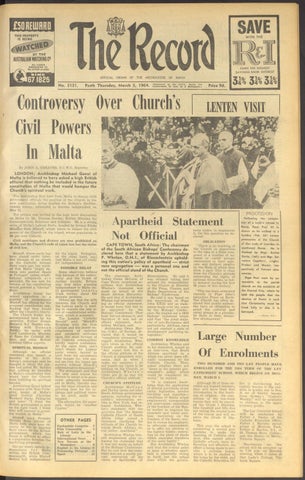
Controversy Over Church's Civil Powers In Malta
Price 9d.
LENTEN VISIT
By JOHN A. GREAVES, N.C.W.C. Reporter
LONDON: Archbishop Michael Gonzi of Malta is believed to have asked a high British official that nothing be included in the future c onstitution of Malta that would hamper the Church's spiritual work. The Archbishop flew here from Malta to discuss with government officials the position of the Church in the new constitution being drafted for Britain's Mediterranean colony, scheduled to become independent on May 31. The prelate was invited to the _high level discussioni on Malta by Mr. Duncan Sandys, British Minister for Commonwealth Relations and Colonies. He is a strong critic of Malta's Labour Party, headed by former Prime Miniaer Dom Mintoff, which wants to reduce the civil power of the Church on the island, whose population is 98 per cent Catholic. Civil marriages and divorce are now prohibited on Malta, and the Church's code of canon law has the status of civil law. Mintoff, whose party has been placed under interdict because of an attack on the Catholic bishops three years ago, has warned that Malta "might develop into another Spain or Portugal" unless constitutional safeguards a r e provided. He has said his version of the constitution would prevent a "clerical" State. Archbishop Gonzi has voiced opposition to a number of amendments Mintoff has offered for the proposed constitution, contending that they would affect the Church's liberty. The Church leader was accompanied here by his secretary, Father Joseph Bernard, S.J. Besides conferring with Duncan Sandys, he spoke with Lord Lansdowne, Minister of State for Colonial Affairs, and other British Colonial Office experts. SPIRITUAL MISSION Although no official statement was issued, a member of the Archbishop's entourage said he thought it likely the prelate had asked Mr. Sandys that nothing be included in Malta's constitution that would limit the Church from fulfilling its spiritual mission. Archbishop Gonzi talked in London with Toni Pellegrini, leader of Malta's small Central Christian Workers' Party. Pellegrini said later: "I think the British government is now on the right track. I think they will succeed in,avoiding trouble in Malta." Mintoff a n d Premier Giorgio Borg Olivier of Malta both were here recently to try to impress their views on the British government. which has found it difficult to effect a compromise between the conflicting proposals. Olivier wants speedy independence f o r Malta within the British Corn monwealth. while Mintoff desires full independence
for the island. Pellegrini, on the other hand, says that Malta is not yet ready for independence. POSSIBLE DELAY Some observers believe that because of the controversy and the threat of further trouble, Britain may now delay granting independence to Malta until government leader s think further about the delicate problem. Others say that the split between the Church and the Labour party is tending to obscure the real issue of constitutional settlement, which is economic. The London "Catholic Herald" said: "Mintoff's flirtation with the Iron Curtain and the recent encroachment of unbelief and secularist attitudes upon this most fervent of all Catholic communities hardly inspire confidence. At the same time, one's heart bleeds for Labour party voters, barred as such from the sacraments they hunger for, who cannot see how the island can survive without Mintoff's administrative dynamism." The newspaper said that the only sane course for Britain to adopt is to guarantee adequate economic aid to Malta, thereby easing the tense situation and allowing time for the religious and political issues to be more easily untangled. The alternative, the paper said, would be "another Cyprus."
OTHER PAGES Eucharistic Congress . 2 Film Censorship . . 3 Role of Laity in the 5 .. Liturgy International News . .. 6 New Novena at the Monastery . 8 English in the Liturgy 10 Friendship Pictorial .. 11 Sport . . . . . . . 12
Apartheid Statement Not Official
ment makes to implement it. On this question he declared:
CAPE TOWN, South Africa: The chairman of the South African Bishops' Conference declared here that a statement by Archbishop P. Whelan, 0.M.I., of Bloemfontein upholding this nation's policy of apartheid — strict race segregation — was a personal one and not the official stand of the Church. The chairman, Archbishop Owen McCann of Cape Town, countered assertions that Archbishop Whelan's statement was made on behalf -of the South African Hierarchy. He said that if Archbishop Whelan had intended making an official statement, it would have first had to approved the by be Bishops' Conference. That body did not discuss it, and therefore it was not an official statement, Archbishop McCann said. Archbishop Denis Hurley, 0.M.I., of Durban, declared that it would be "completely erroneous" to regard Archbishop Whelan's views as the official Church position. He said: "Any report that this is the official attitude of the Church is completely erroneous. Just as when I make my speeches I do not expect my views to be binding on the Church, so Archbishop's Whelan's views are in no way the Church's official attitude." CHURCH'S ATTITUDE Archbishops McCann and Hurley spoke out after South African government agencies, including the republic's information service in New York, had released Archbishop Whelan's statement with the assertion that "the Roman Catholic Church of South Africa today issued a statement clarifying the attitude of the Church towards South Africa's racial policy, apartheid." Archbishop Whelan himself emphasised after releasing his statement that it was not made on behalf of the Bishops' Conference. But he said that the statement was not a purely private expression of his views as Archbishop of
Bloemfontein. He said it was released taking intd account his responsibility to the Church as Director of the Press, Cinema and Radio Department of the Bishops' Conference. He said it was based on the encyclicals of Pope John XXIII and on statements made over the years by the Bishops' Conference. He singled out a 1952 Bishops' statement which said that "the great majority of non-Europeans and particularly Africans, have not yet reached a state of development justifying integration." COMMON KNOWLEDGE Archbishop Whelan said in his statement, issued as an interview, that South African apartheid as a whole has never been officially condemned by the Catholic Church. Then, asked whether there are "items in the present government's policy which could be considered immoral," he replied: "It is common knowledge that. the application of several provisions of our racial legislation involve hardship and injustice— conditions of Bantu urban employment; unreasonable job reservation; restriction of the freedom of the Bantu worker to improve his economic and social position; restriction on the freedom of the Bantu worker to choose his employer, to alternate employment, or to offer his services to the highest bidder; restriction 'on the place of abode which separates members of the same family." But Archbishop Whelan said that the crucial point at issue is whether apartheid is inherently wrong in itself, not the actual laws which the govern-
OBLIGATION -There is no teaching of the Church in opposition t o the idea of a State cornposed of a number of national or racial groups, maintained in their separate and distinct identity by the State of which they form a part. This is clear from the Church's attitude concerning the rights of national minorities, so hotly debated during the first 50 years of this century.
"This has been reiterated recently in Pope John's encyclical Peace on Earth. The Church has often declared that public authorities have an obligation to assist the cultural and racial groups in a pluralistic State in their distinctive development."
PROCESSION Following the completion of a week's retreat in R ome,
Pope Paul VI is shown as he walked in a Sunday (Feb. 23) Lenten
procession at the Church o f Our Lady of Lourdes, in southwest Rome. He is f lanked by Msgr. Enrico Dante, ( left) and Mgr. Salvatore
Capoferri,
(right ) and Master, res. pectively, of Vatican ceremonies. Prefect
Pope Paul went by automobile to the parish church on the outskirts of the Eternal City, where he
told the people that the destiny of Rome is such that Christianity must be lived fully or else it is betrayed.
Large Number Of Enrolments TWO HUNDRED AND TEN LAY PEOPLE HAVE ENROLLED FOR THE 1964 TERM OF THE LAY CATECHISTS' SCHOOL WHICH BEGINS ON MONDAY, MARCH 9. Although 55 of those enrolled are trained teachers, they will have their first introduction to the teaching of religion. On completion of the ten-week course they will be awarded the Grade I Diploma. One hundred and fifty-five are taking the second term of the course and will receive the Grade II Diploma.
fice is distributing fortnightly lessons to the children in grades one to five. A set of weekly lessons from Sydney's "Catholic Weekly" will be available to children in the upper primary grades. The Lay Catechist School will be conducted by Father J. Nestor, of the Catholic Education Office. Father J. Murphy, parish priest of Mosman Park. Father J. Barden. S.J., of St. Thomas More College, and the Sisters of Mercy, Victoria Square.
This year the school is conducting a second programme to make the teaching of Catholic children who cannot attend Catholic schools more in- Enrolments teresting and effective. An for the effort is being made to pro- .school will be accepted up vide a revision lesson, to 7.30 p.m. on Monday which is to be studied in evening, when it opens at the home by the child, and Our Lady's College, Victhe Catholic Education Of- toria Square.
THE
Page Two
Archbishop Waits For Action To End Ills Activity
Bishop Fulton Sheen .
The Aftermath Of An Assassination
In a reported interview by from 14 years of detention telephone from Czechoslo- last October, would go to vakia to Vienna, the prelate the Vatican and that Auxiwas asked to comment on liary Bishop Kajetan Marumours that he may soon tousek of Prague would be be allowed to leave Czecho- named administrator of the Prague archdiocese. Bishop slovakia for Vatican City. His reported reply was: Matousek was appointed "I wish these rumours were Auxiliary in 1949 following Archbishop Beran's arrest, true. I just sit and wait for this appointment has but do somethe government to thing about me. So far I never been recognised by have absolutely no indica- the Czechoslovak governtion that something will be ment. At Christmas tide it was done." reported that Archbishop other two Recent reports by the Ger- Beran and man Catholic news agency bishops were residing at a told of a preliminary agree- nursing villa at Mukarov, ment on Church-State rela- near Prague. He was reporttions reached by the Vati- ed denied permission to pay can and Czechoslovakia. visits during the holidays, Among the details in the re- but able to receive visitors and to receive and send ported accord were that Archbishop Beran, freed mail.
BERLIN.—Stefan Cardinal II: szynski of Warsaw said thousands of children "unborn" in Poland as a result of legalised abortion. "For instance, in one Polish city, 8,000 children were born and 8,450 were 'unborn' in the city," the Cardinal said in a pastoral letter read in Catholic churches, reports of which have reached here. "In another city," the Cardinal continued, "1,800 children were born in one of the hospitals. But 1,850 were not born as a result of the application of violence.
'We have seen posters which say, 'Don't have too many children — the next child may rob the rest ot shoes and clothing.' I don't think this is true. If there are five children, the family will get bread—with God's help — for the sixth child. too." Cardinal Wyszynski also said in the pastoral that in Poland "youngsters drink t oo much wine" and "smoke t oo many cigarettes."
LENTEN LAWS RULES OF FASTING AND ABSTINENCE DURING LENT
A BSTINENCE:
1. Everyone in good health who ha reached the age of reason is obliged to abstain To abstain is a serious obligation. 2. All Fridays and Ash Wednesday are days of abstinence. 3. Flesh meat and meat soup are forbidden. Lard and dripping may be used on days of abstinence provided they be used merely as a condiment or seasoning.
F AS1 : 1. Everyone in good health over 21 years of age and under 59, and not engaged in exhausting work, is obliged to fast. This is a serious obligation. Every day of Lent, from Ash Wednesday to midnight on Holy Saturday, is a day of fast. except all Sundays and St. Patrick's Day (March 17). On fast days, those bound to fast are allowed one full meal, that is a meal without any limitation as to quantity, and two smaller meals. At the two smaller meals they may take whatever is necessary to enable them to perform their ordinary duties. The full meal may be taken either in the evening or at midday (A handy way of computing how much food may be taken at the smaller meals is to say that together they should not equal the full meal.) 4 Eating between meals, even fruit and confectionery, breaks the fast. However, a biscuit or some similar small portion of food may be taken with a drink. Liquids do not break the fast (a liquid is anything that is consumed as a drink, e.g. tea, milk, fruit juices, beaten egg, etc.). 6. On days of fast without abstinence, meat is allowed at all meals.
NOTE: (a) The solemnities of marriage (Nuptial Mass, the use of music, etc.) are forbidden until Easter Monday. (b) The Pascal Precept is required to be fulfilled between Ash Wednesday and Trinity Sunday (May 24).
There were no longer political p ar tie s, business competitors, grasping fingers — there was beating only one heart.
ANOTHER DRAMA was the mysWHAT tery behind it all?
In last week's article, we wrote of how embarrassing it would have been for Oswald to have been brought to trial in the light of some of our contemporary rejection of moral standards of right and wrong.
VIENNA.—Archbishop Joseph Beran of Prague was reported here to be waiting for some action by the Czechoslovak regime that would end his current status of inactivity.
Polish Primate Raps Abortion
Thursday, March 5, 1964
RECORD
I
N THIS article, our reflections will touch on emotions nobler the which flooded our soul as the curtain went down on the tragedy of the century.
Perhaps we never thought of it before, but underneath our grief was the surprising truth that we measure the enormity of a crime by the nobility of the victim. The same act committed against a fellow-citizen would have been murder, too, but it would have convulsed us more if the mayor of a city were killed in identical circumstances: and still more if it had been the governor of a State. The top of the tottering pyramid of grief is reached when the president of a nation is assassinated. The impact, the scandal and the paralysis mount with the eminence of the ohe slain. Thus suddenly, without our having suspected that we knew any theology, we affirmed in grief the principle that "sin is always measured by the one sinned against." I will not carry it any further than to say, suppose that Perfect Innocence and Truth and Love became a Victim to evil and mediocrity, and was put to death by us—would not our grief be almost too deep for tears?
HIERARCHY OF GRIEF. the murder of THUS a President has suddenly made us realise that Dallas is not far from Calvary, that the death of the head of a nation has in it some reflection of that sorrow for the death of the Head of humanity, and that even in our democratic world, in which we tend to level off all things, we still have in our souls a hierarchy of grief. The nobler the victim, the greater the sin, and the deeper the _grief. We have walked with pleasure for many a mile and we have smiled and smiled, and learned nothing. But what a vista of the mystery which lies in the heart of the world's redemption was unveiled when we, as a people, walked with sorrow! People become more united in sorrow than in pleasure. This is the second lesson learned in the dark pages of our national loss. Across the nation, citizens were enjoying theatres, sports, parties, cocktails and a thousand and one pursuits of eros in which the ego satisfies itself under the guise of a love of another. Then all these disparate and separate enjoyments, like scattered drops of mercy, suddenly came together in one centre —the broken heart of America.
Again, without knowing any theology, we became theologians. We suddenly realised that we were actors in another drama: "In the death of One Man, all die.'! We died with President Kennedy because our human nature has already been stamped with that Value whence all values derive— in the death of the Lord we all die, and in His resurrection, we all live. Strange it is how human nature, forgetting its faith, suddenly is illumined by it. Why, not only Americans, but the world — all We humanity — was made one! should have remembered it without a murder. As quick as a rifle shot, he who said that we are debtors to our country gave that which signifies the fullness of all giving—the surrender of life, human love and lawful power. He who said that we should all be as creditors to our country now signed a receipt of patriotism which read: "Paid in full." Giving takes on some value because where was once Divine Giving Which, across the debt of sin, wrote: "Paid in full." It is well to be proud of our country, but if the memory of a death means anything, we will no longer boast as if the peacock were our national symbol, saying: "I am an American," but, in the full consciousness that our symbol is an eagle mounting ever upwards, we will say: "May I be worthy to be an American."
International Eucharistic Congress - 1964 OFFICIAL COMMUNIQUE As is already well known, the 38th Inter-
national Eucharistic Congress of the Catholic Church is to be held in Bombay from November 28 to December 6, 1964. The Congress meets once in about five years; it has been previously held in countries which are mainly Christian, and it is for the first time- in its history that it is being convened, by the choice of His Holiness the Pope, in a country like India where Christians form a small minority in a population of over 400 millions. The fact that India should have been chosen for this unique event of great spiritual significance, both to Christians and non- Christians, shows the tremendous appeal India holds for people abroad. It has been conservatively estimated that as many as 20 to 30 thousand foreign visitors will attend this Congress at Bombay and they will include many persons of distinction and eminence from Europe and the Americas, as also from Africa and neighbouring countries such as Pakistan, Ceylon, Burma, Malaya, Indonesia, Philippines, Vietnam, Laos. Cambodia, Japan, etc. The Congress, therefore provides a wonderful opportunity for a large group from such visitors of abroad to come into contact with prominent Indians in all walks of life, several as particularly functions, not only religious, but also civic and cultural, will be associated The with the Congress. Congress will thus enable these visitors to see for themselves the freedom which the people these visitors to see for themselves the freedom which the people of India enjo: in both the secular and the religious spheres of activity. The great value of this event in generating and
promoting international goodwill and understanding has been recognised by the Government of Maharashtra and by the Government of India, and they have both extended, and will continue to extend, all possible facilities which are necessary to make the occasion of the Congress, the complete success it should be. His Eminence Valerian Cardinal Gracias, Archbishop of Bombay, who has just returned from Delhi, stated at a Press Conference, that he has been given the warmest assurance to this effect by all the Ministries of the Government of India concerned, and these cover specifically, highly important matters such as facilitation of grant of visas, and of cusioms and other entry formalities, provision of suitable transport and accommodation, publicity, continuous, effective and highlevel liaison between the Central Executive Office of the Congress and the various official agencies. In this connection, His Eminence met, among others, the Acting President, the Prime Minister, the Ministers for Finance, Defence, Transport, Information and Broadcasting, Railways, the SecretaryGeneral of the Ministry of External Affairs, the Chairman and Members of the Central Board of Customs and Central Excise, the Director General of Tourism, the Director General of All-India Radio, the Chief Controller of Imports and other officers. He also met several members of the Diplomatic Corps. Conferences have already been held by the Minister
Maltese Mission
for Transport in Bombay, on February 22; the Director General of Tourism on February 24; and the Finance Ministry will dispute one of their top-ranking officers to work out the necessary arrangements in consultation with the Collector of Customs for the clearance of materials for the Congress and the reception of visitors from abroad. It is also expected that the Minister for Railways will see what can be done to give substantial travel facilities for pilgrims from various parts of India.
A Maltese mission will be preached by Father H. Cassano, S.S.P., in St. Joseph's Church, Hamilton Street, Bassendean, from March 15 to 22. The Rosary, followed by a sermon and Benediction, will be said on weekdays at 7 p.m. and Sundays at 5.30 p.m.
OFFICIAL ENGAGEMENTS
MARCH 22: 8 a.m. — Confirmation and C anonical Visitation, Maida Vale. 3 p.m.—Acies Ceremony of Legion of Mary, Sacred Heart Church, Highgate.
MARCH 10: '7.30 p.m. — Attend the Holy Name Society's Conven• tion, at Trinity College, Perth.
MARCH 15: 3.30 p.m.—Confirmation and Canoncial Visitation, Lesmurdie. 8.30 p.m.—Attend annual St. Patrick's Concert.
MARCH 24: 8.30 a.m.—Reception Ceremony, Convent of Mercy, Leederville.
MARCH 17: 10.15 a.m. — Attend St. Patrick's Day Mass, Subiaco Oval.
APRIL 5: '7.30 p.m.—Confirmation and Canonical Visitation, Attadale.
MARCH 25-29: Holy Week Ceremonies.
Get Better Meat for Less at
C LEM PAULLS
234 HAY STREET, EAST PERTH — 23-4927 63 CANNING HIGHWAY, SOUTH PERTH. 67-1708. WATCH THE WINDOWS FOR OUR SPECIALS
THINKING OF TRAVELLING? FOR
ALL
BOOKINGS
BY
AIR SEA RAIL or ROAD I
WITHIN AUSTRALIA
OR
OVERSEAS
C Consult—
DALGETY-N.Z.L.
TRAVEL SERVICE
15 WILLIAM ST., PERTH. 21-2841.
Thursday, March 5, 1964
THE
RECORD
Film Censor Wants Restrictive Session Legislation CONDENSED FROM AN ARTICLE BY REV
M. A. CHAMBERLIN, B.A.
Last September Father Chamberlin wrote an article in which he advocated for legislation restricting the attendance of children at films classified as suitable only for adults. It is now interesting to note that the newly appointed Chief Censor, Mr. R. J. Prowse, is reported in the following terms in "Film Weekly." "Mr. Prowse's own personal opinion is that it should not be left to parents alone to prevent attendance of children at adult cinema programmes: 'I personally advocate a system such as the U.K. has, but I realise that it would be difficult to enforce.'" In the United Kingdom, any film classified "A" is approved as more suitable for adults, and children under 16 may not be admitted unless accompanied by and in charge of an adult. Those classified "X" indicate that a film is strictly for adults and no children may be admitted in any circumstances whatsoever. Managers of the cinemas are bound by law to see that patrons abide by these regulations. The very existence of the legislation creates a climate in which parents and children accept and observe, for the most part, the restrictions it imposes. Objections are frequently raised against this legislation— Why should theatre managers be asked to assume such responsibility? These days, youngsters of 14 or 15 years of age can themselves make look much older than they are. Why set ah arbitrary agelimit when children mature at different ages?
This type of legislation was tried in Victoria in the early thirties, but failed and was later repealed. The case can be argued both for and against. What is needed is a thorough examination in the light of present circumstances and needs. There is a variety of reasons why the matter should be investigated at this time The mature and adult content of many present-day films makes them quite unsuitable for young and impressionable minds. The Chief Censor has stated clearly that he favours legislation and the 1961 Gallup Poll showed 81 per cent of parents were in favour of it. So, let the matter be investigated. Let us see whether legitlation is necessary. Let us have the facts. If the decision is in favour of legislation, the form it should take can then be examined. Any legislation should invite the support and cooperation of the theatre manager without demanding the impossible of him. The urgent need at this time is a full investigation of all aspects of the question of children and young adolescents and adult films. Action should await the results of a preliminary enquiry.
C. MORRIS —Plumber
SHEET and METAL WORKER Phone 28-2096. 6 CLEAVER STREET, WEST PERTH. BUYING OR SELLING —
TOP
V tLUE
ALWAYS
HOPKINS MIGHTY MART
222 BEAUFORT STREET, PERTH Public Auctions — Tuesdays, 10.30 a.m.
Page Three
WORLD'S FAIR EDUCATION EXHIBIT (4, 4
Resumes
'
SYDNEY: The Rev. Dr. Rumble, M.S.C., resumed his Question Box session on Radio 2SM at 7.30 p.m. last Sunday. For health reasons, Dr. Rumble has been compelled to reduce the length of his session to half an hour. The Question Box is the world's longest running radio programme. It began 35 years ago and has been broadcast ever since for one hour on every Sunday night for 10 months of the year—March to December. In all, Dr. Rumble has written and broadcast more than nine million words, most of which have been published in the Catholic Press of Australia. His manuscripts for the Question Box session alone would be sufficient for a hundred large books. And this would be only a part of his vast literary output.
At an executive board meeting in Washington, officers of the National Catholic Educational Association look over a model of the organisation's proposed exhibit to be placed in the Hall of Education at the 1964-65 New York World's Fair. The special display will highlight the goals and operations of U.S. Catholic education. Pictured are Archbishop John P. Cody of New Orleans (centre), president-general of the N.C.E.A.; Mgr. Bennett C. Applegate (left), diocesan superintendent of schools, Columbus, Ohio, chairman of the exhibit committee, and Mgr. Frederick G. Hoch wait of Washington, executive secretary-general, .N.C.E.A. 'Photo
Statue Was Desecrated By Communists MEXICO CITY.— Cuban refugees on their arrival
r
#41.04,41141,11.4.#04,04,04.4-0.•••••••••
•••.#0#.4 , 04.4,0#4, 0#4,04.4.4NINIKININP
MOBILE CRANES FOR HIRE Lift from 6 to 23 Tons — 140ft. JIB LENGTHS
ECONOMIC CRANE & PLANT HIRE
PTY. LTD.
Cnr. KEW and STAR STREETS, WELSHPOOL. Phones: 6-1605 — 6-6361. After Hours: 26-1841.
APAPAP
PHONE
65-1368
C. A. Industries GATE and FENCE MANUFACTURERS 59 ROBINSON AVENUE, BELMONT.
QUALITY LINK MESH FENCES SUPPLIED land ERECTED
IIIIlIIIIlIIlIIIIIIIIlIIlIIIIIIIIHIIIIIIllIIIIIIIIIW
F_
• HAMS • BACON ALWAYS a- • COOKED MEATS E. • SAUSAGES and E INSIST on of course • CONTINENTAL SMALLGOODS •
T HE
GREATEST
•
NAME
•
IN
S MALLSOOOS'
ANNUAL IRISH CONCERT Capitol Theatre SUNDAY, 15th MARCH, 1964 AT 8.30 P.M. ADMISSION: ADULTS 6/6—CHILDREN 3/6 Bookings open at Theatre on Monday, 9th March
•
1,14.393
here reported details of the desecration of a statue of Our Lady by communists in Santiago last October. The refugees said that on October 4 a group of Reds led by uniformed militiamen entered Santiago's Santo Tomas Church. They stripped the statue of Our Lady known as "The Pilgrim" of its vestments and jewels and dressed it in the uniform of a militiawoman. While they were doing this, the refugees added, the Cuban Reds shouted insults. The statue is known as "The Pilgrim" because of the many times it had been
taken on pilgrimage through Oriente province, of which Santiago is the capital. The Cubans did not confirm a report that the desecration had been ordered by Premier Fidel Castro. But they reported that a few days before the incident occurred, the Premier's brother—Vice-Premier Raul Cagro — had been in Santiago to preside at a meeting at which anti-religious remarks were made.
• itIGE RANGE OF GOODS FOR PRIVATE SALE
WE ARE CASH BUYERS — PHONE 25-1826
NC.)
SPECIAL YEAR Of THANKSGIVING IN THE PHILIPPINES MANILA: The Philippine Bishops in a joint pastoral letter on February 24, have declared the year 1965 as a special year of thanksgiving to observe the 400th anniversary of the evangelisation of their country. The document, tracing the Christianisation of the islands, notes that Philip 11 of Spain ordered an expedition from Mexico under Miguel Lopez de Legaspi in 1565. The first Mass in the archipelago had been celebrated on Leyte Island in 1521, but until the expedition from Mexico four attempts to evangelise the islands had met with little results. Once the expedition gained momentum, however, all the islands were converted to Christianity within 50 years. Calling this "an achievement which has no parallel in the history of missions," the pastoral letter states that it is also "the greatest and most significant event in our history." It continues: "Before our country was christianised our forefathers had, no doubt, their natural virtues. But at the same time, they
had pagan customs and practices. Their culture was steeped in idolatry and superstition. It was our conversion to Christianity that ushered us into the family of civilised nations." The letter further states that the year 1565 also was of great significance to the Philippines "because that was the year that the nation came into being. "As the Gospel was brought from one island to another, the Philippines as a country, as one nation emerged. Before that, in these islands there were only small kingdoms and t ribes, one independent of the other." To observe tthe anniversary, the bishops have decided to ask the Holy See for permission to declare 1965 as a Jubilee Year for the Philippines, to hold a Eucharistic Congress in Cebu City during April of that year, and to found a seminary to train missionaries Asian for other nations. "Our Catholic Faith will always be our most precious heritage," the Bishops state. "We will always consider the fact that we are the only Christian nation In the Orient as our badge of distinction in the whole Christian world".
145
oi4 Z -
cap -
illetbrunt THE JEWELLER
PLAZA ARCADE (Hay St. end) GLEDDEN ARCADE (cnr. Hay 8, William Sts.)
Trained to assist ..
•
at Church and Cemetery.
D
IG:NIFIED
and reverent
observance of your wishes and the fulfilment of all religious
requirements are assured by the correct training of the Catholic funeral conductors
placed at
your service by Bowra & O'Dea. Arrangements can be made by phone at any hour, Sundays included.
F UNERAL D IRECTORS
BOW1A & O'DEA ( Est. 1888)
68 STIRLING ST., PERTH 21-4308.
THE
Page Four
Thursday, March 5, 1964
RECORD
DESMOND O'GRADY writes from ROME. ..
The Relationship of Jews And Catholics WHERE DO RELATIONS BETWEEN CATHOLICS AND JEWS STAND AFTER THE POPE'S VISIT TO THE HOLY LAND? There is a whole range of reactions, from the extremist Jewish Orthodox sects who put up posters in Israel denouncing the Pope as the head of a false religion.
CO
HE most responsible pessimistic reaction, h o w ever, is that of Israeli Jews who claim the Council discussion of the Jewish quest ion was thwarted because the Pope wanted Arab agreement to his visit to the Holy Land. There is no denying that a Council decision in favour of the chapter introduced by Cardinal Bea on Jews would have repercussions throughout the Arab world. It would place the Arab Catholic minority in an awkward position in respect to non-Catholic Arabs. Cardinal Tappouni, Patriarch of Antioch of the
Syrians, was one of the main opponents of the chapter on the Jews and his argument was that it was inopportune to include them when discussing the unity of Christians He could have pointed out that the Jews have yet to choose Christ. While a "conversion of the Jews" is conceivable in a long perspective, there are no immediate prospects of it. According to reliable estimates, only one-third of Jews are religious and the other twothirds are indifferent to religion. The one-third who have retained a religious sense are divided between three great rites which are in turn divided between orthodox, liberals and conservatives so that a movement of one section towards Catholicism would drive the others further away.
Some Ask "Why?" ( AUST.) PTY. LTD. PEST CO.)
I1'0ItMERLY W.A.
66 CANNTNG HIGHWAY VICTORIA pAsks. .61. Phone 6 194-I, A fter Hours: 6 VICt
THOSE
who are opposed to the Council chapter on the Jews ask why the movement for Christians among unity
MEMORIALS
G. C. SMITH & Co.
75 QUEEN VICTORIA STREET, FREMANT1C Specialising in Altars and Memorial Work. Erected anywhere in W.A. Church Altars planneJ and executed. Designs and Quotes without obligation. We Have Over 60 Years' Experience." Phone 5-1661
FOR
SERVICE
SINCE
1895
TYRE SERVICE Introduces
A New Kind of Exclusive
TYllt 111- CAPPING WITH G8 NO -SQUEAL TREAD
BOANS
SERVICE STATION
Corner of ROYAL and BENNETT STREETS, EAST PERTH
BOANS
MORLEY SERVICE STATION
THIS attempt
MEDINA SERVICE STATION
Also Supplied at BOANS, WAVERLEY, and HAYWARD'S, BUNBURY ( A Boans Store)
Father JOHN C. KNOTT
Controversial nESPITE these,
to I arouse irrational hate within the Church was such a flop that it must be the last such effort — the promised second volume did not appear. It represented the nadir of thought about the Jews and although substantial difficulties remain, it seems likely that the Church is about to throw off any traces of antiSemitism. Pope John, whose ecumenism did not stop at Christians, but reached out to all men, was anxious that the Jews be freed of the charge of deicide, which has been one of the sources of antiSemitic persecutions. Cardinal Bea mentioned another motive for this new look at the attitude to Jews when he introduced the subject to the Council. He referred directly to the Nazi massacres of the Jews during the second world war. In 1960, the Italian clergy review declared that the at• tribution of sole guilt to the Jews for the murder of Christ was without foundation in the New Testament and could not be demonstrated from an historical viewpoint. A Capuchin, Father Mariano, repeated similar opinions over Italian television. In the same year the French Cardinal Lienart sent out a pastoral letter saying that sin, not the Jews, was responsible for the death of Christ. They have not changed from being an elected people in the Old Testament to being a cursed people in the New Testament affirmed Cardinal Lienart.
DUFFY BROS. 235 Newcastle St., Perth.
and other, precedents, the brief chapter on the Jews was still considered highly controversial when introduced in the Council, even though Cardinal Bea recalled Christ's forgiveness from the Cross. Some were opposed only to its position, but others were opposed to its substance. Paul's pilgrimage must have made many reflect on the continuity between the Old and the New Testaments, and on the Christ born in Judaism who died to save all mankind. The aim to heal the original schism in the people of God has a sound theological, human and historical foundation, even though it is ringed with difficulties. Pope Paul was wary of these problems during his day in Israel. The Council draft insists that it is concerned with Jews and not with the State of Israel and the Pope took great care not to make any gesture which could be interpreted as approval of the State which is not recognised by the Vatican. This upset some Israelis, as did the fact that Cardinal Tisserant, rather than the Pope, visited the memorial on Mount Sion to the Jewish victims of the Nazis.
Thorny Aspect THESE
victims, I and Pius XII's attitude towards them, remain one of the thorniest aspects of Catholic Jewish relations as Pope Paul's speech at the Mandlebaun Gate indicates. It would be shortsighted to ignore the difficulties in Catholic - Jewish relations. The difficulties are clearer now than before Pope Paul's visit to the Holy Land. But because of the trip it seems more likely than ever that the great majority of the _bishops will be reinforced in the intent to do justice to the Jewish people. The most optimistic Israeli reactions to the Pope's trip are in agreement with this forecast when they say the Pope would not have gone among them and said "shalom" thrice if he was not sure that Cardinal Bea's Council draft would be approved.
LICENSED PLUMBERS
H ARDWARE MERCHANTS
21-5598.
Repairs a Specialty.
WAYS and MEANS.
TO HELP A NON-CATHOLIC FRIEND 1. 2. 3. 4.
6.
BOANS
By
Not Successful
5.
WALTER ROAD
FAMILY
should be threatened because of a desire for ecumenism in respect of the Jews. It would be a mistake to underestimate the intensity of this feeling. It was only in November of 1962 that the Council Fathers were sent a large volume entitled "Plot Against the Church." This carried a preface which outlined a "perverse plot" against the Church. The plot was masked behind a proclaimed modernisation of the Church, but its real aim was to assist Communism to prepare the destruction of the free world and of Christianity. This was all to be done within the Second Vatican Council according to a plan prepared by Communist leaders and the occult forces which control them. For anyone who had not guessed which were these occult forces, a glance at the book's index was enough— "the secret motor of Communism; the occult power of masonry; the synagogue of Satan" and "the fifth column in the clergy" all pointed to the pervasive enemy, the Jew.
You Pay Only 1 /- in the £ per Week SUPPLIED and FITTED BY:—
EVERYMAN'S
7.
Say a daily prayer for his conversion. Offer to show him the inside of your parish church and explain it to him. Offer to take him to Mass some day. (Often a week day is better for a start.) Offer to take him to a Day of Enquiry conducted by the Legion of Mary. Offer to introduce him to a priest in your parish or to any priest you know. Offer to take him to a course of talks at a Parish Enquiry Class. Tell him about the Catholic Enquiry Centre's free correspondence course and give him a Personal Contact Card. From Catholic Enquiry Centre, P.O. Box 63, Maroubra, N.S.W.
Family Allowances IT IS GOOD TO HAVE NEIGHBOURS. NOT ONLY ARE THEY HANDY IN AN EMERGENCY, BUT ONE CAN LEARN FROM THEM. Over the years we in the United States have been fortunate in our neighbour to the north—Canada. As in any neighbourhood, there have been the usual' ups'-and downs in relationships, but on the whole the atmosphere has been one of mutual respect, trust and special affection. For the past twenty years most Canadians, at one time or another, have been involved in a programme which should be much better known in this country than it is. This is the Family Allowance system.
H OW IT WORKS IT WORKS VERY SIMPLY. Each month the Federal Treasury sends to every mother, rich or poor, a cheque for each child under sixteen. The present payments are six dollars (£A2/14/-) for each child under ten and eight dollars ( A3/12/-) for each child from ten to sixteen. This money is intended by law to be used for the direct maintenance, care, training, education and the general advancement of the child for whom the cheque is issued. At the beginning, many sincere people opposed the idea. They offered what seemed at the time excellent reasons against it. The Family Allowance system, they said, would put an extraordinary burden on the taxpayer. It would undermine the initiative of the poor and contribute to an increasing birth rate of the least desirable citizens. The money would probably be spent on liquor for the parents and the kids would be worse off than before. Despite opposition, the bill was passed and after t wenty years of experience it has been proven that none of the advance fears had reality. Far from putting a heavy_economic burden on the taxpayer, the allowance system has redistributed income, increased purchasing power and boosted economic development. *
EFFECTS ITS BIGGEST EFFECT has been in the lives of people directly involved. Parents have been uniformly conscientious in using the money for the children. In 1961 there were only 375 cases (out of two and a half million families) in which there was any evidence of misuse of funds. Liquor sales did not rise appreciably, but the sale of children's clothes, shoes, baby food and milk went up in some cases by more than a third. Children in depressed areas no longer get rickets from malnutrition and they no longer have to stay home from school because they lack shoes and clothing. Children, even in the remote backwoods, no longer grow up unable to read or write. With allowances coming in, all but a tiny fraction remain in school until they are sixteen. A surprising number from the very lbw income groups somehow manage to go on to college. The programme has had a noticeable effect on the drop-out problem. *
Today the Family Allowance plan is universally accepted in Canada. All political parties endorse it and no piece of legislation has ever been more popular and effective. The best part of it, in the long run, is that it strengthens the family and promotes the general welfare of the children involved. The address of the local Catholic Marriage Guidance Centre is 77 ST. GEORGE'S TERRACE, PERTH. 23-4548.
Geo. Boucher & Co. For First Class Plumbing Services Steam and Hot Water Instaliotions 211 NEWCASTLE STREET, PERTH PHONES: 21-2204, 21-2205.
Thursday, March 5, 1964
THE
Page Five
RECORD
The Seventh of a Series . . .
the author of this By Father Frederick R. McManus article, the seventh
of a series on the sweeping liturgical reform provided for the Ecumenical Council, serves as one of the council's official advisers on liturgical matters. He is a priest of the Boston archdiocese and a professor of canon law at the Catholic University of America, Washington, and is the immediate past president of the North American Liturgical Conference.
Laity Should Take Active And Understanding Part In Liturgy for this com-
tion, education and forma-
Plans tion. Pope Paul VI in bringing into ritual. mission are found in the constitution itself : "The Just as there is no waititurgical books," says the f orce the ecumenical council's lcouncil, ing period before the counrevised be "are to cil's doctrine or teaching as possible; experts Constitution on the Liturgy has asaresoon about the liturgy becomes to be employed on the official or effective, so Pope task, and bishops are to be Paul's first point, even bemade active and understanding consulted, from various fore setting up the commission for liturgical reform, c ongregational participation in parts of the world." is the need for training and •Finally, the Pope settled worship a primary goal. specific questions and in a congregational participation that is both interior and ex-
Of the constitution's 130 sections, the first one singled out by the Pope for immediate action and application is Article 19:
"With zeal and patience, pastors of souls must promote the liturgical instruction of the faithful, and also their active participation in the liturgy both internally and externally, taking into account their age and condition, their way of life, and standard of religious culture. By so doing, pastors will be fulfilling one of the chief duties of a faithful dispenser of the mysteries- of God; and in this matter they must lead their flock not only in word but also by example." These words sum up the Second Vatican Council's rules for "the promotion of liturgical instruction and active participation." And they were given first place in Pope Paul's document of January 25, 1964, on carrying out the council's plans. "By the very nature of things" the directions for liturgical education and participation "come into force immediately." When the Constitution on the Liturgy was promulgated on December 4, 1963, at the public session which closed the second session of the council, a date was set for its regulations to become effective and universal law of the Church—February 16, 1964, the first Sunday of Lent. At the same time it was evident that many of the council's decisions would have to be delayed still longer—chiefly because they depend upon the revision of services, texts, prayers, etc.
Further Action MM
OST of the parts of the constiution which must wait further and specific action are evident enough. For example, the bishops decided that during Mass "a more representative portion of the holy Scriptures will be read to the people in the course of a prescribed number of years," that is, in a kind of cycle. Obviously, this provision cannot take effect until new lectionaries and altar missals are prepared and published. To clarify any doubts and to make sure that the liturgical renewal goes ahead without delay, Pope
Paul's January 25 instruction deals with several matters: • Begging "all Christians and particularly all priests" to study the text of the constitution, the Holy Father urged bishops and pastors in the strongest terms to teach the people how to take part in the Church's worship, with an understanding of its "strength and inner value." • Next, Pope Paul set up a special commission to carry out the council's decisions—particularly by revising the service books, such as the altar missal and
W. H. BRANCH & SON STONEHAM STREET, JOONDANNA Phone: 8-2406 — 24-1157 All Types of Electrical Work Undertaken II
1
I
1 1 1111 111
I
MOVING!
11 1 11 III 1
1
111
5-1777
The State's Leading FURNITURE REMOVERS and PACKERS
GILLS TRANSPORT SERVICE Ply. Ltd. PERTH and FREMANTLE
i r LIST & SON PTY. LTD. 91 Central Avenue, Maylands W.A.'s Leading Paving Contractors For Better Paving Contact Us We specialise in Gravel and Bituminous Paving of
R oads, Tennis Courts, Playgrounds, etc. We have a most modern plant including power Rollers, Graders and Mechanical Loaders, etc. Estimates Submitted Free. Country Clients please note that we have a State-wide Service, and will gladly quote on any requirements. We also supply at ruling rates Gravel, Metal, Sand and Loam. Prompt Delivery. PHONE: 71.1578.
few cases anticipated the reform of rites and services: immediate permission to celebrate the sacraments of Confirmation a n d Matrimony during Mass — with special provision for Scripture readings and the nuptial blessings even at marriages celebrated apart from Mass; permission to suppress parts of the daily office of prayer, in the case of those bound to pray the office, without waiting for the revised texts.
D irections COME specific directions ',10 given by the Pope insist on more serious steps to be taken without delay: ESTABLISHMENT of diocesan liturgical commissions to promote understanding and active participation in public worship by the people; THE HOMILY preached at Mass in which "the mysteries of the Faith and the guiding principles of the Christian life are expounded from the sacred text" — recommended by the council as a part of any and every Mass—required, as of February 16, at every Sunday and holy day Mass when a congregation is presert; THE TEACHING of the liturgy in seminaries and similar institutions to be revised according to the council's legislation. Because the Second Vatican Council has not yet determined with precision the role of "episcopal conferences" or bodies of bishops in the different countries, the January 25 document of Pope Paul gives specific rules — such bodies, organised on a national basis must include all bishops of dioceses, and may include coadjutor and auxiliary bishops; the enactment of decrees requires a twothirds vote by secret ballot.
Papal Directive importance of this THE rule lies in the authority
conferred by the council itself upon such bodies of bishops in liturgical matters, especially in the introduction of the vernacular languages into the liturgy. A new papal directive is added, that translations of Latin liturgical texts are to be submitted to Rome for approval. It is only natural that Mlsst attention should be concentrated upon future reforms, upon the commission set up to revise the rite of Mass and the sacraments, and upon the few changes which become effective without delay. Dramatic changes catch the eye; it is all the harder to propose, as Pope Paul and the other bishops have done, the broad programme of study, instruc-
New Nuncio To PhiliPPines
teriorly expressed.
If any specific norm is the key to the others, it is the insistence that Articles 15, 16, 17 of the constitution be put into effect immediately —that seminary programmes be revised for the next scholastic year.
Unified council has called for THE thorough reappraisal of
the teaching of dogmatic theology, Scripture, spiritual theology and pastoral theology — all to be unified in the exposition of "the mystery of Christ and the history of salvation" which is celebrated in Christian worship. The liturgy, which is faith in action, is to have new emphasis in the seminary programme of studies and in the seminary life of prayer. All this stems from the council's recognition that "it would be futile to entertain any hopes of realising" its purposes "unless the pastors themselves, in the first place, become thoroughly imbued with the spirit and power of the liturgy, and undertake to give instruction about it." Irrespective of reforms and changes yet to come, the immediate need is education and participation—beginning with "priests, both secular and religious, who are already working in the Lord's vineyard" and with candidates for the pries' hood in seminaries and other places of study. Only this can bring to pass the high hopes of the Church, as expressed by the Pope and by all the bishops: "Participation by the Christian people as 'a chosen race, a royal priesthood, a holy nation, a redeemed people' (I Peter 2:9; cf. 2: 4-5) is their right and duty by reason of their Baptism." NEXT WEEK: Practice, rather than talk, is needed for liturgical participation.
A CATHOLIC
Pictured on the occasion of the presentation of his credentials in Manila, Archbishop Carlo Montini (right), the new Papal Nuncio to the Philippines, is shown with the chief Executive, President Diosdado Macapagal and Manila's Archbishop, Rutin° Cardinal Santos.
W..
Photo KC.)
G. JANISSEN—Electrical Contractor
207 WHARF ST. (Cr. Renou St. ), QUEENS PK. 68-1243.
H OULAHANS
32 THOMPSON ROAD, NORTH FREMANTLE Are Suppliers of Yellow Sand for Top Dressing or Building, Metal, Gravel, Rubble, Ashes and Filling. Bulldozers, Loaders, Graders for Hire. Will Quote for Excavation and Level ling Jobs. PHONE: 5-1499 . . . 5-3469
N IGHT CHEMIST CONTINUOUS DISPENSIN'."., SERVICE WEEK DAYS 9 A.M. to 9 P.M.
D. F. HAYDON — PHONE 24-1423 167 SCARBOROUGH BEACH ROAD, MT. HAWTHORN rINIPAP4P-00.11 , 4,14P,NINIP4,1,4,1001.
WILLIS and ELLIOTT
O PTOMETRISTS 172a Scarborough Beach Road. Phone 24-3543. 230 Hannan Street, Kalgoorlie. Phone K.795. P . F. WILLIS, W.A.O.A., Optometrist
W.A's FOREMOST QUARRYING & CONCRETE SUPPLIERS
74e
PAPER IN EVERY HOME .#41 ,4,004111.."41.411 , 1,414P+0,P#41.~41.4.41.4r4P4.4Par
N OONAN'S South
Perth Bakery
"Bakers of Better Bread" Two 1st Prizes 1962 Royal Show If It's NOONAN'S It's NICER
GROUP Crushed
METAL
-. 69 1251
( W.A.) Screened
Quality
SAND
CONCRETE
79 2184 56 215
23 2534
Incorporating A USTRALIAN BLUE METAL LIMITED JOHN DUNSTAN & SON PTY. LTD. READY MIXED CONCRETE (W.A.) PTY. LTD.
Phone 67-1044 0 #4.414,041~.4.41 ,4r4r4/NINININIVVINP00040.41 , 41 ,
Complete Dignified Catholic Funeral Service by
A. R. MONAHAN PTY. LTD.
Bedford Park and all Suburbs Day and Night - - 71-5885, 71-5894. ALL FUNERALS PERSONALLY CONDUCTED BY MR. BERT MONAHAN — 26 1819. CERTIFIED FUNERAL DIRECTORS ELIGIBLE TO CONDUCT PENSIONERS' FUNERALS.
THE
Page Six
ONWAININPNINIMININ
11
CANAL ZONE. Organised by Bishop Tomas Clavel Mendez, of David, the meeting was attended by Panama's President Roberto Chiari and candidates for the May 10
1 presidential election. Bishop Clavel urged the crowd to maintain a spirit of Christian unity and true patriotism.
I
Meanwhile, Masses in memory of those who died in the January 9 disorders were offered in all the churches in Panama City.
4 , INP.MOYMOSION,11 ,
11.4 , 4.4.04.41
NEWS= FINLAND THE PHILIPPINES
PANAMA
FRANCE
UNITED STATES
1T:INTERNATIONAL A CROWD OF 20,000 PEOPLE MET IN DAVID TO COMMEMORATE THE PANAMANIANS KILLED IN INCIDENTS A MONTH AGO FOLLOWING A DISPUTE OVER FLYING THE PANAMANIAN FLAG IN THE
Thursday, March 5, 1964
RECORD
Catholicism Enquiries
C redit U nion
THE Catholic Information C o u r,s e Correspondence founded by Father Jacques Reijnders, S.C.J., has had 150 inquiries in the nine months of its existence. This has- occurred in a country which has only 2,500 Catholics in a predominantly Protestant population of four and a half million. Meanwhile, Father Robert de Caluwe, S.J. is opening a new Eastern Rite chapel near Helsinki which will serve as an ecumenical centre.
BISHOP Manuel Mascarinas of Tagbilaran has urged every parish in his diocese to set up a credit union. The establishment of such credit co-ops, he said, coutd help rid the country of usurers who get rich on excessive rates of interest at the expense of poor borrowers. He called credit unions a foundation for a better and economically healthier community, and a strong link in the chain of democracy.
Education Exhibit education's CATHOLIC goals and operations will be highlighted in a 300-squarefoot exhibit in the Hall of Education at the 1964-65 New York World Fair. Announcement of the special display was made in Washington by Archbishop John P. Cody, Apostolic Administrator of New Orleans and president-general of the National Catholic Educational Association, the sponsoring agency. The display will be part of a multi-exhibitor pavilion, the first in any major U.S. fair to be devoted exclusively to education. The pavilion will feature a "School of Tomorrow."
Some Parishes _ Supressed THE Digne diocese in the mountainous area of southeastern France has announced it will suppress 157 of its 345 parishes because they have become underpopulated. Bishop Bernardin Collin, 0.F.M., of Digne, said the move will allow him to use the See's priests to better effect. The 157 suppressed parishes had a total population of only 3,600 people. Some of them had only ten They were parishioners. located in mountain hamlets, many of whose people have left to take jobs in the cities.
New Telescope For Britain's Royal Observatory
04.41KONININIMMONININP .
ARGENTINA
ANTONIO CARDINAL CAGGIANO, WARNING AGAINST THE CHAOS OF SOCIAL REVOLUTION, URGED THE PEOPLE OF ARGENTINA TO MAINTAIN DISCIPLINE "IN DEFENCE OF PUBLIC ORDER
YOUR HOTEL GUIDE HIGHWAY HOTEL 206 STIRLING HIGHWAY. CLAREMONT PHONE 3 1566 rriendly Service — Good Accommodation — Parties Specially Catered for A. & E. M. hicDONNELL FRIENDLY ( r Fri
SERVICYC
COMING TO
/Ras
it'
THE RIVERTON HOTEL MOTEL
HIGH ROAD, RIVERTON 69 1511 TV in every Unit. Floodlight 9-Hole Golf Course, FRED MILLS. Licensee
BAYSWATER Hotel
REX HOTEL
KING & HAY STREETS for Convenience of Guests and Friends Phone: 21 8634 Personal Supervision Mrs. B. B. REILLY
SUBIACO HOTEL First Class Accommodatio, and Service
OPP. STATION Excellent Aocommodation Frequent Train Service — 4 Mlles from City —Large Parking Area BED and BREAKFAST REASONABLE TARREFE LES BARTLETT, Prop. TEL.: 71 1224
WEMBLEY HOTEL Excellent Lounge and Accommodation Phone 87-2418
DRIVE-EN BOTTLE DEPT. FREE HOME DELIVERY
Phone: 8-1028 Alex McHenry. Proprietor.
WAVERLEY
PERTH
Cnr. Cambridge and A lexander Streets, Wembley
HOTEL
HOTEL
Australia
Next Boans Waverley Stores ALBANY HIGHWAY CANNINGTON Modern and Convenient Homely Accommodation Use Our Drive-1n Bottle Servfee Phone 652419 A . R. CONNELL
MURRAY STREET, PERTH E xcellent Accommodation and Dining Service LUNCH, 10/- DINNER 17/6. PHONE 23 1541
CRITERION HOTEL
Enjoy the Best ACCOMMODATION & SERVICE
CENTRAL HAY STREET PERTH 24-HOUR SERVICE rree Parking for Country Residents II Minutes' walk from Cathedral. THE COUNTRYMAN'S HOTEL
HOTEL COTTESLOE RIGHT ON THE SEA FRONT
Phone 3-2155 a. M DYMOCIE, Licenses
PHONE: 281115 (5 lines)
HOTEL ESPLANADE
W ILLAGEE PARK HOTEL The States Most Modern TOM KENNY, Licensee. ne. Stock and High Roads, MELVILLE Phone: 30 3428
PERTH'S LEADING HOTEL FOR ALL VISITORS Phone: 23-1531
N ATIONAL HOTEL
COMMERCIAL HOTEL NORTHAM Phone Northam 49 T. E. MURPHY, Proprietor
Cnr. High and Market Sts. FREMANTLE Offers excellent homely accommodation Phone : 5-1786 Philip P. Kearina, Licensee
Plympton
CITY HOTEL
Cur. King and Murray Perth
LUNCH, 12-7.30 p.m. Friday: Saturday 12-10 p.m. ARCHIE THOMPSON Offers you only "The Best" Phone: 21-4094
. 4 0IINTER
Jack Sheedy PHONES
21-4341,
HOTEL
Ste.,
Home of Country People CANNING HIGHWAY EAST FREMANTLE Eric Campbell, Prop. 5-1721.
CARLTON HOTEL
23-3091
218 HAT ST., PERTH
BUSINESS MEN'S LUNCHEON — 12 to 2 p.m.
Cr.
DALY'S
MEET DAILY
ROYAL
at
HOTEL
WILLIAM and WELLINGTON STREETS, PERTH. Phones: 21-3924. Bottle Dent.. 21-5436.
AGAINST THE DANGER OF SUBVERSION.The Archbishop of Buenos Aires issued a pastoral letter than seemed directed in part to leaders of a union planning a work stoppage programme as a protest against government failure to deal effectively with inflation and unemployment. Cardinal Caggiano said that soeal revolution in A rgentina could subject the people to "the most inhuman and totalitarian form of dictatorship ever devised:. a.4.41.0.41.41NP 411.4.41.4
1.4,4,41.4.4.4,411,1141PNOVeilsilysilre#41.4.###### #4.4V4P#4.
PORTUGAL " NINsP.4."11.4%.1.4.4,
411,0,41•
GERMANY
NI,11414.4....iPM0•.NNIPIP•ed I
End of Celebrations THE Papal Nuncio to Portugal, Archbishop Maximilian de Furstenberg (the former Apostolic Delegate to Australia) will close the celebration of the 100th anniversary of the national shrine of the Immaculate Conception at Sameiro by offering Masc at the shrine on June 7.
SWITZERLAND • 4,4P 4,1P
Mass In Cove MASS was offered in the "Cave of Hell" (Hoelloch), near Schwyz, the longest surveyed cave in the world. The cave is about 47 miles long. The expedition exploring the cave is headed by Alfred Boegli; a Catholic on the faculty of the teachers' college in Hitzkirch, in the Lucerne canton. Boegli and his team have been exploring the cave for 12 years. During their latest exploration, early in January, they discovered more than ten miles of new grottoes and caverns.
HUNGARY
Papal Award For Woman A PAPAL decoration was awarded in Bad Walsee to a laywoman who smuggled 'food and medicine to inmates of a Nazi concentration camp during World War II. Auxiliary Bishop Joseph L. Buchkretner of Aachen presented the Pro Ecclesia et Pontifice medal to Anna Warth, who assisted the prisoners of the Dachau concentration -camp in 1944 and 1945. The Bishop himself was a beneficiary of Miss Warth's heroic efforts.
ENGLAND IPANON141
11.1IVO API,
Children On Pilgrimage A LOURDES pilgrimage sponsored by the Catholic Handicapped Children's Pilgrimage Trust of Britain will take a record number of 250 ailing children to France. Another 200 persons, including doctors, volunteer aides and chaplains, will accompany the youngsters.
e.eiNe"emoo.deroo:.
Collaboration Of The Laity THE Second Vatican Council is constantly stressing the importance of the c ollaboration of the laity in the work of the Church, Bishop Endre Hamvas of Csanad said -in a pastoral letter. The Bishop, as chairman of the Hungarian Episcopal Conference, said God "demands of us that we foster the universality of salvation with our powers and talents." He added: "The preservation and dissemination of the Faith is not alone up to priests. They cannot carry out this great task alone."
ECUADOR
The Isaac Newton 95-inch telescope — Britain's biggest — is taking shape in a Newcastle upon Tyne factory in North East England for the Royal Observatory at Herstmonceux Castle, Sussex. In this picture the central section of the polar disc is being lowered into position on the bedplate. The optical part Of the telescope will be carried within a steel structure mounted on the disc and the combined weight of the moving parts will be 76 tons. The disc will be carried on externally pressurised oil pads and floats round on a film of oil four thousandths of an inch thick. The telescope is named after Sir Isaac Newton. the British mathematician and philosopher who lived from 1612-1727, and who made scientific history with his disroverp of the la,- of gra,,ity. P11,1t0
C
K. Inf. Service)
A WNINGS, BLINDS, FLYWIRE DOORS, and FLYSCREEN5 ALL TYPES Measured and Installed in 7
STAN BOND
1010 BEAUFORT ST., INGLEWOOD Phone 71 4313 7op Quality Tradesmen
,4.#4.41.4.4.• vhihill4P.#4•4.41
Democracy Needs Accurate News THE secretary of the International Union of the Catholic Press, Father Emile Gabel, A.A., of Paris, said in Quito that a democratic government requires good press reporting. To have true democracy, he said, it is necessary for all citizens "to consider themselves responsible for national affairs." Father Gabel is on a tour of Latin America to study the Catholic press.
. IIIISINI
H. J. LILLEYMAN W.A.O.A.
OPTICIAN and OPTOMETRIST 453 ALBANY HIGHWAY, VICTORIA PARK. 6-1880. And 156 ROKEBY RD.. SUBIACO. 8-3983. Res.: 67-1685. , 1MOMN#4 , 111,1,~411 41.4.414 , 4 11.#4.4,114. P4 , , riN1.441 0411.4.4•41#M#41•411 , ,4 41.1 , 11.4.4.41 , 0#04 ,
WINE Renmano ALTAR — SOLE AGENTS
—
R. CONNABEER & COMPANY 165 HAY STREET, SUBIACO.
Phone 8-1410.
41.04.4,00.000.4.0#~4.04,
Proprietors of the largest vineyard in W.A. We can supply the best Wine at very reasonable prices. 215 WILLIAM STREET, PERTH. Phone: 21-5393.
Muscat _. 16/18/. Sweet Sherry ... _ 18/Vermouth Marsala ... 18/.
Prices Per Gal.
Port ... Claret Sultana ... Dry Sherry . .
14/... 10/6 _ 12/. _ 12/-
14 SOUTH TERRACE, FREMANTLE Phone: 5-3178
Thursday, March 5, 1964
THE
Page Seven
RECORD
Pontifical Institute For Vocations I Advanced Austria To Use Director The Vernacular Latin Studies In The Mass
V ATICAN C1TY.—Pope Paul VI has authorised the establishment of a pontifical institute for advanced Latin • studies in Rome to provide top-quality Latin teachers for the world's seminaries. Greek will be taught as well as Latin. The institute will be under the Sacred Congregation of Seminaries and Universities which will draw up its rules and curriculum and name Its director and staff. Teachers and students will be selected from many countries. The Salesian Fathers have provided a building and grounds for the new school and have been made directly responsible for its development. Father Renato Ziggiotti, S.D.B., the Salesian superior-general, has been named vice-chancellor of the institute. Authorisation was given
in a motu proprio entitled "Studia Latinitatis," dated February 22 and published in L'Osservatore Romano on February 26. The motu proprio—a document issued on the Pope's own initiative— was published on the second anniversary of the publication of the apostolic constitution, "Veterum Sapientia" of Pope John XXIII, which dealt with the study of Latin in seminaries. Bishops and religious superiors are invited to send students to the institute for training as seminary teachers. The school will give a four-year course. It will also offer shorter courses leading to special diplomas.
Message To Soviet Leader
VIENNA, Austria: The Austrian Hierarchy has directed that the Epistle and Gospel of all public Masses will henceforth be read in the national language (German) by the priest facing the congregation. In a pastoral letter issued here, the Bishops also decreed that sermons must be given during all public Masses on Sundays and feast days. In non-public Masses, all texts will continue to be read in Latin. The bishops observed in the letter that liturgical reform is demanded by secular tendencies in the world. "The high level of material civilisation in which we are living has given earthly values so much attractive power than even Christianthinking people are in danger of losing sight of eternal things," they said. However, they noted that many of the reforms recommended by the Second Vatican Council are already in effect in Austria and other German-speaking nations.
VATICAN CITY: Father Godfrey Poage, C.P., formerly of the Chicago Holy Cross Province of the Passionist Fathers, has been named director of the Pontifical Organisation for Religious V ocations. The 44-year-old vocations expert is the first American to hold the office of director of the organisation, which is under the jurisdiction of the Sacred Congregation of Religious. The congregation oversees the activities of the orders, congregations and societies of male and female Religious throughout t h e world. Father Poage was working in the office of religious vocations for three years before he was named official director. At present he is busy completing details for a world day of prayer for vocations, both to the religious life and the diocesan priesthood, which will be held on April 12. Prior to his assignment in Rome, Father Poage was known in the United States for his work in the vocations field and is the author of several books on the subject. In 1962 he organised the first world Religious Vocations Congress in
Food For Needy Children CARIYAS (01.0M.5r1ANA.
r
In Columbia, South America, 1.2 million children are being fed by the Alliance for Progress, with 20 per cent of the youngsters cared for by NCWC's Catholic Relief Services working with the local Caritas. In this photo Dr. Martin Forman, Cor-ordinator of the Operation Ninos Programme there examines the facilities for formula preparation with a nun at a day nursery on the outskirts of Bogota. Photo N.C.
V ATICAN CITY. -- Informal Vatican sources have confirmed that Pope Paul VI has sent a message to Premier Nikita Khrushchev of the U.S.S.R. acknowledging receipt of a peace message the Soviet leader sent to all heads of state on December 31. No Wheal comment was made by the Vatican regardigg the exchange of messages between the Pope and Khrushchev as reported by the Soviet news agency, Tass. But it was indicated that the Pope's reply was delivered verbally, although the Tass story implied he had written to the Soviet Premier. One Vatican source, quoted by Rome's Catholic Action daily "Ii Quotidiano," said of statements attributed to the Pope by Tass: "It is supposed that what is meant is a verbal communication made by the Apostolic Nuncio in Italy to the Soviet Ambassador in Rome." Another Vatican source stressed that the message of acknowlegdement was a normal courtesy and simply a statement that the message had been given to the Pope and that it was being studied. No other significance should be attributed to it, the source said.
Belgium's P.M. Visits Pope VATICAN CITY: The Holy Father told Belgium's Prime Minister that Belgium seeks to have "an active part in the construction of Europe and the world of tomor-. row.Premier Theo Lefevre was received at the Vatican on February 23 with honours of state. He conferred privately with the Pope for 20 minutes in the Pope's library. Then members of his party were presented to the Pope, who paid tribute in the French language to Belgium's humanitarian and religion tradition. Belgium, he said i. "a country small in its geographic dimensions, b u t great by virtue of its spirit of initiative, its ardour in work and its faithfulness to its tasks." The Pope gave the Prime Minister an autographed photograph, a gold medal c ommemorating his visit to the Holy Land, a photocopy of the manuscript of the Greek epic poem Iliad from the Ambrosian library in Milan and a painting depicting Biblical scenes. The Prime Minister gave the Pope a picture of Christ.
Support Our Advertisers
S EVEN HILLS
ALTAR WINES DRY and SWEET
AS Seven Hills Sacramental Wine is made by Jesuits, it complies with the requirements of Church Law,
WESTRAL WINE and SPIRIT AGENCY 167 HAY STREET, SUBIACO.
Phone 8-1410.
CHURCH FURNITURE Special Attention to / CHURCHES, CONVENTS, SCHOOLS, MISSIONS, Etc.
Harris Casket & Joinery Works 27 River Road, Bayswater Phones: 79-1872.
Only a limited few Australians can become Maharajahs this year! It's a fact . . . we can't take everyone, much as we'd like to. However, we would consider it an honour to include you in our select brotherhood of airborne Maharajahs. You see, everyone who flies across the world (or any part of it) with Air-India is treated as a Maharajah. Delightful sari-clad hostesses create the illusion . . . highly skilled aircrews work efficiently at it . . . cuisine for the connoisseur helps . . . and the BIG Rolls-Royce Boeing 707's make a rather superb palace in the sky in which to luxuriate relaxedly at somewhere about the speed of sound.
After hours: 24-1999.
6
..THE AIRLINE THAT TREATS YOU LIKE A MAHARAJAH
CRAFTSMAN R egistered
Sydney . Perth . Singapore . Bangkok . Hong Kong . Tokyo Ports of Call: Bombay . New Delhi . Moscow . Cairo . Rome . Prague London. Paris.Geneva .Frankfurt. Men. Nairobi.New York
Why not attend the BOMBAY EUCHARISTIC CONGRESS? November 28 to December 6, 1964
Tradesmen
64-3760
Ring for Free Ouotes
Ask your Travel Agent or Air -India, T. & G. Building, 37 St. George's Terrace, Perth, 'phone 23-3831, to help plan an Air -India jet tour, and find out how you can include Moscow in your London or round-world itinerary with no increase in airfare.
AIR-INDIA
LEN HARRIS, Manager.
W ALLPAPERS & PAINTING DIVISION
It takes an Airline with over 30 years experience to figure out such a transformation . . . that's Air-India, complete with a touch of passenger-pleasing magic.
PERTH
•
SYDNEY
•
MELBOURNE
•
ADELAIDE
•
AUCKLAND
• WELLINGTON • 011111ITCHURCH • SUVA AND LAUTOKA, PUT
I, atsociation with BOAC and Qantas 4102c.115P.
THE
Page Eight
Thursday, March 5,_1964
RECORD
Y.C.W. Branch Notes Redemptorists Conduct Novena To Saint Joseph
By Y.C.W. Branch Correspondents
The Y.C.W. Friendship Weekend held from February 29 to March 1, was a great social success. Over 200 attended the ball which was the number one event. The highlight of the picnic to Rockingham was the rugby match on the beach between Perth Y.C.W. and the country Y.C.W. A very popular function was the dance at the Y.A.L. Hall. This was organised by the Highgate Y.C.W. and was attended by over 300 young people. The executive sincerely thank Dick Van Leeuwin for his untiring efforts over the last six weeks.
MORLEY PARK (Boys) held a general meeting on Sunday February 23. Magistrate A. G. Smith gave a talk on the prevelance of teenage drinking and warned of the bad effect that followed the present attitude of many young people to the drink question. WEST PERTH are holding a social evening on March 8, at 8.0 p.m. in the Parish Hall, Corner Fitzgerald and John Street. The evening promises to be most enjoyable and it is hoped for a large attendance.
CLAREMONT (Girls) enseveral native tertained children from the North West Education Camp at a barbecue at the home of Mr. and Mrs Ward last Sunday. Any girls interested in playing basketball should contact Margaret Russell — 86 5779. QUEENS PARK (Girls) are basketball a organising team and any girls interested in playing should contact Adrianne Tillemans or Kitty Hulshoff. (Boys) LEEDERVILLE congratulate the basketball team on their win in the "C" Grade Competition. They will hold a meeting for those interested in playing football this season. It is hoped to have at least one full team.
The ELSIE KELLY CORSET SALON Fashion Corsets Ladies' Surgical and Exclusive Lingerie and Hosiery. "Salon," Room 109, First Floor, Sheffield House
E
VERY Wednesday from '7.30 to 8 o'clock the Redemptorist Fathers conduct a new Perpetual Novena to St. Joseph. After a special preparation over a period of months, this Perpetual Novena commenced last Wednesday, March 4. This Novena does not in any way interfere with the Perpetual Novena to Our Lady of Perpetual Succour, which takes place each Saturday at 4.30 p.m. and 7 p.m. It is only normal that we ask ourselves "why is this being done? Why is this Perpetual Novena to St. Joseph being inaugurated?" If we give some serious thought to the reasons for starting this Perpetual Novena to St. Joseph, it is quite likely we will feel a strong desire to come to it. It is certain that we will get a much clearer appreciation of St. Joseph's love for us and a consoling realisation that St. Joseph greatly desires to carry out his commission from God and the Church—to watch over us and to intercede in a special way with God on our behalf to provide our spiritual and temporal necessities.
Special Persons
Paolo Cardinal Marella (above) Archpriest of St. Peter's Basztwa has been appointed by Pope Paul VI as a special legate to represent him at the opening of the Vatican Pavilion at the New York World's Fair, April 21. The 69-yearold papal diplomat served on the staff of the Apostolic Delegation in Washington from 1924 to 1933. — .Photo N.C.
NO.441.Mihap#411,44,4,1•11W•0~~0m.
W. W. EDMONDSON & SONS
PLUMBERS and SHEET METAL WORKERS Certified West Australia, Hot Water Specialists and General Plumbing. All Work Guaranteed Phones. 28-1714. After Hours: 87-2553, 29-2095. 80 JAMES STREET, PERTH -. .1"--Iirs11 , , iti0A1,10*l
1 11relPSE411PerePAIrerZeInillIP'
Arthur E. Davies & Co.
FUNERAL DIRECTORS and EMBALMERS FREMANTLE: 85 Market Street — 5-2225 C LAREMONT: Opp. Railway Station — 3-2177 A ND Al.! SUBURBS W ALLACE A. H. GREEN — E4-1$79 (Private)
Here is the first brief article giving some of the special reasons for having this Perpetual Novena to St. Joseph. We promise to give further information and interesting knowledge on the growth and spread of devotion to St. Joseph which the Holy Spirit has brought about in latter years, particularly in our own generation. It is understandable that there should be a special interest in the life and destiny of St. Joseph at the present time. "We have seen within the Church a great revival in the true understanding of Christ and His teaching and His love for us all. We have seen a great revival in the true understanding of the role of His Holy Mother in God's plan of the Redemption of men. This freshened and more thorough understanding and love for Jesus and Mary extends naturally to St. Joseph, the person who was most closely associated with them and whom God had given such signal honours and trust. "The curious fact is that interest in St. Joseph has been so long delayed. The knowledge of him was there from the beginning; it is in
HEARING AIDS That will help you hear all the beautiful Sounds of life! NERVE DEAFNESS CAN BE HELPED Many people believe that nerve deafness cannot be helped by a Hearing Aid. The truth is that the majority of all hearing aid users have a nerve loss and find that they can hear better with a properly fitted hearing instrument. Although great strides have been made in medical process of curing hearing losses, the Hearing Aid remains the only help for nerve deafness. Do not wait until it is too late . . . . see and hear for yourself our range of hearing aids for this type of deafness, and let YOUR EAR decide. 41,14.4.04e4e#4,044141e."1,0ye
11.41 , ~#~4 , .4.4.,,,,..441.44re#0,04.4.04.4.04."11
TELEVISION HEARING UNITS This personal listening attachment brings comfort and clarity to all programmes and can be used with ANY MAKE OF TELEVISION OR RADIO SET. The armchair volume control enables the very deaf to hear perfectly without disturbing other listeners. Automatic Volume compression protects the user from sudden increases in volume. No headband. No batteries. Tone variation ensures clarity of reception for all users. Compact, it can be used any convenient distance from the set. The unit eliminates all room noise, and is priced at only L8/10/-. complete with miniature magnetic receiver.
• No case noise • Trade-ins accepted • Easy terms • Home demonstrations • Free hearing tests • Satisfaction guaranteed • Batteries, cords and repairs for all makes of Hearing Aids
g
FINEST SERVICE IN THE CITY
----aARVEY
I
HEARING AIDS
P HONE
23 4960
FORREST PLACE PERTH. • OPPOSITE THE G.P.0 ON THE STREET LEVEL
recent times that a new factor has been noticed—the desire and tendency to give the knowldege a vital meaning, to bring St. Joseph into our lives. "This means that we must relate our lives to his, to the life which he lives on in glory, independently of our temporal limitations." "It has been estimated that within the last 15 years more books have appeared on St. Joseph than in any other similar period in the history of the Church."
I
04.4.0.04.MaPsdNdPM , 00000.04 , `0#4
By FATHER JOHN CARROLL, C.SS.R.
The ideas and information in this article have been, in great part, gathered from a new book published on St. Joseph, entitled "Joseph, Son of David," by Michael O'Carroll, C.S.Sp., published by Gill and Son, Dublin.
Another striking fact is this. More books and treatises about St. Joseph have been published in the last 15 years than all that was written on the Saint in the first four hundred years of St. the Church's history. Joseph, without fame or glory for centuries, has now come before us as a shining light and great power in the Church of God. "He has come out before the Church in the fullness of his stature within living memory."
Great Interest We can trace the development of the growth of devotion to St. Joseph in history, with great interest, firstly from the beginning of the Church down through the centuries to the First Vatican Council (1869-1870). From the First Vatican Council (convoked by Pope Pius IX) down to the time of the Second Vatican Council (convoked by Pope John XXIII) in our own day. This second period of the history of devotion to St. Joseph is known as the period of "Papal Action." In the beginning of Christianity the great value that God sets on St. Joseph and the great power that St. Joseph has and is to have with God for the souls and lives of all who enter God's Church is hidden from men. In the first four centuries of the Church, St. Joseph's greatness with God and his status in God's plan for the sanctification and salvation of men remains almost hidden.
Mary's Role In the providence of God, first, Christ and Christ's Divinity have to be clearly established in the minds and hearts of men. Next in order, as time goes on, Mary's greatness with God and Mary's role in God's plan for the Redemption of men has to be unfolded to men and grasped by men. This took time . . . centuries. Immediately before the coming of Christ into the world, and even during the public life of Christ, you have St. John the Baptist, a public and well-known men's figure, preparing minds and hearts for the advent of Christ. Next you have St. Peter chosen and appointed by Christ as the head of His Divine Church on earth. He then, especially the time of Christ ascension into heaven, becomes the public important figure in the Church, and together with him the other Apostles. They, with him, have been commissioned by Christ to "go and preach the Gospel to every creature." For some time Our Blessed Lady seems unknown, unimportant and forgotten. For a very much longer time St. Joseph becomes unknown and forgotten. The Church appears to have grown and spread far and wide—leaving St. Joseph and his status in God's plan of the Re-
demption of men behind, as unimportant. But St. Joseph is not to remain in seclusion. When the Providential time has come in the life of Christ's Divine Church on earth, after a number of centuries, the silent and apparently unknown and unnoticed St. Joseph begins — by the inspiration of the Holy Spirit on 'God's children'—to shine forth as unique, as great before God, as one who has already exercised a great spiritual influence upon them and obtained many graces from God for them. Gradually, the Holy Spirit proceeds to enlighten God's children in the specially appointed Mission of St. Joseph — in God's Church. They come to see that St. Joseph is to be greatly reverenced and loved, that he is to be greatly trusted and confided in "because of what the hand of God has established in him." Some historical facts on the growth of devotion to St. Joseph— WE have the brief Gospel story of St. Joseph as the chaste spouse of Mary, the Mother of Jesus, together with the account of his care of Mary and the Divine Child, over Whom God gave him the authority of a father. ST. AUGUSTINE, who died in the early part of the fifth century, wrote two basic documents on St. Joseph which are the foundation of all theological teaching on St. Joseph. 7 ese magnificent treatises seem to have been unused practically for centuries. POPE SIXTUS IV (14711484) inserted the feast of St. Joseph into the Roman Missal and the priest's breviary. POPE INNOCENT VIII (1484-1492) introduced the first special Office into the priest's breviary to be said by the priests in honour of St. Joseph. POPE GREGORY XV, by a special decree in 1621, was the first Pope to order the Church in every land to
celebrate the Feast of St. Joseph. POPE CLEMENT XI, in 1714, adorned this feast of St. Joseph with its own special Mass and office for the priest's breviary. POPE BENEDICT XIII, in the year 1726, ordered the name of the Holy Patriarch St. Joseph to be officially inserted in the Litany of the Saints . . . to be said in all churches. At the end of the FIRST VATICAN COUNCIL of the Church (1869-1870), Pope Pius IX introduced the feast of St. Joseph as "Patron of the Universal Church." He did this solemnly by a special decree in 1870. This special feast was henceforth to be held on March 19 each year. POPE LEO XIII, in 1889, issued the longest papal document ever published on St. Joseph — showing how no one was more fitting and suitable to be the Heavenly Patron of fathers of families and of workers than St. Joseph. POPE PIUS X, in 1908, approved of new litanies in honour of St. Joseph and granted new indulgences for prayers to St. Joseph and gave new directives to all the faithful to increase their love for St. Joseph. POPE BENEDICT XV, who was Pope during the first world war, begged all mankind, especially those in want and suffering, to trust in St. Joseph and to implore his aid frequently. He called He for greater devotion. had composed a new special preface for St. Joseph's Mass. POPE PIUS XI, on a number of different occasions during his pontificate, especially in 1928 and 1938, expounded the spiritual character and power of St. Joseph and fostered an increase of devotion to him. POPE PIUS XII gave a number of beautiful discourses on St. Joseph. In 1940 he implored newly married couples to place themselves in a special way under the mantle of St. Joseph. In 1945 he announced solemnly the institution of the feast of St. Joseph, The Worker for SEE PAGE 15 or
AHERN'S Special Offer for
F URNISHINGS INTEREST FREE TERMS for 12 months • FURNITURE • CARPETS • LINOS • BEDDING , • BLINDS ETC. Available in orders of a combined Value of £50 or more!
Thursday, March 5, 1964
THE
Mentally Ill - They Are Our Responsibility! "Then the King will say to those on His right hand: 'Come blessed of My Father, take possession of the kingdom prepared for you from the foundation of the world; for I was sick and you visited me" —(Matthew, ch. 25). Bearing these words of Christ in mind and realising our responsibility to our brethren in the Mystical Body, the Legion marches through locked and unlocked wards of a mental hospital. A BEGINNING.— On the occasion of the 25th anniversary of the founding of the Legion of Mary in the Boston Archdiocese, Hi s Eminence Richard Cardinal of Archbishop Cushing, Boston, requested the lay apostolate to aid the mentally ill in hospitals. On August 6, 1961, the first meeting of the Praesidium of Our Lady of Mental Peace was held at Metropolitan State Hospital. Ten members were present, inexperienced in mental health and the ways of the Legion, but filled with a desire to serve Mary. A BOOST. — Others from us 0 0
orsroriert-olcarscs
free
Lighting Advisory Service
AN URGENT NEED.— These patients desperately They need crave love. people, people, people. But so far the community offers rejection and an attitude of defeatism because mental illness is singularly lacking in appeal and people think nothing can be done; it is hopeless.—(Maria.Legionis ) AN APPEAL: LOCALLY!— The need for work to be done among those who are mentally ill is world-wide, as is the need for Catholics to consider seriously their responsibility in this field of Catholic Action. Steps are being taken in the formation of a special praesidium to carry out this work in the Perth Archdiocese. Those who are interested in this should not hesitate to contact the Legion Office as soon as possible. NEWS AND NOTES LONDON: A London Patrician group has given six active members to the praesidium which conducts the group. PARIS: A woman who never welcomed the Legionaries was, however, regularly visited. One day she failed to open the door of her appartment and the Legionaries informed the caretaker and the police. She was found seriously ill and was taken to hospital.
by
G. G. MARTIN Ltd.
"Everything Electrical" .227 Havelock Street, West Perth OPEN SATURDAY MORNING 0 OrICO
different parishes soon joined, boosting the praesidium to 22 members-10 men and 12 women, included in which are four married couples with children. The men visited the male ward, two assigned to a ward, contacting the same patients each week. The women visit the female wards in the same manner. RESULTS! —Thirteen wards are now being visited. Seventy-four patients have returned to the sacraments, 72 to Mass attendance. Some of these patients have been away from the Church for 20 to 30 years. Ten of these patients have become auxiliary members. The priests have asked some of the patients what the Legion has meant to them. One patient replied he was waiting for someone to tell him to go to Mass and the Sacraments. Four instances are given where patients, silent since they entered the hospital, have spoken to Legionaries after many months of visits.
1101040 • • • •
Lawn Mowers, Shears Sharpened and Set
Harry Armstrong Ply. Ltd. CITY COUNCIL AVENUE — 21-4390.
LOCKS, DOOR CLOSERS and SAFES OVERHAULED and SERVICED C AR and ALL TYPES OF KEYS CUT. Immediate Service.
PHONES
5 1319
53636
5 3161
W HITE TOP COASTAL TAXIS
Meter Equipped R adio Controlled PROMPT TAXI SERVICE — 1 10 CARS at your service Depots in all Fremantle Suburbs 2 4-Hour Service. ALWAYS HAIL A WHITE TOP COASTAL TAXI
Experts Agree ! ! ! SOUND BUSINESS TRAINING in Shorthand, Typing, Book-, k eeping, Arithmetic and" English, see
_ METROPOLITAN B USINESS COLLEGE
Full Secretarial Course £90 45 weeks. £10 deposit
ONLY 1/4d. AN HOUR 90 High Street, FREMANTLE 5 1506 854 William Street, PERTH 21 6406
We Get You The Job
A TLAs
Irish Concert
There she asked the Legionaries to procure for her the last Sacraments. AUSTRALIA: Legionaries were visiting a hospital for the mentally ill. One, feeling tired, was looking for a chair. This was brought to her and the Legionary thanked the good samaritan, who replied: "That's all right, I like to do anything I can for the inmates." For further information concerning the Legion of Mary, contact the Legion Office, Room 4, 77 St. George's Terrace, Perth. A Legionary is on duty between 1.15 and 1.45 p.m. Monday to Friday.
THE ANNUAL IRISH CONCERT WILL BE HELD THIS YEAR ON SUNDAY, MARCH 15, AT THE CAPITOL THEATRE, COMMENCING AT 8.30 P.M.
An entertaining programme, which includes Irish songs and dancing in costumes, has colourful been arranged. The schools participating are St. Joseph's, Victoria Square, St. Thomas Aquinas', Bedford Park, and Loreto Convent, Claremont. The guest artist will be popular tenor John Allmark. An innovation this year is an item by the Trinity College Pipes and Drums. The Therry Society will be producing a play, "The Robe and the Thorn," by Conrad Carter. The Norma Atkinson School of Dancing will provide some Irish step-dancing. The final item wil be presented by St. Mary's CathOver four hundred scouts, edral Choirboys with some arrangetwo-part cubs, parents and friends of lovely ments and the rousing favthe Lakes District remembered the founder of the ourite, "It's a Great Day for Boy Scout Movement.(Lord the Irish." The concert will Baden Powell) at an impres- be compered by Gary Carsive gathering at the Scar- volth of TVW Channel 7. borough Y.M.C.A. Hall on Sunday, February 23. This is an annual event of the Lakes District, which consists of scout groups from Scarborough, North Scarborough, Tuart Hill, North Beach and Nollamara, and is usually held The Cathedral Branch at Abbett Park, but unusual rainy weather made a will meet at all Saints change of venue necessary. Memorial Centre on MonMany thanks are due to the day, March 9 at 2.30 p.m. branch Cottesloe The Y.M.C.A. officials for making their hall available. They meets in the Parish Hall, were only too ready to help on Tuesday March 10 at 2 p.m. in every way. Highgate branch The The scouts and cubs, with their Australian, Troop and will hold their meeting at the home of Mrs. Slattery, Pack flags flying, and their multi-coloured scarves and 65 Chelmsford Road Mt. badges, made a very colour- Lawley at 10.30 a.m. Wedful and impressive display. nesday, March 11. This During the ceremony, will be the branch general Scout Keith Rinaldi, of St. meeting so all members Don Bosco Green Troop, re- are requested to attend. peated the Scout Law and The Subiaco branch is Scout Promise over the to meet on Monday March microphone, with all scouts 9. and scouters joining in the The Nedlands branch is Scout Promise. The Cubs' on roster for daily teas Law and Cubs' Promise from March 9-13. were repeated by John Mills of the St. Don Bosco Gold Pack. The highlight of the ceremony was the playing of a tape-recording of a message given by Lord Baden-Powell Members of the Xaverian on his 80th birthday to Club are reminded of the scouts and cubs throughout the world. Baden Powell discussion evening to be told the boys: "If you stick held at the home of Hazel to your Scout and Cub Law Pauly, 63 Daglish Street, Wembley on March 12. It a n d Promise throughout life, it will carry you will commence at 8 p.m. through all the trouble you and anyone requiring transport should be at No. 1 will ever meet." This was followed by an Willian Street, Perth at address by the Commis- 7.30 p.m. sioner for Rover Scouts in A picnic to Serpentine Western Australia, Mr. Mil- Dam will be held on Easter ton J. Boyce. Mr. Boyce Monday. Members are asked said that he had known to meet at the usual place Lord Baden Powell person- at 10 a.m. ally and what a great man All new members are he had been. He told ihe made very welcome at the boys to remember that they club and anyone requiring belonged to a world-wide information should ring brotherhood of scouts, Bernadette McCormack on members of all nations. He 67 4450. also asked parents and friends to get right behind the groups and help all they could. The march-past and salute were taken by Western Area Commissioner, Mr. P. EdA day of Recollection for monds. the Third Order of Carmel (Discalced) will be held at the Carmelite Monastery, Adelma Road, Nedlands on Sunday March 15. The first lecture will be at lla.m. and the Retreat will conA mission will be preached clude at 4.30 p.m. This will Redemptorist the take the place of the usual by in St. Mary's monthly meeting on the Fathers from Sunday Cathedral third Friday of March. March 8-22. The times of All Tertiaries are urged Sunday Masses will remain to be present and visitors the same, but there will be are welcome. four weekday Masses at For further information 6, 6.50 and 9 a.m. and at contact Father Dermott at 12.10 p.m. Evening devoPriory, Carmelite the tions will be at 7.30 p.m. Morley Park. each evening. Page 8-9.
Scouts' Ceremon
Will Discuss Sacred Music The next meeting of the Guild of Sacred Music will be held on Thursday, March 12, at 8 p.m. in the Children •of Mary Chapel, Victoria Avenue, and will be devoted to Holy Week music. Examples of part motets suitable for Holy Week will be sung. The meeting on Thursday, April 9, at 8 p.m., a scripture night, will be held at Trinity College Chapel. This will consist of scripture readings and the singing of hymns and psalms as advocated by the Second Vatican Council. It will be a preview of the form at present encouraged for evening devotions. Priests, Religious and the general public are cordially invited to this evening. The Guild's programme of meetings for 1964 is as follows: (all dates are on Thursday) February 13— "Holy Week Music;" March 12 — "Holy Week Music;" April 9 — Scripture Night; May 14— The Use of English; June 11
Xaverian Club Activities
Mission For Cathedral Parish
The next Catholic Men's Luncheon will be held in Boan's fourth floor Reception Room on Monday March 9. The guest speaker at the luncheon will be Mr. John Lavan and his subject is "European Journey." Page 8-9
EXCITINGLY
2,800 GALLONS to 50,000 GALLONS
PHONE
GS-WS
for
QUOTATION
CONCRETE SERVICE CO. 227 WHARF STREET, QUEEN'S PARK
MAXWELL ROBINSON & PHELPS 599 Newcastle Street, Perth Phone:
28 3741
DIFFERENT!
ALL - FRUIT - DRINKS by GOLDEN MILE CORDIALS 04.4.04,14•411.4,41.4,4,4.41,41 , 4 1 ,
Special ising in SCHOOL and INSTITUTIONS Supply 1.01141.04^0.11 ,04.4, 41,1,11.41,1141
PHONE: 71-2529 A fter Hours: 24-3118
••••••41..#11,11 ,#.41411 ,11.41.#11.041.41NINP#041,11.11•41.41 ,4141,"....".......P4P4N1P4P4,INIPV###dl,IPNIINP
FOR TRAVEL ANYWHERE BY SEA, AIR, RAIL, OR MOTOR COACH BOOK AT—
COOKS Your Ticket will cost you no more and 400 Offices throughout the world ensure that you have friends everywhere to look after your complete travel arrangements. The only organisation that can offer their complete Service is
COOKS TRAVEL - SERVICE 5 1 WILLIAM STREET, PERTH Phone 21-2896
THE SOCIETY of ST. VINCENT de PAUL
W ANTED URGENTLY Clothes and Furniture ( To assist hundreds of NEEDY families.)
Kindly Deliver to Society S tores at —
318 Bulwer Street - North Perth 46 Eighth Avenue - Maylands 24 Helena Street • Midland
or Depot 15 Bronte Street - East Perth or Ring between 10 a.m. and 3.30 p.m. 28 4573, 71 6454, 74 1941 for truck to call ••••••0
CONCRETE T ANKS
—The People's Mass; July 9 — Problems of Parish Choirs; August 6—Mass at St. Benedict's, Applecross; September 10—Mass "Surrexist Christus," by Joseph Butz; October 8—Music for Weddings a n d Confirmation; November 12 — Overseas Trends; December 10— Christmas Music. This programme may be changed if necessary.
Catholic Luncheon C.W.L. Notes
Third Order Of Carmel
for
Page Nine
ECORD
,
THE
Page Ten
IN THE CHURCH'S LITURGY B Y U. A
BUTCHER, OF
THE TABLET
LONDON
Within a matter of weeks there have been repercussions in the English Catholic world over the two positive statements that have come out of the second session of the Second Vatican Council. The most constructively important and certainly the one that will make for the most revolutionary changes in our habits of practising our religion, is the decree on the use of the vernacular in the liturgy of the Church. For a long time now there has been in Britain a large body of enthusiasts and a special society dedicated to the promotion of the English language in the ordinary, services of the Catholic Church. Sympathisers with and members of the Vernacular Society have been thinking about ways of implementing such a decree long before it seemed possible that it would be drafted, let alone promulgated: VIEWS IN PRINT NOW that the Fathers of the Council have committed themselves—and us—to the principle that major portions of the Mass and liturgical services in general may be spoken in English, if the Bishops agree, both the enthusiasts and the more conservative are beginning to put their views into print. On January 4, two emiDominican priests, nent Father Edmund Hill and Father Conrad Pepler, both from the chief Dominican House of Studies at Hawkesyard Priory, in the English Midlands, wrote to a Catholic newspaper with the controversial suggestion that several different versions of a vernacular liturgy should be employed at the start, lest we should get saddled with an inferior text in a hasty effort to get the matter settled. There was an immediate reaction, both favourable and unfavourable, to this letter, and the argument still rages in the correspondence columns. On January 11, the chief spokesman on liturgical matters for the British Hierarchy, Dr. Francis Grimshaw, Archbishop of Birmingham, wrote a long article giving, in exceedingly cautious terms, what one must take to be the official view on the matter. It. could not be called progressive, but was certainly permissive. FIRST OF A SERIES ON January 21, the Hie'' archy of England and Wales held the first of a series of meetings at Westminster to discuss the constitution on the sacred liturgy and, unusually, representatives of the Scottish and Irish Hierarchies were also present. A statement was subsequently issued which is not likely to give much encouragement to the more wholehearted of the vernaculraists. It stated that, since all hierarchies were free to decide when and how these
changes in the liturgy should be made in their territories, the English-speaking Catholics of the British Isles could remain assured that "nothing will be taken away from the faithful until the bishops are satisfied that it will be replaced by something better." It went on to stpte that nothing would be done in Britain until further directions had been received from Rome. No priest could anticipate, in any chapel or church, in any way, any of the changes which he might favour until the promised instructions come from Rome. The Hierarchy will then meet again, submit suggestions for the proposed English changes to Rome, and then issue instructions to the clergy. There is little doubt that this caution will be a disappointment to many British priests who see their brethren in Europe and other countries already able to experiment much more widely.
Affairs Of State : Win For Lemass REMIER LEMASS HAS HAD A REVICMARKABLE P TORY IN THE- TWO BY - ELECFEBRUARY TIONS, ONE IN CORK AND THE OTHER IN KILDARE. He has now 71 seats out of a total of 144. Traditionally the Speaker (Mr. Patrick Hogan of the Labour' Party) does not vote. With the support of two Independents, he can in practice rely on a voting .• Lrength of 73 against 70, and is likely to continue t o have some other Independent support on some issues. _ Labour increased its vote in both constituencies, but the main Opposition party, Fine Gael, led by Mr. Dillon, failed to do so, and the immediate reaction of the editorials in all daily newspapers is that Fine Gael, which had hoped to form a Government, has some serious thinking to do this spring. True, the Labour Party lost in the by-election the seat which its distinguished former leader, William Norton, had held, but the strength of its vote suggests it will hold the seat in a General Election—when, of
Norton's son Patrick, was eliminated, it was seen that one in every three of his supporters had given the Lemass candidate as their second choice, and these second preferences put the Lemass candidate above the Dillon candidate and secured his election. VOTING FIGURES Cork City — Electorate, 55,976; total poll, 38,239;
THE second statement issued from Rome at the end of the second session of Vatican Council II dealt with mass media and communications; it was a document that met with immediate criticism for its lack o f professionalism from lay and clerical practitioners in these media, more especially from the French and Americans. In -Britain, we have had, for many years now, two separate bodies — one for the cinema and another for Re. radio and television. cently, these have been amalgamated into one body under Father Agnellus Andrew, 0.F.M., the chief Roman Catholic in the B.B.C. religious department, and now within the context of the new decree vast new projects have been embarked upon for this new Catholic Centre for Radio, Television and Cinema at St. Gabriel's House, Hatch End. near London. Father Andrew has been organising training courses for British and Commonwealth priests in radio and television in England for some time, but now a large new studio is to be built in the grounds of the house, in which really practical and detailed training can be carried out. This will, of course, entail a great deal of money. An appeal has recently been launched to build and equip the studio and pay the salaries of the increased staff necessary. It is also hoped that the information side for cinema and radio work and enlarged be may brought up to date, and that the journal "Annunciation," which deals with the mass media from a Catholic standpoint, will increase its scope—and circulation.
P AINTING CONTRACTORS
20 MABEL STREET SOUTH PERTH 67-2716 #414.041.4114.40,
CHEMIST--
N. H. MOORE, M.P.S.
ALBAli-r HIGHWAY, VICTORIA PARK (opp. P.O.) Ring 6-1076 — We call for and Deliver your Prescriptions CONSULT OUR TRAINED COSMETICIAN Helena Rubenstein, Irmo's, Mai Factor, Coty, Lournay, Rte.
INP.NRINMAINOININPINIKIWP
A VON Electrical Service
( Proprietor: J. WERDLER) 33 CALEDONIAN AVENUE, MAYLANDS We are Installation, Repair and Maintenance Specialists. We are Available at All Hours. Telephone: 71:3672
last year, envisaging new jobs and a continuing rise in the population. In case you want to do a little figuring out of percentage gains and losses since the General Election of 1961, here is how the parties fared then with, in brackets, the by-election figures, for first preferences: Cork City — Electorate 55,022 Fianna Fail, 17,313 (20,276); Fine Gael, 11,614
From LOCHLINN MacGLYNN spoiled votes, 192; valid poll, 38,047; quota 19,024. First count — Mrs. Sheila Galvin ( Fianna Fail) 20,275; Tacihg Manley (Fine Gael), 11,475; (Labour), Donal Hurley 6,296. And, as Mrs. Galvin had exceeded the quota required, there was no need for the distribution of second preferences and a second count. Mrs. Galvin, widow of the previous holder of the seat, is the first woman to repre-
MASS MEDIA AND COMMUNICATIONS
M. G. O'Brien & Sons Y OUR
Thursday, March 5, 1964
RE C 0 R D
(11,475); Labour, 5,616 ( 6,296). Kildare — Fianna Fail, 12,805 (13,905); Fine Gael 10,772 (9,825); Labour, 8,021 (8,214). For a General Election, of course, there are several seats available in each constituency.
THE WEXFORD FESTIVAL. Sad news in the Irish cultural world — the nowfamous Wexford Festival, where the highest standards of opera were observed, will not be held this year. Dr. T. J. Walsh, founder and director, has resigned
because he is in disagreement with a trend in the committee to, he says, lower the artistic policy of the festival by going in for more "popular" works. The festival committee has decided to abandon the festival for this year, in view of Dr. Walsh's resignation, but promises a bigger and better festival in 1965. That this great festival which became internationally famous, and included Compton Mackenzie among its leaders, should thus end because of internal differences among the organisers has been viewed with regret throughout Ireland and Britain.
MAURICE WALSH. Famour novelist Maurice Walsh, from Kerry, has died at his son's residence at StWoran Park, Blackrock, Dublin. He wrote such famous books as "The Key Above the Door." Kerry writers, including Sigerson Clifford, Pauline Maguire, Michael Mulvihill and many others have paid tribute to his memory, and his funeral was attended in person by President de Valera. "I am only a storyteller," Maurice Walsh said of himself, but Kerry playwright John B. Keane sent a telegram saying he was "our best and most humble novelist." Keane, from Listowel, is in the top rank of Irish playwrights.
MASSES OF THE WEEK March 8 (Violet): Fourth Sunday of Lent (1st Class) No Gloria. Creed. Preface of Lent. March 9 (Violet): Ferial Mass (3rd Class). No Gloria. Second Prayer St. Frances of Rome, Widow. Preface of Lent. March 10 (Violet): Ferial Mass (3rd Class). No Gloria. Second Prayer Forty Holy Martyrs Preface of Lent. March 11 (Violet): Ferial Mass (3rd Class). No Gloria. Preface of Lent. March 12 (Violet): Ferial Mass (3rd Class). No Gloria. Second Prayer St. Gregory, Pope, Confessor and Doctor. Preface of Lent. N March 13 (Violet): Ferial Mass (3rd Class). Gloria. Preface of Lent. No March 14 (Violet): Ferial Mass (3rd Class). Gloria. Preface of Lent. March 15 (Violet): PASSION SUNDAY 1 (1st Class). Omit Psalm at foot of altar. No Gloria. Creed. Preface of the Cross.
TUDOR HOUSE MANUFACTURERS OF FLAGS, CANVAS, HOLLAND and VENETIAN BLINDS and KITS.
TUDALUX ALUMINIUM AWNINGS - - All At Lowest Prices Let Us Measure and Quote Free Australia's newest "Irish Import- is honey-blonde Irene Kennelly from Dublin. Irene arrived in Sydney recently to work for Irish International Airlines' Australian branch. Her job will be to travel throughout the continent and make Australians aware of what present-day Ireland offers the visitor, and to convince them that no trip to Europe is complete without a visit to the Emerald Isle. --(Photo Irish Airlines)
course, there are more seats to go round—while in Cork the young schoolteacher and prominent player in Gaelic games, Donal Hurley, must also be heading towards a Labour seat in h General Election on the same basis. ELIMINATION Here, we have the Proportional Representation system, under which the candidates with least votes are eliminated, and their votes r edistributed according to how the voters have marked their second preferences. Fine Gael and Labour had been in an Inter-Party Government some years back, and it was interesting to see whether they gave each other their No. 2's on this occasion. When the Labour candidate in Kildare, William
1
sent Cork City since Miss Mary MacSwiney, sister of the Lord Mayor of Cork, Terence MacSwiney, who died on the marathon hunger strike that made history. Kildare—Electorate 43,778; total poll, 32,093; spoiled votes, 149; total valid poll, 31,944; quota, 15,973. First count—Mr. T. Boylan (Fianna Fail), 13,905; Mr. P. Malone (Fine Gael), 9,825; Mr. P. Norton (Labour), 8,214. Second count (distribution of Mr. Norton's second preferences on his elimination) — Fianna Fail, 15,973 (having received 2,068); Fine Gael, 14,254 ( having received 4,429). rremier Lemass, of course, welcomed the results as ensuring stability for going ahead with his seven-year economic plan, announced
,,,panghip...."•••••••••••No..........smeipa. , ,,,,,, ......#0,".#4, , 0.......#0.,.."
THE COLONIAL MUTUAL FIRE INSURANCE COMPANY LIMITED
CAN MEET YOUR REQUIREMENTS IN INSURANCE PROTECTION 236 ST. GEORGE'S TERRACE, PERTH Phone: 21.9066 A. De CAUX, Manager.
Phone: 6 1620 286 Albany HighwP7, Victoria Park.
CHARITY UNLIMITED The
Hospitaller
Brothers are professionally competent and skilled men devoted to the apostolate of the Church by caring for the sick and suffering m embers of Christ's Mystical body.
YOUNG MAN, WHAT ABOUT YOU?
I f you have the generosity to give all your service to God; if you want to live your life serving God in the person of His Poor Sick; if you desire 3 surer means of saving your own soul while helping othe • to save theirs; if you want to gain the "hundredfold" promised by Our Lord; if you want to "go and do as the Good Samaritan" and thus gain an eternal recompense—then you, too, can become a Hospitaller Brother. ENQUIRE FURTHER— Write for a copy of "The Hospitaller Life," Vocation Director, St. John of God Brothers, Morisset, N.S.W.
Thursday, March 5, 1964
THE
RECORD
Page Eleven
Y.C.W. FRIENDSHIP WEEKEND At The Ball . . . Left: Girls who had come from far away — CAROL BUSWELL of Bunbury and JUDY DANNING and MARGARET MULLEN of Narro gin.
Right: CAROL HAWKINS of Como and COLIN SALFINGER of Osborne Park arrive at the ball.
Below Right) BRENDA BURNETT of Nedlands and KERRY DAVEY of Doubleview try out a Stomp.
. . The Beach
On the proirenade at Rockingham were RICHARD VA N W YNGAARDEN.
LEEUWIN. an
MARIA. WILLY and COLIN VAIN.'
A
INMAP.,41 ,04 ,0 #4.#4,11 ,04,INF•4,,41 , 04,,e,
GIFT SALON Joseph Pavlinovich ( FINE
1
FURNISHINGS)
The specialist in china, glass,
cutlery, ovenware, j ewellery, perfumes,
woodware etc.
You will be del ighted at
what is to be found at this Salon
246 St. George's Tce., Perth.
Tel. 21-2386
" 44'....."1"440,•###.44,0•0#00M#.4Pe."4"..###0.00~041.441.411,04.4.0#4.4.4.
When MARSHA THOMAS and CONNIE FORD of Bedford Park hired a canoe, we moved in to get some graceful canoeing shots. — Instead we got the sequence above.
* We will be pleased to print a photograph of Y OUR WEDDING
THURSDAY, FRIDAY and SATURDAY Dancing 'til 3 a.m. With Colin Wild Trio Nt ik
Continental Cuisine
Parties Catered
For
JUST SEND IN A PRINT TO US AND YOU WILL HAVE A PUBLISHED RECORD OF THE GREAT EVENT . . .
but it must be a GLOSSY PRINT! ( Prints with a matt finish do not reproduce satisfactorily)
OH RE FORESHORE MELVILLE PIE.. MO PAPIP#4,041411.4.0#4,04.#44.04.41.004,11NNP4
414"0.00.04.0~41,0411.41,000.44
THE
Page Twelve
TURF TOPICS
IN keeping with past twoday meetings, results on the first day were much against punters at Ascot last Saturday. With the defeat of two odds-on chances and the success of three outsiders, winners were far from easy to find. It served yet another reminder to beware of the first of two-day programmes. El GOOD DUEL
Although the wrong horse won for most backers, GOOD JUDGMENT (7.4) and odds-on DAME DUVIDAL had the race to themselves in the six-furlong Clerk Handicap. The other four runners were well beaten off. The winner, Good Judgment, only had to stand his rival up 21b., but the 8.4 carried by her is not a heavy weight for a twoyear-old over six furlongs. When Dame Duvidal won last week she had everything her own way out in
I
front, but on Saturday FAIROLEAN disputed the early lead with her and this did not ,seem to be to her liking.
Ej SCORED FIRST-UP Having his first race after a spell, NORVAL BOY beat a speedy field in the sixfurlong City Handicap. The way he won strongly suggests that he will be equal to, or even better than when he won five races including the W.A. Guineas earlier in the season. He should be still further improved by the run. CHIRPY, also racing first-up, had too much speed for odd-on DECADRON and worried that horse out of the race. She was still in front on entering the straight, but then lack of condition told. Chirpy would perhaps be the fastest galloper now racing here and the day is not far off when she' will fail to stbp.
A SCOT • • • THE HAWK selects . . . 1 t (71.) 1—NOVICE HANDICAP . . . . . . . . . . . . . . . . STADINA or ANFREUX (6f.) 2--ADVANCE HANDICAP . . . . . . . . . . — . . . . AL DAVID or COFFEY (11f.) 3--DAYBURN HANDICAP, 2 ALY GIFT or JAZZ CRACKER .. (6f.) — W.A. BREEDERS' STAKES KEV'S FOLLY or GOOD JUDGMENT (11f.) —DAYBURN HANDICAJ, 1 MOTUKOREA SOFT SPRINGS or (7f.) —CARNAC HANDICAP . . . . . HAY KING or ROYAL JEAN ( 7f.) 7—WELTER AUTOMINE or RAILWAY BOY . * HAY KING BEST BET . . * ALY GIFT EACH WAY . . DOUBLE: HAY KING — AUTOMINE
r i
"istm. Dull day for punters. . . Two horse race. ..Better than ever ... Now for Oaks Stakes ... Hot pot fails. . Good colt .. .
PROMISING WIN
DINNA TELL'S clear-cut victory in the Coogee Handicap over 10.', furlongs points to her having a second to none chance in the Oaks Stakes to be run in a few weeks time. In her present form, and with the ordinary type of stayers now racing, she could easily add another race or two before taking on the classic. Winner of the Champion Fillies Stakes of one mile earlier in the season, staying appears to be her forte.
n
Thursday, March 5, 1964
RECORD
Monday's Meeting CAN DO EIETTER
On his showing in the 1W,furlong Novice, CASHMORE —who went out a shortpriced favourite — does not like to be used up early, as he was in this race, but allowed to drop back in his field and then come home. It is most likely these tactics will be used when next this horse starts and improvement can be expected. Just when ROYAL RESULT and POLLY ASTA were fighting out the finish, UOMIE flashed home to win by a neck. The winner gave a good performance and should score again over a distance. ANOTHER WIN COUNT APT was again impressive when he won the six-furlong Gage Roads Handicap. Always handy to the leaders, he went to the front on the turn and gave nothing a chance in the run home. If held up for a final burst, this colt will offer stiff opposition to unbeaten LITTLE RODERICK when they soon meet. QUOTANE
BY THE HAWK filled the places, were no match for the winner. WHY SO GOOD? A reader asks: "Why is top rider Frank Treen so consistently more successful than his rivals?" An easy or almost lazy way on answering this question would be to say that it is because he gets the best mounts. While there is truth in the axiom that nothing breeds success like success, in Treen's case it is sheer all-round ability that earns him the best opportunities. He, along with other riders in Australia. will be the first to tell you that for no reason at all, they occasionally ride a bad race, but like their mistakes in selection of mounts, those cases are few and far between. The undermentioned plays the main part in the constant success of this good rider. • Treen is a horseman, not just a jockey with a good seat, hands and heels. Most horses seem to go well for him. • Astuteness in his selection of mounts (he makes few mistakes in this). • Last, but far from least, he is an outstanding judge of pace, which alone has enabled him to win scores of races. In this respect he would be among the top flight of riders in Australia t oday. n WEEK'S BEST NOR VAL BOY'S first-up win in the City Handicap was full of merit. He is sure to be improved by the run and from now on will take a power of beating in whatever races he starts in. The forward showing of CHIRPY in the same race could well be worth keeping in mind.
Interschool Swimming Aquinas College has hopes of success in the Interschool Swimming Championships to be held at on Pool Park Beatty Saturday, March 14 at 7 p.m. Last year Aquinas finished second in the championships and were third in 1962. This years team w444 be school the headed by champion Neil Clements who clocked a time of 61.6 sec. in the 110 yds freestyle and the record time of 2 min 22.9 secs. when he won the 220 yds by a narrow margin from Alex McKenzie. In all 11 records were broken at the school carnival.
T.V. A wards
Awards received by the B.B.C. Television Service and its staff during 1963 included all three prizes in the feature section of the Britannica Awards for television newsfilm cameramen as well as the first prize for sports coverage and an honourable mention in the "hard news" section. B.B.C. producer Stephen Hearst's documentary film about international footballer Gerry Hitchens and the Torino team of Turin, 'European Centre Forward,' won a silver plaque at the Television Festival in Berlin; and the International Catholic Festival of Radio and Television named the programme on Simone Well in the B.B.C. religious series "Viewpoint" as the best reportage.
THE BEST FOR THE TROTS G LOUCESTER PARK •
By ROSSMOYNE
•
Free-For-All, about 13f.; Other Events 12f. 7.00—Dalwallinu Hcp.: SPRINGTREAT or FREEMAN POTTS 7.30—Darlington Hcp.: ELVINA or LEE BRIGADE 8.00—Sires (1): SAQUITA or GALLANT GEM 8.30—Darkan -Hcp.: CRANWELL JACK or PRONEDO'S CHARM 9.00—Sires (2): RISING SCOTT or GOOD GRATTAN 9.30—Free-For-All: • KOLWORTH or KIWI DILLON 10.00—Denmark Hcp.: DALSPEED or IVO'S SON 10.30—Donnybook Hcp.: HY CRAFT or OSOROMA Each Way: CRANWELL JACK Best Bet: DALSPEED Double: KOLWORTH—DALSPEED Best Quinella: RISING SCOTT—GOOD GRATTAN
P OUND DAY AT THE LITTLE SISTERS OF THE POOR SUNDAY, MARCH 8th, 1964 Please keep this day free to visit the Home for the Aged at Glendalough and to make your donation in support of the work of the Little Sisters of the Poor. A Pound of Goods or Cash may be brought to the Home or left in the porch of your Church where a box is provided or it may be sent to your local Catholic School on the Thursday before Pound Day.
This series to Advertise Pound Day at the Little Sisters of the Poor at Glendalough is made possible by the generosity of the following firms:— Supa Furn Ltd., Scarborough; Bowra and O'Dea, Perth; S. Ings, Plumber, Mt. Hawthorn; Roof and Building Services, Rivervale; A. J. Cockrane and Sons, Perth; A. B. Power and Co., Scarborough; Walpomur Paint Co.,
West Perth; A. J. Baker and Sons, Claremont; Stan Bond, Inglewood; City Motors, Perth; Mt. Hawthorn Modelling works, Mt. Hawthorn; Hawker Siddley, Perth; H. E. & A. M. Neille Butchers, Mt. Hawthorn; O'Hara Chemist, North Perth; Dudley Hayden, Chemist, Mt. Hawthorn; and J. J. Raphael, Chemist, Mt. Hawthorn.
THE
Thursday, March 5, 1964
BACKSTAGE. .
MUSIC CRITIC LOOKS AT THE 1964 FESTIVAL T
HE word "festival," once confined to bunfights and beer, is now used for almost any massing of human beings, short of actual war. A "music festival" is a t otally new sort of thing which has sprung into vogue since the war; these festivals have a great value in that they make it possible to stage performances which w ould be financially disastrous in the normal run. So a festival has the double eff ect of widening artistic horizons and, by making the better works unusual known, broadening the standard repertory. WONDERFUL IDEA In Europe, some festivals have developed into something of a rat race, but here in Perth, the managing committee have retained the original wonderful idea of a festival and we all owe them an incalculable debt of gratitude. This year, as in the past,
_ TUCKER and AURISCH
MOTORISTS
the films probably met festival requirements best, opening the windows on the great outside world in no uncertain manner. Musically, the highlight of the festival was the filmed Salzburg performance of which " Don Giovanni," reached a standard about which we can only dream. The French Cine-Ballet was also excellent and unusual, providing the only modern music of note in the festival —the musique concrete ballet. The live musical offerings were, in ascending order, three symphony concerts, a violin recital, a guitarist, an organ recital, two operas. two serenade concerts and two Elizabethan programmes in the Basil Kirk Studio. ELIZABETHANS The last were first-class in arrangement and performance, drawing the biggest studio audience in the history of the Perth A.B.C. We explored an old world which, musically, was a new world to us. The widely read would have found perhaps 25 per cent of the spoken works familiar; the music was almost entirely unknown. Both programmes were delightful and showed just how far behind we moderns are in wit, sophistication and love of beauty when compared with the Elizabethans. The Serenade Concerts were also extremely fine, particularly that for wind instruments organised by )3rian Pope. Both he and Verdon Williams deserve the highest praise for their choice of almost ideal festival music.
with De Strave
OCAL audiences wi l l be able to hear some of the works of our local poets when "Poetry Plus" is staged at the Dolphin Theatre, March 6 and 7.
to get any at all. Without subsidy and a suitably large theatre, big opera costs far too much to stage to take any chances. The choice of operas, therefore ,had to be conservative, with old warhorses like "Figaro" and "Boheme" which can be performed with slight resources. The o-nly economic opera which we could stage with local resources might be chamber and ballad operas of the 17th and 18th centuries, such as those of Purcell or Pergolesi or "The Beggar's Opera." Would the people come? I doubt it. Individual artists don't cause such financial headaches. The soloists this year provided good variety, but there was a gap, I thought, in the field of intimate music. I would have liked to have heard some "popular" chamber music—Schubert's Octet, Beethoven's Septet, Dvorak's Piano Quintet and the like, even individual movements mixed up and played in a happy informal atmosphere.
JOAN POPE is producing the reading which will feature eight local poets, all of whom have had their work nationally published. Among them will be Griffith Watkins, Randolph Stow, Peter Jeffery, and Dorothy and Mery Lilley. The latter two will have their words put to music and sung by the "West Coast Trio." Interest was aroused in this idea about four years ago when a few local people got together and presented "Seven Poets." The following year they presented "Six Poets" at the Skinner Gallery, and then last year "Eight Poets" at the Dolphin. The organisers hope to continue this as an annual event.
TIMID PROGRAMMES There remain the three symphony concerts and they are R ADIATOR SPECIALISTS showed great timidity in by Repairs and All Replacements progamming, being a little Qualified Tradesmen. better than lightweight subPHONE 21-6518 or Call scription series. Personally, 1017 HAY ST., PERTH I don't care much for modern works, but a festival is just the place for littleknown works, particularly KELLY & RODEREDA those from the 20th century Pty. Ltd. and pre-Mozart 18th century so full of gay, tuneful music. CHINA, GLASS And PLATED Even Bach can be a gay old W ARE IMPORTERS dog—what about his amusing Coffee Cantata in 1965? 39 KING STREET, PERTH The dramatic presentations have caused such a Convents, Colleges Institulively exchange of brickbats tions and schools specially that I much regret most of catered for. them fell outside my proPrice list and catalogues on OUTDOOR MUSIC vincial boundaries. I was application. Our lovely summer nights greatly impressed with the call for outdoor music and, fine daylight performance of PHONE 23-2055 from the start, the festival "Hamlet" held in the New has had outdoor concerts. Fortune, thus being staged all of them acoustically Shakesexactly under poor. It is remarkable that pearian conditions. SHOP and SAVE at we have taken so long to get The New Fortune was round to playing music even more impressive for which was actually written the Serenade Concerts and to be played out of doors. it seems that we have an Let us hope that the future ideal place for outdoor will hear more and more of PTY. LTD. music. We are also well this music — there exist served with the acoustically 2 Cargill St., Vic. Pk. thousands of such composi- perfect Basil Kirk Studio tions, all admirably suited for chamber music and the BULK and SMALL CUTS to our purpose. like. TOP QUALITY at LOWEST What we lack is an adePRICE. quate Festival Halls where and symphony concerts AUCTIONSA S for opera, I fear that operas can be staged. PerThurs-Fri. only 5 p.m. Arilfor years to come we haps when our village elders must think ourselves lucky have finished racing motors around the city perimeter, they may consider providK IRA BOUSLOFF SCHOOL OF BALLET ing more civilised amenities. UNDER PF- TSONAL TUITION OF —H.T.G. JENNY MILLER
THE 400th anniversary of Shakespeare's birth will be marked in many British Corporation Broadcasting programmes this year. The General Overseas Service is mounting a number of
Perfect Festival Music
I
M EAT A UCTIONS
A leading dancer of W.A. Ballet Compan CHILDREN'S CLASSES held in The Highgate Parish Hall. Harold Street. also R.S.L. Hall, Beaufort Street, Inglewood For Particulars 71 2963 or call at 23 Woodsome Street. Mt. Lawley
74 1054 A fter Hours 71 2670
John lobb & Associates Optometrists & Opticians JOHN LOBB
13 THE AVENUE,
Optometrist
M IDLAND
E XCELLENT CUISINE
D ancing and Entertainment Nightly. Private Room for Parties
EUROPEAN NIGHT (LOB RESTAURANT Fully Air-Conditioned
27 LAKE STREET, PERTH.
23-1589.
Specialists in "MEALS TO TAKE AWAY" — Ring and Order WEDDINGS and PARTIES on SUNDAYS .0 1 'D.e......41.#4.4.4. , ...."00440 , ,4.4 14R.######44.41.04`4,04KINPAKINIPMINIMM#4,4
J. P. KEAYS & CO.
Page Thirteen
RECORD
Bishop's Letters
Mr. B. A. Santamaria, of Hawthorn, Victoria, is collecting material for a study of the life of the late Archbishop of Melbourne, Dr. Mannix. He would be most grateful to anyone possessing letters from Dr. Mannix if they would allow him to see them. If the originals were supplied they would be copied and returned immediately. Should letters contain passages which the recipient did not wish to be reproduced, his wish would be respected. Mr. Santamaria's address is 5 Riversdale Road, Hawthorn, E2, Victoria.
T is difficult to find words to adequate praise the concert of wind serenades performed last Wednesday week in the New Fortune Theatre at the University. The New Fortune, as most readers know, is a replica ( in modern materials) of a Shakespearean court yard theatre. Surrounded on all sides by galleries, the courtyard is ideal for the playing of this kind of music. Serenades in the Austrian tradition were used as entertainment music at outdoor parties and therefore are perfect festival music. The two major works of the evening were enchanting masterpieces of this kind, Mozart's Serenade No. 11 in E Flat, K375, and Dvorak's Serenade in D minor, Opus 44. playing Was Instrument never less than good and the Finale of the Dvorak was simply splendid. The concert opened with a Wind Symphony by John Christian Bach. 'Symphony' before Haydn meant almost anything, and here we had an unpretentious serenade, merely galant but very pleasant. The other minor work was a witty Serenata Invano ( to which the lady- said "No") by Carl Nielsen which the players enjoyed almost more than the audience. The programme credited Brian Pope with the choice of music and the annotations; both were so wholly admirable as to deserve the highest possible praise. Credit is due also to Verdon Williams, the conductor, who has done so much to promote the more intimate forms of music in Perth; he has at least one wholehearted admirer.
weekly programmes entitled "The Best of Shakespeare" —an anthology of the bestknown speeches and scenes from his most familiar plays. Some of these programmes have been selected full-length classic from studio productions. A number of famous artists will be heard in the series. They include Sir John Gielgud, Sir Ralph Richardson, Dame Sybil Thorndike, Dame Flora Robson, Dame Edith Evans and Sir Michael Redgrave. In another programme, "What Shakespeare Means To Me," nine eminent men will give their personal reactions to Shakespeare in a series of 15-minute talks. The celebrations will also be reflected in "Shakespeare and Music" in which Bernard Keeffe will present a wide range of music which includes items from operas based on Shakespearean themes, such as Verdi's "Otello" and Britten's "A Midsummer Night's Dream." It is possible that some of these programmes will be broadcast by the A.B.C., who have already scheduled a number of Australian Shakespearean programmes during April, including one on "How Shakespeare Spent His Day" to be broadcast on April 29.
man who sold his soul to the devils. Marlowe's conception of Faustus, however, changes him from a Tnere magician to a man ambitious to be a great emperor of the world. He supplants mediaeval conceptions of royalty of tragedy with the idea of individual worth.
Concert's True Festival Music Serenade Concert by THE the Perth Sinfonietta was
true festival music with a programme of little-heard music. The concert opened with Arne's "Artaxerxes" Overture, a rather thin and unremarkable work, followed by the Symphony in E Flat by Abel. It was excellent and this one work made the evening worthwhile. Then we had Mozart's "Musical Joke," but I fear that to detect all Mozart's sly hits at his contemporaries, one would have to have as great a grasp of musical theory as Mozart. Despite the good intentions, this was dull and one of his numerous serenades or divertimenti would have been much preferable. Much more delectable was Cimarosa's Double Flute Concerto, with Owen Fisenden and Allyne Tilsed as soloists. Both music and playing were quite delightful. Then followed two relatively modern works, Nielsen's Little Suite and a completely unknown Serenade by the Swedish Dag Wiren. Both had a strong likeness. both light and pleasant, both played with considerable verve.
THIS year is also the 400th anniversary of the birth at Canterbury of the British dramatist and poet Christopher Marlowe. Marlowe was one of the great pioneers of English literature and is credited with the introduction of true blank verse into drama He is the author of the first great tragedy in English. THE "Tamburlaine the Great," written in 1588, and the first historical English great drama, "Edward the Sec7 ond." Among his other wellknown plays are "Doctor Faustus" and "The Jew of Malta." In London this year Marlowe will probably be honWitSwim oured by a revival of his "Edward the Second." The producer is most likely to The be Toby Robertson. A.B.C. has already broadcast "Edward the Second- on . . . gives his talents, be they few or many, to the service of February 10. It is to be hoped that one God in the Society of Jesus. If of the local amateur groups you are about 18-40, not called will pay tribute to this to the priesthood but interested great playwright by present- in a religous vocation, and woning one of his plays this dering HOW and WHERE, write year—perhaps "Doctor Fau- to the Jesuit Information Bureau, stus." Loyola College, Watsonia, Vic., This is an early drama- for free booklet — THE JESUIT tisation of the legend of a BROTHER — shown above.
J ESUIT BROTHER
Wood, Coal and Coke
BRYANT
WATERS — Now
ADAMS & KIVISALU
5 EDWARD STREET, EAST PERTH PHONE 69 1010
TO LLEYS BRAN DY SPECIAL
HOSPITAL E I°
DOOGUES "CARDS FOR ALL
LOTTERY AGENCY
OCCASIONS"
EASTER CARDS
BEAUTIFUL — RELIGIOUS THEMES Of Special Interest to Catholics SEE OUR OUTSTANDING DISPLAY AT PERTH ARCADE and 19 BARACK STREET, PERTH
Keayslite Altar Candles
Phone: 21-9954 Telegraphic Address: Keays, SOLE WHOLESALE AGENTS Perth. 65 and 25% Wax Wholesale Importers of Night 49 WILLIAM STREET, PERTH, W.A. Famous for their bright and steady light, even and long burning. Lights, Topers and Devotionals.
THE
Page Fourteen
Thursday, March 5, 1964
RECORD
RADIO REPLI
. . . By THE REV. DR. RUMBLE, M.S.C.
EC CATHOLIC TEACHING . ON BIRTH CONTROL 111" "MORE LIGHT,- MATRAVILLE, WRITES—AT WORK
Public Campaign Of Father Kung MANY" and Brisbane: According to a report in the Brisbane "Catholic Leader," May 23, 1963, Father Hans Kung, in a lecture at King's Col lege. London University, on "The Church Freedom," and "castigated both the quasitotalitarian procedures of some clerical bureaucrats and the timidity of the laity, in whom cowardice and a lack of self-reliance pose as obedience."
"ONE
FOR
R.: Father Kung should ask himself what right and mission he has to castigate anything or anybody: and whether he himself is not posing as a demagogue bent on denouncing .authority while paying occasional lipservice to it, and misinterpreting the laity's observance of the laws of the region they love as "timidity," "cowardice" and "lack Of self-reliance." There is always room, of course, for criticism that is well-founded.
Father whatever But, Xung's zeal for refarm, to engage in a series of public denunciations, intermingling justified and unjustified criticisms smearing the Church 11111111111111M111111M1111111111111111111711111111113
MEAD SON Cr CO. FUNERAL DIRECTORS
ALL SUBURBS and VICTORIA PARK 6-1158
6-1158
61111111111111111111111111111111111111111111111111111111III
in the eyes of the world will remedy nothing. And the world will gladly misundegstand all that has been said. Many good priests and laity have deplored criticisms which, even if perhaps legitimate in private debate, are when indefensible given publicity in such a way. Father Kung's reference to "totalitarianism," with all the evil associations the word carries with it, will be discussed more fully later. Meantime, rising above all timidity and cowardice, Mr. Evelyn Waugh, a layman, declaring that he is speaking for the masses of ordinary Catholics, has expressed his fears lest the Council Fathers should be misled into entertaining ideas of what the laity want which are "far from the hopes of the large but less vocal body of the laity." "SUPREMACY OF C ONSCIENCE" Q.: Father Kung teaches that Catholic doctrine insists a man must ultimately follow his own conscience.
R.: Of course. But that means only that a man must be truly conscientious in all t hat he does. What is conscience? It is a practical judgment of man's reason as to what he is morally obliged to do. The Catholic, rightly convinced that the Catholic Church is the divinely-authorised guide of mankind in matters of faith and morals, reasonably judges that it Is his duty to accept her teachings in those matters and conscientiously adheres to them. That he must obey his conscience in doing so in no way suggests that he is independent of :the guidance of the Church as to what it is that he must believe and do.
B ERNIE J. DUNNE HOMES DEAL DIRECT WITH THE BUILDER — BIG SAVING Homes from £2275 — Your Non — Only Genuine Clay Brleks 117 WOODROW AVENUE, DIANELLA
OSCAR HUMPHRY
F.S.M.C. (Land.), F.B.O.A. SPECTACLE MAKER MArtTALUP HOUSE, 254 ST. GEORGE'S TERRACE Continental and Hand-made Frames — Special Children's Frames. Phone 21-5203.
ST. PATRICK'S BALL SOUTH PERTH CIVIC CENTRE
TUESDAY, MARCH 17 • Dancing 8.30 — 1.30 Music Keystars Admission including Supper £1-5-0 Tickets Boans
EXPERT REAL ESTATE SERVICE Our organisation caters for a comprehensive service in Real Estate under the following headings: PROPERTY SALES: By Auction or Private Treaty. We have homes available in all leading suburbs. VALUATIONS: We are Sworn Valuers and can offer a complete valuation service. VACANT LAND: We specialise in home sites in all suburbs. Choice lots available in Scarborough and Doubleview from £100 deposit. BUILDING: We are Registered Builders (Class A) and specialise in new homes on easy terms. Inspect our modern five-roomed, tiled roof, brick homes at Doubleview. These homes are complete with modern colour schemes gleaming Kitchen and Bathroom, Laminex-topped cupboards, Electric Stove, Tiled Shower rece:., Hot water System and every modern fitting necessary for home comfort. Price (including land) £3,750. Deposit £850. Easy Weekly Payments.
Inspections to suit Your conyenlene,.
DUDLEY and DWYER LTD. 98
ST.
GEORGE'S
TERRACE
Members of Real Estate Insttute
I WAS INVOLVED IN THE DISCUSSION OF A SUBJECT, LITTLE CHURCH.
conscience.
and advice. He would not be in invincible error; and his moral obligation would be, not to follow his impulsive judgment, but to remedy his ignorance. And if through bad will he is not prepared to do that, he is guilty before God for the ignorance leading to his deliberate rejection of the t eachings of the Church. No sound Catholic theologian would publicly proclaim a proposition applicable to rare and exceptional cases as ordinary Catholic doctrine which the average person could only interpret as the Protestant principle of private judgment, and as if Catholics were morally free in conscience to stay in the Catholic Church or abandon That it as they pleased. must be enough for the moment. We'll go on from there next time.
Unborn Baby Like Appendix "HARSH DOCTRINE," of can be heard long before Preston, Victoria, writes: its birth. Its growth and Could not the effect of the development will go on inremoval of an unborn dependently of the free consent of the mother—so long child, whether viable or as she permits it to continue compared be best not, to exist and engages in no with the removal of a non-vital organ, such as active- measures to destroy - it, which is another matter the appendix? altogether. R.: No. Firstly, it is not a The purpose of the growth effect the what question of on the mother will be from and development has to do with the welfare of the the removal of an unborn not of the mother, child, what of but foetus, or child namely, that the child, as a the foetus is in itself. Secondly, the foetus is not living human being, may attain to the fulfilment of its an organ constituting part of a woman's anatomy as an own inherent right to be born and to engage in the appendix does. activities proper to all other Thirdly, you are using the human beings. term "non-vital organ" amFinally, as I have several' biguously. The appendix is times remarked, the idea 'vital" in the sense that every cell in it is a living that the soul of the child is cell, just as every cell in any created only at the actual other of the mother's bodily moment of its birth is quite opposed to the official teachorgans; but it is not "vital" in the sense that her con- ings of the Catholic Church, as clearly stated by Pope tinued existence depends Innocent XI. upon her retaining it. With that I complete my On the other hand, the treatment of your letter. foetus is not an organ which You choose the nom-decan be called a necessary plume "Harsh Doctrine" part of a woman's anatomy. presumably on the ground It is a living "organism" ex- that you think it "harsh" isting in its own right, even that Catholic teaching will though dependent until born not allow abortionists to get upon the mother for its oxyaway with murder. But the gen and food supplies. Catholic Church did not make the law "Thou shalt "MERELY ANOTHER kill," and can't unmake not ORGAN" it. God made that law and Q.: I would ask you to look it must forever stand as the at things in this way. The law of God. heart is an organ whose function is to pump the blood; the liver is an organ whose purpose is to "THE RECORD," by produce bile. courtesy of Station 2SM. S ydney, publishes some R.: You are there talking of Dr. Rumble's radio about anatomical organs of answers each week. the mother, ordained to the mother's own continued exQueries from our readistence. ers (which must be acQ.: In the . same way, a companied by name and foetus is an organ whose address of sender) are purpose is to grow and answered over the radio develop, with the free In their due turn, which consent of the mother, to Involves a delay of sonic which the Lord may grant w eeks. a soul at birth. R.: The foetus is not an organ of the mother, ordained to the preservation of the life of the mother. It is a distinct and living being which develops its own organs. Its foetal heartbeats
THE
TEACHING
KNEW
OF
THE
SO COULD YOU PLEASE OUTLINE
CHURCH ON "BIRTH CONTROL?"
Q.: He says that a man may not be in invincible error, yet he is bound to reject the Church's teaching if in it he cannot accept
A child, baptised a Catholic, but brought up as a nonCatholic and through no fault of its own having no actual faith in the Catholic Church and having no feeling of obligation whatever to accept the teachings of the Catholic Church, but rather the opposite, would be subjectively obliged to reject the teachings of the Catholic Church. But the Catholic who has been both baptised and brought up as a Catholic and who later thought he should abandon the Faith, would have a wrong conscience, through neglect to seek instruction
ABOUT
WHICH I
FOR ME THE TEACHING OF THE CATHOLIC
"NOT OBLIGED BY C ATHOLIC TEACHING!"
R.: If a man sincerely believes he ought to do a thing, then he ought to do it. But a man may have either a right conscience or a wrong conscience. If he has a wrong conscience, it may be wrong through his own fault or not.
CONCERNING
R eplies to them may or may not then be among those chosen for in publication these columns.
R.: That can be put very simply, The Catholic Church does not say that people who marry are obliged to have all the children who could possibly result from their marriage. However, if for good reasons they wish to avoid having children for a given period, or to limit the number of children by spacing them at greater intervals than would normally be the case, the Catholic Church declares that according to the Law of God—it is not a mere Churchlaw—there are only two lawful ways of doing that. By mutual consent the parties may either consent to abstain from marital relations altogether until another child is welcome, or at least to abstain from such relations during the fertile period each month, restricting themselves to the sterile period when, not they, but nature itself makes conception unlikely. "EACH ONE'S OWN CONSCIENCE" Q.: Are all Catholics forbidden under pain of mortal sin to practise birth control, or is it just a matter of conscience for each person according to circumstances? R.: We are dealing with a Law of Nature as established by God and reinforced by His positive laws. It obliges not only Catholics but all human beings, whether Christians or Jews. Moslems or pagans. For all, birth prevention by contraceptive means is forbidden under pain of grave sin. There are cases where a person must follow the die tates of his own conscience. For example, there is no postive law of God forbidding strong drink. But a person who knows that he cannot take it in moderation and that if he starts taking it at all he will end by wrecking his own health and bringing misery and poverty upon his family, is obliged to heed the dictates of his own conscience, telling him to abstain from alcohol altogether and at all times. Where, however, by his own positive laws God Him. self has dictated our obligations, as in the Commandments, "Thou shalt not kill," "Thou shalt not steal," 'Thou shalt not bear false witness," etc., then every right conscience dictates that we must observe God's laws. In such cases, it is not left to each man to decide for himself what he ought to do. God has decided that for us. And since God's law forbids birth prevention by contraceptive means, every right conscience will say: God forbids this; therefore I may not indulge in such a practice. All that the Catholic Church does is to make quite clear to Catholics that God does forbid it. "SCIENTIFIC METHODS NOW" Q.: Does the Catholic Church disapprove of methods of birth control other than scientific? R.: We are dealing with a question of moral conduct. Science doesn't come into it. If a man robs a bank in a crude. amateurish kind of way, and another man robs another bank with such scientific precautions and methods that even the police have to admire his skill, the fact remains that both are equally guilty of theft. Where birth prevention is concerned, the Catholic Church teaches that God Himself forbids the use of any methods at all, whether scientific or non-scientific, by which people deliberately try to stop conception from occurring where it would otherwise occur. As I have said, the only lawful way to avoid conception is to restrict marital relations to naturally sterile periods when nature itself renders conception unlikely: or, alternatively, to abstain from marital relations altogether by mutual consent until another child is welcome. "MARRYING A BIRTH-CONTROLLER" Q.: Can a Catholic who does not believe in birth control marry a person who does and would expect the Catholic to practise birth control for the first few years of marriage? R.: A Catholic would not be free in conscience to marry another person on the condition of participating in that other person's declared intention of indulging in mortally sinful conduct by contraceptive birth prevention during the first years of the marriage. The Catholic would have to make it clear that the only lawful means of avoiding children would be complete or periodic abstinence from marital relations, that there could be no question of indulging in such relations and then taking positive measures of whatever kind to prevent them from resulting in the conception of a child should nature itself ordain that; and that if these conditions were not acceptable, then the marriage would have ,to be considered "off," and the other person could look elsewhere for a partner. A conscientious Catholic could only say no.
P. D. LALLY LICENSED PLUMBER
23 Fulham Street, Kewdale. Phone 6 3682 HOT WATER SPECIALIST. SHEET METAL WORK. SEPTIC TANK INSTALLATIONS. ALL WORK GUARANTEED
Thursday, March 5, 1964
THE
School f estival
MISSION NOTES By Rev. Father W. J. Foley
VATICAN COUNCIL II: AFRICAN VIEW
Archbishop H y a cinthe Thisandoum of Dakar remarked that at present there are three Council problems of special interest to Africa—the effort to make the whole Church missionary, the desire to free mission territories from any inferiority complex, and the attempt to determine the place of the laity in the Church. The Archbishop added: "It is with gratitude that we watch the efforts of all those who are striving to give missionary dimensions to the whole Church. The moment has come to free the Church in Africa from an inferiority complex, deriving from its very name as a mission territory. Everyone knows that in Africa vocations to the priesthood and to the religious life are constantly on the increase, while the laity has not followed this same rate of growth. The erection of the African hierarchy has helped to awaken the laity to all the problems of the Church and to her very life. We have seen the development of two important attitudes—fidelity to the Christian religion coupled with the fullest accomplishment of civic duties."
A BUDDHIST EXPLOSION
Buddhism is enjoying an over whelming renaissance in Asia— over 155,000,000 Buddhist now outnumbei Catholics by more than four-to-one. This boom can be traced, in part, to the adoption of Buddhism as the State religion by many Asian nations, thus adding patriotism to its religious appeal. Despite the varied types and multitudes of Buddhist followers, Catholic missionaries working in Buddhist countries have the advantage of using the surface similarities between the two religions to attract men to the Church. Buddhist teaching calls for the Christian principles of self-denial and eradication of desire. But Buddhism is essentially pessimistic; it ends in negation and fails to recognise dependence on God. On the other hand, Catholicism, the most optimistic of religions, ends not in negation but in the highest possible desire — "union with Christ."
Canonisation of the 22 Uganda Martyrs will very probably take place during the third session of the Second Vatican Council. The Martyrs, who died for the Faith in 1885 and 1886, were all laymen, most of whom served in the court of King MI.vanza. The extraordinary cure of two White Sisters from pneumonic plague in 1941 has been "duly proved" as the two necessary miracles.
UGANDA
G OD LOVE
The W.A. Catholic Schools Drama Festival will be held at the Assembly Hall Pier Street Perth on April 15, 16, 17 and 18, the final night and prize distribution being on April 25. Playing and rehearsal time will be advised directly to the schools entered. It is requested that the name of plays and the estimate playing time be advised to Mrs. Burnett 17 Stanley Street, Nedlands within 14 days. The organising committee regret that the number of schools entered for the festival is not as large as in previous years. They think that this may be due to the standard the schools feel that they should achieve to enter the festival. If this is the case it is regrettable as the object of the festival is to encourage the love of the theatre in our Catholic youths. Would any schools who have not yet decided to enter or have any queries at all, please contact Mrs. Burnett on 86 6204 or any of the Therry Committee immediately.
Continued from P8.
May 1 to counteract the pagan and Godless outlook of so many workers today. POPE JOHN XXIII, in a "Apostolic Letter" to the most kindly and beautiful world on March 19, 1961, traced the beginning and growth of love for St. Joseph in the Church— through the Popes (as above in this article)—adding in his inimitable and loving way that he himself could think of no better Heavenly Patron for all of us, to whom he would like to entrust the great and mighty historical event of the Second Vatican Council, in Christ's Divine Church, than St. Joseph. CONCLUSION: The unspoken purpose a n d point of this artricle is this — In God's Church devotion to St. Joseph is not static. It is moving. It is growing. So, each one of us has, now, to make sure that our devotion to St. Joseph is growing and increasing. The new Devotions each Wednesday night at the Redemptorist Monastery give us this opportunity.
YOU
By Most Rev. Fulton J. Sheen THERE was a leper who lived in one of our larger cities. For years the disease had eaten nerves in his hands and feet and scarred his face. Doctors, not familiar with the disease, did not discover it until it had So ravaged him that boys Made fun of him in the streets and on subways, and women said: "He will soon be gone. You will not have to look at that ugly face much longer." *
*
*
A PRIEST heard about him, finding him the very day he contemplated suicide. With charity and frankness he told him: "You will never find anyone to love you in this world except those who love Our Lord." As the
GRACE YOUR HOME WITH FINE CEILINGS from
WELSHPOOL Modelling Works M ARS ST., Rear PLANET Sir, WELSHPOOL F ibrous Plaster and Cement Goods Manufactured, Supplied and Fixed. P hone 6-2359. Res., 6-2357.
Page Fifteen
RECORD
disease was no longer communicable, the priest rented an apartment for him and helped him back on his feet. But more important, he began instructing him in the Faith over a period of two years. It took patience and much charity to overcome the bitterness in his heart. *
*
*
A FEW WEEKS before his First Communion, the leper brought three young married women, all ex-fashion models to the priest. One of them had heard about our friend while making a picture about leprosy in Africa. Each of these women (none of them Catholic) took turns bringing him to their homes on weekends. The priest said to them: "I know I love him because he is Christ to me, the Christ Who seemed like a leper on the Cross. I love him because he is a living crucifix, not a plastic one, and every time he comes to my house, he comes as the ambassador of the poor of the world. But tell me, why do you bear him such charity?" They answered: "For the same reason! Christ blesses our homes when he enters." *
*
*
IF ONLY we could inspire some of you rich people, who give vast sums of money to those who are al-
ready rich, to give to the poor. Find "Living Crucifixes." There are millions of them in Africa, Asia and Latin America! Christ is in the poor just because they are poor. He is in the rich not because they are rich, but only because they are virtuous! There is a world of difference between the two! Do not waste your money on plastic crucifixes, synthetic Christs. The rich can thank you now, but as Our Lord said: "You have already had your reward." The poor cannot thank you. The Holy Father never tells you whom he helps when you aid him through his Society for the Propagation of the Faith. Therefore, the Lord must thank you—and His thanks is heaven! GOD LOVE YOU to O.C.B. for 2/-; to F.L.McD. for £5; to N.E. for £1/5/-; to "Maylands" for 10/-; to T.B. for £1/5/-; to "A Friend of the Missions" for £1; to Anonymous for £5; to Anonymous for 2/6; to K.G. for 10/- for St. Peter Apostle Fund; to B.C. for £2/10/- for St. Peter Apostle Fund. • CUT OUT this column, pin your sacrifice to it and post it to REV. FATHER W. T. FOLEY, Catholic Missions Office, '7'7 St. George's Terrace, Perth.
'QS2SZliLZZZZ.32;L2Z2S2c-
N
Conducted by BROTHER JUNIPER
DC
A
NEW MEMBERS CHRISTINE DILLON (5) 41 Boundary Rd., St. James Park goes to Santa Clara School Bentley and likes colouring in pictures. PAUL DILLON (6) 41 Boundry Road, St. James Park goes to Santa Clara School Bentley and has swimming as a hobby. STEPHEN MILLER (6) 2239 Albany Highway, Gosnells is a pupil at St. Munchin's School and likes to play football and cowboys and Indians. JANET WALSH (9) 1 Shearn Crescent, Double. view goes to St. John's School and her hobbies are reading and swimming. There will be no letters from Brother Juniper for the next few weeks as he has gone on holidays. However he will be back again soon with more things to interest you all.
ING
JUST il
RIDDLES What goes around world and stops at right hand corner? A stamp.
the the.
When is a coat like a secret? When it is let out.
w hat goes from house to house but never goes inside? A footpath.
Why is dough like sun? Because it rises.
*
On SUNDAY MARCH 8 . . . MICHAEL O'CONNOR, 101 Manning St., Scarborough, will be 12. Michael goes to Marist Brothers. MARIE HART, Preston Rd., Collie, will be 13. Marie attends Presentation Convent. DIANE BARRY, 48 Herdsman Parade, Wembley, will be 12. Diane goes to Our Lady's College, Victoria Square. GERALDINE QUINN, of 31 Longroyd St., Mt. Lawley, will be seven. Geraldine goes to Sacred Heart Convent.
On MONDAY MARCH 9 . . . GERALDINE WALSH, of 65 Duke Street, Northam, will be 13. Geraldine goes to St. Joseph's Convent. LYNETTE HAMMERSLEY, c /o Box 69, Wagin, will be 12. Lynette goes to St. Joseph's Convent. BETHWYN JOHNSON, 28 Frederick Street, Belmont, will be 13. Bethwyn is a pupil of St. Joseph's High School.
On TUESDAY MARCH 10 . . . CAROLYN McLAUGHLIN, 57 Minora Rd., Dalkeith, will be 11. Carolyn goes to Loreto. ANITA REILLY, 13 Dugan Street, Kalgoorlie, will be 12. Anita is a pupil of St. Mary's Convent.
On WEDNESDAY MARCH 11 . . JOANNE BURKE, of 18 Oxford Ave., Mt. Pleasant, will be ten. Joanne goes to St. Benedict's. PATRICIA O'LEARY, of 160 Lincoln Street, Highgate, will also be ten. Patricia attends Sacred Heart Convent.
On THURSDAY MARCH 12 . . . MARION and DOROTHY VALLI (twins), of Brian Street, Armadale, will be ten. Marion and Dorothy go to St. Francis Xavier School. GEOFFREY ANDREW, 22 Cookham Road, Rivervale, will also be ten. Geoffrey attends Trinity College.
On FRIDAY MARCH 13 . . . VICKI TAYLOR, Karrinyup Avenue, Trigg, will be ten. Vicki goes to St. John's.
On SATURDAY M %LICH 14 . . . TONY KIERATH, of 35 Brockman St., Norseman, will be seven. Tony goes t o Sacred Heart Convent.
ELLIOTT ELLIOTT OPTOMETRISTS—OPTICIANS
PICCADILLY ARCADE . . . 21-8151 1 54 WILLIAM STREET . . . 21-5304 30 MARKET STREET, FREMANTLE . . . 5-2602. 19 NAPOLEON STREET, COTTESLOE . . 3-2655. #41.4.#04.41.441,INIP
Supplies of Fish, VEGETABLES and POULTRY at:
ROSS INTERNATIONAL FISHERIES
Head Office: 7 CLEAVER STREET, WEST PERTH PHONE 28-4511 Branch: 29 MACDONALD ST., KALGOORLIE. Phone Kal. 49. SPECIAL QUOTES FOR CATHOLIC SCHOOLS HOSPITALS and INSTITUTIONS. Fresh Fish and Shell Fish Available Daily #4,041.4.0.11 ,0001.41.04.4.41 ,4 , 0•00#441.41,11 , .11.~.141P4P4V
CONCRETE SPECIALISTS
*
Why is the letter M to be pitied? Because it is never in luck but always in misery. *
BERNADETTE FEENEY, 90 McKimmie Street, Palmyra, will be five. MARY VANN, of 62 Stanley Street, Nedlands, will be ten. Mary attends toreto. JUDITH MEEGAN, of 41 Louise Street, Nedlands, will be 12. Judith also goes to Loreto.
the
What is the difference between a man struck with amazement and a leopard..\ tair? One is rooted to the spot and the other is spotted to the root. *
Birthday Greetings
*
What is the difference between a cloud and a boy? One pours with rain and the other roars with pain.
CONCRETE PAVING SLABS IN ALL POPULAR SIZES AND COLOURS GARDEN KERBING — CONCRETE FENCE POSTS MATERIAL FOR SOAKWELLS
ANDERSONS INDUSTRIES PTY. LTD.
ROY GALYIN & CO.
229-233 William St., Perth 28-1541
2-6 ROYDHOUSE STREET, WEMBLEY 8-2141 — 8-1121
PLUMBING MATERIALS BATH ROOM FIXTURES SEPTIC TANK — DRY WELLS The "Plumbing Supply Specialists"
Thursday, March 5, 1964
Page Sixteen NEXT TIME FLY IN JET STREAM COMFORT with
The Record
Practitioners in All Branches of Dentistry
450 HAY STREET. Perth. Box R 1279, G.P.O.,
Telephone: 21-2837, Subscription Rates: 0/5/6 per year; £1/2/9 per half-year.
790-794 HAY STREET, PERTH Phones: 21-7484, 21-7837 Emergency: 86-1639, 71-2601 Principals: Joseph L. Rogers Alfred L. Rogers, Dip. D.B. Convenient CAR PARKING can be arranged by phone
All Correspondence should be addressed to The Manager. 194 St. George's Terrace, Perth — 21 2821
DISPLAY ADVERTISING: 15/- per single column inch, or by Contract Rates.—Apply Advertising Department.
C LASSIFIED ADVERTISEMENTS In Memoriam
Deaths
Private Tuition
Guest Houses
McCARTHY (Jane): In loving memory of a sweet little mother, laid to rest March 7, 1963, and dear dad, anniversary July 15.—Molly, Lily and Joe. Sacred Heart of Jesus have mercy on their souls.
DEMPSY (K. A.): Fond memories of a dear friend. — Mary O'Connell, South Melbourne. May Perpetual Light shine upon her.
CAREFUL individual instruction Maths, Arithmetic, Bookkeeping.—Ph. 67-4166.
ADELAIDE Visitors. — Bed and breakfast; central, quiet homely surroundings; motel room 35/-, guest room 25/adults; children reduced rates. — Write Jasper Motel and Guest House, 17 Jasper Street, Hyde Park, S.A.
M ACFARLANE (Mary Josephine): Of your charity please pray for our dear sister, whose anniversary occurs March 5; also our dear mother, May 21, and our dear father, July 3.— Inserted by Kathleen. May they rest in peace.
B ereavement MAGUIRE (Bob): Mrs. Maguire and family wish to THANK all relatives, friends and neighbours for kind expressions of sympathy on the loss of their beloved husband and father; also thanking the Sisters of St. John of God, Belmont, and Dr. Lekias.
For Sale HILLMAN De Luxe 61-62, as new condition, 18,000 miles, one owner, cash £695, or nearest offer, owner leaving State.—Phone 24-1152.
FLORAL TRIBUTES IT TAKES your PRESS
FLOWERS
TO
EX-
your feelings to bereaved ones. For personal attention and prompt delivery phone (3 lines): after hours 23-3048 "WILSONTelegrams 5-2410. JOHNS." Perth. WILSON & JOHNS
PTY. LTD., Perth.
74
Barrack
Street,
JACKSON: Loving sympathy to Mr. and Mrs. Jackson, Warwick Road, Wanneroo, on the death of Paul, aged six.—The Sisters and pupils of St. Anthony's School. May the souls of the faithful departed, through the mercy of God, rest in peace. JACKSON: On February 26, Paul David, dearly beloved grandson of Mrs. and the late Mr. J. Jackson, Leeds, England, loving nephew and cousin of Uncle Stan, Aunt Minnie and children. Please God, fold Your arms around him, tend him with loving care. Another angel in God's beautiful garden. ROLLAND: Passed away in Adelaide, James Alexander Rolland, M.B.B.S.D.O., loving brother and brother-inlaw of Mrs. and Mr. J. R. Clifford and uncle of Julian. Requiescat in pace.
R YAN (Bernard): Of your charity pray for the soul of Bernard Ryan, late of Freemasons Hotel, Midland, who died in Melbourne, February 28, dear friend of Margaret Smith and A. Clune. Sacred Heart of Jesus have mercy on him. Immaculate Heart of Mary and St. Joseph pray for him.
11111111111111111111111111111111111111111111111111111111111111 1111111111111111111111111111111111111111111111111111111111111
REMEMBER
TO RING
RECORD PRINT
TUITION all subjects, Primary to Leaving.-71-6091. COACHING in English and Economics to Matriculation standard at the most moderate rates available. — Box 875, this office.
Situations Wanted -t3UILDiNG Alterations and
Additions; have 'your old home modernised or your new home planned and erected. — Frank Browne, Reg. Bldr. No. 1271, 19 Walter Street, Claremont. Phom 3-5088. PAINTING Specialist, Reg. No. 43.—For a clean, skilled job to your home or business premises ring 6-2884, or write to M. J. Holland, 270 Orrong Road, Carlisle.
CHEVIOT AGENCY APPLECROSS.: Delightful situation 10 year old brick tile every possible convenience in 2 bedroom house. Beautifully kept — lovely garden — reticulation £5850. MORLEY PARK.: Light Street, close church, schools Class modern home. 3 bedrooms Brick tile £5650. HILTON PARK.: Overlooking Cockburn Sound Asbestos Tile — a home meticulously kept garden perfect 2 bedrooms S.O. Nice fittings £3750.
GERALDTON: St. Francis Guest House; Bed & Breakfast 20/-, children 15/-; tray service; no stairs.
MELVILLE.: De Luxe home with view one of the best homes this popular location — special feature 3 bedroom house £7380.
ADELAIDE: Accommodation and hospitality at their best; only motel on the Main North Road, two miles from city; tariff, breakfast incl., £4/10/- double, children special rates; restaurant open to public. — Phone 65-9091, Mr. and Mrs. T. Meichen, Scotty's Motel, corner of Main North Road - Nottage Terrace, Medindie.
MODERN Dancing Class. Monday night, R.S.L. Hall Guildford Road, Maylands; supervision W. Thompson and D Mackie. Commences 8.30 p.m. Admission 4/-.
For Hire CROCKERY, Cutlery, Barbecue equipment. Coloured lights, chairs, etc. Palmer's. 6-6448.
CLAREMONT.: Loch Street, Family Brick Tile 5 bedrooms verandah sleepout. Suit large family £5,000. BUSINESS.: Lock up delicatessen, South of the river. Very profitable business for wife. Opportunity £400 Plus Stock.
42 ST. GEORGE'S TERRACE.
"PINE FLATS, ROCKINGHAM" beach front holiday flats. S.C. spotlessly clean, fully furnished. Phone Rock 397 or 87 1422.
21-4675 — A/H 71-6167
"."
Getting Married? I
Lotteries
*WEDDING INVITATIONS
THE Wishing Well Lottery Kiosk and Tobacconist, 40 Pier St., Perth. Ph. 233978.
Hospitals, Rest Homes Dancing Tuition
JOONDANNA.: Overlooking Lake Monger from tremendous height beautiful Brick tile family home. Fascinating outlook £7250.
Cheviot Estate Agency & Building Co.,
Employment SHEFFIELD Employment Agency, 713 Hay Street (above Canis Bros.) for prompt, courteous service. Employers, let us select your staff. — Please phone 23-3537; after hours 67-2000.
ATTADALE.: Family Brick Tile near St. Maria 3 bedroom large back verandah lounge, dining room, kitchen wall to wall carpets First class order 100ft frontage. £6,000.
EDEN Hospital, 9 Hillview Road, Mt. Lawley (C Class) for Ladies; an excellent trained staff at all times; your mother will be cared for with kindness and efficiency and in a homely atmosphere; Mrs. Win Herbert personally supervises the welfare of all patients. — Phone 67-2019 or 71-4696 for bookings and waiting list.
ARE OUR S PECIALTY
R ecord Print 450 HAY STREET, PERTH. Phone 21-2837
Printed and published by Francis Joseph Dillon "The Record" °Moe, 850 Bay Street, Perth.
A REPRESENTATIVE WILL CALL IF DESIRED AND WE ASSURE YOU OF QUALITY WORK, COMPETITIVE PRICES AND PROMPT DELIVERY
21-2837
Public Notice LEARN TO DRIVE. — Will call all suburbs. — Stan Fenner. Telephone 67-2958. INSURED your new home
Phone
white ants? Premium 21-2838 against from 30/- per annum. —
450 Hay Street, Perth
Swan Insurance Co. 60-3090.
IIIIIIIIIIIIIIIIIIIIIIIIIIIIIIIIIIIIIIIIIIIIIIIIIIIIIIIIIIIIIIIIIIIIIIIIIIIIIIIIIIIIIIIIIIIIIIIIIIIIIIIIIIIIIIIIIIIIIIIIIIIIII
Garages
iPIP.P.P.P4P4A.P.P4P,
Get The Record On Thursdays * COPIES OF "THE RECORD" are to be obtained at the following depots on Thursday afternoons: -
EVERY car deserves an "Alco" quality garage; brick or pre-cut, timber-framed; free expert advice. — Ring Bill Verjans at Alco, 30-2321; after hours, 60-3088.
CATHOLIC BOOKSHOP, Pier Street, City;
REDUCED FOR GENUINE URGENT SALE.
Gledden
Building,
W. A. MORLEY, Newsagent, 526 Hay Street, City; PELLEGRINI & CO., 820 Hay Street, City; PLAZA NEWSAGENCY, Plaza Arcade, City; WOOLLEY'S NEWSAGENCY, 577 Hay Street, City. SHEPHERD'S NEWSAGENCY. 123 High Street, Fremantle (on Fridays).
Plan your summer holiday around a New Holden — from JAMES CLAY MOTORS. The new Holden is packed with new features . . . new power from the two engines . . . more miles to every gallon . . . great, new styling. Spring into Summer with Holden from JAMES CLAY MOTORS.
NEDLANDS. OWNER TRANSFERRED.
GLEDDEN NEWSAGENCY, William Street, City;
HOLDEN SPECIAL SEDAN
Houses & Land For Sale
ALBERT'S BOOKSHOP, Forrest Place, City; DOOGUE'S AGENCIES, 159 Murray Street, City;
SPRING into Summer with new Holden from James Clay!
Neat Brick/Tile Res. adjacent to Loreto Convent. Comp 3 S/U, Lounge, Sep. Din/Rm., Kit., Bathroom, Laundry and Toilet UMR; P.C. & W.T.; Garage; Real Value at £5,900; Finance Available to Approved Client.—L. J. HOOKER LTD., Aust. Leader in Real Estate, 61 St. Geo. Tce., REIWA 23-1045; A/H, 24-3518.
DON'T DELAY — CALL IN TODAY! James Clay Motors are your authorised Holden dealers. See James Clay Motors Pty. Ltd. for a valuation on your present car . . . and a power test drive of the new Holden along the Kwinana Freeway. *After Hours:
PHONE NOW F OR A FREE TEST DRIVE S tirling
86 6262
H'woy Nedloads
olonosete the
(Copt Stirltng Motet)
STAN MORGAN
86-5012
JIM FERRIS
87 2476
BRIA N NIKICH
29 2745