RE - ROOF NOW
P
TNT
t •14
with
HARD BURNT CLAY ROOFING TILES
OFFICIAL
1?ecota
II
ORGAN
OF
THE
ARCHDIOCESE
OF
EARN THE HIGHEST S AVINGS BANK INTEREST
PERTH
(Registered at the G.P.O. Perth, for No. 3120. Perth, Thursday, December 19, 196 2 transmission by post as a Newspaper.)
Price 9d.
HISTORIC TRIP T
HE SURPRISE DECISION OF POPE
VISIT THE HOLY. LAND WILL MAKE HISTORY ON THREE COUNTS. PAUL
VI TO
His visit to the birthplace of Christianity between January 4 and 6 will be the first time a Pope has set foot on Holy Land soil since St. Peter left Palestine. This v:sit will also be the first time a Pope has left Italy since the time of Pius VII, who was taken prisoner to France by Napoleon in 1809. It will also be the longest trip made by any Pope and the first journey by air by a reigning Pontiff. It has been stressed that the Holy Father's motives for making the trip are strictly religious. Sources said he was making the pilgrimage to the land where Christianity originated as a matter of personal devotion and to implore heavenly guidance for himself and the Ecumenical Council. Other side-effects of the papal pilgrimage could be— an easIng of relations with the Jews; • a possible opening to settle religious arguments over the Holy Places; • and in the interests of peace in the frontier situation between Jordan and Israel. The Holy Places are in both nations.
A LI,
Analysis Of Second Session Shows Steady Drive To Main Aim The Ecumenical Council's second session took up the ecumenical and pastoral lead from Pope Paul VI's opening address and made a slow but steady drive towards "aggiornamento" — bringing the Church up to date. The session started its business on September 30 with a study of the nature of the Church—a critical analysis that included self -criticism—and advanced on November 18 to debates on ecumenism which covered what the Church must do for Christian unity. Seemingly endless debates were occasionally sparked with sharp clashes. Speeches on the council floor promoting the "new order" were answered with arguments for the "old order" in a process that seemed like stalemate. But when issues were put to a vote, the new order overwhelmingly won out. The council Fathers— VOTED clearly in favour of giving bishops a larger role in governing the universal Church; APPROVED a reform simplifying the Church's public worship and bringing modern languages in the Mass and sacraments; ADOPTED a set of principles on the Church's use of press, television and radio; VOTED in favour of restoring the deacon as a permanent member of today's Catholic clergy. THE SESSION SHOWED UNMISTAKABLY THAT THE NEW ORDER IS TO REPLACE THE OLD.
Secrecy Lifted The rule of secrecy Which covered almost everything that took in the council hall place during the first session (October 11 to December 7, 1962) w as eased during the second session. Archbishop Pericle Felici, the council's general secretary, explained at the session's first general meeting that secrecy was 1 :aw 1 texts limited to the actual of the proposed .s ichemas and the work of ri!clividual council commissions. Direction of the council's work was taken over by f our m oderators—Leo Cardinal Julius Suenens of Belgium, Cardinal Doepfner of Munich, Giacomo Cardinal Lercaro of Bologna,
a n d Gregorio Cardinal Agagianian, Prefact of the Sacred Congregation for the Propagation of the Faith. Sixty-three non-Catholic religious leaders came for the second session of the council, which opened on September 29, as observerdelegates or guests of the Secretariat for Promoting Christian Unity. This was 18 more than those at the first session.
Layman's Part Pope Paul gave laymen an official role at the council for the first time. He named 15 lay auditors. Their role, according to a council press bulletitn, was to help in the work of
the council. The bulletin said that they might "be called upon to give their advice to the conciliar commissions." Cardinal Suenens urged strongly that more lay auditors be named, including women, "since women constitute one - half the population of the world." He also said there should be representatives from the "great congregations of Brothers and Sisters who contribute so significantly to the apostolic work of the Church."
Curia Reform
"episcopal possibly an senate" to work with the Pope, was talked over in the council hall. And on the last day of the session, the Pope was to publish a document increasing the powers of bishops.
Tone Set Pope Paul set the tone of the session in a moving opening address on September 29. He told of his "deep sadness" at the "prolonged separatIon" of the Catholic Church and other Christian Churches. The Pope said that the "principle concern" of the session would be to "examine the intimate nature of the Church." The Church must be seen as totally Christ-centred, he said, if the council's ;-nain objectives were to be rightly understood.
Just a week before the council opened, Pope Paul said in a speech to the members of the Roman Curia, on September 12, that the curia, the central administrative body of the Church, had "grown ponderous with its own venerable age." It needed to be Four Points simplified a n d decentraHe outlined these objeclised, he said. The Pope outlined the tives in four points—"The reforms needed — reforms knowledge, or, if you prefer, the awareness of the to be "formulated- and promulgated by the curia it- Church; its reform; the self"—and these reforms bringing together of all Christians in unity; the were seconded later in dedialogue of the Church bates on the council flooi • Members of the curia with the modern world," will be recruited on a The session itself opened "supranational" basis (Its with discussion on a conmembership is now pre- troversial but vital subdominantly Italian.) ject, the nature of the • Members will have Church. what the Pope called an As they debated the na"ecumenical" education to ture of the Church, the prepare them for work in Fathers also voted on the the curia. changes to the liturgy • Local bishops will schema. This schema had take over those functions been discussed in the first now performed by the session. curia which can be handled On October 9, the Fathers more efficiently on a local passed—by an overwhelmbasis. ing majority—changes to • Local bishops may be the schema which would eventually bring modern brought into the curia. This idea of bishops languages into the Latin taking a bigger part in Rite Mass. running the Churrh, with • CONTINUED PAGE 2
Where He Will Visit . . .
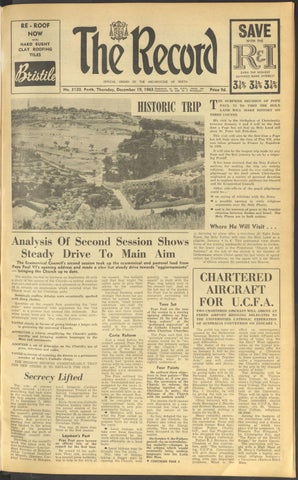
7:_y Arriving by plane after a two-hour j'et flight from Rome, the Holy Father will visit the Holy Land as a pilgrim, January 4 to 6. This panoramic view shows three of the leading landmarks of Jerusalem in Jordan. At the lower right is the Franciscan "Church of All Nations:" at the left of the church is the Garden of Gethsemane where Christ spent his last hours of agony before the Crucifixion; on the upper left is the Mount of Olives whence He ascended into Heaven.
CHARTERED AIRCRAFT FOR TWO CHARTERED AIRCRAFT WILL ARRIVE AT PERTH AIRPORT BRINGING DELEGATES TO THE UNIVERSITIES CATHOLIC FEDERATION OF AUSTRALIA CONVENTION ON JANUARY 1. The airlift has been organised by the Melbourne Newman Society to overcome holiday period transport difficulties. The theme of the convention, which commences on January 2, will be the r elationship between "The Church and the Popular Arts," and will centre around talks and discussion. Among those who will be giving talks will be Dr. Bertrand Adderley, B.A. (Hons), Dip.Ed., who is the present Director of Education for the Sunbury Diocese. Together with Mrs. J. Dunphy, he will be giving the talk on the "Church and Song." Other lecturers will include Monsignor J. Bourke and Brother Mannion, who is at present writing a thesis for his M.A. Many colourful personalities will visit Perth for the convention. These will include former West Australian Father Challis, O P., and Gai Fitzgerald, who designed the Crucifix for the Sydney Cathedral. Father E. J. Stormon, the Chaplain of this Convention, said: "The forthcoming U.C.F.A. Convention will give those attending an opportunity for grappling with two important problems. What is the
effect on contemporary minds (our own included) of the widely diffused artforms of today (e.g. the the film)? What opportunities do the typical present-day media offer for expressing a Christian vision of life? The answer to these questions will involve a reassessment of the Church's relationship to the arts in the changed society of today." The delegates will be staying at St. Thomas More College, St. Catherine's College and Kingswood College. The lectures and discussions will be held at the University. These will be open to the public, at a slight charge. Those interested should contact the U.C.F.A. Secretary, c/o St. Thomas More College, telephone 86-5080. Among the features of the convention will be a film evening and a drama evening at which two plays will be presented, "A Phoenix Too Frequent." by Christopher Fry, and "The Farce of the Devil's Bridge," by Andre Gayon. The convention will begin with a High Mass at St. Mary's Cathedral, and will include a highly unusual religious feature—.a Ukrainian (Eastern Rite) Mass.
Mt-
Page Two
THE
FROM PAGE ONE
Blessed Virgin . .On October 29, the
Fathers decided in a close vote (1,114 to 1,074) to include their declaration on the Blessed Virgin in the schema on the .nature of the Church rather than in a separate schema. Explaining this decision. Father Bernard Haering, C.SS.R., a council expert. said after the meeting that it was a matter of expressing the fullness of the doctrine on the Blessed Virgin in a balanced perspective and presenting the veneration of Mary in its proper relation to the adoration of Christ. The debate on the nature of the Church clearly showed that the issues of the collegiality of bishops and the restoration of the permanent diaconate were two of the major issues at the session. A new procedural devise was introduced on October 30 which let the moderators gauge the thinking of the Fathers without extending the .interminable number of arguments for and against.
Collegiality The moderators submitted five questions for a vote. Four of them dealt with the idea of the "collegiality" of bishops and the vote explained what the Fathers understand by that unfamiliar term — episcopal consecration is the highest grade of the sacrament of Holy Orders; every bishop, who is in union with all the bishops and the Pope, belongs to the body or college of bishops; the college of bishops succeeds the college of Apostles and, together with the Pope, has full and supreme power over the whole Church; the college of bishops, in union with the Pope, has this power by divine right With their affirmative answer to the fifth question, the bishops showed
The Crescendo Of Love AS STATED IN OUR LAST ARTICLE, LOVE 15 A
they thought the diaconate should be restored as a distinct and permanent rank in the sacred ministry. It was a permanent rank in the early Church, but it has become, in the Western Church, just a step to the priesthood. The balloting was to serve as a guide to the Theological Commission in revising the chapter dealing with the hierarchy in the schema on the nature of the Church.
Criticism A four-day recess followed the October 30 vote, and when the council reconvened it seemed to have gained momentum The November 5 meeting saw the start of biting criticism of the Roman curia and serious charges of tampering with the schema presented to the council on "Bishops and the Government of Dioceses," the fifth chapter of De Ecclesia. Archbishop Leo Binz of St. Paul, U.S.A., a member of the Commission for Bishops and the Government of Dioceses, called the schema an "unhappy schema" with "no real introduction, no connecting link and no real conclu-
ALL
BOOKINGS
BY
AIR, SEA, RAIL or ROAD WITHIN
AUSTRALIA OR OVERSEPS Consult-
101.GETY-N.I. L. TRAVEL SERVICE1 15 William Street, Perth. 21-2841. 4.41 , 0
4141.
41,4141 ,41.#
MUTUAL SELF-GIVING WHICH ENDS WITH SELFRECOVERY AND THE BEGINNING OF A FAMILY. OVE which deliberately frustrates self-recovery could produce dual selfishness. It could be likened to a perpetual change in barter like commerce between t w o shipwrecked sailors on a desert isle, yielding no profit to others or to themselves, and with no other destiny but to be consumed in the useless fire their own hearts had kindled. Love is a loan from the Heart of God, and must not be buried in a napkin. It must be paid back again to Him in fruit. The child who is born now gives concrete expression to that love they always spoke of as "ours." Lovers always imply that the love that binds them together is something more than the sum or addition of one and one making two. Implied is the idea that there is some bond outside of them, stronger than. either, uniting them both. As the Holy Spirit is the great bond of love between Father and Son, the child now becomes "'our love" in the flesh.
;
THE MISSION OF LOVE
SURVIVAL THROUGH LOVE IN THE MOTHER, particularly, redemption vests itself because she becomes the sacristan and the guardian, the trustee and the wardress of their love. No longer is she the instrument for satisfying a passing fascination, a banquet to be consumed and forgotten; but rather, his life mate, the increaser and the multiplier of their image, of their virtues and their grace. Here in the child is found the challenge to death. For their survival in new life is the conquest of death and the pledge of their own immortality. Like the burning bush that Moses saw, their love burns but is not consumed, for it produces the vision of a new creature of God. The modern age, which is so keen on enthroning sex, may not be far from the truth when they say, "Love is God," for if they
would enter a little further into the mystery, they would see that what they must learn is that God is Love. This is true not only because their love is an incarnation, such as Christ in the cradle or the stable, but it is also a Saviour as Christ on Calvary, for the child is the redeemer or the saviour of their love from death.
LOVE summoned them first to be creators in the broad sense that they create their love, thanks to God's power. Thus there is a gradual crescendo of love. First, almost with childish minds they say that God does not forbid them to love. Then they understand a little later on that God, being love, has united them one to another, and has placed in them a great hope for continuing His creation. Then they discover successively the joy of loving one another for God; then of loving God in the other, and then of loving the other with the very love of God Himself. Their love then becomes a kind of an Advent, preparing for the coming of the Messias or Christ. It is a temporal mission with great, eternal consequences. The weakness of human affections never suffices (or a lasting love. They are bu. two empty vessels, and each of them must be filled with the wine of God. #14,11.0
climax on November 8 when two outstanding cardinals clashed sharply over the curia's role— Joseph Cardinal Frings of He said that this was be- Cologne, Germany, vigorcause five chapters of the ously objected to the pracoriginal schema had been tices of the curia's hthest deleted when it was re- body, the Sacred Congreturned from the Co-ordi- gation of the Holy Office. Defending it was the Holy nating Commission. .Office's Secretary, Alfredo Bishop Giuseppe Gar- Cardinal Ottaviani. gitter of Bressanone. Italy, The Fathers moved from charged that the text was "certainly not the one debating the nature of the drawn up by the prepara- Church to the next topic, tory commission. It ex- ecumenism, on November pounds its doctrine under 18, and there was no letthe one-sided light of in- up in the impact of consistence on the rights and flicting opinions. The first day's debate the central organs of the Roman curia." showed the Fathers split Bishop Pablo Correa three ways —and in the Leon of Cucuta, Colombia, debate, which carried on complained that "fully to the end of the session, one-half of the members Bishop Stephen A. Leven of the preparatory com- of San Anotonio, U.S.A., mission were not given an made a strong defence of opportunity to express the new order and a stingtheir mind on the text of ing rebuke of its critics. On that first day, an the schema." Italian cardinal and three Eastern Rite patriarchs Let It Be Known opposed including a chapCriticism was frequently ter on Christian-Jewish heard in council lobbies on relations in a schema the unnecessary delays of whose aim vv-.s to bring commision meetings. about Christian unity. Two According to reliable in- Spanish cardinals warned that caution was needed formation, Pope Paul let it be known that he wanted in an ecumenical dialogue the Theological Commis- of Catholics with Protession to meet daily rather tants. Three other speakers than once a week so that a - —Joseph Cardinal Ritter revised schema on the na- of the U.S.A. and cardinals ture of the Church could from Venezuela and Japan soon reach the council —said the council should discuss all the issues. floor. When Bishop Leven On October 30, the council completed the main spoke his mind on Novempart of its work on the ber 26, his caustic words 130-paragraph Constitu- brought a mixed reaction on the Liturgy—the tion; some of the Fathers first item on its agenda sat in angered silence and when the first session others responded with enopened in the later part of thusiastic applause. 1962. The Fathers overShortly before the end whelmingly approved the of the session, Pope Paul constitution's last chapter. made a change in the All that was left for the make-up of the council final product was approval commissions which was of a relatively small num- interpreted as a move to ber of changes. get around delaying actions which were reportecfly holding up revision of Curia's Role controversial schemas. Debate on the Romar curia came to a dramatic Ideal Solution
THINKING OF TRAVELLING? FOR
Thursday, December 19, 1963
Bishop Futon Sheen . . .
Holy Father Effected A Speed-Up Ten bishops from nine English - speaking nations started drawing up plans for a common English-language text for the Mass and the sacraments. The ten bishops are calling on liturgical experts, biblical scholars, musicians and experts in English style to help draw up a suitable English text. While the council was discussing giving greater recognition to the role of laymen in the Church— covered in the third chapter of De Ecclesia—a U.S. prelate, Bishop Robert E. Tracy, of Baton Rouge, in the southern State of Louisiana, asked - for a council declaration against racial discrimination. Archbishop Lawrence J. Shehan of Baltimore, called for a full and accurate treatment of the question of Church and State. Both spoke in the name of all the U.S. Bishops. The U.S. Bishops objected to the schema's phrase ''regrettable separation,' holding that the American experience of separation has not been regrettable but very good.
RECORD
The reorganisation provided that— * Each commission be increased to 30 members ( from the normal 25); • Each commission, after getting its new members, was to elect a vicepresident and a vice-secretary. The Pope's move was greeted as an ideal solution to a problem which worried many of t h e Fathers. It gave the hope
of breaking through an impasse caused by foot dragging on the part of a minority determined to stall the majority. Some observers felt it would have been better to choose completely new commissions. this But would have been an outright challenge to the authority now in the hands of high curia officials and a cause of unhelpful friction. The council commissions will be laying the groundwork for the council's third session, set for September 14 to November 20, 1964. In the debate on ecumenism, the Fathers discussed way to encourage ecumenical relations with non-Catholics. Among the measures recom mended were—recognising the validity of mixed marriages before non-Catholic ministers, permission to attend non-Catholic religious services a n d co-operating with non-Catholics in the intellectual field. Time ran out before discussion reached the last two chapters (on relations with Jews and on religious liberty) of the ecumenism schema, but the Fathers were assured that the two chapters will be among the first items on the agenda for the third session. In a speech at Rome's Canadian College, Cardinal Suenens said that the moderators could have insisted that the two controversial chapters be brought to a vote but had decided not to do so.
VALUABLE FIND Of MORE SCROLLS
JERUSALEM: A scroll containing Chapters 81 to 85 of the Book of Psalms has been unearthed at Massada, the last stronghold of the Jews during their revolt against the Romans in 73 A.D. The professor who is directing them archaeological work at Massacla, Yigael Yadin, is a son of the Hebrew University professor who fouud the first of the valuable Dead Sea Scrolls in 1948. Two scrolls and a fragment are in the Massada find. The Psalm text, written in a fine script, is apparently the Massoretic version. The second scroll bears a resemblance to the Dead Sea Scrolls. The fragment may be part of the second scroll or a separate document. The delicate discoveries have not yet been unrolled. EARLIEST FOUND The dating of the Dead Sea Scrolls has been disputed, but Professor Yadin stated that there can be no doubt about the date of the present finds, since they must have pre-dated the fall of Massada in 73 A.D. They were discovered among baskets, cloth and sandals in a room generally believed to have been a synagogue—the earliest yet found. The Massada fortress is being excavated along with the Palace of Herod and a
41,11 ,4.4.4111NOMO#0411,14.4,""14.4.4.4.41 ,41,04.11
PHIL KEOGH
Resident Chemist
274 Cambridge St. Wembley - 87 3984 Christmas Gift Requirements
PERTH'S ART and DRAWING SUPPLY SPECIALISTS 148 WILLIAM STREET, PERTH
C ooling Off They felt, he said, that after a cooling-off period and after the issues had been aired in public print, the chapters would stand a better chance of passing. Augustin Cardinal Bea, S.J., of the Secretariat for Promoting Christian Unity —which drew up the ecumenism schema—told the Fathers at the session's last full working meeting that the old saying applies— "What is put off is not put away."
nearby Roman camp. It will become an Israeli national monument. RATIONS Other items unearthed in the same room with the scrolls are four Latin documents, 17 silver "Shekels of Israel" dated with the Year 5, the last coins to be struck during the revolt, and 20 oil lamps. In other rooms inside the fortress jugs with family names have been found. These were apparently part of the rations of the Jewish zealots who held out against the Romans. In Herod's palace more than four hundred suits of armour have been unearthed, along wtih arrow heads, a woman's plait of brown hair in good condition, two skeletons, cloth and a pair of sandals.
2 1-7853
JACKSONS 21-7853
Oils, Crayons, Paints, Drawing Equipment 74 1054 A fter Hours 71 2670
John lobb & Associates 5ptOtnetriSt8 JOHN LOBB Optometrist
-
ROY GALYIN & CO.
229-233 William St., Perth 28-1541
& Op ticians
1 3 THE AVENUE, MIDLAND
imetakinimitmorwirto . PLUMBING MATERIALS BATH ROOM FIXTURES SEPTIC TANK — DRY WELLS„ The "Plumbing Supply Specialists unibmwswein~~~~10001"4
T HE
Thursday December 19 1963
BISHOPS' POWERS MORE DECENTRALISED
Page Three
RECORD :4,4%.*A.0 44 4.04-04.* * 4"'',.•
t i 7
4
* *a *.0.0.0.10
0,0
4.4 A 40.*.4.* 44400.4 *410114,*:0.* *4,4
00100014.10 4.44 W.0.*:41110010 1.40).11;001k* *11410011Wili
0%.0
00 016:0*.16,0 0,0,...0*.0Mai* *I •44V;;," 411f w'; '41;::;7 * 0.* .0.01641411k 0:**1*Azik *-"Ak , •
•-
IZZratree557cow ' reoray
/
14 Asoomp /ex,; A
By MONSIGNOR JAMES I . TUCEK V ATICAN CITY.—A list of forty faculties, or powers, was granted to bishops of dioceses by Pope Paul VI in his motu proprio, Pastorale Munus, promulgated here on December 3. The document was dated November 30, the feast of St. Andrew, but was promulgated on December 3 on the occasion of the solemn the of commemoration f ourth centenary of the Council of Trent. Most of the faculties granted would be meaningless to the general body of Catholics. They have particular importance for diocesan chancery offices, relieving them of the burdensome and time-consuming tasks of making a special request each time the faculties are needed. The faculties pertain to extraordinary circumstances in the administration of the sacraments and to the adcertain of ministration goods and properties held by a diocese. ALREADY DONE HERE Those faculties having immediate effect on parish life have to do with the celebration of Mass. Bishops of dioceses, for example, may permit their priests for a just reason to celebrate Mass twice on weekdays and thrice on Sundays and Holy Days. According to the new faculties, bishops of dioceses may allow priests afflicted with poor eyesight or some other infirmity to celebrate the votive Mass of the Blessed Virgin or of the dead daily. Infirm priests may be permitted to celebrate Mass in their homes, and seated if necessary. The faculties relating to the Sacrament of Penance allow bishops, among other things, to grant confessors faculties to absolve from reserved sins and censures with few exceptions. The motu proprio lists faculties and privileges. Faculties belong to the bishops by right and, strictly speaking, are not conceded. Privileges do not belong to them
by right and are granted by the Holy See. PREACH ANYWHERE The main feature of the privileges is that bishops will now enjoy the privilege —formerly granted exclusively to cardinals — to preach and hear confessions anywhere in the world unless the local Ordinary explicitly objects in a particular case. Most of the faculties now restored to the bishops in the motu proprio were regularly included in the quinquennial faculties that many bishops renewed every five years. CONFIRMATION For some time parish priests have had the privi-
7/Ati
4.W .4.504
I*at.* .11.• ilk1KILMV /# "'
"'#/
ilk4V.4.404,0
14.4 ..
*
* ***:*;*,* *** **** *
oigamuirm.• 4**
0.1/K.*. ' *0 Is 0.0 Woo 4•10.10fr /// "
*iv* 0
tr, *,
”!...41r;;,7 ;,2.4t, " :-":" 0.* IWO 0A* /,41.011100 *AA 04414%** *24:0 401.16WAW40....
*0*
*
„
This window is one of the lovely features of the new Chapel at the Presentation Convent "Iona," Mosrnan Park. It depicts Our Lady at the age of three being presented in the temple accompanied by her mother, St. Anne and her father St. Joachim. The window is a memorial to the late Father J. O'Hara, M.M. Patricia, M.M. Finbarr and Sister M. Joachim, R.I.P., and is the gift of Mr. J. O'Shea of Corrigin. The work was executed by John Ashwin & Co., "Van-Mar - Studios Inc Lakemba, N S
EXPLANATION Child's Testimony Did Not Add Up TO ARABS BEIRUT, Lebanon.—Lebanese papers have published a letter from Patriarch Maximos IV S aigh, of Antioch, explaining to Arabs the council's deliberations in a statement dealing with relations of the Church and Jews.
The Patriarch addressed the letter to all Arabs "to correct erroneous interpre tations and to allay anxieties felt in the Arab countries when it was learned that the Ecumenical Council might examine certain texts regarding Jewish religion." The Patriarch said that "the Jewish question should be regarded under a twofold aspect — the spiritualreligious and the civil-political. But when the Church speaks of Jewry she does soin the purely spiritual-religious plane. "The Ecumenical Council has declared repeatedly that 1111111111111111111111111111111111111111111111111111111111111 it is not its task to intervene in civil and religious matters. The document in question makes no reference whatever to the present C HEMIST political situation between Arab States and the State 298 CANNING HIGHWAY, of Israel, which so far has COMO not been recognised by the ( Opposite Como Post Office) Vatican." Actually, it is inexact to Telephone: 67-1559 say a* Vatican has not rePrescriptions Readily cogni8ed the State of Israel. Dispensed__... The Vatican does not have Will Call for and Deliver diplomatic relations with NIGHT TRADING: Israel but that does not imply non - recognition. The 7 - 9 p.m. on Mon., Tues., Vatican does not have dipThurs., Fri. lomatic relations with the 1111111111111111111111111111M111111111111111111111111111111 U.S.A. either.
JOHN BEGLEY
A WNINGS, BLINDS, FLYWIRE
DOORS, and FLYSCREENS ALL TYPES .Measured and Installed in 7 Days by
STAN BOND
1010 BEAUFORT ST., INGLEWOOD Phone 71 4313 Top Quality Tradesmen
H OT WATER
AROUND THE CLOCK! AROUND THE HOME! BRAEMAR — the name that means HOT WATER throughout A ustralia! All units carry 2 YEARS Guarantee and Service. A vailable from all Major Electrical Wholesalers and Hardware Merchants. ELECTRIC SOLID FUEL OIL FIRED
13 RAEMAR
SOLAR Phone 50-2044. Cnr. STOCKDALE RD. & JONES ST., O'CONNOR
JOHN CARTWRIGHT LiPlumber censed
Quotes
lege of confirming in danger of death. Now bishops may give the same privilege to certain hospital and prison chaplains. Bishops already had the right to exercise the Pauline privilege. By force of the motu proprio, however, they may, without recourse to Rome, dispense from the requirement of obtaining a statement from one party that he or she is unwilling to become a Catholic or live in peace with the mate who wants to become a Catholic. The faculties belong to residential bishops only, who may delegate them to their coadjutors or auxiliaries and the vicar-general. The privileges belong to all bishops, residential or titular.
Without Obligation on the Installation of
B raemar HOT WATER Systems R ING 30-2921 — ANYTIME!
Digging Finance The CIMITILE. Italy: Italian government has put up approximately EA36,000 to excavate a series of ancient catacombs at this small town near Naples. Scholars trace the origins of the catacombs to preChristian times. Some believe they were caves created by the digging of tufa, a soft porous rock widely used for building. Others believe they began as the earthen homes of tribes in the Naples region. According to Church tradition, Bishop St. Felix and thirty other Christians were martyred in the year 95 and were buried in a place called "Coemiterium," which is believed to be the catacombs of Cimitile. Excavations begun before World War II have uncovered a fourth-century basilica floor plan in the area, but work stopped with the outbreak of war. Recently, however, the Cassa per il Mezzogiorno, a government agency charged with stimulating the economic progress of backward areas in Southern Italy and Sicily, has appropriated the money to resume the work.
The Most Remarkable The Shrine of the Three Kings in the famous Cologne cathedral is considered the most remarkable medieval example of the goldsmith's art extant. Wrought by the master Nicholas of Verdun, it combines plastic ornamentation and enameling with amazing perfection. The cathedral itself is the greatest monument of Gothic architecture in Germany. Begun in 1248 it was not fully completed until 1880. While most of Cologne was destroyed by allied air raids during World War II, the cathedral escaped major damage and its priceless art treasures were almost miraculously preserved.
JERUSALEM (ISRAEL): A CATHOLIC SPOKESMAN HAS PROTESTED AGAINST A JUDGE'S ACCEPTING A CHILD'S TESTIMONY OF 3 A.M. WAKINGS AND FORCED PRAYERS IN A CASE WHICH LED A COURT TO ORDER THAT FOUR JEWISH CHILDREN BE TAKEN OUT OF A CATHOLIC ORPHANAGE.
Father M. J. Stiassny, the press officer for the Israeli vicariate of the Latin Rite Patriarchate of Jerusalem, said that Church authorities investigated the case and found the child's testimony false. The Jerusaiem district court ordered that the children be taken out of the orphanage, where they were placed by their widowed mother, after testimony by one of the four, a 12-yearold girl.
truth and must be attributed either to own imagination or to careful briefing. Our investigation has shown that the children were t reated with care and 'love, like all the other children of the same school; they had nine full hours of sleep; they got up a normal time according to the season. they did not work from 3 to 5 a.m. for the simple reason that they were still in bed: no other work was required of them than tidy-
The girl told the court: "They force us to bow down to a statue . . . they wake us up at three in the morning to do the cleaning. We pray The from five to seven. room we live in has no stove. There are about 20 children in each room." The girl also said that her mother had left the four at the orphanage three months earlier and had not visited them since. DENIAL Father Stiassny said in his communique: "After the wide publicity given by the press to the case of the Cohen children, who allegedly were mistreated in the Rosary Convent School in Jerusalem, and subsequently withdrawn on the request of the Legal Adviser to the Ministry for Social Affairs, a careful investigation has been made by the Church authorities, with the following results: "Mrs. Cohen placed four of her children in the above school after all her effor to place them in a Jewisii institution had failed. She neither disappeared n o r abandoned her children, as witnessed by the fact that she visited them regularly and settled each month the tuition fees to the school. "The children were quite happy at the school, until their uncle started to pay them visits and create in their minds an antagonistic attitude towards the Sisters. He even tried to take them out forcibly, and was prevented from doing so only by prompt police action. "After these unpleasant incidents, the Sisters wrote to Mrs. Cohen requesting the withdrawal of the children. • EVIDENCE FALSE "The 'evidence' given by the elder daughter before the court is contrary to the
FOR
SERVICE
ing up the dormitory, the same as in all boarding schools; there is not a single dormitory of 20 beds, the largest one has 11; the children were never taught. requested or compelled to do an act of Christian worship. this being strictly forbidden by ecclesiastical authority. The spreading of horror stories about the so-called mission can only have one result which nobody in his right mind in this country would welcome."
SINCE
1895
TYRE SERVICE Introduces
A New Kind of Exclusive
TYRE lIE - CAPPING WITH G8 NO -SQUEAL TREAD You Pay Only 1/- in the £ per Week SUPPLIED and FITTED BY:—
BOANS
SERVICE STATION
Corner of ROYAL and BENNETT STREETS, EAS7 PERTH
B OANS
MORLEY SERVICE STATION 1
WALTER ROAD
BOANS
MEDINA SERVICE STATION
Also Supplied at BOANS, WAVERLEY, and H AYWARD'S, BUNBURY ( A Boans Stores
Page Four
THE
RECORD
Thursday, December 19, 1963
DESMOND O'GRADY writes from ROME... 1.••••••••••••••••1011•V
WILL PAUL VI BE A "TRAVELLING T POPE?"
EVERYMAN'S FAMILY
HERE are many aspects to Pope Paul's visit to the Holy Land, but one of the most striking is that of the return to the origins of the Faith, which is the theme of those who wish to see the Church place a greater emphasis on a biblical and evangelical simplicity.
Though the scope of the pilgrimage is solely religious, there has been elaborate planning to ensure that no protocol is upset nor any sensibilities offended. There is an old saying that when the Pope travels he does what he likes, but that was shaped within Christendom when Popes often travelled. What was once easy and accepted has been forgotten—perhaps it customary will become again. A trip to the Holy Land is far more difficult than one to Lourdes, but the possibilities it opens are vast. Strong rumour has it that the Orthodox Patriarch of Constantinople Athenagoras —and perhaps the Russian Patriarch Alessio--will meet Pope Paul in the Holy Land. The Orthodox would be more willing to meet the Pope there than in Rome, so there may be a gathering of Eastern and Western Patriarchs, both Catholic and non-Catholic. Constantinople and Rome meeting in the Holy Land would augur well for unity.
Left Open THE POPE'S initiative gave a noticeable fillip to the close of the Council. It balanced the disappointment over the fact that the chapters on the Jews and religious liberty were not put to a vote to see whether the Council would accept them as a basis for discussion. It lifted the spirits of those "progressives" who had hoped that the Pope would not use the terra "concede" when talking of the bishops' widened powers and that he would have come out more explicitly on collegiality and the form of the bishops' co-operation in Church govrnment in his final address. In effect he has left the crucial questions open to the commissions who must submit their work to the Council in the next session. What he did do was to suggest that the revised
draft on "Revelation" would be reconsidered, whereas many thought it would be pigeonholed after its first version was rejected in the opening session. Then he announced his trip, which gives a further reason for ecumenical hopes and sets the Council questions still undecided such as that on Our Lady, the relations between bishops and the Papacy, and the Church itself in an ecumenical perspective. This is the first decisive ACTION of the Pope who has reportedly said in private that the second session was still John's, but the third would be his. This trip may well be a precedent. Some of the central - western European bishops say they will consider the Council a success if it leads to an effective, permanent expression of
collegiality in the structure of the Church. Cardinal Gracias, Archbishop of Bombay, is said to be more demanding, to believe that if the Council does not come to some telling decisions regarding such pressing problems as hunger and the "population explosion," it will have failed as far as Asia is concerned. Towards the close of the second session, he asked the Fathers to petition Pope Paul to have schema 17 on "the presence of the Church in the modern world," which deals with these problems, advanced in the agenda.
Bombay Congress THE THIRD session's tentative dates will allow the bishops to go from
By Father JOHN C. KNOTT
Twenty Years To Go Rome to attend the Eucharistic Congress in Cardinal Gracias' diocese Bombay. Pope Paul's January trip will foster Ecumenism— which is the Council debate in suspense between the second session and the third. It is possible that the close of the third session will see the Pope taking a second momentous trip outside Italy with the one year —to India, where his presence would be a striking proof of the Church's interest in Asia and her problems, and emphasise that the Church is not tied to Latin or "Western" cultural forms.
1
..m..".,..... ..........~•••,..,........,~ Supplies of Fish, VEGETABLES and POULTRY at:
ROSS INTERNATIONAL FISHERIES
Head Office: 7 CLEAVER STREET, WEST PERTH PHONE 28-4511 Branch: 29 MACDONALD ST., KALGOORLIE. Phone Kal. 49. SPECIAL QUOTES FOR CATHOLIC SCHOOLS HOSPITALS and INSTITUTIONS. Fresh Fish and Shell Fish Available Daily
We Solicit a Trial from all Religious Institutions 44,41 , 04,41,P.MO411,04.4.4.04,...."1,0,0
No order too big or too small. We can supply every need— if at all manufactured. PviNaPINIVAPNI.4,11.#04.4
411 ,4,
W.A. Agency for "Tibaldi" Brand Salami Sausaae and Canned Mortadella and Zompone.
GIVE YOUR NEXT ORDER TO—
SARA & COOK PTY. LTD. W HOLESALE GROCERS AND PROVISION MERCHANTS
PHONE: 21-5121. 482 to 484 Murray Street, Perth
The comment of Charles M. Schulz, the creator of the daily cartoon "Peanuts," should have been remembered sooner. He once said that the trouble with dedicated people is that they have no sense of humour. A re-reading of the news account brought one to the reluctant conclusion that these recommendations were made in all seriousness.
P UBLIC
PROMOTION
-
Jewish Festival Near The Nativity ABOUT THE TIME JESUS WAS BORN, POSSIBLY THE SAME NIGHT, JERUSALEM WAS CELEBRATING THE JEWISH HOLIDAY, HANUKKAH. It commemorates the first great victory of religious freedom, won by the Jews in 165 B.C. At that time Palestine was dominated by Antiochus IV, a SyrianGreek dictator, who sought t o abolish Judaism. Under the leadership of Mattathias and his five sons, known as the Maccabees, after three years of bitter struggle the Jews brought defeat to the pagans who had desecrated their Temple. According to legend, when the faithful reentered to rededicate their Temple to Jehovah, they found only oil enough to furnish altar light for one night; but, lo, it burned eight. THE 25th DAY Hanukkah, which means "dedication," is celebrated
A RECENT CONGRESS on population problems reported to the press some startling recommendations. They carried such far-reaching implications and were so contrary to traditional American attitudes as to lead one initially to suspect a tongue-in-cheek approach.
half the oil to start frying pancakes by the tablespoonfuls in skillet, well heated. Add oil for subsequent batches as needed.
eight days of Kislev, the Jewish month corresponding I SRAEL SESAME roughly with December. S QUARES Starting with the lighting ( A delicious candy to pass of one candle on the 25th to guests). day of Kislev, an additioncup sugar, !J cup honey, al one is lighted each night .1 cup hot water, pinch of until eight glow in the Mensalt, 1 cup sesame seeds, orah, the special eight branched candle holder. 1 cup chopped nuts (AlFamilies light the candles monds ore walnuts). with prayer and song. The Combine sugar, honey, following is a favourite .hot water in top .of double hymn for the occasion: boiler. Cook to soft ball "As one candle may kind- stage, stirring constantly. le many others and yet lose Stir in seeds and nuts, cook none of its own light, so over hot water 3 minutes, Judaism has kindled the stiring all the time. Place light of truth for many re- pot over low direct heat, ligions in many lands . . . cook slowly till Mixture is and still shines brightly golden brown, about 5 minthrough the ages." utes, and never stop stirring. The festival hymn is Pour mixture out on wet "Rock of Ages." Hanukkah baking board (pour on wais observed with special ter, then wipe with tea with towel, so board is damp). synagogue services, much visiting among family Spread candy out as thin and friends the playing of as you can and with knife games, exchange of gaily dipped in hot water cut wrapped gifts and feasting quickly into squares. on light refreshments. The Mogen David, six pointed star is often part of the house decoration. It wouldn't be Hanukkah without potato pancakes. Why pancakes? Because that's what the Maccabee women could easily cook and serve behind the lines for their fighting men and because they are made with oil, are a reminder of the miracle of the altar light oil. LATKES Recipe One (Potato Pancakes) 6 medium-sized potatoes, 1 onion, 2 eggs, 1 teaspoon salt, cup flour, shortening or oil for deep-frying. Peel and grate Potatoes and onion; squeeze out liquid. Add eggs, beat; then add flour and salt. (1) Fry in deep fat by dropping batter by spoonfuls . . . enough batter to make pancakes about three inches in' diameter. Drain on paper towel. Serves four to six. (2) Greast shollow 8 by 12 inch baking pan; then bake mixture at 350 degrees F. about 45 minutes. Cut in squares and serve immediately . . . or bake individually in muffin pan. This 12ft. bronze statue of Recipe Two Pope Pius XXII will be unveiled in St. Peter's Basilica, 2 eggs, 3 cups grated, Rome, early next year. It is drained potatoes, 4. tablethe work of Milanese sculptor soons grated onion, teaFrancesco Messina who has spoon pepper, 1 teaspoon salt, 2 tablespoons cracker been working on it for three meal, cup cooking oil. years. Cost of the monument Beat eggs, add other inwas paid for by the Cardinals gredients, except oil. Use created by Pope Pius XII.
AMONG OTHER THINGS, the conference proposed "the widespread distribution of contraceptive devices to both married and unmarried persons at public expense." Whatever the reasons that may be offered for this radical change in public policy, the fact of the matter is that this would be a public promotion of promiscuity and sexual irresponsibility. It would in practice not only condone but encourage pre-marital sexual relations. The big evil in the minds of the conferees seems to be not sexual immorality, but an unwanted pregnancy, whether legitimate or illegitimate. Discussion was had concerning the formal approval of abortion as an answer to an unwanted pregnancy. While this formal approval was withheld, it might be just a matter of timing. It was Kinsey who stated that 90 per cent of the women seeking an abortion are married women with a contraceptive failure. You can be sure that the advocates of indiscriminate contraception will necessarily have to do something about these disturbed constituents. Those who have a right to no-life have in their mind an equal right to anti-life. However ,the formal approval of sterilisation as the perfect contraceptive did come out of this meeting. This is especially interesting, since more and more of recent Planned Parenthood literature has been admitting that existing contraceptives are complicated, a bit messy and unaesthetic. and not nearly as safe as people presume. Besides this people have to be "motivated- to use them. The ones "motivating" themselves right out of existence are found mostly in the middle and upper classes. You can give "the pill- to the poor, but you can't make them use it. Perhaps there is more meaning in the Scriptural phrase than is usually realised — "The poor you will always have with you."
S IMPLE
SOLUTION
AT ANY RATE, sterilisation offers such a permanent and simple solution. A quick twist of the surgical knife and there you have it, or don't have it as the case may be. It is more complicated with the woman, so why should not the male be the man about this, or the non-man, as we have the non-book. After all, he is the carrier of the disease called life. This operation would free the man of all sexual r esponsibility. It is more subtle than castration, since he can still perform the sex act. However, provisions are being made so that he can still father a child. Human stud-banks are now beirx advocated where ,prior to the operation, his seed can be deep-frozen for future use. When he wants a child, he can tap the bank. If such a child is not a love child, at least it would be a wanted baby and that seems so important to some adults. This would presume, of course, that his Wife wants his child. If, at a given moment, she Was more enamoured of the characteristics of another male, she could probably call up the bank and get the order changed. She is a free agent ,too. If enough men are sterilised, then women Would, be safe from that pathological condition call& pregnancy. What, then, about those men who hae. not been sterilised? Will they become victims. el an Orwellian persecution against love and life. After all, it is only 20 years to 1984! The address of the local Catholic Marriage Guidance Centre is 23-4548. 77 ST. GEORGE'S TERRACE, PERTH.
THE
Thursday, December 19, 1963
RECORD
Role Was Reversed V ATICAN CITY.—Two laymen, one French and the other Italian, took the floor of the c ouncil to speak of the need for ecumenism and of the role of the laymen in the Church in the presence of Pope Paul yl and more than two thousand bishops.
The rare occasion for laymen to address the assembled bishops of the c ouncil took place during a commemorative session marking the fourth centenary of the Council of Trent. The speakers were French writer Jean Guitton and Italian Vittorino Veronese, long a leader in the field of Catholic Action. Guitton said his vocation to the ecumenical movement is founded on meditation on the reasons which, in the Gospel of St. John, Jesus gives for His sacrifice and on the certitude that this will of Christ is effective and that we must cooperate in it with our whole being." He warned against two false approaches to ecumenism. He cautioned against one approach which would retain "solely that which is common to all Christians or which prepares a new super -church said to be the synthesis of the historical churches." Rather than accept this approach, he said, "true religious spirits prefer the solitude of disunion to an equivocal union" which offends truth.
"IIIMOBILISM" The second approach referred to was "immobilism," which holds that "the Catholic Church must restrict herself to waiting for the return and submission of the churches which have broken the link of unity. But unity is a link of love, and love compels us to unity." Guitton said ecumenism "demands two complementary sacrifices." On the one hand Catholics themselves must respond "with a humble, magnanimous and sorrowful effort of purification so as to remove from the face of the Church the lines which mar her eternal youth. The blood which achieves unity cannot be shed on one side only." CHRIST'S WILL He also said it must be stressed that "the Catholic Church is entrusted with the task of announcing to the world that she is the only church as willed by her Divine Founder." Yet this must not obscure the fact that Catholics must
realise that unity will be perfect only when the legitimate forms of Christian and human diversity have once more found their place and their just freedom in the bosom of the Church. Guitton then conjured up a vision, saying: "Let us imagine, venerable brothers, that all our separated brothers wanted to enter tomorrow the Catholic basilica. "She would widen her nave, she would Ippen up her cupola, she would make her useless ornaments, her antiquities disappear, so that everyone should feel at ease in her sublime simplicity. She would preserve the same form, the same essence, the same structure. Nothing that is essential in dogma, in worship and in authority would be modified. But this same unalterable form, enriched by so many contributions and so many sorrows, would then have its flowering, its perfect plenitude, I might even say its anticipated glory.
Pope Paul's Home Target Of Bomber CONCESIO, ITALY. — THE COUNTRY HOME HERE IN WHICH POPE PAUL VI WAS BORN WAS THE TARGET OF VIOLENCE FOR THE SECOND TIME IN TWO MONTHS. A Molotov cocktail consisting of a wine bottle filled with petrol and an ignited wick was hurled against the front door of the house at about 4 a.m. on December 8. Police later arrested a 24-year-old bus driver, Alessi.° Boniotti, who, they said, had confessed to the crime. Police reported Boniotti said he had thrown the bomb as a protest, but had not said what he was protesting against. Boniotti was identified by townspeople who took his licence number when he stopped a short distance from the Pope's birthplace to fill his car's radiator with water and to put out a flaming blanket. He will be tried for insulting the person of the Pope, who is protected by Italian law under the terms of the Lateran Treaty. No connection has been established between the bomb throwing and the firing of rifle shots at the house on October 20.
W. W. EDMONDSON & SONS
PLUMBERS and SHEET METAL WORKERS Certified West Australia, Hot Water Specialists and General Plumbing. All Work Guaranteed Phones. 28-1714. After Hours: 87-2553, 29-2095. 80 JAMES STREET, PERTH
MOBILE CRANES FOR HIRE Lift
from 6 to 23 Tons — 140ft. JIB LENGTHS
ECONOMIC CRANE & PLANT HIRE LTD. Cm-. KEW and STAR STREETS, WELSHPOOL. Phones: 6-1605 — 6-6361. After Hours: 26-1841.
Lawn Mowers, Shears Sharpened and Set
Harry Armstrong Ply. Ltd. CITY COUNCIL
AVENUE — 21-4390. LOCKS, DOOR CLOSERS and CAR and ALL TYPES OF SAFES OVERHAULED and SERVICED KEYS CUT. Immediate Service.
SANITOS HEALTH BLOCKETTS
Dispels bad odours, for destruction of moths and silver fish etc. Evaporates slowly giving off a delightful pleasant odour and requires no attention. A lso dist of Deodorant Crystals for Hotels etc. SOLD AT STORES AND CHEMISTS EVERYWHERE Made and distributed by
MANUFACTURING CO.
1:1711 .2f hiSoANITOS. ore Street,
this What a testimony would be in the face of the world!" Guitton told the bishops that "this unity of Christians is contained in the prayer of the Eternal Christ and where is the religious man who does not desire it from the depths of his heart? It will be achieved through ways which are unknown to us and which are being prepared while we remain unaware of them, the great events in history. So many converging prayers rise towards God! So many lives have been offered on one side and the other for unity!" He concluded by saying: "May graces be given to you for listening to a layman speaking of his experience. He has done it fearlessly like a son before his father in whom he places all his hope!" Veronese thanked the Pope for including laymen as auditors of the council. He said such a recognition affords laymen the opportunity of being "the interpreters of that Catholic laity which otherwise we would not have known how to represent." Noting that the bishops of the council are returning home, Veronese said: "we, too, return to our neighbours . . . we return to our parishes and to our families" to up-date the spiritual and corporal works of mercy as demanded by the problems of the times.
Phone 21 6715
FIRST THANKSGIVING AWARD
"Have faith in yourself, faith in America," counselled Dr. William B. Walsh (right) director of Project HOPE after receiving the first Thanksgiving Award of Clarke College, Dubuque, Iowa. Sister Mary Benedict, B.V.M., president of the college is shown as she presented the award, a simple, open figure designed by the college art department, and symbolising faith and gratitude. Jeanne Chambers, president of the student art association is shown at left. .1.#4.4"#.4.44.#4,4,0,04.4.0404.11,1#04.#
"During the past two years communist spokesmen have appeared on nearly 100 campuses from coast to coast," Hoover said after receiving the Pro Deo et Juventute (For God and Youth) Medal at the convention banquet of the Catholic Youth Organisation Federation. The F.B.I. chief focused his attention on the menace posed by communism, but he also said that Americans are developing "a dangerously indulgent attitude" toward pornography and have "mollycoddled" young criminals. Auxiliary Bishop Edward V. Dargin of New York presided and gave the invoca-
11.04.0#11^4,04,11,14,1P#4,104,11.4,1PO4,41,MININNP.04^~#######•~#41,041,0~4,
Environment Plays Big Part In Life Says Pope By PATRICK RILEY,. N.C.W.C. Reporter. VATICAN CITY: Holiness elevates what is good in an environment and spurns what is evil, Pope Paul VI declared after the beatification of a Neopolitan parish priest. He said the life of the new blessed, Father Vincent Romano, and of all holy people, serves as "a warning to us not to overestimate environment, as if it were indispensable and decisive for the strong, free and Christian soul." Pope Paul spoke in St. Peter's Basilica at an afternoon ceremony venerating the new blessed, who was beatified in a splendid ceremony that morning, November 17. As he spoke, a newly unveiled portrait of the blessed looked down benignly on him from above the Altar of the Chair. PARISH PRIEST Blessed Vincent was a parish priest of his native town of Torre del Greco from 1794 until 1831. The
F.B.I. HEAD WARNS YOUTH NEW YORK: F.B.I. DIRECTOR J. EDGAR H00VETI, HONOURED HERE BY THE CATHOLIC YOUTH OF AMERICA, WARNED THAT "COMMUNISTS ARE ENGAGED IN AN INTENSIVE CAMPAIGN TO CONTROL THE MINDS AND WIN THE ALLEGIANCE OF AMERICAN YOUTH."
Page Five
tion at the banquet, which was attended by nearly 5,000 Catholic Young people. The youth award was presented to Hoover by Mgr. Frederick J. Stevenson, director of the Youth Department, National Catholic Welfare Conference. Honoured with Padre of Youth Awards were Mgr. Harold J. Markey, former director of youth in the Detroit archdiocese, and Mgr. Maurice Woulfe, former director of youth in the Buffalo, N.Y., diocese. Mgr. Markey is pastor of Visitation church in Detroit. Mgr. Woulfe is pastor of Infant of Prague church in Cheektowake, N.Y. DRIVE Hoover said that in the Red effort to win over American youth "a national youth commission has been established within the Communist party, U.S.A., special publications have been issued; frorft groups have been organised; and an ambitious speech programme has been directed against our colleges and universities!'
village rests uneasily on the slopes of Mount Vesuvius, the European mainland's only active volcano. During that time the volcano erupted 13 times, but never, after Blessed Vincent's prayers and a journey up the forbidding mountain to the mouth of the volcano, did the lava again flow on to his village. Pope Paul referred to the influence of environment and holiness, saying: "The saint, and in this case Blessed Vincent Romano, not only personifies and raises to the highest level all that is good in the environment, but reacts against all that is evil and mean. This observation is not only a cause of admiration for the Servant of God who set himself free from rigid customs, believed to be unchangeable, but must also be a lesson for us. It teaches us that any environment, with the grace of the
Lord and goodwill, can produce sanctity." (Pope Paul did not specify how Blessed Vincent's environment militated against virtue.) The Pope then observed that we must not overestimate the role of environment in forming high virtue. He said: "Positive virtue negative goodness, and mediocrity or vice, are undoubtedly very important factors, and in practice often influence or dictate the behaviour of ordinary people, but not that of the hero of virtue who dominates and personifies them, when good, and reacts against them and often overcomes them when bad." The Pope pointed out that Blessed Vincent was ahead of his time in emphasising that the faithful at Mass should join the prayers of the celebrant with their mind and their voice.
DUFFY BROS. 2 35 Newcastle St., Perth.
LICENSED PLUMBERS
H ARDWARE MERCHANTS
Repairs a Specialty.
21-5598.
M. G. O'Brien & Sons
PAINTING CONTRACTORS
20 MABEL STREET, SOUTH PERTH. 67-2716
Get Better Meat for Less at
C LEM PAULLS
234 HAY STREET, EAST PERTH — 23-4927 63 CANNING HIGHWAY, SOUTH PERTH. 67-1708. WATCH THE WINDOWS FOR OUR SPECIALS
II. P. Oor,0q. Builders ( REGISTERED "A" CLASS BUILDERS
169 NORTH LAKE RD., MELVILLE TELEPHONE (Day and Night) — 30-2677
Will Plan and Build: Churches, Schools, P resbyteries . . . Housing . . . Etc. I NSI ST
ON
POLLICKS SMALLGOODS "Fit for a King"
FROM YOUR LOCAL RETAILER Suppliers of Quality Continental and Australian Smallgoods Delivery to all suburbs — Country Clients specially catered for. Special Quotes to Schools, Institutions, etc. Trade Enquiries Welcomed. MERCURY STREET, CARLISLE — Phone 6-3684.
-11111111111
Page Six
THE
RECORD
Thursday, December 19, 1963
irt)THINATIONALHUNGARY
GERMANY
HE GERMAN BISHOPS HAVE I TSSUED A JOINT PASTORAL TO START GERMANY'S THIRD "ADVENIAT" FUND CAMPAIGN TO HELP THE CHURCH IN
Output Is Limited THE Hungarian government's office for religious affairs allows only 12 to 14 seminarians to be ordained each year the German Catholic news agency K.N.A. has reported. Three hundred students are now studying in Hungary's six seminaries, K.N.A. said. Before World War II, an average of 1,200 students were preparing for the priesthood, a n d usually about a hundred were ordained every year. Hungary now has about five thousand priests, the agency said, of whom 700 are not allowed to practise their ministry and must therefore earn their living in industry and farming. The number of priests is going down because those who each year die, retire or lose government authorisation to work as priests outnumber the 12 to 14 new priests.
LATIN AMERICA. German Catholics were asked to give at least a tenth of the money they spend on Christmas gifts. The pastoral said the campaign would not only help Latin America, but would also "show Catholics all over the world how the Church's laity can conic t o fully developed activity." The Bishops said they hope the collection will bring enough to assure Latin American priests a monthly income of at least £ All and support an aid system for aged and sick priests. The campaign brought nearly £3,000,000 in 1961 and nearly £ 3,500,000 in 1962. German Catholics are also sponsoring the education of 6,742 Latin American seminarians. ,#########••••••••••• , 04p#####.11,41.4NOWNI ,,m,""ir,14.04 r #4,,,
YOUR HOTEL CITY HOTEL GUIDE Car. King and Murray Perth
ENGLAND
Irs1P4P4NOWNINONIMININININ
SW,
OUNTER LUNCH, IT -7.30 p.m. Friday: Saturday 12-10 p.m. ARCEnE THOMPSON Offers you only "The Best" Phone: 21-4094
GREECE
P41.0#41#4.4.41.4.4.4
HIGHWAY HOTEL
COWING
PHONE 3 1566
FRIENDLY
SERVICE
Stay
(Az. KING & HAY STREETS Private Bar for Convenlenre of Guests and Friends Phone: 21 8634 Personal Supervision Mrs. B. B. REILLY
SUBIACO HOTEL
SUBIACO First Class Accommodation and Service Phone: 8-1028 Alex McHenry, Proprietor.
HIGH ROAD. RIVERTON 69 3515 TV in every Unit Floodlight 9-Hole Golf Course. FRED MILLS Licenser
OFF. STATION E xcellent Accommodation Frequent Train Service — 4 Mlles f rom City — Large Parking Ares BED and BREAKFAST REASONABLE TARREFF LES BARTLETT, Prop. TEL.: 71 1224
WEMBLEY HOTEL
Excellent Lounge and Accommodation Phone 87-2418 Cnr. Cambridge and A lexander Streets, Wembley
MURRAY STREET, PERTH
Modern and Convenient Homely Accommodation Use Our Drive-in Bottle Serviee A . R. CONNELL Phone 68 2419
Excellent Accommodation and Dining Service LUNCH, 10/- DINNER 17/6. PHONE 23 1541
CRITERION HOTEL
Enjoy the Best A CCOMMODATION & SERVICE
HOTEL COTTESLOE RIGHT ON THE SEA FRONT
Phone 3-2155 R. M. DYMOCIE, Licensee
PHONE: 23 1115 (5 lines)
WILLAGEE PARK HOTEL
HOTEL ESPLANADE
•'11r. Stock and High Roads. MELVILLE Phone: 30 3428
PERTH'S LEADING HOTEL FOR ALL VISITORS Phone: 23-1531
The States Most Modern TOM KENNY, Licensee.
NATIONAL HOTEL
NORTHAM Phone Northam 49 T. E. MURPHY, Proprieto,
Cnr. High and Market Sts.. FREMANTLE Offers excellent homely accommodation Phone : 5-1786 Philip
IMPERIAL HOTEL
PHONES
21-4311,
23-3091
Home of Country People CANNING HIGHWAY EAST FREMANTLE Eric Campbell, Prop.
5-1721.
CARLTON HOTEL 213 HAY
ST., PERTH
. . #4,. ..P4, 04P4Pirdr..... , Nrdralr#,W -0#11.4.04."P".....4.1.04 11NOW4P4411.41.41.0.4.4WOess , OEN.
BROKEN HILL HOTEL VICTORIA PARK — I. 1063
Cr.
MEET DAILY
ROYAL
at
HOTEL
• SCHOLARS, artists and public officials gathered at St. Francis de Sales parish, in Paris, to mark the hundredth anniversary of the birth of Monsignor Edmond LouM, a writer better known as Peter the Hermit, who died in 1959. Monsignor Robert de Provencheres. Vicar-General of Paris, presided at ceremonies honouring the Paris pas-tor who had written a Sunday column for the Catholic daily La Croix without a break for more than fifty years. He was also a novelist whose works were translated into most European languages and was honoured by the French Academy in 1938. He died the following year at the age of 96.
WILLIAM and WELLINGTON STREETS, PERTH. Phones: 21-8924. Bottle Dept., 21-5486,
• •
• IMMIGRANTS from Ireland are given a special opportunity to own their own homes while renting quarters owned by the Birmingham Irish Information Centre. The project, planned by Father Richard Murphy, 0.M.I., centre director, provides that couple pay along with their rent a sum that is held towards a deposit on a home of their own. The centre owns two blocks of rental properties and is preparing to acquire a third. Many tenants conic from the Birmingham s 1 u in areas.
MACAO .#4,11 ,4,11,4P 4.44P41.0.1
Help For Cured Drug Addicts ENGLAND'S Oxford Committee for Famine Relief has given EA13,000 through Catholic Relief Services-National Catholic Welfare Conference to help start a farming co-operative f o r cured drug addicts. The Macao government plans to start the project on the nearby two-squaremile Coloane Island. Thirtyfive families will settle in a The new farming village. government hopes to enlarge the village later to accommodate more of the 550 drug addicts now at a Taipa Island rehabilitation centre.
REPRESENTATIVES of Mexico's Social Secretariat s —Catholic organisations for social development — have decided to work with other Mexican organisations for social development in promoting t h e co - operative movement.
pouring rain to say the rosary.
Thousands continued to visit t he grave site a week after the burial, despite the inclement
1
AMERICA
weather. TICKETS AT DOOGUES
Drawn This Week
L LUCKIEST
LOTTERY No. 1543 and £50,000
AGENCT
PERTH ARCADE and 19 BARRACK STREET. PERTH
TOLLEYS BRANDY HOSPITAL
MEMORIALS
G. C. SMITH & Co.
75 QUEEN VICTORIA STREET, FREMANTI Specialising in Altars and Memorial Work. Erected anywhere in W.A. Church Altars planned and executed Designs and Quotes without obligation. -We Have Over 60 Years' Experience.- Phone 5-1661
4
Renmano ALTAR WINE S0I.E AGENTS
—
R. CONNABEER & COMPANY 165 HAY STREET, SUBIACO.
Phone 8-1410,
111,04.4s,M041 ,4110.0414,
Dallas In News Again THE Cistercian Priory of Our Lady of Dallas has been raised to the rank of an abbey, and its prior, Father Anselm A. Nagy, S.O. Cist., has been named abbot. This was announced in Rome by Cistercian AbbotGeneral Sighard Kleiner, S.O. Cist., who will officiate on January 5 in blessing the abbey. On the same day, Abbot-designate Nagy will be blessed as abbot by Bishop Thomas K. Gorman of Dallas-Fort Worth in the Sacred Heart Cathedral in Dallas.
JORDAN
A government spokesman in Amman, the capital, declared: "We will do everything in our power so that the visit of His Holiness may take place in the most worthy setting.". And the governor of the Jordanian sector of Jerusalem, Daoud Abu-Ghazaleh, stated: "As Governor of Jerusalem, I am very proud of the visit of His Holiness. It is an exceptional and historic event. The Pope will be received with real fervour as the apostle of understanding and collaboration between the religions and the people of the world.-
.0.04 , 14 , 0,11 ,""drir.4141.4.4hr
T hese two students of Gonzaga Catholic High School, in W ashington, Dan Ahearn ( left) and Robert Hodgson stand in
Plan To C o-operate
HE TOWN COUNCIL OF BETHTLEHEM, ON LEARNING OF THE t IMPENDING N'ISIT OF POPE PAUL VI, SAID: -BETHLEHEM, WHERE JESUS WAS BORN, WILL OPEN HER ARMS AND HER HEART TO RECEIVE HIS HOLINESS ON HIS PATH TOWARDS STRENGTHENING THE TIES OF PEACE AND LOVE AMONG THE NATIONS OF THE WHOLE WORLD."
/
They ignored the rain to pray at the grave of their assassinated President John F. Kennedy, in the Arlington National Cemetery,
MEXICO
I NIINP
! i
BUSINESS MEN'S LUNCHEON — 12 to 2 p.m
DALY'S
FRANCE . ..11,P,N,P#4.01,1•4
Licenses
HOTEL
PERTH ( Opposite Railway Station) Tel. 232921
Jack Sheedy
P. Kearns,
Plympton
POT SUPERIOR ACCOMMODATION
Rot and Cold Water. Telephone In every bedroom. Bed and Breakfast 37/6. 24-Hour Room Service Reduced Tariff for Children
ve4,114P44,4141.4., ••••••••~4V+11.41.4411.#4.4.00.
"Hermit's" 100th Anniversary
Australia
Next Boons Waverley Stores ALBANY HIGHW4Y CANNINGTON
COMMERCIAL HOTEL
PRELIMINARY agreement to proposed Anglican-Ortho• dox meetings has been given by the Greek Orthodox Holy Synod, the top Orthodox authority in Greece. The Greek church was asked to participate in the meetings by Orthodox Patriarch Athenagoras I of Constantinople (Istanbul ) He and Anglican Archbishop Michael Ramsey jointly proposed the meetings.
HOTEL
HOTEL
CENTRAL HAY STREET P ERTFI 24-HOUR SERVICE Free Parking for Country Residents 5 Minutes walk from Cathedral TETI COUNTRYMAN'S HOTEL
A greement On Talks
at
BAYSWATER Hotel
REX HOTEL
WAVERLEY
PERTH
THE RIVERTON HOTEL MOTEL
2 06 STIRLING HIGHWAY CLAREMONT
Fri,ndly Service — Good hecommodatton — Parties Specially Catered for IL A. & E. hi. McDONNELL
TO
Housing For Immigrants
W. H. BRANCH & SON STONEHAM STREET, JOONDANNA Phone: 8-2406 — 24-1157 All Types of Electrical Work Undertaken
04•441Ps,04^041.41.0 , 04,041.41.4141.#~041,0#4,14.44,11 ,INF#4.441# "...0•
COMPLETE SERVICE For 10% Dep. From 10/- per week * New Tyres. * Guaranteed Fullcaps. * Wheel Alignment. * Shock Absorber Service. * Car Seat Belts. from your
Motor Tyre Service Stores RETAIL DIVISION OF GOODYEAR ___ VICTORIA PARK 541 ALBANY HIGHWAY PERTH 290 JAMES STREET JUNCTION SAYER STREET MIDLAND FREMANTLE QUEEN VICTORIA STREET IMPERIAL NYLON is built with 3.T NYLON CORD by
G OODYEAR , 0#4,41.000# ,04 , 111•1.4.04.0#0.014,41
4,141.0.1.04.01,41.#0##*"see. 411. 41.4.4NMI.
THE
Thursday, December 19, 1963
Page Seven
RECORD
JESUIT COMMENTS ON COUNCIL'S PROGRESS
E XERCISING THE EXECUTIVE WAY
FATHER PLACID JORDAN, 0.S.B., writes from ROME. THE ECUMENICAL COUNCIL DURING ITS SECOND SESSION HAS ACHIEVED HAVE ANTICIPATED EVEN A DEGREE OF PROGRESS THAT NO ONE COULD KARL RAHNER, S.J., ONE FATHER OF AGO, OPINION IN THE YEARS A FEW THEOLOGIANS OF OUR DAY. OUTSTANDING CATHOLIC MOST TIIE OF Father Rahner, whose were twice singled ritings w out for commendation by Pope Paul VI during November, was in Rome as a council expert. Now a member of the theology faculty at the University of Innsbruck in Austria, he will soon take over the chair of the philosophy of religion at the Universitiy of Munich in Germany, previously held Romano Monsignor by Guardini. NOT LOST by this cornterviewed I respondent, the prominent Jesuit discounted the idea that council progress is minimal. "What has been achieved thus far in the council will not be lost," he said. "The new mentality which so clearly prevails in the Church, as a consequence of the 'aggiornamento" intended by the late Pope John and confirmed by Pope Paul without reservations, finds its expression in a courage to exert an independence of judgment which indeed is gratifying. "Those who feared that the impact which emanated from the first session might not be sustained during this second session have proved mistaken. Of course, one should not be too sanguine in one's expectations. The effect of the council decrees will not be felt for some time. But the progress now stimulated so hopefully is bound to manifest itself more tangibly as we move along." PRACTICAL Asked whether this also could be said specifically in regard to one of the key issues which was before the council — the definition of e piscopal collegiality— Father Rahner said that a clear distinction ought to be made between the dogmatic content of a council decree and its practical execution: "We must not expect the council to lay down detailed directions. These are within the competence of the Holy
on the nature of the Church will define episcopal collegiality in terms which will be nearly indentical with those that canon law and theology in general have always used in speaking of ecumenical councils. "Such a definition simply will amount to the recognition that the bishops jointly and under the Pope are exercising supreme jurisdiction in the Church. In what manner the Pope then will seek the advice of a consultative body of bishops will be up to him. SUPREME AUTHORITY "In practice this will amount to an improvement of the methods used up until now to enable the Pontiff to obtain on specific problems advice directly from the bishops. Of course this does not mean that the Church will adopt some sort of parliamentary procedures. It has been demonstrated more than once at the council how important it is that the Roman Pontiff should retain that supreme authority which enables him to break possible deadlocks. For the same reason, it also will be entirely in the hands of the Holy Father what .reforms he will deem advisable in his curial adminstration." Answering another question, Father Rahner said that the work in the council's theological commission and the sub-committees is now proceeding quite satisfactorily. "Of course," he went on to say, "difficulties remain to be overcome, especially in regard to Mariological issues, which will be debated at the next session. Reconciling opposing views in this field will not be easy. "Besides, some wrinkles remain to be ironed out concerning the status of religious orders. As I see it,
we must avoid cramming too much ecclesiology into this schema. But, understandably, everybody has pet projects they want considered." PROGRESS Are the propects of making real progress in interfaith relations truly encouraging, Father Rahner was asked. He replied: "I think so. The work done by the Bea secretariat (the Secretariat f o r Promoting Christian Unity, which is headed by Augustin Cardinal Bea, S.J.) is splendid and bound to bear fruit in due course. "Naturally, here too we should be aware of certain handicaps. Take the issue of mixed marriages. We must consider it not only as it affects Protestants, but also the Orientals. Now to find a formula regarding the promises of non-Catholic partners contemplating marriage with Catholics that will be acceptable to all concerned is still under discussion. RIGHT ROAD Let us not expect more of this council than it can reasonably accomplish. Some water always will be poured into even the best wine! -The essential thing is that we are now on the right road. I am confident that we will make further progress." accomFather Rahner panied a delegation from publishing Gerrtian the house of Herder to a papal audience last November 8. The Pope told him: "I know your work.I am very happy with it." Father Rahner was received by Pope Paul again on November 25, and the Pope again assured him of his high esteem and expressed the hope of seeing him in Rome more freyently.
Protestant's Rome Lecture ROME.—A Scriptural lecture given by one of the world's most prominent Protestant
theologians, held
under Catholic auspices here, attracted a capacity audience during the closing phase of the second session of the Ecumenical Council.
( AUST.) PTY. LTD. (FORMERLY W.A. PEST CO.) 66 CANNING HIGHWAY VICTORIA PARK. Phone 62944, 6 'Si. After Hours: 6 2944.
UlllflhIIIlIIUIIlIIIlllltlIlIIlIIIlIIIllIlIllIIUItllllFTJ
MEAD SON & CO. FUNERAL DIRECTORS
ALL SUBURBS
6-1158
and V ICTORIA PARK 6-1158
IIIIIII11111111111111111111111111111111111111111111111111111
N IGHT CHEMIST
WILLIS and ELLIOTT O PTOMETRISTS 172a Scarborough Beach Road. Phone 24-3543. 230 Hannan Street, Kalgoorlie. Phone K.795. R . F. WILLIS, W.A.O.A., Optometrist
t he Earl's chauffeur-driven Bentley stops in London's Regents Park, and Lord lnchcape produces his folding bicycle from the boot. A brisk spin round the park, the cycle i s returned to the boot and the Earl relaxes while his chauffeur takes him to his city off ice. The Earl has been using his folding bicycle for some time now, and recommends i t as a way of keeping in trim and beating traffic jams at the same time. For an evening dinner engagement, the Earl will often arrive by Bentley, set up his cycle, and send the car home and cycle back later.
The cycle is from a range designed on a new principle by Britain's Moulton Cycle Company.
COLLABORATORS IN CHURCH'S WORK V ATICAN CITY.—Pope Paul VI said that through their aid to the mentally ill, psychiatrists are collaborators in the work of the Church. The Pontiff granted a special audience in the Vatican's Clementine Hall for participants in the International Congress of Psychiatry, in progress in Rome. Speaking of the Church's own loving interest in those who suffer emotional illnesses, he told the psychiatrists that `by giving your highly meritorious help to the sick become her collaborators.' The Pope continued: "It is true that today the highest, most difficult, most tremendous task, which is to console souls before the mystery of pain through spiritual help and above all
through the superhuman force of the sacraments, is entrusted predominantly to the Church and her ministers. But this does not mean you should feel exempt from the responsibility.. . . of being the brothers of your patients always and everywhere — at your patients' bedsides and in your demanding academic studies. "That is, to be brothers in the Christian and human sense, brothers who suffer with the suffering, who share in the joy of recovery and offer a heart that loves, understands and gives aid with inexhaustible compassion."
, 4 4"4, , 4 441.41 ,ANONIPs.44P411•04,4•44P4,111.4, 11.#44INIP •
Pope Blesses Volkswagens • VATICAN CITY: Pope Paul VI has blessed ten white Volkswagens destined for the foreign missions. Two of the cars were given by a parish , Wolfsburg, Germany, the loeation of a Volkswagen factory. Four were given by the Volkswagen manazement and the other four were from Volkswagen dealers in Wolfsburg. Cologne, Holland and Italy.
I
#4,1141,IP4,• ••••"IV•••••••••••
•11.•441^"10,
F. R. BEECROFT BUTCHER
181 Rokeby Road, Subiaco Only Prime Fresh Killed Meat Sold Phone: 8-1373.
'
The Rev. Oscar Cullmann, professor at the Universities of Paris and Basel, Switzerland, spoke on "The History of Salvation in the New Testament in the Light of the Ecumenical Dialogue." The talk was sponsored by Archbishop Jean Weber of Strasbourg, France, in the auditorium of the Church of St. Louis of France. Dr. Cullman was a personal guest of Augustin Cardinal Bea, S.J., and took part in all council sessions. He is known to be close to Pope Paul VI, who esteems him highly. Led by Eugene Cardinal Tisserant, Dean of the College of Cardinals, and a dozen bishops and abbots, the audience was largely priests and seminarians. Also present were numerous
CONTINUOUS DISPENSING SERVICE WEEK DAYS 9 A.M. to 9 P.M. D. F. HAYDON — PHONE 24-1423 1 .„167_ SCARBOROUGil BEACH ROAD, MT. HAWTHORN
One man who has found a solution to the problem which faces many busy executives, how to keep fit when tied to a desk all day, is Britain's Earl of Inchcape. Each morning
4
lay people, who barely left enough standing room for the latecomers. It was agreed that- the lecture was perhaps t h e outstanding event on the fringe of the council. It culminated in an ovation for the speaker. HISTORY The lecture itself principally was an exposition of Scripture. Dr. Cullmann put special emphasis on a concept of history that makes it possible to realise its relation to the history of salvation which is hidden. Both the Old and New Testaments, he said, start from the premise that we must "see and believe," must be witnesses of historical events, but also be prepared to understand their significance as manifestations of the Divine Will in human history. "The historical events," he added, "are avenues of Divine Revelation." Against this background the speaker expressed his conviction that "perhaps the division of Christianity will not last for ever." Christian believers, Dr. Cullmann concluded, never must lose courage and realise that at all times we remain pilgrims on earth, and that the divisions among us also are challenges to be faced as "salvific signs" in all phases of human life.
TOKEN PLEDGE
UNITED NATIONS, N.Y.: The Holy See has pledged 1,000 dollars as a "token" contribution to the 1964 programme of the Office of the United Nations High Commissioner for Refugees. Twenty-eight governments pledged a total of nearly two million dollars for the programme. Earlier t h e General Assembly extended the office until the end of 1965 and recommended that the programme's executive committee be enlarged from 25 to 30 members. The Holy See has been a member of the executive committee since 1951. In announcing the Holy See's pledge, Monsignor Timothy Flynn, of New York City, said that the pledge is an "indication of the continuing interest of the Holy See in ameliorating the sorrowful condition of refugees." The Holy See earlier gave the office 10,000 dollars (about f.A4,500) for European refugees and 5,000 dollars to help Rwandan rpfilgees in Tanganyika, Monsignor Flynn said.
W. F. SAMSON & Co. R.E.I.W.A.
QUEEN STREET, FREMANTLE AGENTS. AUCTIONEERS and nwoRs VALUATORS
5 REAL ESTATE
Rents Collected, Estates Managed. Representing: Queensland Insurance Co. Ltd.. Royal Automobile Club of W.A. (Inc.. R.A.C. Insurance Pty, Ltd.. Bank of N.S.W. Savings Bank Agenc Equitable Life and General Insurance Co. Ltd. Phones: Office: 5-1316, 5-3;70. Private: Sir Frederick Samson, r.c.t.v., 5-2553. G. 0. Samson, 39-1653. D. P. 1111g,O, 154155.1. edlysir#4.4Nr•es#####,INIVP4WIN,
H OULAHANS
32 THOMPSON ROAD, NORTH FREMANTLE Are Suppliers of Yellow Sand for Top Dressing or Build ing, Metal, Gravel, Rubble, Ashes and Filling. Bul ldozers Loaders, Graders for Hire. Will Quote for Excavatior and Levelling Jobs. PHONE: 5-1499 . . . 5-3469
F. LIST & SON PTY. LTD. 91 Central Avenue, Maylonds
W.A.'s Leading Paving Contractors For Better Paving Contact Us We specialise in Gravel and Bituminous Paving of Roads, Tennis Courts, Playgrounds, etc. We have a most modern plant including power Roller. Graders and Mechanical Loaders, etc Estimates Submitted Free. Country Clients please note that we have a State-wide Service, and will gladly quote on any requirements We also supply at ruling rates Gravel, Metal, Sand and Loam. Prompt Delivery. PHONE: 71-1578.
THE
Page Eight
ORPHANAGE CONCERT On December 15 the girls of St. Joseph's Orphanage, Subiaco, presented their annual entertainment in their own hall before an appreciative audience. The choir opened the proceedings with the National Anthem, and then four bright numbers, including Loch Lomond. The Polka Dance was a colourful folk dance and the Sailor's Hornpipe gaye a whiff of ozone. The Dolls' Dance was appropriately mechanical, and the Kicking Ballet was well danced by the senior girls in their effective red and black dressing. The Cantata "Cinderella" was well produced with some very good work by the tiny tots, who, spoke up in great style. The percussion band presented items of tuneful harmony. No end of the year concert would be complete without a Christmas play, and so "The Making of the brought Christmas" Babe of Bethlehem in as the most important of all the happenings at the Holy Christmas trees, Season. puddings and goodies, deco-
MAXWELL ROBINSON & PHELPS 599 Newcastle Street, Perth Phone:
28 3741
rations gave way to the Crib as the centre of a beautiful tableau and the singing of the old carols. The Reverend Mother and Sisters thank very sincerely Miss Peggy Esler, director; Mrs. McMahon and Mrs. accompanistes; Bothroyd, Mr. Parnham, drummer; Mr. Burns, sax and cornet; and all who assisted in the production. Thanks are tendered to all benefactors and friends for services rendered to St. Joseph's for 1963. The Reverend Mother, Sisters and girls wish all a Happy and Holy Christmas and every success and happiness for 1964 .
Servers' Festival Recently a Festival Committee and six sub-committees (accommodation, ceremonial, finance, publicity, social and transport) were formed to organise the Altar Servers' Festival which will take place in Hobart next year from May 13 to 17. The Festival, at which altar servers from all parts of Australia are expected to be present, will also give the laity, whom the servers represent at the altar, an opportunity of taking their part in the liturgy of the of the Church. The theme of the Festival is "The People of God Around the Altar." The motto chosen is "Praise Him, All You People." Invitations have been sent out to most secondary schools of Australia. Already plans are well in hand t o find suitable accommodation for servers. Parents and others interested in getting accommodation for servers are requested to contact Ken Burke, 20 Wignail Street, North Hobart, Tasmania. Concerning the cost of t ransport of servers, the following details are available. Return journey from Perth to Hobart by train to Melbourne and plane to Hobart is £46/14/3. Return journey by plane is £45.
Tea Roster The Nedlands branch of the Catholic Women's League is on roster for daily t eas from December 23-27.
MAKE 1964 a memorable year y our Daughter! Enrol her
for
for
the C.C.C.
JUNIOR SECRETARIAL COURSE a which will give her thorough Business Training essential to her success. theoretical Both training practical provided.
and are
All students on graduating receive a Gold Efficiency Badge and a guarantee of FREE EMPLOYFOR SERVICE MENT If LIFE. desired, preparation for the University Junior Examinatiqi may also be taken at a small additional charge.
Call, Write or Phone 21-6010, 21-6561 for details.
CITY COMMERCIAL COLLEGE 713-21 Hay Street, Perth
Thursday, December 19, 1963
RECORD
Dux Of Their School
TENNIS NOTES
Activities at Our Lady of Lourdes this month have been mostly confined to visiting. However, a bottle and tin competition on Sunday, December 1, on the home courts resulted in Diane Hislop, Margaret Munden and Jim Taylor taking off the articles between them. On Sunday, December 8, we visited St. John's Scarborough, where a very enjoyable afternoon's tennis was provided. Anne Drysdale and Doug SydneySmith senior, of St. John's, won the afternoon's honours, with Mike Edmondson the best of the visiting club An excellent social was held at the home of Mr. and Mrs. Geoff Clarke and those who attended were rewarded with a good evening and entertainment. Wednesday evening was spent on the courts of St. Mary's, Leederville, where a medal tournament and barbecue evening was provided. Locals Carmen Ryan and Bernie Munden won the respective sections. Last Sunday 22 of the club's players took part in the W.A.C.L.T.A.'s medal tournament at the Leedervine grass courts, where all participating had a very enjoyable day. Geraldine Miles won the ladies' prize. The cock of the court competition will be resumed this weekend.
KATHY McVEIGH St. Joseph's, Victoria Sq.
PATRICIA CARTER "Iona," Mosnian Park
GERALDINE TORMEY Our Lady's College, Vic. Sq,
Men At Luncheon Hear About Ord River FORMER C.B.C. STUDENT AND WA. UNIVERSITY TOM DR. GRADUATE, DUNNE WAS THE GUEST SPEAKER AT THE RECENT CATHOLIC MEN'S LUNCHEON. Dr. Dunne, who also holds a University of California degree, is W.A.'s Director of Agriculture, and in the forefront of the Government's plan for North-West development. audience attentive An heard him succinctly outline the Ord River Development Scheme for large-scale cotton growing at Ktmunurra, near Wyndham. The Ord River, harnessed now by the MOM cubic feet capacity
Therry Meeting Y.C.W. BRANCH
Owing to rehearsals for "Christmas in the Market Place," no meeting of the Therry Society was held on Monday, December 16.
Most of the Therry members relaxed from their strenuous rehearsal schedule at the river trip barbecue on Saturday, December 14, in which they were joined by a large number of their friends. It appears that this is the engagements for season among Therry members. Two weeks ago members extended congratulations to Jem Horrocks and her fiance John Mestichelli on their engagement. Now it is learned that Gerard Leahy has announced his engagement to Anne Marie Jordan of Melbourne. Members of the society retain happy recollections of the time that Anne Marie spent among them, as producers and chaperone for the girls of Our Lady of Sion Convent during the National Catholic Schools Drama Festival. It is understood that the wedding will take place in Melbourne in January.
NOTICES
By Y.C.W. Branch Correspondents
Diversion Dam, would eventually fill a main darn forty times larger, 25 miles upstream. The catchment area for this reservoir would be almost the size of Victoria. . Dr. Dunne said that the experimental cotton taken off the pilot farm had excelled in length, strength and quality and had grown on good ,fiat ,well-irrigated soil. There was, he said, every confidence in the Department's estimate that Ord River cotton would grow commercially into a fine new industry for W.A. He said criticism of the failure of the first safflower crop overlooked three things—safflower was only a sideline crop; it was sown so that the new farmers could learn irrigation and other local techniques; the yield was not lower than that grown elsewhere in Australia. The first "free" cotton crop was now being sown. and new farmers would
average 300 acres this year. They appeared equipped to handle all aspects of growth, from soil preparation to infestation attack and final cropping. The speaker said he was confident, on Deparmental figures, that a £1,800 per acre yield would give £11,000 profit, excluding capital repayment. Dr. Dunne summarised price conditions in U.S.A., where the grower was subsidised to keep the world market price down to 81d. per lb. He pointed out that the American grower received 1/- per lb. for his crop. High yield years at the Ord-River could conceivably bring production cost down to 6d. per lb. in the foreseeable future. Senator Cooke and Messrs. Gavan Duffy (Reserve Bank) and J. Gabbedy (R. & I. supported • Lunch Bank) president Harold White at the "top table." The next luncheon will be on Monday, January 13, 1964.
,11.101=1.
KENSINGTON (BOYS): At our final leaders' meeting for the year. Father E. Power named the off icebeaers for 1964. Father praised Gary Buchholz for the great work he has done as president of the branch since 1959. The branch executive is president, Peter Brophy; vice-president and treasurer, Gary Buchholz: secretary, Bob Stanley; secretary of the general group, Liam White; publicity ofcensus-keeper. and ficer Robert O'Connor; editor of David News," "Wamba Gurry. (GIRLS): GUILDFORD On Saturday night the girls combined with the boys to hold their Christmas barbecue at the home of Mr. and Mrs. Roche. A very enjoyable time was had by all who attended. On Sunday morning the four leaders received their badges at a ceremony at first Mass.
and the
Savings wuEayp,„PrAea POIRT/RS
LEAVING SCHOOL THIS YEAR? Think You Have A Vocation? Contact
THE SOCIETY of ST. VINCENT de PAUL
AN APPEAL to HOUSEHOLDERS to SAVE CLOTHING, RAGS FURNITURE HOUSEHOLD UTENSILS, etc, to be used in assisting hundreds of NEEDY families Kindly Deliver to Society Stores at —
318 Bulwer Street -North Perth 46 Eighth Avenue • Maylands Street - Midland 24 Helena
Father J. O'Reilly, All Saints' Memorial Centre 77 ST. GEORGE'S TERRACE. Phone 23-1176 Father O'Reilly, Director of Vocations for the Archdiocese will be pleased to talk with you on any aspect of RELIGIOUS VOCATION
or Depot — 15 Bronte Street - East Perth or Ring 28-4573, 71-6454, 74-1941 for truck to call between 10 a.m. and 3.30 p.m. 4,4.41.04,04,04W4NP."1"1,4•4,1P,MOW.#0
Thursday, December 19, 1963
THE
Page Nine
RECORD
n tio ra de Fe s' nd ie Fr d An ts en ar P Outlines Case For Equality
BROADCAST ARRANGED
Australian public to the alNovice Mistress and Miss cost to the individual parG Both the Perth and Victo funds public of n locatio paroSTEPS IN THEIR TASK OF INFORMIN Barnett, Assistant the are Leslie ER there URTH ent. First F the non-State schools. One toria Park Fraternities of Novice Mistress, will temMEMBERS OF 'PARLIAMENT chial schools, which cater RAL FEDE AND STATE AND for the bulk of the 20,000 finds today that though Tea- the Third Order of St. Fran- porarily fulfil her duties. POSITION OF CATHOLIC SCHOOLS children. chers' Unions and Parent Members offered congrastage OF THE AND primary be holding the DeOF PARENTS FOR JUSTICE strict- Federations associated with cis will not are M ls tulations to Leslie on her CLAI These schoo THE as ls oppose cember monthly meeting N BY forthcoming marriage and ly "fee-paying," but children Government schoo IN EDUCATION WERE TAKE EQUALITY the proposal (by no means usual on Sunday, December for asked lly OF genera the best wishes of the Perth N are RATIO FEDE g no PARENTS AND FRIENDS' Fraternity go with her to t three shillings per unanimously), fearin THE abou G OWIN FOLL 22. own interAUSTRALIA WHEN THE her future country home. week. A father of four chil- doubt that their WESTERN MEMBERS dren would then be paying ests might somehow be ALL g meetin TO Park The Third Order of St. ia SENT Victor WAS The M a very vocal MEMORANDU at St. Joachim's, 122 Francis has a tremendous held some £30 per annum. (This overlooked, and is group of amount to offer to every RECENTLY. pperton Road, Victoria figure, of course, does not but probably small e it, She oppos also hmen Churc , of books s ction is of salarie instru lic. It is not time-concost Catho the the Novice . nclude and i Park vided and ity of Australians at 7 p.m. and meeting at major the 1, — The Parents well etc.). as ms, g and will add the unifor us sumin religio ent, equipm hers, teac Federation is the ion to right degree of spirituality Friends' are paid from public £30 is increased by col- would have no object tion 7.30 p.m. The Perth FraterThe lay, as the of body ion of educa co-ordinating Friends' Assoto any charitable work. An nity meets at the All Saints' funds. In Catholic Ireland, lections and fund contribu- the extens children. Parents and the various enquiry will be welcomed— in St. George's Terl run by Anglicans for it is obviously in- endowment to all Chape ols tions, scho developments ciations of at 3 p.m., with novice phone the Prefect at 874169, race sufficient to meet teaching Very recent and others are fully prohthroug ls Schoo Presby- costs. (The State expends exemplify this attitude. For instruction at 2.30 p.m. Catholic the Secretary at 67,4640, or of Western vided for, and in suc- Father Joachim, 0.F.M., at child the last half-century Queensout the State lic been each Catho has on F. nd, lly T.O.S. Scotla annua The £50 terian bespeaks on land, alone of the Australian cessful in arranging two raAustralia. It 74-1495. schools receive similar in the primary sections of ts of over States, has provided an edu- dio broadcasts of the Hour half of the paren attending treatment. The Dutch go Government schools). n ment for chil27,000 childre schools. of St. Francis for Christmas 10.—Secondly, there are cation endow even further and provide dren in the non-Government ls schoo naries more than 160 Order missio or l us and Christmas Day centra religio Eve the for children schools. True, it was limited from Station 6AM-P.M. 2.—We wish our be- in places like New Guinea such as those run by the ls schoo these ts ary studen to attend Times are not available Christian Brothers, where to the second ered on the logical grounds that cause it is our consid de- they are educating the backding and it required the passing at time of writing, so it is Accor d. charge are fees fullest ing examination. opinion that the child—insuggested that those interward people of the colonies. to the grade of schooling, of a qualify it provided an e, velopment of the practic n I to the £9 in about that from cant fees range ested watch their radio prot is signifi I d n a al physic New times for Sunday tellectual, fostering of (three terms). endowment for two-thirds term Isles, per £30 gramme. The entertainment ish Brit le possib only last the is Mass have been anin ts — l studen the piritua of s value of these sessions is all Church schools has dimin- It is not uncommon for a which in ed for Immaculate l ling—a nounc schoo schoo of four years in a increased father of a family therefore and no one, Cathated in a ished rather than to- first-class rt of Mary parish, nt Hea payme ntial substa in signi£200 these are integr is over It , should . find to have to olic or non-Catholic sectarian feeling Scarborough. The times wards fees plus (in recent single system. miss listening to them. ficant, too, that totalitarian school fees, as well as make of right the on are 6.30, '7.45, 9 and nce accept now allowa living a —We years) 3. left his contribution to the capid the regimes, either of the Due to sickness, Mrs. 10.15 a.m. according to scale sliding a cited. the State to deman n to or the right, seek the aboliy alread costs tal childre Crowe has resigned as the From e. incom parents' ateducation of all ls. must n ( Where childre Legisla- tion of these schoo g of this year the certain standards. 6.—There being no provi- tend boarding schools the beginnin really is such ing requir g examination is no qualifyin tion Ausr). in highe ls much schoo very are our costs for statutory sion ary and the ennecess longer rno more than the wonschola be to of not is ing 11.—It tralia (grant right of to ALL stupaid is ent dowm l of r ecognition of the schoo dered at that the feeling benefits ships, and certain the upper five years every child to the and transport facilities injustice is strong. With this dents in aids ling. In Tasof education. sort of commitment, a man of their schoo is not in amount sufficiently 4.—In Australia there has large to require qualification sees his neighbour enjoy- mania, an endowment in the in FOR SOUND BUSINESS developed a partnership has ing similar educational form of living allowances Govern- of this statement), it with TRAINING on secondary school pupils ducati for at E n to childre us for his for ary efits necess ben been uced; in introd been has ment-financed schools edu- provide the full costs of sees He e. expens Enrol for Shorthand, Type- c the public cating slightly over 1 mil- education for our children. himself forced to contribute New South Wales, an enwriting, Arith., Bookkeeping other ent for students in lion children, and English, Spelling AND— The actual costs have been through taxation to educa- dowm a about ting dary educa secon nt schools tional funds in the distribu- non-Governme imised by the selfless min alver, Howe for TAKE YOUR JUNIOR proposals half -million. tion of which he is denied a schools, plus devotion of religious teae scienc E XAM AT— with nce most the entire educational chers, but they are still treassista share. There is no stronger s expenditure of Government t- training; in Victoria, the Austra g dividin in us. factor mendo provisions have is made on the larger group, lians and promoting secta- bursary 7.—A brief statement of ded five times. expan and a half -million children costs in Western Australia been rian strife. are denied a share in the 45 weeks, £90; 30 weeks, £68; 15 weeks, £36. South Australian and Westwhat of offeridea tion some give allevia will The 12.— have, as yet, lia distribution of funds. It is the education of their chilAustra DEPOSIT and EASY WEEKLY PAYMENTS ern deducl ed by concessiona our submission that (vide move. no made lic of Catho g PERSONAL INDIVIDUAL INSTRUCTION dren is costin tions on taxation, though paragraphs 2 and 3), pro16.—The special provisions years five or the In little . of is people some, to value vided there is adequate and here are symptoWE HAVE VACANCIES 1955-1960 in the Archdiocese no value to the family man mentioned efficient schooling of the more liberal the of matic area n polita . (metro groups e Perth of incom lower the n i in given that as Call or Ring TODAY same kind attitude to the problems of that region south of a He is paying little direct nt Government schools, the ad- and rnme Gove non the 8 3A WILLIAM STREET, PERTH — 21-6406 from Kalgoorlie to taxation in any case and the dition of Christian teaching line endowments the ols.; scho line a of HIGH STREET, FREMANTLE — 5-1506 90 north cally and practi Perth concession is should not be a bar to their go but a small way towards to Pinis ance he Esper Yet from him. to ess worthl ed provid ly Hugh V. Evans, F.I.P.S., F.F.T.Com., Principal. sharing in public the solution of those probjarra ) twenty (20) new the one on whom the buryet funds. has ion provis schools were opened and den of fee-paying is greatest lems. No been made ( even a small 5.—The right of the child twenty-two (22) others exand who is most in need of one) for the children in prito education is associated tended at a costof £459,200. help. schools; no provision mary with the right of the parent ( This figure does not include costs of n 13,—The burde made for capital been has to choose the type of educa- the cost of furnishing and has now grown so heavy ; and, except in nditure expe tion he desires for his chil- equipment, when which that it will be impossible to Queensland, the secondary dren. Both rights are pro- added at a conservative l rtiona propo the ntain school endowment is only claimed in the United Na- estimate would raise the mai th of our schools and for some of the students. tions Charter; both are re- total to over half a million). grow still maintain standards. Al- However, a beginning has cognised by the vast majo- In addition, the capital cost an even higher derity of the countries of the of institutions and churches ready to been made and it is hoped Governmen,t than gree free world in the support of that Western Australia will same the for 700 was £1,971, schools many of our schools 'show the way to a real soluChurch and Independent period. (This latter figure is are understaffed. (There are schools from public funds. given merely to stress the tion. es of some seventy chilclass these for Though provision 17.—One of the problems difficulty of providing for dren being taught by one Western Australia schools varies from country educational costs). facing The teacher). The employment to country (from full to par- figure for the State of Westthe effect of edubeen has of paid teachers becomes a cation expenditure on the tial support), Holland, Bel- ern Australia would be aplly necessity and this natura gium, Germany, England, proximately l' 3 times that Grants Commission allocainvolves an increase in costs. Ireland and Scotland all retions. It is noteworthy that It . for the Archdiocese 14.—Our schools can concognise the rights of ALL should be remembered that Tasmania acted BEFORE faciuate tinue with inadeq CHILDREN to benefit from and Vicinterest bills on this capital lities, with overworked staff, New South Wales these the State's educational exboth that Now toria. the expenditure will raise oversized classes, and with States have increased their penditure. In England, 75 figure very substantially. in off falling a consequent per cent of the buildinc, expenditure, t h e Grants 8.—These figures are for standards; or more and Commission formula mu costs of new schools is proWere and a only. capital works more children must be react in favour of similar exchildren _ atthe 27,000 ls schoo to sion admis fused penditure here. In welltending Government schools their parents wish them to informed FOR QUALITY MEAT the quarters, anan e requir would they attend. Either way, the cost even that held is opinon nearly of nual expenditure A. W. TAYLOR to the nation would be very diture here £1,500,000 to meet running great indeed. If the standard greater expen not incur penalty in FAMILY BUTCHER would four costs. in of education of one view of the special case that Corner John and Fitzgerald Australians should fall, the 9.—The cost of this to the be put forward in this could S treets, Perth. Catholic community may be consequence to the nation State and in view of the ob— rous the would be disast measured in terms of new attitude to the proviviously, ability is not consion of monies for educafined to any one group of tion outside the framework expanthe If lians. Austra of the State Departments. Oroackast sion of our schools cannot You will find the true Spirit of Christmas in two be continued, the cost to episodes of the the Treasury would be just as marked. For every child "HOUR OF ST. FRANCIS" that would go to a Catholic to be heard from STATION 6AM/PM, on school and cannot be accommodated, the State is Christmas Eve and Christmas Day likely to have to find about The timetable of ConfesFor t imes see your Radio programme, and if you enjoy £1,000 before that child sions and Masses in St. the B roadcast, please phone or write your appreciation leaves school. It is obvious- Mary's Cathedral for Christly cheaper for the State to mas is as follows: to Station 6AM/PM. assist the non-Government Confessions, Tuesday, Deschools to cater for a pro- cember 24: 11.30 a.m. to 1 portion of the children than p.m.; 4 p.m. to 6 p.m.; 745 to meet the full costs of p.m. to 9.30 p.m.; 10 p.m. to from education in the Govern- midnight. ment schools. It was the Desday, Masses, Wedne argument of expediency and cember 25: Midnight Mass economy that most appeal(broadcast), 7, 8, 9, 10, 11 For First Class Plumbing Services ed to the British Parliament a.m. and 5 p.m. and Press when the subsiRosary and Benedicticn Steam and Hot Water Instaliations dies on building costs of at 7.30 p.m. non - Government schools The weekly novena, usualwere raised from 50 per ly held on Wednesday even211 NEWCASTLE STREET, PERTH cent to 75 per cent. ings, will be held on MonPHONES: 21-2204, 21-2205. 15.—Over the last decade day, December 23, and Monday, December 30, at 7.30 there has been a significant change in the attitude of the p.m.
Scarborough Changes
FREMANTLE and PERTH
Metropolitan Business College
"A MERRY CHRISTMAS
Christmas
Cathedral Timetable
HAPPY NEW YEAR"
To ALL "The Record" Readers
Geo. Boucher & Co.
AHERN'S
Page Ten
THE
RECORD
Thursday, December
IRISH NEWSLETTER
MISSION NOTES By Rey. Father W. J. Foley
T
HE Magi brought to the Child three gifts_ frankincense, offered to God; myrrh, to the Man who would suffep and die; gold, to the King. They thus honoured Him both as God and man. What they believed in their hearts, they witnessed by their gifts. From that day to this, men have opened their treasures on Christmas Day and been bountiful with gifts. You have remembered your friends. Have you remembered Christ': Friends—our missionaries? *
TO FIND a doctor here in Peru, one must often travel between 120 and iu miles. There is seldom even a nurse or a midwife at a closer distance. Infant mortality is enormous; nearly half of the children die before they are ten years old. During epidemics, many succumb because of a lack of medicine. In some villages there are no old people left at all." The Society for the Propagation of the Faith maintains some 10,000 hospitals and dispensaries throughout the mission world, but, as evidenced above, even this is not enough. We would open more if you would open your hearts and your pocketbooks. MISSIONARIES in the Congo no longer consid et death an imminent danger, but report that continual outbreaks paralyse their apostolic efforts . Constant racial and inter -tribal conflicts; anarch y among magistrates, where it shOuld least be found; the premature acquisition of 14 new provin ces since the Congo's independence; and the appoin tment of hundreds of inadequately trained admin istrators have intensified this confusion. Within the army there is a high rate of disloyalty, and over t wo thousand police were recently found guilty of insubordination. This social and political unrest has caused economic ferment — unemployment, strikes , black-markets. The "man-in-the-street" lives in misery next to the buildings of ministers and memb ers of parliament, who neglect God for their stomachs and Pleasures. In missionary areas, however, the confus ion is less pronounced, as Catholic priests, with few exceptions. remained at their posts during the turmoil of the past two years, and the exodus that followed. But conditions are still far from satisfactory. Missionary personnel cannot keep up with t he increasing number of students. Subsidies and building provisions have decreased at a frightful rate, and lay teachers,. not paid in months, are suffering acute material privation. Yet, despite these hardships, and the presence of neo-pagan sects, materialism, indifferentism and a more prevalent return to superstition. Congo missionaries report the impetus of the Faith is very strongly felt. .0.4.4,41,000.#41.41 , 0.
GOD LOVE
19, 1963
HEN Mr. William sate for the effect of the tax. Norton died on DeW cembe Far from having any r 4, the poliCommunist tendencies, the tical party of which he Irish Labour Party has been was the former leader described by Mr. Lemass as (now Labour Party) was the most conservative party expanding. in the State, to which Labour reacted very quickly by An Independent Labour deputy in Parliament, Mr. saying they weren't THAT conservative! Sean Dunne, had just reFrom LOCHLINN All the parties, of course, joined it, and two other deMacGLYNN puties (Dr. Noel Browne are based on Christian as excess the of births over Protes teachin tant g, and the whole and Mr. Jack McQuillan) community in had decided to change over State has only one Commu- deaths is about 25,000 a that area to raise funds year, this envisa ges an erni- their church building. for to it from their Natiopal nist candidate, who got only gratoin rate below this couple In the Republic a of hundre d votes Progressive Democratic area figure, which would be the where each Party, of which they were and lost his deposit (a sum political part; lowest emigra tion rate since is composed of people the two sole representatives of money which each candiof all the Famine of the 1840's. faiths, there has in the Dail (the Lower date lodges before takim He believes, indeed, that gisms harmony been re. part electio in an n). House of Parliament, whose the present rate is the low- foundation of the since the Two new Senators have upper house is the Senate). State. est in the history of the just taken their seats in the Thirty-eight Catholic Recently the leadership of Arch. State. bishops and abnyd isAhrops, who the Labour Party passed to Upper House—Senator Barnciden I tally, the recent tholom ew Donegan (Agrithe a young deputy (Mr. Brenchbishop of Armagh and Primate dan Corish, from Wexford, cultural Panel) and Senator British figures show that of the numbe r of emigra nts Sean Costel All Irelan loe Indus ( d trial (Most and he now commands alRev. Dr. from Comm onwea lth counPanel). Conway) , have just returned most twenty seats in the tries—including the West The Irish Senate is to a from the Ecumenical Co . Dail, but Mr. Norton conndies, I India and Pakistan d l. They included the tinued to sit in Parliament. large extent on a vocational Arch— were 107,242, a slight de- bishop of Dublin The number of seats in basis—many of the Senators and pt. crease on the previo us year, mate of Ireland, Mr. Rev, the Dail is 144, including are chosen by organisations the Speaker, who is a mem- in particular fields, the Uni- and that during 1962, 136,000 J. C. McQuaid, D.D., for ber of the Labour Party, Mr. versities elect Senators, so more people came to Bri- whom Dublin workers have long had a special regard Patrick Hogan. The Dail is that education, agriculture, tain than left it. because of his well-know:: now minus two deputies, industry, for instance, are concern for social justice * BACK FROM one Fianna Fail and the included in the representaother Labour (Mr. Norton), tion. ROM E One of the most famous both of whom had served it IRELAND has taken an Senators of the past was well. honoured part in the EcuTwo by - elections are the poet W. B. Yeats, who .therefore pending, which made a number- of distin- menical Council in Rome. At home there are already leaves the present strength guished speeches; it was a of the parties—Fianuna Fail t ribute to the new State, many evidences of the inThe Christmas rush was ( the Government party, led which is still only forty creasing goodwill it has at its height, and a harried by Mr. Lemass), 69; Fine years in existence, that it created, notably in the six clerk was making out a had its great poet in the Northe Gael (the main Opposition rn counties, where a sales check. Senate . former Premier once mainparty, led by Mr. James As the customer gave her Yeats was a magnificent tained that he had a "ProDillon), 47; Labour, 18; Independents, 5; Clann na senatorial figure and was testant Parliament for a name and address, the sales Talnhann (Farmers), 2; and quite practical; his col- Protestant People," a n d clerk remarked, "It's a madleagues in the famous Abbey where religious bitterness house, isn't it ?" Clann na Poblachta, 1. The Government party Theatre, with which he was has been far from unknown. "No," replied the cu,tomRecently, f o r instance. er icily. "It's a private residoes not have an overall associated in its greatest days, said of him that he Catholics helped a small dence." majority, and is supported by sufficient Independents to carry each vote, sometimes by a majority of one. In the past 33 years Fianna Fail, led practically all the , time by Mr. Eamon de Valera, who became President de Valera a few years ago, has been rarely out of power, and those few oCcasions it was an Inter-Party Government, in which Mr. Norton was the Deputy Premier as head of the second largest party in the InterParty group. The Opposition will see', t o fight the two pending byelections on the issue of thc turnover tax on retail sales. which is 6d. in the £, but Mr. Lemass argues that it would be impossible to get the extra revenue required for expansion by depending on income tax alone. And he argues that he has put up social benefits, such as Old Age Pensions, to compen-
Question Of Location
YOU
By Most Rev. Fulton J. Sheen
Simplicity is the keynote of these plaster models of St. Joseph with Mary and the Child. LOOKING back on the re- bishops are like Our Lord sacrific e, prayer and offercent session of the Council, on the Hill of Capha rnaum ing of our trials for the I have the feeling of having surrounded by the hungry Church everywhere, com- had a very good sense of lived amongst four different and b ysheep without a plete, in the Church, that double-entry bookkeeping! "Churches." There is only pastor. The wealth BERNIE J. DUNNE HOMES in which Passion which Christ daily One Church, but the emphathe Church bond deals is undergoes DEAL DIRECT WITH THE BUILDER — BIG SAVING in the world. * EMIGRATI sis in one part of the world souls. !tomes from £?.2'15 — Your Ma.; — Only ON Genuine Clay Brick' Sunday after Sunday, we is different from another. • THE 11; WOODROW AVENUE. DIANELLA MAR EMIGRATION from the All have the same end—the CHURCH. Here TYRED appeal to you to be more ••• than American, to be truly Irish Republic has been degrowth of the Mystical relives His passioOur Lord n in vast scribed in the past couple of Catholic, to love the Church Body of Christ and the sal- areas—not only behind the years as asround 30,000, a everywhere, to realise that vation of souls. But they Iron Curtain, but even in 52 collections a year very substantial reduction. for the achieve it in different ways. Northern Africa. FUNERAL DIRECTORS and EMBALMERS One bishop parish and a few second But figures just. published coltold me of four of his lection FREMANTLE: 85 Market Street — 5-2225 s a year for the im- in Britain mention 52,362 as priests being strangled CLAREMONT: Opp. Railway Station — 3-2177 • THE ADMINISTRATIVE recently. Two priests only poverished a n d bleeding the number of people who A ND ALL SUBURBS in one Christ elsewhere are not emigrated from the RepubC HURC H. This is the country and two W ALLACE A. H. GREEN -- f.4- lm19 ( Private' in another enough . During this Christ- lic to Britain in 1962. The Church in the developed were sentenced to prison mas and prosperous countries of for three years for hav- especiseason, we try to be figure is not to be taken as ally generous with permanent emigration; a the world, in which, thanks ing translated one of my others. Will you share your large number of people who to material blessings, the books into their languages. generosity with the emphasis is on service to Holy go to Britain seasonally are We read Mass for their in- Father W.A.O.A. by sending a sacri- there for only a few months the faithful — indeed spiri- tention every Tuesday. fice to The Societ y and for the the estimate of 30,000 tual service—in such works OPTICIAN and OPTOMETRIST Propagation of the Faith? refers to permanent emi as schools, hospitals, press, 453 ALBANY HIGHWAY, VICTORIA PARK. 6-1880. grants. social works, parish centres, WHAT is our And 156 ROKEBY RD., SUBIACO. 8-3983. Res.: 67-1685. role in the The figure of 52,361 was etc. face of these four Churches? GOD LOVE YOU to "D.T." given by the British Over• THE CANONICAL Since they are all parts of for £1; "L.B.S." for £2, "for seas Migration Board and CHURCH. This Church is the Mystical Body of Christ, the Missions;' to "C.M." represented a decrease of steeped in tradition and we have to make for blood cir£2, "in thanksgiving to 22.5 per cent on the figure customs. Here, the bishops, culate through this entire Mother and St. Martin our for the previous year, which particularly, and the priests organism. The de blood is Porres for favours was 67,598. These figures, Iive somewhat detached made up of aid receivto balance ed;" to Anon. for CONCRETE PAVING SLABS IN ALL POPULAR SIZES although they do include £50 from the people, giving pro- off our wealth and, above the Missions, please "for AND COLOURS temporary emigrants — a found spirituality to those all, as St. Paul pray said, to "fill for us." number of them students who practise the Faith, but up in our Body GARDEN KERBING — CONCRETE FENCE POSTS the sufferwho go worrying little for those ings wanting to MATERIAL FOR SOAKWELLS the Passion • CUT OUT this column, during to work in Britain who do not practise, who of Christ." their summer holipin your sacrifice to it days — suppo are as lost sheep. and post it to REV. that emigra rt the opinion • THE POOR CHURCH. FATHER W. J. FOLEY, tially lower tion is substanThis is the largest group in CERTAINLY than formerly. Christ suffered Cath olic Missions Office, 2-6 ROYDHOUSE STREET, WEMBLEY Premier Lemass expects the world, and is not bound enough in His Physical '7'7 St. George's Terrace, our population to by national limits. Here the Body, but we, be rising 8-2141 — 8-1121 by self-denial, Perth, between now and 1970, and
Arthur E. Davies & Co.
H. J. LILLEYMAN
CONCRETE SPECIALISTS
ANDERSONS INDUSTRIES PTY. LTD.
Thursday, December 19, 1963
g
s
W --k5
-k
THE
Page Eleven
RECORD
I4A -krVtIM "(WM0
Social * * Pictorial married last Saturday to DECIMA, daughter of Mr. KEVIN WILLIAM CLARKE, of Queensland, was Claremont. Bridesmaid was Gemina, sister of the bride, and Mrs. Horrocks, of Graylands, at St. Thomas' Church, while her brother Jim was the best man.
•
• On Tuesday, the ladies of the Cottesloe branch of the Catholic Women's League were at home to the State Executive at a luncheon at a suburban hotel.' Pictured (from foot of stairs): Mrs. C. Gibbons, President. Cottesloe branch; Mrs. R. S. Jolley. State Preg7dent; Mrs. C. L. Bladen and Mrs. R. Drew. Secretary and VicePresident, Cottesloe branch. and Mrs. B. Murphy. of Cottesloe.
• The Marian S'ngers. a Catholic Choral group, are getting together again after a "recess- of four years. The group visits hospitals and other institutions, singing carols. folksongs. etc. At their first get - together last Monday at the home of Mrs. Dorothy Townsend. Swanhourne. leader of Brian O'Leary. of Mt. Lawley, looks over mtp.i( scores with Mrs. Violet Shanahan, Tuart Hill. Mrs. Townsend. Sid Lynch. of Mt. Lawley, and Dan O'Dea. of City Beach.
5 3161
5 3636
5 1319
PHONES
TAXIS W HITE TOP COASTAL Equipped R adio Controlled —
Meter
PROMPT TAXI SERVICE — 110 CARS at your service
Depots in all Fremantle Suburbs 24-Hour Service. ALWAYS HAIL A WHITE TOP COASTAL TAXI -7":"
T elephone
0 /1 )
eCnboinitti3 OPTICAL DISPENSER United Insuranc, Building. 218 St. George's Terrace, Opp. Forrest House, Perth.
Doctors Prescriptions Dispensed
,41. .....0‘,",e4ed.rnM4,14,41.411,0411....,4V,110• 4
DON'T FORGET! Send in
"W.A.'s FINEST SOCIAL CENTRE"
41fiatt1pae 71:Inbse :
GLOSSY PRINTS of Your WEDDING PHOTO for publication in "The Record"
E XCELLENT CUISINE
Dancing and Entertainment Nightly. Private Room for Parties
EUROPEAN NIGHT CLUB RESTAURANT Fully Air -Conditioned
27 LAKE STREET, PERTH. 23-1589.
Specialists in "MEALS TO TAKE AWAY" — Ring and Order WEDDINGS and PARTIES on SUNDAYS
Mr. and Mrs. TERRY LEEN pictured with their attendants after their wedding at St. Columba's Church, South Perth. The bride was formerly Miss Glenyse Johns, of Osborne Park. Her attendants were her sister Coralie and the bridegroom's sister Noreen. Right Reverend Monsignor McMahon officiated.
, ie-11.4ernifr #4 11.4e0e4.11.4104vede.041esosslysdede
Wedding Receptions
PRIVATE PARTIES, LADIES' NIGHTS, DINNERS and SOCIAL FUNCTIONS Situation: Cnr. ORD and HIGH STREETS, FREMANTLE PHONE 5-2834 (Adjacent to War Memorial) 01.
S PECIAL PRICE For Readers of "The Record"
abc
WATCH REPAIRS
For Weddings and all Social Occasions — Child Studies, Home Portraiture. 83 CENTRAL AVE. REDCLIFFE Phones: 65-1355, 23-4267.
LA CAMEO JEWELLERS
PHOTOGRAPHERS
With Written Guarantee — SAME DAY SERVICE URGENT JOBS
24 London Court, Perth
Phone: 24 3929.
Page Twelve
THE
RECORD
Thursday, December
19, 1963
lord' WORLD of SPORT
Two Surprises In Basketball TU RF TOPICS Cause Top Four Re-arrangement By THE HAWK
TWO SURPRISES IN THE A -GRADE SECTION OF Y.C.W. SUMMER BASKE TBALL COMPETITION CAUSED THE REARRANGEMENT OF TEAMS IN THE TOP FOUR OF THE PREMIE RSHIP TABLE. Bedford Park, who last week defeated Highgate, were well beaten by the improved Claremont side. Bedford were not at their full strength and played most of the second half with only four players. This did not detract from Claremont's win — they were relentless and continued to press their opponents right to the final whistle. Shenton Park moved into the top four when they finished on far too well for Cottesloe arid ran out winners by six points. Cottesloe appear to have lost all the form they showed early in the season and a vast improvement is necessary if they are to qualify for the finals. Highgate regained second place on the premiership table with an impressive win over Bassendean. The East Victoria Park-Highgate clash in the first round after Christmas should provide a high-standard match. B-GRADE The Highgate-Osborne Park clash turned out to be a real thriller. Osborne Park began well and, with only ten minutes remaining, held a comfortable lead and looked likely winners. Disaster struck, however, when Osborne Park lost two of their players and were left with 161101,317.1,-, -
TUCKER and AURISCH
are R ADIATOR SPECIALISTS . All Replacements and Rcpatrs by Qtialined Tradesmen.
PHONE 21-6518 • or Call 1017 HAY ST., PERTH'
only four men on the court. Highgate gradually reduced the leeway and at the final whistle the scores were level. One extra five-minute period was then played and during this Highgate moved right away to record a tenpoint win. Scarborough continue to show good form and easily accounted for West Perth. North Doubleview scored a good win over Bedford and still have a good chance of qualifying for the finals, which at this stage appear a Scarborough benefit. C-GRADE Claremont continued their undefeated run with a 1642 win over West Perth. West Perth's play was generally sound, but they broke down in attack and could not score at the critical points during the match. Leederville scored an easy win over East Victoria Park and must be favoured to beat claremont when these t wo teams meet after the Christmas break. Como and Kensington consolidated their positions in the top four with good wins over Bedford Park and Highgate respectively, but they are by no means certain to qualify, with four other teams only four points behind them both. The remaining rounds should produce some topclass games. D-GRADE Once again form was hard to follow in the matches in the D-Grade section. Morley Park, who had won only one game previously, easily defeated Bentley, who are in
A SCOT
1
Thursday, Dec. 26
W.A. DERBY
Mile and a half)
Saturday,
Dec.
28
RAILWAY STAKES ENJOY
RECESS • The competition will go into recess during the Christmas break and will re-open on Tuesday, January '7, for three rounds of qualifying matches to be followed by the finals. PREMIERSHIP TABLES A-GRADE:- East Victoria Park 20; Highgate 16; Shen•
ton Park, Bedford Park, Claremont 12; Cottesloe 8; Applecross, Bassedean nil. B-GRADE: Scarborough Highgate 16; Osborne Park, Como, North Doubleview 12; Bedford Park, West Perth, East Victoria Park 8; Shenton Park 4; Palmyra nil.
20; n
C-GRADE: Claremont, Leederville 20; Kensington, Como 12; Bedford Park, East Victoria Park, Highgate, West Perth 8; North Doubleview, Manning 4. D - GRADE: Applecross, Palmyra, Shenton Park 16; Bentley 12; Como, South Perth, Morley Park, Riverton 8; Bassendean, Kensington 4.
Railway Stakes
This year's race bears a most open appearance, so much so that during recent D AWN FRASER, the weeks Railway candidates world's fastest woman who have won impressively swimmer, arrived in Perth on the Saturday have in recently and delighted those turn been made favourite who saw her cruise over the for the big race. Beatty Park pool in a speAt this stage it would cial 110yds. freestyle. seem that either YENTON Miss Fraser did not set or NORVAL BOY could be out to make fast time, but returned the winner, as of great importance was her both horses are lightly statement after the swim weighted and have sufficient that she had little doubt speed to take up a good about being able to improve position early in the race. on her world record this This is very important in season. this field as speedy BIG She has only been train- BOB is sure to see that there is plenty of pace on ing for the last few weeks early, but his big weight and this was her first "hit could catch up with him in out" since last January. the last furlong. Yenton's fourth to Big Bob last Saturday when he carried 9.2 under w.f.a. conditions indicated that with a drop in weight to 7.0 this horse is going to take a IT IS quite a long time power of beating, providing since America's chance of winning the Davis Cup was he draws well. as bright as it this year. Selections: Missing the W.A. ChamYENTON or NORVAL BOY pionships—bad luck for our Best outsider BOLD STORY. gate—the five-man U.S. team —The Hawk. has gone to Adelaide to enter into extensive train-, 4,141 ,4.• 4,0 4•41.,41 , 000~4,.."IP under the watchful eyes of Pancho Gonzales, for the big matches to be held at the end of this month. Dennis Ralston and Chuck McKinley are the mainstays of the U.S. squad and on the • AS acceptances for first-class form they have race and trotting meetshown in Melbourne recentings will not be taken ly are going to offer mighty until after this edition stiff opposition to our top has been published, no players. While Australia has selections could be inheld the Cup since 1958, cluded in this issue for Emerson, Fraser, Stolle and the meetings. Newcombe will need to be at their best to hold it this year.
World's Best
Davis Cup
BE SURE TO SEE
( One
fourth position. Palmyra, undefeated until this round, were beaten by South Perth who also had won only one match. Riverton continue to show improvement and it is unfortunate that they started off so poorly for otherwise they could well be up among the leaders. At this stage, any one of four or five teams could be premiers in this section— though Shenton Park have the form and the players to see them through all the finals.
( 71 furlongs)
THE COUNTLESS AMENITIES AND PLEASANT CONDITIONS H. G. BOLTON, Managing Secretary, W.A.T.C.
NEW CUP FAVOURITE . . . BIG BOB IMPRESSES. . . UNLUCKY RUNNER DERBY HOPE . . . STRIKING RUN .
No Selections
LIGHT CARGO, the four-year -old gelding w ith the unidentified breedtng, galloped his way to Perth Cup favouritism when he beat CYGNET STAR and RESOLUTION in the 11-furlong December Handicap at Ascot last Saturday. This horse, whose last four runs have produced t wo wins and two seconds, gave a good exhibition of staying, but as he has only been over a distance a couple of times, there is a doubt whether he will be solid enough to run out the extra five furlongs of the big race — particularly as it will be run in a little over a fortnight's time. While he may go on to win the Cup, he is at this stage a false favourite. Cygnet Star ran a sound race, while too much use was made of Resolution early in the race, therefore his strong finishing run was missing towards the finish. Both placed horses are now likely to do better over a longer journey.
n RUNS STRAIGHT AND WINS
SIR RODERICK AGAIN This good colt made it three runs, three wins he won the five-furlongwhen Dar. lot Handicap, beating KEV'S FOLLY and DAME DUVIDAL. For the first time the rider of the winner found it necessary to give the colt a couple with the whip and as it was seen that he has lightened off a lot, it could be the early signs that he has had enough racing for the present. Key's Folly ran a first-class race under her 8.13 and was gat. ing on the winner at the finish. E l STRONG FINISH Nothing came home be.. ter than FAIR'S PRINT when he beat GOJON ar.a ASSOCIATE in the 11-mile Telephone Handicap. The attractive win drew attention to the colt's pr:pects in the Derby later the month, which for a change bears an open appearance this year. No ex. cuses can be offered for the bad runs of WESTRALIS a nd ELLA'S COMMAND, but the rider of the third horse, Associate, seemed to make his run much too soon. This trio hardly shaped like Perth Cup cr.didates.
In the w.f.a. Winterbottom Stakes over seven furlongs, BIG BOB, while allowed to lead as usual, was "held up" early and this enabled him to negotiate the turn E l REGAINING FORM without running out, and it played a big part in his Heavily backed and sent easy defeat of COUNT out 6-4 favourite, KINGS PUTNIK and ROYAL LIKE flew home to run THRUST. The third horse third to BOLD STORY and appeared much above him- NULLANORA in the one. self, but his run was real mile Welter. It is the first good. Despite his 9.0 in the glimpse of form this colt Railway and two pounds has shown since his brilless in the Cup, this class liant two-year -old days. So horse will only have to stay good was the run that it sound and be brought to his could pay to consider him top to have a real good in whatever races he starts chance in either race. Win- in. He is on the minimum ner of the Railway last year, (7.9) in the Railway, but in perhaps the Cup will be the light of his strong finish Royal Thrust's mission this at one mile he may be kept Carnival. for the Derby.
n GOOD THING BEATEN While ASSYRIAN seemed to jump away well, thereafter he was never out of trouble in the Novice Handicap of one mile. After they had travelled a furlong he was last of a strungout field, yet he was able to thread his way through and still run a good third to his stablemate COOLENY, who beat rank outside ABSORBING. Backed from 7's to 7-2, Assyrian will only have to reproduce that run to soon get out of novice company.
RACE TOO SHORT The performance of vtoT• TARA'S GEM in running second to CHECKERSPOT in the seven-furlong Standard Handicap showed that the distance was not long enough for her. A long waY out of her ground early, she came home strongly, but the post was too near. The race was not run to suit RACSON, who could do much better amongst his own age.
Ell WEEK'S BEST KINGLIKE'S brilliant third in the mile Welter was a most attractive run last Saturday.
For All Your
PRINTING REQUIREMENTS R ECORD PRINT 450 HAY STREET, PERTH.
Phone 21 2837
Thursday, December 19, 1963
THE
"THE (EVERGREEN) MERRY WIDOW" GAINS LUSTRE PERFECTION Merry in "Lightweight' is perhaps " Widow Angel the keyword to describe H.M.V. . erman) G this performance, which is £ 51151-. fairy floss set to music; HE first of the Angel e verything is so deft and Tutseries, "Cosi Fan delicately etched that I te," was too impor- couldn't find even one leave much weak spot. tant in itself to comment on the for difficult is oom Perfection r label. This new new prestigeattempt to chal- with any form of recorded or series is an who music and with opera lenge English Decca, fine operetta, with so much to some ed have pioneer go wrong, complete perrecordings under operatic fection is extremely rare. title of "Sonic the unworthy Is Eberhard Wachter a stage." little heavyweight for the role of Danilo? This would happier far a "Angel" is punbe the only flaw—yet even name, apart from the that might be deliberate to Recordthe to allusion ning ake Hanna's effervesm issues its because ing Angel, stand out the more. cence "The world. are out of this One of the great joys of Schulike " Widow, erry M set was the Valencibert's "Trout" Quintet, has this of Hanny Steffek; enne its in happy always been ago, I thought weeks three recall recordings; I cannot her Despina in the "Cosi" ance perform poor really a set lacked fizz and sparkle, of either work.
The 4,, LEHAR: (comple te
Page Thirteen
RECORD
some of the most effective parts of the "Widow" are for soprano and m a 1 e chorus and here they are made much more effective by the very soft singing by the men. Similarly, the Philharmonia under Matacic never plays at full blast. This doesn't mean that the orchestra retires to the background — indeed, the contrary is true — but the music comes in wisps of vivid detail which float and eddy around the singers.
BACKSTAGE. . Struve with De 1963 that was the year that was full and varied ... with much excitement for Perth theatregoers.
but their Bankside Theatre presen- outstanding event, OLLEEN CLIFFORD'S ntinual high standard in co fountheir marked tations e tr energetic Thea Brad. production h a s perhaps Guild recently cele- dation with Jeanna proved them to be the Thomas of brated its first anniversary ley's production most polished of the local Change"The leton's Midd can in its new home. One amateur groups. some saw we which in recall the first production ling," The Playhouse has experitechlighting effective very with set," "Winter here — enced a wind of change over sets. stylised and niques role lead Peter Carver in the the past 12 months. Perand subsequently Neville Other productions in their haps the most notable Teede's delightful perform- classical repertoire were achievement has been the "The Wild Duck" and "The installation of the air-conance in "Red Peppers." proLast year's Christmas Duenna." Bankside have ditioning plant which has W HIPPED CREAM duction, "Ride on a Broom- also sponsored the Ballet enabled them to extend To change the metaphor, stick," proved very popular Workshop and been responinto the sumthis performance is Vien- and we are looking forward sible -for various musical their season . Previously this months mer the of one pastry, nese to this year's holiday pre- concerts. has not been possible. famed Sachertorte — a 11 sentation, Desert "The Changes have been made The Graduate Dramatic chocolate, sugar and whip- Song," which opens on JanuSociety has had a rather in the administration. With ped cream. The only draw- ary 17. quiet year, presenting only the retirement of Mrs. back to the issue is that it 1963 also saw the welcome "The Plough and the Stars" Woodall, due to ill-health, is in German, and extremely return to theatre of Jean nce of Bewe have seen Mrs. Mabel fast idiomatic German at Rule when she produced and "The Importa which was in Mieritz fill the position of t,' Earnes ing ck, drawba a is This that. "The Barretts of Wimpole conjunction with the U.D.S. house manager / publicity but not a defect because if Street." Another notable officer. Edgar Metcalfe has Patch have had a busy it were in English it would event for Theatre Guild has new arnot sparkle half as much, as been the production of two schedule of productions been appointed the Edward and director tistic the Wells year, Sadlers the witness the throughout locally written musicals — deissue. Don't let the language "The Roaring Twenties" and majority of which have Dembowski the set we be a barrier; there is an the opera "My New Found been of a very high stan- signer. In recent weeks ment appoint the seen have most the two with the libretto t Perhaps excellen dard. Country." of a local girl, Wendy Watset and, after you have outstanding were Jeanna ic Dramat ity Univers The son, as stage manager. production of the 's listened half a dozen times, Bradley productions have Some notable Playhouse Barnarda Alba" of By H. T. GOLLOP you will prefer the German Society's "House "Bartholomew ded inclu ations have been present of full "Hat text. and John Gill's Fair," produced by Johnny Rain." Patch enthusiasts Joan Pope's production of "Alice in Tasker for the 1963 Festival were also able to see the the pantomime Perth, "U.S.A.," this locally written melodrama, Wonderland" and Gilbert of redresses the * BARTOK : Concerto The same is even more but here she year's contribution to the "Mystery of the Hansom and Sullivan comic opera enne is the for Orchestra. R.C.A., intervarsity drama festival true of Elizabeth Schwarz- balance. Valenci "Iolanthe." The National Cab." operetta the in 57 / 6. kopf who sings the title only role in Sydney, and the double Theatre's contribution to which has any reality and The year at Patch has BARTOK: Rhapsodies bill, "Endgame" / Phoenix role; year in and year out the Festival of Perth was "A Steffek shows a nicety of not been marked by any Man for all Seasons," in for Violin and Orchesshe makes recording after Too Frequent." of deal a and ent judgm tra; BERG: Violin recording, all of them very which we saw Robert penetration; her "Ich bin Concerto. C.B.S., 57/6. good and most of them in the leading role Speight charac- eine anstandige Frau" was superlative. Her of Thomas More. NE of the ways to redone. ely exquisit terisation in operatic roles In addition to these local cognise great music a dramatic makes her efforts we have been priviis repetition. Do you E-UP LOS C genius as well as a great leged to have visits of the enjoy it more when you have The recording techniques musician and she does not Georgian State Dancers, the times, or twenty it ard he big a be to the used seem disdain to extract Australian Ballet and perbored? jump forward for E.M.I., a are you getting lightfrom maximum the highlight of them haps is A great deal of music jump which puts them out weight Lehar. all was the brief visit of Sir both e, is attractiv there tely because mmedia i in front John Gielgud in November. not only stereo separation Tchaikovsky and Mozart after in breadth but in depth as are, for example, but well. This is not new, but a score of hearings you are PATCH THEATRE have here it is carried much still finding new wonders in a new award for the created fully (or perhaps I Mozart, whereas you further d student all-roun several most has volume each and SET E A THREE-VOLUM should say "deeper") than understand Tchaikovsky. with page member of Patch. It is to be notes of pages e r a ers becompos gone has HISModern anything that OF PICTORIAL ences referring to the known as the "Ida Beeby" notoriously difficult to like TORY IS NOW ON THE refer fore. award and marks thhe 25th re theme. pictu In the intimate squabbles at first hearing and that books, anniversary of Patch. This the of layout The of Hanna and Danilo, and makes us reluctant to give MARKET. colour, is perpetual trophy has been sepia a in printed Re. hearing and them a second those of Valencienne A series such as this must donated by Mr. Don Emery attractive and the viewing records. I have to necessarily have its limita- quite Camille, we are standing drawand will be in the form of a the in words ed so close to them that we hear a good deal that I tions because it cannot hope print shield. It will be presented read. to easy are ings to have I nte and are an intimate confida don't like to encompass the whole of d for the first time at Patch's receive has work The I to whom the asides are hear it again and again. the Church's history in Ausas party. from Christm ndation comme warm This must confess that Bartok is tralia in three slender • directly addressed. a member Duffy, C. er * Fath • in least at the to me, similar is on technique growing volumes. of the Catholic Historical and I his more popular style. cinema close-up Volume I treats of the THE Adelaide City Counsaid: "ConcernCr. FITZGERALD hereby patent the phrase Both the two Rhapsodies earliest of the history of the Society, who has appointed a seventhe cil ves, themsel "sonic close-up" to describe (dating from 1928) and the Church in the penal settle- ing the facts committee to study the man docuactual of duction repro & FORREST STS., more comit; no gramophone Concerto have much ment, 1789 to 1833. l needs of the city. and cultura facts the around ments pany will be permitted to melody than most of BarVolume II covers the tee's first move commit and The true only NORTH PERTH use the patent. tok's works and thus more period up to 1888, still deal- pictures, was to invite the public to ar ship schol taking pains ConThe le. ing with New South Wales. The orchestra and chorus readily digestib have obtained these make suggestions on th,73 certo, particularly, is a work Volume III covers the. could The accuracy of the are scaled down to balance; type of national theatre it which will remain in the history in Victoria, Queens- results. would like to see built in guaranbe can ments state defor ry reperto standard land, South Australia, WestAdelaide. The emphasis is teed." cades to come; a strange ern Australia and Tasmania, be on drama and music. to handy a be will C. MORRIS —Plumber book The title, but it merely means which latter receives just The committee hopes to be family who young a to S HEET and METAL WORKER gift ents instrum the all that three pages. able to give a report on 1 6 CLEAVER STREET, WEST PERTH. get an elementary Phone 28-2096. have a turn at pre-eminence. The compilers of this pic- could their findings in April. Church the of ge knowled It is a wonderful voyage torial history have drawn from * * * of exploration into instru- largely on accredited histo- history in Australia mental writing, played by rical work.5. for their infor- the pictures and later tie DAY and NIGHT SERVICE this in with the written and It was incorrectly reportthe Boston Symphony Or- mation. There are a couple T AKE YOUR PRESCRIPTIONS TO— fuller history. ed in last week's issue that chestra under Leinsdorf. of deficiencies which will be This was the orchestra for remedied in future editions. The set is on sale at the Kevin Hodges was to play which the work was origiPicture-storytelling has a Catholic Bookshop in two in the Festival of Perth pre95 BARRACK STREET ( right opposite the Taxation Dept.) nally written in 1943 and it lot of drawbacks and the editions, de-luxe and ordi- sentation of "Hamlet." We apologise for this error. has become part of their speech is often very direct, nary. Special Attention to Country Clients — Phone 23-4267 tradition. As one would exeven if it is sometimes pect, they perform it bril- "sugary." However, a timeliantly and the recording is line in Volumes I and II is also brilliant. very helpful for continuity Buyers would be wise, however, to compare the In sunny Italy, where the H.M.V. issue (Royal PhilChristmas tree is almost unharmonic under Kubelik); known, the pressepio, or OPTOMETRISTS—OPTICIANS these are the best two vercreche, plays an important sions andI found it difficult role in the celebration of the PICCADILLY ARCADE . . . 21-8151 to pick the better. birth of Christ. 154 WILLIAM STREET . . . 21-5304 Italian families frequent30 MARKET STREET, FREMANTLE . . . 5-2602. T WELVE TONE ly give over entire rooms of 19 NAPOLEON STREET, COTTESLOE . . . 3-2655. The Rhapsodies are much their homes to the presepio. less important and really When completed, it may are only a coupling to as man/ as 1,000 contain Berg's Violin Concerto, a t welve tone work. This is figures. put youngsters Italian very late Berg, completed the fireplace by shoes their shortly before his death; it H ave a gleaming, modern pool built on your own is also very difficult Berg on January 6th, the Night Property now and enjoy the long warm days and and I, for one, would need of the Epiphany, instead of e venings ahead. a lot of hearings to begin to on Christmas Eve. Hercules look after al l the details. Finest materials That date marks the arunderstand it, let alone like and workmanship. Filtered, pure water always. A it. I must b honest in this rival of "Befana," the good witch who comes down the great investment in health. —I expected to dislike it HERCULES BUILT THE SEMI-OLYMPIC POOL AT THE chimney on a broom to fill intensely, but I found it HOME OF THE GOOD SHEPHERD, LEEDERVILLE. quite tolerable. The soloist the shoes left out for her. For full details contact— on both sides is Isaac Stern Good children receive candy Their high standard of Quality never varies and the orchestra is the and gifts; the naughty ones HERCULES SWIMMING POOLS PTY. LTD. 115 St. George's Tce. 23-3679. After Hours: 25-2359. New York Philharmonic find only coal in theiz shoes. under Bernstein.
T
C
Off The Record
O'HARA'S
Pictorial History Of The Church In Australia
DAY & NIGHT PHARMACY
FOLEY'S DRUG STORE
I ELLIOTT 8,-L ELLIOTT HERCULES SWIMMING POOLS
W ATSONIA HAMS and BACON
-41111111119
Page Fourteen
THE
RECORD
RADIO 11E1:ILI
Thursday, December
S
•
0
19, 1963
•
By the Rev. Dr. Rumble M.S.C.
MARY THE SINLESS VIRGIN
J. K., MELBOURNE: The "Tribune," August 1st. published reply a re Mary's "Immaculate Conception" in which you said: 'Her soul was preserved immaculate or sinless from the moment of her birth."
Christian tradition embodied brethren James and Joseph, sense we are inclined at first in the writings of the FathV.e########0#04• ee#,IN Simon and Jude; and his sis- sight to read into them. And P~.~.~ e 0eree~,... , ers and Doctors of the ters, are they not all with there is an insuper able difChurch. Time limits exclude us?" that I can anticipate ficulty against taking them any possibility of my giving your quoting those words as in the strictly literal sense. St. here a long dissertation on the basis of your difficulty. When Jesus was dying on this subject. It must suffice The answer to it is that the the Cross, He confide d His to mention that from the words "brethren" and "sis- mother to the care of St. biblical point of view, the ters" had a very wide meanJohn, the son of Zebedee Church finds the doctrine ing among the Jews. They ( Jn. 19:26-27). If Mary had R.: My actual words were, of Mary's "Immaculate Concould stand for relatives in several other children to "INQUIRER," N.S.W.: Would you not "from the moment of ception" implicitly contained general or any degrees of please care for her, they would comment on the her birth," but "from the statement: "So far as I in Gen. 3:15, where God's kindred. In the Hebrew and have provide d for her; and moment of her conception." can promise is recorded: "I will ascertain, no learned men, other than Aramaic languages there is to break up a family would In accordance with the norRoman put emnity between thee no word for cousins. They have been Catholics, think there is any reliable the last thing mal processes of nature, ( Satan) and the woman," were simply called "breth- Jesus would have thought evidence she was born of her mother, whatever that St. Peter was ever BISHO and in the words of the anren" or "sisters." Acquaint- of doing. Scripture and the P of St. Anne, nine months after gel Gabriel to Mary: "Hail. ances and fellow-villagers Rome—a very different thing from authoritative teaching of the her conception. It was when having full of grace, the Lord is been in Rome." This statement occurs Catholic Church alike rewould be well aware that she was conceived that God with thee" (Lk. 1:28); while in a quire our insistence that created her soul, preserving book, "Thinking of Rome? Think the words were not intendthe doctrine of the virginity Mary had but one Child, Twice!" her soul free from any trace of Mary, despite her motherp.13, by H. R. Alley. ed in the strictly literal Jesus, and no others. of the inherited or original hood, is contained in the sin by which all other desprophecy of Isaias: "BeR.: It can only be suggestcendants of Adam and Eve that this authority Was hold a virgin shall conceive ed that the author of the are affected. transmissible to his sueesand bear a son, and his book, having thought twice, sors, and that his succesQ.: Furthermore, you said: name shall be called Emshould think a third time. sors are the Bishops of "she ever remained physimanuel" (Is. 7:14); in It is, of course, something Rome. He cally a virgin." explain Mary's own words ts the anthat he is not prepared to ability to become s his ina CathR.: There you have cor- gel Gabriel: "How shall this dispute the fact that St. olic by saying that there be done, for I know not rectly quoted me. Peter went to Rome and is a fourth proposition he man," the angel replying died there as a martyr durcan't bring himself to adthat the power of the Holy B ASIS FOR CATHOLIC ing the reign of the Emp- mit, namely, that P.N., Adamstown: Would the excesGhost would be responsible a child, together with all T EACHING eror Nero. But was he ever sive claims of y ou please explain Rom. modern Popes for the conception of the other members of the human Bishop of Rome? The ansQ.: Can you explain the bato absolute supremacy in 3:23, which in the Douay race would be in need of the child to be born of her (Lk. wer to that must be yes and governing and sis for these statements, Version reads: "For all 1:34-35); and in the words teaching the redemption Christ alone as no, for he was an Apostle, Church are and particularly the have sinned and do need justified. our Saviour makes possible of the angel, reassuring St. his apostleship being of sense in which you use the t he glory of God"; or, as Joseph: "That which is confor us. But the verdicts of Dr. much expression "physically a wider significance it was put to me by a ceived in her is of Holy the Jalland and Dr. Mascall are v irgin?" than, althoug h includin g the non-Catholic friend: "All Ghost" (Matt. 1:18). The enough to show that there "YET MARY powers proper to a Bishop. have sinned and come R.: For any Catholic sufsense of the teaching that are "learned men other than I MMACULATE short of the glory of God." ficient basis for both state- Mary remained ever "physPREROGATIVES Roman Catholics" who adA ND SINLESS!" R.: The Douay Version ments is provided by the fact The prerogatives of the mit what H. R. ically a virgin" is that, even-Alley would Q.: Those who do not begives too literal a translathat the Catholic Church has Apostles, proper to them like to suggest as the Divine Child Jesus that they lieve in the Immaculate tion of the Latin text for our infallibly defined them as precisely as Apostles, were don't admit. was miraculously conceived They see the C onception and the sint imes. The phrase "do need "Articles of Faith," to be acnot transferable. But they within her. He was also mirforce of such statements as lessness of the Blessed were able to transfer lesser t he glory of God" means cepted by all Catholics as aculously born of her, leavthat of Irenaeus, in 178 A.D., V irgin Mary use Rom. essential truths of their reepiscopal powers to the who wrote that ing her physically as much "are wanting in the glory of "the blessed 3:23 in support of their ligion. For a non-Catholic, a virgin as if she had never God." The "New English Bishops they provided for Apostles, entrusted the litdenial. this would give rise to the had a child at all, and that. Bible" translation in modthe government of the urgical office of the episern English is an improvefurther problem as to the she never forfeited that virChurch in succession to copate to Linus:" or as that R.: The Catholi c Church grounds we have for believment both on the Catholic themselves. So that St. Paul, of St. Cyprian, ginity by having any subsein 250 A.D., agrees that St. Paul's words, Doua ing the Catholic Church to y by the imposition of his own Version and on the quent children. that at Rome in "the Chair be infallible. But a Catholic Protestant Authorised Ver- "For all have sinned and hands, consecrated both of Peter and the ruling come short of the glory of THE "BRETHREN OF who has no doubts on that sion from which your friend Timothy and Titus as BiChurch whence the unity of God," apply to Mary in the shops. JESUS" quoted. point could ask as a matthe priesthood has its sense that she, with all other ter of interest, not in any The "New English Ver, In the Acts of the AposQ.: The reason for my latter so urce:" or, again, as that human teings natura lly desense of requiring proof to sion" tles renders we read that, the verse: "All on his query is some concern, of Eusebius. in 315 A D.. scended from Adam and last visit his satisfaction as a condialike have sinned and are to Ephesus, St. Paul since I understand that that "Linus was the itrst Eve, is the child of guilty a tion of believing such docdeprived of the divine splencalled a conference of the Mary later bore other after Peter that obtained human race and therefore leaders of the Church withtrines — for he believes dour." St. Paul is intent on children. the episcopate of the Chure'n them in any case — what inshowing that all human be- in need of redemption. That in reach of that city, told of the Romans." R.: Here it could be my dications the Catholic Church ings without exception need excludes any conflict of St. them that they were seeing turn to ask you what basis Paul's words The case for Papal Suwith Catholic him for the last time, and finds in the sources of dito be redeemed or saved you have for thinking in teaching. But in what way said to them: premacy is not so easily disvine revelation which reflect by Christ. For this purpose "Take heed to such a way. However, I was Mary redeemed? That missed as H. R. Alley would the doctrines she has dehe stresses that whereas our yourselves and to the whole have so often been called wish. first parents were created in is another question altogethfined. flock wherein the Holy upon by non-Catholic listener; and the Catholi Church c the image and likeness of Ghost hath placed you Bi- ...,4Peeeeeeeeeeee#41, 04, The indications will be ers to explain the words in 41 , 4Peee' 41 , , 4 t eaches that she was reGod, they sinned and forshops to rule the Church found both in Sacred ScripMatt. 13:55-56: "Is not His deemed . not by way of libfeited of the grace of God for God." Acts 20:28, ture and in the authentic mother called Mary and Hi.; ' THE RECORD," by themselves and for all their eration from inherited oriAs far as Rome is conginal sin after courtesy of Station 2SPA having con- cerned its Bishop would descendants. tracted it, but by way of Sydney, publishes some As a consequence. all hunever be merely a Bishop. In 38 ST. QUENTIN AVE., CLAREMONT. Phone 32-002. prevention, or preservation this sense, of Dr. Rumble's radio man beings are born childDr. T. G. Jalfrom its contamination at land. an answers each week. ren of a guilty race; in othAnglican scholar of er words, in a state of ori- all—this being by an anti- high repute, says in his book Queries from our readcipated application to her "The Church LANDSCAPE GARDENERS ginal sin and in need of reand the Papers (which must be acLAWN AND GARDEN CONSTRUCTION demption — a redemption of the merits of Christ. She acy" (1944), p. 542, that the companied by name and * ROTARY HOEING. LEVELLING, EXCAVATING to be found only in Christ. knew that she owed this reavailable evidence shows * BITUMEN PAVING address of sender) are I demptio n by preven tion to the Roman Bishops to have * QUOTATIONS GIVEN FREE OF COST answered over the radio Him, and in her "Magnifi- been held A GUILTY HUMAN RACE to be, and to have in their due turn, which cat" acknowledged the fact, been Q.: What exactly is St. in fact, heirs to the Invol ves a delay of some saying: "My spirit hath reauthority of St. Peter, Paul's idea? w eeks. joiced in God my Saviour" Another Anglica n scholar, R.: It is as I have exLk. 1:47). At the beginning Dr. E. L. Mascal l, says in R eplies to them may plained it. He sees Adam as of the Old Testam ent, in his book, "The Recovery of MOTOR AND GENERA). ENGINEERS or may not then be the constituted head of the Gen. 3:15, we have God's Unity" (1958), p. 197 says ALL WORK GUARANTEE': — PROMPT SERVICE among those chosen for human race, so that there is promise of enmity between he finds no difficulty in adthese publication in a real moral unity or soliA SSURED — CARS PICKED UP AND the woman and Satan, a mitting three proposi tions. columns. darity of all mankin d in DELIVERED FREE. promise fulfilled inMary namely, that Christ gave him; and with Adam all huwhom sin never for a mothe primacy to St. Peter. man beings fell from grace ment subjected to his conSPECIALISED SERVICE into a state of sin to which trol. At the beginni ng of was attached the penalty of BRYANT & WATERS — Now ENGINE RECONDITIONING the New Testament we have, both spiritual and temporal in Lk. 1:30, the Angel ADAMS Gab& KIVISALU GENERAL REPAIRS death. So, in Rom. 5:12 he riel's tribute to her: "Hail, 5 EDWARD STREET, EAST PERTH writes: "As by one man sin PANEL BEATING full of grace." An Anglican PHONE 69 1010 entered into this world, and writer, the Rev. LUBRITORIUM SERVICE G. D. Carleby sin death, so death passton, says in his book "MothFITTING AND TURNING ed upon all men, in whom er of Jesus" (1957) that, CYLINDER BORING all have sinned." In 1 Cor. while Mary was not exemp1 5:22 he writes: "As in ted from the need of reCYLINDER SLEEVLNG Adam all die, so also in demption, "she was saved C YLINDER HEAD Christ all shall be made 'through the foresee n merits' RECONDITIONING alive." It should be noted of Christ's death. She is the NOW IN BAIRDS that St. Paul is speaking of CRANKSHAFT GRINDING most wonderful of all fruits a corporate racial sinfulness of the redemptive grace of infecting all humanity, not Christ. She, who is entirely to actual and personal sins immune from 126 Adelaide Tce. the power of of given individuals. His sin, is she who most singuwords would apply to any larly is saved," pp. 8-9. GARAGE and SERVICE STATION child of the human race, That explana Phone: tion, coming even to one who had not All Classes Motor Repairs, Panel Beating and from an Anglican clery23-1953 (5 lines) yet attained to the use of Painting. man, may content your nonreason and had never been Catholic Cnr. JAMES and FITZGERALD STREETS R ARS RYAN ManAgot friend, even as Caguilty of a personal violaGIVES PROMPT, EFFICIENT SERVICE ALWAYS tholics themselves would be tion of conscience. Such quite contented with it. When in trouble Ring 28-1373.
Peter As Bishop Of Rome
Mankind's Need Of Redemption
J. L. FITZSIMMONS & CO.
Wood, Coal and Coke
MARTINO BROS.
YOUR COLOURING-IN COMPETITION
GIRLS, DEAR BOYS AND a very HIS is my chance to wish you all like would I Christmas, Happy and Holy to message permonal you to take it as a it. mean I way ach of you. because that is the
T e
time of joy, of Even though Christmas is a of giving Christmas, happy a wishing everyone of people, other liking gifts as a sign of our their of sign a as wishes r eceiving gifts and Whose birthday it is that liking us, don't forget we are celebrating. other If we give good wishes and gifts to wishes good receive and like, we people whom they like us, how and gifts from them because Jesus, Who loves for much more should we do world. the us more than anyone in to So don't forget on Christmas morning an Him Offer Jesus. to yourself give a gift of Him in Holy act of love and obedience. Receive birthday as happy a Him Communion and wish He will return, In Him. a sign that you do love makes that Grace of give you the wonderful gift Him. to pleasing you ever so much more After that your wishes and gifts to human . . beings will have so much more meaning . birthday Christ's for enjoyment and your day of will have started an the right note. When I was your age. it was the custom if we went to Midnight Mass to all return to the last Mass of the morning in the parish church. We were all up early anyway, as I suppose all of you will be, too. So . . HAPPY CHRISTMAS TO ALL JUNIOR READERS from
. .
BROTHER JUNIPER.
Please fill in the coupon below in BIG LETTERS and send it to Brother Juniper, "The Junior Record," 450 Hay Street, Perth. go that when your birthday comes around he may greet you on this page.
My I3irthday is years of age
Name A ddress
School Hobby
MASSES OF THE WEEK
December 22 (Violet): Fourth 'Sunday of Advent (1st Class). No Gloria. Creed. Preface of the Trinity. December 23 (Violet): Mass of the Sunday (3rd Class). Common Preface. December 24 (Violet): Vigil of the Nativity (1st Class). Common Preface. December 25 (White): Feast of the Nativity (1st Class with 2nd Class Octave). Three Masses. Creed. Preface and "Communicantes" of the Nativity (for the whole Octave). December 26 (Red): St. Stephen, First Martyr (2nd Class). Second Prayer, Octave, Creed. Preface and "Communicantes" of Nativity. December 27 (White): St. John, Apostle (2nd Class). Second Prayer, Octave. Creed. Preface and "Communicantes- of Nativity. December 28 (Red): The Holy Innocents, Martyrs (2nd Class). Gloria. Second Prayer, Octave. Creed. Preface and "Communicantes" of Nativity. December 29 (White): Sunday within Octave of Nativity (2nd Class). Creed. Preface and "Cornmunicantes" of Nativity.
I
New Members • WE'VE had new members joining in family groups—and now here's a school group. All the follow-
ing candidates to the page are from the Notre Dame at Presentation Convent Cloverdale and they all live in that suburb— VICKY SCHOENMAKERS (6), of 7 Harman Street, likes drawing and sums. RONNY BOUWER (8), of 3 Norris Street, likes cricket, reading and sums. NEVIL SCHOENMAKERS (7), of 7 Harman Street, is fond of collecting stamps, reading and sums. DEBBIE SMITH (7), of 322 Daly Street, likes writing and sums. VINCENT BRISTOW (8), of 17 Somers Street, likes spelling and reading. PEDER BRANN (7) of 354 Sydenham Street, has stamp collecting as a hobby. The Sisters must be very happy with such keenly devoted pupils . . . but it looks as if Peter makes his stamps a whole-time study! Bill: They are stopping the buses tomorrow. Jim: Why? Bill: To let the people get on and off. Tourist ( to policeman with very big feet): Can you tell me where the Esplanade is? Policeman: Yes, I'm :itanding on it! Tourist: No wond er I couldn't see it!
Colour this drawing in with at least four colours and send it in to Brother Juniper, c/o. The Record, 450 Hay-st., Perth. Supply your Age
Name Address
You must be a Member to compete
TRup TRANGE BUT etings Gre Birthday S Little -Known Facts for Catholics 16.
On SUNDAY
am now
Page Fifteen
RECORD
December 19, 1963 Thursday,
On TUESDAY
DECEMBER 22 . . .
DECEMBER 24 . . .
JO-ANNE DILLON, of 41 Boundary Road, St. James Park, will be nine. Jo-Anne Clara Santa to goes School at Bentley.
VICKI RAKICH, of Great Northern Highway, Baskerville, will be ten. Vicki goes to St. Michael's School, Herne Hill.
PIERRE MANDAVY, of 83 Grosvenor Road, Mt. Lawley, will be eight. Pierre attends Sacred Heart Primary School.
On WEDNESDAY
DONETTE FLEETON, of Somme Street, Bridgetown, will be 11. Donette is a pupil of St. Brigid's.
MONICA BROWN, of 292 Hamersley Road, Subiaco, will be seven. Monica is a pupil of St. Aloysius' Convent, Shenton Park.
MICHELLE O'CONNOR, of 45 Daglish Street, Wembley, will be ten. Michelle goes to St. Joseph's Convent. ADRIAN BATES, Campersic Road, Millendon, will be seven. Adrian goes to St. Michael's School.
On MONDAY DECEMBER 23 . . . BERNADETTE McCarthy, of 48 Lefroy Street, Hilton Park, will be 11. Bernadette goes to Beaconsfield Convent. FRANCES RINALDI, of 209 Abbett St., Scarborough, will be 12. Frances goes to St. John's School. MARIA ROSSI, King Edward Road, Osborne Park, will be eight. Maria goes to St. Kierans. RICHARD WYSOCKI, of 63 Loton Avenue, Midland, will be 12. Richard goes to De La Salle College. ROBERTA COOMBS, of 16 Green Street, Joondanna, will be nine. Roberta goes to St. Mary's, Leederville, HELAINE TANHAM, of 52 Spencer Street, Bunbury, will also be nine. Helaine is a pupil of St. Joseph's Convent.
CoPrrittt. 195I, PS 17.W .c. News Si
By M. J. MURRAY
yhierr oletchvAL i mcooy
WOOD -
ic,r4 O
rAivuLy
ce
C4,4vhvGs,
nir Hozy
AS' SE(Al 7laXiG14 OF A 140DeRAI Ai/GER/ow
DECEMBER 25 . . .
KATHRYN SUMMERFIELD of 12 Sutcliffe Street, Nedlands, will be ten. Kathryn attends Loreto Convent.
.4fosr Pretwr liwnpF To ClfOofE A MIME mAr kirlD NUA4C4-R5 77Fc)LLOW IT- WAS'
POPE' LANDO -q,3
On FRIDAY DECEMBER 27 . . . PETER SHAW, of 194 Flamborough Street, Doubleview, will be 13. Peter is a pupil of C.B.C. Leederville. c?4,N rysABRuz Z I THE vu. LACERS OV MOUNTA1 S, rot.Lo sa A CENTURIES-0LO Cti rapi To CELEBRATE THE FEAST OF ST MTC+4)/ AI330T. 'HUGE 727341F-JK ar REEDS 4R£ BUILT "WE> 771EA/ SET Al../ONT Ar Ai/CY-PFAU. L_ • WE MAINAIrR IN whiteo-1 7v£V &My 1s 74/44-Al r4S' "I AIMCA now FOR TN( Nrxr HARVEST.
KAREN GREEN, of 73 ; Devenish Street, East Vic- ; toria Park, will be nine. Karen goes to Our Lady Help of Christians. JULIE MORAN, 50 Hobart Street, North Perth, will be eight. Julie goes to St. Mary's Leederville. DONNA PENDREIGH, of 4 Norris Street, Cloverdale, will be seven. Donna goes to Notre Dame School.
W. & G. JANISSEN—Electrical Contractor I 207 WHARF ST. (Cr. Renou St.), QUEENS PK. 68-1243.
Your
FREMANTLE
CHEMIST—
JOHN CATTALINI, Ph.C., M.P.S. SERVICE TILL 9 P.M. NIGHTLY
On SATURDAY
197 HIGH STREET.
PHONES: 5-3167,; Res., 5-2501.
DECEMBER 28 . . . ANNE ST. JACK, of Balkuling, via York, will be ten. CAROL HENDERSON, of Doodlakine, will be nine. Carol attends St. Joseph's, Kellerberrin.
THE COLONIAL MUTUAL FIRE INSURANCE COMPA NY LIMITED
CAN MEET YOUR REQUIREMENTS IN INSURANCE PROTECTION 236 ST. GEORGE'S TERRACE, PERTH Phone: 21-9066 A. De CAUX, Manager.
Page Sixteen
The Record
MARQUIS NARROWS MOTEL COMO — Phone 67-1866 Under Personal Supervision of PAT KENNY Fully Air Conditioned, T.V., Phones, Radios, Fridge, Tea Set.
For Super Service Stay at the NARROWS
HOUSES built on your own block from £3,300. — Please ring Builder, 29-1802 any time.
FEMALE vacancy, "C" class hospital.—Phone 71-1950 for inquiries.
DOOGUE'S AGENCIES, 159 Murray Street, City; Gledden
Building,
W. A. TVIORLEY, Newsagent, 526 Hay Street, City; PELLEGRINI & CO., 820 Hay Street, City; PLAZA NEWSAGENCY, Plaza Arcade, City;
Wanted
SINGLE furnished room with respectable lone lady in quiet home; reasonable rent.—Box 708, this office. PRIVATE accommodation urgently required, father and daughter, 10 years; Victoria Park to Queens Park area; permanent; reference supplied. — Reply to Father Foley, Catholic Missions Office, or Box 714 this office. State accommodation fee.
CARA-MIA
BEAUTY
SHOPPE
87-4341
KIRWAN ST., SHOPPING CENTRE, FLOREAT PARK
.11
cannot be inserted unless accompanied by a covering remittance in accordance with the rates listed above.
ININP414
R ECORD P RINT A REPRESENTATIVE WILL CALL IF DESIRED AND WE ASSURE YOU OF QUALITY WORK, COMPETITIVE PRICES AND PROMPT DELIVERY
450 Hay Street, Perth
SHEFFIELD Employment Agency, 713 Hay Street ( above Cans Bros..) for prompt, courteous service. Employers, let us select your staff. — Please phone 23-3537; after hours 67-2000.
ADELAIDE Visitors. — Bed and breakfast; central, quiet homely surroundings; motel room 35/-, guest room 25/adults; children mduced rates. — Write Jasper Motel and Guest House, 17 Jasper Street, Hyde Park, S.A.
Dancing Tuition
FREMANTLE-ITALY, from £A97; Fremantle-U.K., from £A109; Fremantle-Holland from £A115; personal service free of charge.—Phone 64-2723 all hours, Centropa W.A. Travel Agency, 14 Disney Street, Brentwood, W.A.
Lotteries THE Wishing Well Lottery Kiosk and Tobacconist, 40 Pier St., Perth. Ph. 233978.
Situations Wanted BUILDING Alterations and Additions; have your old home modernised or your new home planned and erected. — Frank Browne, Reg. Bldr. No. 1271, 19 Walter Street, Claremont. Phone 3-5088. FULL or part-time office work, clerk-typiste, middleaged widow; ClaremontCottesloe area.—Apply Box 706, this office.
TO RING
Phone
Guest Houses
Travel Service
FOR YOUR FEST1N HAIR STYLING
PLEASE NOTE.—Classified Advertisements sent by
Employment
MODERN Dancing Class. Monday night, R.S.L. Hall, Guildford Road, Maylands; supervision W. Thompson and D. Mackie. Commences 8.30 p.m. Admission 4/-.
LADIES! Phone
Engagements, Births, Marriages, Deaths, In Memoriam, Accommodation, Wanted, For Sale, and all classes of Classified A dvertisements: 41- for the first 10 words, then 1/6 for every 5 words or part thereof.
21-2837
ALBERT'S BOOKSHOP, Forrest Place, City; CATHOLIC BOOKSHOP, Pier Street, City;
WOOLLEY'S NEWSAGENCY, 577 Hay Street, City.
Accommodation
IT TARES FLOWERS TO EXPRESS your feelings your to bereaved ones. For personal attention and prompt delivery phone 23-3048 (3 lines); after hours 5-2410. Telegrams "WILSONJOHNS," Perth. WILSON & JOHNS PTY. LTD., 74 Barrack Street, Perth.
REMEMBER
* COPIES OF "THE RECORD" are to be obtained at the following depots on Thursday afternoons:
GLEDDEN NEWSAGENCY, William Street, City;
Vacancy
FLORAL TRIBUTES
,
Get The Record CHEVIOT AGENCY On Thursdays
PAULEY (Edward William): Suddenly, at Pingelly, on December 4, loved husband of Bobbie, loving father of Colin, Hazel, Brian, Ronnie (decd.) and Desmond. Please pray for him. Jesus have mercy on his soul.
MELBOURNE East, 119 Grey St.: B/B 20/- nightly; modern amenities, refined home; beautiful locality near Cathedral.
Phones: 21-7484, 31-7837 Emergency: 86-1639, 71-2601 Principals: Joseph L. Rogers Alfred L. Rogers, Dip, DEL Convenient CAR PARKING can be arranged by phone
_
House Building
Holiday Resort
790-794 HAY STREET, PERTH
DISPLAY ADVERTISING: 15/- per single colmn inch, or by Contract Rates.—Apply Advertising Department.
Death
CLINCH (Catherine Ann): In loving remembrance of our dearly loved baby girl, who left us suddenly on Christmas Eve, 1955. Mine, how soon the victory, How brief my hour of strife; My soul a flow'ret, dewy, sweet, Shall blossom at the Saviour's feet. —Loved and missed always by Daddy, Mummy, sisters and brother.
19, 1963
Practitioners in All Branches of Dentistry
450 HAY STREET. Box R 1279, G.P.O., Perth. Telephone: 21-2837. Subscription Rates: E2/5/6 per year; £1/2/9 per half-year. All Correspondence should be addressed to The Manager.
CLASSIFIED ADVERTISEMENTS
In Memoriam
Thursday, December
GERALDTON: St. Francis Guest House, telephone 683. Bed and breakfast 17/6 night; other meals optional ADELAIDE: Accommoctation and hospitality at their best; only motel on the Main North Road, two miles from city; tariff, breakfast incl., £4/10/- double, children special rates; restaurant open to public. — Phone 65-9091, Mr. and Mrs. T. Meichen, Scotty's Motel, corner of Main North Road - Nottage Terrace, Medindie. LINDEN PRIVATE HOTEL 26 Acland Street, St. Kilda. Tel. 94-2396. "For your Melbourne holiday." All rooms luxuriously furnished. Hot & cold water, free car-park, family rooms reduced rates, one minute to beach and city trams. Tariff 30/- day (incl. 3-course breakfast). Also available —2-bedroom luxurious self-cont. Flat; all conveniences. Printed and published by Francis Joseph Dillon "The Record" office, 450 Hay Street, Perth.
MT. YOKINE.—A beautiful home on £1,500 block, close Our Lady of Lourdes Convent; lovely surroundings of lawn and trees give charming outlook from any room; a very large lounge, kitchen, 3 bedrooms, carport; expensive furnishings, wall-to-wall carpets make delightful home; a good value opportunity this lovely locality for £3,750 quick sale. GRAYLANDS.—Brick home facing Showgrounds; this home extensively renovated, including new roof; valuable position near new golf course, close school bus; very convenient; £3,500 with £2,500 bank finance. NORTH PERTH. — A new Brick / Tile home near Charles Street, near completion; 3 bedrooms, large lounge, kitchen, dinette with plenty of cupboards and attractive finish; very good location; £5,000.
SCARBOROUGH.—A home on large groundslovely with separate cottage; all -brick, modern; will suit fainii and elderly parents; close church; beautiful garden. to be sold at valuation; enl. quiries invited this class property.
CLAREMONT. — A _pretty little asbestos home that has been beautifully deco. rated; all new furniture costing approx. £1,000 sold with the property complete; high position, close train, highway, shops; most at. tractive small home, every convenience;. £3,300. WEMBLEY.—A neat Brick/ Tile home with lounge, 2 bedrooms, dining room, kit. chenette and large outdoor covered patio with TV in. stallation for hot evenings; carport, workshop, garden; close convent, shops, bus; £4,200, including wall-to-wall carpets.
Cheviot Estate Agency & Building Coe, 42 ST. GEORGE'S TERRACE.
21-4675 --- A
71-6167
WISHES ALL "RECORD" READERS A HAPPY CHRISTMAS
More Religious Themes
There has been a tremendous upswing in the sale of religious Christmas cards in the past dozen years. In many areas religious greeting cards now outnumber all other types by two to one. At present, the most popular Christmas cards are reproductions of the works of Renaissance masters: the Nativity scene, the journey of the Magi, the angels announcing the Birth of the Saviour, and the shepherds hurrying to the stable at Bethlehem. This may be because so many of the religious designs by modern commercial artists are of poor quality. Good contemporary religious Christmas bards, however, are becoming more abundant each year and are gaining in popularity.
French Custom
In France, where the season's greeting is "Joyeux Noel," many homes now have Christmas trees as well as the traditional creche populated with terra cotta figures called santons. This custom can he traced back to the 12th century when it took the form of a liturgical drama. After Midnight Mass, they take part in the Reveillion This elaborate feast of many courses usually begiig with pate de foie gras and oysters. Roast turkey or goose with all the trimmings follow, along with a variety of complementing cheeses and fruits. Topping off the meal is the traditional buche de Noel, a log-shaped cake with chocolate icing simulating bark. Before retiring for the night, the family places its shoes by the fireplace in anticipation of a visit from "Pere Noel."
SPRING into Summer with new Holden from James Clay!
Private Tuition CAREFUL individual instruction Maths, Arithmetic, Bookkeeping.—Ph. 67-4166. INDIVIDUAL Tuition Bookkeeping, Physiology, English, Elocution.—Ph. 71-6091.
HOLDEN SPECIAL SEDAN
For Hire
Plan your summer holiday around a New Holden — from JAMES CLAY MOTORS. The new Holden is packed with new features . . . new power from the two engines . . . more miles to every gallon . . great, new styling. Spring into Summer with Holden from JAMES CLAY MOTORS.
CROCKERY, Cutlery, Barbecue equipment. Coloured lights, chairs, etc. Palmer's. 6-6448.
Public Notice
DON'T DELAY — CALL IN TODAY!
LEARN to Drive; dual control; licence assured; floor or steering column gears; clients called for all areas. —Stan Fenner. Tel. 67-2958.
James Clay Motors are your authorised Holden dealersSee James Clay Motors Pty. Ltd. for a valuation on your present car . . . and a power test drive of the new Holden along the Kwinana Freeway.
To Let
ROOM, suit two ladies or 21-2838 marrie d couple.-28-1507.
Board Wanted TWO Catholic girls require full board for 1964 near Claremont Teachers' Training College.—Apply C. Cuthbert, 'Bonnie Doon,' Darkan.
*After Hours:
PHONE NOW FOR A FREE TEST DRIVE Stirling
86 6262 opposite the
H'way Nedlaads (Copt Palm.; Motet)
STAN MORGAN
86-5012
JIM FERRIS
87 2476 29 2745
BRIAN NIKICH