RE - ROOF NOW with
HARD BURNT CLAY ROOFING TILES
OFFICIAL
ORGAN
OF
THE
ecoi
ARCHDIOCESE
OF
EARN THE HIGHEST S AVINGS BANK INTEREST
PERTH
(Registered at the CI.P.O., Perth, for No. 3216. Perth, Thursday, November 21, 196 a2 transmission by post as a Newspaper.)
P rice 9d.
COUNCIL'S DRAMATIC DAY: MAIN QUESTION TO BE PUT TO THE VOTE MONSIGNOR JAMES I. TUCEK
V ATICAN CITY.—DEBATE IN THE COUNCIL HALL REACHED A DRAMATIC HIGH POINT AS TWO GREAT MEN OF THE C HURCH BROUGHT THE CHIEF QUESTION AT ISSUE TO A H EAD IN THE CURRENT CONSIDERATION OF THE SCHEMA ON BISHOPS AND THE GOVERNMENT OF DIOCESES. The question was whether or not the powers now exercised by the Roman Curia—the central administrative body of the Church—should be returned to the bishops of dioceses. The two sides of -the issue were expressed by Joseph Cardinal Frings, of Cologne, Germany, and Alfredo Cardinal Ottaviani, Secretary of the Sacred Congregation of the Holy Office and president of the council's Theological Commission. There was no question in the mind of anyone present that this was the most dramatic day of the council to date. One clearly saw a new order in battle against an old order.
Applause
gratitude for the devoted individuals w h o spend their lives in the difficult work of the Holy Office. we feel that its methods should be basically revised. "It would be advisable to diminish substantially the number of bishops working in the curial offices. No one should be consecrated a bishop just in order to honour him or the office he holds. If a man is consecrated a bishop, then he should be a bishop and nothing else. No one is ever ordained to the priesthood as a mark of honour or gratitude. "Not a few of the tasks of the Roman Curia could be performed by laymen. C onsequently, efforts should be made to use fewer bishop s, fewer priests and more laymen."
Both Cardinal Frings and Cardinal Ottaviani spoke with evident deep conviction and both were applauded by those who supported their views. The applause would not count, of course, in deciding the question. But the question was now out in the open and, except for an extraordinary intervention of Pope Paul VI himself, it would soon be decided by ballot and, one way or another, alter the face of the Church in the future. Cardinal Frings remarks, as reported in the council press office communique. were as follows: "Remarks recently made in the council to the effect that the Fathers must wait for a definitive response The same council press from the Theological Commission are indeed amaz- office communique reporting. They seem to insinuate ed the words of Cardinal that this commission has Ottaviani as follows: "The opportunity must at its 'disposal sources of truth unknown to the be taken to protest most other council Fathers. vigorously against the condemnat;.on of the Holy OfSuch observations also appear to lose sight of the fice voiced in this council hall. It should not be forf act that the commission are, to function only s gotten that the prefect of as the tools of the general Holy Office is none congregations (council meetings) and are to execute the will of the council Fathers.
The Other View
Out Of Times
"The distinction between administrative and judicial procedures in the Roman Curia should be extended to all areas, including the Supreme Sacred Congregation of the Holy Office. Its procedures are out of harmony with modern times, are a source of harm to the faithful and Of scandal to those out-. Side the Church. No Roman c ongregation should have authority to and condemn accuse, judge an individual Who has had no opportunity to defend himself. With all due reverence and
other than the sovereign pontiff himself. The criticism formulated proceeds from a lack of knowledge, not to use a stronger term, of the procedures of this sacred congregation. "No one is ever accused, judged and condemned without a thorough previous investigation carried on with the help of competent consultors and experienced specialists. Besides, all decisions of the Holy Office are approved by the Pope personally, and thus such criticisms are reflection on the Vicar of Christ. "The five points recently submitted for the approval of the council Fathers were drawn up by the council moderators. They should have been submitted to the Theological Commission for careful study, and the commission would have been able to perfect certain expressions and eliminate certain obscurities. "Those who propose the collegiality of the bishops proceed in a vicious circle, since they presume that the Apostles existed and Continued page 8
Rottnest Mosses
• FATHER J. O'SHEA. Port Chaplain at Fremantle, has announced that, commencing on Sunday, December 1. Mass will be offered at Rottnest Island every Sunday till further notice. The Mass will commence at 12 noon and will be held in the Rottnest Picture Theatre. Confessions will be heard prior to the Mass.
Persistent Report On Draft's Promulgation
V ATICAN CITY.—A persistent report from reliable sources states that the Eceumenical Council's draft proposal on the liturgy will be ready to be put into effect by the end of November. A member of the Liturgy Commission, who declined to be named, said there is a poss!bility- the proposal will be promulgated on November 22, the anniversary of the liturgical reforms of Pius XII. Once the liturgy proposal is promulgated, many of its provisions will be immediately applicable. Those dealing with the use-of vernacular languages, however, will have to wait for action by national hierarchies.
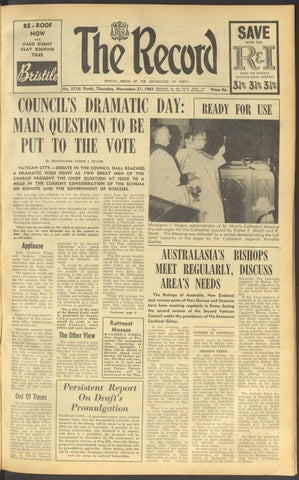
Monsignor J. Hogan, administrator of St. Mary's Cathedral blessing the new organ for the Cathedral, assisted by Father F. Walsh and R. Doyle. The blessing was fol lowed by a recital demonstrating the full tonal capacity of the organ by the Cathedral organist Annette Goerke.
AUSTRALASIA'S BISHOPS MET REGULARLY, DISCUSS AREA'S NEEDS The Bishops of Australia, New Zealand and various parts of New Guinea and Oceania have been meeting regularly in Rome during the second session of the Second Vatican Council under the presidency of His Eminence Cardinal Gilroy. At the meetings .subcommittees of Bishops have been appointed to study the various schemata that are being or will be discussed in the Council. These sub-committees report back to the general meetings with a view to the Bishops speaking with a common voice in the Council. His Lordship Bishop Cahill, of Cairns, Queensland, spoke in the name of the group when he intervened during the 65th general congregation of the Council on November 12. Bishop Cahill's address was on Chapter Two ( "About Coadjutor and Auxiliary Bishops") of the schema on "Bishops and the Government of Dioceses." When it is not possible to have unanimity on a particular question, individual Bishops speak in their own name or send their vota in writing to the relevant conciliar commission. (The vota expressed in writing have equal weight with those expressed verbally.) At the inVitation of many other hierarchies, the Bishops of our region have appointed official representatives to those Hierarchies in order to determine what common
--- By — FATHER M. COST1GAN policies might be enunciated and to discuss common needs and difficulties. MISSION NEEDS At their meetings the Bishops have given special attention to the problems of mission territories within the general area they represent, and a committee has been appointed to make a closer study of the needs of those areas. Some of the Bishops who are in charge of these territories have presented reports to the meetings on the particular difficulties they face. The other Bishops appreciate the wonderful opportunity of meeting their confreres from the missions and of learning more about the work being done arid the problems to be overcome there. The needs of the Church at home are constantly in the minds of the Bishops attending t h e Council. Many of the matters discussed at their meetings are directly concerned with those needs. As mentioned in the release from the Bishops, the intervention by Bishop Cahill on November 12 was on behalf of the whole
Hierarchy. The following summary of Bishop Cahill's address appeared in the news bullettin issued by the Council Press Office: If the Vicar-General is expected to be one juridical person with the residential bishop, this is all the more applicable to a Coadjutor Bishop. Consequently, the passage in the text which requires only that the Coadjutor should consult with the residential bishop before undertaking anything important should be modified in order to require the consent of residential the bishop. Auxiliary Bishops should have the same faculties as Vicars-General. Instead of requiring the resignation of aged bishops it would be better simply to appoint a Bishop Administrator, preferably without making him an Apostolic Administrator. The retiring bishops should be assured particularly of the same prayers after death as for those bishops who die in office.
The Catholic Press Association of Australia and New Zealand will be represented by its secretary at a meeting in Rome from November 30 to December 1 of the Bureaux of the International Catholic Press Union. This meeting was arranged to coincide with the second session of the Ecumenical Council. The Pope has appointed 12 mose cardinals to the commision which is redrafting the Code of Canon Law. Among the new members of the commission is His Eminence Cardinal Gilroy, Archbishop of Sydney. •
THE
Page Two
SAIGON REPORT By FATHER PATRICK O'CONNOR, S.S.C.
SAIGON (Wetnam).— The Information Minister of the Military Revolutionary Council and provisional government here called the deaths of the late President Ngo dinh Diem and his brother Ngo dinh Nhu accidental sukide." Brigadier-General Tran tu Cai was answering this correspondent at the formal press conference at which all members of the military council and provisional government were presented to Vietnamese and foreign journalists. The question put to the General was as follows: "Early on Saturday, November 2, a premature and apparently inaccurate report was published alleging that Mr. Diem and Mr. Nhu had committed suicide. Does the military council intend to publish a correction now?" The General answered that the deaths could be called ''accidental suicide." He explained this by recounting that when the two prisoners were entering an armoured vehicle, an M113 armed personnel carrier a large crowd had gathered which "would like to lynch them." He said Nhu argued with the captain in charge who then pushed him into the vehicle. He said Nhu grasped the captain's pistol and there was a scuffle. As a result, the two prisonei:s were shot, he said.
Misinformed The General had apparently been misinformed. There was only a small number of spectators, mostly Chinese. These remember no demonstration, hostile or otherwise, and were aware of no trouble about the prisoners entering the vehicle. As only 20 minutes were available for questions and answers at the press conference, this correspondent was asked not to pursue the subject until afterwards. After the conference he told Brigadier-General Oai that "accidental suicide" is a contradiction. He explained that among Christians suicide is a grievous sin— which fact the General said he understood—and pointed out that it would be unjust to use the word in this case. He suggested that the Military Revolutionary Council consider issuing a correction. No corrections appeared up to the date of Nvriting this report.
BURIAL Answering another correspondent, the General said the bodies of the late president and his brother had been given to relatives for burial. The two bodies are believed to have been in the mortuary of St. Paul's clinic from the afternoon or evening of Noevember 2. During the curfew hours of the night of November 3-4 they were apparently removed. A later report cited Mrs. Tran trung Dung, a niece of the late President, as confirming that her two uncles were buried secretly on November 7 in a military Cemetery outside Saigon. The report said the cemetery was under close guard and no official source announced the funeral. At the press conference, Brigadier-General Oai's announcement that the government had "sent Madame Nhu's three children abroad" was applauded as an act of consideration. It is understood that the U.S. Air Force flew them first to Bangkok, Thailand. from where they took a commer-
cial plane to Rome, where t heir uncle, Archbishop Pierre Ngo dinh Thuc of Hue, received them. Brigadier-General Oai declared: "We military people do not make a revolution for the sake of revenge."
SAIGON CALM Three days after the coup. November 4, Saigon was outwardly calm, but armed soldiers were much in evidence. Feverish activities are reported among the elements of political parties, including Buddhist groups, which are eager to take advantage of whatever opportunities t he changes may present. The Military Revolutionary Committee is said to be not entirely at ease, uncertain who may be joining in these activities and what they may lead to. 2arly mob violence, mainly youthful, was directed buildings, newsagainst paper offices and motorcars associated with the Diem government. Military authorities made little or no effort to prevent it. No attacks were made on any Catholic institutions in the capital. Anxiety is felt for the future, especially regarding a militant Buddhist student group. Speeches made at Xa Loi Pagoda were strongly political. The official allegation that the late president and his brother committed suicide is widely disbelieved by The non-Christians also. allegation is definitely untrue, as this correspondent has reported. Nothing but rumours were available regarding the burial of the two men. There is no attempt by the crowd to find and desecrate their bodies. As of November 5, the American Embassy here had made no public protest against the violent deaths of the late President and his brother or against the allegation that they had committed suicide. Among the 14 generals on the 22-man Military Revolutionary Committee, two are Catholics. The president of the committee, Major-General Duong van Minh, is not a Christian.
38 ST. QUENTIN AVE., CLAREMONT. Phone 32-002.
J. L. FITZSIMMONS & CO LANDSCAPE GARDENERS
tr LAWN AND GARDEN CONSTRUCTION * ROTARY BOEING, LEVELLING. EXCAVATING * BITUMEN PAVING * QUOTATIONS GIVEN FREE OF COST
Thursday, November 21 1963
RECORD
Bishop Fuitort Sheen . . .
BLESSED ARE THE CLEAN OF HEART ANOTHER BEATITUDE OF THE WORLD IS
.
"Blessed is sex, for through it you wigl have free expression and avoid frustration." THE BEATITUDE OF THE GOD-MAN IS . .
"Blessed are the clean of heart, for they shall see God."
I
T goes back to one of the most beautiful stories of the Old Testament when Moses asked to see the glory of God. God told him that it was impossible, for no one could look upon Him face to face. God, however, conceded to Moses a view of Him, as it were, passing through the cleft of a rock. But all that Moses saw was merely the retreating procession of God, not the vision of one advancing face to face.
IN THE HEART IN THE Old Testament, purity was principally a matter of observing certain rituals and ceremonies, but in this Beatitude, purity is centred in the heart and attitude of soul. The very fact that the vision of God is promised to the pure in heart means that there are some to whom this boon cannot be given. The vision is spiritual and depends not on what
r
is outside of the eye, but what is inside of the heart. This is even true psychologically. Moral character and the state of a man's mind makes a difference to what he sees. It is too often assumed that a right understanding of God depends upon education This and intellectual training. Beatitude insists that there is a moral, as well as an intellectual condition of coming to the knowledge of God. Most people are kept from Him not just because of difficulties they have with the Creed, but rather because of difficulties they have with the Commandments. It is not in the way they THINK, but in the way they ACT that they become crossed up.
BLINDS DOWN A KEEN spiritual observer will inquire just as rapidly into a man's behaviour as into his concepts. Each day of life we are either fitting ourselves for the vision of
God, or else blinding ourselves to to it. The sun may be outside of the window, but if we keep the blinds down, the light cannot come in. As Our Blessed Lord said: "You will not come to Me because your lives are evil." Actually, the frustrated, miserable, unhappy souls in the world are those who have clouded their character by a failure to see that sex is a mystery, that it is ,a continuation of the creativity of God and only when used within His holy purposes does it give full satisfaction both to body and soul. Friends are not seen only by the eyes of the body. The friend that one loves is discerned spiritually, known by his truth and the nobility of his character, which the senses cannot see. Purity, likewise, gives communion with the loving Spirit of the Father, and brings to us an understanding and love of Him. The vision of the soul has something to do with the afflictions of the heart. Try to tell an egotist the beauty of unselfishness. You might as well tell a deaf man about the harmony of a Beethoven. Telling the carnal man about purity and its rewards, is telling the blind of colour. The man whose heart is unholy sees not God. To the impure, nothing is pure, for he carries defilement with him. To be pure in heart is to make purity everywhere. The pure in heart shall sec God in nature's mirror and in science, in creation's visions and the voices of every colour. TL will see Him in His Providence. They will even see Him in the mysteries they cannot understand.
.11,111.04,04141•04,411#0.00.044 4.4•~4.4seelPsdp######.........,..4.#4,11.0. 04P PONIPANNIK;
Still 1 OPPOSITION AND DISCUSSION 1Watched IS FOR THE GOOD
BONN (West Germany): COMMUNIST HUNGARY HAS WITHDRAWN THE LAST TWO GOVERNMENT " SUPERVISORS: " W H 0 HAVE BEEN STATIONEh IN DIOCESAN OFFICES.
rules are respected. Moderators actually run the council and can do as they like as long as they follow the rules.
VATICAN CITY.—A COUNCIL WITHOUT OPPOSITION AND DISCUSSION WOULD ENGENDER SUSPICION ABOUT THE FREEDOM OF THE COUNCIL FATHERS." — ACCORDING TO ARCHBISHOP JOHN J. KROI, OF PHILADELPHIA.
For example, when the moderators originally presented the four questions they wanted the Fathers to vote on, the Presidency overruled them because such an act was not permitted by the council rules. The matter was referred to the Co-ordinating Commission, which met with the Cardinals of the presidency and moderators and worked out a way in which the questions could be presented without violating the rules and that the wording of the questions could not be interpreted as favouring one side or another.
Speaking at a special pression is not an absolute background press confer- right. A prior right is the ence arranged by the Ameri- progress of the council; thus, then the rule of can Bishops, Archbishop The government agents Krol explained various prob- closure, which has been inwere removed in June and lems and circumstances sur- voked several times." July from all but two dio- rounding the council's rules. SPEED-UP cesan offices, Szekesfeher-. He is one of the five underKrol said the Archbishop var and the Byzantine Rite secretaries of the council. Presidency is the of Council strictly that disclosed He Hapdudorog, Diocese af speaking "there will not be constantly studying ways of K.N.A. said. They have now any simultaneous transla- speeding up procedures, but been removed from these tion system operating dur- that at the moment no speThe aim of the pro- ing the council sessions." cific plan for changing the gramme was to limit the Instead, he said, there is an present procedure is being UNANIMITY contacts of the Hungarian experiment to provide trans- considered. Archbishop Krol asserted Bishops with their priests lations in six languages of He said the present rules and people. The agents sat the prepared texts of the are about as good as can be that the council has shown in at all conversations with council Fathers, to be broad- expected, although they are a unanimity of spirit somewhat unexpected after the visitors, monitored phone cast while the Father is not perfect. The only one t remendous n u in b e r of calls, read all incoming and speaking in the hall. that he thinks might be present dis- opinions expressed on one outgoing mail, and even He explained that a coun- altered is the kept the official episcopal cil Father would have to crepancy between the type question or another. majority needed to pass seals. present the text of his inter- of conciliar act and that "Last year's discussions a of ahead days four vention a part of the liturgy on K.N.A. said the officials it. needed reject to schema—with a total of 630 have now set themselves up his scheduled speech so that Under the present rules a oral and written intervenin the parish administration it could be translated into majority is need- tions—would, according to two-thirds languages. various he t of the See cities where they ed to pass a measure while many, give little hope for continue to watch the NOT EXACT a simple majority against a accord," he said. "Yet after bishops. He wanted to make it measure is sufficient to de- the 26 major recommendaARRESTED clear, however, that the feat it. tions returned to the floor over read as text translated from the commission, the noted reArchbishop also The K.N.A. , Meanwhile the transistor broadcasting that the Council of the Pre- average favourable note on ported the arrest of Father Jozsef Szabo, S.J., who had system might not be exactly sidency has the task of see- 26 successive ballots was in been allowed to do parish that which the Father is ing to it that the council excess of 98.4 per cent." actually delivering. He exwork after the government suppressed religious orders plained that a speaker in 1950. Father Szabo was might decide to delete or add portions to his prepared working with young people text. and had been frequently warned by communist offiArchbishop Krol said that translations cials for his excessive zeal. simultaneous According to K.N.A., 700 are not being considered bepriests forbidden by the cause of personnel probDECEMBER 1: Hungarian government to lems, not technical ones. NOVEMBER 22: do pastoral work, have to In discussing the rules 3.30 p.m. — Confirmation Solemn ide 7.30 p.m.—Pres earn their living in industry. governing the council, Archd Canonical Visitation, n a Mary's Cathbishop Krol pointed out High Mass, St. Kenwick. STILL WATCHED that the right to freedom of edral; occasion of Silver DECEMBER 3: expression must be safeThe German news agency Jubilee of Cathedral Choir. guarded. "Truth is reached 3 p.m.—Confirmation, 5tsaid that party members or of exchange vigorous a by facin School, Claremont. officials Louis' trade union opinions—by a real intellec- NOVEMBER 24: tories make sure that the DECEMBER 8: priests working under them tual struggle. A council 4 p.m.—Confirmation and disand opposition without workers fellow draw 3 p.m.—Bless and OPen do not Canonical Visitation, Pinextensions to Claremont into conversations on reli- cussions would engender suspicion about the freejarra. gion. Church. of the council Fathers." dom K.N.A. also said that the DECEMBER 13: However, he noted that government's Religious Af26: EMBER NOV does 7.15 p.m.—Adult Confirmaexpression of right the fairs Office has recently tion, St. Mary's Cathedral. Confirmation, Kelmscott prohibited more priests not have to be oral exprescan Fathers the as sion, has and from pastoral work withdrawn State subsidies submit their opinions in AP. writing "Freedom of exfrom others. The report comes from the German Catholic news agency K.N.A.
Official Engagements
Thursday, November 21, 1963
TH E
RECORD
The Council Has Now "Turned The Corner
Page Three
Food Airlift For Stricken Village
,!
By FATHER PLACID JORDAN, O.S.B.
V ATICAN CITY.—"Pope John has guided us from Heaven and Pope Paul ,has upheld his inspiration," a bishop said here in c ommenting on developments in the Ecumenical Council. His words express the prevailing among entiment s a great majority of his folf ellow council Fathers lowing the crucial test votes on the schema on the Nature of the Church which on October 30 marked a decisive turning-point in council history. The council refusal on November 20 last year to approve a draft proposal, or schema, on the sources of R evelation determined the trend of the council. The October 30 acceptance in principle of the concept of the collegiality of the bishops has established unmistakably that the council wants "aggiornamento" (updating) as it was visualised by Pope John and confirmed by Pope Paul. That is, an all-level rejuvenation, renewal and inner reform of the Church. As the council reconvened on November 5 after a fourday recess to discuss the schema on bishops and diocesan government, the council found it had gained momentum in regard to both subject matter and procedure. For the October 30 vote also considerably strengthened the four cardinal moderators. They emerged from the debates aware that they are the men fully responsible for conducting the council's business under the direct authority of the Pope. STREAMLINED From now on the debates, which were lagging because of too much oratory, will be effectively streamlined. This does not mean that all stalemates and delays can be avoided. But, according to reliable information, the Holy Father has let it be known that from now on he wants the Theological Commission to meet daily rather than once a week so that a r evised schema on the Nature of the Church—which now includes a special chapter on Our Lady—can soon reach the council floor. A large number of suggested amendments must be considered. But the commission's task is now much less burdensome because the test votes clearly expressed the preference of the majority of the bishops. .The principle that the bishops are successors of the Apostles' "college," and therefore share with the Pope in governing the Universal Church, will now fill a gap which remained after the First Vatican Council of
1869-70 and will provide a clearly defined doctrine on the Church. FAR-REACHING In accordance with the Pontiff's own desire, its adoption will have farreaching consequences, especially in regard to decentralisation of the Roman curia's administation. In this connection many council Fathers have recommended that membership in the council commissions be changed to reflect better the wishes of the council majority. When commission members were originally chosen at the beginning of the council, the Fathers were not so well acquainted with one another as they are now. Also, Pope John had to appoint more officials of the curia than seemed opportune to make sure of their co-operation. A petition addressed to Pope Paul which already bears the signatures of many bishops shows that an attempt is now being made to make a fresh start. The petition urges that instead of having curia officials as c ommission presidents, others be named, especially young men who can expedite procedures and translate into action the will of the council majority. MISSION BISHOPS Criticism is frequently heard in council lobbies regarding the unnecessary delasy of commission meetings. In addition, missionary bishops have expressed disappointment that a schema on the missions, which might suitably be combined with the Church,
MAY CLOSE This gives credibility to a rumour, reported by Auxiliary Bishop Josef Zimmermann, of Augsburg, .Ger many, in diocesan his paper, Ulrichsblatt, that the Pope may close the council after the present session and call a new council at some indefinite time in the future. This would give the bishops time to study more carefully the many issues on the present council agenda without being absent from their Sees too long. Should this happen, the council would appoint vanout post-council commissions to carry on its work during the prolonged interval. But it is agreed among council officials that the schema on the Church must be disposed of in any case. With its adoption, the council would have achieved its principal aim of a "horizontal" reform of the Church's basic structure. The new supreme governing body directly responsible to the Pope which is expected to emerge within its scope would see to it that reform is carried out.
Further Assistance By N.Z. Government AUCKLAND, NEW ZEALAND.—PRIME MINISTER KEITH J. HOLYOAKE HAS ANNOUNCED THAT THE GOVERNMENT WILL INCREASE ITS AID TO THE PRIVATE SCHOOLS. THE NEW SYSTEM, EXPECTED TO COST ABOUT £270,000, WILL APPLY TO PRIMARY AND SECONDARY SCHOOLS. The increased aid includes grants for classroom mater-
M. G. O'Brien & Sons
P AINTING CONTRACTORS
20 MABEL STREET, SOUTH PERTH. 67-2716
W. F. SAMSON & Co. R.E.I.W.A.
5 QUEEN STREET, FREMANTLE
•
has still not been distributed. They have also expresed fears that it might not be discussed at all. It appears doubtful under the circumstances that debate on the schema on the Church can be finished before the council's second session adjourns on December 4. Even with overhauling its machinery, the council may need considerably more time than originally expected to finish its business.
R EAL ESTATE AGENTS. AUCTIONEERS and SWORN VALUATORS R ents Collected, Estates Managed Representing: Queensland Insurance Co. Ltd., Royal Automobile Club of W.A. (Inc., R A.C. Insurance Pty, Ltd., Bank of N.S.W. Savings Bank Agency. Equitable Life and General Insurance Co. Ltd. Phones: Office: 5-1316, 5-3770. Private: Sir Frederick Samson, F.C.I.V.. 5-2553. G. O. Samson, 39-1653. D. P. Mis s" 5-3551.
CONCRETE SPECIALISTS CONCRETE PAVING SLABS IN ALL POPULAR SIZES AND COLOURS G ARDEN KERBING — CONCRETE FENCE POSTS MATERIAL FOR SOAKWELLS
ANDERSONS INDUSTRIES PTY. LTD. 2-6 ROYDHOUSE STREET, WEMBLEY 8-2141 — 8-1121
ials, equipment, library books and for such running expenses as light, heat and water, Mr. Holyoake said. He added that the government will supply furniture and equipment to new private schools wand private schools that grow in size on "substantially the same scale" as it now supplies to State schools. New Zealand's private schools already receive free text-books. Eighty-six per cent of all private schools in New Zealand are Catholic. The Catholic schools cost about £7,415,000 a year, The proposed grants will cover only a small fraction of the cost of the schools. But, for the first time since the Education Act of 1877, private schools are placed on par with State schools in at least a limited sector of costs. Commenting on the government's announcement, the leader of an interdenominational committee that asked on September 10 for an education allowance for parents, Donald McKenzie, a Presbyterian, said: "It is not what we asked for, but we feel it is a very substantial addition to the present type of aid."
'fr. :!!"•tit
S
a, •
,410,f4r:-.... 4 •,, « 4
j ;'.̀#
*•••V •••
*
R ecently destroyed by fire, the jungle community of Contamana of the Rio Ucayali, along t he Peruvian-Brazilian border, receives a shipment of foodstuffs brought to them by planes requisitioned by the Peruvian Air Force. To help the people in their distress, Monsignor A lfred Schneider ( left) of Green Bay Wis., Catholic Relief Services-NCWC director in South America, and Harlan S. Parkinson, (right) South American director of Great Plains W heat,Inc.,delivered one and a half tons of food for Peace. This includes bulgar wheat, non-fat dry milk, butter oil and other dietary necessities. Shown with villaTa children is Padre Jose Obieta of Contamana, second from left.
ADVERTISING TO BLAME NEW YORK.—A NATIONAL LEGION OF DECENCY SPOKESMAN TOLD MOVIE EXHIBITORS HERE THE PUBLIC IS CRITICISING THE INDUSTRY TODAY NOT FOR ITS PRODUCT BUT FOR ITS ADVERTISING. Monsignor Thomas F. Little, executive secretary of the Catholic agency which issues moral evaluations of movies, had praise for the general quality of films. Speaking to the convention of the Theatre Owners of America, he said the legion last year judged more than 80 per cent of all films reviewed as morally unobjectionable for some segment of the audience. He said it would be "an inexcusable distortion of the general factual situation" to speak of the "sinful condition" of movies. But he said he is convinced that the general public harbours "widespread criticism" of the industry. "Ironically," he said, "the reason is to be largely found in the very instrument upon which you rely to sell your product; I mean, of course, your advertising." Monsignor Little then read some objectionabl phrases and described questionable art work used to advertise what he said were "important films from two of our American companies." suggested to He the theatre owners that "your first step in building a bridge to universal respect in the community and to attracting to your theatres the huge audiences which habitually shun you is to do something about your advertising." "I have confidence," he said, "that your organisation can use its creative influence to correct a practice which not only offends public decency, but is a most serious handicap to your business prosperity as well."
F. R. BEECROFT BUTCHER 181 Rokeby Road, Subiaco Only Prime Fresh Killed Meat Sold Phone: 8-1373.
(AUST.) PTV. LTD. IFORMEPiELY W.A. PEST CO) 66 CANNING HIGHWAV VICTORIA PARK. Phone 62944, 6 I. A fter Hours: 629 .
DAY and NIGHT SERVICE TAKE YOUR PRESCRIPTIONS TO—
FOLEY'S DRUG STORE
9 5 BARRACK STREET (right opposite the Taxation Dept.) Special Attention to Country Clients — Phone 23-4267
TOLLEYS BRANDY S PECIAL
HOSPITAL
Telephone 2l-77t
irt
bominiiit
OPTiCAL DISPENSER
United Insurance Building, 218 St. George's Terrace. Opp. Forrest House. Perth.
Doctors' Prescriptions Dispensed
S YNFLAT PLASTIC
PAINT
H ADRIAN GLOSS
PAINT
The perfect pair for a perfect finish Interior and Exterior
S YNFLAT and HADRIAN PAINTS were used exclusively in the new St. John of God Maternity Hospital, Subiaco
NOTE:
For FREE COLOUR ADVISORY SERVICE contact—
SYNFLAT COLOUR CENTRES 417 ALBANY HIGHWAY, VIC. PARK.
6-2899.
_ Made in Western Australia by SMITH 8 WALTON (AUST.) PTY. LTD., Hale Road, Forrestfield. Phones 69-6174, 69-6176.
TH E
Page Four
Thursday, November 21 1963
R ECORD
The following story is based on information given in an interview with a recent visitor f rom Poland, a qualified observer whose identity must remain secret.
HARD TO JUDGE 110W WIND WILL BLOW IN NEXT CHANGE does work—and about half
turned down. It does now
atheists and will try to indoctrinate students. Others are convinced Chirstians. Some are indifferent, and simply soft-pedal atheism. At government - run summer camps for children, the children are distracted from going to church on Sunday by other activities scheduled for Mass time. In some cases they are physically impeded from going to church.
about 70,000. The Poznan publication is patterned after some of the highly iilustrated newsweeklies of the West, but in an inferior way. It could easily sell 200,000 copies if the newsprint were available. All four major Catholic publications must be printed on government printing presses—there is no other.
•
••• •••
• •• •
•
•
• •
•
the women are working— have a programme directed PARIS.—The climate in com- she would not likely be in a at youth, but it is not position where specific labelled as such. It cannot top munist-ruled Poland blows hot attentio n would be paid to challenge the regime in the of youth more openly. her church membership. then cold. But the prevailing The children get varying field Only two of the score of doses of atheism in the dioceses in Poland have dioschool and in the govern- cesan weeklies. One is pubwind is blustering against the ment's official recreation lished in Poznan and the programmes for children, other in Katowice. They Church. Some teachers are ardent have a total circulation of
THE SITUATION THROUGHOUT THE COUNTRY IS EXTREMELY COMPLEX. It is often difficult for Polish Catholics themselves to be sure which way the breeze is blowing. The problem stems in part from the fact that the official policy seems to be fluctuating constantly. The regime will yield on one matter one day but reverse itself the following day. Many decisions concerning Church-State relations are made, moreover, on the local level. Here there is no consistency. It seems to depend largely on local situations and personalities. The official atheist orientation of the Polish regime has its greatest impact on the father and the children of a Christian family. A known Christian father can be the object of discrimination where he works, and he must work for the government since practically all industry and all enterprise are owned by the, government.
30 Per Cent HOWEVER, such discrimination affects only about 30 per cent of the people. For about 70 per cent of the working population, their church membership or dedication to Christianity just is not relevant. A practising Christian would have greater difficulties getting ahead in such teaching, as professions journalism and law, in which ideology is frequently involved. He would have fewer problems in such
fields as chemistry, engineering, etc. Even where there is a seeming relevance between a person's known church membership and his work, there is a great variation in whether the worker is penalised for this. This depends largely on a person's supervisor. Some are tolerant; others are not. A mother working in the home would not be greatly affected directly by the regime's programme to inculcate atheism, since the government does not control her livelihood. If she OI
SvP,ININP
LTD.
H OGANS
MOTOR AND GENERAL ENGINEERS ALL WORK GUARANTEE!: — PROMPT SERVICE A SSURED — CARS PICKED UP AND DELIVERED FREE.
RECONDITIONING
GENERAL
REPAIRS
PANEL BEATING LUBRITORIn,I SERVICE FITTING AND ITRNING C YLINDER BORING CYLINDER
Hot And Cold
The Holy See would have the advantage of having a generally free observer on the spot. Secondly, the Church-State problem in Poland would take on an international aspect, and the State might be somewhat more circumspect in its dealings if an outside free party — the Holy See's envoys—were observing every local dispute.
the West because its split with communist China is a real one, according to this view. As a consequence the Soviet people will necessarily become more open to the influences and ideologies of the West. And so, too, will the peoples of the other countries of Eastern Europe. be mans But there problems along the way.
Quandary
O'HARA'S
THE regime blows hot THE children are gener- and cold even in its treatally quick to recognise the ment of the Polish Bishops. inconsistency between com- Government organs were munist jargon and fact. lavish in their praise of This is developing a great Pope John XXIII and offiscepticism in the new gen- cials of the regime suggesteration. This scepticism ex- ed from time to time that tends to all phases of life a concordat between Poland and includes the Church. It and the Holy See might be is leading to a philosophy of in order. nihilism in the younger genTHE overall view on the Stafan Cardinal Wyszyneration. of Catholic intellecpart had ski, Primate of Poland, The government scrupu- one of his rare meetings tuals in Poland is that lously keeps the direction of wtih Wladylai.v Gomulka at Gomulka is sincere in his youth to itself. efforts to democratise Polish the end of last April. ComIn 1961 it passed a law missar and Cardinal talked society, but that he does for several hours, reported- not know how to do so and restricting catechism classes still remain on what he calls had which places ly about the State's restricto special the Polish road to socialism. tions in the field of religious to receive government apAnd socialism appears to proval. It barred men Reli- education. cern him more than decon gious, Sisters and lay people While meetings between mocracy. religion from teaching the Cardinal Gomulka are The expectation is that classes. Cr. FITZGERALD rare, there are repeated efliberalisation process the That left only the already forts to reach an underCy FORREST STS., which the communist-ruled overworked diocesan priests standing between Church societies of Eastern Europe free to teach catechism and State. Some sort of NORTH PERTH have witnessed in the past classes. rapprochement looked fair- ten years will continue. The In line with this, the ly close last June, but it did Kremlin must get closer to parish priest in Szubin, not materialise. Then on Father M. Namyslowski, has July 4, Gomulka lashed out been fined 1,500 zlotys at the bishops in an address AROUND THE CLOCK! ( about EA28/15/-) for orgato a Communist party conTHE HOME! AROUND connising young people's vention in Warsaw. He throughout ferences on marriage in St. labelled them reactionaries WATER HOT means that name the — BRAEMAR Martin's Church. The local who refused to follow Pope Australia! All units carry 2 YEARS Guarantee and Service. government council held John's peace efforts. A vailable from all Major Electrical Wholesalers and that "a religious conference Hardware Merchants. reWyszynski Cardinal is not a religious service or three Warsaw to turned CTRIC ELE assembly, public a but rite and therefore requires the days later from Rome, SOLID FUEL where he had taken part in permission of the authoriOIL FIRED ties." The chancery of the the election and coronation of day The VI. Paul Pope of comGniezno archdiocese SOLAR plained to the prosecutor - his return, he preached to a O'CONNOR the in Phone 50-2044. Cnr. STOCKDALE RD. & JONES ST., general that this was a vio- congregation of 2,000 gave He Cathedral. Warsaw reliof lation of freedom gious practice. But there this reply to Gomulka without referrring to him by has been no indicaticn of uniE)e r name— the by redress or any action higher authority. "If peace is to prevail. Quotes Without Obligation on the Installation of then freedom, justice and recognition of religious conBraemar HOT WATER Systems science must be guaranteed. R ING 30-2921 — ANYTIME! This is the basis for peaceful and harmonious coexistence." ALL Catholic organisations in Poland were abolished during the Stalinist era. Since 1956, the year of t h e peaceful revolution HANNAN STREET. Phone 78. P.O. Box 94 which brought Wladyslaw Gomulka to the helm of the THE regime has even act Communist party, the only ed arbitrarily on the reinfluential Catholic organi- quests of the bishops for sation that has come into visas so they could take being is the Club of Catholic part in the second session Intellectuals. It now has of the Ecumenical Council. about 3,000 members in five About 45 bishops asked percities. But its activities are mission to go to Rome. By restricted to discussions, the opening of the session, lectures and some publish- 23 were able to be on hand ing. Among its leaders are in St. Peter's. There were the editors of Znak, digodt- indications that three other size monthly with a circu- bishops had received visas, lation of about 7,000, and and still more might later Tygodnik Powszechny, a receive them. But whether weekly newspaper which is the government gave visas limited to a circulation of or not appeared to be only 40,000. Both are published a matter of whim. in Cracow. Still, the talk of establish Because of their restricted diplomatic relations being publicaboth , circulation SPACIOUS, AIRY BARS and LOUNGES the Holy See and tween tions are pitched to a high recurs. Poland * TOURISTS: Home from Home. intellectual plane to achieve ATION: First Class Cuisine par excellenceresults. effective most the The general feeling among * ACCOMMOD Dining Saloon. Modern Tygodnik Powszechny could Informed Catholics in Po- * SERVICE: IE'S BRACING ATMOSPHERE KALGOORL ENJOY easily sell 100,000 weekly if a be land is that this would Personally supervised by W. L. Murphy and the government allowed it helpful step. While the comC. G. Hagan, Props. the newsprint. munist regime would gain Znak has tried several something it wants—recogK ALGOOR LIE times to start a youth sec- nition by the Holy See—the tion, but has always been Church, too, would gain.
DAY & N:GHT PHARMACY •
H OT
SPECIALISED SERVICE ENGINE
Sceptics
The Battling Polish Cardinal
SLEEVI7s.;G
CYLINDER HEAD RECONDITIONING
WATER
JOHN CARTWRIGHT
CRANKSHAFT GRINDING
126 Adelaide Tce. Phone:
23-1953 (5 lines) M ARS RYAN. Manager 4.#4.4.4.swrwompoihnorpm#####0.0414,04,","~"e4N1441.4.41011.414,
1'
Licensed
Gomulka 's Rule
Matter Of Whim
PALACE HOTEL
THIS IS . . . Kalgoorlie's Most SELECTIVE HOTEL
Thursday, November 21, 1963
THE
RECORD
Page Five
Wanted: Urgent Backing For Seat Belts
A GEOMETRICAL FANTASY
In the next three months 612 people are likely to be killed on Australian roads and more than 12,000 injured if the road accident statics for November- December - January 1962 / 63 repeat themselves.
+00,154W. ;
The new parish Church of St. Maurice de Duvernay in Montreal has been described as "a geometrical fantasy in concrete, glass and stone." The parish programme matches the a vant-garde style of its Church architecture. The parish income comes solely from tithing and the Sunday offering. Eighty laymen act as Mass commentators and readers, singers, Mass servers and ushers. No fees are charged for funerals, marriages, and baptisms, and gifts on such occasions are refused. Father Jean Caronis pastor.
SOME POSITIVE THINKING ON THE PROBLEM Of POPULATION
WASHINGTON—IN THE EYES OF MANY PEOPLE THERE IS ONLY ONE CATHOLIC ANSWER TO THE POPULATION QUESTION—"NO."
ing sociology, polictics, economics, philosophy, theology, psychiatry and medicine — drawing from each discipline its own special contribution and correlating the results.
Catholic opposition to contraception and tax-supported birth control is widely known. Less apparent for many has been a positive Catholic response to population problems. The Centre for Population Research at Georgetown University here represents such a response. Established last January with a three-year 150,000 dollar Ford Foundation grant (matched by Georgetown on a one-for-two basis), the Centre is pioneering in an inter -disciplinary approach to population research. Its present emphases are two — physiological and demographic. But with time, money and manpower its directors hope to develop a research programme involv-
"We have not only an obligation but an opportunity to explore in depth some of the more pressing issues that face us in the population field," says the Centre's director, Dr. Benedict J. Duffy. The Centre has a meaningful job to do quite apart from controversies over birth control and the -population explosion," adds Thomas K. Busch, its director of demographic studies. "The study of population apart from the current controversy is an important subject," Burch said. "It is thoroughly appropriate that Georgetown as a university devote itself to these scientific problems."
abc
P HOTOGRAPHERS
For Weddings and all Social Occasions — Child Studies, Home Portraiture. 83 CENTRAL AVE. REDCLIFFE Phones: 65-1355, 23-4267.
[
Crane Hire People LARGEST FLEET] 3 to 30 TONS BIG LIFTS HIGH LIFTS also • Air Compressors .4
• End Loaders PHONE . .
"OPPORTUN ITY"
T HREE
portance in the treatment of infertility . . . to help the childless couple." The Centre's second medical project is a study of the biochemical and hormonal aspects of human ovulation. It is being conducted in cooperation with Dr. H. A. Salhanick of Beth Israel Hospital, Boston, and aims to develop a test for determining the time of ovulation. In the area of demolgraphy, Burch is planning a study of "the family life and fertility of U.S. Catholics." This is envisioned as much more than just a "Catholic birth control" study. It will deal with broad questions of Catholic attitudes and practices in marriage and family life.
There is a quick and certain way to reduce these deaths by 25 percent and injuries by 60 percent, and this is by persuading people to fit and wear seat belts. With the welfare of more than 12,600 Australians in mind, the Australian Road Safety Council makes an appeal to commercial and community organisations throughout the length and breadth of the nation to swing solidly behind the campaign to encourage the voluntary installation and use of belts. "This is a case where a Irttle help from a lot of people can have a dramatic
r esult," the Chairman of the A ustralian Safety Road C ouncil (Dr. J. R. Darling) said this week.
"We are certain that if all the techniques of mass communication are turned on to the promotion of seat belts, their use will multiply throughout the land." R ESULTS
Dr. Darling said that the Council's belief was based on the results of recent promotions in Melbourne, Sydney, Canberra and Brisbane as a result of which the sales of seat belts had increased. Dr. Darling said that every garage and service station operator in Australia could a ssist the campaign by prominently displaying seat belts advertising to their customers about fitting belts.
Every commercial firm engaged in public advertising campaigns could help by inserting references to the lifesaving benefits of installing and wearing seat belts.
Community organisation, could help by reminding their members of the value of seat belts to themselves and their passengers. "If we knew that some disaster was going to involve 12,000 Australians we would mobilise every possible resource to deal with the problem," said Dr. Darling. This
is
truly the case
with road accidents bcause we know from the figures, that these people will be involved in death and misery unless we persuade them to safeguard themselves with seat belts," he added. A SSISTANCE
Dr. Darling said that the Australian Road Safety Council and road safety organisations in every State were ready to assist commercial and community organisations which wanted to help. Press material, slogans, pamphlets, films, slides and other information were readily available to assist advertisers and organisations..
DR. KING RECEIVES PEACE MEDAL
just one of the many problems Dr. King is faced with in his unselfish task." Father Marquard, a member of the executive council of the 100,000-member North American Federation of the Third Order, presented the Peace Medal to Dr. King at a luncheon attended by some 700 persons. NEW YORK: An official of the Third Order of St. W FIRST AWARD Francis called objections to the group's presenting its Dr. King, a Baptist, is 1963 St. Francis Peace Medal president of the Southern to Dr. Martin Luther King Christian Leadership Cona sign of "confusion." ference. In selecting him for its 1963 Peace Medal, the Father Philip Marquard. Franciscan Third Order 0.F.M., of Chicago, presentcited his "truly Christian aping tile Peace Medal to Dr. proach to the civil rights King, said the Third Order problem through his prohad encountered objections gramme of non-violence." from "a goodly number of Dr. King, accepting the of the the choice to people" award, said it signalled "a Negro integration leader for new level of fellowship and its honour. concern" in the civil rights effort. He called it "dear Father Marquard' said he thought those who objected and meaningful" as his first award from a Catholic were "sincere" and corngroup, and said he accepted mented: "But this indicates what confusion exists even it for his companions "in in the minds of upright 3 the front lines of this diffipeople. and again reflect' cult struggle."
PROJECTS
Currently the Centre has three major projects either under way or in the planning stage. Two are in medicine and one in demography. The most widely publicised is a nationwide research project aimed at determining the length and other characteristics of the normal menstrual cycle. Plans for the study call for some 3,000 to 5,000 Cabeginning women, tholic next January, to submit monthly reports to the Centre for two years. The information they will provide is "not presently available and is necessary for statistical analysis of the rhythm method of family planning," according to Duffy. A pilot project demonstrating the feasibility of such a study was carried out, beginning last January, with some 300 Christian Family Movement members in New York. The study aims at determining more than just the length of menstrual cycles. Duffy hopes it also will provide data on the "great variety of physical and psychological changes" which have been reported as alleged indicators of ovulation but never adequately evaluated. W ILL HELP Nor is it intended simply as a way of perfecting the rhythm method, though it can help in that. "Much of this research," Duffy has said, "is of particular
- Low cost cabin...
Luxury cabin...
...whatever your travel budget there's a cabin specially for you in the beautiful new luxury liners Marconi and Galileo. If you prefer to do your seafaring in the grand manner it's hard to imagine anything more gracious or elegant than the palatial first class staterooms aboard the imposing new 27,500 ton Galileo, now in regular service, and her twin sistership, Marconi, which will sail on her maiden voyage from Australian ports in November. You'll fall in love with the sophisticated splendour of the decor and the lavish stateroom appointments . . . no expense has been spared . . . not a detail overlooked, in these swift, stabilised f13 million liners. But don't imagine for one instant that Galileo and Marconi were designed exclusively for millionaires and maharajahs. They just look that way!
In fact, there's a wonderful range of first and tourist class cabins that are really modestly priced. You'll find Lloyd Triestino's fares to Europe more than reasonable, starting as low as £.127 (tourist class) . . . even less if you embark at Melbourne, Adelaide or Fremantle. That's true economy travel, especially when you consider that every cabin . . . A deck or F deck . . . on these swift, fully air-conditioned sisterships is spacious and attractive . . . each a masterpiece of modern design. Most have showers and toilets, too! Visit your travel agent or the general agents today for full details on Lloyd Triestino's low off-season fares and literature on Marconi and Galileo.
.L1coycl Triestizitco VIA THE ORIENT TO MESSINA
tt
NAPLES AND GENOA
GENERAL AGENTS & CO. LIMITED, WILLS 133 St. GEORGE George's Terrace, Perth. Telephone 21 9421. Also at Fremantle (5 1176)
THE
Page Six
Thursday, November 21, 1963
R ECORD
-INTERNAM', GERMANY
EIGHT HUNDRED PERSONS OF THE PARISII OF LEGENDE, IN GERMANY, HAVE VOWED TO HAVE A THANKSGIVING SERVICE EVERY YEAR ON ALL SAINTS' DAY FOR THE RESCUE ON NOVEMBER 7 OF 11 MINERS WHO WERE TRAPPED 195 FEET UNDERGROUND FOR TWO WEEKS.
ciPsdININIPINIVP#0.04
The 11 were the last of a hundred men saved from the nearby Mathilde iron mine after a reservoir dam near the mine burst on October 24 and the mine was flooded by a torrent of mud and water. Eight -six escaped shortly after the disaster, and three others were brought up through a rescue shaft on November 1. Another 29 are still missing and presumed dead. Prayers were said in churches all over Germany for the success of the rescue. Bishop Heinrich M. Janssen of Hildesheim brought the good wishes of Germany's Catholic Bishops and offered Mass on November 4 at St. Mary Church. near the mine. He came from Rome, where he was attending the Ecumenical Council. 41,41041141.4.4.41.0041.0,41ni , 0.04.#000040.000.#41.~.004 , MIsONININININPV4.004.041,1P~#4 I
YOUR HOTEL CITY HOTEL GUIDE
Cnr. King and Murray Sts., Perth COUNTER LUNCH, 12-7.30 p.m. Friday; Saturday 12-10 p.m. ARCHIE THOMPSON Offers you only "The Best" Phone: 21-4091.
HIGHWAY HOTEL 206 STIRLING HIGHWAY, CLAREMONT PHONE 3 1566 Friendly Service — Good Accommodation — Parties Specially Catered for M. A. & E. M. McDONNELL
COMING TO PERTH . . . Stay
at
THE RIVERTON HOTEL MOTEL
HIGH ROAD, RIVERTON 69 8315 TV in every Unit. Floodlight 9-Hole Golf Course, FRED MILLS, Licensee
FRIENDLY SERVIO€
BAYSWATER Hotel
REX HOTEL
Oar. KING & HAY STREETS Private Bar for Convenience of Guests and Friends Phone: 21 8634 Persenal Supervisrot Mrs. B. B. REILLY
OPP, STATION Excellent Accommodation Frequent Train Service — 4 Miles from City — Large Parking Area BED and BREAKFAST REASONABLE TARRIFF LES BARTLETT, Prop. TEL.: 71 1224
SUBIACO HOTEL
WEMBLEY HOTEL
SUBIACO First Class Accommodation and Service Phone: 8-1028 _ Alex McHenry. Proprietor.
WAVERLEY
Excellent Lounge and Accommodation Phone 87-2418 Cnr. Cambridge and A lexander Streets, Wembley
HOTEL
HOTEL
Australia
Next Boans Waverley Stores ALBANY HIGHWAY CANNINGTON Modern and Convenient Homely Accommodation Use Our Drive-in Bottle Service Phone 652419 A. R. CONNELL
MURRAY STREET, PERTH E xcellent Accommodation and Dining Service LUNCH, 10/-t DINNER 17/6. PHONE 23 1541
CRITERION HOTEL
Enjoy the Best ACCOMMODATION & SERVICE
CENTRAL HAY STRhh-i. FERTH 24-HOUR SERVICE Country Residents for Free Parking 5 Minutes' walk from Cathedral. THE COUNTRYMAN'S HOTEL PHONE: 23 1115 (5 Uwe)
HOTEL COTTESLOE
WILLAGEE PARK HOTEL
HOTEL ESPLANADE
Cur, Stock and High Roads, MELVILLE Phone: 30 3428
PERTH'S LEADING HOTEL FOR ALL VISITORS Phone: 23-1531
RIGHT ON THE SEA FRONT
Phone 3-2155 El. M. DYMOCK, Licensee
The States Most Modern TOM KENNY, Licensee.
NATIONAL HOTEL
COMMERCIAL HOTEL NORTHAM P hone Northam 49 T. E. MURPHY, Proprietor
Cnr. High and Market Sts, FREMANTLE Offers excellent homely accommodation Phone : 5-1786 Philip P. Kearins, Licensee
Plympton
For SUPERIOR ACCOMMODATION
IMPERIAL HOTEL PERTH (Opposite Railway Station) Tel. 23 2921
Hot and Cold Water, Telephone In every bedroom, Bed and Breakfast 37/6. 24-Hour Room Service Reduced Tariff for Children
HOTEL
Home of Country People CANNING HIGHWAY EAST FREMANTLE Eric Campbell, Prop. 5-1721.
11.44KMMININNNOWNINAPiNposap 111.04,
Jack Sheedy PHONES
21-1311,
CARLTON HOTEL
23-3091
2i5 HAY
ST., PERTH
BUSINESS MEN'S LUNCHEON — 12 to 2 p.m. .4,....0"itzIMOMMINVIMMII 41 , V4,4.0.
4,4MMINMOV
BROKEN HILL HOTEL VICTORIA PARK — 6 1063
Cr.
DALY'S
MEET DAILY
ROYAL
at
HOTEL
WILLIAM and WELLINGTON STREETS, PERTH. Phone*: 21-8924. Bettie Dept., 21-5436,
11,4, , N".4.4.411,04
Day's Strike Over Subskly
Jesuit Denied Visitor's Visa
TEACHERS in western France's Catholic schools went on strike for a day to protest against delays in applying a 1959 law which subprivate France's sidises schools. The purpose of the strike —which gave 350,000 children a holiday — was to focus attention on the still incomplete application of the 1959 Debre scheool law. The law offers four plans of direct State support for private schools and includes varying degress of State control. Ninety-three per cent of France's private schools are Catholic. Most of the Catholic schools have signed agreements under the Debre law. Delays in carrying out the law's provisions have been the subject of earlier protests by teachers' unions and parents' organisations.
FATHER Riccardo Lombardi, S.J., founder of the Movement for a Better World, has been refused a visa to go to Mexico. The Italian priest, who has travelled in virtually every country in the free world, has repeatedly filed applications for a visa with the Mexican government for the past couple of years. Father Lombardi has never been told officially why his applications have been refused. But unofficially he has learned that his name has been linked with a Carmelite publication in Mexico City, Mundo Mejor (For A Better World), which has been outspoken in its criticism of the Mexican government's policy regarding religion. Despite the similarity of names, the Mexican magazine and Father Lombardi's movement have no connection.
SWITZERLAND
04,#~4.4.4.#4,4, ,0, 11 , 0,14P4^4,0•00#4
Early Y.C.W. Now I.L.O. Director PAUL BACON, 56-year-old French Labour Minister and a leading Catholic, has been named director of the International Labour Organisation's International Centre for Advanced Technical and in Training Vocational Turin, Italy. Bacon, whose appointment was announced by the International Labour Office in Geneva, was one of the first leaders in the Young Christian Workers (founded in 1925) and was active in the French trade union movement. He became the Labour Minister in 1950 and held the post for nearly nine years. I.L.O. set up the Turin centre last March primarily to help developing countries. Trainees are being held at 600 for the first two years. A capacity of 2,000 is expected to be reached by 1965.
RUSSIA Another Angle On Unity • A SPECIAL commission on Christian unity has been established by Archbishop Nikodim of the Moscow patriarchate of the Russian Orthodox C hurch, according to word received in Berlin. The commission has been charged with maintaining contact with other Christian groups throughout the world. Among the members is Metropolitan Ioann of New York, the patriarchate's Moscow Exarch for North and South America. 11.4.M14.04.04.#41.1.411, , 4M#4 , e#####.11,41
QUEMOY 11, ,414, 41,041.#41.41 , P04114 , P
Navy Supplies Hospital
THE U.S. Navy has given 6.5001b. of medical supplies for a 30-bed hospital built by a French missionary on Quemoy, the oft-shelled island off the China coast. Presenting the supplies to Father Bernard Druetto, O.F.M.—the only missionary on the island for the last nine years — was Captain Straus S. Leon, chief of the Navy section, U.S. Military Assistance Advisory Group for Nationalist China. Father Druetto built the hospital almost single-handed. After the first floor had been completed, a communist shell partially destroyed it. Father Druetto repaired the damage and continued building. The hospital was completed last summer.
POLAND
11.#4,0•4^#4.4,11.0441 , 41
Seminarists Drafted P OLAN D'S communist government has drafted students at four seminaries into the armed forces, according to reports received in Berlin. The reports said the four were in Warsaw, Poznan, Przemysl and Tarnow. They added that news of the students' drafting has been telegraphed by the Polish bishops to Stefan Cardinal Wyszinski, the Primate of Poland, now at the Vatican for the Ecumenical Council. The drafting of seminarians is "a clear act of religious discrimination, because students of other schools of higher education are exempt from military service until the end of their studies. Furthermore, this practice is contrary to the agreement of April, 1950, in which the government assured the Polish Episcopate that semiriarians would not be inducted into the army."
ISRAEL 11.4.#01,11,11.41.14P,
Sentences For Rioters
NINE extremist Orthodox Jewish youths were sentenced in Haifa for their forcible entry into a Protestant school on September 10. The convicted youths had forced their way into the school on the same day that hundreds of other fanatical youngsters staged anti-mission riots against Catholic and Protestant schools in Jerusalem and Tel AvivJaffa. In October ten rioters in Jaffa were fined £24/ 15/- to £59/10/- and given suspended gaol sentences of six months. Eight of the nine defendants in Haifa were sentenced to £74/5/- fines or 60 days in gaol. The ninth was given a additional fine of £37/5/- for spitting on a policeman. The trial of more than a hundred youths who rioted in Jerusalem is proceeding.
Sister Elizabeth Anne, R.S.M., of Saint Joseph's Infirmary, A tlanta, is shown receiving an autographed picture of Pope Paul VI from 14-year-old Stephen Bagley, who has been seriously ill in the hospital for the past three months. Sometime ago Stephen wrote to the Holy Father, asking for an autographed picture, explaining that he wanted to give it to Sister, - Beshe has been so good to me." Stephen is a Baptist, and Sister Elizabeth Anne commented, "It is a lovely ecumenical
cause
present."
AMERICA
MAYOR ROBERT F. WAGNER OF NEW YORK PLEDGED THE CITY WILL "DO ALL THAT IS MORALLY DESIRABLE AND LEGALLY POSSIBLE- TO PREVENT THE SALE OF' PORNOGRAPIIIC MATERIAL TO YOUNGSTERS. Among those who heard the pledge was Father Morton A Hill, S.J., a leader in the Operation Yorkville inter -faith movement designed to combat the traffic in smut to minors. The Mayor spoke to 27 community leaders, clergymen and city officials. The smut situation was brought to a head more than a week ago when Father Hill began a "hunger strike which he promised to maintain until the city acted against pornography. His fast lasted 75 hours, then the Mayor promised action. Mayor Wagner said the city will step up efforts to stop the sale of smut. He promised arrests "in increasing numbers- and speedy trials for violators of the law. 0## , ,"11 1######.#041,1,041,41,1 , 04 , ,411.4,000`4 41
TICKETS AT DOOGUES
Drawn This Week
LUCKIEST A GENcY
Lottery Nos. 1535 and 1536
PERTH ARCADE and 19 BARRACK STREET, PERTH
1
-
1
Arthur E. Davies & Co.
FUNERAL DIRECTORS and EMBALMERS FREMANTLE: 85 Market Street — 5-2225 CLAREMONT: Opp. Railway Station — 3-2177
AND ALL SUBURBS W AIF. CF A H. GREEN — 5.4-1/179 (Private) ' 0010 0 81 00 di lie
0g
HERCULES SWIMMING POOLS
Have a gleaming, modern pool built on your own property now and enjoy the long warm days a---1 evenings ahead. Hercules look after all the details. Finest materials and workmanship. Filtered, pure water always. A great investment in health. HERCULES BUILT THE SEMI-OLYMPIC POOL AT THE HOME OF THE GOOD SHEPHERD, LEEDERVILLE. For full details contact— HERCULES SWIMMING POOLS PTY. LTD. 115 St. George's Tce. 23-3679. After Hours: 25-2359 po,,Kap#0.""ilndl,
W ATSONIA HAMS and BACON
PORTUGAL
0 , 4•41 , ,041#04,4 ..#4•4•Me41
Bullfighter's New Vocation
• JUAN GARCIA, a young Spanish bullfighter known to aficionados as Mondeno. gave his last bullfight in Portugal to benefit a working-class housing project. Garcia has said he intends to enter a seminary once he has fulfilled his current contracts. 1,04.• , 041.441.4.0#0.41.4.#4.4.41411 , .1e4,11
Their high standard of Quality never
varies
Thursday, November 21, 1963
THE
"OPERATION - SCHOOL FAILURES"
Page Seven
RECORD
Role Of The Layman Widely Discussed By Council
_I
ROME: THE ROLE OF THE LAYMAN IN THE CHURCH CONTINUES TO BE THE SUBJECT OF WIDE DISCUSSION BY THOSE TAKING PART IN THE ECUMENICAL COUNCIL.
Sister M. Nicholas, C.S.J., a teacher in the Boston College research programme on first grade pupil failures, helps a proud student to put his drawing on display. The 20 public and parochial school students in the project have failed in first grade studies for two c onsecutive years; the programme's purpose is to determine the causes of failure and develop techniques for treating or preventing it. In the first year of the study, significant progress has been reported.
BOMBED CATHEDRAL NOW HAS NEW MAIN ALTAR
In three separate interviews given to the Divine Word news service, two bishops and a layman gave their views on the subject. Archbishop Denis Hurley, 0.M.I., of Durban, South Africa, said the hierarchy has to recognise and respect the position, rights and responsibility of the layman. "Although the hierarchy is entrusted with functions of teaching, directing and sanctifying, in the fuller and more formal sense of those terms, it is becoming obvious that in actual fact the witness of the layman and the influence of the layman's Christian life are what make a real impact on the w orld," he said. "Agreeing with this point, Emilio Inglessis, one of the
B ERLIN,— Archbishop Alfred Bengsch, of Berlin, has consecrated the main altar of the restored Cathedral of St. Hedwig on the East Berlin side of the Berin Wall. St. Hedwig's was destroyed during a bombing raid on the night of March 1-2, 1943. The Berlin diocese, which has 571,200 Catholics, includes all of this divided city. East Berlin's communist authorities did not allow West Berlin's 296,500 Catholics to attend the ceremony. East Berlin has 133,000 Catholics and 141,700 more live in its suburbs. The ceremony came exactly 190 years after the first St. Hedwig's church was consecrated in 1773. The church was raised to a min-
13 lay auditors admitted to the council hall, said that the mission of the laity includes the consecration of the world. ORDINARY WORLD "But the world meant here is not only the Catholic world in which we live," he said, "but rather the world of profane realities in which we laymen spend our daily lives." He said that the secular world was a "mission field" closer to the layman than to the cleric. On the other hand, Bishop Antonio de Castro Mayer of Campos, Brazil, said that it is wrong to "interpret the great attention given by the Vatican council to the laity as a kind of democratisation of the Church." stressed that the He "Church will never abandon its divinely established monThere archial structure. will always be shepherds to guide the Church under the orientation of the supreme shepherd, the pope."
SPECIAL But Bishop Mayer granted that the structure of the Church does not impede the hierarchy from listening to their flocks. "In fact, special attention should be given to those laymen who are highly competent in their particular professions," he said. Such assistance will be "given conscientiously by the laity and will be of inestimable value," he said, and added: "At the same time, the laity, mindful that they are the sheep in the Kingdom of God, will remain docile and will allow themselves to be guided by their legitimate shepherds." 4PsONININNININNIPAINNNININIP4sdPeip......~.11N14
PHIL KEOGH
Resident Chemist
274 Cambridge St. Wembley - 87 3984 CONTOURE COSMETICS
ithe word's getting around
or basilica in 1923 and became a cathedral when Berlin was made a diocese in 1930. After World War II, Berlin's bishops lived in West Berlin, but Archbishop Bengsch, who was Auxiliary in East Berlin when he was named Ordinary in 1961, still lives in East Berlin. He is allowed to visit the western part of the city three days a month. He took advantage of the fourday recess of the ecumenical council to return for the consecration on All Saints' Day.
Four Bishops In Car Crash
ROME,— Four American bishops were injured in an automobile accident while touring the Holy Land on November 4. Two are hospitalized in Tel Avv, Israel. The hospitalised prelates are Bishop William G. Conflare of Greensburg, Pa., and Auxiliary Bishop John J. Scanlan of Honolulu. Hawaii. The other two, injured but able to return to Rome, are Bishop Paul L. Hagarty, 0.S.B., of Nassau, Bahamas, who is a native of Greene, Iowa, and Auxiliary Bishop John F. Hackett of Hartford. The four had gone to the Holy Land during a fourday break in the Second Vatican Council, Nov. 1 to 4. They were riding in a taxicab to the airport in Tel Aviv when a truck struck their vehicle broadside.
Brother, Expert
. . . amongst knowing world travellers that the interesting and delightfully different way to fly across the world is with Air-India—as a Maharajah. Over 30 years of careful study and successful airline experience have given Air-India the lead. . . produced their superbly sophisticated international service standards . . . the exotic charm of Indian hospitality so graciously extended by fascinating sari-clad hostesses . . . the operational efficiency that makes their BIG Boeing Intercontinentals the most punctual jets speeding the world's skyways . . . the selection of some of the most intriguing world routes that make stop-over holidays a pleasure; make almost-speed-of-sound flight a pity. All this dear traveller is yours. . . when you fly Air-India. Ask your Travel Agent to help you plan your next trip as a Maharajah.
ROME: Brother NicetJoseph, F.S.C., Superior General of the Christian Brothers, has been named an expert for the ecumenical council, making him the first head of a congregation of Brothers to have official council status. The Christian Brothers, 17,710 strong, have schools in 88 countries.
B ERNIE J. DUNNE HOMES DEAL DIRECT WITH THE BUILDER — BIG SAVING Homes from £2,275 — Your Pia-, — Only Genuine Clay Bricks LONDON COURT, Suite 7 ATerrace end) PHONE 23-3971
K EITH McCAUGHEY —
R-INDIA I
FOR NEW HOLDENS.
THE AIRLINE THAT TRE.4TS YOU LIKE A MAHARAJAH
37 Great Northern Highway, Midland PHONE: 74-1341 PRIVATE: 25-1308
Wood, Coal a nd Coke
Ports of call:
Perth • Sydney • Singapore • Bangkok • Hong Kong • Tokyo Bombay • New Delhi • *Moscow • Cairo • Rome • Prague London • Paris • Genoa • Frankfurt • Aden • Nairobi • New York
BRYANT 8, WATERS — Now
ADAMS & KIVISALU
5 EDWARD STREET, EAST PERTH PHONE 69 1010
" can be included in your overseas itinerary without additional air fare. •
SYDNEY
•
MELBOURNE
•
AUCKLAND
•
WELLINGTON
•
CHRISTCHURCH
•
SUN \ AND L AUTOKA, nil
In association with BOAC and Qantas. A98.a.1 1SP
TH E
Page Eight
ANGLICAN BISHOP IN FRANK INTERVIEW
Thursday, November 21, 1963
RECORD
RED CROSS CENTENNIAL
ROME,— The establishment of a secretariat for relations with nonChristian religious bodies envisaged by Pope Paul might be prejudicical to efforts toward Chr:Itian unity, in the opinion of the Rt. Rev. Dr. John Moorman, Anglican Bishop of Ripon, England. Bishop Moorman is here as an official delegate-observer of the ecumenical council on behalf of the Anglican Communion. "To my mind," said Bishop Moorman in ap interview, "it would be a mistake to let ourselves be diverted from our principal objective which is Christian unity. This task is difficult enough, and I do not see what could be gained at this stage by widening the scope of interfaith relations beyond the realm of those who believe in Christ. "Speaking only for myself, I must say that I would see no useful purpose in my remaining here, were we to be engaged in contacts and conversations not directly pertinent to the objective we pursue in the ecumenical movement. A LL FACE IT "Let us concentrate on this immediate challenge all Christians face. No greater progress could be achieved in our relations with other religious bodies than by first realising a unity at least of purpose within our own ranks as Christians. This is our pre-eminent task. If eventually, by the grace of God, it can be accomplished, the impact toward a better understanding among believers of all creeds as well." Bishop Moorman was asked about his impressions of the present council session. "The draft proposals now debated in the council," he replied "certainly are more acceptable to us than those submitted at the first ses-
sion. The work done by the committees during the intermittent period has borne great fruit. We Anglicans, of course, still have reservations. BAPTISM "We feel that Christian Bapfism should be accepted as the mark of unity even though it does not imply actual membership in the Catholic Church. In a sense Anglicans and Roman Catholics already are united, for we have the same creeds and practice a similar liturgy." "Could you then," I interjected, "accept the primacy of the pope?" "We are not averse to recognising a supreme head of a united Christian Church," the Bishop said, "provided there was unity without uniformity. The draft proposal now under consideration w oul seem to pave the way toward a new understanding of infallability as an attribute .of the Church as a whole which would dispose of some fundamental relevant misapprehension on our part. LEO XIII DECREE "At the same time we must insist on the validity of our holy orders, and I think some way might be f ound to revise or re interpret the decree of Pope Leo XIII of 1896, which termed them defective in intention. This is a sore point with us because it amounted to our being 'unchurched,' if you will. It is difficult to understand why our holy orders should be considered invalid while those of the Orthodox
FOR SERVICE SINCE 1895
TYRE SERVICE Introduces
A New Kind of Exclusive
TYRE RE - CAPPING WITH G8 NO -SQUEAL TREAD You Pay Only 1 /- in the £ per Week SUPPLIED and FITTED BY:—
BOANS
SERVICE STATION
Corner of ROYAL and BENNETT STREETS, EAST PERTH
BOANS
MORLEY SERVICE STATION
WALTER ROAD
BOANS
MEDINA SERVICE STATION
Also Supplied at BOANS, WAVEitLEY, and HAYWARD'S, SUNBURY ( A Boans Store)
Churches are accepted as perfectly acceptable. "Then take the veneration of the Blessed Virgin. In the Anglican calendar we have five Marian feasts, which shows we are not opposing Mariological theology, provided it avoids concessions to a popular type piety alien to our mentality. This is why we cannot subscribe to certain papal pronouncements on Mary which to us appear as not truly Christological. _ If Mary were conceived more properly as a symbol of all humanity, the area of disagreement between the Roman Catholic Church and ourselves would be narrowed down considerably, without compromising the integrity of our common creed." C ELIBACY "Is not," i asked, "the issue of clerical celibacy also a stumbling block between us?" "Not if in matters not doctrinal, freedom is mutually replied Bishop granted," Moorman. "We seem to agree that celibacy of the clergy is not rooted in divine law, and the Orthodox Church has a married clergy just as we have it. As a matter of fact, when confronted with problems such as birth-control I think that married clerics have a of understanding better them than celibates. Differing views on this score should not stand in the way of Christian unity." "In this as in other respects," Bishop Moorman said in concluding the interview. "it would be helpful if the draft proposals discussed in the council did not only present the Cafholic point of view, but also gave some consideration to the views of other Christians. "Did not Pope Paul in his opening address to the present council session express 'reverence for the true religious patrimony we share in common'? If this sentiment is reflected in the council deliberations, we may indeed have high hopes that Christian unity perhaps will not be as distant a goal as it now appears."
Crown Auctioned LONDON: The historic crown of Our Lady of the Andes, made 371 years ago and now owned by a North American group, is to be Sotheby's at auctioned auction rooms in London's West End on Thursday, November 21. In 1532. citizens of Popayan in the Colombian Andes made the crown in thanksgiving for escaping a smallpox epidemic. It is solid gold, stands 13 inches high, weights 131b. ?.nd is encrusted with a dazzling display of 453 emeralds It was made for a statue of the Blessed Virgin in the Popayan Cathedral. Pirates later stole the crown, but it was recaptured. In 1914, Pope St. Pius X gave permission for the crown to be sold to help finance building a badly needed orphanage, hospital and a home for the aged. It was not until 1936 that the crown was actually sold, to a syndicate formed by the late Warren Piper of Chicago. Since then it has been almost continually on exhibition tours for charity.
The 100th anniversary of the founding of the International Red Cross in Geneva, now being observed by nations throughout the world, recalls the world-wide humanitarian work o f the organization in times of peace and war. In the painting above, the artist depicts t he service rendered by members of religious orders who aided the war -wounded, soldiers and civilians alike, in the Middle Ages. The Order of the Most Holy Trinity (Trinitatians) founded in 1 197 and the Order of St. Camillus, founded in 1584, both wore a red cross on t heir habits. Not only did they render first aid to the battlefields and in plague infested v illages, but received the victims into the monastery hospitals. They also ransomed Christians taken prisoner by invading infidel armies.
COUNCIL'S DRAMATIC DAY FROM PAGE 1 acted as a collegial body. From the collegial character of the Apostolic College they deduce the collegial character of the body of the bishops. But even learned and experienced professors of Sacred Scripture will admit that this thesis has no solid foundation in the sacred books Defending collegiality entails some limitation of at least the exercise of the universal primacy of the Roman pontiff. The fact is that Peter only has responsibility for the whole flock of Christ. It is not the sheep who lead Peter, but it is Peter who leads the sheep."
Intervention! Coming out of the basilica after the meeting. a number of bishops remarked that ,after the exchange between the two cardinals, they expect the Pope to intervene personally to settle the question. At the U.S. Bishops' press panel following the council assembly, Father Frederick R. McManus. council expert and faculty members at the Catholic University of America. said that it is common practice for the Holy Office to hand down decisions in marriage cases without giving the reasons which led to their decision. Father Francis J. Connell, C.SS.R. another council expert, former dean of the Catholic University School of Sacred Theology, testified from his own experience that the Holy Office does not "accuse, judge and condemn" without giving an author a hearing. He said he was once reported to the Holy Office. Officials of the Holy Office wrote to him asking for his side and, after he replied, the matter was dropped.
Archbishop Joseph T McGucken of San Francisco said "my experienct has been that the Holy Office does indeed consult a large number of people. However. I do think that the Holy Office can be brought up to date." Opposing views on the q uestion of bringing bishops to Rome to assist the Pope in the government of the Church were taken by two other cardinals — Laurean Cardinal Bukoba. Rugpmbwa of Tanganyika. and Michael Cardinal Browne. 0.P.. of the Curia.
In this 63rd general the first congregation chapter of the schema on bishops and diocesan government was concluded and the discussion passed on to the second chapter. The first chapter concerns the relationships of bishops with the Roman Curia and the role of bishops in the government of the Church. The second deals with coa n d auxiliary adjutor bishops appointed to assist a bishop who is unable to govern a diocese alone because of old age, ill-health, vastness of territory or excessive number of faithful.
PERTH'S ART and DRAWING SUPPLY SPECIALISTS 1 48 WILLIAM STREET, PERTH
JACKSONS 21-7853
21-7853
Oils, Crayons, Paints, Drawing Equipment
THE NEW
Amazing Value.
Presto
DUPLICATING MACHINE
IDEALLY SUITED TO THE SMALLER B U SI N ESS—SCHOOLS—ASSOCI ATIONS ETC.
All these features
• Automatic paper feed. • Semi-automatic inking. • snap on paper feed arm • Compact and portable. • Requires little service. TWO MODELS AVAILABLE Priced from £48-0-0 ( Inc S/Tax)
S. H. LAMB PTY. LTD.
184 Adelaide Terrace, Perth — Telephone: 21 7976
Thursday, November 21, 1963
TH E
RECORD
Page Nine
Scotswoman knits to success T HE day comes to every mother when the youngest child—the knitting machine, bought some red wool "baby" of the family —starts school. All of a sudden the house and decided she was in business. first garment she made in her role seems empty, and looking after the family's needs is no longer as The a professional knitter was a small boy's a day-long occupation. suit, which she sold at once to a
For many wives this is the moment to start looking around for new interests. Now, for the first time since their children were born, they have time and energy to extend their horizons—as well as their incomes—by taking on outside w ork. Town-dwellers, with factories, shops and offices within easy reach, may not find it diffcult to locate a job which suits them — perhaps part-time employment which will give them a chance to finish each day's household tasks before setting off to work. But what do you do if you live miles from a city, in an isolated c ommunity which offers few opportunities for outside employment?
MRS. BRENDA HORNE had a prompt answer to this—she would start her own business and run it from home. The difficulties were formidable. She lives far from any acknowledged centre of business—her home is in Halkirk, Caithness, a village in the remote north of Scotland, surrounded by mile upon mile of moorland. She had no funds and no trade connections. All she had was time. Undeterred, she decided to capitalise on her talent for knitting. She planned to invite orders and knit the garments herself. But she soon realised that one person, handling one pair of needles, was not likely to make rapid progress, so, for an outlay of £ 5, she paid a deposit on a
neighbour. Despite this early success, her "business" for the first three months had to be subsidised out of the housekeeping money. By then she had discovered something else as well—she must revert to hand-knitting. In the minds of the clients she was acquiring, Scotland was associated with the craft skills of a people famous for their handling of wool. It was the results of inherited craftsmanship, shown in exclusive hand-knitting, which customers wanted to buy. So Mrs. Horne took her second big decision. She decided to expand her business along these very different lines and to advertise locally for hand-knitters. Replies came from all parts of the
BY MARION HARRIS * district, from men as well as women, often living in isolated farmsteads or on islands off the coast, and glad of an opportunity to put their skill to good account. The advertisements were brief and to the point, and Mrs. Home's business was new to the area, so that at first some of her "employees" assumed she must be the mother of many children who wanted help in knitting for her own large family.
INTERNATIONAL CLIENTELE So, indeed, she did, but it was for a family of clients rather than of children. She advertised her knitwear in newspapers and magazines and opened showcases in shops and hotels. Soon inquiries were coming in from private individuals and from firms and boutique shops in Britain, the United States of America, Canada and Switzerland. . An increasing number of overseas visitors made the journey to her village to see the finished products — sweaters, scarves, socks and christening shawls—and to buy exclusive garments. As orders increased, so Mrs. Horne found herself taking more and more knitters on to her payroll. She grew to know each one's style and was able to allocate work specially matched to their individual capabilities. The completed work has to be of a very high standard, with no faults or knots, and Brenda Horne claims that none of her knitters has ever let her down. The knitting—often elaborately worked in traditional Scottish patterns—is done in separate pieces, which are then sent off to Mrs. Horne for pressing and sewing up. It is one of her rules that- the finishing must always be done under expert supervision and none of the individual knitters is asked to take this work on. As a result, she has had to establish a permanent staff of " finishers at Halkirk—a staff which has grown steadily. She herself still deals with all of the bookkeeping and the firm's general administration personally.
ANCIENT
• MRS. BRENDA HORNE (RIGHT) AND ONE OF HER HELPERS WORK ON ARRAN SWEATERS FOR EXPORT
THE COLONIAL MUTUAL FIRE INSURANCE COMPANY LIMITED
Women and Council
CAN MEET YOUR REQUIREMENTS IN INSURANCE PROTECTION 236 ST. GEORGE'S TERRACE, PERTH Phone: 21-9066 A. De CAUX, Manager.
ROME.—Eight members of the board of the World Union of Catholic Women's Organisations, headed by their president-general, Pilar Bellosillo, of Madrid, have arrived here to establish suitable contacts with the
E XCELLENT CUISINE
D ancing and Entertainment Nightly. Private Room for Parties
EUROPEAN NIGHT CLUB RESTAURANT Fully Air -Conditioned
27 LAKE STREET, PERTH. 23- 1589.
Specialists in "MEALS TO TAKE AWAY" — Ring and Order WEDDINGS and PARTIES on SUNDAYS
You have not yet reached a decision regarding your daughter's future career, we suggest you consider details of our Junior Secretarial Course. Methods of instruction are individual, and employment guaranteed to every Graduate. All enquiries welcomed — no obligation.
We have no set terms and your daughter may commence at any time.
1 City Commercial College 7 13-21 Hay Street, Perth. . . ".4" . ."'",04,0-e-e.•••••-esarro4Npa.#4,04,4•44e.e.ere-mmoir
eave
Fathers of the Ecumenical Council. The W.U.C.W.O. executives will find it to their a dvantge to consult both the bishops and the council's theological experts regarding problems they are concerned with. Representation of women at the council is but one of these. Miss Bellosillo told me she is confident arrangements for the apointment of women as council "auditors" would eventually be made. She said not only do many cardinals and bishops favour it, but so does Pope Paul VI. Miss Bellosillo said her federation was not planning to make any specific recommendations in this regard, since these decisions rest with the council authorities. She said that in any case it would be important to have both Religious and lay women represented — not only officials of Catholic organisations, but distinguished Catholic women of the professions and other walks of life as well. The problems W.U.W.C.O. is especially interested in are those of the family, according to Miss Bellosillo. As of now it is unknown when the council will take these up, she said, except that Leo Cardinal Seunens of Brussels has indicated
• By . . . FATHER PLACID JORDAN, O.S.B. that they will be considered under the 17th schema. That is the final council project, and concerns "The Position of the Church in the Modern World." But Miss Bellosillo said that Catholic women also feel that their part in the lay apostolate should be given proper consideration in council deliberations. The first draft of the lay apostolate schema was not satisfactory, she said. But she said that its revised version is much more acceptable, and that Catholic women hope to be consulted by the commissions dealing with this topic. Present here f or the W.U.C.W.O. besides Miss Bellosillo are Mrs. Mary Spillman, of Hempstead, U.S.A. and Miss Marie du Rostu, of Paris, both vicepresidents-general of the world union; Miss Elena Cumela, of Argentina; Mrs. Kathleen Burrow, of Australia; Mrs. Jacqueline Stuyt, of England; Mrs. Valentine van Zeebroeck, of Belgium; Miss Carmela Rossi, of Italy; and Miss Elizabeth von Strachotinsky of Austria.
AND MODERN
Mrs. Horne is now preparing her next step. She plans to expand her premises and set up a workshop in the village. She sees this as a way of providing local employment for the young people of the area, many of whom can only find work in the towns. In particular, she plans to tap the neighbourhood's one sizeable reserve of labour—the families of men who have come to work at the nearby Dounreay Atomic Energy Establishment. So this remote corner of Northern Scotland has become the home of two new industries — one as modern as the space age, the other as old as civilisation, and both of them brought together through the energy and initiative of a housewife who could not bear to sit idle.
* WOMEN are expected to live longer than men in England and Wales. The Registrar General's Quarterly Return for the June quarter of 1963 shows that on the basis of the mortality experiences for the three years 1960-1962 the expectation of a boy at birth is 68.1 years and of a girl 74.0 years. It also shows that 6,861 of every 10,000 boys born, and 8.131 of 10.000 girls would be expected to survive to the age of 65. PHONE'.
''16!
7„
WHITE TOP COASTAL TAXIS
Meter Equipped Radio Controller PROMPI TAXI SERVICE -- 110 CARS at your service Depots ir ali Fremantle Suburbs 2 4 tic: , Service.. ALWAYS HAIL A WHITE TOP COASTAL TAXI
A WNINGS, BLINDS, FLYWIRE DOORS, and FLYSCREENS ALL TYPES Measured and Installed in 7 Days by
STAN BOND
1010 BEAUFORT ST., INGLEWOOD Phone 71 4313 Top Quality Tradesmen
SAMUEL BRONSTON Presents
Charlton Heston
Sophia Loren
BOOKINGS We will be pleased to arrange group and party bookings. Special school parties cqn also be organised. Phone Mr. Sweeney on 21 5678,
AIR CONDITIONED
GlaND Phone 21-5678
Super
Technigrama Technicolor General Exhibition
TODAY 1.15 p.m. (4.30 finish) 7.45
THE
Page Ten
RECORD
Y.C.W. Branch Notes By Y.C.W. Branch Correspondents
KENSINGTON (BOYS) A general meeting will be held after devotions this Sunday. Basketball training is held at Clontarf on Sunday mornings: Those requring transport should be outside the church at 10.30 a.m. MOSMAN PARK (GIRLS) At the leaders' meeting held last Wednesday in the school, five girls attended— Pat Fynmore, Veronica Arthur, Maureen Exley, Margaret Taylor and Rosslyn Hayes. We discussed the Christmas social, which we hope to hold a few weeks before Christmas in the form of a record and games evening. All the youth of the parish will be contacted in the next few weeks. We were pleased to hear that Therese Elias now has her leg out of plaster and will soon be walking around again. GUILDFORD ( BOYS) Last Friday evening, the second council was held between the branches of Guildford, Bassendean and Midland at which 20 delegates were present. The main topic discussed was the general meeting and it was decided to hold this on Friday, December 6, at the Guildford Hall. During the past month, leaders from this branch have "sat in" on other branch meetings to get further ideas of the general meeting.
At the boys' leaders' Wednesday, last group Robin Fergusson - Stewart proved quite interesting. Terry Ryan and Richard Thompson were allotted the job of visiting the local milk bars to see the number of youth who go to these places and their interests. After this discussion, the topic of the Boys' Y.C.W. having a full-time worker arose and all in attendance agreed that this was a necessity and this branch is in favour of making a weekly contribution towards financing such a project. Father H. Brennan then gave a brief outline of Youth Sunday, which will be held in this parish. Bill Hebb gave us a further report on the programme for the State Conference to be held at Araluen. Congratulations from this branch to St. Joseph's Youth Group in Bassendean on the production of their first newsletter, "Iuvenis." WEST PERTH For the past few weeks the branch has been selling Messenger Christmas cards as our part in bringing "Christ back into Christmas," and to spread the spirit of Christmas by sending these cards to our friends. As we have a large number of these beautiful cards on hand, we would be pleased to hear from any branch wishing to obtain supplies. Anyone interested should contact V. Parlonga or the ( phone 28-4738) parish priest.
Coming activities planned are as follows — general meeting on Sunday, December 1 (we hope to obtain a guest speaker who will talk on a topic of interest to all); it is hoped that everyone makes a special effort to attend as we would like to finalise arrangements for the annual picnic, venue to be National Park, and our New Year Dance, tentative date is Saturday, January 18, 1964. Following the example of some of our prominent branches, it was felt that we should also have a general Communion and breakfast with a badge presentation during December. Further details will be furnished in the notes when the date is set. A reminder that tennis is played every Saturday from 2 to 6 p.m. at Robinson Park in Fitzgerald Street (court number 47 and 48). It has also come to our notice that evening table-tennis the with Highgate may be postponed from Thursday, November 28, as the boys are playing basketball and we will also advise the alternative date. Good luck and best wishes go to all exam candidates, especially to some of our members—Carl Torre, Veronica O'Reilly, Joe Martino, Pam Pascoe, Robert Hoi rigan and Dominic Parlongo. SOCIAL CALENDAR Sunday, Dec. 1: South Perth - Picnic. Saturday, Dec. 21: Y.C.W. Big Christmas Dance at the Y.A.L. Hall, Irwin St., Perth, 8-12.
DON'T FORGET! Send in GLOSSY PRINTS of Your
Two Churches Opened Within 27 Hours A sign of the rapid expansion stability of parishes in the Archdiocese happened last week when two Churches were opened within 27 hours of each other. Both ceremonies were performed by His Lordship bishop M. McKeon. The first church of the two to be opened (Sunday, November 17) was St. John the Baptist church in Toodyay. This was actually the third church to be built in the 110 year history of the parish. The Solemn Mass for the occasion was celebrated by the present parish priest, Father John Chokolich assisted by Father E. McGrath as deacon, Father A. Heron C.R.P., as subdeacon and Father L. Baccini as -master of ceremonies. His Lordship presided at the Mass and Monsignor T. Ahern made the appeal. Present for the occasion were Monsignor J. Cameron and E. Collins, Father Michael Cave 0.S.B., Prior of New Norcia, Fathers G. O'Callaghan, L. Eivers, M. Ryan, J. Mullins and P. Farrelly. the of Representatives Marist Brothers, and the Sisters of St. Joseph from Moora, also attended the opening. C IVIC
RECEPTION
for publication in "The Record"
JOAN BUNNEY of Goomalling, looking at a travel brochure in the library of "Iona" Presentation Convent, Mosman Park. Joan will travel to Tasmania early next month as the result o f an essay competition win organised by the "Examiner," Launceston paper, and the Tasmanian Government. Another winner was Patrick Mullally of Richmond.
Phone:
28 3741
C.W.L. Branch Meeting BRANCH
REPORT
Members of the Cathedral Branch met for their final meeting of 1963 on Monday last. The president, Mrs. Stephens, extended a welcome to the State President and Secretary Mesdames Jolley and Pollett. At the conclusion of the
THE SOCIETY of ST. VINCENT de PAUL
AN APPEAL to HOUSEHOLDERS
to SAVE CLOTHING, RAGS FURNITURE HOUSEHOLD UTENSILS, etc. to be used in assisting hundreds of NEEDY families K indly Deliver to Society Stores at — or Depot —
JOYFUL OCCASION The Bishop said that he knew that the people of Toodyay had been looking forward to this day for many years and now that it had come, it was certainly a joyful occasion. He said that he was glad to be there and on behalf of His Grace the Archbishop, he congratulated the people on arriving at this fulfilment of their ambitions.
His Lordship pointed out that this was the first time since his consecration that he had opened a new church. Singling out the Sisters for a special word of praise, he said that they must be happy with the new arrangement of the covered way running from the convent to a special section of the new church which was to be their chapel. "This covered way," he said, "is an outward expression of the golden links formed in sacrifice and devotion to your glorious vocation which has bound the Sisters of Mercy to the Church in Toodyay for over sixty years and today the people of Toodyay might well say, thanks be to God for the Sisters of Mercy'." His Lordship also thanked the members of the Shire Council for their help and co-operation in the preparations for the opening. Finally, he thanked the people for their united sacrifices which had made the building of the church possible.
His Lordship was given a civic reception by the members of the Toodyay Shire Council before the opening took place and all the members of the Shire Council were present with their wives for the Solemn Mass o_f the opening. 700 There were over and parishioners people, visitors for the occasion present for the big day in the history of the Toodyay parish. In his address to the people, His Lordship gave
Before packed houses the boys of Castledare Boys' Home presented their Annual Entertainment on the three evenings recently.
599 Newcastle Street, Perth
a summary of the early history of the Toodyay parish, mentioning in particular the devotion to duty of some of the early priests who looked after the parish. He said: "This morning as I offered Mass for the last time in the old church I offered it for all the deceased priests who served this parish so faithfully down through the years and I did not forget to pray for the present parish priest and those other priests who laboured for God in this area and who are now faithfully in Him other serving parishes."
BOYS SAID THANKS
WEDDING PHOTO
MAXWELL ROBINSON & PHELPS
Thursday, November 21, 1963
318 Bulwer Street -North Perth 46 Eighth Avenue • Maylands Helena 24 Street - Midland
15 Bronte Street - East Perth or Ring 28-4573, 71-6454, 74-1941 for truck to call between 10 a.m. and 3.30 p.m.
meeting, members enjoyed a game of Beetle, the prizewinner being Mrs. Malone and the runner-up Miss Hamilton. The serving of afternoon tea brought to a close a very enjoyable function. Mrs. Jolley thanked the members for inviting Mrs. Pollett and herself and extended good wishes and a successful year in 1964. CARD
PARTIES A bridge and runuty afternoon will be held at the All Saints Memorial Centre on Thursday, November 28 at 2 p.m. South Perth branch kindly act as hostesses. Leederville branch will hold their card evening in St. Mary's hall on Wednesday, November 27. Highgate branch is on Roster for daily teas. November 25-29.
The choir opened the proceedings with "Christmas Carols" and later gave a bright rendition of "Painting the Clouds with Sunshine." The "Bugs Bunny Show'' and "Maori Farewell" were colourful items. watched audience The anxiously the difficulties of Cinderella until she was eventually found by her prince. The trampoline exponents were rated in the programme as beginners, but gave a clever display, as also did the gym. squad. The generous applause was a proof of the appreciation of the audience. The second half of the programme comprised the presentation of a scene from "Treasure Island" and this was well produced and was a tribute to all, especially the make-up team, not to mention cocky who clung precariously to its owner's shoulder. The Brothers and Boys thank very sincerely Mrs. R. Dunne acompaniste; Mr. Ryder, drummer; Miss L. Clune, violiniste; Mr. Brian Smith. dancing: and the Applecross, Fremantle and Manning branches of the Castledare Ladies' Auxiliary for costumes and make-up. Thanks are extended to all benefactors and friends for services rendered to "Castledare" for 1963. The Brothers and Boys wish all a happy and holy Christmas and every success and happiness for 1964.
MISS LYNETTE BRIGGS of Claremont, entrant in the Miss W.A. Catholic Lawn Tennis Association Quest.
C ATHEDRAL NOVENA Did you ever meet the traveller, far from home. on boat. train or plane, who after telling you of himself, pulls out his wallet to show a photo of his wife and children, telling you all about them? He carries this photo as a reminder and as a sign of his devotion and love for them. Similarly, people wear a ring or a brooch or a bracelet as a reminder of someone they love: The Miraculous Medal is also a reminder; it recalls the care and protection that Mary promised to those who wear it; the blessings and graces she has at hand are shown by the sparkling gems she has on het fingers; and it reminds us of the facts of her unique Immaculate Conception and her divine Motherhood, and our relations to her as childrenand that is why we wear the Medal. The Solemn Novena of half an hour on nine night, in succession is an opportunity to be properly enrolled to wear the Medal; it is an occasion for a her public showing of gratitude to Mary for motherly love and gifts during the year; and it is a big union of prayers asking her help now. When our Blessed Mother told St. Catherine Laboure to have this medal made and distributed, she told her there were many graces and blessings which she had to give, which no one asked for, and your join can You asking. the were to be had for be requests and petitions to the general favours to NOVEMBER asked during these nine days —from 30 TO DECEMBER 8 each evening in the Novena at that St. Mary's Cathedral. It will conclude on Sunday evening with a torchlight procession in and which you can take part as a final act of honour Medal. Miraculous the of respect to Our Lady
THE
Thursday, November 21, 1963
RECORD
Page Eleven
IRISH CLUB NOTES A surprise party given by Miss Mary Dwyer, last Sunday evening, to celebrate her mother's birthday, saw many Club members, old and new, Ldropping in to wish Mrs. Dwyer many happy returns. Her home through the years has been a haven to many an Irish boy and girl, struggling to find their feet in their new country. Highlights of a very gay evening were some delightful impersonations from irrepressible Fred Burke, who is such a favourite with the young and the young in heart, and exhibitions of Irish dancing to the MISS JOAN PRINDIVILLE OF SOUTH PERTH ONE OF THE merry music of Tim O'Brien. ENTRANTS IN THE MISS W.A. CATHOLIC LAWN TENNIS Members are again reASSOCIATION QUEST. minded that the usual social and dance will not be held during December, as due to examinations Highgate Hall will not be available. It is again advised invitations to the that Christmas party will be to financial members only, and avoid disappointment to are asked to renew their subscriptions for the current year. that he felt sure that all At the annual general Irish dancing is taught would unite with members SociTherry meeting of the each Thursday night in the council to make 1964 a ety held on Monday, Novmemorable year. Shenton Park hall, now that examinations are over it is ember 8, the following On behalf of all members hoped that the attendance council was elected for the Grenville Murray and Peter at those Thursdao night coming year — president, Atkins thanked Miss Hopdances will increase. kins an dher committee for All enquiries to Edward Grenville' Murray; vice-pretheir work for the society, Fitzmaurice. Phone 24 4691. sident, Colette Wiltshire; and Miss Hopkins was presented with a gift from the secretary, Edna Hopkins; members as a memento of t reasurer, Anne Burnett; her year as president. social secretary, Peter Mc-
New Committee for Therry society
The Consecration at the opening Mass
MISSION PRECEDED OPENING A week's mission, preached by Father E. Ryan 0.M.I., preceded the Solemn Mass for the opening of a new Church for the parish of Gosnells last Tuesday evening. second was the This church to be opened by His Lordship Bishop M. McKeon in 27 hours. His Lordship had blessed the church in the preceding week so that the mission could be held. The Solemn Mass for the opening of Our Lady of the Most Blessed Sacrament church was offered by the present parish priest, Father T. Prendiville assisted by Father Paul, S.A.C., as deacon, Father J. Dowling. subdeacon and Father F. Walsh as master of ceremonies. Monsignor J. Wallace, and Monsignor J. Bourke assisted His Lordship in the sanctuary. Monsignor M. Giles of Bunbury and Monsignor E. Moss were also present for the occasion. Priests who f ormerly attended the Gosnells parish, Fathers J. McGillicuddy and P. Carmody, who was the first resident priest were present for the Opening Mass with many other priests and Sisters of Mercy and Sisters of St. Joseph from South Perth. The occasional sermon was preached by Father E. McGrath who reminded the people of the important place which their parish church played in their lives. He said, "It will be your privilege to see renewed in this church and to offer yourselves that sacrifice of Christ in this setting which you have provided as a fitting shelter for the altar of sacrifice." Y our
FREMANTLE
'FATHER O'GRADY" His Lordship recalled two priests who had served the area in the past, the late Father Tom O'Grady who had built the old church there 45 years ago and the late Father Jerry Doyle who would have been well known and loved by many of the people present in the church that evening. His Lordship said that the presence of so many priests at the opening served to highlight the importance of the occasion and he congratulated Father Prendiville on the achievement. However he pointed out that Father Prendiville had emphasised to him in a conversation that the building of the church would never have been possible were it not "for the generosity and great sacrifice of my parishioners." Bishop McKeon said that the presence of the Sisters of Mercy at the opening served to remind everyonP, if it were ever neces:,ary, of the valuable contribution which the Sisters were making to the Catholic life of the parish of Gosnells. A RCH ITECT The architect, Mr. R. Moran, had highlighted those features which should be highlighted in a church, particularly the altar and the baptistry. He praised the builder, Mr. H. Hatcher and said that this was his first The church construction. Gosnells Shire Council was thanked by the Bishop for
their assistance in fillings for the grounds and grading work which needed to be done in time for the opening. His Lordship's final word of thanks were reserved for the men of the parish committee who had worked so hard for this and other projects. The newly organised parish choir rendered Perosi's "Missa Te Deum Laudamus" under direction of Mrs. R. Woodley whose daughter. Anne played the organ.
Xaverian Club
On Monday last, about 20 members of the Xaverian Club and their friends spent a very enjoyable evening at Jan "The King and I." Vicary was responsible for all the arrangements. Tennis is held every Friday night at St. Mary's Tennis Club, Britannia Road, Leederville. The emphasis is on the social side and everyone is welcome. Transport is ptovided for anyone needing it by meeting at No. 1 William Street, Perth at 7.45 p.m. Girls are asked to bring a plate. The Xaverian Club is for single Catholics over the age of 21. Its aim is to provide spiritual, cultural and social activities in a CathoVarious lic environment. functions are held during the year such as picnics, theatre evenings, week-end camps, record evenings, Communion dinner, house parties, tours of places of interesi . plus many more functions. Enquiries concerning membership may bew had by conGoodman. tacting Frank 26-1131. or Bernadette McCormack 67-4450.
FETE FOR FUNDS
•
The combined annual fete of C.B.C. Leederville and St. Mary's Convent School will be held on Friday, November 29, in the Convent school grounds, Franklin St., commencing at 7 p.m. Apart from many varied and well stocked stalls new attractions have been added for the enjoyment of the younger set. Parents and friends of both schools can look forward to a happy evening in a bright Carnival atmosphere.
Ginniss. After a resume of the past year's work by the retiring president, Miss Edna Hopkins and her committee for of the financial statement for the year by the retiring treasurer, Mr. Peter Cole, and before the elections themselves commenced, the Therry Chaplain, Father P. McCudden, thanked the outgoing council for its work during the year. He stressed the fact that 1964 is going to be a vital year for the Therry Society in many aspects. A sure sign of the interest of the members of the society in the election of officers was the large number who attended the annual general meeting and the fact that most of the positions on council were contested. Father McCudden congratulated the new council on its appointment, saying
LAY MISSIONARY EVENING That many Catholics are interested in the work of Lay-missionaries, was proved by the good attendance at recent evenings called to answer questions in this regard. Those present recent-ly decided to meet again on Sunday, November 24. Anyone interested in learning more of lay-missionary work or in helping to spread interest in this work is invited to an evening at the All Saints Memorial Centre, 77 St. George's Tce., at 8 p.m.
A l•-1ERN'S INTEREST FREE TERMS N cAWNINGS ALUMINIUM
Interest Free terms, for up to 12 months, .available on orders of £50 or more. Longer terms available at lowest rate. •
CHEMIST—
JOHN CATTALINI Ph C MRS. SERVICE TILL 9 P.M. NIGHTLY 197 HIGH STREET.
PHONES: 5-3167,; Res., 5-2501.
I NSIST
ON
POLLICKS SMALLGOODS "Fit for a King"
FROM YOUR LOCAL RETAILER Suppliers of Quality Continental and Australian Smallgoods Delivery to all suburbs — Country Clients specially c atered for. Special Quotes to Schools, Institutions, etc.
Trade Enquiries Welcomed. MERCURY STREET, CARLISLE — Phone 6-3684.
SISTERS GIVE THANKS • THE Daughters of Charity, Guildford, extend their sincere thanks to all who attended the opening of their new hospital on November 10. The Sisters are grateful to anyone who in any way helped to make the opening day so successful and especially those who contributed to th.e appeal.
•
There are bonus benefits, too! The dean, modern styI. .g adds a touch of elegance to your home; over one hundred colour combinations let you "up -date" your house with colourful a ccents that make it look years younger, give it a fresh, gay look all year round. Another bonus is the added prestige and value Luxaflex long-life aluminium awnings will most certainly give to your property.
9 elegant styles— over 100 colour combinations.
"Zenith": A rigid awning for use over patios, verandahs. picture w indows.
Yours, the magic of
THE
Page Twelve
RECORD
Thursday, November 21, 1963
Prom LOCHLINN MacGLYNN
Lys
MISSION NOTES
* TRIBUTES TO ARCHBISHOP MANNIX
By Rev. Father W. J. Foley
• Government -Supported Missionaries of Islam The Islamisation of Southern Sudan is being steadily intensified. On orders from a provincial education offifer, at least 80 boys (most of them Christian) have been forced to attend Islamic seminaries in order to become teachers of the Koran. Some 32 prefabricated schools, which were given to the Sudan for a campaign against illiteracy (95 percent of the population are illiterate) were assigned to the Department for Religious Affairs. They used them as Koranic schools for spreading Islamism in the Southern part of the country, where most of the population are Christian or pagan. To escape these abuses, thousands have fled to neighbouring countries.
• Listen to a Missionary Doctor in Africa "Our hospital is really no hospital at all. There is no electricity, and we boil our medical instruments on a petroleum unit. We have 30 beds and inumerable patients: there are some 150 outpatients daily and 70 births each month. 'Late one night, within my first week here, I was called for obstetrics. Five women were in labour, one with complications. Four of t he infants were born simultaneously, two of them on the bare ground — and this all took place in the dim f licker of a petroleum lamp. "And so we go on day after day, battling against. with inadequate disease means. If only we could get a generator, for without electric current we can have no x-rays! If only we could begin to build. "These materials are important if I am to win the confidence of my patients. for they are a shy, superstitious people and must be won over by patience, love and our ability to heal." More than 600 million of the world's children receive no medical care. Nigeria has but one hospital bed for every 3,600 people; in Indonesia there is only one doctor for every 71.000. The Society for the Propagation of the Faith maintains 10,000 hospitals and dispensaries to help alleviate the odds facing missionary doctors like the above. Won't you do your part?
Many tributes have been paid to the late Archbishop Mannix; in his lifetime and after his recent death. The Irish people did not wait until after his death to pay tribute. At all levels, President, Government, Church and people, they had already paid him a remarkable tribute, with gifts r epresenting all sectors of the nation, and there is satisfying nothing more than to know that you have not waited until after a good man's death to pay him tribute. So many were the gifts, that Mr. Jack O'Sheehan, who as organiser in Scotland over forty years ago, invited the Archbishop there after he was prevented from landing in Ireland, tells me that all the gifts haven't yet left Ireland. Jack, from Athlone, and for many years now a V.I.P. in our famous Sweep, tells me that a Donegal carpet and Waterford glass hadn't yet left the country when news was received of the Archbishop's death, b u t other gifts had already been presented to the Archbishop. "The carpet and the Waterford glass are for the they will be going out soon." President de Valera said t he Archbishop's name would live for ever in Irish history. The President and the Premier both sent 'messages of sympathy, and all over Ireland there have been tributes. Very Rev. Michael Hefferman, 0.S.A., who is President of the Kerrymen's Association in Dublin, told me the Angustinians had a special link with Melbourne. Its first Archbishop, he recalled, was an Augustinian named _Qoold, and he came from Cork; and, he added, there are many members of
the Order in Australia today. Archbishop Mannix, he told me, added honour to Ireland and to the Church, and his work for the Church could not be fully calculated until long after his death. Then there were the messages which Ireland received from Australia; it was obvious from those we saw in the papers, tributes from the Australian Prime Minister and other Australian leaders that the freeAustralian dom - loving people had taken the Archbishop to their hearts. It was clear nfrom the reports that reached us that, even if at times there were Australians who did not agree with the Archbishop, he symbolised at the same time something they cherislled; he was a symbol of integrity, courage and freedom, and it was obvious too, that Australia had gained in influence by "harbouring" this great man, now one of its most honoured names abroad. Some of the esteem in which the Archbishop was regarded abroad hs "rubbed off," as they say, on Australia's image, and through Archbishop Mannix rnany see Australia as all the more tolerant, wise and enlight-
rapidly and I tarried long." President de Valera recalled, in a broadcast tribute to him, that they both went to the same school; and recalled meetings with him in later years. One thing is certain; if the Archbishop had returned to us in the past few years for a farewell tour, the journey would have equalled the fabulous tour by President Kennedy; and for a long time it has been obvious that these two men were the two "emigrants" honoured most at home.
* THAT TURNOVER TAX The turnover tax-2A per cent on retail sales — has been with us since November 1, and the Opposition in Parliament have again tried to have it put out of commission by means of a "no. confidence" motion. Four Independents, however, voted with the Government, giving them a majority. Now there is a by-election pending in Cork, where the seat wa_s held by a Government deputy. Labour is taking the unprecedented step of moving
He is likely to oppose Labour's latest step as an "artificial" move to cr :ate a crisis. He argues that he country has been ma ang progress, with reduced -migration and continued in. dustrial expansion, and that a General Election could only provide, if it did not return his party, a combination of diverse groups. Mr. Dillon is asking the people to give his party, Fine Gael, a majority, and Labour has become rLally aggressive in its campaign against the the turnover tax. Mr. Dillon is committe.1 to end the turnover tax, but some of the Independ_mts who voted with the Go\ rilment have accused hit of not saying where, if no by turnover tax, he will r ise extra revenue, and they are also understood to have received assurances of increases in social benefits to offset any higher cost of living on necessitous people. All told, we are assured of an exciting and active winter in Irish political life, especially with James a llon as Leader of the Opposition.
* AFTER THE BEATLES
The Beatles are lour young men from the Liverpool area—at least, they've • India—Efforts to Impede what is known as "the Christian Missionaries Liverpool sound" which is Protestants and Catholics now a feature of popalar in Jabalpur are protesting entertainment in Brita n— against a bill to restrict conand they've just been to versions in that country. visit us. The draft, now before the One newspaper head.me Madhya-Pradesh State Legran: "Corporation Ch;ans islature, includes clauses Up After The Beatles." prohibiting the conversion There was pandemonium of children and. forcing the cinema in outside would-be converts to file Middle Abbey Street where a declaration of motive with they appeared in person. the government. Their "fans" swept through Calling the bill a 'mockthe street like a hurricane. ery of fundamental rights The Beatles, at least one in the Indian Constitution," with an Irish mother, wear Christian leaders said its their hair in fringes over -adoption would only lead to their foreheads, and look the forces of disintegration like youthful editions of a at a time when the country Marx Brother. With lively is threatened by renewed songs and music, and a lot Red Chinese aggression of "Yeah, Yeah, Yeah," they certainly wake up the cities they visit. We saw them the other night on television at the Royal Command performBy Most Rev. Fulton J. Sheen ance in London, attended by the Queen Mother, and they Uganda. whose arms and legs possibly Simon of Cyrene, . Looking oVer R OME certainly got a big reception. elbows the were off at eaten carry who helped Our Lord St. Peter's while the CounBut if the Beatles come and the knees. She dragged His Cross. cil is in session, one cannot your way, and are in your herself four miles on the help but notice the make-up street, please put boards on stumps to a bush church of this Vatican Council as the windows, and generally one morning to receive ComD iverse as the modern compared to Vatican I in reinforce your defences, bemunion. The missionary representatives of Epaenetus 1870. Then there was not cause the teenagers sweep t old her that he would bring and Simon are, all of them a single bishop from Asia or all before them to get a her Communion in her hut have one thing in common: A frica. In Vatican II over glimpse of the Beatles. the next morning, after his they are poor. They pass 30 percent of the Conciliar Our Irish wit was equal Mass. But she was there notes to me through the Fathers are from Africa to the occasion; one of at Mass. the following day. messengers of the Council and Asia. What a long way them, the rumour went, "Did I not tell you I would or else visit personarty begfrom the beginning of the at Dublin Airport. It died bring you Our Lord in The original of this picture is in the basilica of St. Mary Magda- was an accident—somebody ging a little for their poor Church, when St. Paul wrote the Order of St. Camillus. The feast len in Rome, Mother Church of Hoy Communion?" he askpriests. Yet, when they stepped on a Beatle. to the Church of Rome, sayed." Yes, Father,' she re- clay of Our Lady, Health of the Sick was observed on November They are not, of course, arise in Council. they never ing: "Salute Epaenetus, my pied, 'but I did not want 16. It is the feast of the national patron of the NCCS-VA Hospital t hat kind of Beatle. Their speak of their needs! They beloved, who is the first to be a trouble to you.- Service — a programme of the National Catholic Community next stop was Belfast, and speak of the Church, not fruits of Asia unto Christ." Service in 170 Veterans Administration Hospitals throughout the here in Dublin, where we of their nation. They remind Who the first one from AfHow much we grieve, and United States. On this day Recognition Ceremonies and Awards for are equal to most hilarious us of a leper woman in rica was we do not know-rightly so, at contempt for the Catholic men and women who serve as volunteers in the occasions, we sympathised 0. 41.04 programme, now in its 15th year were held. with the placid, unexcitable chastity in the modern Supplies of Fish, VEGETABLES and POULTRY at: world, but how few of us people of Belfast. The latest poster in the grieve at avarice or the rethe writ for the by-election ened for, despite the constreets is: "Who Will Pay fusal to share even a little —traditionally this is left troversy that surrounded For The Beatle Damage?" with the afflicted. Here in him in the past, he became to the Government—in antiHead Office: 7 CLEAVER STREET, WEST PERTH Rome we have hands reachcipation of an unfavourable all these things and more to PHONE 28-4511 ed out to us from all direcvote for the Government in Wanted to Buy millions outside Australia, Branch: 29 MACDONALD ST., KALGOORLIE. Phone Kal. 49 tions. May you help fill this by-election. SPECIAL QUOTES FOR CATHOLIC SCHOOLS them for the hundreds and including a huge part of the OLD TRACTORs, TRUCK,. One way or other, the byHOSPITALS and INSTITUTIONS. hundreds of poor, suffering population of the United ENGINE I3LOCKS. CAST IRON States. election will come along in Fresh Fish and Shell Fish Available Daily bishops and the flocks they of his role in While part the next few months. TOP PRICES shepherd. Send your sacriINN4P" Irish history was in the Premier Lemass is just a Society for the fice to The , J IV,M4P###•M#0 stormy days when three little short of an overall G. di Candilo & Sons Propagation of the Faith. B rit ish destroyers sur- majority in Parliament, but ( n7. MOOJEHING ST. and rounded his ship off the so far has been supported to GUILDFORD RD. ,Onp. Cre,c' YOU LOVE GOD about Irish coast—he joked by enough Independents to ,71rer Works — PIIONE 1I -41V4 O'C.B. for 2/-: . . . to D.T. at it afterwards—he was not a avoid defeat in any critical for 10/- 'For the missions'; severe, unbending man. division. . . to anonymous for £50 ST. MARY'S CATHEDRAL Jack O'Sheehan tells me "For the Missions, pray for the Archbishop liked a joke, SATURDAY, NOVEMBER 30 — SUNDAY, DECEMBER 8 us." . . . to B.M. for £1/10. and he was so unassuming Saturday 5.30 p.m. — 6 p.m. and 7.30 p.m. — 8 p.m. that when he arrived at • CUT OUT this column, Nazareth House, Hammer7.30 — 8 p.m. Other Evenings. pin your sacrifice to it CONTINUOUS DISPENSING SERVICE smith, London, at the height December 6, 11 p.m. — 5 a.m. and post it to REV. ALL NIGHT VIGIL WEEK DAYS 9 A.M. to 9 P.M. of the excitement, it was FATHER W. .1. FOLEY, left to notice to the nuns TORCHLIGHT PROCESSION ON SUNDAY, DECEMBER 8th D. F. HAYDON — PHONE 24-1423 Catholic Missions Office, that this famous churchman WILL CLIMAX THE DEVOTIONS. 167 SCARBOROUGH BEACH ROAD, MT. HAWTHORN 77 St. George's Terrace, was wearing a shabby suit. Perth. 04.#4 , 0-04 .4 . 4 .4,11.41,41,04,P.••••0~... , 041 , , 0....#4,0,0,41.1•11.4,M04,140 #4 , 41,41,41,04,11 "The nuns sent out for a , ' tailor to measure him for a new suit," he said. PLUMBING MATERIALS Independence came, of O PTOMETRISTS B ATH ROOM FIXTURES course, to a large part of 172a Scarborough Beach Road. Phone 24-3543. I reland long before the SEPTIC TANK — DRY WELLS 229-233 William St., Perth 230 Hannan Street, Kalgoorlie. Phone K.795. Archbishop's death. He had The "Plumbing Supply Specialists" 28-1541 R . F. WILLIS, W.A.O.A , Optometrist lived to see it, he once said, "because events moved pror irir wiry, 0 0-0,--ovomoupsook
G OD LOVE
Our Lady, Health Of The Sick
YOU
ROSS INTERNATIONAL FISHERIES
I
Annual Solemn Novena
N IGHT CHEMIST
,
ROY GALYIN 6, CO.
WILLIS and ELLIOTT
Page Thirteen
RECORD
THE
Thursday, November 21, 1963
SOCIAL PICTORIAL
Pictured receiving their marriage certificate from Father E. McGrath are Mr. and Mrs. R obert Boyd of Dowerin. The bride was formerly Veronica Johnson of Northam. The couple were married in St. Joseph's Church Northam. with Nuptial Mass.
Lynne Josephine Ingram daughter of Mr. and Mrs. Ken Ingram of Collie, married Jack Vile son of Mr. and Mrs. Martin Vile of Scarborough, formerly of Collie. The Nuptial Mass was celebrated at St. Brigid's, Collie. Father Felix Nette, 0.F.M., officiated at the ceremony.
„.
es's
I II R ose Miocevich, Glenys Williams
AT THE but it must be a GLOSSY PRINT! CHURCH OPENING * We wil l be pleased to print a photograph of Y OUR WEDDING J UST SEND IN A PRINT TO US AND YOU WILL HAVE A PUBLISHED R ECORD OF THE GREAT EVENT . .
••
s•;::
( Prints with a matt finish do not reproduce satisfactorily)
ww
-0000f
0
THE FLORISTS OF HOWARD STREET am/ girt Sibecialists
BRIDAL and DEBUTANTE SPECIALISTS 19 Howard Street — Phone: 23 2545.
Among those
who attended
the first Solemn High Mass
"W.A.'s FINEST SOCIAL CENTRE"
3(nnt1pae Kat, t Wedding Receptions
PRIVATE PARTIES, LADIES' NIGHTS, DINNERS and SOCIAL FUNCTIONS 5, tuation: Cnr. ORD and HIGH STREETS, FREMANTLE PHONE 5-2834 (Adjacent to War Memorial)
For Readers of "The Record"
WATCH REPAIRS With Written Guarantee URGENT JOBS SAME DAY SERVICE —
LA CAMEO JEWELLERS.:
last Monday and stayed for the Social afterwards were:
Miss Julie
Top Ann Dodd, Marion Plunkett,
Anne
Woodley
( Late of Mary Mulcahy's)
and
has returned from Sydney and has
Diane Stidwell.
Joined Our Staff
Bottom Rosemary Glucina, Pat Johnston, Adele Miller.
S pecialists in
Cool Waving Style Setting
S PECIAL PRICE
24 London Court, Perth
a t the new Gosnells Church
24 3929.
5th ROM REDDEN BID6 FLAY ST
Colour Tinting Manicure Style Cutting Under the personal s upervision of Bette Sinclair
THE
Page Fourteen
Thursday, November 21, 1963
RECORD
illiard WORLD of SPORT 1 OPENING GAMES IN SUMMER TURF TOPICS COMPETITION SHOW SOME IMPROVEMENT
The opening set of fixtures in the Y.C.W. Summer competition, Basketball played last week at Perry Lakes, showed a fine standard of play in the senior grades which exceeded the high level reached in last year's competition. In the A-grade section, Cottesloe's tally almost approached a cricketing score while Bedford Park and Highgate had comforable wins. Brilliant is the only way to describe some of Highgate's forward moves against in their match Claremont, who did well to restrict Highgate's scoring to the extent that they did. Claremont seem assured of victories in the coming matches and should qualify for the finals. Shenton Park's display the highly-rated against East Victoria Park side was most impressive. Promoted this year to the top grade in the competition, they showed, by their fast t yle of play and determination, that they will be worthy members of the Agrade section. B GRADE Generally the standard of the teams in this section appears very even — Scarborough was the only team to win by a large margin. In Scarborough-Shenton the Park match both teams had a similar number of scoring opportunities in the first half but Scarborough finished off their moves with acshooting whereas curate Shenton Park seemed to lack any real system in their play close to the basket. In the second half Scarborough opened their play right up and raced away for a well earned victory. North Doubleview, Como, Highgate and Osborne Park all had wins and this section could provide some of the closest matches and interest in the competition during the season.
Bedford Park 36 d. AppleC AND 13, GRADES cross 8 G. McLennan, BP; Claremont and Leederville, T. Freeman, BP; P. Dudtop junior sides last year, A); Cottesloe 70 d. both showed early form and ley, 2 (K. Horgan, Bassendean appear set for another good Cot.; C. Harper, Cot.; B. season. East Victoria Park, Priest, B); East Victoria although playing with only 37 d. Shenton Park four men, managed to score Park 24 (K. Stilling, EVP; A. a comfortable win over Terhorst, SP; G. Pickering, North Doubleview. EVP). As is to be expected the B-GRADE standard of the play in both the C and D grades is not North Doubleview 28 d. particularly high since the Palmyra 18 (I. Sydneymajority of the players are Smith, ND; F. Martin, P; just beginning their first B. Brennan, ND); Como 24 season of basketball. It is d. East Victoria Park 10 (J. quite remarkable the differ- Hall, C; P. Stilling, EVP; ence one experienced player K. Sale, C) ; Scarborough 57 can make to a team in these d. Shenton Park 8 (M. KelWhere a branch ley, Sc.; P. Wright, Sc.; W. grades. has more than one team Dalmaida, SP); Highgate 32 playing in the competition. d. West Perth 19 (R. Motit is advisable for one of teram, H; V. Tozer, H; N. the players 'from the senior Dobson, WP); Osborne Park team to play with the weak30 d. Bedford Park 12 (J. er side to teach and guide Lewis, OP; C. Nolan, BP; Most R. Plater, OP). these new players. branches have received much benefit from the competition C-GRADE and this is an opportunity Park 19 d. KenBedford for them to put something back into the competition sington 4 (M. O'Connor, P. Brophy, and help raise the general BP; V. Hille, BP; d. Man40 Claremont ); K Standard in the lower grades. ning 4 (A. Ryan, Cl.; K. Matches are played on Sullivan, C; D. Horracks, Tuesday and Thursday evenCl.); Leederville 15 d. Como ings at Perry Lakes. The 11 (H. Gudden, L; W. HunTuesday games commence ter, C; R. Scoble, L); East at 6.45 and Thursday's at Victoria Park 25 d. North 8.45. Last year's competiDoubleview 15 (R. Richards, tion had quite a large folEVP; B. Baskerville, ND; lowing and, with more teams D. De Gruchy, ND); Highparticipating, this year's is gate defeated West Perth expected to be even greater. on a forfeit. Perry Lakes provides firstclass facilities for both specD -GRADE tators and players and all Shenton Park 28 d. Kenwho come to watch these sington 0 G. Monck, SP; matches are assured of an G. Gerrans, SP; G. Fisher, enjoyable evening's enterSP); Applecross 22 d. Mortainment ley Park 8 (A. McNaught, RESULTS F airest and best in brackets. A -GRADE Highgate 46 d. Claremont 17 (M. Horrocks, H; P. Huggins. H; K. Mann, C);
THE BEST FOR THE TROTS GLOUCESTER PARK — By ROSSMOYNE Qualifying Stakes 1 and 2-12f.; Other Events 13f. 7.15—Qualifying (1) COLLINSON or CRANWELL JACK
10.00—Holyoake Handicap DARK GRATTAN or UOME
7.45—Hampton Handicap ' BOZO or KING NERO
10.30—Hotham Handicap
8.15—Qualifying (2) SI SENOR or TWO JACKS 8.50—Helena Handicap FLUTE SONG or SNOWBIRD 9.25—Free-For-All CORMINT or SUPER PADDY
KOL'S IDOL or FLORAMOUR
Best Bet • FLUTE SONG Each Way • KOL'S IDOL FLUTE SONG Double: • CORMINT Best Quinella: COLLINSON — CRANWELL JACK
F. LIST & SON PTY. LTD. 91 Central Avenue, Maylands
W.A.'s Leading Paving Contractors For Better Paving Contact Us We specialise in Gravel and Bituminous Paving of Roads, Tennis Courts, Playgrounds, etc. We have a most modern plant including power Rollere Graders and Mechanical Loaders, etc. Estimates Submitted Free. Country Clients please note that we have a State-wide service, and will gladly quote on any requirements. We also supply at ruling rates Gravel, Metal, Sand and Loam. Prompt Delivery. PHONE: 71-1578.
A; T. Fairhead, A; R. Nederpelt, MP); South Perth 32 d. Bassendean 10 (M. Ensor, SP; B. Callaghan, B; W. Larsen, SP); Palmyra 16 d. Riverton 9( F. Coleman, P; T. Maines, R; E. Dittmer, P); Bentley 11 d. Como 8 (C. Waters, B; P. Aitken, C; G. Webster, C).
By THE HAWK UPSET IN GUINEAS . . . PROMISING WIN. . . CLASS TWO-YEAR -OLD . . . MUDDLING RACE . . . SLOW START COSTS RACE . . . WINNER ALL THE RAGE . .
n
furlong had the race in his CLASS colts KINGLIKE and SYMBOLIC keeping. In running second, badly let their supporters LA LOIRE, a full-sister to that good galloper BERNdown in the W.A. Guineas, ,GUARD, impressed more three-year for race mile a P REMIERSHIP than any two-year-old outolds, at Ascot on Saturday. T ABLES side the winner seen so far NORVAL BOY led all the A -GRADE this season. Slow to find her way to beat a strong field; Pts. Team he only recently emerged feet, she came home in 4 •• Cottesloe grand style and is sure to from Novice company, but 4 Bedford Park .. over the last few weeks be improved by the race. 4 •• - Highgate .. has been a most consistent • NOT A TRUE TEST 4 East Vic. Park In colt in sprint events. Shenton Park .. running second, RING 0' You could kick your hat Claremont . . LUCK showed good form, faster than it took them to Applecross as it was only his second run the first six furlongs of Bassendean run this season. This colt the ii miles Tattersall's looks capable of further Cup. They ran five seconds 8 -GRADE improvement. Kingilk e outside the State record for 4 Scarborough .. was sent out a short -priced the journey and it looked 4 favourite — his previous Osborne Park . . to be nearer 15 seconds 4 two runs hardly justified slower. So slow was the Highate .. he offer—but 4 the price on Como. .. .. .. .. pace that Mifflin, rider of only plodded home to run the favourite HINDASAN, 4 North Doubleview third. Coming to the turn, was forced to make his run Palmyra .. it appeared that he would too soon and the mare West Perth .. • • run the winner down, but Bedford Park .. could only run second to when pressure was applied ALPHA QUEEN, who seemEast Vic. Park .. his condition gave out and ed suited by the conditions. Shenton Park .. his rider wisely did not From a staying point of C-GRADE knock the colt about. It view, the form shown can will be remembered that be forgotten. 4 Claremont .. it took a while before 4 Bedford Park .. Kinglike struck his top BOND UNLUCKY 4 East Vic. Park .. form as a youngster, and 4 Leederville maybe that will be the But for a bad start —he 4 Highgate .. He is case this season. was back on the bar when North Doubleview better than good, as his the gates opened — BOND Como .. runs from now on could would have been no end of . . Kensington show. Still, his trainer is trouble to COOLADERRA, Manning .. a little concerned over the the winner of the one mile West Perth, . . length of time it is taking Colonel Reeves Handicap. D-GRADE the colt to reach his best. Even so he was less than a out length away from the windrop to Allowed 4 • • . . Park Shenton early, Symbolic came home ner, who has done little 4 South Perth .. strongly to run fifth. He since earning the distinction 4 Applecross and races like a looks of being the only horse to 4 . Palmyra . dead-set stayer and could beat NICOPOLIS as a two4 Bentley . . turn out to be a Derby year-old. Como . . Cup proposition. The Perth Riverton . . TRAINER'S TREBLE other runners were just Bassendean not good enough. Morley Park .. Until recently trainer Joe . Kensington .. Armanasco had experienced ANSWERED ALL a long, lean period, but CHALLENGES Saturday provided a "bumper" day for him. In addibeat When JAFINILO tion to COOLADERRA. he DARRA BOY and ASSY- led in JAFANILO and NORVAL BOY, making his tally RIAN in the six-furlong three for the day. Novice, she left a good impression. Several tackled In! CLOSE FINISH her in the straight but she I-w was equal to holding them BURRELL and HONEY off and went on to win KING provided a stirring nicely. Hot favourite SLY finish in the Belmay Handiof the day, with honour's FOX did not enjoy the best cap, 1st Division, over seven of runs and did well to run being evenly distributed. furlongs. BURRELL won by fourth. An attractive perIn the ladies' section, Cara head, but it is possible mel Ryan, of Nollamara, led formance was given by that he was not highly fanfrom Ruth Zucal, of St. BRIAN BRI, who had to be cied as his drift in the betHe checked at the three. Joseph's, with Elaine Raitt ting indicated. More wins and Thea Kennedy promi- came from a long way back could be in store for this nent. Queen's Park parish to finish close behind the horse, who has been lightly priest, Father J. O'Farrell, placed horses. His turn is raced. Bad interference and very close at hand. was winner of the men's cut-throat tactics by DON'S section from parishioner HOPE brought about RERobert Daniel with Mike 1 3 LITTLE RODERICK failure It FRESHING'S Edmondson and Ian Baker seems that this horse is AGAIN the best of Our Lady of only at his best when able Lourdes male party. Booby to get to the front and have This good two-year-old Margaret winners prize things his own way. Such Ryan and Paul Lowe hailed registered another easy win horses are always tricky to in the five-furlong Beach from Nollamara. follow. Thanks are extended to Handicap. While he played PUNTERS SCORE about a bit before going St. Joseph's for the use of their facilities and the assis- into his stall, he jumped cleanly and after going a While his many supporters tance rendered. had to take a short price, it 4NNPI,dpv . appeared that almost everyTHE HAWK body wanted to be on YENTON, winner of the last selects . . • race of seven furlongs. He was well ridden with plenty —CAMFIELD HANDICAP, 1st Div. (5f.): of confidence by Frank QUOTANE or BULERA'S SON .. • Moore. RAILWAY BOY (6s 2—DURBAN HANDICAP, 2 ( 11f. ) to 12's) seemed to run an MAROON or YOUNG FILLIPA erratic race and when ques.. .. .. tioned by the stewards his 3--CAMFIELD HANDICAP, 2nd Div. (51.): rider Mifflin stated that . . LA LOIRE or CAROL'S CHOICE something happened to the 4—YORK HANDICAP (11f.): bit and thereatfer he could . . BOND or LIGHT CARGO .. .. not control the horse. —DURBAN HANDICAP, 1-1st. Div. (9f.): WEEK'S BEST . TESALAD or NAMLOC —QUALITY HANDICAP (7f.): LA LOIRE'S second to . . ALL INDIA or TANTRUM our best two-year-old was a 7—D▪ URBAN HANDICAP, 1-2nd. Div. (9f.): most attractive run. . . ELLA'S COMMAND or NARDY BOY 8—ADVANCE HANDICAP (7f.): FOR QUALITY MEAT JAFINILO or PONY LADY A. W. TAYLOR 9—WELTER (abt. 74f.): . . . . KINGLIKE or CLEAR BREAK FAMILY BUTCHER BEST BET ALL INDIA : EACH WAY QUOTANE Corner John and Fitzgerald DOUBLE: ALL INDIA — MAROON Streets, Perth.
n
•
•
i r
n
Results 01 WACLTA Tournament The annual tournament for he W.A. Catholic Lawn Tennis Association has concluded and the results are as follows:
Men's A Singles, R. Smith; Ladies' A Singles, B. Bowman; A Mixed Doubles, K. Quain, I. Cogan; Men's A Doubles, B.. Hickey and B. O'Dea; Ladies' A Doubles, I. Cogan and P. McGrade: Men's A-Reserve Singles, J. McGann; Ladies' A-Reserve Singles, K. Dugan; Men's AReserve Doubles, J. McGann and M. Hird; A-Reserve Mixed Doubles, Mr. and Mrs. J. McGann; A-Reserve Ladies' Doubles, M. T. Eastcott and K. Dugan. Men's B Singles, M. Hill; Ladies' B Singles, K. Dugan; Men's B Doubles, G. Peterson and M. Della-Marta; Ladies' B Doubles, J. Elliott and K. Dugan; B Mixed Doubles, M. Sydney-Smith and A. Drysdale. Junior Boys' Singles, J. Catoni. Junior Girls' Singles, K. Dugan. ST. DOMINIC'S Commencing on Saturday, November 23, the club will conduct a mixed doubles handicap tournament. The draw will be made for partners of all members participating. OUR LADY OF LOURDES Our Lady of Lourdes went to St. Joseph's, Queen's Park, last Sunday to conduct a medal tournament. Keen and closely contested matches were the order
A SCOT • • •
El
Thursday, November 21, 1963
TH E
Page Fifteen
RECORD
finance Was Main AQUINAS COLLEGE ANNUAL REPORT Theme At P&11 Meeting
REPORT IN HIS FIRST OF HEADMASTER AS BROCOLLEGE, AQUINAS THER J. C. WOODRUFF,
GAVE MACE., B.A., DESERVED WELL THE FORMPRAISE TO BROER HEADMASTER, WHO HALL, W. THER RTRANSFE BEEN. HAD THE IN EARLIER RED YEAR.
Keon in his address paid tribute to the contribution of the Christian Brothers to education of boys at Aquinas and throughout the State. His Lordship directed his talk to the boys leaving Aquinas for the last time. He said that he hesitated to congratulate them in This reaching that. stage. might seem strange, but if those boys now leaying, return to Aquinas in 15 years time or in 30 years time faithful to the high ideals held up to them by the Brothers, then he would be the first to welcome them back and to congratulate them, and he knew the Brothers would welcome them back with open arms.
Six Parliamentary Members accepted invitations last Sunday to hear speakers from Parents & Friends Associations from Victoria Park, Bentley, Queen's Park, Clontarf, Castledare, Belmont and Redcliffe, and to address them on their personal attitude to the question of denominational schools and the claim for equality in education.
dinmilminnimiummininimminummil MEAD SON & CO. FUNERAL DIRECTORS
ALL SUBURBS and VICTORIA PARK 6-1158
6-1158
011111111111111111111111111111111111111111111111111111111111
A CATHOLIC
were asked by the parents the further point that they PAPER IN The Members of Parliawhich the speakers answerment were the Hon. A. were reasonable since they The Members were Griffith, M.L.C. for Subur- had over many years pro- ed. -EVERY HOME thanked for giving their ban Province; the Hon. H. duced loyal and useful cititime to attend the meeting. zens. He said it was reasonM.L.C. SuburRobinson, He said that Brother ban Province; Mr. R. able to support them out of taxation. Hall's six year term as headDavies, M.L.A. Victoria master of Aquinas had done Pk:; Mr. J. Hegney, M.L.A. Mr. Donnelly said that the much for the College in all Belmont; Mr. C. Jamieson. 50 per cent subsidy for Wesspheres. M.L.A. Beeloo; and Mr. R. tern Australia would cost Cleaver, M.H.R. Swan. about £1,000,000 a year. adwas Woodruff Brother Chairman for the com- "Less than ten per cent of dressing a crowded end of bined meeting was Mr. G. public spending on educathe year prize-giving at ( REGISTERED "A" CLASS BUILDERS tion," he said, "would proSomers, and speakers for D. Bishop Lordship which His H AZARDS 20 the for vide reasonably Friends' and Parents the M. McKeon was to distri169 NORTH LAKE RD., MELVILLE Associations were Messrs. to 25 per cent contribution His Lordship reminded bute the prizes. to the whole we made which Davis, G. TELEPHONE (Day and Night) — 30-2677 them of the hazards and P. Donnelly, J. Power, G. Benson and E. of Australian education," Brother Woodruff reviewpitfalls that lay in their Will Plan and Build: Churches, Schools, Archer. The meeting was The other speakers gave ed the year's activities of path as they went through parish summaries of the financial Joachim's ranging St. at held Aquinas College life, but he felt confident Presbyteries . . . Housing . . . Etc. Victoria Park. position of their schools, over extensions to the school, that with the Faith and hall, cultural the debts involved, the spiritual activities training they had received FINANCE maintenance costs and in pursuits, sport, cadet trainthey would rise above these some instances the employing and the main section hazards and avoid the pitFinance rather than jusment of lay teachers. was dealing with the academic schools private for tice falls. spirit and achievement of vocal point of the disthe All the Parliamentarians he that said His Lordship made clear the Callege. was It cussion. that there was a agreed felt obliged to remind them that none of these schools problem in education and great one of particularly COLLEGE DUX was conducted without dithat it referred to all over pitfall to which so many, and parental Australia, and one of the parish rect Dux of Aquinas College and in fact too many, fall financial help over and difficulties in tackling this for this year was Leslie victim, and that was the above modest fees charged specific problem of justice Heinrich who entered First liquor. abuse of intoxicating by Brothers and Sisters to private schools was to Year at Aquinas in 1959 said that Lordship schools. the His operate who that State-operated edusee Convent. from Coolgardie they were going into a cation did not suffer. Even these fees were not "He had been prominent in for society in able to be easily met even academic distinctions," said world where, NOT DISINTERESTED unfortunatedrink , general "but Woodruff,• at the highest levels of eduBrother acthe be to come had ly Mr. Griffith said that he cation. Mr. Somers summanever before had he been a cepted thing. He continued, rised the Catholic position appreciated being asked to class leader." "In fact there is no party in regard to the percentage give his opinion, and he In a review of the distincmanworth talking about or get of population and its pos- noted the enthusiastic tions gained from last year's together worth talking about increase, the right of ner in which the speakers sible Brother class, Leaving and there is no celebration parents to choose education put their points. He said Woodruff said, "The world worth talking about unless probfor their children, and the each system had its of tomorow will need men the drink flows freely." governannual cost for the Perth lems and that "the of high ideals, strong prinenough Archdiocese of new church- ment does not spend cipals and deep learning. Before very long, he said, education." on had which schools es and Such academic results as they would attend such to come from the pockets "It is our task," he said, those mentioned indicate functions that even at an of Catholic wage-earners. "not to be distinterested, be would that young men with lofty early age, they but we must find a solution He said: "Our average aspirations are not lacking." offered drink by irresponsto the problem not only in could families ild four-ch ible hosts. n Australia." Wester a Brother Woodruff deplorcost parents over E200 ed the attitude that someyear in school fees. Paying He said that the governTHE QUESTION times prevails of recoiling this on top of taxation was ment "is conscious of the from the effort to discipline what we meant by paying difficulties which parents the posed His Lordship over for education. twice the mind and be content who send their children to question to the students had to face." with mediocrity and the leaving the College, "Would Mr. Somers said that all private schools tendency to lean too heavto further elaintention Griffith the ed reMr. to welcom you be manly enough ily on the teacher. at borated on the fringe benescholarships fuse and say that you do provide not drink, or would you be leaving standard, and to fits which have already been A PPRECIATION Manufacturers cowardly enough to take provide facilities for teach- given to private schools. He o f the lesmurdie The headmaster expressed the drink lest you should be ing of science, but this did also explained the difficulty n Cisterns of the Grants Commissio his deep appreciation of the despised and regarded as not touch the main task of providing primary and sec- and the problem of the stanstaff at Aquinas, both the unsociable." dard States as against the ondary education at lower Brothers and the lay staff The entertainment pro- levels. t States. claiman who worked in such close covided for the evening was Mr. Somers said that to operation. He had a special a musical comedy by Lionel NOT ALONE word of thanks to the vol- Bart, freely adapted from receive equality of opportuMr. Griffith emphasised untary bodies, Ladies' Aux- Dicken's Twist" nity, we ask for 50 per cent "Oliver it was his strong belief that of the cost of new buildings iliary and Old Boys' Assocalled "Oliver." It was exthat Western Australia canon loans -free interest of or ciation who did so much for tremely well presented by not tackle this problem on the College in many spheres. them and 50 per cent of the Aquinas Choral Groups own. "All States," he its what it costs to provide His Lordship Bishop Mcand Drama Society. in said, "must do it on a education COPPER ELECTRIC equivalent nation-wide basis." #4.4.4P4K4p# State schools. W ATER HEATERS quoted Jamieson Mr. A.L.P. policy of 1963 that LAY TEACHERS can be deCOPPER TO REMr. P. Donnelly gave an private schools own cost, FITTED WITH SIST THE CORROtheir at veloped ELEpolitical , 0" the "LANGC what outline of SIVE ACTION OF as giving a short MENTS FOR LOCAL SCHEME parties had done and had as well OF YEARS WATER of the W.A. 1895 AsSERVICE promised for education in- history sisted Schools Abolition Act cluding church schools. and said that this was a For 10% Dep. He said that free educa- legal barrier which would • COPPER CYLINDERS: Heavy gauge deoxidtion meant education pro- have to be removed before From 10/- per week ised copper sheet is used throughout. This vided out of taxation which assistance could be given to all paid. material has been proved Over a long period non-government schools. * New Tyres. of time to offer the greatest resistance to the be could school a said He Mr. Hegney said that corrosive effects of local scheme water. * Guaranteed Fullcaps. at the choice of the parent most fringe benefits as we it it was efficient, economi- have them today came from • RAPID RECOVERY: In addition to the * Wheel Alignment. cal and reasonable. Our past Labor governments. s torage provided "COPPER QUEEN" heaters * Shock Absorber Service. schools were efficient, he He said that he would do all will deliver more than 45 gallons of hot econosaid, and they were * Car Seat Belts. he could within the limits water per hour (raised 80 deg. F.). mical. Mr. Donnelly made ,of A.L.P. policy. • "COPPER QUEEN" units are produced Mr. Davies said that a from your under finest quality control methods. Built Commonwealth enquiry into give many years of service and to present to education was the best TUCKER and a product which is the best of its kind. ch to the problem. approa AURISCH He said that if there is not are a Federal enquiry then there R ADIATOR SPECIALISTS A il Rehlatements and Repalrs by should be a State enquiry Tradesmen. Qualillect AVAILABLE IN 5 SIZES: 3 -Gala basis for asking for as PHONE 21-6518 lon Units for Kitchen Sinks, extra finance. or Call Doctors, Dentists, Hairdressers, At the conclusion of the 1017 HAY ST., PERTH etc. 4 Gallon Units Domestic meeting some questions Hot Water Service, Flats, etc. 6, RETAIL DIVISION OF GOODYEAR 1 1 and 15 Gallon Units Shower Blocks, Factories, Commercial 541 ALBANY HIGHWAY — — — — VICTORIA PARK PERTH Kitchens, etc. 290 JAMES STREET GARAGE and SERVICE STATION S AYER STREET — — — — — MIDLAND JUNCTION All Classes Motor Repairs, Panel Beating and FREMANTLE QUEEN VICTORIA STREET Painting. Cnr. JAMES and FITZGERALD STREETS IMPERIAL NYLON is built with 3.T NYLON CORD by GIVES PROMPT, EFFICIENT SERVICE ALWAYS G OODYEAR When in trouble Ring 28-1373.
o Builders II. P. Oor0Ll
' IT S
COPPER
COMPLETE SERVICE
Motor Tyre Service Stores
MARTINO BROS.
TH E
Pcge Sixteen
Thursday, November 21, 1963
RECORD
* DESMOND O'GRADY writes from ROME. .
The Problem of the Reform of the Curia
EVERYMAN'S FAMILY
fil
DELAIDE'S ARCHBISHOP MATTHEW BEOVICH is staying during the Council at the hostel attached to the Lithuanian college of St. Casimir.
By Father JOHN C. KNOTT
ARCHBISHOP SIMMONDS, BISHOP O'COLLINS and BISHOP LYONS were at this same hostel, run by the German Order of St. Catherine nuns, before their
Life In Inner Space
return to Australia on the death of Archbishop Mannix. There are still ten other Council Fathers, including a Lithuanian bishop from America, at the hostel, which is usually filled with touristl.pilgrims. Each morning Dr. Beovich becomes one of those bishops in a bus that Romans see speeding to St. Peter's while they are headed for work. _. St. Casimir's lies just outside the city walls near St. John's Basilica, so daily he passes from the seat of the Bishop of Rome to St. Peter's, where bishops from all over the world are assembled.
Solid Piety THIS gathering of over two thousand bishops must impress anyone who witnesses it and not solely as a spectacle. Asked for his chief impression of the Council, Archbishop Beovich said that he was "impressed and inspired first and moremost by the solid piety of my brother Bishops." It is not demonstrative, but you will note it especially in St. Peter's where, in the hour before the Mass which begins each General Congregation, you will see the bishops in great numbers praying fervently before the altar of the Blessed Sacrament, and then at the altar where are the remains of Pius X. There and in the Mass that follows they are in union with their priests and people all over the world in praying for the General Council, And penance is not absent in these days in Rome, whether one considers the tough daily timetable, t h e unaccustomed food, or the absence of home amenities. The highlights of this second Council phase, in Archbishop Beovich's view, have been "the address of Pope Paul VI at the opening of the session on September 29; the Pope's address to the members of his Curia; the sermon preached by Cardinal Suenens at the Mass commemorating the election of John XXIII, on October 28—it was delivered in French, but translations were available in English and other languages before the function began. There was also the voting on the "Five Propositions" on October 30. They were worded very carefully and the vote, though not definitive, was taken to give an indication to the Theology Commission of the minds of the Fathers on the important questioned involved."
Difference WAS there a marked difference between this session and the first? "At the first session last year there was an air of tension," said
Archbishop Beovich. "This was due in part to the fact that all the bishops were novices so far as General Council were concerned. Now that the novitiate has ended, there is no feeling of tension. On the contrary, the deliberations are proceeding in a happy and relaxed atmosphere. They are proceeding at a slow pace, perhaps too slow a pace, but they are dealing, at the wish of Pope Paul, with the schema most important that will come before the Council — that concerning the Church and the Episcopate."
Anomalies ATTACKS on the Roman Curia often make the mistake of treating a varied organisation as it were monolithic. The defects of the Holy Office are usually attributed to the whole of the Curia. The attacks on the Holy Office usually have a tone of exasperation because those who criticise know only of cases within their own experience and the Holy Office itself will never discuss particular cases in public. At the U.S. Bishops' press panel, however, a number of the American experts, men such as Father Weigel, Father McManus and Father Haering, a council expert for the theological commission, cited sufficient cases to make it obvious that, the Holy Office procedure results in anomalies which it seems impossible to justify. One case was that of Father Yves Congar's "True and False Reform in the Church." The publisher, Cerf, was asked not to print a second edition of this work by a theologian who, Pope Paul said recently, has influenced him more than any other contemporary theologian. A similar case is that of the German theologian Karl Rahner, who came under Holy Office disapproval but was made a conciliar peritus by Pope John. At the beginning of November, Pope Paul received Rahner and praised hi4 work. Both these cases raise a question about the Holy Office's claim that it is act
C. MORRIS —Plumber
SHEET and METAL WORKER 6 CLEAVER STREET, WEST PERTH. Phone 28-2096
Get Better Meat for Less at
C LEM PAULLS
234 HAY STREET, EAST PERTH — 23-4927 63 CANNING HIGHWAY, SOUTH PERTH. 67-1708. WATCH THE WINDOWS FOR OUR SPECIALS
Geo. Boucher & Co. For First Class Plumbing Services Steam and Hot Water Installations 211 NEWCASTLE STREET, PERTH PHONES: 21-2204, 21-2205.
ing in the name of the Holy Father. It is constituted to do this, but it is not clear in particular cases whether it is acting explicitly or by its general faculties. In other words, is the Pope's approval of its decisions merely formal on many occasions? If it is not, it is hard to understand the contradiction in the attitudes of Pope Paul and Pope John to men who have met the Holy Office's displeasure. The point is an important one because Cardinal Ottaviani of the Holy Office constantly meets any criticism of it in the Council by saying attacks on it are attacks on the Vicar of Christ. This is part of an attitude which sees the Council as opposed to, rather than in union with, the Pope, and the Holy Office's task as that of watching over the orthodoxy of the Council rather than participating in it.
Reorganisation IT ALSO raises doubts about the possibility of reform of the Holy Office for would not any suggested change be likewise a criticism of the Pope? One would expect the Holy Office to argue in this way and in fact a "qualificator" of the Holy Office, Monsignor Henry Cosgrove, said in a reporters' briefing that he was not aware of any proposals for change in the Holy Office. He also made play on the word "reform," saying that the Pope's call for reform of the Curia did not-really mean reform but reorganisation. If the Pope asks the Curia to reform itself and the Holy Office says he does not really mean reform; if the Council can only SUGGEST reforms to the Pope for the Curia is his body; if any criticism is taken as an attack on the Pope—there seems to be a short-circuit which can only be broken by the Pope imposing changes or a new body such as the proposed Senate of the Church, which might bypass people who will not make even the sensible adaptations needed for conservation.
Which Essay? THE Holy Office spokesmen always come up with the same inadequate answers when tackled. One of the ploys is to compare their work with that of book-reviewers, who concentrate on the work and not the author. There are a number of book-reviewers who would like to have the Holy Office's power over both works and authors, but none does. The comparison falls down once cases are cited such as that of a book of ten essays by different authors banned by the Holy Office because one of them was considered unorthodox. To this day the ten authors do not know which essay was considered objectionable, so all ten are tinder a cloud. Yet other cases cited in the U.S. Bishops' press panel were those of authors told not to republish unless errors were corrected, but the Holy Office would not respond to questions as to which errors should be corrected; of bishops who gave imprimaturs to books finding that the Holy Office had ordered their withdrawal; of pressure applied to prevent translation of theological books and books on the Council into Italian. As one of the experts said, many in the Holy Office believe that French and German theologians are heretics. Muzzling
of distinguished teachers, particularly in the field of Biblical studies, was also cited. During t h e discussion, Father Haering said that none of his books had been banned by the Holy Office— and a voice from nowhere in particular said, "Not yet!" This gave the professor of Moral Theology at the Accademia, Alfonsana, a chance to say that only those who repeated tired A formulas ran no risk. man would have to be infallible never to make a mistake, said Father Haering, but the attitude to writers such as de Lubac should be a friendly correcting of errors or suggestions formulation better for rather than a cautioning or disapproval. There are further criticisms of the Holy Office, such as that of the theologian who was told that he would only be allowed to write if he submitted his books for censorship in Rome before publication. He concluded it would be impossible to come to an arrangement with a publisher on these conditions and abandoned writing. They all point to the need for reform, for although Holy Office spokesmen seem sure of the justice of their methods, and there seems no reason to doubt their zeal, the secrecy which surrounds their work is certain to arouse suspicion. As Father Baume, of the Secretariat for Christian Unity, said, the canon or constitution of the Holy Office is not public and this is an unusual state of affairs "this side of the Iron Curtain." As Bishop Primeau, of Manchester, New Hampshire, said: "It is necessary not only to he honest—you must also have the appearance of honesty.-
IT IS ONLY A SHORT TIME AGO, comparatively, that the news of the successful Wight of the first Soviet space ship sent a thrill and a chill over the civilised world. Since then there have been so many capsules of such varied designs shot into outer space that the same wonder is no longer excited. A shot to the moon is now being prepared with an assurance of ultimate success, given the time and the money. One of the great problems here is the safety of the man or men who will attempt the trip. A great deal of research is going into preparing a proper environment for human life aboard the space ship.
N ATURE
IT seems that nature has already anticipated sciefice. An article by Dr. Edward C. Hughes, president of the American College of Obstetricians and Gynaecologists', points out that life within the uterus presents almost the same conditions as those of the astronaut in his space capsule. If we are to consider intrauterine life, we could say that we have all lived in a capsule for at least nine months of our lives. Amazingly enough, the capsule used for outer space is quite similar in shape to that used in inner space. The uterus, however, is of better design. It is elastic, contracting at all times, is capable of growing to accommodate the growing fetus. It has an escape hatch at the lower end which opens up during labour and allows the passenger to escape into another world where the atmospheric pressures are different and all dangers are greater. Special jackets have been designed for the astronaut, to protect him from the stress of vibration. Nature has also provided a protective jacket for the fetus by creating a fluid barrier, the amniotic fluid which protects it from the stress and strain of vibration, keeps it at a constant temperature, allowing it move around freely.
"Top Ten ONE of the difficulties technicians who are installing the transistor radiotranslation simultaneous system in the Council must overcome is that of "invasion" of the frequencies. It is difficult to avoid other programmes coming in on the little sets. One can speculate on which of the "top ten" would match best with which speakers. There would be a tug of temptation to listen to the music as an alternative to what one bishop calls "a purgatory for the ear drums." The Bishops of Australia, New Zealand, New Guinea and some of the Pacific islands who meet each Thursday have decided to issue releases on the work done at the meetings. It is predicted that the third Council session will be convoked for early September next year as Pope Paul is believed to have assured Cardinal Gracias that the Council will not clash with the international Eucharistic Congress to be held in Bombay from November 28. In any case, the Council would be unwise to proceed too far into December as already a number of the bishops from equatorial countries are sick even though this is a mild autumn in Rome and some days it is a penance to wear a suitcoat. Cardinal Gilroy is among the ten new Papal nominees to the Commission for the Revision of Canon Law.
FIRST
This may create a sensation of weightlessness, perhaps, which has been a problem of men in outer space. Although we cannot say definitely that the intrauterine body is weightless, it may well have the same sensation as it flows around in the amniotic fluid, sometimes in one position and again in another.
O XYGEN == E =
SUPPLY
A COMMON PROBLEM for astronauts and fetus in utero is an adequate supply of oxygen—neither the astronaut nor the growing fetus can live long without it. The astronaut gets his oxygen through a special face mask, the baby from the mother's bloodstream through the placenta. The fetal heart is the pump which circulates the blood from the fetus to the placenta. To aid in this circulation, muscle fibres of the placenta also contract simultaneously with the fetal heart and this helps to keep the blood in constant motion. Dr. Hughes points out that each fetus lives in a state of hypoxia—as if the fetus were living in an enviroment comparable to 20,000 to 35,000 feet above sea level. He adds that the fetus can live because it has more red blood cells when born than the adult, thus carrying more oxygen to the fetus. Dr. Hughes warns that hypoxia is a common danger to unborn babies, which may result in cerebral palsy after the baby is born. He warns that not enough mothers are seeking prenatal care early in order to protect themselves and their babies from such dangers. He concludes that efforts to solve the problems of reproduction must continue until even the present low rates of infant and maternal mortality are lowered to the point of non-existence. The address of the local Catholic Marriage Guidance Centre is 77 ST. GEORGE'S TERRACE, PERTH. 23-4548.
THE
Thursday, November 21, 1963
Page Seventeen
RECORD
.. RADIO REPLIES . Answer To Birth Control
BIBLE MORALS, MELBOURNE, asks: As birth prevention and or?1 contraceptive pills have been much discussed lately, do you not think that many vital facts have been overlooked by all concerned? R.: Not by all concerned. I cannot, of course, answer for everybody. Some interterested in the subject may have overlooked vital facts. But even these people would not have overlooked any vital facts in ignoring the basic ideas prompting your questions, which are erroneous whether from an historical, or a biblical, or an ethical point of view. REASONS FOR CATHOLIC BAN Q.: Is it not true that, in order to justify her ban on contraceptives, the Catholic Church has to delve deep into the Old Testament? R.: No. The "Encyclopaedia Britannica," in its article entitled "Birth Control," sets out the reasons given by Cardinal Bourne, of Westminster, London. He does not so much as mention the Old Testament. He says that the prohibition of contraceptive birth control is in accordance with the constant and universal tradition of the Catholic Church and has been repeatedly proclaimed in authoritative declarations by the Holy See. If reasons are wanted for this stand, he says, they are to be found in a principle of natural morality which no human authority can change, nor from it give any dispensation. The principle is that man is morally obliged to act in accordance with the laws of his very being, exercising his faculties according to the purposes obviously intended by nature itself. Now sex differences and the employment of them are primarily intended for the procreation of children, and the evil of contraceptive birth prevention consists in exercising the act intended for generation while deliberately and positively frustrating its purpose. Contraceptive birth prevention is wrong therefore, and with an initial fundamental wrongness, antecedent to any ecclesiastical law; and the reason for the condemnation of it "must be sought primarily, directly, objectively and intrinsically" in the action itself. That's all. AsIhave said, he makes no mention of the Old Testament.
JEWISH FOOD LAWS J.W., SYDNEY.—IT IS SAID THAT THE JEWISH FOOD LAWS, WHETHER THEY WERE CEREMONIAL OR MORAL, H A VE ALL BEEN ABOLISHED.
R
THEY were certainly ceremonial; that is, • they were not based on the idea that the •• eating of certain foods was sinful in itself. They were to remind the Jews that they were a people apart from the pagan nations around them and called to be -holy to the Lord."
The dietary laws impressed on the Jews that they were "different" from other people. To violate them left a Jew ritually defiled before God. That the eating of forbidden foods was not necessarily immoral or sinful in itself is evident from the fact that ceremonial defilement before God could be contracted independently of a person's free will and even by an accidental contact with ritually "unclean" persons or "unclean" things. That would not affect one's interior state of soul in God's sight, but would externally separate one from the "holy community" until ritually purified. Q.: How can it be that animals and birds that were unclean for human cosumption in Old Testament t imes are not unclean now? R.: Because the flesh of animals and birds declared to be unclean in the Old Testament was not unclean in itself but only ritually unclean according to the Mosaic Law—a Law which the New Testament abolished. Thus, in Mark 7:19, as the "New English Bible" translates it, Christ said: "Do you not see that nothing that goes from outside into a man can defile him?" And St. Mark adds: "Thus He declared all foods clean." In the Acts of the Apostles, 10:10-15, St. Peter was given a vision of both clean and unclean foods and told to eat. He replied: "I never did eat anything that is common and unclean," and was told: "That which God has cleansed (i.e. hath declared to be no longer unclean in the New Law), do not thou call common." In 1 Tim. 4:3, St. Paul condemns the forbidding of meats to those who have received the truth of the gospel, saying: "For every creature of God is good and nothing to be rejected that is received with thanksgiving." The Mosaic Law given to the Jews was abrogated.
Q.: Human bodies have not_changed noticeably since those times. R.: That has nothing to do with the matter. You are working on the wrong lines when you think the foods forbidden as ritually unclean were forbidden because in themselves they were unfit for human consumption. For example, all sea-foods were forbidden as "unclean" except fish with fins and scales. Even today, an Orthodox Jew who observes the Mosaic Law strictly, will not eat leatherjackets because they have no scales, nor prawns, nor crayfish or crabs; yet these are not "unfit for human consumption" in themselves. The Jewish dietary laws were religious, not health laws, keeping the Jews conscious of their mission, dedication to God, and segregation from pagan peoples around them. The forbidden foods did not make them physically ill but left ceremonially defiled and forbidden to approach God by entering into the courts of the Tabernacle or Temple until ritually cleansed.
By the
Rev. Dr. Rumble M.S.C.
Q.: Please see Leviticus, chapter 11. R.: I have read that chapter. But perhaps you would find more impressive than my interpretation of it that of the Jewish Rabbi Brasch in his recently published book, "The Star of David." There he says, on page 66, we read in Leviticus "of the introduction of the Day of Atonement and of the dietary laws," and that "a religious basis alone can assure the national welfare." On page 11, he had written: "The conscientious observance of dietary laws never permitted the Jews to forget God's presence." On page 185, he added: "Most of the laws were ordained as God's will and therefore needed no further explanation;" and, on page 188, that these laws "acted as a He separating factor between Jew and Gentile." explains that the purpose of them was not so much to keep Jews aloof as to emphasise their call by God to a special religious mission. AsIhave earlier explained in the Christian Dispensation, with the abrogation of the Mosaic Law, all these Levitical ceremonial or ritual regulations have lapsed. Christians accept the admonition to St. Peter: Do not call unclean what God Himself hath cleansed: and St. Mark's words that Christ "declared all foods clean."
"s1.11,0#4.04,04.4,4
41,
' THE RECORD," by courtesy of Station 2SM. Sydney. publishes some o f Dr. Rumble's radic: a nswers eaur, week. Q ueries from our readers (which must be ac companied by name and a ddress of sender) are answered over the radio in their due turn. which Involves a delay of some "weeks. R eplies to them may or may not then be among those chosen tor 'nest' in publication c olumns
11.... , 11,04,1#4.4,4,#####4 , .04.4•41.04.#4.4.40,########4•440,104.###########APAPNIV.#41
CHRIST'S ATTITUDE TO WINE
and which should be seen in its true perspective. R.: Firstly, the explanation given by Cardinal inflicts upon her. And his mocker, strong drink is well said: 'Reeling from the SYD"PROHIBITION," Bourne, as recorded in the raging; and whosoever is hotel, the drunkard has own children are filled with "Encyclopaedia Britannica," NEY: HOW COULD JESUS laid the image of God up- shame, -disgust and scandal." deceived thereby is not makes no mention of the FERMENTED I added that the CathoCONDONE on the altar of the meanest w ise." Old Testament. It is based and most despicable of all lic Church condemns drunkentirely on the natural W INE? R.: That refers to the devils—gluttony.' As regards enness as does Scripture moral law as ever upheld of wine by drinking it himself, the drunkard loses itself, and is full of comabuse condone not could He R.: and authoritatively reiteratthe homes the abuse of it; but He to excess. But Psalm 104:15 health, respect, friends, hap- passiOn for ed by the Catholic Church. (Douay Version, Ps. 103) dewrecked by this vice, and piness, and much else. For Secondly, as we shall see, could and did sanction the God you quote the law of Moses use of it. It is quite certain clares God to be the Giver if a man dies in almost any by indignation that that, in His first miracle of "wine that maketh glad other crime he has his wits should be so offended." as recorded in the Book of the heart of man." All that, however, has to during the wedding feast about him and can call upDeuteronomy, and which inwater with the abuse of drink. changed forHe do and Cana, mercy for at many God on cluded and reimposed Q.: I Corinthians 10:31 says: does not justify a wholet I in dies he if but giveness; previously existent laws pre- into wine in the strict sense "Whether, therefore, ye drunkenness, he is incap- sale condemnation of the use valent among the children of the word (Jn. 2:1-11). at or drink, or whatsoHe how described He And incident able even of an act of re- of drink. Nor does it affect of Abraham. The ever ye do, do all to the that case that those given pentance. And as regards you mention concerns Onan Himself, by His own use of glory of God." who was punished by God wine, brought upon Himself his neighbour, surely first to excesive drinking started only with death for violating one the charge by the Pharisees R.: That would exclude the and foremost comes his wife in all sincerity with of those earlier laws. Onan that He was a glutton and abuse of wine, but not the and children. Yet what moderate drinking; for those was of the fourth genera- "a wine-bibbler" (Lk. 7:34). use of wine with- due modgreater misery can a man also did who are not given You may be unwilling to eration. When the same St. bring upon the woman who to excessive 'drinking and tion after Abraham, Abraham having lived about recognise in Scripture a Paul wrote to Timothy: confided her heart and belong to the vast majority 2000 B.C. truth you dislike; but it is "Use a little wine for thy youth to him forever, than who have ever remained that which his drunkenness moderate drinkers. It is laughable to say that a duty to face facts and be stomach's sake and thy frequent infirmities" (1 Tim. that goes "way back to the guided by the evidence. he was not advising 5:23), beginning of human hisLICENSED PLUMBERS "BIBLICAL DUFFY BROS. to do a thing which Timothy tory." The beginnings of the H ARDWARE MERCHAvTS E VIDENCE" could not contribute to the Repairs a Specialty. human race occurred some 21-5598. 235 Newcastle St., Perth. glory of God. 500,000 years ago. Histori- Q: The overwhelming weight is biblical evidence of cally, the distance between "BEGINNING OF 4. against it. OF EVIL us and Abraham is but a MEMOR ALS HUMAN HISTORY' day compared with that beDRUNKENNESS R.: You have read that Q.: An appeal to the Old tween Abraham and the beQ.: Consider, too, all the somewhere or Testament means going ginnings of human history. s tatement broken homes and alcohol75 OUEEN VICTORIA STREET, FREMANTIi way back to the beginning The "vital facts" you think heard it made by some adresulted have Erecter ics that 1 Special ising in Altars and Memorial Work. of human history, to a others have overlooked are vocate of total abstinence; what in all sincerity rom f executed be to happen and not plannei Altars does Church it W.A. but in nywhere a situation vastly different sadly astray almost before started as only moderate true. You will not find anyDesigns and Quotes without obligation. from that existing today you begin your argument. g. drinkin where in Scripture a single "We Have Over 60 \teat, Finprience - Phone 5- 1661 text declaring fermented R.: You do not find that wine to be an evil thing in W. & G. JANISSEN—Electrical Contractor distressing more hought t itself. The teaching of Scrip207 WHARF ST. (Cr. Renou St.), OUEENS PK, 68-1243 thanIdo. Let me repeat here ture is that fermented wine an answer I gave in this sesis a good thing in itself and over 30 years ago—it sion W.A.O.A. the gift of God. will hear repeating after so W. W. EDMONDSON & SONS OPTOMETRIST At the same time, Scrip- long a time—in answer to and OPTICIAN PLUMBERS and SHEET METAL WORKERS warns the charge that the Cathofrequently ture PARK. 6-1880, VICTORIA 453 ALBANY HIGHWAY, Certified West Australia, Hot Water Specialists and against the dangers of abuse lic Church makes light of Res.: 67-1685 1 8-3983. SUBIACO. 156 RD., ROKEBY And All Work Guaranteed Plumbing General and, of course, utterly con- drunkenness. My reply was After Hours: 87-2553, 29-2095. Phones. 28-1714 demns drunkenness. The as follows: 80 JAMES STREET, PERTH prophet Hosea is even most "Man has obligations to anxious to show that wine is the gift of God and not God. to himself and to his 32 THOMPSON ROAD, NORTH FREMANTLE of the pagan idol, Baal neighbour. Drunkenness violates all three obligations. A re SolOPI,Pr, '"4 Yellow Sand fn, Top Dressing or Build (Hosea 2:8-9.). ;IIrin7p., Few things so destroy God's mg, Metal (;revel, Rubble Ash.s and Pitlirq STONEHAM STREET, JOONDANNA MISUNnFRSTOOD Will Quote for Excavation image and likeness in man aq Loaders, r;rariers for Hire TEXTS excessive drink. As Father Phone. 8-2406 — 24-1157 and Levellino Jobs Burke (a great Dominican 5-3469 Proverbs i-enNF- S. 1 AOC, example, D For O.: Undertaken Work Electrical All Types of so temperance preacher) 20:1 says "Wine is a
G. C. SMITH & Co.
1
H. J. LILLEYMAN
H OULAHANS
W. H. BRANCH 81 SON
Page Eighteen
TH E
B ACKSTAGE..
Thursday, November 21, 1963
RECORD
Like Any Grandfather
4600444.1iii
with De Strave
stage for the one-act play, 0 1 N active reading of "The Life of Galileo," by German dramatist Bertolt Brecht will be 3 "The Green Cockatoo." presented in the Dolphin Theatre on Novem- . The audience was able to ber 25 and 26 as the Graduate Dramatic Society's conwatch the two transformatribution to the University of W.A.'s Golden Jubilee tions in which the stage was built up and seats were celebrations, moved by a team of stuBrecht, whose dramatic Negro Spirituals, and final- dents and was further intheories have been the sub- ly, "LATIN RHYTHM," set vited to change its seats to ject of much controversy, in green and orange with enable it to appreciate even attempts to break away limbos, mumbos and cha- more the virtues of the from the theatre of "illu- chas. theatre. sion" and arouse in the au—"Theatre World." With a cast of 33, it is to dience an attitude of de- open at Patch Theatre on tached observation and eva- November 30. 7," luation. He employs what he terms "alienation," the use SIR JOHN GIELGUD said: of interruptions — corn"I believe modern actors nients, lectures, songs, are inclined to think that poeps—calculated to break RAY OMEDEI is to proShakespeare must be off the audience's identifica- duce one of Ibsen's lessermade naturalistic instead tion and to substitute criti- known dramas, "THE gAT of being selective in what cal awareness. WIFE." It is to open at the they choose to make natuHe sees Galileo not so Guild Theatre on November ralistic." one it is 1894, 28. Written in as an much historic figure of the last four plays Ibsen as a weak, self-indulgent —"Plays and Players" man, greedy for knowledge, wrote when he returned to but prepared to back down Norway in 1891. on his principles. In "The Rat Wife," or The reading is being pro- "Little Eyolf," as it is someduced by John Barnes and times known, Ibsen deals designed by Maurice Jones. with the inner conflicts of a marriage relationship. A production using the same translation as the one being " COLOUR EXTRAVAused by Mr. Omedei was reGANZA," a very bright cently staged in London, musical divided into four where it received very good factions is to be produced notices. for Patch by David Crann. Mr. Omedei is approachR many, the ChristThe first faction is set in his production with ing STYLE—characCOUNTRY Season would mas ,enthusiasm, and the terised by yellow lighting. much complete be not Patricia King, includes cast This is followed by an imFewings, Nancy without hearing again the pression of "BACKSTAGE" Johanna Clifford Holden and is set in black, grey and Jamieson, familiar strains of Handel's and Edward Kuks. white. . Messiah. The third section is devoted to the "BLUES" (blue Familiar though it may and black lighting) with be, the message and the music of Messiah continue THE London Academy of 111111111111111111111111111111111111111111111111111111111111 Music and Drama, fully to uplift and inspire succesaware that the modern ac- sive generations of Christians. The voice of the tor should be prepared to prophet is first heard, foreact on the various kinds of telling the coming of the stage, has had an experi— CHEMIST-mental theatre built with an Saviour. Then follow the 298 CANNING HIGHWAY, all-purpose stage which can narratives of His birth, life COMO be adapted to fit the various and death in alternate ( Ogocsite Como Post Office) demands of modern stage moods of rejoicing and sorrow, and finally the presentation. Telephone: 67-1559 mighty choruses of "HalleFor their first production, lujah" and "Amen" of which Prescriptions Readily the theatre could be seen in the composer himself was Dispensed— its three chief forms—first moved to say: "I did think Will Call for and Deliver as a procenium stage for I did see all Heaven before Travers' Ben of act first the NIGHT TRAD!NG: me — and the great God farce, "Thark," then as an Himself." 7 - 9 p.m. on Mon., Tues., open stage for an excerpt Thurs., Fri. from Euripides' "The BacMessiah will be performed 1111111111111111111111111111111111111111111111111111111111111 chae," and finally as an open in the Winthrop Hall by the University Choral Society of 200 voices with the W.A. Lawn Mowers, Shears Sharpened and Set Symphony Orchestra under Professor Frank Callaway, with soloists, Molly McGurk, Thomas, William Nancy CITY COUNCIL AVENUE — 21-4390. Herbert and Robert Dave.
Message In Music
F
JOHN BEGLEY
Harry Armstrong Ply. Ltd.
LOCKS, DOOR CLOSERS and SAFES OVERHAULED and SERVICED C AR and ALL TYPES OF KEYS CUT. Immediate Service.
divn,...p,p,"""1 ,04.41.04,00.4,11,,M4 #####14.4.4,0,114P#4.411,11 ,
Renmano ALTAR WINE -
SOLE AGENTS
-
R. CONNABEER & COMPANY 165 HAY STREET, SUBIACO. VIPINIP,P4,11
Phone 8-1410.
04.4.41,4 , 041 ,41 .#4.0.11.41,,####4,..M.11.#411.#0.4.411 41,11.11 , 41,#####4.41.4 ,
There will be three performances — Friday, Saturday and Monday, December 6, 7 and 9. Past experience has proved that two performances are not sufficient to cater for the demand for seats and that the three nights have been heavily booked. Bookings may be made at Boans or University Bookshop.
Father Fidelis Collentine, 0.S.B., proudly his congratulates the granddaughter, former Mary Therese Collentine and her new Bryan husband, Brooks of Fort Lauderdale, Fla., after their wedding in St. Monica's Church, Whitefish Bay, Wis. The priest 68 - year - old a widower with three children and 18 grandchildren gave up his medical practice to join the Benedictine order. He was ordained in 1961.
Dispute On Greatest Book Ever -Written LONDON — Two Catholic Scripture scholars have cli.sputed a Scottish Presbyterian minister's claim of having proved with o computer that St. Paul wrote only five of the 14 epistles attributed to him. The Rev, Andrew Q. Morton ,of Culross, Scotland, a mathematician as well as a minister of the Church of Scotland, made the claim in an article in the London Observer of November 3. The article was based on a seven-year study. Father J. H. Crehan, S.J., a leading British Scripture scholar, found fault with the study's scientific method. Both he and another priest, Monsignor John M. J. Barton, who is in charge of London's Chapel of St. Peter and St. Edward and is senior non-episcopal consultor to the Pontifical Biblical Commission, said that St. Paul probably dictated his letters to secretaries. which would account for differences in style. "NO ABSOLUTE AUTHORITY" Mr. Morton said that his discovery "has cut the ground from under any notion of absolute religious authority," and he concluded that "the authority of the Church as the interpreter of the Bible must go." He made his study with the late G. H. C. McGregor, a former professor of theology and Biblical criticism at Glasgow University. With the help of a computer, they tested the original Greek of the epistles by examining sentence length, word pattern and the frequency of common Greek words. They concluded that St. Paul wrote only Romans, First a n d Second Corinthians, Galatians a n d Philemon. The other nine, they said, were the work of at least five others.
COMPUTER Father Crehan said that a Swedish scholar recently used a computer to settle the problem of who wrote "Letters of Junius," political diatribes by an 18th-century author whose identity was unknown, by comparing "Junius" with other works of the suspected author for quirks of style. Father Crehan said that in the study of the epistles, "seven tests were devised, not based on tricks of style but on more mechanical considerations such as length of sentence, use of the word 'and,' of pronouns and of the verb 'to be.' "Mr. Morton does not disclose any details of the pattern of frequencies that he was able to establish, but contents himself at this point with a flat assertion. What he does allow to appear does not inspire confidence. "In the 'Junius' experiment, some sixty contemporary authors were examined, all of whom wrote
TOO DIVERSE "Mr. Morton has among his authors (who number no more than 12) men like Isocrates and Aristotle who lived three centuries before St. Paul and who wrote on vastly different matters. He has processed no more than 600,000 words and he has used no more than seven tests." SECRETARY "St. Paul," he added, "wrote his letters in what was not his native language and wrote them over the space of 20 years, probably by dictation to a scribe or secretary." Monsignor Barton said it has long been accepted that St. Paul used stenographers and that there is no reason why "ghost" writers should not have put his ideas into their own words. He said that this would explain changes in style.
. or##+•#.77
We Solicit a Trial from all Religious Institutions 11.#4 , ...#11.4.4.############J#4. 41.41.0#41.411.•
No order too big or too small. We can supply every need— if at all manufactured. 04..."0.4..p.00#4,4,10.4.4.4, 04,4PSONPOJNIPNIPAP...0#4,
W.A. Agency for "Tibaldi" Brand Salami Sausaae and Canned Mortadella and Zompone.
GIVE YOUR NEXT ORDER TO—
SARA & COOK
ELLIOTT Sz ELLIOTT 50th Anniversary of Tokyo Uni.
PTY. LTD.
OPTOMETRISTS—OPTICIANS
WHOLESALE
PICCADILLY ARCADE . . . 21-8151 154 WILLIAM STREET . . . 21-5304 30 MARKET STREET, FREMANTLE . . . 5-2602. 19 NAPOLEON STREET, COTTESLOE . . . 3-2655.
/
on political matters, the tests used numbered 450, and a total of 1,500,000 words was processed.
GROCERS AND
PROVISION MERCHANTS
PHONE: 21-5121. 482 to 484 Murray Street, Perth
./......M#4.1."04,41•MIPMNPVINPO~MMAII.M04WWW4POWNP4/4,044
MOBILE CRANES FOR HIRE
Lift from 6 to 23 Tons — 140ft. JIB LENGTHS
ECONOMIC CRANE & PLANT HIRE
1
WAYS and MEANS. .
PTY. LTD.
TO HELP A NON-CATHOLIC FRIEND
Cnr. KEW and STAR STREETS, WELSHPOOL. Phones: 6-1605 — 6-6361. After Hours: 26-1841.
1. 2.
vlPvNNP41P4Npe.aPsahiP,"rI'#"dPJNPAPJNe4PrP4.",4NIV"IINP•JPVP4p.d.e,"iNdp.,iv",,,p,,,,NP
1
3.
THINKING OF TRAVELLING? FOR
ALL
BOOKINGS
BY
4.
AIR, SEA RAIL or ROAD WITHIN
r AUSTRALIA
OR
5.
OVERSEOS
Consult—
DALGETY-N.1. L. TRAVEL SERVICE 15 William Street, Perth. 21-2841.
6. Japan's oldest and largest Catholic University, the Jesuit founded Sophia University observed its 50th anniversary on November 1 . Its student body of 6,000 students is mostly Japanese. There are six faculties and a graduate school At the anniversary celebration, Father Oizumi, S.J., president, is shown receiving the Imperial Ranju Hoslio Award for contribution to cultural progress
7.
Say a daily prayer for his conversion. Offer to show him the inside of your parish church and explain it to him. Offer to take him to Mass some day. (Often a week day is better for a start.) Offer to take him to a Day of Enquiry conducted by the Legion of Mary. Offer to introduce him to a priest in your parish or to any priest you know. Offer to take him to a course of talks at a Parish Enquiry Class. Tell him about the Catholic Enquiry Centre's free correspondence course and give him a Personal Contact Card. From Catholic Enquiry Centre, P.O. Box 63, Maroubra, N.S.W.
CondUNIucted PEI by
-Birthday Greetings-
BROTHER
DEAR BOYS AND GIRLS, Well here we are practically at the end of November and that means that e xaminations are on the way again. I suppose that most of you are hard at it doing revision work and catching up on some things that you might be weak on. I will make sure that I remember you all in my prayers. The idea of praying for success in e xaminations is not new. We could easily be reminded that we ought to do two things, pray as if everything depend on God and work as if everything depended on ourselves. This could well be our motto for this time of the year. Letters were received this week f rom Peter Stryk — Thanks for the joke Peter I will use it. Also from Betty Stewart — Thanks Betty the idea in the letter was so good that I decided to include it in the page. Good on you "the six fourtH graders" I t looks as if my request about the toys for Christmas was a bit soon. The man who did all the collecting and wrapping has gone away and so there will be no toy collection this year.
Page Nineteen
RECORD
THE
Thursday, November 21, 1963
New Members Marilyn Treacy (11) of 3 Corbett Street, Scarborough goes to St. John's school and her hobbies are reading and swimming. Zita Mullen (8) 35 Furnival St., Narrogin is a pupil of St. Matthew's school and likes swimming and dancing. Suzan Miller (8) 38 Harbourne St., Wembley attends Brigidine Convent and likes drawing and and reading. M ichael O'Brien (6) 15 Success Crescent, St. Lucia goes to St. Pius X school and likes swimming and collecting insects. Finbarr O'Connor (5) 101 Manning St., Scarborough goes to St. John's school and likes playing gardens. Ann Curtis (9) of 10 Virgil Ave., Mt. Yokine goes to St. Denis' school and likes sewing and drawing. R obyn Bridgland (10) 23 Charsley St., Melville is a pupil of St. Joseph's College, Fremantle and her hobby is drawing. Raymond Cassin (8) 36 Connolly St., Wembley attends Brigidine Convent and likes swimming and reading. Vicki O'Sullivan (9) of 39 Barlee Street, Mt. Lawley, goes to Sacred Heart Primary and likes looking after her pets.
On SUNDAY NOVEMBER 24 . . . PAUL KENNEDY, of 35 McLeod Road, Applecross, will be ten. Paul goes to St. Benedict's School. JOHN ROBERTS, c/o Post Office, Corrigin, will be 12. John is a pupil of St. Therese's School. JOANNE STACEY, of 16 Strickland Road, Mt. Pleasant, will be six. Joanne is a pupil of St. Benedict's. JENNIFER LAMBE, of 92 Gildercliffe Street, Scarborough, will be eight. Jennifer goes to St. John's.
On MONDAY NOVEMBER 25 . . , MONICA CORBITT, 380 Flinders Street, .Nollamara, will be seven. Monica goes to Our Lady of Lourdes Convent.
On TUESDAY NOVEMBER 26 . . . ELIZABETH GLORIE, of 227 Wharf Street, Queen's Park, will be 12. Elizabeth attends St. Joseph's. CLAIRE LALOR, 28 Oakdale Street, Floreat Park, will be eight. Claire goes to Brigidine Convent.
On WEDNESDAY NOVEMBER 27 . . BARBARA ROSINSKI, of Hampton Rd., Bridgetown, will be ten. Barbara goes to St. Brigid's Convent. PETER PRICE, 128 Manning Road, Manning will be eight. Peter goes to St. Pius X School. TERRENCE NOLAN, 192 Robert Street, Joondanna, will be 11. Terrence attends Trinity College. BERNARD DAVIDSON, of 183 Bishopsgate Street, Carlisle, will be 13. Bernard
goes to St. Francis', East Victoria Park. COLIN SMITH, of 1128 Beaufort Street, Bayswater, will be 11. Colin is a pupil of C.B.C., Bedford Park. NORMA GATTI, of Pithara, will be 12. Norma attends St. Joseph's School.
On THURSDAY NOVEMBER 28 . . . L Y NE T TE DAVIESMOORE, of 30 Alness Street, Applecross, will be 11. Lynette goes to St. Benedict's School.
On FRIDAY NOVEMBER 29 . . JOSEPHINE BEARD, 34 Manning Street, Mosman Park, will be ten. Josephine is a pupil of "Iona" Convent. HILARY RICHARDS, 33
Birdwood Street, Innaloo, will be 13. Hilary likes drawing and collecting foreign dolls.
On SATURDAY NOVEMBER 30 . . . JANE DONEY, of 14 Boronia Avenue, Nedlands, will be ten. Jane goes to St. Theresa's School. SARA and RUTH CULLITY ( twins), of 56 Esplanade, Peppermint Grove, will- be two years old. CARMEL HILL, of Yen coin, will be 12. Carmel likes tennis and nature study. JEFF CURLEY, of 157 Manning Road, Manning, will be six. Jeff likes painting and reading.
BUT C TRANGE TRUlp. Little -Known Facts for Catholics Lop f3yM 3 MURRAY Rini WOMAN OF NEW ENGLAND BIRTH
l b BEC,0ME 4 NUN WAS
FRANCES ALLEN
(t74')?-/8/9, f -'WHOSE FATHER E17-1AN ALLEN,
C
12,OkiLc ec( to•dav" " — r.:,11 OR147-El) To HAVE7„,,CEAITuirzy sAID S._ ,, 'spART' OF A ' ioloifs' RITLIAL, 11. gi" OgRt4(1t4),1. tr4
fAmoriS VERMONT PIONEER
FRAWCFS 4arA. AT THE A E OF 12,
arorifyi-ciA
:Azony
L' iiI1AD°N" 1 13? RENCIR 1 14E ADORWFE.r
present before fize - SACRED CASICAk.VA770A1 OF RITES' are bru,Se of'2
Abicari •,r sHRINE tar'
A l l the best to you al l and God bless
aeiTYPRFu''q mi AccoRo.;14 pYRENIES"
Brother Juniper.
THREE QUEENS- FRoM
POI-RAW, ITALY AMP SARDINIA, FIVE. POPES' AA10
_H_F roEND
THIRTECN c4RDim4Ls
LADY A 7 („ItR pripRED70
oF "r14EPHE'")!JI:::
Please fill in the coupon below in BIG CERS and send it to Broth,r Juniper, —The Junior Record," 450 Ray Street. Perth. so that When your birthday comes around he may greet you on this page.
MAGAZINES
My Birthday is
I am now
e '2.270
cA_s AIONISAVON CAUSES
OF INTEREST TO CATHOLICS
years of age
Name
Write for our Price List of 150 leading Catholic Magazines available by
Address
subscription. SPECIAL SUBSCRIPTION SERVICE OFFERED TO RELIGIOUS HOUSES
School Hobby
, #4.4.".•#####4......"~#4
MASSES OF THE WEEK November 24 (Green): Twenty-fifth and Last Sunday after Pentecost (2nd Class). Creed. Preface of the Trinity.
November 25 (Red): St. Catherine Virgin and Martyr (3rd Class). Mass 'Loquebar," Common Preface.
November 26 (White): St. Silvester, Abbot -(3rd
Class). Mass "Os iusti." Second Prayer St. Peter of Alexandria, Bishop and Martyr. Common Preface.
November 27 (Green): Mass of the Sunday (4th Class). Common Preface.
November 28 (Green): Mass of the Sunday (4th Class). Common Preface.
November 29 (Green): Mass of the Sunday (4th Class). Second Prayer St. Saturninus, Martyr. Common Preface. OR (Red): St. Saturninus, Martyr (4th Class). Mass "Laetabitur." Common Preface.
November 30 (Red): St. Andrew, Apostle (2nd Class). Creed. Preface of the Apostles.
December 1 (Violet): First Sunday of Advent (1st Class). No Gloria. Creed. Preface of the Trinity.
C atherine Woolley. aged 4, lights a candle at the altar of Our L ady of the Blessed Sacrament in the new Church at Gosnells.
J OHN HINTON PTY. LTD.
"Good On You Fourth Graders"
Please mark your reply "Dept. 7"
4 Drumond St., Bedford Park.
Dear Brother Juniper,— Last Saturday about six of the fourth graders from C.B.C., Bedford, decided to have a fete for the Missions. Gregory Wall was the president of the club, so they decided it would take place in Mrs. Wall's back garden on November 9. Mr. Wall who is a glass manufacturer, brought home 36 little mirrors which on the day of the fete had combs and handkerchiefs in them. The boys' mothers made cakes and sweets, which were sold on stalls and also as afternoon teas. The boys were thrilled with the money they made which totalled up to £7, a very good sum for such a small fete. My brother, Richard, who is now one of the fourth graders, at C.B.C. Bedford, changed from St. Peters at the beginning of the year but hasn't written to tell
you as he says he doesn't know what to write. Yours sincerely, BETTY STEWART.
118 WILLIAM ST., NORTH SYDNEY
SANDS & McDOUGALL CENTRAL HAY STREET
The Specialists in Educational Toys have included in their range
The Famous Tri-ang Series of Educational Toys Tri-ang Spot-on Models and Trains Tri-ang ARKITEX Building Sets ( Spare Parts Available) Tri-ang Inventors Construction Sets ( At Greatly Reduced Prices)
We also distribute, MECCANO and HORNBY TRAINS
Page Twenty
Thursday, November 21, 1963
MARQUIS NARROWS MOTEL COMO — Phone 67-1866 Under Personal Supervision of PAT KENNY Fully Air Conditioned, T.V., Phones, Radios, Fridge, Tea Set.
For Super Service Stay at the NARROWS
The Record
Practitioners in All Branches of Dentistry
450 HAY STREET. Box R 1279, G.P.O., Perth. Telephone: 21-2837. Subscription Rates: £215/6 per year; £1/2/9 per half-year.
790-794 HAY STREET, PERTH Phones: 21-7484, 21-7837 Emergency: 86-1639, 71-2601 Principals: Joseph L. Rogers Alfred L. Rogers. Dip D.S.
All Correspondence should be addressed to The Manager. DISPLAY ADVERTISING: 15/- per single colmn inch, or by Contract Rates.—Apply Advertising Department.
n Yenlent Ca tt PARKING can be arranged by °hone
Get The Record CLASSIFIED 1"e~" On Thursdays ADVERTISEMENTS Death
Accommodation
BASLEY: On Nov. 9 at Glendalough, Catherine, formerly of 117 Whatley Crescent, Bayswater, dearly beloved wife of the late William Basley, loving mother of William; Ilean (Mrs. R. Gadenne) Albert, Florence (Mrs. J. Gin), Doreen (Mrs. and George V. Leddin) 4dec.), fond mother-in-law of Myrtle, Ron, Edith, James and Vincent (dec.), loving grandmother of 12 grandchildren and great grandmother of Dawn Wright. R.I.P. FLORAL TRIBUTES IT TAKES FLOWERS TO EXPRESS your feelings to your bereaved ones. For personal attention and prompt delivery phone 23-3048 (3 lines); after hours b-2410. Telegrams "WILSONJOHNS," Perth. WILSON & JOHNS PTY. LTD., 74 Barrack Street. Perth.
Loan Wanted MIDDLE-AGED lady urgently needs loan of £50 Apply box 650 this office.
For Sale BUILDING block, Mira Mar, Albany, sea view. £650. 28 Mangles Street, Bunbury. LADY going abroad sell quantity of clothing, household goods etc. Reply box 652 this office. GOOD, clean used clothing at low prices. 326 Lord St., (opp. Drill Hall). All proceeds to Daughters of Charity.
Wanted To Buy SACRED HEART High School girls uniforms to fit girls aged 6 and 11 years. Ring 28-2137.
Wanted
REFINED Catholic gentleman, requires board or room and use of conveniences with Catholic family, Claremont area. Urgent. 30-3043.
To Let MT. LAWLEY, half house own kitchenette December, January, February 28 3689. NICELY furnished b.s.r. share rest of flat with business lady. Phone 60-3400.
Situations Vacant GOVERNESS required supervise lessons three children commencing 1964. Reply Mrs. Bowman, Youanmi.
Holiday Resorts MELBOURNE East, 119 Grey St., B/B. 20/- nightly. Modern amenities, refined home. Beautiful locality near Cathedral.
For Hire CROCKERY, Cutlery, Barbecue equipment. Coloured lights, chairs, etc. Palmer's. 64448.
Pool Equipment SWIMPOOL Filters; ultra efficient, yet only £62.—Sole W.A. agents Bennett Agencies, phone 66-251 (Distributors of the famous Artmil chlorinated pool paint and other pool equipment).
Exchange House WANTED to exchange house, metropolitan area for same Albany 18th to 26th January. Kindly contact Collins, 10 Brentham St., Mt. Hawthorn. Phone 24-5323. 4INI,ONINONMIs/^4.41,"
R EMEMBER
TO RING
A REPRESENTATIVE WILL CALL IF
ALBERT'S BOOKSHOP, Forrest Place, City; CATHOLIC BOOKSHOP, Pier Sti-eet, City; DOOGUE'S AGENCIES, 159 Murray Street, City;
Situations Wanted BUILDING Alterations and Additions; have your old home modernised or your new home planned and erected. — Frank Browne, Reg. Bldr. No. 1271, 19 Walter Street, Claremont. Phone 3-5088. kindergarten TRAINED teacher with five years experience Position start February 1964. References if required. Apply box 649 this office.
Employment SHEFFIELD Employment Agency, 713 Hay Street (above Cans Bros.) for prompt, courteous service. Employers, let us select your staff. — Please phone 23-3537; after hours 67-2000.
Dancing Tuition MODERN Dancing Class, Monday night, R.S.L. Hall, Guildford Road, Maylands; supervision W. Thompson and D. Mackie. Commences 8.30 p.m. Admission 4/-.
Entertainment DANCING, Music and Cabaret Items every Sunday night at 8.30 p.m. at 3 B's Coffee Lounge, 44a Pier St., Perth.
LEARN to Drive; dual control; licence assured; floor or steering column gears; clients called for all areas. —Stan Fenner. Tel. 67-2958.
CANNINGTON. — E300 de. posit, House and 2 Blocks, next to highway; all convenieces; £1,900.
QUOTES — PLANS & DESIGNS — NO OBLIGATION
ADELAIDE Visitors. — Bed and breakfast; central, quiet homely surroundings; motel room 35/-, guest room 25/adults; children reduced rates. — Write Jasper Motel and Guest House, 17 Jasper Street, Hyde Park, S.A.
CHEVIOT AGENCY 42 ST. GEORGE'S TERRACE, PERTH. 21-4675. A.H. 71-6167 su.401.42.111
GERALDTON: St. Francis Guest House, telephone 683. Bed and breakfast 17/6 night; other meals optional.
,24041241210111111111111 111-111c-igA0-:10141110111111 -
CHURCH FURNITURE Special Attention to
ADELAIDE: Accommocration and hospitality at their best; only motel on the Main North Road, two miles from city; tariff, breakfast incl., £4/10/- double, children special rates; restaurant open to public. — Phone 65-9091, Mr. and Mrs. T. Meichen, Scotty's Motel, corner of Main North Road - Nottage Terrace, Medindie.
CHURCHES, CONVENTS, SCHOOLS, MISSIONS, Etc.
Harris Casket & Joinery Works 27 River Road, Bayswater Phones: 79-1872.
After hours: 24-1999.
LEN HARRIS, Manager.
BUSSELTON Guest House: pleasant surroundings, moderate tariff.—J. Hogan. Tel. Busselton 227.
Engagements, Births, Marriages, Deaths, In Memoriam, Accommodation, Wanted, For Sale, and all classes of Classified Advertisements: 4/- for the first 10 words, then 1/6 for every 5 words or part thereof.
LINDEN PRIVATE HOTEL 26 Acland Street, St. Kilda. Tel. 94-2396. "For your Melbourne holiday." All rooms luxuriously furnished. Hot & cold water, free car-park, family rooms reduced rates, one minute to beach and city trams. Tariff 30/- day (incl. 3-course breakfast). Also available — 2-bedroom luxurious self-cont. Flat; all conveniences.
P'_EASE NOTE.—Classif;cd Advertisements sent by mail cannot be inserted unless accompanied by a covering remittance in accordance with the rates listed above.
SPRING into Summer with new Holden from James Clay! HOLDEN SPECIAL SEDAN
Private Tuition CAREFUL individual in21-2838 struction Maths, Arithmetic, Bookkeeping.—Ph. 67-4166.
11Psillke.P.41.4.4.4.01#4.11.~
MAYLANDS.— Small W.B. House, nicely kept; 2 bedrooms; close station and church; neat garden, and grounds; £1,750, terms.
BUILDING ON TERMS — RENOVATIONS — FREE
FREMANTLE-ITALY, from LA97; Fremantle-U.K., from Fremantle-Holland £A109; from £A115; personal service free of charge.—Phone 64-2723 all hours, Centropa W.A. Travel Agency, 14 Disney Street. Brentwood, W.A.
THE Wishing Well Lottery Kiosk and Tobacconist, 40 Pier St., Perth. Ph. 233978.
450 Hay Street, Perth
Guest Houses
CLAREMONT.—Freshwater Parade; large old home; very nice condition; grounds; 3 bedrooms, SO., L., DR., Kitchen, etc.; £7,250.
Travel Service
OF QUALITY WORK, COMPETITIVE
Phone
MORLEY,—New Brick/Tile in Halvorsen Street; three bedrooms, large lounge, kitchen; £3,900.
PLAZA NEWSAGENCY, Plaza Arcade, City; WOOLLEY'S NEWSAGENCY, 577 Hay Street, City.
Lotteries
21-2837
MELVILLE, — A pretty Brick/Tile Home; lounge, 2 bedrooms, kitchen, built-in features, modern bathroom, large patio; £4,400.
GLEDDEN NEWSAGENCY, Gledden Building, William Street, City; W. A. MORLEY, Newsagent, 526 Hay Street, City; PELLEGRINI & CO., 820 Hay Street, City;
DESIRED AND WE ASSURE YOU
PRICES AND PROMPT DELIVERY
SOUTH PERTH.— A neat Brick Home with small garden, close Canning Highway; double - size lounge, dining-room, kitchen, two bedrooms, sleepout; nice order; £3,650.
*COPIES OF "THE RECORD" are to be obtained at the following depots on Thursday afternoons:
Public Notice
RECORD P RINT
CHEVIOT AGENCY
Printed and published by Francis Joseph Dillon "The Record" office, 450 Hay Street, Perth.
Plan your summer holiday around a New Holden — from JAMES CLAY MOTORS. The new Holden is packed with new features . . . new power from the two engines . . . more miles 'to every gallon . . . great, new styling.
Spring into Summer with Holden from
JAMES CLAY MOTORS. DON'T DELAY — CALL IN TODAY! James Clay Motors are your authorised Holden dealers. See James Clay Motors- Pty. Ltd. for a valuation on your present car . . . and a power test drive of t l- c new Holden along the Kwinana Freeway.
a PHONE NOW FOR A FREE TEST DRIVE
*After Hours:
86 6262
Stirling H'way Nedlcods
opposite the
Copt Stirling Hotel)
STAN MORGAN JIM FERRIS BRIAN NIKICH
86-5012 8 7 2476 29 2745