l
lI
J
I
ALL CLIENTS INDEMNIFIED TO
The EXTENT of (1000
OFFICIAL
1?ecoi
l
ORGAN
OF
THE
ARCHDIOCESE
No. 3214 Perth, Thursday, November 14, 1963
OF
EARN THE HIGHEST S AVINGS BANK INTEREST
PERTH
(Registered at the G.P.O., Perth, for transmission by post as a Newspaper.)
Price 9d.
SOME SWEEPING MOVES MADE Appealing [yes AS COUNCIL SPEEDS UP beauty, • Establishing rather than costliness, as the proper criterion for images, vestments general and church furnishings.
• Clutter
VATICAN CITY: THE ECUMENICAL COUNCIL IN ITS FIFTH WEEK IN SESSION MADE THESE SWEEPING MOVES: • Paved the way for a declaration stating the bishops of the world as a body, led by the Pope, have divine right supreme power over the whole Church. • Voted approval of the last chapter of its document on the liturgy, thus setting the stage for final approval within a matter of weeks of the whole schema which looks toward broad revisions in the public worship of the Church. • Approved in principle the ordination of deacons to serve as such permanently, rather than going on to tke priesthood. • Operated under procedures revised in a way promising to speed up its activity. The (Oct. 3W action promising a declaration on the collegiality of the bishops was regarded as a council turning point.
• Special Vote The Fathers voiced their approval of the concept of the college of bishops and on the restoration of the Permanent diaconate in a special vote on five questions. The vote was called for by the council moderators as a way to speed up procedures. The balloting was to serve as a guide to the council Theological Commission in revising the chapter dealing with the hierarchy in the schema on the nature of the Church. It thus Precluded further prolonged discussion. The five questions, with the voting results, were: 1... Whether episcopal con-. secration is the highest grade of the Sacrament of Holy Orders: yes, 2,123; no, 34. 2. Whether every bishop, who is in union with all the bishops and the pope, beto the body or college of bishops: yes, 2,049; no. 104. 3. Whether the college of bishops succeeds the c6ilege Of Apostles and, together With the pope, has full and supreme power over the Whole Church: yes, 1,808; no, 336. t 4. Whether the coege of uishoPs, in union with the Pope, has this power by di408. right: yes, 1,717; no, 5. Whether the diaconate should be restored as a distinct and permanent rank in !he sacred ministry: yes. 1, 588; no, 525. A t the American Bishops' Press panel following the meeting baum 0 Father Gregory .S.A., of Toronto, $21-11-leil expert, noted that `ile vote in favour of the
five points was "an inestimable aid and support of the position of the moderators." He said that the successful use of this procedural device would enable moderators in the future to discover the majority feeling of the council Fathers on a particular subject without the need for hearing an interminable multiplication of speakers.
• Easier Bishop John J. Wright of Pittsburgh, a member of the Theological Commission, told the press panel that the vote on the five points would make it "enormously easier" for the subcommission dealing with the collegiality of bishops to revise the chapter. He said that the Theological Commission is now in a position to subdivide itself into subcommissions, as it has already done in order to take points under consideration and reorganise the schema. The day it took the special vote on the collegiality concept, the council also passed amendments to the liturgy schema's chapter on sacred music. These included among other things a recommendation that traditional local music be adapted to the liturgy, especially in mission regions.
• Worship Then on Oct. 31, before recessing for a four-day holiday, the council Fathers passed the final chapter on the document on public worship. They saved almost a whole day's work by combining into one, two chapters dealing with sacred art. Among the provisions adopted were: • Encouragement of the use of contemporary — but not abstract — art forms in churches.
• A warning to the effect that too many statues not only clutter a church but distract from worship. • A recommendation that churches be so constructed as to promote active congregational participation. • A call for solid instruction in sacred art in the seminaries. The votes taken in the course of the meetings were interspersed between the council Fathers' continued discussion of the schema on the nature of the Church. Concerning the chapter dealing with "the call to holiness in the Church," Bishop John J. Russell of Richmond told the Fathers: "Before taking, up the question of sanctity in the members of the Church, the text should speak of the essential sanctity of the Church . . . We know that the Church has sinners in its ranks, that there are scandals among persons consecrated to God, apostasies, racial discrimination and the like.
• True "Unless we distinguish these two aspects of sanctity, we are open to the charge that our insistence on sanctity in the Church is only an attempt to whitewash the facts." Bishop Franjo Franic of Split, Yugoslavia, told the council whereas the schema presents the order of bishop as a model of holiness, "this is not borne out by facts." He held that "the cause of a lack of sanctity in bishops today is a lack of evangelical poverty." Thus he called on the council to determine "the concrete forms of poverty for bishops." Fernando Cardinal Cento, Grand Penitentiary of the Church, asked the council to pass a resolution calling for beatification and canonisation of more lay people. He said this would encourage the laity to strive harder for holiness.
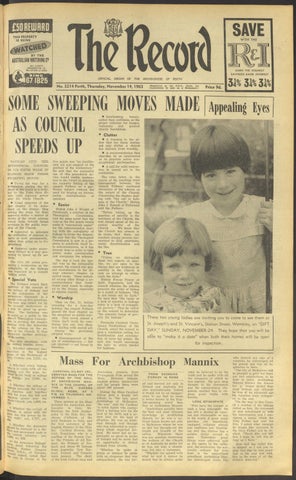
These two young ladies are inviting you to come to see them at St. Joseph's and St. Vincent's, Station Street, Wembley, on "GIFT DAY," SUNDAY, NOVEMBER -24.
They hope that you will be
able to "make it a date" when both their homes wi l l be open for inspection.
Mass For Archbishop Mannix C ARDINAL GILROY CELEBRATED MASS FOR THE R EPOSE OF THE SOUL O F ARCHBISHOP MANNIX IN THE CHAPEL OF T HE BLUE SISTERS CLINIC, ROME, AT 5 P.M. ON THURSDAY, NOVEMBER 7.
Those present at the Mass included the Australian Ambassador to Italy, Mr. Sterling; the Irish Ambassador to the Holy See; the charge d'Affaires of the Irish Embassy to Italy, and the first secretary of the English Minister to the Holy See. Cardinal Browne, the Irish Dominican who is a mernber of the Roman Curia; the Primate of All Ireland; the Primate of Ireland; and about 80 bishops from Australia, New Zealand, Ireland and Oceania The choir were present. of the Irish College sang and
Australian students from Propaganda Fide served the Mass. Between bishops, student priests, seminarians and lay people there were about 200 present. During the Mass Cardinal Gilroy paid a deeply felt tribute to "the late, great Archbishop of Melbourne. "He was," said the Cardinal "a noble figure who exemplified a burning love for the land of his birth and a ardent love for his land of adoption. He was an Irishman through and through who was interested in everything which regarded Ireland. He never lost an opportunity to speak in praise of Ireland and he never lost an opportunity to defend Ireland from attacks. "Whether he spoke in praise or defence he spoke with an eloquence that was e xtraordinary. He was by-
FROM DESMOND O'GRADY IN ROME
ed and revered not only in Ireland and Australia but also internationally. Indeed it would not be an exaggeration to say that no name is better known in the English-speaking world than that of Archbishop Mannix. "Australians possibly have the 'best and most intimate knowledge of Archbishop Mannix for he was a national figure known not only in Melbourne where he was an idol but through-out the length and breadth of the Whenever there nation. was any question concerning the welfare of the Church or of Australia he spoke for he was not only a churchman but also a statesman. "Whether one agreed with what he said it cannot be denied that he always spoke
what he believed to be the truth and he spoke with all the eloquence of which he was capable. He gave deep thought to his statements and his extraordinary eloquence enabled him to express great truths with brevity. LONG EPISCOPATE
"Few have the fortune of such a long episcopate. He has left a diocese as vigorous and wholsesome as any in the world. A great many parishes are beautifully equipped, religious schools and institutes are flourishing and the diocese has a secular clergy second to none. Materially great things were achieved such as the spires to the cathedral, the seminaries, the university colleges but even finer is the magnificent priesthood. Archbishop Mannix encouraged every boy
who showed any sign of a vocation, he encouraged all his priests and was an inspiration to them. "The city of Melbourne will be plunged in grief but there are two satisfactions to be kept in mind: Archbishop Mannix headed the diocese for a longer period than most bishops and although he was of an advanced age his faculties were unimpared to the end. "On the way to this Council a number of the bishops called on him. He welcomed us and entertained us with his conversation and I consigned a medal which the Holy Father had sent for him. I asked what message he would like conveyed to the Holy Father and he replied: "Thank him and tell him I hope he will live as long as I have." Now God has called him to himself so I ask you to pray God that he may grant rest to his soul and with him to the souls of all the faithful departed."
THE
Page Two
STATEMENT IS NEEDED By
PATRICK RILEY, N.C.W.C. Reporter.
ROME,— What the world most awaits from the Second Vatican Council is a clear statement safeguarding religious liberty according to Father John Courtney Murray, S.J., a council expert. This is the big issue of the council in the world's eyes," the American theologian declared in an interview with the N.C.W.C. News Service. "If the council sidesteps religious liberty, we are done for." he said. Father Murray noted that a chapter on religious freedom has already been written into the council schema on ecumenism, that is, on inter-faith relations. He noted that this question is a source of great friction among religious bodies. But the council's Commission on Faith and Morals has challenged the competence of the SecrePromoting for tariat Christian Unity in the field of religious liberty, he said. The secretariat prepared a schema on ecumenism. "There is no doubt that the Unity Secretariat has the right to deal with religious liberty," Father Murray said, The least the council will do in the matter of religious freedom, he added, will be to "reaffirm the doctrine of Pope John's encyclical Pacem in Terris." CONSCIENCE
This, he said, would be a twofold statement—that a man has the right to worship God according to the demands of an upright conscience, and that this and other human rights limit the powers of the State. The State must respect this right not only in theory but also in practice. "The Soviet constitution contains a declaration of the right to religious freedom," he said, "but this is purely verbal." But the Church is no friend of the "outlaw conscience." Father Murray emphasised. This notion of the conscience as an outlaw bound by no norms of
right action was condemned by Leo XIII. TRUE FREEDOM
"When you say conscience is free," he said. "you are not saying it owes obedience to no moral standards. Quite the contrary.
-The declaration in favour of religious freedom is not an approval of error, nor does it situate error on the same plane as truth. "It is rather an affirmation of the dignity of the human person, which consists essentially in his freedom." During the 19th century and for about two decades of the 20th, he said, the Church was highly suspicious of the word freedom. Father Murray traced this suspicion to the. violence and injustice perpetrated by the French Revolution in the name of freedom. He pointed out that most 19th-century political movements that waved the banner of freedom stemmed in some way from the French Revolution. "The context changed radically with the rise of totalitarianism in the 1920's," he said. "Throughout the 19th century, t h e Church's well-justified suspicion of freedom mellowed. When totalitarianism posed a threat to human freedom, the Church rallied to freedom's defence. "This defence reached a peak in Pope John's great It embrace of freedom. will reach another peak. T hope, in the council's reaffirmation of the right of r eligious liberty
r
NOVEMBER 18: p.m. — Official Opening of new Parish Church at Gosnells. NOVEMBER 22: 7.30 p.m.—Preside Solemn High Mass, St. Mary's Cathedral; occasion of Silver Jubilee of Cathedral Choir.
NOVEMBER 26: Confirmation, Kelmscott. DECEMBER 1: 3.30 p.m. — Confirmation a n d Canonical Visitation, Kenwick. DECEMBER 3: 3 p.m.—Confirmation, St. Louis' School. Claremont. DECEMBER 8: 3 p.m.—Bless and Open extensions to Claremont Church.
NOVEMBER 24: 4 p.m.--Confirmation and Canonical Visitation, Pinjarra.
A BEATITUDE OF THE WORLD IS:
"Blessed is the man who looks after himself first." Sartre has given the final expression to this by enunciating the beatitude: "MY NEIGHBOUR IS HELL." THE OPPOSITE KEY TO HAPPINESS PRONOUNCED BY THE LORD OF THE UNIVERSE WAS:
"Blessed are the merciful, for they shall obtain mercy."
T
HIS Beatitude represents
a tremendous development over the Commandments. Of the Ten Commandments, three were concerned with justice to God, and seven with justice to neighbsour. There is not great mercy demanded. The Old Testament, when it speaks of mercy, usually applies it to God, though there be individual instances of mercy in men, such as the mercy Abraham showed to his nephew Lot, as Joseph manifested to his brethren, and Moses to his sister Miriam after she had rebelled against him and the Lord had smitten her with leprosy, and the mercy extended to David after his sin. In the Old Testament the
Hebrew word for mercy "chesedh" occurs about 150 times and in nine-tenths of these occasions refers to the Mercy of Ged.
IMITATE GOD'S MERCY BUT in the Beatitude: "Blessed are the merciful for they shall
receive mercy," the recommendation is for men to imitate the
DECEMBER 13: 7.15 p.m.—Adult Confirmation. St. Mary's Cathedral. #04.4,41.4.#4,041.4.
38 ST. QUENTIN AVE., CLAREMONT. Phone 32-002.
J. L. FITZSIMMONS & CO. LANDSCAPE GARDENERS
f.r LAWN AND GARDEN CONSTRUCTION * ROTARY HOEING. LEVELLING. EXCAVATING * BITUMEN PAYING * QUOTATIONS GIVEN FREE OF COST /11 4 4.4.4.4.4.041
mercy of God. The same attitude of mercy which God has to man now man is to show to fellow man. The reason is not because he is deserving of the mercy he receives from God, but because he is not deserving. No human being merited that God should become man and pay the debt of his sin; having thus received so much undeserved forgiveness, man must be ready to extend it to others. One wonders if one of the effects of the modern denial of guilt is not to effect a decline of mercy and forgiveness to others. One finds this idea expressed in one of the writings of Nathaniel Hawthorne. A very human Miriam says to her friend Hilda: "You have no sin nor any conception of what it is; therefore, you are so terribly severe. As an angel you are not amiss, but as a human creature, you need a sense of sin to soften you." May not a bluntness, a want of courtesy and politeness, quick answers, darting retorts, inconsiderateness of the feelings of others, be due in part to the fact that modern man, having denied that he is ever
guilty of sin, thinks himself as never in need of mercy. Having
never been touched by its healing hand, why should he ever extend it to others?
DIFFERENT TYPE THE mercy of this Beatitude is not a natural, psychological or emotional generosity to others, particularly to those we love. "For you love those who love you; do not the heathens do this?" Nor is it a humanitarian affection, for it is very easy to love humanity, but to love this particular man who is always sniffling or interrupting a conversation, or blowing smoke in your eyes, this requires much more than a natural sense of human worth. To be kind to the beautiful and not to the ugly, to the rich and not the poor, cannot be a love of neighbour, but a love of self. To be merciful is to have the same attitude to men as God has, to think of men as God thinks of them, to feel for men as God feels for them, and to act towards them as God acts towards them. Though the inspiration for mercy comes from that of Christ, there is the added truth that if we would be forgiven, we must forgive. This is insisted on in the Lord's Prayer; it is the moral of the parable of the debtors in which he who was forgiven a great debt choked a neighbour who owed him a few pence. Hence, the Scripture says: "for judgment is without mercy to him who has not shown mercy." Mercy like all other virtues i6 its own reward, for a well of sweetness is opened up in our own hearts and even in the world round about us: "The song is to the singer, and
comes back most to him; the gift is to the giver, and
comes back most to him: the love is to the lover, and comes back most to him:
—it cannot fail."
41Nerede.desee.e.e.e."0,04,~0004.4.0.4.00.41. #4.4,11,04,
Gurro, Italy: The Mayor of this Alpine village of 750 people has preferred charges of "illegal seizure of person" against the parish priest who locked him and two other village officials in the church bell tower.
Official Engagements 3 p.m.—Bless and open new Parish Church, Toodyay.
BLESSED ARE THE MERCIFUL
PRIEST LOCKS MAYOR IN BELL TOWER
.4.004.04,01.4.4 11.0#00,141.4.4.4.#~4 , 4P4PAINIMNINIPAPJJKAP4 , 01#4,0.4
NOVEMBER 17:
Bishop Fulton Sheen . . .
, 14 e.0.0.0, deesedadedrynore0.e..PoiNie.Iseieir
A mit rover* over heat has most of the village hot under the collar. especially Father Paolo Grassi, and
Thursday, November 14, 1963.
RECORD
Mayor Alessi() Bergamaschi. The fracas started Oct. 28 when the Town Council informed Father Grassi that it couldn't meet its regular annual payment of about 48 dollars for the rectory's winter heating bill. Father Grassi was told that the bill would be paid later when money became available. "SUBSTITUTE" To protest the council the decision, substitute priest refused to allow the ringing of the Church Bell. Since the bell is the traditional substitute for a town alarm clock, noon whistle and fire alarm, Father Grassi's action was an effective protest. Mayor Bergamaschi was not going to stand for it. He ordered the town clerk to enter the bell tower and ring the evening bell. On hearing the first peal. Father Grassi rushed to the belfry and ordered the clerk out. Then the Mayor and his deputy. who were in the offing, also made their way inside the bell tower. The priest was outnumbered but undaunted. He stepped out, turned the key, and locked the three in. The trio thereupon broke down the door. Mayor Bergamaschi went to the town prefer charges to hall against the pastor. But Guro's bell remained silent.
CHURCH'S OLDEST IS AT COUNCIL ROME. — The Catholic Church's oldest bishop, who as secretary of the Sacred Congregation of Rites for 30 years was responsible for 62 canonisations and some 200 beatifications, marked his 101st birthday on November 9. ARCHBISHOP ALFONSO CARINCI, now retired, is a native Roman and the son of a distinguished archaeologist and paleontologist. He taught liturgy at Rome's Urban University before being made a bishop by Pope Pius XII in 1945. During an interview in his apartment here, he proudly showed a photostat of his to certificate baptismal
prove he was far beyond three score and ten.
"I am getting tobe rather old," he said with a benign smile. In the small chapel where he says Mass almost daily, he showed the framed original of a letter written by his patron, St. Alphonsus Liguori. "ANY DAY NOW" "I have willed this to the Redemptorists whom he f ounde d," he explained. "After all, I may pass away any day now." But looking at the venerable old man, one might agree with his former pupil, AgaCardinal Gregario the gianian, Prefect of Sacred Congregation for the Propagation of the Faith, who told him the other day: "You will live to be a 110!" Though he usee a cane and speaks with a halting voice, Archbishop Carinci is mentally alert. He fondly remembers the many wellknown saints he has helped raise to the dignity of the altars—Mother Cabrini, Don Bosco, Maria Goretti, Pius X, the Jesuit Martyrs of North America, Robert Bel-
By . . . FATHER PLACID JORDAN O.S.B.
Bishop Neumann of Philadelphia were among these." Asked whether he remembered the First Vatican Council of 1869-1870, Archbishop Carinci said: "Yes, indeed, although at that time I was only a little boy. Who would have thought I myself some day would be• come a Council Father!" He said he attends the council's meetings, "except on days when I feel too tired, Cardinal Efrem Forni, a member of the Vatican administrative staff, who also lives in this building, takes me in his car."
CHECK-UP The Archbishop said he larmine, Bernadette Soubi- has never been really sick. rous, John Fisher, Thomas "About a year ago I had a More, Catherine Laboure check-up at the hospital. and many others. Imagine my surprise when He keeps pictures of the Pope John XXIII of blessed 62 heroes and martyrs of memory came to visit me! the Faith he helped canonise He also was the one who in a large album on his liv- gave me permission to say ing room table to show to Mass sitting down." visitors. Mrs. Maria Antonelli, the Archbishop's niece, keeps AT LEAST 200 "Of the Blesseds whose house for him. "He sleeps rather well," livesIhad to investigate," he she said, "and he always said, "only a few are in this enjoys a hearty meal. For book. Since there are at least 200 of them, I'd need a his birthday party this year we will have a few distant much bigger book for all of them. Besides, some causes relatives and friends come I was only able to start be- in. Of his own people, the fore my retirement four last one, a cousin 91 years years ago. Mother Seton and old, died last year."
C. MORRIS —Plumber
SHEET and METAL WORKER Phone 28-2096. 6 CLEAVER STREET, WEST PERTH. Y OUR
CHEMIST —
N. H. MOORE, M.P.S.
429 ALBANY HIGHWAY, VICTORIA PARK (opp. P.O.) R ing 6-1076 — We call for and Deliver your Prescriptions CONSULT OUR TRAINED COSMETICIAN
1
Helena Rubenstein, Innoxa, Max Factor. Coty, Lounnay, Ft".
.."*".#"rHE COLONIAL MUTLJAL FIRE INSURANCE COMPANY LIMITED
CAN MEET YOUR REQUIREMENTS IN INSURANCE PROTECTION 236 ST. GEORGE'S TERRACE, PERTH A. De CAUX, Manager. Phone: 21-9066
Thursday, November 14, 1963.
THE
RECORD
Priest Fasts Against Pornog•raphy NEW YORK: A PRIEST HAS "TEMPORARILY" DROPPED HIS WATERONLY FAST AGAINST PORNOGRAPHY FOLLOWING CITY MOVES TO CRACK DOWN ON OBSCENITY DISTRIBUTORS. Father Morton A. Hill, Ignatius' St. of S.J., Church here, took solid f ood for the first time in three days last week after it was announced that Deputy Mayor Edward F. Cavanagh, Jr., had been named tct spearhead a drive against smut. Father Hill had been living on nothing but water since 6 p.m. on October 25. He said then he w ould continue until the city took acition against pornography distribution. RABBI, TOO At the same time, Rabbi Julius G. Neumann, of Zichron Moshe synagogue, undertook a dawn-to-dusk fast in protest against pornography and oppression of Jews in the Soviet Union. Rabbi Neumann allied his fast with Father Hill's
anti - pornography effort, while at the same time making Soviet persecution of Jews the main target of his protest. The 48-year -old Jesuit priest spoke of his fast and its purposes in a sermon at St. Ignatius' Church. He said distribution of pornographic literature to children violates '`parental civic rights" and leads to such evils as sexual perversion and narcotics addiction. Father Hill declared that New York Mayor Robert F. Wagner last July had promised a four-part antipornography programme in response to appeals from Operation Yorkville, an inter-faith anti-obscenity campaign undertaken here last year. ACTION He said the programme promised by the Mayor included estbalishing a fulltime police unit to take action against distributors of "hard - core" pornography; strict enforcement of licensing requirements and other administrative controls; seeking creation of a special court to deal with obscenity cases; and enlisting co-
M. G. O'Brien & Sons
PAINTING CONTRACTORS 454.....450•#.11.
20 MABEL STREET, SOUTH PERTH. 67-2716
##051,415.150•N•f50•4•4141P5"1151154 , 4•441,11 ,4 , 11•11 ,0•4141 , 0•0•4 , ....P.INIP#4,40.
C. A. Industries
[ PHONE 65-1368
GATE and FENCE MANUFACTURERS
59 ROBINSON AVENUE, BELMONT. QUALITY LIMK MESH FENCES SUPPLIED and ERECTED
C ONCRETE PAVING SLABS IN ALL POPULAR SIZES AND COLOURS GARDEN KERBING — CONCRETE FENCE POSTS M ATERIAL FOR SOAKWELLS
ANDERSONS INDUSTRIES PTY. LTD. 2-6 ROYDHOUSE STREET, WEMBLEY 8-2141 — 8-1121
Much benefit from BEX Recent photograph of Mrs. A. Hawthorn
Mrs. A. Hawthorn, 184 Bridge Road, Wentworthrille, N.S.W., writes: • 4, 5..
am writing to fit I am getting let you know just how much benenearly sixty years from your Bex Powders. I am of age, and suffer from blood pressure which gives me very bad headaches, especially in the morning when before I have taken one Icannot get out of bed gives me relief in a few of your powders which without a packet in the minutes. I would not be house always." BEX HAS STOOD THE TEST OF TIME BEX is not a treatment for blood doctor can treat such a serious pressure—only a condition. As the above testimonial proves, however, the pain of headaches arising from blood cleared away quickly and safely pressure can be by taking BEX. To ensure the full purity, uniformity and effective strength of BEX, the principal manufactured in BEX laboratories medicinals are supervision. For more than thirty under strictest years, people of all ages have proved the value of BEX. " I
B EX
IS
BETTER
PRICE 1 ."
The above testimonial may be inspected at The Head Office of Deckers Pty. Limited, Crown and Campbell Streets. Sydney. 594C
P ope Paul VI at a recent private audience p raised the accompl ishments of the Catholic N ear East Welfare Association and gave his blissing to members of its staff. The CNEWA, which has its headquarters in New York City collects funds for missionary work in 18 countries in the Near and Middle East, and of the Pontifical Mission for Palestine. t fte Vatican Agency which provides re lief for Arab refugees from Palestine. P ictured with the Pope are, left to right: F ather Denis Mooney, 0.F.M.. assistant secretary, Beirut; Cardinal Spellman: Mgr. Joseph T. Ryan, national secretary, New York. and Father John G. Nolan, assistant secreta ry, New York.
"DEPUTY" CAUSES A STORMY PROTEST
VATICAN CITY: Archbishop Francis Beckmann, C.31., aged 80, of Panama City, died here on October 30 after a heart attack. The Dutchborn Vincentian was on his way to a meeting of the Ecumenical Council when he was stricken. He was carried to the Vatican infirmary where he died. Born in 1883 in Enschede in the Netherlands, he was ordained in 1913, consecrated Auxiliary Bishop of Panama in 1940, and became Archbishop in 1945. toP51150,54.451150411511.~0.4.45.41.41504,11•41.041 , 04.0
CONCRETE SPECIALISTS
BLESSES NEAR EAST APOSTOLATE
operation of area district attorneys in fighting the problem. So far, the priest charged, these promises have not been acted on. A spokesman for the Mayor said that "a number of things have already been done in this area, more are being contemplated, and an announcement on the subject will probably be forthcoming" shortly. In interrupting his fast "temporarily," Father Hill said he warted to talk with Deputy Mayor Cavanagh about Cavanagh's' plans for anti-obscenity efforts before he decided whether he would halt his fast permanently. Mayor Wagner, assigning Cavanagh to supervise the drive against pornography, said he would employ "all available controls" against distribution of obscene material to children.
Second Council Death
Page Three
OLTEN, Switzerland.—Thirty-six persons were arrested here when a riot broke out in stormy protest over the staging of Rolf Huchhuth's controversial play. "The Deputy." The play criticises the late Pope Pius X11 for not speaking out against nazi persecution of Jews. Rioting broke out both inside and outsicie the theatre ( Oct. 29. The 36 arrested were released after they were identified. Often police said that those arrested all came from neighbouring villages. The local Catholic clergy voiced strong disapproval of the rioting. Critics of the play have'
THANKS LETTER FOR PETER'S PENCE
SECRETARIAT OF STATE CF THE HOLY SEE, The Vatican, Oct. 13, 1963.
HIS GRACE THE NIOST REVEREND REDMOND PRENDIVILLE, D.D., Archbishop of Perth. St. Mary's Cathedral, Victoria Square, Perth. My Lord Archbishop, A new testimony of loving homage to the Vicar of Christ was given by the Archdiocese of Perth through the Peter's Pence offering for the year 1963, which Your Grace recently entrusted to the Apostolic Delegation for transmission to the Holy Father. It is my privilege and honour to send you this acknowledgement for the sum of one thousand eight hundred and twenty pounds, which Your Grace has thus presented to His Holiness as a contribution towards the fulfilment of His lofty and arduous responsibilities as Common Father of the faithful, and dispenser of the charity of Christ and of the life-giving Word of the Gospel. In bidding me do so, the Sovereign Pontiff charged me to add the heartfelt expression of His deep gratitude, and the assurance that He appreciates fully the self-sacrifice, generosity and filial affection which prompts this generous donation towards the apostolic and charitable enterprises He most cherishes. Doubtless, the Divine Saviour reserves for such affectionate attachment to His Vicar on earth an adequate measure of recompensing graces; and it is in pledge of such divine return, as well as in further manifestation of His sincere benevolence, that the Holy Father lovingly bestows upon Your Grace, upon the priests, men and women religious, and devoted faithful of the Archdiocese of Perth, His paternal Apostolic Blessing. I gladly assure Your Grace of my sentiments of cordial esteem and high regard, while remaining, Devotedly your in Christ, A .G. CARD. CICOGNANI.
said that it misrepresents the the Pope's reasons for not speaking out. The play's defenders have argued that it is a historical study of a deep moral problem rather than an anti-Catholic polemic. The play has been showing in areas of Switzerland having mixed Catholic-Protestant population. "BLOW UP THREAT" It started its Swiss tour in September in Basel, 20 miles from here, where
had several sell-out performances. Some members of Easel's city council unsuccessfully demanded that the play be banned as a threat against religious peace. But the play had no adverse effect on relations between Catholics and Protestants. Threats to blow-up the theatre where it was showing were disapproved by by Catholic authorities. Swiss bishops have warned Catholics against forming a biased judgment on Pius X11, but they have neither condemned the play nor forbidden anyone to see it. A U.S. production of the play is expected to open on Broadway in February.
DAY and NIGHT SERVICE
TAKE YOUR PRESCRIPTIONS TO—
FOLEY'S DRUG STORE
9 5 BARRACK STREET (right opposite the Taxation Dept.)
Special Attention to Country Clients — Phone 23-4267
REVERENT . . . DIGNIFIED . . . TRADITIONAL . . . HEIR
service limited. almost to the Catholic community, and their conductors fully trained -in procedure at church and cemetery, a funeral may be entrusted exclusively
to Bowra & O'Dea with the sure that every religious requirement will be reverently knowledge observed. Arrangements
may be telephone at any hour.
made
by
FUNERAL DIRECTORS
BOWIIA & O'DEA ( Est. 18881
68 Stirling Street, Perth
21 4308
Thursday, November 14, 1963,
RECORD
THE
Page Four
•••••••••••••••
• •
EVERYMAN'S
• •
FAMILY By Father JOHN C. KNOTT'
The Forgotten Man THE PAST YEAR has seen a rash of articles, books, speeches, and documentaries which have been concerned with the fascinating topic - the nature of woman. It is an indirect testimony to the mystery of the subject that so much discussion has taken place.
THE JUBILEE CHOIR OF ST. MARY'S CATHEDRAL
Jubilee Celebrations For St. Mary's Cathedral Choir
However, the proverbial visitor from Mars might have difficulty in learning from the popular media
CO-OPERATION
YEAR
C ATHEDRAL ITS
ST. MARYS CHOIR
PRESENT
IN
FORM
C ELEBRATES ITS SILVER JUBILEE.
A Jubilee High Mass will be offered in the Cathedral on Friday, November 22nd Feast of St. Cecilia, at 7.30 All past members and friends of the choir are invited to attend.
" SOME
parish priest of St. Benediets, Applecross His place was ably filled for eight years by Father P. McCudden until his recent appointment as parish priest of St. Cecilia's. Floreat Park. The last Mass which Father McCudden conducted in the Cathedral was the first telecast Mass on Easter Sunday 1961. The present Choirmaster is Father P. Ahern who is carrying on the traditions of his predecessors. POLYPHONY Since its inception, the choir has specialized in the classical 16th century polyhony of such composers as Palestrina, Victoria, Byrd and others. With this are coupled the ancient plainsong melodies and more works liturgical modern notably those of Dr. Edgar Ford. In this way the choir were sharing in the great heritage of choral music which the church has cherished for centuries. Discipline and team spirit have helped to achieve the great control which the choir has maintained over the years. The members form
Mr. J. McCann 35 years in the choir) Father P. Ahern (director) Mr. J. Atkinson ( 25 years in choir and one of the original boys) Tony Chinnery and Ken Smith ( two of the youngest members.
Dancing 'til 3 a.m. With Colin Wild Trio
Continental Cuisine
Parties Catered For
ON THE FORESHORE MELVILLE POE.. CIMO
A TLAS
fAONNgETE
master towards the end of each year. From forty or fifty applicants, five or six are chosen to fill the vacancies. The boys study all the normal school subjects and in addition receive training in music and voice production. They attend practices regularly each day before school, and sing at High Mass each Sunday and other major functions in the Cathedral. FATHER McCUDDEN A fter fifteen years of most noteworthy service to the choir in giving it a solid f oundation and initial excellence Father Lynch became
2,800 GALLONS to 50,000 GALLONS
PHONE
LOAD!"
HE WRITES: "How come you never mention
DR. EDGAR FORD
THURSDAY, FRIDAY and SATURDAY
of communication that almost half the human race is made up of a different sex. He is called man. Lest he become the forgotten man, here is one of them who speaks for himself, at least, and probably echoes the sentiment of many more of his confreres.
"OMOL101211.1 L'iC10100i3i3liN3101306.10
THIS
Through the generosity and co-operation of the Christian Brothers, the boy-' The history of the pre- were given scholarships to sent ma!e liturgical choir C.B.C. St. George's Terrace, dates back to 1938. The choir and arrangement which still consisted at first of thirty stands at Trinity College. tenors and basses known The first function at which as the Society of St. Cecilia) the newly constituted choir who sang during the Holy sang was at evening devoweek ceremonies of 1938. tions on Easter Sunday 1938. In that same year His Grace 200 BOYS the Archbishop directed Fr. Since then almost two Lynch to add thirty boys' v oices and tpe choir in its hundred boys have passed through the Cathedral choir. present fond came into e The boys are selected at an audition held by the choirtence.
one family with a common soul and have as their aim the of beautifying the Church's liturgy through their song. All of this is achieved in the wonderful religious atmosphere of the Cathedral Church of the Archdiocese. The seeds of an excellent tradition are already bearing fruit with the Cathedral choir. Father Ahern said that it was gratifying to see past choir boys coming back to sing with the men, or to listen to the Masses and motets they learnt as boys. "May that tradition grow and the religious and musiincrease atmosphere cal with the years." he said.
GR-Viti5
for
QUOTATION
CONCRETE SERVICE CO. ?27 WHARF STREET, QUEEN'S PARR
that unsung hero - the family man who reaches his fifties? Do you think 'He has it made "Nothing could be further from the truth! Very often this man has one or two at the University and a couple more in the high school . . . Sere load! . . . Some fun! This proud and loving parent quietly struggles to earn the hundreds and hundreds of dollars needed every month to keep everything going, and make no mistake, this is quite an gchievement. "The children are concerned only with their OV:11 objectives, their studies, and their friends. Th man's wife is immersed in the activities, and in tht. feeding and care of these offsprings. "This poor soul, alert and capable at his jobs, finds all lines of communication with his family gradually dissolve. He is unable to follow ar comprehend the abstract sciences so easily digestt.: by his children, he feels unspoken patronisath of not only his offspring, but of his wife, at his mv modest scholastic attainments, or indeed. modest position in business and in society. "Since he cannot get a word in edgewise. ail nobody wishes to listen to him anyway, he becomes a very lonely man. In order to get nifty at his job. and to pay the butcher, the baker, the candlestick maker, over the years, he has never joined golf club or bowling club, nor has he cultivated a host of friends to take up his time in friendship and pleasure. This man is the loneliest man ir. the world in the midst of a hive of rather fascinating activity.
A SKS
FAVOURS
NO
' THIS MAN could easily immerse himself in a flood of self-pity, except that it really doesn't occur to him. In his secret heart Ke knows that he has given of his best; he is secure in the knowledge that he is needed . . . needed in the
family . . . needed because of his talent and competence at his job . . . needed by his community. He is the man who asks no favours and gets none: who goes about his day in manliness and honour . . . he is one of the great army of men who 'turns the crank' that keeps everything going. And the thing he likes about this life is that it is only temporary." So here is a toast to the quiet man who doe his job without much fuss, supports his familY without dramatic flourishes on the drums or the triumphant sounds of trumpets or *even too ofIN without the sometime recognition on the part a his wife and children. He "goes about his day in manliness and honour," and because he shares in the divine paternity of Him it can also be said, "hallowed be thy name." Another way of saying the same thing is a now -and-then, "Thanks, Dad," or even an "I love you. dear" from his future widow. The address of the local Catholic Marriage Guidance Centre is 77 ST. GEORGE'S TERRACE. PERTH. 23-4548. •
55555
•
•••••
•
•
••• •
%woo°
W. & G. JANISSEN-Electrical Contractor 68-1243. 207 WHARF ST. (Cr. Rena) St.), QUEENS PK.
TIMM mi BRAN DY S PECIAL
HOSPIT AL
TH E
Thursday November 14 1963
RECORD
BLESSING AND RECITAL WILL HERALD USE OF NEW CATHEDRAL PIPE ORGAN
ge Pve
THE PERFECT FRAME ,
53 YEARS
THE CATHEDRAL ORGAN, BEEN
RE-
HAS THAT BUILT. AND ENLARGED, BE
W ILL
SOLEMNLY
B LESSED, BY THE ADMINISTRATOR, MONSIGNOR J. HOGAN, ON TUESDAY, NOVEMBER 19, AT 8 P.M.
This will be followed by a recital by the Cathedral organist, Annette Goerke, in will a programme that
thoroughly explore the tonial capacities of the magnificent instrument the organ has now become. At the conclusion will be Solemn Benediction. The programme will consist of a concerto by Corelli, Prelude and Fugue by Bach in D Major, Chorale No. 3 in A Minor, by Cesar Franck, Cortege e Litanie by Dupre, Suite "The Nativite" by Messiaen, and the Toccatta from the Vth Symphony by Widor.
The organ dates from 1910, It replaced a two manual and pedal reed organ, and it was built by the late J. E. Dodd of Adelaide, for the incredibly small cost (as it seems to us today) of £1000. It was cared for and kept in tune by his son Mr. E. D. Dodd, and of late years by his grandson Mr. E. A. Dodd. The present rebuild and enlargement has been carried out by the same firm J. E. Dodd & Sons, of the Gunstar Organ Works Adelaide. The rebuilding additions and have cost about £10,000, and the new gallery and organ case another £8,000. (The original organ would have cost about £25,000 to build today. A far cry from £1,000 in 1910. The firm of architects is .Henderson and hompson—and the building carried out by Berry Bros.
TWO B ROTHERS The organ came into being through the en thusiasm, generosity lnd work of two brothers, since passed to their eternal reward, Mr. Walter WeF,thoven the then conductor, and Mr. Joseph Westhoven the organist. There were many who subscribed to the fund for its building, among whom was the late Mr. Tim Quinlan (father of. the late Dr. Quinlan) who subscribed a quarter of the cost. The late Mr. Herbert Eales did the architectural part of it
A nnette Goerke at the manual. -44.-"P####4.-#4,--#4.4.-#04.-4 . 41,11PANP4, 11,11,11,,MININP4,0,1.#4,11141,1,41 , 11V.1141.-#0.11,11,NP-41
A nnual Solemn Novena ST. MARY'S CATHEDRAL
The old organ had 28 stops. 5 couplers and 11 accessories. There were 26 ranks consisting of 1.447 pipes. It was renowned for its beautiful tone, and was indeed regarded by the late Dr. Edgar Ford as the finest t wo manual organ in Australia. It was so well built that apart from normal upkeep it needed nothing doing to it for fifty years. _
NEW HOME For the present rebuilding of it, it was decided that it would be better to find a
,-,1-constructed organ in its new gallery beautifully frames the stained glass window of the south t ransept.
OSCAR HUMPHRY v .
new home for it, in the South Transept., instead of in the West end gallery which wit; have to be demolished when the Cathedral is comp!eted - The new organ has many more resources, and a much greater tonal range. It is now a three manual organwith electric transmission. It has 2271 pipes in it, in 40 ranks. Eight of these are
FOR SERVICE SINCE 1895
S ATURDAY, NOVEMBER 30 — SUNDAY, DECEMBER 8 Saturday 5.30 p.m. — 6 p.m. and 7.30 p.m. — 8 p.m. 7.30 — 8 p.m. Other Evenings. ALL NIGHT VIGIL December 6, 11 p.m. — 5 a.m.
TYRE SERVICE Introduces
TORCHLIGHT -PROCESSION ON SUNDAY, DECEMBER 8th I WILL CLIMAX THE DEVOTIONS.
A New Kind of Exclusive
TY111 Um-CAPPING
J. E. DODD ORGAN BUILDER 671 Hay Street, Perth. — Phone: 5830.
WITH G8 NO.- SQUEAL TREAD
A ppreciates being entrusted
with the important alterations and additions to the
You Pay Only 1 /- in the £ per Week
C ATHEDRAL ORGAN Mr. Sidney Gunn who worked on the re-construction of the organ.
Organ Gallery Additions were erected by
BERRY BROS. PTY. LTD.
86 Scarborough Beach Road, Mt. Hawthorn in association with
BERRY JOINERY PTY. LTD.
Selby Street, Osborne Park who carried out the gallery front and choir seating 4
-4
Lond. ) .
SPECTACLE MAKER MAPTALUP HOUSE, 254 ST. GEORGE'S TERRACE ontinental and Hand-made Frames — Special Children s Frames. Phone 21-5203.
Proprietors of the largest vineyard in W.A. We can supply the best Wine at very reasonable prices. 215 WILLIAM STREET, PERTH. Phone: 21-5393.
extended, and 14 are new. The new ranks alone would have made a fair sized organ. There are 64 speaking stops,- 13 couplers and 34 accessories. The instrument contains all the different tone colours normally found in the biggest organs, and has a tremendous dynamic range. The invitation to come to the Blessing of the organ, and the recital is extended to anyone who cares to come. and their friends.
—
SUPPLIED and FITTED BY:—
BOANS
SERVICE STATION
Corner of ROYAL and BENNETT STREETS, EAST PERTH
BOANS
MORLEY SERVICE STATION
W ALTER ROAD
BOANS
MEDINA SERVICE STATION
Also Supplied at BOANS, WAVE-RLEY, and H AYWARD'S, BUNBURY (A Boans Store)
=-4 Muscat .. 14/ 16/ Port Prices Sweet Sherry ... _ 10/6 Claret ... 18/Per Vermouth _ - 12/Sultana .. 18/. Gal. Marsala 12/. Dry Sherry ... _ 18/14 SOUTH TERRACE, FREMANTLE Phone: 5-3178
4 4
=INTERNATIONAL 6,000 in six faculties and a graduate school.
JAPAN
Va41.4.0.4e#4,1e.p.
University Is Fifty Years Old SOPHIA University, Japan's oldest and largest Catholic university, has marked its 50th anniversary. The Jesuit university, opened in 1913 with a handful of students, now has
Sophia—where the philosophy of St. Thomas Aquinas is taught in Japanese and Buddhism is explainec in English — has a mostly Japanese student body, but the school has taught more Americans than any other university in the Fear East.
YOUR HOTEL CITY HOTEL GUIDE
COUNTER LUNCH, 12-7.30 p.m. Friday; Saturday 1240 p.m. ARCFIIE THOMPSON Offers you only "The Best" Phone: 21-4094
HIGHWAY HOTEL 206
STIRLING HIGHWAY, CLAREMONT PHONE 3 1566
at
THE RIVERTON HOTEL MOTEL
HIGH ROAD, RIVERTON 69 3.515
Friendly Service — Good Accommodation — Parties Specially Catered for M. A, & E. M. McDONNELL FRIENDLY
COMING TO PERTH . . . Stay
TV in every Unit. Floodlight 9-Hole Golf Course, FRED MILLS, Licensee
SERVIC‘E
BAYSWATER Hotel
REX HOTEL Phone: 21 8634 Persenal SupervisiThit Mrs. B. B. REILLY
OPP, STATION Excellent Accommodation Frequent Train Service — 4 Miles f rom City —Large Parking Area BED and BREAKFAST REASONABLE TARRIFF LES BARTLETT, Prop. TEL.: 71 1224
SUBIACO HOTEL
WEMBLEY HOTEL
KING & HAY STREETS Private Bar for Convenience of Guesta and Friends
SUBIACO Accommodation Class irst F and Service Phone: 8-1028 Alex McHenry, Proprietor.
Excellent Lounge and Accommodation Phone 87-2418 Cnr. Cambridge and A lexander Streets, Wembley
HOTEL
WAVERLEY HOTEL Next Boans Waverley Stores ALBANY HIGHWAY CANNINGTON Modern and Convenient Homely Accommodation Use Our Drive-In Bottle Serviee Phone 68 2419 A. R. CONNELL
CRITERION HOTEL STREk.I
CENTRAL HAY FERTH 24-HOUR SERVICE Free Parking for Country Residents 6 Minutes' walk from Cathedral. THE COUNTRYMAN'S HOTEL
Australia MURRAY STREET, PERTH E xcellent Accommodation and Dining Service LUNCH. 10/-1 DINNER 17/6. PHONE 23 1541 Enjoy the Best ACCOMMODATION & SERVICE
HOTEL COTTESLOE Phone 3-2155
The States Most Modern TOM KENNY, Licensee.
Cnr. Stock and High Roads, MELVILLE Phone: 30 3428
Cnr. High and Market Sts., FREMANTLE Offers excellent homely accommodation Phone : 5-1786 Philip P. Kearins,
Licensee
Plympton HOTEL
Home of Country People CANNING HIGHWAY EAST FREMANTLE Eric Campbell, Prop. 5-1721.
INNininiNo.4..piNINPAPAPINon""modnandp....#000.44,41.#4.4.4.4.~.p.,###~~.""P4,4,004.
PHONES
21-4341,
ISRAEL
41.4,11.4,04,04,441 , 1
Y.C.W. Paper Confiscated
Likelihood Is Now A Fact
MADRID police have confiscated an issue of the official publication of the Young Christian Workers' movement that contained a report on the miners' strike in Asturias. The government's Information Ministry maintained that the action was requested by Church authorities. The Young Christian Workers' organ explained the strike as a protest against repression of miners, including a number of deportations. It also reported that promises of better wages and working conditions made by the Spanish government as a result of strikes last year have not been fulfilled. The Spanish press generally has ignored this year's strike. The Catholic publication, Juventud Obrera, was said to have published the issue containing the strike news without the advice of its ecclesiastical super visor, who was ill. However, the confiscation of the issue follows a series of earlier clashes between the Young Christian Workers and the leaders of the government dominated trade union organisation.
A JEWISH spokesman said in Jerusalem that the Ecumenical Council is "likely to issue a call to Christendom against antiSemitism and seek a rapprochement with the Jewish people." Nahum Goldmann, president of the World Jewish Congress and the World Zionist Organisation, told a press conference that "there is reason to believe" that a resolution to this effect has been drafted by the Vatican Secretariat for Promoting Christian Unity. He said he believes the matter will come out at the council in a few months. He also said that the council is "likely to take a very significant decision acquitting the Jewish people of exclusive responsibility for the Crucifixion and placing responsibility on mankind as a whole."
Former Holidays Re-permitted
IMPERIAL HOTEL
Jack Sheedy
IN THEIR NEW CHURCH, A typical parishioner approached it and opened one side, but didn't go in. Then he tried the middle door, saw the parish priest, Father Kevin Flinn, S.S.C., and attempted to enter. The Columban missionary told him to go to the other compartment. "But I did gO there," said the confused man, "and there is no one in there!"
PERTH'S LEADING HOTEL FOR ALL VISITORS Phone: 23-1531
For SUPERIOR ACCOMMODATION
Hot and Cold Water, Telephone In every bedroom. Bed and Breakfast 37/6, 24-Hour Room Service Reduced Tariff for Children
THE MOUNTAIN FOLK AROUND RYUJIN, ACCUSTOMED TO SQUATTING ON THE FLOOR BESIDE THE PRIEST WHEN THEY GO TO CONFESSION, WERE BAFFLED BY THE STANDARD CONFESSIONAL
HOTEL ESPLANADE
NATIONAL HOTEL
PERTH ( Opposite Railway Station) Tel, 23 2921
JAPAN
CZECHOSLOVAKIA
R. M. DYMOCK, Licensee
W ILLAGEE PARK HOTEL
NORTHAM Phone Northam 49 T. E. MURPHY, Proprietor
NEWS
RIGHT ON THE SEA FRONT
PHONE: 23 1115 (5 lines)
COMMERCIAL HOTEL
HONG KONG
SPAIN
Cnr. King and Murray Sta., Perth
CARLTON HOTEL
23-3091
218 HAY
ST.. PERTH
BUSINESS MEN'S LUNCHEON — 12 to 2 p.m. ,414e#40` 11 , 00#4
BROKEN HILL HOTEL VICTORIA PARK — 6 1063
0,MININ , 411.44M4.04.#4,11
IN a reversal of previous practice since the Reds took over in Czechoslovakia, the country's workers will have a full holiday leave at Christmas. According to a report received in Vienna, December 24, 25 and 26 will be vacation days this year. It is regarded as significant that the government announcement said the step was being taken "at the suggestion of the unions." This is taken as an indication of the strength of public pressure to return to former customs at Christmas-time. Under the communists, Czechoslovak workers have been on the job until 6 p.m. Christmas Eve. Their holiday on Christmas Day had to be made up on the following Saturday.
ISRAEL ,4Y. le.ile"INeJe4,11
DALY'S
1
Cr.
MEET DAILY
ROYAL
at
HOTEL
WILLIAM and WELLINGTON STREETS, PERTH, Phones: 21-8924. Bottle Dept., 21-5436,
4NINPOONNIINIP4W,PIAP#4,04,11,41.4.411.4.04,...."0",#####
RELAX AT THE FABULOUS—
WAIKIKI HOTEL-MOTEL With Mine Host:
HARRY WARD Soft Lights — Soft Music — Foaming Ale. Phone Safety Bay 9357.
Excellent Cuisine.
e#1.41.4.4,00.
Thursday, November 14, 1963.
RECORD
THE
Page Six
Tree Planters Remember • TWO Polish Catholics who helped rescue Jews during the Nazi occupation of their homeland participated in Jerusalem in a tree-planting on the Righteous of Avenue Gentiles on the Har Hazikaron — the Hill of Rememberance. Mrs. Maria Kann, an author, and journalist W lad ysl a w Bartoszewski conducted the memorial rite.
IIONG KONG'S GOVERNOR, SIR ROBERT, BLACK, HAS PRAISED THE CHRISTIAN BROTHERS FOR THEIR WORK IN EDUCATION THROUGHOUT THE FAR EAST 'FOR NO REWARD OTHER THAN FULFILLING THEIR FAITH." Sir Robert spoke at the opening on October 25 of a 250,000-dollar addition to the Brothers' St. Joseph's College, a secondary school. The school's new eight.. story annexe has audio-visual facilities and three science laboratories. The Christian Brothers also run a primary school and another secondary school in the colony.
TICKETS AT DOOGUES
Drawn This Week
Lottery Nos. 1534 and 1535.
LUCKIEST A GENCY
PERTH ARCADE and 19 BARRACK STREET, PERTH ft * * 0
ft
ft ft *
4
Arthur E. Davies & Co.
FUNERAL DIRECTORS and EMBALMERS FREMANTLE: 85 Market Street — 5-2225 CLAREMONT: Opp. Railway Station — 3-2177
AND ALL SUBURBS W ALLACE A. H. GREEN — 64-1879 (Private) 416 11C111-111'
WINES S EVEN HILLS ALTAR DRY and SWEET AS Seven Hil ls Sacramental Wine is made by Jesuits, it complies with the requirements of Church Law.
WESTRAL WINE and SPIRIT AGENCY 167 HAY STREET, SUBIACO.
Phone 8-1410.
AVON Electrical Service
( Proprietor: J. WERDLER1 33 CALEDONIAN AVENUE, MAYLANDS We are Installation, Repair and Maintenance Specialists. We are Available at Al l Hours. Telephone: 71:3672
BUYING
OR
SELING — TOP VALUE ALWAYS
HOPKINS MIGHTY MART
222 BEAUFORT STREET, PERTH Public Auctions — Tuesdays, 10.30 a.m.
HUGE RANGE OF GOODS FOR PRIVATE SALE
WE ARE CASH BUYERS — PHONE 25-1826
JUNIOR
TENNIS
RACQUETS
SLAZENGER CHALLENGE JUNIOR . . .. DUNLOP MAXPLY JUNIOR SPALDING STARMAKER JUNIOR
SCHOOL
99/6 each. 99/6 earl. 99/6 each.
SPECIALS
Reduced to . . BLUE BIRD JUNIOR. SCHOOL RESTRING — Good Quality Gut SCHOOL 4ESTRING — Braided Nylon . .
. . 63/6 42/6
..
WIMBLEDON SPORTS DEPOT
N. D. Keast, J. V. E. Keastl 14 DAVID JONES ARCADE, PERTH. Tel, 23-4219, Official Depot for W.A. Catholic Lawn Tennis Association r4e4e#41.414141.4e4P4141.4
Society Has Spread Faith • THE Paris Foreign Mission Society will mark its 300th year in Paris on December 11 and 12 with celebrations attended by several cardinals and some thirty bishops. The society, in keeping with its main purpose of forming a diocesan clergy for Asia, has seen '73 of the Asian priests it has trained become bishops. The society's members are now working, usually under native-born bishops, in Korea, Japan, Formosa, Hong Kong, Vietnam, Laos, Cambodia, Thailand, the Federation of Malaysia, Burma, India and Malagasy.
NIGARAGUA
p......leMOVININIPNIKINPAP41e##
Named After "Farmer" Pope A Pope John XXIII Farm Housing co-operative project has been dedicated in Leon in celebration of the fifth anniversary of the late Pope's election. The housing co-operatiN is sponsored by the John XXIIII Farmers' Trade Union Movement, which also is planning courses in social justice and a network of radio schools. The movement refers to Pope John as the "farmers' Pope."
HERCULES SWIMMING POOLS
Have a gleaming, modern pool built on your own property now and enjoy the long warm days and evenings ahead. Hercules look after all the details. Finest materials and workmanship. Filtered, pure water always. A great investment in health. HERCULES BUILT THE SEMI-OLYMPIC POOL AT THE HOME OF THE GOOD SHEPHERD, LEEDERVILLE. For full details contact— HERCULES SWIMMING POOLS PTY. LTD 1 15 St. George's Tce. 23-3679. After Hours: 25-2359. '1111 1 I
II II
MOVING!
I I1
—
5-1777
The State's Leading FURNITURE REMOVERS and PACKERS
GILLS TRANSPORT SERVICE Ply. Ltd. PERTH and FREMANTLE
T UDOR HOUSE MANUFACTURERS OF FLAGS, CANVAS, HOLLAND and VENETIAN BLINDS and KITS.
TUDALUX ALUMINIUM AWNINGS. All At Lowest Prices — Let Us Measure and Quote Free
Phone: 6 1620 286 Albany Highway, Victoria Park.
Thursday, November 14, 1963.
THE
RECORD
Page Seven
"They Certainly Can Never Forget Us"
Said Billy Hughes
I FIRST MET ARCHBISHOP MANNIX IN 1920 IN LONDON. I SAW THE POSTERS CARRIED BY THE NEWSBOYS, QUOTING HIS COMMENT ON HIS ARREST ON THE HIGHSEAS: "THE GREATVICTORY EST NAVAL OF BATTLE THE INCE S UTLAND." J Lloyd George admitted that his arrest of the Archbishop was the biggest blunder of• his political career. The Archbishop stayed at Nazareth House where he r eceived many prominent people including Archbishop Clune. He was not bitter over the incident but made fun of it. He was in Perth in 1925 leading an Australian Pilgrimage to Rome for the Holy Year. He and his fellow pilgrims came up the river and at the Barrack Street Jetty the children gave him a great welcome. He was very pleased with their singing and there began a personal association, whichI would like to call a f riendship, which ripened with the years. Dr. Mannix was the most unforgettable person I have ever known. There were so many qualities in the man which his many portraits in oils show. Physically he was majestic in mien and carriage wearing a tall silk hat, with a long coat, a stick in hand he walked from Raheen to St. Patrick's Cathedral, daily for years. With a pocketful of silver he enjoyed the hold-ups on the way as he distributed his largesse. At table he usually had some amusing tales of t-h-ese encounters. I heard him say: "The limitation of golf is that you never meet
N OONAN'S South Perth Bakery "Bakers of Better Bread" Two 1st Prizes 1962 Royal Show If It's NOONAN'S It's NICER
Phone 67-10411
MONSIGNOR J. T. McMAHON such characters as I do in my walk." Perhaps the Archbishop had no experience of the 19th hole! Asking children: "Who am I?" —some said he was the undertaker, others that he was Mandrake. Archbishop Mannix was the good Pastor, the watchful, faithful Shepherd who knew his flock intimately and guarded them against evil. From the cradle to the grave the people of his Archdiocese were well catered for. Every aspect of the Catholic way of life was provided for. His Grace had a genius in picking the right man for the job in hand and having appointed him gave him every encouragement and no petty interference. Priests selected for the unenviable role of specialists speak enthusiastically of his confidence in them, his appreciation of their work and his generous backing of their efforts. He was a patient listener and his great intellect grasped the - details of every work on hand. The laity knew that their Archbishop was interested in their own parishes and in the wider undertakings of the Archdiocese, with the result that their response to the many diocesan appeals and assessments was prompt, unquestioning, and generous. I once heard a Catholic Doctor in Hawthorn say in defence of a stiff assessment on his parish: "Well the Archbishop has never let us down. He always does the right thing and if he considers this assessment a fair thing I am with him and will gladly support it." The image of the good Pastor was ever in the minds of his flock and they knew that their Shepherd was on the watch and that wherever he led them they could safely follow. His example lifted the heads of his flock and made them proud of their Church. No one in any walk of life in the Melbourne Archdiocese suffer any inferiority complex for being a Catholic. The Catholics of that proud diocese have arrived and take their rightful place intellectually, economically and socially in the community. Spiritually
they are strong in the practice of their faith and avail themselves of the spiritual aids so amply provided in retreat houses, perpetual adoration centres and societies of every kind. Iheard Cardinal Spellman say at dinner in Raheen: "Archbishop I envy your role of the good pastor. You are so close to your flock and you have the time and opportunity to know and love them." Later that day the Archbishop took the Cardinal on a tour of parish buildings. His Eminence was duly impressed and admitted that New York Archdiocese had nothing better to show. THE GENIAL W ELCOMING HOST I have never visited Melbourne without calling on its Archbishop. His reception is so warming, that you leave him a happier man. He relaxes in his chair and at once you feel at home, and a natural conversation takes place. You do not have to try to talk up to him or he down to you. His merry eyes herald a witticism and you both laugh contentedly. He was never in a hurry, you were all that mattered to him at the moment, everything else could wait. The full extent of the Archbishop's private philanthropy will never be known. His right hand never new what gifts the other was dispensing. His sympathy with the sick was deep and constant. His sick Priests, Brothers and Nuns felt the
An old picture of Dr. Mannix at Liverpool balm of his presence when he called on them in hospital, their cross was lightened by the visit. Over the dead bodies of his Priests he was really at his best when in a few words he painted the good qualities of the deceased and this eased the pain of loss among the Priests closest to the dead. I have known families whose loss of a dear one was softened by his friendly visit or his letter of condolence. THE SOURCE OF H IS GREATNESS The Archbishop loved children and in his walks from Raheen he carried a bag of lollies. This was well known and the children flocked to him. A great poet has said that he was to be found thereafter in the nurseries -of Heaven — and there he will meet the Archbishop. Behind this unique figure, so richly endowed by nature
physically and intellectually tliere was an inner, hidden man the world never saw. His deep spirituality was the source of his greatness. Built on the solid foundation of prayer and self-discipline Dr. Mannix had the qualities of sanctity. LONG HOURS I remember hearing from Fr. Sidney McEwan who stayed in Raheen for several weeks of the long hours the Archbishop spent daily in his Oratory. His morning Mass with its preparation and thanksgiving took hours. One morning Fr. McEwan slept in, awakening he put on a colourful dressing gown, rushed to the Oratory to apologise. He found the Archbishop relaxed, waiting patiently for him to say Mass. He looked him over, not a word of complaint, but said with a smile: "Well, Father, have you
come vested to say Mass in the Oriental rite." Every evening the Archbishop excused himself, turned on the radiator in his Oratory and was not seen again until morning. So passes a great Priest who in his day did please the Lord. He was a big man who dominated the Australian Scene for a half a century. Not long before his death Billy Hughes called at Raheen and had a friendly chat over their battles. When leaving he took the Archbishop firmly by the hand and looking up at him said: "Well your Grace, no matter N'hat they may say about us, they certainly can never forget us." And during those days of mourning we shall not forget the Archbishop in our prayers. R.I.P.
Hundreds sold! (And we mean in just the last month or two!)
'ROVER' IS EASILY YOUR BIGGEST MOWER VALUE Big 19 inch 4-stroke for the Price of anybody else's 18 inch 2-stroke!
Telephone 21-7722 0 904
t
Ring 21 0151 NOW for a free Home Demo!
Atnint.34. OPTICAL DISPENSER United Insurance Building, 218 St. George's Terrace, Opp. Forrest Rouse. Perth.
D octors' DispensedPrescriptions
MEMORIALS
G. C. SMITH & Co.
75 QUEEN VICTORIA STREET, FREMANTI Specialising in Altars and Memorial Work. Erected a nywhere in W.A. Church Designs and QuotesAltars plannei and executed. ''We Have Over 60 Years' without obligation. Experience." Phone 5-1661
W AYS and MEANS. . .
TO HELP A NON-
CATHOLIC
1. Say a daily prayer for his conversion. FRIEND 2. 3. 4. 5. 6. 7.
Offer to show him the inside of your parish church and explain it to him. Offer to take him to Mass some day. (Often a week day is better for a start.) Offer to take him to a Day of Enquiry conducted by the Legion of Mary. Offer to introduce him to a priest in your parish or to any priest you know. Offer to take him to a course of talks at a Parish Enquiry Class. Tell him about the Catholic Enquiry Centre's free c orrespondence course and give him a Personal Contact Card. From Catholic Enquiry Centre, P.O. Box 63, Maroubra, N.S.W.
Features include: • VACUUM-CLEAN BLADE ACTION! • NEW, CUT-TOEDGE BASE! • IMPULSE START! • TIP-TO-EMPTY CATCHER! (Optional at £.5/19,6) Your old mower helps pay off your big 'Rover'. Don't delay! Exclusive in W.A. to Bairds Pty Ltd.
you new
Thursday, November 14, 1963.
THE
Eight
!--igt
•
FRANCISCANS throughout the entire world are this month celebrating the fifth centenary of the death of one of their famous saints, DIDACUS OF ALCALA. He is the Patron of all Franciscan Brothers. This article was written by one of them, an Australian Brother, who, before joining the Order, was a reporter on a provincial newspaper.
A lay brother, a qualified machinest te ids the guillotine in the print shop.
LAY BROTHERS' IMPORTANT ROLE IN FRANCISCANS N November 12, 1 463, in the Spanish city of Alcala, Brother Didacus died.
O
In the daily life of every Franciscan Brother t w o hings stand out prominently — prayer and work. They were the cornerstones upon yhich St. Francis of Assisi built his brown-robed brotherhood.
Once canonied, St. Didacus was chosen as the Patron Saint of Franciscan Brothers. For them, as well as being a Wonder-worker, he represented the ideal of a Brother.
Of St. Didacus it can be said with truth that, conceiving an ardent desire to perfect his life by closely imitating that of Christ crucified, he set himself with courage and fidelity
W A's FOREMOST QUARRYING & CONCRETE SUPPLIERS
74e PadriX GROUP Crushed
METAL i,e.,
( W.A.)
\_ ScreettPd
SAND i PA.,,,,c
69 1251
Quality CONCRETE
79 2184 56 215
23 2534
Incorporating AUSTRALIAN BLUE METAL LIMITED JOHN DUNSTAN & SON PTY. LTD. READY MIXED CONCRETE tW.A.) PTY. LTD.
; C:F KY/ A; t •
ryHi ihwi F
not only to observe the precepts of the holy Rule drawn up by St. Francis, but also its counsels. Hence It happened that he appeared amongst his confreres as a peculiarly authentic type of Franciscan, a model of gospel simplicity, a man un• affected by pride or selfesteem, a remarkable lover o f the brethren. GOOD HOME Love had an early beginning in the life of St. DidaThe son of poor cus. parents, he was brought up in the atmosphere of a good Catholic home. At an early age his love of God inspired him to become a hermit. He lived this life for a number of years until attracted towards the Franciscans he joined their ranks as a Brother. God gave him supernatural illumination on the mysteries of faith, so that eminent theologians, kings and emperors would come great distances to consult him. Sent to the Canary Islands in 1442, his missionary apostolate was favoured with t he gift of extraordinary miracles. Some time was spent in Rome on his way back from the Islands, but he returned to his native city where he died. NO HARM
,'
Septic Tanks & Dry Wells American equipment. Clecmi'd Latest All sites accessible
.64
No salivate left on property, all carted a way.
PHONE
76 1544 FOR COMPLETE INFORMATION
33 Wellington Road, Morley Park ,4PENde#AP ,41 04e4.40,04e4e4eaNKINIINeaKeaele#441
Alcala remembers the outpourings of compassionate deeds and the surprising miracles of charity that happened in the lifetime of the saint in favour of the poor. After his death there grew a tradition to the effect that no harm would come to the city as long as the saint's remains were entombed there. This tradition had a strange sequel as late as the 20th century. In 936, during the Spanish Civil War, the city of Alcala was ravaged by revolutionaries — churches destroyed, religious emblems torn down and the graves of the greatest and holiest citizens plundered. The plunderers stopped before the tomb of St. Didacus. Why? It seems that the local tradition was recalled and that even the bloodcrazed men hesitated at the threat of some frightening calamity coming down upon the city should the tomb be violated. The holy Franciscan Pope, Sixtus V. canonised St. Didacus in 1588,
TIIE TREE BY ITS FRUITS If one can tell the tree by its fruits, then indeed the Franciscan brotherhood has proved, since the Order began in the year 1209, to be a source of great sanctity in the Catholic Church. Of the 182 Franciscans cananonised or beatified 50 have been Brothers. From among these ranks comes the great St. Paschal Baylon, as Universal Patron of the Blessed Eucharist. ALL WALKS OF LIFE In Australia and New Zealand today men come from all walks of life to join the Franciscan brotherhood. They come from the ships at sea or mines beneath the earth. From the great cities or quiet farms. They have been soldiers and airmen, office boys and secretaries. bookkeepers and buyers, architects and tradesmen. The Holy Spirit breathes where he will and generous souls respond to His impulse. Only one requirement is really necessary for a candidate to the Franciscan Brothers—that he desires to lead the life of a Friar Minor and be willing and able to accept the sacrifices that accompany his voca tion as a Brother. TRAINING His training does not take the long years of study demanded by the priesthood. It does, nevertheless, take the same length of time For three years before his acceptance in to the Order, the candidate prepares himself for the religious life in a House of Formation. During which time qualified Brothers will guilde his mind and his hands in learning the various skills in the School's curriculum. Experienced priests will prepare his heart a n d strengthen his soul to accept the Franciscan way of life. He lives a full community life of a well-directed daily schedule of prayer, study, work and recreation. The Br6thers' Training School in Australia - New Zealand is at "Maryfields," Campbelltown, near Sydney. The accommodation for the 70 Friars in this Franciscan training ground is all the work of the Order's Brothers' Building Team—men qualified and highly skilled in their own individual trades.
With this preparation, the candidate then enters the Novitiate on Victoria's Mornington Peninsula for a spiritual more intensive training of one year. At the end of the Novitiate he pronounces his Simple Vows, which bind for a period of three years, When these expire he makes his Solemn Profession. This is the offering of his whole life—a man can give no more.
Friary, Retreat - House, or College, or in smaller core. munities of the far-flung Province of Australia-New Zealand. He labours in the mission fields of New Guinea, teaching in the native schools, assisting in the instruction of converts, building, planning or tending the hundreds of lepers in the leprosarium at Aaitape, which is controlled and staffed by Franciscan Brothers.
HANDS BEHIND THE PRIESTHOOD Brothers' vocations have always been well developed in the Franciscan family. Visitors to a Franciscan Friary invariably ask: "How can you tell the difference between the priest and the Brother?" You cannot tell the difference from the habit. You cannot tell the difference from the Rule they profess, or the vows they take. For these are identical for all the Friars of the Franciscan Order, be they priests or Brothers. This has been so since the time when St. Francis, who was not a priest, established the vocation of a Friar Minor as that of living the holy Gospel. Franciscans work out this vocation in the role of either priest or Brother. The Brother works with the priest in the busy city
TRUE FRANCISCANS As true Franciscans, in the wake of St. Francis and St. Didacus, the Brother strives to possess simplicity of mind and heart. The world fails to be attracted by it, and for the benefit of the world he prays: "Lord, make me an instrument of Thy peace!"
Wood, Coal and Coke
BRYANT & WATERS — Now
* ANY YOUNG MAN wishing to know more about the Franciscan Brothers may write to Brother J oachi m, 0.F.M.. St. Paschal's College, Box Hill, E.11, Victoria.
Wanted Middle aged couple for p osition of trust in Catholic Institution. Live in. Apply in writing. Box 101 this office.
A DAMS & KIVISALU
5 EDWARD STREE", , EAST PERTH PHONE 69 1010
P. D. LALLY LICENSED PLUMBER
23 Fulham Street, Kewdale. Phone 6 3682 HOT WATER SPECIALIST. SHEET METAL WORK. SEPTIC TANK INSTALLATIONS. GUARANTEED ALL \e', OR K
" , ,04,ONINNPO#4.04.000.00~0,04.4 10,0 , 41.4.4,14,44.0","1,11.4.4.#41.004
Geo. Boucher 8z Co. For First Class Plumbing Services
S team and Hot Water Installations 211 NEWCASTLE STREET, PERTH PHONES: 21-2204, 21-2205.
.
MMO~###MM~
THE NEW
#.0
.#000•••Ol
Amazing Value.
rest°
DUPLICATING MACHINE
IDEALLY SUITED TO THE SMALLER BUSINESS—SCHOOLS—ASSOCIATIONS ETC.
All these features .
• Automatic paper feed. • Semi-automatic inking. • Snap on paper feed arm • Compact and portable. • Requires little service.
TWO MODELS AVAILABLE Priced from £48-0-0 ( Inc S/Tax)
S. H. LAMB PTY. LTD.
184 Adelaide Terrace, Perth — Telephone: 21
7976
ov••••#4.#4,4,•~0...,..,....."'"4' ...•••••••••••••m
Thursday, November 14, 1963.
THE
RECORD
YOU MAY COOK WITH AN fASY MIND
H
AVE you ever wondered just how your electrical equipment is tested for safety?
Details vary from country to country, so that the same equipment may sometimes be tested twice over— once in the country of origin and again in the country to which it is sold. But in many parts of the world the triangular swingticket of the British Electrical Approvals Board is an increasingly familiar sight and, attached to a Britishmade electric cooker, is accepted as the only safety labelling required. I have been investigating some of the tests which an electric cooker must pass to earn this seal. After general examination in the laboratory, the cooker is subjected to trials which simulate the worst conditions under which it could possibly be used. It is installed in a small cubicle which is painted black so as to deflect heat back to the cooker itself. Rings and oven are switched on, with pans of water used to represent a normal cooking load, and tests are carried out to make sure that.. the outside surfaces do not get overheated no matter for how long the stove is used. The insulation and wiring are checked for electrical faults and water is spilled all over the hob and oven floor to see whether it seeps through to the working parts. The engineers then test every switch, boiling plate and thermostat separately, check every screw and do their best to ruin the vitreous enamel. The boiling plates have to endure being switched on and off for 750 h-ours — on for an hour and off for 30 minutes. As a final touch the hot rings are regularly doused with cold salt water and thumped with a steel weight to see whether, if the cook should lose her grip on a heavy pan, any harm would come to the ring. Eye-level grills pose other problems. Will their extra heat upset any controls on the splashback? (The oil lubricating the automatic time clock, for instance, could dry out if it were subjected to heat above a certain temperature.) Is the grill firmly fixed to the cooker so that it can safely take the weight of a spit attachment? Drop -down oven doors are strained under heavy weights—there are stories of women who use them as steps to reach cupboards! Even more complications arise when the cooker has fittings such as a spit-roaster inside the oven, a built-in radio, or a "pan-senser " ( thermostatic control on individual boiling rings). If the cooker emerges from all these tests with a clear record, it is put forward to the British Electrical Approvals Board for endorsement. Known to its judges by a reference number only—so that they are not influenced by knowing the maker's name—it is never passed if it is found to be faulty. Regular checks on the production line are made after the award of the safety mark, and no modification may be carried out without the Board's knowledge. To do no more, for instance, than replace a single counter-sunk screw by a dome-headed screw could alter vital clearances. A WNINGS, BLINDS, FLYWIRE DOORS, and FLYSCREENS ALL TYPES
Measured and Installed in 7 Days by
STAN BOND
1010 BEAUFORT ST., INGLEWOOD Phone 71 4313 Top Quality Tradesmen
FREE TEACHING COMPLETE COURSE TONY MARCELLA will personally teach you to play with
ACCORDIONS GUITARS DRUMS and
ELECTRIC ORGANS
range
and
pay
0/1" WEEKLY 1 This is ALL you pay!
TONY MARCELLA
703 ALBANY
H'WAY, VICTORIA PARK
6-2373 All Hours
4.#4141 , 04.4,
M AIESTYT$ HOTEL 6
835 HAY ST. PERT(
THE HOME OF SKATING STESSESI Bed & Breakfast 35/ -
(Subject to Alteration) Hot & Cold Water All Rooms Some with Own Shower & Toilet From £2.12.6 Bed & Breakfast Telephones-Bed Lamps T.V. Lounge DINING ROOM & BARS A IR CONDITIONED
* 211466 *
* IT LOOKS LIKE ALL THE INGREDIENTS OF A HORROR FILM — BUT HE'S AN EXPERT AT HIS JOB AND HIS ONE CONCERN IS OUR SAFETY.
Curtains Must Hang Well HE most important fabrics in a room are at the window. Curtains can add comfort, charm, pattern and colour to a decorative scheme. Whether they are good, bad or indifferent, they are -usually the first things you notice when you walk into a room. So take care when you are choosing materials for your curtains, and whether you are making your own or having them made for you professionally, follow this advice:
SAMUEL BRONSTON
„
There is no need to use a blue rinse for white cloths. Detergents keep linen white without blueing. To remove cocoa or coffee stains from linen table cloths, spread stained portion over a small basin, and pour a little diluted hydrogen peroxide or chlorine bleach through stain. Rinse thoroughly before washing. Do not bleach rayons. Even stainless steel in the course of time gets shabby and is disfigured by stains,
scratches or a tiresome dull
grey surface. Now is the time to give it a thorough treatment with very fine steel wool, which will give
results. wonderful You should always rub in the same direction and never to and fro over each other. 24
To prevent custard from forming a thick skin, spread castar sugar on the custard after you have made it. However, it is usually due to the excessive thickness of custard that a skin forms. Try whipping the custard while it cools, which should prevent a thick skin from forming, as well as adding an extra creamy flavour to the custard.
Sophia Loren
C harlton Heston
BOOKINGS We will be pleasarrange to ed group and party bookings. Special school parties c an also be organised. Phone Mr. Sweeney on 11 51;18.
AIR CONDITIONED
Super
GMND Phone 21-5678
Always take your window but not so good when yards measurements care f u 11 y, of it are hanging against and just to make sure that your wall. So always ask the they are the right length do sales girl to drape the cloth, not hem the curtains until simulating the final, effect after you have hung them. and showing you what the You can take them down fabric will look like when it again and add the finishing hangs in folds. Never econotouches. Allow a good six mise on the fullness if you to nine inch hem, which will do not want the curtains to give weight to your curtains look skimpy. where it is needed and will Avoid loosely woven faballow for shrinkage. rics which tend to lose When you buy fabric, re- shape after cleaning and, member that you are going unless you are choosing a to see an awful lot of it. An plain fabric, buy sufficient interesting pattern can look yardage to allow for the fascinating in a small piece. pattern repeat.
When saucepan lids lose their knobs, push a sharppointed screw through the hole and twist a cork on it. It will be heatproof. Purchase your instrument f rom the comprehensive
An Investigator in Britain looks at the steps taken to guard against shocks —physical and financial— from our electrical a ppliances. P.#0,41s#4 , 9 , 41-#04.4.4NONT
Handy House Hints
Guaranteed Results
Page Nine
Technigraina General
Technicolor
Exhibition
T ODAY 1.15 p.m. (4.30 finish) 7.45
Keith SlaterSandovers Sports Dept. Manager
says— "When you are wanting Cricket Materials . . . or any other Sports Goods . . . come in and see me, or phone or write me . . . and I c an assure you that you will get a Sports Deal SECOND TO NONE!"
Phone No. 23 0131 Extension . . 247
Sandovers HAY STREET . . . PERTH
lr..111•41•
THE
Page Ten
Y.C.W. Branch Notes By Y.C.W. Branch Correspondents
RECORD
Many Years In North-West
Thursday, November 14, 1963.
W.A.C.L.T.A. QUEST ENTRANT
was postponed till after WEST PERTH OSBORNE PARK (BOYS) Sister Mary Augusin December. exams Among the Y.C.W.'s who McCarthy died at tine Last \Sunday, 80 young A warm welcome is asSt. John of God Hospital workers attended the An- participated in the "Hunger in d intereste anyone sured on October 24, after a nual Communion Breakfast March" on October 27 were joining our social tennis long illness. which followed the Youth Jan and Pam Pascoe, Nick for any further Cuppa, Rose Margio, Viola club, and Mass celebrated by Father in Dayton, Ohio, Born contact n, please nformatio i B. Harris, and at which the Parlongo, Pat Alessi, Lor- secretary Jan Pascoe, phone U.S.A., Sister came to and Veronica Price parish priest, Father C. raine Australia at an early 87-3204, or Viola Parlongo, Stinson, congratulated the O'Reilly. All agreed that it phone 28-4738 (work). age and entered the Sisyoung people on their turn- was a rewarding experience ters of St. John of God. memclub tennis camvital Table this in assist to ing out in force to band was one of the early She reare ts enthusias literabers and themselves more firmly to- paign. Appropriate educators in Kalgoorlie. ture was distributed to all minded that competitors gether by receiving Our Sister Subsequently, Lord in Holy Communion. those who were engaged in are required urgently to Suin nursed Augustine Highgate to against te helped compe which At the breakfast, catered the appeal biaco and Goulburn and on Thursday, November 28. for by the mothers of the gain a deeper understandthen transferred to the Contact the leaders or the : members, Miss Gay Downey ing of the problems of our Province of the Sisters . men. fellow president fortunate less (President of the Girls' of St. John of God in leaders' the Congratulations and best Although Y.C.W.), Miss Pat Homer, the North-West. There wishes are extended to our 7 Mr. Des de Gruchy and Mr. group is suffering from a she worked for many slight setback due to mem- ex-president, Maria Plozza, -Brian Sullivan, the guest ' years until ill-health Novemon age of examinafor came who bers preparing speaker, were welcomed. forced her to return to hopes to ber 9. Every happiness for 7 group the tions, In his address, Mr. Sullithe Southern Province soon and the future, Maria. strength its regain van called on the youth to resumed she where settle down to regular meetChurch in the role play their SOCIAL CALENDAR of nursing duties. the formation and ings of bringing Christ to the State Conference, Nov. 23new teams. Sisters Mary Augusworld of young people and The tennis tournament is 24, at Araluen. tine is survived by a above all to respect parennow in full swing with only sister, Katheryne, her South Perth Picnic, Suntal authority. They should the finals to be decided. brother, Father C. Mcday, December 1. all carry out Our Lord's Among the keen competipredeC.M., Carthy command — "Honour thy Applecross Dance, Suntors were Dominic Parlongo, ceased her by many Father and thy Mother." BeneSt. 17, r Novembe day, Kenley Ying, Dave Croft, years. dict's Hall, Alness Street Miss Gay Downey spoke Ennes Guerenoni and SarMay she rest in peace. 8.30 p.m. Supper provided. on the forthcoming State ina Gulla. The annual picnic Conference and asked all Miss GERALDINE LA ROCHE is the entrant for St. Joseph's, leaders to attend. She also invited the general memQ ueens Park, in the Miss W.A. Catholic Lawn Tennis Associa. bers to see the Y.C.W. at tion competition. The winner will go to Sydney at Christmas for the national title. work. All present joined in a warm-hearted applause to show their appreciation of the work done by "the mothers" in preparing and presenting the breakfast menu. Self-sacrifice, efforts in works of charity and service to others, as The Slav Hall was approwell as solid scholastic achievement, were cited by Brother J. A. priately decorated for the barn dance, the boys going Kelly, Headmaster of Trinity College, in his annual report to parents. felt thanks from Brothers Clontarf boys were in many miles for the bales of boys and to one and all and night Friday on 6ne form 19 In great ability. lectual aspects of the education Brother Kelly said that hay and the "biggest" black say "God bless you and they house" ent "capacity a Governm had and won a Junior t h e programme carried out at speaking boy. An enthusiastic crowd generally grant you abundant joys." of tion expect Presenta we the and rship for Schola secthe in College Trinity a entered wholeheartedly into young men at Trinity were The boys in 21- hours, ond year of its establish- he will bring further credit Prizes and Annual Concert. the spirit of the event and fine group. He said that the strated their ability demon Right by the school his Premier and The to himself ment. a good night's dancing; leadership of the senior wit and prowess as enterthis Hon. Mr. David Brand pass ng outstandi an a was brought the day to a con- lads at the school tainers to their visitors in RELIGIOUS TRAINING year. M.L.A. and Mrs. Brand, source of admiration to clusion. uncertain manner. no During the report he said: Alan Mr. Foley, Father W. him. PREFECTS religious and moral The distinother and McDonald the first item given t From speech At the annual CLAREMONT (BOYS) The Head Prefect and guished guests were present training of the boys has Clontarf Band resthe by of on distributi and night for College the Captain of On Sunday, November 17, daily catered for by for the occasion. plendent in their bright unilast week, Pro- been 1963 is Paul Fisher. Paul was there will be a general meet- prizes held instruction, the enpositive Mr. Brand expressed his Head form and their even brighter Austin, N. fessor M. Deputy, his by d l assiste devotiona ing in the parish hall at 8 couragement of pleasure in again being askinstruments until the Clasof new nt Departme the of other 12 and Craig Allen, o'clock, after devotions. an environprizes and the present to ed y of practices and by Christmas tableaux I final Universit the in sics A fter the meeting dancing ment wholly designed to Prefects — Victor Argento, renew his acquaintance with by the combined , distripresented Australia David Besley, and games will be played Western lead them to God. Frequent- Laurence Brothers and boys of item disclosed the successeach to choirs prizes the buted Dyball, Peter comwith the Y.C.W. girls ly during the year the boys Clarke, and carerf. address. Clonta talent his of In wealth a students. f.,11 GeorgiCharles Foti, John bining. A very enjoyable opportunity of reIn his address the Premexpressed had the ful training. Poise and artisHolmes, Anthony ades, and nts evening is expected, with Professor Austin Sacrame the ion for being ceiving try before the microphone Raymond ier stressed his interest in Larsen, Peter supper provided afterwards. his appreciat of joining in the offering of prizes the rf and the boys and present to nvited i was displayed even by the of the Lowe, James Rowtcliff, John Clonta Y.C.W. leaders would like to Sacrifice Holy the rly to the work being done for youngest boys. Waddell and Martin Wilsee as many boys as pos- and spoke particula small way is and acaand Mass. In no students spiritually senior them the The wonderful team work to as so the cock. up sible turning the College indebted to Christian advanthe the of by parents demically their in the gymnastic disshown have men These young make it a good night. work of our chaplain, Right his g sound plays and their evident sidll Bourke, been responsible for main- Brothers and promised Those intending to join tages of cultivatin J. r Monsigno Rev. interfrom their gave the boys an opportun• taining an excellent tone in continued support and the weekly meetings are re- reading habits for his constant interest in caphis in years. work earliest that for est to "let off steam." to ity wish I the College and minded that meetitngs are the welfare of the boys. acity as Premier or as John Altogether we one and Brother Kelly gave an exthank them all for their now held on Monday nights SCHOLASTIC WORK all left Clontarf with the tensive report covering all at 7 o'clock. loyalty to the school and Citizen. in McDonald Alan Mr. effiThere are 462 boys in the tion that we had seen of convic standard the high supporting the Premier's reSecondary Section of the a fine bunch of young Ails. ciency, reliability and friendCollege, and 405 in the Pritralians being given the opliness which characterised marks also paid tribute to BRAND NEW our in done being work mary, making a total of 867 the port unity under wonderful them. in attendance. In last year's schools and missions in the conditions to equip themPIANOS GERMAN life THANKS 38 Examinations Public work for the underprivilselves for their adult I wish to pay tribute to boys pass?.d the Leaving citizens. edged. future as the Brothers of the College Certificate, 28 qualified for The Principal of Clontarf During the evening Mrs. who staff lay the Univerand Matriculation at the Boys' Town Br. P. Doherty Brand was presented with a throughout the year so ensity and 30 distinctions were thanked the speakers for floral tribute with suitable tirely devoted their lives to gained. Eighteen boys were their remarks and the Premof welcome by one of, words the work of the schools—a ier for his assistance in the a warded Commonwealth and as a special boys the work characterised by an Scholarships. distribution of the prizes. mark of appreciation frog Of the Leaving Class of 46. intense zeal for the welfare To all who had rendered Brothers and boys for her and advancement of the no fewer than 20 entered service to Clontarf faithful untiring work as accompar upon University courses boys. The achievements that year went heart- iste, Mrs. R. Dunne also rethe ing dur have been noted are unthis year in seven different ceived a floral tribute. doubtedly due toll-their willfaculties. The Brothers will to the Congratulations tion co-opera happy ing and watch their future careers a veil for boys and rs Brothe and their conscientious dewith great interest. year. l successfu votion to duty. In the Junior Certificate The next meeting of the A very heart warul lic Nurses Guild will Examinations, 70 boys seCatho OLD BOYS' note was struck when Dr. God of John St. at cured passes, and six were held be My sincere thanks to Mr. Doherty disclosed the effft,, awarded Teacher Bursaries. Subiaco on TuesSee the fine Lambe, president, Mr. Hospital, John the made by the Clontarf Lilue 7.45 at 19 These achievements in r Novembe day, Laurie Fisher, secretary, selection of these Association in .w Boys' academic sphere are very securing. and the Old Boys' Associa- p.m. glorious instruments at be help they gave in will encouraging, especially speaker guest The asvaluable their for for te tion ts instrumen good the new when we realise that a Hills and his sistance during the year. Doctor Neville education and a band. basic illness. mental subject is They have been most helplater appropriate vocational in their serespecially ful been " THE PIANO HOUSE" training have never vices at the various sportmore important than they 768 HAY STREET, PERTH (Opp. Foys) ing events and in coaching today. are the boys and we appreciate Trade-ins Gladly Accepted — Easy Terms Arranged It should not be forgotten, their recent gift of the new however, that the prime obwill which PTY. LTD. coat-of-arms comthe is school a of ject the school adorn shortly plete education of the child 91 Central Avenue, Maylands entrance. of which only a small part paryou thank I Finally, THE SOCIETY of ST. VINCENT de PAUL is a specific preparation for ents for your consideration, W.A.'s Leading Paving Contractors employment. co-operation and intense inFor Better Paving Contact Us terest in the College. Most DUX your Paving of in of you seem happy Dux of the College for We specialise in Gravel and Bituminous to SAVE CLOTHING, RAGS FURNITURE etc. ds, 1963 is Laurence Besley, the son's development and feel Playgroun Roads, Tennis Courts, Roller', son of Mr. and Mrs. J. H. that his spiritual, physical HOUSEHOLD UTENSILS, etc. to be used in a most modern plant including power have We mental needs are being and Lawley. Mount of Besley, etc. Loaders, Graders and Mechanical assisting hundreds of NEEDY families Laurence has been a pupil catered for satisfactorily. Estimates Submitted Free. comis 318 Bulwer Street - North Perth progress his Kindly Deliver that and 1959 e of the College since please note that we have a State-Wid y Clients Countr ability. 46 Eighth Avenue - Maylands requirement!. to Society and has at all times been a mensurate with his any on quote gladly will and Service, 24 Helena Street • Midland Stores at — worthy representative. He This is a great satisfaction Sand We also supply at ruling rates Gravel, Metal, to the Brothers and we has gained first place in his Delivery. Prompt Loam. and confithank you for your class every year and his 15 Bronte Street • East Perth or Depot — scholastic career has been dence. May the Divine Child PHONE: 71-1578. or Ring 28-4573, 71-6454, 741941 for truck to call grant you all His choicest marked by a conscientious between 10 a.m. and 3.30 p.m. use of his outstanding intel- blessing at Christmas time.
HEADMASTER GIVES EXTENSIVE REPORT
Premier Presents Clontarf Prizes
RONISCH
Nurses' Guild
SNADENS PIANOS PTY. LTD.
AN APPEAL to HOUSEHOLDERS
F. LIST & SON
Thursday, November 14, 1963.
Sister M. Pauline Dies Practically a lifetime association with the Sisters of St. Joseph of the Apparition ended for Sister Mary Pauline Molloy on October 29. Sister Pauline had come from North Adelaide with her widowed father early in her life and he had sent her to St. Joseph's Convent Fremantle for her education. When she had completed her education, she stayed on with the Sisters and became a pupil t eacher at St. Anne's school in North Fremantle. While teaching with the Sisters, she felt the desire to enter religion and was received as a novice on August 28, 1914. While a pupil teacher and also as a novice, Sister Pauline's superior's noticed her special aptitude and keen understanding of small children and with this in mind her first apwas to the pointment
young children's section of the Parry Street school. This was followed some years later with a move to St. Joseph's College. Later as Mistress of Boarders her special aptitude was given its fullest scope and her influence for good affected the many hundreds of girls who passed through her hands and remember her with affection afterwards. Sister Pauline was teachup till five days before her death. Solemn Requiem Mass was celebrated at St. Patrick's Church. His Lordship, Most Rev. M. McKeon presided in the sanctuary. The celebrant was Father J. McGillicuddy; deacon, Father E. McKenna and sub-deacon Father J. O'Shea. Present were a number of Priests; Christian Brothers and representatives of Religious Sisters, as well as a number of the laity, friends and past pupils of the deceased. May she rest in peace.
Scout Group Reports Show An Increasing Interest And Strength
At Perry Lakes Stadium on the Feast of Christ the King, 100 members of the groups scout Catholic The together. marched groups made a colourful sight with numerous Ausgroup, National, tralian scout and cub flags flying, plus the multi coloured scarves and badges. St. Patrick's and St. Brendan's, Fremantle, were represented by 15 scouts and 3 scouters . . . St. Peter Chanel, Redcliffe by 10 scouts, 10 cubs and two scouters . . St. Anthony's, Darlington, by 17 scouts, 14 cubs and one scouter and St. Don Bosco, Scarborough, by 25 scouts and 3 scouters — making a total of 67 scouts, 24 cubs and 9 scouters — 100 in all. Parents, friends and scouters of the St. Don Bosco 2nd Scarborough Scout Group attended a Cub Meeting on Tuesday, 29th October, to see six Cubs go up to Scouts. There was a very colourful display as a full patrol of Scouts from both Green and Gold Troops assembled in the hall to receive the new scouts. Stephen Yazmadjian and Stephen Whinnen were the first two boys to go up. As both these Cubs are the prord holders of the Leaping Wolf Award they had the privilege of leaping up into scouts. (The Leaping Wolf Badge is the only badge a cub can take up into scouts with him. To wear this badge a boy must have passed 24 tests and at least three badges. One badge must be a service badge, i.e. First Aid Badge or a Guide Badge). The other four cubs — John O'Sullivan, Maurice Ball, John Lowry, Billie Van Grootel, were then pulled into scouts by Scout Master Frank Matthews of Gold Troop and Scout Master Ernest Richardson of Green Troop. The six boys say that they are looking forward to many happy hours in scouts. At the Annual Boy Scout
Lake's District Cub Sports Day at Osborne Park Showgrounds, Gold Pack (with many outstanding efforts. by their boys) were successful in holding the shield for the Don Basco Group, Green Pack won it last year, Gold Pack kept up the good work this year. Final Scores: 1st—St. Don Bosco Gold 4711 pts. Pack ... 2nd—Tuart Hill Pack .. ... 42 pts. 3rd—North Scarborough Gold Pack ... ... 34 pts. 4th—North Scarborough Green Pack .. .. 33 pts. 5th—St. Don Bosco Green ... 29 pts. Pack ... 6th—Scarborough Beach 27i pts. Pack ... 7th—North Beach Pack 24 pts.
Irish Club members and visitors are advised that the usual monthly social and dance held on the first Sunday of each month will not be held in December. The Highgate hall has been laid out for the annual examinations. The weekly dance on Thursday night at Shenton Park will take place as usual and members and their friends are requested to go along and be taught Irish dancing free of charge. Members of this Thursday night class who put on an exhibition of Irish step dancing at the recent Folk Dancing Exhibition at the Medina Fair received a terrific ovation from the crowd. The Christmas party is being held at a private home during Christmas week and as this function will be limited to financial members only, all thembers who have not yet paid the current year's subscription are asked to do so now. On Sunday, November 17, a step-dancing competition will be held at the R.S.L. hall. Shenton Park, and
Inspections to snit your conventenet.
DUDLEY and DWYER LTD. 98
ST,
RECORD
GEORGE'S
TERRACE
of Real Estate Insttute rommow..4.4.4.#4,, , , m.#00..,prooro
Page Eleven AI
Hibernian Communion The annual family Communion of the members of the Hibernian Australasian Catholic Benefit Society will be held at St. Mary's Cathedral on Sunday, November 24, at the 8 o'clock Mass. Members are requested to make a special effort to attend this most important function of the Society and to offer their Mass and Holy Communion for the Propagation of the Faith. Folowing the Mass, all are invited to adjourn to the Y.A.L. Hall, Cnr. Irwin and Murray Sts., where light refreshments will be served. Members will have the er,portunity of renewing old friendships and also making new ones.
CATHOLIC WOMEN'S LEAGUE Executive and general members of the Catholic Women's League heard reports of the two delegates, Mesdames Jolley and Pollett, to the Bi-Annual Conference recently held in Adelaide, at the League's monthly meeting. The several observers who went to the conference reported that it was interesting to hear the other points of view expressed at the open discussions. November 27 has been decided as the last day possible to accept names of those wishing to attend the Christmas party. The function will take the form of a buffet supper as it was considered that this would give members of the League
.0~4.4,40######00.441.4P I NINI.M#04^.4.4.4 ,0.#04,04.4.4,"0,04.04.4.4M00411.00041
BERRY SOCIETY by the Arrangements Therry Society for the "Candlelight Cabaret" at St. Thomas More College are well in hand — the decor promises to be lovely with those in charge talking ;bout green lawns, fountains in jacaranda trees And bloom. The Cabaret is being held to raise funds for the Therry production for the U.C.F.A. Conference to be held at the University of W.A. in January. The play "A Phoenix Too Frequent" by Christopher Fry, will be produced by Anne Burnett and will be a part of the drama section of the Conference. An appeal is made by Therry for help to make the Cabaret a success so that they can make the production a real show window to all the visitors from other States of what the Catholic Drama Group of Perth — the Therry Society — can achieve. Ring Colette Wiltshire on 23 3314 (office hours) for tickets and to arrange party bookings.
Irish Club Plans Christmas Party
E XPERT REAL ESTATE SERVICE Our organisation caters for a comprehensive service in Real Estate under the following headings: PROPERTY SALES: By Auction or Private Treaty. We have homes available in all leading suburbs. V ALUATIONS: We are Sworn Valuers and can offer a complete valuation service. V ACANT LAND: We specialise in home sites in all suburbs. Choice lots available in Scarborough and Doubleview from £100 deposit. BUILDING: We are Registered Builders (Class A) and s pecialise in new homes on easy terms. Inspect our modern five-roomed, tiled roof, brick homes at Doubleview. These homes are complete with modern colour schemes gleaming Kitchen and Bathroom, Laminex-topped cupboards, Electric Stove, Tiled Shower rece.-..i, Hot water System and every modern fitting necessary for home comfort. Price (including land) £3,750. Deposit £850. Eag7 Weekly Payments.
THE
members are asked to go along that afternoon to see the children dance. All enquiries regarding. the Irish Club and its activities should be made to the secretary, Edward Fitzmaurice, 62 Redfern St., North Perth. Phone 24-4691.
The Therry river trip was an undoubted success — so successful in fact that all the 70 people on board insisted that another be arranged. A river trip and barbecue will be held on Saturday, December 14, the M.V. Duchess leaving Barrack St. Jetty at 7.45 p.m. If this is as succesful as the last trip the committee will be very happy. The annual general meeting of the Therry Society of W.A. vill be held at 8 p.m. on Monday, November 18. 1963 at our club rooms in 44a Pier Street, Perth. Notices with election papers have gone to every financial member and we ask that all Therries attend the annual general meeting. 1964 promises to be a great and crucial year for the Therry Society and we can only achieve all our ideals and aims if we have the backing of every member.
C.W.L. BRANCH Cathedral branch meets at All Saints Memorial Centre at 1 p.m., Monday, November 18. Inglewood branch will meet at 32a Second Avenue, Mt. Lawley on Wednesday, November 20, at 1.30 p.m. Maylands members will meet at 1.30 p.m. on Wed-
nesday, November 20, in the parish hall. Nedlands branch will meet on Tuesday, November' 19, at 12.30 p.m. in the tennis club rooms, Bruce St., Nedlands. South Perth branch will meet at 8 p.m. in the parish hall on Thursday, November 21. C ARD PARTIES Highgate branch will,conduct their card afternoon in the parish hall, Thursday, November 21. Nedlands branch will hold a card afternoon at 1.30 p.m. on Tuesday, November 19, in the tennis club rooms, Bruce St., Nedlands. Maylands branch will hold their card evening in the parish hall on Tuesday, kovember 19. Cottesloe branch is on roster for daily teas, November 18-22.
Carmelite Sisters Thank Patrons: Results Of Fete Raffles
The Carmelite Nuns wish to thank the committee, the workers, and their many kind and generous friends. who made the recent Garden Fete such a success. The following is a list of the raffle winners: Art Union: 1st prize, Electric Steam Iron, No. 1171 C. Manly, Cl- Walshs. Travelling prize: 2nd Clock, No. 757, Miss Leach, Nedlands. Children of Mary's Stall: Utility Set. No. 1252. H. Fuller. 1st prize. 2nd prize: Parcel of Irish Linen, No. 456, Julie Chapman. Bible Cake No, D10. Mrs. J. Dunphy. C.W.L. Stall: Baby Doll.
Betty Axon; Supper Cloth; MeCallam - Smith; Mrs. Painted Picture, M. Ryan. Produce Stall: Dinner, J. Capes. Sweet Stall: Dressed Doll No. D31, Durney, Wembley. Doll's House No. C65, Gabrielle Jones. Hollywood Stall: Knitted Shawl C44. S. Davies; Baby Set. A82, Mrs. Ramsay; Doll and Cradle F33, Betty Axon; Football, D25 Sharon Gee; Torch. Fll Uncle Jock: Cigarettes, C77 J. Gee; Nylons, F31 86-4445; Dressed Doll C76, Jenny; Tea Set, C24 Tessa. Statue of Our Lady of Monsignor F60 Fatima. Wallace Plaque of Our Lady Perpetual Succour. No. F9, Mrs. McMullen.
S. & M. CARATTI
BULLDOZING and EARTHMOVING CONTRACTORS ALL HOURS — STATE-WIDE
SERVICE
65 1334 FOR.
Bulldozing — Earthmoving — Clearing — Grading — Road Formation — Dam Construction — Trenching — Ripping "No Distance Too Far" "No Job Too Big" FULL
RANGE •
OF MODERN HEAVY FREE QUOTES
EQUIPMENT •
GREAT EASTERN HIGHWAY, REDCLIFFE
XAVERIAN FUNCTIONS
the In recent weeks Xaverian Club has welcomed quite a few new members and the committee hopes to see them at a large number of club functions. About 15 members enjoyed themselves at tennis last Friday night, now that the warm weather is here, it is expected that this number Tennis is will increase. held every Friday night at St. Mary's Tennis Club, Britannia Road, Leederrequiring Anyone transport for this function can obtain it by meeting at No. 1 William Street, Perth at 7.45 p.m. Girls are asked to bring a plate to help with the supper. On Monday, November 18, a party has been arranged for "The King and I". Members who will be attending are asked to meet outside the theatre at 7.45 p.m. On Thursday, November 21, a limited number of 20 have been invited to go on a tour of the A.B.C. studios. The 20 members who have handed in their names are asked to meet outside the Adelaide Terrace entrance to the studios at 7.50 p.m. Another date to remember is December 15 when the club will have its annual Communion dinner. This year the dinner will be combined with the Christmas party.
greater chance to move round and meet friends. Branch secretaries have been reminded that they should make sure that members display their card with name and branch stamp on it. Convenor of the afternoon tea arrangements at Clontarf Field day, Mrs. Hickey thanked all the members who had helped in any way at all. The Nedlands branch also thanked those members who had helped at the Carmelite' fete.
MT.
BARKER — Phone 151
A HERN'S INTEREST FREE TERMS on ALUMINIUM A AWNINGS
Interest
Free terms, for up to 12 months, available on orders of £50 or more. Longer terms available at lowest rate.
There are bonus benefits, tool The clean, modern styh ,g adds a touch of elegance to your _home: over one hundred colour combrnations let you "up-date" your house With colourful accents that make it look years younger, give it a fresh, gay look all year round. Another bonus is the added prestige and value Luxaflex long-life aluminium awnings will most certainly give to your property.
9 elegant styles— over 100 colour combinations.
"Zenith": A rigid awning for use over patios, verandahs, picture windows.
Y ours, the magic of A LUMINIUM AWNINGS
T HE
Page Twelve
By Rev. Father W. J. Foley
A WINDOW ON JAPAN . . . "FROM my friary window, I hear the booming gong of the large Buddhist temple. But here in our small house-chapel, there is so little space that we must also use the living-room on Sundays. "On Sundays, this entire house is alive. Boys and girls crowd around our teachers in every corner. Pagan mothers personally bring their children for instruction— they sense that more than knowledge is given here Perhaps they also divine that the sanctuary lamp before the simple tabernacle testifies to more than all the golden Buddha statues and smouldering incense sticks put together. "People often come for instructions for over a year or more; then they stay away. . After long intervals they return and ask to be baptised. Indeed, the soil of the Japanese metropolis is rocky and full of briars, but not barren. "If we could accumulate enough money to build a modest church in the garden, how many more people we could reach." Sevent-five million Japanese have never had direct contact with a priest or Catholic layman. In many mission lands, such lack of communication stems from too few priests and inadequate facilities. We in Australia have many priests and churches, but we lack converts. Let us compensate by using our wealth to provide mission lands with priests, churches — and converts.
B ASUTOLAND—A Century Of Catholicism "The Catholic mission, along with other Christian missions in the country, has made its greatest contribution to Basutoland by bringing us the Christian idea of the dignity of man. How much the Church, through its teachings on the holiness of marriage and on the responsibilities of parents, has done to strengthen the bonds of family life among the people." This praise from the Paramount Chief, at celebrations honouring a century of Church work in Basutoland, was in sharp contrast to Communist propagandists, who distributed leaflets accusing the Church of "always siding with the privileged classes" and utilising "Church platforms to present Communism as a kind of devil or Satan." Through Church efforts during the past 100 years, Basutoland is now the most important centre of Catholicism in South Africa—the territory's 300,000 Catholics (more than a third of the Basuto people) comprise almost half of all the faithful in the 26 dioceses _and archdiocese of the Republic of South Africa. From their ranks have come two bishops, 31 priests, 472 Sisters belonging to seven different congregations and some 65 Brothers. There are sixty fully developed missions with churches, schools and hospitals, a major seminary and three minor seminaries, and Pius XII University College. Two serious obstacles face the Church as she embarks upon her second hundred years—Communism, which sees Basutoland as a point of departure for the conquest of South Africa, Mozambique and South Rhodesia, and extreme nationalism.
G OD LOVE
Depicted is an architect's rendering of the entrance to the Vatican Pavilion at the 1964 New York World's Fair. Constructed on an ovalshaped plot of land ( 50,000 square feet), it will cost about dollars. 3,000,000 Surmounted by a lantern and a cross, it will rise 100 feet high. This court will be the approach to the exhibit area featuring Michelangelo's famed" Pieta" and other Christian art works.
Discussion On Return Of Bishop's Power Commission on Bishops and the Government of Dioceses. It was briefly explained by Bishop Luigi Carli of Segni, Italy, who, as spokesman for the commission, outlined the history of the commission's activities.
VATICAN CITY,— The open:,ng discussion on the schema "On Bishops and the Govern- • No Definition ment of Dioceses" in the ecumenical council Cardinal McIntyre noted indicated a short, hard-hitting battle in the that the schema devotes special attention to national week to come with the Roman curio a sure conferences of bishops, that loser. such conferences have long One of the clear issues was whether or not powers now exercised exclusively by the Roman curia should be returned to bishops of dioceses. The Roman curia — the congregations and offices which assist the Pope in the central administration and government of the worldwide Church—was not technically a party to the debate, since technically it has nothing to do with the council. The Fathers of the council are such because they are bishops of varying degrees of eminence ,title and powers, whether Pope, cardinal, archbishop, bishop or otherwise, as set down in canon law. The members of the curia are in the council as bishops, but they obviously have not forgotten, either in the council's preparation or in its progress, the interests of the curia. And therein the current battle lies.
• "But" All speakers at the council's general meeting of November 5 discussed the general acceptability of the schema. All of them said in effect: "The schema is generally acceptable, but . . The "but" in all except one speech was in reality an
YOU
By Most Rev. Fulton J. Sheen ROME: The other morning. before the daily Mass for the Council began, I met a bishop whom I did not immediately recognise. For he was dre-ssed in purple, and the last timeIhad seen him in the "bush," he had been dressed in torn khaki—the only practical outfit for his primitive mission diocese.
THIS bishop, and hundreds of others, remind the rest of us what bishops are for, namely, the service of the people. In the Missions they are not administrators — there is hardly anything to administrate — they are shepherds with their sheep. servants with their masters, the poor. The same is true .of many bishops here from persecuted countries. They seem to be girded with a towel, as was Our Lord the night of the Last Supper when He washed the feet of His Apostles. In other words, they are what are called in Greek, "Doulos"— slaves of the faithful and of all mankind. It is in this
Thursday, November 14, 1963.
Vatican Pavilion At World's Fair
MISSION NOTES
It
RECORD
spirit that the Holy Father calls himself "the servant of the servants of God.IT IS the Will of God that we be beggars in the United States for these brother bishops, who are not judges but servants of the people. If you could come to the Council and meet these hundreds of men who, in poverty, minister to the poor, how you would yearn to be their servants! They truly live the word St. Augustine so often repeated to his people: "I am a bishop FOR you, I am a Christian WITH you." I INTERCEDE for these poor bishops of the world, who have to trust more in God because they lack coins to remind them, "In God We Trust." Absent from you in body, I am nevertheless present among you in spirit. begging a remembrance in sacrifice and prayers for these holy men who keep before our eyes the ideal of service rooted in Our Lord.
Whom St. Peter called "the Bishop of our souls." It is going to be a different world after this Council. You can help bring it into being by helping those who are most like Christ in His poverty, His Crucifixion and His emptying of glory to stand among men as those who -minister and are not ministered unto.- In your will, in your daily self-denial, in your bearing witness to Our Lord in your office and work, make yourself saintly by serving first the saintly. GOD LOVE YOU to a Patient St. John's, Kalgoorlie, for £2; to E.F. for £2, "a special intention;" to Anon. for £10; to D.T. for El, "for the missions;" to L.B.S. for £2, "for the missions in honour of the Holy Souls:" to "Sometime" for El. • CUT OUT this column. pin your sacrifice to it and post it to REV. FATHER W. J. FOLEY. Catholic Missions Office, T7 St. George's Terrace, Perth.
arrow that pointed directly at the heart of the curia. The one exception was the speech made by James Francis Cardinal McIntyre of Los Angeles, who did not touch upon the curia directly. Instead, he expressed fear over giving juridical powers to national conferences of bishops. The other speeches made these three chief points: An open accusation of tampering with the schema in a manner not in keeping with council regulations. Insistence that the curia should be made more international. Insistence that powers should be returned to the bishops in all things necessary for the proper government of a diocese. Archbishop Leo Binz of St. Paul, who is a member of the Commission for Bishops and the Government of Dioceses, referred to the schema as "an unhappy schema" with "no real introduction, no connecting link and no real conclusion." This, he said, was the result of the fact that five chapters of the original schema had been deleted when it was returned from the Co-ordinating Commission. He revealed that the schema was completed in March, 1963; and that only the bishops near Rome and the experts of Rome were invited to review it. He said, however, that in its essence no one objected to what the document said, but rather t o what it did not say. On the matter of increased faculties in dioceses, Archbishop Binz said: "We are saying to the Holy Father that any of the faculties which we have been able to get in the past merely by presenting our request and awaiting its confirmation by return mail should be able to be granted by the bishops themselves." Other bishops in Rome were referring to this as "rubber stamp dispensations." The session opened with an announcement by the council's secretary general, Archbishop Pericle Felici, that a booklet would be distributed with amendments proposed for the text of the schema "On Bishops and the Government of Dioceses." He announced further that for the present discussion would be limited to the general acceptability of the schema. Then the schema was presented by Paolo Cardinal Marella, President of the
been in existence in some areas and that now the proposal is made to give them a defined juridical status. He noted that, both in the modern and ancient history of the Church, the tendency to give legislative powers to conferences of bishops has led to trouble for the Church. A basic weakness of the schema, according to Valerian Cardinal Gracias of Bombay, India, is that it provides no clear-cut definition of a diocese and fails to describe adequately the role of the bishop in his diocese. An identical point was made in his turn by Auxiliary Bishop Narciso Jubany Arnau of Barcelona. Spain. An accusation of tampering with the schema was made by Paul Cardinal R ichaud of Bordeaux, France; Bishop Giuseppe Cardinal Gargitter of Bressanone, Italy; Bishop Jean Rupp of Monaco and Bishop Pablo Correa Leon of Cuouta, Colombia. Cardinal Richaud said: "The schema as it stands seems to be somewhat out of harmony with the intentions of those who prepared it." On the question of national episcopal conferences, he complained first of all that the schema fails to give an accurate concept or to offer a theological foundation for t hem "according to our recently accepted doctrines on the sacramentality of the episcopate and the collegiality of the bishops of the Church." Bishop Gargitter w a s more open in his charge, saying: "The text as we have it now is certainly not the one drawn up by the commission. It expounds its doctrine tinder the onesided light of insistence on the rights and the central organs of the Roman curia. On the contrary, it should proceed under the light of basic theological principles on the episcopate and should follow a practical
and juridical order in its presentation. "It is completely inadequate on some basic fundamental questions such as the necessary decentralisation and internationalisation of the curia. The role of the curia should be discussed in the light and the spirit of the discourse of His Holiness on September 21 (to the Roman curia)." No one questions the right of the Pope to reserve certain cases to his own forum, the Roman curia, said Archbishop Louis de Bazelaire de Ruppiere of Chambery, France. But he did question whether such reservations. although perhaps necessary in the past, continue to be required on such a la; ., ze scale today.
(AUST.) PTY. LTD. FORMEDELY W.A. PEST CO) 64; CANNING HIGHWAY VICTORIA PARts. Phone A fter
2914. Hours: 6 ?91,1
Contact
MAXWELL ROBINSON & PHELPS 599 Newcastle Street, Perth Phone:
28 3741 .0.0.~11.04,04111.41.04.411 ,4 , 04•##4......#4.'fr"
FINEST SERVICE . IN THE CITY
ARFEY HEARING AIDS1 P HONE
23 4960
FORREST PLACE PERTH OPPOSITE THE G.P.0 ON THE STREET LEVEL
THE
Thursday, November 14, 1963.
RECORD
Page Thirteen
Social * Pictorial Married at St. Bernadette's Church, Glendalough, by Father J. Leech, Kay Zoontiens became Mrs. Al Koch. The bride was attended by matron of honour Doris Koch and her two sisters were bridesmaids.
*
*
*
*
AT
4.4.4,4P
Miss Gioconda Totino and Mr.
The ELSIE KELLY CORSET SALON Fashion Corsets Ladies' Surgical and E xclusive Lingerie and Hosiery.
Silvio Giumel l i after their marriage on Sunday, November 3, a t St. Mary's Church, Leeder-
ville. ( photo ABC Photographers)
" Salon," Room 109, First Floor, Sheffield House
P HONES.
5 1319
5 3S36
5316'l
W HITE TOP COASTAL TAXIS
R adio Controlled — deter Equipped PROMPT TAXI SERVICE to CARS at your service 2 4-Hou - Service. Depots in all Fremantle Suburbs A LWAYS HAIL A WHITE TOP COASTAL TAXI
Dario Paciente of Highgate and his bride, formerly Jean Rodgers of East Perth leaving St. Mary's Cathedral after their w edding there last Saturday.
Get Better Meat for !-ess at
C LEM PAULLS
234 HAY STREET, EAST PERTH — 23-4927 63 CANNING HIGHWAY, SOUTH PERTH. 67-1708. W ATCH THE WINDOWS FOR OUR SPECIALS
THE FLORISTS OF HOWARD STREET1 am' ,c
The "f0.NOW IN BAIRDS
R OSETTA LODGE
682 BEAUFORT STREET, MT. LAWLEY A vailable for Weddings, Parties, Luncheons, Dinners, Afternoon Teas, etc. FOR BOOKINGS--PHONE: 71-4671 Specialised Catering
* We will be pleased to print a photograph of Y OUR WEDDING J UST SEND IN A PRINT TO US AND YOU WILL HAVE A PUBLISHED R ECORD OF THE GREAT EVENT . .
but it must be a GLOSSY PRINT! ( Prints with a matt finish do not reproduce
satisfactorily)
rt Specialists
BRIDAL and DEBUTANTE SPECIALISTS 19 Howard Street — Phone: 23 2545. 4.11.4.4.4,11.4,1,4
41.41NP,MINIV4
EXCELLENT CUISINE
Dancing and Entertainment Nightly. Private Room for Parties
EUROPEAN NIGHT CLUB RESTAURANT Fully Air -Conditioned
27 LAKE STREET, PERTH. 23- 1589.
Specialists in "MEALS TO TAKE AWAY" — Ring and Order WEDDINGS and PARTIES on SUNDAYS
THE
Page Fourteen
RECORD
Thursday, November 14, 1963.
WO ID. SPO TRACK SEASON OPENS WELL FOR Y.C.W. MEN The 1963/64 track and field season opened on Saturday, November 9 at Perry Lakes Stadium and Y.C.W. was to the fore in every grade it entered. The clubs record on the opening day can be described only as fantastic. Every athlete gained a place in every event entered. Mike D'arcy, a field i - -,nts man, was entered in his grade's 100yds and to the delight of club officials he won it most convincingly. Mike's teammates in this grade, Peter Clarke and Roger Walsh were first and second in their respective divisions of their 100yds. Roger later appeared in the 1 mile event and claimed third place, no mean effort for this promising sprinter. Rodney McGhee again covered himself with glory by winning the second division A grade 100yds. Rod's time of 10:2secs. was equal to that run by State 100 yds titleholder Dick Gill who won the first division. Club coach Trevor Wilson was a very close third in this event. The third division saw Ted Hussey run Olympian John Bagualy right to the line but again only second place. Nick Oud running in the C grade mile, his first competition or training since the Fremantle to Perth relay some months ago, finished second with a very well planned and executed race. Much interest was shown in new-comer John Borkowski. John who won the C.B.C. interschool 100yds and pushed Rod McGhee to a very close decision in the State schoolboys championship. He was entered in :he Cl div. of the 100yds. At the gun there was no doubt of the outcome. John shct t o the lead and the further he 'went the further in front he went. John Borkowski late: appeared as a member of the
first division relay team. The event was run in the fastest time for 14 years and there is every chance that all the old relay records held by Y.C.W. may be brought up to date by the present members. The team was Ted Hussey, starting, Rod McGhee 2 station, John Borkowski 3 station, and Club Coach Trevor Wilson finishing. The club's other relay team, 3rd division, was equally successful. By all, appearances they could have run the first div. to a very close decision, as it was they won easing up by fifty yds. Every endeavour is being made to have this team promoted to the second division. There is no doubt whatsoever that they are
capable of competing successfully in this higher grade. The team was Peter Clarke, Arthur Ward, Paul Fisher, and Jim Steffan. The club has not competed well in the past over the 440yds hurdles, but on Saturday Paul Fisher and Richie McCabe won their divisions by two flights of hurdles and Jim Steffan was a close second. It is the club's intention to apply to the Association for an extra grade because of the influx of members. The grading committee requests that because of the larger number of competitors in the club and the longer time needed to make out the grade sheets would athletes please arrive at the stadium prior to 1.30 p.m.
Tournaments In Full Swing O UR LADY OF LOURDES TENNIS CLUB N OLLAMARA Last weekend Our Lady of Lourdes acted as hosts to St. Mary's Leederville, and St. John's, Scarborough on Saturday and Sunday respectively. On the Saturday a party of 10 juniors from St. Mary's joined with a similar party from the home club in a Medal Tournament with the main honours being equally shared. In the girls section, local, Elaine Raitt had the call over Margaret Williams, Sheryl Honeyman and Joan Elliot of St. Mary's, whilst Julian Cantoni led his fellow Leederville clubmates Michael Hill and Ken Wilkes in the boys section. Sunday brought a party of 14 across from St. John's to participate in a similar
THE BEST FOR THE TROTS GLOUCESTER PARK — By ROSSMOYNE • Qualifying Stakes 1 and 2-13f.; Other Events 12f. 7.15—Qualifying (1) TREVOR'S BEAUTY or ROYAL EDULA
10.00—Darby & Joan Hcp. SPARKLING EMBERS or WHYANDRA
7.45—Silver Chain Hcp. WADDERIN GOLD or WAWA SWANK
10.30—Sunset Hcp. SEATTLE or AMOROUS JUNIOR
P.15—Qualifying (2) IMBIBE or CATTERICK PRINCE 8.50—Golden Age Hcp. LUNAWANA or BRUNSWICK JACK
Best SPARKLING EMBERS Each Way IMBIBE Double: PRINCE GLOWING— SPARKLING EMBERS
9.25—Eventide Hcp. PRINCE GLOWING or JOHN RODGER
Best Quinella: IMBIBE— CATTERICK PRINCE
tournament with seniors of the home club. This time the hosts conceded the major trophies to the visitors, with Anne Drysdale heading clubmates Jill Hopkins, oslyn Jermyn and Carolyn Caplin, whilst Melvin Sydney-Smith led Dennis Spargo, Doug. and Ian SydneySmith and local, Geoff Clarke. Booby prizes were accepted by Sheila Clarke and Brian Alton. Our Lady of Lourdes extended a warm word of thanks to both visiting Clubs for the manner in which they cordially accepted and participated in the respective afternoon activities. Club members proceeding to St. Joseph's, Queens Park. on Sunday, November 17, are asked to assemble on the church grounds before 11.50 a.m.
SL Thomas
A very enjoyable afternoon's tennis was played in this week's Medal tournament. Congratulations go to Mrs. Marlowe on winning the Ladies trophy and also to Mr. Sayers on winning the Men's trophy. The club expressed its thanks to all those who came from Cottesloe to make the tournament most interesting. Members are reminded that the tennis fees are due, and that fees must be sent to the treasurer. Once again members are reminded that on Thursday, November 14, a card party will be held at 8 o'clock in the tennis club. This is one of the biggest events of the year, and the committee would like to see as many as possible.
A SCOT
Saturday, 16th November W.A. GUINEAS. ( 1 Mile) A LSO—
TATTERSALLS CUP ( 11 Miles)
* r * Saturday, 23rd November TURF CLUB QUALITY HCP. ( 7 Fur)
SEE THE CLASH OF RAILWAY CANDIDATES. H. G. BOLTON, Managing Secretary, W.A.T.C.
•••1.1,
0
Aquinas TURF TOPICS Rowing Regatta
By THE HAWK C ARNIVAL DAY AT ASCOT. . . STILL HOLDS FORM . . . HOW GOOD . . . RUNAWAY WIN . . . STYLISH CUP TRIAL. . . ONLY HEADS APART. . . A REAL EXHIBITION . . .
On Saturday last. under ideal conditions the sixteen event programme of the Aquinas Regatta provided many thrilling finishes and a high standard of oarsmanship. Striking at 35 and getting good clearance the steady Aquinas crew comfortably won the main event of the the "Invitation morning, Eights," by two lengths Aquinas from Guildford. crew: Bow, C. Poole; (2) T. Lamond; (3) P. Ralston; (4) N. Garratt; (5) W. Whitehand; (6) P. Boxsell; (7) A. McKenzie; str. R. Nulsen; cox M. Hepburn. The "Invitation Fours" second division went to the smooth stroking Guildford combination by a canvas from Governor Stirling with a further half length to Aquinas. A hectic finish in the first division of the fours saw Aquinas scramble up to pip early leaders Guildford by 18 inches with Gov. Stirling three quarters of a length back in third place. Aquinas crew: Bow, P. Lloyd; (2) R. Franzen; (3) A. McAuliffe; str. V. French; cox, B. Tonkin. R. Nulsen and W. Whitehand won the Open Pairs title. The U'16 championship went to T. Lamond and P. Gillespie. Leaving Class claimed the "Grand Challenge Eights" when they caught the Old Boys' crew 60 yards from the post forcing Sub-Leaving into third place. The "Combination Fours" classic was taken by D. Gillespie, W. Whitehand, F. Cappelletti and P. Gillespie from hot favourites Nulsen, Howard, Thompson and Naaystig. Edmunds House clinched the Inter House competition when their eight held off fast finishing Peters to gain the verdict by one foot. A dead-heat in the Second Year Eights caused a "boilover." Critics and coaches were pleased with the good early season form.
Priests Lose LAUSANNE, Switzerland: In an "ecumenical" soccer game marking the cententhe Protestant nial of Centre of Cret Berard in the Vaud canton, a team of Protestant ministers beat a team of Catholic priests by three goals to two.
Brilliant riding by visiting interstate jockey's and eyecatching wins by CLEAR CYGNET and BREAK STAR were the main features of racing at Ascot over the holiday week-end. After their wins bookmakers smartly made these two horses the favourite combination for the Railway Stakes and Perth Cup. A colourful spectacle was seen on Monday when teams of marching girls in their smart, vivid uniforms mingled with the big crowd on the immaculate lawns. Once again this meeting turned out to be a very popular one with the public.
• CONVINCING WIN CLEAR BREAK after several weeks' respite from racing made short work of 6 fur, welter field on Saturday. Many racegoers were wrong in thinking the distance too short and his win brought up five in a row. A sterling performance anywhere considering all victories were gained in handicap events. While CLEAR BREAK appears to have lost some of the "bloom" he was carrying, in no way has it affected his form which he only has to hold to have a first class chance in thP Railway. A drop in weight from the 8.12 he carried on Saturday to 7.0 in the big race is very much in his favour. • SMART EFFORT If BULERA'S SON is good as generally thought, then CAROL'S CHOICE having her first start in a race is one out of the ordinary. She came from last to run that colt down and score impressively in the 5 fur. Sussex Hcp. True, she enjoyed a nice run along the fence but for a filly who has not done a great deal of work it was an attractive run. Sent out almost unbacked her owner Jim Cumming did not even bother to come to Perth to see her run. This one could prove the best of the Bob Burns batch which includes a couple of smart youngsters.. • FAST TIME Not only did NARDY BOY win the Windsor Hcp. over 101 fur. with ease but he got close to the State record for that distance. Earlier in the week he failed in the country and his ownertrainer stated that the course did not suit him. Punters are not likely to forget that A scot apparently suits him and more wins could come his way on that track. het the HINDASAN
A SCOT • • • THE HAWKselects . . . —NOVICE HANDICAP (61.): JAFINILO or DARRA BOY .. .. .. .. . . —BEACH HANDICAP (5f.): • . . LITTLE RODERICK or BALLAJONG —BELMAY HANDICAP, 2 (1 mile): . . CASUAL WATER or CHARLAK .. .. —TATTERSALL'S CUP (12f.): HINDASAN or WESTRALIS —WA. GUINEAS (1 mile): . . KINGLIKE or SYMBOLIC —C▪ OL. REEVES HANDICAP (1 mile): . . BOND or YOUNG REGO 7—B▪ ELMAY HANDICAP, 1-1st Div. (7f.): . . REFRESHING or GOURMET 8—B• ELMAY HANDICAP, 1-2nd Div. (7f.): RAILWAY BOY or BEAU GUARD . * HINDASAN BEST BET . . * REFRESHING EACH WAY . . DOUBLE: HINDASAN—RAILWAY BOY
backed horse in the race, flew home to run third showing that she is not far off her best. MARGON seemed to run his races in patches but is worthy of another chance. • CAME FROM BEHIND Contrary to his previous wins — two on end — when he has led throughout, Glen Davies rider of CYGNET STAR sat that horse in behind the leaders until the straight was entered and from then on the 12 fur. Birthday Cup was no race. He beat RESOLUTION and KUANTAN into the minor places and as. this young horse can be improved still further he has earned the right to be at the head of the quotes for the Perth Cup. Following his win he was given a 7 lb. penalty now making his weight 7.7 in the Perth Cup. Some excuse can be made for MAGIC COLOUR as he was taken to the front early and carted the field along until his condition gave out. Allowed to drop back in the field he could give a better showing next up. • A CAMERA JOB Visiting riders Jim Johnson and Athol Mulley provided a thriller when their mounts fought out the finish of the 7i fur. Welter. In the tight finish Johnson's mount, FRENCH FIGURE beat CIVVYSON (MulleY) by a head with a similar distance to Bond (Moore) third. But for having to race a little wide on the turn the first two placings could have been reversed. It was riding well worth going a long way to see. • PLUNGE SUCCEEDS Backed from 10's to 4's REV'S FOLLY just got up to beat odds on favourite COUNTESS NAN in the Queen's Plate of 5 fur. With a few yards to go, the favourite looked set for her third win in a row but her rider Frank Treen allowed sufficient room for get to KEV'S FOLLY through on the inside and snatch victory. • TRUE TO LABEL Again the interstate boys gave another exciting finish in the 7 fur. Exhibition Stakes. YOUNG REGO (W. A. Smith) wide out on the track flew home to just (W. beat BERNGUARD Pyers) with COUNT SPUTNIK (G. Lane) a close third. Topweight ALL INDIA had no luck in running and it was too late before he could get clear. • WEEK'S BEST Apart from the striking wins of CLEAR BREAK and CYGNET STAR an extra good showing was put up by PAPRAC who lost two plates, cut his legs; and was still able to run fifth in Saturday's 6 fur. Welter. GRACE YOUR HOME WITH FINE CEILINGS from
WELSHPOOL Modelling Works MARS ST., Rear PLANET Sq., WELSHPOOL F ibrous Plaster and Cement Goods Manufactured, Supplied and Fixed. Phone 6-2359. Res., 6-2357. •••••••••••++#m"m••••#####"1/4.41 •
TH E
Thursday, November 14, 1963.
R ECO RD
Page Fifteen
ORPHANAGE GIFT DAY Sunday, Nov. 24, 1963 Dear Friend, SUNDAY, NOVEMBER 24th, is the annual "GIFT DAY" at ST. JOSEPH'S ORPHANAGE and ST. VINCENT'S FOUNDLING HOME, Station St., Wembley. On this one occasion each year we appeal to all our friends and wellwishers for help in our work of caring for children of all ages. St. Vincent's Foundling Home caters for boys and girls up to the age of six years. St. Joseph's Orphanage caters for girls up to sixteen years. Whatever you choose to send — whether in cash or in kind — we shall be grateful and happy to accept. In return we shall pray for God's blessing on you and your famil ies. The two Homes are open to the public on the 24th and stalls in the grounds provide Christmas gifts and useful articles for home and personal use. Please make SUNDAY, NOVEMBER 24th a date on your calendar to be remembered. Sincerely yours,
Y Mr. Ted Johnston of the "Daily News,' brings out a car load of toys for Christmas.
This Little One will welcome you on Nov. 24
Once a year the S isters of Mercy who staff and give their loving care to about 1 50 children from babes to 16 years make an appeal for your help. Sunday, November 24, is "GIFT DAY" at St. Joseph's Orphanage and St. Vincent's Foundl ing Home, Station Street, Subiaco. There are four big i tems in running institutions for chi ldren,
they are play, rest, i nstruction and food. The first three take time, loving care, ingenuity and the trained attributes of the Sisters. These everyone knows, they give wil l ingly and of their best. The fourth, the Sisters cannot give unless they have the money and even though some assistance is received, the need is always there. Recently it was worked out that at least
£158 18,'6 was spent on food on an average EACH WEEK. Come along on SUNDAY, NOVEMBER 24, and see for yourself. The children will love to see you. The Sisters will prayerfully appreciate your help no matter how small. the in Stalls grounds wil l offer many things and even Christmas shopping can be done.
Thirsty Weather . . . there is always the hose
This page advertising "GIFT DAY" for St. Joseph's Orphanage and St. Vincenis Foundling Home was made possible by the generosity of A. J. Cochrane and Sons, Bulwer Avenue, Painters; A. B. Power, Northslead Street, Scarborough, Builder; Pinky Hayes, 341 Cambridge Street, Wembley, Butcher, Bowra & O'Dea, Stirling Street, Perth, Funeral Directors; Walpamur Co., (W.A.) Pty., Ltd., Newcastle Street, Perth, Paint Manufacturers, O'Hara's Day and Night Pharmacy, Fitzgerald Street, North Perth, Pellegrini and Co., (W.A.) Pty., Ltd.
THE
Page Sixteen
* DESMOND O'GRADY writes from ROME. .
NIMMN • • ••••••••••••••••••••••••....
About Observers And Criticisms
T
HE Council observers are criticising as well as observing and a number have expressed dissatisfaction with one of the drafts which most concerns them, that on Ecumenicism.
"Le daily The Paris Monde" called it -"one of the best drafts" which should constitute "one of the high achievements of the Council but critical observers say it reflects too much Pope John's a-theological irenicism. One of the observers has complained "The irenicism of the draft is a false irenicism" and meant .. that while it emphasised all points in common between Catholics and non-Catholics it ignores the crucial questions which divide them. The draft was prepared by the for Christian Secretariat Unity in collaboration with the Council's Theological Commission and the Commission for Oriental Churches. The critical observers ask whether it is a minimum programme which is all that the Secretariat can advance ,against opposition from reactionary currents or whether it reflects a theological
_ TUCKER and AURISCH
MOTORIsl.,
are RADIATOr. SPECIALISTS Replacements and Repwr. Qualified Tradesmen.
Alt
PHONE: 21-6518 or Cal!
1017 HAY ST., PERTH.
inimmlimmumminnimmimuniumum MEAD SON & CO. FUNERAL DIRECTORS
ALL SUBURBS and VICTORIA PARK 6-1158
6-1158
81111111111111111111111111111111111111111111111111111111111
1
inadequacy in the work of Cardinal Bea's secretariat. A UDIENCE Such criticisms may surprise those who believe unity is just around the corner but clearly observers have a duty to say what they think. The Lutheran representatives are particularly outspoken and it was fitting that one of them, Kristen Skydsgaard, Professor of Dogmatic Theology at Copenhagen and Director of the Ecumenical International Research Institute in the same city should have addressed Pope Paul on behalf of the observers during their audience. In that address Professor Skydsgaard said that the new ecumenical spirit excludes all "triumphalism." His meaning becomes clearer when he explains his concept of the Church: "The history of the Church is a hidden paradoxical one. The Old Testament is the story of an elected people almost destroyed by the wrath of God. The Church is a poor thing but it is still the Church of God because of His incredible mercy. It needs His word of forgiveness: its history is not solely a history of glory and sanctification for there is sin in the history of the Church. I am not speaking as a Protestant who wants to reduce the Church to nothing. To the extent that the Holy Spirit takes it up, that God is using it, the Church is infallible." PILGRIM CHURCH Professor Sydsgaard finds that the Council drafts still talk, to an extent, as if the Church were a Church of glory instead of a pilgrim Church and Cardinal Bea
#" COMPLETE SERVICE
For 10 0 0 Dep. From 10/- per week
* New Tyres. * Guaranteed Fullcaps. * Wheel Alignment. * Shock Absorber Service. * Car Seat Belts. from your
Motor Tyre Service Stores
RETAIL DIVISION OF GOODYEAR 541 ALBANY HIGHWAY — — — — VICTORIA PARK PERTH 290 JAMES STREET MIDLAND JUNCTION SAYER STREET FREMANTLE QUEEN VICTORIA STREET IMPERIAL NYLON is built with 3.T NYLON CORD By
G OODYEAR
Thursday, November 14, 1963,
RECORD
probably had this in mind when he criticised the "De Ecclesia" schema for its "lack of reality." A corollary of Professor Skydsgaard's vision is that the Church should present itself humbly as a Church of service. He found that some of the drafts presented to the Council are still far trom this outlook. Dr. Edmund Schlink, the German Lutheran, pinpointed yet another objection to the Council's approach when he complained that Roman Catholic ecumenism tends to be "just an effort to absorb the "other" Christians. Dr. George A. Lindbeck, an American Lutheran observer, put these criticisms in a wider perspective in talking about the drafts of "De Oecumenismo" and "De Ecclesia": "The Lutherans are concerned to have an answer to the question 'what the Roman Catholic is church's opinion of our ecclesiological status?' " "These drafts talk of nonRoman Catholic Christians (apart from those of the Eastern Churches) only as individuals. If this is the only way they are considered, the approach to them will be through proselytism with conversion as the aim. But there is another kind of ecumenism which means drawing Christian bodies together; the basis for this would be some kind of recognition of ecclesiastical character for thqse bodies. There is no decision made on this point in "De Oecumenismo." "The draft" continued Dr. Lindbeck" is not abreast of those Catholic theologians such as Liege and Thus who recognise that vestiges of the Church remain outside the Church. Roman Catholic Such theologians acknowof existence the ledge churchly elements in the bodies which arose out of the Reformation. I suppose the Anglicans will be unhappkr than anyone else abc,ut the draft because they are lumped with the other Protestants . . . TONE OF DRAFT "Mind you the tone of the draft is admirable: is full of respect, appreciation and charity but it could dispense with the description of the nature of the Protestant churches. This description stresses the Christian patrimony in each of these bodies, and emphasises that the members have baptism, that they confess the Christian God and Saviour, that they have a sincere love of Christ, their assiduity in studying the Bible is praised as are their moral virtues, their liturgies are acknowledged to retain large elements of the traditional Catholic liturgy while the sincerity of their public prayer and worship is underlined. Everything is stated positively and could not offend anyone. "The omissions, however, are striking, and above all there is no attempt to say what are these communities in themselves, as distinct from the merits of their members and practices. If
A NEW SPIRIT OF CO-OPERATION IS ENCOURAGED
Rome: The ecumenical couna's draft declaration on the lay apostolate encourages a spirit of complete co-operation between the bishops and the laity, according to Archbishop William E. Cousins of Milwaukee.
this description is issued in the decree it may fix Catholic thought on the matter at this point. This would be well in advance of most of the Latin countries' outlook; it is far more positive than what they are used to hearing but it is behind the most developed Catholic theology and might inhibit it. Not only that, it offends by not talking in terms of the Protestants self-understanding so it would be better dropped. I think the Roman Catholic Church can still say something positive without surrendering any of its claims if it talks in these drafts of 'Christian churches it recognises the Eastern churches as such) and communities' without being more specific." SOMETIMES FAILS Asked whether he found evidence of "triumphalism" in the drafts, the Lutheran observer said that the "De Ecclesia" schema still suffered from this defect although it had improved between the first and second versions. "There is an almost total absence of reference to the way sin in the Church distorts and obscures its image. This is a serious communicate to failure which limits pastoral efficacy in our day because people will consider the Council is talking about a Church they no not know. The people know that the Church fails at times to do the justice of the Gospels. Some of the major concepts such as the Church as the Church of the Poor and the hierarchy as the servants of the servants of God are mentioned but as if in passing — they are not controlling elements as they Furthermore should be. the Church is .not sufficiently seen as living in hope, as a pilgrim." It was remarked that St. Peter's where angels fly with the Pope's throne towards Heaven must be the most "triumphalist" Church in the world. Dr. Lindbeck said he had been horrified by it at the beginning of the Council but ruefully admitted that he was enjoying it more daily: "most insidious, most corrupting" he said reflectively. Why is it that the Lutherans are the most articulate critics apart from the Council Fathers) of the Council drafts? "Because we take dogma seriously" concluded Dr. Lindbeck" we find it easier to discourse with Catholic theologians in many cases than with other Protestants.
The spirit needed, he said, is one in which "the laity is not fearful of undue interference and does not tend to feel suppressed." A member of the council's Lay Apostolate Commission, Archbishop Cousins spoke about the schema drawn up by the commission in the course of an interview with the Divine Word news service. "It is the hope of the council Commission on the Lay Apostolate," he said, "that the laity will accept the invitation to become part of the life of the Church with an enthusiasm and initiative that might previously have been lacking." He added that at the sime time "bishops are encouraged to further the work of the lay aposolate in every way, and the laity itself is to exercise within reason a complete freedom." Archbishop Cousins went on to say that certain Church organisations "in-
volve strict supervision because of the very nature of their activity." But he said
there are many other fields "in which the laity would enjoy complete freedom of action, accepting from the bishop his encouragement, support and helpful suggestions . . . The right-thinking layman is going to recognise the sphere of authority and will not seek to invade those areas in which the constituted authority has the final place." Then he said: "The spirit to be arrived at is one of complete co-operation, one in ‘vhich the laity is not fearful of undue interference and does not tend to feel suppressed." Actually, the Wisconsin prelate said, "there is only one apostolate, in which bishop, priest, Religious and layman each have a definite responsibility to be discharged according to the capacity and sphere of action of each one."
N IGHT CHEMIST
CONTINUOUS DISPENSING SERVICE WEEK DAYS 9 A.M. to 9 P.M. D. F. HAYDON — PHONE 24-1423 167 SCARBOROUGH BEACH ROAD, MT. HAWTHORN 11.. , MorsiNIPMINIP4NINPAINP#4
WILLIS and ELLIOTT
O PTOMETRISTS 172a Scarborough Beach Road. Phone 24-3543. 230 Hannan Street, Kalgoorlie. Phone K.795. W.A.0 A. , Optometrist 1P , 11 , 11,04.4
,0 0-04,4"4 , 04.0.0-~#4 , 1 , 11,114P41
Supplies of Fish, VEGETABLES and POULTRY at:
ROSS INTERNATIONAL FISHERIES
Head Office: 7 CLEAVER STREET, WEST PERTH PHONE 28-4511 Branch: 29 MACDONALD ST., KALGOORLIE. Phone Kal. 4 SPECIAL QUOTES FOR CATHOLIC SCHOOLS HOSPITALS and INSTITUTIONS. Fresh Fish and Shell Fish Available Daily 41,114. 41." , 4,11 #4.0
EXCITINGLY
DIFFERENT!
ALL - FRUIT - DRINKS By GOLDEN MILE CORDIALS 1P4P,~4,11.41.41,41411,4PM#414
Specialising in SCHOOL and I NSTITUTIONS Supply ,41 4"11,4YMINIVININ.4.4,41 .
PHONE: 71-2529 After Hours: 24-3118
a wsorsrarifummik sraririewoovistv PLUMBING MATERIALS BATH ROOM FIXTURES SEPTIC TANK — DRY WELLS 229-233 William St., Perth The "Plumbing Supply Specialists" 28-1541 oksiolo opic•Aiivivizis%040A•41risiw4riswo -
ROY GALYIN & CO. ,
CHRISTMAS SHOPPING? Peace of mind the year round is a priceless gift, and for very little outlay you can give your family just that. Your friendly A.C.A. man will zladly tell you how. Call him TO-DAY.
A USTRALASIAN CATHOLICINASSURANCE CO. LTD. INCORPORATED
GET YOUR A.C.A. GOOD POLICY TODAY!
HEAD OFFICE A.C.A. BUILDING 66 KING ST., SYDNEY
Head Office: A.C.A. BUILDING, 66 KING ST., SYDNEY. Phone: BX2163. Principal Office in W.A.: WARWICK ROUSE, 6:4 ST., GEORGE'S TERRACE, PERTH. 21-6$1% AND BRANCHES THROUGHOUT THE COMMONWEALTH.
Thursday, November 14, 1963.
R ADIO R EPLIES...
THE
RECORD
BAPTISMAL CEREMONIES
By the
-INTERESTED," SOUTH AUSTRALIA, writes: I recently attended a Baptism for the first time and noticed several things done by the priest which were not explained, and I would be grateful if you would explain them for me. For example, the ceremonies
Rev. Dr. Rumble M.S.C.
started at the back of the church, and we went in procession to the font with my sister holding the end of a violet -coloured band the priest was wearing.
POPES NAMED PAUL
A.H., TERRIGAL, N.S.W.: WE HAD NEVER HEARD OF A POPE NAMED PAUL UNTIL THE PRESENT POPE WAS CHOSEN, AND WE COULD FIND IN OUR BOOKS A REFERENCE TO ONLY ONE OTHER, PAUL 11, WHO HELD OFFICE 1464-1471. OTHER PAULS MADE A POPE? R.: Your question should rather be: Did no others, elected as Popes, choose the name of Paul? The present Pope was Cardinal Giovanni Montini before his election. When elected, he chc:Te to be known as Pope Paul VI, The Pope Paul II you mention was Cardinal Pietro Barbo before his election. The series of Popes named Paul is as follows: Paul 1, 757-767; Paul II, 1464-1471; Paul III, 1534-1549; Paul IV, 1555-1559; Paul V, 16051621. From the present Pope Paul VI, therefore, one would have to go back over 300 years to his immediate predecessor of the same name, Paul V, and over 1,000 years to Pope Paul 1.
LIFE OF POPE PAUL 11 Q.: The book we have gives only a little about the private life of Pope Paul II, not about his life as a churchman. R.: One has to be careful about estimates of Pope Paul II's life and character. His reputation has suffered at the hands of his first biographer, Bartholomew Platina ( 1421-1481), who had a personal grudge against him and paid off old scores after his death by a biased account of him. Paul II was a "Renaissance" Pope: that is, he lived in what is known as the age of the "new learning" resulting from a re-birth of interest in the pagan classics of ancient Greece and Rome. The new movement, while it did not directly attack Christianity, inspired in literary and other artistic men a worldly outlook which was eating the heart out of the religious atmosphere of both faith and piety in Italy. Pope Paul II attacked the pagan affectations of the scholars who called themselves "humanists." and the whole literary fraternity turned against him. Bartholomew Platina was one of them, and he was particularly r esentful because the Pope had him imprisoned becauseof neo-pagan excesses, although he was soon released. The Anglican Bishop Creighton. in his "History of the Papacy," says that it is a strong tribute to Paul II that Platina could really find so little to say against him. Platina accused him of love of magnificence and display, and of "obscurantism" in his opposition to the "new learnings." But Platina had to admit that, apart from official occasions, the Pope's private life was simple and abstemious, and that he was to be highly commended for keeping no evil men around him and for insisting on circumspect behaviour at all times on the part of all a ssociated with him.
PAPAL ACTIVITIES OF PAUL 11
Q.: Could you tell us something about his official papal activities?
R.: Those could be classified as international, national and ecclesiastical. At the international level, elected Pope at the age of 48, although he was a lover of peace and had a horror of violence, he found Europe being invaded by the Turks and had to provide financial help for the Kings of Hungary and Albania to resist them ••••••••.,
W. W. EDMONDSON & SONS
PLUMBERS and SHEET METAL WORKERS Certified West Australia, Hot Water Specialists and General Plumbing. All Work Guaranteed Phones. 28-1714. After Hours: 87-2553, 29-2095. 80 JAMES STREET, PERTH
W. H. BRANCH & SON S TONEHAM STREET, JOONDANNA
Phone: 8-2406 — 24-1157 All Types of Electrical Work Undertaken al11111111111111111111111111111111111111111111111M = E7-. — • HAMS • BACON E.:
ALWAYS • COOKED MEATS INSIST on E- • SAUSAGES and of course . . . WA made • CONTINENTAL SMALLGOODS
31111111111111111111111111111111111111111111111111110
THE GREATEST NAME IN SMALLGOODS -
Page Seventeem
WERE NO
Also, he had to deal with religious disturbances in Bohemia owing to Hussite agitation there, ending by deposing King George of Bohemia for supporting heretics against the Church. On the "national" level, he laboured to suppress abuses and promote justice in the Papal States; but he could not bear the thought of capital punishment, and would not inflict it even for murder. "It is no small thing," he said, "to put to death any human being, so admirable a work of God." He undertook many public works and when famine threatened, out of compassion for the poor he drastically cut the price of bread and meat by half throughout his territory. On the ecclesiastical level, he tried to introduce many administrative church reforms, but made himself unpopular by these. It is said that he had no favourites and few friends, and had to learn the hard way that personal efforts are fruitless without the co-operation of officials whom he had alienated. He died of a stroke at the early age of 54, after having been Pope but for six years, and at least leaving to his successors an example of high moral purpose and personal integrity of character.
AN UNLAWFUL "POPE JOHN XX1 1 1"
R.: The ceremonies of baptism, which are of very ancient origin, are themselves sacramental signs bringing out the significance of all that is done, and are a great c ommentary on the meaning of baptism. Until baptised, the child is not yet a member of the Church. It becomes a member of the Church by baptism. And this is symbolised by beginning the ceremony, as it were, "outside the Church" and at a distance from the baptismal font, STOLE What you call a - violetcoloured band" worn by the priest is known as a "stole" which symbolises the authority of the Church in whose name the priest officiates; and after the preliminary ceremonies the end of the stole is laid upon the child —the godmother holding it in place—the child then being duly admitted to the Church and to the font for baptism. VARIOUS ACTIONS Q.: The priest, during the ceremonies, bent over my niece as if he were blowing upon her, put his hand on her head and some salt in her mouth, dipped his thumb into a silver cylinder-shaped container and then made the sign of' the cross on her throat and back of her neck, and finally a white cloth was placed on the child's head and the god-mother held a lighted candle.
Q.: In my reading, I also came across a Pope John XXIII, who held office 1410-1431. It seems strange that there should have been two Popes named John XXIII.
be a characteristic of every Christian. USE OF BOTH ENGLISH AND LATIN Q.: Some of the prayers were said in- Latin, but most in English, a change of language which particularly fascinated me, although I didn't feel like asking the priest why. R.: The use of both Latin and English in the bapti,smal rite is not really something new. Naturally, in the Western Latin-Rite Church. Latin is the normal official language used in liturgical ceremonies. But it has long been customary in the administation of baptism for priests to use bi-lingual ritual, reciting the prayers in Latin first and then sections of particular interest to those present over again in English. This was necessary, because godparents are participants in a special way, having to recite the profession of faith and make various responses on behalf of the child being baptised, which they could not be expected to do in Latin. They fulfilled their part, therefore, in English. But even apart from the responses, many of the prayers offered by the Church on behalf of the child have a special instructional a n d inspirational value for all present, impressing on them not only the profund meaning of the rite for the child being baptised, but also reminding them of the duties imposed on them by their own baptism and of the hopes the Church entertained in their regard. What is new in comparatively recent times is the authorisation of Bishops in different countries, in order to avoid time-consuming repetition. to permit the recitation of many of the prayers in English only without first saying them in Latin, Latin being retained only for certain basic liturgical formulas, which are few in number. That explains the alternation between Latin and English, with most of the prayers in English, which you found of such interest.
R.: All those actions are of profound significance. Our Lord breathed upon the Apostles when He said: "Re ye the Holy Ghost" ceive R.: The one you mention claimed to be Pope. 1410( Jn. 20:22); St. Paul wrote 1415. But he was not a lawfully elected Pope. The to Timothy: "Stir up the lawful Pope at the time was Pope Gregory XII, 1406grace which is in thee by the 1415. imposition of my hands" (2 The trouble went back to 1378. when Pope Urban VI Tim. 1:6); salt, which has was elected as Pope. Some of the Cardinals, finding him always had significance both as a preservative, and as a too strict, repudiated their votes for him and thought symbol of wisdom, recalls they were entitled to elect someone else as Pope. That Our Lord's words to His disgave rise to a line of rival and unlawful Popes, of whom ciples: "You are the salt of John XXIII was one. At the Council of Constance in the earth" (Matt. 5:13); the 1415 all rival claims were renounced, and in 1417 Pope anointing of the child with oil from the "cylinderMartin V was eleeted and recognised by all. shaped container" — called an "oil-stock"—was in the name of Christ (the very word "Christ" means the "anointed one"), and was on the chest and the back between the shoulders to symbolise the protection of 'THE RECORD," by Christ in the difficulties of courtesy of Station 2SM, to have will life the child Sydney, publishes some face, and the need of shoulof Dr. Rumble's radio dering the cross in the seranswers each week. "Take said: who Him vice of " ANONYMOUS," NORTH the Romans the first day of SHORE, writes: Before the week was called "Sun- up your cross and follow Q ueries from our readtransferring from Presby- day," although the Catholic Me" (Matt. 16:24). The white ers (which must be accloth placed on the child's terianism to the Seventh Church has always officially companied by name and Day Adventist Church, I called it, and still calls it, head after its actual bapaddress of sender) are tism symbolised the white would like to know what "Dies Dominica," which is answered over the radio robes in which the newly are exactly your teachings , Latin for "the Lord's Day." in their due turn, which during the early concerning the change of Involves a delay of some In post-apostolic times, baptised of the Church were ages the day of religious obserw eeks. during the courseof her subclothed as a token of the vance, making it Sunday sequent developments, the the rite grace and innocence Replies to them may instead of Saturday. Catholic Church gradually conferred upon them, had or may not then be R.: As far as the New introduced laws making among those chosen for while the lighted candle what had hitherto been the Testament is concerned, elle these In publication traditional custom among symbolised the light of faith Catholic Church naturally columns. teaches what it contains. Christians of observing the in Christ and the warmth of Briefly, we there find that, first day of the week as a with the establishing of the holy day into an obligation. love for Him which should IMININP#4,41.4P4NONINNMIJNOW,.#4 New Covenant given us by It can truly be said, thereChrist Our Lord, the Old fore, that the "Law" of SunLICENSED PLUMBERS DUFFY BROS. Covenant given to the Jews day observance, as a "Law," HARDWARE MERCHANTS the authority of rests upon abolishwas through Moses Repairs a Specialty. 21-5598. 235 Newcastle St., Perth. ed. With the abolition of the the Catholic Church. Old Covenant, the Mosaic Keep in mind that the law of seventh-day sabbath New Covenant itself had observance simply lapsed. abolished the Jewish sab-
HOW WE GOT SUNDAY
The New Covenant contained no smilar law imposing an obligation to observe any particular day. But,
from the very beginning among Christians it became the custom, sanctioned by the Apostles, to give special honour to the first day of the week — referred to as "the Lord's Day"—in memory of Christ's resurrection on that day, and the descent of the Holy Spirit upon the Apostolic Church also on that day.
In the civic calendar of
H. J. LILLEYMAN
bath law without appointing any similar law in its place. There was no question of
any "change of law," by substitutiong one law for another. The Mosaic law was abolished, that's all. Later on, by virtue of her own God-given authority according to Our Lord's words: " Whatsoever you shall bind upon earth shall be bound also in heaven" (Matt. 18: 18), the Catholic Church introduced the definite law of f or Sunday observance
Christians.
W.A.O.A.
OPTICIAN and OPTOMETRIST 453 ALBANY HIGHWAY, VICTORIA PARK. 6-1880. And 156 ROKEBY RD., SUBIACO. 8-3983. Res.: 67-1685 MEIN.
H OULAHANS
32 THOMPSON ROAD, NORTH FREMANTLE Are suppliers of Yellow Sand for Top Dressing or Build ing, Metal, Gravel, Rubble, Ashes and Filling. Bulldozers Loaders, Graders for Hire. Will Quote for Excavation and Levelling Jobs. PHONE: 5-1499 . . . 5-3469
1
THE
Page Eighteen
RECORD
Thursday, November 14, 1963.
"King And I" Enchanting
Fire Prevention Practice
NOTHING IS MORE DIFFICULT TO REVIEW THAN AN EVENING OF ENCHANTMENT SUCH AS "THE KING AND I."
Sisters of Christain Charity on the staff of the Holy Spirit Hospital, Camp Hill, Pa., take time out from regular duties to participate in the observance of Fire Prevention Week with t he aid of local firevolunteer men. Sister Ursula ( left ) eagerly steps forward to t ake her turn at the nozzle end of a fire hose held by Sister John, who is obviously enioying the evperience.
"Wonderful," "breathtaking," "fabulous," "unique.'' These exclamatory adjectives pile up at the recollection of it, but being squandered today on anything from a deodorant to a detergent, they are robbed of meaning and are really quite inadequate to convey that special feeling of the theatregoer on these rare occasions. Let's forget the yapping excitement, then, and see if it is possible to put a finger, however clumsily, on the qualities that brought about the evening's elation.
Locally Written t ELLIOTT SL ELLIOTT Opera's Effective Set Designs BERNIE J. DUNNE HOMES
DEAL DIRECT WITH IHE BUILDER — BIG SAVING Homes from £2,275 — Your Plan — Only Genuine Clay Bricks LONDON COURT, Suite 7 (Terrace end) PHONE 13-3971
O PTOMETRISTS—OPTICIANS
cided to return to the bush and his former way of life.
PICCADILLY ARCADE . . . 21-8151 1 54 WILLIAM STREET . . . 21-5304 30 MARKET STREET, FREMANTLE . . . 5-2602. 19 NAPOLEON STREET, COTTESLOE . . . 3-2655.
, 4Pledre.M.,~Mdr4e4W '41.41,04,0,0,4e#4,11‘,..Nedr...........MaNININOVININIVP41.04,004
MOBILE CRANES FOR HIRE
Lift from 6 to 23 Tons — 140ft. JIB LENGTHS
ECONOMIC CRANE & PLANT HIRE Pi% Cnr. KEW and STAR STREETS, WELSHPOOL. Phones: 6-1605 — 6-6361. After Hours: 261841.
THINKING OF TRAVELLING? FOR
ALL
BY
BOOKINGS
AIR, SEA RAIL or ROAD WITHIN
AUSTRALIA
OR
OVERSEAS
Consult-
DALGETY-N.Z. L. TRAVEL SERVICE 15 William Street, Perth. 21-2841.
"My New Found Country," a three-act opera written by local poet and composer John Joseph Jones, opened last week at the Guild Theatre under the direction of Colleen Clifford. Mr. Jones opera is set in North-West Australia in the 1890's and tells of the obsession of a migrant for his new found country and his neglect for his lover, who was later to bear his child. Unfortunately, the actual libretto seemed rather dreary and hackneyed with t oo many diversions of the main plot. As a result, it lost a great deal of its impact on. the audience. Joe, an aboriginal (Raymond Atkinson), provided the most effective element of tragedy at the very end of the action, when he de-
WILL YOU HELP?
TO BUILD A NEW AUSTRALIA FOR CHRIST, by HELPING TO BUILD A TRAINING COLLEGE FOR MISSIONARIES WORKING IN AUSTRALIA.
The Pallottine Fathers and Brothers are missionaries for Australia: missionaries In the cities, missionaries to the Aborigines in the great North-West, BUT, without a proper training centre, they cannot be a dequately prepared for their great mission. THEY DEPEND
After a rather slow beginning, the production gathered pace in the second act, noticeably drooped but again in the trial scene, which, if it is to make any kind of sense, should not be conducted like a "Perry Mason" murder case. The role of Alan ( the blacksmith) was finely sung by Mr. Jones himself. Margarie Fletcher sang the part of Alan's lover, Susan, and gave the most appealing and convincing performance. Other noteworthy performances were given by Helen McMillan as Margot Fease and Eric Osboine. A feature of the production was the simple yet effective set designs. They were skilfully but unobtrusively designed by "Robby." lighting techniques The were pretty but uneffective. It is to the credit of all concerned with the presentation of this opera that Perth audiences are able to see an entirely local production.—D.T.
DESIGNER The young Australian designer John Truscott must receive first mention. His lavish and colourful settings and glittering costumes are in extremely good taste and outstandingly praiseworthy. Producer Charles Hickman keeps his cast moving at an emotionally high level and there was no lack of style among the cast. Susan Swinford, dressed in flowcostumes, Victorian ing made an ideal Anna, the dignified English schoolteacher. She exuded charm and grace, both her personality and voice pouring subtle gentility over the king and his court. The uneasy 19th-century Asiatic ruler of Siam was portrayed by Jeff Warren, who gave a worthwhile performance. He has incredible mobility, both facial and physical.
Young lovers Tuptim Lun Tha (John Rickard) charmed the audience with their duet, "We Kiss In A Shadow." Still further quality was added to this musical by t he rich contralto voice of Lina Denison as "Lady Thiang," the first wife of the king, and by (Geraldene Morrow) and "Kralahome" (Bill Yule). EASTERN MAGIC "The Small House Of Uncle Thomas," a Siamese version of "Uncle Tom's Cabin," was brilliantly executed. This little "show within a show" provided us with a glimpse of the magic of eastern imagination. The production was energetic, well spoken a n d superbly conceived — truly an "oriental spectacular." .... —DT.
Wanted to Buy OLD
TRUCKS.
TRACTORS.
.ENGINE BLOCKS, CAS's' IRON.
TOP PRICES
G. di Candilo & Sons ( nt.
MOOJEBING
GUILDFORD
RD.
ST.
(Opp.
and Crest.,
Super Work%) — PHONE 71-11714.
KELLY & RODEREDA Pty. Ltd. CHINA, GLASS and PLATED W ARE IMPORTERS 39 KING STREET, PERTH Convents, Colleges Institu• tions and schools specially catered for. Price list and catalogues on application. PHONE 23-2055
KEITH McCAUGHEY —
FOR NEW HOLDENS.
37 Great Northern Highway, Midland P RIVATE: 25-1303 PHONE: 74-1341
Renmano ALTAR WINE SOLE AGENTS
—
R. CONNABEER & COMPANY 165 HAY STREET, SUBIACO.
Phone 8-1410.
Lawn Mowers, Shears Sharpened and Set
Harry Armstrong Ply. Ltd. CITY COUNCIL AVENUE — 21-4390.
LOCKS. DOOR CLOSERS and SAFES OVERHAULED and SERVICED C AR and ALL TYPES OF KEYS CUT. Immediate Service.
Pavia In Brazil
6 -
Alwr
LVi-.11(i . j MP2 ...J.:3..lli 41
ON YOU.
,, ,,,
111Vhateresyou 14'esild
rely on QUALITY
umber ornery from WHITTAKERS --, of proposed Pallotti College, Mi.,gr;,,a
CI30,000
Victoria
£130,000
needed needed YOU CAN HELP by forwarding o donation to
very Rev. Fr. Provincial. PALLOTTINIt FATHERS, IS Studley Park Road, Kew. Victoria-
Every donation will be acknewledgwei Donations allowable deductiowe Ie. Income Tax purposea.
The Papal Volunteers for Latin America ( PAVLA) will be represented in Brazil by Camy Harland ( above, of Cincinnati, the national director for the U.S. programme, Father Victor Fernandez, Si., of Chicago has announced. She will direct 50 volunteers already working there and a ssist in the training of new volunteers.
Whittaker' ore W.A.'; Timber Joinery specialists employing skilled craftsmen of many roan experience, Insist on Whittaker' Timber Joinery, the finest man and materials can make.
THE
Thursday, November 14, 1963.
Li
Page Nineteen
-7S7Z&ZCZZLEZZAZCA7S2177
--Birthday Greetings-
Conducted by BROTHER
On SUNDAY
JUNIPER
DEAR BOYS AND GIRLS, ncz222=25222225=9"2=2:22=22222 Well we didn't do so bad at the c ompetition after all. We did not reach the record figure of the previous one, but I was not disappointed. The winners in their age groups are given elsewhere in the page. This week I have what could be a very urgent message for you all. You might have seen something on television or had your parents point it out to you from articles in the paper but I want you all to get the message of the torn and jagged cans which are now becoming more numerous, especially on the beaches. These cans which contain soft drink are quite easily torn in two by some people who do not think, or think they are strong. The dangerous part about t hem is that the tear is a very jagged one and quite sharp. They could slice into your foot with terrible ease. Also, as was pointed out on the television f eature, where these torn cans are left on the beach and where horses have been exercising there is the grave danger of tetanus infection. This can easily c ause death. So enjoy your drinks out of the cans, but, don't leave them lying around for others to tear and above all, never be guilty of tearing one yourself and leave it on the ground. Put your cans in the waste bin and don't be a litterwho could cause bug terrible damage to somebody else. And keep a lookout where you walk or play on the beach, because as summer progresses the cans will become more numerous. Lee Clohessy wrote this week asking f or Bro. Milne's address; it is, Brother C. Milne, M.S.C., Cathol ic Missions, Sideia, via Samarai, Papua., Lee and I hope you get some nice stamps. R osetta Jacobucci also wrote telling me of her painting efforts. Coloured c rayons are the best, Rosetta. The water paints will usually smudge on newspaper. Well, that is all for the present, congratulations to the winners of the competition and thanks to all of you who tried your best to enter a good effort, God bless you all. Brother Juniper. Please fill in the coupon below in BIG Brother Juniper. "The Junior Record." 450 LETTERS and send it to Hay Street. Perth. so that When your birthday comes around he may greet you on this page.
My Birthday is I am now
New Members Peter Malone (7), of 15 Queenscliff Rd., Doubleview, goes to Holy Rosary School and his hobbies are football and cricket. James (4) likes football. Paul Jones (11), 5 Bedale Street, Dianella, is a pupil of C.B.C. Bayswater and likes football and cricket. Claire Lalor (7), 28 Oakdale St., Floreat Park, attends Brigidine Convent, Wembley, and likes sewing and swimming. Ann Toolan (9), 12 Lowe St., Carey Park, Bunbury, goes to St. Thomas' School and her hobby is reading. Keir (6) likes motor cars. Patricia Stevens (11), of 9 Bone St., Bentley, is a pupil of Our Lady Help of Christians, and likes reading and swimming. Stephen Lenson (8), of 13 Conroy St., Katanning, goes to St. Patrick's School and likes collecting shell cards and attending cubs. Paul Freakley (5), of 15 Arthur St., Kewdale, goes to Holy Name School, Carlisle, and his hobbies are football and cricket. Susan (3) likes playing with dolls and colouring-in. Catherine Clarke (7), of 112 Fairfield St., Mt. Hawthorn, goes to St. Denis' School and likes drawing. Clare King (3), 154 Hensman St., South Perth, likes bike-riding. Michael Cassidy (11), 10 Forrest St., Coolgardie, is a pupil of St. Anthony's and collects rocks. Patrick Gaffey (8), of 5 Durant Way, Brentwood, attends Holy Family, Como, and his hobbies are cricket and drawing. Catherine (7) likes sewing and helping Mummy. TONGUE TWISTERS Can you read any of these lines three times in succession? Try it! The short sort shoot straight through. I chased a big black pug pup up Parliament Street. Chop shops stock chops. Pure food for four poor mules. Wasps whisked briskly from Willie's wasp-swatter.
years of age
Name.. Address
I
November 17 . . . Alan Wedd, 3 Brian Ave., Mt. Pleasant, will be 14. Alan attends C.B.C. Fremantle and likes reading, football and stamps. Dianne Gale, of Lancaster Rd., Albany, will be 11, Dianne goes to St. Joseph's School and likes sewing and riding. Carolyn Hughes, 19 River Pde., Salter Point, will also be 11. Carolyn is a pupil of Our Lady's College and her hobbies are swimming and reading. Carol Glinski, 32 Temple St., Victoria Park, will be 11. Carol goes to St. Joachim's Convent and plays the piano.
On MONDAY November 18 . . . Owen Feeney, of 90 McKimmie St., Palmyra, will be 13. Owen goes to C.B.C. Fremantle and enjoys reading. Margaret Foster, of 118 Petra St., Bicton, will be 9. Margaret goes to Our Lady of Fatima School and her hobbies are reading and skipping. Bruce Greenwood, of 2 Bradshaw Crescent, Manning, will be 9. Bruce goes to St. Pius X School and likes sport and meccano.
On TUESDAY November 19 . . . Robert Cowcher, of Josbury, via Williams, will be 12. Robert goes to Mary's Mount College, Kalamunda, and plays tennis. Julie Wilkes, of 71 Murray Rd., Bicton, will be 9. Julie is a pupil of Our Lady of Fatima and her hobbies are reading, sewing and swimming. Denise Jenkin, 17 Landon Way, Mt. Claremont, will be 4. Denise. Likes playing with her dolls.
On WEDNESDAY November 20 . . . Elizabeth Dudek, of 24 McKenzie Way, Embleton, will be 14. Elizabeth goes to St. Joseph's Vic. Square and likes music, reading and sewing. Francis Corbitt, of 380 Flinders St. Nollamara, will be one. Patricia Smith, of 104 Wellington St., Mosman Pk., will be 12. Patricia is a pupil of "Iona" Convent and likes drawing and singing.
On THURSDAY November 21 . . . Bernard Glennon, of 47 Reynolds Rd., Mt. Pleasant, will be 14. Bernard goes to Aquinas College and likes collecting stamps, coins and matchbox tops. Carol Anne Morgan, of 179 Woodside St., Killarney, Scarborough, will be 12. Carol attends St. Dominic's and likes reading.
S TR A NG E BUT TRU Little -Known Facts for Catholics By M j MURRAY
E
olpy,lect, 'cm. II,W C Ntwe F-• r,ote A siNcrErN-n-4 CEpertmy 1
School
LANTeRN
RECENTLY DtSCOvEIZED 114
Hobby
JAPAN
MADE OF STONE.IN FORM OF A CROSS.
-;-'
MASSES OF THE WEEK N
ovember 17 (Green): Twenty-fourth Sunday after Pentecost (2nd Class). Mass of sixth Sunday after Epiphany. Creed. Preface of the Trinity. November 18 (White): The Dedication of the Basilica of Sts. Peter and Paul (3rd Class). Mass "Terribilis.Common Preface. November 19 (White): St. Elizabeth, Widow (3rd Class). Mass "Cognovi.- Second Prayer St. Pontianus, Pope and Martyr. Common Preface. November 20 (White): St. Felix of Valois, Confessor ( 3rd Class). Mass `Justus." Common Preface. November 21 (White): The Presentation of the Blessed Virgin Mary (3rd Class). Mass "Salve. Preface of the Blessed Virgin Mary. November 22 (Red): Si. Cecilia, Virgin and Martyr ( 3rd Class). Common Preface. November 23 (Red): St. Clement, Pope and Martyr ( 3rd Class). Second Prayer St. Felicitas, Martyr. Common Preface. November 24 (Green): Twenty-fifth and Last Sunday after Pentecost (2nd Class). Creed. Preface of the Trinity.
CHRISTIAN
t OLICS nom, coMpflifr ki.042 at/'
JR% oithe
poptdation
SWITZEIZIAND
On FRIDAY November 22 . . . Stella Ots, of 32 Mercury St., Carlisle, will be 13. Stella goes to St. Joachim's School and her hobbies are sewing, knitting and gardening. Christine Miller, of 25 Kemmish Crescent, Melville Heights, will be 10. Chris-
tine goes to Our Lady of Fatima School and likes swimming and tennis. Kevin Byrne, 6 Burwood St. Shenton Park, will be 8. Kevin attends St. Theresa's Nedlands, and likes spelling and drawing. Paul Green, 37 Jagoe St., Willagee, will be 11. Paul likes pets.
PRIZE WINNERS WINNERS OF THE LAST COMPETITION ARE: 14 YEARS TERENCE THOMPSON. 68 Stock Road, Attadale. 13 YEARS PAULINE DOBSON. 5 Parmelia Grove, St. Lucia, Mt. Henry. 12 YEARS MONICA DOBSON. 5 Parmelia Grove, St. Lucia. Mt. Henry. 11 YEARS MAUREEN BRENNAN, Calingiri, W.A. 10 YEARS JULIE LENSON, 13 Conroy Street, Katanning. 9 YEARS ANNE FREAKLEY, 15 Arthur Street, Kewdale. 8 YEARS DEBORAH GOSSAGE, 8 Bandak Road. Carey Park. Bunbury. 7 YEARS PATRICIA BROPHY, 418 Cambridge Street, Floreat Park. 6 YEARS JANE DEEGAN. 38 Thrall Street, Innaloo. 5 YEARS RAYMOND STAKER. 37 Hinemoa St.. Kalgoorlie. Prizes wIll be sent out to you during the week.
PRIEST AND HIS FIVE CHILDREN
Have you ever heard of a priest who is legally the father of five children? Well, it has happened in Tanganyika in Africa.
The customs and laws of these places are sometimes different from ours and missionary priests observe them as -best they can. One mission priest, Father Paul Heon earlier this year inherited a collection of "Devils" from a convert witchdoctor. He has now inherited five children. It came about in this way, a convert of Father Heon's died and before he died he wrote a letter to Father Heon thanking him for his kindness to him when he was sick and asking him to offer Mass for the repose of his soul when he died. He also bequeathed the priest his five children. By the time Father Heon received the letter, the man died. Local custom says that the orphaned children become wards of the dead man's eldest brother and that the widow cannot claim her children. However, in this case, the eldest brother, who was a pagan, waived his right to inherit the children since the man had willed them to the priest. This legal inheritance gave Father five children, and thus they were able to stay with their Catholic mother. A happy soluHon all round.
R EMEMBER
Father Heon's earlier inheritance of a collection of "devils" — all the things which a witchdoctor uses to practise his craft—came when the witchdoctor Kikoko became seriously sick. He came to Father for help and became a convert before he died. 4,0004.4.4.#4,41,4, M
What match can't be kept in a box?—A football match. What pin can never be stuck in a pin-cushion?—A rolling pin. What tradesman is coloured?—A greengrocer. a:a * When does a clock become violent? —When it strikes one. What went there, stopped over, but did not go there? —A clock. a:. * WHAT is the longest word in the English language?— Smiles, because there is a mile between the two S's.
TO RING
MORD P RINT A REPRESENTATIVE WILL CALL IF DESIRED AND WE ASSURE YOU OF QUALITY WORK, COMPETITIVE PRICES AND PROMPT DELIVERY
CRE011- FOR VitZi1-INC2 1141FIRST CATENISM GotS it) ST ANTON tWAS.
ARCHSISHOP of FLOQEOCE, ITALY, FIVE HUMMED VEARS AGO.
21-2837
IN MEDIEVAL,
BIBLE" PLAYS
N OXIg
1 1AOrriC44ALLy
REPRECENTEA) AS fit
HEN-PECKE0 44LiStIAND.
Phone 450 Hay Street, Perth
21-2838
Thursday, November 14, 1963.
Twenty Pcge _ FLUFF DRY LAUNDRY SERVICE A WONDERFUL HELP TO THE HOUSEWIFE A T AN ASTONISHING LOW COST
"marEsr LAUNDRY SERVICE /N THE WORLD" Pad) AUNDRY l
Specialists in Fabric Care
Phone: 6 1829
6 1944
CLASSIFIED ADVERTISEMENTS Death
In Memoriam
PAICF4 N IX: In evergreen and Sacred Memory of His Illustrious and Saintly Grace -XBeloved Archbishop Daniel Mannix, who died at "Raheen," Kew, Victoria, November 6th, 1963. "He was undeniably — The greatest man of this generation." "His Grace was always a valiant Champion of Justice, Peace and Truth — He was a most zealous lover of souls. His Christlike boundless Charity and deeply genuine sympathy and human understanding to all—especially the underprivileged was truly a shining example to the world. His Grace lived loyally his motto 'All things to all men." Ever remembered by Eileen Mary Baker. May His Grace rest in peace—Amen.
A BE R. H.): In memory of our beloved Roy, died tragically, 16th November, 1960. May he rest in peace. Mum, Dad and Rosemary.
M ANNIX: (Most Reverend Members' Daniel D.D.). prayers are requested for the repose of the soul of this great Irishman and great Australian, who died in Melbourne on Wednesday, November 6. May he rest in peace—Inserted by the Committee of the Irish Club of W.A. Inc.
Thanks W ALSH (Raymond Joseph) NiItureen and family sincerely thank Bishop McKeon, Father Carroll C.S.S.R., Clergy and Sisters of the Archdiocese for the wonderful tribute paid to dear husband and our father. We also thank most and relatives sincerely friends for the personal expressions of sympathy, Mass offerings, floral tributes, telegrams, letters and cards. As condolences .vere too numerous to answer individually, would all please accept this as a personal token of thanks and gratitude.
For Sale MINGON PIANO, new, £100 under cost. Apply this office box 640. GOOD, clean used clothing at low prices 326 Lord St., (opp. Drill Hall). All proof Daughters ceeds to Charity. twenty FARM, SMALL miles from Geraldton, 18 to ,91) inch 'rainfall. Suitable all types of mixed farming, clover and lupins established abundant supply of water, dwelling, electric light, telephone. Excellent facilities for attendance Catholic secondary and primary schools. Will sell on W.I.W.O. basis. For full particulars apply to: Advertiser Box 630 Record Office.
Board Available A vailable
_ BOARD for one man, own room, near city. Apply box 641 this office.
BURKE (James): Please pray for the soul of Jim, whose first anniversary is 18th November. Forever enshrined in our hearts. Mother of Perpetual Succour pray for him. Eileen and Marian. (Bernetta COMERFORD Helen): In sad and loving memory of our daughter and sister, Bernetta, who departed this life November 18, 1951. of Immaculate Heart Mary, your prayers for her extol. H ARRINGTON: Of your charity please pray for the soul of Dulcie Mary, beloved wife of Jim and loved mother of Helen, Joan, Maureen, Clare, Susan and Gerard, who died on Nov. 15, 1962. Most Sacred Heart of Jesus have mercy on her soul. H ARRINGTON: Of your charity, please pray for the soul of Dulcie. Anniversary Nov. 15. Loved daughterin-law of Mr. and Mrs. Harrington and family. Sacred Heart of Jesus have merry on her soul. H ARRINGTON: Of your charity please pray for the repose of the soul of our very dear sister Dulcie. Anniversary 15th Nov. Requiescat in Pace. O'CONNOR ( Kevin Francis) : Of your charity please pray for the repose of the soul of our dearly loved son and brother, who departed this life suddenly, Nov. 14, 1949. We loved him in life, let us not forget him in death. P IANTA (Cecelia): In loving memory of my wife Cecelia, who passed away November 22, 1962. May she rest in peace— her loving husband. PURCHASE (Rupert Karl): Of your charity, please pray for the repose of the soul of our dear husband and father, who died Nov. 17, 1961.
GIRL requires full board family, Catholic private Kensington Parish. Box 35 this office or 67-2137. FLORAL TRIBUTES T TAXES FLOWERS TO EXI your to feelings your PRESS bereaved ones. For personal attention and prompt delivery phone 23-3048 (3 lines": after hours "WILSONTelegrams 6-2410. JOHNS," Perth. WILSON & JOHNS PTY. LTD., 74 Barrack Street, Perth.
DISPLAY ADVERTISING: 15/- per single colmn inch, or by Contract Rates.—Apply Advertising Department.
* COPIES OF "THE RECORD" are to be obtained at the following depots on Thursday afternoons: ALBERT'S BOOKSHOP, Forrest Place, City; CATHOLIC BOOKSHOP, Pier Street, City; DOOGUE'S AGENCIES, 159 Murray Street, City; GLEDDEN NEWSAGENCY, Gledden Building, William Street, City; W. A. MORLEY, Newsagent, 526 Hay Street, City; PELLEGRINI & CO., 820 Hay Street, City; PLAZA NEWSAGENCY, Plaza Arcade, City; WOOLLEY'S NEWSAGENCY, 577 Hay Street, City.
Situations Wanted
Guest Houses
BUILDING Alterations and Additions; have your old home modernised or your new home planned and erected. — Frank Browne, Reg. Bldr. No. 1271, 19 Walter Street, Claremont. Phone 3-5088.
ADELAIDE Visitors. — Bed and breakfast; central, guiet homely surroundings; motel room 35/-, guest room 25/% adults; children reduced rates.— Write Jasper Motel and Guest House, 17 Jasper Street, Hyde Park, S.A.
Employment
GERALDTON: St. Francis Guest House, telephone 683. Bed and breakfast 17/6 night; other meals optional.
SHEtTIELD Employment Agency, 713 Hay Street (above Canis Bros.) for prompt, courteous service. Employers, let us select your staff. — Please phone 23-3537; after hours 67-2000.
Dancing Tuition MODERN Dancing Class, Monday night, R.S.L. Hall, Guildford Road, Maylands; supervision W. Thompson and D. Mackie. Commences 8.30 p.m. Admission 4/-.
DANCING, Music and Cabaret Items every Sunday night at 8.30 p.m. at 3 B's Coffee Lounge, 44a Pier St., Perth.
Public Notice LEARN to Drive; dual control; licence assured; floor or steering column gears; clients called for all areas. —Stan Fenner. Tel. 67-2958.
Travel Service FREMANTLE-ITALY, from EA97; Fremantle-U.K., from Fremantle-Holland EA109; from EA115; personal service free of charge.—Phone 64-2723 all hours, Centropa W.A. Travel Agency, 14 Disney Street. Brentwood, W.A.
AUTHORS invited submit MSS. all types (including Poems) for book publication; reasonable terms.— Stockwell Ltd., Ilfracombe, England (Estd. 1898).
CAREFUL individual instruction Maths, Arithmetic, Bookkeeping.—Ph. 67-4166.
Send in GLOSSY PRINTS of Your WEDDING PHOTO for publication in
Joseph Dillon "The Record" office, 440 Hay Street, Perth.
"The Record"
MORLEY: Really something in modern homes — Aluminium and plate glass — de luxe fitting and finish far above ordinary. 3 bedrooms, carport—private patio. Special—£4,975.
old C LAREMONT—Large family home for sale. Select locality near River, Teachbedroom College-3 ers S.O., Lounge, D.R., Very spacious—£7,250.
LESMURDIE: On bus route —brick tile with 3 bedrooms only five years old. H.W.S. latest features. Big value only £3,600.
FLOREAT PARK: Newry Street. An attractive brick tile with built in furniture every bedroom and sleepout, .lounge, separate dining room — nice garden. £6,500.
SCHOOL SHOP: This modern shop with small 4 room accom. has supported family for 7 years. £160 turnover lease, modern plant— cool room. Good business £1,700.
DALKEITH: Neat brick tile home near Waratah Ave,. shop centre. 5 rooms porch, garage—pretty garden. £5,950.
£300 Takes DRAPERY: week. A good business in sound shop centre. Chance at only £950 plus stock.
42 ST. GEORGE'S TERRACE, PERTH. 21-4675. A.H. 71-6167,
- - torior-Jor:wasoi ar 0.00.04,040.0,0-0 0:4110.0,0404fAciiKscars 1i 0, , MMONNMNIP".~#~4..00#4 , .#4.4 0^M###~#411 , ..4 , 1#4.~4.4.4•MP41 , 411.4411,11
Engagements, Births, Marriages, Deaths, In Memoriam, Accommodation, Wanted, For Sale, and all classes of Classified Advertisements: 4/- for the first 10 words, then 1/6 for every 5 words or part thereof.
ADELAIDE: Accommocration and hospitality at their best; only motel on the Main North Road, two miles from city; tariff, breakfast incl., E4/10/- double, children special rates; restaurant open to public. — Phone 65-9091, Mr. and Mrs. T. Meichen, Scotty's Motel, corner of Main North Road - Nottage Terrace, Medindie.
P'..EASE NOTE.—Classified Advertisements sent by mail cannot be inserted unless accompanied by a covering remittance in accordance with the rates listed above.
Situations Vacant
BUSSELTON Guest House: pleasant surroundings, moderate tariff.—.T. Hogan. Tel. Busselton 227.
Holiday Resorts
WANTED, freelance traveller doing metro. area and country to represent an old manufacturing established Co., nothing to carry. Apply 21-6715.
MIAMI BEACH near Mandurah large 3 bedroom, well walking equipped house, distance to beach and estuary. Excellent swimming, fishing, crabbing £16/16/weekly. Apply Mrs. White, 76-1100 391 Light Street, Morley.
Mt. College, AQUINAS Henry-Mathematics Teacher required for senior classes, 1964. Apply Headmaster. Mt. College, AQUINAS Henry—Experienced Teacher required for Form 1 or Form II, 1964. Apply Headmaster.
For Hire -CROCKERY, Cutlery, Bar-
becue equipment. Coloured lights, chairs, etc. Palmer's. 6-6448.
Teacher Wanted TEACHER wanted: Secondary School, forms IV, V, VI, to take any of the folGeog., subjects: lowing Hist., Art, Maths, Science, 1964. Apply Mother Superior, O.L. Sion, Sale, Vic.
THE NEW HOLDEN
POWERED TO PERFORM IN GREAT NEW STYLE! J AMES C LAY M OTORS
Lotteries
DON'T FORGET!
MORLEY PARK: Modern Brick Tile with garden— block frontage 100 feet-3 bedrooms, lounge, kitchen, dinette. Very attractive close minute Monastery, convent schools £4,150.
CHEVIOT AGENCY
Entertainment
Private Tuition
Printed and published by Framels
CHEVIOT AGENCY
Get The Record On Thursdays
Literary
SWIMPOOL Filters; ultra efficient, yet only .£62.—Sole W.A. agents Bennett Agencies, phone 66-251 (Distributors of the famous Artmil chlorinated pool paint and other pool equipment).
Phones: 21-7484, 41-7837 Emergency: 86-1639, 71-2601 Principals: Joseph L. Rogers Alfred L. Rogers, Dip. D.5. n venIent CAR PARKING can be arranged by phone
A l l Correspondence should be addressed to The Manager.
THE Wishing Well Lottery Kiosk and Tobacconist, 40 Pier St., Perth. Ph. 233978.
Pool Equipment
Practitioners in All Branches of Dentistry 790-794 HAY STREET, PERTH
450 HAY STREET. Telephone: 21-2837. Box R 1279, G.P.O., Perth. Subscription Rates: E2/5/6 per year; £1/2/9 per half-year.
(Katherina). W IGGINS Fond memories of our dear mother, who passed away Nov. 18, 1949. May perpetual light shine upon her.
A ccommodation Wanted
The Record
• YOUR AUTHORISED HOLDEN DEALER. EASE !
bring you NEW HOLDEN with . . .
LONGER
GREAT NEW POWER . . . MORE M.P.G.
The most modern design and manufacturing methods plus the highest quality materials make sure the new engines last even longer, give even greater dependability. A new fuliflow oil filter meads oil changes at 6,000 mile intervals.
Now there are two Holden engines — both completely new. 'The "149" which gives you 33%, more power . • . and the "179'' which gives you 53(7,, morel Both these great new engines will give you a thrilling new feeling of action and driving pleasure! And not only will you get more power: You'll get more miles per gallon. too!
NEW
SMOOTHNESS
LIFE, NEW
SERVICE
DESIGNED FOR HOLDEN AND AUSTRALIA! These new engines are speclically designed for Australian conditions and proved for the equivalent of a million miles of owner driving!
AND QUIETNESS
The new 179 engine is standard on Premier models. Optional extra on other Passenger models f itted with Hydra-Matic automatic transmission.
The new 7 -hearing crankshaft (most 6-cylinder engines have only 4) brings you new smoothness! New hydraulic valve lifters — exclusive to Holden in its field — eliminate tappet noise,
SEE JAMES CLAY FOR A VALUATION ON YOUR PRESENT CAR! • After hours:'
PHONE NOW FOR A FREE TEST DRIVE
86 6262
Stirling H'wcy Nedlaads
oPpos,re, th.
Hotet)
STAN MORGAN ... s JIM FERRIS ...
86 5012 87 2476
BRIAN MIKISH
24 2647