,‘ k• v
ALL CLIENTS INDEMNIFIED TO The EXTENT of t1000
The 1?eCOT OFFICIAL
No. 3207.
ORGAN
OF
THE
ARCHDIOCESE
Perth, Thursday, Sept. 19, 1963 •
OF
EARN THE HIGHEST S AVINGS BANK INTEREST
PERTH
+Registered at the G.P.O., Perth, for transmission by post as a Newspaper. )
Price 9d.
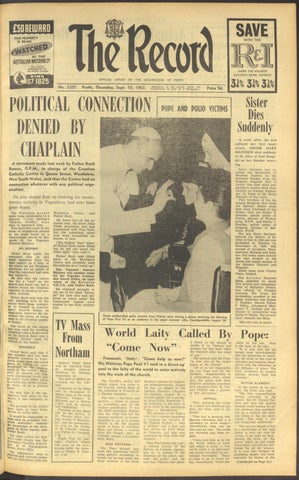
POLITICAL COMECHO 101th BY CHAPLAIN
Sister Dies Suddenly A week after she had suffered her first heart attack, SISTER MARY MATTHEW died suddenly at St. John of God Hospital on last Sunday morning.
A statement made last week by Father Roch R omac, 0.F.M., in charge of the Croatian Catholic Centre in Queen Street, Woollahra, New South Wales, said that the Centre had no c onnection whatever with any political organisation. He also stated that no training for revolutionary activity in Yugoslavia had ever been given there. The Franciscan priest made these statements to a r eporter from Sydney's "Catholic Weekly," w h o went to interview him. This interview came in the wake of sensational stories in the press based on a communique issued in Belgrade by the Yugoslav Exterior Ministry. NO REPORT Father Roch made the complaint that he had taken reporters from the daily papers on a tour of the centre on the Thursday afternoon, but no report of what the reporters had seen had appeared. He said that the centre was not a "club" as the papers had made out, but a welfare centre for Croatian migrants in physical or economic distress. Father Roch said that the only meetings held in the centre were those conducted by himself to instruct newly arrived Croats in Australian customs. He described the centre as being Open to all Croatian people in Sydney. One room at the centre had been used for wedding receptions and a front room on the bottom floor was a reading library used by visitors to the centre. POSSIBLE Father Roch said that it was possible that the men allegedly arrested in Yugoslavia could have discussed Plans to return to their homeland in the room at the centre.reading ever, he pointed out Howsuch discussions could that as easily have taken just place in a hotel bar, street corner, at work, or in a private home. He said that if the distussions took place in the Centre, it was unknown to him, The grounds at the centre Were open to view from houses on either side. It would be impossible to train men in so-called "terrorist activities" without the knowledge of the occuPants of these houses, said Father Roch. The main centre for SydrleY's 6,000 Croats was the A .ustralian tion, at Croatian Associa47 Buckingham Street, Surry Hills. The 150.11ticalassociation was a With no and cultural centre connection with the
Woollahra Centre, ' said Father Roch. He knew two of the arrested men. He knew Josip Oblak personally and was acquainted with Ilija Toile, but the remaining seven men were completely unknown to him. [The Sydney "Sun" claimed Father Roch knew Oblak but he did not know the other eight "very well.") Father Roch said Oblak knew of the Woollahra Centre and probably used the address as a "cover up." The Yugoslav Interior Ministry was another name for the Yugoslav COMMUnist Secret Police, an equivalent of the Russian N.K.V.D., said Father Roch. He objected strongly to the use of the label "terrorist" for men who had suffered so much under the Communist regime a n d wished to see their country free.
TV Mass from Northam Solemn High Mass will be televised from St. Joseph's Church. Northam on Sunday, September 22. The staff of ABW2 are carrying out the telecast. Celebrant of the Mass Will be Monsignor T. Ahern, dean of the Avon Districts, Fathers E, McGrath and A. Heron. C.R.P. will be deacon and subdeacon. Preacher at the Mass will be the Rector of St. Thomas More College, Father T. Stormon. S.J., and the commentator will be the Rector of St. Charles' Seminary, Father A. Commins, C.M. Pupils from St. Joseph's Convent school will carry out the ceremonies under the direction of Father E. Clancy, C.M.
These unidentified polio victims from France were among a group receiving the blessing of Pope Paul V1 at an audience in the papal summer villa, Castelgandolfo, August 28
Sister Matthew had received the Sacrament of Extreme Unction on the previous Sunday from the hospital chaplain, Rev. J. Lynch. She died while preparing to receive Holy Communion on Sunday, September 15, Feast of the Seven Dolours of Our Lady. Two brothers of the deceased Religious flew from the Eastern States when they were informed of her illness. They are Father T. Scanlan, parish priest of Picton, diocese of Wollongong, N.S.W., and Father J. Scanlan, parish priest of Gulgong, diocese of Bathurst, N.S.W. The late Sister Matthew entered the Sisters of St. John of God in 1924 and was professed at Subiaco on November 21, 1926. She nursed at Goulburn, Warrnambool, Ballarat and Subiaco. For many years latterly she had worked in the stores and supply section of the Subiaco Convent and Hospital. Sister came from County Clare, Ireland. The Solemn Requiem Mass, attended by about fifty priests and representatives of Religious Orders, was offered on Tuesday morning. His Grace the Archbishop presided at the Mass, celebrant was Father T. Scanlan, deacon Father F. Dillon, sub-deacon Monsignor T. Lenihan and the master of ceremonies was Father F. Walsh. The priests' choir chanted the Mass. May she rest in peace.
World Laity Called By Pope: "Come Now" F raascati, ( Italy ) : "Come help us now!" His Holiness Pope Paul V1 said in a direct appeal to the laity of the world to enter actively into the work of the church. The Pontiff's strong and simple appeal was made in his Sermon during Mass at the cathedral of Frascati on a Sunday morning. This also — the Mass and sermon — began to appear as something new in the modern pontificates. It was the third successive Sunday that the Pope had left his summer residence at Castelgandolfo to go to a nearby church in the hill country south of Rome to celebrate Mass and deliver a sermon after the Gospel, just as Catholic priests everywhere were doing. NEW PATTERN The Pope himself had made this apparently developing pattern something to watch, for he had made the three sermons of the three
Sundays vehicles for important pronouncements: August 18, Was an appeal to the Eastern Christian Churches for reunion; August 25, a general appeal for a stronger living Faith: September 1, an invitation to the laity to go to work in the apostolate "today — immediately." The occasion of the Pope's visit was a solemn ceremony to venerate the remains of St. Vincent Pallotti — who a century and a half ago had offered his First Mass, at Frascati, and who was canonised by Pope John last January. Pope Paul hailed the newly sainted founder of the Society of Catholic Apostolate as "a pioneer in his discovery of the laity's capacity for good," and he said that Pallotto had given
a lesson to the church to enable it to "foresee and prepare for this hour when the Catholic laity has come of age." The laymen, said the Pope, "is now one of the major hopes of the Church" . . . "All of us are responsible for our times and for our brothers. Responsibility is a tremendous word which only the saints with their intuitive optimism conceived with energetic force. St. Vincent Pallotti was a pioneer of that perception."
A PPEAL Then, phrasing his words in a direct and universal appeal, the Pope said to lay people: "The day is growing late. Become convinced that it is necessary to work today— immediately. that not an hour can be lost! The needs are immense and most urgent. "Come and help us to tell the world where is truth and where is error — this world which is so distracted and almost overcome by centrifugal movements. There is need to go to work today, immediately. Tomorrow
could be too late. Now is the hour of the laity . . . "It is now that the lay people must knowledgeably join the hierarchy in carrying the cross on the road of salvation and immerse themselves with the hierarchy in the diffusion of grace. The laity, awakened by modern culture, already feels this vocation."
ACTIVE ELEMENT In the course of his sermon, the Pope also said: "The first responsibilities belong naturally to the priest. But St. Vincent Pallotti saw that the layman himself could become an active element, thus anticipating by a century the modern forms of the lay apostolate. This truth is not yet recognised sufficiently. "The layman should arrive at a knowledge of this fact, which is true not only by reason of the need for lengthening the arms of the priest, which do not reach everywhere and are not sufficient for all his labours. It is true also because of something deeper and more essential: by reason of the ( Continued on Page 11.)
TH E
Page Two ,%
%%%%" 4 's%%%',%
%%%%%
%%
%%%
%%%%%%%%%%%
Bishop Fulton J. Sheen . . .
THE COMING REVOLUTION The Gospel everywhere hints that we fear the wrong things. One wonders if the same warning should not apply to our times. The majority of people today, if queried, would say that the atomic bomb was the greatest danger facing the world. But is there not something else in the world more dangerous still than nuclear warfare which can bring havoc to humanity? that one thing is • hunger. • "Hunger?" we ask. But this is because we know not its meaning. Ten thousand die of it a day. Our garbage collectors gather up in one day from • our refuse cans, enough food to feed six hundred million people for several days. We know little about it, but hunger is the ammunition for a future war; hunger is the arsenal in which is forged the swords which will cut down those who have full pantries, but who share not. True, the millions of hungry are not trained in warfare; true, they have no shock troops; true, they have no battle formations, but they have a General • for their army — and his name is Emptiness. • 20 PER CENT INCREASE A French author tells us that before the war, 40 per cent of the world's population did not have 1 enough to eat, but that now 60 per cent are in that condition. Nor is there much chance of bettering this condition, because the rich nations get riche , while the poor nations get poorer. This applies not only to nations that are rich and prosperous like the United States, which can spend one hundred million dollars for a Polaris submarine, and four billion dollars to plan a trip to the moon. It applies also to poor nations where wealth is concentrated in the hands of the few. For example, Chile, three quarters of the cultivated land is owned by two per cent of the population. One third of the population of Argentina crowds into Beunos Aires and its suburbs, and one quarter of the population of Chile into Santiago. This creates slums beyond anything ever known in the United States, though the population of Latin America is only eleven per square mile. In Guatemala, 516 families control 41 per cent of the arable land, while half the farm land of Brazil is owned by 1.6 per cent of the population. EXPECTATION WAS WRONG Marx was wrong in his Communist expectation 1 that the Twentieth Century would see a proletariat revolution. The fact is that in the capitalist coun- • tries, the workers became capitalists, as have even the Communists in Russia. A new bourgeois class • was created, not only among the workers in so- • called capitalist countries, but even in Marxisttyrannised lands. The revolution of the Twentieth Century will be a peasant revolution. It will come not from those who live on the land, but in slums; not from those who work with tools, but from those who have no work. It will rise out of the depths of the cities, overwhelming all who refuse to see • that hunger is something that either kills self, or 1 • in the end, kills others. • As a Director of one of the United Nations de- • • partments said: "Everywhere I have been, whether • in Asia and the Far East, or Latin America and the Near East, the difficulties I found had their roots • in poverty and privation, hunger and malnutrition. I found families whose full store of linen was one • sheet. When one member of the family left home or went to town, that sheet served for clothing: 1 and meantime, the other members of the family stayed indoors, naked and without a stitch to cover them. Everywhere prices rise and hunger sits at • the hearth of millions of people. Here is the match to light the flames of war." • • Foreign Aid is helping, but too much of what 1 • is given finds its way to politicians, and so little to the hungry themselves. Religion must do more. • The religions of the United States might agree that • there will be no church or synagogue or cathedral. • costing over a million dollars, at the most; that rec- • tories of three stories be without elevators; that • • whenever the faithful — Jew, Protestant or Catholic — enjoy a luxury, they give a little something • to the poor of the world, after the manner in which • God ordered the Jews to leave sheaves in the field and olives on the trees and grapes on the vine for • the fatherless and the poor. WRONG DIRECTION
Youths could give up buying a few "rock and • roll" records a year, for the millions who have only one meal a day; philanthropists could begin giving • to those who have nothing, instead of giving an- • • other million for those who already have a hund- 1 red million. The rich so often give to the rich, and it remains for those who have but little to give to those who have nothing. All of us must awaken to • the responsibilities that are on us toward the poor, • wherever they be, and to be kind to them — not • to prevent a revolution, but to keep civil wars and 1 strifes out of our own hearts. 1
Thursday, September 19, 1963.
RECORD
Actual Secrecy Not Broken In Cardinal's Talks many years he was a stu-
By Monsignor JAMES I. TUCEK ASSISI.—Possibly not since Pope St. Pius X imposed secrecy on conclaves has a cardinal publicly revealed so much of what happened during the election of a Pope as did Fernando Cardinal Cento, Grand Penitentiary of the Roman Catholic Church, in an address here. Cardinal Montini's. Cardinal Cento spoke at You the closing "lesson" of the understand then what things week-long course of Chris- and how many things I could tell you. tian studies sponsored by the Citadella Cristiana. His SECRECY KEPT address was meant as a tribute to His Holiness Pope "But tell you I cannot, Paul VI, but it was in fact a because I am bound by an glimpse into the recent con- inviolable pledge of secrecy clave that brought the Pope as to what happened in the to the throne of Peter. He last conclave. I will not besaid he did not betray his tray that secrecy however if pledge of secrecy by telling I confide to you the followthe facts he related. ing facts. Said Cardinal Cento of the "During the counting of then Cardinal Montini: "So many of the signs had althe votes in the final ballot, ready pointed to that Cardi- the Cardinal-Archbishop of nal that his nomination as Milan heard his name read Pope came as a surprise to repeatedly with such insistno one. He had already been ence that it now made it regarded for some time in certain that he would revarious sectors of the Chris- ceive the required number tian world as the man of the of votes for his election. As hour, because of the wealth this became evident, he hid of his personal talents as his face in his hands, evidently experiencing that inwell as because of his many feelings and varied experiences." ner conflict of which can only be felt by The Cardinal spoke movingly of his personal feel- one upon whose back is about to fall the most forings during the casting of midable weight which could the final ballot inside the conclave: "I have and will ever be laid upon a human always have those moments creature. in my mind's eye, all the "Iwatched him with great more so because, in the as- emotion, almost holding my signment of the small breath. thrones to the cardinals in "The Sacred College went the Sistine Chapel, mine was only a short distance from through the process of the
election with relative brevity indeed. This was especially so if one considers that there were 80 cardinals of such different races and nationalities voting. Reflect, furthermore ,that a good 53 votes were required in order that there be an election. It was a most happy Surprise for the whole world, therefor, when, hardly midway through the second day a successful ballot was revealed to them by the white smoke."
SENT AWAY Cardinal Cento included in his tribute to Pope Paul a brief but penetrating profile of the new Pontiff, reviewing the milestones of his life and his works, and even speaking with surprising candour of some elements which had been the object of contrasting interpretation. One such was the "sending away from Rome" of the then Monsignor Montini. "He possesses a lively genius, a broad culture, both sacred and profane. He is incisive of words and elegant of pen. He has a know-
ledge of all ecclesiastical organisations such as few other men possess. For
COUNCIL COULD GO A THIRD SESSION SAYS BISHOP
dent in that school whose distinguished teacher was Cardinal Pacelli, then Pius XII, and there he plumbed the depths of all problems and took account of the secrets of politcal and diplomatic life. "He can certainly say—as
I can after my decade as an Apostolic Nuncio — that he had a wise master and an enlightened guide. Yet, sud denly, perhaps with uneast• ness, or at least to the confusion of many, he was seen sent from the Secretariat of
State. indeed even from Rome. His nomination as
Archbishop of Milan could have even been mistaken as
a kind of exile. But, to quote one of our great poets: 'Behold how human judgments often err.'"
DIFFERENCES Cardinal Cento then turn-
ed to recall the figure of Pope John XXIII and re-
called that, "simultaneously sweet and sorrowful," he
had assisted at the bedside of the dying Pontiff. It was his official task as Cardinal Penitentiary to administer to the dying Pope. There are certainly differences, he said, between Popes John and Paul which would unavoidably be refleeted in their pastoral work. He explained their differ-
ences by saying: "The Divine Artist never repeats Himself in His masterpieces, whether in the natural or in
the supernatural orde r. Every flower has a particular beauty just as every saint has his own special features. The same divine economy was at work in the succession of those who are
called to exercise on earth the office of Vicar of Christ."
-Ate Perth's
Meanwhile, Auxiliary Bishop Walter Kampe of Limburg said in an interview
MUENSTER, GERMANY: THE ECUMENICAL COUNAT CIL WILL LAST A THROUGH LEAST THIRD SESSION IN 1964, BISHOP HOEFFNER OF TOLD A MUENSTER PRESS CONFERENCE. The Bishop said that at the second council session opening September 29 the Fathers' main points of discussion will be the liturgy, the sources of Revelation and the nature of the Church. Since they will discuss these matters very thoroughly. Bishop Hoeffner
O FFICIAL
said, the Fathers will not have time to make neces-
sary decisions on other council subjects. Therefore, the council will continue into 1964, he concluded. The Bishop commented on the meeting of Germanspeaking Bishops from Germany, Austria and Switz-
erland on council problems in Fulda at the end of Au-
gust. He said that these Bishops hope for a practical pastoral orientation of council decisions.
Bishop Hoeffner also said the German Bishops will work for a better council press policy.
ENGAGEMENTS
SEPTEMBER 20: 7.15 p.m.—Adult Confirmation, St. Mary's Cathedral. SEPTEMBER 22: 3.30 p.m. — Confirmation a n d Canonical Visitation, Medina.
OCTOBER 20: 11 a.m. — Preside Solemn High Mass, St. Patrick's, Fremantle (Blessing of the Fishing Fleet). 7.30 p.m. — Confirmation a n d Canonical Visitation, Kenwick.
given to KNA, the German Catholic news agency, that the council's second session will deal with internal Church problems and that external problems will not be dealt with until a third session. Speaking of the specific contribution of council Fathers from German-speaking countries, Bishop Kampe said that their close contacts with Protestants have given them a special interest in Christian unity. He
said that Germans played a considerable role in drawing up the material on Christian unity for the council. He added: "In the question of the serious problems of mixed marriages and toleration, usable solutions must still be sought."
BIG Crane Hire People
L ARGEST FLEE:I
5 TO 22 TONS BIG LIFTS H IGH LIFTS also • Air Compressod • End Loaders PHONE .
O'CONNOR SERVICE CRANE
6-3589
THE LUCKIEST MR. "LOTTERIES" NAME IN LOTTERIES
VICTORIA PARK (sufficient Address) Send Stamped Addressed Envelope — NO FORMS REQUIRED:
Y OUR
CHEMIST —
N. H. MOORE, M.P.S.
429 ALBANY HIGHWAY, VICTORIA PARK (opp. P.O.) Ring 6-1076 — We call for and Deliver your Prescriptions CONSULT OUR TRAINED COSMETICIAN
SEPTEMBER 23: 7.15 a.m.—Ceremony of Final Profession, St. John of God Convent, Subiaco. • 2.30 p.m. —Ceremony of Reception, St. John of God Convent, Subiaco.
OCTOBER 27: 3 p.m. — Procession in honour of Christ the King,
Perry Lakes Stadium.
NOVEMBER 3: 3 p.m.—Bless Extensions. C.B.C., Fremantle.
SEPTEMBER 29: 7.30 p.m. — Confirmation a n d Canonical Visitation, Leederville.
7.30 p.m. — Confirmation a n d Canonical Visitation, Pinjarra.
OCTOBER 3: 9 a.m.—Preside at High Mass, Carmelite Monastery, Nedlands.
NOVEMBER 4: 11.30 a.m.—Preside Solemn High Mass, St. Charles' Seminary, Guildford.
OCTOBER 6: 3.30 p.m. — Confirmation a n d Canonical Visitation, Hilton Park.
NOVEMBER 10: '7.30 p.m. — Confirmation a nd Canonical Visitation, Cloverdale.
Helena Rubenstein, Irmo's, Mar Factor, Coty. Lournay. Etc.
P. D. LALLY LICENSED PLUMBER
23 Fulham Street, Kewdole. Phone 6 3682 HOT WATER SPECIALIST. SHEET METAL WORK. SEPTIC TANK INSTALLATIONS. ALL WORK GUARANTEED
ELLIOTT & ELLIOTT OPTOMETRISTS—OPTICIANS PICCADILLY ARCADE . . . 21-8151 154 WILLIAM STREET . . . 21-5304
30 MARKET STREET, FREMANTLE . . . 5-2602. 19 NAPOLEON STREET, COTTESLOE . . 3-2655.
Thursday, September 19, 1963.
THE
RECORD
Page Three
School Allowances M.L.C. Criticises Refugee For Tasmanians Methods Of Homes "SHEER VILLIANY" CLAIM
C atholic education authorities in Tasmania have welcomed a Government decision to make allowances to parents of children matriculation courses provided their income is £25 a undertaking less. week or
scheme, which apState lies to children at plies p d non-State schools, was Minister announced by the Neilson). f or Education (Mr. He said the allowance be available to childould w ren who had completed qualification Schools Board proceeding to matwere and riculation. The allowance would be £30 for students living at home and £60 for students living away from home. The allowance will be paid as from the beginning of the 1964 school year. Later an Education Department spokesman said he did not know how many pupils would be affected. "We will have to wait till the applications come in next year," he said. Brother P. B. Murphy, principal of St. Virgil's College, welcomed the decision, stating that it would provide a considerable help to those in the lower income groups. allowance would The more than cover the cost of books and the £60 al lowance would be a great help for boarders. He hailed as significant the fact the allowance will be available to all parents whether they send their children to a State or an independent school. "GREAT NEED" Brother Murphy hoped that the decision was the forerunner of a plan to assist "those parents who are finding it difficult to keep their children at school even before they are ready to go into matriculation class." The headmistress of St. Mary's College, Mother M. Imelda, said that there was a great need for the allowance. Quite a number of pupils left after Schools Board. The alowance would encourage them to matriculate. Sister M. Dominic, of Sacred Heart School, New Town said that most matriculation pupils in schools conducted by the Sisters of St. Joseph would qualify for the allowance. The 130 allowance for Pupils living at home would more than cover Sacred Heart School fees, which are £6161- per term. Special legislation was not necessary for the measure, w hich is regarded as extension of the existing senior bedursary scheme administerby the Bursaries Board. BUYING
OR
"LIMITED" Mr. Neilson said that the present bursary scheme limited as it was to the more brilliant students, did not meet the needs of those who faced economic difficulty, and for this reason the new allowance would be provided. He stated that in addition to cases where the income of the parents was £25 a week or less, special consideration would be given to marginal cases where more than one child remained at school or where other special circumstances applied. The 'Mercury" political r oundsman, E. J. Balfe, stated that the decision skirted the fringe of the A.L.P. rule
On Palestine Visit
Pictured during a recent visit to the Holy Land, Very Rev. Ambrose Ryan, 0.F.M., ( centre), Provincial of the Australian Province, Order of Friars Minor, chats with youngsters in the Dbayeh Camp for Palestine refugees near Beirut, Lebanon. Also pictured is Father Denis Mooney, 0.F.M., Field Director of the Pontifical Mission for Palestine, the Vatican agency which maintains the school in the refugee camp. These Arabs lost their
222 BEAUFORT STREET, PERTH Public Auctions — Tuesdays, 10.30 a.m.
HIIGE RANGE OF GOODS FOR PRIVATE SALE
WE ARE CASH BUYERS — PHONE 25-1826
ALTAR WINES S EVEN HILLS DRY and
SWEET AS Seven Hills Sacramental Wine is made by Jesuits, it complies with the requirements of Church Law. WESTRAL WINE and SPIRIT AGENCY
167 HAY STREET, SUBIACO.
Phone 8-1410.
Telephone 21-7722
Amni iih OPTICAL DISPENSER
PHONE 6 5-1368
United Insurance Building, 218 St. George's Terrace, Opp. Forrest House, Perth.
C. A. Industries •
GATE and FENCE MANUFACTURERS 59 ROBINSON AVENUE,
QUALITY LINK
To be erected near Melbourne, the nine apartments will supplement a set of six units built as a transit centre for refugees and operated by the Saint Vincent de Paul Society. The first apartments, which have already provided temporary accommodations for about a score of families, also were financed in part with a grant from the U.N. High Commissioner's office.
In the course of his when a good daily missal speech Mr. Joel had earlier could be bought for £2. criticised selling methods They claimed they were doof the "Encyclopaedia Bri- ing people a great service tannica" and the Grolier by giving them the Sunday Society's "Australian En- missal at cost price. cyclopaedia." "ROGUES, CROOKS" In referring to some meMr. Joel added that in thods used to sell Bibles, many cases these people Mr. Joel claimed: The agreement concerning • Some salesmen used were "rogues and crooks." the new grant was made benuns' names and displayed One took a schoolgirl's lunch money, some read tween the U.N. High Comrosary beads. • Said the parish priest, the bereavement notices, missioner for Refugees and the monsignor or the nun then claimed the dead per- the Australian Federal Cason had been paying instaltholic Immigration Commithad sent them. tee. Catholic Relief Servic• Claimed a dead person ments on a Bible as a gift for a member of the fames—National Catholic Welwas paying in instalments ily. fare Conference served as for the Bible. Some salesmen sought the negotiator for the im• And charged high pricout New Australians. One migration committee. The es when better quality company also "rooked" its national director of the AusBibles could be bought for salesmen. tralian Catholic immigraless. Mr. Joel asked the Govtion body, Mgr. George M. • Sold repossessed ernment to consider comBibles as new. Crennan, formally signed the "These people even make plaints with a view to introagreement during a visit to a perversion of human an- ducing additional protecGeneva. tion. guish," Mr. Joel said. Purchasers were at pre. NUNS WARNED sent dragooned into the beW anted to Buy "If the Minister wishes I lief that if they took accan give him the names of tion they would be subOLD TRACTORS. TRUCKS. parish priests who have jected to pressure and ENGINE BLOCKS. CAST IRON. agreed that I should ventilterror tactics, he said. TOP PRICES ate this matter and have Buyers were paying £18 said: 10/- for a Bible when it G. di Candilo & Sons " 'Yes, expose it, because better quality one could be we have exposed it from purchased here for £8 or Cur. MOOJEBING ST. and our pulpits. We have been GUILDFORD RD. (Opp. Cresco £9, and the Bible they compelled to tell our people bought was landed here at Super Works, — PHONE 11-177S. to take no notice of these a cost of £5. travelling Bible salesmen; #441.4ViP41 , 1,14, 1P4.00#4.4.#4,11.M.1.4.4.4.#4,1`0,14411 we have told our nuns that in no circumstances must they talk to them.' "They have warned their — SOLE AGENTS — nuns that these salesmen R. CONNABE ER & COMPANY will use the nun's name when going from door to 165 HAY STREET, SUBIACO. Phone 8-1410. door to batten on people whose belief in God is paramount, who cannot believe Lawn Mowers, Shears Sharpened and Set that the local priest, monsignor or nun would send someone to the door unless in the justifiable belief that CITY COUNCIL AVENUE — 21.4390. it was necessary. LOCKS, DOOR CLOSERS and SAFES OVERHAULED and SERVICED "I know of one company C AR and ALL TYPES OF KEYS CUT. Immediate Service. that is allegedly selling by these door-to-door methods about 200 Bibles a week in ordinary times and something like 500 at Christmas.. Mr. Joel declared some salesmen were not content with making a sale at £18/107- but after a few years went back and said that edition was now rather out of date and offered a revised edition, while it was in fact possible to purchase a "perfectly good" Bible for £3. Mr. Joel said they sold a Sunday missal for £5/10/-
Harry Armstrong Pty. Ltd.
SELING — TOP VALUE ALWAYS
D octors' DispensedPrescri tions P
Sydney: Some travelling salesmen of Bibles were guilty of "sheer villiany and ruthlessness," Mr. Asher Joel, M.L.C., said in the N.S.W. Legislative Council last week during the Book Purchasers' Protection (Amendment) Bill debate.
Renmano ALTAR WINE
HOPKINS MIGHTY MART
othn
no aid to non -State schools. He continued: "It was again evidence of the sharp division of opinion in A.L.P. r anks on this vexed Political question. "It has been an unexpected gesture of some practical sympathy towards the claims of non-State schools for financial aid, without directly infringing the strict Labor rule of no straightout grants and from a political point of view could help the Party when the next State elections come round. "Because of its Federal policy of no State aid, Labor has been in a great deal of danger of losing much of its support from Catholics." Of
Selling Bibles
G ENEVA,—The office of the United Nations High Commissioner for Refugees is contributing £27,900 to help in the construction of nine dwelling units to be operated under Catholic auspices in Australia for immigrant refugees.
BELMONT. MESH FENCES SUPPLIED and ERECTED
homes and farms during the Arab-Israeli war in 1948. The refugees now number 1.2 million — 500.000 of them under 16 years of age. In Lebanon, Syria, Jordan, and Gaza, the Pontifical Mission for Palestine co-operates with the United Nations Relief And Works Agency (UNRWA) in providing the refugees with food, clothing, housing, education, medical and spiritual care. The President of the Pontifical Mission, Monsignor Joseph T. Ryan has his office in New York City.
Trained to assist...
at Church and Cemetery .
New Encyclical Report Unfounded (By Mgr. James I. Tucek)
NEWSPAPER REPORTS THAT HIS HOLINESS POPE PAUL VI IS PREPARING AN ENCYCLICAL ARE THE PRODUCTS OF GUESSWORK AND RUMOUR, ACCORDING TO A VATICAN INFORMANT. Inquiries made by N.C.W.C. News Service at the Vatican Secretariat of State as well as with Vatican LatiMsts reveal that, at least for the moment, nothing of this nature is in their hands. However, it is a guess that anyone can make who has been in Rome for any length of time that the newly elected Pope is preparing an encyclical. It is customary for a new pope within the first few months
of his pontificate to publish a first encyclical as an outline of his programme. The reported theme of the encyclical, "Rapport between the Church and the Modern World," is also probably guesswork. It is a general title which might easily be drawn from the character of Pope Paul. This is a theme which could be attributed to many of his past discourses both as cardinal and now as Pope It can be said that the Pope probably is preparing an encycilcal and probably. if this supposition is true. it does fall within the general framework of the Church and the modern world. But for the moment the reports are guesses and the rumours appear without substance.
D
IGNIFIED
and reverent
observance of your wishes and the fulfilment of all religious
requirements are assured by the correct training of the Catholic funeral conductors
placed
at
your service by Bowra & O'Dea. Arrangements can be made by phone at any hour, Sundays included.
F UNERAL D IRECTORS
BOWIIA SI O'DEA ( Est. 1888)
68 STIRLING ST., PERTH 2 1-4308.
1
THE
Page Four
RECORD
DESMOND AN UNUSUAL O'GRADY NUNS Of UP GRO
EVERYMAN'S FAMILY
writes a
a Cardinal's chair left there What is the best lodging for Council observers during since the 18th century. In the walls of the stairway their stay in Rome? Most Catholic institutions could which lead to the second floor one can see remains of be too overwhelming but the stadium built on the there is one which has been spot by the Roman Emperor created for non-Catholics who visit Rome. It is the Domitian. On the second floor there Foyer Unitas and among the Council observers stay- is an extensive library which ing there for this second is as it was in the 17th century. When the Pamphili s ession is the Reverend Styles of Melbourne, the director Pope Innocent X reigned, a select seminary was estabof the Inter Church Trade lished in the palace. and Industry Mission. The Foyer Unitas is situlike the American whose HELPS TOURISTS ated in one of the most beauonly aim was to ride the cena is Unitas Foyer The and sites tiful characteristic Sette Bello, Italy's fastest in Rome. It is in the Doria- tre for receiving non-CathPamphili Renaissance palace olics in an ecumenical spirit. train which swiftly took which now houses the Bra- It will help non-Catholic him to Milan. tourists in any way assistzilian Embassy. The Foyer P REFER is alongside St. Agnese, a ing them buy shoes, finding NON -CATHOLICS adhairdresser, suitable a curved its for famous church The Ladies of Bethany run vising how to allocate their facade. the guest-house on the time in Rome. From the fourth floor of fourth-flour of the building the Foyer Unitas one looks American Recently an down on the Piazza Navona mother appealed to them in which can accommodate 20 visitors, preferably non-Cawhose elongated shape is a desperation; the baby in her olic, at a time. for used was hint that it arms had been crying for The Unitas Associal.on was horse races in Roman times. two days but she could not At the fourth-floor window make the shop assistant un- f ounded in Rome in 1945 and now has affiliated groups in one is on a level with the derstand her pronunciation Pamphili emblem, a dove, of the only brand of food France, Belgium, Canada which tops the obelisk rising the baby would eat. The and Turkey. From its beginning, it has from Bernini's fountain of Foyer solved her problems been under the direction of the rivers. pronunthe her teaching by The rivers are represented ciation and finding a shop Father Boyer, the 68-yearold French Jesuit wellby four male figures and where the food was avail- known for his writing on two of them start away in fifty-seven its all able, in Ecumenicism. horror at the sight of St. varieties. The Unitas Asociation ocAgnese: Bernini, who deAssisting shoppers does cupies the, second floor of signed the fountain was a have unexpected results: one the building which also housrival of Borrmini who defive Dutch Ladies of es the Foyer Unitas and the signed the church's facade. of the who conduct the guest house. Its main activWhen the Foyer Unitas Bethany Foyer and who, while nuns, ity is the quarterly review a quarters these into moved wear dresses instead of hab- "Unitas" which is published few years ago they had not took three African chief- in English, French and Italits, been in use since the 18th tains to buy shirts. She enian editions. It also holds ground floor entury. The c tered a shop somewhat in conferences, lectures and arroom was lined with cupof the Africans and boards full of wax: hard- advance shirts. They ar- ranges meetings between for asked various Christian groups in on bees working Pamphili rived while the girl was the interests of Ecumenifarms near Rome supplied rummaging under the coun- cism. this wax which paid the ter and their guide moved Pamphili's tax. In a city to look at something packed not only with palaces away When the salesgirl else. but also with churches surfaced with the shirts and candle-makers were busy saw the Lady of Bethany before the days of gas lamps. ed into three tall The cupboards have been transform their traditional in fricans A removed but a sturdy, preshe went as white as garb, cision scales remains attachthey were black. ed to the wall as a reThe Ladies of Bethany minder of the days when also take the tourists on trips the Pamphili waxed rich. From the second floor one of Rome which differ from most. They insist on small can look down on the altar of St. Agnese without be- groups of, say, half a dozen, When the they do one trip a day and ing observed. Foyer took over, they found go to one place only, by public transport. Each of the Ladies specialises in a Stir ormorprolotzwir-irio few places which they like particularly, it maybe the mosaics of St. John Lateran's or the Sistine Chapel. South Perth Bakery The tourists appreciate the difference from the indiges"Bakers of Better tible, hurried, impersonal Bread" visits conducted by big T wo 1st Prizes 1962 agencies and, of course, the R oyal Show places visited are eloquent If It's NOONAN'S enough for everyone interIt's NICER ested in the spiritual story of Rome. Phone 67-1044 Of course, there is not much they can do for those 0:0417-41:.
By
LETTER
Father JOHN C. KNOTT
FROM
SECURITY
ROME
Father Bouyer has a vast experience of this attempt Christian the draw to churches together from his earliest efforts to the present stage when he works in co-operation with the Secretariate of Christian Unity. He is acutely conscious of the difficulties in the way of reunion. He regards the Orthodox Churches as substantially the same as the Catholic Church but is struck by the doctrinal differences which separate the Protestant and Catholic Churches. T HEOLOGIANS Conferences of theologians may help to understand exactly what the differences are, he says, and are already a sign of a new understanding. But he cannot see reunion unless other churches recognise the principle of authority which resides in the Church. In this, the Orthodox are at one with the Catholics. But even if one cannot see the goal in sight, one can move towards it. That is what the Unitas Association and Foyer have been doing for some time.
Grandfathers
AVON Electrical Service
M. G. O'Brien & Sons
PAINTING CONTRACTORS
Wood, Coal and Coke
20 MABEL STREET, SOUTH PERTH. 67-2716
BRYANT & WATERS — Now
ADAMS & KIVISALU
5 EDWARD STREE7, EAST PERTH PHONE 69 1010
THE COLONIAL MUTUAL FIRE INSURANCE COMPANY LIMITED
CAN MEET YOUR REQUIREMENTS IN INSURANCE PROTECTION 236 ST. GEORGE'S TERRACE, PERTH Phone: 21-9066 A. De CAUX, Manager.
H OULAHANS
32 THOMPSON ROAD, NORTH FREMANTLE Are Suppliers of Yellow Sand for Top Dressing or Building, Metal, Gravel, Rubble, Ashes and Filling. Bulldozers, Loaders, Graders for Hire. Will Quote for Excavation and Levelling Jobs. PHONE: 5-1499 . . . 5-3469
CHARITY UNLIMITED is the motto of the Little Brothers of the Good Shepherd at Albuquerque, New Mexico. Three of the five Brothers in a recent investiture ceremony there were grandfathers. Admitted to the Institution were, left to right: Brother Aidan Melroy, a former sexton of St. Ann's Church, Arvada, Colo.; Brother Christopher Walsh, New York City, a former sales manager and Brother Charles Puelzt, a former member of the Baltimore, Md., fire department.
No Change For Father Kung TUEBINGEN. Germany: F ather Hans Kung. council e xpert and author of the book "The Council in Action." has turned down an appointment to the chair of dogma in the Catholic theological department of the State University of Muenster. Father Kung said he will continue as a member of the Catholic theology department at the State University of Tuebingen since the government of BadenWuerttemberg State has de-
A financial columnist recently wrote that a man in the United States with a secure job never had it as good financially as he has it today. The reasons given covered such things as purchasing power, taxes, low interest rates and the like. This is the contradiction, that in a time when more families are better off financially than at any other time in history, more talk is heard about the need for "responsible" parenthood, so that present children might be better educated.
SEEK FIRST . ." Since everyone seems to be composing variations on Parkinson's law, how about this one? The virtue of hope exists in inverse proportion to the amount of material goods possessed." Besides, the basic educational responsibility of parents is to answer their children's need of being loved and teach them how to love. Children will then grow up with a sense of self-respect and selfdignity and with a facility of loving another and a willingness to pay the price of love. "Seek first the kingdom of God and his justice, and all these things shall be given you besides." Matt. 6:33). But, of course, one of the basic problems of all of us today is that we are seeking the easy solution to the challenge of life. There are no easy solutions, but there is a simple one for believers in God. If a married couple shares in the creative love of the First Person through initiating and perfecting life, they also have the right to tap the wisdom, the strength and the love of God to more perfectly fulfil their role. The Christian couple should be characterised by a faith in the goodness of God and an acceptance of His omnipotence. They should be marked by an air of security that should readily distinguish them from the fearful pagan. The word "security" comes from the Latin—sine cura—to be without care. Their parenthood is part of the parenthood of God and He, as St. Peter says, has a care for them. The man that knows himself loved of the Father, that his life is in the hands of a most compassionate, watchful and powerful Father, no longer fears anything at all. He knows that all that shall happen to him will be for the best.
FREEDOM FROM FEAR
N OONAN'S
( Proprietor: J. WERDLER) 33 CALEDONIAN AVENUE, MAYLANDS We are Installation, Repair and Maintenance Specialists. We are Available at All Hours. Telephone: 71:3672
Thursday, September 19, 1963.
cided to establish a new chair of dogma and ecumenical theology in the department which he will take over He will in the Autumn. also become director of ,the of Institute university's Ecumenical Theology which is to be set up. Father Kung has also been unable for the present to accept invitations to be a guest professor from various Catholic universities in the U.S. as well as from Yale University and the Protestant Union Theological Seminary in New York.
Men are ruled by events. They go in fear of them before they happen and are overcome already by a future that does not exist. God's children, on the contrary, rule events. They await them in tranquillity since they see them as heralds and instruments of the Father's good will. Not merely are they free from the fear of the future, they run to meet it with all the loving confidence of children who go to meet their father. of So much in modern life plays on the fears campaigns people. Otherwise worthy fund raising Two for deserving causes use the scare technique. of out of seven die of this disease, or three out for money raise to else—all something eight die of some medical crusade. We are liable to forget that one out of one dies we of something. Once this reality has been faced of but living, can go on with the job not only of possible. as life a purposeful living as full and hair God has His purpose in our life. If each moeach does so then of the head is numbered, ment of life have its meaning and the whole of life else, is its design. Our job, as much as anything God. of will the to correspond ourselves to Mean In this is true peace—to be able to say and heaven. it, "Thy will be done, on earth as it is in So relax and let God be good to you. Marriage The address of the local Catholic is Centre uidance G 23-4548. 77 ST, GEORGE'S TERRACE, PERTH.
C. MORRIS
Plumber
SHEET and METAL WORKER Phone 28-2096. 6 CLEAVER STREET, WEST PERTH. S upplies of Fish, VEGETABLES and
POULTRY at:
ROSS INTERNATIONAL FISHERIES
STREET, WEST PERTH Head Office: 7 CLEAVER PHONE 28-4511 49' KALGOORLIE. Phone Kal. Branch: 29 MACDONALD ST., SCHOOLS CATHOLIC SPECIAL QUOTES FOR HOSPITALS and INSTITUTIONS.Daily Available Fresh Fish and Shell Fish
Thursday, September 19, 1963.
THE
RECORD
Page Five
STATEMENT WAS UNWARRANTED
LONDON.—Britain's Minister of Education, Sir Edward Boyle, came under fire f rom Catholics here for defending one of his senior o fficials who publicly condoned premarital promiscuity. started when The row Henderson, the Peter Dr. principal medical officer of Education, the Ministry of on health meeting a old t education at Cambridge he did not consider an engaged couple who had intercourse unchaste. Catholics and other Christian leaders protested, saying he should be reprimanded or dismissed, as such a statement was particularly dangerous c oming from one of the top men in the Education Ministry. But Sir Edward Boyle in an official statement said: "Some people think it wrong that there should be no offical ministry view but it is not my duty to lay down the law on this subject. Different views are held by honourable people on the question whether premarital intercourse between engaged couples is in itself immoral. Neither I nor my predecessors have claimed the authority to lay down that one view was
right and all others wrong. "The position has always been and remains that under our system of education the teaching of moral values is the province of the teachers inside the schools just as inside the homes it is the province of the parents. The ministry does not lay down what teachers should teach on these matters . . ." The Universe, national Catholic newsaper, declared that "public opinion has been affronted by this public servant." It urged Catholic members of Parliament to confront the minister on the matter when the House of Commons resumes next October. Lord Longford, chief Cathspokesman in the olic House of Lords, in a letter of protest to the Guardian, ARCHBISHOP JOHN national newspaper, obHEENAN OF LIVERPOO L jected to the minister leaving morality to the teachers WHO HAS BEEN NAMED in the schools. What if they ARCHBISHOP OF WESTrecommended adultery or MINSTER, SUCCEEDED homosexuality? he asked. THE LATE WILLIAM CARDINAL GODFREY WHO DIED IN JANUARY.
The Cardinal, President of the Vatican Secretariat for Promoting Christian Unity, spoke while he was presiding over the third session of the International Congress of Historians here. The congress met to commemorate the fourth centenary of the closing of the Council of Trent. Speakers on the day's programme were Prof. Thomas Parker of Oxford University, England, an Anglican, and Prof. Peter Meinhold of Kiel University, Germany, a Lutheran. Parker, speaking on "The Tridentine Reform Compared with the Anglican Reform," noted that the word :4 reform" has various meanings which should be kept
DAILY MASS, to which his devout mother often took him, sowed the seeds of the future holiness of young John Neumann in his native village of Prachatitz, in Bohemia. She also let him accompany her on her many errands of charity among the poor. The artist has portrayed the scene here. The youngster decided to come to t he "wilds of America" and be a missionary. Ordained a Redemptorist priest in 1836 in New York at the age of 25, he became, in 1852 the fourth Bishop of Philadelphia. His beatification ceremony is scheduled for October 13, 1963.
New Archbishop Is Man Of Many Talents
CONFIDENCE SPIRED BY FORCES TRENT, ITALY: AUGUSTIN CARDINAL BEA, S.J., SAID HERE THAT THE FORCES FAVOURING CHRISTIAN UNITY ARE S TRONG ENOUGH TO WARRANT CONFIDENCE IN THE RESULTS OF EFFORTS TOWARD UNITY.
Education For Sainthood
clear. In one sense, he said, it refers to the Protestant movement in opposition to Catholicism. In other senses, he stated, it may distinguish doctrinal reform from administrative reform. Meinhold spoke on "Protestants at Trent." He stressed the fact that the second period of the Council of Trent, often passed over by historians, was particularly important because it was the only period of the council at which Protestant orators and theorists were represented. He noted that new forces which were truly and properly religious had come to maturity on both Catholic and Protestant sides at Trent, but that they were so confused by political influences that it is impossible for them to achieve a mutual understanding. He said it might be possible to recover these forces. Commenting on this point, Cardinal Bea said: "The forces are sufficiently strong and pure today to allow greater confidence in their results. From a deeper historical vision of those events (at Trent) something may be drawn to contribute to mutual understanding."
W. H. BRANCH & SON STONEHAM STREET, JOONDANNA
Phone: 8-2406 — 24-1157 All Types of Electrical Work Undertaken
TO ILEYS BRANDY SPECIAL
HOSPITAL
E XCELLENT CUISINE
With DANCING and ENTERTAINMENT NIGHTLY Private Room for Parties
EUROPEAN NIGHT CLUB 41111fTT'S Fully Air-Conditioned
27 LAKE STREET, PERTH. 23-1589.
Specialists in "MEALS TO TAKE AWAY" — Ring and Order WEDDINGS and PARTIES on SUNDAYS
An articulate leader with a flair for the dramatic phrase, Archbishop Heenan has been particularly active in the movement toward Christian unity. His statements on education, family and the struggle against communism have also won wide attention. His audiences have included Hyde Park hecklers, and he has debated with H. G. Wells. The prelate, 58, was born in London, ordained at 25 and consecrated as Bishop of Leeds by Archbishop Godfrey in March, 1951. He became head of .the Liverpool archdiocese in May, 1957, succeeding Archbishop Godfrey there. At Liverpool he was the spiritual leader of about 500,000 Catholics; the Westminster archdiocese, which includes much of London, has about 450,000 Catholics. R ecently Archbishop Heenan offered Catholics eight rules for fostering Christian unity. The gist of them was to be charitable, calm, knowledgeable and honest about t he existing differences. P ARTICIPATION
One of them discussed participation with others in religious services. Archbishop Heenan declared: "Christian charity does not require us to take part in the worship of other religions—but we should not be more Catholic than the Pope. We may recite publicly the Lord's Prayer and the Apostles' Creed with other Christians. We may also pray with them in private." Two years ago he announced that his work with the Vatican's Secretariat for Promoting Christian Unity was taking up so much of his time that he had to cancel many of his diocesan engagements. He was chairman of the British Bishops' Committee for Christian unity work. T EACHERS REPLIED
This summer he told Englarid's Catholic teachers in tireir professional magazine that there were too many for whom teaching was "just a job," who have given up MOTOR IsTS
TUCKER and A URISCH
a re RADIATOR SPECIALISTS Ail Replacements and Repairs Qualified Tradesmen
PHONE 21-6518 or Call
1017 HAY ST., PERTH
by
reading and who get to their desks just on time and leave as soon as possible. Replies to this criticism by teachers in the magazine's next issue were equally frank. Archbishop Heenan told unionists at a May Day Mass that he hoped Britain would never have a separate Catholic trade union organisation. He also told the workers that Pope John XXIII had not become "soft on communism" in suggesting that it was now time to talk to communists and learn if useful agreements could be reached. Earlier this year,
personal attack when he visited a Protestant neighbourhood in downtown Liverpool. A teenaged crowd yelled insults, spat at him, and threw stones and vegetables at him. He said later, however, that general Protestant-Catholic relations in the city had never been more cordial. The prelate inherited plans for a massive cathedral when he came to Liverpool, but he delayed them in order to concentrate on the building of schools. He sponsored a competition among architects for the cathedral; the winning design, announced in 1960, includes a large parking garage under the structure.
the Archbishop bluntly accused communist shop stewards in Britain of trying to disrupt the country's industry. He has appeared on English TV programmes with Anglican prelates and government leaders. He has recommended that seminary training be turned away from its emphasis on classical learning toward science and other present-day concerns. ATTACKED
Early in 1958 Archbishop Heenan was the object of a
FOR PERSONAL ATTENTION ON
ALL OFFICE MACHINES C ASH REGISTERS, OFFICE F URNITURE & STATIONERY C onsult . . .
Mr. Roger Ryan For expert advice phone 23 2127 or after 7 p.m., 26 2656 FACIT, Portable Electric and Manual Typewriters. FACIT, Duplicators and Calculators. ODHNER, Adding and Listing Machines, Accounting and Analysis Machines. HUGIN CROSS & R. C. ALLEN Cash Registers. EDISON & MINIFON Dictation Equipment. Plus Photo Copy Machines, Stationery, and Office Furniture.
WA
BUSINESS MACHINES 107-109 WELLINGTON ST., PERTH — 23-2127
THE
Page Six
Thursday, September 19, 1963,
RECORD
-INTERNATIONAL
AMERICA
ENGLAND
NININP#########44
1 4 ,41.0.4".#4.04 ,41 ,41.~.
BBC Taken To Task
Hotel For Use By Diocese
The Catholic Herald, na-
The Regis, a non-denomin. ational retirement hotel un-
ional weekly newspaper, accused the British Broadcast-
FRANCE
His Holiness Pope Paul VI sent a message of condolence on the death of the French statesman at the age of 77.
tro4p#41.04.04114,414
Requiem Mass For M. Schuman R equiem Mass was offered in the cathedral in Metz, f or Robert Schuman, a leadthe Catholic -oriented
er of
party
Republican
Popular
who was twice premier France
and
of
many
served
times as its foreign minister.
* YOUR HOTEL GUIDE * O'BRIEN'S HOTEL
Schuman was a major figure in postwar moves toward European unity. He was the author of the Schuman Plan for pooling French and German coal and steel production, a forerunner of He the Common market. was also one of the chief architects of the North Atlantic Treaty Organisation NATO ) .
Plympton HOTEL
Home of Country People C ANNING HIGHWAY EAST FREMANTLE Eric Campbell, Prop. 5-1721.
CITY HOTEL
NORTH OF THE LINE Clarrie O'Brien, Licensee Stan O'Brien, Manager 21-4261
Cnr. King and Murray Sts., Perth COUNTER LUNCH, 12-7.30 p.m. Friday: Saturday 12-10 p.m. ARCHIE TF1OMPS0N Offers you only "The Best" Phone: 21-4094
HIGHWAY HOTEL
COMING TO PERTH . . . Stay
206 STIRLING HIGHWAY, CLARE3IONT PHONE 3 1566 Friendly Service — Good Accommodation — Parties Specially Catered for M. A, 8.: E. M. McDONNFT.T, FRIENDLY
SERVICE
at
THE RIVERTON HOTEL MOTEL
HIGH ROAD, RIVERTON 69 3515 TV in every Unit. Floodlight 9-Hole Golf Course, FRED MILLS, Licensee
BAYSWATER Hotel
REX HOTEL
Car, KING S.: HAY STREETS Private Bar for Convenience of Guests and Friends Phone: 21 8634 Personal Supervision . Mrs. B. B. REILLY
OFF. STATION Excellent Accommodation Frequent Train Service — 4 Miles f rom City —Large Parking Area BED and BREAKFAST REASONABLE TARRIFF LES BARTLETT, Prop. TEL.: 71 1224
SUBIACO HOTEL
WEMBLEY HOTEL
SUBIACO
First Class Accommodation and Service Phone: 8-1028 Alex McHenry. Proprietor.
WAVERLEY
Excellent Lounge and Accommodation Phone 87-2418
Cnr. Cambridge and A lexander Streets, Wembley
HOTEL
HOTEL
Next Boone Waverley Stores ALBANY HIGHWAY CANNINGTON Modern and Convenient Homely Accommodation
Australia
Use Our Drive-in Bottle Service Phone 68 2119 A. R. CONNELL
MURRAY STREET, PERTH E xcellent Accommodation and Dining Service LUNCH, 10/-t DINNER 17/6. PHONE 23 1541
CRITERION HOTEL
Enjoy the Best ACCOMMODATION dr SERVICE
CENTRAL HAY STREET PERTH 24-HOUR SERVICE Country Residents Parking for Free 5 Minutes' walk from Cathedral. THE COUNTRYMAN'S HOTEL
HOTEL COTTESLOE RIGHT ON THE SEA FRONT
Phone 3-2155 R. M. DYMOCIC, Licensee
PHONE: 23 1115 (5 Unes)
W ILLAGEE PARK HOTEL
HOTEL ESPLANADE
TOM KENNY, Licensee. Cnr. Stock and High Roads. MELVILLE Phone: 30 3428
PERTH'S LEADING HOTEL FOR ALL VISITORS Phone: 23-1531
The States Most Modern
NATIONAL HOTEL
COMMERCIAL HOTEL
Cnr. High and Market Sts.,
NORTHAM Phone Northam 49 T. E. MURPHY, Proprietor
FRE MANTLE Offers excellent homely accommodation Phone : 5-1786 Philip P. Kearins, Licensee
For SUPERIOR ACCOMMODATION
IMPERIAL HOTEL
PERTH (Opposite Railway Station) Tel. 23 2921 Hot and Cold Water. Telephone in every bedroom. Bed and Breakfast 37/6, 24-Hour Room Service Reduced Tariff for Children
SHENTON PARK HOTEL
NICHOLSON ROAD SHENTON PARK Accommodation. Moderato xcellent E Tariff. Spacious Car Park Beer Garden, Open Al! Bar. Phone: 8-2170
BROKEN HILL HOTEL VICTORIA PARK — 6 1063
DALY'S
Cr.
MEET DAILY
ROYAL
at
HOTEL
WILLIAM and WELLINGTON STREETS, PERTH. Phones: 21-8924. Bottle Dept., 21-5436,
RELAX AT THE FABULOUS—
WAIKIKI HOTEL-MOTEL With Mine Host:
H ARRY WARD Soft Lights — Soft Music — Foaming Ale Phone Safety Bay 9357. Excellent Cuisine.
SUDAN
COSTA RICA
41,~4.04•41.4.0"11
•••############M4•4^4^IN
Instruction Brings Prison Sentences
Stolen Gems Have Been Found
Seven Catholic catechists have been sentenced to seven years each in prison in t he southern Sudan for giving religious instruction, it was reported in Bonn by K NA, German Catholic news agency.
Gems stolen 13 years ago a t the Shrine of Our Lady of the Angels, the patroness of Costa Rica, have been f ound on a rural hill side by railroad workers.
KNA said the sentence, imposed by local police authorities, was allowed to stand without discussion by the highest police magistrate of Juba, who is a Moslem. In its drive to Islamise the predominantly Christian and pagan southern Sudan, the Moslem-dominated Sudanese government has ousted more than 160 Christian missionaries and closed the 350 mission schools in the south.
SPAIN Aged Spanish Bishop Dies R equiem Mass was offered in San Isidro cathedral in Madrid for Bishop Leopoldo Eijo y Garay of Madrid who died (Aug. 31) at the age o f 85 in his native city of V igo.
The Mass was celebrated by Enrique Cardinal Pla y Deniel, Primate of Spain. Bishop Eijo, Ordinary of the Madrid diocese for 10 years, held the title or Patriarch of the West Indies and was a member of the Council of the Realm, highest consultative body of the Spanish government.
SOUTH VIETNAM Censor Left Out Parts of Message V ietnamese government censor deleted one whole sentence and two adjectives f rom the message of His H oliness Pope Paul VI to t he Vietnamese people as it was printed in Saigon newspapers.
The first paragraph of the message, which was reported by Agence France Presse (French News Agency) from Vatican City, runs: "We deem it Our (.1.uty to manifest Our painful concern with the distressing events that afflict the beloved people of Vietnam. Our anguish becomes more profound and piercing day by day, as the Bishops have very well said in their fatherly declaration." The words "painful- and 'distressing" were deleted by censors as was all of the second sentence. The rest of the message was published in full. The same deletions were made in the message as passed for publication in the French-language daily of Saigon.
During the robbery, the church guard was shot and killed. Two of the threk robbers are in prison and a third has fled the country.
INDIA Celebrant Faces The Congregation For the first time in this part of India, Catholics were able to attend a Mass at w hich the celebrant faced t he congregation.
A temporary altar was set up in Fatima cathedral, Belgium here for the special Mass by Coadjutor Bishop Fortunato Coutinho of Belgaum.
Training Urged In All Spheres A rchbishop James R. K nox. Apostol ic Internuncio t o India, has urged religious o rders to train their members in all spheres of human activity.
The papal envoy, speaking at a reception given in his honour by the Carmelite friars in Trivandrum, recalled Pope Pius XII's appeal to Religious to intensify their formation both spiritually and intellectually. Archbishop Knox stressed the role religious communities can play in improving the spiritual condition of society. He voiced regret that despite the fact that India has over 20,000 Sisters, more than half the parishes in the country have no convent.
Prayer Kit
Research For Bone Work The International Atomic Energy Agency has awarded its 200th research contract to the Catholic Louvanium University in Leopoldville, the Congo. The agency will provide other radio-isotopes and equipment supplies and worth LA3,487 for a Lovanium study of conditions of the bone caused by leprosy, smallpox and other diseases and by nutritional deficiencies.
IRELAND
der the auspices of the Dip.
cese of Austin, Texas, has opened its doors for °coil.
pancy. The hotel, formerly know/1 as the Roosevelt, has been completely renovated and adapted to the use of retired men and women. The hotel was willed to the diocese by the late Allen McDonnell, a Waco attorney who died in 1946. A chapel which will seat 200 persons has been located on the ground floor and a meditation room also has been added. Mr. and Mrs. Pat Wardlaw have been named managers of the new enterprise and Father Mark Deering of Assumption parish in Austin, will serve as chaplain.
6.41.041.0000#0.41 , ..1
Medal And Chain Brings Death A St. Christopher medal on a si lver chain brought death by electrocution to 36 year -old Daniel O'Neill of Belfast. according to a coroner's report.
The medal and chain won by O'Neill touched the metal top of a record player as he bent to play a record. O'Neill left a wife and five children. The coroner said: "It appears the chain made contact with one terminal while O'Neill's hand made contact with an exposThis allowed ed spindle. current of 240 volts to pass through him."
HUNGARY 4"4.#04 , 0".#4,000.004
Delegation To Be Bigger Bishop Endre Hamvas of Csanad told a meeting of t he Hungarian Bishops' C onference in Budapest that the Church in Hungary will be represented at the ecumenical council's second session by a larger delegation than it was at the first session.
Bishop Hamvas, who is acting chairman of the conference, said the names of Hungarian participants will be announced later.
W. W. EDMONDSON & SONS
PLUMBERS and SHEET METAL WORKERS Certified West Australia, Hot Water Specialists and General Plumbing. Al l Work Guaranteed Phones. 28-1714. After Hours: 87-2553, 29-2095. 80 JAMES STREET, PERTH
Get Better Meat for Less at
C LEM PAULLS
234 HAY STREET, EAST PERTH — 23-4927 63 CANNING HIGHWAY, SOUTH PERTH. 67-1708. WATCH THE WINDOWS FOR OUR SPECIALS FLAGS and PENNANTS, ALUMINIUM and CANVAS A WNINGS, HOLLAND and VENETIAN BLINDS and SELF-ASSEMBLY KITS. LET US MEASURE AND QUOTE
HOUSE
T UDOR
286 ALBANY HIGHWAY, VICTORIA PARK.
JUNIOR
TENNIS
RACQUETS
si.‘IFNGER CHALLENGE JUNIOR DUNLOP MAXPLY JUNIOR ' SPALDING STARMAKER JUNIOR
SCHOOL
. .
6-1620.
99/6 each. 99/6 each. . . 99/6 each.
SPECIALS
63/6 12/6 21/6
Reduced to . . BLUE BIRD JUNIOR. SCHOOL RESTRING — Good Quality Gut . . SCHOOL RESTRING — Braided Nylon
DEPOT WIMBLEDON SPORTS Keast
(N. D. Keast, J. V. E. 14 DAVID JONES ARCADE, PERTH. Tel, 23-4219. Official Depot for W.A. Catholic Lawn Tennis Association N.4.0•4411,0#11 ,041.#########04.4.4.4,04.0.441 ,41,04`4 , 1
THINKING OF TRAVELLING? FOR
ALL
BOOKINGS
BY
AIR, SEA, RAIL or ROAD WITHIN
AUSTRALIA
OR
OVERSEO S
Consult_
DALGETY-N.Z. L. TRAVEL SERVICE 15 William Street, Perth. 21-2841.
F. LIST & SON
CONGO 0.4.41.04,041.,00#411141
ing Corporation of "projecting an image Of itself as anti-Christian antiand Catholic." Referring to both radio and television programmes of the State-controlled corporation it said: "Every chance of taking a swipe at the Church is grasped and rarely does one hear a B.B.C. voice raised in protest when Catholics abroad have their schools seized or in praise of the Church's contribution to the international scene. It seems our value is merely one of 'spectacle' when or crowned are popes buried."
ON A PRAYER CARD. This copyrighted illustration of Pope Paul VI, by artist Paul Sullivan, appears on a prayer card included in a kit of materials to promote the 13th annual observance of National Catholic Youth Week, October 27 to November 3, 1963. The theme for the week is "The Young Catholic in the Lay Apostolate." The prayer card, which is entitled, Pope Paul VI Meditation, and the complete kit is available from the sponsor, the National Council Youth, 1312 of Catholic Massachusetts Avenue, N.W. Washington, D.C.
PTY. LTD. 91 Central Avenue, Maylands
W.A.'s Leading Paying Contractors For Better Paying Contact Us We specialise in Gravel and Bituminous Paving of Roads, Tennis Courts, Playgrounds, etc.Rollers, We have a most modern plant including power Graders and Mechanical Loaders, etc. Estimates Submitted Free. a State-wide Country Clients please note that we have requirements. any on quote gladly will Service, and Sand We also supply at ruling rates Gravel, Metal, Delivery. Prompt Loam. and PHONE: 711578.
Thursday, September 19, 1963.
THE
RECORD
VATICAN PAPER PROBES PROBLEMS OF OVER POPULATION AND BIRTII CONTROL V ATICAN CITY.—The Vatican City Daily in three successive issues has dealt with the problems of overpopulation and regulation of births.
BACKWARD COUNTRIES On the other hand the article took issue with "a hasty favourable judgment on the possibility of developing backward countries on the basis of a similarity, not always valid, with the western economy's period of expansion in the last century."
Red Paper
served "but in communist doctrine the very concept of sin is repudiated, yet whoever observes life even in its psychological aspect alone sees conflict between good and evil crying out in every conscience." The final article in L'Osservatore was by Dr. Giacomo Santori, director of the Italian Centre of Sexology. He locked horns with Unita for speaking of the Church's "archaic position" and her "defence of uncontrolled procreation." He pointed out that from the purely medical and biological point of view "there is a substantial difference between periodic continuence and the use of the various contraceptive methods so dear to neo-malthusianism." He also asserted that recent medical advances have given the periodic abstinence method "security that is almost absolute and in any event not inferior to that of the most highly rated contraceptive methods." He asserted that this method of periodic abstinence "is being adopted on an increasingly broad scale even by non-Catholic couples or couples of no religion at all."
Page Seven
It emphasised "it is indispensable to distinguish L'Osservatore Romano led pectedly has leaped into the between the population off with a review of the first rank of preoccupa- problems in advanced areas interest downs of tion," the paper said. ups and and in areas that are unin the population problem derdeveloped, arrested or New interest in popula- depressed." since the time of Thomas Malthus a century and a tion problems stems largeIn the next issue of Oshalf ago. "Largely neglected ly from the presence of de- servatore, editor Raimondo f or a long time, it unex- pressed nations and the Manzini lashed out at Italworld economy, an article ian communist organ Unita by demographer Oscar Gar- for saying "it is true that avello asserted. the Church has done every"It is useless to linger thing possible to create in over the causes which have this field (birth regulation) permitted what had come more suffering than pleasto be called demographic ure, considering as immoral explosion" the article stated. any sexual relations that are not accompanied by the The ways of American life are something new for desire to procreate." Too General HIS HOLINESS POPE these three Manzini, commentin g on SPOKE AT VI little "But what is useful to Indian girls from the Tarahumara Mountains of northern P AUL add is that very often such this and on assertions in Mexico. They came to the United States with C ASTELGANDOLFO ON Father Luis G. problems are treated with the same Unita article that sexual taboos are "retroV erplancken, S.J., to help call attention to his BEHALF OF EUROPEAN too much generalisation: appeal for too often they treated as gressions and fixations to financial aid to help with the mission work among UNITY FOR THE SECthe "stone i nfantile levels of thought OND TIME IN TWO typical the conditions of like faith in hypothetical age" Indians. The girls are shown looking through a window some countries in which the of DAYS. a western goods store in New Orleans demographic problem is beings such as God," ohPope Paul urged partici- truly dramatic, as for example such regions as JamPHONE Q-2865 for QUOTATTON pants in the convention of CONCRETE 2,800 GALLONS to aica, Puerto Rico, Ceylon. Women's European the CONC RETE SERVICE CO. 50,000 GALLONS T ANKS 2 27 WHARF STREET, QUEEN'S PARK Union, who were among the etc." thousands present at his r egular weekly general audience to work for a unified Europe. The day before he had told members of the Federation of Italian Catholic University Students that European unity can be immeasurably aided by the Catholic religion. He declared: "We have the conviction that the Catholic Faith can be a factor of incomparable value for instilling spiritual vitality by virtue of that fundamentally united culture which must be the baOr. Morc-er J. Ad'er, Director of the Institut* sis for the animation of a for Phlosophkal Research socially and politically unitEd ,or of he SYN/OPICON ed Europe." Speaking at his audience "The ultimate end of education is not just to learn to be an engineer, a lawyer, a doctor, or a scientist. These are skills—like any others—which to members of the women's help you earn a living and render a useful service to society. But union in French, the Pope knowledge of any one particular subject is not necessarily evidence of an said: educated man. "In thanking the ladies "Education is the sum total of one's experience, and the purpose of higher for their diffident words of education is to widen our experiences beyond the circumscribed existence of our homage, We want to enown daily lives. Most people have only begun their education when they finish school, and after school the steady pressure of a job narrows courage them to continue rather than expands their experience. in their work, which will "That is why the Private Library Edition of the GREAT BOOKS described not be either easy or rapid, below was published—to give every thinking person, no matter what his degree but which is providential of formal education, the opportunity of becoming a really educated man. in the reawakening of the Through this Private Library Edition of the GREAT BOOKS you can acquire for awareness of women to the yourself the total experience of the whole human race. With that experience, great cause of the unificayou will then be far better equipped to face life and love it—to meet its tion of Europe, a unificachallenges and problems with courage. confidence, and intelligence." tion which can certainly be judged a necessary advance of modern progress, a guarantee of peace ,and a condition for the safeguarding the inheritance of our civilisation and its further Published by the development." Encyclopaedia Britannic() in collaboration with Speaking in English durthe University of Chicago ing the audience, Pope Paul said: "We are ever mindful of Our high office as the Vicar of Christ and the successor Of St. Peter, Essential in the library of every thinking person as well as the teacher and pastor of the Catholic Church. We pray that We may truly be the minister of Christ dispenser of the and the OF TalE WE WORLD mysteries of God, particularly at this Moment. now available direct from the publisher with great new "As we look We see you as before Us, creatures of VERY few people have either the time or money God, worthy of admiration sounder philosopy of life as the accumulated eternally resulted in the greatest success and ; to return to school, and to embark on a as Christians worthy of inexperience becomes of race the your experience contentment. program of self-education without a "teacher" is tense love and as members through the great minds of the ages. both unrewarding and unproductive Don't miss this opportunity to learn all the . Guidance, of the Church worthy of Interpretation, discussion are necessary to help details of this handsome Private Library Edition Our every affection and all Where there children, are 'rim GREAT IDEAS you relate the total experience of the whole of the GREAT BOOKS. Mail the coupon below for Our interest. PROGRAMME is most essential. Nothing can so human race to the problems of today. That is a free descriptive booklet. It will explain how why this Private Library Edition of the help and inspire the enquiring child than reading "In the words of St. GREAT BOOKS was published. you can find new understanding of yourself and and discussing Great Books at home from an Peter, you are 'the people the world through the great ideas which have The key to Its enormous educational value early age. Of God, is a chosen race, a the "teacher" it provides—the amazing sYNTorrengrossed men since the written record of man royal priesthood, a conseEven in your own personal life, the experience CON pictured above. The SYNTOPICON is a began. It is in this way that one acquires an new crated nation, a people God of mankind through century on century can concept in self-education. It is the product of education. It is in this way that one acquires zrieans to 400,000 man-hours of research by 100 scholars guide you to the decisions and actions which have have for Himself.' wisdom. over a period of eight years. It is quite literally y( Recognise, 0 Christians, a great "teacher'.living in your home ... always dignity! Guard it at your disposal to interpret the GREAT BOOKS trc" orn every GREAT BOOKS OF THE WESTERN WORLD G.B.1.1 danger, particuto you. larly 300 Castlereagh Street. Sydney. N.S.W. from the threats of a I Freese Send me, free ard without obritaflon, your colourful Preview BocAlet As you begin to absorb and understand the World Otich rictures sod describes the latest edition of GREAT BOOKS OF TIM 1 which conspires to rob great ideas by which man has survived and 0_ WESTERN WORLD—and also complete Information on how I may obtain this I magniticect set. direct from the rkth4sher. progressed, you will begin to reflect their greatelse 711 t your dignity or 0 mar it! That you ness in your own ability to think, speak, and act Name InaY ever (kay, prial) with a new and impressive maturity. You will be mindful of Yonr ‘ .i_supernatural have sounder judgment on political and economic Address dignity is sharlusehntion Issues as the great minds who conceived and for which We Stott 11.a, I contributed law and justice make the whole idea aDostolicort ly impart Our In New Zeatand. write 11.8.. POW Mee Sea 1303. Wellington government clear to you. You will develop a of blessing."
United Culture
A TLAS
A college education does not make an educated man
GREAT BOOKS
SYNTOPICON
THE
Page Eight
Thursday, September 19, 1963.
RECORD
Centre's Use Important
Officials Wanted for Athletics
The Minister for Native Welfare predicted that there would be a remarkable progress in the assimilation of natives in the next ten years at the opening of the Pallotti Social Centre last Sunday. The centre has been built by the Pallottine Fathers at Riverton to assist the present forty native boys and girls there to learn additional social ways by which they can more easily fit into the community. It is yet another step in the work done by the Fathers to make the Minister's prediction be realised. His Lordship Bishop McKeon, who prior to his apAuxiliary as pointment Bishop was in eharge of Catholic Welfare, blessed the new £10,000 building before it was declared open by the Minister, the Hon. E. H. Lewis, M.L.A. About 300 people attended the opening and inspected the new centre. Mr. A. MacDonald, chairman of the Lotteries Commission, was present for the opening function. The Commission, along with the State Government, h a d given £4,000 each towards the project. His Lordship Bishop J. Jobst had intended to be present for this significant step forward in the Society's work, because the boys and girls doing their secondary education at Riverton had come from his Vicariate of
The West Australian Amateur Athletic Association Club informed clubs at its last meeting that every club would be responsible for supplying at least four officials for the track and field season.
the Kimberleys. However, His Lordship was blessing and opening a new church in Broome on the same day. The Vice-Provincial of the Pallottine Fathers in Australia, Very Rev. Father B. Tirnan, came from Melbourne for the occasion. The building, in modern design, was named after St. Vincent Pallotti, who was canonised by Pope John XXIII last January.
44644.,.
IMELDA STAUNTON. of Limerick, is now goodvisiting Australia and New Zealand on a things on ion informat te up-to-da bringing will tour, Adelaide, Irish to the people of Sydney, Melbourne, Auckand urch Christch n, Perth, Hobart, Wellingto Irevisiting in people interest to hopes land. She Here Europe. to land when they take their trips n National she is seen at the offices of the Australia York New Avenue, Fifth at on, Associati l Trave to things on ion informat (right), getting advance of Furness, Gael Miss from Australia see and do in background is the Travel Bureau (left). In the 's mother Staunton Miss a picture of Sydney, where Furness' Miss where and d, childhoo speist her area. She will parents now live in the Luna Park October 2. be in Perth from September 30 to *
CWL Notes A bridge and rummy afternoon will be held at All Saints' Memorial Centre on Thursday, September 26, at 2 p.m. Inglewood branch kindly act as hostesses. Leederville members will hold their card evening in St. Mary's hall on Wednesday, September 25. Maylands branch will conduct a card evening in the parish hall on Tuesday, September 24. Leederville branch is on roster for daily teas, September 23-27.
Interstate Visit THE Y.C.W. GIRLS STATE BASKETBALL COMPETITION WAS OFFICIALLY OPENED ON SUNDAY SEPTEMAFTERNOON, BER I. AT ST. BENESCHOOL, BURDICT'S WOOD, VICTORIA, WHERE ALL THE MATCHES WERE
VNIIMINOVINIV#
A HERN'S
PLAYED.
Men's Black
SUITS £21/10/Perfectly Tailored in
`Terylene'/Wool Terylene/Wool Black Suits for cool summer wear. manent crease trousers.
Per-
Trousers £5/4/6 "Raoul Merlon" Shoes 99/11 Black shoes in all fractional fittings.
9/11
'2 -Hose in sizes 10 to 12, 9/11. Black stretch nylon sox,10/6
1~ #4,4IPAP,•#4,
4IIkdr##4.4,04,4Whip
•.S
THE SOCIETY of ST. VINCENT de PAUL
AN APPEAL to HOUSEHOLDERS
to SAVE CLOTHING, RAGS FURNITURE HOUSEHOLD UTENSILS, etc. to be used in assisting hundreds of NEEDY families 318 Bulwer Street - North Perth Kindly Deliver to Society Stores at —
46 Eighth Avenue - Maylands 24 Helena Street - Midland
or Depot —
15 Bronte Street - East Perth
or Ring 28-4573, 71-6454, 74-1941 for truck to call between 10 a.m. and 3.30 p.m.
The first match, between Victoria and South Australia, was won by Victoria, 46 goals to 22. Contact A WIN IN RAIN On the Monday, Western Australia defeated South Australia 30-28 in a closely fought match played in non-stop rain. Best players # m.'# for W.A. were Maureen Parker, Gerda Epskamp and Mary Gallacher. 599 Newcastle On the Tuesday morning, the teams were received by Street, Perth His Lordship Bishop Fox, There will be a meeting of a was after which there Phone: parents' group of St. Brigid's conducted tour of St. PatScouts and Wembley) 2nd ( rick's Cathedral. In the Cubs at rear 4a Salvado-rd., afternoon, Western AusFRACTURED LEG Subiaco, on Monday night, tralia met Victoria and If there were an award for September 23, at 8 o'clock. were defeated 42-30. In the the most heroic W.A. State ,~0 . ••••••••######.04..e4 openVictoria first quarter, ••••••••••••••••mr.r...•••"••••.~.•,•••••••••, team member, this would ed with brilliant play to have been won by Joan gain an early lead and al- Duffy, who within three though Western Australia hours of her arrival in Melwere equal in play for the bourne, suffered a fractured CONTINUOUS DISPENSING SERVICE rest of the match, they leg and spent the entire carWEEK DAYS 9 A.M. to 9 P.M. were unable to overtake nival, not only on the sideD. F. HAYDON — PHONE 24-1423 this lead. lines, but on crutches, with N OUGH BEACH ROAD, MT. HAWTHOR On Thursday, Western SCARBOR 167 never a complaint. Although Australia defeated the VicW.A. did not win the carnitorian Juniors 24-16. val, they were deserving of LOSS TO S.A. high praise in the way they South Australia defeated looked after Joan. O PTOMETRISTS The S.A. team left MelWestern Australia 43-35 in 1 72a Scarborough Beach Road. Phone 24-3543. their second match played bourne on Sunday evening, followed by W.A. on Tues2 30 Hannan Street, Kalgoorlie. Phone 1<.795. on the Friday. day. W.A. Best players for R . F. WILIS, W.A.O.A., Optometrist The highlight of the trip Parker, Maureen were was Helen Sokolowski and Mau- home for the W.A. team the welcome given at Kalreen Symonds. and On Saturday, the final goorlie by the chaplains MEMORIALS boys Y.C.W. the of members W.A. carnival, the day of tour was defeated again by Vic- and girls, and the and toria with a score of 35-22. a round Kalgoorlie 75 QUEEN VICTORIA STREET, FREMANTLE a deby followed Boulder, diflarge fairly the Despite Erected parish Specialising in Altars and Memorial Work. ference in score, spectators lightful supper in the and executed. planned Altars Church W.A. in anywhere ll. were treated to a fine fight- ha Designs and Quotes without obligation. 5.1661 The team arrived back in back in the last quarter by r Septembe Over 60 Years' Experience." Phone Friday, on Have Perth "We players the W.A. team. Best 13. w ere Helen Sokolowski, Gerda Epskamp and Maureen Symonds. Results of other match-played during the carnival were: Victoria d. Victorian Juniors; South Australia d. Victorian Juniors; South Australia d. Victoria; Victorian Juniors d. Victorian , School Team. COLIN RULE and ASSOCIATES, ARCHITECTS the match, After the final Rest Team" were announced wish to advise that they have changed their place and played a match of two of business to: quarters, which the Australian VII won. 3 5 OUTRAM STREET, WEST PERTH The teams were as folVII—Mau n lows: Australia Telephone 21-4005 reen Mulvihill (S.A.), capt., Anne Ambrose (Vic.), Carol Wightman (Vic.), Anne McAnd 146 ELEANOR ST., GERALDTON Guire (Vic), Helen SokoTelephone Geraldton 574 lowski (W.A.), Maureen SyClarke monds (W.A.), Moira (S.A.); The Rest Team— Nonie Oppy (Vic.), capt..
Scouts Meeting
MAXWELL ROBINSON & PHELPS 28 3741
G. C. SMITH & Co.
43/6
Cream Panama Tats with black band, 43/6
"P."'"...###'""#######0.0,04.####~
STAMP WHITE ANTS 17,00001 / .
WILLIS and ELLIOTT
Superbly Tailored, permanently creased trousers in all fittings.
BLACK HALF HOSE
ing quarters an interesting tussle and the long-striding Kanga Wilson is not getting them all his own way. A bright season must be in store for Arthur. Mike D'arcy has been after club equipment to start his pre-season javelin training. Looking very fit after a successful Lacrosse season, Mike is keen to get on to the track and improve on his very good record of last year in the field event competition. Members will be receiving notices of the general meeting within the next few days. The meeting is to be held at St. Mary's hall, Leederville, and all members are urged to attend. Any , person interested in joining the club is cordially invited The date of the meeting is October 16, at 8 p.m.
N IGHT CHEMIST
Black Terylene/Wool
CREAM PANAMA HATS
Marilyn Hodgkins (Vic.), Kath McGuire (Vic.), Maureen O'Connell (S.A.), Judith Hurley (S.A.), Claire Walker Parker Maureen ( S.A.), ( W.A.); reserve for both teams was Mary Gallacher ( W.A.). Victoria retained the Australian Catholic Girls Basketball Association Shield. Fairest and best award for the carnival went to Maureen Mulvihill (S.A.). Most consistent goalthrower was Anne Ambrose ( Vic.). Trophy spoons were presented to members of the Australian VII and the Victorian Juniors. Fairest and best trophy for the junior team was won by Clare Wightman. Individual team awards were made as follows: Most consistent player for S.A.— Judith Hurley; most consistent player for Victoria— Carol Wightman; most improved player for Victoria —Pat Hearity; most consistent player for W.A.—Helen Sokolowski.
Mr. George Skeels, secretary of the management committee, said that with two tracks in operation every Saturday the present number of officials was inadequate to properly conduct the meetings. If any Y.C.W. member knows of any person who would be prepared to act as an official, it would be appreciated if he could be put in contact with the club secretary prior to the commencement of the season on November 9. Many athletes have been seen training during the last few weeks and if this is any indication, a great season is in store for the Y.C.W. Club this year. Mike George must know every inch of Kings Park, as must John McGuire. These athletes are becoming common sights in and around Perth's favtraining, ourite distance track. John McGuire in company with Olympian Ian Sinfield and State crosscountry representative Ben Mackie have been setting good time on many of the old haunts through the park. Dan Dwyer, who intends concentrating on the halfmile this season, has been working out consistently at Rosalie Park nearly every night of the week. This type of dedication is apparent throughout many of the different branches of the athletic set-up. Trevor Wilson is still pushing Arthur Ward and Ted Hussey through their paces and from all indications Trevor will be no easy opponent for State quartermile champion Vic Biffen of Eastern Districts. Arthur Ward is making the train-
PUBLIC NOTICE
R EGO RD
THE
Thursday, September 19, 1963.
Page Nine
11,11,41NPM•41,...."..arandraNan14,..44V1P.4.4.4.41,•440.4141NPN4P411.4.
Y.C.W. Branch Notes By Y.C.W. Branch Correspondents
HIGHGATE (BOYS) The general meeting held last Sunday night was a great experience for the 60 young working boys and girls who attended. A discussion of aspects of company-keeping included not only the moral problems but the financial aspects, etiquette and development of one's personality. Following the discussions, in which boys and girls were separate, the different ideas were compared and both groups learnt quite a bit from the other—for instance, girls appreciate little things like having car doors opened and being taken somewhere besides drive-in theatres, and boys like the girl they are dating to talk c onsiderably, thus easing an uncomfortable silence. Margaret Graham a n d Graham Edmondson, exY.C.W. presidents and now married, then made some comments on what had which been said, after Father J. O'Brien pointed out the need to be careful of moral dangers in keeping company. Because attendances have fallen somewhat at the fortnightly dance, the next one will be the last before the Christmas dance. APPLECROSS (GIRLS) Our dance last Sunday night was a great success both financially and socially with representatives from many outside branches present. The team meetings every Thursday night at 7 o'clock are being well attended by over a dozen members. For the past few weeks leaders have been carrying out contact work with a view to starting a new team in the parish. The first meeting of the series in the training programme for these new members was held on Tuesday, September 17, at 7 p.m. Any girls in the parish who are interested in joining the Y.C.W. should contact Patricia Lane, phone 64-1107. A combined general meeting of the girls' and boys' groups is planned for Sunday, September 22. A guest speaker will give an address on the topic of insurance and assurance and their importance to the young worker. A successful and enjoyable basketball season has c ome to a close. The final match, in which Applecross was defeated by Hilton Park in the grand final, 30-26, was played last Sunday at St. Columba's, South Perth.
WEST PERTH (GIRLS) At our last general meeting, we were pleased to welcome the diocesan chaplain, Father J. O'Brien. Father spoke on the Y.C.W. and its importance in the life of a worker and also answered a barrage of questions put to him. The leaders wish to thank all those friends and parishioners who helped to make the cake stall a success. Congratulations and best wishes go to Pasquale Alessi who celebrated his 21st birthday recently. Tennis enthusiasts are reminded that the 1963-64 season will commence on Saturday, October 12, at 2 p.m. The co-operation and support of all the youth of the parish is urged to enable the club to be a success. For further enquiries please contact Jan Pascoe, phone 87-3204. WEST PERTH (BOYS) After a successful general meeting on August 23 in which Father O'Brien gave a talk on the functions of the Y.C.W., we are happy to welcome two new team members, Jimmy Murray and Francis Delaney. Any boys in the parish who wish to play basketball in the coming season, commencing on November 3, please contact the president J. Martino (28-3766, home; 23-7495, work). The West Perth Tennis Club will recommence on Saturday, October 12, at Robinson Park. All are welcome. KENSINGTON (BOYS) On Sunday, September 29, a general Holy Communion of all youth will be held at 8.15 a.m. Mass. Also on the same day a general meeting will be held and the "Warn5::a News" will be available. KENSINGTON (GIRLS) T h e social committee, formed to organise a dance later in the year, had its first meeting last Wednesday. Girls on this committee are Helen Bailey, Rosemary Gibbings and Veronica Lovis. The next general meeting is to be held on Sunday, September 29, at which all are welcome. The contact work for the teams or sub-groups is still being carried out. Any girl who is interested, but has not been contacted, is asked to phone Margaret Dyson on 67-2861. SOUTH PERTH (BOYS) The last meeting was very fruitful, particularly in the
W A's FOREMOST QUARRYING & CONCRETE SUPPLIERS
74e.
Veachplitx '
GROUP
( W.A.)
C rushed
Screened
METAL
SAND
69 251
ouaht, CONCRETE
79 2184 56 215
23 2534
Incorporating AUSTRALIAN BLUE METAL LIMI)ED JOHN DUNSTAN & SON PTY. LTD. READY MIXED CONCRETE (WA.) PTY. LTD.
1 001 Alt,a,y1-1tc11-vv-iv
personal enquiry section, where the largest response since the group's formation was recorded. A resolution was made to restrict meetings to eight minutes. After the meeting concluded the group adjourned to the ice rink and spent an enjoyable evening there. Leaders are taking an active part in the forthcoming mission by contacting families in the parish and distributing leaflets. Last Sunday, six leaders spent the day establishing a lawn at the Pt. Peron Camp. HIGHGATE (GIRLS) Last Sunday evening, we held a combined general meeting in the parish hall ( see Highgate Boys' notes). Margaret Graham spoke on the importance of choosing the right partner for marriage, going steady and its problems. A question arose from the discussion regarding finonce. Should a girl who is going steady pay for herself occasionally when they go out together on a date? Margaret said it was a man's privilege to pay for a girl, and if he asked her out on a date, then he should not expect her to pay for the expenses of the evening. The meeting seemed very beneficial to all who attendto Father ed. Thanks O'Brien, Margaret Graham and Graham Edmondson for coming along to our meeting and for helping to make it a success. On September 21-22 a retreat weekend will be held at Marian Lodge. We hope to see as many as possible -at the Lodge this weekend.
Y.C.W. leaders were asked to contact members. LEEDERVILLE (GIRLS) Last Sunday the girls went up to Marian Lodge for a retreat weekend. Father O'Brien was the chaplain, and he gave some very interesting talks which brought forward some very important facts about our Faith. "New Youth" was sold outside the church last Sunday and Jenny Taylor was again chief salesgirl. A general meeting will be held on Friday, September 27, at 8 p.m. An interesting meeting has been planned, and we would like to invite all the girls of the parish along. We hope to have a leading Perth hairdresser present to give a demonstration. The meeting is to be held in the C.B.C. hall. LEEDERVILLE (BOYS) The Leederville Y.C.W. Football Club will be holding a dance on Friday, September 27, at the parish hall. Trophies will be presented to the best players of the year. All the youth will be welcome and the club assures them of an enjoyable evening. Our present census is a bit old so we have decided to do some investigation and try to bring it up to date.
Miss DIANE CLARKE recently celebrated her Coming of Age at a party given at home by her parents Mr. and Mrs. C. G. CLARKE of 243 Swan St., Mt. Yokine. Diane is president of the Y.C.W. and Children of Our Lady of Lourdes, Nollamara.
Newrnan Society ANNUAL GENERAL MEETING OF THE UNDERGRADUATE DIVISION OF THE NEWMAN SOCIETY WILL BE HELD ON MONDAY, SEPTEMBER 23, AT 1.10 P.M.. IN THE
Advance Nolice
OSBORNE PARK (BOYS) Leaders have become increasingly aware and alarmed at the amount of indecent and obscene reading and annual fete Th( • matter in circulation at the to be is Tree Christmas present time. conducted in the convent Recent newspaper reports ARTS III. of the St. Brigid's grounds variof on the availability West Perth, on the Convent, the of business main The ous magazines of this nathird Sunday in November. ture have caused great con- meeting will be the election OSBORNE PARK (GIRLS) cern, as we realise it could of office bearers for next An invitation is being ofIt was decided to appoint be impossible to restrict the year. Nominations are calfered to all to attend. a social committee consist- publication or distribution led for the following posi• 04.4P414P#4,4411.41141.41.41•11.41.#4,,,, 11.41,0#4,4N4, tions: president, vice-presiing of three members each of these magazines. dent, secretary. treasurer. from the girls' and boys' We can only hope that GRACE YOUR HOME WITH groups. Selected by voting the bringing to public notice U.C.F.A. I University CathoFINE CEILINGS from were Kathryn Boylen, Sue of the amount of moral and lic Federation of Australia) two committee and ary secret Blay and Stephanie Neal. spiritual damage caused by On September 24 we are such publications will re- members a men's and women's representative). holding a dance at Mt. Hawsult in their eventual thorn Community Centre. abolishment. Nominations may either Invitations were sent out to Once again the Osborne handed to the secretary. be neighbouring parishes, but Y.C.W. invites all Y.C.W.'s Shervington, or placMARS ST. , Rear PLANET Sq., Laurie anyone who would like to and their friends to their WELSH POOL Society's pigeonthe in ed attend is heartily welcomed. Spring Dance on Tuesday, the Guild buildings. in hole, the at stall a for Plans September 24, at the Mt. Fibrous Plaster and Cement Y.C.W. fete, to be held later Hawthorn Community The president, Tony GalGoods Manufactured, on during the year, were Centre. lagher. will review the year's Supplied and Fixed. discussed. Plans for an old activities and the treasurer. Res., 6-2357. 6-2359. Phone girls' stall at the parish fete Elizabeth Doherty, will preThe were also discussed. SOCIAL V? sent her report. Among the INISP4.4.41.41N1,11,~~04.4,0,......04.#41.04141 money raised at the fete C ALENDAR* other matters of general will be used to build a new business will be the U.C.F.A. convent for our deserving Tuesday, Sept. 24: Osborne Convention, which the comKELLY Cr RODEREDA nuns. Spring Dance, Mt. Haw- mittee are working on at Pty. Ltd. In his discussion, the thorn Community Centre. the moment. chaplain urged us to try CHINA, GLASS and PLATED Sept. 29: Highgate and make the parish novena Saturday, of the Society ers Memb W ARE IMPORTERS Dance, 8-12. for the nuns. If unable to are reminded of the SodalKING STREET, PERTH 39 make a full novena, he sugity of the Blessed Virgin Convents, Colleges Institugested we make a triduum. Mary, which holds its meettions and schools specially Another topic for discusings before Benediction, durcatered for. sion was the annual youth break. lunch ing Friday's list and catalogues on Price Communion of the active Held in the tutorial rooms application. and general members of the at St. Thomas More Colparish. The date set is Nov23-2055 PHONE lege, they commence at 1.05 ember 10. p.m. CLAREMONT (BOYS) SERVICE ESTATE REAL On Thursday night, the EXPERT group started the first meetOur organisation caters for a comprehensive service ing from the new course. in Real Estate under the following headings: Mercy Day, September "Accepting Leadership." 22, will be celebrated by PROPERTY SALES: By Auction or Private Jreaty. We From the Gospel we were the Victoria Square Old have homes available in all leading suburbs. given the verse, "I promise Collegians this year, in conVALUATIONS: We ar .• Sworn Valuers and can offer a you all that you bind on junction with their annual complete valuation service. earth shall be bound in re-union. VACANT LAND: We specialise in home sites in all heaven." This will be a garden suburbs. Choice lots available in Scarborough and party in the College grounds From this verse we saw Doubleview from £100 deposit. which will provide a colourthat these words were BUILDING: We are Registered Builders (Class A) and ful background well rememspoken to St. Peter. who specialise in new homes on easy terms. Inspect our modern was given the powers to bered by ex-students. Benef ive-roomed, tiled roof, brick homes at Doubleview. diction will be held in the rule and govern God's These homes are complete with modern colour schemes cupCollege Chapel to conclude Church. Also we found out gleaming Kitchen and Bathroom, Laminex-topped the afternoon. that there are two kinds of boards, Electric Stove, Tiled Shower rece:., Hot water laws—laws of God, which The committee is still home System and every modern fitting necessary for are laws of faith and cannot looking for more ex -students (including land) £3,750. Deposit £850. Price comfort. who have not been attendbe changed; and discipliyour convenience. Easy Weekly Payments. Inspections to suit nary laws of the Church ing to meet their school which govern the Church day friends. and can be changed. All ex-students will be 98 ST. GEORGE'S TERRACE A meeting has been arwelcome at 2.30 p.m. in the Inctturp Members of Real Estate ranged for Sunday and College grounds.
sivespirifiro Proprietors of the largest vineyard in W.A. We can supply the best Wine at very reasonable prices. 215 WILLIAM STREET, PERTH. Phone: 21-5393.
WELSHPOOL Modelling Works
Mercy Day
DUDLEY and DWYER LTD. 4
L LUISINI 11rIPMT•FAivarA044ir1
16/ Muscat ... Sweet Sherry ... _ 18/. — 18/Vermouth 18/- _ Marsala
Prices Per Gal.
... Port Claret . Sultana . Dry Sherry _
1 Iri 4- I
14 SOUTH TERRACE, FREMANTLE Phone: 5.3178
I* IIt I IIMII
14/. - 10/6 - 12/12/.
THE
Page Ten
Thursday, September 19, 1963.
RECORD
From LOCHLINN MacGLYNN
MISSION NOTES
N EW 7-YEAR P ROGRAMME
By Rev. Father W. J. Foley
"We are not Christians for ourselves alone, but also for others, in order to save our brethren. All Christians are in fact called to spread their Faith by helping the missionaries in charge of founding the Church amongst pagan The coming populations. Council will certainly lay the maximum stress on the Church's missionary vovocation." Pope Paul VI. MAN OF THE MISSIONS The first Pontiff to have travelled the length and breadth of Africa: this is Pope Paul VI. Before becoming Pope, he exressed his admiration, hopes and constantly growing inTbntion to help the missions that he had visited. As he said upon his return: "It sometimes makes one wonder whether we really are capable of teaching them or whether already these people do not provide us with examples and lessons of superior fidelity." His impressions and memories tell of great faith, of a great desire for renewal and of hope concerning the religious and political future of Africa. As Archbishop of Milan, he was instrumental in sending priests and sisters from his Archdiocese to found two missions in Southern Rhodesia. During this time, also, an International College for Overseas Students was founded in Milan.
DO AUSTRALIAN CATHTHE REALISE OLICS IMPORTANCE OF A CATECHIST? "The work of the Church in the Congo is in danger —our villages are reverting to paganism because they lack catechists. With only 100 priests for the million inhabitants of this diocese, the missionary can best visit his villages once or twice a year. Thus the catechist, the 'prayer man' must keep the Christian way of life active in each place. "Now, alas, this man of God is no longer found in all the villages: instead of the 2,000 catechists we had counted on, we can keep only 495. Why? Because the Bishop has no way of paying them! "Do Australian Catholics realise the importance of a catechist in the Missions? Then we beg them to come to the help of their brothers in the Faith." With your prayers and £10, we can maintain a nafor one tive catechist month, thus aiding mission areas which have the same needs as this African diocese. TIRED OF GIVING "Must I be giving again and again?" The weary wondering answer came. "No," said the angel, piercing me through, "Just stop, when the Lord stops giving to you." Edwin Markham.
G OD LOVE
This has always been a very lively State; there is nearly always a good internal controversy going on, whether in Parliament about the merits of a turnover tax, in the newspapers about the merits of some otherwise inoffensive new or old building, or in the streets about the artistic value of having a large flowered area in the centre of O'Connell Bridge. Most of these controversies are on classic lines; they are fundamental, and might apply in any country, but here, no matter what side is being upheld, they have an element of the brightness, the integrity and intensity that have made the Irish mind so notable in literature, past and present. This State, therefore, is a refreshing place in which to live, but in the thrust and parry an important factor may be almost overlooked. It has crept up on us, or crept through us; and it is the rise in the standard of living for more people. So many people have telephones, and so many others want them, that Michael Hilliard, Minister for Posts and Telegraphs, is embarking on a large expansion of the telephone service. Nobody says to him: "You did a wonderful job in providing an Irish television service in double-quick time; your telephone circuits are crowded because of expansion of business and a higher standard of living for more people." Indeed they don't. They say: "I was an hour trying to get through to Kinnegad, and what are you going to do about your dreadful telephone service?" There is to be large capital expenditure to increase the network, in the spirit of the new Seven-Year Economic Programme announced by Premier Lemass.
YOU
By Most Rev. Fulton J. Sheen Given the millions and millions of starving in the world who are living in sub-human conditions, should not the Government allow a 100 per cent income tax deduction for all charity which goes directly to the poor of the world through established Protesagencies—Jewish, tant and Catholic? Missionaries live with the people; bureaucrats do not. Missionaries already have given their lives for the people they serve; they can, therefore, above all others, be trusted to honestly help those whom they love and who love them. the Aid distributed to people directly by Jewish, workers among the poor peoples would avoid the sometimes waste of foreign aid. Take one African country where poverty is extreme. The head of this country already had a palace as elegant as our White House, but foreign aid programme gave him 10 mil-
lion dollars for a new palace, while hundreds of thousands in the country still went without lights, sewerage and decent housOne other African ing. country recently received 44 million dollars in foreign aid; at the same time, it bought 24,900,000 dollars worth of our gold. In another country in Africa foreign aid was used to purchase extra wives for government officials! To complain against government waste do' e not help the poor in Korea, or pipe water to the slums in Rio, or build houses in Hong Kong where eight to ten live in a room. Because sends Government the 1,000 educational television sets to a country where there is no electricity does not mean that we who have the love of Christ in our hearts must not help them build a school or As buy them medicine. Edmund Burke said: "The only thing necesary for the triumph of evil is for good
BERNIE J. DUNNE HOMES DEAL DIRECT WITH THE BUILDER — BIG SAVING Homes from £2,275 — Your Plan — Only Genuine Clay Bricks LONDON COURT, Suite 7 (Terrace end) PHONE 1111-3971
HERCULES SWIMMING POOLS
Have a gleaming, modern pool built on your own property now and enjoy the long warm days and evenings ahead. Hercules look after all the details. Finest materials and workmanship. Filtered, pure water always. A great investment in health. HERCULES BUILT THE SEMI-OLYMPIC POOL AT THE HOME OF THE GOOD SHEPHERD, LEEDERVILLE. For full details contact— HERCULES SWIMMING POOLS PTY. LTD. 1 15 St. George's Ice. 23-3679. After Hours: 25-2359.
men to do nothing." This means we have no right to complain against wasted foreign aid unless we first give Christian aid. We who plead for the hungry of the world are trying to educate children in nearly 100,000 schools, heal the sick in 10,000 hosdispensaries, and pitals care for 3 million lepers —and do all of this with 300,000 unsalaried workers. We are limited because only a very small proportion of gifts is tax deductible. Perhaps your Congressman might be interested in securing a 100 per cent deduction for your own foreign aid through established agencies. But, in God's name, remember that people are starving while you write your Congressman. So write us first. We hoard no money; we make no capital investments; no missionaries live on interest of stocks and bonds. The Society for the Propagation of the Faith belongs to the Holy Father and has both the charity and justice which characterise the Vicar of Christ. This is your assurance that the money goes to the poor. God Love You! GOD LOVE YOU to Anonymous for 5- "In honour of Our Lady and St. Anthony; to Anon. for £1151-; to C.P.K. for El; O'C.B. for 2/-; to J.H. for £2; to Anon. for 5/-; to Anon. for 10/-; "M.S." for £1. • CUT OUT this column, pin your sacrifice to it and post it to REV. FATHER W. .1. FOLEY, Catholic Missions Office, 77 St. George's Terrace, Perth.
The previous Lemass programme has run its course; the consensus of business opinion is that it has been a success. Aid to industry, agriculture, tourism and other activities have enabled them to expand. Now the new Programme visualises the reduction of emigration to 11,000 a year by 1970. The natural increase in the population, if there were no emigration, would be about double this figure, so the State will be turning back the tide of history. Irish history has been a long story of emigration; the population was halved in about a hundred years. Some years ago it was still running at the rate of about 60,000 to 70,000 a year. It is now estimated at between 20,000 and 30,000. The new programme visualises 148,000 extra jobs in industry and the services by 1970, but a decrease in agricultural employment, so that the net increase to be achieved by 1970 is in the region of 60,000 to 70,000. Premier Lemass paid a tribute to all parties on the success of his first plan; it had not, he said, been made a political issue, and the national interest had been put first by all. He is willing to have the new programme debated by all parties. There will be consultations with all interested organisations about the actual steps to achieve the programme, and the outcome of this will be the subject of a White Paper next year. NEW
TYPE
Meantime we see around us a new type of Irish young person; he has not yet all the opportunities he requires, because there is a limit to the financial resources of a small State, but he is stepping out with a new air of confidence. Opportunities for education, both academic and technological, have increased, and are to increase further. He is a very different "kettle of fish" from the youth of fifty years ago and his participation in civic ventures, business activities, youth leadership courses, is an indication of how he is turning out. Just the other day a large group of youth leaders were seen off by the Lord Mayor and Catholic churchmen to study social structure in Italy, under an Italian Government arrangement through the Council of Europe, of which Ireland was a founder-member. The other day, too, I was with three young farmers who, for their excellent farm management, had been given study tours of Denmark; these young men had done wonders with small farms. There are now many such schemes and, at home, an increasingly interesting life. "Our phone is always ringing for the children," a man told me the other day, "and it's not 'Have you the busfare?' or the money for the pictures, but 'I'll meet you in town and we'll go on to the pictures.' In my time, we were wondering where we would get the fourpence." CHANGE
The fact that the new Economic Programme is going into operation means that there is a tremendous amount still to achieve, but as we argue about it, and as we have been arguing for the past number of years. the change has been taking place; we are now getting, at home, the same sort of young Irish people who have developed abroad to build other nations. It was usually those with ambition and imagination who left; now many of these do see an opportunity to apply these gifts at home. Many of them will still go abroad, but things do seem brighter and still the planning goes on. It has been a long struggle. and something has been
And so it goes on, with never a dull moment!
contributed by all Governments, whatever their reverses, because as the controversies went on, so did the almost imperceptible thing that, no doubt, has in Australia happened throughout its internal differences and is happening here. Maybe it can be summed up as a growth of confidence, but whatever it is, we are travelling along those lines.
FOR SOUTH AFRICA
A USTRALIA IN KERRY
the Australian When Charge d'affaires in this country, Mr. R. H. Gilman, accepted the invitation of the Festival of Kerry to pay it a visit, to mark the first appearance of an Australian "Rose" in the "Rose of Tralee" finals, he and Mrs. Gilman looked forward to this venture into the heart of the Irish. They got a tremendous welcome, and although the Rose from Sydney did not win the final — it was won by the Rose from Boston — the prestige of Australia was increased tremendously in Kerry, and Mr. Gilman was a most popular "V.I.P." Because the Sydney 'Rose" had come 12,000 miles, she was given pride of place in the procession from the airport to Tralee; the Kerryman newspaper paid a fullpage tribute to Sydney, Australia, the Irish in Australia, and to all Australians. Mr. Gilman was photographed exchanging information about Sydney Harbour with the Harbour Master of Fenit, near Tralee, and mind you it has to be admitted that Fenit has a long way to go to have as large a harbour as Sydney! Such links are very valuable for the two countries and Mr. and Mrs. Gilman, with happy informality, linked Ireland and Australia in the happiest of ways. The Governor of Massachusetts is to give the Boston girl a civic reception on her return. Senator Eoin Ryan, son of the Finance Minister, with Mrs. Dorothy Tubridy, a personal friend of President Kennedy's family who often stays at the White House, and several "tycoons" of Irish business —including Aer Lingus and Guinness — formed the adjudicating panel. And the usual controversyblew up; Did William Pembroke NIulchinock, a Tralee man, who died in 1864 and whose uncle gave the town its Convent of Mercy and Christian Brothers' Schools, write the words of the song "The Rose of Tralee?" Or did E. Mordaunt Spencer, whose name appears on the sheet music, write words? In New York, a woman announced that her mother was the Rose of Tralee, but in Kerry someone argued that the daughter of the Rose of Tralee —and there was no daughter anyway—would now be a hundred.
DUFFY BROS. 235 Newcastle St., Perth.
Two young priests who received their Mission Crosses from Very Rev. Father Valentine, C.P., Provincial, at Mount Argus, Dublin, and who are leaving for Bechuanaland on the Passionist Mission at Ramoutsa, are Rev. Father Fernando Carberry, C.P., Belfast, and Rev. Father Julian Black, C.P., Ballycastle, County Antrim. YOUTH WEEK
Inchicore is not a particularly large suburb of Dublin, yet more than 500 boys and girls, members of seven youth clubs in the locality, attend Inchicore Youth Week, which opened with Solemn High Mass. The three priests who officiated were all natives of Inchicore: the celebrant Rev. T. Shortall, 0.M.I., of South Terrace, home on holidays from the Oblate Missions in Australia; the deacon, Rev. B. Fitzpatrick, C.S.Sp., of Tram Terrace, home on holidays from the Holy Ghost Missions in Africa; and the sub-deacon, Rev. P. Bryne, of Tyrconnell Park, who is attached to the staff of Belcamp College, Raheny, Dublin. P RIEST TO INVESTIGATE STRIKE
Rev. Kevin Quinn, S.J., a Limerick priest, has been appointed by the Government of Northern Rhodesia, to a two-man committee of inquiry to study the situation and grievances of teachers in the country's Copperbelt. Father Quinn, who was with the Catholic Workers' College, Dublin, for a number of years, is professor of statistics in the Gregorian University, Rome. He is on loan to the Oppenheimer School of Social Service, Lusaka, as professor of economics. A number of African teachers in the Copperbelt were on strike over insecurity caused by differences between political parties, and against the housing condition-4. A RCHBISHOP TRIBUTE
HEENAN'S
The new Archbishop of Westminster, Most Rev. Dr. Heenan, whose parents came from Clareen, near BilT, County Offaly, and whose 88-year-old aunt, Mrs. John Pilkington whom he visits frequently lives at O'Connell Street, Birr, has paid tribute to the Irish. His new Archdiocese, he says, has a great and growing Irish population. The Archbishop's appointment has been welcomed by the British and Irish alike. He is an outstanding television perscr.ality who recently faced Malcolm Muggeridge on the screen in a most delightful broadcast, and has the goodwill of all churches and people. LICENSED PLUMBERS
HARDWARE MERCHANTS
21-5598.
Repairs a Specialty.
W. & G. JANISSEN—Electrical Contractor 1 207 WHARF ST. (Cr. Renou St.), QUEENS PK. 68-1243.
TICKETS AT DOOG17ES
This Week
Lottery Nos. 1519 and 1520
LUCKIEST AGENCY
PERTH ARCADE and 19 BARRACK STREET. PERTH
AWNINGS, BLINDS, FLYWIRE DOORS, and FLYSCREENS ALL TYPES Measured and Installed in 7 Days by
STAN BOND
1010 BEAUFORT ST., INGLEWOOD Top Quality Tradesmen Phone 71 4313
H. J. LILLEYMAN W.A.O.A.
OPTICIAN and OPTOMETRIST 453 ALBANY HIGHWAY, VICTORIA PARK. 6-1880. And 156 ROKEBY RD., SUBIACO. 8-3983. Res.: 67-1685.
Thursday, September 19, 1963.
Scout Invested Parents and friends of the St. Don Bosco 2nd Scarborough Scouts Group were present at the meeting on Friday, September 13, to see the investiture of Patrol Leader Val. Saunders as Troop Leader, Green Troop. The 52 Scouts and Scouters of the Don Bosco Green and Gold Troops made an impressive display as they lined up for the ceremony. Val. richly deserves this great honour as during the years he has been with the Troop he has been a great help to the Scouters, and in addition to the Scout badges he has earned, he recently attended a course of First Aid instruction at the St. John Ambulance H.Q., and is now a fully qualified First Aider.
RECORD
Over eighty people attended the opening meeting of the Diocesan Guild of Sacred Music on Thursday, September 12, in St. Joseph's School Hall, Victoria Square. Twenty-seven parishes and five Colleges were represented. The organisers were very pleased with this response, and it shows the great interest in sacred music in the Archdiocese. The meeting began with an outline of the purpose of the Guild, and the scope of the meetings this year. The monthly meeting for October will be devoted to Christmas music, and the November meeting to organ accompaniment. Next year there will be a complete cycle of meetings beginning in February with a session on Holy Week music, and continuing each month until November. There will be a session on wedding music, another on Confirmation music, and part Masses will be prepared. The climax of next year's activities will be a Sacred Music Festival. Father Ahern, diocesan director of Sacred music, introduced Father Lynch and his accompaniste, Mary Kerr. Father Lynch began by mentioning that Church music was passing through a transition period, and we must expect big changes after the Vatican Council. The main effect would be greater congregational participation. Father then demonstrated the "Cum Jubilo" Gregorian Mass, and all present joined in the singing. This was followed by a session of vigorous hymn singing from the Living Parish Hymnal. Everyone joined in enthusiastically and gave an excellent example
of fine congregational singing. About a dozen new hymns were learnt in the course of the evening. The next meeting of the Guild will be held on Thursday, October 17, at 8 p.m., in the Children of Mary Chapel, Victoria Ave. Anyone interested in Catholic Church music is invited to attend.
Mission Technique On Sunday, September 22, the Redemptorist Fathers will pioneer a new mission technique by introducing a sixty-minute evening devotion. They promise to have Rosary, sermon and Benediction within one hour. The South Perth parishioners who will be doing the mission are delighted with this innovation. The mission will be given by the Very Rev. Father Rector, Father J. Magill, and Father C. Dennehy. The South Perth Y.C.W. have visited the homes and distributed leaflets widely. The Legionaries of Mary have also spread the news far and wide. During the mission, Holy Mass will be celebrated each day at 6 a.m., 7 a.m. and at 12 noon. The evening devotions will begin at 7.30 and finish at 8.30.
Mr. ANTHONY HOLBROOK pictured with his bride, formerly BERTHA RUSCONI. Married in St. Brigid's Church, Collie with Nuptial Mass, August 24th. Rev. Fr. K. Johnston officiated. The bride, up till the time of her marriage was president of the Collie branch of t he Y.C.W. and president of the Bunbury Diocesan Executive Y.C.W. (Girls).
Therry Play For Advent THE THERRY SOCIETY TO STARTED HAVE MAKE PLANS FOR THEM CHRISTMAS PRODUCTION. In keeping with their custom of producing religious dramas during the Lent and Advent season, the Society has entrusted this coming production to Harold Walsh. Mr. Walsh was the producer of two of Therry's most successful plays in recent years, "Christmas in the Market Place" and "Via Crucis." With this Chtistmas production the Society hopes to make their contribution to help put "Christ back into Christmas." The production %ill have the largest cast of any Therry play yet produced. Auditions for the cast will begin shortly and since a choir will be needed to provide the musical background, choir-master. Grenville Murray will also be calling for auditions soon.
Hibernian
The Papal Blessing was conferred on Mr. and Mrs. ANDERSON after their wedding a t Sacred Heart Church, Highgate last month. The bride was formerly MAUREEN CHERRY of Mt. Lawley. Rev P. Quinn officiated.
A
111L. 22 Mil
The
NOW IN BAIRDS
DAY and NIGHT SERVICE T AKE YOUR PRESCRIPTIONS TO—
FOLEY'S DRUG STORE
95 BARRACK STREET (right opposite the
Taxation Dept. ) Special Attention to Country Clients — Phone 23-4267.
DO YOU LIKE TO DANCE W ell remember — Sunday 22nd September is
DANCER'S NIGHT
3 B's 8.30 p.m. at 44A Pier Street, Perth.
Page Eleven
New Guild Has Good Beginning
F rom Page 1 very fact that the layman is a Christian. "The layman cannot be a negative element, nor can he be passive or neutral. Much less can he stand up against the wave of the Spirit which Christianity instills in souls. "While in preceding ages arrogated hierarchy the completely to itself both the responsibility and the exercise of every ministry of sanctification and evangelisation, today the hierarchy itself calls the laity to collaborate at its side in the great work of evangelisation." Following the Mass, after he had given his blessing to the crowd, the Pope talked to U.S. Secretary of Commerce Luther H. Hodges. The American cabinet minister, a Methodist, had attended the Mass with his f amily.
THE
at
Watch for coming attraction Old Tyme Music Hall
Society
The monthly meeting of St. Mary's branch of the Hibernian Society was held in St. Mary's hall, Leederville. on Monday, September 16. Members are requested their in remember to prayers the souls of the late Ada Johanna Kennan, Lily Catherine Cooper and Kenneth Garland Joyce—may they rest in peace. Correspondence addressed to Hibernian member, Miss Maybelle Cargeeg, of Cremorne, N.S.W., has been reWould turned unclaimed. any member knowing her present address please advise the secrotary. H. G. Clear.
MASSES OF THE WEEK September 22 (Green) Sixteenth Sunday after Pentecost. (2nd class). Creed. Preface of Trinity. September 23 (Red) St. Linus, Pope and Marty! ( 3rd class). Mass "Si diligis." second prayer St. Thecla. Virgin and Martyr. Common Preface. September 24 (Green) Mass of the Sunday. (4th class). Second prayer Our Lady of Ransom. Common Preface. OR ( White) Our Lady of Ransom. (4th class). Mass "Salve". Preface of the Blessed Virgin Mary. September 25 (Green) Mass of the Sunday. (4th class). Common Preface. September 26 (Green) Mass of the Sunday. (4th class). Second prayer Sts. Cyprian, Martyr and Justina. Virgin and Martyr. Common Preface. OR (Red) Sts. Cyprian, Martyr and Justina, Virgin and Martyr. (4th class). Mass "Salus autem." Common Preface. September 27 (Red) Sts. Cosmas and Damian, Martyrs. (3rd class). Common Preface. September 28 (Red) St. Wenceslaus, Martyr (3rd class). Mass "In virtute." Common Preface, September 29 (White) Seventeenth Sunday after Pentecost and Feast of the Dedication of St. Michael the Archangel. (1st class). Second prayer of the Sunday. Creed. Preface of the Trinity.
#4,P•IINNINdh.#4,0•0
["CATHOLIC MINDEDNESS"
Appeal Made To Chemists "Catholic Mindedness" was the theme of the talk given by Father J. Farmer S.J., to members of the Catholic Chemists' Guild of W.A. at the annual Communion breakfast last Sunday. Considered by many to be the best attended Communion Breakfast so far in the short history of the guild. yet, in the opinion of the secretary, the number should be greater as the Guild becomes more widely known among Catholic chemists and apprentices. Members attended Mass in the All Saints' Memorial Chapel at 9.30 a.m. on Sunday morning and after the Mass and Communion went to Perth City Lodge for the Communion breakfast and annual general meeting. A fter reading the annual report and the treasurer's report, the election of Council members was held. This J. Messrs. in resulted O'Hara, J. Burke. R. Healy and J. Allan being elected to serve with non-retiring members, Messrs, J. McMorrow, B. Murphy, P. Keogh and N. Dallimore. At the conclusion of the business of the meeting. members were addressed by the Guild chaplain, Father Farmer who told the chemists that they were beneficiaries of the highest standards in Catholic education. people of professional standing and highly respected members of the community. As such, he said, they ought live their lives in such a way
that the education received may be reaped fully during their professional careers. Father Farmer said that the Church had the right to expect one hundred per cent Catholicity from such educated men and that this should reflect in their daily lives whether in business or private. Father Farmer told Guild members that they should be leaders in Church organisations, constantly using their wider knowledge for the benefit and edification of others. Mr. R. Healy, seconded by Mr. J. Allan proposed a vote of thanks to the chaplain which was carried by acclamation from the assembled chemists. , 04 , M,~4.44 M4Y#4, ,, I
4414
The ELSIE KELLY C ORSET SALON Fashion Corsets Ladies' Surgical and Exclusive Lingerie and Hosiery. "Salon," Room 109, First Floor, Sheffield House
NNW •
•
•
•
•
•
•
•
• •- • -
•-
• • •-• • • • •
• • • •
lillttb rum THE JEWELLER
DIAMOND RINGS OMEGA TISSOT o nd ORANO WATCHES
PLAZA ARCADE (Hay St. end) GLEDDEN ARCADE (Cnr. Hay & William Sts.) ..
PHONES.
5 1319
5 3:61
TAXIS W HITE TOP COASTAL Equipped
Radio Controlled -- Meter service PROMPT TAXI SERVICE -- 110 CARS at your Suburbs Fremantle al! in Depots 2 4-Hour Service. TAXI ALWAYS HAIL A WHITE TOP COASTAL
R OSETTA LODGE MT. LAWLEY
682 BEAUFORT STREET, Available for Weddings, Parties, Luncheons, Dinners, Afternoon Teas, etc. FOR BOOKINGS—PHONE: 71-4671 Specialised Catering
Thursday, September 19, 1963.
RECORD
THE
Page Twelve
w o R Lip of SPO
9
HOT FAVOURITES FOR Two Teams TURF TOPICS THE GRAND FINAL Still In 4 , 04,11 , 11 ,4^~4, 11 , 040,
Highgate outclassed Palmyra in a first-class exhibition of football in the second semi-final of the Y.C.W. football competition played last Sunday, at Aquinas They now move College. into the grand final, hot favourites to win this year's pennant. As has been the case throughout the season, mobility was the key to Highthe and success egate's his of 'shrewd handling players by coach Sars Ryan completely baffled the Palmyra side. The Highgate ruck, capably led by Ray Motteram and Phil. Maynard, were
in control for most of the match and their intelligent knocking provided numerous opportunities for their rovers. Highgate were more efficient in attack, winning well across the half-forward line, and full-forward Denis Cherry, making the most of kicked opportunities, his five goals. When kicking against the breeze in the second and final quarters, Highgate used an extra man in defence but they still managed to kick almost as many goals against the breeze as they did with its assistance. The game was virtually over by three-quarter time
O SCAR HUMPHRY F.S.M.C. (Land.), F.B.O.A.
SPECTACLE MAKER MARTALUP HOUSE, 254 ST. GEORGE'S TERRACE Continental and Hand-made Frames — Special Children's Frames. Phone 21-5203.
A Full Year's Business ' Training FREE OF COST IS OFFERED BY THE C.C.C. TO THE SUCCESSFUL C ANDIDATES IN THEIR
FREE SCHOLARSHIP EXAMINATION T wo Examinations: One for girls over 14 and under 151 on 1st January, 1964. One for girls over 151 and under 17 on 1st January, 1964. The Examination is to be held at 8.30 a.m. on Saturday, 19th October. Entries close 4 p.m., Friday, 18th October.
available at the College. Full details and _Entry Forms _
City Commercial College 713-21 Hay Street, Perth. #4,04,04.04 , 0, 04.001
THE BEST FOR THE TROTS GLOUCESTER PARK By ROSSMOYNE (Qualifying 1 and 2-13f.: all other events-14f.) 9.25—Bannister Handicap TRIPLE NOTE or GREATER GLORY SPARKLING PILADE or FLUTE'S ECHO 10.00—Blackwood Handicap 7.45—Brunswick Handicap BOELLA'S FIRST LONESPEED or DARK GRATTAN or BONZO 10.30—Boulder Handicap NARCISSUS or 8.15—Qualifying (2) COUSIN SCOTT JIMMY DEVON or PRINCE LAMBERT Best Bet: BOELLA'S FIRST 7.15—Qualifying (1)
8.50—Ballidu Handicap
JOLLY JACK or BOLD LASS
JOLLY JACK BOELLA'S FIRST Double: NARCISSUS
Each
Way:
but Palmyra never gave in and played their best football in the closing stages of the last quarter. The game was well umpired by Barry Bidstrup and both sides are to be congratulated for the fine spirit portrayed throughout the match.
The last two weeks have seen the elimination of all teams except those which have qualified for the grandfinals. The Old Louisian R3 and B1 teams have reached the grand-finals, while the C2 team was eliminated in a semi-final and the C3 team in a preliminary final.
Scores: Highgate 16.12 d. Palmyra 7.16.
R EPLAY
Fairest and best for Highgate — a team effort; Palmyra: E. Neesham, N. Cassidy and P. Anderson.
The C3 team was defeated 1-2 by Christ-church in a replay as the Saturday match could not produce a result, despite the full period of extra time being playOld Louisians were ed. down 0-2, but a goal late in the game spurred them on to fast, attacking hockey, but they could not score again before time ran out. Nevertheless, their performance in reaching the preliminary final was the best result from the C3 side for several years. The combination of experienced players and several first-year
B EDFORD PARK v. COMO Bedford Park caused a surprise when they defeated the fancied Como team in the first semi-final. The wind
had a great influence on this game and Como, taking full advantage of it, kicked six goals in the opening quarter. This was their best quarter for the match—they kicked long and kept their forward line wide open. Bedford Park were slow to settle down but in the second quarter they scored five goals so tnat at halftime, only a few points separated the two sides. In the third quarter, Bedford played well in limiting Como to only one goal. They established supremacy across the centre and their defenders continually kept the Como forwards under pressure. Como had many scoring opportunities but they just could not score goals. In the final quarter Bedford finished on far too well and ran out worthy winners. Scores: Bedford Park 9.12 d. Como 7.10. F airest and best for Bedford were R. Stankevicius. W. Della and J. E lsegood and for Como. C. Grant, P. Edwards and J. Hall. P RELIMINARY
FINAL This week the preliminary
final will be played between Palmyra and Bedford Park at Fletcher Park, in East Victoria Park, at 2.30 p.m. These two sides met twice during the qualifying rounds —Bedford won the first match by two goals and Palmyra the second by some twelve goals. Last Sunday, Palmyra were no match for Highgate but it is hard to imagine them repeating such a poor performance. Bedford finished on well against Como but they are noted as very slow beginners and this could prove fatal in Sunday's game. "The Record" selects Palmyra to win. Results of final round matches are always difficult to predict but spectators who go to Fletcher Park this Sunday, should witness a football game containing all the finer points and interest that makes our code so popular.
players settled down well, with the younger players gaining a sound knowledge of the game under the eyes of some of the Club's stalwarts. Matt. Farrell, Lionel Cranfield, Terry Willcock and John Hadfield, have shown considerable promise in their first year of hockey. The C2 team was eliminated when it was defeated 2-3 in a semi-final, also against Christchurch. The form of this team during the year was rather unpredictable, displaying a high standard of hockey one week, and often mediocre play the next. However, this side probably suffered more than any other in the way of injuries and players being unavoidably absent. Gus Mengler, John Gartrell and Mike McAuliffe 'have been prominent throughout the year and John Matthews has played intelligently on the wing in his first season with the club. The R3 team went into the grand-final by defeating Graylands 4-3 in a semifinal after twenty minutes of extra time. Graylands had the upper hand early in the game, but Old Louisians fought back and ran out winners. As Graylands won the preliminary final, Old Louisians will meet them again in the grand-final. DISAPPOINTING
The B1 team gave a disappointing display in their semi-final against Suburban. The result of 1-4 was undoubtedly their worst performance of -;:ne season. However, in the preliminary final, they improved considerably and defeated University 2-1 after twenty minutes of extra time. Both goals were scored by Tony Puleo from short corners. As a result of this game, the Bl's will meet Suburban in the grand-final.
BELMONT PARK — THE HAWK SELECTS —
NIGHT TROTT! NC GLOUCESTEI PARK
NEXT SATURDAY NIGHT 21st SEPT.
1
SEE W.A.'s MOST EXCITING SPORT ON AUSTRALIA'S OUTSTANDING TROTTING RACEWAY INTERESTING SEVEN EVENT PROGRAMME All Amenities Available
Gates open 5 p.m.
First Event 7.15 p.m.
E. W. Perry, Secretary
—NOVICE HANDICAP (6f.): .. . . ATBOW or KITTY KAT —O• VERLAND HANDICAP (1 mile): . . .. . . . . FULL JUSTICE or NAVARINO —CUE HANDICAP, 2 (about 9f.): . . RIGHT AND READY or NOBLE FALLS —MARINE HANDICAP (10af.): . . . . HAPPY MINX or EL SEMARI 5—CUE HANDICAP, 1 (about 9f.): GUARDLOCH or WESTRALIS 6—A• DVANCE HANDICAP (about 7f.): . . DEEDS or JUST DAVE —V▪ ILLAGE HANDICAP (64f.): COBAR or NED KEL • •
•
•
•
•
•
•
•
BEST BET . . EACH WAY . .
•
•
•
6
* HAPPY MINX * DEEDS
DOUBLE: RIGHT AND READY — HAPPY MINX
By THE HAWK BLACK DAY FOR PUNTERS. . . ASCOT ON TIME . . . LIKE FATHER LIKE SON . . . DASHING CUP WIN . . . MADE NO MISTAKE. . . CAN HE CONTINUE . . .
Melbourne, in Results Sydney, and Perth, were all against Punters last Saturday, maybe Friday the 13th spilt over into the next day. While a couple of favourites did come to the aid over East, not one was equal to the task at Belmont, in fact in all three States, many winners got in alFor most without names. the want of something better to blame locally, best we put it down to the new circuit which was used here for the second week on end. • UNDER CONTROL Like many "tote queue" whispers there is no foundation for the rumour that due to recent flooding the opening of Ascot scheduled
for mid October will have to be deferred. When approached, Mr. Harry Bolton, secretary of the W.A.T.C. emphatically denied that the recent flooding had damaged the track or buildings. He is, however, hoping for plenty of sunshine, before the opening to strengthen the track grass, the growth of which has been so vigorous that it has been found necessary to cut sections of it. It has been proved that when this official makes a definite statement, he can be backed in with safety, so we can look forward to good racing and comfort at Ascot on time as has been promised. • NO
LUCK
While Gold Grain is no world beater, with ordinary luck in running, he would have been returned the winner of the 9f. Novice for which race he was sent out a hot favourite. It is the second week on end that a good thing has been beaten in the Novice, last week it was Royal Finale who also started favourite. The race was won by Dorundo who has taken a long time to enter the winning list. Assyrian was well fancied and given every chance, but was flat to the boards to run third. • A
BAD
RUN
Backed like a certainty in the Standard of 6•If., Count Halo never looked like taking a hand in the finish of the event. After a stylish win a couple of weeks ago it is hard to fathom how he could put up such a poor performance. As mentioned in this column recently his sire had a habit of doing the same thing. It is hoped this did not put a "mocker- on him. Hay King the winner confirmed last week's good showing. He was in two races and his connections wisely chose this race for him. otherwi§e he would have had to meet Clear Break in the last race. Country performer Black David ran a fair race but Gillbrola's chance was ruined when he again began slowly from a wide marble. Make no mistake this fellow can gallop but has proved that unless well drawn, he does not jump away cleanly. • A SHOCKER When Rose Night won the 7f. Jura Hcp. with ease, she left punters with open mouths. Although she had shown no form, someone fancied her as the price dropped from 20s to 14s late in the betting. Veteran Geo. Woods, who has been out of luck for some time had the mount and rode a first class race as when the
mare hit the front he sat as still as a mouse evidently thinking she might fall to pieces. She has proved a very chancy customer in
the past.
• HIS LUCKY RACE It is no novelty for owner Mr. A. B. Stacey to win
the Hunt Club Cup, having won the race twice previously. For his third win he can thank Mr. B. Gray, the rider of Luna Flash for the way he dashed that horse to the lead on the turn and kept him going. The other runners were not good enough over the long distance of 15f. • BOND IS GOOD
This horse gave further proof of his ability when he won the Welter over a mile with ease. But for a mishap, a couple of starts ago, when he was pulled up, this fellow has been most consistent and has not reached his top by any means yet. Saturday's win was a mighty good effort for a horse stated to be not good enough to race at Kalgorlie. Second was Nowa Nowa who seems to have raced almost weekly for the last twelve months and must now be getting a bit tired of going around. Lord Boswell the favourite had the run of the race but just plodded Perhome to run third. haps a mile is not to his liking.
• OWNER'S
DOUBLE
While owner Brian Gray
was playing on the wing helping Swan Districts to win its semi-final, his mare Troudakhil won the one mile McEncroe Rep. thus showing that last week's win was no fluke. Drawn wide she was second last five from home, although there were many in front of her on the turn, her trainer Ted Sullivan declared her the winner at that stage. Now this suggests that he considers the mare will stay and that is just how she won. Coming tc, the corner Road Map had what appeared to be an unbeatable lead, but he folded up in the straight, The day is not far off when he won't, only of course in the right type of field.
Honey King (third) shaped like a coming winner, while Ara Magna came from a long way back to beat all but the placed horses. • TWO ON END
The owners G. & W. Sherwood are at last being repaid for their patience with Clear Break, who at both the last two meetings has won the last race over 7f. for them. It now looks as though this horse is going to be more reliable; he had plenty to spare both times and is racing truly. Phar Sound on whom a "bundle" was invested, ran second but was no match for the winner. Despite an earlier failure, Count Halo was again saddled up but did no better and finished well down the track. He was evidently not in a galloping mood, which makes him suspect in our book. • WEEK'S BEST
The manner in which Bond won the Welter was the best performance seen not only on Saturday, but for some weeks. In the last race over 7f. Mahandi who started at anY old price, came from a long way back to finish well UP. merit. It was a run full of
Thursday, September 19, 1963.
Y.C.W. Basketball
THE
RECORD
The Catholic Lawn Tennis Association
The W.A. Catholic Lawn trophy, awarded for the first time this year, was Tennis Association pennant Final matches were playwon by Brian Alton. series completed so far A-reserve and A, the in ed have for win resulted in a last and Saturday The hon. treasurer wishes Cl-grades St. Thomas' in the men's Ato remind members that r esulted as follows: Grade and for St. Mary's in club fees for 1963-64 and the A -GRADE the men's B-Grade. special levy are now overclosely fought game In a I n the A-Grade ladies' due and should be paid as Park led goals 7 henton S soon as possible, otherwise to 4 against West Perth in final, High No. 2 was leadpenalties may have to be the first quarter and at ing Highgate No. 1 when half-time were leading by 1 rain stopped play and this imposed. goal, the score being 11-10. match wil be continued at ST. MARY'S a later date. In the third quarter, ShenLEEDERVILLE ton Park, with accurate goal The annual association Congratulations to our went ahead and hooting s tournament will commence were leading 19-12. During on October 12. Entry forms men's team, which won the the last quarter, Shenton will be obtainable from club B-Grade pennant. We trust Park were very unlucky to secretaries and captains. the ladies' team will copy their performance. Unfortulose the services of their Entries must be in by Octocaptain, Maureen Symonds, ber 7. Competition in all nately, the A-Grade teams did not meet with such sucwho had to leave the field grades promises to be very due to a knee injury; she keen, so captains are asked cess, but we thank all memwas replaced by P. Strack. to make sure their clubs bers of the teams and hope we will see them on top West Perth fought back for are well represented. next year. the remainder of this quarter and, in an exciting fin- • ST. JOHN'S With the advent of finer SCARBOROUGH ish when a penalty shot was weather, it is pleasing to awarded as time was called, see better crowds at tennis. At the club's annual genlevelled the scores at 26 all. eral meeting held recently, A successful medal tournaExtra time was played and the following office-bearers ment was held recently. West Perth gained the lead were elected for the 1963-64 Fees are now due and to win by 4 goals, the finseason: president, Brian should be paid as soon as al scores being West Perth Alton; vice-president, Doug, possible. 31, Shenton Park 27. Sydney-Smith; hon. secreBig social news for St. tary, Miss Barbara O'Logh- Mary's and members of A -RESERVE GRADE other clubs if they are inSubiaco defeated St. Mi- len; hon. treasurer and club captain, Fred Brennan; chaels 35-24 in the A-reterested is the club picnic serve Final. St. Michaels ladies' captain, Miss Jill to National Park. This will c ommenced well and opened Hopkins; committee, Ron take place on September 29 Webb and Misses Iris Gray and the train will leave up an early lead of about Perth Railway Station at 6 goals in the first quarter. and Jennifer McCrae. However Subiaco gradually Prior to the meeting, 9.30 a.m. this lead and Father J. Chauncey presentovertook To help the organisers of through good teamwork and ed trophies to the winners the day, please let Frances defence play were in front of this year's singles and Walsh (28-3754) or Pat at half time by 15 goals to mixed doubles champion- Dolan (24-3406) know if you 11. St. Michaels kept up ships. The consistency intend to join in the fun. the pressure but could not match the scoring of the Subiaco team. Cl-GRADE The Cl-grade Final resulted in a win for Queen's Park who defeated Osborne Park by 33 goals to 18. The first quarter saw both sides evenly matched with only 1 goal separating the teams In a mighty tussle with Highgate at the at quarter-time. Queen's Park proved too strong in Perry Lakes Stadium on Monday night, the second quarter and Osborne were unable to match Y.C.W. scraped home to win 35-34 after their goal scoring in the retrailing for most of the game. mainder of the match.
Team Makes Grand Final
FOR SERVICE SINCE 1895
T YRE SERVICE Introduces
A New Kind of Exclusive
TITIII IdI- CAPPING WITH G8 NO -SQUEAL TREAD You Pay Only 1 /- in the £ per Week SUPPLIED and FITTED BY:—
BOANS
SERVICE STATION
C orner of ROYAL and BENNETT STREETS, EAST PERTH
BOANS
MORLEY SERVICE STATION
W ALTER ROAD
BOANS
MEDINA SERVICE STATION
Also Supplied at BOANS, WAVERLEY, and H AY1NARD'S, BUNBURY ( A Boans Store)
This win, which put Y.C.W. in the Grand Final, was a game that won't be forgotten by the girls in a hurry. The game started with a flourish when Nola Nowotny put 6 points on the board in as many minutes. The side then seemed to halt while Highgate added 12 points just as fast. Trailing- by 6 points the girls saw the first half out. After half time and changing from zone defence to a full court press Jenny Cullen and Heather Asquith, with some very accurate shooting, put the girls 6 points in front; Highgate not to be denied retaliated and went to the lead again. Soon after Nola Nowotny left the court with five fouls — this left Y.C.W. with just the bare five players. A time out was called and the girls were fronted with being 8 points down and five minutes to get them. Through sheer determination and every girl trying her hardest this was achieved with one point to spare. BEST PLAYERS Picking the best players was a mighty hard job for the umpires as it was a real team effort. Scorers: J. Cullen 12, N. Nowotny 9, A. Jones 6, H. Asquith 4. Best Players: N. Nowotny, J. Cullen, H. Asquith. As both Girls and the Men are now in the Grand Final, any spectators or wellwishers who would like to cheer the club on can see the Boys' Grand Final at Perry Lakes Stadium on Wednesday, September 25, and the Girls on Monday, September 30. All are welcome.
Page Thirteen _
Operation: Latin America '
Air
Students of Aquinas College, Grand Rapids, Mich., are greeted on their arrival by bus f rom a three-month summer work programme in Bogota, Colombia, S.A., by college off icials, Mgr. A. F. Bukowski, President and Sister M. Norbert, 0.P., Professor of French. Students pictured ( left to right) are Linda Parilla, Patricia Godlewski, Nancy Robling, s tudent chairman of Operation: Latin America, Mary DePauw and Judy Black. Twenty-six members of "Operation: Latin America" spent three months in Bogota living with Colombian families and working in the barrios under the directon of Mr. Reid Cerney, a member of the AID team and of the staff of the Universidaci Javeriana. : 11-4,11,41#~
INTO GRAND FINAL It took the C.B.C. B3 team 90 minutes of solid hockey to defeat a determined University side in the preliminary final played at Hollywood last Saturday.
„ „ „,„,„ m„,„ ,„ „ ,„ „ „„ ,„,„, MEAD SON & CO. FUNERAL DIRECTORS
Teams competing came from the Muresk Agricultural College, Northam, Mosman Park and Narrogin. Gordon Pearce was in good form and the team, which included several Al players, had little difficulty in winning the trophy. Nearly 40 goals were scored by C.B.C. and only one against. Forceful and intelligent rightside play by the C.B.C. combination created many goalscoring openings.
The C.B.C. side will now meet Scarborough in the ALL SUBURBS grand final. and Goalkeeper Dennis Sullivan's last - minute withVICTORIA PARK drawal from the C.B.C. side 6-1158 6-1158 because of illness threw selectors into a frenzy, but 111111111111111111H111111111111111111111111111111I11111111t1 their selection of John Shepherd, a Trinity College student, proved soun d. MOBILE CRANES FOR HIRE Shepherd went on to play Lift from 6 to 23 Tons — 140ft. JIB LENGTHS solidly and was among the side's best players. His confident tackles at the edge of PLTTYD circle and dogged defence WELSHPOOL. STREETS, STAR and on the backline prevented Cnr. KEW After Hours: 26-1841. forwards the University Phones: 6-1605 — 6-6361. from breaking through. University atta k e d strongly in the opening stages and registered a . YOUNG CHRISTIAN WORKERS MOV'T". lucky early goal. From then until half-time, C.B.C. dominated the play but could not score. C.B.C.'s defence played strongly, but forwards could not capitalise on their opportunities. Kerhaw de Courtenay was unlucky to miss twice and John Davies hit the post. In the second half, C.B.C. broke through quickly and scored the equalising goal. the even Because of 8.00 Till 1.00 scores, it was necessary toi play extra time. C.B.C. Y.C.W. FOOTBALL PRESENTATIONS scored a second goal in the first ten minutes, but UniFLOOR SHOWS S UPPER versity replied with their second. In the last ten NO ALCOHOLIC LIQUOR PERMITTED AT THE BALL minutes, C.B.C. scored a third and held the advantage. Outstanding player of the match was C.B.C. fullback Kevin Martin. He held the E XCITINGLY DIFFERENT! defence together in the second half when it appeared ragged, and his long, driving clearances relieved the pressure on numerous ocBy GOLDEN MILE CORDIALS casions. Percy Jarrat was in fine 141^.4.4.-"P#4 ,-.4P4P4P-04‘0.4 form and John Davies and Jim O'Hara. particularly in the second half, helped put Special ising in SCHOOL and C.B.C. on the road to vic-
ECONOMIC CRANE & PLANT HIRE
1
SPRING BALL
South Perth Civic Centre
Thursday, Oct. 3
ALL - FRUIT - DRINKS
tory.
I NSTITUTIONS Supply
Kershaw de Courtenay made position well and passed accurately and Mick Davis, on the right wing, played strongly. Peter Russell, on the half-back line, continued his good form. A one-day carnival at Muresk last Sunday was won comfortably by C.B.C.
PHONE: 71-2529 A fter Hours: 24-3113
ROY GALYIN & CO.
229-233 William St., Perth 28-1541 fizio tivnintraft04040zovimitftw
PLUMBING MATERIALS B ATH ROOM FIXTURES SEPTIC TANK — DRY WELLS The "Plumbing Supply Specialists" , 4 4
THE
Page Fourteen
R ADIO
VIRGIN MARY VISION CLAIM
By the
Rev. Dr. Rumble
J. COFFEY, Croydon: According to the e nclosed report from the 'Sunday Telegraph,' of May 26, a woman in South Texas, U.S.A., claimed that she had a vision of the Virgin Mary on April 17.
M.S.C.
S."
•
Ss , *
•
"
Catholic Censorship Laws "CATHOLIC,"
HURST-
VILLE: MY REQUEST IS FOR
A CLEAR PICTURE
OF THE CATHOLIC POSITION AS REGARDS THE PRESENT AND PROSPECTIVE
CENSORSHIP
OF
R EADING. R.: What prospective changes—if any—will be Made in the disciplinary laws of the Church by the Vatican Council I cannot say; and I would not even hazard a guess. We must Wait and see. In discussing conditions as they are at present, however, we must be careful to note the difference in approach to censorship on the part of the secular State and on the part of the Catholic Church. On July 19 last, Dr. R. F. Brissenden, senior lecturer in English at the Australian National University, said in Canberra that Australia's literary censorship made the country a laughing stock among other civilised nations, and that "she is the only civilised country with any pretensions to modernity that clings to the outdated system of censorship now in vogue." But he was speaking from the viewpoint of modern secularised States which have no sense of mission to uphold the Christian religion nor to interest themselves in the salvation of souls.
The Catholic outlook is very different. The new "Catholic Catechism," in chapter 45, tells us that Jesus, the Good Shepherd, still rules His flock through His Church, warning us of dangers and keeping us on the safe path that leads to heaven; and that we •Catholics, therefore, accept the guidance of the Catholic Church because it is acting in the name and with the authority of the Good Shepherd. The State would say to us: "If you Catholics believe like that, well and good. Obey your Church yourselves, by all means. But you can't expect me to behave as if I were the Catholic Church and impose inks similar to yours on all citizens, whether they are Catholics or not." We must
grant the force of that, and not expect the attitude of the Catholic Church and of the secular State to coincide on such matters. Nor should we judge Catholic legislation according to ideas prevalent among a non-Cathlic majority of citizens who acknowledge neither the divinly-given mission nor the religious authority of the Catholic Church, Catholic legislation must be considered on its own merits, in the light of Catholic principles. That's the only road towards the understanding of it. P RINCIPLE OF A UTHORITATIVE G UIDANCE Q.: Are these Church laws liable to become more liberal, and will the Index be abolished as the laity becomes better educated and more sophisticated?
R.: I have said that I cannot forecast what the decision4 of the Vatican Council will be. Yet the principle of authoritative guidance of the faithful in regard to literature and reading will certainly be maintained. In his book "The Unity of Christians," Cardinal Bea, head of the Secretariat for the Promotion of Christian Unity, stresses the fact that the New Testament shows the Apostolic Church displaying great severity as regards fidelity to doctrine, matters of discipline, and obedience to her authority —a severity which shocks modern man with his ideas and broadmindedness of f reedom. Yet he says that this severity was dictated by love of the Faith and zeal for souls. He adds that the hardest request to our separated brethren is that of submissiveness to the shepherds of the flock who are commissioned by God to guide and rule us in matters of faith and morals. For they have been taught that there is no ecclesiastical authority which can bind the consciences of the faithful. Nevertheless, he writes, this authoritative religious guidance has led not a few nonCatholics to the Catholic Church. As an illustration of such
Septic Tanks & Dry Wells
Cleaned
Latest American equipment. All sites accessible.
_
No salvage left on property. all carted awaN
PHONE
76 1544 FOR COMPLETE INFORMATION
33 Wellington Road, Morley Park
an impression on the minds of some non-Catholics we can take the words of the Rev. J. M. Lloyd Thomas, an Anglican clergyman, who wrote in the "Hibbert Journal" for July, 1930: "We can all be magnanimous enough to recognise that Rome, in a uniquely tenacious temper, is a steward of the mysteries and the moral witness of the Christian Church. The supreme attraction of Rome is to be found in its ethical rigor-
ism. Rome is the one uncompromising corporate witness to that moral code of Christendom which preserves Western Civilisation from final collapse. It represents the last loyalty of the human race to its own highest moral standards. It is the iron bulwark of Christianity against the overwhelming invasion of the corrupting neo-paganism of our times." That much must do for the moment in general.
Can Pagans Save Their Souls? EN- WONDERING." FIELD: WHERE DO THE SOULS OF PAGANS GO DIE, ACW HEN THEY THE CORDING TO T EACHING OF THE CAIF CHURCH, THOLIC THEY HAVE NOT HAD THE GRACE TO BECOME BAPBY C HRISTIANS TISM?
R.: The Catholic Church has no teaching as to where the souls of such pagans actually go. She does teach that, as human beings endowed with free will, it is possible for them to save their souls, and it is possible for them to lose their souls. Scripture tells us that "God wills all men to be saved." 1 Tim. 2:4. He must, therefore, grant to every man, even a pagan, at least sufficient grace to enable him to save his soul. If a pagan corresponds with the inspirations of grace given to him, enlightening his mind and will and heart, he will arrive before death takes him from this world, at faith in God, and sufficient sorrow for his sins to save his soul by what we call "baptism of desire." This means that such a man, having the will to do God's will, would ask to be baptised if he knew baptism to be necessary and if there were someone at hand who God could baptise him. t akes 'the will for the deed" in such a case and directly grants to the soul the grace necessary for salvation which is normally given by means of the Sacrament of Baptism. IF SO, WHY
"FOREIGN M ISSIONS"?
Q.: If the souls of these pagans go to heaven anyhow. even if they have not had the grace to become C hristians by baptism, are not missions for their conversion unnecessary?
R.: We cannot say that the souls of these pagans go to heaven. We can say only that it is possible for them either to save their souls or to lose their souls. "If" they save their souls, they will of course go to heaven. From the fact that it is possible for them to save their souls. however, we cannot argue that they may as well be left as they are, and that there is no need to send missionaries to teach them the Christian religion and provide them with all the
Thursday, September 19, 1963.
RECORD
spiritual blessings that religion can bring into their lives. There is a difference between the possibility of saving one's soul and the probability or likelihood of doing so. One with a knowledge of the Christian religion and with all its helps at his disposal is in a better position than a pagan left in his paganism. But, apart from the needs of pagans themselves, we ourselves as Christians are not left free in the matter. We owe obedience to the command of Christ: "Go, teach all nations . . . baptising them." Matt. 28:19. Also, since He said: "I am come to cast fire on the earth, and what will I but that it be enkindled" (Lk. 12:49), our duty is to enkindle the light and the warmth of the knowledge and love of Christ in as many souls as possible. Confidence in God's providence for the souls of pagans we can't reach does not dispense us from unflagging zeal in trying to bring the Faith into the lives of those we can reach. I think that sufficiently answers your questions: but if not, I'll be only too happy to discuss any further difficulties you may have.
R.: The account says that a Mrs. Botello, a farmer's wife, tells visitors that she was afraid of snakes on the farm and was planning to move elsewhere, when, on April 17, at 7 a.m., the Blessed Virgin Mary appeared to her and said to her in Spanish: "Daughter, do not leave. Do not be afraid. Stay here. Happiness will be in this place." Mrs. Botello says that all fear of snakes left her and that she was content to remain on the farm. There was nothing world-shaking in that message, even if things really happened as Mrs. Botello believed and she was not the victim of some transitory hallucination. OFFICIAL CATHOLIC ATTITUDE Q.: Does the Catholic Church believe this woman, or not? And if not, why not? R.: The Catholic Church has not been called upon to issue any official statement on the case, either acknowledging or rejecting her claims. And the case would have a long way to go before any authoritative decision would be given. According to the newspaper report, the local priests simply declined to comment upon it. Should further developments require it, they would put the matter before the bishop of the diocese. Should he think fit, he could appoint a special Commission of Inquiry to investigate the whole affair. The Commision would act on the presumption that the incident was a purely natural phenomenon and that, however sincere the woman might be, what she claimed to have seen and heard was but a trick of her own imagination. Should the Commission decide, however, that no merely natural explanation could account for the occurrence, the bishop at most would issue a decree of approval, declaring its supernatural origin to be creditable and that those who chose to believe in it would not be acting imprudently in doing so. Even were the case to go higher and be submitted to Rome for papal approval, no more could be expected than the same type of decree, permitting those to believe in it who wished to do so, but—applying the normal rule in regard to all such claims to private visions and revelations—imposing on nobody any obligation to believe in it. Catholics would be justified in saying that thin,,4, may or may not have happened as Mrs. Botello believes, and in letting it go at that, without committing themselves to any definite personal opinion concerning it.
Arthur E. Davies & Co.
FUNERAL DIRECTORS and EMBALMERS FREMANTLE: 85 Market Street — 5-2225 CLAREMONT: Opp. Railway Station — 3-2177 AND ALL SUBURBS WALLACE A. E. GEIER — 644879 (Private)
FINEST SERVICE . IN THE CITY
J--ARV/iT
HEARING AIDS I PHONE
'THE RECORD," by courtesy of Station 2SM. Sydney, publishes some of Dr. Rumble's radio answers each week.
23 4960 ' III
1111111111 1111 11 1111 1 1 I 1 1111111 1 111111111
MOVING!
Q ueries from our readers (which must be accompanied by name and address of sender) are answered over the radio in their due turn, which Involves a delay of some w eeks.
FORREST PLACE PERTH OPPOSITE THE G.P.0 ON THE STREET LEVEL I I II II
5-1777
The State's Leading FURNITURE REMOVERS and PACKERS
GILLS TRANSPORT SERVICE Ply. Ltd.
R eplies to them may or may not then be among those chosen for these publication In
PERTH and FREMANTLE
columns.
ill
ju
THE
Thursday, September 19, 1963.
RECORD
Conducted by BROTHER JUNIPER
DEAR BOYS AND GIRLS, W ell I must say that this last colouring competition has been the most successful one yet. The winners are a nnounced elsewhere on the J.Rs. page and I would like to congratulate the w inners and thank you all for sending in so many good entries. I was ages trying to decide in some of the groups. Next week, space permitting we will another competition. Let me know tart s want a different sort of competiyou if if tion you have had enough of colouring -in. Letter this week came from new m ember Marjorie Dwyer. What sort of a dog is Twinkle, Marjorie? I hope he doesn't scare those budgies. I hope you enjoy being a member. An extra special letter from a pretty big J.R. reader came all the way from PAPUA and he originally came from here in the West and receives a copy of "The Record". I have printed his letter e lsewhere for you al l to read and I am sure that there are many of you who have stamp collecting down as your hobby will be interested in what it has to say. The picture show some who would be J.Rs. up in Papua. See what you can do about it anyway. I know I can safely leave it in your hands.
New Members CATHERINE (8) PATRICK (6) SHAW of 14 Koolgoo Way, Koongamia, go to St. Anthony's school at Bellevue. Catherine's hobbies are skipping, knitting and drawing. Patrick likes football, cricket and drawing. PETER (9) BRENDON (7) KATHERINE (5) EATON of 77 Hare St., Kalgoorlie, go to St. Michael's School. Peter likes football and bike-riding. Brendon likes playing with trucks and planes and colouring-in. Katherine likes playing with dolls and colouring-in SUSAN (6) LISA (3) WILLIAMS of 409 Abernethy Rd., Cloverdale. Susan attends Notre Dame Convent and likes knitting and spellinz. Lisa likes playing.
That's all for this week, so God bless you al l
GLENN RYAN (9) of 3 Brookdale St., Floreat Park, goes to Marist Brothers', and likes swimming and drumming.
My Birthday is I am now
years of age
Name Address
School
COMPETITION WINNERS * THE overall winner of this last colouring-in competition was Lynne Bamford (10). of 79 Mountjoy Road, Nedlands. Congratulations, Lynne. Age -group winners are Celeste Wignall (14), 77 Weaponess Road, Doubleview; Pauline Dobson (13), 5 Parmelia Grove, Mt. Henry; Mary Cygler (12), 95 Harold Street, Highgate; Monica Dobson (11), 5 Parmelia Grove, Mt. Henry; Carolyn Knight (10), 33 Whitfield Street, Floreat Park; Jacinta O'Dea (9), 2 Douglas Street, Bunbury; Jim Connell (8), 20 Mount View Terrace, Mt. Pleasant; Vicki Guilfoyle (7), 271 Huntriss Road, Doubleview: Michael Burke (6), 18 Oxford Avenue, Mt. Pleasant; Barbara Drallis (5), 12 Rawson Street, Subiaco. Your prizes will be sent out to you this week.
A Date to Remember SUNDAY, OCTOBER 20 CASTLEDARE FIELD DAY
On SUNDAY
On WEDNESDAY
On FRIDAY
SEPTEMBER 22 . . . JOHANNA MUNTZ, of 67 Hillsborough Drive, Nollamara, will be 14. Johanna is a pupil of St. Mary's, Leederville. CURTIS GIRARD, of 172 Banksia Street, Tuar t Hill, will be seven. Curtis goes to St. Kieran's School. WILLIAM NEWBOLD, of 42 Drummond Street, Lockyer, Albany, will be 12 and goes to C.B.C.
SEPTEMBER 25 . . . STEPHEN JONES, of 329 Ruislip St., West Leederville, will be 12. Stephen goes to Marist Brothers' College. SHAREN O'LOUGHLIN, of 23 Queenscliff Rd., Doubleview, wil be ten. Sharen attends St. John's School. CATHERINE TRAVERS, of 21 Turner Road, Kelmscott, will be four. GRAHAM JACK, of 2 Thrall Street, Innaloo, will also be four.
On MONDAY
On Thursday
SEPTEMBER 27 . . . FRANCES GARTLAND, c/o Court House, Beverley, will be ten. Frances attends Presentation Convent. MARILYN SMITH, of 25 Vaucluse St., Claremont, will be 11. GAIL GLEESON, 2 Wongan Ave., White Gum Valley, will be 12. Gail is a pupil of Christ the King School at Beaconsfield. KERRY DEASE, c/o St. Joseph's Convent, Kellerberrin, will be eight.
SEPTEMBER 23 . . . THOMAS HOGAN, c/o Merredin Club, Merredin, will be seven. Tom goes to St. Joseph's. ROSEMARY FIRNS, c/o Government School, Kukerine, will be six.
SEPTEMBER 26 . . . HELEN MURRAY, of \Vatsonia Road, Kalamunda, will be 12. Helen goes to St. Brigid's, Lesmurdie. LOUIS CARR, 17 Reynolds Road, Applecross, will be ten. Louis is a pupil of St. Louis' College. SUZANNE GREEN, of 75 Gabriel Street, Cloverdale, will be eight. Suzanne goes to Notre Dame Convent.
SEPTEMBER 28 . . MARINA ROCCA, Pinjarra Road, Wanneroo, will be 13. Marina goes to . Anthony's School. GARY GLEESON, 22 St. Vincent's Avenue, Wembley, will be nine. Gary attends Brigidine Convent. CHRISTOPHER GLESSON of 2 Wogan Ave., White Gum Valley, will be three.
Catholic Mission, tending to the medical and Sideia, via Samarai, First Aid requirements of Papua. the boys. At present the Dear Brother Juniper, dispensary consists of one Perhaps you could spare small room of native-type me a little space in your construction, i.e., with a page. roof of sago palm leaves. Here at Sideia, we have a Next year it is hoped to boarding school for Papuan build a larger and more boys which is attended by suitable building of more 280 boys from all parts of durable "European" materithe Vicariate Apostolic of als with an iron roof. To Samarai as far as 250 miles meet the expense of this, away. Classes range from we have been collecting and through to selling used postage stamps. Preparatory Second Form High School Perhaps there are some and Teacher Training. All teaching is done in English boys and girls (and others, as the boys themselves too) in my home State of come from eight or more Western Australia who are stamp collectors and would different language groups. One of my duties is at- like to add some stamps of
Papua and New Guinea to their collections and at the same time help to provide a new dispensary for St. Mary's School, Sideia. We have made up packets of Papuan stamps at 4/- each, and also have packets of 50 different Australian stamps for 2/- each, besides many other packets of Pacific Island countries and New Zealand for 2/6 to 4/- each. Would anyone interested in buying these stamps please add 6d. to their order to cover the cost of postage and packing. May the Sacred Heart of Jesus bless you all. Yours sincerely Brother C. Milne, M.S.C.
On TUESDAY SEPTEMBER 24 . . . DAVID BOSCI, of 116 Garling Street, Willagee, will be nine.
On SATURDAY
ROSS MARWICK (11) of Moore St., Denmark, plays football and cricket. ALISON LYONS (6) of 5 Hayburn St., Doubleview goes to Holy Rosary Convent and enjoys reading.
Please fill in the coupon below In BIG LETTERS and send it to Brother Juniper, -The Junior Record." 450 Ray Street, Perth, so that when your birthday comes around he May greet you on this page.
-Birthday Greetings -----
SHARON (11) MICHAEL (10) STACEY of 16 Strickland Rd., Mt. Pleasant. Sharon is a pupil of St. Benedict's and has stamp collecting as a hobby. Michael goes to Aquinas College and also likes collecting stamps.
I hear that some of our Junior J.Rs. are getting ready to make their first C onfession and Holy Communion. That will be a wonderful day for them.
Brother Juniper.
Page Fifteen
MICHAEL SHAW (4) 18 Rose Ave., Bayswater, likes writing and football. MARGARET WHITEHURST (11) of 142 Bourke St.. Kalgoorlie, attends St. Michael's school and her hobbies are swimming and tennis. DORRIE BRENTsiAN (6) of Green Valley, Calingiri, goes to school at New Norcia and likes reading, arithmetic and skipping. KAREN WILLIAMS (8) of 409 Abernethy Rd., Cloverdale, is a pupil of Notre Dame Convent and likes reading. BELINDA WIGNALL (9) of 77 Weaponess Rd., Doubleview, goes to Holy Rosary School and likes drawing. gardening and dressing-up. CLARE SCAMMELL (7) of 5 Arbordale St., Floreat Park, goes to Brigidine Convent and likes bike-riding. HELEN BATES (11) Campersic Rd., Millendon, goes to St. Michael's School and likes pets. FRANCIS (12) COLETTE (2) HANCOCK, "Greenacres," Broomhill. MARK RODOREDA (10) of 15 MacLeod Rd., Applecross, goes to Aquinas College and likes nature study. MARJORIE DWYER (9) of 5 Adam St., Katanning, goes to St. Patrick's School and likes reading and stamp collecting. GAIL COUCH (10) of 34 Danzil St., Willagee is a pupil of St. Joseph's and plays basketball. PAUL RODAN (10) 45 Coolgardie St., Subiaco, goes to St. Joseph's Convent and has stamp collecting as a hobby. PHYLLIS LATHAM (8) of McKinley St., Collie, attends St. Brigid's Convent and likes painting and knitting and sewing.
OF INTEREST TO ALL CHILDREN HOBBYISTS and COLLECTORS
SANDS Sz McDOUGALL PTY. LTD. Central Hay Street, Perth are suppliers of Meccano and Hornby Train Sets, Dinky, Match box, Spot On and Budgie Toys.
Large and selective range of all types Child Guidance Toys.
YOUR INTEREST IS INVITED PHONE 23 1835
4.0.1.1.11.4.04,04.0"..#0044,1P4SO4.0000.04"...44.0
1
TH E
Pcge Sixteen
Geo. Boucher & Co. For First Class Plumbing Services
The Record
Steam and Hot Water Installations
450 HAY STREET. Telephone: 21-2837. Box R 1279, G.P.O., Perth. Subscription Rates: E2/5/6 per year; £1/2/9 per half-year.
211 NEWCASTLE STREET, PERTH
All Correspondence should be addressed to The Manager.
PHONES: 21-2204, 21-2205.
DISPLAY ADVERTISING: 15/- per single colmn inch, or by Contract Rates.—Apply Advertising Department.
CLASSIFIED ADVERTISEMENTS
s
Thursday, September 19, 1963,
RECORD
Deaths
Thanks
COOPER: On September - 4, 1963, Lily Catherine, dearly loved wife of S. A. B. r oper, of 8 Katrine Street, Floreat Park, devoted mother of Paul, Kevin (Canberra), John and Peter ( decd.), fond mother-in-law of Ada and Patricia, very dear nanna of Gary, Sharna, Diane and Catherine; aged 60 years. Our sincere thanks to the kind Sisters of St. John of God Hospital, Subiaco. Sacred Heart of Jesus have mercy on her soul.
EATON (Nora May): Veronica Bryant and family wish to express their sincere THANKS to all relatives and friends for Masses, prayers, letters, cards, floral tributes, telegrams and personal expressions of sympathy in their recent bereavement; will all kindly accept this as a personal appreciation.
HILL: On Sept. 11, 1963, at 10 p.m., at R.P.H. (unexpectedly), Evelyn I. B., dearly beloved wife of Charles M. F., loving mother of Gregory, mother-in-law of Muriel, grandmother of R., Stephonie, Stephen, Elizabeth ( decd. ), James, Rosemary, Rex, Gerard, Christine and Anne Mary. May Perpetual Light shine upon her: may she rest in peace. BRENNAN: On September 11, Thomas, loved uncle of Tom, Elsie, Marie and Helen. Rest in peace.
In Memoriam DOYLE: Of your charity please pray for the repose of the soul of Mrs. Isobel Jeanne Doyle, who passed away on September 24, 1956. R.I.P. KUNASTON (William): In loving memory of my loved husband and our dearest dad, passed away three years ago September 20.— Always in our thoughts, Bess, Bill, Betty and Peggy. Sacred Heart of Jesus have mercy. O'SHEA: Please pray for the soul of my dear husband John, anniversary Sept. 22. Sacred Heart of Jesus have mercy on his soul. RYAN: Of your charity please pray for the souls of John and Janet, whose anniversaries occur on Sept. 24 and August 11; also John Martin, August 10. May their souls rest in peace.
Accommodation Available CATHOLIC Widow, 60, own home, car, would like another, same age, to share home and expenses.—Reply Box 505, this office. VACANCY exists for two girls, 18-24, to share flat.— Box 511, this office. A VACANCY for elderly refined lady.— 114 Churchill Avenue, Subiaco.
In THE SISTERS and Pupils of Mary's Mount Boys' College, Kalamunda, invite past pupils and friends to the Annual Sports and Fete on Sunday, September 29, 1963, at 2 p.m.
House Wanted CAN you help Catholic family, six children, needs roomy, older-type house? preFremantle vicinity ferred; willing buy on no or minimum deposit, good repayments. — Box 319, this office.
For Hire CROCKERY, Cutlery, Barbecue equipment. Coloured lights, chairs, etc. Palmer's. 6-6448. FLORAL TRIBUTES IT T ‘IKES 'FLOWERS TO EXyour to feelings your PRF.:s bereaved ones. For personal attention and prompt delivery phone (3 lines) : after hours 23-3048 "WILSONTelegrams 5-2410. JOHNS." Perth. WILSON & JOHNS pyr. LTD., '74 Barrack Street, Perth,
THE
General Agency Co. Wembley Branch
Cnr. CAMBRIDGE and GREGORY STS. 8-4080 — 8-4089 :" •
FLOREAT PARK CLOSE BOULEVARDE B Tile, 7-y-o. Well constructed home with 3 rice bedrooms, int. t oilet, entrance from modern bathL-shaped laundry. ond room with Al lounge/dinning covered c arpet, cony kitchen. £6,400 o.n.o.
COTTESLOE — £4,150 OCEAN AT DOORSTEP
JOHN BURKE, Manager. A fter Hours: 86-2555.
will love A retired couple 3-y-o. charming Brick 'Aslhome. roof comp. 2 B Rooms. nice Lounge. Kitchen Dining, Toilet L L Bathroom. Laundry. TRUE r. T m u Excellent F C. W V ALUE.
WEMBLEY I WILL VALUE YOUR PROPERTY, THERE IS NO OBLIGATION
We have 4 Brick and Tile homes a vailable Each for inspection. home has outstanding features and are in the reasonable price r snge of £4.000 to £4,750. Ring and make an appointment to inspect.
Practitioners in All Branches of Dentistry 790-794 HAY STREET, PERTH Phones: 21-7484, 21-7837 Emergency: 86-1639, 71-2601 Principals: Joseph L. Rogers Alfred L. Rogers, Dip. D.S. Convenient CAR PARKING can be arranged by phone
-- ' ilksrAfa
Get The Record On Thursdays * COPIES OF "THE RECORD" are to be obtained at the following depots on Thursday afternoons: ' ALBERT'S BOOKSHOP, Forrest Place, City; CATHOLIC BOOKSHOP, Pier Street, City; DOOGUE'S AGENCIES, 159 Murray GLEDDEN
NEWSAGENCY,
Street, City;
Gledden
Building,
William Street, City; City; W. A. MORLEY, Newsagent, 526 Hay Street, PELLEGRINI & CO., 820 Hay Street, City; City; PLAZA NEWSAGENCY, Plaza Arcade, WOOLLEY'S NEWSAGENCY, 577 Hay'
Street, City.
.4.0~04,441.4MN
A ccommodation Wanted
YOUNG Man requires board in West Leederville-Wembley area.—Reply Box 519, this office.
Hairdresser Wanted LADIES' Hairdresser, senior; large South-West country centre; £20 p.w., plus c ommission; opportunity to buy if required; owner in Perth September 21 and 22. —Telephone 25-2077.
For Sale JARRAH Altar in good repair, also carpet, for sale.— Apply Parish Priest, Claremont.
Private Tuition CAREFUL individual instruction Maths, Arithmetic, Bookkeeping.—Ph. 67-4166. INDIVIDUAL Tuition Bookkeeping, Physiology, English, Elocution.—Ph. 71-6091. FRENCH Lessons, coaching, individual tuition. — Phone 21-3286.
Public Notice DRIVING Lessons. — Dual control, steering column and floor gear change; courteous instructions; clients called for all areas. — Stan Fenner. Telephone 67-2958.
Situations Wanted BUILDING Alterations and Additions; have your old home modernised or your new home planned and erected. — Frank Browne, Reg. Bldr. No. 1271, 19 Walter Street, Claremont. Phone 3-5088. addiCARPENTERS for cuprenovations, tions, boards, etc.—Phone 87-1397. evening.
Poultry MATTHEWS Pullet Farm:. Pullets bred from stock that won Random Sample Test, 7 weeks, dewormed, 7/6 each, del. free, rail, £5 doz. —144 Keymer St., Belmont. Telephone 6-5631.
Dancing Tuition MODERN Dancing Class, Monday night. R.S.L. Hall, Guildford Road, Maylands; supervision W. Thompson and D. Mackie. Commences 8.30 p.m. Admission 4/-. Printed and published by Francis Joseph Dillon "The Record" office, A sa Ray Street, Perth.
Real Estate
,--- • 1
tillAir#41 141000AOC-0-0
CHEVIOT AGENCY
SOUTH PERTH.— Minute Church, Convent, neat Brick Tile on small block; suit couple; renovated, spotless; £3,800, on £500 deposit. KENSINGTON. — 'Threebedroom Brick/Tile; corner positioni nice large rooms; beautifully kept; enclosed verandah; suit family; price £4,250, on £500 dep. RIVERTON.— Four-roomed Asbestos, weatherboard and iron-roofed Home on 10 acres all cleared and fenced, approximately half under summer grasses; one bore electric with equipped motor; this is a farmlet in a near suburb, the value of appreciate must which rapidly; price £3,800, some finance.
DELICATESSEN. — Taking £600 per week; stock £650, plant £2,750; no delivery or credit; clears £65 per week; price £5,000, will carry £1,000.
MILK BAR.— Showing £30 nett profit per week; stock and fittings valued at £300; price full good lease; w.i.w.o. £600.
KENSINGTON.—Brick and Tile 2-bedroom Home, opposite R.C. School; built-in wardrobes in bedrooms; this is a lovely, convenient little home, near transport and shopping area; £4,675.
R ING 87-1820 NOW! BAYSWATER: High pos. Hills views, beaut. kept B. & I. home, present as 2 flats — one owner occupied 42 ST. GEORGE'S TERRACE, PERTH. 21-4675. A.H.: 71-6167, week. other return 13/10 111 000 010-010411.1. WOO iftilli1101110110 it a • Price £3,300. FLOREAT PARK: Cnr. pos. Employment Guest Houses opp. Church. New BIT. immed. poss. Spac. family ADELAIDE Visitors. — Bed SHEFFIELD Employment Agency, 713 Hay Street home with 4 sq. outdoor and breakfast; central, quiet ( above Cans Bros.) for living. Price £8,950. homely surroundings; motel prompt, courteous service. 25/Arch. room guest 35/-, PARK: room FLOREAT Employers, let us select designed opp. Park. BIT. adults; children reduced your staff. — Please phone B.I. robes and cpbds., 2 rates. — Write Jasper Motel 23-3537; after hours 67-2000. Jasper 17 & House, Dining lge Guest and B/R. lounge, Street, Hyde Park, S.A. Sunroom. K. has delight view, front and rear patill. Rest Home GERALDTON: St. Francis Gar. and Carport. Fully tic.—Cpts and Nvt's. £7,750. Guest House, telephone 683. VILLA CORDIS MARIAE 17/6 Ladies' Rest Home, 113 BUSINESS: Sound invest- Bed and breakfast ment. Men's hairdressing, night; other meals optional. Edinboro Street, Mt. Hawthorn, has vacancy for confancy goods and charity valescent or aged lady. tickets. Estab. 30 years, ADELAIDE: Accommodation busy centre, sale through ill and hospitality at their best; health. £1,260. W.I.W.O. only motel on the Main Road, two miles from North Foster Homes Wanted URGENTLY. W ANTED city; tariff, breakfast incl., Unit Flat purchase close E4/10/- double, children spe- CATHOLIC Foster Homes Perth. open in metropolitan area needed WEMBLEY: 2 B/R. also 4 cial rates; restaurant for three brothers, eldest to public. — Phone 65-9091, B/R. if possible close transMeichen, T. years of age; not necesMrs. four and Mr. and port, also small Brick sarily together.—Ring Child Scotty's Motel, corner of W.B. any condition close Welfare, 23-1921. Main North Road - Nottage transport, any area. Terrace, Medindie. JOHN BRADLEY, R.E.I.W.A. 14 Marlow Street, Wembley. Situations Vacant 87-1820 all hours. House For Sale COOK wanted, Marist Brothers, Bunbury, four BroSOUTH Perth, high position, Lotteries living - in quarters thers; charming large family shady home; whie W/B; large available.-Apply to Brother THE Wishing Well Lottery Kiosk and Tobacconist, 40 block; all amenities; 0,800. Superior for further particulars. Pier St., Perth. Ph. 23-3978. Reply Box 578, this office.
CHEVIOT AGENCY
HOLDEN
Buy your new HOLDEN from
JAMES CLAY MOTORS
* YOUR AUTHORISED HOLDEN DEALER
Right Now! Right now you'll be better off than ever buying Holden, and where better to buy it, than from your Authorised Holden dealer, James Clay Motors. See James clay for a valuation on your present car. Experience the smooth, quiet luxury of a Holden ride for yourself. Remember, it's Holden saving time a t James Clay, so don't delay — ACT NOW!
AND ONLY HOLDEN gives you all this EXTRA VALUE
A fter hours:KEVIN RYAN DON JACKSON RALPH ANDERSON
29 1652 24 1575 3 5706
PHONE NOW
86 6262
F OR
A FREE TEST DRIVE
Stirling H.way Nedlaads
opposite the (COP*
St,rfiog Hotel)
• NEWEST STYLING
• HIGHEST RE SALE VALUE
• SMOOTHEST RIDE
• GREATEST DEPENDABILITY
• COSTS LESS TO BUY
• COSTS LESS TO OWN
• FINEST FINISH