Doer aose
yov eves
£50 REWARD
TO TERMITE DAMAGE!
YOU CAN'T SEE AU THE HIDDEN QUIET DEVASTATION OF TERMITES IN HOUSE TIMBERS. a
ALL CLIENTS iNQEMNIFIED TO The EXTENT of ti000
RING
671825
.
OFFICIAL
Na. -3095.
ORGAN
OF
THE
ARCHDIOCESE
Perth, Thursday, June 27, 1963• avevar".•
OF
eag
PERTH
( Registered at the G.P.O., Perth, for transmission by post as a Newspaper.)
valWiTe venvevevivtentreTeltelly,i,
Price 9d.
si p
P TY,
L C
FOR FREE INSPECTION
Phone 6 2038
evvenifeveRtereVAWgrelf,
HAIL POPE PAUL VI! Giovanni Battista Cardinal Montini was c reated a Cardinal on December 15, 4958, after formerly refusing the title during the pontificate of Pope Pius XII.
PAST DUO HT HIM FOR TASK
On Friday, June 21, the 65-year-old CardinalArchbishop of Milan was elected after a short conclave, begun on June 19, and took the name of Pau/ VI, the first time the name had b een chosen by a Pope since the death of Pope Paul V in 1621.
THE NEW POPE was born on September 26, 1 897, in Concesio, located on the outskirts of He received a canon law degree Brescia. from the Pontifical Seminary in Milan and was awarded a degree in Theology from the Gregorian University in Rome.
The first Cardinai to be created by the late Holy Father, iohn has now been elected to the highest office in the Church.
f
A VETERAN OF SERVICE THE NEW PONTIFF, a veteran of some 30 years' service in the Vatican Secretariat of State, has made his voice heard on behalf of the Church on many fronts since his appointment as head of the Milan archdiocese in 1954. He is of medium height, spare build and has blue eyes and a light complexion. His manner is gentle and his voice soft, but he does not hesitate to use that voice effectively and often in defence of Christian ideas and ideals. As Cardinal Montini, Archbishop of Milan, he achieved Wide recognition for his unrelenting battle against communism. This has, to some extent, put in the shadow his activity as a builder of churches, his outstanding w ork on behalf of Italian Catholic Action, his efforts towards the attainment of Christian unity, and his pronouncements on the need for dynamic pastoral activity. About two years after the then Archbishop Montini became head of the Milan archdiocese, which with its 3,750,000 Catholics is Italy's largest, he had built some 45 churches. He said at the time — 1957 — that the See needed 40 more churches. About two and a half years later, he said the archdiocese needed 69 new Churches. Stressing the importance of this building programme, he said: "The programme f or the construction of new churches forms part of the general common undertaking to save our city and our c ountry from the religious and moral ruin towards Which opposing forces endeavour to lead her." The church construction boom in Milan created a new idea, the apartment house chapel, to which he had given his approval.
Many of the large co-operative apartment houses in Milan now include a central chapel to serve all the tenants. When the month's expenses are divided among the tenants, maintenance of the chapel is included.
Youths' Part Pope Paul VI, who served for some ten years as either ecclesiastical assistant or moderator to the university section of Italian Catholic Action, repeatedly stressed the need for Catholic youth to meet boldly, with the armour of Faith, the challenges of the modern world. In a speech in 1957, on the 90th anniversary of the f ounding of the Italian Youth Movement, he said: "It is up to youth to invade new regions of life, bringing to them Christian light and Jove. Defence is not enough for the Christian heart — there must be conquest." Five years before the Second Vati.lan Council was convoked by Pope John XXIII, 0-Le then ArchbEshop Montini cited the importance of an ecumenical attitude towards non-Catholics. "Is it well-professed orthodoxy to use truth as a hammer against others?" he asked in a Unity Octave sermon in February, 1957. "We must net only nourish an immense feeling of charity towards our brothers who have wandered astray, we must also learn something from them." In January, 1962, he made a statement that could be regarded as a foretelling of t h e Ecumenical Council,
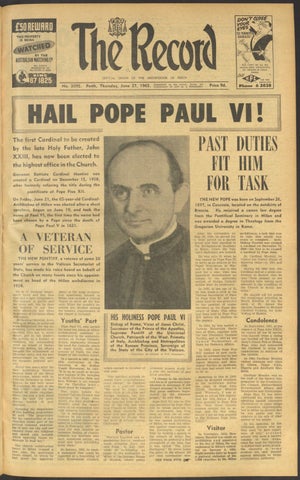
HIS HOLINESS POPE PAUL VI Bishop of Rome, Vicar of Jesus Christ, Successor of the Prince of the Apostles, Supreme Pontiff of the Universal Church, Patriarch of the West, Primate of Italy, Archbishop and Metropolitan of the Roman Province, Sovereign of the State of the City of the Vatican. —Illustration by courtesy of W.A. Newspapers.
which opened in October of that year. "'Our spiritual attitude towards them (non-Catholics) must change," the Cardinal said in a past aral letter. "We must no longer consider them irreducible and foreign enemies, but brothers who have been painfully detached from the life tree of the one and only true Church of Christ. One must hope sincerely that some new and great event may come to change this sad state of schism among Christians."
Pastor Pastoral function and organisation have received much attention from the new Pope. In July, 1957, while an archbishop, he spoke at the dedicatiOn in Milan of the. Faaranno House of Studies, where newly
ordained priests study for a year the methods of pastoral practice. "A change in the methods and form of (pastoral) organisation is necessary if the Gospel message is to reach that great audience represented by the common people," he said then. Pope Paul VI, who in 1953 was permitted by Pope Pius XII to refuse elevation to the cardinalate, has long been an arch foe of communism.- Six months after he was named Archbishop of Milan, he took the offensive against communism in the Lombardy region of Italy by making a speech in the suburb of Sesto San Giovanni, so powerful a Red.stronghold at the time that it was called "The Little Stalingrad." He drove home the point, to the almost 100 per cent communist worSEE PAGE FIVE DV
After his ordination on May 29, 1920, he served for a brief period as a parish priest and then enrolled in the Ecclesiastical Academy in Rome, where the Vatican's diplomats are trained. He was only 25 when he was named by Pope Pius XI to serve as an attache at the Papal Nunciature in Warsaw in 1922. He was in this post for a year, then was appointed ecclesiastical assistant to the university section of Italian Catholic Action later its moderator. In 1932, at the age of 35, he was made a clerk in the Vatican Secretariat of State by Pope Pius XI, and four years later he was promoted to the position of undersecretary to the Papal Secretary of State. This office had been held by Pope Pius XII before his election to the papacy.
archdiocese, a task that was to take him nearly two years to complete. Archbishop Montini was created a cardinal on December 15, 1958—the first to be created a cardinal by Pope John. As Cardinal Montini, he visited the United States of America twice—in 1951 and 1960. During his 1960 -Visit, the Cardinal said at a press conference in Boston that he was "very pleased to see Catholics here taking such interest in the condition of the Church in South America." He singled out for praise the missionary activities in South America of the Society of St. James the Apostle, founded by Richard Cardinal Cushing, the Archbishop of Boston.
In 1944, he was named a Vatican Substitute Secretary of State, together with the late Domenico Cardinal Tardini, and in 1952 he was n amed Pro-Secretary of State for Ordinary Affairs.
In September, 1961, at the request of Pope John XXIII, he visited all the 24 spectators injured when a racing car hurtled off the track at Italy's Grand Prix at Monza. Pope John had instructed the Cardinal to bring his condolences to relat-lyes of the victims. In 1962, Cardinal Montini visited missions and cities in Ghana, Upper Volta, Nigeria and Southern Rhodesia. Cardinal Montini was on the staff of the Sacred Congregation of the Consistory, the Council, Extraordinary Ecclesiastical Affairs, and Seminaries and Universities. Pope Paul VI has never cushioned his words when speaking against lukewarm Christianity or other things he considers objectionable, but in Milan he showed that he was gentle and considerate in his role of chief pastor of the people. In his speeches, he has criticised writers who say they need "to have experience of evil," scorned priests who have a narrow concept of their duties, cited the need for Catholics to defend their press, attackthe obscurity in some modern art, and warned against attempts to dilute ecclesiastical authority.
In 1953, when Pope Pius XII created 24 new cardinals, he revealed that he had planned to name both Monsignor Montini and Monsignor Tardini as cardinals, but they had asked him not to do so. - Referring to this in 1958, when he accepted elevation to the cardinalate during the reign of Pope John XXIII, Cardinal Montini said: "Formerly, I was allowed to refuse this dignity. And for this favour I am most grateful to Pope Pius XII. Now other circumstances compel me to accept, and for this other favour Iam no less grateful t o His Holiness Pope John XXIII."
Visitor In November, 1954, Monsignor Montini was made an archbishop a n d appointed to the See of Milan. He was enthroned in Milan's cathedral on January 6, 1955. Eight-months later he began a pastoral visitation of the 1,000 churches in the Milan
Condolence
Page Two
Bishop Fulton J. Sheen . . .
Those Who Love
THE
RECORD
Thursday, June 27, 1963
* H. T. GOLLOP, in the Interregnum, continues to . .
I
AM WRITING THIS ARTICLE A FEW DAYS AFTER HAVING HEARD OF THE DEATH OF THE HOLY FATHER.
K
tire wages bill of the Vatican. The Pope then suggested * ONE CAN NEVER LOVE IN A HURRY. that everybody be given increases, the higher paid re. Those who are particularly committed to ceiving a lower percentage loving service are the clergy and doctors. To increase, but the scheme In Europe there is wide- must ensure that the garhurry the distressed and the disturbed, either spread grief and the news- deners' wages were doubled. through the confessional or the parlour, or the papers have run banner How exactly my informant headlines for days, during knew the precise words clinic, is to make oneself a merchant dealing his terrible four days of used by the Holy Father is seem to agree with opinions Catholics in Australia may and since. quite beyond me—I suspect which came trom several not realise how badly that with things, rather than a dedicated servant suffering Of course, official panegy- that every Roman has his different sources on the Council was needed. By and rics and coridolences are own hidden microphone in Pope's controversial action large, we are a of the poor, the sick and the disturbed. close-knit usual when an important the Pope's study. in receiving Khrushchev's community which practises Love requires three terms, not only the lover and _the man dies, but a great deal However fanciful the de- son-in-law. This was part of its faith pretty solidly and, beloved, but also that mysterious bond uniting both, of what has been said in the tail, this story did give the a slow, difficult and delicate apart from the schools, all from ordinary Italian a feeling attempt to find some point our problems are which is love. Such human love reflects the Divine last few days has come relatively Love where there is an endless cycle of love in the the heart, because in his that there was at least one of contact with Commu- minor. This is not true (if short pontificate Pope John of the ruling classes who nism. the Church, let us say, in Godhead. Every, human person has within himself a has become greatly loved by cared about him. When the Since 1956, when the softer France; there are certain rhythm or a tempo, to which the one who serves must Catholic and non-Catholic Pope began to go about Communist line came into districts in France whete tune in. To love means to be considerate of. others; it alike. Even the enemies of Rome, paying informal Nrce in Europe, Commu- practising Catholics number may never be a carnal aggressiveness which seeks to the Church have praised visits to colleges, institu- nist governments have less than 1 in la and workdevour the prey and be glutted: rather, it means listen- him, although some tongues tions and even a prison, sought some kind of truce ing-class Catholics are evea ing to others, putting oneself in their frame of mind, may have been in cheeks— people began to realise that in the anti-religious war. No less practical, being a bate rather than critically analysing what they have to say. praising John XXIII has this was no emotional whim doubt they believe that time three per cent. I must make been a useful but an expression of charity is on their side and the it clear that this does The speeding-up of confessions, the rushing through sometimes cover for damning Pius XII. and human interest which Church will die out in time. apply to every district not to a consultaton or imposing one's own mind on others in Be that as it may, millions came quite naturally to the In the meantime, it is better France, but even their be counselling, are failures to love. To love anyone means of Europeans feel as though man. to grant greater religious would hardly reach the Atito give one's talent, to give one's time, to give one's they have lost a dearly loved The same informality ran freedom because an actively tralian figure of about 10 money; in_a word, to become identified with the soul grandfather; their grief is through all his dealings hostile Church can disrupt per cent. mingled with a little fear. with men. He was quite the Communist economic in crisis. No wonder that the Church A tendency in human nature, particularly among the The Church is to change its capable of having a chat and political programme. in France feels the need for leader in the middle of one with an individual at a gen' Many of the Church lea- all kinds of changes to meet strong, is to despise weakness. Boswell, in his life of of the most important Coun- eral audience -- we actually Johnson, often remarks how unimaginative he was cils in its history, and we witnessed that at one of his ders in those countries see the challenge of modern towards the suffering of frailer constitutions. Sometimes would indeed be fortunate last audiences just after in such concessions the only times. possible means of survival; There are differences of unbroken health incapacitates a man for sympathy with to get anyone as wise and Easter. He took men into his many other Church leaders, opinion in the Church, not his fellows, and weakens his power of insight into other human as Pope John. confidence with remarkable particularly in the Western on doctrine, but on the best It had been my intention frankness—time and again world, believe that accept- means of bringing minds; it makes him anxious to dispatch the burdens of Christ to give some of the views he told the general public ing any working arrange- to the masses of the others, as if they, were wholly of their own making. 20th Love is patient. tolerant, benevolent. It extends to about him while he was still at audiences about prob- ments would help the tri- c entury. Differences of alive, because wherever we lems facing the Church, umph of Communism. opinion, if unresolved, can those beyond our own set, and is exercised not only to went, sooner or later, the problems which until then This is a terrible dilemma get deeper and become divithe goods, but even towards the dull and foolish who conversation would turn on were discussed secretly only and the right answer will sions, and divisions in turn stumble. But to be patient with them requires that kind Pope John and inevitably on the highest level. only be known to history. If can lead to schisms. The of love which sees in every single person an immortal his patient wisdom and love time is on the side of Com- Council gave expression to soul, more precious to the Lord than the universe itself. for the common man would munism, the Church's one wide differences of opinion, chance of survival is the and that was due largely to No doctor and no- clergyman can do anything for a man be praised. . One of my informants blood of martyrs; if time is the wisdom of the Holy In making a synthesis of he dislikes. Medicine and theology prosper only in love. claimed that John XXIII on the side of the Church, Father, who wanted the pasThough we cannot love the weaknesses of others, yet the views expressed,I would saved Italy from political a working arrangement toral bishops to speak first that they are not like to say we can love the weak and bear their infirmities, not necessarily my personal chaos; this particular friend could help the Church in so that they would not feel breaking the bruised reed, nor quenching the burning opinions. In particular, I was very much opposed to Communist countries and that they had to follow any flax. Infants are not cast out of the doors because they did not agree with the criti- the actions, or supposed end by baptising Commu"Vatican line." cry and are troublesome. cism of Pius XII expressed actions, of Pius XII. Pius nism. The Council has obtained While we know that the Though Our Lord limited His Public Life to three by some people. My own was a reformer, a strong more newspaper space than man who was quite ruthless Church will continue to the years, one never finds Him impatient. Two of His personal opinion, for what Church activity in in enforcing what he be- end of time, it doesn't fol- any other memory. Some of the greatest converts were made when He was tired. On it is worth, is that he will living lieved to be the right policy. low that it cannot be wiped rincipal European newsHis way to work one miracle, despite an interruption, prove to be one of the It was claimed that Pius' out in a particular area or p in the history greatest Popes papers have had an artic1e He stopped to work another. Serveral times it is reof the church. Moreover, policy for Italy was to de- for a certain time. Time was on it almost once a week. corded of Him that He had no time to eat, indicating some of the details, so be- feat Communism by using not on our side when Islam Some of the comment has that He never hurried souls through their problems in loved by Roman gossip, may pressure to ensure that overwhelmed the flourishing been by no means flattering, DemoAfrica. Church of North order to fit His Life into a routine. The one thing that be attributed to lively imagi- Right-Wing Christian but all agree on three main crats candidates were electHe asked to be done in a hurry was the betrayal- of nation rather than fact. that the Counpoints—first, ed to Parliament. I should cil will have a great impact Judas. as if to indicate that that kind of speed and The basic information, make it clear that the Chrison the history of the 20th impatience belongs to the work of evil. however, would appear to tian Democrats are the huge Anyway, apparently Pius second, that there century; informy —certainly true be The parable of the Lost Sheep is the story of long. centre party of Italian poli- XII believed in uncomprowere very wide divergences who honest men were mants right have and they left ties; patient searching; when the sheep is found, it is put mising anti - Communism, "progressive" believed what they said. wings which approximate perhaps the only possible between the upon His Back; it is not returned to the sheepfold by "conservative" bishopi; and Let me begin with the roughly to the Australian attitude in Stalin's day: dogs nippng at its heel. The attitude of the shepherd John XXIII and the Liberal Party and the right Pope John would appear to and, third, that the Pope of story who finds the sheep is described as "rejoicing." As the great unifying force gardeners. It was the prac- wing of the A.L.P. This ap- have tried the far more was the Council. the of Good Shepherd found all His care centred upon the lost tice of Pius XII to take a proximation is so rough as difficult course of seeing sheep, so He now finds all of His joy flowing from it. solitary walk in the Vatican to be almost untrue, but it whether some contact might The last group of comNot only the lost kheep. but even the Cross rested upon Gardens as a slight relaxagives a useful idea of the be achieved with the Com- ments on the Pope came His Shoulders as a lesson to men, that not only the tion to his austere devotion position. munists. This needed great from our many non-Catholic friends and relatives in Engcares all the duty. With to wanderers, but even the burden of the world's guilt is According to my friend, courage and wisdom beof the world on his shoul- what 60 per cent of Italians cause the Communist lea- land. There is not merely a to be assumed by those who love. ders, it was understandable wanted was a Left-Centre ders in Europe are very new atmosphere in the offithat he wished the gardens ( and not a Right -Centre) astute men, capable of cial relations between the be cleared completely so government, which would t wisting any situation to Catholic Church in England to O FFICIAL ENGAGEMENTS and the Protestants, but that he could be absolutely bring in better working con- their own advantage. JUNE 29: '7.30 p.m, — Confirmation alone for once. there is friendliness between ditions and long-overdue reThe greatest single act of individuals which was all 9.30 a.m.— Ceremony of and Canonical Visitation, forms. This, he claimed, was the late Holy Father was Ordination to Priesthood, Southern Cross. decade ago. "I blocked by political direc- the calling of the Council. too rare a JULY 23: St. Mary's Cathedral. the Pope on the telly, saw tion from the Vatican, and Apropos of this, one of the Confirmation, Narambeen. blessing the crowds at St. A few days after John he himself was becoming silliest remarks among the JUNE 30: JULY 24: Peter's," said one of them XXIII had become Pope, 10.00 a.m.—Preside Solemn 7.30 p.m. — Confirmation some gardeners in the Vati- anti-clerical — a state of obituaries was that of an who had no particular relimind which he had always English newspaper which High Mass; Redemptorist and Canonical Visitation, gion, "he looked real holy." can Gardens were about to regarded as the silliest form .Ionastery, North Perth Bruce Rock. called John XXIII a "careI can't think of any bettet take their meal-break when of folly. (Diamond Jubilee of Re- JULY 26: taker." epitaph than that. the Pope suddenly appeared demptorist Fathers in W.A.). I had great difficulty in 7.30 p.m. — Confirmation 7.30 p.m. — Confirmation and Canonical Visitation, without warning. Knowing believing this story of poliinstructions that the strict and Canonical Visitation. Merredin. they had had to make them- tical pressure in spite of Subiaco. JULY 28: selves scarce whenever Pius quotations of specific inciLICENSED PLUMBER '7.30 p.m. — Confirmation XII was about to appear, dents, but it was widely beJULY 7: 23 Fulham Street, Kewdale, Phone 6 3682 3 p.m.— Bless and open and Canonical Visitation, the men made confused apo- lieved in Italy that it did Daughters of Charity Wel- Bassendean. logies and started to leave, exist and the Italians should HOT WATER SPECIALIST. SHEET METAL WORK. fare Centre, Shenton Street, AUGUST 4: but Pope John called them know. It sent large numbers SEPTIC TANK INSTALLATIONS. along the anti-clerical Confirmation road, p.m. — ' 7 .30 back, and talked to them, West Perth. ALL WORK GUARANTEED and nowadays in Visitation, Italy that and Canonical asking them about their 7.30 p.m.— Confirmation is the first step towards families and how they lived. and Canonical Visitation, Palmyra. AUGUST 5: He ended by accepting a Communism. So, claimed Fremantle. First Clergy Retreat. FINEST SERVICE glass ,of wine and giving my friend, Pius' policy, nrLy 10: framed to defeat CommuAUGUST it: them an informal blessing. IN THE CITY 8.50 a.m. — Confirmation nism, ended by making it 7.30 pan. — Confirmation All Hallows' Church, IngleLater in the day, he sent stronger. and Canonical Visitation. for the official in charge of wood. Beaconsfield and Bentley. Pope John XXIII didn't JULY 13: the Vatican staff. He told AUGUST 18: make any rash alterations, p.m. him that he had just learnt 6.30 - Confirmation '7.30 p.m. — Confirmation but little by little he eased what a gardener Vatican Woorooloo. and Canonical Visitation, was paid, and it just wasn't the pressure off the reins; JULY 14: East Victoria Park. within 18 months Italy had 10 a.m. — Confirmation 3 p.m.—Bless New Mona- possible for a man to live a Left-Centre government on such a miserable pittance Wundowie. stery, Wandering Native —the wages were to be which satisfied the majority 7.30 p.m. — Confirmation Mission. FORREST PLACE PERTH PHONE of the people. Whether this doubled forthwith. and Canonical Visitation, AUGUST 19: interpretation of the facts OPPOSITE THE G.P.0 The official pointed out is true on all counts is diffiYork. Second Clergy Retreat. LEVEL STREET THE ON that to double the lowest cult to assess, but it does JULY 21: AUGUST 25: wages would mean that the 3 p.m.— Attend ca nclud7.30 p.m. — Confirmation ' orsvir oft-~-ww-o ing ceremony Y.C.S. Week, and Canonical Visitation, more skilled workers would receive less than the garSt. Mary's Cathedral. A rmadale. PLUMBING MATERIALS deners. Then double their wages, too, came the Pope's BATH ROOM FIXTURES * THE PETER'S PENCE COLLECTION will be reply. The official threw up 229-233 William St., Perth SEPTIC TANK — DRY WELLS t aken up at all Masses in the parishes of the his hands in despair — it 28-1541 The "Plumbing Supply Specialists" would be quite out of the A rchdiocese on this Sunday, June 30. question to double the en-
AND
!STEN
Politics
Great Act
A Mixer
P. D. LALLY
I
HEARING AIDS
23 4960
ROY GALYIN & CO.
Thursday, June 27, 1963
THE
RECORD
Page Three
BACK TO AUSTRALIA
POLICY CHANGE MIGHT MAKE A DIFFERENCE SYDNEY.—POLICY-MAKERS OF THE DOMINANT NEW SOUTH WALES LABOR PARTY HAVE RECOMMENDED THAT
ALL
SCHOOLS, PRIVATE AS WELL AS PUBLIC, BE GIVEN STATE HELP IN THEIR SCIENCE PROGRAMMES. This is a significant departure from the party's consistent stand against public assistance to private schools. It reflects concern that Australia will fall behind in the vital race for scientific knowledge if a quarter of the students in the State of New South Wales are given training in schools with inadequate science laboratories. The recommendation, passed by a large majority at a party conference, is not mandatory on the Labor Party's government members, but it will have great weight with them. The New South Wales Teachers' Federation has come out in opposition to it, and it is expected that most of the non-Catholic church bodies will also oppose it. 4-
1 .'i'RCI2M-e;'Zi2C4(`Art
•
Sales Soar LONDON: Interest in controversial issues, historical subjects and doctrinal matters has sent sales of certain Catholic Truth Society pamphlets here soaring. Comparing current sales with the figures of eight years ago, a report issued by the society shows that pamphlets dealing with controversial issues have more than doubled and the sales of pamphlets dealing with historical subjects are nearly five times higher. In the s ame period, pamphlets on doctrinal matters have leapt from 305,000 to 636,000. Sales of the catechism have also jumped— from 93,000 in 1954 to 229,000 last year. Sales of the society's Simple Prayer Book have increased from 130,000 to almost 222,000. Total pamphlet sales last year were one million higher than in 1954, the report added.
Observers Al Conference ROME: Two North American priests are among the five Catholic observers anpointed by the Secretariat f o r Promoting Christian Unity to attend the Faith and Order World Conference to be held in Montreal on July 12 to 26. They are Fathers Godfrey Diekman. 0.S.B.. of the United States, and Gregory Baum, 0.S.A., of Canada. The other observers at the meeting, sponsored by the Protestant World Council of Churches, will be Fathers Jan Groot, of the Netherlands, George Tavard, A.A.. and Bernard Lambert, of Prance. The fiv,priests, who are described by a secretariat official as "chosen and authorised," will have the sarne status as a similar five representatives who attended the World Council of Churches assembly in New Delhi, India, in November, 1961.
As the motion to include all schools in expanded science facilities was made, one party delegate asked if it had been mistakenly worded. The chairman responded: -We made no mistake. We mean al/ schools, not just State schools." The delegates then beat down an amendment to limit aid to the State schools. Mrs. Kathleen Anderson, who sponsored the motion, explained that it was useless to pass sweeping resolutions about the protection of Australia from nuclear attack and the consequent need greater for defence expenditures, while excluding an important group of Australians from the schooling they needed to take part in such a defence effort.
* Left to Right: MR. WALTER DWYER, MR. GODFREY STEWART, REV. FATHER AUSTIN KELLY, SJ., DR. JOHN GARVAN HURLEY, VERY REV. FATHER J. R. BOYLEN, S.J. and MR. VIN RANKIN. West Australian-born Father J. R. iPoylen, the Australian Jesuit Provincial, invited the Melbourne Jesuit Co-Missionary Presidents, Dr. John Garvan Hurley and Mr. Godfrey Stewart. a Vice-President, Mr. Walter Dwyer, and the Treasurer, Mr. Vin Rankin, to the airport to welcome back to Australia Father Austin Ke Hy, S.J., after seven years on the Hazaribagh Mission. Father Kelly, who was the first Rector of St. Louis' School, Claremont, which is celebrating its Silver Jubilee this year, was the Australian Provincial in 1951, when Rome asked the Australian Province to take on the responsibility of the Hazaribagh Mission, and that year visited the new mission field. In 1956, Father Kelly volunteered for the Indian Mission and later was made Mission Superior. His term of office ended last year and the Very Reverend Father Boylen, the present Australian Provincial, invited Father Kelly back to Australia. Father Kelly hopes to meet Jesuit Co-Missionaries throughout Australia. Mr. Walter Dwyer is a member of a well-known Catholic family of Perth and for many years has lived in Melbourne, where he has arranged the publicity for the Annual Maytime Fair at Xaverian College, where proceeds go to the Jesuit Missionaries in India.
r' ilair_667aZi227Sa9";'7.77a.797.17774.2115r97172`.
Tiara Returns To Bergamo VATICAN CITY: POPE JOHN'S FAVOURITE TIARA, WHICH WAS A GIFT FROM THE PEOPLE OF BERG/VW°, HAS BEEN RETURNED TO BERGAMO TO BE PLACED IN THE CITY'S CATHEDRAL, VATICAN OFFICIALS HAVE ANNOUNCED. It has also been learned that personal belongings of the late Pope, including the bed on which he died, are being returned to his home town of Sotto il Monte.
Some of the personal effects will be placed in the house where the Pope used to spend his summer holidays as Cardinal-Patriarch of Venice. The rest will be placed in the house where the Pope grew up. It is now owned by the Pontifical Institute for Foreign Missions. To permit removal of the Pope's p e rsonal effects, Benedetto Cardinal Aloisi Masella, Chamberlain of the Holy Roman Church, authorised entry to the sealed papal apartments. After the articles were removed, the apartments were resealed.
Prisoners Remembered 1 Visifor VATICAN CITY: The convicts Pope John XXIII remembered when he became Pontiff, remembered him in his agony. Shortly before he died, a telegram arrived from the inmates of Rome's Regina Coeli prison who gave him a tumultuous welcome when he visited them the day after t Christmas, 1958. Their telegram read: " Holy Father, we are with you t / with immense love." He t never saw it.
PERSONAL DIARY SHOWS ILLNESS WAS KNOWN V ATICAN CITY: NOTES LEFT
BY
POPE
JOHN
X XIII SHOW THAT HE K NEW ABOUT HIS FATAL ILLNESS AS EARLY A S NOVEMBER, 1961.
A series of personal notes and reflections were jotted down by the Pope between November 26 and December 6 of that yearmwhile he was recovering from an illness. These have been published here, in the Pontiffs handwriting, by the Vatican City daily, L'Osservatore Romano. Pope John wrote at that iime: "I notice in my body the beginning of some trouble which must be natural for an old man. I bear it in peace, though it annoys me sometimes and because it allows me to fear that it is becoming worse. It is not pleasant to think of it too much, but once again I am ready for everything." Among other comments written down at a later period by the ailing Pope was: "This bed is an al-
014..•410411...4404p.#464.04,""p,,,,,,,,,,,#.4041N IMINIM#000.•
THE COLONIAL MUTUAL FIRE INSURANCE COMPANY LIMITED
CAN MEET YOUR REQUIREMENTS IN INSURANCE PROTECTION 236 ST, GEORGE'S TERRACE, PERTH Phone: 21-9066 A. De CAUX, Manager.
tar. The altar needs a "I desire that this be the victim. Behold me, ready. last prayer of the Pope. I have before me a clear of the humble Pope John." v ision of my soul of my In point of fact, among priesthood, of the council Pope John's last words and the Universal Church." were those for peace and Elsewhere he wrote: "I the unity of the Church. am at peace.Ihave always They were: "Ut unum sint. wanted the will of God, alThat they all may be one." ways, always. I pray for Extracts from the Pope's the Church, for children diary have also been pubfor priests and for bishops lished by L'Osgervatore so that they may be holy Romano that go back as and for the whole world far as July, 1938. They . . . Coming from poverty include his thoughts on his and the smallness of Sotto election as pope, his famI I Monte The Pontiff's ily and the effects of World birthplace), I have sought War II. never to forget them. The Pope's diary reveals "What great grace has that he asked for two gracthe Lord given me: holy es after being elected. pastors, exemplary parents, "First grace — to accept a strong Christian tradition the honour with simplicity and contented and tranquil and the weight of the ponpoverty.I wish to die knowtificate with the joy of being that I have nothing. able to say that one did ing Poverty many times distressed me, especially when nothing to seek it, truly nothing; that with studied I was not able to help my and knowing care on my family or some fellow priest. But I never grieved part nothing was done to call any attention to my about it." The Pope noted that he person. — let there grace wanted to go to Montecas"Second come to me without comsino Abbey and added: plexity and in the most "Who knows, who knows?" He called the priests and simple form immediately simple and Religious the "richness of executable the Church" and expressed ideas, which are of great the desire to die with the import, and responsibility wcfds that his former su- in the face of the future with immediate sucer-zs. perior, Bishop 'Raclini TeWhat beautiful expression deschi of Bergamo, had on these are: to receive the his lips at his death — good ideas of the Lord!" peace, peace!
Australian Was Pharmacist Rev. Brother Gerard Cole, of Bondi, N.S.W., member of the Order of Hospitallers, who has been attached to the Vatican Pharmacy for three years, was appointed official pharmacist at the recent Conclave. Before going to Rome. Brother Gerard was pharmacist at St. John of God Hospital, Richmond. The Constitutions of the Conclave stipulates that a Doctor, a Surgeon and a Pharmacist and Nurse I male) be enclosed with the Cardinals at the Conclave. POPES NURSE Brother Rodolfo 0.H., of the Milanese Province of th.:. Order was the official nurse at the Conclave. Brother Rodolfo nursed the late Pope John XXIII in his final illness. Before the late Holy Father died, he invested Brother Rodollo with the Military Order of St. Casimir for services rendered to the Pope arid the Vatican State. SECOND TIME This is the second time that an Australian Hospitaller Brother has been official pharmacist to the Conclave. In 1958, Brother Fabian Hynes, 0.11, of Earlwood. N.S.W., filled this office.
Brother Fabian has been attached to the Vatican Pharmacy for eight years. The Hospitaller Order is a world wide order of nursing Brothers and has 2,500 members. There are 55 Brothers in the Australasian Province. The Order has two hospitals in N.S.W. and centres for mentally handicapped children in N.S.W., Victoria and New Zealand. H ISTORY
Order The Hospitaller was founded by St. John of God at Granada. Spain in 1537. It has had hospitals and pharmacies in Rome for four hundred years. The Vatican Pharmacy was opened in 1874 at the request of Pope Pius IX. It has always been conducted by the Hospitaller Order. The Hospitaller Brothers .are the traditional nurses of The present the Popes. Prior General of the Order, Br. Hyginus Aparicio, 0.H., was personal infirmarian to Pope St. Pius X and was with the Saint at his death.
TO ALL CATHOLIC PENSIONERS The Firm of A. R. Monahan Pty. Ltd., Funeral Directors of Bedford Park wish to advise all Pensioners that they are certified to conduct Funerals at The W.A. Pensioners League contract prices, whether you oee a subscriber to the League or any other Funeral Fund. Ring 71-5885 and Mr. Bert Monahan will personally call and explain every detail of their Greatly Improved service for ALL Pensioners.
THE
Page Four
Thursday, June 27, 1963
RECORD
411,11P.P.#0###########.....•
DESMOND O'GRADY WRITES—
A LETTER FROM ROME A TO I/CCORDING I VATICAN OFFICIAL THE BEST ARGUA FOR MENTS SHORT CONCLAVE A RE THE NUNS OF ST. VINCENT WHO ARE IN CHARGE OF THE VATICAN KITCHENS THE AND INHOSPITABLE ROOMS OF THE CARDINALS. He also claims that the nuns can produce meals that would not induce anyone to stay any longer than necessary in a conclave while the cardinals rooms are frugal. At least, some of them are— the room of Cardinal Lercaro opens off the court of St. Damasus and looks as anonymous as a modest hotel room. The room of Cardinal Gilroy is more appealing and commands a fine view from high windows while the Cardinal Tisserant's room in the Borgia apartment is magnificent. It is hung with arrases representing military scenes, there are suits of cannons, small armour, lances, guns and swords on the walls which must make the former cavalry officer feel very much at home. As Dean of the College of Cardinals he was assigned this room and even his attendant has a room which is more elaborate than that of most of the other cardinals. But the additions to these two rooms for the conclave are the same as for the others: a simple wooden bed for the cardinal, an iron bed for his attendant, each with a few towels and a bar of soap near the beds. The Church is often criticised for its excessive pomp but at least it elects the Pope in simplicity. A small city within Vatican City has been walled off for the 80 cardinals and 17-j attendants whose quarters are around the courtyard of St. Damasus, which looks up to the three, glassed storeys of the Apostolic Palace which can be seen from St. Peter's square between the Pope's apartment and the basilica.
Turntables The Apostolic palace is U-shaped and at the "open" end of the courtyard is one of the points of communication with the outside world: there are four cabins, each with an inset wooden fixture like a small revolving hotel door where verbal messages to those inTo side can be received. the left of the courtyard is the smaller, Parrot square and fresh foodstuffs are delivered through the doorway in the wooden construction which closes the square from the rest of the Vatican for the conclave period. A flight of stairs carries one to the first storey of the Palace where the Loggia dei Lapidari of the Vatican
museum has been closed off for the conclavists. Alongside the Loggia are the Borgia apartments where the cardinals eat. A statue of Alexander VII looks down on the diners, there are rich tapestries on the walls, a gaily painted ceiling, tiled - floors, and potted palms and ferns between the two rows of tables which are linked by another table. From the Borgia apartment the Loggia which allows a fine view over the roofs and domes of Rome leads to the Ducal and Regal apartments and, finally, to the Sistine Chapel where the voting takes place. The transformation of the chapel is so marked that the series of Michelangelo paintings which usually attract everyone's attention go unnoticed. The predominant colours are violet-purple, light green and cardinal red which form a powerful but more harmonious combination than they might be imagined.
The chapel is usually divided by a balustrade surmounted by a small wooden grate but this grate has been removed. There is -only a waist high balustrade which divides the chapel into unequal sections. The "sacred stove" is in the smaller section just by the entrance to the chapel. Its purpose, of course, is to produce smoke, not heat, and in bins nearby are its fuel: the straw which usually protects wine flasks and special candles prepared by the Italian air force for the black smoke, torn copies of "L'Osservatore Romano" for the white smoke. There are large boxes marked "Nero" and "Bianco": they communicate with the radio journalists who are perched constructed hastily in "rooms" on top of the colonade on the other side of the square trying to make out whether the grey smoke is grey, white or black. The "thrones" at which the cardinals will sit are side-by-side along the walls of the chapel and numbered. Number one is Cardinal Tisserant, Cardinal Gilroy is number 17 between de Vasconcellos Motta number 16 and Cardinal Spellman number 18. The last number 82 is assigned to the Spaniard, Cardinal Albereda. There are 60 "thrones" in the central nave and 22 in the smaller section of the chapel. The carpet covering the chapel floor is green as are the tables and stools where the prelates concerned with the conclave ceremonies will The large rectangular sit. table in front of the altar where the cardinal-scrutineers will count the votes is covered in cardinal red. The "thrones" of the car -
THE LUCKIEST MR. "LOTTERIES" NAME IN LOTTERIES
VICTORIA PARK (sufficient Address) Send Stamped Addressed Envelope — NO FORMS REQUIRED! ,-~4. "41 , 1INIMNM4.4 , 0 , #04,0-4KINIVINNIPAN#4.1,11^4.4,41M4.4,11
SERVICE ESTATE REAL EXPERT Our organisation caters for a comprehensive service in Real Estate under the following headings: PROPERTY SALES: By Auction or Private Treaty. We have homes available in all leading suburbs. VALUATIONS: We are Sworn Valuers and can offer a complete valuation service. VACANT LAND: We specialise in home sites in all suburbs. Choice lots available in Scarborough and Doubleview from £100 deposit. BUILDING: We are Registered Builders (Class A) and s pecialise in new homes on easy terms. Inspect our modern five-roomed, tiled roof, brick homes at Doubleview. These homes are complete with modern colour schemes gleaming Kitchen and Bathroom, Laminex-topped cupboards, Electric Stove, Tiled Shower recess, Hot water System and every modern fitting necessary for home comfort. Price (including land) £3,750. Deposit £850. Inspections to suit your convenience.
DUDLEY and DWYER LTD.
r.
98
ST.
which collapses the small canopy over their chair anti the Pope leaves his intact. The Church has a new Pope and within a matter of minutes the whole world knows the decision reached in the chapel which has been closed' off from the world with such care.
GEORGE'S
TERRACE
Members of Real Estate Insttute
EVERYMAN'S FAMILY By Father JOHN C. KNOTT nevINININNINANIN
VISITS EIV SHRINE
Know Mine And Mine Know Me
* He was a taxi-driver in a south-western city. He had picked up his priest passenger at the airport terminal, inquired about his health and destination, and proceded to take over not only the direction of the vehicle, but also of the conversation. His next words were ones of sincere sympathy on the death of Pope John. He said, "He was a good man. He's going to be a big loss and not just to your Church but to the whole world." He added, "If you think I'm making talk, I'll let you know something. I'm a Baptist and an elder in my church.
Sacred Stove
amilmaa,
Easy Weekly Payments.
dinals are narrow affairs consisting of plain, woodbacked chairs with red damask seats, a purple-violet coloured desk on which there is a blotting paper, and a violet purple roof and backdrop. When the Pope is elected the cardinals pull a cord
" GOOD
MAN"
*
"AND I'll tell you something else that may surprise you. Last Sunday our preacher said to us, 'Before I give my sermon I want to make one request. We should all pray for Pope John. He is a good man." With that the taxi-driver turned three-quarter face to the rear, grinned and asked, "Now in all your born days did you ever expect a Southern Baptist minister to say a thing like that!.The passenger agreed hastily, not only because he was impressed, but because the car was going down a busy f reeway at about 60 miles an hour. He felt that the important thing for the immediate moment was an eyesfront position on the part of the driver.
Indian Prime Minister Jawaharlal Nehru ( centre ) stands before the silver casket containing the remains of St. Francis Xavier in the Born Jesu Basilica in Goa. The Prime Minister was on a State visit to the former Portuguese colony on the west coast of India. With Nehru and his party is Mgr. Piedade Rebell°, the Vicar -general of Goa.
Catholic Numbers In Vietnam Govt. SAIGON: A NEW YORK. TIMES EDITORIAL ON JUNE 17 CONCERNING V IETNAM CONTAINS SOME MISLEADING ABOUT STATEMENTS CATHOLICS, ACCORDING TO CATHOLIC SOURCES HERE. The article states: "Most high goverment officials, chiefs of provinces and military officers (in Vietnam ) are Catholics." It is obviously impossible to ascertain the religious affiliations of all military officers without lengthy research. But it is certain that only three out of the 19 generals in the Vietnamese armed forces are Catholics. Only one of the four corps commanders is Catholic. Out of 17 cabinet ministers, only five are Catholics. The vice-president and the chief of staff are nonCatholics. Out of 44 chiefs of provinces and city mayors, less than half are Catholics, according to the Ministry of the Interior. The "Mew University" of Dalat was founded by Catholic founders and Catholic money, some of it donated by Francis Cardinal Spellman of New York, some by Gregorio Cardinal Agagianian, Prefect of the Sacred Congregation for the Propagation of the
Faith. The State university in Hue has indeed a Catholic pbest-scholar as rector, but it is controlled by the of Education, Minister who is not a Catholic. • The article says: ":Restrictive social legislation, such as bans on dancing, contraceptives, divorce and polygamy, runs counter to the customs and beliefs of the majority." Western dancing and contraceptives have never been part of the customs and beliefs of any segment of Vietnamese people. Polygamy is obviously a social evil wherever it exists in East Asia and those who oppose it should hardly have to justify their stand. Divorce is also an evil for East Asia in the eyes of many. To infer that Buddhists make up "a majority of South, Vietnam's people" is also misleading. There has been no religious census. Inscribed members of the General Buddhist Association numbered only one million last year. Practising Buddhists are estimated at between three and four million at the most. Others practise ancestor veneration, Confucianism and Taoism with occasional visits to Buddhist pagodas. Sizeable numbers of Caodaists and hundreds of thousands of animist mountaineers are also in South Vietnam.
0000000•0040:0000•00,00
Proprietors of the largest vineyard in W.A. We can supply the best Wine at very reasonilk able prices. I 215 WILLIAM STREET, PERTH. Phone: 21-5393. = oivitipar ,
The rest of the ride was filled with some pertinent observations by the driver on the election of a new Pope and how important this was for everyone, and not ju Catholics. Because, as the good Baptist said, as he drov3 up to the door of the Catholic rectory and deposited his pristly yes-man, "The real important thing is to find God and hang on to Him." If he was rewarded with a larger tip than was customary, it was only in lieu of the traditional kiss of peace—the sign of unity among brothers. That would have embarrassed all concerned and might have been construed as something tinging on the un-American. But it would have been in the spirit of Pope John XXIII. Probably "every Catholic could tell his own story about his reactions to the illnes of Pope John and his subsequent death, and what his non-Catholic friends may have told him about theirs. Priests can relate about being stopped by complete strangers, some with tears in their eyes, who wanted tp express their feelings on the death of a close friend and father, whom they hal not met personally but whom they felt they knew.
G OOD
SHEPHERD
THE words of the Good Shepherd come to mind, "Iknow Mine and Mine know Me" (John, 10: 1415). This was Pope John, who reached from the isolated throne of Peter and touched the hearts and minds and souls of mankind. He gave hope to hearts numb with fear, lifted up the vision of man to the beauty of God and made less frantic the hunger of every soul for peace. As one priest said, "The great thing Pope John taught all of us was that we should not be afraid to love." As well as anyone, he was aware of the dangers of communism, but he loved communists and was concerned for thoir welfare as human beings. - As well as anyone, he knew the threat of world destruction by the arms race, but he was more interested in the possible destruction of one soul. Impressed as he was by the achievements of modern science, he was more aware that hundreds of millions of people are being denied their human dignity because they are being denied their rights as human beings. As Vicar of Christ to the whole world, he was living witness to the words of Our Lord, "By this will all men know that you are my disciples, if you have love for one another" (John, 13:35). Ours is not just to admire a great and good man, but to make sure that the words of St. John the Apostle will live in us, "Love one another" (1 John 3:23). The
address of the local Catholic Marriage
Guidance Centre is TERRACE PERTH. 23-1548. GEORGE'S ST. 77
0 0" 10410401044^0~404011~M-01140414111 0 0 se r..." 0 C 00 500 0'1". 0 14/Port ... 16/Muscat ... ... 10/6 Claret 18 '- Prices Sweet Sherry . . Per ... 12/Sultana 18 Vermouth Gal. Dry Sherry ... 12/Marsala ...
t. LUISINI srk10-sFta40-vrvr-o4r-sr
14 SOUTH TERRACE, FREMANTLE Phone: 5-3178
Thursday, June 27, 1963
THE
RECORD
Page Five
Tailors Were On The Job
----THERE IS A NEW RULER FOR THIS TINY TERRITORY asastacas. of PAPAL Gt:A*131. -
NAL- CM! mot • fronts
VATICAN CITY: THE NEW POPE WAS WEARING A NEW WHITE CASSOCK ESPECIALLY MADE FOR HIM ONLY MINUTES AFTER HE WAS ELECTED BY THE CONCLAVE OF CARDINALS.
'
VATICAN CITY
The Things He Has Said...
From Page 1 kers that they had been duped by the lies of communist leaders.
EXCERPTS FROM THE SPEECHES THE HOLY FATHER HAS MADE ON SEVERAL SUBJECTS
In a Lenten pastoral in 1956, he warned that "every compromise of a t heis tic communism hides a secret plan to disarm and subjugate whomever deals with it."
WHEN A CARDINAL . . .
On Writing.
"The temptation for knowledge of evil has a strong attraction. There t‘
are those who say that it is necessary to have experience of evil to write about good. This is not true. Above all things, keep yourselves pure and do not be afraid to put great theses in your writings."— Addre§s to third National Congress of Italian Writers, yl n-• September, 1956.
I n August, 1959, the Bishops of the Lombardy region, led by Cardinal Montini, warned in a long pastoral letter that "the propagation of Marxist ideas in our country is still serious and dangerous."
On Pastoral Ministry:
The future Pontiff spoke in September,
1958, in Milan against -the many parish priests, particularly in the cities, who resign themselves to practising their ministry for those people who attend k church and thus find their pastoral zeal satisfied.' .< He stressed the need for parish priests to learn "all those elements inspired by a great love for souls which must be exercised to attract the lambs outside the flock.-
Giovanni Battista Montini no doubt acquired much of his interest in politics and diplomacy from his father, who served for three terms as a member of the Italian Parliament and was editor of a newspaper in Brescia.
.
MAKE—
FOLEY'S DRUG STORE
95 BARRACK STREET ( right opposite the Taxation Dept.) Y OUR CHEMI ST P ROMPT, EFFICIENT ATTENTION ALWAYS Special Service for Country Clients — Phone 23-4267.
HERCULES SWIMMING POOLS
Have a gleaming, modern pool built on your own property now and enjoy the long warm days and evenings ahead. Hercules look after all the details. Finest materials and workmanship. Filtered, pure water always. A great investment in health. I IERCULES BUILT THE SEMI -OLYMPIC POOL AT THE HOME OF THE GOOD SHEPHERD, LEEDERVILLE. For full details contact— HERCULES SWIMMING POOLS PTY. LTD. 115 St. George's Tce. 23-3679. After Hours: 25-2359.
A VON Eiectrical Service
( Proprietor: J. WERDLER) 33 CALEDONIAN AVENUE, MAYLANDS We are Installation, Repair and Maintenance Specialists. We are Available at All Hours. Telephone: 71:3672
W. W. EDMONDSON Cr SONS
PLUMBERS and SHEET METAL WORKERS Certified West Australia, Hot Water Specialists and General Plumbing. All Work Guaranteed Phones. 28-1714. After Hours: 87-2553, 29-2095. 80 JAMES STREET, PERTH
—
On The Catholic Press: •
h ve .tatholics noura he ho of
defending it, the obligation of propagating it and the .• need to make it live in themselves and in the world," he said on December 4, 1960.
On Modern Art: dAorntiesdts
thseeeimdeatoofhap‘;odabane ucing
works which are intelligible,- and critics "use language that requires a special knowledge in order to understand the meaning," the then Cardinal told a congress of artists in March. 1963. "We, the audience, . make pathetic efforts to understand at least something. We believed that the kingdom of art was • beatitude, whereas today it is pain and confusion."
New South Wales. on Sunday evening to attend the funeral of the Most Reverend John Francis Norton, who
HAMS • Cooked MEATS SAUSAGES • BACON SMALLGOODS a d:InEt
•. '.•
ental
( .44, 1 1
/
• 4"
CONTININTAL
with that REAL Flavour
I's ordination to the priest-
hood, Thursday, June 20. The late Bishop of Bathurst, who was 72, had been admitted to hospital after a heart attack ten days previously. He was the fifth Bishop of the Bathurst Diocese, and was born in Lucan, on January 30, 1891. He was ordained to the priesthood on June 20, 1915. On March 8, 1926, he was appointed Titular Bishop of
Lunda. and Coadjutor Bishop of Bathurst to Bishop O'Farrell. He was consecrated in Rome on April 18 of the same year, succeeding to the See of Bathurst on April 9, 1928. Recently a collection of t he late Bishop's occasional addresses were published in book form, giving selected addresses made over his 35 years as Bishop of Bathurst.
PHONE 21-2107 ur Call
HAY ST., PERTH
101
Contact
MAXWELL ROBINSON & PHELPS 599 Newcastle Street, Perth F c ne :
28 3741
Lawn Mowers, Shears Sharpened and Set
Harry Armstrong Pty. Ltd.
people with ludicrous temerity speak of 'humble disobedience' to the hierarchy as a right and as a • brilliant discovery of the spiritual life.- he said in a sermon in May, 1963. "The clear and responsible instructions of ecclesiastical authority are vivisected to find through sophistry and casuistry the necessary , arguments for evading their grave meaning. What is missing is a sincere and loyal 'sense of the Church.' What is wanting is an understanding of the inviolable and generic principle of the living Church which is its interior, beloved and declared unity."
His Lordship Bishop M. McKeon flew to Bathurst.
TUCKER and AURISCH
are RADIATOR SPECIALISTS Replacements and Repairs b) All Qualified Tradesmen.
They were placed in a small dressing room behind the sacristy of the Sistine Chapel. When the Pope was elected and had accepted his election, he was led to this room and exchanged the mourning purple of his cardinal's robes for the
eand rre lee
Bishop Dies On Anniversary Day
MOTORISTS—
Three pairs of red slippers embroidered with gold were also made. Three sets of white stockings, three assorted sizes of skullcap of white watered silk, and one mozzetta were delivered on the evening of June 18.
On Ecclesiastical Authority: ,,}1
died on the anniversary (
Insist on WA. made.
The tailoring firm of Annibale Gammarelli received orders on June 6 to prepare papal wardrobes to fit whomever was chosen to succed John XXIII. It is the fifth time that Gammarelli has been selected to supply the first papal wardrobe to a new Pope. The 165-year-old firm was first choS-en to supply wardrobes by the conclave that elected Benedict XV in 1914. Since then it has supplied the conclaves electing Pius XI and XII and Pope John. Eugenio Sbarra, the firms cutter, was given only 13 days to ,ready three wardrobes — tall, medium and short — which, besides the white cassock, include hats, shoes, socks and the small red velvet cape called the rnozzetta. Everything had to be at the Vatican on the evening before the conclave opened on June 19. For each of the three sizes t wo cassocks had to be prepared, explained Francesco Gammarelli, sixth generation of his family to work in the shop. "One of the two white cassocks is of wool. This is the house cassock. The other is of silk moire and is used for solemn ceremonies, such as the coronation." The white broad cincture which the Pope wears as a kind of belt in this instance carried no coat of arms, as it would later, since no one knew who would be chosen as Pope. In addition to the six cassocks, Gammarelli prepared a broad-brimmed ecclesiastical round hat of red velvet with gold tassels, designed so that it can be adjusted to varying head sizes.
white robes reserved to the papacy. In the past, slight alterations were made by ecclesiastic attendants as needed, because t h e Gammarelli tailors could not enter the conclave. However, now that new regulations provide for an automatic ending of the conclave with the acceptance by the new Pope of his election, it could have been possible for a tailor to be on hand outside of the conclave area ready to assiSt Pope Paul at a moment's_ notice. Failing this, Gammarelli was ready to make whatever alterations were necessary the following morning. Though the firm provides the first sets of papal wearing apparel, it does not mean that it necessarily is chosen to continue providing the papal wardrobe. "Usually a Pope continues to patronise the tailor he used when he was a cardinal," Francesco Gammarelli explained.
CITY COUNCIL AVENUE — 21-4390.
LOCKS. DOOR CLOSERS and SAFES OVERHAULED and SERVICED CAR and ALL TYPES OF KEYS CUT. Immediate Service.
AWNINGS, BLINDS, FLYWIRE DOORS, and FLY- SCREENS A LL TYPES M.:.,asured and installed in 7 days by
STAN BOND
1010 BEAUFORT ST., INGLEWOOD Top Qualified Tradesmen Phone 71 4313
00 0 0.00 0 0 Arthur E. Davies & Co.
4.0 0 Al 0 0 0:10 0 0 0-4010Z04.100 tik
FUNERAL DIRECTORS and EMBALMERS FREMANTLE; 85 Market Street — 5-2225 CLAREMONT: Opp. Railway Station — 3-2177
AND ALL SUBURBS ‘t !ACE t. H. GRF,EN — 64-1879 (Frivol, 0 00/000000 00000_41r,
H OULAHANS
32 THOMPSON ROAD, NORTH FREMANTLE Are Suppliers of Yellow Sand for Top Dressing or Building, Metal, Gravel, Rubble, Ashes and Filling. Bulldozers, Loaders, Graders for Hire. Will Quote for Excavation and Levelling Jobs. PHONE: 5-1499 . . . 5-3469 OMNI
ALTAR WINES S EVEN HILLS DRY and SWEET AS Seven Hills Sacramental Wine is made by Jesuits, it complies with the requirements of Church Law.
WESTRAL WINE and SPIRIT AGENCY 167 HAY STREET, SUBIACO.
Phone 8-1410.
THE
Page Six
Vietnam
Vietnamese Priest Killed
Father Peter Nguyen quoe Bong, 47, was killed by machine-gun fire on the morning of June 12 while returning to his parish of Luong Son from one of his mission stations about 150 miles east of Saigon. His attackers are believed to be communist Vietcong guerrillas. They ambushed his car, killing him outright and wounding his driver. Father Bong belonged to the Nhatrang diocese. A native of Thanh Hoa, in North Vietnam, he was ordained in 1942. He had studied abroad and was a seminary professor before becoming a parish priest about a year ago.
1T-INTERNATIONAL -NEWS
* YOUR HOTEL GUIDE *
America
Hospital Heli-Pori
A "whiny bird nest" will be constructed atop Santa Rosa Medical Centre in Sill Antonio. Sister Mary Vincent, the administrator, said it will be the first hospital in the
Plympton HOTEL
Home of Country PeoWe CANNING HIGHWAY EAST FREMANTLE Eric Campbell, Prop. 5-1721.
CITY HOTEL
O'BRIEN'S HOTEL
Car. King and Murray Sts , Perth COUNTER LUNCH, 12-7.30 p.m. Friday: Saturday 12-10 p.m. ARCHIE THOMPSON Offers you only "The Des: Phone: 21-1091
NORTH OF THE LINE Clarrie O'Brien, Licensee Stan O'Brien, Manager 21-4261
HIGHWAY HOTEL
COMING TO PERTH
Stay
at
THE RIVERTON HOTEL MOTEL
2 06 STIRLING HIGHWAY, CLAREMONT PHONE 3 1566 Friendly Service — Good Accommodation — Parties Specially Catered for M. A. & E. M. McDONNELL FRIENDLY
HIGH ROAD, RIVERTON 69 3315 T V in every Unit. Ploodnglat 9-Hole Golf Course, FRED MILLS, Licensee
BAYSWATER Hotel
SERVICE
REX HOTEL
Car. KING & HAY STREETS Private Bar for Convenience of Guests and Friends Phone: 21 9634 Prop.: B. B. REILLY
OPP. STATION Excellent Accommodation Frequent Train Service — 4 i',11:es f rom City — Large Parking Area BED and BREAKFAST REASONABLE TARRIFF LES BARTLE-11, Prop. TEL.: '71 1224
SUBIACO HOTEL
WEMBLEY HOTEL
SUBIACO First Class Accommodation and Service Phone: 8-1028 Alex McHenry, Proprietor.
Excellent Lounge and Accommociat ion Phone 87-2418 Cnr. Cambridge and A lexander Streets, Wembley
HOTEL
WAVERLEY HOTEL
Australia
Next Boans Waverley Stores ALBANY HIGHWAY C ANNLNO TON Modern and Convenient Homely Acconunodation Use Our Drive-in Bottle Service Phone 652119 A. R. CONNELL
MURRAY STREET, PERTH E xcellent Accommodation and Dining Service LUNCH, 10/-; DINNER 17/6. PHONE 23 1541
CRITERION HOTEL
Enjoy the Best ACCOMMODATION & SERVICE
CENTRAL HAY STREET PERTH 24-HOUR SERVICE Free Parking for Country Residents 5 Minutes' walk from Cathedral. • THE COUNTRYMAN'S HOTEL PHONE: 23 1113 (5 lineal
HOTEL COTTESLOE
WILLAGEE PARK HOTEL
HOTEL ESPLANADE
RIGHT ON THE SE.% FRONT
Phone 3-2155 R. M. DYMOCK, Licensee
The States Most Modern TOM KENNY. Licensee. Cnr. Stock and High Roa:is, MELVILLE Phone: 30 312.9
PERTH'S LEADING HOTEL FOR ALL VISITORS Phone: 23-152.1
COMMERCIAL HOTEL
NATIONAL HOTEL
Cnr. High and Market Sts., FREMANTLE Offers excellent homely accommodation Phone : 5-1786
N ORTHAM Phone Northam 49 T. E. MURPHY, Proprietor
Philip
For SUPERIOR ACCOMMADATION
IMPERIAL HOTEL
PERTH ( Opposite Railway Station) Tel. 23 2921 Hot and Cold Water, Telephone in every bedroom. Bed and Breakfast 37/6. 24-Hour Room Service Reduced Tariff for Children
NICHOLSON ROAD SHENTON PARK E xcellent Accommodation. Moderate Tariff. Spacious Car Park Beer Garden, Open Air Bar. Phone: 8-21.70
VICTORIA PARK — 6-1063.
Cr,
P. Kearins, Licensee
SHENTON PARK HOTEL
J ACK SHEEDY, Prop.
DALY'S
Thursday, June 27, 1963
RECORD
MEET DAILY
ROYAL
BROKEN HILL HOTEL at
HOTEL
WILLIAM and WELLINGTON STREETS, PERT H. Phones: 2t-3924. Bottle Dept., 21-5136,
p0 4,41.041 ,41,4 "PM04 , , , , , 0#004.4.41.4,4, ,41,11,1P4,1,41.411,11.11 , rIP#04/0#0.4.40M4'0#0.4"0
RELAX AT THE FABULOUS—
WAIKIKI HOTEL-MOTEL With Mine Host:
H ARRY WARD Soft Lights — Soft Music — Foaming AL.b. Phone Safety Bay 9337. Excellent Cuisine.
South-West with a landing place for helicopters. She said that while no definite date has been fixed for the start of the heliport, once construction is under way it will be completed in' 18 months. Growth of San Antonio's population, expected to reach a million in 1965, influenced the building of the heliport to facilitate transportation of patients from hospitals in outlying areas and emergency cases, Sister Vincent said.
Argentina Anticipating Reconvention In hopes that ,the Ecumenical Council will resume. eight Argentine Bishops approved a series of recommendations to present to the next council session, including a proposal to restore married deacons. The Bishops, who met with a number of experts in theology and Scripture after Pope John's death, also adopted recommendations which proposed: Replacing the fee system for parish services with monthly voluntary contributions. (At present a set fee is charged for pastoral services such as Baptism, weddings and funerals); Establishing a common fund, administered by the bishop, for all parishes; Simplifying vestments of bishops and suppressing titles of honour not in keeping with the simplicity of the Gospels; Distributing a n y Church lands used neither for places of worship nor for seminaries.
Korea
Vocation Helping Hand
A community of Sisters in Seoul is getting so many vocations that it is sending five Korean applicants to a vocation-short convent in Auckland, New Zealand. Mother Cora McHardy Flint, superior of the Seoul community of Religious of the Sacred Heart, who selected the five for New Zealand, said: "We have 40 applicants on our waiting list. We do not have enough room for them in our convent here. Until we can build, some will have to be sent to our convents in Japan for their religious t raining." The five going to New Zealand have not yet made any religious profession. They will study English while they are training in Auckland.
India
Priest Handy With Rifle
Two marauding panthers which had carried off close to 000-worth of cattle near Igatpuri were shot and killed by Father Frank • Soares, parish priest of St. Patrick's parish. Villagers celebrated the kill by carrying the carcasses—one nine feet long, the other eight—in procession about the village.
OrINNNIVININNNI
GRACE YOUR HOME WITH FINE CEILINGS from
WELSHPOOL Modelling Works
ww
MARS ST., Rear PLANET ST., WELSHPOOL
Belgium
Fibrous Piaster and Cement Goods Manufactured, Supplied and Fixed. Phone 6-2359, Res,, 6-2357,
Spain
Mercy Killer Suspended A doctor who was acquitted last November in the mercy killing of a baby girl born armless, has been suspended from practice for two years. Dr. Jacques Casters immediately appealed against the ban, which was imposed on June 1 by the Liege Medical Council. The doctor may continue to practise until the appeal is heard next October. The baby's parents, Jean and Suzanne Vandeput, two other relatives and Casters, the family doctor, were acquitted on November 10 by a 12-man jury in a trial for the murder of seven-day-old Carine Vandeput, who was born armless, allegedly because Mrs. Vandeput had taken the drug thalidomide. Ten of the 15 doctors on the Liege Medical Council voted for the ban on three grounds — giving the prescription for the drug used to kill Carine, the conflict between Casters' attitude and his professional duties, and the harm done to the medical profession by this atttitude.
England Refusal Does Not Stop Plan Authorities of the Ply-ma-1th diocese revealed that as Exeter University has refused to allow the building of a chapel for its Catholic students. they plan to acquire a house near the university for use as a chaplaincy. The university senate held t hat a Catholic chapel could not be built for the university because it would be a bUilding over which the university would not have full control. It also said that there would no room on the university site because of planned extensions. There are now 130 Catholics at the university, and another 120 are expected to enrol when the university is extended.
Sudan
Not Too Many Left
Still another Catholic priest has been expelled from the Sudan, where an Arab-dominated military govenment is attempting to impose Islam on the predominantly Negro and pagan population of the South. Father Franco Sesenna, 34, is the 110th Catholic missionary to be expelled from the Sudan since the government stepped up its antimissionary activities last year. He returned to the mother house in Verona, Italy, of the Sons of the Sacred Heart, or Verona Fathers, a community which pioneered missionary work in the Sudan and which has supplied the greater number of Catholic missionaries t here.
111- k -11111111,11.10M-1.1
Scrap Pays Holidays
N OONAN'S
South Perth Bakery
Some 2,000 volunteers from a society of Catholic workers have collected 180 tons of scrap paper to finance holidays at summer camps for more than one thousand of Madrid's under privileged children.
JUNIOR
"Bakers of Better Bread" Two 1st Prizes 1962 Royal Show If It's NOONAN'S It's NICER
Phone 67-1044 l 0 0 0000 0 0 _00404kirA
TENNIS
RACQUETS
SLAZENGER CHALLENGE JUNIOR DUNLOP MAXPLE JUNIOR . . SPALDING STARMAKER JUNIOR
SCHOOL
.
SPECIALS
BLUE BIRD JUNIOR, Reduced to . . SCHOOL RESTRING — Good Quality Gut . . SCHOOL RESTRING — Braided Nylon ..
99/6 each. 99/6 each. 99/6 each. . . 63/6 . . 42/6 27/6
WIMBLEDON SPORTS DEPOT
(N. D. Keast, J. V. E. Keast) 14 DAVID JONES ARCADE, PERTH. Tel. 23-4219, Official Depot for W.A. Catholic Lawn Tennis Association
Fr LAGS I
P ••••••••MMO,
YOUR
OMO•MMO4.
0#4..NNNP•NV
CHEMIST —
N. H. MOORE, M.P.S.
429 ALBANY HIGHWAY, VICTORIA PARK (opp. P.0.) Ring 6-1076 — We call for and Deliver your Prescriptions CONSULT OUR TRAINED COSMETICIAN Helena Rubenstein, Innoxa. Max Factor, Coty, Lournay, Etc.
MN,'IVINP.PJ,INPM.P#4.4.4NIMMP~M~~ , IMP~~""1.04.4,041.
1
and PENNANTS, ALUMINIUM and CANVAS A WNINGS, HOLLAND and VENETIAN BLINDS and SELF-ASSEMBLY KITS. LET US MEASURE AND QUOTE
T UDOR
HOUSE
286 ALBANY HIGHWAY, VICTORIA PARK,
6-1620.
~MNhIsIMINOW#MOVNININOW~NNINPININPANP#MI4PINIM4.~4141,
& SON F. LIST PTY. LTD. 91 Central Avenue, Maylands W.A.'s Leading Paving Contractors For Better Paving Contact Us We specialise in Gravel and Bituminous Paving of
Roads, Tennis Courts, Playgrounds, etc. We have a most modern plant including Power RoIle-s, Graders and Mechanical Loaders, etc. Estimates Submitted Free. Country Cli,ents please note that we have a State- de Service, and will gladly quote on any requirements. We also supply at ruling rates Gravel, Metal, Send and Loam. Prompt Delivery. -
PHONE: 71-1578.
f e.e.e.e.e.e.ese•eoe.e•ormesse.e.nte,e.
for the
RELIEF of
COLDS is FLU is better At the first sign of a sore throat, sneezing or stuffiness act quickly—take BEX, and again at bedtime with a hot lemon drink. BEX mixed in warm water makes a highly effective gargle which will give you wonderful relief for a sore throat—be sure to swallow every drop of the solution and get the, full benefit of BEX pain-relieving action. BEX is speedy and safe—its pure medicinals conform to the strict standards of the British Pharmacopceia. When you buy BEX you know that you are getting a thoroughly dependable product proved throughout Australia for more than thirty-five years. • 623C
Thursday, June 27, 1963
THE
RECORD
Page Seven
THE EIGHTH INSTALMENT OF THE ENCYCLICAL "PEACE ON EARTH"
THE EARNEST ADVICE Of THE POPE
PART V
IIIllIIlIIlllIIllllIIItI * DUTY P ART
OF
TAKING
IN
PUBLIC
LIFE
0
ONCE again We deem it opportune to remind Our children of their duty to take an active part in public life and to contribute towards the attainment of the common good of the entire human family as well as to that of their own political community.
They should endeavour, therefore, in the light of the Faith and with the strength of love, to ensure that the v arious institutions — whether economic, social, cultural or political in purpose—should be such as not to create obstacles, but r ather to facilitate or render less arduous men's perfecting of himself both in the natural order as well as in the supernatural. * SCIENTIFIC TENCE,
COMPE-
TECHNICAL
CAPACITY AND PROFESSIONAL EXPERIENCE NEVERTHELESS, in order to imbue civilisation with sound principles and enliven it with the spirit of Chris- tianity, it is not enough to be illumined with the gift of faith and enkindled with the desire of forwarding a good cause. For this end it is necessary to take an active part in the various organisation and influence them horn within. And since our present age is one of outstanding scientific progress, one will not be able to enter t hese organisations and work effectively from within unless he is scientifically competent, technically capable and skilled in the practice of his own profession. * APOSTOLATE
OF
A
TRAINED LAITY. WE desire to call attention to the fact that all the above are not of themselves sufficient to elevate the relationships of society to an order that is genuinely human.
K ELLY & RODEREDA Pty. Ltd. C HINA, GLASS and PLATED W ARE IMPORTERS 19 KING STREET, PERTH Convents, Colleges Institutions and schools specially catered for. Price list and catalogues on application. P HONE 23-2055
BUYING
OR
that is an order founded on truth, regulated by justice, drawing its force from fraternal charity, and upholding the reign of freedom. For this end it is certainly necessary that human beings carry on their own temporal activities in accordance with the laws governing them and following the methods corresponding to their nature. But it is also necessary that they should carry on those activities as acts within the moral order and, therefore, as the exercise of a right or the fulfilment of a duty. Right reason demands that men should obey the providential designs of God, directed to their salvation, and in the intimacy of their own consciences, should so live and act as to create a synthesis betwen scientific, technical and professional elements on the one hand, and spiritual values on the other.
* INTEGRATION
OF
FAITH AND ACTION IT IS no less clear that t oday, in traditionally Christian nations, secular institutions, although demonstrating a high degree of scientific and technical perfection and efficiency in achieving their respective ends, not infrequently are but slightly affected by Christian motivation or inspiration. How can one explain this, since it is beyond question that in the creation of those institutions many contributed and continue to contribute who were believed to be and who consider themselves Christians: and without doubt, in part at least, accepted the teaching of the Gospel? It is Our opinion that the explanation is to be found in an inconsistency in their minds between religious belief and their action in the temporal sphere. It is necessary, therefore, that their interior unity be re-established, and that in their temporal activity faith should be present as a beacon to give light, and charity as a force to give life. * INTEGRAL
EDUCA-
TION IT IS Our opinion, too, that the above-mentioned inconsistency in Christians between their religious faith and their way of acting very often results from the lack of sound instruction in Christian doctrine and morals. Indeed, it happens in many quarters, and too often, that there is no proportion between scientific training and religious instruction. The former continues and is extended until it reaches higher degrees, while the latter remains at elementary level. It is indispensable, therefore, that in the training of youth, education should be complete and without interruption, namely that in the
SELING — TOP VALUE ALWAYS
HOPKINS MIGHTY MART
222 BEAUFORT STREET, PERTH Public Auctions — Tuesdays, 10.30 a.m.
HUGE RANGE OF GOODS FOR PRIVATE SALE
WE ARE CASH BUYERS — PHONE 25-1826
OSCAR HUMPHRY F.S.M.C. (Lond.), F.B.O.A
SPECTACLE MAKER MARTALUP HOUSE, 254 ST. GEORGE'S TERRACE C ontinental and Hand-made Frames — Special Children's Frames. Phone 21-5203. ‘.04k.r...".#4..e...~4..e.e.e.o.nak•.#4.4-4.okoo...e.o.#-••••••####4.,--s-4.4.4.4.###..p. o.o.~....."
PHONE 65-1368
C. A. Industries GATE and FENCE MANUFACTURERS 59 ROBINSON AVENUE, BELMONT.
CWALITT LINK MESH FENCES SUPPLIED and ERECTED **"0.40•••.#4.4.4.0~....•~.~.~.••••••••••.•• •••••••""pm.~~
* Take Part In Public Life * Be A Trained Laity * Conformity Between Belief And Action * Complete Education
minds of the Nung religious values should be cultivated and the moral conscience refined in a manner to keep pace with the continuous and ever more abundant assimilation of scientific and technical knowledge. And it is important, too, that they be instructed regarding the proper way to carry out their duties.65 We deem it opportune to point out how difficult it is to understand clearly the relations between the objective requirements of justice a n d concrete situations, that is, to perceive the degrees and forms in which doctrinal principles a n d directives ought to be applied to the current state of human society. And the perception of those degrees and forms is all the more difficult because our times, in which we must labour for the common good, are marked by a pronounced rapidity of events. For this reason, the problem of bringing social reality into line with the objective requirements of justice demands that Our children watch over themselves lest they relax and feel satisfied with objectives already achieved. • In fact, all human beings ought rather to reckon that what has been accomplished is but little in comparison with what remains to be done. They are therefore constantly obliged to undertake works of greate4 magnitude and usefulness. This is so because organs of production, trade unions, professional organisations, insurance systems, legal systems, political regimes, and institutions f o r cultural health or sporting purposes must all be adjusted to the era of the atom and of the conquest of space, an era which the human family has already entered, wherein it has commenced its new advance towards limitless horizons. * RELATIONS TWEEN AND
BE-
CATHOLICS
or inadeuqate knowledge of truth in the moral or religious field. The person who errs is always and above all a human being and retains in every case his dignity as a human person. And he must always be regarded and t reated in accordance with that lofty dignity. Besides, in every human being there is a need that is congenital t o his nature and never becomes extinguished that compels him to break t hrough the web of error and open his mind to the knowledge of truth. And God will never fail to act on his interior being, with the result that a person. who at a given moment of his life lacks the clarity of f aith or even adheres to erroneous doctrines, can at a future date be enlightened and believe the truth. • Meetings and agreements in the various sectors of daily life between believers and those who do not believe, or who believe insufficiently because they adhere t o error, can be occasions, and even incentives, for discovering the truth. It must be borne in mind, furthermore, that philosophical opinions regarding; t he nature, origin and destiny of the universe and of man, must be clearly distinguished from historical movements that have economic, social, cultural or political ends, even when these movements have originated from those teachings and have drawn and s ill draw inspiration therefrom. This is so because the teachings, once they. are drawn up and defined, remain always the same, while the movements, working in historical situations in constant evolution, cannot but be influenced by these latter and cannot avoid, therefore, being subject to changes. even of a profound nature. Besides, who can deny that t hose movements, in so far as they conform to the dictates of right reason and are interpreters of the lawful
aspirations of the human person, contain elements that are positive and deserving of approval? It can happen, then, that meetings, for the attainment of some practical end, which were formerly deemed inopportune or unproductive, might now or in the future be considered opportune and useful. But to decide whether this moment has arrived and also to lay down the ways and degrees in which work in common might be possible for the achievement of economic, social. cultural and political ends which are honourable anfi.useful, are problems which can only be solved with the virtues that regulate the moral life, both individual and social.
Therefore, as far as Catholics are concerned, this decision rests primarily with those who are leaders in the specific sectors of human society in which those problems arise, always, however, in accordance with the principles—of the natural law, with the social doctrine of the Church, and with the directives of ecclesiastical authority. For it must not be forgotten that the Church has the right and the duty not only to safeguard the principles of ethics and religion, but also to intervene authoritalively with her children in the temporal sphere when there is a question of judging the application of those principles to concrete cases.€7 1111111111111111111111111111111111111111111111111111111111111 4> NEXT WEEK: THE CONCLUDING INSTALMENT 1111111111111111111111111111111111111111111111111111111111111 Reference:
65C(. Encycl. Mater et Magistra of John XXIII, A.A.S. LIII. 1%1 p. 454. 66Ibid. p. 456. 67Ibid. p. 456; cf. Encycl. hamactale Del of Leo XIII, Acto Leonis XIII, V. 1885. p. 128; * Fncycl Ubi Arcane of Pius XI. A.A.S. XIV 1922, p. 698: and Address of Pius XII to Delegates o f the International Union of Catholic Women's Leagues gathered in Rome for a Joint convention, Sept IL 1947, A.A.S. X XXIX. 1947. p. 486.
NEXT WEEK The Concludin Instalment
H. J. L1LLEYMAN W A.O.A.
OPTICIAN and OPTOMETRIST
453 ALBANY HIGHWAY, VICTORIA PARK. 6-1880. A nd 156 ROKEBY RD., SUBIACO. 8-3983. Res.: 67-1685.
W A's FOREMOST QUARRYING & CONCRETE SUPPLIERS
?eadtjtnix GROUP
(W.A.)
METAL
SAND CONCRETE p4, , I
69 1251
t
79 2184 I 56 215
23 2534
Incorporating A USTRALIAN BLUE METAL LIMITED JOHN DUNSTAN & SON PTY. LTD. READY MIXED CONCRETE (W.A.) PTY. LTD.
NON - CATHO -
Hot Favourites!
LICS IN SOCIAL AND ECONOMIC
AFFAIRS
THE doctrinal principles outlined in this document derive from or are suggested by requirements inherent in human nature itself, and are, for the most part, dictates of the natural law. Hence it frequently happens that, in working for the applications of such principles, Catholics are associated in many ways with Christians separated from this, the Apostolic See, or with men who have had no experience of the Christian Faith, but who are endowed with reason and are guided by moral principles natural to man. "In such relations let the faithful be careful to be always consistent in their actions, so that they may never come to any compromise in matters of religion and morals. At the same time, however, let them be, and show themselevs to be, animated by a spirit of understanding and detachment and disposed to work loyally in the pursuit of objectives which are of their nature good, or conducive to good.66 However, one must never confuse error and the person who errs, not even when there is question of error
EVERHOT
BRAEMAR
METTERS
For efficient
HOT WATER SYSTEMS 4
cant=
Sandovers
PLUMBING DEPARTMENT
No matter what type of installation you require — oil, solid fuel, electric, gas or solar — Sandovers can supply any one of these on the easiest of terms. Units complete with all accessories can be installed and installation charges included in your weekly payments. Inquire about Sandovers NO DEPOSIT TERMS. SPECIALISTS IN ALL TYPES OF , HOT WATER SYSTEMS
THE
Page Eight
Thursday, June 27, 1963
RECORD
Y.C.W. Branch Notes
OUR LADY OF THE ASTRONAUTS
By Y.C.W. Branch CorresDondents
OSBORNE PARK (GIRLS) Three leaders went to the fashion parade at Highgate on June 16. Highgate, who treated us to a delightful evening, are congratulated for their effort. Our next dance will be held on Wednesday, July 17, in the Mt. Hawthorn Community Centre, Scarborough Beach Road. A welcome is assured to other groups who would like to join us on that night. On Sunday, July 21, we have decided to hold a picnic at Serpentine. All who are interested to come along will be welcome. HIGHGATE (GIRLS) We recently farewelled two of our group leaders, Louise Cangemi and Janet McGuckin. Helen Angus and Helen Russell will be taking over the two groups which have just completed their preliminary programme and are starting as leaders on the Beacon. Another team is just being organised and we hope to start this group very soon. EAST. VIC. PARK (GIRLS) The car rally which took place last Sunday was a great success and was enjoyed by everyone who took part. Any girls interested in joining our leaders group are asked to please contact either Father Baker or Jan Leitch. Our dance is on Friday, July 5, in the parish hall, Camberwell Street, East Victoria Park. LEEDERVILLE (GIRLS) ( Teachers' Group) Attendance at this leaders group continues to be strong, and the present theme of "Friendship and Family Life" is provoking some good discussion and comments. Mary Morris led the Gospel discussion this week and made a difficult passage inthe Recently teresting. group decided that the leaders could be more faithful to their daily practice of a few minutes a day spent in reading and meditating on the Gospel. Pat Dolan, the leader of the group, led the enquiry and the girls agreed that girls do as a rule think of their girl - friends at dances, parties, etc., and like to go in groups. Celsa Reghenzani a n d Frances Walsh continue to be very efficient in their respective portfolios of treasurer and secretary. On July 3, one of the executive will attend our meeting. LEEDERVILLE (BOYS) The definite time for our leaders meetings is now fixed for Friday nights at 7 o'clock at the presbytery. Gerry Prindiville handled the Gospel quite well this week and made it interesting. Our congratulations to Father Paul Carey, a former Y.C.W., who is well-known to our chaplain, Father T. Foster and Eddie Hussey. He was to be ordained on Saturday, June 29, for the Columban Foreign Mission Society. Eddie Hussey has reviewed the equipment and finances we have, so there should be some action very soon. On Friday, July 5, one of the Perth executive will be attending our meeting.
VICTORIA PK. (GENERAL) There will be a general Communion of the youth of the parish at the 8.30 Mass on Sunday, June 30. It is hoped that all the youth of the parish will make an endeavour to attend this Mass and receive Holy Communion. Also on Sunday, June 30, we are holding our first social dance and an invitation is given to all branches. It will be held in the parish hall, Shepperton Road, at 8.30 p.m. There will be novelty dances and supper will be served. KENSINGTON (BOYS) This week the leaders discussed the Gospel dealing with Pentecost. With regard to contact work, leaders must approach contacts in various ways, according to their natural bent. Guidance could be obtained from the Holy Ghost, Who is the least acknowledged Person in the Trinity. An opinion was expressed that Australians on the whole are not tolerant to
At MANNING, where the Diocesan Union was represented by Messrs. J. Donovan and G. Tyler, the guest speaker was well - known footballer Mr. Peter Pianto. Mr. Pianto spoke on the need for dedication in a man, and his talk was well received by the members and guests present. Father P. Carmody, parish priest of Manning, thanked the guest speaker. Mr. Roy Galvin, at the SHENTON PARK Holy Name branch high tea, showed members a series of travel films and gave a commentary on the places he visited on his recent tour. The Diocesan Union was represented by Mr. Urban Urquhart and other visitors were Father J. Lynch and Father J. Lyons. RETREATS The Diocesan Secretary, Mr. Mark Foley, wants to remind members that the list of retreats has been nearly filled. The first retreat was held at the end of May and was given by Father C. Dennehy, C.SSR., who is the retreatmaster for this year. The secretary said that any further applicants for retreats should consider those set down for the weekends of August 17 and 18 and August 24 and 25, where there are a few vacancies.
Recollection At Centre The two hours of Recollection will be conducted in the All Saints' Memorial Chapel, St. George's Terrace, from 2 p.m. to 4 p.m. on Saturday, July 6. Rev. Father Alphonsus, 0.D.C., is the Retreat Master. All are invited.
Of Your Charity
or RING—
PRE-CANA CONFERENCE The next series of PreCana Conferences will continence at the Catholic - Centre, Victoria Square, on Sunday, July 14, at 2.30 p.m. and on the following t w o Friday nights—July i1 and July 26—at 8 p.m. Any engaged person, Catholic or nonCatholic, may attend.
Two parish branches received visits from the Holy Name Diocesan Union during June, and at each there was a high tea after the devotions and a guest speaker.
SOCIETY OF ST. VINCENT DE PAUL
t
SOCIAL CALENDAR East Victoria Park dance, Friday, July 5.
HOLY NAME HIGH TEAS
14.4.0 , , NPIA#4.04 I 04,41•41,•#41
Kindly Deliver o—
,
Asians or other foreigners. It was pleasing to note that several girls asked Asian students for the ladies' choice at our last dance. A combined general meeting will be held on Sunday, June 30. On this day. the first edition of our youth newspaper will be distributed. It is hoped that this will strengthen our branch and also he newsworthy to the older parishioners.
Please Help Needy Families by Donating— Clothing, Rags, Furniture, Household Utensils, Etc.
318 BULWER STREET, NORTH PERTH 15 BRONTE STREET, EAST PERTH 46 EIGHTH AVENUE, MAYLANDS ( Between 10 a.m. and 3.30 p.m. week clays 28 4573 716454—FOR TRUCK TO CALL
Retreat Timetable The following retreats for women will be held at Our Lady of the Rosary Retreat House, conducted by the Franciscan Missionaries of Mary. 16 Hampton Street, Victoria Park: June 30: The De Montfort Group; July 14: Marian Aides; July 17: Bentley Parish; July 21: Wembley Parish; July 29: Flo r ea t Park Parish. These-are all one-day retreats, commencing at 9.30 a.m. and ending at 4 p.m. Applicants for retreats should ring 6-3459 or 8-1207.
TIME SAVER A time-saving device for motorists with caravans or some other kind of trailer is a "guide-on" attachment reported on by Allan Murray in a recent edition of the "New Ideas" programme of the B.B.C. General Overseas Service. Instead of the motorist having to manoeuvre the car perhaps several times before he gets it into exactly the right position for coupling to the caravan, this sighting device — invented by a Yorkshire farmer enables him to do it in one. and singlehanded. "On the car-coupling you fix two upright rods," Murray explained, "and on the trailer-coupling a single rod with a ball on top. This takes only a few moments, and there are 'guide-on' fitiings to suit all types of couplings. "Then the motorist simply r everses the car until all three uprights — easily seen are by turning his head dead in line. When he gets out all he has to do is connect the couplings. The 'guide-on' is already very popular among racing folk with horse-boxes, and caravan-owners, too, are beginning to find it a boon."
„
"
Our Lady of the Astronauts is the title given the new Shrine created by Brother Dominic Gerace of Immaculate Conception Church, San Francisco. The figure of the Blessed Mother suggests the slender form of a rocket rising from the earth on a cluster of planets an 1,star... The shrine, named by the Franciscan Brother for the first Lady of the Universe, is C Photos) dedicated to all the U.S. Astronauts.
Jubilee Celebrations In a week of celebrations which began last Sunday, the Redemptorist Fathers of North Perth have been commemorating the Diamond Jubilee of their foundation in Western Australia. Monsignor F. O'Connor opened t h e celebrations with a sermon prior to Pontifical Benediction last Sunday. His address was entitled -The Redemptorists in Western Australia." The Lord Abbot of New Norcia preached on St. Alphonsus, and His Lordship Bishop L J. Goody, Bishop of Bun. bury, gave an eloquent serTon on Bishop John Neuman, C.SS.R., who would have been declared beatified this week except for the death of Pope John XXIII On Wednesday evening, His Lordship Bishop F. X. Thomas, Bishop of Geraldton, preached on "St. Gerard and Women's Apostolate" at a Mass dedicated specially for women. On Wednesday midday, the Redemptorist Fathers entertained more than eighty clergy to a dinner. Hierarchy present on this occasion were His Grace the Archbishop, His Lordship Bishop Goody, His Lordship Bishop Thomas, the Lord Abbot of New Norcia. The Very Rev. Father Joyce, C.SS.R., Provincial of the Redemptorist Fathers, was also present. There were priest representatives of
every diocese in W.A. except the Kimberleys. His Grace the Archbishop spoke of the pioneering work of the Redemptorist Fathers, not only in the A rchdiocese, but anywhere in the West. He praised their spirit of work and cooperation with the diocesan clergy and their wonderful spirit of hospitality. In these words His Grace was supported by Bishop Goody. The Provincial, introduced to the clergy by the present
Rector, Father J. Magill, C.SS.R., stressed the joy t hat the Redemptorist Fathers felt on their reception by the clergy and the people wherever they went on mission.s or retreats and the co-operation they received at all times. The final day of the celebrations will be on Sunday, June 30, when, at 10 a.m., His Grace will preside at Solemn High Mass and Monsignor E. Sullivan will preach on "The Future of the Redemptorists." At 3 o'clock in the afternoon, the Annual Marian Procession will be held in the Monastery grounds and t h e preacher will be His Lordship Bishop Jobst, S.A.C.
M. G. O'Brien & Sons
20 MABEL STREET, SOUTH PERTH 67-2716
r..........,................_......."._.,... PAINTING CONTRACTORS
Supplies of Fish, VEGETABLES and POULTRY at:
I ROSS INTERNATIONAL FISHERIES Head Office: 7 CLEAVER STREET, WEST PERTH PHONE 28-4511 Branch: 29 MACDONALD ST., KALGOORLIE. Phone Kal. 49. SPECIAL QUOTES FOR CATHOLIC SCHOOLS HOSPITALS and INSTITUTIONS Fresh Fish and Shell Fish Available Daily
SUBSCRIBERS This copy of "THE RECORD- is the last due those subscriptions which expire on June 30. Advance notices were sent to subscribers and so far most have been returned. It is presumed that non-return of subscriptions indicates cancellation of "THE RECORD" by post. No further copies will be sent.
W AYS
and
MEANS
TO HELP A NON-CATHOLIC FRIEND Say a daily prayer for his conversion. Offer to show him the inside of your parish church and explain it to him. 3. Offer to take him to Mass some day. (Often a week day is better for a start.) 4. Offer to take him to a Day of Enquiry conducted by the Legion of Mary. 5. Offer to introduce him to a priest in your parish or to any priest you know. 6. Offer to take him to a course of talks at a Parish Enquiry Class. 7. Tell him about the Catholic Enquiry Centre's free correspondence course and give him a Personal Contact Card. From Catholic Enquiry Centre, P.O. Box 63, Maroubra, N.S.W.
1. 2.
,671,62S.W- 7..2ZZISi9SEPcb&
A Prayer For Vocations "se
Copies of this revised prayer printed on a Holy Cord suitable for leaving in a Missal are obtainable at this office.
3 /- per 100 (plus postage) "Arg
wee. Veen'Ws
•gle.eaVedVedeeirealer•
THE
Thursday, June 27, 1963
Parishioners Fete P.P. on Silver Jubilee On Wednesday, June 19, Rev. Father J. Murphy, B.A., Dip. Ed., L. Ph., parish priest of Mosman Park, celebrated the Silver Jubliee of Father his Ordination to the Priesthood. Murphy was ordained in Maynooth College in June, 1938, and arrived in Australia a few months later. His first appointment was to St. Mary's Cathedral. From there he was transferred to St. Thomas' Claremont, as the assistant priest to the late Rev. Father Thomas Masterson. Father Murphy studied at the University of Western Australia for his Dip. Ed. while he was assistant priest to Righ Rev. Monsignor Moss in Nedlands. Having gained his Diploma of Education at the end of that year, he was appointed Director of Catholic Education -- a position which he held until his appointment to Mosman Park in 1948.
lee. That evening, the hall held a capacity audience to the musical, .vocal and dramatic items given in his honour. Mr. Jim Keogh, one of the senior parishioners, in making a presentation to Father Murphy, spoke of his unstinted service to the parish during the past 15 years. Mrs. John (Sacred Heart Sodality), Miss Veronica Arthur (Y.C.W. President) and Mr. Arthur (Holy Name Society and Parents and Friends Association), conveyed their congratulations on behalf of their respective sodalities and associations.
JIM KEOGH MAKES THE PRESENTATION
From Nedlands he was appointed to St. Columba's parish, South Perth, as assistant to Monsignor J. T. McMahon. It was from South Perth that Father Murphy came as parish priest to Mosman Park. Here, he has zealously and unselfishly worked for the past 15 years. It was a great tribute to the esteem in which Father Murphy is held by his parishioners to see the large congregation present at Mass and Holy Communion on the morning of his Jubi-
r r,#44
n
Caslledare Jumble Sale
* Castledare Women's Auxiliary will be holding their annual jumble sale on July 19 and are wanting goods to sell on that day. A call to C.astledare (phone 68-2380), to Mrs. Faulkner (phone 28-1783). in Fitzgerald St. N. Pth., or Mrs. Smith. Dunedin Street, Mt. Hawthorn (phone 24-3418), and the goods will be picked up.
TICKETS AT DOOGUES
Bourke, Monsignor J. Monsignor T. Ahern, Father P. J. Carmody and Father M. Brennan each spoke briefly and warmly of his association with, and appreciation of Father Murphy as a fellow priest and friend. Father Murphy thanked all present for their loyalty and support. He recalled that he had spent the greater part of his priestly life in Mosman Park, and felt therefore he that deeply attached to the people of the parish and associated himself with them in their joys and sorrows. He expressed the wish that this bond of unity would continue. The evening concluded with supper provided by the ladies.
Patrician Meeting The next meeting of the Fremantle Patrician Group will be held at St. Patrick's hall on Tuesday, July 2, at 8 p.m. The subject for discussion will be "Keeping The Faith —To Ourselves." All are invited to come along and discuss the layman's role in the apostolate.
This Week LOTTERY Nos. 1496 and 1497
LUCKIES T AGENCY
PERTH ARCADE and 19 BARRACK STREET. PERTH
PERTH COLLEGE OF MUSIC 822 Hay Street, Perth E nrolments now being received for Private Tuition, Class Tuition, Postal Tuition. PIANO (classical and modern), SAXOPHONE, BASS, PIANO ACCORDION, CLARINET, T RUMPET, DRUMS, GUITAR (Spanish, Flamenco, Hawaiian, Hillbilly, Fingerstyle and Electric), BANJO, BANJO-MANDOLIN, CHORD ORGAN, SINGING (Classical and Modern), T HEORY OF MUSIC, MODERN DANCE BAND ENSEMBLES, TV, STAGE and RADIO techniques. Free aptitude test to help instrument selection. Full range of teacher -tested instruments available if required at s tudent discounts. T he College is open daily, 9 - 5.30. For evening appointments, phone 21-2721.
Citadel Of SI.. John Bosco Is City Within It City
I
IRISH CLUB SOCIAL Those who attended the Irish Club Sunday night dance at Shenton Park had a very enjoyable evening. Music for the dancing was provided by Tom O'Brien, Mrs. Healy and her daughter, and Bill Boyle on the drums. It is hoped to make this a regular feature. Members are reminded that the usual monthly dance will be held in Highgate hall on Sunday, July 7. Pipe band practice will be held as usual at Perth Oval on Friday night at 8 p.m. The band has been fortunate in securing the services of Bill Corcoran as Pipe Major and Bill Nicholls as Drum Major. The club rejoices that one of its members, Rev. Patrick O'Reilly, will be ordained, together with his brother, Rev. John O'Reilly, 0.P., in Dublin, on July 14. Also in the seminary are two young men who are well remembered by the club—Johnny Flynn. a former captain of the Shamrock Rovers soccer team, and Laurie Finnegan.
MR
Page Nine
RECORD
Irish dancing continues to be taught at the hall in Shenton Park each Thursday night. Members interested in playing hurling are asked to report to the eastern end of Langley Park on Sunday next at 2.30 p.m. As the club is trying to cater for all sports, as far as possible, anyone interested in playing soccer is asked to come along on Sunday afternoon also, or contact the secretary, Edward Fitzmaurice, 62 Redfern Street, North Perth. Phone 24-4691.
The Citadel of St. John Bosco is a city within the city of Turin, Italy. Founded by St. John Bosco in 1846, it now encompasses a vast complex of 17 buildings, housing more than 1,500 residents and serving several hundred externs. Known at the Casa Madre Del Salesiani, it is administered by Salesian priests and Sisters founded by St. John Bosco to care for thousands of underprivileged children. The Citadel includes a boarding school for boys, a college for girls, world headquarters for the Salesian Fathers and the Sisters, the Daughters of Mary Help of Christians, a publishing house, a theatre, a technical school and workshops for mechanics, printers and bookbinders.
General KILLED ON WAY Meeting TO MASS Executive members of the Catholic Women's League will meet at the All Saints' Memorial Centre on Wed. nesday, July 3, at 10 a.m. The general meeting will commence at 1 p.m. Cottesloe members aro requested to attend to the afternoon tea after the general meeting. Leederville branch will meet at the presbytery at 8 p.m. on Thursday, July 4. Maylands branch will hold their card party in the parish hall at 8 p.m. on Tuesday, July 2. Highgate branch will be holding a sale of cakes after the Masses on Sunday, July 14. Proceeds will be given to the Freedom from Hunger Campaign.
THE PARISH OF KENWICK LOST A VALUABLE MEMBER WHEN MRS. VIOLET GERTRUDE WAS 62, CORCORA N. KILLED WHEN SHE N\ s STRUCK BY A CAR IIER WAY TO MORNING MASS ON MONDAY. JUNE LI.
\
A daily Mass- goer for many years, the late Mrs. Corcoran was the sacristan for the Kenwick parish -since it started in 1959. She was an active member of the Legion of Mary, the Third Order of
State Bill Would Check Conversions t
St. Francis and the Sacred Heart Sodality. For many years she was president of the Kenwick branch of the r‘eci Cross. The late Mrs. Corcoran was born in London and came to Australia with her family as a young girl. Her husband, Thomas Corcoran, had predeceased her for a number of years. ttequiem Mass was offered in St. Mary's Cathedral, which was attended by her only son, Mr. T. Corcoran, and many friends. The Mass was celebrated by Father James Dowling, who is acting as locum tenens at Kenwick till the return of Father E. Rogers.
FOR SERVICE SINCE 1895
B HOPAL, India.—A bill which would check c onversions by "foreign missionaries and other institutions" has been introduced to the Madhya Pradesh State legislature. The bill would forbid conversion of minors and require missionaires to register. The bill has been circulated to the members of the legislature by that body's secretary. Madhya Pradesh is the largest Indian State in size (171,210 square miles) and is seventh of the 15 States in population (32.4 million). The bill says in its "statemen of objects and reasons:" "Foreign missionaries have started at various places anti-national propaganda by establishing institutions for preaching their own religion, and through certain institutions they convert the religion of the aboriginals, uneducated and minor children and women by offering mean monetary inducement or by other illegal means." The bill has a clause which would make converts declare before a magistrate that conversion is not due to "temptation or pressure." Not every ecumenical council of the Catholic Church has been held in Rome. In fact, of the 20 world-wide councils in the Church's 2,000-year history, only six have met in Rome, notes the Catholic Digest. Previous councils have been held in Turkey, France, Switzerland and Germany.
Junior Therry
TYRE SERVICE Introduces
A New Kind of Exclusive
1
TYllt lit - CAPPING
The director of Junior Therry, Miss Coralie Condon, took a party of 25 Junior Therries, with their parents, to see "The Barretts of Wimpole Street" at the Guild Theatre last week. The party was welcomed at the theatre by Miss Colleen Clifford and were afterwards entertained to supper. The party had a most enjoyable evening. Last Monday night the president, Miss Edna Hop kins, conducted classes in Y ou Pay Only drama readings and move1 ment. The class later broke I ' !- in the E per Week up into groups for impromptu scenes devised by SUPPLIED and FITTED BY:— I members — the impromptu dialogue showed there was SERVICE STATION BOAN no lack of imagination among the members. PERTH C orner of ROYAL and BENNETT STREETS, EAST With one production in rehearsal, the committee are already reading plays for MORLEY SERVICE STATION the next production. The 1 BOANS producer of "The Torchbearers" reports that reWALTER ROAD hearsals are going well. Tickets for this play will soon be on sale. MEDINA SERVICE STATION BOANS If you are interested in the theatre — especially in and Catholic Theatre for Perth-Also Supplied at BOANS, WAVERLEY, come to 44a Pier Street Store) Boans A ( BUNBURY H AYWARD'S, next Monday night at 8 p.m. or any other Monday you I are free.
WITH G8 NO - SQUEAL TREAD
I
BP
I I
Page Ten
THE
SOCIAL
, .RECORD
Thursday, June 27, 1963
PICTORIAL 4
Mr. & Mrs KEVIN CORRIGAN, who were married at Trinity College Chapel, on Saturday, June 8, with Nuptial Mass celebrated by Father P. J. Carmody. The bride was formerly T HERESA COOPER of Osborne Park.
At Fr. Murphy's Jubilee celebration at Mosman Park last week, —MRS. E. RUSSELL, MRS., P. DEAN, MRS. C. ARTHUR. Their combined total of eleven children were all baptised by Fr. Murphy.
MIN PHONES
5 1319
5 3636
5 3161
W HITE TOP COASTAL TAXIS
Radio Controlled Meter Equipped PROMPT TAXI SERVICE — 110 CARS at your service 24-Hour Service Depots in all Fremantle Suburbs ALWAYS HAIL A WHITE TOP COASTAL TAXI
Getting Married?
MOOING INVITATIONS ARE
1 117114'
r-rA ,4
OUR
•
I
A section of the large crowd of parishioners who attended last weeks jubilee celebrations of their parish priest R ev. J. Murphy.
S PECIALTY
R ecord Print We will be pleased to print a photograph of
4 50 HAY STREET, PERTH. Phone 21-2837
. .....~.1.4.4?-41 , 04 , 41.4.41KMINIKIWNIN,MAINIVOIV4V4,MININP#04.4.#4 , 1 , "e•WP.P4,41 , 4Nre • •
The Julie Macfarlane
Y OUR WEDDING
c4NP4 . 04.#104.0•4L.I.SW###4.#
YOU
WILL
1 .4.4 , , 0,0 4.004.04,#4^.4..,4Nt4^, 1
ENJOY BETTER t he
i 802 Albany Highway, Eost Victoria Pork COMPLETE
R oyal Arcade, Perth
but it must be a GLOSSY PRINT!
Phone 23-3996. A. Hrs.: 25:1573. MARJORY McGANN, Principal
( Prints with a matt finish do not reproduce satisfactorily)
A N EXCLUSIVE FINISHING SCHOOL
'
EATS
CLOVERDALE CATERERS
Room 25 1
682 BEAUFORT STREET, MT. LAWLEY 'Available for Weddings, Parties, Luncheons, . Dinners, Afternoon Teas, etc. 4 FOR BOOKINGS—PHONE: 71-4671 Special ised Caterino ~4P4P ••••••••••04 ,0•4.#4 . ,0 , 4.4.4,4•4.4.4.04.4r4P-4,P4r 4,0,004.4,14.4^4,41NP 0.04.4,0"".#4
JUST SEND IN A PRINT TO US AND YOU WILL HAVE A PUBLISHED RECORD OF THE GREAT EVENT . . .
SCHOOL OF DEPORTMENT
1
R OSETTA MOE
i Weddings, s
SER . ,Ii.-
Birthdays, oil Social Functions
PROMPT,
EFFICIENT
ATTENTION
i Weddings by Candlelight o Speciality 2 PHONE I. 2601 — At.... Hours: I. 5201. 4111
4 411"0-4••••~#41 00.0#•00#040 , ,41,1, r I00000041,0004..#41.0~.00.0#04.000~#0~~~#•.#0.00#
FOR WEDDING RECEPTIONS and SOCIAL FUNCTIONS
'3
W EMBLEY LODGE 202 CAMBRIDGE ST., W EMBLEY
1
( Near St
John of God Hospital )
Phones 8 1004, 21 4928 PLENTY OF PARKING SPACE
t
Speciolised Catering, Large Dance Floor
OWINININIP4 , 04.004NINNINNINP#04.#404,40.00041NP•e#41141,04.41#414PINEPOOO4Pe04•04 11,11.04
The ELSIE KELLY
CORSET SALON Fashion Corsets Ladies' Surgical and Exclusive Lingerie and Hosiery. "Salon," Room 109, First Floor, Sheffield House 713 HAY STREET ( Over Levinson's)
8.000•00.000000000#~00##000.0
KIRBYS JEWELLERS H AY ST. end PLAZA ARCADE
Wish to advise their valued clients tl-ct
MELDRUM JEWELLERS
have token over this business N r. L. Harty will be Manager of Meldrums No. 2 shop in Gedden Arcade, Cnr. Hay and William Sts., Perth Official Agents for LONGINES, ORANO and TISSOT Watches. Phone 23-4701
Thursday, June 27, 1963
Page Eleven
RECORD
THE
From LOCHLINN MocGLYNN
MISSION NOTES By Rev. Father W. J. Foley
IRISH
_
=_
houses, and all in a period however, more emphasis on sive school" through which * MYSTERY OF THE of three weeks. the Collins of the pre-treaty students will find a techniFALLING HOUSES Why is Dublin falling days, for those were the cal-school route to prolesas rhymes, CHILDREN'S down? These are tenement days when Collins became a isonal qualifications, cointhey play in the streets, are houses, let to their crowded legendary figure. Those days, bining their technical often a record of history, tenants at low rents; they and that fearless figure, studies with • some secondown been handed have and were badly in need of re- tend to get lost in the treaty dary subjects. 4, ANY TEACHERS FOR through t h e generations. pair, and now they are be- arguments where, indeed. Since the scheme was anr° THE MISSIONS? Dublin is noted for its tra- yond repair. The Govern- Collins in real life got lost at least three Irish nounced, and street-rhymes ditional HERE is a plea from an ment has ordered an im- to the Irish nation in an songs, which have been mediate public inquiry into ambush in which, it is now Bishops have referred to it Australian Sister of Mercy in public, and one view is featured on the B.B.C., and the outbreak of collapses. now in New Guinea: "Today believed, no one ever in- that while it is desirable to add now could it these to we were discussing with our After a bitter winner, we tended that Collins should another — Dublin Town Is came into a very hot fort- die and, of all places, in his make higher education Bishop the plight of one of widely available, it is also Falling Down! our schools in the Goroka * AN ABSORBING night in June, and then sud- native county. to maintain stannecessary weeks, few past the n I district—St. Joseph's, KataSTORY denly a severe thunderAll passion is perhaps not dards. almost a dozen houses in storm. The extremes of cold gu, situated about eleven CONVERTS come into the different parts of the city yet spent, but Collins and The technical and compremiles from Goroka. It was and heat this year no doubt many strange in this play have been judged hensive schools will, of Church several and "cracked," have has opened in 1960 and now to touches finishing the put without bitterness, and ac- c ours e, concentrate on ways, but a young mission- have fa/ten down. These are an enrolment of 115 pupils. these old Dublin houses, "Every day a Sister, Lay ary credits a synthetic old houses which, in a num- and the bricks had nothing cepted as a good effort to smoothing the path to high with helping to lead ber of cases, tenants have portray this remarkable qualifications in technical Missionary and a Native sponge in refused to leave because the to hold themselves together. man. fields, while in the secon Teacher drive out from the a group to his mission hundred a Only last night, alternative accommodation people in a street were out * THE POPE OF town over rough roads and Tanganyika. The details, however, have While on a mission trip means parting with their return after school. They not yet been worked out,. of their homes, because new UNITY native have little opportunity to to a remote village, Father friends in their the danger w a s developing: IF ANY evidence is needed for the application of meet and influence t h e went through a stream streets, and means extra these old houses were beginwill. new and changes, there of Pope John's influence far people in this area, which which almost inundated his bus fares. to ning to crack, too. beyond the Catholic Church, be time for consultations Some of the houses which is predominantly Lutheran, small car. Back on dry land. suburbs, Dublin interests. all safeguard In the it can be found in this counbut the children's parents the missionary began to collapsed had not already there are large areas of are very well disposed to soak up the water from in- been "condemned" by Dub- beautiful new housing try daily—both North and *,A.MONG RECENT DEATHS the Catholic Mission and we side the car with a large lin Corporation, which has schemes: the "old Dub- South. For instance, Cathofeel that if only we had blue sponge. Within minutes since worked overtime to liners" must now move out lics, members of the Jewish of Mother Mary THAT someone who could live on a small crowd of curious put "condemned" notices on of their favourite central Community, of the Presby- Clare Hoade, who died at of Church the Church, terian houses. the premises and be at hand natives had gathered to about two dozen streets into these areas. The her brother's residence, CarIn Bolton Street, an old last of the tenements are of Ireland, and of the So- rowbeg House. Belclare, to discuss matters and talk watch the padre with the are of taking Friends ciety when killed were leisure, their at couple people could the that amazing object to solving a problem—they are Tuam, where she was on their rooms crumbled in the cracking wide open and fall- part in a symposium on the holidays from the Convent much apostolic work could hold so much water. Holy EncycliFather's of a tenant house; ing down, all at the same late be achieved. Soon they were asking a collapse cal, "Pacem in Terris," in of Mercy at Princethort+e, in Fenian "The Lay Missionary who host of questions about the shortly afterwards time, a situation which Dublin, under the auspices Warwickshire, ,England. two killed collapse a the Corporation to forces is teaching there at present mysterious blue object. Street, of Irish United Nations the a standing at find new homes for those will return to Australia at Father seized the opportu- little girls Association. The Chief Jus- * GAELIC GAMES on the ground floor; who are now homeless or Christmas time. nity to explain who he was shop ( Played on June 14) titce, Mr. 0 Dalaigh, who house the of tenants in danger and, what's more, gives much of his free time and why he was in Africa. the "The ideal would be for before ULSTER Championships had got out minutes abandon two trained teachers to re- Today many are faithfully the collapse. Cracks in the insist that they to voluntary organisations S.F.—Arinagh 1-8. Antrim 2side at Katagu, coming into studying the doctrine in pre- walls, or total collapse have these danger areas. Some and good causes, will pre- 3; J.H.—Armagh 3-6, Down Goroka occasionally. As the paration for baptism —all now hit about a dozen want to and cannot get side. 3-5; S.F.—Donegal 2-12. Ferhouses; others can get children live so far from because of a blue sponge. managh 1-6; J.H.—Donegal houses and don't want to * EDUCATION the town, they do not have 4-10, Derry 1-1. the of last the for As move. CHANGES an opportunity to get to L EIN ST E R Championthe at tenements, they are Mass. So far we have no J.H. — Wicklow 3-14, ships: a THERE not be will end of their days. converts from this area. "rule-of-thumb" application Carlow 2-7; M.F.—Dublin 2Sheen J. Fulton Rev. By Most full-speed is there Now There are some Catholic changes in 8. Meath 0-5. ahead in the housing depart- of the proposed men from other districts CONNACHT t h e Republic's education ChampionDO parish. His rectors, his ment of the Dublin CorporaSOME MUCH HOW working on nearby plantaship: S.F.—Galway 2-8, Mayo AND school and his church are, tion. Tenants of old.cheaply system. The changes, anLORD, THE FOR tions and just lately they DO! in all, 24 feet long and about rented houses who formerly nounced, recently by the 1-6. ha;e built a little church of HOW LITTLE OTHERS M UNSTER Champion12 feet wide. Partly in the refused to move are now Minister for Education, Dr. overwhelming the is This native materials a few miles P. J. Hillary. give the tech- sh1p T.H. — Tipperary 3-9, and partly on the aware of their danger. It away, where Father may go thought that besieges the water they are supported by has cost four lives—two old nical school a new status, Cork 1-12. to say Mass for them some- mind and the soul of any- shore, N.H.L.. Division II: Mea.tti pegs driven into people, and two little girls and envisage a "comprehenwooden 2 1 imthe for works who one times. dary schools the full secon- 3-7, Kerry 2-4. poverished Christ in mis- the soil. There is not a car recently only were who The Administration pays sion lands. We have recently in the United States that is S.F. CHALLENGES: Kerry wearing their Holy Com- dary courses will be maina sabsidy of £400 or £500 per been in personal contact housed in a garage as poor 2-9, Meath 1-7. tained. annum for every trained with a bishop and a priest as this shack. Once again munion dresses, in which in pictured been have they teacher working for the who have given us supreme inspired by the example of the newspapers. Missions. His Lordship is examples of " emptying " Our Lord, the priest has to let this money be themselves, as Our Lord "emptied- himself and taken * NEW BISHOP OF willing a used for the Lay MissionCLONFERT emptied Himself of His upon himself the form of a aries themselves if they live glory to take on the human servant. IRELAND has followed at Katagu. form. with interest the reports ?erhaps if you do not from sunny Frascati, in know of any single men or Italy. where Right Rev. WE have tried to help both women who could come, you Monsignor Thomas Ryan, rets'at know of a married THE bishop had one of the the bishop and the priest from Tipperary, has been very a in dioceses finest with our limited means, alco, ,,sle. There are prospects Bishop of Clonconsecrated ne.s year of our getting large mission country. His though they have helped us fert. A few minutes after the noble of were who family, by more times thousand rnsce native teachers. a As consecration, the new stse- they are not ready to lineage, lived in the diocese reminding us not only of the Bishop gave his first Episwith him and added to the privilege but also of the charge." joy of his being a beloved "penalty" of being a Chris- copal Blessing by phone to T t you can help, contact his widowed mother, Mrs. apostle among a loving tian. You, our good readers, Alice Ryan, in Linden Conir flock. The Holy See then are already conscious of the Students of any • asked three priests to take privilege. May we pass on valescent Home, Blackrock, charge of a new diocese in to you the penalty, which is Dublin. a ge can have Many Irish clergy were this mission land, one where Wanted to Buy that of emptying yourselves present for the consecration the people where quite imjust a tiny bit that stomachs OLD TRACTORS, IRC CKs poverished. Each of the may be -filled, hearts glad- ceremony, and the relatives new E NGINE BLOCKS, CAST IRON three were also offered the dened, minds illumined and present included the Bishop's four brothers, Mr. accepted they if bishopric TOP PRICES human beings introduced Michael Ryan, of Ardee St., W hether at SCHOOL or ELSEWHERE t he diocese, but all refused into the glorious liberty of Ryan, Andrew Mr. Dublin: TAKE OUT COVER OR RENEW G. di Condilo & Sons because of the rags, the being a slave of Christ. of Waterloo House. Baggot disease and the hunger that Please let us hear from you! • (pr. MOOJEBING ST. and YOUR PRESENT POLICY St., Dublin; and Messrs. spotted the new area. The (,l'ILDIORD RH. (Opp. Cre,co Ryan, Martin and Patrick * SPECIALLY APPLICABLE TO Church then asked this irer itorks — PHONE 'II-1115. Kilcommon. County TipStudents attending GovMature age, port-time bishop to resign his See and and correspondence stuernment Schools, Cathto start the new diocese; he GOD LOVE YOU to Terry perary. olic Schools, Kindergardents ore eligible to did so promptly. There are and Harr9 for £1; to "A devo- * THE REAL tens, Technical Colleges participate in this scheme. many examples in the tee of St. Anthony" for 10/-, MICHAEL COLLINS and University. MEAD SON & CO. Church of bishops looking "He helped me find my WHAT was Michael ColPERIOD of COVER 1/7 /63 to 30/6/64 to 10/-; for D.T. to for better dioceses, but this watch;" FUNERAL DIRECTORS lins, the subject. of a numPLAN (A)—FULL REFUND is one example of a bishop Anon for £1/17/6, "In mem- ber of biographies, really ory of a late friend, may he MAXIMUM looking for a poorer one. genius as a revoluHis ike? l BENEFIT rest in peace;" to AnonyP REMIUM AND STAMP DUTY tionary leader is marked by each and every mous for 10/-, 5/-, 10/-; to I Three or hies and films, but Per child biograp accident "A consistent friend," West I more children it comes to putting when THE priest is one who spent Perth, for 2/-. Medical, £100 1 him on the stage, especially Full Year, 21/- Full Year, 63/15 years building a beautiful Funeral, £85 an Irish stage, one must be rectory. church, convent and • CUT OUT this column, certain that he is true to PLAN (6)—HALF REFUND pin your sacrifice to it school in his diocese. He life. ALL SUBURBS and mail it to Rev. then turned it over to Amhim put has Gallivan P. G. Medical, £50 1 and FATHER W. .J. FOLEY, erican missionaries w h o Funeral, £42 '10 ! Full Year, 10/6 Full Year, 31/6 a play called in stage the on PARK IA VICTOR Catholic Missions Office, "The Stepping Stone," and came into the land to work. 6- 153 6-1158 and took the poorest area 77 St. George's Terrace, NO INCREASE IN PREMIUMS the title refers to the Treaty Perth. 11111111111Mmm=1111=1111M in the country as his ne% The premiums have remained the same for with Britain which set up 110111W saveral years. ti:e new State of 26 of IreThe extra cost rates solely to Stamp Duty. land's 32 counties. Collins BENEFITS regarded it as "a stepping An S .I.O. Students' Accident policy covers) stone," but was shortly MEDICAL EXPENSES (Doctor, Optician, afterwards killed in ambush for Dentist, etc.) Chemist. Hospital. war the in which in the civil Bodily Injury caused by violent, external treaty was the issue. ACCIDENTAL and visible means. Fittingly, Cork has been • DO IT NOW. . . CONTACT the first to see the new play, Y our Parents and Citizens' Associatton, Parents and Friend.' Principal, Guild of School or A ssociation, Kindergarten because Collins was a CorkUndergraduates, Headmaster, or— man. Piaras Beaslai, an intimate friend of Collins, says the author has written an • 184 St. Geo. Tce. Phone 21 3143, Extension 66 effective and moving picture • Montana St., Kalgoorlie. Phone Kalgoorlie 301 of the last days of Collins. E.J.R. HOGG, F.A.S.A., General Martinet. He would have preferred.
GOD LOVE YOU
24 HOURS a day COVER
•••••
The State Government Insurance Office
Page Twelve
THE
RECORD
w R
Thursday, June 27, 1963
of SPORT
OLD ',UNMANS TO PLAY OFF IN THE CHALLENGE CUP The Old Louisians' B1 team, in defeating the leading side Fremantle 3-1, went to the top of the premiership table and earned the right to play off in the Challenge Cup on Sunday. The Bl's played fast, open hockey throughout the game and thoroughly deserved their win. The important match ances throughout the latter against Fremantle started part of the first round indion a promising note with a cate that it should be wellgoal after 45sec. of play. At placed when the finals are half-time the score was 1-1, on. but in the second half Old The C3 team defeated VicLouisians scored two goals toria Park 3-2. Captain Tony fairly early and held Fre- Torre scored two of the mantle out for the re- goals and, with Arthur mainder of the game. Lodge, was among their Tht- win was the result of best. This team is now a fine team effort, but Mike settled down and is improvMaye played an outstanding ing each week, with several game at right-inner and was first-year players gaining the responsible for many con- necessary experience. structive forward lnoves. The C2's lost to Y.M.C.A. Tony Lennon, at left-half, 3-5. Their best players were repelled numerous- Fremantle attacks and cleared John Gartrell, Tony Lalor and Gus Mengler, and the well. Goals were scored by goals were scored by Peter Dave Morgan, Frank Cooper and Tony Puleo, who con- Hiatt, Gus Mengler and John Garrrell. verted a short corner. At Mason's Gardens, the These matches end the R3's drew with Y.M.C.A. 3-3. first round and all teams Goals were scored by Peter are well placed. There is no Gason (2) and Peter Allan, reason why the club's four while the best players were teams should not be in the Peter Gason, Peter Lalor finals at the end of the next and Peter Allan. While this round, which would make team will not make the 1963 one of our best seasons Challenge Cup, its performfrom this point of view.
Court Round-Up • ST. DOMINIC'S On Sunday, June 30, club courts will be open for general use by members. The general meeting of St. Dominic's has been set down for Wednesday, July 17. As many members as possible have been asked to attend. Men players of the pennant teams have commented how thankful they are to the ladies who supplied afternoon tea during the games.
past members and visitors were present. Tickets for the annual club dinner are now available from the secretary, Mrs. Gartner, 44 Dunedin Street, or phone 24-4284. The annual general meeting of St. Mary's is to be held on July 14.
,1
.1.1••••.•••••
Comparison Of State Styles Both players and officials returning from the first Y.C.W. football carnival held in Adelaide spoke highly of the standard of football and the organising ability of the associations conducting the competitions in South Australia and Victoria. Although easily beaten in fourth place on the premiertheir two games during the ship table, four points clear carnival, the Western Aus- of their other rivals. Fairest tralian team acquitted them- and best: Como—J. Hall, P. selves admirably against Devlin, T. Keating; Wembley much older and more ex- —P. Fletcher, K. Gregson, T. perienced opponents. In Paull. Victoria there is no set age PREMIERSHIP TABLE limit, in South Australia the age is under 25 and both Pts. associations allow league Highgate .... 32 430 seconds and thirds players Bedford Park .. .... 32 300 to play provided they have Palmyra .. . 24 370 not played on the Saturday Como .... .... 20 80 directly preceding the SunApplecross .... 16 92 day game. Leederville .... 16 72 The striking difference beShenton Park .... .... 12 70 tween the teams at the carScarborough .... .... 12 64 nival was the different style Wembley .... .... 8 38 of football played here in East Victoria Park 4 54 the West compared with Cathedral .... — 37 that in the Eastern States. The game is much closer, THIS WEEK'S MATCHES methods more vigorods and Applecross v Shenton Park, the continual crowding by Melville Oval, 1 p.m. the flankers makes it con- Cathedral v Palmyra, Welgested and many of the finer lington Square, 3 p.m. points seen every week in East Victoria Park v Highour games are lost. This is gate, Raphael Park, 1 p.m. the trend of modern foot- Como v Leederville, Raphael ball—a business with winPark, 3 p.m. ning matches at any cost as Scarborough v Wembley, criterion. Melville Oval, 3 p.m. Many things can be learnt Bedford Park—bye. from the interstate carnival, "THE RECORD" selects it is true, and although the * SHENTON PARK standard of our football * PALMYRA may lag behind that in the Eastern tSates, as long as a * HIGHGATE service is provided for * LEEDERVILLE young Christian workers re* SCARBOROUGH quiring it, the primary purpose of Y.C.W. football will zwisszzzaws633552:53-AW3W22.2.66154.6,_..1 be fulfilled.
OUR LADY OF LOURDES Nollamara Margaret Munden was unable to defend her title, shared with Mike FitzgibST. JOHN'S bon, as "cock of the courts" Scarborough last Sunday. An ankle injury A medal tournament will sustained at basketball was be held by St. John's on the reason for not playing. Sunday, June 30, providing The title has now gone to the wcather holds good. The Rayna Ryan and Mike Fitztournament will start at gibbon, who defeated Diane LOCAL MATCHES 1.30 p.m. and this will be Clarke and Mike Canham. BEDFOR D PARK 14-8 d the last social match for the Members are asked to LEEDERVILLE 2-8. Bedford 62-63 years. Ladies of the club are asked to bring a note that medal play tourna- Park began rather sluggishments for juniors will be ly in their match against plate. held on Saturday, July 6, Leederville, played at MelThe club's annual general and for seniors on Sunday, ville Oval, but after the first meeting and election of July 7. Both fixtures comquarter they settled down office-bearers will be held mence at 1.20 p.m. much better and, playing on Sunday, August 4. fast, open football, went on juniors Graded for this Notices for this meeting Sunday are Rochelle Dewar, 7 to score an impressive win. will be issued shortly, but This side has shown good the secretary is prepared to Lee Whitehead, Jan Baker form throughout the season Walter Bulb and . receive notices of motion to and is sure to figure promibe brought forward at the -Peter Ryan was the suc- nently when the final round meeting. cessful player who received begins. Fairest and best for Bedford were J. Elsegood, the dartboard. ST. MARY'S A. Jacobsen and R. StankeLeederville Visiting American club viscius, and for Leederville A social evening held for members, Paul and Maria J. Martino, A. Bock and I. members at the home of Mr. Kollas, have been congratu- Leddin. lated on the birth of their and Mrs. Walsh was a sucCOMO 12-7 d WEMBLEY son Geoffrey. cess from all aspects. Many 3-5. Como gained a matchwinning break over Wem•0 0 - 4- 0000 00- m0000 • 0 0 0 0 0 0 0 0 0 51-1 mit bley in the first quarter of the match, whch they maintained to the final siren. • Generally the standard of • play was poor, but by their win Como moved into the
Get Your Sport Notes In Early
GLOUCESTER PARK on
SATURDAY, JUNE 29 MELBOURNE HANDICAP £600 HOBART HANDICAP £500 7 THRILLING EVENTS GATES OPEN 5 O'CLOCK.
FIRST RACE 7.15
ALL AMENITIES AVAILABLE ON GROUND E. W. PERRY, Secretary 1- 1404041140141:00-4P00
GLOUCESTER PARK
7.45—Adelaide Handicap BUNJIL LAD or CREAM TOP 8.15—Qualifying Stakes (2) BEAU SHANNON or WORTHY BIN 8.50
Brisbane Handicap PLUNDORO or LUNAWANA 9.25—Melbourne Handicap BURNIE'S BEST or JOHN RODGER
• SUCCESSFUL MEETING • TOP AMATEUR RIDER • WHAT A BREAK! • SYMBOLIC WILL STAY • FIRST-UP COUP • EXPERIENCE PAYS • HIS ABILITY PROVED . . • HUNT CLIfIl DAY A§ in past years, this meeting—with its friendly, almost carnival atmosphere —was enjoyed by the good attendance it attracted. The racing was very keen and as hoped, in spite of all the rain recently, the track was in good condition. With the success_ of the first three favourites, backers were off to a flying start. • AMATEURS IN AcrioN Mr. Ken Hampton rode a p er feet race to land TSAOKO BAY an easy winner of the 61-furlong Hunters' Handicap. In recent starts, the horse has never been sighted, yet in this race his rider took him to the front early and nursed him. It is not sweeping to say that over recent seasons this gentleman rider would be equal to holding his own against our professional jockeys. Every respect should be given to his mounts in these races. •GOOD LUCK STICKS Owner-trainer Aub Mitchell is having a whale of a time. A winning treble last Saturday week, a winner at Northam last Wednesday and to show that there was no fluke about the wins he landed a double on Saturday, bringing up six winners in a week. It is more remarkable when it is considered that Aub's charges are just ordinary horses— he does not house a champ. Even top trainer Harold Campbell, whose stable usually includes a "ripper" or two, would be flat to the boards to beat Aub's recent score and it is by no means finished. • SYMBOLIC WILL STAY This colt has previously shown that he can't go the early pace, but in the Spry Handicap (2) Frank Treen rode him hard out of the gates, then scrubbed his ears off to keep him in striking range 9f the leaders. Once heads were turned for home, he hit the front and won nicely. It was heady riding on the part of our top jockey, who seems "a bird" to again win a premiership—which will be decided at the end of next month. SYMBOLIC is bred to stay and he looks and races like a "sticker." He could do well in races like the Derby this year, but our tip is that he will not be at his best until a four-
•
year-old. Owner Mr. E. LeeSteere might think twice about starting him in the Perth Cup as a three-yearold. • MORE TO FOLLOW Backed from 16's to less than half those odds, ELLA'S COMMAND'S win in the seven-furlong Novice Handicap landed some nice bets for his connections. As this gelding was racing "first-up," he should be improved by the race and win again. As he is a halfbrother to DORBELLA, who won the Queen's Cup and ran third in the Perth Cup earlier in the season, there is no reason why he won't go well over a bit of ground later on. Heavily backed TWOFOLD BAY put up a woeful performance and it will be some time before backers again take a short price about her. In running second, NGATEA showed that a win for him is just around the corner. • THE DUKE ATONES Unlike last Week, when he failed, DUKE OF ASTUR was taken to the outside to win the 11-furlong Hunt Club Handicap and beat outsider SPECIAL HONEY and HINDASAN, who had every chance. As the winner is a member of the lucky Mitchell team, he will most likely win again. • REAL GOOD Meeting class company for the first time, MY RAJAH proved himself by producing a lightning finish to win the Belmont Five Hundred over 61 furlongs. This lightly raced gelding, who has only been unplaced about once, could win any race he contests up to one mile in the near future. He has been, and should go on, improving. • BEST RUN MY RAJAH must get our vote for the horse putting up the best performance of the day. Some weeks ago it was mentioned that NATIONAL STORY, racing first up and obviously "underdone," was seen to put in a very good run. A couple of weeks ago he raced on a shocking track from a wide barrier marble and finished in the pack. In the last event on Saturday, again from a wide marble, he put in a run in the straight which suggests that his number will very soon appear in the judges' frame.
BELMONT
PARK
•
1 —SPRING
By ROSSMOYNE
( All events over 13 furlongs) 7.15—Qualifying Stakes (1) FORNIA PARK or HOIST
By THE HAWK
THE HAWK selects-
T HE BEST FOR THE TROTS A TOP EVENING'S ENTERTAINMENT IS ASSURED AT
TURF TOPICS
•
10.00—Sydney Handicap -0 FAIRBANK or KLONDYKE KATE
10.30—Hobart Handicap CISCO KID or SMART DUCHESS Best Bet: • BEAU SHANNON Each Way: • CISCO KID Double: FORNIA PARK — BEAU SHANNON
HILL HANDICAP (6/f.): NINTOKU or DONALLIE 2—BROOKSWAY HANDICAP, 2 —1st Div. (abt. 7f.): . . FIERY MISS or MASTER FREDDIE 3—B• ROOKSWAY HANDICAP. 2-2nd Div. (abt. 7f.): . . NATIONAL STORY or JINA JINA 4—NOVICE HANDICAP (10/f.): APTEENA or JOHNNY GUARD 5—P• ERRY LAKES HANDICAP (abt. 91.): . COUNT ORL or HIGH CHANNEL 6—STANDARD HANDICAP (6if.): . FURWANY or GREENTOI 7—BROOKSWAY HANDICAP, 1 (lmile): MANXBURY or NOWA NOWA 8—WELTER HANDICAP (6if.): . LORD BOSWELL or WOOL LAD BEST BET . . FURWANY EACH WAY . . * NATIONAL STORY DOUBLE: FURWANY—LORD BOSWELL
BERNIE J. DUNNE HOMES DEAL DIRECT WITH THE BUILDER — BIG SAVING Domes from £1.175 — Your Plan — Oril! Genuine Clay Bricks LONDON COURT. Suite 7 (Terrace end) PHONE 23-5971
THE
Thursday, June 27, 1963
UNSEEN SERVANT OF GOD
Page Thirteeri
RECORD
West Perth Were Too Strong For Shen. Park In an A-Grade match on Saturday, West Perth proved
man Park d Applecross 3517. Fairest and best: L. Richmond, S. Campbell, I. Skinner; M. Bond, S. Waddington, M. Arthur.
too strong for Shenton Park when they won by 24 goals to 11. Shenton Park had previously only lost to
SCHOOLS COMPETITION
South Perth and in the first round had defeated West
Results of matches played in the Schools Competition on Saturday, June 22, are as follows: A-GRADE - St. Joseph's Fremantle (1) d Sacred Park d Highgate 51-8; FloHeart 15-11; Our Lady's Colreat Park d Leederville 30lege d St. Joseph's Fre29; Glendalough d Victoria mantle (2) 48-14; Iona d Park 37-27. Fairest and Santa Maria 28-13. Fairest best: B. Tandy, J. Donaldand best: P. Green, J. son, A. Kelly; J. Carrol, S. Mason, J. Ralston; K. Sale, Quelch, B. Watson; M. Mor- D. Chester, C. Palladino; P. ris, D. Manna, K. Reynolds; Carter, M. Maslen, M. MarciK. Rodan, M. Hicks, B. nowicz. Cypelt. A-RESERVE GRADE-St B3-GRADE-Shenton Park Brigid's Lesmurdie drew d South Perth 31-11; East with Loreto Claremont 11Victoria Park d Palmyra 22- 11; St. Joseph's Victoria 21. Fairest and best: P. Square d St. Joachim's 20-6; Repacholi, M. Jackson, R. Our Lady's College d Santa Dods; M. Bawden, J. Kelly, Maria 46-9; Brigidine d SL K. Baguley. M ary's Leederville 27-16. CI-GRADE-Carlisle d St. Fairest and best: P. Mann, John's 45-20; Victoria Park d C. Bridgwood, M. La Roche; West Perth 41-12; Queens K. McVeigh, V. Toms, C. Setter; B. Thompson, D. Park d North Doubleview Watson, M. Twomey; R. 32-6; Claremont d Osborne Walden, M. Keogh, L. Park 27-22. Fairest and best: J. O'Leary, N. Carruthers, Warner. P. White; M. Weston, P. McB1 GRADE-St. Joseph's Gourty, P. Auguste; M. Victoria Square d St. Mary's Vlahov, D. Reid, E. Mills; Leederville 22-5; St. Joseph's J. Moore, W. Sheppard, S. Fremantle d Sacred Heart Martinovich. 16-11; Loreto Claremont d Brigidine 23-2; St. Columba's C2-GRADE - Palmyra d d St. Brigid's Lesmurdie 17Mos16-6; East Fremantle 13; Iona d Siena 40-7. Fairest and best: P. Ferris, J. Mullane, M. Graham; S. Byrne, C. Cable, C. Inanov; C. McGuigan, H. Brandenburg, M. Rooke; F. Sawyer, E. Strik, J. Wright; J. Duncan, E. Glasheen, L. Hartley.
Perth by seven goals. Best players were Gerda Epskamp and L. Posthuma for West Perth and Maureen Symonds for Shenton Park.
Edward Cannon (left) keeps a watchful eye on Peter D'Avanzo a blind ten-year-old altar boy from St. Margaret's School, Little Ferry, N.J., during training for the first Mass served by the youngsters. Blind since birth, Peter has memorized not only the parts of the Mass and the responses but the steps between the various positions he must take on the a ltar. The entire student body turned out to see Peter serve his (NC Photos) first Mass.
W. H. BRANCH & SON STONEHAM STREET, JOONDANNA
Phone: 8-2406 - 24-1157 A l Types of Electrical Work Undertaken
r t
,4,4141.#41.4pw4,4,11^##~4,"""INININd po#0,41.4.4.4.4.4.041.4.4Mar######4.04,441
Renmano ALTAR WINE -
SOLE AGENTS
R. CONNABEER & COMPANY ..... 165 HAY STREET, SUBIACO.
Phone 8-1410.
4,0•••••••••••••41.4 , .4.#4,41...41,,,,P4MINOW41.4,04114,".) .4 #•••~41,P#4,0 Ihins
W. & G. JANISSEN-Electrical Contractor 207 WHARF ST. (Cr. Renou St. ), QUEENS PK. 68-1243.
A lltIt N'S ALL F URNITURE, FLOOR COVERINGS, BEDDING and FURNISHINGS Obtainable on
NO DEPOSIT and 2 Years to Pay
South Perth defeated Kensington 44-9. Best players: Nola Johnson and Pam Enson (for South Perth) and Theo Morgan (Kensington). Fremantle defeated Manning Park 31-19. Best players were Angela Cattalina and Lyn Hevron (Fremantle) and Pam Graham (Manning). Results of other matches were: A-RESERVE - Osborne Park d Como 44-14; South Perth d East Victoria Park 38-27; Subiaco d North Doubleview 33-21. Fairest and best: M. Godfrey, I. Breadsell, M. Antulov; G. Wright, M. McAnuff, V. Pearce; M. Bryan, N. Colreavy, P. Pusey. Bl-GRADE-Scarborough Green d Leederville 52-27; Kensington d Como 29-22. Fairest and best: K. O'HanIon, M. Kappler, B. Parker; J. Carr, L. Sheridan, R. Coleman. B2-GRADE-Applecross d Hilton Park 39-28: Bedford
ROUND-UP OF SCHOOLS' SPORT
C. MORRIS -Plumber Last Saturday, Aquinas College First EighSHEET and METAL WORKER time teen defeated Scotch College for the first Phone 28-2096. 6 CLEAVER STREET, WEST PERTH. 1 since 1959. The score for the match was 1515 to 7-5. LICENSED PLUMBERS DUFFY BROS. :1 UMW 11:F. mEncil (L) M. Sell, W. Proudlove. So far, in the Public
Schools Association football games, which commenced on June 8, all the Aquinas teams except one have been undefeated. The First Year "A" team have scored a total of 284 points and as yet have not had a point scored against them. Games played on Saturday last resulted in wins for the Firsts; Seconds 10-15 to 3-2; Thirds 15-8 to 2-1; Under16 "A" 6-10 to 3-3; Under-16 "B" 8-8 to 6-5; Second Year "A" lost to Scotch 3-6 to 75; Second Year "B" 7-12 to 1-1; First Year "A" 1145 to nil; and First Year "B" 1422 to nil. HOCKEY Hockey results against Scotch College were five wins, one draw and two losses. Firsts 3 to nil; Seconds 1 to 1; Thirds 2 to 3; Second Year "A" nil to 3; First Year "A" 4 to nil; First Year "B" 1 to nil. RUGBY In Rugby, both teams went down to Scotch. The Firsts game was Aquinas nil to 19 and the Seconds was 5 to Scotch's 18. ASSOCIATED CATHOLIC COLLEGES football results of games played on June 25: FIRST XVIII Trinity 11-5 d New Norcia 4-3. Best: (T) R. Shields, D. Tannock, E. Cumper; (NN) P. Middleton, L. Harrington, D. Murphy. Subiaco 10-9 d C.B.C. Fremantle 2-4. Best: (S) P. Burton, M. Hagan, Jim Portwood; (F) M. Seeber, J. An: tome, K. Shortill. C.B.C. Leederville 14-11 d C.B.C. Highgate 5-4. Best:
A A vailable on Orders of a c ombined value of £50 or more LOW
INTEREST
RATE!
B2 GRADE-St. Joachim'S d St. Brigid's Lesmurdie 2910; St. Joseph's Parry St. d Sacred Heart 30-13; Our Lady's College d Siena 30. 14; St. Thomas Aquinas d St. Joseph's Fremantle 1914; St. Mary's Leederville d Santa Maria 24-5. Fairest and best: S. Pawluk, C. Carniel, I. Szjarti; R. Bar, M. R ossi e, A. Carelle; L. Maloney, I. Scillino, M. Ras/. ces; C. Veltman, V. Kostera. nich, C. Barlow; D. Smith, W. Morton, C. Barker. Cl GRADE - Loret o, Claremont d Sacred Heart 34-5; Brigidine d Iona 24-22; St. Aug-ustine's Rivervale d Santa Maria 35-4; Villa Maria d St. Columba's 24-6. Fairest and best: C. Ryan, L. Koehne, L. Taylor; M. Bennett, P. Higgins, B. J. Rushton; Allan, A. O'Brien, G. Badock; J. Howard, M. Daily, J. Boyd. C2 GRADE-St. Benedict's d St. Mary's Leederville 2918; Iona d St. Joseph's Victoria Square 26-11; St. Kieran's d Loreto Nedland.s 34-9. Fairest and best: C. Clarke, B. Moulton, M. Duffy; V. Wynne, G. Kuchan, M. Saligari; A. Marcon, T. Matta, F. George. D1 GRADE - Loret o, Claremont d St. Columba's 19-11; St. Thomas Aquinas d St. Brigid's Lesmurdie 1716; St. Kieran's d St. Brigid's West Perth 20-11; Our Lady of Fatima d St. Augustine's 18-16; St. Joseph's Victoria Square d Brigidine 44-7. Fairest and best: M. Maslen, J. Hearne, F. Wayne; G. Dornan, J. Mann, P. Chester; B. Sanzone, J. Baker, H. Crouch; B. Cassidy, M. Hughes, M. Riddler; T. Nevill, L. Rosse. I. Kuzyk.
C ATHOLIC PAPER IN EVERY HOME
J. Lee, R. White; (H) A. Fanowrias, J. Armstrong, G Johnson.
UNDER-14 New Norcia 2-3 d Trinity 1-8. Best: (NN) J. Ryan, R. Groves, G. Keegan; (T) C. Waddell, G. Lekich, R. Beardman. C.B.C. Fremantle 5-4 d Subiaco 2-7. Best (F) P. Taranto, I. Allen, K. Ager: (S) C. Fragomeni, D. Ryan, K. James, N. Sallustio. C.B.C. Leederville 9-2 d C.B.C. Highgate 5-5. Best: (L) R. McAuliffe, S. Bajada, G. Sheridan; (H) D. Stewart, H. Symons, P. Watson.
Unbeaten CBC Team The unbeaten C.B.C. hockey team will take the field on Sunday to contest the Challenge Cup against Scarborough. The team is the only one from C.B.C. .in a Challenge Cup final. Team members have played brilliantly throughout the first round and in eight matches have scored 34 goals. Only 14 goals have been scored against them. Those playing in the final will be Alan Thornhill, Percy Jerrat, Harry Duncan, Gene Mapp, Ron Walker, John Davies, Jim O'Hara, Robert, Tyers, Kevin Martin, Bill Connaughton and Dennis Sullivan. The team won its last three-matches in convincing fashion. University w a s beaten 4-2, South Perth 5-1 and Wesley 5-1. John Davies and Dennis Sullivan have been two of the side's outstanding players. Fullback Kevin Martin has just returned from an Eastern States business trip and will be back in the side. Forwards Gene Mapp and Harry Duncan have combined intelligently to score well be for C.B.C.
235 Newcastle St., Perth.
EXCITINGLY
21-5598.
Repairs a Specialty.
DIFFERENT!
Mt FRUIT - DRINKS By GOLDEN MILE CORDIALS 00. , POJIMMOININIP•~4,41
Specialising in SCHOOL and I NSTITUTIONS Supply NINP,..~#41.41.4•41.mm4
PHONE: 71-2529 After Hours: 24-3118 .04.410 41
"1111
III ti ll
11
MOVING!
I
I II
I .
5-1177
The state s Leading F URNITURE REMOVERS and PACKERS
GILLS TRANSPORT SERVICE _ Pty. Ltd. PERTH and FREMANTLE
Get Better Meat for Less at
C LEM PAULLS
234 HAY STREET, EAST PERTH - 23-4927 63 CANNING HIGHWAY, SOUTH PERTH. 67-1708. WATCH THE WINDOWS FOR OUR SPECIALS
D. F.
HAYDON - Chemistn
167 SCARBOROUGH BEACH RD., MT. HAWTHORN Phone: 24-1423. Complete range of Patent Medicines, Toiletries, Cosmet.ics, Photographic Supplies. Dispensing Service Every Evening until 9 p.m. Agent Hospital Benefit Fund
WILLIS and ELLIOTT
O PTOMETRI STS 172a Scarborough Beach Road. Phone 24-3543. 230 Hannan Street, Kalgoorlie. Phone K.795. R . F. WILIS, W.A.O.A., Optometrist
Pooe Fourteen
R ADIO REPLIES...
THE
RECORD
Thursdoy, June 27, 1963
SOULS CREATED BEFORE BIRTH By the
''HARSH DOCTRINE," PRESTON, VICTORIA.:
Rev. Dr. Rumble
Q.: THERE IS NO DEFINITE STATEMENT IN THE OLD OR NEW
M.S.C.
TESTAMENTS R EFERS
TO
WHICH THE
WHOLE HUMAN RACE AND WHICH DECLARES THE SOULS OF CHILDREN
Jehovah Witness "New World" Bible
TO
BE
GIVEN
THEM BEFORE THEIR BIRTH. R.: It
conceived of unclean seed? Is it not Thou who art?" Both Jewish and Christian tradition see here a reference to the contraction of inherited sin by the soul of the unborn child. Ps. 50:7 says "Behold I was conceived in iniquities; and in sins did my mother conceive me." The reference is not to any idea that marital relations are sinful, but to their effect in the production of a nature in itself prone to sin; and the inference is that a human nature in all its stages, even prior to birth, possesses a soul as the subject of such inherited sinful tendencies. In the New Testament, Lk. 1:44 tells us that the sixmonths-old and yet unborn John the Baptist "leaped for joy" in the womb of Elizabeth on the occasion of the visit of the Blessed Virgin Mary, recognising the newlyconceived Saviour within the womb of Mary. Not only the miraculously granted consciousness of the unborn John the Baptist, but the already accomplished Incarnation itself, supposing the union of the Eternal Son of God with a complete human nature consisting of body and soul, supposes the creation of human souls as part of human nature prior to birth.
does not matter that there is no explicit stateR.G., BRISBANE, asks: Is it a fact that the volumes, publshed in 1948 by Longmans, London; and ment to that effect in the -The New Testament," by Kleist and Lilly, published Bible, for the Bible is not "New World Translation of the Christian in 1954 by the Bruce Publishing - Coy., Milwaukee, the only source of revealed doctrine. And as Iexplained Greek Scriptures," published by the "Watch U.S.A. This last has been acclaimed by biblical scholars, rece ntly Pope Innocent XI, Catholic and non-Catholic alike, not only as accuracy in the name of the Catholic Tower Bible and Tract Society" of the itself in its rendering of the Greek, but equal to, and Church, condemned Jehovah Witnesses is the only translation even better in many places as regards modern English doctrine that the soul isyour not than the translation by Monsignor Knox. created before the birth of into English of the Greek Scriptures? the child. 414.4100~~4~04 , 1144.4.~4 ,4, But let us turn to the R.: No; nor would any genuine biblical scholar list it Bible, with which we have as a reputable translation at all. All the Protestant not finished by not finding translations of the New Testament from Tyndale in there any explicit statements 1524 onwards have been made from the Greek text. The on the subject. One must Authorised or King James' Version of 1611 was from consider other statements the Greek; also the Revised Version of 1881; and best which implicitly suppose it. of all the Revised Standard Version, of 1946. There have In the Old Testament we been many Protestant translations from the Greek; and J AMES D., LANE COVE; subject to the guilt of grave read, in Gen. 2:7, that at the Catholic translations also, as we shall see. Q.: IF A PERSON DIED sins of which he is to some same time as Adam's body was formed, God created extent repentant yet not Any Witness of Jehovah who says that their own IMMEDIATELY AFTER sufficiently so without the his soul. It is certainly a "New World" translation is the only one from the Greek A N ACCIDENT AND A r easonable conclusion that Sacraments to obtain forPASSING PRIEST ADis woefully ignorant if he thinks that; lying if he is the souls of his children giveness of them. MINISTERED TO HIM aware of the truth. were created as their bodies r#4.41....~####~4.4•04.4141.#411,004 We must remember that , THE LAST RITES, the Sacraments are instru- ,.vere being formed by genWHAT POSSIBLE EFRECORD," "THE by mental means instituted by eration in the same human "MODERN STYLE" FECT COULD THEY courtesy of Station 2SM, Christ to cause grace in the nature. Genesis 25:22 says H AVE ON HIS SOUL? Sydney, publishes some Q.: The modern style of the "New World" translaton o f Rebecca's twin children souls of those who do not by of Dr. Rumble's radio • seems better for this day and age. R.: If the person were positive acts of bad will Esau and Jacob, that "the answers each week. really dead and not only children struggled together resist their influence. So, R.: That is no advantage if it is a false translation, not Queries from our readseemingly dead, no Sacra- In baptism, the grace of in her womb. . . and the giving an accurate rendering of the Greek for a man ers (which must be acments of the Church could Christ is conferred upon the Lord said to her: Two nations companied by name and who wants to know 'hat the New Testament itself has affect his soul. His soul are in thy womb. . , and soul of a child who is quite address of sender) are to say! The French-Canadian Jesuit Father G. Hebert, would be no longer there. unaware of what is going the one people shall be answered over the radio S.J., in his book "Les Temoins de Jehovah" (1960), gives But real death (that is in- on, the child, as we read stronger than the other In their due turn, which volving the actual separa- in St. John's gospel, being people, and the elder shall examples of deliberate distortions to suit Jehovah Witinvolves a delay of some tion of the soul from the "born again of water and serve the younger." ness doctrines. w eeks. If he is suspect as -a Catholic, the Protestant authors body) does not necessarily the Holy Ghost." Jn. 3:5. Some use of intelligence R eplies to them may occur when life Every seems birth to means a life. us Walter R. Nrartin, M.A., and Norman H. Klann, Th.B., prior to birth is indicated or many not then be t o have come to an end. By its first birth of its par- here, and that supposes the in their book -Jehovah of the Watchtower" (1953), among those chosen for The three essential func- ents, the child has obtained existence of already created these in p ublication devote the whole of chapter 9, pp. 142-161, to refuting tions which keep life going its natural human life; by columns. souls. Job 14:4 says "Who the "fraud and deceit- of the grotesque "New World" are those of the heart, its second birth in baptism, can make him clean that is Jehovah Witness translation, with copious illustrations brain and lungs. Should one it receives through the Sacof "perversions" of the Greek text. of these fail temporarily, the rament a superadded and others may go on, so that the supernatural spiritual life of patient may be revived from grace. CATHOLIC TRANSLATIONS apparent death. A heart that Or take the Sacrament of Holy Orders. St. Paul wrote has stopped beating may be Q.: Is there a Catholic translation available? to Timothy: "Stir up the started again by massage. A R.: You mean, of course, directly from the Greek. The haemorrage of the brain grace of God which is in SPECIAL Catholic Douay Version was made from the Latin Vulmay be healed. The lungs of thee by the imposition of HOSPITAL gate, which ift turn was a Latin translation from the a suffocated person may be my hands." 2 Tim. 1:6. made to breathe again. As a As regards the Sacrament Greek. matter of fact, there are no of Extreme Unction adminAgain, you want a more modern English than is to be absolute signs of death until istered .to a sick or dying found in the Douay Version. For modern English you actual decomposition of bodi- person, St. James says that could scarcely improve on the translation by Monsignor ly tissues sets in. the priests of the Church In what is called a "sud- should anoint "him with oil Ronald Knox; hut he translated from the Latin Vulgate, den death," "real death" in the name of the Lord. . . although—as he was careful to indicate—in the light of may not occur until several and if he be in sins, they the original Greek. hours afterwards. The cells shall be forgiven him." Ja. However, directly from the Greek, there are three • and tissues do not cease 5:15. English translations by Catholic scholars available: "The functioning at once and die The Sacraments, thereNew Testament," by Father F. A. Spencer. 0.P., first only gradually because fed fore, have their own work to published 1937, eighth printing, 1951, by the Macmillan by the still healthy blood. do over and above anything Death from extreme old we ourselves can do. Christ Coy., New York; 'The Westminster Version," in four age or from a long-standing institued them precisely to incurable disease probably supply for our own insufficioccurs at once, since the ency. SAND SUPPLIES whole organism has been As regards the case you steadily deteriorating. gave of the victim of an Yellow, White or Filling Sand Since absolute certainty accident, the priest would Always Available as to the actual moment of argue that we have no cerIGNIFIED and reverent real death is not possible, faintly that he is actually EASY QUICK LOADING OR PROMPT DELIVERY the presumption in practice and not only apparently dead Hours: 7.30 a.m.-4.30 p.m.—Mon. to Fri. observance of your wishes and must be that the soul has . nor can we read the disposi7.30 a.m.-12 noon—Sat. the fulfilment of all religious not been, separated from the tions of soul he possessed body immediately after aprequirem when the accident struck him ents are assured by the parent death, allowance be- down. He may have had some A (TONY) SPAGNOLO, Prop correct training of the Catholic ing made for several hours sorrow, however imperfect, Cr. Johnston & Collins Rds., Canning Vale after a sudden death by funeral conductors placed at for his sins; he may have accident when all physical ever nursed the intention of Phone 68-2695 your service by Bowra & O'Dea. bodily cells and tissues were receiving the Sacraments Arrangements can be made by full of health and vitality, some day and of being reand for a much shorter conciled with God. The priest phone at any hour. Sundays period when death has recan but give the unkown included. sulted from a lingering illvictim the benefit of any ness with a lowered general doubt in this matter and advitality with many physical minister the Last Sacraments cells already (lead before conditionally, intending them OPTOMETRISTS of 256 MURRAY ST., PERTH the final flicker of life disto be effective if the man is appears altogether. capable of benefiting by them. And if the man is S ACRAMENTS FOR FOR SERVICE CONSULT— capable, as God knows him ACCIDENT VICTIMS to be, though he may not, O.: The victim then the Sacraments restore accident would be unconscious, in his soul to a state of grace, F UNERAL AND ASSOCIATED COMPANIES— any case. f orgiving his sins and effectCaledonian Insurance Co. ing his eternal salvation. D IRECTORS R. : He might or might British Traders Insurance Co. Ltd. not be. But granted that he Your supposition was, of is unconscious, if he is only course, that the victim died Licenses and General Insurance Co. Ltd. "apparently" and not "realimmediately after the acciGuardian Life Assurance Co. of Aust. Ltd. ly" dead, his soul is still dent. But I have shown that We can Satisfy Your Every Insurance Requirement. present and the Sacraments that cannot be taken for ( Est. 1888) of the Church could result in granted, despite appearances; Western Australian Branch: 68 STIRLING ST., PERTH his salvation should he be 248 ST. GEORGE'S TERRACE, PERTH. and we are not justified in in a spiritual state dependV. J. CROCK, Group Manager for Western Australia. acting as if it could be taken 21-4308. ent upon their help; that is, for granted.
"REAL" OR ONLY "APPARENT"?
Trained to assist ...
at Church and Cemetery.
D
Canning Vale Sand Supply
GUARDIAN ASSURANCE CO. LID.
BMA 8,1 O'DEA
THE
Thursday, June 27, 1963
,UK
••••
So if you want a chance, then have your entry
the
was a
holy
picture,
MARY
very nice thought from
U. PAUL HAYDOCK had some practice on a t ypewriter and wrote to tell me all about the new rooms that have been put on to their house. Dad must have worked hard, Paul. Your idea of using an occasional red letter on the typing is most unusual. Paul. but don't forget to sign your name when you type a letter. Make sure that you keep your new room tidy, now that
1
y ou are on your own. BERNADINE birthday
DUFFY.
date, but not
you
me
your
How
about
gave
the year.
having another shot at it? CATHY CORBITT, you are very welcome, Cathy. I hope you do get some fun out of the J.R. Page. Practise hard on the piano and best of luck in your exam. GAIL GLEESON wrote an interesting letter about the Fremantle district where she lives. It must be very interesting to see the changes
1
happening down there, Gail. You would certainly be well up on the movements of ships.
Your view of the golf links should provide you Thanks for
with plenty of interesting sights. your long and interesting letter.
Another very interesting letter came
from
The silver jubilee of your parish priest is a great occasion. Betty. I hope
BETTY STEWART.
you said a prayer for him, Your trip to Toodyay and seeing the old prison was Nvell described. I will try to fit it in as soon as I can so that the o ther J.R.'s can read it. too. BARBARA WESTON wrote thanking me for her prize in the last competition. Putting it in t he bank is the best idea. Barbara.
Well, that is all for now —goodbye till next week.
41 , 1114 , 0••• 4,41,1#M,
41,1
Please fill in the coupon below in BIG LETTERS and send It to Brother Juniper, "The Junior Record," 450 Hay Street. Perth. so the when your birthday comes around he may greet you on this page.
/
My
Birthday is
I am now
years of
age
A ddress
School
Hobby rv.o....0m,o###.•
"*.s..##4nodrosm.~J
BRYANT & WATERS — Now
ADAMS & KIVISALU
5 EDWARD STREET, EAST PERTH PHONE 69-1350
, 4 PI.4NM,#4.41, P P,INMOVWIN?• ISPOW.M#M#~4.4."MON,INP0.4P 11.1),
THINKING OF TRAVELLING? FOR
ALL
BOOKINGS
M•••••
••••••
•
MAN
/MOM
Another family affair this week with the entry into the J.R.'s of LEONIE (10) and PAULA DEEGAN (7), of 33 Thrall Street, Innaloo, both pupils of St. Dominic's School. Leonie likes horses, art and basketball, while Paula's hobbies are drawing and reading.
KERRY ANDREWS 10), of 85 Solomon Street, Palmyra, attends Our Lady of Fatima Convent and her hobbies are tennis, kntting, swimming and drawing. JOANNE WATSON (6), of 21 Mill Point Road, South Perth, goes to St. Columba's school and likes dolls, painting and swimming.
JIMMY FAHEY (9), of Flat la, George Street, Midland, is a pupil of De La Salle College and likes reading. LOUIS CARR (9), of 17 Reynolds Road, Applecross, goes to St. Louis' School and plays cricket and football.
ROSEMARY FORD (10), 30 Hope Avenue, Manning, goes to St. Pius X School and her hobbies are tennis and swimming. Another recruiting mem) her of our club is MARY DAVIDSON, who has enrolled her twin brothers, PHILLIP and THOMAS. They are two years old and like playing cars and collecting bottle tops.
I
BIG WELCOME TO
ALL YOU NEWCOMERS TO OUR JUNIOR PAGE.
OVERSEAS
L TRAVEL SERVICE
significant quotation from Pope John XXIII's last great encyclical "Peace on Earth". • .
ELLIOTT klittolf
"Justice is seriously violated by whatever is done to limit the strength and numerical increase of these minority peoples."
Co'isult
15 William Street, Perth. 21-2841.
OPTOMETRISTS—OPTICIANS
PICCADILLY ARCADE . . . 21-8151 154 WILLIAM STREET . . . 21-5304 30 MARKET STREET, FREMANTLE . . . 5-2602. 19 NAPOLEON STREET, COTTESLOE . . . 3-2655.
1
c,
FRANKIE SCHNIEDER ( 3), of 37 Dudley Street, Midland, goes to kindergarten and likes playing with toys and making mud pies.
* A
BY
AIR, SEA;TRRAILR or ROAD W ITHIN
1M
Welcome to the CORBITT family of "Gerardene," 330 Flinders Street, Nollarnara. Attending Our Lady of Lourdes School are CATHERINE (10 ), who likes reading, playing the piano and collecting coins, ANNE (8) ping. and MONICA (6) has is fond of tennis and skipFrench knitting and skipping as her hobbies; then there's EDWARD (4, who plays cowboys and Indians, MICHAEL (2), a marbleplayer and FRANCIS (sever) months) who says nothing but shakes a lively rattle.
Doing a little recruiting for the club, GAIL GLEESON, of 2 Wongan Avenue, White Gum Valley, a present member, wrote me a letter in which she enrolled her brother and two sisters in the club. They are HELEN (5), CHRISTOPHER (2) and MELINDA (1).
Name
Wood, Coal and Coke
.11
YOUR COLOURING IN COMPETITION
g Colour this drawing in with at least four colours and send it in to Brother Juniper, c o. The Record, 450 Hay-st., Perth. Supply your
* A
MINORITIES:
1
Name
Age
A ddress
HELEN CLARKE (8), of Nlarchagee Box 22, goes to school at Coorow and her hobbies are swimming and sewing.
BROTHER JUNIPER 4.01PMNINISNMANP
.1.1•1=1
New Members
in by Tuesday, July 2, in the morning snail. for
11
- IR PC
entries received after Tuesday morning's mail %vill not be able to be included in the judging.
you
1111
AIMMOF
JUNIPER
A s I mentionect last week, this is the last of Any particular colouring competition.
Thank
••••••in
BROTHER
this
DAVIDSON. it
••
Conducted by
DEAR BOYS AND GIRLS,
1
Page Fifteerf
RECORD
You must be a Member to compete •••••••
BIRTHDAY GREETINGS
On Sunday. June 30 GABRIELLE ALLAN of 146 Baden St., Joondanna will be 13. Gabrielle goes to St. Denis' school and her hobbies are stamp collecting, sewing and reading.
IREN1: RIVE. 293 Wharf Street, Queen's Park will be 13. Irene -is a pupil of St. Joseph's and her hobby is painting.
On Saturday, July 6 . . MARGARET BARNEWALL of 4 Fletcher St., Applecross will be it. Margaret goes to Loreto Convent and likes colle log cards.
BRENT MANSELL of 4 Bay Road, North Fremantle, will be 8. Brent Is a pupil of St. Anne's and likes reading and swimming.
ANNE MARIE COLLOPY of 58 Alderbury St. Floreat Park will be 7. Anne goes to Brigidine Convent and likes colouring-in and reading.
SHANE GILLEN of 164 Thelma Street. Como \yin be 5. Shane likes.playinr football and looking afte-:, his little brother Casey.
DIANNE BARRETT, 22 Blackwall Reach Parade. Bicton ‘vill be 5.
S
On Monday, July 1 . . . MARY MNSELLA of Koolan Island. Yampi Sound will be 11.
Convent and
to St. Joseph likes ballet.
TRANGE
L ittle -Known eyM J MURRAY
BUT
TRU
Facts for Catholics
JIMMY FAHEY, Flat in George St., Midland, goes to De la Salle College and his hobby is reading. On Wednesday, July 3 . . . JOHN BEARD:MAN of 12 Marquis St., South Bentley, will be 9. John goes to Santa Clara School and likes collecting project
cards.
ANTHONY GOSSAGE of 8 Bandak Rd.. Carey Park. Bunbury will be 7. Anthony attends St. Thomas' school and his hobby is reading.
Ct-IAQMING WOODEN CI-IALETS SLIGO Tt-iiS FORM PART cc A FRENCH Al.PtME CENTER DESK;NED FOR. COM NAL RE T 41
PAULINE DOBSON Of Parmelia Grove. St. Lucid. Mt. Henry will be 13. Pauline goes to St. Pius X school and likes sewing arid knitting.
BU1MA
CONTEMPORAP*1 AFAICAN STATUE Or CJ-IRIST 1V4E KING iliaL.IDES APPROPRIATE' LOCAL SYM,SOLS OF ROYALTy —DRUM, On Thursday, July 4 . . . SPritg 1E0PARO SK‘14. rHt;' )Ael, 4, A HELEN LESNIAK of 1(; PaCraiTiCAIS Simms St., Marbellup, Al74' 19Tiebint RO1311OLV bany will be 11. Helen goes P -ro 7i,gy orrivA 4E0,P1Gar Popr '4' fl %poi sotatARs. 6AvE foo,000
PETER PIANTO — For New Hoidens 529 ALBANY HIGHWAY, VICTORIA PARK Phone 66321. Private 879330.
t, LE, aro,-rtiotpio somi elk; • eprusromp,obapft-r AGE or 18 S . Yt-',KPIGE0., • • •
'
R TYR&
714t CWcL
Page Sixteen
TH E
Geo.Boucher & Co. For First Class Plumbing Services Steam and Hot Water Installations 211 NEWCASTLE STREET, PERTH PHONES: 21-2204, 21-2205.
R ECORD
The Record'
MAHER (C. F.): In loving memory of dear Auntie, died June 21, 1963. — Eva, Claude, Bruce and Peter. Most Sacred Heart of Jesus have mercy on her soul.
Piano Wanted JUNIOR Therry Theatre for Catholic schoolchildren requires good quality Piano; cannot pay big price.-Phone 71-3392.
Public Notice DRIVING Lessons 21/hour; dual control, courteous instructions. — Stan Fenner. Phone 67-2958.
In Memoriam ----BRENNAN (T.M.): Of your
charity pray for the repose of the soul of Tom, who departed this life on June 29, 1962.-Sadly missed by Ruth, Tom and Ruth and families. Sacred Heart of Jesus have mercy on his soul.
McVITTIE (Robert): Please pray for the repose of his soul; anniversary on July 6. May Perpetual Light shine upon him. POLLARD (Louisa May): Of yo-.:r charity pray for the soul of our dearly loved mother and nan, who passed away June 29, 1962. May Perpetual Light shine upon her.
Agents Wanted P ARISH Organisers to work part time for Catholic Theatre; good commission. —Box 252, this office. FLORAL TRIBUTES IT TAKES FLOWERS TO EXPRESS your feelings to your bereaved ones. For personal attention and prompt delivery phone 23-3048 t3 lines) ; after hours 5-2410. Telegrams - WILSONJOHNS." Perth. WILSON az JOHNS PTY. LTD., 71 Barrack Stree*, Perth.
Board Wanted GENT requires board in quiet home, Cottesloe-Nlosman Park area. — Box 329, this office.
To Let LARGE Office, City, central, fully furnished; 9 a.m. -6 p.m. weekly; very cheap. — Box 253, this office.
Engagement's, Births, Marriages, Deaths, In Memoriam, Accommodation, Wanted, For Sale, and all classes of Classified A dvertisements: 4/- for the first 10 words, then 1 / 6 for every 5 words or part thereof. PLEASE NOTE.—Classified Advertisements Sent by mail cannot be inserted unless accompanied by a covering r emittance in accordance with the rates listed above.
MASSES OF THE WEEK
June 30 (Green): Fourth Sunday after Pentecost ( 2nd Class). Creed. Preface of the Blessed Trinity. July 1 (Red): Feast of the Most Precious Blood (1st Class). Creed. Preface of the Cross. July 2 (White): Visitation of the Blessed Virgin — (2nd Class). Second Prayer Sts. Processus and Martinianus. Creed. Preface of the Blessed Virgin. July 3 (Red): St. Irenacus, Bishop and Martyr (3rd Class). Common Preface. July 4 (Green): Mass of the Sunday (4th Class-) Common -Preface. July 5 (White): St. Anthony Mary Zaccaria, Confessor (3rd Class). Common Preface. July 6 (White): Our Lady on Saturday (4th Class). Mass "Salve," Fifth Place. Preface of the Blessed Virgin. July 7 (Green): Fifth Sunday after Pentecost (2nd \ Class). Creed. Preface of the Trinity.
THE
General Agency Co. Wembley Branch
Cnr. CAMBRIDGE and GREGORY STS. 8-4080 — 8-4089 SUBIACO. J.W.B. with good Iron roof, large lounge and dining room, 4 sleeping units, kitchen S.S.S. and W/G stoves, bathroom has gas heater. Priced at only £2,100. NEDLANDS.
JOHN BURKE, Manager. After Hours: 86-2555. 4PAcewcog .„., -
SELLING YOUR HOME? CONTACT US FOR A TRUE V ALUATION NO OBLIGATION!
£5,500 O.N.O. Another low-priced B/T home, suit young imaginative couple, comprising lounge, sep. dining room, 2 B/Rooms and S/O plus vestibule, bright k itchen, usual cons. 2-car garage, H.W.S. All points, INSPECT TODAY! MOSMAN. W alking distance IONA CONVENT, recently renovated A sbestos/Tile, 3 B/Room home, lounge, large kitchen -dining area, tiled bathroom, NEW carpets and linos, overlooking playing fields. VALUE AT £3,300.
Practitioners in All Branches of Dentistry 790-794 HAY STREET, PERTH
450 HAY STREET. Box R 1279, G.P.O., Perth. Telephone: 21-2837. Subscription Rates: £215/6 per year; £1/2/9 per half-year.
Phones: 21-7484, 21-7837 Emergency: 86-1639, 71-2601 Principals: Joseph L. Rogers Alfred L. Rcgers, Dip. D.S.
All Correspondence should be addressed to The Manager. DISPLAY ADVERTISING: 15/- per singla column inch, or by Contract Rates.—Apply Advertising Department.
Convenient CAR PARKING can be arranged by phone
CLASSIFIED ADVERTISEMENTS Death
Thursday, June 27, 1963
Literary
Private Tuition
AUTHORS invited submit MSS. all types (including Poems) for book publication; reasonable terms.— Stockwell Ltd., Ilfracombe, England. (Estd. 1898.)
CAREFUL individual instruction Maths, Arithmetic, Bookkeeping.—Ph. 67-4166.
Accommodation Available with CATHOLIC family comfortable home offers private accommodation to four girl students, teachers or business girls; own study; quiet, refined types willing to join in family life; charge £5/10/- per week.— Telephone 24-3654.
Situations Vacant HOUSEKEEPER; one gent; suit civilian widow. — Particulars, ring 24-2248 after 7 p.m. Friday.
Cars For Sale 1960 GOGGO Sports Dart; red; good as new; insured recently; scooter expense, 60 m.p.g.; £135, or £50 and £2 weekly — R. Lee, 321 Marmion Street, Cottesloe, weekends.
Employment SHEFFIELD Employment Agency, 713 Hay Street (above Canis Bros.) for prompt, courteous service. Employers, let us select your staff. — Please phone 23-3537; after hours, 64-1295.
Jesus la The Holy Land BY M. E. ODELL FROM UNIVERSITY OF LONDON P RESS. P p. 150; at 10/6 Sterling. This book was written for secondary schools, but it is most instructive for any reader of the New Testament. It treats of the land of Palestine and its people, the geography and the customs at the time of Christ. Not only does it show the relation of place to place, and the face of the land, with a particular chapter on Jerusalem, but it puts the incidents of Our Lord's life in their setting; so it recounts much of the Douay New Testament.
SOUTH PERTH Family Home with lounge, 2 bedrooms, kitchen, 30ft. sleepout, 40ft. sunroom; hot water system; garden pump and sprinklers; £2,850 on £500 deposit; very nice condition. INGLEWOOD Close St. Peter's; 2 Brick Flats; make for home and income; furnished; tip-top condition; £4,850.
Poultry
Wanted
1-
CHEVIOT AGENCY
INDIVIDUAL Tuition bookkeeping, physiology, English, elocution.—Ph. 71-6091.
Employment STRONG Lad, 18 years, highest personal references, desires position as apprentice-type farm labourer in wheat, wool and cattle, with an average Catholic family; reasonably experienced with tractors, ploughing a n d seeding.-Box 323, this office.
0 0 0 0 0 0 0 ill 0 10 0 0_0 0W41111- 011E-.10-0A01
MATTHEWS Pullet Farm: Pullets bred from stock that won Random Sample Test, 8 weeks, dewormed, 7/6 each, del. free, £5 doz. rail. —144 Keymer St., Belmont. Telephone 6-5631.
NORTH INNALOO A large Brick/Tile Home in pleasant location; suit family; solid brick 17 x 12 lounge, 15 x 12 kitchen, 3 sleep units; garage; latest fittings; £4,000, good finance, cheap interest.
Dancing Tuition MODERN Dancing Class, Monday night, R.S.L. Hall, Guildford Road, Maylands; supervision W. Thompson and D. Mackie. Commences 8.30 p.m. Admission 4/-.
?WADDINGTON Brick HOme on 1 acre near station; 4 rooms; good con. dition; brick garage attach. ed; land cleared with excel. lent soil; £2,600, small dep. MORLEY PARK Brick/Tile 3 bedroom Home, Halvorsen Street, near Mon astery, shops, etc.; branq new; £3,800, easy terms. CITY KIOSK Business suit person need. ing occupation, income wit4 light work; lottery ticket; tobacco; City; £1,500, p s. BUILDING QUOTES without obligation. PLANS to choose from. HOMES available inspection —Ring . . .
CHEVIOT AGENCY 42 ST. GEORGE'S TERRACE, PERTH. 21-4675. A.H.: 71-61674 0 *00000 0 0 0 00000000000000•0 0 0411%
Guest Houses
MOBILE CRANES FOR HIRE
Lift from 6 to 23 Tons — 140ft. JIB LENGTHS
ADELAIDE Visitors. — Bed and breakfast; central, quiet homely surroundings; motel room 35/-, guest room 25/adults; children reduced rates. — Write Jasper Motel and Guest House, 17 Jasper Street, Hyde Park, S.A.
ECONOMIC CRANE & PLANT HIRE PLZ
GERALDTON: St. Francis Guest House, telephone 683. Bed and breakfast 17/6 night; other meals optional.
EUROPEAN NIGHT CLUB RESTAURAN1
Situation Wanted BUILDING Alterations and Additions; have your old home modernised or your new home planned and erected. — Frank Browne, Reg. Bldr. No. 1271, 19 Walter Street, Claremont. Phone 3-5088.
Cnr. KEW and STAR STREETS, WELSHPOOL. Phones: 6-1605 — 6-6361. After Hours: 26-1841,
L
FULLY
AIR-CONDITIONED
Dancing and Entertainment Nightly 27 LAKE STREET, PERTH-23-1589
PRIVATE ROOM FOR PARTIES — WE SPECIALISE IN "HEALS TO TAKE AWAY." Ring and Order. WEDDINGS and PARTIES ON SUNDAYS.
Q UALITY Tik Manufacturers
FOR Painting to all types of houses and business premises; guaranteed; clean tradesman. — Phone M. J. Holland, 6-2884.
Speciali.ts
in
all
Colours
of
CEMENT ROOFING TILES SUPPLIED
YOUTH, 16, good Catholic education, including trade subjects, desires apprenticeship to Painter; excellent character, references. — Apply 242 Ninth Avenue, Inglewood.
and FIXED
PHONES: ?-1-39?1 — A fter Hours: 21-3917.
24-4180 25-1883.
Quotes. Special Attention to Country Clients,
Free
A LL
WORK
GUARANTEED
SCARBOROUGH BEACH RD.,
OSBORNE PARK. •
J
P_ CLAY AiQ.11044
• PERTH'S FASTEST GROWING NEW HOLDEN DEALE From
£200 DEPOSIT
All EK models now available in faultless, sparkling condition. Paint perfect, two-toned combinations in sedans, station sedans, Hydramatics — all guaranteed! Step up to an EK Holden! Phone, or call now for an exhilarating demonstration drive with JAMES CLAY MOTORS.
From
£769
The climate, crops, occupations, family life, religious worship and feasts, the political government and the Sanhedrin, the special enemies and friends of Christ, all are described correctly and in sufficient detail to throw good clear light on what is read in the Gospels. A number of cicr linedrawings illustrate N-ticles that are mentioned for better understanding.
PHONE NOW Printed and published by Francis Joseph Dillon "The Record" office, 1:i4) Hay Street, Perth.
FOR A FREE TEST DRIVE
86 6262
S tirling H. way Nedlands
ciaposite the
Copt
Sfirlin9 Hotel)
KEVIN RYAN — — 29-1g" DON JACKSON — — 24-1575 R ALPH ANDERSON — 3-5706