NEWENCYCLICALRE
Socialisation
Fournewsocialproblems confrontmodernman,the Popesaidinhislettertothe Catholicworld.Hesaidthey mustbesolvedintermsof truth,justiceandlove.He listedtheseproblems:
Thedepressedstate ofagricultureinan increasinglyindustrial andtechnologicalworld.
Thegreatdifferences betweentheunderdevelopednationsandthe technologicaladvanced nations.
Theworldpopulation increaseanditsrelationtoeconomicdevelopment.
Thelackofmutual trustamongnations.
Theencyclical,"Materet Magistra,"waswritten,the Popesaid,because"Wefeel itOurdutytokeepalivethe torchlightedbyOurgreat predecessorsandtoexhort alltodrawfromitinspirationandorientationinthe searchofasolutiontothe socialproblemsmoreadaptedtoourtimes."
The20,000-wordencyclicalcommemoratesthe70th anniversaryofthepublicationofPopeLeoXIII's greatsocialencyclical,"RerumNovarum."ThenewencyclicalisdatedMay15. Butitsreleasetotheworld washeldupuntilJuly14 sothattranslationsinvariouslanguagescouldbegivenoutsimultaneously.
Theencyclicalisdivided intofourparts.Thefirst partreviewsteachingsof RerumNovarumandofsubsequentdocumentsonsimilar subjectsissuedbyPopes PiusXIandXII.Parttwo isanexplanationanddevelopmentoftheteachings ofRerumNovarum.Part threespellsoutthefourmajornewaspectsofsociallife andtheChurch'steaching. Thefinalpartdiscussesthe reconstructionofsocialrelationshipsonthebasisof truth,justiceandlove.
PrivateProperty
Underliningtheteachings ofhispredecessors,Pope Johnreaffirmedtheright ofprivateproperty. He spokeoftheevilsofexcessivegovernmentinterferenceinsocialandeconomic life,butatthesametime warnedthatpublicauthoritiesmaynotremaininactive inpromotingthepublic good.
Theencyclicaldiscussed atlengththephenomenon of"socialisation."Itisat thesametime,thePope said,"aneffectandacause ofgrowinginterventionof thepublicauthoritiesineven themostcrucialmatters."
PopeJohnlabeledsocialisationtheresultofman's "naturaltendency to jointogethertoattainobjectiveswhicharebeyond thecapacityandmeansat thedisposalofsingleindividuals.*
Automation
ThePopeheldthatsocialisationbringsmanyadvantages:"Itmakespossible. infact,thesatisfactionof manypersonalrights,especiallythosecalledeconomic-social,suchas,for example,therighttothe indispensablemeansofhumanmaintenance,tohealth services,toinstructionata higherlevel,toamore thoroughformation,tohousing,towork,tosuitableleisure,torecreation."
PopeJohnsaidthatwhile socialisation"restrictsthe rangeoftheindividualas regardshislibertyofaction,' itdoesnotnecessarilyreducementoautomatons.He explained:
"Socialisationisnottohe asaproductof naturalforcesworkingina determinedway;itis,onthe contrary,aswehaveobserved,acreationofmen; beingsconscious,freeand intendedbynaturetowork inaresponsiblewayeven ifintheirsoactingthey areobligedtorecogniseand respectthelassofeconomic developmentandsocialprogressandcannotescapefrom allthepressuresoftheirenvironment.
"Hence,weconsiderthat socialisationcanandought toberealisedinsuchaway astodrawfromittheadvantagescontainedtherein andtoremoveorrestrain thenegativeaspects Solongassocialisation confinesitsactivitywithin thelimitsofthemoralorder, alongthelinesindicated,it doesnot,ofitsnature,entailseriousdangersofrestrictiontothedetrimentof
PortChaplain
TheWorl
individualhuman rather,ithelpsto inthemtheexpres developmentoftruly alcharacteristics;it duces,too,anorganicreconstructionofsociety,which OurpredecessorPiusXIin theencyclicalQuadragesimo Annoputforwardanddefendedastheindispensable pre-requisiteforthesatisfyingofthedemandsof socialjustice."
ThePontiffassertedthat "remunerationforwork, justasitcannotbeleftentirelytothelawofthemarket, neithercanit befixedarbitrarily;itmust ratherbedeterminedaccordingtojusticeandequity."
RerumNovarum
PopeJohnhailedtheissuingof"RerumNovarum" asamajorhistoricdocument enunciatingtheChurch'ssocialteaching.Hesaidit wasanaction"notwithout hazard."
Hesaidsomebelieved "thattheChurch,faceto facewiththesocialquestion, shouldconfineherselfto preachingresignationtothe poorandtoexhortingthe richtogenerosity." But, saidPopeJohn,"LeoXIII didnothesitatetoproclaim anddefendtherightsofthe worker."
0101PopeJohnnotedthatRermNovarumclearlyset downthatworkcannotbe treatedasacommodity,that theStatecannotkeepaloof fromtheeconomicworld,and thatworkershavearight toorganise.Theencyclical notedthat40yearsafter RerumNovarum,PiusXI issuedhisencyclical,QuadragesimoAnno, becaus doubtshadarisenconcerningprivateproperty,the wagesystemandtheattitudeofCatholicstowardsa typeofmoderatesocialism.
OnSocialism
PopeJohnsaidPiusXI "emphasisesthattheoppositionbetweencommunism andChristianityisfundamentalandmakesitclear thatCatholicsareinnoway permittedtobesupporters ofmoderatesocialismbecauseitssupremeobjective isthewelfareofsociety,and becauseiteitherproposesa formofsocialstructurethat aimssolelyatproduction, thuscausinggravelossto humanliberty,orbecause itlackseveryprincipleof truesocialauthority." In1941,PiusXIIagain amplifiedtheChurch'ssocialaffirmingthat"work isatoneandthesametime adutyandrightofevery humanbeing." Consideringthenewsocial
Y.C.W.CONFERENCE
HOBA
WhenHisGracetltlri bishopofHobart,M G.Young,openedtit*`
NationalCouncilof: YoungChristianWo MovementinHobartr Iy,hewasaddressing6 70youngmenandpr' fromeveryAustralianSt WesternAustraliawas presentedbyRev.Jamey. O'Brien,diocesanchaplairir Rev.BernardDwyerofAl bany,BrianEastonofLee erville,PeterGrundy Claremont,GillJohnston AlbanyandPaulWilc ofBunbury.
InhisaddressArchb Younglaidstressonth forlayactioninthe describingthelay oftodayas"refle Christ"inthedar theworld.
HisLordshipBishopB. GallagherofPortPineEpiscopalchairmanoftheY.C.W. Boys,hasattendedmanyof thesessionsoftheCouncil.
ThemissionoftheY.C.W., saidHisLordship,isthe sameasthemissionofthe Church,tosavethesoulsof menfrometernaldamnation andbringthemtoheaven. Hesaidthatthemeetings andotheractivitiesofthe
AidToUnderdevelopedLands
problemsfacingtheworld today,PopeJohndweltat lengthontheproblemof depressedagriculture.He saidthatthemigrationof farmingpopulationstothe citieshasassumed"massive proportions"inmanycoun-
tries. Hesaidthatitis necessary"thattillersofthe soilmaynotbepossessed ofaninferioritycomplex butratherbepersuadedthat developtheirpersonality eveninagriculturetheycan
(ContinuedonPageSix)
FirstOrdination AtManjimup
Movementwereonlymeans tobeusedinachievingthe mainobjective,whichcould beeasilyobscuredbymany activities.
TheEpiscopalchairman saidthatifthelaypeople a.playedtheirpartinthe 'hunch,thepresentnumber fpriestswouldbesufficient evangelisethewhole rid.Ifthelaitydidno ethantheyweredoing thenhundredsof ndsofmorepriests berequiredforsuch mendoustask.
hopGallaghersuggestlhattheY.C.W.ineach eseshouldapproachthe alBishopatleastoncea arandlethimknow actlywhatwasbeiridone ytheMovement.His rdshipremarkedthatthe increaseofthenumberof diocesesrepresentedatthe Councilwasanindicationof thespiritualprosperityof theY.C.W.inAustralia.
TheMostReverendL.J. Goody,BishopofBunbury, isalsoinHobartforthe Council.HisLordshipis Episcopalchairmanofthe Y.C.W.girls'Movement whoseNationalCouncilfollowedthatoftheY.C.W. Boys'section. Delegates fromtheWestareMisses PamWatson,Roseanne BroderickandPatHorner.
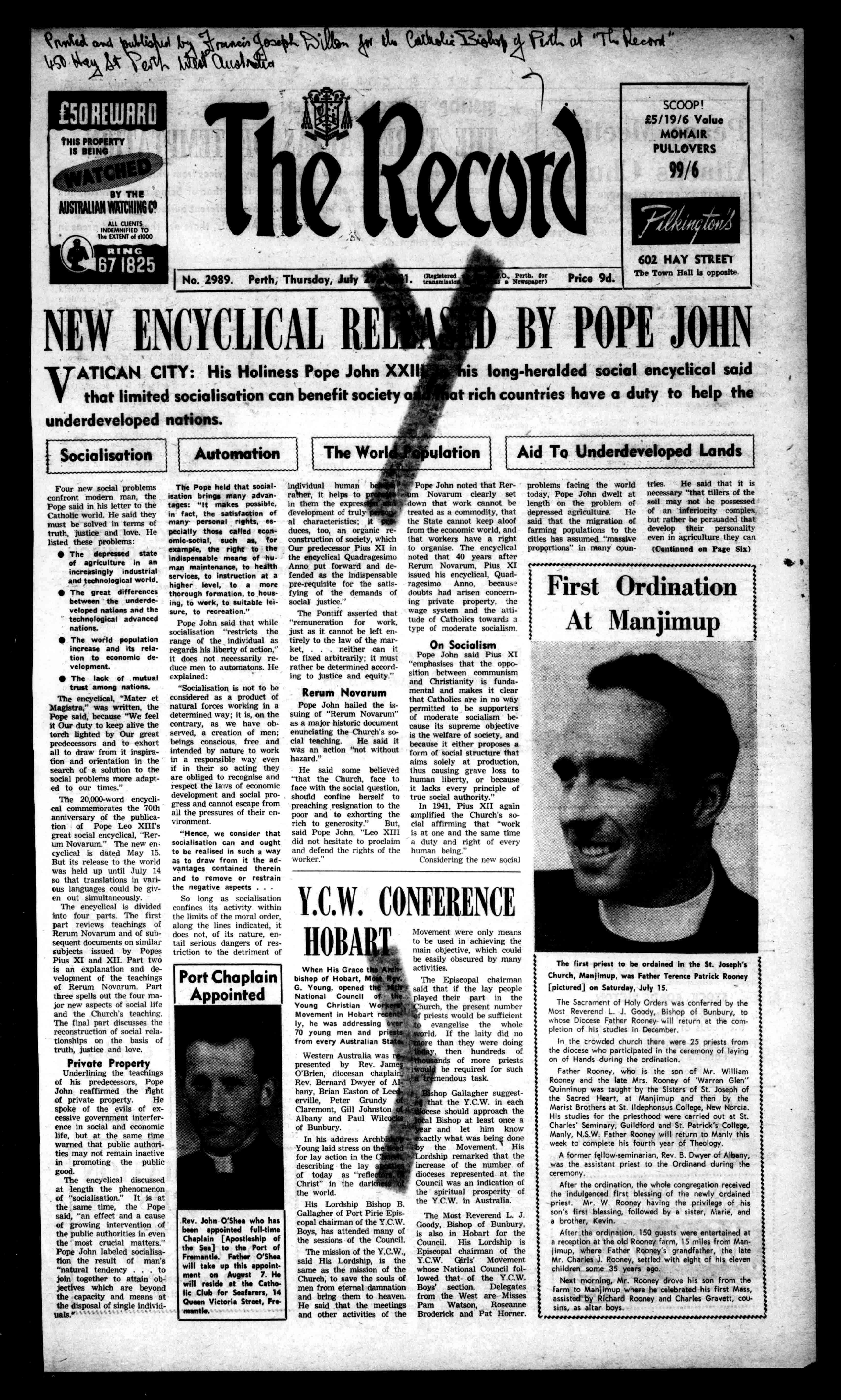
ThefirstpriesttobeordainedintheSt.Joseph's Church,Manjimup,wasFatherTerencePatrickRooney [pictured]onSaturday,July15.
TheSacramentofHolyOrderswasconferredbythe MostReverendL.J.Goody,BishopofBunbury,to whoseDioceseFatherRooneywillreturnatthecompletionofhisstudiesinDecember.
Inthecrowdedchurchtherewere25priestsfrom thediocesewhoparticipatedintheceremonyoflaying onofHandsduringtheordination.
FatherRooney,whoisthesonofMr.William RooneyandthelateMrs.Rooneyof'WarrenGlen" QuinrinupwastaughtbytheSistersofSt.Josephof theSacredHeart,atManjimupandthenbythe MaristBrothersatSt.IldephonsusCollege,NewNorcia. HisstudiesforthepriesthoodwerecarriedoutatSt. Charles'Seminary,GuildfordandSt.Patrick'sCollege, Manly,N.S.W.FatherRooneywillreturntoManlythis weektocompletehisfourthyearofTheology.
Aformerfallow-seminarian,Rev.B.DwyerofAlbany, wastheassistantpriesttotheOrdinandduringthe ceremony. Aftertheordination,thewholecongregationreceived theindulgencedfirstblessingofthenewlyordained priest.Mr.W.Rooneyhavingtheprivilegeofhis son'sfirstblessing,followedby sister,Marie,and abrother,Kevin.
Aftertheordination,150guestswereentertainedat areceptionattheoldRooneyfarm,15milesfromManjimup,whereFatherRooney'sgrandfather,thelate Mr.CharlesJ.Rooney,settledwitheightofhiseleven childrensome35yearsago.
Nextmorning,Mr.Rooneydrovehissonfromthe farmtoManjimupwherehecelebratedhisfirstMass, assistedbyRichardRooneyandCharlesGravett,cousins,asaltarboys.
Qua.0.4, kwele-- k( Ufktstfice4 ALLCLIENTS INDEMNIFIEDTO TheEXTENTof.1000 No.2989.Perth,Thursday,July (Registered tranamissio 0.47,::`,',;47, Price9d. SCOOP! £511916Value MOHAIR PULLOVERS 99/6 602HAYSTREET TheTownHallisopposite
VATICANCITY:HisHolinessPopeJohnXXII thatlimitedsocialisationconbenefitsocietya underdevelopednations.
JohnO'Sheawhohas beenappointedfull-time Chaplain[Apostleshipof theSea]tothePortof Fremantle.FatherO'Shea willtakeupthisappointmentonAugust7.He willresideattheCatholicClubforSeaf 14 QueenVictoriaStreet,Fremantle.
Appointed Rev.
!r4:. as% BYPOPEJOHN is
helpthe elation
long-heraldedsocialencyclicalsaid atrichcountrieshaveadutyto
it-
Socialisation
Fournewsocialproblems confrontmodernman,the Popesaidinhislettertothe Catholicworld.Hesaidthey mustbesolvedintermsof truth,justiceandlove.He listedtheseproblems:
Thedepressedstate ofagricultureinan increasinglyindustrial andtechnologicalworld.
Thegreatdifferences betweentheunderdevelopednationsandthe technologicaladvanced nations.
Theworldpopulation increaseanditsrelationtoeconomicdevelopment.
Thelackofmutual trustamongnations.
Theencyclical,"Materet Magistra,"waswritten,the Popesaid,because"Wefeel itOurdutytokeepalivethe torchlightedbyOurgreat predecessorsandtoexhort alltodrawfromitinspirationandorientationinthe searchofasolutiontothe socialproblemsmoreadaptedtoourtimes."
The20,000-wordencyclicalcommemoratesthe70th anniversaryofthepublicationofPopeLeoXIII's greatsocialencyclical,"RerumNovarum."ThenewencyclicalisdatedMay15.
Butitsreleasetotheworld washeldupuntilJuly14 sothattranslationsinvariouslanguagescouldbegivenoutsimultaneously.
Theencyclicalisdivided intofourparts.Thefirst partreviewsteachingsof RerumNovarumandofsubsequentdocumentsonsimilar subjectsissuedbyPopes PiusXIandXII.Parttwo isanexplanationanddevelopmentoftheteachings ofRerumNovarum.Part threespellsoutthefourmajornewaspectsofsociallife andtheChurch'steaching. Thefinalpartdiscussesthe reconstructionofsocialrelationshipsonthebasisof truth,justiceandlove.
PrivateProperty
Underliningtheteachings ofhispredecessors,Pope Johnreaffirmedtheright ofprivateproperty. He spokeoftheevilsofexcessivegovernmentinterferenceinsocialandeconomic life,butatthesametime warnedthatpublicauthoritiesmaynotremaininactive inpromotingthepublic good.
Theencyclicaldiscussed atlengththephenomenon of"socialisation."Itisat thesametime,thePope said,"aneffectandacause ofgrowinginterventionof thepublicauthoritiesineven themostcrucialmatters."
PopeJohnlabeledsocialisationtheresultofman's "naturaltendency to jointogethertoattainobjectiveswhicharebeyond thecapacityandmeansat thedisposalofsingleindividuals."
Automation
ThePopeheldthatsocialisationbringsmanyadvantages:"Itmakespossible. infact,thesatisfactionof many.personalrights,especiallythosecalledeconomic-social,suchas,for example.therighttothe indispensablemeansofhumanmaintenance,tohealth services,toinstructionata higherlevel,toamore thoroughformation,tohousing,tomirk,tosuitableleisure,torecreation."
PopeJohnsaidthatwhile socialisation"restrictsthe rangeoftheindividualas regardshislibertyofaction," itdoesnotnecessarilyreducementoautomatons.He explained:
"Socialisationisnottohe consideredasa naturalforcesworkingina determinedway:itis,onthe contrary,aswehaveobserved,acreationofmen: beingsconscious,freeand intendedbynaturetowork inaresponsiblewayeven ifintheirsoactingthey areobligedtorecogniseand respectthela:vsofeconomic developmentandsocialprogressandcannotescapefrom allthepressuresoftheirenvironment.
"Hence,weconsiderthat socialisationcanandought toberealisedinsuchaway astodrawfromittheadvantagescontainedtherein andtoremoveorrestrain thenegativeaspects
Solongassocialisation confinesitsactivitywithin thelimitsofthemoralorder, alongthelinesindicated,it doesnot,ofitsnature,entailseriousdangersofrestrictiontothedetrimentof
PortChaplain
Appointed
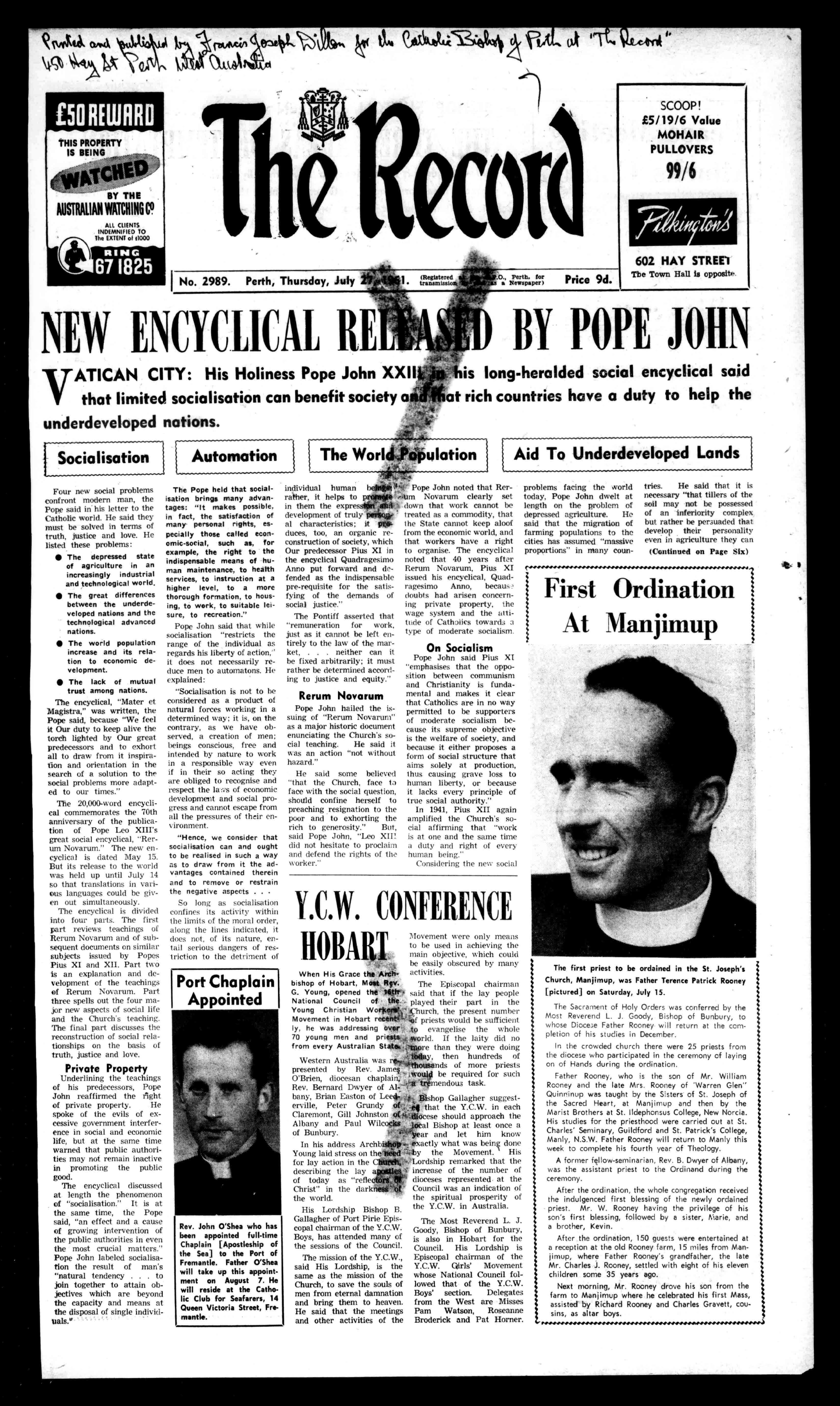
mentonAugust7.He willresideattheCatholicClubforSeafarers,14 QueenVictoriaStreet,Fremantle.
TheWorl.';ulation AidToUnderdevelopedLands
inthemtheex developmentoftruly alcharacteristics;it duces,too,anorganicreconstructionofsociety,which OurpredecessorPiusXIin theencyclicalQuadragesimo Annoputforwardanddefendedastheindispensable pre-requisiteforthesatisfyingofthedemandsof socialjustice."
individualhumanbellittill'4.1-PopeJohnnotedthatRerrather,ithelpsto 'AnNovarumclearlyset downthatworkcannotbe treatedasacommodity,that theStatecannotkeepaloof fromtheeconomicworld,and thatworkershavearight toorganise.Theencyclical notedthat40yearsafter RerumNovarum,PiusXI issuedhisencyclical,QuadragesimoAnno,becaus doubtshadarisenconcerningprivateproperty,the wagesystemandtheattitudeofCatholicstowardsa typeofmoderatesocialism.
ThePontiffassertedthat "remunerationforwork. justasitcannotbeleftentirelytothelawofthemarket, neithercanit befixedarbitrarily:itmust ratherbedeterminedaccordingtojusticeandequity."
RerumNovarum
PopeJohnhailedtheissuingof"RerumNovarum" asamajorhistoricdocument enunciatingtheChurch'ssocialteaching.Hesaidit wasanaction"notwithout hazard."
Hesaidsomebelieved "thattheChurch,faceIn facewiththesocialquestion, shouldconfineherselfto preachingresignationtothe poorandtoexhortingthe richtogenerosity."But, saidPopeJohn,"LeoXII'_ didnothesitatetoproclaim anddefendtherightsofthe worker."
OnSocialism PopeJohnsaidPiusXI "emphasisesthattheoppositionbetweencommunism andChristianityisfundamentalandmakesitclear thatCatholicsareinnoway permittedtobesupporters ofmoderatesocialismbecauseitssupremeobjective isthewelfareofsociety,and becauseiteitherproposesa formofsocialstructurethat aimssolelyatproduction, thuscausinggravelossto humanliberty,orbecause itlackseveryprincipleof truesocialauthority." In1941,PiusXIIagain amplifiedtheChurch'ssocialaffirmingthat"work isatoneandthesametime adutyandrightofevery humanbeing." Consideringthenewsocial
Y.C.W.CONFERENCE
MBAR"
problemsfacingtheworld today,PopeJohndweltat lengthontheproblemof depressedagriculture.He saidthatthemigrationof farmingpopulationstothe citieshasassumed"massive proportions"inmanycoun-
tries. Hesaidthatitis necessary"thattillersofthe soilmaynotbepossessed ofaninferioritycomplex butratherbepersuadedthat developtheirpersonality eveninagriculturetheycan
iContinuedonPageSix)
FirstOrdination AtManjimup
Movementwereonlymeans toheusedinachievingthe 4beeasilyobscuredbymany
mainobjective,whichcould
WhenHisGracetheArdh-activities.
bishopofHobart,meetRev. TheEpiscopalchairman G.Young,openedthelet(,saidthatifthelaypeople NationalCounciloftheplayedtheirpartinthe YoungChristianWorisepihtCchurch,thepresentnumber MovementinHobartrecenti'^;tifpriestswouldbesufficient ly,hewasaddressingover;fpevangelisethewhole 70youngmenandpriesNotorld.Ifthelaitydidno fromeveryAustralianStaitIllti rethantheyweredoing thenhundredsof ndsofmorepriests berequiredforsuch mendoustask.
WesternAustraliawasro presentedbyRev.Jame O'Brien,diocesanchaplain; Rev.BernardDwyerofAl; bany,BrianEastonofLee erville,PeterGrundy Claremont,GillJohnston AlbanyandPaulWil ofBunbury.
InhisaddressArchb
Younglaidstressonth forlayactioninthe describingthelay oftodayas"retie Christ"inthedar theworld.
HisLordshipBishopB. GallagherofPortPineEpiscopalchairmanoftheY.C.W. Boys,hasattendedmanyof thesessionsoftheCouncil.
ThemissionoftheY.C.W., saidHisLordship,isthe sameasthemissionofthe Church,tosavethesoulsof menfrometernaldamnation andbringthemtoheaven. Hesaidthatthemeetings andotheractivitiesofthe
hopGallaghersuggestthattheY.C.W.ineach eseshouldapproachthe alBishopatleastoncea arandlethimknow xactlywhatwasbeingdone ytheMovement.His Lordshipremarkedthatthe 41'increaseofthenumberof diocesesrepresentedatthe Councilwasanindicationof thespiritualprosperityof theY.C.W.inAustralia.
TheMostReverendL.J. Goody,BishopofBunbury, isalsoinHobartforthe Council.HisLordshipis Episcopalchairmanofthe Y.C.W.Girls'Movement whoseNationalCouncilfollowedthatoftheY.C.W. Boys'section.Delegates fromtheWestareMisses PamWatson,Roseanne BroderickandPatHomer.
ThefirstpriesttobeordainedintheSt.Joseph's Church,Manjimup,wasFatherTerencePatrickRooney [pictured]onSaturday,July15.
TheSacramentofHolyOrderswasconferredbythe MostReverendL.J.Goody,BishopofBunbury,to whoseDioceseFatherRooneywillreturnatthecompletionofhisstudiesinDecember.
Inthecrowdedchurchtherewere25priestsfrom thediocesewhoparticipatedintheceremonyoflaying onofHandsduringtheordination.
FatherRooney,whoisthesonofMr.William RooneyandthelateMrs.Rooneyof'WarrenGlen" QuinninupwastaughtbytheSistersofSt.Josephof theSacredHeart,atManjimupandthenbythe MaristBrothersatSt.IldephonsusCollege,NewNorcia. HisstudiesforthepriesthoodwerecarriedoutatSt. Charles'Seminary,GuildfordandSt.Patrick'sCollege, Manly,N.S.W.FatherRooneywillreturntoManlythis weektocompletehisfourthyearofTheology.
Aformerfallow-seminarian,Rev.B.DwyerofAlbany, wastheassistantpriesttotheOrdinandduringthe ceremony.
Aftertheordination,thewholecongregationreceived theindulgencedfirstblessingofthenewlyordained priest.Mr.W.Rooneyhavingtheprivilegeofhis son'sfirstblessing,followedbyasister,Marie,and abrother,Kevin.
Aftertheordination,150guestswereentertainedat areceptionattheoldRooneyfarm,15milesfromManjimup,whereFatherRooney'sgrandfather,thelate Mr.CharlesJ.Rooney,settledwitheightofhiseleven childrensome35yearsago.
Nextmorning,Mr.Rooneydrovehissonfromthe farmtoManjimupwherehecelebratedhisfirstMass, assistedbyRichardRooneyandCharlesGravett,cousins,asaltarboys.
BYTHE AUSTRALIANWATCHINGCP AllCLIENTS INDEMNIFIED10 TheEXTENT.1E1000 e-4L It4t The No.2989.Perth,Thursday,Julyifr
RE (Registered transmission ,E=r, Price9d. SCOOP! L5/1916Value MOHAIR PULLOVERS 99/6 602HAYSTREET TheTownHallisopposite BYPOPEJOHN VATICANCITY:HisHolinessPopeJohnXX1111*..,Nslong-heraldedsocialencyclicalsaid thatlimitedsocialisationcanbenefitsocietywinerichcountrieshaveadutytohelpthe *-. underdevelopednations.
NEWENCYCLICAL
Rev.JohnO'Sheawhohas beenappointedfull-time Chaplain[Apostleshipof theSealtothePortof Fremantle.FatherO'Shea willtakeupthisappoint-
it-
PeaceMeeting AttacksChurch
THEVATICANCITYNEWSPAPER,L'OSSERVATOREROMANO,BRANDEDLASTMONTH'S ALL-CHRISTIANPEACEMEETINGINPRAGUEA COMMUNISTATTEMPTTODIVIDECHRISTIANS.
Theeditorial,signedbyassistanteditorFederico Alessandrini,wasdescribedbytheVaticanPress Officeas"authoritative,"whichgenerallymeansthat itssubstantialelementsoriginatedwiththeSecretariat ofState.
L'Osservatorereportedthatsome700delegates,all non-CatholicChristians,attendedtheconference.They came,itsaid,fromCzechoslovakia,EastandWest Germany,Russia,Hungary,Rumania,France,SwitzerlandJapanandAfrica.Therewerealsoaboutforty delegatesfromtheUnitedStates.
'TakingitscuefromMetropolitanNicodemusofMoscow,statedtheeditorial,theconferencedegenerated intoapublicattackagainsttheCatholic.Church.The chargeslevelledagainsttheChurchweresummarised inthefinalresolutionoftheconference,whichwas quotedfromthereportintheParisnewspaperLe Monde:
"AnimportantnumberofodrChristianbrothersof theRomanChurchwho,likeourselves,aspiretopeace andstrivetoremovethecatastrophesofthecoldwar andopenwar,arebounddownbyconflictsofconscience whichthepracticalattitudesofmanyoftheirecclesiasticalheadshaveimposeduponthem.
"Theadministrativecirclesofthe'Vatican'Church encouragethespiritofthecoldwar.Whilestating thiswemustnotceasetoprayforourCatholicbrothers. MayGodprotecttheminHisloveandleadthemto recogniseHiswillandtoobeyalsothecommandment ofloveandofpeace ."
Anotherresolutioncondemned"racialdiscrimination andeveryformofcolonialism"anddemandedthe destructionofthermo-nuclearweapons.
Alessandrinicommentedthatitissaddeningtosee personscallingthemselvesChristianstakngsideswith thecommunistcourts-whicharegraduallyoppressing notonlyChristianitybuthumandignity.
"Onlyafewweeksagotheattorney-generalofBudapestspokeinthesamemanner:(asthePragueconference)atthetrialofpriestswhowerefaithfulto theirvocations,"hewrote.
Henotedthatsomeprotestswereraisedattheconferenceagainst"excessiveandinopportunecriticisms ofVaticanpolicy."Inspiteofthis.hewenton,the finalresolutionsattackingtheChurchwerepassedbya greatmajority"ofmenwhoconsiderthemselvesfree andfaithfultotheteachingsofChrist."
Hesaidthatbybackingtheseresolutionsthesemen contributedtothepoliticalinterestsoftheSovietsand joinedinthepersecutionoftheirCatholicbrothers.
AsforMetropolitanNicodemus,Allessandrinicalled attentiontothefactthathenowisscheduledtotake partinNovember'smeetitngoftheWorldCouncilof ChurchesinNewDelhi.Notsolongago,heobserved, MoscowopposedtheWorldCouncilofChurchesasan offensivearmof"Americanimperialism,"butnowit wantstojoinit.
REGALFURNISHERS
ARENOWAT
327CAMBRIDGESTREET,WEMBLEY (OppositeCharlieCartersNewSupermarket)
PHONE:8-3842
"WEBIJYANDSELLEVERYTHINGFORTHEHOME"
ST.JOSEPH'SHOSPITAL
Situatedinattractiveandrestfulsurroundingsat STOCKROAD,BICTON
istheLargestPrivateHospitalserving theneedsofFremantleDistrict.
TheLatestModernEquipmentassures Patientsofeverycomfort.
Phone:30-2347
MOBILECRANEFORHIRE
Litt.upto6tons
JIBLENGTHSUPTO64FT.
G.T.ROBINSON&Co.
3CLAUDEST..RIVERVALE
Phones:6-1605-6-6361 Atterhours26-1841
IPIANOS SpecialAffention CONVENTSandINSTITUTIONS SIM
*BISHOPFULTONJ.SHEENwriteson THETRHAREASOF
TEMPTATION
COMMONindeedisthetendencytojudgeothersbythevicesfromwhichweabstain.The greedyman,forexample,hatesnovicemorethanthatofbeingaspendthrift;the alcoholicisoftenimpatientwiththeproudman.Thesedifferentoutlookspointupthefact thatnotallaretemptedinexactlythesameway.Actually,therearethreebroadareasin whichonemaybetempted.
body. world rampal mind,th whichis nothingto amissing
Thepurp fortruthist togatherup itself,andthen
posedofmindamatter,orsouland ofthisunityi on,thereisthe Thesere threepossible hichtemp bedirected:the dthing thesehasagoal forit Temptationhas each,butonlywith ofeach.
Thepurposeo vidualhealthand oftentheconditio progeny.
Thingsexistoutsi complementtheimp needfoodforourst art,canvasonwhichto possessionswhicharean
Eachoftheseobjectives andtruthforthemind,no marriedlifefortherace,a tosupplytheeconomicwan
eknowledgeoftruth, Themindwascreated universeinknowledgewithin derenderthankstoGod. isthepreservationofindinrace.Ahealthybodyis ealthymindandasound theworld,inorderto fourpersonality.We eonwhichtoexercise totill,andingeneral ofourbeing. namely,knowledge tforthebody,and privateproperty mindandbody.
Butitispossibletohaveei ineachoftheseareas.Hence
essoradefect nbetemptedin hismind,inhisbodyandinrel tohispossessions. Mancanbetemptedinhismindtobeegotisticor selfish.Hemaymakehisegothedeterminantoftruth andgoodness.Hemaysay:"Ishallmeasuretheyardstickanddeterminewhetheritwillbe36or46inches." "Ishallrefusetoadmitthatalltruthisarelationship betweenmymindandGod,butbetweenmymindand myself.""WhateverIdecidetobegoodwillbegood, andwhateverIcallwrongwillbewrong."
Besidesself-willandegotism,anotherareaoftemptationisthebody.Amancanbetemptedtoabusefood
PortugueseGovernmentExplains
ClosingOfProlesantMissions
PROTESTANTmissionsinstrife-tornAngola,
alongwithCatholicmissions,wereclosedonly toprotectmissionaries'lives,ithasbeenstatedin LisbonbythePortugueseGeneralOverseas Agency.
Thisofficialgovernmentbodyspokeinanswerto Protestantandothercomplaintsagainsttheclosings byPortugueseofficialsintheWestAfricanterritory,whereanuprisingbyAfricannationalistshas takenthousandsoflives.
Theagencysaidthat"thedecisionsreachedby authoritiesinAngolatoclosedownthoseProtestant missionslocatedinareasthathavebeensubjected toattackSbytheterrorists-whichdecisionsapply equallytoCatholicmissions-havetheirbasisonly inourconcernforensuringpublicsafetyandprotectingthelivesofthemissionarieswhoworked andlivedinthoseareas.
"InviewofthefactthatthePortugueseauthoritieshavenot,uptonow,learnedofanyspecific reasonswhichmightprovideadefiniteandpositive assurancethattheProtestantmissionarieswould beaccordedspecialandfavourabletreatmentby theterroristbands,therewasabsolutelynobasis forexcludingthemfromthes easuresthat weregenerallyadoptedwith otherorganisationsandpersons."
OfficialE
July30: 7.30p.m.:
ConfirmationandCanonicalVisitation,Norseman.
August20: 10a.m.:PresideatSolemn
HighMassontheoccasion oftheGoldenJubilee,All Hallows'Church,Boulder.
A m. Vic
ents p.m.:Confirmation onicalVisitation,All s,Boulder. t22: nfirmationandCanoniisitation,Coolgardie. 23: ivedebutantes,the rCatholicBall. 24: ationandCanoniationSt.Mary's, rofessionCerenventofMercy. oriaSquare.
August24: ConfirmationandCanonicalVisitation,St.Mary'.; Church,Kalgoorlie.
September3: ConfirmationandCanonicalVisitation,Beverley.
September4-8: FirstPriests'Retreat,RedemptoristMonastery.
ordrinkbyexcessorbytakingtoolittle.Hemayalso treatotherpersonsas"things"-thatis,asmereinstrumentsforhiscarnalpleasures.
Finally,thethird'areaoftemptationistheworld outsideofus.Amanmaybetemptedtoaccumulate possessionsjustforthesakeofhavingmore,,orforthe sakeoferectingafalseinfinite,orbyrefusingtouse superfluouspossessionsforthesakeofthepoor.
Itisevidentthattemptationscancomefrominside ourownnature,aswellasfromoutside.Iftheydid nothavesomepointofattachmentinourcharacter, theywouldneversolicitus.
Whensolicitationsfromthesethreeareasareaccepted andconsentedtoandworkedoutintoaction,they becomesins.Thetemptationitself,however,isnosin, butcanbemerelyatestingofcharacter,forourspan inlifeisavaleofcharacter-making.
Temptation,therefore,maybepartlypenal,pursuing usfromthepastinwhicholdindulgencesmakeweaknessandfuturedefects.Ontheotherhand,theymay beopportunitiesforstrengtheningourcharacter.The truevisionofourgreatnessseestwoworldsincontest foroursouls.AsBrowningputsit: "Whenthefightbeginswithinhimself, Man'sworthsomething.Godstoopso'erhishead, Satanlooksupbetweenhisfeet-bothtugthesoulawakesandgrows.'
POLESRIOTTOPREVENT DEMOLITIONOFACHURCH
REPORTScomingintoBerlintellofrioting incommunist-ruledPolandagainstgovernmentinterferencewithchurch-building.
POLISHCatholicsinthe townofPrzysuchafought workmenwithsticksand stoneswhenthelatter triedtodemolishahalfcompletedchurchongovernmentorders.
Policewerecalledfrom asfaras40milesawayto quellthedisturbanceinthe town,whichisabout150 milessouthofWarsaw.
Thegovernmentordered workmentoteardownthe churchafteritrefusedto grantaconstructionpermit becausethebuilding"does notsatisfytheelementary requirementsofaestheticsor safety,"thereportssaid.The governmentclaimedthat materialsforthepartofthe churchthathadalready beenerectedwereobtained illegally.
LastyearsometwothousandpeopleriotedinNowz Hutawhenthegovernment revokeditspermitforthe constructionofachurch there.LaterintheyearCardinalWyszynski,Primateof Poland,accusedthegovernmentofbreakingitspromisesregardingthebuilding ofnewchurches.
InJune,1960,aboutfive thousandpeopledemonstratedinZielonaGora,a towninWesternPoland,to protestagainstgovernment attemptstotakeovera buildingusedforparish purposes.Policeanddemon stratorsengagedinstreet fighting.
In1959,morethanascore ofpersonswereinjured whenCatholicsandcommunistpoliceclashedinthe villageofKrasnikFabryczny,nearLublin.Theclash occurredafterRedauthoritiesdecidedtorazeachapel andshrineonthegrounds thattheyhadbeenputup withoutauthorisation.
Catholicsinanothertown, NoweTychy.hadalready
partiallybuiltthewallsofa* churchwhenmunicipalauthoritiesannouncedthey wouldnotallowtheconstructionworktogoonand hadthewallspulleddown.
During1958,therewere voilentincidentsbetween Catholicsandmilitiamen overtheburialofnonCatholicsinCatholiccemeteries.Theseincidentstook placeinthevillageofPoryte nearBialystokandinZurominnearWarsaw.
Printedandpublished
PageTwo THE RECORD Thursday,July27,1961
Confirmation andCanonicalVisitation,. Rivervale, August6: 7.30p.m.:Confirmati andCanonicalVisitati. Manning. CelebrationofFeastofSt. Alphonsus, Redemptorist Monastery. August13: 10a.m.:PresideSolmen HighMassatHighgateHill, occasionofCentenaryof FoundationofCongregation ofOurLadyoftheMissions. ReceptionCeremony,CarmeliteMonastery,Nedlands. August15: FirstProfessionCeremony. St.Mary's,Leederville. August18:
Contact MAXWELL ROBINSON &PHELPS 599Newcastle Street,Perth Phone 723741 CONFIRMATION CARDS NowAvailableat RECORDPRINT 450HayStreet,Perth PHONE:212837
byFrancis JosephDillon,"TheRecord"office, 450Hay-st.Perth.
PeaceMeeting AttacksChurch
THEVATICANCITYNEWSPAPER.L'OSSERVATOREROMANO.BRANDEDLASTMONTH'S ALL-CHRISTIANPEACEMEETINGINPRAGUEA COMMUNISTATTEMPTTODIVIDECHRISTIANS.
Theeditorial,signedbyassistanteditorFederico Alessandrini,wasdescribedbytheVaticanPress Officeas"authoritative,"whichgenerallymeansthat itssubstantialelementsoriginatedwiththeSecretariat ofState.
L'Osservatorereportedthatsome700delegates,all non-CatholicChristians,attendedtheconference.They came,itsaid,fromCzechoslovakia,EastandWest Germany,Russia,Hungary,Rumania,France,SwitzerlandJapanandAfrica.Therewerealsoaboutforty delegatesfromtheUnitedStates.
TakingitscuefromMetropolitanNicodemusofMoscow,statedtheeditorial,theconferencedegenerated intoa"publicattackagainsttheCatholicChurch.The chargeslevelledagainsttheChurchweresummarised inthefinalresolutionoftheconference,whichwas quotedfromthereportintheParisnewspaperLe Monde:
"AnimportantnumberofourChristianbrothersof theRomanChurchwho,likeourselves,aspiretopeace andstrivetoremovethecatastrophesofthecoldwar andopenwar,arebounddownbyconflictsofconscience whichthepracticalattitudesofmanyoftheirecclesiasticalheadshaveimposeduponthem.
"Theadministrativecirclesofthe'Vatican'Church encouragethespiritofthecoldwar.Whilestating thiswemustnotceasetoprayforourCatholicbrothers. MayGodprotecttheminHisloveandleadthemto recogniseHiswillandtoobeyalsothecommandment ofloveandofpeace ."
Anotherresolutioncondemned"racialdiscrimination andeveryformofcolonialism"anddemandedthe destructionofthermo-nuclearweapons.
Alessandrinicommentedthatitissaddeningtosee personscallingthemselvesChristianstakngsideswith thecommunistcourts'whicharegraduallyoppressing notonlyChristianitybuthumandignity.
"Onlyafewweeksagotheattorney-generalofBudapestspokeinthesamemanner(asthePragueconference)atthetrialofpriestswhowerefaithfulto theirvocations,"hewrote.
Henotedthatsomeprotestswereraisedattheconferenceagainst"excessiveandinopportunecriticisms ofVaticanpolicy."Inspiteofthis,hewenton,the finalresolutionsattackingtheChurchwerepassedbya greatmajority"ofmenwhoconsiderthemselvesfree andfaithfultotheteachingsofChrist."
Hesaidthatbybackingtheseresolutionsthesemen contributedtothepoliticalinterestsoftheSovietsand joinedinthepersecutionoftheirCatholicbrothers.
AsforMetropolitanNicodemus,Allessandrinicalled attentiontothefactthathenowisscheduledtotake partinNovember'smeetitngoftheWorldCouncilof ChurchesinNewDelhi.Notsolongago.heobserved, MoscowopposedtheWorldCouncilofChurchesasan offensivearmof"Americanimperialism,"butnowit wantstojoinit.
REGALFURNISHERS
ARENOWAT 327CAMBRIDGESTREET,WEMBLEY (OppositeCharlieCartersNewSupermarkets PHONE:8-3842
'WEBUYANDSELLEVERYTHINGFORTHEHOME"
ST.JOSEPH'SHOSPITAL
Situatedinattractiveandrestfulsurrounding:at STOCKROAD,BICTON istheLargestPrivateHospitalserving theneedsofFremantleDistrict, TheLatestModernEquipmentassures Patientsofeverycomfort. Phone:30-2347
MOBILECRANEFORHIRE Liftsupto6tons
JIBLENGTHSUPTO64FT.
G.T.ROBINSON&Co.
3CLAUDEST.,RIVERVALE
Phones:6-1605-6-6361 Afterhours26-1841
PIANOS SpecialAttention CONVENTSandINSTITUTIONS
*BISHOPFULTONJ.SHEENwriteson THETHREEAREASOFTEMPTATION
COMMONindeedisthetendencytojudgeothersbythevicesfromwhichweabstain.The greedyman,forexample,hatesnovicemorethanthatofbeingaspendthrift;the alcoholicisoftenimpatientwiththeproudman.Thesedifferentoutlookspointupthefact thatnotallaretemptedinexactlythesameway.Actually,therearethreebroadareasin whichonemaybetempted.
MA body. world rampar mind.th whichis nothingto amissing
88BARRACKSTREET,PERTH iZranches
laposedofminda ofthisunityi Theserep hichtemp
dthing forits
Thepurp fortruthist togatherup itself,andthen
Thepurposeo vidualhealthand oftentheconditio progeny.
Thingsexistoutsi complementtheimp needfoodforoursto art,canvasonwhichto possessionswhicharean
Eachoftheseobjectives andtruthforthemind,no marriedlifefortherace,a tosupplytheeconomicwan
Butitispossibletohaveei ineachoftheseareas.Hence,
matter,orsouland on,thereisthe threepossible bedirected:the thesehasagoal n.Temptationhas feach,butonlywith ofeach.
heknowledgeoftruth, Themindwascreated universeinknowledgewithin derenderthankstoGod. isthepreservationofindinrace.Ahealthybodyis ealthymindandasound theworld,inorderto fourpersonality.We eonwhichtoexercise totill,andingeneral ofourbeing. namely,knowledge tforthebody,and privateproperty mindandbody. essoradefect nbetemptedin hismind,inhisbodyandinrel tohispossessions.
Mancanbetemptedinhismindtobeegotisticor selfish.Hemaymakehisegothedeterminantoftruth andgoodness.Hemaysay:"Ishallmeasuretheyardstickanddeterminewhetheritwillbe36or46inches." "Ishallrefusetoadmitthatalltruthisarelationship betweenmymindandGod,butbetweenmymindand myself.""WhateverIdecidetobegoodwillbegood, andwhateverIcallwrongwillbewrong."
Besidesself-willandegotism,anotherareaoftemptationisthebody.Amancanbetemptedtoabusefood
PortugueseGovernmentExplains
ClosingOfProtesantMissions
PROTESTANTmissionsinstrife-tornAngola, alongwithCatholicmissions,wereclosedonly toprotectmissionaries'lives,ithasbeenstatedin LisbonbythePortugueseGeneralOverseas Agency.
Thisofficialgovernmentbodyspokeinanswerto Protestantandothercomplaintsagainsttheclosings byPortugueseofficialsintheWestAfricanterritory,whereanuprisingbyAfricannationalistshas takenthousandsoflives.
Theagencysaidthat"thedecisionsreachedby authoritiesinAngolatoclosedownthoseProtestant missionslocatedinareasthathavebeensubjected toattacksbytheterrorists-whichdecisionsapply equallytoCatholicmissions-havetheirbasisonly inourconcernforensuringpublicsafetyandprotectingthelivesofthemissionarieswhoworked andlivedinthoseareas.
"InviewofthefactthatthePortugueseauthoritieshavenot.uptonow,learnedofanyspecific reasonswhichmightprovideadefiniteandpositive assurancethattheProtestantmissionarieswould beaccordedspecialandfavourabletreatmentby theterroristbands,therewasabsolutelynobasis forexcludingthemfromthes easuresthat weregenerallyadoptedwith otherorganisationsandpersons." e,
OfficialEngaments
10a.m.:PresideSolmen
HighMassatHighgateHill, occasionofCentenaryof FoundationofCongregation ofOurLadyoftheMissions. ReceptionCeremony,CarmeliteMonastery,Nedlands.
August15: FirstProfessionCeremony. St.Mary's,Leederville.
August18: ConfirmationandCanonicalVisitation,Norseman.
August20: 10a.m.:PresideatSolemn HighMassontheoccasion oftheGoldenJubilee,All Hallows'Church,Boulder.
24: ationandCanonitionSt.Mary's, rofessionCerem. ofMercy, VictoriaSquare.
August24: ConfirmationandCanonicalVisitation,St.Mary', Church,Kalgoorlie.
September3: ConfirmationandCanonicalVisitation,Beverley.
September4-8: FirstPriests'Retreat,RedemptoristMonastery.
ordrinkbyexcessorbytakingtoolittle.Hemayalso treatotherpersonsas"things"-thatis,asmereinstrumentsforhiscarnalpleasures.
Finally,thethird-areaoftemptationistheworld outsideofus.Amanmaybetemptedtoaccumulate possessionsjustforthesakeofhavingmore,.orforthe sakeoferectingafalseinfinite,orbyrefusingtouse superfluouspossessionsforthesakeofthepoor.
Itisevidentthattemptationscancomefrominside ourownnature,aswellasfromoutside.Iftheydid nothavesomepointofattachmentinourcharacter, theywouldneversolicitus.
Whensolicitationsfromthesethreeareasareaccepted andconsentedtoandworkedoutintoaction,they becomesins.Thetemptationitself,however,isnosin, butcanbemerelyatestingofcharacter,forourspan inlifeisavaleofcharacter-making.
Temptation,therefore,maybepartlypenal,pursuing usfromthepastinwhicholdindulgencesmakeweaknessandfuturedefects.Ontheotherhand,theymay beopportunitiesforstrengtheningourcharacter.The truevisionofourgreatnessseestwoworldsincontest foroursouls.AsBrowningputsit:
"Whenthefightbeginswithinhimself, Man'sworthsomething.Godstoopso'erhishead, Satanlooksupbetweenhisfeet-bothtugthesoulawakesandgrows:'
POLESRIOTTOPREVENT DEMOLITIONOFACHURCH
REPORTScomingintoBerlintellofrioting incommunist-ruledPolandagainstgovernmentinterferencewithchurch-building.
POLISHCatholicsinthe townofPrzysuchafought workmenwithsticksand stoneswhenthelatter triedtodemolishahalfcompletedchurchongovernmentorders.
Policewerecalledfrom asfaras40milesawayto quellthedisturbanceinthe town,whichisabout150 milessouthofWarsaw.
Thegovernmentordered workmentoteardownthe churchafteritrefusedto grantaconstructionpermit becausethebuilding"does notsatisfytheelementary requirementsofaestheticsor safety,"thereportssaid.The governmentclaimedthat materialsforthepartofthe churchthathadalready beenerectedwereobtained illegally.
LastyearsometwothousandpeopleriotedinNowz Hutawhenthegovernment revokeditspermitforthe constructionofachurch there.LaterintheyearCardinalWyszynski,Primateof Poland,accusedthegovernmentofbreakingitspromisesregardingthebuilding ofnewchurches.
InJune,1960,aboutfive thousandpeopledemonstratedinZielonaGora,a towninWesternPoland,to protestagainstgovernment attemptstotakeovera buildingusedforparish purposes.Policeanddemon stratorsengagedinstreet fighting.
In1959,morethanascore ofpersonswereinjured whenCatholicsandcommunistpoliceclashedinthe villageofKrasnikFabryczny,nearLublin.Theclash occurredafterRedauthoritiesdecidedtorazeachapel andshrineonthegrounds thattheybadbeenputup withoutauthorisation. Catholicsinanothertown, NoweTychy.hadalready
partiallybuiltthewallsofa' churchwhenmunicipalauthoritiesannouncedthey wouldnotallowtheconstructionworktogoonand hadthewallspulleddown.
During1958,therewere voilentincidentsbetween Catholicsandmilitiamen overtheburialofnonCatholicsinCatholiccemeteries.Theseincidentstook placeinthevillageofPoryte nearBialystokandinZurominnearWarsaw.
PrintedandpublishedbyFrancis JosephDillon,"TheRecord"office, 450Has-stPerth.
PageTwo THE RECORD Thursday,July27,1961 4
throughouttheState
July30: 7.1I)p.m.:Confirmation 7.30p.m.:Confirmation-lind,ellnonicalVisitation,All andCanonicalVisitation,...161100Vs,Boulder. Rivervale. woolliest22: nfirmationandCanoniisitation,Coolgardie. t23: wedebutantes,the CatholicBall. August6: 7.30p.m.:Confirmati andCanonicalVisitati Manning. CelebrationofFeastofSt.Alphonsus, Redemptorist Monastery.
13:
August
Contact MAXWELL ROBINSON &PHELPS 599Newcastle Street,Perth Phone 283741 CONFIRMATION CARDS NowAvailableat RECORDPRINT 450HayStreet,Perth PHONE:212837
IWOassistinVocationsWeek,"TheRecord"
publishesonthispagealistofthevarious communitiestowhichenquiriescouldbe madebythoseinterestedtofindoutmore aboutthepriesthoodandthereligiouslife.
THEDIOCESANPRIESTHOOD cotersspfar the tuallifeofpeopleinparishes.Commonly coiledsecularpriests,theyoremenwhoare ordainedtothepriesthoodforaparticular diocese.
MostofthepriestsoftheArchdioceseof PerthreceivedtheirtraininginIrishseminariesandwereacceptedfortheArchdiocese onapplicationtotheArchbishop.Thelocally bornweresentindaysprevioustovarious ItaliancollegesandtoWerribee,inVictoria, andManly,inNewSouthWales.
Since1942,thebulkofourseminarians havebeentrainedinSt.Charles'sSeminary, Guildford,andSt.Patrick'sCollege,Manly.
TheSeminaryofSt.Charlesisconducted fortheArchdiocesebytheVincentian Fathers.Enquiriescanbemodetoanypriest concerningtherequirementsforentry.
ReligiousOrdersForPRIESTS:
THEOBLATESOFMARY
IMMACULATE Founded fromtheAnglo-Irishprovincein1894.TheFathers carryoutparishworkand conductretreatsandmissions.Theirmainhouseis inAdelaideStreet,Fremantle.
THECONGREGATION OFTHEMOSTHOLY REDEEMER(Redemptorist Fathers):FoundedinPerth in1899,theydevotethemselveschieflytogivingmissions,retreatsattheinvitationoftheBishopand ParochialClergy.TheRedemptoristFathersalsohave lay-brothersintheirmonasteries.ThePerthfoundationisinVincentStreet, NorthPerth.
THESOCIETYOFJESUS: Foundedin1938inthePerth Archdiocese,theJesuit FathersconductSt.Louis'
MALERELIGIOUS NURSES
HospitallerBrothersof St.JohnofGod
Forfourhundredyearsthe HospitallerOrderhascared formalepatientswhether physicallyormentallyill. HaveyouconsideredconsecratingyourlifetoGodin theserviceofHissick? Forfurtherparticulars writeto: Rev.Br.NoviceMaster St.JohnofGodBrothers Morisset,N.S.W.
MenthatNurseforChrist.
JESUITBROTHER-IFyou areabout20-40yearsofage, ANDdesiretogiveyour WetoGodinaReligious Order,YETdonotfeelcalled tobeaPriestorTeacher, THENyouwillbeinterested tolearnsomethingofthe lifeoftheJesuitBrother. Aftertwoandahalfyears oftraining,hetakesthe usualthreevowsofpoverty, chastityandobedienceasa Jesuit,andshareswiththe JesuitPriestsinallthe Order'sworksforGodeither inAustraliaorontheIndian Mission.Forbookletson theJesuitPriestorJesuit Brotherwritetothe: INFORMATIONBUREAU, LOYOLACOLLEGE, WATSONIA,VICTORIA.
School,Claremont,andalso theparishofAttadaleand St.TomasMoreUniversity College.
THESOCIETYOFTHE CATHOLICAPOSTOLATE (PallottineFathers)were foundedfromBroomein 1944.Theyconductthe NativeMissionatWanderingandhaveaMission CentreatRiverton.
THECONGREGATIONOF THEMISSION(Vincentian Fathers)cametoPerthin 1948.TheyconductSt. Charles'Seminary,Guildford,andalsoaparishat Medina.
THEFRANCISCAN FATHERS:Foundedin Perthin1950,theyconduct theparishofMidlandJunction.
THEORDEROFSERVANTSOFMARY(Servite Fathers):FoundedinPerth in1951;theyconductthe parishesofTuartHilland Wanneroo,andalsoteachin theSt.Philip'sRegional School.ThePrioryissituatedinRobertsStreet,Joondana.
THEORDEROFFRIARS PREACHERS(Dominican Fathers):Foundedin1954. areinchargeoftheparish ofNorthDoubleview.
THEDISCALCEDCARMELITEFATHERS,who cametoPerthin1956,have chargeoftheparishof MorleyPark.
THEMARISTFATHERS: Foundedin1956,have chargeoftheparishof Redcliffe.
TUECARMELITE FATHERS:Foundedin1956, theyhavechargeofthe parishofHiltonParkand NazarethHouse.
THESOCIETYOFST. PAUL:Foundedin1956, theyhavechargeofthe parishofSwanbourneand careofMaltesemigrants.
THENORBERTINE FATHERS:Foundedfrom Irelandin1959,havecharge oftheparishofYork.
THESOCIETYOFTHE
DIVINESAVIOUR(The Salyatorians):Foundedfrom Englandin1961,hascharge oftheparishofMidvale.
Religious
ForMEN
Orders
CHRISTIANBROTHERS: FoundedfrontMelbournein 1894,theyhaveeightcornmunitiesinthePerthArchdiocese.TheBrothersteach inboys'schoolsandconduct orphanages.Thenumberof Religiousis70.
THEMARISTBROTHERS: Foundedin1948,havetwo communitiesandconduct schoolsatNorthamandat Subiaco.Thenumberof Religiousis12.
DELASALLEBROTHERS:
Foundedin1954,theyhave onecommunityoffourReligiousandteachschoolat MidlandJunction.
LAYBROTHERSFOR
THESOCIETYOFJESUS: SeeJesuitFathers.
LAYBROTHERSFOR THE NORBERTINE
FATHERS:SeeNorbertine Fathers.
LAYBROTHERSFOR THEDOMINICAN
FATHERS:SeeOrderof FriarsPreachers.
ReligiousOrders
ForWOMEN
SISTERSOFMERCY (AustralianUnion):Were thefirstorderofreligious SistersinvitedtotheWest, andwerefoundedfrom Dublinin1846.Theirfirst conventwasatVictoria Square,Perth.InSeptember; 1954,Perthunitedwith sevenotherprovincesand formedtheAustralianUnion ofSistersofMercywithits HeadHouseinCanberra. Thereare15Housesinthe PerthArchdiocesewith240 Religious.TheHeadHouse isatVictoriaSquare,Perth.
SISTERSOFMERCY (AustralianFederatipn): FoundedfromVictoria Squarein1896.Became membersoftheAustralian Federationin1956.The HeadHouseisatSt.Brigid's inWestPerth,andtheir NovitiateisatSt.Mary's Leederville.Therearefour communitiesandthenumber ofReligiousis08.
SISTERSOFST.sosgPii OFTHEAPPARITION: FoundedfromFrancein 1855,theyhaveninecommunitieswith96Religioius. ProvincialHouseandNovitiateisatSt.Joseph'sConveal,AdelaideStreet,Fremantle.
SISTERSOFST.JOHN OFGOD:Foundedfrom Wexfordin1995,theSisters conducthospitalsatSubiaco, Kalgoorlie,ftivervaleand Northam.Thenumberof
communitiesisfourand thereare234Religious.
CONGREGATIONOFOUR
LADYOFTHEMISSIONS: FoundedfromChristchurch, NewZealand,in1897,there arenowfivecommunities with74Religious.TheSistersconductschoolsatHighgate,Maylands,EastFremantle,Rockinghamand Palmyra.
LITTLESISTERSOF THEPOOR,"Glendalough," carefortheaged.Thereare 20inthecommunity.
SISTERSOFOURLADY OFCHARITYOFTHE GOODSHEPHERD(Good ShepherdSisters):Founded fromAbbotsford,Victoria, in1902.Thecommunitynow numbers23.TheSisterscare forwaywardgirls.Their HomeissituatedinWest LeedervilleandtheirNovitiateisinAbbotsford,Victoria.
THEPRESENTATION SISTERS:Foundedfrom WaggaWagga,N.S.W.,in 1900.Thereareeightcommunitieswith51Religious.
TheSistersteachprimary andsecondaryeducation.
SISTERSOFST.JOSEPH OFTHESACREDHEART: Conductprimaryandsecondaryschools.Thereare sevencommunitiesatSouth Perth,Boulder,Kalgoorlie, Kellerberrin,Merredinand Pinjarra.TheyalsoconducttheKellerberrinPreventorium.62Religious.
THEINSTITUTEOFTHE BLESSEDVIRGINMARY (LoretoSisters):Founded fromBallarat,Victoria,in 1897.Therearetwocommunities,whichteachat Loreto"Osborne"andNedlands.41Religious.
THECARMELITENUNS (acontemplativeOrder): FoundedfromSydneyin 1935,Thereare14Religious.
THEDOMINICANSISTERS(AustralianCongregation);Establishedin Francein1206andinAustraliain1867.Theyconduct theirgeneralNovitiateand TrainingCollegeatWahroonga,NewSouthWales. NumberofcommunitiesIn PerthArchdioceseisthreeatInglewood,Scarborough andBentley.39Religious.
THEBRIGIDINESISTERS: FoundedfromSydneyin 1942,theyconducttheBrigidineConventatSubiaco. Thereare18Religious.
THEURSULINESOFTHE SACREDHEART:Founded fromParmainItaly(expelledfromChinain1952), theSistershaveacommunityatCarilla,wherethey conductaparochialschool, andoneatSt.Charles' Seminary,Guildford.They number12Religious.
THECONGREGATIONOF THEPOORSISTERSOF OURLADY:Foundedfrom Hungary(expelledfrom Chinain1951).Thereare threecommunities-atSubiaco,Clontarf"Boys'Town" andLesmurdie.17Religious.
THESCHOENSTATTSISTERSOFMARY(S.A.C.): FoundedfromGermanyin 1953,TheSistersconductthe schoolatRivertonandthe St.FrancisXavier'sNative MissionatWandering.The numberofReligiousiseight.
THEDAUGHTERSOF CHARITYOFSTVINCENTDEPAUL:Founded fromSydneyin1956.There aresevenReligiouswhorun St.Vincent'sHospice,Guildford,andteachatSt. Anthony'sSchool,Bellevue. Theyconductthe"Soup Kitchen"atWestPerthand aNightShelterforWomen.
THEPOORSISTERSOF NAZARETH:Foundedfrom Londonin1956.TheSisters conductNazarethHousein HiltonPark.Therearesix Religious.
SISTERSOFTHEHOLY FAMILYOFNAZARETH: FoundedfromtheU.S.A.in 1957,theyconductakindergartenschoolandparochial schoolatNorthBeach.The communitynumbersfive.
WHITECANONSOFPREMONTRE
Thursday,July27,1961 THE RECORD PageThree APAGEFULLOFFACT fOTHOSEWHOWOULD ANDINFORMATION-VOCATIONSWEEKMAKERGODTERWHOLELIFE INTHEPERTHARCHDIOCESE THEREARE 111DIOCESAN AND63 ERELIGIOUSPRIESTS 51111111111111111111H11111111101111111111141010011111111011,) -------= 96RELIGIOUS BROTHERSAND 1,050NUNS f11111111111111111111111111111111111i1111111111111111111111111illir
20,325CHILDREN INCATHOLIC SCHOOLS SIXHOSPITALS ANDTHREEOLD -E.PEOPLE'SHOMES 5111111991911119911111911110111111111111111111111111111111r 5111111111111111111111111111111111111111111111111111111111111" Oft EANATIVEMISSION AT WANDERING 511111191111911119911911111111111111111111111111111119111, THE(YOUNG)IDEA!
playonthe
Church.
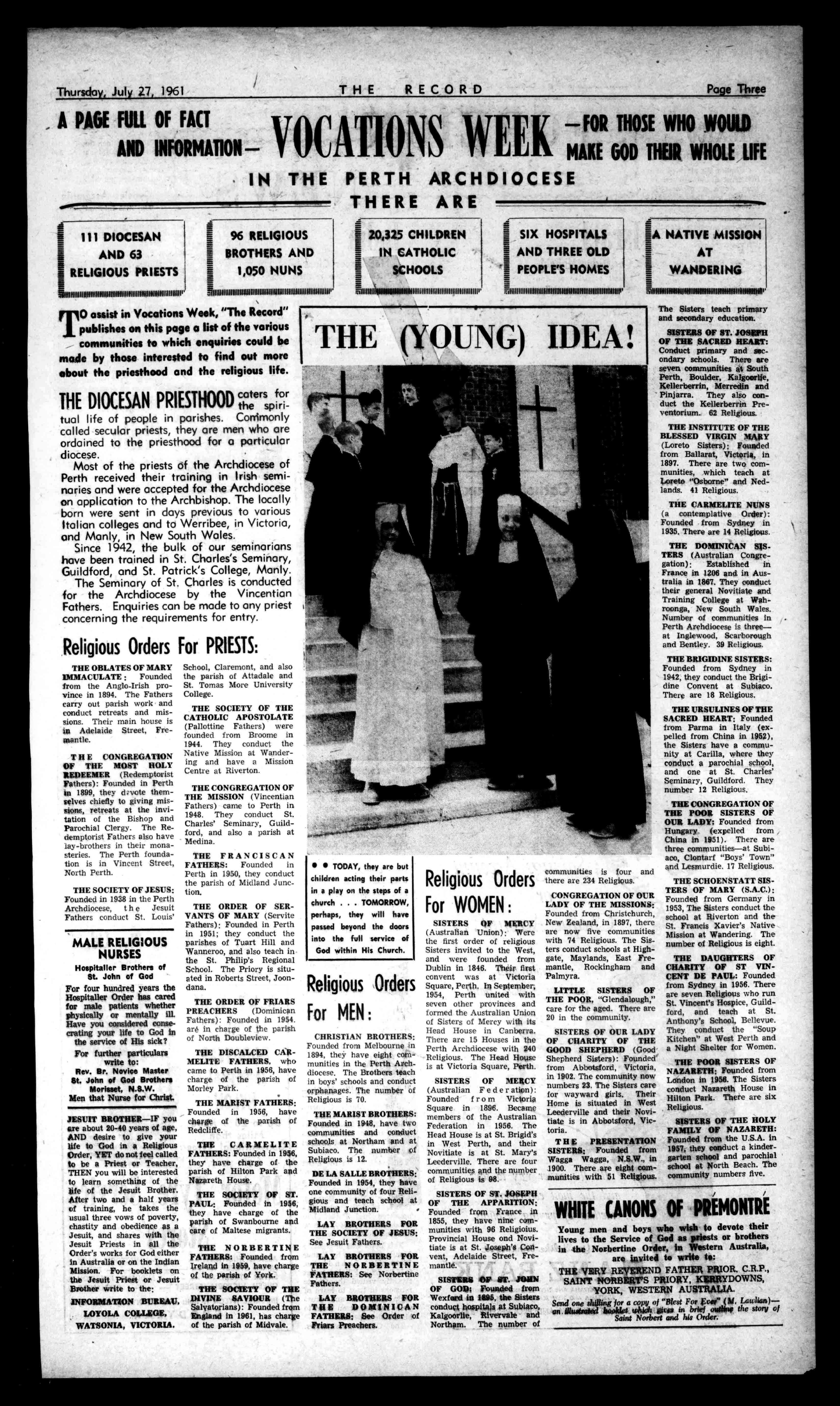
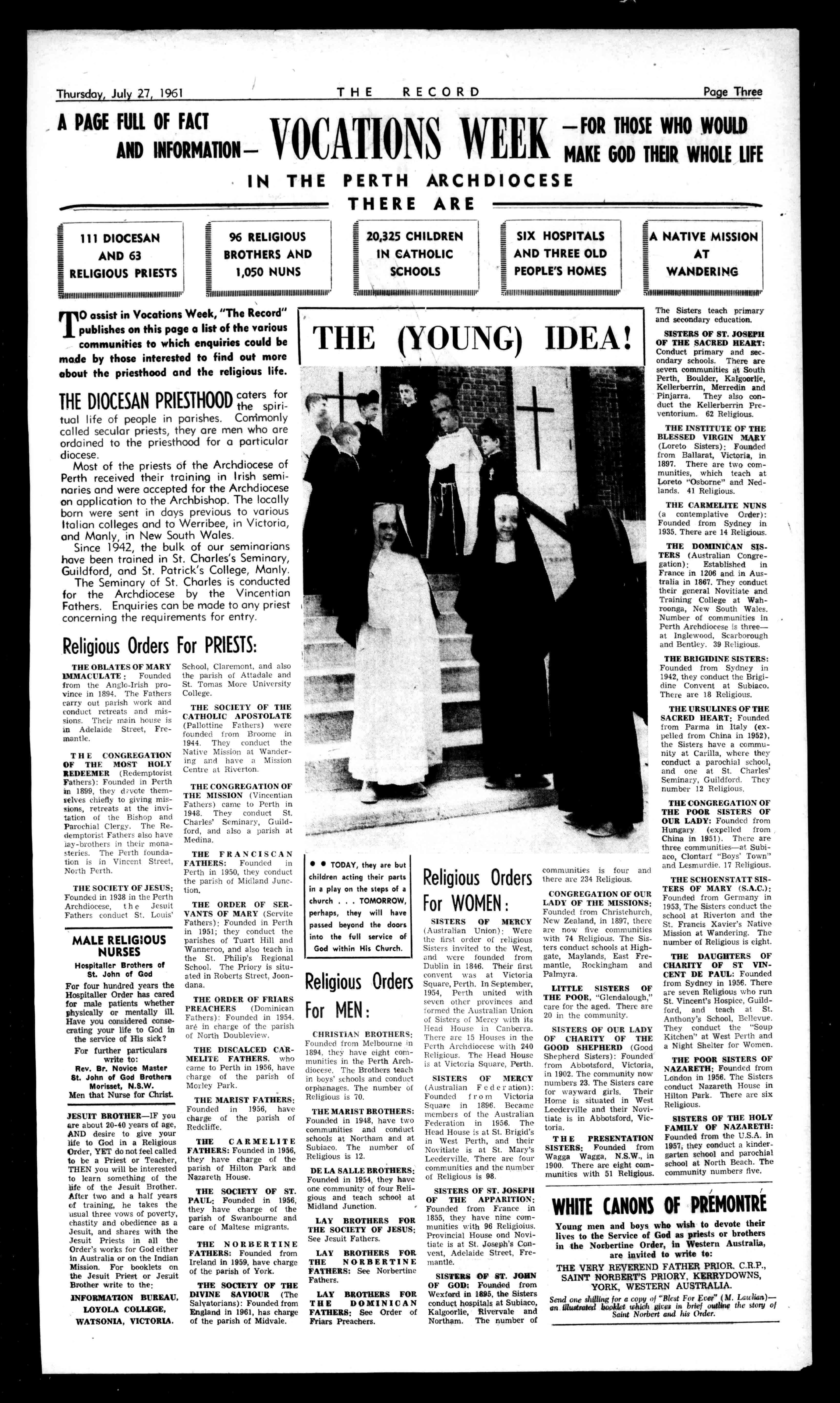
TODAY,theyarebut childrenactingtheirparts ina
stepsofa church TOMORROW, perhaps,theywillhave passedbeyondthedoors intothefullserviceof GodwithinHis
Youngmenandboyswhowishtodevotetheir livestotheServiceofGodaspriestsorbrothers intheNorbertineOrder,inWesternAustralia, areinvitedtowriteto: THEVERYREVERENDFATHERPRIOR,C.R.P., SAINTNORBERT'SPRIORY,KERRYDOWNS, YORK,WESTERNAUSTRALIA. Sendoneshillingforacopyof"BlestForP.4i'(M.Lauliononilittebeeedbookletwhichgicsainbrief°elfin,thestoryof SaintNorbertandhisOrder.
111DIOCESAN AND63 RELIGIOUSPRIESTS
20,325CHILDREN
AT WANDERING
IMOassistinVocationsWeek,"TheRecord"
publishesonthispagealistofthevarious communitiestowhichenquiriescouldbe madebythoseinterestedtofindoutmore oboutthepriesthoodandthereligiouslife.
THEDIOCESANPRIESTHOOD caters thepfor tuallifeofpeopleinparishes.Commonly calledsecularpriests,theyoremenwhoare ordoinedtothepriesthoodforaparticular diocese.
MostofthepriestsoftheArchdioceseof PerthreceivedtheirtraininginIrishseminariesandwereacceptedfortheArchdiocese onapplicationtotheArchbishop.Thelocally bornweresentindaysprevioustovarious ItaliancollegesandtoWerribee,inVictoria, andManly,inNewSouthWales.
Since1942,thebulkofourseminarians hovebeentrainedinSt.Charles'sSeminary, Guildford,andSt.Patrick'sCollege,Manly.
TheSeminaryofSt.Charlesisconducted fortheArchdiocesebytheVincentian Fathers.Enquiriescanbemadetoanypriest concerningtherequirementsforentry.
ReligiousOrdersForPRIESTS:
THEOBLATESOFMARY IMMACULATE Founded fromtheAnglo-Irishprovincein1894.TheFathers carryoutparishworkand conductretreatsandmissions.Theirmainhouseis toAdelaideStreet,Fremantle.
THECONGREGATION OFTHEMOSTHOLY REDEEMER(Redemptorist Fathers):FoundedinPerth an1899,theydevotethemselveschieflytogivingmissions,retreatsattheinvitationoftheBishopand ParochialClergy.TheRedemptoristFathersalsohave say-brothersintheirmonasteries.ThePerthfoundationisinVincentStreet, NorthPerth.
THESOCIETYOFJESUS: Foundedin1938inthePerth Archdiocese,the Jesuit FathersconductSt.Louis'
MALERELIGIOUS NURSES
HospitallerBrothersof St.JohnofGod
Forfourhundredyearsthe HospitallerOrderhascared formalepatientswhether physicallyormentallyill. HaveyouconsideredconsecratingyourlifetoGodin theserviceofHissick?
Forfurtherparticulars writeto: Rev.Br.NoviceMaster St.JohnofGodBrothers Morisset,N.S.W. MenthatNurseforChrist.
JESUITBROTHER-IFyou oreabout20-40yearsofage, ANDdesiretogiveyour lifetoGodinaReligious Order,YETdonotfeelcalled tobeaPriestorTeacher, THENyouwillbeinterested tolearnsomethingofthe lifeoftheJesuitBrother. Aftertwoandahalfyears oftraining,hetakesthe usualthreevowsofpoverty, chastityandobedienceasa Jesuit,andshareswiththe JesuitPriestsinallthe Order'sworksforGodeither InAustraliaorontheIndian Mission.Forbookletson theJesuitPriestorJesuit Brotherwritetothe:
INFORMATIONBUREAU, LOYOLACOLLEGE, WATSONIA,VICTORIA.
School,Claremont,andalso theparishofAttadaleand St.TomasMoreUniversity College.
THESOCIETYOFTHE CATHOLICAPOSTOLATE (PallottineFathers)were foundedfromBroomein 1944.Theyconductthe NativeMissionatWanderingandhaveaMission CentreatRiverton.
THECONGREGATIONOF THEMISSION(Vincentian Fathers)cametoPerthin 1948.TheyconductSt. Charles'Seminary,Guildford,andalsoaparishat Medina.
THEFRANCISCAN FATHERS:Foundedin Perthin1950,theyconduct theparishofMidlandJunction,
THEORDEROFSERVANTSOFMARY(Servite Fathers):FoundedinPerth in1951;theyconductthe parishesofTuartHilland Wanneroo,andalsoteachin theSt.Philip'sRegional School.ThePrioryissituatedinRobertsStreet,Joondana.
THEORDEROFFRIARS PREACHERS(Dominican Fathers):Foundedin1954. areinchargeoftheparish ofNorthDoubleview.
THEDISCALCEDCARMELITEFATHERS.who cametoPerthin1956,have chargeoftheparishof MorleyPark.
THEMARISTFATHERS: Foundedin1956,have chargeoftheparishof Redcliffe.
THECARMELITE FATHERS:Foundedin1956, theyhavechargeofthe parishofHiltonParkand NazarethHouse.
THESOCIETYOFST. PAUL:Foundedin1956, theyhavechargeofthe parishofSwanbourneand careofMaltesemigrants.
THENORBERTINE FATHERS:Foundedfrom Irelandin1959,havecharge oftheparishofYork.
THESOCIETYOFTHE DIVINESAVIOUR(The Salvatorians):Foundedfrom Englandin1961,hascharge oftheparishofMidvale.
TODAY,theyarebut childrenactingtheirparts inaplayonthestepsofa church TOMORROW, perhaps,theywillhave passedbeyondthedoors intothefullserviceof GodwithinHisChurch.
ReligiousOrders
ForMEN
CHRISTIANBROTHERS: FoundedfromMelbournein 1894,theyhaveeightcommunitiesinthePerthArchdiocese.TheBrothersteach inboys'schoolsandconduct orphanages.Thenumberof Religiousis70.
THEMARISTBROTHERS: Foundedin1948,havetwo communitiesandconduct schoolsatNorthamandat Subiaco.Thenumberof Religiousis12.
DELASALLEBROTHERS:
Foundedin1954,theyhave onecommunityoffourReligiousandteachschoolat MidlandJunction.
LAYBROTHERSFOR
THESOCIETYOFJESUS: SeeJesuitFathers.
LAYBROTHERSFOR THE NORBERTINE
FATHERS:SeeNotbertino Fathers.
LAYBROTHERSFOR THEDOMINICAN
FATHERS:SeeOrderof FriarsPreachers.
ReligiousOrders
ForWOMEN: SISTERSOFMERCY (AustralianUnion):Were thefirstorderofreligious SistersinvitedtotheWest, ,Indwerefoundedfrom Dublinin1846.Theirfirst conventwasatVictoria Square,Perth.InSeptember, 1954,Perthunitedwith sevenotherprovincesand formedtheAustralianUnion ofSistersofMercywithits HeadHouseinCanberra. Thereare15Housesinthe PerthArchdiocesewith240 Religious.TheHeadHouse isatVictoriaSquare,Perth.
SISTERSOFMERCY (AustralianFederation): FoundedfromVictoria Squarein1896.Became membersoftheAustralian Federationin1956.The HeadHouseisatSt.Brigid's inWestPerth,andtheir NovitiateisatSt.Mary's Leederville.Therearefour communitiesandthenumber ofReligiousis98.
SISTERSOFST.JOSEPH
OFTHEAPPARITION: FoundedfromFrancein 1855,theyhaveninecommunitieswith96Religioius. ProvincialHouseandNovitiateisatSt.Joseph'sConvent,AdelaideStreet,Fremantle.
SISTERSOFST.JOHN
OFGOD:Foundedfrom Wexfordin1895,theSisters conducthospitalsatSubiaco, Kalgoorlie,Rivervaleand Northam.Thenumberof
communitiesisfourand thereare234Religious.
CONGREGATIONOFOUR LADYOFTHEMISSIONS: FoundedfromChristchurch, NewZealand,in1897,there arenowfivecommunities with74Religious.TheSistersconductschoolsatHighgate,Maylands,EastFremantle,Rockinghamand Palmyra.
LITTLESISTERSOF THEPOOR,"Glendalough," carefortheaged.Thereare 20inthecommunity.
SISTERSOFOURLADY OFCHARITYOFTHE GOODSHEPHERD(Good ShepherdSisters):Founded fromAbbotsford,Victoria, in1902.Thecommunitynow numbers23.TheSisterscare forwaywardgirls.Their HomeissituatedinWest LeedervilleandtheirNovitiateisinAbbotsford,Victoria.
THEPRESENTATION SISTERS:Foundedfrom WaggaWagga,N.S.W.,in 1900,Thereareeightcommunitieswith51Religious.
TheSistersteachprimary andsecondaryeducation.
SISTERSOFST.JOSEPH OFTHESACREDHEART: Conductprimaryandsecondaryschools.Thereare sevencommunitiesatSouth Perth,Boulder,Kalgoorlie, Kellerberrin,Merredinand Pinjarra.TheyalsoconducttheKellerberrinPreventorium.62Religious.
THEINSTITUTEOFTHE BLESSEDVIRGINMARY (LoretoSisters):Founded fromBallarat,Victoria,in 1897.Therearetwocommunities,whichteachat Loreto"Osborne"andNedlands.41Religious.
THECARMELITENUNS (acontemplativeOrder): FoundedfromSydneyin 1935.Thereare14Religious.
THEDOMINICANSISTERS(AustralianCongregation): Establishedin Francein1206andinAustraliain1867.Theyconduct theirgeneralNovitiateand TrainingCollegeatWahroonga,NewSouthWales. NumberofcommunitiesIn PerthArchdioceseisthreeatInglewood,Scarborough andBentley.39Religious.
THEBRIGIDINESISTERS: FoundedfromSydneyin 1942,theyconducttheBrigidineConventatSubiaco. Thereare18Religious.
THEURSULINESOFTHE SACREDHEART:Founded fromParmainItaly(expelledfromChinain1952), theSistershaveacommunityatCarilla,wherethey conductaparochialschool, andoneatSt.Charles' Seminary,Guildford.They number12Religious.
THECONGREGATIONOF THEPOORSISTERSOF OURLADY:Foundedfrom Hungary(expelledfrom Chinain1951).Thereare threecommunities-atSubiaco,Clontarf"Boys'Town" andLesmurdie.17Religious.
THESCHOENSTATTSISTERSOFMARY(S.A.C.): FoundedfromGermanyin 1953,TheSistersconductthe schoolatRivertonandthe St.FrancisXavier'sNative MissionatWandering.The numberofReligiousiseight.
THEDAUGHTERSOF CHARITYOFSTVINCENTDEPAUL:Founded fromSydneyin1956.There aresevenReligiouswhorun St.Vincent'sHospice,Guildford,andteachatSt. Anthony'sSchool,Bellevue. Theyconductthe"Soup Kitchen"atWestPerthand aNightShelterforWomen.
THEPOORSISTERSOF NAZARETH:Foundedfrom Londonin1956.TheSisters conductNazarethHousein HiltonPark.Therearesix Religious.
SISTERSOFTHEHOLY FAMILYOFNAZARETH: FoundedfronttheU.S.A.in 1957,theyconductakindergartenschoolandparochial schoolatNorthBeach.The communitynumbersfive.
WHITECANONSOFPREMONTRE
Youngmenandboyswhowishtodevotetheir livestotheServiceofGodaspriestsorbrothers intheNorbertineOrder,inWesternAustralia, areinvitedtowriteto: THEVERYREVERENDFATHERPRIOR.C.R.P., SAINTNORBERT'SPRIORY,KERRYDOWNS, YORK,WESTERNAUSTRALIA.
Sendoneshillingforacopyof"BlestFor1:cer"(M.Lettlian)anillustratedbookletwhichgleesinbrief(Milnethestoryof SaintNorbertandhisOrder.
Thursday,July27,1961 THE RECORD PageThree APAGEFULLOFFACT FOTHOSEWOWOU ANDINFORMATION VOCATIONS WEEK-MAKERGODTHEIRHWHOLELLDIFE INTHEPERTHARCHDIOCESE THERE
ARE
i111111111111111111111111111111111111111111111111111111111111111V
711111111111111111111111111111111111111111111111111111111111111111,
96RELIGIOUS BROTHERSAND 1,050NUNS
INCATHOLIC SCHOOLS 73111111111111111111111111111111111i1111111i11111111111111111111111, SIXHOSPITALS ANDTHREEOLD PEOPLE'SHOMES :11111,11111111111111111111111111111111111111111111111111111111, E-ANATIVEMISSION -ft
THE(YOUNG)IDEA!
Mexico
ArsonAttempted
Catholicsarealarmedand indignantatanattemptto burndownaconventin Mexicali,neartheCalifornia border.
Ahome-madeincendiary bombknownasaMolotov cocktail,wasthrownintothe patiooftheconvent.Itburst intoflames,butwas,extinguishedthroughthepresenceofmindofanunwho waswashingclothesnearby. Othernunscametoherassistance.
InMexicoCity,Castroist slogansoftheopenlycommunisttypewerepaintedin biglettersonthewallsof theColegioMexico,oneof theoldestschoolsinthe country.
Theslogansread:"Cuba yes,Yankeesno,"and "Communismyes,priests no."
TheColegioMexicois staffedbyMaristBrothers.
Spain
War-TimeConvert
AformerlieutenantcoloneloftheU.S.Arno wholongedtobecomea CatholicwhenhesawCatholicchaplainsministertothe dyingInthesecondworld war,hasbeenordaineda priestinBarcelona.
HeisFatherOrlandoA. Molina,S.D.B.,whowas bornofSpanishparentsin Tampa,Florida.
ThenewSalesianpriest saidthatinthewaragainst Japanhesawmanycompanionsfallandcryoutfor Godinthetrenches.They wereconsoledbyCatholic priestsattheriskoftheir lives."Ithoughtthatone dayIwouldliketobeoneof them,"heexplained.
FatherMolinaenteredthe Churchwhileservinginthe KoreanWar,Hejoinedthe Salesiansandcompletedhis studiesinSpain.Hewill returntotheUnitedStates towork.
Israel
ChristiansUpheld
IsraeliMinisterofEducationAbbaEbansaidin Jerusalemitwouldbeundemocratic43forbidJewish parentstosendtheirchildrentoChristianmission schoolsandchurches.
TheEducationMinister spokefollowingawaveof anti-Christianfeelingcaused bythetrialofAdolfEichmann,theformerNaziofficialchargedwiththemurder ofmillionsofJewsduring thelastwar.
RabbiMenahinPorush,of thesmallOrthodoxJewish politicalpartyAgudatIsrael, saidintheKnesset(Parliament):"Ourfacesredden
withshamewhenweseein thestreetsofJerusalem, JaffaandHaifachildren walkinginrankandfile, childrensavedfromthe Naziterror,accompaniedby priestsandnuns."
Algeria
PlasticBombsUsed
TheresidenceofArch-. bishopLeon-EtienneDuval ofAlgierswasdamagedin thewaveofbombingsthat tookplaceinAlgiersontfus Frenchnationalholipay, BastilleDay,July14.
India
NotUpperClass CatholicsofMysoreState haveprotestedagainsta governmentcommission's rulingthatIndia'sCatholics arean"advancedcommunity"andthereforenotentitledtopreferentialtreatmentfromthegovernment.
headedbyBishopEtienne Loosdregt,O.M.I.,theVicar ApostolicofVientiane,have nointentionofleavingLaos. FatherLeandichosaid. Thesameistrueofthe ParisForeignMissionaries underBishopJeanArnaud, M.E.P.,VicarApostolicof Thakhek.
TwoFrenchOblatepriests-FatherLouisLeroy,O.M.I. andVincentL'Henoret. 0.M.I.-werekilledbythe PathetLaoinXiengKhouangprovincelastApriland Mayrespectively.
theircountriesandthecosts oflivinginItaly.forsix years.
Boardingfacilitiesforthe newcentreinclude300 rooms.plusreadingandrecreationroomsandanauditoriumseating300.
GypsiesAssemble
ThefirstinternationalreligiousassemblyofCatholic gypsiesopenedattheshrine ofMontagnadiPine,near Trent.
Longlinesofcaravans movedalongthehighways onthedayspriortothe assembly'sopeningbearing gypsytribesfromYugoslavia,Austria,Germany, ItalyandFrance.Theassemblyopenedwiththe WayoftheCross.Two Frenchpriestsandone Italian,chaplainsofthe gypsiesintheircountries, concludedtheassemblyin thecourseofwhichmany werebaptised,confirmedand receivedtheirfirstCommunion.Manyweddingswere alsoperformed.
About20plastic'bombs wereexplodedinthe mostofthemdamaging,,askedthegovernmentof Moslemplacesofbusiness.tIndiatoreclassifyCatholics
WishOfPiusXI
A25-year-olddreamwill berealisedsoonwhenItaly's onlyCatholicuniversitywill openamedicalschooland hospitalinRome. Registrationsarealready beingtakenbythenew medicalfacultyoftheCatholicUniversityoftheSacred HeartofMilan.Thisfulfils thewishofPopePiusXI, whodonatedlandinRome's MonteMariodistrictin1934 foraCatholicmedical school.
Themedicalschoolwas promotedovertheyearsby theuniversity'sfounder, FranciscanFatherAgostino Gemelli,whodiedinJuly, 1959.Theschoolhasbeen grantedprivilegesequalto thoseofothermedicalfacultiesinItaly.
Theuniversitywilladmit, .underspecialterms,students whocannotaffordthecosts ofeducationandscholarship studentsfromtheAfroAsiancountries.Scholarshipsforthelatterwillincludetransportationfrom
Chile
ChurchLostGround
Onehundredyearsagoin Santiagotherewasone priestforevery585Catholics. Todaythereisone forevery2.595.
ThesestatisticswererevealedbyFatherCharlesF. McCarthy,MM.,former MaryknollVocationDirector whoisnowservingona committeetoencourage youngChileanstostudyfor thediocesanpriesthood.
"TheChurchherehasgone backwardsfivetimesin100 years,butthisretrogression indiocesanvocationsisnot confinedtoChile;similardeclineshaveoccurredinmost ofLatinAmerica,"saidFr. McCarthy."Tocheckthis trend,95U.S.priests,45of themMaryknollers,arebolsteringthesparseChilean clergywiththehopeOfestablishingonceagaina Churchofnativestone."
Laos
"Accidental"Killing
BrotherAlexisGumene, O.M.I.,hasbeenkilledin LaosinXiengKhouangprovince.mostofwhichisheld bythecommunistPathet Laoforces.
Hewasshotintheheart "accidentally,"accordingto thePathetLao.Hewasa nativeofFrance.
FatherMarioBorzaga, O.M.I.,ofItaly,whodisappearedintoPathetLao handsinMay,1960,isnow believeddead.
Thisnewswasbroughtto ManilafromLaosbyFather BienvenidoLeandicho, O.M.I.ThisFilipinopriest recentlyvisitedtheOblate missionsinLaostolearnof theirsituationsandprospectsandreportonthemto hisOblatesuperiors. TheOblatemissionaries.
Page
Four
4H0561.54
THERECORD
Thursday,July27,1961 NEWS1
UnderIndianlaw,communities recognisedas "backward"areentitledto receivefinancialaidfrom thegovernment.Admission toinstitutionsofhigher learningisalsomadeeasier formembersofbackward communities. TheMysoreCatholicActionSocietyhasformally AtCatholicSiouxIndiandongress SavingsAccount Or ChequeAccount smartgirls relyonA.NZ.Bank It'stheeasiernaytosave andthemostconvenient methodofpayingaccounts goatface,beotIciitgat AN*ZBANK AUSTRALIAANDNEWZEALANDRANKLIMITED AUSTRALIAANDNEWZEALANDSAVINGSRANKLIMITED AUSTRAUA'SMOSTFRIENDLYANDPROGRESSIVEBANK AMONGthemanyIndianswhoattendedthe70th annualCatholicSiouxIndian Congress,heldatSt.Francis IndianMission,werean AmericanIndianpriestanda groupofIndianSisters.In thephotoareSisterTherese, SisterKatherine,S.D.S.,Fr. I.Brown,S.J.,nowamissionarytoCrowIndians,and SisterCabrini. asabackwardcommunity. Itsaid:"UnlesstheIndian
lowestrung
In
communityhasmost
ed
economiccondition
far
thatofanyothercommunity intheState."
Christiansaretreatedasa backwardcommunity,with theattendantprivileges,we fearthattheywillbeatthe
oftheladderin thematterofsocialprogress.
Mysoreandsomeother IndianStatestheChristian
ofits membersfromtheDepress-
Classesandtheir
is
below
`.. OR1,TSTUCKERand AURISCH ,P1.11A11,TS PHONE21-210 ,c,u1 1012111YST.,PERTH SERVICE SATISFACTION ECONOMY LEAHY'SSHOESTORE 409FITZGERALDSTREET,NORTHPERTH Phone28-2175 ..P.0 LawnMowersSharpenedandSet HarryArmstrongPty.Ltd. CITYCOUNCILAVENUE-21-4390. PICKEDUPandDELIVERED DON'TWAIT ToEnjoythe Benefitof GOODYEAR IMPERIAL NYLON Upto20%More Milesthan ConventionalTyres fromyour MotorTyreService Stores ALBANYHIGHWAY----VICTORIAPARK JAMESSTREET PERTH SAYERSTREET----MIDLANDJUNCTION QUEENVICTORIASTREET---FREMANTLE IMPERIALNYLONisbuiltwith3.TNYLONCORDby GOODYEAR
Mexico
ArsonAttempted
Catholicsarealarmedand indignantatanattemptto burndownaconventin Mexicali,neartheCalifornia border.
Ahome-madeincendiary bombknownasaMolotov cocktail,wasthrownintothe patiooftheconvent.Itburst intoflames,butwasextinguishedthroughthepresenceofmindofanunwho waswashingclothesnearby. Othernunscametoherassistance.
InMexicoCity,Castroist slogansoftheopenlycommunisttypewerepaintedin biglettersonthewallsof theColegioMexico,oneof theoldestschoolsinthe country.
Theslogansread:"Cuba yes,Yankeesno,"and "Communismyes,priests no."
TheColegioMexicois sirRedbyMaristBrothers.
Spain
War-TimeConvert
AformerlieutenantcoloneloftheU.S.Arms wholongedtobecomea CatholicwhenhesawCatholicchaplainsministertothe dyinginthesecondworld war,hasbeenordaineda priestinBarcelona.
HeisFatherOrlandoA. Molina.S.D.B.,whowas bornofSpanishparentsin Tampa,Florida. ThenewSalesianpriest saidthatinthewaragainst Japanhesawmanycompanionsfallandcryoutfor Godinthetrenches.They wereconsoledbyCatholic priestsattheriskoftheir lives."Ithoughtthatone dayIwouldliketobeoneof them,"heexplained.
FatherMolinaenteredthe Churchwhileservinginthe KoreanWar.Hejoinedthe Salesiansandcompletedhis studiesinSpain.Hewill returntotheUnitedStates towork.
FOREIGN
Israel
ChristiansUpheld
IsraeliMinisterofEducationAbbaEbansaidin JerusalemitwouldbeundemocratictoforbidJewish parentstosendtheirchildrentoChristianmission schoolsandchurches.
TheEducationMinister spokefollowingawaveof anti-Christianfeelingcaused bythetrialofAdolfEichmann,theformerNaziofficialchargedwiththemurder ofmillionsofJewsduring thelastwar.
RabbiMenahinPorush,of thesmallOrthodoxJewish politicalpartyAgudatIsrael, saidintheKnesset(Parliament):"Ourfacesredden
withshamewhenweseein thestreetsofJerusalem, JaffaandHaifachildren walkinginrankandfile, childrensavedfromthe Naziterror,accompaniedby priestsandnuns."
Algeria
PlasticBombsUsed
TheresidenseofArchbishopLeon-EtienneDuval ofAlgierswasdamagedin thewaveofbombingsth4 tookplaceinAlgiersonthe Frenchnationalholiday. BastilleDay,July14.
About20plasticbombs wereexplodedinthecity', mostofthemdamaging Moslemplacesofbusiness.
India
NotUpperClass CatholicsofMysoreState haveprotestedagainsta governmentcommission's rulingthatIndia'sCatholics arean"advancedcommunity"andthereforenotentitledtopreferentialtreatmentfromthegovernment.
UnderIndianlaw,communitiesrecognised as "backward"areentitledto receivefinancialaitifrom thegovernment.Admission toinstitutionsofhigher learningisalsomadeeasier formembersofbackward communities.
TheMysoreCatholicActionSocietyhasformally askedthegovernmentof IndiatoreclassifyCatholics At
headedbyBishopEtienne Loosdregt,O.M.I.,theVicar ApostolicofVientiane,have nointentionofleavingLaos. FatherLeandichosaid.
Thesameistrueofthe ParisForeignMissionaries underBishopJeanArnaud, M.E.P.,VicarApostolicof Thakhek.
TwoFrenchOblatepriests-FatherLouisLeroy,O.M.I. andVincentL'Henoret. O.M.I.-werekilledbythe PathetLaoinXiengKhouangprovincelastApriland Mayrespectively.
theircountriesandthecosts oflivinginItaly_forsix years. Boardingfacilitiesforthe newcentreinclude300 rooms.plusreadingandrecreationroomsandanauditoriumseating300.
GypsiesAssemble
ThefirstinternationalreligiousassemblyofCatholic gypsiesopenedattheshrine ofMontagnadiPine,near Trent.
Longlinesofcaravans movedalongthehighways onthedayspriortothe assembly'sopeningbearing gypsytribesfromYugoslavia,Austria,Germany, ItalyandFrance.Theassemblyopenedwiththe WayoftheCross.Two Frenchpriestsandone Italian,chaplainsofthe gypsiesintheircountries, conductedtheassemblyin thecourseofwhichmany werebaptised,confirmedand receivedtheirfirstCommunion.Manyweddingswere alsoperformed.
Chile
ChurchLostGround

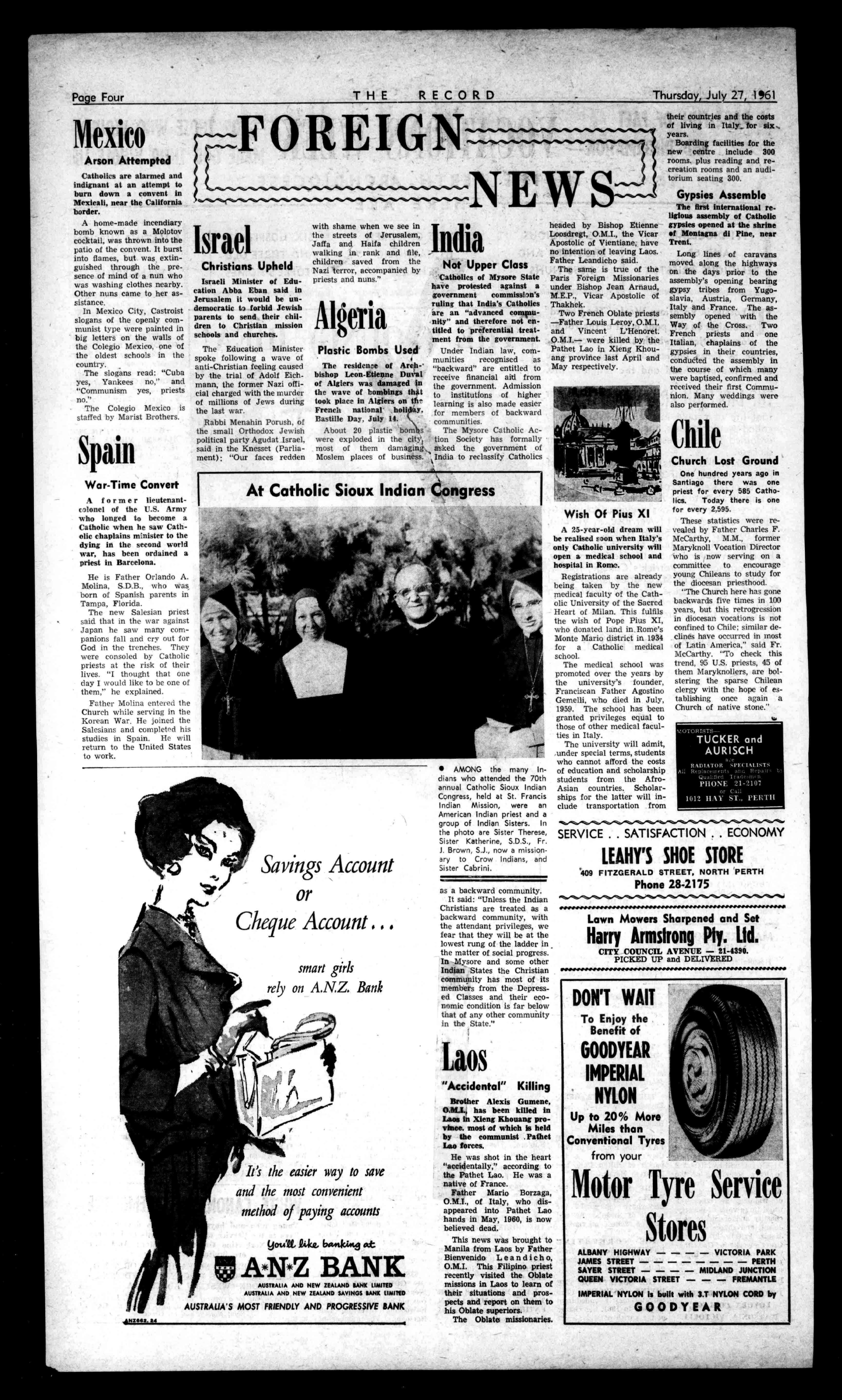
AMONGthemanyIndianswhoattendedthe70th annualCatholicSiouxIndian Congress,heldatSt.Francis IndianMission,werean AmericanIndianpriestanda groupofIndianSisters.In thephotoareSisterTherese, SisterKatherine,S.D.S.,Fr. J.Brown,S.J.,nowamissionarytoCrowIndians,and SisterCabrini.
asabackwardcommunity.
Itsaid:"UnlesstheIndian Christiansaretreatedasa backwardcommunity,with theattendantprivileges,we fearthattheywillbeatthe lowestrungoftheladderin thematterofsocial progress. InMysoreandsomeother IndianStatestheChristian communityhasmostofits membersfromtheDepress. edClassesandtheireconomicconditionisfarbelow thatofanyothercommunity intheState."
Laos
"Accidental"Killing
BrotherAlexisGumene, O.M.I.,hasbeenkilledin LaosinXiengKhouangprovince.mostofwhichisheld bythecommunistPathet Laoforces.
Hewasshotintheheart "accidentally,"accordingto thePathetLao.Hewasa nativeofFrance.
FatherMarioBorzaga, O.M.I.,ofItaly,whodisappearedintoPathetLao handsinMay,1960,isnow believeddead.
Thisnewswasbroughtto ManilafromLaosbyFather BienvenidoLeandicho, O.M.I.ThisFilipinopriest recentlyvisitedtheOblate missionsinLaostolearnof theirsituationsandprospectsandreportonthemto hisOblatesuperiors. TheOblatemissionaries.
WishOfPiusXI
A25-year-olddreamwill berealisedsoonwhenItaly's onlyCatholicuniversitywill openamedicalschooland hospitalinRome. Registrationsarealready beingtakenbythenew medicalfacultyoftheCatholicUniversityoftheSacred HeartofMilan.Thisfulfils thewishofPopePiusXI, whodonatedlandinRome's MonteMariodistrictin1934 foraCatholicmedical school.
Themedicalschoolwas promotedovertheyearsby theuniversity'sfounder, FranciscanFatherAgostino Gemelli,whodiedinJuly, 1959.Theschoolhasbeen grantedprivilegesequalto thoseofothermedicalfacultiesinItaly.
Theuniversitywilladmit, underspecialterms,students whocannotaffordthecosts ofeducationandscholarship studentsfromtheAfroAsiancountries.Scholarshipsforthelatterwillincludetransportationfrom
Onehundredyearsagoin Santiagotherewasone priestforevery585Catholics. Todaythereisone forevery2,595. ThesestatisticswirerevealedbyFatherCharlesF. McCarthy,M.M.,former MaryknollVocationDirector whoisnowservingona committeetoencourage youngChileanstostudyfor thediocesanpriesthood.
"TheChurchherehasgone backwardsfivetimesin100 years,butthisretrogression indiocesanvocationsisnot confinedtoChile;similardeclineshaveoccurredinmost ofLatinAmerica,"saidFr. McCarthy."Tocheckthis trend,95U.S.priests,45of themMarylcnollers,arebolsteringthesparseChilean clergywiththehopeofestablishingonceagaina Churchofnativestone."
PageFour
THERECORD
Thursday,July271961
NEWS-
4 SavingsAccount Or ChequeAccount smartgirls relyonA.NZ.BankIt'stileeasierwaytosave andthemostconvenient methodofpayingaccounts youTtPike,banick4'tg ANZBANK AUSTRALIAANDNEWZEALANDBANKLIMITED AUSTRALIAANDNEWZEALANDSAVINGSBANKLIMITED AUSTRALIA'SMOSTFRIENDLYANDPROGRESSIVEBANK 14
CatholicSiouxIndianCongress
TUCKERand AURISCH a:e RADIATORSPECIALISTS AllReplacementsandRepairsb, QuallftedTradesmen. PHONE21-2107 orcan 1012HAYST.,PERTH SERVICE SATISFACTION ECONOMY LEAHY'SSHOESTORE 409FITZGERALDSTREET,NORTHPERTH Phone28-2175 LawnMowersSharpenedandSet HarryArmstrongPty.Ltd. CITYCOUNCILAVENUE-21-4390. PICKEDUPandDELIVERED DON'TWAIT ToEnjoythe Benefitof GOODYEAR IMPERIAL NYLON Upto20%More Milesthan ConventionalTyres fromyour MotorTyreService Stores ALBANYHIGHWAY----VICTORIAPARK JAMESSTREET PERTH SAYERSTREET----MIDLANDJUNCTION QUEENVICTORIASTREET---FREMANTLE IMPERIALNYLONisbuiltwith3.TNYLONCORDby GOODYEAR
SILVERJUBILEEOFC.B.H.S.HIGHGATE AMEMORYAND ACHALLENGE
TWENTY-FIVEyearsago,onFebruary11th,1936,C.B.H.S.
HighgateaccepteditsfirstintakeofboysseekingaCatholic education.Atthistime,thenumbersofboysattendingSt.Patrick's inWellingtonStreethadgrowntosuchanextentthattheArchbishopsawtheneedofgivingthiscentralschoolsomereliefby directingtheboysofthenorthernsuburbstoalocalschool.
Thecasualreadermayconsiderthat25yearsisnota bigperiodoftimeinthelifeofaschool.Tosomedegree thisjudgmentiscorrect.Yetitisatimetopause.Itis atimefortheSchooltotakestockofitsposition.What hasitichieved,whoarethemenwhomouldedits traditionsandwhatisthecalibreofthementhathave developedfromtheboyswhopassedthroughitsclasses?
LetmetellyousomethingoftheBrotherswho influencedthemindsoftheboysattendingC.B.H.S. initsearliestyears.
Thefirstnamethatmustberecalledisthatof BrotherL.B.Tevlin.Ihavemetmanyofthefirst OldBoysthisyearandthenameofBrotherTevlin raisesunanimousexpressionsofrespectandadmiration. ButthequalitiesofBrotherTevlinmustbereferred backtohisparents,whoselivesradiatedgoodness.
Therearetwoincidentsaboutthemthatmustsurely beregardedasunique.Hismother,inherearlymarried life,sufferedsuchpainfromaneyecomplaintthateven mildlightcausedheragonyandspecialistshadreported thathersightwouldeventuallybedestroyed.Oneday sheaccidentallylookedatabrightobject,whichdistressedhersomuchthatherhusbandcouldnotconsole her.HeadvisedhertoseekcounselfromtheParish Priest,who,inturn,senthertothechurchtoprayfor asolutiontoherdistress.Shewasinspiredtogoto thealtarrailsbeforetheHighAltarwhereExposition wasbeingheld.Shethrewbackthedoubleveilthat shielded.hereyes,tookoffherdarkglassesandlooked fullattheglitteringMonstrance.Allshecouldseewas ablazeoflight.Neveragaindidshewearglasses. Whenshediedsomefortyyearslaterhersightwasstill perfect.
Mr.Tevlinwasamanofsimilarfaith.Itwashis dutyaspolice-sergeanttoescortNedKellyfromthe courtonthedayofhisconviction-andfromthecell tothegallowsonthedayofhisexecution.Neddied asasonofhisFaith,andthereisnodoubtthatSergeant Tevlinhelpedtogivehimcourageforhislastjourney.
IthasbeenrecordedelsewherethatBrotherTevlin hadoutstandingskillinimpartingreligiousinstruction andheoftenquotedhisownhometeachingasthe sourceofhisownstrivingforgoodness.
HewasatHighgatefrom1936to1941.ABrother wholivedwithhimduringsomeofthoseyearsthus describedhim:"Hisboyssensedtheirmaster'sinterest intheirwelfareandaccordinglyreturnedhisaffection forthemandco-operatedgrandly.Hewasknown amongthepupilsasanexcellentconversationalistand raconteurandhisfameinthisregardextendedbeyond theschool."
BrotherTevlindiedinSydneyin1958.
"Personal"TeachingTechniques
From1940to1950,mostoftheboysattheSchool cameundertheinfluenceofBrotherGibbons.Here wasamanwhobroughttremendousenergyandzeal intotheclassroom.Hismethodswerepeculiarlyhis own;forexample,thesyllabuswasoftencoveredby Eastertime;aBrotherintheadjacentroomwould, eremanymonths,becomeaccustomedtotheverbal chastisementof"theworstclassIeverhad,"thisevery year!
Yethewasmostindustriousandhard-workinghimself;sohisstudentsreadilycaughtuphisspiritand becamemodelsintheirapplicationtostudy.
Eventhebestofusattimesusethewisdomofthe serpent.Thus,BrotherGibbons,oneMondaymorning, roundlyratedhisclassforerrorsincompositionhanded upforcorrectiononthepreviousFridayafternoon. Hiswordsofwrathweregreetedwithsmiles-the uncorrectedpaperswerestillbehindthepicturewhere hehadplacedthemandforgottenthem!
BrotherGibbonsdiedinPerthin1950.
DoyourememberBrotherMcIntoshwhotaughtthe juniorclassesfrom1938to1945?Healsodiedin1950. Doyourememberhissingle-mindedapproachto schoolwork?Whatpatienceandeffortheexpendedto obtainskilledpenmanship;hisinsistenceondetailscleanfingernails,polishedshoes,etc.Aboveall,were hisendeavourstogethisboystobecomemoredevout. Ihavevividrecollectionsofhim,forhetaughtme.I canstillrecallhislineforthecopytobedoneas homeworkonthefirstThursdayofthemonth:"TomorrowisFirstFriday."IfwemissedMassnext morning,forgetfulnesswasnotthereason.Doyou remembertheveinthatstoodoutonhisforehead?.It resembledtheletter"h.""Holy,"wesaiditstoodfor, andwewereright.
Theyears1950to1960producedexcellentand,at times,outstandingresultsinbothLeavingandJunior Examinations.Perhaps1953wasaclimaxwhen15 boysinLeavinggained15CommonwealthScholarships, twoGovernmentExhibitionsand52Distinctions. C.B.H.S.tookhighesthonoursintheStatethatyear. ManyBrotherswereresponsibleforthesesuccesses,but toBrothersO'Driscoll,HallandTraversgoesmostof thecredit.
Ihavenotyetansweredfullymyfirstquery:What hasitachieved-whathasC.B.H.S.achieved?Wehave
ChristianBrothers' HighSchoolat Highgate.
TheSuperior, Rev.BrotherH.D. Fogarty
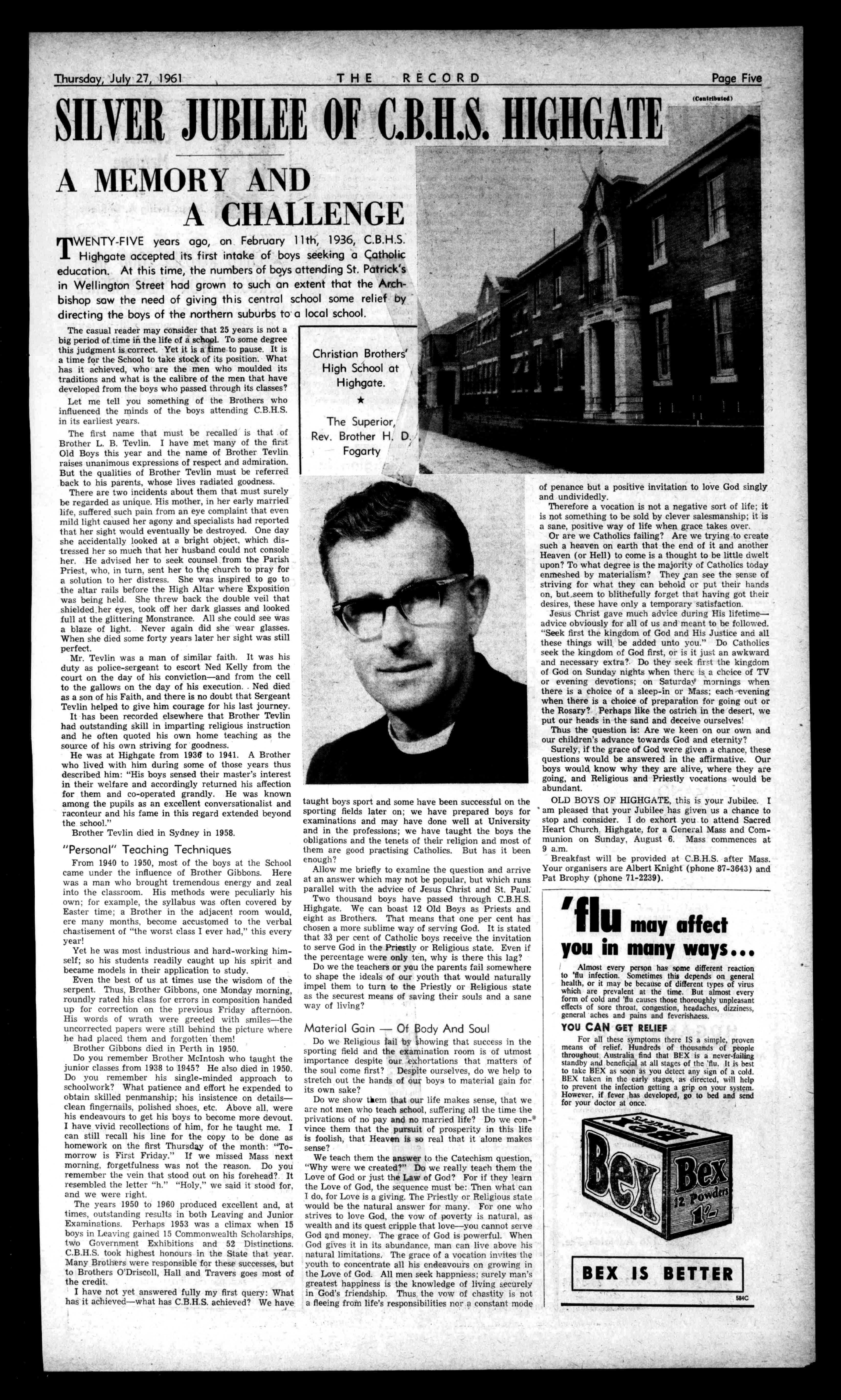
taughtboyssportandsomehavebeensuccessfulonthe sportingfieldslateron;wehavepreparedboysfor examinationsandmayhavedonewellatUniversity andintheprofessions;wehavetaughttheboysthe obligationsandthetenetsoftheirreligionandmostof themaregoodpractisingCatholics.Buthasitbeen enough?
Allowmebrieflytoexaminethequestionandarrive atananswerwhichmaynotbepopular,butwhichruns parallelwiththeadviceofJesusChristandSt.Paul:
TwothousandboyshavepassedthroughC.B.H.S. Highgate.Wecanboast12OldBoysasPriestsand eightasBrothers.Thatmeansthatonepercenthas chosenamoresublimewayofservingGod.Itisstated that33percentofCatholicboysreceivetheinvitation toserveGodinthePriestlyorReligiousstate.Evenif thepercentagewereonlyten,whyistherethislag?
Dowetheteachersoryoutheparentsfailsomewhere toshapetheidealsofouryouththatwouldnaturally impelthemtoturntothePriestlyorReligiousstate asthesecurestmeansofsavingtheirsoulsandasane wayofliving?
MaterialGain-OfodyAndSoul
DoweReligioustailbyPlowingthatsuccessinthe sportingfieldandtheexaminationroomisofutmost importancedespite'our'exhortationsthatmattersof thesoulcomefirst?Despiteourselves,dowehelpto stretchoutthehandsofourboystomaterialgainfor itsownsake?
Doweshowthemthatourlifemakessense,thatwe arenotmenwhoteachschool,sufferingallthetimethe privationsofnopayandnomarriedlife?Dowecon...* vincethemthatthepursuitofprosperityinthislife isfoolish,thatHeavenissorealthatitalonemakes sense?
WeteachthemtheanswertotheCatechismquestion, "Whywerewecreated?"Dowereallyteachthemthe LoveofGodorjusttheLawofGod?Foriftheylearn theLoveofGod,thesequencemustbe:Thenwhatcan Ido,forLoveisagiving.ThePriestlyorReligiousstate wouldbethenaturalanswerformany.Foronewho strivestoloveGod,thevowofpovertyisnatural,as wealthanditsquestcripplethatlove-youcannotserve Godandmoney.ThegraceofGodispowerful.When Godgivesitinitsabundance,mancanliveabovehis naturallimitations.Thegraceofavocationinvitesthe youthtoconcentrateallhisendeavoursongrowingin theLoveofGod.Allmenseekhappniess;surelyman's greatesthappinessistheknowledgeoflivingsecurely inGod'sfriendship.Thusthevowofchastityisnot afleeingfromlife'sresponsibilitiesnoraconstantmode
ofpenancebutapositiveinvitationtoloveGodsingly andundividedly. Thereforeavocationisnotanegativesortoflife;it isnotsomethingtobesoldbycleversalesmanship;itis asane,positivewayoflifewhengracetakesover.
OrareweCatholicsfailing?Arewetryingtocreate suchaheavenonearththattheendofitandanother Heaven(orHell)tocomeisathoughttobelittledwelt upon?TowhatdegreeisthemajorityofCatholicstoday enmeshedbymaterialism?Theysanseethesenseof strivingforwhattheycanbeholdorputtheirhands on,but.seemtoblithefullyforgetthathavinggottheir desires,thesehaveonlyatemporarysatisfaction.
JesusChristgavemuchadviceduringHislifetimeadviceobviouslyforallofusandmeanttobefollowed. "SeekfirstthekingdomofGodandHisJusticeandall thesethingswill.beaddeduntoyou."DoCatholics seekthekingdomofGodfirst,orisitjustanawkward andnecessaryextra?.Dotheyseekfirstthekingdom ofGodonSundaynightswhenthereis,achoiceofTV oreveningdevotions;onSaturda3smorningswhen thereisachoiceofasleep-inorMass:each-evening whenthereisachoiceofpreparationforgoingoutor theRosary?Perhapsliketheostrichinthedesert,we putourheadsinthesandanddeceiveourselves!
Thusthequestionis:Arewekeenonourownand ourchildren'sadvancetowardsGodandeternity?
Surely,ifthegraceofGodweregivenachance,these questionswouldbeansweredintheaffirmative.Our boyswouldknowwhytheyarealive,wheretheyare going,andReligiousandPriestlyvocationswouldbe abundant.
OLDBOYSOFHIGHGATE,thisisyourJubilee.I ampleasedthatyourJubileehasgivenusachanceto stopandconsider.IdoexhortyoutoattendSacred HeartChurch.Highgate,foraGeneralMassandCommuniononSunday.August6.Masscommencesat 9a.m. BreakfastwillbeprovidedatC.B.H.S.afterMass. YourorganisersareAlbertKnight(phone87-3643)and PatBrophy(phone71-2239).
'flumayaffect youinmanyways
Almosteverypersonhassomedifferentreaction to'fluinfection.Sometimesthisdependsongeneral health,oritmaybebecauseofdifferenttypesofvirus whichareprevalentatthetime.Butalmostevery formofcoldand'flucausesthosethoroughlyunpleasant effectsofsorethroat,congestion,headaches,dizziness, generalachesandpainsandfeverishness.
YOUCANGETRELIEF
ForallthesesymptomsthereISasimple,proven meansofrelief.Hundredsofthousandsofpeople throughoutAustraliafindthatBEXisanever-failing standbyandbeneficialatallstagesofthe'flu.Itisbest totakeBEXassoonasyoudetectanysignofacold. BEXtakenintheearlystages,asdirected,willhelp topreventtheinfectiongettingagriponyoursystem. However,iffeverhasdeveloped,gotobedandsend foryourdoctoratonce.
Thursday,July27,1961 THERECORD PageFive
BEXISBETTER 584C
SILVERJUBILEEOF01.11.5.HIGHGATE AMEMORYAND ACHALLENGE
TWENTY-FIVEyearsago,onFebruary11th,1936,C.B.H.S.
HighgateaccepteditsfirstintakeofboysseekingaCatholic education.Atthistime,thenumbersofboysattendingSt.Patrick's inWellingtonStreethadgrowntosuchanextentthattheArchbishopsawtheneedofgivingthiscentralschoolsomereliefuy directingtheboysofthenorthernsuburbstoalocalschool.
Thecasualreadermayconsiderthat25yearsisnota bigperiodoftimeinthelifeofaschool.Tosomedegree thisjudgmentiscorrect.Yetitisatimetopause.Itis atimefortheSchooltotakestockofitsposition.What hasitachieved,whoarethemenwhomouldedits traditionsandwhatisthecalibreofthementhathave developedfromtheboyswhopassedthroughitsclasses?
LetmetellyousomethingoftheBrotherswho influencedthemindsoftheboysattendingC.B.H.S. initsearliestyears.
Thefirstnamethatmustberecalledisthatof BrotherL.B.Tevlin.Ihavemetmanyofthefirst OldBoysthisyearandthenameofBrotherTevlin raisesunanimousexpressionsofrespectandadmiration. ButthequalitiesofBrotherTevlinmustbereferred backtohisparents,whoselivesradiatedgoodness.
Therearetwoincidentsaboutthemthatmustsurely beregardedasunique.Hismother,inherearlymarried life,sufferedsuchpainfromaneyecomplaintthateven mildlightcausedheragonyandspecialistshadreported thathersightwouldeventuallybedestroyed.Oneday sheaccidentallylookedatabrightobject,whichdistressedhersomuchthatherhusbandcouldnotconsole her.HeadvisedhertoseekcounselfromtheParish Priest,who,inturn,senthertothechurchtoprayfor asolutiontoherdistress.Shewasinspiredtogoto thealtarrailsbeforetheHighAltarwhereExposition wasbeingheld.Shethrewbackthedoubleveilthat shielded.hereyes,tookoffherdarkglassesandlooked fullattheglitteringMonstrance.Allshecouldseewas ablazeoflight.Neveragaindidshewearglasses. Whenshediedsomefortyyearslaterhersightwasstill perfect.
Mr.Tevlinwasamanofsimilarfaith.Itwashis dutyaspolice-sergeanttoescortNedKellyfromthe courtonthedayofhisconviction-andfromthecell tothegallowsonthedayofhisexecution.Neddied asasonofhisFaith,andthereisnodoubtthatSergeant Tevlinhelpedtogivehimcourageforhislastjourney.
IthasbeenrecordedelsewherethatBrotherTevlin hadoutstandingskillinimpartingreligiousinstruction andheoftenquotedhisownhometeachingasthe sourceofhisownstrivingforgoodness.
HewasatHighgatefrom1936to1941.ABrother wholivedwithhimduringsomeofthoseyearsthus describedhim:"Hisboyssensedtheirmaster'sinterest intheirwelfareandaccordinglyreturnedhisaffection forthemandco-operatedgrandly.Hewasknown amongthepupilsasanexcellentconversationalistand raconteurandhisfameinthisregardextendedbeyond theschool."
BrotherTevlindiedinSydneyin1958.
"Personal"TeachingTechniques
From1940to1950,mostoftheboysattheSchool cameundertheinfluenceofBrotherGibbons.Here wasamanwhobroughttremendousenergyandzeal intotheclassroom.Hismethodswerepeculiarlyhis own;forexample,thesyllabuswasoftencoveredby Eastertime;aBrotherintheadjacentroomwould, eremanymonths,becomeaccustomedtotheverbal chastisementof"theworstclassIeverhad,"thisevery year!
Yethewasmostindustriousandhard-workinghimself;sohisstudentsreadilycaughtuphisspiritand becamemodelsintheirapplicationtostudy.
Eventhebestofusattimesusethewisdomofthe serpent.Thus,BrotherGibbons,oneMondaymorning, roundlyratedhisclassforerrorsincompositionhanded upforcorrectiononthepreviousFridayafternoon. Hiswordsofwrathweregreetedwithsmiles-the uncorrectedpaperswerestillbehindthepicturewhere hehadplacedthemandforgotten"them!
BrotherGibbonsdiedinPerthin1950.
DoyourememberBrotherMcIntoshwhotaughtthe juniorclassesfrom1938to1945?Healsodiedin1950. Doyourememberhissingle-mindedapproachto schoolwork?Whatpatienceandeffortheexpendedto obtainskilledpenmanship;hisinsistenceondetailscleanfingernails,polishedshoes,etc.Aboveall,were hisendeavourstogethisboystobecomemoredevout. Ihavevividrecollectionsofhim,forhetaughtme.I canstillrecallhislineforthecopytobedoneas homeworkonthefirstThursdayofthemonth:"TomorrowisFirstFriday."IfwemissedMassnext morning,forgetfulnesswasnotthereason.Doyou remembertheveinthatstoodoutonhisforehead?It resembledtheletter"h.""Holy,"wesaiditstoodfor, andwewereright.
Theyears1950to1960producedexcellentand,at times,outstandingresultsinbothLeavingandJunior Examinations.Perhaps1953wasaclimaxwhen15 boysinLeavinggained15CommonwealthScholarships, twoGovernmentExhibitionsand52Distinctions. C.B.H.S.tookhighesthonoursintheStatethatyear. ManyBrotherswereresponsibleforthesesuccesses,but toBrothersO'Driscoll,HallandTraversgoesmostof thecredit.
Ihavenotyetansweredfullymyfirstquery:What hasitachieved-whathasC.B.H.S.achieved?Wehave
ChristianBrothers' HighSchoolat Highgate.
TheSuperior, Rev.BrotherH.D Fogarty
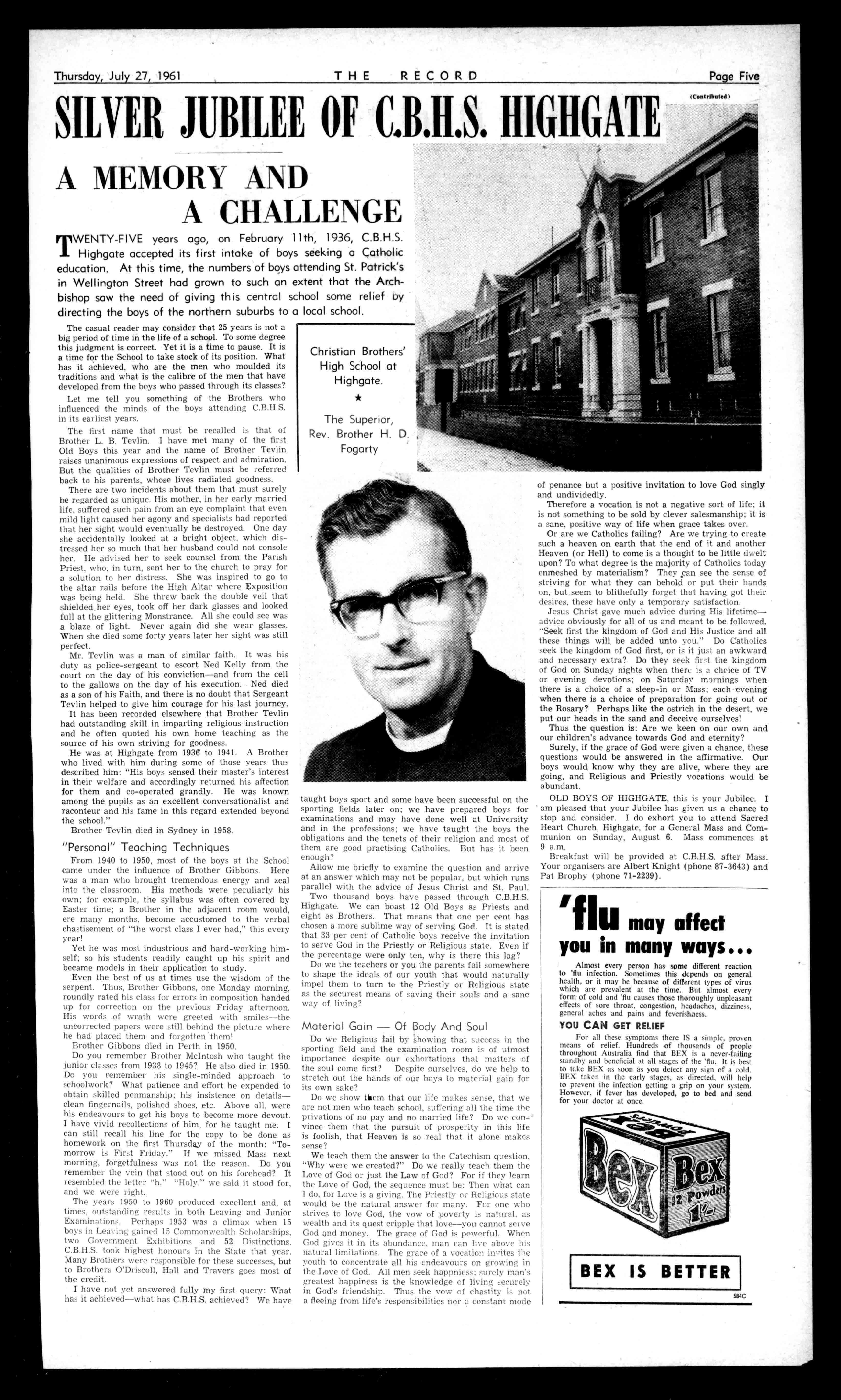
taughtboyssportandsomehavebeensuccessfulonthe sportingfieldslateron;wehavepreparedboysfor examinationsandmayhavedonewellatUniversity andintheprofessions;wehavetaughttheboysthe obligationsandthetenetsoftheirreligionandmostof themaregoodpractisingCatholics.Buthasitbeen enough?
Allowmebrieflytoexaminethequestionandarrive atananswerwhichmaynotbepopular.butwhichruns parallelwiththeadviceofJesusChristandSt.Paul.
TwothousandboyshavepassedthroughC.B.H.S. Highgate.Wecanboast12OldBoysasPriestsand eightasBrothers.Thatmeansthatonepercenthas chosenamoresublimewayofservingGod.Itisstated that33percentofCatholicboysreceivetheinvitation toserveGodinthePriestlyorReligiousstate.Evenif thepercentagewereonlyten,whyistherethislag?
Dowetheteachersoryoutheparentsfailsomewhere toshapetheidealsofouryouththatwouldnaturally impelthemtoturntothePriestlyorReligiousstate asthesecurestmeansofsavingtheirsoulsandasane wayofliving?
MaterialGain-OfBodyAndSoul
DoweReligiousfailbyshowingthatsuccessinthe sportingfieldandtheexaminationroomisofutmost importancedespiteourexhortationsthatmattersof thesoulcomefirst?Despiteourselves,dowehelpto stretchoutthehandsofourboystomaterialgainfor itsownsake?
Doweshowthemthatourlifemakessense,thatwe arenotmenwhoteachschool,sufferingallthetimethe privationsofnopayandnomarriedlife?Doweconvincethemthatthepursuitofprosperityinthislife isfoolish,thatHeavenissorealthatitalonemakes sense?
WeteachthemtheanswertotheCatechismquestion. "Whywerewecreated?"Dowereallyteachthemthe LoveofGodorjusttheLawofGod?Foriftheylearn theLoveofGod,thesequencemustbe:Thenwhatcan Ido,forLoveisagiving.ThePriestlyorReligiousstate wouldbethenaturalanswerformany.Foronewho strivestoloveGod,thevowofpovertyisnatural,as wealthanditsquestcripplethatlove-youcannotserve Godandmoney.ThegraceofGodispowerful.When Godgivesitinitsabundance,mancanliveabovehis naturallimitations.Thegraceofavocationinvitesthe youthtoconcentrateallhisendeavoursongrowingin theLoveofGod.Allmenseekhappniess:surelyman's greatesthappinessistheknowledgeoflivingsecurely inGod'sfriendship.Thusthevowofchastityisnot afleeingfromlife'sresponsibilitiesnoraconstantmode
ofpenancebutapositiveinvitationtoloveGodsingly andundividedly.
Thereforeavocationisnotanegativesortoflife;it isnotsomethingtobesoldbycleversalesmanship;itis asane,positivewayoflifewhengracetakesover.
OrareweCatholicsfailing?Arewetryingtocreate suchaheavenonearththattheendofitandanother Heaven(orHell)tocomeisathoughttobelittledwelt upon?TowhatdegreeisthemajorityofCatholicstoday enmeshedbymaterialism?Theysanseethesenseof strivingforwhattheycanbeholdorputtheirhands on,butseemtoblithefullyforgetthathavinggottheir desires,thesehaveonlyatemporarysatisfaction.
JesusChristgavemuchadviceduringHislifetimeadviceobviouslyforallofusandmeanttobefollowed. "SeekfirstthekingdomofGodandHisJusticeandall thesethingswill,beaddeduntoyou."DoCatholics seekthekingdomofGodfirst,orisitjustanawkward andnecessaryextra?Dotheyseekfirstthekingdom ofGodonSundaynightswhenthereisachoiceofTV oreveningdevotions;onSaturdaymarningswhen thereisachoiceofasleep-inorMass:eachevening whenthereisachoiceofpreparationforgoingoutor theRosary?Perhapsliketheostrichinthedesert,we putourheadsinthesandanddeceiveourselves!
Thusthequestionis:Arewekeenonourownand ourchildren'sadvancetowardsGodandeternity?
Surely,ifthegraceofGodweregivenachance,these questionswouldbeansweredintheaffirmative.Our boyswould,knowwhytheyarealive,wheretheyare going,andReligiousandPriestlyvocationswouldbe abundant.
OLDBOYSOFHIGHGATE.thisisyourJubilee.I ampleasedthatyourJubileehasgivenusachanceto stopandconsider.IdoexhortyoutoattendSacred HeartChurch.Highgate,foraGeneralMassandCommuniononSunday,August6.Masscommencesat 9a.m. BreakfastwillbeprovidedatC.B.H.S.afterMass. YourorganisersareAlbertKnight(phone87-3643)and PatBrophy(phone71-2239).
'flumayaffect I youinmanyways
Almosteverypersonhassomedifferentreaction to'flu health,infection.Sometimesthisdependsongeneral oritmaybebecauseofdifferenttypesofvirus whichareprevalentatthetime.Butalmostevery formofcoldand'flucausesthosethoroughlyunpleasant effectsofsorethroat,congestion,headaches,dizziness, generalachesandpainsandfeverishness.
YOUCANGETRELIEF
ForallthesesymptomsthereISasimple,proven meansofrelief.Hundredsofthousandsofpeople throughoutAustraliafindthatBEXisanever-failing standbyandbeneficialatallstagesofthe'flu.Itisbest totakeBEXassoonasyoudetectanysignofacold. BEXtakenintheearlystages,asdirected,willhelp topreventtheinfectiongettingagriponyoursystem. However,iffeverhasdeveloped,gotobedandsend foryourdoctoratonce.
Thursday,July27,1961 THERECORD PageFive
Contributed
BEXISBETTER
HOLYFATHERSPEAKSTOTHEWORLD
(CatathmedfromPageOne) throughtheirtoilandlook forwardtothefuture,with confidence Itisabove allindispensablethatgreat carebetaken,especiallyby publicauthorities,toinsure thattheessentialaarvicesin couttryareasbesuitably developed."
RuralAnd CityWorkers
ThePopestressedthe greatneedfor"maintaining aharmoniousbalancebetweenallsectorsofproduction."Farmers,hesaid, shouldbeabletoenjoy'the benefitsandservicesavailabletoworkersincityindustries. Henotedthis couldbefacilitatedbysensibletaxation,makingcapital availableforinvestmentsin agriculturalprojects,and throughsocialinsurance,socialsecurityandpriceproduction.
Hesaidfurtherthatrural workersshouldfeelasense ofsolidaritywithoneanother."Theyneedtoorganisetohaveavoiceinpoliticalcirclesaswellasin organsofpublicadministration,fortodayalmostnobodyhears,muchlesspays attentionto,isolatedvoices."
OntheotherhandPope Johnsaidthatfarmers eassmeasessmaaeaesseeasaaass FORREALGOODMEAT See-
"PINKY"HAYES
OppositeWembleyHotel BarbecuesCateredfor. Phone87-2002.
"musttrytoreconciletheir rightsandinterestswith thoseofotherclassesof workers,andeven subordinateonetotheotherifthe commongooddemandsit," 'Speakingofrelationsbetweeneconomicallyadvanced countriesandthosestillin theprocessofdevelopment, hesaidthisisprobably"the mostdifficultproblemofthe modernworld..'
Hestated:"Thesolidarity whichbindsallmenand makesthemmembersofthe samefamilyimposesonpoliticalcommunitiesenjoying abundanceofmaterialgoods (theobligation)nottoremainindifferenttothose politicalcommunitieswhose citizenssufferfrompoverty, miseryandhunger,andwho lackeventheelementary rightsofthehumanperson."
ThePopenotedthereare countrieswhichproduceconsumergoods,especiallyfarm productsinexcess,whilein othercountrieslargesegmentsofthepopulationsufferfrommiseryandhunger: "Justiceandhumanitydemandthattheformercome totheaidofthelatter.To destroyortosquandergoods thatotherpeopleneedin ordertoliveistooffend againstjusticeandhumanity."
Headdedthatdestruction ofsurplusgoodscannotbe excusedonthegroundsof economicharmtoacertain partofthepopulation.
Emergencyaid,hesaid, "isnotenoughtoeliminate ortoreducethecauses whichinnotafewpolitical
communitiesbringaboutareasons,butintheabsence permanentstateofwant,ofmutualtrust. miseryandhunger." In- ThePopetracedthislack stead,whatisneededisoftrusttothefactthatnot scientific,technicalandallmenrecognisedthemoral financialco-operationontheorder-"anorderwhichis partofthemoredevelopedtranscendent,universal,abnations. solute,equalandbindingon
Atthesametime,how-all."Hesaidthey,thereever,thePopewarnedfore"failtotneetandunderagainstrepeatingtheerrorsstandeachotherfullyand ofthepast."Theeconomi-openlyinthelightofoneand callydevelopedpoliticalthesamelawofjusticeadcommunitieswhenlendingmittedandadheredtoby theirhelpmustrecogniseall." andrespecttheindividuality ThePopethendeclared: (ofthenationshelped)and"Mutualtrustamongmen overcomethetemptationtoandnationscannotbegin imposethemselvesbymeansnorincreaseexceptbythe oftheseworksuponthecom-recognitionandrespectof munityinthecourseofthemoralorder."Thiscan economicdevelopment." onlybeestablishedhesaid,
Aneven"biggertempta-intherecognitionofthecation"foradvancedcountries,istenceofGod. thePopesaid."isthatof,Inthefinalsectionofthe profitingfromtheirtechni-s,encyclical,PopeJohnlacalandfinancialco-opera.'beledas"themostfundationsoastoinfluencethementalmodernerror"that politicalsituationoflessofconsideringthereligious developedcountrieswitha'demandsofthehumansoul viewtobringaboutPlan\ ofworlddomination.
"Ifthistakesplace,it mustbeexplicitlydeclared thatItwouldbeanewform ofcolonialism,which,howevercleverlydisguised, wouldnotforallthatbe lessblameworthythanthat fromwhichmanypeople haveescaped,andwhich wouldinfluencenegatively theirinternationalrelations, constitutingamenaceand dangertoworldpeace."
Callingforsincerepoliticaldisinterestedness,the Popealsourgedtheeconomicallyadvancedcountries torespectahierarchyof valuesinthenationsthey assist.Lackofsuchrespect"constitutesaninsidious poison,andoneofthemost dangerous,intheworkwhich theeconomicallydeveloped peoplescangivetothoseon thewaytodevelopment."
"anexpressionoffeelingor offantasy"whichshould be"eliminatedasananachronismandanobstacleto humanprogress."
ReligionIn ModernTimes
Toremedythissituation. thePopecalledontheCatholicsoftheworldtoteach andpreachtheChurch's socialdoctrine."Wefeel urgedtoexhortthatsuch teachingbeextendedby regularsystematiccourses inCatholicschoolsofevery kind,especiallyinseminaries."
CsildIN
Marriage
By Msgr.IrvingA.DeBlanc
CHILDREFUSESFOODIN STRUGGLEFORINDEPENDENCE
HAVEachildwhoeatsheartilyinsomeone else'shouse,atballgames,withhisfather orwhenaneighbour'schildcomesto dinner.Hesteadfastlyrefuses,however, anordinarymealwhichprepare-perhapstheexactmealheenjoyedadayor sobeforesomewhereelse.Isthisunusual?
Mrs.M.D.
OFALLTHESTRANGETHINGSachilddoes,one ofthestrangestandcommonestishisrefusal toeat.Hisreasonisoftenbecauseheisclose toanddependantuponhismother.Whenhefirstgoes afterindependenceherebelsagainsttheveryonehe lovesandneedsthemost.Achildquicklynoteswhat giveshismotherpleasureandattacksheronthatvery battleground:herefuseshercareandattention.From thishegetshisfeelingofindependence.
SIGNOF GROWINGUP
ALLSUBURBS-21-4308.
ObtainyoursuppliesofFRESHandFROZENFISHfrom
Population
Prqblem
PopeJohnnextturnedhis attentiontotheso-called populationexplosion.Noting thatwithmodernprogress theexcessivebirthsover deathsissteadilyincreasing andthatitisclaimedthat thestandardoflivingmay possiblybereducedinthe underdevelopednations,the Popesaid:"Therearcthose -whowouldhaverecourseto drasticmeasuresofbirth controlorprevention."
"Therealsolutiontothe problemisnottobefound inexpedientsthatoffend themoralorderestablished byGodandwhichinjurethe veryoriginofhumanlife. butinarenewedscientific andtechnicaleffortonthe partofmantodeepenand extendhisdominationover nature.Theprogressof scienceandtechnology,alreadyrealised,opensupin thisdirectionlimitlesshorizons."
ThevicarofChristthen spokeofthethreatposed tomankindbymodernweapons.
PopeJohnstressedthat insocialeducation,associationsandorganisationsof thelayapostolate'playan importantrole,especially thosethathaveastheir specificobjectivetheChristianisationoftheeconomic andsocialsectorsofthetemporalorder."Urgingall to"look,judge,act"the Popedeclaredthatthetask ofaction"belongsparticularlytoOursons,thelaity."
TheRomanPontiffwarned,however,thatCatholics mustbeontheirguardto preserveanactiveawareness "ofahierarchyofvaluesas theycarryontheirtemporal affairsandseektheirimmediateends."
PopeJohnmadeageneral pleafortheobservanceof Sundayasadayofrest.Deploringlaxityinthismatter, hesaid:"Inthenameof Godandforthematerial andspiritualinterestsof men,Wecalluponall,publicauthorities,employers andworkers,toobservethe preceptsofGodandHis Church,andWeremindeach oneofhisgraveresponsibilitiesbeforeGodandsociety."
ThePopestressedthat Catholicsmustworkandlive intheworld."Weshould notcreateanartificialoppositionbetweentheperfectionofone'sownbeingand one'spersonal,activepresenceintheworld."
IFACHILDconstantlyrefusesfood,andthedoctor cangiveyounogoodreasonforit,youcanbequite surethathedoesnotwantto beguided,helpedandinterfered with.Hewillprobablyusethe foodtostagehisminorrebellion. Hewilleatotherpeople'sfood butnotyours.Hewilleateasy-to-preparefoodsbut refusechatgivesyouagreatdealoftrouble.
Yourchildmaybeperfectlynormal.Itcanbea signofgrowingup.Itis,however,distressingwhen this"growingup"interfereswithmeals.Thechild's healthmaysuffer.Andhelosestheotherpleasures andvaluesofmealtime.
Thereareseveralwaysofhandlingthischild. Spankinggenerallydoesmoreharmthangood.Most mothersjuststopworryingoverthefoodaltogether. Theyplacethefoodinfrontofthechild.Ifhedoes notwantit,theytakeitway.Nocommentisever madeabouthisappetite.Ifheeats,nopraiseisgiven. Noremarksaremadetotherestofthefamilyinhis earing.
Thisisnoteasyfora-mothertodo.Shewillcertainly betemptedtoglancesidewaystoseehowheisgetting along.Butnotasingleglancewillescapethechild. Ifhecatchesherlookingathimhewillknowthatshe isstillanxious.
Mostchildrenwilleatnormallywhentheygetthe impressionthatthewholefamilyisunbotheredwhether theyeatornot.Itwouldbefairlysafetopredictthat withintwoweeksevenaquitedifficultchildwill regainhispleasureinagoodmeal-ifthematteris handledsensibly.
Duringthisexperienceachildmayloseweightfor aweekortwo.Itisagoodideatoinnocently'weigh himbeforeyoubeginthetreatmentandeveryweek thereafter.Oncehegetbacktohisappetitehewill quicklygainweight.Hecertainlywon'tlosemorethan hewouldhavelostoveramonthifyouhadcontinued asbefore.
PANELBEATING
LUBRITORIUMSERVICE
FITTINGANDTURNING
CYLINDERBORING
CYLINDERSLEETING
CYLINDERHEAD
RECONDITIONING
CRANKSHAFTGRINDING
126AdelaideTce.
Phones: 21-4526,23-3454
BARSRYAN,Manager.
V2MCISOICTRIERritIltStITOK
"Wepointnutwithsadness,"hesaid,'oneofthe mostdisturbingcontradictionsbywhichourepoch istormentedandbywhich itisbeingconsumed,namelythat,whileontheone hand thespectreof miseryandhungerhaunts us;ontheotherhandscientificdiscoveries,technical inventionsandeconomicresourcesarebeingused,oftenextensively,toprovide terribleinstrumentsofruin anddeath."
Concerningtheproblemof co-operationonaworld scale,thePopesaidthatthe importantproblemsoftodaypresenttroublesof "supernaturalandoften worldwidedimensions."It isbecauseofthisthat"understandingandco-operation aresonecessary."
Atthesametime,hesaid: "Itseemsthatmen,especiallythoseentrustedwith greaterresponsibility,showthemselvesunabletounderstandoneanother.
"Therootofsuchinability isnottobesoughtinscientific,technicaloreconomic
HorelatedthistothedoctrineoftheMysticalBody ofChrist.Notingthatall arecalledtolifebyChrist, thePopesaid,"whenone carriesonone'sproperactivity,evenifitbeoftemporalnature,inunionwith JesustheDivineRedeemer. everyworkbecomesacontinuationofHisworkand redemptivepower."
Theencyclicalclosedwith anoteofhope: "Oureraispenetrated andshotthroughbyradicalerrors:itistornand upsetbydeepdisorders. Neverthelessitisalsoan erainwhichimmensepossibilitiesforgoodareopenedtotheChurch "WedesirethattheDivineRedeemerofmen,'who hasbecomeforusGod-given wisdomandjusticeandsanctificationandredemption' I1Cor.I.301,mayreign intriumph,gloriousthroughouttheages,inallandover all:Wedesirethathuman societyberestoredtoorder. thatallnationsmayfirmly enjoyprosperity,happiness andpeace."
CENTREOF DRAMA
WHILETRYINGtogetbackhisappetite,leaveaplate ofhisfavouritefoodhandy.Donotnoticehim,but addalittlemoretotheplateifthe foodvanishes.Hewilloftenclean uptheplateifheisnotobservedand commentedon.Ofcourse,Iamnot suggestingbetween-mealsnacks. Whenachildrefusestoeatandyoufussaroundhim, itisnotonlybecausehewantstobeindependentof you;heisalsogettingtheextrathrillofbeingthe centreofhisownlittledramaandfeelingthatthe wholehouseholdrevolvesaroundhismealtimes.
Finally,askyourselfifyouhavenotunconsciously setupthisproblemforthechild.Manychildrenlike tobeactivewheneating.Theyenjoyhelpingthemselvesfromthedishorhavingahandinthepreparation ofthemeal.Well,asyoucookletyourchildrenstir thesaucepanordropthecarrotsintothestew.
Activeyoungchildrencannotbearsittingright throughameal.Allow'themsmallexcursionsbetween helpingsforthefirstfewyears.Olderchildrenwhogo throughafoodstrikeWillofteneatwhilewalking about.Untiltheygetbacktheirappetiteitisagood thingtoallowthis.EvenatfiveIwouldallowachild whoisapooreaterplentyoflatitudeinthismoving about.
Whenachilddoesgetoverhisfeedingdifficulties, youwillseeseveralotherwelcomeimprovements.He willbelessrestless,morecontentedandlovehismother morethanever.
PageSix THE RECORD Thursday,July27,1961
BOWRA&O'DEA'S MODERNFUNERALHOME
68
SERVICEALLHOURS.
IsSituatedat-
STIRLINGSTREET-ClosetoCity
ROSS
28-3438. SPECIALQUOTESFORCATHOLICSCHOOLS, HOSPITALSandINSTITUTIONS. FreshFishandShellFishAvailableDaily *RENMANO ALTARWINE J.NoonanPty.Ltd. 17BURTSTREET,MOUNTLAWLEY "KUALACRUISES" TwoCruisestoHONGKONGandJAPAN directfromFREMANTLEin12,500ton1st dossCruise-ship"KUALALUMPUR." EachCruise46DayscommencingfromFremantle, S'9'61and30/10/61 Faresfrom£300to£640. BookingsatDALGETYSTRAVELSERVICE 15WilliamStreet,Perth.21-2841. Ortriterw-gtittlieffintegariMitiyanfiretettelalrgeiffeaddltedaleRWIIMISMITO HOGANSLTD. MOTORANDGENERALENGINEERS ALLWORKGUARANTEED-PROMPTSERVICE ASSURED-CARSPICKEDUPAND DELIVEREDFREE. SPECIALISEDSERVICE ENGINERECONDITIONING GENERALREPAIRS
INTERNATIONALFISHERIES HeadOffice:7CLEAVERSTREET,WESTPERTH. Phone:
THECOLONIALMUTUALFIRE INSURANCECOMPANYLIMITED CANMEETYOURREQUIREMENTSIN INSURANCEPROTECTION 236ST.GEORGE'STERRACE,PERTH Phone:21-9066. J.G.CANNY,Manager.
REMNANTOFPAUL'SJOURNEYTOROME
ASINGLEMILESTONEisall meetingbetweenSt.Pauland centuriesago.
ThestoneisarelicoftheRomanEmpire stillstandingbesidetheAppianWay.Itis allthatislefttomurkthespotwhereonce stoodtheMarketofAppius,theplaceofthat historicencounterbetweenSt.Paulandthe firstChristiansofRome.
ST.LUKE,whoaccompaniedSt.Paulonhisfirst voyage-1,oRome,tellsthe storyinthe28thchapter oftheActsoftheApostles. Hetellshowtheshipin whichtheyweretravellingwasdashedtopieces ontherockyshoresof Maltaduringastormand how,afterafewmonths, theysetsailinanother ship.
Hecontinues:"Weputin
atSyracuse(Sicily).and stayedtherethreedays. Then,followingthecoast, wereachedRhegium(today By *ar.mawsI.TUCEA
ReggioCalabria,Italy);and onedaylaterasouthwind sprangup,andonthesecondaywearrivedatPuteoli (todayPozzuoli,Italy),
thatislefttorecordthefirst thepeopleof wherewefoundourbrethrenandwereentreatedto staywiththemsevendays; andsowecametoRome.
"Andthebrethrenthere, havinghadnewsofus,came asfarastheMarketof AppiusandtheThreeTaverns;andwhenPaulsaw them,hegavethankstoGod andtookcourage.Oaour arrivalinRome,Paulwas givenpermissiontoliveby himselfwithasoldiertc guardhim."
Itisrelativelyeasyto followtheroutetaken.by St.Paulasheapproached Rome,fortheroadbedofthe ancientAppianWayhas beenalteredonlyslightly. Foragreatpartoftheway onecanevenseetheoriginal pavementofstoneblocks overwhichtheApostleof theGentilescertainly passed.
Toleavethecityasthe firstRomanChristiansdid ontheirwaytomeat Paulonepassesthrodldie PortaSanSebastianainthe southwallofthecity.The 4,1P4141.4.11.4104.004,4104.414.4.4111141M
LEFT:ThePorts,SanSebastiana[thencalledPorta Appia]inthesouthwalland BELOW.theoriginalpavementofstoneblocksover whichSt.Paulwalked,may beseenforagreatpartof theway.
Romenineteen Vatican News
theMarketofAppius.There remainsonlythe43-mile markerplacedtherebythe Romanroadbuilders.The roadislinedwithumbrella pimaandfieldscoverthe spilists(08,thevillagewhere .eadtandtheRomans ntet.
IAThecentreofRome traditionsaysthatthe ChurchofSt.Mary,inVia Leta,ontheCorso,Rome's mainstreet,marksthespot whereSt.Paullivedunder housearrest.
TheMamertimePrison, whereSt.Paulwasfinally putinchains,maystillbe visitedontheedgeofthe RomanForum.ATrappist monasterynowstandsinthe eucalyptusgroveoutsidethe citywallwherehewasbcheaded,andagreatbasilica risesabovetheplacewhere hewasburiedontheOstian Way.
WarningAbout Psychoanalysis
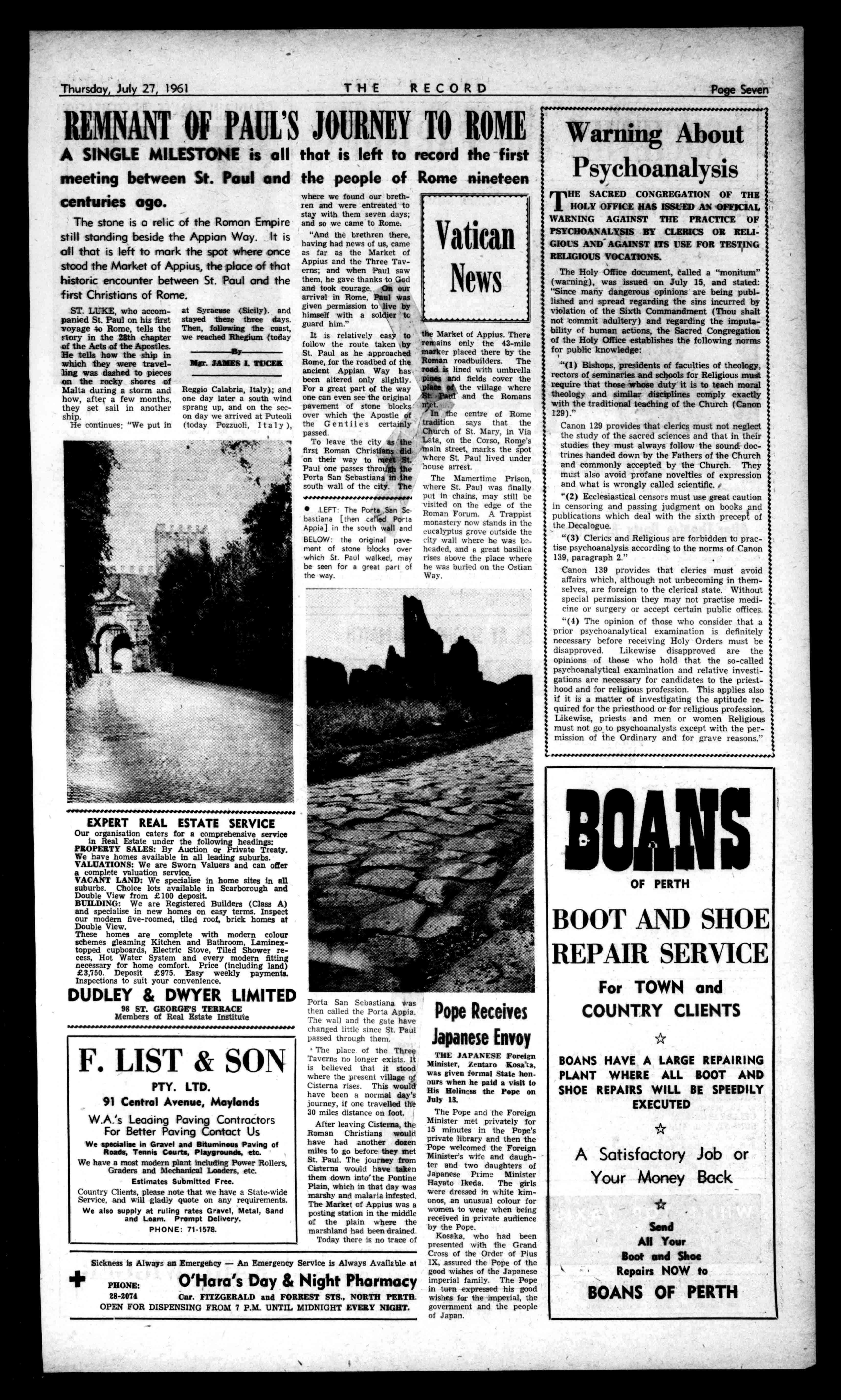
EXPERTREALESTATESERVICE
Ourorganisationcatersforacomprehensiveservice inReal
PROPERTYEstateunderthefollowingheadings: SALES:ByAuctionorPrivateTreaty.
toppedcupboards,ElectricStove,TiledShowerrecess,HotWaterSystemandeverymodernfitting necessaryforhomecomfort.Price(includingland) £3,750.Deposit£975.Easyweeklypayments. Inspectionstosuityourconvenience.
PTY.LTD. 91CentralAvenue,Maylonds
W.A.'sLeaaingPavingContractors ForBetterPavingContactUs
WespecialiseinGravelandBituminousPaving
PortaSanSebastianavas thencalledthePortaAppia. Thewallandthegatehave changedlittlesinceSt.Paul passedthroughthem.
TheplaceoftheThree Tavernsnolongerexists.It isbelievedthatitstood wherethepresentvillage(g Cisternarises.Thiswould havebeenanormalday's journey,ifonetravelledthe 30milesdistanceonfoot.
AfterleavingCisterna,the RomanChristianswould havehadanotherdozen milestogobeforetheymet St.Paul.Thejourneyfrom Cisternswouldhavetaken themdowninto'thePontine Plain,whichinthatdaywas marshyandmalariainfested. TheMarketofAppiuswasa postingstationinthemiddle oftheplainwherethe marshlandhadbeendrained.
Todaythereisnotraceof
SicknessisAlwaysanEmergency-AnEmergencyServiceisAlwaysAvailsbleat
PHONE: O'Hara'sDay&NightPharmacy 28-2074 Car.FITZGERALDandFORRESTSTS.,NORTHPERTH.
OPENFORDISPENSINGFROM7P.M.UNTILMIDNIGHTEVERYNIGHT.
PopeReceives
JapaneseEnvoy
THEJAPANESEForeign Minister,ZentaroKosa'oi, wasgivenformalStatehon. lurswhenhepaidavisitto HisHolinessthePopeon July13.
ThePopeantitheForeign Ministermetprivatelyfor 15minutesinthePope's privatelibraryandthenthe PopewelcomedtheForeign Minister'swifeanddaughterandtwodaughtersof JapanesePrimoMinister HayatoIkeda.Thegirls weredressedinwhitekimonos,anunusualcolourfor womentowearwhenbeing receivedinprivateaudience bythePope.
Kosaka,whohadbeen presentedwiththeGrand CrossoftheOrderofPius IX,assuredthePopeofthe goodwishesoftheJapanese imperialfamily.ThePope inturnexpressedhisgood wishesfortheimperial,the governmentandthepeople ofJapan.
TheHolyOffice
andspreadregardingthesinsincurredby violationoftheSixthCommandment(Thoushalt notcommitadultery)andregardingtheimputabilityofhumanactions,theSacredCongregation oftheHolyOfficeestablishesthefollowingnorms forpublicknowledge:
"(I)Bishops,presidentsoffacultiesoftheology, rectorsofseminariesandschoolsforReligiousmust requirethatthosewhosedutyitistoteachmoral theologyandsimilardisciplinescomplyexactly withthetraditionalteachingoftheChurch(Canon 129)."
Canon129providesthatclericsmustnotneglect thestudyofthesacredsciencesandthatintheir studiestheymustalwaysfollowthesounddoctrineshandeddownbytheFathersoftheChurch andcommonlyacceptedbytheChurch.They mustalsoavoidprofanenoveltiesofexpression andwhatiswronglycalledscientific..
"(2)Ecclesiasticalcensorsmustusegreatcaution incensoringandpassingjudgmentonbooksand publicationswhichdealwiththesixthpreceptof theDecalogue.
"(3)ClericsandReligiousareforbiddentopractisepsychoanalysisaccordingtothenormsofCanon 139,paragraph2.
Canon139providesthatclericsmustavoid affairswhich,althoughnotunbecominginthemselves,areforeigntotheclericalstate.Without specialpermissiontheymaynotpractisemedicineorsurgeryoracceptcertainpublicoffices.
"(4)Theopinionofthosewhoconsiderthata priorpsychoanalyticalexaminationisdefinitely necessarybeforereceivingHolyOrdersmustbe disapproved.Likewisedisapprovedarethe opinionsofthosewhoholdthattheso-called psychoanalyticalexaminationandrelativeinvestigationsarenecessaryforcandidatestothepriesthoodandforreligiousprofession.Thisappliesalso ifitisamatterofinvestigatingtheaptituderequiredforthepriesthoodorforreligiousprofession. Likewise,priestsandmenorwomenReligious mustnotgotopsychoanalystsexceptwiththepermissionoftheOrdinaryandforgravereasons."
27,1961 THERECORD PageSeven
Thursday,July
Wehavehomesavailableinallleadingsuburbs. VALUATIONS:WeareSwornValuersandcanoffer acompletevaluationservice. VACANTLAND:Wespecialiseinhomesitesinall suburbs.ChoicelotsavailableinScarboroughand DoubleViewfrom£100deposit. BUILDING:WeareRegisteredBuilders(ClassA) andspecialiseinnewhomesoneasyterms.Inspect ourmodernfive-roomed,tiledroof,brickhomesat DoubleView. Thesehomesarecompletewithmoderncolour schemesgleamingKitchenandBathroom,Laminex-
DUDLEY&DWYERLIMITED 98ST.GEORGE'STERRACE MembersofRealEstateInstitute
SON
F.LIST&
of Roads,TennisCourts,Playgrounds,etc. Wehaveamostmodernplantincludino,PowerRollers, GradersandMechanicalLoaders,etc. EstimatesSubmittedFree. CountryClients,pleasenotethatwehaveaState-wide Service,andwillgladlyquoteonanyrequirements. WealsosupplyatrulingratesGravel,Metal,Sand andLoam.PromptDelivery. PHONE:71-1578.
THESACREDCONGREGATIONOFTHE HOLYOFFICEHASISSUEDANOFFICIAL WARNINGAGAINSTTHEPRACTICEOF PSYCHOANALYSISBYCLERICSORRELIGIOUSAND'AGAINSTITSUSEFORTESTING RELIGIOUSVOCATIONS.
"Sincemanydangerousopinionsarebeingpubl-
document,Calleda"monitum" (warning),wasissuedonJuly15,andstated:
lished
..~.,.......nnnehmo OFPERTH BOOTANDSHOE REPAIRSERVICE ForTOWNand COUNTRYCLIENTS BOANSHAVEALARGEREPAIRING PLANTWHEREALLBOOTAND SHOEREPAIRSWILLBESPEEDILY EXECUTED ASatisfactoryJobor YourMoneyBack Send AllYour BootandShoe RepairsNOWto BOANSOFPERTH
REMNANTOFPAUL'SJOURNEYTOROME
ASINGLEMILESTONEisall meetingbetweenSt.Pauland centuriesago.
ThestoneisarelicoftheRomanEmpire stillstandingbesidetheAppianWay.Itis allthatislefttomarkthespotwhereonce stoodtheMarketofAppius,theplaceofthat historicencounterbetweenSt.Paulandthe firstChristiansofRome.
ST.LUKE,whoaccompaniedSt.Paulonhisfirst voyagetoRome.tellsthe storyinthe28thchapter oftheActsoftheApostles. Hetellshowtheshipin whichtheyweretravellingwasdashedtopieces ontherockyshoresof Maltaduringastormand how,afterafewmonths, theysetsailinanother ship.
Hecontinues:"Weputin
atSyracuse(Sicily).and stayedtherethreedays. Then,followingthecoast, wereachedRhegium(today EY Mgr.JAMESI.TUCEE
ReggioCalabria,Italy);and onedaylaterasouthwind sprangup,andonthesecondaywearrivedatPuteoli (todayPozzuoli,Italy),
thatislefttorecord thepeopleofRome
wherewefoundourbrethrenandwereentreatedto staywiththemsevendays; andsowecametoRome.
"Andthebrethrenthere, havinghadnewsofus,came asfarastheMarketof AppiusandtheThreeTaverns;andwhenPaulsaw them,hegavethankstoGod andtookcourage.Onour arrivalinRome,Paulwas givenpermissiontoliveby himselfwithasoldiertc guardhim."
Itisrelativelyeasyto followtheroutetakenby St.Paulasheapproached Rome,fortheroadbedofthe ancientAppianWayhas beenalteredonlyslightly. Foragreatpartoftheway onecanevensectheoriginal pavementofstoneblocks overwhichtheApostleof theGentilescertainly passed.
Toleavethecityasthe firstRomanChristiansdid ontheirwaytomeetSt. Paulonepassesthroughthe PortaSanSebastianainthe southwallofthecity.The #0.114.00#1,44,14.44101,04.0.0.1#114
LEFT:ThePorta,SanSebastiana[thencaredPorta Appia]inthesouthwalland BELOW:theoriginalpavementofstoneblocksover whichSt.Paulwalked,may beseenforagreatpartof theway.
thefirst nineteen Vatican News
theMarketofAppius.There remainsonlythe43-mile markerplacedtherebythe Romanroadbuilders.The roadislinedwithumbrella pinesandfieldscoverthe placeofthevillagewhere St.PantandtheRomans 17t.InthecentreofRome traditionsaysthatthe ChurchofSt.Mary,inVia Lata,ontheCorso,Rome's mainstreet,marksthespot whereSt.Paullivedtinder housearrest.
TheMamertimePrison, whereSt.Paulwasfinally putinchains,maystillbe visitedontheedgeofthe RomanForum.ATrappist monasterynowstandsinthe eucalyptusgroveoutsidethe citywallwherehewasbeheaded,andagreatbasilica risesabovetheplacewhere hewasburiedontheOstian Way.
i
WarningAbout Psychoanalysis
TheHolyOfficedocument,calleda"monitum" t(warning),wasissuedonJuly15,andstated:
t"Sincemanydangerousopinionsarebeingpubltlishedanispreadregardingthesinsincurredby iviolationoftheSixthCommandment(Thoushalt notcommitadultery)andregardingtheimputabilityofhumanactions,theSacredCongregation oftheHolyOfficeestablishesthefollowingnorms forpublicknowledge:
"(1)Bishops,presidentsoffacultiesoftheology. rectorsofseminariesandschoolsforReligiousmust requirethatthosewhosedutyitistoteachmoral theologyandsimilardisciplinescomplyexactly withthetraditionalteachingoftheChurch(Canon 129)."
Canon129providesthatclericsmustnotneglect thestudyofthesacredsciencesandthatintheir studiestheymustalwaysfollowthesounddoctrineshandeddownbytheFathersoftheChurch andcommonlyacceptedbytheChurch.They mustalsoavoidprofanenoveltiesofexpression andwhatiswronglycalledscientific.
"(2)Ecclesiasticalcensorsmustusegreatcaution incensoringandpassingjudgmentonbooks,and publicationswhichdealwiththesixthprecepiof theDecalogue.
"(3)ClericsandReligiousareforbiddentopractisepsychoanalysisaccordingtothenormsofCanon 139,paragraph2."
Canon139providesthatclericsmustavoid affairswhich,althoughnotunbecominginthemselves,areforeigntotheclericalstate.Without specialpermissiontheymaynotpractisemedicineorsurgeryoracceptcertainpublicoffices.
"(4)Theopinionofthosewhoconsiderthata priorpsychoanalyticalexaminationisdefinitely necessarybeforereceivingHolyOrdersmustbe disapproved.Likewisedisapprovedarethe opinionsofthosewhoholdthattheso-called psychoanalyticalexaminationandrelativeinvestigationsarenecessaryforcandidatestothepriesthoodandforreligiousprofession.Thisappliesalso ifitisamatterofinvestigatingtheaptituderequiredforthepriesthoodorforreligiousprofession. Likewise,priestsandmenorwomenReligious mustnotgotopsychoanalystsexceptwiththepermissionoftheOrdinaryandforgravereasons."
EXPERTREALESTATESERVICE
Ourorganisationcatersforacomprehensiveservice inRealEstateunderthefollowingheadings:
PROPERTYSALES:ByAuctionorPrivateTreaty. Wehavehomesavailableinallleadingsuburbs.
VALUATIONS:WeareSwornValuersandcanoffer acompletevaluationservice.
VACANTLAND:Wespecialiseinhomesitesinall suburbs.ChoicelotsavailableinScarboroughand
DoubleView BUILDING:from£100deposit. WeareRegisteredBuilders(ClassA) andspecialiseinnewhomesoneasyterms.Inspect ourmodernfive-roomed,tiledroof,brickhomesat DoubleView. Thesehomesarecompletewithmoderncolour schemesgleamingKitchenandBathroom,Laminex-
PortaSanSebastianawas thencalledthePortaAppia. Thewallandthegatehave changedlittlesinceSt.Paul passedthroughthem.
TheplaceoftheThree Tavernsnolongerexists.It isbelievedthatitstood wherethepresentvillageof Cisternarises.Thiswould havebeenanormalday's journey,ifonetravelledthe 30milesdistanceonfoot.
AfterleavingCisterns.the RomanChristianswould havehadanotherdozen milestogobeforetheymet St.Paul.Thejourneyfrom Cisternawouldhavetaken themdowninto"thePontine Plain,whichinthatdaywas marshyandmalariainfested. TheMarketofAppiuswasa postingstationinthemiddle oftheplainwherethe marshlandhadbeendrained.
Todaythereisnotraceof
SicknessisAlwaysanEmergency-AnEmergencyServiceisAlwaysAvailableat
PHONE: O'Hara'sDay&NightPharmacy 28-2074 Cnr.FITZGERALDandFORRESTSTS.,NORTHPERTH.
OPENFORDISPENSINGFROM7P.M.UNTILMIDNIGHTEVERYNIGHT.
PopeReceives
JapaneseEnvoy
THEJAPANESEForeign Minister.ZentaroKnsa',a, wasgivenformalStatehonourswhenhepaidavisitto HisHolinessthe.Popeon July13.
ThePopeandtheForeign Ministermetprivatelyfor 15minutesinthePope's privatelibraryandthenthe PopewelcomedtheForeign Minister'swifeanddaughterandtwodaughtersof JapanesePrimeMinister HayatoIkeda.Thegirls weredressedinwhitekimonos,anunusualcolourfor womentowearwhenbeing receivedinprivateaudience bythePope.
Kosaka,whohadbeen presentedwiththeGrand CrossoftheOrderofPius IX,assuredthePopeofthe goodwishesoftheJapanese imperialfamily.ThePope inturnexpressedhisgood wishesfortheimperial,the governmentandthepeople ofJapan.
Thursday,July27,1961 THE RECORD PageSeven
necessaryforhomecomfort.Price(including
£3,750.Deposit£975.Easyweeklypayments. Inspectionstosuityourconvenience. DUDLEY&DWYERLIMITED 98ST.GEORGE'STERRACE MembersofRealEstateInstitute F.LIST&SON PTY.LTD. 91CentralAvenue,Maylands
LeadingPavingContractors ForBetterPavingContactUs
specialiseinGravelandBituminousPavingof Roads,TennisCourts,Playgrounds,etc. WehaveamostmodernplantincludingPowerRollers, GradersandMechanicalLoaders,etc. EstimatesSubmittedFree. CountryClients,pleasenotethatwehaveaState-wide Service,andwillgladlyquoteonanyrequirements. WealsosupplyatrulingratesGravel,Metal,Sand andLoam.PromptDelivery. PHONE:71.1578.
toppedcupboards,ElectricStove,TiledShowerrecess,HotWaterSystemandeverymodernfitting
land)
W.A.'s
We
TiHESACREDCONGREGATIONOFTHE WARNINGAGAINSTTHEPRACTICEOF
OFFICIAL
PSYCHOANALYSISBYCLERICS
GIOUSANDAGAINSTITSUSEFORTESTING
HOLYOFFICEHASISSUEDAN
i
ORRELIt
iRELIGIOUSVOCATIONS.
BOOTANDSHOE REPAIRSERVICE ForTOWNand COUNTRYCLIENTS
PLANTWHEREALLBOOTAND SHOEREPAIRSWILLBESPEEDILY EXECUTED ASatisfactoryJobor YourMoneyBock Send AllYour BootandShoe RepairsNOWto BOANSOFPERTH
OFPERTH
BOANSHAVEALARGEREPAIRING
CHAPLAINMAKESPRESENTATION
SOCIETIESandPARISHES
London'sLordMayorVisitsPerth
VisitingPerththisweekaretheLordMayorofLondon,SirBernardWaley-Cohenandhiswife.SirBernardisthe633rd LordMayorofLondonandhisfamilyhavebeenconnected withgovernmentoftheCityofLondonfor
After-TheatrePartyAtNedlands
"Summertimewasover"thelastguesthadgone home,thesetscametumblingdownandwerestacked away.TherrieslefttheAssemblyHallandmadetheir waytotheNedlandshomeof Mr.andMrs.J.A.Shea. whowerehostandhostess fortheafter-showparty.
'MerrypresidentAnne Burnettwastherecipientof congratulationsfrommembersandfriendsoftheSocietyandreceivedonbehalf oftheclubalovelygift fromConstanceBeresfordOrdtheproducerof"Summertime."
Dancingfollowedbysupperwasenjoyedbyover fiftyguests,amongwhom wereAdrienneShea,ColletteWiltshire,RachelDaly, CamilleWilson,Richard Hearder,KeithCarton. DenissSchiortino,LenMurphyandKerryMartin.
OnSunday,July30,at 8.30p.m. Therry"Drama Workshop"willpresentfour one-actplaysat"The TheatreGuild"808HaySt. Membersandfriendsof theclubareasked'tocome alongandgivetheirencouragementtothe"Workshop"
studentsmakingtheirdebut beforethefootlights. TheSocietymeetseach Mondaynightat7.45p.m. attheclubroom.3Cremorne Arcade.Forenquiriesring 71-3392.
SchoolBasketballCompetition
Hereunderaretheresults D1Grade:St.Joseph's, ofmatchesplayedonSatur-Vic.Sq.,35,St.John's,Scarday,July15(winnersaroborough,6;St.Brigid's,Lesnamedfirst murdie,16,OurLadyof Fatima,9.
AGrade:St.Joseph's, Fremantle38,SacredHeart, 1;St.Columba's,35,Loreto Nedlands,10;Iona,31,Our Lady'sCollege,16.
AReserveGrade:Brigidine,33,Iona,5;OurLady's College,16,St.Joseph's, Fremantle,13:St.Joachim's, 28,SacredHeart,7;St. ThomasAquinas,20,.St. Brigid's,Lesmurdie,14.
B1Grade:St.Joachim's, 46,St.Joseph's,Vic.Sq.,12; St.ThomasAquinas,19, Loreto,Claremont,18;St. Brigid's,Lesmurdie,31; Loreto,Nedlands,20.
B2Grade:Brigidine,17, OurLady'sCollege,6;St. Joseph's,Fremantle, 31, SacredHeart,22;St.Joseph's,Parry-st.,20,St.. Joachim's,9.
ClGrade:SacredHeart, 30,Loreto,Claremont,14; St.Brigid's,Lesmurdie,22, St.Joseph's,Parry-st.,6; St.Joseph's,Fremantle,31, OurLadyofFatima,8.
C2Grade:Brigidine,9, OurLady'sCollege,8;St. Joachim's,21,St.Brigid's, WestPerth,4;St.Joseph's, Vic.Sq.,46,St.Thomas Aquinas,1;St.Columba's, 16,drewwithSt.Augustine's,16.
NewmanCamp
AndRetreat
Theannualwinter campoftheNewman societywillbeheld fromAugust4to6at Araluenonthefirst 'week-endoftheUniversityvacation.
Aseriesoftalkshas beenarranged,andthere willbeampletimefor hikesandothersocial events.Thosecoming bybusshouldtakethe Roleystonebus,outside GovernmentHouse.FurtherdetailscanbeobtainedfromM.Erickson, St.ThomasMoreCollege.
MembersoftheNewmanSocietygraduate divisionarereminded thattheannualdayof recollectionwillbeheld atSt.ThomasMore CollegeonSunday,August20,notaspreviouslyannouncedonAugust 6.
THEQUEENATSECONDTESTMATCH
Mons.J.Bourke.
'ROBERTHULBERTreceiveshistrophiesfromRt.Rev.
PennantslastSaturdayresultedinawinforSt.Mary's, Leederville,AgradeladiesreserveteamagainstQueen'sPark. RainstoppedtheAgrademen'steamfromplayingapostponedgameontheSunday.
Theannualcabaretdinner andpresentationeveningwas perhapsthemostsuccessful dinnersinceitsinception. Onehundredandtwentyfourguestssatdownto dinner,andallremarkedon thegreatsocialsuccessof theevening. VisitorsincludedRt.Rev. MonsignorJ.Bourke,chaplainoftheassociation,Rev. FatherF.Dillon,Rev.Bros. AhernandBowlerfrom C.B.C.Leederville,thepresidentoftheassociation,Mr.
TonyStantonandhiswife, Mr.JimHassellandMr.and Mrs.D.Cummuskyof"The Record."
ThePresidentMr.L. Harriswelcomedthevisitorsandmembersduringhis address,expressingthepleasureofthecommitteeatthe wonderfulattendanceby themembersandvisitors. Heproposedatoasttothe hierarchyandclergythankingHisGracetheArchbishop andpriestsfortheirinterest inthisCatholicsporting body,andpromisedthesupportofallmembersofthe clubintheirspiritualand sportingactivitiesorthefuture.MonsignorBourkerespondedtothetoast,thankingSt.Mary'sclubforthe parttheyplayedinfurtheringtheinterestsofthis Catholicorganisation.
Thevice-presidentMr. JohnWhitelythenproposed atoasttotheW.A.C.L.T.A., extendingtheclub'ssupport andco-operationtotheexecutiveoftheassociation. Thistoastwasrespondedto bythenewpresidentofthe association,Mr.TonyStanton.HeexpressedhispleasureatbeingatSt.Mary's annualdinner,andcongratulatedtheclubanditscommitteeforthefineworkthey weredoing.
Thepresentationoftro-
phieswascarriedoutby MonsignorBourke,hecongratulatedthosemembers whoreceivedtrophies,and wishedcontinuedsuccessto membersfornextyear's tournament.
Congratulationsandthanks fromthecommitteetothose memberswhoworkedso hardtomakethedinner suchagreatsuccess,anda specialwordofthanksto thedonorsoftrophies.
TheannualgeneralmeetingheldlastSundaynight wasattendedby22membersoftheclub.
ThenewpresidentofSt. Mary'sisMr.LesPeterson, who,wearesurewillbea drivingpowertotheclub inthefuture.Thepast president,Mr.L.Harriss urgedallmemberstogive himsupportandassistance duringhistermofoffice.
Otherofficerselectedwere JohnWhitelyvice-president, Mrs.Gartner,secretary; JohnCripps,captain,GrahamPetersonandJohn Loughlin,vice-captainsand Mrs.PhylDaltonasladies' captain;LenHarrisand KayBooth(twocommittee members);Merv.Fegan, treasurer.
CatholicMen's League
(MetropolitanBranch)
THENEXTMEETINGof thisBranchoftheCatholic MensLeaguewillbeheld attheCatholicCentre, VictoriaSquare,Perth,at 8p.m.sharp, Tuesday,1stAugust, 1961 MembershipListOpen P.J.BROPHY,Sec. Phone71-2239(Evenings)
SOCIETY
inahurling matchatFremantleParkon Sunday,Aug.6. Thesegameshavearoused alotofinterestandthe localsidearekeentoretaintheirunbeatenrecord. Playerstrainedwellduring theweekunderthewatchful eyeofstarplayerGerard Hackett.Countryplayers willstrengthenthesideand JohnMurphywillmakea hurriedtripfromRottnest. Thehurlingselectorsare interestedinmeetingnew playersandthoseanxious toplayareaskedtoring JoeGoffrey87-2201orFr, Ryan6006282. TheIrishClubwillhold theirpopulardanceand socialatHighgatehallqn Sunday,Aug.6. Furtherenquiriesabout clubactivitiesfromthe secretary,87-3049.
PageEight THE RECORD Thursday,July27,1961
morethan120 years. SirBernardwillbeinPerthtillAugust1,whenhewillleave ortheEasternStates PhotoU.KInformationService ------
OLDLOUISIANS'ASSOCIATION BARBECUE
KING'SPARKAVENUE,CRAWLEY ONSATURDAY,AUGUST
AT
P.M.
RichieBenaud,captainoftheAustraliantouringteam,presentsmembersofhisteamto HerMajestyQueenElizabethIIonthefirstdayofthesecondtestmatchbetween EnglandandAustraliaatLord'sCricketGround,London,England,recently. ShakinghandswithHerMajestyisKenMackay. (PhotoU.K,InformationService.
AT13
5,
8
WELFARE
Solicitsdonationsofclothing,,rags,
utensilsandsurplusarticles.Thebestofthegoodsare usedtorelievedistressamongthepoorandneedy.Kindly deliverto15BronteStreet,EastPerth,phone23-4201or contactyourlocalconference. THISISAMATTERFORURGENCY ANINVITATIONisextended-toallPastPupilsof SACREDHEARTPRIMARY&HIGHSCHOOLS tobepresentattheConvent'sCENTENARY CELEBRATIONStobeheldattheSchoolon SUNDAY,20thAUGUST,at2.30p.m.ABuffet Tea(at8/-perhead)willbeheldat5.45p.m. andtofacilitatecateringarrangements,those wishingtoattendshouldcontact64-1225or 67-4450immediately. WHITETOPTAXIS contr., icrEqu PROMPTTAXISERVICE 40CARS 24-HourService. DepotsinallFremantleSilcurt ALWAYSHAILAWHITETOPTA.' BERNIEJ.DUNNEHOMES DEALDIRECTWITHTHEBUILDER-BIGSAVING HomesfromL2,575-TourPlan-OnlyGenuineClayBricks LONDONCOURT,Suite7 Terraceends.PHONE23-3971, FeastDayOf SaintDominic Friday,Aug.4,isthe feastofSaintDominic, founderoftheOrderof Preachers,(Dominicans). OnSunday,Aug.6,the solemnitiesofthefeastwill beobservedintheChurch ofSt.DominicinBeatrice Street,NorthDoubleview, wherethefirstSolemnHigh MassaccordingtotheDominicanritewillbecelebrated inWestAustralia.Aspecial sermononSaintDominic willbepreachedattheMass. TheDominicanOrderhas beenestablishedinDoubleviewsince1953,butasit isthecasewithallother ReligiousOrderstoday,is beinghamperedinitsdevelopmentbytheshortageof vocations.Anyyoungman orboyinterestedinSaint DominicortheOrder,or anyonewhothinkshemay haveavocationtobeeither apriestoralaybrother wouldbewelladvisedto attendtheHighMassand PanegyricatSaintDominic's at9.30a.m.onSunday,Aug. 6,andcontactthenorlater: Rev,Fr.Superior0.P., St.Dominic'sPriory,19 Phillip'sGrove,Scarborough, W.A. ACATHOLICPAPERIN EVERYHOME. FIRSTSATURDAY Rev.T.G.Maloney, S.M.,willbeconducting theusualfirstSaturday DevotionsatSt.Patrick'sChurch,Havelock St.,WestPerth Thedevotionscommenceat2p.m.and lastuntil4p.m.;they areinthenatureofa periodofrecollection. IrishClub AWestAustralianselectionwillplaythevisiting IrishScyamore
OFST.VINCENTDEPAUL
STORE
furniture,household
rC Sampletheexciting newHAIRCOLOURINGS Grenada Jamaica Havana Tobacco attheSalonof KARLWIGGER 674 HAY STREET, PERTH Telephone:212646-232862
Y.C.W.
BOULDER(BOYS)
'Tostrengthentheranks ofthemovement,theleaders conductedacampaignof "Contact"workandasa resultanewmemberwas welcomedtothelastleaders'meetingandseveral promisestojoinhavebeen received.
Anyladsinterestedinjoiningareaskedtocontact PeterHendersonwhois president.
HIGHGATE(BOYS)
FromtheGospeldiscussiontheleadersgathered thatas"bread"isorwas thebasicsourceofnourishmentnecessaryforliving everythinginourlives shouldbeperformedwith theWillofGodasastartingpoint.Y.C.W.'sdoGod's Willbyputtingresolutions intoaction,tryingtolearn somethingfromGospeldiscussionsandsocialenquiries, anddoingcontactworkas wellaspossible.
Theconclusionthatmany peoplejustaccepttheirreligionwithoutbotheringto understanditwasfollowed by-thesuggestionofageneralmeetingatwhichsectionsoftheMasscouldbe explained.
Leadersagreedthatthe InternationalConferencedecisionswouldaffectusand tosomeextentallthe"young workers"oftheworld. Spiritualeffortsbythe graspincludedailyGospel meditationandaweekly groupMasswhichthechaplainwillofferfortheintentionsandsuccessofthe Y.C.W.Movement.
SHENTONPARK
Chaplainandleadersof thegroupweredelightedat theexcellentattendanceat thegeneralCommunionlast Sunday.AfterMass,Father Byrnepresentednewmemberswithbadgesandmany thanksgotothoseinvolved inthepreparationandservingofthebreakfastwhich followed.
Amongthosepresentwere PatThomson-representing theStateexecutive-and RichardChia-presidentof theAsianstudents'group-
Men'sLeagueTo
SupportScouts
AtthefifthannualState ConferenceoftheCatholic Men'sLeagueheldrecently,thepreviousdecisionof theStateExectutivetogive wholeheartedsupporttothe CatholicBoyScoutswas endorsedunanimously.
Inaccordancewiththis endorsementallmembersof theLeagueavailable,are beingaskedtoattendthe inauguralmeetingofthe CatholicScoutGuildtobe heldattheCatholicCentre at8p.m.onSunday,July 30.
Thenextmeetingofthe Metropolitanbranchofthe Leaguewillbeheldatthe CatholicCentreat8p.m.on Tuesdaynext,August1, allmembersandintending membersshouldattendthis meetingasconferencereportswillbepresentedby branchdelegates.
FORQUALITYMEAT
A.W.TAYLOR
FAMILYBUTCHER
CornerJohnandFitzgerald Streets,Perth 44`4,........41...~11.4
NOTES
whobothgave,interesting talksonthevariousaspects ofthemovement. Allare'remindedofthe dancingclassestobeheld onSundaynight,Aug.6. BallroomandLatinAmericandancingwillbetaught anditishopedthisfunction willbeassuccessfulasthose inthepast.
SOCIALCALENDAR
AUGUST5:Highgate dance-heldfortnightly.
AUGUST6:Leederville dance-ComeinInternationalCostume-inaidof theInternationalCouncil.
AUGUST6:ShentonPark -Classesinballroomand LatinAmericandancing.
CAC.OldBoys
NextMeeting
TheC.B.C.OldBoys' Associationwillagain attempttoholdanannualgeneralmeeting andelectionofoffice bearers.
Thefirstmeeting calledhadtobepostponed,thesecond,owing tothewrongdatebeingsentinto"The Record"didnothavea quorum.
Ameetinghasnow beencalledforMonday, July31. ThecommitteeoftheC.B.C.Old Boys'hopesforagood attendanceofmembers atthismeeting.
THEEVER-PRESENT"CHINAMAN"
SCARBOROUGHMEMBERSOFW.A.C.L.T.A.
HIGHGATENUNS'CENTENARY
OnAugust15,1961,theCongregationof OurLadyoftheMissionswillcelebratethe centenaryofitsestablishment.Itsfoundress, EuphrasieBarbier,inreligionMotherMaryof theHeartofJesuswasborninFrancein1829. Fromchildhoodshehadoneambition;she longedtobecomeareligiousmissionary.
InHisowntuneandway. Godgrantedherdesire;on theFeastofOurLady'sAssumption1861,theCongregationofOurLadyofMissionscameintobeingonthe historichillofFourviere, over-lookingthetownof Lyons.
Itwas7..:uphrasieBarbier's desiretoseeChrist'sKingdomspreadtoallpartsof theearth.Today,over twelvehundredSisters,on theHomeandForeignMis sionfields,areendeavouringtoseeherdesirerealised.Herdaughters,clad intheirdistinctiveblueedgedhabit,aretobefound inninety-sixconventsspread overtwelvecountries-England,Ireland,Scotland, France,Switzerland,New Zealand,Canada,Australia, India,Pakistan,Burma,Vietrilm.Heretheyareengaged intheprincipleworkofthe congregation,Education,and inaddition,especiallyinthe missionarycountries,they conductorphanages,workroomsanddispensaries.
Inthanksgivingforallthe gracesandblessingsbestow
W.W.EDMONDSON&SONS PLUMBERSandSHEETMETALWORKERS
CertifiedWestAustralia,HotWaterSpecialistsand GeneralPlumbing
Phones:28-1714.AfterHours:'87-2553,29-2095.
80JAMESSTREET,PERTH. ALLWORKGUARANTEED.
HOULAHANS
32THOMPSONROAD,NORTHFREMANTLE
AreSuppliersofYellowSandforTopDressingorBuilding,Metal,Gravel,Rubble,AshesandFilling.Bulldozers, Loaders,GradersforHire.WillQuoteforExcavation andLevellingJobs. PHONE5-1499. 5-3469.
edonthecongregationduringthepasthundredyears, theSistersofOurLadyof theMissionsatHighgateinvitealltojoinwiththem intheircentenarycelebrations.
Theprogrammeforthe centenaryisasfollows:
Sunday,Aug.13:Solemn HighMassofThanksgiving, SacredHeartChurch-10 am.
Monday,Aug.14:Solemn ReqiemMassfordeceased Sisters,Parents,Pupilsand benefactors,SacredHeart Church-11am.
Tuesday,Aug.15:EntertainmentforReligious,SacredHeartConvent-2.30 p.m.Tobefollowedby SolemnBenedictioninthe ConventChapel.
Saturday,*Aug.19:Entertainmentforparentsand friends,SacredHeartConvent-2.30p.m.
Sunday,Aug.20:Pastpu pits'reunion.SolemnHigh Mass,SacredHeartChurch -10a.m.Entertainment
SacredHeartConvent-2.30 p.m.
JesuitHelpers
ThePerthLadies'AuxiliaryoftheJesuitIndian Missionshavearrangeda cardafternoontohelpthis missionarywork.
Theafternoonwilltake placeatthehomeofMrs.
R.I.Browne,306Charlesst.,NorthPerth,onTuesday,August8,at1.45p.m.
Anywell-wishertothe missionsinIndiawhowishes tomakefurtherenquiries couldringMrs.Browne, 28-1465,orMrsL.Bartlett, 71-1224.
Weatherpermittedtheplayingofthe ladies'matchesonlyonlastweek-end.The men'smatches,scheduledforSunday,were cattcelled.TheShieldMatchcommitteein itsMondaynightmeetingconsideredthe questionofpostponedmatchesandallclubs havebeennotified.
AtthelastcouncilmeetingoftheW.A.C.T.L.A. plansweremadeforanentertainmenttotakethe placeofthecancelledannualball.Itwasdecided thatacabaretshouldbe heldduringtheassociation tournamentonTuesday,Oct. 10.Asmallcommitteehas beenformedandmembersof theassociationwillbeadvisedthroughtheW.A.C.T.L.A.notesinthispaper. Notesweremissinglast weekthrough'the'official correspondentbeingaway fromPerth.
St.AnnesTennisClub NorthFremantle
Thecaptainoftheladies' team,Mrs.TessThompson, afterbeinginindifferent healthforsometimeisagain feelingwellandwillprobablyplaynextTuesday. Mrs.E.Pearce,whoretiredfromshieldmatches someyearsagotogiveway toyoungermembershas
14,414,4004141
EnglishGirlWins
LocalCompetition
A16-year-oldApplecroali girl,ChristinaSmart,won theStatefinalofthe"Youth SpeaksforAustralia"competition,intheShelltheatrettelastFridaynight.The competition,whichwasorganisedbythePerthJunior ChambercfCommerceand theirassociatedChambers inthecountryareas,was sponsoredforthesecond yearbytheShellCompany.
Christina,formerlyfront England,hasbeeninPerth fortenyearsandisasubleavingstudentatSt.Joseph'sCollege,Fremantle.
Thesubjectchosenwas "ScienceandHealthhi Australia".Christinawon thecompetitionfromseven otherfinalists,representing schoolsinAlbany,Bunbury, NorthamandGeraldton,and threeintheMetropolitan area.
Theleaderofthepanelof adjudicators,Mr.R.D. Crawford,vice-presidentof theW.A.DebatingLeague, whenannouncingthewinners,saidthatChristinagave oneofthemostsincere speecheshehadeverheard. Christinahas4/onacameraandabooktothevalueof£50.Lastyear'swinnerwasalsoastudentor St.Joseph's,Fremantle.
Thesecondprize,awristletwatchandabook,went to17year-oldWilliamRayner,astudentatChristian Brothers'College,Geraldton. Inaddition,theotherfinalistsalsoreceivedabook tomarktheirachievement inreachingthefinalfrom 47contestants.
Thebranchmanager,Mr. JohnKnox,presentedthe prizes,andalsoaddressed theaudienceof140students andparents,tellingthemof Shell'scontributiontothe youthofAustraliabyour sponsorshipofvarioussporting,educationalandculturalprojects.
beenkeepingtheC-grade ladies'teamgoingduring thebasketballseason.
StaroftheSeaTennisClub Cottesloe
TheNo.1reserveladies' teamhadamostenjoyable dayatHighgatelastSaturday,andwentdownfighting8-4.AnneChurchhill wastheonlymemberofthe teamtowinhersingles, whilePatMcKennahada greatbattlewithNorah Flynntolose4/6.Someof thedoubleswereverygood matches,particularlyoneof thelastmatches-L.DallimoreandI.CoganofHighgateClubdefeatedA. ChurchhillandP.McKenna 6/3,6/5.The(matchwas keenlyandwellcontested, volleyingbeinganoutstandingfeature.
Readerswillremember thereferencetothemore. ruggedtypeofbasketball favouredbyPatMcKenna. Inaddition,sheisanoted dogfancier,and -hasfrequentlybeenaskedtojudge fortheKennelClub,and othercanineorganisations. Notsatisfiedwiththese manyactivities,PatandMiss Y.Smithsonenteredinthe ladies'openduetintherecentPerthMusicalFestival, andwererunners-up.Pat hasalsobeeninmanyof theproductionsofthe GilbertandSullivanSociety.
JennyCullenandPat Fynmorewereabsentonthe
01k week-endforanarmybivouac. AnneChurchillisstill dreamingoffieldsafar,and mayknowsomethingdefiniteinafewweekstime.
St.John'sTennisClub
Scarborough
Thefinalsoftheall-day handicaptournamentplayed onSaturday,July1,and Sunday,July9,D.Spargo andF.BrennandefeatedE. RichardsonandP.McGrinderinthemensidoubles.In theladies'doubles,E.FlanaganandP.Caplindefeated R.JermynandA.Drysdale, andF.BrennanandE.FlanagandefeatedT.Edwards andJ.Donellyinthemixed doublesAlthoughtheevents werespreadoversomeweekends,theyweremostenjoyableandasimilarfunction willbeheldnextseason.
Owingtounfavourable weather,thepicnic,barbecue luncharrangedforYanchep onSunday,July16,was cancelled,andtheopportunitywasseizedtopresent thetrophies. Rev/Fr. McBride,parishpriestand clubpatronwasguestof honourandpresentedthe trophiestothewinnersat anafternoonteasocialbar theclubrooms.
Somefurtherbumper boardmatchesCvereplayed onSundaylast,andF. BrennanchallengedD.Spargo,whoretainedhispositionbywinning6/5,3/6,6/3.
Theclubhasbeenfortunateinobtainingsomesecond-handrailwaylinesfor thepostsforthenight courts,andabusy-beewill bearrangedwithinthenext weekorsotoerectthem.
CongratulationstoErnie andJoanRichardsonont:'e occasionofthebirthoftheir seconddaughteronJuly11.
Thursday,July27,1961 THE RECORD f PageNine
JOYSTRAPPofSouthPerthandPETERGREYofMt. Lawleywereamongthoseenjoyingthemselvesatthe Y.C.W.costumedanceatKensington,lastFriday.
NENEURAMIVERMESZEMW InsistonW.A.made HAMSCookedMEATS SAUSAGESBACON SMALLGOODSandofcourse Continental liPP/ CONTINENT,. with that REAL Flavour Wood,Coal BRYANT&WATERS 80-90STIRLINGSTREET, andCoke Perth.28-2860 SEVENHILLSALTARWINES AsSevenHills'SacramentalWineismadebyJesuits itcomplieswiththerequirementsofChurchlaw. WESTRALWINEand-SPIRITAGENCY 167HAYSTREET,SUBIACO.Phone8-1410. RepairsandCoatingtoIronRoofs Re-roofing EaseandBoxGutterRenewals AlltypesFlatRoofingWork DampWallWaterproofing IanBornierupRoofService Pty.Ltd. is-20NORTHWOODSTREET,WESTLEEDERVILLE Phone:8-1082
Y.C.W.
BOULDER(BOYS)
'Tostrengthentheranks ofthemovement,theleaders conductedacampaignof "Contact"workandasa resultanewmemberwas welcomedtothelastleaders'meetingandseveral promisestojoinhavebeen received.
AnyladsinterestedinjoiningareaskedtoContact PeterHendersonwhois president.
HIGHGATE(BOYS)
FromtheGospeldiscussiontheleadersgathered thatas"bread"isorwas thebasicsourceofnourishmentnecessaryforliving everythinginourlives shouldbeperformedwith theWillofGodasastartingpoint.Y.C.W.'sdoGod's Willbyputtingresolutions intoaction,tryingtolearn somethingfromGospeldiscussionsandsocialenquiries anddoingcontactworkas wellaspossible.
Theconclusionthatmany peoplejustaccepttheirreligionwithoutbotheringto understanditwasfollowed by-thesuggestionofageneralmeetingatwhichsectionsoftheMasscouldbe explained.
Leadersagreedthatthe InternationalConferencedecisionswouldaffectusand tosomeextentallthe"young workers"oftheworld. Spiritualeffortsbythe grciupincludedailyGospel meditationandaweekly groupMasswhichthechaplainwillofferfortheintentionsandsuccessofthe Y.C.W.Movement.
SHENTONPARK
Chaplainandleadersof thegroupweredelightedat theexcellentattendanceat thegeneralCommunionlast Sunday.AfterMass,Father Byrnepresentednewmemberswithbadgesandmany thanksgotothoseinvolved inthepreparationandservingofthebreakfastwhich followed.
Amongthosepresentwere PatThomson-representing theStateexecutive-and RichardChia-presidentof theAsianstudents'group-
Men'sLeagueTo SupportScouts
AtthefifthannualState ConferenceoftheCatholic Men'sLeagueheldrecently,thepreviousdecisionof theStateExectutivetogive wholeheartedsupporttothe CatholicBoyScoutswas endorsedunanimously.
Inaccordancewiththis endorsementallmembersof theLeagueavailable,arc beingaskedtoattendthe inauguralmeetingofthe CatholicScoutGuildtobe heldattheCatholicCentre at8p.m.onSunday,July 30.
Thenextmeetingofthe Metropolitanbranchofthe Leaguewillbeheldatthe CatholicCentreat8p.m.on Tuesdaynext,August1, allmembersandintending membersshouldattendthis meetingasconferencereportswillbepresentedby branchdelegates.
FORQUALITYMEAT A.W.TAYLOR
FAMILYBUTCHER
NOTES
whobothgave,interesting talksonthevariousaspects ofthemovement.
Allare'remindedofthe dancingclassestobeheld onSundaynight,Aug.6. BallroomandLatinAmericandancingwillbetaught anditishopedthisfunction willbeassuccessfulasthose inthepast.
SOCIALCALENDAR
AUGUST5:Highgate dance-heldfortnightly.
AUGUST6:Leederville dance-ComeinInternationalCostume-inaidof theInternationalCouncil.
AUGUST6:ShentonPark -Classesinballroomand LatinAmericandancing.
C.B.C.OldBoys
NextMeeting
TheC.B.C.OldBoys' Associationwillagain attempttoholdanannualgeneralmeeting andelectionofoffice bearers.
The.firstmeeting calledhadtobepostponed,thesecond,owing tothewrongdatebeingsentinto"The Record"didnothavea quorum.
Ameetinghasnow beencalledforMonday. July31.ThecommitteeoftheC.B.C.Old Boys'hopesforagood attendanceofmembers atthismeeting.
THEEVER-PRESENT"CHINAMAN"
SCARBOROUGHMEMBERSOFW.A.C.L.T.A.
CornerJohnandFitagerald Streets,Perth
HIGHGATENUNS'CENTENARY
OnAugust15,1961,theCongregationof OurLadyoftheMissionswillcelebratethe centenaryofitsestablishment.Itsfoundress, EuphrasieBarbier,inreligionMotherMaryof theHeartofJesuswasborninFrancein1829. Fromchildhoodshehadoneambition;she longedtobecomeareligiousmissionary.
InHisowntimeandway. Godgrantedherdesire;on theFeastofOurLady'sAssumption1861,theCongregationofOurLadyofMissionscameintobeingonthe historichillofFourviere, over-lookingthetownof Lyons.
Itwas,-:uphrasicBarbier's desiretoseeChrist'sKingdomspreadtoallpartsof theearth.Today,over twelvehundredSisters,on theHomeandForeignMis sionfields,areendeavouringtoseeherdesirerealised.Herdaughters,clad intheirdistinctiveblueedgedhabit,aretobefound inninety-sixconventsspread overtwelvecountries-England,Ireland,Scotland, France,Switzerland,New Zealand,Canada,Australia, India,Pakistan,Burma,Vietnam.Heretheyareengaged intheprincipleworkofthe congregation,Education,and inaddition,especiallyinthe missionarycountries,they conductorphanages,workroomsanddispensaries.
Inthanksgivingforallthe gracesandblessingsbestow-
W.W.EDMONDSON&SONS PLUMBERSandSHEETMETALWORKERS
CertifiedWestAustralia,HotWaterSpecialistsand GeneralPlumbing
Phones:28.1714.AfterHours:437-2553,29-2095.
80JAMESSTREET,PERTH. ALLWORKGUARANTEED.
HOULAHANS
32THOMPSONROAD,NORTHFREMANTLE
AreSuppliersofYellowSandforTopDressingorBuilding,Metal,Gravel,Rubble,AshesandFilling.Bulldozers, Loaders,GradersforHire.WillQuoteforExcavation andLevellingJobs. PHONE5.1499 5-3489.
edonthecongregationduringthepasthundredyears. theSistersofOurLadyof theMissionsatHighgateinvitealltojoinwiththem intheircentenarycelebratiuns
Theprogrammeforthe centenaryisasfollows:
Sunday,Aug.13:Solemn HighMassofThanksgiving. SacredHeartChurch-10 a.m.
Monday,Aug.14:Solemn ReqiemMassfordeceased Sisters,Parents,Pupilsand benefactors,SacredHeart Church-11a.m.
Tuesday,Aug.15:EntertainmentforReligious.SacredHeartConvent-2.30 p.m.Tobefollowedby SolemnBenedictioninthe ConventChapel.
Saturday,*Aug.19:Entertainmentforparentsand friends,SacredHeartConvent-2.30p.m.
Sunday,Aug.20:Pastpupils'reunion.SolemnHigh Mass,SacredHeartChurch -10a.m.
Entertainment
SacredHeartConvent-2.30 p.m.
JesuitHelpers
ThePerthLadies'AuxiliaryoftheJesuitIndian Missionshavearrangeda cardafternoontohelpthis missionarywork.
Theafternoonwilltake placeatthehomeofMrs. R.I.Browne,306Charlesst.,NorthPerth,onTuesday,August8,at1.45p.m.
Anywell-wishertothe missionsinIndiawhowishes tomakefurtherenquiries couldringMrs.Browne, 28-1465,orMrsL.Bartlett, 71-1224.
Weatherpermittedtheplayingofthe ladies'matchesonlyonlastweek-end.The men'smatches,scheduledforSunday,were cancelled.TheShieldMatchcommitteein itsMondaynightmeetingconsideredthe questionofpostponedmatchesandallclubs havebeennotified.
AtthelastcouncilmeetingoftheW.A.C.T.L.A. plansweremadeforanentertainmenttotakethe placeofthecancelledannualball.Itwasdecided thatacabaretshouldbe heldduringtheassociation tournamentonTuesday,Oct. 10.Asmallcommittee-has beenformedandmembersof theassociationwillbeadvisedthroughtheW.A.C.T.L.A.notesinthispaper. Notesweremissinglast weekthrough,theofficial correspondentbeingaway fromPerth.
St.AnnesTennisClub NorthFremantle
Thecaptainoftheladies team,Mrs.TessThompson, afterbeinginindifferent healthforsometimeisagain feelingwellandwillprobablyplaynextTuesday.
Mrs.E.Pearce,whoretiredfromshieldmatches someyearsagotogiveway toyoungermembershas
EnglishGirlWins LocalCompetition
A16-year-oldApplecros3 girl,ChristinaSmart,won theStatefinalofthe"Youth SpeaksforAustralia"competition,intheShelltheatrettelastFridaynight.The competition,whichwasorganisedbythePerthJunior ChamberofCommerceand theirassociatedChambers inthecountryareas,was sponsoredforthesecond yearbytheShellCompany.
Christina,formerlyfront England,hasbeeninPerth fortenyearsandisasubleavingstudentatSt.Joseph'sCollege,Fremantle.
Thesubjectchosenwas "ScienceandHealthin Australia".Christinawon thecompetitionfromseven otherfinalists,representing schoolsinAlbany,Bunbury, NorthamandGeraldton,and threeintheMetropolitan area.
Theleaderofthepanelof adjudicators,Mr.R.D. Crawford,vice-presidentof theW.A.DebatingLeague, whenannouncingthewinners,saidthatChristinagave oneofthemostsincere speecheshehadeverheard.
Christinahaswonacameraandabooktothevalueof£50.Lastyear'swinnerwasalsoastudentof St.Joseph's,Fremantle.
Thesecondprize,awristletwatchandabook,went to17year-oldWilliamRayner,astudentatChristian Brothers'College,Geraldton. Inaddition,theotherfinalistsalsoreceivedabook tomarktheirachievement inreachingthefinalfrom 47contestants.
Thebranchmanager,Mr.
JohnKnox,presentedthe prizes,andalsoaddressed theaudienceof140students andparents,tellingthemof Shell'scontributiontothe youthofAustraliabyour sponsorshipofvarioussporting,educationalandculturalprojects.
beenkeepingtheC-grade ladies'teamgoingduring thebasketballseason.
Starof Club
TheNo.1reserveladies' teamhadamostenjoyable dayatHighgatelastSaturday,andwentdownfighting8-4.AnneChurchhill wastheonlymemberofthe teamtowinhersingles, whilePatMcKennahada greatbattlewithNorah Flynntolose4/6.Someof thedoubleswereverygood matches,particularlyoneof thelastmatches-L.DallimoreandI.CoganofHighgateClubdefeatedA. ChurchhillandP.McKenna 6/3,6/5.Thematchwas keenlyandwellcontested, volleyingbeinganoutstandingfeature.
Readerswillremember thereferencetothemore ruggedtypeofbasketball favouredbyPatMcKenna. Inaddition,sheisanoted dogfancier,andhasfrequentlybeenaskedtojudge fortheKennelClub,and othercanineorganisations. Notsatisfiedwiththese manyactivities,PatandMiss Y.Smithsonenteredinthe ladies'openduetintherecentPerthMusicalFestival, andwererunners-up.Pat hasalsobeeninmanyof theproductionsofthe GilbertandSullivanSociety.
JennyCullenandPat Fynmorewereabsentonthe
week-endforanarmybivouac. AnneChurchillisstill dreamingoffieldsafar,and mayknowsomethingdefiniteinafewweekstime.
St.John'sTennisClub Scarborough
Thefinalsoftheall-day handicaptournamentplayed onSaturday,July1,and Sunday,July9,D.Spargo andF.BrennandefeatedE. RichardsonandP.McGrinderinthemens'doubles.In theladies'doubles,E.FlanaganandP.Caplindefeated R.JermynandA.Drysdale, andF.BrennanandE.FlanagandefeatedT.Edwards andJ.Donellyinthemixed doublesAlthoughtheevents werespreadoversomeweekends,theyweremostenjoyableandasimilarfunction willbeheldnextseason.
Owingtounfavourable weather,thepicnic,barbecue luncharrangedforYanchep onSunday,July16,was cancelled,andtheopportunitywasseizedtopresent thetrophies. Rev.Fr. McBride,parishpriestand clubpatronwasguestof honourandpresentedthe trophiestothewinnersat anafternoonteasocialins. theclubrooms.
Somefurtherbumper boardmatchesWereplayed onSundaylast,andF. BrennanchallengedD.Spargo,whoretainedhispositionbywinning6/5,3/6,6/3.
Theclubhasbeenfortunateinobtainingsomesecond-handrailwaylinesfor thepostsforthenight courts,andabusy-beewill bearrangedwithinthenext weekorsotoerectthem.
CongratulationstoErnie andJoanRichardsononIse occasionofthebirthoftheir seconddaughteronJuly11.
Thursday,July27,1961 THE RECORD PageNine
JOYSTRAPPofSouthPerthandPETERGREYofMt. Lawleywereamongthoseenjoyingthemselvesatthe Y.C.W.costumedanceatKensington,lastFriday.
....00..../..M.P.0~4.4...
'VSMII1882118MEIMEREVENT InsistonW.A.made HAMSCookedMEATS SAUSAGESBACON andofcourse ContinentalSMALLGOODS vr ,TS CONTINENT., with that REAL Flavour :: Wood,Coal BRYANT&WATERS 80-90STIRLINGSTREET, andCoke Perth.28-2860 SEVENHILLSALTARWINES AsSevenHills'SacramentalWineismadebyJesuits itcomplieswiththerequirementsofChurchLaw. WESTRALWINEandSPIRITAGENCY 167HAYSTREET,SUBIACO.Phone8-1410. RepairsandCoatingtoIronRoofs Re-roofing EaveandBoxGutterRenewals AlltypesFlatRoofingWork DampWallWaterproofing IonBonrierupRoofService Pty.Ltd. 18.20NORTHWOODSTREET,WESTLEEDERVILLE Phone:8-1082
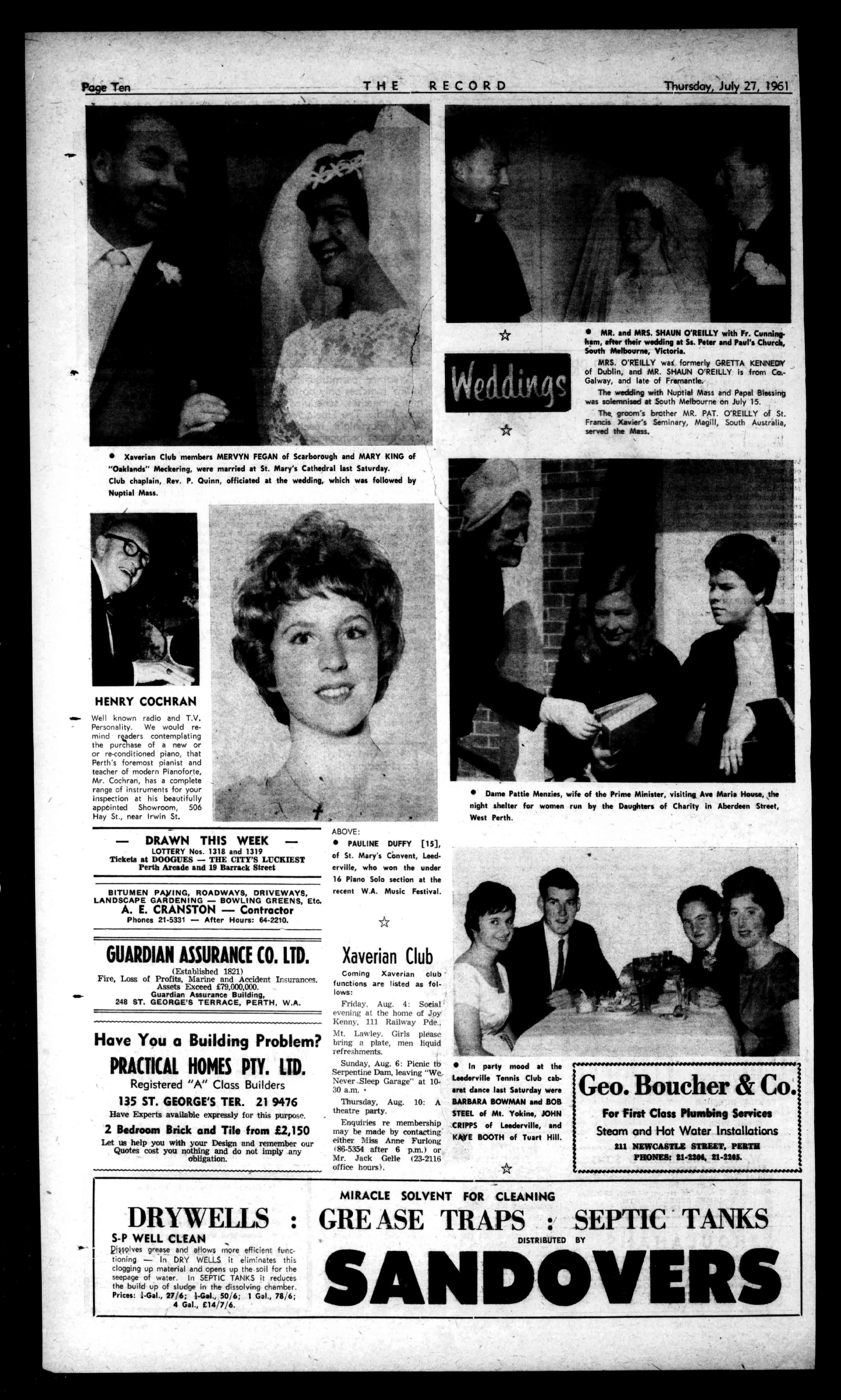
PageTen THERECORD Thursday,July27,1961 OM. XaverianClubmembersMERVYNFEGANofScarboroughandMARYKINGof "Oaklands"Meckering,weremarriedatSt.Mary'sCathedrallastSaturday. Clubchaplain,Rev.P.Quinn,officiatedatthewedding,whichwasfollowedby NuptialMass. HENRYCOCHRAN WellknownradioandT.V. Personality. Wewouldremindreaderscontemplating thepurchaseofanewor orre-conditionedpiano,that Perth'sforemostpianistand teacherofmodernPianoforte, Mr.Cochran,hasacomplete rangeofinstrumentsforyour inspectionathisbeautifully appointedShowroom,506 HaySt.,nearIrwinSt. -DRAWNTHISWEEKLOTTERYNos.1318and1319 TicketsatDOOGUES-THECITY'SLUCKIEST PerthArcadeand19BarrackStreet BITUMENPAyING,ROADWAYS,DRIVEWAYS, LANDSCAPEGARDENING-BOWLINGGREENS,Etc. A.E.CRANSTON-Contractor Phones21-5331-AfterHours:64-2210. ABOVE: PAULINEDUFFY[15], ofSt.Mary'sConvent,Leederville,whowontheunder 16PianoSolosectionatthe recentW.A.MusicFestival. GUARDIANASSURANCECO.LTD. XaverianClub tEstablished1821) Fire,LossofProfits,MarineandAccidentInsurances. AssetsExceed£79,000,000. GuardianAssuranceBuilding, 248ST.GEORGE'STERRACE,PERTH,W.A. HaveYouaBuildingProblem? PRACTICALHOMESPTY.LTD. Registered"A"ClassBuilders 135ST.GEORGE'STER.219476 HaveExpertsavailableexpresslyforthispurpose. 2BedroomBrickandTilefrom£2,150 LetushelpyouwithyourDesignandrememberour Quotescostyounothinganddonutimplyany obligation. ComingXaverianclub functionsarelistedasfollows: Friday,Aug.4:Social eveningatthehomeofJoy Kenny,111RailwayPde.. Mt.Lasvley.Girlsplease bringaplate,menliquid refreshments. Sunday,Aug.6:Picnictb SerpentineDam,leaving"We. NeverSleepGarage"at1030a.m. Thursday,Aug.10:A theatreparty. Enquiriesremembership tnayhemadebycontacting eitherMissAnneFurlong 186-5354after6p.m.)or Mr.JackGelle(23-2116 officehours). Weddings MR.andMRS.SHAUNO'REILLYwithFr.Cunningham,aftertheirweddingatSs.PeterandPaul'sChurch, SouthMelbourne,Victoria. MRS.O'REILLYwasformerlyGRETTAKENNEDY ofDublin,andMR.SHAUNO'REILLYisfromCo.Galway,andlateofFremantle. TheweddingwithNuptialMassandPapalBlessing wassolemnisedatSouthMelbourneonJuly15. Thegroom'sbrotherMR.PAT.O'REILLYofSt. FrancisXavier'sSeminary,Magill,SouthAustralia, servedtheMass. DamePattieMenzies,wifeofthePrimeMinister,visitingAveMariaHouse,the nightshelterforwomenrunbytheDaughtersofCharityinAberdeenStreet, WestPerth. Inpartymoodatthe LeedervilleTennisClubcabaretdancelastSaturdaywere BARBARABOWMANandBOB STEELofMt.Yokine,JOHN CRIPPSofLeederville,and KPtVEBOOTHofTuartHill. eg14144.4NNINIMIONNIO41414.11.1104141441 Geo.Boucher&Co. ForFirstClassPlumbingServices SteamandHotWaterInstallations 211NEWCASTLESTREET,PERTH PHONES:21-2204,21-2215. wira.mwdr..4.4......PdPoihow.p4 DRYWELLS S-PWELLCLEAN vesgreaseandallowsmoreefficientfunctioning-InDRYWELLSitelim:natesthis cloggingupmaterialandopensupthesoilforthe seepageofwater.InSEPTICTANKSitreduces thebuildupofsludgeinthedissolvingchamber. Prices: 27/6;1-Gal.,50/6; 1Gal.,78/6; 4Gal.,114/7/6. MIRACLESOLVENTFORCLEANING GREASETRAPS DISTRIBUTED SEPTICTANKS NDOVERS
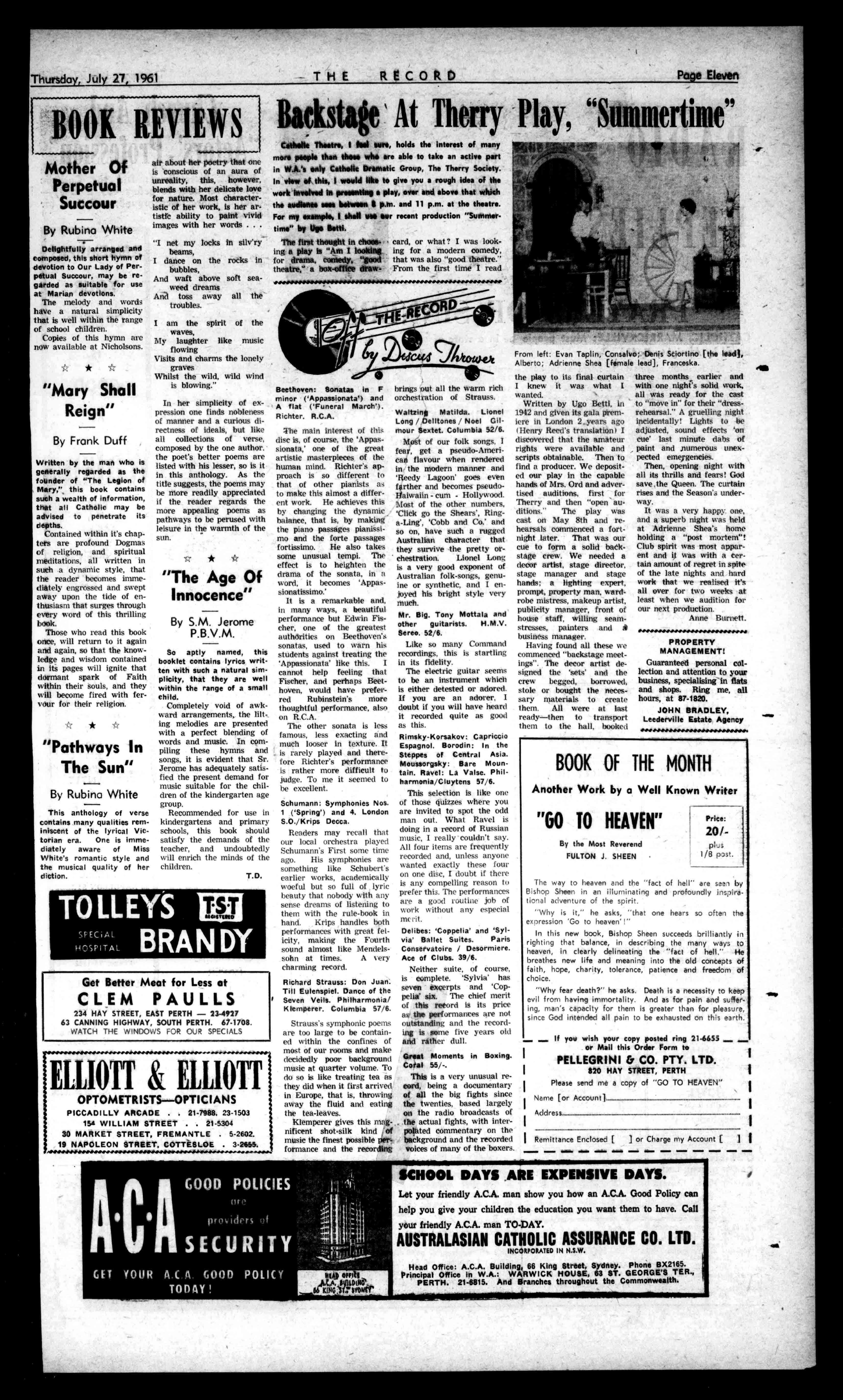
BOOKREVIEWS
MotherOf Perpetual Succour
ByRubinoWhite
Delightfullyarrangedand composed,thisshorthymnof devotiontoOurLadyofPerpetualSuccour,mayberegardedassuitableforuse atMariandevotions.
Themelodyandword., haveanaturalsimplicity thatiswellwithintherange ofschoolchildren. Copiesofthishymnarc nowavailableatNicholsons.
"MaryShall Reign"
ByFrankDuff
Writtenbythemanwhois generallyregardedasthe founderof"TheLegionof Mary,"thisbookcontains suchawealthofinformation, thatallCatholicmaybe advisedtopenetrateits depths.
Containedwithinit'schaptersareprofoundDogmas ofreligion,andspiritual meditations,allwrittenin suchadynamicstyle,that thereaderbecomesimmediatelyengrossedandswept awayuponthetideofenthusiasmthatsurgesthrough everywordofthisthrilling book.
Thosewhoreadthisbook once,willreturntoitagain andagain,sothattheknowledgeandwisdomcontained initspageswillignitethat dormantsparkofFaith withintheirsouls,andthey willbecomefiredwithfervourfortheirreligion.
*
"PathwaysIn TheSun"
ByRubinoWhite
Thisanthologyofverse containsmanyqualitiesreminiscentofthelyricalVictorianera. OneisimmediatelyawareofMiss White'sromanticstyleand themusicalqualityofher diction.
airaboutherpoetrythatone isconsciousofanauraof unreality,this,however, blendswithherdelicatelove fornature.Mostcharacteristicofherwork,isherartistfcabilitytopaintvivid imageswithherwords "Inetmylocksinsilv'ry beams, Idanceontherocksin bubbles, Andwaftabovesoftseaweeddreams Andtossawayallthe troubles.
Iamthespiritofthe waves, Mylaughterlikemusic flowing Visitsandcharmsthelonely graves Whilstthewild,wildwind isblowing."
Inhersimplicityofexpressiononefindsnobleness ofmannerandacuriousdirectnessofideals,butIlk, allcollectionsofverse, composedbytheoneauthor. thepoet'sbetterpoemsare listedwithhislesser,soisit inthisanthology.Asthe titlesuggests,thepoemsmay bemorereadilyappreciated ifthereaderregardsthe moreappealingpoemsas pathwaystobeperusedwith leisureinthewarmthofthe sun.
T. * "TheAgeOf Innocence"
ByS.M.Jerome P.B.V.M.
Soaptlynamed,this bookletcontainslyricswrit tenwithsuchanaturalsimplicity,thattheyarewell withintherangeofasmall child.
Completelyvoidofawkwardarrangements,theliltingmelodiesarepresented withaperfectblendingof wordsandmusic.Incompilingthesehymnsand songs,itisevidentthatSr. Jeromehasadequatelysatisfiedthepresentdemandfor musicsuitableforthechildrenofthekindergartenage group. Recommendedforusein kindergartensandprimary schools,thisbookshould satisfythedemandsofthe teacher,andundoubtedly willenrichthemindsofthe children. T.D.
Beethoven:SonatasinF minor("Appassionata.)and Aflat('FuneralMarch'). Richter.R.C.A.
Themaininterestofthis discis,ofcourse,the'Appassiortata;oneofthegreat artisticmasterpiecesofthe humanmind.Richter'sapproachissodifferentto thatofotherpianistsas tomakethisalmostadifferentwork.Heachievesthis bychangingthedynamic. balance,thatis,bymaking thepianopassagespianissimoandthefortepassages fortissimo.Healsotakes someunusualtempi.The effectistoheightenthe dramaofthesonata,ina word,itbecomes'Appassionatissimo.'
Itisaremarkableand, inmanyways,abeautiful performancebutEdwinFischer,oneofthegreatest authoritiesonBeethoven's sonatas,usedtowarnhis studentsagainsttreatingthe 'Appassionata'likethis.I cannothelpfeelingthat Fischer.andperhapsBeethoven,wouldhavepreferredRubinstein's more thoughtfulperformance,also onR.C.A.
Theothersonataisless famous,lessexactingand muchlooserintexture.It israrelyplayedandthereforeRichter'sperformance israthermoredifficultto judge.Tomeitseemedto beexcellent.
Schumann:SymphoniesNos. ('Spring')and4.London S.O./KripsDecca.
Readersmayrecallthat ourlocalorchestraplayed Schumann'sFirstsometime ago. Hissymphoniesare somethinglikeSchubert's earlierworks,academically woefulbutsofulloflyric beautythatnobodywithany sensedreamsoflisteningto themwiththerule-bookin hand.Kripshandlesboth performanceswithgreatfelicity,makingtheFourth soundalmostlikeMendelsscamattimes. Avery charmingrecord.
RichardStrauss:DonJuan. TillEulenspiel.Danceofthe SevenVeils.Philharmonia/ Klemperer.Columbia57/6.
Strauss'ssymphonicpoems aretoolargetobecontainedwithintheconfinesof mostofourroomandmake decidedlypoorbackground musicatquartervolume.To dosoisliketreatingteaas theydidwhenitfirstarrived inEurope,thatis,throwing awaythefluidandeating thetea-leaves.
Klemperergivesthismagnificentshot-silkkind:of musicthefinestpossibleperformanceandtherecording
bringsoutallthewarmrich orchestrationofStrauss.
WaltzingMatilda.Lionel Long/Delltones/NoelGilmourSextet.Columbia52/6. Mostofourfolksongs,I fear,getapseudo-Americanflavourwhenrendered inthemodernmannerand 'ReedyLagoon'goeseven fartherandbecomespseudoaiwaiincum-Hollywood. Mostoftheothernumbers. 'ClickgotheShears',Ringa-Ling','CobbandCo.'and soon,havesucharugged Australiancharacterthat theysurvivetheprettyorchestration. LionelLong isaverygoodexponentof Australianfolk-songs,genuineorsynthetic,andIenjoyedhisbrightstylevery much.
Mr.Big.TonyMottalaand otherguitarists.H.M.V. Sere..52/6.
LikesomanyCommand recordings,thisisstartling initsfidelity. Theelectricguitarseems tobeaninstrumentwhich iseitherdetestedoradored.
Ifyouareanadorer, doubtifyouwillhaveheard itrecordedquiteasgood asthis.
Rimsky-Korsakov:Capriccio Espagnol.Borodin:Inthe SteppesofCentralAsia. Moussorgsky:BareMountain.Ravel:LaValse.Philharmonia/Cluytens57/6.
Thisselectionislikeone ofthosequizzeswhereyou areinvitedtospottheodd manout.WhatRavelis doinginarecordofRussian music,Ireallycouldn'tsay. Allfouritemsarefrequently recordedand,unlessanyone wantedexactlythesefour ononedisc,Idoubtifthere isanycompellingreasonto preferthis.Theperformances areagoodroutinejobof workwithoutanyespecial merit.
Delibes:'Coppelia'and'Sylvia'BalletSuites. Paris Conservatoire/Desormiere. AceofClubs.39/6.
Neithersuite,ofcourse, iscomplete.'Sylvia'has sevenexcerptsand'Coppelia'six.Thechiefmerit ofthisrecordisitsprice to:theperformancesarenot outstandingandtherecordingissomefiveyearsold andratherdull.
greatMomentsinBoxing.
coral55/--
Thisisaveryunusualrecord,beingadocumentary ofallthebigfightssince thetwenties,basedlargely ontheradiobroadcastsof theactualfights,withinterpointedcommentaryonthe backgroundandtherecorded voicesofmanyoftheboxers.
IknewitwaswhatI wanted. WrittenbyUgoBetti,in 1942andgivenitsgalapremiereinLondon2.yearsago (HenryReed'stranslation)I discoveredthattheamateur rightswereavailableand scriptsobtainable.Thento findaproducer.Wedepositedourplayinthecapable handsofMrs.Ordandadvertisedauditions,firstfor Therryandthen"openauditions." Theplaywas castonMay8thandrehearsalscommencedafortnightlater.Thatwasour cuetoformasolidbadkstagecrew.Weneededa decorartist,stagedirector, stagemanagerandstage hands:alightingexpert, prompt,propertyman,wardrobemistress,makeupartist, publicitymanager,frontof housestaff,willingseamstresses,paintersand6 businessmanager. HavingfoundalltheseWe commenced"backstagemeetings".Thedecorartistdesignedthe'sets'andthe crewbegged,borrowed, stoleorboughtthenecessarymaterialstocreate them.Allwereatlast ready-thentotransport themtothehall,booked
threemonths_earlierand withonenight'ssolidwork, allwasreadyforthecast to"movein"fortheir"dressrehearsal."Agruellingnight incidentally!Lightstobe adjusted,soundeffects'on cue'lastminutedabsof paintand.numerousunexpectedemergencies. Then,openingnightwith allitsthrillsandfears!God save,theQueen.Thecurtain risesandtheSeason'sunderway. Itwasaveryhappyone, andasuperbnightwasheld atAdrienneShea'shome holdinga"postmortem"! Clubspiritwasmostapparentanditwaswithacertainamountofregretinspite ofthelatenightsandhard workthatwerealisedit's alloverfortwoweeksat leastwhenweauditionfor ournextproduction.
AnneBurnett.
PROPERTY MANAGEMENT!
Guaranteedpersonalcollectionandattentiontoyour business,specialisinginflats andshops.Ringme.all hours,at87-1820.
JOHNBRADLEY, LeedervilleEstateAgency ANN*
BOOKOFTHEMONTH
AnotherWorkbya
Thursday,July27,1961 THERECORD PageEleven
TOLLEYS BRANDY SPECIAL HOSPITAL GetBetterMeatforLessat CLEMPAULLS 234HAYSTREET,EASTPERTH-23.4927 63CANNINGHIGHWAY,SOUTHPERTH.67-1708. WATCHTHEWINDOWSFOROURSPECIALS ELLIOTT&ELLIOTT OPTOMETRISTS-OPTICIANS PICCADILLYARCADE 21-7988.23-1503 154WILLIAMSTREET 21.5304 30MARKETSTREET,FREMANTLE 5-2E02. 19NAPOLEONSTREET,COTTESLOE 3-2655. Backstage'AtTherry-Play,"Summertime CathilleTheatre,feelsemholdstheinterestofmany morepeoplethanthesewiseareabletotakeanactivepart inW.A.'sonlyCatholicDramaticGroup,TheTherrySociety. Inviewofthis,Iwouldliketogiveyouaroughideaofthe workInvolvedInpresentingaplay,overandabovethatwhich theaudienceseesbetweenIIp.m.and11p.m.atthetheatre. Formyexample,IshellweeIsarrecentproduction"Summertime"byUgeBeni. Thefirstthoughtinchaos-card,orwhat?IwaslookingaplayIs"AmIlookingingforamoderncomedy, fordrama,comedy,"goodthatwasalso"goodtheatre.theatre,"abox-officedraw-FromthefirsttimeIread
Fromleft:EvanTaplin,Consalvo;DenisSciortino[thelead], Alberto;AdrienneShea[femalelead],Franceska. theplaytoitsfinalcurtain
WellKnownWriter "GOTOHEAVEN" BytheMostReverend FULTONJ.SHEEN Price: 20/1/8p33' Thewaytoheavenandthe"factofhell"areseenby BishopSheeninanilluminatingandprofoundlyinspirationaladventureofthespirit. "Whyisit,"heasks,"thatonehearssooftenthe expression'Gotoheaven'!" Inthisnewbook,BishopSheensucceedsbrilliantlyin rightingthatbalance,indescribingthemanywaysto heaven,inclearlydelineatingthe"factofhell."He breathesnewlifeandmeaningintotheoldconceptsof faith,hope,charity,tolerance,patienceandfreedomof choice. "Whyfeardeath?"heasks.Deathisanecessitytokeep evilfromhavingimmortality.Andasforpainandsuffering,man'scapacityforthemisgreaterthanforpleasure. sinceGodintendedallpaintobeexhaustedonthis earth. Ifyouwishyourcopypostedring21-6655 orMailthisOrderFormto PELLEGRINI&CO.PTY.LTD. 820HAYSTREET,PERTH Pleasesendme copyof"GOTOHEAVEN" Name[orAccount] Address.... RemittanceEnclosed[ orChargemyAccount[ GOODPOLICIES lire pro,.Marcof SECURITY GETYOURACAGOODPOLICY TODAY! MOOFF! j6t,A, 66KING"if:7sYowthr SCHOOLDAYSAREEXPENSIVEDAYS. LetyourfriendlyA.C.A.manshowyouhowanA.C.A.GoodPolicycan helpyougiveyourchildrentheeducationyouwantthemtohave.Call yourfriendlyA.C.A.manTO-DAY. AUSTRALASIANCATHOLICASSURANCECO.LTD. INCORPORATEDINN.S.W. HeadOffice:A.C.A.Building,66KingStreet,Sydney.PhoneBX2165. PrincipalOfficeinW.A.:WARWICKHOUSE,63ST.GEORGE'STER., PERTH.21-6815.AndBranchesthroughouttheCommonwealth.
BOOKREVIEWS
MotherOf Perpetual Succour
ByRubinoWhite
Delightfullyarrangedand composed,thisshorthymnof devotiontoOurLadyofPerpetualSuccour,mayberegardedassuitableforuse atMariandevotions.
Themelodyandwords haveanaturalsimplicity thatiswellwithintherange ofschoolchildren.
Copiesofthishymnare nowavailableatNicholsons.
*
"MaryShall Reign"
ByFrankDuff
Writtenbythemanwhois generallyregardedasthe founderof"TheLegionof Mary,"thisbookcontains suchawealthofinformation, thatallCatholicmaybe advisedtopenetrateits depths.
Containedwithinit'schaptersareprofoundDogmas ofreligion,andspiritual meditations,allwrittenin suchadynamicstyle,that thereaderbecomesimmediatelyengrossedandswept awayuponthetideofenthusiasmthatsurgesthrough everywordofthisthrilling book.
Thosewhoreadthisbook once,willreturntoitagain andagain,sothattheknowledgeandwisdomcontained initspageswillignitethat dormantsparkofFaith withintheirsouls,andthey willbecomefiredwithfervourfortheirreligion.
"PathwaysIn TheSun"
ByRubinoWhite
Thisanthologyofverse containsmanyqualitiesreminiscentofthelyricalVictorianera. OneisimmediatelyawareofMiss White'sromanticstyleand themusicalqualityofher diction.
airaboutherpoetrythatone isconsciousofanauraof unreality,this,however, blendswithherdelicatelove fornature.Mostcharacteristicofherwork,isherartistfcabilitytopaintvivid imageswithherwords
"Inetmylocksinsilv'ry beams, Idanceontherocksin bubbles, Andwaftabovesoftseaweeddreams Andtossawayallthe troubles.
Iamthespiritofthe waves, Mylaughterlikemusic flowing Visitsandcharmsthelonely graves Whilstthewild,wildwind isblowing."
Inhersimplicityofexpressiononefindsnobleness ofmannerandacuriousdirectnessofideals,butlike allcollectionsofverse, composedbytheoneauthor, thepoet'sbetterpoemsare listedwithhislesser,soisit inthisanthology.Asthe titlesuggests,thepoemsmay bemorereadilyappreciated ifthereaderregardsthe moreappealingpoemsas pathwaystobeperusedwith leisureinthewarmthofthe sun.
"TheAgeOf Innocence"
ByS.M.Jerome P.B.V.M.
Soaptlynamed,this bookletcontainslyricswrittenwithsuchanaturalsimplicity,thattheyarewell withintherangeofasmall child. Completelyvoidofawkwardarrangements,theliltingmelodiesarepresented withaperfectblendingof wordsandmusic.Incompilingthesehymnsand songs,itisevidentthatSr. Jeromehasadequatelysatisfiedthepresentdemandfor musicsuitableforthechildrenofthekindergartenage group. Recommendedforusein kindergartensandprimary schools,thisbookshould satisfythedemandsofthe teacher,andundoubtedly willenrichthemindsofthe children. T.D.
BackstageAtTherryPlay,"Summertime
The
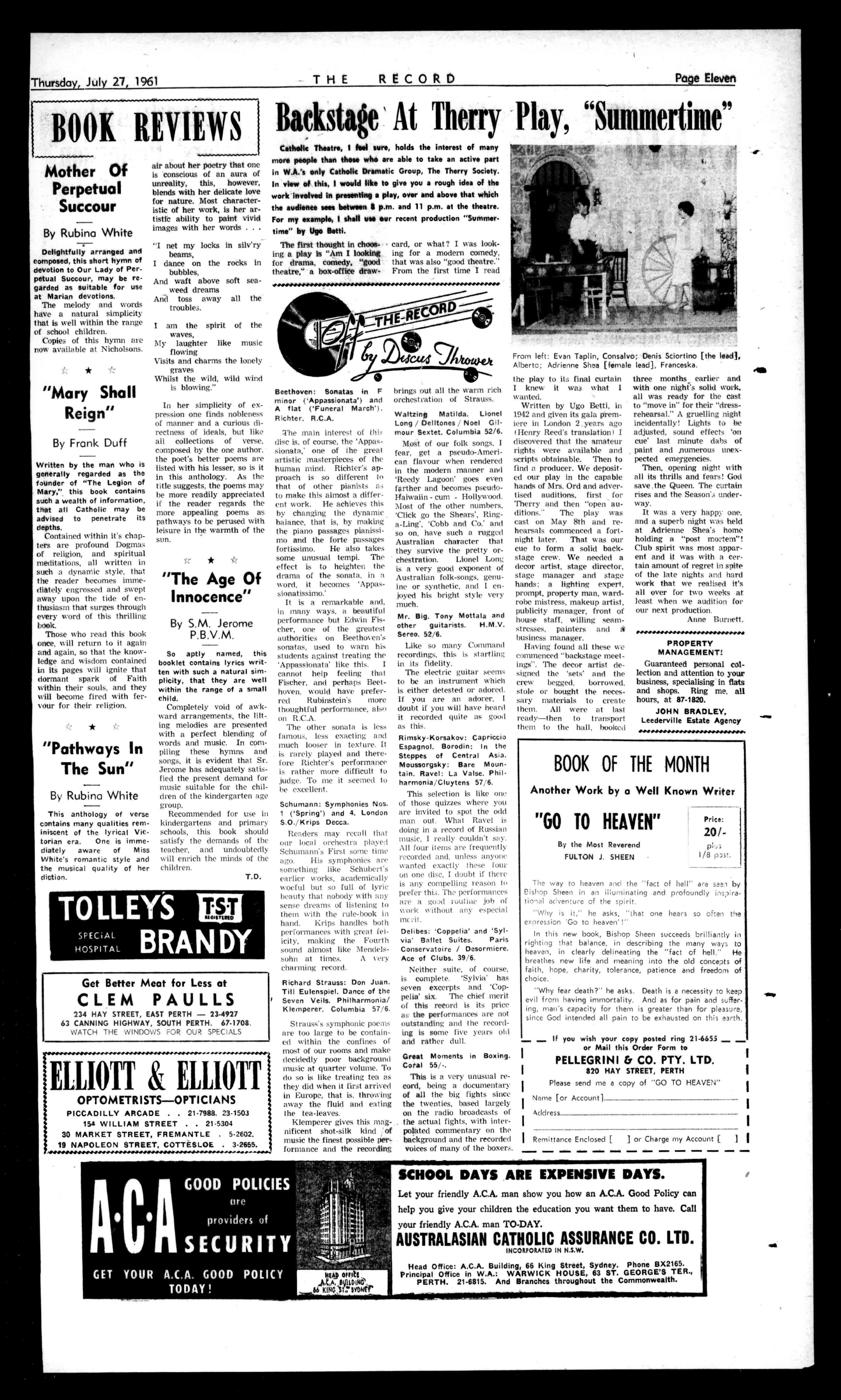
card,orwhat?Iwaslookingforamoderncomedy, thatwasalso"goodtheatre." FromthefirsttimeIread
-
Beethoven:SonatasinF minor('Appassionata')and Aflat('FuneralMarch'), Richter.R.C.A.
Themaininterestofthis discis.ofcourse,the'Appassionata,'oneofthegreat artisticmasterpiecesofthe humanmind.Richter'sapproachissodifferentto thatofotherpianistsas tomakethisalmostadifferentwork.Heachievesthis bychangingthedynamic balance,thatis,bymaking thepianopassagespianissimoandthefortepassages fortissimo.Healsotakes someunusualtempi.The effectistoheightenthe dramaofthesonata,ina word,itbecomes'Appassionatissimo.'
Itisaremarkableand, inmanyways,abeautiful performancebutEdwinFischer,oneofthegreatest authoritiesonBeethoven's sonatas,usedtowarnhis studentsagainsttreatingthe 'Appassionata'likethis. I cannothelpfeelingthat Fischer.andperhapsBeethoven,wouldhavepreferredRubinstein'smore thoughtfulperformance,also onR.C.A.
Theothersonataisless famous,lessexactingand muchlooserintexture.It israrelyplayedandthereforeRichter'sperformance israthermoredifficultto judge.Tomeitseemedto beexcellent.
Schumann:SymphoniesNos. 1 ('Spring')and4.London S.0./KripsDecca.
Readersmayrecallthat ourlocalorchestraplayed Schumann'sFirstsometime ago.Hissymphoniesare somethinglikeSchubert's earlierworks,academically woefulbutsofulloflyric beautythatnobodywithany sensedreamsoflisteningto themwiththerule-hookin hand.Kripshandlesboth performanceswithgreatfelicity,makingtheFourth soundalmostlikeMendelssohnattimes. Avery charmingrecord.
RichardStrauss:DonJuan, TillEulenspiel.Danceofthe SevenVeils.Philharmonia/ Klemperer.Columbia57/6.
Strauss'ssymphonicpoems aretoolargetobecontainedwithintheconfinesof mostofourroomsandmake decidedlypoorbackground musicatquartervolume.To dosoisliketreatingteaas theydidwhenitfirstarrived inEurope,thatis,throwing awaythefluidandeating thetea-leaves. Klemperergivesthismagnificentshot-silkkindof musicthefinestpossibleperformanceandtherecording
bringsoutallthewarmrich orchestrationofStrauss.
WaltzingMatilda.Lionel Long/Delltones/NoelGilmourSextet.Columbia52/6. Mostofourfolksongs,I fear,getapseudo-Americanflavourwhenrendered inthemodernmannerand 'ReedyLagoon'goeseven fartherandbecomespseudoI4aiwaiin-cum-Hollywood. Mostoftheothernumbers, 'ClickgotheShears',Ringa-Ling','CobbandCo.'and soon,havesucharugged Australiancharacterthat theysurvivetheprettyorchestration. LionelLong isaverygoodexponentof Australianfolk-songs,genuineorsynthetic.andIenjoyedhisbrightstylevery much. Mr.Big.TonyMottalaand otherguitarists.H.M.V. Sereo.52/6.
LikesomanyCommand recordings,thisisstartling initsfidelity. Theelectricguitarseems tobeaninstrumentwhich iseitherdetestedoradored. Ifyouareanadorer.I doubtifyouwillhaveheard itrecordedquiteasgoad asthis.
Rimsky-Korsakov:Capriccio Espagnol.Borodin:Inthe SteppesofCentralAs,a. Moussorgsky:BareMountain.Ravel:LaValse.Philharmonia/Cluytens57,'6.
Thisselectionislikeone ofthosequizzeswhereyou areinvitedtospottheodd manout.WhatRavelis doinginarecordofRussian music,Ireallycouldn'tsay. Allfouritemsarefrequently recordedand,unlessanyone wantedexactlythesefour ononedisc,Idoubtifthere isanycompellingreasonto preferthis.Theperformances areagoodroutinejobof workwithoutanyespecial merit.
Detibes:'Coppelia'and'Sylvia'flatletSuites. Paris Conservatoire/Desormiere.
AceofClubs.39/6.
Neithersuite,ofcourse, iscomplete.'Sylvia'has sevenexcerptsand'Coppelia'six.Thechiefmerit ofthisrecordisitsprice astheperformancesarenot outstandingandtherecordingissomefiveyearsold andratherdull.
GreatMomentsinBoxing.
Coral55/-.
Thisisaveryunusualrecord,beingadocumentary ofallthebigfightssince thetwenties,basedlargely ontheradiobroadcastsof theactualfights,withinterpolatedcommentaryonthe backgroundandtherecorded voicesofmanyoftheboxers.
theplayto
IknewitwaswhatI wanted. WrittenbyUgoBettisin 1942andgivenitsgalapremiereinLondon2yearsago (HenryReed'stranslation)I discoveredthattheamateur rightswereavailableand scriptsobtainable.Thento findaproducer.Wedepositedourplayinthecapable handsofMrs.Ordandadvertisedauditions,firstfor merryandthen"openauditions."Theplaywas castonMay8thandrehearsalscommencedafortnightlater.Thatwasour cuetoformasolidbatkstagecrew.Weneededa decorartist,stagedirector, stagemanagerandstage hands:alightingexpert. prompt,propertyman,wardrobemistress,makeupartist, publicitymanager,frontof housestaff,willingseamstresses,paintersanti I businessmanager. Havingfoundallthesewe commenced"backstagemeetings".Thedecorartistdesignedthe'sets'andthe crewbegged,borrowed, stoleorboughtthenecessarymaterialstocreate them.Allwereatlast ready-thentotransport themtothehall.booked
threemonthsearlierand withonenight'ssolidwork, allwasreadyforthecast to"movein"fortheir"dressrehearsal,"Agruellingnight incidentally!Lightstobe adjusted,soundeffects'on cue'lastminutedabsof paintandnumerousunexpectedemergencies.
Then,openingnightwith allitsthrillsandfears!God save,theQueen.Thecurtain risesandtheSeason'sunderway. Itwasaveryhappyone. andasuperbnightwasheld atAdrienneShea'shome holdinga"postmortem"! Clubspiritwasmostapparentanditwaswithacertainamountofregretinspite ofthelatenightsandhard workthatwerealisedit's alloverfortwoweeksat leastwhenweauditionfor ournextproduction.
AnneBurnett.
PROPERTY MANAGEMENT!
Guaranteedpersonalcollectionandattentiontoyour business,specialisinginflats andshops.Ringme,all hours,at87-1820.
JOHNBRADLEY, LeedervilleEstateAgency .1.14
BOOKOFTHEMONTH
AnotherWorkbyaWellKnownWriter
"GOTOHEAVEN"
BytheMostReverend FULTON.1.SHEEN
20/Plus 1/8pct.
Thewaytoheavenandthe"factofhell"aresee,by BishopSheeninanilluminatingandprofoundlyinspirationaladventureofthespirit.
"Whyisit,"heasks,"thatonehearssooftenthe eeoression
Thursday,July27,1961 THERECORD PageEleven
TOLLEYS BRANDY SPECIAL HOSPITAL GetBetterMeatforLessat CLEMPAULLS 234HAYSTREET,EASTPERTH-23-4927 63CANNINGHIGHWAY,SOUTHPERTH.67.1708. WATCHTHEWINDOWSFOROURSPECIALS ELLIOTTSzELLIOTT OPTOMETRISTS-OPTICIANS PICCADILLYARCADE 21-7988.23-1503 154WILLIAMSTREET 21-5304 30MARKETSTREET,FREMANTLE 5-2602. 19NAPOLEONSTREET.COTTESLOE 3-2655. OW.
CatholicTheatre,Ifeelsure,holdstheinterestofmany morepeoplethanthosewhoareabletotakeanactivepart inW.A.'sonlyCatholicDramaticGroup,TheTherrySociety. Inviewofthis,Iwouldliketogiveyouaroughideaofthe workinvolvedinpresentingaplay,overandabovethatwhich theaudienceseesbetween8p.m.and11p.m.atthetheatre. Formyexample,shallusecurrecentproduction"Summertime"byUgoBetti.
ing
Ilooking fordrama,comedy,"good theatre,"abox-officedraw
firstthoughtinchin:s-
aplayIs"Am
Fromleft:EvanTaplin,Consalvo;DenisSciortino[thelead], Alberto;AdrienneShea[femalelead],Franceska.
itsfinalcurtain
'Gotoheaven'!" Inthisnewbook,BishopSheensucceedsbrilliantlyin rightingthatbalance,indescribingthemanywaysto heaven,inclearlydelineatingthe"factofhell."He breathesnewlifeandmeaningintotheoldconceptsof faith,hope,charity,tolerance,patienceandfreedomof choice. "Whyfeardeath?"heasks.Deathisanecessitytokeep evilfromhavingimmortality.Andasforpainandsuffering,man'scapacityforthemisgreaterthanforpleasure, sinceGodintendedallpaintobeexhaustedon
Ifyouwishyourcopypostedring21-6655 orMailthisOrderFormto PELLEGRINI&CO.PTY.LTD. 820HAYSTREET,PERTH Pleasesendmeacopyof"GOTOHEAVEN" Name[orAccount]... Address. RemittanceEnclosed[ ]orChargemyAccount[ ] GOODPOLICIES A.c. ore providersof SECURITY GETYOURA.C.A.GOODPOLICY TODAY! 11411I .4 HEAD(Mai AktA. iNe 66KINGTTMuff SCHOOLDAYSAREEXPENSIVEDAYS. LetyourfriendlyA.C.A.manshowyouhowanA.C.A.GoodPolicycan helpyougiveyourchildrentheeducationyouwantthemtohave.Call yourfriendlyA.C.A.manTO-DAY. AUSTRALASIANCATHOLICASSURANCECO.LTD. INCORPORATEDINN.S.W. HeadOffice:A.C.A.Building,66KingStreet,Sydney.PhoneBX2165. PrincipalOfficeinW.A.:WARWICKHOUSE,63ST.GEORGE'STER., PERTH.21-6815.AndBranchesthroughouttheCommonwealth.
thisearth.

andthroughChristthattheyhave
God.Whiletheprayers ofoneinastateofsin,iftheyaresincereandearnest,
CONTINUEDATTENDANCEATMASS
Q.:TakethecaseofadivorcedCatholicwhohas marriedagainoutside,theChurch,butwho,although hecannotreceivethesacraments,stillgoestoMass everySunday.ArehisprayerswhileatMassheard? Orarethey"black"solongashecontinuesinastate ofsin?
R.:Hisprayers,nomatterwherehesaysthem-ifhe reallytriestomeanthem-willbeheardbyGod.As petitions,theyarenotdeclared"black,"touseyour ownexpression.Andtheymayeventuallywinforhim thegraceofconversion,waysandmeansofputtinghis liferight,andthesalvationofhissoulintheend.But solongashecontinuesinastateofsin,theylackthe supernaturalvaluewhichwillberewardedinheaven withagreaterparticipation,inthegloryandhappiness ofChrist.
Meantime,thefactthatsuchamanstillgoestoMass onSundaysshowsthathestillhasfaithandhopeeven thoughheiscutofffromtheloveandfriendshipofGod bybeinginastateofsin.Moreover,hehassome measureofgoodwill,forhedoesnotarguethatwhat hefeelshecannotdoexcuseshimfromdoingwhathe cando;andhisefforttorenderthereligiousacknowledgementheknowstobeduetoGodwillcertainly addtothepowerofhisprayersaspetitionsandrender morelikelyhiseventualrecoveryofastateofgrace. Thesuppositionis,ofcourse,thatheisnotactuated byanyspiritofpresumption,holdingthathissinsdon't matterandthatheisquitefreetogoonwiththemso longasheattendsMass.Butonlyafoolwouldthink that.
MESSIANIC "GOLDENAGE"
P.J.M.,ARTARMONDoesIsaiah,11:6-9, applytotheearthtoday,orinsomeother period?
R.:Asapredictiontheverseshavenoapplication inaliteralandmaterialsensetothisearthatany time.Inthepreviousverses,Isaiahpredictsthe comingoftheMessiah,givingHispersonalcharacteristics.Inyourpassage,hedescribestheeffects ofHisrule,saying:"Thewolfshalldwellwiththe lamb.andtheleopardshallliedownwiththekid; andthecalfandtheyounglionandthefatling together;andalittlechildshallleadthem.And thecowandthebearshallfeed;theiryoungones shallliedowntogether;andthelionshalleatstraw likeanox.Andthesucklingchildshallplayon theholedugbyanasp,andtheweanedchildshall puthishandontheadder'sden.Theyshallnot hurtnordestroyinallmyholymountain;forthe earthshallbefulloftheknowledgeoftheLord, asthewaterscover'the'sea."
IdyllicPictureOfTheGardenOfEden
InthosewordsIsaiahpaintsanidyllicpictureof peace,recallingconditionsassociatedwiththe GardenofEdenbefortithefirstsin.Heisnot expressingabeautifuldream;butalsoheisnot predictinganystrictrealitytobeaccomplished somedayinthisactual.world.Thepassageisa richandexpressivesymbol,akindofparable showingthecompleteeliminationofalldiscordin theperfectedmessianickingdomofChristin heavenitself,whereHewillbe"Kingofkingsand Lordoflords,"reigningforeverandever.
ThegloriousimageryofIsaiah,therefore,hasto besubliinatedandspiritualised.beingunderstood ofourother-worldlydestinyinheaven--inthe heavendescribedbySt.JohnintheApocalypse orRevelation,saying:"Godshallwipeawayall tearsfromtheireyes;and.thereshallbenomore death;neithersorrow,norcrying;neithershall therebeanymorepain;fortheformerthingsare passedaway"(Rev.21:4).
Wedonot,then,lookforaliteralandmaterial fufilmentofIsaiah'spredictioninthisworld,but are,inthewordsofSt.Paul,as"strangersand pilgrimsontheearth seekingabettercountry, thatis,aheavenlyone"(Het.11:13-16).There Isaiah'ssymbolicprophecywjIbefulfilled.
Church_And "Actors'Profession"
B.A.C.,PottsPoint:DidtheCatholic Churcheverdenytoactors-asabodyburialinconsecratedground;andifsofor howlong?
R.:Duringthefirstfour centuriestheCatholicChurch absolutelyfcrbadeChristianstoattendortake partintheatricaldisplays, andmadeitastrictconditionthatactorswhobecame Christiansmustabandonthe stageandseeksomeother occupation.
Thereasonforthiswasthe factthatthetheatreinthose timeswasanintegralpart oftheprevailingpaganculture,playsoftenbeing characterisedbygrossindecency,andattimesby blasphemousparodiesof Christianrites.AnyChristianwhoadoptedorcontinuedintheactors'profession waslookeduponasapublic sinner,andwasdeniedChristianburialifhediedunrepentant.
GradualChange
AsChristianitytriumphed overpaganism,however,the evilsassociatedwiththe stageweregraduallyrectified,andin439A.D.,the TheodosianCodedecreed simplythattheatricalshows werenottobeheldonSundaysorduringholyseasons. DifferentlocalCouncilstook astricterstandthanelsewhere,andthelastdecree forbiddingtheactors'professionunderpainofexcommunicationanddenialof Christianburial-asfarasI amaware-wasbytheCouncilofTrulla,heldinConstantinoplein692A.D.With thecollapseoftheRoman Empireanewerawasusheredin,andasChristendom gotonitsfeetthefamous "MoralityPlays"developed, reachingtheirpeakinthe MiddleAgesandpreparing thewayforthemodern drama.
NotStriptease
AsfarastheCatholic Churchisconcerned,the actors'professionhasremainedanhonorableone,reactionsagainstitinpost-reformationtimesbeingof Puritanorigin.(WhenI, speakoftheactors'professionbeinganhonorableone, Iamspeaking,ofcourse,of genuine"theatre"-notof degradationsofitin"night clubshows,"'strip-tease acts,"andotherformsof licentiousandscandalousexhibitionism.Theyarebut reversionstopagancultural standardsofwhichnoChristiancouldapprove).
PageTwelve THERECORD Thursday,July271961 -RADIO REPLIES... spar ftiecosso.oce/wo,..cro/oarwarcweee.so/Waegne By
PRAYERSOFSINNERS CATHOLIC,MARRICKVILLE:Mustpeople heardbyAlmightyGod? R.:Notfortheirprayerstobeheardaspetitions; otherwiseitwouldbeuselessforsinnerswhoarenotin astateofgracetosayanyprayersatall! Sinners,however,oughttopray,firstandforemost forthegraceofrepentanceandforgiveness,andalsofor thecouragetoliveaccordingtotheirobligationsas Christians.Theymayprayforanyotherblessings, whethertemporal
selvesorothers.Godhears
prayers,eventhoughthey
arenotinastateofgrace. Anotherquestionaltogetheristhatwhichconcerns merit.Scripturetellsus
soalso
principlethatitmustbe"withChrist"appliestoall goodactionsweaccomplish.Nogoodactionscanmerit forusanadditionalshareinthegloryofChristin heavenunlessweareJn
stateofgraceat
itisonlywithand
HOTELandACCOMMODATIONGUIDE THEDERWARD PRIVATEHOTEL 97MURRAYST.,PERTH Perth'sLeadingResidential Lessthan3minute.'wwalkfrom Hotel. St,Marv'sCathedral. BedandBreakfastTariff ifrequired. Phones:23-3900,21-5113 CRITERIONHOTEL CENTRALHAYSTREET, PERTH 24-HOURSERVICE FreeParkingforCountryResideets 5minutes'walkfromCathedral. THECOUNTRYMAN'SHOTEL PHONE23-1115(5lines) THESHAFTESBURY HOTEL INSTIRLINGSTREET 5minutesfrom(3.P.0.1 OffersExcellentAccommodation PlentyofParkingSpace. NowunderthePersonalManagementoftheOwners, NELSONandNELSON. PHONES281051-2 BAYSWATERHotel OPP.STATION FrequentTrainService 4MilesfromCity-Large Parking Area. ExcellentAccommodation BedandBreakfastReasonableTariff LESBARTLETT,Prop, Tel.:71-1224 SUBIACOHOTEL SUBIACO FirstClassAccommodation andService. Phone:8-1028. D.N.YOUNG.Proprietor. WEMBLEYHOTEL ExcellentLoungeand Accommodation. SpaciousParking. Phone:87-2418. Cnr.Cambridgeand AlexanderStreets,Wembley WAVERLEYHOTEL NextBoansWaverleyStore. ALBANYHIGHWAY. CANNINGTON ModernandConvenient HomelyAccommodation DeoOorDrive-inRattleSorel. A.R.CONNELL Phone68-2419 PALACEHOTEL PERTH. "HOMESUPPLY" BOTTLEDEPT. "FreeDelivery"-simply Phone23-2244. W.H.Jacques,Manager. MEETDAILY at VIC,DALY'S HOTELMETROPOLE 645HAYSTREET (NextLondonCourt) Phone:21-6165 EnjoytheBest ACCOMMODATIONand SERVICEat HOTELCOTTESLOE SpecialWinterTariff Phone3-2155. R.M.Dymock,Licensee. WILLAGEEPARK HOTEL TheState'sMostModern TOMKENNY,Licensee Cnr.StockandHighRoads, MELVILLE. Phone:9945111 HOTEL ESPLANADE PERTH'SLEADING HOTELFORALL VISITORS. Phone:23-1531. beinastateofgracefortheirprayerstobe COMMERCIAL HOTEL NORTHAM PhoneNortham45. T.E.MURPHY,Proprietor. NATIONALHOTEL Cnr.HighandMarketSte-, FREMANTLE Offersexcellenthomely accommodation. Phone:5-1786. PhillipP.Kearins,Licensee O'BRIEN'SHOTEL NORTHOFTHELINE ClarrieO'Erien,Licensee. StanO'Brien,Manager. 21-4261. CITYHOTEL Car.RingandMurraySta.. Perth COUNTERLUNCH,12-7.30p.m. Friday;Saturday12-10p.m. G.F.FOLEY Offersyouonly"TheBest" Phone:21-4094 ForSUPERIORACCOMMODATION IMPERIALHOTEL am PERTH (OppositeRailwayStation) Tel.232921 Hotandcoldwater.Telephone Ineverybedroom.Bedandbreakfast35,-,Tourist27/6.24Hour RoomService.ReducedTariff forChildren Plympton HOTEL CANNINGHIGHWAY, EASTFREMANTLE EricCampbell,Prop. Phone:5-1721
beheardby
donotbeginto bemeritoriousfromtheviewpointofsupernatural valueuntilthesinnerhasrepentedandrecovereda stateofgrace.
the Rev.Dr.Rumble M.S.C.
orspiritual,andwhetherforthem-
allsincereandearnest
beofferedbysinnerswho
that"ifwesufferwithChrist,
shallwebeglorifiedwithChrist,"andthe
a
thetime,for
in
anymeritoriousvaluebefore
will
God,'aspetitions,they
A CATHOLIC PAPER IN EVERY HOME REMEMBER! YOUR CREDIT IS GOOD AT Walsh's MENTHE and BOYS' STORES Branches: PERTH 707-11HAYSTREET Telephones: 23-2707 23-2708 23-2709 FREMANTLE 75HIGHSTREET Phone:5-2260 VICTORIAPARK 889ALBANYH'WAY. Phone:6-1720 COTTESLOE 32NAPOLEONSTREET Phone:3-1373 MIDLAND JUNCTION 29G.N.HIGHWAY Phone:74-1841 LEEDERVILLE 117OXFORDSTREET Phone:8-3128 AVONElectricalService (Proprietor:J.WERDLER) 33CaledonianAvenue,Maylands WeareInstallation,RepairandMaintenanceSpecialists. WeareAvailableatAllHours. Telephone:71-3672. Metropolitan Phones: R.W.KENNEDY 21-4295 Markets, Perth. FRUIT&VEGETABLESPriv.24-1989 BrakeServiceCo. 1004HAYSTREET.PERTH (BetweenMilliganandG, BRAKES,ANDBRAKESONLY,IS OURJOB REMEMBER!IT'SYOURNECK' WETEST,EXAMINE,QUOTE WITHOUTOBLIGATION Ring21-3284 ALLWORKGUARANTEED
Thursday,July27,1961
-FromtheUnitedKingdomInformationService,
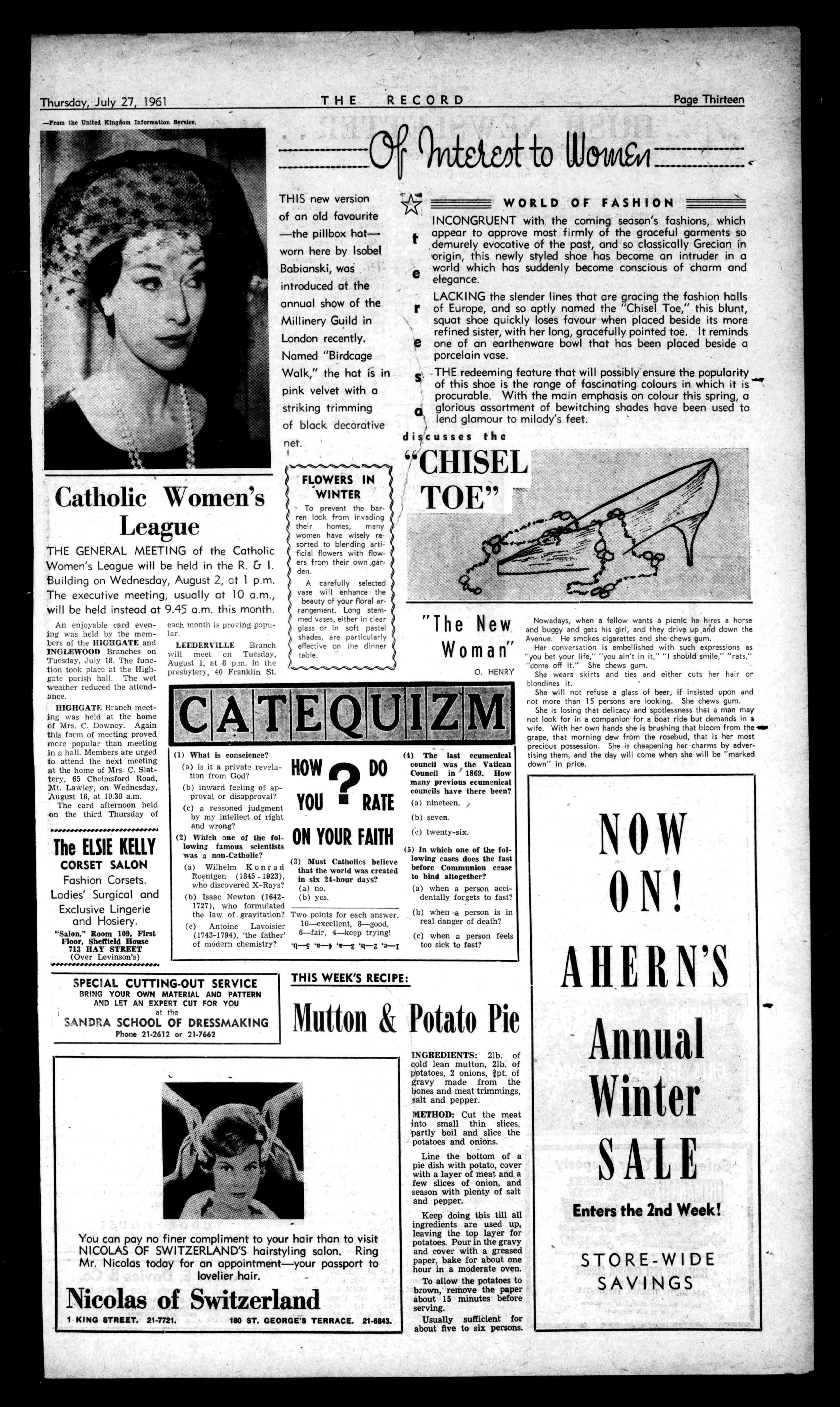
CatholicWomen's League
THEGENERALMEETINGoftheCatholic Women'sLeaguewillbeheldintheR.E7I. BuildingonWednesday,August2,at 1 p.m. Theexecutivemeeting,usuallyat10a.m., willbeheldinsteadat9.45a.m.thismonth.
AnenjoyablecardeveningwasheldbythemembersoftheHIGHGATEand INGLEWOODBrancheson Tuesday,July18.ThefunctiontookplaceattheHighvoteparishhall.Thewet weatherreducedtheattendance.
HIGHGATEBranchmeetingwasheldatthehome ofMrs.C.Downey.Again thisformofmeetingproved morepopularthanmeeting inahall.Membersareurged toattendthenextmeeting atthehomeofMrs.C.Slattery,65ChelmsfordRoad, Mt.Lawley,onWednesday, August16,at10.30a.m.
Thecardafternoonheld onthethirdThursdayof
TheELSIEKELLY CORSETSALON FashionCorsets. Ladies'Surgicaland ExclusiveLingerie andHosiery. "Salon,"Room109.First Floor,SheffieldHouse 713HAYSTREET (OverLevinson's) 41,41,441.004,4,04,44,44
eachmonthisprovingpopular.
LEEDERVILLEBranch willmeetonTuesday, August1,at8p.m.inthe presbytery*,40FranklinSt.
THERECORD
THISnewversion ofanoldfavourite -thepillboxhatwornherebyIsobel Babianski,was introducedatthe annualshowofthe MillineryGuildin Londonrecently. Named"Birdcage Walk,"thehatisin pinkvelvetwitha strikingtrimming ofblackdecorative net.
FLOWERSIN WINTER
Topreventthebarrenlockfrominvading theirhomes,many womenhavewiselyresortedtoblendingartificialflowerswithflowersfronttheirowngarden.
Acarefullyselected vasewillenhancethe beautyofyourfloralarrangement.Longstemmedvases,eitherinclear glassorinsoftpastel shades,areparticularly effectiveonthedinner table.
t
WORLDOFFASHION
INCONGRUENTwiththecomingseason'sfashions,which appeartoapprovemostfirmlyofthegracefulgarmentsso demurelyevocativeofthepast,andsoclassicallyGrecianin origin,thisnewlystyledshoehasbecomeanintruderina e worldwhichhassuddenlybecomeconsciousofcharmand elegance.
LACKINGtheslenderlinesthataregracingthefashionhalls rofEurope,andsoaptlynamedthe"ChiselToe,"thisblunt, squatshoequicklylosesfavourwhenplacedbesideitsmore refinedsister,withherlong,gracefullypointedtoe.Itreminds eoneofanearthenwarebowlthathasbeenplacedbesidea porcelainvase.
THEredeemingfeaturethatwillpossiblyensurethepopularity ofthisshoeistherangeoffascinatingcoloursinwhichitis' procurable.Withthemainemphasisoncolourthisspring,a gloriousassortmentofbewitchingshadeshavebeenusedto lendglamourtomilady'sfeet.
discussesthe
"CHISEL
S a, TOE"
CAEQU11
(1)Whatisconscience?
(a)isitaprivaterevelationfromGod?
(b)inwardfeelingofapprovalordisapproval?
(c)areasonedjudgment bymyintellectofright andwrong?
(2)Which.oneofthefollowingfamousscientists wasanan-Catholic?
(a)WilhelmKonrad Roentgen(1845-1923). whodiscoveredX-Rays?
(b)IsaacNewton(16421727),whoformulated thelawofgravitation?
(c)AntoineLavoisier (1743-1794),'thefather' ofmodernchemistry?
SPECIALCUTTING-OUTSERVICE BRINGYOUROWNMATERIALANDPATTERN
ANDLETANEXPERTCUTFORYOU atthe
SANDRASCHOOLOFDRESSMAKING
Phone21-2612or21-7662
HOW DO YOU RATE ONYOURFAITH
(3)MustCatholicsbelieve thattheworldwascreated insix24-hourdays?
(a)no.
(b)yes.
Twopointsforeachanswer. 10-excellent,8-good, 6-fair,4-keeptrying! q-s 'q-z`)--/
THISWEEK'SRECIPE:
"TheNew Woman"
G.HENRY
Z1M
(4)Thelastecumenical councilwastheVatican Councilin1869.How manypreviousecumenical councilshavetherebeen?
(a)nineteen. (b)seven.
(C)twenty-six.
(5)Inwhichoneofthefollowingcasesdoesthefast beforeCommunioncease tobindaltogether?
(a)whenapersonaccidentallyforgetstofast?
(b)whenapersonisin realdangerofdeath?
(c)whenapersonfeels toosicktofast?
MuttonSIPotatoPie
INGREDIENTS:21b.of coldleanmutton,21b.of potatoes,2onions,apt.of gravymadefromthe bonesandmeattrimmings, saltandpepper.
METHOD:Cutthemeat intosmallthinslices, partlyboilandslicethe potatoesandonions.
Linethebottomofa piedishwithpotato,cover withalayerofmeatanda fewslicesofonion,and seasonwithplentyofsalt andpepper.
Nowadays,whenafellowwantsapicnichehiresahorse andbuggyandgetshisgirl,andtheydriveuparidclownthe Avenue.Hesmokescigarettesandshechewsgum.
Herconversationisembellishedwithsuchexpressionsas "youbetyourlife,""youain'tinit,""Ishouldsmile,""rats," "comeoffit."Shechewsgum. Shewearsskirtsandtiesandeithercutsherhairor blondinesit.
Shewillnotrefuseaglassofbeer,ifinsisteduponand notmorethan15personsarelooking. Sheislosingthatdelicacyandspotlessnessthatamanmay notlookforinacompanionforaboatridebutdemandsina wife.Withherownhandssheisbrushingthatbloomfromtheir grape,thatmorningdewfromtherosebud,thatishermost preciouspossession.Sheischeapeninghercharmsbyadvertisingthem,andthedaywillcomewhenshewillbe"marked down"inprice.
Youcanpaynofinercomplimenttoyourhairthantovisit NICOLASOFSWITZERLAND'Shairstylingsalon.Ring Mr.Nicolastodayforanappointment-yourpassportto lovelierhair.
1KINGSTREET.21-7721. 180ST.GEORGE'STERRACE.21-6843.
Keepdoingthistillall ingredientsareusedup, leavingthetoplayerfor potatoes.Pourinthegravy andcoverwithagreased paper,bakeforaboutone hourinamoderateoven.
Toallowthepotatoesto brown,removethepaper about15minutesbefore serving.
Usuallysufficientfor aboutfivetosixpersons.
PageThirteen
NicolasofSwitzerland
NOW ON! AHERN'S Annual Whiter SALE Entersthe2ndWeek! STORE-WIDE SAVINGS
IRISHNEWSLETTER..
..
NoMere'Moonshine'
IRISHeyebrowswere raisedrecentlywhen,with dueformality,thePoteen CompanyofIrelandwas formedandregisteredbecausepoteen,ormoonshine,isthenameofthe spiritwhichismadeillegallyinafewremotehillsand islands.Itismadeinillegal "stills,"isunmatured,andis ruinoustothemindand body.
Thenewfirm,ofcourse, merelytookthename,and willmarket a matured whiskey.
Thefewillegalpoteenmakerswhosurviveare takingapoorviewofthe useoftheir"trade-name" poteen,whichhithertowas onlyregisteredinpolicebarracks,wherethepoteenmakersweredetainedand theirstillsdestroyed.Now itisannouncedthattheman inchargeofdistillinginthe IrishPoteenCompanywill beaScotsman.
Nowtheoldmeninthe hills,sittingundertherocks anddivertingthesmoke fromtheir"stills"intoa holeintheground,are absolutelycertainthatwhat thenewfirmwillmake won'tbepoteenasitis 11-11511 11-11511
MEADSON&CO. FUNERALDIRECTORS
FromLOCHLINNMacGLYNN
(ByAirMailfromDublin)
knowninMayonandDonegal.Themakingofpoteen, ofcourse,hasalmostceased; thisrawspirithasruined manylives.Churchand Statehavecondemnedit, andIrishBishopsand priestshaveplayedanimportantpartinputtingdawn thetraffic.Poteentaken overaperioddestroysthe intellectandunderminesthe body.
VeteranTeacher
PASTpupilsnowinAustralia,America,Africaand Britainwereamongthose whosetributeswereread duringapresentationat Slieverue,Co.Kilkenny,to Mrs.JuliaPower,principal teacheratRingvilleNational School,onherretirement after38yearsattheschool.
Govt.WhitePaper
RecentlyDeceased
Amongrecentdeathswas thatofRev.AlfredM. Glynn,S.M.A.,D.D.,St. Joseph's,BlackrockRoad, Cork,aged50,anativeof Blackwater, Hampshire, England.Heissurvivedby hisparents,Mr.andMrs. MichaelGlynn,11Upland Road,Camberley,Surrey, England,andbyhisbrother, Mr.DermotGlynn,N.T., Ballymore,Goold'sCross, CountyTipperary. OtherdeathswereRight Rev.CorneliusMulcahy, P.P.,V.F.,Ximlallock,Dean ofLimerick;VeryRev. JamesCorbett,Arifinnan, Co.Tipperary,anativeof Burncourt,Clogheen,Co.
freedom,whichisaveryold wayoflife,andthereare !lunyexemplaryfamilies amongthem;theIrishGoveramenthasaskedtheCommissiontorespecttheir rightsasindividualswhen makingrecommendations. Theyandtheircaravans makegood"coverpictures" totiringtouriststoIreland, buttheirlivesarehard, theirencampmentshave beenbrokentiponoccasions andtheirchildrenleftwithoutshelter:andthereis,unfortunately,avastgapbetweentheromanticviewof theminbooksandtheobstaclesthatfacetheirpersistenceinanomadlife. Insomeareas,bylocal decision,theyarenotallow-
Inspired,TowersofFaith
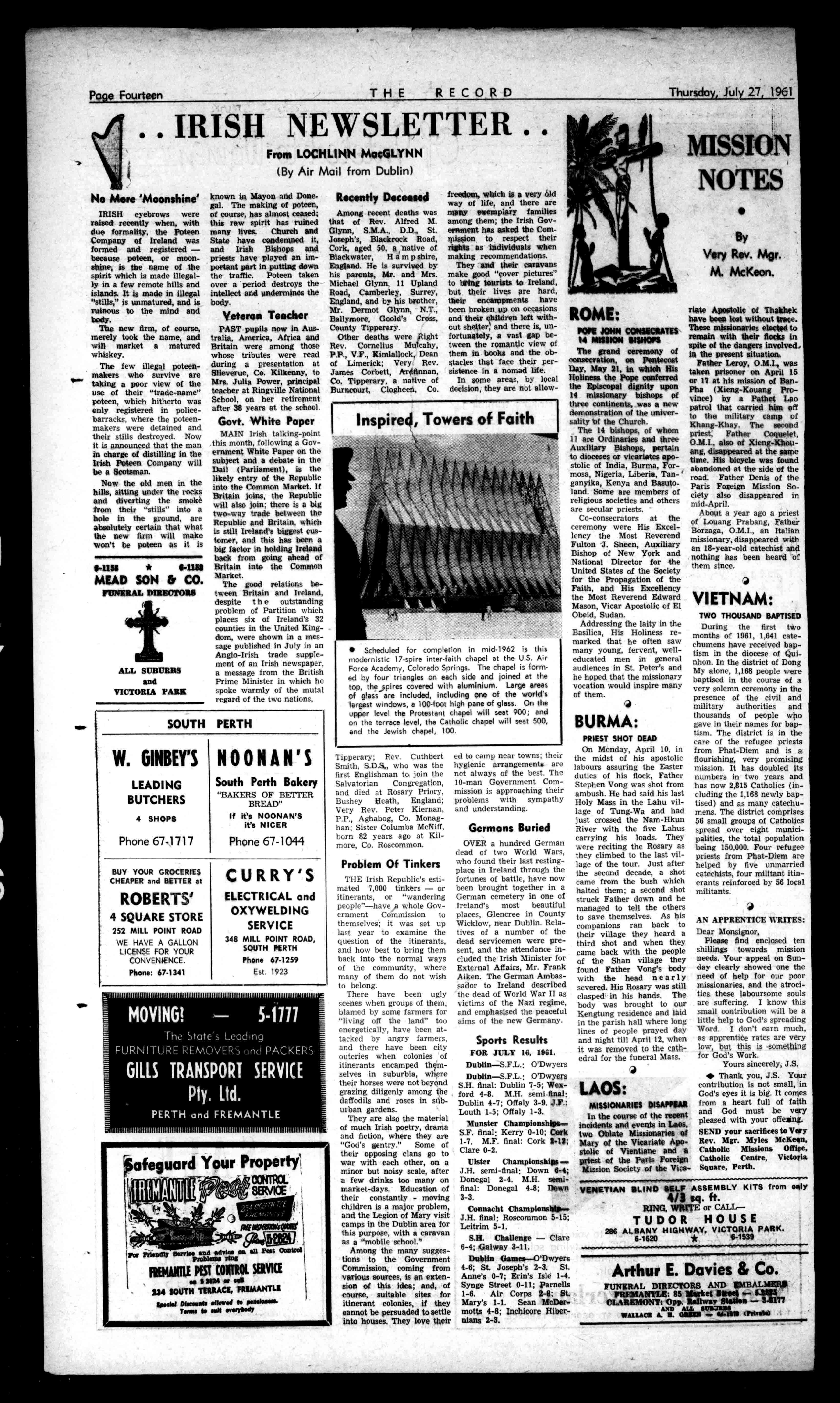
ALLSUBURBS and VICTORIAPARK
MAINIrishtalking-point thismonth,followingaGovernmentWhitePaperonthe subjectandadebateinthe Dail(Parliament),isthe likelyentryoftheRepublic intotheCommonMarket.If Britainjoins,theRepublic willalsojoin;thereisabig two-waytradebetweenthe RepublicandBritain,which isstillIreland'sbiggestcustomer,andthishasbeena bigfactorinholdingIreland backfromgoingaheadof BritainintotheCommon Market. ThegoodrelationsbetweenBritainandIreland, despitetheoutstanding problemofPartitionwhich placessixofIreland's32 countiesintheUnitedKingdom,wereshowninamessagepublishedinJulyinan Anglo-IrishtradesupplementofanIrishnewspaper, amessagefromtheBritish PrimeMinisterinwhichhe spokewarmlyofthemutal regardofthetwonations.
SOUTHPERTH W.
SouthPerth
BUTCHERS 4SHOPS
Phone67-1717
BUYYOURGROCERIES
252
WE
Tipperary;Rev.Cuthbert Smith,S.D.S.,whowasthe firstEnglishmantojointhe SalvatorianCongregation, anddiedatRosaryPriory, BusheyBeath,England; VeryRev.PeterKiernan, P.P.,Aghabog,Co.Monaghan;SisterColumbaMcNiff, burn82yearsagoatKilmore,Co.Roscommon.
ProblemOfTinkers
THEIrishRepublic'sestimated7,000tinkers-or itinerants,or"wandering people"-haveawholeGovernmentCommissionto themselves;itwassetup lastyeartoexaminethe questionoftheitinerants, andhowbesttobringthem backintothenormalways ofthecommunity,where manyofthemdonotwish tobelong.
Therehavebeenugly sceneswhengroupsofthem, blamedbysomefarmersfor "livingofftheland"too energetically,havebeenattackedbyangryfarmers, andtherehavebeencity outcrieswhencoloniesof itinerantsencampedthemselvesinsuburbia,where theirhorseswerenotbeyond grazingdiligenlyamongthe daffodilsandrosesinsuburbangardens.
Theyarealsothematerial ofmuchIrishpoetry,drama andfiction,wheretheyare "God'sgentry." Someof theiropposingclansgoto warwitheachother,ona minorbutnoisyscale,after afewdrinkstoomanyon market-days.Educationof theirconstantly-moving childrenisamajorproblem, andtheLegionofMaryvisit campsintheDublinareafor thispurpose,withacaravan asa"mobileschool."
AmongthemanysuggestionstotheGovernment Commission,comingfrom varioussources,isanextensionofthisidea;and,of course,suitablesitesfor itinerantcolonies,ifthey cannotbepersuadedtosettle intohouses.Theylovetheir
eeltocampneartowns;their hygienicarrangementsare notalwaysofthebest.The 10-manGovernmentCommissionisapproachingtheir problemswithsympathy andunderstanding.
GermansBuried
OVERahundredGerman deadoftwoWorldWars, whofoundtheirlastrestingplaceinIrelandthroughthe fortunesofbattle,havenow beenbroughttogetherina Germancemeteryinoneof Ireland'smostbeautiful places,GlencreeinCounty Wicklow,nearDublin.Relativesofanumberofthe deadservicemenwerepresent,andtheattendanceincludedtheIrishMinisterfor ExternalAffairs,Mr.Frank Aiken.TheGermanAmbassadortoIrelanddescribed thedeadofWorldWarIIas victimsoftheNaziregime, andemphasisedthepeaceful aimsofthenewGermany.
SportsResults
FORJULY16,1961.
Dublin-S.F.L.:O'Dwyers
Dublin-S.F.L.:O'Dwyers S.H.final:Dublin7-5;Wexford4-8.M.H. Dublin4-7;Offaly3-9.J7.: Louth1-5;Offaly1-3. MunsterChampionsidga-,S.F.final:Kerry0-10;Cork 1-7.M.F.final:Cork148; Clare0-2. UlsterChampionship.J.H.semi-final:Down4-4; Donegal2-4.M.H.semi, final:Donegal4-8;Dawn 3-3. ConnachtChampionstlo.. J.H.final:Roscommon5-15; Leitrim5-1. S.H.Challenge-Clare 6-4;Galway3-11. DublinGames-O'Dwyers 4-6;St.Joseph's2-3.St. Anne's0-7;Erin'sIsle1-4. SyngeStreet0-11;Parnells 1-6. AirCorps2-8;St. Mary's1-1.SeanMcDermott'4-8;InchicoreHibernians2-3.
Thursday,July27,1961
MISSION NOTES
By VeryRev.Mgr. M.McKeon,
ROME:
POPSJOHNCONSECRATES
14MISSION111$HOPS
Thegrandceremonyof consecration,onPentecost Day,May21,inwhichHis HolinessthePopeconferred theEpiscopaldignityupon 14missionarybishopsof threecontinents,wasanew demonstrationoftheuniversalitybftheChurch. The14bishops,ofwhom 11areOrdinariesandthree AuxiliaryBishops,pertain todiocesesorvicariatesapostolicofIndia,Burma,Formosa,Nigeria,Liberia,Tan-' ganyika,KenyaandBasutoland.Somearemembersof religioussocietiesandothers arcsecularpriests. Co-consecratorsatthe ceremonywereHisExcellencytheMostReverend FultonJ.Sheen,Auxiliary BishopofNewYorkand NationalDirectorforthe UnitedStatesoftheSociety forthePropagationofthe Faith,andHisExcellency theMostReverendEdward Mason,VicarApostolicofEl Obeid,Sudan. Addressingthelaityinthe Basilica,HisHolinessremarkedthatheoftensaw manyyoung,fervent,welleducatedmeningeneral audiencesinSt.Peter'sand hehopedthatthemissionary vocationwouldinspiremany ofthem.
BURMA:
PRIESTSHOTDEAD
OnMonday,April10,in themidstofhisapostolic laboursassuringtheEaster dutiesofhisflock,Father StephenVongwasshotfrom ambush.Hehadsaidhislast HolyMassintheLahuvillageofTung-Waandhad justcrossedtheNam-Hkun RiverwiththefiveLahus carryinghisloads.They wererecitingtheRosaryas theyclimbedtothelastvillageofthetour.Justafter theseconddecade,ashot camefromthebushwhich haltedthem;asecondshot struckFatherdownandhe managedtotelltheothers tosavethemselves.Ashis companionsranbackto theirvillagetheyhearda thirdshotandwhenthey camebackwiththepeople oftheShanvillagethey foundFatherVong'sbody withtheheadnear1y severed.HisRosarywasstill claspedinhishands.The bodywasbroughttoour Kengtungresidenceandlaid intheparishhallwherelong linesofpeopleprayedday andnighttillApril12,when itwasremovedtothecathedralforthefuneralMass.
LAOS
MISSIONARIESDISAPPEAR Inthecourseoftherecent incidentsandeventsinLaos, twoOblateMissionariesof MaryoftheVicariateApostolicofVientianeanda priestoftheParisForeign MissionSocietyoftheVial-
riateApostolicofThakhek havebeenlostwithouttrace. Thesemissionarieselectedto rernainwiththeirflocksin spiteofthedangersinvolved, inthepresentsituation, FatherLeroy,0.M.I.,was takenprisoneronApril15 or17athismissionofBanPha(Xieng-KouangProvince)byaPathetLao patrolthatcarriedhintoff tothemilitarycampof Kharig-Khay.Thesecond priest,FatherCoquelet, 0.M.I.,alsoofXieng-Khouang,disappearedatthesame time.Hisbicyclewasfound abandonedatthesideofthe road.FatherDenisofthe ParisForeignMissionSocietyalsodisappearedin mid-April. Aboutayearagoapriest ofLouangPrabang,Father Borzaga,O.M.I.,anItalian missionary,disappearedwith an18-year-oldcatechistand nothinghasbeenheardof themsince.
VIETNAM:
TWOTHOUSANDBAPTISED
Duringthefirsttwo monthsof1961,1,641catechumenshavereceivedbaptisminthedioceseofQuinhon.InthedistrictofDong Myalone,1,168peoplewere baptisedinthecourseofa verysolemnceremonyinthe oftheciviland militaryauthoritiesand thousandsofpeoplewho gaveintheirnamesforbaptism.Thedistrictisinthe careoftherefugeepriests fromPhat-Diemandisa flourishing,verypromising mission.Ithasdoubledits numbersintwoyearsand hasnow2,815Catholics(includingthe1,168newlybaptised)andasmanycatechumens.Thedistrictcomprises 56smallgroupsofCatholics spreadovereightmunicipalities,thetotalpopulation being150,000.Fourrefugee priestsfromPhat-Diemare helpedbyfiveunmarried catechists,fourmilitantitinerantsreinforcedby56local militants.
ANAPPRENTICEWRITES:
DearMonsignor, Pleasefindenclosedten shillingstowardsmission needs.YourappealonSundayclearlyshowedonethe needofhelpforourpoor missionaries,andtheatrocitiestheselaboursomesouls aresuffering.Iknowthis smallcontributionwillbea littlehelptoGod'sspreading Word.Idon'tearnmuch, asapprenticeratesarevery low,butthisissomething forGod'sWork.
Yourssincerely,J.S.
Thankyou,J.S.Your contributionisnotsmall,in God'seyesitisbig.Itcomes fromaheartfulloffaith andGodmustbevery pleasedwithyouroffeaing. SENDyoursacrificestoVary Rev.Mgr.MylesMcKeon. CatholicMissionsOffice, CatholicCentre,Victoria Square,Perth. VENETIANBLINDSELFASSEMBLYKITSfrom 4/3
UMW PageFourteen THE RECORD
GINBEY'S
LEADING
ROBERTS'
CHEAPERandBETTERet
4SQUARESTORE
MILLPOINTROAD
HAVEAGALLON LICENSEFORYOUR CONVENIENCE. Phone:67-1341
NOONAN'S
CURRY'S ELECTRICALand OXYWELDING SERVICE
Bakery "BAKERSOFBETTER BREAD" Ifit'sNOONAN'S it'sNICER Phone67-1044
348MILLPOINTROAD, SOUTHPERTH Phone67-1259 Est1923 MOVING! - 5-1111
FURNITUREREMOVERSandPACKERS
TRANSPORTSERVICE Pty.Ltd. PERTHandFREMANTLE OafeguardYourProperty' /or!ninetyServiceand&Mao*claa/1PestOontrei Problemsring FREMANTLEPESTCONTROLSERVICE 211'2.4sean 134SOUTHTERRACE,FREMANTLE Wes/Olusiontsollowatopinslonens. TwitsM.NAe...76.111
fheState'sLeading =
GILLS
Scheduledforcompletioninmid-1962isthis modernistic17-spireinter-faithchapelattheU.S.Air ForceAcademy,ColoradoSprings.Thechapelisformedbyfourtrianglesoneachsideandjoinedatthe top,the,spirescoveredwithaluminium.Largeareas ofglassareincluded,includingoneoftheworld's largestwindows,a100-foothighpaneofglass.Onthe upperleveltheProtestantchapelwillseat900;and ontheterracelevel,theCatholicchapelwillseat500, andtheJewishchapel,100.
sq.ft. RING,WRITE
TUDORHOUSE
ALBANYHIGHWAY,VICTORIAPARK.
only ArthurE.Davies&Co. FUNERALDIRECTORSANDEMBALMERS nuatANTLE:85marketStreet LUSt CLAREMONT:Opp.RaIlwavStatism-34177 ANDALLMITI WALLACZA.U.GSM 4.111111tret.s14.1
orCALL-
286
6-1620 6-1539
Conductedby BROTHER JUNIPER
DEARBOYS ANDGIRLS,
Firstofall,wouldlikeyoualltosee especiallyandreadPageThreeaswellas yourownpage.Inityouwillfindmuchto interestyouaboutVocations.Thiscoming weekisVOCATIONSWEEK,and Iwantyou toenterintothespiritoftheweek.Itmaybe thatGodiscallingYOU!Ifyouareinany doubtaboutwhetheryouhaveaVocationor not,asksomebodytohelpyoumakeupyour mind;yourparents,thepriestyouknowbest, yourteachers.Friendlinesswiththepriest,a greatloveoftheHolyMass,devotiontoOur LordintheBlessedEucharistwillbegreat helpstoyouincultivatingaVocationifyou feelgenerousenoughtolivemorecloselywith Jesusalways.
Wishingyoueverygraceandblessing,
BROTHERJUNIPER.
ContinuingOur
Serial
MASSINTHIRDCENTURYROME
WEcontinueourdescriptionofaMass inRomeinthe3rd century.Itwillbe borneinmindthatthe Massisbeingsaidatnight inthesecrecyandsilence ofoneoftheCatacombs, theundergroundcemeteriesjustoutsidethecity.
PEACE
Thelong,windingpassage,withitsmanyremindersofdeath,wasyet nocauseofdepressionfor theChristian.Hecould readtheinscriptionson thetombsofhisbrothers andsisterswho"hadgone beforeinthesignoffaith andweresleepinginthe sleepofpeace." Sooftenthetwowords "inpace"toldhimall-
peace,notonlyfromthe perilsandtorturesofpersecution.
TOMBASALTAR
Atlastthenarrowcorridoropensoutintoa spaciousroom.Atone endisthetombofa martyr-itwillbeused asthealtar.
Theobscurityofthe corridorgiveswaytopools oflightwheretorches burn.Someofthecongregationaregroupedaround thealtar.Attheheadof theassemblystandsthe bishopandclosetohim thepriestswhowillcelebratewithhim(thatis. concelebrate).Behindthe bishoparethefaithful. Noaccountistakenof
CongratulationstoPATRICIALETHLEAN, daughterofMr.andMrs.T.Lethlean,ofBusselton, whowasawardedthe1960TrinityCollegeState MedalforAdvancedPreparatoryArtofSpeech. Patricia,apupilofSt.Joseph'sSchool,Busselton, gained94marks.
rank,butmenandwomen areplacedonseparate sides.Thedeaconsare mingledwiththepeople- theirfunctionistohelp thepeopleperformtheir partintheMass,lead theminthecommon prayersandkeeporderin theassembly.
Whenwethink\of solemnMassnowadays wenaturallyimaginethe priestandministersin vestments-alb,chasuble, cope,etc.Itwouldbea mistakesotothinkof thematthisMassweare describinginRomeofthe thirdcentury.
Inallprobabilitytheir dressdidnotdiffernoticeablyfromthatofthe
faithful.Allpresentwere dressedinflowingrobes, theouterone(paenula) bearngsomeresemblance toaveryfullchasuble.
THEMASS
TheMassbegins.The bishopturnstowardsthe assemblyandgreetsit withthosehallowedwords, "Peacebewithyou"or, perhaps,"TheLordbe withyou."Thenbeginthe prayersofintercessionor litany.Thechiefdeacon. callingforsilence,enunciatesthesubjectsofprayer andthepeoplereplywith "Kyrieeleison,Lordhave mercy." (Tobecontinued)
PENPALS
BROTHERJUNIPER'Sown"HANDSACROSS
THESEA-CLUBisgrowingillnumbers.But thereisroomformanymoremembers.
PleasefillinthefollowingcouponinBIGLETTERS andsendittoBrotherJuniper,"TheRecord,"450Hay Street,Perth,sothatwhenyourbirthdaycomesaround hemaygreetyouinthispage.
Membershipislimitedtoboysandgirlsof16years ofageandunder.
BirthdayGreetingswillbesenttoeachmembersolookoutforyourbirthday.
EachmemberoftheClubmustcorrespondwith anothermemberregularly.
MyBirthdayis
Iamnow
Name Address
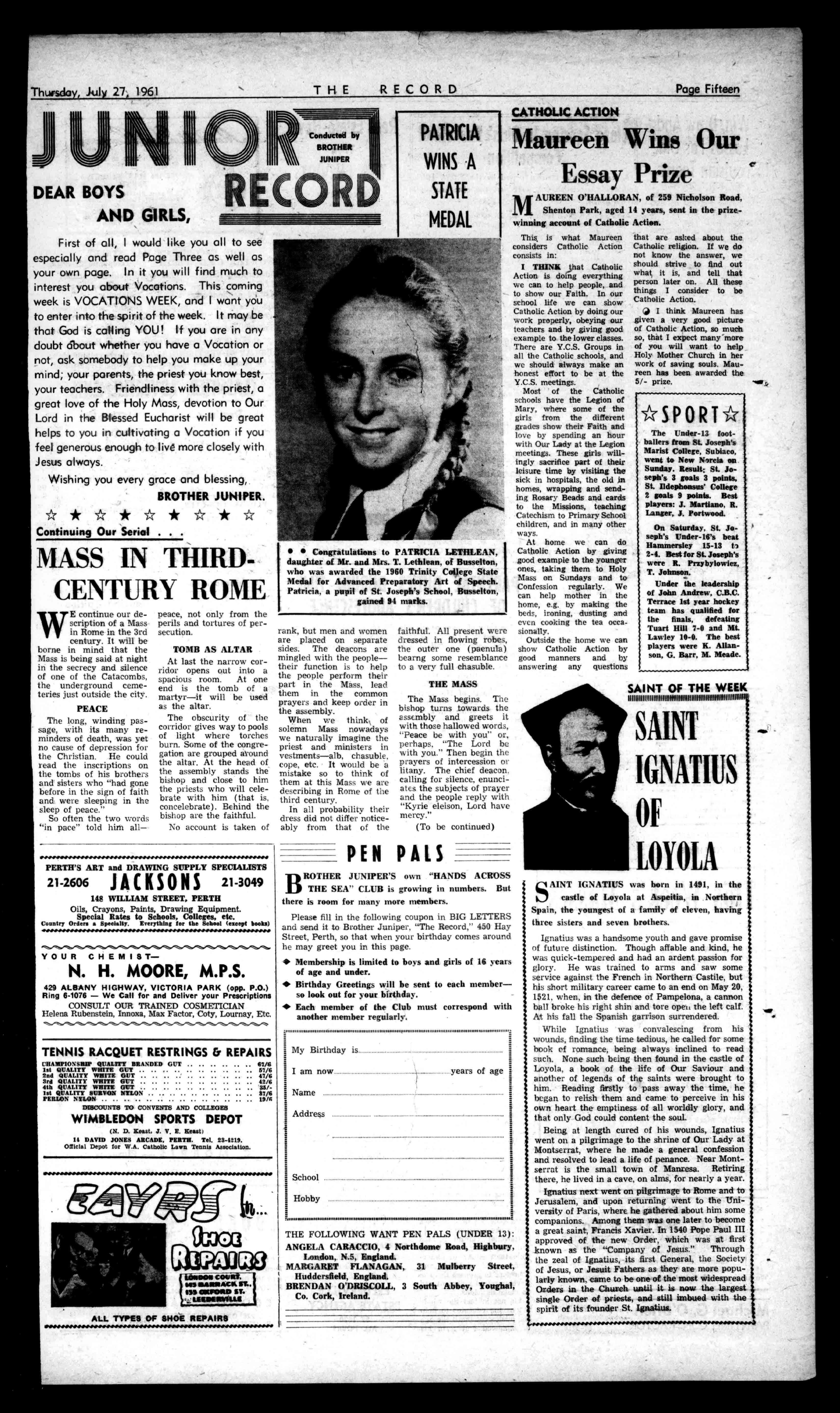
yearsofage
CATHOLICACTION
MaureenWinsOur EssayPrize
MAUREENO'HALLORAN,of259NicholsonRoad.
ShentonPark,aged14years,sentintheprizewinningaccountofCatholicAction.
This,iswhatMaureen considersCatholicAction consistsin: ITHINKthatCatholic Actionisdoingeverything wecantohelppeople,and toshowourFaith.Inour schoollifewecanshow CatholicActionbydoingour workproperly,obeyingour teachersandbygivinggood exampletothelowerclasses. ThereareY.C.S.Groupsin alltheCatholicschools,and weshouldalwaysmakean honestefforttobeatthe Y.C.S.meetings.
MostoftheCatholic schoolshavetheLegionof Mary,wheresomeofthe girlsfromthedifferent gradesshowtheirFaithand lovebyspendinganhour withOurLadyattheLegion meetings.Thesegirlswillinglysacrificepartoftheir leisuretimebyvisitingthe sickinhospitals,theoldin homes,wrappingandsendingRosaryBeadsandcards totheMissions,teaching CatechismtoPrimarySchool children,andinmanyother ways.
Athomewecando CatholicActionbygiving goodexampletotheyounger ones,takingthemtoHoly MassonSundaysandto Confessionregularly.We canhelpmotherinthe home,e.g.bymakingthe hells,ironing,dustingand evencookingtheteaoccasionally.
Outsidethehomewecan showCatholicActionby goodmannersandby answeringanyquestions
thatareaskedaboutthe Catholicreligion.Ifwedo notknowtheanswer,we shouldstrivetofindout whatitis,andtellthat personlateron.Allthese thingsIconsidertobe CatholicAction.
4IthinkMaureenhas givenaverygoodpicture ofCatholicAction,somuch so,thatIexpectmanymore ofyouwillwanttohelp HolyMotherChurchinher workofsavingsouls.Maureenhasbeenawardedthe 5/-prize.
*SPORT*
TheUnder-13footballersfromSt.Joseph's MaristCollege,Subiaco, wenttoNewNorciaon Sunday.Result:St.Joseph's3goals3points, St.Ildephonsus'College 2goals9points.Best players:J.Martian°.R. Langer,J.Portwood.
OnSaturday,St.Joseph'sUnder-16'sbeat Hammersley15-13t 2-4.BestforSt.Joseph's wereR.Przybylowiez, T.Johnson.
Undertheleadership ofJohnAndrew,C.B.C. Terrace1styearhockey teamhasqualifiedfor thefinals,defeating TuartHill7-0andMt. Lawley10-0.Thebest playerswereK.Allanson,G.Barr,M.Meade.
SAINTOFTHEWEEK
SAINT IGNATIUS OF LOYOLA
SAINTIGNATIUSwasbornin1491,inthe castleofLoyolaatAspeitia,inNorthern Spain,theyoungestofafamilyofeleven,having threesistersandsevenbrothers.
Ignatiuswasahandsomeyouthandgavepromise offuturedistinction.Thoughaffableandkind,he wasquick-temperedandhadanardentpassionfor glory.Hewastrainedtoarmsandsawsome serviceagainsttheFrenchinNorthernCastile,but hisshortmilitarycareercametoanendonMay20, 1521,when,inthedefenceofPampelona,acannon ballbrokehisrightshinandtoreopeiitheleftcalf. AthisfalltheSpanishgarrisonsurrendered.
WhileIgnatiuswasconvalescingfromhis wounds,findingthetimetedious,hecalledforsome bookofromance,beingalwaysinclinedtoread such.Nonesuchbeingthenfoundinthecastleof Loyola,abookofthelifeofOurSaviourand anotheroflegendsofthesaintswerebroughtto him.Readingfirstlytopassawaythetime,he begantorelishthemandcametoperceiveinhis ownhearttheemptinessofallworldlyglory,and thatonlyGodcouldcontentthesoul.
School Hobby
THEFOLLOWINGWANTPENPALS(UNDER13)
ANGELACARACCIO,4NorthdomeRoad,Highbury. London,N.5,England.
MARGARETFLANAGAN,31MulberryStreet. Huddersfield,England. BRENDANO'DRISCOLL,3SouthAbbey,Youghal, Co.Cork,Ireland.
Beingatlengthcuredofhiswounds,Ignatius wentonapilgrimagetotheshrineofOurLadyat Montserrat,wherehemadeageneralconfession andresolvedtoleadalifeofpenance.NearMontserratisthesmalltownofManresa.Retiring there,helivedinacave,onalms,fornearlyayear. IgnatiusnextwentonpilgrimagetoRomeandto Jerusalem,anduponreturningwenttotheUniversityofParis,wherehegatheredabouthimsome companions.Amongthemwasonelatertobecome agreatsaint,FrancisXavier.In1540PopePaulIII approvedofthenewOrder,whichwasatfirst knownasthe"CompanyofJesus."Through thezealofIgnatius,itsfirstGeneral,theSociety ofJesus,orJesuitFathersastheyaremorepopularlyknown,cametobeoneofthemostwidespread OrdersintheChurchuntilitisnowthelargest singleOrderofpriests,andstillimbuedwiththe spiritofitsfounderSt.Ignatius.
Thursday,July27,1961
PageFifteen
THERECORD
*****
PERTH'SARTandDRAWINGSUPPLYSPECIALISTS 21-2606 JACKSONS 21-3049 148WILLIAMSTREET,PERTH Oils,Crayons,Paints,DrawingEquipment. SpecialRatestoSchools,Colleges,etc.CountryOrdersSpecialty.EverythingfortheSchool(exceptbooks) \\\\\\\\\\\\\\ YOURCHEMISTN.H.MOORE,M.P.S. 429ALBANYHIGHWAY,VICTORIAPARK(opp.P.O.) Ring6-1076-WeCallforandDeliveryourPrescriptions CONSULTOURTRAINEDCOSMETICIAN HelenaRubenstein,Innoxa,MaxFactor,Coty,Lournay,Etc. TENNISRACQUETRESTRINGS&REPAIRS CHAIIIPIONSRLIFQUALITYBRANDEDGUT 1stQUALITYWHITEGUT 2ndQUALITYWRITEOUT ledQUALITYWHITEGUT4thQUALITYWHITEOUT 1stQUALITYSURVONNYLON DISCOUNTSTOCONVENTSANDCOLLEGES WIMBLEDONSPORTSDEPOT (N.D.Roast,J.V.E.Roost, 11DAVIDJONESARCADE.PERTH.Tel.23-1219. OfficialDepotforW.A.CatholicLawnTennisAssociation. 67/6 67/6 47/6 42/6 36/37/6 19/6 oil-cola SAIIIIILOKIl I01100111) umanitblui
STATE MEDAL
PATRICIA WINSA
TYPESOFSHOE
ALL
REPAIRS
Win,DrawAnd LossesForOld 'LouisianTeams
iByJOHNCLUNE)
OldLouisianhockeyteams won,drewandlostonSaturday;andSundaysaw ApplecrossdefeattheB2 teaminagamewhichwas bothaChallengeCupreplayandanordinaryfixture astheteamsweretohave metinanordinaryfixture onSaturday. Saturday'sgamebetween theC3'sandP.F.A.washard fought;thelatterwon5-2. TheC2'sgaveanoutstandingperformancebydefeatingY.M.C.A.3-1after beingdown0-1athalftime. Adourstrugglebetween theB3'sandGraylands Sportssawbothteamstied nil-allathalftimeandthen 11001111atfulltime.
TheBasisOf RealReform
TheencyclicalletterAuspicatofromPopeLeoXIII, inwhichhesaidthebasis ofrealreformwasthereturnoftheworldto''the professionofChristiantruth andtotheevangelicalpreceptsoflife,"andwished thatallshoulddotheirbest tofollowtheexampleof FrancisofAssisi;wasinhis ownwordspublished"with thesoleintentandpurpose thatatOurinvitationas manyaspossiblemightbe ledtoaspireaftertheglory ofChristiansanctity."(MisericorsDeiFilius,
CloseScoringInGirls'Basketball Competition
A
Afterbeing6goalsbehind attheendofthethirdquarterina"Cl"gradematch, FloreatParkfoughtback todrawwithLeederville withascoreof22goals each.Inthreeothermatches thewinningteamsscoredby amarginofonlyonegoal; in"A-reserve"gradeSt.
Clare'sdefeatedSouthPerth 23-22,in"Cl"gradeEast VictoriaParkdefeatedKensington22-21and"C2"grade SubiacodefeatedSouthPerth 17-16.
TheDayofRecollection forallbasketballplayers willbeheldatGlendalough onSunday,July30,commencingat10.30a.m.Mass willcommenceat12noon. Playersareaskedtobring theirownlunchandteawill heprovided.
TheBradyStreetbus, whichistheonetocatchfor Glendalough,willbeleaving at10a.m.fromMurray Street.
Resultsofmatchesplayed onSaturday,July22,were asfollows:(winnersmentionedfirst).
A-GRADE HiltonPark,Kensington 27-10;ShentonPark,West Perth39-25;SouthPerth, VictoriaPark38-19;Maylands,St.Michael's16-13.
BeatPlayers
M.Hegarty,0.Taaffe,M. O'Neill,H.Sokolowski,A. Doherty,K.Carter,B. Sheridan,J.Fitzhardinge,P. Greaves,M.Weston,J. Mouritz,F.Barron.
A-RESERVE
Fremantle,EastVictoria Park27-22;Beaconsfield, FloreatPark45-5;St. Clare's,SouthPerth23-22.
BestPlayers
L.Fossilo,Y.Battersby, J.Leitch,J.Seed,A.Burke, M.Taaffe,G.Chisholm,V. Pupazzoni,K.Hoddy.
B1-GRADE Glendalough,Subiaco1814;ShentonPark,Victoria Park24-22;Scarborough Red,Como30-12.
BestPlayers
P.Pusey,C.Knuckey,M. Collins,R.Garnett,J.Macintosh,M.Adams,K.Barron,H.Gibbs,M.Everett.
ThisWeek'sMasses
July30(Green):TenthSundayafterPentecost (2ndClass).Creed.PrefaceoftheTrinity.
July31(White):St.Ignatius,Confessor(3rd Class).MassProper.CommonPreface.
August1(Green):MassoftheSunday(4thClass.)
NoGloriaorCreed.SecondPrayertheHoly Machabees,Martyrs.CommonPreface. Or(Red)TheHolyMachabees,Martyrs.(4th war class)Mass"Clamaverunt."Secondprayerof theSunday.CommonPreface.
August2(White):St.AlphonsusLigouri,Bishop, ConfessorandDoctoroftheChurch(3rdClass). MassProper.SecondPrayerSt.StephenI,Pope andMartyr.NoCreed.CommonPreface.
August3(Green):MassoftheSunday(4thClass). NoGloriaorCreed.CommonPreface.
August4(White):St.Dominic,Confessor(3rd Class).MassProper.CommonPreface.
August5(White):FeastoftheDedicationofthe ChurchofSt.MaryoftheSnows(3rdClass). Mass"Salve"fromtheCommonoftheBlessed VirginMary.NoCreed.PrefaceoftheBlessed Virgin"ettoinfestivitate.'
MEMORIALS
G.C.SMITH&Co.
75QUEENVICTORIASTREET,FREMANTLE. SpecialisinginAltarsandMemorialWork. ErectedanywhereinW.A. ChurchAltarsplannedandexecuted. DesignsandQuoteswithoutobligation. Wehaveover60Years'Experience. PHONE5-1611.
MichaelG.O'Brien
PAINTINGCONTRACTOR
RealEstateNews Thru THECHEVIOT
BAYSWATER
WhatleyParkarea-
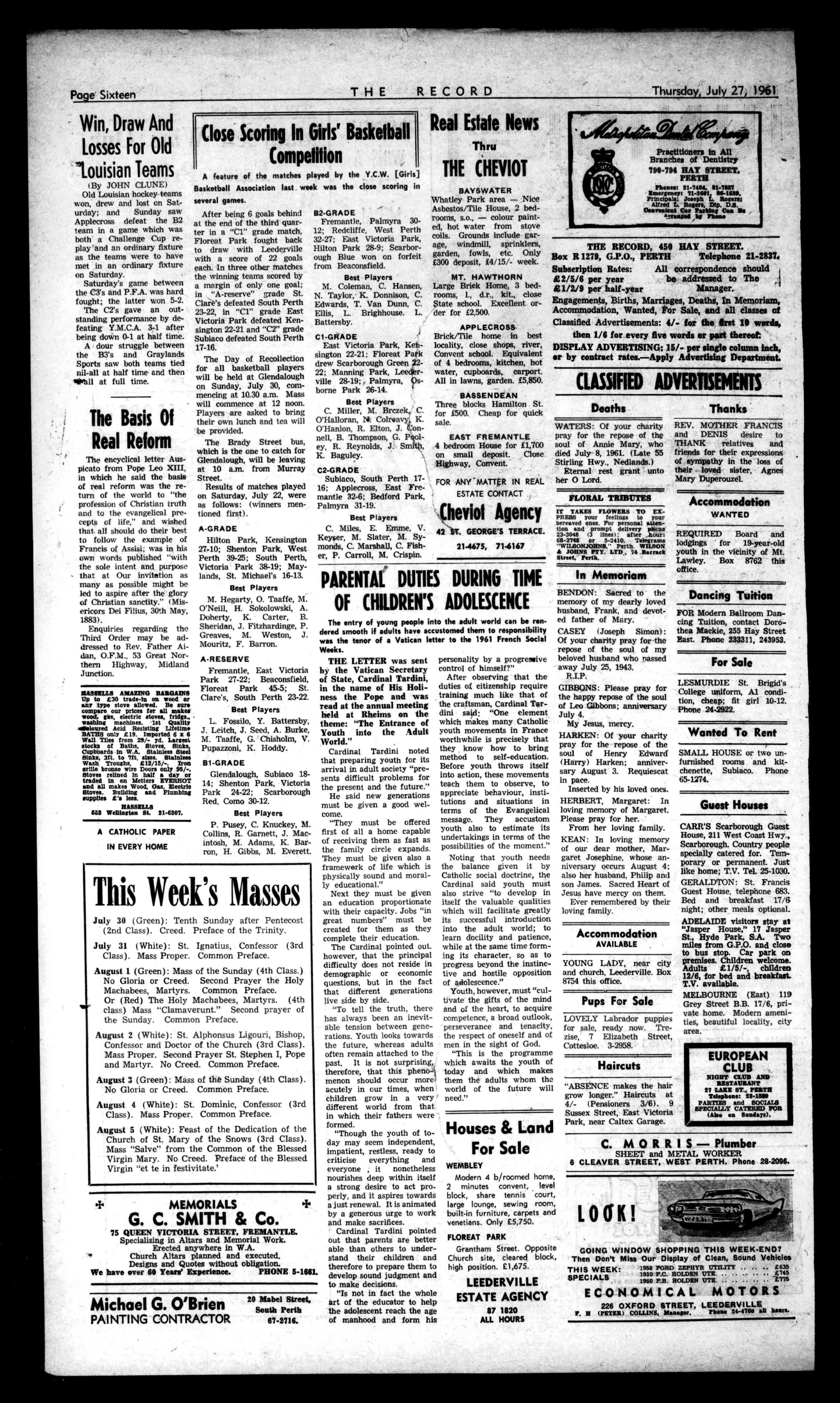
20MabelStreet, SouthPerth 67-2716.
B2-GRADE
Fremantle,Palmyra3012;Redcliffe,WestPerth 32-27;EastVictoriaPark, HiltonPark28-9;ScarboroughBluewononforfeit fromBeaconsfield.
BestPlayers
M.Coleman,C.Hansen, N.Taylor,K.Donnison,C. Edwards,T.VanDunn,C. Ellis,L.Brighhouse.L. Battersby.
CI-GRADE
EastVictoriaPark,Kehsington22-21;FloreatPark drew'ScarboroughGreen2222;ManningPark,Leederville28-19;Palmyra,OsbornePark26-14.
BestPlayers
C.Miller,M.Brczek,C. O'Halloran,14.ColreavyK. O'Hanlon,R.Elton,J.ionnell,B.Thompson,G.Pqoley,R.Reynolds,J.Smith, K.Baguley.
C2-GRADE
Subiaco,SouthPerth1716;Applecross,EastFremantle32-6;BedfordPark, Palmyra31-19.
BestPlayers
C.Miles,E.Emile,V. Keyser,M.Slater,M.Symonds,C.Marshall,C.Fisher,P.Carroll,M.Crispin.
Theentryofyoungpeopleintotheadultworldcanberenderedsmoothifadultshaveaccustomedthemtoresponsibility wasthetenorofaVaticanlettertothe1961FrenchSocial Weeks.
THELETTERwassent bytheVaticanSecretary ofState,CardinalTardini, inthenameofHisHolinessthePopeandwas readattheannualmeeting heldatRheimsonthe theme:"TheEntranceof YouthintotheAdult World."
CardinalTardininoted thatpreparingyouthforits arrivalinadultsociety"presentsdifficultproblemsfor thepresentandthefuture."
Hesaidnewgenerations mustbegivenagoodwelcome.
"Theymustbeoffered firstofallahomecapable ofreceivingthemasfastas thefamilycircleexpands. Theymustbegivenalsoa frameworkoflifewhichis physicallysoundandmorallyeducational."
Nexttheymustbegiven aneducationproportionate withtheircapacity.Jobs"in greatnumbers"mustbe createdforthemasthey completetheireducation.
TheCardinalpointedout. however,thattheprincipal difficultydoesnotresidein demographicoreconomic questions,butinthefact thatdifferentgenerations livesidebyside.
"Totellthetruth,there hasalwaysbeenaninevitabletensionbetweengenerations.Youthlookstowards thefuture,whereasadults oftenremainattachedtothe past.Itisnotsurprising, therefore,thatthispheno-J menonshouldoccurmore acutelyinourtimes,when childrengrowinavery differentworldfromthat inwhichtheirfatherswere formed.
"Thoughtheyouthoftodaymayseemindependent, impatient,restless,readyto criticiseeverythingand everyoneitnonetheless nourishesdeepwithinitself astrongdesiretoactproperly,anditaspirestowards ajustrenewal.Itisanimated byagenerousurgetowork andmakesacrifices.
CardinalTardinipointed outthatparentsarebetter ablethanotherstounderstandtheirchildrenand thereforetopreparethemto developsoundjudgmentand tomakedecisions.
"Isnotinfactthewhole artoftheeducatortohelp theadolescentreachtheage ofmanhoodandformhis
personalitybyaprogressive controlofhimself?"
Afterobservingthatthe dutiesofcitizenshiprequire trainingmuchlikethatof thecraftsman,CardinalTardinisaid:"Oneelement whichmakesmanyCatholic youthmovementsinFrance worthwhileispreciselythat theyknowhowtobring methodtoself-education. Beforeyouththrowsitself intoaction,thesemovements teachthemtoobserve,to appreciatebehaviour,institutionsandsituationsin termsoftheEvangelical message.Theyaccustom youthalsotoestimateits undertakingsintermsofthe possibilitiesofthemoment."
Notingthatyouthneeds thebalancegivenitby Catholicsocialdoctrine,the Cardinalsaidyouthmust alsostrive"todevelopin itselfthevaluablequalities whichwillfacilitategreatly itssuccessfulintroduction intotheadultworld;to learndocilityandpatience, whileatthesametimeformingitscharacter,soasto progressbeyondtheinstinctiveandhostileopposition ofadolescence."
Youth,however,must"cultivatethegiftsofthemind andoftheheart,toacquire competence,abroadoutlook, perseveranceandtenacity, therespectofoneselfandof meninthesightofGod.
"Thisistheprogramme whichawaitstheyouthof todayandwhichmakes themtheadultswhomthe worldofthefuturewill need."
Houses&Land ForSale
HENDON:Sacredtothe memoryofmydearlyloved husband,Frank,
CASEY(JosephSimon): Ofyourcharityprayforthe reposeofthesoulofmy belovedhusbandwhonassed awayJuly25,1943. R.I.P.
GIBBONS:Pleaseprayfor thehappyreposeofthesoul ofLeoGibbons;anniversary July4. MyJesus,mercy.
HARKEN:Ofyourcharity prayforthereposeofthe soulofHenryEdward Harry)Harken;anniversaryAugust3.Requiescat inpace. Insertedbyhislovedones
HERBERT,Margaret:In lovingmemoryofMargaret. Pleaseprayforher.
Fromherlovingfamily.
KEAN:Inlovingmemory ofourdearmother,MargaretJosephine,whoseanniversaryoccursAugust4; alsoherhusband,Philipand sonJames.SacredHeartof Jesushavemercyonthem. Everrememberedbytheir lovingfamily.
Accommodation AVAILABLE YOUNGLADY,nearcity andchurch,Leederville.Box 8754thisoffice.
PupsForSale
LOVELYLabradorpuppies forsale,readynow.Trezise,7ElizabethStreet, Cottesloe.3-2958.
Haircuts
"ABSENCEmakesthehair growlonger."Haircutsat 4/-(Pensioners3/6).9 SussexStreet,EastVictoria Park,nearCaltexGarage.
Thanks
REV.MOTHERFRANCIS andDENISdesireto THANK relatives and friendsfortheirexpressions ofsympathyinthelossof theirlovedsister,Agnes MaryDuperouzel.
Accommodation WANTED
REQUIREDBoardand lodgingsfor 19-year-old youthinthevicinityofMt. Lawley.Box8762this office.
DancingTuition
FORModernBallroomDancingTuition,
THE RECORD Thursday,July27,1961 PageSixteen
30thMay, 1883). Enquiriesregardingthe ThirdOrdermaybeaddressedtoRev.FatherMilan,O.F.M.,53GreatNorthernHighway,Midland Junction. HAMIELLSAMAZINGHAIGADIS Upto£30trade-inonwoodor anytypestoveallowed.Bemare compareourpricesforallmake. wood,gas,electricstoves,fridge., washingmachines. 1stQoalit7 sillelouredAcidResistingLifetime BATHSonly£19.Imported6It6 WallTilesfrom29/-yd.Largest stocksofBaths,Stoves,Sinks, CupboardsInW.A.StainlessSteel Sinks,3ft.tolit,sites.Stainless WashTroughs,E12/15/-.Iron grillebronzewireDoorsonly95/-. Stovesrelinedinhalfadayor tradedInonMetter'EVERHOT andallmakesWood,Gas,Electric Stoves.BuildingandPlumbing suppliesE'sless. HASSELLS 613WellingtonSt.21-6507. ACATHOLICPAPER INEVERYHOME
featureofthematchesplayedbytheYCW.[Girls] BasketballAssociationlastweekwastheclosescoringin severalgames.
Nice Asbestos/TileHouse,2bedrooms,sm.,-colourpainted,hotwaterfromstove coils.Groundsincludegarage,windmill,sprinklers, garden,fowls,etc.Only £300deposit,£4/15/-week. MT.HAWTHORN
Home,3bedrooms,I.,d.r.,kit.,close Stateschool.Excellentorderfor£2,500.
Brick/Tilehomeinbest locality,closeshops,river, Conventschool.Equivalent of4bedrooms,kitchen,hot water,cupboards,carport. Allinlawns,garden.£5,850. BASSENDEAN ThreeblocksHamiltonSt. for£500.Cheapforquick sale. EASTFREMANTLE 4bedroomHousefor£1,700 onsmalldeposit.Close Highway,Convent. FORANYMATTERINREAL ESTATECONTACT CheviotAgency 42ST.GEORGE'STERRACE. 21-4675,71.6167 PARENTAL
LargeBrick
APPLECROSS
DUTIESDURINGTIME OFCHILDREN'SADOLESCENCE
.,4,(4zadego., PractitionersinAll BranchesofDentistry 790-794HAYSTREET. PERTH Phone.,21-7454,91-76117 Emergency:71-1f41,56-1639. Principals;JosephL.Rogerst AlfredLRogere,Dip.D.S. DeavententCarParkingCuSi ',trainedhiPhone 6 THERECORD,450HAYSTREET. BoxR1279,G.P.O.,PERTH Telephone21-2837. SubscriptionRates: Allcorrespondenceshould £215/6peryear beaddressedtoThe £112.19perhalf-year Manager. Engagements,Births,Marriages,Deaths,InMemoriam, Accommodation,Wanted,ForSale,andallclassesof ClassifiedAdvertisements:4/-forthefirst10wards, then1/6foreveryfivewordsorpartthereof: DISPLAYADVERTISING;15/-persinglecolumninch, orbycontractrates.-ApplyAdvertisingDepartment. WEMBLEY Modern4b/roomedhome, 2 minutesconvent,level block,sharetenniscourt, largelounge,sewingroom, built-infurniture,carpetsand venetians.Only£5,750. FLOREATPARK GranthamStreet.Opposite Churchsite,clearedblock, highposition.E1,675. LEEDERVILLE ESTATEAGENCY 671820 ALLHOURS CLASSIFIEDADVERTISEMENTS Deaths WATERS:Ofyourcharity prayforthereposeofthe soulofAnnieMary,who diedJuly8,1961.(Late55 StirlingHwy.,Nedlands.) Eternalrestgrantunto her0Lord. FLORALTRIBUTES ITTAKESFLOWERSTOEXPRESSyourfeelingstoyour bereavedones.Forpersonalalterationandpromptdeliverypirene 23-3046 13 linesisalter_hour. 65-27411 or5-2410.Telegrams "WILSONJOHNS,"Perth.WILSON JOHNSPTY.LTD.,14Barrack Street,Perth. InMemoriam
anddevot-
edfatherofMary.
contactDorotheaMackie,255HayStreet East.Phone233311,243953. ForSale LESMURDIESt.Brigid's Collegeuniform,Alcondition,cheap;fitgirl10-12. Phone24-2922. WantedToRent SMALLHOUSEortwounfurnishedroomsandkitchenette,Subiaco.Phone 65-1274. GuestHouses CARR'SScarboroughGuest House,211WestCoastHwy., Scarborough.Countrypeople speciallycateredfor.Temporaryorpermanent.Just likehome;T.V.Tel.25-1030. GERALDTON:St.Francis GuestHouse,telephone683. Bedandbreakfast17/6 night;othermealsoptional. ADELAIDEvisitorsstayat "JasperHouse,"17Jasper St.,HydePark,S.A.Two milesfromG.P.O.andclose tobusstop.Carparkon premises.Childrenwelcome. Adults £,1/5/-,children 12/6,forbedandbreakfast. T.V.available. MELBOURNE(East)119 GreyStreetB.B.17/6,privatehome.Modernamenities,beautifullocality,city area. EUROPEAN CLUB NIGHTCLUBAND IlLESTAUILANT 17LAKEST.,PEWIT Telephone: PARTIESandSOCIALS SPECIALLYCATEREDPOR (AlsoonSundays). C.MORRIS-Plumber SHEETandMETALWORKER 6CLEAVERSTREET,WESTPERTH.Phone28-2096. wavoiformesiotirr_,.LOOK! GOINGWINDOWSHOPPINGTHISWEEK-END? ThenDon'tMissOurDisplayofClean,SoundVehicles THISWEEK: SPECIALS 1956FORDZEPHYRUTILITY £635 1959F.C.HOLDENUTE 4745 1960F.H.HOLDENUTE. ...775 ECONOMICALMOTORS 226OXFORDSTREET,LEEDERVILLE P.HPETERCOLLINS.Manager. Phone24-476oallhears.