"y
ELLIOTT I ELLIOTT
OPTICIANS
061 PIERTH,N John fllioll V, Ex-Majisi Bros' Skdoof Tel.
NO. 3,196.
87988
i
•R•CO R D ELLIOTT ELLIOTT
OPTICIANS
Piccadilly Arcade Penh Tel. B7988
PERTH, WEDNESDAY, AUGUST 29, 1946.
SEVENTYBECOND YEAR.
PRWZ THREEPENCE.
What the Catholic Press Thought of the British Election Return of the Conservatives Would Have Meant Social Unrest the common man, even if he is a Pole, a German, or a Danubian," Mr. Sencourt continues: "If British Labour and Russian absolutism have certain revolutionary impulses in common, yet they are quite distinct systems. And who can look at the mean streets of Britain without knowing that men were exploited for decades in the interests of aclass nvhich did great harm in Britain and now has lost prestige? Who can be surprised if the wheel, as it turns, makes a circle? Controls are necessary as long as necessities are insufficient. Better to keep these than to unleash too quickly a business man whose religion is merely that of the public schools; for where religion does not restrain, then laws must do so; where there is no spirit there can be no freedom there must be more compulsion.
Labour Principles Christian So Far as They Go — Historian Blames Churchill for Downfall of Tories . ably endangered it during the elections Reviewing the results of the British in trying to suggest that the future Election, it is certain that a large proof democracy in this country depended portion of the Catholic population — on their own .v ictory—a suggestion inwhich derives preponderantly from the volving a contradiction in terms. On working classes—have Labour sympathe other hand, we have little doubt thies, despite the fact that the majorthat the return of the Conservatives itv of the Catholic candidates stood on the name and prestige of their leadin the Conservative interest. More er would have opened a chapter of than 20 candidates were Conservatives, great social unrest, the real aim of as against about a dozen Labour nomiwhich would have been to make the nees, although -the latter included such people's will ineffective by foul as well staunch churchmen as Mr. R. R. as fair means. Stokes, the Ilon. Frank Pakenham and Dr. Halliday Sutherland ( who, inciSafetyValve. dentally, has been defeated in the Scot"Now we may reasonably hope that tish Universities contest), avery large Labour majority , tvill prove rhe " Universe" restrains its comment to be something of a safety-valve durto pointing out that Catholics have no ing the difficult times to come. And difficulty in giving proper allegiance to it has the opportunity of being someany Government that is not Communthing much more than that.... ist and that they owe this allegiance "In the list tradition of socialism— to the new Government. the oc•ialism that was born among "All that remains to be done," adds English-Christian idealists, not among the editorial, " is to make the best of anti-clerical elements on the Continent any bad jobs that arise—either through ..there iz a frill recognition of the browrong-handling or inescapable circunt• therhood of all men and of the social stances—and make the best of any and economic conditions necessary for and every good opportunity that comes a man to be fully a man. These printo promote the welfare of the people ciples, though they fall very short of at home and abroad in a world that is the spiritual quality of Christianity, are threatened with immeasurable chaos:" at least Christian so far as they go. Communists Rejected. "if it sincerely of necessarily pruThe " Catholie Times" declares that dently) seeks to apply tht spirit of the true results of the election will not these basic principles, the British Labbe shown until the House of Commons our Party can become a leader and meets and the character of the Labour guide to all that is honest in the new Party is revealed. " We shall then biood of Europe. And if it can suc• know," it says, " whether the preponteed in this, it will at once preserve derating balance is on the Left of the what is sound in the old order, and deParty or on the Right. But the refeat the trouble-makers by isolating jectiml of Communist and Common - them and showing them up." wealth candidates suggests that what Most Radical Expression. we have is a House of Progressive The most radical expression of CathoRadicals; in effect, a new Liberal Party lic opinion yet published comes from to replace the old one." the pen of the noted historian, Robert in its editorial, the " Catholic IferSencourt, in an article in the "Cathoald" extends a whole-hearted welcome, lic Ilerald" Without qualification, not to the advent of the Labour Party he, writing as " a Catholic and aConserinto frill potter, nor to the discomfiture vative," welcomes Labour's advent to of the Tories, but to the fact that one potter. i quote at length from Mr. great Party so simply succeeded to the Sencourt's article, because its powerpower of another. ful criticism of the late regime and its "We would," it continues, "v be decei forecasts about the new are of exceping ourselves in pretending that this tional interest. great democratic test was passed withMr. Sencourt first of all accuses the out any difficulty or that it can be reTories of being impotent to deal with garded as securely established for the the Bolshevik menace in Europe. 'uture. The Tories quite unpardon•
MERCERS AND DRAPERS 215-219 William Street, Perth
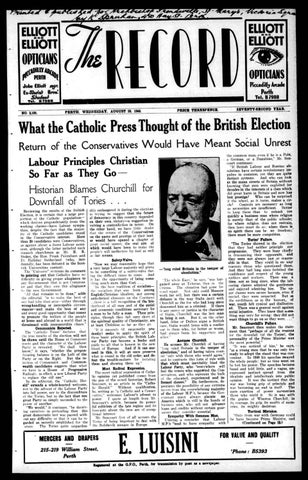
—"long ruled Britain in the temper of absolutism.". "The whole East," he says, " was bargained away at Teheran, then in the Crimea. The situation had gone beyond repair. Not only could Moscow nvork her will, but there was a certain defiance in the way Stalin dealt with Churchill as the foe who had long since denounced him as a criminal. If there is any mercy or justice in the character of Stalin, Churchill was the last man to bring it out. But if, on the other hand, Atlee or Dalton argue a British case, Stalin would listen with a readier ear to them who, for better or worse, had always been his supporters and allies:' Accuses Churchill. He accuses Mr. Churchill of having "lung ruled Britain in the temper of absolutism," and of having taken counsel " only with those who would agree," and he contrasts this form of rule with that which must inevitably bind the Labour Party, who "everywhere will feel the voters who supported the Conservatives, and who represent the bulk of the educated, experienced and informed classes:" Ile, furthermore, depreciates the possibility of any extreme moves from the overwhelming majority of the Labour M.P.'s, because the Got•• ernment must always placate an America which is still in the hands of business men, who will not advance loans and credits without certain guar• antees they consider essential. Sympathy With Common Man. Uttering a reminder that Labour M.P: s " tend to have sympathy with
E. LUISINI
Regiekued at the O.P•O. Perth, for transmission by poet u a newspaW.
Tories'Failure. "The Tories showed in the election that they had neither principle nor programme. They were busy chiefly in denouncing their opponents, and they were not always just or reasonable in that. They could in no way reassure those who questioned them. And thev had long since forfeited the confidence and respect of the young soldiers and workers. There was a time, not so long since, when the labouring classes admired the gentleman and enjoyed admiring him. The upper classes were secure because, even if envied, they were respected. But in the sordidness, as in the horrors„ of war, youth felt cynical and disillusioned. There was a general recoil against social injustice. They knew that something was very far wrong: they did not want things, , to go on as they were...:' Churchill's Failure. Mr. Sencourt then makes the statement that " perhaps of all the reasons for the downfall ( of the Tories), the personality of the Prime Minister was the most powerful:" "It was noticed of him," he says, "as a young man that he was only too ready to adopt the stand that was convenient. In 1810 his speeches swayed the whole people; but as time went on he lost his power. The speeches became banal and told little, and a vague, unexpressed instinct spread from the idealists and intellectuals into public opinion. It was the instinct that the war was losing grip of principle and was becoming an end in itself. • The mere exertion of power mesrnerises those who wield it, So it was with the genius of Winston Churchill, in its courage, its grip, its wealth of memories, its mighty decisions.
I
Tactical .Mistakes, "Only from war with Germanv cculd he have become Prime Minister, and (Continued on Page 13.)
FOR VALUE AND QUALITY 'Phone: B5393