?r
WWI
7
ELLIOTT N ELLIOTT
OPTICIANS Q1CCADILWA PIRTH R40E John E11101F m5r. Ex-Marisi Bros: Sfuden{ Tel.
xt,l
87998
PERTH,WEDNESDAY, AUGUST 8, 1945.
NO. 3,192.
15 ,C
V1ii
•D PRICE 'THREEPENCE.
ELLIOTT ELLIOTT OPTICIANS Piccadilly Arcade Perth
Tel. B7988
SEVENTY-S ECOND YEAR.
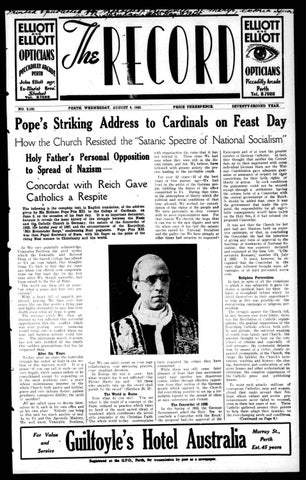
Po pe 's StrikingAddress to Cardinals on Feast Day How the Church Desisted the "Satanic Spectre of National Socialism" "Holy Father' s Personal Opposition to Spread of Nazism— Concordat with Reich Gave Catholics a Respite s The following is the complete text,in English translation ,of the address given by His Holiness Pope Pius XII. to the College of Cardinals, oa June 2,on the occasion of his feast day. It is an important document, because it reveals the inner history of the struggle between the Nazis and tkee,Catholic Church in Germany, the nature of the Concordat of 1933 ,the fateful year of 1937 ,and the circumstances of the Encyclical, "Mit Brennender Sorge," condemning Nazi paganism. Pope Pius XII. was then Papal Secretary of State, with his finger on the pulse of the rising Nazi menace to Christianity and the world. As We very gratefully acknowledge, Venerable Brethren, the good wishes which the Venerable and Beloved Dean of the Sacred College has offered to Us on your l;ehalf, Our thoughts bring Us back to this clay six years ago when you uttered vour congratulations on Our feast day for the first time after We, though unworthy, had been raised to the See of Peter. The world was then still at peace: 1It what a peace and how very precarious! With it heart full of anguish, perplexed, praying, We bent over ,that peace like one that as- fists a dying man and fights obstinately to Five him from death even when all hope is gone. The message which We then addressed to you reflected Our sorrowful apprehension that the conflict which wvas ever growing more menacing would break out—a conflict whose extent and duration nohodv could fore•ce. The subsequent march of events has not only justifier) all too clearly Our saddest premonitions, but has far surpassed them After Six Years. To-day, after six _years, the fratricidal struggle has ended, at least in one section of this war- torn world. It is a peace—if you ran call it such—is yet very fragile, which cannot endure or be consolidated except by expending on it the most assiduous care: a peace whose maintenance impdses on the whole Church, both pastor and faithful, grave and very delicate duties: patient prudence, courageous fidelity, the spirit of sacrifice! All are called upon to devote themselves to it, each in his own office and at his own place. Xobody can bring to this task too much anxiety of zeal. As to Us and Our Apostolic Ministry, We well know, Venerable Brethren,
For Value and Service
that We can safely count on )' our sage collaboration, your unceasing prayers, vour steadfast devotion. In Europe the war is over: but what wounds has it not inflicted! 'Our Divine Master has said: " All those who unjustly take up the sword shall perish by the sword" Olatthew 26, 52). The World in Ruins. Now what do you see? You see what is the result of a concept of the State reduced to practice which takes no heed of the most sacred ideals of mankind, which overthrows the inviolable principles of the Christian Faith. The whole world to-day contemplates
with stupefaction the ruins that it has left behind it. These ruins We had seen when they were still in the dis. tant future, and few. We believe, have followed -with greater aixiety the process leading to the inevitable crash. For over 12 vears-12 of the best years of Our mature age—We had lived in the midst of the German people, fulfilling the ditties of the office committed to Us. During that time, in the atmosphere of liberty which the political and social conditions of that time allowed, We worked for consolidation of the status of the people and We were personally in close contact with its most representative men For that reason We cherish the hope that -it can rise to the new dignity and new life when once it has laid the satanic spectre raised by National Socialism and the guilty ( as We have already at other times had occasion to expound)
Episcopate and of at least the greater number of German Catholics In fact, they thought that neither the Corcorclats up to then negotiated with some_ individual German State nor the Weimar Constitution gave adequate guarantee or assurance of respect for tl),eir convictions, for their faith, rights or liberty of action. In such conditions the guarantees could not be secured except through a settlement having the solemn form of a Concordat with the central government of the Reich. it should be added that, since it was the government that made the proposal, the responsibility for all :egrfttable consequences would have ta,len on the Holy See, if it ha ,.l refused the proposed Concordat.
It wa' not that the Church for her part had any illusions built on excessive optimism, or that, in concluding the Concordat she had the intention of giving any form of approval to the teachings or tendencies of National Socialism; this was expressly declared and explained at the time ( cfr. " L'Osservatore Romano number 174, July 2, 1933). It must, however, be recognised that the Concordat in the years that followed brought some advantages, or at least prevented worse evils. Religious Persecution. In fact, in spite of all the violation, to which it was subjected, it gave Catholics a juridical basis for their clefence, a stronghold behind which to shield themFelves in their opposition— as long as this was possible—to the ever-growing campaign of religious persecution. The struggle aginst the Church did, in fact, become ever more bitter; there was the dissolution of Catholic organisations; the gradual suppression of the flourishing Catholic schools, both public and private; the enforced weaning of youth from family and Church; the pressure brought to bear on the conscience of citizens and especially of civil servants; the systematic defamation, by means of a cleter, closely organised propaganda, of the Church, the clergy, the faithful, the Church's institutions, teaching and history; the closhave expiated the crimes they have ing, dissolution and confiscation of relicommitted. gious houses and other ecclesiastical inWhile there w. still some faint stitutions: the complete suppression of glimmer of hope that that movement the Catholic press and publishing could take another less disastrous houses. course, either through effective opposition from that section of the German To resist such attacks millions of people which opposer) it, the Church courageous Catholics, men and women, did everything possible to set up a forclosed their rank- around their Bismidable harrier to the spread of ideas hops, whose valiant and severe proat once subversive and violent. nouncements never failed to resound, even in these last years of war. These The Concordat of 1933. Catholic gathered around their priests in the Spring of 1933, the German to help them adapt their ministry to Government asked the Holy See to the ever-changing needs and conditions. conclude a Concordat with the Reich: (Continued on Page 6.) the proposal had,the approval of the
Gilfoyle's Hotel Australia Rq*Wed st tlr G1 P.O, Pertk fm trawimissioa by Dolt u s aewsparr.
Murray St., Perth Est. 45 years