RECORD
ELLIOTT ELLIOTT
OPTICIANS PICA P f ERTH R•DF John Elliott msr. EX-WWW Bros: Sfu&4 Tel.
B7988
PERTH,WEDNESDAY,MAY 2, 1945.
NO. 9178.
PRICE THREEPENCE.
i
ELLIOTT ELLIOTT OPTICIANS Piccadilly Arcade Perth Tel. B7988
SEVENTY. SECOND YEAR.
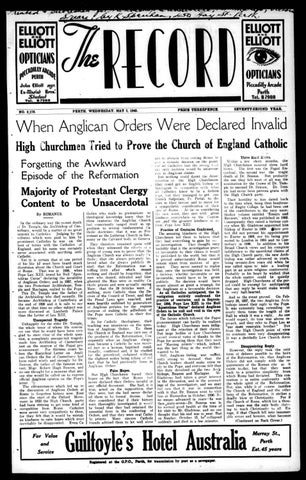
When Anglican Orders Were Declared Invalid High churchmen iried to Prove the Church of England Catholic Forgetting the Awkward Episode of the Reformation Majority of Protestant Clergy Content to be Unsacerdotal By ROMANUS. In the ordinary gray the recent death of Dr. Temple, the Archbishop of Canterbury, would be a matter of no great interest to Catholics. Judging by the tributes which were paid to him by prominent Catholics he was on the best of terms with the Catholics of England, and his name was certainly never associated with anything antiCatholic. Yet it is certain that at one period o[ his life hLI must have heard much discussion about the Church and Court of Rome. That was in IS96, when Pope Leo XIII. issued his Bull " Apostolicae Curae" declaring the invalidity of Anglican Orders, and in 1897, when the two Protestant Archbishops, Tem ple and Maclagan, replied to the Pope. This Dr. Temple w•as the father of the Archbishop who died recently. He became Archbishop of Canterbury at the end of 1596 and it is safe to say that at that time no other subject was more discussed at Lambeth Palace than the Letter of Leo XIII •
tholics who made no pretensions to theological knowledge knew, that for three centuries the Anglican Church had consistently ranged itself in opposition to several fundamental Catholic doctrines: that it was as Pro. testant as the Lutheran Church in Germany or the Calvinist body in Geneva.
They therefore remained quite cold when they witnessed the efforts of a group of young men to prove that ' he Anglican Church was always really Ca lholic: that she alwa) s privately believed what she always publicly denied; that the Reformation was a trifling little affair which meant nothing and should be forgotten; that men who denied, ridiculed and blas-phemed the Mass were in reality Ca tholic priests and were actually- saying Hass; that the 39 Articles were, if anthing, more Catholic than the Decrees of the Council of Trent, and that the Penal Laws Here enacted, and were heartily endorsed by generation's of Anglican prelates, for the express purpose of making the adherents of the Pope more Catholic in their doctrines. Unexpected Tragedy. As for Catholic theologians, their Unhappily for the elder Dr. Temple, teaching was unanimous on the questhe whole tenor of whose life convin• tion of Anglican Orders. To them ces one that he would have been very the Church of England was just one of glad to steer dear of the whole ques. the products of the Reformation. Con• tion, a completely unexpected tragedy sequently when an Anglican clergymade him Archbishop of Canterbury man became a Catholic he was receiv just on the morrow of the Papal proed just as a layman, baptised condinouncement. For thirteen years be. tionally, confirmed and. if he studied fore the Encyclical Letter on Anglifor the priesthood ordained without can Orders the See of Can terbury had the slightest notice being taken of the been ruled wisely and 'str(Ingly by Dr fact that he had previously been in Benson, the father of the famous conAnglican Orders. vert, Afsgr. Robert Hugh Benson, and False Hopes. no one thought for a moment that tinyBut High Churchmen based their one else would be called on to express hopes on the fact that Rome had official Anglican opinion on the Pope's never declared their Orders invalid in letter. any official document. She had, it is The circumstances which led up to true, acted on the supposition that the discussion of Anglican Orders at they were, but she had never declar• Rome is forgotten history now. Ever ed them so by formal . decree. And since the start of the Oxford Movethey considered that if their history ment in 1833 the high Church party were thoroughly investigated it would had been striving to get some kind of be found that they had retained the - recognition from Rome. Catholics essential form in the conferring of were never very sympathetic to them, OrderIs, and that they were real Catho. for they felt that it would be mistaklic priests. Many sincere Catholic en kindness to raise hopes which must friends advised them to let well alone inevitably be disappointed. Even Ca-
For Value and Service
awl to abstain from iurcing Runic to 'I" d dc,uutU decision on the point. rur all Catholics had the feei 'it g t: It n such decision would be umavour• .,we to Anglican claims. But nothing could daunt the deter• nunation of the High Churchmen. They could get no Buglish bishop or thcoiogian to e) nipathise with what ail Catholics knew to be a forlorn h pe, but they managed to get one French Sulpician, Fr, Portal, to declare in their favour and to move for a sympathetic consideration of thou ase at Runic. As far as considering cae went, they met with great 'kindness everywhere on the Continent , and - the greatest kindness of aL from Pope Leo SIIL Practice of Centwies Confirmed, The amazing blindness of the High Churchmen led them to believe that they had everything to gain by sur an investigation. 'they thought very foulishly that if the investigation proved favourable to their claims it would be published to the world, but that if it proved unfavourable Rome would remain silent from motives of prudence. They never seemed to realise that, once the investigation was held, it decision. whether favourable or un• favourable, would have to be given publicly. No decision would have meant almost as great a triumph for the Anglicans as a favourable decision. As all Catholics anticipated, the Investigation entirely confirmed the practice of centuries, and in September, 1896,Pope Leo kM,in the Bull "Apostolicae curae" declared Anglican Orders to be null and void in the eyes of the Catholic Church. The furore which followed the Papal pronouncement can hardly be realised to-day. High Churchmen were indignant at the rejection of their claims. But large bodies of Low Churchmen passed ironical votes of thanks to the Pope for assuring them that they were not priests"—which, indeed , as " Massing was the last thing in the world they to be. Still. Anglican feeling was sufficiently strong to demand that the Church leaders should make some reply to the Pope, and everyone felt that this duty devolved on ,the two Arcb. bishops, Benson and Afaclagan. \1r. Gladstone had taken a great interest in the discussion, and in the proceed. ings of the investigators t and we may feel sure that it was it , connection with it that Dr. Benson went to visit him at Hawarden in October, 1S9ti. By no means advanced in years—he was then , sixty-seven—Dr. Benson was in his normal good health at the time of his visit to Mr. Gladstone• and no one thought that his end was so near. But on Sunday, October 13, he o collapsed suddenly and died in a feav minutes.
Three Hard E'aws. 11'ithin ;t few short months, the High Churchmen received three hard News. The first was the Papal Encyclical; the second was the tragic death of Dr. Benson. But probably' the one they felt most of all was the nomination by the Crown of Dr. Temple to succeed Dr. Benson, Dr. Ten ple had never been persona grata with the High Church party. Their hostility to him dated back to the time when being then headmaster of Rugby College. he had been one of the contributors to the very unorthodux volume entitled " Essays and Reviews," which was published in 1860. Consequently they raised a furious outcry when Mr. Gladstone appointed him Bishop of Exeter in 1869. their protest did not prevent his appointment to Exeter in 1869 nor his being promoted to London in 1885 and to Canterbury in 1896. In addition to his Broad Church views and his complete indifference to the sacerdotal claims of the High Church party, the new Archbishop was rather advanced in years, being seventy-five years old when he was. called upon to take a leading part in an acute religious controversy. Probably in his heart he wished that the whole matter could be quietly dropped. High Churchmen of the period could be excused for anticipating that any reply he would make would be very half-hearted. And so the event proved. On February 26, 1897, the two Anglican Archbishops issued their reply to the Pope. It was extremely long, extending to nearly three times the length of the Bull to which it was a reply. As one would expect, its tone ' was above reproach, and they refer to Pope Leo as "our mom venerable brother." But from the High Church point of view its contents were very' disappointing. It was a decidedly Low Church docurrent. Disappointing Reply. However, the reply took the only form of defence possible to the heirs of the Reformation, viz., that Anglican Orders did not comply with the requirements of the Roman rite as it exists to-day, but that they went back to a primitive simplicity from which Rome had deviated. This contention is in entire conformity with the whole spirit of the Reformation. But, alas, while it of Course justifies the Church of England and the other heira of the Reformation it strikes a deadly blow at Christianity. For if the Church of Rome, which for a thou. sand years was the only body claiming to teach Christianity to all Europe, if that Church fell into innumer able errors and heresies, what becomes (Continued on Back Cover.)
Guflfoyie's Hotel Austrafia Re&tered at the G.P.O, Pwdk 8or tnnemission by post as a newspapOr•
Murray St., Perth Est. 45 year,