iii i-
vsr,
OP"
411,
7.0
1111,
,c4Sr;"/f4441/cf;-1Re7"nber--
"Taste Tells"
SELFRIDGES SWEETS
Johnston's fAfSHfSf SAUSAGES
and
and
BEST!
FRANKFURTS
3d.
3d. SIXTYEIGHTH YEAls.
PERTH, THURSDAY, OCTOBER 30, 1941.
NO. 2,996.
BRITAIN and RUSSIA Eire,
a Catholic State
MR. DE VALERA
Basis and Aim of Co-operation Viewpoirit of English Catholic Papers London, July 5. "The two encyclicals of Pius XI., 'Divini Redemptoris' against Atheistic Communism, and 'Mit brennender, sorge,' against Nazism, state fully and clearly the Catholic condemnation of both these movements," writes His Eminence Cardinal Hinsley in answer to a question from a Catholic member of Parliament. ''Our country is fighting against the immediate Nazi attempt to subjugate Europe. No one who knows the ideas and prachow tices of the Nazis are will for one moment be deceived by Hitler's latest pose as the champion of European civilisation, or think that it has become in any way less vital to resist his attempt to enslave the Continent." Hereunder we publish extracts from the Catholic press in England commenting on the situation created by Germany's invasion of Russia. The following points are from a leading article in "The Tablet": "Hitler's invasion of Russia is a military operation, intended to lead to the He seeks to dedefeat of Britain. stroy the Russian armies and air force, strength can the German all so that be brought to the West. He seeks control of great supplies and more labour, that his war machine may become yet more powerful. If his plans succeed, within a few weeks Stalin will rule no longer in Moscow, and various new Governments all pledged to collaboration with the Reiar 4.01 be in command. The great obstacle to these plans is the patriotism of the Rus-
sians....
"Significant was, kerensky's declaration in New York that, much as he detests Stalin, to-day all Russians must put the defence of Russia from foreign Patriotism, and not invasion first. the class war, is the clarion note by which the Russians are being summoned to resist the invasion. It may well prove, even under the conditions of the new warfare, that Russian patriotism will be able to maintain a real resistance. "Mr. Churchill acted with great promptitude on Sunday, announcing that while he unsaid nothing of what he has said against Communism, we shall assist this Russian resistance. In his picture of the Russian country women, praying in the day of desolation and destruction, he indicated, what we too easily forget, that this
new cataract of suffering falls on millions of ordinary, unpolitical, poor Russians, and we must not lose sight of
them. .
Select your piano from the most comprehensive range in Me Southern
Hemisphere
.
No Change in Attitude. The following excerpts are from a long article in "The Catholic Herald': "It would be idiotic, as well as wrong, on our part to make the slightest change in our attitude towards Bolshevism, even in the supposed interest of the war effort. The Prime Minister states that he is not intending to unsay an of his long criticism of Communism, and certainly no one would be in the slightest degree impressed by any Catholic change of attitude in regard to the character and aims of Soviet Rus sia. The Catholic view-shared by so many others-goes too deep, rests on too good an authority, and is too well known to make any change of attitude on our part possible. "Whatever happens, we remain wholehearted opponents of the theory and practice of Bolshevism, whether in Russia or elsewhere, . . "The ultimate causes of this war are many and diverse, and its ultimate results are likely to differ considerably from any one man's or any one State's plans. But within that complex framework certain simple facts stand out. "The chief ones from our point of view are two: first, that the Hitlerian Empire, both because of its internal philosophy and its external policy, was believed by our responsible statesmen to constitute a direct threat to Great Britain and the political liberties for which her history and outlook stand: second, that the war began through Germany's actual aggression against a friendly Power to whom we were bound by treaty after a series of other aggressions. . . . "Obviously this new factor cannot of itself change what was previously a just and inevitable cause into a bad or avoidable one."
The shop for Better Value. Our Any goods Prices lowest in Perth. sent to country not satisfactory we pay freizht.
NICHOLSON'S PIANOS FOR THE MODERN HOME
.
"But there is to -day a great common object, the defeat of a man and a system which is much more efficient than Stalin's Communism, and much more of We an immediate danger to us all. must keep rigidly to the military common object, and have nothing to do with any temptations to pretend that what divides us from the Soviet Government is a less profound and un bridgeable gulf than it is."
An exclusive interview with Mr. de Valera at Government Buildings, Dublin, is included in Mr. Joseph F. Thorning's new book, "Builders of the New Social Order," which has just been chosen by the Catholic Literary Guild of New York as its Book -of -the Month.
Explaining Eire's attempt to build a
Catholic State embodying the occupational group system, or vertical guilds or unions of employers and employees in the same industry, Mr. de Valera said to Mr. Thorning that, based on Pope Pius XI's Encyclical on the Sothe cial Order, this "adventure realm of socio-economic planning will take distinctive Irish lines." "For the present," he declared, "it represents a philosophy, an outlook, a tendency and an attitude suffused by
EXPLAINS
and politics, they in Eire would do their part in helping to effect the Christian social revolution, Significantly enough, adds Mr. Thorn.
ing, Mr, de Valera did not speak of corporations, syndicalism or the corporate State in telling of his govern-
ment's experiment with the occupational group system. Instead he used the terms "vocational bodies" or "functional groups." In explaining why he did this, he said that the present conflict between Communism and Facism rendered the problem of the occupational group system, as well as its accurate exposition, a matter of acute importance. "We know perfectly well the viciousness and lamentable results of Marx-
ist materialism wherever it has been tried," he said. "We are also aware of the dangers inherent in a programme which would submerge individual and family liberties in blind worship of an infallible State, such as Nazism pro. poses.
Best for Ireland. -There is a reasonable practical position which lies between these radical extremes: "It consists of a modernised guild system, embracing both employers and workers in vocational bodies in every
branch of industry, agriculture, commerce, the professions and the arts. This is the system we believe best fitted for Eire," 'Asked if Eire's vocational groups' system would follow the general lines of its development in Spain and Portugal, Mr. de Valera was most emphatic in answering: "It would be a
.
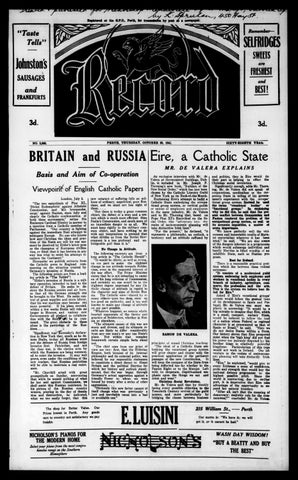
EAMON DE VALERA. principles of sound Christian teaching. "The ideal of a Catholic State embodying the vocational group system will grow clearer and clearer with the practical application of the pertinent passages of the new Constitution, It will keep the compass of the State from being deflected too far whether to the Fascist Right or to the Marxist Left with its desperate, dispiritualised emphasis upon the things we eat and drink and wear." Christian Social Revolution, Mr. de Valera said that by frankly facing every possible objection to the Twentieth Century revival of the guild system, and more particularly by bridging the chasm between business
big mistake to imagine that Eire, which is a small, compact, unitary State, would be induced to follow the lead of a nation whose Federal or regional character is as pronounced as that of Spain or Brazil," he said. "Here we do not desire States within a State. Our history shows that Eire prospered most when the 'high king' did not find his power too jealously disputed by his brother kings in relatively powerful kingdoms. Particularism of this type would not work in Ireland. Our adventure in the realms of socio-economic planning will take distinctly Irish lines.
"Eire," he explained, "would give to every Irishman a sense of confidence, pride and strength that would key the national defence programme to the highest possible pitch. Since the world is contracting, due to swifter port, it is imperative that Eire take advantage of the opportunity to expand her natural frontiers. "After all, isn't that the meaning of democracy: majority rule for the commonweal?" concluded Mr. de Vales'.
215 William St.,
E.LUISINI
-- Perth
Our motto is: "We have it; we will get it, or it cannot be had."
WASH DAY WISDOM! "BUY A BEA1TY AND BUY THE BEST"