egistered at
G.P.O., Perth, for transmission by post as a newspaper
HAND TAILORZD,
5 -5 - 0 Samples and &M, Forms Free.
MdtAii & KEATING LADIRS' & GINTR TAILORS. Note the Address: 569a HAY STREET, PERTH (Opp. Criterion Hotel). Established 42 Yearn Tel: B4594.
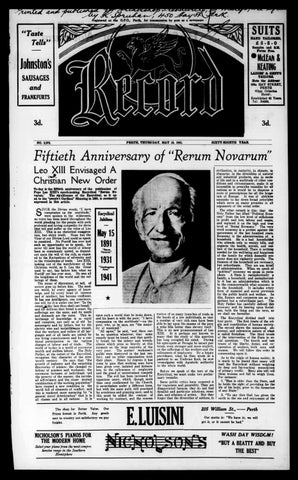
Fiftieth Anniversary of Leo XIII Envisaged A
Chris
it
civilisation, in maturity, in climate, in character, in the diversities of natural and industrial products, also in mode of life and in a multitude of other conditions and circumstances, make it as impossible to prescribe remedies for all nations as it would be to dispense a score of prescriptions for all the hospitals of Europe. It was of absolute necessity to lay down broad principles which serve as major premises in all arguments of the social order. The other remark is this: that the Holy Father has lifted "Political Economy" from the low level of selfishness in profit and loss, labour and wages, and replaced it on the high and true level of "Social Economy." The very word economy is a protest against the narrowness of the last hundred years. Economy is the administration of a household. He is a bad householder who attends only to weekly bills, and neglects the health, morals, and welfare of the household. There is nothing needed for the well-being and happiness of the family for which domestic economy does not vigilantly provide. The finances of the household are necessary, but subordinate. They are one detail of administration. When we speak of "political" economy we speak in metaphors. A State is metaphorically a family, a household; and metaphorically it has an administration which is to the commonwealth what economy is to the household. It includes every form of material and moral provision for the public health and welfare. In this, finance and commerce are an im-
New Order
To -day is the fiftieth anniversary of the publication of epoch-making Encyclical "Reiman NoPope Leo varum.' The significance of the Encyclical, as it aped to the "people's Cardinal" Manning in 1991, is succinctly expressed in this article.
SINCE the Divine words, "I have compassion on the multitude," were spoken in the wilderness, no voice has been heard throughout the world pleading for the people with such profound and loving sympathy for thcse that toil and suffer as the voice of Leo XIII. This is no rhetorical exaggeration, but strict truth. None but the Vicar of our Divine Lord could so speak to mankind. No Pontiff has ever had such an opportunity so to speak, for never till now has the world of labour been so consciously united, so dependent upon the will of the rich, so exposed to the fluctuations of adversity and to the vicissitudes of trade. Leo XIII, looking out of the watch-tower of the Christian world, as S. Leo the Great used to say, has before him what no Pontiff yet has ever seen. He sees all the kingdoms of the world and the sufferings of them. The moan of discontent, of toil, of sorrow goes up before him. The modern world, by every agency of knowledge, and by every bond of interest and of intellect, has become confluent. It has one intelligence, one conscience, one will, for it is under one law: "In the sweatthy face thou shalt eat bread:" and for millions that bread is scant. Its sufferings are the same, and its needS and demands are the same. This interchange of knowledge is so rapid and complete, not only as of old by messengers and by letters, but by the electric wire and instantaneous transit, that the workers and toilers of all languages and of all lands are united by one living consciousness and by a continual participation in the various changes of labour and of trade. The world of to -day is a world of enormous wealth and endless labour. The Holy Father, at the outset of the Encyclical, recognises this character of the nineHe says that "the teenth century. growth of industry and the surprising discoveries of science; the changed relations of masters and workmen; the enormous fortunes of individuals And the poverty of the masses; the increased self-reliance and the closer mutual combination of the working population" have created a new condition in the world full of elements of conflict; and this is rendered more menacing by "a general moral deterioration" that is in It is all classes and in all nations.
portant but a subordinate part. The Holy Father has carefully defined this
upon such a world that he looks down, and his heart is with the poor; "I have compassion on the multitude"-on the poor, who, as he says, are "the majority of mankind." agree," he said, "and there can ' All be no question whatever, that some remedy must be found, and that quickly found, for the misery and wretchedness which press so heavily at this moment on the large majority of the The ancient workmen's very poor. guilds were destroyed in the last century, and no other organisation took their place. Hence by degrees it has come to pass that working men have been given over, isolated and defenceless, to the callousness of employers and the greed of unrestrained competiThe evil has been increased by tion. rapacious usury, which, though more than once condemned by the Church, is nevertheless under a different form, but with the same guilt, still practised by avaricious and grasping men; and to this must be added the custom of working by contract, and the concen-
The shop for Better Value. Our Any goods Prices lowest in Perth. sent to country not satisfactory we pay freight.
NICHOLSON'S PIANOS FOR THE MODERN HOME Select your piano from the most comprehensive range in the Southern
Hemisphere
economy and its bearing upon Socialism, both the thing and the term, as we shall see hereafter. The Encyclical divided itself into four parts. The first treats of the origin and constitution of human society. The second shows the unnatural, abnormal, and subversive nature of what is called Socialism. The third treats of the intervention of the State in soDuring has long occupied his mind. cial questions. The fourth and last his episcopate at Perugia he issued pastreats of the liberty, duties, and cotorals, even stronger and more explicit, operation of workers, both men and on the sufferings of the workers and the women. We will follow this order in callousness of employers. By a happy commenting upon it. providence, what he then wrote in a to the origin of human society, it pastoral to an Umbrian flock, he now is As much to be feared that many will nromulgates with Apostolic authority read the Encyclical without weighing to the whole world. its deep and far-reaching enunciation Before we speak of the text of the of primary truths. Many also will call them truisms and fail to weigh them. Encyclical, we must make two prelimFor instance: inary remarks. 1. "Man is older than the State, and Some public critics have censured it he holds the right of providing for the for vagueness and generality. They are life of his body, prior to the formation disappointed because they do not find detailed and particular solutions, reme- of any State," dies, and schemes of action. But they 2. "To say that God has given the forget that the diversities of nations, in earth to the use and enjoyment of the
tration of so many branches of trade in the hands of a few individuals, so that a number of very rich men have been able to lay upon the masses of the poor a yoke litle better than slavery itself." This is no new pronouncement of Leo XIII. It is perhaps not known to many that the study of this question
Our motto is: "We have it; we will get it, or it cannot be had."