111,41,."
.4"
dire,,
dr
,e743-27
Registered at the G.P.O., Perth, f
transmission by post u a newspaper.
"Taste
s\
Tells"
,170#7.11P;
OP.
4 4,
SUITS HAND TAILORED,
5 -5 -0 Samples and SAL Forms Tree.
-Y
MdtAN &
Johnston's
KEATING
and
LADIES' & OMITS TAILORS. Note the Address: 569a HAY STREET, PERTH
FRANKFURTS
Hotel). Established 42 Years.
;SAUSAGES
(Opp. Criterion
Tel: B4594.
3d. NO. 2,971.
PERTH, THURSDAY, MAY 8, 1941.
SIXTY-EIGHTH YEAR.
Catholics Throughout Australia Observe
Social Justice Sunday
On Sunflay last, which was observed
throughourbastralia as Social Justice Sunday, t e Statement on Social Jus-
tice, which has been issued with the approval of the Episcopal Committee for Catholic Action, was released. In all the churches references were made to the statement and the congregations were informed that it would be obtainable free from bookshops. Special sermons were preached dealing
JUSTICE NOW!
Elaboration of Bishops' Statement. Father Lalor, in his sermon, gave a summary of the Statement. It was, he said, an elaboration of the Bishops' Statement issued last year, and dealt with matters of great public importance in the light of recent developments. Among the points dealt with were the recent decision of the Commonwealth Arbitration Court on the basic wage; the passage of Federal legislation introducing a system of child endowment; the renewed interest which had been displayed in the collaboration of workers and owners in the control of industrial disputes. Thost. matters involved principles elaborated in the social Encyclicals of the Popes and in the Bishops Statement last year.
with the urgency of the social justice programme and the means for its furtherance. In the Cathedral at 11 oclock a Missa Cantata was celebrated by the Rev. Father McGillicuddy, and sung by St. Mary's Cathedral Choir. The sermon was preached by the Rev. Harold Lalor. The Mass and sermon were broadcast.
It was of great importance, therefore, that the Christian attitude to each of
these questions should be understood by workers, by employers, and by legislators, so that their actions might be enlightened by the knowledge of Christian principles, for it was in defence of those principles that our armies were in the field.
In addition, the present critical state of the war could not blind us to the fact that the conclusion of hostilities would face Australia and New Zealand with social problems of the first magnitude. The aftermath of the present war would witness a challenge to the whole social system, and unless the Christian principles, which alone could furnish a stable basi, for social reconstruction, were properly understood, it was not impost ble that the British Commonwealths of Australia and New Zealand would be a prey to social chaos and violence. This new Statement was essentially practical and constructive; it covered the questions of a family wage and the recent child endowment scheme, suggested marriage loans, the wider and universal distribution of property, and the institution of industrial councils as a development of the concliation committees which had been evolved by the grim necessities of war.
I
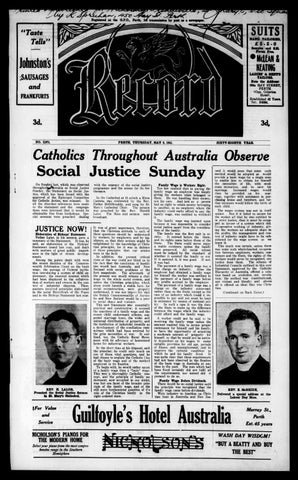
REV. H. LALOR, Preached the Social Justice Sermon in St. Mary's Cathedral.
tFor Value and Service
i
t.
The family wage was insisted upon because it was impossible to consider social justice apart from the consideration of the family. The family was the first unit in society. It existed before the State, and its rights came before those of the State. The State could never enjoy a stable existence unless the family were preserved. All social reform must be judged by the standard of whether it assisted the family or not If it assisted it, it was good. If not, it was bad. The payment of a family wage was a first charge on industry. After the employer had obtained a family wage for himself the worker was entitled to the payment of a family wage before any profits accrued to the employer. The payment of a family wage was a charge on the industry concerned, rather than on the State, except in the case of an industry which found it impossible to pay and yet must be kept in existence by reason of national policy. In such a case it was the duty of the State to make up the difference between the wages which the industry could afford and the family wage. A worker could not be said to be receiving the family wage unless the amount enabled him to secure proper sustenance for himself and his family, to have the opportunity of acquiring a moderate amount of property for himself, so that he would not be entire. ly dependent on his wages, to make suitable provision for old age, periods of illness, and unemployment, and to improve the cultural condition in which he and his family lived. It was quite clear that those requirements had not been observed in the fixation of the basic wage in Australia at any time in the past. The sum which had been fixed certainly did not fulfil all the requirements, nor indeed did it pretend to do so. Family Wage Before Dividends. There would be no social justice until the principle was recognised that the family wage came before dividends. Were industry to function on Christian lines in Australia and New Zea-
REV. E. McBRIDE, Delivered a special address at the Labour Day Mass.
Guilloyle's Hotel Australia
NICHOLSON'S PIANOS FOR THE MODERN HOME Select your piano from the most comprehensive range in the Southern
Hemisphere
It out-
lined, too, the Catholic Rural Movement with its advocacy of homestead farms for industrial workers. In the short time at his disposal, said the preacher, he could only touch on one of those vital questions, and he had chosen to explain the Catholic i lea of the basic wage and of the method employed in its fixation. To begin with, he would rather speak of a family wage than a "basic" wage. This was a thoroughly Catholic concept, and the principle of family endowment, now accepted in our midst, was but one facet of the broader principle of the family wage, and of the still more fundamental question of t'-e role of the Christian family in the right ordered state.
Family Wage is Workers Right. Too few realised that in paying the family wage an employer was simply giving his workers what belonged to them. He was handling their money, not his own. And just as a person had no right to retain money belonging to another, so no employer, where the industry could really afford to pay the family wage, was entitled to withhold
:and it would seem that some such method would be adopted as would provide a basic wage for a single man to enable him to obtain for himself the necessities of life, with moderate recreation, and to save for marriage. Increased wages would then be provided on his marriage, together with assistance in purchasing house and furniture, and further increases would follow the birth of each child. The wages system was not in itself unjust. But if it failed to secure for the worker all that he was entitled to in strict justice, then it must be scrapped in favour of a system which did. Co-operative working of industry, giving the workers an adequate share in the profits, the management and control of industry might have to be substituted for the wage system as we knew it. This much was certain, unless there was some such whole -hearted co-operation between employers, workers, consumers and the State, the rights of the workers would never be recognised, nor justice done them. The scheme of Industrial Councils outlined in this new by the Catholic Statement, approved Hierarchy of Australia, offered a solution based on evolution, not revolution; the method was constitutional, not violent and bloody; and above all it offered an ideal that was Christian. (Continued on Back Cover.)
Murray St., Perth Est.45 years
WASH DAY WISDCM! "BUY A BEATTY AND BUY THE BEST"